CHAPTER I
Note 1, page 3: Many old-time "scouts" of Western plains and mountains
did not amount to much. They led a useless life, hunting and fighting
for personal gain, and gave little thought to preserving game, making
permanent trails, or otherwise benefiting people who would follow. Their
knowledge and experience was of the selfish or of the unreliable kind.
They cared for nobody but themselves, and for nothing but their wild
haunts. However, these trapper-explorers whose names the Elk Patrol took
were of value to the world at large and deserve to be remembered.
General William H. Ashley lived in old St. Louis, and became a
fur-trader and fur-hunter in 1822. By his great enterprise he encouraged
other Americans to penetrate the Western country. He led numerous
expeditions across the wild plains and the wild Rockies, and his parties
were great training-schools for young trapper-scouts. He it was who
fairly broke the famous Oregon and California emigrant trail across the
Rocky Mountains by hauling a six-pounder cannon, on wheels, to his fort
in Utah; his men were the first to explore the Great Salt Lake; he was
the first brigadier-general of the Missouri State militia, and after his
fur days he went to Congress.
Major Andrew Henry was General Ashley's partner in fur. But before
joining with Ashley, in 1810 he had built, in Idaho, the first American
trading post or fort west of the mountains.
Kit Carson was a real "boy scout," for he took the scout trail in 1826,
when he was only sixteen. Because of his modesty, his bravery, his
shrewdness, and his kindliness, his help to army and other Government
expeditions, and his advice in Indian matters, he is the best-known of
all Western frontiersmen.
Thomas Fitzpatrick the Bad Hand was an Ashley trapper, and was a captain
of trappers. He afterwards served as a valuable guide for emigrants and
the Government, and was a Government agent over Indians. He was called
by the Indians "Bad Hand," because one hand had been crippled through a
rifle explosion. He was called "White Head," too, because in a terrible
chase by Indians his hair turned white.
Jedediah S. Smith is known as the Knight in Buckskin. He also was an
Ashley scout or trapper, and he was the first American trapper to lead a
party across to California. Jedediah Smith was a true Christian, and
during all his wanderings the Bible was his best companion.
Jim Bridger was another Ashley scout. He became a scout when he was
nineteen, before Kit Carson, and is almost as well known as Kit Carson.
He was the Ashley man who discovered the Great Salt Lake, in 1825; he
was the first to tell about the Yellowstone Park; and it was by his
trail that the Union Pacific Railroad found its way over the Rocky
Mountains.
Note 2, page 4: Boy Scouts know that "taking a message to Garcia" means
"there and back and no breath wasted." When the war with Spain broke
out, in 1898, Captain Andrew Summers Rowan, of the United States Army,
was directed by the President to convey a message from the Government to
General Garcia of the Cuban Army. Nobody seemed to know the exact
whereabouts of General Garcia, who was concealed in the depths of the
island. But Captain Rowan did not wait to ask "when" or "how." Not he.
He pocketed the message, he made for Cuba, he plunged into the jungle,
he found General Garcia, and he brought back the desired report. That
was genuine Scouts' work, without frills or foolishness.
Note 3, page 5: Two pairs of thin socks are better for the feet than one
pair of thick socks. They rub on each other, and this saves the skin
from rubbing on the inside of the boot. Soldiers sometimes soap the
heels and soles of their stockings, on the inside.
Note 4, page 6: The "tarp" or tarpaulin, or cowboy bed-sheet, is a strip
of sixteen- or eighteen-ounce canvas duck six to eight feet wide and ten
to twenty feet long. Fifteen feet is long for Boy Scouts. But it should
be plenty wide enough to tuck in well and not draw open when humped by
the body, and plenty long enough to cover, with room for the feet, and
plenty heavy enough to shed wind and water. It is used on the outside,
under and over; and in between, in his blankets, the Scout is snug. The
tarp is simple and cheap and is easily accommodated to circumstances. If
a few brass eyes are run along the edges, and in the corners, then it
can be stretched for a shelter-tent, too. It is much used on the plains
and in the mountains.
Note 5, page 6: The diamond hitch is the favorite tie by which packs and
other loads are fastened upon burros and horses. It has been used from
very early days in the West, and is called the "diamond" hitch because
when taut the rope forms a diamond on top of the pack. There are several
styles of the diamond hitch, but they all are classified as the single
or the double diamond. Some require only one person to tie them; some
require two persons. They bind the load very flat, they may be loosened
or tightened quickly from the free end of the lash rope, and they do not
stick or jam. Nobody has time to fuss with hard knots, when the pack
must come off in a hurry.
The simplest form of the diamond hitch is tied as shown here. Scouts may
practice it with a cushion laid upon a porch rail, a cord for a lash
rope, a strip of cloth for the band or cincha, and a bent nail for the
cincha hook.
The Elk Scouts had under their top-packs a "sawbuck" pack-saddle, which
is a pair of wooden X's; and to the horns of the X's they hung on each
side a canvas case or pannier, in which were stowed cooking utensils,
etc. The blankets, etc., were folded and laid on top, with the
tarpaulins covering, and the whole was then "laired up" (which is the
army and packing term for tucking and squaring and making all
shipshape), so that it would ride securely. The panniers must balance
each other, even if rocks have to be put in on one side to even up; or
else the burro's back will be made sore. Top-packs must not ride wobbly
or aslant.
A splendid little book for Boy Scouts is the pamphlet "Pack
Transportation," issued by the Quartermaster's Department of the United
States Army, and for sale at a small price by the Government Printing
Office, Washington. It tells about all the pack hitches, with pictures,
and how to care for the animals on the march. This latter is very
important.
Before Number 3 is formed, the cinch or cincha (the belly-band) must be
drawn very tight, so that the double-twist which makes the loop in
Number 3 will stick. But the rope and cincha are apt to slip and loosen,
unless the Scout takes a jam-hitch or Blackwall hitch around the hook of
the cincha. The rope should be kept taut throughout; and at the last
should be heaved tauter still, so that the diamond bites into the pack
well; and the end of the rope should be doubled back and tucked under so
that it will not drag, and yet can be easily got at.
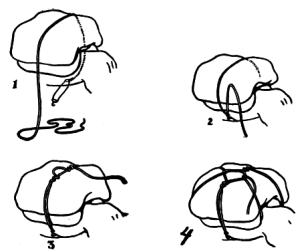 THE SIMPLEST SINGLE DIAMOND
The lash rope, or pack-rope, in the Army is one-half inch in size and is
fifty feet long; but a forty-foot rope is plenty long enough for Scouts.
A lair rope also is useful in packing. This is a three-eighths inch
rope, twenty-five or thirty feet long, by which the packs may first be
laired or tied up securely so that nothing shall shake out.
A pack for a burro may weigh from 200 to 250 pounds; but on a long,
rough trip 150 pounds is better. A pack is harder on a mule or a horse
than a rider is, because it never lets up.
Note 6, page 6: The Indian bow was only two and one-half to four feet
long, so that it could be carried easily when stalking or when on
horseback. The Sioux bow, four feet long, was an inch and a half wide at
the middle and an inch thick, and tapered to half an inch thick and half
an inch wide, at the ends. The Indian bow was made of wood, and of
mountain-goat horns, or of solid bones, glued together. The wooden bow
frequently was strengthened by having hide or sinew glued along the
back. Until they learned the knack of it, few white men could bend an
Indian bow.
The arrows were of different lengths, but each warrior used the one
length, if he could, so that he would shoot alike, every time. Each
warrior knew his own arrows, by a private mark—by length or by pattern
of stem or of feathers. Some tribes used two feathers, some three.
Scouts can mark their arrows, in the same way.
The bow and arrow are good Scout weapons. They give no noise. They do
not frighten animals or warn the enemy. They are not expensive. They can
be made on the spot. And it takes Scoutcraft to make them and to use
them successfully. As long as the Indians had only bows and arrows,
there was plenty of game for all.
Note 7, page 6: The lariat rope, or simply "rope," in the West, is
thirty-five or forty feet long. Usually it is five-eighths, four-ply
manilla, but the best are of braided rawhide. Those bought at stores
have a metal knot or honda through which the slipnoose runs; but cowboys
and Boy Scouts do not need this. They tie their own honda, which should
be a small fixed loop with space enough for the rope to pass freely. The
inside of the loop, against which the rope slips back and forth, may be
wrapped with leather. In throwing the rope, the noose or slipknot should
be opened to four or five feet in diameter, and the free part of the
rope outside the noose should be grasped together with the noose for
about one third along the noose from the honda knot. The remainder of
the rope is held in a coil in the other hand, ready to release when the
noose is cast. The noose (with the part of the free rope) is whirled in
thumb and fingers around the head, until it has a good start; and then
it is jerked straight forward by the wrist and forearm. As it sails, the
honda knot swings to the front and acts as a weight to open the noose
wide. That is why part of the rope is taken up, with the noose, and the
noose is grasped one third along from the knot itself.
The rope, or lariat, or lasso, is a handy implement for the Scout. The
Western Indians and the old-time scouts or trappers used it a great
deal, for catching animals and even enemies; and when the United States
fought with Mexico, in 1846, some of the Mexican cavalry were armed with
lassos.
Note 8, page 7: Anybody on the march always feels better and can travel
better when he keeps himself as clean and as neat as possible. Each pair
of Scouts in a Patrol should share a war-bag, which is a canvas sack
about four feet long, with a round bottom and with a top puckered by a
rope. This war-bag is for personal stuff, so that there is no need to
paw around in the general baggage, and no chance of losing things.
Note 9, page 7: Coffee is popular, but tea is better, in the long run,
and Scouts should not neglect it on the trail. It is lighter than
coffee, is more quickly made, and is a food, a strength-giver, and a
thirst-quencher in one. All explorers favor it.
Note 10, page 7: Scout Troops would do well to have an official
physician who will make out a list of remedies to be used in camp or on
the march. When Scouts know how to clean out the stomach and the
intestines and how to reduce fever and to subdue chills, and what to
give in case of poisoning, then they can prevent many illnesses and
perhaps save life. The remedies should be in shape to be easily carried,
and should be simple to handle.
Note 11, page 7: The Indian walk and the old scout walk was the
straight-foot walk, because it covers the ground with the least
resistance. When the foot is turned so that it is pushed sideways, there
is waste motion. The toes should push backward, not quartering, to get
the most out of the leg muscles. George Catlin, the famous Indian
painter, who lived among the Indians of the West before any of us were
born, says that he could not walk in moccasins until he walked
straight-foot. The Indians turned their toes in a little.
Note 12, page 10: All the Indian tribes of the Western plains and
mountains, and most of the old-time scouts, knew sign language. This was
a language by means of motions of the hands, helped by the body and
face; so that persons could sit and talk together for hours and not
utter a word! In time of danger, when silence is desired, Scouts of
to-day will find the sign language valuable; and by it the Scout of one
country can talk with the Scout of a foreign country.
A book on the "Indian Sign Language" was written in 1884 by Captain W.
P. Clark of the United States Army, and it gives all the signs for
things from A to Z.
Fitzpatrick's sign for "Watch!" was to bring his right hand with back
up, in front of lower part of the face, the first two fingers extended
and separated a little and pointing down the trail. The thumb and other
fingers are closed. The tips of the two fingers represent the two eyes
looking! When he meant "Listen!" he put his hand, palm front, to his
ear, with thumb and first finger open, so that the ear set in the angle
of them; and he wriggled his hands slowly.
Jim Bridger's sign for "Horseback!" was two fingers of one hand placed
astride the edge of the other hand, and the sign for "Wolf!" is the hand
(or both hands) with palm to the front, before the shoulder, and the
first two fingers pricked up, separated like two ears. Then the hand was
moved forward and upward, just a little, like a wolf reconnoitering over
a crest.
Occasionally the sign for something was not precisely the same among all
the Indian tribes. The Pawnee sign for "wolf" was the first finger of
each hand stuck up alongside the head, like ears pricking. But it was a
sign easily read. All the signs were sensible and initiative. When the
"future" was meant, the finger was thrust ahead with a screwing motion,
as if boring; when the "past" was meant, the hand and finger were
extended in front and drawn back with the screwing motion. When he was
full of food the Indian drew his thumb and finger along his body from
his stomach to his throat. When he was hungry he drew the edge of his
hand back and forth across his stomach, as sign that he was being cut in
two. The sign "talk" is to draw the words out of the mouth with thumb
and finger; while to "stop talking" is the same motion half made and
then slashed by the edge of the same hand being brought down through it.
This means "All right," "That's enough," "I understand," and also "Cut
it out!" "Chop it off!"
Years were reckoned as winters, and "winter" is signed by the two
clenched hands shivering in front of the body. Days were "sleeps," and
"sleep" is signed by inclining the head sideways, to rest upon the palm
of the hand. "Man" is the first finger thrust upright, before, because
man walks erect. The "question" sign is the right hand bent up, before,
at the wrist, fingers apart, and turned from side to side. To ask "How
old are you?" the Indian would sign: "You," "winter," "number," "what?"
So Scouts will not find it hard to pick up the sign language; the
motions represent the thing itself. When a sign requires several
motions, a good sign talker will make them all as rapidly as we
pronounce syllables, and he will tell a long story using one hand or
two, as most convenient.
CHAPTER II
Note 13, page 11: The sign for "Bird flying" is the sign for wings. The
two hands are raised opposite the shoulders, palms to the front, fingers
extended and together. Then the hands are waved forward and back, like
wings—slowly for large birds, fast for little birds, to imitate the
bird itself.
Note 14, page 13: A good way to spread the Scout or cowboy tarpaulin bed
is to lay the tarpaulin out at full length, on the smooth place chosen,
and to lay the blankets and quilts, open, full length on top. Both ends
of the tarp are left bare, of course, for the bedding is shorter than
the tarp. Then the whole is turned back upon itself at the middle; one
edge of the tarp is tucked under, and part of the other edge, making a
bag, with leeway enough so that the sleeper can crawl in. Now there is
as much bedding under as over, which is the proper condition when
sleeping out upon the ground. The bare end of the tarp, under, will keep
the pillow off the dirt; the bare end which comes over will cover the
face in case of storm. The Scout has a low, flat bed, which will shed
wind and rain.
Note 15, page 13: A reflector is a handy baker. It is a bright-lined box
like half of a pyramid or half of an oven. The dough is put into it, and
it is set upon its base, open to the fire. The heat strikes it and
reflects upon the dough and the dough bakes. It is simple, and can be
made to fold together, so that it packs easily. Another trapper and
scout method is to smear dough upon a shovel or even a flat, smooth
board, and set it up against the fire. The Mexicans bake their
tortillas, or thin flour cakes, by smearing them upon smooth stones.
Note 16, page 17: Scouts can readily invent a whistle code of their own.
The Western Indians used whistles of bone, in war, and the United States
Army can drill by whistle signals.
CHAPTER III
Note 17, page 21: The teeth are a very important item in Scout service.
If Scouts will notice the soldiers of the United States Army, and the
sailors of the United States Navy, they will notice also that their
teeth are always kept clean and sound. Scouts, no matter where they are,
should brush their teeth well with tooth powder every morning at least;
and should keep them free from particles of food, and should wash their
mouths with a dental antiseptic to kill microbes. Brushed teeth and
combed and brushed hair after the wet rub make the Scout fit for the
day's work. He feels decent.
Note 18, page 25: Scouts who are in camp or on the trail without
fish-hooks and are hard-put to catch fish, may try an old Indian and
scout method. A bent pin sometimes does not work, with large fish; but
the Indians tied a cord or sinew to the end of a small, slender bone,
and again, with a loop, to the middle of the bone.
When the fish swallowed the bait impaled upon the bone, the cord or
sinew hauled the bone by the middle so that it usually snagged in the
fish's throat or gills. A sharp, tough splinter or a small nail will do
the same. Thus:
CHAPTER IV
Note 19, page 33: Newspaper stuffed into wet boots or shoes helps them
to dry by holding them open and by absorbing the moisture. Of course,
the newspaper should be changed frequently. Warm pebbles poured into wet
boots or shoes dry them quickly, too. A stuffing of dead grass is
another Scouty scheme.
Note 20, page 36: For a leader of a Scouts' party to write up the chief
events of each day's march in a notebook, and to sketch the country
traversed, teaches order and disciplines the memory, and oftentimes will
prove a valuable record.
Note 21, page 38: The right-handed or the left-handed person usually is
right-sided or left-sided, all the way down, but not always. So because
a person is right-handed or left-handed he probably is right-footed or
left-footed, but not necessarily so. Some persons use their left hands
to write with, but throw with their right hands, and are likely to use
either foot. And some may be left-handed but right-footed. A Scout
should learn to use both hands and both feet alike. And he also will
learn not to be cocksure and jump at conclusions. All rules have
exceptions.
CHAPTER V
Note 22, page 39: Scouts will find that weather-signs among the high
mountains are very different from those of the low or the flatter
country. The easiest sign of storm is the night-caps. For when in the
morning the mountains still have their night-caps on, and the clouds
rest like shattered fog in the draws and hollows, the day will surely
have rain, by noon. But among the Rockies there usually is a
thunder-storm in the middle of every day during the summer.
No one wind for all localities brings rain. The weather is interfered
with by the peaks and the valleys. However, here are a few signs to be
noted:
When by day the air is extra clear, so that very distant ridges stand
out sharply, a storm is apt to be brewing.
When the camp-fire smoke bends down, in the still air of midday or
afternoon, a storm is apt to be brewing.
When by night the stars are extra sharp and twinkle less than usual,
overhead, but are dim around the horizon, a storm is apt to be brewing.
When there is a halo or ring around the moon, a storm is apt to be
brewing; and it is claimed that the larger the circle, the nearer the
storm.
When the canvas of the tent stays tight or damp, showing a gathering
dampness, a storm is apt to be brewing.
When ants are noted dragging leaves or twigs across the entrance to
their nest, a storm is near.
The change of the moon is claimed to change the weather also. And an old
maxim says that the third day before the new moon is the sign of the
weather for that moon month. If the new moon comes upon the 10th, then
the weather of the 8th is to be the general weather of the next thirty
days.
Of course, in winter time, or in the late fall or early spring, when the
sun-dogs appear, that is a pretty sure sign of cold weather. The Indians
say that the "sun is painting both cheeks," or that the "sun has built
fires to warm himself."
But Scouts will have difficulty in predicting mountain weather, because
storms are diverted by the peaks, and swing off or are broken up; and
besides, many mountain trails and mountain camps are one mile and two
miles high—above ordinary conditions. The saying is that only fools and
Indians predict weather, in the mountains!
Note 23, page 39: Scouts as well as anybody else should have their teeth
approved of by a dentist, before starting out on the long trail. The
tooth-ache saps the strength, and a cavity might result in a serious
abscess, far from proper treatment.
Note 24, page 40: In the thick timber where there are many trees the
chance of course is less that the tree which you are under will be
struck by the lightning. But to seek refuge under any tree, in a field
or other open place, is dangerous. Many persons are killed, every
summer, by seeking some lone tree or small clump of trees, or a
high-standing tree, in a thunder-storm.
Note 25, page 47: The low soft spot is not so good as the high hard
spot, to sleep on. Green grass is damp, and softness gathers dampness.
Cowboys and rangers always spread their beds on a little elevation,
where the ground is drier and where there is a breeze for ventilation
and to keep the insects away.
Note 26, page 49: Nobody can cook by a big fire, without cooking himself
too! The smaller the fire the better, as long as it is enough. Just a
handful of twigs at a time will cook coffee or roast a chunk of meat. It
is an old scout saying that "Little wood feeds the fire, much wood puts
it out." Cook by coals rather than by flame. In the West cedar makes the
best coals, the cleanest flame; sage makes a very hot fire, and burns to
ashes which hold the fire, but it does not give hard coals. Anything
pitchy smokes the camp.
In the mountains meat wrapped in a gunnysack or a tarpaulin, to protect
from the flies, and hung in the shade and particularly in a tree where
the air circulates, will keep a long, long time.
Note 27, page 49: The brass eyes in the edges of the Elk Scouts' tarps
here would come into good use for stretching the tarp as a low "A"
shelter-tent or dog-tent. The small shelter-tents of the United States
Army are called by the soldiers "pup" tents.
Note 28, page 53: The notion that many persons have, of taking guns with
them into the mountains or the hills, for protection from wild animals,
is a foolish notion. In this day and age the wild animals have been so
disciplined by man that they are afraid of him. They would rather run
than fight; and throughout the greater part of the United States in
North America the animals who could be dangerous are scarce. Guns do
much more harm than the animals themselves; and it is the wounded animal
which is dangerous. To pack a big gun on the ordinary trail through
the wilderness country West or East is the mark of a tenderfoot, unless
the gun is needed for meat. Many and many a seasoned wilderness
dweller—ranger, cowboy, rancher, prospector—travels afoot or horseback
day after day, night after night, and never carries a gun, never needs a
gun.
CHAPTER VI
Note 29, page 61: One of the regulations of the United States Army Pack
Transportation Department says that packers must treat all the mules
kindly, for a mule remembers kindness and never forgets injury. Packers
must not even throw stones, to drive a mule into line. Of course, Boy
Scouts know that kindness with animals always wins out over harshness,
and that there is no greater cowardliness than the abuse of a helpless
beast.
Note 30, page 62: Highness and dryness, wood and water, and grazing for
the animals are the requirements of the Scouts' camp on the pack trail.
Note 31, page 63: By camp law bird or four-foot or other harmless
animals within say two hundred yards of camp is safe from injury by man.
This also prevents reckless shooting about camp. The wild life near camp
is one of the chief charms of camping in the wilderness. No Scout wishes
to leave a trail of blood and murder and suffering, to mark his progress
through meadow and timber.
Note 32, page 67: This division of watches or guards should be noted by
Scouts. Bed-mates or bunkies should not follow one another on guard; for
A wakes B when he crawls out; and after he has changed with B, and has
slept two or three hours, he is waked again by B crawling in. But each
Scout listed for guard duty should so be listed that he is not disturbed
through at least two of the watches.
CHAPTER VII
Note 33, page 72: A "trail" is made up of "sign" or marks which show
that something has passed that way. The overturning of pebbles and
sticks, dryness and wetness of the spots where they were, dryness and
hardness of the edges of footprints, grass pressed down, twigs of bushes
broken, dew disturbed, water muddied, ant-hills crushed—all tell a tale
to the Scout. He must be able to figure out what was the condition of
the trail when the person or animal passed—and that will tell him how
long ago the marks or sign were made. And the shape of the sign, and the
way in which it is laid, tell what manner of person or animal passed,
and how fast. Steps vary in size, and in pressure and in distance apart.
A man at a very hurried walk is apt to leave a deeper toe-print, and a
loaded horse sinks deeper than a light one. A good trailer is a good
guesser, but he is a good guesser because he puts two and two together
and knows that they make four.
Note 34, page 74: A portion of a patrol on a scout should think to leave
private signs, by marks in the dirt or on trees or by twigs bent or by
little heaps of stones, which will tell their comrades what has been
occurring. This the Indians were accustomed to do, especially in a
strange country. To this day little stone-heaps are seen, in the plains
and mountains of the West, marking where Indians had laid a trail.
Note 35, page 77: Great generals and captains make it a point not to do
what the enemy wants them to do or expects them to do, and never to
think that the enemy is less smart than they are themselves. To despise
the enemy is to give him an advantage.
CHAPTER VIII
Note 36, page 88: "Parole" means word of honor not to attempt escape;
and in war when a prisoner of rank gives this promise he is permitted
his freedom within certain limits. Sometimes he is released entirely
upon his promise or parole not to fight again during the war. Paroles
are deemed serious matters, and few men are so reckless and deceitful as
to break them. But of course there are two sides to a parole; and if it
is not accepted as honestly as it is given, then there is no bargain.
But if there is the slightest doubt or argument, then the Scout ought to
stay a prisoner, rather than escape with dishonor, charged with breaking
his word. That the other fellow is dishonest is no excuse for the Scout
being dishonest, too.
Note 37, page 89: The sign for escape is this: Bridger crossed his
wrists, with his fists doubled, and wrenched them apart, upward, as if
breaking a cord binding them. He may have used the "Go" sign, which is
the hand extended, edge up, in front of the hip, and pushed forward with
an upward motion, as if climbing a trail.
Note 38, page 94: An old scout method of tying a prisoner's arms behind
his back is to place the hands there with their backs together, and to
tie the thumbs and the little fingers! This requires only ordinary cord
and not much of it, and even a strip from a handkerchief will do. To
prevent the prisoner from running away, he may be stood up against a
tree and his arms passed behind that, before the hands are tied.
CHAPTER IX
Note 39, page 100: Persons who are lost and are going it blindly on foot
usually keep inclining to the left, because they step a little farther
with the right foot than with the left. After a time they complete a
circle. Scouts should watch themselves and note whether they are making
toward the left or not. Horses, too, are supposed to circle toward the
left. But all this applies chiefly to the level country. In the
mountains and hills the course is irregular, as the person or horse
climbs up and down, picking the easier way. And on a slope anybody is
always slipping downward a little, on a slant toward the bottom, unless
he lines his trail by a tree or rock.
Scouts when they think that they are lost should hold to their good
sense. If they feel themselves growing panicky, they had better sit down
and wait until they can reason things out. The Scout who takes matters
easy can get along for a couple of days until he is found or has worked
himself free; but the Scout who runs and chases and sobs and shrieks
wears himself down so that he is no good.
To be lost among the hills or mountains is much less serious than to be
lost upon the flat plains. The mountains and hills have landmarks; the
plains have maybe none. In the mountains and hills the Scout who is
looking for camp or companions should get up on a ridge, and make a
smoke—the two-smoke "lost" signal—and wait, and look for other smokes.
If he feels that he must travel, because camp is too far or cannot see
his smoke, or does not suspect that he is lost, his best plan is to
strike a stream and stick to it until it brings him out. Travel by a
stream is sometimes jungly; but in the mountains, ranches and cabins are
located beside streams. Downstream is of course the easier direction.
It is a bad plan to try short cuts, when finding a way. The Scout may
think that by leaving a trail or a stream and striking off up a draw or
over a point he will save distance. But there is the chance that he will
not come out where he expects to come out, and that he will be in a
worse fix than before. When a course is once decided upon, the Scout
should follow it through, taking it as easy as possible.
Note 40, page 106: Old-time scouts had to make all their fires by flint
and steel; and it is well for modern Scouts to practice this. When the
ground is too wet, and would be apt to put out the little blaze, the
fire can be started in a frying-pan. Matches are very convenient, but
they must be warded from dampness. They can be carried in a corked
bottle; they can be dipped, before leaving home, in melted paraffin,
which will coat them water-proof; and dampness can be rubbed out of them
by friction by rolling them rapidly between the palms of the hands and
scratching them quick. When every object is soaked through, matches (if
dry) may be lighted upon a stone which has been rubbed violently against
another stone.
If the Scout has a rifle or pistol or gun, then he can make a fire by
shooting powder into a bunch of tinder—raveled handkerchief or coat
lining, or frazzled cedar bark. The bullet or the shot should be drawn
out of the cartridge, and the powder made loose, and the tinder should
be fastened so that it will not be blown away.
In the rain a blanket or coat or hat should be held over the little
blaze, until the flames are strong.
It was the old-time scouts who taught even the Indians to make fire by
flint and steel, or by two flints. Two chunks of granite, especially
when iron is contained, will answer. The Indians previously had used
fire-sticks and were very careful to save coals. But they saw that
"knocking fire out of rocks" was much easier.
Note 41, page 108: Scouts of course know the Big Dipper or the Great
Bear, and the Little Dipper or the Little Bear, in the sky. The Big
Dipper points to the North Star or Pole Star, and the North Star or
Pole Star is the star in the end of the handle of the Little Dipper.
These two formations up above are the Clock of the Heavens.
The "Guardians of the Pole" are the two stars which make the bottom of
the cup of the Big Dipper. They are supposed to be sentinels marching
around and around the tent of the North Star, as they are carried along
by the Big Dipper. For the stars of the Big and the Little Dipper, like
all the other stars, circuit the North Star once in about every
twenty-four hours.
But the old-time scouts of plains and mountains told time by the
"Pointers," which are the two bright stars forming the end of the cup of
the Big Dipper. These point to the Pole Star, and they move just as the
"Guardians of the Pole" move. They are easier to watch than the
"Guardians of the Pole," and are more like an hour-hand. With every hour
they, and the "Guardians of the Pole," and all the Dipper stars move in
the same direction as the sun one and one-half the distance between the
stars forming the top of the Big Dipper's cup. The Scout with a good
memory and a good eye for distance can guess pretty nearly how time
passes.
He has another method, too. The circuit of the stars is not quite the
same as the circuit of the sun; for the stars swing about from
starting-place to starting-place in about four minutes less than
twenty-four hours, so that every month they gain 120 minutes, or two
hours. On May 1, at nine in the evening, the "Pointers" of the Big
Dipper are straight overhead, and point downward at the Pole Star, and
if we could see them twelve hours later, or at nine in the morning, we
should find them opposite, below the Pole Star, and pointing up at it.
On June 1, they would arrive overhead two hours earlier, or at seven in
the evening, and by nine o'clock would be west of overhead, while at
seven and nine in the morning they would be opposite, or halfway around.
On August 1 their halfway places would be at three in the afternoon and
three in the morning.
So, figuring each month, and knowing where the "Pointers" are at nine,
or at midnight, or at three in the morning, the Scout can read, for
several nights running without appreciable change, what time it is. And
on the plains the old trappers were accustomed to look up out of their
buffalo-robes and say, "By the Pointers it is midnight."
The Big Dipper swings on such a wide circle that sometimes it drops into
the hills or into mist. The Little Dipper stays high in the sky.
Therefore sailors choose the two brighter stars in the end of the cup of
the Little Dipper, and watch them, for an hour-hand.
The Blackfeet Indians call the Big Dipper the Seven Brothers, and they,
and also other plains people such as sheep-herders and cowboys, tell the
time by the "Last Brother," which is the star in the end of the handle.
"The Last Brother is pointing to the east," or "The Last Brother is
pointing downwards to the prairie," say the Indians. And by that they
mean the hour is so and so.
Note 42, page 109: The "Papoose on the old Squaw's Back" is a tiny star,
Alcor, very close to the star Mizar which forms the bend in the handle
of the Big Dipper. To see this tiny star is a test for eyesight. The
Sioux Indians say that the Big Dipper is four warriors carrying a
funeral bier, followed by a train of mourners. The second star in the
train (or the star in the bend) is the widow of the slain brave, with
her little child, or the Little Sister, weeping beside her!
The Blackfeet and other Indians say that the Pole Star (which does not
move) is a hole in the sky, through which streams the light from the
magical country beyond. They call it "the star that stands still."
By the "Lost Children" Jim Bridger meant the Pleiades. These stars,
forming a cluster or nebula, sink below the western horizon in the
spring and do not appear in the sky again until autumn; and the
following is the reason why. They were once six children in a Blackfeet
camp. The Blackfeet hunters had killed many buffalo, and among them some
buffalo calves. The little yellow hides of the buffalo calves were given
to the children of the camp to play with, but six of the children were
poor and did not get any. The other children made much fun of the six,
and plagued them so that they drove them out of the camp. After
wandering ashamed and afraid on the prairie, the six finally were taken
up into the sky. So they are not seen in the spring and summer, when the
buffalo calves are yellow; but in the autumn and winter, when the
buffalo calves are black, they come out.
Nearly everybody can see the six stars of the Pleiades, and good
eyesight can make out seven. By turning the head and gazing sideways the
seven are made plainer. An English girl has eyesight so remarkable that
she has counted twelve.
The Western Indians have had names for many of the stars and the planets
and the constellations, and the night sky has been of much company and
use to them and to the old plainsmen and mountaineers, just as it was to
Jim Bridger at this time.
Mars is "Big-Fire-Star"; Jupiter is "Morning Star," or when evening star
is "The Lance"; Venus is "Day Star," because sometimes it is so bright
that it can be seen in the day. Scouts should know by the almanac what
is the morning star, and then when it rises over the camp or the trail
they are told that morning is at hand.
Note 43, page 110: Sunday comes to the trail, to the mountains and
plains and field and forest, just as often as to the town and the farm.
The Scout will feel much better, mentally and physically, when he
observes Sunday. This one day in the seven can be made different by a
change from the ordinary routine: by a good cleaning up; by only a short
march, just enough for exercise; by a whole day in camp, if possible; by
an avoidance of harm to bird or beast; by some especial arrangement,
which will say, "This is Sunday." The real Jedediah Smith, fur-hunter
and explorer, found as much profit in his Bible as in his rifle, amidst
the wilderness; and the Scout of to-day should include the Bible in the
outfit. It reads well out in the great open, it is full of nature lore
of sky and water and earth, and it is a great comforter and sweetener of
trail and camp.
CHAPTER X
Note 44, page 112: The smoke signal has been in use for many, many
years. The Indians of the West used it much, and whenever an army
detachment or other strangers traversed the plains and the hills their
course was marked by the smoke signals of Indian scouts. To make smoke
signals, first a moderate blaze is started; then damp or green stuff is
piled on, for a smudge; and the column of smoke is cut into puffs by a
blanket or coat held over like a cup and suddenly jerked off. A high
place should be selected for the smoke signal, so as to distinguish it
from the ordinary camp-fire, which is not as a rule made on a high
place,—that is, in hostile country. A still day is necessary for
accurate smoke signaling. This signaling is being recommended for the
United States Forestry Service, so that Rangers and Guards can
telegraph warnings and news by the Morse or the Army and Navy alphabet.
A short puff would be the dot, a long puff the dash; or one short puff
would be "1," two short puffs close together "2," and a long puff "3."
This Army and Navy code is explained under Note 48.
The Indians had secret codes, for the smoke signals; and used dense
smokes and thin smokes, both. Green pine and spruce and fire boughs
raise a thick black smoke.
In army scouting on the plains the following signals were customary:
"Wish to communicate." Three smokes side by side.
"Enemy discovered." Two puffs, repeated at fifteen-minute intervals. Boy
Scouts need not have the intervals so long. One minute is enough, for a
standard.
"Many enemy discovered." Three puffs, at intervals.
"Come to council," or "Join forces." Four puffs, repeated.
"March to the north." Two smokes, of two puffs each.
"March to the south." Two smokes, of three puffs each.
"March to the east." Three smokes, of two puffs each.
"March to the west." Three smokes, of three puffs each.
Plainsmen and woodsmen understand the following signals also:
"Camp is here." One smoke, one puff at intervals.
"Help. I am lost." Two fires, occasional single puffs.
"Good news." Three steady smokes.
Scouts' patrols can invent their own code of smokes, by number of
smokes, by puffs, and by intervals between puffs. Of course, the single
fire is much more easily managed by one person.
Note 45, page 116: The Red Fox Scouts probably carried with them a
liquid carbolic and antiseptic soap, which comes put up in small
bottles with patent shaker stoppers. A few drops of this in some water
makes a splendid wash for wounds, and is harmless. Druggists and
surgical supply stores can furnish Scouts with this soap. Being
non-poisonous, good for a gargle as well as for external use, it is
superior to many other antiseptic washes. A spool of surgeons' adhesive
tape, say three-quarter inch wide, a roll of sterilized absorbent
cotton, and a roll of sterilized gauze will of course be included in the
Scouts' first-aid kit.
CHAPTER XI
Note 46, page 124: Bichloride of mercury is a strong antiseptic, and
much favored for disinfecting dishes and other vessels used by sick
people. It is convenient to carry, in a form known as Bernay's tablets.
They come white or blue, and one is dissolved in water to make a
solution. They are very poisonous, internally, and Scouts must look out
that none of the solution enters the stomach. Of course, there are many
antiseptic substances for washing wounds: potash and borax are good,
especially in the form of potassium permanganate and boric acid.
Anything in a tablet or a powdery form is easier to pack than anything
in a liquid form. Wounds must be kept surgically clean, which means
"aseptic" or perfectly free of poisoning microbes, or else there may be
blood-poisoning. So Scouts should be careful that their fingers and
whatever else touches a wound also are surgically clean, by being washed
well in some antiseptic. Cloths and knife blades, etc., can be made
clean by being boiled for ten minutes.
CHAPTER XII
Note 47, page 133: When a Scout would climb a tree which looks hard,
particularly a large-trunk tree, he can work a scheme by connecting his
ankles with a soft rope or a handkerchief, or the like, measuring about
two thirds around the trunk. Then when he hitches up along the trunk he
gets a splendid purchase. Several strands of rope are better than one,
so that they will not slip. And if the rope or cloth is wet, it will
stick better.
Note 48, page 140: All Scouts should know how to wigwag messages. There
are three alphabets which may be used in telegraphing by wigwagging with
a flag or with the cap: the American Morse, such as is used in this
country by the regular telegraph, the Continental Morse, and the Army
and Navy. The American Morse is dots and dashes and spaces; but the
Continental Morse is different, because it does not have any spaces. It
is employed in Europe and in submarine cable work. The United States
Army and Navy have their own wigwag alphabet, which is named the Myer
alphabet, in compliment to Brevet Brigadier-General Albert J. Myer, the
first chief signal officer of the Army, appointed in 1860. Commonly the
system is known as the Army and Navy.
Scouts will find that knowing the American Morse or dot-and-dash
telegraph signs will be of much value because these can be used both in
wigwag and in electric-wire work; but Scouts to be of assistance to
their country in military time must know the Army and Navy alphabet,
which is easier to learn.
Instead of the dot and the dash and the space, the figures 1, 2, and 3
are used. The figure 1, like the wigwag dot, is a quick sweep of the
flag to the right, from the perpendicular to the level of the waist, or
one quarter of a circle. The figure 2 is a similar sweep to the left.
The figure 3 is a "front," or sweeping the flag straight down, before,
and instantly returning it to the upright again. The perpendicular or
upright is the beginning of every motion. The "front" ends things:
words, sentences, messages, etc.
Here is the Army and Navy alphabet: "A," you see, would be dip to left,
and return; to left, and return. "B," a left, a right, a right, and a
left.
A .............22       I .............1        Q .............1211
B .............2112     J .............1122     R .............211
C .............121      K .............2121     S .............212
D .............222      L .............221      T .............2
E .............12       M .............1221     U .............112
F .............2221     N .............11       V .............1222
G .............2211     O .............21       W .............1121
H .............122      P .............1212     X .............2122
             Y .............111        Z .............2222

Figs.                   Abbreviations

1 .............1111     a     is for   after   wi   ...........with
2 .............2222     b .............before  y    ...........yes
3 .............1112     c .............can     1112 ...........tion
4 .............2221     h .............have
5 .............1122     n .............not
6 .............2211     r .............are
7 .............1222     t .............the
8 .............2111     u .............you
9 .............1221     ur ............your
0 .............2112     w .............word

Signs

End of word...............................3
End of sentence...........................33
End of message............................333
Numerals follow (or end)..................X X 3
Signature follows.........................Sig 3
Error.....................................E E 3
I understand (O.. K..)....................A A 3
Cease signaling...........................A A A 333
Cipher follows (or ends)..................X C 3
Wait a moment.............................1111 3
Repeat after (word).......................C C 3 A 3 (give word)
Repeat last word..........................C C 33
Repeat last message.......................C C C 333
Move little to right......................R R 3
Move little to left.......................L L 3
Signal faster.............................2212 3
Permission granted........................P G 3
Permission not granted....................N G 3
The
address in full of a message is considered as one sentence, ended by
3 or a "front," and return to perpendicular.
This Army and Navy alphabet is easier to read, because it does away with
the pausing or lengthening of the motions, to make the spaces which help
to form some of the Morse letters. Every letter is reeled straight off
without a break.
Two flags are used in wigwagging. A white flag with a red square in the
center is used against a dark background; a red flag with a white square
in the center is used against the sky or against a mixed background. But
of course in emergency anything must be tried, and for a short distance
the Scout can use his hat or cap, or handkerchief, or even his arm
alone. The motions should be sharp and quick and distinct, with a
perpendicular between each motion and a "front" between words. The Army
rate with the large service flag is five or six words a minute.
The beam of a searchlight is used just as a flag is used, to sweep
upward for "perpendicular," downward for "front," and to right and to
left. Another system of night signaling is by lantern or torch; but it
should be swung from the knees up and out, for right or 1, up and out in
opposite direction for left, or 2, and raised straight up for "front" or
3. Four electric lamps in a row, which flash red and white in various
combinations, colored fires, bombs and rockets, also make night signals.
For daytime signaling the United States Army favors the mirror or
heliograph (sun-writing) system. The 1 is a short flash, the 2 is two
short flashes, the 3 is a long, steady flash. This system can be read
through 100 and 150 miles.
The United States Navy employs a two-arm or a two-flag system, which by
different slants and angles of the arms or flags signals by the Army and
Navy code. It is called the Semaphore system—like the semaphore block
signals of railroads. It is more convenient for windy weather, because
the flags are shorter and smaller than the flags of the three-motion
wigwag.
Scouts should have in their library a copy of the United States Signal
Corps booklet, "Manual of Visual Signaling," which can be had at a small
price from the Government Printing Office at Washington. This tells all
about the different systems of day and night signaling, and shows
alphabets, signal flags, codes, ciphers, and so forth.
The Indians of the plains and mountains have had systems of signaling as
perfect as those of the Army and Navy. In early days of the Army on the
plains, the Indians passed news along among themselves over long
distances faster than it was passed by the military telegraph. They used
a smoke code; and they used also mirror-flashes, blanket-waving,
pony-running, foot-running, and hand gestures.
Their secret signals were never told; no threats or bribes could make an
Indian divulge his tribal or his band code. Not even the white men who
lived with the Indians could learn it. Once some Army officers watched a
Sioux chief, posted on a little knoll, drill his red cavalry for an
hour, without a word or a gesture; all he used was a little
looking-glass held in the palm of his hand.
However, some of the signs were general. A tremulous motion or flash
meant game or enemy. Several quick flashes, close together, meant "Come
on." A beam to the left meant "By the left"; to the right meant "By the
right."
When looking for buffalo, the number of flashes would tell how many
bands of buffalo were sighted, and a quivering motion would bid the
hunters to "Come on."
Scouts will find some blanket signs handy. If the blanket is too large
to manage, fold it once.
"Who are you?" Hold the blanket by the two upper corners, in front, and
bend with it far to the right and to the left.
"We want peace." Hold the blanket by the two upper corners, in front,
and bending forward lay it flat upon the ground.
"Keep away," or "No." Hold up the blanket, grasping the two upper
corners. Cross the arms, still with hands grasping the corners. Bring
right arm back to front and right, almost opening the blanket again.
Repeat.
"Go back" or "Hide." Hold up blanket by two corners opposite right
shoulder, and swing it to right and down, several times.
"Alarm!" Toss the blanket several times, as high as possible.
"Something (or somebody) in sight." Hold up blanket by the two corners
opposite right shoulder. Then swing the right corner around to left and
to right. Repeat.
"Come on" or "Approach." Hold blanket up by two upper corners in front
of the body. Swing the right arm and corner to the left. Repeat.
Pony-running signals are usually in a circle, or forward and backward,
on the side of a hill or the crest. If the movements are fast, then the
news is exciting and important. If they are made in full view of the
surrounding country, then the danger is not close. If they are made
under cover, then the danger is near. If they are made under cover and
the rider suddenly stops and hides, then everybody must hide, or
retreat, for the enemy is too strong. The bigger the movements, the
more the enemy or the more the game. A dodging zigzag course shows that
the scout is pursued or apt to be pursued. A furious riding back and
forth along a crest means that a war party is returning successful. Boy
Scouts can make the motions on foot, and by a code of circles and figure
eights, etc., can signal many things.
Signals by the hand and arm alone are convenient to know.
"Who are you?" is made by waving the right hand to right and to left in
quick succession.
"We are friends" is made by raising both hands and grasping the left
with the right, as if shaking hands.
"We are enemies" is made by placing the right fist against the forehead,
and turning it from side to side.
"Halt" or "Keep away" is made by raising the right hand, palm to the
front, and moving it forward and back.
"Come" is made by raising right hand, back to front, and beckoning with
a wide sweep forward and in again, repeating.
For distance two-arm signals are better than one-arm; and Scouts should
have a short code in two-arms. Both arms stretched wide may mean "Go
back" or "Halt"; both arms partly dropped may mean "No," partly raised
may mean "Yes." And so on. These were plain signals.
Note 49, page 141: A sprain, such as a sprained wrist or ankle, for
instance, is a serious injury, and must not be made light of or
neglected. If not properly and promptly treated, it is likely to leave
the cords or ligaments permanently weak. When treatment may begin at
once, the injured joint should be laid bare, even if by cutting the shoe
instead of unlacing it and pulling it off, and the coldest water should
be applied lavishly. The joint may well be plunged into an icy spring or
stream, or held under a running faucet. If the joint can be kept
elevated, so that the blood will not flow into it so readily, so much
the better.
If some distance has to be covered before the injured person arrives in
reach of treatment, the shoe might as well remain on, to act as a
bandage and a support—although it probably will have to be cut off
later. If the joint is not the ankle joint, a tight, stout bandage
should be fastened around. Nobody should try to step upon his sprained
ankle or use his sprained wrist, or whatever joint it may be.
After swelling has set in very hot water is said to be superior to very
cold water; the very hot and the very cold have much the same effect,
anyway. But the water application should be kept up for at least
twenty-four hours, and the wounded place must not be moved one particle
for several days. When the time comes to move it, it should be wrapped
with a supporting bandage.
General Ashley probably had a hard time with his neglected ankle.
CHAPTER XIII
Note 50, page 147: The cache (which is a French word and is pronounced
"cash") or hiding-place is a genuine scout invention. Long ago the
trappers and traders of the plains and mountains, when they had more
pelts or more supplies than they could readily carry, would "cache"
them. The favorite way was to dig a hole, and gradually enlarge it
underground, like a jug. The dirt was laid upon a blanket and emptied
into a stream, so that it would not be noticed. Then the hole was lined
with dry sticks or with blankets, the pelts or supplies were packed
inside, and covered with buffalo robe or tarpaulin; and the earth was
tamped in solidly. Next a fire was built on top, that the ashes might
deceive Indians and animals. Or the tent or lodge was erected over the
spot for a few days. At any rate, all traces of the hiding-place were
wiped out, and landmarks were noted well.
It was considered a serious offense for one white man to molest the
cache of another white man, unless to save his own life. And to rob a
cache of the furs was worse than stealing horses.
All caches were not alike. Some were holes, others were caves into
banks. When Scouts of to-day make a cache, they must record the location
exceedingly well and close, or they are apt to lose the spot. It seems
very easy to remember trees and rocks and all; but anybody who has laid
a rabbit down, while he chased another, and then has thought to go
straight and pick it up again—or anybody who has searched for a
golf-ball when he knew exactly where it lit—will realize that a cache
may be very tricky.
Note 51, page 152: The homeopathic preparation of aconite is highly
recommended by many woodsmen and other travelers as a good thing to have
in the trail medicine kit. A few drops will kill a fever or a cold.
Dover's Powder (in small doses, by causing perspiration and thus
checking a fever or throwing off a cold), quinine, calomel (for
biliousness and to clean out the intestines when they are clogged with
waste and mucus), Epsom salts or castor oil (to clean out the bowels
also), an emetic, like sirup of ipecac (to empty the stomach quickly in
case of emergency), some mustard for making a plaster for the chest (in
croupiness or cold inside the chest), or for mixing with warm water to
make an emetic, extract of ginger or sirup of ginger (for summer
complaint and griping looseness of the bowels if long continued),
perhaps some soda mint tablets (for sour stomach caused by overeating),
are other simple remedies. Of course the Scout should learn to read the
little clinical thermometer, and one should be carried in the trail kit.
It is much better to know exactly how to use a few simple standard
remedies, than to experiment with a lot of powerful drugs and very
likely make terrible mistakes. To give a medicine without being certain
just why and just what it will do is as bad as pointing a gun at
somebody without knowing whether or not it is loaded. Doctors study hard
for years, before they begin to practice; and Scouts cannot expect to
make doctors of themselves in a few months. Head cool, feet warm, bowels
open, moderate eating—these are United States Army rules, and Scouts'
rules too. "An ounce of prevention is better than a pound of cure"!
Scouts who take care of their bodies properly will rarely need medicine,
and should be proud of the fact.
Note 52, page 153: In 1909, in California alone, out of 388 forest fires
243, or almost two thirds, were caused by human beings' carelessness;
and 119, or almost one third, were caused by camp-fires! The money loss
to the state was $1,000,000; but this was not all the damage. A forest,
or a single tree, is not replaced in a year, or in ten years; and the
stately evergreen trees grow slowest of all.
California claims that if a few plain rules were observed, in that state
alone 500 out of 575 forest fires would not occur. Some of these rules
are:
1. Never throw aside matches, or lighted or smoldering stuff, where
anything can possibly catch from it.
2. Camp-fires should be as small as will serve. (Most campers build
fires too large, and against trees or logs whence they will be sure to
spread.)
3. Don't build fires in leaves, rotten wood or sawdust, or pine needles.
4. Don't build fires against large or hollow logs where it is hard to
see that they are not put out. They eat in.
5. Don't build fires under low evergreens, or where a flame may leap to
a branch, or sparks light upon a branch.
6. In windy weather and in dangerous places camp-fires should be
confined in trenches, or an open spot be chosen and the ground first
cleared of all vegetable matter.
7. Never leave a fire, even for a short time, until you are certain that
it is out. Wet it thoroughly, to the bottom, or else stamp it out and
pile on sand or dirt.
8. Never pass by a fire in grass, brush, or timber, which is unguarded
and which you can see is likely to spread. Extinguish it; or if it is
beyond your control, notify the nearest ranch, town, or forest official.
These regulations are for Boy Scouts to remember and to observe, no
matter where the trail leads.
CHAPTER XIV
Note 53, page 161: A fire line is a cleared strip, sometimes only ten,
sometimes, where the brush is thick, as much as sixty feet wide, running
through the timber and the bushes, as a check to the blaze. An old
wood-road, or a regular wagon-road, or a logging-trail, or a pack-trail
is used as a fire line, when possible; but when a fire line must be
cleared especially, it is laid from bare spot to bare spot and along
the tops of ridges. A fire travels very fast up-hill, but works slowly
in getting across. Scouts should remember this important fact: The
steeper the hill, the swifter the fire will climb it.
There are three kinds of forest fires: Surface fires, which burn just
the upper layer of dry leaves and dry grass, brush, and small trees;
ground fires, which burn deep amidst sawdust or pine needles or peat;
and crown fires, which travel through the tops of the trees. Fires start
as surface fires, and then can be beaten out with coats and sacks and
shovels, and stopped by hoe and spade and plow. The ground fire does not
look dangerous, but it is, and it is hard to get at. Crown fires are
surface fires which have climbed into the trees and are borne along in
prodigious leaps by the wind. They are the most vicious and the worst to
fight.
The duty of Scouts is to jump upon a surface fire and kill it before it
becomes a sly ground fire or a raving crown fire.
Note 54, page 171: Even the best surgeons nowadays "fuss" with deep
wounds as little as possible. They clean the deep wound, by washing it
as well as they can, to remove dirt and other loose foreign particles;
then they cover gently with a sterilized pad, and bandage, to keep
microbes away, and Nature does the rest. In the days when our fathers
were boys, salves and arnica and all kinds of messy stuff were used; but
the world has found that all Nature asks is a chance to go ahead,
herself, without interference.
Unless a bullet, even, is lodged where it irritates a nerve or a muscle
or disturbs the workings of some organ of the body, the surgeon is apt
to let it stay, until Nature has tried to throw a wall about it and
enclose it out of the way.
So the less a Scout pokes at a deep wound, the better. He can wash it
out with hot water, and maybe can pick out particles of visible dirt or
splinters with forceps which have been boiled for ten minutes. Then he
can bandage it loosely, and wait for Nature or a surgeon.
CHAPTER XVI
Note 55, page 186: The Elks by this time had lost their pack-saddles and
panniers, which had been cached with other stuff after the two burros
were stolen by the renegades. They had lost also their lash ropes with
the cinchas; so that it was necessary to throw some pack-hitch that did
not require a cincha and hook. One of the easiest of such hitches is the
squaw-hitch. The tarps were spread out and the camp stuff was folded in
so that the result was a large, soft pad, with nothing to hurt Apache's
back. Then the hitch was thrown with one of the ropes, as follows:
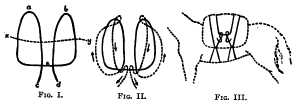
Figure I is a double bight, which is laid over the top of the pack, so
that the two loops hang, well down, half on each side. "X"-"Y" is the
animal's back. Take the end of the rope, "c," and pass it under the
animal's belly, and through loop "a" on the other side; pass rope end
"d" under and through loop "b," the same way. Next bring them back to
the first side again, and through the middle place "e," as shown by
dotted lines of Figure II. Keep all the ropes well separated, where they
bite into the pack and into the animal's stomach, and draw taut, and
fasten with a hitch at "e." The result will look like Figure III.
The diamond hitch can be tied by using a loop instead of the cincha
hook.
Note 56, page 193: Pack animals and saddle-horses do much better on the
trail if they can be permitted to graze free, or only hobbled. They like
to forage about for themselves, and usually will eat more and better
grass than when tied by a picket rope. During the first three or four
days out, horse or mule is apt to wander back to the home pasture.
Hobbles can be bought or made. When bought, they are broad, flexible
strips of leather about eighteen inches long, with cuffs which buckle
around each fore leg above the hoof. Hobbles can be made on the spot by
twisting soft rope from fore leg to fore leg and tying the ends by
lapping in the middle.
It is safer to picket a horse by a rope upon the neck rather than upon
the leg. He is not so apt to injure himself by pulling or running. A
picket rope is forty feet long. To loop it securely about the neck,
measure with the end about the neck, and at the proper place along the
rope tie a single knot; knot the end of the rope, and passing it about
the neck thrust the knotted end through the single knot. Here is a loop
that cannot slip and choke the horse, and can easily be untied.
Sometimes the loose end of the picket rope may be fastened to a tree, or
to a bush. A horse should be picketed out from trees, or in the center
of an open space, so that he cannot wind the rope about a tree and hold
himself too short to graze. Sometimes the free end is fastened to a
stake or picket-pin driven into the ground. But if there is no pin, and
no tree or bush is handy, then a "dead-man" may be used. This is an old
scout scheme. The rope is tied to a stick eighteen inches long, or to a
bunch of sticks, or to a bunch of brush, or to a stone; and this buried
a foot and a half or two feet, and the earth or sand tamped upon it.
Thus it is wedged fast against any ordinary pull. By this scheme a horse
may be picketed out on the bare desert.
When an animal is allowed to graze free, a good plan is to have a loose
rope twenty or thirty feet in length trail from his neck as he grazes.
This is another scout scheme, used by Indians, trappers, and cowboys.
When the animal declines to be bridled or grasped by the mane, the
trailing rope usually can be caught up. Indians and trappers when riding
depended much upon this trailing rope, so that when thrown they could
grab it instantly, and mount again.
CHAPTER XVII
Note 57, page 206: Flowers as well as animals have their place and their
rights; and they as well as the animals help to make the great
out-of-doors different from the in-doors. A Scout never destroys
anything uselessly or "for fun."
Note 58, page 211: Scouts should learn how to repair dislocations of the
jaw, the finger, and the shoulder, as these are the least difficult and
the most frequent. A dislocation can be told from a fracture of the bone
by a twisting of the hand or the foot, and by a shortening or a
lengthening of the arm or leg, according to whether the head of the bone
has slipped up from the socket, or down. And there is neither
feeling nor sound of the broken bones grating against each other. But
never go ahead blindly.
A Scout who dislocates his own hip, far from help, should try lashing
his leg to a tree, and on his back, clasping another tree, should pull
himself forward with all his strength. But a dislocation of the knee is
much more delicate to manage, and with that or a dislocated elbow the
Scout can contrive to get to a surgeon.
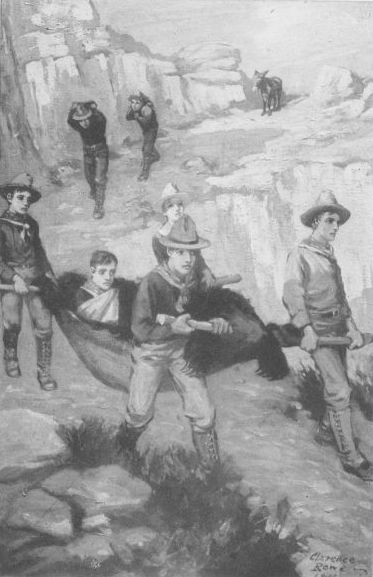
Note 59, page 214: Yes, Scouts can always manage. The quickest way to
make a blanket stretcher is to double the blanket, tie each pair of
corners with a non-slipping knot, and pass a pole through the fold on
one edge and through the knotted corners of the other. The quickest way
to make a coat stretcher is to take two coats, turn the sleeves of one
or of both inside, lay the coats inside up, or sleeves up, with the
tails touching at the edges. Thrust a pole through each line of sleeves,
and button each coat over the poles.
Three or four belts or other straps such as camera straps slung between
poles form an emergency litter or seat; and a man who can sit up can be
carried in a chair made by a pole or rifle thrust through the sleeves of
a coat, and the coat-tail tied fast to another pole or rifle.
When an injured person is too sore to be moved from blanket to litter,
an old scout method is this: Three cross-pieces or short poles are
lashed to connect the two long poles or side poles. One short piece
forms each end and one crosses the middle, thus:
This
frame is lowered over the patient, and the blanket that he is on is
fastened to its edges. Then when the litter is ready, he is in it
already! The middle cross-piece is handy for him to grasp, for steadying
himself.
Small stones rolled in the corners of blankets make a purchase for the
wrappings, and the knots will not slip.
Scouts may make chairs by clasping hands; but an easy way is to have the
patient sit upon a short board or short pole resting in the hollow of
the bearers' arms.
In smooth country, and when the sick or wounded person is not too badly
off, the Indian and trapper "travois" or horse litter may be employed.
Two elastic poles about fifteen feet long are united by cross-pieces,
ladder style; and with two ends slung one upon either side of the horse,
and the other two ends dragging, are trailed along behind the horse. The
poles should be springy, so as to lessen the jar from rough places.
If there is another steady horse, the rear ends of the litter can be
slung upon it, instead of resting on the ground. This is another old
scout and Indian method.
CHAPTER XVIII
Note 60, page 216: "Jerked" meat is another genuinely scout institution,
and has been well known to Indians and trappers and hunters in the West
since early times. The air of the Western plains and mountains is very
dry and pure. Venison or bear-meat or beef, when raw may be cut into
strips two fingers wide, a half or three quarters of an inch thick, and
six or seven inches long, and hung up in the sun. In about three days it
is hard and leathery, and may be carried about until eaten. It may be
eaten by chewing at it as it is, or it may be fried. Scouts will find
that, while traveling, a couple of slices of this jerked meat, chewed
and swallowed, keeps up the strength finely.
When a camp is in a hurry, the meat may be strung over a slow fire, to
make it dry faster; and it may be cured faster yet by smoking, as the
Elks cured it. Some persons use salt; and if they have time they
sprinkle the pile of strips, when fresh, with salt, and fold them in the
animal's green hide, to pickle and sweat for twenty-four hours. But salt
is not needed; and of course the Indians and the old-time scout trappers
never had salt. Trappers sometimes used a sprinkle of gunpowder for
salt; and that is an army makeshift, too.
After a buffalo hunt the Indian villages were all festooned with jerked
meat, strung on scaffolds and among the teepees. Traders and emigrants
jerked the meat by stringing it along the outside of their wagons and
drying it while on the move.
Note 61, page 217: This is the Indian and trapper method of dressing
skins, and is easy for any Scout of to-day. The skin is stretched, hair
side down, between pegs, or over a smooth bowlder or log, while it is
fresh or green, and with a knife or bone, not too sharp, is scraped
until the mucus-like thin inner coating is scraped away. This is called
"graining." In the old-time scout's lodge or camp there always was a
"graining block"—a smooth stump or log set up for the pelts to fit over
while being scraped. Do not scrape so deep as to cut the roots of the
hair. Next the pelt is dried. Then it is covered with a mixture of the
brains and pure water, and soaked, and it is rubbed and worked with both
hands until the brains have been rubbed in and until the skin is rubbed
dry and soft. Next it is laid over a willow frame, or hung up, open, and
smoked for twelve hours or so. Now it is soft and unchangeable,
forever.
When white clay or gypsum was near, the Indians would mix that with
water until the fluid was the color of milk and four times as thick.
Before the skin was smoked it was smeared plentifully with this, and
allowed to dry. Then it was rubbed a long time, until it was soft and
flexible and the clay had all been rubbed away. This took out the stains
and made the skin white.
Note 62, page 222: Aluminum is not dangerous to cook in. Tin sometimes
unites with acids in foods, or in certain liquids, and gives off a
poison. Tin also rusts, but aluminum does not. And aluminum is much the
lighter in weight, and is a better heat conductor, therefore cooking
quicker.
Note 63, page 223: "Levez!" is what the old-time scouts-trappers ought
to have said. It is the French for "Rise! Get up!" But some trappers
said "Leve! Leve!" and some called "Lave!" thinking that they were using
the Spanish verb "Lavar," meaning to wash.
CHAPTER XIX
Note 64, page 236: Scouts should bear in mind that practically every
illness demands a cleaning out of the bowels, by a prompt laxative or by
a mild cathartic, in the very beginning. This carries off the poisons
that feed the illness. And Scouts should bear in mind that for a pain
which indicates appendicitis, an ice-cold pack and not a hot pack is the
proper application. The ice-cold pack drives the blood away from the
appendix, and keeps it more normal until the surgeon can arrive. A hot
pack draws the blood to the region and congests or swells the appendix
all the more. Irritated thus, the appendix is apt to burst. The prompt
attention to the bowels is always necessary.
CHAPTER XX
Note 65, page 251: In the dark a horse or mule will smell out the trail
where other horses and mules have passed. The mule has been supposed to
have a better nose than the horse, for trails and for water—and for
Indians. In the camps of emigrants and trappers and other overland
travelers, of the old days, the mules would smell approaching Indians
and give the alarm.
CHAPTER XXI
Note 66, page 260: Among the Western Indians their scouts were
especially selected young men, and these were likened to wolves. They
were instructed "to be wise as well as brave; to look not only to the
front, but to the right and left, behind them, and at the ground; to
watch carefully the movements of all wild animals, from buffalo to
birds; to wind through ravines and the beds of streams; to walk on hard
ground or where there is grass, so as to leave no trail; to move with
great care so as not to disturb any wild animals; and to return with
much speed should they discover anything to report." When the scout
returned with news of a war-party, he howled like a wolf.
"To scout" was the wolf sign, with the hand turning to right and to left
and downward, like wolf ears pricking in all directions.
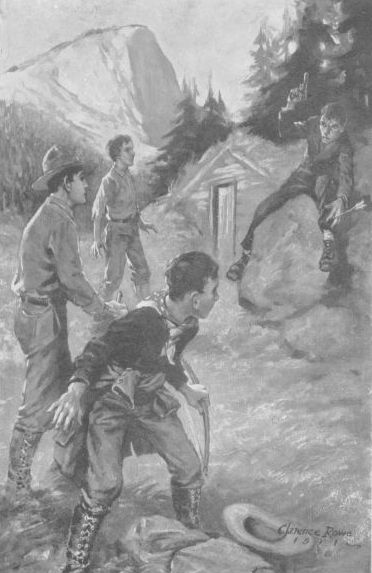
 We are the Elk Patrol, 14th Colorado Troop, Boy Scouts of America. Our
sign is [transcriber note: sign shown to the right] and our colors are dark green and white, like the pines and the
snowy range. Our patrol call is the whistle of an elk, which is an
"Oooooooooooo!" high up in the head, like a locomotive whistle. We took
the Elk brand (that is the same as totem, you know, only we say "brand,"
in the West), because elks are the great trail-makers in the mountains.
We are the Elk Patrol, 14th Colorado Troop, Boy Scouts of America. Our
sign is [transcriber note: sign shown to the right] and our colors are dark green and white, like the pines and the
snowy range. Our patrol call is the whistle of an elk, which is an
"Oooooooooooo!" high up in the head, like a locomotive whistle. We took
the Elk brand (that is the same as totem, you know, only we say "brand,"
in the West), because elks are the great trail-makers in the mountains. A man came riding a dark bay horse, with white nose and white right fore
foot, along our side of the beaver pond, and halted at our camp. The
horse had left ear swallow-tailed and was branded with a Diamond Five on
the right shoulder. The man wasn't the man we had seen across the pond,
for he wore a sombrero, and was taller and had on overalls, and
cow-puncher boots.
A man came riding a dark bay horse, with white nose and white right fore
foot, along our side of the beaver pond, and halted at our camp. The
horse had left ear swallow-tailed and was branded with a Diamond Five on
the right shoulder. The man wasn't the man we had seen across the pond,
for he wore a sombrero, and was taller and had on overalls, and
cow-puncher boots.