ACACIA.—In the deserts of Arabia the finest tree is the
Acacia Seyal, which is reputed to be the Shittah tree of the Old
Testament. The timber of this tree was termed Shittim, translated
by some as “incorruptible wood.” In Exodus xxv. it is recorded
that the Ark of the Lord was made of Shittim wood, overlaid
within and without with pure gold, and having a crown of gold
round about it; and in chapter xxvi. we read that the staves were
made of the same wood, as were also the boards of the Tabernacle
and the woodwork of the Altar on which the offerings were
presented. From this same Acacia is obtained a fragrant and
highly-prized gum which is employed as incense in religious ceremonials.——Tradition
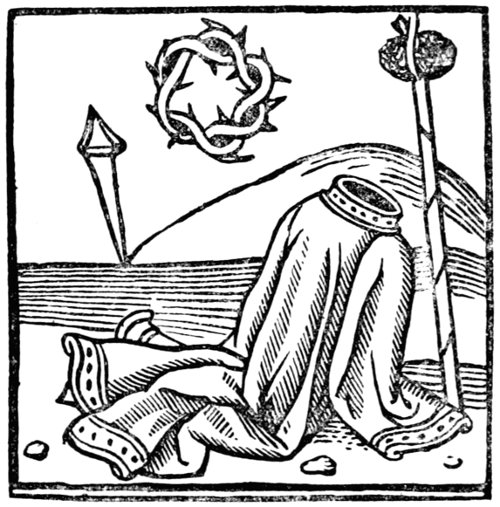
affirms that this Acacia—the Nabkha of the
Arabians—was the tree from which was fabricated the Saviour’s
crown of thorns. It has many small sharp spines, and the leaves
resemble those of the Ivy with which the Roman Emperors were
crowned, thus making the mockery bitterly complete.——The
Buddhists make use of the wood of the Sami (Acacia Suma) to light
the fire on their altars: this is done by striking it with the Asvattha, or
Peepul—the act symbolising generation. This Acacia is one of the
sacred trees of India, and yields an astringent or preservative
substance.——The tree usually known in England by the name of
Acacia is the Robinia pseudo-Acacia, or Locust-tree of America,
named by Linnæus after the two Robins, herbalists to Henri IV.,
who introduced it into France in 1640. This tree would appear to
have somewhat of a funeral character, since we find the American
Freemasons make a practice of dropping twigs of it on the coffins
of brethren. A sprig of Acacia is one of the emblems specially
revered by Freemasons.——“It is curious,” says Mr. Reade, in
‘The Veil of Isis,’ “that Houzza, which Mahomet esteemed an idol—Houzza
so honoured in the Arabian works of Ghatfan, Koreisch,
Renanâh, and Salem—should be simply the Acacia. Thence was
derived the word Huzza! in our language, which was probably at
first a religious exclamation like the Evoke! of the Bacchantes.”——The
English newspapers lately gave an account of a singular
species of American Acacia, stated to be growing at Virginia,
Nevada, and exhibiting all the characteristics of a sensitive plant.
At the commencement of 1883 the Acacia was reported to be about
eight feet high, and growing rapidly. When the sun sets, its leaves
fold together and the ends of the twigs coil up like a pig-tail; and
if the latter are handled, there is evident uneasiness throughout the
plant. Its highest state of agitation was reached when the tree
was removed from the pot in which it was matured into a larger
one. To use the gardener’s expression, it went very mad. It had
scarcely been planted in its new quarters before the leaves began
to stand up in all directions, like the hair on the tail of an angry
cat, and soon the whole plant was in a quiver. At the same time
it gave out a most sickening and pungent odour, resembling that of
a rattlesnake when teased. The smell so filled the house, that it
was necessary to open all the doors and windows, and it was a full
hour before the plant calmed down and folded its leaves in peace.
ACANTHUS.—The Acanthus was a favourite plant amongst
both the Greeks and Romans, who employed it for decorative purposes:
its leaves form the principal adornment of the Corinthian
capital, which was invented by Callimachus. How the idea was suggested
to the architect is told us by Vitruvius. A young Corinthian
damsel fell ill and died. After her interment, her nurse gathered her
trinkets and ornaments into a basket, and lest they should be injured
by the weather, she covered the basket with a tile, and
placed it near her young mistress’s tomb over the root of an Acanthus,
the stalks and leaves of which burst forth in the Spring, and
spreading themselves on the outside of the basket, were bent back
again at the top by the corner of the tile. Callimachus happening
to pass by, was charmed with the beauty and novelty of this accidental
arrangement, and took from it the idea of the Corinthian
chapter. Both Greeks and Romans made use of the Acanthus
mollis in the form of garlands, with which they adorned their buildings,
their furniture, and even their clothing. Theocritus speaks
of a prize cup as having “a crust of soft Acanthus.” Virgil narrates
that the plant formed the basis of a design embroidered on
the mantle of Helen of Troy; and tells us that the handles of Alcimedon’s
cup were enwreathed with what he elsewhere terms
“Smiling Acanthus.”——Old English names for this plant were
Brank-ursine and Bear’s-breech.——Acanthus is stated by astrologers
to be under the dominion of the Moon.
ACHYRANTHES.—The Apamarga, an Indian variety of this
plant, has given the name to the sacrificial rite called Apâmârga Homa,
because at daybreak they offer a handful of flour made from the
seeds of the Apamarga (Achyranthes aspera). According to a legend
quoted by De Gubernatis, Indra had slain Vriitra and other
demons, when he encountered the demon Namuchi and wrestled
with him. Vanquished, he made peace with Namuchi on the
understanding that he should never kill anything with a solid body,
nor with a liquid body, neither by night nor by day. So Indra
gathered a vegetable, which is neither solid nor liquid, and comes
during the daybreak, when the night is past, but the day has
not yet come. Then with the vegetable he attacked the monster
Namuchi, who complained of this treachery. From the head of
Namuchi sprang the plant Apâmârga. Indra afterwards destroyed
all the monsters by means of this plant. As may be supposed after
such a marvellous origin, the plant was soon looked upon as a
powerful talisman. According to the Atharvaveda, it should be
held in the hand, and invoked against the malady Kshetriya, and
against witches, monsters, and nightmares. They call it the Victor,
having in itself the strength of a thousand, destroying the effects
of maledictions, and especially of those inimical to generation,
which produce hunger, thirst, and poverty. It is also called the
Lord of salutary plants, son of Vibhindant, having received all its
power from Indra himself. The Hindus believe that the plant is
a security against the bites of scorpions.
Aconite.—See Monkshood.
ACORUS.—This aromatic Reed, or Sweet Flag, is absurdly
said to have been called Acorus, from the Greek koré, pupil,
because it was esteemed good for diseases of the eye. The sacred
oil of the Jews—the “oil of holy ointment”—used to anoint the
tabernacle, the ark of the testimony, the altar of burnt offerings,
the altar of incense, the candlesticks, and all the sacred vessels,
has the oil of Acorus as one of its ingredients. It is the “Sweet
Calamus” mentioned in Exodus xxx.——The Acorus is a plant of
the Moon.
ADDER’S TONGUE.—The Adder’s Tongue, or to give it its
old Latin name, Christ’s Spear (Ophioglossum vulgatum), was formerly
much prized as a remedy for wounds. Gerarde declared that
boiled in olive oil it produced “a most excellent greene oyle, or
rather a balsam for greene wounds comparable to oyle of St. John’s
wort, if it doth not far surpasse it.” A preparation called the
“green oil of charity” is still in request; and Adder’s Spear ointment
(a compound of Adder’s Tongue Fern, Plantain, and sundry
herbs) is well known in country places as a vulnerary. In olden
times an Adder’s Tongue was reputed to be a wondrous cure for
tumours, if plucked at the falling of the Moon, and applied with
the accompaniment of an incantation.——Witches highly esteemed
Adder’s Tongue as a plant to be employed in their spells. Astrologers
class it as a herb of the Moon.
Affadyl.—See Narcissus.
AGNUS CASTUS.—The “Chaste Tree” (Vitex Agnus
Castus), a species of Willow, derives its name from the Greek hagnos,
and Latin castus, both meaning chaste. The name was given to
it, according to Pliny, from the custom of the Athenian matrons to
strew their beds with it during the festival of the Thesmophora,
held in honour of Ceres, when the strictest chastity was enjoined.
At the same festival young girls adorned themselves with blossoms
of the shrub and slept on its leaves in order to guard their innocence
and purity.——Agnus Castus was consecrated to Æsculapius, and
also, in the isle of Samos, to Juno. Prometheus was crowned with
it. At Grecian weddings, the bride and groom carried crowns of
it. It was also employed as a preservative against poisoning.——The
seed of this shrub in later years acquired the name of Piper
Monachorum, and in explanation it is said that, following the example
of the matrons of Athens, who had discovered that the odour of
branches of Agnus Castus combatted unchaste thoughts and desires,
certain Christian monks made themselves girdles of the flexible
boughs of the tree, by wearing which they professed to expel from
their hearts all passions that love could excite.——Some of the old
herbalists affirm that the seeds of Agnus Castus had a very powerful
effect in arresting generation. Gerarde says “Agnus Castus is
a singular medicine and remedy for such as would willingly live
chaste, for it withstandeth all uncleanness or desire to the flesh,
consuming and drying up the seed of generation, in what sort
soever it bee taken, whether in pouder onely, or the decoction
drunke, or whether the leaves be carried about the body; for which
cause it was called castus, that is to say, chaste, cleane, and pure.”
The leaves, burnt or strewn about, were reputed to drive away
serpents; and, according to Dioscorides, a branch of the shrub,
carried in the hand, would keep wayfarers from weariness.——Agnus
Castus is held to be under the dominion of Mars in Capricorn.
Albespyne.—See Hawthorn.
AGRIMONY.—The Agrimony or Egrimony (Agrimonia Eupatoria)
was a herb much in vogue among the old herbalists, who
attributed extraordinary virtues to it. Dioscorides prescribes it as
a cure for the bitings and stingings of serpents. Gerarde says it
is “good for them that have naughty livers,” and in fact it was at
one time known as Liver-wort. Culpeper tells us that it will
draw forth “thorns and splinters of wood, nails, or any other
such thing gotten into the flesh,” and recommends it further as “a
most admirable remedy for such whose lives are annoyed either by
heat or cold.” Sore throat, gout, ague, colic, ear-ache, cancers, and
ulcers are among the numerous complaints the herbalists professed
to cure by means of syrups and salves made of Agrimony, a plant
which has formed an ingredient in most of the herb teas which
have been from time to time introduced.——The astrological
government and virtues of Agrimony appear to the uninitiated
somewhat complicated. If we may believe Culpeper, it is a herb
under Jupiter and the sign Cancer, and strengthens those parts
under the planet and sign, and removes diseases in them by
sympathy; and those under Saturn, Mars, and Mercury by antipathy,
if they happen in any part of the body governed by
Jupiter, or under the signs Cancer, Sagittarius, or Pisces.——Michael
Drayton, in his ‘Muse’s Elysium,’ thus refers to Agrimony,
among other herbs dear to simplers:—
“Next these here Egrimony is,
That helps the serpent’s biting;
The blessed Betony by this,
Whose cures deserving writing.
“This All-heal, and so named of right,
New wounds so quickly healing;
A thousand more I could recite
Most worthy of revealing.”
ALDER.—The origin of the Alder is to be found in the
following lines from Rapin’s poem on Gardens:—
“Of watery race Alders and Willows spread
O’er silver brooks their melancholy shade,
Which heretofore (thus tales have been believed)
Were two poor men, who by their fishing lived;
Till on a day when Pales’ feast was held,
And all the town with pious mirth was filled,
This impious pair alone her rites despised,
Pursued their care, till she their crime chastised:
While from the banks they gazed upon the flood,
The angry goddess fixed them where they stood,
Transformed to sets, and just examples made
To such as slight devotion for their trade.
At length, well watered by the bounteous stream,
They gained a root, and spreading trees became;
Yet pale their leaves, as conscious how they fell,
Which croaking frogs with vile reproaches tell.”
In Germany, Alders have often a funereal and almost diabolic
character. It is a popular belief that they commence to weep, to
supplicate, and to shed drops of blood if there is any talk of cutting
them down.——A legend of the Tyrol narrates how a boy who had
climbed a tree, overlooked the ghastly doings of certain witches
beneath its boughs. They tore in pieces the corpse of a woman,
and threw the portions in the air. The boy caught one, and kept
it by him. The witches, on counting the pieces afterwards found
that one was missing, and so replaced it by a scrap of Alder-wood,
when instantaneously the dead came to life again.——Of the wood
of the Alder, Virgil tells us, the first boats were made:—Tunc Alnos
primum fluvii sensere cavatas.——The Alder, or Aller, is said to be a
tree of Venus, under the celestial signs of either Cancer or Pisces.
Alecost.—See Costmary.
Alehoof, Ground-Ivy.—See Ivy.
ALMOND.—According to an ancient tradition mentioned by
Servius, the origin of the Almond-tree is to be traced to Phyllis, a
beautiful Thracian queen, who became enamoured of Demophoon,
the son of Theseus and Phædra, and was wedded to him. Demophoon,
who, whilst returning from the Trojan war, had been cast
by a storm on the coast of Thrace soon after his marriage with the
Queen, was recalled to Athens by his father’s death. He promised
faithfully to return to his royal bride at the expiration of a month,
but failed to do so, and Phyllis, distracted at his continued absence,
after several futile visits to the sea-shore, expired of grief, and was
transformed into an Almond-tree, which is called Phylla by the
Greeks. Some time after this metamorphosis the truant consort
returned, and upon hearing of the untimely fate of Phyllis, he ran
and clasped the tree in remorseful embrace. Loving even in death,
his beautiful queen seems to have acknowledged his repentance,
for the Almond-tree into which she had been transformed, although
at that time stripped of its leaves, suddenly shot forth and
blossomed, as if eager to show how unchangeable was poor
Phyllis’s love.——A second account of the origin of the Almond-tree
states that it sprang from the blood of the monster Agdistis,
the offspring of Jupiter. This fable further narrates that the
daughter of the river Sangarius fell in love with the beautiful tree,
and after gathering its fruit, gave birth to a son named Atys.——A
third account relates how Io, daughter of King Midas, was forsaken
by Atys, whom she loved; and how Agdistis, on the death
of Atys, mutilated his body, from which sprang the bitter Almond-tree,
the emblem of grief.——Virgil made the flowering of the
Almond a presage of the crop of Wheat.
“With many a bud if flowering Almonds bloom,
And arch their gay festoons that breathe perfume,
So shall thy harvest like profusion yield,
And cloudless suns mature the fertile field.”
The Hebrew word Shakad, from which the Almond derives its
name, means to make haste, or to awake early, given to the tree
on account of its hasty growth and early maturity. Aaron’s rod,
which budded and brought forth fruit in the Tabernacle during one
day, was of an Almond-tree: “It budded and brought forth
buds, and bloomed blossoms, and yielded Almonds.” (Numbers
xvii., 8). Among the Hebrews, the Almond-tree was regarded as
the symbol of haste and vigilance, because of the suddenness of its
blossoming, which announced the Spring. The Mahommedans consider
its flowers typical of hope, because they bloom on the bare
branches.——Romanists assign the blossoming Almond-tree to the
Madonna, as Queen of Heaven.——In Tuscany, and other countries,
a branch of the Almond-tree is employed to discover
hidden treasures. It is carried to the place where the treasure is
supposed to be concealed, and, according to popular superstition,
its point will turn towards the exact spot. In the nuptial ceremonies
of the Czechs, Almonds are distributed amongst the
wedding guests.——Pliny considered Almonds a most powerful
remedy against inebriation, and Plutarch relates an anecdote of a
notorious wine-bibber, who, by his habitual use of bitter Almonds,
used to escape being intoxicated.——The Almond-tree is under
Jupiter. To dream of eating Almonds portends a journey: if they
taste sweet, it will be a prosperous one; if bitter, the contrary.
ALOE.—The Hebrews appear to have entertained a great
respect for the Aloe (Ahaloth). In the Bible it is frequently referred
to in commendatory terms, and its use as a perfume is of
very great antiquity. King David, in the Psalms, says: “All thy
garments smell of Myrrh, and Aloes, and Cassia.” Solomon, in
the Canticles, mentions Aloes as one of the chief spices; and in
Proverbs (vii., 17) refers to it as a scent. Aloes is one of the spices
mentioned by St. John as having been brought by Nicodemus to
embalm the body of our Lord.——There are two trees which yield
this fragrant wood, viz., Aloexylum Agallochum, a native of the
mountains of Hindostan, and Aquilaria Malaccensis, which grows in
Malacca: the wood of these aromatic trees forms the principal
ingredient in the scented sticks burned by the Hindus and Chinese
in their temples. The heart of the Chinese Aloe, or Wood Aloes,
is called Calambac, or Tambac-wood, which is reckoned in the
Indies more precious than gold itself: it is used as a perfume; as
a specific for persons affected with fainting fits or with the palsy;
and as a setting for the most costly jewels. Both the name and
the plant of the aromatic Aloe are of Indian origin, and it must
not be confounded with the common Aloes, most of which have
an offensive smell and a bitter taste.——In Wood’s Zoography
we read: “The Mahommedans respect the Aloe as a plant of a
superior nature. In Egypt, it may be said to bear some share in
their religious ceremonies, since whoever returns from a pilgrimage
to Mecca hangs it over his street door as a proof of his having performed
that holy journey. The superstitious Egyptians believe that
this plant hinders evil spirits and apparitions from entering the
house, and on this account whoever walks the streets in Cairo will
find it over the doors of both Christians and Jews.”——The Arabic
name of the Aloe, Saber, signifies patience, and in Mecca at the end
of most graves, facing the epitaph, is planted an Aloe, as an
allusion to the patience required by those awaiting the arrival of
the great day of resurrection. Most Eastern poets, however,
speak of the Aloe as the symbol of bitterness; and the Romans
seem to have been well acquainted with this qualification, judging
from the allusion to it in Juvenal:—“Plus Aloes quam mellis habere.”
“As bitter as Aloes” is a proverbial saying of considerable antiquity,
derived doubtless from the acrid taste of the medicines
obtained from the plant, and made principally from the pulp of
the fleshy leaf of the Succotrine Aloe, the leaves of which have a
remarkable efficacy in curing scalds and burns.——Not only, however,
for its medicinal properties is the Aloe esteemed, for in some
countries, particularly Mexico, the poor derive from it almost
every necessary of life. The ancient manuscripts of Mexico are
chiefly inscribed upon paper made from the fibres of the pité, or
pith. Of the points of the leaves of the Aloe are made nails,
darts, and awls, and with these last the Indians pierce holes in
their ears when they propose to honour the Devil with some
peculiar testimonies of their devotion.
ALYSSUM.—This plant was regarded by the Neapolitans
as possessing magic qualities, and was suspended in their houses
as a charm against the Evil Eye. Its name Alyssum is derived
from the Greek a, not, and lussa, madness. In England, the
plant was called Alisson and Madwort, because, as Gerarde says,
it is “a present remedie for them that are bitten of a mad dog.”
AMARANTH.—In Spenser’s ‘Fairy Queen’ is to be found
the following allusion to the mythological origin of the Amaranth:—
“And all about grew every sort of flower,
To which sad lovers were transformed of yore;
Fresh Hyacinthus, Phœbus’ paramour,
Foolish Narciss, that likes the watery shore:
Sad Amaranthus, made a flower but late,
Sad Amaranthus, in whose purple gore
Me seems I see Aminta’s wretched fate,
To whom sweet poets’ verse hath given endless date.”
The Amaranth was a sacred plant among the Greeks and Romans:
from the former it received its name, which means “never-fading,”
on account of the lasting nature of its blossoms. Hence it is
considered the emblem of immortality. The Amaranth was also
classed among the funeral flowers. Homer describes the Thessalians
as wearing crowns of Amaranth at the funeral of Achilles; and
Thessalus decorated the tomb of the same hero with Amaranth-blossoms.
Philostratus records the custom of adorning tombs with
flowers, and Artemidorus tells us that the Greeks were accustomed
to hang wreaths of Amaranth in most of the temples of their
divinities: and they regarded the Amaranth as the symbol of
friendship. Milton crowns with Amaranth the angelic host
assembled before the Deity:—
“With solemn adorations down they cast
Their crowns, inwove with Amaranth and gold—
Immortal Amaranth, a flower which once
In Paradise, fast by the tree of life,
Began to bloom, but soon for man’s offence
To heaven removed, where first it grew.”
The same poet, as well as Spenser, classes the Amaranth amongst
“those flowers that sad embroidery wear.”——In Sumatra, the
people of the Batta country lead in times of peace a purely
pastoral life, and are accustomed to play on a kind of flute
crowned with garlands of Amaranth and other flowers.——At the
Floral Games at Toulouse, a golden Amaranth was awarded
for the best lyric composition.——In modern times, the Amaranth
has given its name to an order instituted by Queen Christiana of
Sweden, in the year 1633, at an entertainment given in honour of
Don Antonio Pimentel, the Spanish Ambassador. On this occasion
she appeared in a dress covered with diamonds, attended by a suite
nobles and ladies. At the conclusion of the ball she stripped her
attire of the diamonds, and distributed them among the company,
at the same time presenting the new order of knighthood, consisting
of a ribbon and medal, with an Amaranth in enamel,
encircled with the motto Dolce nella memoria.——In Roman Catholic
countries, more especially in Portugal, the species of the flower
known as the Globe Amaranth, Prince’s Feathers, and Cock’s
Comb, are much cultivated for church decoration at Christmas time
and during the Winter. The Amaranth is also selected as one of the
flowers peculiarly appropriate to Ascension Day.——The species
of Amaranth which we know as Love-lies-bleeding, has, in France,
the singular name of Discipline des religieuses, the Nun’s Scourge.——The
Amaranth was formerly known as Flower Gentle, Flower
Velure, Floramor, and Velvet Flower. It is said to be under Saturn,
and to be an excellent qualifier of the unruly actions of Venus.
AMBROSIA.—The Ambrosia-tree, or tree bearing immortal
food, is one of the most popular guises of the Hindu world-trees.
The Paradise of Indra had five trees, under the refreshing shade
of which the gods reclined and enjoyed life-inspiring draughts of
Ambrosia or Amrita. The chief of these trees was the Pârijâta
(usually identified with the Erythrina Indica), and this was deemed
the Ambrosia-tree.——The Greeks knew a herb which they named
Ambrosia, the food of immortals, and it was so called by the
ancients because they believed that a continued use of it rendered
men long-lived, just as the ambrosia of the gods preserved their
immortality. The Moors to this day entertain a belief in the
existence of such a plant. The old English name given to this
herb was Ambrose, which was applied to the Chenopodium Botrys;
but the ancients seem to have applied the name of Ambrosia to the
Field Parsley, the Wild Sage, and the Chenopodium ambrosioides.
The plant known as Ambrosia at the present day belongs to the
Wormwood family.
AMELLUS.—This plant is believed to be a species of Starwort.
Virgil, in the Fourth Book of his Georgics, states that at
Rome it was employed to decorate the altars of the gods. Gerarde
says that the Starwort having a blue or purple flower is that
referred to by Virgil as the Amellus in the following lines:—
“In meads there is a flower Amello named,
By him that seeks it easy to be found,
For that it seems by many branches framed
Into a little wood: like gold the ground
Thereof appears; but leaves that it beset
Shine in the colour of the Violet.”
AMORPHOPHALLUS.—The gigantic Aroid, Amorphophallus
campanulatus, or Carrion Plant of Java, is regarded with repugnance
as a plant of ill-omen. Previous to the sudden bursting, about
sunset, of the spathe containing the spadix, there is an accumulation
of heat therein. When it opens, it exhales an offensive odour that
is quite overpowering, and so much resembles that of carrion, that
flies cover the club of the spadix with their eggs.
ANDHAS.—The luminous plant of the Vedic Soma. The
plant is also called in general Arjunî, that is to say, Shining.
From Andhas it is supposed the Greek word anthos was derived.
ANDROMEDA.—This shrub owes its classical appellation
to Linnæus, who gave it the name of Andromeda after the
daughter of Cepheus and Cassiope. Ovid, in his ‘Metamorphoses,’
has sung how, lashed to a rock, she was exposed to a sea
monster, sent by Neptune to ravage her father’s country, and how
she was at last rescued by Perseus, and became his bride.
Linnæus thus explains why he gave the Marsh Cistus the name of
the classical princess:—“As I contemplated it, I could not help
thinking of Andromeda, as described by the poets—a virgin of
most exquisite beauty and unrivalled charms. The plant is always
fixed in some turfy hillock in the midst of the swamps, as Andromeda
herself was chained to a rock in the sea, which bathed her
feet as the fresh water does the root of the plant. As the distressed
virgin cast down her blushing face through excessive affliction, so
does the rosy-coloured flower hang its head, growing paler and
paler till it withers away. At length comes Perseus, in the shape
of Summer, dries up the surrounding waters, and destroys the
monster.” The leaves of this family of plants have noxious properties,
and the very honey is said to be poisonous.
ANEMONE.—The origin of the Anemone, according to
Ovid, is to be found in the death of Adonis, the favourite of Venus.
Desperately wounded by a boar to which he had given chase, the
ill-fated youth lay expiring on the blood-stained grass, when he was
found by Venus, who, overcome with grief, determined that her
fallen lover should hereafter live as a flower.
“Then on the blood sweet nectar she bestows;
The scented blood in little bubbles rose;
Little as rainy drops, which flutt’ring fly,
Borne by the winds, along a lowering sky.
Short time ensued till where the blood was shed
A flower began to rear its purple head.
Such as on Punic Apples is revealed,
Or in the filmy rind but half concealed,
Still here the fate of lovely forms we see,
So sudden fades the sweet Anemone.
The feeble stems to stormy blasts a prey,
Their sickly beauties droop and pine away.
The winds forbid the flowers to flourish long,
Which owe to winds their names in Grecian song.”—Congreve.
The Greek poet, Bion, in his epitaph on Adonis, makes the
Anemone the offspring of the tears of the sorrowing Venus.
“Alas the Paphian! fair Adonis slain!
Tears plenteous as his blood she pours amain,
But gentle flowers are born and bloom around
From every drop that falls upon the ground.
Where streams his blood, there blushing springs the Rose,
And where a tear has dropped, a Wind-flower blows.”
Rapin, in his poem, gives a somewhat similar version of the origin
of the Anemone. He says:—
“For while what’s mortal from his blood she freed,
And showers of tears on the pale body shed,
Lovely Anemones in order rose,
And veiled with purple palls the cause of all her woes.”
In Wiffen’s translation of the Spanish poet Garcilaso, we find
the red colour only of the Anemone attributed to the blood of
Adonis:—
“His sunbeam-tinted tresses drooped unbound,
Sweeping the earth with negligence uncouth;
The white Anemones that near him blew
Felt his red blood, and red for ever grew.”
Rapin recounts another story, according to which the Anemone
was originally a nymph beloved by Zephyr. This is, perhaps,
an explanation of the name of the flower, which is derived from
Anemos, the wind.
“Flora, with envy stung, as tales relate,
Condemned a virgin to this change of fate;
From Grecian nymphs her beauty bore the prize,
Beauty the worst of crimes in jealous eyes;
For as with careless steps she trod the plain,
Courting the winds to fill her flowing train,
Suspicious Flora feared she soon would prove
Her rival in her husband Zephyr’s love.
So the fair victim fell, whose beauty’s light
Had been more lasting, had it been less bright:
She, though transformed, as charming as before,
The fairest maid is now the fairest flower.”
The English name of Wind-flower seems to have been given to the
Anemone because some of the species flourish in open places exposed
to the wind, before the blasts of which they shiver and tremble
in the early Spring. Pliny asserts that the flower never blooms
except when the winds blow.——With the Egyptians, the Anemone
was the emblem of sickness. According to Pliny, the magicians
and wise men in olden times were wont to attribute extraordinary
powers to the plant, and ordained that everyone should gather the
first Anemone he or she saw in the year, the while repeating, with
due solemnity—“I gather thee for a remedy against disease.” The
flower was then reverently wrapped in scarlet cloth, and kept
undisturbed, unless the gatherer became indisposed, when it was
tied either around the neck or arm of the patient. This superstition
extended to England, as is shown by the following lines in a
ballad:—
“The first Spring-blown Anemone she in his doublet wove,
To keep him safe from pestilence wherever he should rove.”
The Anemone was held sacred to Venus, and the flower was highly
esteemed by the Romans, who formed it into wreaths for the
head.——In some countries, people have a strong prejudice against
the flowers of the field Anemone: they believe the air to be so
tainted by them, that those who inhale it often incur severe illness.
Shakspeare has given to the Anemone the magical power of producing
love. In ‘A Midsummer Night’s Dream’ (Act 2), Oberon
bids Puck place an Anemone-flower on the eyes of Titania, who,
on her awakening, will then fall in love with the first object she
sees.——A once famed Parisian florist, named Bachelier, having
procured some rare Anemones from the East, would not part with
a root, either for love or money. For ten years he contrived to
keep the treasures to himself, until a wily senator paid him a visit,
and, walking round the garden, observed that the cherished
Anemones were in seed. Letting his robe fall upon the plants as
if by accident, he so swept off a number of the little feathery
seeds, which his servant, following close upon his heels, brushed
off his master’s robe and secretly appropriated; and before long
the niggardly florist had the mortification of seeing his highly-prized
“strain” in the possession of his neighbours and rivals.——The
Anemone is held to be under the dominion of Mars.
ANGELICA.—The strong and widely-diffused belief in the
manifold virtues of this plant is sufficient to account for its angelic
name, although Fuchsius was of opinion that it was called Angelica
either from the sweet scent of its root, or its value as a remedy
against poisons and the plague. Its old German name of Root
of the Holy Ghost is still retained in some northern countries. The
Laplanders believe that the use of it strengthens life, and they
therefore chew it as they would do Tobacco; they also employ it
to crown their poets, who fancy themselves inspired by its odour.——Parkinson
says that “it is so goode an herbe that there is
no part thereof but is of much use.”——Du Bartas wrote—
“Contagious aire ingendering pestilence
Infects not those that in their mouths have ta’en
Angelica, that happy counterbane
Sent down from heav’n by some celestial scout,
As well the name and nature both avowt.”
Sylvester’s trans., 1641.
Angelica was popularly believed to remove the effects of intoxication;
according to Fuchsius, its roots, worn suspended round the
neck, would guard the wearer against the baneful power of witches
and enchantments; and Gerarde tells us that a piece of the root
held in the mouth, or chewed, will drive away pestilential air, and
that the plant, besides being a singular remedy against poisons,
the plague, and pestilent diseases in general, cures the biting of
mad dogs and all other venomous beasts. Regarding its astrological
government, Culpeper observes that it is a “herb of the
Sun in Leo. Let it be gathered when he is there, the moon
applying to his good aspect; let it be gathered either in his hour,
or in the hour of Jupiter; let Sol be angular.”
ANTHYLLIS.—The English names of this plant are Kidney
Vetch, Lamb Toe, Lady’s Fingers, Silver Bush, and Jupiter’s Beard
(from the thick woolly down which covers the calyxes of a species
growing in the South of Europe). It was formerly employed as a
vulnerary, and was recommended by Gesner as useful in staunching
the effusion of blood: hence its old English names of Staunch
and Wound-Wort. Clare says of it:—
“The yellow Lambtoe I have often got
Sweet creeping o’er the banks in sunny time.”
ANTIRRHINUM.—Columella alludes to this flower as
“the stern and furious lion’s gaping mouth.” Its English names
are Snap Dragon, Lion’s Snap, Toad’s Mouth, Dog’s Mouth, and
Calf’s Snout.——In many rural districts the Snap Dragon is
believed to possess supernatural powers, and to be able to destroy
charms. It was formerly supposed that when suspended about the
person, this plant was a protection from witchcraft, and that
it caused a maiden so wearing it to appear “gracious in the sight
of people.”
APPLE.—Whether the Apple, the Orange, the Pomegranate,
the Fig, the Banana, or the Grape was the actual fruit of the
Tree of Knowledge, which tempted Eve in Paradise, will possibly
never be settled; but it is certain that not only is the Apple
mystical above all the fruits of the earth, but it is the supreme
fruit. To it has been given the Latin name Pomona, which is the
generic name of fruit, just as Pomona is the goddess of all the
fruit trees.
The Scandinavian goddess Iduna is in a measure identified
with the Tree of Immortality, which was an Apple-tree. Iduna
religiously guarded in a box the Apples which the gods, when
they felt old age approaching, had only to taste the juice of to
become young again. The evil genius, Loki, having been instrumental
in the abduction of Iduna and her renovating Apples, the
gods became old and infirm, and were unable properly to govern
the world; they, therefore, threatened Loki with condign punishment
unless he succeeded in bringing back Iduna and her mystic
Apples: this he fortunately succeeded in doing.
The golden Apples which Juno presented to Jupiter on the
day of their nuptials were placed under the watchful care of a
fearful dragon, in the garden of the Hesperides; and the obtaining
of some of these Apples was one of the twelve labours of Hercules.
By stooping to pick up three of these golden Apples presented by
Venus to Hippomenes, Atalanta lost her race, but gained him as
a husband. The fatal Apple—inscribed DETUR PULCHRIORI—thrown
by the malevolent Discordia into the assembly of the gods, and
which Paris adjudged to Venus, caused the ruin of Troy and
infinite misfortune to the Greeks.
The Apple was sacred to Venus, who is often represented with
the fruit in her hand. The Thebans worshipped Hercules, under
the name of Melius, and offered Apples at his altar, the custom
having, according to tradition, originated as follows:—The river
Asopus being once so swollen as to prevent some youths from
bringing across it a sheep destined to be sacrificed to Hercules,
one of them recollected that the Apple was called by the same
name—Mêlon. In this emergency, therefore, it was determined to
offer an Apple, with four little sticks stuck in it to resemble legs,
as a substitute for a sheep; and it being deemed that the sacrifice
was acceptable, the Apple was thenceforth devoted to Hercules.
The god Apollo was sometimes represented with an Apple in his
hand.
The Celtic “Isle of the Blest,” the “fair Avalon,” is the
“Island of Apples,”
“Where falls not hail, or rain, or any snow,
Nor ever wind blows loudly, but it lies
Deep-meadowed, happy, fair with orchard lawns,
And bowery hollows crowned with Summer sea.”
It has been attempted to localise the Island of Apples either at
Glastonbury, in Somersetshire, or at Aiguilon, in Brittany. A
Gaelic legend which asserts the claims of an island in Loch Awe
to be identified as the Isle of the Blest, changes the mystic Apples
into the fruit of the Pyrus cordata, a species of wild Pear, indigenous
both to the Scotch island and to Aiguilon.
The Druids highly reverenced the Apple-tree, partly on account
of its fruit, but chiefly because they believed that the Mistletoe
thrived on it and on the Oak only. In consequence of its reputed
sanctity, therefore, the Apple was largely cultivated by the early
Britons, and Glastonbury was known as the “Apple Orchard,”
from the quantity of fruit grown there previous to the Roman
invasion. The Druids were wont to cut their divining-rods from
the Apple-tree.
The Saxons highly prized the Apple, and in many towns established
a separate market for the fruit. The following sentence
from their Coronation Benediction shows with what importance it
was regarded:—“May the Almighty bless thee with the blessing of
heaven above, and the mountains and the valleys, with the blessings
of the deep below, with the blessing of Grapes and Apples.
Bless, O Lord, the courage of this Prince, and prosper the work
of his hands; and by Thy blessing may this land be filled with
Apples, with the fruit and dew of heaven, from the top of the
ancient mountains, from the Apples of the eternal hills, from the
fruits of the earth and its fulness.”
The old Saxon chronicles relate that before the battle of
Senlac, King Harold pitched his camp beside the “hoar Apple-tree”—evidently
a well-known object, that had doubtless preserved
its quondam sacred character. Saint Serf, when on his way to
Fife, threw his staff across the sea, from Inch Keith to Culross,
and this staff, we are told, straightway took root and became the
Apple-tree called Morglas.
Many ancient rites and ceremonies connected with this mystic
tree are still practised in certain parts of the country, whilst others
have of late become obsolete. In remote districts, the farmers and
peasantry in Herefordshire, Devonshire, and Cornwall still preserve
the ancient customs of saluting the Apple-trees on Christmas Eve.
In some places, the parishioners walk in procession visiting the
principal orchards in the parish. In each orchard one tree is
selected as the representative of the rest; this is saluted with a
certain form of words, which have in them the air of an incantation,
and then the tree is either sprinkled with cider, or a bowl of cider
is dashed against it, to ensure its bearing plentifully the ensuing
year. In other places, the farmer and his servants only assemble
on the occasion, and after immersing cakes in cider, they hang
them on the Apple-trees. They then sprinkle the trees with cider,
and encircling the largest, they chant the following toast three
times:—
“Here’s to thee, old Apple-tree,
Whence thou may’st bud, and whence thou may’st blow;
And whence thou may’st bear Apples enow.
Hats full! caps full!
Bushel, bushel, sacks full!
And my pockets full, too!
Huzza! Huzza!”
After this the men dance round the tree, and retire to the farm-house
to conclude, with copious draughts of cider, these solemn
rites, which are undoubtedly relics of paganism.
In Sussex, the custom of “worsling” or wassailing Apple-trees
still exists. Formerly it took place, according to the locality,
some time between Christmas Eve and Twelfth Day. The most
popular wassail rhyme was similar to the above, but others were
sung by the “howlers.” At Chailey this verse is used:—
“Stand fast root, bear well top,
Pray that God send us a good howling crop.
Every twig, Apples big.
Every bough, Apples enow.
Hats full, caps full,
Full quarters, sacks full.”
In West Sussex, during Christmas, the farmers’ labourers assemble
for the purpose of wassailing the Apple-trees. A trumpeter sounds
blasts on a bullock’s horn, and the party proceed to the orchard, where
they encircle a tree or group of trees, and chant sonorously—
“Stand fast at root, bear well top,
Every twig, bear Apple big,
Every bough, bear Apple enow.”
A loud shout completes the ceremony, which is repeated till all the
trees in the orchard have been encircled; after which the men
proceed to the homestead, and sing at the owner’s door a song
common for the occasion. They are then admitted, and partake
of his hospitality.
At West Wickham, in Kent, a curious custom used to prevail
in Rogation week. The young men went into the orchards, and,
encircling each tree, said:—
“Stand fast, root, bear well, top,
God send us a youling sop;
Every twig, Apple big;
Every bough, Apple enow.”
Cider was formerly not the only drink concocted from the
Apple; another famous potation was called “Lambswool,” or
more correctly, lamasool, the derivation of the word being the
Celtic lámaesabhal—the day of Apple fruit. This appellation was
given to the first day of November, dedicated in olden times to
the titular saint of fruit and seeds. The Lambswool was composed
of ale and roasted Apples, flavoured with sugar and spice; and a
bowl of this beverage was drunk, with some ceremony, on the last
night of October. Roasted Apples formed an important item in
the composition of the famed wassail-bowl. Shakspeare probably
alludes to this beverage in ‘A Midsummer Night’s Dream,’ where
we find the mischievous Puck saying,
“Sometimes I lurk in a gossip’s bowl,
In very likeness of a roasted Crab.”
In Sussex, the wassail-bowl was formerly made at Christmas
time; it was compounded of ale, sugar, Nutmeg, and roasted
Apples, the latter being called Lambswool. On St. Clement’s day,
in East Sussex, the custom exists of going round from house to
house asking for Apples and beer: this is called Clemmening.
A similar custom prevails on St. Catherine’s Day, when the
children sing a rhyme commencing—
“Cattern’ and Clemen’ be here, here, here,
Give us your Apples and give us your beer.”
In Lowland Scotland, there is an old charm still practised by
village maidens on Hallow-e’en. It is to go alone into a room,
and eat an Apple in front of a looking-glass, when the face of the
future husband will appear looking over the maid’s shoulder.
In Scotland, on Hallow-e’en, Apples are thrown into a tub of
water, and you endeavour to catch one in your mouth as they bob
around in provoking fashion. When you have caught one, you
peel it carefully, and pass the long strip of peel thrice sunwise round
your head, after which you throw it over your shoulder, and it
falls to the ground in the shape of the initial letter of your true
love’s name.
In some places, on this mystic night, a stick is suspended
horizontally from the ceiling, with a candle at one end and an Apple
at the other. While it is made to revolve rapidly, the revellers
successively leap up, and endeavour to grasp the Apple with their
teeth (the hands must not be used); if they fail, the candle generally
swings round in time to salute them disagreeably. Another
amusement is to dive for Apples in a tub of water.
In Sussex, on this eve, every person present fastens an Apple
on a string, and hangs and twirls it before the fire. The owner of
the Apple that first falls off is declared to be upon the point of
marriage; and as they fall successively, the order in which the rest
of the party will attain to matrimonial honours is clearly indicated,
single blessedness being the lot of the one whose Apple is the last
to drop.
The custom of throwing the peel of an Apple over the head,
marriage or celibacy being foretold by its remaining whole or
breaking, is well known, as is also that of finding in a peel so cast
the initial of the coming sweetheart.
Mr. Dyer, in his ‘English Folk-lore,’ details a form of divination
by means of an Apple-pip. “In Lancashire,” he says, “in
order to ascertain the abode of a lover, the anxious inquirer moves
round in a circle, at the same time squeezing an Apple-pippin between
his finger and thumb. This, on being subjected to pressure,
flies from the rind, in the supposed direction of the lover’s residence.
Meanwhile, the following rhyme is repeated:—
‘Pippin, pippin, paradise,
Tell me where my true love lies;
East, west, north, and south,
Pilling brig or Cocker mouth.’”
It was formerly customary for Apples to be blessed by priests
on July 25th; and in the manual of the Church of Sarum is preserved
an especial form for this purpose. In Derbyshire, there is a
saying that if the sun shines through the trees on Christmas Day,
it ensures a good crop. In Northamptonshire, if the Apple-tree
should bloom after the fruit is ripe, it is regarded as a sure omen of
death. In the Apple-growing districts, there is an old saying that if
it rains on St. Swithin’s Day, it is the Saint christening the Apples.
De Gubernatis, in his Mythologie des Plantes, gives several
curious customs connected with the Apple, which are still extant
in foreign countries. In Serbia, when a maiden accepts from her
lover an Apple, she is engaged. In Hungary, a betrothed maiden,
after having received from her lover the “engaged” ring, presents
him with an Apple, the special symbol of all nuptial gifts. Young
Greek girls never cease to invoke, upon marriage, the golden
Apple. In Sicily, when a young man is in love, he presents the
object of his affections with a love Apple. At Mount San Giuliano,
in Sicily, on St. John’s Day, every young girl throws from the
window of her room an Apple into the street, and watches to see
who picks it up: should a woman do so, it is a sign that the maiden
will not be married during the year; if the Apple is only looked at
and not touched, it signifies that the maiden, after her marriage,
will soon become a widow: if the first person passing is a priest,
the young girl will die a virgin. In Montenegro, the mother-in-law
presents an Apple to the young bride, who must try and
throw it on the roof of her husband’s house: if the Apple falls on
the roof, the marriage will be blest, that is to say there will be
children. At Taranto, in Southern Italy, at the wedding breakfast,
when the Apples are introduced, each guest takes one, and having
pierced it with a knife, places a piece of silver money in the
incision: then all the Apples are offered to the young bride, who
bites each, and takes out the money.
In a Roumanian legend, the infant Jesus, in the arms of the
blessed Virgin, becomes restless, will not go to sleep, and begins
to cry. The Virgin, to calm the Holy Child, gives Him two Apples.
The infant throws one upwards, and it becomes the Moon; He
then throws the second, and it becomes the Sun. After this exploit,
the Virgin Mary addresses Him and foretells that He will become
the Lord of Heaven.
In old pictures of St. Dorothea, the virgin martyr is represented
with a basket containing Apples and Roses: this is in
allusion to the legend of her death, which tells that as Dorothea
was being led forth to martyrdom, Theophilus, a lawyer, mockingly
bade her send him fruits and flowers from Paradise. Dorothea, inclining
her head, said, “Thy request, O Theophilus, is granted!”
Whereat he laughed aloud with his companions, but she went on
cheerfully to death. Arrived at the place of execution, she knelt
down and prayed; and suddenly there appeared at her side a
beautiful boy, with hair bright as sunbeams. In his hand he held
a basket containing three Apples and three fresh-gathered and
fragrant Roses. She said to him, “Carry these to Theophilus,
and say that Dorothea hath sent them, and that I go before him
to the garden whence they came, and await him there.” With
these words she bent her neck, and received the death-stroke.
Meantime, the angelic boy sought Theophilus, and placed before
him the basket of celestial fruit and flowers, saying, “Dorothea
sends thee these,” and vanished. Struck by the marvellous incident,
Theophilus tasted of the heavenly fruit, and commenced a
new life, following in Dorothea’s footsteps, and eventually obtaining
the crown of martyrdom.
Mr. Dyer quotes the following from ‘Notes and Queries’:—“In
South-east Devon and the neighbourhood, a curious legend is,
we learn, current among the farmers respecting St. Dunstan and
the Apple-trees. It is said that he bought up a quantity of Barley,
and therewith made beer. The Devil, knowing that the Saint
would naturally desire to get a good sale for his beer, which he
had just brewed, went to him and said, that if he would sell himself
to him, then he (the Devil) would go and blight the Apple-trees,
so that there should be no cider, and, consequently there would be
a far greater demand for beer. St. Dunstan, naturally wishing to
drive a brisk trade in his beer, accepted the offer at once; but
stipulated that the trees should be blighted in three days, which
days fell on the 17th, 18th, and 19th of May. In the almanacs,
the 19th is marked as St. Dunstan’s Day, and, as about this time
the Apple-trees are in blossom, many anxious allusions are generally
made to St. Dunstan; and should, as is sometimes the case,
a sharp frost nip the Apple-blossoms, they believe they know who
has been at the bottom of the mischief. There seems to be several
versions of this legendary superstition. According to some, on a
certain night in June, three powerful witches pass through the air,
and if they drop certain charms on the blossoming orchards, the crops
will be blighted. In other parts of the country, this is known as
‘Frankum’s Night,’ and the story is, that long ago, on this night,
one Frankum made ‘a sacrifice’ in his orchard, with the object
of getting a specially fine crop. His spells were answered by a
blight; and the night is thus regarded as most critical.”
In a Polish legend, derived doubtless from the myth of the
Hesperides, the hawk takes the place of the dragon. A young
princess, through magic, is shut up in a golden castle situated on
a mountain of ice: before the castle she finds an Apple-tree
bearing golden Apples. No one is able to come to this castle.
Whenever a cavalier ascends the side of the ice mountain in order
to release the princess, the hawk darts down and blinds his horse,
and both horse and rider are precipitated down the abyss. At
length the appointed hero arrives, slays the hawk, gathers the
golden Apples, and delivers the princess.
According to a Hanoverian legend, a young girl descends to
the infernal regions by means of a staircase, which she discovers
under an Apple-tree growing at the back of the house. She sees a
garden, where the sun seems to shine more brightly than on earth;
the trees are blossoming or are loaded with fruit. The damsel fills
her apron with Apples, which become golden when she returns
to earth.
In the popular tales of all countries, the Apple is represented
as the magical fruit par excellence. The Celtic priests held the
Apple sacred, and in Gaelic, Norse, German, and Italian stories it
is constantly introduced as a mysterious and enchanted fruit. Mr.
Campbell, in the introduction to his Tales of the West Highlands,
points out that when the hero wishes to pass from Islay to Ireland,
he pulls out sixteen Apples and throws them into the sea one after
another, and he steps from one to the other. When the giant’s
daughter runs away with the king’s son, she cuts an Apple into
a mystical number of small bits, and each bit talks. When she
kills the giant, she puts an Apple under the hoof of the magic filly,
and he dies, for his life is the Apple, and it is crushed. When the
byre is cleansed, it is so clean, that a golden Apple would run from
end to end and never raise a stain. There is a Gruagach who
has a golden Apple, which is thrown at all comers, who, if they
fail to catch it, die. When it is caught and thrown back by the
hero, Gruagach an Ubhail, dies. There is a certain game called
cluich an ubhail—the Apple play—which seems to have been a
deadly game. When the king’s daughter transports the soldier to
the green island on the magic table-cloth, he finds magic Apples
which transform him, and others which cure him, and by which he
transforms the cruel princess, and recovers his magic treasures.
When the two eldest idle king’s sons go out to herd the giant’s
cattle, they find an Apple-tree whose fruit moves up and down as
they vainly strive to pluck it; in fact, in all Gaelic stories, the
Apple when introduced has something marvellous about it.
So, in the German, in the ‘Man of Iron,’ a princess throws a
golden Apple as a prize, which the hero catches three times, and
carries off, and wins. In ‘Snow White,’ where the poisoned comb
occurs, there is a poisoned magic Apple also. In the ‘Old Griffin,’
the rich princess is cured by rosy-cheeked Apples. In the ‘White
Snake,’ a servant who understands the voice of birds, helps
creatures in distress, gets them aid, and procures golden Apples
from three ravens which fly over the sea to the end of the world,
where stands the tree of life. When he had got the Apple, he and
the princess eat it and marry. Again, in the ‘Wonderful Hares,’ a
golden Apple is the gift for which the finder is to gain a princess;
and that Apple grew on a tree, the sole one of its kind.
In Norse it is the same: the princess on the glass mountain
held three golden Apples in her lap, and he who could ride up the
hill and carry off the Apples was to win the prize; and the princess
rolled them down to the hero, and they rolled into his shoe. The
good girl plucked the Apples from the tree which spoke to her
when she went down the well to the underground world; but the
ill-tempered step-sister thrashed down the fruit; and when the
time of trial came, the Apple-tree played its part and protected the
poor girl.
In a French tale, a singing Apple is one of the marvels which
Princess Belle Etoile and her brothers and her cousin bring from
the end of the world. In an Italian story, a lady when she has lost
her husband goes off to the Atlantic Ocean with three golden Apples;
and the mermaid who has swallowed the husband shows first his
head, then his body to the waist, and then to the knees, each time
for a golden Apple. Then, finally, in the ‘Arabian Nights,’ there
is a long story, called the Three Apples, which turns upon the theft
of one, which was considered to have been of priceless value.
The Apple-blossom is considered to be an emblem of preference.
To dream of Apples betokens long life, success in trade, and a
lover’s faithfulness.
APPLE OF SODOM.—The Solanum Sodomeum is a purple
Egg-plant of which the fruit is naturally large and handsome. It
is, however, subject to the attacks of an insect (a species of Cynips),
which punctures the rind, and converts the interior of the fruit into
a substance like ashes, while the outside remains fair and beautiful.
It is found on the desolate shores of the Dead Sea, on the site of
those cities of the plain the dreadful judgment on which is recorded
in sacred history. Hence the fruit, called the Apple of Sodom,
has acquired a sinister reputation, and is regarded as the symbol
of sin. Its first appearance, it is said, is always attended with a
bitter north-east wind, and therefore ships for the Black Sea take care
to sail before the harbinger of bad weather comes forth. The fruit
is reputed to be poisonous. Josephus, the Jewish historian, speaks
of them as having “a fair colour, as if they were fit to be eaten;
but if you pluck them with your hand, they vanish into smoke and
ashes.” Milton, describing an Apple which added new torments
to the fallen angels, compares it to the Apples of Sodom:—
“Greedily they pluck’d
The fruitage fair to sight, like that which grew
Near that bituminous lake where Sodom flamed.
This mere delusion, not the touch but taste
Deceived; they fondly thinking to allay
Their appetite with gust, instead of fruit
Chewed bitter ashes.”
Henry Teonge, who visited the country round the Dead Sea in
1675, describes it as being “all over full of stones which looke just
like burnt syndurs, and on some low shrubbs there grow small
round things which are called Apples, but no witt like them. They
are somewhat fayre to looke at, but touch them and they smoulder
all to black ashes, like soote both for looks and smell.”—The name
Apple of Sodom is also given to a kind of Gall-nut, which is found
growing on various species of dwarf Oaks on the banks of the
Jordan.—Dead Sea Apples is a term applied to the Bussorah
Gall-nut, which is formed on the Oak Quercus infectoria by an insect,
and being of a bright ruddy purple, but filled with a gritty powder,
they are suggestive of the deceptive Apple of Sodom.
“Dead Sea fruits, that tempt the eye,
But turn to ashes on the lips.”
Apple of Paradise, or Adam’s Apple.—See Banana.
Apple, Love.—See Solanum.
Apple, Mad.—See Solanum.
APRICOT.—According to Columella, the Persians sent the
Peach to Egypt to poison the inhabitants; and a species of Apricot
is called by the people of Barbary, Matza Franca, or the “Killer of
Christians.” The Persians call the Apricot of Iran, the “Seed of
the Sun.” The ancients appear to have regarded it as a prophetical
or oracular tree.——It was in the solitude of a grove of
Apricot-trees that Confucius, the venerated Chinese sage, completed
his commentaries on the King or ancient books of China,
and beneath this shade he erected an altar, and solemnly thanked
Heaven for having permitted him to accomplish his cherished
task.——The name has undergone curious transformations: it is
traceable to the Latin præcoqua, early; the fruit being supposed
by the Romans to be an early Peach. The Arabs (although living
near the region of which the tree is a native) took the Latin name,
and twisted it into al burquq; the Spaniards altered its Moorish
name into albaricoque; the Italians reproduced it as albicoces; the
French from them got abricot; and we, in England, although taking
the name from the French, first called it Abricock, or Aprecock, and
finally Apricot.——The Apricot is under the dominion of Venus.
To dream of this fruit denotes health, a speedy marriage, and
every success in life.
ARBOR VITÆ.—This tree, otherwise known as Thuja, is
called by Pliny, Thya (from thyon, a sacrifice). The resin of the
Eastern variety is, in certain localities, frequently used instead of
incense at sacrifices. How the tree acquired the name of Arbor
Vitæ is not known, unless from some supposed virtue of its berries.
Gerarde, who had only seen the Canadian variety, says of it that,
of all the trees from that country, the Arbor Vitæ, or Thya, was
“the most principall, and best agreeing unto the nature of man,
as an excellent cordial, and of a very pleasant smell.” He also
tells us that it was sometimes called Cedrus Lycia, and that it is not
to be confounded with the Tree of Life mentioned in Genesis.
ARBUTUS.—The Arbutus, or Strawberry-tree (Arbutus
unedo), was held sacred by the Romans. It was one of the attributes
of Cardea, a sister of Apollo, who was beloved by Janus,
guardian of gates and avenues. With a rod of Arbutus—virga
Janalis—Cardea drove away witches and protected little children
when ill or bewitched. The Romans employed the Arbutus, with
other symbolic trees and flowers, at the Palilia, a festival held in
honour of the pastoral goddess Pales. It was a Roman custom to
deposit branches of the Arbutus on coffins, and Virgil tells us that
Arbutus rods and Oak twigs formed the bier of young Pallas, the
son of Evander. Horace, in his Odes, has celebrated the shade
afforded by the Arbutus. Ovid speaks of the tree as “the Arbutus
heavy with its ruby fruit,” and tells us that, in the Golden Age,
the fruit afforded food to man. This fruit is called unedo, and
Pliny is stated to have given it that name became it was so bitter
that he who ate one would eat no more.——The Oriental Arbutus,
or Andrachne, bears fruit resembling a scarlet Strawberry in size
and flavour. In Greece, it has the reputation of so affecting
serpents who feed upon it, that they speedily cease to be venomous.
The water distilled from the leaves and blossom of the
Arbutus was accounted a very powerful agent against the plague
and poisons.
ARCHANGEL.—The name of Archangel is applied to the
Angelica archangelica; the Red Archangel, Stachys sylvatica; the
White Archangel, Lamium album; and the Yellow Archangel,
L. Galeobdolon. Nemnich says, the plant originally obtained its
name from its having been revealed by an angel, in a dream.
Parkinson considers it was so called on account of its heavenly
virtues. Gerarde remarks of it, that “the flowers are baked with
sugar, as Roses are, which is called Sugar Roset: as also the distilled
water of them, which is used to make the heart merry, to
make a good colour in the face, and to refresh the vitall spirits.”
ARECA.—The Areca Catechu is one of the sacred plants of
India, producing the perfumed Areca Nuts, favourite masticatories
of the Indian races. So highly is this nut esteemed by the natives,
that they would rather forego meat and drink than their precious
Areca Nuts, which they cut into narrow pieces, and roll up with a
little lime in the leaves of the Pepper, and chew. The Areca Palm
is known in Hindostan as Supyari, and in Japan as Jambi. The
Hindus adorn their gods with these Nuts, and forbid respectable
women to deck either their heads or bosoms with them. According
to Indian tradition, Devadamani, subduer of the gods, once
appeared at the court of King Vikramâditya, to play with him,
clothed in a robe the colour of the sky, having in his hand and in his
mouth an Areca Nut enveloped in a leaf of the Kalpa-tree. This
probably explains the Indian custom of presenting an Areca Nut
to guests, which is eaten with the leaf of the Betel. In China, a
similar custom prevails, but the Nut given there is the Betel Nut.
ARISTOLOCHIA.—The old English name of this plant
was Birth-wort, derived from its reputed remedial powers in parturition—probably
first suggested by the shape of the corolla—whence
also its Greek name, from aristos, best, and locheia, delivery.
According to Pliny, if the expectant mother desired to have a son,
she employed Aristolochia, with the flesh of an ox.——Certain of
the species are renowned, in some European countries, for having
a wonderful influence over fishes and serpents. A. Serpentaria is
reputed to be so offensive to the serpent tribe, that they will not
only shun the place where it grows, but will even flee from any
traveller who carries a piece of the plant in his hand. The snake
jugglers of Egypt are believed to stupefy these reptiles by means
of a decoction distilled from the plant, and it is asserted that a few
drops introduced into the mouth of a serpent will so intoxicate it
as to render it insensible and harmless.——Apuleius recommends
the use of Aristolochia against the Evil Eye.——The Birth-wort is
under the dominion of Venus.
ARKA.—This is the Indian name of the Calotropis gigantea, also
called Arkapatra and Arkaparna (the lightning-leaved), the leaves of
which present the cuneiform symbols of lightning. Arka, says De
Gubernatis, is also the name of the Sun, and this explains why the
Brahmins employed the leaf of the Calotropis on the occasion of
sacrificing to the Sun. In each part of the Arka it is stated that a
portion of the human body can be distinguished. Notwithstanding
its grand name, and its beautiful appearance, people have
a dread of approaching it, lest it should strike them blind. The
origin of this superstition is to be found in the word Arka, which
means both the sun and the lightning.
ARTEMISIA.—The genus of plants known as Artemisia
was so called after the goddess Artemis (who was regarded by the
Romans as identical with Diana, or the Moon), by reason of some
of its species being used in bringing on precocious puberty. On
this account, also, it is one of the plants specially under the
influence of the Moon.—(See Southernwood and Wormwood).
ARUNDHATI.—This is the Brahminical name of a climbing
plant of good omen, and to which, according to De Gubernatis,
the Atharvaveda attributes magical properties against diseases of
the skin. It gives milk to sterile cows, it heals wounds, it delivers
men from sickness, it protects those who drink its juices. It is the
sister of the water and of the gods; the night is its mother; the
mist, the horse of Yama, its father; Aryaman its grandfather. It
descends from the mouth of the horse of Yama.
ARUM.—The Germans call the Arum Aronswurzel, and
entertain the notion that where this flourishes, the spirits of the
wood rejoice. The majestic Ethiopian species of the Arum (Calla
Æthiopica) is commonly called the Horn-flower, from the shape of
its large white calyx. In tropical climates, the plant is a deadly
poison. The Arum of English hedgerows, a flower of a very much
humbler character, is known by a variety of quaint names,
viz., Aaron, Cuckoo-pint, Cuckoo-pintle, Wake Robin, Friar’s
Cowl, Priest’s-pintle, Lords-and-Ladies, Cows-and-Calves, Ramp,
Starchwort, and, in Worcestershire, Bloody Men’s Fingers (from
the red berries that surround the spadix). These blood-red spots
have caused the plant to received in Cheshire the name of Gethsemane,
because it is said to have been growing at the foot of the
Cross, and to have received some drops of our Saviour’s blood.
“Those deep inwrought marks,
The villagers will tell thee,
Are the flower’s portion from the atoning blood
On Calvary shed. Beneath the Cross it grew.”
This flower, the Arum maculatum, is the English Passion-flower: its
berries are highly poisonous, and every part of the plant is acrid;
yet the root contains a farinaceous substance, which, when properly
prepared, and its acrid juice expressed, is good for food, and is
indeed sold under the name of Portland Sago.——Starch has been
made from the root, and the French use it in compounding the
cosmetic known as Cypress powder. A drachm weight of the
spotted Wake Robin, either fresh or dry, was formerly considered
as a sure remedy for poison and the plague. The juice of the herb
swallowed, to the quantity of a spoonful, had the same effect.
Beaten up with Ox-dung, the berries or roots were believed to ease
the pains of gout.——Arum is under the dominion of Mars.
ASOKA.—The Saraca Indica, or Jonesia Asoka, is one of the
sacred plants of India, which has from remotest ages been consecrated
to their temple decoration, probably on account of the
beauty of its orange-red blossoms and the delicacy of its perfume,
which in the months of March and April is exhaled throughout the
night. The tree is the symbol of love, and dedicated to Kâma,
the Indian god of love. Like the Agnus Castus, it is reported to
have a certain charm in preserving chastity: thus Sîtâ, the wife of
Râma, when abducted by the monster Râvana, escapes from the
caresses of the monster and finds refuge in a grove of Asokas. In
the legend of Buddha, when Mâyâ is conscious of having conceived
the Bodhisattva, under the guise of an elephant, she retires to a
wood of Asoka trees, and then sends for her husband. The Hindus
entertain the superstition that a single touch of the foot of a pretty
woman is sufficient to cause the Asoka to flourish. The word
asoka signifies that which is deprived of grief, and Asoka, or the
tree without grief, is also one of the names of the Bodhidruma, the
sacred tree of Buddha.
ASPEN.—A legend referring to the tremulous motion of
this tree (Populus tremula—see Poplar) is to the following effect:—“At
the awful hour of the Passion, when the Saviour of the world
felt deserted in His agony, when earth, shaken with horror, rang
the parting knell for Deity, and universal nature groaned: then,
from the loftiest tree to the lowliest flower, all felt a sudden thrill,
and trembling bowed their heads, all save the Aspen, which said:
‘Why should we weep and tremble? The trees and flowers are
pure and never sinned!’ Ere it ceased to speak, an involuntary
trembling seized its every leaf, and the word went forth that it
should never rest, but tremble on until the Day of Judgment.” An
old saying affirmed that the leaves of the Aspen were made from
women’s tongues, which never ceased wagging; and allusion is
made to this in the following rhyme by Hannay, 1622:—
“The quaking Aspen, light and thin,
In the air quick passage gives;
Resembling still
The trembling ill
Of tempers of womankind,
Which never rest,
But still are prest
To wave with every wind.”
The Bretons have a legend that the Saviour’s cross was made of
Aspen wood; and that the ceaseless trembling of the leaves of this
tree marks the shuddering of sympathetic horror. The Germans
preserve an ancient tradition that, during their flight into Egypt, the
Holy Family came to a dense forest, in which, but for an angelic
guide, they must have lost their way. As they entered this wilderness,
all the trees bowed themselves down in reverence to the
infant God; only the Aspen, in her exceeding pride and arrogance,
refused to acknowledge Him, and stood upright. Then the Holy
Child pronounced a curse against her, as He in after life cursed
the barren Fig-tree; and at the sound of His words the Aspen
began to tremble through all her leaves, and has not ceased to
tremble to this day. Mr. Henderson, in his ‘Folk-lore of the
Northern Counties,’ states that this tradition has been embodied
in a little poem, which may be thus translated:—
“Once as our Saviour walked with men below,
His path of mercy through a forest lay;
And mark how all the drooping branches show,
What homage best a silent tree may pay!
“Only the Aspen stands erect and free,
Scorning to join the voiceless worship pure;
But see! He casts one look upon the tree,
Struck to the heart she trembles evermore!”
The Kirghises, who have become almost Mussulmans, have nevertheless
preserved a profound veneration for the sacred Aspen.——Astrologers
hold that the Aspen is a lunar tree.
ASPHODEL.—The Asphodel is the flower which flourished
in the Elysian Fields. Orpheus, in Pope’s ‘Ode on St. Cecilia’s
Day,’ conjures the infernal deities—
“By the streams that ever flow;
By the fragrant winds that blow
O’er the Elysian flowers;
By those happy souls who dwell
In yellow meads of Asphodel,
Or Amaranthine bowers.”
Homer tells us that, having crossed the Styx, the shades passed
over a long prairie of Asphodel; and Lucian makes old Charon
say:—“I know why Mercury keeps us waiting so long. Down
here with us there is nothing to be had but Asphodel, and libations
and oblations, and that in the midst of mist and darkness: but up
in heaven it is all bright and clear, and plenty of ambrosia there,
and nectar without stint.” The fine flowers of this plant of the
infernal regions produced grains which were believed by the
ancients to afford nourishment to the dead. Accordingly we find
that the Greeks planted Asphodel and Mallows round graves.
The edible roots of the Asphodel were also wont to be laid as
offerings in the tombs of the departed, and, according to Hesiod,
they served as food for the poor. The Asphodel was held sacred
to Bacchus, probably because he visited the infernal regions, and
rescued his mother Semele from the kingdom of the departed.
Wreaths of the Asphodel were worn by Bacchus, Proserpine,
Diana, and Semele. Asphodels were among the flowers forming
the couch of Jupiter and Juno, and Milton has named them as put
to the same use by Adam and Eve.
“Flowers were the couch,
Pansies, and Violets, and Asphodel,
And Hyacinth, earth’s freshest, softest lap.”
Dr. Prior says that the Asphodel root was, under the name of cibo
regio (food for a king), highly esteemed in the middle ages, but,
however improved by cultivation, it is likely to have been troublesome
by its diuretic qualities, and has probably on that account
gone out of fashion. Rapin, in his poem, refers to the Asphodel as
forming an article of food—
“And rising Asphodel forsakes her bed,
On whose sweet root our rustic fathers fed.”
ASTER.—The old English name of the Aster is Star-wort.
Rapin says of this flower—
“The Attic star, so named in Grecian use,
But called Amellus by the Mantuan Muse
In meadows reigns near some cool streamlet’s side,
Or marshy vales where winding currents glide.
Wreaths of this gilded flower the shepherds twine,
When grapes now ripe in clusters load the vine.”
The Aster is thus identified with the Amellus, of the Greek and
Latin poets, and, according to Virgil, the altars of the gods were
often adorned with wreaths of these flowers. In his Fourth Georgic
the poet prescribes the root of the Italian Star-wort (Aster Amellus)
for sickly bees. (See Amellus). The leaves of the Attic Star-wort
(when burnt) had the reputation of driving away serpents. In
Germany, the Star-wort is used by lovers as an oracle, to decide
whether their love is returned or not. The person consulting it
repeats the words—
“Er liebt mich von Herzen
Mit Schmerzen,
Ja—oder Nein.”
At the recurrence of the words ja and nein a leaf is pulled out,
and the answer depends on which of these words is pronounced as
the last of the leaves is plucked. Göthe introduces this rustic
superstition in his tragedy of ‘Faust,’ where the luckless heroine
consults the floral oracle as to the affection entertained for her by
Faust. The French call the Italian Star-wort, or Amellus, l’Œil
de Christ, and the China Aster la Reine Marguerite——The Aster is
considered to be a herb of Venus.
ASH.—This tree (Fraxinus excelsior), called, on account of its
elegance, the Venus of the forest, and from its utility, the husbandman’s
tree, was regarded by the ancient Greeks, Romans, and
Scandinavians as a sacred tree, and as one of good omen. In the
Teutonic mythology, the Ash is the most venerated of trees, and
the Scandinavian Edda, the sacred book of the Northmen, furnishes
a detailed account of the mystic Ash Yggdrasill, or mundane tree,
beneath whose shade was the chief or holiest seat of the gods,
where they assembled every day in council. (See Yggdrasill.)
According to the old Norse tradition, it was out of the wood of the
Ash that man was first formed; and the Greeks entertained a similar
belief, for we find Hesiod deriving his brazen race of men from it.
The goddess Nemesis was sometimes represented with an Ashen
wand. Cupid, before he learnt to use the more potent Cypress,
employed Ash for the wood of his arrows. At the Nuptials of
Peleus and Thetis, Chiron appeared with a branch of Ash, from
which was made the lance of Peleus, which afterwards became
the spear of Achilles. Rapin writes of this tree—
“But on fair levels and a gentle soil
The noble Ash rewards the planter’s toil.
Noble e’er since Achilles from her side
Took the dire spear by which brave Hector died;
Whose word resembling much the hero’s mind,
Will sooner break than bend—a stubborn kind.”
There exists an old superstition, that a serpent will rather
creep into the fire than over a twig of the Ash-tree, founded upon
the statements of Pliny with respect to the magical powers of the
Ash against serpents. It was said that serpents always avoided
the shade of the Ash; so that if a fire and a serpent were placed
within a circle of Ash-leaves, the serpent, to avoid the Ash, would
even run into the midst of the fire. Cowley, enumerating various
prodigies, says:—
“On the wild Ash’s tops, the bats and owls,
With, all night, ominous and baleful fowls,
Sate brooding, while the screeches of these droves
Profaned and violated all the groves.
* * * * * * * *
But that which gave more wonder than the rest,
Within an Ash a serpent built her nest,
And laid her eggs; when once to come beneath
The very shadow of an Ash was death.”
There exists a popular belief in Cornwall, that no kind of
snake is ever found near the “Ashen-tree,” and that a branch of
the Ash will prevent a snake from coming near a person. There
is a legend that a child, who was in the habit of receiving its portion
of bread and milk at the cottage door, was found to be in the habit
of sharing its food with one of the poisonous adders. The reptile
came regularly every morning, and the child, pleased with the
beauty of his companion, encouraged the visits. So the babe and
the adder thus became close friends. Eventually this became
known to the mother (who, being a labourer in the fields, was compelled
to leave her child all day), and she found it to be a matter
of great difficulty to keep the snake from the child whenever it
was left alone. She therefore adopted the precaution of binding
an Ashen-twig about its body. The adder no longer came near
the child; but, from that day forward, the poor little one pined
away, and eventually died, as all around said, through grief at
having lost the companion by whom it had been fascinated.
On the subject of the serpent’s antipathy to the Ash, we find
Gerarde writing as follows:—“The leaves of this tree are of so
great vertue against serpents, that they dare not so much as touch
the morning and evening shadowes of the tree, but shun them afar
off, as Pliny reports (lib. 16, c. 13). He also affirmeth that the
serpent being penned in with boughes laid round about, will
sooner run into the fire, if any be there, than come neare the
boughes of the Ash; and that the Ash floureth before the serpents
appeare, and doth not cast its leaves before they be gon againe.
We write (saith he) upon experience, that if the serpent be set
within a circle of fire and the branches, the serpent will sooner
run into the fire than into the boughes. It is a wonderfull
courtesie in nature, that the Ash should floure before the serpents
appeare, and not cast his leaves before they be gon againe.”
Other old writers affirm that the leaves, either taken inwardly, or
applied outwardly, are singularly good against the biting of snakes
or venomous beasts; and that the water distilled from them, and
taken every morning fasting, is thought to abate corpulence. The
ashes of the Ash and Juniper are stated to cure leprosy.
The pendent winged seeds, called spinners or keys, were
believed to have the same effect as the leaves: in country places
there is to this day an opinion current, that when these keys are
abundant, a severe Winter will follow. A bunch of Ash-keys is
still thought efficacious as a protection against witchcraft.
In marshy situations, the roots of the Ash will run a long way
at a considerable depth, thus acting as sub-drains: hence the
proverb, in some parts of the country, “May your foot-fall be by
the root of the Ash.” In the Spring, when the Ash and Oak are
coming into leaf, Kentish folk exclaim:—“Oak, smoke; Ash,
squash.” If the Oak comes out first, they believe the Summer
will prove hot; if the Ash, it will be wet.
“If the Oak’s before the Ash,
You will only get a splash;
If the Ash precedes the Oak,
You will surely have a soak.”
Gilbert White tells us of a superstitious custom, still extant,
which he thinks was derived from the Saxons, who practised it
before their conversion to Christianity. Ash-trees, when young
and flexible, were severed, and held open by wedges, while ruptured
children, stripped naked, were pushed through the apertures,
under a persuasion that they would be cured of their infirmity.
The operation over, the tree was plastered up with loam, and
carefully swathed. If the severed parts coalesced in due course,
the babe was sure to be cured; but if not, the operation would
probably be ineffectual. The same writer relates another extraordinary
custom among rustics: they bore a deep hole in an Ash-tree,
and imprison a live shrew mouse therein: the tree then becomes
a Shrew-Ash, whose twigs or branches, gently applied to the limbs
of cattle, will immediately relieve the cramp, lameness, and pain
supposed to attack the animal wherever a shrew mouse has crept
over it.
Lightfoot says that, in the Highlands, at the birth of an infant,
the nurse takes a green Ash stick, one end of which she puts into
the fire; and, while it is burning, receives in a spoon the sap that
oozes from the other, which she administers to the child as its first
food: this custom is thought to be derived from the old Aryan
practice of feeding young children with the honey-like juice of the
Fraxinus Ornus. The sap of the Ash, tapped on certain days, is
drunk in Germany as a remedy for the bites of serpents.
In Northumberland, there is a belief that if the first parings
of an infant’s nails are buried under an Ash, the child will turn
out a “top singer.” In Staffordshire, the common people believe
that it is very dangerous to break a bough from the Ash. In
Leicestershire, the Ash is employed as a charm for warts. In the
month of April or May, the sufferer is taken to an Ash-tree: the
operator (who is provided with a paper of new pins) takes a pin,
and having first struck it through the bark, presses it through the
wart until it produces pain; the pin is then taken out and stuck
into the tree, where it is left. Each wart is similarly treated, a
separate pin being used for each. The warts will disappear in a
few weeks. It is a wide-spread custom to stroke with a twig from
an Ash-tree, under the roots of which a horse-shoe has been buried,
any animal which is supposed to have been bewitched.
An Ashen herding stick is preferred by Scotch boys to any other,
because in throwing it at their cattle it is sure not to strike in
a vital part, and so kill or injure the animal, a contingency which
may occur, it seems, with other sticks. It is worthy of note that
the lituus of the Roman Augur—a staff with a crook at one end—was
formed of an Ash-tree bough, the crook being sometimes produced
naturally, but more often by artificial means.
In many parts of England, the finding of an even Ash-leaf is
considered to be an augury of good luck; hence the old saying, so
dear to tender maids—
“If you find an even Ash or a four-leaved Clover,
Rest assured you’ll see your true-love ere the day is over.”
In Cornwall, this charm is frequently made use of for invoking
good luck:—
“Even Ash I thee do pluck,
Hoping thus to meet good luck.
If no good luck I get from thee,
I shall wish thee on the tree.”
In Henderson’s ‘Northern Folk-lore,’ occur the following lines
regarding the virtues of even Ash-leaves:—
“The even Ash-leaf in my left hand,
The first man I meet shall be my husband.
The even Ash-leaf in my glove,
The first I meet shall be my love.
The even Ash-leaf for my breast,
The first man I meet’s whom I love best.
The even Ash-leaf in my hand,
The first I meet shall be my man.”
“Even Ash, even Ash, I pluck thee,
This night my true love for to see;
Neither in his rick nor in his rear,
But in the clothes he does every day wear.”
It is a tradition among the gipsies that the cross our Saviour
was crucified upon was made of Ash.
In Devonshire, it is customary to burn an Ashen faggot at
Christmastide, in commemoration of the fact that the Divine
Infant at Bethlehem was first washed and dressed by a fire of
Ash-wood.
The Yule-clog or -log which ancient custom prescribes to be
burnt on Christmas Eve, used to be of Ash: thus we read in an
old poem:—
“Thy welcome Eve, loved Christmas, now arrived,
The parish bells their tuneful peals resound,
And mirth and gladness every breast pervade.
The ponderous Ashen-faggot, from the yard,
The jolly farmer to his crowded hall
Conveys with speed; where, on the rising flames
(Already fed with store of massy brands),
It blazes soon; nine bandages it bears,
And, as they each disjoin (so custom wills),
A mighty jug of sparkling cider’s brought
With brandy mixt, to elevate the guests.”
Spenser speaks of the Ash as being “for nothing ill,” but the tree
has always been regarded as a special attractor of lightning, and
there is a very old couplet, which says:—
“Avoid an Ash,
It courts the flash.”
Its character as an embodiment of fire is manifested in a remarkable
Swedish legend given in Grimm’s ‘German Mythology.’ Some
seafaring people, it is said, received an Ash-tree from a giant,
with directions to set it upon the altar of a church he wished to
destroy. Instead, however, of carrying out his instructions, they
placed the Ash on the mound over a grave, which to their astonishment
instantly burst into flames.
There is an old belief that to prevent pearls from being
discoloured, it is sufficient to keep them shut up with a piece of
Ash-root.
Astrologers appear to be divided in their opinions as to
whether the Ash is under the dominion of the Sun or of Jupiter.
ASVATTHA.—The Indian Veda prescribes that for the
purpose of kindling the sacred fire, the wood of an Asvattha
(Ficus religiosa), growing upon a Sami (Mimosa Suma), should be
employed. The idea of a marriage suggested by such a union
of the two trees is also developed in the Vedas with much minuteness
of detail. The process by which, in the Hindu temples,
fire is obtained from wood resembles churning. It consists in
drilling one piece of wood (the Asvattha, symbolising the male
element) into another (the Sami, representing the female element).
This is effected by pulling a string tied to it, with a jerk, with
one hand, while the other is slackened, and so alternately until the
wood takes fire. The fire is received on cotton or flax held in
the hand of an assistant Brahman. This Indian fire-generator is
known as the “chark.” (See also Sami and Peepul).
AURICULA.—The old Latin name of this plant was Auricula
ursi, from the shape of the leaves resembling a bear’s ear. It
is thought to be the Alisma of Dioscorides. Matthiolus and Pena call
it Sanicula Alpina, from its potency in healing wounds. Old herbalists
have also named it Paralytica on account of its being
esteemed a remedy for the palsy. Gerarde calls it Bear’s-ear, or
Mountain Cowslip, and tells us that the root was in great request
among Alpine hunters, for the effect it produced in strengthening
the head and preventing giddiness and swimming of the brain overtaking
them on high elevations. The plant is reputed to be somewhat
carnivorous, and cultivators place juicy pieces of meat about
the roots, so that they may absorb the blood.——In Germany, the
Auricula is considered emblematical of love of home.
AVAKA.—The Avaka or Sîpâla is an India aquatic plant,
which plays an important part in their funeral ceremonies. It is
placed in a cavity made, according to their custom, to the north-east
of the sacred fire Ahavanîya, and it is believed that the soul
of the deceased person passes into this cavity, and thence ascends
with the smoke to heaven. The Avaka or Sîpâla forms the food
of the Gandharvas, who preside over the India waters.
Avens.—See Herb Bennett.
AZALEA.—This handsome shrub is narcotic and poisonous
in all its parts. Xenophon, in his narrative of the ‘Retreat of the
Ten Thousand,’ in Asia, after the death of Cyrus, tells how his
soldiers became temporarily stupefied and delirious, as if intoxicated,
after partaking of the honey of Trebizond on the Black Sea.
The baneful properties of this honey arose from the poisonous
nature of the blossoms of the Azalea Pontica, from which the bees
had collected it.
BACCHARIS.—This plant is the Inula Conyza, and was
called Baccharis after the god Bacchus, to whom it was dedicated.
Virgil speaks of Baccharis as being used for making garlands, and
recommends it as a plant which is efficacious as a charm for repelling
calumny—
“Bacchari frontem
Cingite, ne vati noceat mala lingua futuro.”
Its English name is the Ploughman’s Spikenard; and it was highly
esteemed by the old herbalists on account of the sweet and
aromatic qualities of its root, from which the ancients compounded
an ointment which was also known as Baccharis.
Bachelor’s Buttons.—See Ranunculus.
BALBAGA.—The Indian Grass, Eleusine Indica, had, according
to De Gubernatis, the Vedic name of Balbaja: and, as a
sacred herb, was employed in Indian religious festivals for litter,
in ceremonials connected with the worship of the sacred Cow.
BALDMONEY.—According to Gerarde, the Gentian was
formerly called Baldmoyne and Baldmoney; but Dr. Prior considers
that the name appertains to Meum athamanticum, and that it
is a corruption of the Latin valde bona, very good. The Grete
Herball, speaking of Sistra, he says, gives the following explanation:—“Sistra
is Dyll, some call it Mew; but that is not so.
Howbeit they be very like in properties and vertue, and be put
eche for other; but Sistra is of more vertue then Mew, and the
leaves be lyke an herbe called Valde Bona, and beareth smaller
sprigges as Spiknarde. It groweth on hye hylles” (See Feldwode).
BALIS.—This herb was believed by the ancients to possess
the property of restoring the dead to life. By its means Æsculapius
himself was said to have been once resuscitated; and Pliny reports
that, according to the Greek historian Xanthus, a little dog, killed
by a serpent, was brought back to life by this wonderful herb Balis.
BALSAM.—The seed vessel of this plant contains five cells.
When maturity approaches, each of these divisions curls up at the
slightest touch, and darts out its seeds by a spontaneous movement:
hence its generic name Impatiens, and its English appellation Noli
me tangere—Touch me not. Gerarde calls it the Balsam Apple, or
Apple of Jerusalem, and tells us that its old Latin name was Pomum
Mirabile, or Marvellous Apple. He also states that the plant was
highly esteemed for its property of alleviating the pains of maternity,
and that it was considered a valuable agent to remove sterility—the
patient first bathing and then anointing herself with an oil
compounded with the fruit.——The Turks represent ardent love
by this flower.——Balsam is under the planetary influence of
Jupiter.
BALM.—The Melissa, or Garden Balm, was renowned among
the Arabian physicians, by whom it was recommended for hypochondria
and affections of the heart, and according to Paracelsus the
primum ens Melissa promised a complete renovation of man. Drunk
in wine, it was believed to be efficacious against the bitings of
venomous beasts and mad dogs. A variety called Smith’s or Carpenter’s
Balm, or Bawm, was noted as a vulnerary, and Pliny
describes it of such magical virtue, that Gerarde remarks, “though
it be but tied to his sword that hath given the wound, it stancheth
the blood.” On account of its being a favourite plant of the bees,
it was one of the herbs directed by the ancients to be placed in
the hive, to render it agreeable to the swarm: hence it was called
Apiastrum.——The astrologers claimed the herb both for Jupiter
and the Sun.——In connection with the Garden Balm, Aubrey
relates a legend of the Wandering Jew, the scene of which he
places in the Staffordshire moors. When on the weary way to
Golgotha, Jesus Christ, fainting and sinking beneath the burden
of the cross, asked the Jew Ahasuerus for a cup of water to
cool his parched throat, he spurned the supplication, and bade
him speed on faster. “I go,” said the Saviour, “but thou shalt
thirst and tarry till I come.” And ever since that hour, by day
and night, through the long centuries, he has been doomed to
wander about the earth, ever craving for water, and ever expecting
the Day of Judgment, which alone shall end his frightful pilgrimage.
One Whitsun evening, overcome with thirst, he knocked at the
door of a Staffordshire cottager, and craved of him a cup of small
beer. The cottager, who was wasted with a lingering consumption,
asked him in and gave him the desired refreshment. After finishing
the beer, Ahasuerus asked his host the nature of the disease he
was suffering from, and being told that the doctors had given him
up, said, “Friend, I will tell thee what thou shalt do; and by the
help and power of Almighty God above, thou shalt be well. To-morrow,
when thou risest up, go into thy garden, and gather there
three Balm-leaves, and put them into a cup of thy small beer.
Drink as often as you need, and when the cup is empty, fill it again,
and put in fresh Balm-leaves every fourth day, and thou shalt see,
through our Lord’s great goodness and mercy, that before twelve
days shall be past, thy disease shall be cured and thy body altered.”
So saying, and declining to eat, he departed and was never seen
again. But the cottager gathered his Balm-leaves, followed the
prescription of the Wandering Jew, and before twelve days were
passed was a new man.
BALM OF GILEAD.—The mountains of Gilead, in the
east of the Holy Land, were covered with fragrant shrubs, the
most plentiful being the Amyris, which yielded the celebrated Balm
of Gilead, a precious gum which, at a very early period, the
Ishmaelites or Arabian carriers trafficked in. It was to a party of
these merchants that Joseph was sold by his brethren as they came
from Gilead, with their camels, bearing spicery, and Balm, and
Myrrh, going to carry it down to Egypt (Gen. xxxvii., 25). There
were three productions from this tree, all highly esteemed by the
ancients, viz.: Xylobalsamum, a decoction of the new twigs; the
Carpobalsamum, an expression of the native fruit; and the Opobalsum,
or juice, the finest kind, composed of the greenish liquor found in
the kernel of the fruit. The principal quantity of Balm has, however,
always been produced by excision. The juice is received in
a small earthen bottle, and every day’s produce is poured into a
larger, which is kept closely corked. So marvellous were the properties
of this Balm considered, that in order to test its quality,
the operator dipped his finger in the juice, and then set fire to it,
expecting fully to remain scathless if the Balm was of average
strength. The Balm of Gilead has always had a wonderful reputation
as a cosmetic among ladies. The manner of applying it in
the East is thus given by a traveller in Abyssinia:—“You first
go into the tepid bath, till the pores are sufficiently opened; you
then anoint yourself with a small quantity, and as much as the
vessels will absorb: never-fading youth and beauty are said to be the
consequences.” By the Arabs, it is employed as a stomachic and
antiseptic, and is believed by them to prevent any infection of the
plague.——Tradition relates that there is an aspic that guards the
Balm-tree, and will allow no one to approach. Fortunately, however,
it has a weakness—it cannot endure the sound of a musical
instrument. As soon as it hears the approaching torment, it
thrusts its tail into one of its ears, and rubs the other against the
ground, till it is filled with mud. While it is lying in this helpless
condition, the Balm-gatherers go round to the other side of the
tree, and hurry away with their spoil.——Maundevile says that
the true Balm-trees only grew in Egypt (near Cairo), and in India.
The Egyptian trees were tended solely by Christians, as they
refused to bear if the husbandmen were Saracens. It was necessary,
also, to cut the branches with a sharp flint-stone or bone, for
if touched with iron, the Balm lost its incomparable virtue. The
Indian Balm-trees grew “in that desert where the trees of the
Sun and of the Moon spake to King Alexander,” and warned him
of his death. The fruit of these Balm-trees possessed such
marvellous properties, that the people of the country, who were in
the habit of partaking of it, lived four or five hundred years in
consequence.
BAMBOO.—The Bambusa Arundinaceæ is one of the sacred
plants of India: it is the tree of shelter, audience, and friendship.
As jungle fires were thought to be caused by the stems of Bamboos
rubbing together, the tree derived from that fact a mystic and holy
character, as an emblem of the sacred fire.——Indian anchorites
carry a long Bamboo staff with seven nodes, as a mark of their
calling. At Indian weddings, the bride and bridegroom, as part of
the nuptial ceremony, get into two Bamboo baskets, placed side by
side, and remain standing therein for some specified time. The
savage Indian tribe called Garrows possess neither temples nor
altars, but they set up a pillar of Bamboo before their huts, and
decorate it with flowers and tufts of cotton, and sacrifice before it to
their deity. In various parts of India there is a superstitious belief
that the flowering and seeding of various species of Bamboo is a
sure prognostication of an approaching famine.——Europeans have
noticed, as an invariable rule, in Canara, that when the Bamboos
flower and seed, fever prevails. At the foot of the Ghauts, and
round Yellapûr, it has been observed that when the Bamboos
flowered and seeded, fever made its appearance, few persons escaping
it. During blossom, the fever closely resembles hay fever
at home, but the type becomes more severe as the seeds fall.——The
poor, homeless fishermen of China, to supply themselves with vegetables,
have invented a system of culture which may move with
them, and they thus transport their gardens wherever they may go.
This they do by constructing rafts of Bamboo, which are well
woven with weeds and strong grass, and then launched on the
water and covered with earth. These floating gardens are made
fast to the stern of their junks and boats, and towed after them.
BANANA.—The Banana (Musa sapientum) and the Plantain
(M. paradisiaca) are so closely related, as to be generally spoken
of together. The Banana has been well designated the king of
all fruit, and the greatest boon bestowed by Providence on the
inhabitants of hot countries. According to Gerarde, who calls it
in his Herbal, Adam’s Apple Tree, it was supposed in his time by
the Grecians and Christians inhabiting Syria, as well as by the
Jews, to be that tree of whose fruit Adam partook at Eve’s solicitation—the
Tree of the Knowledge of Good and Evil, planted by the
Lord Himself in the midst of the Garden of Eden. It has also
been supposed that the Grapes brought by the Israelites’ spies to
Moses out of the Holy Land, were in reality the fruit of the
Banana-tree.——In the Canary Islands, the Banana is never cut
across with a knife because it then exhibits a representation of the
Crucifixion. Gerarde refers to this mark, remarking that the fruit
“pleaseth and entiseth a man to eate liberally thereof, by a
certaine entising sweetnesse it yields; in which fruit, if it be cut
according to the length, oblique, transverse, or any other way,
whatsoever, may be seene the shape and forme of a crosse, with
a man fastened thereto. My selfe have seene the fruit, and cut it
in pieces, which was brought me from Aleppo, in pickle: the crosse,
I might perceive, as the form of a spred-Egle in the root of Ferne;
but the man I leave to be sought for by those which have better
eies and judgement than my selfe.”——A certain sect of Brahmans,
called Yogis, place all their food in the leaves of the Plantain, or
Apple of Paradise, and other large leaves; these they use dry,
never green, for they say that the green leaves have a soul in
them; and so it would be sinful.
BANYAN TREE.—The Indian Fig-tree (Ficus Indica), of
which one of the Sanscrit names is Bahupâda, or the Tree of
Many Feet, is one of the sacred trees of India, and is remarkable
for its vast size and the singularity of its growth: it throws out
from its lateral branches shoots which, as soon as they reach the
earth, take root, till, in course of time, a single tree extends itself
to a considerable grove. Pliny described the Banyan with great
accuracy, and Milton has rendered his description almost literally:
“Branching so broad along, that in the ground
The bending twigs take root, and daughters grow
About the mother tree; a pillared shade,
High over-arched, with echoing walks between.
There oft the Indian herdsman, shunning heat,
Shelters in cool, and tends his pasturing herds
At loop-holes cut through thickest shade.”
The Banyan rarely vegetates on the ground, but usually in the
crown of Palms, where the seed has been deposited by birds.
Roots are sent down to the ground, which embrace, and eventually
kill, the Nurse-Palm. Hence, the Hindus have given the Banyan the
name of Vaibâdha (the breaker), and invoke it in order that it may
at the same time break the heads of enemies.——In the Indian
mythology, the Banyan is often confounded with the Bo-tree, and
hence it is given a place in heaven, where an enormous tree is said
to grow on the summit of the mountain Supârsva, to the south of
the celestial mountain Meru, where it occupies a vast space.
Beneath the pillared shade of the Banyan, the god Vishnu was
born. His mother had sought its shelter, but she was sad and
fearful lest the terrible Kansa should put to death her seventh
babe, Vishnu, as he had already done her first six. Yasodâ, to
console the weeping mother, gave up her own infant daughter,
who was at once killed by Kansa’s servants; but Vishnu was saved.
It is, says De Gubernatis, at the foot of a gigantic Banyan, a
Bhândîra, near Mount Govardhana, that the Buddhist Vishnu plays
with his companions, and, by his presence, illuminates everything
around him. The Banyan of the Vedas is represented as being
peopled with Indian parroquets, who eat its fruit, which, however,
does not exceed a Hazel-nut in size. The Chinese Buddhists
represent that Buddha sits under a Banyan-tree, turned towards
the East, to receive the homage of the god Brahma. Like the
sacred Bo-tree, the Banyan is regarded not only as the Tree of
Knowledge, but also as the tree of Indian seers and ascetic devotees.
Wherever a Bo-tree or a Banyan has stood, the place where it
formerly flourished is always held sacred.——There is in India a
Banyan-tree that is the object of particular veneration. It grows
on the banks of the Nerbudda, not far from Surat, and is the
largest and oldest Banyan in the country. According to tradition,
it was planted by the Seer Kabira, and is supposed to be
three thousand years old. It is said to be the identical tree visited
by Nearchus, one of the officers of Alexander the Great. The
Hindus never cut it or touch it with steel, for fear of offending the
god concealed in its sacred foliage. De Gubernatis quotes the
following description of this sacred tree given by Pietro Della Valle
at the commencement of the seventeenth century:—“On one side
of the town, on a large open space, one sees towering a magnificent
tree, similar to those which I had noticed near Hormuz, and which
were called Lul, but here were known as Ber. The peasants of
this country have a profound veneration for this tree, both on
account of its grandeur and its antiquity: they make pilgrimages
to it, and honour it with their superstitious ceremonies, believing
that the goddess Pârvatî, the wife of Mahâdeva, to whom it is dedicated,
has it under her protection. In the trunk of this tree, at a
little distance from the ground, they have roughly carved what is
supposed to be the head of an idol, but which no one can recognise
as bearing any semblance to a human being; however, like the
Romans, they paint the face of the idol red, and adorn it with
flowers, and with leaves of a tree which they call here Pan, but in
other parts of India Betel. These flowers and leaves ought to be
always fresh, and so they are often changed. The pilgrims who
come to visit the tree receive as a pious souvenir the dried leaves
which have been replaced by fresh ones. The idol has eyes of
gold and silver, and is decorated with jewellery offered by pious
persons who have attributed to it the miraculous cure of ophthalmic
complaints they have suffered from.... They
take the greatest care of the tree, of every branch, nay, of every
leaf, and will not permit either man or beast to damage or profane
it. Other Banyan or Pagod trees have obtained great eminence.
One near Mangee, near Patna, spread over a diameter of three
hundred and seventy feet, and it required nine hundred and
twenty feet to surround the fifty or sixty stems by which the tree
was supported. Another covered an area of one thousand seven
hundred square yards; and many of almost equal dimensions are
found in different parts of India and Cochin-China.”——In the
Atharvaveda mention is made of an all-powerful amulet, which
is a reduction, on a small scale, of a Banyan-tree, possessing a
thousand stems, to each of which is attributed a special magical
property.
BAOBAB.—The leviathan Baobab (Adansonia) is an object
of reverential worship to the negroes of Senegal, where it is
asserted that some of these trees exist which are five thousand
years old. It is reputed to be the largest tree in the world, and
may readily be taken at a distance for a grove: its trunk is often
one hundred feet in circumference; but its height is not so wonderful
as its enormous lateral bulk. The central branch rises
perpendicularly, the others spread out in all directions, and attain
a length of sixty feet, touching the ground at their extremities,
and equalling in bulk the noblest trees. The wood is spongy and
soon decays, leaving the trunks hollow. In these hollow trunks
the negroes suspend the dead bodies of those who are refused the
honour of burial; and in this position the bodies are preserved
without any process of embalming. The magnificent snowy
blossoms are regarded with peculiar reverence at the instant they
open into bloom. The leaves are used medicinally, and as a condiment;
dried and powdered, they constitute Lalo, a favourite
article with the Africans, who mix it daily with their food, to prevent
undue perspiration; a fibre is obtained from the bark that is
so strong as to have given rise in Bengal to the saying, “As
secure as an elephant bound with a Baobab rope.” The gourd-like
fruit, called Monkey-bread and Ethiopian Sour Gourd, is also
eaten, and is prized for its febrifugal qualities.
BARBERRY.—The Barberry (Berberis vulgaris) was formerly
called the Pipperidge-bush, and was regarded with superstitious
dislike by farmers, who believed that it injured Wheat crops,
even if growing a hundred yards off, by imparting to the Corn the
fungus which causes rust.——In Italy, the Barberry is looked upon
as the Holy Thorn, or the plant which furnished the crown of
Thorns used at our Lord’s crucifixion: it seems to be so regarded
because its Thorns grow together in sets of three at each joint of
the branch.——The Barberry is under the dominion of Venus.
BARLEY.—Barley is a symbol of riches and abundance.
The God Indra is called “He who ripens Barley,” and in many of
their religious ceremonies the Indians introduce this cereal, viz.,
at the birth of an infant, at weddings, at funerals, and at certain
of their sacrificial rites.——Barley is claimed by astrologers as
a notable plant of Saturn.
BAROMETZ.—The Barometz, or Scythian Lamb (Polypodium
Barometz), is a name given to a Fern growing in Tartary,
the root of which, says Prof. Martyn, from the variety of its form,
is easily made by art to take the form of a lamb (called by the
Tartars Borametz), “or rather that of a rufous dog, which the common
names in China and Cochin-China imply, namely, Cau-tich and Kew-tsie.”
The description given of this strange Fern represents the root
as rising above the ground in an oblong form, covered all over with
hairs: towards one end it frequently becomes narrower and then
thicker, so as to give somewhat of the shape of a head and neck,
and it has sometimes two pendulous hairy excrescences resembling
ears; at the other end a short shoot extends out into a tail. Four
fronds are chosen in a suitable position, and are cut off to a proper
length, to represent the legs: and thus a vegetable lamb is produced.
Loureiro affirms that the root, when fresh cut, yields a
juice closely resembling the blood of animals.——Kircher has given
a figure of the Tartarian Lamb, in which the lamb is represented as
the fruit of some plant on the top of a stalk.——Parkinson, in the
frontispiece to his Paradisus Terrestris, has depicted this Lamb-plant
as growing in the Garden of Eden, where it appears to be browsing
on the surrounding herbage.——Scaliger has given a detailed account
of the Barometz, which he calls “a wondrous plant indeed
among the Tartars.” After remarking that Zavolha is the most
considerable of the Tartar hordes, he proceeds:—“In that province
they sow a seed not unlike the seed of a Melon, except that it is not
so long. There comes from it a plant which they call Borametz,
that is to say, a lamb; and, indeed, the fruit of that plant has
exactly the shape of a lamb. We see distinctly all the exterior
parts—the body, the feet, the hoofs, the head, and the ears; there
wants, indeed, nothing but the horns, instead of which it has a sort
of wool that imitates them not amiss. The Tartars fleece it, and
make themselves caps of the skin. The pulp that is within the
fruit is very much like the flesh of crabs. Cut it, and the blood
gushes out, as from a wounded animal. This lamb feeds itself upon
all the grass that grows around it, and when it has eaten it all up,
it dries and dies away. But what perfects the similitude between
the Borametz and a lamb is that the wolves are very greedy of this
fruit, which no other animals ever care for.”——The elder Darwin,
in his poem on ‘The Loves of the Plants,’ makes the following
allusion to the Barometz:—
“Cradled in snow and fanned by Arctic air,
Shines, gentle Barometz! thy golden hair;
Rooted in earth, each cloven hoof descends,
And round and round her flexile neck she bends;
Crops the gray coral Moss and hoary Thyme,
Or laps with rosy tongue the melting rime,
Eyes with mute tenderness her distant dam,
Or seems to bleat, a vegetable Lamb.”
BASIL.—The English name of the Ocymum basilicum is derived
from the Greek basilikon, royal, probably from its having been used
in some royal unguent, bath, or medicine.——Holy Basil, or Tulasî
(Ocymum sanctum), is by the Hindus regarded as a most sacred herb,
and they have given one of its names to a sacred grove of their
Parnassus, on the banks of the Yamuna. This holy herb is grown
in pots near every temple and dwelling of devout Hindus. It is
sacred to Vishnu, Kushna, and Lakshmi, but all the gods are
interested in it. Narada, the celestial sage, has sung the praises
of the immortal plant, which is perfection itself, and which, whilst
protecting from every misfortune those who cultivate it, sanctifies
and guides them to heaven. For this double sanctity it is reared
in every Hindu house, where it is daily watered and worshipped
by all the members of the household. Perhaps, also, it was on
account of its virtues in disinfecting and vivifying malarious air
that it first became inseparable from Hindu houses in India as the
protecting spirit or Lar of the family. The pious Hindus invoke
the divine herb for the protection of every part of the body, for
life and for death, and in every action of life; but above all in its
capacity of ensuring children to those who desire to have them.
Among the appellations given to the Tulasî are—“propitious,”
“perfumed,” “multi-leaved,” “devil-destroying,” &c. The root is
made into beads, which are worn round the neck and arms of the
votaries of Vishnu, who carry also a rosary made of the seeds of
the Holy Basil or the Sacred Lotus. De Gubernatis has given
some interesting details of the Tulasî cultus:—“Under the mystery
of this herb,” he says, “created with ambrosia, is shrouded without
doubt the god-creator himself. The worship of the herb Tulasî is
strongly recommended in the last part of the Padmapurâna, consecrated
to Vishnu; but it is, perhaps, no less adored by the
votaries of Siva; Krishna, the popular incarnation of the god
Vishnu, has also adopted this herb for his worship; from thence
its names of Krishna and Krishnatulasî. Sîtâ, the epic personification
of the goddess Lakshmî, was transformed, according to the
Râmâyana, into the Tulasî, from whence the name of Sitâhvayâ
given to the herb.” Because of the belief that the Tulasî opens
the gates of heaven to the pious worshipper, Prof. De Gubernatis
tells us that “when an Indian dies, they place on his breast a leaf
of Tulasî; when he is dead, they wash the head of the corpse with
water, in which have been dropped, during the prayer of the priest,
some Flax seeds and Tulasî leaves. According to the Kriyâyogasâras
(xxiii.), in religiously planting and cultivating the Tulasî, the Hindu
obtains the privilege of ascending to the Palace of Vishnu, surrounded
by ten millions of parents. It is a good omen for a house
if it has been built on a spot where the Tulasî grows well. Vishnu
renders unhappy for life and for eternity infidels who wilfully, or
the imprudent who inadvertently, uproot the herb Tulasî: no
happiness, no health, no children for such! This sacred plant
cannot be gathered excepting with a good and pious intention, and
above all, for the worship of Vishnu or of Krishna, at the same
time offering up this prayer:—‘Mother Tulasî, be thou propitious.
If I gather you with care, be merciful unto me, O Tulasî, mother
of the world, I beseech you.’”——Like the Lotus, the Basil is not
only venerated as a plant sacred to the gods, but it is also worshipped
as a deity itself. Hence we find the herb specially
invoked, as the goddess Tulasî, for the protection of every part of
the human frame, from the head to the feet. It is also supposed
that the heart of Vishnu, the husband of the Tulasî, is profoundly
agitated and tormented whenever the least sprig is broken of a
plant of Tulasî, his wife.——In Malabar, sweet Basil is cultivated
as a sacred plant, under the name of Collo, and kept in a little
shrine placed before the house.——In the Deccan villages, the fair
Brahminee mother may be seen early every morning, after having
first ground the corn for the day’s bread and performed her simple
toilet, walking with glad steps and waving hands round and round
the pot of Holy Basil, planted on the four-horned altar built up
before each house, invoking the blessings of heaven on her husband
and his children. The herb is planted largely on the river banks,
where the natives bathe, as well as at the entrance to their temples.
They believe that the deities love this herb, and that the god
Ganavedi abides in it continually. When travelling, if they cannot
obtain the herb, they draw the form of the plant on the ground
with its root.——It is difficult to understand why so sacred and so
fragrant a herb as Sweet Basil should have become the symbol of
Hatred, unless it be because the ancients sometimes represented
Poverty by the figure of a female clothed in rags, and seated by a
plant of Basil. The ancient Greeks thought that when Basil was
sown, the act should be accompanied by abuse, without which it
would not flourish. Pliny also records that it throve best when
sown with cursing and railing. This explains the French saying,
“Semer le Basilic,” equivalent to slandering.——The plant has a
decided funereal symbolism. In Persia, where it is called Rayhan,
“the Basil-tuft, that waves
Its fragrant blossom over graves,”
is usually found in cemeteries. In Egypt, the same plant is
scattered over the tombs by the women who go twice or oftener
a week to pray and weep at the sepulchres of the dead. In Crete,
the Basil is considered a symbol of the Evil One, although it is to
be found on every window-ledge. It is unfortunate to dream of
Basil, for it is supposed to betoken grief and misfortune. It was
probably these sinister and funereal associations of the plant that
induced Boccaccio to make the unhappy Isabella conceal her
murdered lover’s head by planting Basil in the pot that contained
it; although it is surmised that the author of the ‘Decameron’
obtained the idea from Grecian sources.——It is, however, satisfactory
to find that in Italy the Basil is utilised for other than
funereal purposes. De Gubernatis tells us that in some districts
pieces of Basil are worn by maidens in their bosoms or at their
waists, and by married women in their hair: they believe also that
the perfume of Basil engenders sympathy, from which comes its
familiar name, Bacia-nicola—Kiss me, Nicholas! Rarely does the
young peasant girl pay a visit to her sweetheart without affixing
behind her ear a sprig of Basil, which she takes special care not to
part with, as that would be a token of scorn. In Turkey, they call
Basil, Amorino. In Moldavia, the Basil is regarded as an enchanted
flower, whose spells can stop the wandering youth upon his
way, and make him love the maiden from whose hand he shall
accept a sprig.——In the East, Basil seeds are employed to
counteract the poison of serpents: in India the leaves are used for
the same purpose, as well as for the cure of several diseases.
Gerarde says that “they of Africke do also affirme that they who
are stung of the scorpion, and have eaten of it, shall feele no paine
at all.” Orisabius likewise asserts that the plant is an antidote to
the sting of those insects; but, on the other hand, Hollerius declares
that it propagates scorpions, and that to his knowledge an
acquaintance of his, through only smelling it, had a scorpion bred
in his brain.——Lord Bacon, in his Natural History, states that if
Basil is exposed too much to the sun, it changes into Wild Thyme,
although the two herbs seem to have small affinity. Culpeper
quaintly remarks: “Something is the matter; this herb and Rue
will never grow together—no, nor near one another; and we know
the Rue is as great an enemy to poison as any that grows.”
Gerarde, however, tells us that the smell of Basil is good for the
heart and for the head.——The plant is a paradox:—sacred and
revered, yet dedicated to the Evil One; of happy augury, yet
funereal; dear to women and lovers, yet emblem of hatred; propagator
of scorpions, yet the antidote to their stings.——Astrologers
rule that Basil is a herb of Mars, and under the Scorpion, and
therefore called Basilicon.
BAUHINIA.—The leaves of the Bauhinia or Ebony-tree
are two-lobed, or twin—a character, which suggested to Plumier
the happy idea of naming the genus after the two famous brothers,
John and Caspar Bauhin, botanists of the sixteenth century.
BEANS.—Among the ancients, there appears to have been a
superstitious aversion to Beans as an article of food, arising from
the resemblance of the fruit to a portion of the human body. The
Egyptians, among whom the Sacred Bean was an object of actual
worship, would not partake of it as food, probably on that account;
because by so doing they would be fearful of eating what they
considered was human, and of consuming a soul. By some nations
the seed was consecrated to the gods.——The eating of Beans was
interdicted to the Jewish High Priest on the Day of Atonement
from its decided tendency to bring on sleep.——The goddess Ceres,
when bestowing her gifts upon mankind, expressly excluded Beans.
The unhappy Orpheus refused to eat them; Amphiaraus, the
diviner, in order to preserve a clear vision, always abstained from
them; the Flamines, Roman priests, instituted by Numa, would
neither touch nor mention them; and the Grecian philosopher
Pythagoras, who lived only on the purest and most innocuous food,
invariably declined to partake of Beans of any description, giving
as his reason that, in the Bean, he recognised blood, and consequently
an animal, which, as a vegetarian, he could not consume.
According to tradition, the great philosopher, being pursued by his
enemies, was overtaken and killed, solely because, having in his
flight reached a field of Beans, he would not cross it for fear of
trampling upon living beings, the souls of the dead, who had entered
temporarily, into the vegetable existence. Cicero considered that
the antipathy to Beans as an article of food arose from their being
considered impure, inasmuch as they corrupted the blood, distended
the stomach, and excited the passions. Hippocrates considered
them unwholesome and injurious to the eyesight. They
were also believed to cause bad dreams, and, moreover, if seen
in dreams, were deemed to portend evil.——One of the Greek
words for Bean is Puanos, and at the festival of Puanepsia, held
in the month of October, at Athens, in honour of Apollo, Beans
and Pulse, we are told, were sodden. The Romans offered Beans
to their goddess Carna on the occasion of her festival in the month
of June.——The Lemures, or evil spirits of those who had lived bad
lives, according to a Roman superstition, were in the habit, during
the night-time, of approaching houses, and then throwing Beans
against them. The Romans celebrated festivals in their honour in
the month of May, when the people were accustomed to throw
black Beans on the graves of the deceased, or to burn them, as
the smell was supposed to be disagreeable to the manes. This
association of Beans with the dead is still preserved in some parts
of Italy, where, on the anniversary of a death, it is customary to
eat Beans and to distribute them to the poor. Black Beans were
considered to be male, and white female, the latter being the
inferior.——De Gubernatis relates several curious customs connected
with Beans. In Tuscany, the fire of St. John is lighted in
a Bean-field, so that it shall burn quickly. In Sicily, on Midsummer
Eve, Beans are eaten with some little ceremony, and the
good St. John is thanked for having obtained the blessings of a
bountiful harvest from God. At Modica, in Sicily, on October 1st,
a maiden in love will sow two Beans in the same pot. The one
represents herself, the other the youth she loves. If both Beans
shoot forth before the feast of St. Raphael, then marriage will
come to pass; but if only one of the Beans sprouts, there will be
betrayal on the part of the other. In Sicily and Tuscany, girls who
desire a husband learn their fate by means of Beans, in this
fashion:—They put into a bag three Beans—one whole, another
without the eye, a third without the rind. Then, after shaking
them up, they draw one from the bag. The whole Bean signifies a
rich husband; the Bean without an eye signifies a sickly husband;
and the Bean without rind a husband without a penny.——The
French have a legend, of one Pipette, who, like our Jack, reaches
the sky by means of a Bean-stalk. In France, some parts of Italy,
and Russia, on Twelfth Night, children eat a cake in which has
been baked a white Bean and a black Bean. The children to
whose lot fall the portions of cake containing the Beans become
the King and Queen of the evening.——An old English charm to
cure warts is to take the shell of a broad Bean, and rub the affected
part with the inside thereof; the shell is then to be buried, and no
one is to be told about the matter; then, as the shell withers away,
so will the wart gradually disappear. It is a popular tradition that
during the flowering of the Bean more cases of lunacy occur than
at any other season. In Leap Year, it is a common notion that
broad Beans grow the wrong way, i.e., the seed is set in the pods
in quite the contrary way to what it is in other years. The reason
given is that, because it is the ladies’ year, the Beans always lie the
wrong way—in reference to the privilege possessed by the fair sex
of courting in Leap Year. There is a saying in Leicestershire, that
if you wish for awful dreams or desire to go crazy, you have only
to sleep in a Bean-field all night.——Beans are under the dominion
of Venus. To dream of them under any circumstances means
trouble of some kind.
BEDSTRAW.—Our Lady’s Bedstraw (Galium verum) filled
the manger on which the infant Jesus was laid. In a painting of
the Nativity by N. Poussin, this straw is introduced. From its
soft puffy stems and golden flowers, this grass was in bygone times
used for bedding, even by ladies of rank,—whence the expression of
their being “in the straw.”——Galium was formerly employed to
curdle the milk in cheese-making, and was also used before the
introduction of Annatto, to give a rich colour to Cheshire cheese.
The old herbalists affirmed that the root stirred up amorous desires,
if drunk in wine, and that the flowers would produce the same
effect if smelt long enough. Robert Turner says: “It challenges
the preheminence above Maywort, for preventing the sore weariness
of travellers: the decoction of the herb and flowers, used
warm, is excellent good to bath the surbated feet of footmen and
lackies in hot weather, and also to lissome and mollifie the stiffness
and weariness of their joynts and sinews.”——In France, Galium is
considered to be a remedy in cases of epilepsy.——Lady’s Bedstraw
is under the dominion of Venus.
BEECH.—Vieing with the Ash in stateliness and grandeur
of outline, the Beech (Fagus) is worthily given by Rapin the second
place among trees.
“Mixt with huge Oaks, as next in rank and state,
Their kindred Beech and Cerris claim a seat.”
According to Lucian, the oracles of Jupiter at Dodona were delivered
not only through the medium of the sacred Oaks in the
prophetic grove surrounding the temple, but also by Beeches
which grew there. A large part, if not the whole, of the Greek ship
Argo was built of Fagus, or Beech timber, and as certain beams in
the vessel gave oracles to the Argonauts, and warned them against
the approach of calamities, it is probable that some, at least, of
these prophetic beams were hewn from the Dodonæan Beeches.
It was from the top of two Beech-trees that Minerva and Apollo,
in the form of vultures, selected to watch the fight between the
Greeks and the Trojans.——The connection of the tree with the
god Bacchus appears to have been confined to its employment in
the manufacture of bowls for wine in the happy time when “No
wars did men molest, and only Beechen bowls were in request.”
Cowley alludes to this in the words—
“He sings the Bacchus, patron of the Vine,
The Beechen bowl foams with a flood of wine.”
Virgil notices the use of its smooth and green bark for receiving inscriptions
from the “sylvan pen of lovers;” and Ovid, in his epistle
from Œnone to Paris, refers to the same custom, gracefully noting
that the name of the fair one would grow and spread with the
growth of the tree:—
“The Beeches, faithful guardians of your flame,
Bear on their wounded trunks Œnone’s name,
And as their trunks, so still the letters grow;
Spread on, and fair aloft my titles show.”
According to a French tradition, a blacksmith, who was one day
beating a bar of red-hot iron on his anvil, raised such a shower of
sparks, that some of them reached the eyes of God himself, who
forthwith, in His wrath, condemned the man to become a bear,
with the condition that he might climb at his pleasure all the trees
excepting the Beech. Changed into a bear, the man was for ever
afterwards cogitating how to uproot the tree. In this legend, the
Beech, which is generally considered a tree of good augury, becomes
a specially favoured or privileged tree. Pliny wrote that it
should not be cut for fuel. Gerarde says of it: “The wood is hard
and firme, which being brought into the house there follows hard
travail of child and miserable deaths, as it is reported; and therefore
it is to be forborne, and not used as fire wood.” The Beech-tree
is believed to be exempt from the action of lightning, and it
is well known that Indians will seek its shelter during a thunderstorm.
It is the Danish symbol.—Astrologers rule the Beech to
be under the dominion of Saturn.
BELINUNCIA.—Under the appellation of Kêd, or Ceridwen,
the Druids worshipped the Moon, who was believed to exercise a
peculiar influence on storms, diseases, and certain plants. They
consecrated a herb to her, called Belinuncia, in the poisonous sap of
which they dipped their arrows, to render them as deadly as those
malignant rays of the Moon which were deemed to shed both
death and madness upon men.
BEL-TREE.—The Ægle Marmelos, Bilva (Sanscrit), or Bel-tree,
is held sacred in India. Belonging to the same natural order
as the Orange, its leaves, which are divided into three separate
leaflets, are dedicated to the Hindu Trinity, and Indians are accustomed
to carry one of them folded in the turban or sash, in order
to propitiate Siva, and ensure safety from accidents. The wood
is used to form the sacrificial pillars.——The Hindu women of the
Punjab throw flowers into a sacred river, by means of which they
can foretell whether or not they are to survive their husbands: but
a much more ingenious rite is practised by the Newars of Nepaul.
To obviate the terrible hardships to a young Hindu girl of
becoming a widow, she is, in the first instance, married to a Bel-fruit,
which is then cast into a sacred river. Should her future
husband prove distasteful to her, this rite enables her to obtain a
divorce; and should the husband die, she can still claim the title of
wife to the sacred Bel-fruit, which is immortal; so that she is
always a wife and never a widow.
Bell-flower.—See Blue-bell, and Campanula.
BETEL.—According to Indian traditions, the Betel was
brought from heaven by Arjuna, who, during his journey to
Paradise, stole a little bough of the sacred tree, which, upon his
return to earth, he carefully planted. In remembrance of this
celestial origin of the tree, and of the manner of its introduction to
earth, Indians who desire to plant the Betel invariably steal a
few young shoots.——The Betel, or Pepper-tree (Piper betle), is
most highly esteemed by the Indian races, who attribute to its
leaves no less than thirty properties or virtues, the possession of
which, even by a plant of heavenly origin, can scarcely be credited.
It is the leaf of the Betel which serves to enclose a few slices of
the Areca Nut (sometimes erroneously called the Betel Nut); and
these, together with a little Chunam or shell-lime, are what the
natives universally chew to sweeten the breath and strengthen the
stomach. The poor, indeed, employ it to keep off the pangs of
hunger. In certain parts of the East, it is not considered polite
to speak to a superior without some of the Betel and Areca compound
in the mouth. At Indian marriage ceremonies, the bride
and bridegroom exchange between themselves the same Areca
Nut, with its accompanying Betel-leaf.——In Borneo, a favoured
lover may enter the house of the loved one’s parents, at night, and
awaken her, to sit and eat Betel Nut and the finest of Sirih-leaves
from his garden.
BETONY.—The ‘Medicinal Betony,’ as Clare calls it, is
Betonica officinalis, and of all the simples praised by old herbalists,
both English and foreign, none (the Vervain excepted) was awarded
a higher place than Wood Betony. Turner, in his ‘Brittish
Physician’ (1687), writes:—“It would seem a miracle to tell what
experience I have had of it. This herb is hot and dry, almost to
the second degree, a plant of Jupiter in Aries, and is appropriated
to the head and eyes, for the infirmities whereof it is excellent, as
also for the breast and lungs; being boiled in milk, and drunk, it
takes away pains in the head and eyes. Probatum. Some write it
will cure those that are possessed with devils, or frantic, being
stamped and applied to the forehead.” He gives a list of between
twenty or thirty complaints which Betony will cure, and then says,
“I shall conclude with the words I found in an old manuscript
under the virtues of it: ‘More than all this have been proved of
Betony.’” Gerarde gives a similar list, and adds, that Betony is
“a remedy against the bitings of mad dogs and venomous serpents,
being drunk, and also applied to the hurts, and is most singular
against poyson.” There is an old saying that, when a person is ill,
he should sell his coat, and buy Betony.——The Romans were well
acquainted with the medicinal properties of this herb. Pliny wrote
of the marvellous results obtained from its use, and also affirmed
that serpents would kill one another if surrounded by a ring composed
of Betonica. Antonius Musa, physician to Augustus, wrote
a treatise on the excellencies of Betonica, which he affirmed would
cure forty-seven different ailments. Franzius went so far as to
assert that the wild beasts of the forest, aware of its surpassing
virtues, availed themselves of its efficacy when they were wounded.——At
a time when a belief in witchcraft was rife in England, it
was generally understood that the house where Herba Betonica was
sown, was free from all mischief. In Yorkshire, the Water Betony
was formerly called Bishop’s Leaves. In Italy, at the present day,
there are several proverbs relating to the virtues of Betony, one of
which is, “May you have more virtues than Betony;” and another,
“Known as well as Betony.”
BIGNONIA.—One of the native names of the Bignonia
Indica, or Indian Trumpet-flower, is Kâmadûti, or the Messenger of
Love. Under the name of Patala, the Bignonia suaveolens is specially
consecrated by the Indians to the god Brahma. The name of
Patala, however, is given in the Sanscrit to Durgâ, the wife of
Siva, probably on account of the colour of her idols, which assimilate
to the colour of the flowers of the Bignonia.
BILBERRY.—The origin of the Bilberry or Whortleberry
(Vaccinium Myrtillus), according to the mythology of the ancients, is
as follows:—Œnomaüs, father of the lovely Hippodamia, chose for
his attendant the young Myrtillus, son of Mercury. Proud of his
skill, he stipulated that all his daughter’s suitors should compete
for the prize in a chariot race with him. Pelops, who was eager
to obtain the beautiful Hippodamia, promised Myrtillus a large
reward if he would take out the linch-pin of his master’s chariot.
Myrtillus was not proof againt the offer: in consequence, the
chariot was overturned, and Œnomaüs mortally injured; but as he
expired, he implored Pelops to avenge him, which he did by throwing
the treacherous attendant into the sea. The waters having
borne back his body to the shore, Mercury changed it to the shrub
called after his name, Myrtillus, a name formerly given to the plant
producing the Myrtle-berry, a fruit largely imported in the middle
ages, and used in medicine and cookery—of the same genus as the
English Bilberry, which is often found growing on the sea-shore.
The Scotch name of this shrub is Blaeberry, the praises of which
are often sung in Northern ballads.
“Will ye go, lassie, go to the braes of Balquhidder,
Whare the Blaeberries grow ’mong the bonny blooming Heather?”
Bilberries are held by the astrologers to be under Jupiter. (See
also Whortleberry.)
BIRCH.—According to Scandinavian mythology, the Birch
(Betula alba) was consecrated to the god Thor, and symbolised the
return of Spring. The Greeks and Romans had not much knowledge
of the tree, but the latter seem to have regarded it with a
feeling of dread in consequence of the fasces of the magistracy being
composed of it, as now, says Evelyn, “are the gentler rods of our
tyrannical pedagogues for lighter faults.” According to Pliny, the
celebrated books which Numa Pompilius composed seven hundred
years before Christ, and which were buried with him, were written
on the bark of the Birch-tree.——It is in the northern countries of
Europe that the Birch flourishes, and it is there the tree is held in
the highest esteem. The Russians have a proverb that the Birch
excels in four qualities:—It gives light to the world (with Birch-boughs
torches are made); it stifles cries (from Birch they extract
a lubricant which they apply to the wheels of carriages); it cleanses
(in Russian baths, to promote perspiration, they scourge the body
with branches of Birch); it cures diseases (by incision they obtain
a liquor stated to have all the virtues of the spirit of salt, and from
which a wine is distilled, excellent as a cordial and useful in cases
of consumption). Moreover, in Russia, the oil of the Birch is used
as a vermifuge and a balsam in the cure of wounds. In fact, to
the peasants of the North, the Birch is as beneficent as is the
Palm to the Indians. No wonder, then, that the Russians are very
fond of the Birch, and surround their dwellings with it; believing,
as they do, that this tree is never struck by lightning.——On the
Day of Pentecost, it is a custom among young Russian maidens to
suspend garlands on the trees they love best, and they are careful
to tie round the stems of the Birch-trees a little red ribbon as a
charm to cause them to flourish and to protect them from the
Evil Eye. De Gubernatis quotes from a Russian author named
Afanassief, who tells us of a Birch that showed its appreciation
of the kindly attentions of a young girl in decking its stem, by
protecting her from the persecutions of a witch, who had become
her step-mother; and the same author makes mention of a certain
white Birch, which grew in the island of Buian, on the topmost
of whose branches it was currently believed the Mother of God
might be seen sitting.——Grohmann, a German writer, recounts
the legend of a young shepherdess, who was spinning in the midst
of a forest of Birch-trees, when suddenly the Wild Woman of the
forest accosted her. The Wild Woman was dressed in white, and
had a garland of flowers upon her head: she persuaded the shepherdess
to dance with her, and for three days kept up the dance
until sunset, but so lightly that the grass under her feet was neither
trampled upon nor bent. At the conclusion of the dance, all the
yarn was spun, and the Wild Woman was so satisfied, that
she filled the pocket of the little shepherdess with Birch-leaves,
which soon turned into golden money.——Professor Mannhardt,
says De Gubernatis, divulges to us the means employed by the
Russian peasants to evoke the Lieschi, or Geni of the forest. They
cut down some very young Birch-trees, and arrange them in a circle
in such a manner that the points shall be turned towards the
middle: they enter this circle, and then they call up the spirit, who
forthwith makes his appearance. They place him on the stump of
one of the felled trees, with his face turned towards the East. They
kiss his hand, and, whilst looking between his legs, they utter these
words:—“Uncle Lieschi, show yourself to us, not as a grey wolf,
not as a fierce fire, but as I myself appear.” Then the leaves of
the Aspen quiver and tremble, and the Lieschi shows himself in
human form, and is quite disposed to render no matter what service
to him who has conjured him—provided only that he will promise
him his soul.——De Gubernatis relates one other anecdote respecting
the Birch, which he says to the Esthonian is the living personification
of his country. It is related that an Esthonian peasant
noticed a stranger asleep beneath a tree at the moment when it was
struck by lightning. He awoke him. The stranger, thanking him for
his good offices, said: “When, far from your native country, and
feeling sorrowful and home-sick, you shall see a crooked Birch,
strike and ask of it: ‘Is the crooked one at home?’” One day the
peasant, who had become a soldier, and was serving in Finland,
felt dispirited and unhappy, for he could not help thinking of his
home and the little ones he had left behind. Suddenly he sees the
crooked Birch! He strikes it, and asks: “Is the crooked one at
home?” Forthwith the mysterious stranger appears, and, calling
to one of his spirits, bids him instantly transport the soldier to
his native country, with his knapsack full of silver.——The Swedes
have a superstition that our Saviour was scourged with a rod of the
dwarf Birch, which was formerly a well-grown tree, but has ever
since that day been doomed to hide its miserable and stunted head.
It is called Láng Fredags Ris, or Good Friday rod.——In France,
it was in mediæval times the custom to preserve a bough of the
Birch as a sacred object. In the country districts around Valenciennes,
it is an old custom for lovers to hang a bough of Birch or
Hornbeam over the doorway of his lady-love. In Haute Bretagne,
as a charm to strengthen a weakly infant, they place in its cot
Birch-leaves, which have been previously dried in an oven.
There is an old English proverb, “Birchen twigs break no bones,”
which has reference to the exceedingly slender branches of the
tree.——In former days, churches were decked with boughs of the
Birch, and Gerarde tell us that “it serveth well to the decking up
of houses and banqueting-rooms, for places of pleasure, and for
beautifying of streets in the crosse and gang [procession] weeke,
and such like.” According to Herrick, it was customary to use
Birch and fresh flowers for decorative purposes at Whitsuntide:—
“When Yew is out, then Birch comes in,
And many flowers besides;
Both of a fresh and fragrant kinne,
To honour Whitsontide.”
The Scotch Highlanders think very highly of the Birch, and turn
it to all sorts of uses. With Burns, the budding Birch was a prime
favourite in the Spring-time. The Scotch proverb, which says of
a very poor man that he is “Bare as a Birk at Yule e’en,” probably
refers to an old custom of stripping the bark of the tree prior to
converting it into the yule log. The tree known in the Highlands
as the Drooping Birk is often grown in churchyards, where, as
Scott says, “Weeps the Birch of silver bark with long dishevell’d
hair.” In Scottish ballads, the Birch is associated with the dead,
and more especially with the wraiths or spirits of those who appear
to be living after death. The following is a good example:—
“I dreamed a dreary dream last nicht;
God keep us a’ frae sorrow!
I dreamed I pu’d the Birk sae green
Wi’ my true love on Yarrow.
“I’ll redde your dream, my sister dear,
I’ll tell you a’ your sorrow;
You pu’d the Birk wi’ your true love;
He’s killed, he’s killed on Yarrow.”
The Birch-tree is held to be under the dominion of Venus.
Bitter-Sweet.—See Solanum.
BITTER VETCH.—The Orobus, or Bitter Vetch, is supposed
to represent the herb mentioned in a passage in Pulci, which
relates how an enchanter preserves two knights from starvation,
during a long journey, by giving them a herb which, being held in
the mouth, answers all the purposes of food.——The Scotch Highlanders
have a great esteem for the tubercles of the Orobus root
(which they call Corr or Cormeille); they use them as masticatories,
to flavour their liquor. They also affirm that by the use of them
they are enabled to repel hunger and thirst for a considerable time.
In times of scarcity, the roots have served as a substitute for bread,
and many think that the Bitter Vetch is the Chara, mentioned by
Cæsar, as affording food to his famished soldiers at the siege of
Dyrrhachium. The seeds, ground and tempered with wine, were
applied to heal the bitings of dogs and venomous beasts.
Black-Thorn.—See Thorn.
Blaeberry.—See Bilberry and Whortleberry.
BLUE-BELL.—The Blue-bells of Scotland have long since
become household words. The flower (Campanula latifolia) is the
finest and most stately of the species, and although common
enough on its native hills, is scarce in England. It is associated
with the feast of St. George. (See Campanula.)
Blue-Bottle and Bluet.—See Centaury.
Bo-Tree.—See Peepul.
BORAGE.—In former days, Borage (Borago officinalis) was
noted as one of the four “cordial flowers” most deserving of
esteem for cheering the spirits—the other three being the Rose,
Violet, and Alkanet. Pliny called Borage Euphrosynum, because it
made men merry and joyful: and to the same purport is the old
Latin rhyme, “Ego Borago gaudia semper ago.” All the old herbalists
praise the plant for its exhilarating effects, and agree with
Pliny that when put into wine the leaves and flowers of Borage
make men and women glad and merry, driving away all sadness,
dulness, and melancholy. The “cool tankard” of our forefathers
was a beverage composed of the young shoots and blossoms of
Borage mingled with wine, water, lemon, and sugar. Lord Bacon
was of opinion that “if in the must of wine or wort of beer, while
it worketh, before it be tunned, the Burrage stay a short time, and
be changed with fresh, it will make a sovereign drink for melancholy
passion.”——Borage, astrologers tell us, is one of Jupiter’s
cordials.
BOX.—The evergreen Box (Buxus semperviva) was specially
consecrated by the Greeks to Pluto, the protector of all evergreen
trees, as being symbolical of the life which continues through
the winter in the infernal regions, and in the other world.——A
curious superstition existed among the ancients in regard
to the Box: although it very much resembles the Myrtle, which
was held sacred to Venus, yet they carefully refrained from
dedicating the Box to that goddess, because they were afraid that
through such an offering they would lose their virility. They
also, according to Bacon, entertained the belief that the Box produced
honey, and that in Trebizonde the honey issuing from this
tree was so noxious, that it drove men mad. Corsican honey was
supposed to owe its ill repute to the fact that the bees fed upon Box.
The Box is referred to by the Prophet Isaiah in his description of
the glory of the latter days of the Church: “The glory of Lebanon
shall come unto thee, the Fir-tree, the Pine-tree, and the Box-tree
together, to beautify the place of my sanctuary.” It is thought,
also, to be the Ashur-wood of the Scriptures, and to be referred to
by Ezekiel when, in describing the splendour of Tyre, he alludes
to the benches of the rowers as made of Ashur wood, inlaid with
ivory. That the ancients were accustomed to inlay Box-wood with
ivory we know from Virgil and other writers, who allude to this
practice.——The Jews employ branches of Box in erecting their
tents at the Feast of Tabernacles.——Boughs of Box were used
formerly for decorative purposes, instead of the Willow, on Palm
Sundays. According to Herrick, it was once a time-honoured
custom on Candlemas Day to replace the Christmas evergreens with
sprigs of Box, which were kept up till Easter Eve, when they gave
place to Yew.
“Down with the Rosemary and Bays,
Down with the Mistletoe;
Instead of Holly now upraise
The greener Box for show.”
Box-boughs were also in olden times regularly gathered at Whitsuntide
for decking the large open fire-places then in vogue.——In
several parts of the North of England, when a funeral takes
place, a basin full of sprigs of Box is placed at the door of the
house from which the coffin is taken up, and each mourner is
expected to take a sprig, and afterwards cast it on the grave of the
deceased.——In Turkey, it is a practice with widows, who go weekly
to pray at their husbands’ tomb, to plant a sprig of Box at the head
of the grave. The monastery of St. Christine, in the Pyrenees,
assumes the arms of the Knights of St. Christine, viz., a white
pigeon with a cross in its beak, to which is attached the following
legend:—The workmen who were employed to build the monastery
had the greatest difficulty in finding a suitable foundation. After
several ineffectual attempts, they one morning perceived a white
pigeon flying with a cross in its beak. They pursued the bird,
which perched on a Box-tree, but though it flew away on their near
approach, they found in the branches the cross which it had left:
this they took as a good omen, and proceeded successfully to lay
the foundation on the spot where the Box-tree had stood, and completed
the edifice.——To dream of Box denotes long life and prosperity,
also a happy marriage.
BRACKEN FERN.—There was formerly a proverb respecting
the Pteris aquilina, or common Brake Fern, popular in
the country:—
“When the Fern is as high as a spoon,
You may sleep an hour at noon;
When the Fern is as high as a ladle,
You may sleep as long as you’re able;
When the Fern begins to look red,
Then milk is good with brown bread.”
In Ireland, the Bracken Fern is called the Fern of God, from an
old belief that if the stem be cut into three pieces, there will be
seen on the first slice the letter G, on the second O, and on the
third D,—the whole forming the sacred word God. There is still
a superstition in England, probably derived from some holy father,
that in the cut stem of the Bracken Fern may be traced the sacred
letters I.H.S. In Kent, and some other counties, these letters
are deciphered as J.C. In other parts of the country, the marks
are supposed to delineate an Oak, and to have first grown there in
memory of the tree in which King Charles sought shelter during
his flight.——An old legend is yet told, that James, the unfortunate
Duke of Monmouth, after the battle of Sedgemoor, was able to lie
concealed for some days beneath the dense Bracken Ferns; but
one day, emerging from his retreat, he sat down and began cutting
some of the Fern-stems which had sheltered him. Whilst doing this,
he was seen by some peasants, who noticed the flash of a diamond
ring on one of his fingers. When, therefore, a reward was offered
soon afterwards for the Duke’s capture, they recalled the circumstance,
and sought for him where he lay concealed among the Brakes.——Connected
with this figure of an Oak in the Bracken-stem,
there is a saying, that if you cut the Bracken slantwise, you’ll see a
picture of an Oak-tree; the more perfect, the luckier your chance
will be. In Germany, the figure portrayed in the stem is popularly
recognised as the Russian Double Eagle. Of still more ancient
origin, however, is the opinion that the figure in the Brake Fern-stem
is that of an eagle, from whence it derived its name of Eagle
Fern. In Henderson’s ‘Folk Lore of the Northern Counties,’ we
read that witches detest the Bracken Fern because it bears on
its root the letter C, the initial of the holy name of Christ, which
may be plainly seen on cutting the root horizontally. It has,
however, been suggested that the letter intended is not the English
C, but the Greek Χ, the initial letter of the word Christos, which
resembles closely the marks on the root of the Bracken. These
marks, however, have been also stated to represent Adam and
Eve standing on either side of the Tree of Knowledge, and King
Charles in the Oak. In some parts, lads and lasses try to discover
in the Bracken-stem the initials of their future wife or husband.——Astrologers
state that the Bracken Fern is under the dominion
of Mercury.
BRAMBLE, or BLACKBERRY.—The Bramble or
Blackberry-bush (Rubus fruticosus) is said to be the burning bush, in
the midst of which Jehovah appeared to Moses. It is the subject
of the oldest apologue extant. We read in Judges ix., 8–15, how
Jotham, when bitterly reproaching the men of Shechem for their
ingratitude to his father’s house, narrated to them, after the
Oriental fashion, the parable of the trees choosing a king, in which
their choice eventually fell upon the Bramble. According to some
accounts, it was the Bramble that supplied the Thorns which were
plaited into a crown, and worn by our Saviour just prior to the
Crucifixion.——On St. Simon and St. Jude’s Day (October 28th)
tradition avers that Satan sets his foot on the Bramble, after which
day not a single edible Blackberry can be found. In Sussex, they
say that, after Old Michaelmas Day (10th October), the Devil goes
round the county and spits on the Blackberries. In Scotland,
it is thought that, late in the Autumn, the Devil throws his cloak
over the Blackberries, and renders them unwholesome. In Ireland,
there is an old saying, that “at Michaelmas the Devil put his foot
on the Blackberries;” and in some parts of that country the
peasants will tell their children, after Michaelmas Day, not to eat
the Grian-mhuine (Blackberries); and they attribute the decay in
them, which about that time commences, to the operation of the
Phooka, a mischievous goblin, sometimes assuming the form of a
bat or bird, at other times appearing as a horse or goat.——The
ancients deemed both the fruit and flowers of the Bramble efficacious
against the bites of serpents; and it was at one time
believed that so astringent were the qualities of this bush, that
even its young shoots, when eaten as a salad, would fasten teeth
that were loose. Gerarde, however, for that purpose recommends
a decoction of the leaves, mixed with honey, alum, and a
little wine, and adds that the leaves “heale the eies that hang
out.”——In Cornwall, Bramble-leaves, wetted with spring water,
are employed as a charm for a scald or burn. The moistened
leaves are applied to the burn whilst the patient repeats the following
formula:—
“There came three angels out of the East,
One brought fire, and two brought frost;
Out fire and in frost;
In the name of the Father, Son, and Holy Ghost.
Amen.”
A similar incantation to the above is used as a charm for inflammatory
disease. The formula is repeated three times to each one
of nine Bramble-leaves immersed in spring water, passes being
meanwhile made with the leaves from the diseased part. A cure
for rheumatism is to crawl under a Bramble, which has formed a
second root in the ground; and to charm away boils, the sufferer
should pass nine times, against the Sun, under a Bramble-bush
growing at both ends. In Devonshire, a curious charm for the
cure of blackhead or pinsoles consisted in creeping under an
arched Bramble. The person affected by this troublesome malady
has to creep on hands and knees under or through a Bramble
three times, with the Sun—that is, from east to west. The Bramble
must be of peculiar growth, forming an arch rooting at both ends,
and if possible reaching into two proprietors’ lands; so that a
Bramble is by preference selected, of which the original root is in
the hedge of one owner, and the end of the branch forming the
arch is rooted in the meadow of another.——The Bramble has
funereal associations, and its young shoots have long been used to
bind down the sods on newly-made graves in village churchyards.
Jeremy Taylor, when commenting on mortality, says, referring
to this custom: “The Summer gives green turf and Brambles to
bind upon our graves.”——The Moat of Moybolgue, in the County
of Cavan, is a sacred place in Ireland, where St. Patrick ministered.
According to a legend, Honor Garrigan, one Sunday during the
saint’s lifetime, rode up the hill to church; but espying a bunch of
ripe Blackberries, she dismounted in order to gather them. Her
servant lad remonstrated upon the wickedness of her breaking
her fast before receiving the Holy Communion, but in vain; his
mistress ate the Blackberries, and then her hunger increased to
famine pitch, and she ate the boy and then the horse. St. Patrick,
alarmed by the cries of his congregation, who were afraid the
wicked woman would devour them also, shot her with his bow and
arrow—her body separating into four sections, which were buried in
a field outside the churchyard; St. Patrick prophesying to the
terrified crowd that she would lie quiet till nine times nine of the
name of Garrigan should cross the stream which separated the
roads from the churchyard. When that took place, she would rise
again, and devour all before her; and that would be the way she
would be destroyed. The water of the stream has ever since been
held sacred, and effects miraculous cures.——The Bramble is said
to be a plant of Mars. To dream of passing through places
covered with Brambles, portends troubles; if they prick you,
secret enemies will do you an injury with your friends; if they
draw blood, expect heavy losses in trade. To dream of passing
through Brambles unhurt, denotes a triumph over enemies.
Breakstone.—See Saxifrage.
BROOM.—The English royal line of Plantagenet undoubtedly
derived its name from the Broom (Planta genista), the Gen of the
Celts, the Genêt of the French, and from time immemorial the badge
of Brittany. According to Skinner, the house of Anjou derived the
name of Plantagenet from Fulke, the first earl of that name, who, it
is said, having killed his brother in order that he might enjoy his
principality, afterwards, touched by remorse, undertook a pilgrimage
to Jerusalem as a work of atonement; and being there soundly
scourged with Broom-twigs, which grew plentifully on the spot,
he ever after took the surname of Plantagenet, and bore the Genêt
as his personal cognisance, which was retained by his noble posterity.
Another legend, however, relates that this badge was first
adopted by Gefroi, Earl of Anjou, the father of Henry II., and
husband of Matilda, Empress of Germany. Passing on his way
to the battle-field through a rocky pathway, on either side of which
bushes of yellow Broom clung firmly to the boulders, or upheld
the crumbling earth, Gefroi broke off a branch and fixed it as a
plume in his cap, saying, “Thus shall this golden plant ever be my
cognisance—rooted firmly among rocks, and yet upholding that
which is ready to fall.” He afterwards took the name of Plantagenet
(Planta genista) and transmitted it to his princely posterity.
His son Henry was called the Royal Sprig of Genista, and the Broom
continued to be the family device down to the last of the Plantagenets,
Richard III. It may be seen on the great seal of Richard I.,
its first official heraldic appearance.——In 1234, St. Louis of
France established a new order of Knighthood, called l’Ordre du
Genest, on the occasion of his marriage with Queen Marguerite.
The Knights of the Genest wore a chain composed of blossoms of
the Genêt (Broom) in gold alternately with white enamelled Fleurs de
Lis, from which was suspended, a gold cross with the motto “Deus
exaltat humiles.” One hundred Knights of the Order of the Genest
acted as a body-guard to the King. The order was long held in
high esteem, and one of its recipients was Richard II.——The Broom
may well be symbolic of humility, for, according to a Sicilian
legend, it was accursed for having made such a noise in the garden
of Gethsemane during the time that Jesus Christ was praying there,
that His persecutors were thus enabled to surprise Him. Hemmed
in by His enemies, Jesus, turning towards the traitorous shrub,
pronounced on it this malediction: “May you always make as
much noise when you are being burnt.”——In England, the Broom
has always been held as one of the plants beloved by witches. In
Germany, the Broom is the plant selected for decorations on Whit-Sunday:
it is also used as a charm. When a limb has been
amputated, the charmer takes a twig from a Broom, and after
pressing the wound together with it, wraps it in the bloody linen,
and lays it in a dry place, saying:
“The wounds of our Lord Christ
They are not bound;
But these wounds they are bound
In the name of the Father, Son, and Holy Ghost.”
In Tuscany, on the day of the Fête-Dieu, it is often employed. In
England, it is considered that if the Broom has plenty of blossoms,
it is the sign of a plentiful grain harvest. In Suffolk and Sussex,
there is a saying that—
“If you sweep the house with blossomed Broom in May,
You are sure to sweep the head of the house away.”
By the old herbalists the Broom was considered a panacea for a
multiplicity of disorders, and Gerarde tells us that no less a personage
than “that worthy Prince of famous memory, Henry VIII.,
of England, was wont to drink the distilled water of Broome-floures,
against surfets and diseases thereof arising.”——Broom is under
the planetary influence of Mars.
BRIONY.—The poisonous fruit or berries of the Black Briony
(Tamus) are supposed to remove sunburns, freckles, bruises, black
eyes, and other blemishes of the skin. Another name of this wild
Vine is Our Lady’s Seal. The root of the White Briony may be made
to grow in any shape by placing it when young in an earthenware
mould. In olden times, designing people by this means obtained
roots of frightful forms, which they exhibited as curiosities, or sold
as charms. The anodyne necklace, which was a profitable affair
for one Doctor Turner in the early part of the present century, consisted
of beads made of white Briony-root: it was believed to assist
in cutting the teeth of infants, around whose neck it was hung.——Briony
is under the dominion of Mars.
BUCKTHORN.—Of one variety of Buckthorn (Rhamnus
palinurus) it is said that Christ’s Crown of Thorns was composed.
Of another variety (R. Frangula) the Mongols make their idols, selecting
the wood on account of its rich hue.——The Buckthorn is
under the dominion of Saturn.
BUGLOSS.—The Bugloss (Anchusa) has been made the emblem
of Falsehood, because the roots of one of its species (A.
tinctoria) are used in making rouge for the face. In the wilds of
America, the Indians paint their bodies red with the root of a
Bugloss (Anchusa Virginica) indigenous to their country. Galen
notices the use of the Bugloss as a cosmetic in his time, and the
rouge made from the roots of this plant is said to be the most
ancient of all the paints prepared for the face.——Pliny says that the
Anchusa was used by the Romans for colouring and dyeing; and
adds, that if a person who has chewed this plant should spit in the
mouth of a venomous creature, he would kill it.——The Viper’s
Bugloss (Echium vulgare) derives its name from its seed being like
the head of a viper, and, according to Matthiolus, was celebrated
for curing its bites. Nicander also speaks of the Viper’s Bugloss as
one of those plants which cure the biting of serpents, and especially
of the viper, and that drive serpents away. Dioscorides,
as quoted by Gerarde, writes, “The root drunk with wine is good
for those that be bitten with serpents, and it keepeth such from
being stung as have drunk of it before: the leaves and seeds do the
same.”——Bugloss is reputed to be under the dominion of Jupiter.
BULRUSH.—King Midas, having preferred the singing of
Marsyas, the satyr, to that of Apollo, the god clapped upon him
a pair of ass’s ears. The king’s barber saw them, and, unable to
keep the secret, buried it at the foot of a cluster of Bulrushes.
These Reeds, shaken by the wind, continually murmured, “King
Midas has ass’s ears.” Both the Scirpus lacustris and Typha latifolia
(the Reed Mace) are popularly known as the Bulrush (a corruption
of Pole Rush or Pool Rush). The Typha is depicted by Rubens, and
the earlier Italian painters, as the Reed put into the hands of Jesus
Christ upon His crucifixion. The same Reed is, on certain days,
put into the hands of the Roman Catholic statues of our Saviour.
Gerarde calls this Reed Cat’s-tail, and points out that Aristophanes
makes mention of it in his ‘Comedy of Frogs,’ “where he bringeth
them forth, one talking with another, being very glad that they
had spent the whole day in skipping and leaping among Galingale
and Cat’s-tail.”——The Bulrushes, among which the infant Moses
was placed on the banks of the Nile, were Reeds not unlike the
Typha. The ark in which he was laid was probably a small canoe
constructed with the same Reed—the Papyrus Nilotica, which,
according to Egyptian belief, was a protection from crocodiles.
Gerarde says: “It is thought by men of great learning and understanding
in the Scriptures, and set downe by them for truth, that this
plant is the same Reed mentioned in the second chapter of Exodus,
whereof was made that basket or cradle, which was daubed within
and without with slime of that country, called Bitumen Judaicum,
wherein Moses was put, being committed to the water, when Pharaoh
gave commandment that all the male children of the Hebrews should
be drowned.”——Boats and canoes formed of the Papyrus are
common in Abyssinia. In South America, a similar kind of Bulrush
is used for a like purpose.——The Bulrush is under the dominion
of Saturn.
BURDOCK.—Everyone is acquainted with the prickly burs
of the Arctium Lappa, or Burdock, which, by means of their
hooks, are apt to cling so tenaciously to the passer-by. There
exists an old belief among country lads, that they can catch bats
by throwing these burs at them. The plant is also known by the
names of Great-bur, Hur-bur, and Clot-bur, and has an ancient
reputation for curing rheumatism.——It was under the great leaf of
a Burdock that the original Hop-o’-my-Thumb, of nursery-rhyme
celebrity, sought refuge from a storm, and was, unfortunately,
swallowed, enclosed in the leaf, by a passing hungry cow.——In
Albania, there is a superstitious belief that, if a man has been
influenced by the demons of the forest, the evil spirit must be
exorcised by the priest; a portion of the ceremony consisting of
the steeping of bread in wine, and spreading it on the broad leaves
of a Burdock.——Venus is the planet under whose rule astrologers
place Burdock.
BURITI.—The Buriti Palm (Mauritia vinifera) attains, in
Brazil, gigantic proportions, and its rich red and yellow fruit, “like
quilted cannon balls,” hang in bunches five feet long. From it
flour, wine, and butter are made, whilst the fibre of the leaves
supplies thread for weaving, &c. Another species, M. flexuosa,
flourishes in the valleys and swamps of South America, where the
native Indians regard it with great reverence, living almost entirely
on its products; and, what is very remarkable, building their
houses high up amongst its leaves, where they live during the
floods.
BURNET.—The Burnet Saxifrage (Pimpinella Saxifraga)
appears to be considered a magical plant in Hungary, where it is
called Châbairje, or Chaba’s Salve, from an old tradition that King
Chaba discovered it, and cured the wounds of fifteen thousand of
his soldiers after a sanguinary battle fought against his brother.——In
a work on astrology, purported to be written by King Solomon,
and translated from the Hebrew by Iroé Grego, it is stated that
the magician’s sword ought to be steeped in the blood of a mole
and in the juice of Pimpinella.——In Piedmont, the Pimpinella
is thought to possess the property of increasing the beauty of
women.——Burnet is a herb of the Sun.
BUTCHER’S BROOM.—A species of Butcher’s Broom,
Ruscus hypoglossum, was the Alexandrian Laurel of the Romans, who
formed of this shrub the so-called Laurel crowns worn by distinguished
personages. It is the Laurel generally depicted on busts,
coins, &c.——The name of Butcher’s Broom was given to this plant
because in olden times butchers were in the habit of sweeping their
blocks with hand brooms made of its green shoots. In Italy,
branches of the plant, tied together, are commonly employed as
besoms for sweeping houses; and hucksters place boughs of it round
bacon and cheese to defend them from the mice. The Ruscus
aculeatus, besides its ordinary name of Butcher’s Broom, is called
Knee-holme, Knee-pulver, Knee-holly, Pettigree, and sometimes
Jews’ Myrtle, because it is sold to the Jews for use during the Feast of
the Tabernacles. In combination with Horse-radish, the plant, boiled
for a decoction, is said to be serviceable in cases of dropsy; and its
boughs are often used in this country for flogging chilblains.——Butcher’s
Broom has been used and claimed by the Earls of Sutherland
as the distinguishing badge of their followers and clan. The
present Duke retains it, and every Sutherland volunteer still wears
a sprig of Butcher’s Broom in his bonnet on field days.——Butcher’s
Broom is under the dominion of Mars.
Buttercups.—See Ranunculus.
CABBAGE.—A Grecian legend recounts that the Cabbage
(Brassica) sprang from the tears of Lycurgus, Prince of Thrace,
whom Dionysus had bound to a Vine-stock as a punishment for
the destruction of Vines of which the Prince had been guilty.
Perhaps this ancient legend may account for the belief that the
Cabbage, like the Laurel, is inimical to the Vine; and it may also
have given rise to the employment by the Egyptians and the
Greeks of this vegetable as a most powerful remedy for the intoxication
produced by the fruit of the Vine. Bacon, in his Sylva Sylvarum,
says: “So the Colewort (Cabbage) is not an enemy (though
that were anciently received) to the Vine onely; but it is an enemy
to any other plant, because it draweth strongly the fattest juyce
of the earth.” He also tells us that “it is reported that the shrub
called Our Ladie’s Seal (which is a kinde of Briony) and Coleworts,
set neare together, one or both will die.” Gerarde says that the
Greeks called the Cabbage Amethustos, “not onely because it
driveth away drunkennesse, but also for that it is like in colour to the
pretious stone called the Amethyst.”——The ancient Ionians, in
their oaths, invoked the Cabbage. Nicander calls the Cabbage a
sacred plant.——In Scotland, young women determine the figure
and size of their future husbands by drawing Cabbages, blindfolded,
on Hallowe’en.——In some country places, the housewife
considers it a lucky omen if her Cabbages grow “double,” i.e., with
two shoots from one root; or “lucker,” that is, with the leaves spreading
open.——A Cabbage stalk or stump is a favourite steed upon
which the “good people,” or fairies, are wont to travel in the air. Mr.
Croker, in his ‘Fairy Legends of Ireland,’ relates that at Dundaniel,
a village near Cork, in a pleasant outlet called Blackrock, there
lived not many years ago a gardener named Crowley, who was
considered by his neighbours as under fairy control, and suffered
from what they termed “the falling sickness” resulting from the
fatigue attendant on the journeys which he was compelled to take;
being forced to travel night after night with the good people on one
of his own Cabbage-stumps.——The Italian expressions, “Go among
the Cabbages,” and “Go hide among the Cabbages,” mean to die.
In the North, however, children are told that “Baby was fetched out
of the Cabbage-bed.”——In Jersey, the Palm Cabbage is much cultivated,
and reaches a considerable height. In La Vendée, the Cæsarean
Cow Cabbage grows sixteen feet high. Possibly these gigantic
Cabbages may have given rise to the nursery tales of some of the
continental states, in which the young hero emulates the exploits of
the English Jack and his Bean-stalk, by means of a little Cabbage,
which grows larger and larger, and finally, becoming colossal,
reaches the skies.——In England, there is a nursery legend
which relates how the three daughters of a widow were one day
sent into the kitchen garden to protect the Cabbages from the
ravages of a grey horse which was continually stealing them.
Watching their opportunity, they caught him by the mane and
would not be shaken off; so the grey horse trotted away to a
neighbouring hill, dragging the three girls after him. Arrived at
the hill, he commanded it to open, and the widows’ daughters found
themselves in an enchanted palace.——A tradition in the Havel
country, North Germany, relates that one Christmas Eve a peasant
felt a great desire to eat Cabbage, and having none himself, he
slipped into a neighbour’s garden to cut some. Just as he had
filled his basket, the Christ Child rode past on his white horse, and
said: “Because thou hast stolen on the holy night, thou shalt
immediately sit in the moon with thy basket of Cabbage.” The
culprit was immediately wafted up to the moon, and there, as the
man in the moon, he is still undergoing his penalty for stealing
Cabbages on Christmas Eve.——To dream of cutting Cabbages
denotes jealousy on the part of wife, husband, or lover, as the case
may be. To dream of anyone else cutting them portends an
attempt by some person to create jealousy in the loved one’s mind.
To dream of eating Cabbage implies sickness to loved ones and loss
of money.——Cabbages are plants of the Moon.
CACTUS.—The Cacti are for the most part natives of South
America, where their weird and grotesque columns or stems, devoid
of leaves, dot with green the arid plains of New Barcelona or the
dark hillsides of Mexico and California. They often attain the
height of fifty feet, and live to such an age as to have gained the
name of “imperishable statues.” Standing for centuries, they
have been selected to mark national boundaries, as for instance,
between the English and French possessions in the Island of St.
Christopher, West Indies, and they are also employed as hedges to
lanes and roadways. In the arid plains of Mexico and Brazil, the
Cacti serve as reservoirs of moisture, and not only the natives, by
probing the fleshy stems with their long forest knives, supply themselves
with a cool and refreshing juice, but even the parched cattle
contrive to break through the skin with their hoofs, and then to
suck the liquid they contain. The splendid colours of the Cactus
flowers are in vivid contrast with the ugly and ungainly stems.——There
are sundry local legends and superstitions about these plants
of the desert. A certain one poisons every white spot on a horse, but
not one of any other colour. Another, eaten by horses, makes them
lazy and imbecile.——The number of known genera is eighteen,
and there are six hundred species, two of which are specially
cultivated, viz., Opuntia Cochinellifera (Nopal plant), largely grown
in Mexico, as the food plant of the Cochineal insect (Coccus Cacti),
which produces a beautiful crimson dye; and C. vulgaris, or Prickly
Pear, which is cultivated for its grateful Gooseberry-like fruits in
barren rocky parts of North Africa and Southern Europe.——Peruvian
sorcerers make rag dolls, and stick the thorns of Cactus
in them, or hide these thorns in holes under or about houses, or in
the wool of beds and cushions, that those they wish to harm may be
crippled, maddened, or suffocated.
Calf’s-snout.—See Antirrhinum.
CAMELLIA.—The flower of the beauteous Rose of Japan
(Camellia Japonica) has been well described as—
“The chaste Camellia’s pure and spotless bloom,
That boasts no fragrance and conceals no Thorn.”
The tree was introduced into Europe in 1639, and is named after
G. J. Kamel, or Camellus, a Moravian Jesuit, and traveller in Asia,
who, returning to Spain from the Isle of Luzon, sought an audience
of Queen Maria Theresa, and presented her with a mother-o’-pearl
vase, in which grew a small shrub with glossy green leaves,
bearing two flowers of dazzling whiteness. Plucking the fair
bloom, she ran to the king’s chamber, which he was pacing in one
of his periodical fits of melancholy. “Behold the new flower of
the Philippines,” she cried, as her husband welcomed her with a
fond embrace; “I have kept the best for you; the other you shall
present to-night to Rosalez, who plays so well in Cinna, at the
Theatre del Principe.” Ferdinand pronounced the flower of which
his wife was so enraptured to be “beautiful but scentless,” but
spite of the latter defect, the plant was assiduously cultivated in
the hothouses of El Buen Retiro, and called after the giver, the
Camellia.——In Japan, the Camellia is a large and lofty tree, greatly
esteemed by the natives for the beauty of its flowers and evergreen
foliage, and grown everywhere in their groves and gardens: it is
also a native of China, and figures frequently in Chinese paintings.
The Camellia Sasanqua, the Cha-Hwa of the Chinese, has fragrant
flowers, and its dried leaves are prized for the scent obtained from
them; a decoction is used by the ladies of China and Japan as a
hair-wash.——This shrub so resembles the Tea-plant, both in leaf
and blossom, that they are not readily distinguished: the leaves
are mixed with Tea to render its odour more grateful.
CAMPANULA.—One of the chief favourites in the family
of Campanulaceæ, or Bell-flowers, is Campanula Speculum, or
Venus’s Looking-glass. The English name was given to this little
plant probably because its brilliant corollas appear to reflect the
sun’s rays, although some authorities state that it is so called from
the glossiness of the seeds. Still another derivation is the resemblance
of the flower’s round-shaped bloom to the form of the mirror
of the ancients, which was always circular; and the plant being
graceful and extremely pretty, it was appropriated to the Goddess
of Beauty. The classics, however, ignore all these derivations,
and give us the following account of the origin of the
“Floral bough that swingeth
And tolls its perfume on the passing air.”
In one of her rambles on earth, Venus accidentally dropped a
certain mirror which she was carrying, and which possessed the
quality of beautifying whatever it reflected. A shepherd picked it
up; but no sooner had he gazed upon its wondrous reflecting surface,
than he forgot forthwith his favourite nymph, and it is to be presumed
himself as well; for, like another Narcissus, he became
enamoured of his own visage, and could do nothing but admire his
own charms. Cupid, who had discovered his mother’s loss, and
found out how matters stood with the foolish shepherd, became
fearful of the consequences of such a silly error; he, therefore,
broke the magic mirror, and transformed the glittering fragments
into those bright little flowers, which have ever since been called
Venus’s Looking-glass.——Miller mentions seventy-eight kinds of
Campanula, the best known of which are the Canterbury-bells,
Coventry-bells, the Heath-bell, and the Giant Throat-wort, a flower
mentioned by Sir Walter Scott in his poem of ‘Rokeby’:—
“He laid him down,
Where purple Heath profusely strown,
And Throat-wort, with its azure bell,
And Moss, and Thyme, his cushion swell.”
(See also Canterbury Bells).
CAMPHOR.—The Camphire or Camphor-tree (Laurus Camphora)
is principally found in China and Japan. Camphor is
obtained by boiling the wood of this tree, in which the gum
exists, ready formed. The Arabians at a very early period were
acquainted with the virtues of the Camphor-trees of Sumatra and
Borneo, the produce of which is known as Native Camphor.
Campion.—See Lychnis, and Ragged Robin.
CANDY-TUFT.—The Iberis, or, as we call it in English,
Candy-tuft (from Candia, whence we first received the plant), is
singularly devoid of any poetical or traditional lore. Old Gerarde
tells us that Lord Edward Zouche sent him some seeds which he
sowed in his garden, and reared in due course. He calls it Candie
Mustard, Thlaspi Candiæ, the latter being one of the names by which
the plant was known in France. In that country, more importance
seems to have been attached to the flower, or, at any rate, more
notice was taken of it by poets and literati, for we find that one of
the species was distinguished as being the emblem of architecture,
from the fact that its flowers are disposed in stories from the base
to the summit of the stalk, resembling in some little degree the
open columns of one of the most delicate orders of architecture.
Rapin, the French Jesuit poet, alludes to this flower in his poem
on Gardens, and briefly gives the mythology of Thlaspis in the
following lines:—
“Now, on high stems will Matricaria rear
Her silver blooms, and with her will appear
Thlaspis, a Cretan youth, who won the fair:
Happy if more auspicious Hymen’s rites
Had with pure flames adorned their nuptial lights.”
CANNA.—The Burmese esteem as sacred the Bohdda Tharanat
(Canna Indica, or Indian Shot), so named from its seeds, which
are used for the beads of the rosary. The flowers are red, or sometimes
white. The Burman believes that it sprang from Buddha’s
blood; and the legend relates that his evil-minded brother-in-law
and cousin Dewadat, enraged that he was not allowed to have a separate
assembly of his own, went to the top of a hill, and rolled
down a huge stone, intending to destroy the most excellent payah.
But the boulder burst into a thousand pieces, and only one little
piece bruised Buddha’s toe, and drew a few drops of blood, whence
sprang the sacred flower, the Bohdda Tharanat. The renowned
physician Zaywaku healed the great teacher’s wound in a single
day. The earth soon afterwards opened and swallowed up the
sacrilegious Dewadat.
CANTERBURY BELLS.—The Nettle-leaved Bell-flower,
Campanula Trachelium, was so called by Gerarde from growing
plentifully in the low woods about Canterbury, and possibly in
allusion to its resemblance to the hand-bells which were placed on
poles, and rung by pilgrims when proceeding to the shrine of
Thomas à Becket—St. Thomas, of England. There is, however,
a tradition extant that the name of Canterbury Bells was given to
the Campanula in memory of St. Augustine.
CARDAMINE.—The faint sweet Cuckoo-flower, common in
meadows and by brook sides, is the Cardamine pratensis. It was so
called, says Gerarde, because it flowers in April and May, “when
the cuckoo doth begin to sing her pleasant notes without stammering.”
The flower is also called Lady’s Smock, and Our Lady’s
Smock, from the resemblance of its pale flowers to little smocks
hung out to dry, as they used to be once a year, at that season
especially. Shakspeare alludes to it in these lines:—
“When Daisies pied and Violets blue,
And Lady-smocks all silver white,
And Cuckoo-buds of yellow hue,
Do paint the meadows with delight.
When shepherd’s pipe on oaten straws,
And maidens bleach their Summer smocks,” &c.
The Cuckoo-buds here alluded to are supposed to be a species of
Ranunculus; and, perhaps, as the Cardamine pratensis is rather a
pale blue than a silver-white flower, Shakspeare alluded in these
lines to C. amara, whose brilliantly-white blossoms might well be
taken for linen laid out to bleach. The plant derives its name
Cardamine from its taste of Cardamoms. It is also called Meadow
Cress. For some reason, if this flower was found introduced into
a May-day garland, it was torn to pieces immediately on discovery.
Our Lady’s Smock is associated by the Catholics with the Day of
the Annunciation.——The Cardamine is a herb of the Moon.
CARDINAL-FLOWER.—Of the extensive Lobelia family
the L. Cardinalis, or Cardinal’s Flower, is, perhaps, the most beautiful.
Its blossoms are of so brilliant a scarlet, as to have reminded
the originator of its name of the scarlet cloth of Rome, while its
shape is not altogether dissimilar to the hat of the Romish dignitary.
Alphonse Karr, remarking on the vivid hue of the Cardinal’s
Flower, says that even the Verbena will pale before it.
CARLINE THISTLE.—The white and red Carline
Thistles (Carlina vulgaris) derive their name from Charlemagne,
regarding whom the legend relates that once—“a horrible pestilence
broke out in his army, and carried off many thousand men,
which greatly troubled the pious Emperor. Wherefore, he prayed
earnestly to God; and in his sleep there appeared to him an angel,
who shot an arrow from the cross-bow, telling him to mark the
plant upon which it fell, for that with that plant he might cure his
army of the pestilence. And so it really happened.” The plant
upon which the arrow alighted was the Carline Thistle, and, as
Gerarde tells us, Charlemagne’s army was, through the benefit of
the root delivered and preserved from the plague.—The Carline
Thistle is under the dominion of Mars.
CARNATION.—The Carnation (Dianthus caryophyllus) is
generally supposed to have obtained its name from the flesh-colour
of its flowers; but it was more correctly spelt by old writers,
Coronation, as representing the Vetonica coronaria of the early
herbalists, and so called from its flowers being used in the classic
coronæ or chaplets. Thus Spenser, in his ‘Shepherd’s Calendar’
says: “Bring Coronations and Sops-in-wine, worn of paramours.”
From Chaucer we learn that the flower was formerly called the
Clove Gilliflower, and that it was cultivated in English gardens in
Edward the Third’s reign. In those days, it was used to give a
spicy flavour to wine and ale, and from hence obtained its name
of Sop-in-wine:—
“Her springen herbes, grete and smale,
The Licoris and the Setewales,
And many a Clove Gilofre,
————to put in ale,
Whether it be moist or stale.”
The name Gilliflower (formerly spelt Gyllofer and Gilofre) is a corruption
of the Latin Caryophyllum, a Clove (Greek, Karuophullon); and
has reference to the spicy odour of the flower, which was used as a
substitute for the costly Indian Cloves in flavouring dainty dishes
as well as liquors. The Gilliflower was also thought to possess
medicinal properties. Gerarde assures us, that “The conserve
made of the flowers of the Clove Gilloflower and sugar is exceeding
cordiall, and woonderfully above measure doth comfort the heart,
being eaten now and then.” It was, also, thought good against
pestilential fevers.——A red Carnation distinguishes several of
the Italian painters. Benvenuto Tisio was called “Il Garofalo,”
from his having painted a Gilliflower in the corner of his pictures.——The
Carnation is under the dominion of Jupiter. (See also
Gilliflower).
CAROB.—The Carob-tree, or St. John’s Bread (Ceratonia
Siliqua) flourishes in the East, and in Palestine (to quote from
Gerarde) there is “such plenty of it, that it is left unto swine and
other wilde beasts to feed upon, as our Acorns and Beech-mast.”
Hence it has long been supposed by many that the shells of the
Carob-pod were the husks which the Prodigal Son was fain to feed
upon, although they were what “the swine did eat; and no man
gave unto him’ (Luke xv., 16).——In Germany, as in England,
the Carob obtained the name of St. John’s Bread, from the popular
belief that the Baptist fed upon it whilst in the wilderness. Gerarde
says: “This is of some called Saint John’s Bread, and thought
to be that which is translated Locusts, whereon Saint John did
feed when he was in the wildernesse, besides the wilde honey
whereof he did also eat; but there is small certainty of this; but it
is most certain that the people of that country doe feed on these
pods.” By others it has been supposed that the Locusts on which
John the Baptist fed were the tender shoots of plants, and that the
wild honey was the pulp in the pod of the Carob, whence it derived
the name of St. John’s Bread.——According to a Sicilian tradition,
the Carob is a tree of ill-repute, because it was on one of this
species that the traitor Judas Iscariot hung himself.——In Syria
and Asia Minor, the Carob, venerated alike by Christian and
Mussulman, is dedicated to St. George, whose shrines are always
erected beneath the shadow of its boughs.
CARROT.—The wild Carrot (Daucus Carota) is also called
Bird’s-nest or Bee’s-nest, because, in its seeding state, the umbel
resembles a nest.——In the reign of James the First, ladies adorned
their head-dresses with Carrot-leaves, the light feathery verdure of
which was considered a pleasing substitute for the plumage of birds.——The
ancient Greeks called the Carrot Phileon, because of its
connection with amatory affairs. We read in Gerarde in what this
consisted. He remarks that the Carrot “serveth for love matters;
and Orpheus, as Pliny writeth, said that the use hereof winneth
love; which things be written of wilde Carrot, the root whereof is
more effectual than that of the garden.” According to Galen, the
root of the wild Carrot possessed the power of exciting the passions.
The seed was administered to women under the belief that it
induced and helped conception.——To dream of Carrots signifies
profit and strength to them that are at law for an inheritance, for
we pluck them out of the ground with our hand, branches, strings,
and veins.——Carrots are held to be under Mercury.
CASHEW.—The nuts of the Cashew (Anacardium occidentale)
are supposed by the Indians to excite the passions. The negroes of
the West Indies say a branch of the Cashew-tree supplied the
crown of Thorns used at our Saviour’s crucifixion, and that, in consequence,
one of the bright golden petals of the flower became
black and blood-stained.
CASSAVA.—The South American Cassava (Jatropha Manihot)
is also known as the edible-rooted physic-nut, and in Brazil it bears
the name of Mandioc. There are two kinds of Cassavas—the bitter
and the sweet. From the roots of both bread is made, the tubers
being first peeled and then ground into farina, and a poisonous
juice expressed. Should this juice be drunk by cattle or poultry,
they will become speedily much swollen, and die in convulsions;
but if the same liquid is boiled with meat, and seasoned, it forms a
favourite soup, called by the Brazilians Casserepo. The juice is
used by the Indians for the poisoning of arrows: it is sometimes
fermented, and converted into an intoxicating liquor in great favour
with the Indians and negroes. Tapioca is a kind of starch prepared
from the farina of Cassava roots.
CASSIA.—The Cassia mentioned by Moses in Exodus
xxx., 24 (called in Hebrew Kidda, the bark), was a sweet spice
commanded to be used in the composition of the holy oil employed
in the consecration of the sacred vessels of the Tabernacle. It is
supposed to have been the bark of an aromatic tree, known by the
ancients as Costus, preparations of the bark and root of which were
sometimes burnt on the pagan altars. There were three sorts of
Costus—the Arabian, the Indian, and the Syrian; the root of the
first of these was most esteemed for its aromatic properties: it had
a fragrant smell similar to the perfume of Orris or Violets, and was
called Costus dulcis or odoratus.
CASSIA-TREE.—The Cassia, or Senna-tree, belongs to a
genus numerous in species, which are generally diffused in warm
countries: among them is the Moon-tree of the Chinese, and this
Cassia is considered by them to be the first of all medicaments.
They have a saying, “The Cassia can be eaten, therefore it is
cut down,” which probably explains their belief that in the middle
of the Moon there grows a Cassia-tree, at the foot of which is a
man who is endeavouring continually to fell it. This man is one
Kang Wou, a native of Si-ho. Whilst under the tuition of a Geni,
he committed a grave fault, for which he was condemned from
henceforth to cut down the Cassia-tree. They call the Moon,
therefore, the Kueïlan, or the disk of the Cassia. The Chinese give
other reasons for associating the Cassia with the Moon. They say
that it is the only tree producing flowers with four petals which are
yellow—the colour of a metal, an element appertaining to the West,
the region where the Moon appears to rise. Then the Cassia-flower
opens in Autumn, a period when sacrifices are offered to the Moon;
and it has, like the Moon, four phases of existence. During the
seventh Moon (August) it blossoms. At the fourth Moon (May) its
inflorescence ceases. During the fifth and sixth Moon (June and
July) its buds are put forth, and after these have opened into
leaf, the tree again bears flowers. Anglo-Indians call the Cassia
Fistula, or Umultuss-tree, the Indian Laburnum: its long cylindrical
pods are imported into England, and a sugary substance extracted
from the pulp between the seeds is commonly used as a
laxative. Gerarde says this pulp of Cassia Fistula, when extracted
with Violet water, is a most sweet and pleasant medicine, and may
be given without danger to all weak people of what age and sex
soever. Lord Bacon writes in his Natural History:—“It is reported
by one of the ancients, that Cassia, when it is gathered, is
put into the skins of beasts, newly flayed, and that the skins corrupting,
and breeding wormes, the wormes doe devoure the pith
and marrow it, and so make of it hollow; but meddle not with the
barke, because to them it is bitter.”
CATCH-FLY.—The Silene, or Catch-fly, received its English
name from its glutinous stalk, from which flies, happening to light
upon it, cannot disengage themselves. Gerarde gives the plant the
additional name of Limewort, and adds, that in his time they were
grown in London gardens, “rather for toies of pleasure than any
virtues they are possessed with.”
CAT MINT.—Gerarde, probably copying from Dodoens,
says of Cat Mint or Cat Nep, that “cats are very much delighted
herewith, for the smell of it is so pleasant unto them, that they rub
themselves upon it, and swallow or tumble in it, and also feed on
the branches very greedily.” There is an old proverb respecting
this herb—
“If you set it, the cats will eat it;
If you sow it, the cats won’t know it.”
According to Hoffman, the root of the Cat Mint, if chewed, will
make the most gentle person fierce and quarrelsome; and there is a
legend of a certain hangman who could never find courage to
execute his task until he had chewed this aromatic root. Nep or
Cat Mint is considered a herb of Venus.
CEDAR.—Numerous are the allusions made in the Bible to
the Cedars of Lebanon (Cedrus Libani), the tree which Josephus says
was first planted in Judea by Solomon, who greatly admired this
noble tree, and built himself a palace of Cedar on Lebanon itself.
The celebrated Temple of Solomon was built of hewn stone, lined
with Cedar, which was “carved with knops and open flowers;
all was Cedar, there was no stone seen.” Since King Solomon’s
time, the Cedar forest of Lebanon has become terribly reduced, but
Dr. Hooker, in 1860, counted some four hundred trees, and Mr.
Tristram, a more recent traveller in the Holy Land, discovered a
new locality in the mountains of Lebanon, where the Cedar was
more abundant. Twelve of the oldest of these Cedars of Lebanon
bear the title of “Friends of Solomon,” or the “Twelve Apostles.”
The Arabs call all the older trees, saints, and believe an evil fate
will overtake anyone who injures them. Every year, at the feast
of the Transfiguration, the Maronites, Greeks, and Armenians go
up to the Cedars, and celebrate mass on a rough stone altar at
their feet.——The Cedar is made the emblem of the righteous in
the 92nd Psalm, and is likened to the countenance of the Son of
God in the inspired Canticles of Solomon. Ezekiel (xxxi., 3–9)
compares the mighty King of Assyria to a Cedar in Lebanon, with
fair branches, and says, as a proof of his greatness and power, that
“the Cedars in the garden of God could not hide him.” In the
Romish Church, the Cedar of Lebanon, because of its height, its
incorruptible substance, and the healing virtues attributed to it in
the East, is a symbol of the Virgin, expressing her greatness, her
beauty, and her goodness.——The Jews evidently regarded the
Cedar as a sacred tree: hence it was used in the making of idols.
According to a very old tradition, the Cedar was the tree from
which Adam obtained the forbidden fruit in the Garden of Eden.
The ancient legend relating how the Cross of Christ was formed of
a tree combining in itself the wood of the Cypress, Cedar, and
Pine, will be found under the heading Cypress. Another
tradition states that of the three woods of which the Cross was
composed, and which symbolised the three persons of the Holy
Trinity, the Cedar symbolised God the Father.——Pythagoras recommended
the Cedar, the Laurel, the Cypress, the Oak, and the
Myrtle, as the woods most befitting to honour the Divinity.——The
Shittim wood of the Scriptures is considered by some to have
been a species of Cedar, of which the most precious utensils were
made: hence the expression Cedro digna signified “worthy of eternity.”——The
Cedar is the emblem of immortality.——The ancients
called the Cedar “life from the dead,” because the perfume of its
wood drove away the insects and never-dying worms of the tombs.
According to Evelyn, in the temple of Apollo at Utica, there was
found Cedar-wood nearly two thousand years old; “and in
Sagunti, of Spain, a beam, in a certain oratory consecrated to
Diana, which had been brought from Zant two hundred years
before the destruction of Troy. The statue of that goddess in
the famous Ephesian Temple was of this material also, as was
most of the timber-work in all their sacred edifices.” In a
temple at Rome there was a statue of Apollo Sosianus in Cedar-wood
originally brought from Seleucia. Virgil states that Cedar-wood
was considered to be so durable, that it was employed for
making images of the gods, and that the effigies of the ancestors
of Latinus were carved out of an old Cedar. He also informs
us that Cedar-wood was used for fragrant torches.——Sesostris,
King of Egypt, is reported to have built a ship of Cedar timber,
which, according to Evelyn, was “of 280 cubits, all gilded without
and within.”——Gerarde says that the Egyptians used Cedar for
the coffins of their dead, and Cedar-pitch in the process of embalming
the bodies.——The books of Numa, recovered in Rome
after a lapse of 535 years, are stated to have been perfumed with
Cedar.——The Chinese have a legend which tells how a husband and
wife were transformed into two Cedars, in order that their mutual
love might be perpetuated. A certain King Kang, in the time
of the Soungs, had as secretary one Hanpang, whose young
and beautiful wife Ho the King unfortunately coveted. Both
husband and wife were tenderly attached to one another, so the
King threw Hanpang into prison, where he shortly died of grief.
His wife, to escape the odious attentions of the King, threw herself
from the summit of a high terrace. After her death, a letter
was discovered in her bosom, addressed to the King, in which she
asked, as a last favour, to be buried beside her dear husband.
The King, however, terribly angered, would not accede to poor Ho’s
request, but ordered her to be interred separately. The will of
heaven was not long being revealed. That same night two Cedars
sprang from the two graves, and in ten days had become so tall
and vigorous in their growth, that they were able to interlace
their branches and roots, although separated from one another.
The people henceforth called these Cedars “The trees of faithful
love.”——Tchihatcheff, a Russian traveller, speaks of vast Cedar
forests on Mount Taurus in Asia Minor: the tree was not introduced
into England till about Evelyn’s time, nor into France till
1737, when Bernard de Jussieu brought over from the Holy Land
a little seedling of the plant from the forests of Mount Lebanon. A
romantic account is given of the difficulty this naturalist experienced
in conveying it to France, owing to the tempestuous weather and
contrary winds he experienced, which drove his vessel out of its
course, and so prolonged the voyage, that the water began to fail.
All on board were consequently put on short allowance; the crew
having to work, being allowed one glass of water a day, the passenger
only half that quantity. Jussieu, from his attachment to
botany, was reduced to abridge even this small daily allowance, by
sharing it with his cherished plant, and by this act of self-sacrifice
succeeded in keeping it alive till they reached Marseilles. Here,
however, all his pains seemed likely to be thrown away, for as he
had been driven, by want of a flower-pot, to plant his seedling in
his hat, he excited on landing the suspicions of the Custom-house
officers, who at first insisted on emptying the strange pot, to see
whether any contraband goods were concealed therein. With much
difficulty he prevailed upon them to spare his treasure, and succeeded
in carrying it in triumph to Paris, where it flourished in the
Jardin des Plantes, and grew until it reached one hundred years of
age, and eighty feet in height. In 1837 it was cut down, to make
room for a railway.——According to the ancient Chaldean magicians,
the Cedar is a tree of good omen—protecting the good and overthrowing
the machinations of evil spirits.——M. Lenormant has
published an Egyptian legend concerning the Cedar, which De
Gubernatis has quoted. This legend recites that Batou having consented
to incorporate his heart with the Cedar, if the tree were cut the
life of Batou would at the same time be jeopardised; but if he died
his brother would seek his heart for seven years, and when he had
found it, he would place it in a vase filled with divine essence, which
was to impart to it animation, and so restore Batou to life....
Anpou, in a fit of rage, one day enters Batou’s house, and slays
the shameless woman who had separated him from his brother.
Meanwhile Batou proceeds to the valley of Cedars, and places, as he
had announced, his heart in the fruit of the tree at the foot of which
he fixes his abode. The gods, not desiring to leave him solitary,
create a woman, endowed with extraordinary beauty, but carrying
evil with her. Falling madly in love with her, Batou reveals to
the woman the secret of his life being bound up with that of the
Cedar. Meantime the river becomes enamoured of Batou’s wife;
the tree, to pacify it, gives it a lock of the beauty’s hair. The river
continues its course, carrying on the surface of its waters the tress,
which diffuses a delicious odour. It reaches at last the king’s
laundress, who carries it to his majesty. At the mere sight and
perfume of the tress, the king falls in love with the woman to
whom it belongs. He sends men to the vale of Cedars to carry
her off; but Batou kills them all. Then the king despatches an
army, who at last bring him the woman whom the gods themselves
had fashioned. But while Batou lives she cannot become the wife
of the king; so she reveals to him the secret of her husband’s
twofold life. Immediately workmen are despatched, who cut down
the Cedar. Batou expires directly. Soon Anpou, who had come to
visit his brother, finds him stretched out dead beside the felled
Cedar. Instantly he sets out to search for Batou’s heart; but for
four years his search is fruitless. At the end of that period the
soul of Batou yearns to be resuscitated: the time has arrived
when, in its transmigrations, it should rejoin his body. Anpou
discovers the heart of his brother in one of the cones of the tree.
Taking the vase which contains the sacred fluid, he places the heart
in it; and, during the day, it remains unaffected, but so soon as night
arrives, the heart becomes imbued with the elixir. Batou regains
all his members; but he is without vigour. Then Anpou gives to
him the sacred fluid in which he had steeped the heart of his
young brother, and bids him drink. The heart returns to its place,
and Batou becomes himself again. The two brothers set out to
punish the unfaithful one. Batou takes the form of a sacred bull.
Arrived at the Court, Batou, metamorphosed into the bull, is welcomed
and fêted. Egypt has found a new god. During one of
the festivals he takes the opportunity of whispering into the ear
of her who had formerly been his wife: “Behold, I am again
alive—I am Batou! You plotted and persuaded the king to fell
the Cedar, so that he might occupy my place at your side when I
was dead. Behold, I am again alive—I have taken the form of a
bull!” The queen faints away at hearing these words; but speedily
recovering herself, she seeks the king and asks him to grant her a
favour—that of eating the bull’s liver. After some hesitation, the
king consents, and orders that a sacrifice shall be offered to the
bull, and that then he shall be killed; but at the moment the bull’s
throat is cut, two drops of blood spirt out: one falls to the ground,
and forthwith two grand Perseas (the Egyptians’ tree of life) shoot
forth. The king, accompanied by his wife, hastens to inspect the
new prodigy, and one of the trees whispers in the queen’s ear that
he is Batou, once more transformed. The queen, relying on the
doting affection which the king entertains for her, asks him to
have this tree cut down for the sake of the excellent timber it will
afford. The king consents, and she hastens to superintend the
execution of his orders. A chip struck from the tree whilst being
felled, falls into the mouth of the queen. Shortly she perceives
that she has become enceinte. In due course she gives birth to a
male infant. It is Batou, once more entering the world by a novel
incarnation!”
CELANDINE.—The Great or Major Celandine (Chelidonium
major) is also called Swallow-wort and Tetter-wort, and is thought
to be efficacious in the cure of warts and cutaneous disorders. It
derives its name from the Greek Chelidon, a swallow—not, says
Gerarde, “because it first springeth at the coming in of the
swallowes, or dieth when they go away, for as we have saide, it
may be founde all the yeare, but because some holde opinion that
with this herbe the dams restore sight to their young ones, when
their eies be put out.” This magical property of the Celandine
was first propounded by Aristotle, and afterwards repeated by
Pliny, Dodoens, Albert le Grand, Macer, and most of the old
botanical writers. Coles fully believed the wonderful fact, and
remarks: “It is known to such as have skill of nature, what wonderful
care she hath of the smallest creatures, giving to them a
knowledge of medicine to help themselves, if haply diseases annoy
them. The swallow cureth her dim eyes with Celandine; the wesell
knoweth well the virtue of Herb Grace; the dove the Verven; the
dogge dischargeth his mawe with a kinde of grasse,” &c. Lyte also,
in his ‘Herbal,’ fully supported the ancient rustic belief that the
old swallows used Celandine to restore sight to their young. He
says the plant was called Swallow-herb, because “it was the first
found out by swallowes, and hath healed the eyes and restored
sight to their young ones that have had harme in their eyes or have
been blinde.” Celandine has long been popular among village
simplers as a remedy when diluted with milk against thick spots in
the eye.——It is said that the lack of medical knowledge among
the ancients induced the belief in the magical properties of Celandine.
They saw in the Chelidonium a Cœli donum, and hence were
anxious to endow it with celestial properties.——The red and
violet Celandines, or Horned Poppies, are mentioned by Ben
Jonson among the plants used by witches in their incantations.
The Lesser Celandine (Ranunculus Ficaria) is perhaps better
known as the Pile-wort, a name given to it in allusion to the small
tubers on the roots, which, on the doctrine of plant signatures,
indicated that the plant was a remedial agent in this complaint.——Astrologers
assign Celandine to the Sun, and the Pile-wort to
Mars.
CENTAURY.—This flower, the well known Blue-bottle of
the cornfields, is fabled to have derived its name from Chiron, a
centaur, who is stated to have taught mankind the use of plants
and medicinal herbs. According to Pliny, Chiron cured himself with
this plant from a wound he had accidentally received from an arrow
poisoned with the blood of the hydra. M. Barthelemy writes how,
when Anacharsis visited the cave of Chiron, the centaur, on Mount
Pelion, he was shown a plant which grew near it, of which he was
informed that the leaves were good for the eyes, but that the secret
of preparing them was in the hands of only one family, to whom it
had been lineally transmitted from Chiron himself.——Mythology
has another origin for the Centaurea Cyanus. According to this
account, the flower was called Cyanus, after a youth so named, who
was so enamoured of Corn-flowers, that his favourite occupation was
that of making garlands of them; and he would scarcely ever leave
the fields, whilst his favourite blue flowers continued to bloom.
So devoted was his admiration, that he always dressed himself in
clothes of the same brilliant hue as the flower he loved best. Flora
was his goddess, and of all the varied gifts, her Corn-flower was
the one he most appreciated. At length he was one day found
lying dead in a cornfield, surrounded with the blue Corn-flowers he
had gathered: and soon after the catastrophe, the goddess Flora,
out of gratitude for the veneration he had for her divinity, transformed
his body into the Centaurea Cyanus, the Blue-bottle of English
cornfields.——In Lucan’s ‘Pharsalia,’ the Centaury is one of the
plants named as being burned with the object of driving away
serpents.
“Beyond the farthest tents rich fires they build,
That healthy medicinal odours yield:
There foreign Galbanum dissolving fries,
And crackling flames from humble Wallwort rise;
There Tamarisk, which no green leaf adorns,
And there the spicy Syrian Costos burns:
There Centaury supplies the wholesome flame,
That from Thessalian Chiron takes its name;
The gummy Larch-tree, and the Thapsos there,
Woundwort and Maidenweed perfume the air:
There the long branches of the long-lived Hart,
With Southernwood their odours strong impart,
The monsters of the land, the serpents fell,
Fly far away, and shun the hostile swell.”
The Corn-flower is called in Russia Basilek (the flower of Basil),
and attached to it is a legend that a handsome young man of this
name was enticed away by a nymph named Russalka, allured into
the fields, and transformed into the Corn-flower.——Plants have
always been a favourite means of testing the faith of lovers; and
the Centaury or Bluet of the cornfields was the flower selected by
Margaret as the floral oracle from which to learn the truth respecting
Faust.
“There is a flower, a purple flower,
Sown by the wind, nursed by the shower,
O’er which love breathed a powerful spell,
The truth of whispering hope to tell.
Now, gentle flower, I pray thee tell,
If my lover loves me, and loves me well:
So may the fall of the morning dew
Keep the sun from fading thy tender blue.”
The Centaury is known as the Hurt-sickle, because it turns the
edges of the reapers’ sickles: its other familiar names are Blue-bottle,
Blue-blow, Bluet, and Corn-flower.——It is held by astrologers
to be under Saturn.
CEREUS.—The crimson-flowered Cereus (Cereus speciosissimus),
belonging to the natural order Cactaceæ, is generally known
in England as the Torch Thistle, and is fabled to have been the
torch borne by Ceres in the daytime. Cereus flagelliformis is the
pink-flowered creeping Cereus, the long round stems of which
hang down like cords. Cereus grandiflorus is the night-blowing
Cereus, which begins to open its sweet-scented flowers about
eight o’clock in the evening; they are fully blown by eleven, and
by four o’clock next morning they are faded and droop quite
decayed. The Old Man’s Head, or Monkey Cactus, Cereus senilis,
is another member of this family.
CHAMELÆA.—The Spurge-Olive or Chamelæa (Cneorum
tricoccum) is a humble shrub, whose three-leaved pale-yellow flowers
were consecrated to the god Janus. The month of January, placed
under the protection of Janus, was represented in the guise of an
old man, who held in his hand a flower of the Chamelæa. After
flowering, the shrub produces three-cornered berries, which are at
first green, then red, and finally brown. The plant in England
was formerly called the Widow-wail, for what reason we know not,
but Gerarde says, “quia facit viduas.”
CHAMOMILE.—According to Galen, the Egyptians held
the Chamomile (Anthemis nobilis) in such reverence, that they consecrated
it to their deities: they had great faith in the plant as a
remedy for agues. Gerarde tells us that Chamomile is a special
help against wearisomeness, and that it derives its name from the
Greek Chamaimelon, Earth-Apple, because the flowers have the
smell of an Apple.——In Germany, Chamomile-flowers are called
Heermännchen, and they are traditionally supposed to have once
been soldiers, who for their sins died accursed.——The Romans
supposed the Anthemis to be possessed of properties to cure the
bites of serpents.——Chamomile is considered to be a herb of
the Sun.
CHAMPAK.—The Champa or Champak (Michelia Champaca)
is one of the sacred plants of India. The blue Champak-flower is
of the greatest rarity, and is regarded as being the principal ornament
of Brahma’s heaven. It is, in fact,
“That blue flower which Brahmins say
Blooms nowhere but in Paradise,”
for the earthly sort has yellow blossoms with which the Hindu
maidens are fond of ornamenting their raven hair. The tree is
sacred to Vishnu, and is, therefore, an object of reverential regard
on the part of the Hindus, who cultivate it for the fragrance of its
flowers, which is so strong that the bees, fearful of being overcome,
will scarcely ever alight upon them. The Hindus apply to the
Champak-flowers the most flattering appellations, which celebrate
its wondrous delicacy and form, its glittering golden hue, and its
voluptuous perfume.
CHERRY.—About the year 70 B.C., Lucullus, after his
victory over Mithridates, brought from Cerasus, in Pontus, the
Cherry-tree, and introduced it into Italy. It was planted in
Britain a century later, but the cultivated sorts disappeared during
the Saxon period. “Cherries on the ryse,” or on the twigs, was,
however, one of the street cries of London in the fifteenth century.
These Cherries were, perhaps, the fruit of the native wild Cherry,
or Gean-tree, as the cultivated Cherry was not re-introduced till
the reign of Henry VIII., whose fruiterer brought it from Flanders,
and planted a Cherry orchard at Teynham.——An ancient legend
records that, before the birth of our Saviour, the Virgin Mary
longed extremely to taste of some tempting Cherries which hung
upon a tree high above her head; so she requested Joseph to pluck
them. Joseph, however, not caring to take the trouble, refused to
gather the Cherries, saying sullenly, “Let the father of thy child
present thee with the Cherries if he will!” No sooner had these
words escaped his lips, than, as if in reproof, the branch of the
Cherry-tree bowed spontaneously to the Virgin’s hand, and she
gathered its fruit and ate it. Hence the Cherry is dedicated to the
Virgin Mary. There is a tradition that our Saviour gave a Cherry
to St. Peter, cautioning him at the same time not to despise little
things.——The ancient Lithuanians believed that the demon Kirnis
was the guardian of the Cherry. In Germany and Denmark there is a
tradition that evil spirits often hide themselves in old Cherry-trees,
and delight in doing harm to anyone who approaches them. The
Albanians burn branches of the Cherry-tree on the nights of the
23rd and 24th of December, and the nights of the 1st and 6th of
January—that is to say on the three nights consecrated to the new
sun; and they preserve the ashes of these branches to fertilise their
Vines. They say that in so doing they burn the evil spirits hidden in
the trees, who are destructive to vegetation.——At Hamburg, there
is an annual festival called the Feast of the Cherries, when children
parade the streets, carrying boughs laden with the fruit. This
observance dates from the year 1432, when the Hussites threatened
the immediate destruction of Hamburg. The inhabitants, in
despair, dressed all the children in black, and despatched them to
the Hussite leader, P. Rasus, to plead with him. The warrior,
touched at the sight of so many little helpless ones, promised that
he would spare the city, and after feasting the children with
Cherries, sent them back rejoicing and waving in their hands the
Cherry-boughs.——There is an old proverb current in Germany,
France, and Italy, that you should never eat Cherries with the rich,
because they always choose the ripest, or, even worse, eat the
luscious fruit, and throw the stones and stalks to their companions.——The
gum which exudes from the Cherry-tree is considered
equal in value to gum-arabic. Hasselquist relates that during a siege
upwards of one hundred men were kept alive for nearly two months,
without any other nutriment than that obtained by sucking this
gum.——The Cherry is held by astrologers to be under the dominion
of Venus.——To dream of Cherries denotes inconstancy and disappointment
in life.
CHESNUT.—The Chesnut (Fagus Castanea) was classed
by Pliny among the fruit trees, on account of the value of the
nut as an article of food. He states that the tree was introduced
from Sardis in Pontus, and hence was called the Sardian
Acorn. The Chesnuts of Asia Minor supplied Xenophon’s whole
army with food in their retreat along the borders of the Euxine.
Once planted in Europe, the Chesnut soon spread all over the
warm parts. It flourished in the mountains of Calabria, and is the
tree with which Salvator Rosa delighted to adorn his bold and rugged
landscapes.——The Castagno dei cento cavalli (Chesnut of the hundred
horses) upon Mount Etna is probably the largest tree in Europe,
being more than 200 feet in circumference.——Chesnuts are included
in the list of funereal trees. In Tuscany, the fruit is eaten with
solemnity on St. Simon’s Day. In Piedmont, they constitute the
appointed food on the eve of All Souls’ Day, and in some houses
they are left on the table under the belief that the dead poor will
come during the night and feast on them. In Venice, it is customary
to eat Chesnuts on St. Martin’s Day, and the poor women
assemble beneath the windows and sing a long ballad, or, after
expressing their good wishes towards the inmates of the house,
ask for Chesnuts to appease their hunger. (See also Horse-Chesnut.)
CHOHOBBA.—The Mexicans regard with peculiar sanctity
and reverence a herb which grows in their country, and which they
call Chohobba. If they wish an abundant crop of Yucca or Maize,
if they wish to know whether a sick chief will recover or die, if
they desire to learn whether a war is likely to occur, or, in fact, if
they desire any important information, one of their chiefs enters
the building consecrated to their idols, where he prepares a liquid
obtained from the herb Chohobba, which can be absorbed through
the nose: this fluid has an intoxicating effect, and he soon loses
all control over himself. After awhile, he partly recovers, and sits
himself on the ground, with head abased, and hands beneath his
knees, and so remains for some little time. Then he raises his
eyes, as if awaking from a long sleep, and gazes upwards at the
sky, at the same time muttering between his teeth some unintelligible
words. No one but his relatives approaches the chief, for
the people are not allowed to assist at the rite. When the relatives
perceive that the chief is beginning to regain consciousness, they
return thanks to the god for his recovery, and ask that he may
be permitted to tell them what he has seen whilst in his trance.
Then the half-dazed chief relates what the god has told him
regarding the particular matters he had wished to enquire about.
CHOKE PEAR.—The fruit of the Wild Pear, Pyrus communis,
is so hard and austere as to choke: hence the tree has been
called the Choke Pear. It is supposed to have been a Pear of this
description that caused the death of Drusus, a son of the Emperor
Claudius. He caught in his mouth, and swallowed, a Pear thrown
into the air, but owing to its extreme hardness, it stuck in his
throat and choked him.
Christmas Rose.—See Hellebore.
CHRIST’S HERB.—The Black Hellebore is called Christ’s
Herb or Christmas Herb (Christwurz), says Gerarde, “because it
floureth about the birth of our Lord Jesus Christ.” (See Hellebore.)
CHRIST’S LADDER.—In the fourteenth century, the
Erythræa Centaurium was called Christ’s Ladder (Christi scala), from
the name having been mistaken for Christ’s Cup (Christi schale), in
allusion to the bitter draught offered to our Lord upon the Cross.
CHRIST’S PALM.—The Ricinus communis is commonly
known as Palma Christi, or Christ’s Palm. The same plant is also
reputed to have been Jonah’s Gourd.
CHRIST’S THORN.—Gerarde, in his Herbal, calls the
Paliurus, Christ’s Thorn or Ram of Libya; and he writes: “Petrus
Bellonius, who travelled over the Holy Land, saith, that this
shrubby Thorne Paliurus, was the Thorne wherewith they crowned
our Saviour Christ, his reason for the proofe hereof is this, That
in Judea, there was not any Thorne so common, so pliant, or so fit
for to make a crown or garland of, nor any so full of cruell sharpe
prickles. It groweth throughout the whole countrey in such abundance,
that it is there common fuell to burn; yea, so common with
them there as our Gorse, Brakes, and Broome is here with us.
Josephus (lib. 1, cap. 2 of his Antiquities) saith, That this Thorne
hath the most sharp prickles of any other; wherefore that Christ
might bee the more tormented, the Jews rather tooke this than
any other.” The shrub still abounds in Judea, and has pliable
branches armed with sharp spines. (See Thorn.)
CHRYSANTHEMUM.—The leaf and flower of the Chrysanthemum
Indicum were long ago adopted as, and are still, the
special emblem and blazon of Mikados of Japan. One of the most
popular of the Japanese festivals is that held in honour of the golden
Chrysanthemum, or Kiku. The Japanese florists display their
Chrysanthemums built up into the forms of their gods or heroes;
thus, in their exhibitions, are to be seen effigies of Benkei, the
Hercules of Japan, gorgeously apparelled in white, purple, and
yellow Pompons; the Sun Goddess, decked in golden blooms;
Jimmu Tenno, a popular hero, and endless groups of gods and
goddesses, and mythological heroes and heroines.——The Chrysanthemum
was first introduced into England in 1764 by Miller,
who received a Kok fa, or Chrysanthemum Indicum from Nîmpu, and
cultivated it at the botanical garden at Chelsea. In the seventeenth
century a Chrysanthemum was grown in Dantsic.——Three
Chrysanthemums (the Corn Marigold, the Ox-eyed Daisy, and the
Fever-few) are natives of England, but as they bloom in summer
when flowers are plentiful, and not in November, as our garden
varieties do, it has not been so well worth while to bestow care in
raising and improving them. The Autumn Chrysanthemums are descended
from either the Chinese or the Indian varieties, the former
of which have white flowers and the latter yellow. The Pompon
varieties are derived from the Chusan Daisy, introduced into England
from China by Mr. Fortune in 1846. In their wild state they are
all, indeed, even the Japanese forms of the Chinese flowers, much
like Daisies, with a yellow disc surrounded by rays of florets, but by
cultivation the disc-florets are assimilated to those of the ray, and
the flower assumes a homogeneous appearance only faintly suffused
with yellow towards the centre.
CINCHONA.—The Cinchona, or Jesuit’s Bark-tree (Cinchona
officinalis), is a native of Peru. The famous bark was introduced
into Europe through the medium of Ana de Osorio, Countess
Cinchon, and Vice-Queen of Peru, after whom the powdered bark
was called “Countess’s Powder.” The use of the bark was first
learned from the following circumstances:—Some Cinchona-trees
being thrown by the winds into a pool, lay there until the water
became so bitter that everyone refused to drink it, till one of the
inhabitants of the district being seized with violent fever, and
finding no water wherewith to quench his thirst, was forced to
drink of this, by which means he became perfectly cured; and
afterwards, relating his cure to others, they made use of the same
remedy.
CINNAMON.—Bacon, in his ‘Natural History,’ speaks thus
of the Cinnamon (Laurus Cinnamomum):—“The ancient Cinnamon
was of all other plants, while it grew, the dryest; and those things
which are knowne to comfort other plants did make that more
sterill: for, in showers, it prospered worst: it grew also amongst
bushes of other kindes, where commonly plants doe not thrive;
neither did it love the Sunne.” Solomon, in his Canticles, mentions
Cinnamon among the precious spices; and Moses was commanded
to use “sweet Cinnamon” in the preparation of the holy oil used
to anoint the Tabernacle and the sacred vessels, and to consecrate
Aaron and his sons to the priesthood. The Emperor Vespasian
was the first to take chaplets of Cinnamon to Rome, wherewith to
decorate the temples of the Capitol and of Peace. It is related,
that Alexander the Great, whilst at sea, perceived he was near the
coast of Arabia, from the scent of Cinnamon wafted from the still
distant shore.——The Mahometans of India used to have a curious
belief that the Cinnamon-tree is the bark, the Clove the flower, and
the Nutmeg the fruit, of one and the same tree; and most of the
writers of the Middle Ages thought that Cinnamon, Ginger, Cloves,
and Nutmegs were the produce of one tree.——Gerarde tells
us, that there was formerly much controversy concerning the true
Cinnamon and Cassia of the ancients, but he considered the tree
whose bark is Cassia to be a bastard kind of Cinnamon. The
Cinnamon, he says, has pleasant leaves and fair white flowers,
which turn into round black berries, the size of an Olive, “out of
which is pressed an oile that hath no smell at all untill it be
rubbed and chafed between the hands: the trunk or body, with
the greater arms or boughs of the tree, are covered with a double
or twofold barke, like that of the Corke-tree, the innermost whereof
is the true and pleasant Cinnamon, which is taken from this tree and
cast upon the ground in the heate of the sun, through whose heate
it turneth and foldeth itselfe round together.” The tree thus
peeled, recovered itself in three years, and was then ready to be
disbarked again.——Tradition states that the ancient Arabian priests
alone possessed the right of collecting the Cinnamon. The most
patriarchal of them would then divide the precious bark, reserving
the first bundle for the Sun. After the division had taken place,
the priests left to the Sun itself the task of lighting the sacred
fire on the altar where the high priest was to offer a sacrifice.——Theophrastus
narrates that the Cinnamon flourished in the valleys
frequented by venomous serpents; and that those who repaired
thither to collect it were compelled to wear bandages on their
hands and feet. After the Cinnamon was collected, it was divided
into three portions, of which one was reserved for the Sun, which,
with glowing rays, quickly came and carried it off.——Herodotus
says, that Cinnamon was gathered from the nest of the Phœnix.——An
old writer affirms that the distilled water of the flowers of
the Cinnamon-tree excelled far in sweetness all the waters whatsoever.
The leaves yield oil of Cloves; the fruit also yields an oil,
which was formerly, in Ceylon, made into candles, for the sole use
of the king; the root exudes an abundance of Camphor; and the
bark of the root affords oil of Camphor, as well as a particularly
pure species of Camphor.
CINQUEFOIL.—In former days, Cinquefoil (Potentilla)
much prevailed as an heraldic device; the number of the leaves
answering to the five senses of man. The right to bear Cinquefoil
was considered an honourable distinction to him who had worthily
conquered his affections and mastered his senses. In wet weather
the leaves of the Cinquefoil contract and bend over the flower,
forming, as it were, a little tent to cover it—an apt emblem of an
affectionate mother protecting her child. Cinquefoil was formerly
believed to be a cure for agues; four branches being prescribed for
a quartan, three for a tertian, and one for a quotidian.——Cinquefoil
is deemed a herb of Jupiter.
CISTUS.—The Cistus, according to Cassianus Bassus, derives
its name from a Grecian youth named Kistos. Under this title is
embraced a most extensive genus of plants celebrated all over the
world for their beauty and fragility. Gerarde and Parkinson call
them Holly Roses, a name which has become changed into Rock
Roses.——From the Cistus Creticus (frequently called the Ladaniferous
Cistus) is obtained the balsam called Ladanum, a kind of resin, prized
for its tonic and stomachic properties, but more highly valued as a
perfume, and extensively used in oriental countries in fumigations.
This resin, which is secreted from the leaves and other parts of the
shrub, is collected by means of a kind of rake, to which numerous
leather thongs are appended instead of teeth. In olden times this
resin was believed to have been gathered from the shrubs by goats
who rubbed their beards against the leaves, and so collected the liquid
gum; but Gerarde affirms this to have been a monkish tradition—a
fable of the “Calohieros, that is to say, Greekish monkes, who,
of very mockery, have foisted that fable among others extant in their
workes.” Be this as it may, Bacon records the fact in his ‘Natural
History,’ remarking: “There are some teares of trees, which are
kembed from the beards of goats; for when the goats bite and crop
them, especially in the morning, the dew being on, the teare cometh
forth, and hangeth upon their beards: of this sort is some kinde of
Ladanum.”
CITRON.—A native of all the warm regions of Asia, the
Citron was introduced into Europe from Media, and hence obtained
the name of Malus Medica. During the feast of the Tabernacles,
the Jews in their synagogues carry a Citron in their left hand; and
a conserve made of a particular variety of the fruit is in great
demand by the Jews, who use it during the same feast. According
to Athenæus, certain notorious criminals, who had been condemned
to be destroyed by serpents, were miraculously preserved, and kept
in health and safety by eating Citrons. Theophrastus says that
Citrons were considered an antidote to poisons, for which purpose
Virgil recommended them in his Georgics. Gerarde thus translates
the passage:—
“The countrey Media beareth juices sad,
And dulling tastes of happy Citron fruit,
Than which no helpe more present can be had,
If any time stepmothers, worse than brute,
Have poyson’d pots, and mingled herbs of sute
With hurtful charmes: this Citron fruit doth chase
Black venome from the body in every place.
The tree itselfe in growth is large and big,
And very like in show to th’ Laurell-tree;
And would be thought a Laurell leafe and twig,
But that the smell it casts doth disagree:
The floure it holds as fast as floure may be:
Therewith the Medes a remedie do finde
For stinking breaths and mouthes, a cure most kinde,
And helpe old men which hardly fetch their winde.”
Della Valle, an Italian traveller of the seventeenth century, relates
how, at Ikkeri, he saw an Indian widow, on her way to the funeral
pyre, riding on horseback through the town, holding in one hand a
mirror, in the other a Citron, and whilst gazing into the mirror
she uttered loud lamentations. De Gubernatis thinks that perhaps
the Citron was the symbol of the life become bitter since the death
of her husband.——Rapin recommends the Citron for heart affections:—
“Into an oval form the Citrons rolled
Beneath thick coats their juicy pulp unfold:
From some the palate feels a poignant smart,
Which though they wound the tongue, yet heal the heart.”
CLAPPEDEPOUCH.—The Capsella Bursa pastoris, or Shepherd’s
Purse, was so called from the resemblance of its numerous
flat seed-pouches to a common leather purse. Dr. Prior says that
the Irish name of Clappedepouch was applied to the plant in
allusion to the licensed begging of lepers, who stood at the crossways
with a bell and a clapper. Hoffmann von Fallersleben, in his
Niederländische Volkslieder, says of them: “Separated from all the
world, without house or home, the lepers were obliged to dwell in
a solitary, wretched hut by the roadside; their clothing so scanty
that they often had nothing to wear but a hat and a cloak, and a
begging wallet. They would call the attention of the passers-by
with a bell or a clapper, and received their alms in a cup or a bason
at the end of a long pole. The bell was usually of brass. The
clapper is described as an instrument made of two or three boards,
by rattling which they excited people to relieve them.” The
lepers, Dr. Prior thinks, would get the name of Rattle-pouches,
and this be extended to the plant, in allusion to the little purses
which it hangs out by the wayside. The plant was also known by
the names of Poor Man’s Parmacetie, and St. James’s Weed—the
former in allusion to its medicinal virtues. (See Shepherd’s
Purse). It is considered a herb of Saturn.
CLEMATIS.—The Clematis vitalba, Gerarde informs us, was
called Travellers’ Joy, “as decking and adorning waies and hedges
when people travell.” It was also termed “Old Man’s Beard,”
from the hoary appearance of its seeds; and Virgin’s Bower, out
of compliment to Queen Elizabeth, and in allusion to its climbing
habits. It became the emblem of Artifice because beggars, in order
to excite compassion, were in the habit of making false ulcers in
their flesh by means of its twigs, the result often being a real sore.——The
Clematis flammula, or upright Virgin’s Bower, is an acrid plant,
that inflames the skin. Miller says of it that if one leaf be cropped in
a hot day in the summer season, and bruised, and presently put to
the nostrils, it will cause a smell and pain like a flame.——Clematis
integrifolia, or Hungarian Climber, is known in Little Russia as
Tziganka (the Gipsy Plant). Prof. De Gubernatis has given in
his Mythologie des Plantes the following legend connected with this
plant:—The Cossacks were once at war with the Tartars. The
latter having obtained the advantage, the Cossacks commenced to
retreat. The Cossack hetman, indignant at the sight, struck his
forehead with the handle of his lance. Instantly there arose a tempest,
which whirled away the Cossack traitors and fugitives into
the air, pounded them into a thousand fragments, and mingled
their dust with the earth of the Tartars. From that earth
springs the plant Tziganka. But the souls of the Cossacks, tormented
by the thought of their bones being mixed with the
accursed earth of the stranger, prayed to God that he would
vouchsafe to disseminate it in the Ukraine, where the maidens
were wont to pluck Clematis integrifolia to weave into garlands.
God hearkened to their Christian prayers, and granted their patriotic
desires. It is an old belief in Little Russia that if everybody
would suspend Briony from his waistbelt behind, these unfortunate
Cossacks would come to life again.
CLOVE.—The aromatic Clove-tree (Caryophyllatus aromaticus)
is a native of the Moluccas, where its cultivation is carefully
guarded by the Dutch. The islanders wear its white flowers as a
mark of distinction. These flowers grow in bunches at the end of
the branches, and are succeeded by oval berries, which are crowned
with the calyx. It is these berries, beaten from the trees before
they are half grown, and allowed to dry in the sun, which are
the Cloves of commerce. The Clove is considered to be one of
the hottest and most acrid of aromatics; its pungent oil (which is
specifically heavier than water) has been administered in paralytic
cases. Gerarde says, that the Portuguese women, resident in the
East Indies, distilled from the Cloves, when still green, a certain
liquor “of a most fragrant smell, which comforteth the heart, and
is of all cordials the most effectual.”——There is an old superstition,
still extant, that children can be preserved from evil influences
and infantile disorders, by having a necklace of Cloves suspended
as an amulet round the neck.
CLOVER.—The old English names for Clover were Trefoil
and Honey-suckles.——The word Clover is derived from the Anglo-Saxon
Clœfre. The club of Hercules was called by the Latins
clava trinodis; and the “club” of our playing cards is so named from
its resemblance to a Clover-leaf—a leaf with three leaflets (tria folia).
Hence the herb’s generic name of Trifolium, or Trefoil.——Hope was
depicted by the ancients as a little child standing on tiptoe, and
holding a Clover-flower in his hand. Summer is also represented
with the Trefoil.——In the Christian Church, the Trefoil is held to
be the symbol of the Trinity; hence Clover is used for decorations on
Trinity Sunday. It is often employed as an architectural emblem:
the limbs of crosses are sometimes made to end in Trefoils, and
church windows are frequently in the same form.——Clover possesses
the power of vegetating after having existed in a dormant state for
many years. If lime is powdered and thrown upon the soil, a
crop of white Clover will sometimes arise where it had never been
known to exist; this spontaneous coming-up of the flower is
deemed an infallible indication of good soil.——Clover-grass is
reputed always to feel rough to the touch when stormy weather is
at hand; and its leaves are said to start and rise up, as if it were
afraid of an assault.——The Druids held the Clover, or Trefoil,
in great repute, and it is believed that they considered it a charm
against evil spirits. Formerly the Clover was thought to be not
only good for cattle, but noisome to witches, and so “the holy
Trefoil’s charm,” was very generally prized as a protective.——A
sprig of Clover with only two leaves on it is employed by the
lads and lasses of Cambridgeshire, Norfolk, and Suffolk, as a
charm to enable them to ascertain the names of their future wives
and husbands:—
“A Clover, a Clover of two,
Put it on your right shoe;
The first young man [or woman] you meet,
In field street, or lane,
You’ll have him [or her] or one of his [or her] name.”
Gerarde says that the meadow Trefoil (especially that with the
black half-moon upon the leaf), pounded with a little honey, “takes
away the pin and web in the eies, ceasing the pain and inflammation
thereof if it be strained and dropped therein.” The finding
of a four-leaved Clover is considered especially fortunate, not only
in England, but in France, Switzerland, and Italy. It is believed
to almost ensure happiness, and in the case of young girls a husband
very speedily. There is old couplet which records that—
“If you find an even Ash-leaf or a four-leaved Clover,
You’ll be bound to see your true love ere the day be over.”
In Scotland, the possessor of a piece of four-bladed Clover is
reputed to have a prescience when witchcraft is attempted to be
practised upon him; and in the North of England this lucky leaf
is placed in dairies and stables, to preserve them from the spells of
witches.——There is a Cornish fairy tale which is intimately associated
with the four-leaved Clover:—One evening a maiden set
out to milk the cows later than usual: indeed, the stars had begun
to shine before she completed her task. “Daisy” (an enchanted
cow), was the last to be milked, and the pail was so full that the
milk-maid could hardly lift it to her head. So to relieve herself,
she gathered some handfuls of Grass and Clover, and spread it on
her head in order to carry the milk-pail more easily. But no
sooner had the Clover touched her head, than suddenly hundreds
of little people appeared surrounding Daisy, dipping their tiny
hands into the milk, and gathering it with Clover-flowers, which
they sucked with gusto. Daisy was standing in the long Grass
and Clover, so some of these little creatures climbed up the stalks
and held out Buttercups, Convolvuluses, and Foxgloves, to catch
the milk which dropped from the cow’s udder. When the astonished
milk-maid, upon reaching home, recounted her wonderful
experiences to her mistress, the goodwife at once cried out: “Ah!
you put a four-leaved Clover on your head.”——To dream of seeing
a field of Clover is of happy augury, indicating health, prosperity,
and much happiness. To the lover it foretells success, and that
his intended wife will have great wealth.——Clover is under the
dominion of Venus.
CLUB-MOSS.—The Stag’s-horn, Fox’s-tail, or Club-Moss
(Lycopodium clavatum), is used in the North of England, Sweden,
and Germany, in wreaths worn on festive occasions. The powder
or dust which issues from its spore cases, is highly inflammable,
and is collected for fireworks and for producing stage lightning.
It is the Blitz-mehl, or lightning-meal of the Germans. The Fir
Club-Moss (L. Selago) is made by the Highlanders into an eye
ointment. In Cornwall, the Club-Moss is considered good against
all diseases of the eyes, provided only it is gathered in the following
manner:—On the third day of the moon, when it is seen for the first
time, show it the knife with which the Moss is to be cut, repeating
the while—
“As Christ healed the issue of blood,
Do thou cut what thou cuttest for good.”
Then, at sundown, the Club-Moss may be cut by the operator
kneeling, and with carefully washed hands. The Moss is to be
tenderly wrapped in a fair white cloth, and afterwards boiled in
water procured from the spring nearest the spot where it grew.
The liquor is to be applied as a fomentation. The Club-Moss may
also be made into an ointment, with butter made from the milk of
a new cow. These superstitious customs have probably a Druidic
origin, and tend to identify the Selago or Golden Herb of the
Druids with the Club-Moss, as the Selago was held sacred by them,
and gathered with many mystic observances. (See Selago.)——In
many parts of Germany, certain Fairy-folk, called Moss-women,
are popularly believed to frequent the forests. In Thuringia, these
little women of the wood are called Holzfrala, and in one of the
legends of the Fichtelgebirge (a mountain-chain near the junction
of Saxony, Bavaria, and Bohemia), we find it stated that there was
a poor child whose mother lay sick of a fever. Going into the
forest to gather Strawberries, the child saw a little woman entirely
clothed with golden Moss—presumably Selago. The Moss-woman
asked the child for some of the fruit, and her request having been
readily acceded to, the Moss-woman ate her Strawberries and
tripped away. When the child reached home, she found the fruit
which she had carried in a jug was transformed to gold. The
Moss dress of the little woman is described as being of a golden
colour, which shone, when seen at a distance, like pure gold, but
on close inspection lost all its lustre. It is thought that many of
the stories about hidden treasure which are rife on the Fichtelgebirge
are to be attributed to the presence there of this curious
species of vegetation.
COCOA-NUT PALM.—The Cocos Nucifera (Sanscrit Nârikera),
or Cocoa-Nut Palm is the most extensively-cultivated tree in
the world, and its importance to myriads of the human race is
almost beyond conception. George Herbert wrote truly of this
Palm:—
“The Indian Nut alone
Is clothing, meat and trencher, drink and can,
Boat, cable, sail, mast, needle, all in one.”
A vigorous tree will grow one hundred feet high, and produce
annually one hundred Nuts.——The Chinese call the Cocoa-Nut
Yüe-wang-t’ou (head of Prince of Yüe) from a tradition that a certain
Prince Lin-yi, who was at enmity with the Prince of Yüe, sent an
assassin to cut off the head of his enemy. The deed was executed,
and the severed head being caught in the branches of a Palm,
it remained suspended there, and was transformed into a Cocoa-Nut,
with two eyes in its shell.——The Portuguese are said to have
given the name of Coco to the Nut because at one end of the Nut
are three holes, resembling the head of a cat when mewing (Coca).——The
Indians, when unable to recover the corpse of one of their
people who has been slain, but whom they wish to honour, form
an effigy of Reeds, and surmount it with a Cocoa-Nut, which is
supposed to represent the head of the deceased. This sham corpse
they cover with Dhak wood, after which they offer up prayers, and
then burn it. The Cocoa-Nut is regarded by the natives of India
as an oracle in cases of sickness. Thus, if an Indian has fallen ill,
they spin a Cocoa-Nut on its end; if the Nut falls towards the
west, he will die; if to the east, he will recover. The Deccan
Indians never commence any building without first offering Cocoa-Nuts
to their gods.——When a Fijian child is sick, and its friends
want to know if it will live or die, they shake a bunch of dry Cocoa-Nuts:
if all fall off, the little one will recover; if one remains, it
will die. The Fijians also spin Cocoa-Nuts, and then prophecy of
future events according to the direction in which the eye of the
Nut lies when it rests still.
COCKLE.—The Corn Cockle, or Gith (Agrostemma Githago) is
a troublesome weed, of which Gerarde says: “What hurt it doth
among Corne, the spoile of bread, as well as in colour, taste, and
unwholesomenesse, is better knowne than desired.” In the Book
of Job, the Cockle coming up instead of the Barley is spoken of as
a great misfortune; but it could not have been the Corn Cockle,
which is unknown in Palestine and Arabia.——The plant is
alluded to in an old English nursery rhyme, in which a garden
allowed to run wild is said to be
“Full of weeds and Cockle seeds.”
COFFEE.—The Coffee-plant (Coffea Arabica) derives its name
from the Kingdom of Caffa, in Africa, where it grows abundantly.
The bloom of this tree is similar to the Jasmine in figure and
fragrance, while its fruit has the appearance of a Cherry; the
liquor prepared from the fruit or berry is said to have been drunk,
in Ethiopia, from time immemorial. The Galla, a wandering
nation of Africa, in their incursions in Abyssinia, being obliged to
traverse immense deserts, and to travel swiftly, were accustomed
to carry nothing with them to eat but Coffee roasted till it could
be pulverised, and then mixed with butter into balls, and put into
a leather bag. One of these, the size of a billiard ball, was said to
keep them in strength and spirits during a whole day’s fatigue,
better than bread or meat.——To dream of drinking coffee is a
favourable omen, betokening riches and honour. To the lover it
foretells a happy marriage.
COLCHICUM.—The Meadow Saffron, or Colchicum, derives
its name from Colchis, a country on the eastern shore of the
Euxine, where it once grew in such abundance as to have led
Horace thus to allude to it:—
“Or tempered every baleful juice
Which poisonous Colchian glebes produce.”
Colchicum was one of the herbs highly prized and made use of
by the enchantress Medea. It is poisonous, and, according to
Dioscorides, kills by choking, as do poisonous Mushrooms. Gerarde
recommends anyone who has eaten Colchicum, to “drinke the
milke of a cow, or else death presently ensueth.”——Colchicum is
a herb of the Sun.
COLTSFOOT.—The shape of its leaves has given the
Tussilago Farfara its English name of Colt’s-foot, although, as
Gerarde points out, it might more appropriately be termed Cough-wort.
The plant has its Latin name from tussis, a cough, and for
many centuries has been used in pulmonary complaints. It formed
the basis of Coltsfoot lozenges, long celebrated as a cure for coughs.——The
Bavarian peasants make garlands of the sweet-scented
Colt’s-foot on Easter Day, and cast them into the fire.——Colt’s-foot,
or Foal’s-foot, is a herb of Venus.
COLUMBINE.—The English name of the Aquilegia is
derived from the Latin columba, a pigeon, from the resemblance of
its nectaries to the heads of pigeons in a ring round a dish, a
favourite device of ancient artists. The generic name comes from
aquila, an eagle, from the fancied resemblance of the same parts
of the flower to the claw of the king of birds.——The plant was
formerly sometimes called Herba leonis, from a belief that it was the
favourite herb of the lion.——The Columbine is held to be under
the dominion of Venus.
CONJUGALIS HERBA.—This herb, De Gubernatis considers
to be, in all probability, the same as is known in Piedmont
as Concordia (according to Gerarde, a kind of wild Tansy), concerning
which M. Bernadotti had sent him the following particulars:—“In
the valleys of Lanzo, when two lovers wish to assure themselves
that their marriage will take place, they proceed to search
for the plant called Concordia. They say that this plant is exceedingly
scarce, and hence very difficult to find. Its root is divided
into two parts, each representing a hand with five fingers. On
finding this plant, it is necessary to uproot it in order to see if the
two hands are united—a certain sign that the union will take place.
If, on the contrary, the two hands are separated, the marriage will
be broken off.” (See Concordia.)
CORIANDER.—From a passage in the Book of Numbers,
where Manna is likened to Coriander-seed, it would seem that
“Coriander’s spicy seed” was commonly used by the Israelites.
The bitter Coriander is one of the five plants mentioned by the
Mishna as one of the “bitter herbs” ordained by God to be eaten
by the Jews at the Feast of the Passover. It was esteemed as a
spice by the Arabs, Egyptians, and Hindus. The plant’s foliage
has a strong and offensive odour, but its little round fruit is
pleasantly aromatic, and its seeds, when covered with sugar, form
the well-known Coriander comfits. Robert Turner, in the ‘Brittish
Physician,’ says that the powder of the seeds taken in wine, stimulate
the passions; and Gerarde affirms that the juice of the green
leaves, “taken in the quantity of four dragmes, killeth and
poisoneth the body.”——Coriander is held to be under the planetary
influence of Saturn.
CORN.—The generic name of Corn, which is applied to all
kinds of grain, is one of several words, which being common to the
widely-separated branches of the Indo-European race, prove the
practice of tillage among our ancestors before they left their first
home in Central Asia.——The Greeks worshipped Demeter, and
the Romans Ceres, as the goddess of Corn, and she is supposed to
have been the same deity as Rhea and Tellus, and the Cybele,
Bona Dea, Berecynthia of the Phrygians, the Isis of the Egyptians,
Atergates of the Syrians, and the Hera of the Arcadians. Ceres
was generally represented as a beautiful woman, with a garland of
ears of Corn on her head, a wheatsheaf by her side, and the cornucopia,
or horn of plenty, in her hand. To commemorate the abduction
of her daughter Proserpine by Pluto, a festival was held
about the beginning of harvest, and another festival, lasting six
days, was held in remembrance of the goddess’s search for her
daughter, at the time that Corn is sown in the earth. During the
quest for Proserpine, the earth was left untilled and became barren;
but upon the return of Ceres, she instructed Triptolemus of Eleusis
in all the arts appertaining to agriculture and the cultivation of
Corn, and gave him her chariot, drawn by two dragons, wherein
he might travel over the whole earth and distribute Corn to all its
inhabitants. On his return to Eleusis, Triptolemus restored the
chariot to Ceres, and established the famed Eleusinian festivals and
mysteries in her honour. This festival, observed every fourth year,
and dedicated to Demeter (Ceres) and Proserpine, was the most
solemn of all the sacred feasts of Greece, and was so religiously
observed, that anyone revealing its secret mysteries, or improperly
taking part in the ceremonials, was put to an ignominious death.
During the festival, the votaries walked in a solemn procession, in
which the holy basket of Ceres was carried about in a consecrated
cart, the people on all sides shouting Hail, Demeter!——In their sacrifices,
the ancients usually offered Ceres a pregnant sow, as that
animal often destroys the Corn and other crops. While the Corn
was yet in grass they offered her a ram, after the victim had been
thrice led round the fields.——Among the Romans, twelve priests
named Arvales, supposed to have been descended from the nurse of
Romulus, celebrated in April and July the festivals called Ambarvalia.
These priests, who wore crowns composed of ears of Corn,
conducted processions round the ploughed fields in honour of Ceres,
and offered as sacrifices at her shrine a sow, a sheep, and a bull. The
rites of the Arvales were founded specially on the worship of Corn.——It
is believed that among the Greeks, the story of Proserpine
brought back from the infernal regions by her mother Ceres, and
finally adjudged to pass six months on earth, and six months in
Hades, symbolises Corn as the seed of Wheat, and its condition
during Winter and Summer.——De Gubernatis considers that the
story of Proserpine has its Indian equivalent in the myth of the
birth of Sîtâ, daughter of King Janaka, the Fecundator. Sîtâ
was not born of a woman, but issued either from a furrow in the
earth, or from the middle of an altar.——The Vishnupurâna mentions
several species of grain which have been specially created by the
gods; amongst them being Rice, Barley, Millet, and Sesamum.
In the sacrifices of the Hindoos, they offer several sorts of Corn
to ensure abundant harvests. Indra is the great husbandman of
the heavens, which he renders fertile: he is also the divinity of the
fields, and, like the Scandinavian god Thor, the presiding deity of
Corn. It is he who fertilises the earth in his capacity of god of
tempests and rain. The employment of Corn in sacrificial rites,
was common in India of the Vedic period, in Greece, and in Rome;
and in the same countries we find Corn used during nuptial ceremonies.
Thus in Vedic India, it was customary to scatter two
handfuls of Corn over the clasped hands of the bride and bridegroom,
and a similar proceeding still takes place amongst the
Parsees. An analogous custom existed amongst the Romans. At
an Indian wedding, after the first night, the mother of the husband,
with all the female relatives, come to the young bride, and place on
her head a measure of Corn—emblem of fertility. The husband
then comes forward and takes from his bride’s head some handfuls
of the grain, which he scatters over himself. Similar usages exist
at the present day in many parts of Italy, relics of the old Roman
custom of offering Corn to the bride. In Gwalior, at one part of
the marriage ceremony, the priests shout vociferously, only stopping
now and then to cast over the bride and bridegroom showers of
Corn, Millet, and Rice. In some parts of Central India, at the end
of the rainy season, the people congregate on the banks of the
lakes, and launch on the water, as an offering, pots of earth, containing
sprouting Wheat.——On the banks of the Indus, there is
believed to grow some miraculous Corn on the spot where formerly
were burnt the remains of the Buddhist King Sivika, who sacrificed
his life for a pigeon. The Chinese Buddhists made pilgrimages,
during the middle ages, to the place where Sivika had lived and
died; and here it was that the miraculous Wheat grew, which the
sun had no power to scorch. A single grain of this Wheat kept
its happy possessor from all ills proceeding from cold as well
as from fever.——The Chinese, regarding Corn as a gift from
heaven, celebrate with sacrifices, prayers, and religious rites, both
seedtime and harvest. They also think that in the heavens there
is a special constellation for Corn, composed of eight black stars,
each of which has under its special protection one of the eight
varieties of Corn, viz., Rice, Millet, Barley, Wheat, Beans, Peas,
Maize, and Hemp. When this cereal constellation is clear, it is a
sign that the eight kinds of Corn will ripen; but when, on the contrary,
it is dim and obscured, a bad harvest is looked for. The
Emperor Ven-ti, who reigned 179 years before Christ, is said to
have incited his subjects to the more zealous cultivation of Corn,
by ploughing with his own hands the land surrounding his palace.——The
Chaldeans recognised a god of grain, called Sérakh; the
Assyrians, a god of harvests, named Nirba; the Romans, a goddess,
Segetia or Segesta, who was invoked by husbandmen, that their
harvests might be plentiful. Among the Romans, indeed, the
growth of Corn was under the special protection of different deities;
hence the worship they paid to Seia, who protected Corn before it
sprang up above the earth; to Occator, the god of harrowing; to
Sarritor, the god of weeding; to Nodotus, the god who watched
over the blade when it became knotty; and to Robigus, the god
who protected the Corn from blights.——In the sepulchres of the
Egyptian kings, which have of late years been opened, was discovered,
carefully preserved in closed vessels, Corn, the grains
of which retained both their pristine form and colour; when
tested, this Corn was found, after several thousand years, still to
retain its vitality. The matchless wealth of ancient Egypt was
probably in great measure due to its Corn. The Bible history of
Joseph, and the narrative of the ten plagues, set forth how famed
the land of Egypt was in those days for its Wheat. The mode of
culture in that country now is exceedingly simple: when the inundations
of the Nile have subsided, the grain is thrown upon the
mud; and if by chance it should be considered too hard, the seed
is lightly ploughed in. No further care is bestowed until the
ripening of the produce in the following April.——Corn was unknown
among the Mexicans when their country was first visited
by Europeans; the foundation of the vast Wheat harvests of Mexico
is said to have been three or four grains, which a slave of Cortez
discovered in 1530, accidentally mixed with some Rice.——Peru
was indebted for the introduction of Corn to a Spanish lady, Maria
de Escobar, who conveyed a few grains to Lima, cultivated them,
and distributed the seed among the farmers. The first grains of
Corn which reached Quito, were conveyed thither by Father Josse
Rixi, a Fleming, who sowed them near the Monastery of St. Francis,
where the monks still preserve and show, as a precious relic, the
rude earthen vessel wherein the seeds first reached them.——Among
the Arabs there is a tradition that when Adam was driven
out of Paradise he took with him three plants,—an ear of Corn,
chief of all kinds of food; a bunch of Dates, chief of fruits; and a
slip of Myrtle, chief of sweet-scented flowers.——There is a curious
custom which still survives in a few districts of Brittany, by which
the good faith of lovers is sought to be proved. On St. John’s
Eve, the men, wearing branches of green Wheat-ears, the women
with Flax-blossoms, come to one of the pillar stones, or dolmens,
still standing, dance around it, and then place their wreath upon
it: if the wreath remain fresh for some time after, the lover is to be
trusted; but should it shrivel up within a day or two, so will the love
wither and fade away.——In some parts of Italy, there is a belief
that on the night of the third of May the blessing of Heaven descends
on the Corn in the form of a minute red insect, which remains
on the Wheat only for two or three days.——In Piedmont, it
is a custom in certain districts, on the last day of February, for the
children to roam the meadows, crying, “March, March, arrive! and
for every grain of Wheat let us receive a hundred.”——At Venice,
on Midsummer Eve, young girls sow some Corn in a pot, which
they then place in a position where the sun cannot enter; after
eight days they remove the pot: the Corn has then sprouted; and
if it is green and healthy, it is a token to the girl that she will have
a rich and handsome husband; but if the sprout is yellow or white,
it is a sign that the husband will be anything but a good one.——In
Corsica, after a wedding, just before the feast, the men and children
retire, and the women seat the bride on a measure full of Corn,
from which they have each previously taken a handful. The
women then commence saying an invocation, and during this each
one scatters the handful of Corn over the bride’s head.——In English
harvest-fields the prettiest girl present is chosen to cut the last
handful of Corn.——In Sweden, if a grain of Corn be found under the
table when sweeping on a New Year’s morn, it is believed to be a
portent of an abundant crop that year.——A tuft of Corn or Grass
was given by Eugène and Marlborough as a cockade to the German,
Dutch, and English soldiers comprising the army. The faction of
the Fronde opposed to Cardinal Mazarin wore stalks of Corn to
distinguish them.——Corn and Grapes typify the Blessed Eucharist.
An ear of Corn is a prominent emblem in Freemasonry, proving
that the order did not originally confine their intellects or their
labours to building operations, but also devoted themselves to agriculture.——Astrologers
appear to be divided in their opinions as
to whether Corn is under the dominion of Venus or the Sun.——In
dreams, to pluck Corn-ears portends secret enemies; otherwise,
dreams of Corn betoken good fortune, prosperity, and happiness.
Corn-flower. See Centaury.
Corn-Marigold. See Chrysanthemum.
CORNEL.—After Romulus had marked out the bounds of
his rising city, he threw his javelin on the Mount Palatine. The
weapon, made of the wood of the Cornel (Cornus mascula), stuck
fast in the ground, took root, grew, threw out leaves and branches,
and became a flourishing tree. This prodigy was considered as
the happy presage of the power and duration of the infant empire.——According
to some accounts, the Cornel, or Cornelian Cherry,
is the tree which sprang from the grave of Prince Polydorus, who
was assassinated by Polymnestor. The boughs of this tree dropped
blood when Æneas, journeying to Italy, attempted to tear them
from the tree.——The Greeks consecrated the Cornel to Apollo;
and when, in order to construct the famed wooden horse during
the siege of Troy, they felled, on Mount Ida, several Cornelian-trees
in a grove, called Carnea, dedicated to the god, they provoked
his anger and indignation: to expiate this sacrilege, the Greeks instituted
the festival called Carnea.——The Cornel is under Venus.
Coronation-flower.—See Carnation.
COSTMARY.—This plant, the Balsamita vulgaris, owes its
name of Costmary to the Greek Kostos, an unknown aromatic plant,
and to the fact of its being dedicated to St. Mary Magdalene. A
variety of the plant is also called, after her, Maudlein, either in
allusion to her box of scented ointment or to its use in the uterine
affections over which, as the special patroness of unchaste women,
she presided. In old times, the plant was known as Herba Sanctæ
or Divæ Mariæ.——The Costmary is held to be under Jupiter.
COSTUS.—The Costus speciosus, an Indian swamp tree, celebrated
for its sweet fruit, is a sacred tree, and in the Hindu
mythology figures as Kushtha, one of the trees of heaven. It is a
magical tree, curing fevers, and is looked upon as the first of medicinal
plants. It is represented as the friend and companion of
Soma, the god of Ambrosia. It is called the Revealer of Ambrosia,
inasmuch as its fruit grew on the summit of Mount Himavant at
the moment when the golden boat of the gods touched its summit,
and by its illuminating powers enabled them to find the Ambrosia.
COTTON-PLANT.—The Cotton-plant (Gossypium) was first
cultivated in the East, whence were procured the finest muslins (so
named from Mosul, in Mesopotamia, where it was first made),
calico (from Calicut, in India), and Nankeen (from Nankin, in
China, where the yellow Cotton-plants grow). Now the Cotton-plant
gives employment to millions of people, sends thousands of
ships across the sea, and binds together the two great Anglo-Saxon
nations. Although so useful, the Cotton is not one of the sacred
plants of India: in an Indian poem, however, the plant is noticed
favourably:—“We love the fruits of the Cotton because, although
tasteless, they have the property of concealing that which ought to
be concealed” (in allusion to the use of cotton as clothing). The
Khonds, whenever founding a new settlement, always plant first a
Cotton-plant, which they hold sacred and religiously preserve.——M.
Agassiz, in his work on Brazil, recounts a strange legend respecting
the Gossypium Brazilianum. Caro Sacaibu, the first of men,
was a demi-god. His son, Rairu, an inferior being, obeyed the
instructions of his father, who, however, did not love him. To
get rid of him, Sacaibu constructed an armadillo, and buried it in
the earth, leaving visible only the tail, rubbed with Mistletoe.
Then he ordered his son to bring him the armadillo. Rairu
obeyed, but scarcely had he touched the tail, when, aided by Sacaibu,
it dragged Rairu to the bottom of the earth. But thanks to his
wit, Rairu contrived to make his way to the surface again, and told
Sacaibu that in the subterranean regions lived a race of men and
women, who, if transported to earth, would cultivate it. Sacaibu
allowed himself to be convinced of this, and accordingly descended
in his turn to the bottom of the earth by the aid of a rope composed
of Cotton, which he had sown for the first time on the occasion.
The first men brought to earth by means of Sacaibu’s rope were
small and ugly, but the more rope he pulled up, the handsomer became
the men, until just as he was about to pull out the handsomest
the Cotton rope broke, and the brightest specimens of
humanity were doomed for ever to remain in the bowels of mother
earth. That is the reason why, in this earth of ours, beauty is so
scarce.
Coventry Bells.—See Campanula.
COWSLIP.—The familiar name, Cowslip, is presumed to be
derived from the Anglo-Saxon Cú-slyppe: Skeat thinks because the
plant was supposed to spring up where a patch of cow-dung had
fallen. The flowers of the common Cowslip, Petty Mullein, or
Paigle (Primula veris), are, in some parts of Kent, called Fairy Cups.
The odour of Cowslips is said to calm the heart. A pleasant and
wholesome wine is made from them, resembling Muscadel. It is
said to induce sleep. Says Pope:—
“For want of rest,
Lettuce and Cowslip wine—probatum est.”
Cowslip-balls are made in the following manner:—The umbels or
heads are picked off as close as possible to the top of the main
stalks. From fifty to sixty of these are hung across a string
stretched between the backs of two chairs. The flowers are then
pressed carefully together, and the string tied tightly, so as to
collect them into a ball. Care should be taken to have all the
flowers open, so as to make the surface of the ball even.——Culpeper,
the astrological herbalist, says that the Greeks gave the
name of Paralysis to the Cowslip because the flowers strengthened
the brain and nerves, and were a remedy for palsy. He adds, that
Venus lays claims to this herb, and it is under the sign Aries.
COWSLIP OF JERUSALEM.—The Virginian Cowslip
or Lungwort (Pulmonaria officinalis), is called Cowslip of Jerusalem,
Sage of Jerusalem, Sage of Bethlehem, Wild Comfrey and Lung-wort,
being supposed, from its spotted leaves, to be a remedy for
diseased lungs. Linnæus christened the plant Dodecatheon, or
Twelve Divinities, because, in April, it is crowned with twelve pink
flowers reversed.——The Lung-wort is considered to be a herb of
Jupiter.
COW-TREE.—The ancient inhabitants of Venezuela regarded
as sacred the Chichiuhalquehuill, Tree of Milk, or Celestial
Tree, that distilled milk from the extremity of its branches, and
around which were seated infants who had expired a few days after
their birth. A Mexican drawing of this Celestial Tree is preserved
in the Vatican, and is noticed by Humboldt, who first heard of the
Palo de Vaca, or Cow-tree, in the year 1800, and supposed it to be
peculiar to the Cordillera of the coast. It was also found by
Mr. Bridemeyer, a botanist, at a distance of three days’ journey
to the east of Caraccas, in the valley of Caucagua, where it is
known by the name of Arbol de Leche, or the Milk-tree; and where
the inhabitants profess to recognise, from the thickness and colour
of the foliage, the trunks that yield the most juice,—as the herdsman
distinguishes, from external signs, a good milch cow. At
Barbula, this vegetable fountain is more aptly termed the Palo de
Vaca, or Cow-tree. It rises, as Humboldt informs us, like the
broad-leaved Star-apple (Chrysophyllum Cainito), to a height of from
thirty to forty feet, and is furnished with round branches, which,
while young, are angular, and clothed with a fine heavy down.
The trunk, on being wounded, yields its agreeable and nutritious
fluid in the greatest profusion. Humboldt remarks that “a few
drops of vegetable juice recall to our minds all the powerfulness
and the fecundity of nature. On the barren flank of a rock grows
a tree with coriaceous and dry leaves. Its large woody roots can
scarcely penetrate into the stone. For several months of the year,
not a single shower moistens its foliage. Its branches appear
dead and dried; but when the trunk is pierced, there flows from
it a sweet and nourishing milk. It is at the rising of the sun that
this vegetable fountain is most abundant. The blacks and natives
are then seen hastening from all quarters, furnished with large
bowls to receive the milk, which grows yellow, and thickens at its
surface. Some empty their bowls under the tree itself, others carry
the juice home to their children. We seem to see the family of a
shepherd who distributes the milk of his flock.”
CRANE’S BILL.—The Crane’s Bill, or English Geranium,
derived its name from a fancied resemblance of the fruit to the
beak of that bird. Another name for the plant is Dove’s Foot.——Astrologers
say that it is under the dominion of Mars.
CRANBERRY.—The Cranberry (Vaccinium Oxycoccus) was
formerly known as the Marsh-wort or Fen-berry. The Druids
called the plant Samolus, and used great ceremonies in gathering it;
these consisted in a previous fast, in not looking back during the
time of their plucking it, and lastly in using their left hand only.
This plant was considered to be particularly efficacious in curing
the diseases incident to swine and cattle.
CRESS.—Chaucer calls the Cress by its old Saxon name of
Kers, which may possibly have been the origin of the vulgar saying
of not caring a “curse” for anything—meaning a Cress. Gerarde
tells us that the Spartans were in the habit of eating Cresses with
their bread; this they did no doubt on account of an opinion held
very generally among the ancients that those who ate Cress became
firm and decided, for which reason the plant was in great request.
Water-Cresses, according to astrologers, are herbs of the Moon.
Cross-Flower.—See Milkwort.
CROCUS.—Legendary lore derives the name of this flower
from a beautiful youth named Crocus, who was consumed by the
ardency of his love for the shepherdess Smilax, and was afterwards
metamorphosed into the flower which still preserves his name;
Smilax being also transformed, some accounts say into a flower,
others into a Yew.
“Crocus and Smilax may be turned to flowers,
And the Curetes spring from bounteous showers.”—Ovid.
Rapin says:—
“Crocus and Smilax, once a loving pair,
But now transformed, delightful blossoms bear.”
According to a Grecian legend, the Crocus sprang from the blood
of the infant Crocus, who was accidentally struck by a metal disc
thrown by Mercury whilst playing a game.——One of the Sanscrit
names of the Crocus, or Saffron, is asrig, which signifies “blood.”
The dawn is sometimes called by the classic poets, on account of
its colour, crocea.——The ancients often used to adorn the nuptial
couch with Crocus-flowers, perhaps because it is one of the flowers
of which, according to Homer, the couch of Jove and Juno was
composed.
“And sudden Hyacinths the turf bestrow,
And flowery Crocus made the mountains glow.”
The Egyptians, at their banquets, encircled their wine cups with
garlands of Crocus and Saffron, and in their religious processions
these flowers were carried with other blooms and aromatics.——The
Jews made use of the Saffron Crocus (Crocus sativus) as an
aromatic, and in the Song of Solomon it is referred to as highly
appreciated:—“Thy plants are an orchard of Pomegranates, with
pleasant fruits; Camphire, with Spikenard; Spikenard and Saffron,”
&c.——The Greeks employed the Crocus in the composition of
their perfumes. Thus Hipponax says:—
“I then my nose with baccaris anointed
Redolent of Crocus.”
The Romans were so fond of the Crocus, that they not only had
their apartments and banqueting halls strewed with this plant, but
they also composed with it unguents and essences which were
highly prized. Some of the latter were often made to flow in
small streams at their entertainments, or to descend in dewy
showers over the audience. Lucan, in his ‘Pharsalia,’ describing
how the blood runs out of the veins of a person bitten by a serpent,
says that it spouts out in the same manner as the sweet-smelling
essence of Saffron issues from the limbs of a statue. In both
Greece and Rome, as in later years in this land, Crocus was a
favourite addition to dishes of luxury, and Shakspeare speaks of
Saffron to colour the warden pies.——In olden times, Crocus was
held to be a great cordial and strengthener of the heart and lungs;
it was also considered useful in the plague and similar pestilences;
and was said to excite amatory passions.——Robert Turner states
that the plant was sometimes called Filias ante Patrem, because it
puts forth flowers before the leaves. This old herbalist, who lived
in the reign of Charles II., would seem to have been a thorough
Royalist, for after remarking that large crops of Saffron-flowers
were grown at Saffron-Walden, he adds that the crop “must be
gathered as soon as it is blown, or else it is lost; so that Jack
Presbyter for covetousness of the profit can reach his Sabbatarian
conscience to gather it on Sunday; and so he can do anything else
that redounds to his profit, tho’ it destroy his brother.”——The
Crocus or Saffron is a herb of the Sun, and under the Lion.
CUCKOO FLOWERS.—Various flowers are called after
the “harbinger of Spring.” In old works, the name “Cuckoo
Flower” was given to the Lychnis flos cuculi, but is now generally
applied to the Lady’s Smock (Cardamine pratensis). Cuckoo Gilliflower
was a name also given to the Lychnis flos cuculi, on account
of its blooming at the time the Cuckoo’s song was heard.
“Cuckoo’s Bread,” or “Cuckoo’s Meat” is the Wood Sorrel,
Oxalis Acetosella. Shakspeare’s “Cuckoo Buds of yellow hue” are
probably the buds of the Crowfoot. “Cuckoo Grass” is the
Luzula Campestris, a grass-like Rush, flowering at the time of the
Cuckoo. “Cuckoo Pint,” or “Pintle” is the Arum maculatum.
CUCUMBER.—In the East, the Cucumber (Cucumis sativa)
has been cultivated from the earliest periods. When the Israelites
complained to Moses in the wilderness, comparing their old Egyptian
luxuries with the Manna of the wilderness, they exclaimed:
“We remember the fish which we did eat in Egypt freely, the
Cucumbers, and the Melons.” Isaiah, depicting the desolation of
Judah, said: “The daughter of Zion is left as a cottage in a vineyard—as
a lodge in a garden of Cucumbers”—in allusion to the
practise of cultivating Cucumbers in open fields.——Although,
says De Gubernatis, the Buddhists derive the name of Ikshvâku
from Ikshi (Sugar-cane), we must not forget that the wife of Sagara,
to whom was promised sixty thousand children, first gave birth to
an Ikshvâku, that is to say, to a Cucumber. Just as the Cucumber
and the Pumpkin or Gourd are gifted with fecundity and the desire
to climb, so Trisanku, one of the descendants of Ikshvâku, had the
ambition to ascend to heaven, and he obtained that favour by the
assistance of the sage Visvamitra.——There was formerly a superstitious
belief in England that Cucumbers had the power of killing
by their natural coldness. Gerarde says “they yield to the body a
cold and moist nourishment, and that very little, and the same not
good.”——To dream of Cucumbers denotes recovery to the sick,
and that you will speedily fall in love; or if you are in love, that
you will marry the object of your affection. It also denotes moderate
success in trade; to a sailor a pleasant voyage.——Cucumbers
are under the influence of the Moon.
CUMIN.—According to Theophrastus, the ancients were accustomed
to sow the seed of Cumin (Cuminum Cyminum), with an accompaniment
of oaths and maledictions, just as they were wont to
do in the case of Basil: this singular custom was probably some
form of incantation, to preserve this highly-reverenced plant from
the dreaded effects of the Evil Eye, and to cause it to flourish well.
Among the Greeks, Cumin symbolised meanness and cupidity: the
people nicknamed Marcus Antoninus, Cumin, on account of his
avarice; and misers were jokingly spoken of as persons who had
eaten Cumin.——The plant appears to have been regarded as
specially possessing the power of retention. Thus in Germany,
in order to prevent newly-made bread from being stolen by Wood-demons,
the loaves had Cumin put in them. In Italy, a similar
custom prevails; and in some places it is supposed that the Cumin
possesses the power of keeping the thief in the house along with the
bread which he wished to steal. In some parts of Italy they give
Cumin to pigeons in order to make them tame and fond of their
home; and Cumin mixed with flour and water is given to fowls
with the same object. Country lasses also endeavour to make their
lovers swallow it, in order to ensure their continued attachment and
fidelity. Or, if the lover is going to serve as a soldier, or has obtained
work in a distant part of the country, his sweetheart gives
him a newly-made loaf seasoned with Cumin, or, perhaps, a cup
of wine in which Cumin has been previously powdered and mixed.——The
ancients were acquainted with the power of Cumin to
cause the human countenance to become pallid, and Pliny mentions
two cases in which the herb was so employed.
CURRANT.—According to the Iranian legend of the Creation,
the first human couple, Maschia and Maschiäna, issued from
a Currant-bush. At first there was only one Currant-bush, but
in process of time the one bush became separated into two. To
these two plants Ormuzd, the Iranian supreme deity, imparted
a soul, and thus from the Currant-bushes issued the first two
human beings.——To dream of Currants denotes happiness in life,
success in your undertakings, constancy in your sweetheart, and
to the farmer and tradesman riches.——The Currant-tree is under
the influence of Venus.
CYCLAMEN.—The Greeks had several names for the
Cyclamen, and the Romans also distinguished it by a variety of
titles, as Tuber terræ and Terræ rapum, from its Turnip-like root,
Panis Porcinus, Orbicularis, Arthanita, and Cyclamen, on account of the
roundness of its root. It was called Sow-bread and Swine-bread
because, in countries where it is abundant, it forms the chief food
of herds of swine.——This plant was formerly regarded as a most
potent assistant by midwives, and it was recommended to them
by the surgeons of the day. The peculiar shape of its root was in
itself suggestive of its employment by these good women, and the
virtues of the plant were regarded with superstitious reverence.
Thus we find Gerarde stating, that the mere wearing of the root,
“hanged about women,” had a salutary effect; and that he himself
had instructed his wife to employ its leaves when tending divers
women in their confinement. The old herbalist also tells us that
he had Cyclamens growing in his garden, but that for fear any
matrons should, accidentally, step over them, and by this means
bring on miscarriage, he fenced them in with sticks, and laid others
crossways over them, “lest any woman should, by lamentable
experiment, find my words to be true, by their stepping over the
same.” He further warns those who are about to become mothers
not to touch or take this herb, or to come near unto it, on account
of “the naturale attractive vertue therein contained.” According
to Theophrastus, Cyclamen was employed by the ancients to excite
love and voluptuous desires.——Placed in a dormitory, this plant
was supposed to protect the inmate:—
“St. John’s Wort and fresh Cyclamen she in his chamber kept,
From the power of evil angels to guard him while he slept.”
The old English names of Cyclamen were Sow-bread and Swine-bread.——It
was considered under the dominion of Mars.
CYPRESS.—Ovid tells us of the “taper Cypress,” that it is
sacred to Apollo, and was once a fair youth, Cyparissus by name,
who was a great favourite of the god. Cyparissus became much
attached to a “mighty stag,” which grazed on the fertile fields of
Cæa and was held sacred to Carthæan nymphs. His constant
companion, this gentle stag was one day unwittingly pierced to the
heart by a dart thrown by the luckless youth. Overcome with
remorse, Cyparissus would fain have killed himself but for the
intervention of Apollo, who bade him not mourn more than the
loss of the animal required. Unable, however, to conquer his grief,
Cyparissus at length prayed the superior powers, that as an expiation,
he should be doomed to mourn to all succeeding time: the
gods therefore turned him into a Cypress-tree. Ovid thus relates
the tale:—
“And now of blood exhausted he appears,
Drained by a torrent of continual tears;
The fleshy colour in his body fades,
And a green tincture all his limbs invades;
From his fair head, where curling locks late hung,
A horrid bush with bristled branches sprung,
Which, stiff’ning by degrees, its stem extends,
Till to the starry skies the spire ascends.
Apollo sad looked on, and sighing cried,
Then be for ever what thy prayer implied;
Bemoaned by me, in others grief excite,
And still preside at every funeral rite.”—Congreve.
According to another account, Silvanus, god of the woods (who
is sometimes represented holding a branch of Cypress in his hand),
became enamoured of a handsome youth named Cyparissus, who
was changed into the tree bearing his name. Rapin gives the
following version of the story:—
“A lovely fawn there was—Sylvanus’ joy,
Nor less the fav’rite of the sportive boy,
Which on soft grass was in a secret shade,
Beneath a tree’s thick branches cooly laid;
A luckless dart rash Cyparissus threw,
And undesignedly the darling slew.
But soon he to his grief the error found,
Lamenting, when too late, the fatal wound:
Nor yet Sylvanus spared the guiltless child,
But the mischance with bitter words reviled,
This struck so deep in his relenting breast,
With grief and shame, and indignation prest,
That tired of life he melted down in tears,
From whence th’ impregnate earth a Cypress rears;
Ensigns of sorrow these at first were born,
Now their fair race the rural scenes adorn.”
In a legend current among the Greeks, the Cypress owes its
origin to the daughters of Eteocles, King of Thebes. Carried
away by the goddesses in a whirlwind, which kept revolving them in
endless circles, they were at length precipitated into a pond, upon
which Gæa took compassion on the young girls, and changed them
into Cypress-trees.——Perhaps owing to its funereal and sorrowful
character, the Cypress has been named as the tree which furnished
the wood of the Saviour’s Cross.——An ancient legend referred to
in the ‘Gospel of Nicodemus,’ Curzon’s ‘Monasteries of the Levant,’
and other works, carries the history of the Cross back as far as
the time of Adam. In substance it is as follows:—Adam, one
day, fell sick, and sent his son Seth to the Garden of Eden to ask
the guardian angel for some drops of the oil of mercy, distilled from
the Tree of Life. The angel replied that none could have that till
five thousand years had passed, but gave him a slip of the tree,
which was afterwards planted on Adam’s grave, and grew into a
goodly tree with three branches. Another version states that the
Angel in Paradise gave Seth three seeds, which he placed under
Adam’s tongue before burial, from which they grew into the
Cypress, the Cedar, and the Pine. These were subsequently carried
away by Moses, who cut his rod from them, and King David
transplanted them near a fountain at Jerusalem, where the three
saplings combined and grew into one grand tree. Under its umbrageous
shade he composed his Psalms and lamented his sins.
His son Solomon afterwards cut it down for a pillar in his Temple,
but no one was able to fix it there. Some say it was preserved in
the Temple, while others aver that it formed a bridge across a
marsh, which the Queen of Sheba refused to pass, being deterred
by a vision of its future burden. It was afterwards buried in the
Pool of Bethesda, thereby accounting for the healing properties
possessed by its waters. At the Passion, it floated and was taken
for the Cross, or, as some say, for the upright beam. Henry
Maundrell speaks of a Greek convent, about half an hour’s distance
from Jerusalem, where they showed him a hole in the ground under
the high altar, where the stump of the tree stood. Sir John Maundevile
also says that the spot where the tree grew at Jerusalem was
pointed out to him; the wood, he states, formed a bridge over the
brook Cedron.——Some versions of the legend of the wood of the
Cross state it was made of Cypress, Cedar, Pine, and Box: one
names Cypress for the body, Palm for the hands, Cedar for the
support of the feet, and Olive for the superscription.——Another
version states that the cross beam was of Cypress; the upright
beam of “immortal Cedar;” the title of Olive; and the foot-rest of
Palm: hence the line—
“Ligna crucis Palma, Cedrus, Cupressus, Oliva.”
In all countries, and from the earliest times, the Cypress has been
deemed the emblem of woe. Gerarde tells us, that it had the
reputation of being deadly, and that its shadow was unfortunate.
Horace, Virgil, and Ovid all refer to it as a tree both gloomy and
funereal. By the Greeks and Romans alike, the “sad” tree was
consecrated to Pluto and Proserpine, as well as to the Fates and
the Furies. The Greeks crowned with Cypress their tragic Muse
Melpomene, and it became an accompaniment of Venus in the
annual processions in which she was supposed to lament over
Adonis.——The ancients planted the Cypress around graves, and
in the event of a death, placed it either before the house or in the
vestibule, so that no one about to perform a sacred rite might enter
a place polluted with a dead body. The Cypress was probably
selected for this purpose because of the belief that, when once cut
down, it never springs up again.——But, in connection with its
funereal associations, the Cypress has always been highly esteemed
as an undying tree, ever verdant, flourishing (Cupressus sempervirens)
and odorous, and a tree of which the wood, like the Cedar, is
incorruptible. Theophrastus attributes great honour to the tree,
and points out how the roofs of old temples became famous by
reason of its wood, and that the timber of which the rafters were
made was deemed everlasting, because it was unhurt by rotting,
moth, worm, or corruption. Martial describes the Cypress as
deathless. Gerarde identifies it with the Thya of Pliny and Homer:
“He showeth that this is burned among the sweet smells which
Circe was much delighted withall.... The verse is extant
in the fifth booke of Odysses, where he mentioneth that Mercurie,
by Jupiter’s commandment, went to Calypsus’ den, and that he
did smell the burnt trees, Thya and Cedrus, a great way off.”
Theocritus and Virgil both allude to the fragrance of the Cypress,
and on account of the balsamic scent of its timber, chips of it
were sometimes employed to flavour wine with. The Athenians
buried their heroes in coffins of this wood, and the Egyptians made of
it those apparently indestructible chests that contain the mummies
of a bygone age.——Pausanias tells us, that the Greeks guarded
scrupulously the Cypresses which grew over the Tomb of Alcmæon,
and that these trees attained such a height, that they cast their
shadows on the neighbouring mountain. The same writer mentions
several groves of Cypress which were looked upon as sacred by
the Greeks; for instance, those which surrounded the Temples of
Bellerophon and Æsculapius, one of the shrines of Venus, the
Tomb of Lais, near Corinth, and a dense wood of Cypress, where
were to be seen statues of Apollo, Mercury, and Rhea. Diodorus
Siculus, Plato, and Solinus speak of groves of Cypress which
were held sacred in Crete, near the ruins of the reputed dwelling
of Rhea, and in the vicinity of the Cavern of Zeus. Solinus also
remarks on the peculiarity of the Cretan Cypresses in sprouting
afresh after being cut down.——P. della Valla, a great traveller
of Evelyn’s time, tells of a wonderful Cypress, then extant, near
the tomb of Cyrus, to which pilgrimages were made. This
tree was hollowed within, and fitted for an oratory, and was
noted for a gummy transudation which it yielded, reputed by
the Turks to turn, every Friday, into drops of blood.——Plato
desired to have the laws engraved on tablets of Cypress, because
he thought the wood more durable even than brass: the antique
idol of Vejovis (or Vedius), in Cypress-wood, at the Capitol,
corroborates this notion. Semiramis selected the timber of the
Cypress for his bridge across the Euphrates; the valves, or
doors, of the Ephesian temple were of this material, as were also
the original gates of St. Peter’s, Rome. It has been thought
that the Gopher, mentioned in Genesis (vi., 14), of which the Ark
was built, was really Kupros, Cupar, or Cuper, the Cypress. Epiphanius
relates that some relics of the Ark (circa campos Sennaar)
lasted even to his days, and was judged to have been of Cypress.
Certain it is that the Cretans employed it in ship-building, and that
so frequent was the Cypress in those parts of Assyria where the
Ark was supposed to have been built, that the vast armadas which
Alexander the Great sent forth from Babylon were constructed
of it. Of Cypress-wood were formed Cupid’s darts, Jove’s sceptre,
and the club of Hercules used in recovering the cows stolen by the
robber Cacus. Either of Fig- or Cypress-wood were fashioned the
obscene statues of Priapus set up by the Romans in their gardens
and orchards, which were presided over by this lascivious god, who
exercised a peculiar faculty of detecting and punishing thieves.
The thunderbolts of Indra possessed the like distinctive power.
In Northern mythology, the club of Hercules and the thunderbolts
of Indra are replaced by the mallet of Thor, which it is not difficult
to recognise in the mallet of Cypress-wood that, in Germany,
was formerly believed to impart the power of discovering thieves.——From
its qualities, the Cypress acquired throughout the East a
sacred character. This was more particularly the case in Persia.
In the Zend-Avesta, it is accounted divine—consecrated to the
pure light of Ormuzd, whose word was first carved on this noble
tree. Parsi traditions tell of a Cypress planted by Zoroaster himself,
which grew to wondrous dimensions, and beneath the branches
of which he built himself a summer-house, forty yards high and
forty yards broad. This tree is celebrated in the songs of Firdusi
as having had its origin in Paradise. It is not surprising, therefore,
that the Cypress, a tree of Paradise, rising in a pyramidal form,
with its taper summit pointing to the skies, like the generating
flame, should be planted at the gates of the most sacred fire-temples,
and, bearing the law inscribed by Zoroaster, should stand
in the forecourt of the royal palace and in the middle of pleasure
gardens, as a reminiscence of the lost Paradise. This is the reason
why sculptured images of the Cypress are found in the temples and
palaces of Persepolis; for the Persian kings were servants of
Ormuzd. Sacred Cypresses were also found in the very ancient
temple of Armavir, in Atropatene, the home of Zoroaster and his
light-worship. The Cypress, indeed, reverenced all over Persia,
was transmitted as a sacred tree down from the ancient Magi to
the Mussulmans of modern times.——From Asia, the Cypress
passed to the island of Cyprus (which derived its name from the
tree), and here the primitive inhabitants worshipped, under the
Phœnician name Beroth, a goddess personified by the Cypress-tree.——According
to Claudian, the Cypress was employed by the
goddess Ceres as a torch, which she cast into the crater of Etna,
in order to stay the eruption of the volcano, and to imprison there
Vulcan himself.——An Italian tradition affirms that the Devil
comes at midnight to carry off three Cypresses confided to the care
of three brothers—a superstitious notion evidently derived from the
fact that the tree was by the ancients consecrated to Pluto.——Like
all the trees connected with the Phallica, the Cypress is at once
a symbol of generation, of death, and of the immortal soul.——In
Eastern legends, the Cypress often represents a young lover, and the
Rose, his beloved. In a wedding song of the Isle of Crete, the bridegroom
is compared to the Cypress, the bride to the scented Narcissus.
In Miller’s Chrestomathie is a popular Russian song, in which a young
girl tells her master that she has dreamed of a Cypress and of a
Sugar-tree. The master tells her that the Cypress typifies a husband,
and the Sugar-tree a wife; and that the branches are the
children, who will gather around them.——At Rome, according to
Pliny, they used to plant a Cypress at the birth of a girl, and called
it the dotem of the daughter.——The oldest tree on record is the
Cypress of Somma, in Lombardy. An ancient chronicle at Milan
proves it was a tree in Julius Cæsar’s time, B.C. 42. It is 121 feet
high, and 23 feet in circumference at one foot from the ground.
Napoleon, when laying down the plan for his great road over
the Simplon, diverged from a straight line to avoid injuring this
tree.——To dream of a Cypress-tree denotes affliction and obstruction
in business.
Daffodil, Daffodilly, or Daffadowndilly.—See Narcissus.
DAHLIA.—The Dahlia (Dahlia variabilis) is first mentioned
in a History of Mexico, by Hernandez (1651): it was next noticed
by Menonville, who was employed by the French Minister to steal
the cochineal insect from the Spaniards in 1790. The Abbé Cavanilles
first described the flower scientifically from a specimen
which had bloomed in the Royal Garden of Madrid the previous
year, and he named the plant after his friend Andrew Dahl, the
Swedish botanist.——The Dahlia was introduced into England in
1789 by Lady Bute from Madrid, but this single plant speedily
perished. Cavanilles sent specimens of the three varieties then
known to the Jardin des Plantes in 1802, and the flower was very
successfully cultivated in France, so that in 1814, on the return
of peace, the improved varieties of the Dahlia created quite a sensation
among English visitors to Paris. Meanwhile, Lady Holland
had in July, 1804, sent Dahlia-seeds to England from Madrid,
and ten years after we find her husband thus writing to her:—
“The Dahlia you brought to our isle
Your praises for ever shall speak;
Mid gardens as sweet as your smile,
And in colour as bright as your cheek.”
It is singular that this favourite flower should have been twice introduced
to England through the ladies of two of her most noted
statesmen, and that the first introduction should mark the year
when France became revolutionized, and the second that which saw
Napoleon made Emperor of the French nation: it is from these
incidents that the Dahlia in floral language has been selected as
the symbol of “instability.”——In Germany and Russia, the flower
is called Georgina, after a St. Petersburg professor.
DAISY.—The legend connected with the Daisy, or Bellis,
runs that this favourite little flower owes its origin to one of the
Belides, who were grand-daughters of Danaus, and belonged to
the race of Nymphs, called Dryads, presiding over woodlands,
pastures, and meadows: she is said to have encouraged the suit of
the rural divinity, Ephigeus, but whilst dancing on the sward with
him, chanced to attract the admiration of Vertumnus, the guardian
deity of orchards, and to enable her to escape from his amorous
embrace, she was transformed into the humble flower named Bellis.
Thus Rapin says:—
“When the bright ram, bedecked with stars and gold,
Displays his fleece, the Daisy will unfold
To nymphs a chaplet, and to beds a grace,
Who once herself had borne a virgin’s face.”
Chaucer, however, who appears to have been passionately fond of
the Daisy, and never tired of singing its praises, tells us that the
Queen Alceste was changed into the flower, and that she had as
many virtues as there were florets in it.
“Hast thou not a book in thy cheste,
The great goodnesse of the Queene Alceste
That turned was into a Daisie?
She that for her husband chose to die,
And eke to gone to hell rather than lie.
And Hercules rescued her, parde,
And brought her out of hell again to bliss?
And I answered againe, and said ‘Yes,’
Now I knowe her, and this is good Alceste,
The Daisie, and mine own hertes rest?”
Ossian gives another origin. Malvina, weeping beside the tomb
of Fingal, for Oscar and his infant son, is comforted by the maids
of Morven, who narrate how they have seen the innocent infant
borne on a light mist, pouring upon the fields a fresh harvest of
flowers, amongst which rises one with golden disc, encircled with
rays of silver, tipped with a delicate tint of crimson. “Dry thy
tears, O Malvina,” cried the maidens; “the flower of thy bosom
has given a new flower to the hills of Cromla.”——The ancient
English name of the flower was Day’s Eye, in which way it was
written by Ben Jonson; and Chaucer calls it the “ee of the daie.”
Probably it received this designation from its habit of closing its
petals at night and during rainy weather.——There is a popular
superstition, that if you omit to put your foot on the first Daisy
you see in Spring, Daisies will grow over you or someone dear to
you ere the year be out; and in some English counties an old
saying is current that Spring has not arrived until you can plant
your foot upon twelve Daisies.——Alphonse Karr, speaking of the
Paquerette, or Easter Daisy, says, “There is a plant that no
insect, no animal attacks—that ornament of the field, with golden
disc and rays of silver, spread in such profusion at our feet:
nothing is so humble, nothing is so much respected.” (See Marguerite).——Daisy-roots
worn about the person were formerly
deemed to prove efficacious in the cure of certain maladies;
and Bacon, in his Sylva Sylvarum, tells us “There is also a received
tale, that boiling of Daisy-roots in milk (which it is certain are
great driers) will make dogs little.”——An old writer (1696) says
that they who wish to have pleasant dreams of the loved and
absent should put Daisy-roots under their pillow.——It is considered
lucky to dream of Daisies in Spring or Summer, but bad in
the Autumn or Winter. Daisies are herbs of Venus, under Cancer.
DAMES’ VIOLET.—The species of Rocket called Hesperis
matronalis, the Night-smelling Rocket, is much cultivated for the
evening fragrance of its flowers: hence the ladies of Germany keep
it in pots in their apartments, from which circumstance the flower is
said to have obtained the name of Dames’ Violet. It is also called
Damask Violet, a name derived from the Latin Viola Damascena, the
Damascus Violet. In French this is Violette de Damas, which has
probably been misunderstood as Violette des Dames, and has hence
become, in English, Dames’ Violet. (See Rocket.)
DANDELION.—The Dandelion (Taraxacum officinale) derives
its name from the French Dent de lion, lion’s tooth. (Latin,
Dens leonis). In nearly every European language the flower bears
a similar name, given to it presumably either from the whiteness
of its root, the auriferous hue of its flower, which recalls the golden
teeth of the heraldic lion, or its jagged leaf, which was supposed to
resemble a lion’s tooth. De Gubernatis connects the name with the
Sun (Helios), and states that a lion was the animal-symbol of the
Sun, and that all plants named after him are essentially plants of
the Sun. Certainly the appearance of the Dandelion-flower is
very suggestive of the ancient representations of the Sun.——In
German Switzerland, the children form chains of the stalks of
Dandelions, and holding the garland in their hands, they dance
round and round in a circle.——The Dandelion is called the rustic
oracle: its flowers always open about five a.m. and shut at eight
p.m., serving the shepherd for a clock—
“Leontodons unfold
On the swart turf their ray-encircled gold,
With Sol’s expanding beam the flowers unclose,
And rising Hesper lights them to repose.”—Darwin.
As the flower is the shepherd’s clock, so are the feathery seed-tufts
his barometer, predicting calm or storm. These downy seed-balls,
which children blow off to find out the hour of the day, serve for
other oracular purposes. Are you separated from the object of
your love?—carefully pluck one of the feathery heads, charge each
of the little feathers composing it with a tender thought; turn towards
the spot where the loved one dwells; blow, and the seed-ball
will convey your message faithfully. Do you wish to know
if that dear one is thinking of you, blow again; and if there be left
upon the stalk a single aigrette, it is a proof you are not forgotten.
Similarly the Dandelion is consulted as to whether the lover lives
east, west, north, or south, and whether he is coming or not.
“Will he come? I pluck the flower leaves off,
And at each, cry, yes—no—yes;
I blow the down from the dry Hawkweed,
Once, twice—hah! it flies amiss!”—Scott.
Old herbalists had great faith in the Dandelion as a wonderful help
to consumptive people. More recently, in the county of Donegal,
an old woman skilled in simples has treated her patients for
“heart fever,” or dyspepsia, as follows:—She measures the sufferer
three times round the waist with a ribbon, to the outer
edge of which is fastened a green thread. If the patient be mistaken
in supposing himself affected with heart fever, this green
thread will remain in its place, but should he really have the disorder,
it is found that the green thread has left the edge of the
ribbon and lies curled up in the centre. At the third measuring,
the simpler prays for a blessing. She next hands the patient nine
leaves of “heart fever grass,” or Dandelion, gathered by herself,
directing him to cut three leaves on three successive mornings.——Hurdis,
in his poem of ‘The Village Curate,’ fantastically compares
the sparkling undergraduate and the staid divine to the
Dandelion in the two stages of its existence:—
“Dandelion this,
A college youth, that flashes for a day
All gold: anon he doffs his gaudy suit,
Touched by the magic hand of some grave bishop,
And all at once becomes a reverend divine—how sleek.
* * * * * * * *
But let me tell you, in the pompous globe
Which rounds the Dandelion’s head, is couched
Divinity most rare.”
To dream of Dandelions betokens misfortune, enemies, and deceit
on the part of loved ones. Astrologers claim the Dandelion as a
plant of Jupiter.
DANEWORT.—The Dwarf Elder (Sambucus Ebulus) is said
only to grow where blood has been shed, either in battle or in
murder. A patch of it thrives on ground in Worcestershire, where
the first blood was drawn in the civil war between the Royalists
and the Parliament. The Welsh call it Llysan gwaed gwyr, or
“Plant of the blood of men.” A name of similar import is its
English one of Death-wort. It is chiefly in connection with the
history of the Danes in England, that the superstition holds;
wherever the Danes fought and bled, there did the Dwarf Elder,
or Dane’s Wood, spring up and flourish. According to Aubrey, the
plant obtained the name of Danewort, Daneweed, or Dane’s blood,
because it grew plentifully in the neighbourhood of Slaughterford,
Wilts, where there was once a stout battle fought with the Danes.
Parkinson, however, thinks the plant obtained the name of Danewort
because it would cause a flux called the Danes.
DAPHNE.—The generic name of Daphne has been given to
a race of beautiful low shrubs, after the Nymph Daphne, who was
changed by the gods into a Laurel, in order that she might escape
the solicitations of Apollo (see Laurel); because many of the
species have Laurel-like leaves. The sweet-scented Daphne Mezereon
is very generally known as the Lady Laurel, and is also
called Spurge Olive, Spurge Flax, Flowering Spurge, and Dwarf
Bay. The name of Mezereon is probably derived from its Persian
name, Madzaryoun, which signifies “destroyer of life,” in allusion to
the poisonous nature of its bright red berries. Gerarde says, “If
a drunkard doe eat one graine or berrie of it, he cannot be allowed
to drinke at that time; such will be the heate of his mouth, and
choking in the throte.” A decoction of this plant, mixed with
other ingredients, is the Lisbon diet-drink, a well-known alterative.——The
Russian ladies are reputed to rub their cheeks with
the fruit of the Mezereon, in order, by the slight irritation, to
heighten their colour.——The Spurge Laurel (Daphne Laureola)
possess similar properties to the Mezereon. It is called Ty-ved in
Denmark, and is sacred to Tyr, the Scandinavian god of war.
It is the badge of the Highland Grahams.——The Flax-leaved
Daphne, called by Gerarde the Mountain Widow-Wayle, is supposed
to be the herb Casia, mentioned by Virgil and other Roman
writers; the Cneoron of the Greeks.
DATE.—The Date Palm (Phœnix dactylifera) is the Palm of
the Oases, and supplies not only food for man and beast, but a
variety of useful commodities. This Palm has plume-like leaves,
and grows from sixty to eighty feet high, living to a great age, and
providing yearly a large crop of fruit. The male and female
flowers are borne on separate trees, and it is remarkable that there
is a difference in the fructification of the wild Date and the cultivated,
though both are the same species. The wild Dates impregnate
themselves, but the cultivated trees do not, without the assistance
of art. Pontanus, an Italian poet of the fifteenth century,
gives a glowing description of a female Date-tree which had stood
lonely and barren, near Otranto, until at length a favouring wind
wafted towards it the pollen of a male that grew at a distance of
fifteen leagues. Father Labat has told of a Date-tree that grew
in the island of Martinico, and produced fruit which was much
esteemed; but when an increase of the number of Date-trees was
wanted, not one could be reared from the seed, and they had to
send to Africa for Dates, the stones of which grew readily and
produced abundantly. The Date Palm is so abundant in the
country between the States of Barbary and the desert (which
produces no other kind of tree), that this region is designated as
the Land of Dates (Biledulgerid).——The Palm of Palestine is the
Date Palm. When the sacred writers wished to describe the
majesty and beauty of rectitude, they appealed to the Palm as the
fittest emblem which they could select. “He shall grow up and
flourish like the Palm-tree” is the promise of David to the just.
Mahomet, like the Psalmist of Israel, was wont to compare the
virtuous and generous man to the Date-tree:—“He stands erect
before his Lord; in every action he follows the impulse received
from above; and his whole life is devoted to the welfare of his
fellow-creatures.”——The inhabitants of Medina, who possess the
most extensive plantations of Date-trees, say that their prophet
caused a tree at once to spring from the kernel at his command,
and to stand before his admiring followers in mature fruitfulness
and beauty.——The Tamanaquas of South America have a tradition
that the human race sprang again from the fruits of the Date
Palm after the Mexican age of water.——The Arabs say that
when Adam was driven out of Paradise, the Date, the chief of all
fruits, was one of the three things which he took with him; the
other two being the Myrtle and an ear of Wheat.——A popular
legend concerning the flight of the Holy Family into Egypt,
narrates how a Date Palm, at the command of the child Jesus,
bowed down its branches to shade and refresh His mother. Sozomenos
relates that, when the Holy Family reached the end of their
journey, and approached the city of Heliopolis, in Egypt, a tree
which grew before the gates of the city, and was regarded with
great veneration as the seat of a god, bowed down its branches at
the approach of the infant Christ.——Judæa was typified by the
Date Palm upon the coins of Vespasian and Titus. With the Jews,
the Date Palm has always been the symbol of triumph, and they
carry branches of it in their right hands, in their synagogues, at the
Feast of the Tabernacles, in commemoration of their forefathers
having gained possession of the Promised Land. In the Christian
Church, the remembrance of the Saviour’s ride into Jerusalem amid
the hosannas of the people, is associated with the waving of the
branches of the Date Palm by the joyous multitude.——An ardent
spirit, distilled from Dates and water, is much used by Mahommedans,
as it does not come within the prohibition of the Koran
against wine. Palm wine is also made from the Date; it is the sap
or juice of the tree, and can only be obtained by its destruction.——A
curious folk-lore tale of the Chinese records how Wang Chih,
a patriarch of the Taouist sect, when one day gathering fire-wood
in the mountains of Ku Chow, entered a grotto where some old men
were playing at chess. One of the old men handed him a Date-stone,
telling him to put it into his mouth. This done, he ceased
to feel hunger or thirst. By-and-bye, one of the players said: “It
is long since you came here—return at once.” Wang Chih went
to take up his axe, and found the handle had mouldered into dust.
He went home, but found that centuries had elapsed since the
day he set out to cut wood: thereupon he retired to a mountain
cell, and devoting himself to religious exercises, finally attained
immortality.
DEAD TONGUE.—The Water Hemlock (Œnanthe crocata)
has received the name of Dead Tongue from its paralysing effects
on the organs of voice. Threlkeld tells of eight lads who had
eaten it, and of whom “five died before morning, not one of them
having spoken a word.” Gerarde relates, that this plant having
by mistake been eaten in a salad, “it did well nigh poyson those
that ate of it, making them giddie in their heads, waxing very pale,
staggering, and reeling like drunken men.”——The plant is described
as “one of Saturn’s nosegays.”
Deadly Nightshade, or Death’s Herb.—See Nightshade.
DEODAR.—The sacred Indian Cedar (Cedrus Deodara) forms
vast forests in the mountains of Northern India, where it grows to
a height varying from fifty to a hundred feet and upwards. It is
the Devadâru, or tree-god of the Shastras, which, in many of the
ancient hymns of the Hindus, is the symbol of power and majesty.
The tree is often mentioned by the Indian poets. It was
introduced into this country in 1822.
DHAK.—The Dhak, or Bastard Teak (Butea frondosa), is one
of the sacred trees of India, and one of the most striking of the
Indian arboreous Leguminosæ. Both its wood and leaves are highly
reverenced, and used in religious ceremonies. The natives, also,
are fond of offering the beautiful scarlet flowers in their temples,
and the females intertwine the blossoms in their hair.——The
flowers yield a superb dye.
DILL.—The aromatic plant Dill (Anethum graveolens) is by
some supposed to have derived its name from the old Norse word
dilla, dull; the seeds being used as a carminative to cause infants to
sleep. Boiled in wine, and drunk, the plant was reputed to excite
the passions. Dill was formerly highly appreciated as a plant that
counteracted the powers of witches and sorcerers:—
“The Vervain and the Dill,
That hindereth witches of their will.”
Astrologers assign Dill to the domination of Mercury.
DITTANY.—The ancients consecrated the Dittany of Crete
(Origanum Dictamnus) to the goddess Lucina, who presided over the
birth of children; and she was often represented wearing a crown
of this Dittany. The root was particularly recommended by the
oracle of Phthas. The Grecian and Roman women attributed to
this plant the most extraordinary properties during childbirth,
which, it was believed greatly to facilitate. It is reported, says
Gerarde, “that the wilde goats or deere in Candy, when they be
wounded with arrowes, do shake them out by eating of this plant,
and heal their wounds.” According to Virgil, Venus healed the
wounded Æneas with Dittany. Plutarch says that the women of
Crete, seeing how the goats, by eating Dittany, cause the arrows to
fall from their wounds, learnt to make use of the plant to aid them
in childbirth. Gerarde recounts that the plant is most useful in
drawing forth splinters of wood, bones, &c., and in the healing of
wounds, “especially those made with invenomed weapons, arrowes
shot out of guns, or such like.” The juice, he says, is so powerful,
that by its mere smell it “drives away venomous beasts, and doth
astonish them.” When mixed with wine, the juice was also considered
a remedy for the bites of serpents. According to Apuleius,
however, the plant possessed the property of killing serpents.
The Dittany of Crete, it should be noted, is not to be confounded
with the Dittany, Dittander, or Pepper-wort of the English
Herbals. This plant, the Lepidium latifolium, from its being used by
thrifty housewives to season dishes with, obtained the name of
Poor Man’s Pepper. It was held to be under Mars.
DOCK.—In Cornwall, as a charm, the leaves of the common
Dock, wetted with spring water, are applied to burns, and three
angels are invoked to come out of the East. It is a common practice,
in many parts of England, for anyone suffering from the stings
of a Nettle to apply a cold Dock-leaf to the inflamed spot, the
following well-known rhyme being thrice repeated:—
“Out Nettle, in Dock:
Dock shall have a new smock.”
Docks are said by astrologers to be under the dominion of Jupiter.
DRACÆNA.—The Dracæna, or Dragon-tree (Dracæna
Draco), derives its name from the Greek Drakaina, a female dragon.
This tree is found in the East India Islands, the Canaries, Cape
Verde, and Sierra Leone. Gerarde thus describes it:—“This
strange and admirable tree groweth very great, resembling the Pine-tree.”
Among its leaves “come forth little mossie floures, of small
moment, and turn into berries of the bignesse of Cherries, of a
yellowish colour, round, light, and bitter, covered with a threefold
skin, or film, wherein is to be seen, as Monardus and divers others
report, the form of a dragon, having a long neck and gaping mouth,
the ridge, or back, armed with sharp prickles like the porcupine,
with a long taile and foure feet, very easie to be discerned....
The trunk, or body of the tree, is covered with a tough bark, very
thin and easie to be opened or wounded with any small toole
or instrument; which being so wounded in the dog days, bruised
or bored, yields forth drops of a thick red liquor of the name of the
tree called Dragon’s Tears, or Sanguis Draconis, Dragon’s Bloud.”——This
Dragon’s Blood, or Gum Dragon, is well known in
medicine as an astringent.——The tooth-brushes called Dragon’s-root,
are made from the root of the Dragon-tree, cut into pieces
about four inches long, each of which is beaten at one end with a
wooden mallet to split it into fibres.——The venerable Dragon-tree
of Orotava was for many centuries worshipped as a most sacred
tree by the Guanches, or original inhabitants of the Canary Islands.
It was considered the twin wonder of the Island of Teneriffe,
dividing its interest with the mighty Peak. Humboldt saw it in
1799, when it was considered the oldest and largest of living trees (the
giant trees of California being then unknown). The great traveller
writes concerning it:—“Its trunk is divided into a great number of
branches, which rise in the form of candelabra, and are terminated
by tufts of leaves like the Yucca: it still bears every year both
leaves and fruit: its aspect feelingly recalls to mind that ‘eternal
youth of Nature,’ which is an inexhaustible source of motion and
of life.” Since then this sacred tree has been entirely shattered
and destroyed by successive storms.
Dream Plant.—See Pulsatilla.
DRYAS.—The pretty evergreen, Dryas, which blooms on
the mountain summits, was so named by Linnæus after the Dryades,
or nymphs of the Oaks,—the leaves bearing some resemblance to
those of the Oak.
DURIAN.—The Durian (Durio Zibethinus) is a native of the
East Indies. The fruit of this tree, which is about the size of a
man’s head, is regarded by the Malays as the king of fruit, and is
reputed to be the most delicious of all the fruits of India. The
custard-like pulp in which the large seeds are imbedded, is the
part eaten fresh, and resembles cream; yet it is accompanied by
such an intolerable stench that, according to Rumphius and
Valentyn, it is by law forbidden to throw them out near any public
path in Amboyna. The smell is said to resemble certain putrid
animal substances, yet all agree that if the first repugnance is once
overcome, the fruit is most enjoyable. This fruit is employed as a
bait to catch the civet cat; the outer covering is boiled down, and
used as a wash for the skin. The seeds are converted into flour,
and also used as vegetable ivory.
DURVA.—According to Wilson, Durva is the Sanscrit name
of the Agrostis linearis, but Carey applies the name to Panicum
Dactylon. This species of Millet, like the sacred Kusa grass, is held
in much reverence by the Hindus. In De Gubernatis’ Mythologie
des Plantes, the author states that in the Atharvaveda, they implore
the Durva, which grows in the water (i.e., in marshy places), and
which has a hundred roots and a hundred stems, to give absolution
for a hundred faults, and to prolong for a hundred years the life of
him who invokes it. The fact that this herb is the tenderest, the
freshest, and the most substantial food for cattle, added to its
beauty, has gained it respect; but the Indians think, besides, that
a nymph is hidden in the plant. When they celebrate, in India,
the festival of the god Indra, on the 14th day of the lunar month
Bhadra, they sing and dance, and offer fourteen different kinds of
fruit to the god. In that ceremony, the devotees wear, attached to
the right arm, leaves of the Durva. At Indian weddings, the women
bind together the right arm of the husband and the left arm of
his bride with the leaves of Durva. In the Vedic age (and the
custom still exists in certain parts of India), before building a
house, it was customary to place on the four corner foundation
stones some Durva. This plant figures, also, among the eight
ingredients which compose the Arghya, that is to say, the symbolic
offering of Indian hospitality. According to a stanza of the
Panchatantra, the Durva sprang from the hair of the cow, as the
blue Lotus arose from the cow’s evacuations. The leaf of the
Durva is so highly esteemed, that it has passed into a proverb or
familiar saying. This leaf is especially attractive to gazelles. The
preceding stanza proclaims how happy are those gazelles who eat
the herb Durva, for they will never gaze on the face of a man
whom riches have made false.
EBONY.—The Diospyros Ebenaster is generally considered
to be the true Ebony-tree. This Date-Plum is a native of Ceylon,
Cochin China, and the East Indies. Bishop Heber describes the
Ebony-tree of Ceylon as a magnificent forest tree, with a tall,
black, slender stem, spotted with white. Some judges, however,
consider that the real Ebony-tree is the Diospyrus Ebenus, a native
of Jamaica.——In ancient times it was much more in use and
esteem. Pluto, the sovereign of the infernal regions, is represented
as seated on a throne of Ebony; the statues of the Egyptian gods
were wrought in Ebony. According to Pausanias, the statue of the
Pythian Apollo was formed of this wood; and that writer recounts
that a Cyprian, well versed in plant lore, had told him that the
true and veritable Ebony was a plant that produced neither leaf,
flower, nor fruit; and, moreover, that it grew entirely underground
in certain places known to the Æthiopians, who periodically
visited those spots, and took away the wood.——Pulverised Ebony,
mixed with the charcoal of a burnt snail, is recommended by
Sidrach as an application to lessen the white of the eye.——There
is an old saying, that a bad man’s heart is as black as Ebony. This,
probably, originated from the fact, that while the alburnum of
the Ebony-tree is white, its foliage soft and silvery, and its flowers
brilliant, the heart alone is really black.——Among the many
wonders described by Sir John Maundevile, as having been seen by
him when on his Eastern travels, in the fourteenth century, was a
certain table of Ebony, or black wood, “that once used to turn into
flesh on certain occasions, but whence now drips only oil, which,
if kept above a year, becomes good flesh and bone.”
EDELWEISS.—The Edelweiss, or Alpine Cudweed (Leontopodium
Alpinum or Gnaphalium), grows on the Swiss mountains
on the line of perpetual snow, and from thence is brought down by
travellers as a proof that they reached this altitude. As in many
cantons it only grows in nearly inaccessible places, it is considered
an act of daring to gather it, and the flower is therefore much
valued by the Swiss maidens as a proof of the devotion of their
lovers. Although hardy, this plant is delicate and fragile, enveloping
itself in soft down, and only blooming on rocks exposed in
full midday. Its bloom is surrounded by white velvety leaves; even
the stem has a down upon it.——With the exception of the Alpenrose,
no other mountain flower is so characteristic of the Alpine districts,
so dear to the native heart, so celebrated by Alpine poets, or so
popular among Swiss tourists. Indeed, its very popularity has
threatened to lead to its extinction in the districts most frequented
by visitors; and to prevent this, the German and Tyrolese Alpine
Clubs have imposed fines for plucking the Edelweiss, and the
Austrian Alpine Club has forbidden its members to continue the
custom of wearing a sprig of Edelweiss in their hats.——The worst
persecutors of the plant are the picturesque Bergano herdsmen and
herdboys, who come up from the Italian side of the Alps at the
beginning of the season, and remain on the mountains with their
flocks until the snow begins to fall. They pluck up the Edelweiss
mercilessly by the roots, which they endeavour to dispose of to
passing travellers. The Communes of the Upper Engadine have
taken the plant under their protection, and sellers of the plant in
its living condition are subject to a fine. The Edelweiss, however,
is plentiful still in tracts a little out of the orthodox tourists’ routes,
and at Pontresina grows in such profusion as to be used as food
for cattle. The Edelweiss is also known by the name of the Cotonnier,
and is sometimes called Lion’s-foot, because of the resemblance
of its woolly hairy flower to the foot of a lion.
EGG PLANT.—The Solanum Melongena has derived the name
of Egg Plant from the shape of its fruit, which is formed like a hen’s
egg, and varies in colour from white to pale yellow, pale red, and
purple. In the East Indies, they broil this fruit, and eat it with
pepper and salt, and the fruit is also relished in Batavia, Greece,
Barbary, and Turkey. The inhabitants of the British isles in the
West Indies call it Brown-John or Brown-jolly. Miller calls the
plant the larger-fruited Nightshade, and says that in his time it was
cultivated in the gardens of Spain by the title of Barenkeena. The
Italians call it Melanzana, a corruption of the plant’s ancient Latin
name of Mala insana, from whence also came its old English name
of Raging Apple or Mad Apple. There does not appear to be
any reason for these strange names, although Gerarde cautiously
remarks that “doubtless these Apples have a mischievous qualitie,
the use whereof is utterly to bee forsaken.”
EGLANTINE.—The Sweet Briar (Rosa rubiginosa) is generally
understood to be the Eglantine of old English poets, although
the name has given rise to much discussion, both as to its meaning,
and as to the shrub to which it applies. Chaucer and more ancient
poets spelt the word “Eglatere.”
“The hegge also, that yede in compas,
And closed in all the greene herbere,
With Sicamour was set and Eglatere.”
But it seems doubtful whether by Eglatere was meant the Yellow
Rose (Eglanteria), the Sweetbriar, the Dog Rose, or some other
species. According to Gerarde, it was a shrub with a white flower.
Shakspeare, Spenser, Shenstone, Sir W. Scott, Keats, and other
poets identify Eglantine with Sweetbriar; but Milton mistook it
for the Honeysuckle or Woodbine, for he speaks of
“Sweetbriar or the Vine,
Or the twisted Eglantine.”
According to a superstition current in Schleswig, when Satan fell
from heaven, he endeavoured, in order to reascend to the celestial
regions, to make himself a ladder with the thorns of the Eglantine.
God, however, would not permit the Eglantine to grow upwards,
but only to extend itself as a bush. Then, out of spite, Satan
turned its thorns downwards, pointing towards the earth.——Another
legend records that Judas Iscariot hung himself on the
Eglantine, and that since then it has been an accursed tree: hence
to this day its berries are called Judas beeren (Judas berries).——The
five graceful fringed leaflets, which form the special beauty of
the Eglantine flower and bud, have given rise to the following
rhymed riddle:—
“Of us five brothers at the same time born,
Two from our birthday ever beards have worn;
On other two none ever have appeared,
While the fifth brother wears but half a beard.”
ELDER.—The Elder or Ellan-tree (Sambucus), in Scandinavian
mythology, was consecrated to Hulda, the goddess of love, and to
Thor, the god of Thunder, and is connected with many ancient
Northern superstitions.
The Danes believe that in the Elder there dwells a being known
as the Hylde-moer (Elder-mother) or Hylde-qvinde (Elder-woman),
by whom all injuries done to the Elder are avenged. In a small
court in the Nybonder, a district of Copenhagen, there stands a
weird tree, which at dusk is reputed to move up and down the
passage, and sometimes to peep through the windows at the
children. It is not deemed advisable to have furniture made of
Elder-wood. Tradition says that a child having been laid in a
cradle made of Elder-wood, the Hylde-moer came and pulled it by
the legs, nor would she let it have any rest until it was taken out
of the cradle. A peasant once heard his children crying in the
night, and on inquiring the cause, was told that some one had been
there and sucked them; and their breasts were found to be swollen.
This annoyance was believed to have arisen, from the fact that the
room was boarded with Elder. The Elder branches may not be
cut until permission has been asked in the words, “Hylde-moer,
Hylde-moer, allow me to cut thy branches.” Then, if no objection
be made by the spirit of the tree, the hewer proceeds, taking care
first to spit three times, as a precaution against molestation. In
Denmark, it is believed that he who stands under an Elder-bush
at twelve o’clock on Midsummer Eve, will see Toly, the king of
the elves, go by with all his train. Perhaps on account of the
supernatural halo surrounding it, the Elder was regarded as a cure
for various diseases. A Danish formula prescribes the taking of
an Elder-twig by a person afflicted with toothache, who must first
put it in his mouth, and then stick it in the wall, saying, “Depart
thou evil spirit.” Ague may be cured by taking a twig of Elder,
and sticking it in the ground, without speaking a word; the disease
will then pass into the twig, and attach itself to the first person
who approaches the spot.
In Russia, there is a belief that Elder-trees drive away bad
and malignant spirits, out of compassion to humanity, and that
they promote long life.
In Sweden, women about to become mothers kiss the Elder;
and it is thought that no one can damage the tree with impunity.
In Germany, the Elder is regarded with great respect. From
its leaves a febrifuge is made: from its berries a sort of sour preserve,
and a wonder-working electuary; the moon-shaped clusters
of flowers are narcotic, and are used in baking small cakes. The
smell of the leaves and blossoms has the reputation of causing
giddiness, whence arises the saying that “he who goes to sleep
under an Elder-tree will never wake.” The cross which is affixed
to the rod on which the Easter Palms are fastened is made of
Elder-wood, as well as the cross which is carried before the coffin
in the funeral procession. Although essentially a tree of shade and
of death, yet it and the funeral cross just mentioned are known by
the name of “Livelong.” It is a favourite hiding-place for children
when playing at “hide-and-seek.” The pith of the branches, when
cut in round flat shapes, is dipped in oil, lighted, and then put to
float in a glass of water; its light on Christmas Eve is thought to
reveal to the owner all the witches and sorcerers in the neighbourhood.
Since this tree drives away spirits, it is often planted by
the side of manure sheds, keeping them damp by its shade, and
also protecting from evil influences the cattle in the adjoining shed.
It is commonly believed that he who injures an Elder-tree will
suffer from its vengeance. “Holderstock” (Elderstock) is a name
of endearment given by a lover to his beloved, and is derived from
Hulda, the old goddess of love.
In Lower Saxony, it was customary to ask permission of the
Elder-tree before cutting it, in the words, “Lady Elder, give me
some of thy wood; then will I also give thee some of mine when it
grows in the forest.” This was repeated three times, with folded
hands and bended knees. Pusch Kait, the ancient Prussian god
of the earth, was supposed to live under the Elder-tree.
In the Tyrol, an Elder-bush, trimmed into the form of a cross,
is often planted on the new-made grave; and if it blooms, it is a
sign that the soul of the dead person is in Paradise. The Tyroleans
have such a regard for the tree, that, in passing it, they always
raise their hat.
In Bohemia, three spoonfuls of the water which has been used
to bathe an invalid are poured under an Elder, with “Elder, God
sends me to thee, that thou may’st take my fever upon thee.” This
must be repeated on three successive days, and if the patient has
not meanwhile passed over water, he will recover.——The Serbs
introduce a stick of Elder, to ensure good luck, during their wedding
festivities.
In Savoy, branches of Elder are carried about on May-day.
In Sicily, it is thought a bough of Elder will kill serpents, and
drive away robbers better than any other stick. In Labruguière,
France, if an animal is ill, or has a wound infested by vermin, they
lead it to the foot of an Elder-tree, and twirling a bough in their
hands, they bow to the tree, and address it as follows:—“Good-day,
Mons. Yèble; if you do not drive away the vermin, I shall
be compelled to cut both your limbs and your trunk.” This
ceremony performed, a certain cure is confidently looked for.
In the country districts round Valenciennes, if an Elder-bough is
hung outside the door, it is indicative of a coquette inhabiting
the house.
In England, the Elder has been regarded with superstition
from very early times, and is looked upon as a tree of bad omen.
Branches of Elder were formerly considered to be typical of disgrace
and woe. In the Canones editi sub Edgaro Rege it is enacted
that every priest forbid the vain practices that are carried on with
Elder-sticks, and also with various other trees.
In Gloucestershire, and some other counties, the peasantry
will on no account burn Elder or Ellan-wood, the reason being,
that it was supposed to be one of the trees from which the wood of
the Cross was formed. In a rare tract on Gloucestershire superstitions,
a figure is given of an Elder-wood cross borne constantly
about the person as a cure for rheumatism. This cross consisted
of a small piece cut from a young shoot just above and below a
joint, so as to leave the bud projecting at each end of it, after the
fashion of a rude cross. To be efficient, the Elder must have grown
in consecrated ground. In Tortworth and other Gloucestershire
churchyards are to be found such trees, and applications for pieces
of them are still made.
In Sussex, an Elder-stick, with three, four, or more knots upon
it, is carried in the pocket as a charm against rheumatism.
In the Eastern counties, the Elder is popularly considered to
be the tree of whose wood the Cross was made: it is therefore an
unlucky tree, and one that should never be bound up in faggots.
On this account, also, the Elder is considered safe from the effects
of lightning. In some parts there is a vulgar prejudice that if
boys be beaten with an Elder-stick, their growth is sure to be
checked.
In Huntingdonshire, there exists the Danish belief in a being
called the Elder-mother, so that it is not always safe to pluck the
flowers. No household furniture should be made of Elder-wood,
least of all a cradle, for some evil will certainly befall the child
sleeping in it.
The Elder-tree has been credited with possessing a peculiar
fascination for witches and elves, who love to lurk beneath the
shadow of its branches, and who are wont to bury their offspring
at its foot. On the other hand, the tree has been said to exercise a
protective influence against the attacks of witches and wizards, and
similar evil-disposed persons; and it has been suggested that this
is the reason why the tree is so often found in the neighbourhood
of cottages. It was thought that the tree was obnoxious to witches
because their enemies use the green juice of its inner bark for
anointing the eyes. Any baptised person whose eyes are touched
with it can see what the witches are about in any part of the world.
It was possible by magic art to render witches sensible of blows
given to them with an Elder-stick, but this has to be managed by
someone versed in the habits of witches. A cross made of the
Elder, affixed to cow-houses and stables, was supposed to protect
cattle from all possible harm.
Shakspeare, in ‘Love’s Labour Lost,’ says “Judas was hanged
on an Elder,” and this belief was general among early writers, and
is constantly alluded to by authors of the Elizabethan period; but
the name Judas-tree was applied to the Cercis siliquastrum (which
is the tree which still bears it), about the same period. Gerarde,
indeed, definitely tells us of the Cercis, “This is the tree whereon
Judas did hang himselfe, and not upon the Elder-tree, as is stated.”
On the other hand, that old Eastern traveller, Sir John Maundevile,
tells us that the very Elder-tree upon which Judas hanged
himself was to be seen in his day close to the Pool of Siloe; whilst
the legend which connects Judas with the Elder-tree is alluded to
by Ben Jonson, and is thus referred to in ‘Piers Plowman’:—
“Judas, he japed
With Jewen silver
And sithen on an Eller
Hanged hymselve.”
But not only is the ill-omened Elder credited with being connected
with the death of Judas, but there is a wide-spread belief
that it was the “accursed tree” on which the Redeemer’s life was
given up; therefore, although fuel may be scarce and these sticks
plentiful, in some places the superstitious poor will not burn them.——In
Scotland, according to a writer in the ‘Dublin Magazine,’
it is called the Bour-tree, and the following rhyme is indicative of
the belief entertained in that country:—
“Bour-tree, Bour-tree, crooked rung,
Never straight and never strong,
Ever bush and never tree,
Since our Lord was nailed on thee.”
In Chambers’s ‘Book of Days’ is an instance of the belief that
a person is perfectly safe under the shelter of an Elder-tree during
a thunderstorm, as the lightning never strikes the tree of which the
Cross was made. Experience has taught that this is a fallacy, although
many curious exceptional instances are recorded. In
Napier’s Folk-lore of the Northern Counties we read of a peculiar
custom:—the Elder is planted in the form of a cross upon a newly-made
grave, and if it blooms they take it as a sure sign that the
soul of the dead person is happy.
It is not considered prudent to sleep under an Elder. Evelyn
describes the narcotic smell of the tree as very noxious to the air,
and narrates that a certain house in Spain, seated among Elder-trees,
diseased and killed almost all the inhabitants, “which, when at
last they were grubbed up, became a very wholesome and healthy
place.” As regards the medical virtues of the tree, Evelyn exclaims:—“If
the medicinal properties of the leaves, bark, berries,
&c., were thoroughly known, I cannot tell what our countryman
could ail for which he might not fetch a remedy from every hedge,
either for sickness or wound.” And he goes on to describe a
variety of medicinal uses for the bark, buds, berries, leaves, and
flowers; summing up the virtues of the Elder with the remark that
“every part of the tree is useful, as may be seen at large in Blockwitzius’s
anatomie thereof.” In this work is the following description
of an amulet for the use of an epileptic subject, which is to be
made of the Elder growing on a Sallow:—“If in the month of October,
a little before the full moon, you pluck a twig of the Elder, and
cut the cane that is betwixt two of its knees, or knots, in nine pieces,
and these pieces, being bound in a piece of linen, be in a thread so
hung about the neck that they touch the spoon of the heart, or the
sword-formed cartilage; and, that they may stay more firmly in that
place, they are to be bound thereon with a linen or leather roller
wrapt about the body, till the thread break of itself. The thread
being broken, and the roller removed, the amulet is not at all to be
touched with bare hands, but it ought to be taken hold on by some
instrument, and buried in a place that nobody may touch it.”
One mode of charming warts away is to take an Elder-shoot,
and rub it on the part, then cut as many notches on the twig as
you have warts, bury it in a place where it will soon decay, and as
it rots away the warts will disappear. Another plan is to obtain a
green Elder-stick, and rub the warts well with it, after which bury
the stick to rot away in muck.
The black berries of the Elder are full of a deep violet-coloured
juice, which, according to Virgil, the god Pan had his face smeared
with, in compliance with the old Roman custom of painting their
gods on solemn occasions.
To dream of Elder-berries denotes sickness. The tree is under
the dominion of Venus.
ELECAMPANE.—Of the Elecampane (Inula Helenium),
Rapin writes:—
“Elecampane, the beauteous Helen’s flower,
Mingles among the rest her silver store;
Helen, whose charms could royal breasts inspire
With such fierce flames as set the world on fire.”
When Paris carried off the celebrated Helen, the lovely wife of
Menelaus was said to have had in her hand a nosegay of the bright
yellow flowers of the Elecampane, which was thenceforth named
Helenium, in her honour. The Romans employed the roots of
Elecampane as an edible vegetable; the monks, who knew it as
Inula campana, considered it capable of restoring health to the
heart; and the herbalists deemed it marvellously good for many
disorders, and admirable as a pectoral medicine. Elecampane
lozenges have long been popular. Turner, in his ‘Brittish Physician,’
calls the Inula campana, the Sun-flower, and says that the
root chewed fastens loose teeth, and preserves them from rotting,
and that the distilled water of the green leaves makes the face
fair. From its broad leaves, the Elecampane is sometimes called
the Elf-dock.——It is held to be under Mercury.
ELICHRYSUM.—This species of everlasting flower derived
its name, according to Themistagoras, from the nymph Elichrysa,
who having adorned the goddess Diana with its blossoms, the
plant was called after her, Elichryson. Its old English name was
Golden Flower, or Golden Moth-wort, and Gerarde tells us that
the blossoms, if cut before they are quite ripe, will remain beautiful
a long time after. “For which cause of long lasting the images
and carved gods were wont to weare garlands thereof: whereupon
some have called it ‘God’s floure.’ For which purpose Ptolemy,
King of Ægypt, did most diligently observe them, as Pliny
writeth.”
ELM.—The ancients had a tradition that, at the first sound
of the plaintive strains which proceeded from the lyre of Orpheus,
when he was lamenting the death of Eurydice, there sprang up a
forest of Elms; and it was beneath an Elm that the Thracian
bard sought repose after his unavailing expedition to the infernal
regions to recover his lost love. Rapin thus tells the tale:—
“When wretched Orpheus left the Stygian coast,
Now hopeless since again his spouse was lost,
Beneath the preferable shade he sate
Of a tall Elm, and mourned his cruel fate:
Where Rhodope rears high her steepy brow,
While Heber’s gentle current strays below.
On his sweet lyre the skilful artist played,
Whose all-commanding strings the woods obeyed;
And crowding round him formed a hasty shade.
There Cypress, Ilex, Willows, Planes unite,
And th’ Elm, ambitious of a greater height,
Presents before his view a married Vine,
Which round her husband, Elm, did circling twine,
And warned him to indulge a second flame;
But he neglects th’ advice, and slights the dame:
By fatal coldness still condemned to prove
A victim to the rage of female love.”
The “wedding of the Elm to the Vine,” alluded to in the above
lines, was a very favourite topic among the old Roman poets;
Virgil, indeed, selects the junction of the Elm and the Vine as the
subject of one whole book of his ‘Georgics.’ The ancients twined
their Vines round the trunks of the Elm; and the owner of a Vineyard
tended his Elms as carefully as his Vines.——When Achilles
killed the father of Andromache, he erected in his honour a tomb,
around which nymphs came and planted Elms.——Perhaps on
account of its longevity, or because it produces no fruit, the
Greeks and Romans considered the Elm a funereal tree: in our
own times, it is connected with burials, inasmuch as coffins are
generally made of its wood.——The ancients called the Elm, the
tree of Oneiros, or of Morpheus, the god of sleep. As a widespreading
shady tree, it is selected by Virgil (Æn. vi.) as the
roosting-place of dreams in gloomy Orcus:—
“Full in the midst a spreading Elm displayed
His aged arms, and cast a mighty shade;
Each trembling leaf with some light visions teems,
And heaves impregnated with airy dreams.”
It was in connection with the title of Tree of Dreams (Ulmus
Somnorum), that the Elm became, like the Oak, a prophetic tree.——On
the Continent, an Elm is often found on the village-green,
beneath whose boughs justice used formerly to be administered,
and meetings held: there was one at Gisors, on the frontier of
Normandy, where the kings of France and Dukes of Normandy
used to hold conference together, and which was large enough to
shelter both their trains; this tree was upwards of two hundred
years old when cut down by order of King Philippe Auguste, out
of hatred to our Plantagenet kings. One of the oldest Elms in
England is a stump at Richmond, now fenced in, and covered
with Ivy, which was planted by Queen Elizabeth herself, and has
on that account always been known as the Queen’s Elm.——Formerly
the leafing of the Elm was made to regulate both field
and garden work, as seen in the following rustic rhyme:—
“When the Elmen leaf is as big as a mouse’s ear,
Then to sow Barley never fear.
When the Elmen leaf is as big as an ox’s eye,
Then say I, ‘Hie, boys, hie!’”
In olden times, the falling of the leaves of an Elm was thought to
prognosticate a murrain. In Sicily, they have a custom of binding
the trunk of a Fig-tree with branches of Elm, from a belief that
they would prevent the young Figs from falling before they became
thoroughly ripe.——The Elm is held to be under the influence
of Saturn.——“The Seven Sisters” was the name bestowed on
seven Elm-trees at Tottenham, which gave the name to the road
from thence to Upper Holloway. In Bedwell’s History of Tottenham,
written in the year 1631, he describes Page Green by the
side of the high road at that village, and a group of Elms in a circle,
with a Walnut in the centre. He says: “This tree hath this
many yeares stod there, and it is observed yearely to live and
beare leavs, and yet to stand at a stay, that is, to growe neither
greater or higher. This people do commonly tell the reason to bee,
for that there was one burnt upon that place for the profession of
the Gospell.” There was also a connecting link between the
Walnut-tree and the Seven Sisters, by which it was surrounded.
There were seven Elms planted by seven sisters respectively. The
tree planted by the smallest of the sisters was always irregular and
stunted in growth. There was an eighth sister who planted an Elm
in the midst of the other seven, and the legend relates that it
withered and died when she died, and that then a Walnut-tree grew
in its place. The Walnut-tree has long since gone, and probably
the Elms have now disappeared.
ENCHANTER’S NIGHTSHADE.—Formerly the Atropa
Mandragora used to bear this name, but by some mistake it has been
transferred to the Circæa Lutetiana, an insignificant plant named
after Circe, the famed enchantress, probably because its fruit, being
covered with hooked prickles, lays hold of the unwary passers-by,
as Circe is said to have done by means of her enchantments. The
Mandrake was called “Nightshade,” from having been classed with
the Solanum tribe, and “Enchanter’s” from its Latin name Circæa,
a name which it obtained, according to Dioscorides, because Circe,
who was expert in herbal lore, used it as a tempting powder in
amorous concerns.
ENDIVE.—The Endive or Succory (Cichorium) is, according
to the oldest Greek Alexandrian translations of the Bible, one of
the “bitter herbs” which the Almighty commanded the Israelites
to eat with the lamb at the institution of the Feast of the Passover.
The garden Endive (C. Endivia) is probably the plant celebrated
by Horace as forming a part of his simple diet: its leaves are used
in salads, and its root, under the name of Chicory, is extensively
used to mingle with Coffee. Immense quantities of Endive were
used by the ancient Egyptians, who called it Chicouryeh, and from
this word is derived the generic name Cichorium.——The wild Succory
(C. Intybus) opens its petals at 8 a.m., and closes them at 4 p.m.
“On upland slopes the shepherds mark
The hour when, to the dial true,
Cichorium to the towering lark
Lifts her soft eye, serenely blue.”
The Germans say that once upon a time the Endives were men
under a ban. The blue flowers, which are plentiful, were good
men; the white flowers, much rarer, were evil-doers.——The blue
star-like blossom is a most popular flower in Germany: it is the
Wegewarte—the watcher of the roads; the Wegeleuchte, or lighter of
the road; the Sonnenwende, or Solstice; the Sonnenkraut, or herb of
the sun; and the Verfluchte Jungfer, or accursed maiden. An ancient
ballad of Austrian Silesia recounts the history of a young girl who
for seven years mourned for her lover, fallen in the wars. When
her friends wished to console her, and to procure for her another
lover, she replied: “I shall cease to weep only when I become a
wild flower by the wayside.”——Another version of the German
legend is that a loving maiden anxiously expected the return of her
betrothed from a voyage upon which he had long since set out.
Every morning she paced the road where she had last bade adieu
to him; every evening she returned. Thus she wearily passed her
time during many a long month. At last, utterly worn out with
watching and waiting, she sank exhausted by the wayside, and,
broken-hearted, expired. On the spot where she breathed her last
sigh sprang up a little pale flower which was the Wegewarte, the
watcher of the road.——In Bavaria, the same legend is met with,
differing only in details. A young and beautiful princess was
abandoned by her husband, a young prince of extraordinary beauty.
Grief exhausted her strength, and finding herself on the point of
death, she exclaimed: “Ah, how willingly would I die if I could
only be sure of seeing my loved one, wherever I may be. Her
ladies-in-waiting, hearing her desire, solemnly added: “And we also
would willingly die if only we were assured that he would always
see us on every roadside.” The merciful God heard from heaven
their heart-felt desires, and granted them. “Happily,” said He,
“your wishes can be fulfilled; I will change you into flowers.
You, Princess, you shall remain with your white mantle on every
road traversed by your husband; you, young women, shall remain
by the roadside, habited in blue, so that the prince must see
you everywhere.” Hence the Germans call the wild Succory,
Wegewarten.——Gerarde tells us that Placentinus and Crescentius
termed the Endive, Sponsa solis, Spouse of the Sun (a name applied
by Porta to the Heliotrope), and we find in De Gubernatis’ Mythologie
des Plantes, the following passage:—“Professor Mannhardt quotes
the charming Roumanian ballad, in which is recounted how the
Sun asked in marriage a beautiful woman known as Domna Florilor,
or the Lady of the Flowers; she refused him, whereupon the Sun,
in revenge, transformed her into the Endive, condemned for ever
to gaze on the Sun as soon as he appears on the horizon, and to
close her petals in sadness as the luminary disappears. The name
of Domna Florilor, a kind of Flora, given by the Roumanians to the
woman loved by the Sun, reminds us somewhat of the name of
Fioraliso, given in Italy to the Cornflower, and which I supposed
to have represented the Sun. The Roumanian legend has, without
doubt, been derived from an Italian source, in its turn a development
of a Grecian myth—to wit, the amour of the Sun, Phœbus,
with the lovely nymph Clytie.” (See Heliotrope).——There is a
Silesian fairy tale which has reference to the Endive:—The magician
Batu had a daughter named Czekanka, who loved the youthful
Wrawanec; but a cruel rival slew the beloved one. In despair,
Czekanka sought her lover’s tomb, and killed herself beside it.
Whilst in her death throes, she was changed into the blue Succory,
and gave the flower its Silesian name Czekanka. Wrawanec’s
murderer, jealous of poor Czekanka, even after her death, threw on
the plant a swarm of ants, in the hope that the little insects might
destroy the Succory, but the ants, on the contrary, in their rage,
set off in pursuit of the murderer, and so vigorously attacked him,
that he was precipitated into a crevasse on the mountain Kotancz.——In
Germany and in Rome, where a variety of estimable qualities
are ascribed to the plant, they sell Endive-seed as a panacea,
but especially as a love philtre. They would not uproot it with
the hand, but with a bit of gold or a stag’s horn (which symbolise
the disk and the rays of the Sun), on one of the days of the
Apostles (June 29th and July 25th). A girl thus uprooting an
Endive will be assured of the constancy of her lover.——Endive,
carried on the person, is supposed to enable a lover to inspire the
object of his affections with a belief that he possesses all the good
qualities she could wish for. Endive-root breaks all bonds, removes
thorns from the flesh, and even renders the owner invisible.——The
herb is held to be under the rule of Venus.
ERAGROSTIS.—Among the Hindus, the Eragrostis cynosuroides
is considered a sacred Grass, and is employed by them for
strewing the floors of their temples. In England, it is known as
Love Grass.
ERYSIMUM.—The Hedge Mustard, Bank Cress, or Jack-by-the-Hedge
(Erysimum Barbarea) is called by the French St. Barbara’s
Hedge Mustard and the Singer’s Plant (herbe au chantre), and
up to the time of Louis XIV. was considered an infallible remedy
in cases of loss of voice. Racine, writing to Boileau, recommended
the syrup of Erysimum to him when visiting the waters of Bourbonne,
in order to be cured of loss of voice. Boileau replied that
he had heard the best accounts of the Erysimum, and that he
meant to use it the following summer.——The plant is held to be
under Mercury.
ERYNGO.—The Sea Eryngo (Eryngium maritimum) is, perhaps,
better known by the name of Sea Holly, which has been given
it on account of the striking resemblance of its foliage to the
Holly. According to Rapin, Eryngo possessed magical properties,
inasmuch as, if worn by young married women, it ensured the
fidelity of their husbands. On this account, Sappho employed it
to secure the love of Phaon, the handsome boatman of Mitylene,
for whom the poetess had conceived so violent a passion, that at
length, mortified at his coldness, she threw herself into the sea.
Rapin says:—
“Grecian Eryngoes now commence their fame,
Which, worn by brides, will fix their husband’s flame,
And check the conquests of a rival dame.
Thus Sappho charmed her Phaon, and did prove
(If there be truth in verse) his faith in love.”
Plutarch records that, if one goat took the herb Sea Holly into her
mouth, “it caused her first to stand still, and afterwards the whole
flock, until such time as the shepherd took it from her mouth.”
Eryngo-root was formerly much prized as a tonic, and in Queen
Elizabeth’s time, when prepared with sugar, was called Kissing
Comfits. Lord Bacon, recommending the yolks of eggs as very
nourishing, when taken with Malmsey or sweet wine, says: “You
shall doe well to put in some few slices of Eringium-roots, and a
little Amber-grice, for by this meanes, besides the immediate facultie
of nourishment, such drinke will strengthen the back.”
EUGENIA.—In Burmah, the Eugenia is regarded as a sacred
plant. When a spray is cut, prayers and supplications for absent
friends and relatives are offered up before it, and twigs and leaves of
it are kept in consecrated water in almost every house, and occasionally
the different apartments are sprinkled with it as a protective
against ghosts, ogres, and evil spirits. The twigs of Eugenia are
sometimes hung about the eaves, and in many cases a small plant
is kept growing in a pot in the house, so that its benign influence
may keep harm away.——In cases of cholera epidemic,
the natives of the affected district betake themselves to a Buddhist
monastery, carrying presents and a small pot partly filled with
water, and containing leaves of a species of Eugenia (Tha-byay-bin),
and some coarse yellow string wound round a small
stick. These pots are blessed by the Buddhist abbot, and are
then taken away by the people, who either hang up the yellow
string in little bags round the eaves of their houses, or else wear
it coiled round the left wrist. The pots of water and sprigs of
Eugenia are kept in the house to guard it from infection.
EUPATORIUM.—Agrimony has derived its name of Eupatorium
from Mithridates Eupator, King of Pontus, who was skilled
in botany and physic, and used this plant as an antidote against
the poison with which his enemies at court attempted to destroy
him. E. Ayapana, a native of Brazil, has long been famed for
curing the bites of serpents, and its leaves, when fresh bruised, are
useful when applied to the face of ulcers.——In Italy and Russia,
magical properties are attributed to this plant.
EUPHORBIA.—The Euphorbia or Medusa Head possesses
the peculiar property of blooming in warm water after apparent
death. The milky juice of Euphorbia Canariensis, and some other
species of Spurge, produces the drug Euphorbium. The juice of
E. heptagona furnishes the Ethiopians with a deadly poison for their
arrows. At Bodo, in India, before the doorway of every house is
cultivated a plant of the sacred Sidj, a species of Euphorbia, which
is looked upon both as the domestic and national divinity, and to
this plant the natives address their prayers and offer up hogs
as sacrifices.
EVERLASTING FLOWERS.—Writing of the Gnaphalium
Alpinum, Gerarde tells us that in his day English women called
it “Live-long,” or “Live-for-ever.” From hence has originated
the name Everlasting, applied to the genus Gnaphalium. The
ancients crowned the images of their gods with garlands made of
these flowers, and from this circumstance they were frequently
called God’s flowers. In Spain and Portugal, they are still used
to decorate the altars and the images of the saints. The French
have named the Gnaphalium, Immortelle, and employ it in the
manufacture of the garlands and devices which they place on their
coffins and graves. Old writers call the plant Cudweed, Cottonweed,
Gold-flower, Goldilocks, Golden Stœchas, and Golden-flower
Gentle. One species has obtained the name of Herba Impia, because
the later flowers grow higher, and, as Gerarde says, “overtop those
that come first, as many wicked children do unto their parents.”
EYEBRIGHT.—The Eyebright or Euphrasy (Euphrasia
officinalis) was formerly called Euphrosyne, after one of the Graces.
This name became subsequently corrupted to Euphrasy. The
plant was also known as Ocularis and Ophthalmica, on account of
its use in the treatment of disorders of the eye. According to
Coles, it obtained the name of Eyebright from its being employed
by the linnet to clear its sight; other old authors also say that
birds made use of it to repair their vision. Arnoldus affirms that
the plant restored sight to people who had been blind a long while;
and Gerarde says that, taken either alone or in any other way, it
preserves the sight, and, “being feeble and lost, it restores the
same: it is given most fitly being beaten into pouder; oftentimes a
like quantitie of Fennell-seed is added thereto, and a little Mace,
to the which is put so much sugar as the weight of them all commeth
to.” It was also believed to comfort the memory, and assist a
weak brain. Milton, Drayton, Shenstone, and other poets have
celebrated the powers of Euphrasy, and we find Spenser writing:—
“Yet Euphrasie may not be left unsung,
That gives dim eyes to wander leagues around.”
Astrologers state that the Eyebright is under the sign of the Lion,
and the Sun claims dominion over it.
FAIR MAIDS.—Fair Maids of February are Snowdrops, so
called from their delicate white blossoms opening about the second
of that month, when it was customary for maidens, dressed in white,
to walk in procession at the Feast of the Purification. Fair Maids
of France are double Crowfoots, or a particular variety, originally
introduced from France, viz., Ranunculus aconitifolius.
FELDWODE.—Medea, the enchantress, is said by Gower
to have employed a certain herb, Feldwode:—
“Tho toke she Feldwode and Verveine,
Of herbes ben nought better tweine.”
This herb is generally supposed to have been the yellow Gentian,
or Baldmoney, Gentiana lutea. (See Gentian.)
FENNEL.—Fenckle, or Fennel (Fœniculum), was employed
by the ancients in the composition of wreaths, to be worn by victors
after the games in the arena. The gladiators mixed this plant with
their food to increase their strength. The god Sylvanus was sometimes
crowned with Fennel.——In later times, Fennel was strewn
across the pathway of newly-married couples, and was generally liked
for its odour; thus Ophelia says: “There’s Fennel for you, and
Columbine.”——Pliny records that serpents are wonderfully fond
of this plant, inasmuch as it restores them to youth by causing
them to cast their old skin, and by its use they recover their sight
if it becomes dim. Gerarde says, that the seed “drunke for certaine
daies together, fasting, preserveth the eyesight, whereof was
written this distichon following:—
“Fœniculum, Rosa, Verbena, Chelidonia, Ruta,
Ex his fit aqua quæ lumina reddit acuta.
“Of Fennell, Roses, Vervain, Rue, and Celandine,
Is made a water, good to cheere the sight of eine.”
The ancients believed that the use of Fennel gave strength to the
constitution, and made fat people grow lean. The roots of Fennel,
pounded with honey, were considered a remedy for the bites of
mad dogs.——Fennel is one of the numerous plants dedicated
to St. John, and was formerly hung over doors and windows on
his vigil.——Astrologers state it is a herb of Mercury under Virgo.
FERN.—Among Celtic and Germanic nations the Fern was
formerly considered a sacred and auspicious plant. Its luck-bringing
power was not confined to one species, but belonged to the tribe in
general, dwelling, however, in the fullest perfection in the seed, the
possessor of which could wish what he would, and the Devil would
be obliged to bring it to him. In Swabia, they say that Fern-seed
brought by the Devil between eleven and twelve on Christmas
night enables a man to do as much work as twenty or thirty
ordinary men.
In mediæval days, when sorcery flourished, it was thought
the Fern-seed imparted to its owner the power of resisting magical
charms and incantations. The ancients believed that the Fern
had no seeds, but our ancestors thought it had seed which was
invisible. Hence, after the fantastic doctrine of signatures, they
concluded that those who possessed the secret of wearing this seed
about them would become invisible. Thus, we find that, in
Shakspeare’s ‘Henry IV.,’ Gadshill says: “We steal as in a
castle, cock-sure: we have the receipt of Fern-seed, we walk invisible.”
The people of Westphalia are wont to relate how one of their
countrymen chanced one Midsummer night to be looking for a foal
he had lost, and passing through a meadow just as the Fern-seed
was ripening, some of it fell into his shoes. In the morning he went
home, walked into the sitting-room, and sat down, but thought it
strange that neither his wife, nor indeed any of his family, took the
slightest notice of him. “I have not found the foal,” said he.
Everybody in the room started and gazed around with scared looks,
for they had heard the man’s voice, but saw no one. Thinking that
he was joking, and had hid himself, his wife called him by his
name. Thereupon he stood up, planted himself in the middle of
the floor, and said, “Why do you call me? Here I am right before
you.” Then they were more frightened than ever, for they had
heard him stand up and walk, and still they could not see him.
The man now became aware that he was invisible, and a thought
struck him that possibly he might have got Fern-seed in his
shoes, for he felt as if there was sand in them. So he took them off,
and shook out the Fern-seed, and as he did so he became visible
again to everybody.
A belief in the mystic power of Fern-seed to make the gatherer
walk invisible is still extant. The English tradition is, that the
Fern blooms and seeds only at twelve o’clock on Midsummer night—St.
John’s Eve—just at the precise moment at which the Saint
was born—
“But on St. John’s mysterious night,
Sacred to many a wizard spell,
The hour when first to human sight
Confest, the mystic Fern-seed fell.”
In Dr. Jackson’s Works (1673) we read that he once questioned
one of his parishioners as to what he saw or heard when he
watched the falling of the Fern-seed, whereupon the man informed
him that this good seed is in the keeping of Oberon (or Elberich),
King of the Fairies, who would never harm anyone watching it.
He then said to the worthy doctor, “Sir, you are a scholar, and I
am none. Tell me, what said the angel to our Lady; or what conference
had our Lady with her cousin Elizabeth, concerning the
birth of St. John the Baptist?” Finding Doctor Jackson unable
to answer him, he told him that “the angel did foretell John Baptist
should be born at that very instant in which the Fern-seed—at
other times invisible—did fall: intimating further that this saint of
God had some extraordinary vertue from the time or circumstance
of his birth.”
To catch the wonder-working seed, twelve pewter plates must
be taken to the spot where the Fern grows: the seed, it is affirmed,
will pass through eleven of the plates, and rest upon the twelfth.
This is one account: another says that Midsummer night is the
most propitious time to procure the mystic Fern-seed, but that the
seeker must go bare-footed, and in his shirt, and be in a religious
state of mind.
In ancient days it was thought the demons watched to convey
away the Fern-seed as it fell ere anyone could possess themselves
of it. A writer on Brittany states that he remembers to have heard
recounted by one who had gathered Fern-seed, that whilst he was
prosecuting his search the spirits grazed his ears, whistling past
them like bullets, knocking off his hat, and hitting him with it all
over his body. At last, when he thought that he had gathered
enough of the mystic seed, he opened the case he had been putting
it into, and lo! it was empty. The Devil had evidently had the
best of it.
M. Marmier, in his Légendes des Plantes, writes:—“It is on
Midsummer night that you should go and seek the Fern-seed: he
who is fortunate enough to find it will indeed be happy. He will
have the strength of twenty men, he will discover precious metals
in the bowels of the earth, he will comprehend the present and the
future. Up to the present time, however, no one has been able to
secure this precious seed. It ripens but for a minute, and the
Devil guards it with ferocious vigilance.”
De Gubernatis, in his Mythologie des Plantes, publishes a communication
sent him by the Princess Marie Galitzin Prazorovskaïa,
on the subject of the flowering of the Fern, the details of which she
obtained from a Russian peasant. “On Midsummer night, before
twelve o’clock, with a white napkin, a cross, a Testament, a glass
of water, and a watch, one seeks in the forest the spot where the
Fern grows; one traces with the cross a large circle; one spreads
the napkin, placing on the cross the Testament and the glass of
water. Then one attentively looks at one’s watch: at the precise
midnight hour the Fern will bloom: one watches attentively; for
he who shall see the Fern-seed drop shall at the same time see
many other marvels; for example, three suns, and a full moon, which
reveals every object, even the most hidden. One hears laughter;
one is conscious of being called; if one remains quiet one will hear
all that is happening in the world, and all that is going to happen.”
In a work by Markevic, the author says:—“The Fern flowers
on Midsummer night at twelve o’clock, and drives away all unclean
spirits. First of all it put forth buds, which afterwards expand,
then open, and finally change into flowers of a dark red hue. At
midnight, the flower opens to its fullest extent, and illuminates
everything around. But at that precise moment a demon plucks
it from its stalk. Whoever wishes to procure this flower must be
in the forest before midnight, locate himself near the Fern, and
trace a circle around it. When the Devil approaches and calls,
feigning the voice of a parent, sweetheart, &c., no attention must
be paid, nor must the head be turned, for if it is, it will remain so.
Whoever becomes the happy possessor of the flower has nothing
to fear: by its means he can recover lost treasure, become invisible,
rule on earth and under water, and defy the Devil. To discover
hidden treasure, it is only necessary to throw the flower in the air:
if it turns like a star above the Sun, so that it falls perpendicularly
in the same spot, it is a sure indication that treasure is concealed
there.”
A very ancient method prescribed for obtaining the mystic
Fern-seed is given by Dr. Kuhn. At the Summer solstice, if you
shoot at the Sun when it has attained its mid-day height, three
drops of blood will fall: they must be gathered up and preserved,
for that is the Fern-seed.
The Franche-Comté peasantry talk of a mysterious plant that
misleads travellers. According to a German authority, this plant
is no other than the Fern on Midsummer night. As we have
seen, on that night the Fern is reputed to flower, and to let fall its
seed: he who secures this seed, becomes invisible; but if the unsuspecting
traveller passes by the Fern without noticing it, he will be
assuredly misled, even although well acquainted with the road.
This is the reason why, in Thuringia, they call the Fern Irrkraut,
the misleading plant.
In Poland, there is a popular notion that the plucking of Fern
produces a violent thunderstorm.
In Germany, they call the Fern Walpurgiskraut, the superstition
being that, on the Walpurgisnacht, the witches procure this plant in
order to render themselves invisible. In Lombardy, there exists
a popular superstition akin to this. The witches, they say, are
particularly fond of the Fern; they gathered it to rub in their
hands during a hailstorm, turning it from the side where the hail
falls the thickest.
The root of the common Male Fern (Filix mas), was an important
ingredient in the love-philtres of former days. An old
Gaelic bard sings:—
“’Twas the maiden’s matchless beauty
That drew my heart anigh;
Not the Fern-root potion,
But the glance of her blue eye.”
In olden times the young scroll-like fronds of this Fern were
called Lucky Hands, or St. John’s Hands, and were believed to protect
the possessor from sorcery, witches’ spells, and the Evil Eye.
In Germany, the Male Fern was formerly called Johanniswurtzel;
and both on the Continent, and in England, it was the custom, on
Midsummer Eve, to gather this Fern, which was sold to the credulous,
who wore it about their persons, and mingled it with
the water drunk by their cows, as a protection against all evil
spirits, and to ensure good luck. It is believed, in Thuringia, that
if anyone carries Fern about him, he will be pursued by serpents
until he throws it away. In Sweden, the plant is called Snake-bane.
An ancient notion prevailed, that the Male Fern had an
antipathy to the Reed; and that where one grew, the other was
sure to be absent. According to Dioscorides, “the root hereof is
reported to be good for those that have ill spleens; and being
stamped with swine’s grease and applied, it is a remedy against
the pricking of the Reed.” Other old herbalists state, that the
roots of the Male Fern, and the Lady Fern (Filix fœmina), boiled
in oil, produced “very profitable ointments to heal wounds.” The
Ophioglossum had, in olden times, the reputation of being a cure for
the bite of serpents. (See also Bracken).
According to Cornish fairy mythology, the Fern was connected
with the Small Folk, who are believed to be the spirits of the
people who inhabited Cornwall thousands of years ago—long
before the birth of Christ. In the legend of the Fairy Widower, a
pretty girl, Jenny Permuen, a village coquette, one day set off to
“look for a place.” At the junction of four cross roads, she sat
down on a boulder of granite, and thoughtlessly began to break off
the beautiful fronds of Ferns which grew all around. Suddenly a
young man appeared before her, and addressing her by name,
enquired what brought her there. Jenny replied that she wished
to obtain a situation, and was on her road to the market town.
The young man said he was a widower, and in want of a young
woman to take care of his little son; and that as he liked Jenny’s
good looks, he would engage her there and then for a year and a
day, and pay her well; but that he should require her to swear his
oath, which consisted in kissing a Fern-leaf, and repeating the
formula:—
“For a year and a day,
I promise to stay.”
Jenny was charmed and flattered; all sorts of visions rose before
her eyes, and, without hesitation, she took the oath and followed
the stranger eastward. In silence the pair walked on, until the girl
was quite weary; then they sat down on a bank, and the young
man taking a bunch of leaves passed them rapidly over Jenny’s
eyes: her weariness departed as if by magic, and she found herself
in fairy-land, with her mysterious master. He led her to a splendid
mansion, and introduced her to his little boy, who was so beautiful
that he instantly won her love. The girl continued at her duties
in fairy-land for the allotted time; then, one morning, upon awaking,
she found herself sleeping in her own bed in her mother’s cottage;
and the old gossips of the village, upon hearing her story, knew
that she had been carried by the Small People to some of their
countries under the hills.
FIG.—There are several mythological accounts of the origin
of the Fig. According to one, Lyceus, one of the Titans, pursued
by Jupiter, was metamorphosed into a Fig-tree by the goddess Rhea.
Another story attributes to her husband, Saturn, the origin of the
Fig-tree, and on this account the inhabitants of Cyrene deck the
statue of the god with crowns of Figs. A third myth relates that
the Fig-tree is the offspring of the loves of Oxylus, King of Elis,
with a Hamadryad. Bacchus, however, was generally considered
to have introduced the Fig to mortals: hence the tree was
sacred to him, and he is often represented as crowned with Fig-leaves.
On this account, also, it was customary to make an
offering of the first Figs to the jovial god. At the Canephoria
festivals at Athens, in honour of Bacchus, the female votaries wore
round their necks collars composed of dried Figs; and at the
Dionysian festivals, a basket of Figs formed a prominent feature in
the procession.——At Rome, the Fig was carried next to the Vine
in the processions in honour of Bacchus, as the patron of plenty
and joy; and Bacchus was supposed to have derived his corpulence
and vigour, not from the Vine, but from the Fig. Under the name of
the Ficus ruminalis, the Romans jealously guarded the sacred wild
Fig-tree, upon the roots of which stranded the cradle containing
the infants Romulus and Remus, when the Tiber bore it to the foot
of the Palatine. Fig-trees are seldom affected by lightning, but this
celebrated Ruminal Fig-tree of Rome was once struck during a
thunderstorm, and was ever afterwards held doubly sacred; the ancients
considering that lightning purified every object it touched.
The Romans bestowed upon Jupiter the surname of Ruminus, because
he presided over the nourishment of mankind, and they had a
goddess Rumina, who presided over the female breasts, and whose
oblations were of milk only. These words are both derived from
ruma, a teat; and hence the tree under which Romulus and Remus
had been suckled by the she-wolf was the Rumina Ficus, a name
most appropriate, because the Fig was the symbol of generation
and fecundity. The Fig was consecrated to Juno, as the goddess
presiding over marriages and at nuptial festivities. Figs were
always carried in a mystic vase. The statues of Priapus, god of
orchards, were often made of the wood of the Fig, and the tree
was also dedicated to Mercury. Notwithstanding this reverence
for the Ficus ruminalis, the Romans considered the Fig a tree
at once impure and ill-omened. This is shown by the actions
of the Arvales (twelve priests of Rome, descended from the
nurse of Romulus), who made special expiations when the Fig-tree—the
impure tree—sprang up by chance on the roof of the
temple of the goddess Dia, where Vestals officiated. After they
had uprooted the desecrating tree, they destroyed the temple
as being defiled.——Pausanias relates that, according to an
oracle, the Messenians were to be abandoned by heaven in their
struggles with the Spartans, so soon as a goat (tragos) should drink
the water of the Neda: the Messenians, therefore, drove out of
their country all the goats. But in Messenia grew the wild Fig,
which was also called tragos. One of these wild Figs having sprung
up on the banks of the Neda, its branches soon dipped into the
flowing waters of the river beneath it. The oracle was fulfilled—a
tragos had drunk the water of the Neda: soon afterwards the
Messenians were defeated.——The soothsayer Calchas, according
to tradition, owed his death in a measure to the Fig-tree.
Challenged by the seer Mopsus, of whom he was jealous, to
a trial of their skill in divination, Calchas first asked his antagonist
how many Figs a neighbouring tree bore. “Ten thousand
except one,” was the reply of his rival, “and one single vessel can
contain them all.” The Figs were carefully gathered, and his
predictions were literally true. It was then the turn of Mopsus
to try his adversary. Calchas failed to answer the question put to
him, and Mopsus was adjudged victor. So mortified was Calchas
at the result of this trial, that he pined away and died.——The
ancient Egyptians held the Fig-leaf sacred to the goddess Isis.——The
Fig is supposed to have been the first cultivated fruit
tasted by man: beneath the boughs of the Fig-tree Adam hid himself
after having eaten the forbidden fruit; with its leaves he
endeavoured to hide his nakedness. Cakes of Figs were included
in the presents of provisions by which the wife of Nabal appeased
the wrath of David (1 Sam. xxv., 18). The want of blossom on
the Fig-tree was considered as one of the most grievous calamities
by the Jews; for, growing as it did in Palestine on the Vine, the
tree became with the Israelites an emblem of peace and plenty, and
that security which, in ancient times, was thought to be enjoyed by
“every man under his own Fig-tree.” Near the city of On, there
was shown for many centuries the sacred Fig-tree under which the
Holy Family rested during the flight into Egypt.——St. Augustine
tells us, in his Confessions, that while still unconverted and in deep
communion with his friend Alypius on the subject of the Scriptures,
the contest within his mind was so sharp, that he hastened from
the presence of his friend and threw himself down beneath a Fig-tree,
weeping and lamenting. Then he heard what seemed the
voice of a child proceeding apparently from the tree, repeating
again and again “Tolle, lege,” (Take and read); and returning to
his friend, he took up the sacred volume, and opened it at St.
Paul’s words: “Put ye on the Lord Jesus Christ.” He was struck
with the coincidence; and considering it a Divine call, he then and
there resolved to take up the religious profession.——In India, the
Fig-tree is greatly esteemed; one species, Ficus glomerata, is held
sacred by the Hindus; and the Ficus Indica, or Banyan-tree, is one
of the most highly venerated trees on the earth (see Banyan).——The
Andalusians have a saying, “On this life depends,” in connection
with the Fig-tree, the fruit of which they eat, fasting, in the morning.
The Germans have a proverb, “Figs will not grow either on
Brambles or Thistles.” Another proverb tells us that “He who
has Figs has riches.”——In Sicily, the Fig-tree is looked upon as
a tree of ill-omen. It is there thought to be the tree on which Judas
hung himself, and never to have thrived well since that occurrance.
There is an old superstition that in each leaf of a Fig-tree lurks an
evil spirit; and certain blood-thirsty spectres, called Fauni Ficarii,
are mentioned in legends.——At Avola, it is popularly believed to
be unwise to sleep beneath the shade of a Fig-tree during the
warmth of Summer; should, however, anyone be foolhardy enough
to do so, there will appear before him the figure of a nun, holding
a knife in her hand, who will compel him to say whether he will
take it by the blade or by the handle; if he answer, by the blade,
he will be forthwith slain; but should he select the handle, he will
have all manner of good fortune in store for him.——In Palermo,
they deck the Fig-tree with branches of the wild Fig woven into
garlands, in order to ensure the fruit ripening.——A Fig-tree has
something to do in the way of preventing hydrophobia, if we may
believe the following ancient English superstition:—“For tear of
mad hound, take the worms which be under a mad hound’s tongue,
snip them away, lead them round about a Fig-tree, give them to
him who hath been rent; he will soon be healed.”——To dream of
Figs implies an accession of wealth, prosperity, and happiness,
the realisation of wishes, and a happy old age.
FILBERT.—John Gower, in his Confessio Amantis, suggests
that the origin of the word Filbert is to be sought in the metamorphosis
of the Thracian princess Phyllis into a Nut-tree, or, more
precisely, into the Almond; this view is strengthened by the fact
that the old English names for both tree and nut was Fylberde,
or Filberd; although another explanation of this word is that the
tree was so called after a King Philibert. In olden times the distinction
drawn between nuts of a good and those of the best
quality, was by terming the former the short-bearded, and the
latter the long-bearded, or full-bearded—whence, according to a
popular belief, by corruption, Filbert.——Authorities in dream lore
tell us that to dream of Filberts is a happy augury, a sign of good
health and happy old age. It also denotes success in love, and
happiness in the married state, with a numerous family, who will
marry well, and occupy a high place in society.——Filbert-trees
are held to be under the dominion of Mercury.
FIR.—The ancient Egyptians adopted the Fir-cone as the
symbol of their goddess Isis.——The Fir is the Fire-tree, the most
inflammable of woods. Gerarde writes of Firs in Cheshire, Staffordshire,
and Lancashire, “where they grew in great plenty, as is
reputed, before Noah’s floud; but then being overturned and overwhelmed,
have lien since in the woods and waterie moorish grounds,
very fresh and sound, untill this day; and so full of a resinous
substance, that they burne like a torch or linke, and the inhabitants
of those countries do call it Fir-wood and Fire-wood unto this
day.”——In the traditions of northern countries, the Fir occupies
a similar position to the Pine. He is king of the forest; and so, in
Switzerland and the Tyrol, the Geni of the Forest is always represented
with an uprooted Fir-tree in his hand. This Geni dwells
by preference in the Fir, and especially loves old trees. When
one of these trees is cut down, the Geni grieves, and pleads for
its life. Old Firs, like old Oaks and Birches, are especially respected
when standing solitary.——De Gubernatis relates an
anecdote of a colossal Fir-tree which grew by itself, at Tarssok, in
Russia. This tree had withstood several lightning-blasts, and
was supposed to be several hundred years old, as shown by
its barkless trunk and its bare branches. At last, in a gale of wind,
it fell; but so great a respect had the country-people for the old
tree, that they would not make any profit from the sale of the huge
trunk, but presented the proceeds to the Church.——In Denmark,
Sweden, Russia, and Germany, they use the Fir as the Christmas-tree,
and this custom has now taken firm root in England.——Just
as in many parts of Germany, on Christmas-night, they beat
trees, so that they may bear fruit, so at Hildesheim in Hanover,
at Shrove-tide, the peasantry solicit gifts from the women, whipping
them meanwhile with branches of Fir or Rosemary. This curious
custom is supposed to signify their desire to have children. In
Northern Germany, newly-married couples often carry in their
hands branches of Fir, with lighted candles affixed, perhaps in
imitation of the Roman fasces. At Weimar, and other places, they
plant Fir-trees before the house where a wedding has taken place.
In Austrian Silesia, the May-pole is always of Fir. In the Harz,
on Midsummer night, they decorate Fir-trees with flowers and
coloured eggs, or, more generally, branches of Fir, which they stick
in the ground, and dance around, singing the while some verses
appropriate to the occasion. In Northern Germany, when they
drive the cattle to pasture for the first time, they often decorate
the last cow with small boughs of Firs, as showing their wish for
a pasturage favourable to the fecundity of the cattle.——From
wounds made in the Balm of Gilead Fir (Abies Balsamea), a very
fine turpentine is obtained, which is sometimes sold as the true
Balm of Gilead.——To dream you are in a forest of Fir-trees is a
sign of suffering.——A Moldavian legend relates that, out of envy,
the elder sister of a queen changed the two beautiful twin princes
she had just given birth to, for two ugly black children, which she
placed in their cradle instead. She then buried the young princes
alive in the garden, and as soon as possible went to the king, and
told him his queen had given birth to two odious black babies.
The king in revenge shut up his wife in a dungeon, and made the
elder sister his queen. Suddenly, among the flowers of the garden,
there spring up two Fir-trees, who, in the evening, talk and confide
to each other that they cannot rest whilst their mother is weeping in
her lonely dungeon. Then they make themselves known to the
poor ex-queen as her children, and tell her how much they love and
pity her. Meanwhile the wicked queen awakes one night and
listens. She is filled with dread, and makes the king promise that
the two Fir-trees shall be cut down. Accordingly, the young trees
are felled and thrown into the fire; when, immediately, two bright
sparks fly out, and fall far away among the flowers: they are the
two young princes, who have again escaped, and who are now
determined to bring to light the crime of their detestable aunt.
Some time after there is a grand festival at the king’s palace;
and a great “claca” (assembly) is gathered there to string pearls
for the queen. Among the guests appear two beautiful children,
with golden hair, who seem to be twin brothers. Whilst the
pearl-stringing goes on, stories are told by the guests, and at last
it comes to the turn of the twin brothers, who relate the sad story
of the imprisoned queen, and reveal the crime of her sister. As
they speak, their pearls continue to string themselves in a miraculous
manner, so that the king, observing this, knows that they
are telling the truth. When their story is finished, he acknowledges
them as his sons, restores their mother to her position as queen,
and orders her wicked sister to be torn asunder by wild horses.
Flag.—See Acorus and Iris.
FLAME TREE.—The Nuytsia floribunda, called the Flame
or Fire-tree, is a native of West Australia. This tree is most
remarkable in many respects: it belongs to the same Natural
Order as the Mistletoe—an order numerous in species, most of
those inhabiting warm countries having brilliantly-coloured flowers,
and, with two exceptions, strictly parasitical on the branches of
other trees. One of these exceptions is the Flame-tree; but
although Nuytsia floribunda is terrestrial, and has all the aspect of
an independent tree, it is thought to be parasitical on the roots of
some neighbouring tree or shrub, because all attempts to rear seedlings
have proved unsuccessful. Its trunk is soft, like pith, yet it
has a massive appearance. Its gorgeous fiery flowers are more
brilliant than flames, for they are undimmed by smoke.
FLAX.—There are certain plants which, having been cultivated
from time immemorial, are not now to be found in a wild
state, and have no particular history. The common Flax (Linum
usitatissimum) has been thought to be one of these. Flax is mentioned
both in Genesis and Exodus: at least Joseph was clothed in linen,
and the Flax was blighted in the fields. But modern research has
shown that the Flax of the ancients was Linum angustifolium, the narrow-leaved
Flax; and the same fact has been developed in regard
to the Flax of the Lake-dwellers in Switzerland.——The fine linen
of Egypt is frequently referred to in Scripture, and specimens of
this fabric are to be seen in the linen in which the Egyptian
mummies are enfolded. That Flax was also grown in ancient
times in Palestine, may be inferred from the fact that Rahab hid
the Hebrew spies among the Flax spread on her roof.——In the
mythology of the North, Flax is supposed to be under the protection
of the goddess Hulda, but the plant’s blue blossom is more especially
the flower of Bertha, whose blue eyes shine in its calyx, and
whose distaff is filled by its fibres.——Indian mysticism likens the
grey dawn and the brightening daybreak to luminous linen and its
weavers. The celestial bride, Aurora, weaves the nuptial garment—the
robe of the celestial bridegroom, the Sun.——The gods
attire themselves in luminous robes—white or red, silver or gold.
Earthly priests have adopted the white robe in India, Egypt,
Asia Minor, Rome, and in all Christian countries. The offspring
of the Flax, according to a tradition, represent the rays of the Sun,
and clothe the great luminary.——In Sicily, to cure headache produced
by exposure to the Sun, they burn, with certain incantations,
flaxen tow in a glass, from which they have poured out the water it
contained: they then place the glass on a white plate, and the plate
on the head of the patient: they contend that by this means they
extract from his head, and impart to the Flax, all the virtue of the
Sun.——Flax is the symbol of life and of prolific vegetation: on this
account, in Germany, when an infant thrives but badly, or does
not learn to walk, they place it naked, either in the Spring or on
Midsummer-day, upon the turf, and scatter some Flax-seed on this
turf and on the infant itself: then, as soon as the Flax commences
to grow, the infant should also begin to thrive and to walk.——To
dream of Flax is reputed to augur a good and happy marriage; to
dream of spinning Flax, however, betokens coming troubles.——There
is an old superstition that Flax will only flower at the time
of day at which it was originally sown. He who sows it must first
seat himself thrice on the sack, turning to the east. Stolen seeds
mingled with the rest cause the crop to thrive.——Flax when in
bloom acts as a talisman against witchcraft, and sorcery can be
practised even with the dry stalks. When the shreds are spun or
woven into shirts, under certain incantations, the wearer is secure
from accidents or wounds.——It was the goddess Hulda who first
taught mortals the art of growing Flax, of spinning, and of weaving
it. According to the legendary belief in South Tyrol, she is the
especial patroness of the Flax culture in that district. Hulda is
also the sovereign of the Selige Fräulein, the happy fairy maidens
who keep watch and guard over the Flax-plants. Between Kroppbühl
and Unterlassen, is a cave which is believed by the country
people to have been the entrance to Queen Hulda’s mountain
palace. Twice a year she passed through the valley, scattering
blessings around her path—once in Summer, when the blue flowers
of the Flax were brightening the fields, and again during the mysterious
“twelve nights” immediately preceding our feast of the
Epiphany, when, in ancient days, the gods and goddesses were
believed to visit the earth. Hulda visited the cottagers’ homes in
the Winter nights to examine the distaff. If the Flax was duly spun
off, prosperity attended the family; but laziness was punished by
trouble and blighted crops. Hulda’s fairy people, the Selige
Fräulein, would sometimes visit deserving folks and aid the Flax-spinning:
there is a legend that a peasant woman at Vulpera, near
Tarash, thinking that she ought to reward her fairy assistants, set
before them a sumptuous meal, but they shook their heads sadly,
and, giving the poor woman a never-failing ball of cotton, they
said, “This is the recompense for thy goodwill—payment for payment,”—and
immediately vanished.
FLEA-BANE.—The star-shaped yellow Flea-bane, or wild
Marigold (Inula dysenterica), received its name from the belief that its
odour was repulsive to fleas, gnats, and other insects. On the
flowers of this plant, as well as on those of Agnus Castus, the Grecian
women were made to sleep during the feast of Thesmophoria. The
Arabs extol this plant highly as a remedy for wounds. One of
their traditions records that flowers of the Inula, bruised, were used
by the patriarch Job as an application to those grievous sores which
he so pathetically laments. Hence the Flea-bane is called by the
men of the desert “Job’s Tears.”
FLOS ADONIS.—In most European countries the Flos
Adonis (the dark-crimsoned Adonis autumnalis) still retains in its
nomenclature a legendary connection with the blood of the unfortunate
Adonis, and is called by the Germans Blutströpfchen to the
present day.——Just as from the tears of the sorrowing Venus,
which fell as she gazed on the bleeding corpse of the beautiful
Adonis, there sprang the Anemone, or Wind-flower, so from the
blood of the lamented boy which poured forth from the death-wound
inflicted by the boar, there proceeded the Adonis-flower,
or Flos Adonis. Referring to this, Rapin writes—
“Th’ unhappy fair Adonis likewise flowers,
Whom (once a youth) the Cyprian Queen deplores;
He, though transformed, has beauty still to move
Her admiration, and secure her love;
Since the same crimson blush the flower adorns
Which graced the youth, whose loss the goddess mourns.”
And Shakspeare, in his poem on Venus and Adonis, says—
“By this the boy that by her side lay killed
Was melted like a vapour from her sight;
And in his blood that on the ground lay spilled
A purple flower sprang up, chequered with white,
Resembling well his pale cheeks and the blood
Which in round drops upon their whiteness stood.”
FLOWER DE LUCE.—The Iris has obtained this name,
which is derived from the French Fleur de Louis, from its having
been assumed as his device by Louis VII., of France. This title
of Fleur de Louis has been changed to Fleur de Luce, Fleur de Lys,
and Fleur de Lis. (See Iris).——A curious superstition exists in
the district around Orleans, where a seventh son without a
daughter intervening is called a Marcon. It is believed that the
Marcon’s body is marked somewhere with a Fleur de Lis, and
that if a patient suffering under King’s Evil touch this Fleur de
Lis, or if the Marcon breathe upon him, the malady will be sure to
disappear.
Flower Gentle, or Floramor.—See Amaranth.
FLOWERS OF HEAVEN.—Under the names of Rain
Tremella and Star Jelly is known a strange gelatinous substance,
of no precise form, but of a greenish hue, which creeps over gravelly
soils, and is found mixed up with wet Mosses on rocks besides
waterfalls: when moist, it is soft and pulpy, but in dry weather it
becomes thin, brittle, and black in colour. Linnæus called it
Tremella Nostoc, but it is now classed with the Algæ Gloiocladeæ under
the name of Nostoc commune, a name first used by the alchymist
Paracelsus, but the meaning of which is unknown. During the
middle ages, some extraordinary superstitions were afloat concerning
this plant, which was called Cœlifolium, or Flowers of Heaven.
By the alchemists it was considered a universal menstruum. The
country people in Germany use it to make their hair grow. In
England, the country folk of many parts, firmly believed it to be
the remains of a falling star, for after a wet, stormy night, these
Flowers of Heaven will often be found growing where they were
not to be seen the previous evening.
FLOWERING ROD.—There is a legend in the Apocryphal
Gospel of Mary, according to which Joseph was chosen for
Mary’s husband because his rod budded into flower, and a dove
settled upon the top of it. In pictures of the marriage of Joseph
and Mary, the former generally holds the flowering rod. The rod
by which the Lord demonstrated that He had chosen Aaron to be
His priest, blossomed with Almond-flowers, and was laid up in the
Ark (see Almond).
FORGET-ME-NOT.—The Forget-me-not is a name which,
like the Gilliflower, has been applied to a variety of plants. For
more than two hundred years it was given, in England, France,
and the Netherlands, to the ground Pine, Ajuga Chamæpitys. From
the middle of the fifteenth century until 1821, this plant was in all
the botanical books called Forget-me-not, on account of the
nauseous taste which it leaves in the mouth. Some of the old
German botanists gave the name Vergiss mein nicht to the Chamædrys
vera fœmina, or Teucrium Botrys. Forglemm mig icke, the corresponding
Danish name, was given to the Veronica chamædrys. This plant was
in English called the Speedwell, from its blossoms falling off
and flying away, and “Speedwell” being an old form of leave-taking,
equivalent to “Farewell” or “Good-bye.” In the days of
chivalry, a plant, whose identity has not been ascertained, was
called “Souveigne vous de moy,” and was woven into collars. In
1465, one of these collars was the prize at a famous joust, fought
between Lord Scales, brother to Elizabeth Woodville, wife of
Edward IV., and a French knight of Burgundy. Certain German
botanists, as far back as the sixteenth century, seem, however, to
have given the name Forget-me-not to the Myosotis palustris; and
this name has become inseparably connected with the flower, borne
on the wings of the following poetic legend:—A knight and his
lady-love, who were on the eve of being united, whilst strolling on
the bank of the blue Danube, saw a spray of these pretty flowers
floating on the waters, which seemed ready to carry it away. The
affianced bride admired the delicate beauty of the blossoms, and
regretted their fatal destiny. At this hint, the lover did not hesitate
to plunge into the stream. He soon secured the flowers, but the
current was too strong for him, and as it bore him past his despairing
mistress, he flung the fatal flowers on the bank, exclaiming,
as he was swept to his doom, “Vergiss mich nicht!”
“And the lady fair of the knight so true,
Aye remembered his hapless lot;
And she cherished the flower of brilliant hue,
And braided her hair with the blossoms blue,
And she called it Forget-me-not.”
According to Grimm, the original Forget-me-not was a certain
Luck-flower, concerning which there is a favourite legend in Germany
(see Key-flower). And there is another traditional origin
of the flower, which for antiquity should have the precedence of
all others. According to this version, Adam, when he named the
plants in Paradise, cautioned them not to forget what he called
them. One little flower, however, was heedless, and forgot its
name. Ashamed of its inattention and forgetfulness, the flower
asked the father of men, “By what name dost thou call me?”
“Forget-me-not,” was the reply; and ever since that humble
flower has drooped its head in shame and ignominy.——A
fourth origin of the name “Forget-me-not” is given by Miss
Strickland in her work on the Queens of England. Writing of
Henry of Lancaster (afterwards Henry IV.), she says:—“This
royal adventurer, the banished and aspiring Lancaster, appears to
have been the person who gave to the Myosotis its emblematical
and poetical meaning, by writing it, at the period of his exile, on his
collar of S.S., with the initial letter of his mot or watchword, Souveigne
vous de moy, thus rendering it the symbol of remembrance.” It
was with his hostess, at the time wife of the Duke of Bretagne, that
Henry exchanged this token of goodwill and remembrance.——The
Italians call the Myosotis, Nontiscordar di me, and in one of their
ballads represent the flower as the embodiment of the spirit of a
young girl who was drowned, and transformed into the Myosotis
growing by the river’s banks.——The ancient English name of the
Myosotis palustris was Mouse-Ear-Scorpion-Grass; “Mouse-Ear”
describing the oval leaves, and “Scorpion” the curve of the one-sided
raceme, like a scorpion’s tail.——According to some investigators,
the Forget-me-not is the Sun-flower of the classics—the
flower into which poor Clytie was metamorphosed—the pale blossom
which, says Ovid, held firmly by the root, still turns to the sun she
loves. Cæsalpinus called it Heliotropium, and Gerarde figured it as
such. (See Heliotrope).——The Germans are fond of planting
the Forget-me-not upon their graves, probably on account of its
name; for the beauty of the flower is lost if taken far from the
water.——It is said that after the battle of Waterloo, an immense
quantity of Forget-me-nots sprung up upon different parts of that
sanguinary field, the soil of which had been enriched by the blood
of heroes.——A writer in ‘All the Year Round’ remarks, that possibly
the story of the origin of the Forget-me-not’s sentimental
designation may have been in the mind of the Princess Marie of
Baden, that Winter day, when, strolling along the banks of the
Rhine with her cousin, Louis Napoleon, she inveighed against the
degeneracy of modern gallants, vowing they were incapable of
emulating the devotion to beauty that characterised the cavaliers of
olden times. As they lingered on the causeway-dykes, where the
Neckar joins the Rhine, a sudden gust of wind carried away a
flower from the hair of the princess, and sent it into the rushing
waters. “There!” she exclaimed, “that would be an opportunity
for a cavalier of the olden days to show his devotion.” “That’s a
challenge, cousin,” retorted Louis Napoleon, and in a second he
was battling with the rough waters. He disappeared and reappeared
to disappear and reappear again and again, but at length reached
the shore safe and sound with his cousin’s flower in his hand.
“Take it, Marie,” said he, as he shook himself; “but never again
talk to me of your cavalier of the olden time.”
FOXGLOVE.—The name of Digitalis (from digitale, a thimble
or finger-stall) was given to the Foxglove in 1542, by Fuchs, who
remarks that hitherto the flower had remained unnamed by the
Greeks and Romans. Our forefathers sometimes called it the
Finger-flower, the Germans named it Fingerhut, and the French
Gantelée—names all bestowed on account of the form of the flower,
regarding which Cowley fancifully wrote—
“The Foxglove on fair Flora’s hand is worn,
Lest while she gather flowers, she meet a thorn.”
The French also term the Foxglove Gants de Notre Dame and
Doigts de la Vierge. Various explanations have been given as to
the apparently inappropriate English name of Foxglove, which is,
however, derived from the Anglo-Saxon Foxes-glof; and was presumably
applied to the flower from some bygone connection it
had with the fox, and its resemblance to a glove-finger. Dr. Prior’s
explanation is worth quoting, however, if only for its ingenuity.
He says: “Its Norwegian names, Rev-bielde, Fox-bell, and Reveleika,
Fox-Music, are the only foreign ones that allude to that animal;
and they explain our own, as having been, in the first place,
foxes-glew, or music (Anglo-Saxon gliew), in reference to a favourite
instrument of earlier times, a ring of bells hung on an arched
support—a tintinnabulum—which this plant, with its hanging bell-shaped
flowers, so exactly represents.”——The Foxglove is the
special fairy flower: in its spotted bells the “good folk” delight
to nestle. It is called in Ireland, Lusmore, or the Great Herb, and
also Fairy-cap—a retreat in which the merry little elves are said
to hide themselves when a human foot approaches to disturb
their dances. The bending of the plant’s tall stalks is believed to
denote the presence of supernatural beings, to whom the flower is
making its obeisance. In the Irish legend of Knockgrafton, the
hero, a poor hunchback, reputed to have a great knowledge of herbs
and charms, always wears a sprig of the Fairy-cap, or Lusmore, in
his little straw hat, and hence is nicknamed Lusmore. The Shefro,
or gregarious fairy, is represented as wearing the corolla of the
Foxglove on his head. Browne describes Pan as seeking these
flowers as gloves for his mistress:—
“To keep her slender fingers from the sunne,
Pan through the pastures oftentimes hath runne,
To pluck the speckled Foxgloves from their stem,
And on those fingers neatly placed them.”
In Wales, the bells of the Foxglove are termed Menyg Ellyllon, or
goblins’ gloves. No doubt on account of its connection with the
fairies, its name has been fancifully thought to have originally been
the Fairy Folks’ Glove. The witches are popularly supposed to have
held the Foxglove in high favour, and to have decorated their
fingers with its largest bells, thence called “Witches’ Bells.”——Beautiful
as it is, the Digitalis is a dangerous plant; no animal will
touch it, and it exercises a singular influence over mankind: it impedes
the circulation of the blood. We read in ‘Time’s Telescope’
for 1822, that the women of the poorer class in Derbyshire indulged
in copious draughts of Foxglove-tea, as a cheap means of obtaining
the pleasures of intoxication. It produces a great exhilaration of
spirits, and has some singular effects on the system.——Robert
Turner tells us that the Foxglove is under Venus, and that, in
Hampshire, it is “very well known by the name of Poppers, because
if you hold the broad end of the flower close between your
finger and thumb, and blow at the small head, as into a bladder,
till it be full of wind, and then suddenly strike it with your other
hand, it will give a great crack or pop.” The Italians call the
plant Aralda, and have this proverb concerning it: “Aralda tutte
piaghe salda”—“Aralda salveth all sores.” Although containing a
poison, the Foxglove yields a medicine valuable in cases of heart-disease,
inflammatory fevers, dropsy, &c.
“The Foxglove leaves, with caution given,
Another proof of favouring Heaven
Will happily display.”
FRANGIPANNI.—The Plumieria acuminata, or Frangipanni
plant, bears immense clusters of waxy flowers which exhale a most
delicious odour: these flowers are white, with a yellow centre, and
are flushed with purple behind. The plant is common throughout
Malaya, where Mr. Burbidge says it is esteemed by the natives as
a suitable decoration for the graves of their friends. Its Malay
name, Bunga orang sudah mati, is eminently suggestive of the funereal
use to which it is put, and means literally “Dead Man’s Flower.”——Frangipanni
powder (spices, Orris-roots, and Musk or Civet)
was compounded by one of the Roman nobles, named Frangipanni,
an alchymist of some repute, who invented a stomachic, which he
named Rosolis, ros-solis, sun-dew. The Frangipanni tart was the
invention of the same noble.
FRANKINCENSE.—Leucothea, the daughter of the Persian
king Orchamus, attracted the notice of Apollo, who, to woo
her, assumed the form and features of her mother. Unable to
withstand the god’s “impetuous storm,” Leucothea indulged his
love; but Clytia, maddened with jealousy, discovered the intrigue
to Orchamus, who, to avenge his stained honour, immured his
daughter alive. Apollo, unable to save her from death, sprinkled
nectar and ambrosia over her grave, which, penetrating to the lifeless
body, changed it into the beautiful tree that bears the Frankincense.
Ovid thus describes the nymph’s transformation:—
“What Phœbus could do was by Phœbus done.
Full on her grave with pointed beams he shone.
To pointed beams the gaping earth gave way;
Had the nymph eyes, her eyes had seen the day;
But lifeless now, yet lovely, still she lay.
Not more the god wept when the world was fired,
And in the wreck his blooming boy expired;
The vital flame he strives to light again,
And warm the frozen blood in every vein.
But since resistless fates denied that power,
On the cold nymph he rained a nectar shower.
Ah! undeserving thus, he said, to die,
Yet still in odours thou shalt reach the sky.
The body soon dissolved, and all around
Perfumed with heavenly fragrances the ground.
A sacrifice for gods uprose from thence—
A sweet, delightful tree of Frankincense.”—Eusden.
The tree which thus sprang from poor Leucothea’s remains was a
description of Terebinth, now called Boswellia thurifera, which is
principally found in Yemen, a part of Arabia. Frankincense is an
exudation from this tree, and Pliny tells some marvellous tales
respecting its mode of collection, and the difficulties in obtaining it.
Frankincense was one of the ingredients with which Moses was
instructed to compound the holy incense (Exodus xxx.). The
Egyptians made great use of it as a principal ingredient in the
perfumes which they so lavishly consumed for religious rites and
funeral honours. As an oblation, it was burned on the altars by
the priests of Isis, Osiris, and Pasht. At the festivals of Isis an
ox was sacrificed filled with Frankincense, Myrrh, and other
aromatics. On all the altars erected to the Assyrian gods Baal,
Astarte, and Dagon, incense and aromatic gums were burnt in
profusion; and we learn from Herodotus that the Arabians alone
had to furnish a yearly tribute of one thousand talents of Frankincense.—-Ovid
recommends Frankincense as an excellent cosmetic,
and says that if it is agreeable to gods, it is no less useful
to mortals.——Rapin writes that “Phrygian Frankincense is held
divine.”
“In sacred services alone consumed,
And every Temple’s with the smoke perfumed.”
Dr. Birdwood states that there are many varieties of the Frankincense-tree,
yielding different qualities of the “lubân” or milky gum
which, from time immemorial, has sent up the smoke of sacrifice
from high places.——Distinct records have been found of the traffic
carried on between Egypt and Arabia in the seventeenth century
B.C. In the paintings at Dayr al Báhri, in Upper Egypt, are
representations both of bags of Olibanum and of Olibanum-trees
in tubs, being conveyed by ships from Arabia to Egypt; and among
the inscriptions deciphered by Professor Dümichen are many
describing shipments of precious woods, incense, and “verdant
incense trees brought among the precious things from the land of
Arabia for the majesty of their god Ammon, the lord of the terrestrial
thrones.”——The Philistines reverently burnt Frankincense before
the fish-god Dagon. In ancient days it was accepted as tribute.
Darius, for instance, received from the Arabians an annual tribute
of one thousand talents of Frankincense.——When the Magi, or
wise men of the East, following the guidance of the miraculous
star, reached Bethlehem and paid their homage to the infant
Saviour, they made an offering of gold, Frankincense, and Myrrh,
by which symbolical oblation they acknowledged Him as King
(gold), God (incense), and Man (Myrrh).——The Roman Catholic
and Greek churches, especially the churches of South America,
consume an immense quantity of Olibanum, as do the Chinese in
their joss-houses.
FRAXINELLA.—The Fraxinella (Dictamnus) is deemed
a most sacred plant by the fire-worshippers of India, and is highly
reverenced by them on account of its singular powers of luminosity.
The plant is covered with minute glands which excrete volatile oil:
this is continually evaporating from its surface, and forms a highly
inflammable atmosphere round the plant. If a light be brought
near it, the plant is enveloped by a transient flame, but without
sustaining any injury. When gently rubbed, the plant emits a delicious
scent, like lemon-peel.
Friar’s Cap.—See Monkshood.
FRITILLARY.—The origin of the Fritillaria, or Crown Imperial,
is given by Rapin in the following lines:—
“Then her gay gilded front th’ Imperial Crown
Erects aloft, and with a scornful frown
O’erlooks the subject plants, while humbly they
Wait round, and homage to her highness pay;
High on the summit of her stem arise
Leaves in a verdant tuft of largest size;
Below this tuft the gilded blossoms bent,
Like golden cups reversed, are downwards sent;
But in one view collected they compose
A crown-like form, from whence her name arose.
No flower aspires in pomp and state more high,
Nor, could her odour with her beauty vie,
Would lay a juster claim to majesty.
A Queen she was whom ill report belied,
And a rash husband’s jealousy destroyed;
Driv’n from his bed and court the fields she ranged,
Till spent with grief was to a blossom changed,
Yet only changed as to her human frame:
She kept th’ Imperial beauty and the name;
But the report destroyed her former sweets:
Scandal, though false, the fair thus rudely treats,
And always the most fair with most injustice meets.”
This flower is a native of Persia, and was for some time known as
Lilium Persicum. According to Madame de Genlis, it derived its
majestic name of Crown Imperial from the celebrated Guirlande de
Julie. The Duke de Montausier, on New Year’s Day, 1634, presented
his bride, Julie de Rambouillet, with a magnificent album,
on the vellum leaves of which were painted a series of flowers,
with appropriate verses. The principal poem was by Chapelain,
who chose this Persian Lily as his theme, and, knowing the bride
to be a great admirer of Gustavus Adolphus, represented in his
verses that the flower sprang from the life-blood of the Swedish
King when he fell mortally wounded on the field of Lützen; adding
that had this hero gained the imperial crown, he would have
offered it with his hand to Julie, but as the Fates had metamorphosed
him into this flower, it was presented to her under the name
of La Couronne Impériale. In later days the flower received the
name of Fritillaria (from Fritillus, a dice box, the usual companion
of the chequer-board), because its blossoms are chequered with
purple and white or yellow.
FUMITORY.—This plant, which Shakspeare alludes to as
Fumiter, derived its name from the French Fume-terre, and Latin
Fumus terræ, earth-smoke. It was so named from a belief, very
generally held in olden times, that it was produced without seed
from smoke or vapour rising from the earth. Pliny (who calls it
Fumaria) states that the plant took its name from causing the eyes
to water when applied to them, as smoke does; but another
opinion is that it was so called because a bed of the common kind,
when in flower, appears at a distance like a dense smoke. Rapin
has these lines on the plant:—
“With the first Spring the soft Fumaria shows
On stern Bavaria’s rocks her sev’ral hues;
But by report is struck by certain fate,
When dreadful thunders echo from their height;
And with the lightning’s sulph’rous fumes opprest,
Her drooping beauties languish on her breast.”
Dioscorides says that the juice dropped into the eyes clears the
sight, and also that the juice, having a little gum Arabic dissolved
therein, and applied to the eyelids when the hairs have been pulled
out, will keep them from growing again.——According to astrologers,
Fumitory is a herb of Saturn.
GANG FLOWER.—The Milk-wort, Flos Ambarvalis, Cross-,
Procession-, Gang-, or Rogation-Flower (Polygala vulgaris), was so
called from its blossoming in Gang-week or Rogation-week, when
processions were made in imitation of the ancient Roman Ambarvalia
(see Corn), to perambulate the parishes with the Holy Cross
and Litanies, to mark boundaries, and to invoke God’s blessing
upon the crops; upon which occasions Gerarde tells us “the
maidens which use in the countries to walke the procession do
make themselves garlands and nosegaies” of the Milk-wort, which
the old herbalist likewise informs us is so called on account of its
“vertues in procuring milke in the breasts of nurses.”
GARLIC.—The tapering-leaved Garlic (Allium sativum) derives
its name from two Anglo-Saxon words, meaning the Spear-plant.
The Egyptians so appreciated Garlic, that they were accustomed
to swear by it, and even to worship it. Referring to this, Juvenal
satirically remarks: “Each clove of Garlic hath a sacred flower.”
Nevertheless, no Egyptian priest was permitted to eat Garlic.
The Israelites, who had learnt in Egypt to prize this vegetable,
murmured at being deprived of its use, and expressed their preference
of it to Manna itself.——In Asia Minor, Greece, Scandinavia,
and Northern Germany, Garlic is popularly believed to possess
magical properties of a beneficent nature. According to the ‘Lay
of Sigurdrîfa,’ protection from witchcraft may be ensured by the
addition of Garlic to a beverage. The Sanscrit name for Garlic
means the Slayer of Monsters. Galen relates that it was considered
inimical to all cold poisons, and to the bites of venomous beasts.
Macer Floridus affirms that the eating of Garlic fasting ensured
immunity from all ills attending change of climate or the drinking
of unknown water. The roots, hung round the necks of blind cattle,
were supposed to induce restoration of sight. Clusius relates that
the German miners found the roots very powerful in defending
them from the assaults of impure spirits which frequented mines.——In
England, Garlic obtained the name of Poor Man’s Treacle,
or Triacle, from its being considered an antidote to animal poison.
Bacon tells us that, applied to the wrists, and renewed, Garlic was
considered a cure for long agues: in Kent, and probably in other
counties, it is placed in the stockings of a child with the whooping-cough,
in order to allay the complaint.——De Gubernatis states that
the Bolognese regard Garlic as the symbol of abundance; at the
festival of St. John, everyone buys it, to preserve themselves from
poverty during the year. In Sicily, they put Garlic on the beds of
women during confinement, and they make three signs of the cross
with it to charm away polypus. In Cuba, thirteen cloves of Garlic
at the end of a cord worn round the neck for thirteen days, is considered
to safeguard the wearer against the jaundice, provided that,
in the middle of the night of the thirteenth day, he proceeds to the
corner of two streets, takes off his Garlic necklet, and, flinging it
over his head, runs instantly home without turning round to see
what has become of it.——The broad-leaved Garlic was formerly
called Buckrams, Bear’s Garlic, Ramsies, and Ramsins, the last
name being referred to in the proverb—
“Eat Leekes in Lide, and Ramsins in May,
And all the year after physitians may play.”
We read that if a man dream of eating Garlic, it signifies that he
will discover hidden secrets, and meet with some domestic jar;
yet to dream he has it in the house is lucky.——Garlic is under
the dominion of Mars.
Gean.—See Cherry.
GENTIAN.—The Gentian (Gentiana) was so called after
Gentius, King of Illyria, who first discovered the medicinal virtues
of this bitter plant. Gentius having imprisoned the ambassadors
sent to his court by the Romans, they invaded his kingdom, conquered
it, and led the royal botanist and his family in triumph
through the streets of Rome. The old name of this flower was
Gentiana cruciata, and it was also called S. Ladislai Regis herba, in
regard to which latter appellation, there is a curious legend:—During
the reign of King Ladislas, the whole of Hungary was
afflicted with the plague. Compassionating his unfortunate subjects
who were dying by thousands, the pious king prayed that if
he shot an arrow into the air, the Almighty would vouchsafe to
guide it to the root of some herb that might be employed efficaciously
in arresting the terrible plague. The king discharged an
arrow, and, in falling, it cleft the root of the Cruciata (Gentian),
which was at once tried, and found to possess the most astonishing
curative powers when administered to sufferers from the plague.——According
to old Robert Turner, the herbalist, Gentian, or
Felwort, “resists poisons, putrefaction, and the pestilence, and
helps digestion; the powder of the dry roots helps bitings of mad
dogs and venomous beasts, opens the liver, and procures an
appetite. Wine, wherein the herb hath been steept, being drunk,
refreshes such as are over-wearied by travel, or are lame in their
joynts by cold or bad lodgings.” Gerarde states that it is put into
counterpoisons, “as into the composition named Theriaca diatessaron,
which Ætius calleth Mysterium, a mystery, or hid secret.” Formerly
the names of Baldmoney and Baldmoyne were applied to the Felwort
or Gentian. (See Baldmoney and Feldwode.)——Gentian is
under the dominion of Mars.
Geranium.—See Crane’s Bill.
Gill.—See Ivy.
GILLIFLOWER.—The appellation of Gilliflower has been
applied, apparently as a kind of pet name, to all manner of plants.
Formerly the word was spelt gyllofer and gilofre, from the French
giroflée and Italian garofalo, words derived from the Latin Caryophyllum
and Greek Karuophullon, a Clove, in allusion to the flower’s
spicy odour. The name was originally given by the Italians to the
Carnation and plants of the Pink tribe, and was so used by Chaucer,
Spenser, and Shakspeare. Afterwards both writers and gardeners
bestowed the name on the Matthiola and Cheiranthus. At the present
time the word has almost fallen out of use, but in books will be
found to be applied to the Clove Gilliflower, Dianthus Caryophyllus
(the true Gilliflower); the Marsh Gilliflower, or Ragged Robin
(Lychnis flos cuculi); Queen’s, Rogue’s, or Winter Gilliflower, the
Dame’s Violet (Hesperis matronalis); Stock Gilliflower (Matthiola incana);
Wall Gilliflower (Cheiranthus Cheiri); and Water Gilliflower
(Hottonia palustris).——The Gilliflower is in old songs represented
as one of the flowers thought to grow in Paradise. Thus, in a ballad
called ‘Dead Men’s Songs,’ occurs the following verse:—
“The fields about the city faire
Were all with Roses set,
Gillyflowers and Carnations faire
Which canker could not fret.”
(See also Carnation).
GINSENG.—The Chinese consider the far-famed Ginseng
(Panax quinquefolia) the most valuable production of nature. It is
their specific for all disorders of the lungs or of the stomach, curing
asthma, strengthening the eyesight, renewing a worn-out constitution,
delaying the approach of old age, and acting as a counterpoison.
The Dutch naturalists thus described the Ginseng:—“Its
name is taken from its shape, because its represents a man (in
Chinese Gin) striding with his legs. It is a larger and stronger
species of our Mandrake. The dried root is of a yellow colour,
streaked round with blackish veins, as if drawn with ink. It yields
when chewed an unpleasant sweetness, mixed with bitterness. The
Chinese will give three pounds of gold for one pound of it.” To
the Chinese this shrub is in some measure a foreign production, as
it is found only in Manchoo Tartary; but it does not owe all its
reputation to its distant origin; the Tartars also prize it, and give
it a name (Orhota) expressive of its quality as the chief of plants.
They endeavour to procure it at the risk of losing their lives or
liberty, equally endangered by the nature of the country where it
is found, and by the policy of the Chinese Government, which
endeavours to monopolise this much-esteemed production. A
large extent of country to the north-east of Pekin, covered with
inaccessible mountains, and almost impassable forests infested with
wild beasts, and affording no means of subsistence, is separated
from the province of Leao Tong by a strong barrier of stakes,
always carefully protected by guards of Chinese soldiers who seize
and punish unlicensed intruders: this is the native country of
Ginseng, and these precautions are considered necessary to preserve
the valued plant from depredation. The Père Jartoux, who
was employed in the survey of Tartary by order of the Emperor
Kam-he, describes the mode of gathering the Ginseng, as it was
practised at that time. He had frequently met with the party of
Tartars employed on the service, but on this occasion ten thousand
Tartars were commanded to gather all the Ginseng that could be
found; and after deducting two ounces from the quantity gathered
by each man, they were allowed for the remainder its weight in pure
silver. This army of botanists divided themselves into companies
of a hundred men, with a chief to each company. The whole territory
was then apportioned to the several divisions; each division
formed a line, and, slowly advancing, traversed that portion of
country allotted to it; nearly six months were spent in the occupation,
and the whole territory was thus searched through. Of the
Ginseng thus collected the root is the only part preserved.
GLADIOLUS.—The Corn-flag, or Sword-flag (Gladiolus),
has been thought by some to be the flower alluded to by Ovid as
the blossom which sprang from the blood of Hyacinthus when he
was accidentally slain by Apollo with a quoit—the flower which
bears displayed upon its petals the sad impression of the Sun-god’s
sighs-Ai, Ai! (See Hyacinth). The upper root of the Sword-flag
was supposed by the old herbalists to provoke amatory
passions, whilst the lower root was thought to cause barrenness.——The
Gladiolus is a plant of the Moon.
GLASTONBURY THORN.—In Loudon’s Arboretum Britannicum,
the Glastonbury Thorn is mentioned as the Cratægus
Oxyacantha præcox. This variety of the Hawthorn blossoms during
the Winter, and was for many years believed religiously to blow
on Christmas-day. The Abbey of Glastonbury, in Somersetshire,
which is now a ruin, and of whose origin only vague memorials exist,
was said by the monks to have been the residence of Joseph of
Arimathea. The high ground on which the old abbey was erected
used in early days to be called the Isle of Avalon. The Thorn-tree
stood on an eminence to the south-west of the town of Glastonbury,
where a nunnery, dedicated to St. Peter, was in after
times erected. The eminence is called Weary-all Hill; and the
same monkish legend which accounts for the name of the hill,
states also the origin of the Thorn. It seems that when Joseph of
Arimathea, to whom the original conversion of this country is
attributed, arrived at this spot with his companions, they were
weary with their journey, and sat down. St. Joseph then stuck
his stick in the ground, when, although it was a dry Hawthorn
staff, it took root and grew, and thenceforth commemorated the
birth of Christ in the manner above mentioned. This rendered
its blossoms of so much value in all Christian nations, that the
Bristol merchants exported them as things of price to foreign
lands. It had two trunks or bodies until the time of Queen
Elizabeth, when a Puritan cut down one of them, but left the
other, which was about the size of an ordinary man. This desecration
of the tree brought condign punishment upon the over-zealous
Puritan, for, according to James Howell, a writer of the
period, “some of the prickles flew into his eye, and made him
monocular.” The reputation which the Glastonbury Thorn still retained,
notwithstanding the change of religion, may be estimated
by the fact that King James and his Queen, and other persons of
distinction, gave large sums for small cuttings from the original
tree. Until the time of Charles I., it was customary to carry a
branch of the Thorn in procession at Christmas time; but during
the civil war, in that reign, what remained of the tree was cut
down; plants from its branches are, however, still in existence,
for a vintner of the place secured a slip, and planted it in his
garden, where it duly flowered on the 25th December. When the
new style was introduced in 1752, the alteration (which consisted
of omitting eleven days) seems to have been very generally disliked
by the mass of the people. The use which was made of
the Glastonbury Thorn to prove the impropriety of the change
is not a little curious. The alteration in the Christmas Day,
which was held that year and since on a day which would have
been January 5th, was particularly obnoxious, not only as disturbing
old associations, but as making an arbitrary change from
what was considered the true anniversary of the birth of Christ.
In several places, where real or supposed slips from the Glastonbury
Thorn existed, the testimony of the plant against the change
was anxiously sought on the first Christmas Day under the new
style. As the special distinction of the Thorn arose from its supposed
connection with the great event commemorated on that day,
it was argued that it must indicate the true anniversary, and that
its evidence would be conclusive on the subject. The event of one
of these references (at Quainton, in Buckinghamshire) is thus
recorded in the ‘Gentleman’s Magazine’ for 1753:—“Above 2000
people came here this night (December 24th, 1752, N.S., being the
first Christmas Eve under the new calendar), with lanthorns and
candles, to view a Thorn-tree which grows in this neighbourhood,
and which was remembered (this year only) to be a slip from the
Glastonbury Thorn; that it always budded on the 24th, was full-blown
the next day, and went off at night. But the people, finding no
appearance of a bud, it was agreed that December 25th n.s. could
not be the right Christmas Day, and accordingly they refused going
to Church, or treating their friends as usual. At length the affair
became so serious, that the ministers of the neighbouring villages,
in order to appease the people, thought it prudent to give notice
that the old Christmas Day should be kept holy as usual.” The
slips of the Thorn seem to have been everywhere unanimous in
this opposition to the new style. There still exist at Glastonbury,
within the precincts of the ruins of the Abbey, two distinct trees,
which, doubtless, sprang from the Thorn of Joseph of Arimathea,
and which continue to blossom during the winter months.
GLOBE FLOWER.—The botanical name of the Globe
Flower, Trollius Europæus, is supposed to be of Scandinavian origin,
and to signify a magic flower. The plant is also called Globe
Ranunculus and Globe Crow-foot, from the globular form of its
calyx. The flower was formerly known as the Troll-flower, and in
Scotland as the Luckan Gowan (Cabbage Daisy). Its name of
Troll was probably derived from the Swedish word troll, a malignant
supernatural being,—a name corresponding to the Scotch
Witches’ Gowan, and given to the Trollius on account of its acrid
poisonous qualities. It is a common flower on the Alps, and has
been employed from time immemorial by the Swiss peasantry to
make garlands of on rural festive celebrations. In the northern
counties of England, at the beginning of June, the Globe-flower is
sought with great festivity by the young people, who adorn their
doors and cottages with wreaths and garlands composed of its
blossoms.
GOAT’S BEARD.—The yellow Goat’s Beard (Tragopogon
pratensis) is one of the best floral indices of the hour of the day, for
it opens at sunrise and closes at noon.
“And goodly now the noon-tide hour,
When from his high meridian tower
The sun looks down in majesty,
What time about the grassy lea
The Goat’s Beard, prompt his rise to hail
With broad expanded disk, in veil
Close mantling wraps its yellow head,
And goes, as peasants say, to bed.”—Bp. Mant.
Other names of this plant are Noon-day Flower, Go-to-bed-at-noon,
Star of Jerusalem, and Joseph’s Flower. No satisfactory
explanation has ever been given with respect to the last two
names, nor is it known whether the Joseph referred to is the son
of Jacob, the Virgin Mary’s husband, or Joseph of Arimathea.
GOLDEN ROD.—The tall straight-stemmed Golden Rod
(Solidago virga aurea) was formerly called Wound-weed, and on
account of its healing powers received its scientific name solidago,
from “in solidum ago vulnera,” “I consolidate wounds.” It was
brought from abroad in a dried state, and sold in the London
markets by the herb-women of Queen Elizabeth’s days, and
Gerarde tells us that it fetched half-a-crown an ounce. About
that time, however, it was found in Hampstead ponds, and when
it was seen to be a native plant, it became valueless and was
discarded from use; which, says Gerarde, “plainely setteth forth
our inconstancie and sudden mutabilitie, esteeming no longer of
anything, how pretious soever it be, than whilest it is strange and
rare. This verifieth our English proverbe, ‘Far fetcht and deare
bought is best for ladies.’”——According to tradition, the Golden
Rod is also a divining-rod, and points to hidden springs of water
as well as to treasures of gold and silver.——Astrologers say that
Golden Rod is a plant of Venus.
Gold Cup and Gold Knobs.—See Ranunculus.
Gold, Golding, and Gowan.—See Marigold.
GOLDILOCKS.—This name is applied to Ranunculus auricomus,
Chrysocoma Linosyris, Amaranthus luteus (Golden Flower
Gentle), and, by Gerarde, to Muscus capillaris (Golden Maidenhair
Moss). Camelina sativa is the Gold of Pleasure.
GOLUBETZ.—There is a popular belief in Russia, that
anyone drinking a draught of water in which this plant of the
marshes has been steeped, will be exempt from attacks by bears.
GOOD HENRY.—The Allgood, English Mercury, Good
Henry, or Good King Harry (Chenopodium Bonus Henricus) seems to
have been given its name of Good Henry to distinguish it from a
poisonous plant called Malus Henricus. Grimm explains that the
name Henry has reference in this case to elves and kobolds, which
were called Heinz and Heinrich.
GOOL-ACHIN.—The Plumeria acutifolia, a tree of American
origin, is called by the Hindus Gool-achin, and is esteemed sacred
by them. It is commonly planted in Indian gardens, and particularly
in cemeteries, because it keeps the graves of the departed
white with its daily fall of fragrant flowers. The branches are
stout, and, when wounded, exude a milky juice, which is prized.
GOOSEBERRY.—The homely Gooseberry, which derives
its name from the Anglo-Saxon crós, a curl (German kraus, and old
Dutch kroes), is an old inhabitant of England, for Tusser, who lived
in the reign of Henry VIII., wrote of it—
“The Barberry, Respis, and Gooseberry, too,
Look now to be planted as other things do.”
It was formerly called Feaberry, Dewberry and Wineberry.——An
old-fashioned remedy for a wart consisted in pricking it with
a sharp Gooseberry-thorn passed through a wedding-ring.——To
dream of ripe Gooseberries is considered as a favourable omen. It
predicts a fortune, a lucrative post under Government, great fidelity
in your sweetheart, sweetness of temper and disposition, many
children (chiefly sons), and the accomplishment of your aims. To
the sailor, to dream of Gooseberries, indicates dangers in his next
voyage; to the maiden, a roving husband.——The Gooseberry is
placed by astrologers under the rule of Venus.
GRAPES.—The product of the Vine was the especial fruit
of the god Bacchus, who is sometimes represented like an infant,
holding a thyrsus and clusters of grapes with a horn. In the Catholic
Church, Grapes and Corn are symbolic of the Blessed Eucharist.
According to Brocard, the finest Grapes are those grown in the
vales of Eshcol and Sorek. The word sorek signifies “fine Grapes.”
Clusters of Grapes have been found in Syria, weighing as much as
forty pounds, worthy successors of the cluster taken by the Israelitish
spies from Eshcol, which “they bare between two upon a
staff.”——In some countries, the Grape is believed to have been the
forbidden fruit of the Tree of Knowledge in the Garden of Eden.——To
dream of Grapes foretells to the maiden that her husband
will be cheerful, and a great songster. If the dreamer be in love,
they augur a speedy union, and denote much happiness in marriage
and success in trade. According to another authority, to
dream that you see clusters of Grapes hanging round about you
predicts future advancement and honour. To the maid it implies
marriage with an ambitious man, who will arrive at great preferment,
but die early.
GORSE.—The Whin Gorse, or Furze (Ulex)—“the never-bloomless
Furze”—caused Dillenius the greatest delight, and is
said to have so affected Linnæus, when he first came to England
and saw a common covered with its golden blossoms, that he fell
down on his knees in a rapture at the sight, and thanked God for
its loveliness. He attempted in vain to introduce it into Sweden;
but although hardy enough in England, yet it would not grow even
in the garden in which Linnæus planted it.——The old English
names for this shrub were Fursbush, Furrs, Whins, and Goss.——Gorse
is held to be under the dominion of Mars.
GORY-DEW.—A minute Alga bears the name of Gory-dew
from its resemblance to blood-drops. During the Middle Ages, it
caused much dismay by appearing like a sudden shower of blood,
and it was thought to portend battle, murder, and sudden death.
GRASS.—In India, several kinds of Grass, such as the Kusa,
a species of Andropogon, and Eragrostis, are held sacred by the
Hindus, and employed in their temples.——In Prussia, the northern
Holy Grass (Holcus odoratus) is used for strewing the floors of
churches at Whitsuntide. In some parts of Germany, Holy Grass
(Hierochloe borealis) is strewn before church doors on holidays.——Wheat
would appear to be only the cultivated form of the Ægilops,
a Grass infesting Barley-fields on the shores of the Mediterranean.
Grip-grass (Galium Aparine) is so called from its gripping or seizing
with its hooked prickles whatever comes in its way. The Potentilla
reptans is called Five-Finger Grass, on account of its five leaflets.
The only poisonous Grass (Darnel) is supposed to be the Tares of the
Scriptures: Linnæus says of this Grass (Lolium temulentum) that if
the seeds are baked in bread it is very hurtful, and if malted with
Barley it produces giddinness.——In Norfolk, coarse marshy Grass
is called Hassock, hence the application of this name to church hassocks,
which are often made of a large Sedge, the Carex paniculata.——In
connection with Tussack-grass (Aira cæspitosa), Mr. Sikes
relates the following tradition current in Wales:—The son of a
farmer at Drws Coed was permitted to marry a fairy-wife on condition
that she should never be touched by iron. They had several
children, and lived happily enough until one unfortunate day her
horse sank in the deep mire, and as her husband was helping her
to remount, his stirrup struck her knee. At once sweet singing
was heard on the hill top, and she was parted from him; but,
though no longer allowed to walk the earth with man, she used to
haunt the turf lake (Llyn y dywarchen). This lake has moving
islands of Tussack-grass, like Derwentwater, so on one of these
islands she used to stand for hours and hold converse with her
bereaved husband.——“Fairy Rings” is the popular name for the
circles of dark-green Grass occasionally seen on grassy downs and
old pastures, round which, according to popular belief, the
“Elfe-queen, with her jolly compagnie,
Danced full oft in many a grene mede.”
On this dark Grass rustic superstition avers that no sheep or lamb
will browse. Disregarding the poetical charm which lingers
around the fairy superstition, and oblivious of the poet’s asseveration
that—
“Of old the merry elves were seen
Pacing with printless feet the dewy green,”
some naturalists have ascribed the phenomenon of these rings to
lightning; others to the work of ants; and others, again, to the
growth of a small esculent Fungus called Agaricus Orcades. However,
Edmund Jones, a celebrated preacher, of Monmouth, who in
1813 wrote a book on apparitions, declares that in St. Matthew
xii., 43, is to be found an authority for the popular belief. He says,
“The fairy rings are found in dry places, and the Scripture saith
that the walk of evil spirits is in dry places.”——In Sussex, elves
and fairies are sometimes called “Pharisees” by the country folk, and
in Tarberry Hill, on Harting, are Pharisees’ rings, where the simple
people say the Pharisees dance on Midsummer Eve.——To dream
of Grass is a good omen; if the Grass be fresh and green, the dream
portends long life, good luck, and great wealth; but if withered and
decayed, misfortunes and sickness may be expected, if not the death
of loved ones. To dream of cutting Grass betokens great troubles.
GROUNDHEELE.—This plant, known in Germany as
Grundheil, and in France as Herbe aux Ladres, is identified by Doctor
Prior with Veronica officinalis, which he says was so called from its
having cured a king of France of a leprosy, from which he had
suffered some eight years—a disease, called in Germany, grind.
Quoting from Brunschwygk, our author tells us that a shepherd
had seen a stag, whose hind quarter was covered with a scabby
eruption from the bite of a wolf, cure itself by eating of this plant,
and rolling itself upon it; and that thereupon he recommended the
king to try it.
Ground-Ivy.—See Ivy.
GROUNDSEL.—The Senecio vulgaris is called, in Scotland,
Grundy Swallow, a term derived from the Anglo-Saxon word
grundswelge, ground glutton, and of which Groundsel is evidently a
corruption. Senecio Saracenicus is said to have been used by the
Saracens in the cure of wounds. Common Groundsel has the
power of softening water if it be poured while boiling on the plant.
The Highland women often wear a piece of its root as an amulet
to guard them from the Evil Eye. A bunch of Groundsel worn
on the bare bosom was formerly reputed to be an efficacious
charm against the ague. Pliny prescribes Groundsel for the toothache.
A root must be pulled up, and a portion of it cut off with
a sharp razor; then the Groundsel must be immediately replanted,
and the excised portion applied three or four times to the ailing
tooth. A cure is probable, says Pliny, provided the mutilated and
replanted Groundsel should thrive: if otherwise, the tooth will
ache more than ever. In Cornwall, if Groundsel is to be used as
an emetic, they strip it upwards; if for a cathartic, downwards.——Groundsel
is a herb of Venus.
GUABANA.—The Guabana or Guarabana, which is presumed
to be the wild Pine Apple, Ananas sativus, first became known
to Europeans in Peru some three centuries ago. In the Mythologie
des Plantes, we read that the dead were, according to a ghastly
popular tradition, believed to rise and eat the Guabana fruit every
night. This fruit of the dead is described as tender and sweet as a
Melon, of the shape of a Pine-apple, and of a splendid appearance.
GUELDER ROSE.—The Viburnum Opulus has been called the
Snowball-tree, but is more generally known as the Guelder Rose,
from its Rose-like balls of white blossom. The shrub is a variety of
the Water Elder, introduced from Gueldres. In England, its flowers
are dedicated to Whitsuntide.
HÆMANTHUS.—The Hæmanthus, or Blood-flower, is a
native of Brazil, where H. multiflorus is the Imperial Flower—the
especial flower and blazon of the Emperor.
HAG-TAPER.—The Verbascum Thapsus was called Hedge-taper,
High-taper, or Hig-taper, because it was used as a torch on
funeral and other occasions. These names became corrupted
into Hag-taper during the period when the belief in witchcraft
existed, from a notion that witches employed the plant in working
their spells. Probably this superstition was derived from the
ancients, for we read in Gerarde’s ‘Herbal’—“Apuleius reporteth
a tale of Ulysses, Mercurie, and the inchauntresse Circe using
these herbes in their incantations and witchcrafts.” (See Mullein).
HALLELUJAH.—The Wood-Sorrel (Oxalis Acetosella) bears
the name of Hallelujah, not only in England, but in Germany,
France, Spain, and Italy, because it blossoms between Easter and
Whitsuntide—the season at which those Psalms are sung which end
with that pious ejaculation, viz., the 113th to the 117th inclusive.
HAREBELL.—Gerarde, in his ‘Herbal,’ Parkinson, in his
‘Paradisus,’ and other old herbalists, term the Hyacinthus non
scriptus, or English Jacinth, the Hare-bell or Hare’s-bell. This is
probably the “azure Harebell” alluded to by Shakspeare, and is
the flower referred to by Browne, in his ‘Pastorals,’ as only to be
worn by faithful lovers:—
“The Harebell, for her stainless azured hue,
Claims to be worn of none but who are true.”
The nodding Blue-bell of the heath-land (Campanula rotundifolia),
however, is the Hare-bell of modern poets; but both plants are
called by that name in different parts of England. The original
word is said to have been either Air-bell or Hair-bell, appellations
which might most appropriately be applied to the graceful and airy
Campanulas, whose slender stems have sufficient elasticity to rise
again when lightly trodden under foot. In some English counties
the flower is familiarly called Witches’ Thimble. In France, a
little white Hare-bell is common in the meadows, and from its
modest and chaste appearance is called the Nun of the Fields.
(See Blue-bell and Campanula).
Hassocks.—See Grass.
HAWKWEED.—The Hawk-weed or Hawk-bit (Hieracium)
was a name originally applied to several plants of the Dandelion
and Mouse-ear families, and in days when falconry was practised,
these plants derived some importance from the notion entertained
by the ancients that with them hawks were in the habit of clearing
their eyesight—a notion endorsed by the later herbalists, for we
find Gerarde writing that hawks are reported to clear their sight
by conveying the juice hereof into their eyes. The old tradition
that the hawk feed upon Hawkweed and led her young ones early
to eat the plant, that by its juices they might gain acuteness of
vision, was believed some centuries ago not only in England but
throughout Europe. The Greeks considered the Hawkweed a holy
plant, inasmuch as it was dedicated to the use of a bird they held
sacred. One of these plants was, like the Scabious, called the
Devil’s-bit, on account of its root presenting the appearance of
having been bitten off short; another (Hieracium aurantiacum) bore
the familiar name of Grim the Collier, given it from the black hairs
which cover its stem and involucre. Hawkweeds were considered
good for strengthening the eyesight, and were deemed efficacious
against the bites of serpents and scorpions.——The plant was
adjudged to be under the rule of Saturn.
HAWTHORN.—The Hawthorn, according to ancient myths,
originally sprang from the lightning: it has been revered as a sacred
tree from the earliest times, and was accounted by the Greeks a
tree of good augury and a symbol of conjugal union. After the
rape of the Sabines, upon which occasion the shepherds carried
Hawthorn-boughs, it was considered propitious; its blossoming
branches were borne by those assisting at wedding festivities, and
the newly-married couple were lighted to the bridal chamber with
torches of the wood. At the present day, the Greeks garland their
brides with wreaths of Hawthorn, and deck the nuptial altar with
its blossoms, whilst on May-day they suspend boughs of the flowering
shrub over their portals. The ancient Germans composed their
funeral-piles of Hawthorn wood, and consecrated it with the mallet,
the symbol of the god Thor. They believed that in the sacred
flame which shot upwards from the Thorn, the souls of the deceased
were carried to heaven.——In France, the Hawthorn is called
l’Epine noble, from the belief that it furnished the Crown of Thorns
worn by our Lord before the Crucifixion. Sir John Maundevile
has given the original tradition, which is as follows:—“Then was
our Lord led into a garden ... and the Jews scourged
Him, and made Him a crown of the branches of the Albespyne,
that is, White Thorn, which grew in the same garden, and set it on
His head.... And therefore hath the White Thorn many
virtues. For he that beareth a branch thereof, no thunder or
manner of tempest may hurt him: and in the house that it is in
may no evil spirit enter.”——A Roman Catholic legend relates that
when the Holy Crown blossomed afresh, whilst the victorious
Charlemagne knelt before it, the scent of Hawthorn filled the air.
The Crown of Thorns was given up to St. Louis of France by the
Venetians, and placed by him in the Sainte Chapelle, which he built
in Paris. The Feast of the Susception of the Holy Crown is
observed at the church of Notre Dame, in Paris, in honour of this
cherished relic. The Crown of Thorns is enclosed within a glass
circle, which a priest holds in his hands; he passes before the kneeling
devotees, who are ranged outside the altar rail, and offers the
crown to them to be kissed. The Norman peasant constantly wears
a sprig of Hawthorn in his cap, from the belief that Christ’s crown
was woven of it.——The French have a curious tradition that when
Christ was one day resting in a wood, after having escaped from a
pursuit by the Jews, the magpies came and covered Him all over
with Thorns, which the kindly swallows (poules de Dieu) perceived,
and hastened to remove. A swallow is also said to have taken
away the Crown of Thorns at the Crucifixion.——The Hawthorn
is the distinguishing badge of the royal house of Tudor. When
Richard III. was slain at Bosworth, his body was plundered of its
armour and ornaments. The crown was hidden by a soldier in a
Hawthorn-bush, but was soon found and carried back to Lord
Stanley, who, placing it on the head of his son-in-law, saluted him
as King Henry VII. To commemorate this picturesque incident,
the house of Tudor assumed the device of a crown in a bush of
fruited Hawthorn. The proverb of “Cleave to the crown, though
it hang on a bush,” alludes to the same circumstance.——The
Hawthorn has for centuries borne in England the favourite name
of “May,” from its flowering in that month:
“Between the leaves the silver Whitethorn shows
Its dewy blossoms pure as mountain snows.”
In olden times, very early on May-day morning, lads and lasses
repaired to the woods and hedgerows, and returned, soon after
sunrise, laden with posies of flowers, and boughs of blooming
Hawthorn, with which to decorate the churches and houses:
even in London boughs of May were freely suspended over the
citizens’ doorways. Chaucer tells us how:—
“Furth goth all the Courte, both most and lest,
To fetche the flouris freshe, and braunche, and blome,
And namely Hawthorne brought both page and grome,
With freshe garlandis partly blew and white,
And than rejoisin in their grete delighte.”
In Lancashire, at the present day, the Mayers still, in some
districts, go from door to door, and sing:—
“We have been rambling all this night,
And almost all this day;
And now returned back again,
We’ve brought you a branch of May.
“A branch of May we have brought you,
And at your door it stands;
It is but a sprout, but it’s well budded out
By the work of our Lord’s hands.”
Aubrey, writing in 1686, records that at Woodstock, in Oxfordshire,
the people were accustomed on May-eve to go into the park
and procure a number of Hawthorn-trees, which they set before
their doors. In Huntingdonshire, on May-day morn, the young
men used formerly to place, at sunrise, a branch of Hawthorn
in blossom, before the door of anyone they wished to honour.——A
curious superstition survives in Suffolk, where to sleep in a
room, with the Hawthorn in bloom in it during the month of May,
is considered, by country folk, to be unlucky, and sure to be
followed by some great misfortune.——In some parts of Ireland, it
is thought unlucky to bring blossoming Hawthorn indoors, and
unsafe to gather even a leaf from certain old and solitary Thorns
which grow in sheltered hollows of the moorlands, and on the
fairies’ trysting places.——It is considered unlucky to cut down a
Hawthorn-tree, and in many parts the peasants refuse to do it:
thus we read, in a legend of county Donegal, that a fairy had tried
to steal one Joe McDonough’s baby, and, telling the story to her
neighbours: “I never affronted the gentry [fairies] to my knowledge,”
sighed the poor mother; “but Joe helped Mr. Todd’s
gardener to cut down the old Hawthorn-tree on the lawn Friday
was eight days: an’ there’s them that says that’s a very bad thing
to do. I fleeched him not to touch it, but the master he offered
him six shillings if he’d help wi’ the job, for the other men refused.”
“That’s the way of it,” whispered the crones over their pipes and
poteen—“that’s just it. The gude man has had the ill luck to displease
the ‘gentry,’ an’ there will be trouble in this house yet.”——Among
the Pyrenean peasantry Hawthorn and Laurel are thought
to secure the wearer against thunder. The inhabitants of Biarritz
make Hawthorn wreaths on St. John’s Day: they then rush to the sea,
plunge in after a prayer, and consider themselves safe during the ensuing
twelve months from the temptation of evil spirits.——The old
herbalists prescribe the distilled water of the Haws of the Hawthorn
as an application suited to “any place where thorns or splinters
doe abide in the flesh,” the result being that the decoction “will
notably draw them out.” Lord Bacon tells us, that a “store of
Haws portends cold winters.”——Among the Turks, a branch of
Hawthorn expresses the wish of a lover to receive a kiss.——The
Hawthorn attains to a great age, and its wood is remarkably
durable: there is a celebrated tree enclosed in Cawdor Castle, near
Inverness, which has stood from time immemorial. Tradition
relates that the Castle was built over the tree in consequence of
a dream, by which the original proprietor was instructed to erect
a castle on this particular spot. From the most remote times it
has been customary for guests to assemble themselves around this
venerable tree, and drink success to the House of Cawdor.——The
most remarkable of English Thorns is that known as the Glastonbury
Thorn, which is reputed to have sprung from the staff of
Joseph of Arimathea. (See Glastonbury Thorn).——By astrologers
the Hawthorn is placed under the dominion of Mars.
Turner remarks that, should he “want weapons, he may make use
of the prickles and let Saturn take the fruit.”
Haymaids, or Hedgemaids, the Ground-Ivy.—See Ivy.
HAZEL.—The Hazel (Corylus Avellana) is the theme of many
traditions, reaching from the remotest ages, and in England the
tree would seem to have acquired almost a sacred character. In
Scandinavian mythology the Hazel was consecrated to the god Thor,
and in the poetic Edda a staff of Hazel is mentioned as a symbol
of authority, and hence employed for the sceptres of kings.——In
classic mythology, the Hazel rod becomes the caduceus of the god
Mercury. Taking pity on the miserable, barbarous state of mankind,
Apollo and Mercury interchanged presents and descended
to the earth. The god of Harmony received from the son of
Maia the shell of a tortoise, out of which he had constructed a
lyre, and gave him in exchange a Hazel stick, which had the power
of imparting a love of virtue and of calming the passion and hatred
of men. Armed with this Hazel wand, Mercury moved among
the people of earth, and touching them with it, he taught them to
express their thoughts in words, and awakened within them feelings
of patriotism, filial love, and reverence of the gods. Adorned with
two light wings, and entwined with serpents, the Hazel rod of
Mercury is still the emblem of peace and commerce.——An old
tradition tells us that God, when He banished Adam from the terrestrial
Paradise, gave him in His mercy the power of producing instantly
the animals of which he was in want, upon striking the sea
with a Hazel rod. One day Adam tried this, and produced the
sheep. Eve was desirous of imitating him, but her stroke of the
Hazel rod brought forth the wolf, which at once attacked the
sheep. Adam hastened to regain his salutary instrument, and produced
the dog, which conquered the wolf.——A Hebrew legend
states that Eve, after eating the forbidden fruit, hid herself
in the foliage of a Hazel-bush.——It was a Hazel-tree which
afforded shelter to the Virgin Mary, surprised by a storm, whilst
on her way to visit St. Elizabeth. Under a Hazel-tree the
Holy Family rested during their flight into Egypt.——It was of
wattled Hazel-hurdles that St. Joseph, of Arimathea, raised the first
English Christian church at Glastonbury.——In Bohemia, a certain
“chapel in the Hazel-tree,” dedicated to the Virgin Mary, is
regarded with much reverence: it was erected in memory of a
butcher to whom a statue of the Virgin, near a Hazel-tree, had
spoken. The butcher carried off the image to his house, but during
the night the statue returned to its former place near the Hazel-tree.——For
the ancient Germans, the Hazel-tree, which re-blossoms
towards the end of winter, was a type of immortality. It
is now considered a symbol of happy marriages, because the Nuts
are seen on its branches united in pairs.——In the Black Forest, the
leader of a marriage procession carries a Hazel wand in his hand.
In some places, during certain processions on Sunday, the Oats
stored in stables for horses are touched, in the name of God, with
Hazel-branches.——It is believed that this humble shrub frightens
serpents. An Irish tradition relates that St. Patrick held a
rod of Hazel-wood in his hand when he gathered on the promontory
of Cruachan Phadraig all the venomous reptiles of the
island and cast them into the sea.——The Hazel rod or staff
appears in olden times to have had peculiar sanctity: it was used
by pilgrims, and often deposited in churches, or kept as a precious
relic, and buried with its owner. Several such Hazel staffs have
been found in Hereford Cathedral.——The Tyroleans consider
that a Hazel-bough is an excellent lightning conductor.——According
to an ancient Hebrew tradition, the wands of magicians
were made of Hazel, and of a virgin branch, that is, of a bough
quite bare and destitute of sprigs or secondary branches.——Nork
says that by means of Hazel rods witches can be compelled to
restore to animals and plants the fecundity which they had previously
taken from them.——Pliny states that Hazel wands assist
the discovery of subterranean springs; and in Italy, to the present
day, they are believed to act as divining-rods for the discovery of
hidden treasure—a belief formerly held in England, if we may
judge from the following lines by S. Shepherd (1600):—
“Some sorcerers do boast they have a rod,
Gather’d with words and sacrifice,
And, borne aloft, will strangely nod
To hidden treasure where it lies.”
Extraordinary and special conditions are necessary to ensure
success in the cutting of a divining-rod. It must always be
performed after sunset and before sunrise, and only on certain
nights, among which are specified those of Good Friday, Epiphany,
Shrove Friday, and St. John’s Day, the first night of a
new moon, or that preceding it. In cutting it, one must face the
east, so that the rod shall be one which catches the first rays of
the morning sun; or, as some say, the eastern and western sun
must shine through the fork of the rod, otherwise it will be valueless.
Both in France and England, the divining-rod is much more commonly
employed at the present time than is generally supposed.
In the eighteenth century its use was ably advocated by De Thouvenel
in France, and soon afterwards in our country by enthusiasts.
Pryce, in his Mineralogia Cornubiensis, states that many mines
have been discovered by means of the rod, and quotes several. Sir
Thomas Browne describes the divining-rod as “a forked Hazel,
commonly called Moses’ Rod, which, held freely forth, will stir and
play if any mine be under it.” He thinks, however, that the rod is
of pagan origin, and writes:—“the ground whereof were the
magical rods in poets—that of Pallas, in Homer; that of Mercury,
that charmed Argus; and that of Circe, which transformed the
followers of Ulysses: too boldly usurping the name of Moses’s rod;
from which, notwithstanding, and that of Aaron, were probably
occasioned the fables of all the rest. For that of Moses must
needs be famous to the Egyptians, and that of Aaron unto many
other nations, as being preserved in the Ark until the destruction of
the Temple built by Solomon.” In the ‘Quarterly Review,’ No. 44,
is a long account (vouched for by the editor), proving that a Lady
Noel possessed the faculty of using the divining-rod:—“She took
a thin forked Hazel-twig, about sixteen inches long, and held it by
the end, the joint pointing downwards. When she came to the
place where the water was under the ground, the Hazel-twig
immediately bent, and the motion was more or less rapid as she
approached or withdrew from the spring. When just over it, the
twig turned so quick as to snap, breaking near the fingers, which by
pressing it were indented and heated, and almost blistered; a degree
of agitation was also visible in her face. The exercise of the
faculty is independent of any volition.”——The use of the forked
Hazel-twig as a divining-rod to discover metals is said to have been
known in this kingdom as early as the days of Agricola: its derivation
is probably to be sought in an ancient custom of the
Israelites, to which the Prophet Hosea alludes when he says: “My
people ask counsel at their stocks, and their staff declareth unto
them.”——In Sweden, Hazel-nuts are believed to have the mystical
power of making invisible.——An old-fashioned charm to cure the
bite of an adder was to cut a piece of Hazel-wood, fasten a long bit
and a short one together in the form of a cross, then to lay it softly
on the wound, and say thrice in a loud tone—
“Underneath this Hazelin mote,
There’s a Braggotty worm with a speckled throat,
Nine double is he.
Now from 9 double to 8 double,
And from 8 double to 7 double,
And from 7 double to 6 double,
And from 6 double to 5 double,
And from 5 double to 4 double,
And from 4 double to 3 double,
And from 3 double to 2 double,
And from 2 double to 1 double,
And from 1 double to no double,
No double hath he!”
To dream of Hazels, and of cracking and eating their Nuts, portends
riches and content as the reward of toil. To dream of finding
hidden Hazel-nuts predicts the finding of treasure.——Astrologers
assign the Hazel to the dominion of Mercury.
Heartsease.—See Pansy.
HEATHER.—Included under the term Heather are the six
English species of Heath (Erica) and the Ling (Calluna). Although,
in the Scriptures, the Prophet Jeremiah exclaims, “And he shall
be like the Heath in the desert,” it is probable that the Juniper is
really referred to.——In Germany, the Heath is believed to owe its
colour to the blood of the slain heathen, for in that country the
inhabitants of the uncultivated fields, where the Heath (heide) grew,
came in time to be known as heathen, or heiden.——Heather was the
badge of “Conn of a hundred fights.” The Highlanders consider
it exceedingly lucky to find white Heather, the badge of the
captain of Clanronald.——The Picts made beer from Heather.
“For once thy mantling juice was seen to laugh
In pearly cups, which monarchs loved to quaff;
And frequent waked the wild inspired lay
On Teviot’s hills beneath the Pictish sway.”—Leyden.
The secret of the manufacture of Heather beer was lost when the
Picts were exterminated, as they never divulged it to strangers.
Tradition says that after the slaughter by Kenneth, a father and
son, the sole survivors, were brought before the conqueror, who
offered the father his life, provided that he would divulge the secret
of making this liquor, and the son was put to death before the old
man’s eyes, in order to add emphasis to the request. Disgusted
with such barbarity, the old warrior said: “Your threats might,
perhaps, have influenced my son, but they have no effect on me.”
Kenneth then suffered the Pict to live, and he carried his secret
with him to the grave. At the present time, the inhabitants of Isla,
Jura, and other outlying districts, brew a very potable liquor by
mixing two-thirds of the tops of Heath with one of malt.
HELENIUM.—The flower of the Helenium resemble small
suns of a beautiful yellow. According to tradition, they sprang up
from the tears shed by Helen of Troy. On this point Gerarde
writes in his ‘Herbal’:—“Some report that this plant tooke the
name of Helenium from Helena, wife to Menelaus, who had her
hands full of it when Paris stole her away into Phrygia.”
HELIOTROPE.—The nymph Clytie, enamoured of Phœbus
(the Sun), was forsaken by him for Leucothea. Maddened with
jealousy, the discarded and love-sick Clytie accused Leucothea of
unchastity before her father, who entombed his daughter, and thus
killed her. Phœbus, enraged with Clytie for causing the death of
his beloved Leucothea, heeded not her sighs and spurned her
embraces. Abandoned thus by her inconstant lover, the wretched
and despairing Clytie wandered half distraught, until at length—
“She with distracted passion pines away,
Detesteth company; all night, all day,
Disrobed, with her ruffled hair unbound
And wet with humour, sits upon the ground;
For nine long days all sustenance forbears;
Her hunger cloy’d with dew, her thirst with tears:
Nor rose; but rivets on the god her eyes,
And ever turns her face to him that flies.
At length to earth her stupid body cleaves;
Her wan complexion turns to bloodless leaves,
Yet streaked with red: her perished limbs beget
A flower resembling the pale Violet;
Which, with the Sun, though rooted fast, doth move;
And, being changed, yet changeth not her love.”—Sandys’ Ovid.
Rapin, in error, alludes to the Sunflower (Helianthus) as owing its
origin to Clytie. He says:—
“But see where Clytie, pale with vain desires,
Bows her weak neck, and Phœbus still admires;
On rushy stems she lifts herself on high,
And courts a glance from his enliv’ning eye.”
The flower into which the hapless Clytie was metamorphosed
was not the scented Heliotrope, common to modern gardens, which
does not turn with the Sun, and, being of Peruvian origin, was of
course unknown to the ancients; neither was it the Helianthus,
or Sunflower, for that plant also came to us from the new world,
and was therefore equally unknown in the days when Ovid wrote
the tragic story of Clytie’s love and death. The Herba Clytiæ is
identified in an old German herbal (Hortus Medicus Camerarii)
with Heliotropium Tricoccon. Gerarde figures four Heliotropiums,
or “Tornesoles,” one of which he names Heliotropium Tricoccum;
and in his remarks on the Heliotrope or Turnsole, he says: “Some
think it to be Herba Clytiæ into which the poets feign Clytia to be
metamorphosed; whence one writeth these verses:—
‘Herba velut Clitiæ semper petit obvia solem,
Sic pia mens Christum, quo prece spectet, habet.’”
Parkinson calls the same plant the Turnesole Scorpion Tayle.
Theophrastus alludes to the same Heliotropium under the name of
Herba Solaris. But we do not find that the flowers of this common
European species of Heliotrope answer the description given by
Ovid—“A flower most like a Violet”—or by Pliny, who says of it:
“The Heliotrope turns with the Sun, in cloudy weather even, so
great is its sympathy with that luminary: at night, as though in
regret, it closes its blue flowers.” The insignificant Heliotropium
or Turnsole, with its diminutive whitish blossom, cannot be the
flower depicted by Ovid, or the plant with “blue flowers” referred
to by Pliny. Moreover, Gerarde tells us that the European Turnsole
he figures “is named Heliotropium, not because it is turned
about at the daily motion of the sunne, but by reason it flowereth in
the Summer solstice, at which time the sunne being farthest gone
from the equinoctial circle, returneth to the same.” In Mentzel’s
‘Index Nominum Plantarum Multilinguis’ (1682) we find that the old
Italian name of the Turnsole was Verrucaria (Wart-wort), and
Gerarde, in the index to his ‘Herbal,’ states that Verrucaria is
Tithymalus (Spurge), or Heliotropium minus. Referring to his description
of the Spurges, we note that he figures twenty-three varieties, the
first of which is called Wart-wort; and the second, Sun Spurge,
which is thus described:—“The second kinde (called Helioscopius
or Solisequius, and in English, according to his Greeke name, Sunne
Spurge, or Time Tithymale, of turning or keeping time with the sunne)
hath sundry reddish stalkes of a foot high; the leaves are like unto
Purslane, not so great nor thicke, but snipt about the edges: the
flowers are yellowish, and growing in little platters.” Here, then,
we have perhaps a sufficiently near approach to the pale flower of
Ovid; but nothing like the blue flower of Pliny. Among the
Spurges described by Gerarde, however, is one which he calls the
Venetian Sea Spurge, and this plant is stated to have bell-shaped
flowers of a dark or blackish purple colour, so that possibly this was
the flower indicated by Pliny.——De Gubernatis, in his Mythologie
des Plantes, states that the flower into which Clytia was transformed
is the Helianthemum roseum of Decandolle. The author of ‘Flower
Lore’ says, “The classic Sunflower is an annual of an insignificant
appearance, having many fabulous properties assigned to it. The
Heliotrope belongs to the natural order Boraginæ, and is a native
of the south-west of Europe.” The late Mr. H. A. Bright, in ‘A Year
in a Lancashire Garden,’ tells us that one of our very best living
authorities on such a subject sent him “the suggestion that the
common Salsafy, or possibly the Anagallis, may be the flower.”
Turner, in his ‘Brittish Physician’ (1687), calls the yellow-flowered
Elecampane, the Sunflower. Other botanists suggest an Aster or
Calendula (Marigold): if this last suggestion be correct, the flower
called by Parkinson, in his ‘Paradisus,’ the Purple Marigold, and
by Gerarde Italian Starwort (Aster Italorum), comes nearest to
Pliny’s description. This flower is stated by Gerarde to have been
called by some the Blue Marigold, whose yellow European brother
Shakspeare describes as
“The Marygold, that goes to bed with the sun,
And with it rises weeping.”
We may include the blue or purple Marigold among those flowers
of which Bacon writes: “For the bowing and inclining the head,
it is found in the great Flower of the Sunne, in Marigolds, Wart
Wort, Mallow Flowers, and others.”——Albertus Magnus accords
to the Heliotrope the following wonderful properties: “Gather in
August the Heliotropon, wrap it in a Bay-leaf with a wolf’s tooth,
and it will, if placed under the pillow, show a man who has been
robbed where are his goods, and who has taken them. Also, if
placed in a church, it will keep fixed in their places all the women
present who have broken their marriage vow. This last is most
tried and most true.” According to another version, in order to
work this last charm, the Heliotrope-flower must be gathered in
August when the sun is in Leo, and be wrapped in a Laurel-leaf
before being deposited in the church.
HELLEBORE.—The Christmas Rose (Helleborus niger)
has also been called Black Hellebore, from the colour of its
roots, and Melampodium, in honour of Melampus, a learned
physician who flourished at Pylos, in Peloponnesus, 1530 years
before the birth of Christ. Melampus travelled into Egypt, then
the seat of science, in order to study the healing art, and there he
became acquainted with the cathartic qualities of the Hellebore,
by noticing the effect it had upon some goats which had fed upon
the herb. He afterwards cured with Hellebore the mental derangement
of the daughters of Prœtus, King of Argos—ancient writers
affirm by causing the princesses to bathe in a cold fountain after
taking the drug; but according to Pliny, by prescribing the milk
of goats which had eaten this vegetable. From this circumstance,
Hellebore became celebrated as a medicine, and was speedily
regarded with superstitious reverence by the ignorant populace.
Thus, Black Hellebore was used to purify houses, and to hallow
dwellings, and the ancients entertained the belief that by strewing
or perfuming their apartments with this plant, they drove away evil
spirits. This ceremony was performed with great devotion, and
accompanied with the singing of solemn hymns. In similar manner,
they blessed their cattle with Hellebore, to keep them free from
the spells of the wicked: for these purposes it was dug up with
certain attendant mystic rites; the devotee first drawing a circle
round the plant with a sword, and then, turning to the east,
offering a prayer to Apollo and Æsculapius, for leave to dig up the
root. The flight of the eagle was anxiously watched during the
performance of these rites, for if the bird approached the spot, it
was considered so ominous as to predict the certain death of the
persons who took up the plant, in the course of the year. In
digging up the roots of certain species of Hellebore, it was thought
necessary to eat Garlic previously, to counteract the poisonous
effluvia of the plant. Yet the root was eventually dried and
pounded to dust, in which state it was taken in the manner of snuff.——R.
Turner, writing in 1663, says that at that time Hellebore
was thought to cure such as seemed to be possessed with the Devil,
and therefore was by some called Fuga Dæmonum.——The ancient
Gauls are said to have invariably rubbed the points of their arrows
with Hellebore, believing that it rendered all the game killed with
them more tender.——Hellebore in ancient times was considered a
certain antidote against madness. In his ‘Anatomy of Melancholy,’
Burton introduces the Hellebore among the emblematical
figures of his frontispiece, with the following lines:—
“Borage and Hellebore fill two scenes,
Sovereign plants to purge the veins
Of melancholy, and cheer the heart
Of those black fumes which make it smart;
To clear the brain of misty fogs,
Which dull our senses, and soul clogs;
The best medicine that e’er God made
For this malady, if well assaid.”
Hellebore formerly grew in great abundance on the Island of
Anticyra, in the Gulf of Corinth: hence Naviga ad Anticyram
was a common proverb applied to hypochondriacal persons.——Pausanias
tells us that when the Cirrhæans besieged Athens, Solon
recommended that Hellebore should be thrown in the river Plistus:
this was done, and the Cirrhæans, from drinking the water, were so
powerfully attacked with dysentery, that they were forced to abandon
the siege.——The Hellebore has long been considered a plant of
evil omen, growing in dark and lonely places. Thus Campbell
says of it:—
“By the witches’ tower,
Where Hellebore and Hemlock seem to weave
Round its dark vaults a melancholy bower
For spirits of the dead at night’s enchanted hour.”
The plant, with certain accompanying exorcisms, was reputed to
be efficacious in cases of deafness caused by witchcraft. In
Tuscany, the peasantry divine the harvest from the appearance of
the Hellebore-plant. If it has four tufts, it will be good; if three,
mediocre; if two, bad.——Astrologers say that Hellebore is a herb
of Saturn.
HELMET-FLOWER.—The Scutellaria, or Skull-cap flower,
is generally known by the name of the Helmet-flower, the blossoms
being shaped similar to those of the Snap-Dragon. It is used in
curing the tertian ague.
HEMLOCK.—The common Hemlock (Conium maculatum) is
described by Dioscorides as a very evil, dangerous, hurtful, and
poisonous herb, “insomuch that whosoever taketh of it into his
body dieth remediless, except the party drank some wine before
the venom hath taken the heart.” It is the Coneion of the ancients:
that deadly poison distilled from the juices of the Hemlock, that
was drunk by Socrates, Theramenes, and Phocion—the fatal drug
given to him whom the Areopagus had condemned to death—the
unfailing potion gulped down by ancient philosophers, who were
weary of their lives, and dreaded the infirmities of old age. Resolved
on their fate, these men crowned themselves with garlands,
and with a smile upon their lips tossed off the fatal Coneion—dying respected
by their countrymen for their fortitude and heroism.——The
Hemlock is one of the deadly poisons that kills by its cold quality.
Hence Pliny tells us that serpents fly from its leaves, because they
also chill to the death: on this account probably it has been called
Herba benedicta, or Herb Bennett.——The Eleusinian priests, who
were required to remain chaste all their lives, were wont to rub
themselves with Hemlock.——In Russia, the Hemlock under the
name of Beh, is looked upon as a Satanic herb; and in Germany,
it is regarded as a funereal plant, and as a representative of the
vegetation of the infernal regions. In England, it was a favourite
plant of the witches, gathered by them for use in their potions and
hell-broths: it is still considered a plant of ill-omen, growing
among ruins and in waste places, and being unsavoury and
offensive to the senses.
“By the witches’ tower,
Where Hellebore and Hemlock seem to weave
Round its dark vaults a melancholy bower
For spirits of the dead at night’s enchanted hour.”
The Hebrew prophet Hosea says of this sinister plant: “Judgment
springeth up as Hemlock in the furrows of the field.”——At the end
of Summer the dead stalks of the Hemlock rattle in the wind, and
are called by country folk Kecksies, an old English word applied to
the dry hollow stalks of umbelliferous plants. Formerly the Hemlock
was called Kex.——Astrologers assign the plant to Saturn.
HEMP.—Herodotus speaks of Hemp (Cannabis sativa) as a
novelty in his time, lately introduced into Thrace from Scythia.——A
curious prophecy relating to English kings and queens, and the
prosperity of England, has been preserved by Lord Bacon, who heard
of it when Queen Elizabeth was “in the flower of her age”:—
“When Hempe is spun,
England’s done.”
“Whereby it was generally conceived that, after the princes had
reigned, which had the principal letters of that word Hempe
(which were Henry, Edward, Mary, Philip, and Elizabeth), England
should come to utter confusion, which is verified in the change of
the name; for that the king’s style is now no more of England, but
of Britain.”——In some parts of the country, on Midsummer Eve,
but in Derbyshire on St. Valentine’s Eve, as the clock strikes
twelve, young women desirous of knowing their future husbands
go into a churchyard, and run round the church, scattering Hemp-seed,
and repeating the while, without stopping, these lines:—
“I sow Hemp-seed: Hemp-seed I sow:
He that loves me the best
Come after me and mow.”
The sowing of Hemp-seed is performed by maidens, at midnight,
on Midsummer Eve in Cornwall, on St. Martin’s night in Norfolk,
and on All Hallow Eve in Scotland; the incantation being completed
by the recital of the following or similar lines:—
“Hemp-seed I sow thee,
Hemp-seed grow thee:
And he who will my true-love be
Come after me and show thee.”
The figure of the girl’s lover, it is then supposed, will appear and
run after her. In the poem of ‘The Cottage Girl,’ the rite of
sowing Hemp-seed is thus described:—
“To issue from beneath the thatch,
With trembling hand she lifts the latch,
And steps, as creaks the feeble door,
With cautious feet the threshold o’er;
Lest, stumbling on the horseshoe dim,
Dire spells unsinew ev’ry limb.
“Lo! shudd’ring at the solemn deed,
She scatters round the magic seed,
And thrice repeats, ‘The seed I sow,
My true-love’s scythe the crop shall mow.’
Straight, as her frame fresh horrors freeze,
Her true love with his scythe she sees.
“And next, she seeks the Yew-tree shade,
Where he who died for love is laid;
There binds, upon the verdant sod
By many a moonlight fairy trod,
The Cowslip and the Lily-wreath
She wove her Hawthorn hedge beneath;
And whisp’ring, ‘Ah! may Colin prove
As constant as thou wast to love!’
Kisses, with pale lip full of dread,
The turf that hides his clay-cold head!”
Perhaps the origin of this custom of Hemp-sowing is the fact that
from Hemp is made cord, which is used to bind, attach, or secure
an object. The Sicilians, indeed, employ Hemp as a charm to
secure the affection of those they love. De Gubernatis tells us
that, on Friday (the day consecrated to the remembrance of our
Lord’s Passion), they take a Hempen thread, and twenty-five
needlefuls of coloured silk; and at midnight they plait this, saying:
“Chistu è cánnava di Christu,
Servi pi attaccari a chistu.”
Forthwith they go to the church with the plait in their hands, and
enter at the moment of the Consecration: then they tie three knots
in the plait, previously adding a little of the hair of the loved one;
after which they invoke all evil spirits to entice the person beloved
towards the person who craves his or her love.——In Piedmont,
there is a belief that Hemp spun on the last day of Carnival will
bring bad luck. On that day, in some districts, the following ceremony
is gone through to divine what sort of Hemp crop may be
expected:—A bonfire is lighted, and the direction of the flames is
attentively watched: if the flames mount straight upwards, the
crop will be good; but if they incline either way, it will be bad.——In
the Côtes-du-Nord, France, there is a belief that Hemp
enrages those who have been bitten by dogs. When fowls eat
Hemp-seed, they cease to lay, and commence to sit. It is customary
to leave the finest sprig of Hemp, that the bird St. Martin
may be able to rest on it.——The Egyptians prepare an intoxicating
substance from Hemp, called Hashîsh. This they roll into
balls the size of a Chesnut, and after having swallowed a few of
these, they experience ecstatic visions.——The Arabians concoct
a preparation of Hemp, which produces the most varied hallucinations,
so that those who are intoxicated by it imagine that
they are flying, or that they are changed into a statue, that their
head is cut off, that their limbs stretch out to immense lengths, or
that they can see, even through stone walls, “the colour of the
thoughts of others” and the words of their neighbours.——In the
Chinese Liao chai chih ye (A.D. 60–70), it is recorded that two friends
wandering among the mountains culling simples, find at a fairy
bridge two lovely maidens guarding it; at their invitation, the two
friends cross this “azure bridge” and are regaled with Huma
(Hemp—the Chinese Hashîsh); forthwith they fall deeply in love
with their hostesses, and spend with them in the Jasper City what
appears to them a few blissful days: at length, becoming home-sick,
they return, to find that seven generations have passed, and
that they have become centenarians.——To dream of Hemp betokens
ill-luck.——Astrologers assign Hemp to the rule of Saturn.
HENBANE.—There are two species of Henbane (Hyoscyamus),
the black and the white: the black or common Henbane
grows on waste land by roadsides, and bears pale, woolly, clammy
leaves, with venomous-looking cream-coloured flowers, and has a
fœtid smell. Pliny calls this black Henbane a plant of ill omen,
employed in funeral repasts, and scattered on tombs. The ancients
thought that sterility was the result of eating this sinister plant,
and that babes at the breast were seized with convulsions if the
mother had partaken of it.——Henbane was called Insana, and was
believed to render anyone eating it stupid and drowsy: it was also
known as Alterculum, because those that had partaken of it became
light-headed and quarrelsome.——According to Plutarch, the dead
were crowned with chaplets of Henbane, and their tombs decorated
with the baneful plant, which, for some unknown reason, was also
employed to form the chaplets of victors at the Olympic games.
Hercules is sometimes represented with a crown of Henbane.
Priests were forbidden to eat Henbane, but the horses of Juno fed
on it; and to this day, on the Continent, Henbane is prescribed
for certain equine disorders.——Albertus Magnus calls Henbane the
sixth herb of Jupiter, and recommends it especially for liver complaints.——In
Sanscrit, Henbane is called Aj’amoda, or Goat’s Joy.
Both sheep and goats will eat the plant sparingly, but swine are
said really to like it, and in England it is well known as Hog’s Bean.——In
Piedmont, there is a tradition that if a hare be sprinkled
with Henbane juice, all the hares in the neighbourhood will run
away. They also have a saying, when a mad dog dies, that he has
tasted Henbane.——In Germany, there is a superstitious belief
that Henbane will attract rain.——The English name of Henbane
was given to the plant on account of the baneful effects of its seed
upon poultry, for, according to Matthiolus, birds that have eaten the
seeds perish soon after, as do fishes also.——Anodyne necklaces,
made of pieces of this root, are sometimes worn by infants to
facilitate teething, and the leaves are smoked by country people to
allay toothache. Gerarde says, “The root boiled with vinegre,
and the same holden hot in the mouth, easeth the pain of the teeth.
The seed is used by mountebank tooth-drawers, which run about
the country, to cause worms to come forth of the teeth, by burning
it in a chafing-dish of coles, the party holding his mouth over the
fume thereof; but some crafty companions, to gain money, convey
small lute-strings into the water, persuading the patient that those
small creepers came out of his mouth or other parts which he
intended to cure.”——The plant was one of those sought for by
witches, and used in their potions.
“And I ha’ been plucking plants among
Hemlock, Henbane, Adder’s-tongue.”—Ben Jonson.
Astrologers place Henbane under the rule of Saturn.
HENNA.—In the Canticles, the royal poet says: “My beloved
is unto me as a cluster of Camphire in the vineyards of
Engedi.” The Camphire mentioned here, and in other parts of
Scripture, is the same shrub which the Arabs call Henna (Lawsonia
inermis), the leaves of which are still used by women in the East to
impart a ruddy tint to the palms of their hands and the soles of their
feet. Throughout Egypt, India, Persia, Arabia, and Greece, it is
held in universal estimation for its beauty and sweet perfume. Mohammed
pronounced it the chief of the sweet-scented flowers of this
world and of the next. In Egypt, the flowers are sold in the street,
the vendor calling out as he proceeds—“O, odours of Paradise!
O flowers of the Henna!” The Egyptian women obtain from the
powdered leaves a paste, with which they stain their fingers and
feet an orange colour that will last for several weeks. This they
esteem an ornament. Gerarde describes the Henna, or Henne-bush,
as a kind of Privet, which in his day grew in Syria near the
city Ascalon, and he says “Bellonius writeth that not onely the
haire, but also the nether parts of man’s body, and nailes likewise, are
colored and died herewith, which is counted an ornament among
the Turks.”——The Hindus call the Henna-flower Mindi, and the
females, like the Egyptians, employ it to colour their nails, fingers,
and the soles of their feet an orange hue. The miraculous stone,
which they call Gauri, or Parvati, received its name and its ruddy
colour from being touched by the foot of the divine wife of Siva,
which had previously been stained with the juice of Mindi. Henna-flowers
are of a pale yellow tint, and emit a sweet perfume; they
are made into garlands by the Hindus, and offered to travellers in
official ceremonies; thus we read that at the reception of M.
Rousselet by the King of Gwalior, the ceremony concluded by the
guests being decked with garlands of Henna-flowers, placed around
their necks and hands. An extract prepared from these flowers is
employed in religious ceremonies.
HERB BENNETT.—The Avens, Herb Bennett, or Herba
Benedicta (Geum urbanum), occurs as an architectural decoration
towards the end of the thirteenth century, and is found associated
with old church paintings. The Holy Trinity and the five wounds
of our Lord are thought to be symbolised in its trefoiled leaf and
the five golden petals of its blossom. The flower has several rural
names, such as Star of the Earth, Goldy-flower, and Blessed Herb
(a translation of the Latin Herba Benedicta, of which Herb Bennett
is simply a corruption). This last name was given to it from an
ancient belief that when the root is in the house, the Devil is powerless
and flies from it; wherefore it was considered blessed above
all herbs. Herb Bennett was also reported to be hostile to all
venomous beasts: if grown in a garden, no such creature would
approach within scent of it, and the root carried about the person
of any man ensured his immunity from the attacks of monsters or
reptiles.——Formerly, the appellation Herba Benedicta, was applied
not only to the Avens, but also to the Hemlock and the Valerian.
Dr. Prior remarks that “in point of fact the proper name of these
plants was not Herba Benedicta, but Sti. Benedicti herba, St. Benedict’s
herb (German, Sanct Benedicten-kraut), and was assigned to such as
were supposed to be antidotes, in allusion to a legend of St. Benedict,
which represents that, upon his blessing a cup of poisoned
wine which a monk had given to destroy him, the glass was shivered
to pieces.”——By astrologers, Avens is deemed a herb of Jupiter.
HERB CARPENTER.—The Prunella vulgaris, from its
efficacy in healing wounds inflicted by chisels, sickles, and other
sharp instruments used by working-men, was formerly known as
Herb Carpenter, Sickle-wood, and Hook-weed, as well as by the
name it is still called by—Self-heal.——It is a herb of Venus.
HERB CHRISTOPHER.—The name of Herb Christopher
is applied by Gerarde to a species of Aconite, and to the Osmund
Fern. Parkinson gives the Baneberry the same title.
HERB GERARD.—Aishweed, Gout-wort, or Herb Gerard
(Ægopodium Podagraria), was named after St. Gerard, who used to
be invoked against the gout, a disease for which this plant was
highly esteemed as a remedy.
Herb Impious.—See Everlasting Flower.
HERB MARGARET.—The Daisy (Bellis perennis) was
also formerly called Herba Margarita, Herb Margaret, or Marguerite
(French). The flower is erroneously supposed to have been
named after the virtuous St. Margaret of Antioch, “Maid Margarete,
that was so meeke and milde”—who was invoked because
in her martyrdom she prayed for lying-in women; whereas it derives
its name from St. Margaret of Cortona. (See Marguerite).
Herb of Grace.—See Rue.
HERB OF THE CROSS.—In Brittany, the Vervain
(Verbena officinalis) is called the Herb of the Cross, and is supposed
to be endowed with remarkable healing qualities. J. White (1624)
writes thus of it:—
“Hallow’d be thou, Vervain, as thou growest in the ground,
For on the Mount of Calvary thou first was found.
Thou healedst our Saviour Jesus Christ,
And staunchedst His bleeding wound.
In the name of Father, Son, and Holy Ghost, I take thee from the ground.”
In the Flax-fields of Flanders, a plant is found called the Roodselken,
the crimson spots on the leaves of which betoken the Divine
blood which trickled on it from the Cross, and the stain of which
neither snow nor rain has ever been able to wash off.——In
Palestine, the red Anemone is called “Christ’s Blood-drops,”
from the belief that the flower grew on Mount Calvary. In
Cheshire, the Orchis maculata, which is there called Gethsemane, is
supposed to have sprung up at the foot of the Cross. The Milk-wort,
Gang-flower, or Rogation-flower (Polygala vulgaris) is called
the Cross-flower from its blooming in Passion week. The Galium
cruciatum is called Cross-wort because its leaves are placed in the
form of a cross. The early Italian painters, in their paintings of
the Crucifixion, introduced the Wood-Sorrel (Oxalis acetosella), probably
from its triple leaf symbolising the Trinity. The four-leaved
Clover is an emblem of the Cross. All cruciform flowers are of
good and happy augury, having been marked with the sign of the
Cross.
HERB PARIS.—The narcotic plant called One-berry, Herb
True-love, or Herb Paris (Paris quadrifolia), has obtained the latter
name from the Latin Herba paris (Herb of a pair—of a betrothed
couple), in allusion to the four broad leaves which proceed from the
top of its stalk, and form a cross; being, as Gerarde says, “directly
set one against another in manner of a Burgundian Crosse or True-love
knot: for which cause among the antients it hath been called
Herbe True-love.” Herb Paris bears flowers of a palish green—a
colour always suggestive of lurking poison. Every part of the
herb contains a poisonous principle, but the leaves and berries were
formerly used to expel poisons, especially Aconite, as well as the
plague and other pestilential diseases. Matthiolus says that “the
chymical oil of the black berries is effectual for all diseases of the
eyes, so that it is called Anima oculorum.”——The herb is under the
dominion of Venus.
HERB PETER.—The Cowslip (Primula veris), the Schlüsselblume
of the Germans, has obtained the name of Herb Peter from
its resemblance to the badge of St. Peter—a bunch of keys.
HERB ROBERT.—The species of Crane’s Bill called Herb
Robert (Geranium Robertianum) is thought to have derived its name
from the fact that it was employed in Germany to cure a disease
known as Ruprechts-Plage, from Robert, Duke of Normandy: hence
its old Dutch names of Ruprechts-kraut and Robrechts-kraut. The
Church, however, connects Herb Robert with St. Robert, Abbot of
Molesme, in the eleventh century.——In olden times, the plant was
used as a vulnerary; in Wales, it is believed to be a remedy for
gout; and in most country places, it is considered efficacious as an
insecticide.——Herb Robert is under the rule of Venus.
HERB ST. BARBARA.—Herb St. Barbara, or St. Barbara’s
Cress (Barbarea vulgaris), was so called from its growing and
being eaten in the Winter, about the time of St. Barbara’s Day—December
4th, old style.
Herb Trinity.—See Pansy.
HERB TWOPENCE.—The Money-wort, or Creeping
Loosestrife (Lysimachia nummularia), obtained the name of Two-penny
Grass, or Herb Twopence, from its circular leaves, which
are arranged in pairs, resembling money in their form. The plant
was formerly also called Serpentaria, from a belief that if serpents
were hurt or wounded, they healed themselves with this herb. It
was highly esteemed as a vulnerary.——Astrologers assign the
herb to Venus.
HERB WILLIAM.—Bishop’s Weed, or Ameos (Ammi
majus), is said by Gerarde to be called by some Bull-wort (Pool-wort)
and Herb William, but he does not give any reason for the
name. The plant, according to the old herbalist, was noted for
its efficacy, when applied with honey, in removing “blacke and
blewe spots which come of stripes.” Its seed was good “to bee
drunken in wine against the biting of all manner of venomous
beasts, and hath power against all manner of poyson and pestilent
fevers, or the plague.”——It is under the dominion of Venus.
HOLLY.—The Holly or Holme (Ilex Aquifolium) derives its
name from the Anglo-Saxon Holegn, whilst another ancient
designation, Hulver, or as Chaucer wrote it, Hulfeere, has been
taken from the old Norse Hulfr. From the use made of its
branches in decorating churches at Christmas time, the monks,
by an easy corruption, bestowed on the Holly the designation
of the Holy-tree.——The disciples of Zoroaster, or Fire Worshippers,
believe that the Holly-tree casts no shadow, and both
in Persia and India they employ an infusion of its leaves for several
purposes connected with their religious observances. They also
sprinkle the face of a newly-born child with water impregnated
with Holly-bark.—-Pliny states that if the Holly, or Hulver-tree,
be planted about a house, it will keep away all malign spells and
enchantments, and defend the house from lightning. He also,
among other marvels, relates that the flowers of the Holly would
freeze water, and would repel poison, and that if a staff of its wood
were thrown to any animal, even if it did not touch him, it would
so influence the animal as to cause him to lie down beside it.——The
custom of decorating houses and churches with Holly at Christmas
is probably derived from the Romans, who were wont to send
boughs to their friends during the festival of the Saturnalia, which
occurred about the same period, and the Oaks being then bare of
leaves, the priests obliged the people to bring in boughs of Holly
and Evergreens. There is little doubt that the early Roman
Christians, disregarding the church’s interdiction, introduced the
heathen practice of decorating their houses with Holly, and in
course of time connected it with their own faith.——There is an old
English superstition that elves and fairies join the social gatherings
at Christmas, and this led to branches being hung up in hall and
bower in order that the fays might “hang in each leaf, and cling
on every bough during that sacred time when spirits have no power
to harm.”——This Evergreen “Christmas” should be taken down
on Candlemas Eve. Herrick says:—
“Down with the Holly and Ivy all
Wherewith ye deck the Christmas hall;
So that the superstitious find
No one least branch there left behind;
For look how many leaves there be
Neglected there—maids ’tend to me—
So many goblins ye shall see.”
De Gubernatis tells us, that in certain parts of France, in Switzerland,
at Bologna, and in other Continental countries, there is an
old custom extant of cutting branches of Holly on Christmas Eve,
and hanging them in houses and stables, in the hope of driving
away evil spirits and witchcraft. As the Holly-leaf is prickly, it
repulses and drives away enemies. An English mediæval ballad
illustrates this custom:—
“Her commys Holly, that is so gent,
To please all men is his intent. Alleluia!
But lord and lady of this hall,
Who so ever ageynst Holly call. Alleluia!
Who so ever ageynst Holly do crye,
In a lepe shall he hang full hie. Alleluia!
Who so ever ageynst Holly do syng,
He maye wepe and handys wryng. Alleluia!”
In Germany, Holly is Christdorn—the Thorn woven into the crown
placed on our Saviour’s head at the Crucifixion.——Witches are
reputed to detest Holly: in its name they see but another form of
the word “holy,” and its thorny foliage and blood-red berries are
suggestive of the most Christian associations.——In Northumberland,
Holly is employed in a form of divination. There the prickly
variety is called He-Holly, and the smooth, She-Holly. It is the
leaves of the latter only that are deemed proper for divining purposes.
These smooth leaves must be plucked late on a Friday,
by persons careful to preserve an unbroken silence from the time
they go out to the dawn of the following morn. The leaves must
be collected in a three-cornered handkerchief, and on being brought
home, nine of them must be selected, tied with nine knots into the
handkerchief, and placed beneath the pillow. Then, sleep being
obtained, dreams worthy of all credit will attend this rite. In
another form of divination, a maiden places three pails of water on
her bedroom floor, then pins to her night-dress, opposite her heart,
three leaves of green Holly, and so retires to rest. She will be
aroused from her first sleep by three terrible yells, followed by
three horse-laughs, after which the form of her future husband will
appear. If he is deeply attached to her, he will change the position
of the water pails; if not, he will glide from the room without
touching them. This spell is only effectual when performed on
All Hallowe’en, Christmas Eve, New Year’s Eve, and Beltane, or
Midsummer Eve.——Holly is under the dominion of Saturn.
HOLY PLANTS.—In England, the Angelica sylvestris, for its
“angel-like properties,” was, says Parkinson, called Holy Ghost;
the Vervain is the Holy Herb, from its use on ancient altars; the
Holly was called by the monks of old Holy-tree; and the Hollyhock,
Holy Hoke or Hock (an old name for Mallow); the Anastatica
Hierochuntina is the Holy Rose of Jericho; the Lucern (Medicago sativa)
is Holy Hay; the Holcus odoratus is the Northern Holy Grass; the
Hierochloe borealis, the German Holy Grass; the Hemp Agrimony
(Eupatorium cannabinum) is Holy Rope, so called from its Hemp-like
leaves betokening the rope with which the Saviour was bound; the
seed of Wormwood is Holy Seed (Semen sanctum); and Carduus
benedictus is the Holy Thistle.
HOMA.—Homa, or Haoma, is the sacred Vine of the Zoroastrians,
the first of the trees planted by Ormuzd in the fountain
of life, and from which one of their religious ceremonials takes its
name. This consists in the extraction of the juice of the Homa-plant
by the priest during the recital of prayers; the formal presentation
of the liquid extracted to the sacrificial fire; the consumption
of a small portion of it by one of the officiating priests; and the
division of the remainder among the worshippers.——The Iranians
describe two kinds of Haoma or Homa, the white and the yellow.
The former is a fabulous plant, the latter, which is used in religious
rites, and is extolled for its yellow colour, grows on mountains, and
was known to Plutarch.——It has been attempted to identify the
Zoroastrian Homa with the Vedic Soma, but the Parsees deny that
their sacred plant is ever found in India, and those dwelling in
Bombay use the branch of a particular tree, having a knotted stem
and leaves like those of the Jasmine. To obtain supplies of the
Homa-plant for sacred purposes, a priest is despatched from time
to time to Kirman, in Persia, where he receives it in a dry state.
HONESTY.—Honesty (Lunaria biennis) has a variety of
names. It is called Lunary and Moonwort, from the disk-like form
of its great flat seed vessels, or their silvery and transparent brightness.
This peculiarity accounts for its nicknames of White Satin-flower,
Money-flower, and Silver Plate.——The Lunaria biennis is
mentioned by Chaucer as one of the plants used in incantations:—
“And herbes coude I tell eke many on,
As Egremaine, Valerian, and Lunarie,
And other swiche, if that me list to tarie,
Our lampes brenning bothe night and day,
To bring about our craft if that we may,
Our fournies eke of calcination,
And of wateres albification.”
Drayton also refers to the virtues of the plant:—
“Enchanting Lunary here lies,
In sorceries excelling.”
The poet likewise tells us that this Lunary was considered efficacious
in the cure of madness.
“Then sprinkles she the juice of Rue
With nine drops of the midnight dew,
From Lunarie distilling.”
There is a popular superstition that wherever the purple Honesty
is found flourishing, the cultivators of the gardens are exceptionally
honest.
HONEYSUCKLE.—The Honeysuckle, or Woodbine (Lonicera),
is so called on account of the honey-dew found so plentifully
on its foliage. Originally, the word Honeysuckle was applied
to the Meadow Clover (Trifolium pratense), which is still so called
in the Western Counties. French Honeysuckle (Hedysarum coronarium)
is a foreign forage-plant. Chaucer makes the Woodbine
an emblem of fidelity:
“And tho’ that were chapelets on his hede
Of fresh Wodebind be such as never were
To love untrue in word, ne thought, ne dede,
But ay, stedfast, ne for pleasaunce ne fere,
Tho’ that they shudde their hertis all to tere,
Would never flit, but ever were stedfast,
Till that ther livis there assunder brast.”
Caprifolium, a specific name of the Honeysuckle, was poetically
used by old botanists because the leaf, or rather the stem, climbs
over high places where goats fear not to tread: hence the plant is
sometimes called by country folks, Goat’s-leaf. One of its French
names, also, is Chèvrefeuille, which country patois abbreviates to
Cherfeu, or Dear Flame: hence the plant is presented by ardent
lovers to their sweethearts as an intimation of the state of their
affections.——The French are fond of planting Honeysuckle in their
cemeteries, and Alphonse Karr describes it as a plant which seems
to devote itself to the tomb, the most magnificent bushes being
found in cemeteries. He further says: “There is a perfume more
exciting, more religious, even than that of incense; it is that of
the Honeysuckles which grow over tombs upon which Grass has
sprung up thick and tufted with them, as quickly as forgetfulness has
taken possession of the hearts of the survivors.”——In olden times,
consumptive invalids, or children suffering from hectic fever, were
thrice passed through a circular wreath of Woodbine, cut during
the increase of the March moon, and let down over the body from
head to foot. We read of a sorceress, who healed sundry women,
by taking a garland of green Woodbine, and causing the patient
to pass thrice through it: afterwards the garland was cut in nine
pieces, and cast into the fire.——Woodbine appears to have been
a favourite remedy with Scotch witches, who, in effecting magical
cures passed their patients (generally) nine times through a girth
or garland of green Woodbine.——In Lower Germany, the Honeysuckle
is called Albranke, the witch snare.——Astrologers consider
Woodbine to be under the rule of Mercury.
HOP.—The Hop (Humulus Lupulus) is referred to in an old
English proverb:—
“Till St. James’s day be come and gone,
There may be Hops and there may be none.”
The cultivated Hop, however, was not brought into England until
the reign of Henry VIII., when it was imported from Flanders, as
recorded in the distich:—
“Hops and turkeys, mackerel and beer,
Came to England all in one year.”
The Hop-leaf has become in Russia proverbial as the best of
leaves. King Vladimir, in 985, when signing a peace with the
Bulgars, swore to keep it till stone swam on the water, or Hop-leaves
sank to the bottom. It is a very old custom in Russia to cover the
head of a bride with Hop-leaves—typifying joy, abundance, and
intoxication.——Astrologers place Hops under the rule of Mars.
HOREHOUND.—Horehound (Marrubium) is the Herb which
the Egyptians dedicated to their god Horus, and which the priests
called the Seed of Horus, or the Bull’s Blood, and the Eye of the
Star. Strabo attributed to the plant magical properties as a
counter-poison. Horehound is one of the five plants which are
stated by the Mishna to be the “bitter herbs” ordered to be taken
by the Jews at the Feast of the Passover. An infusion of its leaves
has an ancient reputation as being valuable in consumptive cases,
coughs, and colds, and, according to Gerarde, “is good for them
that have drunke poyson, or that have been bitten of serpents.”
It is a herb of Mercury, hot in the second degree and dry in the
third.——To dream of Horehound indicates that you will suffer
imprisonment.
HORNBEAM.—Gerarde tells us that the Horn Beam (Carpinus
Betulus) was so called from its wood having been used to
yoke horned cattle, as well by the Romans in olden times as in his
own time and country, and growing so hard and tough with age as
to be more like horn than wood. Hence it was also called Hardbeam
and Yoke-Elm. Evelyn says the tree was called Horse-Beech;
and in Essex it is known as the Witch-Hazel.——In the
country districts around Valenciennes, there is a pleasant custom
on May-day morning, when, over the doorway of their sweethearts,
rustic lovers hasten to suspend, as a sign of their devotion, branches
of Hornbeam or Birch.
HORSE-CHESNUT.—It has been suggested that the
Horse-Chesnut (Æsculus Hippocastanum) derived its name from the
resemblance of the cicatrix of its leaf to a horse-shoe, with all its
nails evenly placed. The old writers, however, seem to have considered
that the Horse-Chesnut was so called from the Nuts being
used in Turkey (the country from which we first received the tree)
as food for horses touched in the wind. Thus we read in Parkinson’s
‘Paradisus’:—“They are usually in Turkey given to horses
in their provender to cure them of coughs, and help them being
broken winded.”——Evlia Effendi, a Moslem Dervish, who travelled
over a large portion of the Turkish empire in the beginning of the
seventeenth century, says: “The Santon Akyazli lived forty years
under the shade of a wild Chesnut-tree, close to which he is buried
under a leaden-covered cupola. The Chesnuts, which are as big as
an egg, are wonderfully useful in the diseases of horses.” Tradition
says that this tree sprang from a stick which the saint once
thrust in the ground, that he might roast his meat on it.——The
Venetians entertain the belief that one of these Nuts carried in the
pocket is a sure charm against hemorrhoids.——When Napoleon I.
returned to France on March 20th, 1814, a Horse-Chesnut in the
Tuileries garden was found to be in full blossom. The Parisians
regarded this as an omen of welcome, and in succeeding years
hailed with interest the early flowering of the Marronnier du Vingt
Mars.——(See also Chesnut).
HORSE-KNOT.—The flowers of the Horse-knot Centaurea
nigra are also called Hard-heads and Iron-Heads, from the resemblance
of the knotted involucre to an old weapon called Loggerhead,
which consisted of a ball of iron fixed to a long handle, the precursor
of the life-preserver, and the origin of the expression “coming to
loggerheads.”——In the Northern Counties, the following rite is
frequently observed by young people as a divination:—Let a
youth or maiden pull from its stalk the flower of the Horse-Knot,
cut the tops of the stamens with a pair of scissors, and lay the
flower by in a secret place, where no human eye can see it. Let
him (or her) think through the day, and dream through the night, of
the beloved one: then, on looking at the flower the next day, if the
stamens have shot out, the anxious sweetheart may expect success
in love; but if not, disappointment. (See Centaury).
HORSERADISH.—The Horseradish (Cochlearia Armoracia)
is stated to be one of the five plants referred to by the Mishna, as
the “bitter herbs” ordered to be partaken of by the Jews during
the Feast of the Passover; the other four being Coriander, Horehound,
Lettuce, and Nettle.——Horseradish is under the dominion
of Mars.
HORSE-SHOE PLANT.—The Horse-shoe Vetch (Hippocrepis)
derives its scientific name from the Greek words,
hippos, a horse, and crepis, a shoe, in allusion to its singular pods,
which resemble a number of horse-shoes united at their extremities.
Gerarde grew this plant in his garden, but he tells us that it is a
native of Italy and Languedoc, where it flourishes in certain
untilled and sunny places. Its Italian name is Sferracavallo, and in
De Gubernatis’ Mythologie des Plantes, we find a letter to the author
from Mdme. Valérie de Gasparin, detailing the superstition current
in Italy respecting this plant. The Countess writes:—“In
our infancy, certain old people of the village spoke of the plant
which pulls off horse-shoes. My brother tells me that this superstition
is to be found in all countries. It takes its origin from the
fact that the seed of the plant has the form of a horse-shoe.”——The
plant is also reputed by some people to open locks. An identical
superstition exists in England with regard to the Moonwort
(Botrychium Lunaria), which is known as Unshoe-the-Horse. (See
Moonwort).
HOUND’S TONGUE.—The Cynoglossum was probably so
named on account of the form and soft texture of the leaf. It is
called Hound’s Tongue not only in England, but all over the
Continent, and the reason given by an old writer is, that “it ties
the tongues of hounds; whether true or not, I never tried; yet I
cured the biting of a mad dog with this only medicine.” Miraldus
said, that if a portion of the plant were laid beneath the feet, it
would prevent dogs from barking at the wearer. Robert Turner
states that Hound’s Tongue “cures the biting of dogs, either mad
or tame. I lay fourteen weeks once under a chyrurgeon’s hand for
cure of a dog’s biting; but, at last, I effected the cure myself, by
applying to the wound Hound’s Tongue leaves, changing them
once in four-and-twenty hours.” The plant has a strong and disagreeable
odour, which Gerarde tells us caused the Dutchmen to
change the plant’s name, substituting for “Tongue” an impolite
word, expressive of the odour of the foliage.——Cynoglossum is a
herb of Saturn.
HOUSELEEK.—The House-leek (Sempervivum) had, in
olden times, the names of Jupiter’s Beard, Jupiter’s Eye, Bullock’s
Eye, and Sengreene (a word derived from the Anglo-Saxon, and
expressing the same idea as the plant’s Latin name Sempervivum,
evergreen). The old Dutch name of the Houseleek, Donderbloem,
Thunder-flower, refers to the popular belief that the plant was a
preservative against thunder. Charlemagne ordered the Houseleek
to be planted on the roof of every house on this account. Miraldus
is stated to have declared that this lowly plant preserves what it
grows upon from fire and lightning; and Sir Thomas Browne has
left on record his belief that Houseleek is a “defensative from
lightning.”——In olden times there existed a belief that Houseleek
would suppress in children fevers given to them by witchcraft or
sorcery. According to Albertus Magnus, he who rubbed his hands
with the juice of the Houseleek would be insensible to pain when
taking red-hot iron in his hands.——It is considered unlucky to
uproot the Houseleek; and there is a curious notion, still in existence,
that it is also unlucky to let it blow; the flower-stalk is,
therefore, carefully cut off directly it begins to shoot up.——In
Italy, on Midsummer Eve, rustic maidens employ Houseleek for
divining purposes. They gather buds to represent their various
lovers, and on the following morning the bud which has flowered
the most freely indicates the future husband. In Tuscany, they
pound the Houseleek the first Friday after the birth of an infant,
and administer to it the expressed juice, which is thought to
preserve the babe from convulsions, and to ensure it a long life.——According
to astrologers, Houseleek is a herb of Jupiter.
Hurt-Sickle.—See Centaury.
HYACINTH.—From the time of Homer to the present day
the Hyacinth has been celebrated in the lays of the poets. Mythology
tells us that the flower sprang from the blood of Hyacinthus,
a comely Laconian youth, much beloved both by Apollo and
Zephyr: preferring, however, the sun to the wind, he kindled in
the breast of the latter god a feeling of jealousy and desire for
revenge. The opportunity soon came. Unsuspecting Hyacinthus
playing a game of quoits with Apollo, Zephyr, unperceived, seized
the opportunity basely to cause his rival to become the innocent
means of their common favourite’s death: for whilst a quoit thrown
by the sun-god whirled through the air, Zephyr treacherously blew
it from its course till it struck the head of the ill-fated Hyacinthus,
and killed him, to the great sorrow of his innocent slayer. Unable
to restore his favourite companion to life, Apollo, as a memorial of
him, caused the flower which has since borne his name to spring
from his blood. Rapin refers to the story as follows:—
“If spring proves mild ’tis Hyacinthus’ time,
A flower which also rose from Phœbus’ crime;
Th’ unhappy quoit which rash Apollo threw,
Obliquely flying, smote his tender brow,
And pale alike he fell, and Phœbus stood,
One pale with guilt, and one with loss of blood;
Whence a new flower with sudden birth appears,
And still the mark of Phœbus’ sorrow wears;
Spring it adorns, and Summer’s scenes supplies
With blooms of various forms and various dyes.”
Ovid gives a slightly different version of the tragedy, which he
narrates in the following lines:—
“The mid-day sun now shone with equal light
Between the past and the succeeding night;
They strip, then, smoothed with suppling oil, essay
To pitch the rounded quoit, their wonted play:
A well-pois’d disk first hasty Phœbus threw;
It cleft the air, and whistled as it flew;
It reach’d the mark, a most surprising length,
Which spoke an equal share of art and strength.
Scarce was it fall’n, when with too eager hand
Young Hyacinth ran to snatch it from the sand;
But the curst orb, which met a stony soil,
Flew in his face with violent recoil.
Both faint, both pale and breathless now appear,
The boy with pain, the am’rous god with fear.
He ran, and rais’d him bleeding from the ground,
Chafes his cold limbs, and wipes the fatal wound:
Then herbs of noblest juice in vain applies;
The wound is mortal, and his skill defies.”
* * * * * * * *
“While Phœbus thus the laws of fate reveal’d,
Behold the blood which stained the verdant field
Is blood no longer; but a flower full blown
Far brighter than the Tyrian scarlet shone.
A Lily’s form it took; its purple hue
Was all that made a diff’rence to the view.
Nor stopp’d he here; the god upon its leaves
The sad expression of his sorrow leaves;
And to this hour the mournful purple wears
Ai, Ai, inscribed in funeral characters.
Nor are the Spartans, who so much are famed
For virtue, of their Hyacinth ashamed;
But still with pompous woe and solemn state,
The Hyacinthian feasts they yearly celebrate.”—Ozell.
The solemnities called Hyacinthia lasted three days, during which
the people ate no bread, but subsisted on sweetmeats, and abstained
from decorating their hair with garlands, as on ordinary occasions.
On the second day, a troop of youths entertained spectators by
playing upon the harp and flute, and chanting choruses in honour
of Apollo. Numbers appeared mounted upon richly-caparisoned
horses, who sang rustic songs, and were accompanied by a throng
dancing to vocal and instrumental music. Females engaged in
chariot races, and the most beautiful maidens, sumptuously attired,
drove about in splendidly adorned vehicles, singing hymns.
Hundreds of victims were offered on the altars of Apollo; and the
votaries with free-handed hospitality entertained their friends and
slaves.——Many allusions are made by the poets to the mournful
letters A I, supposed to be visible on the petals of
“The languid Hyacinth, who wears
His bitter sorrows painted on his bosom.”
Hunt, after entering into the vexed question as to the particular
flower alluded to by Ovid, quotes a passage from Moschus, which
he thus translates:—
“Now tell your story, Hyacinth, and show
Ai, Ai, the more amidst your sanguine woe.”
There has been much diversity of opinion expressed about the
Hyacinth of the ancient poets. The claims of the modern flower
to be the purple blossom that sprang from the blood of Hyacinthus
are disputed, and the general opinion is that the Martagon Lily
was the plant referred to by the poet. The Gladiolus and the
Larkspur, however, have both been named as the flower bearing
the expression of grief A I, A I, on the petals.——Homer mentions
the Hyacinth among the flowers which formed the couch of Jupiter
and Juno.
“Thick new-born Violets a soft carpet spread
And clust’ring Lotus swelled the rising bed,
And sudden Hyacinths the turf bestrow
And flow’ry Crocus made the mountains glow.”
In allusion to the crisped and curled blossoms of the Hyacinth,
poets have been fond of describing curly hair as Hyacinthine locks.
Milton writes:—
“And Hyacinthine locks
Round from his parted forelock manly hung
Clustering.”
Byron makes the same comparison, and says the idea is
common to both Eastern and Grecian poets. Collins has the same
simile in his ‘Ode to Liberty.’
“The youths, whose locks divinely spreading,
Like vernal Hyacinths in sullen hue.”
The old English Jacinth, or Harebell, called by the French Jacinthe
des bois (Wood Hyacinth) is botanically distinguished as Hyacinthus
non scriptus, because it has not the A I on the petals, and is not
therefore the poetical Hyacinth. (See Harebell).
Hypericum.—See St. John’s Wort.
HYSSOP.—In the Bible, the name of Hyssop has been given
to some plant that has not been identified, but is popularly associated
at the present day with Hyssopus officinalis. In many early representations
of the Crucifixion, wild Hyssop has been depicted, it
is presumed in mockery, as forming the crown worn by our Saviour.
Parkinson, in his ‘Paradisus,’ says of the Golden Hyssop, that the
leaves “provoke many gentlewomen to wear them in their heads
and on their armes, with as much delight as many fine flowers
can give.”——To dream of Hyssop portends that friends will be
instrumental to your peace and happiness.——The plant is under
Jupiter’s dominion.
ILEX.—The Ilex (Quercus Ilex) is, perhaps, better known in
England as the Evergreen or Holm Oak: in France, it is called
Chêne vert. On account of its dark and evergreen foliage, the Ilex
is regarded as a funereal tree, and a symbol of immortality, like the
Cypress, the Cedar, and other conifers. It was consecrated to
Hecate, and the Fates wore chaplets of its leaves. The drunken
Silenus was wont, also, to be crowned with its foliage.——Virgil
associates the Ilex with the raven, and tells us that from its dark
foliage may be heard issuing the mournful croakings of that
funereal bird. Ovid, on the other hand, informs us that, in the
Golden Age, the bees, living emblems of the immortal soul, sought
the Ilex, to obtain material for their honey.——Pliny speaks of a
venerable Ilex which grew in the Vatican at Rome, which bore an
inscription, and was regarded as a sacred tree; and of three of
these trees at Tibur, which the inhabitants venerated as being
almost the founders of the people.——The Ilex being very combustible,
and attracting lightning, was thought to render thereby a service
to man, in drawing upon itself the effects of the anger of the gods:
hence it is somewhat remarkable that in Greece it is regarded as a
tree of bad omen, and has the following legend attached to it:—When
it was decided at Jerusalem to crucify Christ, all the trees
held a counsel, and unanimously agreed not to allow their wood to
be defiled by becoming the instrument of punishment. But there
was a second Judas among the trees. When the Jews arrived with
axes to procure wood for the cross destined for Jesus, every trunk
and branch split itself into a thousand fragments, so that it was
impossible to use it for the cross. The Ilex alone remained whole,
and gave up its trunk for the purpose of being fashioned into the
instrument of the Passion. So to this day the Grecian woodcutters
have such a horror of the tree, that they fear to sully their axe or
their hearth-stones by bringing them in contact with the accursed
wood. However, according to the Dicta Sancti Aegidii (quoted by
De Gubernatis), Jesus Himself would seem to have a preference for
the tree which generously gave itself up to die with the Redeemer;
for we find that on most occasion when he appeared to the saints, it
was near an Ilex-tree.——In Russia, the Ilex, so far from being
regarded with disdain, is looked upon as a benefactor and worker
of miraculous cures among children. In certain districts, whenever
a child is ill, and especially when it is suffering from consumption,
they carry it into the forest, where they cleave in two the stem of
an Ilex, and pass the child thrice through the cleft, after which
they close the cut stem, and bind it securely with cord. Then they
carry the child round the tree thrice nine times (the number of
days composing the lunar month). Lastly they hang on the
branches the child’s shirt, so that the martyr-tree may generously
take to itself all the disease hitherto afflicting the child.
INGUDI.—In Bengal, they ascribe to the plant Ingudi
(Terminalia, catappa) the extraordinary property of begetting infants.
According to De Gubernatis, the Tâpatasaru is also called the Tree
of the Anchorite, because with an oil extracted from the crushed
fruit the Indian ascetics prepare the oil for their lamps.
IPECACUANHA.—The root of the Psychotria emetica is used
generally as an expectorant, but in India in cases of dysentery: its
sexsyllabic nomenclature has been thus immortalised by George
Canning:—
“Coughing in a shady grove,
Sat my Juliana;
Lozenges I gave my love:
Ipecacuanha!”
IPOMŒA.—The Ipomœas are nearly allied to the Convolvuli,
and are among the most lovely of all shrubs. The rosy-red Kâmalatâ,
the Love’s Creeper of the Hindus, is a plant by which all
desires are granted to such as inherit the Indian Paradise. Ipomœa
Bona-nox, “Good-night,” is so named in allusion to its opening its
flowers in the evening.
IRIS.—The Iris of “all hues” derives its name from the
goddess Iris, one of the Oceanides, a messenger of the gods, and
the especial attendant of Juno. As goddess of the rainbow, she is
represented with its variegated colours glistening in her wings.
Thus Virgil says:—
“Iris on saffron wings arrayed with dew
Of various colours through the sunbeams flew.”
Iris is usually depicted as descending from the rainbow, and her
glorious arch is said not to vary more in its colours than the flower
which bears her name. Columella observes—
“Nor Iris with her glorious rainbow clothed
So fulgent as the cheerful gardens shine
With their bright offspring, when they’re in their bloom.”
The Greeks plant the Iris on tombs, possibly because the goddess
Iris was believed to guide the souls of dead women to their last
resting-place, as Mercury conducted the souls of men. The Iris
was one of the flowers dedicated to Juno, and with the ancients
was wont to be employed as the symbol of eloquence or power;
hence the Egyptians placed this flower on the brow of the Sphinx,
and on the sceptres of their monarchs. The three leaves of the
blossom represent faith, wisdom, and valour. The Iris is supposed
to be the flower which forms the terminating ornament of the
sceptre of the ancient kings of Babylon and Assyria.——The Franks
of old had a custom, at the proclamation of a king, to elevate him
upon a shield, or target, and place in his hand a reed of Flag in
blossom, instead of a sceptre, and from thence the kings of the
first and second race in France are represented with sceptres in
their hands like the Flag with its flower, and which flowers became
the armorial figures of France.——There is a legend that
Clotilda, the wife of the warlike king Clovis, had long prayed for
the conversion of her husband, and at length Clovis, having led his
army against the Huns, and being in imminent danger of defeat,
recommended himself to the God of his sainted wife. The tide of
battle turned, he obtained a complete victory, and was baptised
by St. Remi. On this occasion, owing to a vision of St. Clotilda,
the Lilies (Iris) were substituted in the arms of France for the three
frogs or toads which Clovis had hitherto borne on his shield. In
the pictures of St. Clotilda, she is generally represented attended
by an angel holding a shield on which are the three Fleurs de Lys.
This occurred early in the sixth century. Louis VII., in consequence
of a dream, assumed it as his device in 1137, when engaged
in the second expedition of the Crusaders, and the Iris-flower
soon became celebrated in France as the Fleur de Louis, which was
first contracted into Fleur de Luce, and afterwards into Fleur de Lys,
or Fleur de Lis (Lily-flower—although it has no affinity to the Lily),
and was incorporated in the arms of France, and formed one of
the embellishments of the crown.——Pope Leo III. presented
Charlemagne with a blue banner, semée of golden Fleurs de Lys, and
the banner coming from the Pope was supposed by the ignorant
to have descended from heaven.——Other traditions respecting
this blue banner relate that an angel gave it to Charlemagne, that
St. Denis gave it to the kings of France, and that an angel brought
it to Clovis after his baptism.——The Fleur de Lys appertains to
the Bourbon race, and was made the ornament of the northern
radius of the compass in honour of Charles of Anjou, who was
King of Sicily at the time of this great discovery. When Edward
III. claimed the crown of France in 1340, he quartered the ancient
shield of France with the lion of England. After many changes of
position, the Fleur de Lys finally disappeared from the English
shield in the first year of the present century. (See also Flower
de Luce).
Iron-Head and Hard-Head.—See Horse-Knot.
IVY.—Kissos (Greek for Ivy) was the original name of the
infant Bacchus, who, abandoned by his mother Semele, was hidden
under an Ivy-bush, which was subsequently named after him.
Another Hellenic tradition makes Kissos a son of Bacchus, who,
whilst dancing before his father, suddenly dropped down dead.
The goddess Gæa (the Earth), compassionating the unfortunate
youth, changed him into the Ivy, which afterwards received his
name—Kissos.——The god Bacchus is said to have worshipped the
Ivy under the name of Kissos; the plant was sacred to him, and he
is represented crowned with the leaves of Ivy as well as with those
of the Vine. The god’s thyrsus was also crowned with Ivy. In
Greece and Rome, Black Ivy was used to decorate the thyrsus of
Bacchus in commemoration of his march through India. This Ivy
bears yellow berries, and is common in the Himalayas; it was,
therefore, appropriately selected as the shrub wherewith to crown
Alexander in his Indian expedition.——According to Plutarch, the
priests of Jupiter were bound to shun the Vine (in order to preserve
themselves from intoxication), and to touch the Ivy, which
was believed to impart a sort of prophetic transport. Bacchus,
therefore, crowned with Ivy, became a god both victorious and
prophetic.——At the Dionysian festivals, the worshippers were
crowned with Ivy, Vine-leaves, Fir, &c. Certain of the men
engaged in the procession wore chaplets of Ivy and Violets, and
the women—who, worked up into a kind of frenzy, executed
fantastic dances—often carried garlands and strings of Ivy-leaves.——Pliny
says that Ivy-berries, taken before wine, prevent its
intoxicating effects. Probably the Bacchanals’ chaplet and the
Ivy-bough formerly used as the sign of a tavern, both derived
their origin from the belief that Ivy in some form counteracted the
effects of wine.——On this point, Coles says: “Box and Ivy last long
green, and therefore vintners make their garlands thereof; though,
perhaps, Ivy is the rather used because of the antipathy between
it and wine.” Kennett tells us that, in olden times, “the booths
in fairs were commonly dressed with Ivy-leaves, as a token of
wine there sold, the Ivy being sacred to Bacchus; so was the
tavern bush, or frame of wood, drest round with Ivy forty years
since, though now left off for tuns or barrels hung in the middle of
it. This custom gave birth to the present practice of putting out
a green bush at the door of those private houses which sell drink
during the fair.” De Gubernatis says, that the Ivy to be seen
over the doors of Italian wine-shops has the same signification as the
Oak-bough—it is a precaution to render the wine innocuous. Chéruel
tell us that the French, in suspending Ivy at the door of their
cabarets, intend it as a symbol of love.——Ivy, which clings and
embraces, has been adopted as the emblem of confiding love and
friendship.——There is an old Cornish tradition which relates that
the beauteous Iseult, unable to endure the loss of her betrothed, the
valiant Tristan, died broken-hearted, and was buried in the same
church, but, by order of the king, their graves were placed far
asunder. But soon from the tomb of Tristan came forth a branch
of Ivy, and from the tomb of Iseult there issued another branch.
Both gradually grew upwards, until at last the lovers, represented
by the clinging Ivy, were again united beneath the vaulted roof of
the sanctuary.——In Greece, the altar of Hymen was encircled
with Ivy, and a branch of it was presented to the newly-married
couple, as a symbol of the indissoluble knot. It formed the crown
of both Greek and Roman poets; and in modern times, female love,
constancy, and dependence have been expressed by it. Friendship
is sometimes symbolised by a fallen tree, firmly embraced by the
verdant arms of the Ivy, with the motto: “Nothing can part us.”——In
Northern mythology, Ivy, on account of its black colour,
was dedicated to Thor, the god of thunder, and offered to the elf
who was supposed to be his messenger.——When, in Germany,
they drive the cattle for the first time to pasture, they deck them
with a branch of Ivy fashioned into a crown. They believe also
that he who carries on his head a crown of Ivy acquires the faculty
of recognising witches. In the Tyrol, a similar belief holds good,
only there, Rue, Broom, Maidenhair, and Agrimony must be bound
together with Ground-Ivy in a bundle, which is to be kept about the
person.——In Ross-shire, it is a May-day custom for young girls
to pluck sprays of Ivy with the dew on them that have not been
touched by steel.——Ivy has long been used in decorating churches
and houses at Christmas: thus old Tusser directs:—“Get Ivye
and Hull [Holly], woman, deck up thine house.” It seems in the
middle ages to have been regarded as a most favoured and auspicious
plant; one old song couples the Ivy and Holly as plants well
adapted for Christmas time, and the following mediæval carol sings
loudly the plant’s praises:—
“The most worthy she is in towne;
He that sayeth other do amysse;
And worthy to bear the crowne:
Veni, coronaberis.
“Ivy is soft and meke of speech,
Ageynst all bale she is blysse;
Well is he that may hyre rech.
Veni, coronaberis.
“Ivy is green, with coloure bright,
Of all trees best she is,
And that I prove will now be right.
Veni, coronaberis.
“Ivy beryth berrys black,
God graunt us all His blysse,
For there shall we nothing lack.
Veni, coronaberis.”
According to an old poem in the British Museum, however, Ivy
was considered by some good people only fit to ornament the
porches and outer passages of houses, but not the interior.
“Nay my nay, hyt shall not be I wis,
Let Holly have the maystry, as the maner ys.
Holly stoud in the hall, fayre to behold,
Ivy stoud without the dore, she ys ful sore a-cold.
Nay my nay.”
Corymbifer was a surname given to Bacchus, from his wearing a
crown of corymbi, or Ivy-berries. These berries were recommended
by old physicians as a remedy for the plague, and Pliny averred
that when taken before wine, they prevented its intoxicating effects.——There
is a popular tradition that an Ivy cup has the property
of separating wine from water—the former soaking through, and
the latter remaining. An old writer remarks that those who are
troubled with the spleen shall find much ease by the continual
drinking out of a cup made of Ivy, so as the drink may stand some
time therein before it be drunk; for, he adds, “Cato saith that
wine put into the Ivy cup will soak through it by reason of the
antipathy that is between them;” this antipathy being so great
that a drunkard “will find his speediest cure if he drunk a draught
of the same wine wherein a handful of Ivy-leaves had been steeped.”——The
ancient Scottish clan Gordon claim Ivy as their badge.——Ivy
is under the dominion of Saturn. It is considered to be
exceedingly favourable to dream of the evergreen climber, portending
as it does, friendship, happiness, good fortune, honour,
riches, and success.
Ground-Ivy is a name which was formerly applied to the
Periwinkle, and to the Ground Pine or Yellow Bugle (called till
the beginning of the present century the Forget-Me-Not), but
which was afterwards transferred to the Nepeta Glechoma, a plant
also known by the rustic names of Gill and Gill-by-the-ground, Haymaids,
Cat’s-foot, Ale-hoof, and Tun-hoof. In olden times, it was
put into ale, instead of hops, and was also used to clear ale. The
juice of the leaves, tunned up in ale, was thought to cure the
jaundice and other complaints.
Jacinth.—See Hyacinth.
Jack-by-the-Hedge.—See Erysimum.
Jack-of-the-Buttery.—See Stonecrop.
JACOB’S LADDER.—The Polemonium cœruleum, from its
leaflets being arranged in successive pairs.
JAMBU.—The Jambu (Eugenia Jambos) is included among
the great Indian cosmogonic trees. It is called, says Prof. De
Gubernatis, the Fruit of Kings, on account of the great size of its
fruit. According to the Vishnu purâna, the continent Jambudvîpa
took its name from the tree Jambu. The fruits of this tree are in
point of fact very large, but the fruits of the Indian mythological
Jambu attain to the size of an elephant; when they have ripened
they fall from the mountain, and the juice which exudes feeds the
river Jambu, whose waters are consequently richly endowed with
salutary properties, and can neither be tainted nor defiled. We
learn from the Dîrghâgama-Sûtra, that the four cardinal points were not
only represented by the four elephants which sustained the world,
but by four trees of colossal bulk and grandeur. These four trees
were the Ghanta, the Kadamba, the Ambala, and the Jambu. The
Jambu sprang, it is said, from the south of the mountain Meru, of
which the summit was believed to represent the zenith. In the
cosmogonic forest of the Himalaya towers the stupendous bulk of
the Jambu, and from its roots four great rivers, whose waters are
inexhaustible, take their source. It bears during the entire kalpa
of the renovation an immortal fruit, like unto gold, great as the
vase called Mahâkala. This fruit falls into the rivers, and its pips
produce the golden seed which is carried away to the sea, and
which is sometimes washed up again, and to be found on its shores.
This gold is of incalculable value, and has not its equal in the world
for purity.——It appears, according to the Saptaçataka of Hâla, that
Indian lovers are fond of secreting themselves beneath the leaves
of the Eugenia Jambos, and that the young Indian bride becomes
sad with jealousy when she sees her young husband approaching,
with his ears decked with the leaves of the Jambu.
JASMINE.—Perfumes and flowers play an important part in
the poetry of India, and the Jasmine, which Hindu poets call the
“Moonlight of the Grove,” has furnished them with countless
images. Thus, in Anvár-i-Suhailî (translated by E. B. Eastwick),
we read of a damsel entering the king’s chamber, whose face
charms like a fresh Rosebud which the morning breeze has caused
to blow, and whose ringlets are compared to the twisting Hyacinth
buried in an envelope of the purest Musk:—
“With Hyacinth and Jasmine her perfumed hair was bound,
A posy of sweet Violets her clustering ringlets seemed;
Her eyes with love intoxicate, in witching sleep half drowned,
Her locks, to Indian Spikenard like, with love’s enchantments beamed.”
De Tassy, the translator of the allegories of Aziz Eddin, points
out that the Arabian word yâs-min is composed of the word yâs,
despair, and min, an illusion. In the allegories we read: “Then
the Jasmine uttered this sentence with the expressive eloquence
of its mute language: “Despair is a mistake. My penetrating odour
excels the perfume of other flowers; therefore lovers select me as
a suitable offering to their mistresses; they extract from me the invisible
treasures of divinity, and I can only rest when enclosed in
the folds and pleats which form in the body of a robe.”——An
allusion to the Jasmine is made in the following poetic description
of a young girl drooping from a sudden illness:—“All of a sudden
the blighting glance of unpropitious fortune having fallen on that
Rose-cheeked Cypress, she laid her head on the pillow of sickness;
and in the flower-garden of her beauty, in place of the Damask-Rose,
sprang up the branch of the Saffron. Her fresh Jasmine,
from the violence of the burning illness, lost its moisture, and her
Hyacinth, full of curls, lost all its endurance from the fever that
consumed her.”——The Indians cultivate specially for their perfume
two species of Jasmine—viz., the Jasminum grandiflorum, or Tore,
and the J. hirsutum, or Sambac. The Moo-le-hua, a powerful-smelling
Jasmine, is used in China and other parts of the East as
an adornment for the women’s hair.——It is believed that the
Jasmine was first introduced into Europe by some Spaniards, who
brought it from the East Indies in 1560.——Loudon relates that
a variety of the Jasmine, with large double flowers and exquisite
scent, was first procured in 1699 from Goa, by the Grand Duke
of Tuscany, and so jealous was he of being the sole possessor of
this species, that he strictly forbade his gardener to part with a
single cutting. However the gardener was in love, and so, on the
birthday of his betrothed, he presented her with a nosegay, in the
midst of which was a sprig of this rare Jasmine. Charmed with its
fragrance, the girl planted the sprig in fresh mould, and under her
lover’s instructions was soon able to raise cuttings from the plant,
and to sell them at a high price: by this means she soon saved
enough money to enable her to wed the gardener, who had hitherto
been too poor to alter his condition. In memory of this tender
episode, the damsels of Tuscany still wear a wreath of Jasmine on
their wedding days, and the event has given rise to a saying that
a “girl worthy of wearing the Jasmine wreath is rich enough to
make her husband happy.”——Yellow Jasmine is the flower of the
Epiphany.——To dream of this beautiful flower foretells good
luck; to lovers it is a sure sign they will be speedily married.
JERUSALEM.—Many plants are found to have been named
in olden times after the Holy City. The Lungwort, Pulmonaria
officinalis, is the Jerusalem Cowslip; Phlomis is Jerusalem Sage; and
Teucrium Botrys is the Oak of Jerusalem, called so from the resemblance
of its leaf to that of the Oak. In these three cases the prefix
“Jerusalem” seems to have been applied for no particular reason—probably
because the plants had an Eastern origin. Salsafy,
Tragopogon porrifolius, is the Star of Jerusalem, so named from the
star-like expansion of its involucre; and Helianthus tuberosus is the
Jerusalem Artichoke, a plant of the same genus as the Sunflower,
called Artichoke from the flavour of its tubers. The soup made
from it is termed Palestine Soup. In the last two cases, Dr. Prior
thinks the prefix “Jerusalem” is simply a corruption of the Italian
word girasole, turn-sun, and has been applied to these plants from
a popular belief that they turn with the Sun. The Lychnis Chalcedonica
is the Jerusalem Cross, which has derived its name from the
fact that a variety of it has four instead of five petals, of the colour
and form of a Jerusalem Cross.
JEWS’ EARS.—The Auricula Judæ is a Fungus resembling
in shape the human ear, which grows usually upon the trunks of
the Elder, the tree upon which Judas Iscariot is said by some to
have hung himself. Sir John Maundevile relates that he actually
saw the identical tree. Bacon says of this excrescence, “There is
an herb called Jewes-Eare, that groweth upon the roots and lower
parts of the bodies of trees, especially of Elders, and sometimes
Ashes. It hath a strange propertie; for in warme water it swelleth,
and openeth extremely. It is not greene, but of a darke browne
colour. And it is used for squinancies and inflammations in the
throat, whereby it seemeth to have a mollifying and lenifying
vertue.”
JOAN’S SILVER PIN.—The red-Poppy (Papaver Rhœas)
has acquired the name of Joan’s Silver Pin, because, according to
Parkinson, the gaudy flower is “fair without and foul within” (in
allusion to its yellow juice). Joan’s Silver Pin was a contemptuous
term applied to some tawdry ornament displayed ostentatiously by
a sloven.
JOB’S TEARS.—The pretty East Indian Grass, Coix lacryma,
is called Job’s Tears on account of the formation of its hard beard-like
seeds, of which Gerarde says “every graine resembleth the
drop or teare that falleth from the eye.”——Among the Arabs,
the Fleabane (Inula dysenterica) is also called Job’s Tears (See
Fleabane).
JONAH’S GOURD.—According to the Greek version of the
Scriptures, the plant under which Jonah sat was a Gourd, but
the Vulgate considers it a species of Ivy. The Ricinus communis,
the Castor-oil-tree, with its broad palmate leaves, has been, however,
identified with the Kikayon, which God caused to rise up and
shelter Jonah.
Joseph’s Flower.—See Goat’s Beard.
JUDAS TREE.—The Fig, the Tamarisk, the Aspen, the
Dog Rose, the Elder, and the Cercis have all been named as the
tree from whose boughs the traitorous Judas, overcome with
remorse, hung himself in guilty despair. The idea that the Fig-tree
was the tree whereon Judas sought his fate, is a wide-spread
one, and probably derives its origin from the fact of our Lord
having cursed an unproductive Fig-tree,—the tradition being that,
after this malediction, the tree lost its foliage, and soon died; that
its wood, when put in the fire, produced smoke, but no flame; and
that all its progeny from that time forth became wild Fig-trees.——A
Fig-tree growing on the coast of Coromandel, bears the
name of Judas’ Purse.——De Gubernatis, on the authority of
Dr. J. Pitré, states that, according to a Sicilian tradition, Judas
was not hung on a Fig, but on a Tamarisk-tree, called Vruca
(Tamarix Africana), much more common than the Tamarix Gallica.
The Vruca is only a shrub; but, say the Sicilians, once upon a time
it was a great tree, and very handsome. Since, however, the
traitor Judas hung himself from its boughs, the tree, owing to a
Divine malediction, became merely a shrub, ugly, mis-shapen,
small, useless, not even capable of lighting even the smallest fire;
from whence has arisen the proverb: “You are like the wood of
the Vruca, which neither yields cinders nor fire.”——A Russian
proverb says: “There is a tree which trembles, although the wind
does not blow.” In the Ukraine, they state that the leaves of the
Aspen (Populus tremula) have trembled and shaken ever since the
day that Judas hanged himself on a bough of that tree.——In
Germany, the Dog Rose (Rosa canina) is a tree of ill repute, and
according to tradition, one with which the Devil has had dealings.
(See Eglantine). There is a legend that Judas hanged himself
on this tree; that in consequence it became accursed, and ever
after turned to the earth the points of its thorns; and that from
this cause its berries, to this day, are called Judasbeeren.——In
England and other countries, there has long existed a tradition
that the Elder was the tree on which the traitor-disciple hanged
himself. Sir John Maundevile, in his ‘Travels,’ declares that he
saw the identical tree; and we read in ‘Piers Plowman’s Vision’:—
“Judas, he japed
With Jewen silver,
And sithen on an Eller
Hanged hymselfe.”
Gerarde, however, in his ‘Herbal’ (1597) denies that the Elder
was the tree, but states that the Arbor Judæ, the Judas-tree, is the
Cercis Siliquastrum (Wild Carob-tree). “It may,” says the old
herbalist, “be called in English Judas-tree, for that it is thought
to be that whereon Judas hanged himselfe, and not upon the
Elder-tree, as it is vulgarly said.” A similar belief is entertained
by the French and Italians, who regard the Cercis Siliquastrum as an
infamous tree. The Judas-tree grows about twenty feet high, has
pale green foliage and purple papilionaceous flowers, which appear
in the Spring in large clusters: they are succeeded by long flat pods,
containing a row of seeds. Curiously enough, the Spaniards and
Portuguese, on account of what Gerarde terms its “braveness,” call
it the “Tree of Love.”
JUJUBE.—The real Jujube-tree is Zizyphus Jujuba, a native
of the East Indies, nearly allied to the Paliurus, or Christ’s Thorn: it
bears similar yellow flowers and fruit about the size of a middling
plum. It is sweet and mealy, and highly esteemed by the natives
of the countries to which the tree is indigenous. The lozenges
called Jujubes are made from the fruit of Zizyphus vulgaris, which
ripens abundantly in the neighbourhood of Paris.
July Flower, the Stock Gilliflower.—See Stock.
JUNIPER.—The ancients called the Juniper generally by
the name of Cedar, although Pliny distinguishes the two. Thus
Virgil is supposed to have alluded to the Juniper in the line in his
‘Georgic’:—
“Disce et odoratam stabulis accendere Cedrum.”
“But learn to burn within your sheltering rooms
Sweet Juniper.”
The Juniper was consecrated to the Furies. The smoke of its
green roots was the incense which the ancients deemed most
acceptable to the infernal gods; and they burned its berries
during funerals to ban malign influences.——The Juniper has
always been looked upon as a protective tree; its powerful odour
is stated to defeat the keen scent of the hound, and the hunted hare
at the last extremity will seek and find a safe retreat in the cover
of its branches. It sheltered the prophet Elijah from the persecutions
of King Ahab, and we read in 1 Kings xix., 4, that the
prophet lay and slept “under a Juniper-tree.”——According to
a tradition common in Italy, the Virgin Mary fled for safety
with the infant Jesus, pursued by the relentless soldiers of King
Herod. Whilst on their road, the Brooms and the Chick-Peas began
to rustle and crackle, and by this noise betrayed the fugitives.
The Flax bristled up. Happily for her, Mary was near a Juniper:
the hospitable tree opened it branches as arms, and enclosed the
Virgin and Child within their folds, affording them a secure hiding-place.
Then the Virgin uttered a malediction against the Brooms
and the Chick-Peas, and ever since that day they have always rustled
and crackled. The Holy Mother pardoned the Flax its weakness,
and gave to the Juniper her blessing: on that account, in Italy,
branches of Juniper are hung up on Christmas Day in stables and
cattle sheds, just as in England, France, and Switzerland, Holly is
employed as a decoration.——In Thibet, they burn Juniper-wood
as incense in a gigantic altar, with an aperture at the top, which is
called Song-boom, and bears some resemblance to a limekiln.——The
old notion of the ancients that the burning of Juniper-wood
expelled evil spirits from houses evidently led to some superstitious
practices in this country in later times. Thus we find Bishop Hall
writing:—
“And with glasse stills, and sticks of Juniper,
Raise the black spright that burns not with the fire.”
In some parts of Scotland, during the prevalence of an epidemic,
certain mysterious ceremonies are enacted, in which the burning of
Juniper-wood plays an important part.——-In Germany and Italy,
the Juniper is the object of a superstitious reverence on account of
its supposed property of dispersing evil spirits. According to Herr
Weber, in some parts of Italy, holes or fissures in houses are
brushed over with Juniper-boughs to prevent evil spirits introducing
sickness; in other parts, boughs of Juniper are suspended before
doorways, under the extraordinary belief that witches who see the
Juniper are seized with an irresistible mania to count all its small
leaves, which, however, are so numerous that they are sure to
make a mistake in counting, and, becoming impatient, go away for
fear of being surprised and recognised.——In Waldeck, Germany,
when infants fall ill, their parents place in a bunch of Juniper some
bread and wool, in order to induce bad spirits to eat, to spin, and
so forget the poor little suffering babe. In Germany, a certain
Frau Wachholder is held to be the personification and the presiding
spirit of the Juniper, who is invoked in order that thieves may be
compelled to give up their ill-gotten spoils: this invocation takes
place with certain superstitious ceremonies beneath the shadow of
a Juniper, a branch of which is bent to the earth. In Germany,
also, the Juniper, like the Holly, is believed to drive away from
houses and stables, spells and witchcraft of all description, and
specially to cast out from cows and horses the monsters which are
sometimes believed mysteriously to haunt them. For a similar
reason, in Germany, in order to strengthen horses, and to render
them tractable and quiet, they administer to them on three successive
Sundays before sunrise, three handfuls of salt, and seventy-two
Juniper-berries. Prof. De Gubernatis tells us that from a rare
Italian book which he possesses, he finds that in Bologna it is
customary on Christmas Eve to distribute in most houses branches
of Juniper; and moreover, that the best authorities have proved the
omnipotence of Juniper against serpents and venomous beasts, who
by their bites represent sins; and that the Juniper furnished the
wood for the Cross of the Saviour and protected the Prophet Elijah.——In
Tuscany, the Juniper receives a benediction in church on
Palm Sunday.——In Venetia, Juniper is burnt to purify the air,
recalling the ancient Roman custom of burning it instead of incense
on the altars.——In Norway and Sweden, the floors are
strewed with the tops of Juniper, which diffuse a pleasant fragrance.——Evelyn
says that Juniper-berries afford “one of the
most universal remedies in the world to our crazy forester,” and
he wonders that Virgil should condemn the shadow of such a
beneficial tree, but suspects him misreported as having written
the following lines:—
“Now let us rise, for hoarseness oft invades
The singer’s voice who sings beneath the shades:
From Juniper unwholesome dews distil.”
The old herbalists recommended the berries of the Juniper for use
as counter-poisons and other wholesome medicines, and water
wherein these berries had been steeped was held to be health-giving
and useful against poisons and pestilent fevers. The smoke of
the leaves and wood was said to drive away serpents, “and all infection
and corruption of the aire which bring the plague, or such-like
contagious diseases.”——The Juniper would appear to be potent
in dreams; thus, it is unlucky to dream of the tree itself, especially
if the person be sick; but to dream of gathering the berries, if it be
in winter, denotes prosperity; whilst to dream of the actual berries
signifies that the dreamer will shortly arrive at great honours, and
become an important person. To the married it foretells the birth
of a male child.——The Juniper is held to be under the dominion
of the Sun.
JUNO’S ROSE.—The Lilium candidum has derived its name
of Juno’s Rose from the legend that relates how Jupiter, to make
his infant son Hercules immortal, put him to the breast of the
sleeping Juno; and how, when the babe withdrew from her, the
milk which fell from his lips formed the Milky Way, and, falling on
earth, caused the White Lily to spring up. (See Lily).
JUNO’S TEARS.—A name originally given by Dioscorides
to the Coix lacryma (now called Job’s Tears), but for some unknown
reason transferred to the Vervain (Verbena officinalis).
JUPITER’S PLANTS.—The Pink (Dianthus) is Jove’s
flower; the Oak is sacred to him because he first taught mankind
to live upon Acorns; his sceptre is of Cypress. The Dodonæan
Jupiter is usually depicted with a wreath of Oak-leaves; the
Olympian Jove wears a wreath of Olive, and his mantle is decorated
with various flowers, particularly the Lily; to Jupiter
Ammon the Beech is dedicated. The House-leek (Sempervivum
tectorum) has obtained its name of Jupiter’s Beard (Jovis Barba) from
its massive inflorescence resembling the sculptured beard of
Jupiter. The same plant is also called Jupiter’s Eye from its
stellate form: in its centre is a bud, and on the surrounding petals
can be distinguished a little eye, from which circumstance has
arisen the superstition, mentioned by Dioscorides, that this plant
cures inflammation of the eyes. Jupiter’s Staff is the Mullein
(Verbascum Thapsus). Jupiter’s Distaff is the Yellow Clary (Salvia
glutinosa). Gerarde thus describes it: “Jovis Colus representeth in
the highest top of the stalk a distaffe, wrapped about with yellow
Flax, whereof it took its name.”——The Couch of Jupiter and Juno
was formed of the blossoms of Lotus, Lily, Hyacinth, Crocus, and
Asphodel.
KAIL.—Writing of the Cabbage or Colewort, Gerarde tells
us “the apothecaries and the common herbalists do call it Caulis,
of the goodnesse of the stalke.” The old English name Cole and
the Scotch Kail are both derived from this Latin word Caulis, a
stalk.——In Scotland, it is a custom on Hallowe’en for the young
people, after being duly blindfolded, to go forth into the Kail-yard,
or garden, and pull the first stalk they meet with. Returning to
the fireside, they determine, according as the stalk is big or little,
straight or crooked, what the future wife or husband will be. The
quantity of earth adhering to the root is emblematic of the dowry
to be expected, and the temper is indicated by the sweet or bitter
taste of the motoc or pith. Lastly, the stalks are placed in order
over the door, and the Christian names of persons afterwards
entering the house signify in the same order those of the wives and
husbands in futuris.
KATAKA.—The Kataka (Strychnos potatorum) is an East
Indian plant, the seeds of which are sold in the bazaars for the
purpose of cleansing muddy water, &c. The vessel containing the
water, milk, &c., is first rubbed round the inside for a minute or
two with one of the seeds, after which, by allowing the liquid to
settle for a short time, however impure it may have been before, it
becomes clear. The confidence of the superstitious Hindus in this
property of the Kataka became so great, that in course of time
they ignorantly thought the mere name of Kataka would be
sufficient to cleanse water. It became, therefore, necessary to
state in one of their Codes that although the seeds of the Kataka
purify water, its name alone was insufficient for that purpose.
KATHARINE’S FLOWER.—The Nigella Damascena has
been called Katharine’s or St. Katherine’s-flower, from the persistent
styles spreading like the spokes of a wheel, the symbol of St.
Katharine, who was martyred upon a wheel. As regards the seed
of this plant, Gerarde tells us that if dried, powdered, and wrapped
in a piece of fine lawn or sarcenet, it “cureth all murs, catarrhes,
rheumes, and the pose, drieth the braine, and restoreth the sence
of smelling unto those which have lost it, being often smelled unto
from day to day, and made warme at the fire when it is used.”——This
plant bears also the names of Fennel-flower, Bishop’s-wort,
Old Man’s Beard, and Kiss-me-twice-before-I-rise.
KESARA.—The Kesara (Mimusops Elengi) is an Indian tree
sacred to Krishna. According to Jones, the flowers of the Kesara
ornament conspicuously the Garden of Paradise. An odoriferous
water is distilled from the flowers, and the bark is used medicinally.
KERNEL-WORT.—The Scrophularia nodosa has obtained the
name of Kernel-wort, from its having kernels or tubers attached to
its roots, and, therefore, as Gerarde remarks, “it is reported to be
a remedy against those diseases whereof it tooke his name.” It
appears to have been more particularly employed as a cure for the
King’s-evil; but the old herbalist tells us that “divers do rashly
teach that if it be hanged about the necke, or else carried about
one, it keepeth a man in health.”
KERZEREH.—The Kerzrah, or Kerzereh, is the name of an
Eastern flower, the odour of which would seem to have deadly properties.
It is well known in Persia, and there, it is commonly said,
that if a man inhale the hot south-wind, which in June or July
passes over the Kerzereh-flowers, it will undoubtedly kill him.
KETAKI.—The Indian name of the Screw Pine, Pandanus
odoratissimus, is Ketaki, the male and female flowers of which are
borne on separate trees. The male flowers are dried, and are then
much in vogue as a scent by Indian ladies. These flowers are said
by the native poets to be dear to the god Siva; and so exquisite is
their perfume, that the bee, intoxicated by it, mistakes the golden
blossom for a beauteous nymph, and, blinded with passion, loses its
wings.
KING’S CUP.—The Buttercup (Ranunculus bulbosus) is also
called King’s Cup, from the resemblance of its buds to a gold stud
such as Kings wore. This flower was dedicated in mediæval times
to the Virgin Mary, and is the Mary-bud alluded to by Shakspeare
in ‘Cymbeline’—
“And twinkling Mary-buds begin
To ope their golden eyes.”
Kiss-me-ere-i-rise.—See Pansy.
Kiss-me-twice-before-i-rise.—See Katharine’s Flower.
Knight’s Spurs.—See Larkspur.
KNOT GRASS.—The Centinode, or Knot Grass (Polygonum
aviculare) derives its name from the knottiness of its stem and its
Grass-like leaves. In ‘A Midsummer Night’s Dream,’ Shakspeare
refers to this plant as “the hindering Knotgrass,” because its
decoction was, in olden times, believed to be efficacious in stopping
or retarding the growth of children, as well as of the young of
domestic animals. Thus, in Beaumont and Fletcher’s ‘Coxcomb,’
we read:—
“We want a boy,
Kept under for a year with milk and Knotgrass.”
Gerarde says that “it is given unto swine with good success when
they are sick, and will not eat their meat, whereupon country
people do call it Swine’s-grass or Swine’s-skir.”
KOVIDARA.—The Kovidara (Bauhinia variegata) is one of
trees which are represented as growing in the Indian Paradise.
The flowers of this Mountain Ebony are of a purplish-red colour,
marked with white, and with yellow bottoms.
KOUNALNITZA.—In Russia, a plant dedicated to the
Slave-God Kounala, protector of the harvest, is named after him
Kounalnitza. It would seem, however, to be now considered a herb
of St. John. De Gubernatis tells us that on the eve of St. John’s
Day it is customary in Russia to deck the floors of bath-rooms with
this plant. Kounalnitza is thus described by a Russian lady:—“It
is a herb as delicate as an arrow, having on each side nine
leaves and four colours—black, green, red, and blue. This herb is
very salutary. He who has gathered it on St. John’s Day, and carries
it about him with a piece of gold or silver money attached, need
neither fear the Devil nor wicked men at night. In course of time
he will prevail against all adversaries, and will become the friend of
Tzars and princes. The root of this plant is equally miraculous:
if a woman be childless, she has only to drink a potion in which
this plant has been powdered, and she will have children and be
able to protect them from all infantile diseases. Kounalnitza is
also gathered as a protection against sorcerers, who by their cries
scare reapers and workers in the fields.”
KUDDUM.—The Kuddum, or Cadamba (Anthocephalus Cadamba),
is one of the most sacred trees of India. According to the
Chinese Buddhist scriptures, there grows to the east of the mountain
Sume a great ring of trees called Kadamba, of vast proportions.
The tree of Buddha sprang spontaneously from a kernel of this
Kadamba, dropped in the soil. “In one moment the earth split, a
shoot appeared, and the giant tree raised itself, embracing within
its shadow a circumference of three hundred cubits. The fruits of
this miraculous tree are a source of bitter vexation to the enemies
of Buddha, and against these the Devas launch all the fury of the
tempest.” The yellowish-brown flowers of the Kuddum are small
and collected in dense balls: they open at the commencement of the
rainy season, and they are represented by the Indian poets as
having the power of recalling to lovers, with irresistible vividness,
the beloved absent one.
KUSA GRASS.—The sacred Vedic herb Kusa (Poa cynosuroides)
is known in the Sanscrit writings as the Ornament of the
Sacrifice, the Pure Herb, the Purifier, &c. With its long pointed
leaves, the sacred beverages are purified, the altar is covered, and
the sacrificing priest is furnished with a natural carpet. According
to the Vedas, the sacrifices offered in the Hindu temples of the
Indian Trinity, Brahma, Vishnu, and Siva, consisted of a fire of
fragrant woods lighted at each of the cardinal points. The flames
were fed now and again with consecrated ointment, and around
the fire was scattered the sacred herb Kusa. Thus, in the drama
of ‘Sakuntalâ,’ written by Kâlidâsa two thousand years ago, we
find that Kanva, the father of the heroine (who is the chief of the
hermits), offers one of these sacrifices, and exclaims:—
“Holy flames, whose frequent food
Is the consecrated wood,
And for whose encircling bed,
Sacred Kusa-grass is spread;
Hear, oh, hear me when I pray,
Purify my child this day!”
In those times it was apparently considered no sin to apply the
sacred grass to private purposes, for one of Sakuntalâ’s handmaids
compounds perfumes and unguents with consecrated paste and the
Kusa-grass, to anoint the limbs of her mistress, previous to her
nuptials. In the Vedas, the Kusa-grass, or Darbha, is often invoked
as a god. According to the Atharvaveda, it is immortal, it never
ages, it destroys enemies, and Indra, the god of thunder, employs
it as his weapon.——The Vedic rituals contain directions for the
employment of Kusa-grass for various mystic purposes. To cleanse
butter, the priest held a small stalk of the sacred Grass, without
nodes, in each hand, and, turning towards the east, he invoked
Savitar, Vasu, and the rays of the sun. At the new moon, and at
the full moon, they bound and fastened together the sacrificial
wood and the Kusa-grass. In the third year of its age, it was
customary for a Hindu child to be brought by its parents to the
priest, that its hair might be cut. Then the father, placed to the
south of the mother, held in his hand twenty-one stalks of Kusa-grass,
which symbolised the twenty-one winds, and an invocation
was made to Vâyu, the god of the winds. The father, or, in his
absence, a Brahman, took three stalks at a time, and inserted them
in the child’s hair seven times, the points turned towards the
infant’s body; at the same time devoutly murmuring, “May the
herb protect thee!” According to the Vedas, a house ought to be
erected in a locality where the Kusa-grass abounds; the foundations
are sprinkled with it, and care is taken to extirpate all thorny
plants. When reading the sacred books, the devout Hindu should
be seated either on the ground or on a flooring strewn with Kusa-grass,
upon which once rested Brahma himself. It was customary,
upon leaving a seminary, for the Vedic student to take, among
other things, by way of memento, and as a presage of good fortune,
a few blades of Kusa-grass. Anchorites employed the sacred Grass
as a covering to their nudity, and it was also used as a purification
in funeral rites. In the Buddhist ritual, the Vedic Kusa appears
under the name of Barhis, and serves as a kind of carpet, on which
come Agni and all the gods to seat themselves. Of such importance
is the sacred Grass considered, that the name Barhis is sometimes
even employed to signify in a general manner the sacrifice itself.
KUSHTHA.—Wilson identifies the Indian mythological tree
Kushtha with the Costus speciosus, a swamp plant bearing snow-white
flowers and celebrated for the sweetness of its fruits. The Kushtha
forms one of the trees of heaven. In the Atharvaveda, it is stated
to flourish in the third heaven, where the ambrosia is to be found:
it possesses magical properties, will cure fevers, and is considered
as the first of medicinal plants. It is represented also as a great
friend and companion of Soma, the god of the ambrosia, and it
descends from the mountain Himavant as a deity of salvation.
Lad’s Love.—See Southernwood.
LADY’S PLANTS.—When the word “lady” occurs in plant
names, it alludes in most cases to Our Lady, the Virgin Mary, on
whom the monks and nuns of old lavished flowers in profusion.
All white flowers were regarded as typifying her purity and
sanctity, and were consecrated to her festivals. The finer flowers
were wrested from the Northern deities, Freyja and Bertha, and
from the classic Juno, Diana, and Venus, and laid upon the shrine
of Our Lady. In Puritan times, the name of Our Lady was in
many instances replaced by Venus, thus recurring to the ancient
nomenclature: for example: Our Lady’s Comb became Venus’s
Comb (Scandix Pecten Veneris); Galium verum is called Our Lady’s
Bedstraw, from its soft, puffy, flocculent stems, and its golden
flowers. The name may allude more particularly to the Virgin
Mary having given birth to her Son in a stable, with nothing but
wild flowers for her bedding. Clematis vitalba, commonly called
Traveller’s Joy, from the shade and shelter it affords to weary
wayfarers, is also called Lady’s Bower, from “its aptness in
making arbours, bowers, and shadie covertures in gardens.”
Statice Armeria, the clustered Pink, which is called Thrift, from
the past participle of the verb to thrive, is, on account of its close
cushion-like growth, termed Lady’s Cushion. Alchemilla vulgaris is
named Lady’s Mantle from the shape and vandyked edge of the
leaf; and Campanula hybrida (from the resemblance of its expanded
flower, set on its elongated ovary, to an ancient metallic mirror on
its straight handle) is the Lady’s Looking-glass. Two plants with
soft inflated calyces (Anthyllis vulneraria and Digitalis purpurea) are
Lady’s Fingers. Neottia spiralis, with its flower-spikes rising above
each other like braided hair, is Lady’s Tresses; and the Maidenhair
Fern is Our Lady’s Hair. Dodder (Cuscuta), from its string-like
stems, is called Lady’s Laces; and Digraphis arundinacea, from
the ribbon-like striped leaves, Lady’s Garters. In Wiltshire, Convolvulus
sepium is called Lady’s Nightcap. Cypripedium Calceolus,
from the shape of its flower, is called Lady’s Slippers; and Cardamine
pratensis, from the shape of its flowers, like little smocks hung
out to dry, is the Lady’s Smock, all silver white, of Shakspeare.
Lady’s Thimble is a name of the Blue or Hare Bell (Campanula
rotundifolia); and Lady’s Seal is now the Black Briony. Carduus
Marianus is the Lady’s Thistle, the blessed Milk Thistle, whose
green leaves have been spotted white ever since the milk of the
Virgin fell upon it when she was nursing Jesus, and endowed it
with miraculous virtues.
LARCH.—There has long been a superstitious belief that
the wood of the Larch-tree (Pinus Larix) is impenetrable by fire, and
a story is told by Vitruvius of a castle besieged by Cæsar, which,
from being built largely of Larch timber, was found most difficult
to consume.——Evelyn calls the Larch a “goodly tree, which is
of so strange a composition, that ’twill hardly burn; whence the
Mantuan, Et robusta Larix igni impenetrabile lignum, for so Cæsar
found it.”——Tiberius constructed several bridges of this timber,
and the Forum of Augustus, at Rome, was built with it.——Evelyn
tells of a certain ship found many years ago in the Numidian Sea,
twelve fathoms under water, which was chiefly built of Larch and
Cypress, so hardened as long to resist the fire or the sharpest tool.
Nor, he adds, “was anything perished of it, though it had lain
above a thousand and four hundred years submerged.”——A Manna
is obtained from the Larch, called in the South of France Manna
de Briançon; it is very rare, and met with only in little drops that
adhere to the leaves.——In the case of a forest fire, if Larches are
scorched to the pith, the inner part exudes a gum, called Orenburg
gum, which the mountaineers masticate in order to fasten their
teeth. Ben Jonson, in the ‘Masque of Queens,’ speaks of the gum
or turpentine of the Larch as being used in witchcraft. A witch
answers her companion:—
“Yes, I have brought (to help your vows)
Horned Poppy, Cypress-boughs,
The Fig-tree wild, that grows on tombs,
And juice that from the Larch-tree comes,
The basilisk’s blood and the viper’s skin:
And now our orgies let’s begin.”
According to a Tyrolean tradition, the Seliges Fräulein, dressed in
white, repairs to an aged Larch beneath whose shelter she sings.——Lucan
includes the “gummy Larch” among the articles
burned to drive away serpents.——M. de Rialle, quoted in Mythothologie
des Plantes, relates that a group of seven Larches constituted
for the Ostiaks a sacred grove. Everyone passing was expected to
leave an arrow, and formerly it was customary to suspend skins
there, so that in course of time an immense quantity was accumulated.
As these offerings were frequently stolen by strangers, the
Ostiaks decided to fell one of the Larches and remove the stump
to some secret locality where they might pay their devotions
without fear of sacrilege. M. de Rialle found the same Larch
worship at Bérézof: there a tree fifty feet high, and so old that
only its top bore foliage, received the homage of the Ostiaks, who
showed their piety by turning to good account its singular conformation:
about six feet from the ground the trunk of the tree
became divided into two limbs, which joining again a little higher
up, left a cleft in the centre: this aperture the devotees dedicated
to the reception of their offerings.
LARKSPUR.—The Larkspur, the Delphinium or Dolphin-flower
of the ancients, was considered by Linnæus and many other
botanists to be none other than the Hyacinth of the classic poets.
It is not, however, generally recognised as the flower that sprang
from the blood of the unfortunate Hyacinthus, and which to this
day bears his name; but is rather regarded as the flower alluded
to in the enigma propounded by a shepherd in one of the Eclogues
of Virgil.
“Dic quibus in terris inscripti nomina regum
Nascuntur flores.”
“Say in what country do flowers grow with the names of kings written upon them.”
Tradition states that from the life-blood of the disappointed and
infuriated Ajax sprang the Delphinium—the flower which we now
know as the Larkspur, upon whose petals it is said may be read
the letters A I A, and which the botanists consequently term Delphininium
Ajacis—truly a flower upon which the name of a king is
written.——The legend concerning the origin of the flower is as
follows:—Ajax, the son of Telamon and Hesione, was next to
Achilles worthily reputed the most valiant of all the Greeks at the
Trojan war, and engaged in single combat with Hector, the intrepid
captain of the Trojan hosts, who was subsequently slain by
Achilles. After the death of Achilles, Ajax and Ulysses both
claimed the arms of the deceased hero: the latter was awarded
them by the Greeks, who preferred the wisdom and policy of
Ulysses to the courage of Ajax. This threw Ajax into such a fury,
that he slaughtered a flock of sheep, mistaking them for the sons of
Atreus; and then, upon perceiving his error, stabbed himself with
the sword presented to him by Hector; the blood spurting from his
self-inflicted death-wound, giving birth, as it fell to the earth, to the
purple Delphinium, which bears upon its petals the letters at once
the initials of his name and an exclamation of grief at the loss of
such a hero.——The generic name of the plant is derived from the
Greek delphinion, a dolphin; the flower-buds, before expansion,
being thought to resemble that fish. In England, the flower is
known by the names of Larkspur, Lark’s-heel, Lark’s-toe, Lark’s-claw,
and Knight’s-spur.
LAUREL.—Daphne, daughter of Peneus and the goddess
Terra, inspired Apollo with a consuming passion. Daphne, however,
received with distrust and horror the addresses of the god,
and fled from his advances. Pursued by Apollo, she adjured the
water-gods to change her form, and, according to Ovid—
“Scarce had she finished when her feet she found
Benumb’d with cold and fastened to the ground:
A filmy rind about her body grows;
Her hair to leaves, her arms extend to boughs.
The nymph is all into a Laurel gone
The smoothness of her skin remains alone.
* * * * * * * *
To whom the god: because thou canst not be
My mistress, I espouse thee for my tree:
Be thou the prize of honour and renown;
The deathless poet and the poem crown.
Thou shalt the Roman festivals adorn,
And after poets, be by victors won.
Thou shalt returning Cæsar’s triumph grace
When pomps shall in a long procession pass;
Wreath’d on the posts before his palace wait;
And be the sacred guardian of the gate,
Secure from thunder, and unharmed by Jove,
Unfading as th’ immortal powers above;
And as the locks of Phœbus are unshorn,
So shall perpetual green thy boughs adorn.”—Dryden.
The classical Laurel, known as the “Royal,” or “Augustan,”
was the Sweet Bay, or Daphne (Laurus nobilis). Formerly the
Bay-tree was called Laurel, and the fruit only named Bayes,
a word derived from the French baie, a berry. By the Greeks
and Romans the tree was considered sacred. The Romans decorated
with Laurel the gods Apollo and Bacchus, the goddesses
Libertas and Salus, Æsculapius, Hercules, &c. The victors of
the Pythian games, held to commemorate Apollo’s triumph over
the Pythons, wore crowns of Laurel, Palm, or Beech. Paris (called
in Homer, Alexander) was crowned with Alexandrian Laurel
(Ruscus racemosus), as victor in the public games, whence its names in
Apuleius, Daphne Alexandrina and Stephane Alexandrina. Of all the
honours decreed to Cæsar by the Senate, he is said to have valued
most the privilege of wearing a crown of Alexandrian Laurel, because
it covered his baldness, which was reckoned a deformity
among the Romans as well as among the Jews. This is the Laurel
generally depicted on busts, coins, &c. The palace gates of the
Cæsars, and the high pontiffs were decorated with Laurel. Victorious
Roman generals sent their letters and dispatches to the
Senate enclosed in Laurel-leaves. The letter announcing the victory
was called literæ laureatæ, and its bearer carried a branch of Laurel,
which was placed in the breast of Jupiter Optimus Maximus. The
soldiers’ spears, tents, ships, &c., were all dressed up with Laurel,
and in the triumph each soldier carried a branch in his hand.
According to Plutarch, Scipio entered Carthage, holding in one
hand a sceptre and in the other a branch of Laurel. Sophocles
relates how Œdipus, seeing Creon arrive crowned with Laurel,
believed that he brought good news. The goddess Victoria is
represented as crowned with Laurel, and bearing the branch of a
Palm-tree. According to Hesiod, the Muses hold Laurel in their
hands.
The prophetess Manto, a daughter of the prophet Tiresias, was
sometimes called Daphne (Laurel).
The bough of a Laurel was considered to give to prophets
the faculty of seeing that which was hidden. Dionysius calls the
Laurel the prophetical plant; and Claudian, venturi præscia Laurus.
Fulgentius states, that a Laurel-leaf placed beneath the pillow will
cause coming events to be foreseen in a dream; thereby greatly
assisting the prediction of future events. Diviners, like the priests
of Apollo, wore Laurel wreaths, and Laurel was used in the composition
of incense. Evelyn relates that the Laurel and Agnus
Castus were reputed to be “trees which greatly composed the
‘phansy,’ and did facilitate true visions; and that the first was
especially efficacious to inspire a poetical fury. Such a tradition
there goes of Rebekah, the wife of Isaac, in imitation of her father-in-law.
The instance is recited out of an ancient ecclesiastical
history, by Abulensis.” From hence, Evelyn thinks the Delphic
Tripos, the Dodonean Oracle in Epirus, and others of a similar
nature, took their origin. The Pythia, or priestess of Apollo,
at Delphi, before delivering the oracles from the sacred tripod,
shook a Laurel-tree and sometimes chewed the leaves with which
she crowned herself, casting them afterwards into the sacred fire.
The temple of Apollo at Delphi, where the celebrated oracles
were delivered, was at first only a structure of Laurel-branches,
which enclosed a fissure in the earth, from which a stupefying
exhalation arose. Over the fissure was placed a tripod, on which
the Pythia or prophetess sat, and, becoming excited by the ascending
vapour, she fell into an ecstacy, and prophesied. After a temple
of stone had been constructed, the Pythia prophesied in an inner
and secluded cell, the only opening to which, accessible to questioners,
was covered with Laurel-leaves. The Laurel being sacred
to Apollo as well as to Æsculapius, was used in the temples of
both these divinities, partly to induce sleep and dreams, partly to
produce beneficial effects in various diseases. Whosoever wished
to ask counsel was bound to appear before the altar crowned with
Laurel-twigs and chewing Laurel-leaves. Every ninth year, a
bower, composed of Laurel-branches, was erected in the forecourt
of the temple at Delphi.
The Bœotian fêtes, held every ninth year at Thebes in honour
of Apollo, were designated Daphnephoria. On these occasions,
an Olive-bough, adorned with Laurel, was carried by a beautiful and
illustrious youth, dedicated to the service of Apollo, and who was
called Daphnephoros (Laurel-bearer). The origin of the Daphnephoria
was as follows:—The Ætolians had invaded Bœotia, but both
invaders and defenders suspended hostilities to celebrate the
festival of Apollo, and having cut down Laurel-boughs from Mount
Helicon, they walked in procession in honour of the divinity: that
same day the Bœotian general, Polemates, dreamed that a youth
presented him with a suit of armour, and commanded the
Bœotians to offer prayers to Apollo, and to walk in procession,
with Laurel-boughs in their hands, every ninth year. Three days
later, Polemates defeated the invaders, and immediately instituted
the Festival of Daphnephoria.
The Laurel formerly had the power ascribed to it of being a
safeguard against lightning, of which Tiberius was very fearful,
and in order to avoid which he is stated to have crept under his
bed and protected his head with Laurel-leaves. In Sicily, it has
long been popularly believed that the shrub is a protection from
thunder and lightning. The same superstition survived till recently
in our own country. W. Browne tells us that “Baies being the
material of poets’ ghirlands, are supposed not subject to any hurt
of Jupiter’s thunder-bolts, as other trees are.” Culpeper alludes
to the old belief that neither witch nor devil, thunder nor lightning,
will hurt a man where a Bay-tree is; and remarks further, that
Laurels resist “witchcraft very potently, as also all the evils old
Saturn can do the body of man, and they are not a few. The
berries are very effectual against all poisons of venomous creatures,
as also against the pestilence and other infectious diseases.”
The decay of the Bay-tree, which is generally rapid, was formerly
considered as an omen of disaster. It is said that before the
death of Nero, though in a very mild winter, all these trees withered
to the root, and a great pestilence in Padua is reputed to have been
preceded by the same phenomenon. So great a reputation had the
Laurel for clearing the air and resisting contagion, that the Emperor
Claudius was advised by his physicians during a raging pestilence
to remove his court to Laurentum. That city, in the reign
of Latinus, was the capital of Latium, whose inhabitants were
called Laurentini from the great number of Laurels which flourished
in their country. King Latinus discovered one of unusual size
and beauty when about to build a temple to Apollo, and the tree
was consecrated to the god, and preserved with religious care.
The Laurel had the reputation of being generally propitious to
man. At Rome, on the 15th of May, merchants used to celebrate
a festival in honour of Mercury, and proceeding to a public fountain,
they drew water wherein they dipped a Laurel-branch, which
they then employed to bless all their merchandise. The Laurus
(Bay) was held in high esteem by the old Greek physicians; and
among the people there existed a belief that spirits could be
banished by its means. The Greeks had a saying, “I carry a
branch of Laurel,” to indicate that the speaker had no fear of
poison or sorcery. They had a custom of affixing a Laurel-bough
over the doorway, in the case of a severe illness, in order to avert
death and drive away evil spirits. Presumably from these associations,
it became the fashion to crown young doctors of physic
with Laurel-berries (Bacca Lauri), and the students were called
Baccalaureats, Bay-laureats, or Bachelors. Theophrastus tells us
that in his time the superstitious kept Bay-leaves in their mouths
all day, to guard them from misfortune. Theocritus says that
young girls were wont to burn Laurel as a charm to recall errant
lovers. The Bolognese use Laurel to obtain an augury of the
harvest: they put Laurel-leaves in the fire, and if in burning they
crackle, it is a sign that the harvest will be good; if not, it will be
bad. Tibullus chronicles a similar superstition in his time.
In the days of Pliny, there still existed on Mount Aventine a
plantation of Laurels, of which the branches were employed for
expiations. On the other hand, there grew on the shores of the
Euxine a Laurel bearing a sinister reputation, close to where Amycus,
the son of Neptune, was killed and buried. The Argonauts, when
passing there, broke off a branch of this Laurel, and they immediately
began to quarrel among themselves: the quarrel ceased,
however, directly the branch was thrown away.
Petrarch made the Laurel the constant theme of his verse, associating
it with the name of his beloved mistress, Laura; and when
publicly crowned in the Roman Capitol with a wreath of Laurel,
the poet acknowledged himself to have experienced the greatest
delight.
Sir Thomas Browne refers to a custom common in Christian
countries of throwing a sprig of Bay upon the coffin when interred.
In England, it has long been used, together with Holly, Rosemary,
&c., to decorate houses and churches at Christmas. In Greece,
on Holy Saturday, they spread Laurel-leaves on the church floor.
In Corsica, they deck with Laurel-leaves the doorway of the house
where a wedding is being celebrated.
To dream of a Laurel-bush is a token of victory and pleasure.
If the dreamer is married it denotes an inheritance through the
wife. If a married woman dreams of seeing or smelling Laurel, it
is a sign that she shall bear children; if a maid, it denotes that she
will be suddenly married. Astrologers consider the Laurel a
tree of the Sun, under the celestial sign Leo.
The Roumanians have a legend that there was once a nymph,
known as the Daughter of the Laurel, who dwelt in the midst of a
Laurel-bush. One evening the Laurel had opened its branches
that she might, as was her wont, issue forth and dance in the
flowery valley. Whilst tripping along she was accosted by a handsome
youth, who extolled her beauty, expressed his passion for her,
and finally endeavoured to embrace her; but the Laurel nymph
fled, and pursued by the stranger, disappeared in the flowery
groves.... “The Star Queen sleeps in her palace of
clouds; sleep also, gentle and lovely girl; try to calm thy sighs.”
So sings the handsome stranger, and the Daughter of the Laurel
falls to sleep in his arms, murmuring a prayer that her lover may
never abandon her. At her waking, alas! the youth is nowhere
to be seen. She shrieks for him wildly, and calls to the night; to
the stars; to the rivulet running through the wood; but in vain.
“Open thy branches, beautiful Laurel-tree!” then cries the deserted
girl; “the night is already flying, and if I remain longer here
I shall dissolve away into dew.” “Away, young and beautiful girl,”
replies the Laurel-tree mournfully; “the star wreath of honour
has fallen from thy brow; there is no longer any place for thee
here.” Then the sun rose over the mountain, and the Daughter of
the Laurel dissolved away into dew.
LAVENDER.—The ancients employed Lavender (Lavandula
Spica) largely in their baths, whence its name, derived from the
Latin verb, lavare, to wash. The expression “Laid up in Lavender”
has arisen from the old custom of using the plant to
scent newly-washed linen.
“Its spike of azure bloom
Shall be erewhile in arid bundles bound,
To lurk amid the labours of the loom,
And crown our kerchiefs clean with mickle rare perfume.”
The ancients used the French Lavender (L. Stœchas), which formerly
grew in great abundance on the islands near Hyères, in
France, that were named after the plant, the Stœchades. Gerarde
calls this French Lavender, Sticadove, and says the herb was also
known as Cassidonie, corrupted by simple country folk into “Cast-me-down.”
Shakspeare makes Perdita class Lavender among the
flowers denoting middle-age:—
“Here’s flowers for you;
Hot Lavender, Mints, Savory, Marjoram.
The Marygold, that goes to bed with the sun,
And with him rises weeping; these are the flowers
Of middle Summer, and, I think, they are given
To men of middle age.”
English Lavender was formerly called Lavender Spike, and Gerarde
says it was thought by some to be the sweet herb Cassia, mentioned
by Virgil in his ‘Bucolics’:—
“And then she’ll Spike and such sweet herbs unfold,
And paint the Jacinth with the Marigold.”
It was formerly believed that the asp, a dangerous species of viper,
made Lavender its habitual place of abode, for which reason the
plant was approached with extreme caution.——In Spain and Portugal,
Lavender is used to strew the floors of churches and houses
on festive occasions, or to make bonfires on St. John’s Day.——In
Tuscany, it is employed to counteract the effect of the Evil Eye
on little children.——The Kabyle women attribute to Lavender the
property of protecting them from marital cruelty, and invoke it
for that purpose.
LEEK.—Biblical commentators say that the Leek (Allium
Porrum), as well as the Onion and Garlic, was included among those
Egyptian luxuries after which the Children of Israel pined. White
and green were the old Cymric colours, and these colours are found
combined in the Leek, which is the national emblem of the Welsh.
The following lines are from a MS. in the Harl. Col., British
Museum:—
“I like the Leeke above all herbes and floures;
When first we wore the same the field was ours.
The Leeke is white and green, whereby is ment
That Britaines are both stout and eminente.
Next to the lion and the unicorne,
The Leeke’s the fairest emblym that is worne.”
Shakspeare, in Henry V., tells us that the Leek, worn by Welshmen
on St. David’s Day (March 1st), is “an ancient tradition, begun
upon an honourable respect, and worn as a memorable trophy of
pre-deceased valour.” This vegetable “trophy” is said to be in
memory of a great victory obtained by the Welsh over the Saxons;
on which occasion, they, by order of St. David, placed Leeks in
their caps in order to distinguish themselves. It has also been
supposed that the wearing of the Leek may have originated in the
custom of Cymortha, still observed among the farmers of the country,
where, in assisting one another in ploughing their land, they bring
each their Leeks to the common repast of the whole party.——Drayton
relates another legend, which runs as follows:—
“There is an aged cell, with Moss and Ivy grown,
In which not to this day the sun has ever shone.
That reverend British saint, in zealous ages past,
To contemplation lived, and did so truly fast,
As he did only drink what crystal Hodney yields,
And fed upon the Leeks he gathered in the fields;
In memory of whom, in each revolving year,
The Welshmen on his day that sacred herb do wear.”
Pliny states that Nero brought Leeks into great repute among
the Romans by eating them with oil to clear his voice for singing.
His folly in this respect obtained for him the satirical name of
Porrophagus, the Leek Eater. Martial, referring to the disagreeable
effects of the Leek upon the breath of the eater, says:—
“The juice of Leeks who fondly sips,
To kiss the fair, must close his lips.”
——In Poland, the flower-stalk of the Leek is placed in the hands
of the statues of our Saviour on certain special days, to represent
the Reed given to Him at the Crucifixion.——Among the Sicilians,
the mother of the Apostle Peter is the subject of many legends.
She is always represented as bad and niggardly. The only thing
she ever gave away was the leaf of a Leek, which she flung to a
beggar, who importuned her one day as she was washing her potherbs.
When she died, hell received her. Years afterwards, Peter,
the doorkeeper of Paradise, heard a piteous voice saying: “Son
Peter, see what torments I am in. Go, ask the Lord to let me
out.” So Peter went and asked. But the Lord said: “She never
did a nail-paring of good. Except this Leek-leaf, she never once
gave a scrap away. However, here is a Leek-leaf: this angel
shall take it, and shall tell her to lay hold of the other end, while
he pulls her up.” So Peter’s mother grasped the Leek-leaf; but
all the souls in torment ran after her, and clung to her skirts, so
that the angel was dragging quite a string of them after her. Her
evil disposition, however, would not permit her to keep quiet. It
grieved her avaricious temperament that anyone besides herself
should be saved; so she struggled and kicked, in order to shake the
poor souls off, and in so doing tore the saving Leek-leaf, and fell
back again, and sank deeper than before.
LENT LILIES.—The Daffodil is the Lent Lily. Mingled
with Yew, which is the emblem of the Resurrection, it forms an
appropriate decoration for Easter. Lent Lilies are called by the
French Pauvres Filles de Ste. Clare. (See Narcissus).
LENTIL.—Like almost all vegetables, Lentils are traditionally
regarded as funereal plants: formerly they were forbidden at
all sacrifices and feasts.——St. Hilarion, when he arrived at man’s
estate, subsisted for three years upon Lentils steeped in cold water.——To
dream of Lentils is supposed to indicate sorrow and
anxiety.
LETTUCE.—Pythagoras, we are told, was extremely fond
of Lettuces, which formed a large portion of his diet; but Eubulus
is said to have bitterly reproached his wife for having served up at
a meal Lettuces, which were only recommended for funeral repasts.——The
ancients considered the Lettuce (Lactuca) as an aliment
appropriate in times of mourning, and they employed it largely in
their funeral repasts in commemoration of the death of Adonis, son
of Myrrha, whom Venus had concealed in a bed of Lettuces, and
whose death had occurred from a wound inflicted by a wild boar
that had come to feed on the Lettuces, and so surprised the beautiful
youth.——Another legend states that the young man hidden
by Venus in the Lettuce bed was Phaon, the handsome boatman
of Lesbos, and not Adonis.——In mediæval days, it was superstitiously
thought that an evil spirit lurked in a bed of Lettuces, and
a species known by women as Astylida was believed to affect
mothers adversely, and to cause grievous ills to newly-born infants.
Perhaps this may account for a saying often heard at Richmond,
Surrey:—“O’er-much Lettuce in the garden will stop a young
wife’s bearing.”——The old poets prescribed a bed of Lettuce for
those who were unable to obtain repose; and Pliny states that
Lettuces of all descriptions were thought to cause sleep. Pope,
referring to its soporific qualities, has said of the Lettuce:—
“If your wish be rest,
“Lettuce and Cowslip wine, probatum est.”
Gerarde remarks that, if eaten after supper, this vegetable prevents
the drunkenness resulting from too free indulgence in wine.——Lettuce
is stated by the Mishna to be one of the five “bitter herbs”
ordered to eaten by Jews at the Feast of the Passover.——To
dream of eating salads made of Lettuce, &c., is supposed to portend
trouble and difficulty in the management of affairs.
LILY.—The white Lily (Lilium candidum) was held in the
highest regard by the heathen nations; it was one of the flowers
employed to form the couch of Jupiter and Juno, and under the
name of Rosa Junonis was consecrated to the imperious queen of
the heavens, from whose milk, indeed, the flower is stated to
have originally sprung. The legend is as follows:—Jupiter being
desirous of rendering the infant Hercules immortal, that he
might rank among the divinities, caused Somnus to prepare a
nectareous sleeping-draught, which he persuaded Juno to take.
The Queen of the Gods fell immediately into a profound slumber,
and Jupiter then placed the little Hercules to the celestial breast,
in order that the babe might imbibe the ambrosial milk that
would ensure its immortality. The infant, over-eager to enjoy the
delightful nutriment, drew the milk faster than he could swallow,
and some drops falling to the earth, there immediately sprang from
it the white Lily, the emblem of purity: some of the milk is also
said to have dropped over that portion of the heavens which, from
its whiteness, still retains the name of the Milky Way (lactea via).
Another version of the myth states that originally all the Lilies
were Orange-coloured, but that those on which Juno’s milk fell
were rendered white, and produced the Lilium candidum.——The
Lily was doubtless cultivated by the ancient Egyptians, and
probably held in great esteem, for we find it appearing in their
hieroglyphical representations, and may therefore conclude that the
flower possessed some special significance. With the Greeks and
Romans, the Lily was a favourite flower, and Columella tells us
that the latter were wont to preserve Lilies by planting them in
baskets. The frequent allusions made to the plant in the Scriptures
are sufficient proof that the Hebrew race thought highly of the
beauty and grace of the Lily. In their language, the name
Susannah signifies a Lily. There are great diversities of opinion
as to what was the particular Lily alluded to by our Saviour when
He said, “Consider the Lilies of the field.” Some think the
Tulip, others the Amaryllis lutea, others again the white Lily to be
the flowers to which Solomon in all his glory was not to be compared.——In
nearly every Catholic country, the White Lily is dedicated
to the Virgin Mary, and is held to be emblematic of her
purity: hence the flower is frequently used to decorate her shrine,
and especially so on the feast of the Visitation of Our Lady and the
Annunciation. The Continental order of the Blessed Lady of the
Lily was instituted by Garcia, fourth King of Navarre, on account
of an image of the Holy Virgin being miraculously found, as it was
reported, in a Lily, which is believed to have cured this prince of
a dangerous disorder.——Rapin, the French Jesuit poet, has the
following lines on the Lily, which he evidently confounds with the
Iris, or Fleur de Luce (see Iris), as being the representative flower
of the French nation. He says:—
“With Lilies our French monarchs grace their crown,
Brought hither by the valiant Hector’s son,
From Trojan coasts, when Francus forc’d by fate
Old Priam’s kingdom did to France translate:
Or, if we may believe what legends tell,
Like Rome’s Ancilia, once from heav’n they fell.
Clovis, first Christian of our regal line,
Of heav’n approved, received the gift divine
With his unblemished hands, and by decree
Ordained this shield giv’n by the gods should be
Preserved, the nation’s guard to late posterity.”
The Roman Catholics assigned to the Madonna, as Queen of
Heaven, the White Lily (Lilium candidum), the symbol of purity, and
it is the flower appropriated to the Annunciation and to the Visitation
of Our Lady. According to the Romish legend, St. Thomas,
who was absent at the death of the Virgin, would not believe in
her resurrection, and desired that her tomb should be opened before
him; and when this was done, it was found to be full of Lilies and
Roses. Then the astonished Thomas, looking up to heaven, beheld
the Virgin ascending, and she, for the assurance of his faith, flung
down to him her girdle.——In a picture by Gozzoli, in the National
Gallery, representing St. Jerome and St. Francis kneeling at the
foot of the Virgin, a red Rose-bud has sprung up at the knees of
St. Jerome, and a tall White Lily at those of St. Francis—these
flowers typifying the love and purity of the Virgin Mother. In the
works of Italian masters, a vase of Lilies stands by the Virgin’s
side, with three flowers crowning three stems. St. Joseph, husband
of the Virgin Mary, is depicted with the Lily in his hand; his
staff, according to the legend, having put forth Lilies. Later
painters of this school depict the angel Gabriel with a branch of
White Lilies.——As the emblem of purity and chastity, the Lily
is associated with numbers of saints, male and female; but, being
consecrated to the Virgin, it is always placed, in the paintings of
the early Italian masters, near those saints who were distinguished
by their devotion to the Mother of Jesus, as in the pictures of
St. Bernard.——As protector of youth, St. Louis de Gonzague
bears a Lily in his hand, and the flower is also dedicated to St.
Anthony, as a guardian of marriages. The flower is likewise the
characteristic of St. Clara, St. Dominick, and St. Katherine of
Siena. The crucifix twined with the Lily signifies devotion and
purity of heart: it is given particularly to St. Nicholas of Solentine.——Lilies
being emblematic of the Virgin, an order of knighthood
was instituted by Ferdinand of Aragon, in 1403, called the
“Order of the Lily,” the collar of which was composed of Lilies and
gryphons.——From the Virgin being the patron Saint of Dundee,
that town bears Lilies on its arms.——To dream of Lilies during
their blooming season is reputed to foretell marriage, happiness,
and prosperity; but a vision of Lilies out of their season, or
withered, signifies frustration of hopes, and the death or severe
illness of someone beloved.——Astrologers state that Lilies are
under the dominion of the Moon.
LILY OF THE VALLEY.—In mediæval days, the monks
and nuns believed that the Convallaria was the Lily of the Valley
mentioned in the Canticles (ii., 17), and the flower alluded to by
Christ when he bade his disciples “consider the Lilies of the
field.” The Martagon Lily, however (Lilium Chalcedonicum), is now
generally considered to be the Lily of Palestine; the Lily of the
Valley, or Conval Lily, being quite unknown in the Holy Land.——Lilies
of the Valley are called Virgin’s Tears; they are the flowers
dedicated to Whitsuntide, but in some parts of England still retain
their old name of May Lilies.——There exists in Devon a superstition
that it is unlucky to plant a bed of Lilies of the Valley, as
the person doing so will probably die in the course of the ensuing
twelve months.——In France, Germany, and Holland, these Lilies
are called May-flowers.——The blossoms possess a perfume highly
medicinal against nervous affections. The water distilled from
them was formerly in such great repute that it was kept only in
vessels of gold and silver: hence Matthiolus calls it aqua aurea. It
was esteemed as a preventive against all infectious distempers.
Camerarius recommends an oil made of the flowers as a specific
against gout and such-like diseases. His prescription is as follows:—“Have
filled a glass with flowers, and being well stopped,
set it for a moneth’s space in an ante’s hill, and after being drayned
cleare, set it by for use.”——There is a legend in Sussex, that
in the forest of St. Leonard, where the hermit-saint once dwelt,
fierce encounters took place between the holy man and a dragon
which infested the neighbourhood; the result being that the dragon
was gradually driven back into the inmost recesses of the forest,
and at last disappeared. The scenes of their successive combats
are revealed afresh every year, when beds of fragrant Lilies of the
Valley spring up wherever the earth was sprinkled by the blood
of the warrior saint.——The Conval Lily is under Mercury.
LIME-TREE.—The origin of the Lime-tree, according to
Ovid, is to be traced to the metamorphosis of Baucis, the good-hearted
wife of an aged shepherd named Philemon. This old
couple lived happily and contentedly in a humble cottage in the
plains of Phrygia. Here they one day, with rustic hospitality, entertained
unknowingly the gods Jupiter and Mercury, who had been
refused admittance to the dwellings of their wealthier neighbours.
Appreciating their kindness, Jupiter bade them ascend a neighbouring
hill, where they saw their neighbours’ dwellings swept away
by a flood, but their own hut transformed into a splendid temple,
of which the god appointed them the presiding priests. According
to their request, they both died at the same hour, and were changed
into trees—Baucis into a Lime, and Philemon into an Oak. Ovid
thus describes the transformation:—
“Then, when their hour was come, while they relate
These past adventures at the temple gate,
Old Baucis is by old Philemon seen
Sprouting with sudden leaves of sprightly green:
Old Baucis looked where old Philemon stood,
And saw his lengthened arms a sprouting wood;
New roots their fastened feet begin to bind.
Their bodies stiffen in a rising rind.
Then, ere the bark above their shoulders grew,
They give and take at once their last adieu.
At once, farewell, O faithful spouse! they said,
At once th’ incroaching rinds their closing lips invade.
Ev’n yet an ancient Tyanæan shows
A spreading Oak that near a Linden grows.”
Rapin, in his version of the tale, makes both of the old folks
become Limes, male and female:—
“While these you plant, Philemon call to mind,
In love and duty with his Baucis joined—
A good old pair whom poverty had tried,
Nor could their vows and nuptial faith divide;
Their humble cot with sweet content was blest,
And each benighted stranger was their guest.
When Jove unknown they kindly entertained,
This boon the hospitable pair obtained,
Laden with years, and weak through length of time,
That they should each become a verdant Lime
And since the transformation Limes appear
Of either sex; and male and female are.”
In honour of its descent from the worthy old couple, the Lime
became the symbol of wedded love.——In Scandinavian mythology,
Sigurd, after having killed the serpent Fafnir, bathes himself
in its blood: a leaf of a Linden or Lime-tree falls on him between his
shoulders, and renders that particular place vulnerable, although
every other portion of his body had become invulnerable.——In
Germany, during May-day festivities, they often make use of the
Linden. Around the Linden dance the villagers of Gotha. In
Finland and in Sweden, the Linden is considered as a protective
tree.——In the cemetery of the hospital of Annaberg, in Saxony,
there is a very ancient Linden-tree, concerning which tradition
relates that it was planted by an inhabitant, with its top in the
ground; and that its roots became branches, which now overshadow
a considerable portion of the country.——At Süderheistede,
in Ditmarschen, there once stood a Linden which was known
throughout the country, as the “Wonderful Tree.” It was much
higher than other trees, and its branches all grew crosswise.
Connected with this tree was an old prophecy that, as soon as the
Ditmarschens lost their freedom, the tree would wither; and so it
came to pass. But the people believe that a magpie will one day build
its nest in its branches, and hatch five young ones, and then the
tree will begin to sprout out anew, and again be green, and the
country recover its ancient freedom.——According to an old legend
current in Berlin, the youngest of three brothers fell in love with
the daughter of an Italian, who was the Elector’s chief kapellmeister.
The Italian refused the hand of his daughter, and forbade
any further intercourse. Some time afterwards the three brothers
met the kapellmeister on the occasion of a public execution;
when, suddenly, the assembled crowd were horrified at seeing
the Italian fall with a loud shriek, and pointing to a knife which
had been plunged into his bosom. The brothers were all three
arrested on suspicion of the murder; and the eldest, who had been
standing nearest the deceased, was speedily sentenced to death.
The two other brothers, to save him, however, each declared he
was the real murderer, whereupon the perplexed judge referred
the case to the Elector, who resolved upon a curious ordeal to
ascertain the truth. He ordered each of the three brothers to
carry a Linden-tree to a certain churchyard, and plant it with its
head downwards, adding, that the one whose tree did not grow
should be executed as the murderer. Accordingly, the brothers
proceeded to the churchyard, accompanied by the clergy, the
magistrates, and many citizens; and, after hymns had been sung,
they planted their trees; after which solemn act, they were allowed
to return home, and remained unguarded. In course of time,
the upper branches of the Lindens all struck root, and the original
roots were transformed into branches, which, instead of growing
upwards, spread horizontally, in rich luxuriance, and, in thirty
years, overshadowed the churchyard. They have since perished,
but the brothers were ennobled by the Elector as Lords of Linden,
and bore the effigy of the marvellous trees on their escutcheon.
The youngest afterwards married the Italian’s daughter.
Ling.—See Heather.
LIVELONG.—The name of Livelong, or Liblong, is supposed
to have been given to the Sedum Telephium from its remaining
alive when hung up in a room. Parkinson, in his ‘Paradisus,’ states
that the ladies of his time (1629) called the plant Life Everlasting;
and remarks that “they are also laid in chests and wardrobes, to
keep garments from moths, and are worne in the heads and arms
of gentiles and others, for their beautiful aspect.” The plant is
much esteemed for divining purposes. (See Orpine).
LONDON PRIDE.—A speckled Sweet John had formerly
the honour of being called London Pride, and a red Sweet William,
London Tufts. Saxifraga umbrosa now bears the title of London
Pride, not, however, because, like the speckled Sweet John, it was
the pride and ornament of old London gardens, but because it was
introduced by Mr. London, a partner in the firm of London
and Wise, Royal Gardeners in the early part of the eighteenth
century. (See Saxifrage.)
Long Purples.—See Orchis.
Lords-and-Ladies.—See Arum.
LOOSESTRIFE.—The word Loosestrife is a translation of
the plant’s Latin name Lysimachia (from the Greek lysis, dissolution,
and mache, strife). Gerarde, who calls the plant, also, Willow-herb,
says of it:—“Lysimachia, as Dioscorides and Pliny write, tooke his
name of a speciall vertue that it hath in appeasing the strife and unrulinesse
which falleth out among oxen at the plough, if it be put
about their yokes; but it rather retaineth and keepeth the name
Lysimachia, of King Lysimachus, the sonne of Agathocles, the first
finder-out of the nature and vertues of this herbe.” He adds that
the smoke of the herb when burnt will drive away gnats, flies, all
manner of venomous beasts, and serpents; and says that Pliny
reports that snakes will crawl away at the smell of Loosestrife.
LOTOS-TREE.—Lotis, the beauteous daughter of Neptune,
was unfortunate enough to attract the notice of Priapus,
who attempted to offer her violence. Flying terrified from the deformed
deity, the nymph invoked the assistance of the gods to save
herself from his odious importunities: her prayers were heard, and
she was transformed into the Lotos-tree. Dryope, the wife of
Andræmon, passing the tree one day, in company with her sister
Iole, stopped to pluck the fruit to please her infant son Amphisus,
whereupon she became suddenly changed into a Lotos-tree. Iole
afterwards recounted her fate to Alcmena—
“But, lo! I saw (as near her side I stood)
The violated blossoms drop with blood;
Upon the tree I cast a frightful look,
The trembling tree with sudden horror shook,
Lotis, the nymph (if rural tales be true)
As from Priapus’ lawless lust she flew,
Forsook her form; and, fixing here, became
A flow’ry plant, which still preserves her name.
This change unknown, astonished at the sight,
My trembling sister strove to urge her flight;
Yet first the pardon of the nymph implored,
And those offended sylvan powers adored:
But when she backward would have fled, she found
Her stiffening feet were rooted to the ground.”—Ovid.
The tree into which the nymph Lotis was transformed must not be
confounded with the Lotus Lily, or Sacred Bean, a totally distinct
plant: it was the Rhamnus Lotus, the Lotos of the Lotophagi,
a people inhabiting the coast of Africa near the Syrtes. Pliny
states that not far from the lesser Syrtis is the island of Menynx,
surnamed Lotophagitis on account of its Lotos-trees; but Strabo
affirms that the lesser Syrtis, in addition to the adjacent isle of
Menynx, was thought to be Lotophagitis, the land of the Lotos-eaters.
In this country, he says, there are certain monuments to be
seen, and an altar to Ulysses, besides a great abundance of Lotos-trees,
whose fruit is wonderfully sweet. According to Homer, the
Lotos-eater became oblivious of the world and its cares; and he
relates how the seductive fruit of the Lotos-tree possessed of old so
potent a charm, that Ulysses, when returning from the Trojan
war, dreaded it would lure his companions to give up home and
friends for ever. In the ninth book of the Odyssey, the poet
sings—
“And whoso tasted of their flowery meat
Cared not with tidings to return, but clave
First to that tribe, for ever fain to eat—
Reckless of home return—the tender Lotos sweet.”
Gerarde describes the Lotos-tree as being as big as a Pear-tree, of
a “gallant greene colour tending to blewnesse,” with leaves similar
to the Nettle, dashed here and there with stripes of a yellowish-white
colour. “The beries be round, and hang upon long stalks like
Cherries, of a yellowish-white colour at the first, and afterwards
red, but being ripe they are somewhat black.” The Lotos-eaters
were held to have immunity from all stomachic complaints. The
fruit which formed their food is described by Theophrastus as being
of the size of a Bean, which changed its colour when ripening,
like the Grape. In flavour it was sweet, pleasant, harmless, and
perfectly wholesome; the most agreeable sort being that which had
no kernel. Whole armies were reported to have been fed with
the nutritious food afforded by the Lotos, when passing through
Africa. The Lotophagi obtained a wine from their beloved fruit,
which, however, Cornelius Nepos says would not endure above
ten days. The Lotos and its fruit is dwelt upon by Tennyson, who
tells how
“The mild-eyed melancholy Lotos-eaters came,
Branches they bore of that enchanted stem,
Laden with flowers and fruit, whereof they gave
To each; but whoso did receive of them
And taste, to him the gushing of the wave
Far, far away did seem to mourn and rave
On alien shores.”
The Lotos was considered by Theophrastus to be by nature everlasting.
Pliny enumerates several very ancient trees growing in
Rome, notably one in Vulcan’s temple built by Romulus, which
was reputed to be as old as the city.——It was under the Lotos-tree,
beyond which there is no passing, that Mahomed saw the
angel Gabriel.
LOTUS.—The Lotus, as described by Herodotus, is the
“Water Lily that grows in the inundated lands of Egypt”: it is the
Nymphæa Lotus of Linnæus, and, according to Grecian mythology,
owed its origin to a young girl who was deeply in love with Hercules,
and who, dying of jealousy, was transformed into the Lotus.
With the Greeks, the flower was the symbol of beauty and of eloquence,
perhaps because it was reputed to flourish in the fields of
Helicon. Young girls twined these flowers into garlands. Theocritus
writes of maidens carrying a crown of Lotus for the Princess
Helen on her marriage with Menelaus. In a painted temple at
Pompeii, the Lotus-flower is represented above a geni or winged
god.——The Grecian god of silence (Harpocrates), who was of
Egyptian origin, is represented sometimes with a Lotus-flower in
his left hand; sometimes seated on a Lotus.——But it is in the East
where the Lotus is supreme—a sacred plant not merely revered as
a symbol, but even the object of worship in itself, and notably in
Hindostan, Thibet, and Nepaul, where it is believed that from its
mystic blossom came forth the all-powerful Brahma. In the
Hindu theology, Om is the one Supreme Being from whom proceed
the great deities Brahma (creator), Vishnu (preserver), and Siva
(destroyer). Before the creation of this world, there existed an
immense sea covering its surface; on this vast sea moved the
spirit of Om, and quickened into life a golden Lotus, resplendent
as the sun, from which emanated the four-formed creative god
Brahma, who by the radiance of his countenance dispelled the
pervading gloom, and by the light and warmth of his divine presence
evoked the earth from the surrounding waters. Vishnu, the
pervader or preserver, is represented with four arms: from his
umbilicus springs a Lotus-plant, in the beautiful calyx of which
Brahma appears seated, ready to accomplish the work of creation.
The breath of Vishnu is like the perfume of the Lotus, and he
rests and walks, not on the earth, but on nine golden Lotus-plants,
carried by the gods themselves. The heaven of Vishnu is described
in the Mahâbhârata as blazing with golden edifices studded with innumerable
gems. Descending from the superior heaven the waters of
the Ganges flow through this Paradise, and here are also lovely diminutive
lakes of water, upon the surfaces of which myriads of red,
blue, and white Lotus-flowers, with a thousand petals, are seen
floating. On a throne glorious as the meridian sun, seated on
Lotus-lilies, is Vishnu, and on the right hand is his wife, the goddess
Lakshmî, also seated in a Lotus, shining like a continued blaze of
lightning, while from her beauteous form the fragrance of the Lotus
is diffused through the heaven. Siva, the destroyer (the third
member of the Hindoo triad), is represented in many ways, but
generally with three eyes; his favourite seat is a Lotus. Buddha,
an emanation from Vishnu, like Brahma, first appeared on this
hemisphere floating on an enormous Lotus, which spread itself
over the ocean. Buddha had for his symbol a Lotus, surmounted
by a trident (typical of the Sun with a flame, or the superior heaven).——The
emblem of the Sun was called Sûramani (the jewel of
the Sun), but when the Svâbhâvikas adopted the Lotus as their
symbol of spontaneous generation, they called this ornament Padmi
Mani (jewel of the Lotus), and inscribed their temples with these
words:—
- AUM
Jehovah
- MANI
The Jewel
- PADMI
Lotus
- HOONG.
Amen.
This sentence forms the Alpha and Omega of Lama worship, and
is unceasingly repeated by the devotees of Thibet and the slopes of
the Himalayas. For the easy multiplication of this prayer, that extraordinary
contrivance, the praying-wheel, was invented. In accordance
with the principles of this belief, Jin-ch’au represents
all creation as a succession of worlds, typified by Lotus-flowers,
which are contained one within the other, until intelligence is lost
in the effort to multiply the series ad infinitum.——A legend connected
with Buddha runs as follows:—In an unknown town, called
Bandnumak, Bipaswi Buddh arrived one day, and having fixed his
abiding place on a mountain to the east of Nâg-Hrad, saw in a
pool a seed of the Lotus on the day of the full moon, in the month
of Chait. Soon afterwards from this Lotus-seed sprang a Lotus-flower,
in the middle of which appeared Swayambhû, in the
form of a luminary, on the day of the full moon in the month
of Asvins.——Another Buddhist legend relates that the King Pându
had the imprudence to burn a tooth of Buddha, which was
held in high reverence among the Kalingas: but a Lotus-flower
sprang from the middle of the flame, and the tooth of Buddha
was found lying on its petals.——In Eastern India, it is popularly
thought that the god Brahma first appeared on a sea of milk,
in a species of Lotus of extraordinary grandeur and beauty,
which grew at Temerapu, and which typified the umbilicus of that
ocean of sweetness. To that flower is given eighteen names, which
celebrate the god’s different beauties; and within its petals he is
believed to sleep during six months of the year.——Kâmadeva, the
Indian Cupid, was first seen floating down the sacred Ganges,
pinioned with flowers, on the blossom of a roseate Lotus.——The
Hindus compare their country to a Lotus-flower, of which the
petals represent Central India, and the eight leaves the surrounding
eight divisions of the country. The sacred images of the Indians,
Japanese, and Tartars are nearly always found seated upon the
leaves of the Lotus.——The sacred Lotus, as the hallowed symbol
of mystery, was deemed by the priests of India and China an
appropriate ornament for their religious structures, and hence its
spreading tendrils and perfect blossoms are found freely introduced
as architectural enrichments of the temples of the East.——Terms
of reverence, endearment, admiration, and eulogy have been freely
lavished by Indian writers on the flowers of the Lotus, dear to the
sick women of their race from the popular belief of its efficacy in
soothing painful feelings. Nearly every portion of the human
body has been compared by Indian poets to the Lotus; and in
one of their works, the feet of the angels are said to resemble the
flowers of that sacred plant.——The Persians represent the Sun
as being robed with light and crowned with Lotus.——By the
Japanese, the Lotus is considered as a sacred plant, and pleasing
to their deities, whose images are often seen sitting on its large
leaves. The blossom is deemed by them the emblem of purity
because it is unsullied by the muddy waters in which it often
grows: with the flowers of the Mother-wort it is borne aloft in
vases before the body in funeral processions.——The Chinese make
the Lotus typical of female beauty: their god Puzza is always
represented as seated upon the leaves of the plant.——The Lotus
is stated to be held sacred by the Egyptians because it conceals
the secret of the gods; from the throne of Osiris, Isis, and Nephthys,
it rises in the midst of the waters, bearing on the margin of its
blossom the four genii. It is the “Bride of the Nile,” covering the
surface of the mighty river, as it rises, with its fragrant white
blossom. Like the Indians, the ancient Egyptians represented the
creation of the world under the form of a Nymphæa that floated on the
surface of the waters. The Lotus was consecrated by the Egyptians
to the Sun, and the dawn of day was figured by them as a youth
seated upon a flower of the Nymphæa. The god Osiris (the Egyptian
Phœbus) is represented as having his head decorated with the sacred
Lotus. Oblations of flowers were common among the offerings of the
Egyptians to their gods. A papyrus in the British Museum (lent
by the Prince of Wales) represents the altar of the god Re or Ra
piled up with Lotus-blossoms and other offerings. Upon approaching
a place of worship, the ancient Egyptian always held the
flower of the Lotus or Agrostis in his hand. A single flower was
sometimes deemed a suitable oblation, or a bouquet of the Lotus
or Papyrus, carefully arranged in a prescribed form, was offered.——The
Lotus typified Upper Egypt; the Papyrus, Lower Egypt. In
the British Museum are several Egyptian statues with sceptres of
the Lotus; and a mummy with crossed arms, holding in each hand
a Lotus-flower. In the mummies of females the Lotus is found,
placed there probably to typify regeneration or purification. A
bust of Isis emerging from a Lotus-flower has often been mistaken
for Clytie changing into a Sunflower.——The Egyptians cultivated
three species of Nymphæaceæ—the Nymphæa cerulea, or blue-flowered
Lotus; the Nymphæa Lotus, a white-flowered variety, which still
grows profusely in Lower Egypt, and which is the flower represented
in the mosaic pavement at Præneste; and, lastly, the Nelumbium
speciosum, or Sacred Bean—the “Rose Lily” of Herodotus—the
true Lotus of the Egyptians, whose blossoms are of a brilliant
red colour, and hang over broad peltated leaves: its fruit is formed
of many valves, each containing a Nut about the size of a Filbert,
with a taste more delicate than that of the Almond. It has been
thought that the use of the seeds in making bread, and the mode
of sowing them, by enclosing each seed in a ball of clay, and throwing
it into the water, may be alluded to in the text, “Cast thy bread
upon the waters, for thou shalt find it after many days.” The
Nelumbo maintains its sacred character in Africa, India, China,
Japan, Persia, and Asiatic Russia; it has, however, disappeared
from Egypt.——The Arabians call the Lotus, Nuphar; and the
Syrians regard it as a symbol of the cradle of Moses, and typify,
also, the Ark of Noah by the same flower.——The collar of the
order of the Star of India is composed of the heraldic Rose of
England, two Palm-branches crossed, and a Lotus-flower, alternating
with each other.
LOVE PLANTS.—The Clematis Vitalba was formerly called
Love, because of its habit of embracing; from its clinging to people,
the Galium Aparine has obtained the name of Loveman; Levisticum
officinale is Loveage; the Solanum Lycopersicum is the Apple of Love;
Nigella damascena is Love-in-a-mist; the Pansy is called Love-in-idleness
and Love-and-idle; and Amaranthus caudatus has been
named Love-lies-bleeding, from the resemblance of its crimson
flowers to a stream of blood.
LUCK-FLOWER.—There is in Germany a favourite legend
of a certain mystical Luck-flower which possesses the extraordinary
power of gaining admittance for its owner into the recesses of a
mountain, or hidden cave, or castle, wherein vast treasures lie
concealed. The legend generally runs that the fortunate discoverer
of the receptacle for wealth is a man who has by chance found a
beautiful flower, usually a blue one, which he sticks in his hat.
Suddenly the mountain he is ascending opens to admit him;
astounded at the sight, he enters the chasm, and a white lady or
fairy bids him help himself freely from the heaps of gold coin he
sees lying all around. Dazzled at the sight of so much wealth, he
eagerly fills his pockets, and is hastening away when she calls after
him, “Forget not the best!” He thinks, as he feels his stuffed pockets,
that he cannot find room for any more, but as he imagines the
white lady wishes to imply that he has not helped himself to enough,
he takes his hat and fills that also with the glittering gold. The
white lady, however, alluded to the little blue flower which had
dropped from his hat whilst he stooped to gather up the gold coins.
As he hurries out through the doorway the iron door shuts suddenly
behind him with a crash of thunder, and cuts off his right heel.
The mountain side instantly resumes its old impenetrable appearance,
and the entrance to the treasure hall can never be found
again. As for the wonderful flower, that has vanished, but is to
this day sought for by the dwellers on the Kyffhäuser, on the
Quästenburg, and even on the north side of the Harz. It was from
this legend that, according to Grimm, the little blue flower “Forget-me-not”
originally received its name, which at first was indicative
of its magic virtue, but afterwards acquired a sentimental
meaning from the tale of the drowning lover of the Danube and his
despairing death cry.
Lunary.—See Moonwort and Honesty.
LUPINE.—The Romans cultivated the Lupine (Lupinus) as
an article of food, and Pliny declared that nothing could be
more wholesome than white Lupines eaten dry, and that this diet
imparted a fresh colour and cheerful countenance.——The eating
of Lupines was also thought to brighten the mind and quicken the
imagination. It is related of Protogenes, a celebrated painter of
Rhodes, that during the seven years he was employed in painting
the hunting piece of Ialysus, who was the accredited founder of
the State of Rhodes, he lived entirely upon Lupines and water,
with an idea that this aliment would give him greater flights of
fancy.——Virgil called the Lupine, Tristis Lupinus, the Sad Lupine,
and this expression has given rise to much discussion—the only
tangible explanation being that when the Lupine pulse was eaten
without preparation to destroy the bitter, it was apt to contract the
muscles and give a sorrowful appearance to the countenance.——The
seeds are said to have been used by the ancients, in their plays
and comedies, instead of pieces of money: hence the proverb,
Nummus Lupinus, a piece of money of no value.——The Bolognese
have a tradition that during the flight of the Holy Family into
Egypt, the Lupine received the maledictions of the Virgin Mary,
because, by the clatter and noise they made, certain plants of this
species drew the attention of Herod’s minions to the spot where
the tired and exhausted travellers had made a brief halt.
LYCHNIS.—The scarlet Lychnis Coronaria is, in the Catholic
Church, dedicated to St. John the Baptist, and the text in which
he is described as “a light to them which sit in darkness,” being
taken in a literal sense, the flame-coloured flower was said to be
lighted up for his day, and was called Candelabrum ingens. This flower
is also called Rose-Campion, and, on the Continent, Cross of Jerusalem
and Cross of Malta. By old writers it was known as Flower
or Campion of Constantinople, Flower of Bristow, and Nonsuch.
MAGNOLIA.—The Magnolia grandiflora is one of those shrubs
the baneful emanations from which have procured for them an ill
name. It is a native of Carolina, and has large white blossoms of
powerful fragrance. When wafted to a distance upon the air, the
scent is delicious, but when inhaled in the immediate neighbourhood
of a group of Magnolias in flower, it becomes overpowering.
The Indians carefully avoid sleeping under a Magnolia in blossom,
and it is stated that so powerful is the perfume of the flower, that
a single blossom placed in a bedroom suffices to cause death in one
night.
Maghet.—See Mayweed.
MAHWAH.—The Bassia latifolia, or Mahwah, is esteemed a
sacred tree in India, and is, besides, interesting as being one of the
few plants whose flowers are used as food by the human race.
They are eaten raw by the poor of India, and are also employed
largely in the distillation of a spirit somewhat resembling Scotch
whiskey. A kind of flour is produced from them when dried, and
so valuable are they to the Indians, that the prosperity of some
parts of the country depends largely on their abundance. The
Almond-like fruit is eaten, and an oil is obtained from it: the wood
is hard, and is used by the Indians in constructing their huts.
Among certain uncivilised hill tribes, the Mahwah is regarded as
equal to a deity, so great is their affection for this tree, under whose
branches they hold their assemblies and celebrate their anniversaries;
on whose boughs they suspend, when not in use, their spears
and their ploughshares, and beneath whose shadow they exhibit
those mysterious circles of flint which take the place of idols with
them. So, when attacked by the Hindus, the wild tribes fight with
desperation for the defence of their Mahwahs, which their enemies,
when at war with them, make a point of seizing and destroying.
MAIDENHAIR FERN.—Adiantum, or Capillus Veneris,
derived its name from the Greek adiantos, unmoistened, in relation,
doubtless, to its property of repelling water—a peculiarity noticed
by Theophrastus, and also by Pliny, who says it is in vain to
plunge the Adiantum in water, for it always remains dry. This
property of remaining unmoistened by water was attributed to the
hair of Venus, when she rose from the sea; and hence the Adiantum
obtained the name of Capillus Veneris. Nevertheless, Adiantum was
specially dedicated to Pluto and to Proserpine. Maidenhair is
called polytrichon, because it brings forth a multitude of hairs;
callitrichon, because it produces black and fair hair; Capillus Veneris,
because it produces grace and love.——According to Egyptian
symbolism, Adiantum indicated recovery from illness.——In the
Catholic Church, the Maidenhair Fern is known as the Virgin’s
Hair.
MAITHES or MAIDS.—The Pyrethrum Parthenium was
formerly known by the name of Maithes (Maids), because by the
old herbalists it was considered efficacious in hysterical and other
irregularities of the system to which maidens are subject. In the
same category are the plants formerly known as Maghet, Mather,
or Maydweed (Anthemis Cotula), the Maydweed (Matricaria Chamomilla),
Maudlein, or Costmary (Balsamita), Maudlin-wort or Moon
Daisy (Chrysanthemum Leucanthemum), the Maudlin, or Herba divæ
Mariæ (Achillea Ageratum), the Marguerite (Bellis perennis), and some
others. These plants, bearing flowers with white ray florets, were
thought to resemble the Moon, which, as it regulated the monthly
periods of the year, was supposed, says Dr. Prior, to have an
influence over female complaints. By the ancients these plants
were consecrated to Isis, Juno Lucina, and Artemis, or Diana, the
virgin goddess of the night; but were transferred by the Catholics
to St. Mary Magdalene and St. Margaret of Cortona.
MAIZE.—The American aborigines worshipped Maize as a
divinity. Children were kept to watch the precious grain as it
grew, and guard it from the ravages of birds; but some of the
tribes protected the thievish crow because of the legend that a
crow had brought them the first seed of the sacred plant.——At
the present day, the Indians regard it with superstitious veneration.
They esteem it, says Schoolcraft, so important and divine a grain,
that their story-tellers invented various tales in which this idea is
symbolised under the form of a special gift from the Great Spirit.
The Ojebwa-Algonquins, who call it Mon-da-min, or the Spirit’s
grain or berry, cherish a legend, in which the stalk in full tassel is
represented as descending from the sky, under the guise of a
handsome youth, in response to the prayers of a young man offered
up at his fast of virility.——Among the American colonists, the
husking of the Maize was always accompanied with a rustic ceremony
and gathering of the villagers.——Longfellow tells us how—
“In the golden weather the Maize was husked, and the maidens
Blushed at each blood-red ear, for that betokened a lover;
But at the crooked laughed, and called it a thief in the cornfield.
Even the blood-red ear to Evangeline brought not her lover.”
MALLOW.—The ancient Romans had some kind of Mallow
(Malva) served up as vegetables, and the Egyptians, Syrians, and
Chinese also use them as food. In Job’s days, these plants were
eaten by those wandering tribes who, as the patriarch says, “cut
up Mallows by the bushes, and Juniper-roots for their meat.” The
Mallow formed one of the funeral flowers of the ancients, with whom
it was customary to plant it around the graves of departed friends.
The plant yields a fibre capable of being woven into a fabric; and
there is an Eastern tradition that Mahomed was so delighted with
the texture of a robe made of this material, that he forthwith
miraculously turned the Mallow into a Pelargonium. The seeds
of the Mallow are called by country children, cheeses. Clare
recalls the days of his childhood, when he and his playmates sat—
“Picking from Mallows sport to please,
The crumpled seed we call’d a cheese.”
Pliny ascribes a magical power to Mallows. He says, “Whosoever
shall take a spoonful of any of the Mallows shall that day be free
from all the diseases that may come unto him;” and he adds,
that it is especially good against the falling sickness. The same
writer, quoting Xenocrates, attributes to the seed of Mallows the
power of exciting the passions. Gerarde, writing of the Malva
crispa, commends its properties in verse:—
“If that of health you have any speciale care,
Use French Mallowes, that to the body holsome are.”
MANCHINEEL.—The Manchineel-tree (Hippomane Mancinella)
is one of ill repute. Its exhalations are stated to cause certain
death to those who sleep beneath its foliage. It abounds in a
white milky juice, which is highly poisonous; a single drop causing
instant pain if it touches the human skin.
MANDRAKE.—The Atropa Mandragora derives its name
from Atropos, the eldest of the all-powerful Parcæ, the arbiters of
the life and death of mankind. Clothed in sombre black robes, and
holding scissors in her hands, Atropos gathers up the various-sized
clues of thread which, as the chief of the inexorable Fates, it is
her privilege to cut according to the length of the persons’ lives
they represent.——Another name bestowed by the Greeks upon
the Mandrake was that of Circeium, derived from Circe, the weird
daughter of Sol and Perseis, celebrated for her witchcraft and
knowledge of magic and venomous herbs.——From the earliest
ages, the Atropa Mandragora appears to have been deemed a mystic
plant by the inhabitants of Eastern countries, and to have been
regarded by them as stimulating the passions; on which account
it is still used for preparing love potions. It is generally believed
that the Mandrake is the same plant which the ancient Hebrews
called Dudaim; and that these people held it in the highest esteem
in Jacob’s time is evident from the notice in Genesis (xxx., 14) of
Reuben finding it and carrying the plant to his mother Leah.
From the remotest antiquity the Mandrakes were reputed in the
East to possess the property of removing sterility; hence Rachel’s
desire to obtain from Leah the plants that Reuben had found and
given to his mother. It is certain that the Atropa Mandragora was
looked upon by the ancients as something more than a mere vegetable,
and, in fact, as an embodiment of some unquiet or evil spirit.
In an Anglo-Saxon manuscript of the tenth or eleventh century,
the Mandrake is said to shine in the night like a candle. The
Arabs call it the Devil’s Candle, because of this nocturnal shining
appearance; and in allusion to this peculiarity, Moore says of it in
‘Lalla Rookh’:—
“Such rank and deadly lustre dwells,
As in those hellish fires that light
The Mandrake’s charnel leaves at night.”
From times long past has come down the legend that the Mandrake
is a dweller in the dark places of the earth, and that it thrives
under the shadow of the gallows, being nourished by the exhalations
or flesh of the criminals executed on the gibbet. Amongst other
mysterious attributes, we are told by old writers that the Mandrake
has the power of emitting sounds, and that when it is pulled out of
the ground, it utters dreadful shrieks and groans, as if possessed of
sensibility. Shakspeare thus describes these terrible cries:—
“Would curses kill, as doth the Mandrake’s groan,
I would invent as bitter-searching terms,
As curst, and harsh, and horrible to hear.”
And Moore relates in verse another tradition—
“The phantom shapes—oh touch them not—
That appal the maiden’s sight,
Lurk in the fleshy Mandrake’s stem
That shrieks when plucked at night.”
These screams were so horrible and awe-inspiring, that Shakspeare
tells us the effect was maddening—
“And shrieks like Mandrakes, torn out of the earth,
That living mortals, hearing them, ran mad.”
One other terrible attribute of this ill-omened plant was its power,
by its pestilential effects, severely to injure, if not, indeed, to strike
with death, the person who had the hardihood to drag the root from
its bed. To guard against these dangers, therefore, the surrounding
soil was removed, and the plant securely fastened to the tail of a
dog, which was then driven away, and thus pulled up the root.
Columella, in his directions for the site of gardens, says they may
be formed where
“The Mandrakes flowers
Produce, whose root shows half a man, whose juice
With madness strikes.”
The Romans seem to have been very superstitious as to the manner
of taking up the root. According to Pliny, those who undertook
the office were careful to stand so that the wind was at their back;
and before commencing to dig, they made three circles around
the plant with the point of the sword; then, turning to the west,
they proceeded to take it up. Probably the plant’s value as a narcotic
and restorative alone induced the gathering of so dangerous
a root.——In mediæval times, when ignorance and credulity
were dominant in Europe, the mountebank quack doctors palmed
on the credulous fictitious Mandrake-roots, which were largely sold
as preventives against mischief and dangers. Speaking of this
superstition, Lord Bacon, in his ‘Natural History,’ says, “Some
plants there are, but rare, that have a mossie or downie root, and
likewise that have a number of threads, like beards, as Mandrakes,
whereof witches and impostours make an ugly image, giving it the
forme of a face at the top of the root, and leave those strings
to make a broad beard down to the foot.”——Madame de Genlis
speaks of an author who gravely gives a long description of the
little idols which were supposed to be roots of the Mandrake, and
adds that they must be wrapped up in a piece of sheet, for that then
they will bring unceasing good luck. The same author, she says,
gives this name Mandragora (Mandrake) to certain sprites that are
procured from an egg that must be hatched in a particular manner,
and from which comes forth a little monster (half chick and half
man) that must be kept in a secret chamber, and fed with the
seed of Spikenard, and that then it will prophesy every day. Thus
it can make its master lucky at play, discover treasures to him,
and foretell what is to happen.——The credulous people of
some nations have believed that the root of the Mandrake, if dislodged
from the ground, becomes the good genius of the possessor,
and not only cures a host of maladies, but discovers hidden treasures;
doubling the amount of money locked up in a box, keeping off evil
spirits, acting as a love charm, and rendering other notable services.
According to Pliny, the Mandrake was sometimes conformed like
a man, at others like a woman: the male was white, the female
black. In the mountain of Pistoia, the peasants think they can
trace the form of a man in the leaves of the Mandrake, and of the
human face in the roots.——In Germany, since the time of the
Goths, the word alruna has borne the double meaning of witch and
Mandrake. Considering the roots to possess magical properties,
the Germans formed from them little idols, to which they gave the
name of Alrunen. These images were regularly habited every
day, and consulted as oracles; their repute becoming very great,
large numbers were manufactured and sold in cases: in this
state they were brought over to this country during the reign of
Henry VIII., and met with a ready sale. Fraudulent dealers used
to replace the Mandrake-roots with those of the White Briony, cut
to the shape of men and women, and dried in a hot sand bath.——In
France, under the names of Main de gloire or Maglore, the
Mandrake became a species of elf; and, till the eighteenth century,
there existed a wide-spread superstition among the peasantry connected
therewith. Sainte-Palaye writes: “When I asked a peasant
one day why he was gathering Mistletoe, he told me that at the
foot of the Oaks on which the Mistletoe grew, he had a Mandrake
(Main de gloire); that this Mandrake had lived in the earth from
whence the Mistletoe sprang; that he was a kind of mole; that
he who found him was obliged to give him food,—bread, meat,
or some other nourishment; and that he who had once given him
food was obliged to give it every day, and in the same quantity,
without which the Mandrake would assuredly cause the forgetful
one to die. Two of his countrymen, whom he named to me, had,
he said, lost their lives; but, as a recompense, this Main de gloire
returned on the morrow double what he had received the previous
day. If one paid cash for the Main de gloire’s food one day, one
would find double the amount the following; and so with anything
else. A certain countryman, whom he mentioned as still living,
and who had become very rich, was believed to have owed his
wealth to the fact that he had found one of these Mains de gloire.”——The
Chinese physicians assert that the Mandrake has the
faculty of renovating exhausted constitutions.
MANGO.—The Indian mythologists relate that the daughter
of the Sun, persecuted by a wicked enchantress, plunged into a
pool, where she was transformed into a golden Lotus. The king
became enamoured of the beautiful flower, so the enchantress burnt
it; but from its ashes rose the Mango (Mangifera Indica). Then the
king fell in love, first with the Mango-flower, and next with the
fruit, which he ordered to be carefully preserved for his own use.
At last, just as the fruit was ripe, it fell from the bough, and out of
it issued the daughter of the Sun, whom the king, after having lost
and forgotten, now recognised as his former wife.——The Indian
poets are never tired of singing the praises of the Mango, the
beauty of its flowers, and the sweetness of its fruit. The Indian
Cupid Kâmadeva is represented as having five arrows, each tipped
with the blossom of a flower which pierce the heart through one of
the five senses. A young maiden once plucked one of these blossoms,
and offered it to the god, saying:—
“God of the bow, who with Spring’s choicest flowers
Dost point the five unerring shafts; to thee
I dedicate this blossom; let it serve
To barb thy truest arrow; be its mark
Some youthful heart that pines to be beloved.”
Kâmadeva accepted the offering, and tipped with the Mango-flower
one of his darts, which, from that time, was known as the arrow
of love, and is the god’s favourite dart. Along with Sandalwood,
the wood of the Mango is used by the Hindus in burning their
dead. Among the Indian jugglers, the apparent production and
growth of the Mango-tree is a performance executed in such a
marvellous manner as to excite the astonishment of those who
have most determined to discover how the illusion is effected.
MANNA.—Some naturalists consider that the Manna miraculously
provided for the sustenance of the Children of Israel in the
Desert was a species of Lichen—the Parmelia esculenta. Josephus,
however, describes it as a kind of dew which fell, like honey in
sweetness and pleasant taste, but like in its body to Bdellium,
one of the sweet spices, but in bigness equal to Coriander-seed.
The origin of the different species of Manna or sugary exudations
which cover certain trees, has at all times been a subject
of wonder, and for a long time it was thought that these saccharine
tears, which appear so quickly, were simply deposits from
the atmosphere. The Manna used in medicine is principally procured
from the flowering Ash (Fraxinus ornus), which is cultivated
for the purpose in Sicily and Calabria: the puncture of an insect
of the cochineal family causes the sap to exude. The Manna of
Mount Sinai is drawn from the Tamarisk by puncture of the
coccus: it exudes in a thick syrup during the day, falls in drops,
congeals in the night, and is gathered in the cool of the morning.
The Larch-tree furnishes the Manna of Briançon. A sweet substance
resembling Manna exudes from the leaves of the Eucalyptus
resinifera, dries in the sun, and when the leaves are shaken by the
wind, falls like a shower of snow. In some countries, even herbs
are covered with an abundant sugary exudation similar to Manna.
Bruce observed this in Abyssinia. Matthiolus relates that in some
parts of Italy the Manna glues the grass of the meadows together
in such a manner as to impede the mowers at their work.——To
dream of Manna denotes that you will be successful through life,
and overcome all troubles.
MAPLE.—The wood of the Maple (Acer) was considered by
Pliny to be, in point of elegance and firmness, next to the Citron
itself. The veined knobs of old Maples, known as the bruscum
and molluscum, were highly prized by the Romans, and of these
curiously-marked woods were made the famous Tigrine and Pantherine
tables, which were of such immense value, that when the
Romans reproached their wives for their extravagance in jewels,
they were wont to retort and (literally) “turn the tables” upon
their husbands. Evelyn tells us, that such a table was that
of Cicero, “which cost him 10,000 sesterces; such another had
Asinius Gallus. That of King Juba was sold for 15,000; and
yet that of the Mauritanian Ptolemy was far richer, containing
four feet and a half diameter, three inches thick, which is reputed
to have been sold for its weight in gold.”——Some centuries ago,
Maple-wood was in great request for bowls and trenchers. The
unfortunate Fair Rosamond is reputed to have drunk her fatal
draught of poison from a Maple bowl; and the mediæval drinking-vessels,
known as mazers, were chiefly made of this material—deriving
their name from the Dutch Maeser, Maple.——On May-day,
in Cornwall, the young men proceed, at daybreak, to the country,
and strip the Maple (or Sycamore) trees—there called May-trees—of
all their young branches, to make whistles, and with these shrill
musical instruments they enliven their way home with “May
music.”——In Germany, the Maple is regarded with much superstitious
reverence. There existed formerly, in Alsace, a curious
belief that bats possessed the power of rendering the eggs of storks
unfruitful. When once a stork’s egg was touched by a bat, it
became sterile; and so, in order to preserve it, the stork placed in
its nest some branches of the Maple, and the wonderful power of this
tree sufficed to frighten away every intruding bat.——De Gubernatis
relates a Hungarian fairy tale, in which the Maple plays a conspicuous
part. According to this legend, a king had three daughters,
one of whom, a beautiful blonde, was in love with a shepherd,
who charmed her with delightful music he produced from a flute.
One night, the king, the princess, and the shepherd, were disturbed
by disquieting dreams. The king dreamt that his crown had lost
its diamonds; the princess that she had visited her mother’s tomb
and was unable to get away from it; the shepherd that two fallow
deer had devoured the best lamb in his flock. After this dream, the
king called his three daughters to him, and announced to them that
she who should first bring to him a basket of Strawberries should
become his pet daughter, and inherit his crown and seven kingdoms.
The three daughters hastened to a neighbouring hill to
gather the Strawberries. There, setting down their baskets, each
one in turn wished that her basket might be filled with fruit. The
wishes of the two elder sisters were unheeded; but when it came
to the blonde’s turn, her wish was no sooner expressed, than her
basket was filled with Strawberries. At this sight, the two sisters,
mad with envy, fell upon the poor blonde, and slew her; then,
having buried her under an old Maple-tree, they broke her basket
in two, and divided the Strawberries between them. On their
return to the palace, they told the king that their sister had been
devoured by a fallow deer. On hearing this sad news, the unhappy
father exclaimed: “Alas! I have lost the most precious diamond
of my crown.” At the approach of the new moon, the shepherd
took up his flute to play a tune; but it was mute, for the fair
princess was no longer there to listen to its tuneful notes. Meanwhile,
on the third night, there sprang from the stem of the old
Maple on the hill a new shoot, on the spot where the poor princess
had met her cruel death. The shepherd, happening to pass by, saw
this fresh shoot from the Maple, and thought he would make from
it a new flute. So he cut the Maple-shoot, and from it fashioned
a flute; but the moment he placed it to his lips, the flute sang,
“Play, play, dearest. Once I was a king’s daughter; then I was
a Maple-shoot; now I am a flute made from the Maple-shoot.”
The shepherd rushed off with the flute to the king, who put it to
his lips, when instantly it sang, “Play, play, my father. Once, &c.”
Then the two wicked sisters approached, and each in turn put the
flute to her lips—only, however, to hear it hiss, “Play, play,
murderess. Once, &c.” Then the king, becoming aware of the
sisters’ wickedness, cursed them, and drove them with bitter
reproaches from his palace into the wide world.——The Maple has
been made the emblem of reserve, because its flowers are late in
opening, and slow to fall.——A curious belief exists in some parts
of England, that the Maple can confer longevity on children, if
they are passed through its branches. In West Grinstead Park,
Sussex, was an old Maple much used for this purpose, and, upon a
rumour reaching the parish, that the ancient tree was to be felled,
many petitions were made that it might be spared.——Pliny says
that Maple-root, pounded, is a remedy for pains in the liver, and
Gerarde states that, steeped in wine, it is useful in stopping pain
in the side. He quotes a verse from Sammonicus, which he thus
translates:—
“Thy harmless side if sharp disease invade,
In hissing water quench a heated stone:
This drink. Or Maple-root in powder made,
Take off in wine, a present med’cine known.”
MARGUERITE.—The Daisy (Bellis perennis), which Chaucer
called “douce Margarette,” derives its French name of Marguerite
from its supposed resemblance to a pearl. In Germany,
indeed, it is known as the Meadow-pearl, and Chaucer, in describing
the flower, says:—
“And of a perle fine orientall,
Her white croune was imaked all.”
The Greek word for pearl, Margarites, became in Latin Margarita,
remained the same in Italian, and in French was spelt Marguerite;
the same word in each language indicating both the pearl and the
flower we call Daisy. This flower was formerly employed in the
treatment of certain female complaints, and on that account,
perhaps, was dedicated by the Monks to St. Margaret of Cortona.
Chaucer, in error, referred the name Margaret, as bestowed on the
Daisy, to St. Margaret of Hungary, who was martyred in the
thirteenth century; but in an old legend it is stated
“There is a double flowret, white and red,
That our lasses call Herb Margaret,
In honour of Cortona’s penitent,
Whose contrite soul with red remorse was rent;
While on her penitence kind Heaven did throw
The white of purity surpassing snow;
So white and red in this fair flower entwine,
Which maids are wont to scatter at her shrine.”
This St. Margaret of Cortona, who in mediæval days was very popular,
had for some years, says Mrs. Jameson, led an abandoned life,
but having repented and been canonised, she was regarded by the
people of her native town as a modern Magdalene; and, like her
prototype, was supposed, on account of her early habits, to preside
over uterine diseases, and others peculiar to young women. The
Daisy, and other flowers which were supposed from their shape
to resemble the Moon, were by the ancients dedicated to the virgin
goddess of the night, Artemis, or Diana: but in Christian times
were transferred to the two saints who replace her, namely, St.
Mary Magdalene and St. Margaret of Cortona. Dr. Prior, in his
work on plant names, points out that this latter saint has often
been confounded with a St. Margaret of Antioch, who was “invoked
as another Lucina, because in her martyrdom she prayed for lying-in-women.”
This maiden of Antioch is described in old metrical
legends as
“Maid Marguerite that was so meeke and milde.”
The Daisy has been connected with several eminent women of the
name of Margaret. Margaret of Anjou wore the flower as her device,
and had it embroidered on the robes of her courtiers. Lady
Margaret, the mother of Henry VII., wore three white Daisies;
Margaret, the sister of Francis I., also wore the Daisy, and was
called by her brother his Marguerite of Marguerites—his pearl of
pearls. (See Daisy).
MARIGOLD.—The African Marigold (Tagetes erecta) is
regarded as a sacred flower in Northern India, where the natives
adorn the trident emblem of Mahâdeva with garlands of it; and
both men and women wear chaplets made of its flowers on his
festival.——The Romans named the European Marigold Calendula—the
flower of the Calends—from a notion that it blossoms the
whole year.——In the oldest of English herbals, the ‘Grete Herball,’
the Marigold is called Mary Gowles, but by the old poets it is
frequently alluded to as Gold simply, and it is still called Goules
or Goulans in some counties of England. Another old English
name for these flowers was Ruddes.——From its tawny yellow
blossom the Marigold is presumed to have been the Chrusanthemon,
or Gold Flower, of the Greeks.——In mediæval times, this flower,
along with numerous others, was dedicated by the monks and nuns
to the Virgin, and had the prefix Mary appended to its name.
According to an old tradition, however, the Marigold was so called
because the Virgin Mary wore this flower in her bosom.——Shakspeare,
in ‘Cymbeline,’ speaks of the flower as the Mary-bud, and
in ‘A Winter’s Tale,’ alludes to its habit of closing at sunset and
opening at sunrise:—
“The Marigold that goes to bed with the sun,
And with him rises weeping.”
Linnæus states that the flower is usually open from 9 a.m. till
3 p.m., and this foreshows a continuance of dry weather. Should the
blossom remain closed, rain may be expected. This circumstance,
and the plant’s habit of turning its golden face towards the sun, has
gained for it the name of the “Sun-flower” and the “Spouse of
the Sun”.——Marguerite of Orleans, the maternal grandmother of
Henri IV., chose for her armorial device a Marigold turning
towards the sun, and for a motto, “Je ne veux suivre que lui seul.”——In
America, Marigolds are called Death-flowers, in reference
to an existing tradition that the crimson and gold-coloured blossoms
sprang upon ground stained by the life-blood of those unfortunate
Mexicans who fell victims to the love of gold and arrogant
cruelty of the early Spanish settlers in America.——In the reign of
Henry VIII., the Marigold was called Souvenir, and ladies wore
wreaths of them intermixed with Heart’s-ease.——To dream of
Marigolds appears to be of happy augury, denoting prosperity,
riches, success, and a happy and wealthy marriage.——The
Marigold is deemed by astrologers a Solar herb, under the sign
Leo.
MARJORAM.—The origin of Marjoram (Origanum vulgare:
Greek, Amarakos) is related by the Greeks as follows:—A young
man named Amaracus was employed in the household of Cinyras,
King of Cyprus: one day, when carrying a vase containing perfumes,
he unfortunately let it fall, and was so frightened at the mishap that
he lost all consciousness, and became metamorphosed into an odoriferous
herb called at first Sampsuchon, and afterwards Amarakos.
According to Rapin, the goddess Venus first raised Sweet Marjoram.
He says:—
“And tho’ Sweet Marjoram will your garden paint
With no gay colours, yet preserve the plant,
Whose fragrance will invite your kind regard,
When her known virtues have her worth declared:
On Simois’ shore fair Venus raised the plant,
Which from the goddess’ touch derived her scent.”
The Greeks and Roman crowned young married couples with Marjoram,
which in some countries is the symbol of honour.——Astrologers
place the herb under the rule of Mercury.
MARSH MALLOW.—The name Althæa (from a Greek root
meaning to cure) was given to this plant on account of its manifold
healing properties, which were duly appreciated by the old herbalists.
It was sometimes called Bismalva, being held to be twice as
good in medicinal properties as the ordinary Mallow. As an ointment,
it was celebrated for mollifying heat, and hence it became
invaluable as a protection to those who had to undergo the ordeal
of holding red-hot iron in their hands. This ordeal was practised
by the ancient Greeks; for we read in the ‘Antigone’ of Sophocles,
that the guards placed over the body of Polynices—which had been
carried away surreptitiously—offered, in order to prove their innocence,
to take up red-hot iron in their hands: a similar ordeal
was extant in the Middle Ages, when invalids and delicate persons,
particularly monks and ecclesiastics, were exempted from
the usual mode of single combat, and were required to test their innocence
by holding red-hot iron in their hands. These trials were
made in the church during the celebration of mass, inspection being
made by the clergy alone. The suspected person, therefore, if he
had any friends at hand, was easily shielded by covering his hand
with a thick coating of some substance which would enable him
to resist the action of heat. Albertus Magnus describes a paste
compounded in the thirteenth century for this express purpose.
The sap of the Marsh Mallow, the slimy seeds of a kind of Fleabane,
and the white of a hen’s egg, were combined to make the paste
adhere, and the hands covered with it were perfectly safe.——According
to a German tradition, an ointment made of the leaves
of the Marsh Mallow was employed to anoint the body of anyone
affected by witchcraft.——The Marsh Mallow is held by astrologers
to be a herb of Venus.
MARSH MARIGOLD.—According to Rapin, the Sicilian
shepherd Acis originally discovered the Marsh Marigold (Caltha)
growing in his native pastures:—
“Nor without mention shall the Caltha die,
Which Acis once found out in Sicily;
She Phœbus loves, and from him draws her hue,
And ever keeps his golden beams in view.”
The flower’s modern Italian name, Sposa di Sole, has probably been
given to it in reference to this legend. On May-day, country
people strew Marsh Marigolds before their doors, and twine them
into garlands. Some think the Caltha palustris to be Shakspeare’s
“winking May-bud with golden eye,” which, if plucked with due
care, and borne about, will hinder anyone from speaking an angry
word to the wearer.
MASTIC.—The Mastic or Pistachio-tree (Pistacia Lentiscus),
the symbol of purity and virginity, was particularly dear to Dictynna,
a nymph of Crete, and one of Diana’s attendants. Following
her example, the Greek virgins were fond of adorning themselves
with Mastic-sprays; and at the present time, in the isle of Chios,
where the Mastic-tree flourishes, they eat the gum to preserve
sweetness of breath. The Mastic is stated to have been under
the special protection of Bacchus, as being the tree under which
the Bacchanals found and slew Pentheus, King of Thebes, who had
forbidden his subjects to acknowledge the new god.
Mather.—See Mayweed.
Maudlein, Maudelyne, or Maudlin.—See Costmary.
Maudlin Wort.—See Moon Daisy.
MAURITIA.—The Moriche Palm (Mauritia flexuosa) is regarded
as a sacred tree by the Mexican Indians. Certain tribes live almost
entirely on its products, and, strange to say, build their houses
high up amongst its leaves, where they live during the floods.
These Indians have a traditional Deluge, which they call the
Water Age, when there was only one man and one woman left
alive. To re-people the earth, the Deucalion and Pyrrha of the
new world, instead of stones, threw over their shoulders the fruit
of the Moriche Palm, and from its seeds sprang the whole human
race. The Moriche is regarded as a deity among the Tamancas, a
tribe of Oronoco Indians.
MAY.—The Hawthorn has obtained the name of May, or
May-bush, from the time of its flowering. In Suffolk, it is believed
to be unlucky to sleep in a room in which there is May in bloom.
In Sussex, to bring a branch of blossoming May into the house is
thought to portend a death. It was a custom in Huntingdonshire,
forty years ago, for the rustic swains to place a branch of May in
blossom before sunrise at the doorway of anyone they wished to
honour, singing the while—
“A branch of May we have brought you,
And at your door it stands;
It is but a sprout,
But it’s well budded out,
By the work of our good Lord’s hands.”
An Italian proverb describes the universal lover as “one who
hangs every door with May.” (See Hawthorn).
MAYFLOWER.—The Mayflower of New England, Epigæa
repens, is the emblem of Nova Scotia. The trailing Arbutus, or
Mayflower, is a native of North America; it grows abundantly in
the vicinity of Plymouth, Massachusetts, and was the first flower
that greeted the Pilgrims after their terrible winter.
MAYWEED.—The Mayweed, or more properly Maydweed
(Anthemis Cotula), owes its name to its having been formerly used
for the complaints of young women. In olden times, the plant
was also known as Maghet, and Mather or Mauther, words signifying
a maid.——The flower is distinguished as having, for its
fairness, been likened to the brow of the Northern divinity Baldr.——The
Matricaria Chamomilla is called Stinking Maydweed. (See
Maithes, Costmary, and Moon Daisy.)
MELON.—According to a tradition of the Arabs, the Melon
is to be found in Paradise, where it signifies that God is One, and
that Ali is his true prophet.——Sebastian, a Roman traveller of the
seventeenth century, recorded that on Mount Carmel, in the Holy
Land, he had seen a field of Melons which had been turned into
stones by the curse of Elias.——An old Tuscan legend records how
the wife of a certain young king bore him three children, which were
represented by the Queen’s jealous sisters to be a cat, a piece of
wood, and a snake. The enraged king, upon this, cast his unfortunate
wife into prison, whilst the three infants were secured by
the wicked sisters in a box, and cast into the sea. A gardener
found the box, and compassionating the helpless babes, brought
them up, and taught them to tend his garden. Through the kindly
offices of a good fairy, the king came to dinner one day, and a
large Water Melon was gathered from the garden and placed before
him. The king cut the Melon, when in place of seeds he discovered
inside a number of precious stones. In astonishment, he demanded:
“How is it possible that a Melon can produce gems?” Then the
good fairy responded: “And how, sire, is it possible that a woman
could give birth to a cat, a piece of wood, and a snake? Behold
your three children, and hasten, cruel man, to release the poor
innocent queen. The envy of her sisters has occasioned all this
mischief.” The king was deeply affected; he embraced his children,
and forthwith hastened with all speed to his wife, whose pardon he
implored. Then he ordered public fêtes and rejoicings to take place,
but condemned the wicked sisters to the stake.——According to
dream oracles, a young woman who dreams of Melons is destined
to marry a rich foreigner, and to live with him in a foreign land.
If a young man dreams of Melons, it denotes that he will marry a
rich foreign lady, by whom he will have a large family, but they
will die young. If a sick person dreams of Melons, it is a prognostic
of recovery by reason of their humidity or juicy substance.
Midsummer Men.—See Orpine.
MIGNONETTE.—The Mignonette, or Little Darling, is supposed
to be an Egyptian plant, and to have been brought to England
from the South of France, where it is called Herbe d’Amour, or Love-flower.
Although a flower of no heraldic fame, the Mignonette is
nevertheless, to be seen on the armoured shield of a noble Saxon
house, and the origin of its adoption is related in the following
legend:—A Count of Walstheim was betrothed to Amelia von Nordburg,
a young and beautiful heiress, whose poor cousin Charlotte,
an amiable girl of no particular personal charms, had been brought
up with her from infancy. Returning one evening from a charitable
visit, the humble dependent found her aunt’s saloon full of guests,
the ladies busily occupied in selecting flowers for which their
admirers were expected to improvise mottoes. Charlotte was
invited to follow the example of her betters. Amelia von Nordburg
had selected the Rose as her emblem, and her companions had
naturally chosen such popular flowers as were best calculated to
elicit gallant compliments. Thus most of the floral favourites had
been appropriated; so Charlotte placed a modest spray of Mignonette
in her dress. Noticing as she did so that her coquettish
cousin was neglecting the Count of Walstheim for the fascinations
of a gallant colonel, and anxious to recall the thoughtless heiress
to her lover’s side, Charlotte asked the Count what motto he had
ready for the Rose. Taking out his pencil, he wrote: “Elle ne vit
qu’un jour, et ne plait qu’un moment;” and then presented her with
this motto for her own Mignonette: “Ses qualités surpassent ses
charmes.” His wilful fiancée took offence at the Count’s discrimination,
and revenged herself by treating him with studied
coldness and neglect; the result being that the Count transferred
his affections to the dependent Charlotte, whom he soon afterwards
married, and to celebrate the event added a spray of Mignonette
to the ancient arms of his family.
MILK THISTLE.—The Thistle Silybum Marianum is called
the Milk Thistle from a supposition that it derived the colour of its
leaves from the Milk of the Virgin Mary having fallen on them as
she suckled the infant Jesus.
MILKWORT.—In olden times, the Milkwort (Polygala vulgaris),
bore the names of Cross-flower, Rogation-flower, Gang-flower,
and Procession-flower, which were given it because, according
to ancient usage, maidens made garlands of the flower, and
carried them in procession during Rogation Week. At this period
it was customary to offer prayers against plagues, fires, and wild
beasts, and as the bounds of the parish were traversed on one of the
days, it was also termed Gang Week. This custom was a relic of
the ancient Ambarvalia. The bishop, or one of the clergy, perambulated
the limits of the parish with the Holy Cross and Litanies,
and invoked the blessing of God upon the crops; on which occasion,
Bishop Kennett tells us, the maidens made garlands and nosegays
of the Milkwort, which blossomed in Rogation Week, the
next but one before the Whitsuntide.——Gerarde relates that, in
Queen Elizabeth’s time, Milkwort-flowers were “vulgarly knowne
in Cheapside to the herbe women by the name of Hedge Hyssop.”
The plant was called Milkwort from an old belief that it increased
the milk of mothers who took it.——A Javanese species, Polygala
venenata, is greatly dreaded by the natives of Java for its poisonous
effects; violent sneezing and faintness seizes anyone touching the
leaves of this ill-omened plant.
MILLET.—According to Schlegel, Millet has, among the
Chinese, given its name to the constellation Tien-tzi, “Celestial
Millet,” which is composed of five stars, and presides at the grain
harvest. Its clearness and brilliance presage an abundant harvest,
its absence foretells famine. This constellation the Chinese consider
as the residence of the King of the Cereals.——The grain of
Millet has become proverbial as indicative of anything minute:
possibly on this account, Millet portends misery if seen in a dream.——There
is a legend in North Germany, that, long ago, a rich
merchant had a fine garden, in which was a piece of land sown
with Millet. One day the merchant discovered that a part of the
Millet had been shorn during the preceding night, so he set his
three sons to watch in case the theft should be repeated. Both
the eldest and the second son fell asleep during their respective
vigils; and on each occasion the theft was repeated, and further portions
of the Millet disappeared. On the third night, the youngest
son, John, agreed to watch: he surrounded himself with Thorns
and Thistles, so that if he felt sleepy, and began to nod, the Thorns
should prick him, and thus keep him awake. At midnight he
heard a tramping, and then a sound of munching among the
Millet: pushing aside the Thorns, John sprang out from his hiding-place,
and saw a beautiful little colt feeding on the Millet. To
catch the little animal was an easy task, and it was soon safely
locked up in the stable. The merchant, overjoyed at the capture
his vigilant son John had made, made him a present of the colt,
which he named Millet-thief. Soon after this, the brothers heard
of a beautiful princess who was kept by enchantment confined in a
palace that stood on the top of a glass mountain, which no one, on
account of its being so slippery, could ascend; but it was said
that whosoever should be so fortunate as to reach its summit, and
ride thrice round the palace, would disenchant the princess and
obtain her hand in marriage. Numbers had already endeavoured to
ride up the slippery mountain, but were precipitated to its foot; and
their skeletons lay bleaching all around. The three brothers determined
to try and ascend the mountain, but, alas, the two eldest fell
with their horses down the treacherous mountain side, and lay
sorely hurt. Then John saddled his little colt Millet-thief, and to
his delight, when ridden to the mountain, he easily rattled up to its
summit, and trotted round the palace three times as though he
knew the road perfectly. Soon they stood in front of the palace-gates,
which opened spontaneously, and the lovely princess stepped
forth with a cry of joy, as she recognised in Millet-thief her own
little colt, who had been accustomed to take her by night down
the steep mountain, so that she might enjoy a gallop across the
green fields—the only indulgence permitted her by the cruel enchanter.
Then the princess bestowed her hand upon her deliverer,
and they lived happily, far removed from worldly cares, in the
palace on the glass mountain.
MIMOSA.—The Mimosa Catechu, according to Indian mythology,
was the tree which sprang from the claw lost by a falcon
whilst engaged in purloining the heavenly Soma, or Amrita, the
drink of immortality. The Vedas recount that, when the gods were
pining for the precious beverage, the falcon undertook to steal it
from the demons who kept it shut up: the attempt was successful,
but the falcon, whilst flying off with its prize, was wounded by an
arrow discharged by one of the demons, and lost a claw and a
feather. They fell to earth, and struck root there; the claw becoming
the Indian Thorn-tree, or Mimosa Catechu—the younger branches of
which have straight thorns, that afterwards become hooked, and
bear a strong resemblance to a bird’s claw.——Bishop Heber tells
us that, whilst travelling in Upper India, he saw, near Boitpoor, a
Mimosa-tree, with leaves at a little distance so much resembling
those of the Mountain Ash, that he was for a moment deceived,
and asked if it did not bear fruit. The Bishop says: “They
answered no; but that it was a very noble tree, being called the
Imperial Tree for its excellent properties. That it slept all night,
and awakened, and was alive all day, withdrawing its leaves if any
one attempted to touch them. Above all, however, it was useful
as a preservative against magic. A sprig worn in the turban, or
suspended over the bed, was a perfect security against all spells,
Evil Eye, &c., insomuch that the most formidable wizard would
not, if he could help it, approach its shade. One, indeed, they
said, who was very renowned for his power (like Lorinite, in the
Kehama) of killing plants and drying up their sap with a look, had
come to this very tree and gazed on it intently; but, said the old
man, who told me this with an air of triumph, look as he might, he
could do the tree no harm. I was amazed and surprised to find
the superstition which in England and Scotland attaches to the
Rowan-tree here applied to a tree of nearly similar form. What
nation has, in this case, been the imitator? Or from what common
centre are these common notions derived?”——The Mimosa sensitiva
is the true Sensitive Plant, which collapses its leaflets upon the
slightest touch (see Sensitive Plant); and another member
of this singular family droops its branches whenever anyone
approaches; hence Moore has called it
“That courteous tree
Which bows to all who seek its canopy.”
Frankincense is the product of the Egyptian Mimosa, a tree spoken
of by Theophrastus as an Acanthus, and referred to by Virgil.
MIMUSOPS.—The Mimusops Elengi is one of the sacred
trees of India, and dedicated to the god Krishna. An odoriferous
water, highly prized, is distilled from the flowers, and the astringent
bark of the tree is used medicinally.
MINT.—Ovid tells us, in his ‘Metamorphoses,’ that the nymph
Minthe, a daughter of Cocytus, was beloved of Pluto, and that
Proserpine, discovering her husband’s infidelity, transformed his
mistress into the herb which is called by her name.——In olden
times, Mint (Mentha) was called Herba bona and Herba sancta, and the
ancients were wont to weave garlands of its foliage to be worn by
brides—corona Veneris. In later days, the herb was dedicated to the
Virgin, under the name of Herba Sanctæ Mariæ.——It was formerly
customary to strew the churches with Mint or other herbs or
flowers. In ‘Appius and Virginia,’ an old play, is an illustration
of this custom:—
“Thou knave, but for thee ere this time of day
My lady’s fair pew had been strewed full gay
With Primroses, Cowslips, and Violets sweet,
With Mints, and with Marygold and Marjoram meet,
Which now lyeth uncleanly, and all along of thee.”
Among the women of the Abruzzi there exists a curious superstition.
If, whilst walking, they should chance to come across a
plant of Mint, they will bruise a leaf between their fingers, in
order to ensure that, on the day of their death, Jesus Christ will
assist them.——In Holstein, at the funeral of peasants, Mint is
carried by youths attending the ceremony.——Pliny was of opinion
that “the smell of Mint doth stir up the minde and taste to a
greedy desire of meat;” and other old writers state that Mint
should be smelled, as being refreshing for the head and memory;
probably on this account it was formerly a custom to strew it “in
chambers and places of recreation, pleasure, and repose, and when
feasts and banquets are to be made.” Gerarde says of this herb:—“It
is poured into the eares with honied water. It is taken inwardly
against scolopendres, beare-wormes, sea scorpions and serpents.
It is applied with salt to the bitings of mad dogs.”
MISTLETOE.—According to Scandinavian mythology,
Baldr (the Apollo of the North) was rendered by his mother Frîgg
proof against all injury by the four elements, fire, air, earth,
and water: Loki, the evil spirit, however, being at enmity with
him, fashioned an arrow out of Mistletoe (which proceeded from
neither of the elements), and placed it in the hand of Hödr, the
blind deity, who launched the fatal dart at Baldr, and struck him
to the earth. The gods decided to restore Baldr to life, and as a
reparation for his injury, the Mistletoe was dedicated to his mother
Frîgg; whilst, to prevent its being again used adversely to her, the
plant was placed under her sole control so long as it did not touch
the earth, the empire of Loki. On this account it has always been
customary to suspend Mistletoe from ceilings; and so, whenever
persons of opposite sexes pass under it, they give one another the
kiss of peace and love, in the full assurance that this plant is no
longer an instrument of mischief.——Like the Indian Asvattha,
and the Northern Rowan, the Mistletoe was supposed to be the
embodiment of lightning: hence its Swiss name, Donnerbesen; and
like them, again, it is very generally believed to spring from seed
deposited by birds on trees. Some naturalists, indeed, say that
the seeds will not vegetate until they have passed through the
stomach of a bird, and so recommend that fowls should be caused
to eat the seeds, which, after evacuation, should be sown. This
old belief in the Mistletoe-seed being sown by birds is referred to
by Lord Bacon in his ‘Natural History.’ His lordship says:—“They
have an idle tradition that there is a bird called a Missel-bird
that feedeth upon a seed which many times she cannot digest,
and so expelleth it whole with her excrement, which, falling upon
a bough of a tree that hath some rift, putteth forth the Misseltoe.”——In
Druidic times, the Mistletoe was regarded as a divine gift
of peculiar sanctity, only to be gathered with befitting ceremonies,
on the sixth day, or at latest on the sixth night, of the sixth moon
after the winter solstice, when their year commenced.——Pliny
tells us that “the Druids hold nothing more sacred than the Mistletoe
and the tree upon which it is produced, provided it be an
Oak. They make choice of groves of Oak on their own account,
nor do they perform any of their sacred rites without the leaves of
these trees, so one may suppose that for this reason they are called
by the Greek etymology Druids, and whatever Mistletoe grows
upon the Oak they think is sent from heaven, and is a sign of God
Himself as having chosen that tree. This, however, is rarely found,
but, when discovered, is treated with great ceremony; they call it
by a name which in their language signifies the curer of all ills, and,
having duly prepared their feast and sacrifices under the tree, they
bring to it two white bulls, whose horns are then for the first time
tied; the priest, dressed in a white robe, ascends the tree, and, with
a golden pruning-hook, cuts off the Mistletoe, which is received into
a white sagum, or sheet; then they sacrifice the victims, praying that
God would bless His own gift to those on whom He has bestowed it.”
As the Druids attributed to the Mistletoe marvellous curative properties,
they placed it in water, and distributed this water to those
who deserved it, to act as a charm against the spells of witches
and sorcerers. If any portion of this plant came in contact with
the earth, it was considered as ominous of some impending national
disaster.——The practice of decorating dwellings with Mistletoe and
Holly is undoubtedly of Druidic origin. Dr. Chandler states that,
in the times of the Druids, the houses were decked with boughs in
order that the spirits of the forest might seek shelter among them
during the bleak winds and frosts of winter.——Among the Worcestershire
farmers, there is a very ancient custom of taking a bough
of Mistletoe, and presenting it to the cow that first calved after
New Year’s Day, as this offering is presumed to avert ill-luck from
the dairy.——In some provinces of France, they preserved for a long
period the custom of gathering the Mistletoe of the Oak, which
they regarded as a talisman. Many public documents attest that,
in the fifteenth and sixteenth centuries, large gatherings of the
country-people took place at the fêtes held in commemoration of
the ceremony of the sacred Mistletoe, and which was called
Auguilanneuf (Gui de l’an neuf).——In Holstein, the peasantry call the
Mistletoe the “Spectre’s wand,” from the supposition that a branch
borne in the hand will enable the holder not only to see ghosts, but
to compel them to speak.——The magical properties of the Mistletoe
are alluded to by Virgil in his Æneid, as well as by Ovid and other
ancient writers. Albertus Magnus states that the Mistletoe, which
the Chaldæans called Luperax, the Greeks Esifena, and the Latins
Viscus Querci, like the herb Martagon (Moonwort), possessed the property
of opening all locks. The Druids called it All-heal, and
represented it as an antidote to all poisons, and a cure for all diseases.
When there were no longer any Druids in England left to gather
the holy plant with the customary sacred rites, it was gathered by
the people themselves, with a lack of due solemnity, so that,
according to Aubrey, this want of reverence met with miraculous
punishment. He relates how some ill-advised folk cut the Mistletoe
from an Oak, at Norwood, to sell to the London apothecaries:
“And one fell lame shortly after; soon after each of the others
lost an eye; and a rash fellow, who ventured to fell the Oak
itself, broke his leg very shortly afterwards.” At this time, the
powder of an Oak-Mistletoe was deemed an infallible cure for
epilepsy; and Culpeper, the astrological herbalist, prescribed
the leaves and berries of this precious plant, given in powder
for forty days together, as a sure panacea for apoplexy, palsy,
and falling sickness. Clusius affirmed that a sprig of the sacred
plant worn round the neck was a talisman against witchcraft,
always providing that the bough had not been allowed to touch
earth after being gathered.——In the West of England, there is
a tradition that the Cross was made of Mistletoe, which, until
the time of the Crucifixion, had been a noble forest tree, but was
thenceforth condemned to exist only as a mere parasite. Culpeper
remarks that it was sometimes called lignum sanctæ crucis—wood of
the holy cross—from a belief in its curative virtues in cases of
consumption, apoplexy, and palsy—“not only to be inwardly taken,
but to be hung at their neck.”——In Sweden, Oak-Mistletoe is suspended
in the house to protect it from fire and other injuries; a
knife with an Oak-Mistletoe handle is supposed by the Swedes to
ward off the falling sickness: for other complaints, a piece of this
plant is hung round the patient’s neck, or made into a finger-ring.
MOLY.—The Moly was a magical plant, beneficent in its
nature, which Homer tells us, in the ‘Odyssey,’ was given by Mercury
to Ulysses to enable him successfully to withstand and overcome
the enchantments of the sorceress Circe, and obtain the restoration
of his comrades whom the witch-goddess had by her enchantments
transformed into swine. Ulysses, distressed at the fate of his companions,
was visited by Mercury, who promised to give him a plant
of extraordinary powers, which should baffle the spells of Circe;
“Thus while he spoke, the sovereign plant he drew
Where on th’ all-bearing earth unmark’d it grew,
And show’d its nature and its wondrous power:
Black was the root, but milky white the flower;
Moly the name, to mortals hard to find,
But all is easy to th’ ethereal kind.”—Pope.
The Moly is generally supposed to have been a species of Garlick
(a plant credited with many magical qualities), and Gerarde, in
his ‘Herbal,’ describes several plants under the head of “Moly, or
Sorcerer’s Garlick,” one of which he particularises as Homer’s
Moly (Moly Homericum). The identity of the plant has, however,
long been a matter for speculation among botanists of all ages.
Dodonæus, Anguillara, and Cæsalpinus consider it to be Allium
magicum; Matthiolus and Clusius, Allium subhirsutum; Sprengel,
Allium nigrum; and Sibthorp, a plant which he names Allium Dioscoridis.
Various treatises have appeared on the subject, in one of
which the Moly is thought to be identified with the Lotus. Milton,
in his ‘Comus,’ mentions a magical plant, designated Hæmony,
which possessed similar properties to the Moly, and was potent in
dispelling enchantments, ghostly apparations, mildew-blast, and
unwholesome vapours.
Money Flower.—See Honesty.
MONK’S HOOD.—Aconitum has two English names, Monk’s
Hood and Wolf’s Bane. The former has been given it from the
resemblance of the plant’s upper sepal to the cowl of a monk. The
latter is of great antiquity, being the same as that of the Anglo-Saxon.
By the ancients (who were unacquainted with mineral
poisons) the Aconite was regarded as the most virulent of all
poisons, and their mythologists declare it to be the invention of
Hecate, who caused the plant to spring from the foam of the
many-headed Cerberus, when Hercules dragged him from the
gloomy regions of Pluto. The legend is thus told by Ovid:—
“Medea, to dispatch a dang’rous heir,
(She knew him) did a pois’nous draught prepare,
Drawn from a drug, long while reserved in store,
For desp’rate uses, from the Scythian shore,
That from the Echydnæan monster’s jaws
Derived its origin, and this the cause.
Through a dark cave a craggy passage lies
To ours ascending from the nether skies,
Through which, by strength of hand, Alcides drew
Chained Cerberus, who lagged and restive grew,
With his bleared eyes our brighter day to view.
Thrice he repeated his enormous yell,
With which he scares the ghosts, and startles hell;
At last outrageous (though compelled to yield),
He sheds his foam in fury on the field;
Which, with its own and rankness of the ground,
Produced a weed by sorcerers renowned
The strongest constitution to confound—
Called Aconite, because it can unlock
All bars, and force its passage through a rock.”
With this venomous plant the ancients were wont to poison their
arrow-heads when engaged in war and also when in pursuit of
wild beasts. As a poison, it had a sinister reputation. Ovid was
of opinion that the Aconitum derived its name from growing on
rocks almost barren; and he describes, in his ‘Iron Age,’ the step-dame
occupied in preparing a deadly potion of this plant:—
“Lurida terribiles miscent Aconita novercæ.”
In Greece, the Wolf’s Bane is credited with many malignant influences,
and the fevers so common in the neighbourhood of
Corinth were attributed to it. Until the Turks were dispossessed,
the Aga proceeded every year in solemn procession to denounce it
and hand it over to destruction.——In North India, a species,
Aconitum ferox, is used as a poison for arrows—the poison which is
obtained from the roots being of remarkable virulence and activity
when infused into the blood.
MOON DAISY.—The Chrysanthemum Leucanthemum, a large
Daisy-like flower, resembles the pictures of a full moon, and on this
account has acquired the name of Moon Daisy. From its use
in uterine diseases, this plant was dedicated by the ancients to
Artemis, goddess of the Moon, Juno Lucina, and Eileithuia, a deity
who had special charge over the functions of women—an office
afterwards assigned by the Romish Church to St. Mary Magdalene
and St. Margaret. Hence, in the Middle Ages, the Moon Daisy
became known as Maudelyne or Maudlin-wort.——The plant is
also called the Ox-eye and Midsummer Daisy; and in France, this
flower, known as the Paquerette, is employed, like the Bluet, as a
divining-flower, to discover the state of a lover’s affections.——The
Midsummer Daisy is dedicated to St. John the Baptist.
MOONWORT.—The Fern Botrychium Lunaria has derived
its name of Moonwort from the crescent shape of the segments
of its frond. Perhaps it is this lunar form which has caused it to
be so highly esteemed for its supposed magical properties. The
old alchymists professed to be able, by means of the Moonwort,
which they called Lunaria minor, or Lesser Lunary, to extract sterling
silver from Mercury. By wizards and professors of necromancy no
plant was held in greater repute, and its potency is attested by
many old writers. Gerarde refers to the use made by the alchymists
of this Fern in those mystic compounds over which they pored
night and day, and he also states that it was a plant prized by
witches, who called it Martagon. In Ben Jonson’s ‘Masque of
Queens,’ a witch says to her companions:—
“And I ha’ been plucking plants among
Hemlock, Henbane, Adder’s-tongue;
Nightshade, Moonwort, Libbard’s-bane,
And twice by the dogs was like to be ta’en.”
Coles, referring to the mystical character of the Moonwort, observes:
“It is said, yea, and believed by many, that Moonwort will open
the locks, fetters, and shoes from those horses’ feet that goe on
the places where it groweth; and of this opinion was Master
Culpeper, who, though he railed against superstition in others, yet
had enough of it himselfe.” Du Bartas, in his ‘Divine Weekes,’
thus refers to this superstition—
“Horses that, feeding on the grassie hills,
Tread upon Moonwort with their hollow heels,
Though lately shod, at night goe barefoot home,
Their maister musing where their shooes become.
O Moonwort! tell us where thou hidst the smith,
Hammer and pincers, thou unshodd’st them with.
Alas! what lock or iron engine is’t
That can thy subtill secret strength resist,
Sith the best farrier cannot set a shoe
So sure, but thou (so shortly) canst undo?”
Culpeper tell us that the Moonwort was a herb which, in his days,
was popularly believed to open locks and unshoe horses that trod
on it. “This,” he adds, “some laugh to scorn, and those no small
fools neither, but country people that I know call it Unshoe-the-Horse.
Besides, I have heard commanders say that on White
Down, in Devonshire, near Tiverton, there were found thirty horse-shoes,
pulled off from the Earl of Essex’s horses, being there drawn
up in a body, many of them being newly shod, and no reason
known, which caused much admiration; and the herb described
usually grows upon the heaths.”—In Virginia, the Botrychium
Lunaria is called the Rattle-snake Fern, because that reptile shelters
itself beneath its fronds.
MOSS.—The Sifjar haddr, or Hair Moss (Polytrichum commune),
which supplies the Lapp with bedding, is dedicated to Sif, the wife of
Thor. The Supercilium Veneris is Freyja’s hair.—The good fairies
called by the Germans Moosweibchen are represented as being entirely
covered with Moss. They live in the hollows of forest trees, or on
the soft Moss itself. These beneficent fairies of the forest spin
soft Moss of various kinds, which they weave into beautiful fabrics,
and, according to their custom, occasionally make handsome presents
to their protégés.——There is a legend that Oswald, King of
Northumbria, erected a certain cross, which, after his decease,
acquired miraculous properties. One day, a man who was walking
across the ice towards this venerated cross, suddenly fell and broke
his arm; a friend who was accompanying him, in dire distress at
the mishap, hurried to the cross, and plucked from it some Moss,
which was growing on the surface. Then, hastening back to his
friend, he placed the Moss in his breast, when the pain miraculously
ceased, and the broken arm became set, and was soon restored to use.——The
Bryum Moss, which grows all over the walls of Jerusalem,
is supposed to be the plant referred to by Solomon as “the Hyssop
that groweth out of the wall.”——According to tradition, headache
is to be removed by means of snuff made from the Moss which
grows on a human skull in a churchyard; and Gerarde says that
this Moss is “a singular remedie against the falling evill and the
chin-cough in children, if it be powdered, and then given in sweet
wine for certain daies together.” Robert Turner tells us of this
Moss that it is “a principal ingredient in the Weapon Salve; but
the receipt is, it should be taken from the skull of one who died a
violent death.”——The dust from the spore cases of Club-Moss is
highly inflammable, and is used in fireworks; it is the Blitz-mehl,
or lightning-meal, of the Germans. (See Club-Moss.)
MOSS ROSE.—The country of the Moss Rose or Moss
Provins Rose (Rosa Muscosa) is unknown, but the origin of its
mossy vest is thus given by a German writer:—
“The angel of the flowers one day
Beneath a Rose-tree sleeping lay;
That spirit to whose charge is given
To bathe young buds in dews from heaven;
Awaking from his light repose,
The angel whispered to the Rose;
‘O fondest object of my care,
Still fairest found where all are fair,
For the sweet shade thou’st given to me
Ask what thou wilt, ’tis granted thee.’
‘Then’ said the Rose, with deepened glow,
‘On me another grace bestow:’
The spirit paused in silent thought
What grace was there that flower had not?
’Twas but a moment: o’er the Rose
A veil of Moss the angel throws,
And robed in Nature’s simplest weed,
Could then a flower that Rose exceed?”
The Moss Rose is one of the flowers specially plucked at the fall of
the dew on Midsummer Eve for the purposes of love divination.
This rite of rustic maidens is fully described in the poem of ‘The
Cottage Girl’:—
“The Moss Rose that, at fall of dew,
Ere eve its duskier curtain drew,
Was freshly gathered from its stem,
She values as the ruby gem;
And, guarded from the piercing air,
With all an anxious lover’s care,
She bids it, for her shepherd’s sake,
Await the New Year’s frolic wake:
When, faded, in its altered hue
She reads—the rustic is untrue!
But if its leaves the crimson paint,
Her sick’ning hopes no longer faint;
The Rose upon her bosom worn,
She meets him at the peep of morn.”
MOTHERWORT.—According to Parkinson, the Motherwort
(Leonurus Cardiaca) was so called from its being “of wonderful
helpe to women in the risings of the mother;” its name of Cardiaca
was given because the herb was formerly noted for curing not
only heartburn but the mental disorder known as heart-ache.——In
Japan, the Motherwort is in great estimation. In bygone times
it is related that to the north of the province of Nanyo-no-rekken,
there was a village situated near a hill covered with Motherwort.
At the foot of the hill, fed by the dew and rains that trickled down
its sides, ran a stream of pure water, which formed the ordinary
beverage of the villagers, who generally lived till they had attained
an age varying from a hundred to a hundred and thirty years.
Thus the people ascribe to the Motherwort the property of prolonging
life. At the Court of the Cairi, the ecclesiastical potentate
of Japan, it is a favourite amusement to drink zakki, a kind of
strong beer prepared from Motherwort-flowers. The Japanese
have five grand festivals in the course of the year. The last, which
takes place on the 9th of the 9th month, is called the Festival of
Motherwort; and the month itself is named Kikousouki, or month
of Motherwort-flowers. It was formerly the custom to gather
these flowers as soon as they had opened, and to mix them with
boiled rice, from which they prepared the zakki used in celebrating
the festival. In the houses of the common people, instead of this
beverage, you find a branch of the flowers fastened with a string
to a pitcher full of common zakki, which implies that they wish
one another a long life. The origin of this festival is as follows:—An
emperor of China who succeeded to the throne at seven years of
age, was disturbed by a prediction that he would die before he
attained the age of fifteen. An immortal having brought to him,
from Nanyo-no-rekken, a present of some Motherwort-flowers, he
caused zakki to be made from them, which he drank every day, and
lived upwards of seventy years. This immortal had been in his
youth in the service of the Emperor, under the name of Zido.
Being banished for some misdemeanour, he took up his residence
in the valley before mentioned, drinking nothing but the water
impregnated with these flowers, and lived to the age of three
hundred years, whence he obtained the name of Sien-nin-foso.
MOUSE-EAR.—The plant now known as Forget-me-not,
was formerly called Mouse-Ear, from its small, soft, oval leaves.
It is called Herba Clavorum, because, according to tradition, it hinders
the smith from hurting horses when he is shoeing them.
MULBERRY.—According to tradition, the fruit of the Mulberry-tree
was originally white, but became empurpled by human
blood. Referring to the introduction of the Mulberry by the
Greeks, Rapin writes:—
“Hence Pyramus and Thisbe’s mingled blood
On Mulberries their purple dye bestowed.
In Babylon the tale was told to prove
The fatal error of forbidden love.”
This tale of forbidden love is narrated at length by Ovid: Pyramus,
a youth of Babylon, and his neighbour, Thisbe, became mutually
enamoured, but were prohibited by their parents from marrying;
they therefore agreed to meet at the tomb of Ninus, under a white
Mulberry-tree. Thisbe reached the trysting-place first, but was
compelled to seek safety in a cave, owing to the arrival of a lioness,
who besmeared with blood a veil which the virgin dropped in her
flight. Soon afterwards Pyramus reached the spot, and finding
the bloody veil, concluded that Thisbe had been torn to pieces.
Overcome with grief, he stabbed himself with his sword; and
Thisbe, shortly returning, and beholding her lover in his death
throes, threw herself upon the fatal weapon. With her last breath
she prayed that her ashes should be mingled with her lover’s in one
urn, and that the fruit of the white Mulberry-tree, under which the
tragedy occurred, should bear witness of their constancy by ever
after assuming the colour of their blood.
“The prayer which dying Thisbe had preferred
Both gods and parents with compassion heard.
The whiteness of the Mulberry soon fled,
And ripening, saddened in a dusky red;
While both their parents their lost children mourn,
And mix their ashes in one golden urn.”—Eusden.
Lord Bacon tells us that in Calabria Manna falls upon the leaves
of Mulberry-trees during the night, from whence it is afterwards
collected.——Pliny called the Mulberry the wisest of trees, because
it is late in unfolding its leaves, and thus escapes the
dangerous frosts of early spring. To this day, in Gloucestershire,
the country folks have a saying that after the Mulberry-tree has
shown its green leaves there will be no more frost.——At Gioiosa,
in Sicily, on the day of St. Nicholas that saint is believed to bless
the sea and the land, and the populace sever a branch from a
Mulberry-tree and preserve it for one year as a branch of good
augury.——In Germany, at Iserlohn, the mothers, to deter the
children from eating the Mulberries, sing to them that the Devil
requires them for the purpose of blacking his boots.——According
to Gerarde, “Hegesander, in Athenæus, affirmeth that the Mulberry-tree
in his time did not bring forth fruit in twenty yeares together,
and that so great a plague of the gout then raigned, and raged so
generally, as not onely men, but boies, wenches, eunuches, and
women were troubled with that disease.”——A Mulberry-tree,
planted by Milton in the garden of Christ’s College, Cambridge, has
been reverentially preserved by successive college gardeners. The
Mulberry planted by Shakspeare in Stratford-on-Avon was recklessly
cut down in 1759; but ten years later, when the freedom of
the town was presented to Garrick, the document was enclosed in
a casket made from the wood of the tree. A cup was also wrought
from it, and at the Shakspeare Jubilee, Garrick, holding this cup
aloft, sang the following lines composed by himself:—
“Behold this fair goblet, ’twas carved from the tree
Which, O my sweet Shakspeare, was planted by thee;
As a relic I kiss it, and bow at the shrine;
What comes from thy hand must be ever divine!
All shall yield to the Mulberry-tree;
Bend to the blest Mulberry;
Matchless was he who planted thee;
And thou, like him, immortal shall be.”
To dream of Mulberries is of good import: they denote marriage,
many children, and all sorts of prosperity: they are particularly
favourable to sailors and farmers.——Among the hill tribes of
Burmah, the Mulberry-tree is regarded as sacred, and receives a
kind of worship.——A Chinese folk-lore tale records that in the
Tse dynasty, one Chang Ching, going out at night, saw a woman
in the south corner of his house. She beckoned him to come to
her, and said: “This is your honour’s Mulberry-ground, and I
am a shên (fairy); if you will make next year, in the middle of the
first moon, some thick congee and present it to me, I will engage
to make your Mulberry-trees a hundred times more productive.”
Ching made the congee, and afterwards had a great crop of silkworms.
Hence came the Chinese custom of making thickened
congee on the fifteenth of the first month.
MULLEIN.—The Mullein (Verbascum) was formerly employed
by wizards and witches in their incantations. The plant is
known as the Flannel-flower from its stem and large leaves being
covered with wool, which is often plucked off for tinder. The
Great Mullein (V. Thapsus) was called by the old Romans Candela
regia, and Candelaria, because they used the stalks dipped in suet
to burn at funerals, or as torches; the modern Romans call the
plant Light of the Lord. In England, the White Mullein was
termed Candle-week-flower; and the Great Mullein’s tall tapering
spikes of yellow flowers suggested, at a period when candles were
burnt in churches, the old names of Torches, Hedge-taper, High-taper,
and Hig-taper, which became corrupted into Hag-taper,
from a belief that witches employed the plant in working their
spells.——The little Moth Mullein (V. Blattaria) derives its specific
name from blatta, a cockroach, it being particularly disliked by
that troublesome insect. Gerarde explains its English prefix by
stating that moths and butterflies, and all other small flies and bats,
resort to the place where these herbs are laid or strewed.——Mullein
is known by country people as Bullock’s Lungwort, a decoction
of the leaves being considered very efficacious in cases of
cough: probably we are indebted to the Romans for this specific, for
they attributed extraordinary properties to the Mullein as a remedy
for coughs. (See also Hag-taper).
MUGWORT.—The old Latin name for this species of
Wormwood was Artemisia, mater herbarum; and, according to
Gerarde, the plant was so named after Artemisia, the wife of
Mausolus, King of Caria, who adopted it for her own herb.
“That with the yellow crown, named from the queen
Who built the Mausoleum.”—Smith’s ‘Amarynthus.’
Other authorities say that Artemisia is derived from Artemis, one
of the names of Diana, and that the plant was named after that
goddess, on account of its being used in bringing on precocious
puberty. Among the ancients, the Mugwort had a reputation for
efficacy in the relief of female disorders. It was also used for the
purpose of incantations. Pliny says that the wayfarer having this
herb tied about him feels no fatigue, and that he who hath it about
him can be hurt by no poisonous medicines, nor by any wild beast,
nor even by the sun itself. Apuleius adds that it drives away
lurking devils and neutralises the effect of the evil eye of men.
The plant was also considered a charm against the ague.—T—here
is an old Scotch legend which tells how a mermaid of the
Firth of Clyde, upon seeing the funeral of a young girl who had
died of consumption, exclaimed—
“If they wad drink Nettles in March,
And eat Muggins [Mugwort] in May,
Sae mony braw maidens
Wad not go to clay.”
In Italy, there is still a superstitious custom extant of consulting
Mugwort as to the probable ending of an illness. Some leaves of
Mugwort are placed beneath the pillow of the patient without his
knowledge. If he falls asleep quickly, his recovery is certain: if he
is unable to sleep, it is a sign that he will die.——Mugwort is one of
the plants associated with St. John the Baptist, and is, indeed, called
the Herb of St. John in Italy, Spain, Portugal, Germany, and Holland.
There is a curious superstition regarding it which is related
by Lupton in his ‘Notable Things.’ He says:—“It is certainly
commonly affirmed that, on Midsummer Eve, there is found under
the root of Mugwort a coal which keeps safe from the plague,
carbuncle, lightning, and the quartan ague, them that bear the
same about them: and Mizaldus, the writer hereof, saith that it is
to be found the same day under the root of Plantain, which I
know for a truth, for I have found them the same day under the
root of Plantain, which is especially and chiefly to be found at
noon.” Paul Barbette, writing in 1675, says, these coals were old
dead roots, and that it was a superstition that “old dead roots
ought to be pulled up on the Eve of St. John the Baptist, about
twelve at night.”——In some parts of England, girls pull a certain
root which grows under Mugwort, and which, they believe, if
pulled exactly at midnight, on the eve of St. John, and placed
under the pillow, will cause dreams of the future husband.——De
Gubernatis tells us that, in Sicily, on the eve of the Ascension,
the women of Avola form crosses of Mugwort, and place them on
the roofs of their houses, believing that, during the night, Jesus
Christ, as He re-ascends to heaven, will bless them. They preserve
these crosses of Mugwort for a year. Placed in stables, they
are believed to possess the power of taming unmanageable animals.——The
same author gives the following legends:—In the district
of Starodubsk, Russia, on the day of the Exaltation of the Cross,
a young girl was searching for Mushrooms in a forest, when she
saw a number of serpents curled up. She endeavoured to retrace
her steps, but fell into a deep pit, which was the abode of the
serpents. The pit was dark, but at the bottom she found a luminous
stone; the serpents were hungry; the queen of the golden-horned
serpents guided them to the luminous stone, and the serpents licked
it, and satisfied their hunger; the young girl did the same, and
remained in the pit until Spring. On the arrival of Spring, the
serpents interlaced themselves in such a manner as to form a
ladder on which the young girl ascended to the mouth of the pit.
But in taking her leave of the queen of the serpents, she received,
as a parting gift, the power of understanding the language of plants,
and of knowing their medicinal properties, on the condition that
she should never name the Mugwort, or Tchornobil (that which was
black): if she pronounced that word, she would forget all that she
had come to know. The damsel soon understood all that the
plants talked about; but, one day, a man suddenly asked her,
“What is the plant which grows in the fields by the side of the
little footpaths?” Taken by surprise, the girl replied, Tchornobil;
and, at the same moment, all her knowledge forsook her. From
that time, it is said, the Mugwort obtained the additional name
of Zabytko, or the Herb of Forgetfulness.——In Little Russia,
Mugwort has obtained the name of Bech, which has a legendary
etymology. The story goes, that the Devil had, one day, offended
his brother, the Cossack Sabba, who took him and bound him,
saying he should remain a prisoner until he did him some
great service. Soon afterwards, a troop of Poles arrived in the
neighbourhood, and began to make merry at a rustic feast, leaving
their horses to graze. The Cossack Sabba wished to seize their
horses, and promised the Devil his liberty if he would aid him to
accomplish his object. The Devil despatched certain demons to the
fields where the horses were feeding, who caused Mugwort to
spring up. As the horses trotted away, the plant moaned “Bech,
Bech”: and now, whenever a horse treads on the Mugwort, recollecting
the horses of the Poles, the plant always moans, “Bech,
Bech”; hence, the name which has been given to it in the Ukraine.——The
Japanese manufactured a kind of tinder, called Moxa,
from the dried leaves of Mugwort, and, according to Thunberg,
twice in a year, men and women, young and old, rich and poor,
were indiscriminately burnt with it, either to prevent disorders, or
to cure rheumatism, &c.——Astrologers state that Mugwort is a
herb of Venus.
MUSHROOM.—On account of their apparently spontaneous
generation, Porphyrius calls Mushrooms sons of the gods.——In
Indo-European mythology, the Sun-hero is represented as sometimes
hiding under a Mushroom. He also appears as King of the
Peas, and in a Russian legend, in this capacity, gives battle to
the Mushroom tribes.——In Wales, the poisonous Mushroom is
called Bwyd Ellyllon, or the meat of the goblins.——In many
parts of England it is believed that the changes of the moon
influence the growth of Mushrooms, and in Essex there is an old
saying that
“When the moon is at the full,
Mushrooms you may freely pull;
But when the moon is on the wane,
Wait ere you think to pluck again.”
There is an old belief that Mushrooms which grow near iron,
copper, or other metals, are poisonous; the same idea is found
in the custom of putting a piece of metal in the water used for
boiling Mushrooms, in order that it should attract and detach any
poison from the Mushrooms, and thus render them innocuous.——Bacon
characterises Mushrooms as “venereous meat,” but Gerarde
remarks that “few of them are good to be eaten, and most of them
do suffocate and strangle the eater. Therefore, I give my advice
unto those that love such strange and new-fangled meates, to
beware of licking honey among thornes, least the sweetnesse of the
one do not countervaile the sharpnesse and pricking of the other.”——The
Burman, if he comes across Mushrooms at the beginning
of a journey, considers it as a most fortunate omen.——Dream
oracles state that Mushrooms forbode fleeting happiness; and
that to dream of gathering them indicates a lack of attachment on
the part of lover or consort.
MUSTARD.—Among the Jews, “Small as a grain of Mustard-seed”
was a common comparison; and our Saviour referred
to it as being “the least of all seeds; but when it is grown, it is the
greatest among herbs, and becometh a tree, so that the birds of the
air come and lodge in the branches thereof” (Matthew xiii., 31, 32).
The Mustard-tree here alluded to is not, however, the English
Mustard (Sinapis nigra), but a tree called by the Arabs Khardal
(Salvadora Persica), a tree with numerous branches, among which
birds may take shelter, while the seed is exceedingly small. In the
north-west of India, this plant is known as Kharjal.——One of the
Sanscrit names given to the Mustard-tree is the She-devil or
Witch. By means of the seed the Hindus discover witches.
During the night they light lamps and fill certain vessels with water,
into which they gently drop Mustard-seed oil, pronouncing the
while the name of every woman in the village. If, during this
ceremony, as they pronounce the name of a woman, they notice the
shadow of a female in the water, it is a sure sign that such woman
is a witch.——In India, the Mustard-seed symbolises generation:
thus, in the Hindu myth of the ‘Rose of Bakawali,’ the king of
Ceylon destroys the temple in which the nymph Bakawali is incarcerated;
having been condemned by Indra to remain there transformed
into marble for the space of twelve years. A husbandman
ploughs over the site of this temple, and sows a Mustard-seed. In
course of time the Mustard ripens, is gathered, pressed, boiled, and
the oil extracted. According to the custom of his class, the husbandman
first tastes it, and then his wife: immediately she, who
before had been childless, conceives, and nine months afterwards
gives to the world a daughter (Bakawali), beauteous as a fairy.
MYROBALAN.—The Myrobalan Plum-tree produces a fruit
similar to a Cherry, but containing only a juice of so disagreeable a
flavour that the very birds refuse to feed upon it: the fruit, however,
is much employed in Indian medicines. According to Hindu
tradition, the wife of Somaçarman struck twice with a wand a Myrobalan-tree,
whereupon the tree rose from the earth with her, and
carrying her away, at last placed her on a golden hill in a golden
town.
MYRRH.—Myrrh is an exudation from the tree Balsamodendron
Myrrha; but the precious resin was held by the ancients to
have been first produced by the tears of Myrrha, daughter of Cinyras,
King of Cyprus, and mother of Adonis. Flying from the avenging
sword of her father, for whom she had conceived an incestuous
passion, the guilty Myrrha, after long and weary wanderings,
reached the Arabian continent, and at length, in the Sabæan fields,
overcome with fatigue and the misery of her situation, prayed with
her dying breath to the gods to accept her penitence and to bestow
upon her, as a punishment for her sin, a middle state “betwixt the
realms above and those below.” “Some other form,” cries she,
“to wretched Myrrha give, nor let her wholly die, nor wholly live.”
“The prayers of penitents are never vain;
At least she did her last request obtain.
For while she spake the ground began to rise
And gathered round her feet, her legs, and thighs;
Her toes in roots descend, and, spreading wide,
A firm foundation for the trunk provide:
Her solid bones convert to solid wood,
To pith her marrow, and to sap her blood:
Her arms are boughs, her fingers change their kind,
Her tender skin is hardened into rind.
And now the rising tree her womb invests,
Now, shooting upwards still, invades her breasts
And shades her neck; when, weary with delay,
She sunk her head within, and met it half the way.
And though with outward shape she lost her sense,
With bitter tears she wept her last offence;
And still she weeps, nor sheds her tears in vain,
For still the precious drops her name retain.”—Dryden.
Myrrh is one of the ingredients of the sacred ointment or oil of the
Jews, with which were anointed the Tabernacle, the Ark, the
altars, and the sacred vessels (Exodus xxx.) It was also used to
consecrate Aaron and his sons. The purification of women, as
ordained by the Jewish law, lasted one year; the first six months
being accomplished with oil of Myrrh, and the rest with other sweet
odours. After our Lord’s death, Nicodemus brought a mixture
of Myrrh and Aloes, about an hundred pounds weight, that his
body might be embalmed.——Myrrh formed part of the celebrated
Kuphi of the Egyptians—a preparation used in fumigations and
embalmings. At the fête of Isis, which was celebrated with great
magnificence, they sacrificed an ox filled with Myrrh and other
aromatics. This ancient people delighted in displays of perfumes:
in a religious procession which took place under one of the
Ptolemies, marched one hundred and twenty children, carrying
incense, Myrrh, and Saffron in golden basins, followed by a
number of camels bearing precious aromatics.——At Heliopolis,
the city of the sun, where the great luminary was worshipped under
the name of Re, incense was burnt to him thrice a day,—resin at
his rising, Myrrh when in the meridian, and the compound called
Kuphi at his setting. In the temples of Isis similar rites were
observed. According to Herodotus, powdered Myrrh formed one
of the principal ingredients inserted in the bodies of mummies.——The
Persian kings usually wore on their heads crowns composed
of Myrrh and Labyzus.——In mediæval times, it was customary
for the king to make an oblation on Twelfth Day. In pursuance of
this custom, we read that so late as 1762 George III. made the usual
offering at the Chapel Royal, of gold, Frankincense, and Myrrh—the
gifts of the Magi, offered to the infant Saviour at Bethlehem;
the gold typifying king; Frankincense, God; and Myrrh, man.
MYRTLE.—The father, mother, and brothers of Myrene,
a beautiful Grecian, were murdered by robbers, who despoiled
their home, and carried Myrene away. She escaped, however, and
on her return was made a priestess of Venus. On the occasion of
a festival, she discovered one of the assassins of her family, who
was seized, and disclosed the hiding-place of his confederates.
Myrene’s lover promised that, if she would yield him her hand, he
would bring the rest of the band to punishment. He was successful,
and received his promised reward; but Venus, offended at being
deprived of her favourite priestess, caused the bridegroom to expire
suddenly, and changed the bride into the Myrtle, which she ordained,
as a proof of her affection, should continue green and odoriferous
throughout the year. The Myrtle became, therefore, an especial
favourite with Venus. Reputed to possess the virtue not only of
creating love, but of preserving it, it was, both by the Greeks and
Romans, considered symbolic of love, and was appropriately consecrated
to Venus, the goddess of love, around whose temples
groves of Myrtle were planted. It was behind a Myrtle-bush in the
island of Cythera, that Venus sought shelter when disturbed at her
bath by a band of Satyrs; with Myrtle she caused Psyche to be
chastised for daring to compare her charms with the heaven-born
beauty of her mother-in-law; and with Myrtle the goddess selected
to deck her lovely brows when Paris adjudged to her the golden
Apple—the prize for supremacy of beauty: hence the shrub was
deemed odious to Juno and Minerva. Because she presided over
the Myrtle, Venus was worshipped under the name of Myrtea, and
had a temple dedicated to her under that appellation at the foot of
Mount Aventine. It is probable that the Myrtle was dedicated to
Venus because of its fondness for the sea—from the foam of which
the goddess sprang, and was wafted by the Zephyrs to the shore,
where she was received by the Horæ, and crowned with Myrtle.
Myrtle chaplets were worn by her attendants, the Graces, and by
her votaries when sacrificing to her. During her festivals in April,
married couples (her protégés) were decked with Myrtle wreaths.
The Myrtle of which the nuptial crowns were composed was the
Myrtus latifolia of Pliny, called by Cato Myrtus conjugula.——The
Myrtle was adopted by Minerva and Mars; the priests of the
latter deity being sometimes crowned with it. The plant was
also associated with Hymen, the son of Venus, and the Muse Erato,
whose chaplet was composed of Roses and Myrtle. It sometimes
symbolised unchaste love. In the festivals of Myrrha, the incestuous
mother of Adonis, the married women crowned themselves with
Myrtle. Virgil represents the victims of love in the infernal regions
hiding themselves behind bunches of Myrtle. At the festival of
the Bona Dea at Rome, where all other flowers and shrubs might
be used, Myrtle was forbidden to be placed on the altar, because
it encouraged sensual gratification.——The Greeks were extremely
partial to the Myrtle. At their most sacred festival, the Eleusinian
mysteries, the initiates, as well as the high priest, who officiated at
the altar of Ceres, were crowned with Myrtle. The Athenian
magistrates wore chaplets of the fragrant shrub in token of their
authority; and bloodless victors entwined Myrtle with their Laurel
wreaths. When Aristogiton and Harmodius set forth to free their
country from the tyranny of the Pisistratidæ, their swords were
wreathed with Myrtle.——With the Romans, the Myrtle was a
highly-esteemed plant, and invariably expressive of triumph and joy.
It also symbolised festivity, and, when steeped in wine, was supposed
to impart to it invigorating qualities. On the 1st of April, Roman
ladies, after bathing beneath the Myrtle-trees, crowned themselves
with the leaves, and proceeded to the shrine of Venus to offer
sacrifice. The Roman bridegroom decked himself with Myrtle on
his bridal day; and the hero wore it as a badge of victory, and
sometimes interweaved it with Laurel in honour of Venus and
Mars. When the Romans fought to guard the captured Sabine
women, they wore chaplets of Myrtle on their heads, and, according
to Pliny, after the combatants had at length become reconciled,
they laid down their weapons under a Myrtle, and purified themselves
with its boughs. The tree was sacred to the Sabine Mars
Quirinus; and two Myrtles stood before his temple, as two Laurels
stood before the temple of the Roman Mars, symbolising the
union of the Roman and Sabine peoples.——The Romans crowned
themselves with Myrtle after a victory, but only when blood had
not been shed.——Pliny relates that Romulus planted in Rome
two Myrtles, one of which became the favourite of the patricians,
the other of the people. When the nobles won, the people’s
Myrtle drooped; when, on the other hand, the people were victorious,
the patricians’ Myrtle withered. As a charm to ensure a
successful journey, Roman pedestrians were accustomed to procure
and wear a Myrtle wreath.——At Temnos, in Asia Minor, there
is a statue in Myrtle-wood consecrated by Pelops to Venus, as
a thank-offering for his marriage with Hippodamia. After the
death of Hippolytus, Phædra, maddened with passionate grief,
pricked innumerable small holes in the leaves of a Myrtle with a
hair-pin. The geographer Pausanias states that this Myrtle was in
his time to be seen near the tomb of Phædra at Trœzen.——The
same writer relates that a Myrtle which had been the hiding place
of a hare was selected by Diana to mark the site of a new city.——With
the Jews, the Myrtle is a symbol of peace, and is often
so referred to in the Old Testament, notably by Nehemiah and
the prophets Zechariah and Isaiah. A variety, called the Broad-leaved
Jew’s Myrtle, is held in especial veneration, and is frequently
used in Hebrew religious ceremonies. Branches of this and
other Evergreens are used in the erection of their tents at the Feast
of Tabernacles. At Aleppo, these tabernacles are made by fastening
to the corner of a wooden divan four slender posts as supports to a
diaper-work of green Reeds on all sides, leaving only a space in front
for the entrance, which on the outside is covered with fresh Myrtle.
Jewish maidens were wont to be decked with a bridal wreath of
Myrtle; but this wreath was never worn by a widow, or by
divorced women. This custom is still retained in Germany, where
the bride is adorned with a Myrtle wreath.——The Oriental nations
are extremely partial to the Myrtle, and there is a tradition among
the Arabs that, when Adam was expelled from Paradise, he
brought the Myrtle with him, as being the choicest of fragrant
flowers.——It is a popular belief in Somersetshire, that, in order to
ensure its taking root, it is necessary when planting a sprig of
Myrtle, to spread the skirt of your garment, and to look proud.
In the same county, there is a saying that “the flowering Myrtle is
the luckiest plant to have in your window, water it every morning,
and be proud of it.”——In Greece, there is a superstitious notion
that no one should pass near an odoriferous Myrtle without gathering
a perfumed bunch; indifference to the attractions of Myrtle being
considered a sign of impotence and death.——In the allegories of
Azz Eddin, the Rose says that the Myrtle is the prince of odoriferous
plants.——Rapin calls the Myrtle “of celestial race,” and in
his poem has the following lines on it:—
“When once, as Fame reports, the Queen of Love
In Ida’s valley raised a Myrtle grove,
Young wanton Cupids danced a summer’s night
Round the sweet place by Cynthia’s silver light.
Venus this charming green alone prefers,
And this of all the verdant kind is hers:
Hence the bride’s brow with Myrtle wreaths is graced,
When the long-wished-for night is come at last;
And Juno (queen of nuptial mysteries)
Makes all her torches of these fragrant trees.
Hence in Elysian fields are Myrtles said
To favour lovers with their friendly shade,
There Phædra, Procris (ancient poets feign),
And Eriphyle still of love complain,
Whose unextinguished flames e’en after death remain.
Nor is this all the honour Myrtles claim:
When from the Sabine war Tudertus came,
He wreathed his temples from the Myrtle grove,
Sacred to Triumph as before to Love.”
To dream of seeing a fine Myrtle portends many lovers and a
legacy. If a married person dreams of Myrtle, it prognosticates a
second marriage. A similar dream for the second time portends a
second marriage to a person who has also been married before.
Myrtle seen in a dream denotes, as a rule, a numerous family,
wealth, and old age.
NARCISSUS.—The white, or Poet’s, Narcissus owes its
origin to a beautiful youth of Bœotia, of whom it had been foretold
he should live happily until he beheld his own face. Caressed and
petted by the Nymphs, and passionately loved by the unhappy
Echo, he slighted and rejected their advances; but one day, when
heated by the chase, he stopped to quench his thirst in a stream,
and in so doing beheld the reflection of his own lovely features.
Enamoured instantly of his own beauty, he became spell-bound to
the spot, where he pined to death. Ovid relates how the flower
known by his name sprang from the corpse of Narcissus:—
“As wax dissolves, as ice begins to run,
And trickle into drops before the sun,
So melts the youth, and languishes away;
His beauty withers, and his limbs decay;
And none of those attractive charms remain,
To which the slighted Echo sued in vain.
She saw him in his present misery,
Whom, spite of all her wrongs, she grieved to see;
She answered sadly to the lover’s moan,
Sighed back his sighs, and groaned to every groan.
‘Ah, youth belov’d in vain!’ Narcissus cries;
‘Ah, youth beloved in vain!’ the Nymph replies.
‘Farewell!’ says he;—the parting sound scarce fell
From his faint lips but she replied, ‘Farewell!’
Then on th’ unwholesome earth he gasping lies,
Till death shuts up those self-admiring eyes.
To the cold shades his flitting ghost retires,
And in the Stygian waves itself admires.
For him the Naiads and the Dryads mourn,
Whom the sad Echo answers in her turn.
And now the sister-nymphs prepare his urn;
When, looking for his corpse, they only found
A rising stalk, with yellow blossoms crown’d.”—Addison.
The cup in the centre of the flower is fabled to contain the tears of
Narcissus. Virgil alludes to this (Georgic IV.) when, in speaking
of the occupations of bees, he says: “Some place within the house
the tears of Narcissus.” Milton also refers to this fancy in the
following lines, when introducing the Narcissus under its old
English name of Daffodil:—
“Bid Amaranthus all his beauty shed,
And Daffodillies fill their cups with tears,
To strew the laureat hearse where Lycid lies.”
The Daffodil is supposed to be one of the flowers which Proserpine
was gathering when she was seized and carried off by Pluto (Dis).
The Earth, at the instigation of Jupiter, had brought forth the
lovely blossom for a lure to the unsuspecting maid. An old Greek
hymn contains the tale:—
“In Sicilia’s ever-blooming shade,
When playful Proserpine from Ceres strayed,
Led with unwary step, the virgin train
O’er Ætna’s steeps and Enna’s flow’ry plain
Pluck’d with fair hand the silver-blossom’d bower,
And purpled mead,—herself a fairer flower;
Sudden, unseen, amidst the twilight glade,
Rushed gloomy Dis, and seized the trembling maid.”
Shakspeare, in ‘A Winter’s Tale,’ alludes to the same story:—
“O Proserpina,
For the flowers now that, frightened, thou let’st fall,
From Dis’s waggon! Daffodils
That come before the swallow dares, and take
The winds of March with beauty.”
Other accounts of a similar legend, slightly varied, state that it
was at the instigation of Venus that Pluto employed the Narcissus
to entice Proserpine to the lower world.——Ancient writers referred
to the Narcissus as the flower of deceit, on account of its
narcotic properties; for although, as Homer assures us, it delights
heaven and earth by its odour and beauty, yet, at the same time,
it produces stupor, madness, and even death.——It was consecrated
both to Ceres and Proserpine, on which account Sophocles
poetically alludes to it as the garland of the great goddesses.
“And ever, day by day, the Narcissus, with its beauteous clusters,
the ancient coronet of the ‘mighty goddesses,’ bursts into bloom
by heaven’s dew” (Œdipus Coloneus).——The Fates wore wreaths of
the Narcissus, and the Greeks twined the white stars of the odorous
blossoms among the tangled locks of the Eumenides. A crown
composed of these flowers was wont to be woven in honour of the
infernal gods, and placed upon the heads of the dead.——The Narcissus
is essentially the flower of Lent; but when mixed with the
Yew, which is symbolical of the Resurrection, it becomes a suitable
decoration for Easter:—
“See that there be stores of Lilies,
Called by shepherds Daffodillies.”—Drayton.
Herrick, Shakspeare, Milton, Wordsworth, all sing the praises of
the Narcissus, or Lent Lily, the Daffodil and Daffadowndily of our
forefathers,—names which they formed from the still older one of
Affodilly, a corruption of Asphodelus.
NASTURTIUM.—According to Rapin, the Nasturtium was
once a young Trojan huntsman; but the Jesuit poet gives no details
of the metamorphosis, merely stating that
“Shield-like Nasturtium, too, confusedly spread,
With intermingling Trefoil fills each bed—
Once graceful youths; this last a Grecian swain,
The first an huntsman on the Trojan plain.”
The shield-like form of the Nasturtium’s leaves and its curiously-shaped
flowers, which resemble golden helmets, have obtained for
the plant the Latin name of “Tropæolum” (trophy). Its old English
names were Yellow Lark’s-heels and Indian Cress.——The seed
of the Nasturtium, according to Macer Floridus, possess a great
power to repel serpents.——Linnæus has recorded that his
daughter Elizabeth Christina observed the flowers of the Nasturtium
emit spontaneously, at certain intervals, sparks like electric
ones, visible only in the evening.
NEEM.—The Neem-tree (Azardirachta Indica) is considered
by the Indians a sacred tree, and is described by their poets as the
type of everything bitter. Its bark is used as a substitute for
Cinchona in cases of fevers.
NELUMBO.—The Nelumbo, Sacred Lotus, or Padma (Nelumbium
speciosum), was the Sacred Bean of Egypt, the Rose
Lily of the Nile spoken of by Herodotus. The beauty of its
blossoms, which are sometimes of a brilliant red colour, but
rarely white, hanging over broad peltated leaves considerably
above the surface of the water, render this the most lovely and
graceful of all the Water Lilies; and at the same time it is the most
interesting on account of its remote historical associations. Four
thousand years ago the Nelumbo was the emblem of sanctity in
Egypt amongst the priests of a religion long since defunct; and the
plant itself has long been extinct in that country, though in India
and China the flowers are held especially sacred, and the plant is
commonly cultivated. The Chinese call this sacred flower the
Lien-wha, and prize it above all others. Celebrated for its beauty by
their poets, and ranked for its virtues among the plants which, according
to Chinese theology, enter into the beverage of immortality,
this Lien-wha is to the Chinese what the Gul or Rose is to the
Persians; and a moonlight excursion on a tranquil river covered
with its yellow blossoms is numbered by the inhabitants of the
Flowery Land among the supreme delights of mortal existence.
(See also Lotus and Nymphæa).
NETTLE.—The Nettle is one of the five plants which are
stated by the Mishna to be the “bitter herbs” ordered to be partaken
of by the Jews at the Feast of the Passover.——In Ireland,
the Nettle of Timor is known as Daoun Setan, or the Devil’s Apron;
and in the southern parts of the island it is a common practice for
schoolboys, once a year, to consider themselves privileged to run
wildly about with a bunch of Nettles, striking at the face and hands
of their companions or of such other persons as they fancy they may
venture to assault with impunity.——The Roman Nettle (Urtica pilulifera)
is the most venomous of British Nettles, and is found abundantly
about Romney, in Kent, where, according to Camden, the
Roman soldiers brought the seed with them, and sowed it for their own
use, to rub and chafe their limbs when, through extreme cold, they
should be stiff and benumbed; having been told before they came
from home that the climate of England was so cold that it was not
to be endured without having recourse to some friction to warm their
blood and to stir up natural heat.——Among the various remedies
once prescribed for the “trembling fever,” or ague, by Catherine
Oswald, a noted herbalist, was one which related to plucking up a
Nettle by the root three successive mornings before sunrise. In
bygone times, Nettle and Milfoil carried about the person used to
be believed to drive away fear, and to be a certain charm against
malignant spirits.——The Scotch say that to cure the sting of a
Nettle, the person stung must rub the leaves of a Dock over the
part affected, repeating at the same time: “Nettle in, Dock out;
Dock rub Nettle out.” This charm was known to Chaucer, who
uses it as a common saying, implying lovers’ inconstancy, in
‘Troilus and Cresside’:—
“But canst thou playen racket to and fro,
Nettle in, Dock out, now this, now that, Pandure?”
In German mythology, the Nettle was consecrated to the god Thor.——In
the Tyrol, during thunderstorms, the mountaineers throw
Nettles on the fire to avert danger, and more especially to guard
themselves from lightning; this custom also prevails in some parts
of Italy.——In Germany, there exists a superstition that Nettles
gathered before sunrise will drive away evil spirits from cattle.——The
god Thor was, among the ancient Germans, regarded as
the guardian deity of marriage; hence it is, perhaps, that in Germany
Nettle-seed is believed to excite the passions and to facilitate
births.——In dream lore, to fancy you are stung by Nettles indicates
vexation and disappointment; to dream of gathering Nettles
denotes that someone has formed a favourable opinion of you;
and if the dreamer be married, then that the domestic circle will be
blessed with concord and harmony.——Astrologers place Nettles
under the dominion of Mars.
NIGHTSHADE.—The Deadly Nightshade (Atropa Belladonna),
or Death’s Herb, is a plant of ill omen, and one of which
witches are reported to be fond: it is so poisonous in its nature,
that Gerarde says: “If you will follow my counsell, deale not with
the same in any case, and banish it from your gardens, and the
use of it also, being a plant so furious and deadly; for it bringeth
such as have eaten thereof into a dead sleepe, wherein many have
died.” Buchanan relates that the Scots, under Macbeth, being
desirous of poisoning the Danes, treacherously took the opportunity,
during a period of truce, to mix the poisonous Nightshade
with the beer with which they had agreed to supply them. Thus
stupefied, Sweno’s army slept soundly, and the Scots, falling upon
their enemies, destroyed them in their helplessness.——According
to Gassendi, a shepherd in Provence produced visions and prophesied,
through the use of Deadly Nightshade.——The Nightshade
(Solanum Dulcamara) has poisonous red berries; but the root and
leaves have been applied to several medicinal uses.——The Vale
of Furness, Lancashire, is still known by the name of Valley of
Nightshade, on account of the plant being exceedingly plentiful
there. Sprigs of Nightshade appeared on the ancient seals of the
Abbey.
NIMBU.—The Nimbu (Melia Azedarach) is a native of the
warm parts of Asia, and bears a variety of names in different
countries, such as the Holy Tree, Pride of India, Bead Tree (in
allusion to the seeds being strung for chaplets), Persian Lilac, and
Hill Margosa. Bishop Heber saw it in India, and states that the
natives have a profound reverence for the tree, which they believe
has the power to ward off witchcraft and the Evil Eye.
NIPA PALM.—The Nipa, or Susa (Nipa fruticans), is the
sacred tree of Borneo, and is the most valuable of all growing things
to the Dyaks of that country. The seeds, it is recorded, lie dormant
in the fruit several years before germination, when the fruit
becomes detached from the plant and is floated off by the tide to
establish itself on some other mudbank. This plant only grows
where fever and Mangroves flourish.
None-so-Pretty, or Nancy-Pretty.—See London Pride.
Nosebleed.—See Yarrow.
NUTMEGS.—In the Middle Ages, a curious belief existed
that Nutmegs, Cloves, Cinnamon, and Ginger all grew on the same
tree.——The strength of the Nutmeg in the season is said so to overcome
the birds of Paradise, that they fall helplessly intoxicated.——To
dream of Nutmegs is stated to be a sign of many impending
changes.
NUTS.—When the Scandinavian god Loki, transformed into
a falcon, rescued Idhunn, the goddess of youthful life, from the
power of the Frost-giants, it was in the shape of a Hazel-nut that
he carried her off in his beak.——The Hazel was sacred to Thor,
and was in olden times regarded as an actual embodiment of lightning:
hence it possessed great virtue as a promoter of fruitfulness,
and Hazel-nuts became a favourite medium in divinations relating
to love and marriage.——In old Rome, Nuts were scattered at
marriages, as they are now in Italy and in Altmark.——In Westphalia
and other parts of Germany, a few Nuts are mixed with the
seed-corn to act as a charm in making it prolific.——In Hertfordshire
and other parts of England, as well as in Germany, a certain
relation is believed to exist between the produce of the Hazel-bushes
and the increase of the population; a good Nut year always
bringing an abundance of babies. In Westphalia, the proverb runs,
“Plenty of Nuts, plenty of babies.”——Brand says it is a custom
in Iceland, when a maiden would know if her lover is faithful, to
put three Nuts upon the bar of a grate, naming them after her
lover and herself. If a Nut crack or jump, the lover will prove
faithless; if it begin to blaze or burn, it is a sign of the fervour of
his affection. If the Nuts named after the girl and her swain burn
together, they will be married. This divination is still practised in
Scotland on Hallowe’en, whose mysterious rites Burns has immortalised
in his poem, containing these lines:—
“Some merry friendly countree folks
Together did convene
To burn their Nits and pu’ their stocks,
And haud their Hallowe’en,
Fu’ blithe that night.”
A similar custom has for years existed in Ireland; and Gray, long
before Burns, had evidenced that the superstitions of Hallowe’en
or Nutcrack Night (October 31st) were known and practised in
England, as thus—
“Two Hazel-nuts I threw into the flame,
And to each Nut I gave a sweetheart’s name.
This with the loudest bounce me sore amazed,
That with a flame of brightest colour blazed.
As blazed the Nut, so may thy passion grow;
For ’twas thy Nut that did so brightly glow.”
In Bohemia, on Christmas Eve, girls fix coloured wax lights in
the shells of the first parcel of Nuts they have opened that day,
light them all at the same time, and set them floating in the water,
after mentally giving to each the name of a wooer. He whose
lighted bark first approaches the girl will be her future husband.
If an unwelcome suitor seems likely to be first in, the girl endeavours
to retard the shell by blowing against it, and by this means
the favourite’s bark usually wins. Should, however, one of the lights
be perchance blown out, it is accounted a portent of death.——The
instrument used by the nutter in robbing the Hazel of its
fruit seems to have been formerly regarded as opprobrious, and as
suggestive of a thief: thus, in the ‘Merry Wives of Windsor,’ Nym
says: “If you run the Nut-hook’s humour on me,” or, in other words,
“If you call me a thief.” Again, in ‘Henry IV.,’ Part II., Doll
Tearsheet cries out to the beadle: “Nut-hook, Nut-hook, you
lie!”——In Sussex, there is a proverb current: “As black as the
De’il’s nutting bag;” and it is held to be dangerous to go out
nutting on Sunday, for fear of meeting the Evil One, who haunts
the Nut-bushes, and sometimes appears to nutters in friendly guise,
and holds down the branches for them to strip.——In bygone times,
it was believed that a spirit of a weird and sinister character inhabited
a Nut-grove.——There is a superstition that the ashes of
the shells of Hazel-nuts have merely to be applied to the back
of a child’s head to ensure the colour of the iris in the infant’s
eyes turning from grey to black.——In Germany, Nuts are
placed in tombs, as being emblematic of regeneration and immortality.
Searchers in the old tombs of Wurtemburg sometimes
found Pumpkins and Walnuts, but always a number of Nuts.——In
some countries, Hazel-nuts are supposed to be endowed
with the power of discovering or attracting wealth. Thus, in
Russia, there is a belief that anyone carrying a Nut in his house will
make money; and on this account many of the Russian peasantry
invariably carry a double Nut in their purses. In fairy tales, we often
find good fairies using Nuts as their carriages: as, in ‘Romeo and
Juliet,’ Mercutio speaks of Queen Mab arriving in a Nut-shell.——There
is a legend that St. Agatha every year crosses the sea
from Catania to Gallipoli on a Nut-shell, which she employs as a
boat.——Authorities on the subject say that to dream that you see
Nut-trees, and that you crack and eat their fruit, signifies riches and
content gained with toil and pain. Clusters of Nuts imply happiness
and success: to dream of gathering Nuts is a bad omen; and to
dream of finding Nuts that have been hid signifies the discovery of
treasure.
NYMPHÆA.—The Nymphæa cœrulea is the Lily of the Nile,
the Lotus of ancient Egypt; but not the Sacred Bean, which was
the Nelumbium speciosum. (See Lotus and Nelumbo).——According
to German tradition, the Undines often conceal themselves from
mortal gaze under the form of Nymphæas.——This beautiful Water-lily
was deemed by the Frisians to have a magical power. Dr.
Halbertsma has stated that, when a boy, he remembers people
were extremely careful in plucking and handling them; for if anyone
fell with such a flower in his possession, he became immediately
subject to fits.——The Wallachians have a superstition that every
flower has a soul, and that the Water-lily is the sinless and scentless
flower of the lake, which blossoms at the gates of Paradise to
judge the rest, and that she will enquire strictly what they have done
with their odours.
OAK.—Rapin tells us that among the ancients there were
many conjectural reports as to the origin of the Oak, and the
country which first knew the sacred tree: but the popular tradition
which met with most credence, he considers, was as follows:—
“When Jupiter the world’s foundation laid,
Great earth-born giants heaven did invade;
And Jove himself—when these he did subdue—
His lightning on the factious brethren threw.
Tellus her sons’ misfortunes does deplore,
And while she cherishes the yet-warm gore
Of Rhœcus, from his monstrous body grows
A vaster trunk, and from his breast arose
A harden’d Oak; his shoulders are the same,
And Oak his high exalted head became.
His hundred arms, which lately through the air
Were spread, now to as many boughs repair.
A sevenfold bark his now stiff trunk does bind;
And where the giant stood a tree we find.
The earth to Jove straight consecrates this tree,
Appeasing so his injured deity.
Thus Oaks grew sacred, in whose shelter plac’d,
The first good men enjoy’d their Acorn feast.”
To do full justice to the legendary lore connected with the
Oak, it would be necessary to devote a volume to the subject:
the largest, strongest, and as some say, the most useful of the trees
of Europe, it has been generally recognised as the king of the
forest,
“Lord of the woods, the long-surviving Oak.”
An emblem of majesty and strength, the Oak has been revered
as a symbol of God by almost all the nations of heathendom, and
by the Jewish patriarchs. It was underneath the Oaks of Mamre
that Abraham dwelt a long time, and there he erected an altar
to the Lord, and there he received the three angels. It was
underneath an Oak that Jacob hid the idols of his children, for this
tree was held sacred and inviolable (Gen. xxxv., 2–4). Under the
“Oak of weeping,” the venerable Deborah, Rebekah’s nurse, was
interred. The messenger of the Lord that appeared to Gideon
sat beneath an Oak; and it was a branch of one of these trees that
caught the flowing hair of Absalom, and so caused the death of
King David’s beloved son. The Oaks of Bashan are several times
mentioned in the Bible, and in the sacred volume we are informed
that the Israelites worshipped and offered sacrifices beneath the
shadow of Oaks which they considered as sacred (Hosea iv., 13;
Ezekiel vi., 13; Isaiah i., 29).
The ancient Greeks attributed the deluge of Bœotia to the
quarrels between Jupiter and Juno. After the rain had ceased and
the water subsided, an oaken statue became visible, erected, it is
supposed, as a symbol of the peace concluded between the king of
the gods and his consort. The Oak was thought by the Greeks to
have been the first tree that grew on the earth, and to have
yielded for man Acorns and honey, to ensure nourishment and
fecundity. They called it, indeed, the mother-tree, and they
regarded it as a tree from which the human race had originally
sprung—a belief, shared by the Romans, for we find Virgil speaking
“Of nymphs and fauns, and savage men, who took
Their birth from trunks of trees and stubborn Oak.”
Acorns were the first food of man, and there is an old Greek
proverb in which a man’s age and experience are expressed by
saying that he had eaten of Jove’s Acorns. Some of the classic
authors speak of the fatness of the earliest inhabitants of Greece
and Southern Europe, who, living in the primeval forests, were
supported almost wholly upon the fruit of the Oak; these primitive
people were called Balanophagi (eaters of Acorns).
Homer mentions people entering into compacts under Oaks as
places of security, for the tree was highly reverenced by the
Greeks, and held a prominent place in their religious and other
ceremonies. The Arcadians believed that by stirring with an Oak-branch
the waters of a fountain near a temple of Jupiter, on Mount
Lycius, rain could be caused to fall. The Fates and Hecate were
crowned with Oak-leaves; and a chaplet of Oak adorned the brow
of the Dodonæan Jove.
The Pelasgic oracle of Jupiter, or Zeus, at Dodona, was situated
at the foot of Mount Tamarus, in a wood of Oaks, and the answers
were given by an aged woman, called Pelias: and as pelias, in the
Attic dialect, means dove, the fable arose that the doves prophesied
in the Oak groves of Dodona. Respecting the origin of this oracle,
Herodotus narrates that two priestesses of Egyptian Thebes were
carried away by Phœnician merchants: one of these was conveyed
to Libya, where she founded the oracle of Jupiter Ammon; the
other to Greece. The latter remained in the Dodonæan wood,
which was much frequented on account of the Acorns. There she
had a temple built at the foot of an Oak in honour of Jupiter, whose
priestess she had been in Thebes, and here afterwards the oracle
was founded. This far-spreading speaking Oak was a lofty and
beautiful tree, with evergreen leaves and sweet edible Acorns (the
first sustenance of mankind). The Pelasgi regarded this tree as the
tree of life. In it the god was supposed to reside, and the rustling
of its leaves and the voices of birds showed his presence. When
the questioners entered, the Oak rustled, and the Peliades said,
“Thus speaks Zeus.” Incense was burned beneath the tree, and
sacred doves continually inhabited it; and at its foot a cold spring
gushed, as it were, from its roots, and from its murmur the inspired
priestesses prophesied. The ship Argo having been built with
the wood of trees felled in the Dodonæan grove, one of its beams
was endowed with prophetic or oracular power, and counselled the
hardy voyagers. Socrates swore by the Oak, the sacred tree of the
oracles, and consequently the tree of knowledge.
The Romans regarded the Oak as sacred, and the chosen tree
of Jupiter, who was sheltered by it at his birth. Thus Lucan
mentions “Jove’s Dodonæan tree,” and Ovid, in alluding to the
primitive food of man, speaks of Acorns dropping from the tree of
Jove. The Oak, says Virgil, is
“Jove’s own tree
That holds the worlds in awful sovereignty.
* * * * * * * *
For length of ages lasts his happy reign,
And lives of mortal men contend in vain;
Full in the midst of his own strength he stands,
Stretching his brawny arms and leafy hands;
His shade protects the plains, his head the hills commands.”
We have seen how Acorns formed the earliest food of mankind,
and in ancient Rome the substitution of Corn was attributed to the
bounty of Ceres, who, through the instrumentality of Triptolemus,
taught the inhabitants of the earth its use and cultivation.
“The Oak, whose Acorns were our food before
That Ceres’ seed of mortal man was known,
Which first Triptoleme taught how to be sown.”—Spenser.
To commemorate this gift, Oak was worn in the festivals in
honour of Ceres, as also by the husbandmen in general at the
commencement of harvest. In the Eleusinian mysteries, Oaken
chaplets were worn.
“Then crowned with Oaken chaplets, marched the priest
Of Eleusinian Ceres, and with boughs
Of Oak were overshadowed in the feast
The teeming basket and the mystic vase.”—Tighe.
A Roman who saved the life of another was adjudged a crown
of Oak-leaves: thus Lucan writes:—
“Straight Lælius from amidst the rest stood forth—
An old centurion, of distinguished worth;
The Oaken wreath his hardy temples wore,
Mark of a citizen preserved he bore.”
This civic crown of Oak conferred many notable tokens of
honour upon its possessor, who was exempted from all civil burdens,
and enjoyed many rights. At Roman weddings, boughs of
Oak were carried during the ceremonies as emblems of fecundity.
“With boughs of Oak was graced the nuptial train;
And Hecate (whose triple form surveys
And guards from rapine the nocturnal path)
Entwined with boughs of Oak her spiral snakes.”—Tighe.
Like the Greeks and Romans, the Scandinavians, in their
mythology, traced the origin of mankind from either the Ash or
the Oak. By the Teutons and Celts the Oak was invested with
a mystical sacred character, and it was connected with the
worship of their god Teutates. Among the German people, who
consecrated the Oak to the god Thunar, the cultus of the sacred
tree lingered for a long time, even after Boniface, the apostle of
the Germans, at Geismar, on the Weser, had caused the Oak
consecrated to the god of thunder to be uprooted. After the
establishment of Christianity, the Oak was long supposed to be
the abiding-place of the terrible Northern god, and was, consequently,
regarded with superstitious awe. Bishop Otho, of Bamberg,
in the year 1128, found at Stettin pagan temples, situate near an
Oak and a fountain, which had been objects of worship, and were
still regarded with superstitious awe, as being consecrated to a
god. As the good bishop could not induce the people to cut
down these sacred Oaks, he persuaded them that they were inhabited
by evil spirits and demons; and, in course of time, the people
who before had prostrated themselves before the trees, shunned
them in superstitious dread and terror.
The ancient Britons dedicated the Oak to Taranis, their god
of thunder; and the Celts, under the form of an Oak, are by some
authorities stated to have worshipped Baal, the god of fire. On
the occasion of an auto-da-fé, we are told that fagots of “grey”
Oak were always selected. The festival of Baal was kept at Yule
(Christmas); and on the anniversary, the Druids are said to have
ordained that every fire should be extinguished, and then re-lighted
with the sacred fire, which, in their sacerdotal character, they always
kept burning. In this rite, it is supposed, may be traced the origin
of the Yule-log, the kindling of which, at Christmas-time, is still
kept up in England, though in this country the log is often of Ash.
Among the Germans, Czechs, Serbs, and Italians, however, the
Yule-log is always of Oak.
The Mistletoe which grew on an Oak was regarded by the
Druids as the most holy; it was beneath the shade of venerated
Oaks that they performed their sacred rites; and when they offered
up human sacrifices, the victims, in grim mockery, were crowned
with Oak-leaves. The baskets in which they were immolated were
composed of Oaken twigs, and the brands with which the sacrificial
fires were kindled were cut from Oak-trees. The priests scattered
branches of the Oak upon the altars, and after the sacrifice
fresh Oak-leaves were cast upon the blood-stained stones.
Alluding to the human sacrifices which polluted the recesses of
the Druidic groves of Oak, and caused them to be regarded
with shuddering terror, Tighe says:—
“Such groves in night terrific wrapt the gods
Of Gaul, where fostering nymph dared never tread,
Nor sylvan deity; no bird here couched
Her wing; no beast here slumbered in his lair;
No zephyr woke the silence of the boughs;
Alone at eve the trembling Druid sought
The mystic oracle; alone entranced
Amid the sanctuary stood, whose foul
Expanse in horrors veiled a dreaded god.”
When an Oak died, the Druids stripped off its bark, and
shaped it reverently into the form of a pillar, a pyramid, or a
cross, and still continued to worship it as an emblem of their god.
In Anglesea, the ancient Mona, are still dug up great trunks of
Oak, relics of the Druids’ holy groves. The central Oak was the
peculiar object of veneration. The poet relates how men of old,
“When through the woods the Northern blast
Howled harsh appeased with horrid cries and blood
The Scythian Taranis; or bowed around
The central Oak of Mona’s dismal shade.”
The Druids it is believed revered the form of the cross. It is
stated to have been their custom to seek studiously for a large and
handsome Oak-tree, growing up with two principal arms in the
form of a cross beside the main stem. If the two horizontal arms
were not sufficiently adapted to the figure, they fastened a crossbeam
to it. Then they consecrated it by cutting upon the right
branch the word Hesus, upon the middle stem Taranis, and upon
the left branch Belenus, and over them the word Thau. The tree
thus inscribed was deemed peculiarly sacred, and to it they directed
their faces when offering prayer.
It was beneath the shade of the Oak that Druidic criminal
trials were held—the judge and jury being seated under the
branches, and the prisoner placed in a circle traced by the wand of
the chief Druid. With the Saxons, the Oak retained its sacred
character, and their national meetings were held beneath its shelter.
It was below the Oaks of Dartmoor that they held their conference
with the Britons, whose land they were invading.
In Great Britain, the Oak remained an object of veneration
long after the establishment of Christianity. It was under an aged
Oak that St. Brigid of Ireland established her retreat for holy
women, whence called Kildara, or cell of the Oak. Here had been
burning for many centuries the sacred fire of the Druids, but by the
piety of St. Brigid the light of Christianity was henceforth to emit
its flame from beneath
“The Oak of St. Bride, which demon nor Dane,
Nor Saxon, nor Dutchman could rend from her fane.”
Many of the Druidical sacred Oaks were utilised by the early
preachers of the Christian faith, who from beneath their boughs
preached the gospel of Christ to the pagan inhabitants. Hence
these trees became noted throughout the country as Gospel Oaks,
a name which still appertains to many ancient trees existing at the
present time in England. It is right to say, however, that other
authorities consider the origin of the name to have been the custom
of reading the Gospel of the day at a certain tree, when the priest
went round the fields to bless the crops.
The Sclavonians worshipped Oaks, which they enclosed in a
consecrated court. This spot was the sanctuary of all the country,
and had its priest, its festivals, and its sacrifices. The inner
sanctuary, where grew the sacred Oak, was reserved especially for
the priests, sacrificers, and people in danger of their life, who had
sought of the priests an asylum. It is said that the ancient
Russians, upon arriving at the Isle of St. George, offered up
sacrifices beneath a great Oak, before which the people and priests
chanted a Te Deum. After the ceremony, the priest distributed the
branches of the Oak among the people.
It is curious to note how the old Grecian belief in the sacred
and supernatural character of the Oak has lingered in Italy. Prof.
de Gubernatis tells us that in the Campagna of Rome, about
seventeen years ago, a young shepherdess, during a storm, sought
shelter under an Oak, and prayed to the Madonna. Whilst she
prayed, a gracious lady appeared before her, and, thanks to her
intercession, no rain fell on the Oak, and the girl was enabled to
reach home without being wetted by a single drop. Everyone saw
it was a miracle; the curé examined her, and from his representations
the young girl was received into a convent at Rome, where
she probably is preparing herself for canonisation. Under similar
circumstances, two centuries ago, a Tuscan shepherdess, Giovanna
of Signa, was canonised. In the district of Signa, near Ginestra,
the villagers still show a sacred Oak, which people kneel to and
adore. The story runs that one day the shepherdess Giovanna,
surprised by a storm, called around her the shepherds and their flocks,
and stuck her shepherdess’s crook into the ground; when, wondrous
to relate, at the same instant shot forth an Oak, which sheltered
beneath its branches shepherds and sheep. No one was wetted by
the rain. On account of this miracle, Giovanna was made a saint,
and near the sacred Oak a little chapel was erected to the Virgin.
Strange to say, the tree throws down anyone climbing into its
branches to cut boughs; but people are permitted to pluck sprays,
which are believed to guard themselves and their houses from the
effects of storms, provided that the names of Jesus and Mary are
invoked with certain ceremonies.
Among the Bolognese, who inhabit a district once occupied by
the Celts, and consequently Druidic, the sacred character of Oak-trees
was long acknowledged. In the fourteenth century, there
stood in Bologna an ancient Oak, which was regarded with the
greatest reverence, and beneath its boughs all important gatherings
of the people took place. In their religious processions the children
still carry garlands of the Oak and Olive. In the country districts,
images of the Virgin are often suspended from Oak-trees, and
these effigies are called after the trees, the little Madonnas of the
Oak. A legend of Bologna relates that in a chapel an image of the
Virgin had long been neglected, and overlooked, till, one day, a
pious shepherd took it away, and placed it in the trunk of a Cork-tree
(a species of Oak, the Quercus Suber). Henceforth he visited it
daily, and to honour the Virgin played on the flute. The thief
having been denounced, the shepherd was seized and condemned
to death; but during the night, through the intervention of the
Madonna, the statue and the shepherd both returned to their
favourite tree, and notwithstanding subsequent efforts to remove
them, they again took up their place beneath its boughs. Then
the people recognised a miracle performed by the Virgin, and
falling on their knees before the statue in the Oak, they asked
pardon of the shepherd.
The time-honoured belief in the sacred and supernatural attributes
of the Oak have doubtless caused it to be regarded, even at
the present day, as a tree which would vicariously bear the diseases
of men. Thus, in England, Cross Oaks, which were trees planted
at the juncture of cross-roads, were formerly resorted to by people
suffering from ague, for the purpose of transferring to them their
malady: this they did by pegging a lock of their hair into one of
the trees, and then, by a sudden wrench, transferring the lock from
their heads to the Oak, and with the lock the ague.
In Germany, there still exists a custom of creeping through an
Oak cleft to cure hernia and other disorders. There was, near
Wittstock, in Altmark, a bushy Oak, the branches of which had
grown together again at some distance from the stem, leaving open
spaces between them. Whoever crept through these spaces was
freed from his malady, whatever it might be, and many crutches
lay about, which had been thrown away by visitors to the tree
whose ailments had been cured. In Russia, a similar custom is
extant, the favourite tree there being the Quercus Ilex.
A belief that Oak-trees were the homes of Dryads, Hamadryads,
spirits, elves, and fairies has existed since the days of
the ancient Greeks. Pindar speaks of a Hamadryad as “doomed
to a term of existence coeval with the Oak.” Callimachus represents
Melia “deeply sighing for her coeval Oak,” and tells us that
“The Dryads laugh when vernal showers return;
O’er Autumn’s fading leaves the Dryads mourn.”
Preston, in his translation of Apollonius, makes a Hamadryad
plead in vain for her existence, threatened by the destruction of
the Oak in which she dwelt:—
“As in the mountain, with repeated stroke,
The churlish fellow felled the stubborn Oak;
Impious, he scorned the Hamadryad’s prayer,
And smote the tree coeval with the fair.
With streaming tears she pleads a suppliant strain
To that unfeeling churl, but pleads in vain.
‘Oh, rustic, stay, nor wound the hallowed rind,
For ages with that stem I live entwined.’”
In Germany, the holes in the trunks of Oaks are thought to
be utilised by the elves inhabiting the trees as means of entry
and exit; in our own country, Oaks have always been reputed as
the trees in whose boughs elves delighted to find shelter. The
fairies, too, were fond of dancing around Oaks: thus Tighe, apostrophising
the monarch of the forest, exclaims:—
“The fairies from their nightly haunt,
In copse, or dell, or round the trunk revered
Of Herne’s moon-silvered Oak, shall chase away
Each fog, each blight, and dedicate to peace
Thy classic shade.”
In these lines allusion is made to a famous tree in Windsor
Forest, one of a long series of celebrated Oaks—“lusty trees,”
which, as Robert Turner writes, England “did once so flourish
with, that it was called Druina by some.” One of these, known
as the Cadenham Oak, in the New Forest, is said, like the Glastonbury
Thorn, to mark the birthday of our Lord by budding on
Christmas Day. Another, renowned as the Royal Oak, is reverenced
as having been the hiding-place of Charles II., after the
battle of Worcester. In this tree, not far from Boscobel House,
the king, and his companion, Col. Careless, or Carless, resorted
when they thought it no longer safe to remain in the house—the
family giving them victuals on a Nut-hook. From this tree Charles
gathered some Acorns, and set them himself in St. James’s Park:—
“Blest Charles then to an Oak his safety owes;
The Royal Oak, which now in songs shall live,
Until it reach to heaven with its boughs—
Boughs that for loyalty shall garlands give.”
In many parts of England, Oak-branches are suspended over
doorways, and gilded Oak-leaves and Oak-Apples are worn, on
Royal Oak Day (May 29th), in celebration of King Charles’s restoration,
and his preservation in the Boscobel Oak, which is still
extant.
Seven Oaks have given a name to a village in Kent; and
Dean Stanley has described a row of seven Oaks standing at a particular
spot in Palestine to which the following curious legend is
locally attached:—After Cain had murdered his brother, he was
punished by being compelled to carry the dead body of Abel during
the lengthened period of five hundred years, and then to bury it in
this place. Upon doing so, he planted his staff to mark the grave,
and out of this staff grew up the seven Oak trees.
The aged Oaks of Germany excited the wonder and respect of
Tacitus, who, speaking of one of the giants of the Hercynian forest,
exclaims: “Its majestic grandeur surpasses all belief; no axe has
ever touched it; contemporary with the creation of the world, it is
a symbol of immortality.” Sacred trees, or pillars formed of living
trunks of trees, many of which were Oaks, were to be found in
ancient Germany, called Irmenseule. The world-tree of Romowe,
the ancient sacred centre of the Prussians, was an evergreen Oak.
The Oak of St. Louis at Vincennes, and the Oak of the Partisans
at St. Ouen, are trees regarded with reverence by the French.
Evelyn considers that the wood used for our Saviour’s cross
was Oak; founding his belief on the statements made by divers
learned men who had studied the subject, and “upon accurate
examination of the many fragments pretended to be parcels of it.”
The same author speaks of “the fatal præadmonition of Oaks
bearing strange leaves”; and tells us that sleeping under Oak-trees
will cure paralysis, and recover those whom the malign
influence of the Walnut-tree has smitten. Paulus, a Danish
physician, averred that one or two handfuls of small Oak-buttons
mingled with Oats given to black horses will change them in a few
days to a fine dapple-grey. Bacon says that there is an old tradition
that if boughs of Oak be put into the earth, they will bring
forth wild Vines; he also remarks that in his day country people
had “a kind of prediction that if the Oake-apple, broken, be full
of wormes, it is a signe of a pestilent yeare.” It is said that when
the Oak comes out before the Ash, it is a sign that there will be
fine weather in harvest. The Kentish people have a saying:—
“Oak, smoke;
Ash squash.”
and that if the Oak comes out before the Ash, the summer will be
hot; but if after the Ash, that it will be wet. Authorities in dream
lore state that it is a very favourable omen to dream of an Oak-tree:
if covered with verdure, it signifies a long and happy life;
if devoid of foliage or withered, it betokens poverty in old age; to
see many young Oaks thriving foretells male children, who will
reap distinction by bravery; Oaks bearing Acorns betoken great
wealth; and a blasted Oak forebodes sudden death.
Astrologers state that the Oak-tree is under the dominion of
Jupiter.
OATS.—Oats did not enjoy a good reputation among the ancient
Romans, and Pliny writes of them:—Primum omnium frumenti
vitium Avena est. In old English books, the Oat is called Haver
or Hafer corn, and to this day in Wales it is still called Hever.
In Scandinavian mythology, the “Hafer” of the evil genius
Loki is synonymous with Oats of the Devil, a term originally
applied to all herbs hurtful to cattle.——The Danes call the
plant Polytrichum commune Loki’s Oats; and in the tradition that
the diabolic God of the North is wont mischievously to sow
weeds among the good seed is probably to be found the origin
of the English saying, “He is sowing his wild Oats.”——In the
Ukraine, there is a tradition that on one occasion the Devil besought
the Almighty to make him a present. God responded:
“What is there that I can give you? I cannot part with the
Rye, or the Barley, or the Millet: I must give you the Oats.”
The Devil, well pleased, withdrew, crying, “Hurrah! the Oats, the
Oats, are mine!” Then God inquired of St. Peter and St. Paul:
“What can I do, seeing that I have handed them over to him?”
“Verily,” said Paul, “I will at once go and get them from him.”
“How will you manage that?” “Leave that to me,” replied Paul.
“Very well—go!” St. Paul passed the Devil, and hid himself
beneath a bridge. Presently the Devil came along shouting “Oats!
Oats!” St. Paul commenced to shriek. The Devil stopped short.
“Why have you thus frightened me?” he asked. “God has given
me a plant, and now you have made me quite forget its name.”
“Was it Rye?” “No,” “Wheat?” “No.” “Could it have
been the Sow-thistle?” “Ah! that was it, that was it!” exclaimed
the Devil, and he ran off shouting, “Sow-thistle, Sow-thistle.”——The
contortions of the Animal Oat (Avena sterilis) are very noticeable:
the strong beards, after the seeds have fallen off, are so
sensible of alteration in the atmosphere, that they maintain an
apparently spontaneous motion, resembling that of some grotesque
insect. In olden times, conjurors and wizards predicted events
and told fortunes by means of the awns of these Oats, which they
caused to wriggle about by holding them in a damp hand, or breathing
upon them. In these jugglers’ hands the Wild Oat became a
magical plant, figuring at their will as the leg of an enchanted
spider, Egyptian fly, or some other wonderful insect.——To dream
of a field of ripe Oats just ready for the sickle is a most favourable
omen, under all circumstances.
Old Man.—See Southernwood.
OLEANDER.—The banks of the Meles, the rivulet sacred
to Homer, are in some parts thickly set with Nerium Oleander, a
plant which bears a funereal and sinister character, and in Italy is
considered as ill-omened and as bringing disgrace and misfortune.
In Tuscany and Sicily, it is customary to cover the dead with
Oleander-blossoms, and in India chaplets of these flowers are
placed on the brows of the departed: the blossoms are also in that
country much used in the decoration of temples. The Hindus call
the shrub the “Horse-killer,” from a notion that horses inadvertently
eating of its foliage are killed by it. The Italians bestow a
similar name on the plant—Ammazza l’Asino, Ass-bane. Gerarde
remarks that the flowers and leaves prove fatal to many quadrupeds,
and that sheep and goats drinking water wherein the leaves
have fallen are sure to die. In England, the plant is known as the
Rose Bay and Laurel Rose. In Tuscany, it is called Mazza di San
Giuseppe (St. Joseph’s Staff), and there is a legend that this staff
commenced to blossom directly St. Joseph took it in his hands.
OLIVE.—The legend runs, that in the days of Cecrops, king
of Attica, the two rival deities, Neptune and Minerva, strove for
the worship of the Athenians. Each claimed priority of right:
Neptune, by a salt spring, which his trident had opened in the
rock of the Acropolis; Minerva, by pointing to the Olive-tree,
which at her command had sprung from the soil. The gods in
council decided that the latter was the earlier, as well as the more
useful, gift; and so Minerva became the tutelary deity of the city,
and the early Athenian rulers endeavoured to turn the attention
of the citizens from warlike and seafaring pursuits, to the cultivation
of the soil and the peaceful arts. On the coins of Attica,
before the time of Pericles, an Olive-branch appeared with the
moon and owl. Goats were sacrificed to Minerva, because they
were thought to do special injury to the Olive-tree, and the goddess
is styled by Virgil Oleæ inventrix. There was a deeper meaning
attached to this Attic legend, the realisation of which appears as
far off as it was in the days of Cecrops: still the Olive-branch
remains the emblem of that period of peace and plenty which the
world still hopes for.——The most sacred of the Athenian Olives
grew in the temple of Minerva since the time of the dispute between
Minerva and Neptune: it was burnt by Xerxes with the temple;
but it was stated to have shot up again suddenly, after having
been destroyed. The Athenians punished with great severity those
who damaged their venerated Olive, which to them appears to
have been emblematic of peace. It indicated liberty, hope, chastity,
pity, and supplication; and special directions for the mode of
planting the sacred tree had place among the institutes of Solon.
Pliny asserts that the identical Olive-tree, called up by Minerva,
was standing in his time.——The Olive is frequently mentioned in
the Bible, both in a literal and figurative manner. The dove sent
forth by Noah from the Ark, brought back an Olive-leaf (probably
from Assyria, a country famous for Olive-trees), which the bird
probably selected because the leaves would continue green beneath
the water. As an emblem of peace, a garland of Olive was given
to Judith when she restored peace to the Israelites by the death
of Holofernes. The tree is still with the Jew the emblem of peace
and plenty, with an added significance of holiness; and the association
of it with the last days of Christ has made it also sacred
to sorrow.——As an emblem of peace and reconciliation, the Olive
is figured on the tombs of the early martyrs. As the attribute of
peace, it is borne by the angel Gabriel, and St. Agnes, and St.
Pantaleon. By Romanists the Olive is deemed a fitting emblem
of the Virgin Mary, as the mother of Christ, who brought peace
on earth, and who was the Prince of Peace.——In regard to the
Olive-trees of the Garden of Gethsemane, eight of which are still
stated to exist, Dean Stanley says: “In spite of all the doubts that
can be raised against their antiquity, or the genuineness of their
site, the eight aged Olive-trees, if only by their manifest difference
from all others on the mountain, have always struck even the
most indifferent observers. They are now, indeed, less striking in
the modern garden enclosure, built round them by the Franciscans,
than when they stood free and unprotected on the rough hillside;
but they will remain so long as their already protracted life is
spared, the most venerable of their race on the surface of the
earth. Their gnarled trunks and scanty foliage will always be
regarded as the most affecting of the sacred memorials in or
about Jerusalem.”——According to the Jewish legend of Abimelech,
the trees, once upon a time, desiring a king, addressed
themselves first of all to the Olive, who refused the honours of
royalty. The trees next in turn invited the Fig, the Vine, and
other trees to become their monarch, but they all declined. At
last the crown was offered to the Oak, who accepted it.——Grecian
mythologists relate that the club of Hercules, which was
made of Olive-wood, took root, and became a tree. In the
Olympic games, instituted by Hercules, the victor was rewarded
with a crown of Olive. The club of Polyphemus was the green
trunk of an Olive-tree.——The caps of the priests of Jupiter
were surmounted with a twig of Olive. The Olympian Jove is
represented as wearing a wreath of Olives. Herodotus recounts
that Xerxes, before his Grecian expedition, dreamed that he was
crowned with an Olive wreath, the sprays of which turned towards
the sun; but that a moment afterwards, this crown had disappeared.——The
Athenians went to consult the Delphic oracle, holding in
their hands branches of Olive, and asking for a favourable response
in the name and through the favour of the Olive-trees; and
Tigranes, when before Xerxes, reproached Mardonius with having
carried on a war against a people who, in their Olympian games,
were content with a crown of Olives as the reward of victory, and
who fought not for plunder and riches, but for love of country and
glory.——There stood in the Forum of Megara a wild Olive, on
which it became the custom to hang the arms of local heroes. In
course of time the bark of the Olive grew over these arms, and they
were forgotten. An oracle, however, had declared that when the
tree had brought forth arms, its destruction would take place.
When the tree was cut down, the arms and helmets alluded to
were discovered; and it was seen that the oracle had been fulfilled.——The
Provençaux, at harvest time, sing a curious song, called
the Reapers’ Grace, the first part of which narrates how Adam
and Eve were put into the Garden of Eden; Adam is forbidden to
eat of the fruit of life; he eats thereof, and the day of his death is
foretold him. He will be buried under a Palm, Cypress, and Olive,
and out of the wood of the Olive the cross was made.——According
to a German tradition, from the tomb of Adam, the father of
the human race, sprang an Olive: from this Olive was plucked the
branch that the dove from the ark carried to Noah, the regenerator
of the human race; and from the same Olive was made the
cross of the Redeemer—the spiritual redeemer of the human race.——A
tradition very general relates that the cross was formed of
the Olive, Palm, Cedar, and Cypress, representing the four quarters
of the globe.——In Central Europe, the Olive is everywhere
regarded as the emblem of peace. It is planted in the midst of
fields to ensure a good harvest and to protect the crops from hail:
and in Venetia a branch is placed on the chimney-piece during
thunder-storms as a preservative from lightning—a prayer being
offered up at the same time to St. Barbara and St. Simon.——In
some parts of Italy, young girls employ an Olive-branch as a means
of divination. Having moistened a spray of Olive with their lips,
they throw it in the fire; if the leaf jumps three times or darts out
of the fire, they will find a husband; but if it burns without
moving, it is a sure sign of celibacy. In Rome and Tuscany, the
superstitious peasants imagine that no witch or sorcerer will enter
a house where an Olive-branch that has been blessed is kept, and
in order to ascertain whether they are suffering from the dire effects
of an Evil Eye, they drop some Olive-oil in water, and from the
appearance satisfy themselves on the point.——To dream of Olive-trees
or Olives is considered a good omen, denoting happiness,
prosperity, and success, and a speedy marriage to the lover; but
to dream of plucking Olives is unpropitious, announcing trouble
and vexation. To dream of Olive-trees bearing Olives denotes
peace, delight, concord, liberty, dignity, and fruition of your
desires. To dream that you beat the Olives down is lucky for all
but servants.
ONION.—By the ancient Egyptians the Onion was regarded
as a plant partaking of a sacred character and as a symbol of the
Universe. With them it was a common object of worship, and
their veneration for this and other vegetable products is ridiculed
by the satirist Juvenal—
“How Egypt, mad with superstition grown,
Makes gods of monsters, but too well is known:
’Tis mortal sin an Onion to devour,
Each clove of Garlic hath a sacred power;
Religious nation sure, and blest abodes,
When every garden is o’errun with gods!”
The Onions of Egypt, which were of large size and exquisite
flavour, were remembered with regretful longings by the discontented
Israelites in the wilderness; and although the priests of
ancient Egypt were forbidden to partake of them, yet they were
admitted among the offerings placed on the altars of the gods.——Mythologists
relate that the goddess Latona, having, during
an indisposition, lost her appetite, regained it by eating an Onion,
and thenceforth adopted this vegetable, which was accordingly
consecrated to her.——The disciples of Pythagoras abstained from
eating Onions, ostensibly because they grew during the falling
moon, but probably because, like Beans, they were considered too
stimulating in their effects. Among the Greeks, it would seem that
the Onion was considered symbolic of generation, since we find
that at the nuptials of Iphicrates with the daughter of King Cotys,
he received, among other presents, a jar of snow, a jar of Lentils,
and a jar of Onions.——It is thought that, as with the Egyptians,
or with the English Druids, the Onion was an emblem of the deity,
and to this day it is a custom in some parts of England for girls to
divine by it. Barnaby Googe, in ‘Ye Popish Kingdome,’ tells us:—
“In these same days young wanton gyrles that meet for marriage be
Doe search to know the names of them that shall their husbands be;
Four Onyons, five, or eight they take, and make in every one
Such names as they do fancie most, and best to think upon.
Then nere the chimney them they set, and that same Onyon then
That firste doth sproute doth surely bear the name of their good man.”
In olden times, country lasses used to resort to a method of divination
with an Onion named after St. Thomas: this they peeled
and wrapped in a clean kerchief; then, placing it under their heads,
they repeated the following lines:—
“Good St. Thomas, do me right,
And let my true-love come to-night,
That I may see him in the face,
And him in my fond arms embrace.”
In the South of England this species of divination is still extant, but
the procedure is different. When the Onions are bought, the purchaser
must take care to go in by one door of the shop and come
out by another—a shop being selected that has two doors. These
Onions, placed under your pillow on St. Thomas’s Eve, are sure to
bring visions of your true-love, your future husband.——According
to astrologers, the Onion is under the dominion of Mars.——To
dream of Onions is considered of evil augury, portending sickness
and misfortune.
“To dream of eating Onions means
Much strife in thy domestic scenes;
Secrets found out or else betrayed,
And many falsehoods made and said.”
ORANGE.—Both Spenser and Milton held the opinion that
the Orange is the veritable “golden Apple” presented by Juno to
Jupiter on the day of their nuptials; hence, perhaps, the association
of the Orange with marriage rites. This golden fruit grew
only in the garden of the Hesperides, situated near Mount Atlas in
Africa, where they were carefully tended by the three daughters of
Hesperus—Ægle, Arethusa, and Erythia—and guarded by an ever-sleeping
dragon. It was one of the labours of Hercules, to obtain
some of these golden Apples. After slaying the dragon, he
succeeded in plucking the auriferous fruit, and took them to
Eurystheus, but they were afterwards carried back to the garden of
the Hesperides by Minerva, as they could not be preserved elsewhere.
Milton alludes to the Orange as a tree
“Whose fruit, burnished with golden rind,
Hung amiable, Hesperian fables true,
If true, here only, and of delicious taste.”
These, again, were the golden Apples given by Venus to the subtle
Hippomenes, and by means of which he cunningly contrived to
wrest victory in his race with the swift-footed Atalanta. Perhaps,
also, Spenser’s opinion is correct, and the Orange may be the
fruit, the bestowal of which upon Venus was the origin of the
Trojan war. Spenser states his opinion in the following stanzas
of his ‘Faërie Queene’:—
“Next thereunto did grow a goodly tree,
With branches broad dispread and body great,
Clothèd with leaves, that none the wood might see,
And laden all with fruit, as thick as thick might be.
“The fruit were golden Apples glistering bright,
That goodly was their glory to behold;
On earth no better grew, nor living wight
E’er better saw, but they from hence
[17] were sold;
For those which Hercules, with conquest bold,
Got from great Atlas’ daughters, hence began,
And planted there, did bring forth fruit of gold,
And those with which th’ Eubœan young man wan [won]
Swift Atalanta, when, through craft, he her outran.
“Here also sprang that goodly golden fruit
With which Acontius got his lover true,
Whom he had long time sought with fruitless suit;
Here eke that famous golden Apple grew,
The which among the gods false Até threw,
For which th’ Idæan ladies disagreed,
Till partial Paris deem’d it Venus’ due,
And had of her fair Helen for his meed,
That many noble Greeks and Trojans made to bleed.”
At Brighton, there exists a curious custom of bowling or throwing
Oranges along the high-road on Boxing-day. He whose Orange is
hit by that of another, forfeits the fruit to the successful hitter.——An
Andalusian tradition, given by De Gubernatis, relates that the
Virgin Mary, journeying with the infant Jesus and with Joseph,
came to the Orange-tree, which was guarded by an eagle, and
begged of it one of the Oranges for the holy child. The eagle
miraculously fell asleep, and the Virgin thereupon plucked not
one but three Oranges, one of which she gave to the infant
Jesus, another to Joseph, and the third she kept for herself. Then,
and not till then, the eagle that guarded the Orange-tree awoke.——According
to Evelyn, the first China Orange-tree which
reached Europe was sent as a present to the old Conde Mellor,
then Prime Minister to the King of Portugal. Writing in 1697,
the Jesuit Le Comte states that “the first and unique Orange-tree,
from which it is said all others have sprung, is still preserved
at Lisbon, in the house of Count St. Laurent.”——In Sicily,
statues of the Madonna are decorated with branches of the Orange;
at Avola, in Sicily, on Easter Sunday, two posts are set up, and
decorated with Orange-boughs.——The Orange is one of those rare
trees which produce at the same time fruit, flowers, and foliage;
hence it is in some countries considered as typifying great fulness,
and has thus become connected with wedding ceremonies. The
practice of wearing Orange-blossoms and wreaths by brides has
been derived from the Saracens, amongst whom the Orange-flower
was regarded as emblematic of a happy and prosperous marriage.
In Crete, the bride and bridegroom are sprinkled with Orange-flower-water.
In Sardinia, it is customary to attach Oranges to
the horns of oxen which draw the nuptial carriage.——To dream
of Oranges would appear to be at all times a very unfavourable
omen.
ORCHIS.—From mythology we learn that the Orchis owes
its origin to the wanton son of the satyr Patellanus and the nymph
Acolasia, who presided at the feasts celebrated in honour of
Priapus. The headstrong Orchis, being present at the celebration
of the feast of Bacchus, laid violent hands on one of the priestesses
of that god; and this sacrilegious conduct so incensed the Bacchanals
against the youth, that they forthwith set upon him, and
in their fury literally tore him in pieces. His father adjured the
gods, but the only remedy he could obtain was that his son’s
mangled corpse should be transformed into a flower, which should
ever after bear the name of Orchis, as a blot upon his memory.——Among
the early Romans, the Orchis was often called Satyrion,
because it was believed to be the food of the satyrs, and as such
excited them to those excesses which were characteristic of the
attendants of Bacchus. Hence, the Orchis-root not unnaturally became
famous as a powerful stimulating medicine, and is so described
by all herbalists from the time of Dioscorides.——A very old tradition
exists that Orchids sprang from the seed of the thrush
and the blackbird.——Bishop Fleetwood writes of these curious
flowers that they represent apes, birds, wasps, bees, flies, butterflies,
gnats, spiders, grasshoppers, and other insects; “but the most
curious sort is that which is called Anthropophora, because it represents
a man or a woman very exactly.” He further tells us “this
flower, resembling a man, appears in the beginning of Autumn; but
that which represents women comes in May. These two Orchids
were, in 1671, engraved by order of the Academia Curiosorum Naturæ,
and were described as Orchis Anthropophorus Mas., and O. A. Fœmina.”——A
tradition is attached to the English species, Orchis mascula,
which usually has its leaves marked with deep purple spots. It is
said that these spots are the stains of the precious blood which
flowed from our Lord’s wounded body on the cross at Calvary, as
this species of Orchis is reported to have grown there. In Cheshire,
the plant is called Gethsemane.——The sweet-scented Orchis,
Gymnadenia conopsea, is the Northern goddess Frigg’s Grass.
ORPINE.—On Midsummer Eve, Orpine (Sedum Telephium),
Fennel, Lilies, and Hypericum used formerly to be hung over doors
and windows. The plant is commonly called ‘Midsummer Men’
and ‘Livelong,’ from a custom of country lasses to try their lovers’
fidelity with it on Midsummer Eve: this they do by setting up two
plants of Orpine—one representing themselves, and another their
lovers—upon a slate or trencher, and afterwards judging of the
state of their lover’s affections by his plant living and turning to
their own, or not. Wives, also, place over their heads the Orpine-plant,
and by the bending of the leaves to the right or to the left
divine whether husbands are true or false. (See Livelong.)
OSMUND ROYAL.—The stately flowering Fern Osmunda
Regalis is said to derive its name from the following legend:—A
waterman, named Osmund, once dwelt on the banks of Loch
Fyne, with his wife and daughter. One day a band of fugitives,
bursting into his cottage, warned Osmund that the cruel Danes
were fast approaching the ferry. Osmund heard them with fear;
he trembled for those he held dearer than life. Suddenly the
shouts of furious men roused him to action. Snatching up his
oars, he rowed his trembling wife and child to a small island
covered with this beautiful Fern; and helping them to land, he bade
them lie down beneath the shady foliage for protection. Scarcely
had the ferryman returned to his cottage, ere a company of fierce
Danes rushed in, but knowing that he could be of service to them,
they did him no harm. During the day and night, Osmund was occupied
in ferrying the troops across the lake. When the last company
had landed, Osmund kneeled beside the bank, and returned
thanks to Heaven for the preservation of his wife and child. Often
in after years did he speak of that day’s peril; and his daughter
called the Fern by her father’s name. Gerarde, in describing the
stem of the Osmunda, which, on being cut, exhibits a white centre,
calls this portion of the Fern the “heart of Osmund, the waterman,”
probably in allusion to the above tradition.
Our Lady’s Plants.—See Lady’s Plants.
Ox-Eye.—See Moon Daisy.
PALASA.—Palasa is a Sanscrit word, meaning “leaf,” but
in course of time it became applied to the Butea frondosa as well as
the name Parna, which also signifies a leaf. The modern Indian
name of the tree is Dhak. The Palasa is in India a sacred tree,
and has a special cultus; as such, it is held to be imbued with the
immortalising Soma, the beverage of the gods. According to the
Vedas, it owed its origin to a feather dropped by a falcon who,
when the gods were pining for the precious Soma fluid, succeeded
in stealing some from the demons who had charge of it. In flying
off with its prize, the falcon was wounded by an arrow shot by one
of the demons, which wounded it and caused a feather impregnated
with the divine fluid to fall to earth, where it took root and became
a Palasa-tree (called also Parna), which has a red sap and scarlet
blossoms—emblems of the sacred fire. The falcon was a transformed
god—some say Indra—hence the tree which sprang from
the god-bird’s feather was in its nature divine.——The Palasa was
much employed by the Hindus in religious ceremonies, particularly
in one connected with the blessing of calves to ensure them proving
good milkers. To this end, at the time of the sacrifice offered in
the new moon (the season of increase), the priest, on behalf of the
Hindu farmer, selected a Palasa-branch that grew on the north-east,
north, or east side of the tree, and cut it off, saying, “For strength
cut I thee.” Then, having stripped off the leaves, he struck both
calves and dams with it, blessing the latter and bidding them be
good milkers and breeders, and profitable animals to their masters.
This done, he stuck up the Palasa rod eastward of the holy fire, and
bade it protect the cattle. The object in thus touching the cattle
was that the divine Soma contained in the rod might pass into and
enrich the udders of the beasts. The Palasa is triple-leaved, and
hence was deemed to typify, like the trident, the forked lightning,
an appropriate attribute, inasmuch as it originally sprang from a
god of the lightning. In this respect, it resembled the rod of
Mercury (a fire-god), the Sami, and the Rowan rod.——The staff of
the Brahman ought to be made of Palasa wood. (See Dhak.)
PALM.—The Palm-tree is symbolic of victory, of riches,
and of generation. It was considered by the ancients also an
emblem of light, and was held sacred to Apollo. The Palm of
Delos was supposed to have existed from the time of the god Apollo
himself. Among the Greeks, there existed a legend that the Palm,
like the Olive, was brought into Greece by Hercules, on his return
from the infernal regions. The Orphics venerated the Palm as an
immortal tree, which never grew old; hence, as a symbol of
immortality, and especially of the immortality of glory, it was
associated with the goddess Victoria, called also Dea Palmaris.——In
India, as amongst the Arabs, the Palm is considered a sacred
tree.——According to an Indian legend, the Palm of the Lake of
Taroba, in Central India, was only visible during the day; in the
evening it re-entered the earth. It is related that a rash pilgrim
climbed one morning to the top of the Palm, but the tree grew to
such a height above the earth’s surface, that the pilgrim was
scorched to death by the sun’s rays, and the Palm itself was
reduced to tinder. On the spot where the miraculous Palm is said
to have once grown stands the idol of the Geni of the Lake,
called Taroba.——Christian legend has associated the Palm with
the history of Jesus. According to the Apocryphal Gospel, the
Virgin Mary, whilst journeying, became fatigued and oppressed
with the great heat; in passing by a great desert, she saw a large
and beautiful Palm-tree, beneath which she wished to seek rest
and shelter; so she asked Joseph to drive the ass upon which she
was seated towards the tree. When she reached the foot of the
tree, she dismounted, and, looking up, noticed that the tree was
laden with fruit. Then she said to Joseph: “I wish to have some
of the fruit of this tree, for I am hungry.” To this, Joseph replied:
“Mary, I marvel that you should desire to eat of this fruit.”
Then Jesus Christ, who was seated in his mother’s lap, ordered
the Palm to bend down, so that his mother might partake of its
fruit at pleasure. And forthwith the tree bent down to the Virgin
Mary, and she partook of its fruit, and still the Palm remained
bent downwards. Then, Jesus perceiving this, ordered the Palm
to resume its natural position, and it immediately did so. This
legend has been widely diffused in Italy and elsewhere, sometimes
with the following addendum: “Jesus, after this act of devotion
on the part of the Palm, gave the tree his benediction, chose it as
the symbol of eternal salvation for the dying, and declared that he
would make his triumphant entry into Jerusalem with a Palm in his
hand.”——The Palm was early assumed by the Christian Church
as the universal symbol of martyrdom, in accordance with Revelation
vii., 9: “And after this I beheld, and lo, a great multitude
stood before the throne, clothed with white robes, and with Palms
in their hands.... And he said to me, These are they which
came out of great tribulation.” Hence, in early Italian paintings
of the saints, as well as on the sculptured effigies of Christian
heroes, the Palm is represented as borne by those who suffered
martyrdom; and, in some instances, by those conspicuous for their
victory over pain and temptation.——In old religious paintings,
St. Christopher (who lived in the middle of the fourth century)
is represented as a man of Herculean proportions, who uses, as a
supporting staff, an entire Palm-tree with leaves and branches.
The legend is, that having, when still unconverted, entreated a
hermit to show him Christ, the holy man admonished him that he
must do some good and acceptable work, and recommended him
to go to the banks of a deep and swollen river, and by his great
strength assist travellers to cross over it. Christopher readily
undertook the task, and went and dwelt by the side of the river.
Having rooted up a Palm-tree, he used it as a staff to guide and
support his steps, and aided all who were overcome by the stream,
and carried the weak on his shoulders across it. After he had
spent many days at this toil, he, one night, whilst lying resting in
his hut, heard a voice calling him from the shore. He arose and
looked out, but saw nothing. So he lay down again, and the same
thing occurred to him a second and third time. Then he took his
lantern and searched about the river bank, and at last discovered
a little child, who plaintively said to him: “Christopher, carry me
over this night.” Thereupon the stalwart young man lifted the
little child on his shoulders, and grasping his Palm-staff, entered
the stream. As he struggled across, the waters kept rising higher
and higher; the waves roared, and beat against him, and the
winds blew. The infant on his shoulder became heavier and still
heavier, till Christopher felt that he must sink under the excessive
weight, and began to feel afraid: nevertheless, taking fresh courage,
and staying his tottering steps with his Palm-staff, he at length
reached the opposite bank. Gently placing the child down, he
looked at him with astonishment, and asked, “Who art thou, child,
that hast placed me in such extreme peril? Had I carried the
whole world on my shoulders, the burthen had not been heavier.”
Then the child replied: “Wonder not, Christopher, for thou hast
not only borne the world, but Him who made the world, upon thy
shoulders. Me wouldst thou serve in this thy work of charity;
and, behold, I have accepted thy service; and in testimony that I
have accepted thy service and thee, plant thy staff in the ground, and
it shall put forth leaves and fruit.” Christopher did so, and the dry
Palm-staff flourished as a Palm-tree in the season, and was covered
with clusters of Dates. But the miraculous child had vanished. Then
Christopher fell on his face, and confessed and worshipped Christ.——According
to the legend of the death of the Virgin Mary, she
was, one day, filled with an inexpressible longing to behold her Son
again, and whilst weeping, an angel suddenly appeared, and said:
“Hail, O Mary! I bring thee here a branch of Palm, gathered in
Paradise; command that it be carried before thy bier in the
day of thy death; for in three days thy soul shall leave thy body,
and thou shalt enter into Paradise, where thy Son awaits thy
coming.” After conversing with the Holy Mother, the angel departed
into heaven, and the Palm-branch which he had left behind
him shed light from every leaf, and sparkled as the stars of the
morning. At the same instant, the apostles, who were dispersed
in various parts of the world, were miraculously caught up and
deposited at Mary’s door. Then, having thanked the Lord, she
placed in the hands of St. John the shining Palm, and desired him
to bear it before her at the time of the burial—an office which he
faithfully discharged.——Some authorities mention the Palm as
one of the four trees which furnished the wood of which the
Redeemer’s Cross was composed; this notion is derived from
Canticles vii., 8: “I will go up to the Palm-tree,” &c. Hence the
old rhyme:—
“Nailed were His feet to Cedar, to Palm His hands—
Cypress His body bore, title on Olive stands.”
The praises of the Palm have been sung by Hebrew, Indian,
Persian, and Arabian poets of all ages. According to Strabo, a
Persian hymn, but according to Plutarch a Babylonian hymn,
records the three hundred and sixty benefits conferred on mankind
by this noble tree; whilst a poem in the Tamil language, although
enumerating eight hundred and one uses of the Palmyra Palm,
does not exhaust the catalogue.——In the Indian Vishnu Purâna,
the fruitfulness of the Date Palm is alluded to. The youthful
Bala Râma slays the monster Dhenuka, and casts the carcase at
the foot of a Date Palm: then the Dates fell upon him just as rain,
beaten by the winds, patters down on the earth.——In India, the
Palm has given rise to a proverb on account of the facility with
which it takes root: the natives say of a vile and despised enemy,
that he takes root as a Palm.——To dream of a Palm-tree is a very
good omen, particularly if it is in full blossom, in which case it
predicts much success and good fortune.
PANSY.—The Pansy (Viola tricolor) derives its name from a
corruption of the French word pensées, thoughts: thus poor Ophelia
says:—
“Pray you love, remember,
And there’s Pansies,—that’s for thoughts.”—Shakspeare.
Spenser designated the flower “the pretty Pawnce;” Milton spoke
of it as the “Pansy freak’d with jet;” and Drayton sings:—
“The pretty Pansy then I’ll tye,
Like stones some chain enchasing;
The next to them, their near ally,
The purple Violet placing.”
Rapin writes of the flower as Flos Jovis—the flower of Jove:—
“With all the beauties in the valleys bred,
Spearmint, that’s born with Myrtle crowns to wed.
And Jove’s own flower, in which three colours meet,
To rival Violets, though without their sweet.”
In addition to this grandiose title, the little flower rejoices in a
multiplicity of epithets bestowed on it by rural admirers. It is
Heart’s-ease, Forget-me-not, Herb Trinity, Three-Faces-under-a-Hood,
Love-and-Idle, Love-in-idleness, Live-in-Idleness, Call-me-to-you,
Cuddle-me-to-you, Jump-up-and-kiss-me, Kiss-me-ere-I-Rise,
Kiss-me-at-the-Garden-Gate, Tittle-my-Fancy, Pink-of-my-John,
and Flamy, because its colours are seen in the flame of wood.
In the North-east of Scotland, and in Scandinavia, the flower is with
a spice of irony called Step-mother. In ‘A Midsummer Night’s
Dream,’ Shakspeare gives the Heart’s-ease magical qualities.
Oberon bids Puck procure for him “a little western flower” on
which Cupid’s dart had fallen, and which maidens called “Love-in-Idleness.”
Says the fairy king:—
“Fetch me that flower—the herb I showed thee once;
The juice of it, on sleeping eyelids laid,
Will make or man or woman madly dote
Upon the next live creature that it sees.”
The poet Herrick tells us, in regard to the origin of these favourite
flowers, that—
“Frolick virgins once there were,
Over-loving, living here.
Being here their ends denied,
Ran for sweethearts mad, and died.
Love, in pity of their tears,
And their loss in blooming years,
For their restless here-spent hours,
Gave them Heart’s-ease turned to flowers.”
The Pansy was the accidental cause of Bertram, the first American
botanist, devoting himself to the study of botany. The stamens and
pistil of this flower have something grotesque in their appearance
when disclosed, resembling to a fanciful mind an animal with arms,
and a head projecting and stooping forward. Bertram, who was
originally a farmer, while superintending his servants in the field,
and giving them directions, gathered a Pansy that was growing at
his feet, and thoughtlessly pulled off its petals one after another.
Struck with the stamens and pistil, Bertram conveyed it home,
that he might examine it more carefully. Its examination created
in him that thirst for the knowledge of the construction and habits
of plants which afterwards rendered him so famous, and won for
him the friendship of Linnæus.——The Heart’s-ease is said to
be sacred to St. Valentine. As the Herba Trinitatis, or Herb
Trinity, it is the special flower of Trinity Sunday.——It is considered
to be a herb of Saturn.
PAPYRUS.—Plutarch tells us that the vessel on which the
Egyptian goddess Isis embarked on her voyage to search for the
remains of Osiris, was constructed of the Reeds of the Papyrus
(Papyrus antiquorum), and that the crocodiles, out of respect and fear
of the goddess, dared not approach the bark.——The Papyrus is
the Rush described in the Hebrew Scriptures by the word Gôme,
and in an ark of Gôme the mother of the infant Moses put her babe,
and laid it in the Flags by the brink of the river Nile. The ancient
Egyptians plaited the stems of the Papyrus not only into little
boats, but into sails, mats, and sandals. The fabrication in particular
of little boats appears to have been practised by them to an
immense extent, and to have commenced in the very earliest days
of the nation. M. de Castelnau says that the Reed-boats still
in use amongst the Peruvians exactly resemble the pictured
representations of the Egyptian ones, as preserved on the walls of
the tomb of Rameses III. at Thebes. Bundles of Papyrus-stems
furnished models for the shafts of some of the pillars of the ancient
Egyptian temples, and the bases of these were ornamented with
representations of the sheaths that encircle the foot of the flower-stalk.
The Papyrus-plant supplied the material of which the
famous paper, both rough and fine, was manufactured in ancient
times. Papyrus paper made 2000 years B.C., or anterior to the
time of Abraham, is still in existence. It was an article of commerce
long before the time of Herodotus, and it remained in use
till the seventh century. This Papyrus paper was prepared from
the white pith of the stoutest stems of the Reeds which grew in
great abundance in the pools caused by the overflowing of the
Nile.——Plutarch relates, that when Agesilaus visited Egypt, he
was so delighted with the chaplets of Papyrus sent him by the king,
that he took some home when he returned to Sparta.
PARSLEY.—Hercules is said to have selected Parsley to form
the first garlands he wore. The Greeks held Parsley (Petroselinum)
in great reputation. A crown of dried and withered Parsley was
given to the victor at the Isthmian games; and one of green Parsley
to the conqueror at the Nemean games, in memory of the death of
Archemorus, the infant son of Lycurgus, who, laid down by his
nurse on a sprig of Parsley, was killed by a serpent.——A branch
of Laurel and a crown of Parsley were given to the god of banquets.
At Greek banquets the guests wore crowns of Parsley, under the
belief that the herb created quiet and promoted an appetite.——Greek
gardens were often bordered by Parsley and Rue; hence
arose the saying, when an undertaking was in contemplation, but
not really commenced: “Oh, we are only at the Parsley and Rue!”
Parsley, again, was in great request for the purpose of decorating
graves; and the Greeks were fond of strewing sprigs of the herb
over the bodies of the dead. A despairing lover cries:—
“Garlands that o’er thy doors I hung,
Hang withered now and crumble fast;
Whilst Parsley on thy fair form flung,
Now tells my heart that all is past!”
From these funereal associations the herb acquired an ominous
significance; and “to be in need of Parsley” was a proverbial expression
meaning to be on the point of death. Plutarch tells of a
panic created in a Greek force marching against the enemy by their
suddenly meeting some mules laden with Parsley, which the soldiery
looked upon as an ill omen. In our own country, to this day, there
is an old saying among the people of Surrey and Middlesex, that
“Where Parsley’s grown in the garden, there’ll be a death before
the year’s out.”——There are several other English superstitions
connected with Parsley. Children are often told that newly-born
infants have been found in a Parsley bed. The seed of this
herb is apt to come up only partially, according as the Devil
takes his tithe of it. If, after having bruised some sprigs of
Parsley in her hands, the housewife should attempt to raise
her glasses, they will generally snap, and suddenly break. In
some parts of Devonshire, the belief is widely spread that to
transplant Parsley is an offence to the spirit who is supposed to
preside over Parsley beds, entailing sure punishment either on the
offender himself or some members of his family within a year.
The peasants of South Hampshire will on no account give away
Parsley, for fear of misfortune befalling them; and in Suffolk
there is an old belief that to ensure the herb coming up “double,”
Parsley-seed must be sown on Good Friday.——In the Southern
States of America, the negroes consider it unlucky to transplant
Parsley from an old home to a new one.——To dream of cutting
Parsley is said to indicate a cross in love; to dream of eating it
foretels good news.——The herb is held to be under Mercury.
PASQUE-FLOWER.—The Anemone Pulsatilla is the Paschal
or Pasque-flower, especially dedicated to the Church’s Easter
festival, The petals of the flower yield a rich green colour, which
in olden times was used for the purpose of staining the eggs to be
presented, according to custom, as Easter gifts. (See Anemone.)
PASSION-FLOWER.—The Passion-flower (Passiflora cœrulea)
is a wild flower of the South American forests, and it is said
that the Spaniards, when they first saw the lovely bloom of this
plant, as it hung in rich festoons from the branches of the forest
trees, regarded the magnificent blossom as a token that the Indians
should be converted to Christianity, as they saw in its several
parts the emblems of the Passion of our Lord.——In the year
1610, Jacomo Bosio, the author of an exhaustive treatise on the
Cross of Calvary, was busily engaged on this work when there
arrived in Rome an Augustinian friar, named Emmanuel de Villegas,
a Mexican by birth. He brought with him, and showed to Bosio,
the drawing of a flower so “stupendously marvellous,” that he
hesitated making any mention of it in his book. However, some
other drawings and descriptions were sent to him by inhabitants of
New Spain, and certain Mexican Jesuits, sojourning at Rome,
confirmed all the astonishing reports of this floral marvel; moreover,
some Dominicans at Bologna engraved and published a drawing
of it, accompanied by poems and descriptive essays. Bosio therefore
conceived it to be his duty to present the Flos Passionis to the
world as the most wondrous example of the Croce trionfante discovered
in forest or field. The flower represents, he tells us, not
so directly the Cross of our Lord, as the past mysteries of the
Passion. It is a native of the Indies, of Peru, and of New Spain,
where the Spaniards call it “the Flower of the Five Wounds,” and
it had clearly been designed by the great Creator that it might, in
due time, assist in the conversion of the heathen among whom it
grows. Alluding to the bell-like shape assumed by the flower
during the greater part of its existence (i.e., whilst it is expanding
and fading), Bosio remarks: “And it may well be that, in His infinite
wisdom, it pleased him to create it thus shut up and protected, as
though to indicate that the wonderful mysteries of the Cross and of
his Passion were to remain hidden from the heathen people of those
countries until the time preordained by His Highest Majesty.”——The
figure given of the Passion-flower in Bosio’s work shows the
crown of thorns twisted and plaited, the three nails, and the
column of the flagellation just as they appear on ecclesiastical
banners, &c. “The upper petals,” writes Bosio in his description,
“are tawny in Peru, but in New Spain they are white, tinged with
rose. The filaments above resemble a blood-coloured fringe, as
though suggesting the scourge with which our blessed Lord was
tormented. The column rises in the middle. The nails are above
it; the crown of thorns encircles the column; and close in the
centre of the flower from which the column rises is a portion of a
yellow colour, about the size of a reale, in which are five spots or
stains of the hue of blood, evidently setting forth the five wounds
received by our Lord on the Cross. The colour of the column,
the crown, and the nails is a clear green. The crown itself is surrounded
by a kind of veil, or very fine hair, of a violet colour, the
filaments of which number seventy-two, answering to the number
of thorns with which, according to tradition, our Lord’s crown was
set; and the leaves of the plant, abundant and beautiful, are shaped
like the head of a lance or pike, referring, no doubt, to that which
pierced the side of our Saviour, whilst they are marked beneath
with round spots, signifying the thirty pieces of silver.” Such is
Bosio’s description of what he designates the “stupendous flower,”
and the stir which his writings caused among the botanists and theologians
of Italy soon brought about the introduction of the plant
itself, which, before the year 1625, had established itself and
blossomed in the garden of Cardinal Odoardo Farnese, at Rome.
Aldinus, who was both the Cardinal’s physician and the controller
of his garden, has left his description of the Passion-flower, and
says of it:—“This is the famous plant sung by poets and celebrated
by orators, the plant reasoned about by philosophers with the
utmost subtlety, praised by physicians for its marvellous virtues,
sought for eagerly by the sick, wondered at by theologians, and
venerated by all pious Christians.” In his description of the flower
Aldinus sets forth “what theologians may really find in it.” He
says: “The nails on the top are represented so exactly, that nothing
more perfect can be imagined.... In the open flower they are
twisted and marked with dark blood-like spots, as if they had been
already removed from the Cross. The small undeveloped seed-vessels
may be compared to the sponge full of vinegar offered to
our Lord. The star-form of the half-opened flower may represent
the star of the Wise Men; but the five petals, fully opened, the five
wounds. The base of the ovary is the column of the flagellation.
The filaments represent the scourges spotted with blood, and the
purple circle on them is the crown of thorns, blood covered. The
white petals symbolise the purity and brightness of Our Lord, and
His white robe. The corniculata folia, the sub-petals, white inside
and green without, figure hope and purity, and are sharply pointed,
as if to indicate the ready eagerness with which each one of the
faithful should embrace and consider the mysteries of the Passion.
The leaves of the whole plant are set on singly, for there is one
God, but are triply divided, for there are Three Persons. The
plant itself would climb toward heaven, but cannot do so without
support. So the Christian, whose nature is to climb, demands
constant assistance. Cut down, it readily springs up again; and
whoever holds the mysteries of the Passion in his heart cannot be
hurt by the evil world. Its fruit is sweet and delicate, and the
Passion of our Lord brings sweet and delectable fruit to us.” In
his ‘Paradisus Terrestris,’ John Parkinson, writing in 1629, speaks of
the “Virgin Climer,” as “a brave and too-much-desired plant,”
with flowers which “make a tripartite shew of colours most delightfull,”
and are “of a comfortable sweet sent, very acceptable.”——The
plant’s native Indian name was Maracot; from the likeness
of the fruit to a small Pomegranate, it was sometimes called
Granadilla; the Mexican Jesuits named it Flor de las cinca llagas; but
in Italy, it was usually known as Fior della Passione, the name which
it has retained throughout Europe.
[enlarge]
TO FACE PAGE 487.]
The Granadilla, or Passion Flower.
From Zahn’s ‘Speculæ Physico-Mathematico-Historicæ.’
PAULOWNIA.—The noble hardy tree, Paulownia imperialis,
was so named in 1840 in honour of the Hereditary Princess of the
Netherlands, a daughter of the Emperor of Russia. The Paulownias
are famous throughout Japan for the hardness and beauty of
their wood: they attain a height of about thirty feet, and produce
dark lilac flowers, which are borne in three spikes upon a tri-lobed
sinuous leaf. These flowers, which resemble the blossom of the
Catalpa, constitute one of the crests of the Mikado of Japan.
PAVETTA INDICA.—A race of Malays, called the Aruans,
when burying their dead, carry the body into the forest, and hoist
it upon the summit of four posts. A tree, usually the Pavetta Indica,
is then planted near it, and at this final ceremony none but nude
females are allowed to be present.
PEA.—The priests of ancient Egypt were not allowed to partake
of Peas.——The Pea, like most trailing and climbing plants, has
always traditionally been connected with celestial fire. According
to a mediæval legend, the ancient Midsummer or St. John’s Day
fires were kindled at the season of the Summer solstice for the
purpose of scaring away pestilential dragons; and these dragons
carried Peas in their flight, which they cast down in such quantities
as to fill up the wells, and their smell was so foul that the cattle
refused to eat them: these Peas represent lightning, and their smell
is the sulphurous fume that clings to everything struck by it. The
ancient German Zwergs, who are dwarfs closely connected with
the thunder-god Thor, and who forged for him his lightning
hammer, are exceedingly fond of Peas, and often plunder the Pea-fields.
Peas were consecrated to Thor himself, and to this day in
Berlin Peas with Saurkraut are a standing dish on Thor’s Day
(Thursday). The Pea was the favourite vegetable of Thor himself,
and St. Nicholas, who in some countries has replaced him, is sometimes
represented as being clad in Peas-straws. In the North of
England, if a lass’s lover has proved unfaithful to her, she is, by
way of consolation, rubbed with Peas-straw by neighbouring lads.
A Scottish ballad says:—
“If you meet a bonnie lassie
Gie her a kiss, and let her gae;
If you meet a dirty hussey,
Fie, gae rub her o’er wi’ strae!”
Similarly when a Cambrian youth has been jilted, and his sweetheart
marries a rival, the same operation is performed upon him,
as a solace, by the village lasses. In the North of England,
Carling Sunday (the fourth in Lent) is universally celebrated by
feasts of Peas and butter. The use of Peas in divination concerning
love affairs probably arises from the fact that they are sacred to
the patron of marriage. In Bohemia, the girls go into a Pea-field,
and there make a garland of five or seven kinds of flowers, all of
different hues. This garland they use as a pillow, lying down with
their right ear upon it, and then they hear a voice from underground,
which tells them what manner of man they will have for a husband.
A curious custom, known as “Peascod wooing,” was formerly
extant in many country places; it was performed, according
to Brand, by selecting one growing on the stem, snatching it away
quickly, and if the good omen of the Peas remaining in the husk
was preserved, then presenting it to the chosen lady. A girl
shelling Peas will, if she should chance to find a pod containing
nine, place it on the lintel of the kitchen door, and the first single
man who enters is considered to be marked out for her future
husband. Gay alludes to this custom in the following lines:—
“As Peascod once I plucked, I chanced to see
One that was closely filled with three times three;
Which, when I cropped, I safely home conveyed,
And o’er the door the spell in secret laid.
The latch moved up, when who should first come in,
But in his proper person—Lubberkin.”
The village girls in Hertfordshire lay the pod with nine Peas under
a gate, and believe they will have for husband the man who first
passes through, or, at any rate, one whose Christian name and
surname have the same initials as his.——It is always considered
a good augury to dream of Peas.——In Suffolk, there is a legend
that the Lathyrus Maritimus, or Everlasting Pea of the sea-side,
sprang up on the coast there for the first time in a season when
greatly needed; and Fuller says of this particular Pea that “in a
general dearth all over England, plenty of Peas did grow on the
sea-shore, near Dunmow, in Suffolk, never set or sown by human
industry, which, being gathered in a full ripeness, much abated
the high price in the markets, and preserved many hungry families
from perishing.”
PEACH.—There is an old tradition that the falling of the
leaves of a Peach-tree betoken a murrain.——There is a superstitious
belief in Sicily, that anyone afflicted with goître, who on
the night of St. John, or of the Ascension, eats a Peach, will be
cured, provided only that the Peach-tree dies at the same time;
the idea being that the tree, in dying, takes the goître away with
it, and so delivers the sufferer from the affliction. In Italy, as a
charm to cure warts, Peach-leaves are carefully buried in the earth,
so that as they perish the wart may disappear.——To dream of
Peaches in season denotes content, health, and pleasure.
PEAR.—Among the ancients, the Pear was specially consecrated
to Venus. Columella knew a species called Pyrus Venerea, the
Pear of Love. The Scots claim that “fair Avalon,” the Celtic “Isle
of the Blest,” is an island in Loch Awe, Argyleshire; and the Gaelic
legend changes the mystical Apples into the berries of the
Pyrus cordata, a species of wild Pear, found both in the island of
Loch Awe, and in Aiguilon.——On the Continent, there is a belief
that orchards are infested by malignant spirits, which attack the
fruit-trees, and in the Département de l’Orne, to drive away the
demons which attack Pears and Apples, the peasants burn the
Moss on the trunk and branches, singing the while an appropriate
rhyme or incantation. In Aargau, Switzerland, when a boy is
born, they plant an Apple-tree; when a girl, a Pear.——To dream
of ripe Pears betokens riches and happiness; if unripe, adversity;
if baked, great success in business; to a woman a dream of Pears
denotes that she will marry above her in rank.
PEEPUL.—The Ficus religiosa, the Asvattha or Pippala of the
Hindus, is a tree held in the highest sanctity by the Buddhists,
near whose temples it is always found. It is this tree—the Bodhidruma,
the Tree of Wisdom—under which Buddha sat absorbed
in a species of intellectual ecstacy, and which his followers regard
as the tree of creation, life, wisdom, and preparation for Paradise,
as well as the yielder of ambrosia and rain. From ancient Vedic
tradition the Buddhists have inherited the worship of this sacred
tree: they say that at the hour of Buddha’s nativity, whilst around
Kapilavastu suddenly arose magnificent woods, an enormous Asvattha,
or Bo-tree, sprang from the very centre of the universe.——Hiouen-thsang,
the Chinese pilgrim, professed to have found
the Bodhidruma, or some tree that passed for it, twelve hundred
years after Buddha’s death, at a spot near Gaya Proper, in Bahar,
where still may be seen an old temple and ruins.——De Gubernatis
tells us that there is represented in the Kâthaka Upanishad a
heavenly cosmogonic Asvattha under precisely the same form as
the Indian Bo-tree. “The eternal Asvattha, it is said, has its
roots above, its branches below; it is called the Germ, Brahma,
Ambrosia; beneath it all the worlds repose, above it nothing
exists.” With its wood and that of the Acacia Suma (Sami) the
sacred fire is lighted—the Asvattha representing the male, the
Sami the female. The Asvattha, in rubbing the Sami, engenders
the fire, and thus becomes an emblem of generation. From its
heavenly origin and from its maintaining the fire of purification, the
Bo-tree is credited with marvellous medicinal properties. Into a
vase made of Asvattha-wood the priests pour the divine drink
Soma.——In the Atharvaveda, says De Gubernatis, we are told that
the Asvattha grows in the third heaven, and produces the Ambrosia
under the name of Kushtha, or flower of the Amrita. He who eats
the ambrosial food becomes intelligent. The cosmogonic tree of
the Vedas is also the Tree of Intelligence, hence Buddha, the
apostle of intelligence, sought refuge beneath its shade.——In a
book of travels by two Chinese Buddhist pilgrims, translated by Mr.
Beal, we find it stated that the only spot indicated by the gods as
propitious to the acquirement of supreme wisdom is beneath the
tree Peito, which the translator identifies with the Peepul, Bo-Tree,
or Ficus religiosa. In the same narrative we learn that the gods
constructed from the tree Sal (Shorea robusta) to the tree Bo a
splendid road, three thousand cubits wide. The young Prince
Buddha traverses the road during the night, surrounded by the
Devas, the Nâgas, and other divine beings. Under the tree
Peito Buddha walked from east to west, and was worshipped
by the gods for the space of seven days; after that the gods constructed,
north-west of the tree, a palace of gold, where Buddha
stayed for seven days. Then he repaired to the lake Mukhalinda,
where he sought the shadow of the tree Midella. Then the rain
fell for seven days, and so the Nâga Mukhalinda came forth from
the lake and sheltered Buddha with his hood. As showing the
extreme fondness of Buddha for the Bo-tree, it is related by the
Chinese that at the commencement of his conversion, he withdrew
habitually beneath the tree Peito to meditate and fast. The Queen
became exceedingly uneasy, and, in the hope of bringing back
Buddha to his home, she gave orders for the Peito to be cut down.
But at the sight of his beloved Bo-tree razed to the earth, so
bitter became the grief of the seer, that he fell in a swoon to the
ground. They sprinkled him with water, and when, after considerable
trouble, he was restored to consciousness, he sprinkled on the
roots one hundred jars full of milk; then prostrating himself with
his face to the earth, he pronounced this vow:—“If the tree does
not revive, I shall never arise again.” The tree at the same
moment shot forth branches, and little by little raised itself until
it attained its present height, which is about 120 feet. The number
of Bo-trees which have become objects of veneration among the
Hindus, and especially the Buddhists, is infinite, and the worship
of the sacred Bodhidruma is still extant in India.——The Bo-tree
is also specially consecrated to Vishnu, who is often portrayed as
seated on its heart-shaped and pointed leaves. It is represented
in the Vedas as being frequented by various birds, who eat its
sweet Figs.——In the sacred city of Anurâdhapura, in Ceylon, is a
Bo-tree, which is supposed to be one of the oldest trees in existence,
and its age is not merely legendary, but substantiated by authentic
records. Kings have dedicated their dominions to it, in testimony
of their belief that it sprang from a branch of the identical tree
under which Buddha reclined for seven years whilst undergoing
his apotheosis. The precious branch was taken to Ceylon by the
king Asoka, and the tree of which it was the parent was planted
by the king Tissa, in the year 288 B.C. When planting it Tissa
prophesied that it should flourish eternally, and that it should be
an evergreen. It is too sacred to be touched by a knife, but the
leaves, as they fall, are eagerly gathered and treasured by Buddhist
pilgrims.——In Java, the Bo-tree is also held sacred, and a species of
Mistletoe which grows on its branches is supposed to afford much
gratification to the shades of the departed which revisit earth.
The Buddhists of Thibet call the sacred Bo-tree the bridge of
safety—the bridge by which mortals pass from the shores of the
world to the shores of the immortal land.
PENNYROYAL.—The Pennyroyal (Mentha Pulegium) used
formerly to be called Puliol Royal, and derived its name from the
Latin word pulices, fleas—insects it was thought to be specially efficacious
in destroying. In most of the Western Counties the plant
is known as Organ-herb, and is much prized by old-women herbalists
as a blood purifier. According to an ancient recipe, Organ
broth was used in witchcraft to make people see double.——In
Sicily, children put Pennyroyal in their cots on Christmas Day, under
the belief that at the exact hour and minute when the infant Jesus
was born this plant puts forth its blossom. The same wonder is
repeated on Midsummer Night. In Sicily, also, Pennyroyal is
given to husbands and wives who quarrel.——According to astrologers,
Pennyroyal is a herb of Venus.
PEONY.—The Peony, or healing plant (Pæonia), commemorates
the Homeric god Pæon, the first physician of the gods, who
healed the divinities Ares and Hades of their wounds. Tradition
asserts that the Peony is the floral descendant of Pæon, who was
a pupil of the great Æsculapius. Pæon first received the flower
on Mount Olympus, from the hands of the mother of Apollo, and
by its means he cured Pluto of a wound he had received from
Hercules; but this cure created so much jealousy in the breast of
Æsculapius, that he secretly caused the death of Pæon. Pluto,
however, retained a grateful sense of his service, and so transformed
his body into the flower which to-day bears his name.——Rapin
has a totally different tale to tell as to the origin of the
blooming Peony, although from what source he derived his information
we are unable to discover. According to the French poet,
Pæonia is a nymph whose crimson hue is not the blush of modesty,
but the tell-tale witness of the sin of a shepherdess of Alcinous,
King of Phæacia, who seems to have been unable to withstand the
amorous advances of the Sun-god.——In the emblematic language
of flowers, the Peony is the representative of bashful shame.——Speaking
of the Peony, Rapin says:—
“Erect in all her crimson pomp you’ll see
With bushy leaves the graceful Piony,
Whose blushes might the praise of virtue claim,
But her vile scent betrays they rise from shame.
Happy her form, and innocent her red,
If, while Alcinous’ bleating flock she fed,
An heavenly lover had not sought her bed;
’Twas Phœbus’ crime, who to his arms allured
A maid from all mankind by pride secured.”
The ancient Greeks held the Peony in great repute, believing its
origin to have been divine. It was thought to have been an
emanation from the moon, and that the flower shone during the
night, chased away evil spirits, and protected the dwellings of those
who cultivated it. Hence, in later days, it came to be ranked as
a miraculous plant; and it was thought that evil spirits would shun
the spot where it was planted, and that even a small piece of the
root, worn round the neck as an amulet, would protect the wearer
from all kinds of enchantment. To this day, in Sussex, necklaces
of beads turned from the Peony-root are worn by young children, to
prevent convulsions and assist them in teething. Apuleius states
that the Peony is a powerful remedy for insanity. Lord Bacon
tells us, in his ‘Natural History,’ that “it hath beene long received,
and confirmed by divers trialls, that the root of the male Piony
dried, tied to the necke, doth help the falling sicknesse, and likewise
the incubus, which we call the Mare. The cause of both
these diseases, and especially of the epilepsie from the stomach, is
the grossenesse of the vapours, which rise and enter into the cells
of the braine; and therefore the working is by extreme and subtill
alternation, which that simple hath.”——In Germany, the Peony
is the Pentecostal Rose.——Astrologers say that both male and
female Peonies are herbs of the Sun, and under the Lion.
PERIWINKLE.—In France, the Periwinkle is considered
the emblem of the pleasures of memory and sincere friendship,
probably in allusion to Rousseau’s recollection of his friend
Madame de Warens, occasioned, after a lapse of thirty years, by
the sight of the Periwinkle in flower, which they had once admired
together.——In Italy, garlands of Periwinkle are placed upon the
biers of deceased children, for which reason the plant has acquired
the name of the Flower of Death; but in Germany it becomes the
symbol of immortality.——Culpeper, in his ‘Herbal,’ says that the
Periwinkle is owned by Venus, and that the leaves eaten together
by man and wife, cause love between them.
PESTILENCE WEED.—The Butterbur Coltsfoot (Tussilago
Petasites) obtained the name of Pestilence Weed from its having
in olden times been held in great repute as a sovereign remedy for
the plague and pestilent fever.
PHYTOLACCA.—A species of Phytolacca found by M. Lévy
in Nicaragua in 1876, and named by him P. electrica, may well be
called the electrifying plant. The discoverer, when gathering a
branch, experienced a veritable electric shock. Experimenting
with a compass, he found the needle was agitated at a distance of
eight paces, and became more so the nearer he approached; the
action changing to a rapid gyratory motion when he finally placed
the compass in the midst of the shrub. There was nothing in the
soil to account for what may be termed the “shocking” proclivities
of the shrub, which are slight in the night-time, becoming gradually
intensified until about two o’clock p.m. In stormy weather, the
intensity of action is increased, and the plant presents a withered
appearance until the fall of rain. Neither insect nor bird was seen
by M. Lévy to approach this terrible shrub.
Pick-purse, or Pick-pocket.—(See Shepherd’s Purse).
PIMPERNEL.—The scarlet Pimpernel (Anagallis arvensis)
is well known as the Poor Man’s Weather-glass, or Shepherd’s
Barometer; both names having been given on account of the plant
invariably closing its petals before and during rain. Darwin
alludes to this peculiarity of the Pimpernel in the following lines:—
“Closed is the pink-eyed Pimpernel;
In fiery red the sun doth rise,
Then wades through clouds to mount the skies;
’Twill surely rain—we see’t with sorrow,
No working in the fields to-morrow.”
Besides being a barometrical, the Pimpernel is a horological, plant,
opening its petals about 7 a.m., and closing them about 2 p.m.
The plant was also considered a surgical plant, inasmuch as the
old herbalists ascribed to it the power of drawing out arrows which
were embedded in the flesh, as well as thorns and splinters, or
“other such like things.” The bruised leaves were believed to cure
persons bitten by mad dogs, and the juices of the plant were considered
efficacious in complaints of the eyes, and in hypochondriacal
cases. Its manifold virtues have passed into a proverb:—
“No ear hath heard, no tongue can tell,
The virtues of the Pimpernell.”
Pliny records that sheep avoided the blue, and ate the scarlet, Pimpernel,
and that if, by mistake, they ate the blue, they immediately
sought for a plant which is now unknown. In Dyer’s ‘English
Folk Lore,’ it is stated that, according to a MS. on magic, preserved
in the Chetham Library, Manchester, “the herb Pimpernell
is good to prevent witchcraft, as Mother Bumby doth affirme.”
The following lines may be used when it is gathered:—
“Herbe Pimpernell, I have thee found,
Growing upon Christ Jesus’ ground:
The same guift the Lord Jesus gave unto thee,
When He shed His blood on the tree.
Arise up, Pimpernel, and goe with me,
And God blesse me,
And all that shall were thee. Amen.”
“Saying this fifteen dayes together, twice a day, morning earlye
fasting, and in the evening full.”——Pimpernel is considered to be
a herb of the Sun.
PINE.—The Pine was called the tree of Cybele (or Rhea),
the mother of the gods. She was passionately fond of Atys, a
Phrygian shepherd, and entrusted him with the care of her temple,
under a vow that he should always live in celibacy. This vow,
however, Atys violated by an amour with the nymph Sangaris, upon
which he became delirious, and mutilated himself with a sharp
stone. Then, as he was about to lay violent hands upon himself,
Cybele transformed him into a Pine-tree. Ovid records that—
“To Rhea grateful still the Pine remains,
For Atys still some favour she retains;
He once in human shape her breast had warmed,
And now is cherished to a tree transformed.”
Rapin considers the Pine to have been regarded by the ancients as
a sacred tree. He says—
“Old Cybele changed her Atys to a Pine,
Which, sacred there to her, was held divine.”
After the metamorphosis of Atys into the Pine, Cybele sought
refuge beneath the tree’s branches, and sat mourning there the loss
of her faithless lover, until Jupiter promised that the Pine should
remain ever green. It was tied to a Pine-tree, that Marsyas, the
Phrygian flute-player, met his death. He became enamoured of
Cybele, and journeyed with her as far as Nysa. Here
“He Phœbus’ self, the harmonious god, defied,
And urged to have their skill in music tried.
Phœbus accepts the challenge, but decreed,
The boaster vanquished should alive be flayed;
And Marsyas vanquished (so the poet sung)
Was flayed alive, and on a Pine-tree hung.”—Rapin.
The Pine was dedicated to Bacchus, and at the Dionysian festivals
the votaries sometimes wore garlands of its foliage: its cone is
frequently represented surmounting the god’s thyrsus, possibly as
being symbolic of fecundity and reproduction. The connection of
the Pine with Bacchus is still maintained by the Greeks, who place
the cones in their wine vats, to preserve and flavour the wine by
means of the resin. The Pine-cone was considered a symbol of
the heart of Zagræus, who was destroyed by the Titans, and whose
ashes were given to Semele, the mother of Bacchus.——We find
the Pine also dedicated to Pan, because Pitys, one of the many
nymphs whom he loved, was changed into that tree, to escape
the importunities of Boreas.——The wood of the Pine was
employed in the construction of the first boats: hence the tree was
also sacred to the sea-god Neptune.——Ovid introduces Pan as
“crowned with a pointed leaf of Pine-leaf,” in reference to the
sharpness of its narrow leaves. The length and straightness of
its trunk, and freedom from branches, rendered it a suitable walking
staff for the giant Polyphemus (Æn. iii.); and Turnus (from the
resinous nature of this tree) is represented as raising a flaming
brand of Pine-wood to set on fire the ships of the Trojans.——In
Assyrian monuments, we find the Pine-cone offered to the god
guarding life.——According to a Roman legend, two lovers who
had died of love and were buried in the same cemetery, were
changed, the one into a Pine, the other into a Vine, and were
thus enabled to continue their fond embraces.——Prof. De Gubernatis
remarks that, despite the legend of St. Martin, written by
Sulpicius, who represented the Pine as a diabolic tree, Christianity
itself has consecrated it. The town of Augsburg, which
has for its badge a Pine-cone, is under the protection of St.
Afra. In Sicily, they believe that the form of a hand is to
be seen in the interior of the fruit—the hand of Jesus blessing
the Pine which had saved Him during the flight into Egypt
by screening Him and His mother from Herod’s soldiers.——At
Ahorn, near Coburg, a frightful wind sent by a sorceress had bent
the church steeple, which thus became an object of derision to the
inhabitants of the surrounding villages. A shepherd, to save his
village from such a standing reproach, attached a short rope to a
Pine, which the inhabitants still pointed out in Nork’s time, and
by dint of invocations and magical imprecations succeeded in
straightening the steeple. Nork adds that in the year 1300, at
Krain, near a convent, a statue of the Madonna, concealed in the
trunk of a Pine, miraculously made itself heard by a priest: on that
account a church has been erected in honour of the Virgin, in the
immediate vicinity.——King Crœsus threatened the inhabitants of
Lampsacus that the destruction of their town should be as complete
as a felled Pine, which, once cut down, never sprouts out again.
The comparison was particularly apt, inasmuch as the town of
Lampsachus was reputed to have been formerly called Pityusa—“the
place planted with Pines.”——In a Pompeian design, we find
a rural Cupid with a crown of Pine. Ovid crowns the Fauns with
Pine. Virgil calls the Pine Pronuba, because the torches used at
weddings were made of Pine-wood.——In the hymn of Callimachus
to Diana, virgins are represented as wearing chaplets of Pine.——The
Pine-cone unopened symbolised virginity.——In Podolia,
in Little Russia, the bride-cake is ornamented with sprigs of
Pine.——In Japan, the Pine has become a symbol of constancy
and conjugal fidelity, because it is always verdant, even beneath
the snow.——The Pine is a funereal tree, and, as is the case with
all others of its class, it symbolises immortality and generation.
Like the Cypress and the Fir, on account of the durability of its
wood and its evergreen foliage, it represents the perpetuity of life,—a
symbol that appears singularly in keeping with the funereal
rites of a people who believed in the immortality of the soul.——In
Russia, when the coffin is being carried to the cemetery, it
is covered with branches of Pine or Fir.——The Fijian believes
that, after death, the spirit, with his war-club and a whale’s tooth,
journeys to the world’s end: there grows the sacred Pine, and at
it the spirit hurls his whale’s tooth. If he strikes it, he proceeds
on his way rejoicing, but if he misses his mark, his further progress
is stopped.——Crowns of Pine were worn by victors at the Isthmian
games.——The Pine was one of the trees ordered to be used by
the Jews in erecting their tents at the Feast of the Tabernacles.——According
to tradition, the Pine seen in a dream portends dissolution.
PINK.—The Pink (Dianthus) has been said to derive its name
from the Dutch word Pinkster—Whitsuntide—the season at which
a species called of old the Whitsuntide Gilliflower, is in flower. In
Bologna, however, the flower is held sacred to St. Peter, who is
believed to have been partial to it above all others; the 29th of
June is there considered to be the day of Pinks.——In an old
work quoted by Alphonse Karr, the author recommends the water
distilled from Pinks as an excellent remedy against epilepsy, and
adds: “but if a conserve be composed of it, it is the life and
delight of the human race.” A vinegar made of Pinks was
formerly prized for its efficacy against the plague.
Pixie-stool.—See Toadstool.
PLANE.—The Plane-tree (Platanus orientalis) was specially
venerated in Greece. In the school of Plato, the philosophers used
to walk and converse under the shadow of these delightful trees.——Pausanias
mentions a Plane tree of extraordinary size and beauty
in Arcadia, supposed to have been planted by Menelaus thirteen
hundred years before.——The Plane was held sacred to Helen, the
wife of Menelaus.——Evelyn gives an account of the passion conceived
by Xerxes for a Plane-tree. Whilst marching through Lydia,
he is said to have stopped his vast army of 1,700,000 soldiers, that
he might admire the beauty of one of these trees, and became so
enamoured of it, that, spoiling both himself, his concubines, and
great persons, of all their jewels, he covered it with gold, gems,
necklaces, scarfs, bracelets, and infinite riches. For some days,
neither the concerns of his portentous army, nor the objects of his
expedition, could divert his thoughts from the stately tree, and when
at length he was forced to leave it, he caused the figure of it to be
stamped on a medal of gold, which he continually wore about him.——In
Greece, when lovers are obliged to separate, they exchange,
as a gage of fidelity, the halves of a leaf of the Plane. When they
meet again, each one produces the half-leaf, and they then fit them
together.
PLANTAIN.—According to Grimm, the Plantain or Waybread
(like the Endive or Succory—the German Wegewarte) is said
to have been once a maiden, who, worn out with constantly
watching the roadway for her lover, was changed into a plant,
that still clings to a position by the wayside. In Devonshire, they
say that once in seven years it becomes a bird—either the cuckoo
or its helpmate, known as the “dinnick,” which is said to follow
the cuckoo wherever it goes.——In Aargau, the Plantain is called
Irrwurzel, and the peasantry there ascribe to it the power of disordering
the wits.——The Greeks called the plant “Lamb’s-tongue,”
and no less a personage than Alexander the Great ascribed to
it magical properties, and asserted that its root was marvellously
potent in the cure of headaches. According to Macer Floridus, a
root suspended round the neck prevented scrofula; and Dioscorides
affirmed that the water derived from three roots cured the tertian,
and from four the quartan ague.——In England, the Plantain or
Waybread has always had a high reputation as a vulnerary. Chaucer
notices it as an application to wounds, and Shakspeare makes
Romeo, when referring to a broken shin, say, “Your Plantain-leaf
is excellent for that.” Clare, in his ‘Shepherd’s Calendar,’
recounts the following rustic divination common among the
Midland country-folk:—
“Or, trying simple charms and spells,
Which rural superstition tells,
They pull the little blossom threads
From out the Knotweed’s button heads,
And put the husk, with many a smile,
In their white bosoms for awhile.
Then, if they guess aright the swain,
Their love’s sweet fancies try to gain,
’Tis said that ere it lies an hour,
’Twill blossom with a second flower,
And from the bosom’s handkerchief,
Bloom as it ne’er had lost a leaf.”
In Henderson’s ‘Folk Lore of the Northern Counties’ is an
account of a curious rustic divination practised in Berwickshire by
means of kemps or spikes of the Ribwort Plantain. Two spikes—one
to represent the lad, the other the lass—are plucked when in
full bloom, and after all the blossom has been carefully removed,
the kemps should be wrapped in a Dock-leaf and laid under a stone.
If the spikes shall have again blossomed when visited the next
morning, the popular belief is that there will be “Aye love between
them twae.”——Plantain is held by astrologers to be under the
rule of Venus.
PLUM.—The Japanese, once a year, hold a popular festival
in honour of the Plum-tree.——To dream of Plums is said to augur
but little good to the dreamer: they are the forerunners of ill-health,
and prognosticate losses, infidelity, and sickness, and much
vexation in the married state.
POLYPODIUM.—According to a German tradition, the
Polypodium vulgare sprang from the milk that the goddess Freyja,
and after her the Virgin Mary, let fall on the earth.
POMEGRANATE.—The fruit of the Pomegranate has
always been highly prized in the East. Rapin says of it:—
“Succeeding fruit attend the blossoms’ fall,
Each represents a crown upon a ball;
A thousand seeds with Tyrian scarlet dyed,
And ranged by nature’s art in cells they hide.”
The Pomegranate was one of the plants assigned to Bacchus, and
the origin of the tree is said to be due to a nameless nymph,
beloved by Bacchus, to whom a priest had foretold that she should
wear a crown. Bacchus kept the letter, but not the spirit of this
prophecy, for, instead of espousing the betrayed maiden, he transformed
her into a Pomegranate-tree, and twisted up the calyx of
the blossom into the crown-like form it has ever since retained.
Rapin relates the story as follows:—
“The story’s short how first this fruit obtained
A graceful crown, and was with purple stained.
A royal nymph there was of Tyrian race,
A Moor, indeed, but formed with every grace,
Her native colour knew; yet fate denied
Indulgence equal to her beauty’s pride.
Filled with ambitious thoughts she pressed to know
What gifts the gods would on her charms bestow.
Ravished she heard the ambiguous priest declare
She should a crown and purple garments wear;
Fancied that hence a kingdom must arise,
Deceived by words and flattering prophecies.
For when the god of wine in triumph came,
Laden with Indian spoils to court the dame,
He soon beguiled her with a husband’s name.
Baulked of her hopes, her virgin honour stained,
By favour of her god at last she gained
To be transformed to this imperial plant—
The only honour which the prophet meant.”
Oppian gives another legend as to the origin of the Pomegranate,
according to which, a man having lost his first wife, became enamoured
of his daughter Side (Greek for Pomegranate-tree): to
escape his cruel persecution, the unfortunate young girl killed
herself; but the gods, compassionating her, metamorphosed Side
into the Pomegranate-tree, and her unnatural father into a sparrow-hawk:
so, according to Oppian, the sparrow-hawk will never
alight upon the Pomegranate, but always persistently shuns the
tree.——According to M. Lenormant, the Pomegranate sprang from
the blood of Adgestis. The name Rimmon (Pomegranate) was
that given in certain parts of Syria, near Damascus, to the young
god, who died but to spring into a new life—reminding one of the
story of Adonis.——The great number of seeds which the fruit of
the Pomegranate contains has caused it to become the symbol of
fecundity, generation, and wealth. Probably on this account the
plant was sacred to Juno, the patroness of marriage and riches.
In the Isle of Eubœa, there was formerly a statue of this goddess,
holding in one hand a sceptre, and in the other a Pomegranate.
Prof. De Gubernatis suggests that the uterine form of the opened
Pomegranate is the reason why Pausanias, after having said
that Juno held a Pomegranate in her hand, adds, that she did not
wish to divulge the mystery which appertained to this symbolic
fruit. This is also the reason why (according to Cicero) Proserpine
did not wish to leave the infernal regions without having eaten the
Pomegranate which she plucked from a tree growing in the Elysian
Fields. Ceres, inconsolable for the loss of her daughter, had begged
Jupiter to release her from the power of Pluto. Jupiter decreed
that if Proserpine had not tasted any food in the infernal regions,
she might be restored to her mother; but, as Ovid tells us, by an
unfortunate mischance,
“As in the garden’s shady walk she strayed,
A fair Pomegranate charmed the simple maid,
Hung in her way, and tempting her to taste,
She plucked the fruit and took a short repast.
Seven times, a seed at once, she eat the food:
The fact Asculaphus had only viewed.
He saw what passed, and, by discovering all,
Detained the ravished nymph in cruel thrall.”
Ceres, enraged, would not permit the earth to yield any fruits till her
daughter was restored to her, and Jupiter at last decided that Proserpine
should spend six months of the year with her mother, but as she
had partaken of the Stygian Pomegranate, she was to stay the other
six months with Pluto.——A legend states that from having been
planted on the grave of King Eteocles, the fruit of the Pomegranate
has ever since exuded blood. Another account relates that the blood
of the Pomegranate had its origin in the life-blood of the suicide
Menœceus. On account of this blood which seems to flow from its
fruit, the Pomegranate has acquired a somewhat sinister signification.
As a rule, however, the sanguineous juice and innumerable
seeds of the Pomegranate are considered a happy augury of fecundity
and abundance.——There is a tradition that the fruit of the
Tree of Life presented by Eve to Adam was the Pomegranate. It
is also the opinion of some, that Paris adjudged a Pomegranate to
Venus, and not an Apple; and that nearly always where the latter
fruit is alluded to in legends or popular customs relating to marriage,
the Pomegranate is meant.——In Turkey, the bride throws a Pomegranate
on the ground, and from the number of seeds which exude
from the broken fruit judges of the extent of her future family.——In
Dalmatia, it is the custom for a young man, when asking
the hand of his bride from her parents, to speak figuratively,
and so he vows to transplant into his own garden the beautiful
red flowers of the Pomegranate which are then flourishing in
the paternal parterre.——In Sicily, they use a branch of the
Pomegranate-tree as a divining-rod to discover hidden treasures:
it is reported to be unfailing provided that it is manipulated by an
expert or by some one who knows the mystical formulary.——Many
references to the Pomegranate are to be found in the Bible,
where it is usually associated with the idea of fruitfulness. Moses
described the promised land as a land of Wheat and Barley, and
Vines, and Fig-trees, and Pomegranates; a land of oil-Olive and
honey. Solomon speaks of “an orchard of Pomegranates with
pleasant fruits.” It was used to flavour wine and meats, and a
wine was made from its juice: “I would cause thee to drink of
spiced wine of the juice of my Pomegranate” (Canticles viii., 2).
The Jews employed the fruit in their religious ceremonials. The
capitals of the pillars in the Temple of Jerusalem were covered
with carved Pomegranates. On the hem of Aaron’s sacred
robe were embroidered, in blue, in purple, and in scarlet, Pomegranates,
alternating with golden bells. A similar adornment
of the fringes of their robes was affected by the ancient Kings of
Persia, who united in their own person the regal and sacerdotal
offices.——In Christian art, the Pomegranate depicted as bursting
open, and the seeds visible, was an emblem of the future—of hope
in immortality. St. Catherine, as the mystical Sposa of Christ, is
sometimes represented with a Pomegranate in her hand; and the
infant Saviour is often depicted holding this fruit and presenting it
to the Virgin.——Moore speaks of the “charmed leaf of pure
Pomegranate,” in allusion to the Persian idea as to its purifying
attributes. In the ceremonies of the Ghebers (fire-worshippers)
round their sacred fire, the Darvo gives them water to drink and
Pomegranate-leaf to chew in their mouth, to cleanse them from
inward uncleanness.——The Pomegranate was the device of
Henry IV., who took it from the Moorish kings of Grenada, with
the motto, “Sour, yet sweet.” The crown-like shape of its calyx
probably induced Anne of Austria to adopt it, with the motto,
“My worth is not in my crown.” The Pomegranate was the
emblem of Katherine of Arragon, and in one of the masques held
in honour of her marriage with our Henry VIII., a bank of Roses
and Pomegranates typified the union of England and Spain. Her
daughter, Queen Mary, took the Pomegranate and white and red
Roses.——Parkinson tells us that from the rind of the Pomegranate
is made writing-ink “which is durable to the world’s end.”——The
Athenian matrons, during the Thesmophoria (festivals in
honour of Ceres), were expressly forbidden to eat Pomegranates.——To
dream of Pomegranates is a fortunate augury, foretelling
good fortune and success; to the lover such a dream implies a
faithful and accomplished sweetheart, and to the married an
increase of riches and children, and great success in trade.
Poor Man’s Parmacetty.—See Shepherd’s Purse.
POPLAR.—In allusion to the reputed origin of this tree,
René Rapin, in his poem on Gardens, says:—
“Nor must the Heliads’ fate in silence pass,
Whose sorrow first produced the Poplar race;
Their tears, while at a brother’s grave they mourn,
To golden drops of fragrant Amber turn.”
The Heliades, sisters of the rash Phaëthon (who had yoked the
horses to the chariot of the Sun before his fatal drive), on finding
his tomb upon the banks of the river Po, became distracted with
grief, and for four days and nights kept mournful watch with their
disconsolate mother around the grave. Tired out with their
exhausting vigil, they endeavoured at length to obtain some repose
for their weary limbs, when to their dismay they found them rooted
to the ground. The gods, pitying their intense grief, had changed
the seven sisters into Poplars, and their tears into Amber. Ovid
thus narrates the incident:—
“Each nymph in wild affliction, as she grieves,
Would rend her hair, but fills her hand with leaves;
One sees her limbs transformed, another views
Her arms shot out and branching into boughs,
And now their legs, and breasts, and bodies stood
Crusted with bark and hardening into wood.
* * * * * * * *
Then the bark increased,
Closed in their faces, and their words suppressed.
The new-made trees in tears of Amber run,
Which, hardened into value by the sun,
Distil for ever on the streams below;
The limpid streams their radiant treasure show,
Mixed in the sand; whence the rich drops conveyed
Shine in the dress of the bright Latian maid.”—Addison.
The species of Poplar into which the Heliades were transformed
was the Black Poplar (Populus nigra). This Poplar was consecrated
to the goddess Proserpine. The White Poplar was considered to
be an antidote to the bite of a serpent, and was dedicated to
Hercules, who sometimes wore a crown of Poplar-leaves. When
the demi-god destroyed Cacus in a cavern on Mount Aventine,
which was covered with Poplars, he bound a branch of one round
his brow in token of his victory. On his return from Hades, he
wore a crown of Poplar-leaves, the outer portions of which were
turned black by the smoke of the infernal regions, whilst the inner surface
was blanched by the perspiration from the hero’s brow. At all
ceremonies and sacrifices to Hercules, his worshippers wore garlands
of Poplar-leaves, as did those who had triumphed in battle,
in commemoration of the demi-god’s victory. Groves of Poplar-trees
were frequently planted and dedicated to Hercules.——The
White Poplar was also dedicated to Time, because its leaves were
constantly in motion, and, being dark on one side and light on
the other, they were emblematic of night and day.——Of the
wood of this tree the Romans made bucklers, on account of
its lightness, and covered them with ox-hides: hence, Pliny says,
Populus apta scutis.——The prophet Hosea is thought to have referred
to the White Poplar when he accused the Children of Israel
of sacrificing and burning incense under Poplars “because the
shadow thereof is good” (Hosea iv.)——The similarity of sound, in
Latin and French, between the words for “Poplar” and “People”
seems to be the reason which has led to the tree being regarded as
a republican emblem. In the French Revolution of 1848, Poplars
were transplanted from gardens, and set up in the squares of Paris,
where they were glorified as Trees of Liberty, and hung with wreaths
of Everlasting Flowers. Napoleon III. had them all uprooted and
burnt.——Under the head of Aspen will be found several legends
respecting the quivering foliage of the Populus tremula—the “Quiggen-epsy”
of the good folk of Ulster. Mrs. Hemans, in her
‘Wood Walk,’ thus alludes to one of these old traditions, in which
the Cross of Christ is represented as having been made of the
wood of this species of Poplar:—
“Father.—Hast thou heard, my boy,
The peasant’s legend of that quivering tree?
“Child.—No, father; doth he say the fairies dance
Amidst its branches?
“Father.—Oh! a cause more deep,
More solemn far, the rustic doth assign
To the strange restlessness of those wan leaves.
The Cross he deems—the blessed Cross, whereon
The meek Redeemer bow’d His head to death—
Was formed of Aspen wood; and since that hour
Through all its race the pale tree hath sent down
A thrilling consciousness, a secret awe
Making them tremulous, when not a breeze
Disturbs the airy Thistle-down, or shakes
The light lines from the shining gossamer.”
Among the Highlanders, there is a tradition that the Cross of
Christ was made of the wood of the White Poplar, and throughout
Christendom there is a belief that the tree trembles and shivers
mystically in sympathy with the ancestral tree which became
accursed.——The Greeks regarded the Poplar as a funereal tree.
In the funeral games at Rhodes, the victor was crowned with
Poplar leaves consecrated to the Manes.——Like several other
funereal trees, the Poplar has become a symbol of generation.
Thus, in Bologna, at the birth of a girl, the parents, if able, will
plant one thousand Poplar-trees, which they religiously tend till
the maiden marries, when they are cut down, and the price given
as a marriage portion to the bride. Alphonse Karr says that a
similar custom exists in certain northern countries among the
better class of farmers.——In Sicily, and especially at Monterosso,
near Modica, on Midsummer Eve, the people fell the highest
Poplar, and with shouts, drag it through the village. Numbers of
the villagers mount the trunk during its progress, beating a drum.
Around this great Poplar, symbolising the greatest solar ascension
and the decline which follows it, the crowd dance and sing an
appropriate refrain.——Astrologers state that the Poplar is under
the dominion of Saturn.
POPPY.—The origin of the Poppy (Papaver) was attributed
by the ancient Greeks to Ceres, who, despairing of regaining her
daughter Proserpine, carried off by Pluto, created the flower, in
order that by partaking of it she might obtain sleep, and thus forget
her great grief. Browne thus speaks of this legend:—
“Sleep-bringing Poppy, by the plowman late,
Not without cause to Ceres consecrate.
* * * * * * * *
Fairest Proserpine was rapt away,
And she in plaints the night, in tears the day,
Had long time spent: when no high power could give her
Any redresse, the Poppy did relieve her:
For eating of the seeds, they sleep procured,
And so beguiled those griefs she long endured.”
The ancients considered the Papaver Rhæa, or Corn-Rose, so necessary
for the prosperity of their Corn, that the seeds of this Poppy
were offered up in the sacred rites of Ceres, whose garland was
formed with Barley or bearded Wheat interwoven with Poppies.
The goddess is sometimes depicted holding Poppies in her hand.
The somniferous and quieting effects of the Poppy, which were
well known to the Greeks, probably led them to represent the
deities Hypnos (Sleep), Thanatos (Death), and Nyx (Night), either
as crowned with Poppies, or holding Poppies in their hands.——Rapin,
speaking of the effects of the Poppy as a narcotic, says:—
“The powerful seeds, when pressed, afford a juice.
In med’cine famous, and of sovereign use,
Whether in tedious nights it charm to rest,
Or bind the stubborn cough and ease the lab’ring breast.”
It was customary with the Romans, to offer Poppies to the dead,
especially to those whose names they were desirous of appeasing.
Virgil, in his ‘Georgics,’ calls the flower the Lethean Poppy, and
directs it to be offered as a funeral rite to Orpheus. The Grecian
youths and maidens were wont to prove the sincerity of their
lovers by placing in the hollow of the palm of the left hand a
petal or flower-leaf of the Poppy, which, on being struck with the
other hand, was broken with a sharp sound: this denoted true
attachment; but if the leaf failed to snap, unfaithfulness. From
Greece, this usage passed to Rome, and finally to modern Italy,
where, as well as in Switzerland, it is still extant.
“By a prophetic Poppy leaf I found
Your changed affection, for it gave no sound,
Though in my hand struck hollow as it lay,
But quickly withered like your love away.”—Theocritus.
A superstitious belief exists that the red Poppies which followed
the ploughing of the field of Waterloo after Wellington’s victory
sprang from the blood of the troops who fell during the battle.——According
to a Bengali legend, the origin of Opium was as
follows:—There once lived on the banks of the holy river Ganga a
Rishi, or sage, in whose hut, made of Palm-leaves, there was a
mouse, which became a favourite with the seer, and was endowed by
him with the gift of speech. After awhile, the mouse, having been
frightened by a cat, at his earnest solicitation, was changed by the
Rishi into a cat; then, alarmed by dogs, into a dog; then into an
ape; then into a boar; then into an elephant; and finally, being
still discontented with its lot, into a beautiful maiden, to whom the
holy sage gave the name of Postomani, or the Poppy-seed lady.
One day, whilst tending her plants, the king approached the Rishi’s
cottage, and was invited to rest and refresh himself by Postomani,
who offered him some delicious fruit. The King, however, struck
by the girl’s beauty, refused to eat until she had told him her
parentage. Postomani, to deceive the king, told him she was a
princess whom the Rishi had found in the woods and had brought
up. The upshot was that the king made love to the girl, and they
were married by the holy sage. She was treated as the favourite
queen, and was very happy; but one day, whilst standing by a
well, she turned giddy, fell into the water, and died. The Rishi
then appeared before the king, and begged him not to give way to
consuming grief, assuring him that the late queen was not of royal
blood. Said he: “She was born a mouse, and, according to her own
wish, I changed her successively into a cat, a dog, a boar, an elephant,
and a lovely girl. Let her body remain in the well; fill up the well
with earth. Out of her flesh and bones will grow a tree, which
shall be called after her Posto, that is, the Poppy-tree. From this
tree will be obtained a drug called Opium, which will be celebrated
through all ages, and which will be either swallowed or smoked as
a wondrous narcotic till the end of time. The Opium swallower
or smoker will have one quality of each of the animals to which
Postomani was transformed. He will be mischievous like a mouse,
fond of milk like a cat, quarrelsome like a dog, filthy like an ape,
savage like a boar, and high-tempered like a queen.”——According
to astrologers, the Poppy is a flower of the Moon.
POTATO.—Although introduced into Europe as late as
1584, the Potato (Solanum tuberosum) has been made the subject of
several popular superstitions. In Birmingham and many other
districts, it is believed that a Potato carried in the trousers pocket is
a sure charm against rheumatism so long as the tuber is kept there;
and the Dutch believed that a Potato begged or stolen is a preservation
against the same malady.——In Germany, they take
precautions against the Potato demon or wolf (Kartoffelwolf): after
the last Potatoes have been dug up, the peasants dress up a puppet
which they call Erdapfelmann, and carry the figure in procession to
the house of their master, where they recite a doggrel verse. A
luminosity, powerful enough to enable a bystander to read by, issues
from the common Potato when in a state of putrefaction; this
was particularly remarked by an officer on guard at Strasburg, who
thought the barracks were on fire in consequence of the light that
was emitted from a cellar full of Potatoes.
Prick Madam.—See Stonecrop.
Priest’s Pintle.—See Arum.
PRIMROSE.—Anciently the Primrose was called Paralisos,
after the name of a handsome stripling, the son of Priapus and
Flora, who died of grief for the loss of his betrothed Melicerta, but
was snatched from the jaws of death by his parents, and metamorphosed
into “the rathe Primrose that forsaken dies.”——The
name Primrose anciently appertained to the Daisy, and is
written by Chaucer Primerole, from the old French Primeverole, the
first Spring flower; Primerole became changed to Primrolles, and
then to Primrose, the first Rose of Spring; and it was not until the
sixteenth century that it attached itself to the flower which now
bears its name.——In Worcestershire, it is regarded as exceedingly
unlucky in Spring-time to take less than a handful of Primroses or
Violets into a farmer’s house, as a disregard of this rule is popularly
believed to invite destruction of the good wife’s brood of ducklings
and chickens.——In East Norfolk, it is thought that if a less number
of Primroses than thirteen be brought into a house on the first occasion
of introducing any, so many eggs only will each goose hatch
that season.——Henderson, in his ‘Folk-lore of the Northern
Counties,’ gives the following superstitious custom: “Let a youth
or maiden pull from its stalk the flower, and after cutting off the
tops of the stamens with a pair of scissors, lay it in a secret place
where no human eye can see it. Let him think through the day
and dream through the night of his sweetheart; and then, upon
looking at it the next day, if he find the stamens shot out to their
former height, success will attend him in love; if not, he can only
expect disappointment.”——Browne tells us—
“The Primrose, when with six leaves gotten grace,
Maids as a true-love in their bosoms place.”
Shakspeare makes it a funeral flower for youth:—
“With fairest flowers
Whilst summer lasts, and I live here, Fidele,
I’ll sweeten thy sad grave: thou shalt not lack
The flower that’s like thy face, pale Primrose.”
In recent times, the Primrose has become associated with the
memory of Lord Beaconsfield, and a society called the “Primrose
League” has been formed, having for its object the dissemination
of those constitutional principles which were so dear to the late
Earl.——In Germany, the Primrose is called the Schlüsselblume, or
Key-flower, in reference to the numerous legends of a flower opening
the locks of doors to treasure-caves, &c.; resembling in its
magical functions the Russian Rasrivtrava, the Eisenkraut (Vervain),
the Fern, Mistletoe, Hazel, Springwort, and Moonwort.——The
goddess Bertha is supposed to entice children to enter her enchanted
halls by offering them beautiful Primroses.——Astrologers claim
the Primrose as a herb of Venus.
Procession Flower.—See Milkwort.
PTERIS ESCULENTA.—The New Zealand tohunga, or
priest, professes the following rite to be a cure for headache.
The officiant pulls out two stalks of the Pteris esculenta, from which
the fibres of the root must be removed; and beating them together
over the patient’s head, he offers a prayer to Atua.
Puck-fist.—See Toadstool.
PULSATILLA.—In the Ukraine, the Pulsatilla patens is called
Sontrava, the Dream-plant. It is believed by the people of the
country that the flowers of this plant, which blossoms in the month
of April, if placed between the pillow and the bed, will cause the
sleeper to dream of what will undoubtedly be accomplished.
PUMPKIN.—Among the East Indians, there is a legend that
there once existed a mighty man named Iaïa, whose only son died. The
father wished to bury him, but did not know where. So he placed
him in an enormous Pumpkin, which he conveyed to the foot of a
mountain, not far from his habitation. Impelled by his love for the
departed one, he one day had the curiosity to revisit the spot, and,
desirous of once again seeing his son, he opened the Pumpkin.
Immediately whales and other immense fish jumped out. Iaïa,
affrighted, returned home, and told what he had seen to his neighbours,
adding that the Pumpkin appeared to be filled with water
and quantities of fish. Four brothers who had been born at one
time rushed off in haste to the spot indicated, in order to secure
the fish for food. Iaïa followed, to prevent them from injuring the
Pumpkin. The brothers, who had succeeded in lifting the gigantic
vegetable, were frightened at seeing Iaïa approach, and let fall the
Pumpkin, which was, in consequence, cracked in several places.
From the fissures thus made poured forth such a volume of water,
that the whole earth was inundated: and from this circumstance
the oceans were formed.——The Chinese honour the Pumpkin or
Gourd as the emperor of vegetables. The vegetable was considered
by the ancients to be an emblem of abundance, fecundity,
prosperity, and good health. To dream of Pumpkins, however, is
considered a very bad omen.
Purification Flower.—See Snowdrop.
PURSLANE.—Purslane (Portulaca), strewn about a bed,
used in olden times to be considered a sure protection against evil
spirits.——Astrologers classify it among the herbs of the Moon.
QUINCE.—The fruit of the Quince-tree (Cydonia) was consecrated
to Venus, and was looked upon by Grecian lovers as a
love token. According to Athenæus, the chariot of the goddess
of Love was not only filled with Myrtles and Roses, but also with
Quinces, and in many ancient effigies of the goddess, she is
represented with a Quince in her hand. By a decree of Solon,
which gave to an ancient popular custom the countenance of the
law, a Grecian bride, before seeking the nuptial couch, had to eat
a Quince.——The Greeks called the Quince Chrysomelon, or Golden
Apple; hence it is not surprising to find it asserted that the golden
fruit of the Hesperides were Quinces, and that these tempted
Hercules to attack the guardian dragon. In confirmation of this
opinion, a statue of the demi-god holding a Quince in his hand as
a trophy is referred to. It is also alleged that it was by means of
Quinces given to him by Venus, that Hippomenes beguiled
Atalanta during his race with her, and so won it.——It was by
means of a Quince that Acontius won his bride: this youth, when
at Delos, to attend the sacrifices of Diana, fell in love with the
beautiful Cydippe: fearing to demand her hand, on account of
his obscure origin, the crafty lover threw into the Temple of Diana,
whilst Cydippe was performing her devotions, a Quince, with this
inscription:—“I swear, by the divinity of Diana, to become the
wife of Acontius.” The young girl, having picked up the Quince,
read aloud the inscription, and, being compelled by the oath she
had thus inadvertently taken in the sacred presence of the goddess,
she obtained her parents’ consent to marry the quick-witted
Acontius.——Turner, in his ‘Brittish Physician,’ says that the
juice of raw Quince is accounted an antidote against deadly poison.——To
dream of Quinces is stated to be favourable to the dreamer,
denoting speedy release from troubles, sickness, &c.
QUICKEN-TREE.—The Mountain Ash, Wild Service, or
Rowan-tree (Pyrus aucuparia), is also known by the names of
the Quicken or Quick-beam, Witchen or Wicken, appellations
which, from the Rowan-tree having been long regarded as a
preservative against witchcraft, some writers have erroneously
connected with the Anglo-Saxon word wicce, a witch. Evelyn
calls this tree the Quick-beam, and says that in Wales it is
planted in every churchyard, and that “on a certain day in the
year everybody religiously wears a cross made of the wood, and
it is reputed to be a preservative against fascination and evil
spirits, whence perhaps we call it Witchen; the boughs being stuck
about the house, or the wood used for walking-staves.” (See
Rowan).
RADISH.—The Germans have given to a species of wild
Radish bearing blue flowers the name of Hederich, and they have an
old superstition that whoever wears a crown composed of Hederich
is enabled to detect witches. A wreath of Hederich is sometimes
placed on cows before leaving their stalls to be milked, in order to
protect them from the effect of the Evil Eye.——In England, to
dream of Radishes signifies the discovery of secrets, domestic
quarrels, and misfortune.——In Germany, they call a certain evil
spirit, or Geni of the mountain, Rübezahl, the Counter of Radishes;
and the legend relates that on one occasion this Geni took advantage
of the absence of her lover to pay his odious addresses to a
young princess, whom he kept confined in her castle. As the
princess expressed a desire for companions, the Geni gathered some
Radishes, which she touched with a magic wand, and changed
into young girls, who, however, only remained young so long as
the Radishes retained their juice. Then the Geni gave her some
fresh Radishes, one of which, on being touched with the magic
wand, became a bee. The princess, who was jealously guarded by
the Geni, sent off the bee as a messenger to her lover, to inform
him that she was in the Geni’s power. The bee did not return.
She touched a second, which became a cricket, and despatched it
in search of her lover. The cricket never returned. Then the
princess desired the Geni to count the Radishes, and he, to please
her, did so. Whilst so occupied, the princess touched one of the
Radishes with her wand, and it became a horse. In an instant,
she sprang on its back, and rode away at full speed; and fortunately
meeting her lover, they both escaped together.
RAGGED ROBIN.—The Ragged Robin, Cuckoo Flower,
Meadow Campion, or Meadow Pink (Lychnis Flos cuculi) owes the
first of these names to the finely-cut but ragged appearance of its
petals. It is dedicated to St. Barnabas.
RAG-WEED.—The large Rag-weed (Senecio Jacobæa) has a
traditional reputation of having been employed by witches as
horses when they took their midnight rides.——To the south of the
famed Logan Rock on the Cornish coast is a high peak of granite
known as the Castle Peak, which is locally reputed to have been
for ages the midnight rendezvous for witches; and thither, according
to tradition, witches were constantly seen flying on moonlight nights,
mounted on the stems of the Rag-weed, and carrying with them the
things necessary to make their charms potent and strong. The
Rag-weeds or worts were also called Stagger-worts because they
were found effectual to cure the staggers in horses. Hence these
plants were dedicated to St. James, the patron of horses, and are
still known as St. James’s Worts; they also blossom about this
great warrior and pilgrim saint’s day, July 25th. This connection
of the plant with horses probably explains the tradition of its
having been employed as the witches’ steed.
Ramp.—See Arum.
RAMPION.—The Rampion (Campanula Rapunculus) was considered
by the ancients as a funereal vegetable or root. In the
temple of Apollo at Delphi, the esculent roots of the Rampion were
highly esteemed as appropriate food, and were carried on golden
plates. Among the Italians, there exists an old superstition that
the possession of a Rampion engenders among children a quarrelsome
disposition, and excites their anger to such a degree, that
unless checked, murder would result. Hence, in ancient dream-books,
a dream in which the Rampion is seen is interpreted as a
sure sign of an impending quarrel.
RANUNCULUS.—The name Ranunculus (which is the
diminutive of rana, a frog) was applied by the Latins to this species
of plants because they were observed to grow in places frequented
by frogs.——Rapin tells us that the flower was originally a young
Libyan noted for his sweet voice:—
“Ranunculus, who with melodious strains
Once charmed the ravished nymphs on Libyan plains,
Now boasts through verdant fields his rich attire,
Whose love-sick look betrays a secret fire;
Himself his song beguiled and seized his mind
With pleasing flames for other hearts designed.”
The Latin herbalists also called the plant Strumea, because it was
used as a remedy for a complaint similar to the King’s-evil, termed
Strumæ. With one of the species of Ranunculus the ancients were
wont to poison the points of their arrows.——The Buttercup, also
known as King’s Cup, Gold Cup, Gold Knobs, Leopard’s Foot,
and Cuckoo-bud, belongs to the Ranunculus family.——The Crowfoot
or Crowflower (the Coronopus of Dioscorides) is also a Ranunculus:
this plant possesses the power of raising blisters on the
skin, and is employed by mendicants to raise wounds on their
limbs, in order to excite sympathy. Cattle generally refuse the
acrid Crowfoot (R. acris), but if they perchance eat it, it will blister
their mouths. The Illyrian Crowfoot (R. Illyricus), Gerarde tells us,
is thought to be the Gelotophyllis mentioned by Pliny (Book xxiv.),
“which being drunk, saith he, with wine and Myrrhe, causeth a
man to see divers strange sights, and not to cease laughing till he
hath drunk Pine-apple kernels with Pepper in wine of the Date-tree
(I think he would have said until he be dead), because the
nature of laughing Crowfoot is thought to kill laughing, but without
doubt the thing is clean contrary, for it causeth such convulsions,
crampe, and wringings of the mouth and jaws, that it hath
seemed to some that the parties have died laughing, whereas, in
truth, they have died in great torment.”——The Double Crowfoot,
or Bachelor’s Buttons, used formerly to be called St. Anthony’s
Turnip, because of its round bulbous root: this root was reputed
to be very efficacious in curing the plague, if applied to the part
affected. According to Apuleius, it was a sure cure for lunacy,
if hung round the neck of the patient, in a linen cloth, “in the
wane of the Moon, when the sign shall be in the first degree of
Taurus or Scorpio.”——The Persian Ranunculus is the Ranunculus
of the garden. The Turks cultivated it under the name of Tarobolos
Catamarlale, for several ages before it was known in other parts
of Europe. Their account of its introduction is, that a Vizier,
named Cara Mustapha, first noticed among the herbage of the
fields this hitherto neglected flower, and decorated the garden of
the Seraglio with it. The flower attracted the notice of the Sultan,
upon which he caused it to be brought from all parts of the East
where varieties could be found. This collection of Ranunculus
flowers was carefully preserved in the Seraglio gardens alone,
and only through bribery did at last some few roots find their way
into other parts of Europe.——Astrologers hold the Ranunculus
to be under the rule of Mars.
RASRIVTRAVA.—The Rasrivtrava is the Russian name of
a plant which has magical powers, enabling it to fracture chains
and break open locks,—properties which appertain also to the
Primula veris or Key of the Spring, to the Eisenkraut or Vervain, the
Mistletoe, the Lunary or Moonwort, the Springwort, the Fern,
and the Hazel. The word Rasrivtrava means literally the “Plant
that Opens.”
RASPBERRY.—Formerly the Raspberry was very generally
known as the Hindberry; and this name is still retained in
some counties.——It is thought that to dream of Raspberries
betokens success, happiness in marriage, fidelity in a sweetheart,
and good news from abroad.
REED.—King Midas is said to have expressed the opinion
that the Reed-pipes of the god Pan produced better music than
the lyre of Apollo. The offended god in consequence changed the
king’s ears to those of an ass. Midas concealed his deformity
as long as he was able; but at length a barber discovered his
secret, and being unable to keep it, and at the same time dreading
the king’s resentment, he dug a hole in the earth, and after whispering
therein, “King Midas has the ears of an ass,” he covered
up the hole, and in it, as he hoped, the words divulging the secret.
But on that spot grew a number of Reeds, and when they were
agitated by the wind, instead of merely rustling, they repeated the
buried words—“King Midas has the ears of an ass.”—Cato tells
us the Roman country folks, when they had broken an arm or a
leg, split a Reed, and applied it, with certain precautions, to the
wounded part, accompanying the operation with a rustic incantation,
such as the following:—
“Huat, hanat huat,
Ista pista sista,
Damiabo damnaustra.”
A Devonshire charm for the thrush is:—Take three Reeds from
any running stream, and pass them separately through the mouth
of the infant; then plunge the Reeds again into the stream, and as
the current bears them away, so will the thrush depart from the
child.——From the Reed (Calamus) the first pen was invented, and
of Reeds arrows were made. The root of Calamus aromaticus was
highly esteemed in eastern countries: thus we read in Gerarde’s
‘Herbal,’ that “the Turks at Constantinople take it fasting, in the
morning, against the contagion of the corrupt aire; and the Tartars
have it in such esteeme, that they will not drinke water unlesse
they have first steeped some of the root therein.”——In the
Ukraine, is current a version of the tradition alluded to under the
head of Oats. In this version, the Reed belongs to the Devil, and
has, in fact, been his habitation since the days of Jesus Christ.
One day, having met the Saviour, he prayed Him to give to him as
his portion the Oats and Buckwheat, because, after having assisted
the Almighty to create the world, he had never received for himself
any consideration. The Saviour consented, and the Devil was so
delighted, that he skipped off without even thanking his benefactor.
The wolf met him, and seeing him so elated, asked him why he
was jumping and skipping about? This question confused the
Devil, who, instead of replying “because God has given me the
Oats and Buckwheat,” said: “I am skipping because God has
given me the Reed and the Sow-thistle.” From that time, it is
said, the Devil never could recollect the present that God had
made him, but always imagined that it was the Reed and the Sow-thistle.——According
to English dream oracles, for the slumberer
to see Reeds betokens mischief between him and his friends.
REED-MACE.—The Bulrush, or Cat’s-Tail (Typha latifolia),
has acquired the name of Reed-Mace from the fact that Rubens
and the early Italian painters, in their Ecce Homo pictures, depict
the Saviour as holding in His hands this Reed as a mace or sceptre.
The Reed-Mace is, on certain days, put by Catholics into the
hands of statues of Christ.
Resurrection-Flower.—See Rose of Jericho.
RHAMNUS.—The Rhamnus Spina Christi, or Syrian Christ’s
Thorn, has acquired that name because it is supposed by many to
have supplied the crown of Thorns at our Saviour’s crucifixion.
An English species, Rhamnus Paliurus, is also called by Miller Spina
Christi. (See Thorn and Buckthorn.)
RICE.—Among Orientals, Rice is esteemed the symbol of
life, generation, and abundance. The Dyaks of Borneo and the
Karens of Burmah look upon it as a divinity, and address prayers to
it to ensure a good harvest. In Siam, Rice and honey are offered
to trees before they are felled.——Rice plays an important part in
the marriage ceremonies of India. At the altar, the bride is three
times approached by her friends, who on each occasion place Rice
in her hands. They also scatter Rice on the head of the bridegroom.
On the last day of the nuptial ceremonies, the bride and
bridegroom together offer the sacrifice of Soma, during which they
throw in the fire Rice moistened with butter. The Brahmans,
when performing the marriage rites, after having recited a variety
of prayers, consecrate the union of the couple by throwing a handful
of Saffron mixed with the flour of Rice on their shoulders.
Offerings of Rice and Saffron are made by married women in India
to obtain healthy children, and to procure from the divinity exemption
from the maladies of their sex. On the birth of a son, the
Brahman father, after having banished the females from the apartment,
takes the infant and places on its head Rice coloured red:
this is done in order to avert the Evil Eye. Another method is to
envelope small portions of Rice in cloths marked with the names
of women suspected of being witches, and to place the whole in a
nest of white ants. Should the ants devour the Rice in any of
these mystic bundles, the charge of sorcery is thereby established
against the woman whose name it bears. Young girls desirous of
husbands offer dressed Rice to the gods. At the consecration of
a Brahmanic disciple, the father of the candidate carries in his
hands a cup filled with Rice, and the assistants, after the bath,
cover the candidate with Rice. Rice is employed in many of the
Hindu sacrifices and religious ceremonies, and is regarded as
sacred: no one would touch it without having first made his ablutions.
At the time of sowing it, certain ceremonies are solemnly
observed.——In China, during the Spring Festival of the Fire,
the priests of Tao march round the brasier, carrying a basket filled
with Rice and salt, of which from time to time they cast a handful
into the fire, to conjure the flame and to obtain an abundant
harvest.——A Japanese legend relates that in ancient times the
Bonzes (priests) of Nikko, like the other natives, lived solely
on herbs and roots, not knowing any other kind of nourishment.
One day, however, a Bonze observed a mouse hiding some Rice and
other grains in a corner. He could not understand where the mouse
could have obtained it, so he set a trap, and having caught the
little creature, he tied to one of its hind legs a silken thread; and
then, holding the other end of the thread in his hand, he set the
mouse free, and determined to follow wherever it should run. The
mouse led the priest into a remote and unknown land, where Rice
grew in abundance. The Bonze learnt how to cultivate it, and
speedily introduced it into his own country, where it proved such
a blessing, that the inhabitants worshipped the mouse as a god,
under the name of Daikoku-sama. From that day the mouse has
been held sacred by the Japanese poor, and its effigy is found
suspended in many of their houses as a fetish.——Among the
Arabs, Rice is considered as a sacred food, and tradition runs that
it first sprang from a drop of perspiration which fell from Mahomet
in Paradise. Another tradition current among the Arabs is, that
the national dish, composed of a mixture of Rice with other ingredients,
and called Kuskussu, was revealed to Mahomet by the
angel Gabriel himself.——The Bushmen of Central Africa have
the following legend concerning Rice:—A pretty woman having
eaten a certain Bushman-rice, called “ant’s-egg,” became transformed
into a lioness; but after the spell was broken by reason of
her little sister and her brothers also eating this particular Rice,
she regained her original form, and from that day detested the Bushman-rice.
This beautiful woman is supposed to have been the wife
of the star called Heart of the Dawn.——In England, the Oriental
practice of employing Rice at wedding festivities has of late become
very general; and it is customary for showers of Rice to be thrown
after the bride and bridegroom, as the happy pair quit the bride’s
home; this is thought to promote their success and future happiness.——According
to a work on the subject, to dream of eating
Rice denotes abundance of instruction.
ROCKET.—This is a name given to several different plants
the most noted of which are the London Rocket (Sisymbrium Irio)
and the Dame’s, or Garden Rocket (Hesperis matronalis). The former
plant is said to have first appeared in the metropolis in the Spring
succeeding the Great Fire of London, when young Rockets were
seen everywhere springing up among the ruins, where they increased
so marvellously, that in the Summer the enormous crop crowding
over the surface of London created the greatest astonishment and
wonder.——The Garden Rocket (Hesperis) boasts of many other
old-fashioned names:—Dame’s Violet, Damask Violet, Queen’s
Gilliflower, Rogue’s Gilliflower, Winter Gilliflower, and Close
Sciences (originally Close Sciney). It is the Cassolette (smelling-bottle),
Julienne, and la Juliana of the French; and the Bella Giulia
and Giuliana of the Italians.——According to Pliny, as quoted by
Gerarde, “whosoever taketh the seed of Rocket before he be whipt,
shall be so hardened that he shall easily endure the paines.”
Turner remarks that all sorts of Rockets, but especially the seed,
quicken nature and excite the passions; the seed he recommends
as efficacious “against the bitings of the shrew-mouse and other
venomous beasts.” Moreover, if mixed with vinegar, it is stated
to remove freckles and pimples from the face.——Rocket is held to
be under the dominion of Mars.
Rogation-Flower.—See Gang-Flower and Milkwort.
Root of the Holy Ghost.—See Angelica.
ROSE.—It is worthy of notice how little the name of the
Rose varies amongst different nations. The Greeks call it Rodon,
the Latins Rosa (a form adhered to by Italians, Russians, Spaniards,
and Portuguese), the English, French, Germans, and Danes, Rose, the
Poles Roza, the Dutch Roos, and the Swedes Ros. Roses embellish the
whole earth, and are natives of Europe, Asia, Africa, and America;
Nature having apparently, in this generous distribution, designed
to offer these flowers to all people, as the type of grace and beauty.
The origin of the queen of flowers is told us by the Jesuit poet
Rapin, according to whose verse—
“She was a Grecian born, gave Corinth laws,
And fame proclaimed her worth with such applause,
That youthful rivals for her favour strove,
And high-born kings were suppliants for her love.”
Of her numerous suitors, Brias, Orcas, and Halesus, a warrior,
were the principal. Provoked at their importunities, she haughtily
bade them “from arms and not entreaties seek a bride;” and then,
to rid herself of them, she entered the temple of Apollo and Diana
with her father and people. The lovers, not to be denied, combined
in an attack upon the temple gates, and the excitement of
the combat so enhanced the maiden’s beauty, that the people
shouted, “Let Rhodanthe be a goddess, and let the image of
Diana give place to her!” Rhodanthe being therefore placed upon
the shrine, Phœbus, Diana’s brother, became so incensed at the
insult to his sister, that he turned his scorching rays against the
would-be goddess, who bitterly repented that she had ever appeared
a deity; for—
“Fast in the shrine her foot takes hold and cleaves,
Her arms stretch’d out are cover’d o’er with leaves;
Tho’ chang’d into a flower, her pomp remains,
And lovely still, and still a queen she reigns.
The crowd for their offence this doom abide.
Shrunk into thorns to guard her beauty’s pride.”
Her too ardent lovers were transformed respectively into a worm,
a drone, and a butterfly.
This account bears a general resemblance to the legend recounted
by Sir John Maundevile, who visited Bethlehem in the
fourteenth century, and found there the field Floridus, wherein, he
tells us, a fair maiden who had been unjustly accused of wrong
was doomed to be burned; and, after praying devoutly to God
that, inasmuch as she was not guilty, He would help her, and
make her innocence known to all men, “she entered the fire,
and immediately the fire was extinguished, and the faggots that
were burning became red Rose-bushes full of Roses, and those
that remained unkindled became white Rose-bushes; and these
were the first Rose-trees and Roses, both white and red, that ever
any man saw.” “Thus,” concludes Sir John, “was this mayden
saved be the grace of God. And therfore is that feld clept the
Feld of God florysscht: for it was fulle of Roses.” Southey, in his
poem on the Rose, has commemorated this old story in the following
lines:—
“The stake
Branches and buds, and spreading its green leaves,
Embowers and canopies the fair maid,
Who there stands glorified; and Roses, then
First seen on earth since Paradise was lost,
Profusely blossom round her, white and red.
In all their rich variety of hues.”
According to a Roumanian tradition, the Rose was originally
a young and beauteous princess, who, while bathing in the sea, so
dazzled the Sun with the radiance of her loveliness, that he stood
still to gaze upon her, and covered her with kisses. Then for
three days he forgot his duty, and obstructed the progress of night.
Since that day the Lord of the Universe has changed the princess
into a Rose, and this is why the Rose always hangs her head and
blushes when the Sun gazes on her.
Anacreon gives the following poetic account of the origin of
the Rose, connecting it with the goddess of love and beauty:—
“Oh! whence could such a plant have sprung?
Attend, for thus the tale is sung:
When, humid from the silvery stream,
Effusing beauty’s warmest beam,
Venus appeared, in flushing hues,
Mellowed by ocean’s briny dews;
When, in the starry courts above,
The pregnant brain of mighty Jove
Disclosed the nymph of azure glance,
The nymph who shakes the martial lance;
Then, then, in strange eventful hour,
The earth produced an infant flower,
Which sprung with blushing tinctures drest,
And wantoned o’er its parent’s breast.
The gods beheld this brilliant birth,
And hailed the Rose, the boon of earth.”—Moore.
Bion describes the Rose as springing from the blood of the slain
Adonis; and the Mahometans have a legend that it was produced
from a drop of perspiration which fell from the brow of Mahomet.
Relative to the colour of the Rose, we find a number of stories
left us by the ancients. Catullus tells us, that the Rose is red
from blushing for the wound it inflicted on the foot of Venus as
she hastened to the assistance of Adonis; Claudian, when Venus
plucks a Rose, says it is in remembrance of Adonis; an ancient
epigram mentions her wishing to defend Adonis from Mars, when
“Her step she fixes on the cruel thorns;
And with her blood the pallid Rose adorns.”
Anacreon tells us that the flower was dyed with nectar by the
gods:—
“With nectar drops, a ruby tide,
The sweetly orient buds they dyed
And bade them bloom—the flowers divine
Of Him who sheds the teeming Vine.”—Moore.
Still another legend is to the effect that Cupid, whilst leading a
dance in heaven, stumbled and overset a bowl of nectar, which,
falling upon the earth, stained the Rose.
The Rose—the flower of love, poetry, and beauty—was specially
dedicated to Venus, who is sometimes represented crowned
with Roses, and sometimes with a sceptre terminated with that
flower. One of the Three Graces—the attendants of Venus—usually
carried a Rose in her hand. Cupid is often depicted
crowned with Roses, and the chaplet of Hymen consisted generally
of Marjoram or Roses, which latter flowers were used in his
feasts. The Thracians crowned Bacchus (Sabazius) with Roses,
and, in the vicinity of Pangæus, held a feast called Rosalia. In the
procession of the Corybantes, the goddess Cybele was pelted with
white Roses.
The Rose was a domestic flower sedulously cultivated by the
ancients, but especially by the Romans. It is said to have early
flourished at Rhodes, and possibly gave its name to that island.
The Roses of Campania, Miletus, Præneste, Malta, Cyrene, and
Sybaris were all noted; but especially celebrated were those of
Pæstum: to this day the insignia of Pæstum—a Syren holding a
Rose—remains sculptured on the ruined arch of one of its gates.
Among the ancients, it was customary to crown brides and
bridegrooms with a chaplet of red and white Roses. The Roman
bride was decorated with a wreath of Roses and Myrtle. The
shrines of the gods and of illustrious men in Rome were surmounted
with wreaths of Roses. The triumphal arches were
adorned with these flowers, and garlands of Roses were thrown
into the chariots. At the public games, wreaths of Roses were
presented to the senators, and sometimes to the performers and
spectators. At the private entertainments of the ancients, the
guests wore wreaths of blooming Roses. The Romans thought
to impart additional relish to their feasts by the aid of the
fragrance of the Rose. Pacutus relates that “even in the time
of the Republic, people were not satisfied unless the cup of
Falernian wine were swimming with Roses.” The Spartan soldiers,
after the battle of Cirrha, were so fastidious as to refuse wine that
was not perfumed with Roses. At the famed regatta of Baiæ, the
whole surface of the Lucrine Lake used to be strewn with these
flowers. At some of his banquets, Nero caused showers of Roses
to be rained down upon his guests from apertures in the ceiling.
Heliogabalus carried this practice to such an absurd extent, as to
cause the suffocation of some of his guests, who could not extricate
themselves from the heap of flowers. Cleopatra, in the entertainment
she gave in honour of Antony, spent an immense sum in
Roses, with which she had the floor of the banqueting chamber
covered to the depth of an ell, and over the flowers a thin net was
drawn. The Romans were at great expense to procure Roses in
the Winter. Suetonius affirms that Nero spent upwards of four
million sesterces (about £30,000) for Roses, at one supper. Horace,
alluding to this custom, says: “Seek not for late-blowing Roses;
I ask no other crown than simple Myrtle.” In those days, Rose-wine
was celebrated, and we learn that Heliogabalus was wont to
indulge largely in this drink, and bathed himself in it. He even
caused a large swimming-bath to be filled with the costly liquid.
Milto, a fair young maiden, of obscure birth, was wont to
deposit every morning garlands of fresh flowers in the temple of
Venus, as she was too poor to make costlier offerings. Her rare
beauty was once in danger of being destroyed by a tumour which
grew on her chin, but in a dream she one night beheld the goddess,
who told her to apply to it some of the Roses from her altar. Milto
obeyed; the tumour soon disappeared, and she grew more lovely
than ever; eventually attracting the notice of the younger Cyrus,
whose favourite wife she became. From that time the medicinal
properties of the Rose met with general recognition, and the flower
formed the basis of many lotions.
In classical times, the Rose was regarded as the emblem of
joy, and Comus, the god of feasting, is represented as wearing a
garland of bedewed Roses. As, during the intoxication of mirth,
the mouth is apt to run over when the heart is full, the ancients
feigned that Cupid presented a Rose to Harpocrates, the grave god
of silence, as a bribe not to betray the amours of Venus. The
flower thus became a symbol of secrecy and silence, and as such, a
Rose was formerly suspended over the guest table, that the sight of
it might remind the guests that the conversation should not be
repeated elsewhere. More recently, a Rose was painted on the
ceiling of dining-rooms, and in our own time the plaster ornament
in the centre of the ceiling is still called a Rose. This custom gave
rise to the saying “Under the Rose”—an injunction of secrecy.
Hence it fell out that the Jacobins adopted the white Rose as a
political symbol of the Pretender, since his adherents were compelled
to help him “under the Rose.”
The Rose held an important place in early ecclesiastical history.
As an emblem of love and beauty, the queen of flowers was especially
dedicated by the Romish Church to the Virgin Mary: she is
the Rose of Sharon, the Mystic Rose (Rosa mystica), as well as the
Lily of the Valley. In old Italian paintings of the Madonna, a
plantation, garden, or hedge of Roses is often introduced, enclosing
the principal figure. In mediæval days, the Rose had a Sunday of
its own at Rome, and the reigning Pope officiated at the ceremony
of the blessing of the Golden Rose upon Mid-Lent Sunday. A
Golden Rose is, even in our own enlightened times, annually
blessed by the Pope and sent as a mark of signal pontifical favour
to some royal personage. Ecclesiastical tradition affirms that
Roses and Lilies were found in the tomb of the Virgin Mary after
her assumption into heaven, and Roses were conveyed by St.
Dorothy, at the instance of Theophilus, from the heavenly garden.
Roses replaced the alms of Elizabeth of Hungary, when her apron
was rudely torn from her grasp by those who shared not her
charitable zeal for the poor. A legend of the twelfth century,
quoted in a German work by Wolf, relates how Iosbert, a
pious monk, having fallen dead, whilst worshipping at a shrine
of the Virgin Mary (in honour of whom he had been accustomed
to recite five psalms every day), there sprang from his mouth,
from his eyes, and from his ears, five Roses. The bishop,
on his arrival, plucked one of the miraculous flowers, and
solemnly placed it upon the altar. No sooner had he done so,
however, than the other four Roses instantly faded away. In
old paintings of the saints, Roses are sometimes introduced in
allusion to the saint’s name. St. Rosalia, of Palermo, St. Rosa
di Viterbo, St. Rosa di Lima, all wear the crown of Roses, or it is
presented by an angel. The last-named saint, who is the patroness
of America, was canonised by Clement X. According to the
Peruvian legend, the pope, when entreated to canonise her, absolutely
refused, exclaiming: “Indian and saint! as likely as that it
should rain Roses!” whereupon a miraculous shower of Roses
began to fall in the Vatican, and ceased not until the incredulous
pontiff acknowledged himself convinced of her sanctity. A legend
of St. Francis of Assisi relates that as the saint was one day
shivering in his cell, in the depth of Winter, a demon whispered in
his ear suggestions of ease and luxury. He repelled the temptations
by going out and rolling himself in the snow on a heap of
Thorns. From the Thorns sprinkled with his blood sprang Roses
of Paradise, which he piously offered up to Christ and the Madonna.
The Rosary was introduced by St. Dominick, in commemoration
of his having been shown a chaplet of Roses by the blessed
Virgin. It consisted formerly of a string of beads made of Rose-leaves
tightly pressed into round moulds, when real Roses were not
strung together. The use of a chaplet of beads as a minute of the
number of prayers recited is of Eastern origin, and dates from the time
of the Egyptian anchorites. Beads were also used by the Benedictines,
and are to this day in use among Mahometan devotees.
St. Dominick invented a novel arrangement of the chaplet, and dedicated
it to the honour and glory of the Virgin Mary. A complete
Rosary consists of fifteen large and 150 small beads, the former
representing the number of Paternosters, the latter the number of
Ave-Marias. The Indian Buddhists use a Rosary of 99 beads: the
Chinese and Japanese Buddhists one of 108 beads, corresponding
to the daily prayers offered against the 108 possible sins.
In the sixth century, St. Médard, Bishop of Noyon, France,
instituted a festival at Salency, his birth-place, for adjudging a
prize to the girl who should be acknowledged the most amiable,
modest, and beautiful. The prize consisted of a simple crown of
Roses, and the founder of the festival had the gratification of
crowning his own sister as the first Rose Queen of Salency, in
which obscure village this pleasant institution still exists. At the
present time, however, the Rosière has a douceur of three hundred
francs presented to her. Of late years the institution of the Rosière
has been introduced into this country by a Roman Catholic priest
who labours in the east of London. The Academy of Floral Games
at Toulouse, founded in 1322, and still in existence, was wont to
give a Rose as a prize for the best poem. From 1288 to 1589 the
French dukes and peers of all degrees were obliged in the Spring
which followed their nomination to present a tribute of Roses to
Parliament.
The association of the flower with our own country dates from
a very early period; and we find Pliny doubting whether the name
Albion referred to the white cliffs of our island or the white Roses
which grew there in abundance. In Edward the Third’s reign a
gold coin was struck called the “Rose noble,” which bore the
figure of a Rose on one of its faces. As the badge of the rival
houses of York and Lancaster, the flower became celebrated in
English history—the White Rose being the hereditary cognisance
of the house of York, and the Red Rose that of Lancaster. Shakspeare
(in Henry VI.) represents the feud between the two houses
as having originated in the Temple Gardens, where after a fierce
altercation, Warwick addresses Plantagenet thus:—
“In signal of my love to thee,
Will I upon thy party wear this Rose:
And here I prophesy, this brawl to-day,
Grown to this faction in the Temple Garden,
Shall send, between the Red Rose and the White
A thousands souls to death and deadly night.”
Like the Gilliflower, the Rose was occasionally taken as a quit-rent;
thus we find in 1576 that the then Bishop of Ely granted to
Sir Christopher Hatton the greater portion of Ely House, Holborn,
for a term of twenty-one years, on consideration of the tenant paying
annually a red Rose for the garden and gate-house, and giving the
Bishop free access to the gardens, with the right of gathering
twenty bushels of Roses every year.
In the East, the Rose is an object of peculiar esteem. The
Oriental poets have united the beauteous Rose with the melodious
nightingale; and the flower is fabled to have burst forth from its
bud at the song of the warbler of the night. The poet Jami says—“You
may place a handful of fragrant herbs and flowers before the
nightingale; yet he wishes not in his constant heart for more than
the sweet breath of his beloved Rose.”
“Though rich the spot
With every flower this earth has got,
What is it to the nightingale,
If there his darling Rose is not?”—Moore.
Persia is the veritable land of Roses: nowhere does the queen
of flowers reign in such glorious majesty. Zoroaster himself, the
apostle of the Persians, and the introducer of the worship of the
sacred fire, is connected in a legend with the Rose. An astrologer
having predicted the birth of a child who would dethrone the King
of Babylon, the monarch at once gave orders for the assassination
of all women who were about to become mothers. Thousands
were slain; but one gave birth secretly to the future prophet.
This having come to the King’s ear, he sent for the child, and tried
to kill him with his own hand, but his arm was withered on the
spot. Alarmed, and furious with rage, he had the babe placed on
a lighted stake, but the burning pile changed into a bed of Roses,
on which the little one lay quietly sleeping. Some persons present
saved a portion of the fire, which has been kept up to the present day
in memory of this great miracle. The king made two other attempts
to destroy Zoroaster, but his temerity was punished miraculously by
a gnat, which entered his ear and caused his death. A festival is
held in Persia, called the Feast of the Roses, which lasts the whole
time they are in bloom.
“And all is ecstacy, for now
The valley holds its feast of Roses;
That joyous time, when pleasures pour,
Profusely round, and in their shower
Hearts open, like the season’s Rose,—
The flowret of a hundred leaves,
Expanding while the dew-fall flows,
And every leaf its balm receives!”—Moore’s ‘Lalla Rookh.’
Pelting with Roses is still common in Persia during the time of
the blooming of the flowers. A band of young musicians repair to
the places of public entertainment to amuse the guests, and on their
way through the streets they pelt the passengers whom they meet
with Roses. The Persians regard the Rosa centifolia as the flower
of an archangel. Zoroaster affirmed that the Rose was free from
thorns until the entrance into the world of Ahrimanes (the evil
spirit).
The “bed of Roses” is not altogether a poetic fiction. In
ancient days, the Sybarites used to sleep upon mattresses that were
stuffed with Rose-leaves. A similar luxury was afterwards indulged
in, both in Greece and Rome. Men would sit at their meals upon
cushions, and sleep by night on beds of Roses. The tyrant
Dionysius had couches stuffed with Roses, on which he lounged at
his revels. Verres used to travel on a litter reclining on a mattress
stuffed with Roses. He wore, moreover, garlands of Roses round
his head and neck, and had Rose-leaves intertwined in a thin net,
which was drawn over the litter. It was a favourite luxury of
Antiochus to sleep in a tent of gold and silver on a mattress stuffed
with Roses.
The Indians have a tradition respecting the discovery of the
mode of preparing the far-famed Attar of Roses, a perfume perhaps
unrivalled in its refreshing qualities. To gratify the voluptuous
Jehanghir, his favourite sultana is said to have had the royal bath
in the palace garden filled with Rose-water. The action of the
sun speedily concentrated the oleaginous particles floating on the
surface, and the careful attendant, fearing lest the Rose-water should
have become corrupt, hastened to skim it in order to remove the
oily flakes. The globules burst whilst this operation was being
performed, and emitted such an exquisite odour, that the idea of
preparing the delicious attar was at once suggested. Avicenna, an
Arabian doctor of the tenth century, was the first to extract from
Roses their fragrant perfume by distillation. He selected the Rosa
centifolia for his experiments, and succeeded in producing the delicious
liquid known as Rose-water, which is held in such repute in
the East, that when a stranger enters a house, it is considered a
mark of distinction and welcome to sprinkle him over with Rose-water.
When Saladin entered Jerusalem in 1187, he had the floor
and walls of Omar’s mosque entirely washed with this delicate
perfume.
At all times, in all countries, Roses have been employed for
planting and strewing upon graves. The dying Antony begged
Cleopatra to scatter perfumes on his tomb and cover it with Roses;
and both Greeks and Romans were desirous of having their graves
bedecked every year with the fragrant flowers. So religiously did
they observe the practice of planting Roses round graves, that they
annexed codicils to their wills, as appears by an old inscription at
Ravenna, and another at Milan, by which Roses are ordered to be
yearly strewed upon the graves. In the German portions of Switzerland,
churchyards are called “Rose gardens.” A Rose is
sculptured on the tombs of maidens in Turkey. In Poland, the
coffins of little children are covered with Roses, and Roses are
thrown from the windows as the funeral procession passes along
the streets. In the South of England, a chaplet of white Roses is
borne before the corpse of a maiden, by a young girl of the same
age as the deceased, and afterwards hung up over her accustomed
seat in church. In South Wales, and in many parts of England,
it was formerly customary to strew Roses and plant Rose-trees
on graves, and, indeed, the custom is still extant. Camden
says that at Ockley, in Surrey, the custom of planting Rose-trees
on graves had been observed “time out of mind.”
The Rose is one of the plants used for love divinations on
Midsummer Eve. In Cornwall, Devon, and other counties, if a
young lady will, on Midsummer Eve, walk backwards into the
garden, and pluck a Rose, she is reputed to have the means of
knowing who is to be her husband. The Rose must be cautiously
sewn up in a paper bag, and put aside in a dark drawer, there to
remain until Christmas morning, when the bag must be carefully
opened in silence, and the Rose placed by the lady in her bosom.
Thus she must wear it to church. Some young man will either ask
her for the Rose or take it from her without asking; and that
young man is destined eventually to become the lady’s husband.
Herrick probably refers to this charm in the ‘Hesperides,’ when, in
allusion to a bride, he says:—
“She must no more a-maying,
Or by Rosebuds divine
Who’ll be her Valentine.”
There is a curious old divination rite to be employed on the 27th of
June, according to which maidens are enjoined on that morning to
gather secretly a full-blown Rose, between three and four o’clock.
The flower is then to be held for about five minutes over the
smoke of a chafing-dish containing some brimstone and charcoal;
then, before the Rose gets cool, it is to be placed on a sheet of
paper, on which is inscribed the maiden’s name and that of the
swain she loves, together with the date of the year, and the name
of the morning star. This paper, having been folded and thrice
sealed, is to be buried at the foot of the Rose-tree from which the
flower was plucked, and allowed to remain there until the 6th of
July, when it is to be taken up, and placed beneath the maiden’s
pillow, with the result that, before morning, she will, in a dream,
have her fate revealed. The Rose is utilised as a love-charm in
Thuringia; there a maid who has several lovers will name a Rose-leaf
after each, and then scatter them upon the water; that which
sinks the last representing her future husband.
It was a common belief formerly, that when Roses or Violets
flourished in Autumn, there would be a plague or some pestiferous
disease during the ensuing year. Lord Bacon points out that a
profusion of Roses in their season predicts a severe Winter, and the
belief is still extant.
“The Thorns and Briars, vermilion hue,
Now full of Hips and Haws are seen;
If village prophecies be true,
They prove that Winter will be keen.”
A writer in the Gardener’s Chronicle tells us, that “in some parts
of Germany it is customary to throw Rose-leaves on a coal-fire as
a means of ensuring good luck. In Germany, as well as in France
and Italy, it is believed that if a drop of one’s blood be buried
under a Rose-tree, it will ensure rosy cheeks. The Rose is also
associated in Westphalia with a charm against nose-bleeding and
other hæmorrhages. This charm consists in the repetition of the
words: ‘In Christ’s Garden stand three Roses, one for the good
God, the other for God’s blood, the third for the angel Gabriel:
blood, I pray you, cease to flow.’ In Suabia, it is somewhat
different: ‘On our Lord’s grave spring three Roses; the first is
Hope, the second is Patience, the third is the will of God: blood,
I pray you be still.’”
Strangely enough, the Rose has the reputation of being a death
portent. In England, it is on that account deemed very unlucky
to scatter the leaves of a red Rose on the ground. In Italy, this
flower is deemed an emblem of an early death; and it is thought
an evil omen if its leaves perchance fall to the ground. In Ireland,
there is a legend of a sick man who saw a Rose pass across
the panes of the window of his room: it was a death warning, and
the man died. Roses not only act as portents of death, but in some
cases they spring up as memorials of the dead. Thus, at Roncevalles,
where Roland and the douze pairs stained the soil with their
blood, Roses are popularly believed to have sprung up:—
“When Roland brave and Olivier,
And every paladin and peer,
On Roncevalles died.”
And again, in our own country, a tradition relates that after the battle
of Towton, there sprang up in the field where the Yorkists and
Lancastrians fell, a peculiar kind of wild Rose, only there to be
found, and which will not bear being transplanted from “the
bloody meadow.”
“There still wild Roses growing,
Frail tokens of the fray;
And the hedgerow green bears witness
Of Towton field that day.”
A white Provins Rose was the emblem of the Stuarts upon
the accession of the Duke of York to the throne of England as
James II. It was said to come into flower on the 10th of June, a
day interesting to Jacobites, as being the birthday of the Chevalier
St. George.
“Of all the days that’s in the year,
The tenth of June I love most dear,
When sweet White Roses do appear,
For the sake of James the Rover.”
Under the title of Roisin dubh, the “Little Black Rose,” we
find Ireland symbolised in a song composed in the reign of Queen
Elizabeth.
“There’s no flower that e’er bloomed can my Rose excel,
There’s no tongue that e’er moved half my love can tell.
Had I strength, had I skill the wide world to subdue,
Oh, the queen of that wide world should be Roisin dubh!”
Dream oracles tell us that nothing can be more favourable
than to dream of Roses, as they are certain emblems of happiness,
prosperity, and long life. To a lover, they foretell he will marry
the object of his choice, and that happiness and joy will result
from the union. To the farmer and sailor, the appearance of these
flowers in a dream is said to predict great prosperity and ultimate
independence. To dream of withered Roses, however, is ominous
of decay of fortune and disappointment.
Astrologers state that red Roses are under the government of
Jupiter, Damask Roses under Venus, and white Roses under the
rule of the Moon.
ROSE-BRIAR.—The Rose-briar, or Rosa canina, according
to tradition, is the plant from which was formed the crown of Thorns
placed on our Saviour’s brow at the Crucifixion. It has attached
to it the legend that when the sacred drops of blood trickling from
the wounded Saviour fell to the ground, they blossomed into Roses.
“Men saw the Thorns on Jesus’ brow,
But angels saw the Roses.”
The Wild, or Dog, Rose, it has also been supposed, composed the
thicket in which Abraham caught the ram, as well as the bush in the
midst of which the angel of the Lord appeared to Moses in a flame
of fire, and from which God addressed him. It is probably the plant
alluded to in the prophecy of Isaiah concerning the desolation of
Jerusalem (v., 6): “I will lay it waste; it shall not be pruned or
digged; but there shall come up Briars and Thorns.” Chandler
tells us that he saw no other tree nor shrub within the walls
of the Holy City when he visited it.——The Rose-briar is connected
with an incident in the life of St. Benedict. This godly
man, in his early life, lived for three years a solitary existence
among the rocks of Subiaco, a wilderness forty miles from Rome.
During this time he underwent many temptations, and on one
occasion was so disturbed by the recollection of a beautiful woman
whom he had seen in Rome, that he was well-nigh quitting his
retreat and returning to the city. He felt, however, that the temptation
proceeded from the devil, and, tormented by his distracting
desires, he rushed from his cave, and flinging himself into a thicket
of Briars, he rolled himself in them until the blood flowed freely
from his lacerated flesh; then the fiends left him, and he was never
again assailed by the same temptation. In the garden of the
monastery at Subiaco they show the Rose-bushes which have been
propagated from those very briars.
ROSEMARY.—Rosmarinus, the botanical name of Rosemary,
signifies the “dew of the sea,” and has been applied to the
plant on account of its fondness for the sea-shore. Formerly it was
called Rosmarinus coronarius because of its use in chaplets and
garlands, with which the principal guests at feasts were crowned.
In place of more costly incense, the ancients often employed Rosemary
in their religious ceremonies, and especially at funeral rites.
The Romans ornamented their Lares, or household gods, with this
plant, and at the Palilia, or festival held in honour of Pales, the
purification of the flocks was made with the smoke of Rosemary.
But the plant is essentially funereal in its character: its aroma
serves to preserve the corpse of the departed, and its leaves, ever
green, symbolise immortality: hence, like the Asphodel and Mallow,
it was frequently planted near tombs:—
“Come funeral flower! who lov’st to dwell,
With the pale corse in lonely tomb,
And throw across the desert gloom
A sweet decaying smell.”—Kirke White.
In the Northern counties, mourners at funerals often carry a
branch of Rosemary, and it is still customary in some rural districts
to distribute sprigs of the plant at funerals, in order that those
attending may cast them into the grave. Gay refers to this custom
in his ‘Shepherd’s Week’:—
“Sprigg’d Rosemary the lads and lasses bore,
While dismally the parson walked before.
Upon her grave the Rosemary they threw,
The Daisy, Butter-flower, and Endive blue.”
Sprigs of Rosemary were, however, in olden times, worn at weddings,
as well as at funerals. Herrick says:—
“Grow for two ends, it matters not at all,
Be’t for my bridal or my burial.”
Shakspeare and others of our old poets make frequent mention of
Rosemary as an emblem of remembrance, and as being worn at
weddings, possibly to signify the fidelity of the lovers. Thus
Ophelia says:—
“There’s Rosemary for you, that’s for remembrance; pray you, love, remember.”
Sprigs of Rosemary mingled in the coronal which bound the hair
of the unfortunate Anne of Cleves on the occasion of her nuptials
with King Henry VIII. In olden times, Rosemary garlanded the
wassail bowl, and at Christmas the dish of roast beef, decked with
Rosemary and Bays, was ushered in with the carol beginning—
“The boar’s head in hand bring I,
With garlands gay and Rosemary.”
The silvery foliage of this favourite plant mingled well with the
Holly, Mistletoe, and Bays employed in decking rooms, &c., at
Christmas-tide—a custom which may perhaps be accounted for by
a Spanish tradition that the Rosemary (like the Juniper in other
legends) afforded shelter and protection to the Virgin Mary during
her flight with the infant Saviour into Egypt. The plant is said to
flower on the day of the Passion of our Lord because the Virgin
Mary spread on a shrub of Rosemary the under linen and little
frocks of the infant Jesus; and according to tradition, it brings
happiness on those families who employ it in perfuming the house
on Christmas night.——In Germany, there exists a curious custom
of demanding presents from women on Good Friday, at the
same time striking them with a branch of Rosemary or Fir.——It
is a common saying in Sicily, that Rosemary is the favourite
plant of the fairies, and that the young fairies, under the guise of
snakes, lie concealed under its branches.——In the rural districts
of Portugal, it is called Alecrim, a word of Scandinavian origin
(Ellegrim), signifying Elfin-plant.——Rosemary occupied a prominent
place in monastic gardens, on account of its curative properties,
and in Queen Elizabeth’s time, its silvery foliage grew all over the
walls of the gardens at Hampton Court. Now-a-days the plant
is rarely seen out of the kitchen garden, and indeed a common
saying has arisen that “Rosemary only grows where the mistress
is master.” The plant was formerly held in high estimation as a
“comforter of the brain,” and a strengthener of the memory. In
England, Rosemary worn about the body is said to strengthen the
memory, and to afford successful assistance to the wearer in anything
he may undertake.——In an ancient Italian recipe, the
flowers of Rosemary, Rue, Sage, Marjoram, Fennel, Quince, &c.,
are recommended for the preservation of youth. In Bologna, there
is an old belief that the flowers of Rosemary, if placed in contact
with the skin, and especially, with the heart, give gaiety and
sprightliness. Spirit of wine distilled from Rosemary produces the
true Hungary water. By many persons Rosemary is used as tea
for headaches and nervous disorders.——An Italian legend, given
in the Mythologie des Plantes, tells that a certain queen, who was
childless, one day, whilst walking in the palace gardens, was
troubled with a feeling of envy whilst contemplating a vigorous
Rosemary-bush, because of its numerous branches and offshoots.
Strange to relate, she afterwards gave birth to a Rosemary-bush,
which she planted in a pot and carefully supplied with milk four
times a day. The king of Spain, nephew of the queen, having
stolen this pot of Rosemary, sustained it with goat’s milk. One day,
whilst playing on the flute, he saw to his astonishment a beautiful
princess emerge from the Rosemary-bush. Captivated by her beauty,
he fell desperately in love with this strange visitor; but being obliged
to depart to fight for his country, he commended the Rosemary-bush
to the special care of his head gardener. In his absence, his sisters
one day amused themselves by playing on the king’s flute, and
forthwith the beautiful princess emerged once more from the
Rosemary. The king’s sisters, tormented by jealousy, struck her;
the princess forthwith vanished, the Rosemary began to droop, and
the gardener, afraid of the king’s wrath, fled into the woods. At
the midnight hour, he heard a dragon talking to its mate, and
telling her the story of the mystic Rosemary-bush. The dragon
let fall the fact, that if the Rosemary was to be restored, it could
only be by being fed or sprinkled with dragons’ blood: no sooner
did the gardener hear this, than he fell upon the male and female
dragons, slew them, and carrying off some of their blood, applied
it to the roots of the king’s Rosemary. So the spell was broken:
the king returned, and soon after married the charming Princess
Rosa Marina.——A curious charm, or dream-divination, is still
extant in which Rosemary plays an important part; the mode of
procedure is as follows:—On the eve of St. Magdalen, three maidens,
under the age of twenty-one, are to assemble in an upper room,
and between them prepare a potion, consisting of wine, rum, gin,
vinegar, and water, in a ground-glass vessel. Into this each maid
is then to dip a sprig of Rosemary, and fasten it in her bosom;
and after taking three sips of the potion, the three maids are silently
to go to sleep in the same bed. As a result, the dreams of each
will reveal their destiny. Another elaborate spell for effecting the
same result on the first of July, consists in the gathering of a sprig
of Rosemary, a red Rose, a white Rose, a blue flower, a yellow
flower, nine blades of long Grass, and a sprig of Rue, all of which
are to be bound together with a lock of the maiden’s hair who
wishes to work the spell. This nosegay is to be sprinkled with the
blood of a white pigeon and some salt, and laid beneath the maid’s
head when she retires to rest. Her dreams will then portend her
fate.——Rosemary is deemed a herb of the Sun.
ROSE OF JERICHO.—From the Casa Nuova Convent of
Jerusalem pilgrims bring away little dried-up plants, which after a
time appear to be quite dead, but if they are placed in water their
branches will soon be covered with fresh bursting buds. These are
the Roses of Jericho, or Resurrection Flowers, which grow among
the sands of Egypt, Palestine, and Syria, and are also found in Barbary.
The Anastatica Hierochuntina is cruciform; and when its flowers
and leaves have withered and fallen off, the branches as they dry
curl inwards, and form a round mass, thence called a Rose. The
roots die; the winds tear the plant up, and blow it about the sands
till it lodges in a moist spot, or is wetted with the rain; then the
curled-up globe expands, and suffers the seeds to escape from the
seed vessel in which they were enclosed, and becoming embedded
in the sands, they germinate anew; hence its name Anastatica—Resurrection.
The Holy Rose of Jericho is regarded with peculiar
reverence in Palestine and other places in the East, and is supposed
to be the plant alluded to in Ecclesiasticus: “I was ... as a
Rose-plant in Jericho.” The Arabs call this plant Kaf Maryam (i.e.,
Mary’s hand); it is also known as Rosa-Mariæ (Rose of the Virgin).
The pilgrims to the Holy Sepulchre fancied it sprang up wherever
the Holy Family rested in their flight into the Egypt, and called it
the Rosa Hierosolymitana. There is a cherished legend that it first
blossomed at our Saviour’s birth, closed at the crucifixion, and
opened again at Easter, whence its name of Resurrection Flower.
The tradition that it blossomed at the moment when our Lord was
born, and was endowed with qualities propitious to nativity,
caused the plant to be greatly esteemed by the Eastern women,
who, when occasion requires, are anxious to have one of these
dried plants expanding in a vase of water beside them, firmly
believing it has a salutary effect. In like manner, the matrons of
Bologna, who call the plant the Rose of the Madonna, believe in
its efficacy at the birth of children. They place the plant in water
at the bedside with the conviction that at the moment when it has
fully expanded itself the expected infant will first see the light.——In
Germany, a similar belief exists, and the Rose of Jericho is
called (after its Arabic name) Mary’s Hand, in allusion to the office
assigned to the Madonna of patroness of matrons.
ROSE OF SHARON.—The Hebrew word rendered in
Canticles ii., 1, and Isaiah xxxv., 1, as “Rose,” is thought by some
to signify “Tulip.” Interpreters, indeed vary between Rose, Lily,
Narcissus, and Tulip; so that it is impossible to say with any
certainty what flower we are to understand by the Rose of Sharon.
According to travellers, the Narcissus, or Jonquil (Narcissus
Jonquila), grows abundantly on the plain of Sharon, yet so low that
it may be unobserved among more showy plants; and again we
find it stated that, in the season, the plain is literally covered with
Tulips. Though Palestine abounds in flowers, it is doubtful
whether the Rose of our gardens is alluded to in the Bible. In the
Apocrypha (Wisdom xi., 8), it may, perhaps, be intended, but
more probably the Oleander is there referred to.
ROWAN-TREE, or MOUNTAIN-ASH.—The Mountain
Ash (Pyrus Aucuparia), called also by the old names of Rodden,
Rowan-tree, Quicken-tree, and Witchen-tree, is a tree of good
omen. In Scandinavian mythology, it is Thor’s Helper, because
it bent to his grasp when he was crossing the river Vimur, on his
way to the land of the Frost Giants. The wood of the Rowan was
also used to preserve the Norse ships from Ran, who delighted in
drowning mariners. The Rowan is generally considered to have
been one of the sacred trees of the Druids. Stumps of the Mountain
Ash have frequently been found within or near the circle of a Druid
temple, thus proving that the tree must have been an object of
great veneration with the Druids, who doubtless practised their
sacred rites beneath its shade. This connection of the tree with
Druidic customs affords some explanation of the many superstitious
ideas appertaining to the Mountain Ash which are still extant.
Lightfoot tells us that the Rowan-tree is discovered in the Druidic
circles of North Britain more frequently than any other, and that even
now pieces of it are carried about by superstitious people as charms
to protect them from witchcraft. Like the Indian Mimosa (a tree
of the same genus and of a similar character), or the Palasa, which
it resembles in its graceful foliage and berries, the Mountain Ash
has for ages been held in high repute as a preservative against
magic and sorceries. Thus we find in Jamieson’s ‘Scottish Dictionary,’
that “the most approved charm against cantrips and
spells was a branch of the Rowan-tree planted and placed over
the byre. This sacred tree cannot be removed by unholy fingers.”
The Scotch peasantry considered the Rowan a complete antidote
against the effects of witchcraft and the Evil Eye, and, in consequence,
a twig of it was very commonly carried in the pocket; but
that it might have complete efficacy, it was necessary that it
should be accompanied by the following couplet, written on paper,
wrapped round the wood and secured by a red silk thread:—
“Rowan Ash and red thread
Keep the devils frae their speed.”
Another version of this charm renders it thus:—
“Roan-tree and red thread,
Haud the witches a’ in dread.”
Pennant remarks that the Scotch farmers carefully preserve their
cattle against witchcraft by placing branches of Honeysuckle and
Mountain Ash in the cowhouses on the 2nd of May; the milkmaids
of Westmoreland often carry in their hands or attached to their
milking-pails a branch of the Rowan-tree, from a similar superstitious
belief; the dairymaids of Lancashire prefer a churn-staff
of Rowan-wood to that of any other tree, as it saves the
butter from evil influences; and in the North of England a branch
of “Wiggin” (Mountain Ash) is frequently hung up in stables, it
being deemed a most efficacious charm against witchcraft. Formerly,
in some parts of the country, it was considered that a branch or
twig held up in the presence of a witch was sufficient to render her
deadliest wishes of no avail.——In an ancient song, called the
“Laidly Worm of Spindlestone Heughs” is an allusion to this
power of the Rowan-tree over witches:—
“Their spells were vain; the hags return’d
To the queen in sorrowful mood,
Crying that witches have no power
Where there is Roan-tree wood.”
In Cornwall, the Mountain Ash is called “Care,” and if there is a
suspicion of a cow being bewitched or subjected to the Evil Eye,
the herdsmen will suspend a branch over her stall, or twine it round
her horns. Evelyn says that the Mountain Ash was reputed to be a
preservative against fascination and evil spirits, “whence, perhaps,
we call it ‘Witchen;’ the boughs being stuck about the door or
used for walking-staves.” In Wales, this tree was considered so
sacred in his time, that there was not, he tells us, a churchyard
without one of them planted in it.——At the present time, in
Montgomeryshire, it is customary to rest the corpse on its way to
the churchyard under a Mountain Ash, as that tree is credited with
having furnished the wood of the Cross.——In olden times, collars
of the wood of the Rowan-tree were put upon the necks of cattle,
in order to protect them from spells or witchcraft. In many parts
of England, it was formerly the custom in cases of the death of
animals supposed to be bewitched, to take out the heart of one of
the victims, stick it over with pins, and burn it to a cinder over a
fire composed of the wood of a Rowan-tree, which, as we have seen,
has always been considered a terror and dread to witches.
“Black luggie, lammer bead,
Rowan-tree and red thread,
Put the witches to their speed.”
A witch touched with a branch of this sacred tree by a christened
man was deemed doomed to be the victim carried off by the
Devil, when he next came to claim his tribute.——Like the
Hazel, Thorn, and Mistletoe, it was deemed, according to Aryan
tradition, to be an embodiment of the lightning, from which it
sprang, and was, moreover, thought to possess the magical power
of discovering hidden treasure.——In the days of the Fenians,
according to the Gaelic legend, of ‘The Pursuit of Diarmuid
and Grainne,’ there grew in Ireland a celebrated Mountain
Ash, called the Quicken-tree of Dubhros, which bore some wonderful
berries. The legend informs us that, “There is in every
berry of them the exhilaration of wine, and the satisfying of old
mead, and whoever shall eat three berries of them, has he completed
a hundred years, he will return to the age of thirty years.”
These famed berries of the Quicken-tree of Dubhros were jealously
guarded by one Searbhan Lochlannach, “a giant, hideous and foul
to behold,” who would allow no one to pluck them: he was, however,
slain by Diarmuid O’Duibhne, and the berries placed at the
disposal of his wife Grainne, who had incited her husband to obtain
them for her.——At Modrufell, on the north coast of Ireland, is or
was a large Rowan, always on Christmas Eve stuck full of torches,
which no wind could possibly extinguish; and one of the Orkneys
possessed a still more mysterious tree with which the fate of the
islands was bound up, since, if a leaf was carried away, they would
pass to some foreign lord.
RUDRÂKSHA.—De Gubernatis tells us, that Rudrâksha,
which means literally the Eye of Rudra (Siva), or the Tear of
Rudra, is a name given, in India, to the fruit of the Eleocarpus, of
which the natives manufacture their Rosaries, which are specially
used in the worship of the god Siva. It is said that during the war
of the gods with the Asuras, or demons, Siva burnt three towns;
but he was grieved, and wept went he was told that he had also
burnt the inhabitants. From the tears he then shed, and which
fell to the earth, sprang the climbing plants whose fruits are to this
day called by the faithful, Rudrâkshas.
RUE.—It has been conjectured that the Moly, which, according
to Homer, Mercury gave to Ulysses as an antidote to the
enchantress Circe’s beverage, was the root of the wild Rue. In
olden times, Rue (Ruta graveolens) was called Herb of Grace, from the
fact that the word rue means also “repentance,” which is needful to
obtain the grace of God. It was also known as the Serving-men’s
Joy, but was specially held in high repute by women, who attributed
to it all sorts of miraculous qualities. R. Turner states that “it
preserves chastity, being eaten; it quickeneth the sight, stirs up
the spirits, and sharpeneth the wit.... It is an excellent
antidote against poisons and infections; the very smell thereof is
a preservation against the plague in the time of infection.” Its
virtues as a disinfectant are noted in the quaint rhyme of old
Tusser:—
“What savour is better, if physicke be true,
For places infected, than Wormwood and Rue?”
Dioscorides recommended the seed as a counterpoison against
deadly medicines, the bitings of serpents, scorpions, wasps, &c.:
and Gerarde adds, “It is reported that if a man bee anointed with
the juice of Rue, these will not hurt him, and that the serpent is
driven away at the smell thereof when it is burned: insomuch that
when the weasell is to fight with the serpent, shee armeth her selfe
by eating Rue, against the might of the serpent.”——The famous
counter-poison of Mithridates, King of Pontus, was composed of
twenty leaves of Rue, two Figs, two Walnuts, twenty Juniper-berries,
and a little salt. Rue entered into the composition of the
once noted “vinegar of the four thieves.” It is said that four
thieves, during the Plague of Marseilles, invented this anti-pestilential
vinegar, by means of which they entered infected houses
without danger, and stole all property worth removing. Piperno,
a Neapolitan physician, in 1625, recommended Rue as a specific
against epilepsy and vertigo: it sufficed for the patient to suspend
some round his neck, renouncing at the time, in a stated formula,
the devil and all his works, and invoking the Lord Jesus. This
same doctor advocated the employment of Rue to cure dumbness
caused by enchantment.——In England, Rue was thought to be
efficacious in the cure of madness. Drayton gives the magic
potion:—
“Then sprinkled she the juice of Rue
With nine drops of the midnight dew
From Lunarie distilling.”
In combination with Euphrasy, the herb appears to have been
considered potent as an eye lotion.
“Then purged with Euphrasy and Rue
The visual nerve, for he had much to see.”—Milton.
In olden times, there was a tradition that Rue always throve best
when stolen from a neighbour’s garden; and it was popularly
believed that the gun-flint boiled in Vervain and Rue ensured the
shot taking effect.——In Venice, Rue is kept as a charm in a
house, to maintain its good fortune; but it is reserved for the
single members of the family; with it goes the luck of the house.
When a plant cannot be procured, care is taken that at least a
sprig is worn by some one between the stocking and leg.——In
some parts of Italy, Rue is considered to be a protection against
the Evil Eye and witchcraft.——In the Tyrol, anyone bearing a
bundle of herbs, comprising Rue, Broom, Maiden-hair, Agrimony,
and Ground Ivy, is enabled to see witches.——Astrologers claim
Rue as a herb of the Sun, under Leo.
RUSH.—The sea-nymph Galatea was devotedly attached to
Acis, a young shepherd of Sicily, who warmly returned her affection.
Unfortunately Galatea was passionately loved by the Cyclops
Polyphemus, whom she treated with the greatest disdain. One
day the Cyclops surprised the lovers who fled from his jealous
wrath. The giant, however, hurled a mass of broken rock after
Acis, and a fragment striking him, he was crushed to death.
Galatea, inconsolable for the loss of her lover, determined to change
him into a stream. The blood of the mangled shepherd issuing
from the fragment of rock which had overwhelmed him gradually
changed into flowing water. Simultaneously
“The stone was cleft, and through the yawning chink
New Reeds arose on the new river’s brink;
The rock from out its hollow womb disclosed
A sound like water in its course opposed.
When (wondrous to behold) full in the flood
Up starts a youth, and navel-high he stood.
Horns from his temples rise; and either horn
Thick wreaths of Reeds (his native growth) adorn.”
The Flowering-rush (Butomus umbellatus) is considered to be the
plant which sprang from the blood of Acis. The ancients knew
it under name of the Juncus floridus, and Gerarde calls it the water
Gladiole.——The flower now known as Acis is a dwarf Amaryllid.——In
olden times, before carpets were known, it was usual to
strew the floor with sweet Rushes, which diffused a fragrance.
When William the Conqueror was born in Normandy, where that
custom prevailed, at the very moment when the infant first saw the
light and touched the ground, he filled both hands with the Rushes
strewn on the floor, firmly grasping what he had taken up. This
was regarded as a propitious omen, and the persons present
declared the boy would become a king. This custom of strewing
sweet Rushes was in vogue during Elizabeth’s reign, for we
find several allusions to it in Shakspeare’s plays. Cardinal
Wolsey, when in the zenith of his power, had the strewings
of his great hall at Hampton Court renewed every day. It was
customary formerly to strew Rushes on the floors of Churches on
the Feast of Dedication, and on all high days. Till recently the
floor of Norwich Cathedral was strewn with Acorus Calamus on
feast days, or, if the Acorus was scarce, then with yellow Iris-leaves.
At the Church of St. Mary Redcliffe, Bristol, Rushes are strewn
every Whitsuntide.——In Yorkshire, Cheshire, and Westmoreland,
the old custom of Rush-bearing is observed, which apparently had
for its origin the ancient practice of carrying Rushes to adorn the
Church on the Feast of Dedication. The following account of a
Rush-bearing at Ambleside is taken from ‘Time’s Telescope,’
for 1824:—“July 26, 1823.—On this and the following day, the
antient custom of Rush-bearing took place at Ambleside. At seven
o’clock on Saturday evening, a party of about forty young girls
went in procession to the Church, preceded by a band of music.
Each of the girls bore in her hands the usual Rush-bearings, the
origin and signification of which have so long puzzled the researches
of our antiquarians. These elegant little trophies were disposed in
the Church, round the pulpit, reading-desk, pews, &c., and had a
really beautiful and imposing effect. They thus remained during
the Sunday, till the service was finished in the afternoon, when a
similar procession was formed to convey these trophies home again.
We understand that formerly, in some parts of Lancashire, a
similar ceremony prevailed, under the same designation, in which
the Rush-bearings were made in the form of females, with a fanciful
rosette for the head; and on looking at these in Ambleside, some
faint resemblance of the female form may be traced in the outline.
No satisfactory explanation of this ceremony has ever yet been
given: the attempt at one is, that it is a remnant of an antient
custom, which formerly prevailed, of strewing the church-floors
with Rushes to preserve the feet from damp; but we cannot perceive
what resemblance there is between the practice of strewing
the church with Rushes, and the trophies which are now carried
from time immemorial.”——To dream of Rushes portends unpleasantness
between friends.
RYE.—The Rye-fields are thought by the superstitious German
peasantry to be infested by an evil spirit known as the Roggenwolf,
or Rye-wolf, and in some districts the last sheaf of Rye is left
as a shelter for this field demon during the winter.——In Germany,
when a horse is tired, the peasantry will place on his back some
crumbs of Rye bread, with a sure conviction that his fatigue will
vanish.
SAD TREE.—The Indian Sad Tree (Nyctanthes Arbor-tristis)
is a species of Jasmine whose sweet-smelling flowers open at sunset
and fall at sunrise, so that it is unadorned during the day, and has
thus obtained the name of the Sad Tree. Its flowers, which resemble
Orange-blossoms, are much used in temples.——Thunberg
relates that the ladies of Batavia, when in the evening they pay
visits to one another, are decorated in a particular manner about
the head with a wreath of flowers of the Nyctanthes, run upon a
thread. “These flowers are brought every day fresh to town for
sale. The smell of them is inconceivably delightful, like that of
Orange and Lemon-flowers: the whole house is filled with the
fragrant scent, enhancing, if possible, the charms of the ladies’
company.”——At Goa, this flower is called Parizataco, a name given
to it from the following circumstances:—A governor, named Parizatacos,
had a beautiful daughter, who inspired the Sun with passionate
love; but after a time he transferred his affections to
another, and the poor deserted one was seized with such despair,
that at last she put an end to her existence. Over her grave
sprang up the Parizataco, or Night Jasmine, the flowers of which
have such a horror of the Sun, that they always avoid gazing on it.
Saffron.—See Crocus.
SAGE.—Many species of Sage are highly esteemed in European
countries for their medicinal qualities, and most of the continental
names of the plant are like the botanical one of Salvia, from
Salvo, to save or heal. The ancients ascribed to the herb manifold
virtues, and regarded it as a preserver of the human race (“Salvia,
Salvatvix, naturæ conciliatrix.”).——In mediæval times, the plant, on
account of its numerous properties, obtained the name of Officinalis
Christi, and was reported to have been blessed by the Virgin Mary.——So
wholesome was the herb considered, that the school of
Salerno summed up its surpassing merits in the line—
“Cur morietur homo cui Salvia crescit in horto?”
“How can a man die who grows Sage in his garden?”
Probably this saying gave rise to the piece of advice contained in
the old English proverb—
“He that would live for aye
Must eat Sage in May.”
Parkinson remarks that “Sage is much used in the month of May,
fasting, with butter and Parsley, and is held of most to conduce
much to the health of man,” and Turner says that “it restores
natural heat, and comforts the vital spirits, and helps the memory,
and quickens the senses; it is very healthful to be eaten in May
with butter, and also to be drank in ale.” The Greeks of Crete
(where Sage is grown abundantly) are very careful to gather the
herb either on the first or second day of May, before sunrise.——In
Sussex, to charm away ague fits, the peasantry eat Sage-leaves
fasting for nine mornings consecutively. In Franche-Comté, the
herb is believed to mitigate grief, moral as well as physical.——In
Piedmont, there exists a tradition that if Sage is placed in a glass
phial and buried beneath a dung-heap, a certain animal will grow,
the blood of which, if tasted by dogs, will cause them to lose consciousness.
There exists, also, a belief among Piedmontese girls
that in every Sage-leaf is concealed a little toad; and Robert
Turner, in his work on English plants (1687), states that “Rue is
good to be planted amongst Sage, to prevent the poison which
may be in it by toads frequenting amongst it, to relieve themselves
of their poison, as is supposed; but Rue being amongst it, they
will not come near it.”——There is an old superstition that,
with the aid of Sage, young women may see their future husbands
by practising the following extraordinary spell:—On Midsummer
Eve, just after sunset, three, five, or seven young women are to
go into a garden, where there is no other person, and each is to
gather a sprig of Red Sage, and then, going into a room by themselves,
set a stool in the middle of the room, and on it a clean
bason full of Rose-water, on which the sprigs of Sage are to be
put; and tying a line across the room, on one side of the stool, each
maiden is to hang on it a clean smock, turned the wrong side outwards;
then all are to sit down in a row, on the opposite side of
the stool, as far distant as the room will allow, in perfect silence.
At a few minutes after twelve, each maid’s future husband will
take her sprig of Sage out of the Rose-water and sprinkle her
smock with it.——Sage is held to be a herb of Jupiter.
SAINFOIN.—As at present applied, the name Sainfoin
appertains to Hedysarum Onobrychis, but the name was first given
to the Lucerne Medicago sativa. Sainfoin was, in earlier times,
called Holy Hay; the smell of this plant is supposed to excite the
braying of asses; hence the specific name is taken from two
Greek words, signifying an ass, and to bray. An Indian species
(H. gyrans), which grows on the banks of the Ganges, exhibits a
singular instance of spontaneous motion: its leaves constantly
move up and down, now with sudden jerks, anon with a gentle
waving motion. By day or night, and in whatever weather, this
plant is never at rest.
SAINTS’ PLANTS.—In monastic days, certain plants received
the names of saints either from some peculiarity in their
structure, or from their association with the objects of which the
saint whose name the particular plant bore was patron. Thus St.
Anthony, the patron saint of pigs, gave his name to the Bunium
flexuosum (St. Anthony’s Nut), and the Ranunculus bulbosus (St.
Anthony’s Rape). St. James’s-wort was so called because it was
used for the diseases of horses, of which the saint was patron. St.
Thomas, St. Christopher, and St. Benedict have each given their
names to plants. The Nigella Damascena is St. Katherine’s Flower,
from its resemblance to her wheel. The Saxifraga umbrosa obtained
the name of St. Patrick’s Cabbage because it grew in the West of
Ireland, where St. Patrick lived. The Primula veris is St. Peter’s-wort
from its resemblance to a bunch of keys. Most of these
saintly names were, however, given to the plants because their day
of flowering is connected with the feast day of the saint. Hence
Hypericum quadrangulare is the St. Peter’s-wort of the modern floras,
from its flowering on the twenty-ninth of June; Hypericum perforatum
is St. John’s-wort, being gathered to scare away demons on
St. John’s Eve; Barbarea vulgaris, growing in the winter, is St.
Barbara’s-cress, her day being the fourth of December, old style;
and Centaurea solstitialis derives its specific Latin name, as well as
its popular name, St. Barnaby’s Thistle, from its flourishing on the
longest day, the eleventh of June, old style, which is now the
twenty-second.
SAINT JOHN’S WORT.—The common St. John’s Wort
(Hypericum perforatum) has leaves marked with red blood-like spots,
which tradition avers always appear on the 29th August, the day
on which St. John was beheaded; but the plant derived its name
from its being, according to ancient custom, gathered with great
ceremony on the eve of St. John’s Day, the 24th of June, to be
hung up in windows as a preservative against evil spirits, phantoms,
spectres, storms, and thunder; whence it derived its ancient name
of Fuga Dæmonum (Devil’s Flight).
“St. John’s Wort, scaring from the midnight heath
The witch and goblin with its spicy breath.”
For the same reason, the plant was also called Sol Terrestris, the
Terrestrial Sun, because it was superstitiously believed that all the
spirits of darkness vanish at the approach of the sun; and St.
John’s Day falls on the summer solstice, the 24th day of June, the
last of the three days which mark the culminating point of the
solar ascension—the day when, in some latitudes, the sun never
sets, and the heavens are illuminated and radiant with its glory
through the night. The bright yellow blossom of the Hypericum
perforatum, with its glittering golden stamens, was not inappropriately
called Sol Terrestris, as symbolising the sun (which, by its
effulgence, disperses all evil spirits), and St. John the Baptist, of
whom the Scriptures say he was “a light to them which sit in darkness.”——At
the present time this plant is almost everywhere known
by the name connecting it with the saint. The peasantry of France
and Germany still gather it on St. John’s Day to hang over their
cottage doors or in the windows, in the belief that its sanctity will
drive away evil spirits of all kinds, and will also propitiate their
patron saint.——In Switzerland, young girls on the Eve of St. John
make nosegays composed of nine different flowers, of which the
principal one is the Hypericum, or St. John’s Wort. These nine
flowers are plucked from nine different places. The posy is placed
beneath the maiden’s pillow before she retires to bed, and she then
endeavours to sleep and dream: should she, in her dream, see a
young man, he will not fail soon to arrive and to make her his wife.——Somewhat
similar customs to this, in connection with the Rose,
the Moss-Rose, and the Sage, exist in England, one of which is,
perhaps, referred to by Harte, who, when alluding to certain
flowers, adds:—
“And that which on the Baptist’s vigil sends
To nymphs and swains the vision of their friends.”
In Lower Saxony, the peasant girls on the Eve of St. John hang
sprigs of Hypericum against the head of their bed or the walls of
their chambers; if it remains fresh on the following morning, they
are persuaded they will be married within a year; but if, on the
contrary, it droops and fades, they have no hope of marriage within
that time.
“The young maid stole through the cottage-door,
And blush’d as she sought the plant of power;
‘Thou silver glow-worm, O lend me thy light!
I must gather the mystic St. John’s Wort to-night,
The wonderful herb whose leaf will decide
If the coming year will make me a bride.’”
In Italy, the Hypericum is called both St. John’s Wort and the
Devil-chaser. On the Night of St. John it is worn about the
person, as a preservative from witchcraft and sorcery, and it is
suspended over doorways and windows with the same object.——In
Scotland, it is carried about as a charm against witchcraft and
enchantment, and the peasantry fancy it cures ropy milk, which
they suppose to be under some malignant influence. According
to Pennant, it is customary in Wales to stick sprigs of St. John’s
Wort over every door on the Eve of St. John’s; and Stowe, in his
‘Survey of London,’ tells us that, “on the Vigil of St. John the
Baptist, every man’s door being shadowed with green Birch, long
Fennel, St. John’s Wort, Orpine, white Lilies, and such like,
garnished upon with garlands of beautiful flowers, had also lamps
of glass with oil burning in them all the night.”——The peasantry
of the Isle of Man have a tradition that if you tread on the St.
John’s Wort after sunset, a fairy horse will rise from the earth,
and, after carrying you about all night, will leave you in the
morning wherever you may chance to be at sunrise.——St. John’s
Wort was by old medical writers deemed of great utility in the
cure of hypochondriacal disorders, and B. Visontius commends the
herb to one troubled with heart-melancholy. For this purpose it
was to be gathered on a Friday, in the hour of Jupiter, when he
comes to his effectual operation (that is, about the full moon in
July); “so gathered, and borne or hung about the neck, it mightily
helps this affection, and drives away all phantastical spirits.”
Another remarkable quality ascribed to the plant was its power of
curing all sorts of wounds: hence originated its old name of Tutsan,
a corruption of its French cognomen la Toute-saine, or All-heal. In
Sicily, they gather Hypericum perforatum, and immerse it in Olive-oil,
which is by this means transformed into an infallible balm for
wounds. A salve made from the flowers, and known as St. John’s
Wort salve, is still much used and valued in English villages: it is
a very old remedy, whose praises have been spoken by Dioscorides
and Pliny, Gerarde, Culpeper, and all the old English herbalists.
As these flowers, when rubbed between the fingers, yield a red
juice, it has, among fanciful medical men, obtained the name of
sanguis hominis (human blood).
SALLOW.—The Sallow (Salix caprea) is the Selja of the
Norsemen, an ill-omened plant possessing many magical properties.
No child can be born in safety where a branch of this sinister tree
is suspended; and no spirit can depart in peace from its earthly
frame, if it be near them. It is the badge of the Scottish Clan
Cumming.
SAL-TREE.—The Sâla or Sâl (Shorea robusta) is one of the
sacred trees of India. According to the Buddhists’ belief, it was
while holding in her hand a branch of the sacred Sâla, that the
mother of Buddha gave birth to the divine infant prince. It was
beneath the shelter of two twin Sâl-trees, that Buddha passed his
last night on earth, near Kuçinagara, “beneath a rain of flowers,
with which the Sâl-tree growing there covered his venerated body.”
Thus we read in Da Cunha’s ‘Life of Buddha’—“He then retired
to Kuçinagara, and entered a grove of Sâl-trees (Shorea robusta);
there, during the night, he received a gift of food from an artizan
named Chanda, and was seized with illness. At early dawn next
day, as he turned on to his right side with his head to the north,
the Sâl-trees bending down to form a canopy over his body, he
ceased to breathe.” It was not the season for Sâl-trees to bloom,
but the twin trees beneath which he lay were covered with blossoms
from crown to foot. Blossoms fell down on him, a shower of flowers
fell from heaven, and heavenly melodies sounded over head as the
Perfect One passed away. At the moment of his death, the earth
quaked, thunders rolled, and the wife of Brahma announced the
entry of Buddha into Paradise.
SAMI.—The Indians employ the wood of Sami (Mimosa
Suma) a species of Acacia for the production of fire in their sacrifices.
For this purpose they rub a stick of Asvattha (representing
the male element) against a stick of the Acacia Sami (regarded as
the female symbol), in accordance with the Indian legend which
relates how Pururavas, the Indian Prometheus, created fire by
rubbing two woods together. At Indian weddings, after the sacrifice
has been made, the husband and wife take in their hands some
Rice (symbol of abundance) and some leaves of Sami (symbol of
generation). Before building a house, it is customary to sprinkle
the site by dipping a branch of Sami into some holy water. In the
same way, the Indians sprinkle the spot when a grave is to be
made.
SAMPHIRE.—Samphire (Crithmum maritimum) grows on the
rocky cliffs of our Southern shores, the name being a corruption of
St. Pierre. The plant, from its love of sea-cliffs, was long ago
dedicated to the fisherman saint, whose name in Greek (petros)
signifies a rock. Samphire used formerly to be gathered from the
cliffs at Dover by men suspended from the summit by a rope:
hence Shakspeare’s lines in ‘King Lear’:—
“How fearful
And dizzy ’tis to cast one’s eyes so low!
The crows and choughs that wing the midway air
Show scarce so gross as beetles: half-way down
Hangs one that gathers Samphire—dreadful trade!
Methinks he seems no bigger than his head.”
By astrologers Samphire is placed under the influence of Jupiter.
SAMOLUS.—The Samolus was a plant held in high esteem
by the Druids. It grew in damp places, and was only to be
gathered by a person fasting—without looking behind him—and
with his left hand. It was laid in troughs and cisterns where cattle
drank, and when bruised was a cure for various distempers.
SANDAL.—The Sandal-wood of India (Santalum album) is a
small tree celebrated by the poets on account of its beauty and the
perfume of its wood, which is used as incense in temples and also
for medicinal purposes. In Hindu temples, the Du, or god, is, before
the services, anointed with oil of Sandal-wood or with Sandal dust
and water, and adorned with flowers; he is also presented with Betel-leaves.
The Chinese Buddhists give the Sandal a place in the celebrated
groves of their Paradise, and they say that the chariot of the
Sun is made of gold and Sandal-wood. In an Indian religious fête
called Mariatta Codam, the devotees anoint themselves with Saffron
ointment, and go about collecting alms, in return for which they
distribute scented sticks, partly composed of Sandal-wood, which
are received with great veneration. In the Burman empire,
it is customary on the 12th of April (the last day of their
calendar) for ladies to sprinkle with Rose-water and Sandal-wood
all they meet, to wash away the impurities of the past year, and
commence the new one free from sin. The Mussulmans of India
in all their religious ceremonies burn ood, an incense compound of
Sandal-wood, Aloe, Patchouli, Benzoin, &c. Sundul, or Sandal-wood
ointment, is likewise used in innumerable instances for religious
purposes; and it is employed to exorcise evil spirits. Magic
circles, squares, and figures are drawn on a plank with Sundul, and
the individual supposed to be possessed of a demon is made to sit
in the centre: then the exorciser pronounces an incantation in
Arabic, and burns some incense under the nose of the patient, who
solemnly inhales the fumes, and by that means smokes out the
demon. The Parsis, who are followers of Zoroaster, renew the
undying sacred fire of their altars with Sandal and other precious
woods.
SANICLE.—The healing virtues of the Sanicle (Sanicula)
have, in England, passed into a proverb: “He that hath Sanicle
needeth no surgeon;” whilst the French have a corresponding old
saying, recording its curative powers:—
“Qui a la Bugle et la Sanicle
Fait au chirurgions la nicle.”
“Who Bugle and Sanicle hath
May safely at the surgeons laugh.”
In England, it was in former days called Self-heal, for according to
one old herbalist, it would “make whole and sound all wounds and
hurts, both inward and outward.”——Sanicle is held to be under
the rule of Venus.
SARDEA.—It is considered that the Sium latifolium is the
plant known by the ancients as Sardea, which was supposed to
grow in Sardinia, and which possessed the singular power of provoking
sardonic laughter. Sallust speaks of this mystic plant as
resembling Celery.
SATYRION.—The appellation of Satyrion (from the Greek
Saturos, a Satyr) is applied to several species of Orchis, from their
reputed aphrodisiac character. The Romans believed that the
roots of these plants formed the food of the Satyrs, and, on account
of its exciting nature, prompted them to commit those excesses
which were one of their characteristics.——In Gerarde’s ‘Herbal,’
we read that most of these plants were used for the purpose of exciting
the amatory passions: some of them were called Serapiades,
because “sundry of them do bring forth floures resembling flies
and such like fruitful and lascivious insects, as taking their name
from Serapias [Serapis], the god of the citizens of Alexandria, in
Egypt, who had a most famous temple at Canopus, where he was
worshipped with all kinds of lascivious wantonnesse, songs and
dances.” Turner says of the roots of Satyrion, that all the species
have a double root, which alter every year, “when one waxeth
full, the other perisheth and groweth lank.” The full root, he
says, powerfully excites the passions, but the lank ones have
exactly the opposite effect.——Astronomers place Satyrion under
the rule of Venus.
SAVIN.—The Savin (Juniperus Sabina), in some parts of
Italy, is held in great abhorrence as a plant of evil repute: it is
called the “Devil’s-tree,” and the “Magician’s Cypress,” on account
of the great use of it made in olden times by sorcerers and witches
when working their spells.——Savin is reputed by astrologers to
be a herb of Mars.
SAVORY.—Savory or Satureia was considered by the ancients
as a herb belonging to the Satyrs; hence matrons were specially
warned to have nothing to do with it, as the plant was supposed
to have disastrous effects on those about to become mothers.——Savory
is held to be under the dominion of Mercury.
SAXIFRAGE.—Of the genus Saxifraga, twenty species are
indigenous to Great Britain. In olden times, it was noticed that
these plants split rocks by growing in their cracks, so, on the doctrine
of signatures, certain of the species were supposed to be
efficacious in cases of calculus, and were indeed highly esteemed
on that account by the Roman physicians. In England, the name
Breakstone was bestowed on them for the same reason; the plants
most employed by the herbalists being the Meadow Saxifrage, or
Mead Parsley, the White Saxifrage, and the Burnet Saxifrage.
To this family of plants belongs S. umbrosa, the familiar London
Pride, known also by the names of None-so-pretty, Prattling
Parnell, and St. Patrick’s Cabbage (from its growing in the West
of Ireland).——Astrologers state that the Moon governs the
Saxifrages.
Scorpion Grass.—See Forget-me-Not.
Sea Holly.—See Eryngo.
SEA POPPY.—The Sea Poppy or Horned Poppy (Glaucium)
is named after Glaucus, a Bœotian fisherman, who, whilst pursuing
his calling, observed that all the fishes which he laid on the grass
received fresh vigour as they touched the ground, and immediately
escaped from him by leaping back into the sea. He attributed the
cause of it to some herb growing among the grass, and upon tasting
the foliage of the Sea Poppy, he found himself suddenly moved with
an intense desire to live in the sea. Upon this he leaped into the
water, and was made a sea god by Oceanus and Tethys. This
Glaucium or Sea Poppy was called in the middle ages Ficus infernalis:
it was supposed to possess magical properties, and was prized by
witches and sorcerers, who used it in their incantations. Ben
Jonson, in the ‘Witches’ Song,’ says:—
“Yes, I have brought to help our vows,
Horned Poppy, Cypress-boughs,
The Fig-tree wild that grows on tombs,
And juice that from the Larch-tree comes.”
Borlase tells us that, in the Scilly Isles, “this root (the Sea Poppy),
so much valued for removing all pains in the breast, stomach, and
intestines, is good also for disordered lungs, and is so much better
here than in other places, that the apothecaries of Cornwall send
hither for it; and some people plant them in their gardens in
Cornwall, and will not part with them under sixpence a root. A
very simple notion they have with regard to this root, which falls
not much short of the Druids’ superstition in gathering and preparing
their Selago and Samolus. This root, you must know, is
accounted very good both as an emetic and cathartic. If, therefore,
they design that it shall operate as the former, their constant
opinion is that it should be scraped and sliced upwards—that is,
beginning from the root, the knife is to ascend towards the leaf;
but if it is intended to operate as a cathartic, they must scrape the
root downwards.”
SELAGO.—Selago was the name of a herb held in great
repute by the Druids, and intimately connected with some of their
mysterious rites. It was known as the Golden Herb or Cloth of
Gold, and was reputed to confer the power of understanding the
language of birds and beasts. It is variously supposed to have been
the Club-Moss (Lycopodium Selago), the Camphorosma Monspeliaca, or
a kind of Hedge Hyssop, which used in olden times to be called
Gratiola and Dei Gratia, and was regarded as a charm as well as a
medicine. Pliny, in his ‘Natural History’ (xxiv., 62), tells us with
respect to the Druidic Selago, that it resembles Savin; and that it
is gathered as if by stealth, without the use of iron. The person
who gathers it must go barefoot, with feet washed, clad in white,
having previously offered a sacrifice of bread and wine, and must
pluck the plant with his right hand through the left sleeve of his
tunic. It is carried in a new cloth. The Druids of the Gauls
asserted that it was to be regarded as useful against all diseases,
and that its smoke was a remedy for all affections of the eyes.——In
Johnson’s edition of Gerarde’s ‘Herbal,’ it is said that the Club
Moss, or Heath Cypress, is thought to be the Selago mentioned by
Pliny. “The catkins of this plant are described as being of a
yellowish colour; and it is stated to be found growing in divers
woody, mountainous places of Germany, where they call it Wald
Seuenbaum, or Wilde Savine.”——In his work on the Druids,
called the ‘Veil of Isis,’ Mr. Reade gives a similar account of the
gathering of the Selago, excepting that he states it was cut with
a brazen hook. He further tells of a mysterious sisterhood of
Druidesses who inhabited the island of Sena (now Sain) at the
mouth of the River Loire, where there was a Druidic oracle.
These Sibyls devoted themselves chiefly to the service of the
Moon, and worshipped her under the name of Kêd or Ceridwen,
the Northern name for the Egyptian Isis. They consecrated a
herb to her called Belinuncia, in the poisonous sap of which they
dipped their arrows to render them deadly. It was one of their
rites to procure a virgin, and to denude her as an emblem of the
moon in an unclouded sky. Then they sought for the mystic
Selago, or Golden Herb. She who pressed it with her foot slept,
and heard the language of animals. If she touched it with iron,
the sky grew dark and a misfortune fell upon the world.
“The herb of gold is cut: a cloud
Across the sky hath spread its shroud
To war.”
When they had found the precious herb, the virgin traced the circle
round it, and covering her hand in a white linen cloth which had
never before been used, rooted it out with the tip of her little
finger—a symbol of the crescent moon. Then they washed it in a
running spring, and having gathered green branches, plunged into
a river and splashed the virgin, who was thus supposed to resemble
the moon clouded with vapours. When they retired, the virgin
walked backwards, “that the moon might not return upon its path
in the plain of the heavens.”
Self-heal.—See Sanicle.
SENSITIVE-PLANT.—The leaves of most species of the
genus Mimosa are more or less sensitive to the touch, but
M. pudica is the true Sensitive Plant, of which Browne writes:—
“Looke at the Feeling-plant, which learned swaines
Relate to growe on the East Indian plaines,
Shrinkes up his dainty leaves if any sand
You throw thereon, or touch it with your hand.”
SERVICE-TREE.—The true Service-tree is thought by
some to have obtained its name from the Latin word cervisia,
because from ancient times its fruit has been used for making a
fermented liquor of the nature of beer. In France, the Service or
Sorb-tree is called Sorbier or Cormier, and an excellent drink, something
like Cider, is made from its berries.——De Gubernatis tells
us that among the Fins the Sorb is specially reverenced above all
trees. In the poem ‘Kalevala’ allusion is made to a nymph
of the Sorb-tree (Sorbus terminalis), who is regarded as the protectress
of cattle. The Finnish shepherd sticks his staff of Sorb-wood
in the middle of a field, and offers up his prayers for the
safety of his flock. A branch of the Sorb-tree is the symbol of the
lightning, which, according to the Vedic legend, first brought fire
to the earth, whilst imparting it to certain privileged trees—on
which it fell, not to destroy them, but to conceal itself.——Among
the superstitious Scandinavian and German peasantry the Sorb
is esteemed a magical tree, typical of fecundity and generation; it
is also regarded as a funereal tree, and Mannhardt relates an Icelandic
legend, according to which the Sorb sprang from the bodies
of two young men, who, although quite innocent, had been condemned
to death.
SESAME.—It is from the delightful story of ‘The Forty
Thieves,’ in the ‘Arabian Nights’ Entertainment,’ that most English
people have become acquainted with the Sesame—the wondrous
plant that at the command of Ali Baba—“Open, Sesame!”—gained
him an entrance to the secret treasure-cave. In this capacity
of opening the doors of caverns, &c., the Sesamum-flower
resembles the Springwort, and, like that mystic plant, would
seem to be an embodiment of lightning, if we may judge from
its Indian name of Vajrapushpa, Thunderbolt-flower.——Gerarde,
in his ‘Herbal,’ speaks of it as “the oily pulse called Sesamum”
(or Sesama), and says “it is one of the summer grains, and is sown
before the rising of the seven stars, as Pliny writeth.”——The plant
is a native of the East Indies, and the Hindus say that it was
created by Yama, the god of death, after a lengthy penance. They
employ it specially in funeral and expiatory ceremonies as a purificator
and as a symbol of immortality. In their funeral rites in
honour of the departed, they pour Sesame grain into the three
sacrificial vases, wherein the sacred Kusa and the holy oil have
already been placed, the while invoking the pulse as “the Sesame
consecrated to the god Soma.” At the annual festival in honour of
the childless god Bhishma, the four Indian castes pray for the departed
god, and by this act of piety procure for themselves absolution
for all sins committed during the past year, provided that, at
the conclusion of the ceremony, an offering is made of water,
Sesame, and Rice. Sesame, with Rice and honey, enters into the
composition of certain funeral cakes offered to the Manes in the
ceremonies, but eaten by the persons present. The Indian funeral
offering, made at six different periods, is called “the offering of six
Sesames,” and if this is faithfully made, the natives hope to be
delivered from misfortune on earth and to be rewarded with a place
in the heaven of Indra. At an Indian funeral, when the corpse has
been burnt, the devotees bathe in a neighbouring river, and leave
on its banks two handfuls of Sesame, as nourishment for the soul
of the departed whilst on its funeral journey, and as a symbol of
the eternal life offered to the deceased.
SHAMROCK.—The word Shamrock (which means Little
Trefoil) is from the Erse seamrog, a diminutive of seamar, Trefoil.
The Shamrock, or Trefoil, in heraldry, is the badge of the kingdom
of Ireland, and St. Patrick, the patron saint of that isle,
is represented in the habit of a bishop, holding a Trefoil—St.
Patrick’s Cross, as it is called by Irishmen. It is said that St.
Patrick, when on an evangelising mission in Ireland, made the
doctrine of the Trinity, one day, the subject of his discourse.
Finding his hearers unable to understand it, he plucked a leaf of
Shamrock, and used it as an illustration. So easy and simple was
the application, that their difficulties were removed, and they
accepted Christianity. Ever since, the Shamrock has been the
national emblem of Irishmen, and has been worn by them for many
centuries on the 17th of March, which is the anniversary of St.
Patrick. As to what was the herb which furnished the saint with
so excellent an illustration of the Three in One, there is amongst
botanists much dispute, but the plants that for a long time past
have been sold in Dublin and London on St. Patrick’s Day as the
national badge are the Black Nonsuch (Medicago lupulina), and the
Dutch Clover (Trifolium repens). Several writers have advocated
the claims of the Wood Sorrel (Oxalis acetosella), which is called by
the old herbalists Shamrog, and is proved in olden times to have
been eaten by the Irish,—one old writer, who visited their country
in the sixteenth century, stating that it was eaten, and that it was
a sour plant. Wood Sorrel is a sour-tasting plant, is indigenous to
Ireland, and is trifoliated. It grows in woods, where the people
used to assemble, and where the priests taught and performed their
mystic rites; and therefore it may have been the plant plucked by
St. Patrick. It has also been contended that the Watercress
(called “Shamrock” by Holinshed in 1586) was the plant gathered
by the saint, but as its leaf is not trifoliate, this claim has not
found much favour. The plant which is figured upon our coins,
both English and Irish, is an ordinary Trefoil. Queen Victoria
placed the Trefoil in her royal diadem in lieu of the French Fleur-de-lis.
SHEPHERD’S PURSE.—The Capsella Bursa is commonly
known as Pickpocket or Pickpurse, from its robbing the farmer by
stealing the goodness of his land. It was known to our forefathers
by the names of St. James’s-wort, Poor Man’s Parmacetty, Toywort,
and Caseweed, and was considered to be “marvellous good for
inflammation.” (See Clappedepouch.)
SHOLOA.—The Sholoa is a medicinal plant, employed by
the Bushmen of South Africa. Before going into battle, they rub
their hands with Sholoa, in order to be able to chafe the badly
wounded to preserve their life. When they dig up this plant, they
deem it necessary, to avert danger from themselves, to replant
immediately a portion of the root, so that it may spring up again.
Tradition says that a man who neglected this precaution was found
speechless and motionless enveloped in the toils of serpents. These
serpents were killed by the Bushmen in order to regain possession
of the root, which was replanted. Their women are afraid of these
roots, when freshly dug up; they are, therefore, always put into a
bag before being taken into a hut.
SNOWDROP.—The Snowdrop (Galanthus nivalis) was formerly
held sacred to virgins, and this may account for its being
so generally found in the orchards attached to convents and old
monastic buildings.
“A flow’r that first in this sweet garden smiled,
To virgins sacred, and the Snowdrop styled.”—Tickell.
It is also dedicated to the Virgin Mary, and a monkish tradition
asserts that it blooms on the second of February, or Candlemas
Day, the day kept in celebration as that on which the holy Virgin
took the child Jesus to the Jewish Temple and there presented an
offering. Hence the flower is called the Fair Maid of February;
as on the Day of the Purification of the Virgin Mary her image used
to be removed from the altar, and Snowdrops strewed over the
vacant place.——The legendary account of the flower’s creation is
as follows:—“An angel went to console Eve when mourning over
the barren earth, when no flowers in Eden grew, and the driving
snow was falling to form a pall for earth’s untimeous funeral after
the fall of man; the angel, catching as he spoke a flake of falling
snow, breathed on it, and bade it take a form, and bud and blow.
Ere the flake reached the earth Eve smiled upon the beauteous
plant, and prized it more than all the other flowers in Paradise,
for the angel said to her:—
“‘This is an earnest, Eve, to thee,
that sun and summer soon shall be.’”
The angel’s mission being ended, away up to heaven he flew; but
where on earth he stood, a ring of Snowdrops formed a posey.”——An
old name for the plant was the Winter Gilliflower. Dr. Prior
thinks that the name Snowdrop was derived from the German
Schneetropfen, and that the “drop” does not refer to snow, but to
the long pendants, or drops, worn by the ladies in the sixteenth
and seventeenth centuries, both as earrings and hangings to their
brooches, and which we see represented so often by Dutch and
Italian painters of that period.——In some parts of England it is
considered by the peasantry unlucky to take the first Snowdrop
into a house—the flower being regarded as a death-token, inasmuch
as it looks like a corpse in its shroud.
SOLANUM.—To this family belong the Love Apple, the
Mad Apple, and the Bitter-Sweet. Several species of the genus
Solanum are poisonous and highly dangerous plants. It is related
that when Sweno, king of Norway, was besieging Duncan of Scotland
in the town of Betha, Macbeth, his cousin, managed to leave
the town, whereupon Duncan began to treat with the enemy as to the
terms of a surrender, promising them a supply of provender. The
Danes accepted the terms, and Duncan sent them their provisions,
which they duly partook of; but soon after they were overcome
by a profound lethargic sleep, for their wine and ale had
been drugged with Solanum. In this condition they fell an easy
prey to Macbeth, who attacked them and utterly routed their forces.
Ten only of the soldiers, who had entertained suspicions with
regard to Duncan’s gift of supplies, remained in their senses, and
these carried off King Sweno, in a lifeless condition, to the mouth
of the river Tay, and thence conveyed him home in a fishing-boat.
SOLOMON’S SEAL.—The appellation of Solomon’s Seal
has been given to the Convallaria Polygonatum, because, on cutting
the roots transversely, some scars are seen resembling the device
known as Solomon’s Seal—a name given by the Arabs to a six-pointed
star, formed by two equilateral triangles intersecting each
other. To the old herbalists these marks (according to the doctrine
of signatures) were an indication of the plant’s virtues or uses: it
was sent to seal or consolidate wounds. Gerarde says: “That
which might be written of the herbe as touching the knitting of
bones, and that truely, would seeme with some incredible; but
common experience teacheth that in the world there is not to be
found another herbe comparable to it for the purposes aforesaid;
and therefore, in briefe, if it be for bruises inward, the roots must
be stamped, some ale or wine put thereto, strained, and given to
drink. It must be given in the same manner to knit broken bones,
against bruises, black or blew marks gotten by stripes, falls, or
such like; against inflammation, tumours, or swellings, that happen
unto members whose bones are broken, or members out of joynt,
after restauration: the roots are to be stamped small, and applied
pultesse or plaister wise, wherewith many great workes have been
performed beyond credit.”——The plant is also known by the
name of Lady’s Seal, Seal-wort, White-root, Ladder-to-heaven,
and Jacob’s-ladder.——By astrologers it is held to be under the
rule of Saturn.
SOMA.—The Soma, or Moon Plant, is one of the most sacred
plants of India. It is supposed to be the Sarcostemma viminale, or
Cyanchum viminale (Asclepias acida), which grows on the Coromandel
hills and in the Punjâb. According to Dr. Haug, the plant at present
used by the sacrificial priests of the Dekhan is not the sacred Soma
of the Vedas, although it appears to belong to the same order. In the
Hindu religion, by a truly mystic combination, Soma represents
at once the moon or moon-god, the genius presiding over the
Soma, and the plant itself. In the Vedic hymns to Soma, the
notion of the plant predominates, but intermixed are references
which are only applicable to the lunar character of the divinity.
The description of the plant given in Garrett’s ‘Classical Dictionary
of India’ is as follows:—“It grows to the height of about
four or five feet, and forms a kind of bush consisting of a number
of shoots, all coming from the same root; their stem is solid, like
wood, the bark greyish, they are without leaves, the sap appears
whitish, has a very stringent taste, is bitter but not sour; it is a
very nasty drink, but has some intoxicating effect. The sap
referred to is sharp and acid, and, according to Decandolle, would
be poisonous if taken in large quantities; in many cases the nerves
are affected by it, as if by a narcotic; but it is benumbing in its
influence, as it hinders the activity of the nerves, without inducing
sleep.” From this sacred plant, which has the mystic five white
petals, is obtained a milky exudation (symbolising the motherhood
of Nature), out of which is made the Vedic Amrita, a divine beverage
that confers immortality; and, probably on this account, the plant
itself is worshipped as a god. Thus we find it so addressed in a
hymn from the Rigveda, translated by Muir:—
“We’ve quaffed the Soma bright,
And are immortal grown;
We’ve entered into light,
And all the gods have known.
What mortal now can harm,
Or foeman vex us more?
Through thee beyond alarm,
Immortal god! we soar.”
The Soma sap is used as the Soma drink for the initiation of the
Djoga; it is said to produce the magical condition in which, raised
above the universe to the great centre, and united with Brahma,
the seer beholds everything.——In the Hindu worship, libations
to the gods were of three kinds—butter, honey, and the fermented
juice of the Soma-plant. The butter and honey were poured upon
the sacrificial fire; the Soma juice was presented in ladles to the
deities invoked, part sprinkled on the fire, part on the Kusa, or
Sacred Grass, strewed upon the floor, and the rest invariably
drunk by those who had conducted the ceremony. The exhilarating
properties of the fermented juice of the Soma filled the worshippers
with delight and astonishment; and the offering of this
sacred liquid was deemed to be especially pleasing to the Hindu
gods.——In the lunar sacrifices, the Soma drink was prepared with
mystical ceremonies, with invocations of blessings and curses, by
which the powers of the world above and below were incorporated
with it. According to their intended use, various herbs
were mixed with the principal ingredient. Windischmann remarks
that the use of the Soma was looked upon in early ages as a holy
action, and as a sacrament, by which the union with Brahma was
produced; thus, in Indian writings, passages similar to the following,
often occur: “Prâjapati himself drinks this milk, the
essence of all nourishment and knowledge—the milk of immortality.”——The
Gandharvas, a race of demigods, are represented
in certain of the Vedic legends as custodians of the Soma or Amrita,
and as keeping such close watch over the divine beverage, that
only by force or cunning can the thirsty gods obtain a supply of
the immortalising drink.——One of the Hindu synonymes of Soma
is madhu, which means a mixed drink; and this word is the methu
of the Greeks, and the mead of our own Saxon, Norse, and Celtic
ancestors.
SORREL.—From May to August the meadows are often
ruddy with the Sorrel (Rumex Acetosa), the red leaves of which
point out the graves of the Irish rebels who fell on Tara Hill, in
the “Ninety-Eight;” the popular and local tradition being that the
plants sprang from the blood of the patriots shed on that occasion.——Sorrel
is under the planetary influence of Venus.
SOW-THISTLE.—Theseus, king of Athens, is said to have
received as a gift from the hands of Hecate, the Sow-thistle (Sonchus
oleraceus) and the Sea Fennel (Crithmum maritimum). Like the
Sesame, the Sow-thistle, according to tradition, sometimes conceals
marvels or treasures; and in Italian stories are found the exclamation,
“Open Sow-thistle,” used with the same magical results as
attend the invocation of the Sesame. A Russian legend states
that the Devil considers the Sow-thistle to be peculiarly his property,
although in so doing he is in error (see Oats and Reed).——The
Sow-thistle is considered by astrologers to be under the
dominion of Venus.
SOUTHERNWOOD.—The Abrotanum (Southernwood) is
a species of Wormwood, to which the Greeks and Romans, and in
more recent times the Germans and French, attributed wonderful
magic properties. According to Pliny, it should be classed as an
aphrodisiac plant, for, if it be placed under a mattress, it will evoke
sensual passions. Gerarde says the same thing; and adds that “it
helpeth against the stinging of scorpions,” and that, “being
strewed upon the bed, or a fume made of it upon hot embers, it
driveth away serpents.” Lucan refers to this latter quality in the
following lines (Book 9):—
“There the large branches of the long-lived hart,
With Southernwood their odours strong impart;
The monsters of the land, the serpents fell,
Fly far away, and shun the hostile smell.”
Macer Floridus states that it will drive away serpents; and Bauhin
narrates that it used to be employed against epilepsy.——From
an ointment made with its ashes, and used by young men to
promote the growth of a beard, the plant obtained the name of
Lad’s Love.——Astrologers place Southernwood under the rule
of Mercury. (See also Mugwort and Wormwood.)
SPEEDWELL.—The Veronica Chamædrys appears in olden
times to have been called “Forget-me-Not,” a name that has since
been universally applied to the Myosotis. Now-a-days it is sometimes
called by country folk Cat’s-eye. The plant derives its name
of Speedwell from the fact of its corolla falling off and flying away
as soon as it is gathered; “Speedwell” being the old-fashioned
equivalent of “Good-bye!” The bright blue blossom of the Germander
Speedwell is in some places better known as Veronica, an
appellation derived from Vera (Latin) and Icon (Greek), and signifying
“true image.”——When our Saviour was on his way to Mount
Calvary, bearing his cross, he passed by the door of Veronica, a compassionate
woman, who beholding with pity the Lord’s distressed
condition, and the drops of agony on His brow, wiped His face with a
kerchief, or napkin, and the features of the Redeemer remained
miraculously impressed upon the linen. The kerchief itself was
styled the Sudarium, and from some resemblance of the blossom of
the Germander Speedwell to this saintly relic, bearing the features
of Christ, the plant received the name of Veronica.——Francus wrote
an entire work on the virtues of the Veronica orientalis, which is said
to have cured a King of France of the leprosy and to have given
children to a barren wife. R. Turner calls the plant Fluellin, or
Lluellin—a name, he remarks, “the Shentleman of Wales have
given it because it saved her nose, which disease had almost gotten
from her.”
SPIGNEL.—Spignel (Meum athamanticum) is also known as
Mew, Bear-wort, or Bald-money. The latter name is of obscure
etymology, but we may safely reject the derivation which some
writers have suggested from the name of the god Baldr, the Scandinavian
Apollo.——Spignel is held to be under the rule of Venus.
(See Baldmoney).
SPIKENARD.—We read in Canticles: “While the king
sitteth at his table, my Spikenard sendeth forth the smell thereof.”
And again: “Thy plants are an orchard of Pomegranates, with
pleasant fruits; Camphire, with Spikenard, Spikenard and Saffron.”
The true nature of Spikenard has for ages been the subject of much
controversy; but it is now generally accepted that it was obtained
from the Valeriana Jatamansi. Ptolemy notices these odoriferous
plants, the best of which grew at Rangamati, and on the borders of
the country now called Bootan. Pliny says there are twelve
varieties of it—the best being the Indian, the next in quality the
Syriac, then the Gallic, and in the fourth place, that of Crete. He
thus describes the Indian Spikenard: “It is a shrub with a heavy
thick root, but short, black, brittle, and yet unctuous as well; it
has a musty smell, too, very much like that of the Cyperus, with a
sharp acrid taste, the leaves being small, and growing in tufts.
The heads of the Nard spread out into ears; hence it is that Nard
is so famous for its two-fold production, the spike or ear, and the
leaf.” The price of genuine Spikenard was then one hundred
denarii per pound, and all the other sorts, which were merely
herbs, were infinitely cheaper, some being only worth three denarii
per pound. Galen and Dioscorides give a somewhat similar
account of Spikenard or Nardostachys, but the latter states that
the so-called Syrian Nard came in reality from India, whence it
was brought to Syria for shipment. Mr. E. Rimmel, in his ‘Book
of Perfumes,’ points out that “the ancients appear to have
confounded Spikenard with some of the fragrant Grasses of India,
which would account for the report that Alexander the Great, when
he invaded Gedrosia, could smell from the back of his elephant the
fragrance of the Nard as it was trod upon by the horses feet. This
error was shared by Linnæus, who did not attempt to classify the plant,
but was inclined to think it was the same as the Andropogon Nardus,
commonly called Ginger Grass. Sir William Jones, the learned
orientalist, turned his serious attention to this question, and after
a laborious investigation succeeded in establishing beyond doubt
that the Spikenard of the ancients was a plant of the Valerianic order,
called by the Arabs Sumbul, which means ‘spike,’ and by the Hindus
Jatamansi, which signifies ‘locks of hair,’ both appellations being
derived from its having a stem which somewhat resembles the tail
of an ermine, or of a small weasel. He, consequently, gave it the
name of Valeriana Jatamansi, under which it is now generally classed
by botanists. It is found in the mountainous regions of India,
principally in Bootan and Nepaul. Its name appears to be derived
from the Tamil language, in which the syllable nár denotes any
thing possessing fragrance, such as nártum pillu, ‘Lemon Grass;’
nárum panei, ‘Indian Jasmine;’ nártum manum, ‘Wild Orange,’ &c.
It is highly probable, however, that the word Spikenard was often
applied by the ancients as a generic name for every sort of perfume,
as the Chinese now designate all their scents by the name of
hëang, which properly means incense, it being for them the type of
all perfumes.”——In an Indian poem, the hero, compelled to go
upon his travels immediately after wedding the girl of his heart,
takes leave of her in his garden, and showing her a Spikenard
of his own planting, enjoins her to watch over it with loving
care; for as long as it thrives all will go well with him, but should
it wither some fatal misfortune will certainly befall him. Years
pass away before he can turn his steps homewards. Then he
assumes the garb of a mendicant, goes to his home, gains admission
to the garden, and there sees his faithful wife weeping over
the precious Spikenard, grown into a mighty plant, telling its own
tale. The finish can well be guessed.
SPRINGWORT.—The Springwort, or Blasting-root, is
famed in German legends for its magical power of opening locks,
however strong, hidden doors, rocks, and secret entrances to
caves where are stored inexhaustible treasures. In Kelly’s ‘Indo-European
Tradition,’ we read that as a rule the Springwort has
been regarded as an unknown species of plants, and therefore
most difficult to find; but some few accounts specify known
plants, and Grimm mentions the Euphorbia Lathyris, which he
identifies with the Sferracavallo of the Italians, so named because it
acts so potently on metals, that horses, if they tread on it, have their
shoes drawn off. (The Sferracavallo, however, was stated by Mentzel
in 1682 to be a Vetch now known as the Hippocrepis). The Springwort
is procured by plugging up the hole in a tree in which a green
or black woodpecker has its nest with young ones in it. As soon
as the bird is aware of what has been done, it flies off in quest of
a wondrous plant, which men might look for in vain, and returning
with it in its bill, holds it before the plug, which immediately
shoots out from the tree, as if driven by the most violent force.
But if one conceals himself before the woodpecker returns, and
scares it when it approaches, the bird will let the root fall; or a
white or red cloth (representing water or fire) may be spread below
the nest, and the bird will drop the root upon the cloth after it has
served its own turn. This is Grimm’s version of the matter, and
Pliny’s account coincides, except that he adds that the plug is
driven out with an explosion, caused, as one may conclude, by
the electricity contained in the plant which is applied to it by
the bird. Now it is worthy of remark that the woodpecker is
mythically alleged to be a fire- or lightning-bearer; and so is
called by the Romans Picus Martius, after the god Mars, and
Picus Feronius, from the Sabine goddess Feronia, who had a
certain control over fire. In the Sanscrit, a species of Euphorbia
is called the Thunderbolt Thorn, and some others are termed
Thunderbolt-wood. It is curious to notice, by the way, that the
Indian name of the Sesame-flower, Vajrapushpa, connects with the
thunderbolt the flower that opens treasure-caves. In Swabia,
they say that the hoopoe brings the Springwort, and lets it
fall into water or fire to destroy it: to obtain it, therefore, one
must have in readiness a pan of water, or kindle a fire; the
original notion having been that the bird must return the plant
to the element from which it springs,—that being either the
water of the clouds, or the lightning-fire enclosed therein. The
connection between the Springwort and the lightning is also
manifested in an old Swabian tradition, that when the plant is
buried in the ground at the summit of a mountain, it draws down
the lightning, and divides the storm, causing it to pass off to right
and left.——In the Oberpfalz, the Springwort is called Johanniswurzel,
because it is there believed that it can only be found among the
Fern on St. John’s Night. It is said to be of a yellow colour, and
to shine in the night like a candle, resembling in this respect the
Mandrake. Moreover, it never stands still, but darts about continually
to avoid the grasp of men. Here then, in the luminosity
and the power of rapid movement attributed to the Springwort, we
see the embodiment of electricity in the plant.——In Switzerland,
the Spreng-wurzel is carried in the right pocket, to render the bearer
invulnerable to dagger or bullet; and in the Harz mountains it is said
to reveal treasures.——With regard to this magical property of disclosing
concealed treasures, a story is related by Kuhn in his North
German Legends, from which we learn that a shepherd who was driving
his flock over the Ilsenstein, having stopped to rest, leaning on his
staff, the mountain suddenly opened, for there was a Springwort in
his staff without his knowing it. Inside the mountain he discovered
an enchanted princess, who bade him take as much gold as he
pleased; so he filled his pockets, and then prepared to retire; but he
had forgotten his staff with the Springwort in it, which he had laid
against the wall when he stepped in; so that just as he was on the
point of stepping out of the opening, the rock suddenly slammed
together, and cut him in two. In this version of the German
legend, the Luckflower is identified with the Springwort.
SPURGE LAUREL.—The Spurge Laurel, called in Denmark
Ty-ved, is sacred to Tyr, the god of war. This plant is the
badge of the Scottish Clan Graham.
SQUILL.—The Scilla maritima, or Sea Onion, was of old consecrated
in Egypt to the god Typhon. The mummies of Egyptian
women often hold the Squill in one hand, probably as an emblem
of generation. The Egyptians planted the Squill in groves, and
hung it in their houses to preserve them from evil spirits. In
Arcadia, at the festival of the god Pan, the statue of the deity was
decorated with Squills.
STAR OF BETHLEHEM.—The Ornithogalum umbellatum
is called the Star of Bethlehem on account of its white stellate
flowers resembling the pictures of the star that indicated the birth
of the Saviour of mankind. As the plant is abundant in the neighbourhood
of Samaria, it was thought by Linnæus and also by
several biblical commentators to be the “dove’s dung” mentioned
as the food of the famished inhabitants of that city during the siege
recorded in the Book of Kings. The Star of Bethlehem is horological—it
never unfolds its petals before eleven o’clock, and hence
has acquired the nickname of the Eleven o’Clock Lady.
STOCK.—The Stock, or Stock-Gilliflower (Mathiola), was one
of the earliest inmates of English gardens, where it was known as
the Gilliflower, a word corrupted from the French name of the
flower, Giroflée.
“The white and purple Gillyflowers, that stay
In blossom—lingering summer half away.”
The principal kinds grown in gardens are the Queen’s Stock-Gilliflower,
of which the Brompton Stock and the White Stock are
varieties, and the annual, or Ten-weeks’ Stock (M. annua). The
old English name of Gilliflower was familiarly given to several
other plants dear to early English gardeners: thus we find it
applied to the Carnation, the Pink, the Rocket, the Wall-flower,
the Ragged Robin, and some others. Parkinson (who is the first
writer to mention the double Stock) remarks of the flower: “We
call it in English generally Stock-Gilloflower (or as others do,
Stock Gillover), to put a difference between them and the Gilloflowers
and Carnations, which are quite of another kindred.” The
word Gilliflower afterwards became corrupted to July-flower, and
was so written by the poet Drayton.——Baron Cuvier had a great
partiality for the double Stock: it had been the favourite flower of
his mother, and the great naturalist, on that account, always prized
the fragrant plant, and whilst it was in season made it a rule to
have a bunch on his table, that he might inhale its grand perfume.
STONECROP.—Like the House-leek, the Stonecrop was
supposed to be a protective against thunder and lightning, and
hence was planted on the roofs of cottages, stables, &c. The old
herbalists valued the small Houseleek, or Stonecrop, as a cure for
ague and expeller of poisons. It was used as an outward application,
and, when boiled in beer, was considered good for pestilential
fevers. Among country folks the plant was known as Wall
Pepper (from its pungent flavour), Jack of the Buttery, Gold Chain,
and Prick Madam, the last name being a corruption of the French
Trique Madame.——Stonecrop is held by astrologers to be under the
dominion of the Moon.
STORAX.—The Styrax, or Storax-tree, has been held in great
estimation from the time of Dioscorides and Pliny, both of whom
described it. Although the tree is indigenous to many of the
southern parts of Europe, yet the precious and deliciously fragrant
gum that exudes from it, known as Storax-tears, can only be
obtained in perfection from Asiatic Turkey. Old Gerarde says
“of this gum, there are made sundry excellent perfumes, pomanders,
sweet waters, sweet bags, sweet washing-balls, and divers other
sweet chains and bracelets.”——Storax-tears are still used as
incense in the churches and mosques of Asia Minor.
STRAW.—In the Hávamál, or the ‘Divine Discourse of
Odin,’ who gave these precepts of wisdom to mankind, it is stated
that “Straws dissolve enchantment.” Hence, probably, was
derived the custom of laying two Straws crosswise in the path
where a witch was expected to pass, under the belief that by
stepping over Straws, arranged so as to form the sign of the Cross,
a witch was rendered powerless. In Ireland, on May-eve (neen na
Beal tina), the ceremony is practised of making the cows leap over
lighted Straw or faggots.——In Cornwall, lasses desirous of knowing
when they are to be married, are accustomed to repair either
to Madron Well, or to a well at St. Austell: there two pieces of
Straw, about an inch long, are crossed and fastened by a pin.
This Straw cross is then dropped into the water, and the rising
bubbles carefully counted, as they mark the number of years which
will pass ere the arrival of the happy day.——In Devonshire, to
charm warts away, they take a Wheat Straw with as many knots
as there are warts on the hand to be dealt with, name over the
Straw the person afflicted, and then bury it: as it decays, the warts
will disappear.——In the county of Donegal, Ireland, a sufferer from
warts procures ten Straws, ties a knot in each, throws the tenth
away, and carefully rubs the warts with the other nine knotted
Straws; this done, he makes a white paper parcel of the Straws,
and throws it upon the high road, sure that the person who picks
up and opens the parcel will become the possessor of the warts.——An
old German cure for sleeplessness was to place beneath
the pillow a “composing wisp,” that is Straw which workwomen
put under the burdens on their backs; but taken from people
unknown to them.——If a hen wants to sit, the German peasants
make her nest of Straw out of the bed of the husband and
wife: if cock chickens are wished, from the man’s side; if hen
chickens, from the wife’s side.——A Swedish popular tale narrates
how a king’s son, passing a cottage one day, saw a pretty
girl sitting on the roof spinning. Curious to know why she
chose so unusual a place, he enquired of the girl’s mother, who
told him that she sat there to let the people see how clever she
was; adding, “She is so clever that she can spin gold from clay
and long Straw.” The truth was, the girl, although good-looking,
was idle in the extreme, and had been set to spin on the roof of
the cot so that all the world might judge of her sloth. The king’s son,
however, knew naught of this, and being captivated by the girl’s
pretty face, he resolved, if she could really spin gold from long
Straw and clay, to take her to the palace, and make her his
consort. The mother having given her consent, the girl accompanied
the prince to the royal residence, where she was given a
bundle of Straw, and a pailful of clay, in order to prove if she
were so skilful at spinning as her mother had said. The poor girl,
knowing her incompetence, soon began to weep when left by
herself in her chamber; whereupon suddenly a little ugly and deformed
old man stood before her, and demanded to know the
cause of her grief. The girl told him; and forthwith the old man
produced a pair of gloves, which he gave to the girl, saying,
“Fair maiden, weep not: here is a pair of gloves; when thou
hast them on, thou wilt be able to spin from long Straw and
clay. To-morrow night I will return, when, if thou hast not found
out my name, thou shalt accompany me home, and be my
bride.” The brave girl shuddered, but agreed to the old man’s
condition, and he went his way. Then she pulled on the gloves,
and, without difficulty, soon spun up all the Straw and clay into
the finest gold. There was great joy in the palace, and the king’s
son was delighted that he had obtained so charming and so skilful
a wife; but the young maiden did nothing but weep at the dread prospect
of being claimed by the ugly, undersized old man. Late in the
day, the king’s son returned from the chase, and seeing his bride
so melancholy, began to tell her of an adventure he had just met
with in the forest. Said he: “I suddenly came upon a very little
ugly old man dancing round a Juniper-bush, singing a curious song,
at the end of which he loudly bawled, ‘I am called Titteli Ture.’”
Then the pretty maid’s face brightened up, for she knew that
she had learnt the name of her mysterious visitor. So she set to
work to spin more gold from Straw and clay alone in her chamber,
and kept repeating the old man’s name, so that she might not forget
it. At midnight the door of her room noiselessly opened, and the
hideous old man entered with beaming eyes. On beholding him the
girl sprang up, and said: “Titteli Ture, Titteli Ture, here are thy
gloves.” When the dwarf heard his name pronounced, he was
overcome with passion, and bursting through the roof of the apartment,
hastened away through the air. The maiden was espoused
by the king’s son the following day, and nothing more was ever
seen of Titteli Ture.
STRAWBERRY.—Strawberries were reputed to be the
favourite fruit of the goddess Frigg, who presided over marriages.
In German legends, Strawberries symbolise little children who
have died when young. According to one of these legends, before
St. John’s Day mothers who have lost their little ones take care
not to eat Strawberries, because they think that young children
ascend to heaven concealed in Strawberries. Mothers who eat
Strawberries are considered to have wronged the Virgin Mary, to
whom the Strawberry is dedicated, and who would assuredly refuse
an entry into heaven to those children whose mothers had
defrauded her of the fruit specially set apart for her.——A representation
of the leaf of the Strawberry is set in the gold coronets
worn by certain of the English nobility: a duke’s coronet has eight
leaves, an earl’s eight, and that of a marquis four. Strawberry-leaves
and the Flower-de-luce are used in the coronets of the
younger members of the royal family. Don John, son of King
John I. of Portugal, adopted the Strawberry as his device, to show
his devotion to St. John the Baptist, who lived on fruits. It is
mentioned by Hollinshed, and the fact has been dramatised by
Shakspeare, that Glo’ster, when he was contemplating the death of
Hastings, asked the Bishop of Ely for Strawberries.
“My lord of Ely, when I was last in Holborn,
I saw good Strawberries in your garden there.”
Linnæus was cured of frequent attacks of gout by the use of Strawberries,
and the fruit is accounted an excellent remedy in putrid
fevers.——To dream of Strawberries is reputed to be a good omen:
to a youth they are supposed to denote that “his wife will be
sweet tempered, and bear him many children, all boys.”——A
legend of the Fichtelgebirge (a mountain range at the junction of
Saxony, Bavaria, and Bohemia) records that one Midsummer Day
a woman went with her child to look for Strawberries in a wood.
She chanced to light upon some plants, which when plucked in the
night, were not to be exhausted; and after awhile she perceived a
cavern which she entered with her child. Here, to her astonishment,
lay heaps of gold scattered about; and three white maidens
gave her permission to take as much of the treasure as she
could collect with one grasp. Her greed, however, induced her to
make three swoops, and then, fearful of the consequences, and forgetting
her child, she rushed out of the hollow, when the entrance
was immediately closed upon her, and a warning voice informed
her that she could not regain her child until the next St. John’s Day.
When this day arrived, the woman repaired to the cave, and found to
her joy the entrance once more open, and her little one awaiting her
with a rosy Apple in its hand. Disregarding the treasures scattered
in the cave, the mother rushed with outstretched arms towards her
child, and the white maidens finding that the mother’s love was
stronger than her greed handed over the little one to her.——There
is, in this district, another legend anent the gathering of Strawberries,
which will be found under the head of Club Moss.
SUGAR-CANE.—In the Sugar plantations of the Indies,
several superstitious ceremonies are preserved. It being customary
to reserve a few plants, it sometimes happens after the fields are
planted, that there remain several superfluous canes. Whenever
this happens, the husbandman repairs to the spot on the 11th of
June, and having sacrificed to the Nagbele, the tutelar deity of the
Sugar-cane, he immediately kindles a fire, and consumes the whole.
If a Sugar-cane should flower again at the end of the season, and
produce seeds, it is looked upon as a funereal flower, and as
portending misfortune to the owner of the estate or his family. If,
therefore, a husbandman sees one of these late-flowering canes, he
plucks it up, and buries it without allowing his master to know
anything of the unfortunate occurrence, willingly taking to himself
any ill-luck which may accrue.——The bow of Kâmadeva, the
Indian Cupid, is sometimes represented as being formed of Sugar-cane,
sometimes of flowers, with a string composed of bees. His
five arrows were each tipped with a blossom, presented to Kâmadeva
by Vasanta (Spring).
“He bends the luscious cane, and twists the string
With bees; how sweet! but ah! how keen their sting.
He, with five flow’rets tips thy ruthless darts,
Which through five senses pierce enraptured hearts;
Strong Champa, rich in odorous gold;
Warm Amer, nursed in heavenly mould;
Dry Makeser, in silver smiling;
Hot Kitticum our sense beguiling;
And last, to kindle fierce the scorching flame,
Love Shaft, which gods bright Bela name.”—Sir W. Jones.
SUNFLOWER.—The Helianthus annuus derived its name
of Sunflower from its resemblance to the radiant beams of the
Sun, and not, as is popularly supposed and celebrated by poets,
from its flowers turning to face the Sun—a delusion fostered by
Darwin, Moore, and Thompson, the latter of whom tells us that
unlike most of the flowery race—
“The lofty follower of the Sun,
Sad when he sets, shuts up her yellow leaves,
Drooping all night, and, when he warm returns,
Points her enamour’d bosom to his ray.”
The Helianthus has also been falsely identified with the Sunflower
of classical story—the flower into which poor Clytie was transformed
when, heart-broken at the desertion of her lover Phœbus,
she remained rooted to the ground, and became, according to
Ovid, metamorphosed into a flower resembling a Violet. “Held
firmly by the root, she still turns to the Sun she loves, and, changed
herself, she keeps her love unchanged.” Now the Helianthus, or
modern Sunflower, could not have been the blossom mentioned by
Ovid, inasmuch as it is not a European plant, was not known in
his day, and first came to us from North America. In its native
country of Peru, the Helianthus is said to have been much
reverenced on account of the resemblance borne by its radiant
blossoms to the Sun, which luminary was worshipped by the
Peruvians. In their Temple of the Sun, the officiating priestesses
were crowned with Sunflowers of pure gold, and they wore them
in their bosoms, and carried them in their hands. The early
Spanish invaders of Peru found in these temples of the Sun
numerous representations of the Sunflower in virgin gold, the
workmanship of which was so exquisite, that it far out-valued the
precious metal of which they were formed. Gerarde, writing in
1597, remarks:—“The floure of the Sun is called in Latine Flos
Solis; for that some have reported it to turn with the Sunne, which
I could never observe, although I have endeavoured to finde out
the truth of it: but I rather thinke it was so called because it
resembles the radiant beams of the Sunne, whereupon some have
called Corona Solis and Sol Indianus, the Indian Sunne-floure: others
Chrysanthemum Peruvianum, or the Golden Flower of Peru: in English,
the Floure of the Sun, or the Sun-floure.” (See Heliotrope.)
SYCAMORE.—Sycamore is properly the name of an Egyptian
tree, the leaves of which resemble those of the Mulberry and
the fruit that of the wild Fig; whence it was named from both
Sukomoros; sukon signifying a Fig, and moros a Mulberry-tree.——Thevenot
gives an interesting tradition relating to one of these
trees. He writes:—“At Matharee is a large Sycamore, or Pharaoh’s
Fig, very old, but which bears fruit every year. They say, that upon
the Virgin passing that way with her son Jesus, and being pursued
by the people, this Fig-tree opened to receive her, and closed her
in, until the people had passed by, when it re-opened; and that
it remained open ever after to the year 1656, when the part
of the trunk that had separated itself was broken away.” The
tree is still shown to travellers a few miles north-east of Cairo.——Another
version relates that the Holy Family, at the conclusion
of their flight into Egypt, finally rested in the village of
Matarea, beyond the city of Hermopolis, and took up their residence
in a grove of Sycamores, a circumstance which gave the
Sycamore-tree a certain degree of interest in early Christian
times. The Crusaders imported it into Europe, and Mary Stuart,
probably on account of its sacred associations, brought from France
and planted in her garden the first Sycamores which grew in
Scotland.——From the wood of this Egyptian Fig-tree or Sycamore
(Ficus Sycomorus), which is very indestructible, the coffins of the
Egyptian mummies were made.——By a mistake of Ruellius the
name Sycamore became transferred to the Great Maple (Acer
pseudoplatanus), which is the tree commonly known in England as
the Sycamore or Mock-Plane. This mistake, Dr. Prior considers,
may perhaps have arisen from the Great Maple having been, on
account of the density of its foliage, used in the sacred dramas
of the Middle Ages to represent the Fig-tree into which Zaccheus
climbed on the day of our Saviour’s triumphal entry into Jerusalem—the
Ficus Sycomorus mentioned above.
“Here a sure shade
Of barren Sycamores, which the all-seeing sun
Could not pierce through.”—Massinger.
In Scotland, the most remarkable Sycamores are those called
Dool-trees or Grief-trees. They were used by the powerful barons
in the west of Scotland for hanging their enemies and refractory
vassals on.——The Great Maple is called in France, as with us,
Sycomore or Faux Platane (Mock-Plane); the Italians call the same
tree Acero Fico (Fig-Maple); but in both these countries there grows
the Melia Azadirachta, or False Sycamore, which is called the Sacred
Tree in France, and the Tree of Our Father in Italy. In Sicily,
it is known as the Tree of Patience, and is regarded as emblematic
of a wife’s infidelity and a husband’s patience.——To dream of the
Sycamore-tree portends jealousy to the married; but to the virgin
it prognosticates a speedy marriage. (See also Maple).
SYRINGA.—The Arcadian nymph Syrinx pursued by Pan,
who was enamoured of her, fled to the banks of the river Ladon.
Her flight being there stopped, she implored relief from the water-nymphs,
and was changed into a Reed, just as Pan was on the
point of catching her. Ovid thus describes her transformation:—
“Now while the lustful god, with speedy pace,
Just thought to strain her in a strict embrace,
He filled his arms with Reeds, new rising on the place;
And while he sighs his ill-success to find,
The tender canes were shaken by the wind,
And breathed a mournful air, unheard before;
That much surprising Pan, yet pleased him more.
Admiring this new music, ‘Thou,’ he said,
‘Who can’st not be the partner of my bed,
At least shall be the consort of my mind;
And often, often to my lips be joined.’
He formed the Reeds, proportioned as they are,
Unequal in their length, and waxed with care,
They still retain the name of his ungrateful fair.”—Dryden.
The Philadelphus coronarius is the shrub into which, according to
Ovid, the nymph Syrinx was metamorphosed. The stems of this
shrub are used in Turkey for making pipe-sticks. Evelyn applied
the name Syringa also to the Lilac, which for the same reason was
called “Pipe-tree.”
TAMARIND.—The Tamarindus Indica is in Ceylon dedicated
to Siva, as the god of destruction. The natives of India have a
prejudice against sleeping under the Tamarind, and the acid damp
from the tree is known to affect the cloth of tents that are pitched
under them for any length of time. So strong is the prejudice of the
natives against the Tamarind-tree, that it is difficult to prevent
them from destroying it, as they believe it hurtful to vegetation. It is
chiefly cultivated for its seed-pods, which are used medicinally, and
for food.——Dreams connected with Tamarinds are of ill omen,
portending trouble, loss, and disappointment.——The Tamarind is
held to be under the dominion of Venus.
TAMARISK.—The Tamarix orientalis is also known as the
Tamarisk of Osiris. The ancient Egyptians believed that at the
commencement of the world Osiris was born from the midst of chaos,
from whence also proceeded his wife Isis, the Queen of Light,
and Typhon, the Spirit of Darkness. Osiris was the ruler of all
the earth; but Typhon, being jealous of him, seized him by strategy,
nailed him in a chest, and cast it into the Nile, that it might float
out to sea. Isis in despair wandered all over the country, searching
for the dead body of her husband, and at length heard that the
chest had been cast on shore at Byblos, and had there lodged in
the branches of a Tamarisk-bush, which quickly shot up and became
a large and beautiful tree, growing round the chest so that it
could not be seen. The king of the country, amazed at the vast
size of the Tamarisk-tree, ordered it to be cut down and hewn into
a pillar to support the roof of his palace, the chest being still concealed
in the trunk. Here it was discovered by Isis, who cut
open the pillar, and took the coffin with her to Egypt, where she
hid it in a remote place; but Typhon found it, and divided the
corpse of Osiris into fourteen pieces. After a long and weary
search, in which Isis sailed over the fenny parts of the land in a boat
made of Papyrus, she recovered all the fragments except one,
which had been thrown into the sea.——The Tamarix Gallica is called
the Tamarisk of Apollo: the Apollo of Lesbos is represented with
a branch of Tamarisk in his hand. Nicander called the Tamarisk the
Tree of Prophecy. In Persia, the Magian priests (who claimed supernatural
power) arrived at a knowledge of future events by means
of certain manipulations of the mystic baresma, or bundle of thin
Tamarisk twigs, the employment of which was enjoined in the
Zendavesta books as essential to every sacrificial ceremony.——Herodotus
informs us that the Tamarisk was employed for a
similar purpose by other nations of antiquity; and Pliny states
that the Egyptian priests were crowned with its foliage.——According
to tradition, it was from Tamarisk-trees that the showers of
Manna descended on the famishing Israelites in the desert.——At
the present day, the Manna of Mount Sinai is produced by a variety
of Tamarix Gallica: it consists of pure mucilaginous sugar.——Astrologers
state that the Tamarisk is under the rule of Saturn.
TANSY.—The herb Tansy (Tanacetum) has derived its name
from the Greek athanasia, immortality, it being supposed that this
herb was referred to in a passage in Lucian’s Dialogues of the
Gods, where Jupiter, speaking of Ganymede, says to Mercury,
“Take him away, and when he has drunk of immortality
[athanasia], bring him back as cup-bearer to us.” In the Catholic
Church the herb is dedicated to St. Athanasius, and in Lent cakes
are flavoured with it. Gerarde says that the name athanasia was
given to the plant because the flowers do not speedily wither:
he also tells us that “in the Spring time are made with the
leaves hereof newly sprung up, and with egs, cakes or tansies,
which be pleasant on taste, and good for the stomacke.”——In
some country places, it is customary to eat Tansy pudding
at Easter, in allusion to the “bitter herbs” at the Passover. In
Sussex, a charm against ague is to wear Tansy leaves in the shoe.——In
some parts of Italy, people present stalks of the Wild
Tansy to those whom they mean to insult.——The Tansy is held
to be a herb of Venus.
TEA.—A Japanese Buddhist legend attributes the origin of
the Tea-plant (Thea Sinensis) to the eyelids of a devotee, which fell
to the ground and took root. The legend relates that about
A.D. 519 a Buddhist priest went to China; and, in order to dedicate
his soul entirely to God, he made a vow to pass the day and night
in an uninterrupted and unbroken meditation. After many years
of such continual watching, he was at length so tired, that he fell
asleep. On awaking the following morning, he was so grieved
that he had broken his vow, that he cut off both his eyelids and
threw them on the ground. Returning to the same spot on the
following day, he was astonished to find that each eyelid had
become a shrub. This was the Tea-shrub (until then unknown in
China)—the leaves of which exhibit the form of an eyelid bordered
with lashes, and possess the gift of hindering sleep.—One Ibn
Wahab, who travelled in China some time in the ninth century,
makes the first authentic mention of Tea as a favourite beverage
of the Chinese. He describes it as the leaf of a shrub more bushy
than the Pomegranate; and says that an infusion is made by
pouring boiling water upon it.
TEREBINTH.—The Terebinth (Pistacia Terebinthus) is a
tree much venerated by the Jews. Abraham pitched his tent
beneath the shade of a Terebinth at Mamre, in the valley of
Hebron, and an altar was afterwards erected close by. The spot
whereon the tree of Abraham had flourished was in the time of
Eusebius still held in great reverence and sanctity, and a Christian
church was erected there. Josephus, in his ‘History of the Jews,’
recounts that the Terebinth of Abraham had flourished ever since
the creation of the world; but a second legend states that it sprang
from the staff of one the angels who visited Abraham. At Sichem
is shown the Terebinth of Jacob, near which Joshua raised an altar.
The angel appeared to Gideon to encourage him to engage in battle
near a Terebinth-tree at Ophra, and on this spot, after the victory,
Gideon raised an altar. The Jews, by preference, bury their dead
beneath the shadow of a Terebinth.
THISTLE.—The Thistle (Carduus), in the first days of man,
was sent by the Almighty as a portion of the curse passed upon
him when he was made a tiller of the soil. God said, “Thorns
and Thistles shall it bring forth to thee (Gen. iv.). One species,
the Milk Thistle (Carduus Marianus), is distinguishable by the milky
veins of its leaves, which were supposed to have derived their
peculiar colour from the milk of the Virgin Mary having fallen
upon them. This is sometimes called the Scotch Thistle, but it is
not so: it grows on the rocky cliffs near Dumbarton Castle, where,
if tradition be true, it was originally planted by the unfortunate
Mary, Queen of Scots. The Thistle of Scotland is believed to be
the Onopordum Acanthium, the Cotton Thistle, which grows by the
highways: this is the national insignia, and its flower-cup and
bristling leaves accord well with the motto, “Nemo me impune lacessit.”
Tradition says that the Thistle, with the motto rendered in homely
Scotch, “Wha daur meddle wi’ me?” was adopted as the symbol of
Scotland from the following circumstance:—A party of invading
Danes attempted to surprise the Scotch army by night. Under
cover of darkness, they approached the slumbering camp, but one
of them trod upon a prickly Thistle, and his involuntary cry of
pain roused some of the Scots, who flew to arms, and chased the
foe from the field. The Onicus acaulis, or stemless Thistle, is by
some considered to be the true Scotch Thistle, as it accords best
with the legend of the defeated Norsemen, and is, besides, the
Thistle seen in the gold bonnet-piece of James V. Carduus acanthoides
and C. nutans are by others supposed to be the
“Proud Thistle, emblem dear to Scotland’s sons,
Begirt with threatening points, strong in defence,
Unwilling to assault.”
The Thistle has given its title to a Scotch order of knighthood,
which is said to have been instituted by Achaius, king of the
Scots, when he obtained a victory over Athelstan. The insignia
borne by the knights of the Order of the Thistle is a gold collar,
with Thistles and a sprig of Rue interlaced. A gold medal is also
worn, bearing a figure of St. Andrew.——Mannhardt states that
in Mecklenburg there is a legend current which relates that in a
certain wild and barren spot, where once a murder had been committed,
there grows every day at noon a strangely-formed Thistle:
on the weird plant are to be seen human arms, hands, and heads,
and when twelve heads have appeared, the ghastly plant mysteriously
vanishes. A shepherd, one day, passed the spot where the
mystic Thistle was growing. His staff became tinder, and his
arms were struck with paralysis.——According to Apuleius, the wild
Thistle, carried about the person, possessed the magical property
of averting all ills from the bearer.——In Esthonia, they place
Thistles on the Corn that has first ripened, to drive away any evil
spirit that may come to it.——In divining, by an old English rite, a
girl, to find out which of three or four persons loves her best, takes
three or four heads of Thistles, cuts off their points, gives each
Thistle the name of one of these persons, and lays them under her
pillow. That Thistle which bears the name of the person loving
her most will put forth a fresh sprout.——To dream of being surrounded
by Thistles is a lucky omen, portending that the dreamer
will be rejoiced by some pleasing intelligence in a short time.——Astrologers
state that Thistles are under the rule of Mars.
THORN.—According to a German tradition, the Black
Thorn springs from the blood of the corpse of a heathen slain in
battle. In Germany, the Easter fire was anciently called Buckthorn
because it was always kindled with that wood, as it is to this
day at Dassel, in Westphalia. Kuhn thinks the tree itself (Bocksdorn)
was so called from the sacrificial buck-goat which was burned upon
its wood in heathen times.——The Celts have always reverenced
the Thorn-bush, and its wood was used by the Greeks for the
drilling-stick of their pyreia, an instrument employed for kindling
the sacred fire. The Thorn was also held by the Greeks to be a
preservative against witchcraft and sorcery. Nevertheless, in some
parts of England, witches were formerly reputed to be fond of a
Thorn-bush, and both in Brittany and in some parts of Ireland it
is considered unsafe to gather even a leaf from certain old and
solitary Thorns, which grow in sheltered hollows of the moorland,
and are the fairies’ trysting places. To this day, it is thought in
many rural districts to be a death-token, and therefore to take a
branch or blossom into a house is deemed to be unlucky.——Josephus
tells us that the “bush” out of which the Lord appeared
to Moses in a flame of fire was a Thorn. He writes: “A wonderful
prodigy happened to Moses: for a fire fed upon a Thorn-bush;
yet did the green leaves and the flowers continue untouched, and
the fire did not at all consume the fruit branches.”——According
to Aryan tradition, the Hawthorn sprang from the lightning, and
as with other trees of like mythical descent, it was considered a
protective against fire, thunderbolts, and lightning. Sir John
Maundevile bears witness to this old belief, when, speaking of the
Albespyne, or Whitethorn, he says:—“For he that beareth a
braunche on hym thereof, no thondre, ne no maner of tempest may
dere [harm] hym; ne in the hows that yt is ynne may non evil
ghost entre.”——The Whitethorn or Hawthorn has long had the
reputation of being a sacred tree, and the plant which had the
mournful distinction of supplying the crown of Thorns worn by our
Saviour at His crucifixion. Many other plants, however, have
been credited with this distinction, including the Buckthorns
(Rhamnus Paliurus and Rhamnus Spina Christi), and the Paliurus aculeatus,
or Christ Thorn.——In the thirteenth century, there existed
among Christians a strong passion for relics, and when the Emperor
Baldwin II. came to beg aid from Louis IX. (St. Louis of France),
he secured his goodwill at once by offering him the holy Crown
of Thorns, which for several centuries had been preserved at Constantinople,
and had been pledged to the Venetians for a large sum
of money. Louis redeemed this precious and venerable relic, aided
Baldwin with men and money, and then triumphantly brought the
crown of Thorns to Paris, carrying it himself from Sens, barefoot
and bareheaded. Having also been so fortunate as to obtain a
small piece of the true Cross, he built in honour of these treasures
the exquisite chapel since called La Sainte Chapelle. In pictures of
St. Louis, he is usually depicted with his special attribute, the
Crown of Thorns, which he reverently holds in one hand.——In
Brittany, there is a superstition current which will explain the
cause why the robin has always been a favourite and protégé of
man. It is said that while our Saviour was bearing His Cross, one
of these little birds took from His Crown one of the Thorns steeped
in His blood, which dyed the robin’s breast; and ever since the
redbreasts have been the friends of man.——St. Catherine of
Siena is frequently represented with the Crown of Thorns, in reference
to the legend that, having been persecuted and vilified by
certain nuns, she laid her wrongs, weeping, at the feet of Christ.
He appeared to her, bearing in one hand a crown of gold and jewels,
in the other His Crown of Thorns, and bade her choose between them.
She took from His hand the Crown of Thorns, and pressed it hastily
on her own head, but with such force that the Thorns penetrated
to her brain, and she cried out with the agony.——In a painting of
Murillo, Santa Rosa de Lima is depicted crowned with Thorns, in
allusion to the legend that when compelled by her mother to wear
a crown of Roses, she so adjusted it on her brow that it became a
veritable crown of Thorns.——In representations of St. Francis of
Assisi, the Crown of Thorns is sometimes introduced, the saint
having been considered by his followers as a type of the Redeemer.——In
many parts of England charms or incantations are employed
to prevent a Thorn from festering in the flesh. The following are
some of the magic verses recited:—
“Happy man that Christ was born,
He was crowned with a Thorn.
He was pierced through the skin,
For to let the poison in.
But his five wounds, so they say,
Closed before He passed away.
In with healing, out with Thorn,
Happy man that Christ was born.”
“Unto the Virgin Mary our Saviour was born,
And on His head He wore a crown of Thorn:
If you believe this true and mind it well,
This hurt will never fester nor swell.”
“Our Saviour was of a virgin born,
His head was crowned with a crown of Thorn;
It never canker’d nor fester’d at all,
And I hope in Christ Jesus this never shall.”
“Christ was of a virgin born,
And He was pricked by a Thorn,
And it did never bell [throb] nor swell,
As I trust in Jesus this never will.”
“Christ was crown’d with Thorns,
The Thorns did bleed, but did not rot,
No more shall thy finger.
In the name of the Father, Son, and Holy Ghost.”
In Herefordshire, the burning of a Thorn-bush is supposed to act
as a charm against smut or mildew in Wheat. When the crop is
just springing out of the ground, the farmer’s servants rise before
daybreak, and cut a branch of some particular Thorn; they then
make a large fire in the field, in which they burn a portion of it,
and hang up the remaining portion in the homestead.——Tradition
affirms that, at Hemer, in Westphalia, a man was engaged in
fencing his field on Good Friday, and had just poised a bunch of
Thorns on his fork, when he was at once transported to the Moon.
Some of the Hemer peasants declare that the Moon is not only
inhabited by this man with his Thorn-bush, but also by a woman
who was churning her butter one Sabbath during Divine Service.
Another legend relates how the Man in the Moon is none other
than Cain with a bundle of Briars.——To dream you are surrounded
by Thorns, signifies that you will be rejoiced by some
pleasing intelligence in a very short time.
THORN APPLE.—Gerarde, in his ‘Herbal,’ calls the Datura
Stramonium Thorny Apple of Peru: he speaks of it as a plant of
a drowsy and numbing quality, resembling in its effects the Mandrake,
and he tells us that it is thought to be the Hippomanes, which
Theocritus mentions as causing horses to go mad. The words of
the poet are thus translated by the old herbalist:—
“Hippomanes ’mongst th’ Arcadian springs, by which ev’n all
The colts and agile mares in mountains mad do fall.”
The juice of Thorn-Apples Gerarde guarantees, when boiled with
hog’s grease and made into a salve, will cure inflammations,
burnings and scaldings, “as well of fire, water, boiling lead, gunpowder,
as that which comes by lightning.” In India, the Datura is
sometimes employed by robbers as a magical means of depriving
their victims of all power of resistance: their mode of operation
being to induce them to chew and swallow a portion of the plant,
because those who eat it lose their proper senses, become silly
and given to inordinate laughter, feel a strong desire to be generous
and open-handed, and finally will allow anyone to pillage them.
The Indians apply to the Datura the epithets of the Drunkard, the
Madman, the Deceiver, and the Fool-maker. It is also called the tuft
of Siva (god of destruction). The Rajpoot mothers are said to besmear
their breasts with the juice of the leaves, in order to destroy
their new-born infant children. Acosta states that the Indian
dancing girls drug wine with the seeds of the Datura Stramonium.
He adds that whoever is so unfortunate as to partake of it is for
some time perfectly unconscious. He often, however, speaks with
others, and gives answers as if he were in full possession of his
senses, although he has no control over his actions, is perfectly
ignorant of whom he is with, and loses all remembrance of what has
taken places when he awakes.——The Stramonium, or Thorn-Apple,
is one of the plants commonly connected with witchcraft,
death, and horror. Harte, describing the plants growing about the
Palace of Death, says:—
“Nor were the Nightshades wanting, nor the power
Of thorn’d Stramonium, nor the sickly flower
Of cloying Mandrakes, the deceitful root
Of the monk’s fraudful cowl, and Plinian fruit” [Amomum Plinii].
THYME.—Among the Greeks, Thyme denoted the graceful
elegance of the Attic style, because it covered Mount Hymettus,
and gave to the honey made there the aromatic flavour of which
the ancients were so fond. “To smell of Thyme” was, therefore, a
commendation bestowed on those writers who had mastered the
Attic style.——With the Greeks, also, Thyme was an emblem of
activity; and as this virtue is eminently associated with true
courage, the ladies of chivalrous times embroidered on the scarfs
which they presented to their knights, the figure of a bee hovering
about a spray of Thyme, in order to inculcate the union of the
amiable with the active.——In olden times, it was believed that
Thyme renewed the spirits of both man and beast; and the old
herbalists recommended it is a powerful aid in melancholic and
splenetic diseases.——Fairies and elves were reputed to be specially
fond of Wild Thyme. Oberon exclaims with delight:—
“I know a bank whereon the Wild Thyme blows,
Where Oxlips and the woody Violet grows,
Quite over-canopied with lush Woodbine.
With sweet Musk-Roses, and with Eglantine.”
The fairy king’s musical hounds would willingly forsake the richest
blossoms of the garden in order to hunt for the golden dew in the
flowery tufts of Thyme. Of witches it is said, that when they
“Won’t do penance for their crime,
They bathed themselves in Oregane and Thyme.”
In the South of France, when a summons to attend a meeting of
the votaries of Marianne is sent, it is accompanied by tufts of
Wild Thyme, or Ferigoule, that being the symbol of advanced
Republicanism.
TOADSTOOL.—The name of Toadstool was originally
applied to all descriptions of unwholesome Fungi, from the popular
belief that toads sit on them. Thus Spenser, in his ‘Shepherd’s
Calendar,’ says:—
“The griesly Todestool grown there mought I see,
And loathed paddocks lording on the same.”
Fungi are in some parts of the country called Paddock-stools from
the same notion that toads are fond of sitting on them; and in the
Western counties they bear the name of Pixie-stools. In Sussex,
the Puff-ball (Lycoperdon) is called Puck’s-stool; and in other places
these fungi are known among country folks as Puckfists. These
names tend to identify Puck, the mischievous king of the fairies,
with the toad (pogge), which is popularly believed to be the impersonation
of the Devil himself: hence Toad-stools, Paddock-stools,
Puck’s-stools, Puckfists, and Pixie-stools have been superstitiously
thought to be the droppings of elves or of Satan, and in some districts
are known as Devil’s droppings.
TOBACCO.—With the Aborigines of Southern America, the
Tobacco (Nicotiana) was regarded as a sacred plant, and Darwin
has described how, in the pampas of Patagonia, he saw the sacred
tree of Wallitchon. This tree grew on a hill in the midst of a vast
plain, and when the Indians perceived it afar off, they saluted it
with loud cries. The branches were covered with cords, from
which were suspended votive offerings, consisting of cigars, bread,
meat, pieces of cloth, &c. In a fissure of the tree they found spirits
and vegetable extracts. When smoking, they blew the Tobacco
smoke towards the branches. All around lay the bleached bones
of horses that they had sacrificed to the sacred tree.——The
Indians believe that this worship ensures good luck to themselves
and their horses. In other parts of America, the Indians throw
Tobacco as an offering to the spirit supposed to inhabit the waterfalls
and whirlpools.——M. Cochet, a French traveller, recounts
that the Indians of Upper Peru, entertain a religious reverence
for Tobacco. They consider it an infallible remedy for the sting
of serpents, and each year a festival-day is consecrated to the
plant. On that day they construct, in the most secluded portion
of the forest, a round hut, adorned with flowers and feathers. At
the foot of the central pillar which supports the hut is placed a
basket richly decorated, containing a roll of Tobacco. Into this
hut troop in one by one the Indians of the district, and before the
shrine of the sacred Tobacco perform their customary acts of
worship.——In reference to the use of Tobacco by pagan priests
in the delivery of their oracles, Gerarde tells us that the “priests
and enchanters of hot countries do take the fume thereof until they
be drunke, that after they have lien for dead three or foure houres,
they may tell the people what wonders, visions, or illusions they
have seen, and so give them a prophetical direction or foretelling
(if we may trust to the Divell) of the successe of their businesse.”——In
the Ukraine, Tobacco is looked upon as an ill-omened
plant, and the Raskolniks call it the Herb of the Devil, and make
offerings of it to appease “genis, spirits, and demons of the
forest.”——Until the time of Peter the Great, the use of Tobacco
was forbidden in Russia, and those who transgressed the law had
their noses split.
TREACLE-MUSTARD.—The names of French Mustard,
Treacle-Mustard, and Treacle Worm-seed were given to the Erysimum
cheiranthoides, the two last because, in mediæval times, the seed
of this plant formed one of the seventy-three ingredients of the
far-famed “Venice treacle,” a noted antidote to all poisons, believed
to cure “all those that were bitten or stung of venomous beastes, or
had drunk poisons, or were infected with the pestilence.” The
origin of this counter-poison was the famous Mithridaticum, a preparation
invented by Mithridates, king of Pontus. Andromachus
added to this comparatively simple compound other ingredients,
and especially vipers; changing, on that account, the name to
Theriaca (from the Greek therion, a small animal). Dr. Prior tells
us that this remedy, which was known in England originally as
Triacle, was the source of many popular tales of sorcerers eating
poison, and was retained in the London Pharmacopœia till about
a century ago.
TREFOIL.—Among the Romans, the Grass crown made of
Trefoil-leaves was esteemed a mark of very high honour. (See
Clover and Shamrock).
TROLL-FLOWER.—The Globe-flower (Trollius Europæus)
acquired the sobriquet of Troll-flower in allusion to the Trolls,
who were malignant elves, and because of the plant’s acrid
poisonous qualities. (See Globe Flower).
True-Love.—See Herb Paris.
TUBEROSE.—The name Tuberose is simply a corruption
of the plant’s botanical title Polianthes tuberosa. The Malayans call
this sweet-scented flower “The Mistress of Night:” when worn
in the hair by a Malayan lady, the blossom is an indication to her
lover that his suit is pleasing to her. The Tuberose is a native of
India, whence it was first brought to Europe towards the close of
the sixteenth century. Its blossoms were at first single, but La
Cour, a Dutch florist, obtained the double-flowering variety from
seed. So tenacious was he of the roots, that even after he had propagated
them so freely as to have more than he could plant, he
caused them to be cut to pieces in order that he might have the
pleasure of boasting that he was the only person in Europe who
possessed this flower.
TULASI.—The Indian name of the Holy Basil (Ocimum
sanctum) is Tulasi, under which appellation this sacred plant is worshipped
as a goddess. (See Basil).
TULIP.—The origin of the brilliant and dazzling Tulip has
been given us by the poet Rapin, who relates that the flower was
a modest Dalmatian nymph, metamorphosed into a Tulip to
save her from the importunities of Vertumnus. The story is thus
told by the Jesuit poet:—
“Dalmatia claims the nymph, whom heretofore
A bright Timavian dame to Proteus bore;
To her the changing sire his gift conveys,
In every dress and every form to please:
Disguised Vertumnus, wandering round the world,
On the Dalmatian coast by Fate was hurled,
Where by her mother’s stream the virgin played;
The courting god with all his arts assayed
(But unsuccessful still) the haughty maid.
Yet, as the changing colours pleased her eyes,
He put on every form that might surprise,
Dres’t in all Nature’s sweet varieties:
To suit his mind to her wild humour strove,
No complaisance forgot, no policy of love;
But when he saw his prayers and arts had failed,
Bold with desire his passion he revealed,
Confessed the secret god, and force applied.
To heaven for aid the modest virgin cried:
‘Ye rural powers, preserve a nymph from shame!’
And, worthy of her wish, a flower became.
Her golden caul that shone with sparkling hair,
The lace and ribbons which adorned the fair,
To leaves are changed; her breast a stem is made,
Slender and long, with fragrant greens arrayed;
Six gaudy leaves a painted cup compose,
On which kind nature every dye bestows;
For though the nymph transformed, the love she bore
To colours still delights her as before.”
The Tulip is a favourite flower of the East, and is believed originally
to have come from Persia. The French formerly called the
flower Tulipan, which, as well as the English name, is derived from
Thoulyban, the word used in Persia for turban.——The Tulip is
considered to be one of the flowers loved by fairies and elves,
who protect those that cultivate them.——In Turkey, the flower
is held in the highest estimation, and a Feast of Tulips used
to be celebrated annually in the Sultan’s seraglio, when the
gardens were brilliantly illuminated and decorated with Oriental
magnificence, and the fête was attended by the Sultan and his
harem.——The garden Tulip is a native of the Levant: Linnæus
says of Cappadocia. It is very common in Syria, and is supposed
by some persons to be the “Lily of the field” alluded to by Jesus
Christ.——In Persia, the Tulip is considered as the emblem of consuming
love. When a young man presents one to his mistress, he
gives her to understand, by the general colour of the flower, that he
is impressed with her beauty, and by the black base of it that his
heart is burnt to a coal.——In India, the Tulip seems to typify
unhappy love. In the ‘Rose of Bakawali,’ a Hindustani story,
the author, while describing the beautiful fairy of the heaven,
Bakawali, says “the Tulip immersed itself in blood because of the
jealousy it entertained of her charming lips!” When bidding adieu
to the fairy, Taj-ul-muluk says: ‘I quit this garden carrying in my
heart, like the Tulip, the wound of unhappy love—I go, my head
covered with dust, my heart bleeding, my breast fevered.’——The
Tulip is supposed to have been brought from Persia to the Levant,
and it was introduced into Western Europe about the middle of
the sixteenth century by Busbeck, ambassador from the Emperor
of Germany to the Sublime Porte, who to his astonishment found
Tulips on the road between Adrianople and Constantinople
blooming in the middle of winter. In Europe, they soon became
universal favourites, and were imported into England in 1577.——In
Holland, about the middle of the seventeenth century, a perfect
mania for possessing rare sorts seized all classes of persons.
From 1634 to 1637 inclusive all classes in all the great cities of
Holland became infected with the Tulipomania. A single root of
a particular species, called the Viceroy, was exchanged, in the true
Dutch taste, for the following articles:—2 lasts of Wheat, 4 of Rye,
4 fat oxen, 3 fat swine, 12 fat sheep, 2 hogsheads of wine, 4 tuns of
beer, 2 tons of butter, 1000 pounds of cheese, a complete bed, a suit
of clothes, and a silver beaker—value of the whole, 2500 florins.
These Tulips afterwards were sold according to the weight of the
roots. Four hundred perits (something less than a grain) of
Admiral Liefken, cost 4400 florins; 446 ditto of Admiral Van der Eyk,
1620 florins; 106 perits Schilder cost 1615 florins; 200 ditto Semper
Augustus, 5500 florins; 410 ditto Viceroy, 3000 florins, &c. The
species Semper Augustus has been often sold for 2000 florins; and it
once happened that there were only two roots of it to be had, the
one at Amsterdam, and the other at Haarlem. For a root of this
species one agreed to give 4600 florins, together with a new carriage,
two grey horses, and a complete harness. Another agreed to give
for a root twelve acres of land; for those who had not ready money
promised their moveable and immoveable goods, houses and lands,
cattle and clothes. The trade was followed not
only by mercantile people, but also by all classes of society. At
first, everyone won and no one lost. Some of the poorest people
gained, in a few months, houses, coaches and horses, and figured
away like the first characters in the land. In every town some
tavern was selected which served as an exchange, where high and
low traded in flowers, and confirmed their bargains with the most
sumptuous entertainments. They formed laws for themselves, and
had their notaries and clerks. During the time of the Tulipomania, a
speculator often offered and paid large sums for a root which he never
received, nor ever wished to receive. Another sold roots which
he never possessed or delivered. Often did a nobleman purchase
of a chimney-sweep Tulips to the amount of 2000 florins, and sell
them at the same time to a farmer, and neither the nobleman,
chimney-sweep, nor farmer had roots in their possession, or wished
to possess them. Before the Tulip season was over, more roots
were sold and purchased, bespoke, and promised to be delivered,
than in all probability were to be found in the gardens of Holland;
and when Semper Augustus was not to be had, which happened twice,
no species perhaps was oftener purchased and sold. In the space
of three years, as Munting tells us, more than ten millions were
expended in this trade, in only one town of Holland. The evil
rose to such a pitch, that the States of Holland were under the
necessity of interfering; the buyers took the alarm; the bubble, like
the South Sea scheme, suddenly burst; and as, in the outset, all
were winners, in the winding up, very few escaped without loss.
TUTSAN.—The Hypericum Androsæmum was in former days
called Tutsan, or Tutsayne, a word derived from the French name,
Toute-saine, which was applied to the plant, according to Lobel,
“because, like the Panacea, it cures all sickness and diseases.”
The St. John’s Wort (H. perforatum) was also called Tutsan.
TURNIP.—The Turnip (Brassica Rapa) was considered by
Columella and Pliny as next to corn in value and utility. Pliny
mentions some of the Turnips of his times as weighing forty
pounds each.——In Westphalia, when a young peasant goes
wooing, if Turnips be set before him, they signify that he is totally
unacceptable to the girl he would court.——To dream of Turnips
denotes fruitless toil.
UNSHOE-THE-HORSE.—The Hippocrepis comosa, from
its horseshoe-shaped legumes, is supposed, upon the doctrine of
signatures, to have the magical power of causing horses to cast
their shoes. This Vetch is the Sferracavallo of the Italians, who
ascribe to it the same magical property. Grimm, however, considers
that the Springwort (Euphorbia Lathyris) is, from its powerful
action on metals, the Italian Sferracavallo. The French give a
similar extraordinary property to the Rest-Harrow (Ononis arvensis);
and it is also allotted to the Moonwort (Botrychium Lunaria):—
“Whose virtue’s such,
It in the pasture, only with a touch,
Unshoes the new-shod steed.”—Withers.
UPAS.—The deadly Upas of Java has the terrible reputation
of being a tree which poisons by means of its noxious exhalations.
Two totally distinct trees have been called the Upas,—one, the
Antjar (Autiaris toxicaria), is a tree attaining a height of one
hundred feet; the other, the Chetik, is a large creeping shrub
peculiar to Java. Neither of them, however, answers to the description
of the poisonous Upas, which rises in the “Valley of Death,”
and which was seen and reported on by Foersch, a Dutch physician,
who travelled in Java at the end of the last century. Foersch
wrote that this deadly Upas grew in the midst of a frightful desert.
No bird could rest in its branches, no plant could subsist, no
animal live in its neighbourhood: it blighted everything near with
its malaria, and caused the birds of the air that flew over it to
drop lifelessly down. Leagues away, its noxious emanations, borne
by the winds, proved fatal. When a Javanese was condemned to
death, as a last chance, his pardon was offered to him if he would
consent to go into the Valley of Death, and gather, by means of
a long Bamboo-rod, some drops of the poison of the Upas.
Hundreds of unhappy creatures are said to have submitted to this
trial, and to have miserably perished.
VALERIAN.—The ancient name of this plant, according
to Dioscorides, was Phu, and in botanical phraseology Garden
Valerian is still Valeriana Phu. The Latins called the plant
Valeriana, some say from its medicinal value, others from one
Valerius, who is reputed first to have used the herb in medicine;
but the derivation is really uncertain. The old English name of
the plant was Setewale, Setwal, or Set-wall. Chaucer writes:—
“Ther springen herbes grete and smale,
The Licoris and the Setewale.”
And, speaking of the Clerk of Oxenforde, he says:—
“And he himself was swete as is the rote
Of Licoris, or any Setewale.”
Gerarde tells us that the plant was known in his day by the name
of Valerian, Capon’s Tail, and Setwall, but that the last name
really belonged to the Zedoaria, which is not Valerian. The old
herbalist also records that the medicinal virtues of Valerian were,
among the poorer classes in the North, held in such veneration,
“that no broths, pottage, or physical meats are worth anything if
Setwall were not at an end: whereupon some woman poet or other
hath made these verses:—
‘They that will have their heale
Must put Setwall in their keale.’”
Cats are so fond of the perfume of Valerian, that they are said to
dig up the roots, rolling on them with ecstatic delight, and gnawing
them to pieces. The action of the Valerian-root (which the herbalists
found out was very like a cat’s eye) on the nervous system
of some cats undoubtedly produces in time a kind of pleasant intoxication.
Rats are also attracted by the odour of this plant.——Astrologers
say that Valerian is under the rule of Mercury.
Venus’ Plants.—See Lady’s Plants.
Veronica.—See Speedwell.
VERVAIN.—The Vervain, or Verbena, has from time immemorial
been the symbol of enchantment, and the most ancient
nations employed this plant in their divinations, sacrificial and
other rites, and in incantations. It bore the names of the Tears
of Isis, Tears of Juno, Mercury’s Blood, Persephonion, Demetria,
and Cerealis. The Magi of the ancient Elamites or Persians made
great use of the Vervain in the worship of the Sun, always carrying
branches of it in their hands when they approached the altar. The
magicians also employed the mystic herb in their pretended
divinations, and affirmed that, by smearing the body over with the
juice of this plant, the person would obtain whatever he set his
heart upon, and be able to reconcile the most inveterate enemies,
make friends with whom he pleased, and gain the affections, and
cure the disease of whom he listed. When they cut Vervain, it
was always at a time when both sun and moon were invisible,
and they poured honey and honeycomb on the earth, as an atonement
for robbing it of so precious a herb.——The Greeks called it
the Sacred Herb, and it was with this plant only that they cleansed
the festival-table of Jupiter before any great solemnity took place;
and hence, according to Pliny, the name of Verbena is derived.
It was, also, one of the plants which was dedicated to Venus.
Venus Victrix wore a crown of Myrtle interwoven with Vervain.——With
the Romans, the Vervain was a plant of good omen,
and considered strictly sacred:—
“Bring your garlands, and with reverence place
The Vervain on the altar.”
They employed it in their religious rites, swept their temples and
cleansed their altars with it, and sprinkled holy water with its
branches. They also purified their houses with it, to keep off evil
spirits; and in order to make themselves invulnerable, they carried
about their persons a blade of Grass and some Vervain. Their
ambassadors, or heralds-at-arms, wore crowns of Vervain when
they went to offer terms of reconciliation, or to give defiance to
their enemies, a custom thus noticed by Drayton:—
“A wreath of Vervain heralds wear,
Amongst our garlands named;
Being sent that dreadful news to bear,
Offensive war proclaimed.”
Virgil mentions Vervain as one of the charms used by an enchantress:—
“Bring running water, bind those altars round
With fillets, and with Vervain strew the ground.”
The Druids, both in Gaul and in Britain, regarded the Vervain
with the same veneration as the Hindus do the Kusa or Tulasi, and,
like the Magi of the East, they offered sacrifices to the earth before
they cut this plant. This ceremony took place in Spring, at about
the rising of the Great Dog Star, but so that neither sun nor moon
would be at that time above the earth to see the sacred herb cut.
It was to be dug up with an iron instrument, and to be waved
aloft in the air, the left hand only being used. It was also ordained
by the Druidical priests, for those who collected it, “that before they
take up the herb, they bestow upon the ground where it groweth
honey with the combs, in token of satisfaction and amends for the
wrong and violence done in depriving her of so holy a herb. The
leaves, stalks, and flowers were dried separately in the shade, and
were used for the bites of serpents infused in wine.” Another
account states that the Druidesses held Vervain in as great veneration
as the Druids did the Mistletoe. They were never permitted
to touch it. It was to be gathered at midnight, at the full of the
moon, in this manner:—A long string with a loop in it was thrown
over the Vervain-plant, and the other end fastened to the left great
toe of a young virgin, who was then to drag at it till she had uprooted
it. The eldest Druidess then received it in a cloth, and
carried it home, to use it for medicinal purposes and offerings to
their gods. In the Druidic procession, to the gathering of the
Mistletoe, the white-clad herald carried a branch of Vervain in
his hand, encircled by two serpents. The priests, when performing
their daily functions of feeding the never-dying fires in the Druidic
temples, prayed for the space of an hour, holding branches of
Vervain in their hands. Pliny tells us that the Druids made use
of it in casting lots, as well as in drawing omens and in other
pretended magical arts; he also says that if the hall or dining
chamber be sprinkled with the water wherein Vervain lay steeped,
all that sat at the table should be “very pleasant and make merry
more jocundly.”
“Lift up your boughs of Vervain blue,
Dipt in cold September dew;
And dash the moisture, chaste and clear,
O’er the ground and through the air.”—Mason.
In mediæval days, the sacred character of Vervain was still maintained,
and the plant was greatly prized, and used in compounding
charms and love-philtres. Known in our country as Holy Herb
and Simpler’s Joy, it was credited with great medicinal virtues.
“Black melancholy rusts, that fed despair
Through wounds’ long rage, with sprinkled Vervain cleared.”—Davenant.
Its juice was given as a cure for the plague, and the plant was
prescribed as a remedy in some thirty different maladies, and was
suspended round the neck as an amulet. Gerarde, however, tells
us that “the devil did reveal it as a secret and divine medicine;”
and R. Turner writes (1687):—“It is said to be used by witches to
do mischief, and so may all other herbs if by wicked astrologers
used to accomplish their wretched ends.” But notwithstanding
that it was used by witches and wizards in their incantations and
spells, and was in fact called the Enchanter’s Plant, Vervain was
considered to possess the power of combating witches: thus
Aubrey says:—
“Vervain and Dill
Hinder witches from their will.”
and Michael Drayton writes:—
“Here holy Vervayne, and here Dill,
’Gainst witchcraft much avayling.”
and again—
“The Nightshade strews to work him ill,
Therewith the Vervain and the Dill
That hindreth witches of their will.”
On the Eve of St. John (June 23rd), Vervain was for a long time
associated with the observances of Midsummer Eve. Thus we
read in ‘Ye Popish Kingdome:’—
“Then doth ye joyfull feast of John ye Baptist take his turne
When bonfires great with loftie flame in every towne doe burne,
And young men round about with maides doe dance in every streete,
With garlands wrought of Mother-wort, or else with Vervain sweete.”
J. White, Minister of God’s Word, writes in 1624:—“Many also
use to weare Vervein against blasts; and when they gather it for
this purpose firste they crosse the herb with their hand, and then
they blesse it thus:—
‘Hallowed be thou, Vervein,
As thou growest on the ground,
For on the Mount of Calvary
There thou wast first found
Thou healedst our Saviour Jesus Christ,
And staunchedst his bleeding wound,
In the name of the Father, the Son, and the Holy Ghost,
I take thee from the ground.’”
In many rural districts, Vervain is still regarded as a plant possessing
magical virtues as a love philtre. It has the reputation
of securing affection from those who take it to those who administer
it. The gun-flint boiled in Vervain and Rue ensures the
shot taking effect. The root of Vervain tied with a white satin
ribbon round the neck acts as a charm against ague. Vervain and
baked toads, worn in silken bags around the neck, are a cure for the
evil.——In the northern provinces of France, the peasants still continue
to gather Vervain under the different phases of the moon,
using certain mysterious ejaculations known only to themselves
whilst in the act of collecting the mystic herb, by whose assistance
they hope to effect cures, and charm both the flocks and the rustic
beauties of the village.——The Germans present a hat of Vervain
to the newly-married bride, as though placing her under the protection
of Venus Victrix, the patroness of the plant.——Gerarde
tells us that in his time it was called “Holie Herbe, Juno’s Teares,
Mercurie’s Moist Bloude, and Pigeon’s Grasse, or Columbine,
because Pigeons are delighted to be amongst it, as also to eate
thereof.”——Astrologers place Vervain under the dominion of
Venus.
VINE.—The Vine was held by the ancients sacred to
Bacchus, and the old historians all connect the jovial god with
the “life-giving tree”: he is crowned with Vine-leaves, and he
holds in his hand a bunch of Grapes, whilst his merry followers
are decked with garlands of the trailing Vine, and love to
quaff with their master the divine juice of its luscious violet and
golden fruit, styled by Anacreon “the liquor of Bacchus.” The
old heathen writers all paid honour to the Vine, and attributed to
the earliest deified sovereigns of each country the gift of this ambrosial
tree. Thus Saturn is said to have bestowed it upon Crete;
Janus bore it with him to Latium; Osiris similarly benefitted
Egypt; and Spain obtained it through Geryon, her most ancient
monarch. Old traditions all point to Greece as the native place
of the Vine, and there it is still to be found growing wild.——There
are many allusions to the Vine in the Scriptures. Noah, we find,
planted a Vineyard (Gen. ix., 20); enormous bunches of Grapes
were brought by the Israelitish spies out of Palestine; Solomon
had a Vineyard at Baalhamon. “He let out the Vineyard unto
keepers; every one for the fruit thereof was to bring one thousand
pieces of silver” (Cant, viii., 11). The Bible contains many illustrations
borrowed from the husbandry of the Vineyard, showing
that Vine culture was sedulously pursued, and formed a fruitful
source of wealth. In Leviticus xxv., 4, 5, we find a command that
every seventh year the Vines were to be left untouched by the
pruning knife, and the Grapes were not to be gathered.——Of the
ancient pagan writers who have alluded to the Vine in their works,
Cato has left abundant information as to the Roman Vine-craft,
and Columella, Varro, Palladius, Pliny, and Tacitus have all given
details of the Vine culture of the ancients. More than sixty
varieties of the Vine appear to have been known to the Greeks and
Romans, one of which, called by Columella and Pliny the Amethystine,
has certainly been lost, for they record that the wine from its
Grapes never occasioned drunkenness.——The Elm was preferred
to any other tree by the ancients as a prop for Vines, and this connexion
has led to numerous fanciful notices by the poets of all
ages. Statius calls it the “Nuptial Elm;” Ovid speaks of “the
lofty Elm, with creeping Vines o’erspread;” Tasso says:—
“As the high Elm, whom his dear Vine hath twined
Fast in her hundred arms, and holds embraced,
Bears down to earth his spouse and darling kind,
If storm or cruel steel the tree down cast,
And her full grapes to nought doth bruise and grind,
Spoils his own leaves, faints, withers, dies at last,
And seems to mourn and die, not for his own
But for her loss, with him that lies o’erthrown.”—Fairfax.
Beaumont tells us that—
“The amorous Vine,
Did with the fair and straight-limbed Elm entwine.”
Cowley speaks of the “beauteous marriageable Vine,” and Browne
writes of “the amorous Vine that in the Elm still weaves.”
Horace, however, connects the Vine with the Poplar, instead of the
Elm. Milton, describing the pursuits of our first parents in Eden,
says:—
“They led the Vine
To wed her Elm; she, spoused about him twines
Her marriageable arms, and with her brings
Her dower, the adopted clusters, to adorn
His barren leaves.”
In the Mythologie des Plantes, we find it stated that the Persians
trace the use of wine in Persia to the reign of the blessed
Jemshîd. A woman who wished to poison herself drank some
wine, thinking that it was poison; but she only fell into a profound
sleep, and thus the Persians learnt in Jemshîd’s reign the use of
the juice of the Grape. Olearius, in 1637, heard in Persia the
following legend:—To console the poor and unhappy, God sent on
earth the angels Aroth and Maroth, with the injunctions not to kill
anyone, not to do any injustice, and not to drink any wine. A
beautiful woman, who had quarrelled with her husband, appealed
for justice to the two angels, and asked them to partake of some
wine. The angels not only consented, but, after having indulged
rather freely, began to ask other favours of the lovely woman. After
a little hesitation, she agreed to comply, provided that the angels
should first show her the way to ascend to heaven, and to descend
again to the earth. The angels assented; but when the woman,
who was as virtuous as she was beautiful, reached heaven, she
would not descend again to earth, and there she remains, changed
into the most brilliant star in the skies.——With the Mandans,
a tribe of American Indians, the Vine is connected with the tradition
concerning their origin. They believe that the whole nation
resided in one large village, underground, near a subterraneous
lake. A Grape Vine extended its roots down to their habitation,
and gave them a view of the light. Some of the most adventurous
climbed up the Vine, and were delighted with the sight of the earth,
which they found covered with buffaloes, and rich with all kinds of
fruit. Returning with the Grapes they had gathered, their countrymen
were so pleased with the taste of them, that the whole nation
resolved to leave their dull residence for the charms of the upper
region. Men, women, and children, therefore forthwith proceeded
to ascend by means of the Vine, but when about half the nation
had reached the surface of the earth, a very stout woman, who was
laboriously clambering up the Vine, broke it with her weight, and
debarred herself and the rest of the nation from seeing the light of
the sun. Those who had reached the earth’s surface made themselves
a village, and formed the tribe of the Mandans, who, when
they die, expect to return to the original settlement of their forefathers;
the good reaching the ancient village by means of the
subterranean lake, which the burden of the sins of the wicked will
not enable them to cross.——Wild Vines differ in many respects
from the cultivated Vine; several distinct species are found in
Java, India, and America; one first found on the banks of the
Catawba, from which the famous Catawba wine is made, is now
extensively cultivated on the Ohio, or La Belle Rivière; its product
has been lauded by Longfellow, who sings—
“There grows no Vine
By the haunted Rhine,
By Danube or Guadalquiver,
Nor an island or cape
That bears such a Grape
As grown by the Beautiful River.”
The wood of the Vitis sylvestris was used by the Greeks in the instrument
they employed for producing fire. The Aryan method of
kindling sacred fire by wood friction was practised both by Greeks
and Romans down to a late period. The Greeks called their
kindling instrument pyreia, and the drilling stick which worked in
it trupanon; and according to Theophrastus and Pliny, the lower
part of the pyreia was formed of the wood of the wild Vine, Ivy, or
Athragene.——To dream of Vines denotes health, prosperity,
abundance, and fertility, “for which,” says a dream oracle, “we
have the example of Astyages, King of the Medes, who dreamed
that his daughter brought forth a Vine, which was a prognostic of
the grandeur, riches, and felicity of the great Cyrus, who was born
of her after this dream.”——Culpeper states that the Vine is “a
gallant tree of the Sun, very sympathetical with the body of man;
and that is the reason spirits of wine is the greatest cordial among
all vegetables.”
VIOLET.—According to Rapin, the Violet was once a fair
nymph, who was changed by Diana into this flower to avoid the
importunities of Apollo. The poet thus describes the metamorphosis:—
“Next from the Vi’let choice perfumes exhale;
She now disguised in a blue dusky veil
Springs through the humble grass an humble flow’r,
Her stature little and her raiment poor.
If truth in ancient poems is convey’d,
This modest flower was once a charming maid,
Her name Ianthis, of Diana’s train,
The brightest nymph that ever graced a plain;
Whom (while Pherean herds the virgin fed)
Apollo saw, and courted to his bed;
But, lov’d in vain, the frighted virgin fled
To woods herself and her complaints she bore
And sought protection from Diana’s pow’r,
Who thus advis’d: ‘From mountains, sister, fly;
Phœbus loves mountains and an open sky.’
To vales and shady springs she bashful ran,
In thickets hid her charms, but all in vain:
For he her virtue and her flight admir’d,
The more she blush’d, the more the god was fired.
And now his love and wit new frauds prepare,
The goddess cried, ‘Since beauty’s such a snare,
Ah, rather perish that destructive grace.’
Then stain’d with dusky blue the virgin’s face:
Discolour’d thus an humbler state she prov’d,
Less fair, but by the goddess more belov’d;
Changed to a Violet with this praise she meets,
Chaste she retires to keep her former sweets.
The lowest places with this flower abound,
The valuable gift of untill’d ground;
Nor yet disgraced, though amongst Briars brought forth,
So rich her odour is, so true her worth.”
Ion, the Greek name for the Violet, is reputed to have been
bestowed on it because, when Jupiter had metamorphosed Io into
a white heifer, he caused sweet Violets to spring from the earth, in
order to present her with herbage worthy of her.
“We are Violets blue,
For our sweetness found,
Careless in the morning shades,
Looking on the ground;
Love’s dropp’d eyelids and a kiss,
Such our breath and blueness is.
Io, the mild shape,
Hidden by Jove’s fears,
Found us first i’ the sward, when she
For hunger stooped in tears;
Wheresoe’er her lips she sets
Said Jove, be breaths called Violets.”
In one of the poems of his ‘Hesperides,’ however, Herrick gives
a different version of the origin of Violets. According to the
wayward fancy of this old poet, Violets are the descendants of some
unfortunate girls, who, having defeated Venus in a dispute she
had with Cupid on the delicate point as to whether she or they
surpassed in sweetness, were beaten blue by the goddess in her
jealous rage.——Some etymologists trace the Greek names Ion to
Ia, the daughter of Midas, who was betrothed to Atys, and transformed
by Diana into a Violet in order conceal her from Phœbus.——Another
derivation of the name is found in the story that some
nymphs of Ionia, who lived on the banks of the river Cytherus, first
presented these flowers to Ion, who had led an Ionian colony into
Attica.——The Greek grammarian Lycophron, who lived in the
time of Ptolemy Philadelphus (about 280 years B.C.), was fond of
making anagrams, and from the name of the Queen Arsinoe extracted
“Violet of Juno.” Shakspeare, calls these favourite flowers
“Violets dim,
But sweeter than the lids of Juno’s eyes,
Or Cytherea’s breath.”—Winter’s Tale.
In all eastern countries, the Violet is a favourite flower, and a
sherbet flavoured with its blossoms is a common drink at Persian
and Arabian banquets. So delicious is this beverage, that Tavernier
specially remembers that it is drunk by the Grand Seignior himself.
There is a legend, that Mahomet once remarked: “The excellence
of the extract of Violets above all other extracts is as the excellence
of me above all the rest of the creation: it is cold in Summer,
and it is hot in Winter.” Another Oriental saying is, “The excellence
of the Violet is as the excellence of El Islam above all
other religions.”—At the floral games, instituted at Toulouse by
Clemence Isaure in the early part of the fourteenth century, in the
time of the Troubadours, the prize awarded to the author of the
best poetical composition consisted of a golden Violet. The fair
founder of these games is stated, whilst undergoing a weary imprisonment,
to have sent her chosen flower, the Violet, to her
knight, that he might wear the emblem of her constancy; and the
flower thus became, with the Troubadours, a symbol of this virtue.
These floral games are still celebrated every year.——Along with
other flowers, the Violet was assigned by the ancients to Venus.——It
is said that Proserpine was gathering Violets as well as Narcissus
when she was seized by Pluto.——The Athenians more especially
affected the Violet; everywhere throughout the city of Athens they
set up tablets engraven with the name, and preferred for themselves
above all other names, that of “Athenian crowned with
Violets.” The Romans, also, were extremely partial to the Violet,
and cultivated it largely in their gardens. A favourite beverage
of theirs was a wine made from the flower.——The Violet was,
in olden days, regarded in England as an emblem of constancy,
as we find by an old sonnet:—
“Violet is for faithfulnesse,
Which in me shall abide;
Hoping likewise that from your heart
You will not let it slide.”
The Violet is considered to be a funeral flower, and we find that
in mediæval times it was among the flowers used in the old ceremony
called “Creeping to the Crosse,” when on Good Friday
priests clad in crimson, and “singing dolefully,” carried the image
of the Cross, accompanied by another image representing a person
just dead—
“With tapers all the people come,
And at the barriers stay,
Where down upon their knees they fall,
And night and day they pray;
And Violets and ev’ry kind
Of flowers about the grave
They strawe, and bring in all
The presents that they have.”
It was formerly commonly believed in England that when Violets
and Roses flourished in Autumn, there would be some epidemic in
the ensuing year. In Worcestershire, the safety of the farmer’s
young broods of chickens and ducks is thought to be sadly endangered
by anyone taking less than a handful of Violets or Primroses
into his house.——Pliny had so high an opinion of the medicinal
virtues of the Violet, as to assert that a garland of Violets worn
about the head prevented headache or dizziness. In the time of
Charles II., a conserve, called Violet-sugar or Violet-plate, was
recommended by physicians to consumptive patients.——The
Violet has always been in high favour with the French, and is now
the recognised badge of the Imperial party. The flower became
identified with the Bonapartists during Napoleon the First’s exile
at Elba. When about to depart for that island, he comforted his
adherents by promising to return with the Violets:—
“Farewell to thee, France! but when liberty rallies
Once more in thy regions, remember me then;
The Violet grows in the depths of thy valleys,
Though withered, thy tears will unfold it again.”—Byron.
His followers, perhaps remembering that “Violet is for faithfulness,”
henceforth adopted the flower as their badge, and during
his exile were accustomed to toast his health under the name of
Caporal Violette, or “the flower that returns with the Spring.” So
well understood did the political significance of the flower become,
that when Mddle. Mars appeared on the stage wearing Violets on
her dress, she was loudly hissed by the body-guard of King Louis.
It is said that the Empress Eugénie, when wooed by Napoleon III.,
signified her willingness to share with him the throne of France by
appearing one evening wearing Violets in her dress and hair, and
carrying Violets in her hands. Afterwards, when living at Chiselhurst,
Violet bouquets were sent in profusion to the Imperial
exiles, and, mingled with immortelles, were piled upon the tomb
of Napoleon III.——The famous actress, Clairon, was so fond of
the Violet, that one of her worshippers took pains to cultivate it
for her sake, and for thirty-seven years never failed to send her a
bouquet of Violets every morning during their season of bloom; an
offering so greatly appreciated by its recipient, that she used to
strip off the petals every evening, make an infusion of them, and
drink it like tea.——To dream of admiring the Violet in a garden
is deemed a prognostic of advancement in life.——By astrologers
the Violet is held to be under the dominion of Venus.
VIPER’S BUGLOSS.—The Echium vulgare, or Viper’s
Bugloss, is one of the handsomest of English wild flowers. Its seed
resembling the head of the viper, it was supposed on the doctrine of
signatures to cure the bite of that reptile: whilst its spotted stem
indicated to the old herbalists and simplers that the plant was
specially created to counteract the poison of speckled vipers and
snakes. Dioscorides affirmed that anyone who had taken the herb
before being bitten would not be hurt by the poison of any serpent.
The French call it la Vipérine, and the Italians Viperina.——In
England it is also known as Snake’s Bugloss and Cat’s Tail.——According
to astrologers, the Viper’s Bugloss is a herb of the Sun.
VIPER’S GRASS.—Scorzonera edulis has obtained its Latin
name from the Italian Scorzone, a venomous serpent whose bite the
grass is supposed to heal, and whose form its twisted roots are thought
to resemble. According to Monardus, a Spanish physician, quoted
by Parkinson, the English name of Viper’s Grass was given to it
because “a Moor, a bond-slave, did help those that were bitten
of that venomous beast, the viper, which they of Catalonia called
Escuerso, with the juice of this herbe, which both took away the
poison, and healed the bitten place very quickly, when Treakle and
other things would do no good.”
Virgin Mary’s Plants.—See Lady’s Plants.
Virgin’s Bower.—See Clematis.
Wake Robin.—See Arum.
WALLFLOWER.—The Wallflower (Cheiranthus Cheiri)
belongs to the family of Stocks, and was, in fact, introduced from
Spain under the name of Wall Stock-Gillofer, which afterwards
became Wall Gilliflower, and finally Wallflower. In Turner’s
‘Herbal,’ it is called Wall-Gelover and Hartis Ease.——Tradition
gives a poetical origin to this flower. It tells that, in bygone days,
a castle stood near the river Tweed, in which a fair maiden was
kept a prisoner, having plighted her troth and given her heart’s
affection to the young heir of a hostile clan; but blood having been
shed between the chiefs on either side, the deadly hatred cherished
in those lawless days forbade all thoughts of the union. The gallant
tried various stratagems to get possession of his betrothed, all of
which failed, until at last he gained admission to the castle disguised
in the garb of a wandering troubadour, and as such he sang
before his lady-love, and finally arranged, with the aid of a serving-woman,
that the maiden should effect her escape, while he should
await her arrival with a noble courser and armed men. Herrick
tells us the conclusion of the story in the following lines:—
“Up she got upon a wall,
Attempted down to slide withal.
But the silken twist untied,
So she fell and, bruised, she died.
Love in pity of the deed,
And her loving luckless speed,
Turn’d her to this plant we call
Now the Flower of the Wall.”
From the fact that Wallflowers grew upon old walls, and were
seen on the casements and battlements of ancient castles, and
among the ruins of abbeys, the minstrels and troubadours were
accustomed to wear a bouquet of these flowers as the emblem of
an affection which is proof against time and misfortune.——Dreams
of Wallflowers imply—to a lover that the object of his affection
will be true and constant; to a sickly person that recovery will
shortly follow; to a lady who dreams that she is plucking the
flower for her bouquet, that the worthiest of her admirers has yet
to propose to her.——According to astrologers, the Moon governs
the Wallflower.
WALNUT.—The origin of the Walnut-tree is to be found
in the story of Carya, the youngest of the three daughters of
Dion, king of Laconia. These sisters had received the gift of prophecy
from Apollo as a reward for the hospitality their father had
shown to the god, but on the condition that they were never to misuse
the divine gift, and never to enquire into matters of which it
became their sex to remain ignorant. This promise was broken
when Bacchus convinced Carya of his love for her. The elder
sisters, being jealous, endeavoured to prevent Bacchus from
meeting Carya, and he in revenge turned them into stones, and
transformed his beloved Carya into the tree so called in Greek—the
Nux, or Walnut-tree of the Latins, the fruit of which was considered
by the ancients, in consequence of these intrigues, to promote
the powers of love.——It is necessary, in considering the folk-lore
of the Walnut, to separate the tree from the nut. The tree is
feared as a tree of ill omen, and is regarded as a favourite haunt of
witches. The shade of the Walnut-tree was held by the Romans
to be particularly baneful. The Black Walnut will not let anything
grow under it, and if planted in an orchard will kill all the Apple-trees
in its neighbourhood. The Nut is, on the contrary, considered
propitious, favourable to marriage, and the symbol of
fecundity and abundance. The ceremony of throwing Nuts at a
wedding, for which boys scrambled, is said to have been of
Athenian origin. A similar custom obtained among the Romans,
at whose marriage festivities Walnuts were commonly strewed.
Catullus exclaims:—
“Let the air with Hymen ring
Hymen, Io Hymen, sing.
Soon the Nuts will now be flung;
Soon the wanton verses sung;
Soon the bridegroom will be told
Of the tricks he played of old.
License then his love had got,
But a husband has it not:
Let the air with Hymen ring,
Hymen, Io Hymen, sing.”—Leigh Hunt.
Virgil alludes to the custom of scrambling for Nuts at weddings, in
his Eighth Pastoral:—
“Prepare the lights
O Mopsus! and perform the bridal rites;
Scatter thy Nuts among the scrambling boys.”
Prof. De Gubernatis says, that the young bridegroom of modern
Rome throws Nuts on the pathway, evidently as a symbol of
fecundity. In Piedmont, there is a saying that “Bread and Nuts
are food for married people.” In Sicily, at Modica, they strew Nuts
and Corn in the path of the newly-married couple. In Greece, the
bride and bridegroom distribute Nuts among those assisting at the
marriage rites. In Roumania, Nuts are distributed at weddings;
and among the Lettish peasantry, Nuts and Gingerbread-Nuts are
presented to wedding-guests.——A Lithuanian legend recounts that
at the deluge, as men were being drowned, Perkun (the chief deity of
the race) was eating Nuts. He dropped the shells in the raging waters,
and in the shells certain virtuous people escaped, and afterward repeopled
the earth. De Gubernatis, referring to this legend, says that
here the Walnut becomes undoubtedly an emblem of regeneration:
“This is the reason why, in Belgium, on Michaelmas Day (a
funereal day), young girls take marriage auguries from Nuts. Having
mingled some full Nuts with others which have been emptied,
and the shells carefully fastened together again, they shut their
eyes, and select one at hazard. If it happens to be a full Nut, it
betokens that they will soon be happily married, for it is St.
Michael who has given them good husbands.” In Italy, a Nut with
three segments is considered most lucky. Carried in the pocket,
it preserves its owner from lightning, witchcraft, the Evil Eye, and
fever; it facilitates conquest, gives happiness, and performs other
benign services. In Bologna, it is thought that if one of these
Nuts be placed under the chair of a witch, she will be unable to
get up; and it thus becomes an infallible means of discovering
witches.——The Walnut has become in Europe, and especially
in Italy, an accursed tree. The ancients thought it was dear to
Proserpine and all the deities of the infernal regions. In Germany,
the Black Walnut is regarded as a sinister tree, just as the
Oak is looked upon as a tree of good omen.——At Rome, there is a
tradition that the church Santa Maria del Popolo was built by order
of Paschal II., on the spot where formerly grew a Walnut-tree, round
which troops of demons danced during the night. Near Prescia,
in Tuscany, we are told by Prof. Giuliani, there is a Walnut-tree
where witches are popularly supposed to sleep: the people of
the district say that witches love Walnut-trees. At Bologna,
the peasantry think that witches hold a nocturnal meeting beneath
the Walnut-trees on the Vigil of St. John. But among all other
Walnut-trees, the most infamous and the most accursed is the
Walnut of Benevento, regarding which there are many tales of its
being haunted by the Devil and witches. It is said that St. Barbatus,
the patron of Benevento, who lived in the time of Duke Romuald,
was a priest who was endowed with the power of exorcising devils
by his prayers. At that time the inhabitants still worshipped a
Walnut-tree on which was to be distinguished the effigy of a viper,
and beneath this tree the people performed many superstitious and
heathenish rites. The Emperor Constantius laid siege to Benevento;
the citizens were in despair, but Barbatus rebuked them, and persuaded
them that God had taken this means to punish them for their
idolatry; so, with Romuald, they agreed to be converted to Christianity,
and made Barbatus bishop of the town. Then Barbatus
uprooted the accursed Walnut-tree, and the Devil was seen in the
form of a serpent crawling away from beneath its roots. Upon
being sprinkled with holy water, however, he disappeared; but
through his satanic power, whenever a meeting of demons is
desired, or a witches’ sabbath is to be held, a Walnut-tree as large
and as verdant as the original appears by magic on the precise spot
where it stood.——A Walnut-tree with very different associations
once grew in the churchyard on the north side of St. Joseph’s Chapel
at Glastonbury. This miraculous tree never budded before the feast
of St. Barnabas (June 11th), and on that very day shot forth leaves
and flourished like others of its species. Queen Anne, King James
and many high personages are said to have given large sums of
money for cuttings from the original tree, which has long since
disappeared, and has been succeeded by a fine Walnut of the
ordinary sort.——According to an old custom (which at one time
prevailed in England), every household in the district of Lechrain,
in Bavaria, brings to the sacred fire which is lighted at Easter a
Walnut-branch, which, after being partially burned, is carried
home to be laid on the hearth-fire during tempests, as a protection
against lightning.——In Flanders, as a charm against ague, the
patient catches a large black spider, and imprisons it between the
two halves of a Walnut-shell, and then wears it round his neck.——In
our own land, it is a common belief among country
people that whipping a Walnut-tree tends to increase the crop and
improve the flavour of the Nuts. This belief is found embodied
in the following curious distich:—
“A woman, a spaniel, and a Walnut-tree,
The more you whip them, the better they be.”
Evelyn, alluding to this custom, says it is thought better to beat
the Nuts off than to gather them from the tree by hand. “In Italy,”
he tells us, “they arm the tops of long poles with nails and iron
for the purpose, and believe the beating improves the tree, which
I no more believe than I do that discipline would reform a shrew.”——The
Brahmans of the Himalaya observe a festival called the
Walnut Festival, Akrot-ka-pooja, at which, after offering a sacrifice,
the priest, with a few companions, takes his place in the balcony
of the temple, and all the young men present pelt them liberally
with Walnuts and green Pine-cones, which the group in the balcony
rapidly collect and return in plentiful volleys.——To dream of
Walnuts portends difficulties and misfortunes in life: in love
affairs, such a vision implies infidelity and disappointment.
Water Lily.—See Nymphæa.
Waybread.—See Plantain.
WHORTLEBERRY.—Whort or Whortleberry (the Anglo-Saxon
Heorutberge is another name for the Bilberry or Blaeberry,
(Vaccinium Myrtillus). A species of Whortleberry, called Ohelo
(Vaccinium reticulatum), is found in Hawaii, springing up from the
decomposed lava of the volcanoes of that island. Its flame-coloured
berries are sacred to Pélé, the goddess of the volcano, and
in heathen days no Hawaiian dared taste one till he had offered
some to the goddess, and craved her permission to eat them. Miss
Gordon Cumming relates that when Mr. Ellis visited the island in
1822, he and his trusty friends rejoiced on discovering these large
juicy berries, but the natives implored them not to touch them lest
some dire calamity should follow. Though themselves faint and
parched, they dared not touch one till they reached the edge of the
crater, where, gathering branches loaded with the tempting clusters,
they broke them in two, and throwing half over the precipice, they
called Pélé’s attention to the offering, and to the fact that they
craved her permission to eat of her Ohelos. (See also Bilberry.)
WIDOW’S FLOWER.—The Indian or Sweet Scabious
(Scabiosa atropurpurea) is called by the Italians Fior della Vedova, and
by the French Fleur de Veuve, or Widow’s Flower. Phillips says of
these flowers that they present us with “corollas of so dark a purple,
that they nearly match the sable hue of the widow’s weeds; these
being contrasted with anthers of pure white gives the idea of its
being an appropriate bouquet for those who mourn for their
deceased husbands, and this we presume gave rise to the Italian
and French name of Widow’s Flower.”
WILLOW.—The Willow seems from the remotest times to
have been considered a funereal tree and an emblem of grief. So
universal is the association of sadness and grief with the Willow,
that “to wear the Willow” has become a familiar proverb. Under
Willows the captive Children of Israel wept and mourned in
Babylon. Fuller, referring to this melancholy episode in their
history, says of the Willow:—“A sad tree, whereof such as have
lost their love make their mourning garlands; and we know that
exiles hung their harps on such doleful supports. The very leaves
of the Willow are of a mournful hue.” Virgil remarks on
“The Willow with hoary bluish leaves;”
and Shakspeare, when describing the scene of poor Ophelia’s
death, says:—
“There is a Willow grows ascant the brook,
That shows his hoar leaves in the grassy stream.”
Chatterton has a song of which the burden runs:—
“Mie love ys dedde,
Gone to his death-bedde
Al under the Wyllowe-tree.”
Spenser designates the gruesome tree as “the Willow worn of
forlorn paramours;” and there are several songs in which despairing
lovers invoke the Willow-tree.
“Ah, Willow, Willow!
The Willow shall be
A garland for me,
Ah, Willow! Willow.”
Herrick tells us how garlands of Willow were worn by neglected or
bereaved lovers, and how love-sick youths and maids came to weep
out the night beneath the Willow’s cold shade. The following wail
of a heart-broken lover is also from the pen of the old poet:—
“A Willow garland thou did’st send
Perfumed, last day, to me,
Which did but only this portend—
I was forsook by thee.
Since it is so, I’ll tell thee what:
To-morrow thou shalt see
Me wear the Willow; after that,
To die upon the tree.
As hearts unto the altars go,
With garlands dressed, so I,
With my Willow-wreath, also
Come forth and sweetly die.”
Jason, in his voyage in search of the golden fleece, passed the
weird grove of Circe, planted with funereal Willows, on the tops
of which the voyagers could perceive corpses hanging. Pausanias
speaks of a grove consecrated to Proserpine, planted with Black
Poplars and Willows; and the same author represents Orpheus,
whilst in the infernal regions, as carrying a Willow-branch in his
hand. Shakspeare, in allusion to Dido’s being forsaken by Æneas,
says:—
“In such a night,
Stood Dido, with a Willow in her hand,
Upon the wild sea-banks, and waved her love
To come again to Carthage.”
The Willow was considered to be the tree of Saturn. The Weeping
Willow (Salix Babylonica), as being a remedy for fluxes, was,
however, consecrated to Juno Fluonia, who was invoked by Roman
matrons to stop excessive hemorrhage.——The Flemish peasantry
have a curious custom to charm away the ague. The sufferer goes
early in the morning to an old Willow, makes three knots in one
of its branches, and says “Good morning Old One; I give thee the
cold, Old One.”——The Willow wand has long been a favourite instrument
of divination. The directions are as follows:—Let a
maiden take a Willow-branch in her left hand, and, without being
observed, slip out of the house and run three times round it,
whispering all the time, “He that’s to be my gude man come and
grip the end of it.” During the third run, the likeness of her future
husband will appear and grasp the other end of the wand.——De
Gubernatis says that at Brie (Ile-de-France), on St. John’s Eve, the
people burn a figure made of Willow-boughs. At Luchon, on
the same anniversary, they throw snakes on a huge effigy of a
Willow-tree made with branches of Willow; this is set on fire, and
while it is burning the people dance around the tree.——In China,
the Willow is employed in their funeral rites, the tree having been
there considered, from the remotest ages, to be a symbol of immortality
and eternity. On this account they cover the coffin with
branches of Willow, and plant Willows near the tombs of the departed.
They also have a custom of decorating the doors of their
houses with Willow-branches on Midsummer Day. With them the
Willow is supposed to be possessed of marvellous properties,
amongst which is the power of averting the ill effects of miasma
and pestilential disorders.——To dream of mourning beneath a
Willow over some calamity is considered a happy omen, implying
the speedy receipt of intelligence that will cause much satisfaction.——By
astrologers the Willow is placed under the dominion of the
moon.
Wind Flower.—See Anemone.
Witch-Hazel.—See Hornbeam. Witch- or Wych-Elm,
Ulmus montana.
Wolf’s Bane.—See Monk’s Hood.
Woodbine.—See Honeysuckle.
WORMWOOD.—The old Latin name of Wormwood was
Absinthium, and a variety known as A. Ponticum is alluded to by
Ovid as being particularly bitter:—
“Untilled barren ground the loathsome Wormwood yields,
And well ’tis known how, through its root, bitter become the fields.”
Johnston, in his Thaumatographia naturalis, notes a curious superstition,
according to which we are assured that an infant will not
during its life be either hot or cold provided that its hands are
rubbed over with the juice of Wormwood before the twelfth week
of its life has expired. The ancients mingled Wormwood in their
luscious wines, or used it before or after drinking them in order to
counteract their effects. Sprays of Wormwood are often seen
suspended in cottages to drive away moths and other insects.
“Where chamber is sweeped, and Wormwood is throwne,
No flea for his life dare abide to be knowne.”
Its powerful odour is so disliked by all kinds of insects that country
people often place Wormwood in their drawers to protect their
clothes, &c., from moths: hence its French name, Garde-robe.
Gerarde says that, mixed with vinegar, it is a good antidote to the
poison of Mushrooms or Toadstools, and taken with wine counteracts
the poisonous effects of Hemlock and the bites of the shrew
mouse and sea dragon.——Branches of Sea Wormwood (Absinthium
marinum) were, according to Pliny, carried in processions by Egyptian
priests dedicated to the service of the goddess Isis. A species
called Sementina was formerly called Holy Wormwood, and its
seed Holy Wormseed (semen sanctum)—for what reason is not
known.——Dreams connected with Wormwood are considered of
good augury, implying happiness and domestic enjoyment. Astrologers
adjudge Wormwood to be a herb of Mars.
YARROW.—The Yarrow, or Milfoil (Achillea Millefolium), is
a plant which delights to find a home for itself in churchyards.
Probably on account of this peculiarity it has been selected to
play an important part in several rustic incantations and charms.
In the South and West of England, damsels resort to the following
mode of love-divination:—The girl must first pluck some Yarrow
from a young man’s grave, repeating the while these words:—
“Yarrow, sweet Yarrow, the first that I have found,
In the name of Jesus Christ I pluck it from the ground;
As Jesus loved sweet Mary, and took her for His dear,
So in a dream this night, I hope my true love will appear.”
She must then sleep with the Yarrow under her pillow, and in her
dreams her future husband will appear.——Another formula states:
The Yarrow must be plucked exactly on the first hour of morn:
place three sprigs in your shoe or glove, saying:—
“Good morning, good morning, good Yarrow,
And thrice good morning to thee;
Tell me, before this time to-morrow,
Who my true love is to be.”
Observe, a young man must pluck the Yarrow off a young maiden’s
grave, and a female must select that off a bachelor’s. Retire home
to bed without speaking another word, or it dissolves the spell;
put the Yarrow under your pillow, and it will procure a sure dream
on which you may depend.——In another spell to procure for a
maiden a dream of the future, she is to make a posey of various
coloured flowers, one of a sort, some Yarrow off a grave, and a
sprig of Rue, and bind all together with a little hair from her
head. She is then to sprinkle the nosegay with a few drops
of the oil of amber, using her left hand, and bind the flowers
round her head when she retires to rest in a bed supplied with
clean linen. This spell it is stated will ensure the maid’s future
fate to appear in a dream.——The Yarrow acquired the name
of Nosebleed from its having been put into the nose to cause
bleeding, and to cure the megrim, as we learn from Gerarde.
Dr. Prior adds, that it was also called Nosebleed from its being
used as a means of testing a lover’s fidelity, and he quotes
from Forby, who, in his ‘East Anglia,’ says that, in that part
of England, a girl will tickle the inside of the nostril with a leaf
of this plant, crying:—
“Yarroway, Yarroway, bear a white blow;
If my love love me, my nose will bleed now.”
By a blunder of the mediæval herbalists, the name and remedial
character of the Horse-tail, which was formerly called Herba sanguinaria
and Nosebleed, were transferred without reason to the Yarrow,
which has since retained them.——The Yarrow is also known as
Old Man’s Pepper, and was formerly called the Souldier’s Woundwort.
The Highlanders make an ointment from it; and it was
similarly employed by the ancient Greeks, who said that Achilles
first made use of this plant as a wound herb, having learnt its
virtues of Chiron, the Centaur—hence its scientific name Achillea.——Astrologers
place the herb under the dominion of Venus.——To
dream of gathering Yarrow for medicinal purposes denotes that
the dreamer will shortly hear of something that will give him or
her extreme pleasure.
YEW.—The dark and sombre Yew-tree has from the
remote past been invested with an essentially funereal character,
and hence is appropriately found in the shade of churchyards and
in propinquity to tombs. Blair, addressing himself to the grave,
says:—
“Well do I know thee by thy trusty Yew,
Cheerless, unsocial plant, that loves to dwell
’Midst skulls and coffins, epitaphs, and worms;
Where light-heeled ghosts, and visionary shades,
Beneath the wan cold moon (so fame reports),
Embody’d, thick, perform their mystic rounds.
No other merriment, dull tree, is thine.”
The Egyptians regarded it as a symbol of mourning, and the idea
descended to the Greeks and Romans, who employed the wood as
fuel for their funeral pyres. The Britons probably learned from
the Romans to attach a funereal signification to the Yew, and
inasmuch as it had been employed in ancient funeral rites, they
regarded the tree with reverence and probably looked upon it as
sacred. Hence, in course of time, the Yew came to be planted in
churchyards, and, on account of its perpetual verdure, was, like the
Cypress, considered as a symbol of the resurrection and immortality.
“Dark Cypresses the skirting sides adorned,
And gloomy Yew-trees, which for ever mourned.”—Harte.
R. Turner remarks that if the Yew “be set in a place subject to
poysonous vapours, the very branches will draw and imbibe them:
hence it is conceived that the judicious in former times planted it
in churchyards on the west side, because those places being fuller
of putrefaction and gross oleaginous vapours exhaled out of the
graves by the setting sun, and sometimes drawn into those meteors
called ignes fatui, divers have been frightened, supposing some
dead bodies to walk; others have been blasted, &c.” Prof.
Martyn points out that a Yew was evidently planted near the
church for some religious purpose; for in the ancient laws of
Wales the value of a consecrated Yew is set down as £1, whilst that
of an ordinary Yew-tree is stated as only fifteen pence. “Our
forefathers,” says he, “were particularly careful to preserve this
funereal tree, whose branches it was usual to carry in solemn procession
to the grave, and afterwards to deposit therein under the
bodies of their departed friends. Our learned Ray says, that our
ancestors planted the Yew in churchyards because it was an evergreen
tree, as a symbol of that immortality which they hoped and expected
for the persons there deposited. For the same reason this and
other evergreen trees are even yet carried in funerals, and thrown
into the grave with the body; in some parts of England and in
Wales, planted with flowers upon the grave itself.” Shakspeare
speaks of a “shroud of white, stuck all with Yew,” from which one
would infer that sprigs of Yew were placed on corpses before burial.
Branches of Yew were, in olden times, often carried in procession on
Palm Sunday, instead of Palm, and as an evergreen Yew was sometimes
used to decorate churches and houses at Christmas-time.——Parkinson
remarks that in his time it was used “to deck up houses
in Winter; but ancient writers have ever reckoned it to be dangerous
at the least, if not deadly.” Many of the old writers were
of Parkinson’s opinion as to the poisonous character of the Yew.
Cæsar tells how Cativulcus, king of the Eburones, poisoned himself
by drinking a draught of Yew. Dioscorides says that a decoction
of the leaves occasions death; Galen pronounces the tree to
be of a venomous quality and against man’s nature; and White, in
his ‘History of Selborne,’ gives numerous instances in which the
Yew has proved fatal to animals. Gerarde does not consider the
berries poisonous, but thinks non-ruminating animals are injured
by eating the foliage. He tells us that “Nicander, in his booke of
counter-poisons, doth reckon the Yew-tree among the venomous
plants, setting downe also a remedy, and that in these words, as
Gorræus hath translated them:—
‘Shun the poys’nous Yew, the which on Oeata grows,
Like to the Firre, it causes bitter death,
Unlesse besides they use pure wine that flowes
From empty’d cups, thou drinke, when as thy breath
Begins to fade, and passage of thy life
Grows straight.’”
Virgil attributed the notoriously unwholesome qualities of the honey
of Corsica to the bees feeding upon the Yew, and he warns bee-keepers
to be careful that no Yew-trees grow near their hives.
Owing to its being so frequently found in churchyards, a ghastly
superstition has arisen respecting this sinister tree: it is said that
it preys and invigorates itself upon the dead who lie beneath its
sombre shade. Thus, in ‘In Memoriam,’ we read:—
“Old Yew, which graspest at the stones
That name the underlying dead,
Thy fibres net the dreamless head,
Thy roots are wrapt about the bones.”
Even in the principal use the Yew was put to, the tree maintained
its connection with death, for from its wood man fashioned an instrument
of warfare and destruction. Its great pliancy and toughness
made it particularly suitable for bows, and for this purpose it was
unrivalled. Virgil tells us that in his time “the Yews were bent
into Ituræan bows”; Chaucer speaks of “the Shooter Yew;” and
Browne writes of
“The warlike Yewgh by which more than the lance
The strong-armed English spirits conquered France.”
Camden has recorded a grim legend in connection with the name
of Halifax. It seems that a certain amorous clergyman fell in love
with a pretty maid who refused his addresses. Maddened by her
refusal he cut off her head, which being hung upon a Yew-tree
till it was quite decayed, the tree was reputed as sacred, not only
whilst the virgin’s head hung on it, but as long as the tree itself
lasted: to which the people went in pilgrimage, plucking and
bearing away branches of it as a holy relique, whilst there remained
any of the trunk; persuading themselves that those small
veins and filaments resembling hairs were the hairs of the virgin.
But what is yet stranger, the resort to this place, then called Houton,
a despicable village, occasioned the building of the now famous town
of Halifax, in Yorkshire, the name of which imports “holy hair.”——In
the cloister of Vreton, in Brittany, there grew a Yew-tree
which was said to have sprung from the staff of St. Martin. Beneath
it the Breton princes were accustomed to offer up a prayer
before entering the church. This tree was regarded with the
highest reverence; no one ever plucked a leaf from its sombre
boughs, and even the birds refrained from pecking the scarlet
berries. A band of pirates, however, happening to visit the locality,
two of them spied the tree, and forthwith climbed into its venerable
boughs and proceeded to cut bow-staves for themselves: their
audacity speedily brought about its own punishment, for they both
fell and were killed on the spot.——Both in old Celtic and in
Anglo-Saxon the Yew-tree was called Iw. By early English authors
its name was variously spelt Yew, Yeugh, Ewgh, Ugh, and Ewe.
In Switzerland, it is known as William Tell’s Tree.——Dream
oracles state that there is but one signification to dreams concerning
the Yew, viz., that it is the certain forerunner of the demise of
an aged person, through which the dreamer will derive substantial
benefits.
YGGDRASILL.—The mythical Scandinavian World-tree,
or Mundane Ash, is the greatest and best of all trees: beneath it
the gods assemble in counsel; its branches spread over the whole
world and reach above heaven; and its roots penetrate to the
infernal regions. On its summit is perched an all-seeing eagle,
with a hawk between his eyes. A squirrel continually carries news
to him, while serpents coiled round the vast trunk endeavour to
destroy him. Serpents, also, constantly gnaw the roots, from
which come the fountains of wisdom and futurity. The Norns
always keep a watch upon the Yggdrasill: they fix the lifetime of
all men, and dispense destinies. Under the tree is hidden the
horn which shall be sounded and rouse the world at the last great
conflict.