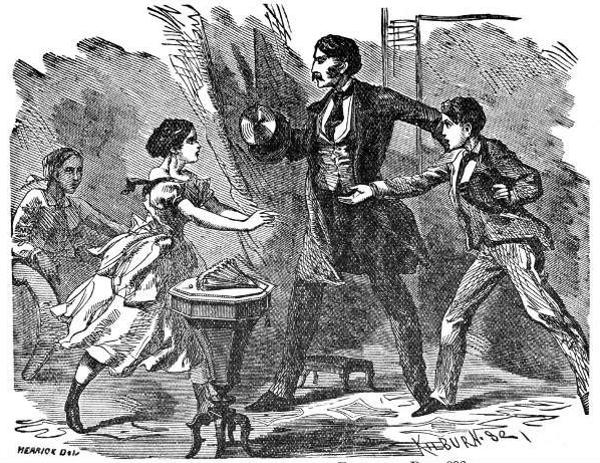
IN WHICH PHIL HAS ANOTHER MISHAP, AND IS TAKEN TO A POLICE STATION.
I had measured the form and estimated the muscle of Lynch before I
paid my respects to him. He had threatened me when I met him on the
preceding day, and I came to the conclusion that, after passing through
one Indian campaign, I should not run away from such a puny fellow as
he was. As a boy I was strong, as a man he was weak, and having him
under me I had all the advantage. He struggled but a moment, and then
changed his tone.
"Don't make a row, Phil," said he, panting under the exhaustion of his
efforts.
"You do know me, then," I replied, puffing not less than he.
"I do. Let me up, Phil, and I will give you your money."
"I don't think I shall take your word again," I added, with a candor
becoming the exciting occasion.
"Let me up, Phil; there will be a crowd around us in a moment."
"No matter; I won't let you up till you give me some security for your
good behavior."
"Better let him up as quick as possible," interposed Mr. Farringford.
"There are some men coming down the street."
"I will hold on to him till he makes it safe for me to let him go," I
replied.
"Put your hand into my breast pocket, and take out my pocket-book. It
contains over two hundred dollars," said Lynch.
I followed his directions; but I was not satisfied in regard to the
contents of the pocket-book. It might be stuffed with brown paper for
aught I knew, for I had read about some of the tricks of swindlers in
great cities, in the newspapers, since I came to St. Louis.
"Take it, Mr. Farringford, and see what is in it," I added, handing it
to my father.
"Let me up, Phil," pleaded Lynch.
"Not yet, Mr. Lynchpinne."
"If you are not satisfied, take the purse out of my side pocket. It
contains fifty or sixty dollars in gold."
I took the purse from his pocket, and it was heavy enough to be filled
with gold.
"Now let me up, Phil. Don't get up a row here."
I was not quite satisfied that we had a sufficient security for the
money I had lost, and I wished my father to examine the purse after he
had reported on the contents of the pocket-book.
"What's the row?" demanded a couple of men coming out of the street by
which we had reached our present position.
"Let me up, Phil," said Lynch, in a low tone.
"Let him up," said my father, in a tone so earnest that I could not
disregard it.
Lynch sprang to his feet, and began to brush the dirt from his clothes.
"What's the trouble?" repeated the two strangers.
"No trouble," replied Lynch. "Come, we will go up to Forstellar's and
settle the matter."
Without waiting to have the matter discussed, Lynch started at a
rapid pace, and my father and I followed him. The two strangers, who
manifested a strong interest in the proceedings, again demanded an
explanation; and as they received none, they came up the street after
us.
"I'm not going to any gambling-house to settle the matter," said I,
placing myself at the side of Lynch.
"Where will you go?" demanded he, impatiently.
"Come to my boarding-house."
"No; I am not going to be led into any trap."
"There is no trap about it. You will see no one but a woman."
"I don't care about going to a private house."
"And I don't care about going to a gambling-saloon."
"You have all my money. Do you mean to keep the whole of it?"
"If I should it would be serving you right; but I don't intend to take
any more than belongs to me. Will you go to the Planters' Hotel?" I
asked.
"Why not go to Forstellar's? It is nearer, and I am in a hurry."
"I won't go into such a place if I can help it."
"You need not go up stairs—only into the bar-room."
"No; I won't go where you can call in the aid of your friends."
"Very well; I will go to the Planters' Hotel," he replied.
As we were walking up the street we passed a policeman. I had come
to feel a peculiar interest in this class of men; and from the fact
that I had met two of them in the same evening, I concluded that the
traditions stored up against them were false. It is not quite possible
for a police officer to be everywhere at the same instant; and, as
there are a thousand places within his beat where he cannot be, to the
one where he is, the chances are altogether against his being always
where he happens to be wanted. I say that, having seen two policemen in
the same evening, I felt a renewed respect and regard for the order,
and I naturally looked behind me as I passed the second one, in order
to obtain a good view of the man.
I was not exactly pleased to notice that the two men who had followed
us from Front Street stopped him, or rather induced him to join them;
and the three followed us. I had no doubt the inquisitive strangers
made our little party the subject of a familiar conversation with the
policeman, as they walked up the street. However, I did not feel much
concerned about the circumstance; for, having been brought up beyond
the practicable reach of the law, I had no suspicion that I had done
anything wrong; and a new mishap was necessary in order to convince me
of the error of taking the law into my own hands.
I mentioned the fact to Lynch that a policeman was following us. He did
not take the matter so coolly as I did, and I am not sure he did not
regret that he had taken the trouble to relieve me of my shot-bag. I
was very well pleased with myself, and thought I had managed my case
remarkably well. I had full security for the money I had lost, and
ten minutes in the hotel would enable me to recover possession of my
funds. The next day was Saturday, and I intended to purchase some new
clothes, so that I could go to Sunday school, to church, and to the
prayer-meeting on the evening of the holy day. All these things were
new to me, and the anticipation of them was very pleasant. I meant,
with my money, to put my wardrobe in a condition that would satisfy
Mrs. Greenough, who had promised to go with me to the Sunday school,
and to all the meetings.
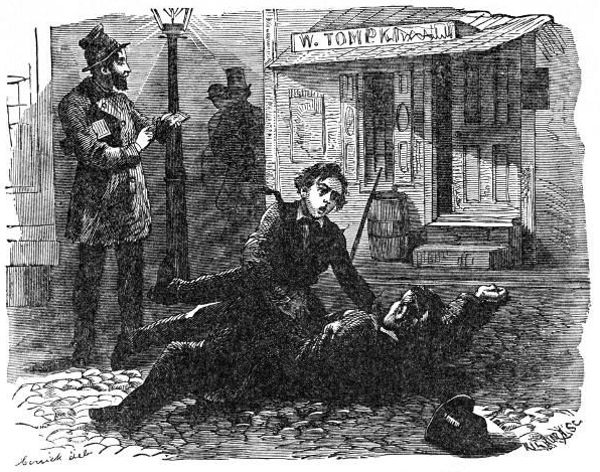
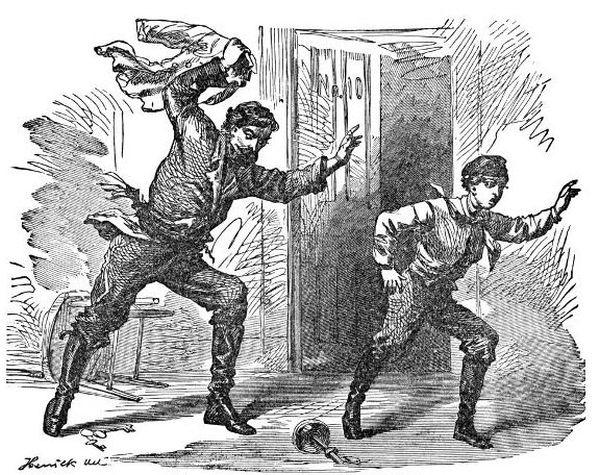
Phil gets Lynch at a Disadvantage. Page 147.
"Come, hurry up," said Lynch, while I was passing these pleasant
reflections through my mind. "That policeman will make trouble for us."
"I'm not afraid of him."
"But I am," replied my companion, sharply. "If you get me into a
scrape, it will go harder with you than with me."
I did not see how that could be, but I was willing to meet the views
of Lynch as long as no treachery was apparent in his conduct. If he
wished to leave us, he could do so, for we had all his money. We
reached the Planters' Hotel, closely followed by the policeman and the
two strangers. When we were about to enter the bar-room, the officer
stepped in front of us, and stopped our further progress.
"I learn that an assault was committed, under suspicious circumstances,
near the levee," said the officer. "I should like to know about it."
"I was robbed of my purse and pocket-book," replied Lynch, promptly.
"Who did it?" demanded the officer, with energy.
"This man and this boy," answered Lynch.
"It is no such thing!" I protested, startled at the charge of my
unprincipled companion.
"But that young fellow was holding him down," interposed one of the
strangers. "He let him up just as Gray and I came out of Plum Street."
"That's so," added Lynch, in the tone and manner of a martyr. "They
took from me all my money, and were going to take my watch when they
were interrupted."
"It is a false and groundless accusation," said Mr. Farringford,
vehemently.
"Ah, Farringford, are you in the scrape?" exclaimed Mr. Gray.
"I am not in the scrape. There is no scrape," replied my father, very
much agitated, for he probably realized better than I did the nature of
our proceedings.
"I will conduct you all to the police office, and we will look into the
matter," said the official, as he took me upon one arm, and my father
upon the other.
Lynch walked with the two gentlemen, one of whom, it appeared, was
connected with the Metropolitan Police Department, which explained
his interest in the affair. I heard him telling his story to them,
and I had no doubt they were greatly edified by it. We arrived at the
station, and were presented to a sergeant of police, who imposed upon
himself the task of investigating the affair. Mr. Gray stated that he
had found me holding Lynch upon the ground, while Farringford was
looking into a pocket-book under the street lamp.
"What have you to say?" said the sergeant to Lynch.
"I was going across the levee to a steamboat, when this man and boy
sprang upon me and knocked me down before I knew what they were about,"
replied Lynch. "They took from me my pocket-book, which contains over
two hundred dollars, and my purse, with fifty or sixty dollars in it,
mostly in gold."
"Do you know either of these parties?" asked the sergeant.
"I know Farringford—everybody knows him," replied Lynch. "I don't know
the boy."
"I am sorry to see that Farringford has been reduced to anything of
this sort," added Mr. Gray, glancing at the trembling inebriate.
"Gentlemen, I am willing to wait till this transaction can be
investigated for the vindication of my character," replied Farringford,
straightening himself up as much as his tottering limbs would permit.
"Give me your name, if you please," said the sergeant to Lynch.
"My name is Lynch."
"Full name, if you please."
"Samuel Lynch."
"Alias Leonidas Lynchpinne," I added; "the name he called himself by
when I first saw him."
"Your business, if you please?" continued the official, as he wrote
down the name.
"I have no regular business at the present time."
"That's so!" exclaimed Farringford. "His business is very irregular. In
other words, he is a blackleg, at Forstellar's or on the river."
"No matter what he is; you can't knock him down and rob him in the
streets of St. Louis," said the sergeant. "Have you either the
pocket-book or the purse, Farringford?"
"I have the pocket-book," replied my father, producing it.
"Did you take this from Mr. Lynch?" asked the officer, as the
pocket-book was handed to him.
"I did not."
"His son did," said Lynch, with a sneer.
"What do you mean by his son?" demanded Mr. Gray, with a smile.
"He told me the boy was his son."
"When did he tell you so?" asked the sergeant, quietly.
"After he had knocked me down," replied Lynch, wincing under the
question, which was evidently put for a purpose.
"Then you talked over their relationship while the boy held you on the
ground?" suggested Mr. Gray.
"No; Farringford only called the boy his son."
"What did he say to him?"
"He called him his son, and told him to hold me fast."
"Before he took your pocket-book from you?"
"No; afterwards, while he was looking to see what was in it."
"This is not the way robberies are usually committed," added the
sergeant. "I never heard of one robber holding a man down while the
other looked to see what the pocket-book contained."
"Did Farringford call you his son?" asked Mr. Gray, turning to me.
"Yes, sir, he did; but not while I held Lynch down. It was while we
were in Plum Street," I replied.
"What trick were you engaged in?" demanded Mr. Gray, rather sternly.
"Why did he call you his son?"
"I am his son. He is my father," I answered.
Farringford looked at me with an expression of disapproval, as if to
reproach me for the falsehood he believed I had uttered.