Portland cement is used because it is the only kind adapted to
general construction. Other cements are manufactured but they
possess individual characteristics that restrict their use. The word
Portland is not a trade name, but signifies the kind and distinguishes
it from the slag, natural, and other cements.
A number of brands of Portland cement are manufactured, most
of which are made to meet the requirements of a fixed standard
adopted by the United States Government and the American Society
for Testing Materials. Cement always should be tested for use in
important work, but this is impractical for the user of small amounts
and it is generally safe practice to omit the test if a reliable brand
of Portland cement of American manufacture is selected, especially
if the dealer's or manufacturer's guaranty that it meets the standard
is secured.
The following simple test for soundness is easily made and is on
the side of caution. Make a ball, about 11/2 inches in diameter, if
neat cement and water; place it under a wet cloth and keep it moist
for 24 hours, then put the ball in a vessel of water; allow the water
to come to the boiling point slowly and to boil for 3 hours. A good
cement will not be affected, but an inferior one will check, crack,
or go to pieces entirely.
Portland cement is shipped in paper bags, cloth sacks, and wooden
barrels (sometimes in bulk). For the average user the cloth sack
is the best container, as it is easier to handle; and while the manufacturers
charge more for this kind of package, they allow a rebate
for the return of the sacks in good condition. A sack of Portland
cement weighs 94 pounds and a barrel contains the equivalent of
four sacks.
As cement readily absorbs moisture from the atmosphere, it
should be stored in a dry place; if exposed to dampness it soon
becomes lumpy, or even a solid mass, and in this condition it is
useless and should be thrown away. The lumps caused by pressure
in piling the sacks are not injurious. They can be pulverized easily,
thus distinguishing them from those due to dampness.
Cement never should be stored on the ground. Build a raised
platform for it and keep it away from the sides of the shelter. As
it is heavy, care should be taken not to overload the supporting floor.
All grains, small pebbles, or particles of broken stone are considered
as sand if they will pass through a wire screen with one-fourth
inch meshes. The particles or grains should be hard and well
graded and should vary in size, as a stronger concrete is thus
obtained than when the size of the grains is nearly uniform. If
a large proportion of the sand is very fine an extra quantity of
cement should be used and if exceptionally fine it is advisable to use
25 per cent more cement.
The sand should be clean; that is, free from vegetable matter,
loam, or any considerable amount of clay. If the hands are soiled
when a small quantity of sand is rubbed between them the following
test should be made: Put 4 inches of sand into a pint preserving
jar, fill with clear water to within an inch of the top, fasten
the lid, and shake the jar vigorously until the whole is thoroughly
mixed. Set the jar aside and allow the contents to settle. The sand
will settle to the bottom with the clay and loam on top of it. If
more than three-eighths of an inch of clay or loam shows, the sand
should be rejected or washed. The difference in fineness and color
shows clearly the line of division between the clay or loam and the
sand.
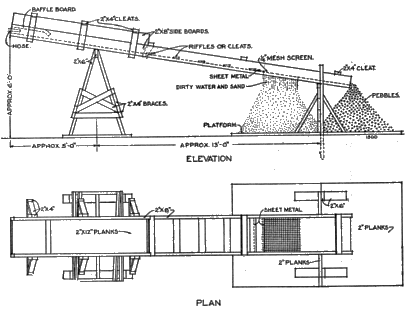
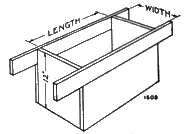
Fig. 1.—Sand and gravel washing trough.
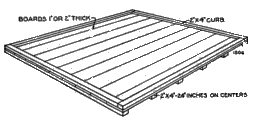
Should sand require washing the simplest way for small quantities
is to build a loose board platform from 10 to 15 feet long,
with one end higher than the other. On the lower end and sides
nail 2 by 6 inch boards. Spread the sand over the platform in a
layer 3 or 4 inches thick and wash with water. The water may
be supplied by any means which will cause agitation of the sand
and allow the lighter material to run off with the water. When
pressure or a head is obtainable the water is most easily applied by
means of a garden hose. The washing should be started at the
higher end and the water allowed to run through the sand and over
the 2 by 6 inch piece at the bottom. Figure 1 illustrates a convenient
trough for washing larger quantities.
A small amount of clay, provided it is not in lumps, does not
injure sand, but amounts over 10 per cent should be washed out.
The larger particles used in concrete may be gravel, broken stone,
air-cooled blast-furnace slag, or other suitable materials. The coarse
aggregate should be sound and clean, that is, free from disintegrated
or soft particles, loam, clay, or vegetable matter. Air-cooled blast-furnace
slag should weigh at least 70 pounds per cubic foot. The
best results are obtained from a mixture of sizes graded from those
retained on a one-fourth inch screen to those passing a three-fourths
to 2 inch ring, depending upon the work. Ordinarily the greatest
dimension of any particle should not be over one-fourth of the thickness
of the concrete work.
Gravel which is too dirty for use usually can be detected by observation.
It may be washed in the same manner as sand. Lumps
of clay should be eliminated and care should be taken to see that the
gravel is not coated with a film of clay or loam which will prevent
the bonding of the cement.
Broken stone should be clean, hard, and of a size suited to the
character of the work, and the same care in grading should be
exercised as in the case of gravel. Trap, granite, hard limestone,
and hard sandstone are commonly used. The composition and
physical character of the stones should be considered, as some possess
qualities that limit their use under certain conditions (see Substitutes
for gravel).
Field stones are common in many localities and their use, when
crushed, may be economical. The finer particles, after the dust is
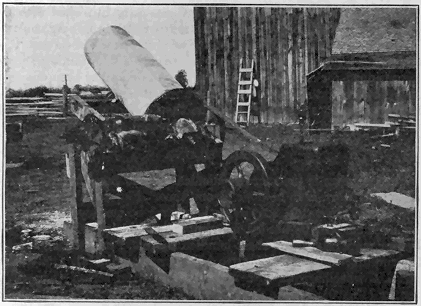
removed, can be used as sand. Small stone crushers, operated by
three or four horsepower gasoline engines, can be purchased at a
relatively low price and may prove profitable if a large quantity of
stone is needed.
Bank or creek gravel, which will answer the purpose of sand and
gravel combined, sometimes can be obtained, and frequently it is
used in small jobs of concrete work just as it comes from the pit or
creek. Although such gravel occasionally contains nearly the right
proportions of sand and gravel, in the majority of sand pits and
gravel banks there is a great variation in the sizes of the grains and
pebbles or gravel and in the relative quantity of each. It is advisable
to screen the sand and gravel and to remix them in the correct
proportions, as well-graded aggregates make stronger concrete
and, ordinarily, enough cement will be saved to pay for the cost of
screening.
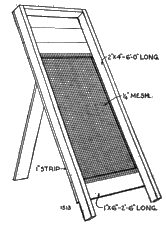
Experience has shown that it is advisable to screen bank gravel
twice; first over a screen with large meshes to eliminate particles too
large for use. The size of the mesh will depend upon the nature of
the work involved (see Coarse aggregate); then the material which
has passed through this screen should be sifted again over a screen
with one-fourth inch meshes. All material which passes the latter
screen may be considered sand and should conform to the characteristics
discussed under "Fine aggregate."
For general work gravel or broken stone always is preferred to
other coarse aggregate. Other materials at times are easier to obtain
and, when used with discretion, will provide a satisfactory concrete.
Broken terra cotta, brick, and old concrete, if hard and strong,
may be used for unimportant work where no great strength is required,
but special care should be taken that the particles do not
show on the finished surface.
The maxim that a chain is only as strong as its weakest link applies
to concrete. If the coarse aggregate is weaker than the cement mortar,
as in the case of some sandstones, it should be used with caution.
The aggregate may have properties that render it unsuitable for
use under certain conditions; for instance, cinders should not be
used if water-tightness or strength is expected, but they are useful for
fireproofing. Material that disintegrates or flakes when heated is
undesirable in places exposed to high temperature; thus marble and
some limestones should not be used in fireplaces. Some aggregates
when exposed at the surface of concrete are apt to cause discolorations,
and when this would be objectionable aggregates of this type
should be avoided. Flat or elongated slab-like fragments should be
avoided, as particles of this shape do not bond well; slate and shale
are examples.
Cinders should be composed of hard, clean, vitreous clinkers, free
from sulphides, soot, and unburned coal or ashes. As a precaution
against the presence of small amounts of detrimental substances,
cinders should be soaked thoroughly with water 24 hours before
being used. If clean they will not discolor the hands when a small
quantity is rubbed between the palms.
Cinder concrete, on account of its light weight, commonly is used
for filling between sleepers of floors and grading roofs, and frequently
for fireproofing, for which it is very effective. Cinders
should never be used when the concrete is to be subjected to heavy
loads or abrasion.
Lava rock varies widely in chemical composition and physical
qualities. In some instances lavas are so light and frothy or contain
so large a proportion of easily oxidizable material that they are
wholly unsuited for concrete work. In general, the lava rock found
in the Northwestern States is a suitable substitute for gravel.
Rhyolite, a light colored volcanic rock, and many of the darker
colored basaltic lavas can well be used for concrete for building
purposes.
Water should be clean and free from strong acid and alkali.
Sea or brackish water should not be used if fresh water can be
obtained.