There is no need to rewrite the history of the Black Death: that has
been admirably accomplished by Hecker and by Abbot Gasquet. It is still
profitable, however, to investigate its by-effects in the domains of
literature and art, and to consider its broad morbid features, as
a contribution to the medical history of the time. The Black Death
was the first great pandemic that left in its wake a complete and
continuous succession of literary and historical records, in most
points complementary, in some frankly contradictory, but for all that
none the less instructive.
As to the starting-point of the pandemic there is a diversity of
voices. Russian records place it in India, Greek in Scythia, English in
India and Asiatic Turkey, Arabian in Tartary and the land of darkness.
According to Italian tradition it originated in Cathay, to the north
of China, and spread in every direction from that focus; northward by
Bokhara and Tartary to the Black Sea; to India and the towns south of
the Caspian, and to Asia Minor; and by way of Baghdad through Arabia
and Egypt to the north of Africa. The leading contemporary Italian
authority is Gabrielle de Mussi, a notary of Piacenza, who himself saw
its outbreak in Upper Italy. In his ‘Ystoria de morbo seu mortalitate
qui fuit a 1348’, first printed by Henschel in Haeser’s Archiv für die
gesammte Medicin, he describes how the plague was brought by ship from
Caffa; a Genoese settlement in the Crimea. The Tartar city Tana (Port
Azov), that had been appropriated by Italian merchants, was besieged
in a.d. 1346 by an army of Tartars and Saracens.
The Tartars expelled them, and followed them to Caffa, whither they had fled.
Plague broke out fiercely among the besieging Tartars, who, in the hope
of infecting the garrison, threw their dead bodies into the city by
means of engines of war. The garrison in turn cast them into the sea,
but the city became infected and almost completely depopulated, a few
survivors taking ship and carrying the disease with them to Italy in
the autumn of a.d. 1347. Speaking of the infection
of Caffa, de Mussi says ‘the air became tainted and the wells of water poisoned,
and in this way the disease spread rapidly in the city’. So the old
idea of poison still prevails, but it is a virus derived from infected
corpses, and not some extraneous poison compounded by a maleficent
enemy. The poison was communicable also from man to man, for he says
of the sailors coming from Caffa to Venice and Genoa that ‘as if
accompanied by evil spirits, as soon as they approached the land, they
were death to those with whom they mingled’.
These ships seem to have infected Constantinople en route, and an
account of its ravages there survives from the pen of the Emperor
Cantacuzenus.[147]
It is a mistake to regard his record as worthless material, because of
its plagiarism of much of the language of Thucydides. In what is not
appropriated from this source he gives a valuable clinical description
of the disease. He notes the early low delirium, and distinguishes
pneumonic, bubonic, and carbuncular types of the disease. He mentions
cervical and axillary, but not inguinal buboes, and also the dark
patches on the skin, that later came to be termed ‘tokens’. He also
asserts the incidence of the disease on the domestic animals.
In making for Genoa these ships put in at Messina in Sicily and left
the infection there. Michael Platiensis (of Piazza), a Franciscan
friar, has given an account of its course in this city. He refers to
infection by means of the breath, and by contact with the belongings
of, the infected. Gabrielle de Mussi seems to hold a similar belief.
‘We’ [i. e. the Genoese sailors], he says, ‘reach our homes: our
kindred and our neighbours come from all parts to visit us. Woe to us,
for we cast at them the darts of death! Whilst we spoke to them, whilst
they embraced us and kissed us, we scattered the poison from our lips.
Going back to their homes, they soon infected their whole families.’
De Mussi explicitly asserts that the plague was carried from the
seaport of Genoa by some Genoese to Bobbio, and to his city of
Piacenza. Here such was the mortality that ‘no prayer was said, no
solemn office sung, nor bell tolled for the funeral of even the noblest
citizen: but by day and night the corpses were borne to the common
plague pit without rite or ceremony’.
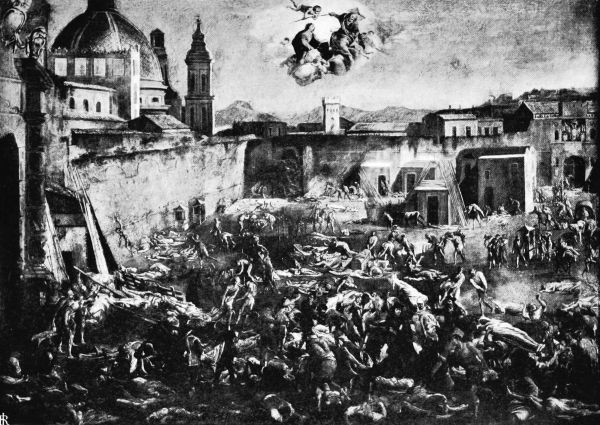
So Italy had been primarily infected at Venice and at Genoa, and from
these sea-coast cities the disease spread itself over the whole Italian
peninsula.
At Venice the example of Galen had sunk deep into the hearts of her
physicians. They fled before the advancing enemy and shut themselves up
in their houses, leaving the surgeons, led by Andrea di Padova, to fill
their place. Physicians would do well to bear this occasion in mind,
when they complain of the encroachments of surgery into the domain of
medicine. On March 30, a.d. 1348, the Grand Council
of Venice appointed three men to act as a Committee of Public Safety. These men
had large burial-pits dug in one of the islands of the lagoon, and
organized a service of boats to transport the bodies to them.
Rome was not so hard hit as some of the cities of Italy. Nevertheless,
there remains to this day a monument of this plague in the flight of
marble steps leading up to the church of Ara Coeli. These were set
up by Giovanni de Colonna in October 1348, out of the spoils of the
temple of the Sun on the Quirinal, and were designed for the use of
the citizens, who with ropes round their necks and with ashes on their
heads climbed the hill barefooted, to implore from the Blessed
Virgin the cessation of the plague. The thirteenth-century mosaic of
the Madonna and Child may still be seen above the side entrance of
Ara Coeli at the head of the well-worn stairs leading up from the
Capitoline Piazza. The object of worship remains, but the worshippers
are no more.
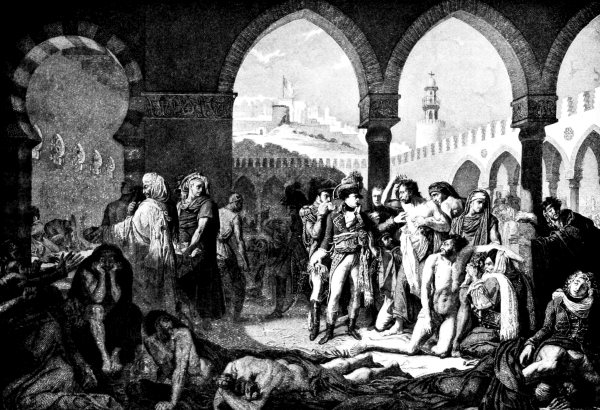
Lanciani[148]
has reproduced an old engraving showing women ascending the marble
stairs on their knees. This staircase would seem to be indicated both
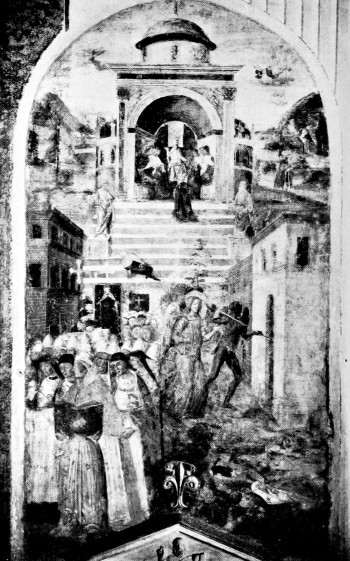
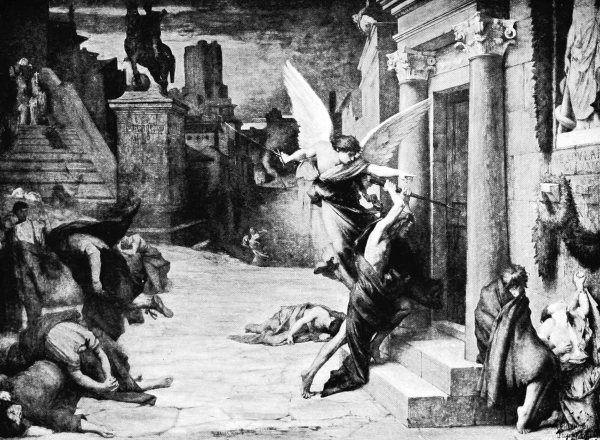
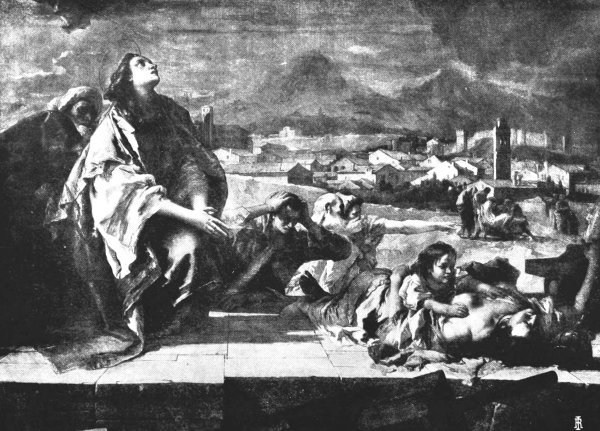
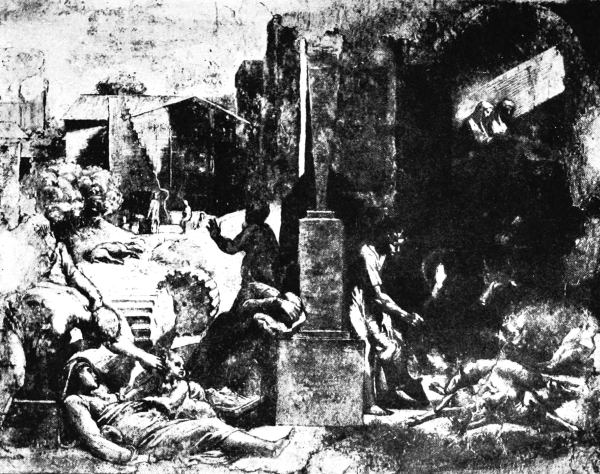
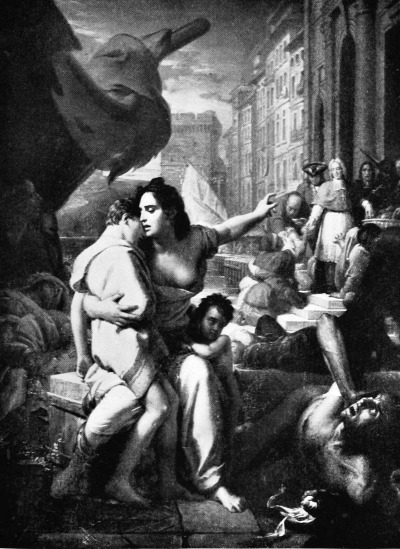
in Delaunay’s picture and in the fresco by which it was inspired.
There is a legend in Rome, that as the panic-stricken people were
carrying an effigy of the Madonna from the Ara Coeli to St. Peter’s,
the statue of the angel on the Castel S. Angelo bowed its head to do
homage to it.
Plague was not the only enemy in Rome in a.d. 1348,
for a terrible earthquake on September 9 and 10 wrought havoc among the
remaining monuments of ancient Rome. Those citizens, who had escaped
the plague and from death among the falling ruins, lived for weeks in
the open Campagna with no shelter from the inclemency of the weather.
Perhaps it was this accident that served to bring the visitation to an
end at Rome more rapidly than elsewhere.
Agnolo di Tura, in his Cronica Senese, edited by Muratori, gives
a graphic picture of the Black Death in Siena. A large uninteresting
picture in the church of S. Maria dei Servi depicts St. Catharine
attending the plague-stricken, and there is an ugly, almost ludicrous,
fresco of the same subject in the House of St. Catharine of Siena. The
painter brothers Pietro and Ambrogio Lorenzetti were both carried off
by plague. But it is in the Duomo itself that the mark of the Black
Death is most apparent. Begun in a.d. 1339, on the
site of an older cathedral dedicated to the Madonna of the Assumption, the
transepts were built, the foundations of the nave and choir were
laid, and their walls partly raised according to the designs of Lando
Orefice, when the Black Death broke out in the city in a.d.
1348. The money collected for the building was diverted to urgent
public purposes, and the work, once suspended, has never been
completely accomplished. The present cathedral, splendid as it is, is a
mere fragment of the magnificent fabric, in which Orefice purposed to
enshrine a memorial to the glory of fourteenth century Siena.
The little Cappella di Piazza, attached as a loggia to the Palazzo
Publico of Siena, was set up in gratitude for the cessation of the
plague that carried off no less than thirty thousand persons. It was
commenced in a.d. 1352 and completed in
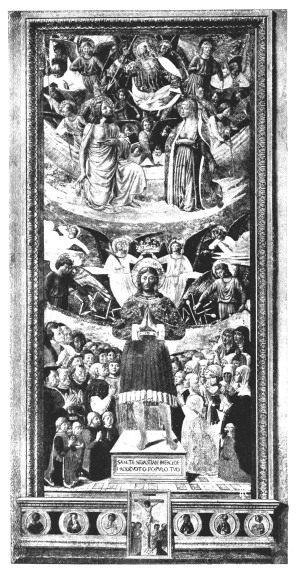
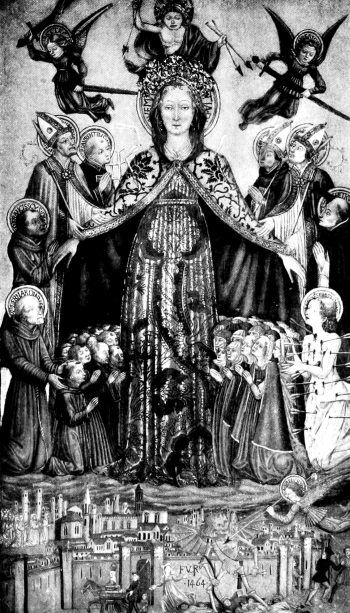
a.d. 1376. Hard by Siena the citizens
of San Gimignano vowed an altar to St. Fabian and St. Sebastian as
the price of their protection, and set it up between the doors of
the Pieve or Collegiata. Above the place where once it stood is now
the fresco of Benozzo Gozzoli, commemorating the plague of
a.d. 1464.
No less a man than Petrarch[149]
has chronicled this plague at Parma. His letter is in no sense
descriptive, but rather a long-drawn-out wail over the devastation, the
loss of friends and relations, and the magnitude of the destruction,
that seemed to him to threaten the utter extinction of the human race.
Affectation is the key-note of his lamentations, that are freely
interspersed with allusions to the ancient classics. Laura had died of
plague at Avignon in a.d. 1348, and Petrarch
in sadness of soul wrote these lines on the manuscript of his beloved
Vergil, now in the Ambrosian Library at Milan:
‘Laura, illustrious by her virtues, and long celebrated in my songs,
first greeted my eyes in the days of my youth, the 6th April, 1327, at
Avignon; and in the same city, at the same hour of the same 6th April,
but in the year 1348, withdrew from life, whilst I was at Verona,
unconscious of my loss. The melancholy truth was made known to me by
letters, which I received at Parma on the 19th May.’
‘Her chaste and lovely body was interred on the evening of the same
day in the Church of the Minorites: her soul, as I believe, returned to
heaven, whence it came.’
‘To write these lines in bitter memory of this event, and in the
place where they will most often meet my eyes, has in it something of a
cruel sweetness, but I forget that nothing more ought in this life to
please me, which by the grace of God need not be difficult to one who
thinks strenuously and manfully of the idle cares, the empty hopes, and
the unexpected end of the years that are gone.’
The Florentines, by way of rehabilitating their city after the Black
Death, founded a university, and offered Petrarch a professorial chair,
which he declined.
Matteo Villani[150]
wrote a plain unvarnished account of the state of Florence during the
Black Death, but it has found little favour beside the lighter sketch
that stands as a prelude to the Decameron. His brother Giovanni,
the Florentine historian, was one of the early victims, and Matteo takes
up his history at the point at which he left it, and begins with a
description of the epidemic. Famine had preceded the plague, and like
it was regarded as sent by Heaven for the punishment of sin. But the
energy of the government, in importing corn and distributing it to the
destitute, had done much to relieve the distress, when this worse enemy
presented itself at the gates.
Both Villani and Boccaccio enlarge on the futility of all measures,
preventive and remedial alike, and the intense infectiveness of the
disease. They believed that it could be communicated by a look, as well
as by contact with the person or belongings of an infected subject.
Boccaccio mentions the speedy death of two pigs from rooting among some
infected clothing. Some pinned their faith on strict seclusion: some
on temperate living, some on intemperance: others sought safety in the
carrying of aromatic substances. Both Villani and Boccaccio lay stress
on the utter depravity and demoralization engendered by the plague.
Great uncertainty of life has never failed to generate corresponding
recklessness. It has always been the same tale in every desperate city;
it was so when Jerusalem, panic-stricken at the threatened attack of
Sennacherib, gave itself over to wild revelry: ‘And in that day did the
Lord God of Hosts call to weeping and to mourning, and to baldness,
and to girding with sackcloth: but behold joy and gladness, slaying
oxen, and killing sheep, eating flesh and drinking wine: let us eat
and drink, for to-morrow we die.’ Matteo Villani traces to the Black
Death the social and moral degeneracy and the political anarchy, that
were rampant in Florentine life, in the centuries that followed close
upon it. Family affection is apt to reach its lowest ebb in the houses
of a plague-stricken city. Villani and Boccaccio echo the language of
Thucydides when they tell of parents deserting children, and husbands
wives, in their hour of need, and the neglect of the sacred rites of
sepulture. The plague raged in Florence from April to September, and
Antoninus, Archbishop of Florence, computes the mortality within the
city at 60,000 persons, two-thirds of the total population. Boccaccio
actually raises the figure to 100,000 between March and July only, but
this figure, if correct, must comprise also the surrounding district,
which suffered only less severely than the city itself. One bright
record stands out against this dark background of social demoralization
in the devotion of the Compagnia della Misericordia to their
self-appointed task. Instituted in a.d. 1244 for
the service of the sick, they now also lent themselves to the transport of the
dead. A picture by Cigoli (a.d. 1559-1613), now in
the church of the Misericordia, shows the brotherhood in red robes—now changed
to black—gathering up the dead and dying at the foot of Giotto’s Tower.
The bearers may be seen to this day in the streets of Florence in the
same robes and hoods masking the whole face but the eyes, but the
hand-litters and sedans of Cigoli’s picture have now been slung on
wheels and sanctified to modern use with the addition of a motor
ambulance. Great wealth flowed into the coffers of the guild from men
who desired to crown a vicious life with a comfortable death and a
decent burial.
The horrors of the plague-stricken city, with which Boccaccio has
prefaced his Decameron, stand out in striking contrast to the gay
frivolity of the young men and women round whom his romance ranges.
Plague and pleasure jostle each other in jarring juxtaposition.
Boccaccio of set purpose chose this dark background for the staging of
his brighter theme. Thucydides had done the same before him, in setting
the panegyric of Pericles side by side with the plague of Athens: and
Manzoni has done so after him in the romance of Promessi Sposi.
Perhaps also he had learnt, amid the fierce realities of the plague, to
envisage life as it is, and so present it to his readers.
Niebuhr, in tracing the decadence of Roman literature to the Antonine
plague, cites as a parallel illustration the influence of the Black
Death on early Florentine literature. In the latter case, at any
rate, it is difficult to bring his dictum into line with the actual
circumstances. It would seem rather that the break in the vernacular
Florentine literature after Dante, Petrarch, and Boccaccio, was
deliberate, and in no sense accidental. What Petrarch perceived, and
perceived unerringly, was the poverty of the material on which the
vernacular had maintained a starved existence; and he saw in the
ancient classics, in their mythology, in their speculative freedom,
in the principles of their art, liberation from the bondage that the
Church had laid on literature. What he did not perceive was that
in reverting to ancient modes of thought it was needless, nay even
harmful, to adopt also the language of the ancients. It was not open to
him to see, as it is to us, that no great work of literature has ever
been produced in any language but that in which the writer speaks and
feels and thinks: any tongue but the tongue of his daily life must
needs be artificial and inanimate. Petrarch himself little guessed that
with posterity his fame would rest on his Rime in the vernacular, and
not on his epistles and multifarious dissertations in a lifeless Latin
language. It is this mistaken teaching of Petrarch that explains the
abrupt break of a century or more in vernacular Florentine literature,
to which the Black Death can have been at most a trivial contributory
cause. As soon as this mistake came to be recognized Florentine
literature flows on again in its old channel in the full stream of the
fifteenth and sixteenth century masterpieces of Ariosto, of Tasso,
and the rest. It was the advice of Petrarch that turned Boccaccio from
the vernacular to Latin, after he had completed in his Decameron
a masterpiece of Italian prose. The influence of the classical
revival that Petrarch had brought to life was destined also slowly to
secularize Florentine art, but the time of its complete emancipation
was not yet.
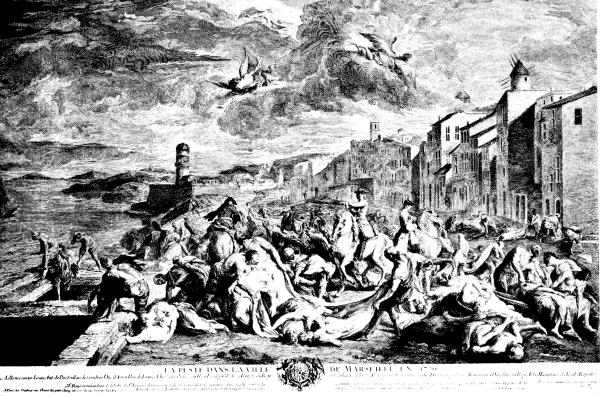
The Black Death first touched French soil at Marseilles, brought
thither, it was thought, by ships from Genoa. Simon de Covino, a
doctor, described the features of the disease as he witnessed it at the
neighbouring town of Montpellier, in Latin hexameter verse. He clearly
recognized its contagious character, for he says, ‘By a single touch or
a single breath of the plague-stricken they perished.’
Of the plague at Avignon both lay and medical accounts survive. A full
description is contained in a letter from an anonymous canon to his
friends in Bruges. He remarks on the virulence of the contagion, and
describes both pneumonic and bubonic types of the disease. He says that
Clement VI ordered bodies to be examined after death, in the hope of
discovering the origin of the disease. This fact should be noted by
those who assert that the Church interpreted the De Sepulturis bull
of Boniface VIII (a.d. 1300) as prohibiting the anatomy
of human bodies. The autopsies disclosed no more than inflammation of
the lungs in the pneumonic cases. Similar examinations, previously
undertaken in Italy, had also yielded no better result. Clement also
ordained expiatory processions and penitential litanies. Within
the precincts of his palace, to which his medical attendant, Gui
de Chauliac, confined him, he lent his own presence to the whole
ceremonial that he prescribed. But he did not neglect to keep large
fires alight in his apartments, as Pope Nicholas IV (a.d.
1288-92) had done at Rome in a previous visitation. Only those who have
been at Avignon at midsummer can appreciate the price that Clement was
ready to pay for immunity.
Clement’s physician, Gui de Chauliac, says that the plague began
at Avignon in January, and lasted for seven months.[151]
In his view the causes of the pandemic were twofold: universal, consisting
in a conjunction of the planets: and special, dependent on the feeble
constitution of the individual, whereby it came about that labouring
men were chiefly attacked. But then as now the scared populace was
proof against pontifical pronouncements from the Chair of Medicine.
They saw in it the handiwork of Jews spreading poison throughout the
world, so they put them to death. They saw in it malevolence of lepers,
so they drove them out. They saw in it a plot of feudal overlords
for their extinction, so they remained within their houses. And for
completer security they set a guard around the towns and villages, who
accosted each newcomer and compelled him to swallow any ointments or
powders found upon him.
De Chauliac describes two prevalent types of the disease. The one
type, the pneumonic, prevailed only for the first two months, and was
characterized by spitting of blood, extreme infectiousness, and death
in three days. The second type, the bubonic, prevailed throughout the
five succeeding months, and was characterized by boils, by buboes
chiefly in the armpits and groins, by slight infectiousness, and death
in five days. The mortality extended to no less than three-fourths of
the total population, so that to get rid of the bodies they were driven
to throw them into the Rhone, after Clement had pronounced a blessing
on its waters.
To Gui de Chauliac the best of all preservatives was flight, aided,
or perhaps we should say embarrassed, by the free use of aloetic
purgatives.
He did not fly himself, for he says, with the naïveté of a Pepys,
‘As for me, to avoid infamy, I did not dare absent myself, but still
I was in continual fear.’ (Et moy pour euiter infamie, n’osay point
m’absâter: mais auec continuelle peur me preseruay tant que ie
peux, moyennant les susdicts remedes.) His hesitancy was to prove
his undoing, for he was himself infected towards the end of the
epidemic—but recovered after six weeks. Among other preservatives
he reckons venesection, purification of the air by means of fires,
comforting the heart with treacle and apples and things of savoury
flavour, consoling the humours with Galen’s Armenian bole, and the
prevention of putrefaction by the use of bitter things. Should the
disease defy all these precautions, then he commends, as curative
measures, bleedings and evacuations, with electuaries and cordial
syrups. Buboes should be ripened with poultices of figs and boiled
onions, pounded and mixed with leaven and butter: then they should
be opened and treated like ulcers. Carbuncles are to be leeched,
scarified, and cauterized—an improvement on the disastrous treatment
meted out to Felix, bishop of Nantes, on a previous occasion.
Raymond Chalin de Vinario, another practitioner in Avignon during
the plague, adds but little to what Gui de Chauliac has to say. He
describes a solid cord, red or variously discoloured, which appeared
in some cases on the body surface, with a carbuncle at one end and a
pestilential tubercle at the other. This can hardly have been anything
else than an acute lymphangitis.
It is clear from the descriptions of the various writers that a large
proportion of the cases in this pandemic were of pneumonic type: hence
its virulence and its infectiousness.
Amid all the panic of the Black Death, persecution of the Jews broke
out with even greater ferocity than during the Crusades in the twelfth
century. Some victim was needed to appease the maddened populace: so
the Jews were accused of poisoning the wells, and even of infecting
the air. Circumstantial accounts were circulated throughout Europe of
secret operations directed from Toledo. The concoction of poisons from
spiders, owls, and other supposed venomous animals was described, and
its mode of distribution made known. So well did their accusers deceive
themselves that in many places the springs and wells were sealed, so
that no one might use them, and the inhabitants of many cities had
to rely on rain and river water. If confirmation of poison were ever
needed, the rack could be trusted to procure it: or, failing that,
men could be found vile enough to deposit poison in places in which
circumstances demanded its presence. Those who escaped the fury of the
mob fell into the clutches of an inexorable justice. In the case of
the Jews the suspicion of poisoning was prompted by the fact that at
this time the practice of medicine, at any rate in southern Europe, was
chiefly in the hands of Jewish physicians. Hideous massacres of Jews
had taken place in southern France and Spain in the previous epidemics
of a.d. 1320 and 1333, as we know from the
writings of Rabbi Joshua.
The first outbreak of murderous ferocity seems to have occurred at
Chillon, on the Lake of Geneva, in September and October, a.d.
1348. Here it was merely the culmination of an accusation of poisoning
the wells so long previously as the epidemic of a.d. 1320.
In face of the common danger, high and low bound themselves together
by a solemn oath to extirpate the Jews by fire and the sword. Chillon
summoned Bern, and Bern sent on the summons to Basle, Freyburg,
and Strasbourg to join them in their righteous task. The record of
confessions extracted from the Jews by the ordeal of torture within
the Castle of Chillon has been rescued from oblivion by the vigilance
of Hecker.[152]
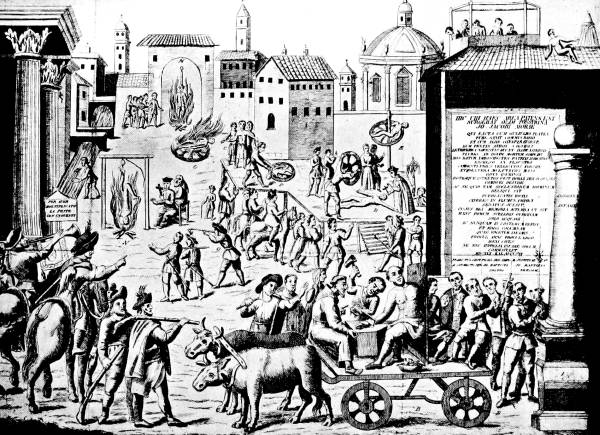
In Basle and Freyburg the Jews were seized, one and all, and without
form of trial were burnt to death in a wooden building, specially
constructed for the purpose, while at Strasbourg no less than two
thousand Jews were immolated on a wooden scaffold, erected in their own
burial-ground. Such as escaped were ruthlessly murdered in the streets,
saving a few only to whom freedom was granted on submission to baptism.
But for these the respite from renewed accusation and death was only
temporary. Faithlessness to their own religion, or physical charms
sufficient to assuage the blood-lust of their Christian persecutors,
constituted the only acceptable claims to a passing mercy. Strasbourg
betrayed the true ground of its hatred of the Jews in an order of its
senate that all pledges and bonds should be returned to the debtors and
the money divided among the working-people. Those who were unwilling
to soil their hands with blood-money presented their share of the
spoils to monasteries, at the prompting of their confessors. At Spires,
Mayence, and Eslingen, voluntary immolation in their own houses alone
saved the Jews from more inhuman tortures. Some were murdered in the
open streets and their dead bodies thrown into the Rhine in empty
casks, so that they might not infect the air. Now and again banishment
was substituted for burning, only for the outcasts to perish at the
hands of a savage and blood-thirsty countryfolk.
When the houses of the Jews were burnt a ban was set on entry into
the ruins of their habitations: the site was accursed, as the site
of Jericho of old. But the bricks of the destroyed dwellings and the
tombstones of the victims were in due time rendered as an acceptable
thank-offering to God in the repair of Christian churches. In Austria
the same accusations were brought against the Jews as elsewhere, and
numbers were burnt to death in Vienna and throughout the country. Where
there were no Jews, as in Leipsic, Magdeburg, and other places, the
grave-diggers were accused of propagating the plague for their own
sordid ends.
It should be set to the credit of Clement VI that he extended his
personal protection to the Jews at Avignon, issuing two bulls,
asserting their innocence, and calling on Christians to refrain from
persecution. The Emperor Charles IV did what lay in his power, short of
drawing the sword, to check the outrages perpetrated by the Bohemian
nobles. Duke Albert of Austria exacted from the persecutors punishments
only less cruel than they themselves had inflicted, but even so did not
avail to save hundreds of Jews from the flames, in his own fortress
of Kyberg. Other lesser princes, more often for bribes than for pity,
extended some measure of protection to the wretched Jews, earning for
themselves the sobriquet of ‘Jew-masters’. It was no light matter for
a private person to shelter a Jew, for the penalty was often exacted on
the rack or at the stake.
Basnage[153]
states that the large number of Jews in modern Poland may be traced to
the fact that King Casimir the Great (a.d.
1333-70), yielding to the entreaties of a favourite Jewess,
Esther, granted sanctuary to such Jews as sought it. But actually
Casimir only confirmed an edict of protection promulgated in a.d. 1264, and Poland had then already afforded a
haven of refuge to the Jews, who had fled from the cruel massacres
perpetrated in the enthusiasm of the first Crusade.
In England the Black Death served to revive the perennial charges
brought against the Jews—that they stole Christian children and killed
them, especially at Easter-time, a charge that Chaucer, mindful of Hugh
of Lincoln, has enshrined in the pathetic verse of his Prioress. They
were charged also with outraging the Host, as well as with spreading poison.
The Black Death seems to have fallen with greater violence on Austria
than on Germany,[154]
perhaps on account of its close contact with Italy. It devastated
Vienna from Easter to Michaelmas of a.d.
1349, carrying off thirty thousand out of a population of less than
one hundred thousand persons. The excited populace personified it as
the Pest-Jungfrau, who had only to raise her hand to infect a victim.
She was to be seen flying through the air in the form of a blue flame,
and also proceeding out of the mouths of dead and dying. Some saw the
plague poison descend in the form of a ball of fire. One such was seen
hovering over the town, but a bishop exorcised it by prayer, so that
it fell harmless to earth. A stone effigy of the Madonna was set up in
the street, where it fell. All medical aid proved useless, and amulets,
potions, and preservative electuaries were in general use. Segregation
of the sick was attempted, by nailing up doors and windows of infected
houses, but even so dead bodies littered the streets. Huge plague pits
were dug for the reception of the dead. Flagellant processions sought
to excite divine compassion by the ritual of peripatetic penitence.
The genesis of the Flagellant movement must be looked for further
back in the history of pestilence than the Black Death. The idea of
mortifying the flesh by the penance of scourging is of ancient origin,
and at least as early as the eleventh century brotherhoods were devoted
to this ritual. The processions of these Devoti, as they were termed
in Italy, were originated by St. Anthony in a.d. 1231,
and we hear of them under the name of Flagellants in Vienna during the plague
of a.d. 1261.
One Monachus Paduanus, quoted by Hecker, has left a record of the early
days of the Devoti.
‘When the land was polluted by vices and crimes,
an unexampled spirit of remorse suddenly seized the minds of the
Italians. The fear of Christ fell upon all: noble and ignoble, old
and young, and even children of five years of age, marched through
the streets with no covering but a scarf round the waist. They each
carried a scourge of leather thongs, which they applied to their limbs,
amid sighs and tears, with such violence that the blood flowed from
the wounds. Not only during the day, but even by night, and in the
severest winter, they traversed the cities with burning torches and
banners, in thousands and tens of thousands, headed by their priests,
and prostrated themselves before the altars. They proceeded in the same
manner in the villages: and the woods and mountains resounded with the
voices of those whose cries were raised to God. The melancholy chaunt
of the penitent alone was heard. Enemies were reconciled: men and
women vied with each other in splendid works of charity, as if they
dreaded that Divine Omnipotence would pronounce on them the doom of
annihilation.’
Before this mediaeval pageant of penitence the mind insensibly reverts
to the ancient ritual of the Salii on this same Italian soil, to their
choric hymn of expiation, to the supplicationes, and to the
love-feast of the lectisternium of later days.
Under the stimulus of the Black Death, the Brotherhood of the Cross,
or Cross-bearers, arose out of the ranks of the Flagellants, first in
Hungary, and afterwards in Germany. Ditmar[155]
has left the following account of their processions:
‘Their heads covered as far as the eyes: their
look fixed on the ground, accompanied by every token of the deepest
contrition and mourning. They were robed in sombre garments, with red
crosses on the breast, back and cap, and bore triple scourges, tied in
three or four knots, in which points of iron were fixed. Tapers and
magnificent banners of cloth of gold were carried before them: wherever
they made their appearance they were welcomed by the ringing of the
bells: and the people flocked from all quarters, to listen to their
hymns and to witness their penance, with devotion and tears.’
When the Flagellants entered the town they would hand the citizens
a document setting forth God’s anger and determination to destroy
mankind, had not the Virgin Mary interceded for them. Some of
the crosses carried by the Flagellants are still to be seen at
Gross-Glogau, Kaysersberg, and Ammerschweyer in Upper Alsace.
This spirit of religious fanaticism spread like wildfire through
Hungary, Germany, Bohemia, Silesia, Poland, and Flanders, and
even beyond these countries. In the autumn of 1349 some six-score
Flagellants crossed from Holland and paraded the streets of London, but
the metropolis had not then acquired the taste for processions, and
ejected them as undesirable aliens. At last the movement had alighted
on uncongenial soil. So great was the number of the Flagellants that
they became a cause of well-founded anxiety to the clergy, whose
churches they actually invaded, and whose influence they threatened to
supersede. Their hymns were in every mouth, and one of them, the chief
psalm of the Cross-bearers, is reproduced by Hecker in his Epidemics
of the Middle Ages.
The secular authorities also saw cause for alarm at the growing numbers
and power of the brotherhood, bound together by common ritual and
common regulations, and capable, under bold and designing leaders, of
exerting their influence in the affairs of states. The Emperor Charles
IV appealed to the Holy See for protection against the heretics, and
Clement VI responded by issuing a bull from Avignon on October 20,
1349, prohibiting the pilgrimages on pain of excommunication. Philip
VI forbade altogether their reception in France, and several other
ruling princes followed his example. Relentless persecution soon took
the place of unthinking homage. The processions were abandoned, but the
spirit that animated them was not dead, and the same fanaticism broke
out again in Germany in the fourteenth and fifteenth centuries, and in
Italy even as late as the eighteenth, under the influence of successive
plagues.
The Black Death, sweeping throughout England, is believed to have
carried off one-half of the total population. Historians have told the
tale of the resulting emancipation of the labouring class, but we find
that it has also left its mark on the education, the literature, the
art, and the architecture of England.
In education, it helped greatly to bring about the revival of English
in the schools. After the Norman Conquest French had gradually become
the language of education: not of set purpose, for the Conqueror
himself tried ineffectually to learn English. But most of the education
was in the hands of the clergy, and as many Frenchmen had been put
in charge of monasteries and of parochial cures, it was inevitable
that French should become the language of education, and so diffuse
itself generally through the educated part of the nation, both French
and English. About the middle of the fourteenth century Higden,
in his Polychronicon, states that French was still the language
taught in the schools, and had been so since the Norman Conquest. In
a.d. 1385 Trevisa, commenting on Higden’s statement, writes:
‘This maner was myche yused tofore the first
moreyn [before the 1349 murrain], and is siththe som dele [since
somewhat] ychaungide. For John Cornwaile, a maister of gramer,
chaungide the lore [learning] in gramer scole and construction of
[from] Frensch into Englisch, and Richard Pencriche lerned that maner
teching of him, and other men of Pencriche. So that now, the yere of
owre Lord a thousand thre hundred foure score and fyve, of the secunde
King Rychard after the Conquest nyne, in alle the gramer scoles of
England children leveth Frensch, and construeth an [in] Englisch.’
Despite the adoption of French as the language of the schools, English
had survived as a colloquial language side by side with its supplanter.
In the conflict between the two prestige and fashion were on the side
of French, tradition and nationality on the side of English: and sooner
or later the balance was bound to incline to the side of the national
language. The fusion of the two had inevitably led to the corruption
of each, but the corrupted French, at any rate after the loss of
Normandy, had no standard of purity at hand to limit corruption,
while the corrupted English was constantly purified by contact with
the native tongue, and by the existence of a pre-Norman vernacular
literature. National spirit, stimulated by international strife, was
ripe for completing the task, that John Cornwall had begun in a single
west country school; and the Black Death, by sweeping away the existing
teachers and making place for others of native stock, did much to
facilitate the change. The triumph of the vernacular operated a mighty
revolution in our national literature, paving the way for Langland
and Chaucer. Thomas Usk, in the Prologue to his Testament of Love,
completed not later than a.d. 1387, alludes to the
utter corruption of the imported French, and the Prioress in the Canterbury
Tales, although she could speak French ‘ful fayre and festishly’ spoke
it only
After the scole of Stratford atte Bowe,
For Frenche of Paris was to hire [her] unknowe.
One other immediate effect of the Black Death was to reduce the
literary output of the monasteries to its lowest level. No one can
fail to be struck by the scantiness and sterility of the contemporary
chronicles, which characterize the period following the Black Death,
and the reasonable explanation of this abrupt change would seem to lie
in the notorious depletion of the monastic households. The tragedy of
the Provençal brotherhood, in which Petrarch’s brother and his dog
alone survived to tend and guard the monastery, found an echo in a
like desolation of many an English monastery. The special incidence on
the monasteries was perhaps due to the monks moving freely among the
sick, and giving them sanctuary within their cloister. The sick, too,
exhibited often an ill-timed gratitude in bequeathing their clothes to
the monasteries. Doctors, as Chaucer remarked of his day, were only for
the rich.
In England, as in Italy, the Black Death left its mark on architecture
in the abrupt arrest of schemes of construction in course of execution.
Many such breaks may be detected in the church architecture of
the fourteenth century, and a notable example is furnished in the
unfinished towers of the church of St. Nicholas at Yarmouth.
Prior[156]
indicates a similar break of continuity in the building of York
Minster. The west front and the nave were in course of construction,
when the Black Death appeared, and the result is a makeshift wood
vaulting to the nave. Then the building of the choir was delayed
for twelve years, till a.d. 1361, and
in its structure the flowing lines of the Decorated style, seen in
the west front, have given place to the formal stiffness of the
Perpendicular.
In London the effect is much less conspicuous than in the northern
parts of England, perhaps because it was easier to replenish the
supply of masons in the metropolis than elsewhere. The building of
St. Stephen’s Chapel in Westminster and the completion of the Abbey
cloisters seem to have proceeded continuously, and with no change of
style, throughout the Black Death and the following years: and the same
is the case with Gloucester Cathedral.
Prior considers that the Black Death played a leading part in the
superseding of the Decorated by the Perpendicular type, and in the
diffusion of the latter from its Gloucester home throughout England.
The lack of builders led to masons passing from one district to
another, removing them from the conditions of local stone favourable to
their best work and to originality of style. The inevitable result was
that the architectural style easiest of expression in any form of stone
was bound to prevail, and that style was the Perpendicular. Examples
of this transformation in the years following close on the Black Death
are numerous, in the nave and cloisters of Canterbury Cathedral, in the
west front of Winchester Cathedral, and elsewhere.
The same stereotyped monotony, the same continuous decline in the
skill of execution, the same obvious diminution of interest in the
craft of the artificer, as is seen in the building construction, are
manifest also in the figure-sculpture and traceries of the period. The
variation of artistic expression, that in the two preceding centuries
had progressed steadily from strength to strength, comes to an abrupt
cessation, and is content with the incessant repetition of inanimate models.
‘The figure-sculpture[157]
of the later mediaeval church under such conditions grew to be
especially of the shop, according to pattern and not of fresh
adventure. It no longer took its place in the business of the
building-yard, but was provided for—not worked—in the building.
The constructing mason left niches for statues, and on occasion
worked bosses with subject relief, cornices with ‘angel’ sculpture,
and gargoyles with ‘devil’ sculpture. But this figure work was not
essential, and a whole majestic piece of architecture in Perpendicular
style might rise from the ground and never ask for the craft of the
figure-sculptor at all. The works of the imager were now in effect
furniture, which could be bought in the city and added to the building
at any time. Accordingly statues and reliefs ceased, in
fifteenth century practice, to be carved immediately by the mason
upon the building: they became outside works conceived in no intimate
relation to it.’
Gasquet maintains that a similar breach of continuity may be observed
in the manufacture of stained glass, and that there is a noticeable
change in style after the Black Death. Speaking broadly, the styles
of stained glass correspond to the styles of architecture, but in
each case are a little later: so that the contention comes to this,
that there is an unbridged gap between the late Decorated and early
Perpendicular. Yet one cannot but recall the ante-chapel windows of New
College, Oxford, and the east window of Gloucester Cathedral, in each
of which the transition from Decorated to Perpendicular is apparent.