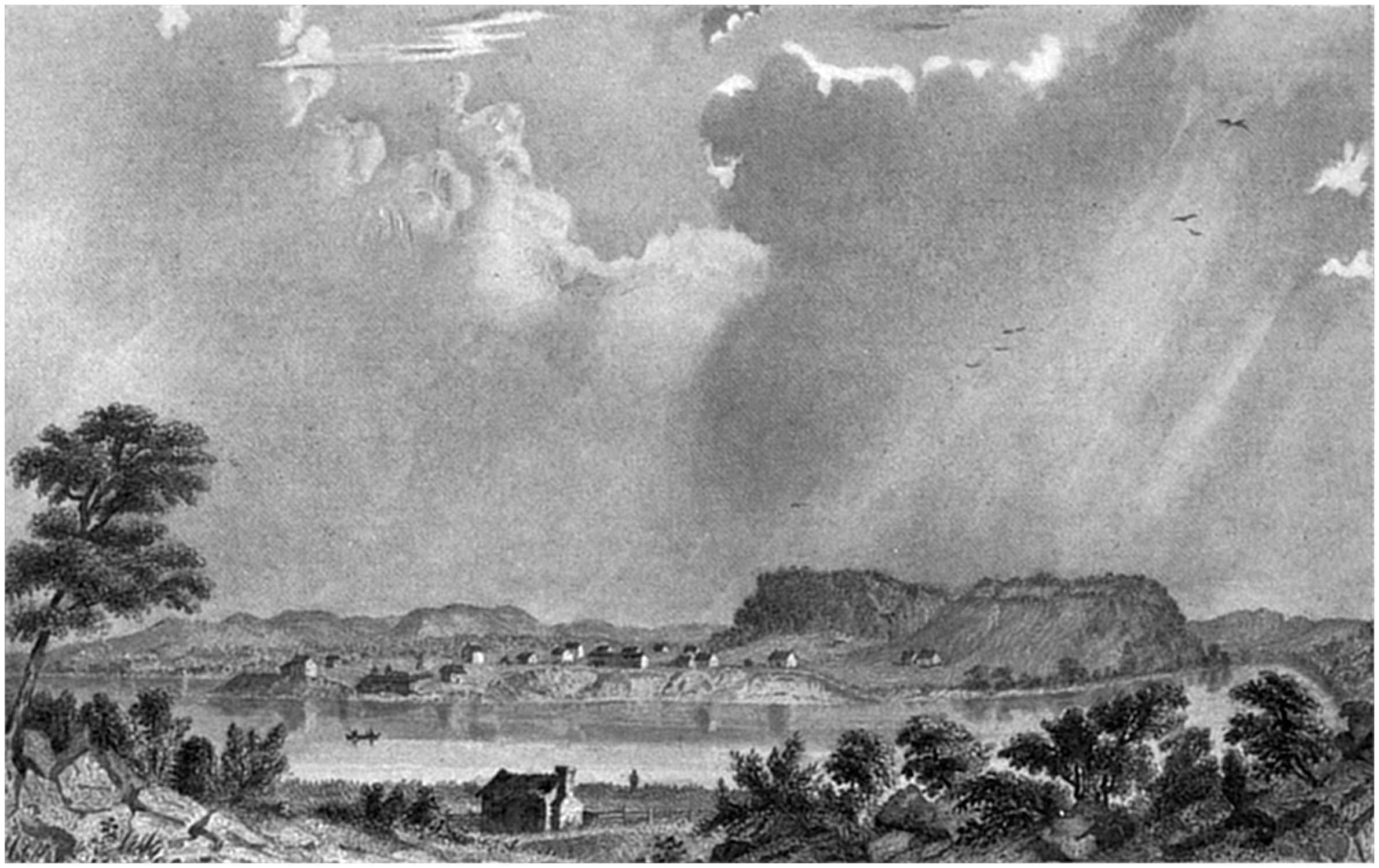
Pittsburgh — CHAPTER I THE FORMATIVE PERIOD — REFERENCES Chapter I
Until all fear of Indian troubles had ceased,
there was practically no social life in
American pioneer communities. As long
as marauding bands of Indians appeared on the
outskirts of the settlements, the laws were but a
loose net with large meshes, thrown out from the
longer-settled country whence they emanated. In
the numerous interstices the laws were ineffective.
In this Pittsburgh was no exception. The nominal
reign of the law had been inaugurated among
the settlers in Western Pennsylvania as far back
as 1750, when the Western country was no man’s
land, and the rival claims set up by France and
England were being subjected to the arbitrament
of the sword. In that year Cumberland County
was formed. It was the sixth county in the province,
and comprised all the territory west of the
Susquehanna River, and north and west of York
County—limitless in its westerly extent—between
the province of New York on one side, and the
colony of Virginia and the province of Maryland
on the other. The first county seat was at
Shippinsburg, but the next year, when Carlisle
was laid out, that place became the seat of justice.
After the conclusion of the French and Indian
War, and the establishment of English supremacy,
a further attempt was made to govern Western
Pennsylvania by lawful methods, and in 1771
Bedford County was formed out of Cumberland
County. It included nearly all of the western
half of the province. With Bedford, the new
county seat, almost a hundred miles away, the law
had little force in and about Pittsburgh. To bring
the law nearer home, Westmoreland County was
formed in 1773, from Bedford County, and embraced
all of the province west of “Laurel Hill.”
The county seat was at Hannastown, three miles
northeast of the present borough of Greensburg.
But with Virginia and Pennsylvania each claiming
jurisdiction over the territory an uncertainty prevailed
which caused more disregard for the law.
The Revolutionary War came on, with its attendant
Indian troubles; and in 1794 the western
counties revolted against the national government
on account of the imposition of an excise on
whisky. It was only after the last uprising had
been suppressed that the laws became effective
and society entered upon the formative stage.
Culture is the leading element in the formation
and progress of society, and is the result of mental
activity. The most potent agency in the production
of culture is education. While Pittsburgh
was a frontier village, suffering from the turbulence
of the French and Indian War, the uncertainty
of the Revolution, and the chaos of the
Whisky Insurrection, education remained at a
standstill. The men who had blazed trails through
the trackless forests, and buried themselves in
the woods or along the uncharted rivers, could
usually read and write, but there were no means
of transmitting these boons to their children. The
laws of the province made no provision for schools
on its frontiers. In December, 1761, the inhabitants
of Pittsburgh subscribed sixty pounds and
engaged a schoolmaster for the term of a year to
instruct their children. Similar attempts followed,
but, like the first effort, ended in failure. There
was not a newspaper in all the Western country;
the only books were the Bible and the almanac.
The almanac was the one form of secular literature
with which frontier families were ordinarily
familiar.
In 1764, while Pittsburgh was a trading post,
the military authorities caused a plan of the village
to be made by Colonel John Campbell. It consisted
of four blocks, and was bounded by Water
Street, Second Street, now Second Avenue, Market
and Ferry Streets, and was intersected by
Chancery Lane. The lots faced in the direction of
Water Street. In this plan most of the houses
were built.
At the outbreak of the Revolution, the proprietors
of the province were the cousins, John Penn,
Jr., and John Penn, both grandsons of William
Penn, the founder of Pennsylvania. Being royalists,
they had been divested of the title to all their
lands in Pennsylvania, except to a few tracts which
had been surveyed, called manors, one of them
being “Pittsburgh,” in which was included the
village of that name. In 1784 the Penns conceived
the design of selling land in the village of
Pittsburgh. The first sale was made in January,
when an agreement to sell was entered into with
Major Isaac Craig and Colonel Stephen Bayard,
for about three acres, located “between Fort Pitt
and the Allegheny River.” The Penns determined
to lay out a town according to a plan of
their own, and on April 22, 1784, Tench Francis,
their agent, employed George Woods, an engineer
living at Bedford, to do the work. The plan was
completed in a few months, and included within
its boundaries all the land in the triangle between
the Allegheny and Monongahela Rivers, extending
to Grant Street and Washington, now Eleventh,
Street. Campbell’s plan was adopted unchanged;
Tench Francis approved the new plan and began
to sell lots. Major Craig and Colonel Bayard accepted,
in lieu of the acreage purchased by them,
a deed for thirty-two lots in this plan.
Until this time, the title of the occupants of
lands included in the plan had been by sufferance
only. The earlier Penns were reputed to have
treated the Indians, the original proprietors of
Pennsylvania, with consideration. In the same
manner John Penn, Jr., and John Penn dealt with
the persons who made improvements on the lands
to which they had no title. They permitted the
settlement on the assumption that the settlers
would afterwards buy the land; and they gave
them a preference. Also when litigation arose,
caused by the schemes of land speculators intent
on securing the fruits of the enterprise and industry
of squatters on the Penn lots, the courts generally
intervened in favor of the occupants.1 The sale
was advertised near and far, and immigrants and
speculators flocked into the village. They came
from Eastern Pennsylvania, from Virginia, from
Maryland, from New York, and from distant
New England. The pack trains carrying merchandise
and household effects into Pittsburgh
became ever longer and more numerous.
Once that the tide of emigration had set in
toward the West, it grew constantly in volume.
The roads over the Alleghany Mountains were
improved, and wheeled conveyances no longer
attracted the curious attention that greeted Dr.
Johann David Schoepf when he arrived in Pittsburgh
in 1783, in the cariole in which he had crossed
the mountains, an achievement which until then
had not been considered possible.2 The monotonous
hoof-beats of the pack horses became less
frequent, and great covered wagons, drawn by
four horses, harnessed two abreast, came rumbling
into the village. But not all the people or all
the goods remained in Pittsburgh. There were
still other and newer Eldorados, farther away to
the west and the south, and these lands of milk
and honey were the Meccas of many of the adventurers.
Pittsburgh was the depository of the
merchandise sent out from Philadelphia and Baltimore,
intended for the western and southern
country and for the numerous settlements that
were springing up along the Monongahela and
Allegheny Rivers.3 From Pittsburgh trading
boats laden with merchandise were floated down
the Ohio River, stopping at the towns on its banks
to vend the articles which they carried.4 Coal
was cheap and emigrant and trading boats carried
it as ballast.5 In Pittsburgh the immigrants
lingered, purchasing supplies, and gathering information
about the country beyond. Some proceeded
overland. Others sold the vehicles in
which they had come, and continued the journey
down the Ohio River, in Kentucky flat or family
boats, in keel boats, arks, and barges. The construction
and equipping of boats became an
industry of moment in Pittsburgh.
The last menace from the Indians who owned
and occupied the country north of the Allegheny
and Ohio Rivers was removed on October 21,
1784, when the treaty with the Six Nations was
concluded at Fort Stanwix, by which all the Indian
lands in Pennsylvania except a tract bordering
on Lake Erie were ceded to the State. This vast
territory was now opened for settlement, and
resulted in more immigrants passing through
Pittsburgh. The northerly boundary of the village
ceased to be the border line of civilization.
The isolation of the place became less pronounced.
The immigrants who remained in Pittsburgh were
generally of a sturdy class, and were young and
energetic. Among them were former Revolutionary
officers and soldiers. They engaged in
trade, and as an adjunct of this business speculated
in lands in the county, or bought and sold
town lots. A few took up tavern keeping. From
the brief notes left by Lewis Brantz who stopped
over in Pittsburgh in 1785, while on a journey
from Baltimore to the Western country, it appears
that at this time Fort Pitt was still garrisoned
by a small force of soldiers; that the inhabitants
lived chiefly by traffic, and by entertaining travellers;
and that there were but few mechanics in
the village.6 The extent of the population can be
conjectured, when it is known that in 1786 there
were in Pittsburgh only thirty-six log buildings,
one of stone, and one of frame; and that there
were six stores.7
Religion was long dormant on the frontier.
In 1761 and 1762, when the first school was in
operation in Pittsburgh, the schoolmaster conducted
religious services on Sundays to a small
congregation. Although under the direction of a
Presbyterian, the services consisted in reading the
Prayers and the Litany from the Book of Common
Prayer.8 During the military occupation, a chaplain
was occasionally stationed at Fort Pitt around
which the houses clustered. From time to time
missionaries came and tarried a few days or weeks,
and went their way again. The long intervals
between the religious services were periods of indifference.
An awakening came at last, and the
religious teachings of early life reasserted themselves,
and the settlers sought means to re-establish
a spiritual life in their midst. The Germans
and Swiss-Germans of the Protestant Evangelical
and Protestant Reformed faiths jointly organized
a German church in 1782; and the Presbyterians
formed a church organization two years later.
The first pastor of the German church was the
Rev. Johann Wilhelm Weber, who was sent out
by the German Reformed Synod at Reading.9
He had left his charge in Eastern Pennsylvania
because the congregation which he served had
not been as enthusiastic in its support of the Revolution
as he deemed proper.10 The services were
held in a log building situated at what is now the
corner of Wood Street and Diamond Alley.11
Besides ministering to the wants of the Pittsburgh
church, there were three other congregations on
Weber’s circuit, which extended fifty miles east
of Pittsburgh. When he came West in September,
1782, the Revolutionary War was still
in progress; Hannastown had been burned by
the British and Indians in the preceding July;
hostile Indians and white outlaws continually
beset his path. He was a soldier of the Cross,
but he was also ready to fight worldly battles.
He went about the country armed not only with
the Bible, but with a loaded rifle,12 and was prepared
to battle with physical enemies, as well as
with the devil.
Hardly had the churches come into existence
when another organization was formed whose
origin is claimed to be shrouded in the mists of
antiquity. In the American history of the order,
the membership included many of the greatest
and best known men in the country. On December
27, 1785, the Grand Lodge of Pennsylvania,
Free and Accepted Masons, granted a charter to
certain freemasons resident in Pittsburgh, which
was designated as “Lodge No. 45 of Ancient York
Masons.” It was not only the first masonic lodge
in Pittsburgh, but the first in the Western country.13
Almost from the beginning, Lodge No. 45
was the most influential social organization in
the village. Nearly all the leading citizens were
members. Toward the close of the eighteenth
century the place of meeting was in the tavern
of William Morrow, at the “Sign of the Green
Tree,” on Water Street, two doors above Market
Street.14 Although not a strictly religious organization,
the order carefully observed certain Church
holidays. St. John the Baptist’s day and St.
John the Evangelist’s day were never allowed to
pass without a celebration. Every year in June,
on St. John the Baptist’s day, Lodge No. 45 met
at 10 o’clock in the morning and, after the services
in the lodge were over, paraded the streets.
The members walked two abreast. Dressed in
their best clothes, with cocked hats, long coats,
knee-breeches, and buckled shoes, wearing the
aprons of the craft, they marched “in ancient
order.” The sword bearer was in advance; the
officers wore embroidered collars, from which
depended their emblems of office; the wardens
carried their truncheons; the deacons, their staves.
The Bible, surmounted by a compass and a square,
on a velvet cushion, was borne along. When the
Rev. Robert Steele came to preach in the Presbyterian
Meeting House, the march was from the
lodge room to the church. Here Mr. Steele
preached a sermon to the brethren, after which
they dined together at Thomas Ferree’s tavern
at the “Sign of the Black Bear,”15 or at the “Sign
of the Green Tree.”16 St. John the Evangelist’s
day was observed with no less circumstance.
In the morning the officers of the lodge were installed.
Addresses of a semi-religious or philosophic
character, eulogistic of masonry, were
delivered by competent members or visitors.
This ceremony was followed in the afternoon by
a dinner either at some tavern or at the home of
a member. Dinners seemed to be a concomitant
part of all masonic ceremonies.
By the time that the last quarter of the eighteenth
century was well under way, the hunters
and trappers had left for more prolific hunting
grounds. The Indian traders with their lax
morals17 had disappeared forever in the direction
of the setting sun, along with the Indians with
whom they bartered. If any traders remained,
they conformed to the precepts of a higher civilization.
Only a scattered few of the red men continued
to dwell in the hills surrounding the village,
or along the rivers, eking out a scant livelihood
by selling game in the town.18
A different moral atmosphere appeared: schools
of a permanent character were established; the
German church conducted a school which was
taught by the pastor. Secular books were now
in the households of the more intelligent; a few
of the wealthier families had small libraries, and
books were sold in the town. On August 26, 1786,
Wilson and Wallace advertised “testaments,
Bibles, spelling books, and primers” for sale.19
Copies of the Philadelphia and Baltimore newspapers
were brought by travellers, and received
by private arrangement.
In July, 1786, John Scull and Joseph Hall,
two young men of more than ordinary daring, came
from Philadelphia and established a weekly newspaper
called the Pittsburgh Gazette, which was the
first newspaper published in the country west of the
Alleghany Mountains. The partnership lasted only
a few months, Hall dying on November 10, 1786,
at the early age of twenty-two years;20 and in the
following month, John Boyd, also of Philadelphia,
purchased Hall’s interest and became the partner
of Scull.21 For many years money was scarcely
seen in Pittsburgh in commercial transactions,
everything being consummated in trade. A few
months after its establishment, the Pittsburgh
Gazette gave notice to all persons residing in the
country that it would receive country produce
in payment of subscriptions to the paper.22
The next year there were printed, and kept for
sale at the office of the Pittsburgh Gazette, spelling
books, and The A.B.C. with the Shorter Catechism,
to which are Added Some Short and Easy Questions
for Children; secular instruction was combined with
religious.23 The Pittsburgh Gazette also conducted
an emporium where other reading matter might
be purchased. In the issue for June 16, 1787, an
illuminating notice appeared: “At the printing
office, Pittsburgh, may be had the laws of this
State, passed between the thirtieth of September,
1775, and the Revolution; New Testaments;
Dilworth’s Spelling Books; New England Primers,
with Catechism; Westminster Shorter Catechism;
Journey from Philadelphia to New York by
Way of Burlington and South Amboy, by Robert
Slenner, Stocking Weaver; ... also a few books
for the learner of the French language.”
In November, 1787, there was announced as
being in press at the office of the Pittsburgh Gazette
the Pittsburgh Almanac or Western Ephemeris
for 1788.24 The same year that the almanac appeared,
John Boyd attempted the establishment
of a circulating library. In his announcement
on July 26th,25 he declared that the library
would be opened as soon as a hundred subscribers
were secured; and that it would consist of five
hundred well chosen books. Subscriptions were to
be received at the office of the Pittsburgh Gazette.
Boyd committed suicide in the early part of
August by hanging himself to a tree on the hill
in the town, which has ever since borne his name,
and Scull became the sole owner of the Pittsburgh
Gazette. This act of self-destruction, and the fact
that Boyd’s name as owner appeared in the Pittsburgh
Gazette for the last time on August 2d,
would indicate that the library was never established.
Perhaps it was the anticipated failure of
the enterprise that prompted Boyd to commit
suicide.
The door to higher education was opened on
February 28, 1787, when the Pittsburgh Academy
was incorporated by an Act of the General Assembly.
This was the germ which has since developed
into the University of Pittsburgh. Another
step which tended to the material and mental
advancement of the place, was the inauguration
of a movement for communicating regularly with
the outside world. On September 30, 1786, a
post route was established with Philadelphia,26
and the next year the general government entered
into a contract for carrying the mails between
Pittsburgh and that city.27 Almost immediately
afterward a post office was established in Pittsburgh
with Scull as postmaster, and a regular
post between the village and Philadelphia and
the East was opened on July 19, 1788.28 These
events constituted another milestone in the progress
of Pittsburgh.
Another instrument in the advancement of the
infant community was the Mechanical Society
which came into existence in 1788. On the twenty-second
of March, the following unique advertisement
appeared in the Pittsburgh Gazette: “Society was
the primeval desire of our first and great ancestor
Adam; the same order for that blessing
seems to inhabit more or less the whole race. To
encourage this it seems to be the earnest wish of a
few of the mechanics in Pittsburgh, to have a general
meeting on Monday the 24th inst., at six P.M.,
at the house of Andrew Watson, tavern keeper, to
settle on a plan for a well regulated society for the
purpose. This public method is taken to invite
the reputable tradesmen of this place to be punctual
to their assignation.”
Andrew Watson’s tavern was in the log building,
at the northeast corner of Market and Front
Streets. Front Street was afterward called First
Street, and is now First Avenue. At that time
all the highways running parallel with the Monongahela
River were designated as streets, as they
are now called avenues. The object of the Mechanical
Society was the improvement of the condition
of the workpeople, to induce workpeople to
settle in the town, and to procure manufactories
to be established there.
The society was more than local in character,
similar societies being in existence in New York,
Philadelphia, and in the neighboring village of
Washington. At a later day the Mechanical
Society of Pittsburgh produced plays, some of
which were given in the grand-jury room in the
upper story of the new court house. The society
also had connected with it a circulating library,
a cabinet of curiosities, and a chemical laboratory.
CHAPTER II A NEW COUNTY AND A NEW BOROUGH — REFERENCES Chapter II
The constantly rising tide of immigration required
more territorial subdivisions in the
western part of the State. Westmoreland
County had been reduced in size on March 28,
1781, by the creation of Washington County, but
was still inordinately large. The clamor of the
inhabitants of Pittsburgh for a separate county
was heeded at last, and on September 24, 1788,
Allegheny County was formed out of Westmoreland
and Washington Counties. To the new
county was added on September 17, 1789, other
territory taken from Washington County. In
March, 1792, the State purchased from the United
States the tract of land adjoining Lake Erie, consisting
of two hundred and two thousand acres,
which the national government had recently acquired
from the Indians. This was added to
Allegheny County on April 3, 1792. The county
then extended northerly to the line of the State
of New York, and the border of Lake Erie, and
westerly to the present State of Ohio.29 On
March 12, 1800, the county was reduced by the
creation of Beaver, Butler, Mercer, Crawford,
Erie, Warren, Venango, and Armstrong Counties,
the area of these counties being practically all
taken from Allegheny County. By Act of the
General Assembly of March 12, 1803, a small
part of Allegheny County was added to Indiana
County, and Allegheny County was reduced to
its present form and dimensions.30
On the formation of Allegheny County, Pittsburgh
became the county seat. The county was
divided into townships, Pittsburgh being located
in Pitt Township. Embraced in Pitt Township
was all the territory between the Monongahela
and Allegheny Rivers, as far east as Turtle Creek
on the Monongahela River, and Plum Creek on
the Allegheny River, and all of the county north
of the Allegheny and Ohio Rivers. With the
growth of prosperity in the county, petty offenses
became more numerous, and a movement was begun
for the erection of a jail in Pittsburgh.31
Next to the establishment of the Pittsburgh
Gazette, the publication and sale of books, and the
opening of the post route to the eastern country,
the most important event in the early social advancement
of Pittsburgh was the passage of an
Act by the General Assembly, on April 22, 1794, incorporating
the place into a borough. The township
laws under which Pittsburgh had been
administered were crude and intended only for
agricultural and wild lands, and were inapplicable
to the development of a town. Under the code of
laws which it now obtained, it possessed functions
suitable to the character which it assumed, and
could perform acts leading to its material and
social progress. It was given the power to open
streets, to regulate and keep streets in order, to
conduct markets, to abate nuisances, and to levy
taxes.32
Before the incorporation of the borough, various
steps had been taken in anticipation of that event.
The Pittsburgh Fire Company was organized in
1793, with an engine house33 and a hand engine
brought from Philadelphia. A new era in transportation
was inaugurated on Monday, October
21, 1793, by the establishment of a packet line on
the Ohio River, between Pittsburgh and Cincinnati,
with boats “sailing” bi-weekly. The safety
of the passengers from attacks by hostile Indians
infesting the Ohio Valley, was assured. The boats
were bullet-proof, and were armed with small
cannon carrying pound balls; muskets and ammunition
were provided, and from convenient portholes,
passengers and crew could fire on the
enemy.34
One of the first measures enacted after Pittsburgh
was incorporated, was that to prohibit hogs
running at large.35 The dissatisfaction occasioned
by the imposition of the excise on whisky, had
caused a spirit of lawlessness to spring up in the
country about Pittsburgh. When this element
appeared in the town, they were disposed, particularly
when inflamed with whisky, to show their
resentment toward the inhabitants, whom they
regarded as being unfriendly to the Insurgent
cause, by galloping armed through the streets,
firing their pieces as they sped by, to the terror of
the townspeople. This was now made an offense
punishable by a fine of five shillings.36
Literary culture was hardly to be expected on
the frontier, yet a gentleman resided in Pittsburgh
who made some pretension in that direction.
Hugh Henry Brackenridge was the leading lawyer
of the town, and in addition to his other activities,
was an author of note. Before coming to Pittsburgh
he had, jointly with Philip Freneau, written
a volume of poetry entitled, The Rising Glory of
America, and had himself written a play called
The Battle of Bunker Hill. While a resident in
Pittsburgh he contributed many articles to the
Pittsburgh Gazette. His title to literary fame,
however, results mainly from the political satire
that he wrote, which in its day created a sensation.
It was called Modern Chivalry, and as originally
published was a small affair. Only one
of the four volumes into which it was divided
was printed in Pittsburgh, the first, second,
and fourth being published in Philadelphia. The
third volume came out in Pittsburgh, in 1793,
and was printed by Scull, and was the first book
published west of the Alleghany Mountains. The
work, as afterward rewritten and enlarged, ran
through more than half a dozen editions.
The interest in books increased. In 1793,
William Semple began selling “quarto pocket and
school Bibles, spelling books, primers, dictionaries,
English and Dutch almanacs, with an assortment
of religious, historical, and novel books.”37
“Novel books” was no doubt meant to indicate
novels. In 1798 the town became possessed of a
store devoted exclusively to literature. It was
conducted in a wing of the house owned and
partially occupied by Brackenridge on Market
Street.
John C. Gilkison had been a law student in
Brackenridge’s office, and had tutored his son.
Abandoning the idea of becoming a lawyer, he
began with the aid of Brackenridge, to sell books
as a business.38 In his announcement to the
public his plans were outlined:39 “John C. Gilkison
has just opened a small book and stationery
store.... He has a variety of books for sale,
school books especially, an assortment of which
he means to increase, and keep up as encouragement
may enable him; he has also some books of
general instruction and amusement, which he will
sell or lend out for a reasonable time, at a reasonable
price.”
Changes were made in the lines of the townships
at an early day. When the new century dawned,
Pitt Township adjoined Pittsburgh on the east.
East of Pitt Township and between the Monongahela
and Allegheny Rivers were the Townships
of Plum, Versailles, and Elizabeth. On the south
side of the Monongahela River, extending from
the westerly line of the county to Chartiers Creek,
was Moon Township. East of Chartiers Creek,
and between that stream and Streets Run was St.
Clair Township, and east of Streets Run, extending
along the Monongahela River, was Mifflin
Township, which ran to the county line. Back of
Moon Township was Fayette Township. North
of the Allegheny and Ohio Rivers were the Townships
of Pine and Deer. They were almost equal
in area, Pine being in the west, and Deer in the
east, the dividing line being near the mouth of
Pine Creek in the present borough of Etna.
The merchants and manufacturers of Pittsburgh
had been accumulating money for a decade. In
the East money was the medium of exchange, and
it was brought to the village by immigrants and
travelers, and began to circulate more freely
than before. In addition to the money put into
circulation by the immigrants, the United States
Government had expended nearly eight hundred
thousand dollars on the expedition which was
sent out to suppress the Whisky Insurrection.
At least half of this sum was spent in Pittsburgh
and its immediate vicinity, partly for supplies
and partly by the men composing the army. The
expedition was also the means of advertising the
Western country in the East, and created a new
interest in the town. A considerable influx of
new immigrants resulted. With the growth in
population, the number of the mercantile establishments
increased. Pittsburgh became more
than ever the metropolis of the surrounding
country.
Ferries made intercourse with the districts
across the rivers from Pittsburgh easy, except
perhaps in winter when ice was in the streams.
Three ferries were in operation on the Monongahela
River. That of Ephraim Jones at the
foot of Liberty Street40 was called the Lower
Ferry. A short distance above the mouth of
Wood Street was Robert Henderson’s Ferry, formerly
conducted by Jacob Bausman. This was
known as the Middle Ferry. Isaac Gregg’s Ferry,
at this time operated by Samuel Emmett,41 also
called the Upper Ferry, was located a quarter of
a mile above the town, at the head of the Sand
Bar. Over the Allegheny River, connecting St.
Clair Street with the Franklin Road, now Federal
Street, was James Robinson’s Ferry. As an inducement
to settle on the north side of the Allegheny
River, Robinson advertised that “All
persons going to and returning from sermon, and
all funerals, ferriage free.”42
The aspect of the town was changing. It was
no longer the village which Lewis Brantz saw on
his visit in 1790, when he painted the sketch
which is the first pictorial representation of the
place extant.43 In the old Military Plan the
ground was compactly built upon. Outside of
this plan the houses were sparse and few in
number, and cultivated grounds intervened.
Thomas Chapman who visited Pittsburgh in
1795, reported that out of the two hundred
houses in the village, one hundred and fifty were
built of logs.44 They were mainly of rough-hewn
logs, only an occasional house being of sawed logs.
The construction of log houses was discontinued,
the new houses being generally frame. Houses of
brick began to be erected, the brick sold at the
dismantling of Fort Pitt supplying the first material
for the purpose. The houses built of brick
taken from Fort Pitt were characterized by the
whiteness of the brick of which they were constructed.45
Brickyards were established. When
Chapman was in Pittsburgh, there were two brickyards
in operation in the vicinity of the town.46
With their advent brick houses increased rapidly.
With the evolution in the construction of the
houses, came another advance conducive to both
the health and comfort of the occupants. While
window glass was being brought from the East,
and was subject to the hazard of the long and
rough haul over the Alleghany Mountains, the
windows in the houses were few, and the panes
of small dimensions; six inches in width by eight
inches in length was an ordinary size. The
interior of the houses was dark, cheerless, and
damp. In the spring of 1797, Albert Gallatin, in
conjunction with his brother-in-law, James W. Nicholson,
and two Germans, Christian Kramer and
Baltzer Kramer, who were experienced glass-blowers,
began making window glass at a manufactory
which they had established on the Monongahela
River at New Geneva in Fayette County.47
The same year that window glass was first produced
at New Geneva, Colonel James O’Hara
and Major Isaac Craig commenced the construction
of a glass manufactory on the south side of
the Monongahela River, opposite Pittsburgh, and
made their first window glass in 1800. Both
manufactories produced window glass larger in
size than that brought from the East, O’Hara
and Craig’s glass measuring as high as eighteen
by twenty-four inches.48 The price of the Western
glass was lower than that brought across the
mountains. With cheaper glass, windows became
larger and more numerous, and a more cheerful
atmosphere prevailed in the houses.
All that remained of Pittsburgh’s former military
importance were the dry ditch and old ramparts
of Fort Pitt,49 in the westerly extremity
of the town, together with some of the barracks
and the stone powder magazine, and Fort Fayette
near the northeasterly limits, now used solely
as a military storehouse.50 Not a trace of architectural
beauty was evident in the houses. They
were built without regularity and were low and
plain. In one block were one- and two-story log
and frame houses, some with their sides, others
with their gable ends, facing the street. In the
next square there was a brick building of two or
possibly three stories in height; the rest of the
area was covered with wooden buildings of every
size and description. The Lombardy poplars and
weeping willows which grew along the streets51
softened the aspect of the houses before which
they were planted. The scattered houses on the
sides of the hills which commanded the town on
the east52 were more attractive.
It was forty years before houses, even on the
leading streets, were numbered.53 The taverns
and many of the stores, instead of being known by
the number of their location on the street, or by
the name of the owner, were recognized by their
signs, which contained characteristic pictures or
emblems. The signs were selected because associated
with them was some well-known sentiment;
or the picture represented a popular hero. In
the latter category was the “Sign of General
Washington,” conducted by Robert Campbell,
at the northeast corner of Wood Street and Diamond
Alley. Sometimes the signs were of a humorous
character, as the “Whale and the Monkey”
with the added doggerel:
“Here the weary may rest,
The hungry feed,
And those who thirst,
May quaff the best,”
displayed by D. McLane54 when he conducted
the tavern on Water Street, afterward known as
the “Sign of the Green Tree.” The sign was hung
either on the front of the house, or on a board
attached to a wooden or iron arm projecting from
the building, or from a post standing before it. The
last was the manner in which most of the tavern
signs were displayed. This continued until 1816,
when all projecting or hanging signs were prohibited,
except to taverns where stabling and other
accommodations for travelers could be obtained.
Only taverns located at street corners were thereafter
permitted to have signposts.55
Not a street was paved, not even the footwalks,
except for such irregular slabs of stone, or brick,
or planks as had been laid down by the owners
of adjoining houses. Major Thomas S. Forman
who passed through Pittsburgh in December,
1789, related that the town was the muddiest
place he was ever in.56 In 1800, there was little
improvement. Samuel Jones was the first Register
and Recorder of Allegheny County, and held
those offices almost continuously well into the
nineteenth century. He resided in Pittsburgh
during the entire period, and his opportunities for
observation were unexcelled. His picture of the
borough in 1800 is far from attractive. “The
streets,” he wrote, were “filled with hogs, dogs,
drays, and noisy children.”57 At night the streets
were unlighted. “A solitary lamp twinkled here
and there, over the door of a tavern, or on a
signpost, whenever the moon was in its first or
last quarter. The rest of the town was involved
in primeval darkness.”
CHAPTER III THE MELTING POT — REFERENCES Chapter III
The population of Pittsburgh was composed
of various nationalities; those speaking
the English language predominated. In
addition to the Germans and Swiss-Germans,
there were French and a few Italians. The
majority of the English-speaking inhabitants were
of Irish or Scotch birth, or immediate extraction.
Of those born in Ireland or Scotland, some were
old residents—so considered if they had lived in
Pittsburgh for ten years or more—while others
were recent immigrants. The Germans and
French had come as early as the Irish and Scotch.
The Italians were later arrivals. There was also
a sprinkling of Welsh. The place contained a
number of negroes, nearly all of whom were slaves,
there being in 1800 sixty-four negro slaves in
Allegheny County,58 most of whom were in Pittsburgh
and the immediate vicinity. A majority
of the negroes had been brought into the village
in the early days by emigrants from Virginia and
Maryland. Their number was gradually decreasing.
By Act of the General Assembly of March
1, 1780, all negroes and mulattoes born after that
date, of slave mothers, became free upon arriving
at the age of twenty-eight years. Then on March
29, 1788, it was enacted that any slaves brought
into the State by persons resident thereof, or intending
to become such, should immediately be
free.59 Also public sentiment was growing hostile
to the institution of negro slavery. The few free
negroes in Pittsburgh were engaged in menial
occupations, and the name of only one, whose
vocation was somewhat higher, has been handed
down to the present time. This was Charles
Richards, commonly called “Black Charley,” who
conducted an inn in the log house, at the northwest
corner of Second and Ferry Streets.
Among themselves the Germans and the French
spoke the language of their fathers, but in their
intercourse with their English-speaking neighbors
they used English. The language of the
street varied from the English of New England
and Virginia, to the brogue of the Irish and Scotch,
or the broken enunciation of the newer Germans
and French. Being in a majority the English-speaking
population controlled to a considerable
extent the destinies of the community. Their
manufactories were the most extensive, the merchandise
in their stores was in greater variety,
and the stocks larger than those carried in other
establishments.
Next in numbers to those whose native language
was English, were the German-speaking inhabitants.
They constituted the skilled mechanics;
some were merchants, and many were engaged in
farming in the neighboring townships. They
were all more or less closely connected with the
German church. Only the names of their leading
men have survived the obliterating ravages
of time. Among the mechanics of the higher class
were Jacob Haymaker, William Eichbaum, and
John Hamsher. The first was a boatbuilder,
whose boatyard was located on the south side of
the Monongahela River at the Middle Ferry;
Eichbaum was employed by O’Hara and Craig
in the construction and operation of their glass
works. John Hamsher was a coppersmith and
tin-worker, whose diversion was to serve in the
militia, in which he was captain.60
Conrad Winebiddle, Jonas Roup, Alexander Negley,
and his son, Jacob Negley, were well-to-do
farmers in Pitt Township. Winebiddle was a
large holder of real estate, who died in 1795, and
enjoyed the unique distinction of being the only
German who ever owned negro slaves in Allegheny
County. Nicholas Bausman and Melchoir Beltzhoover
were farmers in St. Clair Township; and
Casper Reel was a farmer and trapper in Pine
Township, where he was also tax collector.
Samuel Ewalt kept a tavern in Pittsburgh in 1775,
and was afterward a merchant. He was Sheriff
of Allegheny County during the dark days of the
Whisky Insurrection, and later was inspector of
the Allegheny County brigade of militia. He was
several times a member of the Pennsylvania House
of Representatives. William Wusthoff was Sheriff
of Allegheny County in 1801. Jacob Bausman
had a varied career. He was a resident of Pittsburgh
as far back as 1771, and was perhaps the
most prominent German in the place. As a young
man he was an ensign in the Virginia militia, during
the Virginia contention. He established the
first ferry on the Monongahela River, which ran
to his house on the south side of the stream, where
the southern terminus of the Smithfield Street
bridge is now located. The right to operate the
ferry was granted to him by the Virginia Court
on February 23, 1775, and was confirmed by
the General Assembly of Pennsylvania ten years
later. At his ferry house he also conducted a
tavern. His energies were not confined to his
private affairs. Under the Act of the General
Assembly incorporating Allegheny County, he
was named as one of the trustees to select land
for a court house in the tract reserved by the
State, in Pine Township, and was again, under the
Act of April 13, 1791, made a trustee to purchase
land in Pittsburgh for the same purpose. He was
treasurer of the German church and, jointly with
Jacob Haymaker, was trustee, on the part of the
church, of the land deeded by the Penns to that
congregation for church purposes at the northeast
corner of Smithfield and Sixth Streets, where the
congregation’s second and all subsequent churches
were built. Michael Hufnagle was a member of
the Allegheny County Bar, being one of the first
ten men to be admitted to practice, upon the organization
of the county. He was the only lawyer
of German nationality in the county. He had
been a captain in the Revolution, and prothonotary
of Westmoreland County. On July 13, 1782,
when the Indians and Tories attacked Hannastown,
he occupied a farm situated a mile and a
half north of that place, which has ever since
been known in frontier history as the place where
the townsfolk were harvesting when the attack
began.61
By their English-speaking neighbors the Germans
were generally designated as “Dutch.” In
the references to them in the Pittsburgh Gazette and
other early publications, they were likewise called
“Dutch.” Books printed in the German language
were advertised as “Dutch” books. The
custom of speaking of the Germans as “Dutch”
was however not confined to Pittsburgh, but was
universal in America. The Dutch inhabitants
of New York and elsewhere, were the first settlers
in the colonies, whose language was other than
English. The bulk of the English-speaking population,
wholly ignorant of any language except their
own, were easily led into the error of confusing
the newer German immigrants with the Dutch,
the only persons speaking a foreign tongue with
whom they had come in contact. Nor were the
uneducated classes the only transgressors in this
respect. The Rev. Dr. William Smith, the scholarly
Provost of the College of Philadelphia, writing
during the French and Indian War, spoke of the
Germans as “the Dutch or Germans.”62 Also
“Dutch” bears a close resemblance to “Deutsch,”
the German name for people of the German race,
which may account, to some extent, for the misuse
of the word.
The Germans were in Pittsburgh to stay.
Their efforts were directed largely toward private
ends. When men of other blood made records
in public life, the Germans made theirs in the
limited sphere of their own employment or enterprises.
Owing to their inability to speak the
English language, their position was more isolated
than that of the greenest English-speaking immigrant
in the village. That they were clannish
was a natural consequence. This disposition
was accentuated when a newspaper printed in the
German language was established on November
22, 1800, in the neighboring borough of Greensburgh,
entitled The German Farmers’ Register,
being the first German paper published in the
Western country. Subscriptions were received in
Pittsburgh at the office of the Tree of Liberty,63 then
recently established, and the effort to acquire a
knowledge of English in order to be able to read
the news of the day in the Pittsburgh newspapers,
was for the time being largely abandoned. As
the Germans learned to speak and read English,
their social intercourse was no longer restricted to
persons of their own nationality. With the next
generation, intermarriages with persons of other
descent took place. The German language ceased
to be cultivated; they forsook the German church
for one where English was the prevailing language.
It is doubtful if a single descendant of the old
Germans is now able to speak the language of
his forbears unless it was learned at school, or that
he is a member of or attends the services of the
German church.
The French element was an almost negligible
quantity, yet it exerted an influence far beyond
what might be expected when its numbers are
considered. So strong was the tide of public
opinion in favor of all things French, occasioned
by the events of the French Revolution, that Albert
Gallatin, a French-Swiss, who had just been naturalized,
and still spoke English with a decided foreign
accent, attained high political honors. To
the people he was essentially a Frenchman, and
in 1794, he was elected to the Pennsylvania House
of Representatives, from Fayette County where he
lived. At the same time he was elected to Congress
from the district consisting of Allegheny and
Washington Counties; and was twice re-elected
from the same district, which included Greene
County after the separation from Washington
County in 1796, and its erection into a separate
county. It was while serving this constituency
that Gallatin developed those powers in finance
and statesmanship which caused his appointment
as Secretary of the Treasury by President Jefferson,
and by Jefferson’s successor, President Madison.
From the politicians of this Congressional
District, Gallatin learned those lessons in diplomacy
which enabled him, while joint commissioner
of the United States, to secure the signature of England
to the Treaty of Ghent, by which the War
of 1812 was brought to a close, and which led to
his becoming United States Minister to France
and to England. The training of those early days
finally made him the most famous of all Americans
of European birth, and brought about his
nomination for Vice-President by the Congressional
caucus of the Republican party, an honor
which he first accepted, but later declined.64
Another prominent Frenchman was John B. C.
Lucus. In 1796, he lived on a farm on Coal Hill
on the south side of the Monongahela River, in
St. Clair Township, five miles above Pittsburgh.
It was said of him that he was an atheist and that
his wife plowed on Sundays, in spite of which he
was several times elected to the General Assembly.65
In 1800, he was appointed an associate judge for
the county. He quarrelled with Alexander Addison,
the president judge of the judicial district to
which Allegheny County was attached, yet he had
sufficient standing in the State to cause Judge
Addison’s impeachment and removal from the
Bench. In 1802, Lucus was elected to Congress
and was re-elected in 1804. In 1805, he was appointed
United States District Judge for the new
Territory of Louisiana, now the State of Missouri.
Dr. Felix Brunot arrived in Pittsburgh in 1797.
He came from France with Lafayette and was a
surgeon in the Revolutionary War and fought in
many of its battles. His office was located on
Liberty Street, although he owned and lived on
Brunot Island. An émigré, the Chevalier Dubac,
was a merchant.66 Dr. F. A. Michaux, the French
naturalist and traveler, related of Dubac:67 “I
frequently saw M. Le Chevalier Dubac, an old
French officer who, compelled by the events of the
Revolution to quit France, settled in Pittsburgh
where he engaged in commerce. He possesses
very correct knowledge of the Western country,
and is perfectly acquainted with the navigation of
the Ohio and Mississippi Rivers, having made
several voyages to New Orleans.” Morgan Neville
a son of Colonel Presley Neville, and a writer
of acknowledged ability, drew a charming picture
of Dubac’s life in Pittsburgh.68
Perhaps the best known Frenchman in Pittsburgh
was John Marie, the proprietor of the tavern
on Grant’s Hill. Grant’s Hill was the eminence
which adjoined the town on the east, the ascent
to the hill beginning a short distance west of Grant
Street. The tavern was located just outside of
the borough limits, at the northeast corner of
Grant Street and the Braddocksfield Road, where
it connected with Fourth Street. The inclosure
contained more than six acres, and was called
after the place of its location, “Grant’s Hill.”
It overlooked Pittsburgh, and its graveled walks
and cultivated grounds were the resort of the
townspeople. For many years it was the leading
tavern. Gallatin, who was in Pittsburgh, in 1787,
while on the way from New Geneva to Maine,
noted in his diary that he passed Christmas Day
at Marie’s house, in company with Brackenridge
and Peter Audrian,69 a well-known French merchant
on Water Street. Marie’s French nationality
naturally led him to become a Republican
when the party was formed, and his tavern was
long the headquarters of that party. Numerous
Republican plans for defeating their opponents
originated in Marie’s house, and many Republican
victories were celebrated in his rooms. Also in
this tavern the general meetings of the militia
officers were held.70 Michaux has testified that
Marie kept a good inn.71 The present court house,
the combination court house and city hall now
being erected, and a small part of the South School,
the first public school in Pittsburgh, occupy the
larger portion of the site of “Grant’s Hill.”
Marie’s name became well known over the State,
several years after he retired to private life. He
was seventy-five years of age in 1802, when he
discontinued tavern-keeping and sold “Grant’s
Hill” to James Ross, United States Senator from
Pennsylvania, who was a resident of Pittsburgh.
Marie had been estranged from his wife for a
number of years and by some means she obtained
possession of “Grant’s Hill,” of which Ross had
difficulty in dispossessing her. In 1808, Ross was
a candidate for governor against Simon Snyder.
Ross’s difference with Mrs. Marie, whose husband
had by this time divorced her, came to the
knowledge of William Duane in Philadelphia, the
brilliant but unscrupulous editor of the Aurora
since the discontinuance of the National Gazette,
in 1793, the leading radical Republican newspaper
in the country. The report was enlarged into a
scandal of great proportions both in the Aurora
and in a pamphlet prepared by Duane and circulated
principally in Philadelphia. The title of
the pamphlet was harrowing. It was called “The
Case of Jane Marie, Exhibiting the Cruelty and
Barbarous Conduct of James Ross to a Defenceless
Woman, Written and Published by the Object
of his Cruelty and Vengeance.” Although Marie
was opposed to Ross politically, he defended his
conduct toward Mrs. Marie as being perfectly honorable.
Nevertheless, the pamphlet played an important
part in obtaining for Snyder the majority of
twenty-four thousand by which he defeated Ross.
Notwithstanding the high positions which some
of the Frenchmen attained, they left no permanent
impression in Pittsburgh. After prospering
there for a few years, they went away and
no descendants of theirs reside in the city unless
it be some of the descendants of Dr. Brunot.
Some went south to the Louisiana country, and
others returned to France. Gallatin, himself,
long after he had shaken the dust of Western
Pennsylvania from his feet, writing about his
grandson, the son of his son James, said: “He is
the only young male of my name, and I have hesitated
whether, with a view to his happiness, I had
not better take him to live and die quietly at
Geneva, rather than to leave him to struggle in
this most energetic country, where the strong in
mind and character overset everybody else, and
where consideration and respectability are not at
all in proportion to virtue and modest merit.”72
And the grandson went to Geneva to live, and
his children were born there and he died there.73
The United States Government was still in
the formative stage. Until this time the men who
had fought the Revolutionary War to a successful
conclusion, held a tight rein on the governmental
machinery. Now a new element was growing up,
and, becoming dissatisfied with existing conditions,
organized for a conflict with the men in power.
The rise of the opposition to the Federal party was
also the outcome of existing social conditions. Like
the modern cry against consolidated wealth, the
movement was a contest by the discontented
elements in the population, of the men who had
little against those who had more. Abuses committed
by individuals and conditions common to
new countries were magnified into errors of government.
Also the people were influenced by the
radicalism superinduced by the French Revolution
and the subsequent happenings in France. “Liberty,
fraternity, and equality” were enticing
catchwords in the United States.
Thomas Jefferson, on his return from France,
in 1789, after an absence of six years, where he
had served as United States Minister, during the
development of French radicalism, came home
much strengthened in his ideas of liberty. They
were in strong contrast with the more conservative
notions of government entertained by Washington,
Vice-President Adams, Hamilton, and the
other members of the Cabinet. In March, 1790,
Jefferson became Secretary of State in Washington’s
first Cabinet, the appointment being held
open for him since April 13th of the preceding
year, when Washington entered on the duties of
the Presidency. Jefferson’s views being made
public, he immediately became the deity of the
radical element. At the close of 1793, the dissensions
in the Cabinet had become so acute that
on December 31st Jefferson resigned in order to
be better able to lead the new party which was
being formed. By this element the Federalists
were termed “aristocrats,” and “tories.” They
were charged with being traitors to their country,
and were accused of being in league with England,
and to be plotting for the establishment of a
monarchy, and an aristocracy. The opposition
party assumed the title of “Republican.” Later
the word “Democratic” was prefixed and the
party was called “Democratic Republican,”74
although in Pittsburgh for many years the words
“Republican,” “Democratic Republican,” and
“Democratic” were used interchangeably.
Heretofore Pennsylvania had been staunchly
Federal. On the organization of the Republican
party, Governor Thomas Mifflin, and Chief Justice
Thomas McKean of the Supreme Court, the two
most popular men in the State, left the Federal
party and became Republicans. There was also
a cause peculiar to Pennsylvania, for the rapid
growth of the Republican party in the State. The
constant increase in the backwoods population
consisted largely of emigrants from Europe,
chiefly from Ireland, who brought with them a
bitter hatred of England and an intense admiration
for France. They went almost solidly into
the Republican camp. The arguments of the
Republicans had a French revolutionary coloring
mingled with which were complaints caused by
failure to realize expected conditions. An address
published in the organ of the Republican party in
Pittsburgh is a fair example of the reasoning employed
in advocacy of the Republican candidates:
“Albert Gallatin, the friend of the people, the
enemy of tyrants, is to be supported on Tuesday,
the 14th of October next, for the Congress of the
United States. Fellow citizens, ye who are opposed
to speculators, land jobbers, public plunderers,
high taxes, eight per cent. loans, and
standing armies, vote for Mr. Gallatin!”75
In Pittsburgh the leader of the Republicans was
Hugh Henry Brackenridge, the lawyer and dilettante
in literature. In the fierce invective of the
time, he and all the members of his party were
styled by their opponents “Jacobins,” after the
revolutionary Jacobin Club of France, to which
all the woes of the Terror were attributed. The
Pittsburgh Gazette referred to Brackenridge as
“Citizen Brackenridge,” and after the establishment
of the Tree of Liberty, added “Jacobin printer
of the Tree of Sedition, Blasphemy, and Slander.”76
But the Republicans gloried in titles borrowed from
the French Revolution. The same year that Governor
Mifflin and Chief Justice McKean went over
to the Republicans, Brackenridge made a Fourth
of July address in Pittsburgh, in which he advocated
closer relations with France. This was
republished in New York by the Republicans, in
a pamphlet, along with a speech made by Maximilien
Robespierre in the National Convention of
France. In this pamphlet Brackenridge was
styled “Citizen Brackenridge.”77 The Pittsburgh
Gazette and the Tree of Liberty, contained numerous
references to meetings and conferences held at
the tavern of “Citizen” Marie. On March 4,
1802, the first anniversary of the inauguration of
Jefferson as President, a dinner was given by the
leading Republicans in the tavern of “Citizen”
Jeremiah Sturgeon, at the “Sign of the Cross
Keys,” at the northwest corner of Wood Street
and Diamond Alley, at which toasts were drunk
to “Citizen” Thomas Jefferson, “Citizen” Aaron
Burr, “Citizen” James Madison, “Citizen” Albert
Gallatin, and “Citizen” Thomas McKean.78
In 1799, the Republicans had as their candidate
for governor Chief Justice McKean. Opposed
to him was Senator James Ross. Ross was required
to maintain a defensive campaign. The
fact that he was a Federalist was alone sufficient
to condemn him in the eyes of many of the electors.
He was accused of being a follower of Thomas
Paine, and was charged with “singing psalms
over a card table.” It was said that he had
“mimicked” the Rev. Dr. John McMillan, the
pioneer preacher of Presbyterianism in Western
Pennsylvania, and a politician of no mean influence;
that he had “mocked” the Rev. Matthew
Henderson, a prominent minister of the Associate
Presbyterian Church.79 Although Allegheny
County gave Ross a majority of over eleven
hundred votes, he was defeated in the State by
more than seventy-nine hundred.80 McKean took
office on December 17, 1799,81 and the next day
he appointed Brackenridge a justice of the Supreme
Court. All but one or two of the county offices
were filled by appointment of the governor, who
could remove the holders at pleasure. The idea
of public offices being public trusts had not been
formulated. The doctrine afterward attributed
to Andrew Jackson, that “to the victors belong
the spoils of office,” was already a dearly cherished
principle of the Republicans, and Judge Brackenridge
was not an exception to his party. Hardly
had he taken his seat on the Supreme Bench, when
he induced Governor McKean to remove from
office the Federalist prothonotary, James Brison,
who had held the position since September 26,
1788, two days after the organization of the county.
Brison was very popular. As a young man, he
had lived at Hannastown, and during the attack
of the British and Indians on the place had been
one of the men sent on the dangerous errand of
reconnoitering the enemy.82 He was now captain
of the Pittsburgh Troop of Light Dragoons, the
crack company in the Allegheny County brigade
of militia, and was Secretary of the Board of
Trustees of the Academy. He was a society
leader and generally managed the larger social
functions of the town. General Henry Lee, the
Governor of Virginia, famous in the annals of the
Revolutionary War, as “Light-Horse Harry Lee,”
commanded the expedition sent by President
Washington to suppress the Whisky Insurrection,
and was in Pittsburgh several weeks during that
memorable campaign. On the eve of his departure
a ball was given in his honor by the citizens. On
that occasion Brison was master of ceremonies.
A few months earlier Brackenridge had termed
him “a puppy and a coxcomb.” Brackenridge
credited Brison with retaliating for the epithet,
by neglecting to provide his wife and himself with
an invitation to the ball. This was an additional
cause for his dismissal, and toward the close of
January the office was given to John C. Gilkison.
Gilkison who was a relative of Brackenridge, conducted
the bookstore and library which he had
opened the year before, and also followed the
occupation of scrivener, preparing such legal papers
as were demanded of him.83
CHAPTER IV LIFE AT THE BEGINNING OF THE NINETEENTH CENTURY — REFERENCES Chapter IV
The Pittsburgh Gazette was devoted to the
interests of the Federal party, and Brackenridge
and the other leading Republicans
felt the need of a newspaper of their own. The
result was the establishment on August 16, 1800,
of the Tree of Liberty, by John Israel, who was already
publishing a newspaper, called the Herald
of Liberty, in Washington, Pennsylvania. The
title of the new paper was intended to typify its
high mission. The significance of the name was
further indicated in the conspicuously displayed
motto, “And the leaves of the tree were for the
healing of the nations.” The Federalists, and
more especially their organ, the Pittsburgh Gazette,84
charged Brackenridge with being the owner of
the new paper, and with being responsible for its
utterances. Brackenridge, however, has left a
letter in which he refuted this statement, and
alleged that originally he intended to establish a
newspaper, but on hearing of Israel’s intention
gave up the idea.85
The extent of the comforts and luxuries enjoyed
in Pittsburgh was surprising. The houses, whether
built of logs, or frame, or brick, were comfortable,
even in winter. In the kitchens were large open
fire-places, where wood was burned. The best
coal fuel was plentiful. Although stoves were
invented barely half a century earlier, and were in
general use only in the larger cities, the houses
in Pittsburgh could already boast of many. There
were cannon stoves, so called because of their
upright cylindrical, cannon-like shape, and Franklin
or open stoves, invented by Benjamin Franklin;
the latter graced the parlor. Grates were giving
out their cheerful blaze. They were also in use
in some of the rooms of the new court house, and
in the new jail.
The advertisements of the merchants told the
story of what the people ate and drank, and of the
materials of which their clothing was made. Articles
of food were in great variety. In the stores
were tea, coffee, red and sugar almonds, olives,
chocolate, spices of all kinds, muscatel and keg
raisins, dried peas, and a score of other luxuries,
besides the ordinary articles of consumption. The
gentry of England, as pictured in the pages of the
old romances, did not have a greater variety of
liquors to drink. There were Madeira, sherry,
claret, Lisbon, port, and Teneriffe wines, French
and Spanish brandies,86 Jamaica and antique
spirits.87 Perrin DuLac, who visited Pittsburgh
in 1802, said these liquors were the only articles
sold in the town that were dear.88 But not all
partook of the luxuries. Bread and meat, and such
vegetables as were grown in the neighborhood,
constituted the staple articles of food, and homemade
whisky was the ordinary drink of the majority
of the population. The native fruits were
apples and pears, which had been successfully
propagated since the early days of the English
occupation.89
Materials for men’s and women’s clothing were
endless in variety and design and consisted of
cloths, serges, flannels, brocades, jeans, fustians,
Irish linens, cambrics, lawns, nankeens, ginghams,
muslins, calicos, and chintzes. Other
articles were tamboured petticoats, tamboured
cravats, silk and cotton shawls, wreaths and
plumes, sunshades and parasols, black silk netting
gloves, white and salmon-colored long and short
gloves, kid and morocco shoes and slippers, men’s
beaver, tanned, and silk gloves, men’s cotton and
thread caps, and silk and cotton hose.
Men were changing their dress along with their
political opinions. One of the consequences in
the United States of the French Revolution was
to cause the effeminate and luxurious dress in
general use to give way to simpler and less extravagant
attire. The rise of the Republican party
and the class distinctions which it was responsible
for engendering, more than any other reason,
caused the men of affairs—the merchants, the
manufacturers, the lawyers, the physicians, and
the clergymen—to discard the old fashions and
adopt new ones. Cocked hats gave way to soft
or stiff hats, with low square crowns and straight
brims. The fashionable hats were the beaver
made of the fur of the beaver, the castor made of
silk in imitation of the beaver, and the roram
made of felt, with a facing of beaver fur felted in.
Coats of blue, green, and buff, and waistcoats of
crimson, white, or yellow, were superseded by
garments of soberer colors. Coats continued to
be as long as ever, but the tails were cut away in
front. Knee-breeches were succeeded by tight-fitting
trousers reaching to the ankles; low-buckled
shoes, by high-laced leather shoes, or boots. Men
discontinued wearing cues, and their hair was cut
short, and evenly around the head. There were
of course exceptions. Many men of conservative
temperament still clung to the old fashions. A notable
example in Pittsburgh was the Rev. Robert
Steele, who always appeared in black satin knee-breeches,
knee-buckles, silk stockings, and pumps.90
The farmers on the plantations surrounding
Pittsburgh and the mechanics in the borough were
likewise affected by the movement for dress reform.
Their apparel had always been less picturesque
than that of the business and professional
men. Now the ordinary dress of the farmers and
mechanics consisted of short tight-fitting round-abouts,
or sailor’s jackets, made in winter of cloth
or linsey, and in summer of nankeen, dimity,
gingham, or linen. Sometimes the jacket was
without sleeves, the shirt being heavy enough to
afford protection against inclement weather. The
trousers were loose-fitting and long, and extended
to the ankles, and were made of nankeen, tow, or
cloth. Some men wore blanket-coats. Overalls,
of dimity, nankeen, and cotton, were the especial
badge of mechanics. The shirt was of tow or
coarse linen, the vest of dimity. On their feet,
farmers and mechanics alike wore coarse high-laced
shoes, half-boots, or boots made of neat’s
leather. The hats were soft, of fur or wool, and
were low and round-crowned, or the crowns were
high and square.
The inhabitants of Pittsburgh were pleasure-loving,
and the time not devoted to business
was given over to the enjoyments of life. Men
and women alike played cards. Whisk, as whist
was called, and Boston were the ordinary games.91
All classes and nationalities danced, and dancing
was cultivated as an art. Dancing masters came
to Pittsburgh to give instructions, and adults and
children alike took lessons. In winter public balls
and private assemblies were given. The dances
were more pleasing to the senses than any ever
seen in Pittsburgh, except the dances of the recent
revival of the art. The cotillion was executed by
an indefinite number of couples, who performed
evolutions or figures as in the modern german.
Other dances were the minuet, the menuet à la
cour, and jigs. The country dance, generally performed
by eight persons, four men and four
women, comprised a variety of steps, and a surprising
number of evolutions, of which liveliness
was the characteristic.
The taverns had rooms set apart for dances.
The “Sign of the Green Tree,”92 had an “Assembly
Room”; the “Sign of General Butler”93 and the
“Sign of the Waggon”94 each had a “Ball Room.”
The small affairs were given in the homes of the
host or hostess, and the large ones in the taverns,
or in the grand-jury room of the new court house.
The dancing masters gave “Practicing Balls”
at which the cotillion began at seven o’clock, and
the ball concluded with the country dance, which
was continued until twelve o’clock.95 Dancing
became so popular and to such an extent were
dancing masters in the eyes of the public that
William Irwin christened his race horse “Dancing
Master.”96 The ball given to General Lee was
talked about for years after the occurrence. Its
beauties were pictured by many fair lips. The
ladies recalled the soldierly bearing of the guest
of honor, the tall robust form of General Daniel
Morgan, Lee’s second in command, and the commander
of the Virginia troops, famous as the hero
of Quebec and Saratoga, who had received the
thanks of Congress for his victory at Cowpens.
They dwelt on the varicolored uniforms of the
soldiers, the bright colors worn by the civilians,
their powdered hair, the brocades, and silks, and
velvets of the ladies.
In winter evenings there were concerts and
theatrical performances which were generally
given in the new court house. A unique concert
was that promoted by Peter Declary. It was
heralded as a musical event of importance. Kotzwara’s
The Battle of Prague, was performed on
the “forte piano” by one of Declary’s pupils,
advertised as being only eight years of age; President
Jefferson’s march was another conspicuous
feature. The exhibition concluded with a ball.97
Comedy predominated in the theatrical performances.
The players were “the young gentlemen
of the town.” At one of the entertainments
they gave John O’Keefe’s comic opera The Poor
Soldier, and a farce by Arthur Murphy called The
Apprentice.98 There were also performances of a
more professional character. Bromley and Arnold,
two professional actors, conducted a series of theatrical
entertainments extending over a period of
several weeks. The plays which they rendered
are hardly known to-day. At a single performance99
they gave a comedy entitled Trick upon
Trick, or The Vintner in the Suds; a farce called
The Jealous Husband, or The Lawyer in the Sack;
and a pantomime, The Sailor’s Landlady, or Jack
in Distress. Another play in the series was
Edward Moore’s tragedy, The Gamester.100
Much of Grant’s Hill was unenclosed. Clumps
of trees grew on its irregular surface, and there
were level open spaces; and in summer the place
was green with grass, and bushes grew in profusion.
Farther in the background were great
forest trees. The hill was the pleasure ground of
the village. Judge Henry M. Brackenridge, a son
of Judge Hugh Henry Brackenridge dwelling on
the past, declared that “it was pleasing to see the
line of well-dressed ladies and gentlemen and
children, ... repairing to the beautiful green
eminence.”101 On this elevation “under a bower,
on the margin of a wood, and near a delightful
spring, with the town of Pittsburgh in prospect,”
the Fourth of July celebrations were held.102 On
August 2, 1794, the motley army of Insurgents
from Braddocksfield rested there, after having
marched through the town. Here they were
refreshed with food and whisky, in order that
they might keep in good humor, and to prevent
their burning the town.103
Samuel Jones has left an intimate, if somewhat
regretful account of the early social life of
Pittsburgh. “The long winter evenings,” he
wrote, “were passed by the humble villagers at
each other’s homes, with merry tale and song, or
in simple games; and the hours of night sped
lightly onward with the unskilled, untiring youth,
as they threaded the mazes of the dance, guided
by the music of the violin, from which some good-humored
rustic drew his Orphean sounds. In the
jovial time of harvest and hay-making, the sprightly
and active of the village participated in the rural
labors and the hearty pastimes, which distinguished
that happy season. The balls and merry-makings
that were so frequent in the village were
attended by all without any particular deference
to rank or riches. No other etiquette than that
which natural politeness prescribed was exacted
or expected.... Young fellows might pay their
devoirs to their female acquaintances; ride,
walk, or talk with them, and pass hours in their
society without being looked upon with suspicion
by parents, or slandered by trolloping
gossips.”104
The event of autumn was the horse races,
which lasted three days. They were held in the
northeasterly extremity of the town between Liberty
Street and the Allegheny River,105 and were
conducted under the auspices of the Jockey Club
which had been in existence for many years.
Sportsmen came from all the surrounding country.
The races were under the saddle, sulkies not having
been invented. Racing proprieties were observed,
and jockeys were required to be dressed in jockey
habits.106 Purses were given. The horses compared
favorably with race horses of a much later
day. A prominent horse was “Young Messenger”
who was sired by “Messenger,” the most famous
trotting horse in America, which had been imported
into Philadelphia from England in 1788, and was
the progenitor of Rysdyk’s Hambletonian, Abdallah,
Goldsmith Maid, and a score of other
noted race horses.
A third of a century after the race course had
been removed beyond the limits of the municipality,
Judge Henry M. Brackenridge published
his recollections of the entrancing sport. “It
was then an affair of all-engrossing interest, and
every business or pursuit was neglected.... The
whole town was daily poured forth to witness the
Olympian games.... The plain within the course
and near it was filled with booths as at a fair,
where everything was said, and done, and sold,
and eaten or drunk, where every fifteen or twenty
minutes there was a rush to some part, to witness
a fisticuff—where dogs barked and bit, and horses
trod on men’s toes, and booths fell down on people’s
heads!”107
The social instincts of the people found expression
in another direction. The Revolutionary
War, the troubles with the Indians, the more or
less strained relations existing between France and
England, had combined to inbreed a military
spirit. Pennsylvania, with a population, in 1800,
of 602,365, had enrolled in the militia 88,707 of
its citizens. The militia was divided into light
infantry, riflemen, grenadiers, cavalry, and artillery.108
Allegheny County had a brigade of
militia, consisting of eight regiments.109 The commander
was General Alexander Fowler, an old
Englishman who had served in America, in the
18th, or Royal Irish, Regiment of Foot. On the
breaking out of the Revolutionary War, he had
resigned his commission on account of his sympathy
with the Americans. Being unfit for active
service, Congress appointed him Auditor of the
Western Department at Pittsburgh.
The militia had always been more or less permeated
with partisan politics. During the Revolution
the American officers wore a cockade with
a black ground and a white relief, called the black
cockade. This the Federalists had made their
party emblem. The Republican party, soon after
its organization, adopted as a badge of party
distinction a cockade of red and blue on a white
base, the colors of revolutionary France. The red
and blue cockade thereafter became the distinguishing
mark of the majority of the Pennsylvania
militia, being adopted on the recommendation
of no less a person than Governor McKean.
General Fowler’s advocacy of the red and blue
cockade and his disparagement of the black
cockade were incessant. He was an ardent
Republican, and his effusions with their classic
allusions filled many columns of the Tree of
Liberty and the Pittsburgh Gazette. At a meeting
of the Allegheny County militia held at Marie’s
tavern, the red and blue cockade had been adopted.
Fowler claimed that this was the result of public
sentiment. He was fond of platitudes. “The
voice of the people is the voice of God,” he quoted,
crediting the proverb to an “English commentator,”
and adding: “Says a celebrated historian,
‘individuals may err, but the voice of the people
is infallible.’”110 A strong minority in Allegheny
County remained steadfast to the Federal party,
and the vote in favor of the adoption of the red
and blue cockade was not unanimous. Two of
the regiments, not to be engulfed in the growing
wave of Republicanism, or overawed by the domineering
disposition of General Fowler, opposed
the adoption of the red and blue cockade, and
chose the black cockade.111
The equipment furnished to the militia by the
State was meagre, but the patriotism which had
so lately won the country’s independence was still
at flood tide, and each regiment was supplied
with two silk standards. One was the national
flag, the other the regimental colors. The
national emblem differed somewhat from the regulation
United States flag. The word “Pennsylvania”
appeared on the union, with the number
of the regiment, the whole being encircled by
thirteen white stars. The fly of the regimental
colors was dark blue; on this was painted an eagle
with extended wings supporting the arms of the
State. The union was similar to that of the
national flag. The prescribed uniform which
many of the men, however, did not possess, was a
blue coat faced with red, with a lining of white or
red. In Allegheny County a round hat with the
cockade and buck’s tail, was worn.112 The parade
ground of the militia was the level part of Grant’s
Hill which adjoined Marie’s tavern on the northeast.
Here twice each year, in April and October,
the militia received its training. Of no minor
interest, was the social life enjoyed by officers and
men alike, during the annual assemblages.
In the territory contiguous to Pittsburgh the
uprising, for the right to manufacture whisky
without paying the excise, had its inception.
That taverns should abound in the town was
a natural consequence. In 1808 the public
could be accommodated at twenty-four different
taverns.113 The annual license fee for taverns,
including the clerk’s charges, was barely twenty
dollars. Through some mental legerdemain
of the lawmakers it had been enacted that if
more than a quart was sold no license was required.
Liquors, and particularly whisky, were
sold in nearly every mercantile establishment.
Also beer had been brewed in Pittsburgh since an
early day, at the “Point Brewery,” which was
purchased in 1795 by Smith and Shiras.114 Beer
was likewise brewed in a small way by James Yeaman,
two or three years later.115 In February,
1803, O’Hara and Coppinger, who had acquired
the “Point Brewery,” began brewing beer on a
larger scale.116
In the taverns men met to consummate their
business, and to discuss their political and social
affairs. Lodge No. 45 of Ancient York Masons
met in the taverns for many years, as did the Mechanical
Society. Even the Board of Trustees of
the Academy held their meetings there.117 Religion
itself, looked with a friendly eye on the
taverns. In the autumn of 1785, the Rev. Wilson
Lee, a Methodist missionary, appeared in Pittsburgh,
and preached in John Ormsby’s tavern,118
on Water Street, at his ferry landing,119 at
what is now the northeast corner of that street
and Ferry Street. This was the same double
log house which, while conducted by Samuel
Semple, was in 1770 patronized by Colonel
George Washington.120
Tavern keeping and liquor selling were of such
respectability that many of the most esteemed
citizens were, or had been tavern-keepers, or had
sold liquors, or distilled whisky, or brewed beer.
Jeremiah Sturgeon was a member of the session
of the Presbyterian Church.121 John Reed, the
proprietor of the “Sign of the Waggon,” in addition
to being a leading member of the Jockey
Club, and the owner of the race horse “Young
Messenger,”122 was precentor in the Presbyterian
Church, and on Sundays “lined out the hymns”
and led the singing.123 The pew of William Morrow
is marked on the diagram of the ground-plan
of the church as printed in its Centennial Volume.124
The “Sign of the Cross Keys,” the emblem of
Sturgeon’s tavern, was of religious origin and was
much favored in England. Although used by a
Presbyterian, it was the arms of the Papal See,
and the emblem of St. Peter and his successors.
That the way to salvation lay through the door
of the tavern, would seem to have been intended
to be indicated by the “Sign of the Cross Keys.”
William Eichbaum, a pillar in the German church,
after he left the employ of O’Hara and Craig,
conducted a tavern on Front Street, near Market,
at the “Sign of the Indian Queen.” The owners
of the ferries kept taverns in connection with their
ferries. Ephraim Jones conducted a tavern at his
ferry landing on the south side of the Monongahela
River; Robert Henderson had a tavern on
Water Street at his ferry landing; Samuel Emmett
kept a tavern at his landing on the south side of
the Monongahela River; and James Robinson had
a tavern on the Franklin Road at the northerly
terminus of his ferry.125
Drinking was universal among both men and
women. Judge James Veech declared that whisky
“was the indispensable emblem of hospitality and
the accompaniment of labor in every pursuit,
the stimulant in joy and the solace in grief. It
was kept on the counter of every store and in the
corner cupboard of every well-to-do family. The
minister partook of it before going to church, and
after he came back. At home and abroad, at
marryings and buryings, at house raisings and
log rollings, at harvestings and huskings, it was
the omnipresent beverage of old and young, men
and women; and he was a churl who stinted it.
To deny it altogether required more grace or
niggardliness than most men could command, at
least for daily use.”126
A practical joke perpetrated by the Rev. Dr.
John McMillan, on the Rev. Joseph Patterson, another
of the early ministers in this region, illustrates
the custom of drinking among the clergy.
On their way to attend a meeting of the Synod,
the two men stopped at a wayside inn and called
for whisky, which was set before them. Mr. Patterson
asked a blessing which was rather lengthy.
Dr. McMillan meanwhile drank the whisky, and
to Mr. Patterson’s blank look remarked blandly,
“You must watch as well as pray!”127
Families purchased whisky and laid it away in
their cellars for future consumption, and that it
might improve with age. Judge Hugh Henry
Brackenridge declared that the visit of the “Whisky
Boys”—as the Insurgents from Braddocksfield
were called—to Pittsburgh cost him “four barrels
of old whisky.”128 The statement caused Henry
Adams, in his life of Albert Gallatin, to volunteer
the assertion that it nowhere appeared “how
much whisky the western gentleman usually kept
in his house.”129
There was no legislation against selling liquors
on Sundays. The only law on the subject was an
old one under which persons found drinking and
tippling in ale-houses, taverns, and other public
houses on Sundays, were liable to be fined one
shilling and sixpence; and the keepers of the
houses upon conviction were required to pay ten
shillings. The line of demarcation between
proper and improper drinking being faint, the
law proved ineffectual to prevent drinking on
Sundays.
Religion had not kept pace with material progress.
The people had been too much engrossed
in secular affairs to attend to spiritual matters.
They were withal generous, and practiced the
Christian virtues; and never failed to help their unfortunate
neighbors. This disposition was manifested
in various ways. Losses by fire were of
frequent occurrence and were apt to cause distress
or ruin to those affected. In these cases the citizens
always furnished relief. An instance where
this was done was in the case of William Thorn.
Thorn was a cabinet-maker on Market Street,
and built windmills and Dutch fans.130 When
the house which he occupied was burned to the
ground and he lost all his tools and valuable
ready-made furniture, a liberal subscription was
made by the citizens, and he was enabled to
again commence his business.131
But there was little outward observance of religious
forms. The Germans had made some progress
in that direction. The little log building
where they worshipped had been succeeded by a
brick church. The only English church was the
Presbyterian Meeting House facing on Virgin
Alley, now Oliver Avenue, erected in 1786. It
was the same building of squared timbers in which
the congregation had originally worshipped. From
1789 to 1793, the church had languished greatly.
There was no regular pastor; services were held
at irregular and widely separated intervals. Two
of the men who served as supplies left the ministry
and became lawyers.132 From 1793 to 1800, the
church was all but dead. The house was deserted
and falling into ruin. Only once, so far as there
is any record, were Presbyterian services held in
the building during this period. It was in 1799
that the Rev. Francis Herron, passing through
Pittsburgh, was induced to deliver a sermon to a
congregation consisting of fifteen or eighteen persons
“much to the annoyance of the swallows,”
as Herron ingenuously related, which had taken
possession of the premises.133
A light had flashed momentarily in the darkness
when John Wrenshall, the father of Methodism in
Pittsburgh, settled in the town. Wrenshall was
an Englishman who came to Pittsburgh in 1796
and established a mercantile business. He was
converted to Wesleyanism in England and had
been a local preacher there. As there was no
minister or preaching of any kind in Pittsburgh,
he commenced holding services in the Presbyterian
Meeting House. His audiences increased, but
after a few Sundays of active effort, a padlock
was placed on the door of the church, and he
was notified that the house was no longer at
his disposal. The Presbyterians might not hold
services themselves, but they would not permit
the use of their building to adherents of the
new sect of Methodists, “the offspring of the
devil.”
A great religious revival swept over the Western
country in the concluding years of the eighteenth
century. In Kentucky it developed into hysteria,134
and in Western Pennsylvania the display
of religious fervor was scarcely less intense.135
The effect was felt in Pittsburgh. On October
24, 1800, the Pittsburgh Gazette was moved to
ask the Presbyterian congregation, of which its
proprietor was a leading member, a number of
pertinent questions: Could they hope for good
morals without religion or the fear of God; could
religion be maintained without public worship;
had they a house in which public worship could
be performed with decency and convenience?
Were they not able to erect a respectable and commodious
church building, as well as to provide
for the maintenance of a minister? Would not
money so employed “be more for the benefit of
the town than horse racing, billiard playing, etc.,
etc.?” The answer of the congregation was to
procure the appointment of the Rev. Robert
Steele as supply and the church began to show
signs of life again. In April, 1802, Steele was
received as a member of the Presbytery, the action
being approved by the Synod in the following
September.136 From that time forward, the church
began that spiritual and material advancement—although
there were ebbs and flows in its progress—which
has continued to this day.
CHAPTER V THE SEAT OF POWER — REFERENCES Chapter V
The year 1800 ushered in more than a new
century in Pittsburgh. It heralded the
beginning of another era. The decade
beginning with that year will ever be memorable
in the annals of the city. During those ten years
the foundation was laid on which the great industrial
city was subsequently built. In 1800 the
population of Pittsburgh was 1565, and in 1810
it had risen to 4768, an increase of 204 per centum,
which was the greatest percentage of increase that
has ever taken place in its history. This decade
marked the dividing line between that which was
obsolete and that which was newly-born.
In 1803, Napoleon Bonaparte, First Consul of
France, ceded to the United States the vast Louisiana
Territory, whereby the area of this country
was more than doubled, and commerce between
Louisiana and Pittsburgh increased tremendously.
As far back as 1791, Alexander Hamilton, the
Secretary of the Treasury, had communicated to
the House of Representatives his famous report
of manufactures. In this far-away community,
with coal at its doors, and iron in the near-by
mountains, Hamilton’s new doctrine found willing
disciples and industry had more than a beginning.
Soon after the close of the Revolutionary War,
iron ore was mined in the Juniata Valley, and
furnaces and forges established, and bar iron
and castings made. The iron was carried to
Pittsburgh, partly on horseback, and partly by
water, down the Conemaugh and Allegheny Rivers.
Small shops for the manufacture of articles of
iron were opened. Shortly afterward iron ore
was also mined in the counties of Fayette and
Westmoreland and furnaces and forges built and
iron produced. The distance being shorter from
Fayette and Westmoreland Counties than from
the Juniata Valley, iron was thereafter brought
to Pittsburgh only from the former districts.
The iron shops increased in number. Coal was
the pole star which lighted the way to their establishment.
A writer who saw the advantages of
Pittsburgh with the eyes of a Münchhausen, writing
of the value of its coal, declared, that the blaze
afforded “so strong a light, that in winter, ...
neither tailors, or other mechanics burn candles.”137
At the close of the eighteenth century, the black
smoke of the iron shops, the glass manufactory,
the boat yards, the distillery, the brewery, the
tanneries, the brickyards, and the increasing number
of dwelling houses had already given the town
a sombre hue. Industry went forward with leaps
and bounds, and manufactories on a larger scale
were set up. They were insignificant, if compared
with even the medium-sized establishments of
to-day, but were large and important in the eyes
of people who, prior to the American Revolution,
had been practically prohibited from engaging
in any manufacturing by their English masters.
Cotton mills were established, as were iron foundries,
nail factories, engine shops, a tinware manufactory,
a pipe manufactory, and in 1808 a second
glass works, that of Robinson & Ensell.138 The
extent of the plants can be gauged, when it is
known that one of the nail factories employed
thirty men, the tinware manufactory twenty-eight
men, and one of the cotton mills twelve men.139
In 1804, the Bank of Pennsylvania opened a
branch in Pittsburgh. A stage line from Chambersburgh
to Baltimore and Philadelphia was
placed in operation in the spring of 1803.140 In
1804 this was extended to Pittsburgh, the first
coach from Pittsburgh to Philadelphia being run
on July 4th.
Religion was now keeping pace with the increase
in population and the growth in material
prosperity. Hitherto those who were religiously
inclined were obliged to attend the services of
either the German or the Presbyterian church.
Other churches were now brought into existence.
The Episcopalians formed an organization in 1805,
under the name of “Trinity Church,” and began
the erection of their brick octagonal building, on
the lot bounded by Liberty, Seventh, and Wood
streets, which was a landmark in its day.
Ever since the English occupancy, the population
had been Protestant in religion, although
Protestantism in the early days signified little
more than a stout opposition to Roman Catholicism.
The Presbyterians, who constituted the
bulk of the English-speaking Protestants, had
looked askance when the Episcopalians, whom
they regarded as closely akin to Roman Catholics,
formed their church organization. When it was
rumored that Roman Catholic services were to
be held, they shook their heads still more doubtfully.
Prior to 1800 there was hardly a professed
Roman Catholic in Pittsburgh. In 1804, the
number was still so small that when the missionary
priest and former Russian prince and
soldier, Demetrius Augustine Gallitzen, came and
celebrated mass, there were only fifteen persons
present to assist.141 In 1808, a congregation was
formed, and the next year a one-story brick
chapel was erected142 at the southeast corner of
Liberty and Washington streets, Washington
Street then extending to Liberty Street. The
site is now occupied by the entrance to the
Pennsylvania Station. Practically all the parishioners
were Irish, and it was natural that the new
edifice should be named “St. Patrick’s Church.”
The Methodists organized a congregation at the
same time as the Roman Catholics,143 and in 1810
erected a small brick building on Front Street
below Smithfield, opposite the lower end of the
site at present occupied by the Monongahela
House.144 The Baptists were growing in numbers
and, although lacking a church organization, met
at one another’s houses, and listened to the exhortations
of traveling missionaries of that faith.145
The Freemasons must be credited with a movement,
inaugurated at this time, which was to
have a far-reaching effect. The meetings of
Lodge No. 45 in the taverns had been conducive
of almost everything except sobriety. The effects
were degrading, and in many cases injurious, not
only to the persons affected but to their dependents
as well. Also the evil was growing, and was contrary
to the expressed ideals of the order. Practically
all the leaders in the village, whether in public
or private life, had been or were still members
of the lodge. Among the older members were
General Richard Butler and his brother, Colonel
William Butler, General John Neville, Judge Hugh
Henry Brackenridge, Captain Joseph Ashton,
John Ormsby, Colonel James O’Hara, Captain
Michael Hufnagle, Major Isaac Craig, Senator
James Ross, Samuel Ewalt, and Captain John
Irwin. Younger members were Dr. Andrew Richardson,
Dr. Hugh Scott, William Wusthoff,
Anthony Beelen, Thomas Baird, James Riddle,
Tarleton Bates, Rev. Robert Steele, and Henry
Baldwin. It is not surprising that such men
should sooner or later realize the calamity which
confronted the members of the lodge, and decide
upon eliminating the cause. The change was
effected upon the completion of William Irwin’s
brick house, at the southwest corner of Market
Street and the West Diamond, just prior to the
opening of the new century. Thenceforth the
meetings of the lodge were held in a room on
the third floor of this building, and the temptation
to excessive drinking was at least farther removed
than when the sessions were being held in the
“Sign of the Green Tree.” This was the first
practical temperance movement in Pittsburgh.
Market Street was one of the narrowest streets
in the town, but was the principal commercial
thoroughfare. Coincidentally it was called “Main
Street.” It received the name by which it has
been known for more than a century and a quarter,
from the fact that the first market house, erected
in 1787, was located at the northwest corner of
this street and Second Street. In 1800 the street
was bustling with life. More drays and carts
and wagons were moving over at least a portion
of the thoroughfare than is the case to-day. Intermingled
with the other vehicles were wagons
from the country, drawn by oxen. In wet weather
the roadway was ground into mud and thin mire.
The merchants generally lived with their families
in the houses where their business was conducted.
The street was noisy with children. Trees grew
on the outer edges of the foot-walks, and in the
summer grass and weeds sprang up, watered by
the street wells and pumps that supplied the
residents with water.
Most of the prominent people lived on Market
Street. Judge Hugh Henry Brackenridge, although
often absent from Pittsburgh in the performance of
his judicial duties, maintained his residence on
the street, until August 24, 1801, when he removed
with his family to Carlisle.146 All but one of the
physicians were located there. Here the leading
mercantile establishments were concentrated.
Open spaces still intervened between the houses,
and there were gardens, inclosed with fences
painted white, in which flowers bloomed and
vegetables flourished, but the spaces were rapidly
being built upon. Everywhere the sounds of
hammer and saw greeted the ear, and heaps of
brick and beds of mortar encumbered the street.
Public improvements were commenced: Market
and Wood streets were being paved, as was Chancery
Lane from the Monongahela River to Second
Street. Front and Third streets were being
graveled from Market to Wood Street, as was
also Diamond Alley.147 The price of land was
advancing. The Penns had sold most of the lots
fronting on Market Street, in 1785, at the average
price of ten pounds each in Pennsylvania currency,
a pound being equal to two dollars and sixty-six
and two-thirds cents in United States money
of the present value. The lots were of varying
dimensions: some had a front on Market Street
of one hundred and sixty feet, and a depth of
eighty feet, while others had fronts of from fifty-six
to eighty feet, and were of different depths.
In 1789 and 1790, respectively, two lots were sold
for fifty pounds each. In 1791, two others were
sold for one hundred and twenty pounds each.
In 1793, a lot on the East Diamond, where values
had not appreciated to the same extent as on
Market Street, was sold for one hundred pounds.
After 1800, the lots began to be subdivided, and
still higher prices prevailed, and they continued
to advance year by year.
The Act of Congress of July 6, 1785, established
a national currency, the unit being a dollar, equal
in value to the Spanish milled dollar. The Spanish
milled dollar had been in circulation in this
country for many years, and was the expressed
unit in the paper money and other obligations,
authorized by Congress since the first year of the
Revolution. The United States mint, however,
was not authorized until the passage of the Act of
Congress of April 2, 1792, and the first coinage of
silver and gold did not take place until two years
later. During this interval the circulating medium
was mainly Spanish silver money and the consideration
mentioned in conveyances was usually
in the Spanish milled dollar. In 1801, a lot having
a front on Market Street of thirty feet and a depth
of seventy feet, was sold for six hundred and twelve
dollars and fifty cents; in 1803, a lot having a front
of forty-six feet and a depth of seventy feet was
sold for thirteen hundred dollars. In 1804, an
undivided fourth interest in a lot having a front
of fifty-six feet, and a depth of one hundred and
seventy-five feet, was sold for eight hundred and
seventy-five dollars. In 1805, a half interest in a
lot also having a front of fifty-six feet, and a depth
of one hundred and seventy-five feet was sold for
twelve hundred dollars. In 1806, an eighth interest
in a lot having a front of fifty-six feet, and a
depth of one hundred and seventy-five feet, was
sold for two hundred and seventy-five dollars.
In 1807, a sixth interest in a lot having a front
of fifty-six feet, and a depth of one hundred and
seventy-five feet, was sold for six hundred and
sixty-six dollars and sixty-six cents.
Most of the houses were built on land leased
from the owners, or on lots subject to the payment
of ground rents, which accounted to some extent
for the inferior quality of the improvements. The
number of brick houses on Market Street was still
so limited that the merchants were fond of referring
to the fact that the establishments conducted
by them were located in a “brick house” or “next
door to,” or “across the street from,” a “brick
house.”
A majority of the merchants and professional
men on the street were young, or at least had not
arrived at middle age. Like all the men in new
communities, they were possessed of unbounded
energy, which found vent in their business affairs,
in a desire for pleasure, and in an inordinate ambition
for political preferment. Perhaps it was
owing to this cause, that the number of town and
other offices were so numerous. The town officers
were a chief burgess, a burgess and four assistant
burgesses, a town clerk, a high constable, two
assessors, and two supervisors. The duties of the
assistant burgesses were to assist the chief burgess
and the burgess in the performance of their duties.148
The justices of the peace were even more plentiful
than the town officers. They were appointed
by the governor and held office during good behavior,
which was practically for life. Appointments
were constantly made, usually as a reward
for party fealty, and there being a dearth of deaths
among those in office, the number of justices of
the peace had become inordinately large. There
was also a cause peculiar to Pittsburgh, for the
craving for office. The legislative acts of the
borough were performed at Town Meetings held
in the court house by the “Burgesses, Freeholders,
and Inhabitants, householders,” at which all the
male adults whether citizens or aliens149 who had
resided in the place for a year, had a voice.
In 1800, there were nearly two hundred qualified
electors who had a right to participate in the
Town Meetings,150 and practically the entire number
were politicians. A desire for the glare of
public life developed, and the creation of offices
resulted.
Considering the extent of the town and the
number of the inhabitants, the stores were numerous,
there being, in 1803, forty-nine stores
and shops.151 The explanation was that much
of the trade of Pittsburgh was with travelers
passing through the place, and with settlements
farther west and south. The travelers were frequently
delayed for long periods. Owing to the
lack of a sufficient stage of water in the rivers,
as high as a hundred boats, each carrying an
average of twelve emigrants, were sometimes tied
up along the Monongahela River between Pittsburgh
and New Geneva, and as many more
along the Allegheny.152 The various supplies
required while there and for the further journey
were furnished by the merchants of the
town.
The stores were usually what is termed “general
stores,” where everything necessary for the use of
pioneer families could be purchased. Only a few
establishments dealt in special lines. On the
shelves were articles that at present are suggestive
of the day in which they were sold.
Taken in connection with the dress of the people,
the food they ate, their churches, their societies,
their work, and their amusements, they form a more
or less complete outline picture of the time. Items
which stand out in relief are Franklin stoves,
chimney hooks, window weights, brass and stock
locks, brass and iron candlesticks, snuffers, horse
fleams, iron combs, iron buttons, knee buckles,
powder flasks, American and German gunpowder,
bar lead and shot, wallowers for Dutch fans, and
cards.153 The sale of cards was an industry of
importance in agricultural communities. At present
the name is confusing. The civilization of
the day had not developed business or visiting
cards, and if playing cards were intended they
would have been so designated. The cards sold
in Pittsburgh were brushes with wire teeth used
in disentangling fibers of wool, cotton, and hemp,
and laying them parallel to one another preparatory
to spinning. In 1794, the advertisement of
Adgate & Co., “at the card manufactory, corner
of Market and Water Streets,” appeared in the
Pittsburgh Gazette.154
The occupancy of Market Street began at
Water Street. Some of the early settlers were
still living in the houses where they began their
business life. Samuel Ewalt was among the
earliest merchants on the street. His store was
at the northeast corner of Market and Water
streets. He owned the entire block on the easterly
side of Market Street, between Water and
Front streets, his land extending eastwardly a
considerable distance.
On Water Street, one lot removed from the west
side of Market Street, was the home of Colonel
Presley Neville. While a very young man, living
in his native Virginia, he had served as an officer
in the Revolutionary War. During this period
he married the eldest daughter of General Daniel
Morgan. In Pittsburgh Colonel Neville held
many public positions. He had been inspector of
the Allegheny County brigade of militia, agent
for the United States for receiving and storing
whisky taken in kind for the excise, a member of
the Legislature,155 and was now surveyor of Allegheny
County,156 and was engaged in selling town
lots, and lands in the adjacent townships.157 In
1803, he was a candidate for chief burgess, but his
vote was a tie with that of his opponent, Colonel
James O’Hara, who had also been an officer in
the Revolution The determination of the case
being with the governor, the decision was in favor
of Colonel O’Hara,158 but under the law Colonel
Neville became burgess.159 Below Colonel Neville’s
house, at the northwest corner of Water
and Ferry streets, was a large two-story frame
building set in a garden. This was the town house
of General John Neville, the father of Colonel
Neville. Like his son, he was a former Revolutionary
officer; he had been Inspector of the
Revenue under the excise law, during the Whisky
Insurrection. The burning of his country home
by the Insurgents was one of the events of the
short-lived revolt. On Water Street, one door
above Redoubt Alley, was the frame tenement
house of Major Isaac Craig. The building had
become historic. It was here that Alexander
Hamilton, Judge Richard Peters of the United
States District Court for Pennsylvania, together
with the United States District Attorney, and the
United States Marshal, who accompanied the
army of General Lee into Western Pennsylvania,
held court and interrogated Hugh Henry Brackenridge,
and others suspected of fomenting the
Whisky Insurrection.
West of Major Craig’s home, a short distance
east of West Alley, was the large frame dwelling
of Colonel O’Hara. O’Hara was the most enterprising
citizen in the town, and an important
factor in its early development. At one time he
was engaged in almost a dozen enterprises. He
was also the largest owner of real estate both in
Pittsburgh, and Allegheny County, resident in
the borough. Among the older merchants were
William Christy, John Irwin, and William Irwin.
They had formerly been partners, but the partnership
had long since been dissolved,160 and each now
had a store of his own. Christy’s establishment
was at the northwest corner of Market and Water
streets. He sold all kinds of cloths and velvets,
cassimeres, corduroys, and flannels, teas, sugar,
and “common groceries of every denomination.”161
During the Virginia régime, he was a lieutenant
in the Pittsburgh militia, and in 1802 was town
clerk.162 Adjoining Christy’s store was that of
Dr. Andrew Richardson. Richardson was a physician.
At this time physicians not only prescribed
medicines, but prepared and sold them,
and Richardson was no exception. His advertisement
reads like that of a latter-day druggist: “Oil
of Vitriol. I have for sale at my medical store a
quantity of oil of vitriol which I will sell low for
cash. Also a variety of drugs and medicines
which I will sell wholesale or retail at the same
terms.”163
He was prominent in many respects. Besides
being a physician, he was a justice of the peace,
and a leader in politics. In January, 1800,
Governor McKean appointed him Register and
Recorder of Allegheny County in place of Samuel
Jones, his Federalist father-in-law,164 but he soon
relinquished the office. He was likewise a prominent
Freemason, being secretary of Lodge No.
45, and was well known as a public speaker. At
the dinner given on the first anniversary of the
inauguration of President Jefferson he was one of
the two presiding officers.165 On St. John the
Evangelist’s Day, December 27, 1798, he delivered
an oration before Lodge No. 45, which was considered
of such importance that the lodge procured
its publication in the Pittsburgh Gazette.
The style was florid. Richardson was high in
the councils of the Republican party, yet his
argument was that of a Federalist. It was a
panegyric on Freemasonry, and an expression of
hope for universal peace and love. Opening
with a review of the conflict convulsing Europe
he launched out into a severe denunciation
of the course that France was pursuing. “Already
hath nation arisen against nation in lawless
oppression,” the orator proclaimed. “Already
hath our infant country been threatened with a
final subjugation.” Continuing he asked: “And
who are those who dare to usurp a superiority
over us? The French! Once the boast of history,
the pride of the smiling page; but now a band of
robbers, dead to every feeling of humanity, lost
to every virtue; a band of robbers whose lawless
acts have drawn upon them the just resentment
of our virtuous brother, the illustrious Washington,
who, though loaded with the oppressive weight of
sixty-six years, stands ready once more to unsheath
his conquering sword to save his country
from rapine and murder. Shall he stand the
war alone? No, every Masonic heart will rush
like lightning to his standard, with him conquer,
or with him die!”166
Richardson’s outspoken views appear to have
caused an estrangement with the local Republican
leaders, and in 1801, when he was a candidate for
the State Senate, they were arrayed against him.
He was charged with the unpardonable sin of
reviling Thomas Jefferson, the idol of American
public life. The Pittsburgh Gazette and the Tree
of Liberty contained frequent references to the
incident. Richardson himself published a card,
which was at once evasive and apologetic. He
was accused of having three years before drunk a
toast, “Damnation to Jefferson and his party,”
in Marie’s tavern. He admitted having been in
the tavern on the occasion referred to, but added:
“This much I will say, that if such a toast was
given by me, it was improper, and I must have
done so on the impulse of the moment. I cannot
say whether it was given at all.” The
Republican tide was too strong and he was defeated,
and was again defeated in 1802, when a
candidate for representative to the Pennsylvania
House of Representatives,167 and he met with a
like fate when a candidate for the same office
in 1803.168 In August of 1809 he died, a disappointed
man.169
In the same block with Dr. Richardson, at the
southwest corner of Market and Front streets,
were the cabinet-makers and upholsterers, Dobbins
& McElhinney.170 Directly across Market
Street from Dobbins & McElhinney, was the
establishment of the Chevalier Dubac. The sign
gave no inkling of the noble birth of the proprietor,
reading simply, “Gabriel Dubac.”171 He
had recently removed to this corner from Front
Street.172 He has been described as the most
popular citizen of the village.173 With his wines,
dry goods, and groceries, he sold confectionery.
His dog “Sultan,” and his monkey “Bijou,” were
the joy of the children. He was an accomplished
scholar, and possessed most polished manners.
When he closed his shop and entered society, he
was the delight of all with whom he associated.
He was in the habit of dining on Sundays at
the home of General Neville. When the French
princes, the Duke of Orleans, afterwards Louis
Philippe, King of France, and his two brothers,
the Duke of Montpensier and the Count of Beaujolais,
visited Pittsburgh in 1797, it was the Chevalier
Dubac who assisted in making their stay
agreeable.
CHAPTER VI PUBLIC AND PRIVATE AFFAIRS — REFERENCES Chapter VI
The news and literary center was between
Front and Second streets. Here the two
newspapers were published. John Scull,
the owner of the Pittsburgh Gazette, lived at the
northwest corner of Market and Front streets;
and on Front Street, immediately in the rear of
his dwelling, stood the small one-story building
where the newspaper was printed. In this house
the post office had been located until 1794, when
Scull was succeeded as postmaster by George
Adams, who removed the post office to the log
house on Front Street near Ferry. At the northerly
end of the block, at the corner of Second Street,
was the brick house of Dr. Peter Mowry, who had
the largest medical practice in the town. Directly
across Market Street from Dr. Mowry, Judge
Hugh Henry Brackenridge had erected for the
Tree of Liberty, a one-story office, and behind this
a building where the paper was printed.174
Judge Brackenridge’s dwelling adjoined the office
of the Tree of Liberty on the south.175 It was a large
and commodious blue frame building which had
been, until recently, surrounded by a paling
fence. The larger part was now given over
to trade. It was the best known house in the
town. In it General Lee had made his headquarters
while in Pittsburgh during the memorable
days of November, 1794.176 In front of this
building, Brackenridge, according to his own
story, braved the indignation of Lee’s troops, by
parading before them dressed in his “large cocked
hat, buff underdress, and coat of military blue.”177
On the north side of Second Street, one door west
of Chancery Lane, stood William Turnbull’s
large two-story stone structure, occupied during
the Whisky Insurrection by William Semple as a
store.178 Here also resided at that time Colonel
Presley Neville.179 General Daniel Morgan lived
with his son-in-law during the stay of the army
in Pittsburgh. From this house General Morgan
and Colonel Neville rushed hatless to save Brackenridge
from the fury of the soldiers, who Brackenridge
charged were planning his assassination.180
In 1804, the building was occupied by the “Office
of Discount and Deposit,” as the branch of the
Bank of Pennsylvania was called. At the corner
of Chancery Lane adjoining the Turnbull house,
was the home of Steele Semple, the famous advocate
and wit, and connoisseur of the polite and
fashionable literature of the day.181
In the center of the block in which Brackenridge
lived, was the book store and bindery of Zadok
Cramer, at the “Sign of the Franklin Head.”
“Its ancient appearance,” wrote one of its habitués,
“is agreeably associated in the memory of many
amongst us with our happiest moments, when the
careless, airy hours of youth were passing thoughtlessly
and cheerfully away.”182 Men just as substantial,
but of less note, also had establishments
in this square. At the southerly corner of Front
Street was the large store of Abner and Jeffe Barker
who sold bar iron and castings,183 and kept a “general
assortment of merchandise and boulting
cloths.”184 All the merchants were selling “boulting
cloths,” which were cloths used by millers
for sifting flour. Adjoining Abner and Jeffe
Barker’s store on the north was the establishment
of Jeremiah Barker who had for sale a “handsome
and general assortment of the freshest goods,”185
and “a few boxes of glass eight by ten.”186 In
addition to being a merchant, Jeremiah Barker
was justice of the peace, and in 1801 burgess.187
The store of Abner and Jeffe Barker, and the
store of Jeremiah Barker, were both on the site
formerly occupied by Andrew Watson’s tavern.
On the north side of Front Street, two doors
east of Abner and Jeffe Barker’s store, was an old
two-story log building owned by Andrew Watson.
It had been formerly occupied as a store by
John and Samuel Calhoun,188 and when Allegheny
County was formed, was rented by the county for
the use of the courts, and called the “Court House.”
In this house justice was dispensed for many years.
In December, 1788, the first court of quarter
sessions for Allegheny County was held there,
George Wallace being president judge, and John
Scott, John Wilkins, and John Johnson associates.
They were all laymen, the constitution in force
not requiring judges to be learned in the law.
The first court of common pleas was held in the
building on March 14, 1789.
The judges of the Supreme Court, or at least
two of them, were required to go on the circuit
annually, visiting every county during the intervals
between the regular sessions of the Supreme
Court, and to hold courts of nisi prius and
Oyer and Terminer for the trial of capital cases.189
In Pittsburgh the sessions were held in Andrew
Watson’s house. Here Chief Justice McKean
and Justice George Bryan held the first court of
Oyer and Terminer for Allegheny County. Judge
Henry M. Brackenridge related that he had been
informed that, at this session, they sat in scarlet
robes. He stated further that when going to and
returning from court the judges were carefully
attired in black, with cocked hats, and were preceded
by the Sheriff of the County bearing a white
wand. Leading the procession was a drummer
beating a drum.190
The first court house was memorable for another
reason. It was in the court room that the townspeople
assembled on that eventful evening of the
thirty-first day of July, during the stormiest days
of the Whisky Insurrection.191 The mail from
Pittsburgh to Philadelphia had been robbed by
the Insurgents and among the letters taken were
several, written by prominent citizens of Pittsburgh,
which indicated a hostile spirit toward the insurrection.
The sentiments expressed were considered
as reflecting the opinion of the town. The
rage of the Insurgents was now directed against
Pittsburgh. In their wrath they characterized it
as another Sodom, and declared that they would
come and destroy it with fire, and leave nothing
but smoking ruins to mark the spot where it had
stood. With this end in view they commenced
gathering in force at Braddocksfield. News of
the sinister purpose spread to the town. Alarm
grew into terror, and a meeting was hastily called
to consider measures of protection. The meeting
was already in progress, when a committee sent
by the Insurgents arrived and announced that the
town would be spared if certain obnoxious persons,
including the writers of the letters found in
the mail, were banished from the town. They
reported that the task of saving the town would
be easier of accomplishment if the inhabitants
marched out in a body to meet the Insurgents,
and by fraternizing with them show that they
were not hostile to the Insurgent cause. The
meeting deliberated far into the night, and at two
o’clock the next morning arrived at a humiliating
conclusion. They agreed to banish the men asked
for, and to join the Insurgents at Braddocksfield,
“as brethren to carry into effect with them any
measure that may seem to them advisable for the
common cause.” Even then the panic did not
subside. The people refused to go to bed; women
wept; valuables were hidden, and lights flickered
in the houses all night long.
At the northwest corner of Market and Second
streets, in the three-story double brick building
owned by Colonel O’Hara, was the store of Scott
& Trotter, where they sold “merchandise of a
superior quality suitable to every station, which
they are determined to sell on very low terms for
cash, peltry, furs, and approved country produce.”192
Next door to Scott & Trotter was Dr. George
Stevenson. Like Dr. Richardson, Stevenson conducted
an apothecary shop and sold “drugs, medicines,
surgical instruments, etc.”193 He was a
former Revolutionary officer, and had been third
lieutenant in the First Pennsylvania Regiment.
In 1778, he resigned to study medicine, and re-entered
the service in 1779 as surgeon’s mate with
the rank of ensign. In 1798, he was major in the
Tenth United States Regiment. Stevenson was
chief burgess in 1801.194
At the southwest corner of Market and Third
streets was the “hat sales shop” of Thomas and
Samuel Magee.195 Here they kept for sale the
beaver, castor, and roram hats, which they manufactured
at the corner of Front Street and Chancery
Lane. On the opposite side of Market Street
from Scott & Trotter was William Herd’s dry
goods and grocery store.196 Also on this side of
Market Street, at the northeast corner of that
street and Third Street, was another physician,
Dr. Hugh Scott.197 Then came the store of William
Gazzam, and adjoining was that of William Barrett.
Farther on, Fulton & Baird sold “soal
and upper leather,”198 and James Riddle had a
boot and shoe-making establishment199 and sold
“Halifax soal leather, also boot legs, half and
whole soals, and boot webbing.”200 Another establishment
was that of William Porter who had
a cut and forged nail manufactory.201
Adjoining Porter on the north was the well-known
tavern of Mrs. Mary Murphy, commonly
known as “Molly” Murphy, the widow of Patrick
Murphy, at the “Sign of General Butler.” Beginning
on April 1, 1800, and for several years afterward,
the tavern was conducted by Richard
Hancock.202 Next door to the “Sign of General
Butler,” and extending to Fourth Street at the
“Sign of the Negro,” Joseph McClurg sold dry
goods, hardware, china, and glassware, and conducted
a tobacco manufactory.203 He also advertised
as having for sale “a large assortment of
window and hollow glass of a superior quality, from
A. Gallatin, Esq’s., glass works at New Geneva.”204
The “Sign of General Butler” was named for
General Richard Butler who in his day was the
most noted character in Pittsburgh. He had
been Indian trader and Indian agent. In the
Revolution he was second in command to General
Daniel Morgan at Saratoga, and second in command
to General Anthony Wayne at Stony Point.
He was a justice of the Court of Common Pleas
of Allegheny County205 and was the first lieutenant
of the county, the officer who at that time was
commander of the militia.206 He was a member
of the General Assembly,207 and met a glorious
death during St. Clair’s unfortunate expedition
against the Indians on the Miami River, on November
4, 1791.208 His name has been commemorated
in that of Butler County.209 His home
was in the log house situated on the east side
of Marbury, now Third Street, one door south of
Penn Street, now Penn Avenue,210 where his widow
continued to reside.
The “Sign of General Butler,” like the home of
Brackenridge, became famous during the Whisky
Insurrection. President Washington had appointed
a commission to meet the Insurgents, and
procure their submission. It consisted of Senator
James Ross, Attorney General William Bradford,
also a Pennsylvanian, and Jasper Yeates, a justice
of the Supreme Court of this State. The commissioners
on the part of Pennsylvania were Chief
Justice McKean and General William Irvine.
The commission had arranged to meet representatives
of those in rebellion, on Wednesday, August
20, 1794. Two days before that date, the commissioners
took up their lodgings at the “Sign of
General Butler.” When it became known that
they were at the tavern, a mob gathered before
it on Market Street, and made their sentiments
apparent by raising a liberty pole, the emblem
everywhere in the disturbed districts of disaffection
toward the national government. A streamer
was fastened to the pole on which were inscribed
the watchwords of the Insurgents:
“Liberty and no Excise.
Death to Cowards and Traitors.”
Judge Hugh Henry Brackenridge has stated that
it was with difficulty that he and others who were
influential with the rioters prevailed on them to
forego their intention of placing on the pole the
flag which had been prepared, bearing six stripes,
emblematical of the six counties, five in Pennsylvania,
and one in Virginia, which were threatening
to secede from the United States and set up a
government of their own. That the conferences
which followed were fruitless is well known. Only
one man in attendance gained in reputation.
Albert Gallatin was on the committee sent by
the Insurgents. His ability and his firm stand
in favor of law and order won for him everywhere,
and particularly in Allegheny and Washington
counties, the lasting regard of the citizens. Two
months later a member of Congress was to be
elected in the district composed of these counties,
and Insurgents and non-insurgents flocked to
Gallatin’s support, and to the surprise of Brackenridge
and General John Woods, the other
candidates, he was elected.
During the occupancy of the “Sign of General
Butler” by Richard Hancock, James Hilliard
had a farrier shop and livery stable, in the stable
connected with the tavern.211 The public controversy
in which Hilliard engaged his wife, is a
striking illustration of the mischievous result
of the husband’s absolute control of his wife’s
separate estate under the existing laws. Hilliard
was married to Elizabeth Bausman, a daughter of
Jacob Bausman, who was possessed of property
in her own right which she had inherited from her
father. Hilliard published a notice212 advising the
public that his wife had “absconded from his bed
and board,” and declaring that he would not be
responsible for debts contracted by her. To this
charge Mrs. Hilliard replied in a sharp letter.213 She
denied her husband’s accusation, and stated that
she had gone with her children, at his request, on
a visit to Jacob Haymaker. She charged Hilliard
with having, during her absence, disposed of the
household effects, including her wearing apparel,
to John Smur, a tavern keeper in the town, and
that everything had been taken away after nightfall;
that the articles were part of her separate
estate; that now she had “no bed nor board to go
to.” She asked that no credit be extended to
Hilliard on the strength of her estate, and declared
that thereafter she would decline to pay his debts,
but would use her estate for her own benefit.
“In the future,” she concluded, “it shall not be
expended in paying his tavern bills.”
A unique reputation attached to the houses in
this block which, while descriptive, was at the
same time significant of the political power of
the occupants and their associates. Although the
houses were built separately, and were of different
types, they were collectively called by the not-over-euphonious
name of “Clapboard Row.” As
the name indicated, they were constructed of clapboards.
So well known was “Clapboard Row”
that the merchants who had their establishments
there were fond of advertising the fact. Practically
all the occupants were politicians, and
without exception belonged to the Republican
party. Also the “Sign of General Butler” was
the headquarters of that party. By their opponents,
these leaders were termed the “Clapboard
Row Junto,” “junto” being an older word
for “ring.” General Fowler, after he separated
from the Republican party, designated them as
the “Clapboardonian Democracy.”214 The Pittsburgh
Gazette charged that the editor of the Tree
of Liberty was controlled by “Clapboard Row.”215
Some were officeholders, others desired to be
such, and in State and national affairs they were
supreme.
The members of the “Clapboard Row Junto”
were men of dual capacity. Their energies were
devoted to their private affairs and to politics
with equal intensity. In politics the smallest
details received careful attention. Many of the
methods employed by modern Pittsburgh politicians
were inherited from “Clapboard Row.”
One of the schemes for increasing the party vote,
which originated with “Clapboard Row,” was
to encourage and assist the aliens who settled in
Pittsburgh to become naturalized. This was
done through the medium of a committee composed
of Thomas Baird, James Riddle, and Joseph
McClurg.216
Dr. Scott was high in the favor of the Republican
leaders, and on the death of George Adams
on April 1, 1801, was appointed postmaster,
and established the post office in his store,
continuing the practice of medicine and the
sale of drugs as before. William Gazzam was
an aggressive Irishman, who had been in the
country only a few years, but by dint of perseverance
had pressed well forward in politics,
perhaps to the detriment of his business, as he
failed early in his career. He was brigade inspector
of the Allegheny County militia, and
justice of the peace. He aroused the ire of
General Fowler, when with other “Clapboard
Row” politicians he refused to support Fowler
for Congress.
The controversy was amusing. In the communications
which Fowler published in the Pittsburgh
Gazette about his wrongs, he designated
Gazzam as a “little man—in the most emphatic
sense.” He declared that under “the cloak of
Republicanism and religion,” Gazzam was “artfully
aiming at offices.”217 The allusion to Gazzam’s
“religion” referred to the gentleman’s well
known activity in the affairs of the Presbyterian
Church, which he afterward left, owing, it was
alleged, to the fact that the minister, the Rev.
Robert Steele, gave out “two lines of a stanza
to be sung, instead of the time-honored one.”218
Fowler enlarged on Gazzam’s reputed yearning
for office. He enumerated the offices which
Gazzam had held, and the others that he desired.
He claimed that Gazzam was an applicant for the
post office on the demise of George Adams; that
he hoped to be county commissioner; that he was
scheming to become a member of the General
Assembly.219 To this abuse Gazzam replied with
equal venom. He said General Fowler had been
drunk on the last occasion that he had asked his
support for Congress, and that he had abused him
in a very ungentlemanly manner.220
Thomas Baird was a member of the firm of Fulton
and Baird, and was a candidate for burgess in
1803, the year that Colonel Neville was elected.221
Joseph McClurg was a candidate for supervisor in
1803, but was defeated by A. McNickle.222 Affiliated
with these men were Samuel Ewalt, Nathaniel
Irish, and Adamson Tannehill, the last two
being former Revolutionary officers. Nathaniel
Irish was county commissioner,223 and inspector
of flour for the Western country.224 Adamson
Tannehill had formerly conducted a tavern on
Water Street,225 and had been president of the
Pittsburgh Fire Company.226 In October, 1800,
while a justice of the peace, he was tried
and convicted of extortion, before Justices Jasper
Yeates and Thomas Smith of the Supreme Court
while on circuit in Pittsburgh, that court then
having original jurisdiction of this offense, under
the constitution of 1790. Tannehill received a
reprimand and was fined fifty dollars. The conviction
was thought to disqualify him from further
exercising the office of justice of the peace.
Being a leading Republican, and the offense, which
consisted in charging on two probates two shillings
more than the law allowed, having been committed
five years before, Governor McKean, in
January, 1801, remitted the fine and reappointed
Tannehill to the office which he had formerly
held.227 Dr. Andrew Richardson belonged to the
“Clapboard Row” faction until his desertion of
the Republican party. Joseph Davis, who had a
grocery store on the other side of Market Street
from “Clapboard Row,” was another member of
the clique, as was Tarleton Bates, the prothonotary
of the county,228 who had succeeded John C.
Gilkison in office.
“Clapboard Row,” was not allowed to win its
victories unopposed. The opposition was both
able and active. Judge Alexander Addison, Senator
James Ross, and General John Woods were
the leaders of the Federalists. Colonel O’Hara,
General Neville, Colonel Neville, Major Craig,
Major Ebenezer Denny, Dr. Stevenson, and most
of the former Revolutionary officers were also
Federalists. Other Federalists were William
Christy, Dr. Mowry, Abner Barker, Jeremiah
Barker, and Alexander McLaughlin. They made
a gallant fight for their principles, but their voice
was usually drowned in the mighty chorus of
Republicanism that had swept the country from
its former conservative moorings. In borough
politics only were they successful.
The views of the rival political parties were
echoed with startling frankness in the columns of
the Tree of Liberty and the Pittsburgh Gazette.
On October 11, 1800, the Tree of Liberty announced
the election of the Republican candidate for inspector
of elections in the borough, and added
jubilantly: “The people are no longer to be led
up like tame asses to vote against their inclination
for the characters that Ross, Woods, and Addison
recommend. They now act for themselves.”
After the presidential election of 1800, it exulted
further: “It is laughable to hear some of the hot-blooded
Federalists moaning and groaning at the
result of the last election. They know not what
cause to attribute it to. They curse the Tree
and all its leaves, they denounce ‘Clapboard Row’
with the yards and its size sticks.”229
The Pittsburgh Gazette was equally outspoken, its
ire being particularly directed against Judge Hugh
Henry Brackenridge. In an article signed “A
Citizen of Washington,” it gave what purported
to be an account of a drunken escapade of the
Judge through Washington and Allegheny Counties,
which, if published to-day, would lead to a
personal encounter.230 On another occasion Scull
paid his compliments to Brackenridge in the following
sarcastic terms: “You who get two or
three thousand dollars a year for setting up a
slanderous press, and for two or three journeys
through the State to sit as a mute on the bench,
and wear the new cockade, in your drunken frolics
through the country, can afford to buy a press and
hire types, and pay under-devils to set types and
fetch and carry tales. I cannot afford such things.
I have no salary, post, or pension.”231
A week later Scull attacked Brackenridge with
even more virulence: “Mr. Brackenridge cannot
expect to live long. He has already outlived all
hope of fame. I doubt whether he feels that there
is a God above him. I doubt whether he does not
think that he is his own divinity while he lives,
and that when he dies his dust will mingle with
that of the beasts that perish. He has labored
with industry and success to acquire the contempt
and abhorrence of all whom it was possible for
him to esteem.”232
CHAPTER VII A DUEL AND OTHER MATTERS — REFERENCES Chapter VII
On July 24, 1805, a third Richmond appeared
in the Pittsburgh newspaper field in the
person of Ephraim Pentland. He established
a weekly newspaper called The Commonwealth,
which was published in a building situated
in the West Diamond, opposite the southwest
corner of the new court house. The newspaper
resulted from the dissension in the Republican
party in Pennsylvania.
Governor McKean’s second term was drawing
to a close. For two years prior to 1805, he had
disagreed with the Republican General Assembly
because of its extreme radicalism. It had
enacted several revolutionary bills which he
vetoed. The members appeared to have an
especial aversion to lawyers, and a bill was passed
to substitute, in civil cases, referees for juries, and
prohibiting the employment of counsel. This
bill was also vetoed. The House assumed that
the Supreme Court was arrogating to itself
powers which it did not possess, and on February
28, 1803, scarcely a month after the impeachment
and removal from the bench of Judge
Addison,233 the first step was taken in the attempt
to impeach three of the judges of the Supreme
Court for alleged arbitrary conduct in committing
to prison for contempt, the plaintiff in
a suit pending in the court.234 Brackenridge was
absent from the bench when the offender was
imprisoned, and although accused of being largely
responsible for the impeachment of Judge Addison,
was now loyal to his colleagues, and sent
a letter to the House in which he declared his full
concurrence in the course taken by the other
judges, and asked to share their fate. The House
replied by addressing the governor, and asking
for Brackenridge’s removal. McKean refused to
comply with the request. On January 28, 1805,
the impeachment trial came to an end; a majority
of the Senators pronounced the judges
guilty, but as the majority was short of two-thirds,
the result was an acquittal. The anger of the
radical Republicans was boundless. A division
took place in the party, which caused intense
feeling throughout the State. McKean’s supporters
took the name of “Constitutionalists,” while
the opposition called themselves “Friends of the
People.” The charm of French phrases was still
strong.
The “Friends of the People” now put forward
Simon Snyder as a candidate for governor in
opposition to McKean. The abuse that was
heaped on their former idol was appalling; threats
of civil war were in the air. McKean was
charged with being a demagogue who pandered
to the worst elements in the Republican party,
while being by education and sentiment an aristocrat.
He was also accused of having gone over
to the Federalists. The Tree of Liberty continued
a staunch supporter of McKean. Its former
violence had given way to an advocacy of
“moderation.”
The Commonwealth was established in the interest
of the faction opposed to McKean, and its
attacks on him and his supporter, the Tree of
Liberty, were brutal. Israel came in for the most
violent abuse. Pentland accused Israel of being
ignorant. “Let a beardless boy instruct you,
old goat!” was one of his coarse thrusts. In the
same article he designated Israel as “the man with
the long beard, but no brains,” and concluded
crudely, “Let a goslin’ instruct you, old goose!”235
The campaign teemed with personalities. The
Federalists looked on in amusement, but finally
came to the support of McKean, and he was
elected. Pentland’s chagrin knew no bounds, and
after the election was over, he continued to attack
the Tree of Liberty, the management of which, by
this time had changed. He vented his spite on
the supposed owners. He charged that, although
the newspaper was published in the name of Walter
Forward, Tarleton Bates and Henry Baldwin,236 the
two most prominent politicians in Pittsburgh,
were the real proprietors, and that Bates was the
editor. Baldwin, who was not quite twenty-six
years of age, later in life became a member of
Congress and a justice of the Supreme Court of the
United States. Forward was a young man of nineteen,
a law student in Baldwin’s office, and subsequently
attained high political distinction. He
was several times a member of Congress, was
Secretary of the Treasury under President Tyler,
chargé-d’-affaires to Denmark, under President
Taylor, and president judge of the District Court
of Allegheny County.
Bates was the oldest and best known of the three
men. His tragic end has caused a halo of romance
to be cast about his striking personality. He was a
native of Virginia, where he was born on May 22,
1775. He was of Quaker origin, his father having
lost his membership in the Society of Friends
because of his services as a volunteer at the siege
of Yorktown. The family seat was Belmont in
Goochland County. Tarleton Bates came to
Pittsburgh when eighteen years of age. During
the early years of his residence he was employed
by the national government in the Quarter Master’s
Department under Major Isaac Craig, the
Deputy Quarter Master and Military Storekeeper
at Pittsburgh, with whom for a time he
made his home. When the Spaniards surrendered
their rights to the country on the lower Mississippi
in 1798, and the Mississippi Territory was
organized with Natchez as the capital, Bates
determined to leave Pittsburgh and settle in the
southern town, but did not carry his design into
execution.237 Upon the appointment of John C.
Gilkison to the office of prothonotary, he became
a clerk under him.
He had a fair education, was studiously inclined,
and was possessed of considerable culture, including
a knowledge of the French language. He owned the
best copy of Lavater in Pittsburgh. His letters
to members of his family238 indicate that he was
generous, warm-hearted, and tender. The family
fortunes were low. His brother Frederick, just
starting out in life, felt the need of money and made
his wants known to Tarleton. Although in the
habit of speaking of himself as living in “exiled
poverty,” he responded without hesitation:
“Nothing within my ability shall be wanting to
smooth the entrance of the rugged path of life”;
and he offered to help Frederick to the extent of
thirty dollars a month. He led an upright life and
ever attempted to deserve the good opinion of his
mother and “avoid the imprudencies of youth.”
Frederick charged him with being engaged to be
married. His answer was an admission that he
was in love, and a frank intimation that thus far
success had not crowned his efforts. That he
was fond of the society of ladies appears from a
letter in which he tells of the many charming
ladies in Pittsburgh. His acrostic on the name of
Emily Morgan Neville, the daughter of Colonel
Presley Neville, lends color to the imputation that
at one time he was in love with that fascinating
young woman. His complete obsession with politics
was probably responsible for his remaining
unmarried.
He was warmly attached to his party. In a
letter written while the Republican party—which
he was in the habit of calling the Democratic party—was
still in its infancy in Pittsburgh, he said:
“I believe I am almost the only Pittsburgher who
is not ashamed to call himself a Democrat, and I
am sure the appellation will never discredit me.”
He related humorously that on one occasion he
attended a Fourth of July celebration, and among
the speakers was Colonel Presley Neville, who,
“abhors the Democrats as so many imps of hell.”
He was proud and told his family that he acknowledged
no superior, and “admitted no knave,
however bloated with wealth, to be an equal.”
He was one of several famous brothers. His
younger brothers, Frederick, James, and Edward,
after his death, emigrated to the Missouri Territory
where Frederick was the first secretary
of the Territory, and the second governor of
the State. James afterward settled in Arkansas
and became a delegate to Congress from that
Territory. Edward became the friend of Henry
Clay and in 1860 was a candidate for President
before the convention which nominated Abraham
Lincoln; he became Attorney-General in Lincoln’s
Cabinet.
On Christmas Day, 1805, the article appeared
in The Commonwealth, which was the direct cause
of the death of Tarleton Bates in a duel. In the
course of the incendiary diatribe, Pentland declared
that Bates and Baldwin were “two of
the most abandoned political miscreants that ever
disgraced a State.” He demanded savagely:
“To what party do they belong?” and answered the
question himself. “To no party, to all parties.
They have been Whigs and Tories, High or Low
Republicans, Democrats or Anti-Democrats, Jacobins
or Anti-Jacobins, Constitutionalists or
Republicans, according to existing circumstances.”
Pentland’s punishment was to be publicly
cowhided by Bates on Market Street on January
2, 1806. He is said to have fled precipitately
when attacked. Pentland gave a darkly colored
account of the occurrence: “On Thursday evening
last, a considerable time after dark, the editor
of this paper was waylaid, and attacked in a most
outrageous manner, by Tarleton Bates, the prothonotary
of this county, and co-proprietor and
editor of the Tree of Liberty. Bates was in company
with some persons who were no doubt to act
as aids, should their assistance be wanted, but
owing to the mistiness of the evening, and their
quick disappearance, all of them could not be
recognized. Baldwin, Bates’s colleague in infamy,
and the brave and redoubtable Steele Semple, who
never feels afraid but when he is in danger, were
in the gang,—both limbs of the law, students of
morality!”239
Dueling had been forbidden in Pennsylvania
since 1794, under penalty of fine and imprisonment,
and loss of citizenship for seven years.240
An unconverted public sentiment, however, still
approved of the code of honor, and Pentland, who
had at first threatened legal proceedings against
Bates, challenged him instead. The challenge
was carried by Thomas Stewart, a young Irishman
who was a merchant in the town. Bates declined
to accept, on the ground that Pentland’s conduct
since his chastisement, had rendered him unworthy
of such notice. Pentland then posted Bates as a
coward, upon which on January 7, 1806, Bates
published a letter in the Tree of Liberty giving his
reason for refusing the challenge, in which he
reflected on Stewart. Stewart demanded a retraction,
which was refused, whereupon he challenged
Bates. This challenge was accepted.
Bates immediately wrote his will. It was expressive
of deep feeling. There was every indication
of a premonition of his forthcoming end. He
had always led a simple life, and in death he desired
to avoid display. In that moment he recalled the
discussions in the French Legislative Councils during
the Directory, on the disposal of the dead by
burning. “Henry Baldwin, my very dear friend,
my sole executor, ... is to burn my body, or at
least bury it without any direction,” he wrote;
then he provided for the education of his brother
James, which was to be completed by his studying
law. In case the estate proved insufficient for
the purpose, his brother Frederick was to provide
the deficiency. Any residue, he declared, “is to
go to my adored mother.”
The encounter took place the next day in a
ravine in Oakland, in what is at present the Fourth
Ward of the city of Pittsburgh. The ravine
through which a rivulet coursed, called “Three-Mile
Run,” long since sewered over, opened on the
Monongahela River, at a point now occupied by
the lower end of the Jones & Laughlin Steel
Company’s ore-yard, and by the office of the Eliza
Furnace. To-day there are laid out through the
ravine several unpaved hillside streets with narrow
board sidewalks, one of which is the lower
portion of Halket Street. On the upper edge of
the easterly border of the ravine is Bates Street,
named for Tarleton Bates. The duel was fought
near the Monongahela River; the distance was
ten paces; the weapons were pistols. Both
principals displayed undaunted courage. Bates
fell at the second fire, shot in the breast, and
expired in an hour.241 On the day that Bates lay
dead in the ravine which ever since has been
haunted with his memory, Pentland made another
slanderous charge in his newspaper: “I shall not
engross the columns of this paper with remarks on
the private character of Mr. Bates, because that
already appears to the public in colors as dark as
the skin of his mistress.”242
The community was shocked at the tragedy.
Notwithstanding the directions of Bates’s will in
regard to the disposal of his body, he was buried
in Trinity Churchyard. A great concourse of
people attended the funeral, the chief mourner
being Henry Baldwin; but the whole town deplored
his death. In its next issue, the Tree of
Liberty added to the general gloom, by appearing
in mourning dress. Two weeks later the post
brought news of the dire calamity to the widowed
mother in her Virginia home, and to her children.
Amid their tears they rejoiced that the Virginia
traditions of honor had not been violated and that
Tarleton Bates had accepted the challenge and preferred
“death to a life of infamy and disgrace.”243
The depth of their attachment appeared in the
fact that the family preserved his letters as precious
mementoes as long as they survived. For a time
the grave was a hallowed spot to be pointed out to
visitors, but as Bates’s old friends died, and a new
generation came on, it was neglected, and now the
location is forgotten. Bates’s brothers received
their inspiration from him. He was the ablest
member of the family. Had it not been for
his untimely death, the name of Tarleton Bates
might have become one of the great names in
Pennsylvania history, if not in that of the United
States.
At the northwest corner of Market and Third
streets, in the house built by Major Ebenezer
Denny, of brick taken from Fort Pitt,244 was the
store of Denny & Beelen. The firm was composed
of Major Denny and Anthony Beelen. They sold,
“dry goods, hardware, groceries, stationery, perfumery,
china, glass, and queensware.”245 Major
Denny, the senior partner, was a slender, blue-eyed,
and red-haired man of thirty-nine. His
was a most adventurous career. In the Revolution
he was ensign in the 1st Pennsylvania
Regiment, and lieutenant in the 3d and 4th
Pennsylvania Regiments. He had served as
lieutenant under General George Rodgers Clark
in Illinois, was adjutant to General Josiah
Harmar in the campaign against the Indians in
1790, and aid-de-camp of General Arthur St. Clair
in 1791. He was the messenger who carried the
news of the rout of St. Clair’s army to President
Washington at Philadelphia, then the seat of the
national government. On returning to private
life he had gone into business with Captain
Joseph Ashton, a former Revolutionary officer
like himself, at the place later conducted by
Denny & Beelen. This partnership was dissolved
in 1794 when Denny was again appointed
to a military command and placed in charge of an
expedition sent to Fort Le Boeuf. In Pittsburgh
he took a conspicuous part in public affairs.246
He was a candidate for representative to the Pennsylvania
House of Representatives against Lucus,
but was defeated. Later he was elected county
commissioner. In 1803 he was treasurer of the
county, being the first man to hold that office,
and was the first mayor of Pittsburgh upon its
becoming a city in 1816.
Anthony Beelen, Major Denny’s partner, was a
native of the Austrian Netherlands, now Belgium,
and was the son of Francis, Baron de Belen
Bartholf, Minister of the King of Austria, Joseph
II., to the United States, who, upon the death of
the King in 1790, continued a resident of the United
States. The Baron seems to have soon discarded
his title of nobility, as he was engaged in business
in Pittsburgh at an early date, going by the name
of Francis Beelen, being a partner in the firm of
Amberson, Beelen, & Anshutz which was dissolved
in 1794.247 Anthony Beelen made the acquaintance
of Denny in Philadelphia, and became
associated with him, and in 1794 settled the affairs
of Ashton & Denny.248 In 1803 he was one of
the Pittsburgh assessors.249 In later years he conducted
an air furnace and other enterprises. Beelen
afterward lost his property, but the family fortunes
rose again when Mrs. Mary Murphy died.
In her will she left all her valuable estate, the
principal part of which consisted of the block on
Market Street in which “Clapboard Row” was
located, to Beelen in trust for his daughter and
granddaughter.
On Third Street a short distance west of Market
Street, Andrew Willock, Jr., conducted a baking
business, at the “Sign of the Sheaf of Wheat.”
He also kept a tavern,250 taverns and bakeries being
frequently carried on together. Alexander McLaughlin,
an oldtime merchant, was located at the
southwesterly corner of Market and Fourth streets
in the same block with Denny & Beelen. He
had formerly been on Second Street.251 In 1800
he was a candidate for county commissioner, but
was defeated by Nathaniel Irish.252 James Wills,
who dealt in “boot and bootee legs,” adjoined
McLaughlin on the south.253 Next to Wills’s
house was that occupied by John Wrenshall.
Wrenshall was a man of culture and, in addition
to keeping store and preaching the Gospel when
the opportunity was presented, was a writer of
ability. His Farewell to Pittsburgh and the Mountains,
published in Philadelphia in 1818, was a
poem of some merit, and of considerable local interest.
He was the grandfather of Julia Dent,
the wife of General U. S. Grant, eighteenth President
of the United States. Joseph Davis was
located between Wrenshall and Denny & Beelen.
He was assessor in 1802.254
John Irwin, one of William Christy’s old partners,
had his store at the northeast corner of
Market and Fourth streets. He was a former
Revolutionary officer, having been captain in the
2nd Pennsylvania Regiment. At the next corner,
where Market Street intersected the South
Diamond, in the large three-story brick building
were the tavern and store of William Irwin, the
other partner of Christy. This building was
another of the houses built of brick taken from
Fort Pitt.255 To this house William Irwin had removed
in 1799256; and here he furnished public entertainment,
and sold, in addition to whisky, and
other diverting drinks, “kettles, stoves, and dry
goods.”257 Dancing classes were also held in the
building, those for ladies at three o’clock in the
afternoon, and the classes for gentlemen at six
o’clock in the evening.258 More serious business
was conducted there. In the large hall in the
third story the courts were held for more than a
year after being removed from Andrew Watson’s
house.259 This was likewise the room in which
Lodge No. 45 now held its sessions.260
North of the South Diamond the buildings were
farther apart. At the southeast corner of the
East Diamond and Diamond Alley was the log
store of William Woods & Company.261 On the
opposite side of Market Street from John Irwin
and William Irwin’s stores, in the middle of the
block, was John Hamsher’s retail shop, where he
sold copper and tin-plate articles, and clover
seed.262 Next door was the store of James Dunlap
& Company.263 In the Diamond, east of Market
Street, was the semicircular market house, which
covered most of this part of the Diamond. Its
wide, projecting roof was supported by a double
row of brick pillars. In the interior of the building
were rows of stalls, with benches and blocks,
for the butchers. Encircling the structure was a
brick pavement along the curb of which the farmers
and market gardeners were stationed.264 In the
Market House the borough elections were held.265
Across Market Street from the Market House
was the new court house. It was the pride of the
western country, and the only high building in
the town. It was a square, two-story brick structure
with one-story wings, for the county offices, and
was surmounted by a tall wooden spire. In 1800,
the main building was barely completed, some of
the upper rooms being yet unplastered, although
the county offices had been removed to the wings
two years before.266 The belfry lacked the bell;
and the space before the building was only then
being paved. The main entrance was on
Market Street, and on either side of the doorway
were fluted wooden columns with Corinthian
capitals. The court room was on the first floor
and was paved with bricks which, like the brick
used in the pavement outside, were large and
almost square. Supporting the ceiling were Doric
pillars resting upon square panelled pedestals.267
The judges’ bench and the jury box were in the
rear of the court room. They faced the entrance,
and the judges’ bench admitted seating the president
judge and the four lay associate judges, at
one time. It was elevated above the floor and
was reached by stairs placed at the northerly end.
The jury box was southerly of the judges’ bench,
with a narrow passage between it and the judges’
bench. After the bell was placed in the belfry in
1801, Joseph Harris became bell-ringer, and rang
the bell whenever court was about to convene.
Back of the court house, one hundred and forty
feet west of the West Diamond, and running parallel
with it, was an alley, now called Delray
Street. On the westerly side of this alley, a short
distance south of Diamond Alley, was the new
square two-story stone county jail. It was erected
on a lot purchased by Allegheny County in 1793,
and was completed at the same time as the
court house. The building was surrounded by
a stone wall, the entire lot being enclosed by a
high board fence.
Immediately in the rear of the court house, at
the southwest corner of the West Diamond and
Diamond Alley, was the tavern of John Reed at
the “Sign of the Waggon.” Here the Allegheny
County courts held a few sessions, during the
interval between the time of leaving William
Irwin’s house, and the completion of the court
house.268 At the northeast corner of Market Street
and the North Diamond, was the tavern of Thomas
Ferree at the “Sign of the Black Bear.” Directly
across Market Street in the new brick building,
was the boot and shoemaking establishment of
John and Alexander Wills.269 On the same side of
the street, the second door south of Fifth Street,
was James Yeaman’s brick building, in which he
conducted his bakery and brewery.270
CHAPTER VIII ZADOK CRAMER — REFERENCES Chapter VIII
Into this environment Zadok Cramer had come
in the early spring of 1800. He was a young
man of twenty-six, and was lured by the
promise of fortune and perhaps fame. In the
short span of years that he lived and flourished
in Pittsburgh, he did more to advance the literary
culture of his adopted town, than perhaps all the
other educational agencies combined, which came
before or after his time. It is customary to glorify
statesmen and soldiers; monuments are erected to
their memory, eulogies are pronounced in their
praise, and memoirs are written setting forth the
deeds they have done. But one scarcely ever
thinks of the men who made possible the statesmen
and soldiers: the teachers, the men who conduct
the newspapers, the writers of books, and
above all, the men who publish and sell books.
The publishers and sellers of books not only
supply the wants of the reading public, but they
lead it into new channels. They place temptingly
before it the latest and best productions in every
branch of human activity of the brightest minds
in the world.
Cramer was born in New Jersey, in 1773, but
spent most of his life since boyhood in Washington,
Pennsylvania, where he learned the humble
trade of bookbinding. He was of Quaker origin,
but had fallen away from the tenets of that
faith, although he still affected the drab coat and
straight high-crowned, wide-brimmed hat of the
sect.271 He possessed withal the worldly shrewdness
that is often an accompaniment of Quaker
devoutness.
On March 30, 1800, he advertised in the Pittsburgh
Gazette that he was about to open a bookbindery.
His announcement was couched in
somewhat stilted language. “Under a conviction
that an establishment of the above business will
meet the approbation and encouragement of the
inhabitants of Pittsburgh and its vicinity, the
undersigned is determined to prosecute it as soon
as he can make the necessary arrangements. His
hopes of the success of this undertaking are flattering;
he hopes likewise, that the public on
whom he is depending for encouragement will not
be disappointed in placing in him that confidence
merited only by industry and attention to their
favors.”
Cramer’s ambition extended beyond the limits
of his bookbindery. John C. Gilkison died on
March 21, 1800, after having held the office of
prothonotary less than two months. The little
bookstore which he had established was for sale.
Judge Hugh Henry Brackenridge seems to have
advanced the money invested by Gilkison in the
business, and it devolved on him to settle Gilkison’s
affairs. This was Cramer’s opportunity, and he
purchased Gilkison’s business, obtaining favorable
terms from Brackenridge. In June he took possession.
All his life he believed in the efficacy of
advertising, and his entry upon this larger field was
heralded by a long public notice.272 It was addressed
to the people of the “Western Country.”
He declared that he did not mean to be limited
to the confines of the borough, and intended to
carry on his business extensively. He emphasized
his ability to make blankbooks and do bookbinding
“nearly if not quite as cheap” as could
be done east of the Alleghany Mountains. He
enlarged on the bookstore which he had just
opened, and claimed to have a selection of nearly
eight hundred volumes.
His choice of location was fortunate. The
business center was changing. Merchants whose
establishments had been on Water Street, on
Front Street, and on Second Street, were congregating
on Market Street. Gilkison’s store
was on the east side of this street. Here Cramer
established himself, and after the Tree of Liberty
was founded, advertised as being located “between
the two printing offices.”273 To indicate his
place of business he hung out the “Sign of the
Franklin Head”; Benjamin Franklin was the
patron saint of everyone who had any connection,
however remote, with printing. Cramer designated
himself, “Bookbinder and Publisher,” and
the word “publisher” did not long remain a
misnomer. It was the day of small publishers.
Even in the larger cities in the East, books emanated
from the printing presses of men whose establishments
were of minor importance. Large
publishing houses are creatures of the complex
civilization of a much later period. Probably
from the beginning Cramer contemplated undertaking
the publication of books and pamphlets
as soon as his means permitted, although it was
some months before he actually began publishing.
But he was already making preparations to that
end, and on October 17, 1800, he announced that
in a few weeks almanacs for the year 1801 might
be had at Philadelphia prices.274
At the national election of 1800, the Republicans
were successful for the first time, John Adams, the
Federal candidate, receiving less electoral votes
than either Thomas Jefferson of Virginia or Aaron
Burr of New York, the two Republican candidates.
The returns of the electoral vote as counted by
the Senate, indicated that Jefferson and Burr had
each received the same number of votes. The decision
thereupon devolved under the Constitution
upon the House of Representatives, voting by
States. The Federalists had a decided majority
in the House of Representatives, but could not for
the purposes of this election, control a majority of
the States; neither could the Republicans. In
the course of the summer the capital had been
removed from Philadelphia to the new town of
Washington. Only the north wing of the capitol
was completed, and this was fitted up for the
accommodation of both houses of the Sixth Congress.
The House of Representatives then became
the battle-ground for the presidency and vice-presidency.
Jefferson and Burr were both voted
for, the Constitution providing that two candidates
should be voted for, the one receiving the
highest number of votes to be president, and the
other vice-president.
The struggle grew in intensity, and the excitement
became acute. The sick members were
brought into the House on beds. Ballot after
ballot was taken. The Federalists were mostly
voting for Burr. The first day’s session was extended
into the next day. The House remained
in session seven days, a recess being taken at
night after the first day’s session. The Federalists
were uneasy about several matters, but particularly
about the continuance in office of their friends.
Finally they secured from Jefferson an expression
indicating that meritorious subordinate officers
would not be removed merely on account of their
political opinion. This settled the question.
At noon on February 17th, the thirty-fifth ballot
was taken with no result as before, but on
the thirty-sixth ballot, Jefferson was elected.
The vice-presidency thereupon devolved upon
Burr. The joy over the election has hardly been
equalled in the annals of American political history.
This was especially true in the vicinity of
Pittsburgh. On the day of the inauguration
of Jefferson and Burr, the inhabitants of the
neighboring town Beaver gave vent to their exuberance
by dancing Indian dances, and singing
the Ça Ira, and the Carmagnole of the French
Revolution.275 Cramer saw another business opportunity
and determined on his second publication.
It was to be an account of the struggle in
the House of Representatives. On March 21,
1801, seventeen days after Jefferson’s inauguration,
Cramer announced the book.
Cramer’s energies were not to be confined to the
business of publishing, of selling books and stationery,
and doing bookbinding. Like John C.
Gilkison, he determined to possess a circulating
library276; perhaps the nucleus was to be the books
received from Gilkison’s library. He called it the
“Pittsburgh Circulating Library” and it prospered,
and six months after its establishment, the
circulation had nearly doubled.277 A catalogue
was promised for an early date278 and was no doubt
issued. The list of the original books in the
library appears to have been lost. From notices
of the reception of later books279 some opinion
may be formed of the general character of the
reading-matter in the library. The books were
mainly romances, and they may have lacked
the merit of later-day novels, but there is something
about them that touches the heart. Also
they recall from the shadows visions of readers
long since dead. The books were realistic; they
presented the life of a distant past in vivid
colors; there is the lingering scent of lavender
and bergamot. Delightfully described in their
voluminous pages were languishing eyes, tender
accents, quaint dances, dreamy music, and startling
and sometimes unreal adventures. Ladies
were the principal readers; they loved long tales,
and the authors supplied them. Novels in three
and four volumes were common, and some were
divided into as many as six volumes.
The three most popular writers were the English
novelists, Mrs. Ann Ward Radcliffe and William
Godwin, and the Philadelphian, Charles Brockden
Brown, who was one of America’s earliest novelists.
Mrs. Radcliffe was the best writer of the three.
Her novels fascinated her readers. Cramer’s
library supplied Romance of the Forest, one of her
best books. William Godwin was represented
by St. Leon, a tale of the sixteenth century, in
which much that is supernatural and terrible is
introduced. Two books were by Charles Brockden
Brown, one being a graphic story of Philadelphia
life during the yellow-fever epidemic of
1793, called, Arthur Mervin, or Memoirs of the
Year 1793, the other was, Edgar Huntly, or Memoirs
of a Sleep-walker. Montalbert was by that
most prolific of English writers, Mrs. Charlotte
Turner Smith, who in her day was criticized and
praised with equal vehemence. Mordaunt was
perhaps the best novel of Dr. John Moore, who
besides being a physician and novelist, wrote
books descriptive of manners and customs in
England, France, and Italy.
If the number of the author’s books in the library,
was the criterion of his popularity, then the
palm must be awarded to George Walker, the
English bookseller, who was a prolific writer of
novels. Three were on Cramer’s shelves, Theodore
Cyphon, or the Beneveloent Jew, The Vagabond,
and Three Spaniards. The last is the only one
that may still be met with. A popular book was
Children of the Abbey, by Mrs. Regina Maria Roche,
who was a rival of Mrs. Radcliffe. Madame de
Staël’s Delphine, was read in more restricted
circles. In the case of Julia and the Illuminated
Baron, by Miss Sarah Barrell, an encyclopedia
would be required to find either the name of the
book or of the author. Other books with suggestive
titles have become still more obscure. Among
them were The Silver Devil, Being the Adventures of
an Evil Spirit, related by himself; The Rebel, Being
a Memoir of Anthony 4th Earl of Sherwell, Including
an Account of the Rising at Taunton in 1684,
Compiled and Set Forth by his Cousin, Sir Hilary
Mace; The Wanderings of William, or the Inconstancy
of Youth, being a sequel to the Farmer of
New Jersey. There were few periodicals in the
library. The American Museum, emanating from
Philadelphia, was a monthly publication, and
contained articles on almost every conceivable
subject—“agriculture, commerce, manufactures,
politics, morals, and manners.” The Mirror, was
another Philadelphia periodical published semi-weekly,
and was a reprint of The Mirror of Edinburgh.
The Philanthropist, appeared weekly.
The library continued to be an institution in
Pittsburgh’s intellectual progress for many years.
It became the Pittsburgh Library Company, and
contained as high as two thousand volumes.
On November 27, 1813, after Cramer’s death, a
new library was organized, also called the “Pittsburgh
Library Company.” A committee was
appointed to confer with the old Pittsburgh
Library Company upon the propriety of forming
a coalition of the two institutions.280 Of this
committee, John Spear, who had become a partner
of Cramer’s, was a member. A consolidation
was later effected.
The publications for which Cramer was best
known in the early days, were his almanacs and
Navigators. The publication of almanacs was
common to all publishers in the border settlements,
no less than in the more effete East. In 1803,
Cramer’s Almanac had developed into a pamphlet
which is to-day both curious and valuable. The
edition for that year is a fair specimen of the other
almanacs which followed it. The astronomical
tables, “calculated for the meridian of Pittsburgh,”
were said to “serve without any sensible variation
for the states of Ohio, Virginia, Kentucky, etc.”
The almanac also contained selections from the
leading English contemporary writers. It necessarily
followed that the articles were by English
writers, as American authors were pitifully scarce.
“The Poor Distracted Young Woman,” was
from Robert Bloomfield’s Farmer’s Boy. The
Farmer’s Boy from which the extract was taken
had previously had a remarkable success, over
twenty-five thousand copies being sold within two
years after its publication in 1800. Other selections
were, “A Description of a Summer Morning,”
from James Beattie’s poem, The Minstrel; “Sic a
Wife as Willy Had,” from Robert Burns; a biography
of Dr. Isaac Watts, whose version of the
Psalms had superseded that of Rouse, and was
in general use among the Presbyterians of Western
Pennsylvania. There were suggestions on various
subjects—“Polonius’s Advice to his Son Laertes,”
and “Dr. Soloman’s Observations.” The last
article was by Dr. Samuel Soloman, a London
physician who was termed a quack, but the
“Observations” indicate that he had a discriminating
knowledge of the rules of health. The
ague, while not prevalent in Pittsburgh, was common
west and south of the town. For this ailment
there was a “Receipt to Cure the Ague,” and
there was an “Advertisement to Farmers.”
The Constitution of the United States had been
in force since 1788. Its provisions were little
known to the general public and the almanac
published it in full. The Constitution became
the model for the constitutions of almost all the
States, old as well as new. For this much credit
was due to Cramer’s Almanac, at least so far as some
of the Western and Southwestern States are concerned.
More valuable than anything contained
in the almanacs, from a local point of view, were
the lists of marriages and deaths. Nowhere else
are they to be found. No record of marriages
or deaths was required to be made by either the
municipality or the county. The church records
were kept intermittently, and were imperfect.
Few of the older families have records extending
back to the beginning of the nineteenth century,
and Cramer’s lists furnish the only accurate information
on the subject. In 1804 he began publishing
two kinds of almanacs, the “Common Almanac”
and the “Magazine Almanac.” The latter contained
somewhat more reading matter than the
former. The almanacs were sold in large quantities
both for local use and for distribution south
and west of Pittsburgh. In the almanac for 1804
Cramer for the first time gave “a view of the
manufacturing trade of Pittsburgh.” From that
time forward, for the twenty-seven years that the
publication of the almanacs was continued, much
valuable local historical matter is to be found in
their pages.
The Navigator was the result of an original idea
of Cramer’s. He had been in Pittsburgh but a
short time when he realized the necessity for a
publication giving detailed information for navigating
the Western rivers. He daily saw swarms
of immigrants pass through the place, bound West
and South, who lingered there attempting to learn,
not only about navigating the rivers, but of the
country to which they were bound. He proposed
to furnish the information and set about collecting
data for the purpose. He was venturing upon
an almost uncharted sea.
The basis of his work seems to have been Captain
Thomas Hutchins’s, A Topographical Description
of Pennsylvania, Maryland, and Virginia,
published in London in 1778. Captain Hutchins
was an American, who had seen much service
in the English army before the Revolution, mainly
as engineer. At the outbreak of the war he was in
London, and owing to his sympathy for his native
country, suffered indignities and imprisonment,
but found an opportunity to publish his book.
Escaping to America, he was in 1781, by the
influence of Benjamin Franklin, made “Geographer
to the United States of America,” which appears
to have meant that he was in charge of the
government surveys. After the war he lived in
Philadelphia, but was well known in Pittsburgh
where he often stopped, as he owned considerable
land in Allegheny County. These facts and the
knowledge that he died in Pittsburgh on April 28,
1789, no doubt helped to draw Cramer’s attention
to Hutchins’s book. Other works from which
Cramer may have obtained materials were Gilbert
Imlay’s North America, published in London in
1797, and Jedidiah Morse’s The American Gazeteer,
originally published in London in 1789 and
republished in Boston in 1797.
It is generally supposed that the first edition of
the Navigator was published in 1801, yet no copy
bearing that date is known to be in existence.
There are extant several copies of the edition of
1802. This edition was called The Ohio and
Mississippi Navigator. In the preface dated
February, 1802, the statement was made that two
former editions had been issued; that they were
both confined to the navigation of the Ohio River;
and that they were sold in a very short time. No
notice appeared in the Pittsburgh Gazette or the
Tree of Liberty advertising either of the two
earlier editions. The first mention of the Navigator
appeared in the Pittsburgh Gazette on February
26, 1802. This notice stated that there was
“In the press and speedily will be published by
Zadok Cramer, ‘The Navigation of the Monongahela,
Allegheny, Ohio, and Mississippi Rivers.’”
The advertisement was continued in several succeeding
issues of the paper. Then on March 13,
1802, the Tree of Liberty announced that there had
been published the day before, “The Navigation of
the Monongahela, Allegheny, and Ohio Rivers.”
The notice continued, “and in a few days will be
added ... the ‘The Navigation of the Mississippi
(with an account of the Missouri).’” No other
notices appeared at or about this time conveying
other information. As the edition of 1802 was
called the Ohio and Mississippi Navigator, and the
advertisement in the Tree of Liberty, referred to the
publication of the “Navigation of the Monongahela,
Allegheny, and Ohio Rivers,” nothing being
said of the Mississippi, it might be inferred that
it referred to one or both of the earliest editions and
that they were published in 1802. The preface
to the various editions of the Navigator published
after 1802, declared that they were the “sixth,”
or “seventh” or “eighth” edition, as the case
might be, which had appeared “since 1801.”
Whether this statement is the basis of the claim
that the first edition of the Navigator was published
in 1801, is not known, but the fact remains,
that no trace of any Navigator issued in that year
can be found. Nor are there any known copies
of the two earliest editions, whatever the year
of their publication.
The earlier editions were small octavo pamphlets
bound in coarse paper covers, the third
containing forty pages. In this edition Cramer
declared that he had obtained the information
set forth “From the journals of gentlemen of
observation, and now minutely corrected by
several persons who have navigated those rivers
for fifteen and twenty years.” It contained a
description of and directions for navigating the
Ohio River, with only a description of the Mississippi.
Directions for navigating the latter
stream came in later editions. When Cramer
began publishing his early Navigators, France
still owned the Louisiana Territory. Louisiana
was considered a great land of promise throughout
the United States, and merchants and intending
emigrants cast longing eyes in its direction.
After Louisiana was purchased, the succeeding
editions of the Navigator contained much detailed
information regarding it. A flood of emigration
to the territory set in, most of the emigrants
going by way of Pittsburgh; and there was a
pronounced and constant increase in the sales
of the Navigators.
Captain Meriwether Lewis, and Captain William
Clark made their famous expedition from the
mouth of the Missouri River through the interior
of the United States in the years 1804, 1805,
and 1806. In 1807 Cramer published the first
account of the undertaking, being the Journal
of Patrick Gass, a member of the expedition.
From this book Cramer compiled an account
of the Missouri and Columbia rivers, which
appeared in the Navigator for 1808, and in many
subsequent editions. Each succeeding edition
of the Navigator was an improvement on the
one that preceded it. Every edition contained
a description, short or long, of the “towns, posts,
harbors, and settlements” on the rivers of which
the work treated, the matter relating to Pittsburgh
being particularly valuable, and as the editions
increased in size, the descriptive matter grew
in volume.
On December 6, 1811, the most destructive
earthquake of the century occurred in the country
bordering on the lower Ohio River, and on the
Mississippi, completely changing the course of the
two streams at numerous points. Cramer promptly
published a notice of the fact, warning navigators
of the danger, and requested newspaper editors
to print his notice.281 The corrections were then
made in the next edition of the Navigator which
was published in 1814. The success of the Navigator
reached its climax in 1814, when it contained
three hundred and sixty pages. From that time
the size of the book gradually decreased, until in
1824, when its publication was suspended, it had
fallen to two hundred and seventy-five pages.
The information relating to Pittsburgh, and to
the rivers flowing by and below it, cost Cramer
infinite pains to collect. From Cramer’s Navigators
the early travelers and later historians
drew for facts when writing about the Western
country, often without giving credit. Cramer
complained of the piracy. In this connection
he mentioned the Rev. Thaddeus Mason Harris,
whose Journal of a Tour was published in
Boston in 1805. He was especially bitter
against Thomas Ash, the writer of a book of
travel which appeared in London in 1808. He
accused Ash of having taken his account of the
Allegheny, Monongahela, and Ohio rivers verbatim
from the Navigator for 1806.282 Notwithstanding
this charge, Ash’s book must have had
some merit in Cramer’s eyes, as he republished
it the same year that it came out in London.
Most of the writers, however, who obtained
their information from the Navigator, gave it as
their authority. John Mellish who was in Pittsburgh
in 1811, commended the work: “The
Pittsburgh Navigator is a little book containing
a vast variety of information regarding the Western
country, the prosperity of which seems to
be an object of peculiar solicitude with the editors.”283
Christian Schultz, coming through Pittsburgh
in September, 1807, had this to say: “Before
I left Pittsburgh I purchased the Navigator, a kind
of Blunt, or Hamilton Moore, for these waters;
it is a small pamphlet, but contains a great deal
of useful and miscellaneous information, and is
particularly serviceable to a stranger.”284 Blunt
was the American Coast Pilot, published in 1796
by Edmund Blunt, and still used in recent years;
Hamilton Moore was an English work called the
Practical Navigator, of which many editions were
published in London by Hamilton Moore.
CHAPTER IX THE BROADENING OF CULTURE — REFERENCES Chapter IX — INDEX — Transcriber’s Notes
Cramer’s business prospered. His was
the only establishment in Pittsburgh
where the sale of books was the predominant
feature. He had long called it the “Pittsburgh
Bookstore.”285 Oliver Ormsby, whose store was
in the brick house on Water Street, at the westerly
side of Chancery Lane, sold “Dilworth’s
and Webster’s Spelling books, testaments, and
Bibles in Dutch and English, primers, toy books,
and a variety of histories, novels, etc.”286 William
Christy287 and John Wrenshall288 kept a few
books, a special feature of the latter’s business
being the sale of Dr. Jonathan Edwards’s Sermons,
but compared with Cramer’s stock, the supply of
books in other hands was insignificant. Cramer
was also practically the only publisher of books
in the borough. After he had been publishing for
a few years, others began the business, but their
books were few in number and generally unimportant
in character. Cramer’s advertisements were
sometimes amusing. He sold his goods for money,
or in trade, and in making the announcement
employed the axiomatic language of “Poor Richard.”
This was one of his naïve notices: “I hope
the ladies and all good girls and boys will not forget
to fetch me all the clean linen and cotton rags
they possibly can. Save the smallest pieces and
put them in a rag bag; save them from the fire
and the ash heap. It is both honorable and
profitable to save rags, for our country wants
them.”289
He added new lines to his business. Articles
which tended to elevate and refine the standard
of living were introduced. Wall papers had been
in use in the East to a limited extent since 1769,
and were no longer rare in good homes. In the
West they were scarcely known until Cramer
advertised his “large stock of hanging or wall
papers.”290 He sold stationery, writing paper,
Italian and hot-pressed letter paper, wafers, quills,
camel-hair pencils, inkstands, sealing wax, red
and black ink powders. Card playing was one
of the leading social diversions and he had the
best English and American playing cards. Patent
medicines were largely used and Cramer found it
profitable to supply the demand. He had books
of instructions for the flute, the violin, the piano-forte,
and books of songs. His stock of English
dictionaries included those of Nathan Bailey, Dr.
Samuel Johnson, Thomas Sheridan, and John
Walker. For the German population he had
books in the German language, which he often
designated as “Dutch” books. He sold German
almanacs, German Bibles and testaments. Many
of the German churches, both in Pittsburgh and in
the surrounding settlements, had schools attached
to their churches, where the German language
was taught in connection with English studies.
For these schools Cramer supplied the books.
Ever since the cession of Louisiana to the United
States there had been a great increase in the
students of the French language among Americans,
who intended either to engage in commerce
with the people of that territory, or expected to
settle there. The liberally advertised easy methods
of learning French291 induced many persons to
engage in its study. For these Cramer kept
French books. He also sold Greek and Latin
schoolbooks, Greek and Latin dictionaries, and
Spanish grammars.
In the early years Cramer had no press of his
own. A printing office being located at either
end of the block in which he was established, he
divided his work between them. The Almanacs
were printed by John Israel, and the Navigators,
by John Scull. Business increased and he
deemed it advisable to do his own printing, and
on August 14, 1805, announced that he had
“received a press, and a very handsome assortment
of new type, for the purpose of printing
such literary and ecclesiastical works as may be
most in demand.”292 His publications now became
more numerous and pretentious.
He was too active to limit his energies to
his business. In 1803, he became Secretary of
the Mechanical Society, and thenceforth devoted
much attention to the office, which he held for
several years. He was not an active politician,
but was warmly attached to the Republican party,
and moreover had the respect of the entire community.
In 1811, when a division took place in
the Republican party in Allegheny County, and
two tickets were placed in the field, his standing
was such, that he was named as a member of the
committee selected to bring about harmony.293
Like the modern successful business man, he had a
desire for the free life and clear skies of the country,
and he engaged in farming and sheep-raising.
When he died he had on the plantation of
his brother-in-law, Josiah Clark, in Washington
County, a flock of one hundred and twenty-eight
sheep.
In 1808, the partnership with John Spear began,
and the firm became known as Cramer &
Spear. The establishment, however, continued
to be called “Zadok Cramer’s Bookstore”; sometimes
it was advertised as “Zadok Cramer’s Classical,
Literary, and Law Bookstore.” In 1810,
William Eichbaum was taken into the firm. He
had served a seven years’ apprenticeship in bookbinding
with Cramer, and with Cramer & Spear,
and was the son of William Eichbaum, the elder.
It may be that young Eichbaum was the “active
youth of good morals and respectable character,
wanted to learn the bookbinding and stationery
business,” for whom Cramer had advertised on
November 6, 1802.294 The firm was now Cramer,
Spear & Eichbaum, and continued as such until
1818, the year of the death of Elizabeth Cramer,
the widow of Zadok Cramer, when Eichbaum withdrew
and the firm was again changed to Cramer
& Spear.
Cramer had traveled extensively, first in pursuit
of information for his Navigators, and
later in search of health. He went down the
Ohio in 1806. In 1810, he was in Kentucky.295
When the New Orleans, the first steamboat that
ran on the Western rivers was being operated
between Natchez and New Orleans, he descended
the Mississippi River in it twice, from
the former to the latter place. Much of the
information in regard to the New Orleans, its
structure, cost, earnings, and length of time
required between river points, is to be found in the
Navigators.296
It would be impossible at this late day to
compile a complete list of Cramer’s publications,
nor would it serve any useful purpose. He published
many schoolbooks, particularly for children
in the primary grades. His Pittsburgh and
New England primers, and the United States
Spelling Book, were famous in their day. Ecclesiastical
books were in great demand, and
Cramer met it. Catechisms were used as books
of primary instruction and were printed in many
forms; there were Larger Catechisms, Shorter Catechisms,
the Mother’s Catechism, and the Child’s
Catechism. For the Germans he published in
German, The Shorter Catechism of Dr. Martin
Luther. The religious books that came from
his press would form an endless list. Among
those having a bearing on the history of that
time was, The Marks of a Work of the Spirit,
together with Remarks Respecting the Present Astonishing
Work of God, and Revival of Religion
in the Western Country, by J. Hughes of West
Liberty.297 “J. Hughes,” was the Rev. James
Hughes, pastor of the Presbyterian churches at
Lower Buffalo in Washington County, and West
Liberty in the adjoining county of Ohio in Virginia,
and one of the trustees of the recently established
Jefferson College, the pioneer college of the
West.
Cramer lived and flourished in an age when
many of the publications sent out in the name of
religion contained the merest drivel, or were
elaborations of theories in regard to matters
infinite held by narrow-minded controversialists.
The press was flooded with them. There were
publications bearing such depressing titles as
The Happy Voyage Completed, and The Sure
Anchor Cast. Cramer realized that in publishing
works of this character he might be misunderstood.
This sentiment was evident in the advertisement
of at least one of his publications. On
that occasion he prefaced his notice by stating:
“On the recommendation of some pious friends, we
contemplate printing, A Token for children, Being
an exact account of the Conversion, holy and exemplary
Lives and Joyful Deaths of several young
children!”298
The most pretentious of his works was religious
in character, and was published in 1807. It was
A Dictionary of the Holy Bible by the Rev. John
Brown of Haddington, in Scotland, of which two
editions were printed. It was a noteworthy
achievement to be accomplished on the frontier,
hundreds of miles from the center of civilization.
Many difficulties had to be overcome, not the
least of which was the delay occasioned by the
difficulty in procuring a regular supply of paper.299
The work was in two large octavo volumes, and
was illustrated with engraved pictures and maps
that are still desired by collectors. Heading the
list of subscribers, was the name of President Jefferson,
of whom Cramer appears to have been an
ardent admirer. In 1810, the firm published the
Select Remains of the Rev. John Brown, the author
of the Dictionary.
Cramer’s publications covered a wide range.
In 1808 The Lawyer, by George Watterson, appeared,
which was imbued with the current prejudice
against lawyers, and presented a sorry
spectacle of the legal profession. The same year,
a map of Pittsburgh was published, which, if
in existence to-day, would be of great interest.
One of his most valuable contributions to the literature
of travel, was Sketches of a Tour to the Western
Country in 1807–1809, by F. Cuming, published
in 1810. It contained according to Reuben Gold
Thwaites,300 a “picture of American life in the
West at the beginning of the nineteenth century
that for clear-cut outlines and fidelity of presentation
has the effect of a series of photographic
representations.” Another work of value was
Views of Louisiana, by Judge Henry M. Brackenridge,
published in 1814. Cramer had met
Brackenridge in New Orleans, in December, 1811,
while on one of his visits to that city, and arranged
with him there for the publication.301 In 1813,
The Poetical Works of Oliver Goldsmith were
brought out.
One of the most important ventures of Cramer’s
entire publishing experience, the fruition
of which he did not live to see, was The Western
Gleaner or Repository for Arts, Sciences, and Literature.
It was a monthly magazine of sixty-four
pages. The first number appeared in
December, 1813, four months after Cramer’s death.
Compared with magazines of the present time, it
was not of the highest order of literary merit.
In its day, however, it ranked with the best magazines
published. The excellent literary taste of
the editor also appears from an incident which
occurred during the early life of the magazine.
The Pittsburgh Gazette published a communication
from a disappointed aspirant for literary fame,
signing himself “Recluse,” whose poem in fourteen
stanzas entitled “The Two Roses,” had been
declined by the Western Gleaner. “Recluse”
referred sarcastically to the “uncommonly profound
and very discerning editor of the Western
Gleaner.”
That the editor of the Western Gleaner was more
“discerning” than the editor of the Pittsburgh
Gazette, which published “Recluse’s” effort, along
with his letter, is evident from a perusal of the
poem. The first stanza, which is also the best,
reads:
“The sweetest rose that ever bloomed,
Was one that, with insidious sip,
Beneath Eliza’s smiles presumed,
To pilfer fragrance from her lip.”
302
The same persistency which procured the publication
of “The Two Roses” in the Pittsburgh Gazette,
enabled “Recluse” a few years later to find
a publisher for a volume of his poetry, in which
“The Two Roses” was one of the gems.303
In one of the numbers of the magazine Judge
Hugh Henry Brackenridge contributed a poem,
descriptive of his feelings on revisiting Pittsburgh,
called “On a Circuit at This Place.”
“What is there in this spot of earth
Repellant to all zest of mirth,
Heart-felt by me,
And which on being seen again,
The Hill, the River and the Plain
To sadden, all agree!”
304
Cramer realized that books having a local
interest would find a ready sale. One of these was
Judge Hugh Henry Brackenridge’s Modern Chivalry;
another was his Incidents of the Insurrection
in Western Pennsylvania, which was an effort to
vindicate himself for his course in the Whisky
Insurrection. Judge Addison’s impeachment in
1803, by the Republican General Assembly, had
created profound interest in Pittsburgh. The
account of the trial was immediately published
in Lancaster, then the capital of the State, and
eagerly read. Another book of local interest
was Colonel James Smith’s Captivity among the
Indians Westward of Fort Pitt in the Year 1755,
published at Lexington, Kentucky, in 1799.
Although a Republican himself, Cramer’s mercantile
instincts led him to sell books written in
opposition to that party. A little volume of poems
was of this class. David Bruce, a Scotchman
living in the adjacent village of Burgettstown,
whom Cramer designated as “an ingenious
Scotch poet of Washington County,” had published
in 1801, in Washington, Pennsylvania, a
book which, while mainly political in character,
had considerable merit. Bruce was a strong Federalist,
and his volume was dedicated to Judge
Addison. To the Republicans, Brackenridge,
Gallatin, McKean, and other more or less local
celebrities, Bruce’s references were disparaging.
To Brackenridge he addressed the cynical
lines:
“When Whisky-Boys sedition sang,
An’ anarchy strod owre the lan’
When Folly led Rebellion’s ban’
Sae fierce an’ doure,
Fo’ks said ye sleely lent a han’
A book of the same character, but covering a
wider range, and of a higher literary tone, was The
Echo. It had a local interest in that it contained a
number of clever satirical references to Judge Hugh
Henry Brackenridge. In the latter part of the
eighteenth century, Hartford was the literary center
of Federalistic ideas. They were promulgated by a
group of young authors known as the “Hartford
Wits.” Included in the coterie was Richard Alsop,
who was the principal writer of The Echo. The Echo
had originally appeared serially, but in 1807, the
parts were collected and published in a volume.
The allusions to Brackenridge indicated a keen sense
of humor and considerable poetic spirit. An article
written by Brackenridge had appeared in 1792 in
the National Gazette of Philadelphia, then recently
established as the organ of the Republicans, in which
he urged savage reprisals against the Indians, who
were causing trouble west of Pittsburgh. To this
screed, The Echo made the mocking reply:
“I grant my pardon to that dreaming clan,
Who think that Indians have the rights of man;
Who deem the dark skinn’d chiefs those miscreants base,
Have souls like ours, and are of human race;
And say the scheme so wise, so nobly plann’d.
For rooting out these serpents from the land,
To kill their squaws, their children yet unborn,
To burn their wigwams, and pull up their corn;
By sword and fire to purge the unhallow’d train,
And kindly send them to a world of pain,
Is vile, unjust, absurd:—as if our God
One single thought on Indians e’er bestow’d,
To them his care extends, or even knew,
Before Columbus told him where they grew.”
306
On another occasion when Brackenridge was a
candidate for Congress, he published in the Aurora
an appeal to the electors of his Congressional
District in which he animadverted harshly on
the educational accomplishments of General John
Woods, his Federalist opponent. This presented
another opportunity for the clever writers of
The Echo to burlesque a leading Republican. The
Echo gibed:
“But, to return to Woods,—to speak my mind,
His education was of narrow kind;
Nor has he since to learning much applied,
But smil’d with calm contempt on pedant pride.
His mental powers, howe’er, superior shine,
His genius glows with energy divine.
But when with mine in competition plac’d.
How low his powers, his genius sinks debas’d,
Has not my genius shone with peerless ray,
And o’er Ohio pour’d the blaze of day?
Have not my writings spread abroad my name,
And bards consign’d me to immortal fame?
Then shall John Woods with me presume to vie,
The brightest star that decks the western sky?”
307
Cramer’s books covered the entire range of
literary endeavor and among them were a majority
of the contemporary publications. The French
Revolutionary movement was well represented.
A work coming under this designation was the
Life and Campaigns of General Count Alexander
Suwarrow, which was of interest also because
Suwarrow’s title to fame rested at least partly
on the fact that he was the originator of the high
tasseled-boot, much worn both in military and civil
circles after the year 1800. There was a flood
of Bonapartist literature. A book of this class
which had a local interest was the Life of General
Jean Victor Moreau. After being exiled from
France on account of conspiring against Napoleon,
this officer had come to the United States
in 1805, and made a tour of the Ohio and
Mississippi Valleys. Having passed through
Pittsburgh, his name was well known there. Works
of travel were numerous. Conspicuous in biography
were the lives of Washington, Franklin,
and Kotzebue, the German playwright and novelist,
then at the height of his career. There were histories
of various European countries, and William
Winterbotham’s History of the American United
States. The History of Women, if at hand to-day,
would be of interest to that large body of women
who are making such herculean efforts to obtain
greater rights for their sex. Among the notable
books of the day was Thomas Jefferson’s Notes on
the State of Virginia. Two editions had been
published prior to Jefferson’s becoming President.
After the election in 1800, the work was republished
in a large octavo volume, for which
Cramer was agent in Pittsburgh.308 Another book
which attracted considerable attention was the
History of John Adams, Esquire, late president of
the United States, by John Wood. It was a rank
Republican account of a most interesting period.
It was printed and ready for publication in December,
1801, but was suppressed at the instigation
of Aaron Burr, as being incorrect and libelous.
The book was finally published in 1802. A companion-piece
to Wood’s book, was the one by
James Cheetham, which gave an account of the
suppression. It was entitled, A Narrative of the
Suppression by Col. Burr of the History of the
Administration of John Adams, by a Citizen of
New York.
Philosophy was not neglected. Representative
of that science were William Enfield’s History
of Philosophy, William Smellie’s Philosophy of
Natural History, Francis Hutchinson’s System
of Moral Philosophy, and Count Volney’s Law of
Nature. Books relating to trades, included the
Miller and Millwright’s Guide; the Young Carpenter’s
Assistant; the New System of Gardening; the
Dictionary of Husbandry; Washington’s Letters
to Arthur Young; the English Gardener; and Elements
of Architecture. Freemasonry was described
in William Preston’s Illustrations of Masonry.
Among books relating to the professions, those
pertaining to divinity were most numerous. The
Methodists had increased in numbers and were in
better standing in the community. John Wrenshall
was addressed as the “Rev.” John Wrenshall,
and Cramer began to sell the Memoirs of George
Whitfield, the famous exponent of Methodism.
Law books were a close second to those of divinity.
There were books on state, national, and international
law. In medicine there were books for
family use, and books for physicians.
Belles-lettres and poetry formed an important
department. Predominant in belles-lettres were
the writings of Addison, Steele, and Pope in the
Spectator, and its successors, the Guardian, and
the Tattler; Dr. Johnson, in his “Rambler”; and
Salmagundi, when it appeared in 1807. Junius’s
Letters; the works of Lawrence Sterne; the Posthumous
Works of Jonathan Swift; and Peter Pindar’s
Satires were other books in this department. In
the selection of plays, those of Kotzebue were
prominent. The English plays were represented
by George Colman, the younger’s, The Poor
Gentleman, a comedy produced in Covent Garden
in 1801, and by Thomas Morton’s, Speed
the Plough, produced in 1798. Because of its
authorship, The Battle of Bunker Hill, by Judge
Hugh Henry Brackenridge, had a local interest.
In the realm of poetry, were the poems of John
Pomfret, Robert Burns, Dr. Thomas Brown,
Alexander Pope, John Milton, Thomas Moore,
Allan Ramsay, and Robert Southey. In this
class was Thomas Campbell’s The Pleasures of
Hope; James Beattie’s The Minstrel; Samuel
Rogers’s Pleasures of Memory; William Cowper’s
Beauties of Cowper, and The Task; Joel Barlow’s
The Vision of Columbus; Robert Bloomfield’s, The
Farmer’s Boy, and A Song; James Thomson’s
Seasons. Zaida, by Kotzebue; Charlotte Temple,
by Mrs. Susanna Rowson, and Don Quixote were
popular romances. In colonial days, and in the
early days of the republic, little stitched pamphlets,
called chapbooks, because largely circulated
by itinerant vendors, or chapmen, were much in
vogue. Books in this form for children had a
large circulation, and Cramer carried an interesting
list.
Cramer’s upright nature often led him to express
opinions that were contrary to the views obtaining
in publications of his firm. Cuming in his Tour
of the Western Country, in the reference to Pittsburgh
had written: “Amusements are also a good
deal attended to, particularly the annual horse
races.” On this observation Cramer commented
in a note: “We are sorry to have to acknowledge
that horse racing contrary to the express law of the
State, has been more or less practiced within the
vicinity of this place for a few years back; but we
are pleased with the prospect of having it totally
abolished by the influence of its evident impropriety,
danger, and wickedness, operating on the
minds of the more thoughtful and judicious.”309
That Cramer was not alone in condemning the
horse races is apparent from a communication
which had appeared in the Pittsburgh Gazette six
years earlier.310 This writer designated the races
as “a fruitful seminary of vice.” He declared
that the “schools and shops are shut up or deserted,
and the youth of both sexes run to harm,
folly, and debauchery.... The money, too, which
ought to be expended in the honest maintenance of
families and the payment of debts is squandered
on sharpers, gamblers and sutlers.”
If some fact or custom was referred to, which
Cramer considered morally wrong, or which might
disparage Pittsburgh in the eyes of the world at
large, he spoke out vigorously in opposition. In
the Navigator for 1811,311 the statement was
made that there were “two or three whisky distilleries
in the town.” This was immediately
followed in the text by a disapproval of distilleries,
and a quaint homily on the evils of intemperance.
“We cannot say anything in praise of these,”
Cramer wrote. “Whisky as a medicine is good,
that is, to take it only when the system requires it
and no more than is sufficient to perform the
part of a gentle stimulant; but to drink it as is now
universally practiced, is destructive of health,
strength, morals, religion, and honesty; and is a
serious national calamity, in which man sinks in the
estimation of himself, and becomes an abhorrence
in the eyes of God.”
Cramer’s career was short. He had never been
robust, and close attention to business had undermined
his constitution; consumption developed.
He attempted in vain to obtain relief in
southern travel, and died on August 1, 1813,
just before reaching his fortieth year, at Pensacola,
Florida, while on the way to Havana,
the journey having been recommended by his
physician. In Pensacola his remains were buried
and there they lie in an unmarked grave. To
the last he was planning new business projects,
and preserved his cheerfulness to the end. Not
once was he known to be fretful or ill-natured.
He left his widow and one child, a daughter,
Susan. The firm was continued for many years,
first by the widow, in conjunction with John Spear,
and after her death on May 5, 1818, by the daughter.
The affairs of the partnership were not
wound up until July 6, 1835.
In early life the daughter married Dr. J. B.
Cochran in Pittsburgh. Becoming a widow,
she removed to Beaver, Pennsylvania, with her
three children. Her children were Zadok Cramer
Cochran, James Spear Cochran, and Mary
Cochran. After their mother’s death in 1854,
the children removed to Coatesville, Pennsylvania.
From Coatesville they went to Freeport,
Illinois. Here the two sons engaged in
teaching and conducted an academy. James
later took up the study of the law, and was admitted
to the Bar. Drifting into politics he was
elected to the State Senate. The two brothers
are both dead, but the sister is still living, being
the wife of Joseph Emmert, of Freeport, Illinois.
- Adams, George, 114, 128
- Adams, Henry, 81
- Adams, John, 165;
- History of, 200
- Addison, Alexander, Judge, impeachment of, 47–48, 139, 195;
- Federalist, 131, 132
- Adgate & Co., 104
- Allegheny County, 22, 23
- Allegheny County Courts, 157
- Allegheny County Militia, 74, 75
- Almanacs, 4, 165, 172;
- Cramer’s, 172–174;
- “Common,” 174;
- “Magazine,” 174
- Alsop, Richard, 197
- Amberson, Beelen, & Anshutz, 152
- American Coast Pilot, 182
- Amusements, 67–74, 186, 203
- Arnold, actor, 70
- Ash, Thomas, 181
- Ashton, Capt. Joseph, 95, 151
- Ashton & Denny, 152
- Audrian, Peter, 49
- Aurora, newspaper, 51
- Baird, Thomas, 96, 128, 130
- Baldwin, Henry, 96, 141, 148, 149;
- attacked by Pentland, 145, 146
- Balls, 68, 72;
- for Gen. Lee, 69
- Bank of Pennsylvania, branch, 93, 116
- Baptists, 95
- Barker, Abner, 116, 117, 132
- Barker, Jeffe, 116, 117
- Barker, Jeremiah, 117, 132
- Barrett, William, 121
- Bartholf, Francis, Baron de Belen, 152
- Bates, Edward, 145
- Bates, Frederick, 143, 145, 148
- Bates, James, 145, 148
- Bates, Tarleton, 96, 131, 141 ff.;
- duel, 142–150
- Bausman, Elizabeth, marriage, 125
- Bausman, Jacob, 30;
- varied career, 41–42
- Bausman, Nicholas, 41
- Bayard, Colo. Stephen, 5
- Beaujolais, Count of, 111
- Bedford County, 2
- Beelen, Anthony, 96, 150, 152
- Beelen, Francis, 152
- Beltzhoover, Melchoir, 41
- “Black Charley,” 39
- Blunt, Edmund, American Coast Pilot, 182
- Boat yards, 8, 40, 92
- Books, in households, 14;
- sale of, 14, 15, 27;
- interest in, 27;
- most popular, 169–171;
- Cramer’s publications, 189 ff.;
- contemporaneous history, 190;
- of local interest, 195–196;
- contemporary publications, 199;
- in Cramer’s bookstore, 199 ff.
- Bookstores, 95;
- first, 27;
- Cramer’s “Pittsburgh Bookstore,” 116, 163, 186, 188, 199
ff.;
- Christy’s and Wrenshall’s, 184
- Boyd, John, 15, 16
- Brackenridge, Henry M., Judge, recollections of Grant’s Hill, 71;
- account of horse racing, 73;
- on the Court of Allegheny County, 118;
- Views of Louisiana, 193
- Brackenridge, Hugh Henry, Judge, 49, 71;
- author, 26, 195, 197, 198, 202;
- Modern Chivalry, 26;
- political leader, 55;
- Fourth of July speech, 56;
- Justice of Supreme Court, 58;
- opposed to Brison, 58 ff.;
- and the Tree of Liberty, 62–63;
- and the Whisky Insurrection, 81, 106, 124, 195;
- Freemason, 95;
- residence, 97, 115;
- antagonizes soldiers, 115–116;
- candidate for Congress, 125, 198;
- attacks on, 133–134;
- and impeachment of Addison, 139;
- settles Gilkison’s affairs, 163;
- Bruce’s lines to, 196;
- satires on, in The Echo, 197–198
- Braddocksfield, 119
- Brantz, Lewis, notes on Pittsburgh, 9, 30
- Breweries, 78, 92
- Brickyards, 31, 92
- Brison, James, 58–59
- Bromley, actor, 70
- Bruce, David, author of political volume, 196
- Brunot, Dr. Felix, 48, 51
- Bryan, George, Justice, 118
- Building lots, value of, 98–99, 100
- Burr, Aaron, 57;
- election of, 165–167;
- suppresses History of John Adams, 200
- Business centre of the town, 164
- Butler, General Richard, 95, 122–123
- Butler, Colonel William, 95
- Calhoun, John, 117
- Calhoun, Samuel, 117
- Campbell, Colonel John, 4, 5
- Campbell, Robert, 34
- Card industry, 104
- Card playing, 67, 186
- Carlisle, 2
- Chapman, Thomas, 30–31
- Cheetham, James, 201
- Christy, William, Merchant, 107, 131–132, 154, 184
- Church records, 174
- Churches, German, 10, 93, 186;
- Presbyterian, 83, 93;
- Episcopalian, 93;
- Roman Catholic, 94;
- Methodist, 94–95
- City Hall, 50
- “Clapboard Row,” 127;
- political methods, 128;
- opposed, 131, 132
- “Clapboard Row Junto,” 127
- “Clapboardonian Democracy,” 127
- Clark, General George Rodgers, 141
- Clark, Josiah, 188
- Clothing materials, 64–65
- Coal, 7, 91, 92
- Cochran, Dr. J. B., 206
- Cochran, John Spear, 206
- Cochran, Mary, 206
- Cochran, Susan Cramer, 206
- Cochran, Zadok Cramer, 206
- Comforts and luxuries, 63–64
- Common Almanac, 174
- Commonwealth, The, newspaper, 138, 140
- Concerts, 69
- Constitutionalists, 140
- Coppinger, 78
- Cotton mills, 92, 93
- County jail, 24, 157
- Court House, present, 50;
- first, 117, 118;
- in 1800, 155–156
- Craig, Major Isaac, buys land in Pittsburgh, 5;
- starts glass factory, 32;
- Freemason, 96;
- tenement of, 106;
- Federalist, 131;
- Deputy Quarter Master, 142
- Cramer, Elizabeth, 189
- Cramer, Susan, 206
- Cramer, Zadok, 161 ff.;
- birth, 162;
- bookbinding, 116, 162–163;
- bookstore, 116, 163, 184, 188–189;
- publisher, 164–165,184;
- publications, 165, 167, 172, 174, 176
ff., 179, 180, 187, 189;
- opens Circulating Library, 168–171;
- partners, 171, 188;
- advertisements, 185;
- accuses Harris and Ash of plagiarism, 181;
- new lines of business, 185–186;
- printing business, 187;
- offices held, 187;
- farming and sheep raising, 188;
- travels, 189;
- meets H. M. Brackenridge, 193;
- mercantile instincts, 196;
- opposes moral wrong, 204;
- condemns horse racing, 204;
- on whisky drinking, 205;
- death, 205
- Cramer, Mrs. Zadok, 206
- Cramer’s Almanac, 172–174
- Culture, 3, 4, 26, 184 ff.
- Cumberland County, 2
- Cuming, F., Tour of the Western Country, 192–193
- Dancing, 67–69, 154
- Davis, Joseph, 131, 154
- Declary, Peter, 69
- “Democratic” party, 54
- “Democratic Republican” party, 54
- Denny, Major Ebenezer, 131, 150–151
- Denny & Beelen, 150, 151
- Dent, Julia, 153
- Dobbins & McElhinney, 110
- Dress, Freemasons’, 12;
- men’s, 65–67
- Drinking, 80–82
- Duane, William, 51
- Dubac, Gabriel, Chevalier, 48, 111
- Du Lac, Perrin, 64
- Dunlap (James) & Co., 155
- “Dutch,” 43, 44
- Echo, The, 197–198
- Education, in early days, 3–4;
- schools established, 14;
- higher, 17
- Eichbaum, William, 40, 41, 79
- Eichbaum, William, Jr., 188–189
- Emigration westward, through Pittsburgh, 6–8, 29, 175, 179
- Emmert, Mrs. Joseph, 206
- Emmett, Samuel, 30, 80
- English language, 38, 40
- English-speaking population, 38, 40
- Episcopalians, 93, 94
- Ewalt, Samuel, 41, 96, 104, 130
- Farmers’ dress, 66
- Federal party, opposition to, 52–53, 54;
- supporters of, 62, 76, 131–132;
- emblem of, 74–76;
- in the House of Representatives, 165
- Ferree, Thomas, 13, 157–158
- Ferries, over Monongahela River, 29, 42;
- over Allegheny River, 30;
- and taverns, 80
- Food, 63, 64
- Forman, Major Thomas S., 35
- Fort Fayette, 33
- Fort Pitt, 9, 10, 31, 33
- Fort Stanwix, 8
- Forward, Walter, 141–142
- Fowler, General Alexander, commander of militia, 74;
- republican, 75;
- left Republican party, 127;
- controversy with Gazzam, 128–130
- Francis, Tench, 5
- Freemasons, first lodge in Western country, 11;
- start temperance movement, 95–96;
- See also Lodge, 45
- French, 38;
- emigration of, 51–52
- French influence, 46, 51, 65, 199
- French language, 39
- French radicalism, influence of, 53
- Freneau, Philip, 26
- “Friends of the People,” 140
- Fulton & Baird, 121, 130
- Gallatin, Albert, 57, 162;
- glass factory, 32, 122;
- political honors, 46–47, 125;
- at Marie’s tavern, 49;
- on Western Pennsylvania, 52;
- candidate for Congress, 55
- Gallitzen, Demetrius Augustine, 94
- Gazzam, William, 121;
- controversy with Fowler, 128–130
- German church, organized, 10;
- conducts schools, 14, 186;
- treasurer, 42;
- followers, 40, 45
- German language, 39, 40, 45, 186
- German Farmers’ Register, The, newspaper, 45
- Germans, 38;
- organize church, 10;
- second in numbers to English, 40;
- confused with the Dutch, 43, 44;
- social intercourse, 45;
- establish newspaper, 45;
- and religion, 83
- Gilkison, John C., bookseller, 27, 163;
- prothonotary, 59, 163;
- starts library, 168
- Glass factories, 32, 92
- Grant’s Hill, pleasure ground, 49, 70–71, 77
- “Grant’s Hill,” tavern, 49, 50
- Gregg’s (Isaac) Ferry, 30
- Hall, Joseph, 14
- Hamilton, report on manufactures, 91
- Hamsher, John, 40, 41, 155
- Hancock, Richard, 122, 125
- Hannastown, 2;
- attacked by British and Indians, 11, 43, 58
- Harmar, General Josiah, 151
- Harris, Joseph, 157
- Harris, Rev. Thaddeus Mason, 181
- “Hartford Wits,” 197
- Haymaker, Jacob, 40, 42, 126
- Henderson, Rev. Matthew, 57
- Henderson, Robert, 30, 80
- Herald of Liberty, newspaper,62
- Herd, William, 121
- Herron, Rev. Francis, 83–84
- Hilliard, Elizabeth Bausman, 125–126
- Hilliard, James, 125, 126
- Horse racing, 72–73;
- condemned, 203–204
- Houses, construction, 31 ff., 101;
- numbered, 33;
- comforts in, 63
- Hufnagle, Michael, 43, 96
- Hughes, Rev. James, 190
- Hutchins, Capt. Thomas, 175–176;
- Topographical Description of Pennsylavnia, Maryland, and Virginia, 175
- Imlay, Gilbert, North America, 176
- Incorporation of Pittsburgh, 24
- Indians, the Penns’ dealings with, 6;
- treaty with, 8;
- attack Hannastown, 11, 43;
- recede westward, 13
- Industries, 91–93
- Insurgents, 71, 81, 119–120;
- conference with, 123–125
- Irish, 38, 55
- Irish, Nathaniel, 130, 153
- Iron industries, 91–92
- Irvine, General William, 123
- Irwin, Captain John, 96, 107, 154
- Irwin, William, 69, 96, 107, 154
- Israel, John, 62, 141, 187
- Italians, 38
- Jackson, Andrew, doctrine, 58
- “Jacobins,” 56
- Jefferson, Thomas, radical ideas of liberty, 53–54;
- reception of these ideas in Pennsylvania, 54–55;
- Republican dinner in honor of, 56–57, 108;
- presidential election of, 165–167;
- Notes on the State of Virginia, 200
- Jockey Club, 72, 79
- Johnson, John, 117
- Jones, Ephraim, 29, 80
- Jones, Samuel, 35, 108;
- on social life, 71–72
- Jones & Laughlin Steel Co., 148
- Justices of the peace, 101
- Kramer, Baltzer, 32
- Kramer, Christian, 32
- Land, sales of, 5–6, 100
- Lawlessness, 25
- Laws, 24
- Lee, General Henry, 59, 69, 115
- “Lee, Light-Horse Harry,” 59
- Lee, Rev. Wilson, 78
- Lewis and Clark expedition, 179
- Liberty, new ideas of, 53
- Libraries, private, 14;
- circulating, 16, 19, 168–171
- Liquors, 64;
- manufacture and sale of, 77–79;
- drinking of, 80–82
- “Lodge 45 of Ancient York Masons,” first masonic lodge in Pittsburgh, 11;
- observance of St. John the Baptist’s Day, 12;
- observance of St. John the Evangelist’s Day, 13, 108;
- meeting place, 78, 95, 155;
- temperance movement, 95–96;
- secretary, 108
- Louisiana Purchase, furthers trade, 90;
- and the Navigator, 179
- Lucus, John B. C., 47–48, 151
- Luxuries, 63–64
- McClurg, Joseph, 122, 128, 130
- McKean, Thomas, 108, 118;
- turns Republican, 54, 56;
- candidate for Governor, 57, 140;
- takes office, 58;
- recommends militia emblem, 75;
- Commissioner to meet Insurgents, 123;
- reappoints Tannehill, 131;
- vetoes revolutionary bills, 138;
- refuses to remove Brackenridge, 139;
- supporters and opponents of, 140, 141;
- alluded to by Bruce, 196
- McLane, D., 34
- McLaughlin, Alexander, 132, 153
- McMillan, Rev. Dr. John, 57, 81
- McNickle, A., 130
- Madison, James, 57
- Magazine Almanac, 174
- Magee, Samuel, 121
- Magee, Thomas, 121
- Mail robbed, 119
- Map of Pittsburgh published, 192
- Marie, John, 49, 50
- Marie, Mrs. John (Jane), divorce case, 50–51
- Marie’s tavern, 56, 75
- Market House, 155
- Market Street, 96–98, 99, 104
- Mechanical Society of Pittsburgh, 17–19, 78, 187
- Mellish, John, 181
- Methodists, 94–95, 201
- Michaux, Dr. F. A., 48, 50
- Mifflin, Thomas, 54, 56
- Military plan of the town, 30–31
- Military spirit, 74
- Militia of Pennsylvania, 74–77
- Modern Chivalry, by H. H. Brackenridge, 26
- Money, circulation of, 15, 28–29
- Montpensier, Duke of, 111
- Moore, Hamilton, Practical Navigator, 182
- Moreau, Jean Victor, 199
- Morgan, General Daniel, 69, 115–116
- Morrow, William, 12, 79
- Morse, Jedidiah, American Gazetteer, 176
- Mowry, Dr. Peter, 114, 132
- Murphy, Mrs. Mary (Molly), 122, 152
- Nail factories, 92, 93
- National currency established, 99
- National Gazette, 51
- Nationalities in Pittsburgh, 38
- Navigator, 174, 187;
- sources of its material, 175, 176, 178;
- various editions, 176–182;
- advertised, 177;
- local information in, 180–182
- Negley, Alexander, 41
- Negley, Jacob, 41
- Negroes, 38–39
- Neville, Emily Morgan, 144
- Neville, General John, Freemason, 95;
- residence, 105;
- offices held, 106;
- Federalist, 131
- Neville, Morgan, 48
- Neville, Colonel Presley, public offices, 105, 106;
- residence, 115;
- saves Brackenridge, 116;
- Federalist, 131;
- opinion of Democrats, 144
- New Era in 1800, 90
- New Orleans, steamboat, 189
- Newspapers, first, 14;
- German, 45;
- see also Pittsburgh Gazette and Tree of Liberty
- Nicholson, James W., 32
- “Office of Discount and Deposit,” 116
- O’Hara, Colonel James, 95, 120, 131;
- glass manufacturer, 32;
- brewer, 78;
- candidate for burgess, 105
- Ohio and Mississippi Navigator, 176–177
- Ohio River, navigation of, 7, 176–178
- Orleans, Duke of, 111
- Ormsby, John, 78, 95
- Ormsby, Oliver, 184
- Patterson, Rev. Joseph, 81
- Penn, John, 4–5, 6
- Penn, John, Jr., 4–5, 6
- Penn, William, 4
- Penns, the, 42, 98
- Pentland, Ephraim, editor, 138;
- attacks on Bates and Baldwin, 145–147, 149
- Peters, Judge Richard, 106
- Philadelphia, post route from Pittsburgh, 17
- Pipe manufactory, 92
- Pittsburgh Academy, 17
- “Pittsburgh Bookstore,” 116, 163, 184, 186 ff.
- Pittsburgh Circulating Library, 167–171
- Pittsburgh Fire Company, 24, 130
- Pittsburgh Gazette, established, 14;
- and politics, 56, 62, 133;
- contributors, 75;
- in religious revival, 85;
- owner, 114;
- Cramer’s advertisement in, 162–163;
- advertises Navigator, 177
- Pittsburgh Library Company, 171
- “Pittsburgh” manor, 5
- Pitt Township, 23, 28
- Plan of town, 4, 5, 30–31
- Population, in 1786, 9;
- nationalities, 38;
- in 1800 and 1810, 90;
- Protestant, 93
- Porter, William, 122
- Post office, 17, 114, 128
- Post route, 17
- Practical Navigator, 182
- Presbyterian Church, 9, 10, 83, 93, 94
- Printing offices, 187
- Protestants, 10, 93–94
- Public improvements, 98
- Publishing business, 164, 184–185
- Race horses, 73
- Reed, John, 79, 157
- Reel, Casper, 41
- Religion, 9–11, 82–83, 93;
- revival, 84–85;
- books on, 191
- Republican General Assembly, radical, 138–139
- Republican party, headquarters, 50;
- “Democratic Republican,” 54;
- rapid growth in Pennsylvania, 55;
- leader in Pittsburgh, 55;
- French influences, 55, 56;
- influence on dress, 65;
- spoils doctrine, 58;
- emblem, 75–76;
- dominant throughout country, 132;
- in national election, 165–167
- Richards, Charles, 39
- Richardson, Dr. Andrew, Freemason, 96, 108;
- conducts drug store, 107;
- political leader, 108;
- speech on Freemasonry, 108–109;
- left Republican party, 109–110;
- death, 110
- Riddle, James, 96, 121, 128
- Robinson, James, 30, 80
- Robinson and Ensell, 92
- Roman Catholics, 94
- Ross, James, trouble with Mrs. Marie, 50–51;
- candidate for governor, 50, 57;
- Freemason, 96;
- Commissioner to meet Insurgents, 123;
- political leader, 131, 132
- Roup, Jonas, 41
- St. Clair, General Arthur, 151
- St. John the Baptist’s Day, observance of, 12–13
- St. John the Evangelist’s day, observance of, 12, 13, 108
- St. Patrick’s Church, 94
- Schoepf, Dr. Johann David, 7
- Schools, 4, 14, 50, 186
- Schultz, Christian, on Navigator, 181–182
- Scotch, 38
- Scott, Dr. Hugh, 96, 121, 128
- Scott, John, 117
- Scott & Trotter, 120
- Scull, John, establishes Pittsburgh Gazette, 14–15;
- postmaster, 17;
- printer, 26, 187;
- residence, 114;
- attacks on Brackenridge, 133–134
- Semple, Samuel, 78
- Semple, Steele, 116
- Semple, William, 27, 115
- Shippinsburg, 2
- “Sign of the Black Bear,” 13, 158
- “Sign of the Cross Keys,” 57, 79
- “Sign of the Franklin Head,” 116, 164
- “Sign of General Butler,” 125;
- and social affairs, 68;
- name, 122;
- during Whisky Insurrection, 123, 124;
- political headquarters, 127
- “Sign of General Washington,” 34
- “Sign of the Green Tree,” 13, 34, 68;
- meeting place of masonic lodge, 12, 96
- “Sign of the Indian Queen,” 79–80
- “Sign of the Negro,” 122
- “Sign of the Sheaf of Wheat,” 153
- “Sign of the Waggon,” 68, 79, 157
- Six Nations, treaty with, 8
- Slavery, 38, 39, 41
- Smith, Thomas, 130
- Smith, Rev. Dr. William, 44
- Smith & Shiras, 78
- Smur, John, 126
- Snyder, Simon, 50, 51, 140
- Social life, 71–72, 77
- South School, 50
- Spanish milled dollar, 99
- Spear, John, 171, 188, 206
- Spoils doctrine, 58
- Steele, Rev. Robert, 13, 96, 129;
- dress, 66;
- appointment, 85
- Stevenson, Dr. George, 120–121, 131
- Stewart, Thomas, 147, 149
- Stores, 102, 103, 116–117, 120 ff., 150,
154 ff., 184
- Streets, 35, 98
- Sturgeon, Jeremiah, 57, 79
- Supreme Court, 118, 130, 139
- Swiss-Germans, 10, 38
- Tannehill, Adamson, 130
- Tanneries, 92
- Tavern-keeping, 78, 79
- Tavern signs, 33–35
- Taverns, 33, 68, 77, 78
- Temperance movement, 96
- Theatrical performances, 69, 70
- Thorn, William, 82–83
- Tinware manufactory, 92
- Town meetings, 102
- Town officials, 101
- Townships, 23, 28
- Trade, 7, 102
- Trade centre, 7, 29
- Transportation, 25, 93
- Tree of Liberty, established, 62;
- contributors, 75;
- office, 115;
- charge against editor, 127;
- in politics, 132, 140;
- in mourning, 149;
- advertises Navigator, 177
- Tree of Sedition, Blasphemy, and Slander, 56
- Trees, 33, 97
- Trinity Church, 93
- Turnbull, William, 115
- United States Mint authorized, 99
- University of Pittsburgh, 17
- Veech, Judge James, on whisky, 80–81
- Wallace, Judge George, 117
- Washington, George, President, 78, 123
- Washington County, 22
- Water Street residences, 105–107
- Watson, Andrew, tavern, 18, 117, 118
- Weber, Rev. Johann Wilhelm, 10–11
- Welsh, 38
- Western Gleaner, The, magazine, 193–195
- Westmoreland County, 2, 22
- “Whale and the Monkey,” Sign of, 34
- “Whisky Boys,” 81
- Whisky Insurrection, 29, 59, 106;
- cause, 25, 77;
- expedition against, 29, 59;
- at its height, 119–120;
- Government conference with Insurgents, 123–125
- Wilkins, John, 117
- Willock, Andrew, Jr., 153
- Wills, Alexander, 158
- Wills, James, 153
- Wills, John, 158
- Wilson and Wallace, sale of books, 14
- Winebiddle, Conrad, 41
- Wood, John, History of John Adams, 200
- Woods, George, 5
- Woods, General John, 125, 131, 132, 198
- Woods (Wm.) & Company, 155
- Wrenshall, John, local preacher, 84, 201;
- Farewell to Pittsburgh and the Mountains, 153;
- bookstore, 184
- Wusthoff, William, 41, 96
- Yeaman, James, 78, 158
- Yeates, Jasper, 123, 130
- “Young Messenger,” race horse, 73, 79
Punctuation, hyphenation, and spelling were made
consistent when a predominant preference was found
in the original book; otherwise they were not changed.
Simple typographical errors were corrected; unbalanced
quotation marks were remedied when the change was
obvious, and otherwise left unbalanced.
The index was not checked for proper alphabetization
or correct page references.