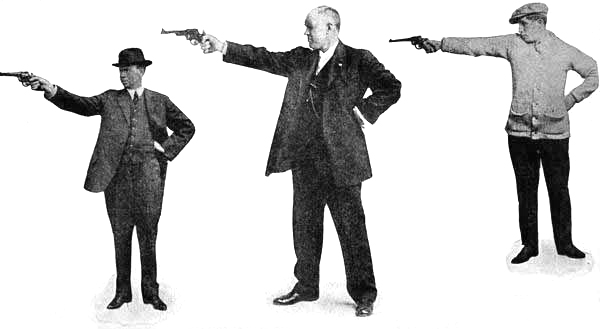
THE UNITED STATES REVOLVER ASSOCIATION
This Association was founded on March 5, 1900, and incorporated in
January, 1904. It is the recognized national organization of the revolver
and pistol marksmen of the United States of America.
Its objects are: to foster and develop revolver and pistol shooting; to
establish and preserve records; to classify arms; and to encourage and
conduct friendly matches between members and clubs in this country, as
well as with the marksmen of other countries.
The officers of the Association, excepting the secretary, serve without
pay. There is no initiation fee. The annual dues are only $1.00. The
membership, scattered from Maine to the Philippines, Alaska to the Canal
Zone, includes all the well-known shots of the country.
The Association has conducted five international revolver matches, all of
which were won by the United States. It selects the members of and is
responsible for the United States teams in the Olympic and all other
international matches. It has established the Annual Outdoor and Indoor
Championship Matches, the U. S. R. A. Indoor League and provided suitable
trophies and medals. It has formulated uniform rules and regulations
governing pistol and revolver shooting. In the record books of the
Association are inscribed and preserved all the scores in the Annual
Championship Contests, the individual and team league series, the scores
of contestants, shooting for rating medals and the “best on record”
performances, together with details concerning the arms and ammunition
used. The Association also publishes the U. S. R. A. Bulletin, a monthly
devoted to all subjects of interest to the members, the subscription for
which is included in the annual dues.
The Association is financially self-supporting. It has an increasing
surplus in the treasury, which is devoted to the purchase of new trophies
for additional matches.
All who are interested in pistol and revolver shooting, and who are in
sympathy with the aims and purposes of the Association, are cordially
invited to join it. Forms of application for membership and other
information will be supplied by the Secretary-Treasurer on request.
The officers of the Association for 1915 are as follows:
President: Col. W. H. Whigam, Chicago, Ill.
1st Vice-President: Capt. R. H. Sayre, New York, N. Y.
2nd Vice-President: C. C. Crossman, St. Louis, Mo.
3rd Vice-President: C. W. Linder, San Francisco, Cal.
4th Vice-President: Dr. R. J. Mullikin, Baltimore, Md.
5th Vice-President: Dr. H. E. Sears, Boston, Mass.
Secretary-Treasurer: J. B. Crabtree, Yalesville, Conn.
CONSTITUTION
Article I—Name
The name of this organization shall be the United States Revolver
Association.
Article II—Object
The object of this association shall be the encouragement of revolver and
pistol shooting.
Article III—Membership
The membership shall consist of three classes: Members, Honorary Members,
Associate Members.
Any reputable citizen of the United States is eligible for membership.
Any reputable person interested in revolver and pistol shooting is
eligible for Honorary or Associate membership.
Members and Associate members may be admitted by vote of the executive
committee and by paying the regular dues. Honorary members may be elected
at a regular meeting of the association and shall be exempt from dues.
Honorary and Associate members shall be entitled to all the privileges of
the association, except the right to vote.
[See Art. VII for Life membership.]
Article IV—Officers
The officers of this association shall be a president, five
vice-presidents and a secretary-treasurer, who shall constitute the
executive committee. They shall be elected by a majority vote by ballot at
the annual meeting of the association, and hold office for one year or
until their successors are elected.
Article V—Duties of Officers
The president shall preside at all meetings of the association and may
call meetings of the association at any time, one week’s notice by mail
being given of such meeting by the secretary-treasurer. The approval of
the president shall be necessary on all bills before they are paid. The
vice-presidents in the order of their seniority shall perform the duties
of the president in his absence and shall have responsible charge, subject
to the executive committee, of the affairs of the association in their
respective localities. The secretary-treasurer shall keep the minutes of
all meetings and take charge of the correspondence of the association. He
shall receive all dues and pay all bills approved by the president, and
keep account of all the funds of the association. The executive committee
shall have charge of the affairs of the association, shall elect members,
appoint State governors to act as local representatives of the
association, and shall have power to accept, decline, or issue challenges
by a majority vote. Any member of the executive committee unable to be
present at any meeting may vote by mail.
Article VI—Vacancies in Office
In case a vacancy should occur in any office, the remaining members of the
executive committee shall have power to fill the vacancy until the next
annual meeting.
Article VII—Dues
Section 1. The annual dues shall be one dollar, and shall be payable on
election to membership and thereafter on the 1st of January in every year.
Section 2. Members in arrears for dues for a period of more than two years
shall be suspended, but may reinstate themselves in full standing by
paying their arrears in dues. Members may not resign from the association
when in arrears for dues.
Section 3. The secretary-treasurer shall notify each member in arrears
before placing his name on the suspended list.
Section 4. Any member of this association in good standing may become a
Life Member by vote of the executive committee and by paying into the
treasury $25, such funds to be used by the association for the purchase of
trophies.
Article VIII—Annual Meeting
There shall be an annual meeting on the third Monday of January in each
year, at which meeting the election of officers and members of the
executive committee shall take place. Members not able to attend this
meeting may send their ballots by mail to the secretary-treasurer, who
shall deposit each ballot in the name of the absent member, and they shall
be counted as if the member were present. Only members not in arrears for
dues shall be entitled to vote. If there should be more than two
candidates for any office, the candidate receiving the least number of
votes shall be retired at each ballot until an election results. In case
of a tie the presiding officer shall have the deciding vote.
Article IX—Quorum
Ten members shall constitute a quorum for the transaction of business.
ANNUAL CHAMPIONSHIP MATCHES
Outdoor Matches
MATCH A—REVOLVER CHAMPIONSHIP.—Open to everybody; distance, 50 yards;
50 shots in strings of ten shots on five Standard American targets, 8-inch
bull’s-eye, 10-ring 3.36 inches; arm, any revolver within the rules;
ammunition, any; the score must be completed in one hour or less from the
time of firing the first shot; entrance fee, $5; to members not in arrears
for dues, $3; no re-entries.
National Prizes: First, the championship silver cup (value, $200), to be
held by the winner until the next annual competition; inscribed on the
cup, in raised ornamental letters, is, “This Cup Represents the Revolver
Championship of the United States of America”; the name of the winner, the
year and the score are also engraved on the cup each year; to the winner
is also awarded a gold medal (value, $25), with the same inscription on
the reverse side as appears on the cup.
Second, a gold and silver medal, with inscription on the reverse side.
Third, a silver medal, with inscription on the reverse side.
Fourth, a silver and bronze medal, with inscription on the reverse side.
Fifth, a bronze medal, with inscription on the reverse side.
A bronze honor medal of the same design is also awarded to every
competitor, not a prize winner, making a score of 425 or better.
State Prizes.—For more than three entries in any State the association
awards three prizes emblematic of State honors: First prize, a silver
and gold medal; second prize, a silver medal; third prize, a bronze
medal. For three entries, only the first two prizes are awarded.
Winners and Scores
| 1900 A. L. A. Himmelwright |
|
422 |
| 1901 John A. Dietz |
|
419 |
| 1902 Thomas Anderton |
|
438 |
| 1903 J. E. Gorman |
|
454 |
| 1904 Dr. I. R. Calkins |
|
451 |
| 1905 John A. Dietz |
|
455 |
| 1906 John A. Dietz |
|
444 |
| 1907 John A. Dietz |
|
445 |
| 1908 R. H. Sayre |
|
462 |
| 1909 Dr. I. R. Calkins |
|
455 |
| 1910 Dr. John R. Hicks |
|
458 |
| 1911 George Armstrong |
|
467 |
| 1912 A. M. Poindexter |
|
467 |
| 1913 A. P. Lane |
|
467 |
| 1914 A. P. Lane |
|
458 |
MATCH B—PISTOL CHAMPIONSHIP.—Open to everybody; distance, 50 yards; 50
shots on five targets as in Match A; arm, any pistol within the rules;
ammunition, any; the score must be completed in one hour or less from the
time of firing the first shot; entrance fee, $5; to members not in arrears
for dues, $3; no re-entries.
National Prizes: First, the championship silver cup (value, $175), to be
held by the winner until the next annual competition; inscribed on the
cup, in raised ornamental letters, is, “This Cup Represents the Pistol
Championship of the United States of America”; the name of the winner, the
year and the score are also engraved on the cup each year; to the winner
is also awarded a gold medal (value, $25), with the same inscription on
the reverse side as appears on the cup.
Second, a silver and gold medal, with inscription on the reverse side.
Third, a silver medal, with inscription on the reverse side.
Fourth, a bronze and silver medal, with inscription on the reverse side.
Fifth, a bronze medal, with inscription on the reverse side.
A bronze honor medal of the same design is also awarded to every
competitor, not a prize winner, making a score of 435 or better.
State Prizes.—The same as in Match A.
Winners and Scores
| 1900J. B. Crabtree |
|
427 |
| 1901Thomas Anderton |
|
453 |
| 1902Thomas Anderton |
|
463 |
| 1903Thomas Anderton |
|
457 |
| 1904E. H. Kessler |
|
464 |
| 1905John A. Dietz |
|
465 |
| 1906John A. Dietz |
|
448 |
| 1907P. Hanford |
|
455 |
| 1908J. E. Gorman |
|
468 |
| 1909Dr. I. R. Calkins |
|
464 |
| 1910John A. Dietz |
|
462 |
| 1911Parmly Hanford |
|
466 |
| 1912L. P. Castaldini |
|
461 |
| 1913Dr. I. R. Calkins |
|
469 |
| 1914George Armstrong |
|
476 |
MATCH C—MILITARY CHAMPIONSHIP.—Open to everybody; distance, 50 yards; 75
shots in strings of five shots on fifteen targets as in Match A; each
string must be shot within the time limit of 15 seconds, taking time from
the command, Fire; misfires and shots lost on account of the arm becoming
disabled while firing any string will be scored zero; if a shot is fired
after the time limit has elapsed, the shot of highest count will be
deducted from the score; no cleaning allowed; arm, any military revolver,
or any military magazine pistol within the rules; ammunition, the full
charge service cartridge, or equivalent factory loaded ammunition approved
by the executive committee, brought to the firing point in unbroken
packages; the score must be completed on the same day; no sighting shots
will be allowed after beginning the score; entrance fee, $5; to members
not in arrears for dues, $3; no re-entries.
National Prizes: First, the championship silver trophy (an elaborate
silver bowl, value $450), to be held by the winner until the next annual
competition; the trophy bears the inscription, “The Military Revolver
Championship of the United States of America”; the name of the winner, the
year, and the score are also engraved on the trophy each year; to the
winner is also awarded a gold medal (value, $25), with the same
inscription on the reverse side as appears on the trophy.
Second, a silver and gold medal, with inscription on the reverse side.
Third, a silver medal, with inscription on the reverse side.
Fourth, a bronze and silver medal, with inscription on the reverse side.
Fifth, a bronze medal, with inscription on the reverse side.
A bronze honor medal of the same design is also awarded to every
competitor, not a prize winner, making a score of 500 or better.
State Prizes.—The same as in Match A.
Winners and Scores
| 1900R. H. Sayre |
|
300[19] |
| 1901R. H. Sayre |
|
325[19] |
| 1902R. H. Sayre |
|
579 |
| 1903R. H. Sayre |
|
565 |
| 1904Thomas Anderton |
|
585 |
| 1905Thos. LeBoutillier |
|
504 |
| 1906R. H. Sayre |
|
583 |
| 1907R. H. Sayre |
|
536 |
| 1908C. F. G. Armstrong |
|
568 |
| 1909Col. W. H. Whigam |
|
580 |
| 1910Col. W. H. Whigam |
|
591 |
| 1911A. P. Lane |
|
605 |
| 1912Dr. J. H. Snook |
|
621 |
| 1913Dr. J. H. Snook |
|
625 |
| 1914C. M. McCutchen |
|
627 |
MATCH D—MILITARY RECORD MATCH.—Open to everybody; distance, 50 yards;
five consecutive strings of five shots under the same conditions as Match
C; entrance fee, $2; to members not in arrears for dues, $1; entries
unlimited.
National Prizes: First, a gold trophy, a laurel wreath surrounding a
scroll, mounted on an ebony shield; (value, $150); between the scroll and
the wreath is a ribbon on which, in raised letters, is, “The United States
Revolver Association”; at the top of the scroll is engraved, “Military
Record Match.” The name of the winner, the year, and the score for each
year are engraved on the scroll below; this trophy is held by the winner
until the next annual competition, and is to become the property of the
competitor winning it three times.
Second, a silver medal, with inscription on the reverse side.
Third, a bronze medal, with inscription on the reverse side.
A bronze honor medal of the same design is also awarded to every
competitor, not a prize winner, making a score of 175 or better.
This match was instituted in 1902. Being a re-entry match, it affords good
practice under the same conditions as Match C.
No State prizes are awarded in this match.
Winners and Scores
| 1902Thomas Anderton |
|
206 |
| 1903Thomas Anderton |
|
202 |
| 1904Thomas Anderton |
|
206 |
| 1905Thos. LeBoutillier |
|
178 |
| 1906Thos. LeBoutillier |
|
192 |
| 1907Thos. LeBoutillier |
|
191 |
| 1908C. F. G. Armstrong |
|
194 |
| 1909C. F. G. Armstrong |
|
204 |
| 1910Samuel Peterson |
|
215 |
| 1911A. P. Lane |
|
208 |
| 1912Dr. J. H. Snook |
|
212 |
| 1913C. M. McCutchen |
|
217 |
| 1914Dr. J. H. Snook |
|
221 |
MATCH E—MILITARY REVOLVER TEAM MATCH.—Open to one team of four men from
any regularly organized Rifle or Revolver Club, the police force of any
city, or any Regiment, Battalion, or separate organization from any of the
organized Military or Naval forces of any civilized country.
Distance, 50 yards; five consecutive strings of 5 shots each under the
same conditions as Match C; arm, any military revolver or magazine pistol
within the rules; ammunition, full charge factory loaded, brought to the
firing point in unbroken packages; entrance fee, $15; to affiliated clubs,
$10; no re-entries.
Prizes: First, the Winans Trophy (a “Broncho Buster”
in bronze, mounted
on an elaborate red porphyry marble base; value, $500). The name of the
winning club or organization, the year and the score, will be engraved on
the base. The trophy to be held by the winning organization until the next
annual competition. A silver and gold medal will also be awarded to each
member of the winning team, with inscription on the reverse side.
Second, a silver medal to each member of the team, with inscription on
the reverse side.
Third, a bronze and silver medal to each member of the team, with an
inscription on the reverse side.
Fourth, a bronze medal to each member of the team, with an inscription
on the reverse side.
This match was instituted in October, 1908, when Mr. Walter Winans (Life
member) presented the association with an appropriate trophy.
Winners and Scores
| 1909Squadron “A,” N. G. N. Y. |
|
698 |
| 19101st Cavalry Ill. N. G. |
|
708 |
| 19111st Cavalry Ill. N. G. |
|
725 |
| 1912Denver Rev. Club |
|
774 |
| 1913Denver Rev. Club |
|
776 |
| 1914Denver Rev. Club |
|
799 |
MATCH F—POCKET REVOLVER CHAMPIONSHIP.—Open to everybody; 25 shots at 50
yards in strings of 5 shots on five targets, as in Match A; each string to
be fired within 30 seconds after the command, “Fire.” Arm, any pocket
revolver of .32 or larger caliber or any pocket magazine pistol of .25 to
.38 caliber inclusive, weighing less than 1¾ pounds within the rules;
cleaning not allowed; ammunition, the same as Match C. Entrance fee, $4;
to members not in arrears for dues, $2; no re-entries.
National Prizes: First, a gold medal, with inscription on the reverse
side.
Second, a silver and gold medal, with inscription on the reverse side.
Third, a silver medal, with inscription on the reverse side.
Fourth, a bronze and silver medal, with inscription on the reverse
side.
Fifth, a bronze medal, with inscription on the reverse side.
A bronze honor medal will also be awarded to any competitor not a prize
winner making a score of 175 or better.
State Prizes.—For five or more entries the following prizes will be
awarded: 1st prize, a gold and silver medal; 2nd prize, a silver medal;
3rd prize, a bronze medal.
Winners and Scores
| 1909C. W. Klett |
|
203 |
| 1910C. E. Orr |
|
202 |
| 1911A. P. Lane |
|
211 |
| 1912Dr. O. A. Burgeson |
|
208 |
| 1913Col. W. H. Whigam |
|
210 |
| 1914Dr. J. H. Snook |
|
214 |
GRAND AGGREGATE MEDALS
In addition to the regular matches the association awards Grand Aggregate
Medals to the contestants making the highest aggregate scores in
Championship Matches A, B, C, and F, as follows:
First, a gold medal, with inscription on the reverse side.
Second, a silver medal, with inscription on the reverse side.
Third, a bronze medal, with inscription on the reverse side.
The grand aggregate will be computed by adding the total scores of the
Matches A, B, and F, and one-fifth of the total score in Match C.
The grand aggregate medals are considered the highest honors in the gift
of the association.
Winners and Scores
| 1909C. Dominic |
|
1187.8 |
| 1910A. P. Lane |
|
1215.8 |
| 1911A. P. Lane |
|
1236. |
| 1912Parmly Hanford |
|
1228. |
| 1913A. P. Lane |
|
1261. |
| 1914A. P. Lane |
|
1242. |
Indoor Matches
REVOLVER CHAMPIONSHIP.—Open to everybody; distance, 20 yards; light must
be artificial; 50 shots on ten Standard American targets, bull’s-eye 2.72
inches and 10-ring 1.12 inches in diameter, respectively; arm, any
revolver within the rules; ammunition, any. The score must be completed in
one hour or less from the time of firing the first shot. Entrance fee, $5;
to members not in arrears for dues, $3; no re-entries.
National Prizes: First, a silver cup (value, $40), bearing the names and
scores of the winners, to be held until the next annual competition, the
cup to become the property of the person winning it three times.
Second, a gold and silver medal, with inscription on the reverse side.
Third, a silver medal, with inscription on the reverse side.
Fourth, a silver and bronze medal, with inscription on the reverse side.
Fifth, a bronze medal, with inscription on the reverse side.
A bronze honor medal will also be awarded to any competitor, not a prize
winner, making a score of 425 or better.
State Prizes.—The same as in Match A of the Outdoor Matches.
Winners and Scores
| 1901W. E. Petty |
|
439 |
| 1902W. E. Petty |
|
439 |
| 1903W. H. Luckett |
|
437 |
| 1904Sidney E. Sears |
|
478 |
| 1905Sidney E. Sears |
|
461 |
| 1906Sidney E. Sears |
|
451 |
| 1907Wm. G. Krieg |
|
454 |
| 1908R. H. Sayre |
|
454 |
| 1909R. H. Sayre |
|
455 |
| 1910Oscar I. Olson |
|
461 |
| 1911C. C. Crossman |
|
455 |
| 1912Dr. J. R. Hicks |
|
457 |
| 1913P. J. Dolfin |
|
469 |
| 1914Dr. W. E. Quicksall |
|
457 |
PISTOL CHAMPIONSHIP.—Open to everybody; distance, 20 yards; light must be
artificial; 50 shots on ten Standard American targets; bull’s-eye 2.72
inches and 10-ring 1.12 inches in diameter, respectively; arm, any pistol
within the rules; ammunition, any. The score must be completed in one hour
or less from the time of firing the first shot. Entrance fee, $5; to
members not in arrears for dues, $3; no re-entries.
National and State Prizes: The same as in the indoor Revolver
Championship, except that honor medals are awarded for scores of 435 or
better.
Winners and Scores
| 1901R. H. Sayre |
|
433 |
| 1902R. H. Sayre |
|
448 |
| 1903Thomas Anderton |
|
460 |
| 1904E. H. Kessler |
|
450 |
| 1905R. H. Sayre |
|
451 |
| 1906John A. Dietz |
|
447 |
| 1907John A. Dietz |
|
455 |
| 1908R. P. Prentys |
|
455 |
| 1909Frank Fromm |
|
456 |
| 1910R. H. Sayre |
|
454 |
| 1911George Armstrong |
|
473 |
| 1912A. P. Lane |
|
469 |
| 1913Dr. C. H. Wilson |
|
465 |
| 1914Dr. J. H. Snook |
|
468 |
POCKET REVOLVER CHAMPIONSHIP.—Open to everybody; 25 shots at 20 yards in
strings of five shots on five Standard American targets; each string to be
fired within 30 seconds after the command, “Fire.” Arm, any pocket
revolver of .32 caliber or larger, within the rules. Magazine pistols not
allowed. Ammunition, full charge, factory loaded, brought to the firing
point in unbroken packages. Entrance fee, $4; to members not in arrears
for dues, $2.
Prizes.—The same as in Match F of the Outdoor Matches.
Winners and Scores
| 1909Wm. G. Krieg |
|
190 |
| 1910Dr. M. R. Moore |
|
202 |
| 1911Col. W. H. Whigam |
|
195 |
| 1912John A. Dietz |
|
205 |
| 1913Hans Roedder |
|
206 |
| 1914Dr. J. H. Snook |
|
213 |
MATCH G NOVICE LIMITED RE-ENTRY MATCH.—Open to all amateurs who have
never won an important prize in pistol or revolver contests. (Winners of
prizes in National contests and first and second prizes in State contests,
all expert shots, etc., are barred.) Twenty-five shots at 20 yards in five
strings on five Standard American targets. Time, 30 minutes to complete
the score after firing the first shot. Arm, any revolver or any pistol
within the rules. Ammunition, any. Entrance fee, first entry, $3; to
members not in arrears for dues, $2. There may be four re-entries at $1
each, but the score for the last re-entry only to count.
National and State Prizes:—The same as in Match F of the Outdoor Matches.
Winners and Scores
| 1913R. S. Everett |
|
231 |
| 1914Robert Mills |
|
229 |
RULES AND REGULATIONS GOVERNING THE CHAMPIONSHIP MATCHES OF THE U. S. R. A.
1. General Conditions.—Competitors must make themselves acquainted with
the rules and regulations of the association, as the plea of ignorance
will receive no consideration. The rulings and decisions of the executive
committee are final in all cases. These rules are for general application,
but will not apply in cases where the special conditions of any match
conflict with them.
2. Classification of Arms.—(a) Any Revolver. A revolver of any caliber.
Maximum length of barrel, including cylinder, 10 inches. Minimum trigger
pull, 2½ pounds. Sights may be adjustable but they must be strictly
open, in front of the hammer and not over 10 inches apart.
(b) Any pistol. A pistol of any caliber. Maximum length of barrel, 10
inches. Minimum trigger pull, 2 pounds. Sights may be adjustable but they
must be strictly open, in front of the hammer and not over 10 inches
apart.
(c) Military revolver or pistol. A revolver, or a magazine pistol, that
has been adopted by any civilized government for the armament of its army
or navy. Maximum weight, 2¾ pounds. Maximum length of barrel, 7½
inches. Minimum trigger pull, 4 pounds. Fixed open sights. Rear sights of
magazine pistols may be adjustable for elevation only.
(d) Pocket revolver. A revolver having a maximum weight of 2 pounds.
Maximum length of barrel, 4 inches; Minimum trigger pull, 4 pounds. Sights
and model must be such as not to hinder quick drawing of the weapon from
the pocket or holster.
3. Loading, Firing, Timing, and Cleaning.—In all revolver and pistol
matches the weapon must not be loaded until the competitor has taken his
position at the firing point. The barrel must always be kept vertical or
pointed towards the target. After the target is in position and a match or
record score has been begun, in case of an accidental discharge or of
defective ammunition, if the bullet comes out of the barrel it will be
scored a shot. The timing in matches C, D, E, and F will be as follows:
The competitor standing at the firing point with the arm loaded, not
cocked, and the barrel pointing in a direction not less than 45 degrees
from the target, will signify to the scorer when he is ready to begin each
string. The scorer, stop watch in hand, will then give the command,
“Fire,” after which the competitor may cock and aim his weapon and shoot
his string. At the expiration of the time limit the scorer will announce
“Time.” Misfires will be scored zero, only in Matches C, D, E, and F.
Competitors may clean weapons in Matches A and B, and in the corresponding
Indoor Championships, but no time allowance will be given for time spent
in this way. All competitors will be required to finish their scores
within the time limits specified, except in cases of accident, when the
time may be extended at the discretion of the executive committee. Blowing
through the barrel, to moisten it, will be considered cleaning.
In revolver matches the arm must not be used as a single loader or loaded
so as to use a limited number of chambers in the cylinder. The cylinder
must be charged with the full number of rounds for which it is chambered,
and these must be shot consecutively. If scores are shot in ten shot
strings, the cylinder shall be charged first with six rounds and then with
four rounds. If the cylinder only contains five chambers, then the
ten-shot strings may be shot in two strings of five each. In Matches C, D,
E, and F and indoor or gallery events, the arm shall in all cases be
charged with five rounds.
4. Position.—The position shall be standing, free from any support, the
pistol or revolver being held in one hand, with arm extended, so as to be
free from the body.
5. Arms.—Any revolver or pistol which in the opinion of the executive
committee complies with the conditions specified in the various matches
will be allowed to compete in those events. Revolvers or magazine pistols
that have been adopted by any government for the armament of its army or
navy, or such as in the opinion of the executive committee are suitable
for military service, will be allowed in Matches C, D, and E. Among the
arms which may be used in these matches are the .38-caliber Smith & Wesson
or Colt Military; .44 Smith & Wesson, Military or Russian model; .38, .44
or .45 Colt New Service; .45 Smith & Wesson Scofield; .44 or .45 Colt,
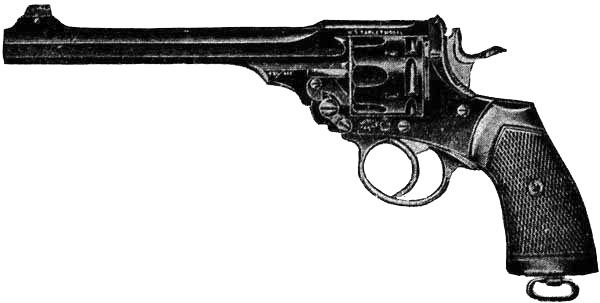
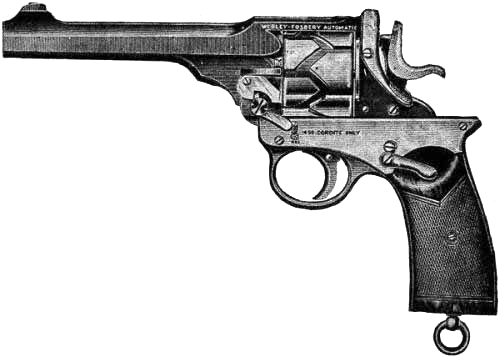
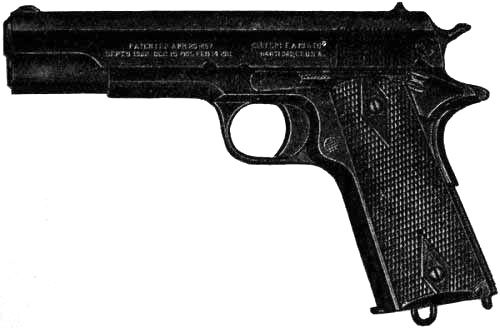
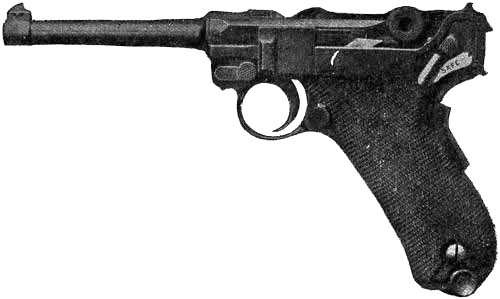
Single Action Army, Webley & Scott Mark IV, and the following magazine or
automatic pistols: Colt, Webley & Scott, Luger, Borchardt, Mannlicher,
Mauser, Mors.
6. Sights.—In open sights, the notch of the rear sight must be as wide
on top as at any part. Aperture or peep sights or any covered or shaded
sights will not be allowed. The use of a notch for the front sight will
not be permitted. Sights may be smoked or blackened if desired. Sights on
military arms, if modified to suit individuals, must remain strictly open,
strong and substantial, and suitable for military use.
7. Trigger-Pull.—The trigger-pull as specified in the various events
shall be determined by a test weight equal to the minimum pull applied at
a point three-eighths of an inch from the end of the trigger and at right
angles to the pin through the trigger.
8. Ammunition.—In Matches C, D, E, and F, and in the medal competition,
where full charge ammunition is required, it may be the product of any
reputable manufacturer. It must in all cases be brought to the firing
point in unbroken boxes, with the label of the manufacturer intact.
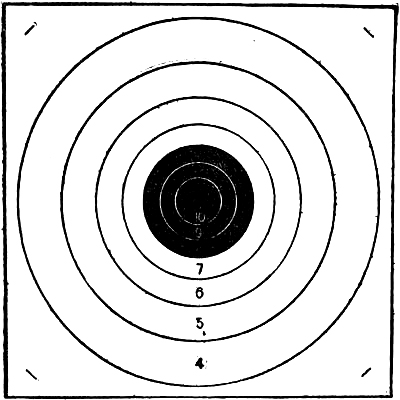
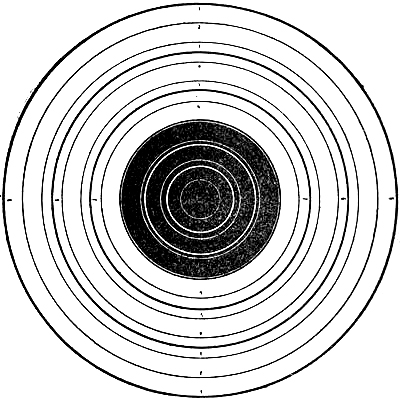
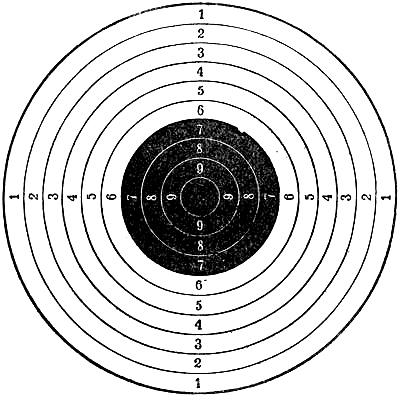
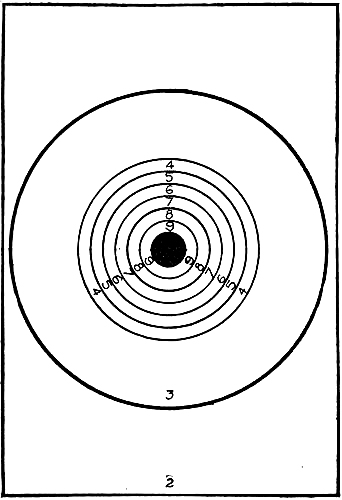
9. Targets.—The 200-yard Standard American rifle target No. 1
(containing the 4-ring), with an 8-inch bull’s-eye and showing in light
lines the rings of the International Union target, shall be used in all
matches at 50 yards. The scores will be counted on the Standard American
target. The diameters of the rings of the Standard American target are as
follows: 10-ring equals 3.36 inches; 9-ring equals 5.54 inches; 8-ring
equals 8 inches; 7-ring equals 11 inches; 6-ring equals 14.8 inches;
5-ring equals 19.68 inches; 4-ring equals 26 inches; rest of target 28
inches by 28 inches counts 3. The same target reduced so that the
bull’s-eye or 8-ring is 2.72 inches in diameter and the 10-ring 1.12
inches in diameter, including the 4-ring 8.84 inches in diameter and the
rest of the target 9½ inches by 9½ inches, counting 3, shall be used
for all matches at 20 yards.
10. Marking and Scoring.—In all matches new paper targets shall be
furnished for each competitor. Not more than ten shots are to be fired on
any target at 50 yards, and not more than five shots on any target in
Matches C, D, E, and F, and for all shooting at 20 yards; the shot holes
in all cases to remain uncovered and left as shot. Bullets touching,
striking, or within a line on the target are to be scored the count of
that line. The eye alone shall determine whether a bullet touches or not.
11. Ties.—Ties shall be decided as follows: (1) By the score at the
longest distance; (2) by the score at the next longest distance; (3) by
the fewest number of shots of lowest count; (4) by firing five shots each
under the same conditions as the match and these rules in regard to ties,
until decided.
12. Supervision.—The shooting in all the U. S. R. A. events must take
place in the presence of at least two witnesses familiar with the rules,
one of whom must be an authorized U. S. R. A. officer. This officer shall
certify that each contestant has complied with all the U. S. R. A.
regulations as to distance, weapon, time, ammunition, etc., noting same on
the blank spaces provided on the score cards, and both witnesses shall
sign the targets and said score cards in duplicate for each contestant.
13. Protests.—Any person who believes that an injustice has been done,
or who dissents from the decision of any authorized executive officer of
the association, may enter a protest on depositing $1 with said officer.
Such protest must be in writing, in duplicate, and must be made within 24
hours after the incident on which it is based. One copy to be handed to
the executive officer of the club or organization conducting the matches
and the other copy to be mailed to the secretary-treasurer of the U. S. R.
A. All protests will be investigated and passed upon by the executive
committee, and, if sustained, the protest fee will be returned; otherwise
it will be forfeited.
14. Records.—The shooting for records shall, when practicable, be done
on the grounds or in a gallery of a regularly organized shooting
association, military organization or club, and in the presence of at
least two witnesses familiar with the U. S. R. A. rules, one of whom shall
be an officer of the U. S. R. A. New targets of regulation size shall be
used. The foregoing rules and regulations and the conditions governing the
championship matches of the U. S. R. A. must in all cases be observed and
followed. The record score shall begin with the first shot after the
shooter has announced his intention to shoot for record; only the first
ten shots will apply to the 10-shot record; the first twenty shots to the
20-shot record, and so on to 50 or 100 shots, as the shooter may elect.
Such scores (multiples of 5 or 10 shots) for record must in all cases be
completed within the same proportional time limit as is specified for the
corresponding championship match; thus, in Match A, for example, the first
10 shots within 12 minutes, the first 20 shots within 24 minutes, etc.
After finishing the record score, the targets shall be identified and
signed by the witnesses as above designated. The witnesses shall also
prepare and sign a certificate of prescribed form, which, with the
detailed score and all targets, shall be forwarded to the U. S. R. A.,
addressed to the secretary-treasurer. If all the conditions, rules and
regulations have been complied with, the scoring correct, and if the score
is higher than or equal to any previously made under the same conditions,
it will be declared a new record. The score will then be entered as such
in the record book of the association, and the shooter formally notified
to that effect.
METHODS AND CUSTOMS TO BE FOLLOWED IN CONDUCTING THE ANNUAL COMPETITIONS OF THE U. S. R. A.
The conditions under which local clubs may be authorized to conduct
Championship Matches of the U. S. R. A. are as follows:
There must be not less than six members of the association residing within
twenty-five miles of the proposed place of holding the contest and there
must be not less than three entries in Championship Matches A, B, or C, or
five entries in Match F. In matches offering National and State prizes the
same entrance fee includes eligibility to both honors.
On the application of six or more members in good standing under the
prescribed conditions, a U. S. R. A. official designated as the “governor”
is appointed by the Association’s executive committee and vested with the
authority to supervise all Association shooting. The appointee is usually
a member nominated by the local members. Besides supervising all the U. S.
R. A. contests, the governor is the official representative of the
Association in his locality, and has the custody of all supplies and the
distribution of prizes, medals, etc. By this arrangement the U. S. R. A.
members in all sections of the country obtain the same privileges and
benefits and equal opportunity to enter the matches and competitions.
The U. S. R. A. will furnish numbered and certified targets and score
cards, and will provide the prizes for the U. S. R. A. Championship and
re-entry events; the club or organization to pay the expressage both ways
on targets and all other supplies, to furnish the shooting facilities and
conduct the contests free of expense to the association and turn over to
the secretary-treasurer all the entrance fees for the U. S. R. A. events.
This plan has in all cases given satisfactory results, because the
practice shooting of the contestants in the local re-entry matches usually
affords sufficient revenue to pay the expenses of the tournament.
When a competitor wishes to shoot in any of the events, he should exhibit
his latest membership card (if a member) to the officers in charge, and
after paying the entrance fee, a regular ticket or duplicate score card
(furnished by the United States Revolver Association) is filled out and
issued to him, which is his receipt for the entrance fee. His score need
not necessarily be shot immediately after issuing the ticket. Competitors
have the option of shooting in the order in which they pay for their
entries. Tickets not used are forfeited: no entrance fees shall be
refunded.
The requisite number of targets are issued when the competitor wishes to
shoot his score. These must be numbered consecutively, they must have the
competitor’s name and the number of his score card written on them for
identification, and must be shot in their numerical order.
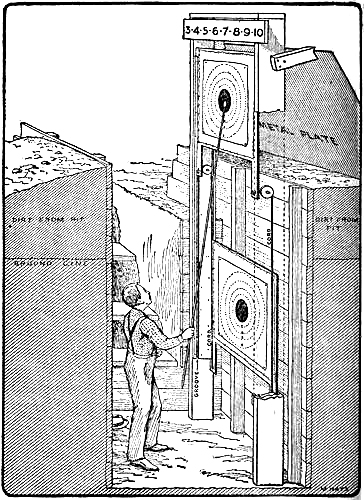
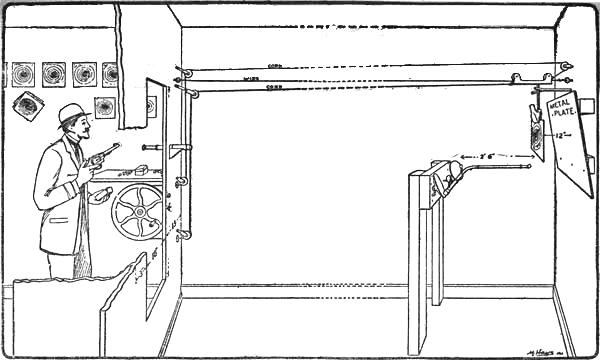
The targets are usually tacked at the corners on alternating frames
covered with canvas, over which heavy paper is pasted. Each target is left
in position until the required number of shots have been fired at it, each
shot being spotted and marked as fired [no pasters to be used]. When a
string has been finished the target is lowered and the alternating target
raised in position. After the score is completed the targets are brought
to the firing point and delivered to the range officer.
When a competitor wishes to shoot his score, his arm must be inspected and
passed by the officer in charge, who must see that it conforms with the
rules and requirements of the event in which it is entered. Competitors
who wish to enter in any of the events are urged to have their arms
examined by the executive officer or committee in charge of the matches as
soon as possible, so that in case there should be any exceptions made to
the sights, the trigger-pull, or any other details, there will be an
opportunity to have these exceptions corrected so as to comply with the
requirements when the official test and inspection is made before shooting
the score.
In Matches C, D, E, and F the scorer should have a reliable stop watch, so
that the timing will be accurate. It is well, whenever possible, to have
two men time the competitor, so as to have an additional check. A new
target must be furnished for each string of five shots at each range.
According to the rules, if a competitor starts to shoot a string of any
score and his arm becomes disabled from any cause, those shots which reach
the target within the time limit after the command, “Fire,” will be
counted as the complete score for the five shots. In the case of a
disabled arm, the officer or committee in charge may allow the competitor
to complete the remaining strings of his score with another arm. Shots on
the paper target outside of the 4-ring count 3; shots missing the paper
target count zero. After completing the score, when the duplicate score
cards are filled out, the contestant takes the duplicate and the range
officer retains the original record.
All unused targets and score cards are also to be forwarded to the
secretary-treasurer, with a complete detailed account of entrance fees,
supplies, etc.
In the Medal Competition only those targets that actually count for medals
are to be witnessed, certified and forwarded to the secretary-treasurer
for verification and record.
In order that the conditions may be uniform and eliminate as much as
possible the special conditions in regard to wind, etc., that may exist at
the different places where the matches may be held, the shooters should be
protected at the firing point by a shelter. This may be either the regular
shooting house of the club, or, if the shooting is done in the open, by a
suitable tent or temporary frame structure having an opening in the
direction of the target; the other three sides being inclosed. The
building or tent should be large enough to accommodate also the officer or
committee in charge of the match, so that the shooter may be at all times
in sight of the officer in charge of the range at the time the score is
made. A table of suitable size should be provided near the firing point
for holding ammunition and for the convenience of the competitor to clean
his arm in those events where cleaning is allowed. The firing point should
be plainly marked and so located as to be at least two feet from any
timbers, guards, ropes, tables, etc.
INSTRUCTIONS TO U. S. R. A. OFFICERS IN CHARGE OF THE CHAMPIONSHIP CONTESTS
Supplies consisting of numbered and certified targets, score cards, record
blanks, a copy of the rules and regulations, etc., will be furnished by
the secretary-treasurer on the requisition of the local U. S. R. A.
representative. Such supplies shall be used only in the matches, and all
used and unused supplies shall be returned to the secretary-treasurer at
the close of the contests. The target and supply account of the club must
balance.
A governor or other officer of the U. S. R. A. will be appointed in each
locality where the matches are to be held to act as range officer,
represent the association, and have charge of the contests. This governor
or officer shall personally measure the range to verify the distance
and see that all the conditions of the matches are strictly complied
with. He will also see that at least one other person familiar with the
rules is present to witness all the shooting and he shall certify to the
correctness of each score and the conditions, by signing the score card
when the score is completed, and all the targets of each competitor shall
be signed by both witnesses.
The other duties in detail of the governor or officer in charge of the
matches are as follows: When a competitor expresses his intention of
entering a match, a score card is made out in his name and delivered to
him on the payment of the higher entrance fee (unless the competitor
exhibits a membership card bearing the date of the current year, in which
case he is entitled to the lower entrance fee). These score cards are to
be issued in numerical order, and when more than one contestant wishes to
shoot at the same time, the man holding the score card first issued is
entitled to the preference of position and time. When the contestant is
ready to shoot, he hands his score card to the governor or other officer
of the association, who thereupon issues the required targets numbered
consecutively, with the name of the competitor and the number of his score
card written on each target for identification. The arm of the competitor
is then inspected to make sure that it complies with the rules and
regulations. The sights must be carefully inspected and the trigger-pull
tested by weighing in just before the score is begun.
The records for which blanks are provided on the score card with reference
to the arm, ammunition, etc., must all be filled in. The competitor’s
first target may then be placed in position. As soon as the contestant
begins his score, the time is taken from the firing of the first shot in
Matches A and B and in the Corresponding Indoor Championships, and the
entire score must be completed within one hour from this time. Scores in
Match G must be completed within 30 minutes after firing the first shot.
In Matches C, D, E, and F the time is taken from the command “Fire,” and
the five shots must be fired within the specified time limit in each case
and a record is made of the actual elapsed time of each string which must
be written on the corresponding targets later when they are brought to the
firing point. The announcing of intermediate times or seconds is not
allowed.
Ten shots are to be fired at each target in Matches A and B, and five
shots at each target in Matches C, D, E, F, and G, and in all the Indoor
Matches. After the score is completed, the separate targets are scored in
regular order as shot and the value of the shots as filled in the score
card are checked from the targets, making corrections from the targets,
if mistakes have been made by the markers. After filling in and signing
the score cards, the duplicate is handed to the competitor and the
original preserved for record. The targets are then signed by the governor
and preserved until the expiration of the period during which the matches
are held, when all targets, original score cards, and all other supplies,
used and unused, are to be sent to the United States Revolver Association,
addressed to the secretary-treasurer.
It is recommended that all scores after being shot, verified, etc., be
wrapped in paper in separate packages, marked with the competitor’s name,
and that no one be permitted to handle and examine these targets after
they have been scored and certified to.
THE U. S. R. A. LEAGUE
The League is an alliance or compact between the clubs participating, the
details and conditions of which vary slightly from year to year, being
embodied in a signed contract.
Any locality having six or more paid-up members in the Association may
apply for the appointment of an official U. S. R. A. representative and by
accepting the conditions and signing the contract, enter a team.
U. S. R. A. LEAGUE AGREEMENT FOR 1914-15.
Entrance Fees.—Each club with paid-up affiliation in the U. S. R. A.
shall pay an entrance fee of $10, others $15; this to cover cost of prizes
only.
Expense.—The association shall furnish all targets to the clubs and
shall pay the transportation from the association to the clubs and pay for
all necessary telegrams to or from the secretary-treasurer, and an
accurate account of these charges to be kept by the secretary and the
amount to be charged back to the clubs, each club paying an equal amount.
This is not to exceed $10.
Secretaries of the clubs where shooting nights and distance will permit
are to use the mail, others the telegraph in the cheapest form. Results of
the week MUST reach the secretary by noon of the next Monday after the
shoot. The press has no use for stale news. Clubs shall pay a fine of $1
for each failure to report on time; the fines to go into the club fund for
expenses.
Targets are to be sent to the various clubs prepaid. Only clubs which
guarantee to stay through the series will be allowed to enter.
Shooting Night.—Clubs may shoot on one or two evenings of the week most
convenient for them, but it must be the same evenings each week all
through the match, unless a change be authorized by the
secretary-treasurer. Any club may be allowed at the discretion of the
executive committee to divide their shooters into two divisions and have
two shooting nights a week. The membership of the divisions must be kept
distinct, that is, a man may not change from one division to another and
each division must have its regular shooting night. Matches not shot
according to the above may be forfeited.
Teams to consist of five men, but each club may at its option shoot in
any match from five to ten men and pick the scores of the highest five.
Qualifications, paid-up membership in the U. S. R. A. and good
standing in the local club. A man may shoot on the team of but one club.
The scores of members in arrears for dues may be forfeited.
Conditions.—Revolvers and pistols will be allowed on equal terms, but
both must comply with the U. S. R. A. rules. Five strings of five shots
each will be required for each man. Target, Standard American. Distance,
twenty yards. Each individual score to be completed within twenty-five
minutes from the time of firing the first shot.
Scoring.—Official scoring to be done by the secretary-treasurer. In
close matches, where the count of doubtful shots will determine the
winner, at least two of the members of the executive committee shall be
called upon to assist the secretary in scoring these shots.
Supervision.—Members of the executive committee and U. S. R. A.
governors shall supervise matches within their jurisdiction, and certify
that all U. S. R. A. conditions have been fulfilled. Any score not so
certified may be protested, by any competitor and at the discretion of a
majority of the executive committee may be thrown out.
Individual and club ties to be shot off.
Protests from the decision of any U. S. R. A. official may be made in
writing to the secretary-treasurer, if mailed within 48 hours after the
decision has been brought to the attention of the person or persons
feeling aggrieved. Each person concerned in making the protest must
forward $1, which will be returned if the protest is sustained, otherwise
forfeited to the association treasury.
In General.—The series to begin as quickly as arrangements can be made.
Matches to be shot weekly.
Targets will be furnished marked for identification, and must be used only
for the match assigned and for no other purpose. For obvious reasons match
targets must be jealously guarded and their individual identity carefully
preserved. Clubs may purchase from the U. S. R. A. similar targets for
practice purposes.
Scores on mixed targets may be forfeited.
Clubs will be classified in groups of four matches to begin the week of
..............................
Entries to close ..............................
Fraud.—Any person found guilty by the executive committee of the U. S.
R. A. of cheating, evading or attempting to evade the regulations
governing these contests, shall be debarred from all U. S. R. A. contests
until reinstated by a vote of the members at an annual meeting of this
association.
We hereby agree to all the above conditions and make application to enter
a team in the U. S. R. A. League. Our preferred shooting day of the week
is ..............................
Signed: ..............................
Date: ..............................
Witnesses:
RECORDS
The following records have been made under the United States Revolver
Association rules since their adoption:
Revolver, 50 Yards
| 50 Shots: |
| April 26, 1903—J. E. Gorman, San Francisco, Cal. |
|
458 |
| Sept. 7, 1904—Dr. I. R. Calkins, Springfield, Mass. |
|
465 |
| June 6, 1911—J. E. Gorman, San Francisco, Cal. |
|
467 |
| Nov. 26, 1911—John A. Dietz, New York, N. Y. |
| 8 |
8 |
9 |
9 |
10 |
10 |
10 |
10 |
10 |
10—94 |
| 9 |
9 |
9 |
9 |
10 |
10 |
10 |
10 |
10 |
10—96 |
| 8 |
8 |
9 |
9 |
10 |
10 |
10 |
10 |
10 |
10—94 |
| 9 |
9 |
9 |
9 |
9 |
10 |
10 |
10 |
10 |
10—95 |
| 8 |
9 |
9 |
10 |
10 |
10 |
10 |
10 |
10 |
10—96 |
| |
— |
|
475 |
| |
| 30 Shots: |
| April 26, 1903—J. E. Gorman, San Francisco, Cal. |
|
273 |
| Sept. 7, 1904—Dr. I. R. Calkins, Springfield Mass. |
|
284 |
| Nov. 26, 1911—John A. Dietz, New York, N. Y. |
|
284 |
| |
| 20 Shots: |
| April 26, 1903—J. E. Gorman, San Francisco, Cal. |
|
185 |
| Sept. 7, 1904—Dr. I. R. Calkins, Springfield, Mass. |
|
188 |
| Nov. 26, 1911—John A. Dietz, New York, N. Y. |
|
190 |
| Oct. 3, 1913—A. P. Lane, New York, N. Y. |
|
191 |
| |
| 10 Shots: |
| April 26, 1903—J. E. Gorman, San Francisco, Cal. |
|
94 |
| Oct. 3, 1913—A. P. Lane, New York, N. Y. |
|
96 |
Revolver, 20 Yards
| 50 Shots: |
| March, 1902—W. E. Petty, New York, N. Y. |
|
439 |
| June 11, 1903—Dr. W. H. Luckett, New York, N. Y. |
|
464 |
| March 4, 1904—S. E. Sears, St. Louis, Mo. |
| 95 |
96 |
96 |
95 |
96— |
|
478 |
| |
| 30 Shots: |
| March, 1902—W. E. Petty, New York, N. Y. |
|
271 |
| June 11, 1903—Dr. W. H. Luckett, New York, N. Y. |
|
275 |
| March 4, 1904—S. E. Sears, St. Louis, Mo. |
|
287 |
| |
| 20 Shots: |
| March, 1902—W. E. Petty, New York, N. Y. |
|
177 |
| March, 1903—Dr. W. H. Luckett, New York, N. Y. |
|
178 |
| June 11, 1903—Dr. W. H. Luckett, New York, N. Y. |
|
184 |
| March 4, 1904—S. E. Sears, St. Louis, Mo. |
|
191 |
| |
| 10 Shots: |
| March, 1903—Dr. W. H. Luckett, New York, N. Y. |
|
93 |
| March 4, 1904—S. E. Sears, St. Louis, Mo. |
|
96 |
| June 11, 1904—J. B. Crabtree, Springfield, Mass. |
|
98 |
| Nov. 15, 1907—C. C. Crossman, St. Louis, Mo. |
|
100 |
Military Revolver, Rapid Fire, 50 Yards
| 75 Shots; in strings of 5 shots in 15 seconds: |
| Sept., 1902—Lieut. R. H. Sayre, Sea Girt, N. J. |
|
579 |
| Sept. 16, 1904—Thomas Anderton, Creedmoor, N. Y. |
|
585 |
| Sept., 1910—Col. W. H. Whigam, Chicago, Ill. |
|
591 |
| Sept., 1911—A. P. Lane, Sea Girt, N. J. |
|
605 |
| Sept., 1912—Dr. J. H. Snook, Columbus, O. |
|
621 |
| Sept., 1913—Dr. J. H. Snook, Columbus, O. |
|
625 |
| Sept., 1914—C. M. McCutcheon, Denver, Col. |
| 9 |
9 |
8 |
8 |
7—41 |
| 10 |
9 |
9 |
9 |
8—45 |
| 10 |
10 |
8 |
8 |
7—43 |
| 10 |
10 |
9 |
8 |
8—45 |
| 9 |
9 |
9 |
8 |
6—41 |
| — |
215 |
| |
| 9 |
9 |
9 |
8 |
8—34 | [20] |
| 9 |
8 |
8 |
8 |
7—40 |
| 10 |
10 |
9 |
8 |
7—44 |
| 10 |
9 |
8 |
8 |
7—42 |
| 10 |
10 |
9 |
9 |
8—46 |
| — |
206 |
| |
| 10 |
9 |
8 |
8 |
6—41 |
| 10 |
9 |
8 |
9 |
6—42 |
| 10 |
9 |
8 |
6 |
6—39 |
| 10 |
10 |
9 |
8 |
7—44 |
| 9 |
9 |
8 |
8 |
6—40 |
| — |
206 |
| Grand Total |
— |
627 |
| |
| 25 Shots; in strings of 5 shots in 15 seconds: |
| Sept., 1902—Thomas Anderton, Sea Girt, N. J. |
|
206 |
| Sept., 1910—Samuel Peterson |
|
215 |
| Sept., 1913—C. M. McCutchen, Denver Col. |
|
217 |
| Sept., 1914—Dr. J. H. Snook, Columbus, O. |
| 10 |
10 |
9 |
8 |
8—45 |
| 10 |
10 |
10 |
9 |
7—46 |
| 10 |
9 |
9 |
8 |
7—43 |
| 10 |
9 |
9 |
9 |
7—44 |
| 10 |
9 |
9 |
8 |
7—43 |
| |
— |
221 |
Pocket Revolver, 50 Yards
| 25 Shots; in strings of 5 shots in 30 seconds. |
| Sept. 1909—C. W. Klett, San Francisco, Cal. |
|
203 |
| Sept. 1911—A. P. Lane, New York, N. Y. |
|
211 |
| Sept. 1914—Dr. J. H. Snook, Columbus, O. |
| 10 |
10 |
9 |
8 |
6—43 |
| 10 |
10 |
9 |
9 |
7—45 |
| 10 |
9 |
7 |
7 |
5—38 |
| 10 |
9 |
9 |
8 |
8—44 |
| 10 |
10 |
9 |
8 |
7—44 |
| |
— |
214 |
| |
| 20 Yards (Indoors) |
| March, 1909—W. G. Kreig, Chicago, Ill. |
|
190 |
| March, 1921—Dr. M. R. Morse, St. Louis, Mo. |
|
202 |
| March, 1912—John A. Dietz, New York, N. Y. |
|
205 |
| March, 1913—Hans Roedder, New York, N. Y. |
|
206 |
| March, 1914—Dr. J. H. Snook, Columbus, O. |
|
213 |
Pistol, 50 Yards
| 50 Shots: |
| April 4, 1903—Thomas Anderton, Walnut Hill, Mass. |
|
| 10 |
10 |
10 |
9 |
10 |
10 |
10 |
10 |
10 |
10—99 |
| 9 |
9 |
10 |
10 |
10 |
9 |
10 |
9 |
9 |
9—94 |
| 9 |
10 |
10 |
9 |
9 |
9 |
10 |
10 |
10 |
10—96 |
| 10 |
10 |
10 |
10 |
10 |
10 |
10 |
10 |
10 |
9—99 |
| 8 |
9 |
9 |
8 |
10 |
9 |
10 |
10 |
9 |
10—92 |
| — |
|
480 |
| |
| 30 Shots: |
| March 21, 1903—E. E. Patridge, Walnut Hill, Mass. |
|
287 |
| April 4, 1903—Thomas Anderton, Walnut Hill, Mass. |
|
289 |
| Feb. 1, 1914—F. J. Dreher, Denver, Col. |
|
291 |
| |
| 20 Shots: |
| March 21, 1903—E. E. Patridge, Walnut Hill, Mass. |
|
192 |
| April 4, 1903—Thomas Anderton, Walnut Hill, Mass. |
|
193 |
| Feb. 1, 1914—F. J. Dreher, Denver, Col. |
|
196 |
| |
| 10 Shots: |
| March 21, 1903—E. E. Patridge, Walnut Hill, Mass. |
|
96 |
| April 4, 1903—Thomas Anderton, Walnut Hill, Mass. |
|
99 |
| Feb. 1, 1914—F. J. Dreher, Denver, Col. |
|
100 |
Pistol, 20 Yards
| 50 Shots: |
| March 2, 1902—Lieut. R. H. Sayre, New York, N. Y. |
|
448 |
| March, 1903—Thomas Anderton, Boston, Mass. |
|
460 |
| March 25, 1908—L. R. Hatch, Portland, Me. |
|
462 |
| Dec. 1, 1909—J. E. Gorman, San Francisco, Cal. |
|
471 |
| March, 1911—George Armstrong, Seattle, Wash. |
|
473 |
| Jan. 25, 1912—George Armstrong, Portland, Ore. |
|
478 |
| March 4, 1912—George Armstrong, Portland, Ore. |
| 10 |
9 |
10 |
10 |
10 |
10 |
10 |
10 |
10 |
10—99 |
| 10 |
10 |
10 |
9 |
10 |
9 |
10 |
9 |
10 |
10—97 |
| 10 |
10 |
10 |
10 |
9 |
9 |
10 |
10 |
8 |
10—96 |
| 10 |
10 |
10 |
9 |
10 |
10 |
9 |
10 |
10 |
9—97 |
| 9 |
9 |
10 |
9 |
10 |
8 |
9 |
10 |
10 |
8—92 |
| — |
|
481 |
| |
| 30 Shots: |
| March, 1902—Lieut. R. H. Sayre, New York, N. Y. |
|
260 |
| March, 1903—Thomas Anderton, Boston, Mass. |
|
276 |
| March 20, 1908—Lieut. R. H. Sayre, New York, N. Y. |
|
278 |
| March 25, 1908—L. R. Hatch, Portland, Me. |
|
279 |
| Dec. 1, 1909—J. E. Gorman, San Francisco, Cal. |
|
283 |
| March, 1911—George Armstrong, Seattle, Wash. |
|
284 |
| Jan. 11, 1912—George Armstrong, Portland, Ore. |
|
287 |
| March 4, 1912—George Armstrong, Portland, Ore. |
|
292 |
| |
| 20 Shots: |
| March, 1902—Lieut. R. H. Sayre, New York, N. Y. |
|
173 |
| March, 1903—Thomas Anderton, Boston, Mass |
|
189 |
| Dec. 1, 1909—J. E. Gorman, San Francisco, Cal. |
|
192 |
| Jan. 11, 1912—George Armstrong, Portland, Ore. |
|
193 |
| March 4, 1912—George Armstrong, Portland, Ore. |
|
196 |
| |
| 10 Shots: |
| March, 1903—Thomas Anderton, Boston, Mass. |
|
92 |
| March 24, 1906—John A. Dietz, New York, N. Y. |
|
93 |
| March 24, 1906—J. B. Crabtree, Springfield, Mass. |
|
95 |
| May 18, 1908—F. L. Hayden, Portland, Me. |
|
97 |
| May 20, 1910—A. M. Poindexter, Red Bank, N. J. |
|
100 |
| April 16, 1914—Dr. D. Atkinson, West View, Pa. |
|
100 |