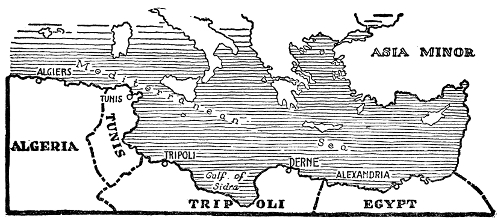
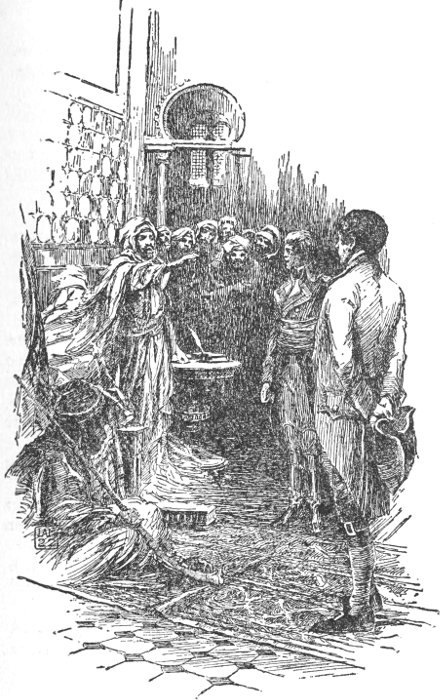
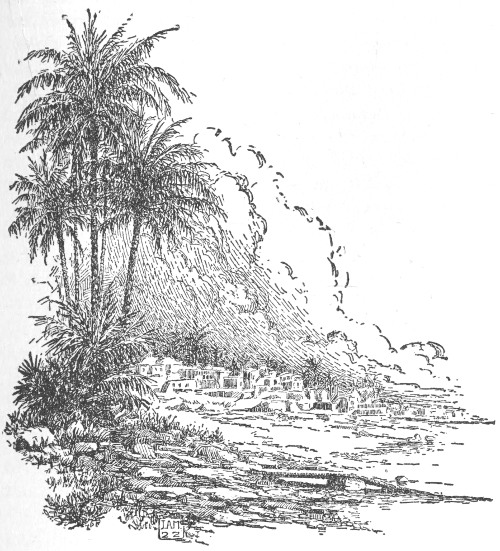
Murad in Tripoli! There he stood, stroking his beard and gazing at me
with glittering eyes as I was hauled past him to the auction-block.
A fierce Arabian trader, who was forming a caravan to go into the
Soudan, bid for me. Murad offered more. I was torn between my terror of
being sold "up-country" and of being bought by the Egyptian, who would
probably apply torture to wring from me the story of what had become of
the contents of the treasure tomb. The Arabian, scowling at Murad, made
a still higher bid, whereupon Murad increased his offer. The trader
gave me a few final digs and slaps, as if to see if I had the sinews
and endurance to warrant his paying a higher price; then he shook his
head, cursed me for a Christian dog, and passed to the next slave.
Murad came forward. I was pushed into his arms and then thrust by him
into the rough hands of his two Moorish attendants.
The Egyptian told me curtly that he had purchased from the Algerines
a ship they had captured called the Hawk, which he meant to use as
a merchant vessel under the protection of the Bashaw, and that he had
bought me for service on board of her.
"I am buying out of these slave markets a crew of European sailors," he
said curtly. "Remember that we are now master and slave. Where I once
befriended you, now I will compel you to wear chains and be subject
to the lash. The American consul to this port is now in Malta; we will
sail before he returns; place no hope in him. I want you to search your
memory and be prepared to tell me every move you made since I left you
aboard The Rose of Egypt. I shall soon question you upon certain
happenings in the desert about which you doubtless have knowledge!"
My eyes fell before his piercing gaze. "I see I have struck home," he
said, "I can question you better aboard ship. Go! Report now to my
mate, MacWilliams."
Under the charge of the two Moors, I was sent aboard the Hawk. She
was a staunch, graceful, roomy vessel, built on the Clyde out of the
best materials—a ship that reflected credit on the Scotchmen who made
her. I said to myself, as I viewed her admiringly, that she was far too
good a ship to be in such vile hands. For all of Murad's threats, my
spirits rose as I felt her deck under my feet. Here I was among white
men, and decent fellows they appeared to be. Here I had a dozen chances
to escape, while if the Arabian trader had gained possession of me,
only a miracle could have rescued me. As for Murad, if he tortured me,
I meant to leap overboard and attempt to swim to safety.
The mate, William MacWilliams, was a big, raw-boned, lantern-jawed
man. He received me with kindness and pity. I heard that, under threat
of death, he had denied the religion of Christ and had embraced the
faith of Mohammed. Murad seemed to place great trust in him. The
Egyptian had become, it seemed, too important a man to be a mere ship
captain—perhaps his experience on The Rose of Egypt had brought
about this state of mind—and he left all matters in charge of the
mate. He himself had much business to transact at court, and things
occurred to postpone his questioning of me until we were almost ready
to sail.
Since my chains were the badge of my slavery, no watch was kept on me
as I went to and fro on errands for those who were outfitting the ship.
William MacWilliams interested me greatly. I had heard that there were
many renegades of his type in Barbary. I have been informed that the
word renegade comes from the Latin word nego, which means "I deny."
Some of these men had become turncoats to save their skins; others had
become renegades because the Moslems, poor sailors themselves, were
glad to employ Christian sea captains, and gave them opportunities to
live luxuriously and become rich.
MacWilliams wore a most melancholy expression. For all his supposed
devotion to the religion of Mohammed, I came upon him one day reading a
pocket Testament.
"It is a book that has sublime characters in it, my lad," he said in
an embarrassed fashion. Then he turned and looked towards a mosque
on shore. "There is but one God, and Allah is his prophet!" he said
piously. I looked around, surprised at the change in his attitude. Then
I saw the reason. The commander of the Turkish soldiers quartered on
board the Hawk had passed our way.
I could not fathom MacWilliams. Yet, understanding something of the
temptations a Christian faced in Barbary, I tried to be charitable in
my judgment towards him.
Meanwhile, I became a carrier of supplies, threading my way through the
motley throngs with my back bent beneath coils of rope, carpenters'
tools, and ship's stores.
While on one of these errands I had a curious adventure.
I tried to go through the streets without giving offence to any
Mussulman, as I feared a cuffing or even the bastinado.
I soon learned that it was the so-called "saints" that were the most
dangerous to Christians. The Arabs, while they will themselves refrain
from showing the contempt they feel towards Christians, nevertheless
will reward and praise one of the holy men for abusing us.
A tall scantily clad negro, of the type of Mohammed, was the most
fanatical and the most dangerous "saint" I met. He was begging alms at
the entrance to a courtyard when he saw me passing. He carried a staff
in his hand which he used principally to strike Jews and Christians.
It was not the stick that troubled me, but instead the habit he had
of spitting in the face of Christians. As he peered into my face,
detecting my Christian features despite my attempt to disguise them,
I saw his mouth moving as if he were preparing to attack me after his
vile custom. I hurried out of his range, and escaped the spittle. My
quickness enraged him, and he called after me in Arabian. I had heard
the words often enough to know that they meant:
"Dog of a Christian, may your grandmother roast! Why shouldst thou
avoid the spittle of a saint? It would be the only thing blessed upon
thee, seeing that it came from the mouth of a saint!"
I darted down a side street and into a doorway, hoping to rid myself
of the pest, but he followed quickly and caught sight of my place of
refuge.
"Dog of a Christian," he cried again, poking me in the chest and ribs
with his staff, "why do you offend Mohammed by treading the same ground
as true believers?"
My blood mounted as I smarted beneath his cudgel. I decided that I
would fare just as well by resisting as by submitting, so I ducked my
head and dived into the stomach of the fellow, upsetting him. This
turned out to be, in the eyes of the Moslems, a great sacrilege. It
appeared that while the alleged holy man had entire freedom to beat
me, I had committed a crime by doing violence to his body. He made a
tremendous uproar as he rose from the dust, and the noise drew a crowd
that began to pummel me. I plunged deeper into the doorway, and, having
seized the stick of the marabout, whirled it before me in a vigorous
fashion. A storm of stones and sticks beat upon me.
While I was on my knees, expecting a rush that would trample me to
death, I suddenly heard a familiar voice above the shrieks of the mass.
"Dogs of the desert, how dare you trouble the slave of a good
Mohammedan? This Nazarene is the slave of my master, friend of the
Bashaw! Is my lord a Jew or a Christian that you would destroy his
property before the eyes of a witness? The slave was assaulted first. I
swear by the Prophet that he is a gentle slave, and intended no injury
to the holy man. Off with you before I call the soldiers of the Bashaw!"
The crowd dispersed. Grumbling, the marabout departed.
I looked into the twinkling eyes of Mustapha. Snatching the marabout's
staff from my hand, he began to pelt me across the shoulders. "It is
necessary that I do this," he whispered, "the people are watching."
I went through the crowd with Mustapha belaboring me and shouting:
"Dog of a Nazarene, how dare you risk your body, for which my master
paid a great sum, in a fight with a holy man?"
When we reached a place where our talk could not be overheard, I burst
out: "The treasure sacks, Mustapha? Do not tell me that the Moors have
them!"
"The bags are safe, oh David," he assured me, "but fret not if you
are not able to open them till you return to America. After you were
captured, I hurried to the waterside. There I saw the cutter of The
Morning Star, a vessel of the American navy. I unstrapped the sacks
and put them in the boat, pointing out to the sailor in charge the tags
you had tied around their necks."
This information dumbfounded me. The fact that I had been careful
enough to tie to the necks of the sacks tags from our own naval stores
seemed to promise now delivery of the sacks to a safe place—if they
were not ripped open and plundered meanwhile. This was not liable to
happen in view of the pains I had taken to ward off curiosity. Upon
each tag I had written plainly:
ARCHAEOLOGICAL SPECIMENS
to be delivered to
Rev. Ezekiel Eccleston, D.D.,
Rector of Marley Chapel,
Baltimore, Md.
Sender: David Forsyth,
With American Military Expedition
in Libyan Desert.
"If the men who handle the bags respect either the navy or the
ministry," I said to Mustapha, "the treasure will be safe. But how can
I be sure that the sacks were received on board the ship?"
"I saw the bags lifted over the side, oh, thou of little faith,"
Mustapha reproved me, "and the boat did not return to the dock. A
few hours later The Morning Star sailed for America. Allah favored
you—my tribe moved this way when Joseph Bashaw's soldiers took
possession of Derne, and thus I came to prevent your blood being
spilled in the streets of Tripoli!"
"I want to reward you with the biggest gem in our collection," I said,
"but how can I do it when our fortune is at sea?"
Then a thought came to me. "Mustapha," I said, "I mean to escape from
the Hawk and board a ship bound for England or America. I have
learned from the mate that a servant boy is needed on the Hawk. If
you like, I'll recommend you for the place. You must pretend not to
know me. If the owner of the Hawk discovers that you know about the
treasure, he'll probably cut your throat? Can you swim?"
Mustapha nodded. "I'll dive overboard if he bothers me!"
"Come then," I said, "we'll follow our riches to America, and you shall
return home a great sheik!"
His tribesmen had returned to the desert, and he was free to act for
himself. Quite without fear, he followed me aboard. I spoke a good word
for him to MacWilliams, and before long he was peeling potatoes in the
galley. If I had thought that Murad would recognize him, I should have
given my right hand rather than have invited him to share my luck; I
did not know that my meeting with Mustapha had been observed by Murad,
and that I was leading the lad into danger.
All too soon came the interview I feared with my owner. One day Murad
came aboard the Hawk, entered the cabin, and sent for me. The tiger
was about to show his claws. I was not greatly frightened, for I
reckoned that he would need me in his plans to gain possession of the
treasure.
"Now, you scheming dog," he said, "let's not beat about the bush. Your
guardian told me once of a treasure tomb hidden in the desert. You know
the story. Perhaps you know, too, how I came into possession of the
rector's secret. When at last I was able to uncover the tomb, all of
the relics worth taking had vanished. Don't try to look innocent: you
were my cabin boy on board The Rose of Egypt. The reason you enlisted
with me so readily was that you wanted to find the chart and get a
chance at the treasure at Tokra. I found that someone had entered the
tomb a few hours before me. Two strange young Arabs had been seen near
the spot. I choked a stablekeeper until he described both rascals. One
of the two Arabs was you, eh? Tell me where the trinkets and jewels
are! If your tongue is stubborn, a red-hot iron may cause it to move.
What did you find? Tell me what you took away! Speak up—the way to
save yourself from the torture you well deserve is to put me on the
track of the treasure!"
There was nothing to be gained by secrecy, and much to be suffered, so
I described the trinkets and gems in a way that made his eyes sparkle
and his fingers quiver. He snarled and showed his wolfish teeth when I
told him that the treasure sacks were on their way to America.
All of a sudden I was knocked down by a blow from his fist. He stepped
across me and called to a sailor in Arabic. After the lapse of a
minute, the door of the cabin was thrown open, and Mustapha was thrust
in by a Moslem guard. He had been seized in the act of diving over the
side.
"Is this the young devil that led you to Tokra?" Murad thundered at me.
"Yes," I said, "but he went only as my guide and knew nothing of why I
went. He has done nothing to merit punishment."
Under a volley of threats, Mustapha was commanded to tell all that he
knew of the treasure tomb. He looked at me with frightened eyes; yet
his lips remained sealed.
"Tell all, Mustapha," I said, "it will free you, and it will be no more
than I have already told."
His story, as he stammered it, agreed with mine in every particular.
Murad strode up and down the cabin, swearing in Arabic and English.
Then he shot questions at both of us concerning The Morning Star.
When had she sailed from Derne? What was to be her next port? Was she
fast? How many men and guns did she carry?
When Mustapha had answered as well as he could, Murad booted us out of
the cabin. "I'm not done with you, miserable curs," he cried. "I'll
need you when I board The Morning Star. Then for all the trouble
you've caused me, I'll sew you up in the bags and drop you overboard!
If you can think of a way of getting those bags you'll do well to send
for them as your ransom. If I don't get them, you——" He drew his
finger across his throat with a horrible gesture.
He now sent for MacWilliams and gave him sharp orders.
The next morning, after a day of hurried preparation, the Hawk
sailed.
The ship had an armament of ten cannon, and carried an abundant supply
of ammunition and provisions. A company of Moorish soldiers were on
board of her. What was the Hawk's mission? Were we Christians to be
used in enslaving other Christians? Was the Hawk a ship whose mission
fitted her name? Was she to be a pirate ship seeking Christian vessels
as prey, and would we be made to fight and to help enslave men of our
own religion and blood? Questions like these concerned the Christians
among the crew, and I for one prayed that I would have the courage to
jump overboard if there came a moment when I was driven to do such
deeds.
On our first day out, I made bold to unburden myself to the mate.
MacWilliams eyed me gravely. "You are not to ask questions. You are
to do as you are told. What happens on board this ship shall be on my
conscience."
He walked off, leaving me no more clear about the matter than I was
before. I saw the Danes and Italians talking earnestly in their
languages, and I knew that what was worrying me was also troubling them.
MacWilliams was master of navigation, but had no authority over any
other activity aboard ship. There were about forty Moslems aboard who
took no part in sailing the vessel. In charge of them was Murad, who
had command over the entire ship and told MacWilliams the direction
in which he wanted the ship to sail. I learned that he had directed
MacWilliams to sail to certain ports outside of the Straits, where he
hoped to fall in with The Morning Star.
The master gunner was an English renegade named Watson, who had charge
of the guns and ammunition. The commander seemed to think that European
gunners were better than Moors, because among the gunners under Watson
were several Christian renegades. I found myself wondering whether, if
all of the men aboard of Christian or former Christian faith were moved
by the same desire to escape, they could not overcome the Mohammedans
and capture the vessel. Yet, having observed that some Christians when
they adopted the Moslem religion grew as fanatical in their devotion as
did the most extreme worshippers, I decided that it would not be safe
to whisper such a suggestion to anyone.
It gave us entertainment while we were performing our tasks to watch
the peculiar customs of the Moslems. Our greatest source of amusement
was a professional wizard the Moors had brought with them. He had a
book of magic, and when the commander was in doubt as to which course
to take, the dark-skinned humbug would open his book and advise him
according to the wisdom he drew from its pages.
When the wizard's advice was passed on to MacWilliams, he said
nothing by way of dissent, but proceeded to steer and set sails as
his own judgment and experience dictated. The Moslems, who had no sea
knowledge, and were lost when they were out of sight of land, made
no effort to find out whether the mate was following the magician's
counsel.
Our fears as to what sort of work we were about to enter upon soon
became certainties. On our second day out we caught sight of a large
schooner and gave chase. Her crew, rather than surrender, drove the
ship ashore and fled along the coast. The men Murad sent in boats to
plunder the vessel brought back several guns, some gold, and such
wearing apparel and furnishings as took their fancy. The sight of
the gold brought back to my mind my own lost treasure. Between the
prospect of attacking Christian vessels and the remembrance of what I
had already suffered, I spent my night watches in great distress of
mind, a state which was in no way soothed by the thought that around me
lay Christian slaves racked by the same thoughts.
On the next day we sailed boldly through the Straits and out into the
Atlantic Ocean. As we were making the passage through the Straits,
we discovered a sail. I feared that it was The Morning Star. It
proved, however, to be an Algerine corsair. We spoke to each other and
separated.
We headed north, past Cape St. Vincent. It puzzled me that Murad would
permit MacWilliams to take the ship so far from the Mediterranean. It
was a dangerous undertaking for the corsairs, but the Hawk was an
unusually speedy ship, and I supposed that Murad was depending on her
swiftness to escape any hostile warships that he might meet.
A great homesickness came upon us as we passed into the Atlantic. It
was intolerable to think of returning to the Mediterranean and the
dreadful shores of Barbary when the coasts of Europe were almost in
sight. I thought often of the girl who escaped from the desert and
sailed to America.
Sometimes Murad's lieutenant grew angry with some of the Moors, who
were slow in carrying out his orders. To spite them, he showed favor to
such Christians as happened to be near.
"Bon Christiano! Bon Christiano!" he called endearingly. The next hour,
however, the wind would change. He would stroll along the deck followed
by the very Moslems he had reviled, and if he found any of us at fault
about our work he would bid his Moors knock our heads together. He was
afraid to carry these tyrannies too far, for MacWilliams was prone to
look upon him with a look that warned him that the Christian sailors
were too valuable to Mohammedan safety to be abused too far.
One night, while I was on watch, MacWilliams approached me. His hand
rested on my shoulder with a fatherly touch that moved me greatly.
"The time has come when I need your help," he said. "I intend to take
this ship to England despite her crew of Mohammedans. If the plan goes
through, every Christian slave aboard the Hawk shall step upon the
earth of Europe a free man. I've been watching you. I believe you agree
that it's better to risk death than to go on leading such a life. There
are other slaves who think the same way. What do you say, lad?"
"Just you try me!" I said. "I owe the infidels a score that can hardly
be wiped out. Besides, hasn't the skipper threatened to sew me in a
sack and toss me overboard? Of course, you can trust me, and Mustapha,
too!"
"Lad, lad," MacWilliams went on, "we English blame the Turks, yet we
have been reaping the fruits of what our own race has sowed. The story
has passed down to me, through generations of seafaring ancestors, of
how when good Queen Elizabeth passed and when the English and Spaniards
ceased for a time their warfare at sea, hundreds of sailors who had
fought in bloody battles under Drake were at a loss for employment and
found it in piracy.
"Down to the Mediterranean they went and entered the service of these
evil Moors. It was our forebears who taught the Moslems how to become
good sea-fighters. It was men of our own race who first led the Barbary
corsairs forth on buccaneering expeditions. What our forefathers
started, some of us have carried on, but the time has come to end it
all!"
Continuing, for we had an idle hour to pass, and the mate was desirous
of heartening me for our desperate undertaking, MacWilliams told me of
how in 1639 William Okeley, an English slave, had constructed in the
cellar of his master's shop a light canoe made of canvas, making oars
from the staves of empty wind pipes. This craft he and his companions
smuggled down to the beach, and five of them embarked in it and made
their way safely to Majorca. The hardest part of the enterprise was
their farewell to two other English slaves who were to have made the
voyage with them, but who were found to overweight the little boat.
"With the help of Gunner Watson," MacWilliams explained as I drew him
out as to his plan, "we should be able to trap the Moslems between
the decks; get control of the cannon and powder, and sail the ship
into some European port. It'll be turning the tables in fine style—a
Christian crew bringing infidels as captives to an English harbor!"
He proceeded to set forth his plan in detail. "By to-morrow," he
concluded, "I shall know every trustworthy man. I shall then give
each man a definite part. Such a way of escape has been in my mind
for years. A man with a Presbyterian conscience can never remain
a Mohammedan. If our plot succeeds I shall make a contribution to
the church of my fathers that I hope shall to some extent offset my
wickedness!"
Mustapha carried food from the galley to Murad. MacWilliams told me
that it was essential to the success of the plot that Murad be made
too ill to note the direction of the ship. The mate was skilful in
Oriental medicines, and he produced a phial containing a liquid that,
while tasteless, yet had the power to nauseate and weaken a man.
While Mustapha obligingly turned his back, and while I kept guard,
MacWilliams poured the fluid into Murad's broth. The Egyptian was taken
with what seemed to be chronic sea-sickness and kept to his cabin. I do
not think he suspected that his food had been "doctored." He ordered
MacWilliams to sail close to certain ports and to pursue any vessel
that was not plainly a warship.
I told the mate something of the treasure tale—enough for him to know
that Murad was in pursuit of The Morning Star—and at whatever port
it seemed safe for us to stop, MacWilliams brought aboard reports
that there was a richly laden vessel bound for America that might
be overhauled before we reached the next Atlantic harbor. Thus we
continued steadily away from the Straits.
Once an encounter with a strange warship came near to upsetting
our plans for capturing the Hawk. MacWilliams and Watson, being
renegades, were afraid to meet the captain of any European warship, for
fear that they might be recognized and treated as buccaneers. Knowing
their minds, I watched the outcome of the chase with intense interest.
I happened to be the lookout for that day, and had reported a strange
sail ahead.
MacWilliams climbed the mast to a place beside me and adjusted his
telescope. Then he went down and approached Uruj, Murad's lieutenant.
"She is well to windward——I doubt if we can pass her!" the mate
reported.
"Why should we try to pass her?" Uruj said insolently.
"'Twill go hard with us if we don't," said MacWilliams. "She is double
our size—with double our crew and guns. Our only chance is to keep our
course and try to weather the ship."
Uruj looked to the wizard for advice. The magician, being a rank
coward, found by his book that MacWilliams told the truth. Uruj
therefore agreed to MacWilliams's plan.
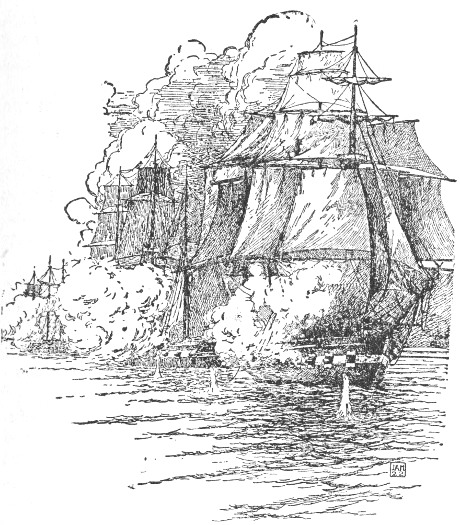
We could now see the ship over our lee bow, about three miles away. The
sea was heavy, but the Hawk met the waves gallantly. We saw a thick
white puff of smoke from the forecastle of our pursuer.
"The wind looks like it will die down," said MacWilliams, who had been
anxiously watching the sky. "If it does, we will outsail her. The next
few moments should tell what the outcome will be."
It looked to us as if we must pass within pistol shot of the vessel,
and the thought of having to receive a broadside from her at such a
short distance was enough to make a braver lad than I shiver with
fright. Watson and his gunners stood at the cannon, waiting for Uruj's
command.
Our pursuer was close to us now—in full sail. We could see groups of
men about the gun ports, from which cannon jutted.
A voice hailed us.
"Ho! The schooner, ahoy!"
"Hello!" MacWilliams responded.
"What vessel is that?"
"The Tripolitan schooner Hawk, from Tripoli. What ship is yours?"
We could not catch the first part of the reply, but we did hear the
last words: "Haul down your flag and heave to!"
Uruj went down to tell Murad. We continued on our course.
"Heave to or we'll sink you," cried the challenger.
MacWilliams spoke to Uruj. "Do as you think best," said Uruj. "Fire the
bow guns," MacWilliams commanded Watson.
Our grapeshot whistled through the rigging of the frigate. We saw her
foresail fall.
Jets of flame issued from her ports and a broadside swept our decks.
Our sails were undamaged, but several shots tore through our hull,
injuring several of the sailors and soldiers with flying splinters,
though none was seriously hurt.
Before the next cannonade came, we had widened the distance between the
Hawk and her pursuer. The winds, as MacWilliams had predicted, had
grown lighter, and the Hawk, a splendid sailer in light winds, showed
her heels handily to the enemy. Their shots struck us with less force,
and soon we saw the shots from their long gun falling short of us.
We had escaped from capture by a ship that evidently belonged to a
country that was hostile to the Tripolitans. If she had seized us the
renegades would have been treated in the same way that the Moslems
would be used, and therefore MacWilliams took this desperate chance. As
for me, I did not know whether to be glad or sorry, for if I had lived
through the battle, I could doubtless have proved that I had been held
in slavery. Yet the incident must have confirmed the Turks in their
opinion of MacWilliams' loyalty.
On another day we sighted a vessel that appeared to be The Morning
Star, but when she was nearly under our guns, and when Mustapha and I
were about to surrender hope of saving our riches, a freak of wind bore
her away from us, and we never saw her again.
Meanwhile, the scheme of rebellion and seizure was making steady
progress. The plan of mutiny as it had formed itself in MacWilliams's
mind was to provide ropes and irons near the hatchways, gratings and
cabins so that they could be closed from the outside at a moment's
notice. When this had been arranged, the next step was to dupe the
Moslems so that the most of them would be below deck when the signal
for attack was given. MacWilliams went about the work cautiously. To
have one traitor among us, he well knew, would cost every Christian his
life. Mustapha, being an Arab, hated the Moors, and entered the plot
eagerly.
Each man who consented to engage in the plot swore a sacred oath of
fidelity.
With those MacWilliams could not trust—renegades or slaves whose
character he could not read—his plan was, when the uprising came, to
put pistols to their breasts and threaten them with death if they did
not assist in the rebellion.
After hours that seemed as long as months had passed, he passed me the
word one night that the signal would be given on the morrow, before
noon. The rough weather we were laboring through was an aid to our
scheme.
The next morning MacWilliams made an inspection of the hold. Then he
came up to inform the Moslem lieutenant that there was much water in
the bilges, and that it would be necessary to trim the ship. Uruj,
suspecting nothing, consented. Our leader then asked that, for the same
purpose, the cannon that were forward should be moved aft. This being
done, he further requested that the Moslem soldiers be quartered aft so
as to bring the ship's bow out of the water. This was also agreed to.
Meanwhile, we had managed to store in a convenient place such weapons
as we would need.
When all these things had been done, to avoid suspicion, we went
about our regular duties. Our confederates of the gunner's force went
below deck with the infidel soldiers so that it would not appear that
there was a crowding together of the slaves and renegades. The rest
of us were set to pumping water by MacWilliams. I could tell by the
arrangement of the men, and by the way they acted, which were sharers
in the secret. There were about a score of us, and we had to contend
with double our number.
At noon, while most of the Turks that were on deck were aft, using
their weight to bring the stern into the water so that the water in the
vessel might flow towards the pumps, MacWilliams gave the signal to one
of the gunners to fire a cannon. An explosion followed—the signal for
us to proceed. With a ringing hurrah we sprang to the attack.
Each man had been assigned a specific duty: first we battened down the
hatches down which most of the Moslems had gone, so that the greater
part of our enemies were now prisoners; then we turned to conquer the
Moslems on deck.
There were twelve of them. They came at us with pistols, knives and
hatchets, calling us by their epithet, "Christian dogs!" But the dogs
had become bloodhounds now. Johansen, one of the Danes, swung one of
the cannon in their direction. They made a rush at him, but he fired
the gun directly at them, at which there was a terrific explosion—and
the decks became a welter of gore. The terrible death of these
Mohammedans caused the remaining Moslems to prostrate themselves before
us, their fury turned to abject fear.
Meanwhile, the Moslems imprisoned between decks were trying desperately
to break through the hatches. Murad, weak from sickness, yet rose up
beside Uruj to thunder threats against us and to urge his men on.
However, our victory on deck left us free to attend to those below.
Two men were stationed over each passageway, with orders to shoot any
infidel who by the use of hatchet or knife was able to break through
the planking.
MacWilliams stood over the hatchway below which Murad and Uruj raged.
"If you value your lives," he called, "you will surrender! My men
have orders to shoot any man who dares to lift his head. If you come
too strongly for our numbers, we will blow you to bits with your own
cannon. We are only two days' sail from Plymouth. Your precious wizard
hadn't enough insight to see that we were taking you nearer the coast
of England every hour we sailed. We will take you there, alive or dead.
If you would enter England with breath in your lungs, surrender!"
Uruj at once offered to surrender himself and his men as prisoners of
war. Murad cursed Uruj, but at last yielded. He reminded MacWilliams
that he had treated him with consideration.
"That I acknowledge," MacWilliams replied, "and I will so treat you as
well so long as you make no attempt to thwart us!"
The Mohammedans came out of the hatches one by one to be disarmed.
The chains they had in store for such Christians as they might take
captives were placed on their wrists and ankles. I was one of those who
were called upon to receive the arms. It was a task to make a youth
flinch to go from one scowling ruffian to another, collecting muskets,
pistols, dirks, and pikes, but I came through without much trouble,
having nothing harder thrown at me than curses. Murad flinched as I
came toward him with a dirk in my hand, but I only grinned at him. For
a keepsake, I took the cowering wizard's book of magic.
When the last Moslem was put in irons, MacWilliams brought out openly
his Bible.
"I call on all of you who are willing to be reconciled to their true
Savior," he said, "and who repent of being seduced by hopes of riches,
honor, preferment, and such devilish baits, to join me in praise and
prayer to the true God, whom we re-establish in our hearts and restore
in our worship."
With that he read to us this passage from the Psalms:
"They that go down to the sea in ships, that do business in great
waters;
"These see the works of the Lord, and his wonders in the deep.
"For he commandeth, and raiseth the stormy wind, which lifteth up
the waves thereof.
"They mount up to the heaven, they go down again to the depths;
their soul is melted because of trouble.
"They reel to and fro, and stagger like a drunken man, and are at
their wit's end.
"Then they cry unto the Lord in their trouble, and he bringeth
them out of their distresses.
"He maketh the storm a calm, so that the waves thereof are still.
"Then are they glad because they be quiet; so he bringeth them
unto their desired haven."
MacWilliams closed the Bible. "Now men," he said, "having given thanks
to the Almighty, let us wash the decks of infidel blood, so that our
ship will present a decent appearance when we enter the harbor of our
hopes."
We thereupon set about washing and holystoning the decks, and repairing
the damage resulting from the battle. Two days later, we entered
Plymouth harbor, astounding the town as we, in strange garb ourselves,
marched our captives in their queer Mohammedan dress to the town jail,
where they were left to the disposition of the Government. We heard
later that they were used in exchange for citizens of friendly European
nations, held in captivity in Tripoli.