It would be hard to find a more lovely spot
in the flush of a summer sunset than Wister
Woods. Old residents of the neighbourhood say
that the trees are not what they were fifteen and
twenty years ago; the chestnuts have died off; even
some of the tall tulip-poplars are a little bald at the
top, and one was recently felled by a gale. But still
that quiet plateau stands in a serene hush, flooded
with rich orange glow on a warm evening. The
hollyhocks in the back gardens of Rubicam Street
are scarlet and Swiss-cheese-coloured and black; and
looking across the railroad ravine one sees crypts
and aisles of green as though in the heart of some
cathedral of the great woods.
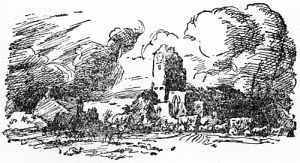
Belfield Avenue, which bends through the valley
in a curve of warm thick yellow dust, will some day
be boulevarded into a spick-and-span highway for
motors. But now it lies little trafficked, and one
might prefer to have it so, for in the stillness of the
evening the birds are eloquent. The thrushes of
Wister Woods, which have been immortalized by
T. A. Daly in perhaps the loveliest poem ever
written in Philadelphia, flute and whistle their
tantalizing note, while the song sparrow echoes them
with his confident, challenging call. Down behind
the dusty sumac shrubbery lies the little blue-green
cottage said to have been used by Benjamin West
as a studio. In a meadow beside the road two
cows were grazing in the blue shadow of overhanging
woodland.
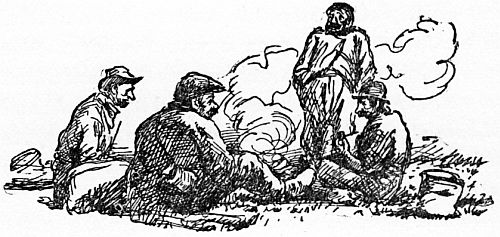
Over the road leans a flat outcrop of stone, known
locally as “The Bum's Rock.” An antique philosopher
of those parts assured the wayfarer that it is
named for a romantic vagabond who perished there
by the explosion of a can of Bohemian goulash which
he was heating over a small fire of sticks; but one
doubts the tale. Our own conjecture is that it is
named for Jacob Boehm, the oldtime brewer of
Germantown, who predicted in his chronicles that
the world would come to an end in July, 1919.
From his point of view he was not so far wrong.
Above Boehm's Rock, in a grassy level among the
trees, a merry little circle of young ladies was sitting
round a picnic supper. The twilight grew
darker and fireflies began to twinkle. In the steep
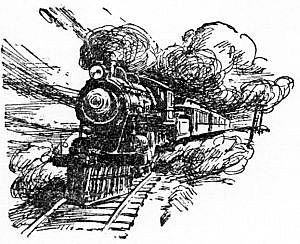
curve of the Cinder and Bloodshot (between Fisher's
and Wister stations) a cheerful train rumbled, with
its engine running backward just like a country
local. Its bright shaft of light wavered among the
tall tree trunks. One would not imagine that it was
less than six miles to the City Hall.
A quarter to one a. m., and a hot, silent night.
As one walks up Chestnut Street a distant roaring is
heard, which rapidly grows louder. The sound has
a note of terrifying menace. Then, careering down
the almost deserted highway, comes a huge water-tank,
throbbing like an airplane. A creamy sheet
of water, shot out at high pressure, floods the street
on each side, dashing up on the pavements. A knot
of belated revellers in front of the Adelphia Hotel,
standing in mid-street, to discuss ways and means
of getting home, skip nimbly to one side, the ladies
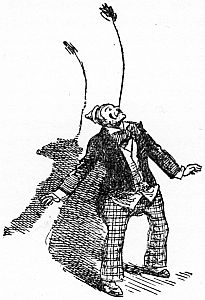
lifting up their dresses with shrill squeaks of alarm
as the water splashes round them. Pedestrians
plodding quietly up the street cower fearfully against
the buildings, while a fine mist envelops them.
After the tank comes, more leisurely, a squad of
brooms. The street is dripping, every sewer opening
clucks and gurgles with the falling water. There is
something unbelievably humorous in the way that
roaring Niagara of water dashes madly down the
silent street. There is a note of irony in it, too, for
the depressed enthusiasts who have been sitting all
evening in a restaurant over lemonade and ginger ale.
Perhaps the chauffeur is a prohibitionist gone mad.
While eating half a dozen doughnuts in a Broad
Street lunchroom at one o'clock in the morning, we
mused happily about our friends all tucked away in
bed, sound asleep. There is one in particular on
whom we thought with serene pleasure. It was
charming to think of that delightful, argumentative,
contradictory, volatile person, his active mind stilled
in the admirable reticence of slumber. He, so endlessly
speculatory, so full of imaginative enthusiasms
and riotous intuitions and troubled zeals concerning
humanity, lost in a beneficent swoon of
unconsciousness! We could not just say why, but
we broke into chuckles to think of him lying there,
not denying any of our statements, absolutely and
positively saying nothing. To have one's friends
asleep now and then is very refreshing.
Off Walnut Street, below Fifth, and just east of
the window where that perfectly lovely damsel sits
operating an adding machine—why is it, by the way,
that the girls who run adding machines are always so
marvellously fair? Is there some secret virtue in
the process of adding that makes one lovely? We
feel sure that a subtracting engine would not have
that subtle beautifying effect—just below Fifth
Street, we started to say, there runs a little alley
called (we believe) De Silver Court. It is a sombre
little channel between high walls and barred windows,
but it is a retreat we recommend highly to
hay fever sufferers. For in one of the buildings
adjoining there seems to be a warehouse of some
company that makes an “aromatic disinfector.”
Wandering in there by chance, we stood delighted at
the sweet medicinal savour that was wafted on the air.
It had a most cheering effect upon our emunctory
woes, and we lingered so long, in a meditative and
healing ecstasy, that young women immured in the
basement of the aromatic warehouse began to peer
upward from the barred windows of their basement
and squeak with astonished and nervous mirth. We
blew a loud salute and moved away.
We entered a lunchroom on Broad Street for our
favourite breakfast of coffee and a pair of crullers.
It was strangely early and only a few of the flat-arm
chairs were occupied. After dispatching the rations
we carefully filled our pipe. With us we had a copy
of an agreeable book, “The Calamities and Quarrels
of Authors.” It occurred to us that here, in the brisk
serenity of the morning, would be a charming opportunity
for a five-minute smoke and five pages of
reading before attacking the ardours and endurances
of the day. Lovingly we applied the match to the
fuel. We began to read:
Of all the sorrows in which the female character
may participate, there are few more affecting than
those of an authoress——
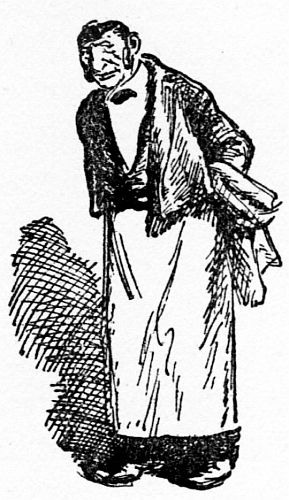
A stern, white-coated official came over to us and
tapped us on the shoulder.
“There's a sign behind you,” he said.
We looked, guiltily, and saw:
The cocoateria on Eighth Street closes at one a. m.
Between twelve-thirty and closing time it is full of
busy eaters, mostly the night shift from the Chestnut
Street newspaper offices and printing and engraving
firms in the neighbourhood. Ham and eggs blossom
merrily. The white-coated waiters move in swift,
stern circuit. Griddle cakes bake with amazing
swiftness toward the stroke of one. Little dishes of
baked beans stand hot and ready in the steam-chest.
The waiter punches your check as he brings your
frankfurters and coffee. He adds another perforation
when you get your ice cream. Then he comes
back and punches it again.
“Here,” you cry, “let it alone and stop bullying it!”
“Sorry, brother,” he says. “I forgot that peach
cream was fifteen cents.”
One o'clock. They lock the door and turn out
the little gas jet where smokers light up. As the
tables empty the chairs are stacked up on top. And
if it is a clear warm evening the customers smoke
a final weed along the Chestnut Street doorsteps,
talking together in a cheery undertone.
No man has ever started upon a new cheque-book
without a few sourly solemn thoughts.
In the humble waters of finance wherein we paddle
we find that a book of fifty cheques lasts us about
four months, allowing for two or three duds when we
start to make out a foil payable to bearer (self) and
decide to renounce that worthy ambition and make it
out to the gas company instead.
It occurs to us that if Bunyan had been writing
“Pilgrim's Progress” nowadays instead of making
Christian encounter lions in the path he would have
substituted gas meters, particularly the quarter-in-the-slot
kind that one finds in a seaside cottage.
However——
Four months is quite a long time. It may be
weak of us, but we can never resist wondering as we
survey that flock of empty cheques just what adventures
our bank account is going to undergo during
that period, and whether our customary technique
of being aloof with the receiving teller and genial
and commentary with the paying ditto is the right
one. We always believe in keeping a paying teller
in a cheerful frame of mind. We would never admit
to him that we think it is going to rain. We say,
rather, “Well, it may blow over,” and try not to
surmise how many hundreds there are in the pile at
his elbow. Probably we think the explanation for
the really bizarre architecture of our bank is to keep
depositors' attention from the money. Unquestionably
Walt Whitman's tomb over in Harleigh—Walt's
vault—was copied from our bank.
The cheques in our book are blue. We have always
regretted this. If we had known it beforehand
perhaps we would have inflicted our problems upon
another bank. Because there are so many more interesting
colours for cheques, tints upon which the ink
shows up in a more imposing manner. A pale pink
or cream-coloured cheque for $2.74 looks much more
exciting than a blue cheque for $25. We have known
gray, pink, white, brown, green, and salmon-coloured
cheques. A friend of ours once showed us one that
was a bright orange, but refused to let us handle it.
But yellow is the colour that appeals to us most
strongly. When we were very young and away from
home our monthly allowance, the amount of which
we shall not state, but it cost us less effort than any
money we ever received since, came to us by way of
pale primrose-coloured cheques. For, after all, there
are no cheques like those one used to get from one's
father. We hope the Urchin will think so some day.
We like to pay homage to the true artist in all
lines. At the corner of Market and Marshall
streets—between Sixth and Seventh—the collar-clasp
orator has his rostrum, and it seems to us that
his method of harangue has the quality of genuine
art. He does not bawl or try to terrify or bully his
audience into purchase as do the auctioneers of the
“pawnbrokers' outlets.” How gently, how winningly,
how sweetly he pleads the merits of his little
collar clasp! And there is shrewd imagination in his
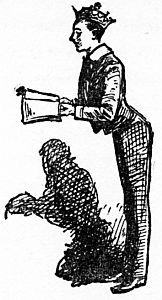
attention-catching device, which is a small boy
dressed in black, wearing a white hood of cheesecloth
that hides his face. This peculiar silent figure,
with a touch of mystery about it, serves to keep the
crowd wondering until the oration begins.
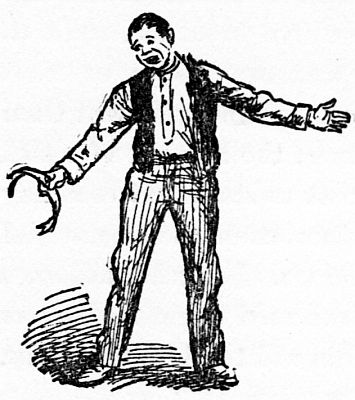
With a smile, with infinite ingratiation and gentle
persuasion, our friend exhibits the merits of his
device which does away with the traditional collar-button.
His art is to make the collar-button seem a
piteous, almost a tragic
thing. His eyes swim
with unshed tears as he describes
the discomfort of
the man whose collar,
fastened by the customary
button, cannot be given
greater freedom on a hot,
muggy day. He shows, by
exhibition on his own person,
the exquisite relief afforded by the adjustable collar
clasp. “When the day grows cool,” he says, “when
you begin to enjoy yourself and want your collar
tighter, you just loosen the clasp, slide the tabs closer
together, and there you are. And no picking at
your tie to get the knot undone. Now, how many
of you men have spoiled an expensive tie by picking
at it? Your fingers come in contact with the fibres
of the silk and the first thing you know the tie is
soiled. This little clasp”—and he casts a beam of
affection upon it—“saves your tie, it saves your
collar, and it saves your patience.” A note of
yearning pathos comes into his agreeable voice, and
he holds out a handful of the old-fashioned collar-buttons.
“You men are wearing the same buttons
your great-grandfathers wore. Don't you want to
get out of collar slavery? Don't you want to quit
working your face all out of shape struggling with a
collar-button? Now as this is a manufacturing
demonstration——”
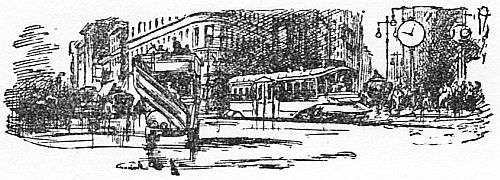
On a warm evening nothing is more pleasant than
a ride on the front platform of the Market Street L,
with the front door open. As the train leaves Sixty-ninth
Street it dips down the Millbourne bend and
the cool, damp smell of the Cobb's Creek meadows
gushes through the car. Then the track straightens
out for a long run toward the City Hall. Roaring
over the tree tops, with the lights of movies and
shops glowing up from below, a warm typhoon
makes one lean against it to keep one's footing.
The airy stations are lined by girls in light summer
dresses, attended by their swains. The groan of the
wheels underfoot causes a curious tickling in the
soles of the feet as one stands on the steel platform.
This groan rises to a shrill scream as the train gathers
speed between stations, gradually diminishing
to a reluctant grumble as the cars come to a stop.
In the distance, in a peacock-blue sky, the double
gleam of the City Hall tower shines against the
night. Down on the left is the hiss and clang of
West Philadelphia station, with the long, dim, amber
glow of the platform and belated commuters pacing
about. Then the smoky dive across the Schuylkill
and the bellow of the subway.
From time to time humanity is forced to revise its
customary notions in the interests of truth. This is
always painful.
It is an old fetich that the week-end in summer is a
time for riotous enjoyment, of goodly cheer and
mirthful solace. A careful examination of human
beings during this hebdomadal period of carnival
leads us to question the doctrine.
When we watch the horrors of discomfort and
vexation endured by simple-hearted citizens in
pursuit of a light-hearted Saturday and Sunday, we
often wonder how it is that humanity will so gleefully
inflict upon itself sufferings which, if they were
imposed by some taskmaster, would be called
atrocious.
We observe, for instance, women and children
standing sweltering in the aisles of trains during a
two-hour run to the seashore. We observe the
number of drownings, motor accidents, murders, and
suicides that take place during the Saturday to
Monday period. We observe families loaded down
with small children, who might have been happy and
reasonably cool at home, struggling desperately to
get away for a day in the country, rising at 5 a. m.,
standing in line at the station, fanning themselves
with blasphemy, and weary before they start. We
observe them chased home by thunderstorms or
colic, dazed and blistered with sunburn, or groaning
with a surfeit of ice cream cones.
It is a lamentable fact (and the truth is almost always
lamentable, and hotly denied) that for the
hard-working majority the week-end is a curse
rather than a blessing. The saddest fact in human
annals is that most people are never so happy as
when they are hard at work. The time may come
when criminals will be condemned, not to the chair,
but to twenty successive week-ends spent standing
in the aisles of crowded excursion trains.
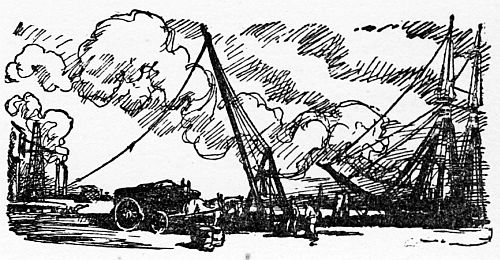
Strolling downtown to a well-known home of fish
dinners, it is appetizing to pass along the curve of
Dock Street in the coolness of the evening. The
clean, lively odours of vegetables and fruit are strong
on the air. Under the broad awnings of the commission
merchants and produce dealers the stock is
piled up in neat and engaging piles ready to be
carted away at dawn. Under the glow of pale arcs
and gas lamps the colours of the scene are vivid.
Great baskets of eggplant shine like huge grapes, a
polished port wine colour; green and scarlet peppers
catch points of light; a flat pinkish colour gleams on
carrots. Each species seems to have an ordered
pattern of its own. Potatoes are ranged in a pyramid;
watermelons in long rows; white and yellow
onions are heaped in sacks. The sweet musk of
cantaloupes is the scent that overbreathes all others.
Then, down nearer to the waterfront, comes the
strong, damp fishy whiff of oysters. To stroll
among these gleaming piles of victuals, to watch the
various colours where the lamps pour a pale silver and
yellow on cairns and pyramids of vegetables, is to
gather a lusty appetite and attack the first oyster
stew of the season with a stout heart.
It being a very humid day, we stopped to compliment
the curly-headed sandwich man at Ninth
and Market on his décolleté corsage, which he
wears in the Walt Whitman manner. “Wish we
could get away with it the way you do,” we said,
admiringly. He looked at us with the patience of
one inured to bourgeois comment. “It's got to be
tried,” said he, “like everything else.”
We stopped by the Weather Man's little illuminated
booth at Ninth and Chestnut about
10 o'clock in the evening. We were scrutinizing his
pretty coloured pictures, wondering how soon the
rain would determine, when a slender young man
appeared out of the gloom, said “I'm sorry to have
to do this,” switched off the light, and pulled down
the rolling front of the booth. It was the Weather
Man himself.
We were greatly elated to meet this mythical sage
and walked down the street a little way with him.
In order to cheer him up, we complimented him on
the artistic charm of his little booth, with its glow of
golden light shining on the coloured map and the
bright loops and curves of crayon. We told him
how almost at any time in the evening groups of
people can be seen admiring his stall, but his
sensitive heart was gloomy.
“Most of them don't understand it,” he said,
morosely. “The women are the worst. I've gone
there in the evening and found them studying the
map eagerly. Hopefully, I would creep up behind
to hear their comments. One will say, 'Yes, that's
where my husband came from,' or 'I spent last summer
over there,' pointing to some place on the map.
They seem to think it's put there for them to study
geography.”
We tried to sympathize with the broken-hearted
scientist, but his spirit had been crushed by a long
series of woes.
“The other evening,” said he, “I saw a couple of
girls gazing at the map, and they looked so intelligent
I really was charmed. Apparently they were
discussing an area of low pressure that was moving
down from the Great Lakes, and I lent an ear. Imagine
my chagrin when one of them said: 'You see
the colour of that chalk line? I'm going to make my
next knitted vestee just like that.' And the other
one said: 'I think the whole colour scheme is adorable.
I'm going to use it as a pattern for my new
camouflage bathing-suit.'
“Thank goodness,” cried the miserable Weather
Man: “I have another map like that down at the
Bourse, and the brokers really give it some intelligent
attention.”
We went on our way sadly, thinking how many
sorrows there are in the world. It is grievous to
think of the poor Weather Man, lurking with beating
pulses in the neighbourhood of Ninth and Chestnut
in the hope of finding someone who understands his
painstaking display. The next time you are standing
in front of his booth do say something about
the Oceanic High in the South Atlantic or the
dangerous Aleutian Low or the anticyclonic condition
prevailing in the Alleghenies. He might overhear
you, and it would do his mournful heart good.
It was eight o'clock, a cool drizzling night.
Chestnut Street was gray with a dull, pearly,
opaque twilight. In the little portico east of Independence
Hall the gas lamp under the ceiling
cast a soft pink glow on the brick columns.
Independence Square was a sea of tremulous,
dripping boughs. The quaint heptahedral lamps
threw splashed shimmers of topaz colour across the
laky pavement. “Golden lamps in a green night,”
as Marvell says, twinkled through the stir and moisture
of the evening.