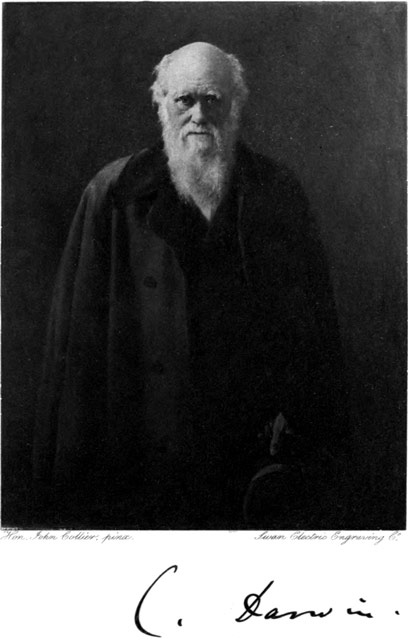
We have to deal with Man as a product of Evolution; with Society
as a product of Evolution; and with Moral Phenomena as products
of Evolution.—Herbert Spencer, Principles of Ethics,
§ 193.
Charles Robert Darwin (the second name was
rarely used by him) was born at Shrewsbury on the
12th of February, 1809. He came of a long line of
Lincolnshire yeomen, whose forbears spelt the name
variously, as Darwen, Derwent, and Darwynne, perhaps
deriving it from the river of kindred name.
His father was a kindly, prosperous doctor, of sufficient
scientific reputation to secure his election into
the Royal Society, although that coveted honour
was then more easily obtained than now. Of the
more famous grandfather, Erasmus Darwin, the reminder
suffices that both his prose and poetry were
vehicles of suggestive speculations on the development
of life-forms. Dealing with bald facts and dates
for clearance of what follows, it may be added that
Charles Darwin was educated at the Grammar
School of his native town; that he passed thence to
Edinburgh and Cambridge Universities; was occupied
as volunteer naturalist on board the Beagle from
December, 1831, till October, 1836; that he published
his epoch-making Origin of Species in November,
1859; and that he was buried by the side
of Sir Isaac Newton in Westminster Abbey on the
26th of April, 1882.
As with not a few other men of “light and leading,”
neither school nor university did much for him,
nor did his boyhood give indication of future greatness.
In his answers to the series of questions addressed
to various scientific men in 1873 by his distinguished
cousin, Francis Galton, he says: “I consider
that all I have learnt of any value has been
self-taught,” and he adds that his education fostered
no methods of observation or reasoning. Of the
Shrewsbury Grammar School, where, after the death
of his mother (daughter of Josiah Wedgwood, the
celebrated potter), in his ninth year, he was placed
as a boarder till his sixteenth year, he tells us, in the
modest and candid Autobiography printed in the
Life and Letters, “nothing could have been worse
for the development of my mind.” All that he was
taught were the classics, and a little ancient geography
and history; no mathematics, and no modern
languages. Happily, he had inherited a taste for
natural history and for collecting, his spoils including
not only shells and plants, but also coins and
seals. When the fact that he helped his brother in
chemical experiments became known to Dr. Butler,
the head-master, that desiccated pedagogue publicly
rebuked him “for wasting time on such useless subjects.”
Then his father, angry at finding that he was
doing no good at school, reproved him for caring
for nothing but shooting, dogs, and rat-catching, and
declared that he would be a disgrace to the family!
He sent him to Edinburgh University with his
brother to study medicine, but Darwin found the
dulness of the lectures intolerable, and the sight of
blood sickened him, as it did his father. Although
the effect of the “incredibly” dry lectures on geology
made him—the future Secretary of the Geological
Society!—vow never to read a book on the science,
or in any way study it, his interest in biological subjects
grew, and its first fruits were shown in a paper
read before the Plinian Society at Edinburgh in 1826,
in which he reported his discovery that the so-called
ova of Flustra, or the sea-mat, were larvæ.
But his father had to accept the fact that Darwin
disliked the idea of being a doctor, and fearing that
he would degenerate into an idle sporting man, proposed
that he should become a clergyman! Darwin
says upon this:—
I asked for some time to consider, as from what little I had
heard or thought on the subject I had scruples about declaring
my belief in all the dogmas of the Church of England, though
otherwise I liked the thought of being a country clergyman.
Accordingly I read with care Pearson on the Creed, and a few
other books on divinity; and, as I did not then in the least
doubt the strict and literal truth of every word in the Bible, I
soon persuaded myself that our creed must be fully accepted.
Considering how fiercely I have been attacked by the orthodox,
it seems ludicrous that I once intended to be a clergyman.
Nor was this intention and my father’s wish ever formally
given up, but died a natural death when, on leaving Cambridge,
I joined the Beagle as naturalist. If the phrenologists are to
be trusted, I was well fitted in one respect to be a clergyman.
A few years ago the secretaries of a German psychological
society asked me earnestly by letter for a photograph of myself;
and some time afterwards I received the proceedings of
one of the meetings, in which it seemed that the shape of my
head had been the subject of a public discussion, and one of
the speakers declared that I had the bump of reverence developed
enough for ten priests.
The result was that early in 1828 Darwin went
to Cambridge, the three years spent at which were
“time wasted, as far as the academical studies were
concerned.” His passion for shooting and hunting
led him into a sporting, card-playing, drinking company,
but science was his redemption. No pursuit
gave him so much pleasure as collecting beetles, of
his zeal in which the following is an example: “One
day, on tearing off some old bark, I saw two rare
beetles, and seized one in each hand; then I saw a
third and new kind, which I could not bear to lose,
so I popped the one which I held in my right hand
into my mouth. Alas! it ejected some intensely
acrid fluid, which burnt my tongue so that I was
forced to spit the beetle out, which was lost, as was
the third one.”
Happily for his future career, and therefore for
the interests of science, Darwin became intimate with
men like Whewell, Henslow, and Sedgwick, while the
reading of Humboldt’s Personal Narrative, and of
Sir John Herschel’s Introduction to Natural Philosophy,
stirred up in him “a burning zeal to add
even the most humble contribution to the noble
structure of Natural Science.” The vow to eschew
geology was quickly broken when he came under
the spell of Sedgwick’s influence, but it was the
friendship of Henslow that determined his after
career, and prevented him from becoming the “Rev.
Charles Darwin.” For on his return from a geological
tour in Wales with Sedgwick he found a letter
from Henslow awaiting him, the purport of which
is in the following extract:—
“I have been asked by Peacock (Lowndean
Professor of Astronomy at Cambridge) to recommend
him a naturalist as companion to Captain
Fitz-Roy, employed by Government to survey the
southern extremity of America. I have stated that
I consider you to be the best-qualified person I know
of who is likely to undertake such a situation.”
In connection with this the following memorandum
from Darwin’s pocket-book of 1831 is of interest:—“Returned
to Shrewsbury at end of August.
Refused offer of voyage.”
This refusal was given at the instance of his
father, who objected to the scheme as “wild and
unsettling, and as disreputable to his character as a
clergyman”; but he soon yielded on the advice of
his brother-in-law, Josiah Wedgwood, and on Darwin’s
plea that he “should be deuced clever to spend
more than his allowance whilst on board the Beagle.”
On this his father answered with a smile, “But they
tell me you are very clever.” It is amusing to find
that Darwin narrowly escaped being rejected by
Fitz-Roy, who, as a disciple of Lavater, doubted
whether a man with such a nose as Darwin’s “could
possess sufficient energy and determination for the
voyage.”
The details of that voyage, the first of the two
memorable events in Darwin’s otherwise unadventurous
life, are set down in delightful narrative in his
Naturalist’s Voyage Round the World, and it will
suffice to quote a passage from the autobiography
bearing on the significance of the materials collected
during his five years’ absence.
During the voyage of the Beagle I had been deeply impressed
by discovering in the Pampean formation great fossil
animals covered with armour like that on the existing armadillos;
secondly, by the manner in which closely allied animals
replace one another in proceeding southwards over the continent;
and thirdly, by the South American character of most
of the productions of the Galapagos Archipelago, and more
especially by the manner in which they differ slightly on each
island of the group, none of the islands appearing to be very
ancient in a geological sense. It was evident that such facts
as these, as well as many others, could only be explained on
the supposition that species gradually became modified; and
the subject haunted me. But it was equally evident that
“none of the evolutionary theories then current in the scientific
world” could account for the innumerable cases in which
organisms of every kind are beautifully adapted to their habits
of life.... I had always been much struck by such adaptations,
and until these could be explained, it seemed to me
almost useless to endeavour to prove by indirect evidence that
species have been modified.... In October, 1838, that is,
fifteen months after I had begun my systematic inquiry, I happened
to read for amusement Malthus on Population, and being
well prepared to appreciate the struggle for existence which
everywhere goes on, from long-continued observations of the
habits of plants and animals, it at once struck me that under
these circumstances favourable variations would tend to be
preserved, and unfavourable ones destroyed. The result of
this would be the formation of new species.
Shortly after his return he settled in London, prepared
his journal and manuscripts of observations for
publication, and opened, he says, under date of July,
1837, “my first note-book for facts in relation to the
origin of species, about which I had long reflected,
and never ceased working for the next twenty years.”
He acted for two years as one of the honorary secretaries
of the Geological Society, which brought him
into close relations with Lyell, and, as his health
then allowed him to go into society, he saw a good
deal of prominent literary and scientific contemporaries.
In the autumn of 1842, two years and eight
months after his marriage with his first cousin,
Emma Wedgwood, who died in October last (1896),
Darwin removed from London, the air and social
demands of which were alike unsuited to his health,
and finally fixed upon a house in the secluded village
of Down, near Beckenham, where he spent the rest
of his days. Henceforth the life of Darwin is merged
in the books in which, from time to time, he gave
the result of his long years of patient observation
and inquiry, from the epoch-making Origin to the
monograph on earthworms. With bad health, apparently
due to gouty tendencies aggravated by
chronic sea-sickness during his voyage; with nights
that never gave unbroken sleep; and days that were
never passed without prostrating pain; he might
well have felt justified in doing nothing whatever.
But he was saved from the accursed monotony of a
wealthy invalid’s life by his insatiate delight in
searching for that solution of the problem of the
mutability of species which time would not fail to
bring. In this, he tells us, he forgot his “daily discomfort,”
and thus was delivered from morbid introspection.
Darwin worked at his rough notes on the variation
of animals and plants under domestication, adding
facts collected by “printed enquiries, by conversations
with skilful breeders and gardeners, and
by extensive reading,” gleams of light coming till
he says that he is “almost convinced that species
are not (it is like confessing a murder) immutable.”
But he was still groping in the dark as to the application
of selection to wild plants and animals, until,
as remarked above, the chance reading of Malthus
suggested a working theory. A brief sketch of this
theory, written out in pencil in 1842, was elaborated
in 1844 into an essay of two hundred and thirty
pages. The importance attached to this was shown
in a letter which Darwin then addressed to his wife,
charging her, in the event of his death, to apply
£400 to the expense of publication. He also named
certain competent men from whom an editor might
be chosen, preference being given to Sir Charles
(then Mr. Lyell, at whose advice Darwin began to
write out his views on a scale three or four times as
extensive as that in which they appeared in the
Origin of Species.) Their publication in an abstract
form was hastened by the receipt, in June, 1858, of
a paper, containing “exactly the same theory,” from
Mr. Alfred Russel Wallace at Ternate in the
Moluccas. This reference to that distinguished explorer,
will, before the story of the coincident discovery
is further told, fitly introduce a sketch of his
career.
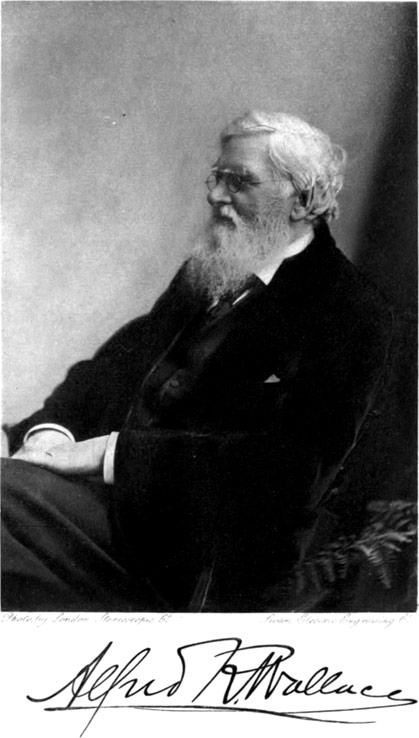
Alfred Russel Wallace was born at Usk, in
Monmouthshire, on the 8th of January, 1823. He was
educated at Hereford Grammar School, and in his
fourteenth year began the study of land-surveying
and architecture under an elder brother. Quick-witted
and observing, he studied a great deal more
on his own account in his journeyings over England
and Wales, the results of which abide in the wide
range of subjects—scientific, political, and social—engaging
his active pen from early manhood to the
present day.
About 1844 he exchanged the theodolite for the
ferule, and became English master in the Collegiate
School at Leicester, in which town he found a congenial
friend in the person of his future fellow-traveller,
Henry Walter Bates. Bates was then employed
in his father’s hosiery warehouse, from which he
escaped, as often as the long working hours then
prevailing allowed, into the fields with his collecting-box.
Both schoolmaster and shopman were ardent
naturalists, Mr. Wallace, as he tells us, being at that
time “chiefly interested in botany,” but he afterward
took up his friend’s favourite pursuit of
entomology. The writer, when preparing his memoir
of Bates (which prefaces a reprint of the first edition
of the delightful Naturalist on the Amazons), learned
from Mr. Wallace that in early life he did not keep
letters from Bates and other correspondents. But,
fortunately, among Bates’s papers, there was a
bundle of interesting letters from Wallace written
between June, 1845, and October, 1847, from Neath,
in South Wales, to which town he had removed.
In one of these, dated the 9th of November, 1845,
Wallace asks Bates if he had read the Vestiges of the
Natural History of Creation, and a subsequent letter
indicates that Bates had not formed a favourable
opinion of the book. A later letter is interesting
as conveying an estimate of Darwin. “I first,” Wallace
says, “read Darwin’s Journal three or four years
back, and have lately re-read it. As the journal of
a scientific traveller, it is second only to Humboldt’s
Personal Narrative; as a work of general interest,
perhaps supporter to it. He is an ardent admirer and
most able supporter of Mr. Lyell’s views. His style
of writing I very much admire, so free from all
labour, affectation, or egotism, yet so full of interest
and original thought.”
But, of still greater moment, is a letter in which
Wallace tells Bates that he begins “to feel dissatisfied
with a mere local collection. I should like to
take some one family to study thoroughly, principally
with a view to the theory of the origin of
species.” The two friends had often discussed
schemes for going abroad to explore some virgin
region, nor could their scanty means prevent the
fulfilment of a scheme which has enriched both science
and the literature of travel. The choice of
country to explore was settled by Wallace’s perusal
of a little book entitled A Voyage up the River
Amazons, including a Residence in Pará, by W. H.
Edwards, an American tourist, published in Murray’s
Family Library, in 1847. In the autumn of that
year Wallace proposed a joint expedition to the
river Amazons for the purpose of exploring the
Natural History of its banks; the plan being to
make a collection of objects, dispose of the duplicates
in London to pay expenses, and gather facts,
as Mr. Wallace expressed it in one of his letters,
“towards solving the problem of the origin of
species.”
The choice was a happy one, for, except by the
German zoologist Von Spix, and the botanist Von
Martius in 1817-20, and subsequently by Count de
Castelnau, no exploration of a region so rich and
interesting to the biologist had been attempted.
Early in 1848 Bates and Wallace met in London
to study South American animals and plants in the
principal collections, and afterward went to Chatsworth
to gain information about orchids, which they
proposed to collect in the moist tropical forests and
send home.
On 26th of April, 1848, they embarked at Liverpool
in a barque of only 192 tons burden, one of the
few ships then trading to Pará, to which seaport of
the Amazons region a swift passage, “straight as
an arrow,” brought them on 28th of May.
The travellers soon settled in a rocinha, or
country-house, a mile and half from Pará, and close
to the forest, which came down to their doors. Like
other towns along the Amazons, Pará stands on
ground cleared from the forest that stretches, a well-nigh
pathless jungle of luxuriant primeval vegetation,
two thousand miles inland. In that paradise of
the naturalist, the collectors gathered consignments
which met with ready sale in London, and thus
spent a couple of years in pursuits moderately remunerative
and wholly pleasurable, till, on reaching
Barra, at the mouth of the Rio Negro, one thousand
miles from Pará, in March, 1850, Bates and
Wallace, who was accompanied by his younger
brother, parted company, “finding it more convenient
to explore separate districts and collect independently.”
Wallace took the northern parts and
tributaries of the Amazons, and Bates kept to the
main stream, which, from the direction it seems to
take at the fork of the Rio Negro, is called the Upper
Amazons or the Solimoens. Different in character
and climatic conditions from the Lower Amazons, it
flows through a “vast plain about a thousand miles
in length, and five hundred or six hundred miles in
breadth covered with one uniform, lofty, impervious,
and humid forest.” Bates stayed in the country till
June, 1859, but Wallace left in 1852, and in the
following year published an account of his journey
under the title of Travels on the Amazon and Rio
Negro. That book was written under the serious
disadvantage of the destruction of the greater part
of the notes and specimens by the burning of the
ship in which Mr. Wallace took passage on his homeward
voyage. That it remains one of the select company
of works of travel for which demand is continuous
is evidenced in a reprint which appeared in 1891.
If it affords few hints of the author’s bent of mind
toward the question of the origin of species, it shows
what interest was being aroused within him over the
allied subject of the geographical distribution of
plants and animals which Mr. Wallace was to make
so markedly his own.
In 1854 he sailed for the Malay Archipelago,
where nearly eight years were spent in exploring the
region from Sumatra to New Guinea. The large
and varied outcome of that labour was embodied in
numerous papers communicated to learned societies
and scientific journals, and in a series of delightful
books from The Malay Archipelago, first published
in 1869, to Island Life, published in 1880. Among
the minor results of his extensive travels—for all
else that Wallace did pales before the great discovery
which links his name with Darwin’s—was the establishment
of a line, known as “Wallace’s,” which
divides the Malay Archipelago into two main groups,
“Indo-Malaysia and Austro-Malaysia, marked by
distinct species and groups of animals.” That line
runs through a deep channel separating the islands
of Bali and Lombok; the plants and animals on
which, although but fifteen miles of water separate
them, differ from each other even more than do the
islands of Great Britain and Japan. “A similar
line, but somewhat farther east, divides on the whole
the Malay from the Papuan races of man.”
Among the more fugitive contributions which
mark Mr. Wallace’s approach to a solution of the
problem in quest of which he and Bates went to the
Amazons is a paper On the Law which has Regulated
the Introduction of New Species, published in
the Annals and Magazine of Natural History, 1855.
In this he shows that some form of evolution of one
species from another is needed to explain the geological
and geographical facts of which examples are
given.
In the interesting preface to the reprint of the
famous paper On the Tendencies of Varieties to depart
Indefinitely from the Original Type, Mr. Wallace
recites the several researches which he made in
quest of that “form” till, when lying ill with fever at
Ternate, in February, 1858, something led him to
think of the “positive checks” described by Malthus
in his Essay on Population, a book which he had
read some years before. Oddly enough, therefore,
the honours lie with the maligned Haileybury Reverend
Professor of Political Economy in furnishing
both Darwin and Wallace with the clue. The “positive
checks”—war, disease, famine—Wallace felt
must act even more effectively on the lower animals
than on man, because of their more rapid rate of
multiplication. And he tells us, in the prefatory
note to a reprint of his paper, “there suddenly
flashed on me the idea of the survival of the fittest,
and in the two hours that elapsed before my ague
fit was over I had thought out the whole of the
theory, and in the two succeeding evenings wrote it
out in full and sent it by the next post to Mr. Darwin,”
asking him, if he thought well of the essay, to
send it to Lyell. This Darwin did with the following
remarks: “Your words have come true with a vengeance—that
I should be forestalled.... I never
saw a more striking coincidence; if Wallace had
my MS. sketch written out in 1842, he could not have
made a better short abstract! Even his terms now
stand as heads of my chapters. Please return me the
MS., which he does not say he wishes me to publish;
but I shall, of course, at once write and offer to send
to any journal. So all my originality, whatever it
may amount to, will be smashed, though my book,
if it will ever have any value, will not be deteriorated,
as all the labour consists in the application of the
theory.” Darwin came out well in this business.
For to have hit upon a theory which interprets so
large a question as the origin and causes of modification
of life-forms; to keep on turning it over and
over again in the mind for twenty long years; to
spend the working hours of every day in collection
and verification of facts for and against it; and then
to have another man launching a “bolt from the
blue” in the shape of a paper with exactly the same
theory, might well disturb even a philosopher of
Darwin’s serenity.
However, both Hooker and Lyell had read his
sketch a dozen years before, and it was arranged by
them, not as considering claims of priority, which
have too often been occasion of unworthy wrangling,
but in the “interests of science generally,” that an
abstract of Darwin’s manuscript should be read with
Wallace’s paper at a meeting of the Linnæan Society
on the 1st of July, 1858. The full title of the joint communication
was On the Tendency of Species to form
Varieties, and on the Perpetuation of Varieties and
Species by Natural Selection. Sir Joseph Hooker,
describing the gathering, says that “the interest excited
was intense, but the subject was too novel and
too ominous for the old school to enter the lists before
armouring. After the meeting it was talked
over with bated breath. Lyell’s approval, and perhaps,
in a small way mine, as his lieutenant in the
affair, rather overawed the Fellows, who would
otherwise have flown out against the doctrine. We
had, too, the vantage ground of being familiar with
the authors and their theme.” Nothing can deprive
Mr. Wallace of the honour due to him as the co-originator
of the theory, which, regarded in its application
to the origin, history, and destiny of man, involves
the most momentous changes in belief, and
there may be fitly quoted here his own modest and,
doubtless, correct, assessment of limitations which in
no wise invalidate his high claims. In the Preface
to his Contributions to the Theory of Natural Selection
(1870), Mr. Wallace says the book will prove
that he both saw at the time the value and scope of
the law which he had discovered, and has since been
able to apply to some purpose in a few original lines
of investigation. “But,” he adds, “here my claims
cease. I have felt all my life, and I still feel, the
most sincere satisfaction that Mr. Darwin had been
at work long before me, and that it was not left for
me to attempt to write the Origin of Species. I
have long since measured my own strength, and
know full well that it would be quite unequal to
that task. Far abler men than myself may confess
that they have not that untiring patience in accumulating,
and that wonderful skill in using, large masses
of facts of the most varied kind—that wide and
accurate physiological knowledge—that acuteness in
devising and skill in carrying out experiments, and
that admirable style of composition at once clear,
persuasive, and judicial—qualities which, in their
harmonious combination, mark out Mr. Darwin as
the man, perhaps of all men now living, best fitted
for the great work he has undertaken and accomplished.”
In a letter to Wallace dated 20th April, 1870,
Darwin says, “There has never been passed on me,
or, indeed, on any one, a higher eulogium than yours.
I wish that I fully deserved it. Your modesty and
candour are very far from new to me. I hope it is
a satisfaction to you to reflect—and very few things
in my life have been more satisfactory to me—that
we have never felt any jealousy towards each other,
though in one sense rivals. I believe I can say this
of myself with truth, and I am absolutely sure it is
true of you.”
But on one question, and that round which discussion
still rages, the friends were poles asunder.
There had been correspondence between them as
to the bearing of the theory of natural selection on
man, and in April, 1869, Darwin wrote, “As you
expected, I differ grievously from you, and I am
very sorry for it. I can see no necessity for calling
in an additional and proximate cause in regard to
man.” In the fifteenth chapter of his comprehensive
book on Darwinism, Wallace admits the action of
natural selection in man’s physical structure. This
structure classes him among the vertebrates; the
mode of human suckling classes him among the
mammals; his blood, his muscles, and his nerves,
the structure of his heart with its veins and arteries,
his lungs and his whole respiratory and circulatory
systems, all closely correspond to those of other
mammals, and are often almost identical with them.
He possesses the same number of limbs, terminating
in the same number of digits, as belong fundamentally
to the mammals. His senses are identical with
theirs, and his organs of sense are the same in number
and occupy the same relative position. Every
detail of structure which is common to the mammalia
as a class is found also in man, while he differs from
them only in such ways and degrees as the various
species or groups of mammals differ from each other.
He is, like them, begotten by sexual conjugation;
like them, developed from a fertilized egg, and in
his embryonic condition passes through stages recapitulating
the variety of enormously remote ancestors
of whom he is the perfected descendant.
Full-grown, he appears as most nearly allied to the
anthropoid or man-like apes; so much does his
skeleton resemble theirs that, comparing him with
the chimpanzee, we find, with very few exceptions,
bone for bone, differing only in size, arrangement,
and proportion.
Mr. Wallace, therefore, rejected the idea of man’s
special creation “as being entirely unsupported by
facts, as well as in the highest degree improbable.”
But he would not allow that natural selection explains
the origin of man’s spiritual and intellectual nature.
These, he argues, “must have had another origin,
and for this origin we can only find an adequate
cause in the unseen universe of Spirit.” More detailed
treatment of this argument will be given further
on; here reference is made to it as furnishing
the explanation why Mr. Wallace kept not his “first
estate,” and dropped out of the ranks of Pioneers of
Evolution. Many subjects, as hinted above, have
occupied his facile pen—land nationalization, causes
of depression in trade, labourers’ allotments, vaccination,
et hoc genus omne; showing, at least, the prominence
which all social matters occupy in the minds of
the leading exponents of the theory of Evolution.
For of this, as will be seen, both Herbert Spencer
and Huxley supply cogent examples in their application
of that theory to human interests. But it is as a
defender, although on lines of his own not wholly
orthodox, of supernaturalism, with attendant beliefs
in miracles and the grosser forms of spiritualism,
that Mr. Wallace appears in the character of opponent
to the inclusion of man’s psychical nature as a
product of Evolution.
The arresting influence of these views when
backed by honest, sincere, and eminent men of the
type of Mr. Wallace, and when also supported by
several prominent men of science, renders it desirable
to show that modern psychism is but savage animism
“writ large,” and wholly explicable on the theory of
continuity. In his book on Miracles and Modern
Spiritualism, of which a revised edition, with chapters
on Apparitions and Phantasms, was issued in 1895,
Mr. Wallace contends that “Spiritualism, if true,
furnishes such proofs of the existence of ethereal
beings and of their power to act upon matter, as
must revolutionise philosophy. It demonstrates the
actuality of forms of matter and modes of being before
inconceivable; it demonstrates mind without
brain, and intelligence disconnected from what we
know as the material body; and it thus cuts away all
presumption against our continued existence after
the physical body is disorganised and dissolved. Yet
more, it demonstrates, as completely as the fact can
be demonstrated, that the so-called dead are still
alive; that our friends are still with us, though unseen,
and guide and strengthen us when, owing to
absence of proper conditions, they cannot make their
presence known. It thus furnishes a proof of a future
life which so many crave, and for want of which so
many live and die in anxious doubt, so many in positive
disbelief. It substitutes a definite, real, and practical
conviction for a vague, theoretical, and unsatisfying
faith. It furnishes actual knowledge on a
matter of vital importance to all men, and as to which
the wisest men and most advanced thinkers have
held, and still hold, that no knowledge was attainable.”
This claim, this tremendous claim, on behalf of
the phenomena of spiritualism to supply an answer
to “the question of questions; the ascertainment of
man’s relation to the universe of things; whence our
race has come; to what goal we are tending,” rests
on the assumption with which Mr. Wallace starts,
“Spiritualism, if true.”
The essay from which the above passages are
quoted is preceded by references in detail to a considerable
number of cases of “the appearance of
preterhuman or spiritual beings,” the evidence of
which “is as good and definite as it is possible for
any evidence of any fact to be.” These ghost-stories,
contrasted with the full-flavoured eerie tales of old,
are feebly monotonous. The apparatus of the
medium is limited: the phenomena are largely of the
“horse-play” order. Through the whole series we
vainly seek for some ennobling and exalting conception
of a life beyond, some glimpses “behind the
veil,” only to find that the shades are but diluted or
vulgarized parodies of ourselves; or that “the filthy
are filthy still,” like the departed bargee whose
“communicating intelligence” (we quote from a recent
book on spiritualism entitled The Great Secret)
was as coarse-mouthed as when in the flesh. In
considering, if it be deemed worth while, the evidence
of genuineness of the occurrences, we are
thrown, not on the honesty, but on the competency
of the witnesses. The most eminent among these
show themselves persons of undisciplined emotions.
The distinguished physicist, Professor Oliver Lodge,
who has been described to the writer by an intimate
friend of the Professor as “longing to believe something,”
argues that in dealing with psychical phenomena,
a hazy, muzzy state of mind is better than a
mind “keenly awake” and “on the spot” (see Address
to the Society for Psychical Research, Proceedings,
part xxvi, pp. 14, 15). With this may be
compared a Mohammedan receipt for summoning
spirits given in Klunzinger’s Upper Egypt (p. 386):
“Fast seven days in a lonely place, and take incense
with you. Read a chapter 1001 times from the
Koran. That is the secret, and you will see indescribable
wonders; drums will be beaten beside you,
and flags hoisted over your head, and you will see
spirits.” Thus have the dreamy Oriental Moslem
and the self-hypnotized Western professor met together
to elicit truth from trance.
Concerning the competence of Mr. Wallace himself
to weigh, unbiassed, the evidence which comes
before him, it suffices to cite the case of Eusapia
Paladino, a Neapolitan “medium,” who, in the words
of one of her most ardent dupes, became “the unexpected
instrument of driving conviction as to the
reality of psychical manifestations by the invisible
into the minds of many scientists.” A number of
distinguished savants testified to the genuineness of
the woman’s performances in Professor Richet’s cottage
on the Ile Roubant in the autumn of 1893. It
was the serious and complete conviction of all of
them (Lodge, Richet, Ochorowicz, and others) that
“on no single occasion during the occurrence of an
event recorded by them was a hand of Eusapia’s free
to execute any trick whatever.” Mr. Maskelyne, such
testimony notwithstanding, declared that the whole
business was “the sorriest of trickeries,” and, to the
credit of the Society for Psychical Research, it undertook
the expense of bringing Eusapia to England
for the purpose of testing the genuineness of her
doings. She was taken to a house in Cambridge,
and detected as a vulgar impostor. Yet Mr. Wallace,
in the new edition of his Miracles and Modern Spiritualism,
describes all the phenomena occurring at
Professor Richet’s house as “not explicable as the
result of any known physical causes,” and, in a subsequent
explanatory letter to the Daily Chronicle
of 24th of January, 1896, expresses the opinion that
“the Cambridge experiments, so far as they are
recorded, only prove that Eusapia might have deceived,
not that she actually and consciously did so.”
The integrity of Mr. Wallace is not to be doubted,
but what becomes of his competence to judge when
prejudice blinds itself to facts? Spiritualism, if true,
demonstrates this and that about the unseen; but
spiritualism, proved to be untrue, lacks half the dexterity
of an astute conjurer, and the whole of his
honesty. Every scientific man recognises the doctrine
of the Conservation of Energy as a fundamental
canon. But with those who regard the phenomena
of Spiritualism as “not explicable” except by supernatural
causes, it would seem that that doctrine, as
also the not unimportant conditions of Time and
Space, count for nothing. When we read their reports
of the behaviour of mediums who project (of
course, in the dark) “abnormal temporary prolongations”
like pseudopodia, we should feel alike depressed
and confounded were there not abundant
proofs what wholly untrustworthy observers scientific
specialists can be outside their own domain. As
the writer has remarked elsewhere, minds of this
type must be built in water-tight compartments.
They show how, even in the higher culture, the force
of a dominant idea may suspend or narcotize the
reason and judgment, and contribute to the rise and
spread of another of the epidemic delusions of which
history supplies warning examples.
They also show that man’s senses have been his
arch-deceivers, and his preconceptions their abettors,
throughout human history; that advance has been
possible only as he has escaped through the discipline
of the intellect from the illusive impressions
about phenomena which the senses convey. Upon
this matter the words of the late Dr. Carpenter may
be quoted, words the more weighty because they are
the utterance of a man whose philosophy was influenced
by deep religious convictions: “With every
disposition to accept facts when I could once clearly
satisfy myself that they were facts, I have had to
come to the conclusion that whenever I have been
permitted to employ such tests as I should employ
in any scientific investigation, there was either intentional
deception on the part of interested persons, or
else self-deception on the part of persons who were
very sober-minded and rational upon all ordinary
affairs of life.” He adds further: “It has been my
business lately to inquire into the mental condition
of some of the individuals who have reported the
most remarkable occurrences. I cannot—it would
not be fair—say all I could with regard to that mental
condition; but I can only say this, that it all fits
in perfectly well with the result of my previous
studies upon the subject, viz., that there is nothing
too strange to be believed by those who have once
surrendered their judgment to the extent of accepting
as credible things which common sense tells us
are entirely incredible.”
The fact abides that the great mass of supernatural
beliefs which have persisted from the lower
culture till now, and which are still held by an
overwhelming majority of civilized mankind, are referable
to causes concomitant with man’s mental
development: causes operative throughout his history.
The low intellectual environment of his
barbaric past was constant for thousands of years,
and his adaptation thereto was complete. The intrusion
of the scientific method in its application to
man disturbed that equilibrium. But this, as yet,
only superficially. Like the foraminifera that persist
in the ocean depths, the great majority of mankind
have remained, but slightly, if at all, modified; thus
illustrating the truth of the doctrine of evolution in
their psychical history. (For that doctrine does not
imply all-round continuous advance. “Let us never
forget,” Mr. Spencer says in Social Statics, “that the
law is—adaptation to circumstances, be they what
they may.”) Therefore the superstitions that still
dominate the life of man, even in so-called civilized
centres, are no stumbling-blocks to us. They are
supports along the path of inquiry, because we account
for their persistence. Thought and feeling
have a common base, because man is a unit, not a
duality. But the exercise of the one has been active
from the beginnings of his history—indeed we know
not at what point backward we can classify it as
human or quasi-human—while the other, speaking
comparatively, has but recently been called into play.
So far as its influence on the modern World goes,
may we not say that it began at least in the domain
of scientific naturalism with the Ionian philosophers?
Emotionally, we are hundreds of thousands of years
old; rationally, we are embryos.
In other words, man wondered countless ages
before he reasoned; because feeling travels along
the line of least resistance, while thought, or the
challenge by inquiry—therefore the assumption that
there may be two sides to a question—must pursue
a path obstructed by the dominance of custom, the
force of imitation, and the strength of prejudice and
fear. It is here that anthropology, notably that
psychical branch of it comprehended under folk-lore,
takes up the cue from the momentous doctrine of
heredity; explains the persistence of the primitive;
and the causes of man’s tardy escape from the illusions
of the senses, and the general conservatism of
human nature. “Born into life! in vain, Opinions,
those or these, unalter’d to retain the obstinate
mind decrees,” as in the striking illustration cited in
Heine’s Travel-Pictures. “A few years ago Bullock
dug up an ancient stone idol in Mexico, and the
next day he found that it had been crowned during
the night with flowers. And yet the Spaniard had
exterminated the old Mexican religion with fire and
sword, and for three centuries had been engaged in
ploughing and harrowing their minds and implanting
the seed of Christianity.” The causes of error and
delusion, and of the spiritual nightmares of olden
time, being made clear, there is begotten a generous
sympathy with that which empirical notions of
human nature attributed to wilfulness or to man’s
fall from a high estate. Superstitions which are the
outcome of ignorance can only awaken pity. Where
the corrective of knowledge is absent, we see that
it could not be otherwise. Where that corrective
is present, but either perverted or not exercised, pity
is supplanted by blame. In either case, we learn that
the art of life largely consists in that control of the
emotions and that diversion of them into wholesome
channels, which the intellect, braced with the latest
knowledge, can alone effect.
Therefore, discarding theories of revelation,
spiritual illumination, and other assumed supra-mundane
sources of knowledge, sufficing causes of
abnormal mental phenomena are found in abnormal
working of the mental apparatus. The investigation
of hallucinations (Lat. alucinor, to wander in
mind) leaves no doubt that they are the effect of a
morbid condition of that intricate, delicately poised
structure, the nervous system, under which objects
are seen and sensations felt when no corresponding
impression has been made through the medium of
the senses. When the nervous system is out of
gear, voices, whether divine or of the dead, may be
heard; and actual figures may be seen. A mental
image becomes a visual image; an imagined pain
a real pain, as the great physiologist, John Hunter,
testified when he said, “I am confident that I can
fix my attention to any part until I have a sensation
in that part.” Shakespere portrays the like condition
when Macbeth attempts to clutch the dagger wherewith
to stab Duncan:
There’s no such thing;
It is the bloody business which informs
Thus to mine eyes.
This abnormal state, which sees things having no
existence outside the “mind’s eye,” is no respecter
of persons; the savage and the civilized are alike
its victims. It may be organic or functional.
Organic, when disease is present; functional, through
excessive fatigue, lack of food or sleep, or derangement
of the digestive system, causing the patient,
as Hood says, “to think he’s pious when he’s only
bilious.” Under such conditions, hallucinations of
all sorts possess the mind; hallucinations from which
the true peptic, who, as Carlyle says, “has no system,”
is delivered. Only the mentally anæmic, the
emotionally overwrought, the unbalanced, and the
epileptic, are the victims, whether of the lofty illusions
of august visions such as carried Saint Paul,
Saint Theresa, and Joan of Arc, into the presence
of the holiest; or hallucination of drowned cat, thin
and “dripping with water,” born of the disordered
nerves of Mrs. Gordon Jones. To quote from Dr.
Gower’s Bowman Lecture (Nature, 4th July, 1895)
on Subjective Visual Sensations, such as accompany
fits, when, e. g., sensations of sight occur without
the retina being stimulated:
The spectra perceived before epileptic fits vary widely.
They may be stars or sparks, spherical luminous bodies, or
mere flashes of light, white or coloured, still or in movement.
Often they are more elaborate, distinct visions of faces, persons,
objects, places. They may be combined with sensations
from the other special senses, as with hearing and smell. In
one case a warning, constant for years, began with thumping
in the chest ascending to the head, where it became a beating
sound. Then two lights appeared, advancing nearer with a
pulsating motion. Suddenly these disappeared and were replaced
by the figure of an old woman in a red cloak, always
the same, who offered the patient something that had the
smell of Tonquin beans, and then he lost consciousness. Such
warnings may be called psychovisual sensations. The psychical
element may be very strong, as in one woman whose fits
were preceded by a sudden distinct vision of London in ruins,
the river Thames emptied to receive the rubbish, and she the
only survivor of the inhabitants.
Had a man of lesser renown and mental calibre
than Mr. Wallace thrown the weight of his testimony
into the scales in favour of spiritualism, there would
have been neither necessity nor excuse for this digression.
But both these pleas prevail when we
find the co-formulator of the Darwinian theory
among mediums and their dupes. The respectful
attention which his words command: the tremendous
claims which he makes on behalf of the phenomena
at séances as proving the existence of soul apart
from body after death, and as revealing the conditions
under which it lives, have made incumbent
the foregoing attempt to indicate what other explanation
is given of those phenomena, showing
how these fall in with all we know of man’s tendencies
to imperfect observation and self-deception,
and with all that history tells of the persistence of
animistic ideas.
A salutary lesson on the use and misuse of the
imagination is thus taught. That which, under
wholesome restraint, is the initiative and incentive
of inquiry, of enterprise, and of noble ideas; unrestricted,
leads the dreamer and the enthusiast into
ingulfing quicksands of illusions and delusions.
Hence the necessity of curbing a faculty so that in
unison with reason, it works toward definite ends
within the domain, marking man’s limits of service.
As Dr. Maudsley reminds us in his sane and sober
book on Natural Causes and Supernatural Seeming,
“not by standing out of Nature in the ecstasy of a
rapt and over-strained idealism of any sort, but by
large and close and faithful converse with Nature
and human nature in all their moods, aspects, and
relations, is the solid basis of fruitful ideas and the
soundest mental development laid. The endeavour
to stimulate and strain any mental function to an
activity beyond the reach and need of a physical
correlate in external nature, and to give it an independent
value, is certainly an endeavour to go directly
contrary to the sober and salutary method by
which solid human development has taken place in
the past, and is taking place in the present.”
The story of Darwin’s work must now be resumed.
Shortly after the Linnæan meeting, he prepared
a series of chapters which, always regarded
by him as an “Abstract,” ultimately took book form,
and was published, under the title of the Origin of
Species, on the 24th of November, 1859.
The story of the reception of the work is admirably
told by Huxley in the chapter which he contributed
to Darwin’s Life and Letters, and it may be
commended as useful reading to a generation which,
drinking-in Darwinism from its birth, will not readily
understand how such storm and outcry as rent the
air, both in scientific as well as clerical quarters,
could have been raised. “In fact,” says Huxley,
“the contrast between the present condition of public
opinion upon the Darwinian question; between the
estimation in which Darwin’s views are now held in
the scientific world; between the acquiescence, or, at
least, quiescence, of the theologian of the self-respecting
order at the present day, and the outburst of
antagonism on all sides in 1858-59, when the new
theory respecting the origin of species first became
known to the older generation to which I belong, is
so startling that, except for documentary evidence, I
should be sometimes inclined to think my memories
dreams.” The like reflection arises when we consider
the indifference with which books of the most
daring and revolutionary character, both in theology
and morals, are treated nowadays, in contrast to the
uproar which greeted such a brutum fulmen as Essays
and Reviews. As for Colenso’s Pentateuch, and
books of its type, orthodoxy has long taken them to
its bosom.
So far as the larger number of naturalists, and of
the intelligent public who followed their lead, were
concerned, there was an absolutely open mind on
the question of the mutation of species. There had
been, as the foregoing sections of this book have
shown, a long time of preparation and speculation.
We certainly find the keynote of Evolution in
Heraclitus, and more than two thousand years after
his time Herbert Spencer, above all men, had removed
it from the empirical stage, and placed it on
a base broad as the facts which supported it. But
it needed the leaven of the human and personal
to stir it into life, and touch man in his various
interests; and not all that Mr. Spencer had done in
application of the theory of development to social
questions and institutions could avail much till Darwin’s
theory gave it practical shape. Dissertations
on the passage of the “homogeneous to the heterogeneous”;
explanations of the theory of the evolution
of complex sidereal systems out of diffused
vapours of seemingly simple texture, interested
people only in a vague and wondering fashion.
But when Darwin illustrated the theory of the modification
of life-forms by familiar examples gathered
from his own experiments and observations, and from
intercourse with breeders of pigeons, horses, and
dogs, this went to men’s “business and bosoms,”
and if the vulgar interpreted Darwinism, as some,
who should know better, interpret it even now, as
explaining man’s descent from a monkey, or how a
bear became a whale by taking to swimming, the
thoughtful accepted it as a master-key unlocking not
the mystery of origins or of causes of variations,
but the mystery of the ceaselessly-acting agent
which, operating on favourable variations, has
brought about myriads of species from simple forms.
As Huxley reminds us in the passage quoted
above, the attitude of the clergy toward the theory
of Evolution has undergone an astounding change.
Dr. Whewell remarked that every great discovery in
science has had to pass through three stages. First,
people said, “It is absurd”; then they said, “It is
contrary to the Bible”; finally, they said, “We
always knew that it was so.” Thus it has been with
Evolution. It is calmly discussed; even claimed as
a “defender of the faith,” at Church Congresses nowadays.
It was not so in the sixties. Here and there
a single voice was raised in qualified sympathy—Charles
Kingsley showed more than this—but both
in the Old and the New World the “drum ecclesiastic”
was beaten. Cardinal Manning declared Darwinism
to be a “brutal philosophy, to wit, there is
no God and the ape is our Adam.” Protestant and
Catholic agreed in condemning it as “an attempt to
dethrone God”; as “a huge imposture,” as “tending
to produce disbelief of the Bible,” and “to do
away with all idea of God,” as “turning the Creator
out of doors.” Such are fair samples to be culled
from the anthology of invective which was the staple
content of nearly every “criticism.” Occasionally
some parody of reasoning appears when the “argument”
is advanced that there is “a simpler explanation
of the presence of these strange forms among
the works of God in the fall of Adam,” but even this
pseudo-concession to logic is rare; and one divine
had no hesitation in predicting the fate of Darwin
and his followers in the world to come. “If,” said a
Dr. Duffield in the Princeton Review, “the development
theory of the origin of man shall, in a
little while, take the place—as doubtless it will—with
other exploded scientific speculations, then they who
accept it with its proper logical consequences will,
in the life to come, have their portion with those who
in this life ‘know not God and obey not the Gospel
of His Son.’” But the most notable attack came
from Samuel Wilberforce, then Bishop of Oxford, in
the Quarterly Review of July, 1860. “It is,” said
Huxley, in his review of Haeckel’s Evolution of Man,
“a production which should be bound in good stout
calf, or better, asses’ skin, by the curious book-collector,
together with Brougham’s attack on the undulatory
theory of light when it was first propounded
by Young.” The bishop declared “the principle of
natural selection to be absolutely incompatible with
the word of God” and as “contradicting the revealed
relations of creation to its Creator.” If by
“revealed relations” and the “word of God” the
Bible is intended, the evolutionist is in agreement
with the bishop. But, at this time of day, it seems
scarcely worth while to shake the dust off articles
which have gone the way of all purely controversial
matter, and justification for reference to them lies
only in the fact that the contest between the biologists
and the bishops is not yet ended.
In contrast to all this, and in evidence of the
compromise by which theology is vainly striving to
justify itself, are these vague sentences from Archdeacon
Wilson’s address at the Church Congress at
Shrewsbury in the autumn of 1896: “It is scarcely
too much to say that the Theistic Evolutionist cannot
be otherwise than a practical Trinitarian, and cannot
find a difficulty in the Incarnation or in the doctrine
of the Holy Spirit.” “Christian doctrine, apart from
the statement of historical facts, is the attempt to
create out of Christ’s teaching, a philosophy of life
which shall satisfy these needs (i. e., the needs of
humanity), and it will therefore remain the same in
substance. But the form in which that doctrine will
be presented must change with man’s intellectual environment.
The bearing of Evolution on Christian
doctrine is, therefore, in a word, to modify, not the
doctrine, but the form in which it is expressed.”
Postponing the story of the famous debate between
Wilberforce and Huxley, the reception accorded
to the Origin of Species by Darwin’s scientific
contemporaries may be noted. Herbert Spencer’s
position, as will be shown later on, was already
distinctive: he was a Darwinian before Darwin.
Hooker, Huxley,—who said that he was prepared to
go to the stake, if needs be, in support of some parts
of the book,—Bates, and Lubbock were immediate
converts; so were Asa Gray and Lyell, but with
reservations, for Lyell, whose creed was Unitarian,
never wholly accepted the inclusion of man, “body,
soul, and spirit,” as the outcome of natural selection.
Henslow and Pictet went one mile, but refused to go
twain; Agassiz, Murray, and Harvey would have
none of the new heresy; neither would Adam Sedgwick,
who wrote a long protest to Darwin, couched
in loving terms, and ending with the hope that “we
shall meet in heaven.” The attitude of Owen, if apparently
neutral or tentative in open conversation,
was, as an anonymous critic, deadly hostile. Although
it is not included in the list of his writings
given in the Life by his grandson, he is known to
have been the author of the critique on the Origin of
Species in the Edinburgh Review of April, 1860.
At the outset of the article he speaks of Darwin’s
“seduction” of “several, perhaps the majority of our
younger naturalists” by the homœopathic form of
the transmutation of species presented to them under
the phrase of natural selection.... “Owen has long
stated his belief that some pre-ordained law or
secondary cause is operative in bringing about the
change ... we therefore regard the painstaking
and minute comparison by Cuvier of the osteological
and every other character that could be tested in the
mummified ibis, cat, or crocodile with those of species
living in his time; and the equally philosophical
investigation of the polyps operating at an interval
of thirty thousand years in the building-up of coral
reefs by the profound palæontologist of Neuchâtel
(Agassiz is here referred to), as of far truer value in
reference to the inductive determination of the question
of the origin of species than the speculations of
Demailler, Buffon, Lamarck, ‘Vestiges,’ Baden
Powell, or Darwin” (p. 532).
Entangled in the meshes of this theory of a “pre-ordained
law,” which seems to bear some relation to
Aristotle’s “perfecting principle,” and is in close
alliance with the teaching of the great Cuvier, at
whose feet Owen had sat, he remained to the end of
his life a type of arrested development. While the
Church cited him as an authority against the Darwinian
theory, especially in its application to man’s
descent, there remained in the memory of his brother
savants his lack of candour in never withdrawing the
statement made by him, and demonstrated by Huxley
as untrue, that the “hippocampus minor” in the
human brain is absent from the brain of the ape.
As for the reception of the book abroad, the
French savants were somewhat coy, but the Germans,
with Haeckel at their head, were enthusiastic. Darwin
had, like all prophets, more honour in other
countries than in his own, Evolution being rechristened
Darwinismus. Translation after translation
of the Origin followed apace, and the personal interest
that gathered round the central idea led to
the perusal of the book by people who had never
before opened a scientific treatise. Punch seized on
it as subject of caricature; and writers of light verse
found welcome material for “chaff” which the winds
of oblivion have blown away, a stanza here and there
surviving, as in Mr. Courthope’s Aristophanic lines:
Eggs were laid as before, but each time more and more varieties struggled and bred,
Till one end of the scale dropped its ancestor’s tail, and the other got rid of his head.
From the bill, in brief words, were developed the Birds, unless our tame pigeons and ducks lie;
From the tail and hind legs, in the second-laid eggs, the apes.—and Professor Huxley!
Heeding neither squib, satire, nor sermon, Darwin,
in the quiet of his Kentish home, went on rearranging
old materials, collecting new materials,
and verifying both, the outcome of this being his
works on the Fertilization of Orchids and the Variation of
Plants and Animals under Domestication,
published in 1862 and 1867 respectively. Between
these dates Huxley’s Man’s Place in Nature—logical
supplement to the Origin of Species—appeared. But
of this more anon.
Meanwhile, as already named, Mr. Patrick Matthew
had in the Gardener’s Chronicle of 7th April,
1860, drawn attention to an appendix to his book on
Naval Timber and Arboriculture published in 1831,
in which he anticipated Darwin and Wallace’s theory
as follows:
“The self-regulating adaptive disposition of
organised life may, in part, be traced to the extreme
fecundity of Nature, who, as before stated, has in all
the varieties of her offspring a prolific power much
beyond (in many cases a thousandfold) what is necessary
to fill up the vacancies caused by senile decay.
As the field of existence is limited and pre-occupied,
it is only the hardier, more robust, better-suited-to-circumstance
individuals, who are able to struggle
forward to maturity, these inhabiting only the situations
to which they have superior adaptation and
greater power of occupancy than any other kind;
the weaker and less circumstance-suited being prematurely
destroyed. This principle is in constant
action; it regulates the colour, the figure, the capacities,
and instincts; those individuals in each
species whose colour and covering are best suited
to concealment or protection from enemies, or defence
from inclemencies or vicissitudes of climate,
whose figure is best accommodated to health,
strength, defence, and support; whose capacities and
instincts can best regulate the physical energies to
self-advantage according to circumstances—in such
immense waste of primary and youthful life those
only come to maturity from the strict ordeal by
which Nature tests their adaptation to her standard
of perfection and fitness to continue their kind by
reproduction” (pp. 384, 385).
While speaking of difficulty in understanding
some passages in Mr. Matthew’s appendix, Darwin
says that “the full force of the principle of natural
selection” is there, and, in referring to it in a letter
to Lyell, he adds that “one may be excused in not
having discovered the fact in a work on Naval
Timber!”
Five years after this, another pre-Darwinian was
unearthed, and, like Patrick Matthew, in unsuspected
company. Dr. W. C. Wells read a paper before the
Royal Society in 1813 on a White Female Part of
whose Skin resembles that of a Negro, but this was
not published till 1818, when it formed part of a
volume including the author’s famous Two Essays
upon Dew and Single Vision. In his Historical
Sketch Darwin says that Wells “distinctly recognises
the principle of natural selection, and this is
the first recognition which has been indicated; but
he applies it only to the races of man, and to certain
characters alone.... Of the accidental varieties of
man, which would occur among the first few and
scattered inhabitants of the middle regions of Africa,
some one would be better fitted than the others to
bear the diseases of the country. This race would
consequently multiply, while the others would decrease;
not only from their inability to sustain the
attacks of disease, but from their incapacity of contending
with their more vigorous neighbours.”
When the simplicity of the long-hidden solution
is brought home, we can understand Huxley’s reflection
on mastering the central idea of the Origin:
“How extremely stupid not to have thought of
that!” Twelve years elapsed before Darwin followed
up his world-shaking book with the Descent of Man.
But the ground had been prepared for its reception
in the decade between 1860 and 1870. Quoting
Grant Allen’s able summary of the advance of the
theory of Evolution in his Charles Darwin: “One
by one the few scientific men who still held out
were overborne by the weight of evidence. Geology
kept supplying fresh instances of transitional forms;
the progress of research in unexplored countries kept
adding to our knowledge of existing intermediate
species and varieties. During those ten years, Herbert
Spencer published his First Principles, his
Biology, and the remodelled form of his Psychology;
Huxley brought out Man’s Place in Nature, the
Lectures on Comparative Anatomy, and the Introduction
to the Classification of Animals; Wallace
produced his Malay Archipelago and his Contributions
to the Theory of Natural Selection (Bates, we
may here add to Mr. Allen’s list, published his paper
on Mimicry in 1861, and his Naturalist on the
Amazons in 1863); and Galton wrote his admirable
work on Hereditary Genius, of which his own family
is so remarkable an instance. Tyndall and Lewes
had long since signified their warm adhesion. At
Oxford, Rolleston was bringing up a fresh generation
of young biologists in the new faith; at Cambridge,
Darwin’s old university, a whole school of
brilliant and accurate physiologists was beginning to
make itself both felt and heard. In the domain of
anthropology, Tylor was welcoming the assistance of
the new ideas, while Lubbock was engaged on his
kindred investigations into the Origin of Civilization
and the Primitive Condition of Man. All these
diverse lines of thought both showed the widespread
influence of Darwin’s first great work, and led up
to the preparation of his second, in which he dealt
with the history and development of the human race.
And what was thus true of England was equally
true of the civilized world, regarded as a whole:
everywhere the great evolutionary movement was
well in progress, everywhere the impulse sent forth
from the quiet Kentish home was permeating and
quickening the entire pulse of intelligent humanity.”
The Origin of Species, as we have seen, was intended
as a rough draft or preliminary outline of
the theory of natural selection. The materials which
Darwin had collected in support of that theory being
enormous, the several books which followed between
1859 and 1881, the year before his death, were expansions
of hints and parts of the pioneer book.
The last to appear was that treating of The Formation
of Vegetable Mould through the Action of
Worms. It embodied the results of experiments
which had been carried on for more than forty years,
since, as far back as 1837, Darwin read a paper on
the subject before the Geological Society. Reference
to it recalls a story, characteristic of Darwin’s innate
modesty, told to the writer by the present John
Murray. Darwin called on the elder Murray (presumably
some time in 1880), and after fumbling
in his coat-tail pocket, drew out a packet, which
he handed to Murray with the timidity of an unfledged
author submitting his first manuscript. “I
have brought you,” he said, “a little thing of mine
on the action of worms on soil,” and then paused as
if in doubt whether Murray would care to run the
risk of bringing out the book! One story leads to
another, and our second relates to the burial of
Darwin in Westminster Abbey. Among the signatures
of members of Parliament, requesting Dean
Bradley’s consent to Darwin’s interment there, was
that of Mr. Richard B. Martin, partner in the well-known
bank of that name, trading under the sign of
the “Grasshopper.” In his history of this old institution
Mr. John B. Martin prints the following letter,
which was received on the 27th of April, 1882, the
day after Darwin’s funeral.—
Sirs—We have this day drawn a check for the
sum of £280, which closes our account with your
firm. Our reasons for thus closing an account
opened so very many years ago are of so exceptional
a kind that we are quite prepared to find that they
are deemed wholly inadequate to the result.... They
are entirely the presence of Mr. R. B. Martin
at Westminster Abbey, not merely as giving sanction
to the same as an individual, but appearing as one
of the deputation from a Society which has especially
become the indorser and sustainer of Mr. Darwin’s
theories.—— & Co.
The accordance of a resting-place to Darwin’s
remains among England’s illustrious dead in that
Valhalla, was an irenicon from Theology to one
whose theories, pushed to their logical issues, have
done more than any other to undermine the supernatural
assumptions on which it is built. Not that
Darwin was a man of aggressive type. If he speaks
on the high matters round which, like planet tethered
to sun, the spirit of man revolves by irresistible attraction,
it is with hesitating voice and with no deep
emotion. A man of placid temper, in whom the
observing faculties were stronger than the reflective,
he was content to collect and co-ordinate facts,
leaving to others the work of pointing out their
significance, and adjusting them, as best they could,
to this or that theory. It would be unjust to say of
him what John Morley says of Voltaire, that “he
had no ear for the finer vibrations of the spiritual
voice,” but we know from his own confessions, what
limitations hemmed in his emotional nature. The
Life and Letters tells us that he was glad, after the
more serious work and correspondence of the day
were over, to listen to novels, for which he had a
great love so long as they ended happily, and contained
“some person whom one can thoroughly love,
if a pretty woman, so much the better.” But
strangely enough, he lost all pleasure in music, art,
and poetry after thirty. When at school he enjoyed
Thomson, Byron, and Scott; Shelley gave him intense
delight, and he was fond of Shakespeare,
especially the historical plays; but in his old age
he found him “so intolerably dull that it nauseated
me.”
This curious and lamentable loss of the higher æsthetic
tastes is all the odder, as books on history, biographies, and
travels (independently of any scientific facts which they may
contain), and essays on all sorts of subjects, interest me as
much as ever they did. My mind seems to have become a
kind of machine for grinding general laws out of large collections
of facts, but why this should have caused the atrophy of
that part of the brain alone on which the higher tastes depend
I cannot conceive. A man with a mind more highly organised
or better constituted than mine would not, I suppose, have
thus suffered; and, if I had to live my life again, I would have
made a rule to read some poetry and listen to some music at
least once every week, for perhaps the parts of my brain now
atrophied would thus have been kept active through use. The
loss of these tastes is a loss of happiness, and may possibly be
injurious to the intellect, and more probably to the moral character,
by enfeebling the emotional part of our nature.
It is often said that a man’s religion concerns
himself only. So far as the value of the majority
of people’s opinions on such high matters goes, this
is true; but it is a shallow saying when applied to
men whose words carry weight, or whose discoveries
cause us to ask what is their bearing on the larger
questions of human relations and destinies to which
past ages have given answers that no longer satisfy
us, or that are not compatible with the facts discovered.
Whatever silence Darwin maintained in
his books as to his religious opinions, intelligent
readers would see that unaggressive as was the mode
of presentments of his theory, it undermined current
beliefs in special providence, with its special creations
and contrivances, and therefore in the intermittent
interference of a deity; thus excluding that supernatural
action of which miracles are the decaying
stock evidence.
Nor could they fail to ask whether the theory of
natural selection by “descent with modification” was
to apply to the human species. And when Darwin,
already anticipated in this application by his more
daring disciples, Professors Huxley and Haeckel,
published his Descent of Man, with its outspoken
chapter on the origin of conscience and the development
of belief in spiritual beings, a belief subject to
periodical revision as knowledge increased, it was
obvious that the bottom was knocked out of all
traditional dogmas of man’s fall and redemption, of
human sin and divine forgiveness. Therefore, what
Darwin himself believed was a matter of moment.
His answers to inquiries which were made public
during his lifetime told us that while the varying
circumstances and modes of life caused his judgment
to often fluctuate, and that while he had never
been an atheist in the sense of denying the existence
of a God, “I think,” he says, “that generally (and
more and more as I grow older) but not always, an
agnostic would be the most correct description of
my state of mind.” The chapter on Religion,
although a part of the autobiography, is printed
separately in the Life and Letters. As the following
quotation shows, it is interesting as detailing a few
of the steps by which Darwin reached that suspensive
stage.
Whilst on board the Beagle I was quite orthodox, and I
remember being heartily laughed at by several of the officers
(though themselves orthodox) for quoting the Bible as an unanswerable
authority on some point of morality. I suppose it
was the novelty of the argument that amused them. But I
had gradually come by this time—i. e., 1836 to 1839—to see
that the Old Testament was no more to be trusted than the
sacred books of the Hindoos. The question, then, continually
rose before my mind, and would not be banished—is it credible
that if God were now to make a revelation to the Hindoos
he would permit it to be connected with the belief in Vishnu,
Siva, etc., as Christianity is connected with the Old Testament?
This appeared to me utterly incredible.
By further reflecting that the clearest evidence would be
requisite to make any sane man believe in the miracles by
which Christianity is supported—and that the more we know
of the fixed laws of Nature the more incredible do miracles become—that
the men at that time were ignorant and credulous
to a degree almost incomprehensible by us, that the Gospels
can not be proved to have been written simultaneously with
the events, that they differ in many important details, far too
important, as it seems to me, to be admitted as the usual inaccuracies
of eye-witnesses: by such reflections as these, which
I give not as having the least novelty or value, but as they influenced
me, I gradually came to disbelieve in Christianity as a
divine revelation. The fact that many false religions have spread
over large portions of the earth like wildfire had some weight
with me.
But I was very unwilling to give up my belief; I feel sure
of this, for I can well remember often and often inventing day-dreams
of old letters between distinguished Romans, and
manuscripts being discovered at Pompeii or elsewhere, which
confirmed in the most striking manner all that was written in
the Gospels. But I found it more and more difficult, with free
scope given to my imagination, to invent evidence which would
suffice to convince me. Thus disbelief crept over me at a very
slow rate, but was at last complete. The rate was so slow
that I felt no distress.
Although I did not think much about the existence of a
personal God until a considerably later period of my life, I will
here give the vague conclusions to which I have been driven.
The old argument from design in Nature, as given by Paley,
which formerly seemed to me so conclusive, fails, now that the
law of natural selection has been discovered. We can no
longer argue that, for instance, the beautiful hinge of a bivalve
shell must have been made by an intelligent being, like the
hinge of a door by a man. There seems to be no more design
in the variability of organic beings, and in the action of natural
selection, than in the course which the wind blows. But I
have discussed this subject at the end of my book on the
Variation of Domesticated Animals and Plants, and the argument
there given has never, as far as I can see, been answered.
Without doubt, the influence of the conclusions
deducible from the theory of Evolution are fatal to
belief in the supernatural. When we say the supernatural,
we mean that great body of assumptions out
of which are constructed all theologies, the essential
element in these being the intimate relation between
spiritual beings, of whom certain qualities are predicated,
and man. These beings have no longer any
place in the effective belief of intelligent and unprejudiced
men, because they are found to have no
correspondence with the ascertained operations of
Nature.
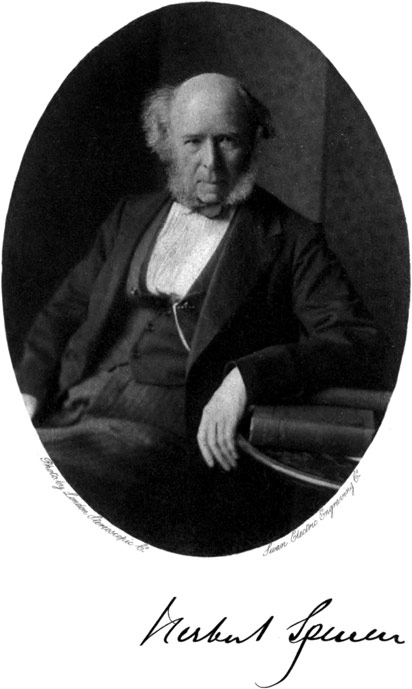
Contact with many “sorts and conditions of
men” brings home the need of ceaselessly dinning
into their ears the fact that Darwin’s theory deals only
with the evolution of plants and animals from a common
ancestry. It is not concerned with the origin of life
itself, nor with those conditions preceding life which
are covered by the general term, Inorganic Evolution.
Therefore, it forms but a very small part of the general
theory of the origin of the earth and other bodies,
“as the sand by the seashore innumerable,” that fill
the infinite spaces.
We have seen that speculation about the universe
had its rise in Ionia. After centuries of discouragement,
prohibition, and, sometimes, actual persecution,
it was revived, to advance, without further serious
arrest, some three hundred years ago. A survey
of the history of philosophies of the origin of the
cosmos from the time of the renascence of inquiry,
shows that the great Immanuel Kant has not had his
due. As remarked already, he appears to have been
the first to put into shape what is known as the
nebular theory. In his General Natural History and
Theory of the Celestial Bodies; or an Attempt to
Account for the Constitution and the Mechanical
Origin of the Universe upon Newtonian Principles,
published in 1775, he “pictures to himself the universe
as once an infinite expansion of formless and
diffused matter. At one point of this he supposes
a single centre of attraction set up, and shows how
this must result in the development of a prodigious
central body, surrounded by systems of solar and
planetary worlds in all stages of development. In
vivid language he depicts the great world-maelstrom,
widening the margins of its prodigious eddy in the
slow progress of millions of ages, gradually reclaiming
more and more of the molecular waste, and
converting chaos into cosmos. But what is gained
at the margin is lost in the centre; the attractions
of the central systems bring their constituents together,
which then, by the heat evolved, are converted
once more into molecular chaos. Thus the
worlds that are lie between the ruins of the worlds
that have been and the chaotic materials of the
worlds that shall be; and in spite of all waste and
destruction, Cosmos is extending his borders at the
expense of Chaos.”
Kant’s speculations were confirmed by the celebrated
mathematician, Laplace. He showed that the
“rings” rotate in the same direction as the central
body from which they were cast off; sun, planets,
and moons (those of Uranus excepted) moving in a
common direction, and almost in the same plane.
The probability that these harmonious movements
are the effects of like causes he calculated as 200,000
billions to one.
The observations of the famous astronomer, Sir
William Herschel, which resulted in the discovery of
binary or double stars, of star-clusters, and cloud-like
nebulæ (as that term implies) were further confirmations
of Kant’s theory. And such modifications in
this as have been made by subsequent advance in
knowledge, notably by the doctrine of the Conservation
of Energy (the hypothesis of Kant and Laplace
being based on gravitation alone), affect not the
general theory of the origin of the heavenly bodies
from seemingly formless, unstable, and highly-diffused
matter. The assumption of primitive unstableness
and unlikeness squares with the unequal
distribution of matter; with the movements of its
masses in different directions, and at different rates;
and with the ceaseless redistribution of matter and
motion. For all changes of states are due to the
rearrangement of the atoms of which matter is made
up, resulting in the evolution of the seeming like into
the actual unlike; of the simple into the more and
more complex, till—speaking of the only planet of
whose life-history we can have knowledge—with the
cooling of the earth to a temperature permitting of
the evolution of living matter, the highest complexity
is reached in the infinitely diverse forms of plants
and animals. Therefore, as our knowledge of matter
is limited to the changes of which we assume it to
be the vehicle, it would seem that science reduces
the Universe to the intelligible concept of Motion.
Since the great discovery by Kirchoff, in 1859,
of the meaning of the dark lines that cross the
refracted sun-rays, the spectroscope has come as
powerful evidence in support of the nebular theory,
while the photographic plate is a scarcely less important
witness. The one has demonstrated that
many nebulæ, once thought to be star-clusters, are
masses of glowing hydrogen and nitrogen gases;
that, to quote the striking communication made by
the highest authority on the subject, Dr. Huggins,
in his Presidential Address to the British Association,
1891, “in the part of the heavens within our
ken, the stars still in the early and middle stages of
evolution exceed greatly in number those which
appear to be in an advanced condition of condensation.”
The other, recording infallible vibrations on
a sensitive plate, and securing accurate registration
of the impressions, reveals, as in Dr. Roberts’s grand
photograph of the nebula in Andromeda, a central
mass round which are distinct rings of luminous
matter, these being separated from the main body
by dark rifts or spaces. To quote Dr. Huggins once
more, “We seem to have presented to us some stage
of cosmical Evolution on a gigantic scale.”
The great fact that lies at the back of all these
confirmations of the nebular theory is the fundamental
identity of the stuff of which the universe is
made; a fact which entered into the prevision of the
Ionian cosmologists. Dr. Huggins says that “if the
whole earth were heated to the temperature of the
sun, its spectrum would resemble very closely the
solar spectrum.”
In referring to this, there may be carrying of
“owls to Athens,” but that re-statements may sometimes
be needful has illustration in Lord Salisbury’s
Presidential Address to the British Association, 1894,
wherein the assumed absence of oxygen and nitrogen
in the sun’s spectrum is adduced as an argument
against the theory of the common origin of the
bodies of the solar system. Speaking of the predominant
proportion of oxygen in the solid and
liquid substances of the earth, and of the predominance
of nitrogen in our atmosphere, his lordship
asked, “if the earth be a detached bit whisked
off the mass of the sun, as cosmogonists love to tell
us, how comes it that, in leaving the sun, we cleaned
him out so completely of his nitrogen and oxygen
that not a trace of these gases remains behind to
be discovered even by the searching vision of the
spectroscope?” If Lord Salisbury had consulted
Dr. Huggins, or some foreign astronomer of equal
rank, as Dunér or Scheiner, he would not have put
a question exposing his ignorance, and unmasking
his prejudice. These authorities would have told
him that when a mixture of the incandescent vapours
of the metals and metalloids (or non-metallic elementary
substances, to which class both oxygen and
nitrogen belong), or their compounds, is examined
with the spectroscope, the spectra of the metalloids
always yield before that of the metals. Hence the
absence of the lines of oxygen and other metalloids,
carbon and silicon excepted, among the vast crowd
of lines in the solar spectrum. Then, too, in extreme
states of rarefaction of the sun’s absorbing layer,
the absorption of the oxygen is too small to be sensible
to us.
“While the genesis of the Solar System, and of
countless other systems like it, is thus rendered comprehensible,
the ultimate mystery continues as great
as ever. The problem of existence is not solved:
it is simply removed further back. The Nebular
Hypothesis throws no light on the origin of diffused
matter; and diffused matter as much needs accounting
for as concrete matter. The genesis of an atom
is not easier to conceive than the genesis of a planet.
Nay, indeed, so far from making the universe a less
mystery than before, it makes it a greater mystery.
Creation by manufacture is a much lower thing than
creation by evolution. A man can put together a
machine; but he cannot make a machine develop
itself. The ingenious artisan, able as some have
been so far to imitate vitality as to produce a mechanical
pianoforte player, may in some sort conceive
how, by greater skill, a complete man might
be artificially produced; but he is unable to conceive
how such a complex organism gradually arises out
of a minute structureless germ. That our harmonious
universe once existed potentially as formless
diffuse matter, and has slowly grown into its present
organized state, is a far more astonishing fact than
would have been its formation after the artificial
method vulgarly supposed. Those who hold it
legitimate to argue from phenomena to noumena,
may rightly contend that the Nebular Hypothesis
implies a First Cause as much transcending ‘the
mechanical God of Paley’ as does the fetish of the
savage.”
This quotation is from an essay on the Nebular
Hypothesis, which appeared in the Westminster
Review of July, 1858, and which must, therefore,
have been written before the eventful date of the
reading of Darwin and Wallace’s memorable paper
before the Linnæan Society. The author of that
essay is Mr. Herbert Spencer, and the foregoing
extract from it may fitly preface a brief account of
his life-work in co-ordinating the manifold branches
of knowledge into a synthetic whole. In erecting a
complete theory of Evolution on a purely scientific
basis “his profound and vigorous writings,” to quote
Huxley, “embody the spirit of Descartes in the
knowledge of our own day.” Laying the foundation
of his massive structure in early manhood, Mr.
Spencer has had the rare satisfaction of placing the
topmost stone on the building which his brain devised
and his hand upreared. While the sheets of
this little book are being passed for press, there arrives
the third volume of the Principles of Sociology,
which completes Mr. Spencer’s Synthetic Philosophy.
In the preface to this, the venerable author
says:
“On looking back over the six-and-thirty years
which I have passed since the Synthetic Philosophy
was commenced, I am surprised at my
audacity in undertaking it, and still more surprised
by its completion. In 1860 my small resources had
been nearly all frittered away in writing and publishing
books which did not repay their expenses; and
I was suffering under a chronic disorder, caused by
overtax of brain in 1855, which, wholly disabling
me for eighteen months, thereafter limited my work
to three hours a day, and usually to less. How insane
my project must have seemed to onlookers,
may be judged from the fact that before the first
chapter of the first volume was finished, one of my
nervous breakdowns obliged me to desist.
“But imprudent courses do not always fail.
Sometimes a forlorn hope is justified by the event.
Though, along with other deterrents, many relapses,
now lasting for weeks, now for months, and once for
years, often made me despair of reaching the end,
yet at length the end is reached. Doubtless in
earlier years some exultation would have resulted;
but as age creeps on feelings weaken, and now my
chief pleasure is in my emancipation. Still there is
satisfaction in the consciousness that losses, discouragements,
and shattered health have not prevented
me from fulfilling the purpose of my life.”
These words recall a parallel invited by Gibbon’s
record of his feelings on the completion of his immortal
work, when walking under the acacias of his
garden at Lausanne, he pondered on the “recovery
of his freedom, and perhaps the establishment of his
fame,” but with a “sober melancholy” at the thought
that “he had taken an everlasting leave of an old
and agreeable companion.”
Herbert Spencer, spiritual descendant—longo
intervallo—of Heraclitus and Lucretius, was born at
Derby on the 27th of April, 1820. His father was a
schoolmaster; a man of scientific tastes, and, it is
interesting to note, secretary of the Derby Philosophical
Association founded by Erasmus Darwin.
In Mr. Spencer’s book on Education there are hints
of his inheritance of the father’s bent as an observer
and lover of Nature in the remark that, “whoever
has not in youth collected plants and insects, knows
not half the halo of interest which lanes and hedgerows
can assume.” He was articled in his seventeenth
year to a railway engineer, and followed that
profession until he was twenty-five. During this
period he wrote various papers for the Civil Engineers’
and Architects’ Journal, and, what is of
importance to note, a series of letters to the Nonconformist
in 1842 on The Proper Sphere of
Government (republished as a pamphlet in 1844),
in which “the only point of community with the
general doctrine of Evolution is a belief in the modifiability
of human nature through adaptation to conditions,
and a consequent belief in human progression.”
After giving up engineering, Mr. Spencer
joined the staff of the Economist, and while thus
employed, published, in 1850, his first important
book, Social Statics, or the Conditions essential to
Human Happiness specified, and the first of them
developed. In a footnote to the later editions of this
work Mr. Spencer points out a brace of paragraphs
in the chapter on General Considerations in
which “may be seen the first step toward the general
doctrine of Evolution. After referring to the
analogy between the subdivision of labour, which
goes on in human society as it advances; and the
gradual diminution in the number of like parts and
the multiplication of unlike parts which are observable
in the higher animals; Mr. Spencer says:
“Now, just the same coalescence of like parts and
separation of unlike ones—just the same increasing
subdivision of function—takes place in the development
of society. The earliest social organisms consist
almost wholly of repetitions of one element.
Every man is a warrior, hunter, fisherman, builder,
agriculturist, toolmaker. Each portion of the community
performs the same duties with every other
portion; much as each slice of the polyp’s body is
alike stomach, muscle, skin, and lungs. Even the
chiefs, in whom a tendency towards separateness of
function first appears, still retain their similarity to
the rest in economic respects. The next stage is
distinguished by a segregation of these social units
into a few distinct classes—warriors, priests, and
slaves. A further advance is seen in the sundering
of the labourers into different castes, having special
occupations, as among the Hindoos. And, without
further illustration, the reader will at once perceive,
that from these inferior types of society up to our
own complicated and more perfect one, the progress
has ever been of the same nature. While he will
also perceive that this coalescence of like parts, as
seen in the concentration of particular manufactures
in particular districts, and this separation of agents
having separate functions, as seen in the more and
more minute division of labour, are still going on.
“Thus do we find, not only that the analogy
between a society and a living creature is borne out
to a degree quite unsuspected by those who commonly
draw it, but also that the same definition of
life applies to both. This union of many men into
one community—this increasing mutual dependence
of units which were originally independent—this
formation of a whole consisting of unlike parts—this
growth of an organism, of which one portion
cannot be injured without the rest feeling it—may
all be generalized under the law of individuation.
The development of society, as well as the development
of man and the development of life generally,
may be described as a tendency to individuate—to
become a thing. And rightly interpreted, the manifold
forms of progress going on around us are uniformly
significant of this tendency.”
Homo sum: humani nihil a me alienum puto: “I
am a man and nothing human is foreign to me.”
This oft-quoted saying of the old farmer in the Self-Tormentor
of Terence might be affixed as motto
to Herbert Spencer’s writings from the tractate on
the Proper Sphere of Government to the concluding
volume of the Principles of Sociology. For thought
of human interests everywhere pervades them; social
and ethical questions are kept in the van throughout.
Philosophy is brought from her high seat to mix
in the sweet amenities of home, in the discipline of
camp, in the rivalry of market; and linked to conduct.
Conduct is defined as “acts adjusted to ends,”
the perfecting of the adjustment being the highest
aim, so that “the greatest totality of life in self, in
offspring, and in fellow-men” is secured, the limit
of evolution of conduct not being reached, “until,
beyond avoidance of direct and indirect injuries to
others, there are spontaneous efforts to further the
welfare of others.” Emerson puts this ideal into
crisp form when he speaks of the time in which a
man shall care more that he wrongs not his neighbour
than that his neighbour wrongs him; then will
his “market-cart become a chariot of the sun.”
That humanity is the pivot round which Mr.
Spencer’s philosophic system revolves is seen in the
earliest Essays, and notably in his making mental
evolution the subject of the first instalment of his
Synthetic Philosophy. For, in the Principles of
Psychology, published in 1855, he limits feeling or
consciousness to animals possessing a nervous system,
and traces its beginnings in the “blurred,
undetermined feeling answering to a single pulsation
or shock” (as for example, to go no lower down
the life-scale, in the medusa or jelly-fish), to its
highest form as self-consciousness, or knowing that
we know, in man. This dominant element in Mr.
Spencer’s philosophy secures it a life and permanence
which, had it been restricted to explaining the
mechanics of the inorganic universe, it could never
have possessed. It has been observed how the Darwinian
theory aroused attention in all quarters
because it touched human interests on every side.
And, although less obvious to the multitude, the
Synthetic Philosophy, dealing with all cosmic processes
as purely mechanical problems, interprets
“the phenomena of life (excluding the question of
its origin), mind, and society, in terms of matter
and motion.” Anticipating the levelling of epithets
against such apparent materializing of mental phenomena
involved in that method, Spencer remarks
on the dismay with which men, who have not risen
above the vulgar conception which unites with matter
the contemptuous epithets “gross” and “brute,”
regard the proposal to reduce the phenomena of Life,
of Mind, and of Society, to a level which they think
so degraded. “Whoever remembers that the forms
of existence which the uncultivated speak of with so
much scorn, are shown by the man of science to be
the more marvellous in their attributes the more they
are investigated, and are also proved to be in their
ultimate natures absolutely incomprehensible—as
absolutely incomprehensible as sensation, or the
conscious something which perceives it—whoever
clearly recognises this truth, will see that the course
proposed does not imply a degradation of the so-called
higher, but an elevation of the so-called lower.
Perceiving, as he will, that the Materialist and
Spiritualist controversy is a mere war of words,—in
which the disputants are equally absurd, each thinking
that he understands that which it is impossible
for any man to understand,—he will perceive how
utterly groundless is the fear referred to. Being
fully convinced that no matter what nomenclature is
used, the ultimate mystery must remain the same,
he will be as ready to formulate all phenomena in
terms of Matter, Motion, and Force, as in any other
terms; and will rather indeed anticipate, that only
in a doctrine which recognises the Unknown Cause
as co-extensive with all orders of phenomena, can
there be a consistent Religion, or a consistent
Philosophy.”
This is clear enough; yet such is the crass density
of some objectors that eighteen years after the above
was written, Mr. Spencer, in answering criticisms
on First Principles, had to rebut the charge that he
believed matter to consist of “space-occupying
units, having shape and measurement.”
The Principles of Psychology was both preceded
and followed by a series of essays in which the
process of change from the “homogeneous to the
heterogeneous,” i. e., from the seeming like to the
actual unlike, was expounded. Mr. Spencer tells
us that in 1852 he first became acquainted with
Von Baer’s Law of Development, or the changes
undergone in each living thing, from the general to
the special, during its advance from the embryonic
to the fully-formed state. That law confirmed the
prevision indicated in the passages quoted above
from Social Statics, and impressed him as one of
the three doctrines which are indispensable elements
of the general theory of Evolution. The other two
are the Correlation of the Physical Forces, or the
transformation of different modes of motion into
other modes of motion, as of heat or light into
electricity, and so forth, in Proteus-like fashion; and
the Conservation of Energy, or the indestructibility
of matter and motion, whatever changes or transformations
these may undergo.
In permitting the quotation of the useful abstract
of the Synthetic Philosophy which, originally drawn
up for the late Professor Youmans, was imbodied
in a letter to the Athenæum of 22d of July, 1882, Mr.
Spencer was good enough to volunteer the following
details to the writer:—
“You are probably aware that the conception set
forth in that abstract was reached by slow steps during
many years. These steps occurred as follows:—
| 1850. | Social Statics: especially chapter General
Considerations. (Higher human Evolution.) |
| 1852. | March. Development Hypothesis, in the
Leader. (Evolution of species, vid.
ante, p. 111.) |
| 1852. | April. Theory of Population, etc., in Westminster
Review. (Higher human Evolution.) |
| 1854. | July. The Genesis of Science in British
Quarterly Review. (Intellectual Evolution.) |
| 1855. | July. Principles of Psychology. (Mental
Evolution in general.) |
| 1857. | April. Progress: its Law and Cause: Westminster
Review. (Evolution at large.) |
| 1857. | April. Ultimate Laws of Physiology.
National Review. (Another factor of
Evolution at large.) |
“From these last two Essays came the inception
of the Synthetic Philosophy. The first programme
of it was drawn up in January, 1858.” ...
When seeing Mr. Spencer on the subject of this
letter, he took the further trouble to point out certain
passages in the essays originally comprised in the
one volume edition of 1858 which contain germinal
ideas of his synthesis. That they are his selection
will add to the interest and value of their quotation,
revealing, as perchance they may, a fragment of the
autobiography which it is an open secret Mr. Spencer
has written.
“That Law, Religion, and Manners are thus related—that
their respective kinds of operation come
under one generalisation—that they have in certain
contrasted characteristics of men a common support
and a common danger—will, however, be most
clearly seen on discovering that they have a common
origin. Little as from present appearances we
should suppose it, we shall yet find that at first,
the control of religion, the control of laws, and the
control of manners, were all one control. However
incredible it may now seem, we believe it to be
demonstrable that the rules of etiquette, the provisions
of the statute-book, and the commands of the
decalogue, have grown from the same root. If we
go far back enough into the ages of primeval
Fetishism, it becomes manifest that originally Deity,
Chief, and Master of the Ceremonies were identical”
(Essays, vol. i, 1883 edition; Manners and Fashion,
p. 65).
“Scientific advance is as much from the special
to the general as from the general to the special.
Quite in harmony with this we find to be the admissions
that the sciences are as branches of one trunk,
and that they were at first cultivated simultaneously;
and this becomes the more marked on finding, as we
have done, not only that the sciences have a common
root, but that science in general has a common root
with language, classification, reasoning, art; that
throughout civilisation these have advanced together,
acting and reacting on each other just as the separate
sciences have done; and that thus the development
of intelligence in all its divisions and subdivisions
has conformed to this same law to which
we have shown the sciences conform” (Ib. The
Genesis of Science, pp. 191, 192).
(In correspondence with this, recognising that
the same method has to be adopted in all inquiry,
whether we deal with the body or the mind, the following
may be quoted from Hume’s Treatise on
Human Nature.
“’Tis evident that all the sciences have a relation,
greater or less, to human nature; and that, however
wide any of them may seem to run from it, they
still return back by one passage or another. Even
Mathematics, Natural Philosophy, and Natural Religion
are in some measure dependent on the science
of Man, since they lie under the cognisance
of men, and are judged of by their powers and
qualities.)
“The analogy between individual organisms and
the social organisms is one that has in all ages forced
itself on the attention of the observant.... While it
is becoming clear that there are no such special
parallelisms between the constituent parts of a man
and those of a nation, as have been thought to exist,
it is also becoming clear that the general principles
of development and structure displayed in all organised
bodies are displayed in societies also. The fundamental
characteristic both of societies and of living
creatures is, that they consist of mutually dependent
parts; and it would seem that this involves a community
of various other characteristics.... Meanwhile,
if any such correspondence exists, it is clear
that Biology and Sociology will more or less interpret
each other.
“One of the positions we have endeavoured to
establish is, that in animals the process of development
is carried on, not by differentiations only, but
by subordinate integrations. Now in the social organism
we may see the same duality of process; and
further, it is to be observed that the integrations are
of the same three kinds. Thus we have integrations
that arise from the simple growth of adjacent parts
that perform like functions; as, for instance, the coalescence
of Manchester with its calico-weaving
suburbs. We have other integrations that arise
when, out of several places producing a particular
commodity, one monopolises more and more of the
business, and leaves the rest to dwindle; as witness
the growth of the Yorkshire cloth districts at the
expense of those in the west of England.... And
we have yet those other integrations that result from
the actual approximation of the similarly-occupied
parts, whence results such facts as the concentration
of publishers in Paternoster Row, of lawyers in the
Temple and neighbourhood, of corn merchants about
Mark Lane, of civil engineers in Great George
Street, of bankers in the centre of the city” (Essays,
vol. iii, 1878 edition; Transcendental Physiology,
pp. 414-416).
But, divested of technicalities, and summarized
in words to be “understanded of the people,” the
following quotation from the Essay on Progress: Its
Law and Cause, gives the gist of the Synthetic Philosophy:
“We believe we have shown beyond question
that that which the German physiologists (Von
Baer, Wolff, and others) have found to be the law
of organic development (as of a seed into a tree,
and of an egg into an animal), is the law of all development.
The advance from the simple to the
complex, through a process of successive differentiations
(i. e., the appearance of differences in the parts
of a seemingly like substance), is seen alike in the
earliest changes of the Universe to which we can
reason our way back; and in the earlier changes
which we can inductively establish; it is seen in the
geologic and climatic evolution of the Earth, and of
every single organism on its surface; it is seen in
the evolution of Humanity, whether contemplated
in the civilised individual, or in the aggregation of
races; it is seen in the evolution of Society in respect
alike of its political, its religious, and its economical
organisation; and it is seen in the evolution
of all those endless concrete and abstract products
of human activity which constitute the environment
of our daily life. From the remotest past
which Science can fathom, up to the novelties of yesterday,
that in which Progress essentially consists,
is the transformation of the homogeneous into the
heterogeneous” (Essays, vol. i, 1883, p. 30).
To this may fitly follow the “succinct statement
of the cardinal principles developed in the successive
works,” which Mr. Spencer, as named above, prepared
for Professor Youmans.
1. Throughout the universe in general and in
detail there is an unceasing redistribution of matter
and motion.
2. This redistribution constitutes evolution when
there is a predominant integration of matter and
dissipation of motion, and constitutes dissolution
when there is a predominant absorption of motion
and disintegration of matter.
3. Evolution is simple when the process of integration,
or the formation of a coherent aggregate,
proceeds uncomplicated by other processes.
4. Evolution is compound, when along with this
primary change from an incoherent to a coherent
state, there go on secondary changes due to differences
in the circumstances of the different parts of
the aggregate.
5. These secondary changes constitute a transformation
of the homogeneous into the heterogeneous—a
transformation which, like the first, is
exhibited in the universe as a whole and in all (or
nearly all) its details; in the aggregate of stars and
nebulæ; in the planetary system; in the earth as an
inorganic mass; in each organism, vegetal or animal
(Von Baer’s law otherwise expressed); in the
aggregate of organisms throughout geologic time;
in the mind; in society; in all products of social
activity.
6. The process of integration, acting locally as
well as generally, combines with the process of differentiation
to render this change not simply from
homogeneity to heterogeneity, but from an indefinite
homogeneity to a definite heterogeneity; and this
trait of increasing definiteness, which accompanies
the trait of increasing heterogeneity, is, like it, exhibited
in the totality of things and in all its divisions
and subdivisions down to the minutest.
7. Along with this redistribution of the matter
composing any evolving aggregate there goes on a
redistribution of the retained motion of its components
in relation to one another; this also becomes,
step by step, more definitely heterogeneous.
8. In the absence of a homogeneity that is infinite
and absolute, that redistribution, of which evolution
is one phase, is inevitable. The causes which
necessitate it are these—
9. The instability of the homogeneous, which is
consequent upon the different exposures of the different
parts of any limited aggregate to incident
forces.
The transformations hence resulting are—
10. The multiplication of effects. Every mass
and part of a mass on which a force falls subdivides
and differentiates that force, which thereupon proceeds
to work a variety of changes; and each of
these becomes the parent of similarly-multiplying
changes; the multiplication of them becoming greater
in proportion as the aggregate becomes more
heterogeneous. And these two causes of increasing
differentiations are furthered by—
11. Segregation, which is a process tending ever
to separate unlike units and to bring together like
units—so serving continually to sharpen, or make
definite, differentiations otherwise caused.
12. Equilibration is the final result of these transformations
which an evolving aggregate undergoes.
The changes go on until there is reached an equilibrium
between the forces which all parts of the
aggregate are exposed to and the forces these parts
oppose to them.
Equilibration may pass through a transition stage
of balanced motions (as in a planetary system) or of
balanced functions (as in a living body) on the way
to ultimate equilibrium; but the state of rest in inorganic
bodies, or death in organic bodies, is the
necessary limit of the changes constituting evolution.
13. Dissolution is the counter-change which
sooner or later every evolved aggregate undergoes.
Remaining exposed to surrounding forces that are
unequilibrated, each aggregate is ever liable to be
dissipated by the increase, gradual or sudden, of its
contained motion; and its dissipation, quickly undergone
by bodies lately animate, and slowly undergone
by inanimate masses, remains to be undergone at an
indefinitely remote period by each planetary and
stellar mass, which since an indefinitely distant
period in the past has been slowly evolving; the
cycle of its transformations being thus completed.
14. This rhythm of evolution and dissolution,
completing itself during short periods in small aggregates,
and in the vast aggregates distributed
through space completing itself in periods immeasurable
by human thought, is, so far as we can see, universal
and eternal—each alternating phase of the
process predominating now in this region of space
and now in that, as local conditions determine.
15. All these phenomena, from their great features
down to their minutest details, are necessary
results of the persistence of force under its forms of
matter and motion. Given these as distributed
through space, and their quantities being unchangeable,
either by increase or decrease, there inevitably
result the continuous redistributions distinguishable
as evolution and dissolution, as well as all these special
traits above enumerated.
16. That which persists unchanging in quantity,
but ever changing in form, under these sensible appearances
which the universe presents to us, transcends
human knowledge and conception—is an unknown
and unknowable power, which we are obliged
to recognise as without limit in space and without
beginning or end in time.
All that is comprised in the dozen volumes which,
exclusive of the minor works and the Sociological
Tables, form the great body of the Synthetic Philosophy,
is the expansion of this abstract. The general
lines laid down in that Philosophy have become
a permanent way along which investigation will continue
to travel. The revisions which may be called
for will not affect it fundamentally, being limited to
details, more especially in the settlement of the relative
functions of individuals and communities, and
cognate questions. Into these we cannot enter here.
Suffice it, that to those who have the rare possession
of sound mental peptics, no more nutritive diet can
be recommended than is supplied by First Principles
and the works in which its theses are developed.
For those who, blessed with good digestion, lack
leisure, there is provided in a convenient volume the
excellent epitome which Mr. Howard Collins has
prepared.
The prospectus of the then proposed issue of the
series of works which, beginning with First Principles,
ends with the Principles of Sociology (1862-1896),
was issued by Mr. Spencer in March, 1860.
Through his courtesy the writer has seen the documents
which prove that the first draft of that prospectus
was written out on the 6th of January, 1858,
and that it was the occasion of an interesting correspondence
between Mr. Spencer and his father—mainly
in the form of questions from the latter—during
that month. The record of these facts is of some
moment as evidencing that the scheme of the Synthetic
Philosophy took definite shape in 1857. Therefore,
the Theory of Evolution, dealing with the universe
as a whole, was formulated some months before
the publication of the Darwin-Wallace paper, in which
only organic evolution was discussed. The Origin of
Species, as the outcome of that paper, showed that
the action of natural selection is a sufficing cause for
the production of new life-forms, and thus knocked
the bottom out of the old belief in special creation.
The general doctrine of Evolution, however, is
not so vitally related to that of natural selection that
the two stand or fall together. The evidence as to
the connection between the succession of past life-forms
which, regard being had to the well-nigh obliterated
record, has been supplied by the fossil-yielding
rocks; and the evidence as to the unbroken
development of the highest plants and animals from
the lowest which more and more confirms the theory
of Von Baer; alike furnish a body of testimony placing
the doctrine of Organic Evolution on a foundation
that can never be shaken. And, firm as that,
stands the doctrine of Inorganic Evolution upon the
support given by modern science to the speculations
of Immanuel Kant.
There is the more need for laying stress on this
because recent discussions, revealing divided opinions
among biologists as to the sufficiency of natural
selection as a cause of all modifications in the structure
of living things, lead timid or half-informed
minds to hope that the doctrine of Evolution may yet
turn out not to be true. It is in such stratum of intelligence
that there lurks the feeling, whenever some
old inscription or monument verifying statements
in the Bible is discovered, that the infallibility of that
book has further proof. For example, until the present
year, not a single confirmatory piece of evidence
as to the story of the Exodus was forthcoming from
Egypt itself. Even the inscription which has come
to light does not, in the judgment of such an expert
as Dr. Flinders Petrie, supply the exact confirmation
desired. But let that irrefragable witness appear,
and while the historian will welcome it as evidence
of the sojourn of the Israelites in Egypt, thus throwing
light on the movements of races, and adding
to the historical value of the Pentateuch; the average
orthodox believer will feel a vague sort of satisfaction
that the foundations of his belief in the Trinity
and the Incarnation are somehow strengthened.
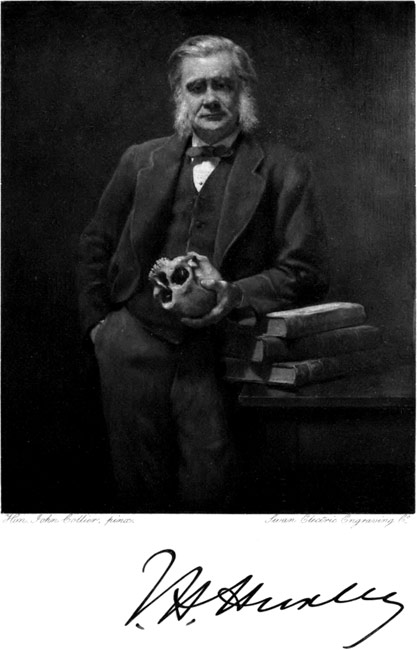
Thomas Henry Huxley was born at Ealing, on
the 4th of May, 1825. Montaigne tells us that he
was “borne between eleven of the clock and noone,”
and, with like quaint precision, Huxley gives the
hour of his birth as “about eight o’clock in the
morning.” Speaking of his first Christian name, he
humorously said that, by curious chance, his parents
chose that of the particular apostle with whom, as
the doubting member of the twelve, he had always
felt most sympathy.
Concerning his father, who was “one of the masters
in a large semi-public school” (the father of
Herbert Spencer, it will be remembered, was also a
schoolmaster), Huxley has little to say in the slight
autobiographical sketch reprinted as an introduction
to the first volume of the Collected Essays. On that
side, he tells us, he could find hardly any trace in
himself, except a certain faculty for drawing, and a
certain hotness of temper. “Physically and mentally,”
he was the son of his mother, “a slender
brunette, of an emotional and energetic temperament.”
His school training was brief and profitless;
his tastes were mechanical, and but for lack of means,
he would have started life in the same profession
which Herbert Spencer followed till he forsook
Messrs. Fox’s office for journalism. So, with a certain
shrinking from anatomical work, Huxley studied
medicine for a time under a relative, and in his seventeenth
year entered the Charing Cross Hospital
School as a student. In those days there was no instruction
in physics, and only in such branch of
chemistry as dealt with the nature of drugs. Non
multa, sed multum, and what was lacking in breadth
was, perhaps, gained in thoroughness. Huxley had
as excellent a teacher in Wharton Jones as the latter
had a promising pupil in Huxley, and in working
with the microscope, the evidence of that came in
his discovery of a certain root-sheath in the hair,
which has since then been known as “Huxley’s
layer.”
Up to the time of his studentship, he had been
left, intellectually, altogether to his own devices.
He tells us that he was a voracious and omnivorous
reader, “a dreamer and speculator of the first water,
well endowed with that splendid courage in attacking
any and every subject which is the blessed compensation
of youth and inexperience.” Among the books
and essays that impressed him were Guizot’s History
of Civilization; and Sir William Hamilton’s essay
On the Philosophy of the Unconditioned which he
accidentally came upon in an odd volume of the
Edinburgh Review. This, he adds, was “devoured
with avidity,” and it stamped upon his mind the
strong conviction “that on even the most solemn
and important of questions, men are apt to take
cunning phrases for answers; and that the limitation
of our faculties, in a great number of cases, renders
real answers to such questions, not merely actually
impossible, but theoretically inconceivable.” Thus,
before he was out of his teens, the philosophy that
ruled his life-teaching was taking definite shape.
In 1845, he won his M. B. London with honours
in anatomy and physiology, and after a few months’
practice at the East End, applied, at the instance of
his senior fellow-student, Mr. (afterwards Sir) Joseph
Fayrer, for an appointment in the medical service of
the Navy. At the end of two months he was fortunate
enough to be entered on the books of Nelson’s
old ship, the Victory, for duty at Haslar Hospital.
His official chief was the famous Arctic Explorer, Sir
John Richardson, through whose recommendation
he was appointed, seven months later, assistant surgeon
of the Rattlesnake. That ship, commanded by
Captain Owen Stanley, was commissioned to survey
the intricate passage within the Barrier Reef skirting
the eastern shores of Australia, and to explore the
sea lying between the northern end of that reef and
New Guinea. It was the best apprenticeship to what
was eventually the work of Huxley’s life—the solution
of biological problems and the indication of their
far-reaching significance. Darwin and Hooker had
passed through a like marine curriculum. The former
served as naturalist on board the Beagle when
she sailed on her voyage round the world in 1831;
the latter as assistant-surgeon on board the Erebus
on her Antarctic Expedition in 1839. Fortune was
to bring the three shoulder to shoulder when the
battle against the theory of the immutability of species
was fought.
During his four-years’ absence Huxley, in whom
the biologist dominated the doctor, made observations
on the various marine animals collected. These
he sent home to the Linnæan Society in vain hope of
acceptance. A more elaborate paper to the Royal
Society, communicated through the Bishop of Norwich
(author of a book on birds, and father of Dean
Stanley), secured the coveted honour of publication,
and on Huxley’s return in 1850 a “huge packet of
separate copies” awaited him. It dealt with the
anatomy and affinities of the Medusæ, and the original
research which it evidenced justified his election
in 1851 to the fellowship of the society whose presidential
chair he was in after years to adorn. He
would seem to have won the blue ribbon of science
per saltum. Probably, so far as their biological value
is concerned, nothing that he did subsequently has
surpassed his contributions to scientific literature at
that period; but if his services to knowledge had
been limited to the class of work which they represent,
he would have remained only a distinguished
specialist. Further recognition of his well-won position
came in the award of the society’s royal medal.
But fellowships and medals keep no wolf from the
door, and Huxley was a poor man. After vain attempts
to obtain, first, a professorship of physiology
in England, and then a chair of natural history at
Toronto (Tyndall was at the same time an unsuccessful
candidate for the chair of physics in the same
university), a settled position was secured by Sir
Henry de la Beche’s offer of the professorship of
palæontology and of the lectureship on natural history
in the Royal School of Mines, vacated by Edward
Forbes. That was in 1854. Between that date
and the time of his return Huxley had contributed
a number of valuable papers on the structure of the
invertebrates, and on histology, or the science of
tissues. But these, while adding to his established
qualifications for a scientific appointment, demand
no detailed reference here. With both chairs there
was united the curatorship of the fossil collections
in the Museum of Practical Geology, and these, with
the inspectorship of salmon fisheries, which office he
accepted in 1881, complete the list of Huxley’s more
important public appointments. He surrendered
them all in 1885, having reached the age at which,
as he jocosely remarked to the writer, “Every scientific
man ought to be poleaxed.” Perhaps he
dreaded the conservatism of attitude, the non-receptivity
to new ideas, which often accompany old age.
But for himself such fears were needless. He was
never of robust constitution; in addition to the lasting
effects of an illness in boyhood, Carlyle’s “accursed
Hag,” dyspepsia, which troubled both Darwin
and Bates for the rest of their lives after their
return from abroad, troubled him. Therefore, considerations
of health mainly prompted the surrender
of his varied official responsibilities, the loyal discharge
of which met with becoming recognition in
the grant of a pension. This secured a modest competence
in the evening of life to one who had never
been wealthy, and who had never coveted wealth.
To Huxley may fitly be applied what Faraday said
of himself, that he had “no time to make money.”
And yet, to his abiding discredit, the present editor
of Punch allowed his theological animus, which had
already been shown in abortive attempts in the pages
of that “facetious” journal to appraise a Roman
Catholic biologist at the expense of Huxley, to further
degrade itself by affixing the letters “L. S. D.”
to his name in a character-sketch.
His public life may be said to date from 1854.
The duties which he then undertook included the
delivery of a course of lectures to working men
every alternate year. Some of these—models of
their kind—have been reissued in the Collected Essays.
Among the most notable are those on Our
Knowledge of the Causes of the Phenomena of Organic
Nature. At the outset of his public career
lecturing was as distasteful to him as in earlier years
the trouble of writing was detestable. But mother
wit and “needs must” trained him in a short time
to win the ear of an audience. One evening in 1852
he made his début at the Royal Institution, and the
next day he received a letter charging him with
every possible fault that a lecturer could commit—ungraceful
stoop, awkwardness in use of hands,
mumbling of words, or dropping them down the
shirt front. The lesson was timely, and its effect
salutary. Huxley was fond of telling this story, and
it is worth recording—if but as encouragement to
stammerers who have something to say—at what
price he “bought this freedom” which held an
audience spellbound. How he thus held it in later
years they will remember who in the packed theatre
of the Royal Institution listened on the evening of
Friday, 9th of April, 1880, to his lecture On the Coming
of Age of the Origin of Species.
In 1856 Huxley visited the glaciers of the Alps
with Tyndall, the result appearing in their joint
authorship of a paper on Glacial Phenomena in the
Philosophical Transactions of the following year.
But this was a rare interlude. What time could be
wrested from daily routine was given to the study of
invertebrate and vertebrate morphology, palæontology,
and ethnology, familiarity with which was no
mean equipment for the conflict soon to rage round
these seemingly pacific materials when their deep
import was declared. The outcome of such varied
industry is apparent to the student of scientific memoirs.
But a recital of the titles of papers contributed
to these, as e. g., On Ceratodus, Hyperodapedon
Gordoni, Hypsilophodon, Telerpeton, and
so forth, will not here tend to edification. The
original and elaborate investigations which they embody
have had recognition in the degrees and medals
which decorated the illustrious author. But it is not
by these that Huxley’s renown as one of the most
richly-endowed and widely-cultured personalities of
the Victorian era will endure. They might sink into
the oblivion which buries most purely technical work
without in any way affecting that foremost place
which he fills in the ranks of philosophical biologists
both as clear-headed thinker and luminous interpreter.
In this high function the publication of the Origin
of Species gave him his opportunity. That was
in 1859. As with Hooker and Bates, his experiences
as a traveller, and, more than this, his penetrating
inquiry into significances and relations, prepared his
mind for acceptance of the theory of descent with
modification of living forms from one stock. Hence
the mutability, as against the old theory of the fixity,
of species.
In the chapter On the Reception of the Origin
of Species, which Huxley contributed to Darwin’s
Life and Letters, he gives an interesting account of
his attitude toward that burning question. He
says—
“I think that I must have read the Vestiges (see
p. 119) before I left England in 1846, but if I did
the book made very little impression upon me, and
I was not brought into serious contact with the
‘species’ question until after 1850. At that time I
had long done with the Pentateuchal cosmogony
which had been impressed upon my childish understanding
as Divine truth with all the authority of
parents and instructors, and from which it had cost
me many a struggle to get free. But my mind was
unbiassed in respect of any doctrine which presented
itself if it professed to be based on purely philosophical
and scientific reasoning.... I had not then
and I have not now the smallest a priori objection to
raise to the account of the creation of animals and
plants given in Paradise Lost, in which Milton so
vividly embodies the natural sense of Genesis. Far
be it from me to say that it is untrue because it
is impossible. I confine myself to what must be
regarded as a modest and reasonable request for
some particle of evidence that the existing species of
animals and plants did originate in that way as a
condition of my belief in a statement which appears
to me to be highly improbable....
“And by way of being perfectly fair, I had exactly
the same answer to give to the evolutionists
of 1851-58. Within the ranks of the biologists of
that time I met with nobody, except Dr. Grant, of
University College, who had a word to say for Evolution,
and his advocacy was not calculated to advance
the cause. Outside these ranks the only person
known to me whose knowledge and capacity
compelled respect, and who was at the same time a
thoroughgoing evolutionist, was Mr. Herbert Spencer,
whose acquaintance I made, I think, in 1852,
and then entered into the bonds of a friendship
which I am happy to think has known no interruption.
Many and prolonged were the battles we
fought on this topic. But even my friend’s rare dialectic
skill and copiousness of apt illustration could
not drive me from my agnostic position. I took my
stand upon two grounds: firstly, that up to that time
the evidence in favour of transmutation was wholly
insufficient; and secondly, that no suggestion respecting
the causes of the transmutation assumed
which had been made was in any way adequate to
explain the phenomena. Looking back at the state
of knowledge at that time, I really do not see that
any other conclusion was justifiable.
“As I have already said, I imagine that most of
those of my contemporaries who thought seriously
about the matter were very much in my own state
of mind—inclined to say to both Mosaists and Evolutionists
‘A plague on both your houses!’ and
disposed to turn aside from an interminable and apparently
fruitless discussion to labour in the fertile
fields of ascertainable fact. And I may therefore
further suppose that the publication of the Darwin
and Wallace papers in 1858, and still more that of
the Origin in 1859, had the effect upon them of the
flash of light, which to a man who has lost himself
in a dark night suddenly reveals a road which,
whether it takes him straight home or not, certainly
goes his way. That which we were looking for and
could not find was a hypothesis respecting the origin
of known organic forms which assumed the operation
of no causes but such as could be proved to be
actually at work. We wanted, not to pin our faith
to that or any other speculation, but to get hold of
clear and definite conceptions which could be
brought face to face with facts, and have their
validity tested. The Origin provided us with the
working hypothesis we sought. Moreover, it did the
immense service of freeing us for ever from the dilemma—refuse
to accept the creation hypothesis,
and what have you to propose that can be accepted
by any cautious reasoner? In 1857 I had no answer
ready, and I do not think that any one else had.
A year later we reproached ourselves with dulness for
being perplexed by such an inquiry. My reflection,
when I first made myself master of the central idea
of the Origin was ‘How extremely stupid not to
have thought of that!’ I suppose that Columbus’s
companions said much the same when he made the
egg stand on end. The facts of variability, of the
struggle for existence, of adaptation to conditions,
were notorious enough, but none of us had suspected
that the road to the heart of the species problem lay
through them, until Darwin and Wallace dispelled
the darkness, and the beacon-fire of the Origin
guided the benighted.”
But the disciple soon outstripped the master.
As was said of Luther in relation to Erasmus, Huxley
hatched the egg that Darwin laid. For in the
Origin of Species the theory was not pushed to its
obvious conclusion: Darwin only hinted that it
“would throw much light on the origin of man and
his history.” His silence, as he candidly tells us in
the Introduction to the Descent of Man, was due to
a desire “not to add to the prejudices against his
views.” No such hesitancy kept Huxley silent. In
the spirit of Plato’s Laws, he followed the argument
whithersoever it led. In 1860 he delivered a course
of lectures to working-men On the Relations of Man
to the Lower Animals, and in 1862, a couple of lectures
on the same subject at the Edinburgh Philosophical
Institution. The important and significant
feature of these discourses was the demonstration
that no cerebral barrier divides man from apes; that
the attempt to draw a psychical distinction between
him and the lower animals is futile; and that “even
the highest faculties of feeling and of intellect begin
to germinate in lower forms of life.” The lectures
were published in 1863 in a volume entitled Evidence
as to Man’s Place in Nature; and it was with pride
warranted by the results of subsequent researches
that Huxley, in a letter to the writer, thus refers to
the book when arranging for its reissue among the
Collected Essays—
I was looking through Man’s Place in Nature the other
day. I do not think there is a word I need delete, nor anything
I need add, except in confirmation and extension of the
doctrine there laid down. That is great good fortune for a
book thirty years old, and one that a very shrewd friend of
mine implored me not to publish, as it would certainly ruin all
my prospects.
The sparse annotations to the whole series of reprinted
matter show that the like permanence attends
all his writings. And yet, true workman,
with ideal ever lying ahead, as he was, he remarked
to the writer that never did a book come hot from
the press, but he wished that he could suppress it
and rewrite it.
But before dealing with the momentous issues
raised in Man’s Place in Nature, we must return
to 1860. For that was the “Sturm und Drang”
period. Then, at Oxford, “home of lost causes,” as
Matthew Arnold apostrophizes her in the Preface to
his Essays in Criticism, was fought, on Saturday,
30th of June, a memorable duel between biologist and
bishop; perhaps in its issues, more memorable than
the historic discussion on the traditional doctrine of
special creation between Cuvier and Geoffroy Saint-Hilaire
in the French Academy in 1830.
Both Huxley and Wilberforce were doughty
champions. The scene of combat, the Museum
Library, was crammed to suffocation. Fainting
women were carried out. There had been “words”
between Owen and Huxley on the previous Thursday.
Owen contended that there were certain fundamental
differences between the brains of man and
apes. Huxley met this with “direct and unqualified
contradiction,” and pledged himself to “justify that
unusual procedure elsewhere.” No wonder that the
atmosphere was electric. The bishop was up to
time. Declamation usurped the vacant place of argument
in his speech, and the declamation became
acrid. He finished his harangue by asking Huxley
whether he was related by his grandfather’s or
grandmother’s side to an ape. “The Lord hath delivered
him into my hands,” whispered Huxley to
a friend at his side, as he rose to reply. After setting
his opponent an example in demonstrating his
case by evidence which, although refuting Owen,
evoked no admission of error from him then or ever
after, Huxley referred to the personal remark of
Wilberforce. And this is what he said—
I asserted, and I repeat, that a man has no reason to be
ashamed of having an ape for his grandfather. If there were
an ancestor whom I should feel shame in recalling, it would be
a man, a man of restless and versatile intellect, who, not content
with an equivocal success in his own sphere of activity,
plunges into scientific questions with which he has no real
acquaintance, only to obscure them by an aimless rhetoric, and
distract the attention of his hearers from the real point at issue
by eloquent digressions, and skilled appeals to religious prejudice.
Perhaps the best comment on a piece of what is
now ancient history is to quote the admissions made
by Lord Salisbury—a rigid High Churchman—in
his presidential address to the British Association in
this same city of Oxford in 1894—
Few now are found to doubt that animals separated by
differences far exceeding those that distinguish what we know
as species have yet descended from common ancestors....
Darwin has, as a matter of fact, disposed of the doctrine of
the immutability of species.
Few, also, are now found to doubt not only that
doctrine, but also the doctrine that all life-forms
have a common origin; plants and animals being
alike built-up of matter which is identical in character.
This doctrine, to-day a commonplace of biology,
was, thirty years ago, rank heresy, since it
seemed to reduce the soul of man to the level of his
biliary duct. Hence the Oxford storm was but a
capful of wind compared with that which raged
round Huxley’s lecture on The Physical Basis of
Life delivered, thus aggravating the offence, on a
“Sabbath” evening in Edinburgh in 1868. People
had settled down, with more or less vague understanding
of the matter, into quiescent acceptance of
Darwinism. And now their somnolence was rudely
shaken by this Southron troubler of Israel, with his
production of a bottle of solution of smelling salts,
and a pinch or two of other ingredients, which represented
the elementary substances entering into the
composition of every living thing from a jelly-speck
to man. Well might the removal of the stopper to
that bottle take their breath away! Microscopists,
philosophers “so-called,” and clerics alike raised the
cry of “gross materialism,” never pausing to read
Huxley’s anticipatory answer to the baseless charge,
an answer repeated again and again in his writings,
as in the essay of Descartes’ Discourse touching
the method of using one’s reason rightly, and in his
Hume. In season and out of season he never wearies
in insisting that there is nothing in the doctrine inconsistent
with the purest idealism. “All the phenomena
of Nature are, in their ultimate analysis,
known to us only as facts of consciousness.” The
cyclone thus raised travelled westward on the heels
of Tyndall, when in 1874 he asserted the fundamental
identity of the organic and inorganic; dashing,
as his Celtic blood stirred him, the statements
with a touch of poetry in the famous phrase that
“the genius of Newton was potential in the fires of
the sun.”
The ancient belief in “spontaneous generation,”
which Redi’s experiments upset, was the subject of
Huxley’s Presidential Address to the British Association
in 1870. But while he showed how subsequent
investigation confirmed the doctrine of Abiogenesis,
or the non-production of living from dead
matter, he made this statement in support of Tyndall’s
creed as to the fundamental unity of the vital
and the non-vital.
“Looking back through the prodigious vista of
the past, I find no record of the commencement of
life, and therefore I am devoid of any means of
forming a definite conclusion as to the conditions
of its appearance. Belief, in the scientific sense of
the word, is a serious matter, and needs strong
foundations. To say, therefore, in the admitted absence
of evidence, that I have any belief as to the
mode in which the existing forms of life have originated,
would be using words in a wrong sense. But
expectation is permissible where belief is not; and if
it were given to me to look beyond the abyss of
geologically recorded time to the still more remote
period when the earth was passing through physical
and chemical conditions which it can no more see
again than a man can recall his infancy, I should
expect to be a witness of the evolution of living
protoplasm from non-living matter. I should expect
to see it appear under forms of great simplicity,
endowed, like existing fungi, with the power of determining
the formation of new protoplasm from
such matters as ammonium carbonates, oxalates, and
tartrates, alkaline and earthy phosphates, and water,
without the aid of light. That is the expectation to
which analogical reasoning leads me; but I beg you
once more to recollect that I have no right to call
my opinion anything but an act of philosophical
faith.”
Huxley was the Apostle Paul of the Darwinian
movement, and one main result of his active propagandism
was to so effectively prepare the way for
the reception of the profounder issues involved in
the theory of the origin of species, that the publication
of Darwin’s Descent of Man in 1871 created
mild excitement. And the weight of his support is
the greater because he never omitted to lay stress on
the obscurity which still hides the causes of variation
which, it must be kept in mind, natural selection
cannot bring about, and on which it can only act.
He insists on the non-implication of the larger theory
with its subordinate parts, or with the fate of
them. The “doctrine of Evolution is a generalisation
of certain facts which may be observed by any
one who will take the necessary trouble.” The facts
are those which biologists class under the heads of
Embryology and Palæontology, to the conclusions
from which “all future philosophical and theological
speculations will have to accommodate themselves.”
That is the direction of the revolution to which
the publication of Man’s Place in Nature gave impetus;
and it is in the all-round application of the
theory of man’s descent that Huxley stands foremost,
both as leader and lawgiver. Mr. Spencer has
never shrunk from controversy, but he has not forsaken
the study for the arena, and hence his influence,
great and abiding as it is, has been less direct
and personal than that of his comrade, “ever a
fighter,” who, in Browning’s words, “marched breast
forward.” Man’s Place in Nature was the first of a
series of deliverances upon the most serious questions
that can occupy the mind; and its successors,
the brilliant monograph on Hume, published in
1879, and the Romanes Lecture on Evolution and
Ethics, delivered at Oxford, 18th of May, 1893, are
but expansions of the thesis laid down in that wonderful
little volume; wonderful in the prevision which
fills it, and in the justification which it has received
from all subsequent research, notably in psychology.
If the propositions therein maintained are unshaken,
then there is no possible reconciliation between
Evolution and Theology, and all the smooth
sayings in attempted harmonies between the two,
of which Professor Drummond’s Ascent of Man is a
type, and in speeches at Church Congresses of which
that delivered by Archdeacon Wilson (see p. 161) is
a type, do but hypnotize the “light half-believers of
our casual creeds.” To some there are “signs of the
times” which point to approaching acquiescence in
the sentiment of Ovid, paralleled by a famous passage
in Gibbon, that “the existence of the gods is a
matter of public policy, and we must believe it accordingly.”
It looks like the prelude to surrender
of what is the cardinal dogma of Christianity when
we read in the Archdeacon’s address that “the theory
of Evolution is indeed fatal to certain quasi-mythological
doctrines of the Atonement which once
prevailed, but it is in harmony with its spirit.” For
those doctrines, as the Venerable apologist may learn
from the evidence in Frazer’s Golden Bough (chap.
iii, passim), are wholly mythological, because barbaric.
But, in truth, there is not a dogma of Christendom,
not a foundation on which the dogma rests,
that Evolution does not traverse. The Church of
England adopts “as thoroughly to be received and
believed,” the three ancient creeds, known as the
Apostles’, the Athanasian, and the Nicene. There
is not a sentence in any one of these which finds
confirmation; and only a sentence or two that find
neither confirmation nor contradiction, in Evolution.
The question, on which reams of paper have been
wasted, lies in a nutshell. The statements in the
Creeds profess to have warrant in the direct words
of the Bible; or in inferences drawn from those
words, as defined by the Councils of the Church.
The decisions of these Councils represent the opinion
of the majority of fallible men composing those assemblies,
and no number of fallible parts can make
an infallible whole. As Selden quaintly puts it
(Table Talk, xxx, Councils), “they talk (but blasphemously
enough) that the Holy Ghost is president
of their General Councils, when the truth is the odd
man is still the Holy Ghost.” With this same “odd
man” rested the decision as to what books should
be included or excluded from the collection on which
the Church bases its authority and formulates its
creeds. So, in the last result, both sets of questions
are settled by a human tribunal employing a circular
argument. But, dismissing this for the moment, let
us see to what issues the controversy is narrowed, to
quote Huxley’s words (written in 1871), by “the
spontaneous retreat of the enemy from nine-tenths
of the territory which he occupied ten years ago.”
The battle has no longer to be fought over the
question of the fundamental identity of the physical
structure of man and of the anthropoid apes. The
most enlightened Protestant divines accept this as
proven; and not a few Catholic divines are adopting
an attitude toward it which is only the prelude to
surrender. Matters must have moved apace in the
Church which Huxley, backed by history, describes
as “that vigorous and consistent enemy of the highest
intellectual, moral, and social life of mankind,”
to permit the Roman Catholic Professor of Physics
in the University of Notre Dame, America, to parley
as follows:
“Granting that future researches in palæontology,
anthropology, and biology, shall demonstrate
beyond doubt that man is genetically related to the
inferior animals, and we have seen how far scientists
are from such a demonstration (?), there will not be,
even in such an improbable event, the slightest
ground for imagining that then, at last, the conclusions
of science are hopelessly at variance with
the declarations of the sacred text, or the authorised
teachings of the Church of Christ. All that would
logically follow from the demonstration of the animal
origin of man, would be a modification of the traditional
view regarding the origin of the body of our
first ancestor. We should be obliged to revise the
interpretation that has usually been given to the
words of Scripture which refer to the formation of
Adam’s body, and read these words in the sense
which Evolution demands, a sense which, as we
have seen, may be attributed to the words of the
inspired record, without either distorting the meaning
of terms, or in any way doing violence to the
text” (Evolution and Dogma. By the Reverend J.
A. Zahm, Ph. D., C.S.C., pp. 364, 365).
Upon this suggested revision of writings which
are claimed as forming part of a divine revelation,
one of the highest authorities, Francisco Suarez, thus
refers, in his Tractatus de Opere sex Dierum, to the
elastic interpretation given in his time to the “days”
in the first chapter of Genesis. “It is not probable
that God, in inspiring Moses to write a history of
the Creation, which was to be believed by ordinary
people, would have made him use language the true
meaning of which it was hard to discover, and still
harder to believe.” Three centuries have passed
since these wise words were penned, and the reproof
which they convey is as much needed now as then.
In near connection with the question of man’s
origin is that of his antiquity. The existence of his
remains, rare as they are everywhere, in deposits
older than the Pleistocene or Quaternary Epoch is
not proven. This applies to the remarkable fragments
found by Dr. Dubois in Java, the character of
which, in the judgment of several palæontologists,
indicates the nearest approach between man and ape
hitherto discovered. But the evidence of the physical
relation of these two being conclusive, the exact
place of man in the earth’s time-record is rendered
of subordinate importance.
The theologians have come to their last ditch in
contesting that the mental differences between man
and the lower animals are fundamental, being differences
of kind, and therefore that no gradual process
from the mental faculties of the one to those of the
other has taken place. This struggle against the application
of the theory of Evolution to man’s intellectual
and spiritual nature will be long and stubborn.
It is a matter of life and death to the theologian
to show that he has in revelation, and in the
world-wide belief of mankind in spiritual existences
without, and in a spirit or soul within, evidence of the
supernatural. The evolutionist has no such corresponding
deep concern. When the argument against
him is adduced from the Bible, he can only challenge
the ground on which that book is cited as divine
authority, or as an authority at all. Granting, for
the sake of argument, that a revelation has been
made, the writings purporting to contain it must
comply with the twofold condition attaching to it,
namely, that it makes known matters which the
human mind could not, unaided, have found out;
and that it embodies those matters in language as
to the meaning of which there can be no doubt whatever.
If there be any sacred books which comply
with these conditions, they have yet to be discovered.
When the argument against the evolutionist is
drawn from human testimony, he does not dispute
the existence of the belief in a soul and in all the
accompanying apparatus of the supernatural; but he
calls in the anthropologist to explain how these arose
in the barbaric mind.
Meanwhile, let us summarize the evidence which
points to the psychical unity between man and the
lower life-forms. As stated on p. 187, Mr. Herbert
Spencer traces the gradual evolution of consciousness
from “the blurred, indeterminate feeling which
responds to a single nerve pulsation or shock.”
There is no trace of a nervous system in the simplest
organisms, but this counts for little, because there
are also no traces of a mouth, or a stomach, or limbs.
In these seemingly structureless creatures every part
does everything. The amœba eats and drinks, digests
and excretes, manifests “irritability,” that is,
responds to the various stimuli of its surroundings,
and multiplies, without possessing special organs for
these various functions. Division of labour arises at
a slightly higher stage, when rudimentary organs appear;
the development of function and organ going
on simultaneously.
Speaking broadly, the functions of living things
are threefold: they feed; they reproduce; they respond
to their “environment,” and it is this last-named
function—communication with surroundings—which
is the special work of the nervous system.
It was an old Greek maxim that “a man may once
say a thing as he would have said it: he cannot say
it twice.” This is the warrant for transferring a few
sentences on the origin of the nerves from my Story
of Creation. They are but a meagre abstract of Mr.
Spencer’s long, but luminous exposition of the subject.
“As every part of an organism is made up of
cells, and as the functions govern the form of the
cells, the origin of nerves must be due to a modification
in cell shape and arrangement, whereby certain
tracts or fibres of communication between the body
and its surroundings are established.
“But what excited that modification? The all-surrounding
medium, without which no life had
been, which determined its limits, and touches it at
every point with its throbs and vibrations. In the
beginnings of a primitive layer or skin manifested
by creatures a stage above the lowest, unlikenesses
would arise, and certain parts, by reason of their
finer structure, would be the more readily stimulated
by, and the more quickly responsive to, the ceaseless
action of the surroundings, the result being that
an extra sensitiveness along the lines of least resistance
would be set up in those more delicate
parts. These, developing, like all things else, by use,
would become more and more the selected paths of
the impulses, leading, as the molecular waves thrilled
them, to structural changes or modification into
nerve-cells, and nerve-fibres, of increasing complexity
as we ascend the scale of life. The entire nervous
system, with its connections; the brain and all the
subtle mechanism with which it controls the body;
the organs of the senses alike begin as sacs formed
by infoldings of the primitive outer skin.”
Biologists are agreed that a certain stage in the
organization of the nervous system—the germs of
which, we saw, are visible in the quivering of an
amœba, and probably in plants as well as animals—must
be reached before consciousness is manifest.
Obscurity still hangs round the stage at which mere
irritability passes into sensibility, but so long as the
continuity of development is clear, the gradations
are of lesser importance. And, for the present purpose,
there is no need to descend far in the life-scale;
if the psychical connection between man and the
mammals immediately beneath him is proven, the
connection of the mammals with the lowest invertebrate
may be assumed as also established. Speaking
only of vertebrates, the brain being, whether in
fish or man, the organ of mental phenomena, how
far does its structure support or destroy the theory
of mental continuity? In Man’s Place in Nature,
and its invaluable supplement, the second part of
the monograph on Hume, this subject is expounded
by Huxley with his usual clearness. In the older
book he traces the gradual modification of brain in
the series of backboned animals. He points out that
the brain of a fish is very small compared with the
spinal cord into which it is continued, that in reptiles
the mass of brain, relatively to the spinal cord, is
larger, and still larger in birds, until among the lowest
mammals, as the opossums and kangaroos, the
brain is so increased in proportion as to be extremely
different from that of fish, bird, or reptile. Between
these marsupials and the highest or placental mammals,
there occurs “the greatest leap anywhere made
by Nature in her brain work.” Then follows this
important statement in favour of continuity.
“As if to demonstrate, by a striking example, the
impossibility of erecting any cerebral barrier between
man and the apes, Nature has provided us, in the
latter animals, with an almost complete series of
gradations from brains little higher than that of a
Rodent to brains little lower than that of Man.”
After giving technical descriptions in proof of this,
and laying special stress on the presence of the
structure known as the “hippocampus minor” in
the brain of man as well as of the ape—in the denial
of which Owen cut such a sorry figure, Huxley
adds:
“So far as cerebral structure goes, therefore, it is
clear that Man differs less from the Chimpanzee or
the Orang than these do even from the Monkeys,
and that the difference between the brains of the
Chimpanzee and of Man is almost insignificant when
compared with that between the Chimpanzee brain
and that of a Lemur.... Thus, whatever system of
organs be studied, the comparison of their modifications
in the ape series leads to one and the same
result,—that the structural differences which separate
Man from the Gorilla and the Chimpanzee are not so
great as those which separate the Gorilla from the
lower apes. But in enunciating this important truth
I must guard myself against a form of misunderstanding
which is very prevalent ... that the structural
differences between man and even the highest
apes are small and insignificant. Let me then distinctly
assert, on the contrary, that they are great
and significant; that every bone of a Gorilla bears
marks by which it might be distinguished from the
corresponding bone of a Man; and that, in the present
creation, at any rate, no intermediate link bridges
over the gap between Homo and Troglodytes. It
would be no less wrong than absurd to deny the existence
of this chasm; but it is at least equally wrong
and absurd to exaggerate its magnitude, and, resting
on the admitted fact of its existence, to refuse to
inquire whether it is wide or narrow. Remember, if
you will, that there is no existing link between Man
and the Gorilla, but do not forget that there is a no
less sharp line of demarcation, a no less complete
absence of any traditional form, between the Gorilla
and the Orang, or the Orang and the Gibbon.”
The brains of man and ape being fundamentally
the same in structure, it follows that the functions
which they perform are fundamentally the same.
The large array of facts mustered by a series of
careful observers prove how futile is the argument
which, in his pride of birth, man advances against
psychical continuity. Vain is the search after
boundary lines between reflex action and instinct,
and between instinct and reason. Barriers there are
between man and brute, for articulate speech and
the consequent power to transmit experiences has
set up these, and they remain impassable. “The
potentialities of language, as the vocal symbol of
thought, lay in the faculty of modulating and articulating
the voice. The potentialities of writing, as
the visual symbol of thought, lay in the hand that
could draw, and in the mimetic tendency which
we know was gratified by drawing as far back as
the days of Quaternary man” (Huxley’s Essays on
Controverted Questions, p. 47). But these specially
human characteristics are no sufficing warrant for
denying that the sensations, emotions, thoughts, and
volitions of man vary in kind from those of the
lower creation. “The essential resemblances in all
points of structure and function, so far as they can
be studied, between the nervous system of man and
that of the dog, leave no reasonable doubt that the
processes which go on in the one are just like those
which take place in the other. In the dog, there can
be no doubt that the nervous matter which lies
between the retina and the muscles undergoes a
series of changes, precisely analogous to those which,
in the man, give rise to sensation, a train of thought,
and volition.” This passage occurs in Huxley’s
Reply to Mr. Darwin’s Critics, which appeared in
the Contemporary Review, 1871, and it may be supplemented
by a quotation from the chapter on The
Mental Phenomena of Animals in his Hume. “It
seems hard to assign any good reason for denying
to the higher animals any mental state or process
in which the employment of the vocal or visual
symbols of which language is composed is not involved;
and comparative psychology confirms the
position in relation to the rest of the animal world
assigned to man by comparative anatomy. As comparative
anatomy is easily able to show that, physically,
man is but the last term of a long series of
forms, which lead, by slow gradations, from the highest
mammal to the almost formless speck of living
protoplasm, which lies on the shadowy boundary
between animal and vegetable life; so, comparative
psychology, though but a young science, and far
short of her elder sister’s growth, points to the same
conclusion.”
Within recent years the psychologists are doing
remarkable work in attacking the problem of the
mechanics of mental operations, and already in Europe
and America some thirty laboratories have been
started for experimental work. The subject is somewhat
abstruse for detailed reference here, and it must
suffice to say that the psychologist, beginning with
observations upon himself, measuring, for example,
“the degree of sensibility of his own eye to luminous
irritations, or of his own skin to pricking, passes on
to like inquiry into the numerical relations between
the energy of the stimuli of light, sound, and so forth,
and the energy of the sensations which they arouse
in the nerve-channels.” An excellent summary, with
references to the newest authorities on the subject,
is given by Prince Kropotkin in the Nineteenth
Century of August, 1896.
All this, to the superficial onlooker, seems rank
materialism. But we cannot think without a brain
any more than we can see without eyes, and any
inquiry into the operation of the organ of thought
must run on the same lines as inquiry into the
operations of any other organ of the body. And
the inquiry leaves us at the point whence we began
in so far as any light is thrown on the connection
between the molecular vibrations in nerve-tissue and
the mental processes of which they are the indispensable
accompaniment. Changes take place in
some of the thousands of millions of brain-cells in
every thought that we think, and in every emotion
that we feel, but the nexus remains an impenetrable
mystery. Nevertheless, if we may not say that the
brain secretes thought as we say that the liver secretes
bile, we may also not say that the mind is
detachable from the nervous system, and that it is
an entity independent of it. Were it this, not only
would it stand outside the ordinary conditions of
development, but it would also maintain the equilibrium
which a dose of narcotics or of alcohol, or
which starvation and gorging alike rapidly upset.
In his posthumous essay On the Immortality of
the Soul, Hume says: “Matter and spirit are at
bottom equally unknown, and we cannot determine
what qualities inhere in the one or in the other.”
That is the conclusion to which the wisest come.
And in the ultimate correlation of the physical and
psychical lies the hope of arrival at that terminus of
unity which was the dream of the ancient Greeks,
and to which all inquiry makes approach. How, in
these matters, philosophy is at one, is again seen in
Huxley’s admission that “in respect of the great
problems of philosophy, the post-Darwinian generation
is, in one sense, exactly where the præ-Darwinian
generations were. They remain insoluble.
But the present generation has the advantage of
being better provided with the means of freeing itself
from the tyranny of certain sham solutions.”
Science explains, and, in explaining, dissipates
the pseudo-mysteries by which man, in his myth-making
stage, when conception of the order of the
universe was yet unborn, accounted for everything.
But she may borrow the Apostle’s words, “Behold!
I show you a mystery,” and give to them a profounder
meaning as she confesses that the origin and
ultimate destiny of matter and motion; the causes
which determine the behaviour of atoms, whether
they are arranged in the lovely and varying forms
which mark their crystals, or whether they are quivering
with the life which is common to the amœba
and the man; the conversion of the inorganic into
the organic by the green plant, and the relation between
nerve-changes and consciousness; are all impenetrable
mysteries.
In his speech on the commemoration of the jubilee
of his Professorship in the University of Glasgow
last year, Lord Kelvin said, “I know no more of
electric and magnetic force, or of the relation between
ether, electricity, and ponderable matter, or of
chemical affinity than I knew and tried to teach my
students of natural philosophy fifty years ago in my
first session as professor.”
This recognition of limitations will content those
who seek not “after a sign”. For others, that search
will continue to have encouragement not only from
the theologian, but from the pseudo-scientific who
have travelled some distance with the Pioneers of
Evolution, but who refuse to follow them further.
In each of these there is present the “theological
bias” whose varied forms are skilfully analyzed by
Mr. Spencer in his chapter under that heading in
the Study of Sociology. This explains the attitude
of various groups which are severally represented
by Mr. St. George Mivart, and the late Dr. W. B.
Carpenter; by Professor Sir Geo. G. Stokes, and Mr.
Alfred Russel Wallace. The first-named is a Roman
Catholic; the second was a Unitarian; the third is
an orthodox Churchman, and the fourth, as already
seen, is a Spiritualist. In his Genesis of Species, Mr.
Mivart contends that “man’s body was evolved from
pre-existing material (symbolised by the term ‘dust
of the earth’), and was therefore only derivatively
created, i. e., by the operation of secondary laws,”
but that “his soul, on the other hand, was created in
quite a different way ... by the direct action of
the Almighty (symbolised by the term breathing),”
p. 325. In his Mental Physiology, Dr. Carpenter
postulates an Ego or Will which presides over, without
sharing in, the causally determined action of the
other mental functions and their correlated bodily
processes; “an entity which does not depend for its
existence on any play of physical or vital forces, but
which makes these forces subservient to its determinations”
(p. 27). Professor Mivart actually cites
St. Augustine and Cardinal Newman as authorities
in support of his theory of the special creation of the
soul. He might with equal effect subpœna Dr.
Joseph Parker or General Booth as authorities. Dr.
Carpenter argued as became a good Unitarian. In
his Gifford Lectures on Natural Theology, Professor
Stokes asserts, drawing “on sources of information
which lie beyond man’s natural powers,” in other
words, appealing to the Bible, that God made man
immortal and upright, and endowed him with freedom
of the will. As, without the exercise of this,
man would have been as a mere automaton, he was
exposed to the temptation of the devil, and fell.
Thereby he became “subject to death like the lower
animals,” and by the “natural effect of heredity,”
transmitted the taint of sin to his offspring. The
eternal life thus forfeited was restored by the voluntary
sacrifice of Christ, but can be secured only to
those who have faith in him. This doctrine, which
is no novel one, is known as “conditional immortality.”
Professor Stokes attaches “no value to the
belief in a future life by metaphysical arguments
founded on the supposed nature of the soul itself,”
and he admits that the purely psychic theory which
would discard the body altogether in regard to the
process of thought is beset by very great difficulties.
So he once more has recourse to “sources of information
which lie beyond man’s natural powers.”
Following up certain distinctions between “soul”
and “spirit” drawn by the Apostle Paul in his tripartite
division of man, Professor Stokes, somewhat
in keeping with Dr. Carpenter, assumes an “Ego,
which, on the one hand, is not to be identified with
thought, which may exist while thought is in abeyance,
and which may, with the future body of which
the Christian religion speaks, be the medium of continuity
of thought.... What the nature of this body
might be we do not know; but we are pretty distinctly
informed that it would be something very
different from that of our present body, very different
in its properties and functions, and yet no less our
own than our present body.” “Words, words,
words,” as Hamlet says.
Reference has been made in some fulness to Mr.
Wallace’s limitations of the theory of natural selection
in the case of man’s mental faculties. We must
now pursue this somewhat in detail, reminding the
reader of Mr. Wallace’s admission that, “provisionally,
the laws of variation and natural selection ...
may have brought about, first, that perfection of
bodily structure in which man is so far above all
other animals, and, in co-ordination with it, the
larger and more developed brain by means of which
he has been able to subject the whole animal and
vegetable kingdoms to his service.” But, although
Mr. Wallace rejects the theory of man’s special creation
as “being entirely unsupported by facts, as
well as in the highest degree improbable,” he contends
that it does not necessarily follow that “his
mental nature, even though developed pari passu
with his physical structure, has been developed by
the same agencies.” Then, by the introduction of a
physical analogy which is no analogy at all, he suggests
that the agent by which man was upraised
into a kingdom apart bears like relation to natural
selection as the glacial epoch bears to the ordinary
agents of denudation and other changes in producing
new effects which, though continuous with preceding
effects, were not due to the same causes.
Applying this “argument” (drawn from natural
causes), as Mr. Wallace names it, “to the case of
man’s intellectual and moral nature,” he contends
that such special faculties as the mathematical,
musical, and artistic (is this faculty to be denied the
nest-decorating bower bird?), and the high moral
qualities which have given the martyr his constancy,
the patriot his devotion, and the philanthropist his
unselfishness, are due to a “spiritual essence or nature,
superadded to the animal nature of man.” We
are not told at what stage in man’s development this
was inserted; whether, once and for all, in “primitive”
man, with potentiality of transmission through
Palæolithic folk to all succeeding generations; or
whether there is special infusion of a “spiritual essence”
into every human being at birth.
Any perplexity that might arise at the line thus
taken by Mr. Wallace vanishes before the fact, already
enlarged upon, that the author of the Malay
Archipelago and Island Life has written a book on
Miracles and Modern Spiritualism in defence of both.
The explanation lies in that duality of mind which,
in one compartment, ranks Mr. Wallace foremost
among naturalists, and, in the other compartment,
places him among the most credulous of Spiritualists.
Despite this, Mr. Wallace has claims to a respectful
hearing and to serious reply. Fortunately, he
would appear to furnish the refutation to his own
argument in the following paragraph from his delightful
Contributions to the Theory of Natural Selection:
“From the time when the social and sympathetic
feelings came into operation and the intellectual and
moral faculties became fairly developed, man would
cease to be influenced by natural selection in his
physical form and structure. As an animal he would
remain almost stationary, the changes in the surrounding
universe ceasing to produce in him that
powerful modifying effect which they exercise on
other parts of the organic world. But, from the
moment that the form of his body became stationary,
his mind would become subject to those very influences
from which his body had escaped; every slight
variation in his mental and moral nature which
should enable him better to guard against adverse
circumstances and combine for mutual comfort and
protection would be preserved and accumulated; the
better and higher specimens of our race would therefore
increase and spread, the lower and more brutal
would give way and successively die out, and that
rapid advancement of mental organisation would
occur which has raised the very lowest races of man
so far above the brutes (although differing so little
from some of them in physical structure), and, in conjunction
with scarcely perceptible modifications of
form, has developed the wonderful intellect of the
European races” (pp. 316, 317, Second Edition,
1871).
This argument has suggestive illustration in the
fifth chapter of the Origin of Species. Mr. Darwin
there refers to a remark to the following effect made
by Mr. Waterhouse: “A part developed in any species
in an extraordinary degree or manner in comparison
with the same part in allied species tends to be highly
variable.” This applies only where there is unusual
development. “Thus, the wing of a bat is a most
abnormal structure in the class of mammals; but
the rule would not apply here, because the whole
group of bats possesses wings; it would apply only
if some one species had wings developed in a remarkable
manner in comparison with the other species
of the same genus.” And when this exceptional
development of any part or organ occurs, we may
conclude that the modification has arisen since the
period when the several species branched off from
the common progenitor of the genus; and this period
will seldom be very remote, as species rarely endure
for more than one geological period.
How completely this applies to man, the latest
product of organic evolution. The brain is that part
or organ in him which has been developed “in an
extraordinary degree, in comparison with the same
part” in other Primates, and which has become
highly variable. Whatever may have been the favouring
causes which secured his immediate progenitors
such modification of brain as advanced him in intelligence
over “allied species,” the fact abides that
in this lies the explanation of their after-history; the
arrest of the one, the unlimited progress of the
other. Increasing intelligence at work through vast
periods of time originated and developed those social
conditions which alone made possible that progress
which, in its most advanced degree, but a small
proportion of the race has reached. For in this question
of mental differences the contrast is not between
man and ape, but between man savage and
civilized; between the incapacity of the one to count
beyond his fingers, and the capacity of the other to
calculate an eclipse of the sun or a transit of Venus.
It would therefore seem that Mr. Wallace should
introduce his “spiritual essence, or nature,” in the
intermediate, and not in the initial stage.
As answer to Mr. Wallace’s argument that in
their large and well-developed brains, savages “possess
an organ quite disproportioned to their requirements,”
Huxley cites Wallace’s own remarks in his
paper on Instinct in Man and Animals as to the
considerable demands made by the needs of the lower
races on their observing faculties which call into
play no mean exercise of brain function.
“Add to this,” Huxley says, “the knowledge
which a savage is obliged to gain of the properties
of plants, of the characters and habits of animals,
and of the minute indications by which their course
is discoverable; consider that even an Australian
can make excellent baskets and nets, and neatly
fitted and beautifully balanced spears; that he learns
to use these so as to be able to transfix a quartern
loaf at sixty yards; and that very often, as in the
case of the American Indians, the language of a
savage exhibits complexities which a well-trained
European finds it difficult to master; consider that
every time a savage tracks his game, he employs a
minuteness of observation, and an accuracy of inductive
and deductive reasoning which, applied to other
matters, would assure some reputation, and I think
one need ask no further why he possesses such a
fair supply of brains.” ... But Mr. Wallace’s objection
“applies quite as strongly to the lower animals.
Surely a wolf must have too much brain, or else
how is it that a dog, with only the same quantity
and form of brain, is able to develop such singular
intelligence? The wolf stands to the dog in the
same relation as the savage to the man; and therefore,
if Mr. Wallace’s doctrine holds good, a higher
power must have superintended the breeding up of
wolves from some inferior stock, in order to prepare
them to become dogs” (Critiques and Addresses,
p. 293).
After all is said, perhaps the effective refutation
of the belief in a spiritual entity superadded in man
is found in the explanation of the origin of that belief
which anthropology supplies.
The theory of the origin and growth of the belief
in souls and spiritual beings generally, and in a
future life, which has been put into coherent form
by Spencer and Tylor, is based upon an enormous
mass of evidence gathered by travellers among existing
barbaric peoples; evidence agreeing in character
with that which results from investigations
into beliefs of past races in varying stages of culture.
Only brief reference to it here is necessary, but the
merest outline suffices to show from what obvious
phenomena the conception of a soul was derived, a
conception of which all subsequent forms are but
elaborated copies. As in other matters, crude analogies
have guided the barbaric mind in its ideas about
spirits and their behaviour. A man falls asleep and
dreams certain things; on waking, he believes that
these things actually happened; and he therefore
concludes that the dead who came to him or to
whom he went in his dreams, are alive; that the
friend or foe whom he knows to be far away, but
with whom he feasted or fought in dreamland, came
to him. He sees another man fall into a swoon or
trance that may lay him seemingly lifeless for hours
or even days; he himself may be attacked by deranging
fevers and see visions stranger than those
which a healthy person sees; shadows of himself and
of objects, both living and not living, follow or precede
him and lengthen or shorten in the withdrawing
or advancing light; the still water throws back images
of himself; the hillsides resound with mocking
echoes of his words and of sounds around him; and
it is these and allied phenomena which have given
rise to the notion of “another self,” to use Mr. Spencer’s
convenient term, or of a number of selves that
are sometimes outside the man and sometimes inside
him, as to which the barbaric mind is never sure.
Outside him, however, when the man is sleeping,
so that he must not be awakened, lest this “other
self” be hindered from returning; or when he is sick,
or in the toils of the medicine-man, who may hold
the “other self” in his power, as in the curious soul-trap
of the Polynesians—a series of cocoa-nut rings—in
which the sorcerer makes believe to catch and
detain the soul of an offender or sick person. When
Dr. Catat and his companions, MM. Maistre and
Foucart were exploring the “Bara” country on the
west coast of Madagascar the people suddenly became
hostile. On the previous day the travellers,
not without difficulty, had photographed the royal
family, and now found themselves accused of taking
the souls of the natives with the object of selling
them when they returned to France. Denial was
of no avail; following the custom of the Malagasays,
they were compelled to catch the souls, which were
then put into a casket, and ordered by Dr. Catat
to return to their respective owners (Times, 24th
March, 1891).
Although the difference presented by such phenomena
and by death is that it is abiding, while they
are temporary, to the barbaric mind the difference is
in degree, and not in kind. True, the “other self”
has left the body, and will never return to it; but it
exists, for it appears in dreams and hallucinations,
and therefore is believed to revisit its ancient haunts,
as well as to tarry often near the exposed or buried
body. The nebulous theories which identified the
soul with breath, and shadow, and reflection, slowly
condensed into theories of semi-substantiality still
charged with ethereal conceptions, resulting in the
curious amalgam which, in the minds of cultivated
persons, whenever they strive to envisage the idea,
represents the disembodied soul.
Therefore, in vain may we seek for points of difference
in our comparison of primitive ideas of the
origin and nature of the soul with the later ideas.
The copious literature to which these have given
birth is represented in the bibliography appended to
Mr. Alger’s work on Theories of a Future Life, by
4977 books, exclusive of many published since his
list was compiled. Save in refinement of detail such
as a higher culture secures, what is there to choose
between the four souls of the Hidatsa Indians, the
two souls of the Gold Coast natives, and the tripartite
division of man by Rabbis, Platonists, and Paulinists,
which are but the savage other-self “writ large”?
Their common source is in man’s general animistic
interpretation of Nature, which is a vera causa, superseding
the need for the assumptions of which Mr.
Wallace’s is a type. As an excellent illustration of
what is meant by animism, we may cite what Mr.
Everard im Thurn has to say about the Indians of
Guiana, who are, presumably, a good many steps
removed from so-called “primitive” man. “The
Indian does not see any sharp line of distinction
such as we see between man and other animals, between
one kind of animal and another, or between
animals—man included—and inanimate objects. On
the contrary, to the Indian all objects, animate and
inanimate, seem exactly of the same nature, except
that they differ in the accident of bodily form. Every
object in the whole world is a being, consisting of
a body and spirit, and differs from every other object
in no respect except that of bodily form, and in
the greater or lesser degree of brute power and brute
cunning consequent on the difference of bodily form
and bodily habits. Our next step, therefore, is to
note that animals, other than men, and even inanimate
objects, have spirits which differ not at all in
kind from those of men.”
The importance of the evidence gathered by anthropology
in support of man’s inclusion in the general
theory of evolution is ever becoming more manifest.
For it has brought witness to continuity in organic
development at the point where a break has
been assumed, and driven home the fact that if
Evolution operates anywhere, it operates everywhere.
And operates, too, in such a way that every part co-operates
in the discharge of a universal process.
Hence it meets the divisions which mark opposition
to it by the transcendent power of unity.
Until the past half-century, man excepted himself,
save in crude and superficial fashion, from that
investigation which, for long periods, he has made
into the earth beneath him and the heavens above
him. This tardy inquiry into the history of his own
kind, and its place in the order and succession of life,
as well as its relation to the lower animals, between
whom and itself, as has been shown, the barbaric
mind sees much in common, is due, so far as Christendom
is concerned (and the like cause applies,
mutatis mutandis, in non-Christian civilized communities),
to the subjection of the intellect to pre-conceived
theories based on the authority accorded to
ancient legends about man. These legends, invested
with the sanctity with which time endows the past,
finally became integral parts of sacred literatures, to
question which was as superfluous as it was impious.
Thus it has come to pass that the only being competent
to inquire into his own antecedents has looked
at his history through the distorting prism of a
mythopœic past!
Perhaps, in the long run, the gain has exceeded
the loss. For, in the precedence of study of other
sciences more remote from man’s “business and
bosom,” there has been rendered possible a more
dispassionate treatment of matters charged with profounder
issues. Since the Church, however she may
conveniently ignore the fact as concession after concession
is wrung from her, has never slackened in
jealousy of the advance of secular knowledge, it was
well for human progress that those subjects of inquiry
which affected orthodox views only indirectly
were first prosecuted. The brilliant discoveries in
astronomy, to which the Copernican theory gave impetus,
although they displaced the earth from its
assumed supremacy among the bodies in space, did
not apparently affect the doctrine of the supremacy
of man as the centre of Divine intervention, as the
creature for whom the great scheme of redemption
had been formulated “in the counsels of the Trinity,”
and the tragedy of the self-sacrifice of God the Son
enacted on earth. The surrender or negation of any
fundamental dogma of Christian theology was not
involved in the abandonment of the statement in
the Bible as to the dominant position of the earth
in relation to the sun and other self-luminous stars.
To our own time the increase of knowledge concerning
the myriads of sidereal systems which revolve
through space is not held to be destructive
of those dogmas, but held, rather, to supply material
for speculation as to the probable extension of Divine
paternal government throughout the universe.
And, although, as coming nearer home, with consequent
greater chance of intrusion of elements of
friction, the like applies to the discoveries of geology.
Apart from intellectual apathy, which explains much,
the impact of these discoveries on traditional beliefs
was softened by the buffers which a moderating
spirit of criticism interposed in the shape of superficial
“reconciliations” emptying the old cosmogony
of all its poetry, and therefore of its value as a key
to primitive ideas, and converting it into bastard
science. Thus a temporary, because artificial, unity,
was set up. But with the evidence supplied by
study of the ancient life whose remains are imbedded
in the fossil-yielding strata, that unity is shivered.
In a Scripture that “cannot be broken” there was
read the story of conflict and death æons before man
appeared. Between this record, and that which
spoke of pain and death as the consequences of
man’s disobedience to the frivolous prohibition of
an anthropomorphic God, there is no possible reconciliation.
To the evidence from fossiliferous beds was
added evidence from old river-gravels and limestone
caverns. The relics extracted from the stalagmitic
deposits in Kent’s Hole, near Torquay, had lain unheeded
for some years save as “curios,” when M.
Boucher des Perthes saw in the worked flints of a
somewhat rougher type which he found mingled with
the bones of rhinoceroses, cave-bears, mammoths, or
woolly-haired elephants, and other mammals in the
“drift” or gravel-pits of Abbeville, in Picardy, the
proofs of man’s primitive savagery, so far as Western
Europe was concerned. The presence of these
rudely-chipped flints had been noticed by M. de
Perthes in 1839, but he could not persuade savants
to admit that human hands had shaped them, until
these doubting Thomases saw for themselves like
implements in situ at a depth of seventeen feet from
the original surface of the ground. That was in
1858: a year before the publication of the Origin of
Species. Similar materials have been unearthed
from every part of the globe habitable once or inhabited
now. They confirm the speculations of Lucretius
as to a universal makeshift with stone, bone,
horn, and such-like accessible or pliable substances
during the ages that preceded the discovery of
metals. Therefore, the existence of a Stone Age at
one period or another where now an Age of Iron
(following an Age of Bronze) prevails, is an established
canon of archæological science. From this
follows the inference that man’s primitive condition
was that which corresponds to the lowest type extant,
the Australian and Papuan; that the further
back inquiry is pushed such culture as exists is found
to have been preceded by barbarism; and that the
savage races of to-day represent not a degradation to
which man, as the result of a fall from primeval purity
and Eden-like ease, has sunk, but a condition out of
which all races above the savage have emerged.
While Prehistoric Archæology, with its enormous
mass of material remains gathered from “dens and
caves of the earth,” from primitive work-shops, from
rude tombs and temples, thus adds its testimony to
the “great cloud of witnesses”; immaterial remains,
potent as embodying the thought of man, are brought
by the twin sciences of Comparative Mythology and
Folklore, and Comparative Theology—remains of
paramount value, because existing to this day in
hitherto unsuspected form, as survivals in beliefs and
rites and customs. Readers of Tylor’s Primitive
Culture, with its wealth of facts and their significance;
and of Lyall’s Asiatic Studies, wherein is described
the making of myths to this day in the heart
of India; need not be told how the slow zigzag advance
of man in material things has its parallel in
the stages of his intellectual and spiritual advance
all the world over; from the lower animism to the
higher conception of deity; from bewildering guesses
to assuring certainties. To this mode of progress
no civilized people has been the exception, as notably
in the case of the Hebrews, was once thought—“the
correspondence between the old Israelitic and other
archaic forms of theology extending to details.”
While, therefore, the discoveries of astronomers
and geologists have been disintegrating agencies
upon old beliefs, the discoveries classed under the
general term Anthropological are acting as more
powerful solvents on every opinion of the past.
Showing on what mythical foundation the story of
the fall of man rests, Anthropology has utterly demolished
the raison d’être of the doctrine of his redemption—the
keystone of the fabric. It has penetrated
the mists of antiquity, and traced the myth of
a forfeited Paradise, of the Creation, the Deluge, and
other legends, to their birthplaces in the valley of
the Euphrates or the uplands of Persia; legends
whose earliest inscribed records are on Accadian
tablets, or in the scriptures of Zarathustra. It has
in the spirit of the commended Bereans, “searched”
those and other scriptures, finding therein legends
of founders of ancient faiths cognate to those which
in the course of the centuries gathered round Jesus
of Nazareth; it has collated the rites and ceremonies
of many a barbaric theology with those of old-world
religions—Brahmanic, Buddhistic, Christian—and
found only such differences between them as are
referable to the higher or the lower culture. For
the history of superstitions is included in the history
of beliefs; the superstitions being the germ-plasm of
which all beliefs above the lowest are the modified
products. Belief incarnates itself in word or act. In
the one we have the charm, the invocation, and the
dogma; in the other the ritual and ceremony. “A
ritual system,” Professor Robertson Smith remarks,
“must always remain materialistic, even if its materialism
is disguised under the cloak of mysticism.”
And it is with the incarnated ideas, uninfluenced by
the particular creed in connection with which it finds
them, that anthropology deals. Its method is that of
biology. Without bias, without assumptions of relative
truth or falsity, the anthropologist searches into
origins, traces variations, compares and classifies,
and relates the several families to one ordinal group.
He must be what was said of Dante, “a theologian
to whom no dogma is foreign.” Unfortunately, this
method, whose application to the physical sciences
is unchallenged, is, when applied to beliefs, regarded
as one of attack, instead of being one of explanation.
But this should not deter; and if in analyzing a belief
we kill a superstition, this does but show what
mortality lay at its core. For error cannot survive
dissection. Moreover, as John Morley puts it, “to
tamper with veracity is to tamper with the vital
force of human progress.” Therefore, delivering impartial
judgment, the verdict of anthropology upon
the whole matter is that the claims of Christian
theologians to a special and divine origin of their
religion are refuted by the accordant evidence of the
latest utterances of a science whose main concern is
with the origin, nature, and destiny of man.
The extension of the comparative method to the
various products of man’s intellectual and spiritual
nature is the logical sequence to the adoption of that
method throughout every department of the universe.
Of course it starts with the assumption of differences
in things, else it would be superfluous. But
it equally starts with the assumption of resemblances,
and in every case it has brought out the fact that
the differences are superficial, and that the resemblances
are fundamental.
All this bears closely on Huxley’s work. The
impulse thereto has come largely from the evidence
focussed in Man’s Place in Nature, evidence of which
the material of the writings of his later years is the
expansion. The cultivation of intellect and character
had always been a favourite theme with him, and
the interest was widened when the passing of Mr.
Forster’s Elementary Education Act in 1870 brought
the problem of popular culture to the front. The
wave of enthusiasm carried a group of distinguished
liberal candidates to the polls, and Huxley was
elected a member of the School Board for London.
Then, although in not so acute a form as now, the
religious difficulty was the sole cause of any serious
division, and Huxley’s attitude therein puzzled a
good many people because he advocated the retention
of the Bible in the schools. Those who should
have known him better thought that he was (to
quote from one of his letters to the writer) “a hypocrite,
or simply a fool.” “But,” he adds, “my meaning
was that the mass of the people should not be
deprived of the one great literature which is open
to them, nor shut out from the perception of its
place in the whole past history of civilised mankind.”
He lamented, as every thoughtful person must lament,
the decay of Bible reading in this generation,
while, at the same time, he advocated the more
strenuously its detachment from the glosses and
theological inferences which do irreparable injury
to a literature whose value cannot be overrated.
For Huxley was well read in history, and therefore
he would not trust the clergy as interpreters of
the Bible. After repeating in the Prologue to his
Essays on Controverted Questions what he had said
about the book in his article on the School Boards
in Critiques and Addresses, he adds, “I laid stress
on the necessity of placing such instruction in lay
hands; in the hope and belief that it would thus
gradually accommodate itself to the coming changes
of opinion; that the theology and the legend would
drop more and more out of sight, while the perennially
interesting historical, literary, and ethical contents
would come more and more into view.”
Subsequent events have justified neither the hope
nor the belief. Had Huxley lived to see that all
the sectaries, while quarrelling as to the particular
dogmas which may be deduced from the Bible, agree
in refusing to use it other than as an instrument for
the teaching of dogma, he would probably have come
to see that the only solution in the interests of the
young, is its exclusion from the schools. Never
has any collection of writings, whose miscellaneous,
unequal, and often disconnected character is obscured
by the common title “Bible” which covers them,
had such need for deliverance from the so-called
“believers” in it. Its value is only to be realized in
the degree that theories of its inspiration are abandoned.
Then only is it possible to treat it like any
other literature of the kind; to discriminate between
the coarse and barbaric features which evidence the
humanness of its origin, and the loftier features of
its later portions which also evidence how it falls into
line with other witnesses of man’s gradual ethical
and spiritual development.
Huxley’s breadth of view, his sympathy with
every branch of culture, his advocacy of literary in
unison with scientific training, fitted him supremely
for the work of the School Board, but its demands
were too severe on a man never physically strong,
and he was forced to resign. However, he was
thereby set free for other work, which could be only
effectively done by exchanging the arena for the
study. The earliest important outcome of that relief
was the monograph on Hume, published in 1879,
and the latest was the Romanes lecture on Evolution
and Ethics, which was delivered in the Sheldonian
Theatre at Oxford on the 18th of May, 1893.
Between the two lie a valuable series of papers dealing
with the Evolution of Theology and cognate subjects.
In all these we have the application of the
theory of Evolution to the explanation of the origin
of beliefs and of the basis of morals. To quote the
saying attributed to Leibnitz, both Spencer and
Huxley, and all who follow them, care for “science
only because it enables them to speak with authority
in philosophy and religion.” In a letter to the writer,
wherein Huxley refers to his retirement from official
life, he says:—
I was so ill that I thought with Hamlet, “the rest is silence.”
But my wiry constitution has unexpectedly weathered the storm,
and I have every reason to believe that with renunciation of the
devil and all his works (i. e., public speaking, dining, and being
dined, etc.) my faculties may be unimpaired for a good
spell yet. And whether my lease is long or short, I mean to
devote them to the work I began in the paper on the Evolution
of Theology.
That essay was first published in two sections in
the Nineteenth Century, 1886, and was the sequel
to the eighth chapter of his Hume. The Romanes
Lecture supplemented the last chapter of that book.
All these are accessible enough to render superfluous
any abstract of their contents. But the tribute due
to David Hume, who may well-nigh claim place
among the few but fit company of Pioneers, warrants
reference to his anticipation of accepted theories
of the origin of belief in spiritual beings in his
Natural History of Religion, published in 1757. He
says: “There is an universal tendency among mankind
to conceive all beings like themselves, and to
transfer to every object those qualities with which
they are familiarly acquainted, and of which they
are intimately conscious.... The unknown causes
which continually employ their thought, appearing
always in the same aspect, are all apprehended to
be of the same kind or species. Nor is it long before
we ascribe to them thought, and reason, and
passion, and sometimes even the limbs and figures
of men, in order to bring them nearer to a resemblance
with ourselves.” In his address to the Sorbonne
on The Successive Advances of the Human
Mind, delivered in 1750, Turgot expresses the same
idea, touching, as John Morley says in his essay on
that statesman, “the root of most of the wrong
thinking that has been as a manacle to science.”
The foregoing, and passages of a like order, are
made by Huxley the text of his elaborations of the
several stages of theological evolution, the one note
of all of which is the continuity of belief in supernatural
intervention. But more important than the
decay of that belief which is the prelude to decay of
belief in deity itself as commonly defined, is the
resulting transfer of the foundation of morals, in
other words, of motives to conduct, from a theological
to a social base. Theology is not morality;
indeed, it is, too often, immorality. It is concerned
with man’s relations to the gods in whom he believes;
while morals are concerned with man’s relations to
his fellows. The one looks heavenward, wondering
what dues shall be paid the gods to win their smiles
or ward off their frowns. In old Rome sanctitas or
holiness, was, according to Cicero, “the knowledge
of the rites which had to be performed.” These done,
the gods were expected to do their part. So in new
Rome, when the Catholic has attended mass, his
share in the contract is ended. Worship and sacrifice,
as mere acts toward supernatural beings, may
be consonant with any number of lapses in conduct.
Morality, on the other hand, looks earthward, and
is prompted to action solely by what is due from a
man to his fellow-men, or from his fellow-men to
him. Its foundation therefore is not in supernatural
beliefs, but in social instincts. All sin is thus resolved
into an anti-social act: a wrong done by man to
man.
This is not merely readjustment; it is revolution.
For it is the rejection of theology with its appeals
to human obligation to deity, and to man’s hopes of
future reward or fears of future punishment; and it
is the acceptance of wholly secular motives as incentives
to right action. Those motives, having
their foundation in the physical, mental, and moral
results of our deeds, rest on a stable basis. No
longer interlaced with the unstable theological, they
neither abide nor perish with it. And one redeeming
feature of our time is that the churches are beginning
to see this, and to be effected by it. John
Morley caustically remarks that “the efforts of the
heterodox have taught them to be better Christians
than they were a hundred years ago.” Certain extremists
excepted, they are keeping dogma in the
background, and are laying stress on the socialism
which it is contended was at the heart of the teaching
of Jesus. Wisely, if not very consistently, they
are seeking alliance with the liberal movements
whose aim is the “abolition of privilege.” The liberal
theologians, in the face of the varying ethical
standards which mark the Old Testament and the
New, no longer insist on the absoluteness of moral
codes, and so fall into line with the evolutionist in
his theory of their relativeness. For society in its
advance from lower to higher conceptions of duty,
completely reverses its ethics, looking back with
horror on that which was once permitted and unquestioned.
It is with this checking of “the ape and tiger,”
and this fostering of the “angel” in man, that Huxley
dealt in his Romanes Lecture. There was much
unintelligent, and some wilful, misunderstanding of
his argument, else a prominent Catholic biologist
would hardly have welcomed it as a possible prelude
to Huxley’s submission to the Church. Yet the
reasoning was clear enough, and in no wise contravened
the application of Evolution to morals. Huxley
showed that Evolution is both cosmical and ethical.
Cosmic Evolution has resulted in the universe with
its non-living and living contents, and since, dealing
with the conditions which obtain on our planet,
there is not sufficient elbow-room or food for all the
offspring of living things, the result is a furious
struggle in which the strong win and transmit their
advantages to their descendants. Nature is wholly
selfish; the race is to the swift, and the battle to the
strong.
But there are limits set to that struggle by man
in the substitution, also within limits, of social progress
for cosmic progress. In this Ethical Evolution
selfishness is so far checked as to permit groups of
human beings to live together in amity, recognising
certain common rights, which restrain the self-regarding
impulses. For, in the words of Marcus
Aurelius, “that which is not good for the swarm
is not good for the bee” (Med., vi, 54). Huxley
aptly likens this counter-process to the action of
a gardener in dealing with a piece of waste ground.
He stamps out the weeds, and plants fragrant flowers
and useful fruits. But he must not relax his efforts,
otherwise the weeds will return, and the untended
plants will be choked and perish. So in conduct.
For the common weal, in which the unit shares,
thus blending the selfish and the unselfish motives,
men check their natural impulses. The emotions and
affections which they share with the lower social
animals, only in higher degree, are co-operative, and
largely help the development of family, tribal, and
national life. But once we let these be weakened, and
society becomes a bear-garden. Force being the
dominant factor in life, the struggle for existence
revives in all its primitive violence, and atavism asserts
its power. Therefore, although he do the best
that in him lies, man can only set limits to that struggle,
for the ethical process is an integral part of the
cosmic powers, “just as the ‘governor’ in a steam-engine
is part of the mechanism of the engine.”
As with society, so with its units: there is no truce
in the contest. Dr. Plimmer, an eminent bacteriologist,
describes to the writer the action of a kind of
yeast upon a species of Daphnia, or water-flea.
Metschnikoff observed that these yeast-cells, which
enter with the animal’s food, penetrate the intestines,
and get into the tissues. They are there seized upon
by the leukocytes, which gather round the invaders
in larger fashion, as if seemingly endowed with consciousness,
so marvellous is the strategy. If they
win, the Daphnia recovers; if they lose, it dies. “In
a similar manner in ourselves certain leukocytes
(phagocytes) accumulate at any point of invasion,
and pick up the living bacteria,” and in the success
or failure of their attack lies the fate of man. Which
things are fact as well as allegory; and time is on
the side of the bacteria. For as our life is but a temporary
arrest of the universal movement toward dissolution,
so naught in our actions can arrest the
destiny of our kind. Huxley thus puts it in the concluding
sentences of his Preface—written in July,
1894, one year before his death—to the reissue of
Evolution and Ethics:
“That man, as a ‘political animal,’ is susceptible
of a vast amount of improvement, by education, by
instruction, and by the application of his intelligence
to the adaptation of the conditions of life to his
higher needs, I entertain not the slightest doubt.
But, so long as he remains liable to error, intellectual
or moral; so long as he is compelled to be perpetually
on guard against the cosmic forces, whose ends
are not his ends, without and within himself; so
long as he is haunted by inexpugnable memories
and hopeless aspirations; so long as the recognition
of his intellectual limitations forces him to acknowledge
his incapacity to penetrate the mystery of existence;
the prospect of attaining untroubled happiness,
or of a state which can, even remotely, deserve
the title of perfection, appears to me to be as misleading
an illusion as ever was dangled before the
eyes of poor humanity. And there have been many
of them. That which lies before the human race
is a constant struggle to maintain and improve, in
opposition to the State of Nature, the State of Art
of an organised polity; in which, and by which, man
may develop a worthy civilisation, capable of maintaining
and constantly improving itself, until the
evolution of our globe shall have entered so far upon
its downward course that the cosmic process resumes
its sway; and, once more, the State of Nature prevails
over the surface of our planet.”
But only those of low ideals would seek in this
impermanence of things excuse for inaction; or
worse, for self-indulgence. The world will last a
very long time yet, and afford scope for battle against
the wrongs done by man to man. Even were it and
ourselves to perish to-morrow, our duty is clear while
the chance of doing it may be ours. Clifford,—dead
before his prime, before the rich promise of his
genius had its full fruitage,—speaking of the inevitable
end of the earth “and all the consciousness of
men” reminds us, in his essay on The First and
Last Catastrophe, that we are helped in facing the
fact “by the words of Spinoza: ‘The free man
thinks of nothing so little as of death, and his wisdom
is a meditation not of death but of life.’” “Our
interest,” Clifford adds, “lies with so much of the
past as may serve to guide our actions in the present,
and to intensify our pious allegiance to the fathers
who have gone before us and the brethren who are
with us; and our interest lies with so much of the
future as we may hope will be appreciably affected
by our good actions now. Do I seem to say, ‘Let
us eat and drink, for to-morrow we die?’ Far from
it; on the contrary I say, ‘Let us take hands and
help, for this day we are alive together.’”
Evolution and Ethics was Huxley’s last important
deliverance, since the completion of his reply to
Mr. Balfour’s “quaintly entitled” Foundations of
Belief was arrested by his death on the 30th of June,
1895.
In looking through the Collected Essays, which
represent his non-technical contributions to knowledge,
there may be regret that throughout his life
circumstances were against his doing any piece of
long-sustained work, such as that which, for example,
the affluence and patience of Darwin permitted
him to do. But until Huxley’s later years, and, indeed,
through broken health to the end, his work
outside official demands had to be done fitfully and
piecemeal, or not at all. Notwithstanding this, it has
the unity which is inspired by a central idea. The
application of the theory of evolution all round imparts
a quality of relation to subjects seemingly diverse.
And this comes out clearly and strongly in
the more orderly arrangement of the material in the
new issue of Collected Essays.
These show what an omnivorous reader he was;
how well equipped in classics, theology, and general
literature, in addition to subjects distinctly his own.
He sympathized with every branch of culture. As
contrasted with physical science, he said, “Nothing
would grieve me more than to see literary training
other than a very prominent branch of education.”
One corner of his library was filled with a strange
company of antiquated books of orthodox type; this
he called “the condemned cell.” When looking at
the “strange bedfellows” that slept on the shelves,
the writer asked Huxley what author had most influenced
a style whose clearness and vigour, nevertheless,
seems unborrowed; and he at once named
the masculine and pellucid Leviathan of Hobbes. He
had the happy faculty of rapidly assimilating what he
read; of clearly grasping an opponent’s standpoint;
and what is a man’s salvation nowadays, freedom
from that curse of specialism which kills all sense of
proportion, and reduces its slave to the level of the
machine-hand that spends his life in making the
heads of screws. He believed in “scepticism as the
highest duty, and in blind faith as the one unpardonable
sin.” “And,” he adds, “it cannot be otherwise,
for every great advance in natural knowledge has
involved the absolute rejection of authority, the cherishing
of the keenest scepticism, the annihilation of
the spirit of blind faith; and the most ardent votary
of science holds his firmest convictions, not because
the men he most venerates holds them; not because
their verity is testified by portents and wonders; but
because his experience teaches him that whenever
he chooses to bring these convictions into contact
with their primary source, Nature—whenever he
thinks fit to test them by appealing to experiment
and to observation—Nature will confirm them. The
man of science has learned to believe in justification,
not by faith, but by verification.” Therefore he
nursed no illusions; would not say that he knew
when he did not or could not know, and bidding us
follow the evidence whithersoever it leads us, remains
the surest-footed guide of our time. Such
leadership is his, since he has gone on “from strength
to strength.” The changes in the attitude of man
toward momentous questions which new evidence
and the zeit-geist have effected, have been approaches
to the position taken by Huxley since he first caught
the public ear. His deep religious feeling kept him
in sympathetic touch with his fellows. Ever present
to him was “that consciousness of the limitation of
man, that sense of an open secret which he cannot
penetrate, in which lies the essence of all religion.”
In one of his replies to a prominent exponent of
the Comtian philosophy, that “incongruous mixture
of bad science with eviscerated papistry,” as he calls
it, Huxley protests against the idea that the teaching
of science is wholly negative.
I venture, he says, to count it an improbable suggestion
that any one who has graduated in all the faculties of human
relationships; who has taken his share in all the deep joys
and deeper anxieties which cling about them, who has felt the
burden of young lives entrusted to his care, and has stood
alone with his dead before the abyss of the Eternal—has never
had a thought beyond negative criticism.
That is the Agnostic position as he defined it;
an attitude, not a creed; and if he refused to affirm,
he equally refused to deny.
Thus have the Pioneers of Evolution, clear-sighted
and sure-footed, led us by ways undreamed-of
at the start to a goal undreamed-of by the earliest
among them. To have halted on the route when the
graver difficulties of the road began would have made
the journey futile, and have left their followers in
the wilds. Evolution, applied to everything up to
man, but stopping at the stage when he appears,
would have remained a fascinating study, but would
not have become a guiding philosophy of life. It
is in the extension of its processes as explanation of
all that appertains to mankind that its abiding value
consists. That extension was inevitable. The old
theologies of civilized races, useful in their day, because
answering, however imperfectly, to permanent
needs of human nature, no longer suffice. Their
dogmas are traced as the lineal descendants of barbaric
conceptions; their ritual is becoming an archæological
curiosity. They have no answer to the
questions propounded by the growing intelligence of
our time; neither can they satisfy the emotions
which they but feebly discipline. Their place is
being slowly, but surely, and more effectively, filled
by a theory which, interpreting the “mighty sum of
things,” substitutes clear conceptions of unbroken
order and relation between phenomena, in place of
hazy conceptions of intermittent interferences; a
theory which gives more than it takes away. For
if men are deprived of belief in the pseudo-mysteries
coined in a pre-scientific age, their wonder is fed,
and their inquiry is stimulated, by the consciousness
of the impenetrable mysteries of the Universe.