In 1740 a naval commander, George Anson, was dispatched
to the Pacific to take part in that ocean in the naval war
against Spain. Apparently, after rounding the extremity
of South America, he was content at first to proceed up
the coast of Peru and plunder the Spanish towns on the
western coast of Tropical Africa. He then sailed across
the Pacific with his Spanish prizes by way of the Spanish
route to the Philippines, making no new discoveries on
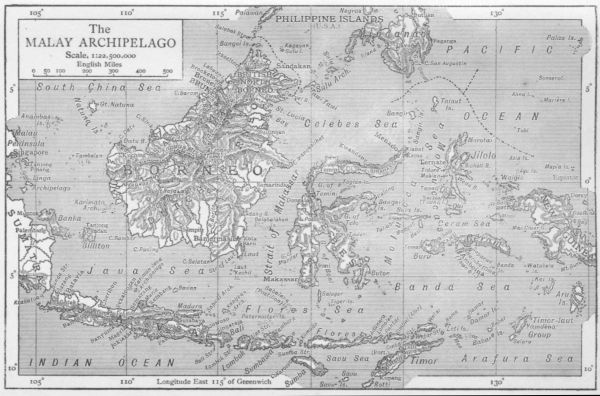
his way, but passing through the Malay Archipelago to
the Cape of Good Hope. Twenty-two years afterwards
a British fleet, conveying 6000 soldiers, sailed across the
Indian Ocean and took possession of Manila, but failed
to conquer the Philippine archipelago, owing to the
bravery of the small Spanish garrison of 600 men. But
when this war drew to a close, Vice-Admiral John Byron
(the grandfather of Lord Byron, the poet) was sent out
in the Dolphin in 1764 to explore the Pacific Ocean and
make some search for the Great Southern Continent.
This journey, however, like that of Lord Anson's, resulted
in no gain to geographical knowledge, for he simply
sailed by the northern tropical route from Mexico to the
Ladrone Islands, and then came back along much the
same course to South America and the Atlantic. After
his return his ship, the Dolphin, together with a vessel
called the Swallow, were once more dispatched to the
Pacific Ocean through the Straits of Magellan, but this
time under the command of Captain Samuel Wallis.
The Tahiti archipelago, which was to play such an
important part as a basis for Cook's discoveries in the
Pacific, had apparently been seen by the Spanish navigator
de Quiros, as early as 1606, and named "Sagittaria".
It was rediscovered in 1767 by Wallis on this
voyage of H.M.S. Dolphin. Wallis named Tahiti Island
"King George III Island", and stayed on its coasts for
a month. On his north-westward journey he discovered
the Marshall Islands. In the following year there arrived
at Tahiti the great Bougainville, the first French explorer
of the Pacific Ocean.
France, through her enterprising Norman and Breton
seamen, was not slow to interest herself in Far Eastern
discoveries, and in 1528 defied the Papal bull and worried
the Portuguese in Malaysia, just as she followed up
Spaniards and Portuguese along the east coast of the
Americas. Early in the sixteenth century her mariners,
following the Portuguese, had rounded the Cape of Good
Hope and adventured themselves in the Indian Ocean to
snatch a small share in the trade which was so jealously
monopolized by the Spaniards and Portuguese. It is
even said (see p. 57) that the first hint of the existence
of a Great Southern Continent is due to a French navigator,
le Testu, who returned in 1532 from the eastern
seas with stories of a Greater Java which lay to the south
of the islands of the Malay Archipelago.
But for various reasons the French slackened in their
exploration of the Indian Ocean in the second half of the
sixteenth century. Their interest in this direction was
only revived under the great ministers of Henry IV and
Louis XIII. In the first half of the seventeenth century
the French laid the foundation of their future claims to
Madagascar and the Mascarene Islands, and founded repeatedly
chartered companies to deal with the trade of
the Indian Ocean. But none of their adventurers seem
to have penetrated to the Spice Islands or the Pacific until
the eighteenth century. Their colonial ambitions in Africa
and Asia were awakened in a great measure through the
most remarkable of their kings, Louis XIV. With farsighted
ambition this monarch strove to acquire special
interests for France in Abyssinia (in which direction he
failed), in Siam, and Cochin China; and he took advantage
of his occasional alliances or friendship with the
Spanish monarch to send explorers and men of science to
examine the wonderful regions of South America, under
the jealous rule of Spain and Portugal. One of these
explorers was Frézier (Fraser), of Scottish descent, and
the work which he published on his return, dealing with
the southern extremity of South America, drew attention
to the unoccupied Falkland Islands, known to the French
as Malouines, and the Spaniards as Malvinas. This hint
attracted the notice of a very remarkable Frenchman,
Louis Antoine de Bougainville, who had served in
the French Embassy in London, and had also been an
officer of the French army in Canada. In 1765 he persuaded
the merchants of St. Malo, in Brittany, to fit out
an expedition which should colonize the Falkland Islands.
But, this archipelago being claimed by Spain, it was
handed over to the Spanish authorities by Bougainville,
who afterwards proceeded in command of a ship called
the Boudeuse (the Sulker) to navigate the Straits of
Magellan and explore the Pacific Ocean. In his westward
course he touched at the Tuamotu Islands, and rediscovered
the Island of Tahiti, which he called Cythère
(the Island of Venus). Sailing westwards, he was probably
the first explorer to discover the Samoa group, named
by him the Navigators' Islands, from the bold seamanship
of its Polynesian people. From Samoa he passed on to
the New Hebrides, and, then directing his course due
west, with the deliberate intention of searching for the
Great Southern Continent, he was stopped in this search
by encountering the Great Barrier Reef, which guards so
much of the approach to the north-east coast of Australia
from south latitude 23° to 15°. Turning off, therefore, to
the north-west, he encountered and named the Louisiade
archipelago of islands and islets, which is off the south-easternmost
extremity of New Guinea. Instead, however,
of venturing through the Torres Straits (the existence of
which was then a geographical secret in possession of
Spain), he turned northwards to the Solomon Islands,[66]
and thence sailed past the coasts of the large island of
New Ireland (now known as New Mecklenburg), and so
on along the north coast of New Guinea. Rounding
this great island, and directing his course southward, he
arrived at the island of Buru, between the Moluccas and
Celebes. Here he found himself within the sphere of
Dutch influence, and after calling in at Batavia, the
capital of Java, he made his way back, round the Cape
of Good Hope, to St. Malo, only having lost seven out of
a crew of two hundred men in this remarkable sea journey
round the world.
Thus, before Cook set out on his famous journey in
1768, the position of European knowledge in regard to
the Pacific Ocean and the continent and islands of Australasia
was as follows: The outline of the Australian
continent had been roughly traced by the Dutch (who
called the land New Holland) from Cape York westwards
to the southernmost point of Tasmania (which was not
known to be an island); a portion of the west coast of New
Zealand (the North Island and a small part of the South)
had been placed on the map by Tasman, but it was not
known whether this land of high mountains consisted of
one or more large islands, or whether it might not even
be another peninsula of a mighty southern continent;
Tasman had discovered the small Tonga Islands; New
Guinea was known in regard to its western and eastern
extremities and a part of its north coast, but, owing to
secrecy having been kept as to the existence of Torres
Straits, it was also thought to be an outlying part of New
Holland (Australia); New Britain and New Ireland (now
Neu Pommern and New Mecklenburg) had been explored
by Dampier in 1700; the Solomon Islands, Santa Cruz,
and the islands of the New Hebrides group had been rediscovered
by Bougainville, who had also first visited
and named the Louisiade archipelago to the south-east
of New Guinea. [The Solomons and the New Hebrides
had been known for two centuries to the Spanish Government,
and for a shorter period to Dutch navigators].
Easter Island—the easternmost of the Polynesian islands,
not much more than 2000 miles from the coast of South
America—had been seen by the English pirate, Captain
Davis, in 1685, but was only definitely known and named,
after its discovery by the Dutch navigator, Roggeveen,[67]
on Easter Sunday in 1722; and was considered by some
geographers in Holland and France to be an outlying
point of the great southern continent: which, if this were
the case, would be almost as large as Asia, and would
occupy quite half the space actually covered by the Pacific
Ocean. The existence of Tahiti was fully known, inasmuch
as it was pitched upon by the British astronomers
as being the best place in that region of the globe from
which to observe the transit of Venus. The existence
of the Marquezas Islands had long been established by
Spanish navigators, but it is doubtful whether, before
Cook started, news had been received of the sighting
of the Tuamotu archipelago of islets by Bougainville, or
of the Samoa group (Navigators' Islands). Most of the
largest and most important of the Pacific islands remained
practically or completely undiscovered. These were the
Hawaii archipelago (see pp. 121-2), the Fiji Islands, the
southern islands of the New Hebrides, the large island
of New Caledonia, the Loyalty Islands, the groups of the
Gilbert, Phoenix, and Ellice Islands, the Hervey or Cook
Islands, the Tubuai or Austral Islands, besides the whole
east coast and Alpine range of New Zealand, and the little
Norfolk Island midway between New Zealand and New
Caledonia. Finally, there were the undecided questions
of the supposed connection of New Guinea with the north
coast of the Australian continent, and the existence of a
vast southern continent occupying much of the area of the
Pacific Ocean in the South Temperate Zone. The whole of
these blanks in Australasian geography were filled up and
more or less accurately mapped, the vexed questions were
set at rest and solved, by the great James Cook in the two
voyages of discovery which he made in the years 1768-71,
1772-5, and 1776-9.
Captain James Cook, who will certainly be regarded
in universal history as the foremost hero of Australasian
discovery, was born on 27 October, 1728, at the little
Yorkshire village of Marton, in the Cleveland district of
northern Yorkshire, in a two-roomed wattle-and-clay
cottage. He was the son of a farm labourer, also named
James Cook and said to have been of Scottish origin.
In time Cook's father rose to the position of a farm
bailiff. The great James Cook, his second son, was sent
to school when he was eight years old, and received the
elements of a good education, especially in arithmetic.
At the age of sixteen or seventeen he was bound apprentice
to a grocer and haberdasher, or, more correctly, a
general-store dealer, a man, in fact, who kept the principal
shop in the pretty little village of Staithes, in a
hollow of the cliffs 10 miles north of Whitby. This
move brought Cook into close relations with a sea-faring
life, as most of the customers of the shop were fishermen
and smugglers. In fact, his place of business was only
300 yards from the sea waves (which now entirely cover
the site of the original shop).
Evidently he did not like his work as shop apprentice,
and longed to become a sailor, with the result that he
was transferred as an apprentice to the employment of
a coal merchant who owned or employed sailing ships
to carry coals to and from Whitby. Earlier accounts
of Cook's boyhood assert that he ran away to sea from
the grocer-haberdasher's shop, stealing a shilling from
the till as something to sustain his enterprise. There
certainly was trouble about a shilling in his relations
with the general-storekeeper, but it seems to have been
that he saw—prophetically enough—a new South Sea
shilling[68] in the till, and, fascinated with its appearance,
changed it for an ordinary shilling of his own. The
new bright shilling was found in his box, but his explanations
apparently convinced his employer of his
innocence. However, by some friendly arrangement
he seems to have been relieved of his apprenticeship
to the general-store dealer of Staithes, and was transferred
to the employment of a Mr. John Walker, whom
he served as apprentice on his ships for about three
years. In between his voyages he lived at Mr. Walker's
house, where he was treated very kindly and where the
housekeeper gave him a table and candles in a quiet
corner so that he might read and study in peace. From
apprentice he became an able seaman, and at last, in the
year 1752 (always working hard to acquire the science of
navigation and to educate himself in every way), he became
mate of a collier vessel. He was now twenty-four
years of age. Three years afterwards—in 1755—Cook,
as mate of the collier Friendship, found himself in the
Thames on the eve of the outbreak of war between Britain
and France, and determined to join the Royal Navy, which
he did first as an able seaman; but, his qualities being soon
discovered, he was not long afterwards rated as master's
mate on board H.M.S. Eagle. Between 1755 and 1762
he was employed mainly in American waters, and distinguished
himself there, not only by his gallantry in action
and his many hairbreadth escapes, but by his careful surveying
work round the coasts of Newfoundland.
In 1762 he returned to England and married. His
married life lasted for sixteen years, but it is computed
that of that sixteen he spent only about four and a half
in his wife's society, chiefly at a house in Shadwell, in
the eastern part of London, which he bought for her.
Nevertheless they were fond of one another, and a family
of six children was born to them in course of time.[69]
Between the time of his marriage and 1768 he began
to make himself noteworthy by his publications of sailing
directions and his work as a mathematician and astronomer;
for he found the opportunity of observing a solar
eclipse off the coast of North America, and described it
very lucidly. Consequently, when at the instance of the
Committee of the Royal Society, who were desirous that
the transit of Venus across the disk of the sun should
be carefully observed by competent persons from some
central part of the Pacific Ocean, the British Admiralty
decided to appoint James Cook to take charge of this
expedition, and at the same time to make a determined
search in the Central and Southern Pacific for the supposed
vast southern continent, stretching from the south
tropic to the South Pole. Cook, therefore, was given
a commission as a lieutenant-commander, and appointed
to H.M.S. Endeavour.[70] The Endeavour was a sailing
vessel of only 368 tons burden, which had been constructed
at Whitby and purchased by the Admiralty.
The Government entrusted to the Royal Society the
sum of £4000, to spend on equipping this vessel and
paying her officers and crew. Cook apparently received
a clear salary of £120 a year, in addition to a special
gratuity of £105 for his astronomical work, and a sustenance
allowance for himself and his assistant astronomer,
Mr. Green, of £120. He was also paid by the
Admiralty a small "command" allowance of five shillings
a day.
Next in importance to Captain Cook in the history
of this remarkable voyage will rank (Sir) Joseph Banks,
described by the Royal Society as a gentleman of large
fortune, and said in other correspondence of the period
to have an estate bringing in £6000 a year. He was
born in London in 1743, the son of a wealthy physician
who had become a Member of Parliament for Peterborough.
Educated at Oxford, he early conceived an
intense interest in botany and zoology; and having in
1764 inherited all his father's property, he soon afterwards
made at his own expense a scientific expedition to
Newfoundland and Labrador, where he made a famous
collection of insects and plants.
A neighbouring landowner, Lord Sandwich, had
become head of the Admiralty, and Banks obtained
through him leave to join Cook's expedition. He then
laid out about £10,000 on all the stores and other preparations
necessary for the conduct of an elaborate enquiry
into the natural history of the lands and seas
through which the expedition was to pass, and he engaged
a Swedish naturalist, a pupil of Linnæus—Dr.
Daniel Solander—to accompany him, besides four draughtsmen
to make pictures, and nine servants to do all the
rough work of natural-history collecting, &c.
The diary which Mr.—afterwards Sir Joseph—Banks
kept on this voyage, between August, 1768, and July, 1771,
is almost as interesting and remarkable as the diary kept
on H.M.S. Beagle by his greater successor in the same
studies, Charles Darwin. This journal of Sir Joseph
Banks really served to give the substance of greatest
interest to the volumes published on the First Voyage
of Cook, which were edited by Dr. Hawksworth; and
although Hawksworth in his introduction laid stress on
the important part played in the narrative by the incorporation
of Banks's journals (most generously placed
at his disposal), nevertheless the mass of the reading
public has been too apt to ascribe to Captain James Cook
observations and descriptions which were entirely the
work of Banks. Though Cook's mighty achievements
as a navigator, and as one who laid the foundations of
the British Empire in Australasia and British Columbia,
can never be lessened by the results of any research
into the history of his voyages, it is only fair to point
out that the records of his first great adventure would
not have achieved their world-wide popularity but for
Banks's co-operation and his munificent expenditure on
the expedition. Banks, in fact, was a man born out
of due time. His was a nineteenth-century mind which
made its appearance in the middle of the eighteenth
century, just as Shakespeare was an intelligence of the
twentieth century which made its appearance three hundred
years before its appropriate period. In order not
to interrupt the course of the narrative it might be as
well to give in a footnote final information as to Sir
Joseph Banks's career.[71]
The ship Endeavour sailed from Plymouth on 26 August,
1768, with a crew of officers, naturalists, seamen, and servants,
of ninety-four in all, with provisions for eighteen
months, and an armament of guns which would be quite
sufficient to keep at bay any attack by savages. Captain
Cook, from the first, was resolved to combat resolutely that
foe of seamen-adventurers—scurvy—the disease which is
constantly alluded to in the earlier pages of this book, and
which I have described elsewhere as so seriously impeding
the first attempts of colonization on the part of the French
in Canada. In this resolve he was backed up by Banks,
who had made special enquiries on the subject of antiscorbutics.
An attempt was made to convey fresh cabbage
from England to the Pacific, and casks of this vegetable
lasted out for nearly a year. The leaves and the heart
of the cabbage were preserved between layers of salt. But
the greatest benefit in checking scurvy was derived from
lemon juice, of which Banks himself took nearly 6 ounces
a day. The juice of oranges and lemons mixed with a
little brandy had been evaporated till it was very thick,
and this essence was enclosed in small casks before the
Endeavour left England. The expedition also took with
it treacle, turpentine, and "wort" (the unfermented infusion
of malt), with which they were to brew some kind
of beer.
The Endeavour's course towards the Pacific was via
Brazil (where she was mistaken by the Portuguese for
a privateer or pirate and received very badly) and the
extremity of South America. Off the coast of Patagonia
Banks noticed "shoals of red lobsters", as Dampier had
done in the southern Pacific. These "sea crayfish", or
Langoustes as they really were (allied to the excellent
Langouste of the Mediterranean[72]), frequently astonished the
pioneers of the Pacific and south Indian Oceans by their
immense numbers which passed in shoals swimming on
the surface, very often proving a godsend to the crew by
providing them with fresh and savoury food. Unlike the
lobster, which is only red when it is boiled, these Langoustes
(probably of the genera Iasus or Panulirus) were
naturally of a bright crimson or scarlet colour.
Cook, Banks, and some of the seamen landed on Staten
Island at the extremity of the curly tail of South America.
The Dutch had thought in the previous century that Staten
Island was a northern promontory of a vast Antarctic continent,
of which New Zealand might be another projection
(which was why Tasman had first called New Zealand
"Staten Island"). Banks was very anxious to examine its
flora, and found far more flowering plants at this season of
Antarctic summer than he thought possible of existence in
such a cold bleak country; yet, in the very searching for
natural-history specimens, he and the rest of the party were
caught in a snowstorm and nearly frozen to death. Two
negro servants who had drunk too much grog and had
lain down to rest were killed by the cold.
After rounding Cape Horn, in January, 1769, the
Endeavour had sailed as far to the south as the sixtieth
degree of south latitude. On her course north-westwards
into the Pacific the ship was brought to a standstill
occasionally whilst Mr. Banks went out in a boat to
shoot sea birds, principally albatrosses. These were
thought by Cook to be larger than those of the Atlantic
Ocean. One of them measured 10 feet 2 inches from the
tip of one wing to that of the other. Their bodies, after
being carefully skinned, were soaked in salt water, parboiled
also in sea water, and finally stood in a very little
fresh water (the phrase "very little" shows how necessary
it was in those days to be avaricious of the store of fresh
water). After this they were served up to table with a
savoury sauce, and the dish was universally commended.
It was in any case a grateful variation from the constant
round of salt beef and salt pork. Another inhabitant of
these south Pacific seas which aroused great interest was
a large octopus or cuttlefish, apparently just killed by
albatrosses, and floating in a mangled condition upon the
water. Banks noticed that it was very different from the
cuttlefishes found in European seas, for its immense arms
were furnished, instead of suckers, with a double row of
very sharp talons which resembled the claws of a cat, and
like them were retractable into a sheath, from which they
could be thrust out at pleasure. "Of this cuttlefish we
made one of the best soups we had ever tasted."
On 24 March, 1769, they noticed a log of wood passing
by the ship, and the sea, which was rough, became
suddenly as smooth as a millpond, so that they were probably
passing by the vicinity of some undiscovered island.
On 4 April, 1769, land was sighted and was discovered
to be an island of an oval form, with a lagoon in the middle,
which occupied much the larger part of it. The border of
land circumscribing the lagoon was in many places low
and narrow, consisting chiefly of a reef or beach of rocks;
in other words, it was one of the coralline atolls described
on p. 21, and as usual possessed coconut palms. It was
inhabited by tall, copper-coloured natives, with long, black
hair, whose heads seemed to be remarkably large, probably
because of some cap or headdress. Eleven of them
walked along the beach abreast of the ship, with poles
or pikes in their hands which reached twice as high as
themselves. As they so walked they were without clothing;
but after the ship had drawn off from the island it was
seen that they covered themselves with some light-coloured
material. To Cook and his mariners, who for a long time
had seen nothing but water and sky, except the cold hills
of Tierra del Fuego, these coconut groves of Lagoon Island
in tropical latitudes seemed a terrestrial paradise.
The following day they passed another atoll, shaped
exactly like a bow, the arc and cord being land, and the
space between them water, that part answering to the arc
of the bow being about 200 yards wide, 12 or more miles
long, and fairly well covered with trees, while the straight,
low beach answering to the bowstring was a long strip
of coral rocks, through which there were openings connecting
the lagoon with the sea. This island, like similar
ones which they sailed by in the succeeding days, was
inhabited by Polynesians of the usual type, brown-skinned,
naked, tall, well-made, and with abundance of
black hair; but in some cases this bushed out from the
head, showing that the people were not without some
Melanesian blood. They seemed to be armed with wooden
weapons, one of them a slender pole with a knob at the
end, and another a paddle, which might be used for
striking or stabbing or for navigating a canoe. The
canoes these people had possessed sails.
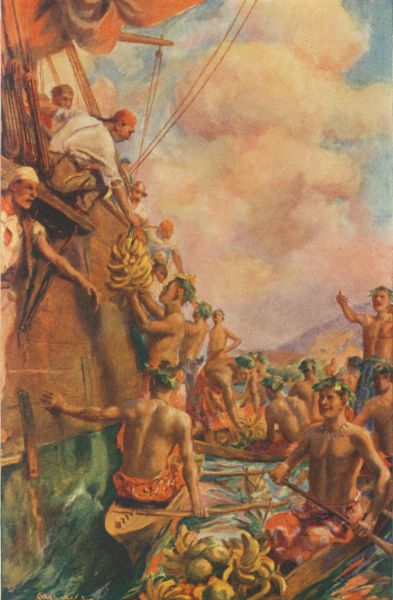
CAPTAIN COOK'S ARRIVAL AT TAHITI (1769)
Passing by Osnaburg Island, already discovered by
Captain Wallis, Cook reached Tahiti (which at once
struck them in its difference from the atoll islands by
being high and mountainous) on 12 April, 1769. Before
even he could get near the shore his ship was surrounded
by canoes, in which there were bunches of bananas and
branches of a tree, which it was the custom of these
people to wave as a token of peace and amity. By signs
they expressed the wish that these branches should be
stuck amongst the rigging of the ship as a sign that
they would be received with friendliness. This having
been done, the canoes approached the ship close enough
to hand their cargoes of coconuts, bananas, and other fruit
on board, where it was eagerly purchased by the sailors,
being extremely acceptable after their long privation from
such additions to their diet. The next day the ship came
to an anchor in Port Royal Bay (Matavai). Here the first
thing that attracted their attention, when the natives came
off to trade, was the bread-fruit.[73]
Before anyone from the Endeavour was allowed to land
at Tahiti, Cook wisely drew up rules to guide the relations
of the seamen and officers with the natives, in order as far
as possible to avoid provoking quarrels with them, or
enabling the latter to acquire weapons which might be
turned against the white men. Landing himself, with
Banks and Dr. Solander, a party of armed seamen, and
a native of Tahiti, who had come off to the ship and
constituted himself their guide, he noticed that the Polynesian
people were so awestruck that the first who approached
them almost came creeping on his hands and
knees. Leafy boughs having been offered in token of
peace, the Englishmen likewise broke off green branches
and held them in their hands, and, the whole party having
marched to a place where there was a freshwater spring
and where the ground was clean and bare, green boughs
were dropped by both sides in a regular heap, and after
that relations between them became much less formal,
especially after Cook's party had distributed beads and
other small presents. They walked for about 5 miles
through groves of trees loaded with coconuts and bread-fruit,
and offering the most grateful shade. Under the
trees were the houses of the natives, most of them being
only a roof without walls, and the whole scene realizing
"the poetical fables of Arcadia".
The next day canoes came out to the Endeavour evidently
filled with people of superior rank. Two of these
chiefs came on board and selected Cook and Banks to
be their special friends, carrying out this ceremony by
taking off most of their clothing and putting it about
the shoulders of the Englishmen. Return presents were
given to them, and after a long row in the boats of the
Endeavour the notabilities of that ship accompanying
their Tahitian friends landed and went to a house of
much greater length and size than any they had yet
seen. Here was found a chief by the name of Tutaha,
who presented them with a cock and hen and pieces of
perfumed bark cloth. In other houses they met the
women, who received them with such extravagant demonstrations
of affection that they were embarrassed. Soon
afterwards another chief gave them a meal, which they
ate with the greatest heartiness. It consisted of fish,
bread-fruit, coconut, and bananas, cooked after the native
fashion. They were enjoying this meal, though perhaps
not quite so much the affectionate attentions of the native
ladies (who kept plying them with coconut milk), when
suddenly two of the officers complained that their pockets
had been picked—a complaint, one would think, under
the circumstances, they might have waived on such an
occasion. However, Dr. Solander lost an opera glass,
and Mr. Monkhouse, a surgeon, his snuff box.
Complaint was at once made to the chief, and Banks
somewhat aggressively jumped to his feet and struck the
butt end of his gun on the ground. Immediately all the
natives fled in a panic, with the exception of two or three
chiefs and their wives. The principal personage amongst
these at once took Mr. Banks by the hand and led him to
a large quantity of cloth which lay at the other end of the
house, offering it to him piece by piece, and intimating
by signs that if that would atone for the wrong which
had been done he might take all he saw. But this compensation
was refused, and eventually the chief, after being
absent for some time, returned with the missing snuff box
and the case of the opera glass. This, however, upon
being opened, was found to be empty. Whereupon the
chief, catching Mr. Banks by the hand, led him rapidly
along the shore for a mile or more, till he reached a house
from which a woman came out and gave him a piece of
cloth, which he hastily took from her and continued to
press forward. Banks had been followed by Dr. Solander
and Surgeon Monkhouse, and at last the whole party
came to a place where they were received by a woman to
whom the chief presented the piece of cloth and to whom
the Englishmen gave a few beads. The beads and cloth
being deposited on the floor, the woman went out, and
in about half an hour she returned with the opera glass,
and expressing the same joy as was now shown by the
chief. She also returned the beads and the cloth, refusing
to accept them.
The next day the chiefs came off to the ship with pigs,
bread-fruit, and other provisions, for which they received
suitable return presents of hatchets and linen. Cook then
established an encampment on shore, but their pleasant
relations with the natives were temporarily spoilt by the
petulance of a midshipman named Monkhouse (not to be
confused with the surgeon of that name) commanding one
of the landing parties. A Tahitian had snatched away
the musket of one of the marines. Whereupon this midshipman
ordered his men to fire into the thickest of the
crowd, afterwards pursuing the thief and shooting him
dead. However, thanks to the chiefs Tuburai, Tamaide,
and Tutaha, peace was made and intercourse soon resumed
without much restraint. The body of the man
who had been shot in the encampment was found to be
wrapped in cloth and placed on a bier supported by stakes
under a roof, where it would be allowed to decay with a
terrible stench until at last it was nothing but a dry
skeleton.
Charming as life was in many respects on this Pacific
island there was one pest which at times proved almost
unendurable—apparently none other than the common
house fly, which existed in such enormous numbers that
it was an incessant torment during daylight. If one of
the draughtsmen attached to the expedition attempted to
make a water-colour study of any object, the flies would
settle on his paper so thickly that no part of its surface
could be seen, and eat the colour up as fast as he could
lay it on. [It will be remembered that Tasman noted the
same plague of flies in the Tonga archipelago.]
The principal personage of Tahiti seemed to be a
queen, whose name was Oberea, about forty years of age,
almost white-skinned, but now very stout, though with
evidence of great beauty at an earlier age. There were
several men chiefs of importance in the main island, and
something like an aristocracy. This "nobility" had faces
of a more Caucasian character and a taller stature than
the common people, who were many of them in the
position of serfs.
The Tahitians believed in numerous gods, one of
which was supreme over the rest. They also had priests
called tahawa, who were the "wise men" of the land,
possessing more knowledge of navigation, astronomy,
and medicine than the others. They believed vaguely in
a life after death, and their dead were disposed of usually
(in all but cases of worthless slaves) in the following
manner (I quote from Banks):—
"I found the shed under which the body lay, close by
the house in which the man resided when he was alive,
some other houses being not more than 10 yards distant.
The shed was about 15 feet long, and 11 broad, and
of a proportionate height: one end was wholly open, and
the other end and the two sides, were partly enclosed with
a kind of wicker work. The bier on which the corpse
was deposited, was a frame of wood ... with a matted
bottom, and supported by four posts, at the height of
about 5 feet from the ground. The body was covered
first with a mat, and then with white cloth; by the side
of it lay a wooden mace, one of their weapons of war,
and near the head of it, which lay next to the close end
of the shed, lay two coconut shells, such as are sometimes
used to carry water in; at the other end a bunch of green
leaves, with some dried twigs, all tied together, were
stuck in the ground, by which lay a stone about as big
as a coconut: near these lay one of the young plantain
trees, which are used for emblems of peace, and close by
it a stone axe. At the open end of the shed also hung,
in several strings, a great number of palm nuts, and without
the shed, was stuck upright in the ground, the stem
of a plantain tree about 5 feet high, upon the top of which
was placed a coconut shell full of fresh water; against the
side of one of the posts hung a small bag, containing a
few pieces of bread-fruit ready roasted."
The emotions of the Tahitians were easily excited.
Both men and women readily gave way to tears, and
would fly into hysterical rages in which they struck their
heads several times with sharks' teeth, so that a profusion
of blood often followed. A woman who acted thus owing
to some trifling affair which had piqued her, after her
bleeding was over looked up with a smile, ceased her loud,
doleful talking, collected the pieces of blood-stained cloth
with which she had dabbed her head and neck, and threw
them into the sea. Then she plunged herself into a river,
washed her whole body, and returned to the encampment
as gay and cheerful as if nothing had happened.
Cook was greatly struck with the stature of the men
and with the beautiful shape of their bodies. One man
coming from a small outlying island measured nearly
6 feet 4 inches. The women of the better class were in
general taller than English women. On the other hand,
those of the more serf-like people were not only below
the average stature of Europeans but even quite dwarf-like.
Occasionally albinos made their appearance with
skins of a dead white, red eyes, and white hair. As to
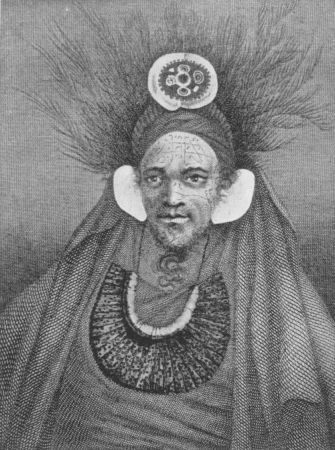
their tatuing, the Tahitians pricked the skin, so as just
to fetch blood, with a small instrument something in the
form of a hoe, with a blade made of bone or shell scraped
very thin, and from ¼ inch to 1½ inches wide. The edge
of this was cut into sharp teeth, and when about to be
used the teeth of the hoe were dipped into a black paste
made from the soot from an oily nut—a nut which the
natives burnt in lieu of candles. Having been dipped into
this mixture and pressed into the skin, the top of the hoe
would be struck a smart blow with a stick, so that it
punctured the skin and left behind an indelible black
stain. The operation was painful and it took some days
before the wounds were healed.
Cook expatiates on the personal cleanliness of the
Tahitians, who constantly washed the whole of the body
in running water perhaps three times a day. After every
meal their mouth and hands were washed, and their
clothes as well as their persons were kept without spot
or stain, "so that in a large company of these people
nothing is suffered but heat, which, perhaps, is more than
can be said of the politest assembly in Europe". For in
Cook's day—and, indeed, for nearly one hundred years
later—civilized Europeans (to say nothing of the working
classes, who were most uncleanly) very seldom washed
their bodies. Tahitian clothing consisted of bark cloth
or matting of different kinds. The bark cloth would not
bear wetting, so it was only worn in dry weather and
exchanged for matting when it came on to rain. None
of the materials of their dress were sewn. Their clothes
consisted of long strips of bark cloth or matting, which
would be draped about the body, principaly round the
waist. Large pieces were worn loosely over the shoulders
in the manner of a cloak, or allowed to fall about the
limbs like loose trousers. In the heat of the day clothing
was mostly reduced to a scanty petticoat for the women
and a sash for the men. To shade their faces from the
sun they sometimes wore bonnets made of matting or
coconut fronds. These they would plait together in a few
minutes. The women also wore little turbans of cloth,
and sometimes a very elaborate dress made of plaited
human hair. Of this material Sir Joseph Banks brought
away with him pieces that were over a mile in length,
apparently without a knot. They would wind these strips
of hair (like silk) round and round the head, and thus
produce a very pretty effect. Amongst these threads they
stuck flowers of various kinds. The men would thrust the
pinkish tail-feathers of the Tropic-bird upright into the
bunch of hair on the top of their head, or wear whimsical
garlands of flowers or scarlet seeds, or wigs made of dogs'
hair, or men's hair, or coconut matting. Ear-rings made
of shells, stones, berries, seeds, or small pearls were also
worn.
The only domestic animals of Tahiti were pigs, dogs,
and fowls, but the natives also ate wild ducks, which
were plentiful. Cannibalism did not exist in this archipelago,
though there were traces of it in the religious
customs.
Their manner of executing and cooking dogs, which
they bred for eating, was as follows: The man who performed
the double office of butcher and cook killed the dog
by holding his hand over the dog's mouth and nose. In
about a quarter of an hour the animal was stifled. Whilst
this was being done someone else was digging a hole in
the ground about a foot deep, in which the fire was
kindled. On top of the fire were placed stones to be
heated. The dog was then singed by being held over
the fire, and scraped with a shell. Thus all the hair was
taken off. The entrails were removed, and the body was
cut up with a sharp shell. The entrails, after being carefully
washed in sea water, were put into coconut shells,
together with all the blood which had been collected from
the body. When the oven in the ground had been sufficiently
heated the fire was taken out, and some of the
stones which were not hot enough to burn anything were
placed at the bottom and covered with green leaves. The
cut-up dog, together with its entrails, was then placed on
these leaves, and other leaves were laid on top. The hole
was afterwards covered with the remainder of the hot
stones, on which earth was heaped. In about four hours
this oven was opened, and the dog's meat taken out, "excellently
baked, so that we all agreed he made a very good
dish". The dogs which were bred in Tahiti for food
were kept wholly on a vegetable diet—bread-fruit, coconuts,
and yams.
The principal vegetable foods of the natives of the
island of Tahiti were bread-fruit, coconuts, bananas of
thirteen sorts, and the long banana which is known by
the name of plantain; then there were a fruit not unlike
an apple, which when ripe was very pleasant; another
resembling a nectarine, and called ahiya; sweet potatoes,
dioscorea yams, koko or taro yams (an aroid); a fruit
known by the name of jambu, and reckoned most delicious;
sugar cane; a root called by the inhabitants pea;
a plant called ethe, of which the root only was eaten; a
fruit like a large kidney-bean, grown in a pod and tasting
like a chestnut after being roasted, called by the natives
ahi; the fruits of the pandanus; the morinda fruit; a
kind of bracken fern, of which not only the root but the
leaves were sometimes eaten; and a plant called theve,
which had an edible root. There was also in the island
the paper-mulberry tree (the range of which extends
from China to Polynesia), and several fig trees, some of
which, with their enormously extended aerial roots and
branches, covered an area of 60 square feet. This mulberry
and most of the figs provided bast which was made
into cloth.
Bread-fruit was sometimes turned into a delicious dish
by mixing its farinaceous pulp with coconut milk, with
pounded bananas, or with a paste made of the mahi fruit.
This mahi was gathered just before it became ripe, and,
being laid in heaps, was closely covered with leaves. In
this state it fermented and became disagreeably sweet.
After pulling out the core from the rotten fruit the rest
was thrown into a hole neatly lined with grass. The hole
having been covered with stones, the fruit then underwent
fermentation and became sour. After that it was wrapped
up in leaves and baked, and, both cooked and uncooked,
would keep for weeks. It was eaten hot or cold, and the
natives seldom made a meal without it, though its taste
to Europeans was "as disagreeable as that of a pickled
olive". Salt water was the universal sauce to their food,
no meal being eaten without it, so much so that the natives
who lived at a great distance from the seacoast had to keep
sea water in segments of bamboos like tubes. A kind of
butter was also made of coconut kernels flavoured with salt
water, which at first tasted to the Europeans nauseous and
rancid, but afterwards grew so much in favour with them
that they preferred it to the sauces they had brought out
from England.
The Tahitians possessed no narcotic like opium, betel,
or tobacco, and at first Cook thought that they knew no
intoxicant. But he afterwards found that they were able to
get drunk on the juice of a plant called ava ava (the well-known
kava pepper vine, referred to on p. 64). But the
vice of drunkenness was almost confined to the chiefs and
the nobility, and was forbidden to the women.
Banks gives the following interesting description of
how a Tahitian gentleman would eat a meal:—
"He sits down under the shade of a tree, or on the
shady side of his house, and a large quantity of leaves,
either of the bread-fruit or banana, are neatly spread before
him upon the ground as a tablecloth. A basket is then set
by him that contains his provision, which, if fish and
flesh, is ready dressed and wrapped up in leaves, and two
coconut shells, one full of salt water and the other of
fresh. His attendants, who are not few, seat themselves
round him, and when all is ready he begins washing his
hands and his mouth thoroughly with the fresh water, and
this he repeats almost continually throughout the whole
meal; he then takes part of his provision out of the basket,
which generally consists of a small fish or two, two or
three bread-fruits, fourteen or fifteen ripe bananas, or six
or seven 'apples'. He first takes half a bread-fruit, peels
off the rind, and takes out the core with his nails; of this
he puts as much into his mouth as it can hold, and while
he chews it takes the fish out of the leaves and breaks one
of them into the salt water, placing the other, and what
remains of the bread-fruit, upon the leaves that have been
spread before him. When this is done he takes up a small
piece of the fish that has been broken into the salt water,
with all the fingers of one hand, and sucks it into his
mouth, so as to get with it as much of the salt water
as possible: in the same manner he takes the rest by
different morsels, and between them, at least very frequently,
takes a small sup of the salt water, either out of
the coconut shell or the palm of his hand: in the meantime
one of his attendants has prepared a young coconut,
by peeling off the outer rind with his teeth, an operation
which to a European appears very surprising, but it depends
so much upon sleight that many of us were able to
do it before we left the island.... The master, when he
chooses to drink, takes the coconut thus prepared and,
boring a hole through the shell with his finger, or breaking
it with a stone, he sucks out the liquor. When he has
eaten his bread-fruit and fish he begins with his plantains,
one of which makes but a mouthful, though it be as big
as a black pudding; if instead of plantains he has 'apples',
he never tastes them till they have been pared. To do
this a shell is picked up from the ground, where they are
always in plenty, and tossed to him by an attendant: he
immediately begins to cut or scrape off the rind, but so
awkwardly that great part of the fruit is wasted. If, instead
of fish, he has flesh, he must have something like a
knife to divide it; and for this purpose a piece of bamboo
is tossed to him, of which he makes the necessary implement
by splitting it transversely with his nail. While all
this has been doing, some of his attendants have been
employed in beating bread-fruit with a stone pestle upon
a block of wood; by being beaten in this manner, and
sprinkled from time to time with water, it is reduced to the
consistence of a soft paste, and is then put into a vessel
somewhat like a butcher's tray, and either made up alone
or mixed with banana or mahi sauce, according to the
taste of the master, by pouring water upon it by degrees
and squeezing it often through the hand. Under this
operation it acquires the consistence of a thick custard,
and, a large coconut shell full of it being set before him,
he sips it as we should do a jelly if we had no spoon to
take it from the glass. The meal is then finished by
again washing his hands and his mouth, after which the
coconut shells are cleaned, and everything that is left is
replaced in the basket."
The Tahitian dances were often of an elaborate character;
but some of them of an immodest nature. The
people were very fond of music, and had a great sense of
rhythm. Their musical instruments were chiefly drums
and flutes.
The Tahiti drum was made of a hollow block of wood,
solid at one end and covered at the other with sharks' skin.
This was beaten by the hand and not with a stick. The
flutes upon which the people played had only two stops,
and therefore could not sound more than four notes by
half-tones. They were not applied to the mouth, but
were blown into from one nostril whilst the other was
stopped with the performer's thumb. Nevertheless, to the
music of these instruments four people would sing in concert,
keeping very good time. They also had an expedient
for bringing flutes that were played together into unison
by rolling a leaf over the end of the shortest, like a sliding
tube, moved up or down till they were certain that the
playing was in tune, a fact of which they judged with
much nicety of ear. They were very fond of singing
couplets, especially after dark, to amuse themselves before
going to sleep. Their language was a melodious Polynesian
dialect, but, being deficient in several consonants,
the native rendering of the names of officers and men of
the Endeavour was quaintly imperfect. Cook was called
Toot. The sailing-master, Mr. Molineux, had a name
which they did not attempt to pronounce, so in preference
they called him Boba, from his Christian name, Bob
(Robert). Gore was turned into Toarro; Solander became
Torano; Banks, Tapane; and Petersgill, Petrodero.
The Tahitian houses of the better sort were usually
built, on a raised clay platform, of bamboo poles and palm
thatch or matting. The furniture inside was very simple—little
else than mats on the floor. No pottery was required,
coconut shells and calabashes taking its place.
The houses, when necessary, were lit up at night-time by
the kernels of an oily nut, which they stuck on a wooden
skewer one over the other. These candles burnt a considerable
time, and gave a very tolerable light.
These Polynesians of Tahiti, as elsewhere in Oceania,
were still living in the "Stone Age" when Cook visited
them, but they had already learnt the value of iron from
the previous visits of Bougainville and Wallis, and were
very keen to obtain iron from the crew of the Endeavour.
Previous to their intercourse with Europeans, fish hooks
were made of mother-of-pearl, or some other hard shell,
filed into shape with pieces of coral, drilled with holes by
sharp-pointed stones, fixed into the end of a piece of
bamboo, which was then rotated between the hands.
Coral rock made excellent files for this and other industries.
Their axes and adzes were derived chiefly from
basaltic volcanic stone. The skin of a sting-ray[74] with its
rough tubercles, and used with coral sand, made a fricative
for polishing or rubbing down stone surfaces. With their
stone axes they were able to fell trees, and, what is more,
to split the trunk into planks from 3 to 4 inches thick,
the whole length and breadth of the tree, though some of
these trees were 8 feet thick and 40 feet long. They would
smooth planks very expeditiously with their adzes, and
take off a thin shaving from a plank without missing a
stroke.
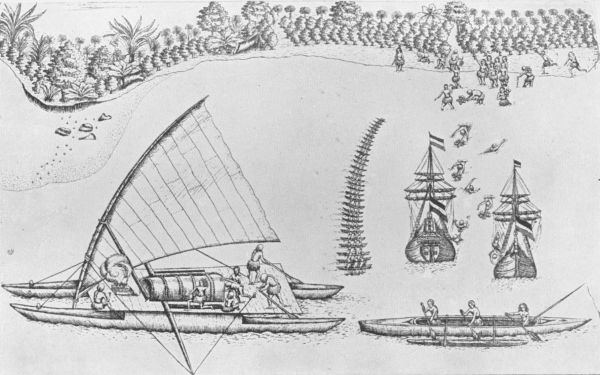
Their small canoes for short excursions were flat-bottomed
and with upright sides, but the pahi, used for
long voyages, was bowed and with a sharp keel. The flat-bottomed
boats, called ivaha, were sometimes united at
a distance of about 3 feet by a strong pole of wood laid
across them and lashed to the gunwales. On the fore part
of these double canoes a stage or platform was raised,
rather wider than the boat itself, and upon this stage would
stand the fighting men, whose missile weapons were slings
and spears. Below these stages sat the men who paddled
the canoe, and who furnished reinforcements to replace
those who were wounded. Some of the fighting canoes
were 40 feet long, and their sterns might be as much as
18 feet above the surface of the water. The pahi, or long-distance
boat, was sometimes as much as 60 feet long, but
very narrow. If intended for warfare it would be fitted
with a stage or platform, or for long-distance journeys contain
a house. It was steadied with one outrigger projecting
6 to 10 feet, and might have one or even two masts
carrying sails that were made of matting.
After discovering and exploring the rest of the Society
Islands to the north-west of Tahiti, which is an outlying
member of the group, Cook directed the course of the
Endeavour southwards in search of land; but finding none,
except the minute inhabited island of Oheteroa (where the
people were lusty and well made and clothed in beautiful
bark-cloths painted in stripes of different patterns and
colours, and armed with wooden weapons, sometimes
pointed with the sharp bone of the sting-ray), he turned
his course more to the west, and after sailing from 15
August, 1769, to 6 October, land was sighted on the latter
date and became the subject of much eager conversation,
it being believed that at last they had found "the unknown
Southern land" (Terra Australis Incognita).[75]
On Sunday, 8 October, 1769, the ship was at anchor
in Poverty Bay, off the east coast of the North Island of
New Zealand; and Captain Cook, accompanied by (Sir
Joseph) Banks and Dr. Solander, and a party of marines,
landed—the first amongst Europeans—on the shores of
New Zealand. Their reception from the natives was not
a friendly one. When they had got some distance from
the boat, four men armed with long wooden lances rushed
out of the woods and attempted to attack the seamen who
were left in the boat. The coxswain of the small pinnace
was obliged to fire in the air to scare them. This, however,
did not deter the Maoris, who renewed their attack,
and at last one of them was shot dead. At this the other
three stood motionless, as if petrified with astonishment;
but as soon as they recovered their senses they seized the
body of their dead companion to drag it after them, but
abandoned it at last in a panic flight. Cook and his party
returned to the ship, and heard the natives on shore discussing
in loud voices what had happened. The next
morning Cook, accompanied by Banks, Solander, and the
interpreter, Tupia, landed and advanced slowly and quietly
towards a party of fifty natives who were seated on the
ground, every man of whom at their approach produced
either a long wooden pike or a small axe of green jade,
about a foot long and thick enough to weigh 4 or 5 pounds.
The interpreter, Tupia, called to them aloud in the language
of Tahiti, but they only answered by flourishing
their weapons. Then a musket was fired wide, so as to
scare them whilst the party retreated. A body of marines
was landed, and marched with a union jack carried before
them to a little bank. The officers once more approached
the Maoris, and it was with great pleasure they perceived
that their Tahiti interpreter was actually understood when
he spoke, he and the Maoris only speaking different dialects
of the same language. (This was a very remarkable
fact, that the Maoris could understand the speech of other
Polynesian natives from 1000 to 2000 miles distant, for the
two peoples must have been separated in time by about
six or seven hundred years.)
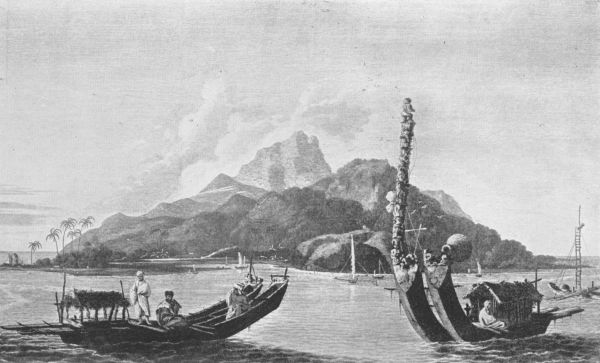
THE ISLAND OF TAHITI AND ITS EXTRAORDINARY DOUBLE CANOES: AS SEEN BY CAPTAIN COOK
The New Zealanders were told that all the white men
wanted was provisions and water, and that they would
give them iron in exchange. The properties of iron were
then explained to them. The Maoris replied they were
willing to trade, but declined to lay by their arms, and
insisted on the white men coming into their midst. However,
after some further exchange of shouted messages to
and fro, one of the Maoris put down his weapons, stripped
off his clothing, and swam over the intervening river, and
with great bravery (considering all the circumstances of
the case) walked into the midst of the white men, and was
soon followed by other Maoris to the number of twenty or
thirty. Some of them were armed. To all were given
presents of iron and beads. But they set very little value
on either, particularly of iron, of which they had not the
least idea. In exchange they gave a few birds' feathers,
which they considered ornaments. They then offered to
exchange their weapons for those of the white men, and,
when the latter refused, made attempts to snatch them
from the hands of the officers and soldiers. They were
plainly told that if they did not desist the white men would
be obliged to kill them. However, a few minutes afterwards,
one of the officers happening to turn his back on
the Maoris, one of them snatched away his hanger (sword),
and, retiring to a little distance, waved it above his head
with a shout of exultation. The rest of the savages now
became extremely insolent, and called to their friends
across the river to join them. The invitation being accepted,
it was necessary for the white men to defend themselves.
Thereupon Banks fired at the Maori, who was
still waving the hanger above his head. The gun was
loaded with small shot, which peppered the man at a distance
of about 15 yards. He still continued to flourish the
sword about, but began slowly to retreat to a greater distance.
Whereupon the midshipman named Monkhouse,
who figures prominently in Cook's narrative as a person
very ready to fire on natives, and who was responsible for
the death of the first Tahitian (see p. 196), fired at the
Maori with ball cartridge and killed him. The main body
of New Zealanders, who in their advance had halted on
a rock in the middle of the river when the first gun was
fired, began to return to the other shore, while two of those
still remaining on the side where the white men were
snatched the weapon of green jade (see p. 215) from the
dead man, and another endeavoured to secure the naval
officer's sword. This was prevented by Mr. Monkhouse.
Once again the whole body of Maoris attempted to cross
the river and attack the Englishmen, but they were met
by a discharge of small shot, whereupon they recrossed
the river and retired slowly up country, whilst Cook and
his men returned in their boats to the Endeavour.
This river was probably the little Ormond River, which
flows into Poverty Bay. Near the sea it was salt, so that
Cook and his party, unable to furnish their ship with fresh
water, made an expedition in boats round the head of the
bay to search for fresh water. On their way they saw two
canoes coming in from the sea, one under sail and the
other worked with paddles. It was decided to intercept
these canoes and seize the people in them, so that they
might be conveyed to the ship, given presents, and, as
it were, forcibly made friends with, and then return on
shore to open up negotiations with their fellow countrymen.
The two canoes, however, escaped the cordon of
boats by desperate paddling. A musket was fired over
their heads. Upon the discharge of the piece the men
of one of the canoes ceased paddling, stripped off their
garments, and actually tackled the boat that came up to
seize them, fighting, with their paddles, stones, and other
weapons which they had, so vigorously that Cook's party
was obliged to fire on them in their own defence. Four,
unhappily, were killed, and the other three—boys or youths—leaped
into the sea. With great difficulty they were seized
and hauled into the boats.
On reaching the ship they had already regained their
composure, and evinced a most intense curiosity as to
everything they saw, taking especial pleasure in eating
bread and salt pork. During the night, however, they
gave way to sadness, and sighed very loudly, but Tupia,
the invaluable interpreter from Tahiti, came and talked
to them so soothingly that they regained their cheerfulness,
and to pass the time sang a song with a degree
of taste that surprised the crew. The tune was solemn
and slow, like that of a psalm, and contained many notes
and semitones. The names of these three young Maoris
are recorded as Taurangi, Koikerange, and Maragovete.
Next morning, after eating another enormous meal, and
having been dressed in European clothes and adorned
with bracelets, anklets, and necklaces, they were taken
on shore by Cook and his party, but evinced great fear
when they found they were to be landed at the mouth of
the little river, since at that spot the natives were the
enemies of their own tribe. However, amongst the large
party of Maoris which began to advance on the landing
party the boys discerned a relation. Eventually peace was
made between the white men and the Maoris, and the
boys probably returned to their relations.
As the result of this turn in events a canoe came off
from Poverty Bay before the Endeavour left the vicinity,
others from the neighbourhood followed, and soon there
were fifty Maoris on board, who sold everything they had,
even the clothes from their backs and the paddles from
their boats. Cook sailed southwards at first as far as the
point which he named Cape Turnagain. The rumours of
his kindly treatment of Maoris on board the Endeavour
having fortunately spread in all directions, whenever the
Endeavour came to an anchor canoes would come off to
visit the ship and to bring produce for trade, and although
one or two disagreeable incidents occurred, such as when
the natives attempted to kidnap a Polynesian boy on board
for the purpose of eating him—for their cannibalism began
to be patent to Cook and his officers—the relations between
the Englishmen and the Maoris became so friendly that
frequent excursions were made on shore, the houses of
chiefs were visited, and meals were taken with them.
The food of these New Zealanders consisted mainly of
fish, with which they ate, as a kind of bread, the roots of a
bracken fern. These roots were scorched over a fire, beaten
with a stick till the bark fell off, and what remained was a
soft substance, somewhat clammy and sweet, though not
unpleasing to the taste, but very fibrous and stringy. The
natives, being tidy in their eating, kept baskets by them
into which they spat out the fibrous refuse of the bracken-fern
roots. They had no domestic animals except dogs,
which were very small and ugly. (The black, bear-like
skins which Cook saw being worn occasionally were probably
skins of sea-lions or seals.) But they had plantations
of sweet potatoes, taro yams, and gourds. The surroundings
of their houses were kept scrupulously clean, and
there were regular places in which all litter, offal, and
refuse was piled up in regular dunghills. The women
were not so good-looking as the men, and made themselves
uglier by painting their faces with red ochre and
oil, an adornment which was very disagreeable to Europeans,
because they found out the favourite salutation of
the New Zealanders to be that of rubbing noses, so that
any attempts to get into friendly relations resulted in most
of the officers having their faces smeared with greasy red
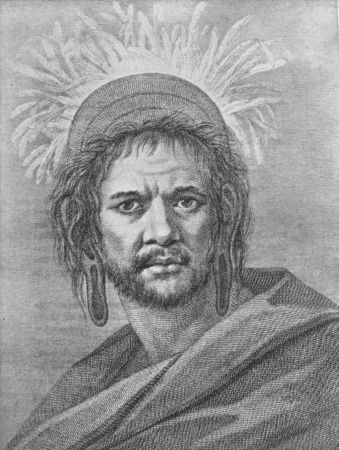
paint. As a rule, the men confined their decorations to the
elaborate tatuing, which has since become so famous, yet
there were some who liked to cover their faces, bodies, and
clothing with red ochre, and went about carrying pieces of
this earth with which to renew the colouring wherever it
was removed by contact. Each woman wore a girdle made
of sweet-smelling grasses and leaves, and over this a petticoat
of roughly plaited Phormium fibre.
They found the country luxuriantly clothed with forest
and everywhere a beautiful verdure. The species of trees
in the woods were unknown to them. They specially
noticed here and there cabbage-palms, which they cut
down for the cabbages.[76]
The woods abounded in birds of great variety, some of
them exquisitely beautiful, but all quite unknown to the
Europeans.
Amongst the food supplies of the natives were observed
occasionally "lobsters" (which were probably langoustes,
see p. 190), besides various wild birds, which the Maoris
either roasted by fastening them upon a small stick stuck
into the ground and inclined towards the open fire, or
baked by putting them into the ground with hot stones.
Like the other Polynesians, these Maoris were given to
displaying their sorrow, either for the death of a relation,
or for some matter of mere personal pique, not only by
shedding quantities of tears and singing mournful songs,
but by cutting their arms, faces, chests, and thighs with
sharp-edged shells, so that in the middle of their paroxysm
of grief their bodies were covered with blood. Many of the
natives met with were scarred from head to foot with old
"grief marks".
Some of the promontories stretching out into the sea
were noteworthy for the fortified villages, called by the
natives eppah or pah. "The best engineer in Europe
could not have chosen a situation better adapted to enable
a small number to defend themselves against a greater.
The steepness of the cliffs renders it wholly inaccessible
from the water, which encloses it on three sides; and, to
the land, it is fortified by a ditch and a bank raised on the
inside: from the top of the bank to the bottom of the ditch
is 22 feet; the ditch on the outside is 14 feet deep, and its
breadth is in proportion. The whole seemed to have been
executed with great judgment; and there had been a row
of pickets or palisades, both on the top of the bank and
along the brink of the ditch on the outside; those on
the outside had been driven very deep into the ground,
and were inclined towards the ditch, so as to project
over it; but of these the thickest posts only were left,
and upon them there were evident marks of fire, so that
the place had probably been taken and destroyed by an
enemy."
The weakness of these forts as regards standing a
siege was that in none of them did there seem to have
been wells sunk or any provision made for storing water
in large quantities. And although always built near a
stream, the besieged would be obliged every now and
then to elude the vigilance of their enemies at night-time
and renew their supplies of water by fetching it up to
the fort from the stream below. But otherwise these
forts were provisioned with quantities of fern roots and
dried fish. The people's only weapons seemed to be
lances, pikes, and halberds of wood, pointed sometimes
with jade[77] or bone, and heavy jade clubs and axes; but
they had no bows and arrows or slings, and very few
weapons that they could throw.
On 20 November, 1769, Cook discovered a river at
the head of a great inlet, which he named the Thames,
and in this region of the North Island he noticed the
splendid kauri pines.[78] One of these he judged to be
89 feet from the root to the first branch, and perhaps
200 feet high altogether. Its girth near the ground
was nearly 20 feet. In the most northern part of the
North Island they met with the paper-mulberry tree
growing in the native plantations, and here they frequently
found a kind of celery, which was eagerly
gathered by the seamen as a vegetable addition to their
diet.
In December, 1769, they rounded the northernmost
promontory of New Zealand, which Cook at once identified
with Cape Maria Van Diemen of Tasman's discovery,
and perhaps realized then for the first time that the Terra
Australis along which he had been coasting was none
other than the New Zealand discovered by Tasman. The
natives in this northernmost part gave a very interesting
description, through Tupia the interpreter (when asked
if they knew of any other land besides New Zealand),
and said that far away to the north-west there was a
country of great extent, which they called Ulimaroa,
and which had been reached by some of their people
in a very large canoe after a month's sail. The most
striking feature to them in this distant land was that
its inhabitants possessed and ate pigs, and they called
these pigs by the widespread name, bua. It is probable
that the land to which they alluded was Fiji; for though
New Caledonia answers better to the description, the
people possessed no pigs when this large island was first
visited by Cook.
After rounding Cape Maria Van Diemen, the Endeavour
sailed southwards along the west coast of the
North Island and sighted Mount Egmont, which is
8340 feet high. The appearance of this mountain rising
straight up from the sea coast was superb, and even
although it was the middle of the New Zealand summer
its summit was covered with snow. They next entered
the broad gulf between the Taranaki Peninsula and the
South Island. The ship came to an anchor in Queen
Charlotte Sound. On the waters of this beautiful inlet
they saw floating the dead body of a woman. Landing
shortly afterwards, and getting into friendly relations with
a small family of Maoris, they enquired about the dead
body of the woman, and were told that it was one of
their relations who had died a natural death, and, according
to their custom, they had tied a stone to the body
and had thrown it into the sea.
"This family when we came on shore, was employed
in dressing some provisions: the body of a dog was at
this time buried in their oven, and many provision baskets
stood near it. Having cast our eyes carelessly into one
of these as we passed it, we saw two bones pretty cleanly
picked, which did not seem to be the bones of a dog,
and which, upon a nearer examination, we discovered to
be those of a human body. At this sight we were struck
with horror, though it was only a confirmation of what
we had heard many times since we arrived upon this
coast. As we could have no doubt but the bones were
human, neither could he have any doubt but that the
flesh which covered them had been eaten. They were
found in a provision basket; the flesh that remained
appeared manifestly to have been dressed by fire, and
in the gristles at the end were the marks of the teeth
which had gnawed them. To put an end, however, to
conjecture, founded upon circumstances and appearances,
we directed Tupia to ask what bones they were; and the
Indians, without the least hesitation, answered: 'the
bones of a man'. They were then asked what was
become of the flesh, and they replied that they had eaten
it. 'But,' said Tupia, 'why did you not eat the body
of the woman which we saw floating upon the water?'
'The woman', said they, 'died of disease; besides,
she was our relation, and we eat only the bodies of our
enemies who are killed in battle.'"
Upon enquiry who the man was whose bones had
been found, they told the party from the Endeavour that
about five days before a boat belonging to their enemies
came into the bay with many persons on board, and
that this man was one of seven whom they had killed.
"Though stronger evidence of this horrible practice prevailing
among the inhabitants of this coast will scarcely
be required, we have still stronger to give. One of us
asked if they had any human bones with the flesh remaining
upon them, and upon their answering us that
all had been eaten, we affected to disbelieve that the
bones were human, and said that they were the bones
of a dog; upon which one of the Indians[79] with some
eagerness took hold of his own forearm, and, thrusting
it towards us, said that the bone which Mr. Banks held
in his hand had belonged to that part of a human
body. At the same time, to convince us that the flesh
had been eaten, he took hold of his own arm with his
teeth and made show of eating. He also bit and gnawed
the bone which Mr. Banks had taken, drawing it through
his mouth, and showing, by signs, that it had afforded
a delicious repast."
Elsewhere along this coast human bones with the flesh
on were often offered to Cook and his men for sale.[80]
On 30 January, 1770, on the shores of Queen Charlotte
Sound, Lieutenant James Cook hoisted the British flag
and took possession of the two great islands of New
Zealand in the name of His Majesty, King George III—of
the two islands, for they had already learnt from the
natives the existence of Cook's Strait, which separated
the North Island from the South, and which would lead
them back into the eastern sea. The principal person
to give this information was an old man named Topaa.
He was asked if he had ever seen such a vessel before
as the Endeavour, and whether white men had ever
visited the land in the memory of the people. Topaa
replied in the negative, but added that his ancestors had
told him that there had once arrived (probably on the
North Island) four men who had come in a small vessel
from a distant country—Ulimaroa—but upon the four
men landing they were all killed. This additional reference
to Ulimaroa—which was either Fiji or the New
Hebrides—is very interesting, as it would show that it
has been possible for natives, probably of Melanesian
type, to reach New Zealand in bygone times, and, this
being the case, it would explain why succeeding French
expeditions thought that in the Southern Island they
detected a negroid type of New Zealander, altogether
uglier and inferior in physique to the Polynesian Maori.
It seems possible that the Polynesian Maoris were preceded
by a dark-skinned race, who destroyed most of
the Moas and other large flightless birds which had
apparently become nearly or quite extinct before the
Maori colonization took place.
Passing through the passage afterwards to be named
Cook's Strait, the Endeavour turned to the north and
once more sighted Cape Turnagain, besides meeting
Maori canoes, the occupants of which recognized the
Endeavour and entered into friendly relations. From
Turnagain they sailed southwards in the early part of
1770, and after zigzagging about in search of other
islands which might lie to the eastward of New Zealand,
they at length reached South Cape, the southernmost
extremity of the Dominion, the promontory of Stewart
Island. They overlooked the passage between South
Island and Stewart Island, which was afterwards discovered
by Captain Foveaux. Rounding this, and following
as well as they could the distant glimpses of the
coast, they reached the west coast of the great South
Island at Dusky Bay. Continuing their circumnavigation
northwards they became gradually aware that behind the
hills of the coast was a ridge of mountains "of a stupendous
height, covered with snow in places". Cook had,
in fact, discovered the Southern Alps, the remarkable
snowy range of Southern New Zealand, of which the
loftiest peak, rising to an altitude of 12,349 feet, has been
named after him. At length, on 27 March, they were
back again at Queen Charlotte Sound, having completely
circumnavigated New Zealand.
Before passing on with Cook to the discovery of
eastern Australia, it may be of interest to give here his
first impressions of the Maoris or indigenes of New
Zealand—though the name of Maori did not come into
use till the early nineteenth century. The men were
tall and sometimes handsome (except for their frightful
face-tatuing), with the features of white men and a skin
colour not much darker. They usually wore short beards.
The women were generally much shorter in stature than
the men, with darker skins and more negroid features.
[Even at the present day some of the Maori women are
very negroid in appearance. This was also the case
with both men and women of some of the tribes in the
great South Island; and it would really seem that New
Zealand had at one time received a colonization from the
direction of Melanesia.]
The food of the Maoris has already been described
in its main elements—sweet potatoes, gourds, fern roots,
and the flesh of human beings, dogs, and wood-birds.
Cook also mentions that they ate penguins, albatrosses,
and seals. They had no intoxicating drink, and water
was their only beverage. The Maoris seemed to Cook
singularly free of disease and to enjoy perfect and uninterrupted
health. The expedition never saw a single
person who appeared to have any bodily complaint or to
suffer from any eruption of the skin. Their wounds
healed with remarkable facility, and in all large assemblages
of people were noticed the number of old men,
who, by the loss of their hair and teeth, appeared to be
very ancient, but who were not decrepit, and though not
equal to the young in muscular strength, exhibited great
liveliness of disposition.
The Maori dress was of several kinds. The roughest
was made from the leaves of the Phormium[81]. These
leaves were split into three or four slips, which, when
dried, were plaited into a material midway between
knitting and cloth, with the unwoven ends hanging out
as a fringe. Two or three pieces of this would serve
as a complete dress, one of them being tied over the
shoulders with a string and reaching down to the knees.
At the end of this upper garment was fastened a bodkin
of bone, which served the purpose of raising a corner
to the shoulder or any other part of the dress. The
second piece of cloth was wrapped round the waist and
reached nearly to the ground, but both sexes wore a belt
or girdle, which they scarcely ever removed. The finer
cloths were made from the fibre obtained by macerating
the Phormium leaves, and were roughly woven in a
frame about 5 feet long and 4 broad, somewhat after
the fashion of matting. This beautiful, glistening, silky
cloth was ornamented with borders of different colours
done with stitching, something like the old English wool-work.
Some of the chiefs wore dresses made entirely of
dogs' skin, but, this fur being very valuable, it was more
often cut into strips and sewn on to their clothes as an
adornment. Cloaks of sealskin were worn in the south.
In both islands the men and women trimmed their garments
with birds' feathers, especially those of parrots,
penguins, and albatrosses. Dogs' teeth were collected
and strung into necklaces. The women wore bracelets
and anklets made of the bones of birds or of shells, while
the men preferred pieces of green jade or whalebone.
Besides boring their ears and wearing ornaments in the
lobes, or decorating them with the down of the albatross,
which was as white as snow, they often bored the septum
or gristle of the nose between the nostrils and thrust
feathers through the hole. The chiefs would carry a
staff of distinction, generally the rib of a whale as white
as snow, much carved, and ornamented with dogs' hair
and with feathers; or a stick about 6 feet long, adorned
in the same manner and inlaid with mother-of-pearl.
Chiefs and warriors also carried a great jade club, called
patu-patu. It was fastened to the wrist by a strong
strap, lest it should be wrenched from the owner in fight,
but the chiefs sometimes wore this handsome weapon
stuck into the girdle round their waists.
The Maoris were of course, like all the Polynesians,
completely in the Stone Age when first visited by Cook,
and ignored the use of any metal. Their adzes and
axes were made of a hard basaltic stone; and a jasper-like
stone was very useful in its small fragments for
making a sharp, hard borer. These fragments were
chipped off a block as flints might be. They were used
in finishing their nicest work until they were blunt, and
then they were thrown away. With these splinters of
jasper they were able in no time to drill a hole through
a piece of glass. Their canoes were long and narrow,
and the largest sort would carry as many as 100 armed
men. One such war canoe was 68 feet long, 5 feet broad,
and 3½ feet deep, with a sharp keel. It consisted of
three lengths hollowed out to a thickness of about
2 inches, and fastened together with strong plaiting.
Each side consisted of one entire plank, 63 feet long and
nearly 1 foot broad. Both the prow and the stern were
decorated with wonderful pieces of carved wood. Some
of the canoes, however, were only dug-outs, trunks
hollowed by fire and axes. The Maoris were experts at
sailing of the simpler kind, but their canoes could only
go before the wind. The sail was made of netting or
mats set up between two poles that were fixed upright
upon each gunwale and served both as masts and yards.
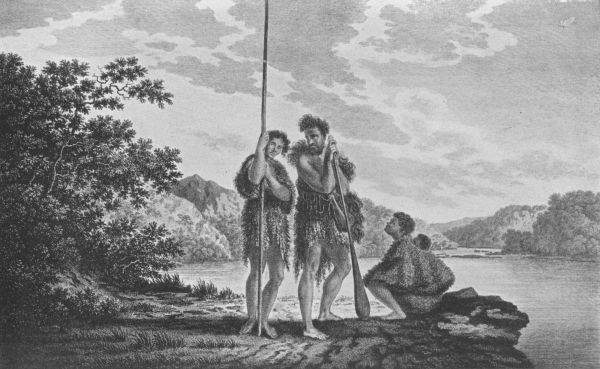
A VIEW OF DUSKY BAY, ON THE GREAT SOUTH ISLAND OF NEW ZEALAND, WITH A MAORI FAMILY: