In 1858 the Dakota Land Company sent out
from St. Paul to Sioux Falls a newspaper editor
named Samuel J. Albright, a printer named
J. W. Barnes, and a printing press which
Albright later insisted was the original Goodhue
press (see above, p. 68), despite conflicting
accounts of its history. If his testimony
is correct, the same press introduced printing
in Iowa, Minnesota, and South Dakota. It
appears to have been first used at Sioux Falls
to print a small election notice dated September
20, 1858; in the following summer, it was used
to print South Dakota's first newspaper, The
Democrat.[124]
Establishment of the Territory of Dakota in
1861 attracted a second Dakota press to the
new Territorial capital at Yankton. The earliest
Dakota, or South Dakota, printing in the
Library of Congress is from the newspaper
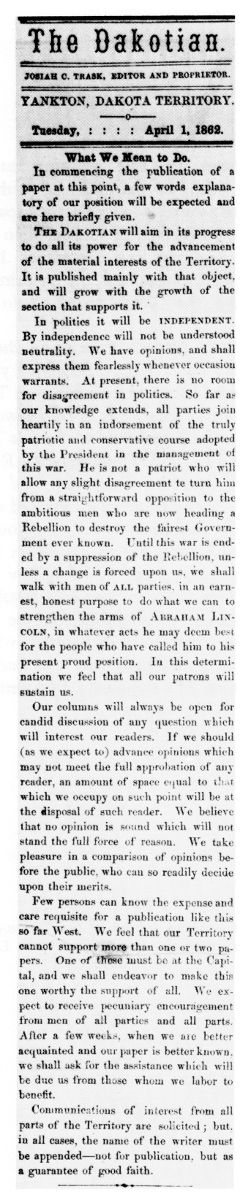
associated with that press, The Dakotian, first
published on June 6, 1861, by Frank M.
Ziebach and William Freney of Sioux City,
Iowa. The Library's earliest holding is the 13th
number, which is dated April 1, 1862, and exhibits
the paper's motto: "'Let all the Ends
thou aims't at, be thy Country's, thy God's and
Truth's.'—Wolsey." This number follows upon
a transfer of the editorship and proprietorship
to Josiah C. Trask of Kansas, who announces,
We have secured the interest which Mr. ZIEBACH,
the former publisher of this paper, held in
the office, and have made extensive additions for
book work, &c.—We are now engaged in executing
the incidental printing of the Legislative Assembly
of this Territory under peculiar disadvantages;
yet we believe it will compare favorably with
the work of many older Territories. We are prepared
to execute any style of printing to the satisfaction
of patrons.
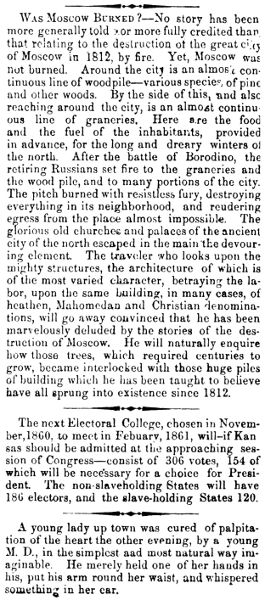
By using fine print, Trask was able to present
much material in this four-page issue. Among
its contents are the text of the Governor's
message to the first Territorial legislature and
several U.S. laws passed by the first session of
the 37th Congress. The lead editorial, "What
We Mean to Do," contains the following statement
of policy regarding the Civil War:
At present, there is no room for disagreement in
politics. So far as our knowledge extends, all parties
join heartily in an indorsement of the truly patriotic
and conservative course adopted by the President
in the management of this war. He is not a
patriot who will allow any slight disagreement te
[sic] turn him from a straightforward opposition
to the ambitious men who are now heading a Rebellion
to destroy the fairest Government ever
known. Until this war is ended by a suppression of
the Rebellion, unless a change is forced upon us, we
shall walk with men of ALL parties, in an earnest,
honest purpose to do what we can to strengthen the
arms of ABRAHAM LINCOLN, in whatever acts
he may deem best for the people who have called
him to his present proud position. In this determination
we feel that all our patrons will sustain us.
The editorial concludes with an appeal to support
the paper:
Few persons can know the expense and care
requisite for a publication like this so far West.
We feel that our Territory cannot support more than
one or two papers. One of these must be at the
Capital, and we shall endeavor to make this one
worthy the support of all. We expect to receive
pecuniary encouragement from men of all parties
and all parts. After a few weeks, when we are better
acquainted and our paper is better known, we shall
ask for the assistance which will be due us from
those whom we labor to benefit.
A Library of Congress bound volume contains
an incomplete but substantial run of The
Dakotian from April 1, 1862, to December 17,
1864, without any marks of provenance. In
addition the Library owns a file of South
Dakota's third newspaper, The Dakota Republican,
beginning with volume 1, number 31,
published at Vermillion on April 5, 1862. This
newspaper has for its motto "Our Country If
Right, If Wrong, God Forgive, But Our Country
Still!" The Library's issue of April 12, 1862,
is inscribed "Wm H James"—this would be
William Hartford James of Dakota City, Nebr.,
who served as Acting Governor of Nebraska
in 1871-1872—and some of its 1868 and 1869
issues are inscribed "Dept of State." All of
these papers are accounted for in A Check List
of American Newspapers in the Library of
Congress (1901).
(The Dakotian)
From the year 1862 the Library also possesses
four books printed at Yankton all bearing the
imprint of Josiah C. Trask, Public Printer:
Council Journal of the Legislative Assembly of
the Territory of Dakota, to which is Prefixed
a List of the Members and Officers of the
Council, With Their Residence, Post-Office
Address, Occupation, Age, &c.; House Journal
of the Legislative Assembly of the Territory of
Dakota, to which is Prefixed a List of the
Members and Officers of the House ...; General
Laws, and Memorials and Resolutions of
the Territory of Dakota, Passed at the First
Session of the Legislative Assembly, Commenced
at the Town of Yankton, March 17,
and Concluded May 15, 1862. To Which are
Prefixed a Brief Description of the Territory
and its Government, the Constitution of the
United States, the Declaration of Independence,
and the Act of Organizing the Territory; and
Private Laws of the Territory of Dakota, Passed
at the First Session of the Legislative Assembly....[125]
Single copies of the Council and
House journals were in the Library by 1877.
The Library has four copies of the General
Laws and Private Laws, bound together as
issued; two copies are probably 19th-century
accessions, the third came from the Department
of Interior in 1900, and the fourth was transferred
from an unspecified Government agency
in 1925.