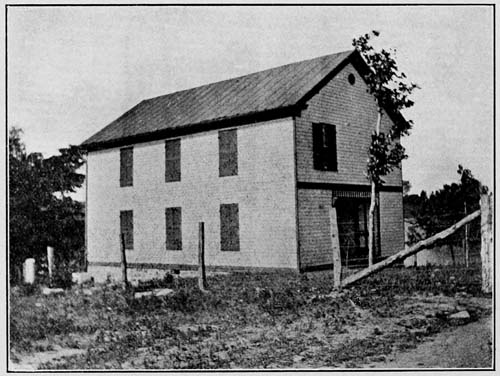
“TO LIVE IN HEARTS WE LEAVE BEHIND, IS NOT
TO DIE.”
Before pronouncing the benediction in this
pleasant meeting with old familiar faces, I must
not fail to say more of the kind old master who
was as respectful to his dusky body servant as
to his proudest peer, and who could penetrate
color, poverty, and untutored speech, and find
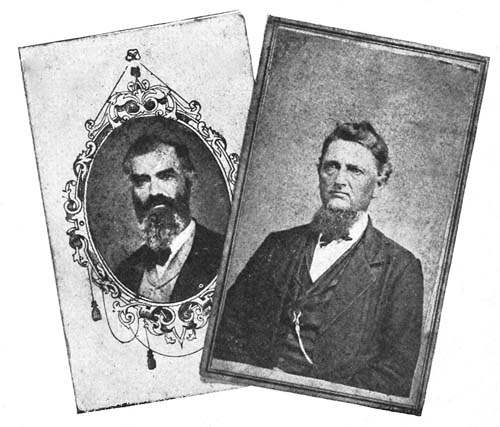
where a true heart lodged. Eppa Lawson Fort
was born at “Riverside,” a picturesque homestead
on Red River, three miles southeast of Port Royal,
Tennessee, August, 1802. He was the son of a
prominent Baptist minister, and a church goer,
but strange to say, during a pilgrimage of nearly
ninety years, never joined a church. He believed
implicitly in God’s mercy, and when approached
by friends, on the subject of religion, he would
assure them that the Lord would manifest Himself
to him in a way that he would understand, when
He was ready for him to enter the Christian fold.
Mr. Fort was twice married, the first time to
Miss Virginia Metcalfe, of Robertson county, and
the second to Miss Elizabeth Dancy, of Florence,
Alabama. Three sons blessed his first marriage,
and a son and daughter his last, all of whom are
dead. For the benefit of those of my readers
who knew Mr. Fort and his last wife, I give below
a brief sketch of family history:
The Forts, Dancys and Wimberlys were related,
and came from North Carolina to Tennessee at
an early date. The first Fort family settled on
Sulphur Fork Creek, near Beech Valley Mill, at
a place now owned by Mr. Plummer Poole. The
Wimberlys went nearer Clarksville, on Red River,
and their first homestead is now occupied by their
descendants, Messrs. Joe and Alf Killebrew, of
Rossview neighborhood. Esq. William E. Dancy
located near Dunbar’s Cave, but later moved to
Florence, Alabama, carrying with him a number
of valuable slaves, and a family consisting of his
wife and three small children, Caroline, Elizabeth
and John. It was before the day of railroads, and
all the visiting between the Tennessee and Alabama
relatives was done on horseback, covering a
period of several days’ journey. During the 30’s
little Caroline and Elizabeth had grown to young
ladyhood and accompanied by a younger brother,
they came to visit the Wimberlys. They found
Mr. Fort a gay young widower, and he found
Miss Elizabeth Dancy a charming young lady.
A few months prior to this, he had paid his
addresses to a popular young lady of Port Royal,
and they were engaged, but by dint of accident
he learned from a reliable source that she had
said publicly that she did not intend to be bothered
with his three little boys, so he frankly informed
her that his children were first, and released her.
After spending several weeks in Tennessee, as
the time had come for the Dancy girls to return
to Alabama, Mr. Fort asked the privilege of
escorting them, by saying he had not seen “Cousin
Nancy,” their mother, in a long time, and that
she was his favorite relative. The old folks saw
clearly through it all, and were pleased, and after
a two weeks’ visit Mr. Fort returned home, with
the prospect of being their son-in-law some time
during the coming year.
The three sweet little motherless boys, Jack,
Ilai and Sugg, in the meantime were being tenderly
cared for by their mother’s relatives. A
year sped quickly by; a black broadcloth wedding
suit was packed in a pair of leather saddle bags,
and mounted on a handsome dappled gray horse,
Mr. Fort set his face southward, with bright
anticipations. A letter had preceded him, telling
them what day to expect him; it was before the
time of sewing machines, and the bridesmaids,
Hannah and Lute Barton, had been in the Dancy
home several days making the wedding dresses;
they and the bride were to be dressed alike, in
white muslin, flounced to the waist, and flounces
bound with white satin ribbon. Esq. Dancy
lived on what was known as “The Military Road,”
cut out by Andrew Jackson during the Creek
War, and horsemen could be seen a long way off.
Toward sunset a member of the family looked
up the road and exclaimed, “Yonder comes the
Tennessee widower!” and they all ran out to meet
him. He set his saddle bags in the hall, and
incidentally mentioned their contents, whereupon
the bride elect took out the broadcloth suit and
neatly folded it away in a bureau drawer in her
room. In those days there were no trunks, but
few spare rooms, and no foolish conventionalities.
Along with the clothes was a fine pair of No. 5
pump sole shoes, to be worn on the wedding
occasion. Mr. Fort had a small, shapely foot,
and it was said the young ladies in the Dancy
home, assisting the bride in her preparation for
the wedding, would go every now and then and
peep admiringly at those dainty pumps in the
bureau drawer.
Mr. Dancy made his daughter a bridal present
of a nice black saddle horse, called “Indian,” and
when they turned their faces toward Tennessee,
mounted on this black and white steed, it must
have been an interesting picture. Seventy odd
years ago, think of the changes!
For her traveling suit, the bride wore a purple
marino riding habit, made with long pointed
tight waist, with hooks and eyes beneath the
waist line underneath, by which it could be
temporarily shortened and converted into a walking
suit, thereby saving her the trouble of dressing
when they took lodging at the wayside inns or
taverns, as they were called. (It will be remembered
that a bridal wardrobe folded in saddle
pockets afforded but few dresses for change.) A
shaker straw bonnet, with a green berege frill, or
skirt, completed her outfit.
The headpiece of these Shaker bonnets, or
“scoops,” as they were called, were shaped something
like the cover of an emigrant’s wagon, and
were anything but pleasant to wear in warm
weather.
On reaching the Tennessee River, Mr. Fort’s
fine gray horse grew stubborn, and refused to
step into the large ferry boat, and had to be
blindfolded. The trip was a long and tiresome
one, and the bride was laid up for repairs over a
week; the scorching July sun had dealt roughly
with her delicate complexion, and before she was
aware of it, the back of her neck was deeply
blistered from the sun shining through the thin
berege skirt of her Shaker bonnet.
The faithful servants did all in their power to
make her feel at home; then and there an ideal
home life began, and Mr. Fort was a prime factor
in making it so.
The following amusing story was often told of
him: He had a nice herd of dairy cows, and
among them was one they called “Stately,” the
bell cow. Aunt Margaret was the milk maid,
and she always carried along with her to the cow
pen her ten-year-old son, Nelson, “to keep the
calves off,” as they termed it. One summer
evening about sunset, the family were seated on
the front gallery, Mr. Fort, his wife, and their
youngest son, the late W. D. Fort. They were
quietly discussing the expected arrival next day
of some favorite relatives from Paris, Texas, Dr.
Joe Fort’s family.
Suddenly Nelson appeared on the scene, and
in breathless excitement exclaimed, “Mars Lawson,
old Stately poked her head in a wagon wheel
up at the lot, and she can’t get it out, and mammy
says what must she do about it?”
Revs. F. C. Plaster, and W. S. Adams, who assisted
in Rev. Horace Carr’s ordination at Old Red
River Church, before the Civil War.
Mr. Fort sprang to his feet, and on the impulse
of the moment said, “Tell one of the men up at
the lot feeding, to get an axe and cut her fool
head off, QUICK!” It was too good to keep, and
his son treasured it as a household joke, which
he enjoyed telling on his kind old father, along
with many others equally as amusing.
But the happy old Riverside home was to
undergo changes. After a few days illness, from
the infirmities of old age, Mr. Fort quietly fell
asleep, July 12, 1891. His remains were laid to
rest with Masonic honors at the old Metcalfe
burying ground on Elk Fork Creek, near Sadlersville,
Tenn.
His family feasted on his affections, and his
friends enjoyed the wealth of his noble nature.
Since the lives of most of the good people
mentioned in this little story centered around
Port Royal, I deem it not amiss to tell something
of this historic spot.
Nearly four generations have passed since this
village, which tradition tells us, lacked only one
vote of being the Capitol of the State, was settled.
In 1789, Samuel Wilcox, of Port Royal, South
Carolina, came with his small family and settled
near a large spring, on the left bank of Red
River, at the foot of a ridge called “The Devil’s
Backbone.” The exact location may be better
known today by pointing the reader to a slight
elevation on the far side of W. N. Gaines’ bottom
field, lying between his “Hill Top” home and
Sulphur Fork Creek, nearly opposite the old
Weatherford mill site.
Located as he was, between Red River on the
one side and Sulphur Fork Creek on the other,
he soon realized his mistake, for during the high
water season a vast area of this level tract, including
his home, was subject to overflow.
So he crossed over Sulphur Fork Creek a few
hundred yards northwest, to a picturesque point
where the creek empties into Red River, and built
a primitive residence, and a blacksmith shop, and
called the place Port Royal, in honor of his native
town in South Carolina. Mr. Wilcox later on
entered about one thousand acres of land three
or four miles from Port Royal, on the Graysville
road leading to Kentucky. A portion of his
original purchase is now owned by Mr. Polk
Prince, of District No. 1, Montgomery county.
This was the first permanent settlement made
at Port Royal. But fourteen years earlier, 1775,
the historian tells us of tragic scenes enacted
thereabouts, as follows:
“A famous hunter by the name of Manscoe,
and three companions, camped a few weeks near
where Sulphur Fork Creek empties into Red
River, and here Manscoe had an adventure with
some Indians. Having discovered from their
trail, that a hunting party of some sort was in
the vicinity, he went alone to ascertain if possible
who they were.
“On the bank of the river, he saw a camp fire,
and creeping as close as he dared, he saw two
Indians, whom he recognized as belonging to the
Black Feet tribe. Manscoe was about to retire
to carry the news to his companions, when one
of the Indians arose and came directly toward
him. Manscoe fired, and the Indian wheeled and
ran about fifty yards past his own camp fire and
fell dead over the bluff into the river. The other
Indian made quick time away from the fatal
spot, not knowing, it was supposed, how many
whites were in the attacking party. Manscoe not
knowing the number of savages, beat a hasty
retreat also. Joining his comrades, he returned
in a few hours, accompanied by them, to find the
fugitive Indian had, in the meantime, been to his
camp, packed his scant belongings on his pony,
and left for parts unknown. They followed close
on his trail, the remainder of the day, but never
found him.
“Knowing that the Indians would soon return
in full force to avenge the death of their comrade,
Manscoe and his party left the country within
the next few hours, but terribly was the death
of this Indian afterwards avenged. In 1794, ten
years after Clarksville, Tenn., had been incorporated
and named, Col. Isaac Titsworth, and
his brother John, with their families, moved from
North Carolina to the Cumberland country. They
intended locating on Red River, and on the night
of October 24, 1794, camped at the mouth of
Sulphur Fork Creek, near where the Indian had
been shot by Manscoe. That night a party of
fifty Creek Indians stole upon them, taking them
completely by surprise. Seven of the party,
including Col. Titsworth and his brother, and
their wives were killed and scalped. A negro
woman was badly wounded, but crawled off in
the woods and escaped. The Indians carried off
six prisoners, a negro man, a white man, a grown
daughter of Col. Titsworth, and three little
children. Great excitement reigned, and in a
few hours a party of white men was organized
and on their trail. The Indians discovering their
approach, tomahawked the children and scalped
them, taking off the whole skins of their heads.
The white man and the negro, they either killed
or carried off with their daughter; none of the
three were ever heard from.”
As far back as 1807, the citizenship of Port
Royal received favorable comment, as the following
from “The Life and Times of Elder Reuben
Ross,” will show:
“Although not a great deal could be said in
praise of the small village of Port Royal, in itself,
near which we are now living, it would be safe to
say, no finer citizenship could have been found
anywhere at this time than in the country around
it, extending into Robertson and Montgomery
counties. In evidence of this, one need only to
mention such names as Fort, Norfleet, Northington,
Dortch, Baker, Cheatham, Washington,
Bryant, Turner, Blount (Gov. Willie Blount),
Johnson, and others. They were generally men
of large stature, dignified and patriarchal in their
bearing, many of them wealthy, very hospitable,
and always ready to assist those who needed
assistance, especially strangers who came to settle
among them.”
While the lordly old masters have drifted away
with the “days that are dust,” the posterity of a
fine antebellum citizenship lingers yet with us to
bless and beautify the hills and vales of dear old
Port Royal.