TRANSLATED from the ITALIAN
by CAROLYN M. DELLA CHIESA
EDITED by JOHN W. DAVIS
WITH ILLUSTRATIONS
and DECORATIONS by FLORENCE R. ABEL WILDE
THE
MACMILLAN COMPANY
NEW YORK
As I have purchased the literary copyright for the translation
into and the publication in the English language of the volume “Il
Segreto di Pinocchio,” by Mongiardini-Rembadi, its reproduction
in English is hereby reserved.—Carolyn M.
Della-Chiesa.
Copyright, 1913,
By
THE MACMILLAN COMPANY.
Set up and electrotyped. Published September, 1913.
Norwood Press
J. S. Cushing Co.—Berwick & Smith Co.
Norwood, Mass., U.S.A.
Have you ever read
the Adventures of Pinocchio? What a famous fellow he was! He could
talk and walk and live as you do, children; and still he was only a
marionette! How sad the little fellow felt when he saw his father
disappear in his little boat over the sea!
Do you remember how Pinocchio then tried to swim across the
ocean? How he did his best to save his poor old father? How he jumped
into the water? How he swam and swam over those great, high waves?
And how at last he became so tired, that he could only lie still and
let the waves carry him?
If you remember this, you will also surely remember that on the
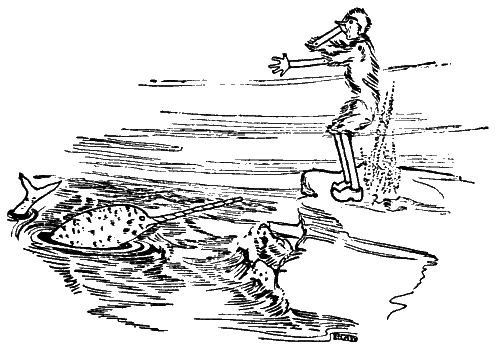
next day Pinocchio, almost lifeless, was thrown on an island. There
he found himself on a small stretch of ground. All around him was the
great ocean.
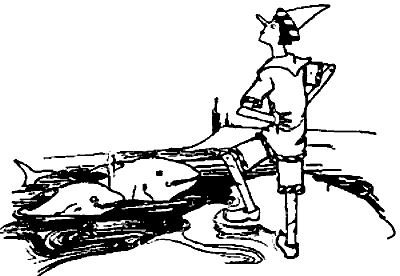
Where could he get news of his dear old father? As he looked about
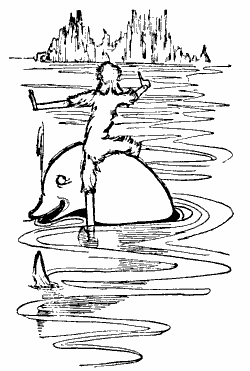
him, he saw a large dark object in the water. It was a dolphin. It
had stuck its nose out of the water and seemed to be waiting for the
marionette. Of Pinocchio’s father, the dolphin knew nothing.
“But,” said he, “I am very much afraid the boat has been lost in
the night.”
My dear children, if you have a good memory, you cannot forget
that after saying this the dolphin turned and disappeared.
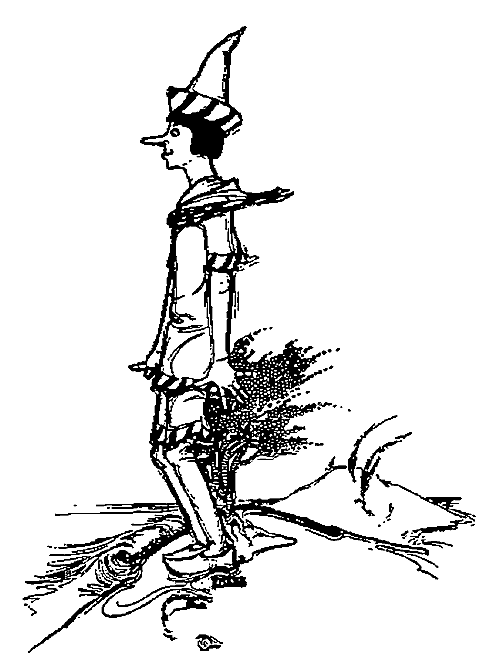
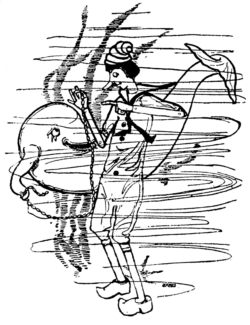
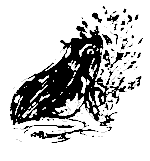
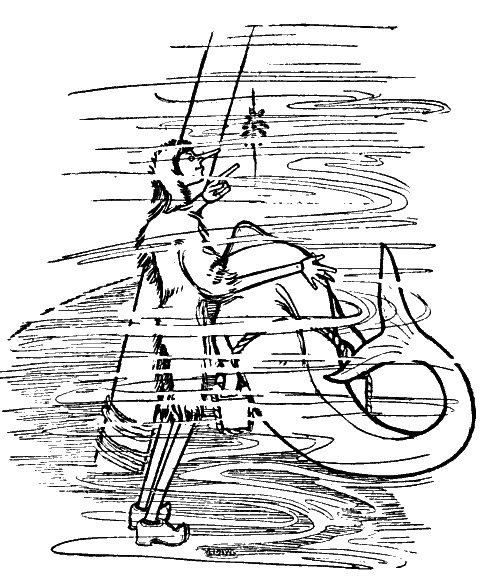
“All around him was the Great Ocean.”
This is not true. Indeed not. On the contrary, Pinocchio and the
dolphin had a long talk one with the other. At the end of it, they
decided to take a long journey together.
CHAPTER II
While the two were
talking, Pinocchio kept thinking and thinking of his dear father. He
looked so sad that the dolphin finally said to him:
“If you grieve so much for the loss of your father, you must be a
good son. We dolphins are very fond of good children, and I more than
others. To prove this to you, I shall only say that the dolphin of
which Pliny speaks was my great-grandfather.”
“Pliny?” said Pinocchio. And he wrinkled his nose, because the
name was not very well known to him.
“Yes, Pliny the Elder, the famous author of a natural history. He
was
a Roman, who was born about one thousand nine hundred years ago. He
was killed in a terrific eruption of Vesuvius, the one that destroyed
Herculaneum and Pompeii.”
Vesuvius, Herculaneum, and Pompeii were as familiar to the
marionette as was Pliny. To speak plainly, he knew nothing whatever
about them. But, making believe he understood everything, he said,
“Yes, yes! These things I know. But of what does Pliny speak?”
“He tells us that in the suburbs of Naples a dolphin became very
fond of a boy. Every morning he would wait near shore for the boy.
When the child came, the dolphin would make the youngster climb on
his back. Then the dolphin would swim to Pozzuoli, where was the
boy’s school. Here the boy would go ashore, attend to his school
duties, and when they were over, return to Naples on the dolphin’s
back. A few years
later the boy died suddenly. The dolphin, after waiting in vain for
him for many days, grieved himself to death.”
“Is this little story really true?” asked Pinocchio.
“Pliny tells it. Some believe, some do not. But this matters
little. To me, then, as to my parents and their parents, good
children have always been pets. Now listen carefully. Among dolphins,
it is the custom for the young ones to travel with the older ones. I
am a tutor, and I am about to start on a long journey with a young
dolphin. If you wish to come with us to look for your father, you are
more than welcome.”
“My dear Mr. Dolphin, I shall be delighted. May I ask where we are
to go?”
“We are to go on a journey around our world.”
“Around the world!” exclaimed the marionette.
“It must be amusing to see two dolphins walking arm in arm around the
streets.”
“Yes,” continued the dolphin, “this young pupil of mine, who
belongs to the Marsoon family, wishes to educate himself. And how can
he better educate himself than by travel?”
“To educate himself!” exclaimed Pinocchio, opening wide his eyes.
That word had always been hard for him to swallow. “Educate! Oh! Oh!
That word I never did like.”
“What are you saying?” asked the dolphin.
“Oh, nothing, nothing! I was just thinking that my teeth are
aching.”
“Then it might hurt you to go into the water, and ...” began the
dolphin, kindly.
Pinocchio was perplexed. The idea of looking for his father he
liked very much.
Still, when he thought of that word educate, he shivered. He
had always hated school as he hated fire. And you remember, he once
lost his feet through playing with fire.
“What a nuisance it will be,” he kept mumbling, thinking of the
sleepy time it would mean for him.
“Tell me, my dear sir,” he then said, just to gain time, “shall we
travel by train?”
“Of course not! How could we? I told you that we are to travel
in our world. That means that we are not to move out of the
water.”
“So much the worse,” again thought Master Pinocchio. “Still, I
don’t see what kind of education there can be in seeing only sea and
sky! Good Mr. Dolphin, do you think that, if I go with you, I shall
ever find my father?”
“Perhaps. We may come upon him on
some desert island. Who knows? In any case, it is your sacred duty to
look for him. Will you come?”
“Yes!” answered Pinocchio, firmly. “I will go.”
“Are you afraid?”
“Afraid,” laughed Pinocchio, with scorn. “Why, I don’t know what
fear is. Just listen. Once, while traveling, I came face to face with
a lion. Instead of taking to my heels as many would have done, I took
a large stone and threw it into his mouth. It lodged in his throat.
The poor beast looked at me so sadly, that instead of dispatching
him, I took the stone out of his throat, and he went quietly
away.”
“Oh, if that is the case,” replied the dolphin, who could swallow
the story almost as well as the lion had swallowed the stone, “if
that is the case, I beg your pardon.”
“Very well. When shall we start?”
“To-night, just after sunset.”
“How can we travel in the dark?” asked Pinocchio. He and darkness
had never been great friends.
“Do not be afraid. We are to travel by the light of the sun.”
“Of the sun? Why, we are to travel by night.”
“Nevertheless,” answered the dolphin, smiling, as dolphins are
wont to smile, “nevertheless, we shall travel by the light not only
of one sun, but of many suns.”
Pinocchio looked at him with his mouth wide open. The dolphin
calmly went on: “I promise to show you the sun in the sea.”
Pinocchio wrinkled his nose, as was his habit when puzzled. “I
wonder if the dolphin is making fun of me,” he thought.
“Now I shall leave you, as I have many
things to do before starting. Remember, this evening,” said the
dolphin as he went off.
“Do not be afraid. I will be here,” was Pinocchio’s reply.
“Very well. Good-by, Pinocchio.”
“Until to-night, Mr. Fish.”
The dolphin, who had gone a short distance, returned and said
proudly, “Just to enlighten you a little, I am not a fish.”
Again Pinocchio’s eyes opened wide.
“What then? A horse?”
“Pinocchio, I am surprised at you. No, neither horse nor fish.”
“I never knew of there being anything but fish in the sea.”
“Who told you so? There are many animals, my dear boy, who live in
the sea, but who are not fish.”
“What then? Birds? Elephants? Dogs?”
“Yes, sir, just so. Still, you people who live on the earth and
read books, you ought to know all these things.”
“Well ... yes ... I do read books. In fact, I have read
every book that has ever been written.”
“All of them? Nothing less? Why, I didn’t think a man could do
that if he had a hundred lives to live,” murmured the good old
dolphin.
“Well, Pinocchio,” he went on, “remember to-night, and do not
forget that I am not a fish.” With this remark he disappeared in the
blue waters.
Pinocchio looked after him for a long time.
“The sun in the sea? Dolphins not fish? I don’t know why, but I’m
very much afraid I’m being made fun of.”
CHAPTER III
When he was alone,
Pinocchio began to think of looking for something to eat. After
trying here and there in vain, he had to be satisfied with looking at
a few empty oyster shells. The best he could do was to make believe
that he had already had a good meal out of them.
This, of course, was not very easily done, because the pangs of
hunger kept making themselves felt more and more. At last, to forget
them, he decided to make a tour of the island. This he did, and after
that he took a nap.
When he awoke, it was near sunset. He had all he could do to get
to the meeting place in time.
Off he hastened, and reached the spot just in time, for there was
the dolphin, head out of water, looking for Pinocchio.
A small dolphin, about a yard long, was in the wake of the larger
dolphin.
Pinocchio had made up his mind that even though he might be a
dunce on the earth, still he knew more than a common dolphin. So he
looked at the little fellow as much as to say, “Be very careful how
you speak to me, young man. Remember, I am far above you.”
The old dolphin was very busy with the preparations for their
journey. He came and went and gave orders to his servant.
You may laugh,
children, but it is true. The dolphin had a servant, who was also
a dolphin, but of the family of the Globiceps. These are so called
because of their round heads, which look like the globes used in the
electric lighting of streets.
The young dolphin was playing in the water. He tried to attract
Pinocchio’s attention in many ways. He spouted water through the hole
which every dolphin has at the top of his head. He called to the
marionette. He smiled at the youngster. It was of no use. Pinocchio,
with his wooden nose in the air and his dough cap on one ear, would
not even turn his head.
“I wonder if he is deaf or blind?” the dolphin finally said,
loudly enough to be heard.
Pinocchio turned with a start.
“For your own benefit, I just wish to say
that I am not now and never have been deaf,” he said as haughtily as
he could.
“Then why do you look at me in that fashion? And why don’t you
answer me?” was the reply.
“I am acting just as a gentleman should toward those who are
beneath him,” said Pinocchio.
“I don’t know which of us is the better of the two. All I do know
is, that my father was the richest inhabitant of the sea and that the
other dolphins considered him their king.”
“King?” mumbled Pinocchio, who knew himself to be the son of a
poor carpenter, earning so little that he never had a penny in his
pocket.
“But king or not, what does it matter? In this world we are all
equal, for we have all been created by God. Listen, my dear
marionette. Come here. As we are to travel such a long distance
together, we should be friends. Are you willing to be my friend?”
These pleasing words made Pinocchio see how stupid and how rude he
had been.
“Think of it! A fish (oh, no, I mean a sea animal) giving me
lessons in politeness!” Then turning to the dolphin, he said, “Yes,
we shall be friends. What is your name?”
“Marsovino. And yours?”
“Pinocchio.”
“A beautiful name. Come, shake hands.”
“Very willingly,” replied Pinocchio.
The good little animal stuck one of his fore fins out of the water
for Pinocchio to shake.
“And what is the tutor’s name?” said the boy of wood to the boy of
the sea.
“The tutor is a dolphin of the Tursio
family, but I call him father. Is it true that you are coming with us
on our travels?”
“Yes,” said the marionette, proudly. “And I am able to teach
you.”
“Teach me! That’s strange. How do you expect to teach
me?”
“You will soon find out. You talk rather disrespectfully to me. I
have been in all the schools of the kingdom. And you? You probably
have never been on land for twenty-four hours.”
Marsovino looked at the marionette smilingly, but made no
reply.
Pinocchio walked up and down with his hands in his pockets and his
hat at an angle of forty-five degrees, ruffling his feathers at the
brilliant remark he had made.
As soon as Tursio came near, Marsovino asked him if he were
ready.
“Yes. Everything is finished,” was the reply. “Are you ready,
Pinocchio?”
“Yes. I am ready. Let us start.”
“Start? How? Do you mean to say that you are coming under the sea
with that suit?”
“Of course. It’s the only one I have.”
“A suit of paper! The very idea! Luckily I have prepared for this.
Here, Globicephalous,” he said to his servant, “give me that little
suit of ray leather,—the one I had you make this morning.”
“Splendid,” cried Pinocchio, clapping his hands. “Now I have a new
suit.”
Putting it on, he looked at himself in the water. Seeing how
dark and unbecoming it appeared, he turned to Tursio and said
excitedly:
“I don’t want this. It is too ugly. I like my pretty
flowered-paper one better.”
“Your paper one Globicephalous will carry in his satchel for you.
Should you wear it in the water, it would be spoiled.”
“I want my pretty suit,” insisted Pinocchio. “If any one saw me in
this thing, he would ask me if I had been through the coal-hole.”
“But yours will be ruined if you wear it in the water, I tell
you.”
“I want mine. I want mine,” wailed Pinocchio.
“Very well. Globicephalous, take the paper suit out of the
traveling bag and give it to the boy.”
The marionette turned, expecting to see an ordinary traveling bag.
Instead, he saw Globicephalous take an enormous oyster out of the
water.
“Isn’t that strange! Oyster shells for a traveling bag!”
“Strange? Why, what is strange about that?” asked Tursio.
“What is its name?” asked Pinocchio.
“That is the giant Tridacna. They are the largest oyster shells
known.”
“How large the animal inside must be,” observed Pinocchio, with a
yawn.
“Yes. It is very large, and also very beautiful. The center of
the body is a violet color dotted with black. Around this is a
green border. At the extreme edge the colors change from deepest to
lightest blue. Yes, indeed. It is very beautiful.”
“What a good meal it would make,” thought Pinocchio. His only wish
was for a good dinner, but in order to be polite he said, “Who would
ever think that there are such things under the sea!”
“Why, you have been in every school in the kingdom and don’t know
that?”
“Books on the subject you can find everywhere.”
Pinocchio bit his lips, but did not say a word. Quickly he dressed
himself again in his paper suit and declared himself ready to
start.
“All right! Come along!” said the dolphin, stretching a fin out to
help Pinocchio along.
The marionette started to walk into the water. He had not gone
far, however, before his paper suit began to leave him. Hastening
back to the shore, he very meekly put on the ray-leather suit which
Globicephalous handed to him.
“Remember, my boy,” said Tursio, “that in this world of ours
we must think not only of the beauty but also of the usefulness
of things. Also, do not forget that a boy who never learns
anything will never be anything.”
“But I have learned much,” answered Pinocchio. “To prove this to
you, I can now tell you of what material this suit is made.”
“I have told you already. It is of ray leather. Do you know
what a ray is?”
“Surely I know. You may give it another name. Still, it must be
that white animal on four legs. You know. The one the shepherds shear
during some month or other.”
“Mercy!” cried Tursio. “You are talking about sheep. They give
wool to man.”
Pinocchio, without moving an eyelid, went on:
“Yes, that’s true. I have made a mistake. I should have said it is
that plant that bears round fruit, that when it opens....”
“Worse and worse,” interrupted the old dolphin. “What are you
talking of, anyway?
That is the cotton plant. Marsovino, please explain to this boy, who
has read all the books in the world, what a ray is.”
So Marsovino went on: “A ray is a fish, in shape like a large fan.
It has a very long tail, which it uses as a weapon.”
“To what class of fishes does it belong?” asked Pinocchio.
“It belongs to the same class as the lampreys, which look like
snakes, the torpedo,—”
“Be careful never to touch that fellow,” here interrupted
Tursio.
“—the sawfish and the squaloids,—that is, the common shark and the
hammerhead.”
“The saw? The hammer?” observed Pinocchio. “If I find them, I
must keep them for my father. He is a carpenter, but so poor that he
seldom has money with which to buy tools.”
“Let us hope that you will never meet
the saw, the terrible hammerhead, or even the common shark,” said
Tursio.
Pinocchio made no answer, but in his heart he kept thinking, “I
am very much afraid that the dolphins are teaching me, not I the
dolphins.”
Tursio then handed Pinocchio a small shell of very strange shape.
It looked like a helmet.
“Wear this, Pinocchio,” he said. “It will make a pretty cap for
you.”
“It is very pretty. What is it?”
“It is a very rare shell.”
“But it is only one shell. Where is its mate?”
“It has none. It is a univalve. That means it has only one shell.
The tellines have two shells, and are therefore called bivalve.
Another kind looks like a box with a cover.”
“But does an animal live in there?”
“Of course. Every shell has its mollusk.”
“Mollusk?” repeated Pinocchio.
“Yes. The small animals that live in shells are called by that
name.”
“They have a very soft body. By means of a member, called a foot,
they get such a strong hold on rocks that it is very hard to tear
them off.”
“Some mollusks have a strong golden-colored thread by which they
also hang to rocks. Why, people have even made cloth out of these
threads.”
Pinocchio cared little for all this explanation. He looked at
himself in the water, and was, after all, very much pleased with
himself.
“This cap seems made for me,” he said. “Too bad I have no feather
for it.”
“Perhaps we shall find one on our journey,” laughed Tursio.
“Where will you get it? In the sea?”
“Yes, in the sea,” answered Tursio, in a tone which made the
impudent marionette almost believe him.
CHAPTER IV
“Well,
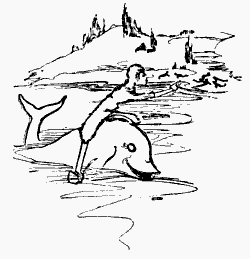
children, let us hasten. If we talk so much, the sun will rise and
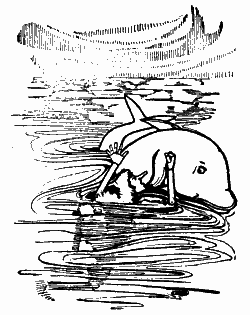
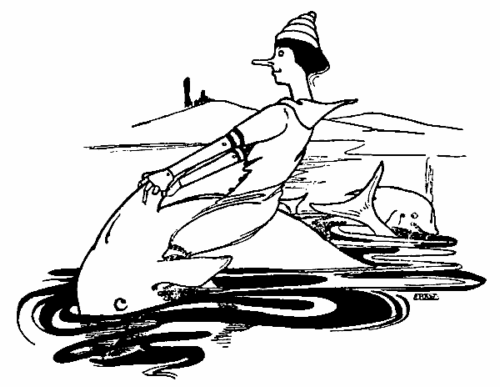
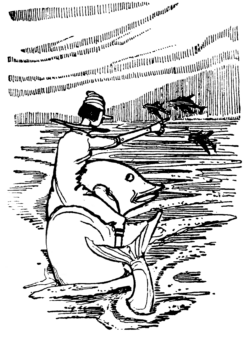
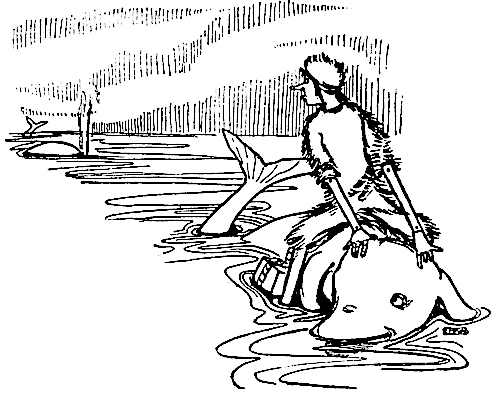
find us here. Come, Pinocchio! Jump on my back and let us start.”
There was no need for Tursio to repeat his command. In the
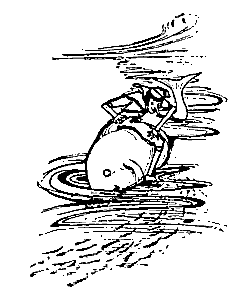
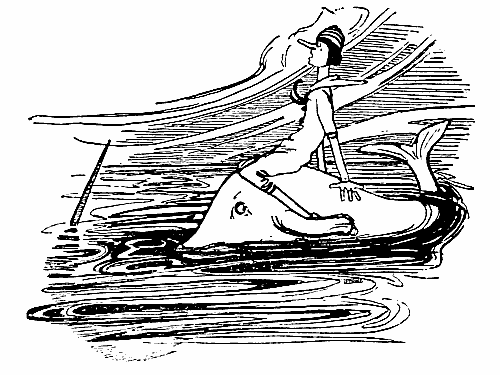
twinkling of an eye, Pinocchio was riding on the dolphin’s back,
holding on tightly to the dorsal fin.
“Gallop and gallop, my pretty horse,
Swiftly over the boundless sea.
Straight through the water take thy course,
Till my dear father again I see.”
“Gallop and gallop, my pretty horse,
Gallop away under the sea.
Swim to the south, and swim to the north,
Till my dear father again I see.”
So sang Pinocchio gleefully.
Tursio and his swimming companions, with a few shakes of their
strong tails, were soon far away from shore. This is not to be
wondered at, for dolphins are known to be very swift. Very soon
Pinocchio saw nothing but sea and sky. Always holding on tightly to
Tursio’s fin, he looked to the right and to the left; but nothing
could he see of his dear father.
“Hold fast, Pinocchio,” suddenly cried Tursio.
“All right, Mr. Tursio,” replied Pinocchio, but he could say
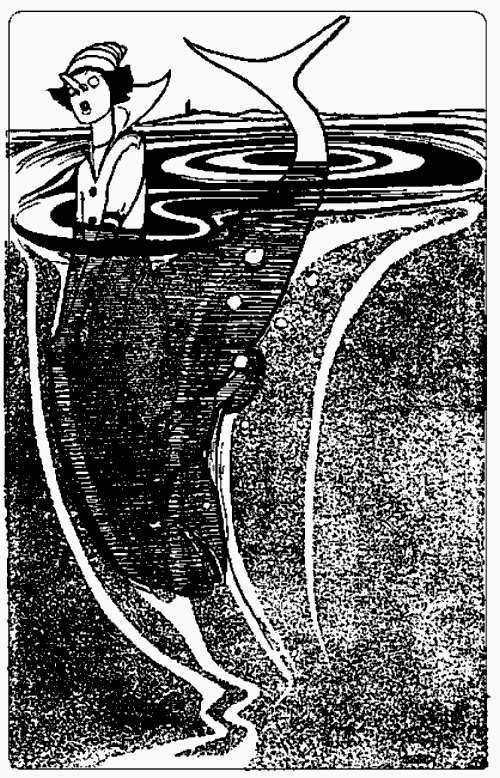
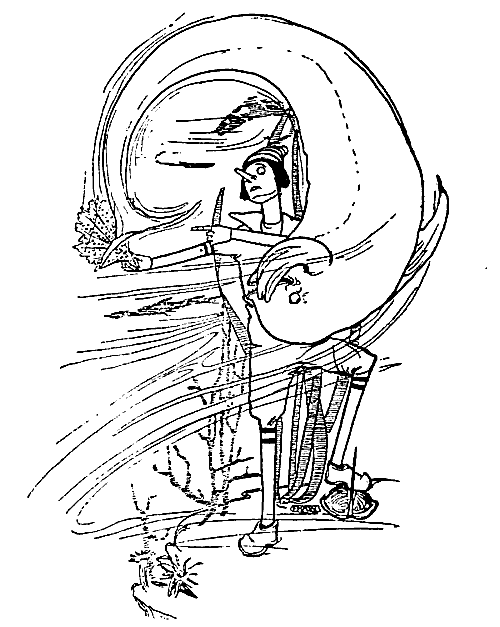
no more. For suddenly, with a great jump, the dolphin was under
water.
What a moment for our poor wooden hero!
“Now I understand it all,” he thought. “This dolphin wants to get
me into the sea that he may eat me at his leisure. Oh, poor me! I
shall never again see the light of day.”
But marvel of marvels! He suddenly awoke to the fact that, instead
of drowning, he was breathing easily. Not only that, but he could
actually talk!
“This is strange,” said he. “I have always thought that people
would drown in the water.”
“And it is true,” answered the dolphin, “that men usually drown in
the sea. But I have given you the power to live under
water. You see, then, you have become a real amphibian.”
“A real what? What am I now?”
“An amphibian. That is, you have the power to live both in the air
and in the water.”
“But are there such animals?”
“Why, of course, child. Frogs, for example, which belong to the
Batrachia family. In the water they breathe with branchiæ, or gills,
and in the air with lungs. Usually, however, the name is given only
to those mammals that live in the water and move only with great
difficulty on the earth. To this class belong the seals and the sea
lions.”
“Well, then, I shall never drown.”
“No; and you will have a wonderful journey under the sea. Just
hold on to me, and I will carry you. Do not be afraid.”
“Afraid? Of course not. But I don’t like the darkness very
much.”
“That is too bad. But the darkness will not last very long. You
know, I promised that we should make our journey by the light of the
sun. Wait awhile.”
Through the water Tursio went like an arrow, followed by Marsovino
and the servant.
Pinocchio, to gain courage, shut his eyes. When he opened them
again, wonder of wonders! Very near to him a large sun was moving
back and forth. It looked as if it were alive.
“The sun at the bottom of the sea!” yelled Pinocchio, frightened
almost to death. “Do you want me to believe that? You must be a
wizard playing tricks on me.”
“I am not a wizard, Pinocchio, and the
sun is not a trick. It is nothing more nor less than a fish.”
“I never heard of such a thing.”
“And you have been in all the schools of the kingdom! Marsovino,
please explain to this boy what a sunfish is.”
“The sunfish is so called because of the bright light that comes
from its body. When several of these fish are together, the sea looks
as if it were full of little, shining suns.”
As usual, Pinocchio was silent. He was beginning to think that
even dolphins knew more than he did.
Stretching out his hand, he touched a small fish that was passing
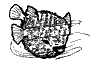
by. Another surprise! As soon as he touched it, it began to swell and
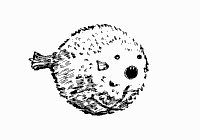
swell, until it was as round as a ball. And from this ball, countless
points began to stick out.
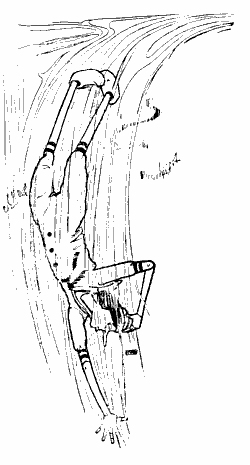
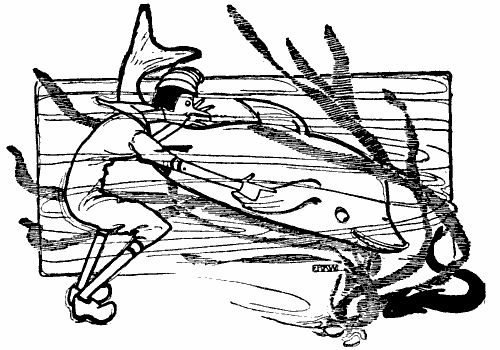
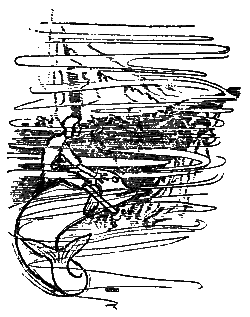
“Suddenly, with a Great Jump, the Dolphin was
under the Water.”
“Oh!” yelled Pinocchio again. “What
is it this time?”
“It is only a globefish, my marionette. It is harmless, if you
don’t touch it.”
“But why should it turn into a balloon?”
“It does that to protect itself,” answered Tursio. “It is possible
for the globefish to do that, because it can take in a large quantity
of air. With bristles ready, it can then meet the attacks of other
fish, as each point is as sharp as a needle.”
“I never knew that before,” exclaimed Pinocchio, forgetting his
previous boast.
Tursio and Marsovino looked at each other and laughed.
CHAPTER V
The night passed
without further adventure.
As soon as morning dawned, the four friends rose to the surface.
Our marionette was delighted to see the sun again. The pure morning
air, though, reminded him that he was hungry. The day before, if you
remember, he had eaten very little.
“I should like something to eat,” he said in a weak voice.
“Let us go to breakfast,” answered the dolphin. Gayly he dove into
the water, and led the party deep into the sea. After a short swim,
he stopped. But, unfortunately, the four friends found themselves
in a place where there were very few herring and salmon. These, you
know, are the dolphin’s favorite food.
The salmon is a fish that lives both in rivers and in seas. Like
the swallow, he looks for warm places in which to pass the winter.
So, in large numbers he migrates to the sea at that time of the year,
and in the spring he returns to the rivers.
“This morning our breakfast will be light,” observed Tursio,
swallowing three herring at once.
“I shall not eat anything. I don’t feel very well. Besides, salmon
is the only thing I can eat,” said Marsovino.
Tursio, wishing to please his pupil, started to swim toward two
very high rocks. They were so high that their tops stuck out of the
water. Very probably they were the base of an island in the middle of
the sea. But
although he looked here, there, and everywhere, he could find no
salmon.
Globicephalous satisfied his hunger with three dozen herring and
half a bushel of smelts.
And Pinocchio? Pinocchio this time certainly did not suffer from
lack of food.
Tursio had shown him a large rock, attached to which were hundreds
of oysters. Some were of the size of a pinhead. Others were as large
as a boy’s cap, and these were two years old.
“Go and have your breakfast,” said Tursio.
“Must I eat those horrible-looking things?” asked Pinocchio.
“Open them and see what is inside,” was the reply.
“Pinocchio this Time certainly did not suffer from
Lack of Food.”
After Pinocchio had opened and eaten one, he no longer thought
of the looks of the oyster shells. He opened and ate so many, that
it was a wonder to Marsovino that so small a person could hold so
much.
Suddenly Pinocchio noticed numberless tiny, tiny white specks
coming out of some oysters. To him they looked like grains of
sand. But when he saw the specks moving and trying hard to attach
themselves to rocks, he could not help crying out, “O look at the
live sand, Tursio.”
“Who told you it is live sand?” asked Tursio. “Those are the
newborn oysters, looking for a place on which to spend their lives.
Where those small grains hang, there the oysters will live, grow, and
die.”
“If no one gets them before that,” added Globicephalous.
“And are all those little dots oysters?”
“Yes. All of them. And many of them come from a single oyster, for
an oyster
gives forth almost two millions of eggs at a time. These little
things have so many enemies, however, that very seldom do more than
ten of the millions grow old.”
“Two millions! Then I may eat all I want to,” continued Pinocchio,
unmercifully tearing away the poor oysters, young and old.
“Look, Pinocchio,” here called Tursio, pointing to a small fish,
colored with brilliant blues and reds. “That is the stickleback. You
may have heard that this fish makes a nest, as do birds. Also that
the male, not the female, takes care of the eggs.”
“Surely I have,” answered Pinocchio, seriously.
The stickleback seemed to be very much excited. He moved around
the nest he had made and watched it anxiously. The cause
for this was soon evident. A second stickleback made its appearance
from behind the rocks. At once the two engaged in a terrific
struggle. They bit each other, used their tails as weapons, and
charged each other viciously. During the battle they changed color—to
a beautiful blue mottled with silver.
Pinocchio was struck with wonder. “Look! Look! One is wounded....
He falls.... He dies!” he cried. “And look at the other. How quickly
he returns to the nest to guard the eggs!”
“But how is it,” here asked Marsovino, “that once I saw a
stickleback swallow one of his little ones?”
“If you had followed him, you would later have seen the small fish
come safely out of the large one’s mouth,” answered Tursio.
“‘Look! Look! One is Wounded.’”
“But why did the large one swallow the
small one?” asked Pinocchio.
“Because the little one probably wanted to run away from the
nest. It was too soon, the little one was too young to take care
of himself; so the father took the only means he had to save the
youngster from an enemy,” patiently explained Tursio.
Just then a small fish attracted the dolphin’s attention.
“Boys,” he said, “do you see that tiny fish? It is called the
pilot fish. It is the shark’s most faithful friend. Wherever goes the
shark, there goes the pilot fish.”
“Now, Pinocchio,” he continued after a pause, “I shall leave you
with Globicephalous. Marsovino and I are going to pay a visit to the
dolphin Beluga, who is a great friend of mine. He usually lives in
the polar seas, but on account of his
health, he has come to warmer waters. We shall return this evening,
if all be well. Meet us near those two mountains which are so
close together that they form a gorge. You may take a walk with
Globicephalous, but be sure to be at that spot to-night.”
“I am ashamed to be seen with a servant,” began Pinocchio.
“You are a fine fellow,” answered Tursio, with sarcasm. “Do you
know what you should do? Buy a cloak of ignorance and a throne of
stupidity, and proclaim yourself King of False Pride of the Old and
the New World!”
With this remark Tursio turned to his pupil, and the two swam
away.
CHAPTER VI
“Illustrious Mr.
Pinocchio,” began Globicephalous, “if you do not wish to stay with
me, I can walk by myself. We can meet to-night.”
“No, Globicephalous, do not leave me,” begged the brave son of Mr.
Geppetto, the carpenter. The idea of being alone with all those fish
gave him the shivers.
“But you may be ashamed,” began Globicephalous.
“Please forget that. Now listen to me. You are a servant, and you
can’t have studied much. Still you may know this: Mr. Tursio does not
want me to call him a fish. What is he, if not a fish?”
“Do you think Mr. Tursio would dare tell a lie to such an
important personage as you are?” said Globicephalous, who was having
some fun all by himself.
“Neither Mr. Tursio nor Master Marsovino should be called fish. Nor I
either, for that matter.”
“What are you, then? Birds? You have about their shape, and you
live in the water. I know that in the sea there are only fish.”
“But you are mistaken. To many animals that live in the sea you
cannot give the name fish,” continued Globicephalous. “Fish have a
flat body, wedge-shaped fore and aft, as the sailors say, so that
they may move rapidly both forward and backward. They are each
provided with fins and a tail. These fins and the tail enable the
fish to swim about in the water.
Some fish have only a few fins, others have more. Then the fish has
no lungs. It breathes in the water by means of gills. These are the
chief characteristics of fish. But in the sea are many animals which
do not possess them.”
“Please explain yourself,” said Pinocchio, who had understood
little.
“Very well. Listen. There are the cetaceans, to which belong the
whales, the narwhals, and the dolphins; the amphibians, to which
belong the frogs and the seals; the mollusks, which is what the
little animals that live in shells are called; the crustaceans,
which is the correct name for the lobsters, crayfishes, and crabs;
and the zoöphytes, among which are the corals, sponges, and the many
varieties of polyps. All these, you must know, are not fish.”
“What hard names!” said Pinocchio,
to whose wooden head these big names meant but little. “What are you,
then?”
“My masters and I are all cetaceans. We cannot stay in the water
all the time. We must often come to the surface, because we need
air. We have no scales like fishes nor fur like seals, but we have a
smooth thick skin under which is a layer of fat.”
“Thank you. But why, if you and your masters are all dolphins, are
you so unlike?”
“For the simple reason that there are different kinds of dolphins,
just as on the earth there are different kinds of dogs. As you have
noticed, we are of different shapes and sizes. We have different
names, too. I am a globiceps, my master is a tursian, and the young
master is a marsouin.”
“Who would ever think the sea is full of so many wonderful
things!”
“Still you have not seen anything of what there is to see! On all
sides there are new things. Look at this,” continued Globicephalous,
picking up a shell and showing it to Pinocchio.
“Well, what is it? A lobster with a flower riding on its back?”
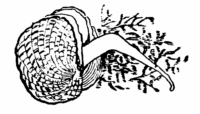
“Almost that. It is a small crustacean called the hermit crab.”
“Hermit?”
“Yes. It is called that because it shuts itself up in a shell as
a hermit does in his cell. This crab’s cell is the empty shell of a
mollusk. And do you know why it shuts itself up?”
“No. Please tell me.”
“Because the back part of its body has no hard covering. So the
crab, to protect
itself, uses the shell as a house and thus goes about safely.”
“He must be a clever little fellow to think of that! But this
flower on the top—is that a part of the crab’s body?”
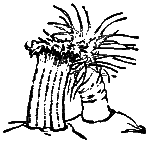
“That is not a flower; it is an animal.”
“An animal! But don’t you see that it has leaves all around?”
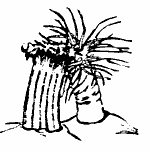
“Yes, and in fact it has the name of a flower. It is called a sea
anemone. But if you look closely you will see the little leaves, as
you called them, moving busily.”
“It is really true!”
“They are tiny arms which the anemone uses to get its food. Throw
a piece of meat near them, and you will see them gather themselves
together. In a second the meat will disappear into the body of the
animal.”
“It seems hardly possible,” said Pinocchio again and again, as he
watched the anemone closely.
“This anemone,” continued Globicephalous, “is a great friend of
the hermit crab. Whenever you find one of these crabs you will find
an anemone on its back. When the crab grows and has to move to a
larger shell, do you think, my illustrious Mr. Pinocchio, that he
abandons his tenant? Never! The anemone has no legs, so the crab
takes her very carefully in his claws and carries her to his new
home.”
“It sounds like a fairy story!” Pinocchio exclaimed,
wonderstruck.
“Still these things are real, Your Honor, and are seen here every
day.”
Pinocchio, who had liked the idea of being called “Illustrious”
was delighted to hear himself addressed as “Your Honor.”
“So this servant thinks me a great man,” he thought proudly to
himself. He strutted round as if the whole world belonged to him.
While he was walking with his head in the air and his hands in his
pockets, he struck a round, flat object with his foot. Picking it up,
he looked it over carefully.
“Does Your Honor know what that is?” the cetacean asked him
mockingly.
“Of course. It is the bellows my cook lost a few weeks ago, and
this,” he continued, picking up another object, “is the crumb brush
our maid lost last Sunday and looked all over the house for. I wonder
how they came to be here?”
Globicephalous turned a somersault, the better to hide his
laughing face.
Pinocchio, thinking that the dolphin believed all his tales,
continued his proud walk.
“Globicephalous turned a
Somersault, the better to hide his Laughing Face.”
Lying on top of a rock not far off was a transparent object of
beautiful colors. It was closely woven like a net work, and looked
like a fan.
Pinocchio, having started on the road of story-telling, did not
feel like turning back.
“Just see how careless that maid was,” he began again. “Last
summer I gave her this beautiful lace fan, and now see where I find
it! Good care she takes of my gifts!”
Globicephalous continued his somersaults.
“Look again! These are surely the plants that were stolen from my
conservatories last winter,—”
Globicephalous had had too much. He interrupted Pinocchio with:
“And this, if it weren’t so small, might be used to whip boys who
sell tinsel for gold.”
Globicephalous was holding up a small object, which really looked
like a whip.
“What do you mean?” haughtily asked Pinocchio. “Do you dare to
doubt my word?”
“I don’t doubt it. I know there is not a word of truth in anything
you have said.”
“How do you know? Isn’t it possible for me to have a palace and
servants?”
“You might have, but you haven’t.”
“Who told you so?”
“I know it without being told.”
“How?”
“Listen. Do you want to know what these two things are,—the
bellows and the brush?”
“The bellows is a horseshoe crab. If you turn it over you will see
it has ten legs like a lobster. The brush is a sea fan. The little
plants, which were stolen from your conservatories, are simply coral
polyps. All except the crab are zoöphytes.”
“Now do you see, my great Mr. Pinocchio, why I cannot very well
believe all your tales?”
Pinocchio was simply breathless. “Zoöphyte! Zoöphyte!” he
exclaimed. “What does that big word mean?”
“Oh,” replied Globicephalous, with a learned air. “That word means
an animal that looks like a plant.”
“By the way, I remember you asked Mr. Tursio for a feather to put
in your cap. Here it is.” And Globicephalous gave the marionette a
long, delicate, feathery object of a bright yellow color.
“And what is this?”
“Another beautiful zoöphyte. And to finish the trimming of your
cap you might use this five-pointed starfish.”
“What? Is this a fish, also? Surely you are mistaken!”
“Oh, no, Mr. Pinocchio, I am perfectly sure that I am not
mistaken. The starfish is just as much an animal as the coral is.”
“It was a long time before people learned that coral is made by
tiny living animals. But now everybody knows that there are hundreds
of the little coral animals living and working together on the same
branch.”
“These little animals grow and multiply very quickly. In a short
time they even make mountains under the sea.”
“You know how to tell fanciful tales better than I,
Globicephalous.”
“But my tales happen to be true ones, though they do seem
fanciful. That mountain you see there is made by coral polyps. If
you should climb to the top of it, you would find yourself on an
island.”
“Very well. I’ll try it. I might find my father.”
“Yes, or you might meet some one, and ask whether he has been
seen.”
“Ask! Do people live on islands in the middle of the sea? What are
you talking about?”
“Let me explain. After the islands are made, little by little they
are covered with earth. Then plants begin to appear from seed blown
by the wind or dropped by the birds. Then man may come. Why not, my
boy?”
“I have enough to think over just now. Good-by for a time.”
“Good-by. I will stay here. Do not lose your way.”
Without answering, Pinocchio began to climb. He was as agile as a
monkey, and was soon far up.
“I do hope I shall not lose my way,” he thought. “What a joke it
would be to be lost at the bottom of the sea!”
CHAPTER VII
Pinocchio climbed and
climbed. The poor boy was getting very tired. Still he wanted to be
sure the dolphin was right. So he went on bravely.
At last the water began to grow lighter, and even his wooden head
could understand that he must be near the surface.
“It must be the light of the sun which I see,” he thought. “On,
my brave Pinocchio, and the top will soon be reached. Hurrah! Here I
am!”
With a bound he was—yes, the dolphin was right—on the shore of a
real island.
Shaking the water out of his clothes, he looked around. Those
little beings, the corals, had certainly worked wonders.
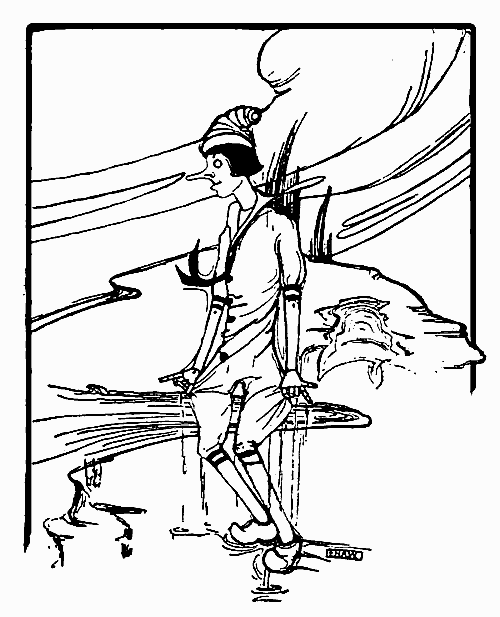
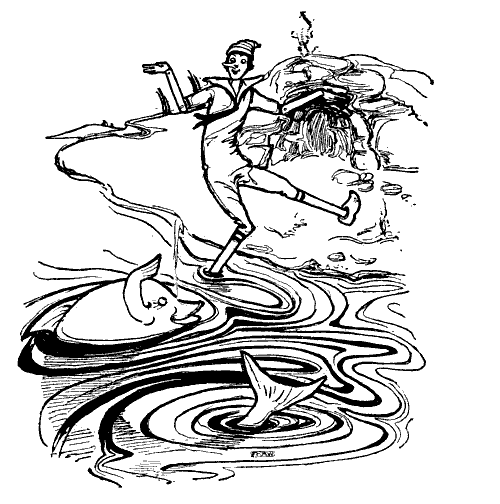
“Shaking the Water out of his Clothes, he
looked Around.”
The island was rather bare of trees and grass, but there was a
cave near the shore which soon attracted Pinocchio’s attention. He
went into it. It was not very large, but one could easily see that a
man had been there.
“People must certainly be living here. From now on I shall have to
believe Globicephalous,” thought the marionette.
When he came out, he walked around and started to explore the
island. He came to a small pond. In it lived not only frogs, but also
thousands of other tiny animals.
Pinocchio stopped to look at the water. It looked as green as
grass. He certainly would have had another shock if some one had told
him that the tiny animals that lived
in it made it green. Yet that was really the case.
These animals are not visible to the naked eye. Still they are
present in such great numbers that water sometimes looks green,
sometimes red, and at other times even black, on account of them and
their color.
This was not what interested Pinocchio most, however. He saw other
animals swimming around very quickly. Some were very tiny, very long,
and had no legs.
Others, a little larger, had two legs. Others had four legs, and
still larger ones had a short bit of a tail.
Perhaps you have guessed, children, what Pinocchio was looking at.
The small black animals were tadpoles.
When he was tired of looking at the pond, Pinocchio turned toward
the sea. He thought he might see his father, but he
was disappointed. Suddenly he gave a great shout of surprise.
And no wonder! As if by magic a fleet of tiny boats had appeared
on the surface of the water. They were no larger than an egg shell.
Nor was this all. From each little skiff rose two little rose-colored
sails, and each tiny boat put out three pairs of oars as long as
knitting needles.
“I wonder where the little boats came from,” cried Pinocchio.
“Surely this must be fairyland.”
“No, my boy, you are not in fairyland,” he heard a voice behind
him saying. “Those are simply shells.”
Turning quickly, Pinocchio saw a little fat man standing before
him, looking him over.
“Shells!” repeated the marionette, too surprised to think of
anything else to say.
“Turning quickly, Pinocchio saw a Little Fat Man
standing before Him.”
“Yes, shells.”
“And are they also animals?” Pinocchio had asked this question so
many times that it came from him unconsciously.
“Yes, they are. They are small mollusks of strange form. When they
come to the surface of the sea, they turn the opening of their shells
upwards. Then they raise their sails, put out their oars, and float
away. They are called argonauts. Aren’t they pretty?”
“How beautiful they are! But see! They are disappearing!”
“Yes, because clouds are gathering. It looks as if a storm were
coming up, and these little animals don’t like storms. So they are
taking refuge under the water.”
“By the way,” began Pinocchio, “will you please tell me whether or
not you have met a little old man looking for his son?”
“No, I have not.”
“Well, then, good-by. It is getting late, and I must meet some
friends of mine.”
But the little man did not wish him to go, so he held him by the
arm.
“Listen here, my little man, where did you come from?”
“From the sea.”
“Really?”
“Yes, I am taking a trip under the sea with three dolphin friends
of mine.”
“Under the sea! How can you live there?”
“One of the dolphins made me an antibian.”
“You mean amphibian, my boy. What a wonderful experience you must
be having.”
“Yes, but please let me go now. I must meet my friends, or they
will go without me.”
“You Won’t?”
“In a minute. But first tell me where you got that beautiful shell
you have on your head.”
“The dolphin Tursio gave it to me. He called it a long name, and
said it was very rare.”
“I know it. Will you give it to me?”
“No, I like it too much myself.”
“You won’t? Well, then, I shall have to take it,” and the man
quickly put out a hand for it.
But Pinocchio was quicker still. He gave a great jump, but oh!
poor fellow, he did not know how near the edge of the rock he was.
Before he could realize it, he fell headfirst into the water.
CHAPTER VIII
Down—down—Pinocchio
sank, straight to the bottom of the sea.
And here we must remember that we are to think of Pinocchio as a
real boy of flesh and blood. Only the shell was of wood. Otherwise he
would have floated away on the surface of the water.
When he finally touched sand he felt half dead. It was not a very
pleasant experience to fall through so much water.
After a while, feeling better, he got up and looked around.
He was in a strange place, a place he had never seen before. Of
Globicephalous there was no sign.
The poor boy was frightened almost to death. He thought a trick
had been played upon him. But if he had had his wits about him, he
would not have been so puzzled.
Poor thoughtless marionette! He did not remember how he had walked
around in his explorations. He had fallen into the sea on the eastern
side of the island, and Globicephalous was waiting for him on the
southern side. But Pinocchio’s wooden mind knew nothing of east or
south.
“Oh! poor me,” he could not help crying, “and now what shall I do?
I cannot climb this steep rock. If I remain here, I shall be eaten in
no time by some of these fish I see swimming around.”
In fact, immense tunnies were passing near him. Enormous rays,
looking like giant fans, dashed by. Over him glided horrible
uranoscopes, or stargazers.
These fish, like the halibut, have both eyes on the tops of their
heads, and so can only see above them. Luckily, Pinocchio was under
them, otherwise—
“I am afraid I am not very safe here,” observed Pinocchio, whose
knees were beginning to feel weak. “If these fish notice me, I shall
disappear. I do wish I could find dear old Globicephalous.”
Thoroughly frightened, he started to run
madly along. Of course he ran in the wrong direction.
“I wonder what this is,” he grumbled. He had stepped on something
large and hard.
He pushed the thick seaweeds aside. In their midst he found a
large turtle. For a wonder Pinocchio knew what it was.
“How fortunate you are!” sighed the marionette. “At least you have
a house. In that armor of yours you are safe from anybody.”
But such did not seem to be the case. The harmless reptile was
lying quietly in the weeds trying to sleep. But even though Pinocchio
was in such a plight as to be lost
in the sea, still the love of mischief had not left him. Taking the
poor animal by its hind legs he turned it over on its back.
The poor thing struggled and tried to right itself, but all in
vain. When a turtle is on its back, it has to stay there.
This is so well known that when fishermen catch them they turn
them over, sure of finding them in the same position even a day
later.
Seeing another shell near by, Pinocchio was about to treat it in
the same manner. But as it felt very light he examined it closely.
It was empty. The animal had probably been dead a long time, and the
shell alone was left. It was almost a yard long.
As he was looking at it, he chanced to turn his head upward.
Horrors! What did he see? An enormous animal was about to throw
itself upon him!
No one had ever told Pinocchio what this fish was. Still, even he
could easily guess its name. Its strange shape is so much like that
of a large hammer that it is unmistakable. It was the terrible hammer
that Tursio had spoken about.
“I am lost,” breathed Pinocchio, closing his eyes and throwing
himself flat amongst the seaweed.
Who could have blamed the poor boy for being frightened? He had
seen that large gray mass coming nearer and nearer with wide-open
mouth. He had
seen the large black and gold eyes at the ends of the head, gleaming
brightly with thinking of the coming feast. Poor fellow!
But just as he was imagining himself in the shark’s mouth
Pinocchio realized that the minutes were passing and that he was
still alive.
“He may have changed his mind about committing a marionetticide,”
he reflected with eyes still closed.
Time passed, and thinking that the shark had not courage enough
to attack him, Pinocchio had the courage to—open his eyes. He could
hardly believe what he saw. The shark was moving away. Still, he
could see that the fish was going because he had to, not because he
wanted to. Looking more carefully then, he saw a strange sight. Three
small fish were sticking to the sides of the hammerhead, and were
pulling
him away. Our hero had never seen such strange-looking animals as
those three fishes. They were small and narrow, and on their heads
each had a large flat object, which looked just like a dish.
If the dolphins had been there, they would have told Pinocchio
that these dark-colored fish are called remora. With the flat
disk they can attach themselves to other fish. Sometimes they let
themselves be carried. At other times, when they feel in the mood for
mischief, they pull others along wherever they wish. This is what
happened to the shark.
“Those fish certainly saved my life,” thought Pinocchio. “But I
hope the shark won’t do to them what he wanted to do to me.”
Feeling in need of a place of safety, he tried to hide himself in
a large hole in a rock.
But he had hardly put one foot in, when he felt his shoe being pulled
off by a large claw. Two eyes at the ends of two long sticks glared
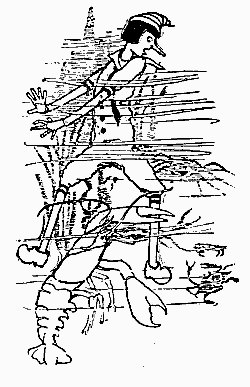
ferociously at him. It was a large lobster. Pinocchio had disturbed
Mr. Lobster while he was looking for dinner, and so had been
punished. Happily for Pinocchio the lobster was satisfied with the
shoe! If the claw had taken hold of the foot also, it might even have
gone through the wood, and then, poor Pinocchio!
In disturbing the lobster our hero must certainly have offended
its whole family. Before he could realize it, the sand before him was
full of horrible crustaceans. Frightened out of his wits, he could
just look and wonder when they would stop coming. From every hole in
the rock they came, little ones, big ones, flat ones, round ones.
And ready to fight they certainly were!
With claws in the air and eyes roving madly they approached. Very
carefully they looked the boy over. A lobster or a crab never begins
to fight unless he knows what he has to deal with.
And still they kept coming! Wherever Pinocchio turned, there was a
horrible creature. To the right the large mouth of a common lobster
threatened him. To the left an ugly spiny lobster shook his claws
at him. Behind and before him the sand was covered with them, large
green crabs, common crabs, porcelain crabs, common lobster, spider
crabs, glass crabs, tiny fiddlers, and others.
As if these were not enough, out of a hole came a crab larger than
any of the others. He was rapidly coming nearer, but before long
one of his claws was grasped by one lobster, the other by another.
Without the least movement to fight, the crab just pulled off his
claws, and quickly went back to his hole.
Pinocchio was thunderstruck. How could the crab do this so calmly?
For the simple reason that the crab preferred losing his claws to
being killed and eaten up. In a few months he would grow another
set of claws as good as those he had lost. Yes, a crab can do that,
children. Think of it!
“Oh, dear me!” thought Pinocchio, who was getting rather nervous
by this time. “What is going to become of me? If only I had a shell
as has a turtle I could hide away and be safe.”
“Oh! what a splendid idea!” he suddenly burst out. “Why didn’t I
think of it before? I shall have a shell to hide in!”
And without another word he slipped into the shell he had been
looking at. In a moment nothing could be seen of him, not even his
nose.
The crustaceans did not understand with what kind of a being they
had to deal. So after examining the shell all over, they slowly
disappeared into their holes.
With a great sigh of relief Pinocchio dared to stick his head out
of the shell. Seeing his shoe lying on the ground, he quickly put his
foot in it. It was not very pleasant to walk on the sand without a
shoe.
“If I do not hurry and find Globicephalous, this house of safety
may become a house of death,” Pinocchio began to think after lying
still a long time. “Perhaps if I try I
may be able to walk around like a hermit crab. Let me see.”
Slowly the marionette stuck out first one leg, then another; then
his arms came out, and lastly his head appeared. Holding the shell
with both hands he tried to walk around.... Impossible. After a few
steps he was exhausted.
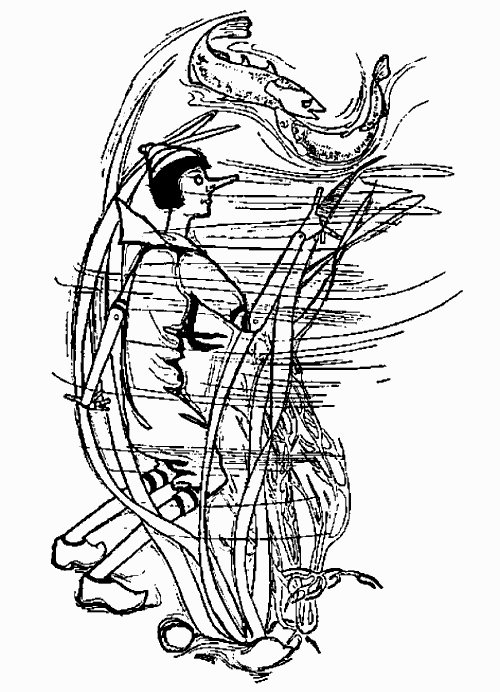
“Too bad! It is so comfortable here! If only I had a horse!
’Twould be like riding in a carriage!”
While he was thinking thus, he saw not far away four fish like the
ones he had seen under the hammerhead. An idea flashed through his
head.
“Oh, if I only could!... The horses!...” he whispered.
Trying very hard, he succeeded in dragging himself near them. The
fish were very busy. They were looking for small crabs to eat,
and paid no attention to him. Trembling in every limb, Pinocchio went
on.
As soon as he was near them, he bent over slowly. How kind the
little fish were! As soon as they felt the shell on their heads they
stuck to it. Just what Pinocchio wanted! In a moment he felt himself
rising in the air, or rather in the water. The remoras were strong
and pulled him along swiftly.
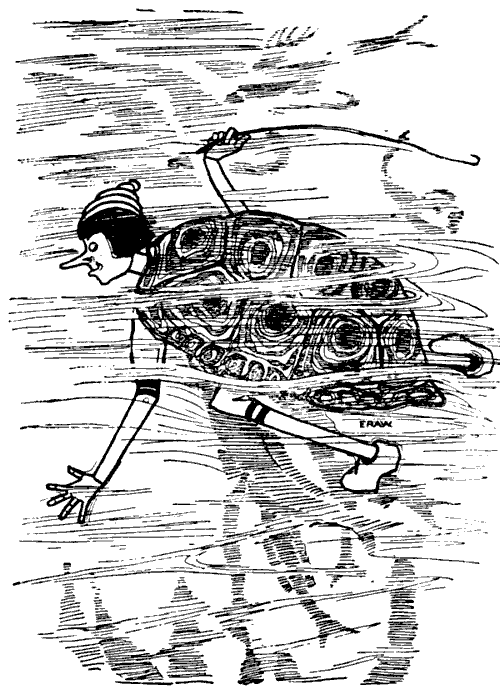
“Hurrah! Here I am in a flying machine!” screamed Pinocchio,
clapping his hands. “I feel like a prince, and not even a king has a
carriage like mine! Hurrah!”
CHAPTER IX
Pinocchio forgot all
his troubles, and was full of fun and mischief. Grasping a long thin
seaweed and using it as a whip, he went gaily along.
“Up, up, my little horses! Trot, trot,—gallop, gallop,” he sang at
the top of his voice.
The fishes obeyed him well and in a short time they had gone a
long way. Pinocchio soon became so bold that he whipped a dory which
was passing by, pulled a horrible bullhead by the tail, and slapped a
red mullet that was studying him with interest.
Meanwhile the horses ran and ran, wherever they wished. Soon
Pinocchio saw that they were near the surface of the water.
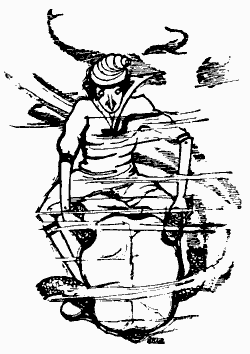
“‘Up, Up, my Little Horses!’”
“When I reach the top, I shall be able to see where I am. I will
then swim to the coral reef and find Globicephalous,” he thought.
But on the surface of the water such a surprise was awaiting him
that he forgot all about coral reefs or dolphins.
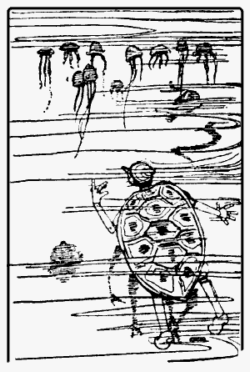
All around him mushrooms were hanging. They were of all shapes
and sizes, and of a hundred beautiful colors. Some had round heads,
which looked like soap bubbles. Some looked like inverted glass
bells; others like brightly colored umbrellas. Still others seemed to
be made of emeralds and sapphires. From all of them, long beautiful
silvery threads hung down into the water. The waves moved them
about, and the sun playing with them made them look like so many
rainbows.
Pinocchio was amazed at so much beauty.
As far as eye could reach he could see only these beautiful objects.
It was a sight to arouse wonder in any one.
“I wish some one were here to tell me what those wonderful things
are!” he thought.
What so attracted Pinocchio were medusæ. They also are animals
belonging to the zoöphytes.
These medusæ have no solid parts and cannot live out of the water.
If taken out and left in the sun they dry up and soon nothing is left
of them. Some of them are as small as a penny, and others are very
large.
“If I could only take one,” sighed Pinocchio, hanging way out of
his shell in his efforts to touch them.
His four horses, as if to satisfy him, came near to the medusæ in
order to eat a few. The marionette tried to imitate them, but
he had no sooner touched them than he let go very quickly.
“Oh, oh!” he cried, shaking his hands, “they prick like so many
nettles.”
He did not know it, but he had used the right words. In fact,
fishermen often call medusæ sea nettles.
“My dear mushroom rainbows,” he said, bowing low, “you may be very
beautiful, but you are not for me. Good-by.”
Just then the fishes reached the surface of the water. But they
did not stay there long. A fearful storm was rising. Great black
clouds hung low, almost touching the water.
The waves were white and ragged and lashed angrily. The medusæ had
disappeared. Very gladly Pinocchio cuddled in his shell, and very
happy he was when he found himself again at the bottom of the sea.
There all was calm. For, strange to say, even though the most
terrible tempest may rage on the sea, deep down in it the water is
always calm.
“How lucky it is that I did not start to swim,” thought Pinocchio.
“I should have been killed surely.”
On and on the fishes went. But finally they became tired and
stopped near a rock. Here were some of the most beautiful shells
imaginable.
After resting awhile the fish continued their journey. Pinocchio
went along happily.
For a time he seemed to have forgotten what danger he was in. He
let himself be
carried along without a thought of the future.
The party was now passing through the midst of a great number of
eels. Who does not know an eel? Even Pinocchio knew them.
He might, however, have very easily mistaken a common eel for
a conger eel, or for a burbot, sometimes called ling. It was this
ignorance of his which led him into trouble.
To him the eels were all alike. So he pulled the tail of one,
pinched another’s round body, or shook a third one by the nose. The
poor things turned and struggled. But this only afforded greater fun
for Pinocchio.
But, oh! He had no sooner touched a large red eel’s tail, than he
gave a scream of pain. His shouts of laughter were changed to moans,
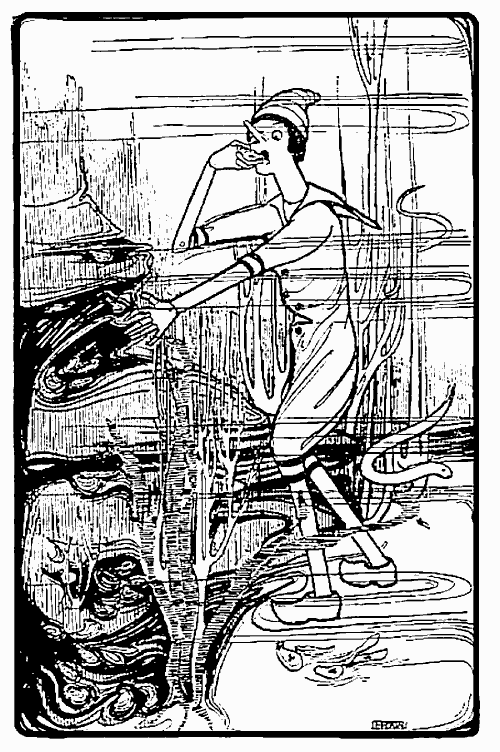
and in his struggles the marionette
fell out of the shell and tumbled on the sand.
“Help! Help! I am dying! Some one has killed me!” howled
Pinocchio, so loudly that he could have been heard a mile away.
“Who is howling so? What is happening down there?” a deep voice
called.
Pinocchio heard nothing. He could only think of his pain, and
scream. He made such a noise that even the deaf could hear him.
“Well, may I know what has happened?” called the same voice,
nearer now. “Why, it is Mr. Pinocchio!”
The words were uttered by a large dolphin with a head as round as
an electric light globe. That dolphin was Globicephalous.
“You mean I was Pinocchio. Now I am dead, so I am no longer
Pinocchio.”
“Why, what has happened to you?”
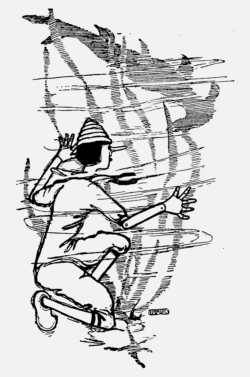
“‘Help! Help! I am Dying!’”
All Pinocchio could do was to struggle on
the sand.
“Well, will you tell me what the matter
is?”
“I can’t.... I don’t know.... I’m
dead.”
“Who has hurt you?”
“Some one has killed me.”
“Who?”
“Fire ants! Oh! Oh!” screamed Pinocchio.
But by this time the marionette was beginning to feel better. He
opened his eyes and looked at the dolphin.
Well! did you ever see a jumping jack come suddenly out of his
box when the box is opened? In just the same way did Pinocchio
jump to his feet when he recognized Tursio’s servant. His pain was
forgotten.
“Globicephalous! Oh, Globicephalous! How glad I am to see you!”
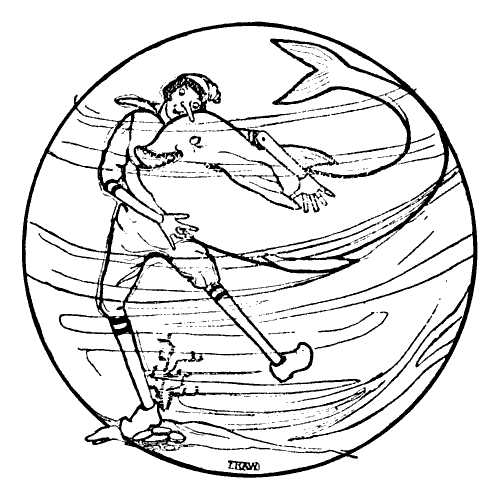
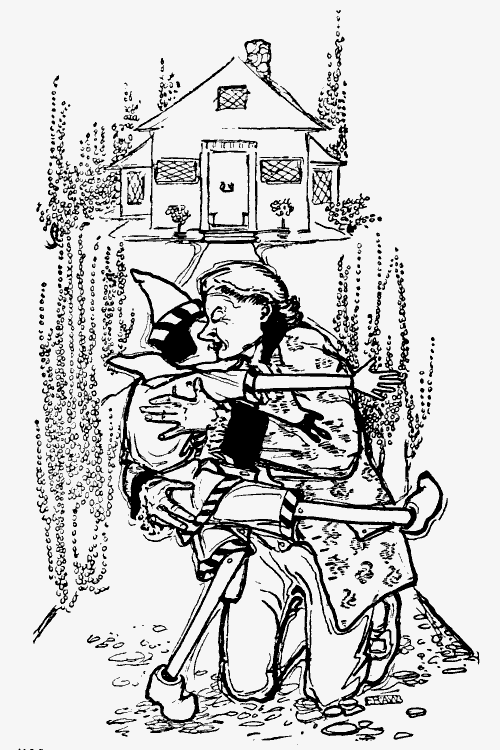
he cried, and running up to the dolphin, he hugged him wildly. Or,
at least, he tried to do so, for his wooden arms did not go very far
around the dolphin’s neck.
“What happiness it is to find you once more!” Pinocchio kept
saying. “I had
almost lost hope of ever being with you again.”
“But will you tell me what was the matter with you?”
“Oh, have I not told you? I have been killed!”
“But by whom, pray?”
“By fire ants! Will you see if you can take them off? Oh, they are
beginning again. There must be a million of them!”
“I don’t see any on you!”
“Then you must be blind! Hundreds of ants or mosquitoes must
be on me. They have heated their stingers red hot, and now they
are enjoying themselves by sticking them into me on all sides. Oh!
Oh!”
Globicephalous turned the boy around. “I see nothing!” he said
finally.
“But I feel everything! I am being bitten, cut, torn to
pieces.”
“That’s queer! How did this pain begin?”
“Why, I was playing with some eels, and just as I touched a red
one’s tail, why....”
“Oh, now I understand,” interrupted Globicephalous. “You touched
an electric eel. Still, I don’t see how an electric eel comes to be
around here. Usually they are found only in rivers. It must have been
a lost one. All you can do is just to bear it. In an hour or so it
will stop. You have had an electric shock, that’s all.”
“And that eel did it all?”
“Yes; that eel did it all, and the torpedoes can do it, too.”
“But I only touched the eel with a stick.”
“It doesn’t matter. The shock is very strong, so strong that
sometimes it may even kill a fish.”
“You are right! The shock is strong!”
“Well, you will be all right. Now jump on my tail. We must return
to the rock. Soon Mr. Tursio and Marsovino will be at the meeting
place.”
“But are we not far away from that meeting place? I looked all
over for it this morning.”
“Oh, no, we shall soon be there.”
Little by little the pain stopped, and Pinocchio thought no more
of the eel. Or if he thought of it, it was only to resolve never to
touch it again, not even with a stick.
CHAPTER X
“Good evening,
Messrs. Cetaceans,” said Pinocchio, bowing low to Tursio and
Marsovino as soon as he saw them coming.
“Why, where did you learn our family name? You called us fish once
upon a time.”
“Globicephalous told me. I know now the difference between a fish
and a cetacean.”
“You have taken lessons from a servant? Why, I thought you were
ashamed even to be seen walking with one.”
Pinocchio was silent. He was beginning to learn manners.
“Well, Pinocchio, to-morrow morning you are to come with us
to visit my friend Beluga. You may walk around a little now with
Marsovino; but after your walk you are to go to sleep. I want you up
early to-morrow.”
While the marionette was listening to Tursio he had noticed a
bright red eel lying quietly among some weeds. The mood for mischief
again seized him. He smiled to himself. Approaching Marsovino, he
pulled him gently by the fin, and said to him smilingly:
“Come with me. I want to show you something. Look in those weeds.
There is a beautiful electrical machine there.”
“An electrical machine!” Marsovino was full of interest. “Where is
it?”
“Stick your nose among the weeds and you will see it.”
The dolphin did as he was told. Pinocchio
laughed up his sleeve, and very quietly hid himself behind some
friendly rocks.
“Oh!” suddenly screamed Marsovino, leaping backward. “An
electrical machine! Why, it is an electric eel, you mean boy! That
was an unkind joke, Pinocchio.”
Yes, that mischief maker, seeing the eel
again, thought he would play a trick on the
poor dolphin.
Tursio, hearing the screams, had come
nearer.
“The electric eel! You poor boy! How
you must suffer!”
“Luckily the eel was asleep, so I had no
great shock.”
“Yes, luckily. When it is asleep, it
does not hurt much.”
“But how did you ever get near him?”
“Why, Pinocchio—” and then he
stopped. Why should he tell? But he
was too late.
“Oh, that Pinocchio. Well, remember,
marionette, usually one gets paid in his own
coin. Now you look tired. Stop stretching
yourself and go to sleep.”
“Very well, Mr. Tursio,” came meekly
from Pinocchio. “But may I ask a favor
of you?”
“What is it?”
“Seeing that we are near the island, may
I sleep there to-night? I found a small
cave there this morning, and it looked comfortable.
May I, Mr. Tursio?”
“Why, surely, my boy.”
“Thank you. But will you please sleep
near? I should feel better if I knew you
were near.”
“Very well, my lion tamer.”
Globicephalous then took Pinocchio on
his back and rose with him to the surface.
“I wonder what those two dolphins are
talking about,” he thought, seeing Tursio
and Marsovino whispering together.
Tursio seemed little pleased. Marsovino
was begging for something. Finally the
good old dolphin smiled an unwilling “yes”
to his pupil.
“It may teach him a lesson,” Pinocchio
heard Tursio say, and he wondered at the
words. Soon he forgot all about them.
“Good-night,” he called, jumping on land
and disappearing into the cave.
He gathered some seaweed and made a
soft bed.
“This is very good,” he said, lying down.
But soon he found out that he could not
sleep.
He could not understand why. He was
so tired, after two nights of sleeplessness, but
still his eyes would not close. Everything
around him was so quiet that he began to be
frightened. He got up and looked out on
the sea. It was as black as ink, oh! pitch-black.
“How horrible the sea is at night,”
grumbled the marionette.
“‘Good-night,’” he called.
No sooner were the words out of his mouth
than he wished them in again. As if the
waves had taken offense at his remark, they
were suddenly turned into fire. It seemed
as if millions of stars had fallen into the sea.
Pinocchio ran out of the cave. As far as
eye could reach there was nothing but this
fiery sea. The bright, shiny water rose and
fell in silvery waves. Millions of sparks were
thrown up into the air and fell back again.
“Oh! the sea is on fire,” shouted Pinocchio,
and that O-o-o-o-h was the longest
that had as yet come from his mouth. “And
then Mr. Tursio tells me he is not a wizard.”
He could hardly be blamed, poor ignorant
little marionette. That scene certainly belonged
more to fairyland than to real life.
It was the phosphorescence of the sea
that attracted Pinocchio’s attention. Sometimes
this is so wonderfully beautiful that
seen once, it can never be forgotten.
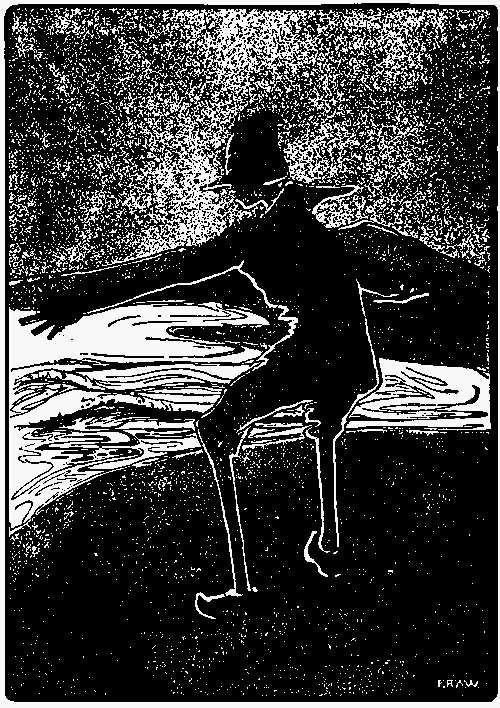
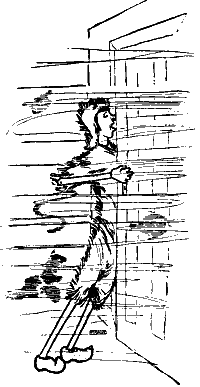
“‘Oh! the Sea is on Fire.’”
Our wooden hero was so awe-struck at first that he could only
stand and gaze at it. Finally he gathered courage, and went nearer
and nearer the water. And when a wave touched his feet, he jumped
back for fear of being burned. But he found the water was just as
cool as before.
“Why, this fire does not burn! How queer! What can it be?”
In his ignorance he could not answer, but I shall answer for
him.
The phosphorescence of the sea is produced by millions of very
tiny zoöphytes, so small that they cannot be seen with the naked
eye. These minute zoöphytes have a sheen like fireflies. When they
light up all together, they make the ocean look like a sea of molten
gold.
While Pinocchio was still gazing, the fire went out just as
quickly as it had come. The night was again as dark as ink. This
was not much to the marionette’s taste, so he started back to his
cave. Glancing toward the sea again, it seemed to him that the
dolphins were not in the same place.
“I hope I’ll be able to sleep now,” he thought. “I am so
tired.”
But he had hardly reached the mouth of the cave when, with a
shriek, he turned and fled. Why?
An awful, a horrible monster was hanging at the mouth of the
cave. It was more than a yard long, and with a mouth like an oven.
On its head were two long horns; and its body was shining in the
night, frightful in its shape and color. Can you imagine Pinocchio’s
fright?
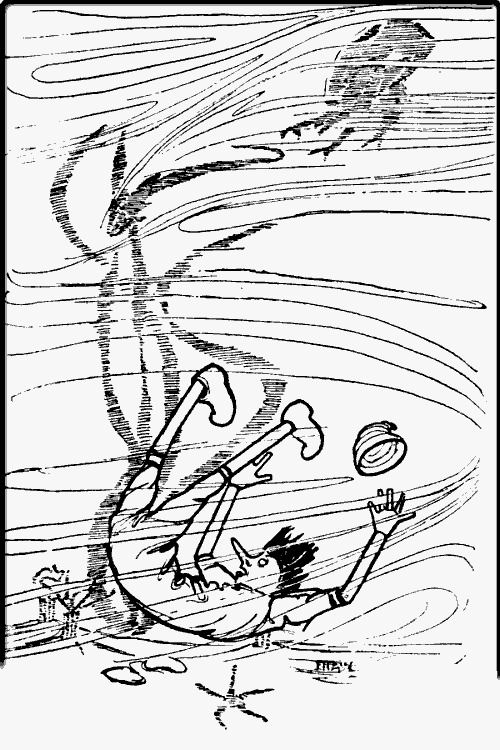
“A dragon!” he shrieked. “A dragon in my cave! Help! Help!”
Running madly toward the sea, he never stopped until he reached
the dolphins.
“‘A Dragon!’ he shrieked.”
“Globicephalous, for pity’s sake! Tursio! Marsovino! Help! Wake
up! A demon is in my cave! Yes, come and see—his mouth wide open,
ready to eat me up. If only you could see the size of his horns!”
But when the dolphins awoke and realized what was happening, they
only laughed and laughed. Pinocchio could not understand. He looked
from one to the other. Finally he said, “Well, I don’t see anything
so funny. What is it?”
“Look at the brave boy! Look! Look!” called Marsovino, bursting
with laughter.
“I thought you threw stones into a lion’s mouth,” shouted
Globicephalous, making fun of the poor fellow.
“Lions are one thing, demons another,” explained Pinocchio, almost
crying with shame.
“But what demons are you talking about, anyway?” asked Tursio.
“Come, and you will see.”
When they reached the cave, there was the dragon still hanging.
His eyes were still glaring, his mouth still wide, his body still
shining in the night.
“B-r-r-r-!” came from our shivering hero.
“Look at it well, you foolish boy. What do you think of it? A
demon? Where are
its eyes? Doesn’t it look more like a mere fish?”
“Yes, well?” asked Pinocchio, who didn’t know what to think.
“Well, it is a fish. Sometimes it is called fishing frog,
sometimes goosefish, and sometimes sea devil from its horrible
looks.”
“Marsovino has just paid you back for
your joke. He took the dry skin of this fish, filled it with water,
and inside of it put two sunfishes. When you thought he was asleep,
he was hanging it up. It has given you a chance to show us how brave
you are.”
Pinocchio felt very small. Slowly he approached the monster and
looked it over. How foolish he had been!
“What a horrible mouth you have, my fish,” he said. “And what is
this horn doing at the top of your head?”
“That helps him to get his dinner,” explained Tursio. “Other fish
are caught on the horns, and the frog has nothing to do but eat
them.”
“Well, I was frightened,” admitted the marionette,
soberly.
“We have lost enough sleep by this time. To bed, all of you,”
ordered Tursio.
This time Pinocchio did not have to wait long for sleep to come.
He was soon dreaming about sharks, flying machines, sea devils, and
electric eels.
CHAPTER XI
“Pinocchio,
Pinocchio, make haste! make haste!” called Marsovino the next
morning.
“Very well,” sleepily came the answer. “But why must I get up so
early?”
“Do you call ten o’clock early, you lazy boy?”
“Ten o’clock!” Pinocchio could hardly believe his ears.
“Yes, and in one hour we must be with the white whale. He is
expecting us for dinner. So make haste, as we have no time to
lose.”
Pinocchio, hearing about dinner, was ready in no time. He was soon
on Tursio’s back,
waiting for the dolphin to start. Before long they were on their
way.
After a short trip around the island they came to a beautiful
little nook in the rocks. Here lived Beluga, the white whale.
Dinner was ready, and all sat down around the table. And what do
you think the table was? An immense flounder! Yes, don’t laugh; it is
true.
The flounder is of the same family as the sole. All these fish
have a thin flat body.
As they have to lie on the mud most of the time, they can only
look upwards. So they have both eyes on the upper side of the
head.
On Beluga’s table were all kinds of fish:
large ones, small ones, flat ones, and round ones.
Pinocchio ate of everything. When he had finished, nothing was
left on his plate but a couple of eyes and a few tails. Afterward,
noticing that his plate was also a fish, he thought it would be
a good idea to eat that too. He had eaten so much, though, that
he couldn’t; so he put it into his pocket. “It will do for my
breakfast,” he thought.
Poor Tursio was much ashamed of the marionette, and Marsovino was
not less so. If they had only known that Pinocchio was so rude as to
take things from the table and put them into his pocket, they would
never have invited him to dinner. Still they did not say a word.
“Run along, now, children. Mr. Beluga and I must talk about
business, and we cannot have you around.”
“‘It will do for my Breakfast,’ he thought.”
The two boys left the dolphins together and went off. While
enjoying themselves looking around, Marsovino picked up something
which looked like a chain. It was made of small round balls all
alike, and transparent. He handed it to Pinocchio.
“Tell me,” he said, “do you know what this is?”
“Why, yes, it is a bead chain. It is easy enough to know that.”
“Are you sure?”
“Yes, of course. I have seen them many times around little girls’
necks.”
“And if I told you that they are eggs—”
“Eggs?” murmured Pinocchio. “Eggs? This thing?”
“Yes, sir, that is what they really are; the eggs of a halibut. It
is a bad habit, Pinocchio, to make believe you know a thing when you
do not. I am afraid I am not going to be your friend.”
“Not my friend?” came from the poor shamefaced marionette.
“No. Mr. Tursio has always told me to keep away from boys who—”
“Tell lies, I suppose you want to say,” finished Pinocchio.
“I was told to go with boys who are polite,” continued
Marsovino.
“And instead I even take the plates away with me when I am invited
to dinner,” said Pinocchio.
“I was told to make friends with educated children.”
“And I—yes, I might as well confess it—I have hardly ever seen the
inside of a classroom in my life. Well, Marsovino, I will try to make
myself your friend. Will you try me again?”
“Very well, I will. Now let us return.”
The dolphins were still talking busily when the boys came up to
them. They seemed very much in earnest.
“Here we are, father,” called Marsovino.
“At last! Where have you been? We have important things to say to
you. Come here, both of you!”
“What is it? We are all ears.”
“My friend Beluga has been telling me that while I have been away
from home I have lost much money. He has told me of a great treasure
that is to be found in an old ship far away from here. As I need it
very much just now, I do wish I could get hold of it.”
“Well,” answered Marsovino, “why can’t we go for it?”
“Because it is miles and miles away. Not only that, but we should
have to travel as far up as the polar seas, and into the great
oceans. We could never do it. You see, I am getting old. I could
hardly attempt to cross those icy waters. Still, I need the money so
much that I am afraid I shall have to try the journey.”
“Why couldn’t Globicephalous and I go instead of you, father?”
asked Marsovino.
“And I also,” timidly added Pinocchio.
“Globicephalous is too old. And as for you two, my dear boys, you
do not know what you are saying. Do you know that for months and
months the polar seas are in
darkness? That the sun is seen only in the spring and summer?”
“I know, but it is now winter, and we should reach those seas just
at the right time. We should be back before the fall.”
“And are you not afraid of the cold?”
“It will not be cold. I will swim deep in the water, and there the
water will be warm. I will come to the surface only long enough to
breathe.”
“What about the ice? What about those monsters of the seas, the
whales, the sharks, the narwhals?”
“You need the treasure. I have made up my mind to go,” answered
Marsovino, firmly.
“You might escape all the dangers I mention, my boy, and reach the
ship. But how could you ever get hold of the gold inside?”
“I might tear a hole in the ship with my strong tail,” began
Marsovino.
“A ship a block long, and all made of iron? It is of no use, my
boy.”
The young dolphin was silent. How could he get into the ship? He
thought and thought, but he could find no answer.
“May I go, too?” here began Pinocchio.
“You?” asked Tursio and Marsovino, at the same time.
“Yes, I. Why not? If Marsovino cannot get into the ship because
he is too big, I am so small I can get into any hole,” continued the
marionette.
“That isn’t a bad idea, is it, father?”
“No, but do you really feel courageous enough, you two, to
undertake such a journey?”
“We’ll do our best,” answered Marsovino.
“Well, then, all right. Let us return to Globicephalous, and then
you will get ready to start. Beluga, I will be with you again soon.
I might as well wait here with you for Marsovino and Pinocchio to
return.”
After saying good-by to Beluga the young dolphin followed Tursio,
who seemed in haste to get to Globicephalous.
Sitting on the dolphin’s back, Pinocchio was thinking how good he
had been in offering to go with Marsovino. But he soon forgot this in
another surprise. In front of him, not far away, he saw a number of
animals rise out of the sea.
They rose, shook their colored wings gaily, and then fell back
again into the water. No sooner had they disappeared than others
came, and then again others. How beautiful they were! Red, blue, and
green, and shining brightly in the sun.
“Birds in the sea! Oh, they will drown!” screamed Pinocchio.
“Oh, no, these birds will not drown. They live in the sea, my boy.
They are called flying fish,” explained Tursio.
“When shall I stop hearing news?” wondered Pinocchio. “So there
are also birds in the sea!”
“Almost birds, but not quite. These fish have very strong fins and
with them they can leap very high. As you see, they even leap out of
the water. Why do they do this, do you think? Because they want
to escape from the large fish, which follow them to eat them.”
Pinocchio had nothing to say. Meanwhile, the three friends had
reached the place where Globicephalous was waiting. Tursio told him
in a few words what Marsovino and Pinocchio had planned to do to help
him.
Very soon the two boys were ready to start.
“Well, good-by, boys,” said Tursio, after telling them how to
reach the ship. “I will no longer try to stop you from going. Only be
careful. Keep to yourselves, and you will meet with little trouble.
Do not stop on your way. Hasten back, or I shall be worried. Above
all, never get out of the water. The tide might go out, and you,
Marsovino, would be in great danger.”
Marsovino and Pinocchio listened carefully;
and then, with a cheerful good-by, they were off.
A few hours later Tursio and Globicephalous were with Beluga, and
Marsovino and Pinocchio were speeding away towards the great oceans,
treasure hunting.
CHAPTER XII
Marsovino and
Pinocchio traveled swiftly. They passed a strait, crossed a canal,
left beautiful lands behind them, and at last came out fearlessly
into the great ocean. They never stopped.
When the moon shone they traveled on the surface of the water.
If the sky was dark and gloomy, the dolphin plunged deep into the
sea. There the two friends had plenty of light. Great medusæ and
sun fishes made the water light and bright. Very often, too, the
wonderful phosphorescence of the sea aided them in seeing their way.
Pinocchio felt satisfied when Marsovino explained the cause of this
phosphorescence to him. At first, though, he could hardly believe his
ears.
“When the Moon shone they traveled on the
Surface of the Water.”
The journey was very peaceful, and nothing came to trouble the two
little heroes.
“What is that dark blue streak there, Marsovino?” asked Pinocchio,
one day. He was pointing out a wide band of dark blue water, which
stood out distinctly from the lighter green of the ocean.
“That? Oh, that is the Gulf Stream,” answered Marsovino.
“The Gulf Stream? What are you talking about? A stream running in
the ocean! Water running in water!”
“Yes, of course it is all water. But there is a difference between
ocean water and Gulf Stream water. The first, in general, is quiet,
the second is moving. That stream is just like a river flowing
between two
valleys. The waters of the two never mix. If you try, you will find
that the ocean is much the colder of the two.”
“But what is the use of it?”
“Why, it is of great use. This stream carries warmth to the cold
regions of the north. It cools the hot countries of the tropics.
Without this saving current, life would not be pleasant in many
countries.”
“Hurrah for the river in the middle of the sea, then!” shouted
Pinocchio. He had understood little, so he thought it better not to
speak further on the subject.
Towards noon of the same day the sea began to be filled with
herrings. They were on all sides. Our two travelers were surrounded.
Pinocchio enjoyed being with the silvery animals.
Soon, however, there were so many that Marsovino found it hard to
move. Still,
the kind little fellow, seeing that Pinocchio was enjoying himself,
did not try to get away. After a while, however, the herrings became
so numerous that the ocean looked like a sea of silver, not of water.
Pinocchio and the dolphin were being pushed and shoved around without
mercy.
“I am being killed, stifled,” whispered Pinocchio. Yes, he
whispered. If he had opened his mouth a herring could easily
have slipped into it. This might not have been very pleasant.
Marsovino finally saw that the herring had become as thick as a
stone wall. So with a few strong strokes of his tail,
he made his way to the surface of the water.
“Ah! now I can breathe!” exclaimed Pinocchio. “In that fishy world
I thought I should die.”
As night had come, and as it was very dark, our friends began to
think of sleep. Anyway, even if they had tried to move, they could
hardly have passed through that multitude.
Just as the sun rose, Pinocchio opened his eyes. He had had a very
good sleep on the back of his swimming horse. Looking around, he
could not help crying out in surprise.
“Marsovino! Wake up!” he called. “Just look! Yesterday we were
swimming in a sea of silver. To-day we are floating in milk.”
It was really the truth. No sign of herrings
was left. But as far as eye could reach one could see only a thick
heavy liquid as white as milk.
“Oh, how splendid!” cried Pinocchio. “Now I can have as much milk
as I want. It looks good.”
Marsovino had awakened, but he never said a word. He wanted to
see what Pinocchio would do. The marionette, thinking himself right,
bent over and took a long drink of milk, as he thought. But he had no
sooner had a taste than he made a wry face.
“Why, it is salty.”
“Of course it is. Is this the first time you have heard of the sea
being salt?”
“But this is not water. Look how white it is. It looks like
milk.”
“Do you know why it is so? The water looks white because of the
eggs left in it by the herrings of yesterday.”
“Eggs? But there must be thousands of them?”
“Yes, and millions.”
“But the sea will soon be full of herrings, then.”
“No fear of that, Pinocchio. Think of the many large fish that are
in the sea. They live on these eggs and on small fishes. Why, they
can and they do swallow hundreds of eggs at a time. The sea is big
enough to hold all its fish and more. You don’t think we are crowded,
do you?”
“Last night we certainly were.”
“One night is not every night. You see, herrings travel in great
numbers, and we happened to meet a school of them.”
“Oh, they go to school, do they? Well, I never before thought a
fish had to go to school, too!” mumbled Pinocchio to himself.
After traveling a long time through the milky sea, the two
travelers at last came out of it.
Soon after a long, sharp, flat blade rose suddenly out of the
water. It looked like a sword, and Pinocchio, of course, thought it
was one.
“What have we here?” he asked. “A soldier battling in the sea? And
is that thing his sword?”
“You can hardly be blamed for thinking it a sword. It looks very
much like one,” said Marsovino. “It is the long upper jaw of a
fish, and from this it receives its name, swordfish. With this
weapon, as it is very strong, the fish can defend himself against
much larger animals. I hope he won’t come near us.”
Luckily for the two friends, he did not. The sword disappeared
into the sea, and the travelers continued their journey.
“I must dive now, to see where we are,” said Marsovino; and soon
Pinocchio found himself at the bottom of the sea. Curious as ever,
the marionette looked around, peering here and peering there.
Seeing some cuplike objects hanging on the rocks, he put out his
hands for them. They looked very soft and were full of holes. But as
soon as Pinocchio touched them, the holes disappeared,
and the cups clung tightly to the rocks.
“Oh, excuse me,” begged Pinocchio, “I thought you were
sponges.”
“And what are they, if not that?” laughingly asked Marsovino.
“But they move just as if they were alive!”
“And is not the sponge an animal?”
“Really? Do you mean it?”
“Why, yes. The sponge is not only one animal, but a number of
animals living together. And what do you think hides in that cuplike
sponge you see there, to live a quiet happy life in it?”
“What?”
“The pearl oyster.”
“Honestly? Oh! Do you think I could get some? I know how precious
pearls are. Why, I could make myself rich! I
could buy houses and horses and automobiles and—Oh! Oh!” and
Pinocchio started to dance a jig on the sandy floor.
Marsovino was laughing.
“You may try. You may have luck.”
Pinocchio did not have to be told twice.
He searched and searched every sponge he
could lay his hands on. As a result, he found
a great many shells.
“And what now?” he asked.
“Now you must open them, to see if any pearls are inside.”
“What is the use of opening them? You said these were all pearl
oysters. I’ll carry them and open them later.”
“But many of them may have no
pearls at all. You see,” continued Marsovino, opening a shell, “this
one has none. But do you see this coating of many colors on the
inside of the shell? That is a substance which comes from the body
of the mollusk. It is called mother of pearl. When the oyster opens
its shell, a grain of sand may get into it. The oyster does not like
this, as the stone hurts her, but she can’t throw it out. So she
covers it up with this substance from her body. When the little stone
is all covered up, we have a lovely pearl.”
“Who would ever have thought such a thing possible!” thought
Pinocchio, getting to work. He soon had a large number of oysters;
but when he opened them he found only a few small balls.
“Come here, Pinocchio. You may have better luck in this corner,”
and Marsovino led the way to a nook in the rocks. “Look in there.”
Again Pinocchio searched, and soon a great many shells lay at his
feet ready to be opened. Without mercy, he went at them, tearing
and pulling the poor little creatures from their homes. His search
finished, he threw them aside. The sand was soon covered with the
dead and the dying.
“Poor little beings!” observed Marsovino. “After they have given
you their pearls, is that the way to treat them? Could you not be
more careful?”
Pinocchio had a kind soul. He was only thoughtless. So he went to
work and tried to undo the wrong he had done. Those oysters which
were only slightly hurt he
put back into their shells; while he ate the others, and so ended
their sufferings.
This work finished, he went on with his search for pearls. In a
short time he had a small pile of beautiful pearls. Some were large,
some small, some globular, and others shaped like drops of water.
In color, too, they were different. Almost all were white, some
faintly pink, a few grayish, and one was all black.
“Well, Pinocchio, you have enough. With them you will be as rich
as the king of China. Come now. We must go on with our journey.”
“But these pearls, where shall I put them? I wish I had a bag or a
box.”
“It will not be so hard to find that. Let’s look around.”
The dolphin swam around. He did not stay away long. Soon he came
back, holding
a small object out to Pinocchio. It was a little cubical body, and
seemed like a strange-looking box.
“Here is the box, my friend,” he called.
“Well, what is this?” asked Pinocchio, looking at the object. It
was hard and dark, and reminded him of the shell which had saved his
life.
“That was a fish.”
“A fish? That box?”
“Exactly. This is only its shell, but once a fish lived in it. It
is called the sea urchin. That box you have there helps him to defend
himself. Do you notice how hard it is?”
“Well, the sea is certainly a wonderful place. Once upon a time
I hated it. Now I should like to be a fish, so as to live in it
always.”
CHAPTER XIII
The journey was
progressing rapidly. Blue skies and green countries had disappeared.
Gone were the many-colored fish. Sea and sky were of a dark gray
color. Why all this? Because our two friends had reached the cold
north, where for so many months no sun shines.
Luckily, though, spring had begun. The sun showed itself for a
while every day. And every day it showed itself a little longer. In
the summer it would be there even at midnight.
The cold was very great. Pinocchio had a fur suit which Tursio had
given him, but
still he was almost freezing. Marsovino also suffered.
“It will be better for us if we dive deep into the sea,” he
observed. “We shall find it warmer there.”
“Please wait awhile,” begged Pinocchio. “I want to see that island
first,” and with his hand Pinocchio pointed to a high mountain still
far away. It was as white as snow, and seemed almost to touch the
sky.
“Oh, you want to see that island,” repeated Marsovino, chuckling
to himself. “Very well.”
“Yes, it does look queer, doesn’t it? I wonder if there are people
on it?”
“Perhaps. We shall see.”
It seemed as if the island had heard Pinocchio speak. Strange to
say, it was coming to meet the dolphin and his friend. And with it
were two others.
“Look! look!” shouted Pinocchio. “The islands at the pole walk!
This is fun!”
“Yes, they are taking a walk, as you see,” answered Marsovino, who
was enjoying himself, too. “But if they come nearer, our journey will
end right here.”
He had not finished speaking when a terrific noise was heard. The
sound was deafening. Pinocchio found himself thrown from his horse
into the water.
When he opened his eyes—he always closed them when he was
frightened—no islands were to be seen.
“Marsovino! Marsovino! Help! Help!” he cried, fearing he had lost
his friend.
“Here I am! Come!”
Swiftly the marionette swam to the dolphin, and again climbed on
his back.
“Will you please tell me what happened to those islands? Or are
we in fairyland? I never knew lands could disappear in a minute like
that!”
“Those were not islands, my dear Pinocchio. They were icebergs.
These great mountains of ice, when they come against each other, are
broken into bits. See, all that is left of them are pieces of ice;”
and Marsovino pointed to ice which was floating on the sea.
The next day Pinocchio had another
surprise. In front of him, as far as he could see, was a city of ice.
Everything was flat, everything was white.
Immense landscapes, snowy white, met his eye wherever he
turned.
Mountains of ice could be seen in the distance. And, wonderful to
see, the ice was so clear and transparent that it looked like glass.
When the sun shone on it, it sparkled and showed all the colors of
the rainbow.
Pinocchio thought himself in fairyland. But as he was looking, a
strong wind rose suddenly; and then the icebergs fell and broke with
deafening noise.
Finally, Marsovino thought it best to swim far under water.
He was afraid of losing his life in the midst of all those
icebergs.
Two days later the two boys rounded the southern point of
Greenland. On the sandy shore of this island continent could be seen
a large number of animals. They had round clumsy bodies, each having
a small head with two small bright eyes. Where we have arms, they had
what looked like very strong fins.
These animals were seals. Their bodies were covered with
reddish-brown fur. Lying on the sand, they were enjoying the warmth
of the sun. The young ones were playing with one another and enjoying
themselves, too.
Pinocchio paid little attention to them. But suddenly out of the
water came another band. The newcomers were somewhat different from
the seals, but they belonged to the same family.
Their fur was almost black, not brown, and their heads were
larger. They were walruses. From their mouths two long, thick ivory
teeth protruded. They looked very fierce, and soon they showed their
fierceness.
Seeing that the beach was occupied, and wanting it for themselves,
they started to fight for it. The seals fought very bravely, but what
could they do against those terrible teeth? The poor wounded beasts
struggled and kept up cries of “pa—pa—pa—pa.”
“Listen to that. They are calling ‘papa.’ I never thought fish
could talk,” said Pinocchio.
“First of all, seals are not fish, but mammals. And then there are
some fish which do produce sounds. Tunnies, when out of the water,
cry like children. Some poulpes,
when caught, groan. Others make a sound like a whistle.”
“I am ready to believe anything,” Pinocchio said very weakly. “But
what is a poulpe?”
“Oh, that is another name for the octopus or devilfish,” was the
reply.
The fight continued, but the seals were soon conquered. The
victorious walruses were not to enjoy their victory, however.
While the fight was still waging, some fishermen had quietly come
up to the field of battle. Before long many of the combatants lay
dead, and were carried away into boats. The few that were left forgot
the fight, and were happy enough to escape into the water.
CHAPTER XIV
The boys traveled
two weeks longer, and at last Marsovino thought himself near his
destination. So he dived into the water to a great depth.
After a while, as he sank deeper and deeper into the sea,
Pinocchio became frightened. They were down so far that no light from
the sun could reach them.
“Where are you carrying me to, my dear?” he asked. “If we go any
farther, we cannot possibly live. How could we, with this immense
amount of water over us?”
“We’ll be all right, my boy, never fear. If little fish like that
can live here, why, so can we.”
Marsovino was pointing to many horrible dark objects which were
swimming around him. They had a round head, great black bodies, no
eyes, and from their heads a long thread moved about in the water. At
the end of the threads were small lights.
“What ugly things!” said Pinocchio. “What are they, and why do
they have those small lights on their heads?”
“If you look closely, you will see that those little beings have
no eyes. So they depend on these lights for their food. Other animals
are drawn to the lights. When they are near enough these animals feel
them. Then they are seized and eaten.”
“The sea is wonderful,” nodded Pinocchio, drowsily, “but don’t you
think that we might take some sleep? I am very tired.”
“Very well,” said Marsovino.
Pinocchio threw himself on the sand, and in a few minutes both
friends were asleep.
The next morning, bright and early, they were again ready to
start. The dolphin, who knew now where he was, began to rise to the
surface. A few hours later he had reached the place Tursio had spoken
about.
“Here we are at last!” he cried.
“Here? Why, where is the ship?”
“There,” answered Marsovino, pointing to a great black mass which
showed through the water.
“That! Why look how it is trimmed!” And he was indeed right. The
inhabitants of the sea had taken possession of
everything. The keel of the ship was overgrown with beautiful slender
seaweeds. The decks were covered with sponges. The stairs had
disappeared under the work of polyps.
On the lookout bridge hundreds of anemones raised their brightly
colored corollas. The needles of sea urchins threatened passers-by
from the portholes. Silvery fishes and starfishes were seen all over.
Everything was living on the dead ship.
“Now let us hasten,” said Marsovino.
“Very well,” answered Pinocchio.
“We have been so long in coming that now we must be quick,”
continued the dolphin.
“Father must be worried. Let us look for the treasure, and then we
can begin our return journey to-night.”
“Very well,” again assented Pinocchio.
“Make haste, then. Get into that ship. Don’t lose any more
time.”
“Come, let us go.”
“Let us go! How can I go? Don’t you see how small the doors are?
You must go alone!”
Pinocchio did not like the idea. He stood still and thought. His
courage utterly failed him. To go alone into that great black ship!
Why, how could he do such a thing?
“Well, what are you thinking of?” asked Marsovino, who had dropped
Pinocchio at the door of the stairs.
“I haven’t made up my mind yet. I don’t like the idea of going in
there very much.”
“But you must. I can’t go, and we must have the gold. Will you
decide? I thought you had offered to help Mr. Tursio.”
When he heard that, Pinocchio finally made up his mind. He opened
the door
and went down a few steps. Then he stopped.
“Must I really go?” he asked.
Marsovino began to lose his patience.
“If you do not make haste getting into that ship, I shall return
without you,” he could not help saying.
“Very well. Here I go.”
“You remember Tursio’s instructions, don’t you? At the bottom of
the stairs there is a large room. At one end a door leads into the
captain’s room. In a corner of the captain’s room, you will find two
boxes. They contain the treasure. Good-by and good luck.”
Very slowly Pinocchio went down. Luckily for him a few sunfishes
were floating around, giving some light.
When he reached the bottom of the stairs, he saw in front of him a
large square room.
In the walls were long narrow holes, like the shelves of a pantry.
These had probably been the sailors’ bunks. But to Pinocchio they
were puzzles.
The roof, which was very high, was of glass. This made the room
lighter than the stairs, and so Pinocchio took courage.
At one end of the room there was a small narrow door. Pinocchio
walked to it and tried to open it. Still, though the door was not
locked, it would not open. It seemed as if some one were holding
it closed from the inside. The marionette pushed it, kicked it,
struggled with it, and finally he succeeded in opening it. He was
able to put just the tip of his nose in the crack.
He had no sooner done this, though, than it was held as in a vise.
Pinocchio felt something pulling and pulling.
“My nose will surely come off,” he thought;
but after trying and trying he was at last free again.
“I wonder what that was? What can be behind that door? In any case
it may be better to have some weapon of defense,” and thinking this,
Pinocchio looked around.
“Those shelves may hold something useful.”
But when he came near them, what did he see? A mattress, pillows,
sheets!
“What could this have been? A hospital?”
Poor Pinocchio! He was most certainly a dunce!
On the floor in a corner he found a pair of large boots.
“These will do,” he thought.
Again he pushed the door. This time he was able to open it wide.
As soon as he had done so, he threw a large boot in blindly. Had he
never done so, it would have been better! In a second the room became
as black as pitch.
“Marsovino! Oh! Oh! Oh! Marsovino!” screamed the poor boy,
thinking himself blinded.
The dolphin, waiting for Pinocchio at the head of the stairs,
became frightened at this appeal. He thought something serious had
happened. He swam to the top of the deck and broke several panes of
glass. Looking into the room he
called: “What is the matter? I am here.”
Pinocchio felt a little better when he saw Marsovino.
“Oh, Marsovino!” he cried.
“What has happened, my poor Pinocchio?”
“I have found a bottle of ink.”
“A bottle of what?”
“Of ink. I threw a boot at something, and now the room is full of
ink.”
“Oh, now I understand. You have to deal with an octopus.”
“What’s that?”
“A mollusk.”
“Oh, if that’s what it is, I’m not afraid. I know them well.”
“‘Marsovino! Oh! Oh! Oh!’”
“Yes, but not this one. This is the greatest mollusk known. It is
a near relation of the calamary, but much larger. There are some
even five or six yards long.”
“Oh!” shivered Pinocchio, looking around.
“The one in the captain’s room must be a small one, though. If
I were with you, I should free you in a second. There is nothing a
dolphin likes better than an octopus or a calamary.”
“But the ink?”
“The ink is the means of defense of these mollusks. When pursued
or in danger, this animal ejects this inky liquid. In that way, it
forms a cloud in the water and is able to escape.”
“Shall I be killed?”
“If you keep out of reach of its long arms, you will be all
right.”
“Oh, now I see what got hold of my poor nose. It is aching yet.
Now tell me, Marsovino, if this animal is guarding the treasure,
how shall I possibly get at it? We might as well give it up,” and
Pinocchio started towards the stairs.
“How very courageous you are! After trying so hard, are you going
to give up at the last minute?”
Pinocchio did not answer, but very slowly he retraced his steps.
Going over to the bunks, he took a large mattress. Holding it in
front of him, he moved toward the door, which was still ajar.
The water from the captain’s room had mixed with the water of the
large room, and now it was not so dark. Very cautiously,
the marionette peeked over the mattress.
In a corner of the room lay the poulpe or octopus. As Marsovino
had said, it was not very large. Still it was very ugly.
Think of a large head, soft and jellylike, with two great eyes
staring at you. Think of that head and eight long thick arms around
it. No wonder Pinocchio felt like turning back.
The monster moved restlessly about, stretching and twisting its
arms. In one of them it held Pinocchio’s boot. Every minute its huge
body changed color. At first it was white, then gray, then brown,
then spotted with purple. Pinocchio hardly knew what to think of
it.
“You are certainly very ugly, my dear bottle of ink,” he
thought.
“Well, why am I standing here? I
might as well try to kill him. Hurrah! Here comes the brave
marionette!”
Very slowly Pinocchio walked up to the octopus, but not near
enough to be in reach of those arms. Then with a quick move he threw
the mattress over the struggling mass. Pressing it down tightly, he
held it there.
For a long time the arms twitched nervously about, but at last
they stopped moving. The boy waited a few minutes longer, and then,
thinking the creature dead, he stood up.
The mattress, however, he left on top of the poulpe. Not only
that, but running back, he took another and put it on top of the
first. He wanted to be sure the octopus would not move. At last he
breathed easily and set to work to get the boxes.
Yes, think of it! That lazy marionette
really set to work. He dragged the boxes one after the other into the
large room, and then he called Marsovino.
“Here is the treasure, Marsovino. Now how am I to carry these
heavy boxes upstairs?”
Marsovino then lowered a stout rope which he had carried with him.
Pinocchio tied the boxes to it, one after the other, and the dolphin
pulled them up.
“Throw the rope down again, Marsovino!”
“What for? Are there three treasure boxes?”
“You will see.”
As soon as the end of the rope touched the floor of the room,
Pinocchio
tied it around his waist. “Now pull!” he called.
Marsovino pulled, and in a second Pinocchio stood on the
bridge.
“I really had no wish to return by those dark dusty stairs,” he
laughed, seeing Marsovino’s look of wonder.
CHAPTER XV
At last the two had
done their duty. The treasure was theirs. All that remained now was
to go back to Tursio with it.
“Let us start this minute,” said Marsovino, who was anxious to see
his father again.
“Yes, but first please give me something to eat.”
“Should you like to have some grapes?” said Marsovino, kindly.
“I don’t see the use of making my mouth water needlessly,”
answered Pinocchio.
“But I mean what I’m saying. Should you like some grapes?”
“Show them to me first. Then I’ll answer you.”
“Come here then, unbeliever.” As he spoke, Marsovino led Pinocchio
to a mast, which, strange to say, had not been touched by the polyps.
Hanging from a slender thread was a bunch of what looked like red
grapes.
“What are they?” Pinocchio could only ask.
“Don’t you see? They are sea grapes. Eat them.”
“But first I want you to tell me what they are.”
“They are the eggs of the calamary, a near relation of the octopus
you had to deal with to-day.”
“Very well, then. I’m willing to destroy all sign of those
horrible beings.” In a short time Pinocchio had made a good luncheon
out of them.
“‘What are They?’”
Luncheon finished, Marsovino gave Pinocchio the box of pearls
which he was holding for the marionette. Then the dolphin tied
the treasure boxes on his back, and the two friends were ready to
start.
They again passed the beach where the seals had had their battle.
Now it was full of men. Some were skinning the poor animals. Others
were pressing out the oil from their bodies. Still others were
spreading the skins out on the sand to dry.
Again the two travelers came into the polar seas. Here they found
a great change. Icebergs had melted, and the sea was full of floating
ice.
At last, without meeting any mishaps, the two again entered the
warmer ocean. They had gone only a few miles when Pinocchio heard a
great noise behind him. Both friends turned. On the calm surface of
the sea rose two high columns of water.
“The whale!” exclaimed Marsovino.
“Nonsense, whale!” answered Pinocchio, who now and then still
forgot how little he knew. “Don’t you see it’s a fountain? How could
an animal send the water so high?”
“Still it is the whale. You are just seeing a cetacean breathe.”
“You are a cetacean, too. But I see only one hole in your head, and
the jet of water you throw is very low.”
“Yes, we are cetaceans, but we are not whales. The whale proper has
two breathing holes.”
“Mercy! what a noise that monster does make!” breathed Pinocchio.
“Now, if she comes near us, we’ll disappear.”
“Have no fear, Pinocchio. The whale, although such a large animal,
is quiet and harmless if you let her alone. She is even
timid. And don’t think that because her mouth is large she can eat
large animals.”
“Her mouth may be large, but her throat is so small that she can
swallow only very small fishes. If we had met the cachalot, or sperm
whale, we should have reason to be frightened.”
“And what is that?”
“It’s an immense cetacean. You can tell it from the common whale,
not only by its one breathing hole, but also by its size.
The head alone is enormous, and its mouth is frightful with its many
large sharp teeth.”
“Hasn’t this whale teeth?”
“No. But instead of teeth, its upper jaw is lined with at least
seven hundred plates of a thick horny substance. These plates are
often twelve and fifteen feet long.”
“When the whale wants to eat it opens its huge mouth, and then
closes it full of water. This water is then strained through the
plates, and hundreds of small fishes are caught in them. The whale
can then swallow her dinner at her leisure.”
“What a dinner!” exclaimed Pinocchio. “Now tell me this. Why is it
that so many whales are captured by whalers? You say that they are
harmless. Why, then, should they be killed?”
“They are caught because of their value. Those horny plates I
spoke of are what is
called whalebone. The large tongue of the whale contains many barrels
of oil. From the body of the whale great quantities of fat may be
had. All these things are of great use in the world.”
“What about that other whale you spoke of? The one with the
terrible teeth.”
“The sperm whale? Oh! that one is a dreadful being. With its great
mouth and sharp teeth it can eat anything. Seals, dolphins, and even
the terrible squaloids are lost, if they come near him. He is very
ferocious.”
While Marsovino
and Pinocchio were talking, the whale had come nearer. The marionette
saw a small dark object climb on her back.
“What is that?” he asked.
“That’s a baby whale. Whales are very affectionate mothers. The
baby whale is tired, so the mother is going to carry it.”
Suddenly a dark head and body rose out of the water. Like an arrow
it threw itself on the poor whale. With its large mouth it tore a
great piece of flesh from the cetacean’s side and then disappeared
into the waves.
“Mercy! The sea wolf!” cried Marsovino, looking around for some
place to hide.
“What is the sea wolf? The name does not sound terrible.”
“It is the most dangerous and fierce squaloid. It is even worse
than the hammer!
Let us run!” said Marsovino, breathlessly.
“But if we run the wolf will run after us.”
“You are right. Where shall we hide? Oh, here! Let us try to get
among these weeds.”
Near them was a large plant. Its leaves would make a very safe
hiding place. Pinocchio stood on Marsovino’s back and pushed the
leaves aside. In a short time the two were so well hidden that no
eyes could see them.
“Here we are safe,” and the dolphin gave a sigh of relief.
“And how well we can see.”
Pinocchio, like the boy he was, wanted to see the fight.
In fact, a short distance away, a terrific fight was in progress.
The wolf had now attacked the baby whale. This made the mother
furious. She tried to hit the shark with her tail, but he was too
quick for her. The poor cetacean was getting the worst of it. The
wolf’s mouth, provided with four hundred sharp teeth, was tearing
the whale’s side to pieces. Blood was pouring from them both, and it
seemed as if the whale could not hold out much longer.
A second dark body now made its appearance. It was as long as the
whale, but much larger. Its head was enormous, and from the top of it
rose a single high column of water.
“The sperm whale! The cachalot!”
breathed Marsovino, and it seemed to Pinocchio that the dolphin
turned pale.
It was not to be mistaken! It was the terrible whale! And he
seemed not at all frightened by the sight of the fighters. Instead,
opening wide his mouth—and such a mouth—he threw himself on them.
With a snap of the great jaws the sea wolf’s tail disappeared.
And then, as if the battle were not fierce enough, a long
bladelike object appeared on the scene. The sides of the blade were
provided with sharp teeth. Behind the blade was a dark head. The new
arrival was the sawfish, coming to see what the matter was. Without
much ado it started to deal blows, first on this side, then on
that.
Not even the sperm whale escaped the terrible saw. Long ragged
tears were soon seen on its body. Cries of pain were
heard on all sides. The sea was a sea of blood.
Finally the whale, seeing that she was lost if she stayed there
long, tried to escape. As swiftly as she could, she swam away with
her baby.
Though the whale was gone, the fight still raged. The wolf and the
saw, although both of the same family, are sworn enemies. Not paying
much attention to the sperm whale, they started to battle with each
other. But the wolf was so exhausted by the loss of blood that it
could not do much. The cachalot, seeing himself overlooked, threw
himself on the sawfish. But as quick as a flash the sawfish dived and
came up on the other side of the giant. Angrier than ever, the whale
now turned to the wolf and in an instant snapped his head off.
The whale was satisfied. Pouring blood from twenty wounds, he left
the field of battle. The sawfish was left alone in all his glory. He
was hurt but little. Very calmly he started to make a dinner of the
sea wolf, or at least of what was left of him.
The dolphin now thought it safe to try to escape. Once out of the
weeds, he fled as fast as he could.
Poor Pinocchio could only sit still and look around. He feared any
minute to see a hammerhead or a wolf or a whale appear before him.
“Oh! how horrible, how awful is the sea!” he thought.
CHAPTER XVI
After racing along
madly for a while, Marsovino became so tired that he had to stop.
“I must rest,” he said to Pinocchio.
“Very well, I’m willing,” answered the marionette.
In front of them the two friends could see a dark mass. Seen from
the sea, it looked like a strip of land. But on approaching, one
could see that it was nothing but a high rock.
This strip was separated from the shore of a small island by a
long narrow channel of water. Marsovino swam a few yards up the
channel, and then stopped to let Pinocchio jump on land.
“That battle in the sea has upset me greatly,” said Pinocchio to
his friend. “I must strengthen myself with some food. But I don’t see
anything around. What shall I eat?”
The last words were interrupted by a soft whistle from the
channel. A second whistle was heard, then a third, then a fourth. Our
two friends turned. Large, clumsy, black bodies were coming out of
the water. They were trying very hard to get to shore.
Pinocchio knew them at once. They were sea tortoises, and it was
they who had made those strange sounds. After dragging themselves to
the shore, they stood on the sand, moving their heads and blinking up
at the sun.
“You said you wanted something to eat, Pinocchio. Well, do you see
those large holes on the sand there? Look in them.
You will surely find some tortoise eggs in them. They will make a
delicious dinner for you.”
Pinocchio did not have to be told twice. In a moment he was gone.
In a short time he returned with two large eggs in his hands.
“Make haste, now, eat them. We must continue our journey, and we
have no time to lose.”
“You are going to wait, my dear Marsovino. I really do not see why
you should be in such a hurry.”
“Because father told me never to stop needlessly. That’s why.”
“Yes, I know; but you shall wait now. Since I have been with you I
have eaten nothing but raw fish. Fish and mollusks,
mollusks and fish, and I’m getting tired of it. To-day I am going to
eat boiled eggs.”
“Boiled eggs! How, pray, and in what are you going to boil
them?”
“Ha, ha! That’s my secret. That day in the ship I found an iron
box with the word matches written on it. I kept it, but I never
opened it. Here it is.” And Pinocchio showed the dolphin a small
black box firmly closed.
“Now I’m going to use the matches. Do you want to see me build a
fire and cook my eggs?”
“Very well, have your own way. But make haste, you disobedient
boy.”
In no time Pinocchio had a good fire started.
“Now in what shall I put the water to boil?” he thought.
He looked around, and not very far away he saw a huge empty
tortoise shell.
“Marsovino!” he called. “Come here! Will you please blow on this
fire for me? I don’t want it to go out, and I want to get that
tortoise shell and some water.”
“But I can’t move out of the water,” answered Marsovino.
“Oh, yes, you can. Come! Drag yourself as near as possible to the
water. You amphibians can live out of the water for a while. So make
haste!”
“But Mr. Tursio told me never to leave the water.”
“Well, just for once.”
Marsovino finally gave in. There was no great harm in just one
little disobedience, he thought.
Pinocchio hastened away, and soon he was back with the shell full
of fresh water.
“Oh, how good that spring water was,” he said to his friend, who
was busily blowing the fire. “Now for a good dinner!”
The eggs were soon cooked, and Pinocchio certainly enjoyed
them.
“I feel so well after that dinner I could travel to the end of the
world,” he said when he had finished.
The two travelers then turned toward the sea. But Marsovino gave a
cry of horror. In the channel hardly any water was left. The pebbly
bottom could be seen, and beyond that the steep rock.
“The tide!” cried Marsovino. “I forgot the tide! Poor me! I am
lost!”
“What is the matter?”
“Don’t you see the water is gone? The tide has gone out, and now
how am I to get back to the sea? Before the tide comes in again I
shall be dead. Oh, oh, I shall
never see dear father again.” And as he talked poor Marsovino was
beginning to breathe with difficulty, and to suffer greatly.
Pinocchio understood little about tides, but he knew what
Marsovino meant by dying.
“And it is all my fault,” he cried, pulling at his hair. “If he
dies, poor me, what shall happen to me? I must find some way of
saving him.”
Marsovino was now giving little sign of life. He lay on the sand,
with eyes closed, and breathing heavily.
With two bounds, Pinocchio was on top of the rocky ledge. Before
him was the sea.
“If only it were possible to break a hole in this rock,” he
thought.
As if in answer, a strange object made its appearance in front of
him. It was a white spiral pole about two yards long. Behind the pole
Pinocchio saw a round gray head
spotted with black. Against the rocks the animal came with such force
that they trembled. Suddenly an idea struck our hero.
“Pardon me,” he called, “but will you allow me to speak with you a
moment?”
The immense animal, about six yards long, looked the boy over.
“What do you want, you small piece of humanity?” he asked
proudly.
Pinocchio very humbly and very quickly told him the story of the
poor dolphin.
“And as it is my fault that he is in this condition, I want to try
to save him!” he exclaimed. “You seem so strong, will you please give
this rock a few knocks with that tooth of yours? I know you’ll be
able to break it.”
At this earnest supplication the narwhal, for that is what the
animal was, was
highly pleased. He looked at Pinocchio in a tolerant way.
“First of all,” he answered, “before I do anything for you, let me
ask you a question.”
“Yes, sir, but please make haste, or Marsovino will die.”
“Do not interrupt me again, boy. First of all, what are you
willing to give me in return for this favor?”
“I have nothing, sir. I would give you anything I have—I wish I
had something—but I have nothing.”
“I do nothing for nothing. Good-by, then,” the narwhal replied.
“But answer me this. What have you in that box in your hands? That
box you are trying to hide.”
“This box? Oh, do not ask me for this. This will make my father
rich and happy.
Oh, no, not this! It is full of beautiful pearls.”
“Pearls! Well, then, give them to me. For them, and for them only,
shall I grant your request. No?” he asked, as Pinocchio shook his
head. “Very well, then. Good-by.”
“Come back! Come back!” cried Pinocchio. “Only hasten to save
Marsovino!”
Without a word more he handed his precious pearls to the narwhal,
and then quick as a flash was back at Marsovino’s side.
“Marsovino! Marsovino! Open your eyes, dear friend! You are
saved!”
He had not finished speaking when with a crash a great piece of
rock fell. Another crash, and the hole widened; another, and the hole
was wide enough for Marsovino to pass through. The water from the sea
flowed in. Marsovino opened his eyes at the great noise. He was so
surprised that he felt almost entirely well.
“What is it?” he asked feebly.
“Come, Marsovino, come! Try to drag yourself this short space, and
you’ll be in the water again. Come!”
Pinocchio helped him all he could. He lifted the heavy treasure
boxes off the poor dolphin’s back. He smoothed the sand. He cleared
away the stones. Still poor Marsovino’s body was
all torn and bleeding before the short trip was finished.
Finally, with a great sigh of relief, Marsovino was again in the
cool water. Pinocchio was as happy as a boy can be. When he saw
Marsovino safely in the water again he ran back to get the boxes.
He dragged and dragged and pulled, and at last he had them both on
Marsovino’s back again.
“It was lucky he didn’t know anything about these, otherwise—”
said Pinocchio to himself.
“He? Whom are you talking about?” asked Marsovino, who was now
well again.
“Yes, he, the one who helped me save you. He had a long white
tooth, and he made a hole in the rock with it.”
“A narwhal! You must be talking about a narwhal! Do you mean to
tell me that
you asked a narwhal to help you and that he did?”
“I suppose so.”
“But how did you ever get him to do it?”
“That’s my secret. Now that you are rested, let us go home to
Tursio.”
“Very well. But still I should like to know why that narwhal was
so very obliging.”
With a laugh Pinocchio jumped on the dolphin’s back, and they were
off.
Without stopping anywhere, the two friends traveled straight
to the coral island. And as soon as they reached it, they turned
straight to the place where Beluga lived. They found every one
healthy and happy and overjoyed to see them.
Tursio asked Pinocchio to tell him all his adventures, and the boy
was only too happy to please him. He told of the seals, of the old
ship, of the meeting with the
octopus, of the battle on the high seas. But of his last adventure
and of the loss of his pearls he said never a word.
“And then? Is that all?” asked Tursio.
“Yes; what else should there be?”
“You had a very pleasant voyage, then,
after all.”
“Yes, a splendid voyage.”
“With no very unpleasant adventures?”
“No, none—well, yes, one; but it has been forgotten long ago.”
Pinocchio was beginning to learn the value of truth.
“And what was that?”
“But it has been forgotten.”
“I want to know about it,” said Tursio, in a voice that had to be
obeyed.
“Very well,” and Pinocchio told him.
“And if it had not been for a kind narwhal passing by just then,
Marsovino would now be dead,” he finished.
“A kind narwhal? What did he do?”
“I asked him to help me, and he did.”
“But what did you give him in return for his kindness? A narwhal
is not kind for nothing.”
“I just gave him something, that’s all.”
Pinocchio finally told him.
“Well done, my boy. You were certainly
courageous, and you deserve to be forgiven for your disobedience.
And, remember, Pinocchio, you shall be rewarded for your act of
kindness.”
The next day the four friends traveled far, and by sunset they
came to a strange land.
“Well, good-by, my boy,” said Tursio, turning to Pinocchio. “Our
journey is finished. I hope you have learned something. You must go
back to the world now.”
“Are you going to leave me here alone?”
“You shall not be alone very long. Do not be afraid. Walk a short
distance inland. You’ll come to a little house. There you will find
some one waiting for you.”
“Not only did he find his
Father, but he also found a Beautiful Little Home, and a Comfortable
Happy Life waiting for Him.”
The marionette then thanked his kind friends and jumped on
land.
The dolphins shook their fins in good-by, and then swam away.
“Good-by, Tursio! Good-by, Marsovino! Good-by, Globicephalous!”
screamed Pinocchio, watching the sea until the three had
disappeared.
“Well, now for my father!” and turning toward the land, he started
to run.
All happened as Tursio had told him.
Not only did he find his father, but he also found a beautiful
little home, and a comfortable happy life waiting for him.
He remembered then Tursio’s words, “You will be rewarded.”
The following pages contain advertisements of
Macmillan books for boys and girls.
NEW STORIES FOR BOYS
Deering of Deal
By LATTA GRISWOLD. With illustrations by George C. Harper.
Cloth, 12mo, $1.25 net
This is the kind of a story which keeps boys up late at night to
finish. Tony Deering, the hero, is just good enough and just bad
enough to appeal to every lad from twelve to twenty—and to make
some of the lads’ fathers brighten up a bit, too. Tony goes to Deal
School; the reader meets him upon his entrance to the first form
and he follows him for three or four years through hazing episodes,
football games and other school contests, debates and secret
organization fights, forbidden spreads and temporary disgraces, to
his graduation as one of the most popular fellows the school has ever
produced.
Don’t Give Up the Ship
By C. S. Wood. Frontispiece in colors and
half-tone plates by Frank Merrill.
Decorated cloth, 12mo, $1.25 net
With Perry’s famous victory on Lake Erie as the center
of interest Mr. Wood has written a stirring story of the
War of 1812. Beginning just before the outbreak of
hostilities, he follows the career of a vigorous young
fellow who attaches himself to Perry and renders no
little service to the government in the campaign. Incidentally
a splendid pen picture of the Commander of
the Lakes is given. The book is one which should
strike home to the hearts of the American youth to-day,
one hundred years after the events so vividly described.
PUBLISHED BY THE MACMILLAN COMPANY 64–66 Fifth Avenue, New York
NEW STORIES FOR GIRLS
Peggy Stewart at Home
By Gabrielle E. Jackson. New edition with frontispiece.
Cloth, 12mo. $1.25 net.
An interesting companion story to Mrs. Jackson’s Peggy Stewart at
School is this new edition, with frontispiece, of a book published
last year under the title of Peggy Stewart. Those who read the
later chronicles of Peggy will most certainly want to see their adorable
heroine at Severndale, the broad green fields of which the
reader catches but few glimpses of in Peggy Stewart at School.
Though the content of the tale is of necessity far different from
its sequel, there is in Peggy Stewart at Home a fascinating wealth of
adventure and a circle of young people quite as pleasing as those
who flutter around Peggy away from home. Moreover, while a
reading of Peggy Stewart at Home isn’t necessary to an understanding
of Peggy Stewart at School, it will be found a distinctly pleasant
introduction to it.
Peggy Stewart at School
By Gabrielle E. Jackson, author of “Peggy Stewart
at Home.” With illustrations by Alice Beard.
Decorated cloth, 12mo. $1.25 net.
In this book Peggy leaves the broad expanses of Severndale, the
estate which has been her home all her life, and goes away to Columbia
Heights boarding school. Of course Polly goes with her,
for any chronicle of Peggy would be incomplete without her companion.
The new friends which the two girls make, the pranks
which they indulge in, and more, the good times which Polly’s
lively aunt, Mrs. Harold, gives them, comprise a book which is
fully as interesting and perhaps even more entertaining than Peggy
Stewart at Home—which is saying a good deal. As in that former
book a not inconsiderable part of the interest was supplied by
Peggy’s animal friends, so in this, Shashai and Star, the horses
which Peggy and Polly bring with them to the school, and Tzaritza,
Peggy’s dog, play parts of some importance in the development of
the plot.
THE MACMILLAN COMPANY Publishers 64–66 Fifth Avenue New York
THE SECRET OF THE CLAN
A Story for Girls
By ALICE BROWN
Illustrated, Cloth, 12mo, $1.25 net
Imagine four girls of fifteen or thereabouts, a delightful grandmother with
whom they live and who believes that young people should have some secrets
and do things their own way, a governess who knows how to dance and how
to get up amateur plays, an uncle who wants to appear gruff, but in reality
loves the “imps,” as he calls his nieces, and you have the fundamentals out
of which Miss Brown’s wholly absorbing story is built. The secret which
the girls have and to which, following the custom of their improvised Indian
tribe, they do not admit their grandmother, is the cause of all the trouble
and it threatens to be serious trouble for a time. But it comes out happily
in the end for every one concerned, particularly for Uncle Terry and the
governess.
“Alice Brown has written a decidedly original story of girl life in ‘The
Secret of the Clan’ for it is perhaps the first time that any one has recognized
that side of healthy girl character which delights in making believe on a
large scale.”—Town Talk, San Francisco.
“It is a bright story delightfully told.”—Chicago News.
“A story with unfailing vivacity and much literary charm.”—Pittsburgh
Post.
“The author shows an unfailing understanding of the heart of girlhood.”—Christian
Advocate.
“Alice Brown has endeared herself to every girl of high school age by
many a charming little story of girl life and friendships, but ‘The Secret of
the Clan,’ her new book, comes pretty near to being the best ever.”—Boston
Globe.
“One of the best stories for girls we have seen for years.”—Outlook.
PUBLISHED BY THE MACMILLAN COMPANY Publishers 64–66 Fifth Avenue New York
EVERY BOY’S AND
EVERY GIRL’S SERIES
Decorated cloth, 12mo, illustrated, each 75 cents
Adventures of Dorothy, The. By Jocelyn Lewis.
Alice’s Adventures in Wonderland. By Lewis Carroll.
Aunt Jimmy’s Will. By Mabel Osgood Wright.
Bears of Blue River, The. By Charles Major.
Bennett Twins, The. By G. M. Hurd.
Bible Stories Retold. By W. F. Adeney and W. H. Bennett.
Boy Life on the Prairie. By Hamlin Garland.
Carrots. By Mrs. Molesworth.
Children of the Tenements. By Jacob Riis.
Children Who Ran Away, The. By E. Sharp.
Cuckoo Clock, The. By Mrs. Molesworth.
Dogtown. By Mabel Osgood Wright.
Dwarf’s Spectacles, The. By Max Nordau.
Eight Secrets. By Ernest Ingersoll.
General Manager’s Story, The. By H. E. Hamblen.
Little Captive Lad, A. By Beulah Marie Dix.
Little Lame Prince, The. By Dinah Mulock Craik.
Merry Anne, The. By Samuel Merwin.
Merrylips. By Beulah Marie Dix.
Phœnix and the Carpet, The. By E. Nesbit.
Pickett’s Gap. By Homer Greene.
Railway Children, The. By E. Nesbit.
Story of a Red Deer, The. By J. W. Fortescue.
Tales of the Fish Patrol. By Jack London.
Through the Looking Glass. By Lewis Carroll.
Tom Benton’s Luck. By H. E. Hamblen.
Tom Brown’s School Days. By Thomas Hughes.
Trapper Jim. By Edwyn Sandys.
Us. By Mrs. Molesworth.
Wonder Children, The. By Charles Bellamy.
Youngest Girl in the School, The. By E. Sharp.
PUBLISHED BY THE MACMILLAN COMPANY 64–66 Fifth Avenue, New York
Peeps at Many Lands
Travel books which aim to describe foreign places with
special reference to the interests of young readers.
They deal with children’s life in home and school, their
games and occupations, etc.
Each is illustrated with 12 colored plates
and sells at 55 cents net; by mail, 65 cents
The volumes included in the series:—
BELGIUM
IRELAND
BURMA
ITALY
CANADA
JAMAICA
CEYLON
JAPAN
CHINA
KOREA
CORSICA
MOROCCO
DENMARK
NEWFOUNDLAND
EDINBURG
NEW ZEALAND
EGYPT
NORWAY
ENGLAND
PARIS
FINLAND
PORTUGAL
FRANCE
RUSSIA
GERMANY
SCOTLAND
GREECE
SIAM
HOLLAND
SOUTH AFRICA
HOLY LAND
SOUTH SEAS
ICELAND
SUNNY SOUTH
INDIA
SPAIN
SWITZERLAND
THE MACMILLAN COMPANY Publishers 64–66 Fifth Avenue New York
Transcriber’s Notes.
1. Silently corrected simple spelling, grammar, and typographical
errors.
2. Retained anachronistic and non-standard spellings as printed.