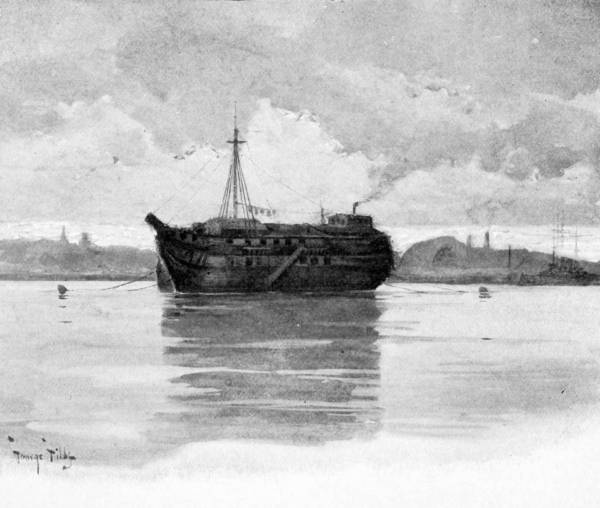
Since ballad-mongering began, the sea
and the men who go down to it in
ships have been a fruitful theme; and
the conventional song-singing, horn-piping tar
of the chanteys is a creature of fancy, pure and
simple.
Jack is as honest as any man. Aboard ship
he goes about his duties willingly, a creature
of habit and environment, with a goodly respect
for his “old man” and the articles of
war. Ashore he is an innocent,—a brand for
the burning, with a half-month’s pay and a
devouring thirst.
Sailor-men all over the world are the same,
and will be throughout all time, except in so
far as their life is improved by new conditions.
Though Jack aboard ship is the greatest grumbler
in the world, ashore he loves all the world,
and likes to be taken for the sailor of the
songs. In a week he will spend the earnings
of many months, and go back aboard ship,
sadder, perhaps, but never a wiser man.
He seldom makes resolutions, however, and
so, when anchor takes ground again, his money
leaves him with the same merry clink as before.
Though a Bohemian and a nomad, he does not
silently steal away, like the Arab. His goings,
like his comings, are accompanied with much
carousing and song-singing; and the sweetheart
he leaves gets to know that wiving is
not for him. With anchor atrip and helm
alee, Jack mourns not, no matter whither
bound.
The improved conditions on the modern
men-of-war have changed things for him somewhat,
and, though still impregnated with old
ideas, Jack is more temperate, more fore-sighted,
and more self-reliant than he once
was. His lapses of discipline and his falls
from grace are less frequent than of yore, for
he has to keep an eye to windward if he expects
to win any of the benefits that are generously
held out to the hard-working, sober,
and deserving.
But the bitterness of the old days is barely
disguised in the jollity of the chanteys. However
we take it, the sea-life is a hardship the
like of which no land-lubber knows. Stories
of the trials of the merchant service come to
him now and then and open his eyes to the
real conditions of the service.
Men are greater brutes at sea than ashore.
The one-man power, absolute, supreme in the
old days, when all license was free and monarchies
trod heavily on weak necks, led men
to deeds of violence and death, whenever violence
and death seemed the easiest methods
of enforcing discipline. Men were knocked
down hatchways, struck with belaying-pins,
made to toe the seam on small provocation or
on no provocation at all. The old-fashioned
sea-yarns of Captain Marryat ring true as far
as they go, but they do not go far enough.
In England the great frigates were generally
both under-manned and badly victualled,
and the cruises were long and sickening. The
practice of medicine had not reached the dignity
of the precise science it is to-day, and the
surgeon’s appliances were rude and roughly
manipulated. Anæsthetics were unknown, and
after the battles, the slaughter in which was
sometimes terrific, many a poor chap was sent
to his last account by unwise amputation or
bad treatment after the operation.
The water frequently became putrid, and
this, with the lack of fresh vegetables and
the over use of pork, brought on the disease
called scurvy, which oftentimes wiped out entire
crews in its deadly ravages. Every year
thousands of men were carried off by it. A
far greater number died from the effects of
scurvy than from the enemy’s fire. Lieutenant
Kelly says that during the Seven Years’ War
but one thousand five hundred and twelve
seamen and marines were killed, but one hundred
and thirty-three thousand died of disease
or were reported missing. Not until the beginning
of this century was this dreadful evil
ameliorated.
The evils of impressment and the work of
the crimp and his gang—so infamous in England—had
no great vogue here, for the reason
that, during our wars of 1776 and 1812, the
good seamen—coasters and fishermen, who
had suffered most from the Lion—were only
too anxious to find a berth on an American
man-of-war, where they could do yeoman’s
service against their cruel oppressor.
“Keel-hauling” and the “cat” were relics
of the barbarism of the old English navy.
Keel-hauling was an extreme punishment, for
the unfortunate rarely, if ever, survived the
ordeal. In brief, it consisted in sending the
poor sailor-man on a voyage of discovery
along the keel of the vessel. Trussed like a
fowl, he was lowered over the bows of the
ship and hauled along underneath her until
he made his appearance at the stern, half or
wholly drowned, and terribly cut all over the
body by the sea-growth on the ship’s bottom.
He bled in every part from the cuts of the
barnacles; but “this was considered rather
advantageous than otherwise, as the loss of
blood restored the patient, if he were not
quite drowned, and the consequence was that
one out of three, it is said, have been known
to recover from their enforced submarine excursion.”
Think of it! Recovery was not anticipated,
but if the victim got well, the officer in command
made no objection! Beside the brutality
of these old English navy bullies a barbarous
Hottentot chief would be an angel of
mercy.
Flogging and the use of the cat were abolished
in the American navy in 1805. This
law meant the use of the cat-o’-nine tails as a
regular punishment, but did not prohibit blows
to enforce immediate obedience. Before that
time it was a common practice for the punishment
of minor offences as well as the more
serious ones.
Flogging in the old days was an affair of
much ceremony on board men-of-war. The
entire ship’s company was piped on deck for
the punishment, and the culprit, stripped to
the waist, was brought to the mast. The
boatswain’s mate, cat in hand, stood by the
side of a suspended grating in the gangway,
and the captain, officer of the deck, and the
surgeon took their posts opposite him. The
offence and the sentence were then read, and
the stripes were administered on the bare back
of the offender, a petty officer standing by to
count the blows of the lash, while the doctor,
with his hand on the victim’s pulse, was ready
to give the danger signal when absolutely
necessary.
The men bore it in different ways. The old
hands gritted their teeth philosophically, but
the younger men frequently shrieked in their
agony as the pitiless lash wound itself around
the tender flesh, raising at first livid red welts,
and afterwards lacerating the flesh and tearing
the back into bloody seams.
The effect upon the lookers-on was varied.
The younger officers, newly come from well-ordered
English homes, frequently fainted at
the sight. But the horror of the spectacle
soon died away, and before many weeks had
passed, with hardened looks, they stood on the
quarter-deck and watched the performance
amusedly. Soon the spectacle got to be a
part of their life, and the jokes were many
and the laughter loud at the victim’s expense.
The greater the suffering the more pleasurable
the excitement.
Many yarns are spun of Jack’s tricks to
avoid the lash or to reduce to a minimum the
pain of the blows. Sometimes the men had
their flogging served to them regularly, but
in small doses. To these the punishment lost
its rigor. For the boatswain’s mate not infrequently
disguised the force of his blows, which
came lightly enough, though the victim bawled
vigorously to keep up the deception, and in
the “three- and four-dozen” cases he sometimes
tempered his blows to the physical condition
of the sufferers, who otherwise would
have swooned with the pain.
One Jacky, who thought himself wiser than
his fellows, in order to escape his next dozen,
had a picture of a crucifix tattooed over the
whole surface of his back, and under it a
legend, which intimated that blows upon the
image would be a sacrilege. When next he
was brought before the mast he showed it to
the boatswain and his captain. The captain,
a crusty barnacle of the old harsh school, smiled
grimly.
“Don’t desecrate the picture, bos’n,” he
said; “we will respect this man’s religious
scruples. You may put on his shirt,” he said,
chuckling to himself, “but remove his trousers,
bos’n, and give him a dozen extra. And lay
them on religiously, bos’n.”
All this was in the older days, and it was
never so bad in the American as in the English
navy. The middle period of the American
navy, from before the Civil War to the age
of iron and steel cruisers, presents an entirely
different aspect in some ways.
Illegal punishments were still inflicted, for
there were always then, as now, a certain percentage
of ruffians forward who were amenable
to no discipline, and could be managed
only by meeting them with their own weapons.
The “spread-eagle” and the ride on the “gray
mare” were still resorted to to compel obedience.
They “spread-eagled” a man by tricing him
up inside the rigging, taut lines holding his
arms and legs outstretched to the farthest
shrouds, a bight of rope passed around his
body preventing too great a strain. He
was gagged, and so he could not answer
back.
The “gray mare” on which the obstreperous
were forced to gallop was the spanker-boom—the
long spar that extends far over the water
at the ship’s stern. By casting loose the sheets,
the boom rolled briskly from side to side, and
the lonely horseman was forced in this perilous
position to hold himself by digging his
nails into the soft wood or swinging to any of
the gear that flew into his reach. At best it
was not a safe saddle, and a rough sea made
it worse than a bucking broncho.
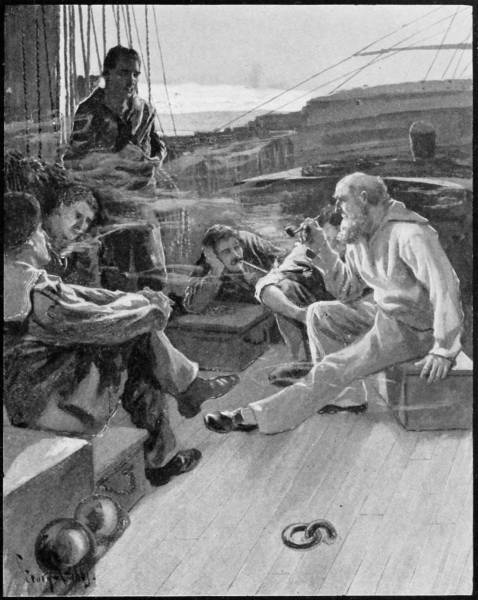
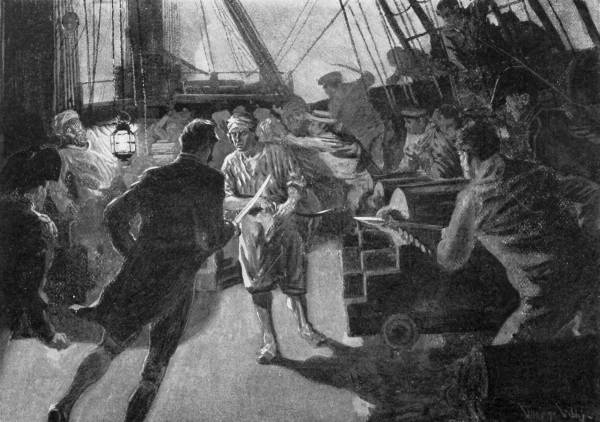
THE SMOKING HOUR
Paul Jones had a neat way of disciplining
his midshipmen aloft. He would go to the
rail himself, and casting loose the halyards,
let the yard go down with a run, to the young
gentleman’s great discomfiture.
But the life of the old salt was not all bitterness.
It was not all shore-leave, but there
was skittles now and then for the deserving
and good-conduct men. Jack’s pleasures were
simple, as they are to-day. There was never
a crew that did not have its merry chanter and
its flute, fiddle, or guitar, or the twice-told tale
of the ship’s Methuselah to entertain the dog-watches
of the evening or the smoking-hour
and make a break in the dreary monotony of
routine.
On public holidays, when everything was
snug at sea or in port, a glorious skylark was
the order of the afternoon. At the call of the
bos’n’s mate, “All hands frolic,” rigorous discipline
was suspended, and the men turned to
with a will to make the day one to be talked
about. Mast-head-races, potato- and sack-races,
climbing the greased pole, and rough
horse-play and man-handling filled the afternoon
until hammocks were piped down and
the watch was set. Purses from the wardroom
and prizes of rum and tobacco—luxuries dear
to Jack’s heart—were the incentives to vigorous
athletics and rough buffoonery. The rigging
was filled from netting to top with the
rough, jesting figures, and cheer upon cheer
and laugh upon laugh greeted a successful
bout or fortunate sally.
Jack is a child at the best of times and at
the worst, and he takes his pleasures with the
zest of a boy of seven, laughing and making
merry until he falls to the deck from very
weariness. And woe be at these merry times
to the shipmate who has no sense of humor.
His day is a hideous one, for he is hazed and
bullied until he is forced in self-defence to
seek the seclusion granted by the nethermost
part of the hold. A practical joker always,
when discipline is lax, Jack’s boisterous humor
knows no restraint.
The ceremony of “crossing the line,” the
boarding of the ship by Neptune and his
court, seems almost as old as ships, and is
honored even to-day, when much of the romantic
seems to have passed out of sea-life.
It is the time when the deep-sea sailor has the
better of his cousin of the coasts. Every man
who crossed the equator for the first time had
to pay due honor to the god of the seas.
They exacted it, too, among the whalers when
they crossed the Arctic Circle.
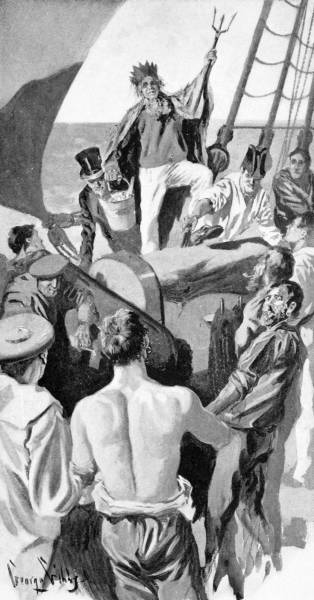
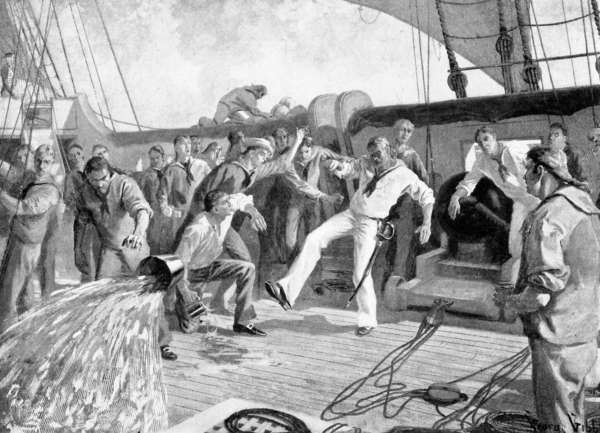
NEPTUNE COMES ABOARD
The wardroom usually bought off in rum,
money, or tobacco, but forward it was the
roughest kind of rough man-handling; and the
victims were happy indeed when they got their
deep-water credentials. The details of procedure
in this remarkable rite differed somewhat
on different ships, but the essential elements
of play and torture were the same in
all cases.
The day before the line was to be reached
both wardroom and forecastle would receive
a manifesto setting forth the intention of the
god of the seas to honor their poor craft and
ordering all those who had not paid tribute to
him to gather forward to greet him as he came
over the side. At the hour appointed there
was a commotion forward, and a figure, wearing
a pasteboard crown that surmounted a
genial red face adorned with oakum whiskers,
made its appearance over the windward nettings
and proclaimed its identity as Neptune.
Behind him was a motley crew in costumes of
any kind and all kinds—or no kind—who had
girded itself for this ungentle art of bull-baiting.
The deep-water men intended to have
an ample return for what they themselves
had suffered, not many years back, when they
had rounded the Horn or Cape of Good
Hope.
The unfortunates, stripped to the waist,
were brought forward, one by one, to be put
through their paces. After a mock trial by
the jury of buffoons, the king ordered their
punishment meted out in doses proportioned
directly to the popularity of the victims as
shipmates. The old long boat, with thwarts
removed and a canvas lining, served as a
ducking-pond. After vigorous applications,
of “slush,”—which is another name for ship’s
grease,—or perhaps a toss in a hammock or a
blanket, they were pitched backward into the
pool and given a thorough sousing, emerging
somewhat the worse for wear, but happy that
the business was finally done for good and all.
To-day the roughest sort of bullying no
longer takes place, and much of the romance
seems to have passed out of the custom.
The punishments, too, have lost their severity.
The “gray mare” swings to an empty
saddle, the “spread eagle” is a thing of the
past, and the “cat” is looked upon as a relic
of barbarism. Things are not yet Pinafore-like,
but the cursing and man-handling are not
what they used to be. There are a few of the
old-timers who still believe the “cat” a necessary
evil, and would like to see an occasional
“spread eagle,” but the more moderate punishments
of to-day have proved, save in a few
hardened cases, that much may be done if the
morale of the service is high.
The fact of the matter is, that the standard
of the man behind the gun has kept up with
the marvellous advance of the ships and the
ordnance. To-day, the naval service of the
United States is worthy of any seaman’s metal.
As a mode of living, sea-faring on American
men-of-war attracts as many good men as any
other trade. Machinists, electricians, carpenters,
gunners, and sail-makers, all have the
chance of a good living, with prizes for the
honest and industrious.
The seaman himself, in times of peace, may
rise by faithful service to a competency and a
retiring pension more generous than that of
any other nation in the world. The discipline
is the discipline of right relations between superior
and inferior men of sense, and the articles
of war govern as rigorously the cabin as
the forecastle. Republican principles are carried
out, as far as they are compatible with
perfect subordination, and there exists no feeling
between the parts of the ship, except in
extraordinary instances, but wholesome respect
and convention. There is little tyranny
on the one side or insubordination on the other.
The training of the young officer of the old
navy was the training of the larger school of
the world. “Least squares” and “ballistics”
were not for him. He could muster a watch,
bend and set a stun’sail, work out a traverse,
and pass a weather-earing; but he toyed not
with the higher mathematics, like the machine-made
“young gentleman” of to-day. What
he knew of navigation he had picked haphazard,
as best he might.
At the age of twelve his career usually
opened briskly in the thunder of a hurricane
or the slaughter of a battle, under conditions
trying to the souls of bronzed, bearded men.
Physical and even mental training of a certain
kind he had, but the intellectual development
of modern days was missing. The American
officer of the days before the Naval Academy
was founded was the result of rough conditions
that Nature shaped to her own ends with
the only tools she had. Though these “boys”
had not the beautiful theory of the thing, they
had its practice, and no better seamen ever
lived.
At the beginning of the century, the crusty
Preble, commodore of the blockading fleet
before Tripoli, was sent a consignment of
these “boys” to aid him in his work. The
names of the “boys” were Decatur, Stewart,
Macdonough, Lawrence, and Perry. Excepting
Decatur, who was twenty-six, there was
not one who was over twenty-four, and two
or three of them were under twenty. The
commodore grew red in the face and swore
mighty oaths when he thought of the things he
had to accomplish with the youngsters under
his command. But he found before long that
though youth might be inconvenient, it could
not be considered as a reproach in their case.
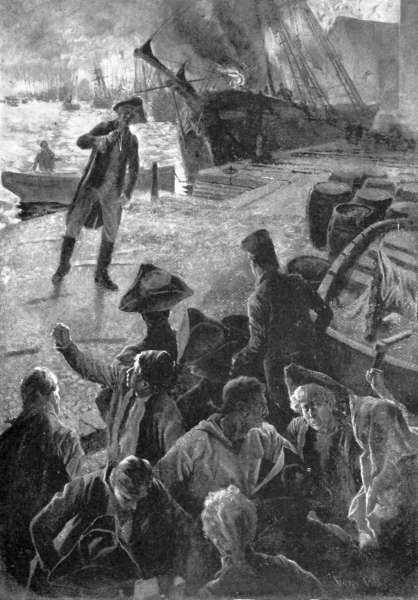
Decatur, with a volunteer crew, went under
the guns at Tripoli, captured and blew up the
“Philadelphia” in a way that paled all deeds
of gallantry done before or since. The dreamy
Somers went in with a fire-ship and destroyed
both the shipping and himself. In the hand-to-hand
fights on the gunboats, Lawrence, young
Bainbridge, Stewart, and the others fought
and defeated the best hand-to-hand fighters
of the Mediterranean. The Dey of Algiers,
when Decatur came before him to make terms
of peace, stroked his black beard and looked
at the young hero curiously. “Why,” he said,
“do they send over these young boys to treat
with the older Powers?”
When the war was over, Preble no longer
grew red in the face or swore. He loved
his school-boys, and walked his quarter-deck
with them arm-in-arm. And they loved him
for his very crustiness, for they knew that back
of it all was a man.
These youthful heroes were not the only
ones. Young Farragut, an infant of twelve
years, with an old “Shoot-if-you’re-lucky,”
quelled a promising mutiny. At eighteen
Bainbridge did the same. Farragut, at thirteen,
was recommended for promotion to a
lieutenancy he was too young to take. Perry
was about thirty when he won the victory of
Erie.
A youngster’s character bears a certain definite
relation to the times he lives in. Skies
blue and breezes light, he shapes his life’s
course with no cares but the betterment of his
mental condition. Baffling winds create the
sailor, and storm and stress bring out his
greater capabilities. The Spanish war has
proved that heroes only slumber, and that the
young gentleman with the finely-tempered
mind of an Annapolis training is capable of
the great things his father did.
The blue-jacket of to-day has plenty of hard
work to do, but he is as comfortable as good
food and sleeping accommodations, regular
habits, and good government can make him.
As a class, the United States Jacky is more
contented, perhaps, than any other man of
similar conditions. Unlike the soldier, he does
not even have to rough it very much, for
wherever he goes he takes his house with
him.
Jacky sleeps in a hammock strung upon
hooks to the beams of the deck above him.
When he turns out, he lashes his hammock
with its lashing, and stores it in the nettings,—the
troughs for the purpose at the
sides of the ship,—where it must stay until
night. If Jack wants to sleep in the meanwhile,
he chooses the softest spot he can find
on a steel-clad deck; and he can sleep there,
too, in the broad glare of daylight, a hundred
feet passing him, and the usual run of ship’s
calls and noises droning in his ears.
Jacky’s food is provided by the government,
while his superior of the wardroom has to pay
his own mess-bill. He is allowed, in addition
to his pay, the sum of nine dollars per month,
and this must purchase everything, except such
luxuries as he may choose to buy from his
pay. The ship’s paymaster is allowed a certain
amount of money to furnish the supplies,
and between him and the ship’s cook the problem
is settled. At the end of the month, if the
amount served out is in excess of the computation
for rations, the brunt falls upon the
“Jack-of-the-Dust,”—the assistant to the paymaster’s
yeoman,—who has the work of accurately
measuring the rations which are given to
the cook of the ship.
The ship’s cook receives from the government
from twenty-five to thirty-five dollars a
month, according to the size of the ship, and,
in addition, certain money perquisites from the
different messes, which gives him a fair average.
He has complete charge of the ship’s
galley and the cooks of the messes, and must
be able to concoct a dainty French dish for
the wardroom as well as the usual “salt horse”
or “dog” for the Jacky.
“Salt horse” is the sea-name for pork.
“Dog” is soaked hardtack, mixed with molasses
and fried; and, though it is not pleasant
twenty-nine days out of the month, it is healthful,
and tastes good to a hard-working sailor
with the salt of the sea producing a splendid
appetite.
The mess-tables hang by iron supports to
the beams of the deck above, and when the
mess has been served and eaten,—as only
Jack knows how to eat,—they are triced up
into their places, and all is cleaned and made
ship-shape in the twinkling of an eye. A half-hour
is allowed for dinner, and this time is
kept sacred for Jack’s use. A red pennant
flies from the yard-arm, that all may know
that the sailor-man is eating and must not
be disturbed by any importunate or curious
callers.
In the dog-watches of the evening, after
supper, from six to eight P.M., the blue-jacket
is given his leisure. It is then that pipes are
smoked, vigilance relaxed, boxing and wrestling
bouts are in order, and Jacky settles down
for his rest after the day of labor. From somewhere
down on the gun-deck comes the tinkle
of a guitar or banjo, and a tuneful, manly voice
sings the songs of France or Spain, and,
better still, of beloved America, for the shipmates.
The sailor of to-day is also a soldier. Back
in the days of Henry the Eighth, when England
first had a navy, the sailors only worked
the ships. The fighting was done by the soldiers.
Later, when the ships were armed with
many guns and carried a greater spread of
canvas, there was no space for great companies
of soldiers, and the sailors became gunners
as well. A few soldiers there were, but
these did only sentry duty and performed the
duties of the ships’s police. As such they
were cordially hated by the jackies.
This antipathy has come down through the
ages to the present day, and marines are still
looked on by the sailor-men as land-lubbers
and Johnnies—sea-people who have no mission
upon the earth save to do all the eating and
very little of the rough work.
The new navy has done much to change this
feeling. The mission of the marine is now a
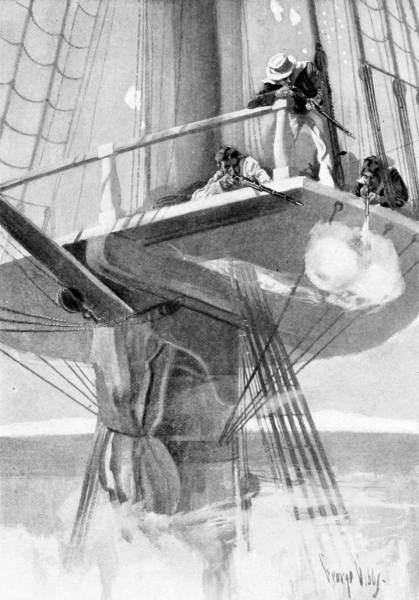
definite one. Always used as a sharpshooter,
he now mans the rapid-fire batteries, and even
guns of a larger caliber. He has done his
work well, and the affair at Guantanamo has
caused the sneer to fade from the lip of the
American sailor-man. Two of the ablest captains
of our navy, always the deadliest opponents
of the marine corps, upon assuming
their latest commands, applied immediately
for the largest complement of marines that
they could get.
Any ship, old or new, is as frail as the crew
that mans it. The strength of any vessel varies
directly with its discipline and personnel. Hull,
Jones, Decatur, Bainbridge, and Stewart, in the
old days, knew with some accuracy the forces
they had to reckon with. Their guns were of
simple contrivance, and their men knew them
as well as they knew how to reef a topsail or
smartly pass a weather-earing. They feared
nothing so long as they were confident of their
captain. New and mysterious contrivances
for death-dealing were unknown to them, and
hence the morale of the old sea-battles was
the morale only of strength and discipline.
There were no uncertain factors to reckon
with, save the weight of metal and the comparative
training of the gun-crews.
To-day the unknown plays a large part in
warfare. Intricate appliances, mysterious inventions,
new types of torpedo-boats, and submarine
vessels form a new element to contend
against and have a personal moral influence
upon the discipline of crews. To combat this
new element of the unknown and uncertain
has required sailors and men of a different
stripe from the old. Where, in the old days,
ignorance and all its accompanying evils held
sway over the mind of poor Jack, and made
him a prey to superstition and imagination, to-day,
by dint of careful training of brain as well
as body, he has become a thinking creature of
power and force of mind. He knows in a
general way the working of the great mechanical
contrivances; and in the fights that are to
come, as well as those that have been, he will
show that the metal the American Jacky is
made of rings true and stands well the trial
by fire.
With much hitching of trousers and shifting
of quid, the old longshoreman will tell you that
sea-life isn’t at all what it once was.
He will gaze out to sea, where the great
iron machines are plying back and forth, and
a reminiscent sparkle will come into his eyes
as he turns to his lobster-pots and tells you
how it was in the good days of clippers and
sailing-frigates, when sailor-men were sailor-men
and not boiler-room swabs, machine-made
and steam-soaked. He will also yarn, with
much d—ning of his eyes (and yours), of how
fair it was in the deck-watches of the “Saucy
Sally” barque, with everything drawing alow
and aloft, grog and ’baccy a-plenty, and never a
care but the hurry to spend the voyage-money.
And not till he’s mumbled all his discontent will
he haul his sheets and give you right-of-way.
He forgets, sheer hulk that he is, that he’s
been in dry-dock a generation or more and
that swift-moving Time has loosed his gear
and dimmed his binnacle-lights. Despite his
ancient croaking, tricks at the wheel are to-day
as ably kept, eyes as sharp as his still
peer into the dimness over the forecastle, and
the sea-lead takes as long a heave as in the
early sixties, when he hauled up to New York
with a thousand dollars in prize-money and a
heart full for the business of spending it. It
has always been so. There has never been an
age that has not had its carper to tell you of
the wonders that once were.
Yet it was truly beautiful. With the tide
on the ebb and the wind a-piping free, never
was a fairer sight than the Atlantic clipper as
she picked her speedy way through the shipping
to the harbor’s mouth; and nothing so
stately as the gallant frigate in her wake, with
all sail set to ga’n’s’ls, her topsails bellying
grandly to the quartering breeze, which whipped
the filmy wave-tops against her broad bows,
under which the yellow curl lapped merrily its
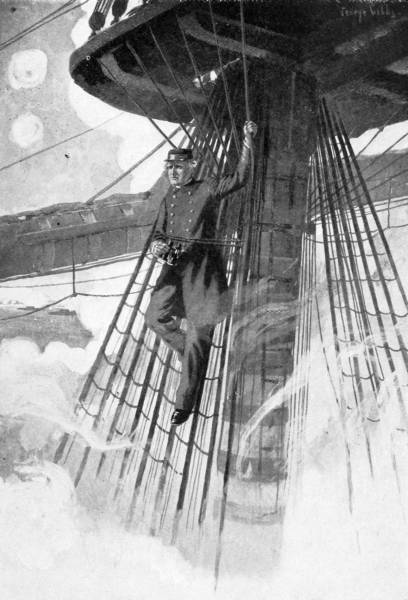
greeting. The harbor clear and the capes
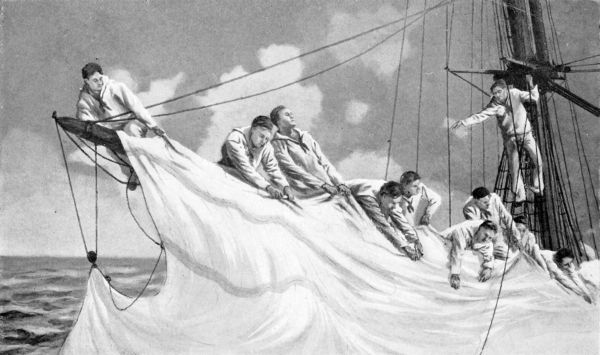
abeam, aloft flew the nimble sail-loosers. The
royals and the stu’n-sails flapped to the freshening
wind, sheets went home with a run, and
the yards flew to their blocks.
Then, her departure taken, like a gull she
sped blithely on her course. The rays of the
afternoon sun gilded her snowy canvases until
she looked a thing of air and fairyland, not of
reality. On she flew, her tall spars dipping
grandly to the swells—a stately farewell courtesy
to the clipper, hull down to leeward. On
the decks the boatswain piped his cheerful
note, and everything came ship-shape and
Bristol-fashion for the cruise. The running-gear
was neatly coiled for running, the guns
secured for sea, and the watches told off. The
officer of the deck walked to and fro, singing
softly to himself, casting now and then a careful
eye aloft to the weather-leeches, which
quivered like an aspen as the helmsman, leaning
to the slant of the deck, kept her well up
to her work.
And yet the poetry has not gone out of it
all. The poetry of the sailing-frigate was
lyric. That of the steel battle-ship is Homeric.
Nothing save a war of the elements has the
power of a battle-ship in action. Ten thousand
tons of steel,—a mighty fortress churning
speedily through the water fills the spirit with
wonder at the works of man and makes any
engine for his destruction a possibility. Away
down below the water-line a score or more
of furnaces, white-heated, roar furiously under
the forced draught, and the monster engines
move their ponderous arms majestically, and
in rhythm and harmony mask their awful
strength. Before the furnace-doors, blackened,
half-naked stokers move, silhouetted
against the crimson glare, like grim phantoms
of the Shades. The iron uprights and tools
are hot to their touch, the purple gases hiss
and sputter in their very faces, yet still they
toil on, gasping for breath, their tongues
cleaving to their mouths, and their wet bodies
steaming in the heat of it.
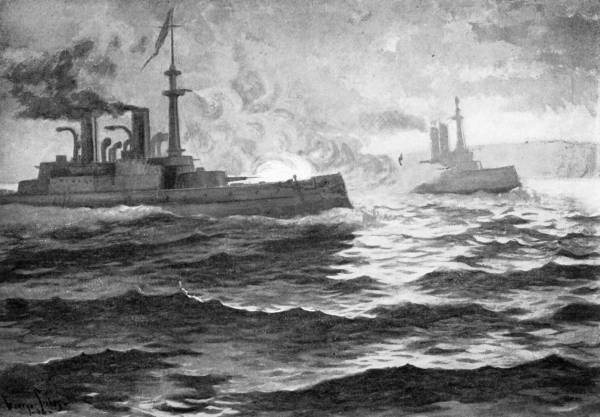
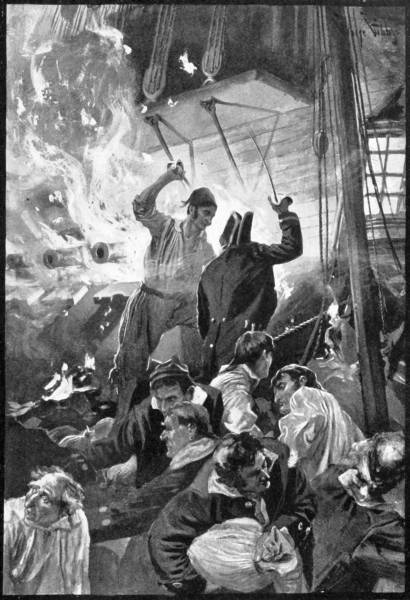
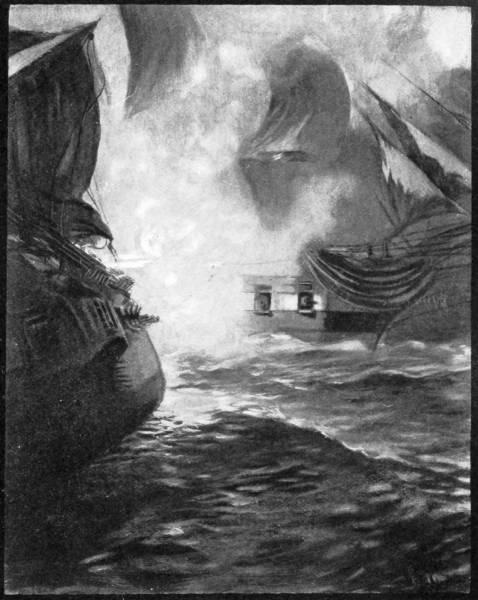
MODERN SEA MONSTERS IN ACTION
The deck above gives no sign of the struggle
below. Where, in the old days, the sonorous
trumpet rang out and the spar-deck
was alive with the watch who hurried to the
pin-rail at the frequent call, now all is quiet.
Here and there bright work is polished, or a
lookout passes a cheery call, but nothing save
the man at the wheel and the officer of the
watch shows the actual working of the ship.
Seamanship, in the sense of sail-handling,
is a thing of the past. Though there is no
officer in the navy who could not in an emergency
handle a square-rigger with the science
of an old sea-captain, the man on the bridge
has now come to be first a tactician and after
that a master of steam and electricity.
In the sea-battles of 1812 the captain was
here, there, and everywhere in the thickest of
the fight, inspiring by his personal magnetism
the men at the guns. He was the soul of his
ship. To-day the sea-battle is a one-man battle.
The captain is still the heart and soul of
the ship, but his ends are accomplished in a
less personal way. His men need not see
him. By the touch of a finger he can perform
every action necessary to carry his ship to victory.
He can see everything, do everything,
and make his presence everywhere felt by the
mere operation of a set of electrical instruments
in front of him.
The intricacies of his position are, in a way,
increased. He may lose a boiler, split a crank,
or break an electrical connection, but the beautiful
subtleties of old-fashioned seamanship
have no place whatever on the modern war-ship.
Let it not be understood that the handling
of the great ocean fortress of to-day may be
mastered by any save a craftsman of the art.
With plenty of sea-room and a keen watch
alow and aloft the trick is a simple one, for
the monster is only a speck in the infinity of
sea and sky, and there is never a fear save for a
blow, or a ship, or a shore. But in close manœuvre,
or in harbor, the problem is different.
Ten thousand tons of bulk cannot be turned
and twisted on the heel with the swish and
toss of the wieldy clipper. Observant transpontine
voyagers, who have watched the gigantic
liner warped out from her pier into a
swift tide-way with a leeward ebb, will tell you
what a complicated and difficult thing it seems
to be.
The captain of the battle-ship must be all
that the merchant captain is, and more besides.
Mooring and slipping moorings should be an
open book to the naval officer, but his higher
studies, the deeper intricacies of the science of
war, are mysteries for the merchant captain.
All of it is seamanship, of course. But to-day
it is the seamanship of the bridled elements,
where strength is met by strength and steam
and iron make wind and wave as nothing.
The perfection of the seamanship of the
past was not in strength, but in yielding, and
the saltiest sea-captain was he who cajoled
both ship and sea to his bidding. The wind
and waves, they say, are always on the side of
the ablest navigators, but it was rather a mysterious
and subtle knowledge of the habits and
humors of God’s sea and sky, and a sympathy
born of constant communion, which made both
ship and captain a part of the elements about
them, and turned them into servants, and not
masters.
The naval captains of 1812 had learned this
freemasonry of sea and sky, and one incident—a
typical one—will show it as no mere words
can do. Its characteristics are Yankee pluck
and old-fashioned Yankee seamanship.
The frigate “Constitution”—of glorious
memory—in 1812 gave the British squadron
which surrounded her startling proof of
the niceties of Yankee seamanship. There
never has been a race for such a stake, and
never will be. Had “Old Ironsides” been
captured, there is no telling what would have
been the deadly effect on the American fortunes.
It was the race for the life of a nation.
The “Constitution” was the country’s hope
and pride, and Captain Hull knew it. He felt
that “Old Ironsides” could never fail to do the
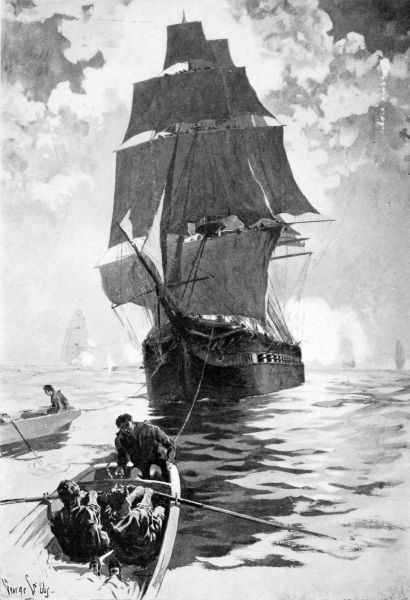
work required of her. So for four days and
nights the old man towed her along, the British
frigates just out of range, until he showed
clean heels to the entire squadron. The ingenuity
and deft manœuvring of the chase has
no parallel in the history of this or any other
country in the world.
With hardly a catspaw of wind, Hull drifted
into sight of the British fleet off the Jersey
coast. Before he knew it, they brought the
wind up with them, and his position was desperate.
There were four frigates and a ship-of-the-line
spread out in a way to take advantage
of any breath of air. Hull called away
his boats, and running lines to them, sent them
ahead to tow her as best they might. The
British did still better, for they concentrated
the boats of the squadron on two ships, and
gained rapidly on the American. Hull cut
ports over the stern, and ran two 18-pounders
out of his cabin windows, where he began
a continuous fire on the enemy. The British
ships shifted their helms and took up positions
on the quarters of the frigate, unable
to approach too closely with their boats for
fear of the “Constitution’s” stern-guns, which
dropped their hurtling shot under their very
bows.
The desperate game had only begun. Hull,
finding that he had but one hundred and fifty
feet of water under him, decided to kedge her
along. In a few minutes the largest boat was
rowing away ahead with a small anchor on
board, stretching out half a mile of cable. The
anchor dropped, the men hauled in roundly
and walked away with the line at a smart pace.
It was heart-breaking work, but the speed of
the ship was trebled. By the time the vessel
was warped up to the first anchor another one
was ready for her, and she clawed still further
out of the enemy’s reach. The British did not
at first discover the magic headway of the
American, and not for some time did they
attempt to follow suit.
Then a breeze came up. Hull hauled his
yards to it, picked up his boats without slacking
sail, and went ahead. But hardly were
the sails drawing when the wind died away
again. One of the ships came into range,
and there was nothing for it but to go back to
the kedging. Three times did this occur, the
captain, with his eye on the dog-vane, jockeying
her along as a skipper would his racing-yacht.
The men had now been at their quarters
for thirty-six hours without rest or sleep.
But at the order they dropped into the boats
again, ready for anything.
Another breeze sprang up now and held for
two hours. Like logs the sailor-men tumbled
over on the decks, nearly dead for lack of
sleep. On the afternoon of the third day of
the chase the “Constitution” lost the wind and
the enemy kept it. Back again to kedging
they went, weary and sick at heart.
But relief was in sight. A great cloud hove
up on the southeastern horizon, and the black
squall that followed was a Godsend to the
“Constitution” and her weary crew. Hull
knew the Englishmen would not like the looks
of the squall. No more did he. But he kept
his boats at the towing, nevertheless.
He stationed his men at the halyards and
down-hauls, and had everything in hand for
the shock. He calmly watched the on-coming
line of froth, growing whiter every minute,
while his officers came to him and begged him
to take in his sail. But wait he did until the
first breath stirred his royals. Then the shrill
pipe of the boatswain called the boats alongside
of the “Constitution.”
They were not a moment too soon. As the
men were hooking the tackles the blast struck
the ship. Over she heeled, almost on her beam
ends, the boats tossed up like feather-weights.
The yards came down with a rush, and the
sails flew up to the quarter-blocks, though the
wind seemed likely to blow them out of the
bolt-ropes. She righted herself in a moment,
though, and so cleverly had Hull watched his
time that not a boat was lost.
Among the enemy all was disorganization.
Every sail was furled, and some of their boats
went adrift. Then, as the friendly rain and
mist came down, the wily Yankee spread his
sails—not even furled—and sailed away on an
easy bowline at nine knots an hour.
The race was won. Before the Englishmen
could recover, Hull managed by wetting his
sails to make them hold the wind, and soon
the enemy was but a blur on his western horizon.
Then the British gave it up.
The superiority of Yankee seamanship was
never more marked than in this chase. The
British had the wind, the advantage of position,
the force, and lacked only the wonderful skill
and indomitable perseverance of the American,
who, with everything against him, never for a
moment despaired of pulling gallant “Old
Ironsides” out of the reach of his slow-moving
enemy.
The difficult manœuvre of picking up his
boats without backing a yard or easing a
sheet he repeated again and again, to the
wonderment of his adversaries, whose attempts
in this direction failed every time they
tried it in a smart breeze. Hull’s tactics at
the coming of the squall were hazardous, and
under any other circumstances would have
been suicidal. For a skipper to have his
boats two cable-lengths away from his ship,
with his royals flapping to the first shock of a
squall, is bad seamanship. But if tackles are
hooked and men are safe aboard there is no
marine feat like it.
The naval history of this country is full of
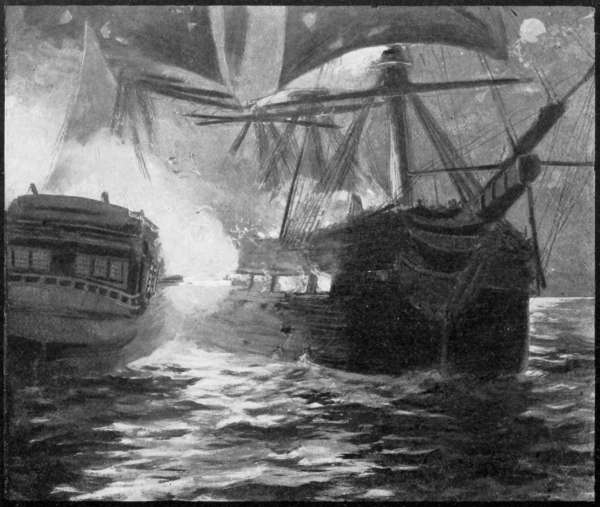
such instances. Captain Charles Stewart, on
the same ship, did a wonderful thing. In his
fight with the “Cyane” and the “Levant” he
delivered a broadside from both batteries at
the same time. Then, shifting his helm under
cover of the smoke, he backed his topsails and
drew out sternward from the enemy’s fire,
taking a new position, and delivering another
broadside, which brought about their surrender.
The war-ship of fifty years ago was as different
from the battle-ship of to-day as a caravel
from a torpedo-boat. With half the length
and a third the tonnage, the old “ship-of-the-line”
had three times as many men as the
modern sea-fighter. Yet, with a thousand men
aboard, she had work for them all. More than
two acres of canvas were to be handled, and
over a hundred guns were to be served, loaded,
and fired. A thousand pieces of running-gear
were to be rove and manned. The huge topsails,
weighing, with their yards, many tons,
needed on their halyards half a hundred men.
Great anchors were to be broken from their
sandy holds, and the capstan-bars, double-banked,
hove around to the sound of the merry
chantey and deep-voiced trumpet. Homeward
bound, the business of anchor-hoisting turned
into a mad scene, and many a rude jest and
hoarse song turned the crowded fo’c’s’le into
a carnival of jollity.
In matters of routine and training the crews
of the American frigates differed little from
those of England. The sailor-men of the
United States, though newer to the work of
navigating the big ships, were smart seamen,
and could cross or bring down their light yards,
send down their masts, or clear for action with
the oldest and very best of England’s men-o’war’s-men.
The ships themselves differed little in general
construction. During the war of 1812,
of large frigates we possessed but the “Constitution,”
the “President,” and the “Constellation.”
Though built upon models patterned
after the accepted standards of the period,
they were somewhat smaller than the British
vessels and usually carried a lighter armament.
Their unbroken list of victories during the war
with England is remarkable when one considers
what the young nation was contending
against, both at home and abroad, and how
little aid Congress had given the infant navy.
It seems really wonderful how a large body
of men, numbering from three hundred to six
hundred, and later a thousand or more, could
find comfort and a home from one year’s end
to another in a space only two hundred feet
long and fifty feet wide.
But Jack is nowhere so comfortable as aboard
ship. He is used to prescribed limits, and
crawls into his hammock at night happy that
the space is no greater. There is a companionship,
he thinks, in close quarters, and he
likes them.
In the old ships it was a matter of great
importance to provide comfortable quarters
for the great crews they were obliged to carry.
In England, during the first years of the century,
the complement of a “Seventy-four” was
five hundred and ninety, and even six hundred
and forty men. Hammocks seem to have
been used during the reign of Queen Elizabeth,
when they were called “nets,” probably
because they were made of rope-yarn.
The officers were then, as now, given the
after part of the ship. A wooden bulkhead
separated the cabins of the officers from the
main-decks, where the men lived, though when
the ship was cleared for action the bulkheads
were taken down and all movable property
both of officer and man was taken below-deck.
This gave a clean sweep of the deck from
bow to stern. The steerage had from two to
six broadside-guns in it, and even the captain
had to live with a couple of brass stern-chasers
and a broadsider or two.
The grandest line-of-battle-ship ever built
for this country was the old “Pennsylvania.”
She was made of wood throughout, two hundred
and twenty feet long and fifty-eight feet
beam, with a draft of twenty-five feet of water
and thirty-five hundred tons displacement,—just
one-third of that of the modern “Iowa.”
Eleven hundred men could swing their hammocks
on her wide decks, where no modern
gun-carriages or steel compartments broke the
long sweep from the cabin forward. Her sides
were of oak, with a thickness of eighteen inches
at the upper gun-ports and thirty-two inches at
the water-line, almost heavy enough at long
range to resist the shot of a modern rifle.
Her sixteen inches were proof against her own
fire at a mile. On her three fighting-decks
she carried sixteen 8-inch guns, the heaviest
they had in those days, and one hundred and
four 32-pounders. Her mainmast was over
two hundred feet long, and with all sail set
she could leg it at twelve knots an hour.
But compare her with the modern “Indiana.”
The “Pennsylvania” weighed less than
the armor of the “Indiana” alone. The “Indiana”
has but sixteen guns, against one hundred
and twenty on the “Pennsylvania;” but
that broadside can send two tons of tempered
steel at a single discharge. The old 8-inch
guns of the “Pennsylvania” could send a
shell through fifteen inches of oak at a distance
of a mile—the equivalent of half an inch
of steel.
The range of a modern rifle is from five to
twelve miles; the penetration is almost anything
you please in the way of steel armor.
The “Pennsylvania’s” shells at point-blank
range would hardly make a perceptible dent
in the “Indiana’s” steel armor, and the old
cast-iron shot would roll harmlessly down the
new ship’s sides. But one explosive shell
from the “Indiana” would go through the
“Pennsylvania” from stem to stern, and would
splinter and burn her beyond repair.
The “Pennsylvania” cost the government,
in 1837, nearly seven hundred thousand dollars;
a fabulous sum for a battle-ship in those
days. The “Indiana” cost three millions and
a half,—only two hundred and fifty thousand
dollars less than the sum paid for that vast
territory bought from Napoleon, and known
as the “Louisiana Purchase,” and about half
the sum paid for the acquisition of Alaska
from Russia.
The statistics are interesting. According to
official authority, in putting this vessel together
seven hundred tons of rivets alone were used.
About four hundred plans were made for the
hull and about two hundred and fifty plans
and drawings were made for the engines.
These would take a force of one hundred men
a year to complete.
The engines and machinery alone weigh
about nine hundred tons. The smoke-stacks
are about sixteen feet in diameter. Each of
the main engines is so enormous that under
the great frames, in the economy of space and
construction, are two smaller engines, the sole
mission of which is to start the big ones.
There are about sixty-six separate engines
for various purposes. The condensing-tubes,
placed end to end, would cover a distance of
twelve miles. Thirty tons of water fill her
boilers, which would stand a pressure of one
hundred and sixty pounds to the square inch.
Three dynamos provide the electricity,—a plant
which would light a town of five thousand inhabitants.
There are twenty-one complete
sets of speaking-tubes and twenty-four telephone
stations.
The two great turrets are clad with nineteen
inches of toughened steel. In each of these
turrets are two 13-inch guns. Each of these
guns is about fifty feet long and weighs sixty-one
tons. There are eight 8-inch guns on the
superstructure, in sets of twos, and amidships
on the main-deck are four 6-inch rifles. In
ten minutes, firing each 13-inch gun once in
two minutes, and using all the other guns at
their full power, the “Indiana” could fire about
sixty tons of death-dealing metal.
The millennium has not yet been reached,
but such awful force makes universal peace a
possibility. What the immediate future holds
forth in naval architecture and gunnery is a
matter which excites some curiosity, for it
almost seems as though perfection, according
to the standard of the end of the century, has
been reached. And yet we already know of
certain changes, improvements, and inventions,
the direct outcome of the Spanish war, which
are to be made on the vessels now contracted
for, which affect importantly the government
of the ship; and so it may be that the next
twenty years will show as great an evolution
as have the two decades just past.
But whatever the future may bring, it has
been a marvellous and momentous change
from the old navy to the new. Since the
“Monitor”–“Merrimac” fight no country has
been quicker to profit by the lessons of the
victory of iron over wood and steel over iron
than the United States.
But the navy that is, however glorious its
achievements, can never dim the glory of the
navy that was, though sailor-men, old and new,
know that in a test of ship and ship, and man
and man, the flag of this country will continue
to fly triumphant.