In the whole range of pigments there is no more important class than
those to be described in this chapter. Not only are the white pigments
largely employed for the sake of their distinctive colour, but they are
probably even more extensively applied as a basis of other pigments,
both as an ingredient in the composition of the other coloured paints
and for ground coats where the final coat is to be of a delicate shade.
They are among the cheapest and most permanent pigments, and possess as
a whole remarkably good covering powers.
Baryta White.—Barytes or sulphate of baryta, the most important of the
salts of barium, is found native in large quantities, forming the
species of mineral termed barites or barytes, and commonly known as
heavy-spar, on account of its weight (sp. gr. from 4·3 to 4·7). It is
found in Derbyshire and Shropshire, and often occurs in fine tabular
crystals. The massive variety found in the mountain limestone of the
above counties is sometimes called “cawk”; it is more frequently found
in white or reddish-white masses. In Saxony it occurs as the mineral
stangen-spath, in a columnar form; and at Bologna, a nodular variety
is found, called Bologna stone, which is notable for its phosphorescent
powers when heated.
The pure salt may be prepared artificially for use as a pigment, by
adding dilute sulphuric acid to a solution of chloride of baryta, when a
white precipitate is formed; this is well washed and dried. It is a
heavy, white powder, insoluble in water and nearly insoluble in all
other menstrua. It may also be prepared by heating the native mineral,
grinding it to powder, and well washing it, first in dilute sulphuric
acid, in order to remove any traces of iron, and afterwards in water;
the white powder is afterwards thoroughly dried. This process is
employed at several works in the neighbourhood of Matlock Bath, in
Derbyshire, but much larger quantities could be produced in different
parts of the country if the demand for the article rendered its
production more profitable. The principal use of sulphate of baryta is
to adulterate white lead, and to form the pigment known as blanc fixe,
or permanent white. For these purposes, the native mineral, ground and
washed as described above, is commonly employed.
Improvements in machinery and in the process of treating natural barytes
have overcome many of the objections which formerly existed to its
utilisation, and considerable attention is now being given to the
localities in the United States where it is found. The mineral, in order
to be available for the uses to which it is put, must be fairly free
from quartz grains, the stain of iron rust, and other impurities. If the
barytes is stained to any extent, it is practically valueless, as a good
white colour is essential to its usefulness. Quartz grains or other hard
substances with which it is apt to be associated injure the machinery in
grinding. The purest barytes so far produced in America comes from
Missouri, though a very fair grade is now being mined in considerable
quantities in Virginia.
The returns from all producers of crude varieties show a product in the
United States, for 1889, of 21,640 short tons, valued at 106,313 dols.,
against 20,000 short tons in 1888, valued, approximately, at 110,000
dols. The product was limited to four States, as shown in the following
table:—
| | Short tons. | | Value. |
| Illinois | 200 | | $1,300 |
| Missouri | 7,558 | | 32,715 |
| North Carolina | 3,000 | | 15,000 |
| Virginia | 10,702 | | 57,298 |
| Total | 21,460 | | $106,313 |
Blanc Fixe.—This name is given to baryta white when it has been
artificially prepared by adding sulphuric acid to a solution of chloride
of barium. (See p. 170.)
Charlton White.—One of the names applied to a white pigment, containing
zinc oxide and sulphide, and described under zinc whites, p. 254.
China Clay.—This substance is also known as kaolin, porcelain clay, and
Cornish clay. It arises from the natural decomposition of felspar in
soft disintegrating granite, gneiss, and porphyry, the rocks which are
rich in soda-felspar yielding it most abundantly. The main supplies of
this country are derived from Cornwall and Devon; in continental Europe,
beds of good quality exist in France, Bavaria, Saxony, Prussia, Bohemia,
Bornholm island, and Hungary; in China, it is very plentiful; and in the
United States, it occurs in many localities.
The approximate composition of china clay may be stated as silica, 47·2;
alumina, 39·1; water, 13·7 per cent. Often a little iron, lime, and
potash or soda are left in the prepared article by the imperfection of
the cleansing process. The most important characters are colour,
plasticity, and a capacity for hardening under the influence of heat.
The china-clay industry of Cornwall and Devon has been admirably
described by J. H. Collins, F.G.S., in a paper recently read before the
Society of Arts.
Occurrence.—The natural clay rock is almost always covered with a
thick layer of stones, sand, or impure and discoloured clay, known as
“overburden.” This capping often much resembles glacial drift; but it
never contains any scratched or glaciated stones, or travelled blocks.
It varies in thickness from 3 feet to 40 feet, and must, of course, be
removed before the clay can be wrought. The clay rock, being a
decomposed granite, consists of china-clay, irregular crystals of
quartz, and flakes of mica, with sometimes a little schorl and
undecomposed felspar.
Extraction and Preparation.—The following descriptions apply, with
more or less accuracy, to a majority of the larger works of the present
day, turning out from 2500 to 8000 tons of clay each, yearly. Two
somewhat different methods are employed, according to the situation of
the “bed” of clay in relation to the surface contour of the immediate
neighbourhood. The most general case is that in which the clay has to be
raised from a veritable pit, the bottom of which is lower than the
ground on all sides. The exact situation of the clay is first determined
by systematic “pitting,” to a depth of several fathoms, or occasionally
by boring. A shaft is then sunk either in the clay itself, or,
preferably, in the granite close to the clay. From the bottom of this
shaft, a level is driven out under that part of the clay which it is
intended to work first, and a “rise” is put up to the surface, which
should, by this time, be partially cleared of its overburden. A common
depth for such a shaft will be from ten to twelve fathoms. As soon as
the rise is completed to surface, a “button-hole” launder is placed in
it, and the remainder of the rise is again filled up with clay. In the
meantime, a column of pumps has been placed in the shaft, with an engine
to work them, unless water-power is obtainable.
For water, many works are almost entirely dependent upon that met with
in sinking the shaft and in driving levels; but, of course, this may be,
and is, eked out by catching the rain-water in reservoirs, and by making
use of such small streams as may happen to be available. A small
constant supply is sufficient even for a large work, as it is used over
and over again. The operation is begun by digging a small pit in the
clay, around the upper end of the button-hole launder, and running a
stream of water over the exposed clay, or “stope,” which is broken up
with picks. A very large quantity of sand is constantly disturbed, and
as constantly shovelled out of the way, while the water, holding the
clay and finer impurities in suspension, runs down the launder, along
the level, and into the bottom of the shaft, from whence it is pumped up
by the engine or water-wheel.
As the excavation becomes larger and deeper, more overburden is removed,
and the upper portions of the launder are taken away, until at last the
stopes reach the level, when the launder is, of course, no longer
required. At first, the sand is thrown out by one or two “throws,” but
very soon it becomes necessary to put in an inclined road, for pulling
up the sand in waggons; these are worked by a horse-whim, or by winding
gear attached to the engine or water-wheel. As there are from three to
eight tons of sand to each ton of clay, its removal in the cheapest
possible manner is a matter of great importance. Any veins or lodes of
stone, or discoloured portions of clay, are raised from the “bottoms” in
the same way as the sand. The stream of water, holding in suspension
clay, fine sand, and mica, is, in well-arranged works, lifted at once
high enough to allow of all subsequent operations being carried out by
the aid of gravity.
The stream is first led into one or two long channels, the sides of
which are built of rough stone. In these channels, called “drags,” the
current suffers a partial check, and the fine sand and rougher particles
of mica are deposited. From these drags, the stream passes on into other
channels, much resembling them, but of greater number, so as to divide
the stream still further. This second series of channels, known as
“micas,” are often built of wood, but sometimes of stone. They differ in
no essential respect from the drags, but are more carefully constructed
and better looked after, and, as the stream is greatly divided and very
gentle, the fine mica is deposited in them. The micas are often about 11
inches wide, ten or a dozen in number, and 100 feet or more long.
Provision is made, by underground channels and plug holes, for the
periodical cleansing of the drags and micas. This may have to be done
twice a day, but generally only once.
The deposit in the drags is worthless at present, and is always thrown
away; but that from the micas is often saved, and sold as inferior or
“mica” clay. The refined stream of clay then passes on to the “pits,”
which are circular, 30 to 40 feet diameter and 7 to 10 feet deep. These
pits are built of rough masonry, and have an outlet at the bottom,
opposite the point at which the stream of clay-water is admitted. This
outlet is stopped by a gate or “hatch,” or by a plug, and is kept closed
until the pit is full of clay. In each outlet, however, is fixed an
upright launder some 4 inches square, provided with “pin-holes” and
wooden pins set close together. As the stream of clay enters on one
side, it is constantly depositing its burden, and the water is as
constantly drawn off nearly or quite clear from the pin holes, the pins
being put higher and higher as the clay rises in the pit. The effluent
water is conducted directly to small storage reservoirs, and thence over
the clay stopes, whence it does its work over again.
When the stream of clay-water enters the pits, it contains from 1½ to 3
per cent. of clay; and what is called a good washing stream will carry
about one ton of clay an hour. When the pit is full, the “hatch” is
drawn, and the clay is “landed” into the tank. The upper portion is
sufficiently fluid to run in of itself; but that near the bottom has to
be helped out by men using “shivers” of wood or iron, which resemble
large hoes; they are assisted by a small stream of water. The tanks are
commonly, but not always, rectangular, built of stone, and paved with
stone at bottom, often 60 feet by 30 feet by 6 feet or larger. Once in
the tank, the clay is left to settle, until it has the consistency of
cream cheese, the water being drawn off from time to time; it is then
ready to be trammed into the “dry.”
The “dry” is a large building erected in immediate proximity to the
tanks. It is always composed of two parts, the dry proper and the
“linhay.” The floor or “pan” of the dry is composed of fire-clay tiles
18 inches square, 5 or 6 inches thick at the fire end, and gradually
thinning off to 2 or 2½ inches at the stack end. The flues are built of
fire-brick, about 15 inches wide, 2 feet deep at the fire end, and 9
inches deep at the stack end. Each flue should be supplied with a
damper. The furnaces are built in and arched over with best fire-brick;
the fire bars run longitudinally, and are about 6 feet long. The grate
surface is about 2 feet 6 inches wide in front, and 4 feet 6 inches to 6
feet at back, according as each furnace supplies three or four flues.
The clay, brought in from the tanks in tram-waggons holding about half a
ton, is tipped on to the tiles, and spread in a layer from 9 inches
thick at the fire end to 6 inches thick at the stack end. The fire end
is loaded and cleared every day; the other end perhaps twice or thrice a
week, according to the length of the dry, thickness of tiles, perfection
of draught, &c. An average size for a first-class dry is perhaps 15 feet
wide and 120 feet long; but some have been constructed considerably
larger than this. The pan of the dry should be 6 or 8 feet above the
linhay whenever possible, so as to afford storage space for the dry
clay, without expending labour in piling. The tiles should be as porous
as possible, for very much more water passes through the tiles and into
the flues than is driven upwards in the state of steam. The temperature
should never be allowed to rise so high that the workmen cannot walk on
the tiles, otherwise the clay may become baked and damaged.
In cases where there are no means of artificial drying, as at some
old-fashioned works, the thick clay is at once transferred from the
original settling pit to shallow depressions in the ground, called
“pans.” Ten or twelve of these, each holding from 40 to 50 tons, should
be provided for each settling pit; they measure from 20 to 40 feet
square, and 2 feet deep, and are enclosed by granite walls, the
interstices of which are rendered impervious by plugging with moss. The
clay, filling two-thirds of their depth, is here left exposed to the
sun and wind, by which it is partially deprived of its moisture.
In order to complete its desiccation, the clay is removed from the pans
after three or four months’ exposure. A number of parallel incisions are
made lengthwise in the clay, by means of a knife attached to a long
handle; the strips are next divided transversely, by men with spades,
who throw the blocks on to a board, upon which they are borne by women
and children to the sandy drying yard, where, in fine summer weather,
they soon become dry. They are then collected, and piled away in sheds,
under a number of thatched gates or “reeders,” or are placed in some
sheltered position where air can circulate around them without their
becoming wet from rain.
When required, the blocks are scraped by women armed with hoes, before
being despatched from the works. The transport is often effected in
small casks, holding about half a ton. A few years since, a machine for
drying china-clay was invented by a mechanical engineer named Leopoldo
Henrion, of Sampierdacena, near Genoa. It is said that, by its use, the
operation can be effected in a few hours, at a relatively small cost.
Collins was first led to adopt his arrangement in consequence of the
formation of the ground; but he is inclined to recommend it in most
cases if practicable. Very large quantities of stone are required in the
dry pits, tanks, &c. Very often this is got, in part or entirely, in the
process of excavating the pits, &c.; but if it cannot be so obtained, a
very serious expense will be incurred, in some instances amounting to
several thousand pounds. The total cost of the works may even be doubled
from this cause, if stone has to be fetched from a distance of several
miles.
Two modes of building with rough stone are adopted; they are known as
“lime building,” and “dry stone walling.” The first needs no special
remark, but the second is very ingenious and very effectual. The wall is
built up double, with a batter of about ¾ inch or 1 inch to the foot.
Moss is placed between the joints of the wall, and the space between is
filled in with sharp sand, the refuse of that or some other clay works.
A small stream of water is then made to flow over the sand, which is
well beaten in with rammers, or by treading with the feet. This process
is continued, a foot at a time, till the wall reaches the required
height, when it is either paved with rough stones set on edge, or
turfed. A wall properly built, in the manner just described, is quite
impervious to moisture, and will stand for fifty years or more. It is,
where the proper kind of sand is abundant, much cheaper than lime
walling, and is always preferred for the walls of pits and tanks.
Where the bed of clay is situated on a hill-side, with plenty of space
below, a tunnel is driven in from the hill-side or from the valley to
the required depth, and a rise is put up as before. This rise is then
divided off into two parts. In the smaller, a button-hole launder is
placed as before, and packed around with clay; but the larger is left
open. A stream of water, obtained by pumping or otherwise, is made to
run over the stope, and down the button-hole launder. It then flows
along a launder placed in the bottom of the level, until it makes its
exit in the valley. It may then be purified, settled, and dried exactly
as already described—the works being laid out at a lower level than the
adit; or, if the clear water is wanted to flow over the stope, or it is,
for any reason, necessary to place the pits and tanks at a higher level
than the stopes, the water is pumped up after partial or complete
purification.
The main difference in this mode of working is that instead of pulling
the sand and rubbish up over an incline, it may be tipped down the pass
into waggons, run out through the level, and tipped over the hill-sides.
In cases where waste water is abundant, it may even be washed out at
night, thus saving the expense of tramming. Of course, when the workings
have reached their full depth, the rise and the launder are dispensed
with, and the adit level communicates directly with the “bottoms.” By
this mode of working a considerable economy may be effected, especially
when it is not necessary to pump the clay water for settling or
repeating.
Cost of Production.—Where the conditions of production vary so
greatly, there must necessarily be great differences of cost; but, after
having been at some pains to determine the cost under average
conditions, Collins thinks the following figures and statements may be
relied upon. A work capable of producing say 4000 tons of clay yearly
will cost from 2500l. to 5000l. To get the clay in the linhay ready
for the market will cost about 9s. a ton, of which about 2s. 6d.
must be expended in fuel for pumping and drying, 1s. in removing
overburden, 1s. in removing sand, and 1s. for management and office
expenses, leaving 3s. 6d. as the net labour cost of washing and
drying a ton of clay. To the 9s. net cost of clay must be added an
average of 3s. for royalties, 4s. for transit and placing on board
ship, and 1s. for agencies, commission, bad debts, and sundries,
making the average actual cost amount to 17s. Some favourably situated
works can no doubt save 2s. or even 3s. on this account; in others,
the cost may amount to 20s. or even 22s. As to the selling price,
this varies much more widely than the cost of production, ranging from
14s. to 35s. f.o.b. Clays sold at the lower rate are
unremunerative.
Nature and Utilisation of Waste Products.—Besides the clay proper,
there are certain waste or pseudo-waste substances produced in very
large quantities. These are as follows:—
Fine Mica.—This is deposited in the “micas”; a few years since it was
thrown away, or rather washed away, as is still the case in many works.
Sometimes, however, it is collected, dried in the manner of clay proper,
and sold to the makers of soft paper, paste-board, inferior pottery,
&c., at a low price.
Coarse Mica.—This is invariably washed away, or thrown away, there
being at present no demand for it. It, however, contains a very
beautiful material, which might be applied to many ornamental purposes.
Sand.—This consists of broken quartz crystals, mostly white or pale
brownish; when washed clean, it is the finest building sand known, as
the angles are all sharp. Mixed with one-eighth of Portland cement, it
forms a concrete as hard as stone.
Discoloured Clay.—This has to be dug out from among the good white clay
in many places. It has been successfully used in the manufacture of
white bricks for building purposes. In some instances, a quantity of the
sand already mentioned is mixed with the refuse clay, and produces an
excellent fire-brick. The same material is used in the manufacture of
the tiles used as a floor for drying the clay. The manufacture of bricks
and tiles from this debris is a growth, it is believed, of the last
twelve years.
Overburden.—The upper part of this consists of soil, or “meat earth”;
this is usually removed and carefully preserved. Underneath is a hard,
often stony or sandy layer, which, in districts where tin is worked,
often contains enough tin to pay for washing. With this stony or sandy
layer, is usually a considerable thickness of discoloured clay suitable
for brick-making.
Branches.—These are stony veins which run through the clay stopes in
various directions. Sometimes they are quite worthless; but in a few
instances they are veritable tin lodes, and contain enough tin to pay
for stamping and dressing. Thus at Carclaze, near St. Austell, each 1000
tons of clay yields something like one ton of oxide of tin, and formerly
the proportion was much greater. The proportions of these waste
materials, as compared with the fine clay procured, are thus stated:—
For every 1 ton of fine clay there is removed—from 3 to 7 tons of sand,
average about 3½ tons; from 2 to 5 cwt. of coarse mica, average 3 cwt.;
from 1 to 3 cwt. of fine mica, average 2 cwt.; from 0 to 1 cwt. of
stones, average ¼ cwt.
A cubic fathom of clay rock, of average quality, will yield about 2½
tons of fine clay; and about half a fathom of overburden must be removed
to get it.
Suggested Improvements in Preparing.—Collins thinks that there is
still much room for improvement in the preparation of china clay, but
that such must be a growth of time and circumstances. At the present
time, about one ton of water has to be driven off from each ton of clay
in the “dry,” and this uses at least 2 cwt. of coals on an average, and
costs from 8d. to 10d. in labour. In a few modern drys, a small
economy in fuel has been effected, by lengthening the kiln; but in none
has it been brought so low as 1½ cwt. to the ton of clay.
Stocker, in 1862, suggested the use of filter beds, and also devised a
centrifugal dryer; but neither of these contrivances has come into use,
and the first would seem quite inapplicable on account of the extreme
fineness of the particles of clay, and the impermeability of even a thin
layer of that substance. Some economy might perhaps result from the use
of hydraulic filters of calico, such as are used in the potteries for
drying the slip; but it is very doubtful if any saving would be
effected, as the labour would be about the same, and, against the 2s.
a ton for fuel, would have to be placed the wear and tear of the calico.
In washing the clay from the stope, some benefit might accrue from the
use of a jet of water under a pressure of from 50 to 100 lb. per square
inch, as in the so-called hydraulic mining. This could only be applied
to stopes of even quality, where very little picking out of inferior
portions was required; but it would supersede the services of the
“breakers” on the stope, and greatly lessen the labour of the washers.
It is but rarely that a natural head of water is obtainable equal to the
required pressure; but where machinery is used for pumping, the
additional cost of pumping, say 250 gals. a minute to a height of 150
feet in a standpipe, would be very slight, as the extra power required
is little more than that of one horse.
Statistics.—From statistics obtained from many sources, it is evident
that the production has very largely increased from 1809 to 1874—2919
tons against 226,309. In 1810, Trethosa (one of the largest works)
produced 300 tons per annum, and employed thirteen persons, viz. eight
in removing burden and raising (breaking) clay (at per fathom), three
washing, two attending ponds and packing. In 1874, one of the works near
St. Austell produced 9000 tons, employing about thirty men. Many works
produced 6000 tons, employing twenty men. The quantity sent annually
from Cornwall must average at least 150,000 tons. It goes not only to
Staffordshire, but also largely to France, Belgium, and other countries.
The extensive clay works recently opened in several departments of
Northern France have done much to curtail the export of Cornish clay to
that country, and the large deposits of the island of Bornholm have
lately been worked upon to supply the needs of Denmark, Sweden, and
Germany; while similar utilisation of native clays has been carried out
in America. Nevertheless, the growth of home industries which depend in
a measure upon this article will, doubtless, counteract the influence of
decreasing exports.
Artificial China Clay.—The principal supplies of china clay are
obtained, as has been described, through the agency of natural
decomposing influences in granite rocks. In one instance, however, at
Betleek, County Fermanagh, it is procured by calcining the red
orthoclase granite of the district. The felspar is whitened by the
process, and the iron becomes separated in a metallic state, and is
removed by magnets.
Characters.—Being virtually a hydrated silicate of alumina, china
clay is a remarkably stable pigment. Not only is it unaffected by
prolonged exposure to strong light and impure air, but is insoluble in
water, weak acids, and alkalies. It is moreover very much lighter in
weight than any other white pigment, an advantage on the score of cost
when buying by weight. Its covering power in distemper work and as a
water colour is good; but the addition of oil reduces its capacity. The
best qualities are exceedingly fine in grain and pure in tint, but
inferior samples sometimes have their yellowness “corrected” by the
addition of a little ultramarine.
Enamelled White.—Another name for the finest kinds of baryta white, see
p. 170.
English White.—A synonym for whiting, see p. 246.
Gypsum.—This very common and abundant mineral is a hydrated sulphate of
lime, occurring in several forms, of which only the opaque white variety
is useful as a pigment.
The native mineral is quarried, dressed, ground, and levigated, in all
which operations there is nothing special to be noted.
Whether obtained in this way, or prepared artificially, or formed as a
bye product in other industries, gypsum affords a permanent and neutral
white pigment, mixing well with oil or water, and possessing a covering
power which ranks between white lead and zinc white. It has a bluish
tint, but less so than ordinary white lead.
Kaolin.—One of the names applied to china clay, see p. 172.
Lead Whites, or White Leads.—On the grounds of the quantity in which it
is produced and the extent to which it is applied, probably no pigment
can compare with white lead, including in that term the various white
pigments having lead as a basis.
In its commonest form white lead is lead carbonate. There are many ways
in which it is made commercially, all dependent upon certain chemical
reactions.
When a solution of normal plumbic acetate is attacked by carbonic acid,
no precipitate is produced. That normal solution is formed by the action
of acetic acid or hydric acetate upon oxide of lead. It consists of a
certain weight of lead to a certain weight of acid, which converts it
into the acetate. Carbonic acid has no power to separate out from it the
lead, and form carbonate of lead. But this acetate of lead has the power
of dissolving a considerable quantity of oxide of lead in addition to
that which was used in its first formation, and when this additional
quantity of oxide of lead is dissolved by the acetate, a substance is
formed which is termed a basic acetate, that means an acetate which
contains more of the base (the lead oxide) than the normal acetate
itself does. From such a solution we are able to precipitate, by means
of carbonic acid, a white substance, which white substance is a
carbonate of lead.
Thénard, a French chemist, proposed to make white lead in this way, but
it was found that although the colour was pure and good, yet the lead
had not sufficient body to satisfy the wishes of artists and painters.
White lead has been made for years past according to what is called the
Dutch method. Lead is cast into plates, and these plates, in some
factories, are rolled into coils. These coils then are immersed in
earthen pots; the pots are placed in a row, and a small quantity of
vinegar is put into each pot. On the top of one row of pots a board is
placed, and then other pots above, and so a stack is made. Between the
interstices of the pots is put spent tan, or some other substance which
by oxidation will evolve heat, and also carbonic acid gas. Now the heat
which is evolved in oxidation of the spent tan is useful in volatilising
the acid from the vinegar, and in the presence of this acetate the
oxygen of the air oxidises the lead. The oxide of lead is dissolved by
the acid, and the normal acetate of lead is formed. More oxide is
produced, and this is dissolved by the normal acetate, and then you have
basic acetate.
When substances containing carbon are oxidised, carbonic acid is the
product of the oxidation when the oxygen is in excess, as in this
particular case. Carbonic acid is then formed by the oxidation of the
spent tan. The carbonic acid then unites with the oxide of lead which
was dissolved in the normal acetate, and a thin film of lead carbonate
is formed. These thin films go on forming in succession, until at last
nearly the whole of the lead is converted into carbonate, which retains
the shape of the original lead. In some cases, gratings of lead are
used. When the lead is converted into carbonate, it is ground in water
and reduced to a fine powder, and is then made up into the sort of
pigments required, either with water or with oil. This is, or rather
was, an operation attended with considerable danger to the workmen, who
were subjected to what is termed lead-poisoning, to which,
unfortunately, many painters, from want of cleanly habits, are subject
now.
Dutch Process.—In the words of Mr. Carter Bell, who has read a most
interesting paper on the subject before the Society of Chemical
Industry, the manufacture of white lead is a most ancient proceeding,
and has been pursued with but little variation in the mode of
manufacture for some hundreds of years. The Dutch seem to have been the
originators of this method of making white lead, which is now so largely
conducted in this and other countries.
In this process metallic lead is piled in stacks, and submitted to the
action of acetic acid, watery vapour, air, and carbonic acid for some
time, by which means the metallic lead becomes gradually converted into
white lead.
This method is called the “stack” or Dutch process.
The construction of a stack is a very simple and rude operation. Layers
of dung or tan, or a mixture of the two, are so arranged as to imbed a
large number of earthenware pots, each containing some acetic acid.
These pots are about 4 or 5 inches in diameter, and about 7 or 8 inches
high; a coil of lead is placed in each pot, and buckles or gratings of
lead supported on oaken bearers are laid across and on top of the pots;
boards are laid to cover the whole, and form a floor.
The stack is composed of a number of such layers of pots, bearers, and
buckles or gratings, raised one upon another.
A stack chamber is a brick enclosure 10 or 12 feet square, and 20 or 25
feet high; such a chamber will contain about 70 tons of lead when
stacked and piled. In a white lead factory several of these chambers are
built side by side, and when they are in full operation a set of
chambers will contain as much as 700 or 1000 tons of lead.
Only the purest kind of lead will be suitable for conversion in this
stack process of making white lead, the common varieties being
inadmissible. Messrs. Pontifex and Wood have furnished the following
analyses of lead used for white lead making.
| Copper. | Antimony. | Iron. | Spelter. | Silver. | Lead. |
| A 0·00700 | 0·00490 | 0·00200 | 0·00080 | 0·00100 | 99·98430 |
| B 0·07580 | 0·00320 | 0·00220 | 0·00320 | 0·00200 | 99·91360 |
| C 0·00340 | 0·00460 | 0·00120 | 0·00070 | 0·00350 | 99·98660 |
| D 0·05260 | 0·00740 | 0·00150 | 0·00180 | 0·00400 | 99·93270 |
| E 0·00940 | 0·00210 | 0·00160 | 0·00100 | 0·00075 | 99·98515 |
| F 0·02360 | 0·00580 | 0·00210 | 0·00180 | 0·00100 | 99·96570 |
The presence of silver, copper and iron in the lead would damage the
colour of the white lead resulting, and other admixtures retard or
prevent the progress of conversion.
In olden times horse dung was the only imbedding material used in the
stack arrangement. This material when heated evolves gases which
seriously interfere with the colour of the resulting corrosion. Dung has
been almost superseded in this country by tanners’ refuse; in Belgium
dung is yet employed, and in some places a mixture of dung and tan.
Where dung is used, the process of corrosion of the lead goes on more
quickly than when tan alone is employed, but the use of tan offers great
advantages, especially this one: that it does not give off gases that
damage the white lead.
The operations of charging and discharging these chambers are
principally the work of women, and are most laborious and fatiguing.
In emptying the chambers and stripping the stacks, the women are fully
exposed to the heated gases which are yielded by the decomposing tan,
and the heated and corroded lead. These gases, in themselves most
injurious to health, are not to be compared in this respect to the dust
which pervades the air and fills the chamber in which these women work.
When a stack is charged, the chamber containing it is enclosed. The tan
or dung within soon commences heating, and the heat soon causes the
acetic acid in the pots, and the water in the tan or dung, to rise in
vapour and penetrate the stack. Air is admitted to the stack through
openings left for that purpose, and carbonic acid is evolved from the
heated decomposing tan or dung, and this gas also penetrates the stack,
and the process of converting blue lead into the white lead gradually
proceeds, and the blue metal becomes corroded and incrusted with a white
crust or covering.
As to the exact chemical changes and combinations proceeding in the
working of a stack, differences of opinion exist, but we may fairly
conclude that the process resolves itself into this—first, the
formation of sub-acetate of lead, which, decomposed by the agency of the
carbonic acid gas, becomes reduced to the condition of normal acetate by
loss of a portion of its basic oxide of lead. The reduced sub-acetate
then again takes up an additional molecule of oxide of lead, and is
re-converted into its original subsalt state, to be again attacked and
reduced by the carbonic acid gas, and so on continually during the
working of the stack. It will be evident that the “nascent” state of the
various substances disengaged during the chemical changes which are
proceeding in the stack is an important factor in this process, and must
be taken into account in considering the philosophy of the operation.
It will also be evident that the mode of proceeding in white lead making
by the stack process is most crude and clumsy, and a most uncertain
method, one governed by rule of thumb, and, by no element of certainty
or science. White lead makers, as a rule, know nothing of the chemistry
of their subject. This absence of chemical knowledge of the subject, by
those who are engaged in this manufacture, may explain the curious
circumstance that for hundreds of years this industry has been pursued
in the same old-fashioned and uncertain way, and the stack, or Dutch
process, still holds its ground and displays little or no advance in
knowledge or improvements in its method of proceeding, even in the
present age of precision in almost every branch of manufacture. The
uncertainty of the stack process is shown most clearly in this: That
stacks may work and some do not work. In the latter case all the time
and labour spent in forming the stacks, and all the acid they contained,
is lost.
No amount of foresight will avail to determine beforehand which stack
shall accomplish the conversion of its contained metallic lead, and
which will not.
The stacks are generally allowed to remain in operation, after they are
charged, three or four months; in this time it is presumed all
profitable action in the stack has ceased. The temperature of the stack,
which had risen gradually from the normal temperature to 100° or 150°
F., will have gradually fallen, and this falling temperature is the
indication that the corrosion of the lead in the stack has terminated.
After the three months’ action of the stacks, they are stripped and
pulled to pieces. Some will be found to be done better than others, and
one part of the same stack will be done more perfectly than another. The
coating on the lead will also differ; some will be smooth, regular, and
equal in formation, some will be rough and blistered, and far from
uniform. The rough blistered casting is rejected as unfit for white lead
making: the workmen call it “dross.” The smooth laminated coating is the
one preserved for the after manufacture.
It is a curious fact connected with the consideration of the total want
of educated guidance in these matters that prevails, that in all
factories of this description some chambers are noted as always working
well, and others are equally well known to always do their work the
reverse of well. No one knows why! No one stays to seek the reason. The
factory way goes on filling and emptying these white lead chambers
whether the stacks be working well or no.
The incrustation that is most esteemed by the manufacturers of white
lead in this old-fashioned style is a hard, china-like material, formed
of thin deposits, layer upon layer, in a slow, continuous, regular way.
It is at once conceivable that in the rough-and-ready manner of stack
manufacture most irregular action must proceed.
It would be almost impossible for the contents of the pile or stack to
be submitted to the same action of the gases throughout. Some parts of
the stack and its contents will be under more favourable conditions than
others, hence the reason why, in practice, it is invariably found that
some stacks, and some parts of a stack, work better than others. Under
the microscope, this good crust of white lead, the proper incrustation
from which to prepare white lead, will be readily seen to consist of
very thin coatings or layers of white lead, which have been slowly
formed on the metallic lead and piled one upon another to the thickness
of an eighth or a quarter of an inch. This formation constitutes the
hard, china-like substance, which alone possesses the chemical
constitution and the properties to form good white lead paint.
White lead makers, recognising this peculiar incrustation as the only
one capable of fulfilling their desired purpose of making good white
lead paint, do not even recognise any other as of any service for that
purpose, be it good or bad. Such a material, if obtained, however good,
would be outside their experience and beyond their philosophy. After the
stacks have been stripped, the gratings or buckles with their adhering
coating of white lead are moistened with water and are passed through
crushing rollers to separate the unconverted lead; then the crust which
has been detached is ground under heavy edge runners with water.
This detached crust of white lead will vary much in colour: it will be
white in some parts, yellowish or greyish in others. These
discolorations arise from various causes, but they are principally
caused by the contact of the moist wood and tan. The white lead is now a
rough crushed material, very hard, and requiring to be ground to the
finest powder. It contains, also, small fragments of blue lead which
have passed the crushing rolls, and a quantity of acetate of lead. The
presence of acetate of lead is always found in larger or smaller
quantities, which vary with every operation, and which invariably
accompany white lead produced in the stack.
To remove discolorations—to separate the fragments of metal and to
dissolve out the acetate salt—much water and washing are employed. The
material is ground with water under the heavy edge runner stones, it
then proceeds to a series of horizontal mills, each succeeding mill set
closer than its fellow, and is further and further ground to fineness
with water. From these mills it runs as a milky liquid to a series of
settling tanks, where it is allowed to subside, and the clear fluid is
run off to waste, or into tanks to be used over again. This waste water
will now contain the colouring matter removed from the incrustation, and
the principal portion of the acetate of lead which the incrustation
previously contained, and any other soluble matters removed from the
washed and ground material. The small fragments of lead which passed the
crushing roll and edge runner mills will have been previously removed by
subsidence in water.
The white lead deposited in the tanks is in some factories ladled out
into skips and agitated by a “dolly,” which further enables the heavy
powder to get free from the water in which it is entangled. The moist
powder is next placed on trays or dishes, and is conveyed to the stove
or drying chamber. Women always perform this work.
The drying or stoving room is a large enclosed space heated by a
“cockle” arrangement; rough scaffoldings are erected within this
chamber, on which women mount to stow the trays on shelves fitted for
the purpose. The trays and their contents remain in the heated
atmosphere of this chamber for two or three weeks, by which time they
become dry and ready for removal, to be packed in lumps for certain
markets, or ground to dry powder and packed in barrels for others.
Women are employed to fill and also to empty the drying or stoving
chamber, and during this work they are fully exposed to its
contaminating atmosphere. Hot and dry, and charged with fine dusty
particles of white lead, it becomes a dangerous trap, and contaminates
the blood of those engaged with its deadly poison. It is in this part of
the manufacture that the principal damage to health occurs. This is the
most laborious work; heat makes it very fatiguing, the atmosphere within
this chamber being always much above the exterior air.
Recent Government regulations have sought to curtail these and other
evils in this manufacture. Women engaged in these stoves are ordered to
wear overclothing, headdress and respirators. The general experience of
their practice, notwithstanding Government regulations, is this; that
they cannot work in them with ease and convenience, and more often wear
the respirator around their necks than in front of nose and mouth. The
excessive mortality in women who work in these stacks and stoving houses
scarcely requires assertion. Few, even of those who employ them, know
the extent of the deadly operation. Recently, medical men have made
public that cases are within their knowledge of children born already
contaminated with lead poison. Woman labour should surely be restricted
by Government enactments in all such deadly occupations.
We may sum up the whole matter as regards white lead making by the stack
or Dutch method in a few brief words: It is a most tedious and uncertain
operation; it is a most dangerous occupation for all concerned; it is
founded upon no true principles of any kind; and of science its whole
course is ignorant. White lead making is ruled by a “happy-go-lucky”
philosophy. The representatives of this manufacture are completely
ignorant of the scientific details relating to it, and hence we may not
be surprised to find amongst them an enormous amount of ignorance and
prejudice.
Good white lead will not differ materially in its composition by
whatever process it may be made, but it may differ seriously in its
physical character, and in its fitness to produce a substance adapted to
the uses to which white lead paint is applied. Good white lead is a
compound which contains hydrate and carbonate of the metal, in the
proportions either of one molecule of hydrate of lead combined with two
of carbonate, or is made up of one molecule of hydrate with three of
carbonate of lead.
If we consider the first compound roughly
PbH2O2,2Pb CO3
white lead will be made up of one part of hydrate and two parts of
carbonate of lead.
The second compound roughly estimated
Pb H2O2,3Pb CO3
will be one part of hydrate, combined with three parts of carbonate or
lead. The latter will be in the proportion of 75 per cent, of carbonate
and 25 per cent, of hydrate of lead, and this represents the composition
which has been assigned to good white lead by those most acquainted with
the subject. The amount of hydrate contained in white lead should never
exceed the proportion above named of 25 per cent., nor should its amount
be much below the 25 per cent.
The hydrate contained in the substance serves to unite with the oil in
the paint; it forms therewith a drying white and elastic varnish which
embraces and holds the particles of white carbonate and prevents their
subsidence and separation in the paint. There is a chemical action of a
much more intimate character between the components of good white lead
when mixed with oil which neither of the constituents of this compound
can alone produce.
For instance, hydrate of lead and linseed oil produce a varnish-like
substance, semi-transparent and of no covering capability.
Carbonate of lead and linseed oil produce a compound which is opaque,
but has no body or covering power, and in which the white solid
carbonate is held in feeble mechanical suspension.
Neither of them constitutes a paint, but when together as white lead
they are mixed with oil, combination takes place, and serviceable paint
of good body and covering power and enduring quality is produced. Good
white lead is a dense, perfectly amorphous powder of perfect whiteness,
possessed of great body and covering power when combined with oil. When
mixed with linseed oil and used as paint it rapidly dries in the air and
assumes a varnish-like, glossy, hard surface, and is capable when once
dry of resisting the action of air and water for any length of time. It
does not weep when laid on a surface with a brush, that is, the oil does
not separate from the solid material of the paint.
Attempts have been made to produce white lead quickly and cheaply by
precipitating processes, but in all such methods the resulting compound
is deficient in certain special qualities absolutely necessary to white
lead proper and to its uses. The precipitated white lead is always of a
crystalline structure, and crystalline lead can never furnish a good
body paint—no amount of pulverising and grinding of this crystalline
material will correct this defect in its nature, and deprive it of its
crystalline form.
“Once a crystal always a crystal” has an especial application to this
point of our philosophy. Pulverising a crystal will not alter its
structure, but simply reduces the size of the crystals. Crystals of
white lead are unable to effect the necessary combination with the oil
and form the true varnish which white amorphous lead so readily
produces. Paint made with the precipitated white lead lacks body and
covering power, and this because of the absence of this chemical union
with the oil.
The manufacture of white lead by process of precipitation, even were the
resulting preparation suitable, does not correct the evils of the
present method by Dutch or stack process of making white lead.
A solution of lead may be precipitated in a few minutes, but it cannot
be made so quickly. The white lead, after its precipitation, has to be
filtered or separated, washed and dried, and ground to powder, which
processes cannot occupy less time than a few weeks for completion.
Precipitated white lead has been made in France and Germany for some
years, and it is now manufactured in those countries. It is now made in
England by one patent process, but the product lacks certain qualities,
and is consequently still open to the objections already noted.
Substitutes for white lead of a non-poisonous nature, or of such a
nature as not to produce such deadly effects in their preparation or use
as white lead does, have been proposed; their introduction has not,
however, been a great success. A mixture of sulphate, sulphide and oxide
of zinc is a patent white made by subliming galena in an oxidising
furnace or hearth. This compound lacks body.
All of these so-called substitutes are very inferior to white lead, not
only as to quality but as to cost. They cannot compete with white lead.
A committee of enquiry on these substitutes for white lead, reporting
the result of their enquiry and examination, stated that they found that
these were mostly prepared with varnishes before they were sold for use,
and that in most instances they were mixed with a large quantity of
driers, and that the drier invariably was a compound of lead.
The principal consumption of white lead is for paint; to produce this
paint it is ground with oil in varying proportions, about 8 to 15 per
cent. This produces the ordinary white lead in oil, and is worth from
19l. to 20l. a ton, but often more than this amount.
Dry powdered white lead is chiefly made for and used by grinders and
mixers, who combine with it a variety of other cheaper materials—chalk,
clay, sulphate of lime, and sulphate of baryta, but principal use is
made of chalk and barytes. These are mixed with the white lead, and then
the mixture is ground with oil and formed into paint, sold under various
names according to quality: thus—guaranteed white lead, firsts,
seconds, thirds, and fourths, the proportion of white lead diminishing,
and that of the adulterant increasing, as we descend from the pure
material. Guaranteed and best white lead is not pure, and does not mean
pure white lead. Pure white lead can be purchased at some makers, but
its price, if pure, can never fall below 19l. or 20l. per ton.
To sophisticate white lead, and produce the various inferiors named, dry
powdered white lead is needed as a starting point, and for this purpose
principally arises the necessity for its production. If ground in oil
the adulterants cannot be properly incorporated with it. Dry white lead
is used for nothing else that could ever give rise to any great demand
for it. We have already observed that the production of this dry and
powdered white lead is the most dangerous proceeding connected with this
industry. Grinding in oil is unattended with any important consequence
to the health and comfort of those employed. A serious drawback to the
“stack” production, the china-like incrustation to which reference has
already been made, is that it requires crushing, grinding, washing, and
drying, and a second course of dry grinding after it is dried—the most
objectionable step in its preparation.
Could the corrosion of the blue lead be effected in such a way as to
prevent any discoloration of the material by the tan and wood—could the
corrosion be so produced as to be easily separated from the buckle or
grating on which it has formed—could this separation be so effected as
to prevent the breaking up of the lead skeleton, and the presence of
small pieces of metal in the detached crust of white lead, two principal
reasons for washing and drying are removed.
There is yet another consideration, that is, the presence of acetate of
lead, always found in varying quantities in the incrustation produced,
and remaining at the close of the operation and conversion. To remove
this, careful washing, and after-stoving and drying must be
accomplished. The amount of this salt present is found to differ with
each operation, and in various portions of the same make.
The washing out of the acetate is never perfect, and it involves a large
amount of labour.
Opinions differ as to the effect of this acetate if allowed to remain in
the product. White lead makers on the “stack” principle aver that it
should and must be washed out, lest it should damage the qualities of
the paint. This is questionable, and not one can produce practical
evidence of its being the cause of any damage if still contained in
white lead. Facts seem to deny its harmfulness in this respect, inasmuch
as the best prepared samples, those washed and dried from the most
careful makers, will be found upon analysis to contain more or less of
acetate of lead.
A large proportion of this salt in white lead may not be beneficial for
many reasons, but a small percentage can do no harm; nay, for many
purposes it may be good.
There is no substance used for driers for white lead that is more
esteemed than this acetate of lead, commonly known as “sugar of lead.”
A small amount of this salt present in white lead would communicate
drying properties, and this alone is what it could do.
Granting that we can discover a method of producing white lead of
amorphous character, of good density, free from all discoloration, free
from all particles of metallic lead, and free from all but a small
percentage of acetate of lead, then washing will not be needed.
Stoving and drying become unnecessary. The work of women, their deadly
occupation, so burdensome to the operatives and to all with whom they
are concerned, is done away with.
Condy’s Process.—An improvement in the manufacture of white lead was
patented by Condy, of Battersea, in 1881, which, though giving perfectly
satisfactory results when carefully conducted, necessitated special
precautions, and led to his substituting in practice the following
additions and modifications, which are of great consequence in rendering
the process more certain in the quality of its product, and more
valuable as a commercial manufacture on the practical scale, by virtue
of its offering greatly increased facility and economy in production.
The results of numerous and repeated experiments on the larger scale
induced Condy to qualify the recommendation contained in his first
patent, viz. that of employing a solution of tribasic acetate of lead
and bicarbonate of soda in proper proportion to precipitate nearly the
whole of the lead, and further stating that he preferred to employ “a
slight excess of tribasic lead salt rather than find carbonate of soda
in excess.” Though, when carefully conducted, if the greatest nicety is
observed, a satisfactory result is obtained; in practice, the least
variation from the exact composition of the two substances is attended
with the drawback that the white lead is liable to a slight uncertainty
of tint after it is ground in oil, whereas by the process hereinafter
described a positive and reliable result can be obtained, as the white
lead produced will be of a uniform white colour, and not liable to turn
when ground in oil. Though the earlier process was in itself complete
for the manufacture of white lead from oxide of lead, it afterwards
occurred to Condy that a great object would be attained in rendering the
process more valuable and more practical, if a method were devised,
worked out, and described for the manufacture of tribasic acetate of
lead to be made entirely from metallic lead by the action of acetic acid
or neutral acetate of lead on metallic lead, and not to be dependent on
the employment in any way of previously manufactured oxide of lead.
This portion of Condy’s invention relating to the manufacture of
tribasic acetate of lead may be described as follows: he melts, and,
after skimming carefully, feathers the metallic lead by dropping it into
water; he places this granulated lead in wooden vessels or vats
previously fitted with perforated false bottoms under which are fixed
taps for drawing the liquor off into other vats or tanks placed on a
lower level. Having filled with granulated lead the vessels fitted with
the false bottoms, he fills up the interstices with a dilute acetic acid
composed of one part, by weight, of acid (specific gravity 1·045 at 60°
F.) and 12½ parts of water, and after allowing the dilute acid to stand
for two hours, draws it off through the taps into the lower tanks. This
allows access of atmospheric air to the lead, which has the effect of
heating the lead so that oxidation takes place.
After a time (about three or four hours), this oxidation begins to
slacken, when he pumps up a second time the acid solution from the lower
vat on to the granulated lead, and allows them to stand in contact for
one hour; he then again draws off the liquid into the lower tank, and
again exposes the metallic lead to atmospheric oxidation, allowing three
or four hours for the latter operation; and if the solution of lead has
not already attained the specific gravity of 1·040, at 60° F., he again
repasses the liquor over the metallic lead partially oxidised, until it
has attained that specific gravity, when he places the dissolved lead
with fresh granulated lead and recommences the manufacture in the same
way.
This operation succeeds much better on the large scale than on a
laboratory scale. In vats containing upwards of one ton of lead, the
result is all that can be desired, and can be obtained by passing the
liquor from twice to three times over the metallic lead partially
oxidised. A little practice enables the operator so to control the
process that he can obtain the solution of the desired specific gravity
with perfect ease.
This plan of manufacturing tribasic acetate of lead possesses the
advantage of producing that substance wholly or nearly wholly free from
the impurities contained in metallic lead, such as copper and silver,
which are not taken up, or soluble, in the presence of metallic lead. In
consequence of the circumstance that foreign matter is left almost
untouched, it is practicable to make white lead of a fine quality from
old lead such as lead piping, roofing, and worn out lead generally,
which can thus be utilised to greater advantage than in any other way.
Having obtained this solution of basic acetate of lead of the specific
gravity of 1·040 at 60° F., Condy proceeds as follows:—To the solution
produced by each 60 lb. of acid and 750 lb. of water previously pumped
up into another vat or tank, he adds bicarbonate of soda in the
proportion of 30 lb. for each 60 lb. by weight of acid originally
employed, and agitates the mixture. This will generally precipitate all
the white lead, but it is necessary to test the filtrate to ascertain
the exact point when all the lead is thrown down. Sufficient bicarbonate
of soda should be added to do this completely, and it would be better to
use bicarbonate of soda in excess rather than leave any lead
unprecipitated, as by this means greater certainty is obtained in
securing on the large and practical scale a white lead capable of
standing the effect of light and grinding in oil without changing. The
white lead after precipitation can be washed, pressed, and dried in the
usual way.
The following variation may be made from the method described of making
tribasic acetate of lead, thus:—To each 60 lb. of acid and 750 lb. of
water may be added sufficient of the tribasic solution to make neutral
acetate of lead, with which to recommence the manufacture of tribasic
acetate of lead by the process described. Vague reference has been made
in works on technical chemistry to the possibility of using metallic
lead in the manufacture of sugar of lead, but such references have been
practically worthless, as they contain no information of a practical
nature even for the manufacture of neutral acetate of lead, and no
process at all has ever been described for the manufacture of basic
acetate of lead from metallic lead acted on by acetic acid or acetate of
lead.
Gardner’s Process.—The conditions observed and fulfilled in the
arrangements adopted by Prof. E. V. Gardner, are founded upon a study of
the nature, properties and behaviour of the substances concerned, under
certain methods of treatment.
There are several oxides of lead which may be formed under special
conditions.—(1) Pb2O, and the same oxide combined with water
Pb2H2O2; (2) PbO, and the same oxide combined with water
PbH2O2. In the hydrated form these oxides combine readily with
carbonic acid, but they do not combine readily with carbonic acid when
dehydrated. The hydrates are most readily formed at about 120°-130° F.,
and are decomposed after they are formed if heated to 212° F.
These oxides and their hydrates combine with acetic acid to form acetate
and sub-acetate of lead, and with nitric acid to form nitrate and
sub-nitrate of lead.
Lead, submitted to the action of air, watery vapour, and acetic or
nitric acid, or a mixture of these acids, with air or oxygen, with
proper precautions, forms sub-acetate or sub-nitrate of lead, and this
sub-acetate or sub-nitrate of lead readily absorbs carbonic acid and
forms carbonate and sub-carbonate of lead.
Sufficient acetic or nitric acid, or a mixture of these and air or
oxygen, and watery vapour, must be constantly supplied to form the
subsalts of lead, to carry on the operation of converting blue lead into
white lead; but an excess or an insufficiency of these agents will in
either case prevent the formation of sub-acetate or sub-nitrate, and
consequently of the sub-carbonates.
Thus—too little air, acetic acid and aqueous vapour prevents the
formation of the hydrated sub-acetate and consequently sub-carbonate of
lead. Too much acetic acid and aqueous vapour, and too little air forms
an acetate on the surface of the lead, which, by the excess of water,
dissolves and wastes, and washes the lead; it also varnishes the surface
of the lead with a coating of acetate, and checks, if it does not
completely prevent, the formation of sub-acetate of lead, and
consequently the formation of carbonate and sub-carbonate of lead.
Similar rules hold good in the case of nitric acid and the formation of
nitrate and sub-nitrate.
The process of forming the hydrated sub-acetate or sub-nitrate of lead
is most energetic at a temperature of 120°-130° F. In a lower
temperature, a much longer time is occupied in carrying out the process
of conversion; while at a higher temperature the delicate sub-acetate or
sub-nitrate of lead first formed suffers loss of water, until, at 212°
F., it is completely dehydrated. At a temperature about 135° F., the
power of forming carbonate and sub-carbonates is lessened, and at 212°
F. is considerably diminished. The carbonate itself is dehydrated at
212° F., and is decomposed at a higher temperature.
To obtain a white lead of excellent quality for its various uses, it is
necessary to produce a substance which possesses sufficient body to
cover surfaces to which it may be applied as paint, and it must possess
sufficient base to combine with the oil of the paint to form a vehicle
or varnish to retain and hold the body on the surface. This is found to
be the case with sub-carbonate of lead, or especially with a compound
constituted of two or three equivalents of carbonate of lead, with one
equivalent of hydrated oxide of that metal.
Lead, to be attacked by chemical agents, should possess a clean surface.
If the surface of the lead is chemically clean, so much the better.
The surface of the lead should be extended as much as possible, and
exposed to the action of the gases and vapours at a certain heat for its
conversion into white lead.
If the most favourable conditions are sought, the temperature should be
between 120° and 130° F.; and to carry on the chemical action most
satisfactorily, the lead during its conversion should present a granular
coating—that is, the coating formed by the chemical agents should be
granular and not smooth and continuous in character. It should be
porous, and not of a continuous varnish-like or vitreous character.
To rapidly carry on the chemical action, the chemical agents should be
well diffused and commingled throughout each other, and the blue lead
should be so exposed as to be open to their attack on all parts of its
surface equally, and all should be at, and kept at, a proper temperature
and a proper degree of humidity. Too dry a heat prevents the process of
conversion. Too moist an atmosphere wastes the materials and arrests
their action. The conditions, therefore, which are most favourable will
be a certain humid atmosphere of well diffused and commingled vapours or
gases, acting on metallic lead exposed to them under the physical
conditions described, and at a temperature between 110° and 135° F.
These favourable conditions can be further augmented by certain
electrical arrangements in connection with them.
Again, in the sources from which the carbonic acid is derived, and in
the arrangement of the apparatus for applying the carbonic acid,
favourable and unfavourable conditions can be imported. Thus, by using
paraffin, petroleum, benzine, or light oil of paraffin or petroleum, or
similar carbonaceous substances free from sulphur, or mixtures of such
carbonaceous substances either alone or mixed with air or other
oxidising substance, comparatively pure carbonic acid may be furnished
without at the same time producing any objectionable compounds.
As a result of his researches and experiments, Prof. Gardner has
proposed (Eng. Pat. 1882, No. 731) certain improvements in the method of
converting blue lead into white lead, in the apparatus employed, and in
the method of making and applying the carbonic acid used in the process.
Some of these improvements are applicable to the open stack or chamber
process, while others relate to closed chambers.
Preferably, for the conversion of blue lead into white lead, Prof.
Gardner adopts a closed, but not air-tight, chamber. This chamber is
ventilated or relieved so as to enable the incoming gases and vapours to
enter it without hindrance, and to escape by means of an exit valve and
pipe, or an exit shaft, connected with the chamber, communicating with
the exterior air, and regulated by a valve or damper. The gases and
vapours within the chamber can find their way out by this exit shaft
only, by slight pressure on expansion from within the chamber; thus the
interior of the chamber is preserved from disturbance, by preventing the
formation of currents within its atmosphere, and yet a perfect
circulation of the gases and vapours is kept up.
To warm the interior of this chamber, which is constructed of any
material that will resist the action of the vapours and gases, and which
is not too absorbent, Prof. Gardner makes the bottom of the chamber of
such a shape as to form a heating vessel to hold water or steam, this
water or steam, or both, being kept at the required temperature by means
of a steam coil. Matters are so arranged that the contents of this coil
are protected from any excess of pressure, and consequently the
temperature seldom or never exceeds about 212° F., unless for any
special reason it is desired to raise it to a higher point. Sometimes
the sides are constructed similarly to the bottom.
The materials of which these chambers are constructed must be capable
of resisting the heated and acidified vapours within them. Cast or
wrought iron faced with glass, slate, tiles, pewter, or glazed bricks;
tinned copper, tinned brass, or pewter; timber, whether green or after
carbonising by heat or sulphuric acid; all are more or less suitable.
Means of observing the progress of the conversion, and means of lifting
the contents in or out, must also be provided, as well as thermometers
to indicate the temperature prevailing inside.
The gases and vapours which effect the conversion of the blue lead into
white lead are generated outside the chamber just described, and are
conducted into it by means of pipes, being first raised to such a
temperature in excess of that which should exist inside the converting
chamber as to allow for the cooling effect arising from the friction and
loss of heat in passing through the various pipes and distributors
attached to the converting chamber.
Owing to this extra heating, the gases and vapours are expanded,
diffused, and commingled, and do not rob the interior of the converting
chamber of any heat on entering it, so that the heat inside the
converting chamber is kept constant, and can operate to further expand
and diffuse the gases and vapours in contact with the blue lead inside
the chamber. In practice it is found that the temperature of the
converting chamber cannot be suitably controlled if any portion of the
gases or vapours be generated within that chamber.
The blue lead is arranged in the converting chamber in trays, or on
shelves or frames, so as to allow it to be completely surrounded and
attacked by the vapours or gases, and thereby be converted into white
lead, at the same time preventing the formation of direct currents or
eddies. Framed supports resembling a dinner waggon serve well for
holding the lead, and may easily be arranged to lift bodily in and out
of the chamber with their burden of blue or white lead. The surface on
which the blue lead is directly supported is made of graphitic carbon,
hard coke, platinum, or carbonised or platinised material, such as is
used for plates in electric batteries, or of other material standing in
a similar electrical relationship to lead, or capable of generating with
it an electric current.
In applying this development of electrical energy to the ordinary
“stack,” as for instance the Dutch process, the pots containing the
acetous liquid and blue lead are made of, or lined with, such electrical
carbon, or contain a portion of it in suspension, by which the same
effect is realised. Advantage may also be derived from furnishing a
supplementary supply of carbonic acid to the stack beyond that due to
the decomposing dung, &c.; as well as from injecting a current of air or
oxygen at suitable temperatures, and from the admission of steam in a
coil throughout the stack.
The generation or production of the acetic or nitric acid vapours is
attained by heat in a vessel so arranged that its contents are kept at a
certain temperature for vaporising, by having the boiling acid solution
at about 1·003 sp. gr., procured by mixing water with vinegar or acetic
or nitric acids.
The supply pipes conveying the air or oxygen and the carbonic acid, or
either of them, can easily be made to emit their contents close to the
boiling acid solution, whereby the vapours arising from the latter are
mixed and intermingled with them, and all pass together through the
pipes and distributors into the converting chamber or stack.
In preparing the carbonic acid it is necessary to observe certain
precautions, especially that it shall be pure and that no carbonic oxide
shall gain admission to the chamber. If the ordinary chalk and carbon
method be employed, the furnace must be provided at the uptake with a
series of air inlets, so as to ensure that the gases passing from the
furnace to the delivery tube shall be most thoroughly oxidised.
The purification of the carbonic acid may be effected in the usual way
by passing it through a vessel containing water; or, if requisite, it
may be cleansed, expanded, and heated in one operation by passing it
through or over hot water, or over a hot aqueous solution of carbonate
of soda, all of which, however, incur considerable cost in plant and
manipulation.
Owing to these difficulties in purifying carbonic acid, Prof. Gardner
prefers to prepare a practically pure carbonic acid in the first place,
and this he does by allowing petroleum, benzine, paraffin, or other
hydrocarbon or carbonaceous liquid to gradually fall into a retort
containing chalk or other suitable carbonate at a high temperature,
whereby relatively pure carbonic acid gas is generated; and while still
in a highly heated state it encounters a stream of air or oxygen,
ensuring its complete combustion before entering the converting chamber.
Another method of procuring fairly pure carbonic acid is by the
combustion and oxidation of any of the liquid hydrocarbons mentioned
above, in suitable lamps; and when carbonic acid gas of exceptional
purity is required, it may be obtained by heating bicarbonates to a
sufficient degree to drive off one molecule of carbonic acid, reducing
the bicarbonate to carbonate, from which it can be reproduced by
treatment with carbonic acid gas obtained from cheaper sources.
The modus operandi adopted by Prof. Gardner is as follows: The lead is
granulated and prepared for conversion in one operation, thus—an iron
or a slate slab about 2-3 inches thick is placed in a tank containing
acetic or nitric acid solutions rising about 3 inches above the upper
surface of the slab. The lead is melted at low red heat and poured from
a height of 4 to 6 feet into the acid solution, through which it falls
till it encounters the slab, and thereupon passes away into the
surrounding solution, being thus converted into a spongy condition. In
this condition the lead is spread on frames or trays, which are then
lifted bodily into their places in the converting chambers. The latter
is closed and heated to 120° F. for 3-4 hours, or until the whole
contents have assumed a uniform temperature. Thereupon the acid vapours
and air are admitted and distributed, taking care that the temperature
is not thereby reduced below 110° F. nor increased above 125° F., steam
being temporarily shut off if necessary. This treatment is continued for
24 hours.
The admission of aqueous vapour should be so regulated that while a dry
atmosphere is avoided, yet there is no appreciable condensation of
moisture in the chamber. While ensuring this condition, the temperature
may reach as high as 130° F. for a second period of 24 hours, but must
not overstep the limits of 120° F. minimum and 135° F. maximum.
After 48 hours’ treatment, the supply of duly warmed carbonic acid gas
is admitted for a period of two hours, without discontinuing the
introduction of acid vapours, air and steam; and this addition of
carbonating gas is repeated for two hours at a time with intervals of
four hours during which it is cut off. When, after four or five days,
efflorescence or exfoliation appears on the lead, the supply of carbonic
gas is increased to two hours in every four, or four in every six; and
the admission of acid vapours, air and steam may also be augmented so
long as the temperature is not allowed to exceed 130°-135°F. The whole
operation is completed in seven to fourteen days.
Of this process, Mr. Carter Bell, in his paper before referred to,
speaks in the highest terms. No washing or drying is necessary. No women
are engaged in the manufacture, and but few men. The white lead thus
produced by the aid of electricity is deposited in a peculiar state of
disintegration, it is perfectly amorphous and non-crystalline, of the
purest quality; its density is 5·8. When ground in oil and made into
paint, it possesses great body and a covering power inferior to no other
paint, if not superior to them all.
Painters who have used the paint, practical men, and amongst these we
may observe coach painters, have pronounced its excellence and
superiority to the best ordinary white lead paint.
By this electrical process of manufacture, not only is the time consumed
in the making and in the preparation of this material greatly shortened,
but the cost of preparation is reduced, and added to this is the
important fact, the vital factor in our consideration. The labour of
women is unnecessary. No lives are sacrificed to its working
requirements.
Prof. E. V. Gardner, who has been for some years occupying his attention
with the subject of white lead making, with a view especially to
remedying its existing evils, has invented his electrical chamber
process of manufacture, and an entirely new course of after treatment.
He has for the last seven or eight years been more or less occupied
perfecting his conception, and accommodating it to practical and
commercial claims.
Chamber processes are not new, there have been several patents enrolled
for making white lead in closed chambers, but none has proved
commercially convenient or practically successful in its adaptation, and
none has survived to the present time.
In Germany, white lead is made in chambers at the present day. The lead
in gratings or sheets is supported on wooden rods, saddle fashion, the
chamber is then filled, and its contents are submitted to currents of
acetic acid vapour, air, steam, and carbonic acid gas; the time needful
for conversion is six or seven weeks. The after steps in the separation
of the incrustation, and its preparation for trade purposes are much the
same as in the “stack” product preparation. It is washed, stoved, dried,
and ground. The white lead made on the German plan does not differ in
any material degree, save it be in price, from the best English
commodity. We may assume that the washing and drying in Germany consumes
a like period of time to that process in English works, viz. two or
three weeks. We then see that the German plan of making white lead
cannot be perfected in less than eight or ten weeks’ time from the
commencement of the corroding action in the chamber. To compare these
facts and the efficiency of the different plans described:—
The time required to complete the corrosion in the stack is at least 14
or 16 weeks.
The Gardner’s electric process requires for the same purpose only 14
days.
As to point of time, the German plan excels the stack, and can be
carried out in one-half the time required in the stack method of
conversion.
The Gardner’s electrical method excels the German, and can be perfected
in one-third the time needed for the German chamber operation, and
one-sixth the time required the stack.
These figures open out a most important matter when we regard the
capital invested and lying dormant in stack lead works.
It is well known that we have in electricity a most powerful agent by
which to effect the chemical combination of various substances on the
one hand, or on the other, by its means to break up and disrupt a
chemical compound. Professor Gardner’s main principle of action in his
new process is founded upon these facts, and he takes advantage of
electrical power to cause the combination of the lead with the necessary
elements to build up white lead in his chambers. He either employs
electrical discharges to energise and render active in their chemical
affinities the various materials engaged, or he so disposes of them as
to form an electric or galvanic combination in the chamber. In the
latter arrangement the chamber and its contents represent a gas battery
on an extensive scale. In practice he prefers the latter plan; it is
more simple, more manageable in the hands of the ordinary workmen. The
original plan was to have graphite or graphitic carbon plates or
supports for the buckles or gratings of lead within the converting
chamber. These carbon plates and the lead to be converted, were so
placed as to form a collection of galvanic “couples” or “pairs,” and in
this condition were submitted to the gases entering the chamber from
without. It will be understood that various modes of arrangement would
occur without departing from the principle concerned.
In practice this method answered very well, but presently a difficulty
arose; not only were the graphitic carbon or graphitic plates expensive,
but they were easily broken, and became friable in use. Carbon plates of
an especial kind were manufactured to meet these failures and remedy
these defects, not without success, but still open to objection. In
looking round for some substitute to replace the carbon, two points were
to be kept in view, to seek some electro-negative to lead like the
carbon, and some electro-conductive like it, and some material that
would bear rough handling such as workmen give, and be practically
convenient in its adaptation to a working chamber.
Gold or platinum would excel in these particulars, but there are
considerations which debar their use. Pure tin presented itself, and tin
was tried with great success. Tin would at first be thought, on account
of its close electrical relationship to lead, far from favourable to the
purpose. Graphite or carbon would appear far more suitable. Practice
pronounced the tin to act as efficiently as carbon. This may at first
seem contradictory and strange, but if we consider that while the carbon
is certainly more highly electro-negative to lead than tin, yet the tin
is the more conductive, and offers the less resistance to the electric
current of the two; in this manner the tin compensates by its conductive
power all it may lack, as compared with carbon, in electrical energy
when coupled up with lead.
Tin plate is now used as the electric-negative element in the chamber of
the Gardner plan. Tin plate means pure tin. Ingot tin is rolled out into
plates, the bottom of the chamber is covered with this pure tin plate,
so are the bearers and the shelves, or supports which are to hold the
lead during its conversion. Tin pipes and tin fittings, which resist the
action of acetic acid, are also used to conduct the gases to the chamber
to carry on the converting operation, and to preserve the product from
any source of discoloration.
When a chamber is prepared for the converting operation, the whole of
the lead it contains will be in metallic communication with the tin
supports, and these with the tin covered bottom of the chamber.
The chamber when working is kept at a certain temperature by a steam
coil beneath the floor of the chamber. The process is simple. The lead
buckles or gratings are placed on tin-covered stands, somewhat in form
and make like a dinner-waggon. The whole is hauled up and dipped into a
bath of acetic acid and acetate of lead; it there remains for one or two
minutes, it is then hauled out, drained and lifted bodily through the
top into the chamber. Other stands filled with buckles are so dipped and
so placed till the space of the chamber is fully occupied.
This dipping cleanses the surface of the metal, and when it is exposed
to the air it is speedily coated with a hydrated oxide of lead. This is
the first step in the process of conversion. The chamber when filled is
closed, and its temperature is brought to about 100° F.; then vapour of
acetic acid and vapour of water and air are supplied from without to the
interior of the chamber. This is continued for 15 or 20 hours. The lead
buckles within the chamber will now possess a whitish coating,
consisting of subhydrate and subacetate of lead, and they will present a
uniform colour. Carbonic acid generated in any convenient manner is next
passed into the acid generator; it mixes with the other gases and
vapours, and with them goes on its way to supply the chamber. Speedily
the action of the carbonic acid is observed, the surface lead becomes
quite white and presents the appearance of a snow shower having fallen
within the chamber. The formation of white lead is now speedily
effected. This treatment is continued throughout the space of 13 days;
at the end of this time the supply of acetic acid vapour is stopped, and
the supply of air, steam and carbonic acid is continued, according as it
is desired to obtain white lead rich in oxide or in carbonate.
After a short further period, steam and air only are sent into the
chamber, which is varied in temperature to 120° or 130°F., and lastly
the steam supply is stopped; air alone enters the chamber, which is kept
heated by the coils beneath the floor. The contents of the chamber are
now in a dry state, and the operation is terminated.
It will occur to most readers that these terminal proceedings amount in
effect to a convenient method of washing and drying the white lead while
it is still attached to the parent lead, and this it is in fact.
The contents of the converting chamber are lifted out through the opened
top, and the buckles or gratings with their crust of white lead are
turned into the agitator. This agitator is an iron cage revolving inside
a closed chamber of the same material. During the revolution of this
cylinder or cage, the contained lead gratings fall from side to side,
and the incrustation on their surfaces becomes detached and broken up.
It falls in, this broken state through the bars of the cage or cylinder
into a receptacle beneath. The denuded buckles or gratings are retained
in the cylinder and are removed. These gratings or buckles are cast of
such a thickness as to withstand two or three converting operations in
the chamber before they are recast.
This crude white lead is carried by an elevator, or it falls into the
hopper of a pair of granite crushing rolls, also enclosed; and from
these it passes into the mixer or incorporator from which it can be
removed in a dry state or mixed with oil.
The incrustation of white lead will be found upon examination to be
possessed of some peculiarities, the result of the electrical action
which has been going on within the chamber. It is quite white. It falls
from the lead buckle or grating which it coats, if the grating be struck
against a piece of wood with but a slight blow. It is easily friable,
and can be rubbed to the finest powder between the thumb and finger, or
on the palm of the hand.
Now, we may explain, as we conceive it, the philosophy of its production
in this state of disintegration.
We know that a feeble and prolonged current of electricity will in time
deposit metals from their solutions in a crystalline condition, and that
if we quicken the current of electricity and cause it more energetically
to act on the same solution, we can precipitate the metal from that
solution in a state of powder.
It is to similar action of electricity as that to which we last refer
that we ascribe the formation of the crust on the gratings of lead in
the non-adherent and disintegrated condition in which it is produced,
and by reason of which it is so easily detached from the lead and broken
up to powder. No edge runner grinding, such as is required by the stack
process, is in this case necessary.
The crude white lead and crushed material, whether in a dry state, or
incorporated with oil, is finished and ground in a granite roller paint
mill, from which it issues as dry white lead, or as white lead in oil.
Paint made from this electric white lead has been sent to America, to
France, to Belgium, to Germany for trial, and has also been largely
tested in this country by painters, engineers, and others unacquainted
with its precise nature, and it has been productive of good results.
Of its density, body, and covering power, there can be no doubt, and
never once have these qualities been called in question.
The cost of the manufacture of white lead by the stack process is about
3l. to 3l. 10s. per ton. By the German method, the cost is about
the same as by the stack. By Gardner’s electric process, the cost of
conversion is 10s. a ton. To this 10s. must be added the cost of
labour expended in preparation, an item which cannot be well estimated
on the present limited scale of manufacture; it could not exceed an
additional 15s. a ton. This would bring the cost of manufacture of
electric white lead to 25s. a ton.
In this electric process inferior lead can be operated upon with
success. Brands of that metal such as white lead makers by the stack
method dare not employ, may be successfully converted in an electric
chamber, and with fair results as to the quantity and quality of the
white lead produced.
By the use of Gardner’s electric process it would appear that we not
only preserve health, but save lives; we not only save time, but
interest on large capitals, which lie idle for long periods at a time;
and we can economise and simplify the whole manufacture and preparation
of white lead, divesting it of all its present cumbersome and unhealthy
stages. Gardner’s process, we believe, must take a prominent position as
one of the most necessary, valuable, and scientific inventions of modern
times.
Hannay’s Process.—Mr. J. B. Hannay, whose name is well known in
connection with various chemical and engineering inventions and
processes, has recently brought out a process for the manufacture of
white lead. The old method of producing white lead or carbonate of lead
is one involving much time and labour, together with no small risk to
the health of the workpeople. By the new process brought out by Mr.
Hannay, sulphate of lead is manufactured direct from galena or lead ore,
without the necessity of the intermediate process of the reduction of
the ore and the extraction of metallic lead. It is said that the
sulphate of lead produced by the new process is whiter and more
permanent than the carbonate.
The process is described as follows:—A furnace, 36 in. by 30 in., and
48 in. deep, contracting to a narrow chamber about 36 in. long by 14
in. wide, communicating with the main flue, is charged with coke and
brought to a red heat. The bed of coke is so thick as to be almost up to
the level of the sill of the furnace door. The lead ore is not charged
in large quantity and left for an indefinite time, but is thrown in in
quantities of a few shovelfuls at a time, the object being to effect
extremely rapid volatilisation and consequent oxidation. The proportion
of ore to fuel is 1 ton to 1 ton, and the result is said to be the
conversion of 95 per cent. of the charge into its equivalent in white
lead. In the first or wide chamber, the coke is oxidised, carbonic oxide
being the resulting gas, the rapid volatilisation of the galena or
sulphide of lead also taking place in the same chamber. On entering the
inner portion of the furnace, the volatilised sulphide of lead and the
carbonic oxide are converted into carbonic acid and sulphate of lead.
Forced blast has been employed to cause the high temperature necessary
for the volatilisation of the ore; but it has been found unnecessary,
admission of air at atmospheric pressure through tuyere holes being
quite adequate. After leaving the inner chamber of the furnace, the
gases pass into a flue, level with the furnace, and about 40 feet long
by 16 square feet in sectional area. From this flue the gases pass into
a tower about 20 feet high, and from thence into wrought-iron flues 3
feet in diameter. These flues terminate in a wrought-iron chest, in
which are fitted two steam injectors. The gases are forced by these
injectors into the central chambers of the condensers. These condensers
are two in number, and contain a central chamber, 16 feet by 12 inches,
into which the gases are forced as described. The gases escape through
interstices into the outer chambers of the condenser, and are there
condensed, a continuous stream of water occupying the lower part of the
condenser. The waste gases escape by a downcast leading to a tall
chimney. The temperature of the gases as they enter the condenser is
about 840° F.
The product is pumped from the condensers to a settling vat. Here it
settles for an hour, the deposit being pumped into a second vat and
washed with dilute sulphuric acid, in order to remove impurities. The
resulting product is washed several times with water, and is then passed
through a filter press. From the press it drops into bogies, which carry
the pulp to the drying house, where it is dried by hot air. The process
would thus appear an extremely simple and practical one. Several
chemical authorities of repute, as well as manufacturing firms and
others who have used the new white lead, have expressed themselves
strongly as to its merits. One point immensely in favour of sulphate of
lead as opposed to carbonate, is that the former is almost entirely
innocuous, whereas the poisonous properties of the other are well known.
It is claimed that the sulphate is not acted upon by coal gas or by the
atmosphere of towns, which is always more or less impregnated with gases
such as sulphuretted hydrogen, whose reactions with various metals have
only too good reason to be known.
According to the patent specification bearing the names of French and
Hannay, they employ lead ores, lead fume, or lead slags containing
sulphur; and when these materials do not contain sufficient sulphur to
form a sulphate with all the lead which sublimes in the process, they
add to them pyrites or other sulphur-yielding substance to make up the
deficiency. They heat the materials mixed with a suitable proportion of
coke in an air-blast cupola furnace, which is by preference of an
improved and special construction shown in Figs. 18 to 20, and
hereinafter described; and they thereby produce sulphite of lead as a
sublimate, provided that there are no chlorides such as common salt
present in the charge, in which case sulphate and chloride of lead will
be formed.
The sublimate is carried forward with the current of gases through flues
to a fume condenser, which is by preference of the kind known as
Wilson’s and French’s. As the gases and sublimate pass through the
flues, hydrochloric acid is mixed
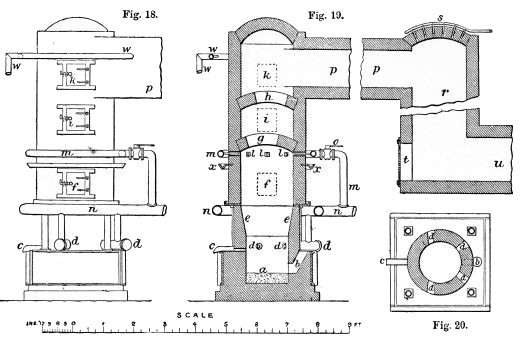
French and Hannay’s White-lead Furnace.
with them, being by preference formed in a chamber in connection with
the flue, by introducing a solution of chloride of sodium in spray, and
by providing a sufficient excess of sulphurous acid beyond that required
for forming the sulphite of lead. Air is also present, and a well known
reaction takes place, yielding hydrochloric acid and sulphate of soda,
the operation taking place at a part of the flue near enough to the
furnace to be always at a red heat. The hydrochloric acid thus mixed
with the gases and sublimate causes the formation of chloro-sulphite of
lead, or other combinations of lead, sulphur, oxygen, and chlorine of
variable constitution, depending on the proportions of the several
constituents, but in most cases the product is a body which forms a
white pigment of extremely good quality.
Fig. 18 is an elevation of their improved cupola furnace; Fig. 19 is a
corresponding vertical section; and Fig. 20 is a horizontal section as
at the level of the principal tuyeres.
This cupola furnace is formed with a deep hearth a (like the American
lead smelting cupola) having a siphon outlet b, for withdrawing molten
lead when necessary. At a level a little above the siphon outlet b, an
outlet c for slag and scoria is provided, and the main blast tuyeres
d enter at about the same or a slightly higher level. With this
arrangement, a considerable depth of melted lead is constantly
maintained, and the choking of materials is thereby avoided at the level
of the tuyeres. For a short distance above the main tuyeres d, the
interior of the furnace is made with the sides e moderately and
gradually widening upwards, and is afterwards continued upwards of
uniform diameter or width. The charging door f is between 3 and 4 feet
above the main tuyeres d, and the space above the charging door is
crossed by two or more arched diaphragms g h, of brickwork, having
irregular openings in them, there being doors i k in the side of the
furnace above each diaphragm, for inspection and cleaning. The purpose
of these diaphragms is to cause the air, gases, and sublimate to become
thoroughly intermixed and to ensure the complete combustion of any
black smoke and the oxidation of any sulphide of lead that may be
present.
An upper series of small tuyeres or jet pipes l is provided for
admitting air a little below the lowest diaphragm g, these jet pipes
l being supplied by a branch pipe m from the main air blast pipe
n, it being found that the introduction of the air and the production
of heat can be best regulated by supplying a portion at the upper part
of the furnace in this way, in addition to that supplied by the main
tuyeres d; and a tap or valve o is fitted on the branch pipe m for
adjusting the supplementary supply thus admitted. Above the highest
perforated diaphragm h, the interior of the furnace communicates with
a lateral flue p, through which the gases and sublimate pass; and at a
part of this flue p, sufficiently near the surface for the gases to be
still hot enough, an enlargement or chamber r forming a descending
part of the flue, is constructed. Into this chamber r a solution of
chloride of sodium is introduced as a spray from a number of jet pipes
s, for the purpose hereinbefore explained. This chamber r is
provided with a door t at its lower part, for periodically removing
matters that become deposited in it. The continuation u of the flue
communicates with the lower part of the chamber r.
Preferably the spray of chloride of sodium is fine enough to allow of
all or nearly all of the water being instantly evaporated, so as to
leave the salt in fine particles, and in a favourable condition for
being acted upon by the sulphurous acid, steam, and oxygen present in
the gaseous currents. The temperature of the chamber r should not be
allowed to fall below red heat. The proportion of chloride of sodium
used will depend on the amount of chlorination of the lead that may be
desired, in addition to what is necessary for converting the zinc and
other metals into chlorides. In practice a proportion of salt 2½ to 5
per cent. of the weight of the sublimate formed answers the purpose and
yields a good product, but a larger proportion may be used without
injury.
It is of great importance to keep the temperature of the upper part of
the furnace steadily at a red heat and flaming, as the colour of the
sublimate will be inferior if the temperature is either too high or too
low. To facilitate the proper regulation of the temperature, a pyrometer
(which may be similar to the kind used in ironworks) is employed, which
pyrometer is placed in the flue at a distance from the furnace where it
cannot be injured; and by a few trials is ascertained what temperature
should be indicated by the pyrometer when the temperature in the furnace
is what it should be. This point having been ascertained, a glance at
the pyrometer will at any time show whether the furnace is working
properly or not. The inventors also provide for rapidly cooling the
upper part of the furnace without interfering with the lower part, in
the event of the heat becoming too great, by arranging a water pipe w,
with a set of jets, round the top of the furnace, so that on turning a
tap on the supply pipe a spray of water may be applied to the outside of
the furnace; and as it is desirable that water applied in this way
should not run down to the lower part of the furnace they build gutter
plates x into the sides of the furnace just above the charging door
f, to lead off any surplus water to a drain pipe.
Sufficient hydrochloric acid may be formed or introduced, as
hereinbefore described, not only for forming chloro-sulphite of lead in
the condenser, but also for saturating all the free oxide of lead, and
for combining with and rendering soluble any iron, zinc, antimony,
silver, or other metals. The chlorides thus formed become dissolved in
the water of the condenser, and the solution, separated from the
insoluble white pigment, may be treated by known processes for recovery
of the metals. When the lead ores or other lead-yielding materials
contain silver to a greater extent than 5 oz. per ton, a notable
quantity of the silver is volatilised, and if it is left in the white
pigment it renders the latter sensitive to sunlight; whereas if rendered
soluble in the manner hereinbefore described, and separated by any of
the known processes, it becomes a source of profit.
The white pigment is washed in the ordinary way; and when chloride of
zinc is not completely removed by washing, a small quantity of sulphuric
acid may be mixed with the pigment, by adding the same to the last
washing water, to convert the chloride of zinc into sulphate, which is
not hygroscopic.
The white pigment made as hereinbefore described is a very good and
economical material for manufacturing into chrome yellow, this being
done by mixing a solution of any suitable chromate or bichromate with
the wet pigment; whilst the chrome yellow thus obtained may be converted
into chrome orange or red by treating it in the usual way.
Italian Process.—The precise period of the introduction of white-lead
manufacture in Italy is unknown, but it was certainly previous to the
beginning of the present century. Prior to 1881, the Dutch process was
exclusively used in Italy. In 1881 the so-called Brumlen and Dahn
process was introduced into Liguria. Somewhat later the Rhenish process
was introduced. The Rhenish process is one in use in nearly all the
Italian white-lead manufactories. It is employed in a large manufactory
at Cogoleto, as follows:—Lead in thin sheets of about 3 feet in length,
and 4 inches in width are placed in a clay chamber having the form of a
cube, of about the capacity of 5800 cubic feet. In this chamber there is
a wooden framework, upon which are hung the sheets of lead. Three of
these sheets weigh together about 4½ lb., and as the capacity of the
chamber is about 20 tons, it can hold about 30,000 sheets of lead.
On the floor of the chamber are placed twenty-four copper receptacles,
each having four circular apertures. These receptacles are all in direct
communication with a large pipe of masonry, which, by means of a copper
tube, receives the gas coming from a boiler and furnace placed under the
chamber. In the boiler, which is also of copper, is placed a mixture of
900 parts of water, and 80 parts of acetic acid concentrated to 40°, and
the capacity of the boiler is about equivalent to 25,882 gallons. The
furnace serves the purpose of producing carbonic acid.
The gaseous mixture, consisting of volatilised acetic acid, carbonic
acid, and aqueous vapour, is admitted from the boiler and furnace into
the chamber in quantity and proportions best adapted to each stage of
the work. The chemical reactions resulting are analogous to those which
take place in the Dutch process, and the Brumlen and Dahn process. Each
operation lasts six weeks, and gives a product of about 20 tons of white
lead, with a consumption of 7 per cent. of acetic acid, and 9 tons of
coke. The residuum of lead is about 10 per cent. of the quantity placed
in the chamber. At the end of each operation the white lead taken from
the chamber is washed and purified in large tubs, some of which are
furnished with filters. Finally, it is packed in earthen vessels, and
dried, when it is ready for the market, and is sold either in cakes or
powder.
The establishment at Cogoleto, above referred to, is able to produce
annually about 2000 tons of white lead, of which 1200 tons are produced
by the Rhenish process, and 800 tons by the Brumlen and Dahn process.
There is also in a manufactory in Milan, the process of revolving
heaters. The process of precipitation has not yet been used in Italy.
The Rhenish process, as above described, furnishes the greater part of
Italian white lead. The smaller manufacturers still use the Dutch
process, but the Brumlen and Dahn process is generally regarded as
unsatisfactory.
It is believed that the production of white lead in Italy during the
first ten years of this century was about 300 tons per annum. The total
annual production at present is, in round numbers, about 3500 tons, of
which 2800 are produced in the Ligurian manufactories, and about 300 in
those of Naples. Milan also produces about 300 tons.
The product finds a market almost exclusively in Italy. The annual
amount exported is about 300 tons, and goes chiefly to Constantinople.
Of the quantity of 2000 tons per annum produced at Cogoleto, about 300
tons is sold mixed with oil. No exact statistics are attainable as to
the total amount of Italian white lead which is annually sold other than
in the dry state, but it is believed to be little, if any, larger than
300 tons.
When the price of white lead was high, sulphate of baryta was mixed with
carbonate of lead to produce white lead of inferior quality, but in
consequence of the present price of white lead the use of sulphate of
baryta has almost entirely ceased. No other methods of adulteration are
known to be in use. In Italy, white lead is universally known as
“biacca” when it is sold in cakes. When sold in powder it is known as
“carbonato di piombo” (carbonate of lead). The lead from which all the
white lead made in Italy is manufactured comes from the lead mines of
the island of Sardinia, with the exception of a very small quantity of
argentiferous lead coming from Spain. The acetic acid used in the
process of manufacture comes from France. The market price of white lead
in Italy is now about 45 lire the quintal (equivalent to 18s. per
cwt.).
Lewis’s Process.—Many attempts have been made to substitute for
carbonate of lead—the ordinary poisonous white lead, that slowly but
surely induces paralysis in those who come in contact with it for any
considerable period—some less deleterious pigment. Zinc white has often
been put forward as a substitute, and is indeed largely employed; but it
is open to the objection of not possessing sufficient body or opacity.
Sulphate of lead is not poisonous; but, when prepared in the ordinary
way by precipitation, is of a crystalline nature, and, therefore,
wanting in both these qualities.
A sulphate of lead has, however, been produced by John T. Lewis, of
Philadelphia, by sublimation, which, when treated by the Freeman
process, is stated to possess a body and colour superior to the best
white lead made by the ordinary process, with the additional merit of
being cheaper, while it is also non-poisonous.
In the smelting of lead ore into pig lead, 15 per cent. goes off in
fumes, and 10 per cent. are all that it has hitherto been found possible
to recover; by this process, however, the whole 15 per cent. are
recovered. The sulphate may also be produced from a low quality of
galena, or lead ore, which is not suited for smelting into metallic
lead, and from the slag formed in the process of smelting.
The plant consists of simple subliming furnaces, iron cooling pipes,
suction fans, and a series of flannel or calico bags, arranged
vertically in a building, well ventilated, so as to allow the filtered
gases to escape, leaving behind the sublimed white lead, which is then
merely shaken down from the bags into barrels placed beneath them. The
manufacture is carried on at Joplin, Missouri, with four subliming
furnaces, about 500 feet of cooling pipes and towers, with suction fans,
which drive the fumes into 300 bags, 20 inches in diameter, and 38 feet
long, arranged vertically. About 50 tons weekly of white lead are now
being produced from waste fumes, slag, and poor ore, by this
establishment alone, at a cost not exceeding that given in the following
figures:—
| | £ | s. | d. |
| 20 cwt. of galena (with 82 per cent, of ore) | 8 | 0 | 0 |
| Cost of subliming and catching, including repairs, labour and all expenses | 1 | 10 | 0 |
| Casks | 0 | 6 | 0 |
| | 9 | 16 | 0 |
Freeman’s process (see p. 254) consists of grinding together, in a dry
state, under great pressure, and consequently with great friction,
sulphate of lead and sulphate of zinc. While neither of these two
substances alone possesses good body or opacity, when treated by this
process they are so changed in character that the new substance is
stated to be superior in these respects to the best form of ordinary
white lead.
The white lead thus obtained mixes well with oil, and has also the
advantage of not becoming blackened when exposed to the fumes of
sulphuretted hydrogen, and of not peeling off in a saline atmosphere. As
a basis for coloured paints, it is recommended on the ground that, being
decomposed with greater difficulty, it can be mixed with almost any
colouring substance; and, being free from acid, it does not change the
tints of other substances.
The details of Lewis’s process, and the plant employed, are more fully
set forth below.
Heretofore the manufacture of dry white lead from galena or the native
sulphurets has been effected by roasting or desulphurising the galena,
and then mixing the residue, after roasting, with carbon, and subjecting
the mixture to the action of heat in a compound reducing or subliming
and oxidising furnace, and collecting the resulting fumes in textile
bags.
Lewis’s process, however, is based upon the discovery that by subliming
unroasted galena, or the native or raw sulphuret of lead, and then
oxidising the volatile products, cooling the fumes, and collecting them
by means of a textile fabric, a superior basis of a pigment can be
obtained. The admixture of carbon with the raw ore will facilitate the
subliming process, or it may be carried on in a muffle or reverberatory
furnace without the previous admixture of carbon.
The furnace, which has been found to answer well for the purposes above
mentioned, is commonly known as the Wetherill furnace, and is
represented in plan, in Fig. 21; in front and back elevations, in Figs.
22, 23; and in central longitudinal section, in Fig. 24.
a represents the main chamber, the bottom b of which is composed of
iron bars perforated with small holes of about ¼ inch in diameter and
about 1 inch apart, and preferably made slightly conical, with the
larger diameter downward, that is to say, the said holes are of such a
size as to prevent
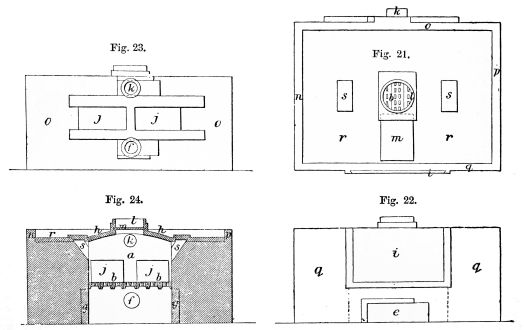
Lewis’s White Lead Plant.
the escape of the crushed ore and coal. These perforated bars are
suitably sustained at the ends on the front and back walls of the
furnace. The ash pit below the perforated bottom is of equal area
therewith, and is provided with a door e in front, and with a hole f
at the back for the reception of a pipe from suitable blowing apparatus.
The walls g, and arch on the top should be built of some refractory
substance, such as fire-brick.
The front of the furnace is entirely open, and is provided with sliding
doors i, by which it can be closed when working, and opened to remove
the residuum.
At the back of the furnace there are two slides j, to permit access to
the main chamber, for stirring the charge and for inspection.
At the back, near the arch, there is a hole k, governed by a sliding
damper leading to a chimney, for carrying off smoke and impure gases at
the commencement of the operation upon a new charge.
In the centre of the roof there is an aperture l, governed by a damper
or sliding door m, the said aperture leading to a suitable apparatus
for the collection of the oxidised vapours of lead.
The exterior walls n o p q may be built up to form two feeding troughs
r, one on each side of the arch or roof, and each provided with an
aperture or passage s, communicating with the inside or main chamber,
and each aperture or passage is provided with a cover to be put on after
the furnace has been charged.
In working with this furnace, crushed ore (native sulphuret of lead) and
carbon, preferably in the state of pea or dust anthracite coal, are
mixed in equal proportions; the mixture is ignited, and the fumes are
oxidised by the blast through the mixture, which also promotes the
combustion. Dense white vapours or fumes pass off, and are conveyed to a
separate chamber, where they are strained by passing through a screen or
series of screens of muslin or other textile fabric. Lime may also be
employed in the furnace, in the proportion of 200 lb. of lime to 400 lb.
of galena, although the addition of the lime is not necessary in all
cases.
Instead of the furnace above described, a muffle furnace may be
employed, in which the heat is applied indirectly to the ore, with the
precaution of constructing the sole or bottom of this furnace of a
material not rapidly acted on by the constituents of the ore; or a
reverberatory furnace may be used in which the heat is directly applied.
In both of these two cases reducing carbon may or may not be mixed with
the ore.
Sometimes, generated gas is employed in place of coal, to effect the
same result.
In a later specification Lewis remarks that when white lead pigment is
manufactured from galena or other lead ores, in the raw state, or even
in the roasted state, by subjecting them to the joint action of heat and
air, either with or without reducing means, according to the quality of
the lead ores used, the fumes are discoloured by particles of carbon or
sulphuret of lead, or both, when they are caught in bags of textile
fabric, and are unfit when in this state for use as a white pigment.
The fumes which are produced by this action of heat and air on galena or
other lead ore are cooled and then collected in bags, and Lewis prefers
to expose the so-collected products to the joint action of heat and air,
to destroy or to burn out all the particles of carbon or sulphuret of
lead, or both, by either throwing the said fumes on a bright clean
anthracite or coke fire, with a blast from the sides or from below, or
by throwing them over such fires or into a cupola furnace, or by
throwing or blowing them into a generator gas flame, or through
externally heated retorts. He then in either case collects the escaping
fumes from the furnace or retort in bags or screening chambers.
The best process to be adopted depends upon the kind of fuel in the
locality where the fumes are refined, and also upon the purity of the
lead fumes. If they contain iron, clay, or the like, it is best to throw
them into a coal fire; but if they are pure, one process is about as
effective as the other, and the degree of purity of the fuel decides the
kind of heating apparatus to be used.
There being such great difference in the purity of fuels, and this
irregularity not allowing of uniform results, Lewis prefers to use a
furnace in which the flame and heat are produced by burning gaseous fuel
with air, which is forced into the furnace with the fumes which have
been collected in a previous process.
Fig. 25 represents a furnace which may be advantageously employed for
the purpose when gas is used as fuel.
a represents a blower, into which the fumes are fed from the hopper
b. The fumes, being thoroughly mixed with air in this blower, are
forced into a chamber c, and then through a series of tuyeres d. At
the same time, gas from a generator or producer is admitted by the flue
e, and is burned by the incoming blast from the tuyeres d; the
volatile fumes produced in the furnace f pass through it and out of
the flue g, and are collected in bags or screening chambers. By using
gas fuel, which is easily and fully burned, and clean to handle, a fine
white pigment is produced.
MacIvor’s Processes.—The name of MacIvor is a familiar one in
improvements in manufacturing chemistry, and not the least in connection
with the subject of pigments, sometimes in conjunction with other
inventors.
In 1889 MacIvor and others introduced some modifications in the process
of producing white lead or carbonate of lead, by the treatment of oxide
of lead (litharge or massicot) with a solution of acetate of ammonia,
whereby the oxide of lead is transformed into hydrate and acetate, which
are subsequently converted into carbonate of lead by the injection of
carbonic acid. The hydrate and acetate of lead, in presence of free
ammonia formed in the reaction, are quickly decomposed by
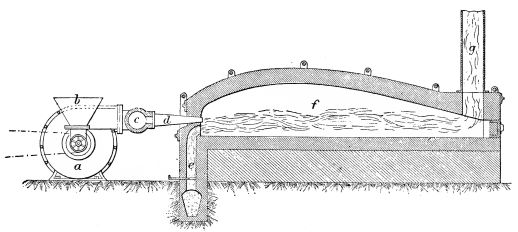
Fig. 25.—Lewis’s White Lead Plant.
the carbonic acid, yielding the final product, namely carbonate of lead,
and re-forming the acetate of ammonia.
The rapidity with which the conversion of oxide of lead into hydrate can
be effected depends upon the strength of the acetate of ammonia solution
employed, that is to say, the weaker the solution the slower will be the
conversion. It has been found that, for commercial purposes, the
solution of acetate of ammonia may be used with advantage of a strength
which need not be more than 25 per cent. nor less than 5 per cent. A
strength of 25 per cent, operates in a comparatively short space of
time; but a strength as low as ½ per cent. will effect the hydration if
there be a sufficient quantity of the weak solution, the lead oxide
being in a fine state of division, and time of no object. This ½ per
cent. strength, however, or any strength below 5 per cent., is not
recommended for commercial purposes, having regard to the time required
for completing the operation.
The conversion of the oxide of lead into the hydrate and acetate of lead
is effected in the cold (heat may be used, but for commercial operation
it is not recommended). The conversion is facilitated by employing a
mechanical arrangement, similar in many respects to that adopted in a
previous specification, but modified by connecting the digesting vat
with a cistern or vat containing acetic acid, whereby any free ammonia
carried over during the operation may be absorbed. Also by introducing
carbonic acid to the mass of hydroxide and acetate of lead formed by the
oxide of lead and acetate of ammonia, either by a series of concentric
rings perforated with small holes in the bottom of the vat itself, or by
passing carbonic acid down a hollow shaft to which are attached
stirrers, and through perforated tubes attached to the blades of the
stirrers, or by any other means that may ensure the thorough saturation
of the hydroxide and acetate of lead so as to form carbonate of lead.
The solution of acetate of ammonia may be recovered from the white
lead, and be repeatedly used, for the conversion of further quantities
of oxide of lead into hydrate and acetate of lead, which hydrate and
acetate are converted into carbonate of lead by the injection of
carbonic acid. Theoretically, a given weight of acetate of ammonia in
solution, used in conjunction with carbonic acid, should be capable of
converting an unlimited quantity of oxide of lead into carbonate of
lead; but during the manufacture of white lead by this process, it may
be reckoned that there will be a loss of ammonia acetate varying with
the strength of the solution employed, but it should not exceed 10 per
cent. on each charge. This loss arises in the washing of the final
product, and through the escape of some ammonia during the process.
Fig. 26 is a vertical section of the apparatus employed.
a is a vat, which may be made of wood or other material capable of
resisting the chemicals employed; it may conveniently be 6 feet in
diameter and 4 feet deep, and it is provided with a closely fitting
cover, b is a cistern situate at a higher level, and intended to
contain a solution of acetate of ammonia, c is a pipe by which the
solution can be drawn down from the cistern b into the vat a; a cock
is provided upon this pipe, as the drawing indicates. There is a
man-hole d in the cover of the vat, and the vat contains an agitator
e, with a vertical shaft which can be turned by gearing f as shown,
or the agitator may be driven by any suitable motor. The shaft of the
agitator e is hollow, and pipes g, which stand immediately behind
the stirring tines, are connected with the hollow shaft, to deliver the
carbonic acid gas into the vat; or this may be effected by means of
coils of pipe laid at the bottom of the vat, and pierced with small
holes. The pipes g are open at their lower ends. h is a cock by
which the liquor can be drawn off from the vat into the receiver i. A
pump k is provided upon the cover of the receiver, by which the liquor
may be returned into the vat a. l are outlets by which the white
lead is discharged from the
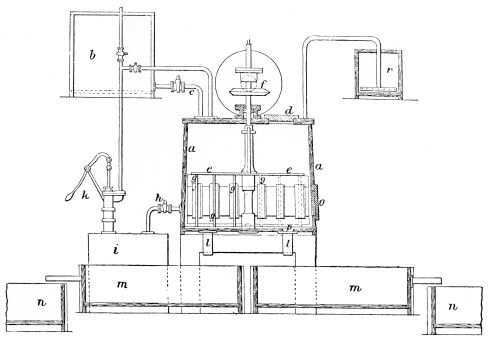
Fig. 26.—MacIvor’s White Lead Plant.
vat into the washing cisterns m and n. o is a man-hole, which may
be opened to facilitate the emptying of the vat. p is a plug which is
removed to let the white lead run out of the vat. r is an ammonia
catch box, charged with acetic acid.
All the metal-work of the apparatus with which the acetate solution
comes into contact should be of such a character as to resist corrosion,
or should be coated with a material capable of withstanding attack by
the chemicals employed in or formed during the process.
The operation is by preference conducted in the following manner, but
the details admit of variation. The charge of monoxide of lead for an
apparatus of the dimensions indicated may weigh about 1120 lb.
The monoxide should be in fine powder, and may be either moist or dry.
Having received this charge, which is introduced by the upper man-hole
d, the vat a is closed, and a solution of acetate of ammonia is let
down upon the charge from the cistern b, or pumped out of the receiver
i. The vat a should be charged with the solution of acetate of
ammonia in the proportion of three parts of said solution to one part of
lead monoxide by weight. It is convenient to employ a solution
containing 5 per cent. of acetate of ammonia, and the quantities above
stated are suited to a solution of this strength; but the strength of
the acetate solution may be varied within wide limits, as hereafter
explained.
The charge of monoxide of lead and acetate of ammonia in the vat should
be kept constantly stirred by the agitator until it becomes whitish in
colour, when it will be found that the monoxide of lead has become
converted into hydrate and acetate. The workman will know that this
change is complete when the reddish or yellowish appearance of the
monoxide of lead disappears, and the mass in the vat becomes whitish in
colour.
The hollow axis of the agitator is connected with a pipe, by which
carbonic acid gas is supplied to it under pressure sufficient to cause
the gas to pass through the contents of the vat. This gas escapes at
the lower ends of the pipes g, and ascends through the liquid in which
the hydrate and acetate of lead are held suspended. A free flow of this
gas should be maintained, and some excess allowed to pass away by a pipe
on the cover into the ammonia catch box r. The pipe dips down into the
acetic acid which this box contains, and any ammonia passing off with
the carbonic acid gas is caught by the acid, and forms acetate of
ammonia. When the hydrate and acetate of lead are completely converted
into basic carbonate (and this the workman will know by its changed
appearance), the motion of the agitator is caused to cease, and the
white lead is allowed to settle.
There is a gauge glass on the side of the vat a, and in this glass the
changes of appearance can be recognised by which the workman regulates
the process.
When the white lead is deposited, the liquor is drawn off into the
receiver i by opening the cock h. The plug p is then displaced,
and the white lead is allowed to descend into the washing cistern m.
Below the cock h is another cock or cocks, in order that any further
quantity of liquor may be drawn off into the cistern i if required.
The taper plug p is then raised, by being pushed up from underneath
the vat a, through pipe l.
The white lead requires to be well washed with clean cold water.
When a fresh charge of monoxide of lead has been placed in the vat a,
the liquor is pumped up on to it from the receiver i, and then a
further quantity of solution is drawn from the cistern b, and also
from the ammonia catch box r, until the proper quantity has been
supplied, which is determined by the gauge.
Quite recently, in conjunction with Mr. Watson Smith, Mr. MacIvor has
introduced further improvements in the production of “white lead” or
basic carbonate of lead, by the treatment of oxide of lead (litharge or
“massicot”) with a heated solution of acetate of ammonium, in a closed
vessel (called the digestor), with agitation and under pressure, so
that the oxide of lead is transformed with exceeding rapidity into basic
acetate of lead, chiefly consisting of the tribasic acetate, ammonia
being set free; and the subsequent treatment of the basic acetate thus
obtained, after filtering or otherwise removing insoluble impurities,
and after cooling with carbonic acid gas in a separate vessel (called
the carbonator).
The acetate of ammonium is by preference first charged into the
digestor, and then the oxide of lead (litharge or massicot) in fine
powder, and in the equivalent proportions calculated to be at least
somewhat slightly in excess of the quantity necessary to form with the
acetic acid of the acetate of ammonium the tribasic acetate of lead
Pb(C2H3O2)2 + 2 PbO or Pb3O2 (C2H3O2)2, is
added (this being in allowance for the certain amount of insoluble and
unconvertible matters in the litharge), the acetate of ammonium liquor
of a strength preferably not below 5 per cent., though it may be
stronger, being first, before the addition of the oxide of lead, set in
vigorous agitation and circulation by the pump, and heat having been
applied by means of a steam heater as shown in the drawing and as will
be explained later on.
The digestor is closed, and the temperature rises. As the temperature
rises, and approaches 212° F., and as the pressure, due more especially
to the tension of vapour of ammonia set free during the reaction with
the litharge, increases, so is the rapidity of the conversion of the
oxide into basic acetate increased, and more and more of this basic
acetate becomes dissolved, whilst at or about 212° F. it is entirely in
a state of solution. The degree of heat, or the prolongation of the
heat, depend of course upon the state of dilution of the acetate of
ammonium used. Something more specific will be said later on regarding
this question of degree of heat.
The clear liquor, together with extraneous coloured particles, red lead,
dirt and undissolved matters, is pumped out through a suitable filter to
one of the carbonators, being carried en route through a cooling-pipe
system, and being let cool further if necessary in the carbonator
itself. After cooling thoroughly, the cold basic acetate, which may now
have crystallised or separated out more or less, according to the
strength of the solution, is treated with carbonic acid gas, whereby the
basic acetate, in the presence of the ammonia set free, is converted
into basic carbonate of lead of exceptionally white colour, and with
high basicity and covering power, proper care being taken as specially
indicated later on. There are several reasons why greater whiteness of
the product is secured, the principal one being that filtration from
solid and insoluble coloured impurities has taken place previous to the
carbonating process.
The advantages of the employment of heat and pressure for the formation
of the basic acetate of lead from oxide of lead, and the advantage of
thus carrying out the conversion of oxide into basic acetate of lead
separately from the conversion of that basic acetate of lead into basic
carbonate or white lead, are—
Firstly—That separation by filtration from impurities and so forth left
by the oxide of lead used, and insoluble in the acetate of ammonium, is
made possible, and thereby a pigment of exceeding whiteness and purity
can be obtained, besides high basicity, with corresponding body and
covering power.
Secondly—That the rapidity of the conversion of oxide of lead into
basic acetate of lead is immensely increased—it becomes in fact almost
instantaneous, much time being saved.
Thirdly—That the conversion is effected quickly and in a perfectly
closed vessel; no chance of the escape of ammonia occurs, and, in the
carbonating stage of the process, the free ammonia present in the liquid
assists in securing the formation of basic carbonate of lead, and the
maintenance of this basicity throughout the conversion.
This free ammonia is converted by the carbonic acid into the less
volatile but still alkaline carbonate, and, later on, this ammonium
carbonate reacts upon the basic acetate of lead, converting it into
basic carbonate of lead, acetate of ammonium, still less volatile, being
simultaneously produced, ready for use over again.
It must be understood then, that as the carbonic acid passes into and
through the ammoniacal mixture in the carbonator, it continually
precipitates or forms basic carbonate of lead, in presence of more or
less of the volatile alkali, which however continually diminishes in
quantity as the conversion proceeds.
Were no ammonia present, but only tribasic acetate of lead, as in the
case of the earlier methods of precipitating white lead, unless a very
slow current of carbonic acid gas were passed through, some of the first
formed basic carbonate of lead would be in danger of being
over-carbonated and losing its basicity, being converted into
mono-carbonate of lead. This danger is much lessened, and consequently a
much greater possibility of rapidity of carbonating is conferred, in the
case of the process as above described, and by virtue of the ammonia
which is present.
Nevertheless the carbonic acid gas must not be passed, even into the
ammoniacal liquid containing the tribasic acetate of lead, with such
rapidity that distinct alkalinity to the usual tests ceases to be
maintained, and the process must be terminated whilst the liquid is
still alkaline. If a little lead salt on the one hand, and a little
ammonia on the other, be left in the mother liquors ultimately obtained
on filtering from the white lead, they will be returned and circulated.
Fig. 27 shows an elevation (partly in section) of the apparatus
employed.
a is an iron vessel made of boiler plate, and lined internally with
lead. It may be here added that all the apparatus is thus lined, or is
constructed of material invulnerable to the action of lead salts,
ammonia, or acetate of ammonia.
The vessel a, which is termed the digestor, should be furnished with,
a thermometer, pressure gauge, safety valve, charging hole b, and
suitably arranged sampling pipe with cock.
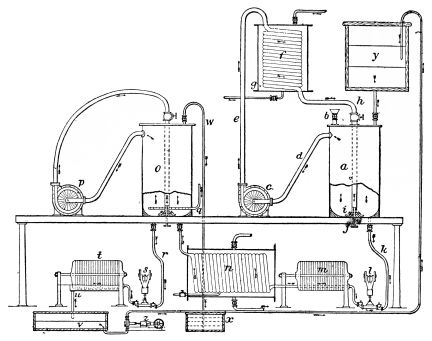
Fig. 27.—MacIvor’s White Lead Plant.
Agitation of the contents of the vessel is effected by means of the
circulating pump c, which, drawing off supernatant liquor along with
air and ammonia vapour from the upper part of the digestor a, by the
pipe d, forces it through the pipe e to the heater f, consisting
of a coil suitably heated by steam in a steam vessel g, or by similar
means, and then is forced through a pipe h, leading to the bottom of
the digestor a, where it terminates in a cone-spreader i, provided
with a regulating valve j. By means of this spreader, the liquid is
forced through the heavy and dense mixture containing the oxide of lead,
which it vigorously agitates and keeps more or less in circulation as
indicated.
The charges of litharge and acetate of ammonium will vary according to
the strength of the latter. For a 5 per cent. strength of acetate of
ammonium solution, however, it will be best to calculate the proportions
as follows, viz. about 1200 gallons of 5 per cent. acetate of ammonium
liquor for 1 ton of litharge, which should be finely ground.
The temperature of the liquor may vary between 140° F. and 212° F.; but
within these limits, the lowest temperature consistent with the
sufficiently rapid conversion and solution of the litharge is
preferable. The reason of this is simply that the less the heat
employed, the less is the tension of the ammonia, and the chances of the
loss of ammonia are thus minimised; in addition to this, less delay is
involved and less refrigeration or cooling is needed before carbonating.
The object of the violent agitation of the litharge amongst the heated
acetate of ammonium in the digestor a, is that caking of the former
may be prevented, and a most rapid conversion of the oxide of lead into
basic acetate of lead, with minimum expenditure of heat, be secured.
The effect of the heat in the closed space is greatly aided by that of
the pressure due to the tension of the ammonia and aqueous vapour at the
increasing temperatures.
When the litharge is converted into tribasic acetate of lead, and
brought into solution, the liquor and sludge of insoluble matters is
preferably pumped through pipe k, by means of the filter-press pump
l, and forced through the filter-press m, which removes and retains
the insoluble matter, allowing the clear liquor to pass to the cooler
n, and through this to the carbonator o, similar in construction to
the digestor a.
Here the cooled liquid is circulated by means of pump p (in a similar
manner to that adopted in the digestor process already described),
carbonic acid being simultaneously pumped in through the pipe q, which
is perforated as shown, or introduced in any other way.
When carbonated to the desired extent, the white magma, consisting of
basic carbonate of lead and mother liquor, is drawn through the pipe
r, by the pump s, into the filter press t.
The clear liquid flows through u, into the covered mother liquor tank
v, whilst the press-cakes of white lead, after sufficient washing with
water, are removed and dried in a suitable manner.
The washings are run off to a weak liquor tank (not shown) for
concentration for use over again. Any inert gases accompanying the
carbonic acid, or the latter alone in excess, pass from the carbonator
through pipe w, into the catch-box or other condensing and absorbing
apparatus x, containing either dilute acetic acid or cold water, in
order to retain any ammonia carried over, and furnished with perforated
trays or baffle-plates.
This catch-box is, if necessary, also connected with a further
condenser, so as to remove all ammonia from the displaced air, or inert
gases (if impure carbonic acid has been used) of the carbonator. It is a
lead lined vessel preferably. The ammonia carried from each charge thus
is tested by measuring the volume of the solution from the catch-box or
other condensing and absorbing apparatus, and estimating the ammonia
present in the solution. This amount of ammonia in a sufficiently
concentrated form is then added to the charge in the carbonator, when
cold, so as to produce a completely neutral solution. The ammonia in the
catch-box is either added to the ammonia stock in the ammonia
department, used for dilution of strong ammonia in making fresh acetate,
or strengthened up to further absorption in the catch-box or condenser,
until strong enough to add to a freshly run and cooled charge in the
carbonator, to replace any ammonia driven off by heat.
The sludge in the filter-press m is washed with water to remove
acetate liquors and ammonia, the weak liquors being run to a separate
closed vessel similar to the carbonator o, but smaller, and not shown
in the drawing.
Here white lead is precipitated by carbonic acid, and the product is
passed into the filter-press t, the weak liquors associated with it
serving to give a preliminary washing to a freshly received charge of
white lead already in the press. The weak filtrate liquors thus obtained
are preferably sent to the weak liquor tank already mentioned, for
subsequent concentration, instead of to the stronger liquor tank v.
The sludge-cakes from the filter-press m, connected with the digestor,
are suitably treated for the recovery of lead therefrom.
The mother liquors contained in tank v from the white lead
filter-press t, are directly returned to the ammonium acetate tank
y, by the pump z, for use over again.
The carbonators may be operated singly as described, or two or three may
be connected together so as to be worked in rotation, the partially
absorbed carbonic acid from one carbonator being completely, or more or
less completely, absorbed in the one, or two, with which it is
connected. The last of such series of carbonators would of course be
connected with the catch-box arrangement previously described, or other
condensing and absorbing apparatus.
Characters.—The advantages and disadvantages in the employment of
white lead have been described pretty fully by Prof. Barff in one of the
Cantor series of lectures which form such an important feature in the
publications of the Society of Arts.
Probably the fact that white lead possesses the body it has is the
reason why it has been so largely used, and why so many paintings which
have been painted with it have come to a most untimely end. Prof. Barff
says he knows of no pigment so liable to change of colour as white lead.
In saying this he expects that there are many who will not agree with
him. They know that white lead works well and easily, and they like it
because it covers down well; but then he points out some of the great
defects under which it labours.
If you take some oil, and if to that you add lime-water, the oil will
mix with the lime-water, and form a kind of emulsion. Again, if you boil
oil or fat with soda, a kind of soap is formed, and the process of
manufacturing soap is termed the process of saponification. Now if,
instead of boiling fat with soda or alkali, we boil it with plumbic
oxide or oxide of lead, we shall form a soap, and that soap goes by the
name, amongst medical men, of emplastrum plumbi, or lead plaster. This
is a substance made by the saponification of oil with the oxide of lead.
Because this oxide and carbonate of lead have the power of saponifying
oils, you get in white lead that peculiarly smooth easy working which
you do not get with any other white pigment; and it is on this account,
for one reason, that it is liked by artists and painters. Taking a piece
of paper coated with some of this lead plaster, if you throw a light
upon it, you will see that the substance is semi-transparent. This is a
peculiarity of lead that it will saponify and form this sort of
transparent substance.
The famous landscape painter, Mr. Wilson, made an addition to a room in
his house. The old part of the room had been painted a dark colour; the
new part, of course, when it left the workman’s hands, was perfectly
white, and therefore the painters painted down the dark colour with
white lead, until the whole room displayed one uniform tint. After a
while, however, it was found that the part which was originally painted
dark became dark again; the dark paint, in fact, showed through the
white lead. Sometimes, possibly, when an artist wishes to put in figures
upon a dark background that he has painted, he uses white lead, and the
figures will stand out well and brilliantly at first, but after a time
the dark colour upon which they are painted strikes through the lead,
and the figures of course recede. Now, this striking through is owing to
a slight process of saponification, no doubt owing to an interchange
between the carbonic acid of the lead carbonate and the stearic and
oleic acids of the oil with which the lead is mixed; so that, in time,
the white lead, which has a body which makes it so great a favourite
with artists, loses that body, and becomes a transparent or
semi-transparent substance, something like lead plaster. Here is a
reason why white lead should not be used unless the ground has
previously been brought to a light colour.
There is another objection to the use of white lead, and really a very
valid one it is. Persons go on year after year laying out sums of money
for having their houses painted with white lead, when other pigments
which will keep their colour might well be employed. A house painted
with white lead after some time darkens in tint considerably; the colour
is changed by some influence that is acting upon it through the air, and
that influence is sulphuretted hydrogen gas. If you paint with white
lead doors placed near a drain from which this gas escapes, those doors
will become browned and blackened. White lead is very often,
particularly that procured at ordinary shops, adulterated with a
substance called sulphate of baryta, or, commonly, barytes. This is much
more transparent when ground with oil than white lead itself, and it
will materially impair that property for which white lead is valued,
viz. that of covering down well and solidly. White lead adulterated with
barytes has, generally speaking, a bluish sort of look; it is
semi-transparent. It has not that opacity that pure white lead has. If
you take a small piece of white lead and put it into a test-tube, and
add to it a little nitric acid, or aquafortis, and some water, if the
lead is pure the whole of it will dissolve in the liquid, and you will
have a pure solution. If it does not dissolve there is a white
precipitate, which will fall down to the bottom of the tube, and that
precipitate is sulphate of baryta. Sulphate of baryta is insoluble in
aquafortis, but carbonate of lead, and most lead salts, are soluble in
it.
There is another excellent test for the purity of white lead, which is
this. If you take a small portion, and grind it up with a little
carbonate of soda into a small pellet about the size of a pea, and then
put it upon a piece of charcoal and hold it in the middle flame of a
blow-pipe for some short time, the sulphate of baryta becomes
decomposed, and you get sulphide of sodium formed. If this sulphide of
sodium be acted upon by an acid liquid, sulphuretted hydrogen is given
off, which could not be formed from carbonate of lead, for in it there
is no sulphur at all; and inasmuch as sulphate of baryta is the impurity
for which we have to look, the presence of sulphide after this treatment
indicates that it was with the white lead which was examined.
Lime White.—A name sometimes given to the white pigment prepared from
sulphate of barium. See baryta white, p. 170.
Lithophone.—This is a fancy title for one of the several varieties of
white pigment having the metal zinc as a basis, and described under zinc
whites on p. 247.
Magnesite.—The mineral known by this name is a natural carbonate of
magnesia, just as limestone is a natural carbonate of lime. Where
sufficiently abundant it is quarried, ground, and levigated much in the
same manner as barytes, which it greatly resembles in its qualities as a
pigment, and for which it constitutes a suitable substitute. It is very
white, heavy, and opaque; permanent in ordinary situations; neutral with
other pigments, mixes equally well with oil or water, and possesses good
covering power.
Mineral White.—One of the names applied to the pigment prepared from
gypsum, see p. 183.
Orr’s Enamel White.—A name derived from the maker of a certain variety
of the zinc sulphide pigments, described under zinc whites, p. 254.
Paris White.—Another name for the best brands of whiting, see below.
Permanent White.—This name is often bestowed upon baryta white
(see p. 170), on account of its durability as compared with white lead.
Satin White.—There is a certain amount of confusion in the application
of this term, for while it is sometimes referred to baryta white (p.
170), it is also a synonym for fine gypsum (see p. 183).
Spanish White.—The most carefully prepared samples of whiting (see
below), are often known by this name.
Strontia White.—Though much less common than the closely similar
sulphate of barium, the natural sulphate of strontium is equally
suitable for employment as a pigment, and is prepared in exactly the
same way as baryta white (see p. 170). The artificial product is also
used. Both possess qualities remarkably akin to those of baryta white.
Terra Alba.—An old-fashioned name for levigated gypsum (see p. 183).
Whiting.—This material is simply prepared chalk. It should be soluble
in hydrochloric acid with effervescence, leaving at the most but a small
residue. Sometimes samples of whiting are found which are more or less
alkaline or caustic in their properties. This is a serious defect for
many purposes. It can be detected by treating the sample with water, and
adding to the liquor a little phenolphthalein. If a brilliant red colour
is obtained, caustic lime is present, and the sample should be rejected,
if to be used for mixing with chromes or Brunswick greens, where a
neutral product is required.
Chalk itself is too familiar to need any description beyond saying that
it essentially consists of carbonate of lime, with always a small
percentage of silica associated with it.
Its preparation consists in hand selection to exclude the silica which,
occurs in the more pronounced form of flints, then grinding in several
stages, levigation and drying. The levigation is effected by having a
series of settling pits into which the ground material flows with water,
and deposits according to its degree of fineness. The drying is
performed in chambers provided either with pipes carrying steam or
heated air, or by fires beneath the floor, and thoroughly ventilated so
that the moist air can escape as fast as it is saturated. Finally the
dried whiting is again ground very fine. The drying must be done with
great care and at a low temperature, so as to ensure avoiding
calcination, whereby the carbonate of lime is changed into oxide
(quicklime).
Whiting is a permanent and useful pigment mixed with water in
distempers, but is not applicable as an oil colour.
Zinc Whites.—Originally and properly the term zinc white was reserved
for the white pigment consisting of zinc oxide; but latterly many kinds
of white pigment have been introduced containing a large proportion of
sulphide of zinc, sometimes associated with more or less oxide, and
sometimes without any oxide, and these are also by many people called
zinc whites, to which name they are perhaps as well entitled as the
original zinc oxide. It will therefore be convenient to arrange them all
under the same general heading of zinc whites.
(1) Oxide.—Under the influence of a white heat metallic zinc is
volatilised, and if the vapour is thus brought into contact with oxygen,
either in the pure state or as air, combustion takes place, and the
oxygen unites with the metal to form zinc oxide. On this very simple
principle is based the manufacture of zinc oxide white.
The operation is conducted in plant similar to that shown in Fig. 28,
which consists essentially of two departments, that in which the zinc is
volatilised and that in which the oxidised vapour is deposited for
collection.
The volatilising process takes place in a series of oblong fire-clay
retorts a, varying somewhat in form but always with a contracted and
rising neck. Ordinary dimensions are about 2 feet long and 9 inches in
diameter each way, with walls about 1½ inches thick. These are heated to
whiteness and then charged with ingots of metallic zinc.
The retorts are arranged in double rows in reverberatory furnaces b,
two furnaces being arranged back to back so as to economise heat. The
furnaces are fired at the side, and the heat is conveyed around the
retorts by means of the flues c, the products of combustion of the
fuel finally escaping by the chimney stack d.
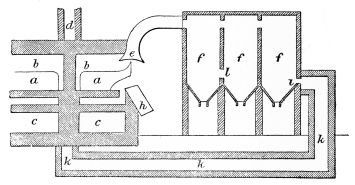
Fig. 28.—Apparatus for Making Zinc Oxide.
As the vaporised zinc is emitted at the mouths of the retorts a in a
partially ascending current, it immediately encounters a plentiful
supply of air, and thereupon takes fire (undergoes combustion or
oxidation). In this condition it enters the lower and funnel-shaped end
of the sheet-iron flue e, by which it is conveyed into the series of
settling compartments f.
While the bulk of the zinc oxide thus formed passes into the settling
chambers, a portion of it is too heavy to do so; its specific gravity is
such that the force of the draught is not sufficient to carry it up.
This portion falls at once into a receptacle placed beneath the mouth of
the flue e.
In order to obtain the necessary draught, the conduits h are open to
the outside atmosphere, and introduce a supply of air just below the
mouths of the retorts a, so that it impinges against the current of
escaping zinc vapour. After passing through the settling chambers f,
the superfluous air finds an outlet at i into a sufficiently capacious
flue k, which communicates with the chimney stack d. Thus the
draught created by the fuel consumed in the reverberatory furnaces is
made to assist the current through the settling chambers.
These settling chambers f, are constructed of wood, and are usually
about three in number, intercommunicating of course. The zinc oxide
enters the first compartment through an aperture in the top of the side
to which the discharge end of the iron flue e is attached. After
traversing the first chamber, the stream of air and such oxide as has
not yet settled passes into the second chamber through the orifice l,
near the bottom of the partition dividing the two chambers. To reach the
next compartment, the stream has to ascend again, the aperture being at
the top of the partition, and this alternation is carried on to the end
of the series, thus checking the through draught and facilitating the
settlement of the zinc oxide. The floors of all the chambers are made
funnel-shaped, with a door at the lowest point, so that the discharge of
their contents may be as automatic as possible. The flue k contains
screens hung at intervals for the purpose of hindering, as far as
possible, the escape of minute particles of zinc oxide into the chimney,
and thence into the outer air, whereby they would be lost.
A description of the process as conducted in Belgium, says that ingot
zinc is placed in a series of retorts within one furnace, and the oxide
is formed in an exhaust chimney, and then passes through a long series
of passages and condensing chambers, in which are ranged tanks of sheet
iron or cloth to collect deposits. At a certain hour of the day it is
collected into casks, and after being tested as to quality it is ready
for delivery. According to the purity of the metal various qualities are
produced. The best is called “blanc de neige,” or snow white, and is of
a very superior quality; No. 1 white is the most used, the ores for this
quality being selected and purified by remelting; No. 2 white is the
common variety. In the process of manufacture there is more or less
waste material, imperfectly oxidised, deposited in the retorts and
passages. This residuum is carefully ground, washed and dried, and is
employed in painting in the place of lead.
In the American method of making zinc white they use the ore direct.
This is cheaper than the Liège method, but its product is of inferior
quality to that produced by sublimation. There are but two works in
Belgium for making zinc white, the Vieille Montagne Company (at the
Valentine Cocq works), which produce yearly 3000 tons by sublimation;
the other is at Ougree, near Liège, where the American method is
employed, but at present it is idle.
There are many other modifications in detail in different works. One may
be noticed here as it is claimed for it that the pigment is gifted with
greater covering power or body, the limited degree of which is the only
drawback to zinc oxide whites. The plan consists in this, that the oxide
is allowed to collect in the condensing chambers till it is of such a
depth that a man entering stands waist deep in the pigment. The latter
is gathered in pieces of sacking, which are drawn together and squeezed
up tightly, so that the oxide, when newly prepared, is pressed into hard
dense masses.
(2) Sulphide.—Prof. Phipson, in a paper read before the International
Health Congress, at Paris, remarked that for several years efforts had
been made to discover some white substance to replace white lead for
painting buildings, ships, &c. He himself had devoted several months to
this important subject, but without success. There has been found, it
is true, in oxide of zinc a substance less poisonous than lead, and
serving very well as a white pigment in oil painting; but its production
is very expensive, and its mechanical properties as a colour in oil are
not pronounced enough to allow it to compete in commerce with white
lead. Such is not the case, however, with an invention of Mr. Thomas
Griffiths, of Liverpool, who has succeeded in obtaining a very
interesting product. This new preparation, which is being manufactured
at the present time on a pretty extensive scale, has for its base
sulphide of zinc (or an oxysulphide of that metal), the properties of
which as an oil colour are of the most remarkable character. It is
prepared by precipitating one of the salts of zinc by a soluble
sulphide, and washing and drying the precipitate. The latter is then
calcined at a red heat, with some precautionary measures, then taken
from the furnace, and, while still warm, thrown into cold water. It is
afterwards levigated and dried. The result is a white pigment, very
fine, and of great beauty. Regarded from a hygienic point of view,
Griffiths’ new white is infinitely superior to white lead, as it also is
in its practical bearing; it possesses no injurious qualities; its
manufacture and use do not affect the health of workmen; its durability
in climates of the most diverse kinds is, so to speak, illimitable; it
is altered neither by gaseous emanations nor by dampness; and its price
is comparatively low. The most remarkable thing about this new white is
that it covers as well as white lead, while it withstands the effects of
all kinds of weather, so that its use is not only deprived of all danger
to health, but it is much more economical than white lead. Prof. Phipson
stated to the Congress that he regarded this new chemical preparation as
being among the most ingenious and useful products that have been
discovered in our time.
A later method, introduced by Griffiths and Cawley, consists in making
an artificial sulphide of zinc by bringing the vapours of zinc and
sulphur into intimate contact.
In carrying out this process, sulphur is melted in a jacket pan heated
preferably by high pressure steam. The melting vessel is connected with
a cast-iron still by means of a jacketed pipe, and the connection is
regulated by means of a valve in the bottom of the melting pan. The
latter should be at such a height above the still that the pressure due
to the column of sulphur in the conduit pipe may be greater than the
tension of the sulphur vapour in the still, so that when the valve is
opened, the sulphur in the melting pans may descend into the still. The
still is kept during the process at a temperature of incipient redness,
so that when the sulphur reaches it, the sulphur is immediately
vaporised and the resulting current of vapour passes to the chamber
described below.
Metallic zinc is melted in a retort or crucible, heated preferably by
means of a furnace on the Siemens or a similar principle, and raised to
such a temperature that it begins to volatilise freely. When this takes
place, the resulting zinc vapour is met by a current of sulphur vapour
obtained as above described, and in excess of that required to form with
the zinc sulphide of zinc. The reaction takes place according to the
chemical equation Zn + S = ZnS.
The sulphide of zinc is in the form of white extremely light powder,
which is carried along by the current of sulphur into the collecting
chamber, such as is used for the manufacture of oxide of zinc. This
allows of the separation of the different constituents of the products
into different qualities; those parts that are carried the farthest are
the whitest and best generally. Those portions nearest to the part of
the apparatus where combination takes place may sometimes contain
metallic zinc, if the sulphur supply has not been carefully attended to,
but this may be separated from the sulphide by levigation.
The collecting apparatus should be kept at a temperature slightly
superior to that of the boiling point of sulphur, in order that sulphur,
which is necessarily in excess, may not be deposited with the sulphide
of zinc, but may pass on in the vaporous form to a suitable condenser,
where, after condensation, it may be collected and used again.
Before the sulphur vapour reaches the condenser, the last traces of
sulphide carried along with it are collected by the interposition of
metallic screens or sieves, placed between the sulphur condenser and the
apparatus.
In carrying out the process, care must be taken to keep the collecting
apparatus as cool as possible consistently with the fulfilment of the
conditions above mentioned, viz. that no sulphur be condensed therein.
In practice, this object can be effected with little difficulty.
Impurities in the zinc and sulphur are of little consequence provided
they are not volatile, and not of such a nature that they would detract
from the whiteness of the sulphide of zinc formed.
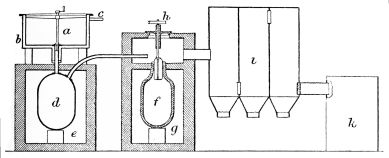
Fig. 29.—Apparatus for Making Zinc Sulphide.
The accompanying diagram, Fig. 29, is given as an example of a plant
that may be employed with good results.
a is the sulphur melting pan with its steam jacket b, and steam pipe
c; d is a cast-iron still, arranged within a gas furnace e; f is
a crucible for melting and volatilising zinc, the said crucible being
contained in a gas furnace g; h is an automatic apparatus for
freeing the mouth of the zinc vessel from deposited sulphide of zinc;
i is the collecting apparatus; and k, the condensing apparatus.
(3) Mixtures.—There are a number of compound pigments commonly known
as zinc whites, which only deserve the name in so far as they contain a
proportion, greater or smaller, of some zinc salt. At the same time it
must be admitted that some of these combinations possess very good
qualities, and that the foreign ingredients largely correct the weak
points of the zinc compounds.
Freeman’s.—This pigment, when ground with oil in the customary way,
forms a paint equal in body and covering power to the best white lead,
while it is superior in colour, permanence, and density, and is free
from odour and noxious qualities.
It is produced by grinding together “zinc white” (either oxide or
sulphide), lead sulphate and barium sulphate, in certain proportions, in
the dry state, in an edge-runner mill. By thus grinding the several
pigments together, their particles become intimately incorporated and
undergo changes in character. The barium sulphate not only cheapens the
product by reason of its low cost, but also imparts a distinct feature
in rendering the paint more free working. The proportions generally
adopted, calculated by weight, are 5 parts lead sulphate, 2 of zinc
white, and 1 of barium sulphate. The duration of the grinding will
necessarily vary in accordance with various governing conditions, but it
should be continued until the mixture has a density of about 200 lb. per
cubic foot.
Orr’s.—The pigment known as Orr’s enamel or Charlton white, is a
compound of oxide and sulphide of zinc and sulphate of strontia, or of
baryta. It is prepared in two ways.
(a) Barytes is calcined for some hours at white heat with charcoal,
and the calcined mass is lixiviated with water to wash out the barium
sulphide; to one-half of this solution is added zinc chloride, which
produces a precipitate of zinc sulphide, leaving barium chloride in
solution. To this mixture of zinc sulphide and barium chloride is added
the remaining half of the barium sulphide and some zinc sulphate, the
result of which is a double precipitate of zinc sulphide and barium
sulphate. This is water-washed, filter-pressed, dried, calcined at red
heat, thrown immediately into cold water, ground very fine, and finally
dried.
(b) The second process closely resembles the first, but celestine
takes the place of the barytes.
Either form of Orr’s enamel is a good useful white pigment, very
permanent, mixing well, of excellent covering power, and pure in colour.
Characters.—Zinc oxide, being an expensive pigment, is liable to
adulteration; fortunately, all such adulterations are easily detected,
and their nature ascertained by a few simple tests. Zinc oxide, if pure,
should dissolve entirely without effervescence in nitric acid; any
residue would indicate adulteration with barytes or china clay; the
former may be distinguished by its weight and the yellowish green colour
it imparts to the Bunsen flame, the latter is lighter and gives no
colour to the Bunsen flame. Boiled with strong sulphuric acid, barytes
is not acted on, while china clay is. If, after cooling, the mass be
diluted with water, and ammonia be added to the liquor, if barytes is
present no precipitate will be obtained, while if china clay is present
a white precipitate is produced.
If the zinc oxide dissolves with effervescence, white lead or whiting
may be present; the solution should give no precipitate of black
sulphide of lead on passing sulphuretted hydrogen through it. On
neutralising the solution in nitric acid with sufficient ammonia, and
adding ammonia sulphide to precipitate all the zinc (the precipitate
should be white, any other colour would show some impurity), filtering
off and adding a little oxalate of ammonia, no white precipitate of
calcium oxalate should be obtained; such a precipitate would show
presence of whiting or gypsum.
The white pigments having as a base the sulphide of zinc, also contain
barytes, oxide of zinc, sulphate of strontium, &c. They can be
distinguished by evolving sulphuretted hydrogen gas, recognisable by its
odour, on treatment with an acid. They are not entirely soluble in
acids, the residue being mostly barytes, but may also be sulphate of
strontium; it is immaterial whether the two be distinguished or not.