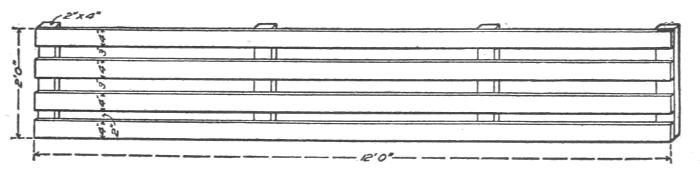
Origin. The ancestors of the hogs found on American
farms came from two sources, southeastern Asia
and western Europe. These two families of hogs are
often designated by the names Sus Indica and Sus
Scrofa. Although the word sus is Latin, boys or girls
who feed pigs use it when they call “sui, sui,” to the
pigs at feeding time.
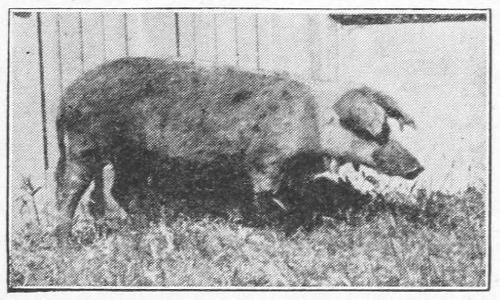
6. A Razor-Back
Sus Indica, a native of China, was a small, fine-boned
animal much prized by the people of southeastern Asia.
Descendants of Sus Scrofa, the wild boar of western
Europe, are still hunted in forests and private game
preserves. The wild boar is a large, ferocious animal
with thin hams and a heavy shield. From its Chinese
ancestor the modern hog has derived its form and quality;
from the wild boar it has obtained its size and
vigor.
Swine were probably introduced into this country
by early Spanish explorers. For many years wild hogs
were found in the everglades of Florida. It is recorded
that Jamestown had to be fenced to keep out
the wild hogs, descendants of those brought over by
earlier settlers. Although the ancestors of the hog
came from China and western Europe, it remained for
English breeders to blend the two and develop the
earlier breeds.
The earlier breeds like the Berkshire were developed
where corn is not grown successfully. Under such conditions
the bacon-type of hog was produced.
Bacon-type. The bacon hog has a longer side, less
fat and a smaller ham. Canada, Denmark, and Ireland
produce the finest hogs of this type. Bacon hogs furnish
the “Wiltshire side,” in which ham, side, and shoulder
are marketed in one piece. This cut commands a higher
price on the European continent than pork from the
lard hog. The weight of this type of hog for market
varies from 160 to 200 pounds. The form of the
bacon-type is quite different from the form of the lard-type.
The hog has longer legs, the body is not so
thick or deep, the shoulders, neck, and jowls are lighter.
The hog should be longer from shoulder to ham, with
sufficient depth and thickness to denote good constitution.
Quality, as in the lard-type, is indicated by a
smooth coat of hair and an unwrinkled skin. The
finished bacon hog “handles” firmer to the touch than
a finished lard hog. The bones of this type are larger,
but they should present a clean-cut appearance. The
loin is the most valuable cut in this hog, and should
be as wide as the rest of the back, full, strong, and
well packed with flesh. The ribs should spring out
boldly from the backbone and turn sharply downward,
giving a straight, flat side. The leading breeds of the
bacon-type of swine are the Tamworth and the Large
Yorkshire. Sometimes the Hampshire is so classed.
Lard-type. The lard hog is a native of the corn
belt. This type of hog has a compact, thick, deep,
smooth body. The ham, back, loin and shoulders are
the most valuable parts and are developed to a higher
degree. The production of lard and fat is the principle
aim of this type. Quality is denoted by fine hair,
smooth, clean, unwrinkled skin, rather fine bone, and
an even distribution of flesh. The jowls should be broad,
plump, and full, and the belly not baggy in appearance.
The hog should have short upright pasterns. The snout
should be fine, the face wide between the eyes, and
the space between the ears wide and full. Width between
the eyes and fullness and width between the ears
indicate a good feeder. The neck should be short and
deep and should blend smoothly into the shoulder. The
shoulder should be well developed, blending smoothly
into the body and covered evenly with flesh over all
parts. The back should be broad, slightly arched, of
medium length and thickly fleshed. The ribs should be
well sprung, the sides deep and even between the shoulders
and ham. The ham should be broad, deep, plump,
and heavily fleshed well down toward the hocks. The
rump should be as wide as the back. The legs should
be short, straight, set well apart and squarely under
the body. The above brief description is general for
all breeds of the lard hog. The Poland China, Chester
White, Berkshire, and Duroc-Jersey are the popular
breeds of this type of hog.
Breeds. The selection of a good breed by a pig
club member is an important matter. He should be
influenced by two conditions: the breeds raised in the
community and his own preference. The community
which confines its efforts to two, or better, to one breed
of hog, will attract buyers and its stock will command
fancy prices. On the other hand, a breeder will be
most successful with the breed in which he has confidence.
To make an intelligent choice, every club member
should become familiar with the characteristics, advantages,
and shortcomings of the several breeds of hogs.
It should be borne in mind that there is no “best
breed.”
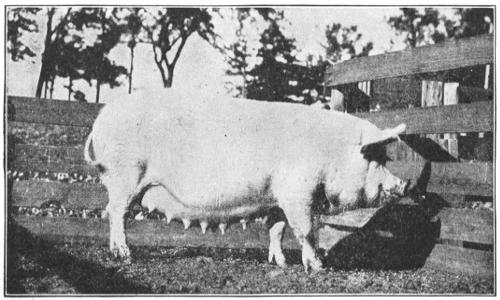
12. Large Yorkshire
The Large Yorkshire. This large white breed, too,
originated in England. White spots are not desirable
and black hairs disqualify animals. The Large Yorkshire
possesses the typical bacon conformation: light
hams and shoulders, long legs and a long, narrow and
deep body. On account of its size, strong bone, and
ability to produce large litters, Yorkshire boars have
been used for crossing with breeds which are lacking in
these respects.
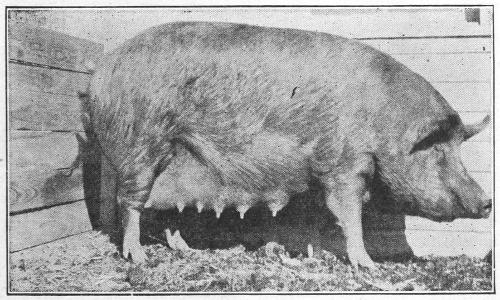
13. Tamworth
The Tamworth. This breed much resembles the
Large Yorkshire in size but has a longer snout. The
Tamworths are good rustlers and produce bacon which
can be used for export purposes at a comparatively
early age. They are sometimes criticized for their inability
to compete with the lard breeds in the production
of fat carcasses. It should be borne in mind,
however, that they are distinctly a bacon breed.
The Large Yorkshire and the Tamworth are the only
two bacon breeds in this country. Other minor breeds,
both lard and bacon, which might be mentioned are the
Mule-Foot, Small Yorkshire, Essex, Cheshire, Victoria
and Large Black.
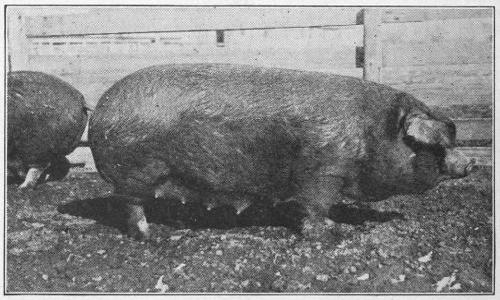
7. Poland China
Poland China. The Poland China is one of the most
popular breeds. It is of medium size, black in color
with “six white points” on face, tail and feet. Its ears
are not erect as are those of the Berkshire, but break
and fall forward about two-thirds of the length from
the head. The face is not dished as much as that of
the Berkshire, another mark of distinction.
Like all of the rest of the lard breeds, it should have
heavy shoulders and hind quarters, and deep, short
sides. For a time there was a demand upon the part
of breeders for small, fine-boned animals. The demand
of the packers was too strong, however, and the development
of the Big Type Poland China marked the
downfall of this “fad.”
This breed is noted for its constitution and vigor.
Much of this is due, no doubt, to the fact that the
originators of the breed in the Miami Valley wished to
develop a hog which could be driven to Cincinnati, the
great packing center of that period. The small type
Poland China had small litters. This fault has been
remedied in the big type strains.
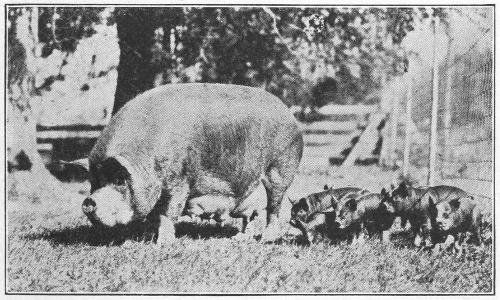
8. Berkshire
The Berkshire. The erect ears, dished face and
short snout of the Berkshire distinguish it quite sharply
from the Poland China. It is one of the oldest breeds
of swine, originating in Berkshire, a county of England.
The early Berkshire was a bacon, not a lard hog.
It was large, rough, and late maturing. Numerous
crosses with Chinese and Neopolitan pigs of fine quality
have been instrumental in producing the modern, medium
sized, compact animal.
This breed has a broad back, a good spring of rib
and thick rump and hams. Berkshires are early maturing
and breeders claim that the meat is second in
quality to none. Like the Poland China, it has white
on the feet, face and tip of tail.
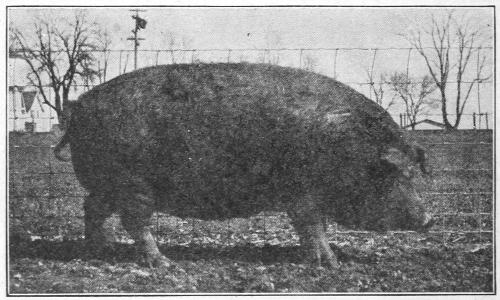
9. Duroc-Jersey
Duroc-Jersey. This breed of red hog is becoming
very popular on account of its constitution and ability
to produce large litters. It resembles the Poland China
in size, shape and position of ear and snout. The color
desired by most breeders is a cherry and not a sandy
red.
Nothing definite is known of its early history. Red
hogs had often been imported. Among the records of
such importations are those of Henry Clay from Spain
and Daniel Webster from Portugal. Early Berkshires
of red color were thought to have been used in developing
the breed.
Two breeds, a Jersey Red in New Jersey and a Duroc
in New York State, came into prominence. The former
was a coarse hog of good length of body and strong
constitution. The union of these two breeds produced
the Duroc-Jersey.
Another point which especially recommends this breed
in addition to those already mentioned is its grazing
ability.

10. Chester White
The Chester White. This breed of white hog resembles
the Poland China. The ears are more drooping,
however, than those of that breed and break forward
about one-third the distance from the head. The
Chester White is also wider, thicker and longer in body.
The breed originated in Chester County, Pennsylvania.
Two other strains, Todd’s Improved Chester
White and the Ohio Improved Chester White, have resulted
from breed improvement. The latter has now
developed its own breed association.
The Chester White ranks second to Duroc-Jerseys in
the size of its litters, but the fact that its white color
makes it subject to sunburn prevents its development
in the southern and middle western states.
The Hampshire. This breed is classed as between
the fat and bacon-types. This is due to a lighter
shoulder and ham and a longer side with less depth
than those of the breeds previously described. Although
it will not meet the demands of the “Wiltshire side”
for the English market, it will provide bacon which
meets the demands of the American market.
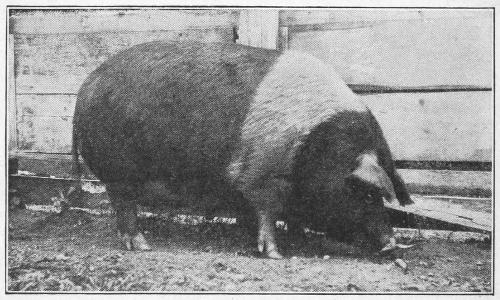
11. Hampshire
The Hampshire is a black hog with a belt of white
from 4 to 12 inches in width encircling the body and
including the forelegs. It is more upstanding than the
lard-type breeds, and has a broad and fairly deep body.
A narrow head with close set ears extending forward
but not breaking are other marks of distinction. The
Hampshire matures early, has good sized litters, and is a
good grazer. The proportion of fat to lean meat is
very desirable. Little is known of its early history
other than that it originated in Hampshire, England,
and that representatives were brought to Kentucky at
an early date.
Selecting the pigs. In choosing a breed a club
member will do well to select the one which is most
prevalent in his community, provided, of course, that
it is a breed which meets the market requirements and
in other ways is adapted to local conditions. This will
be the case if he lives in a community of successful
swine breeders.
Getting started. After a breed has been decided
upon, the next thing is to pick out the individuals.
A pig club member may start with a pig or pigs after
weaning, or a bred gilt may be purchased.
Wherever possible a pure-bred sow pig or gilt should
be secured. Two things are to be considered, the pedigree
and individuality of the animal. Unless you are
familiar with pedigrees, it is best to leave that to the
reliable breeder with whom you are dealing. Every
pig club member, however, should be able to pick out a
good pig.
Four things should be considered in selecting a breeding
animal: form, quality, constitution, sex character
and type. It is true that the matter is more difficult
with a young pig than with an older pig, but part or
all of these conditions may be noted in the young pig.
A pig with a comparatively long body and with good
depth and width should be selected. It should stand
squarely on short legs of good bone. There should be
no wrinkles on the body.
A good heart girth indicates plenty of room for the
lungs and denotes a strong constitution. Quality is
shown in fineness of bone and hair. Too fine a bone
should be avoided. To judge type one must be familiar
with the requirements of the various breeds. Above
all, the pig selected should be a good feeder.
Care and management. After the pig or pigs are
secured, the next problem is one of care and management.
Every pig club member should keep in mind
that pigs require a variety of clean food, clean water,
exercise and, a clean bed if they are to thrive and be
profitable. Being a large feeder the pig will eat dirty
food from a dirty trough if no other is offered. On
this account it is often thought that he will get along
under any sort of circumstances. Such is not the case.
No animal will respond more quickly to careful, intelligent
treatment than the pig.
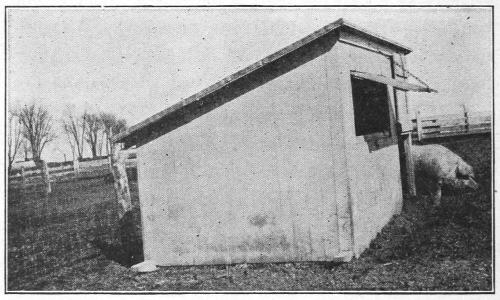
14. A Good Hog House
Houses. Hogs must be housed in dry, warm, clean,
and well-ventilated houses. Sunshine is a very important
agent in disinfecting and warming the hog
house. The well-established breeder may have a colony
house, but for the beginner the individual house of the
A or square type is to be recommended.
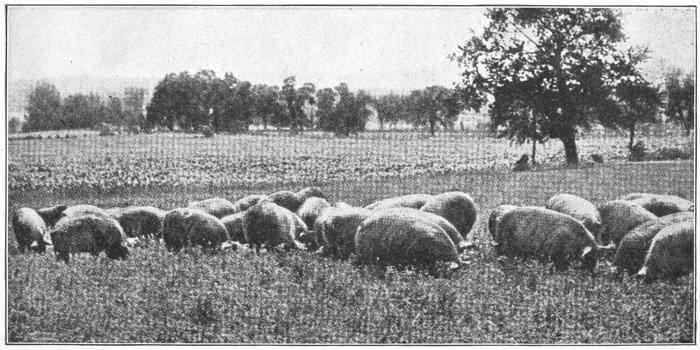
During the summer a good pasture will provide cheap,
clean feed, exercise and a clean bed. It may be necessary,
however, to provide a shelter from the direct rays
of the sun. This may be furnished by a frame of poles
covered with straw or corn stalks.
Sanitation. It is much easier to keep a pig healthy
than it is to cure him after he becomes sick. Cleanliness,
proper feed, disinfection of houses and animals,
together with plenty of sunlight, ventilation and dryness
of quarters, will help to keep a pig in good health.
If care is taken that there are no unnecessary cracks
or corners in which filth may accumulate, it will be
easy to keep houses, troughs and feeding floors sanitary.
A good disinfectant should be used regularly
in the pens. Five parts of crude carbolic acid in one
hundred parts of water is recommended. All filth
should be removed before the disinfectant is applied.
Once a year all buildings should be whitewashed. A
pint of crude carbolic acid should be added to each
three gallons of whitewash.
Feed lots and pastures cannot be disinfected in this
fashion, but applications of lime and an occasional
plowing will help.
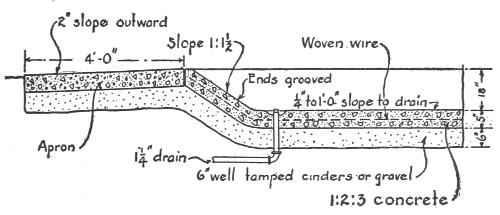
Hog wallows and dips. The pig is not naturally a
filthy animal, and if given an opportunity will keep
fairly clean. During the extreme heat of summer the
pig suffers, owing to the fact that he perspires but
little. He seeks the shelter of a cool mud wallow to get
relief from heat and parasites. The intelligent hog
raiser will provide a concrete wallow and keep it filled
with eight or ten inches of water. Coal-tar or crude
oil added to the water helps to rid the animal of lice.
Where the animals are badly infested with lice it will
be necessary to wet them all over, as the lice are found
behind the ears, inside of the legs and in the folds of
the skin. A two per cent solution of creolin may be
used for this purpose.
Worms. Pigs are often affected with worms which
interfere with their thriftiness. A tablespoonful of
castor oil and forty drops of oil of American wormseed
should be given in the slop to wormy pigs. Six
grains of santonin and four grains of calomel per 100
pound pig is also used successfully.
Hog cholera. It is not possible within the scope of
a small book to describe all of the diseases that attack
pigs. Every pig club member, however, should know
something about hog cholera, the greatest scourge which
attacks swine.
The germs of hog cholera may be carried on the
boots of visitors, by pigeons or dogs. It can only be
combatted by vaccination of healthy hogs, quarantining
of all sick hogs, burning of all dead hogs and disinfection
of premises.
Three methods of vaccination are in use:
(1) The injection of an anti-cholera serum, which
makes the hog immune only a few months or weeks.
(2) The simultaneous treatment whereby the serum
used in (1) and the defibrinated blood or virus from
a diseased hog are injected together. This treatment
renders the hog immune for life.
(3) In the combination method, serum alone is
used first, and ten days later the simultaneous treatment
is administered. This method is seldom used.
The services of a skilled veterinarian should be secured
to vaccinate hogs.
Feeds and feeding. Protein, fats, and carbohydrates
are the three classes of nutrients found in feeds.
These, in addition to mineral matter and water, furnish
material for the maintenance and growth of the
pig. Proteins furnish the material for the production
of muscle. Fats and carbohydrates provide fuel for
heating the body and giving activity to the muscles.
An excess of food nutrients, especially fats and carbohydrates,
is stored in the body as fat. The mineral
matter goes into the production of bone.
All feeds do not contain these nutrients in the same
proportions. Some feeds, like corn, are deficient in protein,
while others, like tankage, contain a large percentage
of protein.
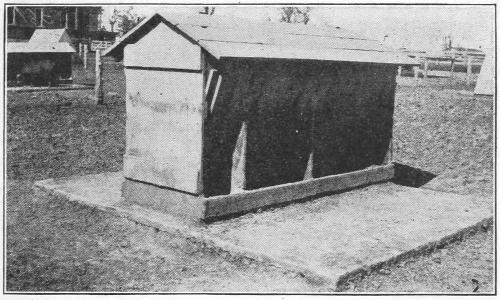
15. A Self-Feeder
From the foregoing it is easily seen that the problem
of the hog raiser is to use a combination of feeds
which will provide the proper proportions of the various
nutrients. While the pigs are young, bone and muscle
producing foods are especially necessary. Toward maturity
the percentage of fat producing foods may be
increased.
Corn, pasture and other supplements. Corn is the
most widely used feed for pigs. As has been stated,
it is essentially a fat producing food and must be properly
supplemented. Clover or alfalfa pasture supplies
the protein and part of the mineral matter which the
corn lacks. Rape furnishes good pasture for hogs, almost
equal to clover and alfalfa. Rye, blue grass, cow peas
and soy beans together with various pasture mixtures
have value as hog pastures. Where pigs are fed in a
dry lot, tankage may be used to supply the protein.
Pasture-fed pigs are thriftier and make cheaper gains
than those fed in a dry lot. Skim-milk or buttermilk
together with tankage makes an ideal supplement to
corn. Middlings and shorts may also be used.
Mineral matter. To insure pigs getting enough
mineral matter it is recommended that the following
mixture be kept before them at all times:[7]
| Wood ashes or coal screenings |
1 bushel |
| Air-slaked lime |
8 quarts |
| Salt |
8 quarts |
| Rock phosphate |
3 quarts |
| Copperas (iron sulphate) |
1 quart |
The first four ingredients should be mixed thoroughly
and the copperas dissolved in warm water and poured
over the mixture.
Feeding and care of the sow. In starting in the
swine industry with one or more gilts, it should be
borne in mind that a sow should not be bred until she
is eight or ten months of age. Every hog raiser should
aim to have his sows produce two litters a year, farrowing
in April and October.
Not more than two-thirds of the grain ration should
be corn. Some feeders prefer to use ground oats and
middlings exclusively. In any event, heating and fattening
foods should be avoided. In addition to the
grain ration, roots and clover or alfalfa hay or skim-milk
should be fed. Sows on good pasture require little
grain except just before farrowing.
At farrowing time the sow should be placed in a
building, dry, free from draughts, and well-ventilated.
The feed after farrowing should be about the same
as before. After the first week larger quantities are
necessary for the sow in order to maintain the pigs
properly. When the pigs are weaned, the feed of
the sow should be cut down to check the flow of milk.
Oats is recommended for that purpose.
Feeding the pigs. The young pigs will learn to eat
at about three weeks of age. At this time if the pigs
can be fed separately from the sow better results will
be obtained. Skim-milk, middlings and soaked corn
are recommended.
Young pigs should be given opportunity for exercise
but should be sheltered from cold winds or hot
sun. Young pigs may be weaned at from 8 to 10
weeks. Avoid too heavy feeding at first.
Pasture-fed pigs may be given one-fourth of a pound
of tankage, or one and one-half to two pounds of skim-milk
or buttermilk per day; one-half pound of middlings
may be added to the above ration. Adding bran
or finely ground oats to the middlings will prevent constipation
in case the middlings are too fine and floury.
What corn is readily cleaned up may be fed at the
age of three months or a little earlier if skim-milk is
being fed. The pigs should be fed four times a day at
first and then three times. As the pigs grow older the
corn and middlings may be increased, but at no time
should corn alone be fed.
Markets. The successful stock man is the one who
is familiar with market requirements and tries to meet
them. Every pig club member should know something
of the market classes and grades of hogs. These differ
somewhat according to local conditions, but in a general
way the classification used on the Chicago market may
be taken as a standard.
Heavy hogs are no longer at a premium except when
the price of lard is high. They contain a large amount
of fat. The various grades of hogs in the several
classes indicate the degree to which they have attained
to the standard of perfection, prime being the highest
grade, and common and inferior the lowest grades.
Butcher hogs are commonly used for fresh meat trade.
They are principally barrows.
The term packing refers to the use to which this class
of hogs is commonly put. They are inferior to butcher
hogs and are cut up, cured, and packed in boxes and
barrels. Mixed packing hogs are those marketed without
grading. Speculators often buy them up and grade
them.
The meat of pigs is unsuitable for curing and supplies
part of the demand for cheap, fresh meat.
Bacon hogs quoted on the Chicago market are not
the bacon hogs which furnish the Wiltshire sides. They
are lard hogs that are not highly finished, have a high
per cent of lean meat, and supply the demand for lean
pork.
Stags are males castrated too late in life to grade as
barrows. Boars are used for sausage and supply cheap
fresh meat.
The present demand is for hogs weighing from 200
to 250 pounds, and the hog raiser should aim to finish
and market his hogs at about these weights.
| Class |
Weight |
Sub-Class |
Grade |
| Prime heavy |
350-500 |
|
Prime |
| Butcher |
180-350 |
Heavy |
280-350 |
Prime |
| Good |
| Medium |
220-280 |
Prime |
| Good |
| Common |
| Light |
180-220 |
Prime |
| Good |
| Common |
| Packing |
200-500 |
Heavy |
300-500 |
Good |
| Common |
| Inferior |
| Medium |
250-300 |
Good |
| Common |
| Inferior |
| Mixed |
200-280 |
Good |
| Common |
| Inferior |
| Light |
125-220 |
Bacon |
English |
160-220 |
Choice |
| Light |
| Fat |
| U. S. |
155-195 |
Choice |
| Good |
| Common |
| Light light |
125-150 |
Good |
| Common |
| Inferior |
| Light mixed |
150-220 |
Good |
| Common |
| Inferior |
| Pigs |
60-125 |
|
Choice |
|
Good |
|
Common |
| Roughs |
|
|
|
| Stags |
|
|
|
| Boars |
|
|
|
| Misc. |
|
Roasting pigs |
|
| Feeders |
|
| Governments |
|
| Pen holders |
|
| Dead hogs |
|
(Write brief answers on notebook pages.)
1. Why is hog raising such a popular form of live-stock
production on the farm?
2. In what important respects has the domestic pig
been improved from the wild hog?
3. What are the chief differences between the bacon-type
and lard-type of hog?
4. What are the characteristics of a good brood
sow? Of a good boar?
5. Name the standard breeds of swine in this
country.
6. What is your favorite breed and why?
7. What are some of the feeds supplementary to
corn in productive swine feeding?
8. Give some reasons why swine should be sheltered.
What are the essentials of a good piggery?
9. Name five things you consider essential in the
care of the brood sow.
10. List some interesting hog habits.