Pieter bruegel the elder: a study of his paintings
Whole book · 4 sections
PIETER BRUEGEL THE ELDER
PIETER BRUEGEL THE ELDER: A STUDY OF HIS PAINTINGS
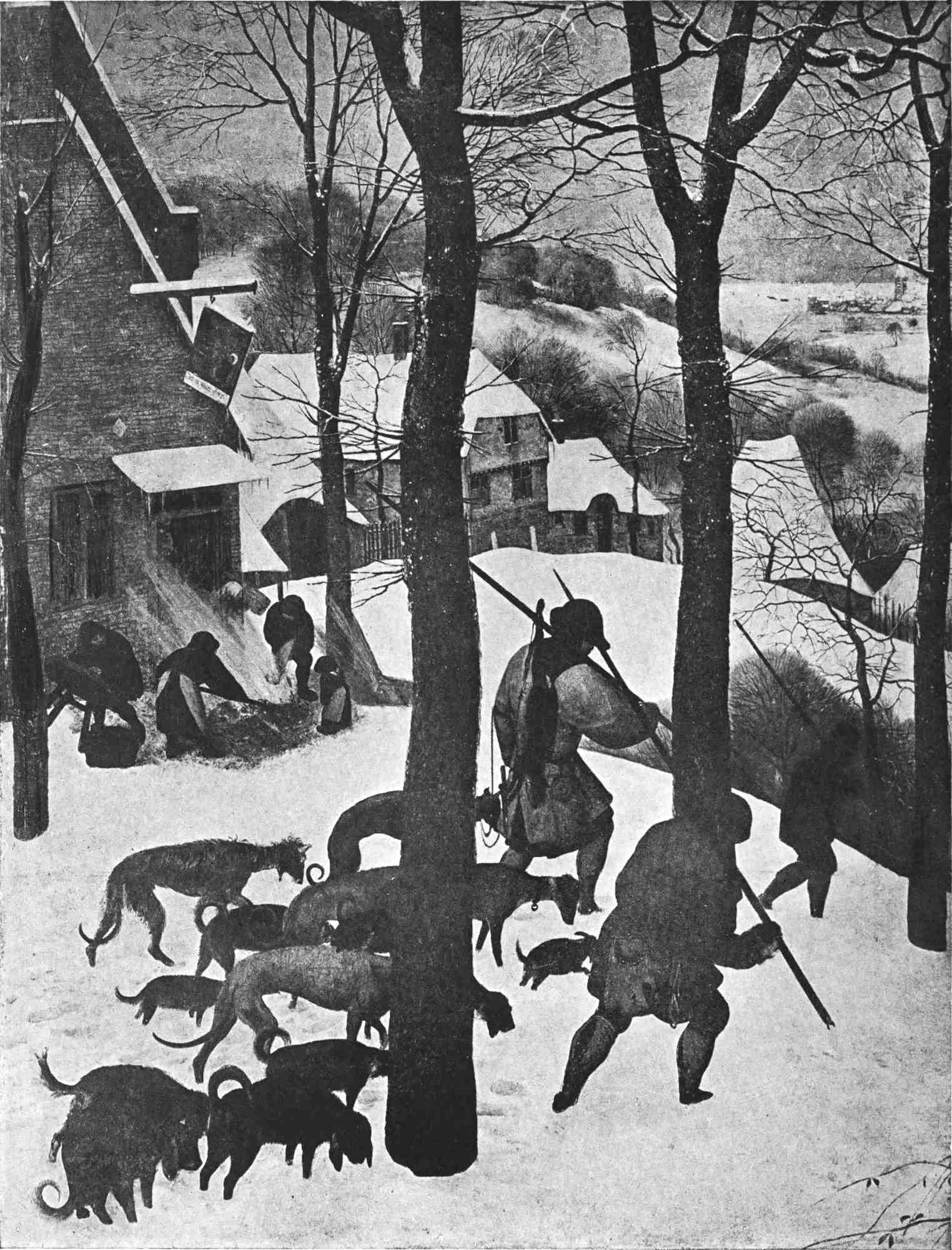
HUNTERS IN THE SNOW (DETAIL)
A STUDY OF HIS PAINTINGS
BY VIRGIL BARKER
NEW YORK THE ARTS PUBLISHING CORPORATION
1926
COPYRIGHT, 1926
BY THE ARTS PUBLISHING CORPORATION
PRINTED IN THE UNITED STATES OF AMERICA
Note
Most of the material included in this book was originally published
in a special Bruegel edition of The Arts. Mr. Barker’s essay
met with such immediate success that in order to meet the demand the
editor decided to increase the number of illustrations and publish Mr.
Barker’s noteworthy essay in permanent form.
Comparatively little has been written in English on Pieter Bruegel
the Elder, nothing in fact except a few passing magazine articles. At
the request of the artists The Arts undertook to supply this
want. In selecting Mr. Barker to carry out this important work The
Arts was particularly fortunate. Besides being an ardent student
of the genius of Bruegel, the author, in the course of his duties as
European correspondent of The Arts, was able to carry on the
special research necessary to give permanent value to the following
essay.
Forbes Watson.
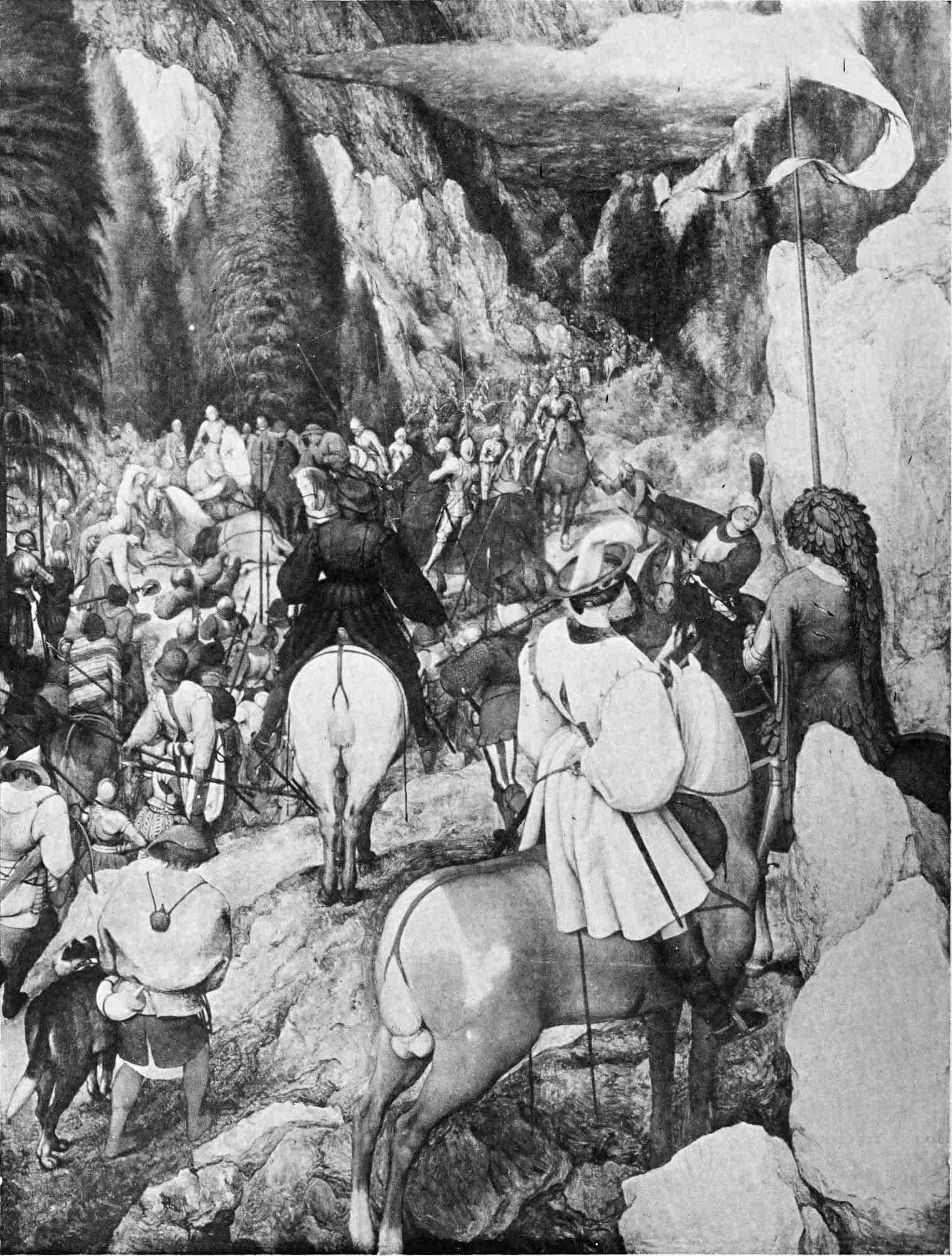
THE CONVERSION OF SAINT PAUL (DETAIL)
PIETER BRUEGEL THE ELDER A STUDY OF HIS PAINTINGS — 2. — 3. — 4. — 5. — 6. — 7.
Aside from the evidence of the signed and frequently dated prints,
drawings and paintings, few things are certainly known about the life
and personality of Pieter Bruegel the Elder. Almost all of these,
such as they are, occur in a brief passage concerning him, written
about thirty years after his death, in “The Book of the Painters” by
Carel Van Mander. Herein is no mention of the date of Bruegel’s birth;
even the place of it, despite a seeming definiteness, remains in some
obscurity. His biographer says that the painter was born “not far from
Breda, in a village called Breughel,[1] by which name he called himself
and left it to his descendants.” The village of that name nearest to
Breda is twenty-five miles away; and as distances went in the sixteenth
century, this seems hardly to be bridged by Van Mander’s easy phrase.
As for the year, the guesses of the scholars range all the way from
1510 to 1530, the most widely accepted one being 1525. Any closer
determination of it is a matter of comparative unimportance in its
possible effect on the period of actual productiveness, since this is
very satisfactorily covered by trustworthy dates.
[1] There are several different ways of spelling this name,
each having some degree of authority; but so far as concerns the
painter himself, the deciding fact is that the signatures now visible
on the paintings (about twenty in number) consistently adhere to
BRVEGEL.
And whatever the exact year may have been, it had not been long before
when for Europeans the geographical world had been suddenly enlarged
as a sort of materialization of the immediately preceding enlargement
of mind. The succession of discoveries—of America; of India and the
true Indies; of Sumatra, Java and Borneo; and, two hundred and fifty
years after Marco Polo, of China—were only the working on another
plane of the essentially exploring spirit which had been previously
manifested by the scholars, scientists and artists of the Early
Renaissance. National unity on a fresh basis had been realized in Spain
through the expulsion of the Moors, and in both France and England
under absolute monarchies which were headed, at the time of Bruegel’s
birth, by Francis I and Henry VIII. About that time, also, Magellan
was circumnavigating the globe and Cortez was conquering Mexico;
Leonardo and Raphael were dying, and shortly after them went Carpaccio,
Leo X and Signorelli. Martin Luther, preaching the Reformation in
Germany, was thus initiating a movement of ruinous significance for
Bruegel’s homeland; for there the cause of religious liberty, gradually
coalescing with that of political independence, was to meet with the
terrible repressions begun by the newly elected Emperor, Charles Quint,
who was already by inheritance lord of the Low Countries.
During all this period of ferment and reorientation for the European
mind, Antwerp, where Bruegel was to spend most of his life, was one of
the most important of all ports. Situated in what was then the most
densely populated region of Europe, it had in its own houses a hundred
thousand persons; and of these more than a tenth were foreigners—German
merchants, Italian scholars, Portuguese Jews, French Huguenots, English
sailors and the soldiers of Spain. Far-journeyed vessels brought to
it the spices and rich stuffs, the metal-work and strange animals
of distant lands; and their seamen had tales to tell of things far
off towards the expanding horizons of the world. In this comfortable
and prosperous city, where the sharp demarcations between classes
prevalent in other countries were blurred almost into a real democracy
of the bourgeois, every fresh discovery and important event had its
repercussion in the general consciousness.
Antwerp was thus a natural center of activity for the religious
propaganda and disputation which formed so large and so tragic an
element in the life of the sixteenth century; creeds of all sorts
readily found adherents among its varied and impressionable populace.
Lutheranism was so strongly advocated by the convent of Augustinian
monks that its inmates were dispersed, after the execution of two
among them, and its buildings razed. Though the terrorism of the
Inquisitor Van der Hulst and his priestly successors imposed silence
on many, there were open preachings as well as clandestine meetings,
and riots in which religion-frenzied women were among the boldest; and
with all the burnings of the books, with all the imprisonments and
the brandings, the full penalties of the imperial edicts could hardly
be enforced by those who were conscious that such enforcement would
destroy the principal source of the Emperor’s precarious revenue.
Even the anarchy of Anabaptism, persecuted by Catholic and Protestant
alike, made headway through the martyrdom of its believers; and from
1544, almost the very year when the young Pieter Bruegel commenced his
apprenticeship, the new sectarianism of Calvin entered the city and
grew rapidly in strength.
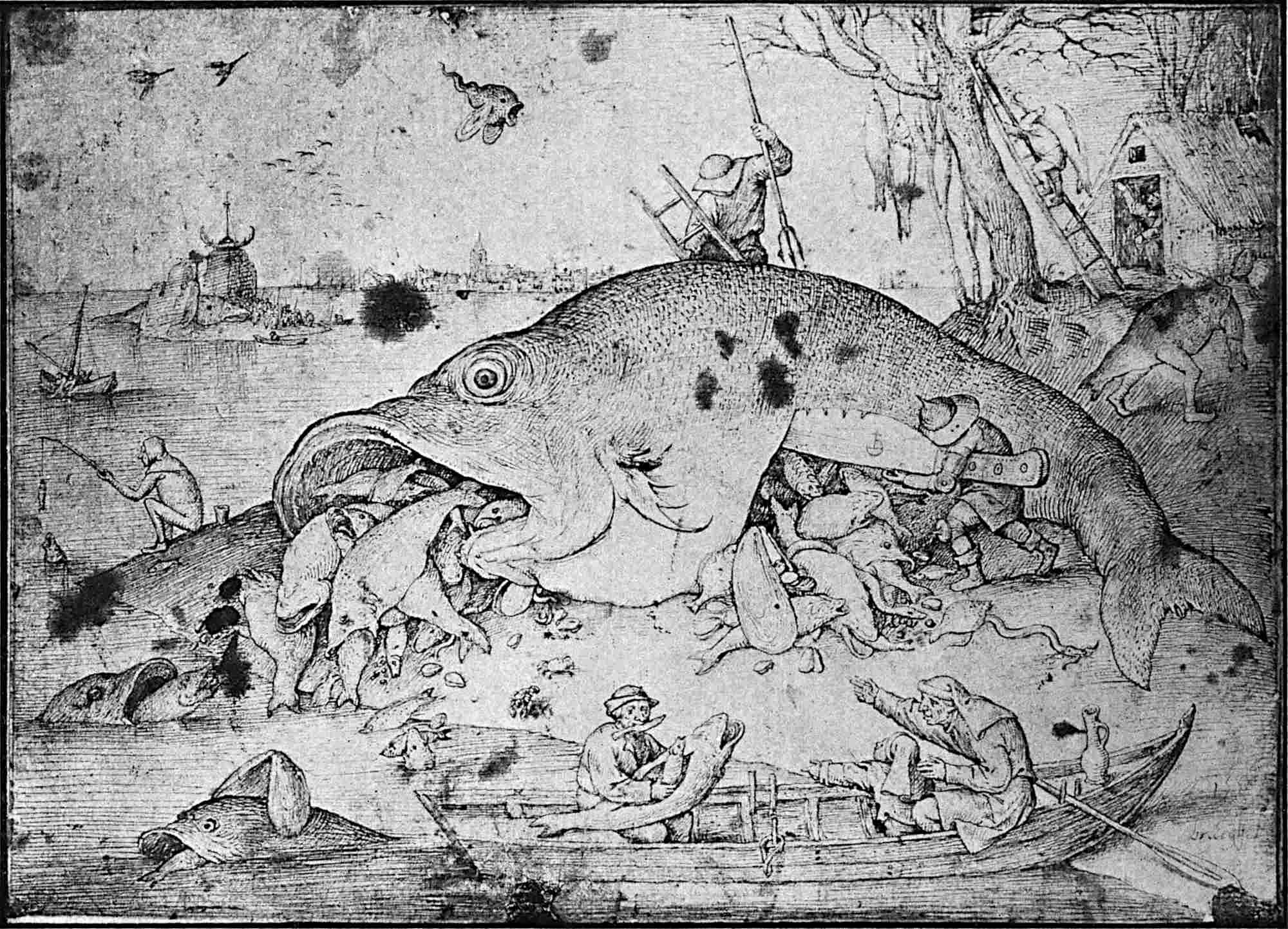
BIG FISH EAT LITTLE ONES (DRAWING). 1556. VIENNA, ALBERTINA
While he was growing up, the English and the French were subduing
the North American continent and in the Andes Pizarro was rifling
the wealth of Peru; Rome was being pillaged by the Germans; Henry
VIII was finally repudiating Catholicism and Ignatius of Loyola was
in a way belatedly replying to Luther by organizing the Society of
Jesuits; Hampton Court Palace, the French chateaux and the palaces of
Venice were being built; Erasmus, Dürer, Machiavelli, Luini, Ariosto,
Correggio died. As yet unconscious of such events and such personages,
perhaps ignorant of the nearer deaths of Quentin Matsys and Lucas
van Leyden, the youth of nameless family was living a peasant among
peasants—and a genius in the making—sharing to full their laborious,
roistering life. Hard drinkers and heavy eaters, they were much given
to feasts and fairs; marriages, baptisms, even deaths were for them
occasions for celebrations as excessive as the labor from which they
thus escaped. Their animal frankness and coarse gaiety blew like a
gale of rude health over all their activities. From life itself, from
the small events in a remote village of the Campine, Bruegel
absorbed the great sane grossness which now seems buried in the books
of his day. Bringing with him the peasant vitality which was to develop
into a lofty philosophic humaneness, he came to Antwerp and, a youth
approaching his twentieth year, became an apprentice to the celebrated
Pieter Coeck. Paracelsus, Copernicus and Holbein had just died; Bruegel
had hardly learned to grind his colors when French Francis and English
Henry followed them, even as their sometime enemy, sometime ally,
Charles, was bloodily but only temporarily settling religious questions
at Mühlberg.
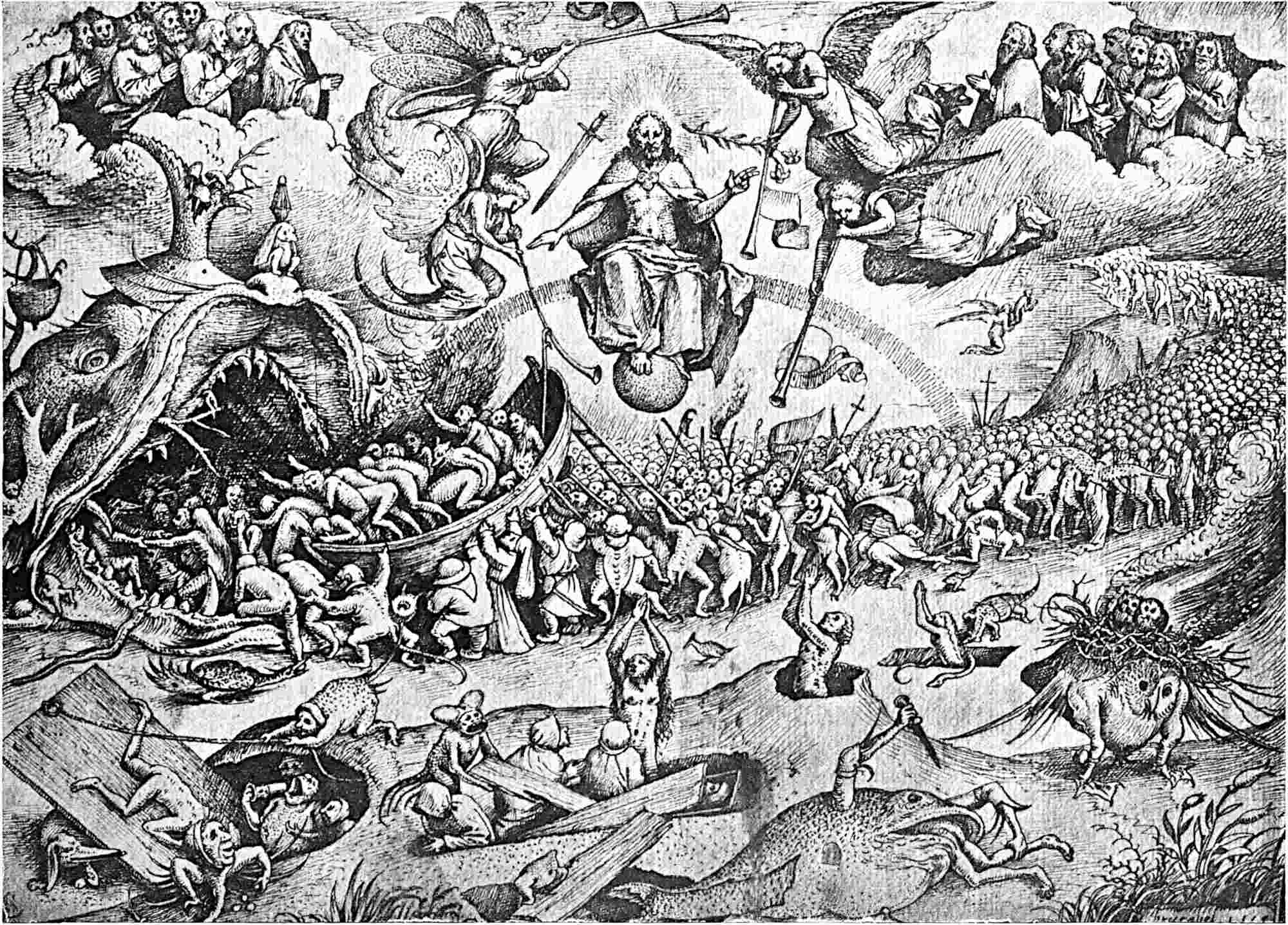
THE LAST JUDGMENT (DRAWING). 1558. VIENNA, ALBERTINA
From his first master Bruegel must have received somewhat more than a
merely technical training, good as that probably was. Coeck had been
for four years the pupil of Bernard van Orley and had later studied
in Rome; in his own work afterwards he relied to such an extent upon
the formulas then worked out that all of it now seems borrowed; but
the precepts that he would pass on to an apprentice could not dull or
conventionalize so forceful a nature as Bruegel’s. Of more significance
in the development of such a nature must have been the stories of far
countries that were told, adding to his knowledge and stimulating his
imagination; for Coeck had spent the year of 1533 in the Constantinople
of Suleiman the Magnificent and had been one of the entourage
of Charles on his expedition to Tunis in 1538. Painter to the Emperor
and Dean of the Guild of Saint Luke, Pieter Coeck died in 1550. Then or
before Bruegel passed over to the work-shop of Jerome Cock, who was not
so much a painter as a dealer in pictures and a publisher of popular
prints. His establishment “was certainly the rendezvous of all the
artists and all the amateurs of Antwerp and even from abroad. Rendered
in engraving, the greater number of existing masterpieces would pass
under the eyes of the attentive Bruegel.” (Bernard: p. 58.) The very
shop-name, “At the Sign of the Four Winds,” symbolized the range of
influences that played over him, the sights and tales that passed into
his consciousness; and for Bruegel these things could be only so many
more incitements to journey into the world and see it all for himself.
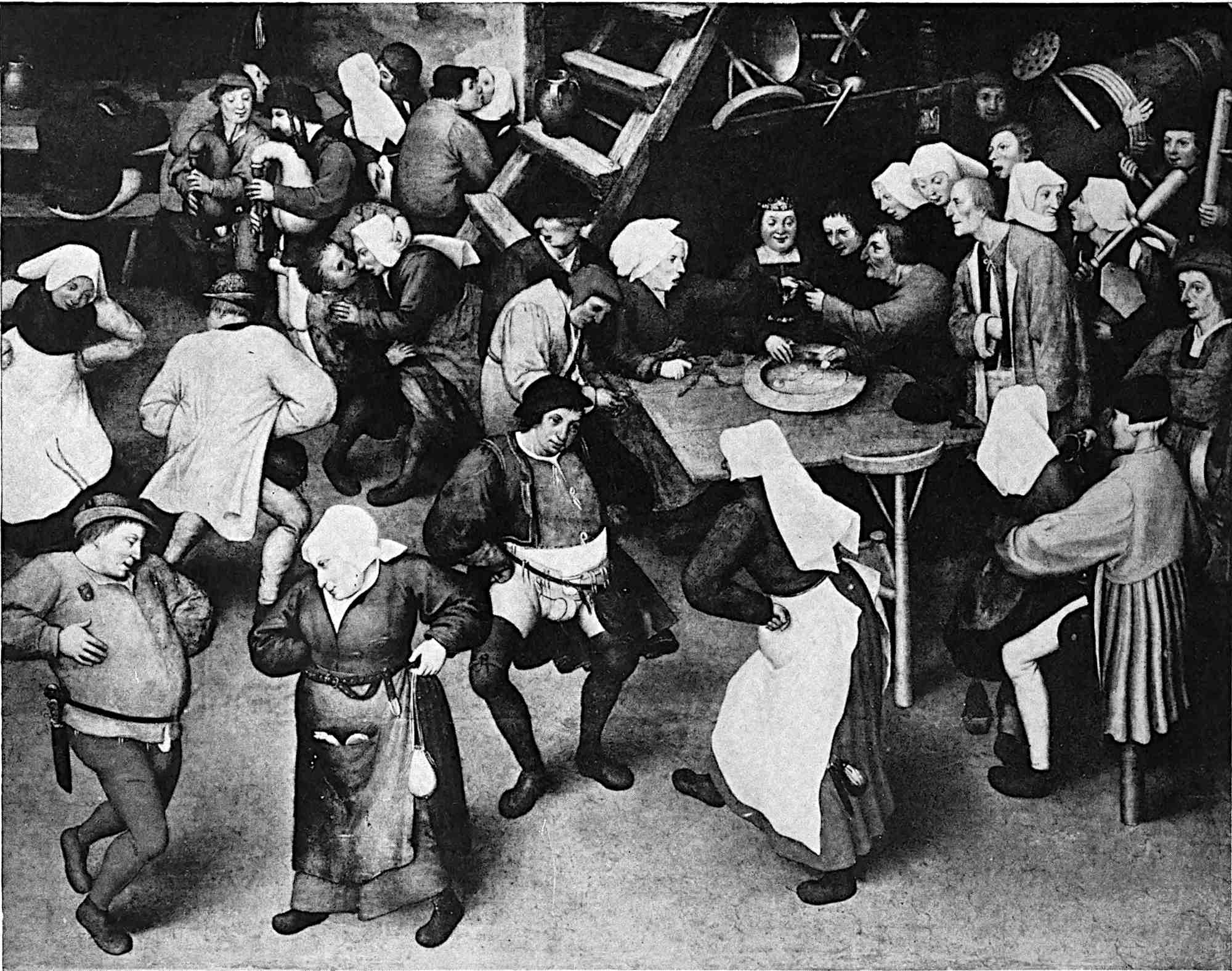
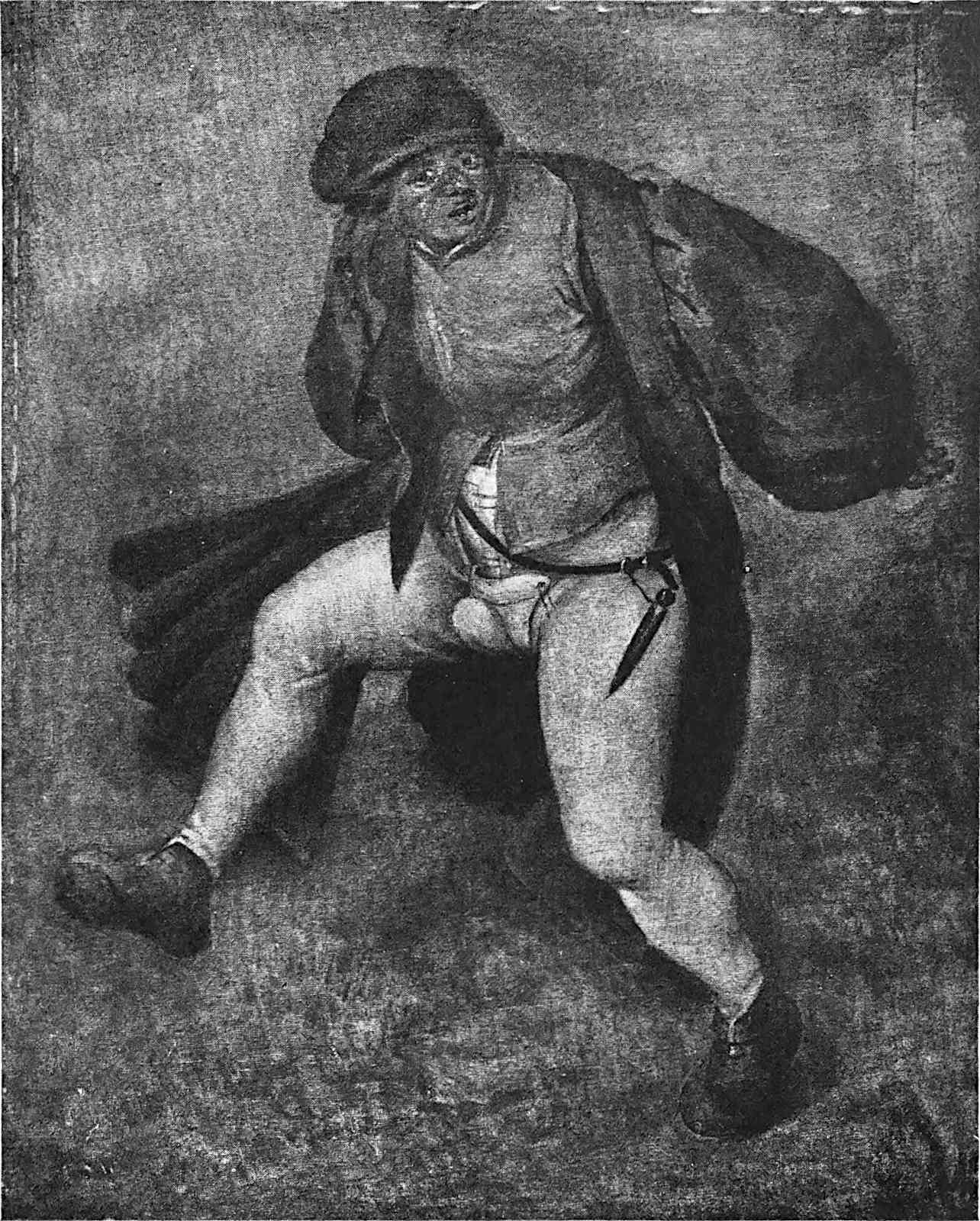
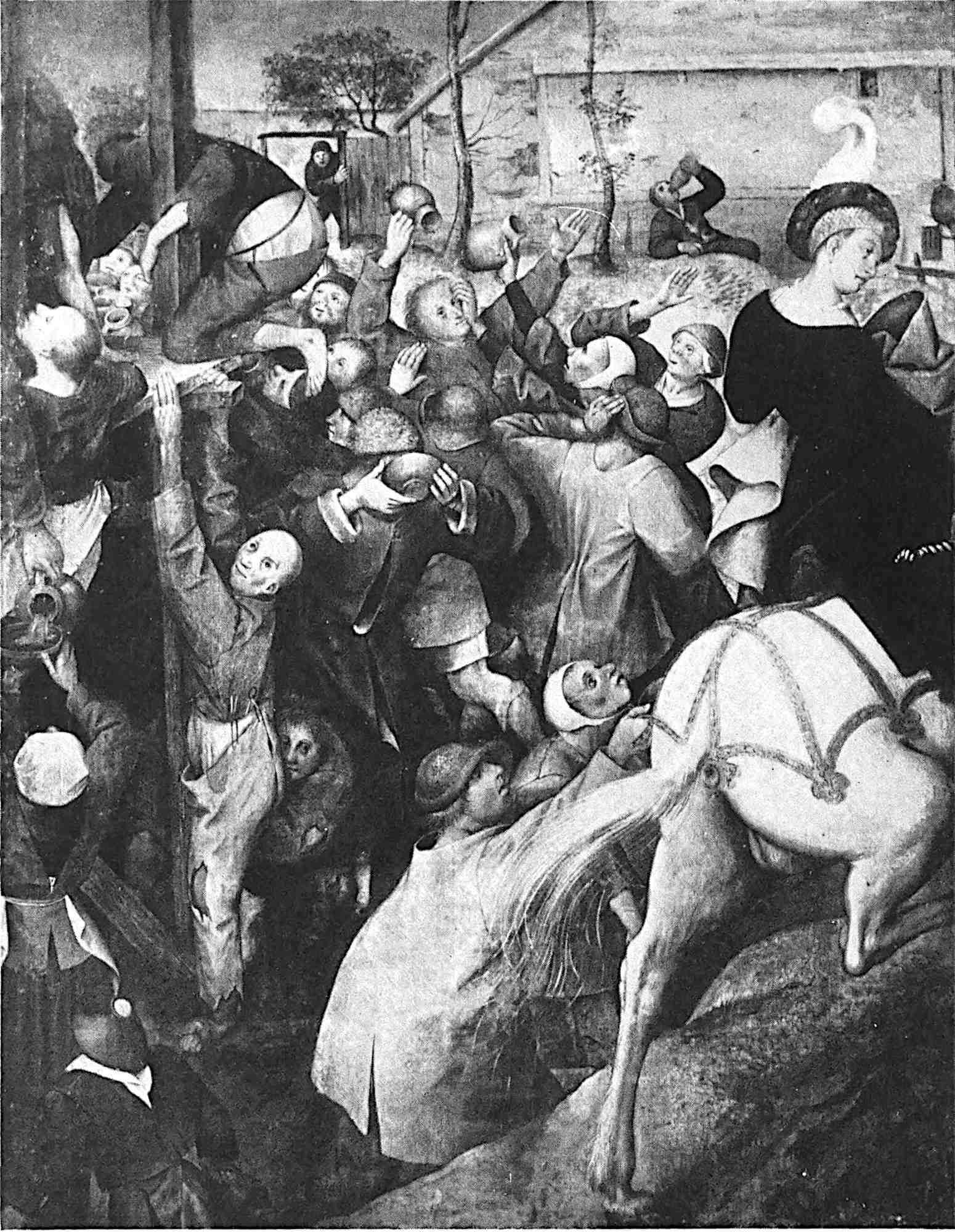
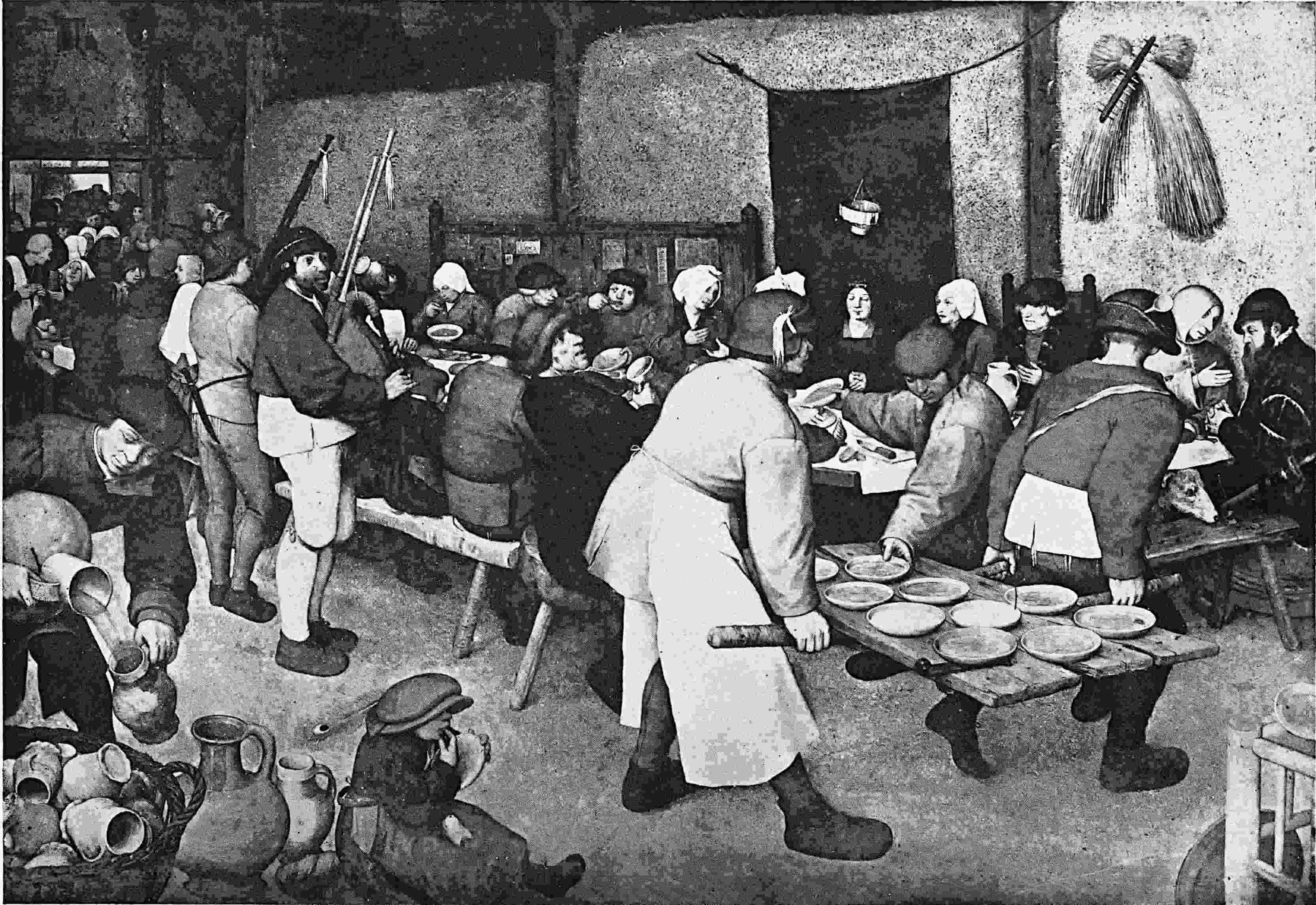
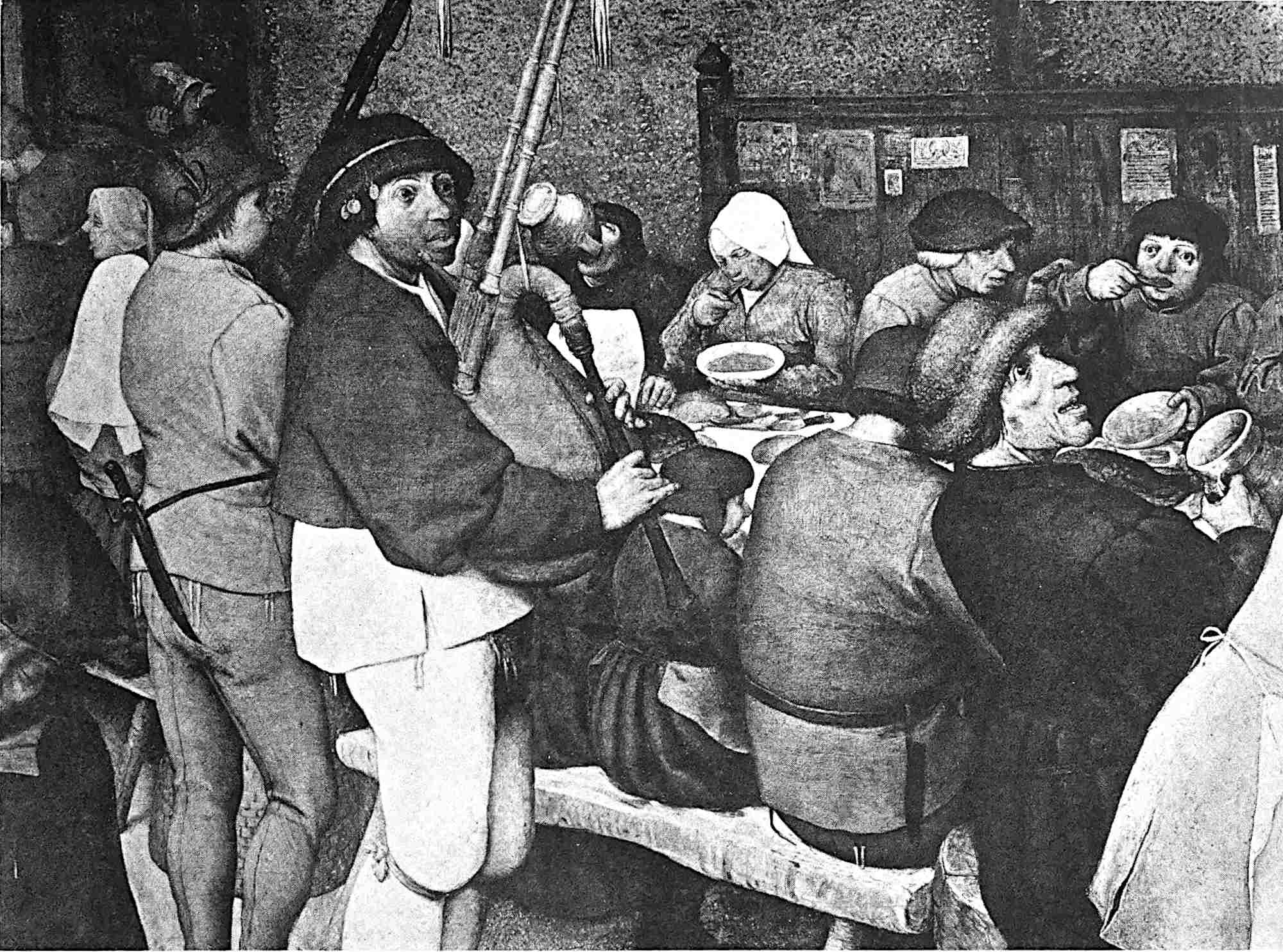
A VILLAGE WEDDING. PHILADELPHIA, JOHNSON COLLECTIONDANCING PEASANT. THE HAGUE, VAN VALKENBURG COLLECTION
Therefore it is not surprising that, after he had completed his
apprenticeship and been received into the painter’s guild, in 1551,
he should set out upon his travels. Such a trip in those days was no
light undertaking. All frontiers were insecure since the wars between
Charles and Francis for continental domination; for little or nothing
soldiers turned into robbers. Van Mander mentions neither routes nor
places, writing only that Bruegel “went into France and from there into
Italy.” Even the drawings now preserved afford no positive information
as to the way he went—a circumstance which might be interpreted to
mean that already he was interested less in telling what a specific
place looked like than in rendering the emotional effect of nature
upon himself. But two designs now preserved as etchings are signed
and dated at Rome in 1553, and there is a drawing of the Ripa Grande
which appears to have been done on the spot. The print of a naval
battle engraved by Huys and published by Cock after Bruegel’s return to
Antwerp indicates that he went as far south as Messina.
When he passed through France, François Clouet and Germain Pilon were
practising their art of tepid grace; when he reached Rome, the Sistine
Chapel paintings had been completed, but not the church of Saint Peter.
At the height of their working powers were Michelangelo, Titian,
Palestrina, Palladio; and Benvenuto Cellini was doubling in the roles
of artist and bandit. There is no proof that Bruegel had any contact
with these men; that he even saw their works is recorded neither in
words nor in the paintings by which he lives today in their company.
It is certainly reasonable, however, to suppose that the fame of his
contemporaries had not only reached him but actually played a part in
persuading him to his long wayfaring. Though still in his twenties, he
even then had sufficiently a mind of his own to avoid the mistake of
his predecessors, who had gone south specifically to copy and imitate
the styles of the Italian painters. In their journeying they were
following a fashion, doing something because others were doing it;
Bruegel’s urge was both deeper and broader, as his genius was.
Yes, the artistic, the professional, motive must have had much to do
with sending him to Italy, but the only way of expressing the sum total
of the desires that undoubtedly animated him is to say that he must
have craved more life.
“For to admire an’ for to see,
For to be’old this world so wide”—
no motive less comprehensive than this could have moved him. He was a
great artist in the making, but he was even more a man than an artist;
for him the art of other men could be only a part, and not the most
important part, of the all-inclusive experience of which he was in
search. Only such a conception of his personality can account for the
failure of the Italian masterpieces to influence him then or thereafter
and his own immediate and life-long preoccupation with the entire range
of nature and of human life. Moreover, so much can be inferred from Van
Mander’s only other reference to this momentous trip, a reference which
takes the form of reporting somebody else’s remark that “... in the
Alps he swallowed all the rocks and mountains, to return home and vomit
them out on painting-board and canvas....”
Towards the end of 1553, not long after the deaths of Rabelais and
Lucas Cranach, Bruegel was back in Antwerp. He again became affiliated
with the shop of Jerome Cock, but now as a sort of collaborator, making
drawings for many plates to be engraved by others and published by the
shop. As a successful business man with an eye to the market, Cock’s
specialties were landscapes of all types and grotesqueries in the
manner of Jerome Bosch, dead thirty-five years before, whose works were
a mine of motives for exploitation. The former apprentice proved to be
an even greater source of revenue and popularity for “The Four Winds”;
he shared completely in the contemporary taste served by the shop and
for several years devoted himself entirely to new and increasingly
inventive compositions in each genre.
STUDY FOR A “BATTLE BETWEEN FAT AND LEAN.” 1558? COPENHAGEN, ROYAL COLLECTION
The pure landscapes of this period fall into two very distinct
divisions—the small, intimate ones and the large, composite ones.
Among the first sort those of such obviously picturesque things as
ruins are less interesting, seem less realized, than those depicting
the homely commonplaces characteristic of the Low Countries. An
indefinite and puddled village street, a church set among trees,
the hybrid ruralness where town and country meet—the buildings
and small figures rendered in a clean, unwavering line and the
massed multitude of leaves given without a superfluous or unmeaning
scribble—these things, conveyed with such immediacy by the free and
sensitive pen-work, become sharp-edged and lose their bloom through
the interposition of the engraver’s hand. Though his return gave him
to see all the littlenesses about him with the freshness of a first
encounter, it did not make him forget the mountains which had struck
so deeply into his mind; and he composed a whole series of large,
Latin-titled designs in which the far and low horizons of home were
fabulously combined with Alpine steeps. In these plates, deeper than
the romanticism of their composite character, is an immense and sober
poetry which transpires even through the hardness of the engraving.
BATTLE BETWEEN CARNIVAL AND LENT. 1559. VIENNA, MUSEUMBATTLE BETWEEN CARNIVAL AND LENT (DETAIL)THE DESCENT OF CHRIST INTO LIMBO (DRAWING). 1561? VIENNA, ALBERTINA
One print, dated the very year of his return, a composition of many
people skating just outside a city wall, is obviously based on direct
observation and is Bruegel’s first essay in the realistic rendering
of the life of crowds which was later to play so large a part in his
painting; but yet awhile the greater part of his labor went into a long
succession of drolleries and diabolisms.
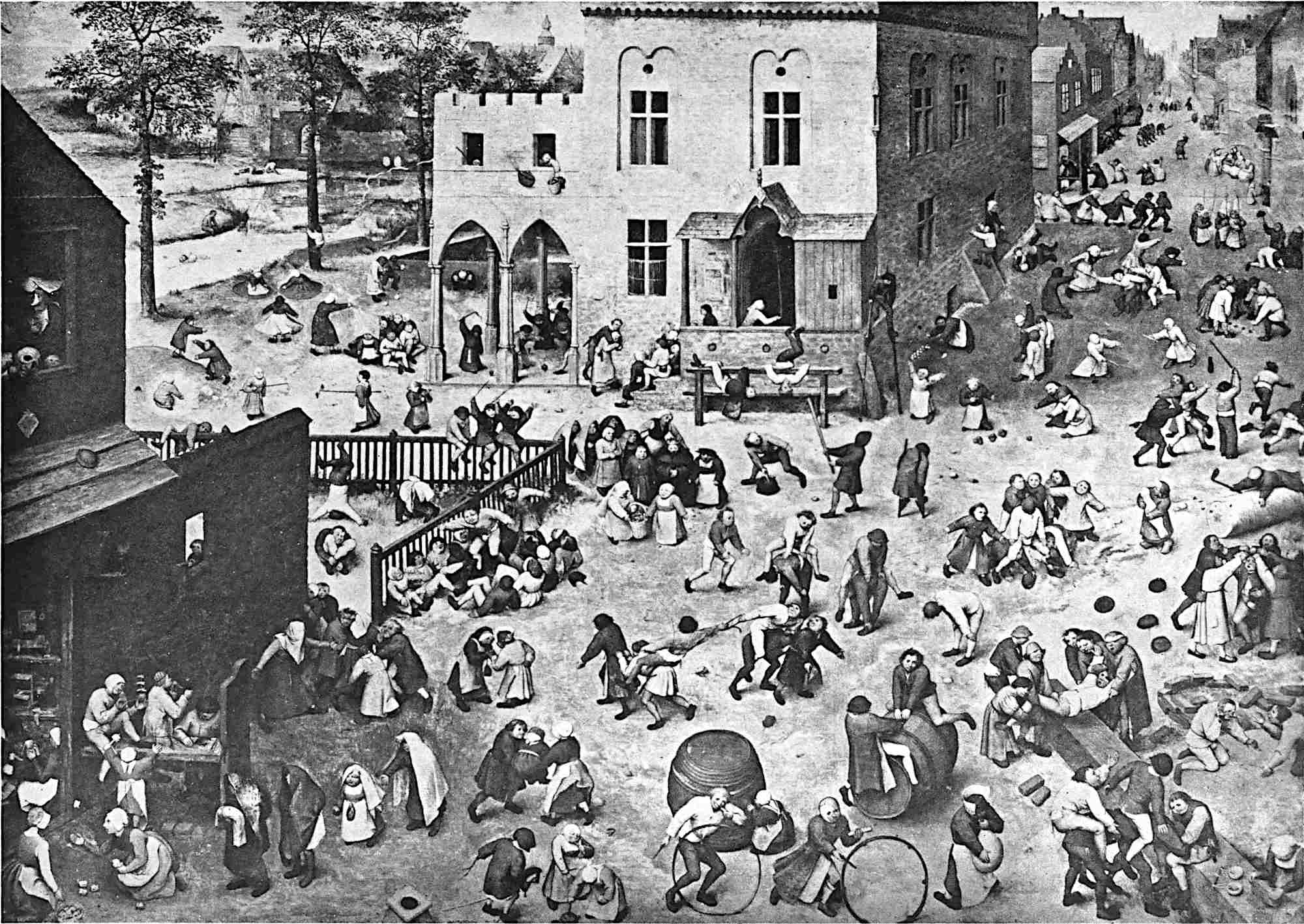
FLEMISH PROVERBS. 1559. BERLIN, KAISER FRIEDRICH MUSEUMCHILDREN’S GAMES. 1560. VIENNA, MUSEUM
It is in connection with this part, and this part only, of his
life-work that there arises any necessity of discussing the influence
of another painter on Bruegel. Van Mander treats the matter thus:
“He practised much in the manner of Jerome Bosch and used to make many
such goblin pictures and drolleries, for which he was called by many
Pieter the Droll.” The biographer here recorded the general
contemporary estimate which, though it is now seen to fall far short
of the truth, was surely natural enough, since in his own day Bruegel
was popularly known by the widely circulated prints rather than by
the unreproduced paintings. The Big and Little Fish of 1556
is directly from Bosch, and that his spirit and his manner did have
an influence upon Bruegel is not to be denied. But such influence as
Bosch did exert upon the man who had returned from Italy uninfluenced
was possible only because they shared in a racial streak which can be
traced back of them into the Middle Ages. The quality that allowed
Bruegel to be influenced by Bosch at all would have manifested
itself in Bruegel’s art even if Bosch had never lived. Moreover,
Bosch’s art was limited almost to this one type of subject-matter,
whereas Bruegel’s art soon developed other and far more important
characteristics which overshadowed without obliterating this element of
grotesquerie.
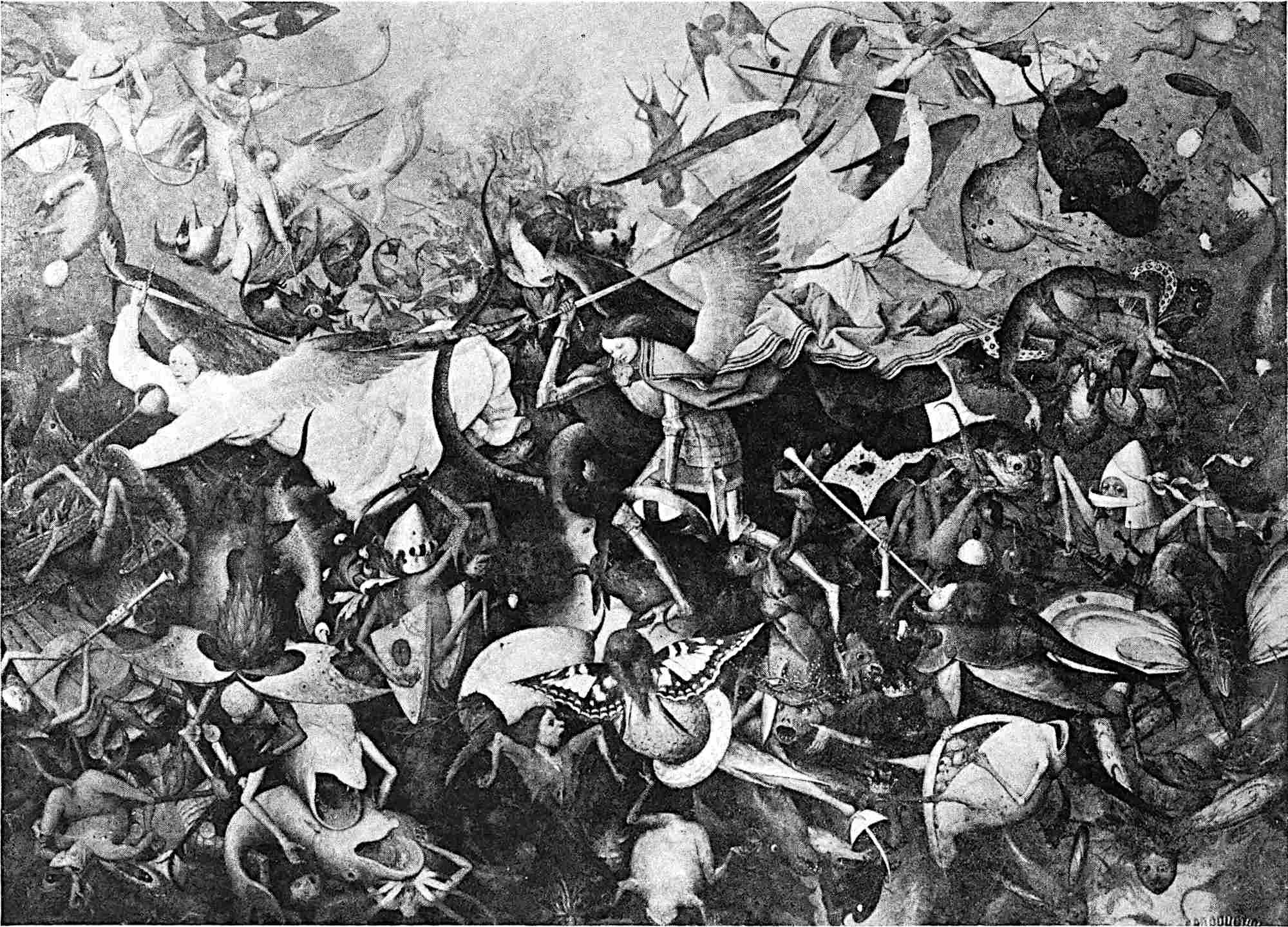
THE FALL OF THE REBEL ANGELS. 1562. BRUSSELS, MUSEUM
For the time being, however, it had free rein in a series of
Vices and numerous separate plates such as The Ass
at School, The Sorcerer, The Merchant Robbed by
Monkeys. In these prints there are, in addition, a mastery of
design, an inventiveness of detail and a convincingness of outlandish
imagination that far surpass Bosch’s most ambitious efforts. A little
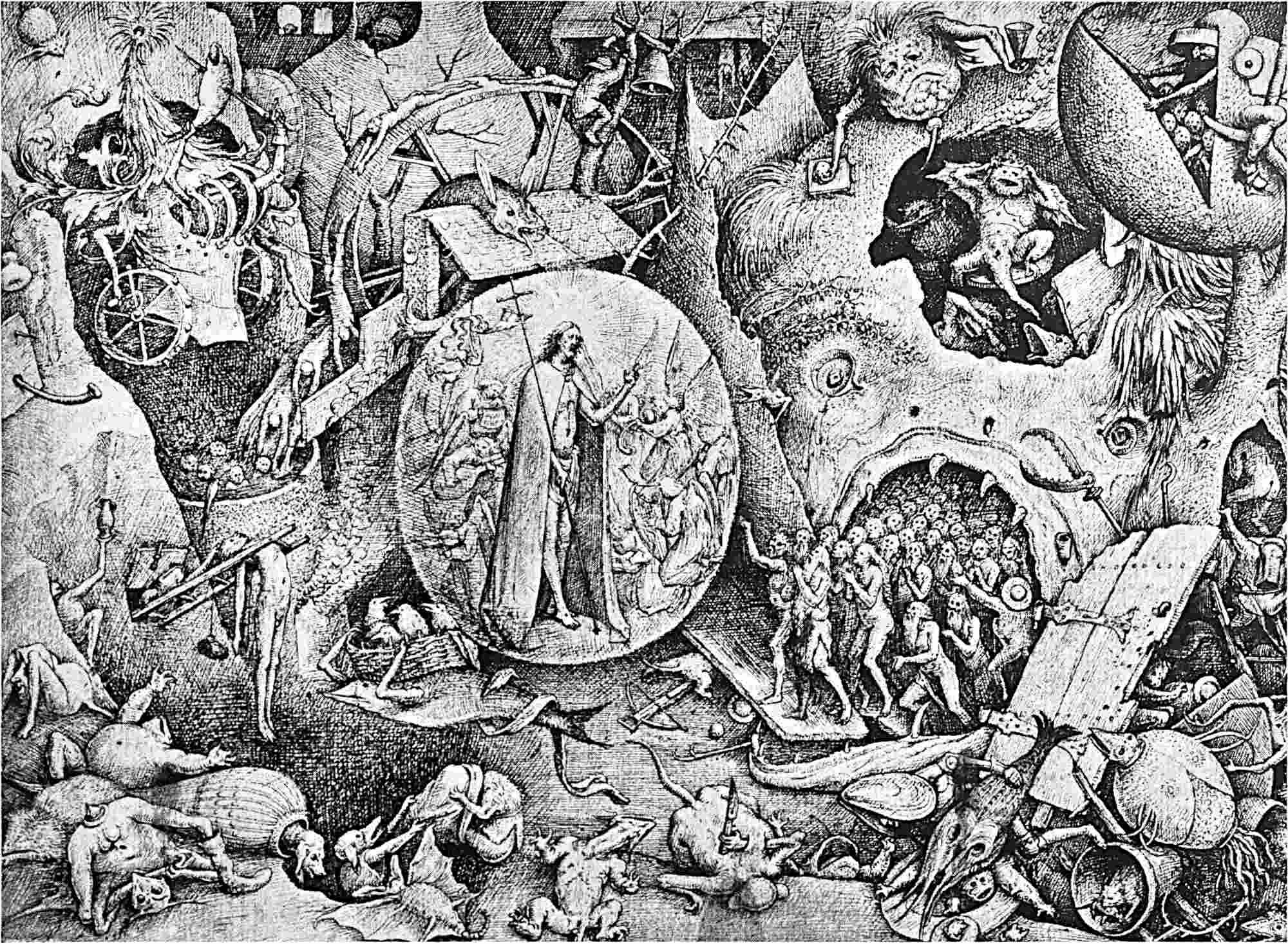
of these qualities is to be discerned in the two drawings of The
Last Judgment and Christ in Limbo; and they also display
Bruegel’s entire lack of any mystical fervor, which would have
imparted some sort of impressiveness to his Christs. This negative
trait in Bruegel, which is the exact obverse of the sort of humaneness
which made him great, is further shown in the series of Virtues,
also of this period; although these occasionally exhibit a high degree
of skill in handling complex groupings, they are what professionalized
virtues are apt to be—tedious.
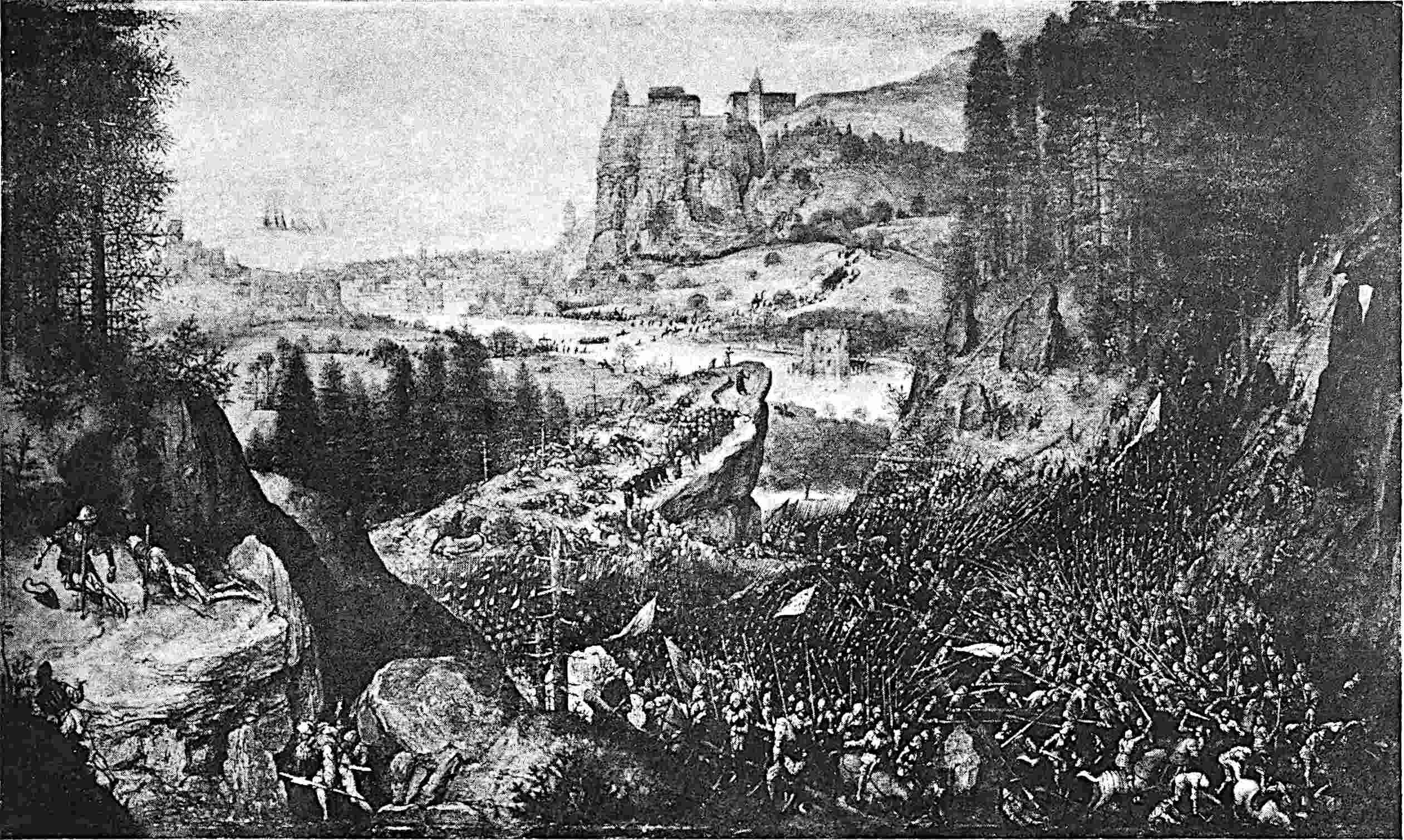
BATTLE BETWEEN THE ISRAELITES AND THE PHILISTINES. 1562 OR 1563. VIENNA, MUSEUM
Midway in this prosperous and fertile time of development the Emperor
Charles, taken with the notion of enjoying all the benefits of being
dead while yet alive, partitioned the empire between his brother and
his son, and himself retired in state to a monastery in Spain. From
this haven, free of governmental responsibilities, he was able, through
his dutiful son Philip, to instigate increasingly severe measures of
religious and political repression for the people of the northern
lowlands. Yet such things did not affect the personal liberty of
Bruegel, who was maintaining an irregular establishment described by
Van Mander in the following anecdote: “As long as he lived in Antwerp,
he kept house with a servant-girl, whom he might have married had it
not misfortuned him that she was always telling lies, a thing repugnant
to his love of truth. He made an agreement or contract with her that he
should mark all her lies on a stick—and he took a pretty long one—and
when the stick should be full of marks the marriage should be off;
which then happened before much time had passed.”
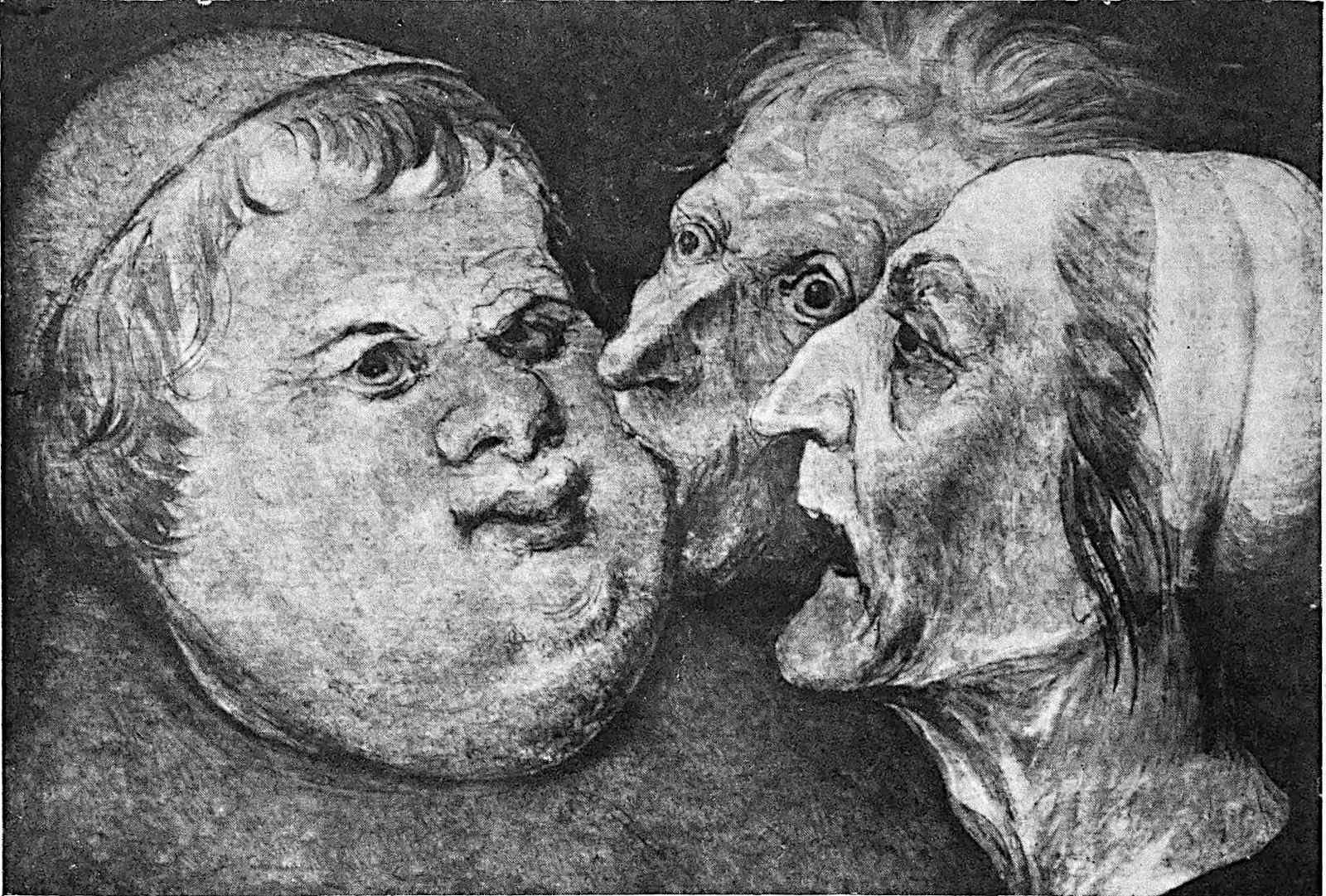
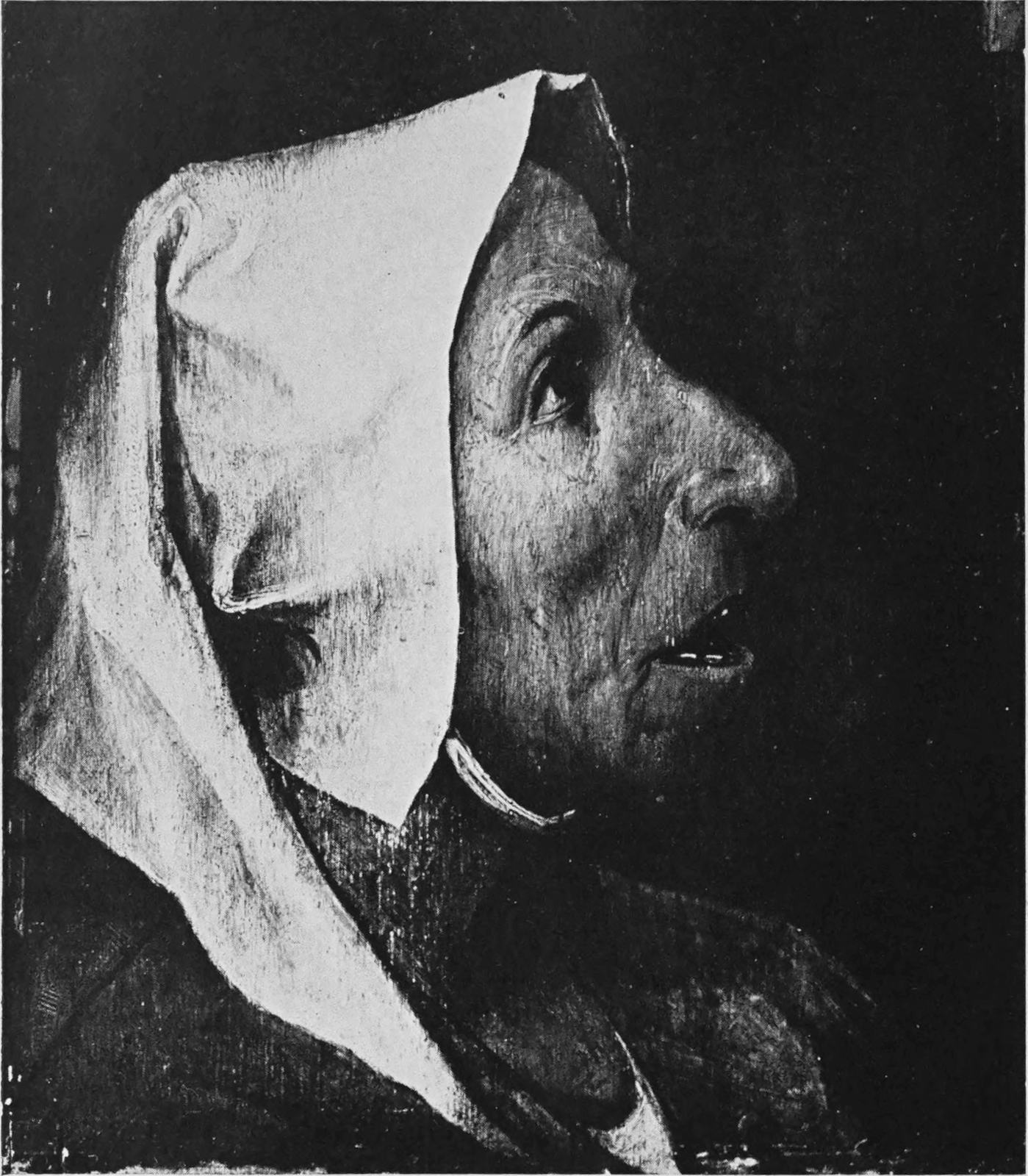
HEAD OF AN OLD PEASANT WOMAN. 1564? MUNICH. ALTE PINAKOTHEK
More important is what Van Mander tells us of a friendship: “He worked
much for a merchant named Hans Frankert, an admirable and excellent
man, who found pleasure in knowing Bruegel and was with him whole
days at a time. With this man Frankert, Bruegel often went among the
peasants, to fairs and marriages, both dressed like peasants; and they
took presents like the others, just as if they belonged to the family
or acquaintance of the bride or the bridegroom. Here Bruegel found his
pleasure in observing the manners of the peasants in eating, drinking,
dancing, jumping, loving and other fun-making; which things he then
very skilfully and carefully rendered again in colors, in water-color
as well as in oil, in both which mediums he was extraordinarily
talented.” Then Van Mander proceeds to stress the faithfulness and
accuracy of Bruegel’s peasant pictures in the details of costumes and
movements. In short, Bruegel had begun to paint.
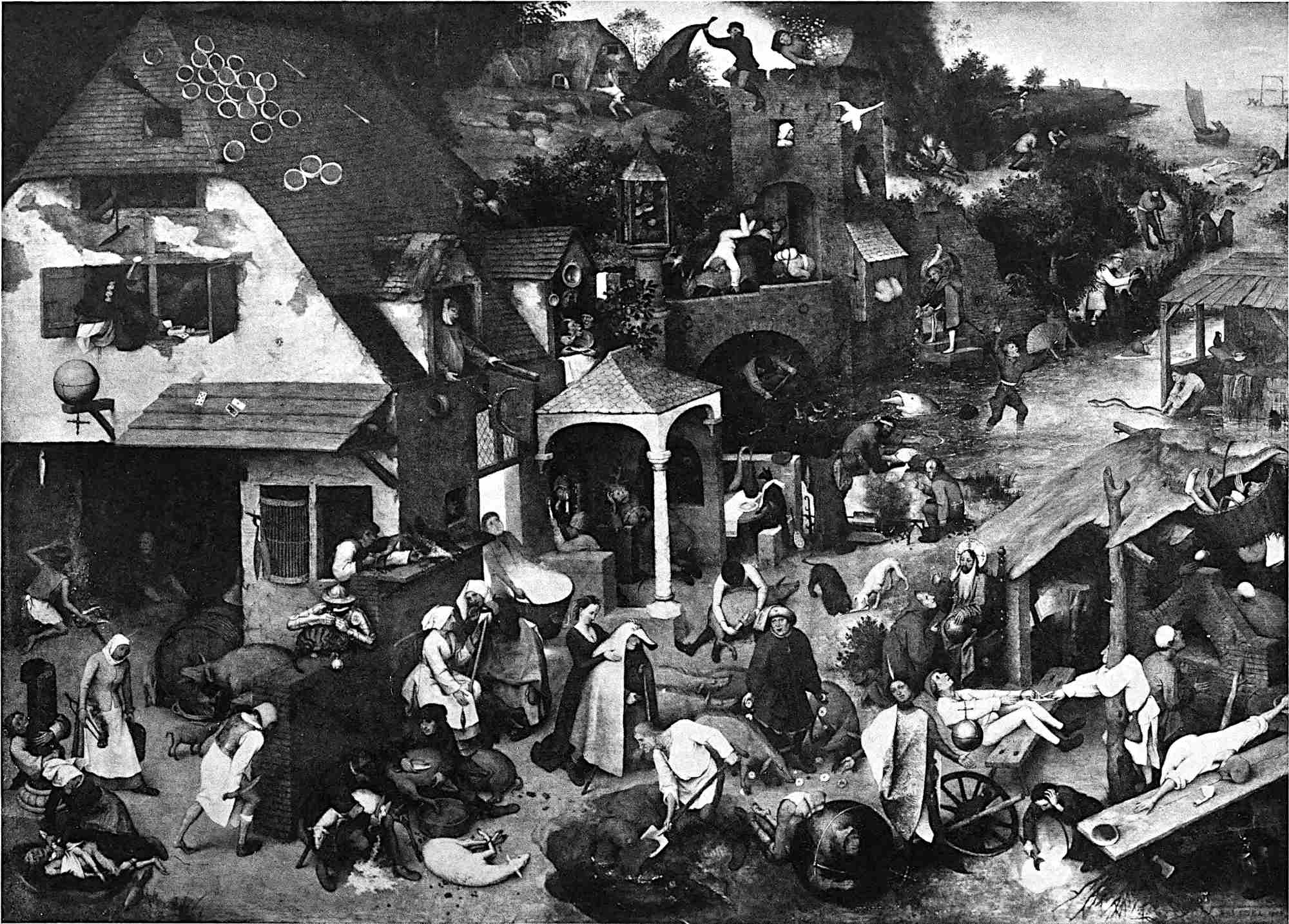
The earliest dated painting, Twelve Flemish Proverbs, is
interesting only because of its connection with Bruegel; its relative
clumsiness of execution and utterly unpictorial conception as a whole
render it very likely the first of his attempts in a new medium.
However, this picture and the others that must be grouped immediately
with it mark the definite emergence of what was thenceforward to be his
predominant interest—the life of the peasants, between whom and himself
there existed the unbreakable bonds of a common origin and a common
destiny. Thus he began at once to paint in accordance with the dictates
of his essentially realistic genius, but the first works of capital
importance still retain a large admixture of the fantastic spirit
which had been running riot in his recent designs for the engravings.
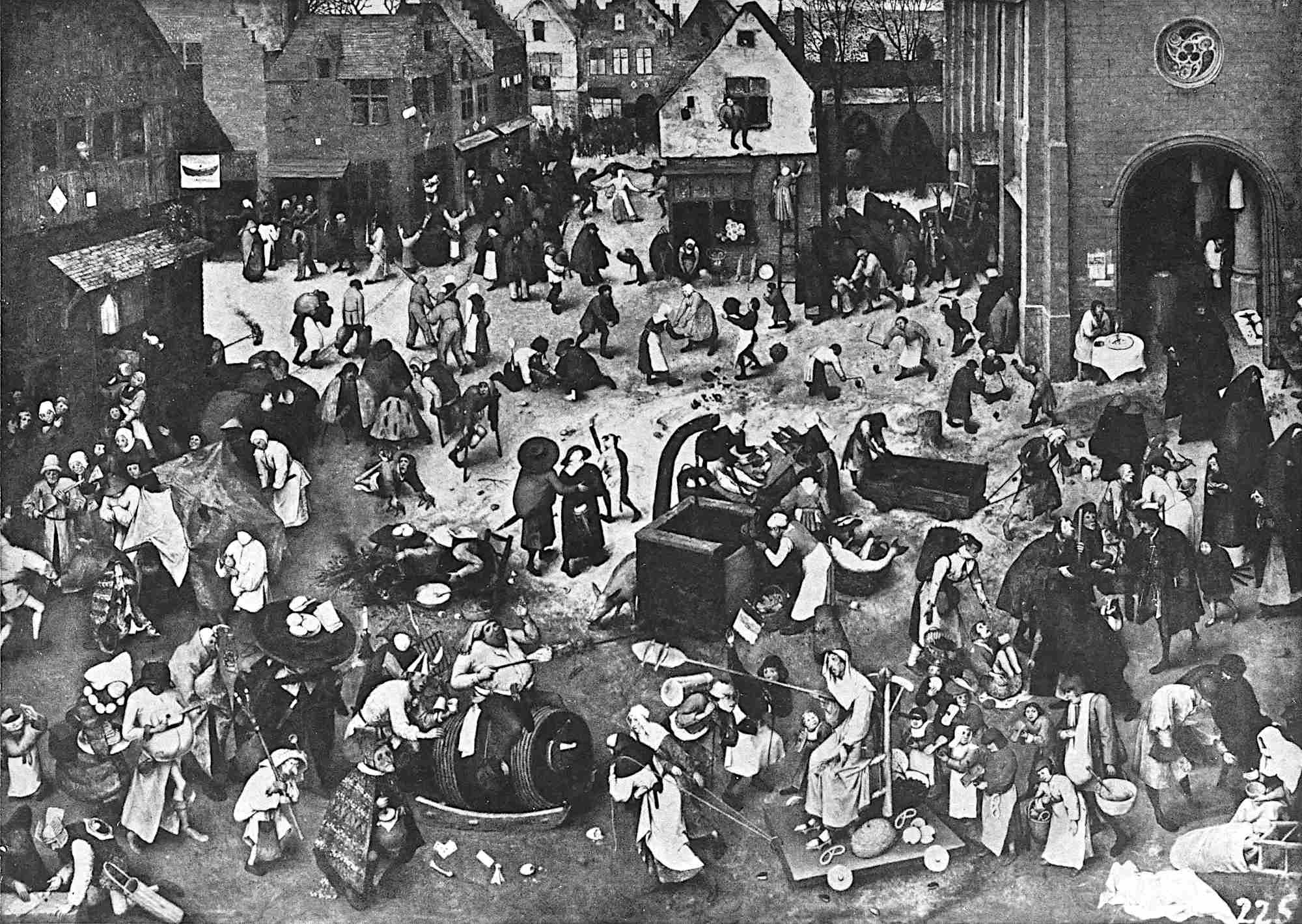
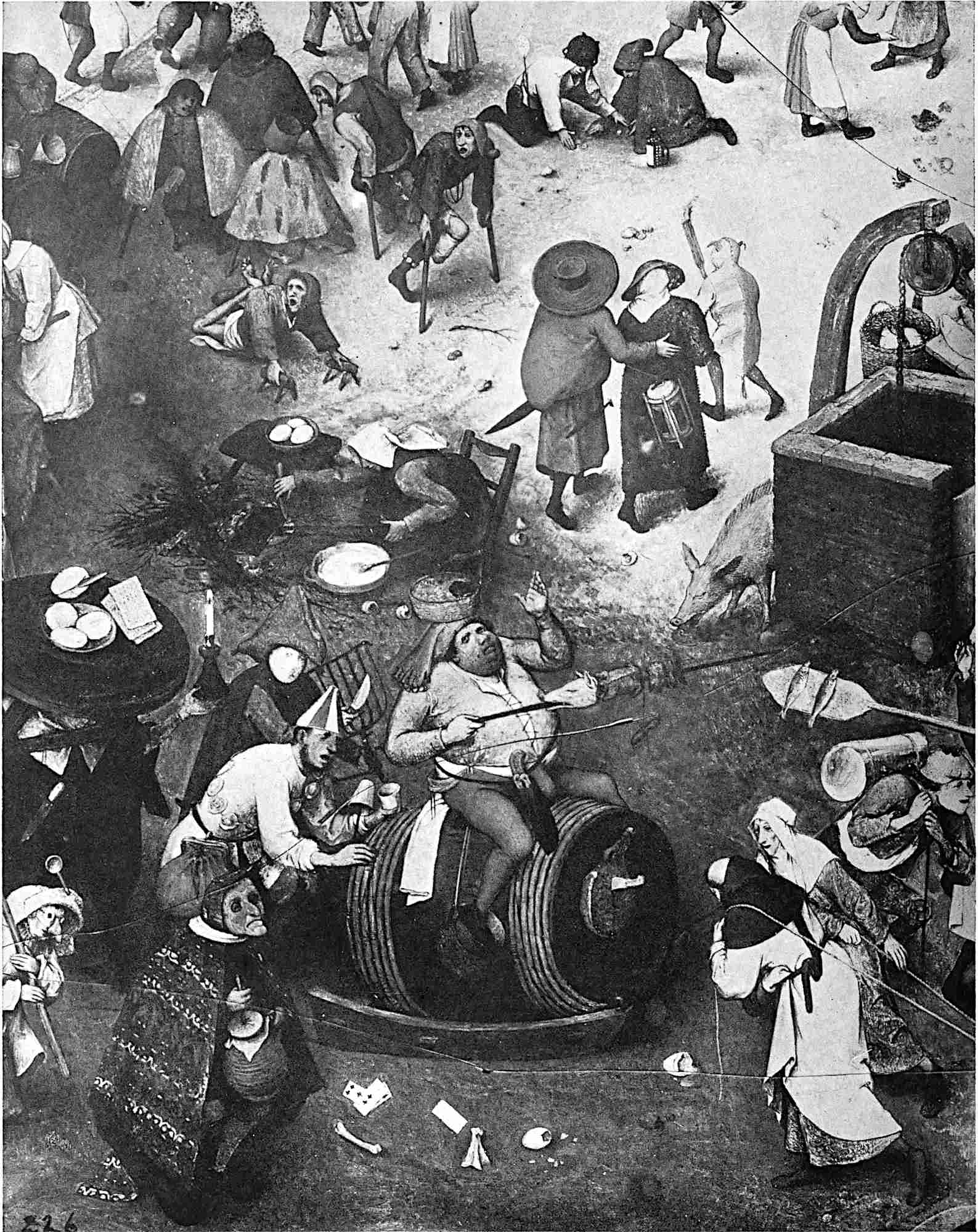
These two pictures are the Carnival and Lent and the Flemish
Proverbs in Berlin, both of the year 1559; in both fantasy is made
convincing through realistic treatment, just as the Van Eycks and Roger
Van der Weyden had made convincing their religious idealism, Bruegel’s
difference from them being simply a difference of subject-matter and
a still greater reliance upon realistic skill for its own sake. In
the Children’s Games of the next year there occurs the first
complete union on a great scale of realism in both matter and manner;
and two years later, with the Fall of the Rebel Angels, a
recurrence in greatly intensified form of the combination between
fantastic idea and realistic treatment. This last painting, credited
to Jerome Bosch himself until the discovery of Bruegel’s signature,
is infinitely superior in conception and execution to anything by the
earlier man, and would alone rank its creator as a great painter; yet
the greatness it confers upon its maker is not the kind that is most
truly Bruegel’s. Through all these paintings of the Antwerp period
there runs a rapidly increasing technical skill—in drawing, color and
design—until the last picture that could possibly have been done before
his removal to Brussels, the Israelites and Philistines, is for
minute workmanship a world’s wonder. On a small panel about thirteen
by twenty-two inches Bruegel has put several hundred human beings, the
largest of whom is less than two and one-half inches, in a landscape
setting of great beauty, all done in such detail that one can count
the spots on the giraffes far away across the river—and all seen with
so careful a regard for values and design that it is a satisfactory
picture from whatever distance it is regarded, its details merging into
the larger relations as one views it from further off. Craftsmanship of
this type in painting can go no farther.
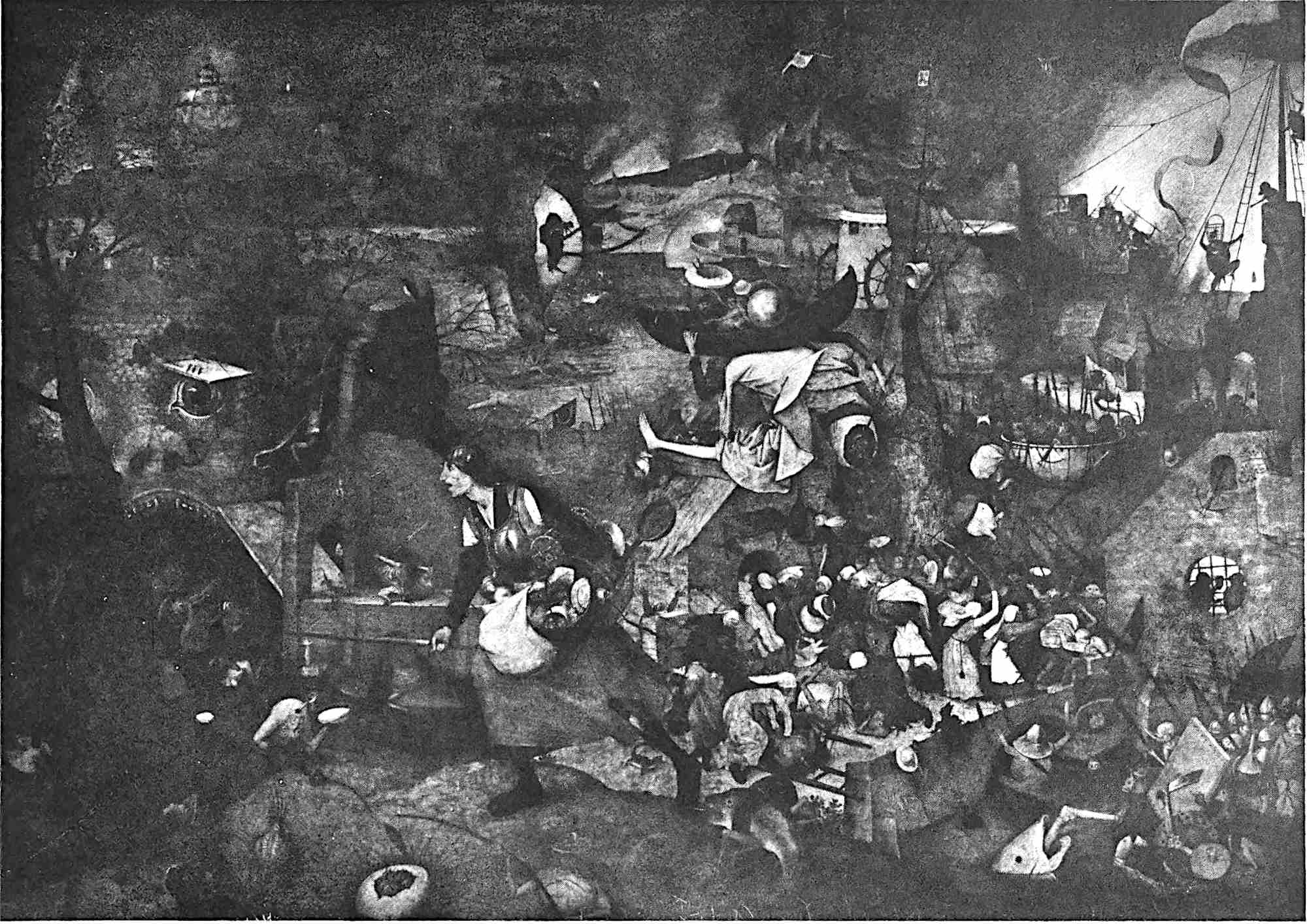
“DULLE GRIET.” 1564. ANTWERP, VAN DEN BERGH COLLECTION
The cause of his leaving Antwerp was his marriage, which took place
in 1563. His choice had fallen upon the daughter of his first master,
Pieter Coeck. Twice during his brief notice on Bruegel, Van Mander
refers to the fact that “he had, while she was still small, often
carried her in his arms.” Her mother, after the father’s death,
had removed to Brussels and there successfully engaged in her own
profession of miniature painting; in consenting to the marriage she
“stipulated that Bruegel should leave Antwerp and settle down in
Brussels, in order that he might efface former love-affairs from his
eyes and his mind.” In this marriage was the beginning of what has
been well called the Bruegel dynasty. The two sons produced copies and
variations of their father’s paintings in such abundance that it is an
exceptional
picture gallery in Europe which does not boast its
“Breughel le Vieux”; and these sons in their turn fathered a
dozen more painters.
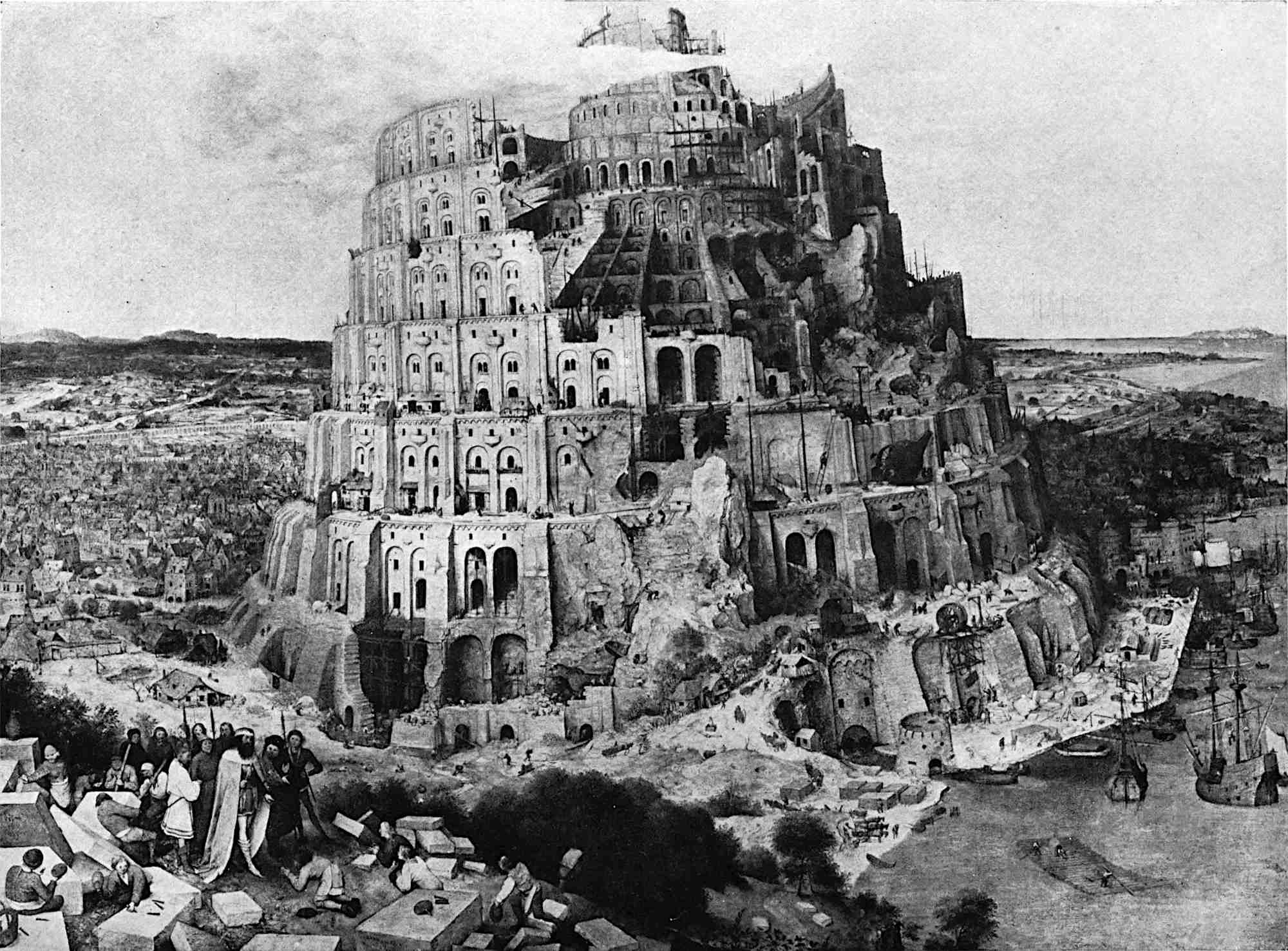
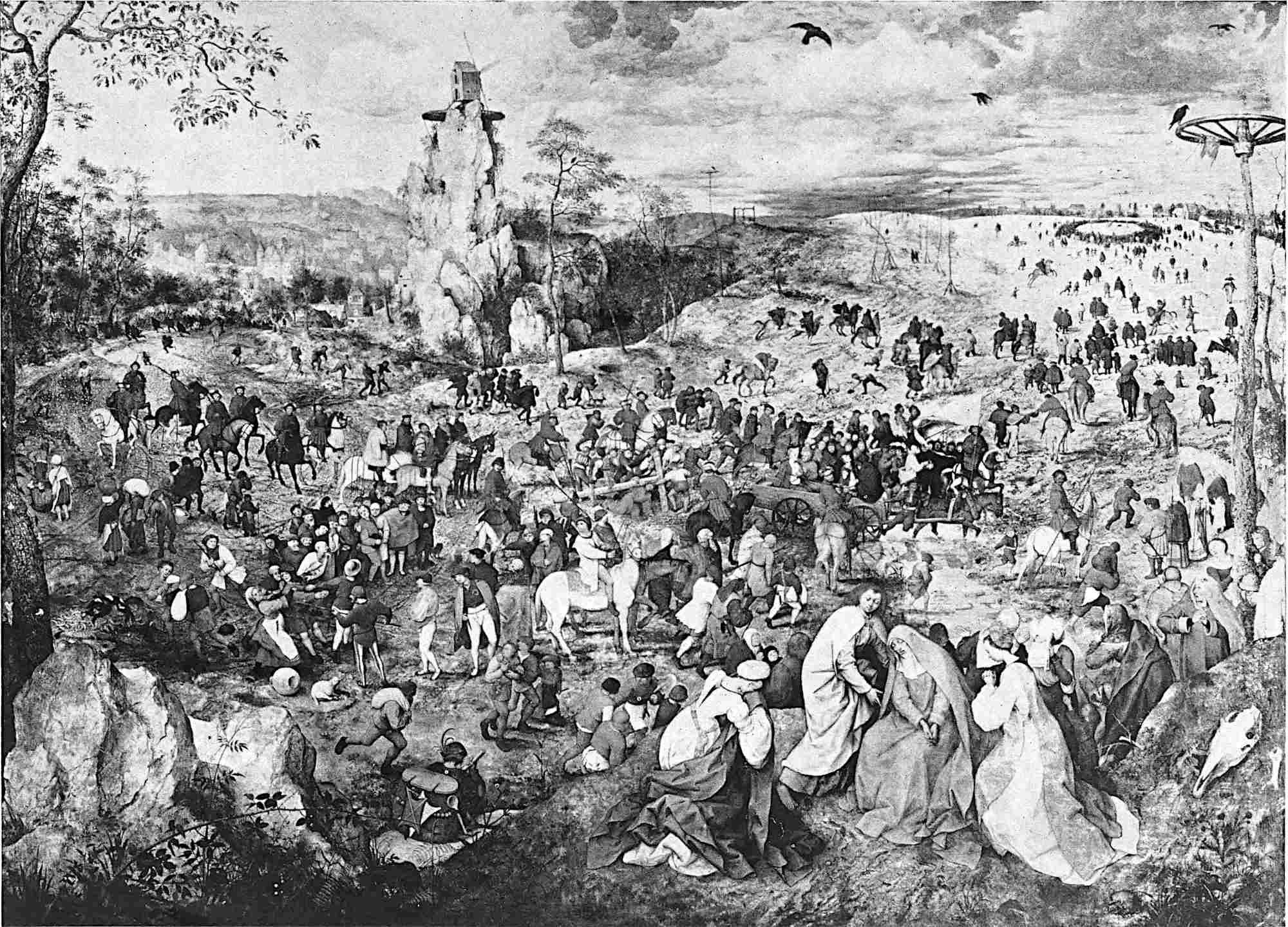
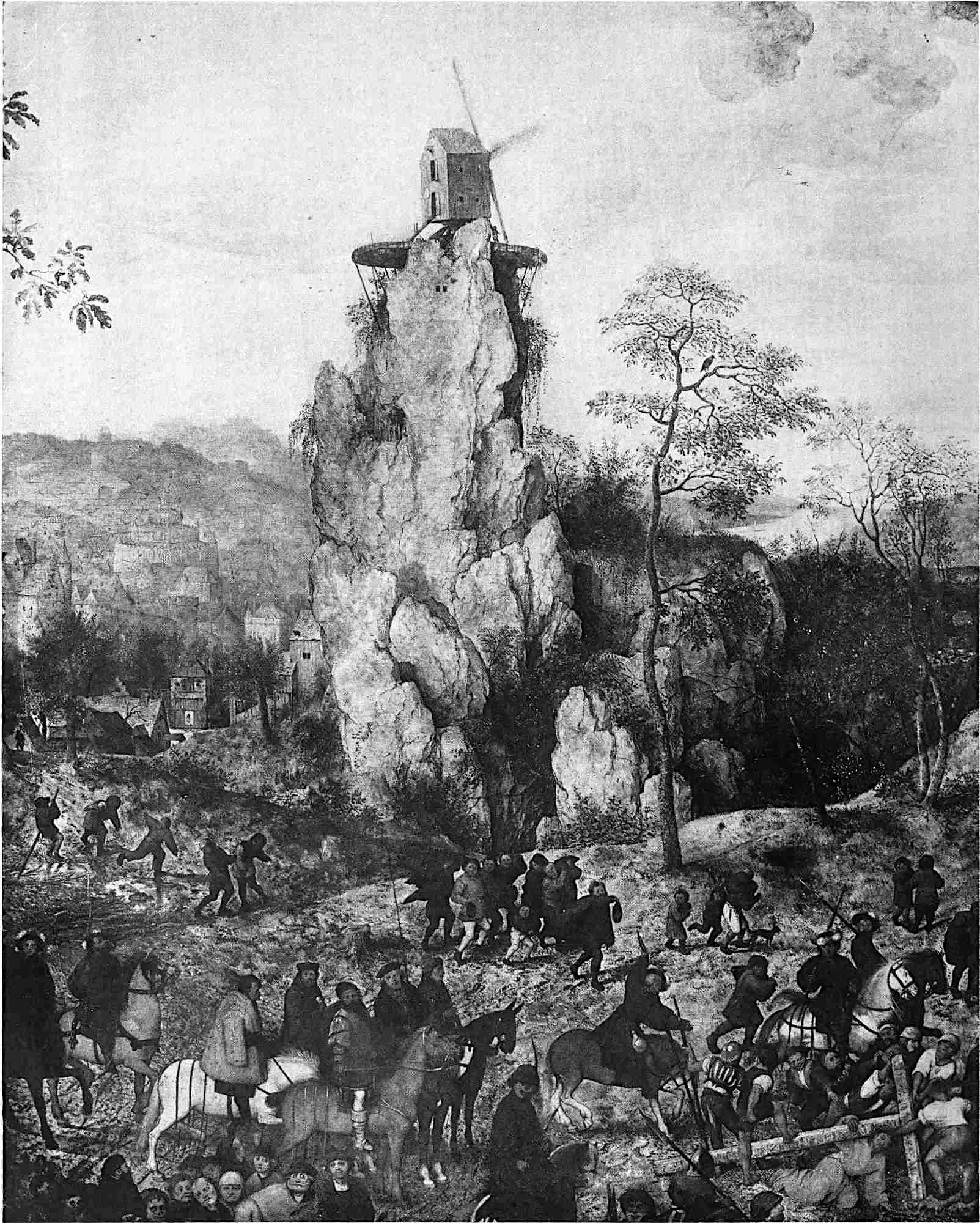
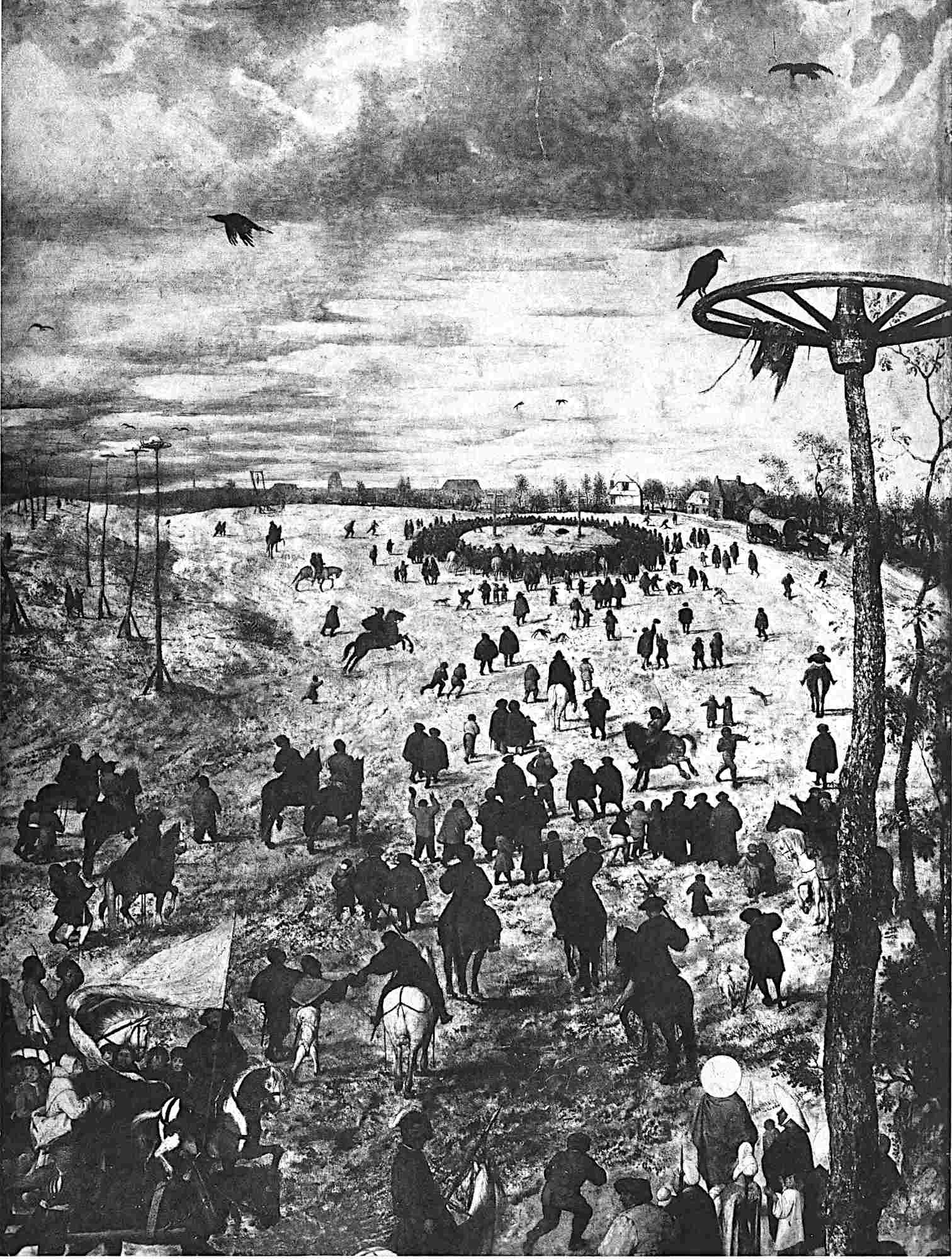
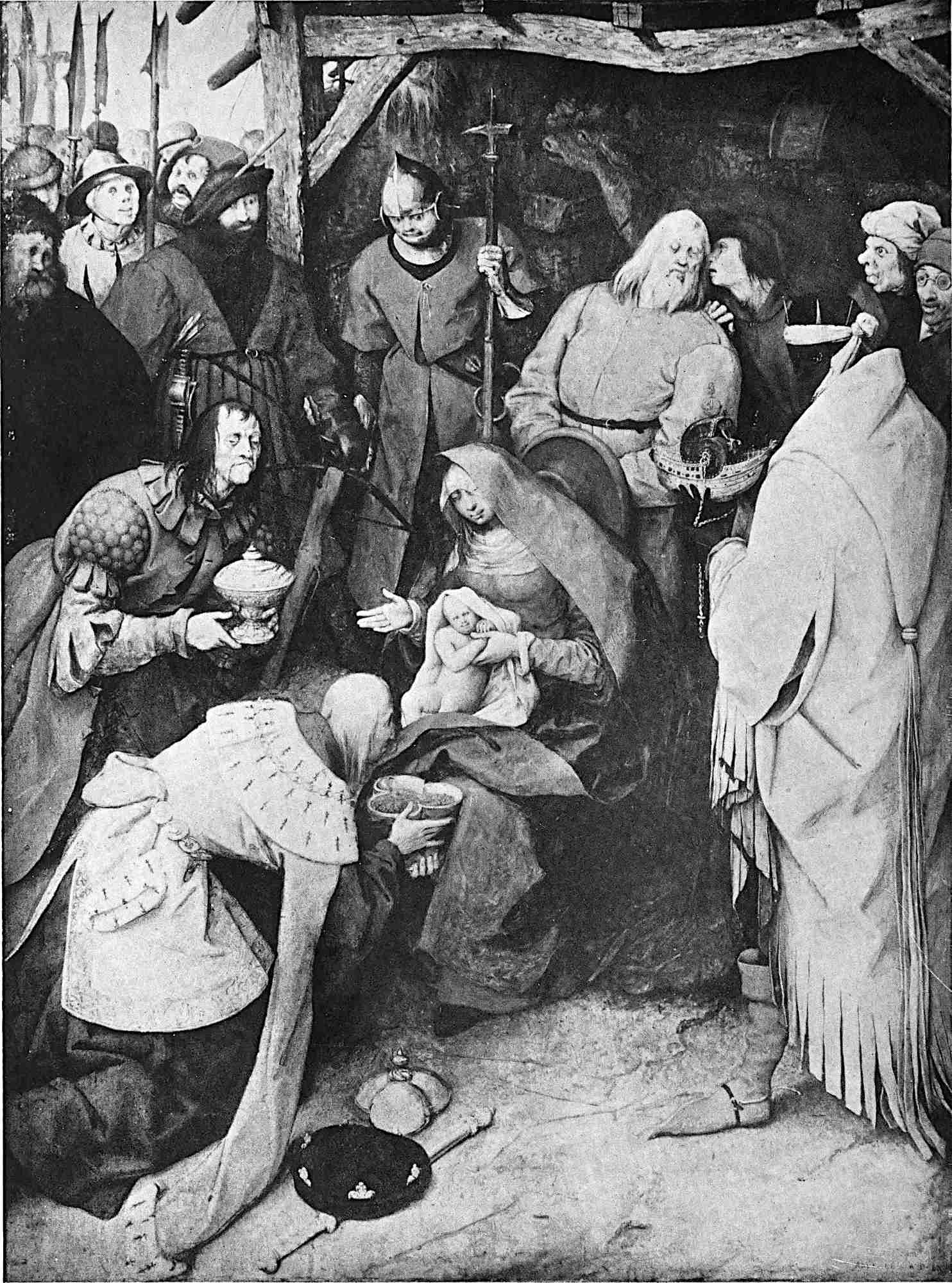
THE TOWER OF BABEL. 1563. VIENNA, MUSEUMTHE CARRYING OF THE CROSS. 1564. VIENNA, MUSEUMTHE CARRYING OF THE CROSS (DETAIL)THE CARRYING OF THE CROSS (DETAIL)THE ADORATION OF THE KINGS. 1564. LONDON, NATIONAL
GALLERY
But of them all, none approached the greatness of their original,
whose six years of married life were filled by the creation of
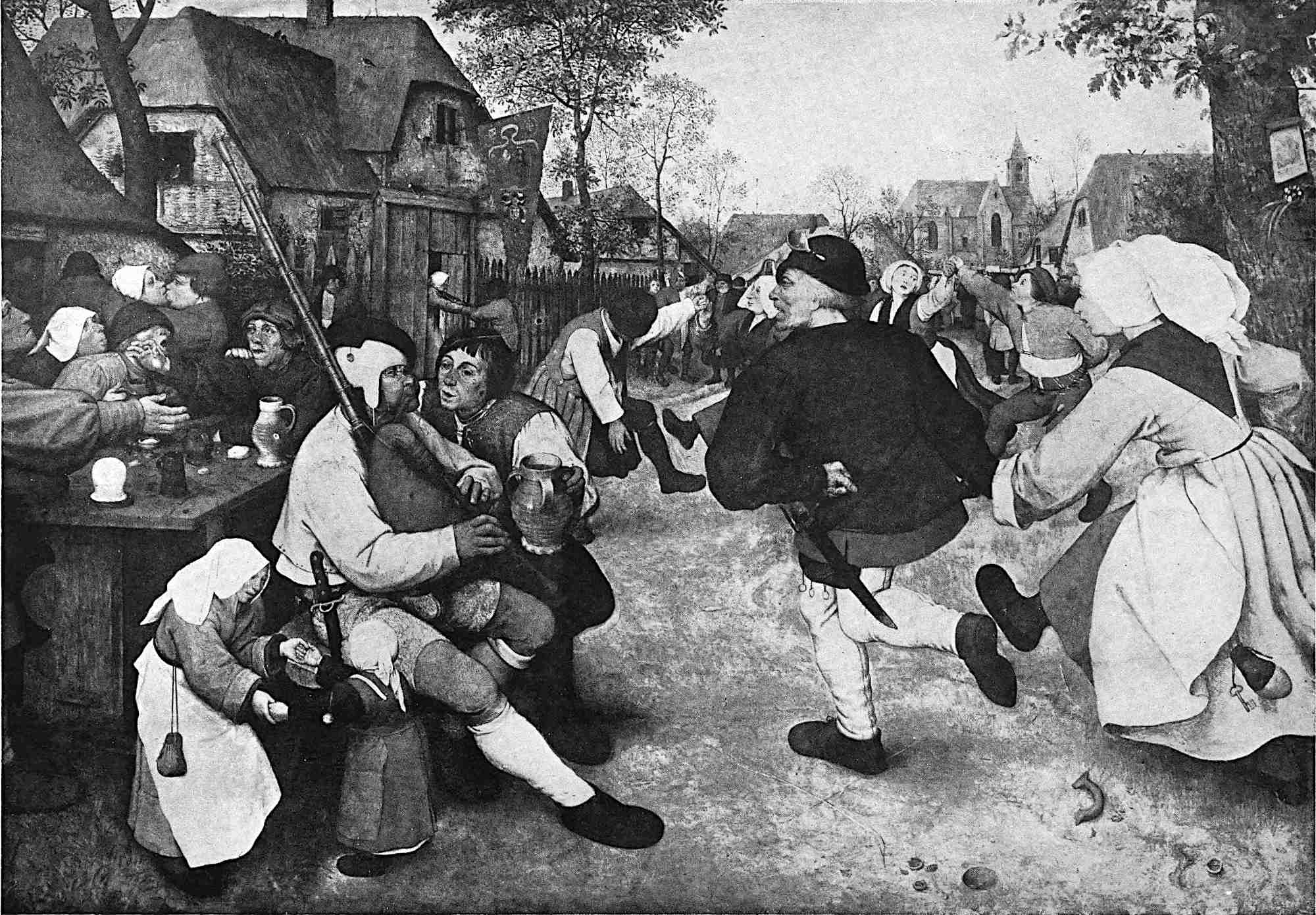
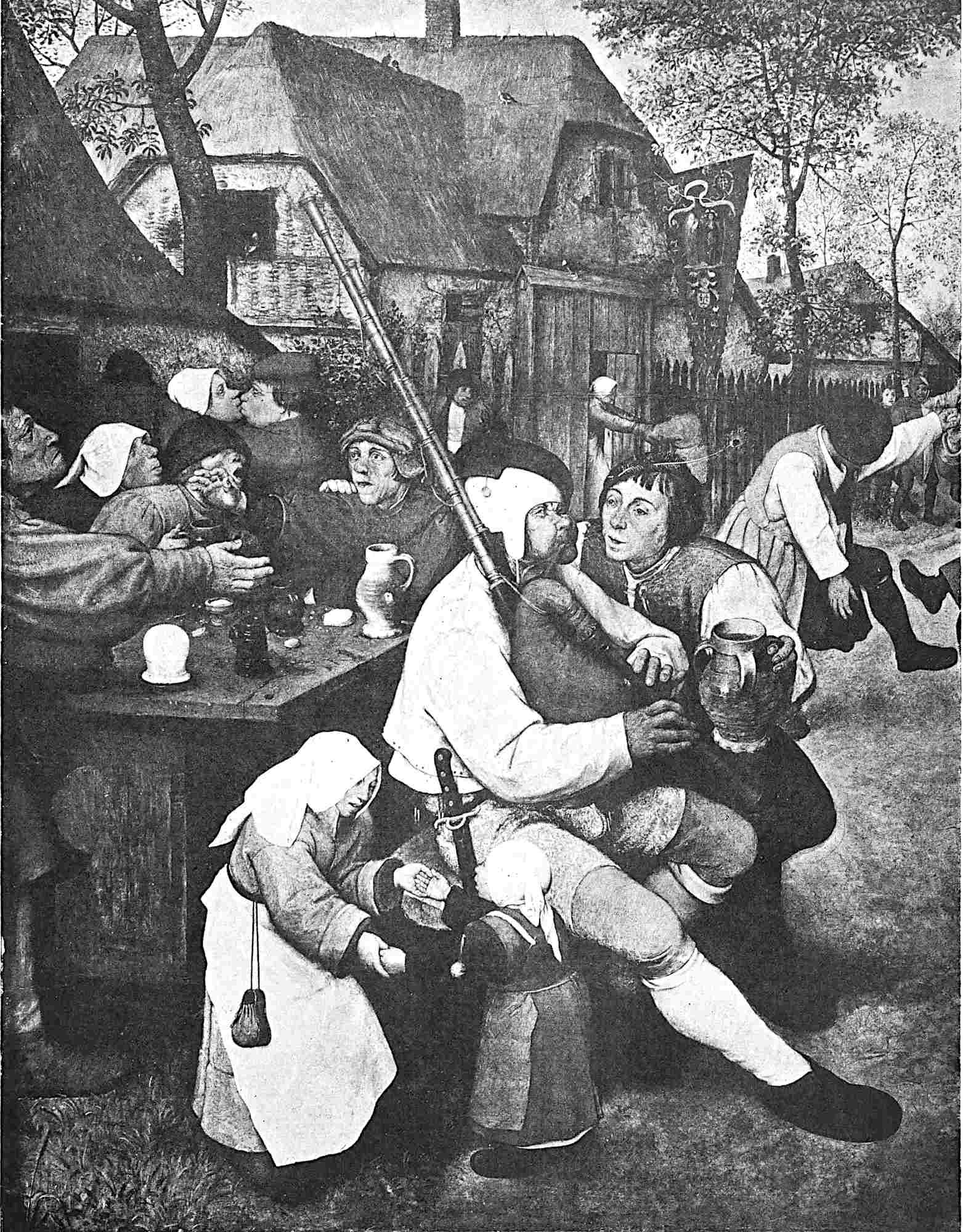
masterpieces—of realistic observation in the Wedding Feast
and the Peasant Dance; of sheer imagination in the Dulle
Griet and the Triumph of Death; of narrative power in
the Massacre of the Innocents; of the purest pictorialism in
the Conversion of Paul; of the indescribable Carrying of
the Cross; of realism, imagination, emotion and thought merged
into the large harmonies of that great series of five paintings, the
Months.
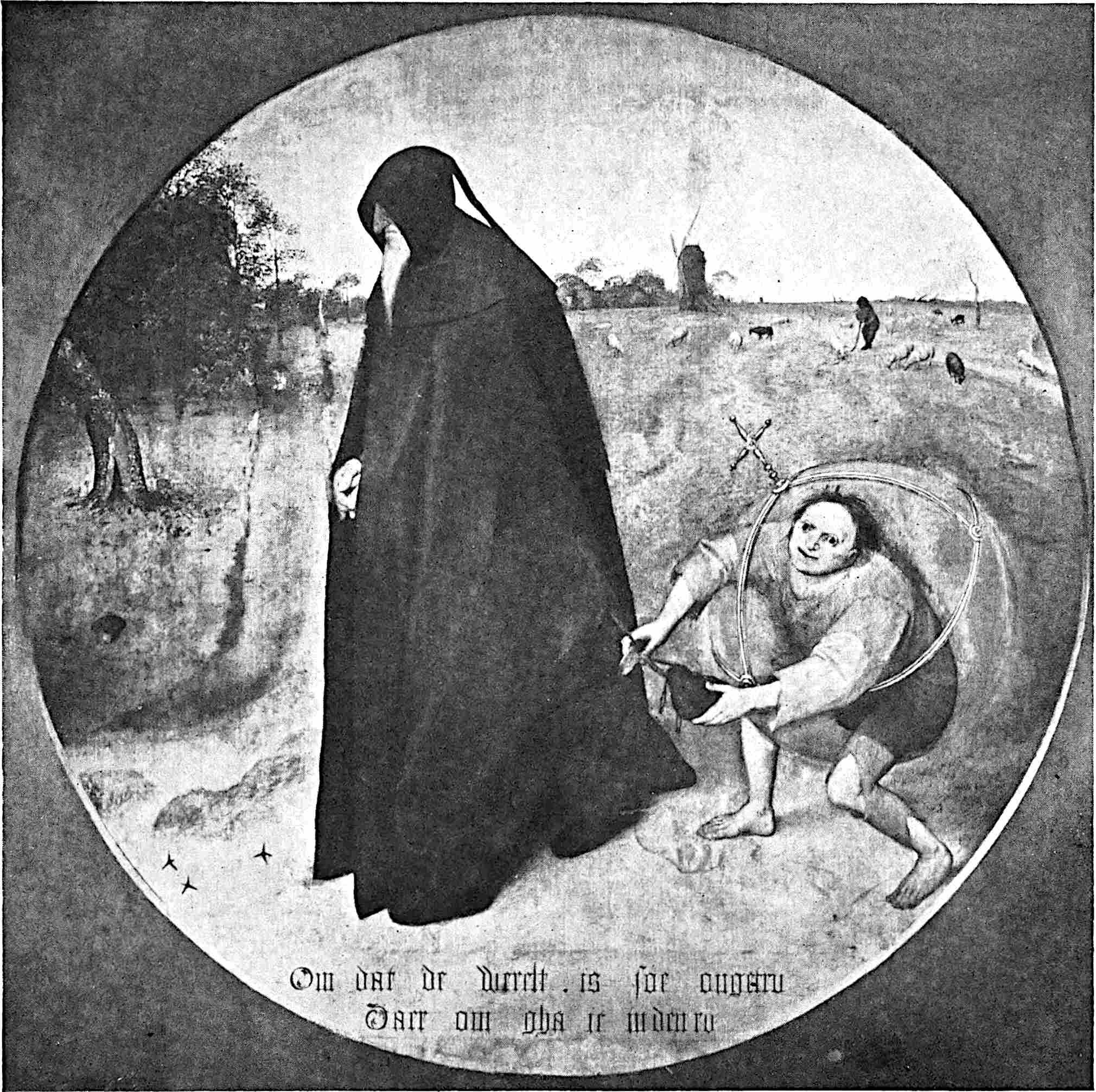
THE MISANTHROPE. 1565. NAPLES, NATIONAL MUSEUM
While he was achieving all this ordered beauty of art, the disorders of
the life around him were increasing at a fatally rapid pace. In Ghent
a mob sacked the Abbey of Saint Peter and, made drunk by the wine of
its cellars and the intoxication of destructiveness, ran smashingly
at large through the city. In Antwerp another mob totally destroyed
the rich and famous church of Notre Dame. Conflicts multiplied
between Catholics and Protestants, between civilians and soldiers;
bands of foreign mercenaries coursed through the country and open
towns. The Duke of Alva’s execution fires cast lurid lights upon the
ruin and decimation of what had once been the most prosperous region
of Europe.
Of Bruegel’s own reactions to all this his biographer, writing at a
time when it was almost a well-forgotten nightmare, makes no mention.
Van Mander’s single sentence of direct characterization is this: “He
was a very quiet and skilful man, who spoke little but was sociable
in society, and loved to frighten his companions, often also his own
pupils, with all kinds of goblin noises....” This does little to round
out the portrait of Bruegel the man, for once more the emphasis is
thrown upon that droll and amusing side of his nature which seems to
have appealed most to his own circle and thence been transmitted to Van
Mander. But that Bruegel was intensely aware of the tragedies about
him is evident enough in his works. The things he saw for himself are
set down in such pictures as the Massacre of the Innocents, yet
with such an all-sufficing objectiveness that it requires an effort of
mind to realize that that very convincingness comes from his having
felt the tragic reality he records. But it is impossible to escape
from the overwhelmingly personal quality of the thoughts set forth in
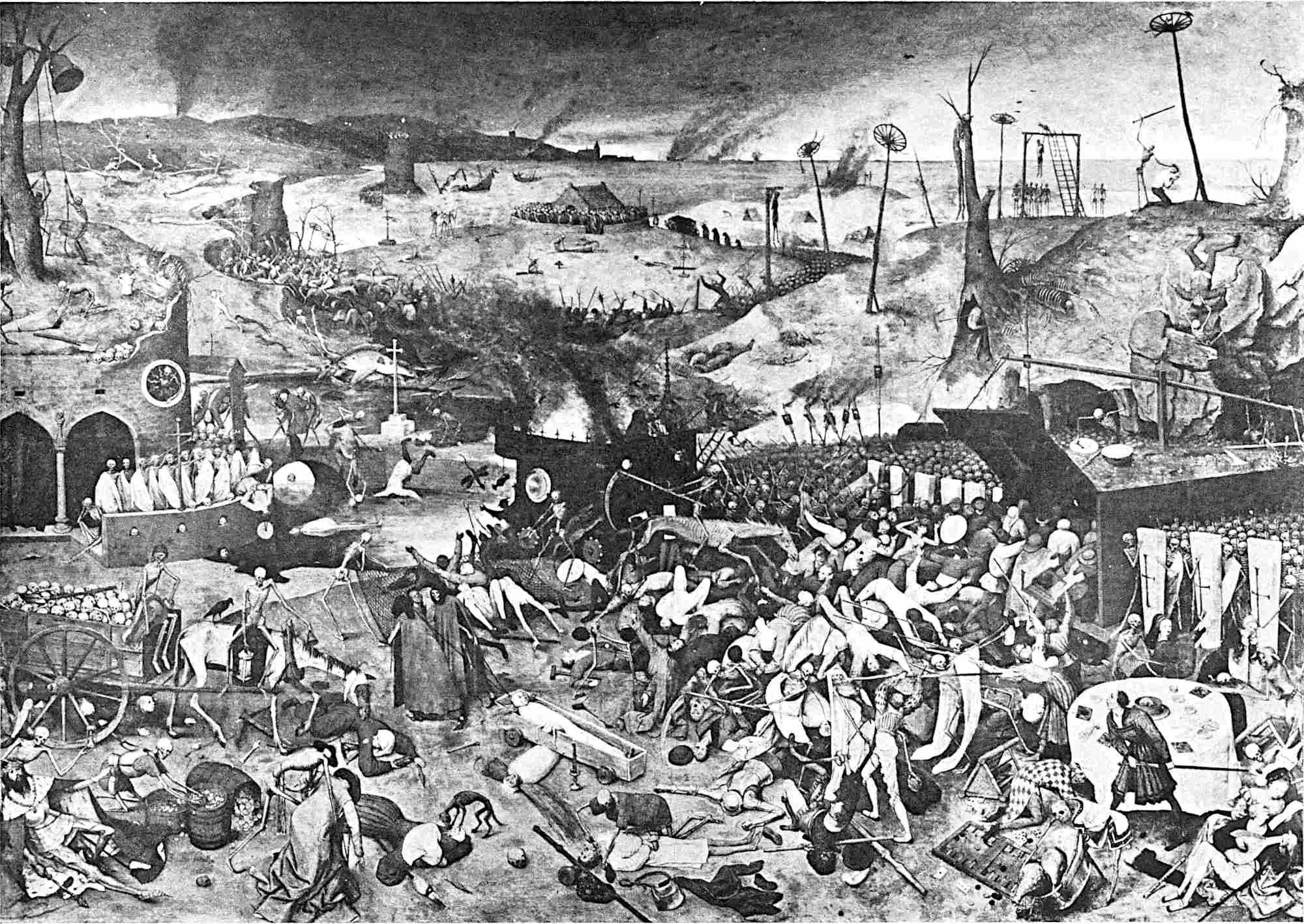
the hell-mouth horrors of the Dulle Griet and the apocalyptic
terrors of the Triumph of Death. Moreover, Van Mander writes
that Bruegel had made many other “inventions” which were “so satirical
and mordant that on his death-bed he ordered them burnt by his wife,
either from repentance or from fear that his wife would get into
trouble on account of them.”
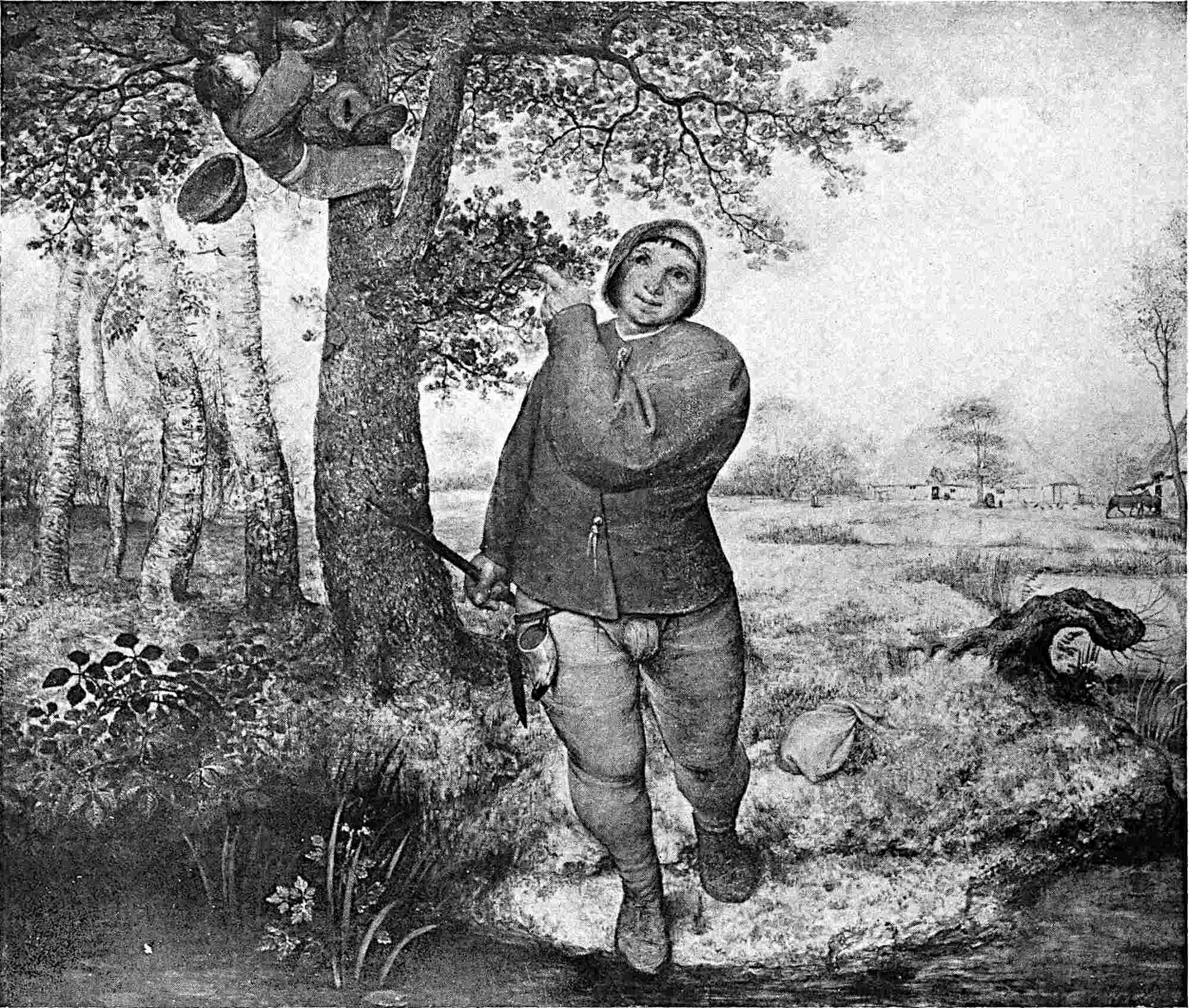
THE PROVERB OF THE BIRD-NESTER. 1564–65? VIENNA, MUSEUM
Not many months before this happened the people of the Low Countries
commenced their final effort of revolt which was to establish their
freedom not until eleven years later. Bruegel left a world that was
hardly less black than the death into which he descended with open
eyes. At that very moment Montaigne was setting about to depict one
entire man with a vision as veracious as that of Bruegel; Cervantes was
soon to rival in words Bruegel’s power of making the fantastic real;
and only forty years later Shakespeare was to accomplish a re-creation
of human life that is more complete than Bruegel’s simply because the
medium of literature itself permits a more comprehensive embodiment
of the soul of man than is possible to the medium of paint. And the
painter who more than any other kept close to life belongs in the
company of these three.
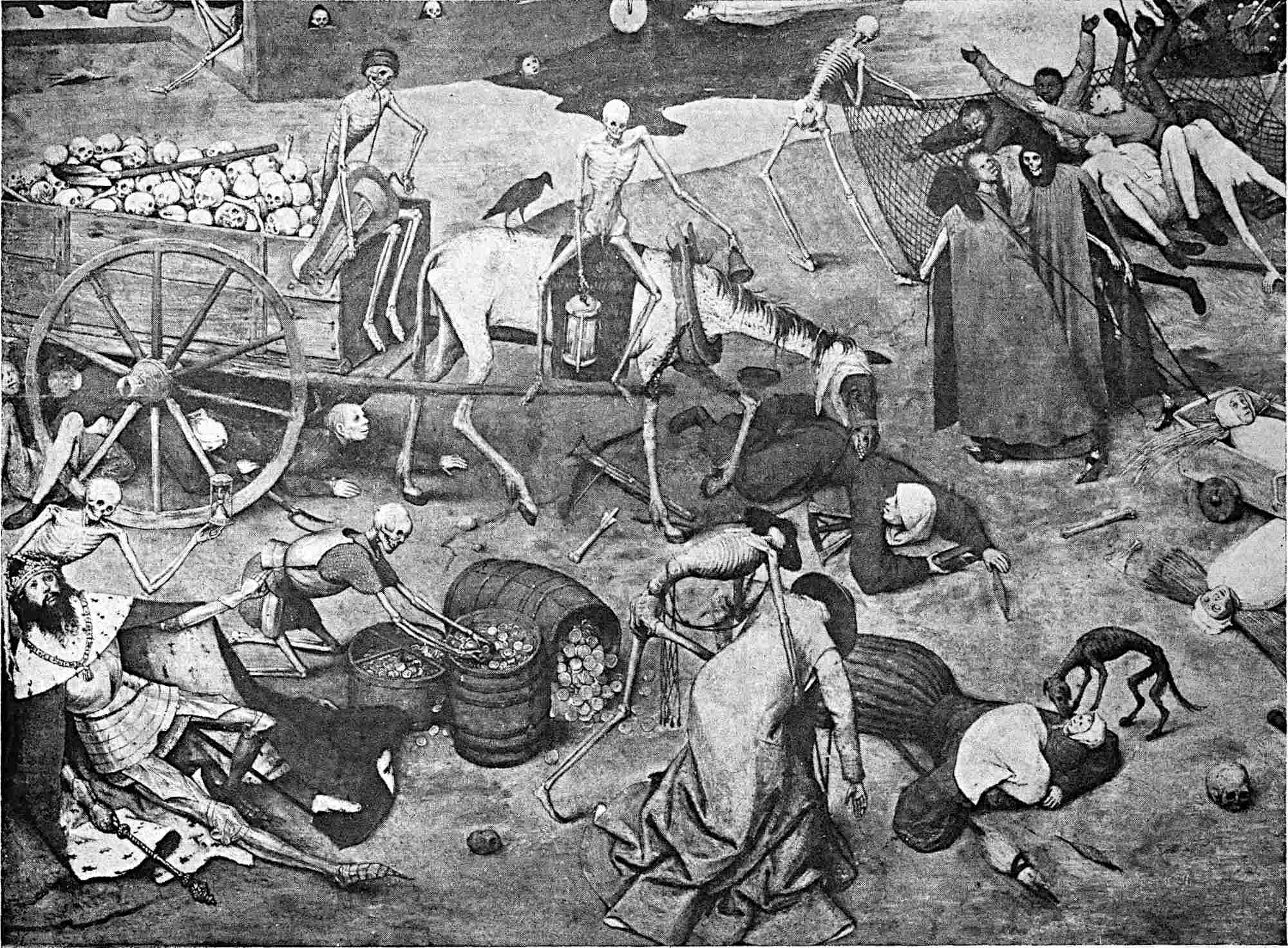
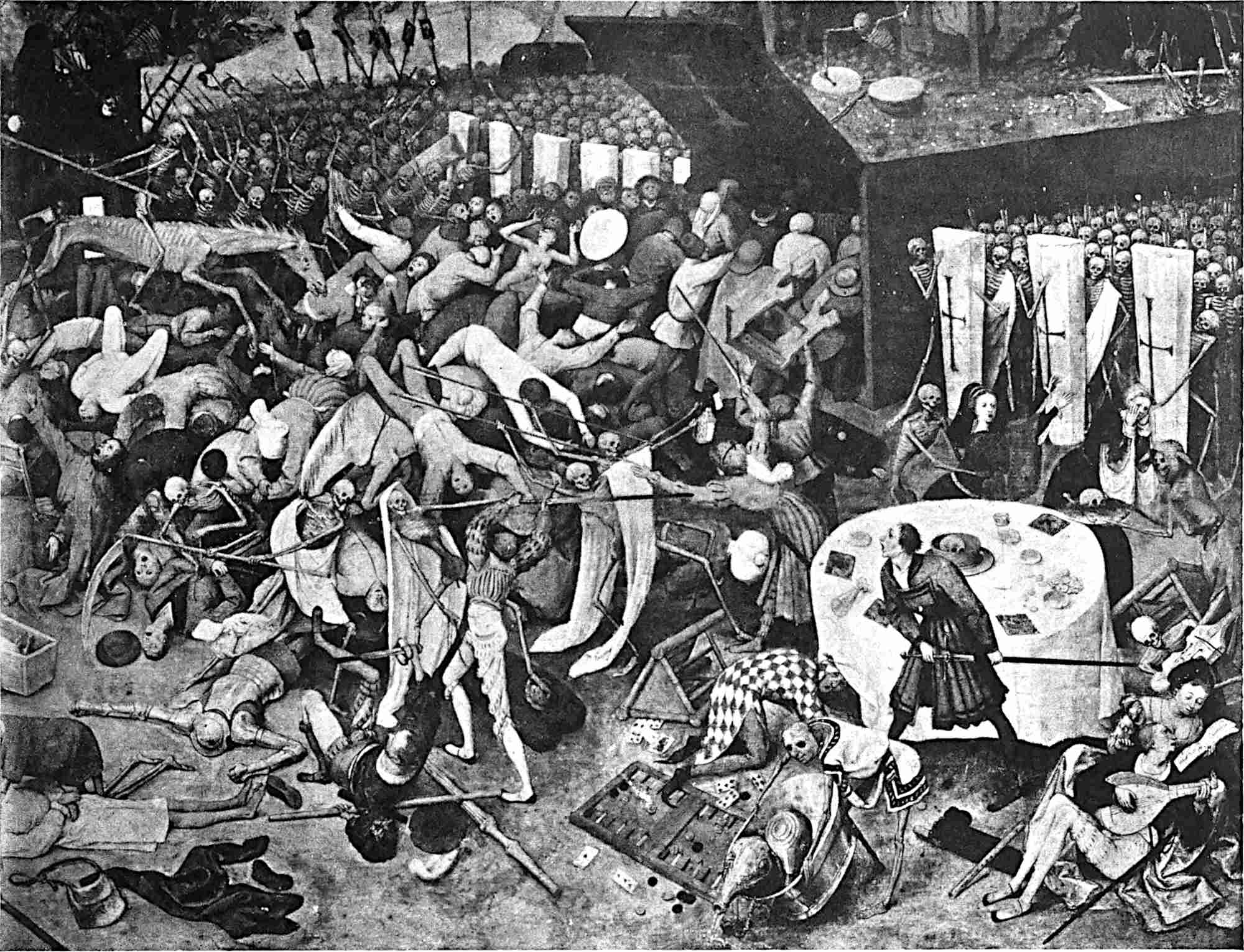
THE TRIUMPH OF DEATH. 1565 OR 1566. MADRID, PRADOTHE TRIUMPH OF DEATH (DETAIL)
The subject-matter of Bruegel’s great paintings is limited only by the
world and life.[2] The whole cycle of nature is in them—the seasons as
they pass over mountain, plain and moving waters; the dazzling beauty
of the southern sea, the northern cold. The entire range of human life
is in them; somewhere in these multitudes every emotion finds its
expressive gesture. Even all the animals that are intimately a part of
human life are given in their degrees of individuality. These pictures
seem to set before the eye every experience possible to man.
[2] The succeeding remarks upon Bruegel’s art and mind,
disregarding both the minor and the debatable works, are based
specifically upon the paintings which are characteristically great.
Always a tale is being told, but always it is story-telling of a
very definite kind. It is never a continuous narrative with a plot
involving the same characters in different circumstances. Thus Bruegel
was never obliged to arrange successive episodes of the same story
within one frame, as the older painters had done. All the things that
happen in his paintings could happen—do happen—just as he shows them,
at the same time and in just the relationship to each other that he
depicts. He always observes time unity and pulls together his wealth of
episode and by-play through unity of theme.
THE TRIUMPH OF DEATH (DETAIL)
But on a given theme, at first, he attempted to say everything than
can be said about it. The picture in Berlin illustrates seventy
proverbs; the Children’s Games is said to contain every one of
the one hundred and fifty-four varieties of play listed by Rabelais
as the games of Gargantua; the Tower of Babel has been called
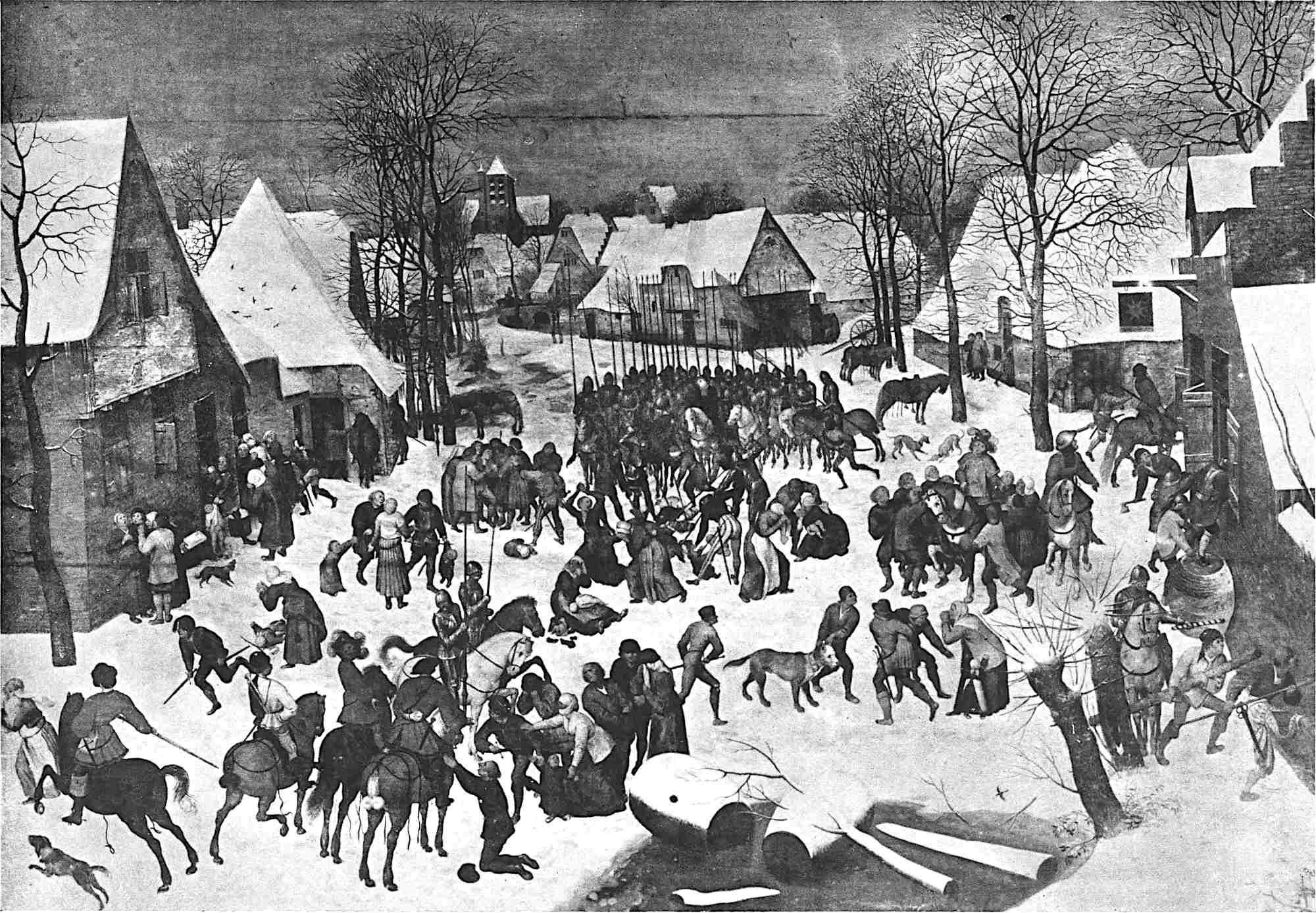
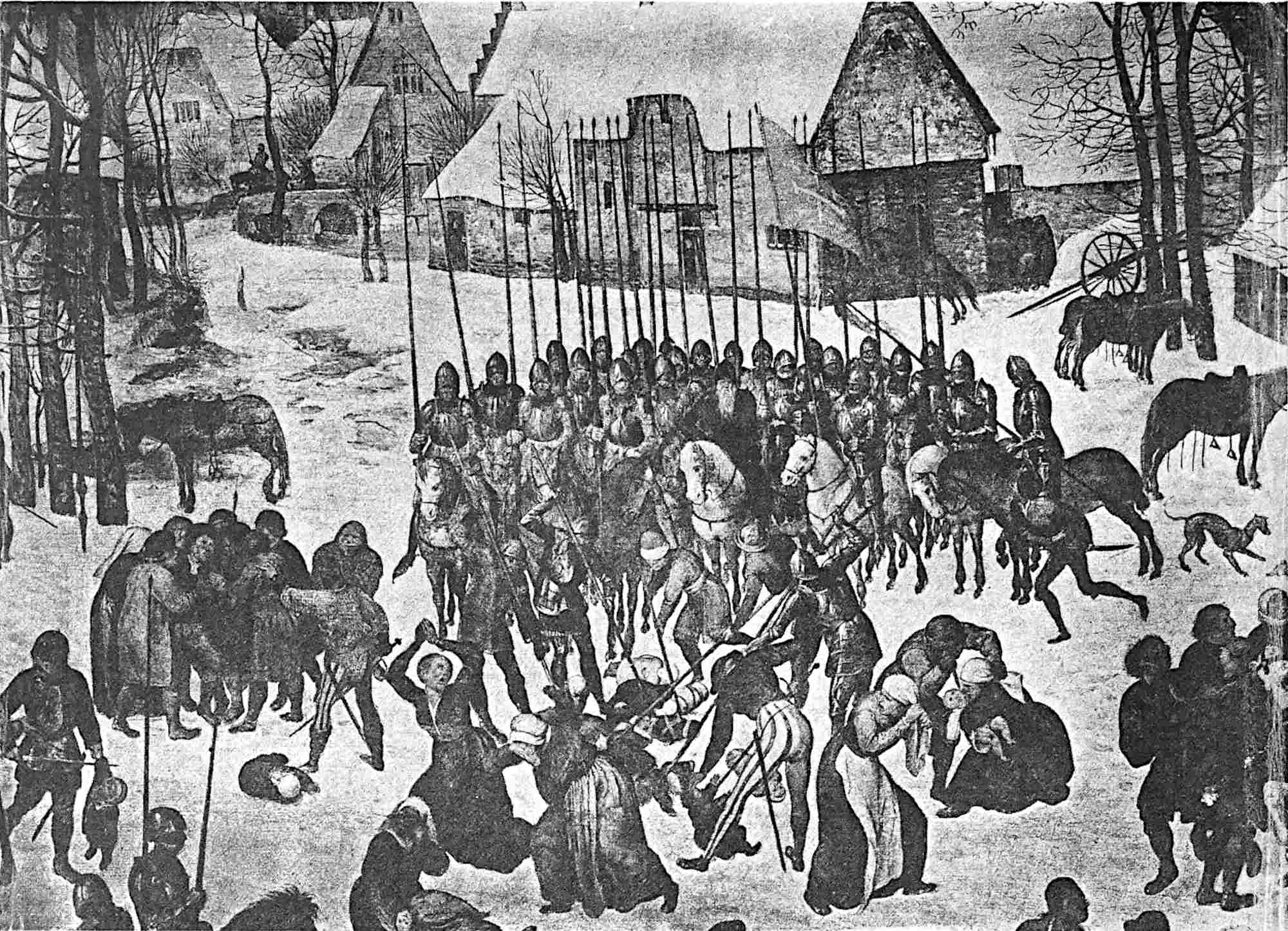
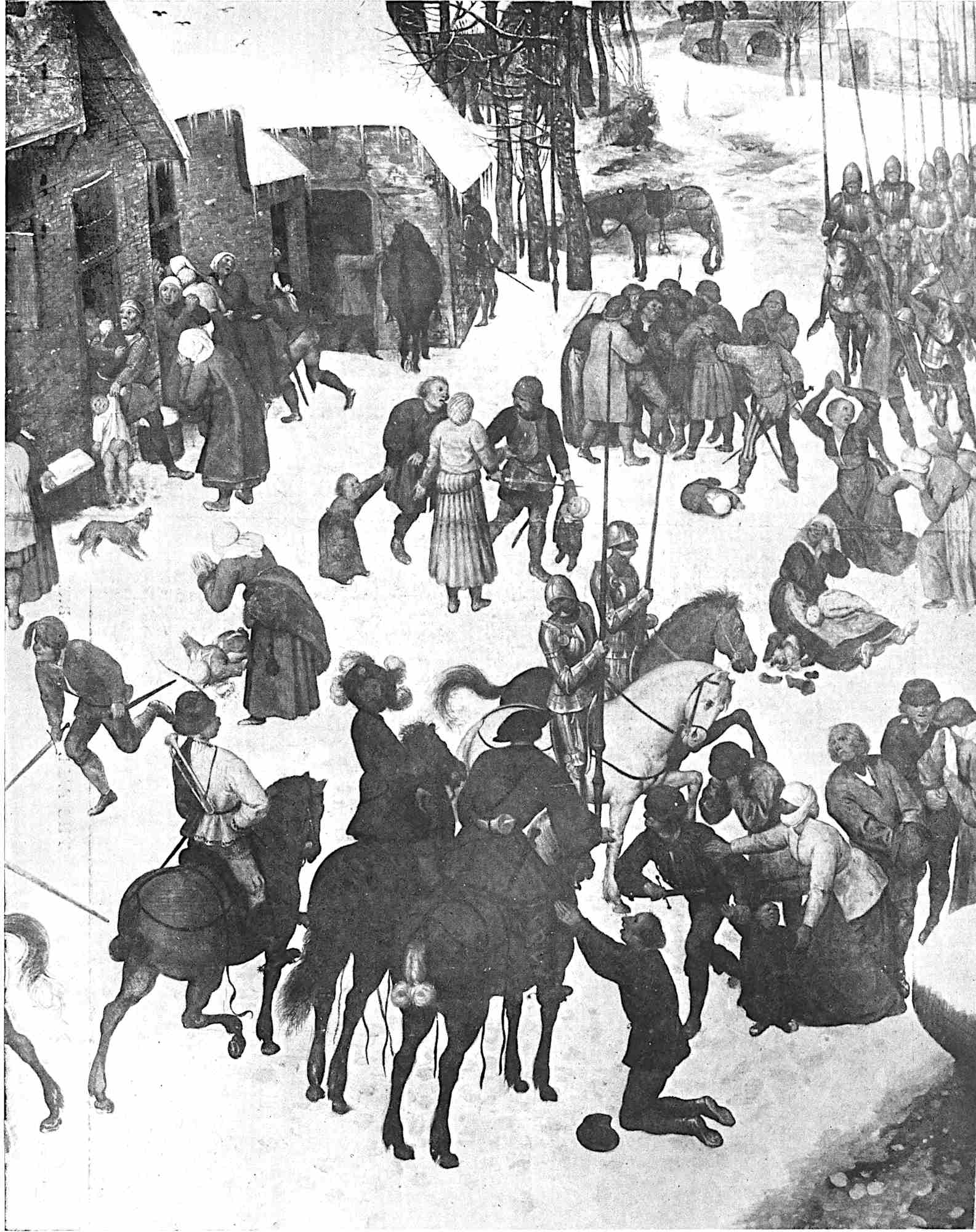
a builders’ handbook; the Massacre of the Innocents apparently
depicts every possible attitude of parental grief and frenzy. This
exuberance of episode, this encyclopedic narrative utterance, had its
literary counterpart in the book just mentioned; it was in full accord
with the taste of the time, and Bruegel’s personal aptitude had been
fostered and disciplined by his long succession of drawings for the
plates published by Cock. For the paintings of this type he has thought
out every possible visual aspect of his story-matter and swept them all
into a unity of design not less remarkable than his unity of theme.
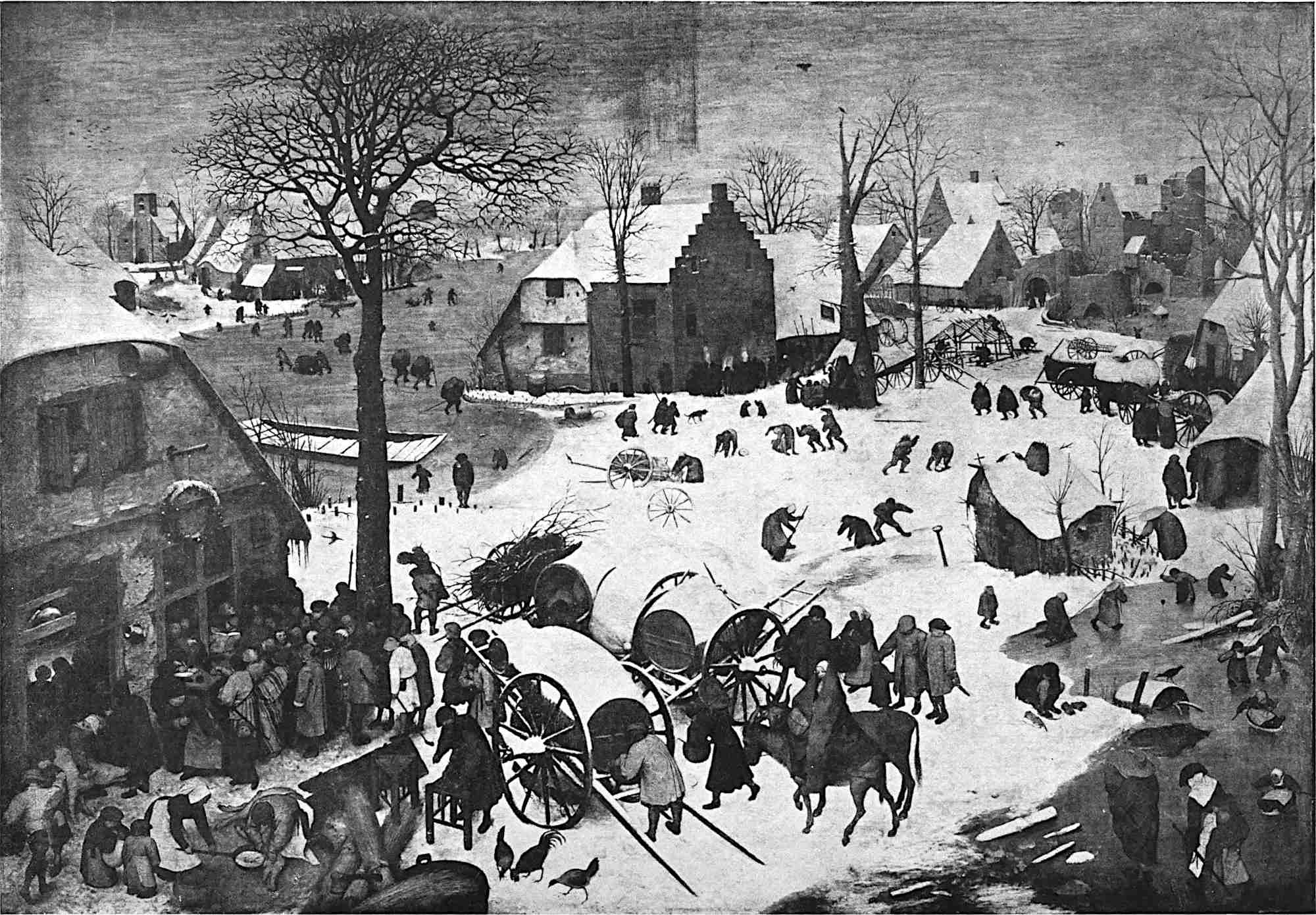
THE NUMBERING AT BETHLEHEM. 1566. BRUSSELS, MUSEUMTHE MASSACRE OF THE INNOCENTS. 1566? VIENNA, MUSEUM
The astounding thing to be noted just here is the completeness with
which such an excessive amount of anecdote is arranged into a
functioning organism of narrative. In the Carrying of the Cross
the movement of every one of the five hundred figures, the very
expression of every face, is determined by a completely organized
story-action. All the figures, even the minutest ones, play their
parts in the whole design as such; but their momentary relations as
human beings, equally complex, have been thought out and set down with
equal thoroughness. Every episode is a bar, every gesture a note, in
Bruegel’s orchestrated narrative.
THE MASSACRE OF THE INNOCENTS (DETAIL)
But other paintings show that Bruegel realized the fundamental weakness
of this—the weakness of diversity of visual motive, distraction from
the pictorial whole. He exhibited a tendency towards the elimination
of all side-play, towards the reduction of subject-matter to a single
motive and a reliance upon emotional unity for the abiding impression.
His picture-making is still story-telling in that something happens
in terms of human action; but it is a single and casual event, and
the main interest is shifted from events to design and color as the
expression of mood. In the Months he forgot all about narrative
complexity for its own sake, fixed his attention on the pure pictorial
beauty of people and of nature, and sought only the emotional meaning
of his theme.
The nature of Bruegel’s work previous to taking up painting is written
at large and in detail over his early technical habits, but in these
also can be traced a development corresponding to the change just noted
in subject-matter.
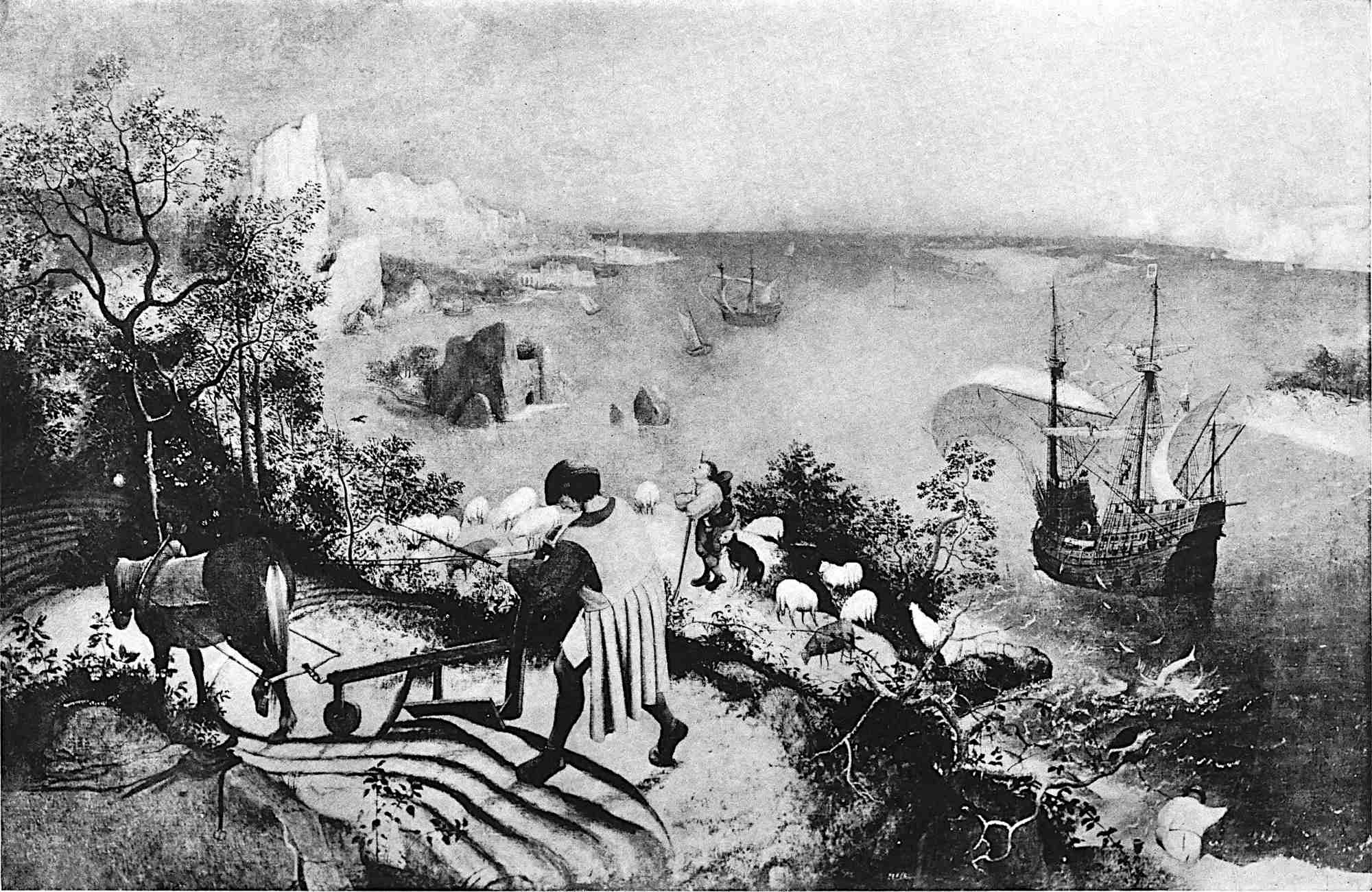
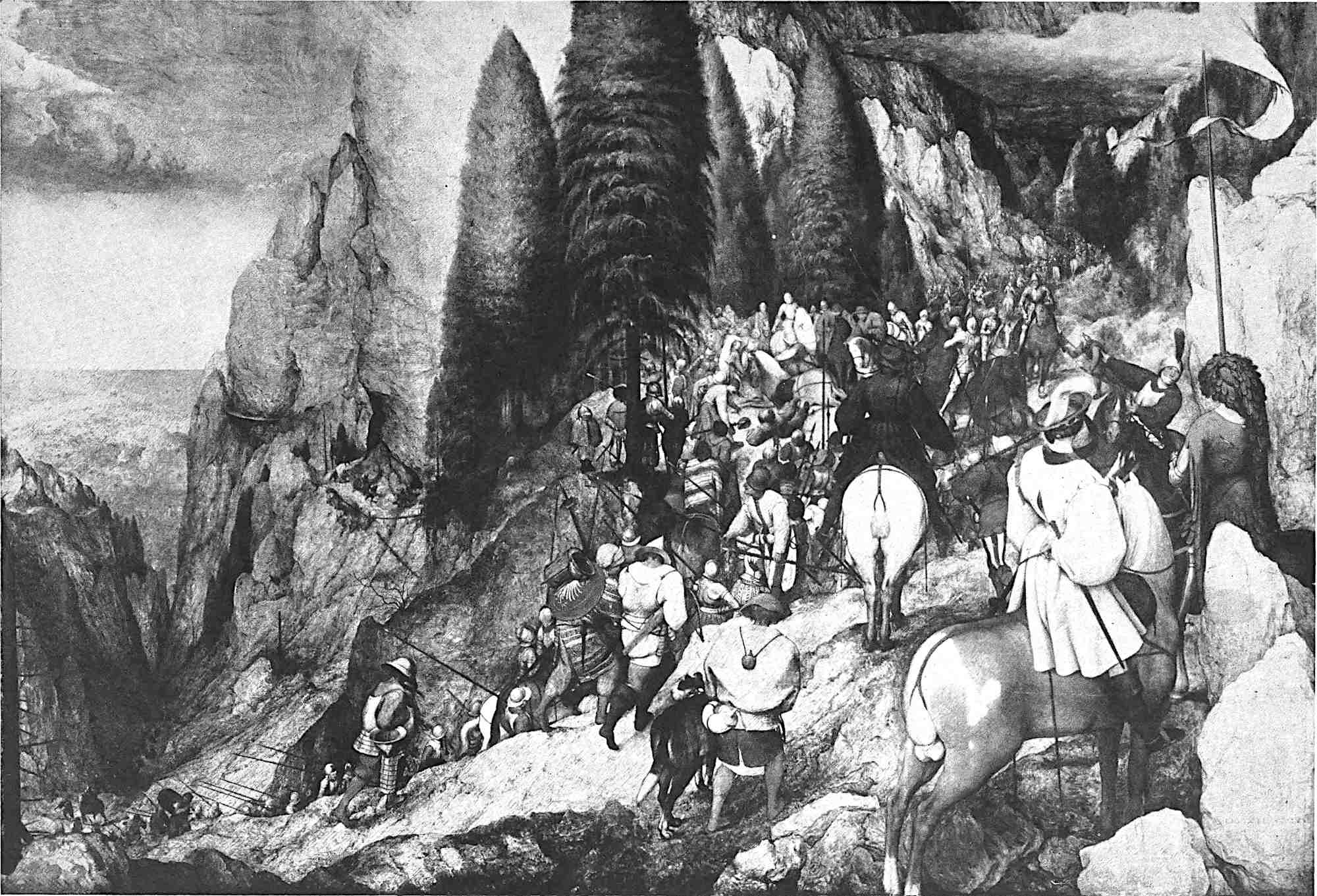
THE MASSACRE OF THE INNOCENTS (DETAIL)THE FALL OF ICARUS. BRUSSELS, MUSEUMTHE CONVERSION OF SAINT PAUL. 1567. VIENNA, MUSEUM
In the earlier pictures color in general is conceived somewhat as
the worker in mosaic is compelled by his material to conceive it—as a
weaving-together of brilliant bits of pure color into a color design
which is itself thought out independently of other technical qualities.
There is harmony and richness, but there is not that melting tonality
which afterwards came to be looked upon as the last word in painting.
Above all else, there is an unbelievable brilliancy, especially where
Bruegel made a lavish use of vermilion. The chain of soldiers woven
through the multitude in the Carrying of the Cross is one
of the most daring things to be found in painting; but for general
sumptuousness of color approaching to the fusion of later times there
is, outside of the Months, no equal in Bruegel’s work to the
Conversion of Paul. And always it is color used for its own
sake, with great sensuous delight. Yet always, again excepting the
Months, it is color laid on to form which has already been
conceived as drawing; the color, superb in itself, follows the form
superbly; but the color and the drawing exist independently of one
another.
THE WINE OF SAINT MARTIN (FRAGMENT). VIENNA, MUSEUM
At the beginning of his painting career it was his drawing especially
which was determined by his work for the engravers. For the masculine
style of engraving that prevailed in his day the preparatory drawings
had to show absolute precision of outline. The edges of everything
had to be clean and unmistakable in order that the engraver might
know what was intended; the artist of the first instance had to make
it impossible for the engraver to mistake his meaning as to this
contour or that shape. Drawing in this manner for years before he
began to paint, Bruegel necessarily continued to do so afterwards.
This accounts for the prevailingly silhouette character of his
multitudes of tiny figures. Often-times, even from the beginning, the
form that meets the eye within the shape is substantially filled out
without being accompanied by the feeling of all-aroundness; but a
full three-dimensional quality is more and more often attained until
in the Paul, again, it fills the picture to a degree elsewhere
unequalled in Bruegel’s work.
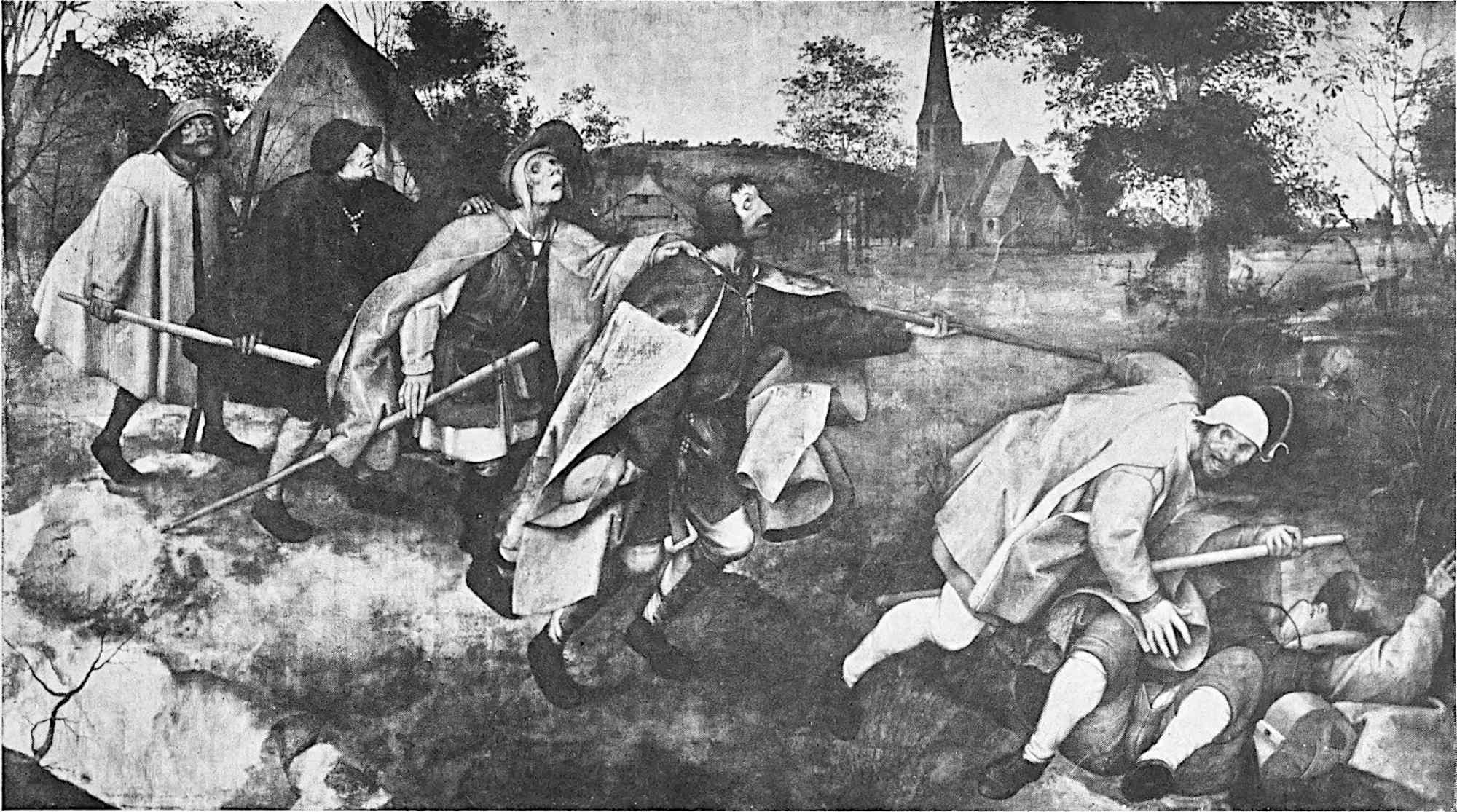
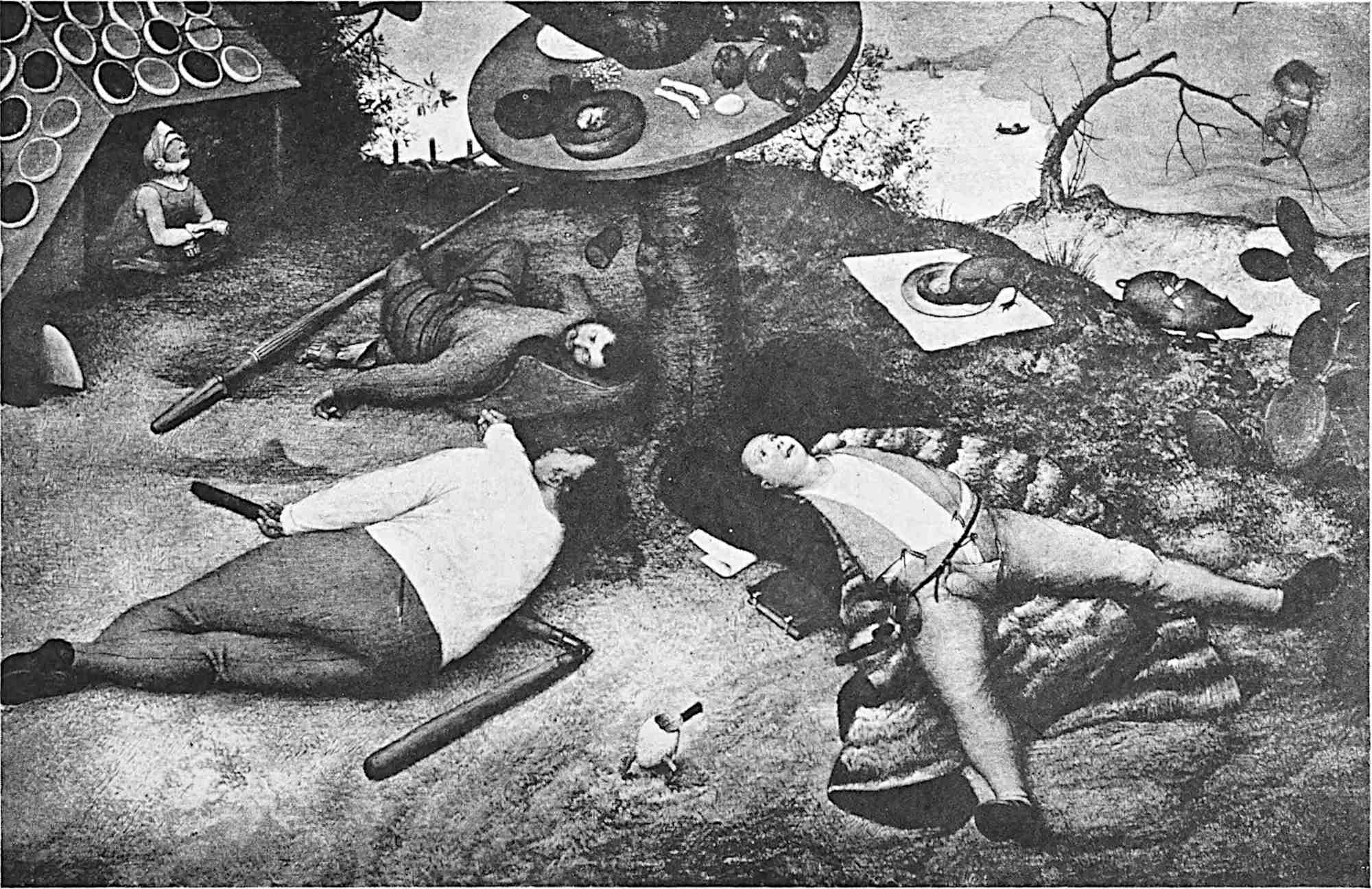
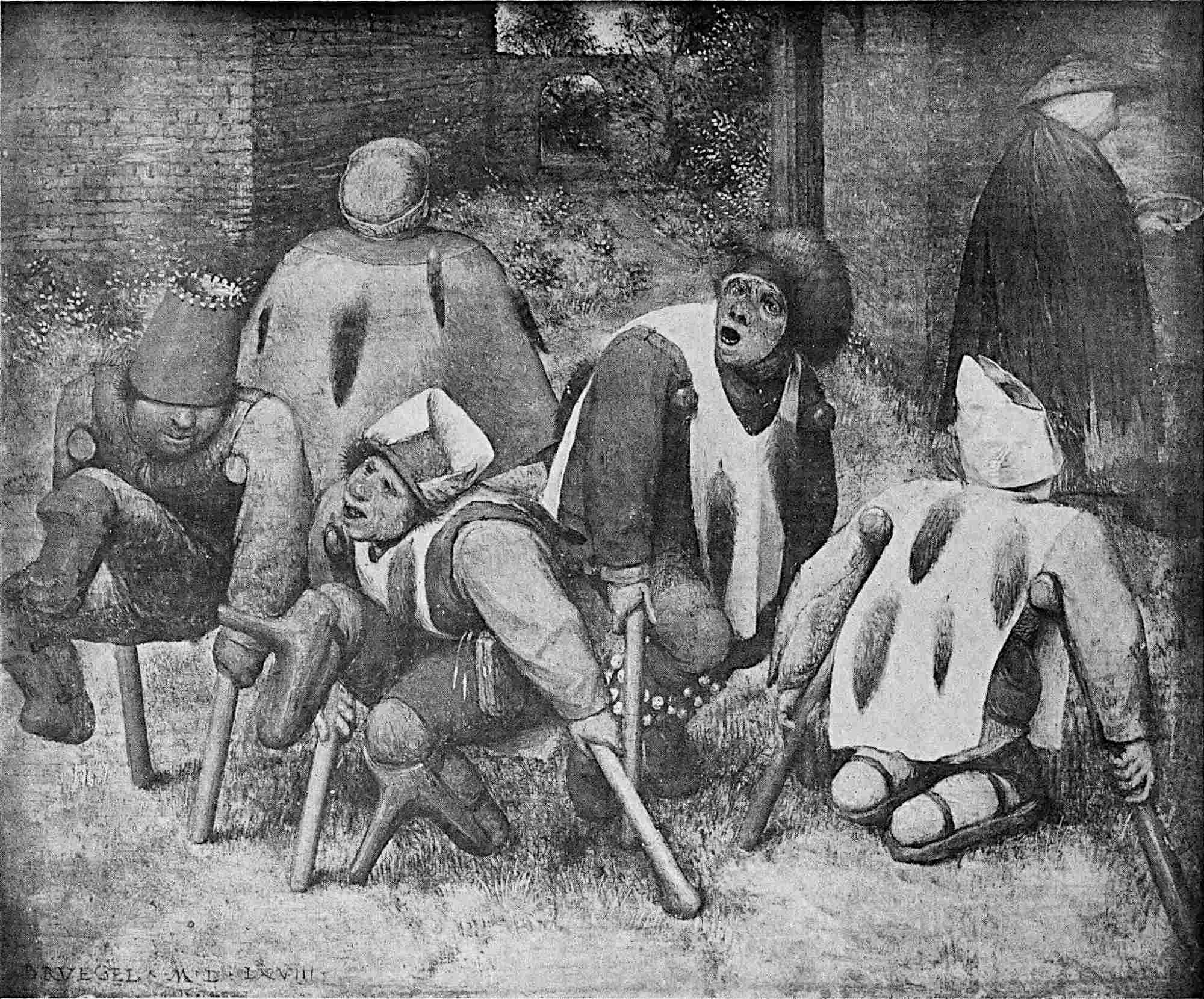
THE PARABLE OF THE BLIND MEN. 1568. NAPLES, NATIONAL MUSEUMTHE LAND OF COCKAIGNE. 1567. MUNICH, ALTE PINAKOTHEKTHE CRIPPLES. 1568. PARIS, LOUVRE
But another consequence of his early professional training—and a
consequence which enabled him to accomplish some of his most amazing
feats—was his skill in composition. His training in draftsmanship
gave him the power to render exactly all details that contribute
to individuality of character, and the simultaneous training in
composition taught him how to arrange immense numbers of such
individualized figures without loss of mass unity. Was it the Alpine
mountain-sides or merely the upper window of a house on a village
square that suggested to him the device of a slightly elevated
viewpoint? It is this more than anything else that enables him
to impose upon his multitudes that order of art by which may be
expressed the disorder of life; and it is this that gives him his long
perspectives of village streets or far horizons dominated by oblique
lines. These last, starkly visible at first and gradually becoming more
broken and concealed, constitute the characteristic mark of Bruegel the
designer.
But it is in design that there is to be discerned the least amount
of technical advance on Bruegel’s part; what he learned before he
began to paint seems to have come nearer to sufficing him in design
than in drawing or in color. His composition scheme in the set of the
Months is shockingly, though intentionally, repetitious; in the
hands of a less vigorous artist it must quickly have become the deadest
recipe. He divides his panel into two practically equal parts by a bold
diagonal from one upper corner to the opposite lower one; one of these
parts he fills with things and people seen close at hand, and the other
with a far-spreading panorama. And he does it five times over with
such freshness that doing it seven times more does not seem beyond his
powers. But the design remains a pattern, conceived in the same way as
the large composite landscapes done soon after his return from Rome.
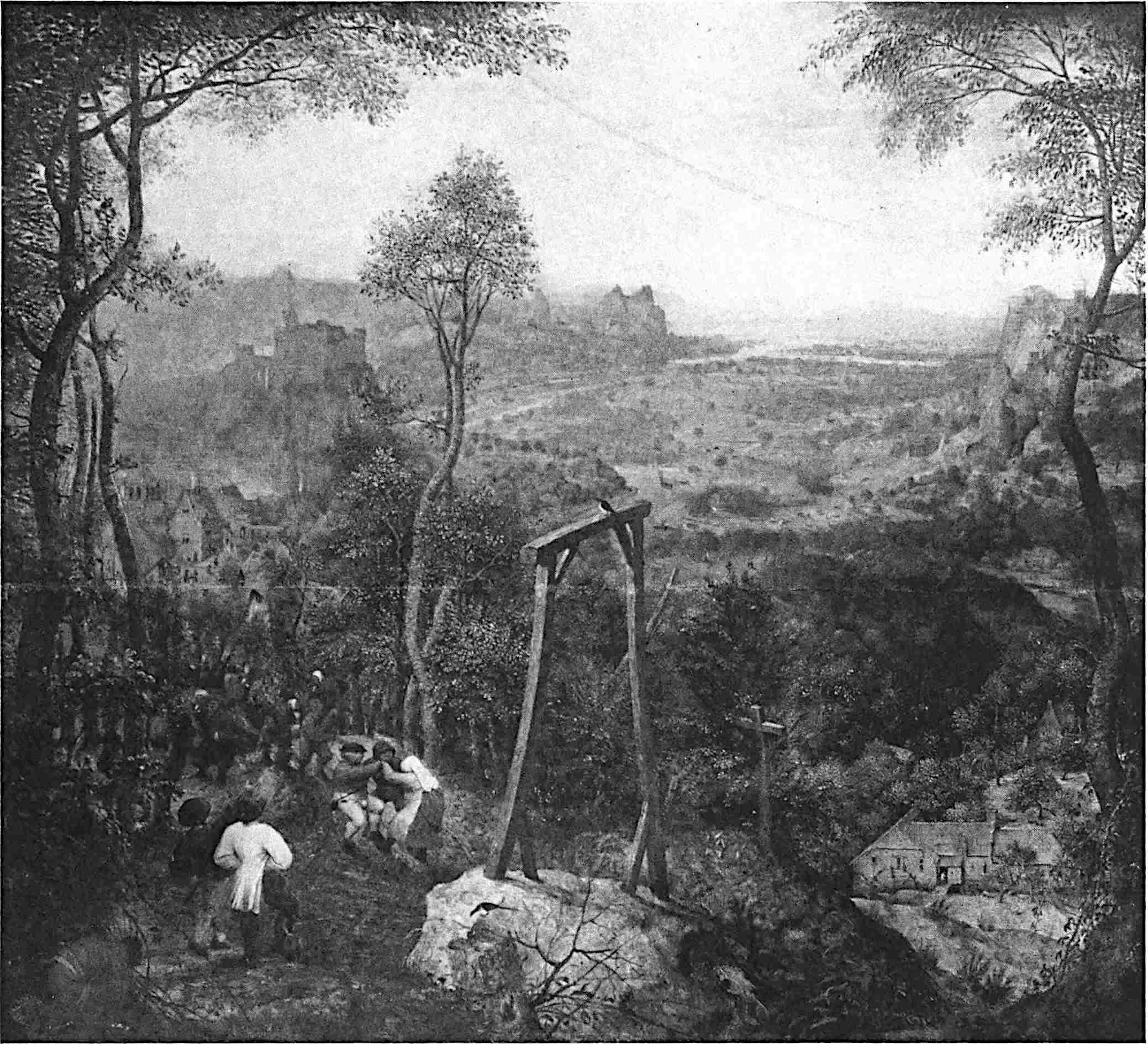
THE MAGPIE ON THE GALLOWS. 1568. DARMSTADT, MUSEUM
In drawing and color, on the other hand, the Months show a
marked departure from earlier habits in the direction of an essentially
modern practice. In the drawing as such there is an increase in
looseness with no loss of surety; tightness is sacrificed, but not
precision. The figures are still silhouettes to a great extent, but
there is an approach to the coalescence of color and drawing. In color
by itself there is ever an opposition of large areas of some shade of
brown and some shade of green, and a weaving of these areas together
by bits of each color in the other and of other colors in both. Though
there is never the full impressionistic fusing of edges in atmosphere,
there is yet a decided approximation to the vision of a genuinely
naturalistic landscape painter, as distinguished from the vision of a
draftsman or a miniaturist.
While this is true, and must be accounted to Bruegel as a merit, an
evidence of mental and technical growth, it is still in a measure
unfair to the never-failing largeness and unity of vision in the
earlier work. Whether the other qualities of this work be regarded as
merits or defects in themselves depends, of course, upon the technical
tenets or preferences of him who makes the judgment. But in Bruegel
they were neither merits nor defects; they were characteristics which
had to be present in his pictures if he painted at all. They were
necessitated by the time in which he lived and by his professional
practice previous to painting. They were as much a part of him as his
fondness for telling stories; and in the fluctuations of taste stranger
things have already happened than would be the return of even this
latter element to professional as well as popular favor.
In Bruegel’s time story-telling in pictures generally was still one
of the principal means of communicating ideas—even, perhaps mainly,
ideas that were not inherently pictorial; prints were still the nearest
things to books in popular circulation. Moreover, a nation living
under the necessity of never speaking out openly on either politics
or religion naturally resorted to symbol, the concrete proverb or the
image that said one thing and meant another. The print of the big and
little fish not only meant that the great oppressed the small but
carried an idea beyond the words of the proverb in showing the big fish
ripped up and disgorging; and upon a people so apt at interpreting
images the significance of that would not be lost. This people could
not only take a hearty enjoyment of the good things of life but they
could also face the whole of it without shrinking from any part of it,
whether of grossness or of terror. For the latter, indeed, they even
had a gusto and the former they laughed away with a saving healthiness.
The distinguishing mark of their living and their thinking was a robust
realism.
In Pieter Bruegel there emerged from among them a man of genius in
complete sympathy with their realistic attitude towards life; knowing
it from childhood, he gave it in his art a more complete expression
than it had ever had before. The whole originality and fertility of
his mind were for long expended upon feeding the popular taste not
only for the familiar or exotic beauty of nature but also for a rough
philosophy, unorganized but none the less genuine; and a habit so well
established in him by years of labor would not vanish all at once
even when more purely painter-like interests assumed for him a major
importance. His predecessors in painting had been realistic in their
measure; in them, however, realism was largely confined to details of
execution and was more than counterbalanced by markedly idealistic
conceptions. Even in the grotesqueries of Bosch the older disparity
between idea and embodiment existed; the diabolism in them was only
the obverse of the conventional religious idealism, and its distance
from a true realism of content remained the same. When Bruegel came
to painting, he both carried the manner of realism farther than his
predecessors had done and informed that manner with its appropriately
realistic matter, bringing about a new harmony between the body and the
spirit of the art. He became the first complete realist in the history
of painting.
MARINE. VIENNA, MUSEUM
The Fall of the Rebel Angels is the nearest thing to a
rule-proving exception among Bruegel’s great works, the single one
which exhibits any of the older disparity between container and
content; and this picture, great as it is, could vanish without
impairing in the least Bruegel’s essential greatness. To examine
the Berlin Proverbs in detail is to get a feeling of being
among mad folks because so many of the sayings here illustrated turn
upon outlandish actions; but as a picture it is a piece of masterly
realistic sanity showing a whole village, in which some of the
inhabitants happen to be crazy, intensely busy about its own affairs.
The Triumph of Death, so far from being a piece of wild and
gross fancy, is actually the lucid statement of an idea as true as
any gesture in the picture; it is precisely the relentlessness of its
realism in thought as well as in embodiment which frightens people into
calling it untrue. The latter two paintings only show that if an artist
is realist enough, if he penetrates sufficiently into the actual, he
necessarily becomes imaginative; they only reiterate and strengthen
Bruegel’s right to be considered the supreme realist in painting.
FLEEING SHEPHERD. 1569? PHILADELPHIA, JOHNSON COLLECTION
Part of his realism is his refusal to depict what he did not feel.
Only once did he venture upon any of the religious emotionalism that
had played so large a part in the work of his predecessors, and then
he found the emotion so foreign to his own feelings that he openly
borrowed the imagery of it; in relation to the great panoramic realism
of the Carrying of the Cross, the group of mourning women
remains a mere formalism, dissociated in spirit and in manner from
all about it. Jesus himself is simply an unfortunate creature whose
approaching execution is the pretext for this holiday. What passes for
the conversion of Paul might be the delusion of a man knocked in the
head on falling from a shying horse; there is about the event none of
the conventional supernaturalism because for Bruegel that sort of thing
was not real. The religious subject as such disappears from his work;
and this, coming after the ecstatic idealisms of his predecessors,
amounts to the expression of an idea concerning the significance—or
lack of it—inherent in the churchly religion. He will have nothing
to do with what is not human; not even nature enters into the great
paintings except as a setting that enhances, by sympathy or contrast,
the emotional life of human beings. To these, whom he knows and loves,
Bruegel gives himself wholly, to share in their sorrows and their joys.
His religion is that of the great humanists in all ages, and his faith
is given only to life itself.
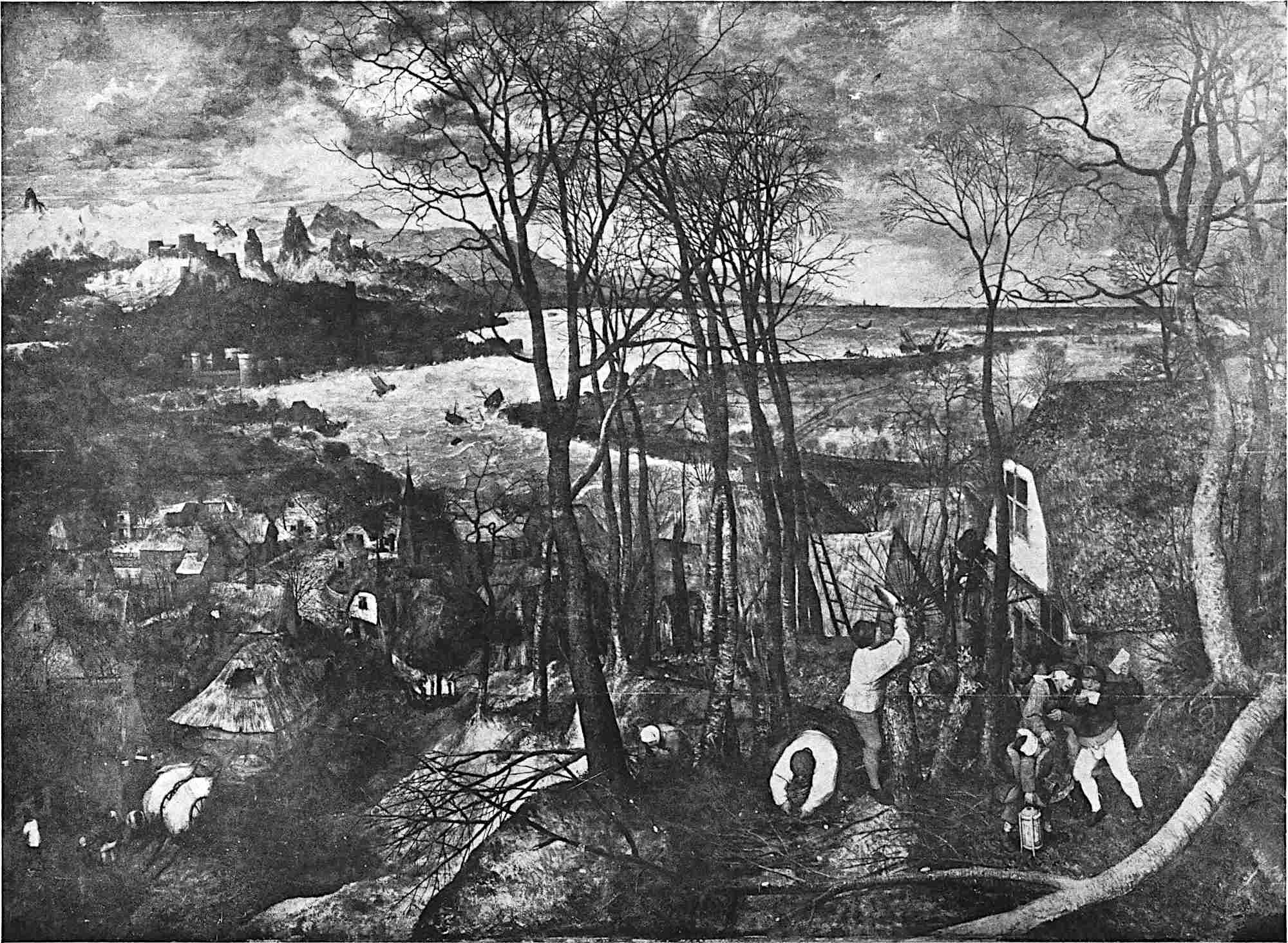
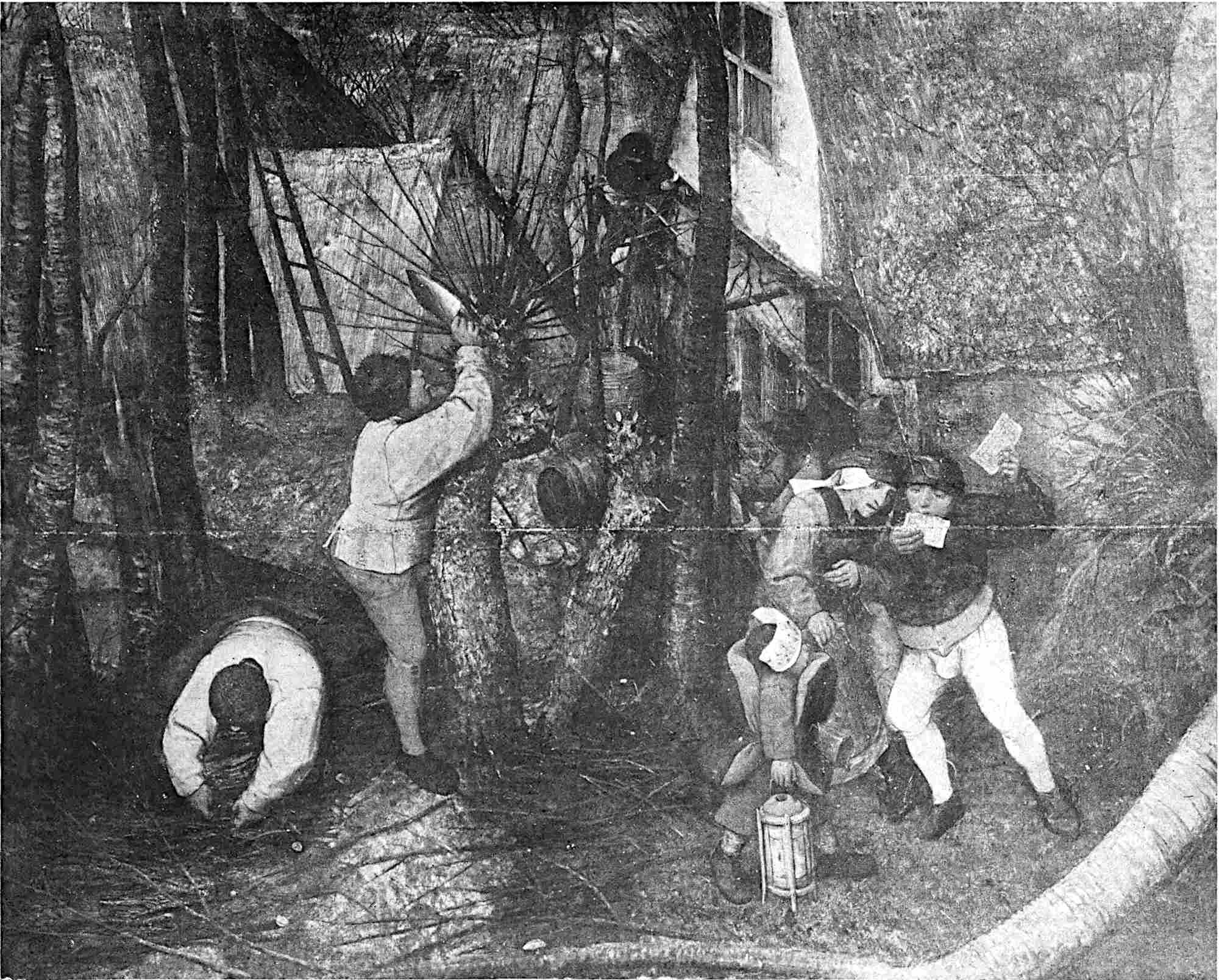
DARK DAY (JANUARY?). VIENNA, MUSEUMDARK DAY (DETAIL)
Part of his realism is the robust laughter which is the only solution
for the fix in which human beings find themselves. It is the spirit
that animated Rabelais in describing the birth of his hero and
Shakespeare in creating Falstaff. To come closer home to Bruegel,
perhaps, it is the spirit of Till Eulenspiegel, whose gross
pleasanteries were probably relished by the painter along with the
rest of his generation. Bruegel’s passion for completeness in his
realism abolishes privacy, and the state of affairs brought to pass by
this slicing away of all walls is saved only by humor. Humor is the
safety-valve for a spirit resolute to probe life to its last refuge—to
probe life, but not to break through by main force, as attempted by
later realists so-called.
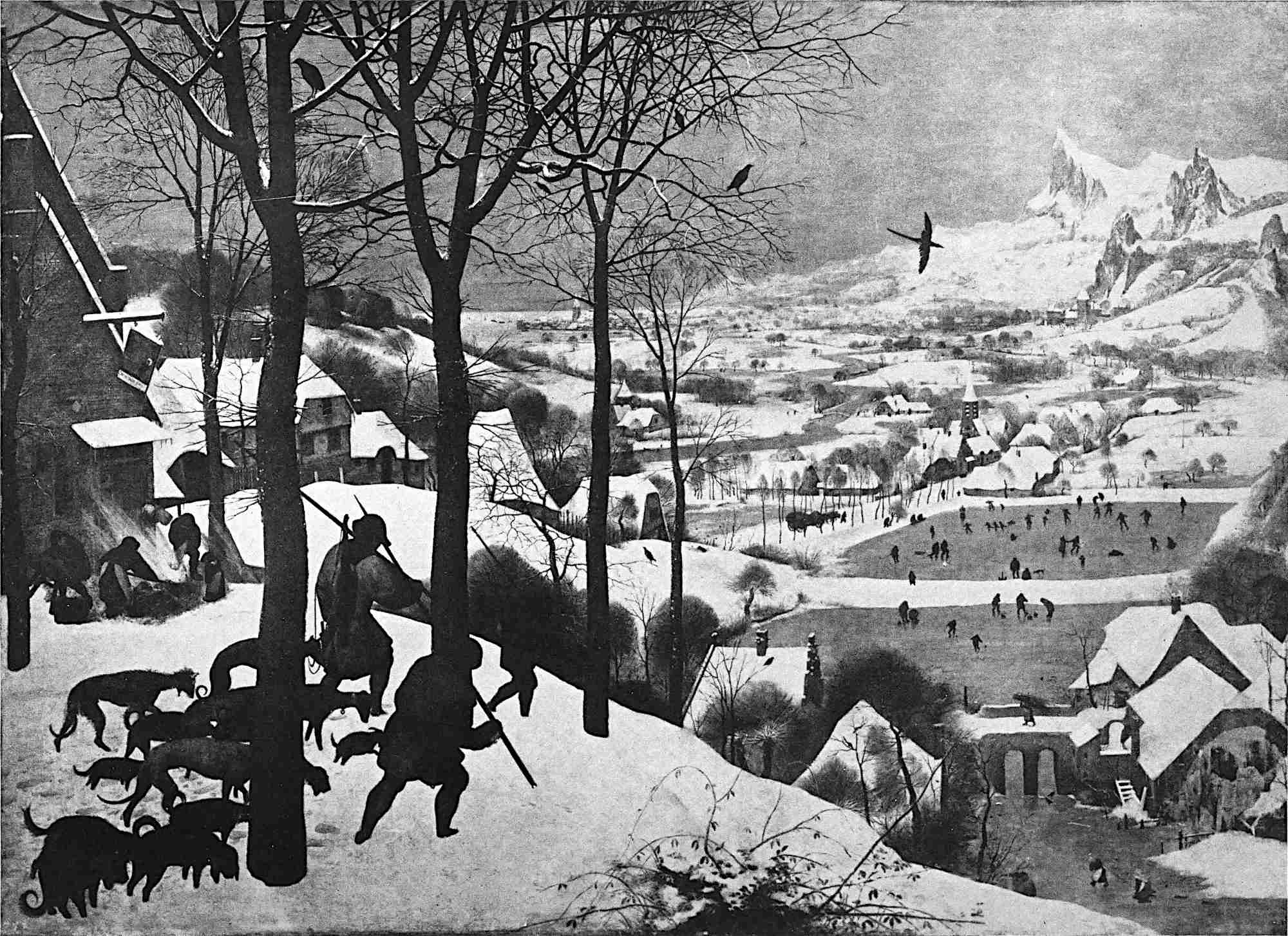
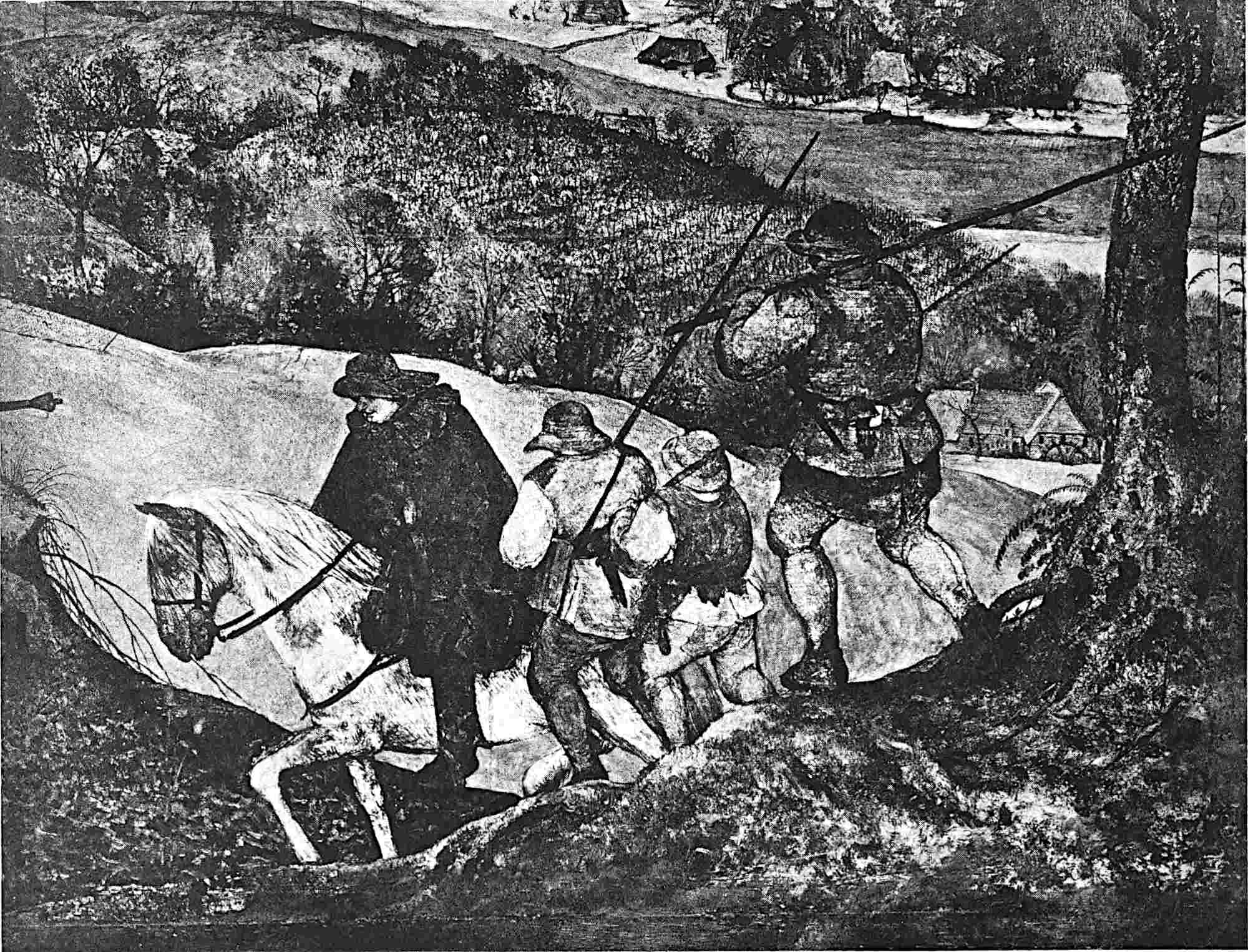
HUNTERS IN THE SNOW (FEBRUARY?). VIENNA, MUSEUM
Another element in Bruegel’s realism is the objectivity of his work.
Van Mander’s anecdote already quoted shows that Bruegel went among
the peasants, not as a professional artist in search of material, but
as a participator in their life; and the great pictures themselves
strikingly bear this out. This is not to say that Bruegel never worked
directly from life, for there are many drawings which could not have
been done otherwise—a team of horses resting, soldiers standing in the
way, old market-women squatting beside their wares. But when he came to
paint the great pictures, Bruegel worked from a memory stocked with the
gestures and actions of people who are unconscious of being watched.
Bruegel’s mind was centered upon their life and he was concerned with
technic hardly beyond the point where it would enable him to crowd
all their life into his given space and shape. His concentration upon
the story he was telling, from the encyclopedic narrative of the
early works to the simple and straightforward emotionalism of the
Months, put him on the crest of a wave of energy which carried
him through many an undertaking that would have been impossible for a
more self-conscious man. We who see the pictures now are unconscious
of the painter because he was himself lost in his subject; and because
of this, also, we are unconscious of ourselves. “No glance ever strays
across the footlights to the audience,” wrote Meier-Graefe of Hogarth’s
scenes. In Bruegel’s work there are no actors, no footlights and no
audience. There is only life and participation in life by painter and
by us.
And everywhere in these pictures it is the life of Bruegel’s own
time. His predecessors had clothed religious themes in contemporary
dress, but the outer and the inner remained separate things; Bruegel,
retaining the outer, put into it its own proper content. He ousted
religious stories by contemporary stories. These he painted so
completely that a thorough sociological knowledge of the age might be
founded upon or tested by his pictures. The whole life of the time is
set down by a hand that never falsifies, that swerves neither to the
right of idealization nor to the left of caricature.
Yet to leave him as a painter of contemporary manners only would be
almost as false to his greatness as to consider him only as Bruegel the
Droll. For he penetrates below the temporary appearances of his time to
the permanent in human nature. His pictures can be a means of access
to the life of his age, to be sure; but no lover of them would think
of using them in this fashion. The important thing is that they give
access to a life that is of more than one age; under the costume of the
time exists the same humanity that now wears another dress.
In giving himself over so unreservedly to the impermanent, Bruegel took
what was for him the only way to the permanent. This cannot be captured
by going out after a vague and unlocalized something called life in
general; what is presented to the artist for his use is always life in
particular. There is an all-life in the steady and swelling succession
of human generations; but the only means of access to that is the
now-life. The great artist’s major accomplishment lies in revealing the
universal through the particular, the permanent through the transitory,
the inevitable through the accidental.
This Bruegel does; and how well he does it is to be found by analyzing
the thought behind his varied rendering of events and people. Even in
his early pictures each creature has his own individuality and yet is
part of the crowd, which remains a crowd in spite of all detail; each
individual retains his own value of personality and yet is integrated
into a collective being. Bruegel’s minute accuracy of drawing expresses
his love for the individual as such; his great masses of people express
his desire to see life largely and as an interwoven whole. Moreover,
the device of making the ostensible subject of a picture an almost
invisible incident in it is an expression of an idea as to the relative
importance of the individual and what happens to him. Though the
actions of the Carrying of the Cross and the Conversion of
Paul do actually center around the subject-incident, the incident
itself is reduced almost to the vanishing-point; so that the story
emphasis is thrown entirely upon the larger life of which the incident
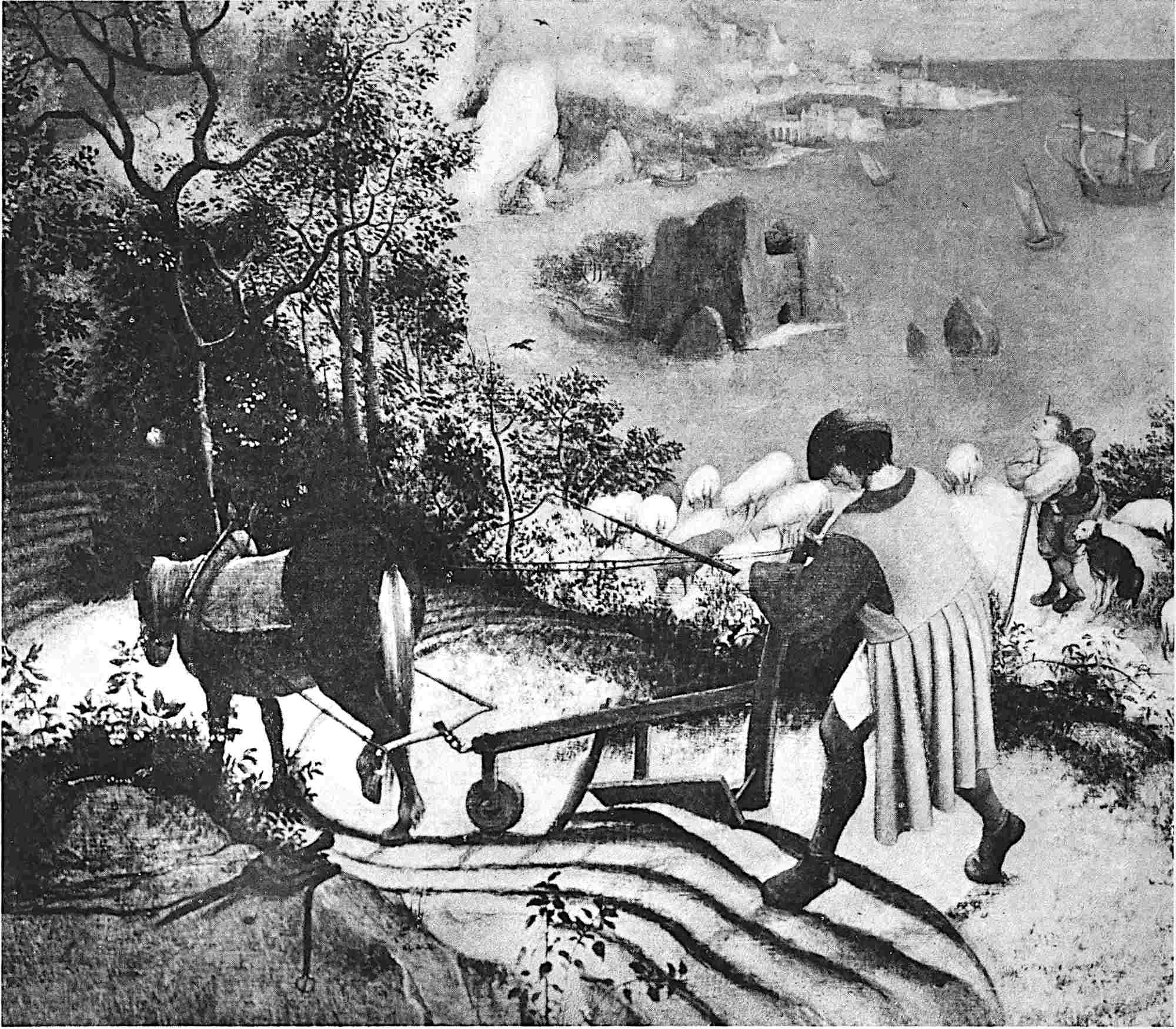
is only the temporary focus. The Fall of Icarus likewise
expresses this heresy against conventional thinking as to what is
truly sublime; only here the unimportance of a particular event is made
more emphatic by such a detail as the position of the shepherd as well
as by the large indifference of this great luminous calm expanse of
land and sea and sky.
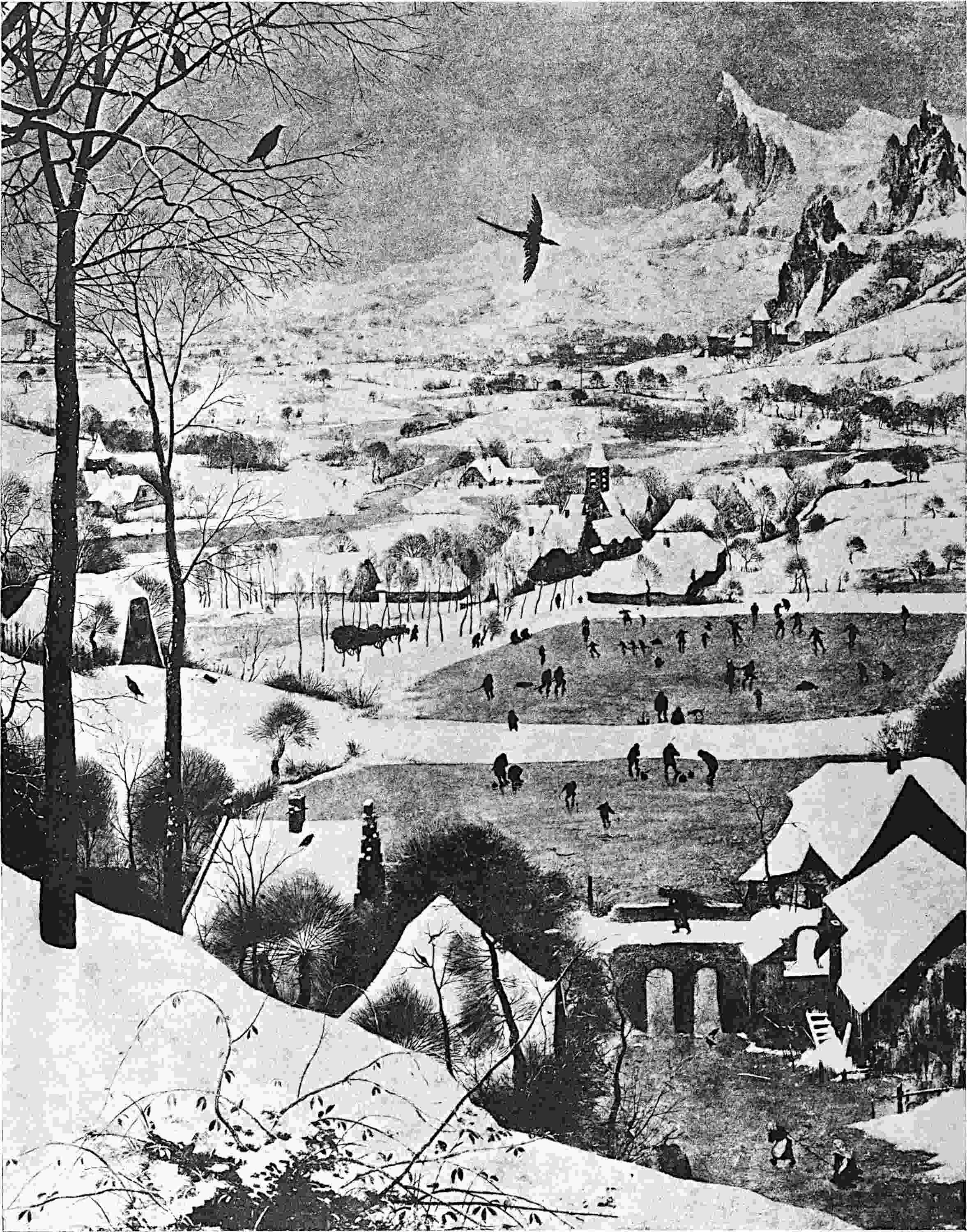
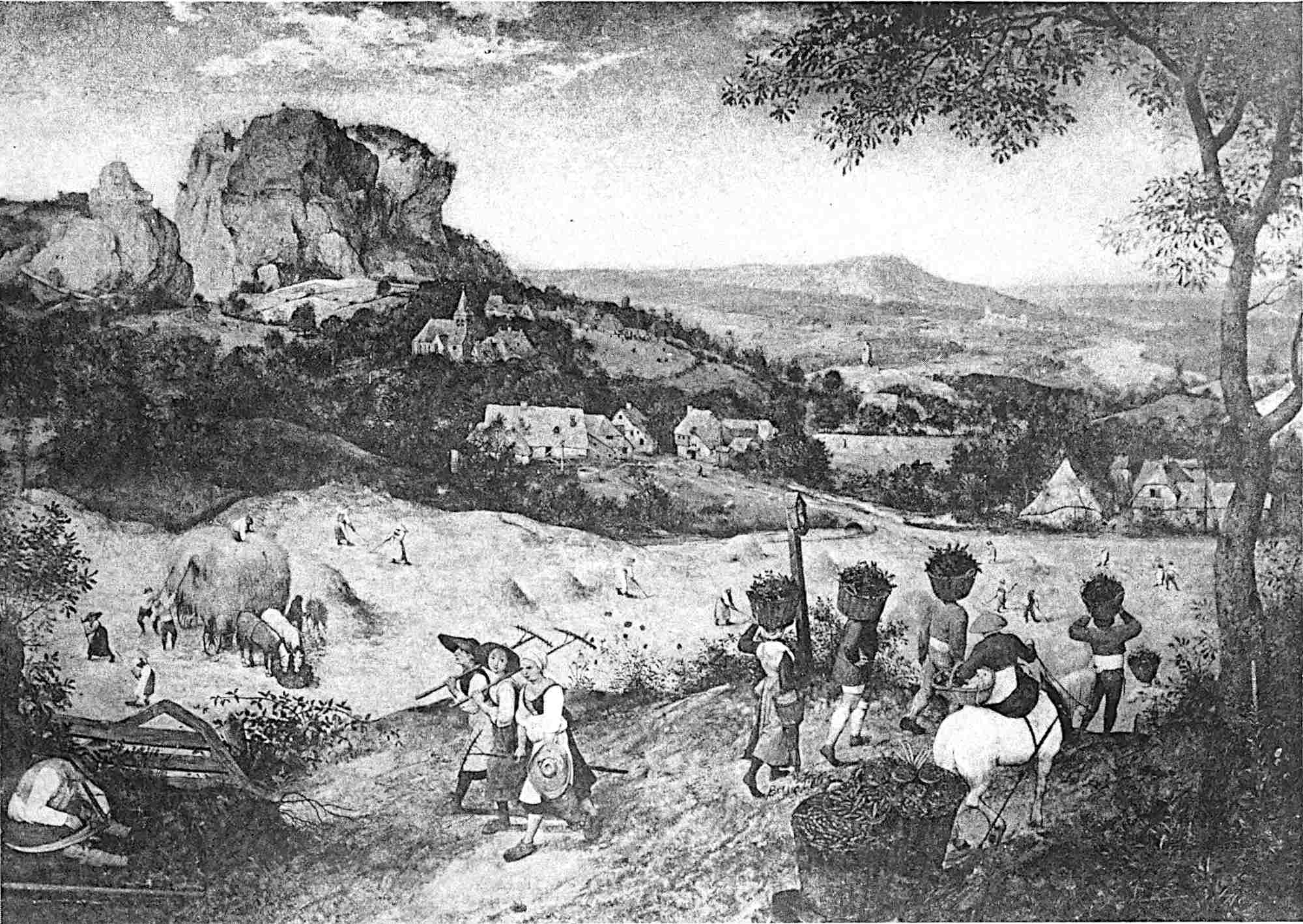
HUNTERS IN THE SNOW (DETAIL)HAYMAKING (JUNE?). RAUDNITZ, COLLECTION OF PRINCE LOBKOWITZ
Moreover, the sequence of changes in the relative importance of the
human figures in the paintings is but the story of Bruegel’s developing
conception of the relative importance of man in the scheme of things.
In one group of pictures the individual, though fully personalized, is
a part of the crowd and the crowd a mass of insects swarming over the
landscape. In another group of large-figured peasant subjects man is
all-important, filling the whole and shutting nature out. The former
are amazing, and one can hardly get too much of them; the latter are
interesting and one likes them long. But for the final expression of
his mind one must turn to the set of the Months; these five,
with the addition of the Paul and the Icarus, form the
summit of Bruegel’s art. In them Bruegel reached the solution of the
two problems of his life, the life of nature and the life of man; and
the solution was the life of man in nature.
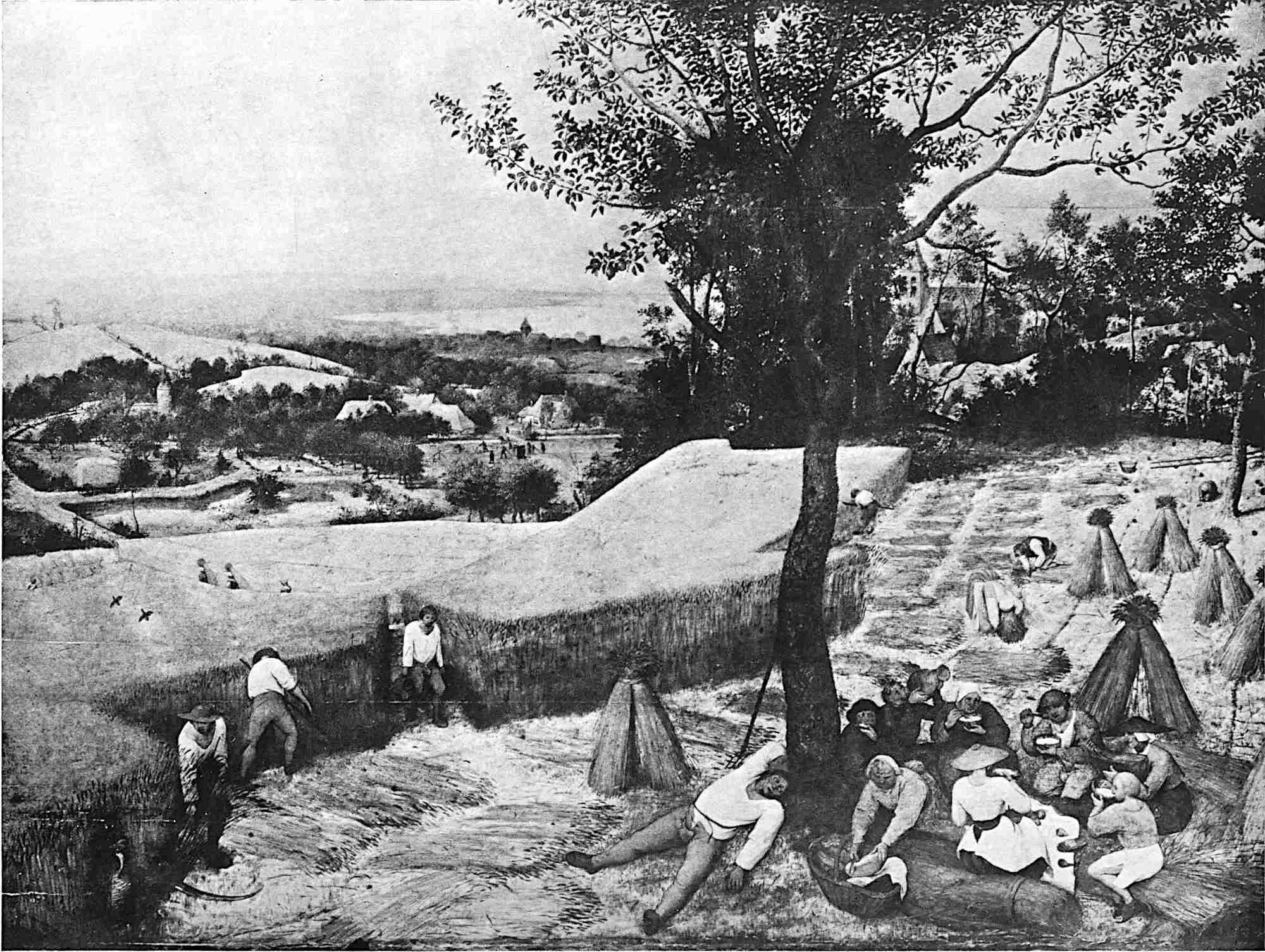
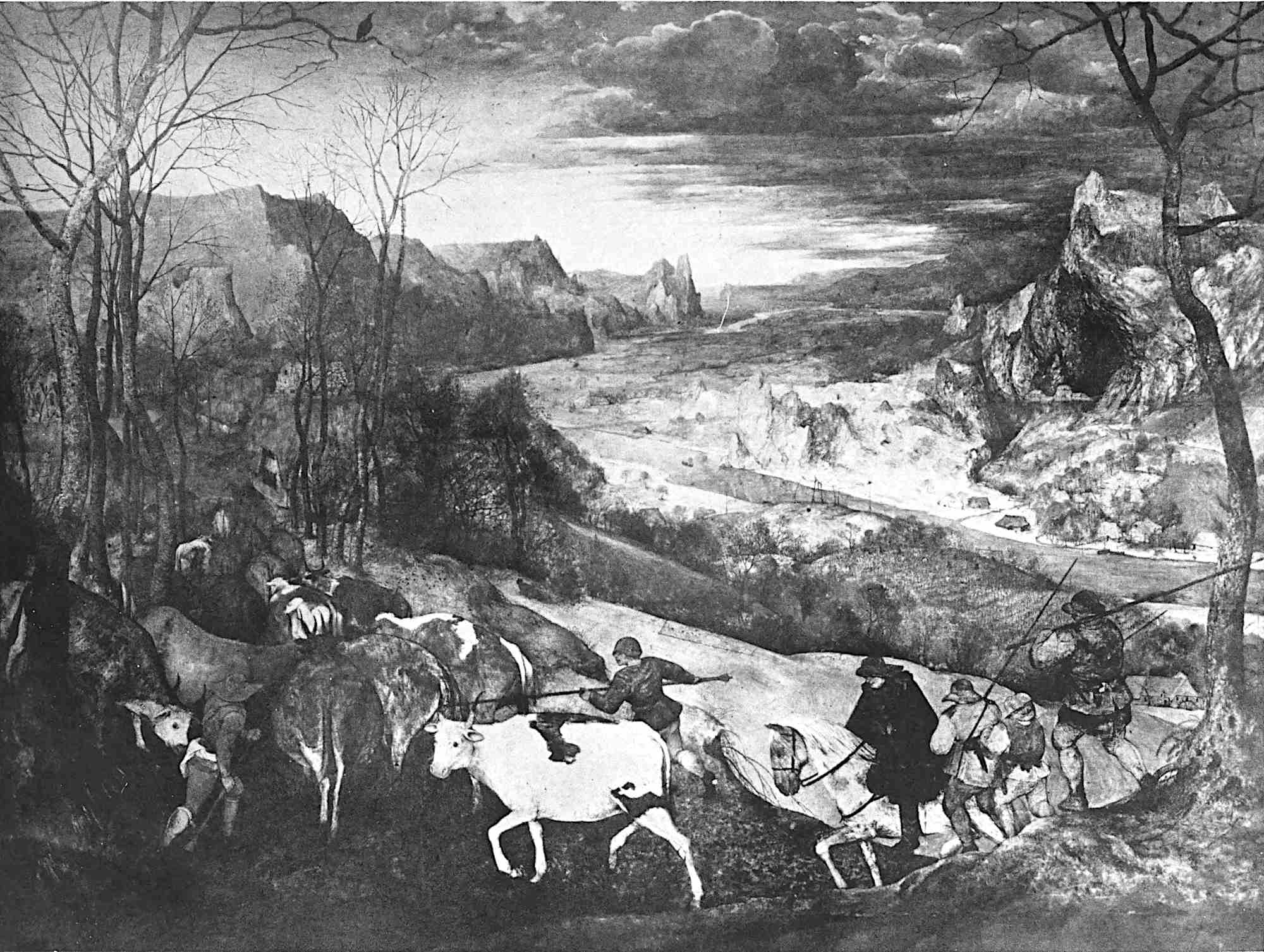
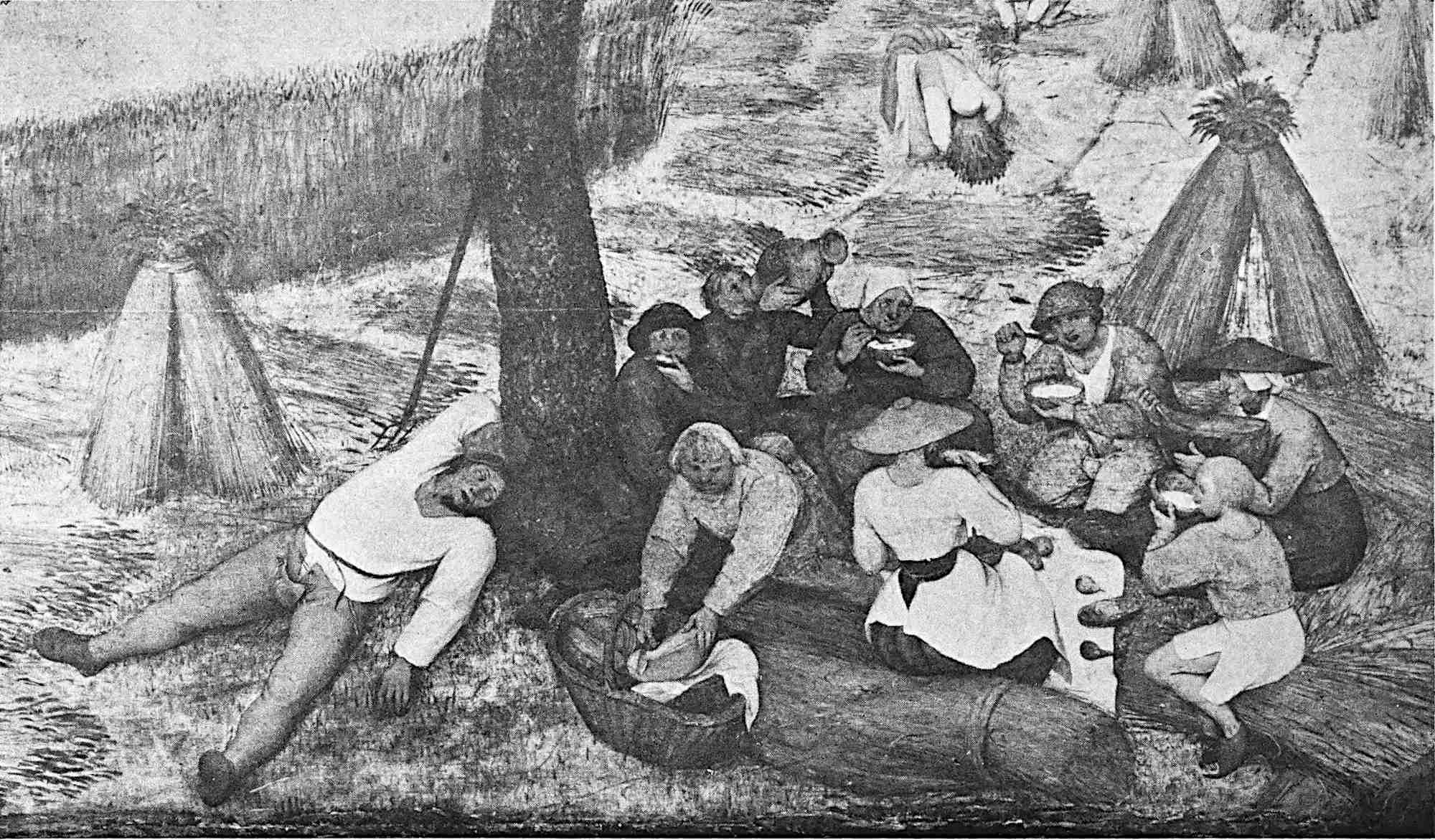
The Months sum up his life’s endeavor both in the material
he had all along been dealing with and in the conceptions between
which all along he had been alternating. They are full of motives and
incidents taken from his earlier works—the church he drew so often,
children at their games, the great stretches of landscape that he
loved. But all things are adjusted to one another in a new way; the
people are seen neither too large nor too small, but in a perfect
relationship to an immensely embracing nature; and each picture is
pervaded by an unbroken harmony of mood. This set marks the attainment
of final insight into everything that had concerned him; they
constitute his acceptance and affirmation of life.
Courtesy of the Metropolitan Museum of Art.
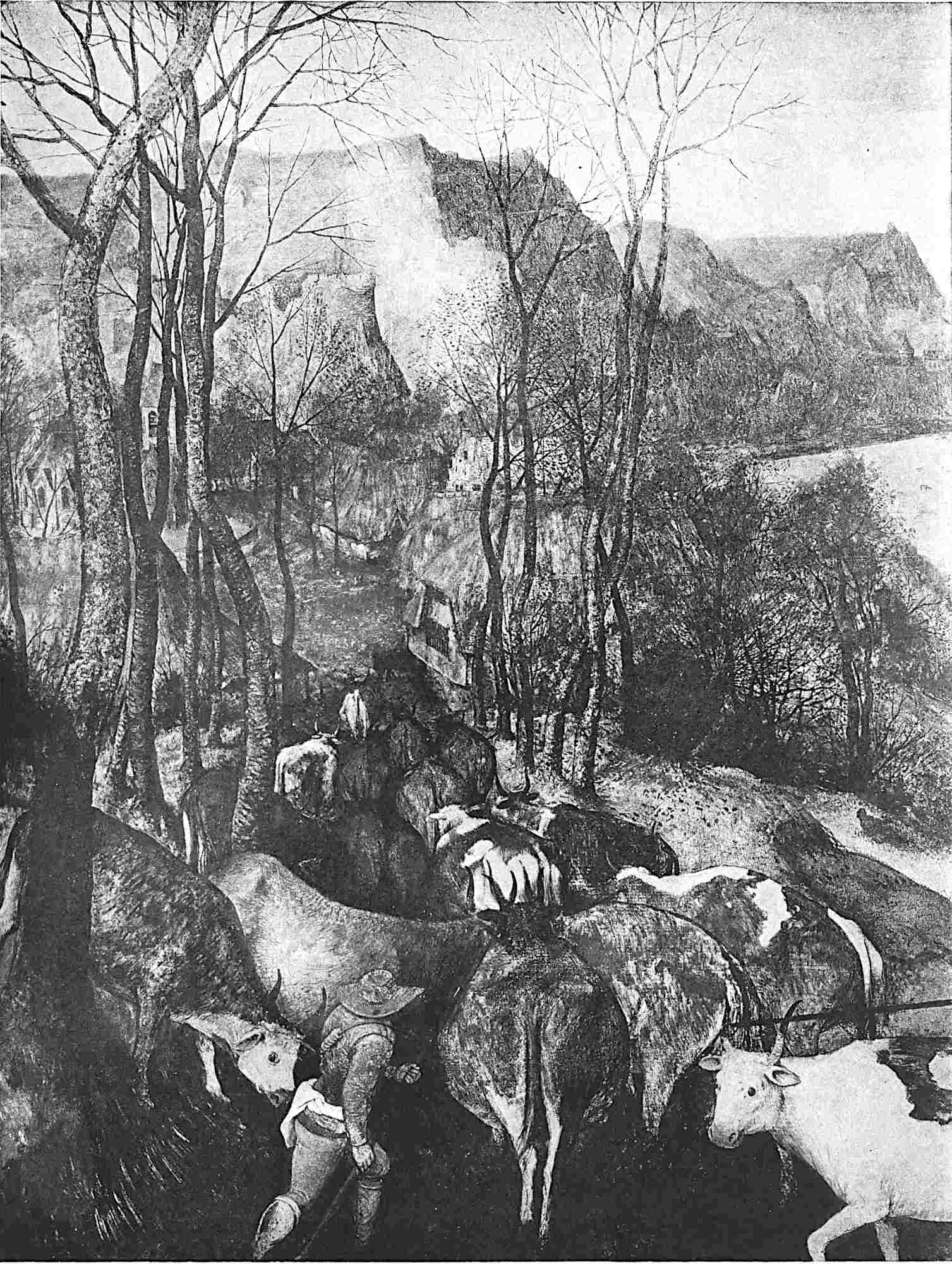
THE HARVESTERS (AUGUST?). NEW YORK, METROPOLITAN MUSEUM OF ARTTHE RETURN OF THE HERDS (NOVEMBER?). VIENNA, MUSEUM
Courtesy of the Metropolitan Museum of Art.
THE HARVESTERS (DETAIL)
The more Bruegel’s work is studied the stronger grows the feeling that
almost everything may be attributed to him. To go to Vienna and through
that group of fifteen pictures to come into direct contact with his
mind across three hundred and fifty years is to be convinced that his
is one of the inexhaustible minds of the world. The material brilliancy
of the painting is more than matched by the brilliancy of the creative
soul behind them. Whether he himself was conscious of all that can now
be perceived in his work does not much matter; whether it came there
with him aware or unaware, it is enough to make him superbly great. But
this much is true: the more his mind is apprehended, the more vast and
purposeful it appears.
He was fortunate in finding his means of expression in what was then
a popular art; everything about that art was so alive that it drew
to itself some of the greatest minds of the time. There existed a
tremendous amount of give-and-take between the artist and his age, and
this degree of interaction it was which had most to do with endowing
both art and artist with vitality; they were fed from sources outside
of and larger than themselves. Thus it was that Bruegel attained to so
comprehensive an expression of himself and his age together that his
work has become one of the permanent things of art.
Each picture is a completely functioning organism with several
different aspects. There is the aspect of story-telling, that of
technical picture-making and that of philosophic thought. Each aspect
functions harmoniously with the others. Not only can one analyze out at
will the elements proper to each aspect, but one can move from one to
another without any feeling of shifting gear or changing speed. (The
one exception is the group of mourning women in the Carrying of the
Cross.) All these aspects function at the same mental rate. They
are all interwoven into powerful wholes. Every picture is a world in
itself, and coming to know them is one of the completest experiences
that can be found anywhere in the art of painting.
THE RETURN OF THE HERDS (DETAIL)
Yet even with this completeness of expression attained, one has before
Bruegel’s work a feeling of still more behind, an immensity of mind
larger than any art can be. It is the feeling one has before Michelangelo,
but not before Raphael; before Shakespeare, but not before
Marlowe. The greater ones are not only greater in their art, but they
have something left over in themselves which their art suggests but
does not directly express. Of this greater company is Pieter Bruegel.
There are purer painters, but for the purity of their art they pay
the price of going without something of importance to a complete
life. And even their gain in intensity seems hardly a gain in the
face of Bruegel’s intensity on all the levels of his completeness.
He transposes all life into his pictures in a scale of relative
relationship that preserves the values of human life itself. Every
other painter lacks something or has something in excess. Bruegel is
the most comprehensive and the best balanced, the most energetic and
the mellowest. Of all painters he is the greatest realist, and of them
all the most humane.
THE RETURN OF THE HERDS (DETAIL)
AN ANNOTATED BIBLIOGRAPHY
The object of the following book-list is to mention not everything
that has been printed about Pieter Bruegel but only such volumes and
articles as have definite value. The major cause of its shortness,
however, is the fact that the literature of the subject is surprisingly
small in quantity; in English, particularly, there is almost nothing
beyond short paragraphs in some histories of art and the usual
unilluminating brevities of general reference works.
Pieter Bruegel l’Ancien. Son Oeuvre et son Temps. Par René
Van Bastelaer et Georges Hulin De Loo. Bruxelles: G.
Van Oest & Cie.: 1907.
This, the first volume to be published on Bruegel, remains the standard
work. For the handsomeness and completeness of its reproductions
combined with the accuracy and thoroughness of its text, treating every
aspect of the painter’s life and work, it is a notable accomplishment
in book-making and in scholarship. What has since been written and
the pictures that have since been discovered still do no more than
supplement certain phases of it; nor can it be superseded until someone
is prepared to give time and money to a thorough search of European
galleries and private collections. It is now, however, somewhat
difficult to obtain.
Les Estampes de Peter Bruegel l’Ancien. Par René Van
Bastelaer. Bruxelles: G. Van Oest & Cie.: 1908.
Within its chosen field this volume also remains the standard and needs
only supplementing by later researches. Its 278 plates reproduce all
the prints then thought to be by Bruegel or after his designs.
Pierre Bruegel l’Ancien. Par Charles Bernard.
Bruxelles: G. Van Oest & Cie.: 1908.
This, which appeared immediately after the two preceding volumes, may
fairly be described as a good popularization of them, with additional
historical material drawn from other sources. The thirty reproductions
are very good half-tones; the text gives a satisfactory account of the
painter’s life and times, although there is too much reliance upon the
mere subject-matter of the pictures and although parts of Van Mander’s
clumsy narrative are transposed into French of debatable suavity. It is
the only generally available biography in French. To any reader of it
my indebtedness to it for facts (other than those given by Van Mander)
and my occasional difference of interpretation will be equally evident.
Der Bauern-Bruegel. Von W. Hausenstein. München &
Leipzig: R. Piper & Co.: 1910.
This is commended by Herr Friedländer (see eighth item) as a portrait
of the man Bruegel; as a discussion of his work, however, it has been
superseded in German by Herr Friedländer’s own book.
“The Adoration of the Kings” by Pieter Brueghel the Elder. By
C. J. Holmes. In The Burlington Magazine; vol xxxviii, no.
ccxv: London: February 1921.
The Harvesters by Pieter Bruegel the Elder. By B[ryson]
B[urroughs]. In The Bulletin of the Metropolitan Museum of Art:
vol. xvi, no. 5: New York: May 1921.
The fact that these two articles ostensibly deal each with a single
picture should not obscure either their general interest or their
significance as indications and instruments of the contemporary
tendency to assign to Bruegel a higher rank than he has had heretofore.
Von Eyck bis Bruegel. Studien zur Geschichte der
Niederländischen Malerei. Von Max J. Friedländer. Berlin:
Julius Bard: 1921. (Of Bruegel: p. 169 to end).
The main point of interest about Bruegel in this book is that the
author gives a catalogue of paintings which differs considerably, both
in its omissions and in its additions, from that given by M. Hulin (see
first item).
Pieter Bruegel. Von Max J. Friedländer. Berlin:
Propyläen-Verlag: 1921.
This is the standard general work in German, and contains a trustworthy
translation of the entire text of Van Mander concerning Bruegel. Even
those who do not read German might well possess this book for the
clearness and frequent brilliancy of its 101 half-tone reproductions,
the majority of which are from drawings and prints. Herr Friedländer is
the only continental scholar so far whose work takes cognizance of the
picture now in the Metropolitan Museum.
Bruegel. Von Kurt Pfister. Leipzig: Insel-Verlag:
1921.
This short essay merits notice as a piece of writing. The 78 half-tone
reproductions are not very clear, but they include more than a dozen
which are in neither Friedländer nor Bernard.
Pieter Bruegel. Vierzehn Faksimiledrucke nach Zeichnungen und
Aquarellen. Mit einer Einleitung von Kurt Pfister. München:
R. Piper & Co.: 1922.
This handsome series of large plates is a publication of the
Marées-Gesellschaft and for faithfulness in facsimile
reproduction is not to be surpassed.
Pieter Brueghel’s “Fall of Icarus” in the Brussels Museum. By
Arthur Edwin Bye. In Art Studies: Mediæval Renaissance and
Modern: No. 1. Princeton: University Press: 1923.
A sympathetic though not stylistically distinguished essay in
appreciation, written around the Fall of Icarus in the Brussels
Museum.
Renaissance Art. By Elie Faure. New York: Harper &
Brothers: 1923. (Of Bruegel: pp. 276–286).
This author’s habitual saturation with his subject-matter has enabled
him to convey the multitudinous quality to be felt in many of Bruegel’s
pictures and also to adumbrate the humanity of soul behind them; but
he has almost nothing to say about the more narrowly æsthetic merits
which permit of Bruegel being ranked among the great; and even on the
score of subject-matter Bruegel’s livingness is almost smothered under
a rhetoric made sluggish with anecdotal detail.
Breughel. By Aldous Huxley. In The Calendar of Modern
Letters: vol. 1, no. 6: London: August 1925.
This essay is a little sermon on the virtue of comprehensiveness in the
appreciation of art, with Bruegel as an ideal text. It is not itself
a comprehensive presentation of the painter or his work and it has
very few traces of the verbal brilliancy which has had so much to do
with putting this author’s novels in the best-selling class; but it
may make the name of Bruegel known to many who are not in a position
to penetrate his work on their own account. I note a curious slip
in the transposition of titles between the Brussels Numbering at
Bethlehem and the Vienna Massacre of the Innocents.
Die Zeichnungen Pieter Bruegels. Von Karl Tolnai.
München: R. Piper & Co.: 1925.
This book has immediately taken rank as the standard authority on the
drawings; its 104 large half-tone plates reproduce every drawing listed
in its catalogue.
Pieter Bruegel der Aeltere. Siebenunddreissig
Farbenlichtdrucke nach seinen Hauptwerken in Wien und eine Einführung
in seine Kunst. Von Max Dvořák. Wien: Oesterreichischen
Staatsdruckerei.
This wonderful production is just being completed; its magnificent
plates embody the utmost resources of modern color-printing. An edition
with the text translated into French is announced for the month of
July, and another with a translation into English is expected during
the year.
The foregoing annotations are based upon actual reading and examination
of the books and articles mentioned. I think it well to append a few
additional items which I have had no opportunity as yet to examine;
my study of the volumes already listed, however, leads me to believe
that they possess interest and importance. The words in italics at the
end of each entry indicate its source among the books in the previous
section.
Pierre Brueghel Le Vieux. Par Henri Hymans. (Gazette
des Beaux-Arts: Paris: 1890 et 1891.) Pfister: Bibliography.
Les Brueghel. Par Emile Michel. Paris: 1892. Van
Bastelaer & Hulin, p. 294.
Pieter Brueghel der Aeltere und sein Kunstschaffen. Von
Alex L. Romdahl. (Jahrbuch der Kunsthistorischen Sammlungen
des Allerhöchsten Kaiserhauses, Bd. 25: Wien: 1905.) Tolnai and
Pfister: Bibliographies.
Pieter Bruegel im Kupferstichkabinett zu Berlin. Von
Ludwig Burchard. (Amtliche Berichte aus der Königliche
Kunstsammlung in Berlin, Bd. 34: Berlin: 1912–13.) Tolnai:
Bibliography.
Die Niederländische Landschaftsmalerei von Patinir bis
Bruegel. Von Ludwig von Baldass. (Jahrbuch der
Kunsthistorischen Sammlungen des Allerhöchsten Kaiserhauses, Bd. 34:
Wien: 1918.) Tolnai: Bibliography.
Der Bauern-Bruegel und das Deutsche Sprichwort. Von
Wilhelm Fraenger. (München: 1923.) Tolnai:
Bibliography.
NOTES — 2.
The illustrations of Bruegel’s paintings accompanying this article are
confined to those accepted as authentic by M. Hulin in his catalogue
(see Bibliography, first item), with certain additional ones discovered
since its publication. Seventeen of the paintings are positively dated;
the rest must be distributed through the eleven years of painting on
other evidence. Wherever a date appears under an illustration, it is
the one assigned by the authority just mentioned, with the exceptions
noted. The only alteration in the chronological order, so far as that
may be determined, has been the grouping of the Months at the
end, to correspond with the text, in which they are treated as the
summing-up of Bruegel’s work as a painter. All the drawings reproduced
are dated on the authority of Herr Tolnai (see Bibliography, fourteenth
item). The following paragraphs give certain supplementary facts:
Village Marriage: Two copies by Pieter II are known. A
comparison of this picture with them shows that the arm and hand of the
man kneeling near the bottom of the stairway have been repainted “for
reasons of decency”!
Dancing Peasant: This is doubtful. Herr Friedländer considers it
a copy; M. Hulin leaves the matter undetermined, but reproduces it.
Descent of Christ into Limbo (drawing): Herr Tolnai says that
the date and signature are apocryphal, but assigns it to no other year.
Flemish Proverbs: Not known to M. Hulin; date given on the
authority of Herr Friedländer.
Battle Between the Israelites and the Philistines: also called
The Death of Saul at the Battle of Gilboa. The uncertainty
of this date turns upon whether an extra figure can or can not be
discerned at the end of the Roman numerals.
Dulle Griet: The literal subject is the quarrelsome woman,
Terrible Margaret, she who frightens the devil himself.
The Fall of Icarus: Not catalogued by M. Hulin. Here put next
to the Paul in order to follow the text, in which these two are
joined with the Months as representing the height of Bruegel’s
achievement.
The Wine of Saint Martin: Admitted by M. Hulin, but with strong
doubts; regarded as the fragment of a larger work; done originally in
tempera and repainted in oil, perhaps in the seventeenth century.
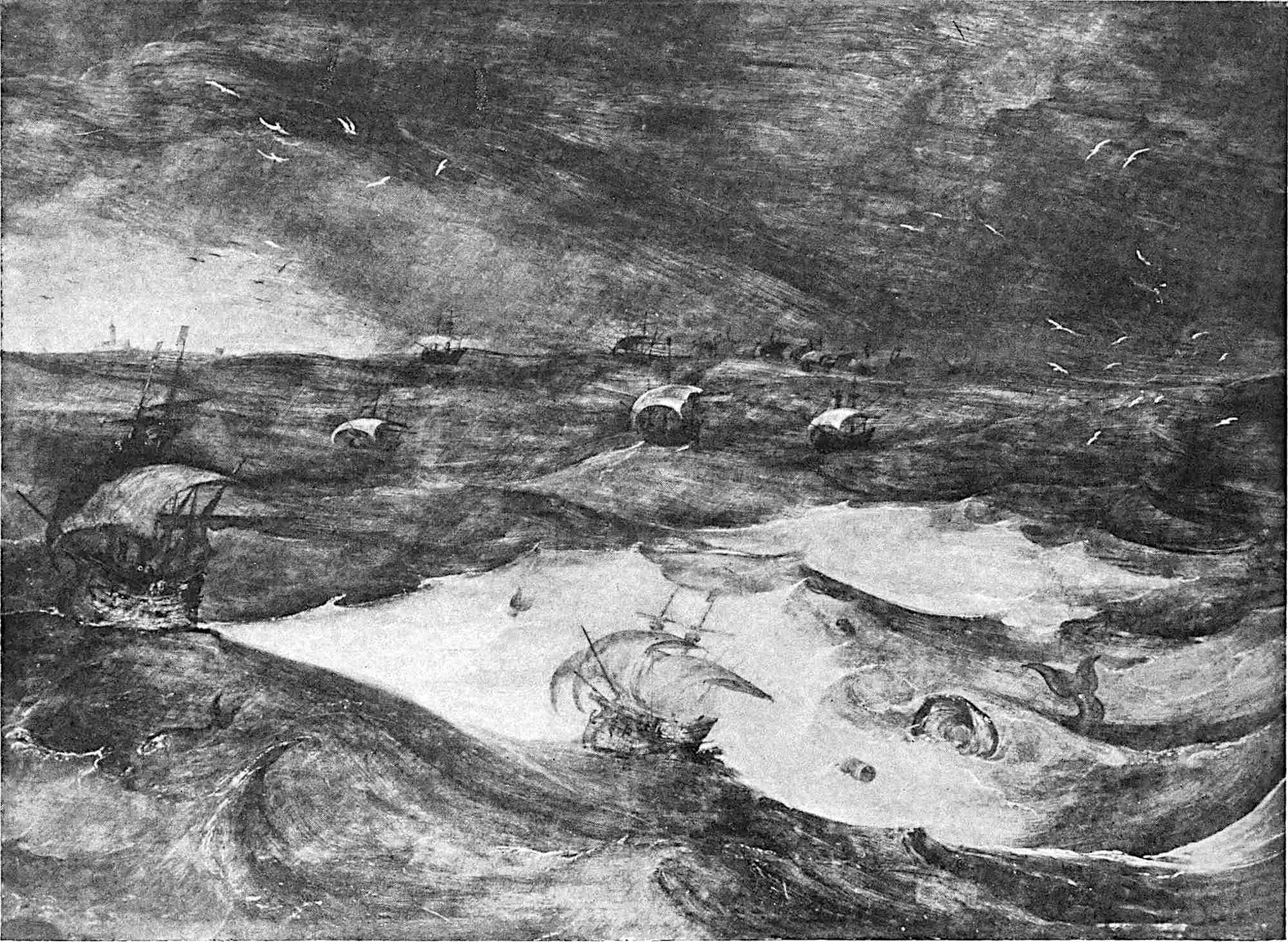
Marine: Not dated by M. Hulin. Placed here because it appears to
be unfinished, and so possibly very late.
The Months: The months suggested in the titles given under the
illustrations follow M. Hulin’s catalogue. Herr Friedländer assigns
that given as January to March, the February to December, the August
(New York) to July, leaving the other two as given.
M. Hulin dates the whole set about 1567. The only trace among them of a
date is on the picture in the Metropolitan Museum; on the strength of
this Herr Friedländer assigns it positively to 1565, but Mr. Burroughs
is inclined to agree with M. Hulin. In any case the violation of time
order in placing this set last is not very great and the gain is
considerable in giving a culminating impression of Bruegel’s art.
No paintings in Bruegel’s manner are reproduced which are definitely or
even probably by the sons. They are a multitude in themselves, and are
mostly attributed to the father. They are to be met with everywhere,
from London to Palermo, from Madrid to Petrograd. Herr Friedländer
authenticates (without reproducing) one in Budapest and another in
Csàkány. In Hampton Court Palace there is an extremely interesting
smaller version of the Vienna Massacre of the Innocents in which
eatables are substituted for most of the children, and a companion
piece of coarser workmanship giving an entirely different picture of a
massacre. In Vienna there are a dozen or more by the sons which throw
much light on the entire question of Bruegel’s own pictures; the most
interesting of these is in the Lichtenstein Collection and is in the
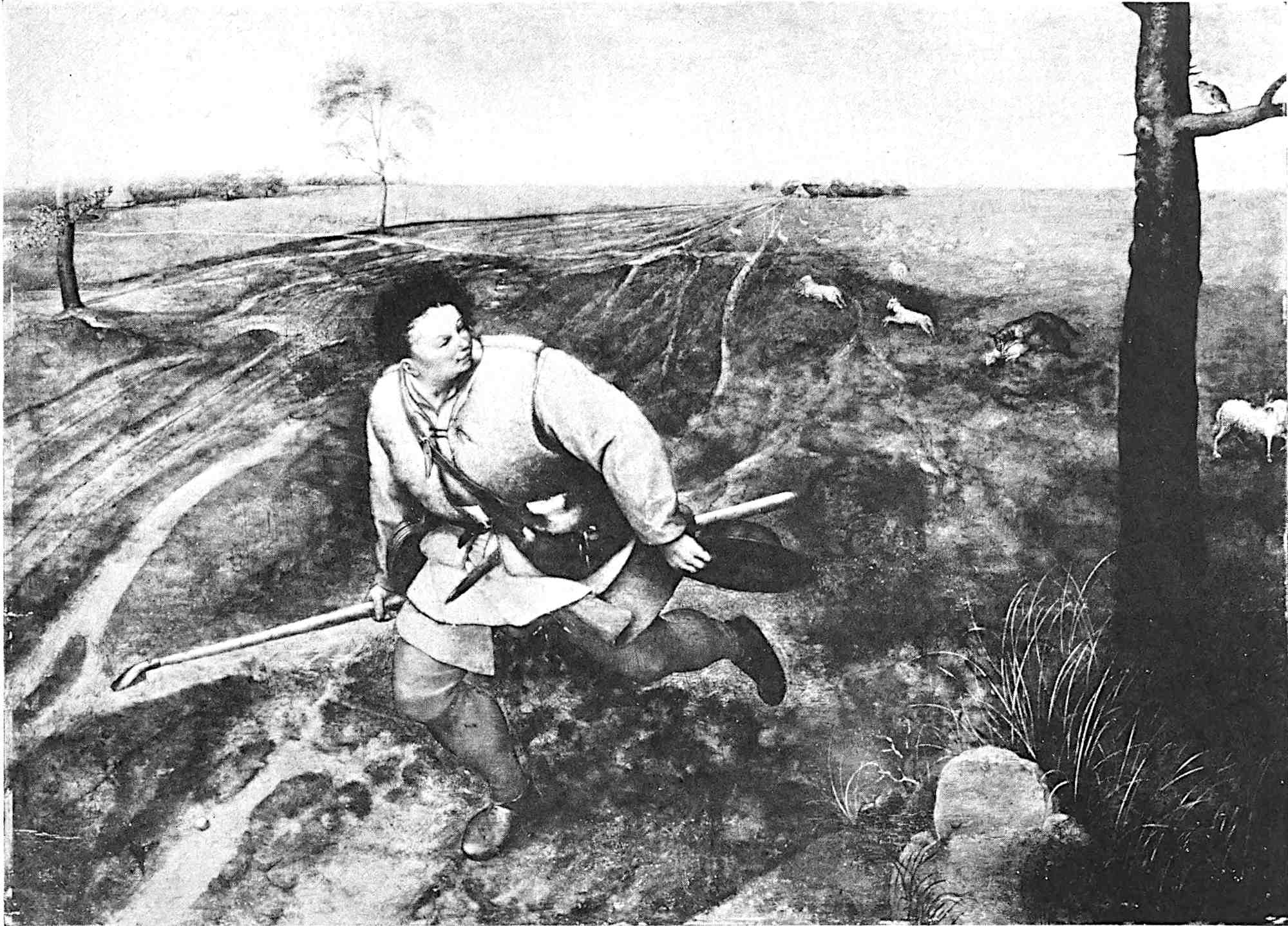
manner of the Fleeing Shepherd in Philadelphia. The problems
raised by all these pictures are many and complex, but the scope and
intention of this essay did not permit of its touching upon such
matters. However, there are all sorts of ways to spend life, and not
the least interesting way would be to go a-Bruegeling through Europe.
THE ARTS is not exclusively a magazine of modern art or
exclusively a magazine of the art of the past. It is solely a magazine
of art, whenever or wherever produced.
Its text is intelligent, stimulating and readable, and the essays which
appear in its pages are permanent contributions to the literature of
art. In selecting its writers The Arts endeavors to secure
those who are authorities on their particular subjects but are also
capable of writing freshly and directly about them—who are not so
engrossed by the historical and archæological side of art as to forget
its supreme æsthetic importance.
In its essays on the art of the past The Arts does not confine
itself within the conventional limits of the European tradition, but
recognizes in the art of the Orient, of Africa, or of aboriginal
America the same qualities which exist in the art of the West.
In its treatment of contemporary art, The Arts attempts
to present the work of the most vital artists of the present day,
whether radical or conservative, the emphasis being placed not on the
particular group or faction to which the artist may belong, but upon
the work itself.
Realizing that one of the most important functions of a magazine is the
discovery of new talent, The Arts has always opened its pages
to the work of the most promising of the younger artists. Its policy is
not to wait until an artist has achieved success, but to be ahead of
the crowd in affording recognition to the talented men of the future.
Its regular departments, such as reviews of current exhibitions
and new art books, keep its readers informed of the significant
developments in the world of art. Although the bulk of its articles are
devoted to painting, sculpture, architecture and the decorative arts,
The Arts from time to time publishes essays in the fields of
music, drama or literature which it knows will be of interest to its
readers—particularly on the subjects of stage design and the art of the
films.
The written word, however, cannot convey all of the significance of a
work of art. For that reason it has been the policy of the magazine
to make of each issue a series of illustrations which no artist or
art lover can afford to be without. Every number of The Arts
contains fifty to sixty excellently printed reproductions of important
works of art of the past or the present.
Fifty cents a copy; five dollars a year.
THE ARTS PUBLISHING CORPORATION
19 East 59th StreetNew York, N. Y.
Transcriber’s Notes:
Obvious typographical errors have been silently corrected.
Errata have been applied.
The name Michel Angelo has been corrected to Michelangelo
The painting A Village Wedding is referred to as Village Marriage in the NOTES.