Picturesque Views ON THE RIVER WYE, FROM Its Source at Plinlimmon Hill, to its Junction WITH THE SEVERN below CHEPSTOW : WITH OBSERVATIONS ON THE PUBLIC BUILDINGS, AND OTHER WORKS OF ART, IN ITS VICINITY:
Transcriber’s Note:
New original cover art included with this eBook is granted to the public domain.
PICTURESQUE VIEWS
ON THE
RIVER WYE.
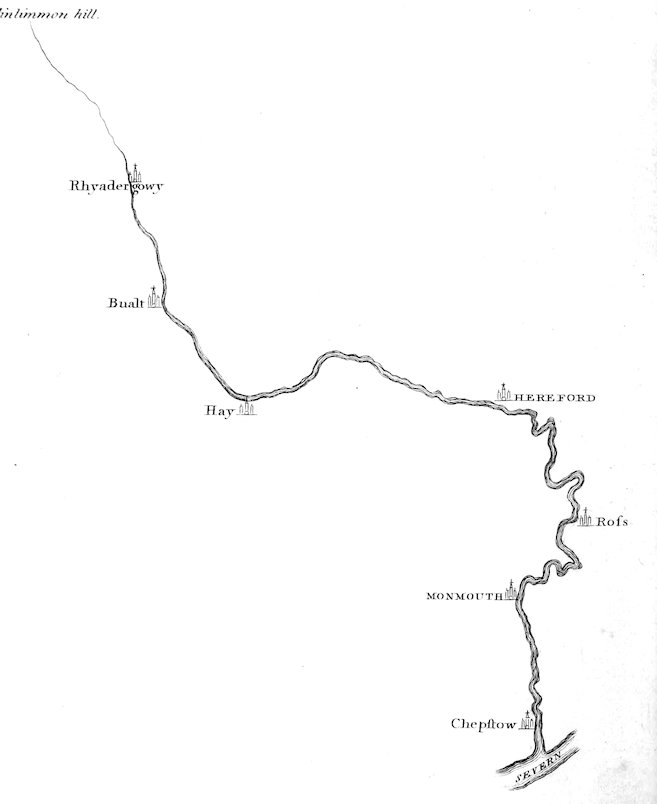
Course of the RIVER WYE from its Source to its junction with the SEVERN below Chepstow.
BY SAMUEL IRELAND,
AUTHOR OF
“A Picturesque Tour through Holland, Brabant, and part of France;”
AND,
Of “Picturesque Views on the Rivers Thames, Medway, Warwickshire Avon,” &c.
London:
PUBLISHED BY R. FAULDER, NEW BOND STREET;
AND T. EGERTON, WHITEHALL.
1797.
PREFACE.
v
Amongst the numerous rivers with
which our Island is so richly ornamented
and fertilized, the Wye, our present subject
of investigation, though in no very widely
extended course, and itself only a tributary
stream, is yet in the production of the sublime,
of the grand and majestic proudly
eminent above its fellows. In a course of
about eighty miles, the utmost distance it
measures from its source, to its junction
with the Severn, so various and such an interesting
picturesque scenery is perhaps no
viwhere to be found, either in this or any
other country.
Nature and Art have most happily
combined in opening their richest stores to
diversify and spread fertility, grandeur and
beauty over the country through which it
flows: for its environ is not less highly distinguished
and dressed by the hand of art
with castles, abbies, and villas beautifully
seated on its banks, than it is itself favoured
by nature, in the striking interchange of
shoal and flood, wood and rock, meadow
and precipice. With so much, and in
so many various ways to allure and interest,
it was not possible that all its charms could
have escaped either the penetrating eye of
Taste and Genius, or the pencil of the inquisitive,
refined, and systematical Amateur,
viiand accordingly many of its most striking
features have employed the pens and the
pencils of our Writers and Artists; but they
have, all of them, been either detached
views and single objects, or, if more has
been comprehended in the design of the
amateur or artist, the execution has been
partial, imperfect, or foreign to the subject.
The whole has never been fully exhibited to
the eye of the lover of the scenes of nature
faithfully delineated. One ingenious author
indeed has given observations upon
the river, and such as have unquestionably
merited the high commendations they have
received from the admirers of the picturesque
and beautiful: and he has accompanied
his observations with drawings. He
does not however profess to give exact representations,
or portraits of the various objects
viiithat present themselves, but aims rather
at exhibiting their general effect on
the eye, when considered technically, and as
picturesque forms by the learned and professed
artist.
Without interfering therefore with
the plan of that much admired writer, or
arrogating to himself superior science or
knowledge of his subject, the author of
this work has, in conformity with his original
intention, selected this river from
amongst those not yet described, in order to
complete his history of the principal rivers
of this country: and, unable as he feels
himself to render justice to the dignity of
his subject, he builds his claim to public
favor, on the fidelity with which he flatters
himself he has delineated the scenery. He
ixwould wish, and it is his aim, that his
drawings should, like the transparent mirror
of his stream, truly reflect the landscape
that exists around, as well as the objects
that decorate its banks. And, content with
the simple charms and varieties of nature,
he cannot prevail upon himself to contemplate
in every winding of the stream the
forms of his own idea, the image of his
own mind and its complicated sameness,
reflected again, and again; but gives to his
reader that, which, if he visits the spot,
he trusts he will find, and, if the spot is
known to him already, he assures himself
he will recognize.
The tremendous floods, which, in the
beginning of the year 1795, subsequent to
that, in which these drawings were made,
xhaving so completely swept away several ancient,
as well as elegant structures thrown
across this stream, may perhaps give some
additional value to the sketches of them here
introduced. If not elsewhere preserved,
scarce a vestige of them remains to be resorted
to by the artist or by the architect,
whose profession must peculiarly enable him
to do more justice to the nature of the
fabric.
The History, and Picturesque Views of
the River Severn are in great forwardness,
and will, it is presumed, be ready for publication,
in Two Volumes, Royal Octavo, in
the course of next year.
S. Ireland del.t
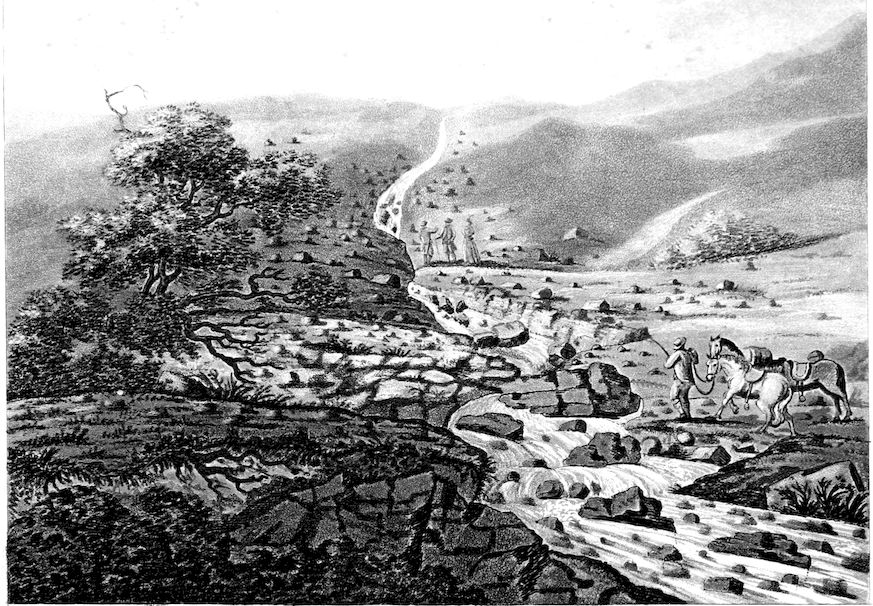
Source of the Wye, Plinlimmon Hill.
Pub.d for S. Ireland, March 1, 1797.
Picturesque Views
ON THE
RIVER WYE.
1
“Plinlimmon’s high praise no longer Muse defer;
“What once the Druids told, how great those floods should bee,
“That here (most mightie hill) derive themselves from thee.
“The Bards with furie rapt, the British youth among,
“Unto the charming harpe, thy future honor song
“In brave and loftie straines:——”
Drayton.
SECTION I.
From a small spring near the summit of
Plinlimmon Hill, the boundary of the northern
part of Cardiganshire, our river Wye
derives its source. Issuing from a spacious
hollow in this mountain, the water falls in
a narrow streamlet several hundred yards
2nearly perpendicular, till meeting with various
small currents, it soon presents itself in
the shape of an immense cataract, rolling
with astonishing rapidity over the rocky
prominencies which seem to impede its
course. The name of this river appears
anciently to have been a common appellation,
either for river or water. Camden
says, that the word gwy or wy signifies
water, and instances the following names
which have that termination, as proofs of
his opinion; viz. Lhugwy, Dowrdwy, Edwy,
Conwy, Elwy, Towy, Tawy, &c. &c.
From the same ridge of mountains, within
two miles of the source of the Wye, the
rivers Severn and Rydall derive their origin:
the latter of which empties itself into the
Irish sea at Aberystwith. The views from
this huge and dreary hill are wild and extensive
beyond description; they exhibit
mountains, rolling as it were, over each
other, and under the most sublime forms and
3beautiful hues, varying and shifting till they
insensibly lose themselves and melt into the
horizon. We were peculiarly fortunate in
having a bright and clear day to view in all
its grandeur this sublime and picturesque
scenery; an advantage which an experienced
guide informed us had scarce ever occurred
during a course of many years in those airy
regions, where it was almost invariably his
fate to encounter a heavy and hazy atmosphere,
commonly attended with rain. On
this lofty mountain the famous Owen Glyndwr,
in the summer of 1401, posted himself,
says the historian, “with great policy
at the head of a hundred and twenty men
of arms.” The situation of Plinlimmon
Hill being on the limits of Cardiganshire and
Montgomeryshire, was admirably adapted
for receiving the succours of his vassals and
friends from every part of the principality.
From this fastness his adherents, who were
the terror of all that opposed him, were perpetually
4making excursions, and plundering
the neighbouring counties; amongst which
Montgomeryshire appears to have been the
greatest sufferer.
The birth of this renowned hero, of
Wales, which happened on the 28th of
May, 1354, appears by Hollingshed and
others, to have been marked with strange
presages of celebrity: he says, that his cruelty
was foretold at his nativity, by the
wonderful circumstance of “his father’s
horses being found standing that night in
the stable up to their bellies in blood;”
and Shakspeare, in the following lines, put
into the mouth of Glyndwr, thus describes
the vain glorious chieftain,
————————————“At my birth
“The front of Heav’n was full of fiery shapes;
“The goats ran from the mountains, and the herds
“Were strangely clamorous in the frighted fields:
“These signs have marked me extraordinary,
“And all the courses of my life do shew,
“I am not in the roll of common men.”
5A still more extraordinary circumstance
is attached to the history of this Welch
phenomenon. Jolo Goch, a celebrated bard,
has not hesitated to consider the great event
of his birth, as equal in importance to mankind
with that of Jesus Christ.
The river Wye, in this its earliest stage,
is peculiarly marked with features of the
grand and sublime: its amazing rapidity is
perpetually interrupted by immense large
stones and rocky substances, and the rush of
its waters produces a solemn noise, that
seems as if they were
“Chiding the stones that stopp’d their course.”
The spots of verdure and broken ground
in the vicinity of this rude scene, the dark
shades of rock, and beetling brows of the
hills with which it is bounded on either side,
form a spectacle as majestic and awful as
6the untaught imagination can paint, or that
can present itself to the eye throughout
the range of this island.
It is simple nature in her purest and
grandest form, and without a trace of her
handmaid art, without either castle, church,
or ruin: objects that more than form the
beautiful in picture, that are essentially necessary,
and can alone give dignity to the
feeble works of man; without these the
scenery is here complete.
For several miles the country wears
nearly the same aspect; one continued undulating
line of hills forms the distance;
and the river, though of no considerable
width, continues gently to roll over its
rocky and gravelly bed, “making sweet
music with the enamelled stones;”
“Giving a gentle kiss to every sedge
“He overtaketh in his pilgrimage.”
7At a distance of about six miles from
its source, in a village called Cumergar, the
Wye receives a considerable body of water
from the river Castal. This River is full in
view, and forms a beautiful object from the
road, on the way to what is called the Devil’s
Bridge. At Cumergar is a wooden bridge
called Pont-rhyd Gallad: it is the first that
is thrown across this river, and the scenery
around it is extensive and beautiful. The
Wye here loses much of its impetuosity and
consequently of its grandeur: its rocky bed
is softened and in many places spread with a
mere gravelly substance, and at this summer
season is considerably narrowed, and frequently
left perfectly dry. From the continual
accession, however, of springs and
rills, that issue from the neighbouring mountains,
it is not known to remain long in
that state. From hence, on an easy ascent,
a tolerable road leading to Llanidlos runs parallel
with the stream, and affords a beautiful
8ride till we approach the wretched village of
Llangerig: amongst whose clay cottages
without chimneys, churlish boors, and sour
milk and black bread, the only refreshment
it supplied, our weary spirits were
filled with rapture at the beauties of that
situation, to which extreme penury, savage
nature, or insensibility could alone be indifferent:
They were so impressive, that
within a mile of this village we determined
to stop, flattering ourselves with the hope
that by the aid of the pencil, we might be
enabled to give the characteristic features of
a country, which we utterly despair by any
powers of language that we could command
in any adequate manner to communicate.
About three miles below Llangerig, in a
southern direction, the river Darnel, which
derives its source from the hills that bear its
name, empties itself into the Wye. Pursuing
9the course of the river, the Nanerth
rocks in an extent of near three miles, form
a beautiful screen to its northern bank.
On this spot the Wye, in an easy bend,
gently rolls over its rugged bed, while the ascending
road, girting the immense hills that
are enriched with spreading oaks and luxuriant
underwood, peculiarly invited the pencil:
Through these, the rocks in various
fantastic forms, perpetually break upon the
eye, and the cottages interspersed among the
distant hills, relieve the wide-spread and extended
scenery. On the brow of a rising
hill, in the fore ground, a group of cattle
which covered it, seemed at the instant, as
if placed there by design to complete the
view. Beneath, the gentle river Marteg, the
receptacle of many smaller streams that arise
in the vicinity of Llanidlos, rippling over its
pebbly bed, loses its name and its current in
the broader channel of the Wye.
SECTION II.
11
From Nanerth rocks, after a pleasant
ride of about three miles on the bank of the
Wye, we reached Rhaidr Gwy; the word
Rhaidr signifies a cataract, or fall of water,
and is frequently applied to those falls,
among the mountains of Snowden in Carnarvonshire.
Camden seems to think that from the
word Rhaidr, the county of Radnor, through
the west angle of which, this river directs
its course derived its name. The bridge at
Rhaidr consists of one wide arch, which from
its base forms a very large segment of a circle.
It is a plain structure and has little but
its romantic accompaniments to recommend
it; the immense pile of rocks on which it
is elevated, carries the arch so high as to
12afford from beneath it, an extensive prospect
of the adjoining country, in which a small
Welsh building called Cwmtather Church
appears in a whimsical point of view. The
annexed sketch was taken from below the
bridge, where the combination of objects is
wonderfully grand; and in this dry season,
displays in full force the ponderous rocky
substances of which it is composed. But in
consequence of this drought, we had the
misfortune to lose the display and thunder
of its cataract, which a less friendly state
of the elements would have exhibited in all
its grandeur. The stones over which the
waters in this vicinity roll, are of an immense
size, and in their forms, partake both of the
majestic, and the grotesque; their diversified
hues, and vast angular prominencies afford
in certain lights and in some seasons of the
day, under the rays of a bright sun the most
brilliant and picturesque effect. Over the
bridge passes the high road that leads to Aberystwith,
13and a more rugged and dreary path,
is perhaps scarce to be trod in any of the frequented
parts of this principality. Rhaidr,
though now but a miserable place, derived
formerly some consequence from its castle,
which was advantageously situated in a nook
of the river not far from the bridge, but
of which no trace at present remains. Near
the spot whereon the castle stood is a deep
trench cut out of a solid rock, and not far
distant, are several large Tumuli, or Barrows,
called in Welsh, Kern, and Keido.
These are conjectured to have been raised as
memorials of the dead. Camden confirms
this idea, and observes, not very consistently
indeed with the respect due to the memory
of the departed, “that it is still the
custom to cast heaps of stones on the
graves of malefactors and self murderers.”
At what period the castle at Rhaidr was
14built is not ascertained, but it was repaired
by Rhys Prince of South Wales in the reign
of Richard the first, and near it says Camden,
“is a vast wilderness rendered very
dismal by many crooked ways and high
mountains, into which as a proper place
of refuge, that bane of his native country,
King Vortigern, whose very memory the
Britons curse, withdrew himself, when he
had at last repented of his abominable
wickedness, in calling in the English
Saxons, and incestuously marrying his own
daughter.”
His address to the Barons, on the subject
of calling in the aid of the Saxons, is
thus recorded by an anonymous author.
“My Lords, vain compliment would suit but ill
“The present time, I therefore briefly thank you,
“But e’er we part, fain would I crave your hearing.
“Our Troops have now been long disus’d to War—
“Yet do not think I mean their fame to tarnish,
15“Or on a Briton throw the damned slur
“Of shameful cowardice. No, my good Lords,—
“But though their ribs do serve as castle walls,
“And fast imprison their strong Lion hearts,
“Yet e’en the Lion, when full gorg’d with food
“Will bask and tamely lay him down to sleep—
“Then in such sort, hath undisturbed peace,
“And want of custom, (nature’s substitute,
“That changes e’en our very properties)
“Soften’d their manhood. Then t’were policy
“That we should court the Saxons to our aid!
“This too will in our Britons raise the flame
“Of bright and generous emulation.
“Say Lords! doth this my proposition please you?
Below Rhaidr we soon lost sight of that
immense rocky scenery, so eminently characterizing
its neighborhood, and every reach
of the river yielded additional richness and
verdure. A detail of each minute change
of prospect that occurs in a tour of this
nature, however gratifying at the moment
to the eye of the curious and picturesque
traveller, would be tedious and uninteresting;
it is therefore the business of description
16to record only the most material objects
as they occur, and leave imagination
to paint the rest. About three miles below
Rhaidr, the Wye receives a considerable
supply of water from the rivers Eland and
Clanven, which unite at a distance of about
four miles from their conflux with our river.
Below this a copious stream called the
Ither, which in its course receives the Dulas
and Comar, makes a considerable addition to
the waters of the Wye. From the brow of
a hill about two miles before we reach the
town of Builth, the scenery is peculiarly
beautiful, the river spreads itself into a bay,
and the immense rocky substances with
which its bed has hitherto been spread, rise
here in various detached forms many yards
above its surface, exhibiting so many small
islands, and agreeable breaks in the fore
ground of the landscape.
The annexed view was sketched from
17this spot, in which it is much to be regretted
that the bridge of Builth could not be
introduced, as it would considerably have
added to the beauty of the scenery. Builth
is a town of little consequence, yet from its
antiquity, and the salubrity of its air, it becomes
highly deserving our attention. We
happened to be there on a market day, when
the town was so thronged with people, that
we could scarcely pass through it. It resembled
rather a fair than a market, and the
immense croud collected together, presented
to the eye a scene in effect, similar to that of
one continued mass of long blue cloaks,
apparently in perpetual motion. Not a
house, nor a stable but was occupied, and it
was really a matter of astonishment, that in
so small a town, and on so common an occasion
as that of a weekly market, such a
vast concourse of people should have been
assembled; but a market or fair, is the pride
18and glory of the Welsh; and, happy souls!
why should they not in a sultry summer’s
day, enjoy the suffocating luxury of a long
blue cloak, as well as the Londoner his
summer theatre, amidst “the raging dog
star’s heat.”
In an extensive tour through Wales, I
witnessed a scene at Aberystwith very similar
to that I have just described, and as the surrounding
objects were there more peculiarly
marked with the picturesque than those
at Builth, a representation of the scene,
although at a considerable distance from
hence, may perhaps not prove unacceptable
to the reader. In this view appears part of
the castellated dwelling of Uvedale Price,
Esq.; a man not less distinguished for the
elegance with which he cultivates the fine
arts, than for his powers of discrimination,
and the accuracy with which he defines them.
19The house is recently erected on the shore,
and commands an extensive prospect of
the sea, the only one in fact it does command.
At this market or fair, the usual artifices
to amuse and delude, were exhibited
with the usual success; other centuries
revolve, and other generations arise, but
rustic manners remain unchanged, the
same pursuits occupy the mind, and the
same toys interest and beguile. There were,
“Ribbands of all the colors ith’ rainbow.
Dancing and music, ballads all pitiful
and true, one of a fish that appeared
upon the coast, on Wednesday the
of April, forty thousand fadom
above water.” Autolicus with all his
rhetoric could not more artfully have displayed
his wares, nor could the following
lines have had a better effect on his auditors
than the tricks presented here.
20“Lawn as white as driven snow,
“Cyprus, black as e’er was crow;
“Gloves as sweet as damask roses,
“Masks for faces, and for noses;
“Bugle bracelets, necklace amber,
“Perfume for a lady’s chamber;
“Golden quoifs, and stomachers,
“For my lads to give their dears;
“Pins and poking-sticks of steel,
“What maids lack from head to heel:
“Come, buy of me, come: come, buy, come, buy,
“Buy, lads, or else your lasses cry: come buy.”
Builth is happily encompassed with a
range of hills that afford shelter to the place,
and screen the neighbouring woods with
which it is enriched. On the skirt of the
town stand the remains of an ancient castle;
they comprise near four acres of ground,
and though not sufficiently massed to form
an object for the pencil, yet the remaining
fragments convey a general idea of its former
dignity.
The eminence which is contiguous to
21the remains of the fortress, denotes what the
Romans called the Presidium. This castle is
reported to have been erected by the Breoses
and Mortimers, after the demolition of a
former one by Rhys ap Gryffydh. Ptolomy
calls the town of Builth, Bullæum Silurum,
from whence it derived its name, but Doctor
Horsely is inclined to think that the ancient
Bullæum of Antoninus, was at Uske in
Monmouthshire, from the ruins of a
Roman fort, or city, being found there.
The neighbourhood of that place is still
called Bualht.
Traversing the vicinity of the castle,
our Welsh guide pointed out to us a field
at about two miles distance, called Cavan, in
which Prince Llewellyn is reported to have
been buried, and so fertile he observed was
the soil, that each stem bore two heads of
corn.
22From the same authority, we are told that
as that Prince was one day crossing the field
in disguise, he asked of an old woman the
name of a small brook that ran across it,
who replied, it was called Nantytrrad,
then said he, let it in future be named
Cwm Llewellyn, for that shall be the burial
place of that Prince. Where is there a
Welchmen who does not deplore the loss of
his brave Llewellyn? but our guide drew
much consolation from there being yet a
good Prince of Wales, who in the hour of
need, would certainly defend and fight for
his countrymen. Llewellyn is reported to
have been murthered in a small castle that
stood at a place called Llechryd, about
one mile from Builth, while he was meditating
his escape into Glamorganshire. A
modern house, with a moat surrounding it
that includes about three acres, marks the
spot whereon the castle stood. Builth Castle
is well situated for defence, it stands on an
23eminence, and the point of land, is in part
surrounded by the beautiful river Irvon,
which in a semicircular direction winds its
course into the Wye, about half a mile
above the town. This river is of considerable
width, and derives its source from
the hills in the vicinity of Strata Florida
in the county of Cardigan; thence after
taking a south west direction it winds towards
the north east, and falls into the Wye
near Builth. Within a small distance of
its junction with our river, it receives a
brook called the Wevery, which rises on the
Brecknockshire hills about eight miles
distant, and produces remarkable high flavoured
salmon and trout.
Near to the Wye a new stone bridge is
building over the Irvon, contiguous to the
old one which was of wood. This new
structure consists of six elliptical arches; it
is erecting at the joint expence of the counties
24of Brecon and Radnor. The elevated
span of the upper circle of this bridge, however
necessary here from the great floods
that happen in the winter season, is yet a taste
too prevalent in the general construction of
our bridges. The bed of the upper surface
is usually so high as to become a large
segment of a circle; this custom militates
not only against every principle of utility to
the horse and traveller, but shuts out the general
prospect, which even by an artist whose
ideas are not too narrowly confined to his
own science, should in a country like this
be made an object of some consideration.
In Italy and France, a contrary system
has very judiciously been adopted, by which
means, in every point of view the eye finds
relief from the diversified scenery around.
This practice is supported by the classical
productions of the elegant Claude Lorraine,
who, whether he designs from nature, or has
25recourse to his own refined ideas of his art,
always adheres to this principle. Near Builth
are the remains of Llandrindod-wells, once in
high esteem, and celebrated for their excellent
medicinal quality. This spring of water
issues out of the side of a rock, which is of
the slate kind, it is strongly impregnated with
nitrous salt, sulphur, and steel; and produces
an effect similar to the waters of Scarborough
and Cheltenham, but it is of a more powerfully
quality. The wells are now greatly in
decay, and consequently are not so much frequented
as formerly. On a high hill named
Caven Durris, about a mile from Builth,
David Thomas, Esq.; has erected a handsome
stone residence, which when viewed from the
town, appears too much exposed, but on
a near approach, is found to be happily
screened from the northern winds by the surrounding
hills: It commands a very noble
and extensive view, as well on its own level
towards the South, as from that part which
26looks down towards the town of Builth, and
at the same time includes a beautiful command
of the meandering course of the rivers
Wye and Irvon, and of the extensive bridge
of Builth in the vale beneath. This bridge
is a simple and well constructed modern edifice,
consisting of six arches, within a mile of
which a small river called the Dihono having
a small bridge of one arch thrown over it,
empties itself into the Wye. From the ferry
a little below, a beautiful reach of the river
terminates in a view of the small remains of
Aberadway castle, of which no history is to
be traced. Its ruin is very insignificant, little
more than a stone wall, now over grown with
ivy remains. At the extremity of it are the
fragments of two round towers. These
rude specimens of art, are finely contrasted
by the adjoining and truly wonderful
productions of nature. These are an immense
range of rocks running parallel with
the river, exhibiting a variety of the most
27strange and fantastic forms imaginable. In
different points of view, they convey to the
mind, the idea of so many towers and castles
shouting from amidst the oak coppices and
other shrubs that enrich this majestic scenery.
These vast prominencies in their various
shapes, received at the instant of viewing
them, additional grandeur and effect
from the solemn shade, produced by a declining
sun, and presented a scene truly worthy
the pencil of a Salvator, or amongst our
countrymen, his rival, the late John Mortimer.
Near this charming spot, the river
Edwa, from which these rocks derive their
name, empties itself into our river. For
a considerable distance in passing down the
Wye, we have on a smaller scale perpetual
breaks of the same rocky kind of
scenery till we reach Llangoed, the seat of
Mr. Edwards; from hence we ride through
a charming wood of young oaks, ranged
for a considerable distance on an elevated
28bank of the Wye, they give at each break
and opening, an enchanting view of our
beautiful and picturesque river, which on
the approach to a village called Swains,
about a mile distant, wears the appearance
of an extensive bay, while the mountains in
the back ground gradually recede, and the
general face of the landscape assumes a new
character. In the annexed view of Glasebury,
the scene when contrasted with that
at Aberedway or at Builth, will best illustrate
this idea, here all around wears an
air of placidity; the river’s rocky bed no
more agitates the water in its course, it flows
a tranquil and a gentle stream, reflected on
whose glassy surface under the evening’s
lengthening shade
“Down bend its banks, the trees depending grow;
“And skies beneath with answ’ring colors glow.
In the midst of this rich and beautiful
valley, an elegant stone bridge of seven
29arches is thrown across the river. It was
built about fourteen years ago by the family
of Edwards, under the direction of their
father, the celebrated architect of Pont-y-pridd.
The adjoining view was made in
August, 1794; in the ensuing winter the
bridge was totally destroyed, which will in some degree give value to this sketch,
as a memorial of that which is at present,
little more than a wreck; every arch of
it having been blown up by the torrent
of ice, which poured down on the very sudden
thaw, after the long frost in the beginning
of 1795.
SECTION III.
31
On our approach to the town of Hay,
we pass its small church, situated on a high
and clayey bank of the river, from whence
the town and adjoining objects, afford little
worthy the attention of the artist. To preface
this section, I have therefore selected a
general view of the town and surrounding
country, from a spot about a mile below the
bridge, which presents a scene highly enriched
by an assemblage of woods, meadows,
and corn fields, at once extensive, and in a
peculiar degree interesting.
The town is happily situated on the
declivity of a hill, on which the houses rising
gradually, convey the idea of a place of infinitely
more consequence than really it possesses,
and in no small degree gives the general
32outline of an Italian landscape. The
face of this scenery and bridge is fully illustrative
of the position laid down in the last
section, of the superior beauty of flat bridges
over those that are elevated. This bridge
is formed of seven arches and in the year
1795, met with a similar fate to the preceding
one, and which were thrown across
the torrents that pour themselves along the
vallies of this mountainous country.
The purple hue of the distance called
the black mountains, affords a good background
to this scenery, which is heightened
by the rich glow of a noon-tide sun, darting
at the instant, and giving force and relief
to every object. These mountains extend
fourteen or fifteen miles towards a
place called Monmouth Cap, about eight
miles from Abergavenny. The head of
water in the fore ground of the view, is
formed from a small river called Boonewayne
33Brook, which supplies the neighbouring mill
with water; the goat who stood browsing
on a high bank of the river before us, was
an object we were not accustomed to meet
with even in Wales, as I do not remember
to have seen more than three, in the course
of a long tour through this country.
The town of Hay was formerly called
Hain, it derives its name from the British
word Tregelhi, which, says Camden “may
be rendered Hasely, or Hasleton; it appears
to have been well known to the
Romans, some remains of their walls
being still visible, and many of their coins
having been found here.” He likewise
says “the ancient town was consumed
by fire by the profligate rebel, Owen
Glyndwr or Glendower, in his marches
through this country.” Our divine bard
has put the following lines into the mouth
34of Glendower, when speaking of his antagonist.
“Three times hath Henry Bolingbroke made head
“Against my pow’r, thrice from the banks of Wye,
“And sandy-bottom’d Severn, have I sent
“Him bootless home, and weather-beaten back.”
This place anciently belonged to William
de Brus, Lord of Brecknock, and was
nearly destroyed by Lewis, Dauphin of
France, in 1216, who had been invited into
England by the Barons disaffected to King
John.
The town of Hay is situated on the extreme
angle of Brecknockshire, and on the
borders of Herefordshire. Near the church,
on the highest land on the brink of the river,
there anciently stood a castle built by
the Normans, of which little more now
remains than a mound of earth, and the entrenchments
35that surround it. The present
castle stands nearly in the centre of the
town. Its Gothic entrance, and the Ivy
over-growing the remains of the ancient
tower, produce a striking effect on the approach
to this venerable ruin.
A large house adjoining, is the property
of Richard Wellington, Esq.; It is
erected on the site of the old castle, and appears
to have been the work of the age of
James I. Within a few years, it has been
modernized, by which it has in some degree
been stripped of that small share of the picturesque,
that in some instances is to be
found even in that barbarous age of architecture.
As the castle is not generally noticed
by the traveller, nor has any print that
I can learn, ever yet been given of it, the
annexed view may not prove unacceptable to
the curious enquirer. On quitting Hay,
the Wye receives a considerable body of
36water from the river Dulas, across which is
a stone bridge of one arch. Thus assisted,
our river becomes a copious stream, and has
been long rendered navigable in the winter
seasons. For this purpose two statutes
were passed in parliament, the one in the
fourteenth of Charles II. the other in the
seventh of William III.
About two miles below the town, the
ruin of the once famous Clifford castle presents
itself; it stands on a considerable eminence
on the bank of the Wye, is well situated
for defence, and forms a boundary to
the western part of the county of Hereford.
Its walls are not sufficiently high, nor are
the parts so broken and irregular as to afford
a complete picturesque object, but it has yet
considerable attractions to merit the notice
of the speculative and inquisitive traveller.
Camden says, that it is recorded in doom’s-day
book, to have been built by William
37Fitzosborn, Earl of Hereford. It came afterwards
to Walter, the son of Richard de
Ponts, a Norman, who came into England
with William the Conqueror. Walter took
his name of De Clifford from this castle, and
from him descended the illustrious family
of the earls of Cumberland. We shall not
enter into a detail of the warlike exploits
performed in this place, but confine ourselves
to the well known story of fair Rosamond,
daughter of an earl of Clifford,
who was born in this castle. The story,
whether fabulous or true, has been deemed
not unworthy the attention, both of the
poet and historian. Master Hollinshead in
his usual quaintness of style, thus speaks of
King Henry the second’s incontinence, and
of his particular attachment to the fair
Rosamond, “for not contented with the
use of his wife, he kept many concubines,
but namely he delighted most in the companie
38of a pleasant damosell, whome he
’cleped the rose of the world, the common
people named hir Rosamond, for hir passing
beautie, propernesse of person, and pleasant
wit, with other amyable qualities,
being verily a rare and peerelesse peece in
those days. He made for hir an house
at Woodstocke in Oxfordshire, like to a
laberinth, that is to meane, wrought like
a knot in a garden, called a maze, with
such turnings and windings in and out,
that no creature might finde her nor
come to hir, except he were instructed by
the king, or such as were secrete with him
in that matter. But the common report
of the people is, that the queene finally
found her out by a silke thread, whiche
the king had drawne forth of hir chamber
with his foote, and dealte with hir in such
sharpe and cruell wise, that she lived not
long after. She was buried in the Nunrie
39of Godstow beside Oxforde, with these
verses upon hir tumbe.”
“Hic jacet in tumulo, Rosamundi non Rosamunda,
“Non redolet sed olet, quæ redolere solet.”
We cannot quit this subject, the family
of the De Cliffords, without adverting to
another of its noble descendants, George Clifford,
the third earl of Cumberland, who in
1525, was advanced to the dignity of an earl.
The seats of this adventurous and renowned
warrior, are transmitted to us by various
historians, and though to many persons they
may be well known, yet some mention of
him in this place, may not be thought irrelevant
to our subject. This nobleman was
one of the peers who sat in judgment on
Mary Queen of Scots, and became afterwards
a great favourite of her cousin Elizabeth.
40He signalized himself highly at sea
in various engagements against the Spaniards,
and behaved with much intrepidity
during the memorable encounter with the
invincible Armada. In consequence of his
gallantry the Queen created him an Admiral,
and a few years after, a Knight of
the Garter; he was likewise one of the
lords sent out with the forces to reduce the
Earl of Essex. He died in London at
the Savoy, at the age of forty seven, in
the year 1605.
We cannot pass over a striking instance
of gallantry, in this extraordinary hero, as
recorded by Mr. Pennant, which appears
fully to keep pace with his bravery as a
naval commander. “At an audience,
which the earl had after one of his
expeditions, Queen Elizabeth, perhaps
designedly, dropped one of her gloves.
41His lordship took it up, and presented it
to her; upon which she graciously desired
him to keep it as a mark of her
esteem. He adorned the glove with diamonds,
and wore it in the front of his
high crowned hat on days of tournament.”
This circumstance is recorded
in a very curious and rare print of the earl,
engraved by Robert White, in which the
glove appears. Another instance of the
queen’s favor to this earl of Cumberland,
was, her appointing him her champion in
her tilting matches, in which exercise he
excelled all the nobility of his time. His
magnificent armour worn in this age of chivalry,
was adorned with roses and fleur de
lis, and is now preserved at Appleby Castle
in Westmoreland. He married Margaret,
third daughter of Francis earl of Bedford,
by whom he had three children, two sons
who died young, and a daughter named
42Anne, who was successively married to Richard
earl of Dorset, and to Philip earl of
Pembroke and Montgomery.
This lady appears by the following
letter to have inherited with the family
estates, all the bravery and spirit of her
great ancestors. Sir Joseph Williamson,
when secretary of state to Charles the II.
wrote to the Countess, wishing to name a
candidate to her for the borough of Appleby,
to which she returned the following
spirited answer “I have been bullied by an
usurper, I have been neglected by a court,
but I will not be dictated to by a subject.
Your man shan’t stand.”
“ANNE, DORSET;
“Pembroke and Montgomery.”
43Dr. Campbell, in his Philosophy of
Rhetoric, highly commends the expression
of this letter, he says, “an ordinary spirit
would have employed as many pages to
express the same thing, as there are affirmations
in this short letter.” Of this
extraordinary lady, Dr. Donne remarked,
“that in her younger years, she knew well
how to discourse of all things, from predestination,
to slea-silk.”
From this digression, which we hope will
not prove uninteresting, we return again to
the main subject of our enquiry.
The winding and mazy course of the
Wye in about two miles, brings us to
Whitney, where, in 1794, the piers and
part of the arches of a new stone bridge
were in great forwardness, but in the succeeding
spring, the whole was swept away
44by that hidden thaw and torrent, whose devastations
we have more than once had occasion
to notice. In this unfinished state,
the busy scenery of the various artificers
at work, a ferry boat perpetually in motion,
and the distant village church, peeping above
the hills in the back ground, produced altogether
a subject well worthy the pencil; but
from the confined nature of this work, and
the abundant rich, and luxuriant scenery, we
have yet to display, we feel it impossible to
insert every object in picture, however highly
it may merit our notice in description. Passing
several beautiful villages, we reach Willersley,
in the vicinity of which, the extensive
range of Merbidge Hills afforded us, from
their summit, a grand and extensive view of
the surrounding country. Another noble
object presents itself in this neighbourhood,
which bears the name of Brobery’s Scar: its
principal attractions are the bold and majestic
45roughnesses of its form, that contrast
beautifully with the views, more immediately
upon the eye, on the bank of our river.
Hence, amidst a profusion of rich and beautiful
scenery, at a place called Rhydspence,
the river quits Radnorshire, and glides its
easy course towards Bradwardin. This town
stands on an easy ascent on the bank of
the Wye, and presents itself in a happy point
of view above the bridge, the northern bank
of the river rises to a considerable height,
and is richly cloathed with shrubbery. In
the annexed view we have aimed at a representation
of this beautiful and romantic
scene. The river here acquires a considerable
width, and though in a dry season,
has a proportionable depth of water. In
this vicinity there was formerly a castle, of
which very little remains. This place gave
birth, and name to the famous Thomas
Bradwardin, Archbishop of Canterbury,
46who, from his variety of knowledge and
proficiency in the abstruse branches of learning,
obtained his title of Doctor Profundus.
Below this village we glided down this deep
and majestic stream, amidst a rich and fertile
country, till we reached Mocca’s Court, the
seat of Sir George Cornwall, Bart. It is pleasantly
situated on an eminence, on the southern
bank of the Wye, within a spacious
park, and commands a full and extensive
view of the beautiful meanderings of the
river.
This place was anciently called Moches,
and formed a part of the possessions of
St. Guthlach, in the City of Hereford.
The ancient house stood below the site of
the present, which is a modern structure,
and was in part built from the ruin of
Bradwardin Castle. In descending towards
Hereford we passed a variety of elegant
47villas, rich in situation, and very happily
selected as summer residences; amongst these
Belmont, the seat of Dr. Matthews, is peculiarly
worthy of attention. The views from
hence, in each direction of the river, are
highly attractive, and art and nature under
the guidance of taste, are happily combined
to produce a rich and beautiful effect.
SECTION IV.
49
This view of the ancient bridge and
venerable cathedral of Hereford, affords the
most picturesque, and striking combination
of objects, that came within our observation.
The bridge is of stone, and consists of eight
Gothic arches, it is evidently of great antiquity,
but at what period it was built, history
affords little information on which we
can rely. Leland conjectures that it was
erected about the same time with the castle,
that is, soon after the conquest.
The present beautiful cathedral, says
Camden, “was founded by bishop Reinelm,
in 1079, in the reign of Henry I. and by
his successors was enlarged, by adding to it
a neat college and fine houses for the prebendaries.”
The Bishop, he likewise says,
50“has three hundred and two churches in his
diocese.” The revenues of the bishopric were
valued, in the 26th of Henry VIII. at eight
hundred and thirty one pounds fourteen shillings
and a penny. The present venerable
structure has undergone many changes, and
has been greatly encreased and beautified by
several of its bishops since its first erection,
a circumstance that naturally followed from
the immense expense attending such an undertaking,
which must at any period have
greatly exceeded the income, even of the
wealthiest abbot or bishop that the church
has yet known. The similarity of parts in
the style of its architecture, has induced some
persons to conjecture that it was all built at
the same period: this I judge could not
have been the case, there is more reason to
believe that the earliest forms served as a
model for future ages to work upon. It has
undergone shameful depredations: the chief
of which were occasioned by the puritanical
51principles of the last century, when a blind
zeal upon religious subjects devoted the
most beautiful and venerable vestiges of antiquity
to ruin and destruction, as abominations
hateful in the eyes of God and man.
The form of the arches seems to indicate
that the earlier part of this building was
erected about the æra of the Saxon architecture;
its columns are peculiarly ponderous
and massive, they appear to have
been erected “not for an age, but for all
time.” Some monuments of their bishops
still remain, amongst which, in the north
wing is the shrine of bishop Cantilupe.
The monument of the family of the Bohuns,
in the library is curious, and deserves
the attention of the antiquary: a recumbent
figure is laying beneath a pointed Gothic
arch, round which are a number of hogs,
covered with a kind of body cloth, on
which are painted the arms of the family,
each hog having before him an apple to
52which he seems smelling. This ancient family
of the Bohuns and the Lacies earls of
Hereford, are said by some writers to have
been the founders of Hereford castle, which
Leland asserts “to have been one of the
fairest, largest, and strongest in England.”
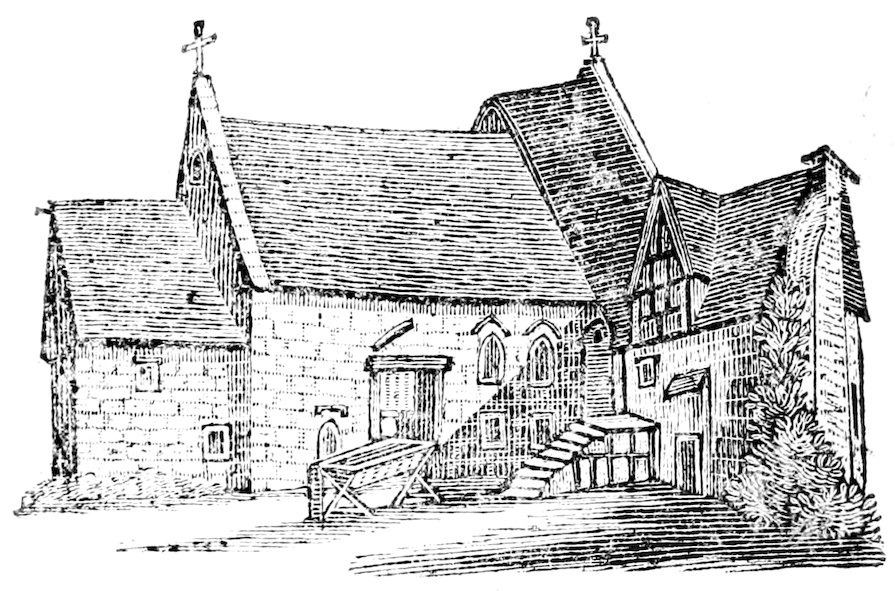
The preceding view of Hereford was made
in the summer of 1794, at which time the
tower of the cathedral was surrounded with
a scaffold, and the whole of the building
under a thorough repair, from the dreadful
accident that happened in the year 1786;
On the 17th day of April in that year,
about half past six in the evening, the west
tower of the cathedral with part of the
body of the church unfortunately fell down.
The above accident did not happen without
giving evident signs of gradual decay,
both from the dropping of many stones,
and the settling of the arches, which had
been remarked for two or three years previous
to the event. This dreadful catastrophe
53was sufficiently foreseen to prevent
any fatal consequences. No lives were
lost though many persons were passing the
church yard at the time, and we of this day
have the less reason to deplore the accident,
as the rulers of this church, have had the
good sense to make use of the rare talents of
an architect, whose knowledge of the Gothic,
and natural taste for grandeur and simplicity,
so peculiarly fitted him for the office
of restoring this venerable fabric to its true
characteristical dignity, and who does not
appear to have deviated from the original
design, where it was possible to conform to it.
One principal improvement has been the
removing some walls that encircled a material
part of the church, by which means
a view was opened, of two beautiful chapels,
called Stanbury and Audley, that had
been long concealed from the public eye.
Mr. Wyat’s estimate of the repair of
54this building was seven thousand pounds, five
thousand of which was raised by subscription.
But I am informed that to complete
this repair, the whole expense will amount to
at least thirteen thousand pounds.
This magnificent structure has ever been
considered by the antiquary, notwithstanding
its irregularity, as a splendid specimen of the
piety and munificence of our early churchmen;
and the arched roof of the upper cross
aisle, supported by a single pillar, is peculiarly
deserving attention. Tradition says, it
was erected in the reign of William Rufus,
by Robert de Lozinga, second bishop of the
see of Hereford. The height of the tower
was one hundred and twenty-five feet, upon
which was a lofty spire, that has, since the
accident, been taken down.
On the site on which this cathedral
stands there was anciently a church, founded
55during the zenith of the Saxon heptarchy
about the ninth century, soon after which
it became a cathedral, and Hereford was
made the see of a bishop. The cathedral
was destroyed, and the city sacked in the
reign of Edward the Confessor, by Griffin
prince of South Wales who made the
bishop prisoner. At the Norman invasion
the city was in ruins, and within its walls
and the suburbs, there were not, according
to doomsday book, more than one hundred
and three men.
At a small distance from the cathedral
stands the vicar’s college, it forms a square,
within which is a plain but venerable cloister.
From its elevated situation, it commands a
beautiful view of the meandering course of
our river Wye, and its fertile and verdant
banks. Although it is not the professed intention
of this work to enter into a minute
history of cities, or towns, yet the antiquity
56of this venerable place demands our
attention, and cannot be passed over in
silence, we shall therefore mention the once
elegant building of the chapter house, of
which, though but a small fragment presents
itself, there is yet sufficient of the
picturesque to attract the notice of the
curious traveller, nor can the remains of
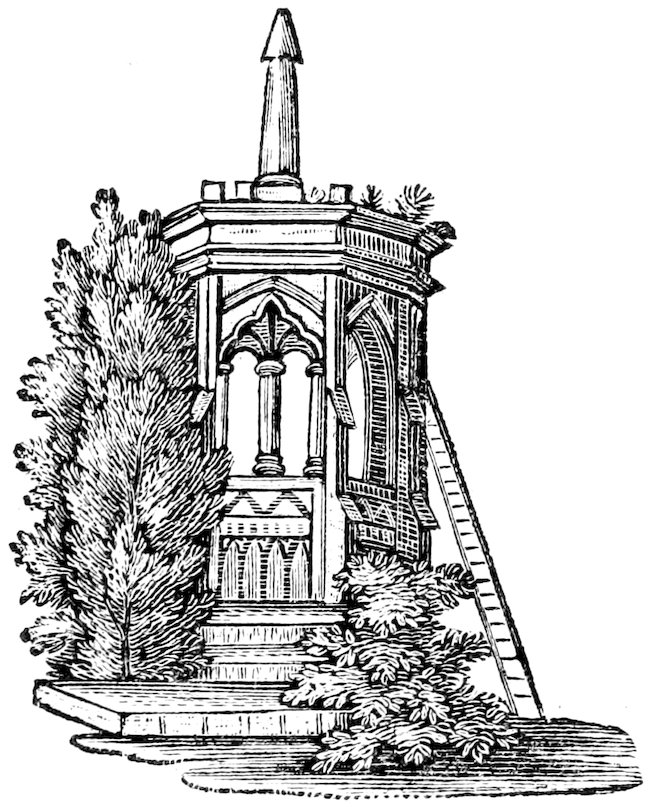
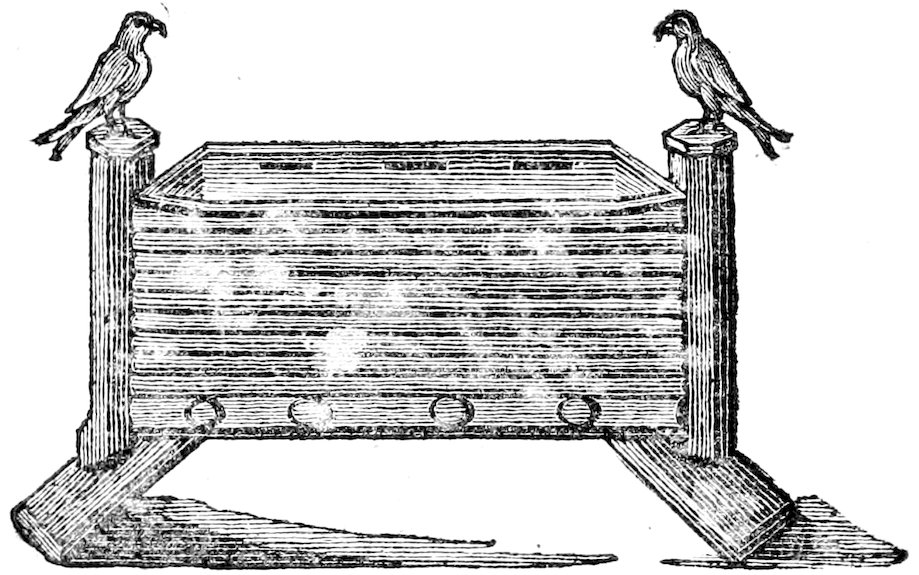
the Black Fryars with its beautiful cross, or
rather stone pulpit, be passed unnoticed,
the latter is here preserved in a wood cut
from a sketch made on the spot in 1794.
57The building is Hexagonal, open at
every side, and round it is a flight of six
steps. The shaft of the cross which is broken
off, rests on a table of the same form
in the centre of the building, and spreads
itself towards the roof in ramifications
that produce a very beautiful effect. Some
of the embattlements yet remain on the
upper part of the building, the whole
of which appears to have been finished
with great care and elegance. From this
building, sermons were delivered by the
fryers, who were then extremely popular,
to the multitude who were sheltered under
the cloister, that it is presumed, surrounded
this building. An hospital in
1614, was founded on the site whereon
stood the black fryars, by Sir Thomas
Coningsby of Hampton Court, in this
county, who was then proprietor of the
ruins, and by him it was endowed with
considerable estates in Leicestershire, and
58was intended as a relief to the worn out
soldier and superannuated faithful servant.
The city of Hereford, appears by its
remaining walls, to have been well and
regularly fortified, and its castle must have
been a very capital fortress. The site
whereon it stood retains the name of Castle
Green, and affords a pleasant retreat, commanding
a very beautiful view of the river
beneath and of the surrounding country.
This being a remarkable dry season, barges
have been laying at Hereford for upwards
four months, for want of water to carry
them down.
The principal articles of navigation are
timber, bark, and grain, and the back carriage,
is coals from Ledbrook and other
places below Ross. Hereford is not favourably
situated for manufactures or commerce.
It is ill supplied with fuel, and that not
59good, and the uncertain state of the river,
from its shoals and great rapidity, prevents
that constant and uniform navigation which
can alone support a regular and extensive
trade. To remove these barriers, several attempts,
I am informed, have been made, but
the estimate of expenses has been so enormous,
that the measure has always proved
abortive.
Quitting Hereford, the Wye bends its
course round a point of land for a distance
of near two miles, when we are again
brought almost as near to the town, as
when we quitted it. The river as we
passed down, still continued its circuitous
windings, but with a more placid surface,
seldom meeting any obstruction in its
course, from those rocky substances that
formed the grand characteristic of the
stream in its earlier stages. The general
face of the country is rich in verdure,
60and the cattle grazing on the banks of
the river or laving in its stream, are objects
that perpetually contribute to enliven the
scene.
About six miles below Hereford, the
Wye receives the river Lug, one of the
three principal rivers in this county; it derives
its source from the mountains in the
north east part of Radnorshire, and running
east, through Herefordshire to Leominster,
takes a south east direction towards the
Wye; in its course it is joined by several
smaller streams, and on its near approach
to our river, becomes a stream of considerable
magnitude. About a mile from
the bank of the Wye, this river runs
through the pleasant village of Mordiford,
and adds much to the picturesque scenery of
the place. On the east end of the church
of Mordiford is represented in plaster, an
enormous dragon or serpent, the history of
61which is thus recorded. Some centuries ago,
we know not when, a dragon is reported
to have been the devourer of all the cattle
on the adjoining hills called Offwood, and
was a monster of such terrific qualities, that
no one could for a great length of time, be
found bold enough to undertake his destruction,
till at length a pardon being granted
to a condemned criminal, on condition
that he would undertake it, he achieved his
purpose, by slaying the dragon as he was solacing
himself in a cyder hogshead. This
wonderful relation, seems to be generally credited
by the people in the neighbourhood,
as no doubt it was at the building of this
edifice, or this strange monster would not
have been represented in so terrific a form,
and in so conspicuous a place as the front of
the church. After relating this wonderful
circumstance, may we be permitted to quote
another, not less so from the learned Camden.
He says, that “near the conflux of
62the Lug and the Wye, eastward, a hill
which they call Marcley hill, did in the
year 1575, rouse itself as it were out of
sleep, and for three days together, shoving
its prodigious body forward with a horrible
roaring noise, and overturning every
thing in its way, raised itself (to the
great astonishment of the beholders) to a
higher place; by that kind of earthquake,
I suppose, which the Naturalists call Brasmatia.”
On a hill adjoining the village,
a large stone house has been recently erected
by a Mr. Hereford, which deserves notice
from the extensive and beautiful view it
commands of Hereford and the surrounding
country.
About a mile below Mordiford, we
pass a large brick mansion belonging to the
Duke of Norfolk, called Holme Lacy, formerly
the seat of the ancient family of the
Scudamores. On this site stood an abbey
63for Premonstratensian cannons, dedicated to
the Virgin Mary and Thomas a Becket,
founded by William Fitzwain in the beginning
of the reign of Henry the third;
the house is a flat uninteresting building,
but comprises within its view a beautiful
and picturesque prospect on the opposite
side of the river, called Fownhope. The
village is situated amidst a rich thicket of
verdant and woody scenery, on an extensive
slope rising from a rocky bank of the
Wye.
This richly diversified hill, is at a proper
distance from the eye, to enable it distinctly
to mark the several species of trees
of which it is composed; these cannot be
more aptly described, than in the lines of
Dyer, on a similar subject, in his charming
poem of Grongar Hill.
64“The gloomy pine, the poplar blue,
“The yellow beech, the sable yew,
“The slender fir, that taper grows,
“The sturdy oak, with broad spread boughs.”
Amongst the few houses that are scattered
on this beautiful scene, the principal
are those of Mr. Lechmere, and Mr. Purchase,
who has a considerable brewery here.
A little below the next bend of the river, a
range of hills called Capler hills, form a rich
screen to the northern bank of the Wye.
These hills are upwards of a mile and a half
in length, and are principally covered with
oak trees, the soil which is of a reddish
cast, frequently breaks through the verdure
of its plantations, and gives a warm and
animated tinge to the landscape. A high
road passes the summit of these hills, that
commands a beautiful prospect of the surrounding
country, and the meandering river
beneath. Near Brookhampton on Capler
hill, is the remain of a very large square
65camp called Wobury, it appears to be double
trenched, but narrow and near half a
mile in length. About five years ago, near
three acres of these hills fell into the Wye
and narrowed its course, but it has from
that circumstance, obtained a more considerable
depth than we have before witnessed
in this river, being now in a dry season, upwards
of five feet deep.
On the left of the river, at Aramstone,
is a fine view of the village of King’s Caple
situated amidst a beautiful assemblage of
woods. Below this spot on the opposite
bank is Harewood, the residence of the Hoskins’s
an ancient family in the county of
Hereford. This place is peculiarly worthy
notice, as it composed part of the forest of
Harewood, in which Ethelwold, king Edgar’s
minister had a castle. Here Mason fixed the
scene, for his dramatic poem of Elfrida, and
thus he describes the scene before us
66“How nobly does this venerable wood,
“Gilt with the glories of the orient sun
“Embosom yon fair mansion! the soft air
“Salutes me with most cool and temp’rate breath;
“And as I tread, the flow’r besprinkled lawn
“Sends up a gale of fragrance. I should guess,
“If e’er content deign’d visit mortal clime,
“This was her place of dearest residence.”
From hence amidst a rich and woody
country, admitting from its sameness little
variety worthy either the pen or pencil, we
pursued our course down the gentle stream
till we reached the pleasant village of Selleck;
its church is of a singular construction,
and no less so is that of an epitaph I
copied in the church yard, on the tombstone
of one Richard Addis who died in
1788, aged 80.
“When Christ come riding on the clouds
“To view the world abroad,
“Angels and saints crying aloud
“Rise dead and meet the Lord.”
On the opposite side of the river, a
67little below Harewood, is a fine grove of
trees called Caple Tump, where an annual
festival is held from all the neighbouring
towns, and where
“All the village train, from labor free,
“Lead up their sports beneath the spreading tree.”
About two miles below Selleck, we
were gratified with the most beautiful and
luxuriant view of Ross, that I believe the
country from any point affords.
SECTION V.
69
On the approach to Ross, a fine amphitheatre
of trees called Ashwood skirts the
southern bank of the Wye. From this
charming spot, near three miles above Ross,
the annexed view which comprehends the
principal objects that compose the beautiful
in picturesque landscape was sketched.
The town is situated on the declivity of a
hill at a happy distance, and not too obtrusive
on the eye; the rising hills with which
it is screened give a boldness of character to
the situation, nor is the winding of the river,
and verdure of the country that enrich
its banks, less characteristic of this delightful
neighbourhood. The hill to the right of
the town is called the Chase, and that on the
left, Penyard-wood, on which formerly stood
a castle, said to have been destroyed in the
70civil wars. The white spire of Ross
church “bosomed high in tufted trees”
has at this distance an effect peculiarly
pleasing, but on a nearer approach, the
town obtrudes too much on the eye, and
the picturesque and beautiful, gradually
disappear.
Ross, abstracted from its elevated and
delightful situation, has little to render it
worthy attention; the prospect from the
church yard a spot to which the traveller
is generally conducted on his arrival, displays
a very extensive and enchanting landscape
both above and below the town.
The beautiful and meandering course of
the river beneath, enriched with pleasure
boats constantly in motion, in their passage
to and from Chepstow, gives life and beauty
to the scene. These boats are lightly constructed
and are navigated by three men, either
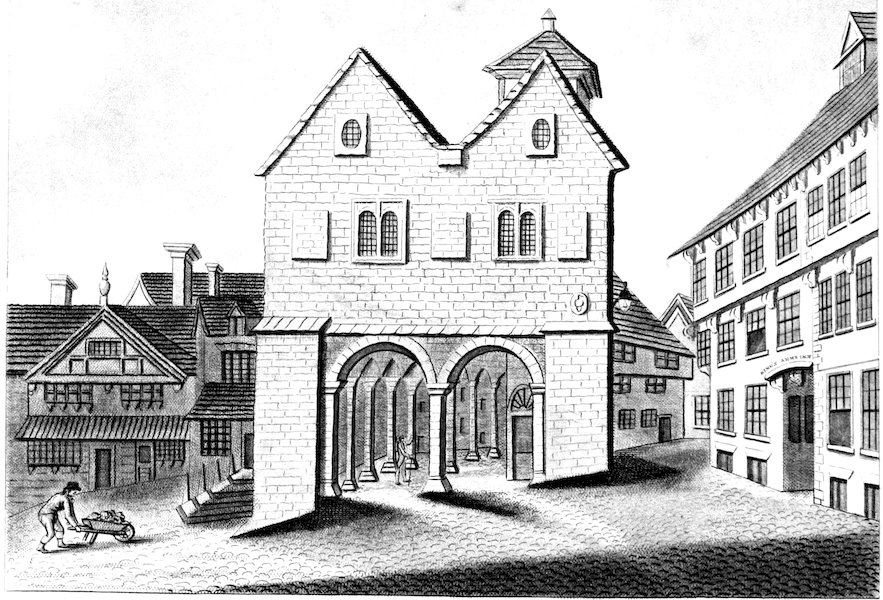
71with or without a sail. The heavy
mass of building called the Town Hall,
from its general appearance conveys a faint
idea of the worst style of Saxon architecture;
it is a ponderous and unmeaning
heap of stone, huddled together in the
tasteless reign of James the first, by one
John Abel who erected a similar building at
Hereford; they vie with each other in want
of taste, and have nothing to render them
worthy notice but their absurdity, which I
believe is not to be equalled by the dullest
architect of that or any other period. At
one end of the building, intended I presume
as an ornament, there is a noseless bust, supposed
to be that of the merry monarch
Charles the second. In such a state of decay
is the stone of which this edifice is composed,
together with the heavy style of its
architecture, that it has every appearance of
having been erected as far back as the
time of the Saxons.
72Notwithstanding the disadvantage
under which this building labors, I have
yet considered the general view of which it
forms a part as not devoid of interest, it
comprises the house in which the man of
Ross resided till his death, now known by
the sign of the King’s Arm Inn. As every
the most trifling circumstance relative to a
character so highly distinguished by the pen
of Pope, and still more highly dignified by
the general voice of the people of Ross becomes
interesting, I have here thought fit
to give a view of the house in which he
resided, and the adjoining buildings.
To the benevolent John Kyrle, a name
almost lost in the superior title of the
Good Man of Ross this town owes most
of its improvements and charitable institutions.
S. Ireland del.
Market house &c.
Pub. for S. Ireland Mar. 1, 1797
He was born at Whitehouse, in the
73parish of Dymock, in the county of Hereford
in 1637, served the office of sheriff for
the county in 1683, and died in 1724.
From an income of only five hundred
pounds a year, this good man appears to
have derived every happiness to himself and
to have diffused it with uncommon benevolence
to all around him. This exemplary
character has been so interestingly
delineated by the pen of Pope, that the introduction
of the following lines although
well known, will need no apology for their
insertion in this work.
“Rise honest muse! and sing the Man of Ross:
“Pleas’d Vaga echoes thro’ her winding bounds,
“And rapid Severn hoarse applause resounds.
“Who hung with woods yon mountain’s sultry brow?
“From the dry rock, who bade the waters flow?
“Not to the skies in useless columns tost,
“Or in proud falls magnificently lost,
“But clear, and artless, pouring thro’ the plain
“Health to the sick, and solace to the swain.
74“Whose cause-way parts the vale with shady rows?
“Whose seats the weary traveller repose?
“Who taught the heaven directed spire to rise?
“The Man of Ross, each lisping babe replies.
“Behold the market-place with poor o’erspread!
“The Man of Ross divides the weekly bread;
“He feeds yon alms-house, neat, but void of state,
“Where age, and want sit smiling at the gate;
“Him portion’d maids, apprentic’d orphans blest,
“The young who labor, and the old who rest.
“Is any sick? the Man of Ross relieves,
“Prescribes, attends, the medicine makes, and gives.”
“Is there a variance? enter but his door,
“Balk’d are the courts, and contest is no more.
“Despairing Quacks with curses fled the place,
“And vile Attorneys, now an useless race.
B. “Thrice happy man! enabled to pursue
“What all so wish, but want the power to do!
“Oh say, what sums that gen’rous hand supply?
“What mines to swell that boundless charity?
P. “Of debts and taxes, wife and children clear,
“This man possest—five hundred pounds a year.
“Blush, grandeur, blush! proud courts withdraw your blaze,
“Ye little stars! hide your diminished rays.
B. “And what? no monument, inscription, stone?
“His race, his form, his name almost unknown?
P. “Who builds a church to God, and not to fame,
“Will never mark the marble with his name;
75“Go, search it there, where to be born and die,
“Of rich and poor makes all the history;
“Enough that virtue fill’d the space between
“Prov’d by the ends of being, to have been.”
The allusion of the poet, to a neglect in
not raising a monument to the good man’s
name, no longer exists, for in 1776 a neat
mural tablet was erected to his memory in
the chancel of the church, by Colonel Money,
to defray the expence of which, the sum
of three hundred pounds was bequeathed by
a Lady Kinnoul, whose property devolving
to the Colonel, the good intention of the
lady was by him accomplished. On this
tablet the following lines are inscribed.
“This monument was erected in memory
of Mr. John Kyrle, commonly called
the Man of Ross.”
It is somewhat singular that neither his
age, nor the time of his death, are here
76mentioned. The design for the monument
was made by a Mr. Marsh of this town,
who has introduced a bust of the good man
that bears little resemblance to either of
the two portraits I met with in Ross; one
of these is in the possession of Philip Jones
Esq.; a gentleman, who by marriage with
a descendant of John Kyrle, enjoys all his
property, and by his urbanity renders himself
a worthy representative of that exemplary
character. This picture appears to be that
of a person about thirty six years of age,
and is evidently the work of Sir Peter Lely.
The other portrait was at the King’s Arms
Inn, formerly the residence of John Kyrle,
as described in the view given in this section,
it represents him at a more advanced period
of life, and on that account, although ill
painted, it was preferred to the former as
he is exhibited nearer the close of a life,
long and happily spent in the promotion
of virtue, and to the honor of human
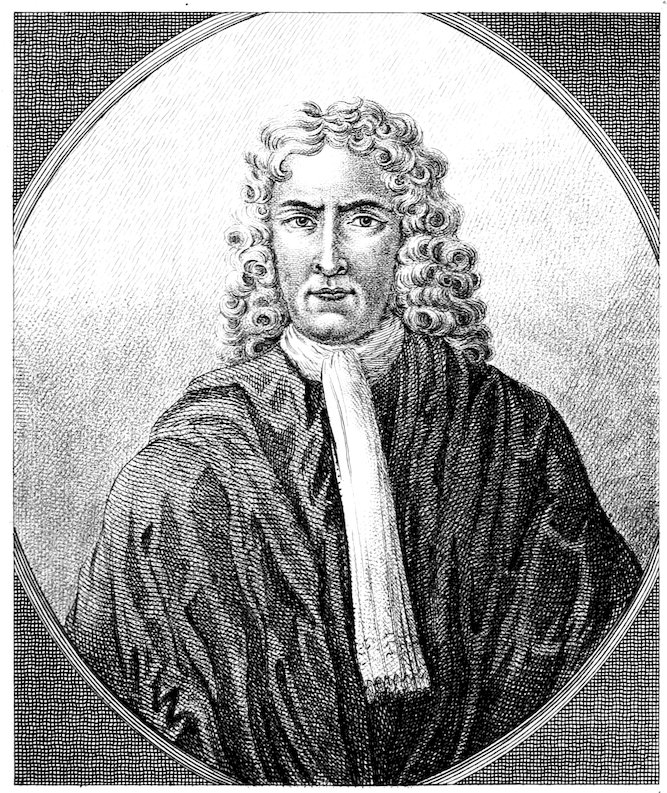
nature. I flatter myself the annexed etching
from this picture will not prove unacceptable
to the admirer and collector of portraits, as
I do not remember to have ever seen a
print of this exalted character. The original
is said to have been sketched from the
life unknown to Mr. Kyrle, on a Sunday
whilst he was attending divine service. He
had often been solicited to sit for his picture,
but no inducement could prevail on
him to comply with the request of his
friends.
F. Barlow sculpt.
John Kyrle,
Commonly called the Man of Ross.
77It is reported of Mr. Kyrle, that his
ordinary mode of dress, was very plain, and
so mean as even to suggest the idea of indigence
and want. And even more unfavourable
conclusions have been made, from
his general appearance, for upon no better
foundation, it is said that when travelling
in Oxfordshire on horseback, he was apprehended
near Benson, upon a suspicion of
78having committed a robbery in a neighbouring
county. I need not add that this
charge was dismissed the instant his name
was made known to the magistracy.
We cannot quit this town without noticing
to the picturesque traveller, a charming
walk made by Mr. Kyrle, which led to
what he called his farm, it commands a
beautiful view of the devious windings of
the river beneath, and Wilton castle, bridge,
&c. on the opposite shore.
SECTION VI.
79
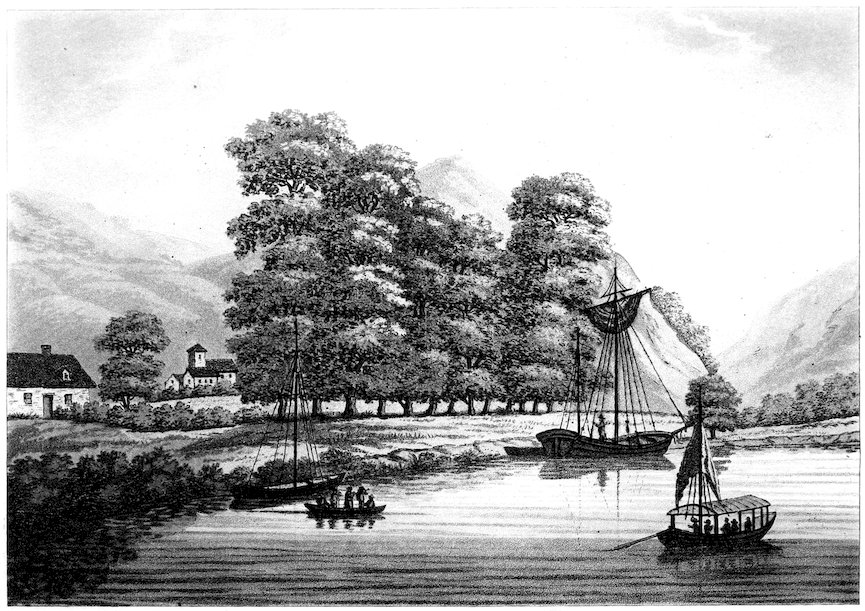
About a mile below Ross, Wilton
Castle first attracts our attention. This
ruin is situated on the margin of the Wye,
and affords with its surrounding objects in
many points of view, scenes not unworthy
the attention of the antiquary or admirer of
picturesque objects. Its western walls and
round towers are in the most perfect state
of preservation, but the annexed view, comprising
a part of the bridge, is selected as
most appropriate to the design of this work
and to exemplify the course of the river.
The castle has formerly covered a considerable
extent of ground, the greater part of
which is now used as a garden. Camden
says “that king John gave Wilton with
the castle to Henry Longchamp and that
80it came by marriage to William Fitzhugh,
and not long after, in King Edward
the first’s time, to Reginald Grey,
Justice of Chester, from whom by a long
descent it came to Lord Grey of Wilton,
whose son Arthur Lord Grey was Lord
Deputy of Ireland.” This noble person
merits particular attention, as having been
the early patron of our Spencer the poet,
who accompanied him to Ireland as his
secretary.
In the county of Cork, at a place called
Kilcolman, Spencer is reported to have finished
his excellent poem of the Fairy Queen.
The River Mulla, so often mentioned by
him, ran through the grounds of the house
in which he resided. His gratitude to his
patron is thus recorded, in a sonnet addressed
to him, and is prefixed to the poem.
81“Most noble lord the pillor of my life,
“And patrone of my muses pupillage:
“Through whose large bountie, poured on me rife
“In the first season of my feeble age,
“I nowe doe live bound yours by vassalage;” &c.
At what period Wilton Castle went out
of the family of the Greys is not mentioned,
but it afterwards belonged to the Lord
Chandos, from whom it descended to the
duke of Chandos who built Canons in
Middlesex. The remains of this castle, with
Aconbury, Dewfall, and other considerable
estates in the neighbourhood belonging to
this family, amounting to near four thousand
pounds per annum, were sold some
years ago to the governors of Guy’s Hospital.
The castle is reported to have been
principally destroyed by fire, but at what
period is not ascertained. In support of this
idea we observed, that towards the ends of
the timbers, many of them appeared to have
82been much burned. On this spot an assemblage
of rich and woody scenery, forms the
leading feature of the vicinity of our river,
and about two miles below Wilton bridge
I would advise the admirer of the truly
grand in landscape, to ascend the hill in
the high road to Monmouth, where at a
place called Pencreek, the eye is feasted
with one of the most magnificent views
this river affords. The distant church of
Ross, its neighboring woods and hills, and
the meandering course of the Wye, all combine
from hence to form this fascinating
scene. Here the course of the river is peculiarly
marked, its channel is nobly formed,
and wears a grandeur not to be met with
in any other river we have yet seen in this
country.
Amidst a variety of enchanting views,
passing from one bend of the river to another,
Goodrich castle, on the summit of a
83bold promontory, amidst an elegant woodland
scene, nobly raises its ruined battlements,
as if frowning on the stream beneath.
On ascending the hill to contemplate
the spoils of Time, who ravages alike the
forms of beauty and the tower of strength,
by leaving for a moment the ordinary path
and passing up what is called Conduit hill,
Walford church, Ross, and the surrounding
country, at a happy distance, combine to
form a landscape of peculiar richness and
beauty. History does not inform us at what
period this castle was erected, but we find
that early as the fifth year of the reign
of King John, William Marshall, Earl of
Pembroke had a grant of it. From this
family it came to Talbot, Earl of Shrewsbury,
in the reign of Edward the third, and
in the twentieth year of Richard the second,
Sir John Scudamore of Holme Lacy was
constituted its constable, during the minority
84of John Lord Talbot, in whose family
it continued till the fourteenth of James
the First; at which period Gilbert Talbot,
Earl of Shrewsbury died, leaving three
daughters his coheiresses. Elizabeth the
second daughter was married to Henry de
Grey, Earl of Kent, by which marriage he
became possessor of this manor, which continued
in the family till the death of Henry
Duke of Kent in 1740, after which it was
sold to Thomas Griffin, Esq.; Vice Admiral
of the White, whose second son, the Reverend
Dr. Griffin of Hadnock near Monmouth,
is its present owner.
This celebrated castle was nearly square,
covering a space of ground forty eight yards
by fifty two; it was defended at each angle
by four large round towers, one of which
formed an irregular Heptagon. Through a
perfect Gothic arch, we are led to a spacious
hall of good proportion overgrown with ivy,
85adjoining which is an area, presenting the
remains of a lofty square building, with circular
arched windows in the Saxon style,
resembling Gundulph’s tower at Rochester
castle. By the fragment of a stone staircase,
we ascend another embattled tower, through
which at a great depth appears the immense
fosse, or trench, which is hewn out of a
solid rock, and is twenty yards in breadth.
Here was once a draw-bridge and two gates
with recesses between each, evidently intended
as places of safety for its guards, who
unseen might annoy the enemy. The various
points from which this castle may be
viewed to advantage, would afford ample
matter for the antiquary, artist, and military
architect.
Quitting this spot, several views of
the castle presented themselves, but they
were all undignified and uninteresting when
compared with those we had before contemplated.
86The country on the opposite side of
the river towards the village of Walford, is
peculiarly beautiful. In the church of Walford,
one of the aisles is now called Kyrle’s
chapel; it was erected by that family for
their private use, before it became a parochial
church; about a mile below the castle, is a
small remain of Goodrich priory; a few Gothic
windows are yet standing, and part of
the chapel which is now converted to a granary;
the whole affords an object sufficient
to attract the notice of the curious.
87This priory was a monastery of the order
of black cannons regular of St. Augustine,
founded and endowed with the king’s
licence in the twentieth year of Edward the
fourth, 1347. Its situation corresponds with
the happy choice usually made by the ancient
possessors of religious houses, it stands
in a fertile valley, watered by one of the
finest rivers in the kingdom. The building
with the lands contiguous to the castle are
occupied by a Mr. Bellamy. From the
ascent, approaching the village of Goodrich
a rich and extensive view presents
itself across the forest of Dean, from whence
Rure-dean church happily breaks upon the
eye.
Here the Wye in a long and serpentine
reach, appears in a perspective point of view
and affords a pleasing and happy termination
to the scenery; its banks are screened on the
south, by an extensive coppice wood, and on
88the north, by fertile meadows rising towards
Bishop’s-wood, from which a considerable
iron furnace in this vicinity derives its name.
From the stone quarries in this neighborhood,
the new bridge at Bristol was principally
erected.
Passing down the river, the next object
that attracts our notice is Courtfield,
the seat of the Vaughan family.
This spot is rendered remarkable from
Henry the fifth having been nursed in the
neighbourhood. That prince we are told,
was when young of a weak and sickly habit,
and was placed under the care of a countess
of Salisbury, from which circumstance
in all probability, the original name of this
place which was Greyfield, was changed to
the appellation it now bears. We next approach
Lidbroke colliery and very large and
extensive wharf, from whence a considerable
89commerce in coals is carried on to Ross,
Hereford and other places. This productive
mine is the property of Lord Gage. With
all the dark and dingy attributes of this
place, involved as it is in smoke, and begirt
with coal barges, it yet affords a very pleasing
and interesting landscape. The high
road that ascends the woody hill, screening
the back ground of this wharf, is perpetually
enlivened by horses and carriages
in this sooty sable commerce, while on the
bank of the river beneath, the lading and
unlading the vessels, afford additional business
and variety to the scene. This view
is finely contrasted on a sudden bend of the
river a little below, where all is tranquil and
serene. The picturesque village of Welch
Bicknor presents itself in a rich valley on
the right bank of the Wye, happily overshaded
by a thicket of woods, ranged in a
grand and circular sweep. These are called
90Hawkwood and Packwood, and extend about
a mile along the bank of the river. The
village church and parsonage house, group
in a form peculiarly beautiful and interesting.
In the body of the church, fronting the
reading desk, is a cumbent whole length female
figure, well sculptured in a darkish coloured
stone. Traditional report says it represents
the countess of Salisbury, whom
we have just mentioned as having nursed
king Henry the fifth. She holds a child in
each arm. This effigy is highly worthy of
notice. The drapery is in a loose and free
style, and the general contour of the whole
bespeaks it the work of an artist of talent.
A little below this scene, the Wye is bounded
on the opposite shore by a long range of
hills, beautifully cloathed with verdure, and
diversified by a rich and broken soil of a
91warm and reddish hue, frequently over
clouded with shades of smoak that issue
from the various kilns, kept continually
burning near this spot. These circumstances
trifling and adventitious as they may
appear, give relief and effect to the picturesque
and beautiful in landscape. Approaching
the foot of Cold-well rocks, a
scene sublime and majestic presents itself.
The grand prominencies are overhung with
richly varied tufts of oak, and other shrubberies,
occasionally contrasted and relieved
by deep and shadowy dells, formed by the
various lime kilns on their surface. Some
of the most prominent of Cold-well rocks,
we are informed, have by some gentlemen
of the bar, in their passage down this
river, been christened after the names of
our principal council. The connection is
not obvious, or readily traced.
92Here we quitted the barge to ascend
these majestic rocks, which by an immense
and craggy steep, we with difficulty accomplished,
and reached the summit called Symond’s
Gate. This task, arduous as it is
should not deter the traveller from pursuing
this course, as by means of it he will
avoid a dull and uninteresting passage on
the water of full three miles to the new
Weir, and by passing over these rocks he
will enjoy a sublimity of scenery that will
amply repay his toil and labour. As we
ascend these superb masses of stone, the rich
and extensive scenery that surrounds us, is
every moment unfolding itself: the summit
is richly overgrown with wild thyme, and
variegated flowers, and is crowned with the
rich and deep foliage of the noble oak
“Here all the air a solemn stillness holds”
save the distant lowing of cattle, and from
93his rocky bed, the dirge like evening song
of the owl, that floats along the gale.
From hence Goodrich castle, which
we imagined we had left far behind, breaks
suddenly upon the eye, and appears from
the immense winding of the river to be a
near object. The new weir, and adjoining
waterfall, with the surrounding rich and
healthy hills afford from this spot a combination
of objects, that deservedly rank
among the first views on the river, or perhaps
in this country.
The village of Whitechurch in the centre
of the vale beneath, with the vast hills
beyond it, afford a sublime termination to
this reach of the river.
At Whitechurch is a second ferry called
Hunson’s Rope. This ferry although seven
94miles distant by water from that of Goodrich,
is only one mile by land, a striking instance
of the very appropriate and characteristical
title of our river, which from its
mazy and circuitous course, is justly denominated
the Vaga, or Wye.
SECTION VII.
95
Descending towards the new Weir
by a course not less rugged than that by
which we ascended, the fatigue we had undergone,
was amply repaid by the gratification
we received in some of the most beautiful
views that can be imagined. These
presented themselves through the various
breaks of the rocks, or openings of the surrounding
woods with which they are enriched.
The serpentine winding of the
river, and the vast prominencies and fantastic
forms of the rocks in its vicinity, give
an air of solemn gloom and grandeur to the
scene. From the approach to the Weir,
the annexed view was selected, it comprises
all the principal objects that could
be admitted within the limits of a scale so
circumscribed. The innumerable circumstances
96that aid this grand and sublime
scene, are such as to render it almost impossible
for the pencil, to render it justice.
The iron forges on the opposite side of the
river, not less from their appearance than
from the important purposes they answer
in human life, give an interest to this effusion
of nature, while the awful sound of the
iron hammers beating the fiery mass, awakens
in the mind new sensations giving
dignity and grandeur to the subject. This
picturesque scene is much heightened by
the immense volumes of sparkling smoak
that are continually issuing from the forges,
these give a pleasing though transitory relief
to the sombre, and distant hills that
terminate the view. Around these works
are scattered great masses of half burned
ore, coal, and cinders, and interspersed on
the barren and extensive moor in the vicinity,
are many humble cottages of the various
workmen employed in the manufactory.
97The roaring of the waters from the
cascade of the Weir adjoining to this work
has a grand effect, its fall is precipitate although
at no great height, nor is it perceived
from above the stream.
The river here receives a considerable
degree of agitation from the huge masses of
stone, either swept down by the stream, or
hurled from the summit of the neighbouring
rocks. Here the Wye increases in
width, and its current is so strong, that
it is with extraordinary labour and difficulty
the barges are towed up. I have seen
eight or ten men throwing themselves on
the earth on every pull, to give force to their
exertions.
In this part of the river is frequently
seen a small fishing boat on a singular construction,
called a corricle, it is ribbed with
laths or split twigs, and is covered with a
98strong pitched canvas, to prevent its leaking,
it is about five feet and a half long
and four broad. In the middle is a seat
that holds one man, who sits with a paddle
in one hand while he fishes with the other.
His labour finished, he throws the corricle
over his shoulder and retires to his home.
A little below the weir the river scenery
is terminated by what is called King Arthur’s
plain, or Doward hills. To the traveller
who is bold enough to attempt the
summit of these hills, the views will afford
ample variety both in the beautiful and sublime.
Camden conjectures, that on these
hills there has anciently been a fortification,
and what makes it more probable is, that
in digging there for iron ore, and lime
stone, he says “broad arrow heads have
been found, and not long ago, the greatest
part of the bones of a gigantic person
were found here interred, in a place
99“that seemed to be arched over.” Whatever
may have been the ancient destination
of this spot, its present attractions proceed
from the very extensive and richly diversified
prospects that present themselves from every
point of view. On a spot adjoining to the
wood on the extremity of this hill, is a cavern
that bears the name of King Arthur’s
Hall; it is said to extend by a
passage from hence to the new weir, a distance
of about a mile. Many fabulous
and romantic tales have been attached to
the history of this hall, but the fact appears
to be simply this, that it was a cavern,
from whence was dug a rich mine of
iron ore, that supplied the adjoining furnaces.
A detached cluster of rocks called St.
Martins’, or the three Sisters, somewhat resembling
but much inferior to those at Cold-well,
skirt the river in passing down, near
100which at a short reach called St. Martin’s
Well, the stream is supposed to have a greater
depth of water than in any other part.
At the extremity of this reach from a beautiful
vale, King Arthur’s plain again presents
itself, assuming a new and castellated form,
and here every stroak of the oar gives variety
to the scene, and every object seems to
vary its situation. The vast assemblage of
rocks we have just contemplated, appear
to vanish and melt into a distant hill, rising
from a craggy base on the margin of
the river.
About two miles before we reach Monmouth,
Hadnock house and the beauties of
its situation justly demand our attention.
It is situated on the edge of the forest of
Dean, and stands on the brow of a hill,
commanding a fascinating view of the meandering
Wye, that gently glides beneath its
rocky hills: these are enriched with verdant
101coppice woods that screen this beautiful
spot, the residence of the Rev. Dr.
Griffin, whom we have before mentioned.
From hence along the base of the hills, a
road running parallel with the river that
leads on to Monmouth.
SECTION VIII.
103
Quitting Hadnock, we are gratified
with a distant view of the bridge and town
of Monmouth. The solitary church of
Dixton on the opposite bank of the river,
although deficient in accompaniments is yet
a characteristic and interesting feature in the
fore ground of the landscape; and it continues
to be such, though since this drawing
was executed, its interior received in the
great flood in 1795 very material injury;
the water having forced its way through the
windows and doors, and torn up pulpit,
pews and pavement.
Monmouth bridge is of stone, and
consists of six irregular arches. The town
derives its name from its situation at the
104conflux of the Wye and Mynwye, generally,
and by the Welsh particularly pronounced
Monnow.
A great part of Monmouth is encompassed
by this river which empties itself
into the Wye at the lower end of the town;
where a very ancient bridge and gateway,
formerly a barrier against the Welsh, is
thrown across this mountain stream. It is
somewhat extraordinary, that neither history
or tradition, although they are both
mentioned by Leland in his itinerary, afford
any information as to the period in which
they were built. Independent however of
historical evidence, they bear such unequivocal
marks of antiquity, that the picturesque
effect they produce, gives them ample claim
to a place in this work. The annexed plate
will we flatter ourselves, convey a faithful
representation of this venerable remain, and
105in some degree illustrate the situation of the
town itself; which though low, is seated in a
spot at once both pleasing and romantic.
Monmouth had anciently four gates,
and the suburb was defended by a wall and
deep ditch on each side, except that next the
river. As far back as Leland’s time, the
walls and every other embattled part but the
square tower were in a state of ruin. The
church is an entire modern structure.
Monmouth has high claim to consideration
and respect, from its having given
birth to our fifth Henry the conqueror of
France, whose active spirit, warlike qualities,
and superior skill in horsemanship, particularly
at a time when to be accomplished,
was indispensible to the character of a
gentleman, and the cavalry service began to
be in a manner appropriated to men of this
106rank, are thus enchantingly, and with all
the ease and grace of the gallant and princely
horseman he describes, delineated by our
matchless bard.
“I saw young Harry with his beaver on,
“His cuiffes on his thighs, gallantly arm’d,
“Rise from the ground like feather’d Mercury,
“And vaulted with such ease into his seat
“As if an angel dropp’d down from the clouds,
“To turn and wind a fiery pegasus,
“And witch the world with feats of horsemanship.”
Henry was born in the castle of Monmouth,
of which little more remains than a
few fragments of walls, and an elevation or
mound of earth, just sufficient to ascertain
its site; and to demonstrate how evanescent
and transitory are all human things; the
strong embattled fortress as well as the cradle
of princes. Such once were to be found
on this spot; and that this awful truth may
be more strongly impressed and exemplified,
107though there yet remains more visible and
palpable evidence of one than of the other,
let it be remembered, that the record of
history will retain the memory of the birth
place of Henry, when all traces of the castle
shall have passed away, and even its site shall
as ineffectually be sought after as at this
hour the image of its former splendour.
In this castle Edward the second, after
he had been made prisoner by his queen
Isabella, in 1326, was for a time confined.
Having in the south west direction of the
town, with some difficulty obtained a sketch
of the ruin of the castle that partakes much
of the picturesque, it is here given as an illustration
of this venerable spot. The river
Monnow beautifully winds beneath its
ruined walls, the wooden bridge that is
thrown across the stream, and the rich and
verdant scenery of its hilly bank, all conspire
to produce a landscape highly deserving a
108place in this work. The remains of the
castle, denote it to be of Roman construction,
Camden says that from the king’s records,
a castle was standing here in a flourishing
state, as early as the time of William
the Conqueror, and that it was rebuilt by
John Baron of Monmouth, about the year
1240.
This town has not only the honor of
giving birth to a great king, but likewise
to a great historian, Galfredius Arthurius,
Bishop of St. Asaph, better known by the
name of Jeffery of Monmouth. He is supposed
to have been educated at this place,
which had then a benedictine monastery, or
convent of black monks, founded in 1240
by Wihenoe de Monemue, or Monmouth.
Monasteries were at that time the principal
seminaries for learning in this country, as
Oxford and Cambridge had not then risen
to any great celebrity, and were at that period
much depressed in consequence of the Danish
109invasion. Jeffery was made arch deacon
of Monmouth in 1251, and was soon afterwards
created bishop of St. Asaph. He translated
the history of Britain from the British
language into Latin, a work said to have
been discovered by Walter Mapæus while in
Armorica, and brought by him into England,
where meeting with Jeffery of Monmouth,
a man profoundly versed in the history
and antiquities of Britain, and an elegant
writer for the period in which he lived
the task was entrusted to him. Merlin’s
prophecies he also translated from British
verse into Latin prose. This work was of
essential service to the Welch chieftain Owen
Glyndwr, whose high pretensions to soveriegnty
were constantly favoured and cherished
by these prophecies. The veracity of
Jeffery, as an historian, has been doubted by
many; Camden says that his relation of
Brutus and his successors ought to be entirely
disregarded. It may however be observed
110in favour of this writer, from the
testimony of Giraldas Cambrensis his contemporary,
that at that period the Welch
bards and minstrels from early traditional accounts,
received and transmitted with a mixture
of religious reverence and awe, solemnly
repeated the genealogy of their princes and
heroes, from Roderic the Great to Æneas,
and from Æneas lineally to Adam.
If this should not altogether be thought
to add much to their probable authenticity,
it will serve to warrant the introduction of
the history, to shew at least that he was not
the author of the fiction; and, in tracing
the origin of nations, tales to the full as fabulous
are to be met with in the pages of
many of our gravest and approved writers.
To the few early historians of our own
we owe much, and amongst these Jeffery
deserves every respect, and we are bound to
111regret that in succeeding times, the best
histories of this country will be found to
have been the labors of foreigners. A fragment
of Monmouth Priory, we have preserved
as a tribute to the memory of the
historian who was there educated: The
Gothic window that appears in view remains
very perfect, and appertains to a venerable
ancient chamber, which he is reported
to have occupied as a study. From
the nature of its foundation, the free school
at Monmouth particularly deserves our notice.
Burton, in his history of Wales,
gives this relation of William Jones its founder:
he says, “Wm. Jones was born at
Monmouth, and forced to quit his country
for not being able to pay ten groats.
Coming to London he became first a
porter, and then a factor; and going
over to Hamburgh, had such a vent for
Welch cottons, that he gained a very
considerable estate in a short time. He
112founded a fair school in Monmouth, allowing
fifty pounds yearly to the master,
and a hundred pounds salary to a lecturer,
besides a stately alms-house for
twenty poor people, each of them having
two rooms and a garden, and half a
crown a week; all which he left to the
oversight of the company of haberdashers
in London, who discharge their trust
therein to this day.” Another account of
the founder is thus given, but with less
credibility. That he was a native of Newland,
a few miles distant from Monmouth,
and having quitted it when young to seek
his fortune, he returned at an advanced period
of life, in an apparent state of indigence,
although very rich, and applied to
his native town for relief as a pauper,
which being refused, he took his revenge on
the people by retiring to Monmouth, and
there dispensing that wealth, that was intended
to enrich his native place.
113We cannot quit the pleasant town of
Monmouth without noticing the massive pile
of its gaol. Built in a lofty and healthy spot,
and in the form of an ancient castle; it
frowns over the country, and impresses the
idea of rigorous confinement and the impossibility
of escape. At the time we visited
this expensive and spacious work, it contained
only one solitary inhabitant, and he
a prisoner for only a very trivial offence.
As our gaols increase in magnitude, it is
with pleasure we have frequently had occasion
to remark that there is a decrease of
inhabitants, nor is it less worthy of observation
that the humanity of supplying even
those who least deserve it, with decent accommodation,
as well as the blessing of light
and air, before denied to them, is now most
liberally granted.
Perhaps it may not be too much to
infer from hence, that the immensity of the
114bulk of these buildings, in the conspicuous
situation in which they are now placed, may
impress the multitude with such a terror of
the consequence of crimes, as in some degree
to prevent a commission of them.
This building stands on an eminence, and
commands a fine view of the town and surrounding
country.
SECTION IX.
115
Quitting Monmouth on an excursion
to Rhaglan Castle, we ascended a
considerable hill about a mile from the
town, that afforded one of the most luxuriant
landscapes we had witnessed in the
course of our route. From this eminence,
the rich valley in which Monmouth is situated,
and the beauties of the surrounding
country, are highly illustrative of Gray’s
opinion of the charming situation of this
place. He rapturously describes this scene
as “the delight of his eyes and the very
seat of pleasure.” We have attempted to
give an idea of this much admired spot in the
annexed plate.
The ride to Rhaglan Castle, a distance of
116about six miles, amply gratified us for this
deviation from our main pursuit.
This magnificent remain of ancient
splendor stands on an elevated situation
commonly called Twyn-y-ciros, which signifies
in Welch the cherry hill; and, as we
approach it from the village, appears to
wear that solemn and majestic air highly
characteristic of the spirit of the times in
which it flourished. The external view
here selected, we flatter ourselves will not
only convey the best idea of its extent and
magnificence, but is a point from which
we do not remember to have ever seen it represented.
This noble building, which may
rather be terminated a castellated house than
a castle, is in many parts, still in good preservation.
It was erected in the reign of
Henry VII. and does not therefore boast of
great antiquity; many additions were made
to it about the time of Elizabeth, these
117constitute, the most elegant parts of this
superb pile, and are to be found in the
windows of the grand hall, or banqueting
room; the ornaments of the frieze and cornice
are light and elegant, and in the best
taste of that time. To the left of this hall,
was a large court one hundred feet long,
and sixty feet broad, well arched and ornamented,
with curious stone work both on
the walls and windows. In the midst of
the court was a pleasant marble fountain
called the White Horse: the following remark
of Dr. Griffin, relative to the white
horse may not prove uninteresting. “I remember,”
says he, “some years ago,
they used to shew here part of the body
of a black horse, which stood in the
middle of some water that supplied the
castle, and was a fountain. I was told
the parliamentarians poisoned the water
during the siege, and that the stone horse
absorbed the poison; it was very hard,
118but on being struck, or rubbed with any
hard substance, emitted a very offensive
smell. Perhaps I had the legend very
imperfectly, and it should have been added,
the poison turned the white horse
into a black one.” The castle is surrounded
by a wide fosse thirty feet broad,
wherein was originally placed an artificial
water work, which spouted up water to the
height of the castle, and contains within it
two acres, one of which appears to have
been encompassed with domestic offices, such
as kitchen, brewhouse, &c. and in which
there is an oven, and fire range of such extraordinary
dimensions, as to satisfy us,
that there were times in which they were
not wholly occupied in feats of arms.
In this building every precaution has
been used to guard and secure the approaches
to it; and the utmost magnificence is to be
observed in every part of the interior, even
119in the domestic offices. The staircase and
ascent to the grand apartments are peculiarly
noble; and beneath the areas which are
vaulted, are various subterraneous apartments,
and extensive cellars of the most excellent
workmanship. The citadel, which is
octagonal, is surrounded by a moat, and
stands at a small distance from the castle:
its principal parts are in a perfect state
of preservation. This noble castle is in the
possession of the Duke of Beaufort, whose
ancestor, the Marquis of Worcester in the
time of Charles the first, added and fortified
many extensive out works, by which he was
enabled to hold it for the king’s use till
his imprisonment at Holmby. It once contained
a garrison of eight hundred men, and
was the last castle that surrendered to the
parliament forces, then under the command
of Sir Thomas Fairfax. This event happened
on the nineteenth of August 1646,
and is reported to have been effected by a female
120in the garrison, and by the use of
a very ordinary female engine, the mere waving
a handkerchief, as a signal for the introduction
of Cromwell’s party. If this were
so, politics were probably by no means the
primary incentives of this lady’s zeal, and
there were doubtless secret articles in this
treaty, unknown to the besieging general.
The window at which she appeared is still
shewn.
The more probable account is, that from
the very long siege it sustained, the upper
part was undermined, and the timbers being
burnt a great part of it fell down. Soon
after its surrender, the castle was demolished
and left, in nearly the same state
in which it now remains. The loss to the
family is supposed to be upwards of a hundred
thousand pounds, besides the forfeiture
of an estate of twenty thousand a year.
Three considerable parks of remarkable fertility,
121and richly stocked with deer, once
appertained to this castle.
Returning to Monmouth we resumed
our passage down the Wye, on a morning, one
of the most beautiful ever beheld. The retrospective
view of Monmouth on passing down,
the spire of the church, the town, bridge, and
surrounding scene, though inferior to that
above, yet in some respects exhibited a very
picturesque landscape. The hills opposite
to Monmouth, are called the Kemmin
Rocks, on the summit of which Mr. Philip
Hardwick, an architect, has erected a
stone building for the reception of his
friends, called Philip’s Court. This spot
commands a view most extensive and diversified,
and will well repay the labour of
climbing up what John Bunyan would justly
call Hill Difficulty. To those who visit this
spot it may be worth the trouble of going
122about a mile further to view, amongst
many others, an immense large rock called
the Buck Stone; a name probably derived
from the deer having sheltered themselves
under it when the adjacent country was in
the form of a park. Its situation is on the
extreme edge of the hill; and, though of
an immense size, it stands on an angular
point, and is so nicely balanced, as to be
with a very small degree of force, set in
motion and shaken. Approaching the junction
of the Monnow with the Wye, the side
scenes of the river, increase in richness
both of woody, and verdant scenery, and
with such agreeable breaks in the distance as
to produce an enchanting effect.
A little below this point, a small
river called the Trothe, or Trothey, unites
itself with our Wye, on whose banks they
jointly pass, near a respectable mansion
123called Troy house, in the possession of the
Duke of Beaufort, to whom it descended
from Sir Charles Somerset.
Sir Charles was the third son of Edward
Earl of Worcester, and married the
daughter and heiress of Sir William Powell
of Troy, by whom he acquired a considerable
estate, and added much influence to
the house of Worcester. The present edifice
notwithstanding it was designed by
Inigo Jones, has little that can recommend
it to notice. It is used merely as a lodge,
and is occasionally only occupied by the family.
A few portraits decorate its walls,
but they are not of consequence sufficient to
take the traveller far out of his way. The
cradle wherein Harry of Monmouth is reported
to have been rocked is here exhibited
as a great curiosity, but the freshness of its
velvet, its nails and appendages, bespeak it
rather to have been the receptacle of one of
124the Beaufort family in the time of Charles
the second.
To those however who are fond of cradles
(and in their second childhood, amongst
our old lady antiquaries, some such there
may be) the annexed sketch of one, the appearance
of which bespeaks it as not unlikely
to have been of that time, and which
is in the possession of the Reverend Mr.
Ball of Newlands, a few miles from Monmouth,
may not prove an unacceptable
regale.
125It is made of oak without any covering,
and is suspended by two iron rings, by
which it receives motion on the least touch
or action of the child; it is three feet long,
one foot four deep, and one foot six wide;
it is ornamented at the top of the supporters,
which are octagonal, with two birds,
resembling eagles, but their beaks are broken
off. The following anecdote relative to
Troy house, extracted from the “Apothegms
of the Earl of Worcester,” it is
presumed will be thought not unworthy a
place in this work.
“Sir Thomas Somerset, brother to the
Marquis of Worcester, had a house which
was called Troy, five miles from Rhaglan
castle. This Sir Thomas being a complete
gentleman, delighted much in fine
gardens and orchards, where by the benefit
of art, the earth was made so grateful
to him at the same time, that the king
126(Charles the first) happened to be at his
brother’s house, that it yielded him wherewithal
to send his brother a present; and
such an one as (the times and the seasons
considered) was able to make the king
believe, that the sovereign of the planets
had now changed the poles, and that
Wales (the refuse and the outcast of the
fair garden of England) had fairer and
riper fruit than England’s bowels had
on all her beds. This present, given to
the marquis, he would not suffer to be
presented to the king by any hand but
his own. In comes the marquis then, at
the end of the supper, led by the arm,
with a slow pace, expressing much Spanish
gravity, with a silver dish in each hand,
filled with rarities; and a little basket on
his arm as a reserve, when making his
obeisance he thus speaks: May it please
your Majesty, if the four elements could
have been robbed to have entertained your
127Majesty, I think I had but done my duty,
but I must do as I may. If I had sent
to Bristol for some good things to entertain
your Majesty, that would have been
no wonder at all. If I had procured
from London, some goodness that might
have been acceptable to your Majesty, that
would have been no wonder. But here I
present you, Sir, (placing his dishes upon
the table) with that which came not from
Lincoln that was, nor London that is,
nor York that is to be, but from Troy.”
Whereupon the king smiled and answered
the marquis; “Truly my Lord, I have heard
that corn grows where Troy town stood;
but I never thought there had grown any
apricots before.” Whereupon the marquis
replied, “Any thing to please your
Majesty.” When my lord marquis departed
the presence, one told him that he
would make a very good courtier; remember
well, replied the marquis, that I said
128one thing which may give some hopes of
me: Any thing to please your majesty.
Amidst a rich though hilly scenery,
beautiful in its forms and happily diversified
by a multitude of small farms, that exhibit
evident marks of improving cultivation in
this, yet very improvable, though fertile
country, we reach Redbrook. Here a considerable
manufactory of iron and tin gives
a new and pleasing variety to the scenery
and bustle on our river. Some of the iron
ore used here comes from Coldford, and
other places in the neighbourhood of the
forest of Dean, but the greater part is
brought from Lancashire.
About a mile and a half below Redbrook,
the Wye receives a further supply
from a small stream called Whitebrook;
about the distance of a mile from whence
stands St. Briaval’s Castle. It is situated on
129an eminence, and though so near the river,
is from the water too indistinct an object
for the pencil. This is to be regretted, as
the woody declivities on each side of it are
beautiful in their forms, and display a scene
uncommonly rich and elegant; but on
quitting the boat we found a nearer view of
the castle, well worthy a place in this work,
and a proper ornament of its subject. The
annexed sketch exhibits a north east view of
the castle, and the remains of the moat
that in part surrounded it.
The distant Monmouthshire hills form
a good termination to the scene, while the
adjoining church and general face of the
landscape presents a view, in its style and character, materially varying from any
we have yet met with. From the remains
of this castle it appears to have been a place
of great strength, and of considerable extent;
it was built by Miles, Earl of Hereford,
130in the reign of King Henry I. whose
third son named Mahel, Camden informs
us, was here overtaken by “God’s judgments
for his rapacious ways, inhuman
cruelties, and boundless avarice. For
being courteously entertained here by
Walter de Clifford, the castle taking fire,
he lost his life by the fall of a stone on
his head, from the highest tower.” The
custody of St. Briaval’s, with the Forest of
Dean, was granted to John de Monemouth,
in the eighteenth year of King John. The
Earl of Berkeley is the present constable,
and the Duke of Beaufort, under whose direction
the castle is kept in a good state of
repair, is lord of the manor. The tower in
the west front is now used as a prison.
From hence, the views of the surrounding
country are extensive and beautiful; and
here the meandering of the Wye paints the
landscape, as in its general course, and
spreads richness and fertility in the vallies
131through which it flows. Returning to our
boat we passed Big’s Weir, near which, on
the bank of the Wye, is the seat of General
Rooke, whose father captured Gibraltar.
S. Ireland del.
Llandogar.
132It is situated in the midst of a rich pasturage,
and commands a full view of the
river, and that interesting variety of moving
objects, which its busy commerce here presents.
Amidst a range of beautiful scenery,
we pass the pleasant village of Llandogar
about a mile below. Here the river forms
a smooth and glassy bay, through which the
white sailed vessel is seen constantly gliding,
or lying moored on the shore to take in her
freight. The undulating hills, called the
Hudnells, form a beautiful back ground to
this charming scene, of which the annexed
view will give a faint idea.
A little below is Cadithil Weir, from
whence we dropped pleasantly down the
133stream to another village called Brook’s
Weir, which is considered a half way distance
from Monmouth to Chepstow. At
this place the goods sent from Monmouth
are shipped and conveyed in larger vessels to
Bristol. The river, in an easy meandering
course, soon brought us within view of the
most picturesque object on its banks, the
splendid and very elegant ruin of Tintern
Abbey,
“These are fair scenes where if art whilom trod,
“Led by the worst of guides fell tyranny,
“And with less superstition, we now trace
“Her footsteps with delight; and pleas’d revere
“What once we should have hated.”
134
S. Ireland del.
Tintern Abbey.
Approaching this sublime and sequestered
spot, the enthusiastic lover of simplicity
in art and nature, the admirer of the
picturesque and beautiful, the antiquary
and the moralist will feel the effect, as it
were, of enchantment, and become lost almost
in a pleasing melancholy. The steepy
135hills, the hanging woods, the rolling
stream, the nodding ruin, the surviving
monuments of fallen grandeur and beauty
in decay; the constructed space, the stillness
and retirement, all conspire to impress the
mind with awe, and for a moment withdraw
from its vain pursuit of wealth and power,
and abstract it from the world. On this remain,
a very able writer has remarked, that
“were the building ever so beautiful, encompassed
as it is with shabby houses, it
could make no appearance from the river.”
In this we essentially differ, and
present the annexed view in support of our
opinion. Here every cottage appears as it
really exists on the spot; and the petty, or
if you please paltry accompaniments to
which he alludes, appear to us so far from
diminishing the grandeur of the general
effect, that they serve rather on the contrary
as a scale, and give magnitude to the
principal object.
136The ruined windows, pillars, and
mouldings are all of them very elegant specimens
of the most perfect style of Gothic
architecture. That wreck and desolation to
which the revolution of opinion, the wasteful
rapacity and tyranny of Henry, had
subjected this lovely spot, would have presented
only marks of violence, and under
the pretence of religion, the ravaging arm
of an unprincipled barbarian. It is to the
gentler tyranny, the silent and progressive
ravages, of time, that we owe many of
those delicate touches and features of beauty
that embellish this elegant and interesting
ruin. These have contributed to soften
down the sharper edges of the chissel, and,
by blending its variegated tufts of moss,
and spreading and overhanging with its
loose drapery, and many tinted greens, the
highly wrought ornaments and sculpture of
the place, have given to the whole a richness
and mellowness, far beyond the reach of art.
137The small gothic Gate at the entrance
from the water, was evidently an adjunct
of the abbey, and the remaining small
buildings adjoining, formed part of its out-offices.
The abbey was founded A. D. 1131,
by Walter de Clare, for monks of the Cistercian
order; and dedicated to Saint Mary.
About the time of the revolution, here were
thirteen religious houses, whose estates were
estimated according to Dugdale at one hundred
and ninety-two pounds, one shilling
and four pence per annum. The site was
granted in the twenty-eighth of Henry the
VIII. to Henry Earl of Worcester, from
whom it has descended to the present Duke
of Beaufort.
On entering this sublime ruin the mind
is struck with a reverential and religious
awe: a sensation which can be no more expressed
by words, than it can in this full extent
be excited by all the graces of Grecian
138proportions, and all the decencies of orthodox
worship. The noble clustered columns
form a beautiful scene in perspective; and,
while some of the rich Gothic ornaments
and pointed arches above, present themselves
as if magically suspended, and raise an idea
of grandeur, accompanied, if not with alarm
with some degree of surprise, the various
ruinated fragments of capitals and pillars
below, which lie scattered indiscriminately
and in part overgrown and buried in beds
of wild flowers and verdant tendrils, create
an interesting disorder, and suggest ideas,
though perhaps of a melancholy tinge, yet
so far from a distressing nature as to lull the
mind to a repose, congenial to the general
turn of the surrounding scenery.
139
S. Ireland del.
Interior of Tintern Abbey.
The smooth and trim manner in which
the ground is here kept, is not, according to
our conception, very much in unison with
the assemblage of objects around, where
140brokenness and irregularity are the principal
and leading features of the place, the tameness
and uniformity produced by it, are incongruous
and out of character.
The western window, although in point
of proportion rather too wide for its height,
is yet a curious specimen of the ancient Gothic,
and no contemptible study for one who
is smitten with a true passion for the antique.
The roof of the building is entirely
fallen in, and with it some of the pillars are
lost, but their bases still remain above the
surface of the ground, so as to enable the
antiquary, if he has the least of the architect
about him, very easily to give a ground
plot of the whole.
In the middle of the nave, the lofty
arches which once supported the steeple, rise
high above the rest; but though they retain
141their forms, they are reduced to a mere
ridge of stone.
The neighbouring iron works belonging
to Mr. Tanner of Monmouth, will afford
a different scene, and should be visited by
every traveller. Here the quiet and repose
of the cottage is happily contrasted by the
activity and bustle of the forge.
In passing along the river side to the
iron works, many beautiful passages in landscape
present themselves; they are composed
of woody and diversified hills, similar to
those adjoining to the abbey, but heightened
by the busy scenes of the labourer and artificer,
constantly employed in the adjacent
manufactory. The iron works are principally
supplied from Furness in Lancashire
with ore, which is dissolved by the blasts of
immense bellows that are worked by means
142of cylinder pumps. The best qualities of
the ore are separated from the dross by a
water wheel and hammers, by which operation
considerable quantities of pure metal
are collected, and the powder is sold to the
glass houses. Various forges are here contrived
for the purpose of forming the mutilated
ore into proper sizes, from the largest
bar of iron, to the smallest wire.
SECTION X.
144
Bending our course down the Wye
we pass a promontory, from whence the
eastern extremity of the abbey presents itself;
but here all is flat and uninteresting,
compared with the scene we have just quitted.
In this point of view the tottering
and solitary pillar, remaining in the centre
of the great east window, appears to be
scarce able to support itself; thus circumstanced
it is fortunate for the antiquary that
very little of the fabric depends upon it,
or a great part of that venerable structure
would, ere long, inevitably come to the
ground with it.
We were soon deprived of any further
view of this elegant remain by a strong
wind and tide, which quickly hurried us
145down the stream; but scenes like these, on
which the mind has long dwelt in pleasing
meditation, are not easily effaced by
a mere change of place: they on the contrary
are rather cherished by the preceding
scenery, by the gloom of the rock, the repose
of the meadow, and the stillness of the
gliding stream; nor do they disappear till
we mix in the busy hum of men, till we
plunge into the more tumultuous scene of
human life and human passions.
Having passed much beautiful scenery
nearly of the style and character of that
which we witnessed about Tintern, here we
again discover the eastern bank of the Wye
screened with rocky substances, not unlike
those at Cold-well. These substances are
called the Thorn, and Black Cliffs. The
water at this place is much discoloured, and
acquires a thick and clayey hue, evidently
produced by the influx of the tide, which is
146here very visible, and which from the Severn
sea, and the low marshy land on its shores is
so impregnated with mud, and imports it in
such quantities as to foul the pearly tresses
of the Wye, even to a degree of deformity.
——“The torrent flood,
“Thy molten chrystal fills with mud,
“Tho’ thy lofty head be crown’d
“With many a tower and terras round.”
We now approach the rocks that terminate
the grounds of Persfield; these are
tremendous projections hanging over the
river, and in their form resemble so many
bastions of a castle. They are twelve in
number, and bear the name of the Twelve
Apostles; a thirteenth in the same range is
terminated by a slender stone about five
feet in height, which is called St. Peter’s
Thumb. In this spot we are struck with
a wonderful reverberation of sound, such
as must afford a curious speculation to the
147philosophical inquirer into the nature and
properties of air, and that conformation of
earth and rock and woody accompaniment,
which are necessary to produce with such
continued repercussion, an echo so clear and
distinct. A little below these rocks a person,
some years ago, fell unhurt from an immense
height into the woods on the margin
of the river. This almost miraculous interposition
on his behalf, wrought very little
effect upon his life and manners, for so
hardened and incapable was he of being
acted upon, either by the recollection of
mercies or the dread of punishment, that,
having not long after attended the execution
of a friend for a robbery, he conceived in
his mind the plan of a similar crime, perpetrated
it, and suffered the same fate. So
that his rescue from a watery grave seems to
have served little purpose beyond that of verifying
the adage, that he, who is destined
to the halter, may brave the precipice and
148the flood. A little lower down the river
we pass the rocks, from the sudden and precipitate
fall they present, called the Lover’s
Leap. Had he not happily been caught by
the shrubbery planted below, Mr. Morris
the former possessor, had here fallen a sacrifice
to his passion for those simple charms of
nature, which he explored and dressed with
a correspondent taste. He added to their variety
without lessening their interest. Since
that time a professed improver has been let
in, and the consequence, not the natural
consequence, has been that with his roller
and shears, insipid uniformity has identified
the ever changeful scene; and the slime of
this snail has scarce less deformed its dells,
its craggy hills, and its groves, than has the
mud of the Severn that polluted its waters.
To prevent any such accident in future this
gentleman soon after fixed a rail on the edge
of the precipice. By a steep and unpleasant
path, the traveller, from these rocks, has
149sometimes ascended to the grounds of Persfield.
A circular bend of the river now displayed
to our view the noble ruin of Chepstow
castle. The situation of this venerable
building is striking. It is built on the
summit of an immense perpendicular rock,
into which it appears rivetted, or rather to
be growing out of it; as from the top of
the battlements, down to the base of the cliff
on the margin of the river, it is one continued
range of precipice.
This majestic remain, is from the present
point of view peculiarly interesting, and
in its effect highly picturesque. The ancient
Gothic entrance partly in ruin, the irregular
breaks and prominencies in the general
form of the building, which is a mixture
of the Norman and Saxon style, are in
many parts overgrown with large clumps of
ivy and variegated shrubs, sometimes beautifully
clustered among the fragments of the
castle, and again falling down and enriching
the white and awful cliff below.
S. Ireland Delt.
Chepstow Castle & bridge.
150The adjoining bridge from its height,
singular construction, and relative situation
to the castle has a romantic air, and is well
calculated to give general effect to the landscape.
On the opposite shore, the different forms
of the cliffs and rich verdure with which
they are cloathed, and the masts of the vessels
from behind the bridge breaking on the
eye, complete the scene, and render it altogether
a happy group of objects for the
pencil. This bridge is built with timber,
and the boards which compose the floor,
are so laid as to yield to the water and play
some inches. It is seventy feet above the
surface of the river, and is so constructed
in consequence of the impetuosity of the
tide, which, just as it rushes in from the Severn
151sea, being here suddenly confined
within a narrow channel, is frequently
known to have risen forty feet. As it
divides the counties of Gloucester and Monmouth,
it is kept in repair at their joint expence.
According to some accounts, Chepstow
castle appears formerly to have occupied
a considerable space of ground, not less it is
presumed than five acres. About six hundred
years since, it was rebuilt by Gilbert
Earl of Pembroke, surnamed Strongbow.
This Gilbert was second son of Gilbert de
Clare, from him it came after various grants
to Charles Somerset, a son of the third Duke
of Beaufort, afterwards Earl of Worcester,
and from him it descended to the present
duke.
The premises have been for many
years under a lease for lives, the last of
152which is at present in 1794, an aged woman
who shews the castle in which she was born.
Amongst the several buildings still remaining,
the chapel demands attention, it is
spacious and has been much ornamented.
Twelve large niches with semicircular arches
over them, are formed in the walls. They
have seats which are chair high above the
floor. The uses to which they were appropriated
is not clearly ascertained. The
grand entrance on the east side, is a noble
and venerable remain of the Norman stile
of building, it stands between two lofty
towers, and is in a good state of preservation.
Much of the Roman wall, in the
north west angle of the chapel, appears in
the courses of bricks between the stone facings.
In the civil dissentions of the last century,
this castle was considered of great importance
153to both parties, and a garrison was
continued here after the restoration. A spacious
apartment is still shewn in which
Henry Martin, one of the king’s judges, was
confined a sole prisoner for twenty seven
years.
The life of this remarkable man was
spared, he having surrendered himself conformable
to the proclamation issued, when
that event took place. His estates in Berkshire,
which were considerable, were sequestered,
and here he resided till 1680, when
according to Anthony Wood, he died suddenly
while at dinner, at the age of 78.
He was buried in Chepstow church, and on
his tomb stone were engraved the following
lines. As they are now obliterated and are
said to have been written by himself, they
may be thought worth preserving. The
Epitaph is an Acrostic.
154HERE, SEPTEMBER THE NINTH,
WAS BURIED
A TRUE ENGLISHMAN,
Who in Berkshire, was well known
To love his country’s freedom ’bove his own;
But being immured full twenty year,
Had time to write as doth appear.
HIS EPITAPH.
H ere or elsewhere, (all’s one to you), to me
E arth, air, or water, gripes my ghostly dust,
N one knows how soon to be by fire set free:
R eader if you an oft try’d rule will trust,
Y ou’ll gladly do and fuller what you must.
M y time was spent in serving you, and you
A nd death’s my pay, it seems, and welcome too,
R evenge destroying but itself, while I,
T o birds of prey leave my old cage and fly.
E xamples preach to the eye: care then, mine says,
N ot how you end, but how you spend your days.
Some years after its interment, by order
of the then clergyman, the body was
removed to an obscure situation, that the
155church might not be disgraced by containing
the ashes of a regicide. Chepstow parish
church, formed a part of the old priory belonging
to the Benedictine monks founded in
the reign of King Stephen. Leland says this
was a cell to Bermondsey abbey, but it does
not appear to be so in the First Fruits Office;
as no rent, or pension by way of acknowledgement,
is there recorded to that abbey.
The style of building of this church
is pure Norman, the arches of the nave are
circular, which are supported by square massive
pillars in a very perfect state. The entrance
to the west front is in a very fine style,
of the same architecture, the proportions
are just, and the pillars and mouldings are
richly decorated in the taste of that period.
As we have quoted one monumental inscription,
from this ancient receptacle of
the dead, we flatter ourselves that we may
without making an obituary of this work,
156be permitted to contrast the two following.
The first was on a sea captain, who
died in 1774.
The blusterous blasts, and Neptune’s waves,
Have tost me to, and fro;
In spite of all, by God’s decree
I harbour here below.
Here I am anchor’d with many of our fleet,
But we shall sail again, our Admiral Christ to meet.
The following is on John Davis, a
jockey of this town, who seems determined
in his technical phrases to outdo, not only
the captain, but to distance all that may
hereafter be said on the subject.
’Tis vain to trust to human strength, or art,
When God doth strive, ye will small aid impart
As my mishap, ’tho skill’d in riding, shows
That the Almighty, horse and rider throws.
Be then prepar’d, my friends, since accidents
May in an instant hurry you from hence.
From Chepstow by a very pleasant ride
we visited the charming grounds of Persfield,
157a spot where nature has been uncommonly
profuse, not only in the disposition
of the beautiful slopes and waving lawns
that enrich and compose the grounds themselves,
but in the extensive and diversified
scenery that strikes the eye, from every point
of view. I have here selected from amidst
a profusion of magnificent and fascinating
objects, rarely to be met with in this or any
other country, a very extensive sketch that
includes Chepstow castle, and the town beneath,
together with the rocky cliffs designed
as it were by nature to bound the course
of the Wye, whose beautiful meandering
extends for a distance of three miles, and
then loses itself in the greater waters of the
Severn. Here
——“Pleas’d Vaga pour’d
His sea green streams, deep murmuring beneath
The hanging bowers and glittering rocks; while wide
The rougher Severn stretch’d his arm, bestrew’d
With shining sails, to the capacious ocean.”
158This enchanting scene is bounded by
the Gloucestershire and Somersetshire hills,
and affords a subject for landscape, more
sublime and picturesque than the most fertile
imagination can conceive. An attempt
to describe every beautiful object that presents
itself within the circuit of these
grounds, would in the recital be tedious and
uninteresting, I shall therefore only observe,
that the scenery on this spot is perpetually
diversified, and nature every where rises beyond
the reach of art. The enclosed view,
though I may in my attempt have merited
the praise of fidelity, will I hear convey but
a faint and unimpressive idea of that scenery
which is adapted only to the talent and pencil
of a Claude Lorraine.
In contemplating this magnificent and
stupendous assemblage of nature and art,
we are led as it were instinctively to deplore
the melancholy reverse of fortune, that saddened
159the last days of the original designer
and owner of this charming spot; of him
whose elegant mind and munificent hand
could, out of the rude uncultivated mass,
project and raise to the highest state of perfection
a monument of taste, that must
remain an ornament to his country.
We could not take our leave of Chepstow,
without giving a retrospective view of
the castle, and its tremendous rocky base
and distant scenery over which we had just
passed. The romantic bridge and busy scene
on the water, all combined to aid the landscape,
and to give a further illustration of
this fascinating place. Chepstow, the grand
and central port of the commerce of our
river, is here finely displayed by the throng
that lined the wharf, and the grove of trading
vessels through which we passed. The
lofty and high impending screen of rocks,
on either side the river, rendered our passage
160down the stream delightful. Amongst these
the red rocks and Hardwick cliff are peculiarly
attractive, in the latter many large
apertures have been dug that are passable,
and extend forty, or fifty yards from the
entrance, and in the vicinity is a remarkable
fine well of water, that gives the name of
Thornwell to a beautiful range of woods,
adjoining the termination of Hardwick cliff.
The annexed view of what are called
the Red Rocks, will give a general idea of the
face of the river, in our passage down to the
mouth of the Wye, where we found the
tide uncommonly rapid, and where if the
wind is brisk, the waters are troublesomely
rough.
It is here matter of much regret, that
we cannot with fidelity introduce the distant
Severn, which would have rendered the
view more complete. At Ewen’s rocks,
161about a mile below, that noble river breaks
extensively on the eye, and presents a beautiful
scene, but it is altogether an inferior
one to that before us.
At the conflux of the Wye, or in the
vicinity of Beachley, (the old passage house)
the Severn is seen to greater advantage. The
distant hills of Gloucestershire and Somersetshire,
beautifully intersecting each other
in varied tints, while intervening objects of
castles, villages, and mansions of the wealthy
and great on the opposite shore, richly
diversify and compleat the whole. The distance,
composed of Walton hills about ten
miles below, breaks beautifully on the eye,
and forms a happy termination across King’s-road
and the Bristol channel.
From hence the groups of vessels that
are constantly moored near the mouth of the
Bristol Avon, although at a distance of near
162three miles, are perfectly distinguishable.
The immense quantity of shipping perpetually
passing and repassing before the eye,
convey a magnificent idea, both of that celebrated
mart of our country, the city of
Bristol, and of the extensive commerce of
the Severn, a river, memorable and sacred
almost as the wizard Dee in ancient song;
a torrent before the grandeur of whose flood,
our more beautiful Wye feels diminished and
submits her humbler and tributary stream, a
torrent whose guardian spirit we shall at
another, and we trust no very distant day
hope to invoke, and with