States and nations, even as individuals, are often
tempted in diverse ways to forsake the path of
rectitude, and, for material gain, territorial acquisition,
or other supposed good, to do dishonorable
things. To my mind one of the chief blots
on the escutcheon of the United States is its treatment
of the Indians, and California, as a sovereign
state, cannot escape its individual responsibility
for its utterly reprehensible treatment of its dusky
"original inhabitants."
When the Spaniards seized the land their laws
were clean-cut and clear in regard to the confiscation
of the lands of the Indians. It was made the
duty of certain officials, under direct penalties,
to see that they were never, under any excuse,
pretense, or even legal process, deprived of the
lands they had held from time immemorial. The
Mexicans, in the main, effectually carried out the
same just and equitable laws. But when the
United States took possession of California and
the new state government was formally organized,
a new idea was interjected. The California law
proclaimed its intention to protect the rights of
the Indians, but it made it the duty of the Indians,
within a certain specified time, to come before a
duly authorized officer and declare what lands
were theirs and that they intended to claim and
use. Now while on the face of it this law seems
reasonable and just, in actual practice it is as
cruel, wicked, and surely confiscating as is the
"stand and deliver!" of the highwayman. How
were the Indians to know what was required of
them? What did they know of the white man
and his laws? As well pass a law that all the
birds who do not declare their intention of using
the branches of certain trees will be shot if they
appear there, as pass laws requiring Indians,
ignorant of our language, our methods of procedure,
to appear and declare that they intend to
continue to use lands they had had uninterrupted
possession of for unknown centuries. In other
words, the law fiction was a deliberate and definite
scheme of dishonest men to make legal the dispossession
of the Indians, whenever it was found
desirable. Such a case in due time arose at
Warner's Ranch. Other cases innumerable might
be cited, but this is the one that particularly concerns
Pala.
Warner's Ranch was named after Jonathan
Trumbull Warner, popularly known to the Mexicans
as Juan José Warner, who came from Lyme,
Conn., by way of St. Louis, Santa Fe and the Gila
River, to California, in 1831. In 1834 he settled
down in Los Angeles, marrying, in 1837, at San
Luis Rey Mission, Anita Gale, the daughter of
Capt. W. A. Gale, of Boston. The maiden, however,
had been in California ever since she was
five years old, her father having placed her in the
home of Doña Eustaquia Pico, the widowed
mother of Pio Pico, the last Mexican Governor of
California. In due time he (Warner) was naturalized
as a Mexican citizen and received from the
Mexican Governor in 1844 the grant of an immense
tract of land in San Diego County, long
known as El Valle de San José. It was fine pasture
land, but it was especially noted for its hot springs—Agua
Caliente—near which the Indians had
had their village from time immemorial. According
to Spanish and Mexican law, it must be remembered,
their right to their homes and adjacent
pasture lands was inalienable without their own
consent. Hence under Warner's regime they lived
content and happy, uninterfered with, and never
worried that a grant—of which they knew nothing—had
been made of their lands without any clause
of exemption preserving to them their time-honored
rights.
Then came Fremont, Sloat and Kearny. California
became a state of the United States and
among other laws passed the one referring to the
lands of the Indians noted above. As he passed
by Palatingua, Genl. Kearny, according to the
oldest man of the village, Owlinguwush, who acted
as his guide, solemnly pledged his government
not to remove the Indians from their lands, provided
they would be friends of the new people.
This the Indians were. The white people soon
learned the value of the hot springs, and flocked
thither in great numbers to drink and bathe in
the waters. The Indians charged them a small
fee for the use of the bath-houses and tubs they
had prepared. This added to their modest income,
gained from their industries as cattle-men,
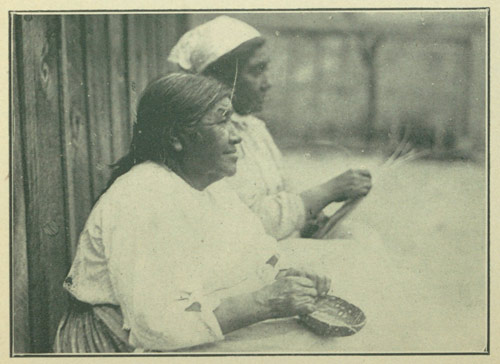
hunters, farmers, basket and pottery-makers.
They were happy, healthy, fairly prosperous and
contented.
But in time Warner died. His grant was duly
confirmed by the United States Land Courts, but
no one cared enough to see that the rights of the
Indians were guarded, hence the confirmation and
deed of grant contained no exemption of the
Indians' lands.
The ownership changed until it came into the
hands of a well-known California capitalist. He
was not interested in Indians, had no particular
sympathy with or for them, and did not see why
they should remain on his land. Several times he
vigorously intimated that he wanted them to "clear
off," he needed the land, and especially he needed
the hot springs. There was a strongly expressed
desire that a health and pleasure resort be established
at this charming place, but, of course, it
was impossible so long as the Indians were there.
Each time removal was intimated to the Indians
they laughed—as children laugh if you tell them
you are going to buy them from their parents.
Had they not lived here long before a white man
had ever set foot on the continent? Were they not
born here, raised, married, had their children,
died and were buried here for centuries? Had
not Spaniards, Mexicans, and even General
Kearny assured them they were secure in their
possession? Of course they laughed! Who wouldn't?
But the owner of the land grew tired of their
smiles. He wanted the place, so his lawyers
ordered the Indians to vacate, and the papers
were served in such manner that even the childlike
aborigines were compelled to realize that something
serious was going to happen. But that they
should be compelled to leave! Ah, impossible! No
one possibly could be so cruel and wicked as that.
The courts were appealed to, and finally the
State Supreme Court decided against the Indians,
by a vote of four to three—a decision so contrary
to the spirit of honor and justice that it aids in
making anarchists and revolutionists of good and
law-abiding men. Confident in the right of the
Indians' cause their faithful friends took the case
up to the United States Supreme Court, and again,
this time purely on the plea of precedent—that
it was contrary to rule for the United States
Supreme Court to interfere in any case that was
purely domestic to one State—the judgment ousting
the Indians was confirmed.
Things now began to look serious. Some of the
Indians were crushed by the decision, others were
ugly and wanted to fight. Various people of
various temperaments interfered, and each one
denounced the others as trouble-makers and brewers
of mischief. Council after council was held,
and at each one the Indians stedfastly refused to
leave their homes.
In the meantime, realizing that the suit for
eviction most probably would go against the
Indians, certain societies and individuals, prompted
by their interest in them and by their inherent
sense of justice, appealed to Congress to find a new
home for these people if they were dispossessed.
For the first time in its history, Congress voted
$100,000 to give to these Indians a better home
than the one they were to be evicted from. A
special inspector was sent out to determine where
this new home should be. He reported favorably
upon a site, which, however, better informed people
in the state, considered altogether unsuitable.
Protests immediately were lodged with the Indian
Department and as the result a Commission was
appointed to investigate conditions, and find the
most suitable place to which the Palatinguas could
be transferred. This Commission was composed
of Charles F. Lummis, Russell C. Allen, and Chas.
L. Partridge.
After weeks of careful and patient investigation,
criticized on every hand by those who were anxious
to sell any kind of an acreage to the Indians, it
was finally decided to recommend the purchase of
the Pala Valley. Few seemed to see the irony of
this decision. The land once had belonged to the
Pala Indians. Less than a century before a thousand
of them were regular attendants at the little
Mission Chapel and devoted friends of Padre
Antonio Peyri. Whence had these and their
descendants gone? How had they been deprived
of their lands? In another chapter I
have quoted from Frank J. Polley, how our California
laws aided and abetted the spoliators and
how Pala unjustly came into the possession of
a white man.
Now it must be bought back again. There
were 3,500 acres, with a large amount of
hilly government land that would be of use for
pasturage and that could be added to the full
purchased land as a reservation. The Commission
claimed, and doubtless believed, there was plenty
of water, but it was not long before the supply was
found to be so inadequate that something had to
be done to add to it. This has been done, as is
elsewhere related.
Congress passed the appropriation bill, made the
purchase, May 27, 1902, setting the land aside as a
permanent reservation. The Indian Department,
therefore, ordered the immediate transfer of the
Indians from Palatingua, as well as small bands
from Puerta de la Cruz, Puerta Chiquita, San
José, San Felipe and Mataguaya—tiny settlements
on the fringe of Warner's Ranch and who were
made parties to the ejectment suit—to Pala.
Serious trouble was feared. Mr. Lummis wired
for troops to aid in the removal, although his
duties as head of the Commission to choose a home
for the Indians gave him no authority to act in
the matter. He was thereupon ordered from the
ranch, and the work of removal committed to the
care of a special agent, as Dr. L. A. Wright, the
regular Indian Agent, confessed his inability to
cope with the situation. Mrs. Babbitt, for many
years the teacher at Warner's Ranch, and other
friends of the Indians counselled acquiescence to
the law's demand. I was invited both by the
Indians and the Indian Commissioner to be present
at the removal, but I knew that it would be too
much for my equanimity, so I kept away. My
friend Grant Wallace, however, was present, and
in Out West magazine, for July, 1903, gave the
following pathetic account:
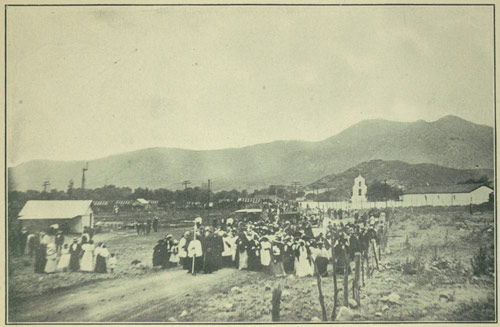
Night after night, sounds of wailing came from the adobe
homes of the Indians. When Tuesday (May 12) came, many
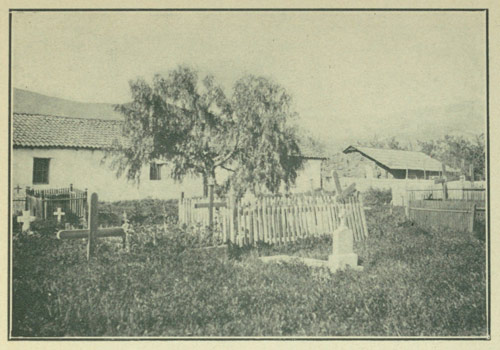
of them went to the little adobe chapel to pray, and then
gathered for the last time among the unpainted wooden
crosses within the rude stockade of their ancient burying
ground, a pathetic and forlorn group, to wail out their grief
over the graves of their fathers. Then hastily loading a little
food and a few valuables into such light wagons and surreys
as they owned, about twenty-five families drove away for
Pala, ahead of the wagon-train. The great four and six-horse
wagons were quickly loaded with the home-made
furniture, bedding and clothing, spotlessly clean from recent
washing in the boiling springs; stoves, ollas, stone
mortars, window sashes, boxes, baskets, bags of dried fruit
and acorns, and coops of chickens and ducks.
While I helped Lay-reader Ambrosio's mother to round
up and encoop a wary brood of chickens, I observed the wife
of her other son, Jesus, throwing an armful of books—spellers,
arithmetics, poems—into the bonfire, along with bows and
arrows, and superannuated aboriginal bric-a-brac. In reply
to a surprised query, she explained that now they hated the
white people and their religion and their books. Dogged and
dejected, Captain Cibemoat, with his wife Ramona, and
little girl, was the last to go. While I helped him hitch a
bony mustang to his top buggy, a tear or two coursed down
his knife-scarred face; and as the teamsters tore down his
little board cabin wherein he had kept a restaurant, he muttered,
"May they eat sand!"...
At their first stop for dinner they lingered long on the last
acre of Warner's Ranch, as though loath to go through the
gates. At night, at Oak Grove, they drew the first rations
ever issued to the Cupenos by the government—some at
first refused to accept them, saying they were not objects
of charity....
Although devout church members—scarcely a name
among them being unwashed by baptism—they refused the
first Sunday to hold services in the restored Pala Mission, or
anywhere else, asking surlily of the visiting priest, "What
kind of a God is this you ask us to worship, who deserts us
when we need him most?" Instead, thirty of them joined
some swart friends from Pauma in a "sooish amokat" or
rabbit hunt, killing their game with peeled clubs thrown unerringly
while galloping at full speed.
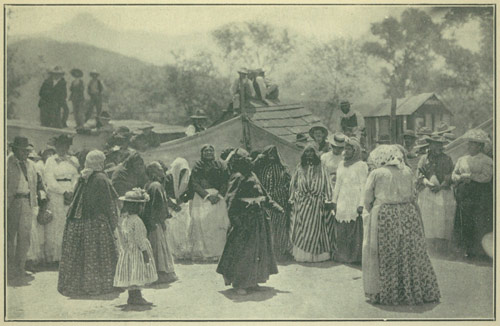
Monday, however, the principal men, better pleased after
an inspection of the fertile and beautiful valley of Pala, had a
flag-raising at the little school-house—the only building now
on the site of the projected village. An Indian girl played
the organ, and a score of dusky children—who will compare
favorably in intelligence with average white youngsters—joined
in singing the praises of "America—sweet land of
liberty." School was opened, and later a policeman—young
Antonio Chaves—was elected by popular vote.
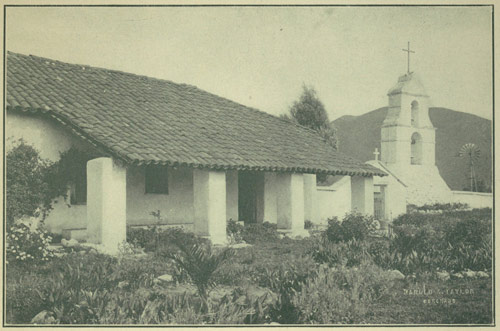
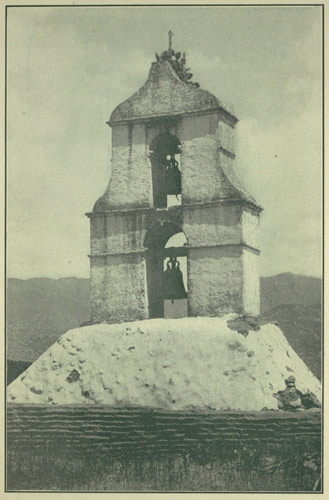
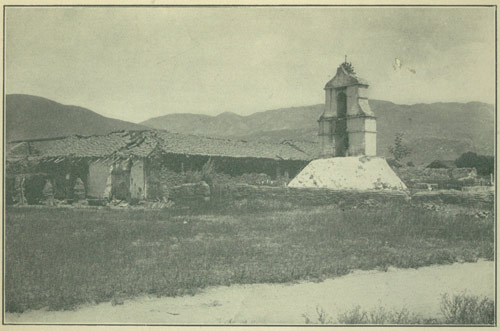
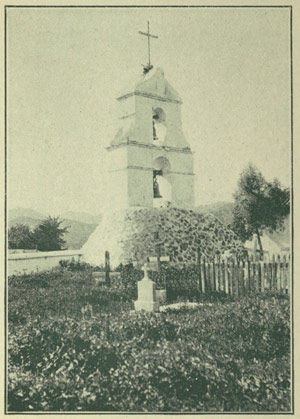
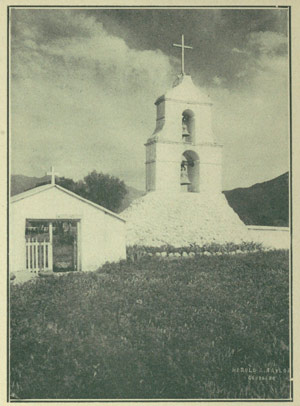
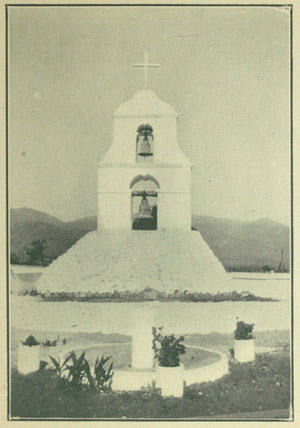
The Pala Chapel and Campanile After Restoration by the Landmarks Club.
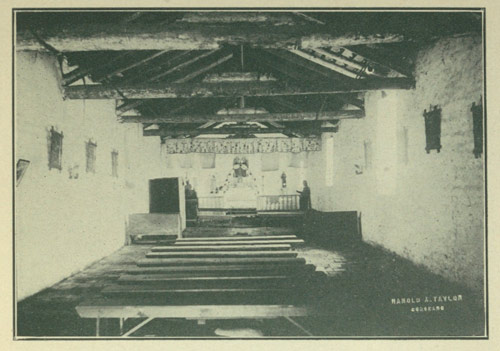
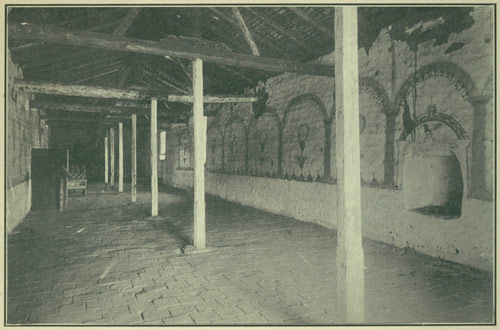
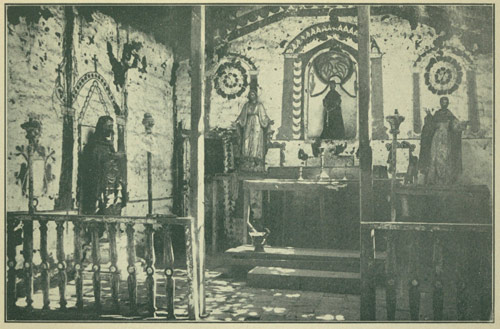
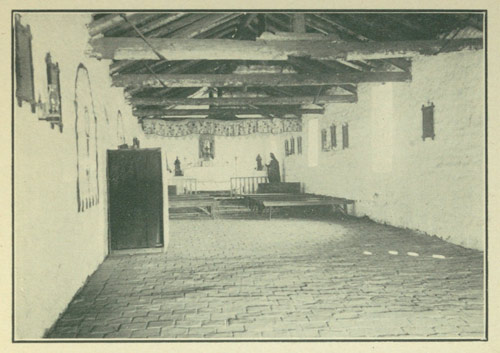
The Interior of Pala Chapel as it Appears Today.
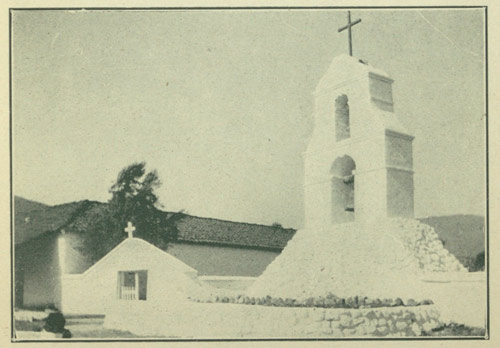
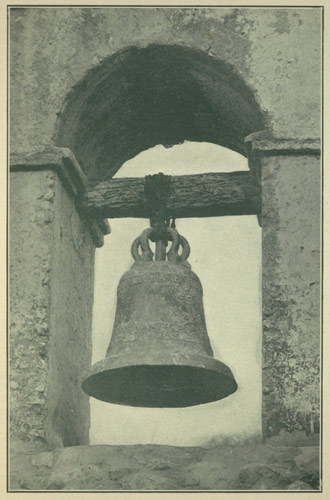
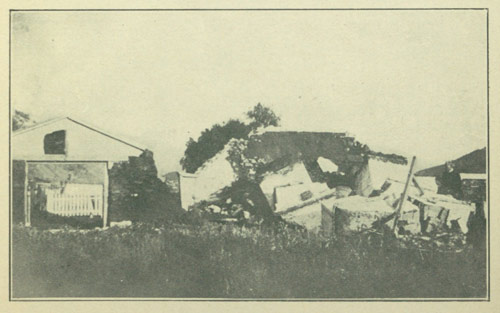
The Pala Bell Tower After Rebuilding.
Thus came about the transfer of the Palatinguas
to Pala. Though they often longed for their old
home it could not be denied, even by them, that
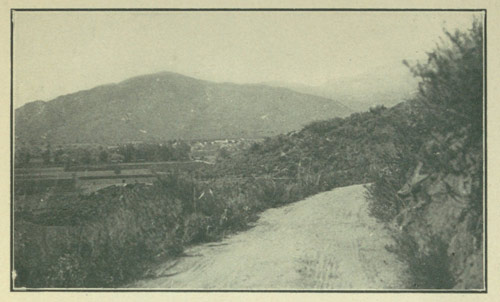
the location of Pala is ideal. It is literally surrounded
by mountains that seem to rise in huge
overlapping rings, each circling the diminutive
valley. The Pala River flows through the settlement.
Almost every available foot of space is
now under cultivation in that part of the valley
near by, and further down, along the river, where
the fields broaden out, many acres are yielding
their rich and valuable crops.
To the south may be seen the hospitable ranch-house—Agua
Tibia—of Lewis Utt, an attorney of
San Diego, who divides his time between his city
office and his farm. Five thousand feet above
cluster the pine trees, the live oaks and other rich
arboreal growths of Palomar, the Mountain of the
Dove. Nearby the rich olive orchards of John
Fry stretch out like silken flags of green. To the
north, on the top of the Pala grade, the Happy
Valley ranch of A. M. Lobaugh is a stopping-place
for camper and tourist. To the west is the extensive
ranch of Monserrate.
There are few more beautiful inland locations
in the world, and climatically it is as perfect as it
is scenically. For from the one side come the
breezes of the warm South Pacific ocean, laden with
the ozone and bromine of kelp-beds and with the
refreshing tang of the salt air, while from the other
come the aseptic breezes of the desert, God's great
purifying laboratory, where, after being completely
purified, they are sent over the mountains,
there to gather their unseen but never-the-less
beneficent and healthful burden of sweet balsams
and odors from the trees, shrubs and blossoms
that glorify their slopes and summits.
For awhile after their arrival at Pala they dwelt
in tents, and then occurred one of those inexplainable
and inexcusable pieces of folly that fills the
heart of an intelligent man with contempt and
almost with despair. Cold weather was coming
on. The Indians must be housed erelong. One
would have thought the sensible and obvious
thing to do would have been to engage the unoccupied
Indians—for, of course, none of them as
yet had a thing to do—either to make adobe brick
and build their houses of them, or to buy lumber
for the purpose from the nearest place of supply.
Instead of that what was done by the dunder-headed
officials at Washington? Even as I write
it seems so incredible that I can scarce believe it.
These incompetent men purchased, in New York,
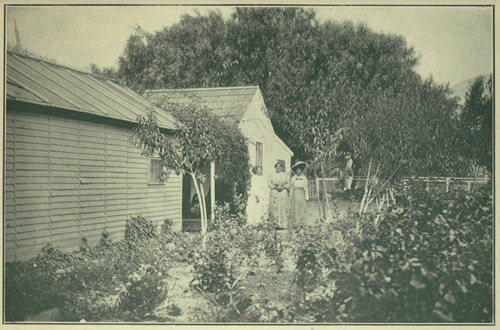
fifty flimsy, rickety, insecure, wretched "portable"
houses, sent them by freight, and ordered them put
up as the permanent homes of these unfortunate
exiles. The amount of money expended in these
contemptible pretences for houses, and the freight
paid on them from the East, would have erected
permanent buildings and at the same time have
provided paying occupation for the Indians during
their erection. Official stupidity seldom manifested
itself more clearly than in this instance.
Commenting upon the matter the government's
own special agent reported:
It was nearly six months before the Indians got into the
houses. The expense was double what wooden cabins built
on the spot would have been, and about four times the cost
of adobes.... The houses are neither dust-proof, wind-proof,
nor water-proof, and are far inferior to the despised
adobes.
But the Indians made the best of them, and have
gradually improved, or replaced them with something
better. Then the water question arose.
There was not enough for their needs. Eighteen
thousand dollars was first expended, and then more
was called for. At last, in May, 1913, the new
irrigation system was completed, and a grand fiesta
was held to celebrate the opening.
The first teacher of the Palatinguas when they
were removed to Pala was Mrs. Josephine H.
Babbitt, who for many years had been their trusted
friend at Warner's Ranch. But in those trying
early days when nerves were frayed, dispositions
frazzled, and passions easily aroused, her earnest
and determined efforts to secure for her wards as
great a meed of justice as possible rendered her
persona non grata to some whose influence was
powerful enough to secure her removal.
But it was not long before even this misfortune
was made to work out for the good of the Indians.
Miss Ora Salmons, who was a teacher of one of the
near-by Indian schools, was appointed, and this
year of our Lord, sees her close her twenty-eighth
year of faithful and happy service among her
dusky wards, many of which have been spent here
at Pala. With heart, mind and body attuned
to her work she has truthfully and poetically been
termed "the little mother of the Indians." Radiating
brightness, sunshine, sympathy and love for
her pupils, old and young, she is strengthened in
her daily task by the assurance that she is making
their life easier and happier, removing some of the
obstacles to their progress, and adding factors of
strength and self-reliance to their characters.