Riots led by Burgundy—The Duc d’Aquitaine’s ball—His quarrels with
Burgundy—The Comte de Charolais—Battle of Azincourt—Death
of Aquitaine—The Dauphin Jean—His court—His death—Imprisonment
of the Queen—Jean Sans-peur rescues her—Enters
Paris by night—Massacre of Armagnacs—The Dauphin Charles—Murder
of Jean Sans-peur—Marriage of Catherine de France to
Henry V.—Departure for England—Birth of a son—Return to
Paris—Festivities—Death of Henry V.—Death of Charles VI.—Retirement
of the Queen—Henry VI. enters Paris—Treaty of
Arras—Death of Isabeau.
It was May, 1413, the court was at Saint Paul.
The King had just recovered from one of his
attacks. Every one had been, dressed in white hoods,
to Notre Dame to give thanks, and now the important
event was the wedding to be celebrated on the following
day between the Queen’s brother, Duke Ludwig
of Bavaria, and Catherine d’Alençon, widow of Pierre
de Navarre, Comte de Mortaigne.
There had been a good deal of uneasiness in the
air for some time and the war with England was going
on. When peace was made between Burgundians and
Armagnacs, the latter were obliged to break their
alliance with the English king, whose troops under
his second son, the Duke of Clarence, had ever since
been ravaging Normandy, Picardy, and Maine, notwithstanding
that the little Comte d’Angoulême, the
youngest of the Orléans princes, had been given them
as a hostage. They were also attacking some of the
southern parts of France, and swore they would regain
the duchy of Aquitaine, their ancient patrimony. Two
months ago Henry IV. had died, and the Prince of
Wales, now Henry V., hitherto remarkable chiefly for
his fast, disorderly, somewhat scandalous life, seemed
likely to be a powerful and dangerous enemy. The
populace of Paris were deeply discontented, as well
they might be, for it was openly declared that the
expenses of the King’s household, which used to be
94,000 francs were now 450,000, and yet the tradesmen
were not paid; that although the allowance for
the King and Queen’s alms went on, scarcely any
alms were ever given; that some of the royal servants
and officers received enormous salaries, while others
could never get any wages paid at all; and that, in
spite of the sums allowed for the repair of the King’s
castles and palaces, they were in such a state that they
would soon fall into ruins.
{1413}
The Duke of Burgundy had his own reasons for
wishing to stir up the people. He was afraid of
certain transactions by which he had got hold of a
large sum of money being made known by Pierre des
Essarts, provost of Paris, who held his receipts for
them, and now belonged to the Orléanists; he was
uneasy about the power and favour of that party
and the estrangement of the Duc d’Aquitaine, who
disliked him because he was so overbearing and
disagreeable.
The Duc d’Aquitaine had been warned that an
attack upon the hôtel St. Paul was intended, and
advised to arm his household, raise the banner with
the fleur-de-lis over the entrance and defend himself.
But while he was deliberating with the other princes,
instead of taking immediate action, as any of his
forefathers would have done, a dreadful noise began
to be heard, and a shouting, howling, desperate mob
was seen to be rushing down the streets towards
the hôtel St. Paul. They surrounded that palace,
planted the standard of the city, and with loud
cries and threats demanded to speak to the Duc
d’Aquitaine.
Among the chief characteristics that distinguish the
history of France from that of any other Christian or
civilised nation are the furious, credulous, ferocious
mobs, whose atrocious deeds continually appear in her
annals, and who seem to belong to no particular century;
for whether we see them murdering nobles and
gentlemen with their wives and children in the fourteenth
century, Huguenots in the sixteenth, waggon
loads of women, young girls, and little children in
the eighteenth—or priests and unarmed hostages in
the nineteenth, whether they are called Jacques, or
Leaguers, or Septembriseurs, or Communists—they
evidently do not excite either abhorrence or shame in
the minds of the great mass of their countrymen who
have just raised a statue in Paris in honour of one of
the most bloodthirsty of the wretches who acted as
their leader in the perpetration of those cowardly
and brutal crimes against which the rest of civilised
humanity revolts.
One of these mobs, not a whit more cruel and
savage than those which yelled and howled and
danced through the streets of Paris in our own and
our fathers’ and grandfathers’ days, was now pressing
round the hôtel of the Duc d’Aquitaine at Saint Paul.
They had certainly much reason for their anger and
complaints, but whether their cause is a bad or a good
one the means by which they carry it out are always
atrocious. On this occasion they put forward a
Carmelite monk called Eustace, who gave a harangue
on the calamities, bad government, and generally
disastrous state of things. The Duke of Burgundy
came down, said the King was only just recovered
and could not bear this agitation, and advised them to
go away. But they clamoured for the Duc d’Aquitaine,
who, terrified by the tumult and urged by the Duke
of Burgundy, appeared at a window and promised all
they asked.
One of their leaders, named Jean de Troyes, then
imposed silence, and in a speech received with
enthusiastic applause by the people and with scarcely
concealed indignation by the nobles, declared that
they would do no harm to the Duc d’Aquitaine, but
demanded that his evil counsellors should be given up
to them; and on his chancellor imprudently asking to
whom they referred handed up a list of fifty names,
including not only the principal gentlemen of his
household, but Ludwig of Bavaria, the Queen’s
brother, Edouard, Duc de Bar, cousin of the King,
and several of the Queen’s ladies. The princes could
not pacify them, the Queen wept and raved, the King
remonstrated in vain; the Duc d’Aquitaine, turning
with a furious look to the Duke of Burgundy, exclaimed,
“Father-in-law, this outrage is your doing,
for the leaders of it are the people of your house.
Know surely that the day will come when you shall
repent of it, for things will not always go on according
to your pleasure.”
Some of the nobles and ladies came down and gave
themselves up, the others were seized by the mob,
who broke into the palace and hunted all over the
rooms and galleries to find them, tearing one gentleman
out of the arms of the Duchesse d’Aquitaine,
who tried to protect him. They were carried away
on horseback and shut up, some in the Palais, some in
the Louvre.
When they were gone, the King went to dinner
and the Duc d’Aquitaine retired with the Queen into
her room, where they shut themselves up and cried.
Something, however, had to be done, so they sent
the Comte de Vertus, who escaped to his brother, the
Duc d’Orléans, told him what had happened, and
how some of the princes were in prison, and the
King, Queen, and Duc d’Aquitaine like prisoners in
the hands of the Parisians, and desired the rest of the
princes to make haste to come and deliver them.
The King of Sicily, the Ducs d’Orléans, Bourbon,
and Bretagne, the Comtes de Vertus and Alençon
accordingly assembled at Vernon, and sent a message
to the populace that unless the prisoners were immediately
set free they would put all Paris to fire and
sword.
The Duke of Burgundy saw he had gone too far,
having infuriated the Duc d’Aquitaine and set all the
princes against him, the University of Paris hastened
to disassociate herself with the riots, and the chief
bourgeois, frightened at what had been done tried
by all means and with many apologies, to divert and
appease the anger of the royal family. The city was
still very unquiet, frère Eustache went on preaching
against Aquitaine, saying that the licentiousness and
debauchery of such a life as he was leading had
already caused the madness of his father and the
death of his uncle, and that it would be better to
declare his brother, Jean de Touraine, the heir of
France; while one Léon de Jacqueville forced his way
into the ballroom of his hôtel one night in the middle
of a ball and loudly declaimed against him, saying
that he dishonoured his rank. The Duke struck him
three times with his dagger, but his cuirass saved
him. The ballroom was a scene of confusion, the
mob rushed to attack the hôtel and were only stopped
by the opportune arrival of the Duke of Burgundy,
who dispersed them. The Duc d’Aquitaine was so
agitated by the scene that he spit blood for days
afterwards.247
Burgundy, however, saw that he was rapidly losing
friends, and thought it well to send his son, the
Comte de Charolais, away. That young prince,
therefore, with his wife, the Princess Michelle, set off
for Gand, accompanied as far as Lendit by a great
body of the bourgeois of Paris of whom she took
leave affectionately, begging them to deliver her uncle,
the Duke of Bavaria, and then she proceeded to St.
Denis with her husband, after which they went with
a brilliant train to Gand.248
While all these commotions were going on the
English made a descent upon the county of Eu,
sacked and burnt Tréport and several other towns,
took to their ships and sailed for England with their
plunder. The Armagnacs were devastating the
country, and the Parisians more and more terrified at
the threats of the princes. Their party grew stronger
and stronger, the King ordered the Duc d’Aquitaine
to go and liberate the prisoners, which he did, riding
to the Palais and the Louvre and bringing them all
away with him except the ladies, who had been
liberated soon after they were taken, and two or
three gentlemen who had been killed in the riots.
Bells rang, feasting went on, the rioters were either
seized and punished or else fled, and the princes
entered Paris in triumph.249
The Duc d’Aquitaine ordered all the favourites of
Burgundy to be seized, one only was spared at the
entreaty of the Duchesse d’Aquitaine, the rest were
arrested or fled. Jean Sans-peur himself, warned
that the streets round the hôtel d’Artois were being
watched by night by the Orléanists who were
crowding into Paris to join the Duc d’Aquitaine,
fled from a hunting party with one gentleman only,
rode at full speed in doubt and fear through the forest
of Bondy, and next day meeting one of his followers
with a band of men-at-arms pursued his journey
safely to Flanders.
{1414}
For a little while the Armagnacs were triumphant.
The marriage of the Duke of Bavaria took place, and
what was more important, Charles, Comte de Ponthieu,
youngest son of the King, was betrothed to Marie
d’Anjou, daughter of the King of Sicily, at the Louvre
in presence of the Queen and Princes, the King being
ill at the time.
There was also a talk of marrying the Princess
Catherine, youngest daughter of the King and Queen,
to Henry V. of England.
In February of 1414, with bitterly cold winds
appeared a disease that seems just like the modern
influenza. It was attended by cold, cough, loss of
appetite, violent pains in the head and general
languour. It attacked all classes; judges and lawyers
had to suspend their courts, the malady spread and
was very dangerous.
A foolish step of the Queen’s had just re-opened
the routs and quarrels that always seemed now to
rage amongst the royal family. There were certain
gentlemen in the household of her son, the Duc d’Aquitaine,
whom she distrusted because they had
been placed there by his father-in-law, and she wished
to remove them. She was just then living at the
hôtel St. Paul, and the Duchesse d’Aquitaine with
her; the Duke was at the Louvre. Having consulted
with the Armagnac chiefs, who were silly enough to
countenance her plans, she went suddenly to the
Louvre taking the Duchess with her, seized Jean de
Croy, and three other officers of her son’s household,
and threw them into prison. The Duc d’Aquitaine,
who liked them, flew into a great rage and the princes
could hardly prevent him from rushing out to appeal
to the mob, and could not stop him from writing
secretly to the Duke of Burgundy to come back.
With two such people as Isabeau and her son what
could be done? Jean Sans-peur set off at once with
a body of troops—but before he could arrive Isabeau
and the princes had contrived to pacify the Duc
d’Aquitaine and persuade him to contradict everything
he had said, and write to the fortified towns proclaiming
the Duke of Burgundy an enemy of the
King. Infuriated by this treatment, the Duke of
Burgundy produced and displayed his son-in-law’s
letters, and continued his march towards Paris, the civil
war beginning again with much cruelty and slaughter.
The domestic quarrels of the royal family were
worse than ever. The old Duc de Berry disputed
the regency during the King’s frequent attacks, with
the Duc d’Aquitaine, just as he and his brother had
done with Louis d’Orléans, and on the same pretence,
his youth and inexperience. Aquitaine was at
daggers drawn with his father-in-law, and so far justified
his great-uncle’s assertions that besides possessing
all the faults of his uncle, Louis d’Orléans and his
father, he had no taste for military affairs, no
attraction or charm, though he was rather good-looking.
He was exceedingly unpopular, hated
appearing in public, and shut himself up all day (when
he was not in bed) playing the harp and épinette
with his musical friends. If the King gave him any
business to do he neglected it, and was so ill-tempered
that he could not bear to be found the least fault
with. Music, horses, and dissipation were all he
cared for. He had now separated from his wife and
reduced her household to a very low estate; he had
always disliked her. Historians say that she gave no
cause whatever for complaint, but that people made
mischief between them.250 The Duke of Burgundy
sent a message requiring him to dismiss La Cassinelle
and take his wife back, which only made him more
angry. He had removed her from his mother’s care
and sent her to St. Germain-en-Laye,251 also seizing
some treasure kept by Isabeau at the houses of confidential
agents, taking advantage of the illness of
the King his father to do as he chose. This was
the beginning of the Queen’s dislike for Armagnac,
who was mixed up in the affair, and her inclining
towards the Burgundian party.
{1415}
In March, 1415, the Emperor of Germany paid a
visit to the French Court, where he was entertained
with the usual lavish profusion. He, in return, gave
a great banquet at the Louvre to the ladies of the
court and bourgeoises of Paris, “and to each one was
laid a German knife, and the strongest wine that
could be got. And everything was so spiced they
could hardly eat it. There were many minstrels, and
after dinner they danced and some sang. And when
they left to each was given a gold ring, which, however
was not of much value.”252
When the summer came round the truce with
England expired. English troops from Calais and
other places began to attack the French provinces,
and it was rumoured that King Henry was gathering
a great host at Southampton to invade France.
It was nearly sixty years since the battle of
Poitiers, and seventy since that of Crécy, and there
were old people alive who could remember the confusion,
dismay, and terror of that time. The Duc de
Berry had himself been in the battle of Poitiers, from
which he had fled; while the Duke of Burgundy, then
a boy of thirteen, had fought to the last beside their
father, King Jean, and been carried prisoner with
him to England.
Times were still more disastrous now. With a
mad King, a worthless heir-apparent, and a number
of princes of the blood without either capacity or
conduct, there were no leaders whom the people
could trust or love, or whom they would follow
and die for as their fathers and grandfathers did for
Philippe de Valois, King Jean, the Duc de Bourbon,
the gallant Princes of Navarre, the heroic King of
Bohemia, or the noble chiefs of the Capétienne house
of Burgundy.
However, it was necessary to make preparations.
Enormous taxes were levied in haste, and everywhere
bands of soldiers were hurrying up to join the army,
and plundering the villages on their way. What the tax
collectors left they carried off, and the people in
terror and despair left their homes and hid in the
woods, longing only that the campaign might be
over, whichever side won.253
Charles d’Albret was appointed commander-in-chief,
and all the highest commands were given to
Armagnacs. Jean Sans-peur took no post in the army
at all, and forbade the Comte de Charolais to join;
being, besides politically hostile, resolved not to risk
his only son as had been done to their cost by the
former house of Burgundy.
Early in August the English fleet sailed from
Southampton, and sixteen hundred ships entered the
Seine, passed up between Honfleur and Harfleur, and
landed the troops, who proceeded to invest the latter
town, which was an important commercial place and
the key of Normandy, being a strong fortress surrounded
with deep moats and massive walls and
towers.254 It was bravely defended, but as no help
came from the French army which was slowly
gathering at Vernon, the town surrendered on
September 22nd.
King Henry repaired, provisioned, and garrisoned
the place, and then began his victorious march
through France. Charles, who just then was in his
right mind, came to Rouen with the Duc d’Aquitaine
and the rest of the princes in October, and at a
hurried council it was decided that a battle must be
fought, but that the King and his son should not be
present for fear of a calamity such as befel King Jean
at Poitiers. All over France the nobles were summoned
to join the royal standard with their vassals,
but the princes were stupid enough to refuse a body
of six thousand armed men offered by the city of
Paris whose services they disdained.
The Comte de Charolais, who knew there was going
to be a battle but did not know when, was wild to get
away and join the army. His tutors, however, had
been warned by the terrible Duke of Burgundy that
he made them responsible for his not doing so, and
they were at their wits’ end what to do. They did
not like to tell the young Philippe, lest he should
find some way of circumventing them, and when
a summons arrived for him from the Constable
d’Albret, he declared he would go. He was then at
Arras, and in much perplexity they pretended to
consent, and leaving that city got him to the castle of
Aire, where the Constable again sent several seigneurs
and Montjoye, King-at-arms, to fetch him. As long
as they could the distracted tutors put off his departure,
carefully concealing from him the time when
the battle was to take place, but most of his people
kept escaping secretly to go to the front, and at last
they were obliged to tell him, to appease his anger,
of his father’s orders, which he dared not disobey but
retired to his room in despair and shut himself up
there crying. (“Moult fort pleurant.”)255
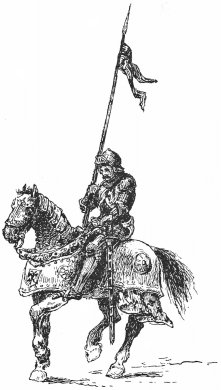
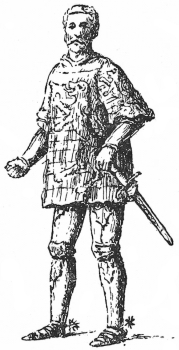
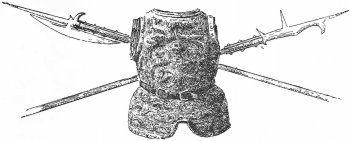
MAN IN ARMOUR, FIFTEENTH CENTURY.
The King of England desired to cross by the ford
of Blanchetache, where his great-grandfather, Edward
III., had passed over the river seventy years ago, but
the place was too strongly guarded, so he marched
along the bank for some distance and came up with
the French army which was waiting for him at a
place enclosed with little woods between the villages
of Rousseauville and Azincourt. It was Thursday,
October 24th, about the hour of vespers, when the
two armies confronted each other. Philippe, Comte
de Nevers, and several young nobles had just been
knighted by the hand of Boucicault, Marshal of
France. The Constable had arrived with the royal
banner, the Oriflamme.256 Around it rose the banners
of the princes, barons, and chevaliers with their
followers who had flocked to the standard of France.
Great fires were lighted, for the night was cold; a
drizzling rain had begun to fall, and they were
waiting for the English army which must pass on its
way to Calais.
The English were hungry and tired with their long
march, but they came up with the sound of trumpets
and martial music, and the heavy tramp of horses
and armed men, so that the earth seemed to tremble
with the echo. Silently and composedly they took
up their perilous position, well aware of the danger
which lay before them, for the French host outnumbered
them by at least three to one, and had a much
larger proportion of cavalry. But they thought of
Crécy and Poitiers, passed the night in attending to
their horses, bows, and armour, and prepared for
death by confessing their sins, and receiving the
Sacrament of the Body of Christ.257
The French had scarcely any musical instruments
to rejoice their spirits, and their horses did not neigh,
but made scarcely a sound all night, which many
considered an evil omen. The rain and mud and
cold depressed their spirits which sank lower as
they, too, remembered Crécy and Poitiers. All
night they were calling to each other in the darkness,
and many who had been at enmity made friends
again, forgave each other, embraced, and drank out of
the same cup, as they thought that perhaps they were
about to see the dawn of their last day.258
Still, when morning broke and they saw their own
great superiority in numbers and strength, they
gathered confidence, and thought indeed that the
English army could not escape them. And between
nine and ten they advanced to battle, bending their
heads so that the arrows might not pierce through
their visors.
King Henry had heard mass at the break of day,
and then mounting his grey charger had arranged
his troops for the battle, the archers forming the right
and left wings. He rode through the ranks and
harangued the soldiers, pointing out the danger of
their position, from which the only escape was
victory. He reminded them of those other battles in
which their fathers and grandfathers, wearied and
outnumbered, had fought and conquered, and then
dismounting from his horse he placed himself at the
head of the infantry and led the attack. Twice they
halted to take breath, and twice they came on with a
great shout, while a shower of arrows rushed through
the air into the vanguard of the French army. The
English archers were slightly armed and poorly
dressed, but strong and active; they wore an axe or
sword at their girdle and carried a pike to force their
way through the thickest of the fight. In the French
army there was neither order nor discipline. The
King and his sons were not present as at Crécy and
Poitiers, and the princes would obey no other leader.
Those who were not placed in the vanguard refused
to stay with their men but pressed forward to join the
line of cavaliers in heavy armour who bore the
noblest names in France, and stood in the front of
the battle.
A squadron of cavalry was ordered to charge;
they were the flower of the French troops. They
came on impetuously at a gallop, but the ground was
soft with deep mud, the horses slipped, floundered,
and became unmanageable, a flight of arrows falling
amongst them added to their confusion, they turned
and fled. Then the English throwing down bows
and pikes, seized their swords and axes and rushed
into the thick of the fight. They broke through the
first division, but when they came to the second and
third there were no leaders, as they had all gone to
the front ranks. The subalterns could not lead the
soldiers, who hesitated, wavered, and at last gave
way, and the battle became a rout. The English
were too few in number to pursue as they dared not
separate, and Henry seeing a troop coming up, and
thinking the enemy were being reinforced, gave the
order to put the prisoners to death, which command
began to be carried out, but presently, seeing that
the troop was also retreating, the King ordered the
massacre to be stopped, which was at once done, but
not before many lives had been sacrificed, and a deep
stain inflicted upon his name.
The English lost sixteen hundred men, including
the Duke of York and Earl of Oxford, but the losses
of the French are said to have been ten thousand
men and fifteen hundred prisoners. Among the dead
were the Duc de Brabant and Comte de Nevers,
brothers of the Duke of Burgundy, the Duc de Bar
and his two brothers, the Constable d’Albret and the
Duc d’Alençon, all nearly related to the King, and
numbers of other nobles and gentlemen. Among the
prisoners were the Ducs d’Orléans and Bourbon, the
Comtes de Richemont and Eu, Marshal Boucicault,
and many others of high degree.
But the army of King Henry was too small and
too exhausted to push its victory any further; in fact,
its safety appeared to him so doubtful that he ordered
all the plunder taken to be burnt, and taking their
prisoners with them the English troops turned their
steps towards Calais and embarked for Dover a week
after the victory.259 The Queen was at Melun when
the news of the disaster arrived. She was ill at the
time, and had also become so stout that she had been
obliged to give up riding, therefore in haste and
consternation she had herself carried in a litter to
Paris, taking with her the Duchesse d’Aquitaine, for
fear of falling into the hands of the Duke of Burgundy,
who directly he heard of the result of the battle and
the losses of the Armagnacs, started for the capital at
the head of ten thousand cavalry. The Queen and
Duchesse d’Aquitaine were at the hôtel d’Orléans,260
and the Duc d’Aquitaine, who now returned in haste
to Paris, went to the hôtel de Bourbon; the King,
the Duc de Berry, and Comte d’Armagnac also hurried
back; the King of Sicily took refuge at Angers, to get
out of the way of Jean Sans-peur, who was his bitter
enemy, because he had first betrothed his son to the
daughter of the latter, a little child, and then changed
his mind and sent her back to her father.
{1416}
The Duc d’Aquitaine sent to forbid Burgundy to
advance, and not liking to set his son-in-law at
defiance he arrested his march, but in the midst of
all the anxiety and commotion that was going on,
Louis Duc d’Aquitaine died after a few days’ illness,
having, as had always been foretold, utterly destroyed
his constitution by the excesses of his life. Before
his death he expressed his remorse at his conduct to
his wife.261 Of course there were some who declared
that he had been poisoned, and that Jean Sans-peur
had done it, but as his death prevented the Duke of
Burgundy’s daughter from being Queen of France
this is not at all likely, however angry he might have
been at Aquitaine’s treatment of her and disregard
of his own counsels.
The next Dauphin, Jean Duc de Touraine, lived
with his wife and her family in Hainault, where the
Queen and Council (the King being ill) sent, to desire
him to come at once to Paris. But Jean, brought up
by the near relations and firm allies of Burgundy, was
far more Burgundian than his elder brother, the son-in-law
of Jean Sans-peur. He refused to receive the
deputation except in the presence of the Burgundian
ambassadors, and he would not go to Paris unless
his uncle of Burgundy might go too. Louis
d’Aquitaine had died at the beginning of 1416, and
it was not until early in 1417 that, after much discussion
and exchange of letters and messengers he
set off with his father-in-law for Compiègne, as the
Queen absolutely refused to come to St. Quentin as
they wished.262
{1417}
They established themselves in the royal palace of
Compiègne, where they were joined by the Dauphine
and Comtesse de Hainault, and where they lived in
state and splendour as Jean always had done, for the
Hainaults were very rich. Jacqueline was their
only child, and they were exceedingly proud of the
alliance with the son of the King, especially now
he had become Dauphin. He was now eighteen,
and seems to have had more constancy of purpose
than his brother, but to have been entirely under
the influence of the Comte de Hainault and Duke of
Burgundy. What he was really like is impossible
to say. De Mézeray calls him “un jeune homme
capriceux, acriastre, déplaisant en mœurs et façons.”
Juvenal des Ursins and Paradin observe that it was
a pity he did not live to be King, as he had been well
brought up and taught by the Comte de Hainault
who was a wise prince. The monk of St. Denis
declares that he was a noble character, but he
generally appears to have had that opinion of the
fleurs-de-lis. It was very likely that he was better
than his eldest brother, as he easily might have
been. He was extravagant and magnificent like
all his family, and those who surrounded him
and had charge of his education were always
praising his lavish generosity and inciting him to
hold a more brilliant court than his parents the
King and Queen.263
That the Dauphin and Dauphine lived in great
splendour at Compiègne is proved by many of the bills
and accounts still existing, the costly stuffs of their
dresses, the magnificent plate and jewels, and the
presents they made to each other and to the members
of their households. Messengers went perpetually
between Compiègne, Senlis, Paris, and other places
to fetch things and to carry letters. There is a
record of a sum paid to the Provost of Senlis for
having escorted “pour la doubte et péril des chemins,” a
sum of money from Senlis to Compiègne. Sums of
money are also given to the King’s minstrels, to the
choristers of the Dauphin’s chapel, and to Hennequin
who takes care of his pet dogs; also for tapestry
hangings for his room, nine pieces, with a stag hunt
and boat hunt on green worked with silk, gold, and
silver.264
Isabeau must have been estranged from the son
who had been so separated from her; for we find
that when she came to Senlis with her youngest son
Charles, who had been made Duc de Touraine,
Governor of Paris, and Duc de Berry (the old Duke
having just died), although the Dauphine was taken
there to pay her homage, and spent some hours with
her “en grande léeses,” Isabeau returned to Paris with
the Comte de Hainault without seeing the Dauphin.
Possibly she may have been irritated against him, for
he still refused to come to Paris, now in the hands of
the Armagnacs, and demanded the regency during
the King’s malady.
But amongst the schemes, disputes, and rivalry of
the two parties, one of which put its trust in the
Dauphin, and the other fixed its hopes on his brother,
the Duc de Touraine, then between fourteen and
fifteen years old—a sudden change raised the spirits
of the one and filled the other with dismay. The
Dauphin began to be ill. Doctors were sent for; we
read of “chevaucheurs” sent to ride “haste hastivement”
to fetch fruit and medicines from Paris; and prayers
and masses said and sung in chapels and convents
for his recovery.
Early in April the Comte de Hainault, secretly
warned that he would be arrested by the Armagnacs,
escaped early in the morning from Paris on pretence
of a pilgrimage to St. Maur-des-fossés, in the forest
of Vincennes, from whence he rode in haste to
Compiègne. But he found the Dauphin ill in bed
“with a swollen body and other symptoms of poison,”
according to some historians, or, as others say, with
an abscess in the ear. At any rate he died in a few
days,265 and there was an outcry of poison, perhaps
with more probability than usual, for he had not
ruined his health like his brother, and though it could
be nothing but an outrageous calumny that the
Queen had done it by means of a gold chain she
sent him, it was more likely that if there had been
foul play at all it came from the Armagnacs who had
everything to gain by the death of the Burgundian
Jean and the succession of the Armagnac Charles,
the son-in-law of the King of Sicily and bitter enemy
of Burgundy.
Isabeau was certainly most unlucky in her relations
with her sons. Three of them died in early childhood,
with Louis she latterly had frequent quarrels, Jean
was estranged from her; but the unnatural strife and
hatred between her and her remaining son Charles
was the crown of all the calamities of her reign. It
seems to have been caused in the first place by
Armagnac, who, in consequence of the death soon
after each other of the King’s two elder sons, the
Duc de Berry, the King of Sicily, and the Comte de
Hainault, had become exceedingly powerful and, the
only person whose power and influence might stand
in his way being the Queen, proceeded to make
mischief between her, the Dauphin, a weak, characterless
boy, and the King, whose mind was now more
clouded and his intellect feebler during the intervals
between the attacks of his terrible malady.
Added to all this, the King of England threatened
that he would soon be in Paris and there were
hurried preparations to resist him. All the places
that lay on the road by which he would pass were
strengthened, moats deepened, walls repaired,
batteries of wood and stone made, and stores of
provisions laid in. St. Denis was especially fortified,
and the monks had to contribute largely to the
defence fund, for which purpose they were obliged to
sell two large gold crowns and a quantity of silver
plate. The holy relics, including the body of St.
Denis, were taken by some of the monks to Paris and
hidden in a safe but secular place, which, however,
caused so much scandal that they had to be brought
back again; and the monk who writes of this time
says that for eleven months the trumpets of the
enemy were continually in their ears.266
The Queen was holding her court at Vincennes
and had placed in command of the troops who acted
as her guards, Louis de Bosredon, and the Sires de
Graville and Giac, dissolute young nobles, who spent
enormous sums of money and passed their time in
feasting, revelry, and in carrying on intrigues with the
Queen’s ladies, and, it was rumoured, even with the
Queen herself. At least it was said by Armagnac and
his party, to whose interest it was to circulate such
a report, and who succeeded in making the Dauphin
and the King, who then had a lucid interval, believe
the story. Being at the same time weak and violent,
and so, as is always the case, more dangerous and
mischievous than a person who, though violent, is
also strong, they listened to the words of Armagnac,
and the King riding in haste one evening to
Vincennes, passed Bosredon, who instead of dismounting
according to the usual etiquette, saluted
slightly and rode on. This put a finishing stroke to
the anger of Charles, who ordered him to be arrested.
He was put to the “question” or torture, and was said
to have made compromising confessions respecting
the Queen. He was thrown into the Seine and
drowned; the other young nobles escaped. It is very
likely, whatever admissions were wrung by these
iniquitous means from Bosredon, that he was not
guilty; as to Isabeau she was about forty-seven years
old, had grown fat, and was suffering from gout,
which circumstances make such an accusation as far
as she was concerned highly improbable, though the
disorders of her court were doubtless deplorable.
However, the conspiracy had succeeded, she was sent
to Tours with the Duchess of Bavaria her sister-in-law,
and not allowed as she wished, to go to Melun,
where she had much treasure, a great deal of which
was seized by the Dauphin, and the part he took in
this outrage aroused in the Queen that undying hatred
which caused such disaster to him and to France.
{1418}
It would have been better for the Dauphin Charles
if he had let his mother and her friends and her
treasure alone, for Isabeau, though capricious and
foolish, was not a woman to submit tamely to such
an outrage as this. And Jean Sans-peur was neither
capricious, foolish, nor weak, and it was to him that
her thoughts turned in this crisis.
For about six months Isabeau led an intolerable
life at Tours in close captivity, guarded by Jean
Picard, who had been her own secretary, and had
betrayed to the Dauphin the existence of a collection
of gold, silver, pearls, and diamonds which she had
entrusted to the keeping of the Abbot of St. Denis;
Guillaume Toreau, her chancellor, and Laurent du
Puy, whom she hated more than any of them, as he
prevented her from writing or receiving letters without
his leave and treated her with disrespect, even
speaking to her without taking his hat off.
She managed however to send a secret message to
the Duke of Burgundy with her seal. Jean Sans-peur
was besieging Corbeil, but he knew that the Queen
was worth more to him than the possession of that or
any other town, so he raised the siege and rode day
and night to Tours where he arrived on the Feast of
All Souls.
The Queen meanwhile had signified her intention
of performing her devotions at the abbey of Marmoutiers
on the banks of the Loire, near Tours. The
three gaolers did not venture to object to this act
of religion. While prayers were going on they
approached the Queen and said that a great company
of Burgundians and English were close at hand.
Just then Hector de Saveuse, lieutenant of the Duke
of Burgundy, having posted armed men all round,
entered the church and saluted the Queen in the
name of his master who was close at hand. Isabeau
pointed to her three gaolers saying, “Arrest these
three men.” This was immediately done, but Laurent
du Puy, who knew it was all over with him, broke
away, ran down to the Loire, tried to jump into
a boat that lay moored to the shore, fell into the
water and was drowned. In two hours the Queen
and the Duke of Burgundy had met and become reconciled;
the Queen assumed the regency, and under
the powerful escort of the Duke of Burgundy, having
been recognised by the authorities of Tours, made a
progress through central France with her ladies, and
fixed her court and parliament at Troyes. She had a
seal engraved with the arms of France and Bavaria
and issued proclamations beginning, “Isabelle, par la
grace de Dieu Royne de France.” The civil war now
raged as fiercely as ever, and the English had
conquered most of Normandy and were besieging
Rouen.
In May, 1418, a party of young men, partisans of
the Queen and Burgundy, led by Perrinet le Clerc,
whose father kept the keys of the porte S. Germain-des-Près,
went to Seigneur de L’Isle Adam, and
offered to admit the Burgundian troops by night into
Paris. It was arranged that the latter should be at
the gate with eight hundred men, and Perrinet should
contrive to steal the keys from his father who always
kept them under his pillow, and who would have distrusted
any one rather than his son. With a band of
the conspirators Perrinet crept secretly in the darkness
to the Porte St. Germain and awaited the coming
of the soldiers. It was nearly two hours after midnight
when the gate was unlocked, L’Isle Adam
and his troops in order of battle passed stealthily
through, and Perrinet le Clerc locked the gate
behind them and threw the keys over the wall into
the moat, while the Burgundians began their silent
march through the dark, narrow streets, no word
being spoken until they stood before the Châtelet
where a body of four hundred armed men waited for
them, and then began the attack on the houses of the
Armagnacs with a sudden rush amid cries for the
King and Burgundy. Forcing their way to the
palace they seized the King, induced him to grant
all their demands and rode away with him. Armagnac
escaped in disguise; Tanneguy du Chastel, provost of
Paris, aroused by the noise and tumult, hastened to
the hôtel of the Dauphin, wrapped him in a cloak,
and hurried him and the Dauphine into the Bastille
where some of their party had taken refuge. Doors
were flung open, people rushed out of their houses
with arms in their hands, torches gleamed and cries
resounded in the streets, plunder, fighting, and
slaughter went on all night, and in the morning both
King and capital were in the hands of the Burgundians.
Armagnac was betrayed by the man who had sheltered
him and carried off to prison; Tanneguy du Chastel
escaped with the Dauphin to Corbeil and thence to
Melun; the town was given up to violence, pillage,
and murder; the Armagnacs fled in confusion; and the
Duke of Burgundy went to Troyes and brought back
the Queen in triumph. All the chiefs of the
Burgundian party came to meet them with six
hundred of the principal citizens, bringing velvet
robes covered with crosses of St. Andrew for Burgundy
and his nephew which they put on to enter Paris.
The Queen was seated on a “char,” the streets so
lately running with blood were strewn with flowers,
and the King received the Queen with affection
and satisfaction.
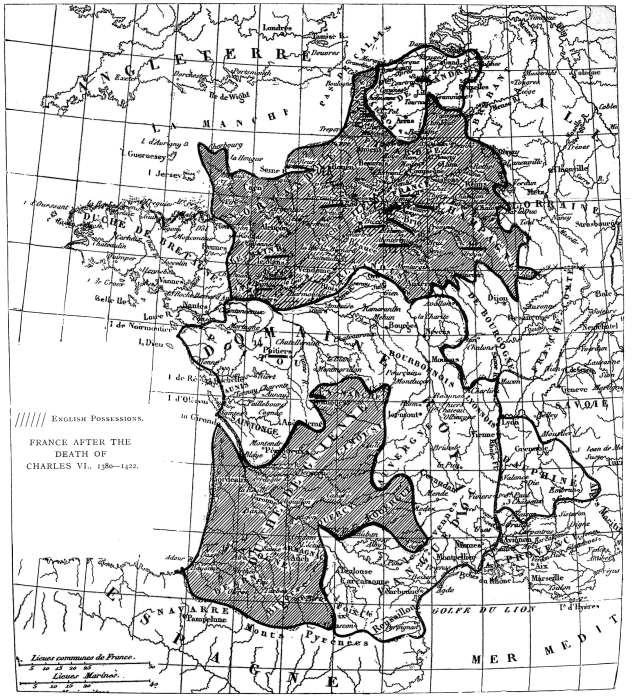
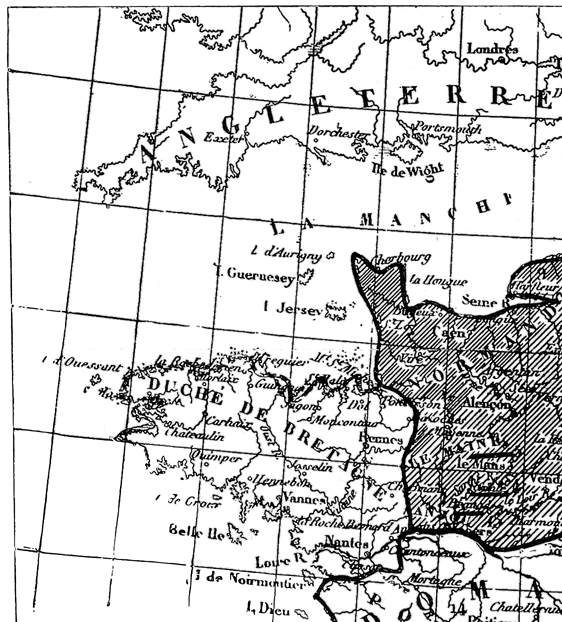
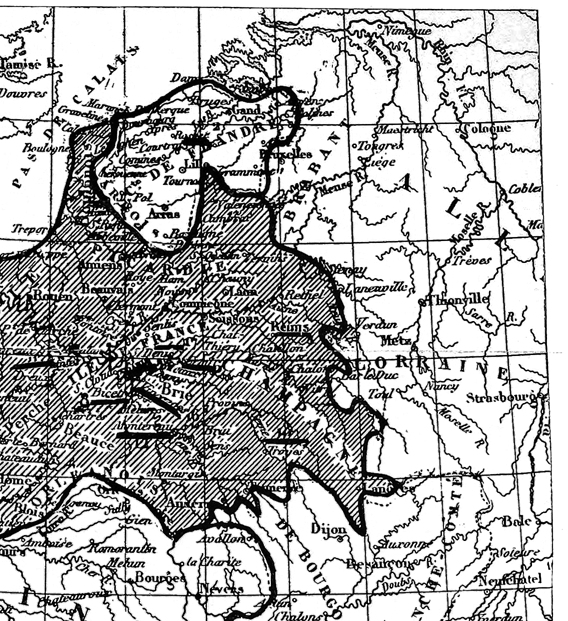
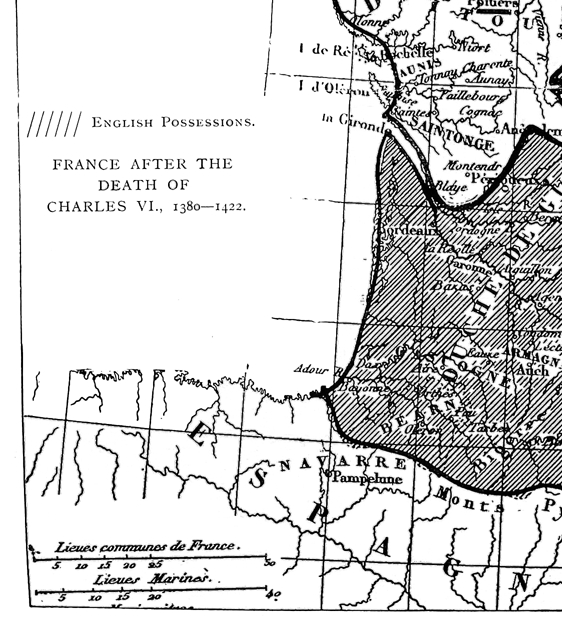
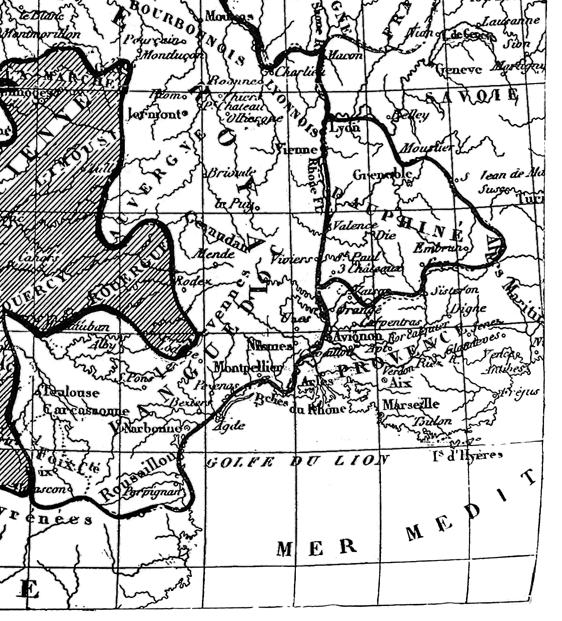
FRANCE AFTER THE DEATH OF CHARLES VI., 1380–1422.
But very soon the approach of the English army
compelled them to take refuge at Troyes, while a
dreadful pestilence was ravaging the country. The
Abbot of St. Denis died, and many other people of
importance. Many fled from the country, and for
four months there was a dreadful mortality.267 The
Duke of Burgundy was now declared Captain of Paris
instead of the Dauphin, who remained at Bourges.
The King, Queen, and Princess Catherine were completely
under the influence of Burgundy, whose eldest
son was, it will be remembered, married to another
daughter of the King, and whose aim now was to get
the Dauphin also under his guidance, which did not
seem to be at all impossible, Charles being only
fifteen, and having no more brains, capacity, nor
decision of character than his brother Louis; being
absolutely guided by whoever he was with, and at
present surrounded by persons of no particular rank
or weight. The young Comte de Clermont, son of
the Duc de Bourbon, who was about the age of the
Dauphin and had just returned from captivity in
England, had come over to the Burgundians, saying
that wherever the King was, there was his place, and
it was hoped the Dauphin would do the same.
Armagnac was dead, and his chief counsellor was
Tanneguy du Chastel, a Breton gentleman. Burgundy
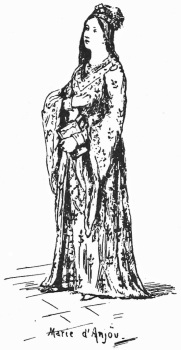
had sent his young wife Marie d’Anjou back to him
and was anxious for a reconciliation.
The English conquests were spreading. Rouen
was besieged and taken, and though negotiations
were going on for the marriage of the Princess
Catherine, Henry V. demanded as her dowry all the
provinces conceded to his great-grandfather by the
peace of Bretigny, to which the King and Duke of
Burgundy would not agree.
As the King and Queen started to take the
Princess Catherine to meet Henry V. at Pontoise,
however, the King was seized with an attack of
frenzy, so he had to be left there while the Duke of
Burgundy went on to Melun with the Queen and
Princess.
Henry V. met them, and at once fell in love with
the Princess who was just nineteen and extremely
beautiful; but he would not come to terms about the
dowry, and Isabeau, thinking to inflame his passion
for her, only let them meet once and then sent her
back to Pontoise. However, this only infuriated
Henry, who told Burgundy that he would have the
Princess and the lands too, in spite of them, “et je
vous chasseray de France, vous et vostre Roy.”268
The negotiations not having resulted in much
good the King desired the Dauphin and Duke of
Burgundy to make peace. The Duc de Bretagne
went to and fro between the Dauphin, his brother-in-law,
and the Queen and Burgundy. “Everywhere
there was a great longing for the success of the
arrangements for there was great desolation in all
parts of the kingdom for the war was of father
against son, brother against brother, uncle against
nephew. And the worst was when in one town were
held the two factions of Burgundy and Armagnac,
and thieves and robbers were everywhere and
merchandise always and everywhere lost.”269
It was difficult enough to persuade the Dauphin to
agree to terms, but the Queen sent the Dame de
Giac, an old lady the Dauphin had been very fond of
from his childhood, and who was said to have been
at one time the mistress of the Duke of Burgundy,
to Pouilly where the conference was going on. She
went from one tent to the other and managed so to
arrange matters as to bring about a reconciliation.
The Dauphin, who, though he had no sense, had
very pleasant manners, showed great courtesy to the
Duke and when they separated frantic rejoicings
took place at Paris, bells ringing, feasting in the
streets, singing and dancing going on all night
long.270
{1419}
But, as at the marriage festivities of Richard II.
and Isabelle, a great storm came on during the conference,
“and,” says the monk of St. Denis, “the
heavens were black with clouds, there was thunder
and lightning and torrents of rain and huge hailstones
which destroyed the vines and crops. Some said
this storm arose from natural causes, but it was most
generally believed that the evil spirits could sometimes
produce these disorders and that perhaps the
interviews of the princes were disagreeable to them.
Therefore people did not believe in the stability or
durability of the treaty concluded. It was also the
opinion of several of the learned astrologers. For
my part I leave their judgment to Him who reigns
in the heavens.”271
The truce with England expired and the war
broke out again. The English troops took many
towns and castles, the Duke of Burgundy retired
with the King and Queen to Troyes, and no adequate
measures were taken against the enemy. The Dauphin
returned from Touraine in September, and sent
Tanneguy du Chastel to Troyes to ask for another
conference with the Duke of Burgundy, who at first
refused, saying that there was peace between them
and the Dauphin had much better come to Troyes to
his father and mother. However, he allowed himself
to be persuaded and consented to meet the Dauphin
at Montereau, in spite of the entreaties and warnings
of his own friends and followers who dreaded the
vengeance of the Armagnacs for all his deeds,
from the murder of Louis d’Orléans to the late
massacres of their friends and relations in Paris,
besides their fear of his gaining over the Dauphin
the influence he already possessed over the King and
Queen.
The interview was to take place on the bridge of
Montereau, to which the Duke of Burgundy rode on
the 10th of September, about three in the afternoon.
As he dismounted to go on to the bridge, three of his
servants who had been upon it examining the barrier
across it, which they did not like the look of, came
up to him and again begged him not to risk himself
on it, but it was no use. At the barrier in the
middle of the bridge he met the Dauphin, the one
through which he himself passed having been locked
behind him. After a few words of conversation, the
Dauphin, as the Duke knelt before him, began to
reproach him with having done nothing to oppose
the English. At that moment one of the Armagnacs
pushed him from behind, Burgundy laid his hand on
his sword which had got behind him to pull it
forward. Robert de Loir, who had pushed him,
exclaimed, “Mettez-vous la main à vostre épée en la
présence de Monseigneur le Dauphin?” Tanneguy
du Chastel approached, made a sign, and saying “Il
est temps” struck the Duke with an axe. He tried to
draw his sword but it was too late, there was a cry of
“Tuez! tuez!” a fierce scuffle; then Jean Sans-peur
lay dead at the feet of the Dauphin, and Louis
d’Orléans was avenged.
{1420}
The rage, consternation, and mischief caused by
this event throughout the country, just as every one
thought there was going to be a little peace, cannot
be described. The Queen and her son-in-law
Philippe, Comte de Charolais, now Duke of Burgundy,
prepared to take their revenge. Philippe,
overwhelmed with grief, would scarcely see or speak
to any one for days. To his wife he said, “Michelle,
your brother has murdered my father”; and then
finding that she was fretting and making herself
miserable fearing to lose his affection he comforted
and reassured her. The Queen and Duke of Burgundy
sent proclamations to all the chief towns in
France denouncing the Dauphin for the murder of
Jean Sans-peur; and made a treaty with the King of
England at Troyes, by which they agreed that he
should marry the Princess Catherine and not only
act as regent of France during the King’s illnesses
but succeed to the crown to the exclusion of the
Dauphin.
Isabeau, who was then at Troyes, sent the Bishop
of Arras secretly to Henry to invite him to come
there, and to take him a love-letter from the Princess
Catherine, with which he was delighted.272 The young
princess was deeply in love with Henry V. and very
anxious to be Queen of England, and had all along
persuaded her mother, whose great favourite she was,
to help her in the matter and forward the alliance.
Isabeau was glad enough to do so for she loved her
daughter and hated her son, and this marriage fell in
with her views regarding them both. The wedding
was celebrated at Troyes, June 3, 1420, with extraordinary
magnificence. The Kings and Queens of
France and England and the young Duke of
Burgundy entered Paris, and spent Christmas there;
after which Henry and Catherine went on a visit to
England. The young Queen seems to have felt
bitterly the separation from her parents and country;
an ancient chronicle says of her: “Item, ce jour party
la fille de France nommée Catherine que le roy
d’Engleterre avoit espousée et fut menée en Engleterre,
et fut une piteuse départie, especialement du roy de
France et de sa fille.”273
{1422}
Just before Christmas, 1421, came the news of the
birth of a son to the King and Queen of England.
In Paris as in London bells rang and bonfires blazed
in the streets; for the child, afterwards the unfortunate
Henry VI., was born the heir of both England
and France. The winter was an unusually cold one,
the frost being so severe that no corn could be
ground except in windmills, all the watermills being
frozen up.
In May, 1422, Queen Catherine came back escorted
in great pomp by a great body of English troops.
She arrived at Vincennes, where she stayed some
weeks with her parents and husband who received
her, as an ancient chronicler observes, “as if she had
been an angel.” The court kept Whitsuntide at
Paris, Charles VI. and Isabeau at the hôtel St. Paul,
Henry V. and Catherine at the Louvre. The people
thronged to see the great banquets at which the
King and Queen of England feasted in splendid
robes, crowns, and jewels; while those of the King
and Queen of France were neglected, and at neither
were food and wine given away according to ancient
custom, which caused much discontent. But these
were the last great fêtes of the French court in the
reigns of Charles and Henry. In the following
August the King of England, who had for some time
been suffering from a dangerous and, in those days,
incurable malady, died at Vincennes, and his death
was followed in October by that of Charles VI. at
the hôtel St. Paul. Henry died at thirty-six, in the
midst of a brilliant and victorious career King of
England and almost King of France, leaving a
widow of twenty-one overwhelmed with grief, an infant
heir to two kingdoms, and a nation in mourning.
Charles, whose reign began so magnificently, passed
away in the half-deserted palace of St. Paul.
Although Isabeau was living there at the time, only
his confessor, almoner, and the first gentleman of his
household were with him when he died, at the age of
fifty-three.
{1423}
The Queen does not seem to have been present at
the funeral, the Dauphin was an exile and an enemy,
and the chief mourner was the Duke of Bedford,
Regent of France for Henry of Lancaster. The
funeral waited till his arrival at Paris and there was
much dispute as to what the arrangements should
be, it having been so long since a King of France
had been buried that very few people remembered,
and there were no records on the subject.
The litter was so constructed, that it could be
made narrower to pass through the doors of St. Paul,
Notre Dame, and the narrow streets, and widened in
the broader thoroughfares. On it was placed the
coffin covered with a pall of cloth of gold and scarlet
with deep border of blue velvet embroidered with
golden fleurs-de-lis, which fell down to the ground.
It was surmounted by an image of the King dressed
in royal robes, with mantle of ermine, crown, and
sceptre. The litter was carried by the “varlets” of
the King and followed by two hundred gentlemen of
his household in black, bearing torches and shields
with the arms of France. Next came the mendicant
orders, Jacobins, Carmelites, Cordeliers, and Augustins,
then the colleges, parochial clergy, ecclesiastics
of the collegiate churches and university, bishops,
abbots and nobles, members of Parliament, the four
presidents in mantles of scarlet and vair holding the
four corners of the pall, the King’s chamberlain,
esquires, and many of the chief citizens; the Duke of
Bedford, Regent of France, rode behind the litter.
The streets and windows were crowded with people
mourning and lamenting, and so, at the hour of
vespers the body of Charles le Bien-aimé was carried
to Notre Dame. The church was hung with costly
stuffs covered with fleurs-de-lis, and blazing with
torches, the psalms and vigils for the dead were
chanted “et fut nuict.” Next morning, after mass,
the procession formed again and the body was carried
in state to St. Denis, where all night the monks
chanted psalms and vigils for the dead; and then
next day, after a magnificent requiem, Charles VI.
was buried by his father and mother, and through
the dim aisles and cloister of the great abbey
resounded the cry, “Pray for the soul of the most
excellent prince, Charles VI., King of France.”
After the religious rites were over the Duke of
Bedford dined in his own room, but there was a great
dinner in the vast hall of the abbey to which
crowded prelates, nobles, gentlemen, and officials,
maîtres d’hôtel restraining those who were pressing to
the chief table and had no right there, and alms
being distributed while the banquet was going on to
more than five thousand poor people.
Isabeau survived her husband twelve years, but
this latter part of her life contains scarcely anything
of sufficient interest to record. After the death of
her son-in-law Henry V., with whom she always got
on well, the departure of her daughter Catherine for
England, and the death of Charles VI., she lived in
the half-deserted palace of St. Paul with a diminished
household and shattered fortune. Her daughter the
Duchess of Burgundy died in 1423, and of her twelve
children there only remained the son she hated, the
Queen of England, now far away, and her second
and third daughters, Jeanne, Duchesse de Bretagne,
and Marie, Prioress of Poissy, whom it is to be
supposed she sometimes saw.
Her brother, Ludwig of Bavaria, also survived her.
But war and famine and pestilence had devastated
the kingdom. Grass grew in the streets of Paris,
and wolves came and attacked children outside the
walls and even within the city.274 One event of interest
happened in 1431, which was the state entry of
her grandson Henry VI. into Paris. While Isabeau
stood at the window of the hôtel St. Paul watching
the pageant, the child looked up at her as he rode
by, and, some one saying to him, “That is the Queen-dowager
of France, your grandmother,” he took off
his cap and saluted her. At the sight of the young
King, the son of her favourite daughter, riding as
she herself had done amid the acclamations of the
people through the streets which had once been
decorated and thronged to do her honour, Isabeau
burst into tears and turned from the window. The
King, then ten years old, afterwards went to visit his
grandmother at the hôtel St. Paul.275
{1435}
Isabeau died there in 1435, September 29th. She
had a favourite old German lady who lived with her
to the last and with her other ladies followed her
funeral cortège to Notre Dame on the 13th of
October. Very little pomp was displayed on that
occasion, but the clergy of that cathedral came in
procession to St. Paul, and spared nothing to make
the office worthy of a sovereign, lending a crown,
sceptre, and other royal ornaments. There were
present the Chancellor of France, the Bishop of
Paris, and certain French and English nobles. After
the ceremony the body was placed in a boat by the
presidents of Parliament and taken to St. Denis to
be buried by her husband Charles VI.276
Paris was still in possession of the English, but
just before the Queen’s death the treaty of Arras
was signed between the Duke of Burgundy and
Charles VII.
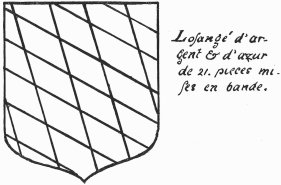
Losangé d’argent & d’azur de 21. pieces mises en bande.