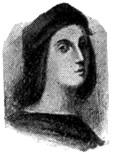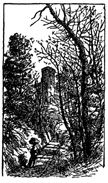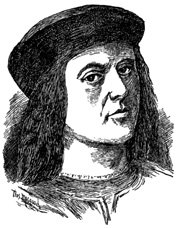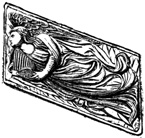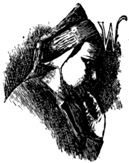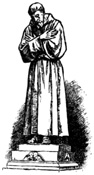
STATUE OF
ST. FRANCIS.
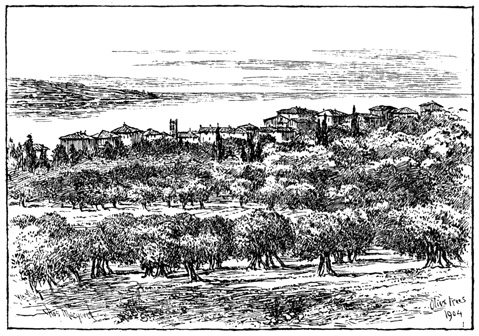
As we mounted the hill the
great shrine had seemed
to rise higher and higher
above us; in the flaming
sunshine the olives
looked a pale silver
against the deep blue
sky. When at last we
took the way to the
monastery, we seemed
to have reached a deserted town. Assisi
was still and lifeless; the very inn was
asleep. Flies and gnats, however, made
us sharply feel that the heat gave
them extra thirst, and that we were a
boon in this absence of human life.
We had been told that the Lower
Church of the monastery is best seen in
morning light, so, instead of beginning
our pilgrimage with the first chapter
of the saint's story, in Chiesa Nuova, at
the top of the town, we turned to the
cloister of San Francesco, and passed
along it to the terrace, on to which
the beautiful porch opens.
To-day this porch was full of exquisite
effects of light and shadow; near it
is Fra Filippo's massive and finely
proportioned campanile. The name of
the architect of the church is unknown;
but it seems fairly attested that the
campanile was built by Fra Filippo
Campello, who later on became the
architect of the church erected by the
Assisans, on the site of San Giorgio,
in honour of Santa Chiara, or Clara,
the first female convert of St. Francis,
the foundress of the "Poor Clares."
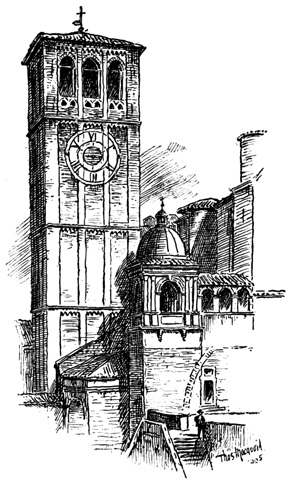
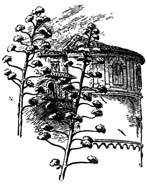
THE TOWER, SAN FRANCESCO.
It is strange that the name of the
great architect who designed this beautiful
church and monastery should be
doubtful, especially as San Francesco is
said to be almost the first Gothic church
built in Italy, and remains to this day
one of the purest and most beautiful
in style, free from that admixture of
Renaissance work which robs so many
Italian churches of the reverence and
religious inspiration created by our
English and so many French cathedrals.
At San Francesco the very walls are
sermons in stone; while, especially in the
Lower Church, the rich beauty of colour
calls out a perpetual hymn of praise.
The offerings made by pilgrims from
all parts of Italy at the tomb of Francis
in San Giorgio had, in the space of two
years, amounted to a sum large enough
to defray the expense of building this
Lower Church.
We went in by the porch to the
atrium; coming from the brilliant sunshine
outside, all seemed so dim that
we feared we should not make out the
frescoes that cover, with mellow, delicious
colour, the walls and low vaults of
nave and side chapels.
One seems to breathe colour in the
atmosphere of this Lower Church; the
very air is painted, as light comes in
through the stained glass windows,
most of which are worth a careful study.
There are interesting tombs in this
first part of the church, before one enters
the nave; one of the tombs resembles
in its arrangement Giovanni Pisano's
beautiful monument to Pope Benedict XI.
at San Domenico, Perugia, but the
Assisan tomb is wholly inferior in
execution. As we stood looking up the
nave, we realised how truly this church
embodies the life and work of Francis
Bernardone; it is a house of prayer
and praise. Its exquisite beauty, both
of architecture and colour, inspires the
joy so continually preached by Francis,
in which he lived, despite his ascetic
privations and self-denying labour for
the good of souls.
It is impossible to describe, or even
to name, except generally, the numberless
frescoes which enrich the walls and
the vaultings of the transepts and
chapels; the golden-starred, blue roof
of the nave absorbs the light, but it adds
to the mysterious beauty of the church.
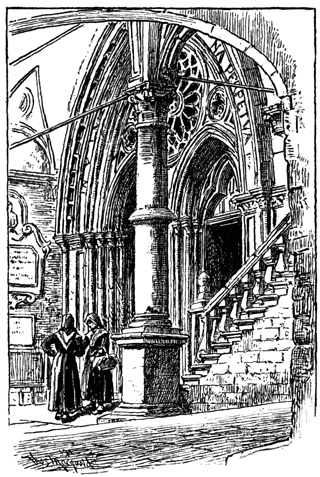
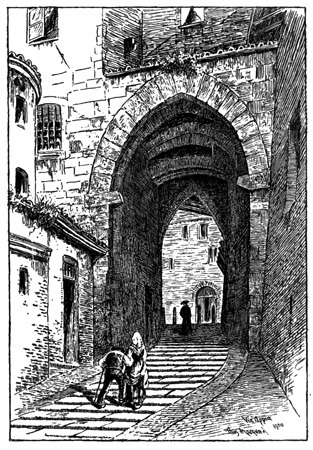
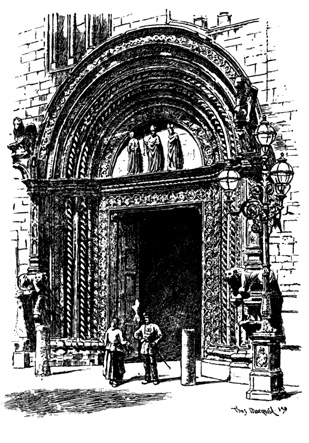
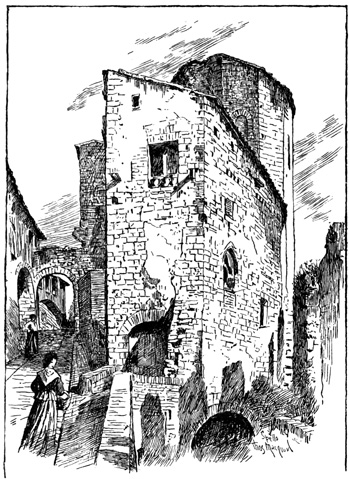
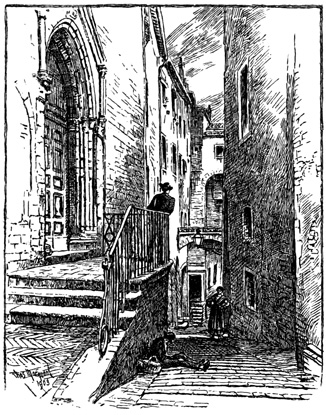
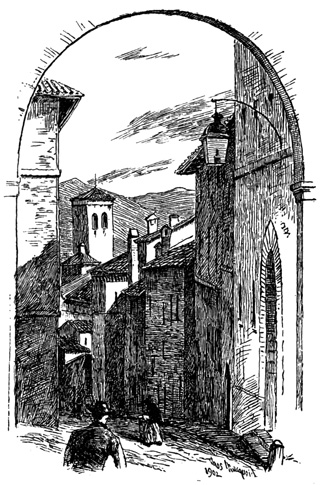
ENTRANCE DOOR TO LOWER CHURCH, ASSISI.
Perhaps the first thing that one
admires on entering the nave is the
richly-coloured cross-vaulting above the
high altar, and that between the choir
and transepts. There are four chapels
on the right, and only two on the left
side of the nave; between these two
are the sacristies. There can be no
doubt that in the original plan these
chapels did not exist.
The foundation of the church was
laid in 1228; evidently the walls when
completed were covered with frescoes
by some very early painters, who failed
to satisfy the taste of the Franciscans;
for one can make out portions of old
fresco work near the entrances to the
chapels, the wall here having been
removed when these additions were
made to the original building.
This took place before Cimabue and
Giunta Pisano and then Giotto and his
pupils came from Florence; followed by
the Lorenzetti and Simone Martino,
from Siena, to make the basilica the
burnished jewel it is to-day. A harmony
of blue and scarlet, of green and
gold, fills one's sight as one looks
onward to the high altar.
We went up to the right transept; here
is the famous Madonna of Cimabue.
Above the arch of the chapel within
the transept is a beautiful fresco by
Giotto, of the Annunciation, part of
a series by that painter of the Infant
Life of our Lord, from the Annunciation
to the Finding the Holy Child in
the Temple; the figures in these frescoes
all tell their own story, and are full of
beauty and dignity. The Annunciation
over the arch leading to the chapel
is especially lovely.
There is also another series of Giotto
frescoes on the wall of this transept;
in one a child is falling from a window;
there are sweet faces among the women
who kneel in front. St. Francis meets
the child as its body is being taken to
burial, and restores it to life. The other
two frescoes also deal with restoration
to life. Our guide said that one of the
faces in these was a likeness of Giotto
Bondone. In this Lower Church are
many frescoes by Giotto's pupils, notably
by Taddeo Gaddi and by Giottino,
who have done very fine work on its
walls. Within the chapel, beyond the
Annunciation, is an interesting series of
frescoes, which represent the story of
St. Nicholas; these are said to be the
work of Giotto's best pupil, name
unknown, some of whose work is also
in the Upper Church. The truth to
nature in the conception, and the
simplicity of this master's work, make
the study of it most fascinating; its
breadth of treatment gives it a peace
and dignity which the solemn stiffness
of Cimabue fails to inspire.
Giotto must have been young when
the Franciscans summoned him to
adorn the walls of their basilica, for his
work there is supposed to have been
completed in the early years of the
fourteenth century, and he was not
born till 1265.
It is well known how the great artist
Cimabue, on his way from Vespignano,
a village some miles north of Florence,
found among the hills a shepherd lad
of ten years old, named Giotto Bondone,
sketching on a bit of stone, and
how the great Florentine was, on close
inspection of the sketch, so impressed
by the truth to nature shown in the
boy's likeness of one of his sheep, that
he thenceforth adopted Giotto as his
pupil, and took him to Florence, where
for ten years the youth worked in
Cimabue's atelier.
It is strange that the painter should
have so greatly admired the simple
love for and the truthful rendering of
nature which characterises his protégé's
work, for Cimabue himself clung to
the stiff drawing and unlovely ideals of
Byzantine art, overlaid with gold and
jewels. The most striking feature in
Giotto's work is the life-likeness of his
figures and faces and their surroundings;
and the natural and simple way in
which he portrays action. The faces are
seldom as lovely as those of the Sienese
painters in this church, but there is
no exaggeration about Giotto. Ruskin
says "his imagination was exhaustive
without extravagance."
At Assisi one seems to trace his progress
from these early paintings in the
right transept, to the very excellent
series on the Life of St. Francis in the
Upper Church. Time has probably lent
its mellowing help, but the rich yet soft
harmony of colour is beyond the power
of word-painting,—it takes complete
possession of the gazer.
The left-hand transept contains the
chapel of San Giovanni. The Franciscans
confided its adornment to Pietro
Lorenzetti of Siena, who covered the
walls with scenes from the Passion.
The colour is rich and remarkable, but
the design is frequently exaggerated.
In the fresco of the Crucifixion, however,
the figures beneath the cross
are beautiful, especially those of the
Madonna, of St. John the Evangelist,
and St. Francis.
Another very interesting chapel, also
on left side of nave below the grille,
which at great functions is closed,
dividing the nave from the transept
and the high altar, is that dedicated
to St. Martin, filled with lovely frescoes
by Simone Martini of Siena, representing
the life and miracles of Martin of
Tours. The faces and figures are delightful,
so is the colour; the story of
the saint is admirably told.
There are also beautiful frescoes by
Simone Martini, or Simone Memmi, as
this Sienese painter is often called,
between the entrances to the chapels
of the Sacrament and that of St. Mary
Magdalene. Many others by Giotto and
his pupils are in the various chapels.
When we had looked at some of
these, we went back to the high altar,
and, standing there, beneath that
glorious vaulting overhead, we found
it difficult to realise that we were
actually on the place so filled with
memories of the three great revivalists
of purity, for in their respective generations
Francis Bernardone, Dante, and
Giotto strove to regenerate Italy.
After a while, as one stands gazing
at the great lunettes overhead, one can
picture the two friends, Dante and
Giotto, on the space now occupied by
the high altar,—the imagination of
the poet aiding the skill of the painter
to perpetuate the teaching of the Spouse
of Poverty.
The tomb of St. Francis is in an open
crypt below the high altar; this crypt is
called by the Assisans the Third Church;
the neighbouring peasants frequently
attend the early mass celebrated here.
Owing to the care with which Brother
Elias, who succeeded Francis as Vicar-general
of the Order, secreted the urn
containing the remains of the saint,
they were not discovered till the year
1818. A tradition had been circulated,
and was firmly believed in, that a third
very beautiful church had been built
underground, and contained the body
of the founder.
This successor of Francis, Fra Elia,
was doubtless proud and ambitious;
his grasping worldliness and irreligion
greatly injured the repute of the
Franciscan community, but in this
special case he acted wisely. Perugia
had determined to possess herself of
the precious body, which drew pilgrims
from all parts of Europe to make offerings
at its shrine; Elias knew this,
and therefore, when the basilica was
completed, and the saint's remains were
removed from their tomb at San
Giorgio to the new church, he buried
them secretly, and surrounded them by
a strongly cemented underground wall
of masonry, which effectually baffled
all attempts to discover them, though
the Perugians made several attacks on
Assisi for that sole purpose.
In 1818 the Assisans made a more
skilful and sustained excavation. At the
end of two months, spent in piercing
the rock on which the church is built,
and the solid wall of masonry which
seemed part of the rock itself, the
urn was discovered. The excuse for
Elias is that he considered the presence
of the saint's body to be the honour
and glory of the city of Assisi, to say
nothing of the wealth accumulated by
offerings at the shrine.
Overhead is the culminating glory
of the church, the frescoes on the four
central lunettes of the vault, sometimes
considered to be Giotto's finest
work at Assisi. They represent, in
allegory, the poverty, the obedience,
and the chastity enjoined by the saint,
and embodied by him in the rule of
his Order. The fourth spandrel represents
St. Francis in Glory.
Probably the poet and the painter
stood together on this very spot. Tradition
says that Dante aided his friend
in the conception of these grand designs.
The marriage of Francis to the
Lady Poverty seems to prefigure the
lines in the Paradiso, for Giotto had
finished his work at Assisi before those
lines were written.
In the next compartment, a monk,
a nun, and a lay-brother of the Order
are seen taking the vow of chastity;
they are supposed to represent Bernard
di Quintavalle, the wealthy noble who
became the first disciple of St. Francis;
Santa Chiara, who wears the robe of the
Second Franciscan Order; the lay-brother,
in a Florentine garb, is thought to be
Dante. The Virtue, guarded by angels,
looks out from a tower above. There are
many other figures, mortals, angels, and
demons, who indicate in various ways
the constant struggle and mortification
attendant on the Franciscan calling.
Some of the angels with beautiful faces
are busily engaged repelling the spirits
of the world, the flesh, and the devil,
who strive to tempt the neophyte, a
naked youth who is being baptized by
two angels in a font in middle distance.
The good angels hurl the devils over
the rocks into depths far below.
The third fresco, Obedience, is also
full of allegorical figures, and the Virtue
wears the Franciscan robe. The fourth
fresco shows St. Francis in Glory,
surrounded by throngs of fair-haired
angels, who sing hymns of perpetual
praise. The truth to nature in these
figures is remarkable, some of the faces
are beautiful.
One might fill many pages with detailed
descriptions of the frescoes on the walls
and vaulting of this gemlike church.
It takes several days even to see them,
and therefore it is wiser to spend some
time in Assisi, so as to examine them
in their best light.
So wonderfully picturesque is every
part of this Lower Church, that it is very
difficult to give any idea of such a
storehouse of early Italian art, for both
Upper and Lower Churches seem to
have been a rallying-ground for Giotto
and his pupils, for the early Sienese
masters, and for others following after
Cimabue, Giunta Pisano, and the very
early painters of Italy.
Fra Antonio, the sacristan, was a
most kind and intelligent guide: pointing
out to us the portrait of Francis,
attributed to Giunta da Pisano, he
took us into the sacristy, and let us
see strips of old embroidery mounted
on frames. The faces in this embroidery
were beautifully rendered, and the
colour was delightful. The Fra told us
that some English ladies from Perugia
had so greatly admired the old lace
in the vestiary that he felt sure
we should also like to see it; among
it was some very fine point de Venise,
used to trim surplices. I forget how
old he said it was; some of the vestments
were exquisitely embroidered.
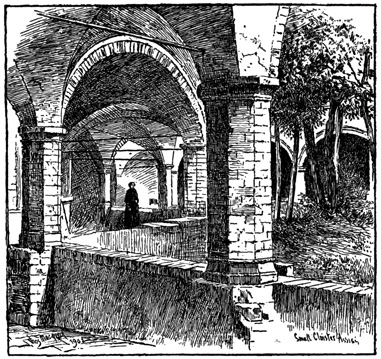
THE SMALL CLOISTER, SAN FRANCESCO.
Then he opened a door, and we saw
the quaintest little cloister, surrounded
by the grey convent walls; the garden,
in its grass-grown quadrangle, was
seemingly left to itself. We spied
out rosy cyclamen blossoms dotted
among the grassed hollows of the rough
ground, and our kind Fra, tucking up
the skirts of his cassock, for at San
Francesco the Franciscan habit is not
worn, the conventual garb takes its
place, stepped into the quad, and
gathered a bunch of blossoms, which
he presented to me, with tufts of
maidenhair fern from the low wall
of the cloistered garden. He asked
my companions to come and dig up
roots of both cyclamen and maidenhair.
"The Signori may as well have them,"
he said, with a sigh, "as those who
set no store by them."
He was very kind, but we wondered
what St. Francis would have thought
about the change of costume and the
comparative comfort of these guardians
of his burial-place.
We went back into the basilica, and
up a staircase which led to the east
end of the Upper Church, built some
twenty-one years after the Lower one.
It is a beautiful and graceful example
of early Gothic. The Pope's chair, near
which we entered, is in red marble;
the high altar at that time was
surrounded by a screen, mass being
no longer said there.
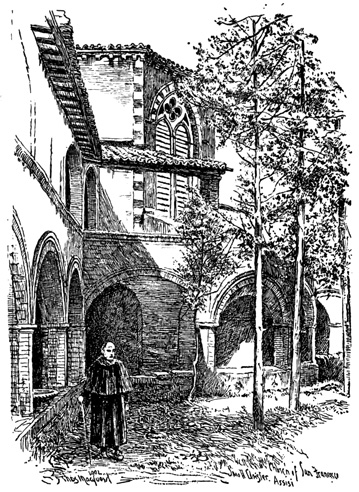
CLOISTER-GARDEN, SAN FRANCESCO.
Cimabue and other old painters have
covered the walls in this part of the
Upper Church with frescoes, many of
them grand and impressive in design,
though they have greatly suffered from
so-called restoration by unskilful hands,
while damp has damaged others. Some
of the subjects are from the Old Testament,
others from events in the life
of our Lord; the general effect is, however,
rich and harmonious. The long
series taken from the life of St. Francis,
along the lower part of the nave, is
very interesting. There are twenty-eight
subjects, chiefly painted by Giotto;
the rest are said to be executed by
that pupil of the Florentine master
who painted the legend of St. Nicholas
in the Lower Church. Giotto's fine
series in this Upper Church portrays the
saint's history, and contains, I believe,
the best work executed by the artist
in the basilica; it is much later in
date than some of his other Franciscan
frescoes. The painter is said to have
taken as his guide Father Bonaventura's
Life of St. Francis. As this writer
was born during the lifetime of Francis,
and was later on commissioned to write
the saint's Life, his narrative may be
considered reliable. The painting of the
various scenes is masterly, and the
detail in the interesting events here depicted,
the architecture especially, is
rendered in a very striking manner.
These frescoes are so lifelike, that
they stamp yet more strongly into the
mind the impression created by a visit
to Assisi, the truth of the wonderful conversion
and subsequent life of Francesco
Bernardone.
One of the most striking incidents
in this conversion is illustrated in the
fourth fresco of the series, in which
the saint is shown praying before
the crucifix in San Damiano. Those
who have read the beautiful Vie de
Saint François d'Assise, by Monsieur Paul
Sabatier, will understand the meaning
of this fresco, though it has been so
sadly injured by damp. For those who
have not enjoyed this privilege a short
sketch of the saint's life is here added.
Francis Bernardone was born at Assisi
in 1182, his father being a rich merchant
called Pietro Bernardone. His mother,
Madonna Pica, is said to have been
better born than her wealthy husband,
who travelled, according to the custom
of the time, from one city and castle
to another, journeying sometimes as
far as France, with his company, and
the goods he had to sell. He does
not seem to have taken Francis with
him; he preferred that the youth should
remain at home, and use his singular
power of making friends among the
wild and dissolute young nobles of
Assisi.
Now and again Pietro would ask
for his son's help in his warehouse,
but this was seldom. He wished the
young fellow to distinguish himself
among these prodigals, and therefore
gave him liberal means, so that he might
join in all their sports and amusements,
in their banquets and night revelries.
The whole world of this period seems
to have abandoned itself to every form
of sin and pleasure. There was no discipline,
no self-restraint to be found;
might meant right. Self was everywhere
worshipped, especially among the nobles
and the wealthy.
Francis and his companions did not
lack bravery. They joined the Assisan
troops in resisting an attack made by
the rival and far more powerful city of
Perugia; the Assisans were defeated,
and Francis, with some of his friends,
was for months imprisoned in a Perugian
dungeon. This gave him leisure for reflection.
Soon after being liberated, he fell ill
of a fever, and could not return to
his former life. He had already begun
to see it with new eyes, and during his
slow recovery fell into a strange melancholy;
rousing from this, he decided to
lead a military life. He would, he told
himself, perform daring feats of valour;
so, when a very distinguished knight
asked him to take service with the
Pope's troops, then warring in Apulia,
Francis eagerly accepted the proposal.
The night before the two friends
started, Francis dreamed that he saw
his father's warehouse, usually stored
with bales of silk, and gold and silver
stuffs, filled with lances and military
accoutrements both for men and horses.
He awoke in great delight. He considered
this dream a good omen for the
success of his expedition, and rode joyfully
next day to Spoleto. A version
of this dream is given on fresco No. 2,
by Giotto, in the Upper Church. At
Spoleto his fever returned, and he heard
a voice telling him he had completely
mistaken the meaning of his dream,
and that he must at once return to his
father's house. Francis obeyed, but on
his return his father and his fellow-citizens
were disgusted by his apparent
cowardice in turning back.
Francis had always been charitable
to the poor, flinging liberal largesses
to them as he rode about the country,
sumptuously dressed and with his horse
richly caparisoned; he now awoke to
the conviction that the poor and suffering
were his fellow-creatures, and
merited a more personal and tender
treatment than he had bestowed
on them. Hitherto he had so dearly
loved his gay companions, that he
grudged every moment spent away
from them; he even hurried over meals
with his father and mother, so that
he might the more speedily rejoin his
frivolous friends. Now, after his return
from Spoleto, he often went to a grotto,
in a wood near Assisi, and prayed
there; he saw less and less of his companions,
he even sold some of his rich
clothing that he might have more to
give to the poor. In his father's
absence he would clear the table of
all food left on it, and give it among
his poor friends. He had always been
extremely dainty and fastidious in his
habits and tastes, and he especially
shrank from contact with any of the
numerous lepers who, since the return
of the Crusaders, had become a plague
along the high-roads of Europe. One
day he met a leper, and, after giving him
an alms, turned abruptly away; on reflection,
this seemed to him cruel and
uncharitable. Soon afterwards he paid
a visit to the lazar-house, spoke kindly
to the inmates, and gave each leper
a special alms, kissing their hands as
he did so. More than once, when he
met a poor man and had not a coin
with him, he would bestow an article
of his own clothing on the beggar.
His gay friends became greatly
troubled at his changed behaviour.
They dearly loved his sweet, fearless
nature, and his winning charm of
manner. They could not spare him
from among them, for they looked on
him as their leader.
They reproached him with his absence,
and implored him to return to
them. Francis announced that he was
going to give them a banquet, and did
so; there was every possible luxury,
the table was magnificently decked,
and he was chosen lord of the feast.
But though he was cheerful, he was
quieter, less full of wild revelry than
he had formerly been, and when they
all left the feast, instead of leading his
companions into the streets of Assisi,
as he had formerly done, he lingered
behind, till they had to retrace their
steps so as to join him.
They asked what ailed him;—was
he thinking of marriage?
He remained silent awhile, then he
said:
"You have guessed rightly: I intend
to espouse that most beautiful of brides,
the Lady Poverty. No longer will I
waste my time and dissipate my substance
on follies."
They stared in unbelief, then they
treated it as a jest, but when they
found he was in earnest, they jeered
at their idolised leader.
When Pietro Bernardone learned that
Francis had broken with his former
associates, he became furious. Already
greatly angered by the report of his
son's visits to the lazar-house, and by
other instances of the young fellow's
charity, he could not pardon this public
act of folly.
So long as his son shared the pursuits
of the dissolute nobles who had
so greatly admired him, so long as
he was to be found in their company,
the arrogant, purse-proud merchant,
keenly desirous to better, as he considered,
his son's position in the world,
had been lavish of his money to the
spendthrift; though even in those wild
days instances are recorded of the
younger Bernardone's goodness to the
poor and suffering.
He therefore sent for Francis.
"You are welcome," he said, "to
spend my money as you please, even
to the half of it, provided you spend
it in the company of noble lords, so
as to bring you, in return, praise and
honour. I covet for you distinction,
and you well know that it can only
be gained from the world; not one
soldo will I give you to bestow on
vile lepers, or on churches and priests.
You are idle, I hear; you spend all your
time in praying."
This tyranny greatly troubled Francis,
though it seems to have helped his
inward convictions by turning him
more and more from the temptations
to worldliness.
From this time forth the young
fellow's domestic life became a daily
martyrdom, except when his father was
absent for weeks together in pursuit
of business. But on Pietro's return he
always began to persecute his son. This,
joined to the mental suffering endured
by Francis in his struggle after truth,
had greatly affected the young convert's
health.
Outside the Porta Nuova, in the midst
of a wood, was the little ruined church
of San Damiano, served by one poor
priest, who dwelt in a miserable hermitage
beside it. Francis had made
acquaintance with this priest, who, on
his side, was hospitable to the friendless
youth, for not only his former
companions, but the Assisan citizens
sided with his father in condemning
Francis's behaviour. Frequently the
younger Bernardone would spend all
night on his knees in the old church
of San Damiano.
He was one day kneeling here in prayer
when he heard a voice calling him. He
listened, and heard it distinctly bid
him seek a closer walk with God; it
told him henceforth to devote himself
to the restoration of God's ruined
houses in Umbria. At that time, owing
partly to the continual warfare and
brigandage under which the country
groaned; also to the frequent visitations
of the plague, which carried off so
many monks who tended the stricken
hospital patients, some religious houses
were almost bereft of their inmates,
very few monks were left to repair
and keep in order the churches and
chapels of Umbria, and many of these
were therefore sadly dilapidated.
Francis felt transported out of himself,
his doubts and difficulties seemed
to vanish before this direct call from
heaven. In his religious fervour he
resolved to quit his father's house,
now a scene of daily persecution. He
would in future devote himself to the
building up of ruined shrines, and he
would begin with the chapel of San
Damiano. In a fresco by Giotto in the
Upper Church, Francis is seen kneeling
before the crucifix listening to the voice.
The crucifix still exists, but it has been
removed from San Damiano to Santa
Chiara. A part of this fresco is almost
obliterated by damp. Perhaps the most
interesting fresco of the series is that in
which Francis renounces the world before
the bishop and the people of Assisi.
After he had vowed at San Damiano
to devote himself to the reparation of
ruined churches and shrines, he remembered
that he had no money
wherewith to begin his labours. The
remarkable gift he possessed, decision
of character, now impelled him to put
his resolve into instant action.
He hastened back to Assisi, made
into a bundle some rich stuffs, his
own property (not, as has been said,
goods belonging to his father), then,
bent on speedily repairing the fabric
of San Damiano, Francis rode off along
the valley, to the thriving commercial
town of Foligno, only a few miles
away. In the market of Foligno he
sold all he possessed, even the horse
he rode, with its trappings, and joyfully
returned on foot to San Damiano,
with a bag full of money.
The arrogance and avarice of Pietro
Bernardone were known throughout the
country-side, his quarrels, too, with
his son's new ideas were by this time
public property; so that, when Francis
toiled joyfully up the hill to the chapel,
and offered his bag of money to the
priest, the good man refused to accept
it, warning the young enthusiast that
such a gift would greatly anger the rich
merchant, his father. At this refusal
Francis flung his purse into the window
nook of the chapel, and, turning to the
priest, begged him to feed and lodge
him in his humble dwelling.
Pietro was at home, and after a while
became anxious at his son's continued
absence; he went to look for him at
San Damiano. Francis, however, guessing
at his father's anger, had already
found a safe hiding-place in the wood.
When he heard Pietro's fierce reproaches,
he trembled; he then termed
himself a coward to prove thus unworthy
of the call he had received.
He resolved to go back to Assisi, and
announce to his father his choice of
a vocation. His long mental struggle,
his nights spent in prayer and fasting,
his weeks of severe discipline, had
greatly changed his appearance; his
clothing was soiled and torn, his face
pale and emaciated. When he trudged
into Assisi, the town children failed to
recognise him, and, excited by the sight
of this strange beggar, they surrounded
him, crying out, "A madman, a madman!"
throwing stones at him.
The outcry called his father to his
house door; he saw and recognised his
son. The furious merchant seized Francis
by the collar, dragged him into the
house, which stood on the site of Chiesa
Nuova, and, after a severe flogging,
flung him into a cellar. Here the young
ascetic was rigorously imprisoned till
Pietro again left home for one of his
business journeys.
He had no sooner gone than Madonna
Pica released and tried to comfort the son
she so dearly loved. Francis soon bade
her adieu, and returned to San Damiano.
But when Pietro came home again,
and found his son absent, it is said that
he gave his wife a beating before he
hurried off to the ruined chapel in the
wood.
This time Francis did not try to hide
himself; but when his father, in a torrent
of reproaches, told him he must
quit the country, because he had brought
such disgrace on his family, the young
fellow respectfully answered:
"Henceforth God is my only Father;
I cannot obey any other."
Pietro again broke into furious accusation.
He had lavished a fortune on
Francis, he said, and this was the
return he got for it.
For answer, his son pointed to the
bag of money which still lay in the
window nook.
Bernardone eagerly seized it. He swore
that he would appeal to the justice of the
law to punish his son.
He did appeal. Francis was cited
to appear before the magistrate. He
refused to obey the summons; he had
put himself, he said, under the protection
of the Church.
When Bernardone heard of this answer
he appealed to the Ecclesiastical Court;
but the Bishop's answer to the angry
father was a warning. He said that
if Pietro really wished to punish his
son for being good and pious, his only
resource was to persuade Francis to give
up all claim to his patrimony, or he
could, if he chose, disinherit him.
Francis was summoned to the Bishop's
palace, on the Piazza Santa Maria
Maggiore. He found the place thronged
by the excited citizens of Assisi. The
Bishop, at that time well disposed
towards the young fellow, advised him
to end the quarrel with his father by
renouncing all claim to his inheritance.
When Francis heard this counsel, his
face beamed with joy. He stripped
off his clothing, rolled it into a bundle,
and laid it and the few coins he still
possessed at the feet of the Bishop.
He then turned to the wonder-struck
citizens of Assisi:
"Mark all of you," he said, "I have
given back my possessions to Pietro
Bernardone; I once called him father,
hereafter I address myself altogether to
our Father which is in Heaven."
Pietro pushed forward; he snatched
up the money and the clothing.
This drew a loud murmur from the
Assisans, for the rich merchant's arrogance
and avarice had alienated his
fellow-townsmen; he had grown to be
unpopular.
The compassionate Bishop at once
flung his own cloak over the youth's
shivering shoulders; his charity drew
forth a pitying chorus of approval.
The people, who had hitherto despised
Francis as a fool, saw him suddenly
in a new light; they marvelled at this
singular proof of self-abnegation.
Thus the first-fruits of his mission
were reaped from the impression created
in many of these bystanders, who during
the past two years had scornfully witnessed
and mocked at his good deeds and
his devout life.
The reality of the scene represented in
this fresco is marvellous; it at once tells
its own story. The compassionate Bishop
puts his cloak round the naked youth,
who holds up his hands in the act of
renunciation, while the stern-looking
Pietro bustles forward to snatch at the
money and clothing, and also apparently
to strike a blow at his son, but is held
back by a wealthy-looking fellow-citizen
in an ermine-lined cloak and tippet.
In another fresco Francis is preaching
to the birds at Bevagna; in another
we see the arid summit of La Vernia
above the Casentino valley, where, in his
later years, he is said to have received the
Stigmata. Another fresco full of beauty
and interest is called "The Mourning
of the Nuns of San Damiano." It shows
how, after the saint's death, his body
was carried past the convent of San
Damiano, on its way to sepulture at
San Giorgio; the saintly Clara had been
for some years Abbess of the little
convent in the wood, and she and
the Poor Clares, her Sisters, wept over
the body of their beloved founder.
These frescoes, and the thoughts they
recall, are deeply interesting, and yet
the Upper Church is not so delightful
as the Lower one is,—at least, we did
not find it so fascinating, although,
in addition to the frescoes, the painted
windows are full of beauty; there is
rather too much light; one misses the
rich mellowness of atmosphere which
fills the Lower Church with a dim
mystery of splendid colour, especially
one misses the work of the Sienese
painters.
The way to La Vernia, judging by
the fresco, must have been terribly
rugged. The favourite resort of St.
Francis, when he retired from the distractions
of life at La Portioncula, to
give himself more fully to prayer and
contemplation, was Le Carceri; the cells
are still to be seen in a ravine on the
side of rugged Monte Subasio, some
way north of San Damiano. Le Carceri
is a series of caves in the solid rock,
containing the monks' cells; it is backed
by a wood, and has the hill torrent
before it. The walk there from Assisi
is full of beauty, and it is not a very
long way from Piazza Nuova, leaving
Assisi by Porta Cappucini. Here the
saint had frequent talk with the birds
in the woods near Le Carceri; the ilex
tree is still shown on which the winged
disciples perched while Saint Francis
talked with them.
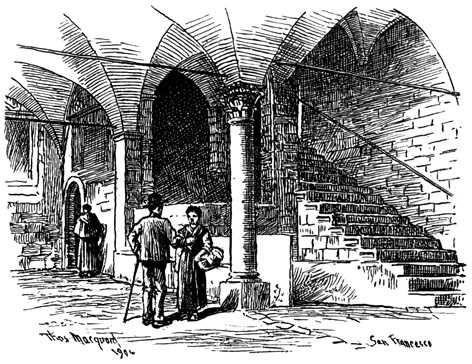
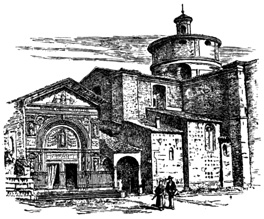
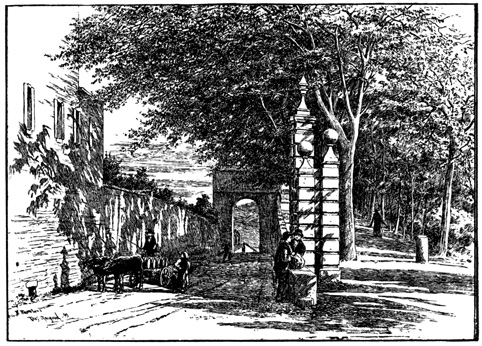
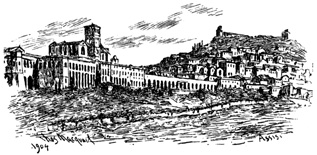
OUTSIDE
SAN FRANCESCO
It was at Le Carceri that he invited
the nightingale to try which could sing
longest to the praise and glory of God.
Brother Leo declined to join in this
trial, but the saint and the nightingale
sang on through the night, till Francis,
completely exhausted, had to yield victory
to the bird.
While we stood gazing at the frescoes,
thinking of all these things, Fra Antonio
said softly:
"The Signora and the Signori have
now seen all I can to-day show them."
We longed to linger, but already
the kind man had given us much of
his time; he quaintly added, "It is,
moreover, my dinner-hour."
Then we took leave of the kind
Fra, and said we would come again.
We went out by the west door under
the fine window, and rejoiced in the
very lovely view before us. We wished
our guide a good appetite, and he
stood watching us as we went down
one flight of the double range of steps
leading from the Piazza of the Upper
Church to the Lower one.
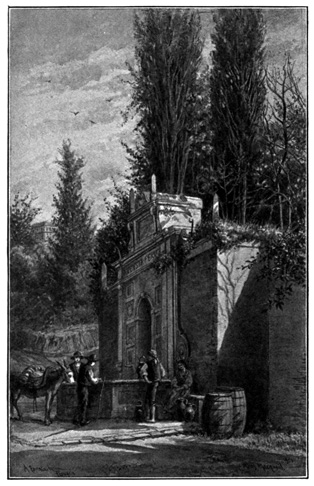
We were tired when we came out
into the sunshine, and we sat down
in the shade opposite a fountain, at
the foot of the steps.
A girl came presently up the hill
behind us, her bare feet white with
dust. She carried on her red-kerchiefed
head a tall copper pitcher with dinges
which bespoke it the worse for wear;
her skirt was short and dark, and
the light blue bodice laced up behind
showed a white undervest. In a
minute she began to run fast, deftly
balancing the tall pitcher. Then we
saw behind her a long-legged lad,
evidently bent on arriving first at the
fountain. The two figures seemed to
fly along the dusty road; the lad
outran the girl, and, when she reached
him, panting and choking with laughter,
he had the courtesy to fill her pitcher
for her, and helped her in raising it to
her head.
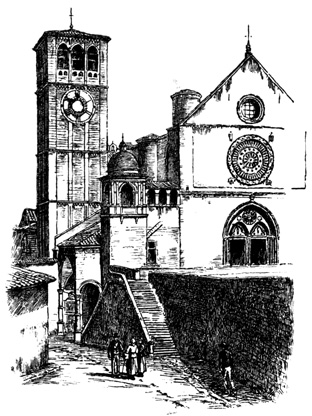
SAN FRANCESCO, THE UPPER CHURCH.
It is wonderful how these women can
so surely support the loads they carry
on their heads; the burden is sometimes
a huge round basket, three feet across,
full of grapes or heavy vegetables.
We rarely saw a man thus burdened;
he seems to content himself in Italy,
as he does in France, with looking on
and admiring, while the women do the
work.