Among the numerous holiday resorts which claim the attention of
the travelling public, the Isle of Wight will be found to possess
attractions of very varied character. It has often been the theme
of poets and the delight of artists. The student of art and the
amateur photographer can find subjects in variety, whatever may
be his peculiar line of study. The noble cliffs and bays for the
student of coast scenery; old mills and cottages, with trees and
streams, for the lover of sylvan beauty. The rugged grandeur of the
Landslip and Undercliff will furnish subjects that yield delight in
the interpretation of their romantic interest. The earnest student
of Geology will find enhanced interest in the fact that within
short distances many successive formations can be studied; the high
inclination of the strata bringing to the surface the different
formations. The gentle undulations of the land also furnish great
opportunities for pictorial expression. The Botanist may here find
an almost inexhaustible store of treasures. Wild flowers and ferns
abound in great variety.
To those who have never visited the Island, the accompanying
illustrations will unfold sufficient of its beauty to give some
idea of its resources. Being reproductions from actual photographs
they may be relied upon as being true to Nature. There is great
diversity in the scenery, and a holiday can be enjoyed amid its
beauties which can scarcely be surpassed. It may be truly described
as the Garden of England, and some of its scenes are here presented
in the hope that those who inspect its beauties as here transcribed
will be induced to visit and see it for themselves.
Steephill Castle, Ventnor.
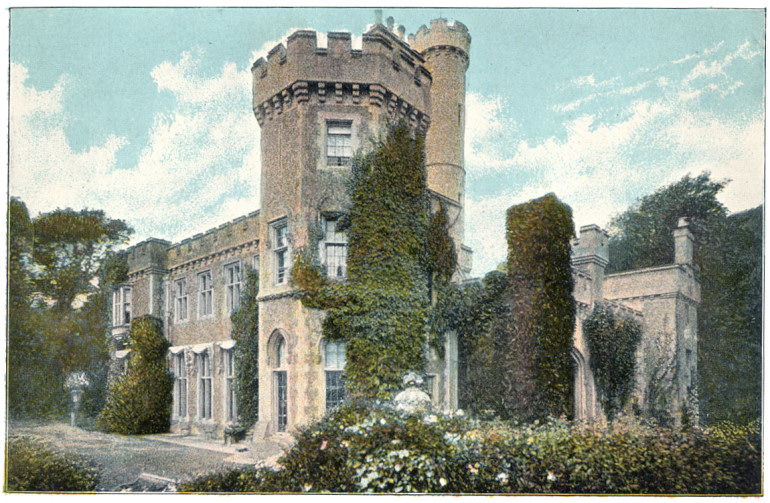
STEEPHILL CASTLE, VENTNOR.—Within a mile of Ventnor, and
close to the Town Station of the Isle of Wight Central Railway,
is Steephill Castle with its beautiful and extensive grounds. From
every point outside the Castle is well embowered in trees, only
the tower being visible. It was built in 1835 by I. Hambrough,
Esq. The architectural features are well displayed from inside the
garden. The view from the tower is very fine. In 1874 the Empress
of Austria stayed here, and hunted with the Isle of Wight hounds
during her visit. It is occupied at the present time by Mr. and
Mrs. Morgan Richards, the parents of "John Oliver Hobbes" (Mrs.
Craigie), who is a frequent visitor.
Appuldurcombe Abbey.
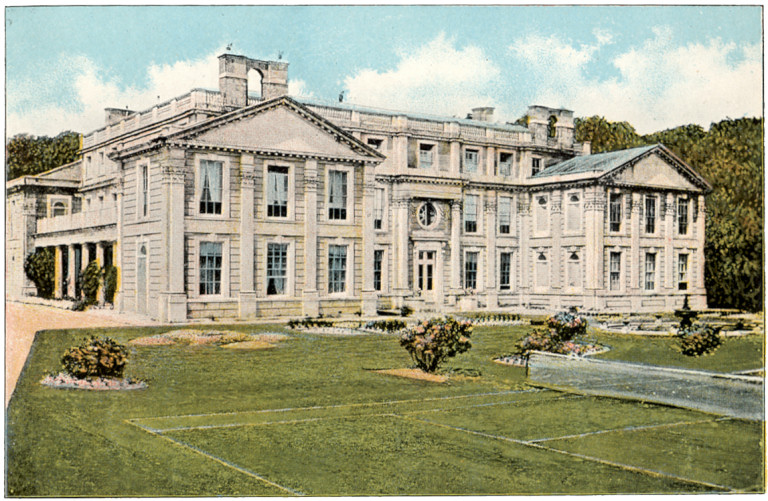
APPULDURCOMBE ABBEY.—The ancient seat of the Worsley family,
the present building was erected in the eighteenth century by Sir
Robert Worsley. Here the Benedictine monks had a Priory in the time
of Henry III. It was dissolved by Henry V, Sir Richard Worsley
died in 1805, and the house became the property of the Earl of
Yarborough, who had married the niece and heiress of the family.
After being used as a school for many years, it is now occupied
by Benedictine monks, In a beautiful park of four hundred acres,
with a lofty down behind it, the house appears to be a well secluded
and charming retreat. There is a public footpath through the meadow
in front of the house.
Steephill Cove,
near Ventnor.
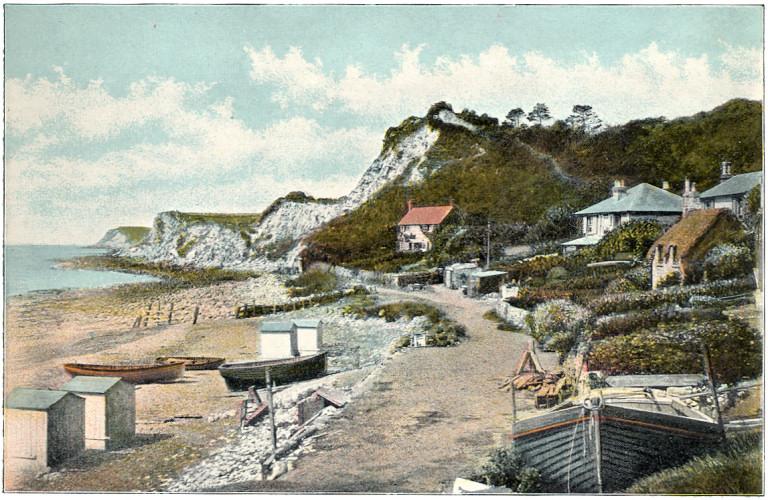
STEEPHILL COVE, NEAR VENTNOR.—Taking the cliff path from
Ventnor to the west within a little more than a mile there opens
out to view this pretty Cove. It is a place for painters, and its
loveliness in all varieties of Nature's many moods, has found admirers.
The cottages nestling under the banks, its parti-coloured gardens,
with enclosing pebble walls, its boats and crab-pots, with the
distant cliffs in succession, all combine in a composition that
strikes the beholder with a conviction of its beauty.
Shanklin Esplanade,
from Rylstone.
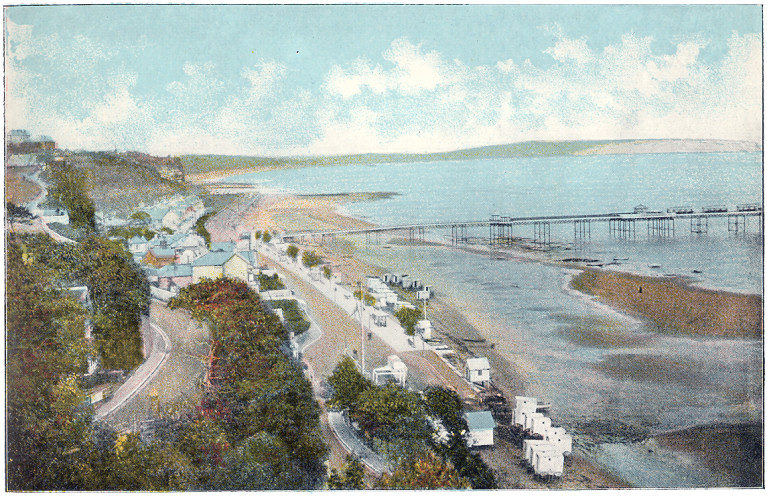
SHANKLIN ESPLANADE, FROM RYLSTONE.—This favourite view, which
shews nearly the whole of Shanklin Pier, also includes in the distance
the Culver Cliff. Taken from the Garden of Rylstone, overlooking the
foot of the Chine, it forms a most attractive scene. The cliff pathway
on the green to the right, the winding road and broad esplanade,
with the wide expanse of sands, furnish a characteristic view of
the principal features of Shanklin front. The level sands form a
safe and pleasant bathing-ground when covered by the sea. Boating
too is popular, it being within easy reach of beautiful bays in
the direction of Luccombe.
Gateway,
Carisbrooke Castle.
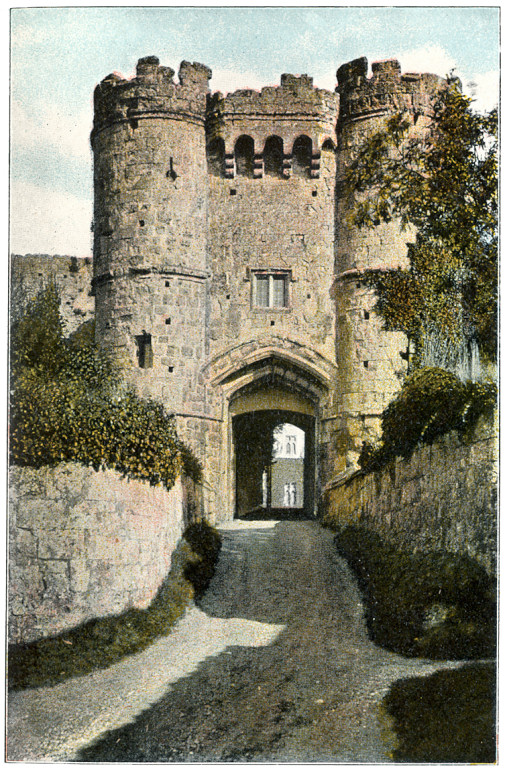
GATEWAY, CARISBROOKE CASTLE.—This noble gateway tower was
erected by Anthony Woodville, Lord Scales, in the year 1464, and
is still in good preservation. The outer gateway was erected in
the time of Queen Elizabeth, when a great extension of the grounds
enclosed was made.
"The battled towers, the dungeon keep,
The loop-hole grates where captives weep,
The flanking walls that round it sweep
In yellow lustre shone." (Scott).
The old massive doors have been removed recently and replaced by
a lighter structure.
Osborne House Terrace.
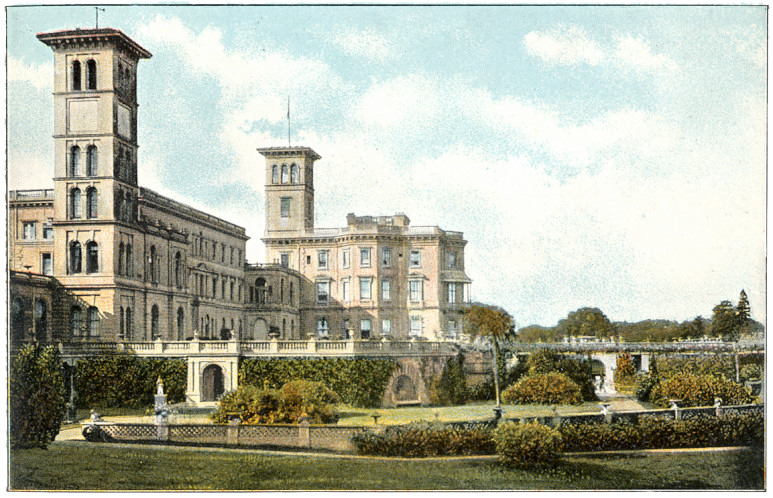
OSBORNE HOUSE.—This view of Osborne from the south lawn is
the most picturesque, and gives the late Queen's apartments standing
out in bold relief in the centre of the picture. The terraces below
adorn the building, and the rosary which extends on the right to
the lawn is gay with a blaze of colour in the month of June. Now
that Osborne has been made into a Naval College, the grounds are
open to visitors on Fridays in the winter, and on Tuesdays and
Fridays in the summer season; it is visited by many thousands during
the year.
The Pond, Bonchurch.
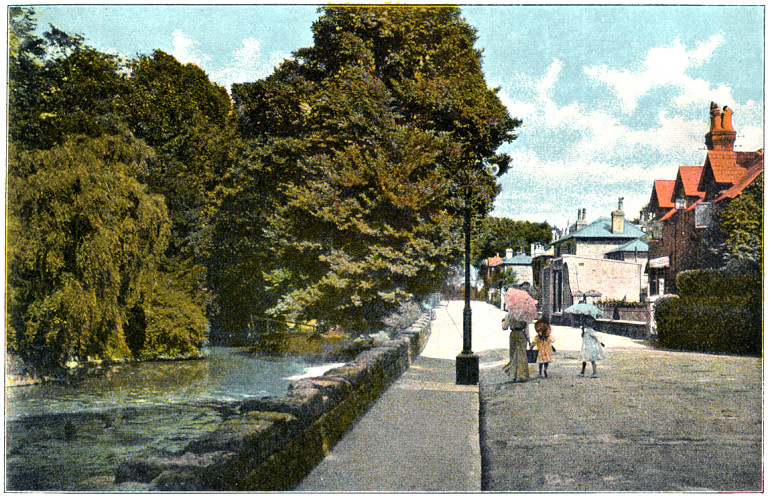
THE POND, BONCHURCH.—One of the show places of the Isle of
Wight known throughout the world by the lovely pictures that have been
made of it. It has lately fallen into disrepute by the destruction
of some of its beautiful trees, but more specially by the leakage
of the pond which left it stagnant, dirty, and partly dry. This
has now to a large extent been remedied, and the pond once more
assumes its former aspect, giving reflection in its surface to
the lovely forms of beautiful foliage with which it is overhung.
The village is one mile from Ventnor.
St. Catherine's Lighthouse.
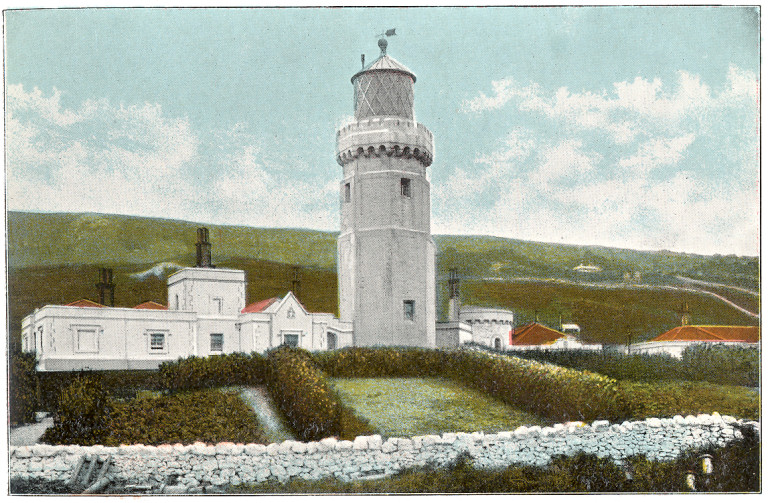
ST. CATHERINE'S LIGHTHOUSE.—Formerly the Lighthouse stood
upon the Downs, but the prevalence of sea mists during certain
portions of the year which obscured the light, at last led to the
erection of the present building near the margin of the sea. It
is one of the most powerful lights in the world, sending its rays
far out over the sea and land as it revolves. When the sea mists
arise it has a powerful foghorn which can be heard for many miles.
Close by is the reef at Rockenend, on which many a gallant ship
has been broken up.
Ferncliffe Pleasure Gardens,
Sandown.
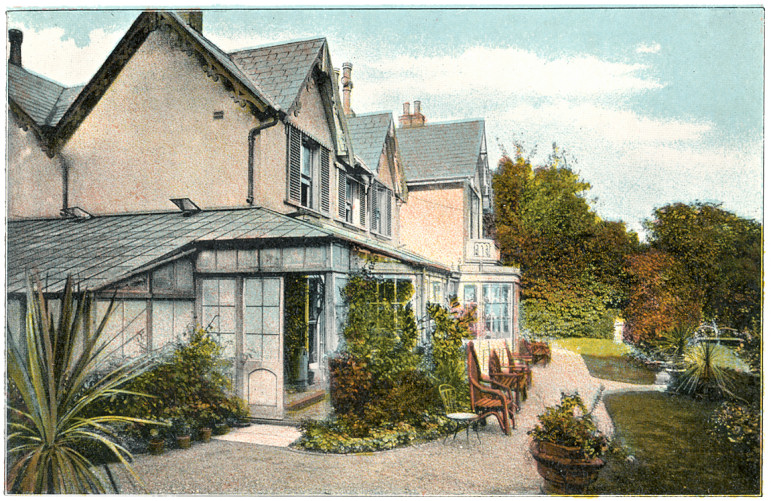
FERNCLIFFE PLEASURE GARDENS, SANDOWN.—These beautiful grounds
have lately been acquired by a syndicate of leading residents, with
the view of their ultimate acquisition for the town. The house
is available for refreshments, and the Gardens, which are well
wooded, are pleasant to ramble in. There are little nooks and seats
overlooking the bay in several directions. It is already proving
a great attraction to the town.
The Needles.
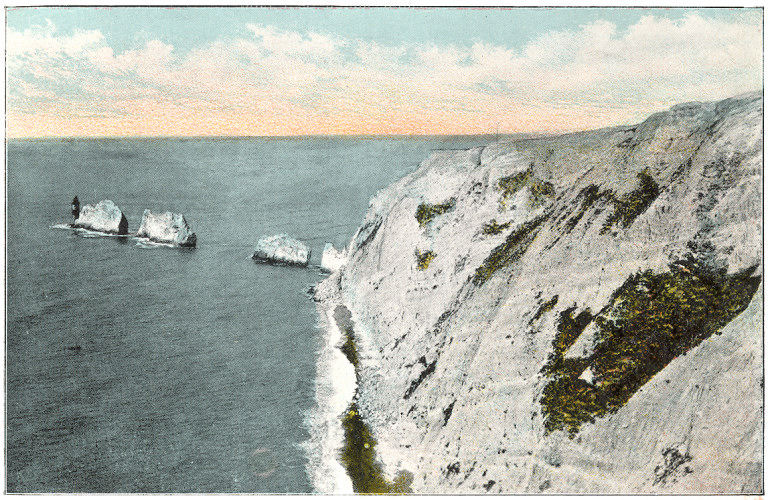
THE NEEDLES.—When walking on the Downs from freshwater to
the Needles, following the path by the military fence, this picture
of the Needles comes suddenly into view, and is a very impressive
sight. The Needles themselves are stacks of upper chalk, with flints,
and are the remains of an extension of the chalk. The cliffs here
are about four hundred feet in height, and at their base the sea
breaks frequently in a long surf line on the steep shingly shore.
In calm weather visitors engage boatmen at Totland and Alum Bays to
take them in boats through the Needles and land them in Scratchels
Bay.
Shanklin Old Village.
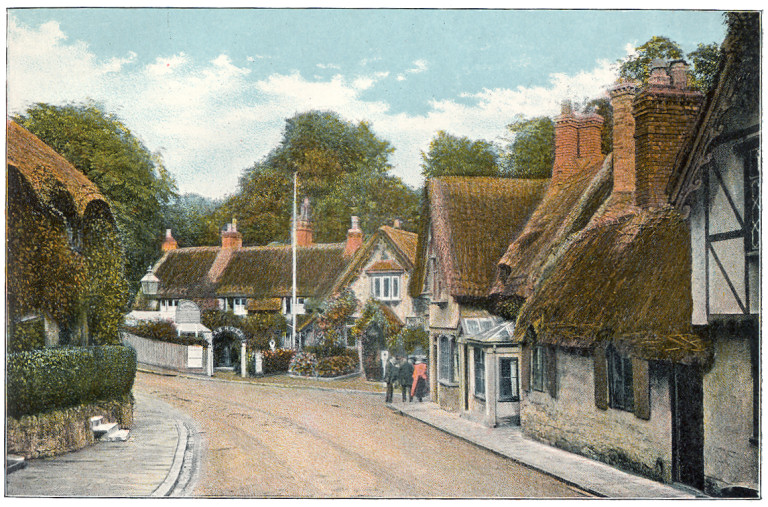
SHANKLIN OLD VILLAGE.—One of the most charming old-world
pictures, which still retains its rustic simplicity. Multitudes of
visitors from all parts of the world yearly visit this relic of Old
Shanklin. Pretty thatched cottages can be seen in many parts of the
Island, but nowhere is there such a combination, there being three
different styles of roof in thatch, the setting in a background of
trees completing the illusion of the country. In the angle where the
figures stand is the rustic fountain on which hangs the shield with
the verse written by the poet Longfellow when staying at Hollier's
Hotel, Shanklin, in 1869.
"O traveller, stay thy weary feet,
Drink of this fountain cool and sweet,
It flows for rich and poor the same:
Then go thy way, remembering still
The wayside well beneath the hill,
The cup of water in His name."
Stone Bridge in
Shanklin Chine.
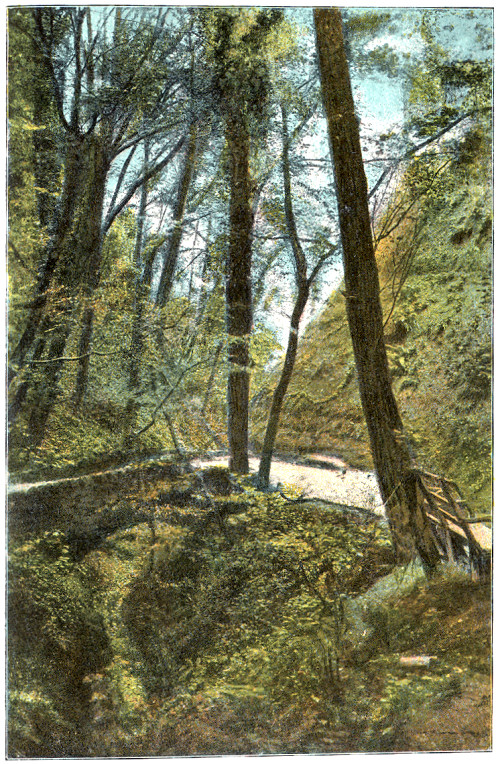
STONE BRIDGE IN SHANKLIN CHINE.—About half-way through the
Chine the ravine is spanned by an arched Stone Bridge which, in
conjunction with the steep banks with trees and ferns, makes a
fine pictorial effect. Many of the trees are a great height, having
been drawn up in seeking the light above the cliffs, which in this
place are a considerable height. The stream flows along the narrow
channel under the bridge.
Chine Hollow, Shanklin.
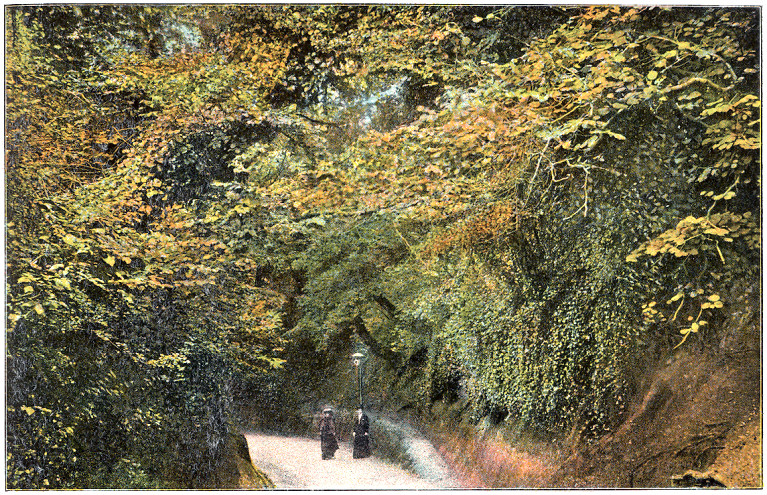
CHINE HOLLOW, SHANKLIN.—This charming lane leads from Shanklin
Chine direct to the Landslip. Close to the head of the Chine and
within two minutes' walk of the Old Village it forms a beautiful
shady retreat on a summer day. The steep banks are of bright red
and yellow sandrock beds, out of which trees have grown and verdant
vegetation has found a footing until the whole is covered with
Nature's mantle of beauty. The view is taken coming from the Landslip
and looking towards the Chine, Old Village, and town.
View Across the Foot of Shanklin Chine.
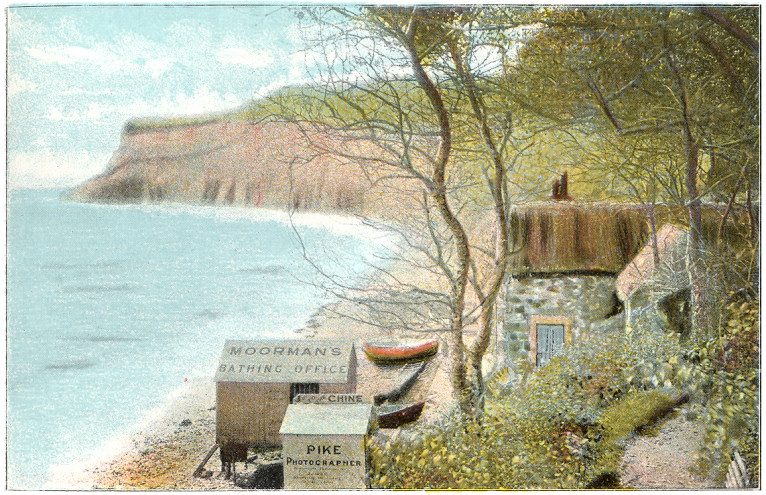
VIEW ACROSS THE FOOT OF SHANKLIN CHINE.—From the shelter
of a pretty nook in which seats are provided, Shanklin sands and
cliffs appear in all their exquisite beauty. A wide stretch of sand
from the foot of the Chine to the fine cliffs of lower Greensand
supplies a playground for multitudes of happy children. Under the
cliff is a happy camping-ground, in which numerous tents are put up
in the season. The fisherman's cottage, with its rough stone walls
and roof of thatch, forms a pleasing subject in many a picture.
Half-way to the cliff are steps leading up to Appley Cliff into
the village, or on to the Landslip.
Shanklin Chine.
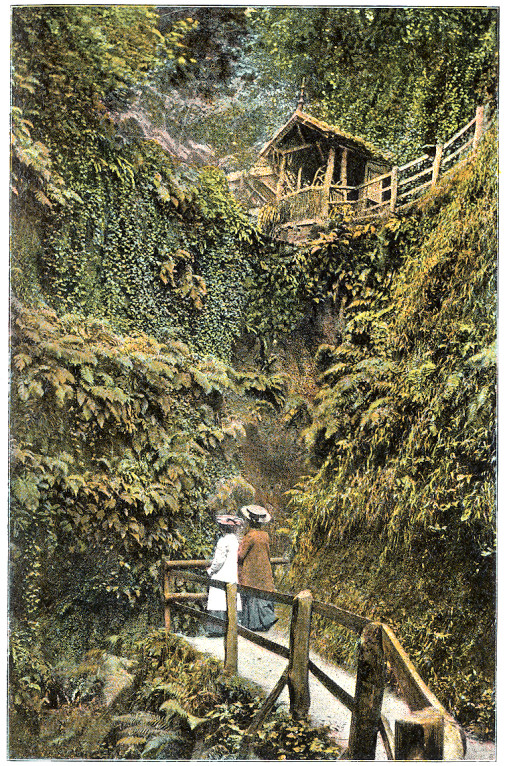
SHANKLIN CHINE.—A scene of sylvan loveliness beyond description.
Winding paths extending from the shore for about one hundred yards,
through one continuous bower of beauty, bring you to the head where
in the wet season there is a cascade. In the summer the banks are
one mass of ferns and foliage of varied form and colours. Quiet
nooks are to be found where, during the heat of the day, a book
can be enjoyed in the cool shade of the trees. Shanklin has the
reputation of being the cleanest town in England. It is certainly
the most beautiful in the Isle of Wight.
Stone Seat—
The Landslip.
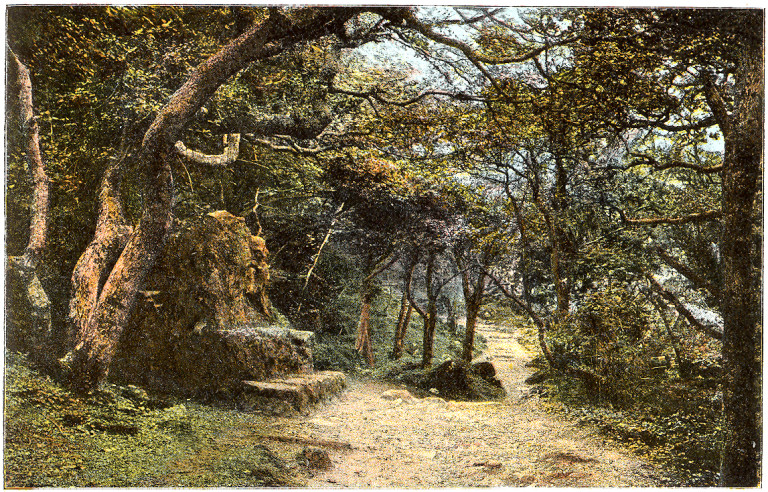
STONE SEAT—THE LANDSLIP.—The Landslip which lies between
Shanklin and Ventnor is a favourite resort to the inhabitants and
visitors of both places. The catastrophe that wrought this magic
transformation has resulted in producing scenery of entrancing
beauty. The efforts of Nature to cover and hide the deformities
of riven rocks and yawning chasms have produced trees of fantastic
shape and remarkable diversity. The broken rocks afford sustenance
for many plants, the chloritic marl liberated making the ground
wonderfully fertile. This stone seat forms a natural throne on
which many parties have found a trysting-place. As it stands in
the principal pathway it is a well-known resting-place.
On the Road to Blackgang.
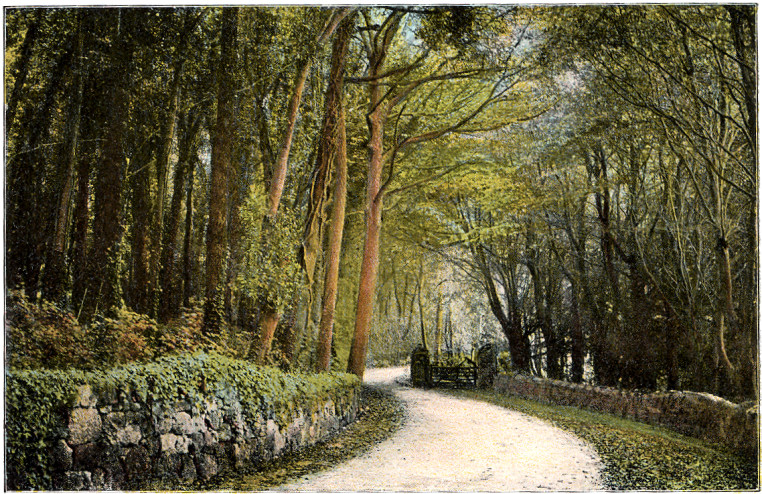
ON THE ROAD TO BLACKGANG.—"One of the most charming drives
in England," is the verdict of many visitors to the far-famed
Undercliff, as they go through shady groves and again emerge under
the weather-worn craggy cliffs above the road. In spring the ground
under the trees is carpeted with flowers, and the winding road
uphill and down creates a transformation scene at every turn. There
is no rest for the eye, and all the faculties are awake to enjoy
a new sensation of delight as each corner in the road is turned.
It is a perfect fairy land, and the rugged walls are half hidden
by multitudes of plants which enhance the lights upon the stone.
Windy Corner—
The Undercliff.
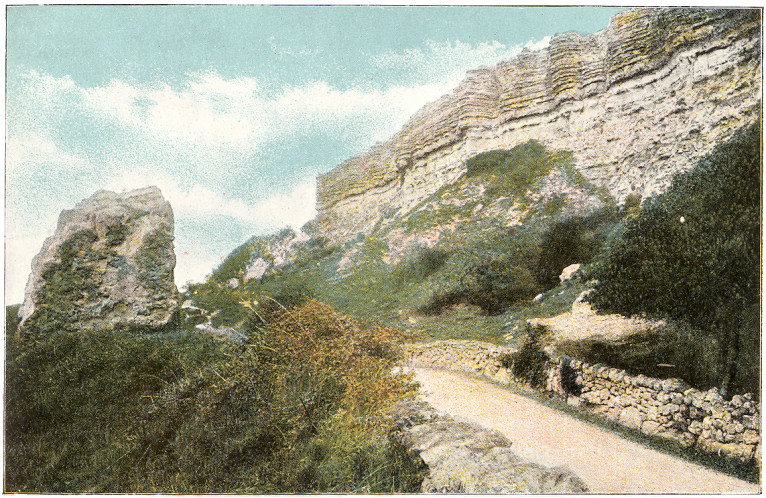
WINDY CORNER—THE UNDERCLIFF.—One of the most romantic
districts in the whole of England is the Undercliff, extending for
five miles from Ventnor to Blackgang Chine. Its beauty has been
caused by the slipping away of the Gault clay, letting down the
masses of Upper Greensand rock. The chert beds of the cliff have been
weathered out by wind and rain into forms of rugged beauty, while
the broken and undulating ground below is filled with flowers and
vegetation of the most wonderful and varied character, scattered rocks
peeping out among the foliage furnishing bits of a most attractive
character to the artist and photographer.
Ventnor, looking East.
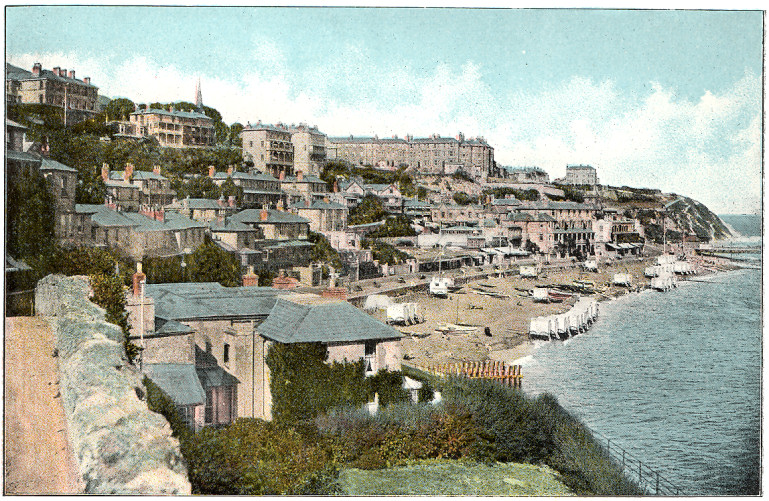
VENTNOR, LOOKING EAST.—The differences of elevation afford
to most of the houses in Ventnor practically uninterrupted views
of the sea. The sheltered nature of the site also furnishes a most
congenial climate, in which plants and shrubs in great variety
flourish. The horned poppy adorns the cliffs, and valerian and
tamarisk thrive even during the winter months. Its peculiarities
of climate and position render it a highly favourable residence
for invalids throughout the year. It would be difficult to name any
place of equal extent and variety of surface, or of equal beauty
in point of scenery—so completely screened from the cutting
N.E. winds of spring.
Ventnor, from the Sea.
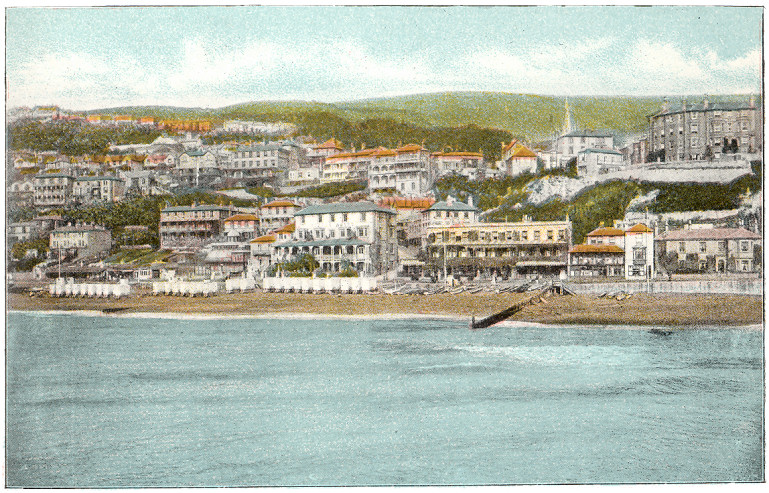
VENTNOR, FROM THE SEA.—Built on the slopes of the hill, Ventnor
presents from the sea a remarkable and magnificent picture. Each
house being at a different elevation, commands sunshine all the
day. Sheltered from the cold wind, trees and flowers flourish and
retain their beauty during the winter. When the golden gorse and
purple heather are in bloom upon the downs it forms a most attractive
scene. Steamboat trips daily during the summer furnish the visitors
with abundant opportunities of enjoying this vision of beauty. The
Railway Station lies between the hills behind the Church spire.
The Town Station of the Isle of Wight Central Railway lies to the
left beyond the Park.
Ventnor, looking West.
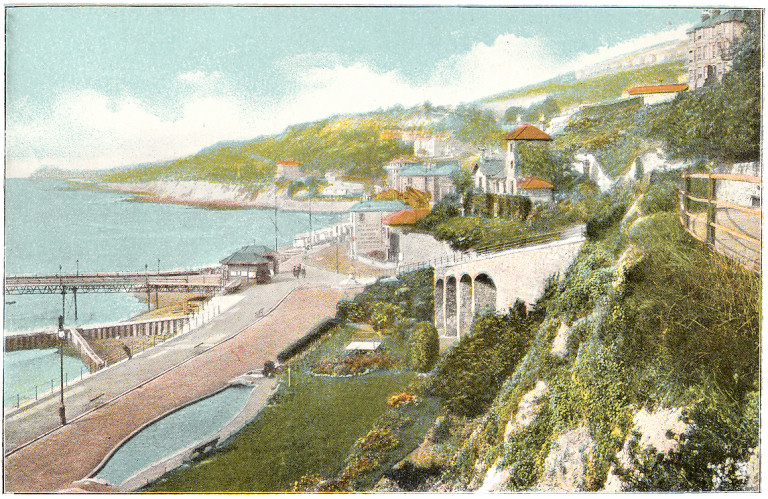
VENTNOR, LOOKING WEST.—From this point Ventnor is beautiful
both in summer and in winter. The setting sun on a winter day is
a sight worth travelling far to see, and in summer the white chalk
cliffs of the foreground are clothed with crimson valerian, mingled
with bright green samphire, while the gardens below, with the miniature
lake, are full of colour. These effects, together with the houses
perched on every conceivable vantage point of rock and surrounded
with vegetation of varied hue, make up a picture of entrancing
beauty. There is a good Pier for promenading and fishing as well
as for steamboat excursions.
Old Oak Tree—
The Landslip.
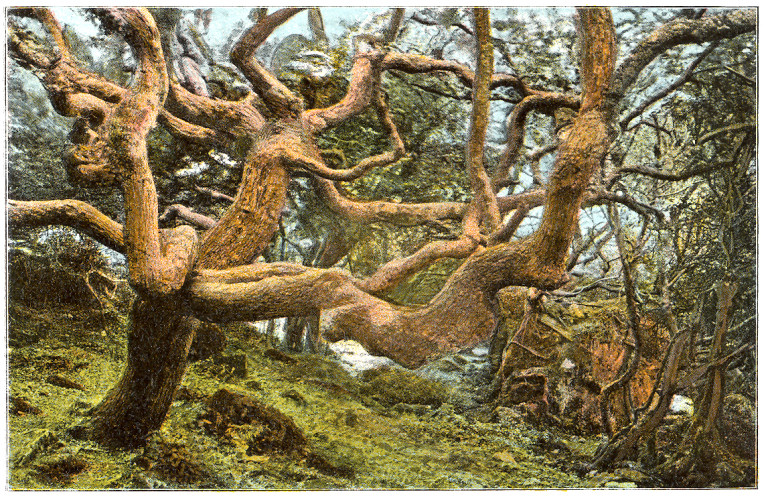
OLD OAK TREE—THE LANDSLIP.—This is one of the many
specimens of fantastic growth to be found in the Landslip, and
is a great contrast to the tall and stately beech trees that grow
in the Cloisters nearer to the upper cliff. It resembles very much
the serpent-tree which was painted by Turner. This part of the
Landslip is full of great diversities of form and situation, some
appearing to grow direct out of the rocks. The white scented violet
grows here in great profusion in April.
Blackgang Chine.
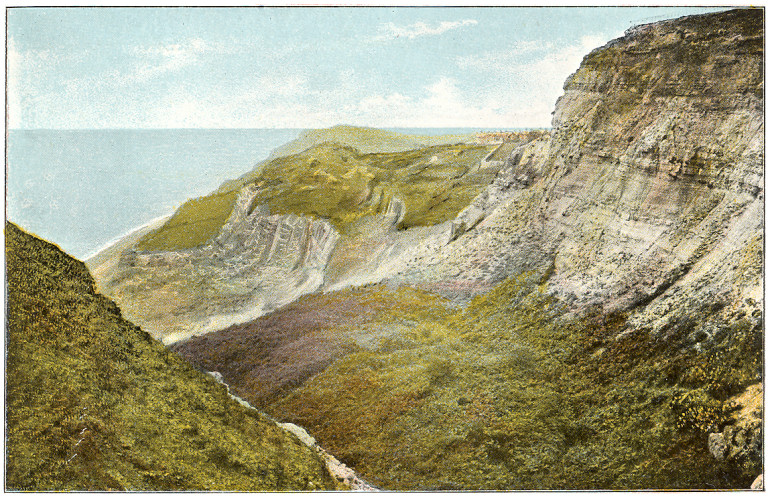
BLACKGANG CHINE.—This view of Blackgang exhibits its wild
and rugged grandeur. The cliffs rise to a height of four hundred
feet above sea level. The surf-line breaking on the red beach far
below on the left, with the broad expanse of sea beyond, is very
fine. The cliffs in the middle distance consist of the sands and
clays of the lower Greensand formation, and are constantly falling
and being eroded by the waves. The breakers on the shore at Blackgang
are very grand in stormy weather, the beach being very steep and
the water deep outside, a great volume rolls in with magnificent
effect and thunderous sound. Geologically it is of great interest,
the beds of the lower Greensand being more fully developed here
than elsewhere, a thickness of almost eight hundred feet being
exhibited in this neighbourhood.
Swiss Cottage, Osborne.
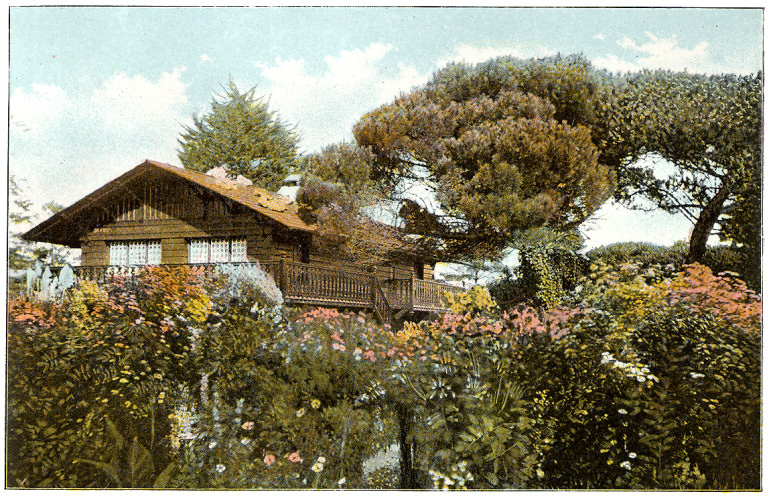
SWISS COTTAGE, OSBORNE.—The grounds of Osborne House contain
five thousand acres, the lawn sloping down to the sea adjoining
the grounds of Norris Castle. A sheltered portion of the garden
contains a large number of trees and shrubs from Indian and foreign
climes. In the vicinity of this Indian garden is Swiss Cottage,
forming an architectural contrast to Osborne House, and surrounded
with trees and flowers that make it appear quite a little paradise.
The Floating Bridge, Cowes.
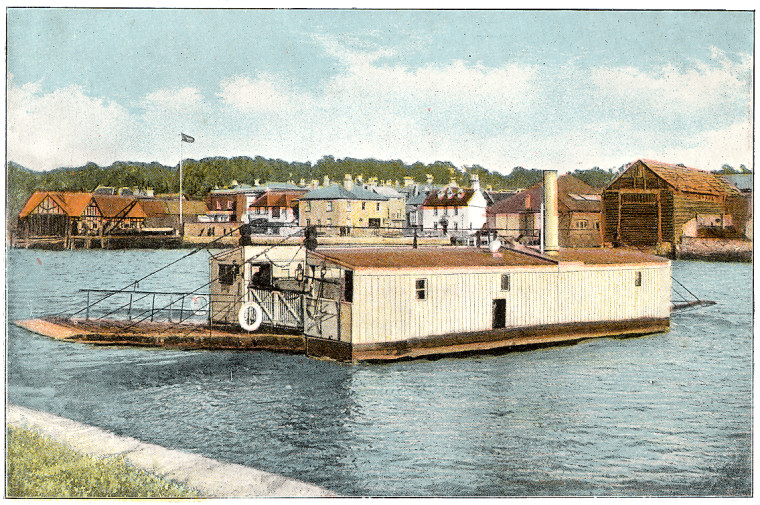
THE FLOATING BRIDGE, COWES.—East Cowes is reached by crossing
in this bridge, which goes backwards and forwards across the mouth
of the Medina, conveying carts, carriages, coaches, and motor cars,
as well as passengers. It works on chains which pass under it,
fastened to the shore at each end. It is a novel experience to
many people when they find the coachman drive his four-horse coach
full of passengers down the slope on to the bridge, and then off
again at the other side.
Whippingham Church.
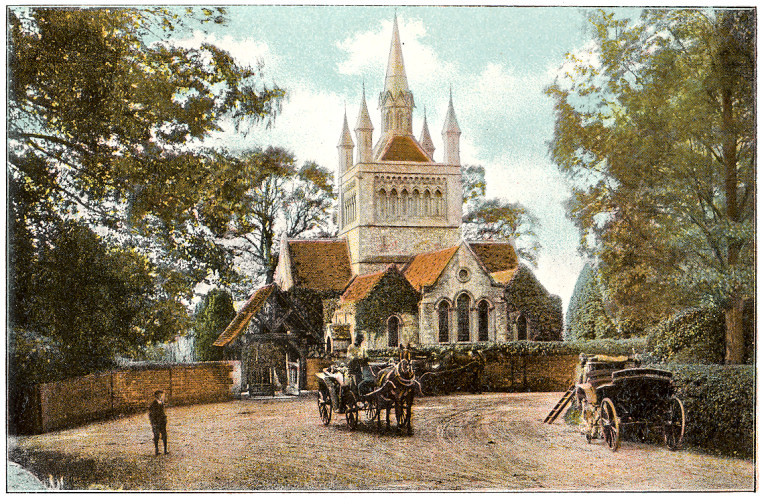
WHIPPINGHAM CHURCH.—About a mile south of Osborne is Whippingham
Church, a cruciform structure from designs furnished by the late
Prince Consort. Before a private Chapel was added at Osborne the
Royal Family often attended. The aisles which contain seats for
the Royal Household are divided from the Chancel by ornamented
arcades. The north aisle is converted into a Mortuary Chapel in
memory of Prince Henry of Battenberg. Mural tablets to Princess
Alice, the Duke of Albany, and a medallion bust to the Prince Consort
have been erected by Her late Majesty; also a medallion to Sir
Henry Ponsonby, whose tomb is in the Churchyard. From the back
of the Church there is a fine view of the river Medina, looking
towards Newport, the capital of the Island.
The Pier, Cowes.
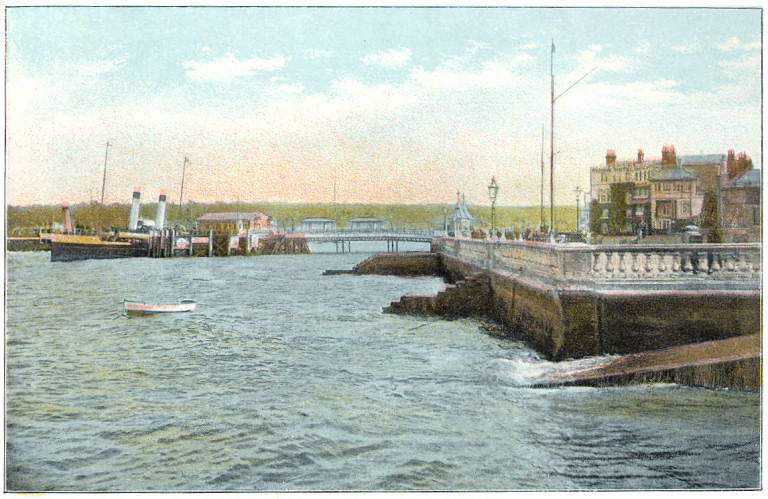
THE PIER, COWES.—The new Pier and Esplanade from an attractive
feature at Cowes. When emerging from its narrow streets you come
out into the wide open expanse of Esplanade, it is a great relief.
The Marine Hotel forms a prominent object. East Cowes is to be seen
in the distance. This view is taken from close to the entrance to
the Royal Yacht Squadron Grounds and Landing Stage.
Royal Yacht Squadron Club House, Cowes.
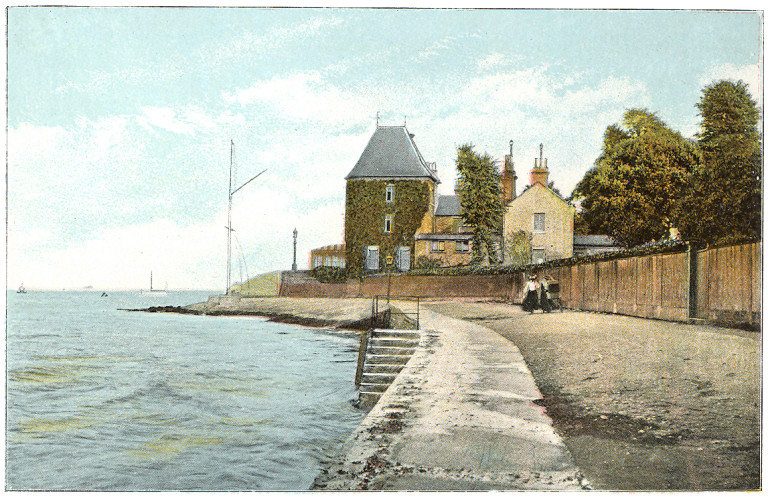
ROYAL YACHT SQUADRON CLUB HOUSE, COWES.—The Club House was
originally one of the fortresses built by Henry VIII. for the defence
of the Island. In the time of Charles I. it became a prison. It
is now rented from the Commissioners of Woods and forests by the
Club. It is a scene of gaiety and animation during the first week
in August, which is the Cowes week of the season. Crowds gather
near the slipway to see the royal and noble passengers land when
the yachting season is on. The Causeway leads to the Green which
is crowded during the racing. On fireworks-night this thoroughfare
is densely packed from end to end.
High Street and
Queen Victoria Memorial, Newport.
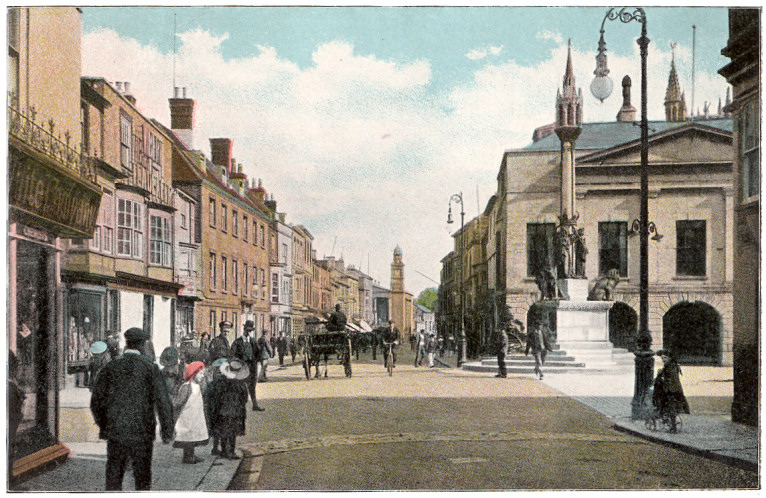
HIGH STREET AND QUEEN VICTORIA MEMORIAL, NEWPORT.—The ancient
borough of Newport is the capital of the Island. Its streets are
usually busy, and on market days are quite gay and animated. The
County Petty Sessional Court is held every Saturday in the Town
Hall, which is also the meeting-place of the Town Council. The
Isle of Wight County Council meets at the Technical Institute,
as does also the Education Authority. In the same building is the
Free Library, the gift of Sir Charles Seeley, Bart., who also pays
the librarian's salary, with the water rent secured from the Town
Council for the splendid supply, recently acquired from the estate
of Sir Charles at Bowcombe. The Diamond Jubilee Memorial to Her
late Majesty is erected on the spot where at the Jubilee, in 1887,
Her Royal Highness received an address of congratulation from the
inhabitants of the Isle of Wight. Newport contains the old Grammar
School where Charles I. held his conference with representatives of
the Parliament, and many other buildings of historical interest.
The monument to the Princess Elizabeth, daughter of Charles I.,
is in St. Thomas' Church.
Steps to the Keep,
Carisbrooke Castle.
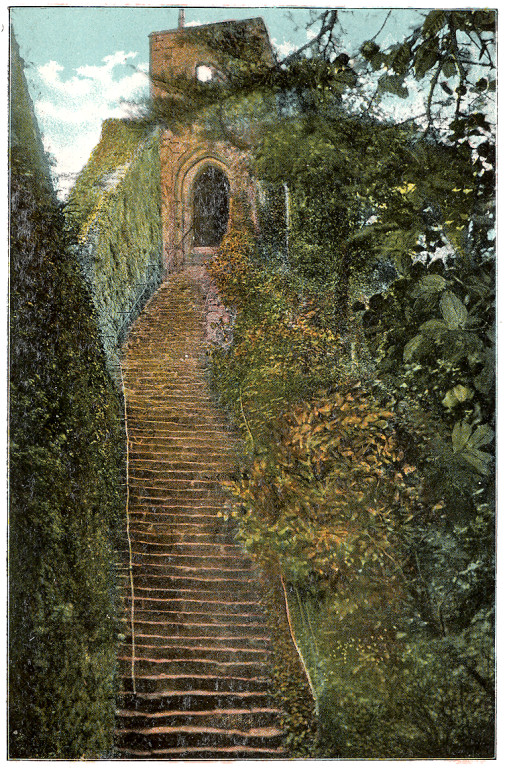
STEPS TO THE KEEP, CARISBROOKE CASTLE.—As a memorial of a
bygone age how interesting are the steps to the keep, the last
resort of the besieged, from which it would be difficult to dislodge
them, without great loss. The well which furnished them with water
is now dry, but can still be seen. The battlements furnish the
visitor with a magnificent view of the country in every direction.
The steps, seventy-two in number, are somewhat steep. The walls
are covered with climbing plants. Shelter is afforded by trees and
bushes, while access is given at the back of the ancient buildings
in the Castle, to facilitate escape in case of surprise.
Carisbrooke Village.
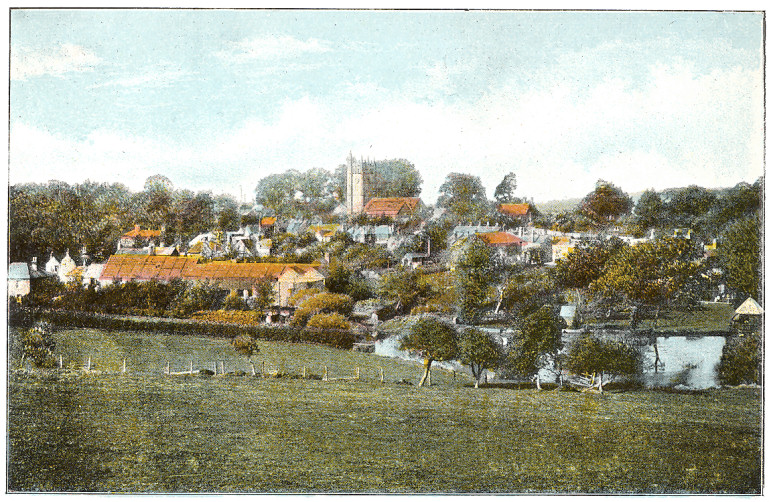
CARISBROOKE VILLAGE.—The village of Carisbrooke is beautifully
situated. The Church, embowered among the trees, stands on an elevated
site close to the Priory, with which it was associated. The Chancel
was destroyed in Queen Elizabeth's reign by Lord Walsingham, whose
obligation it was to have kept it in repair. The Pulpit is a relic
of Puritan times, dated 1658, very small and plain. It was evidently
not intended for the preacher to sit down, as nails stick up in
the very small seat. The Lukely stream runs through the village.
The view here shown is taken from the Beech Grove, a very beautiful
walk leading to Carisbrooke Castle.
Quarr Abbey, W. Ryde.
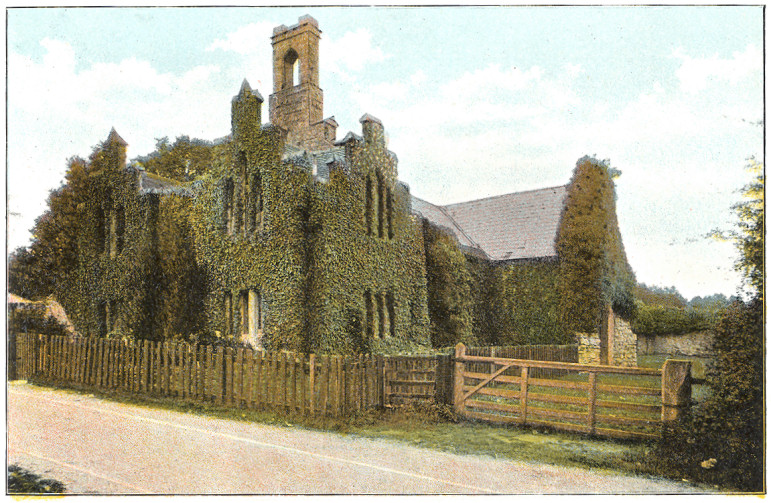
QUARR ABBEY, W. RYDE.—The distance of the Abbey from Ryde
is about three miles. It is a favourite walk from Spencer Road,
viâ The Lovers' Walk, past Binstead Church, through Quarr
Wood. This portion is occupied as a farm, but remains of the old
Abbey are scattered about, portions still standing to testify its
extent and importance. The walk may be continued through the archway
on to Fishbourne. In the wood the daffodil is plentiful, primroses,
lungwort, and the blue iris also abound in their season. The Wood
has been very extensively quarried for the limestone, with which
Winchester Cathedral and many Churches were built. There are pathways
through the Wood down to the shore, forming very pleasing vistas
through the overhanging trees.
Spencer Road, Ryde.
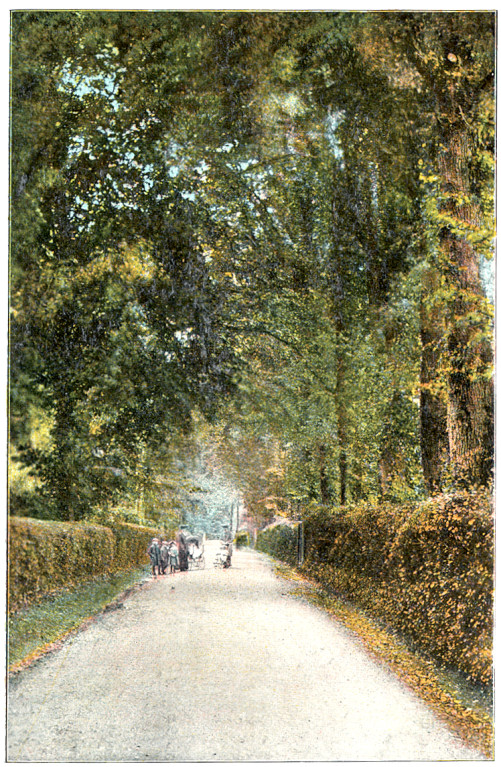
SPENCER ROAD, RYDE.—It is an advantage for a town to possess
pleasant shady walks within a short distance of its main streets.
Ryde is favoured in this respect. Within five minutes' walk from
the Town Hall, passing St. James' Church, is Spencer Road. It is
a favourite promenade, enjoyed by residents and visitors alike.
A morning stroll in spring when birds are singing from every bush
and tree is very delightful. It is a fine avenue extending several
hundred yards and opening out into the main road to Newport. By
entering the gate on the right at the junction, the walk may be
continued past Binstead Church through Quarr Wood to Quarr Abbey.
Ryde, from the Pier.
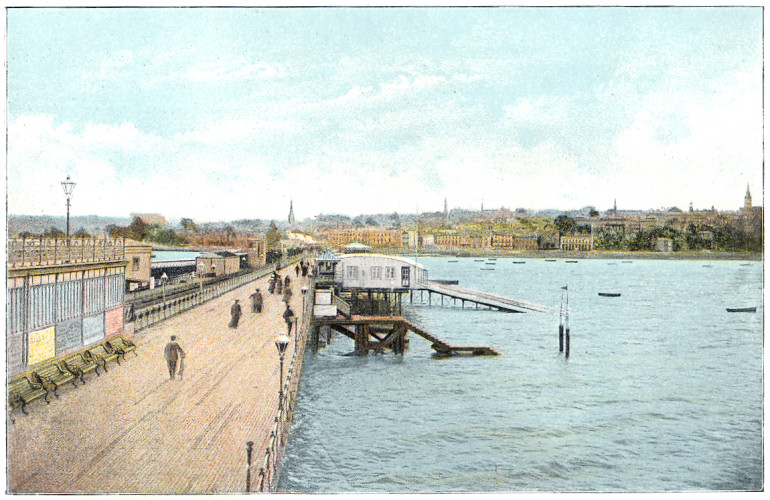
RYDE, FROM THE PIER.—The situation of the town is favourable
as a principal entrance to the Island, the passage from Portsmouth
by steamboat occupying about twenty minutes. The Pier (toll 2d.) is
4,000 feet in length, and is in three portions—for pedestrians
and boating, electric railway, and the Isle of Wight Railway. There
is a fine pavilion and bandstand at the end. Crowds of people find
a never failing source of interest on the pier, yachting, boating,
and fishing. On summer afternoons it is a gay and charming scene.
The town is built on a gentle slope, and the houses command fine
and extensive views. It has the largest population of any town
in the Island, about 11,000 inhabitants.
Apley Tower, Ryde.
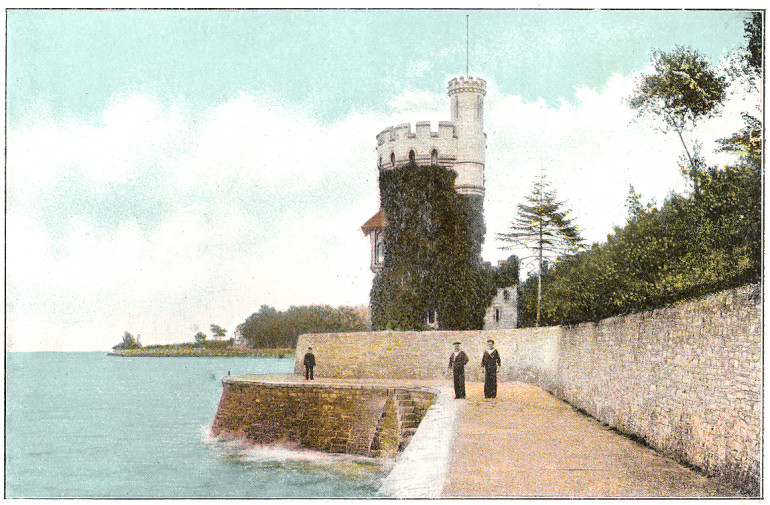
APLEY TOWER, RYDE.—Within one and a half miles of Ryde the
wall is a continuation of the Esplanade in the direction of Spring
Vale and Sea View. The wall furnishes a means of defence against the
encroachment of the sea, as well as a thoroughfare for pedestrian
traffic. Bicycles are also used on it to some extent. When the tide
is out a wide stretch of sands is exposed, and crowds of children
use it as a pleasure ground, finding beautiful seaweed and shells.
The walk can be continued round the further point into Sea View.
Totland Bay.
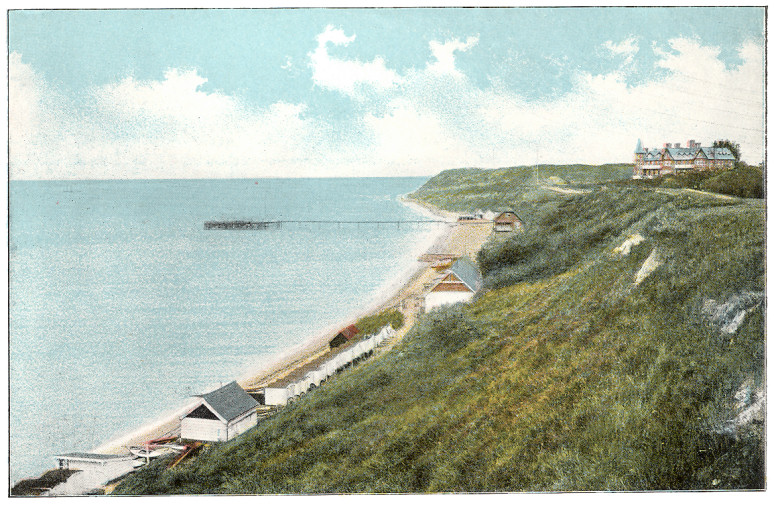
TOTLAND BAY.—This charming resort has sprung into prominence
and grown very fast during the last few years. Many of the houses
are very picturesque and beautiful for situation, most of them with
red-tiled roofs, which when toned a little more by time will be
very beautiful among the trees. There is a pier, and during summer
a regular service of boats from Lymington, as well as excursion
traffic. The beach is steep and so you can bathe at any state of
the tide. A reading-room on the shore is much patronised. The Green
Cliff Walk is very delightful, and as the channel here is narrow
there is a never-failing interest in the ships that pass in and out
quite near. The front lacks shade in the hottest days of summer.
It has great interest for the geological student, being close to
Headon Hill and Alum Bay.
Sandown, looking West.
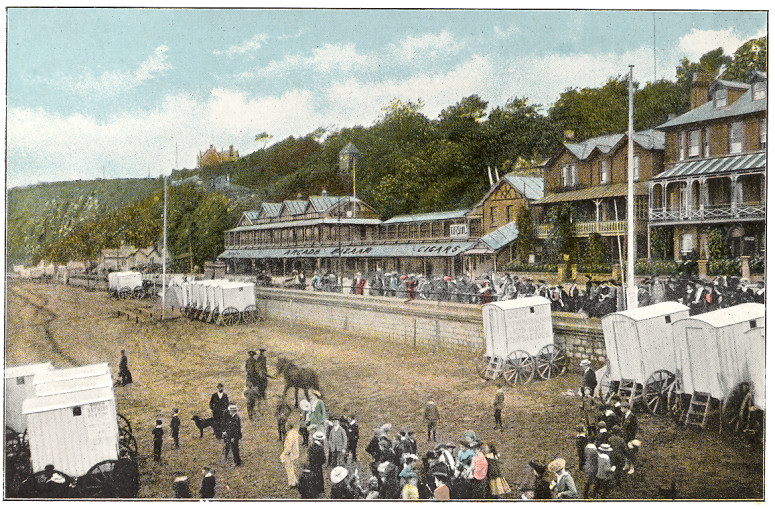
SANDOWN, LOOKING WEST.—Sandown is celebrated for its fine
stretch of sands which are easy of access, and forms an extensive
pleasure ground for the children. There is also a fine esplanade
for promenading, which in the season is well patronised. In this
view the grounds of Ferncliff can be seen behind the Arcade Bazaar,
and there is a cliff path to Shanklin on the top. The picturesque
fishing village lies under the cliff, slightly to the west. Sandown
Railway Station is a junction with the Isle of Wight and I.W. Central
Railway. Near the station is the celebrated Secondary School of
the Isle of Wight Education Authority.
Tennyson's Avenue, Freshwater.
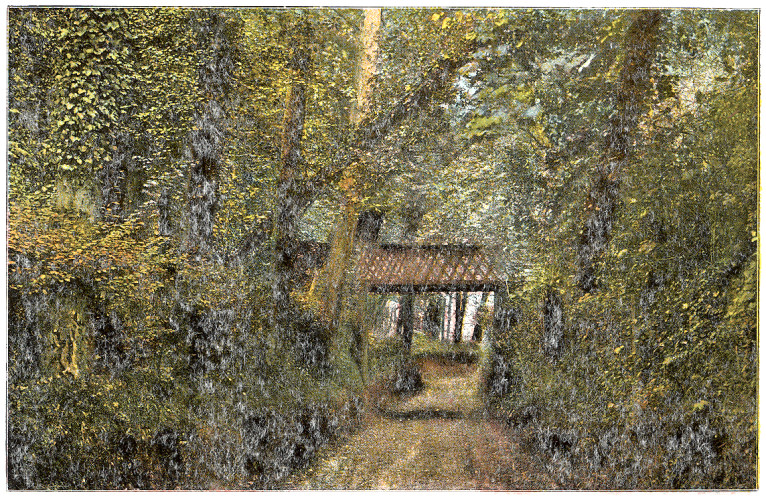
TENNYSON'S AVENUE, FRESHWATER.—Leading from the main road,
near Stark's Hotel, is a lane giving access to the Downs and leading
to the Avenue, across which is a small wooden bridge connecting
Lord Tennyson's grounds. A quiet, secluded spot yet visited by
crowds of admirers of the late Laureate. Tennyson loved retirement,
and in scenes like these, surrounded with the loveliness of Nature,
the breathings of his genius found full and free expression. The
lane may be pursued under the bridge past the farm into the Alum
Bay Road.
Freshwater Bay.
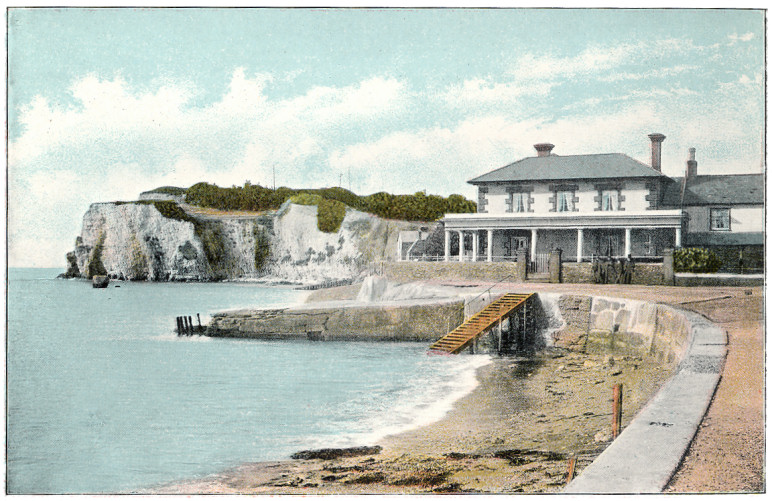
FRESHWATER BAY.—To those who desire to escape from the noise
and traffic of the city, Freshwater Bay affords a delightful retreat.
During the bright days of summer the sea breaks in gentle murmur
on the sand and shingle of the beach, but in winter when lashed
by S.W. Gales "it tumbles a billow on chalk and sand." The roar
of the ocean can be heard for miles inland. The esplanade shown in
the picture has been destroyed by the breakers. Temporary repairs
have been effected, but a fierce controversy is still raging as
to the ultimate solution of the question, how to prevent further
encroachment, and the L.G.B. has been appealed to for help.
Farringford, Freshwater,
Lord Tennyson's Residence.
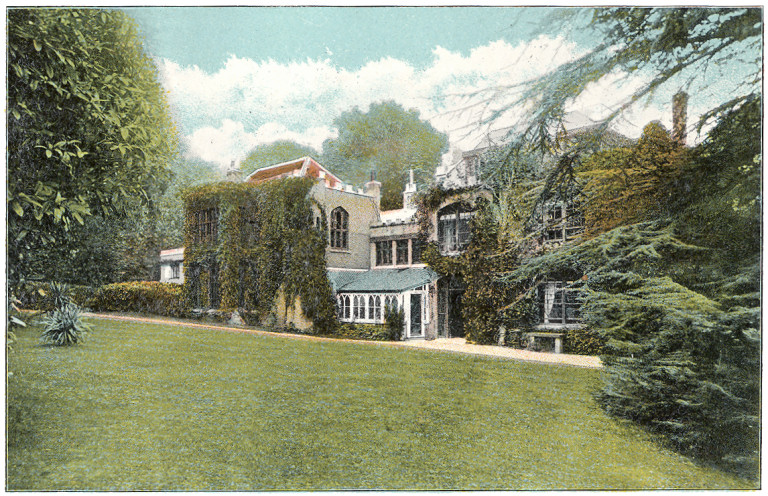
FARRINGFORD, FRESHWATER, LORD TENNYSON'S RESIDENCE.—The residence
of the late Laureate is in the neighbourhood between freshwater
Gate and Alum Bay, secluded by trees almost to invisibility. The
front is covered with greenery, a fine magnolia growing round and
over the front door. From under the lateral branches of a fine
spreading cedar tree the Poet could look into Freshwater Bay and
yet himself not be seen. The park-like grounds are pleasant to
walk in, and are open to the inspection of visitors on Thursdays
at certain seasons. In his poem of invitation to Rev. F. D. Maurice
in 1854 he well describes it:
"Where far from smoke and noise of town,
I watch the twilight falling brown,
All round a careless order'd garden,
Close to the ridge of a noble down."
Godshill Church.
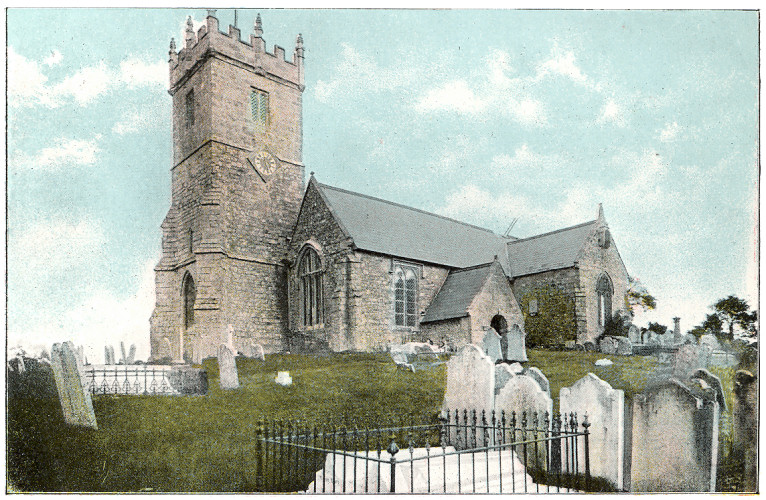
GODSHILL CHURCH.—Built in a striking and conspicuous situation,
Godshill Church is visible from many distant points of the surrounding
country—a good example of Early Perpendicular architecture,
a cruciform structure having two equal aisles of its whole length,
with a fine pinnacled tower and sancte-bell turret in the south
transept gable. The tower has been recently rebuilt, having been
shattered in a thunderstorm in January, 1904, when the clock face was
torn out and thrown out into the churchyard. It contains monuments
to the Worsley family and the tomb of Sir John Leigh; also a fine
painting, of the school of Rubens, of Daniel in the Lions' Den.
There are tea-gardens in the village for the accommodation of the
numerous visitors who throng there from Shanklin, Sandown, and
other places in the vicinity. There is also the old village inn,
the Griffon.
Little Jane's Cottage,
Brading.
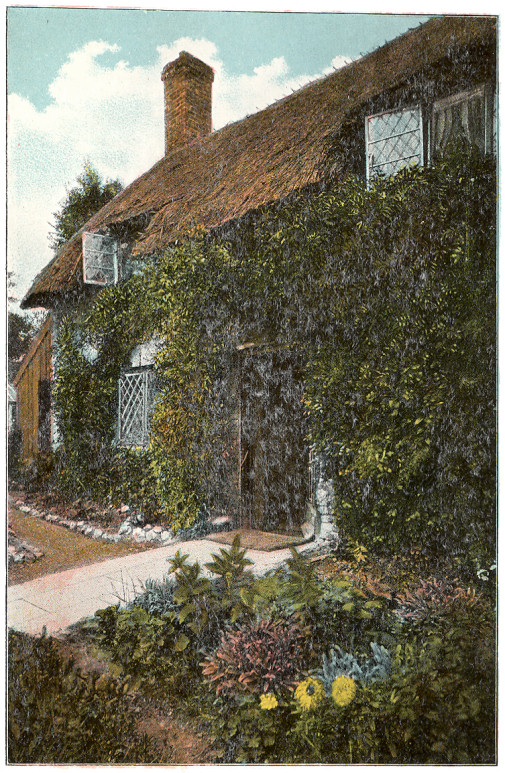
LITTLE JANE'S COTTAGE, BRADING.—This cottage still retains
its original appearance with thatched roof and diamond window-panes,
a real old-fashioned Isle of Wight cottage, many of which are fast
disappearing. The little forecourt and garden are well kept. The
greenery covering the front, of plants of great variety, from the
yellow jessamine to the red fuchsia, with flowers under and around
the windows, combine in completing a picture of great beauty. Here
Jane the young cottager lived when Rev. Legh Richmond was Vicar
of Brading in the early part of last century. Her tombstone is
at the back of Brading Church.
The Sundial,
Brading.
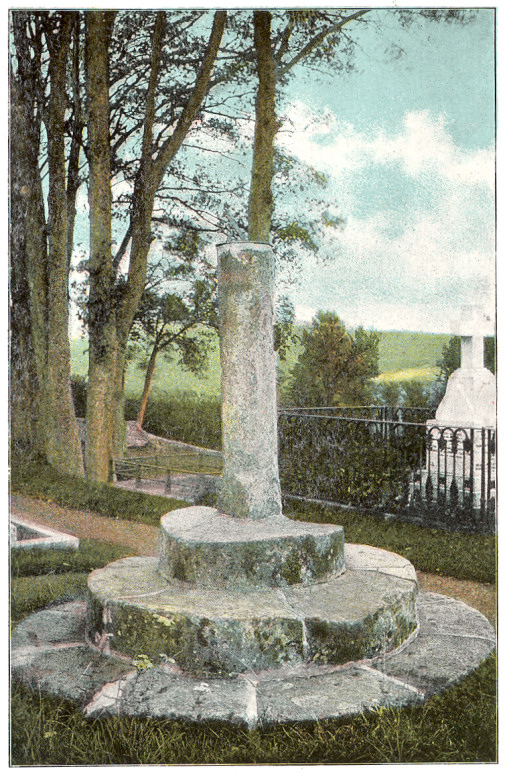
THE SUNDIAL, BRADING.—When clocks and watches were not common,
a sundial was of great service to the public. This old dial, with
its well-worn steps, is situated in the churchyard at the back of
the Church, close to the footpath leading to the Vicarage. The
view from the churchyard across to Bembridge Down is very pleasing.
The Pier, Sea View.
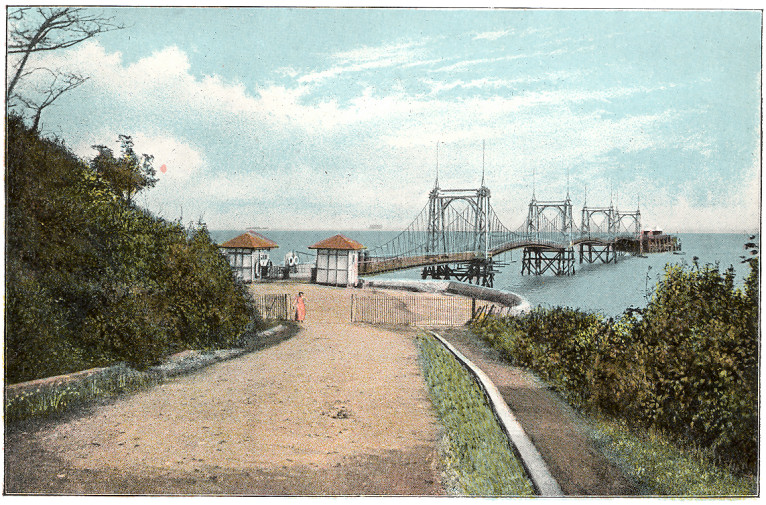
THE PIER, SEA VIEW.—This pretty little watering-place is
rapidly rising into prominence as a fashionable resort. The Pier
is an elegant structure suspended from piles, and affords an easy
and rapid approach from Portsmouth and Southsea by steamboat, and
during the summer there is a regular service of boats, as well as
excursion traffic. There are also many coach and motor excursions
from various parts of the island. Sea View is three miles from
Ryde. Many pretty villas have recently been built to accommodate
the increasing number of visitors.
View in Ventnor Park.
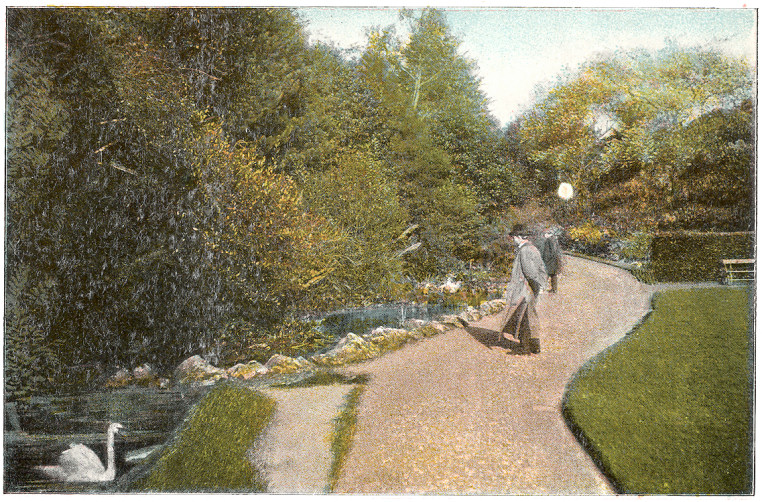
VIEW IN VENTNOR PARK.—The acquisition by the town of the
site of the Park was a wise and good thing. The differences of
level afford many advantages: those who like the sea breezes can
walk on the upper promenade green where enchanting views of sea
and land meet the eye at every point. Quiet nooks like that of
the picture can be found in the lower and more sheltered grounds.
The visitor can choose shade or sunshine at command. Alongside of
careful culture of flowers and shrubs, wild nature also asserts
itself, not having been ruthlessly suppressed.
Monk's Bay, Bonchurch.
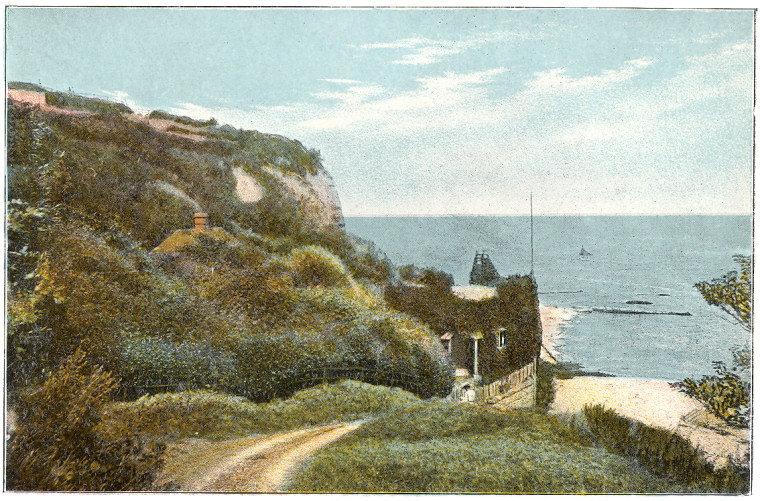
MONK'S BAY, BONCHURCH.—This quiet retreat is at the Ventnor
end of the Landslip and within a short distance of Old Bonchurch.
The two thatched cottages are almost grown in, and the bright red
cliff which forms the prominent feature consists of the topmost
beds of the lower Greensand. The lower beds behind the cottage
are of geological interest from the diversity of colour in the
beds. The sands are white and firm, and there are rocks and pools
where children love to play. Close by is the path leading through
the Landslip to Shanklin.
The Downs, Ventnor.
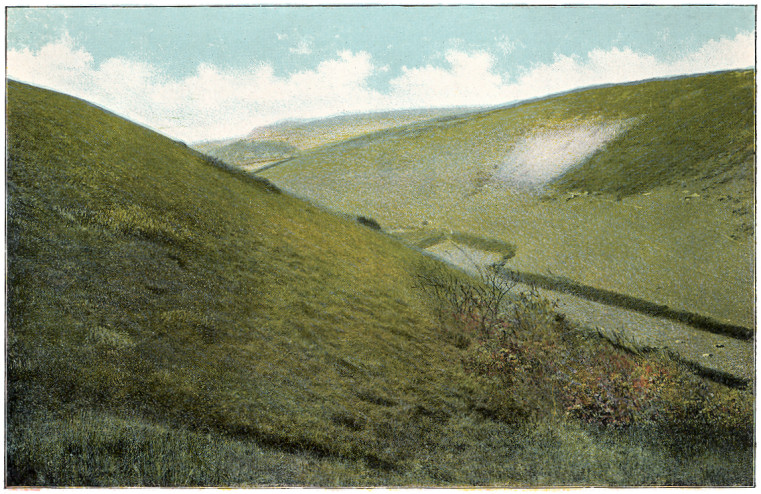
THE DOWNS, VENTNOR.—The elevation of the Downs above Ventnor
affords an opportunity of enjoying most romantic and charming scenery,
and of being refreshed with health-giving breezes. There are paths
leading to Wroxall, also to Shanklin, unfolding a succession of
views it would be difficult to rival. When the golden gorse and
purple heather are in bloom it presents a glorious prospect to
the vision. The footpath leading to the Downs is by the railway
station, or access may be had from near the Cemetery. The prospect
from the slopes of the Down toward the town and sea is very extensive
and impressive.
The Cascade,
Ventnor.
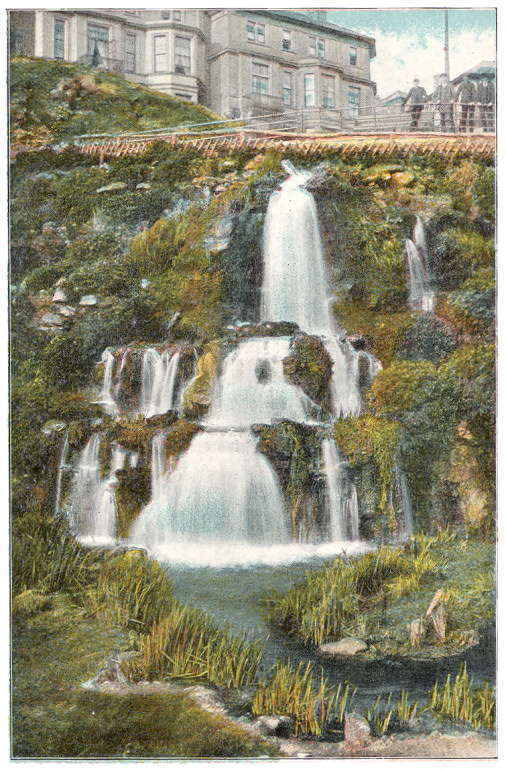
THE CASCADE, VENTNOR.—It was a happy thought when the town
acquired the triangle which includes the Cascade, the water of
which once went to supply Ventnor Mill. By the planting of creeping
plants, of monkey musk and a number of other beautiful flowers,
this neglected corner has been turned into a garden of loveliness.
It is like a little corner of Switzerland, and all within sight
of a busy thoroughfare. The band plays on the green below to the
sound of falling water. In the heat of summer the very sound of
it is refreshing.
Shanklin Esplanade
from Rylstone.
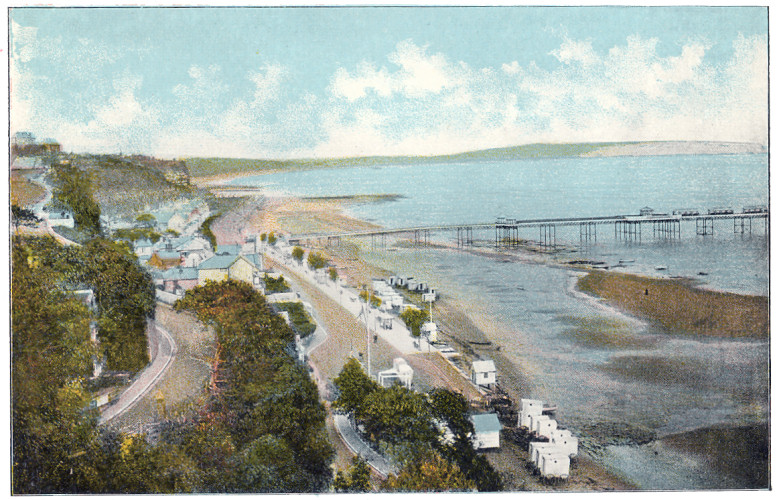
SHANKLIN ESPLANADE, FROM RYLSTONE.—This favourite view, which
shews nearly the whole of Shanklin Pier, also includes in the distance
the Culver Cliff. Taken from the Garden of Rylstone, overlooking the
foot of the Chine, it forms a most attractive scene. The cliff pathway
on the green to the right, the winding road and broad esplanade,
with the wide expanse of sands, furnish a characteristic view of
the principal features of Shanklin front. The level sands form a
safe and pleasant bathing-ground when covered by the sea. Boating
too is popular, it being within easy reach of beautiful bays in
the direction of Luccombe.
The Old Church, Bonchurch.
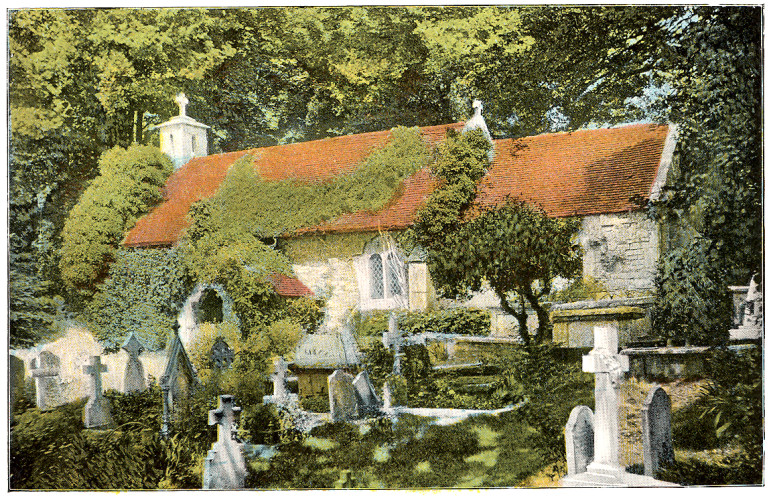
THE OLD CHURCH, BONCHURCH.—In addition to the beautiful situation
and the essential loveliness of the subject, Old Bonchurch has many
associations of attraction. It is no longer used for services,
except an occasional funeral. In the churchyard John Sterling's
grave and the grave of the Rev. J. Adams, author of the "Shadow
of the Cross," interest a great many visitors, the latter having
a raised horizontal cross, which casts a shadow on the stone when
the sun shines. The old porch is an object of beauty, crowned with
roses and honeysuckle, the red tiled roof relieved with thick masses
of ivy, while over it the tall elm-trees stand, as though to shelter
it from every stormy blast.