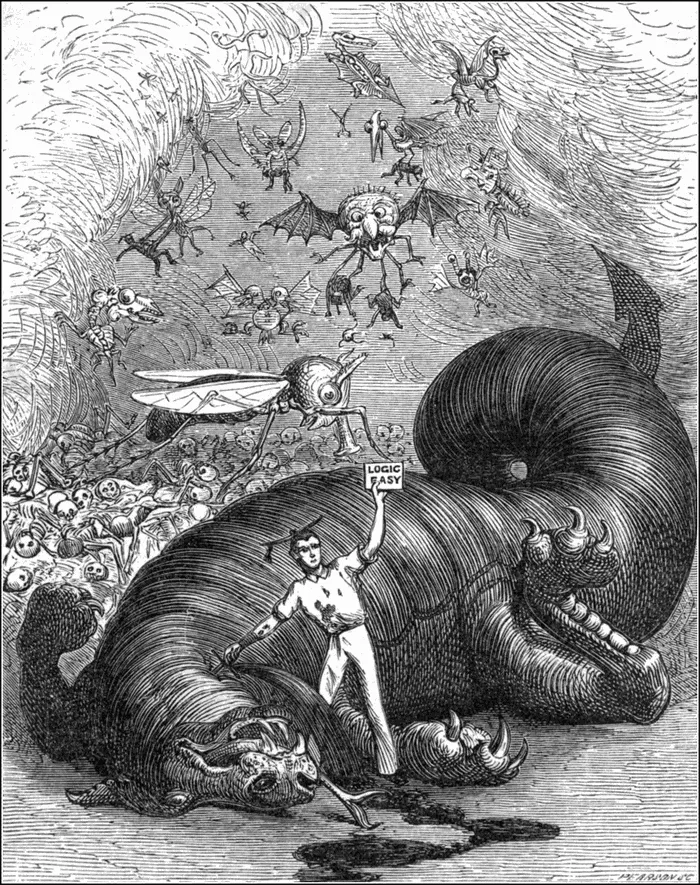
Destrawney, after carefully perusing the following pages, masters the Man-eater
Logic, and scares its foul offspring to flight from the bones of countless unhappy
victims upon which they were wont to gloat and feed.
AN ATTEMPT TO POPULARISE THE SCIENCE OF
REASONING BY THE COMBINATION OF HUMOROUS PICTURES WITH
EXAMPLES OF REASONING TAKEN FROM DAILY LIFE
BY
ALFRED JAMES SWINBURNE, B.A. QUEEN’S COLLEGE, OXFORD
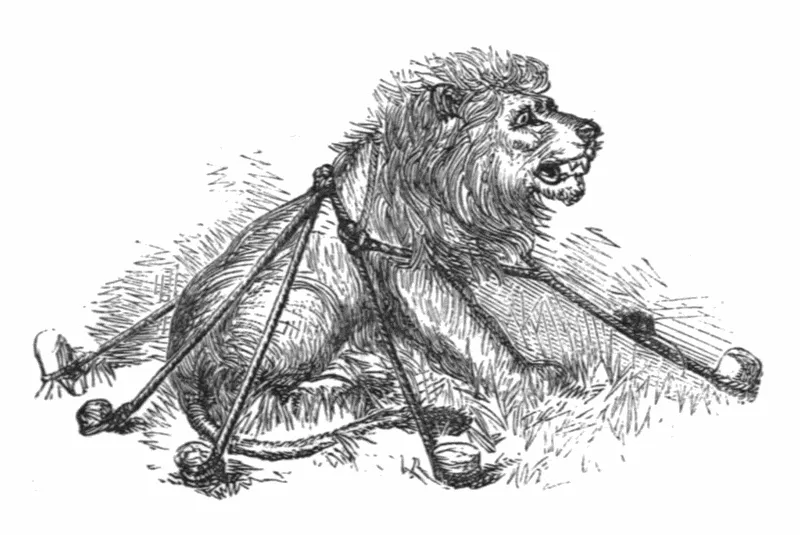
The Lion of Human Understanding in the tangle of Logical
Knots assisted by the Mouse of Illustration
WITH ORIGINAL ILLUSTRATIONS FROM DRAWINGS BY THE
AUTHOR ENGRAVED ON WOOD BY G. PEARSON
FIFTH EDITION
LONDON
LONGMANS, GREEN, AND CO. AND NEW YORK: 15 EAST 16th STREET
1887
All rights reserved
INTRODUCTION.
It was at the beginning of a certain Long Vacation when
my father sent for me and delivered himself of the following
remarks: ‘My son, your scores at cricket, your racquets,
your prowess in the hunting-field and in your college
steeple-chases, your numberless invitations and popularity,
to you doubtless appear all that can be desired; to me, Sir,
they are nothing—nay more—they are even positively
harmful, seeing that by their fascinating brightness men
are blinded to all sense of their true interests and aim—viz.,
to secure their degree as soon as possible with a view
to a start in life.’ Upon my replying to my father to the
effect that every allowance was to be made for him—as
having left college five-and-twenty years—if, as in the present
instance, he manifested lamentable ignorance of the
whole state of the University at the present day, and that
his milk-and-water reading man would certainly be regarded
with loathing and abhorrence by all ‘our fellows’ and all
the best men at Oxford, and consequently, sinking into obscurity,
would be ruined for life, and upon my making
many other similar assertions, my father, with much
warmth, commanded me to be silent, and then asked me if
I expected I was to live a life of slothful ease, because I
was a rich man’s son; with several other questions which
were not meant to be answered; finally becoming so excited
as to refer me to his own university career, a subject which
he quickly dropped, remembering how often he had told me
stories of his undergraduate days before I was sent to college.
The result was that I was ordered to select a tutor
for two months in the Long Vacation and pass my moderations
in the following term, or for ever be condemned to
the backless slippery heights of office stools. The awful
thought of ‘wasting my sweetness’ and withering in such
a dry and uncongenial soil nerved me for a desperate effort.
Of a restless and excitable disposition I was for some time
after haunted by dreams of men with pens in their ears,
and ledgers with columns of figures to add, so lofty that
their bases were on the earth while their summits were lost
in the clouds. I never could do mathematics—not that I
was quick at any work—even my mother allowed this, for
she wrote to my tutor for matriculation to the effect that
‘our dear Douglas had manifested symptoms of future
greatness, when a child, and still possessed remarkable
ability, if it could only be drawn out; but alas! there was
a want of application, especially in his mathematics.’ I
therefore determined to take up Logic as a substitute for
Mathematics, and wrote to inform my tutor that I should
only want help in this subject. He selected a charming
spot on the north coast of Devon and we met there. He
had one other pupil—a very quiet youth and, as it seemed
to me, very clever, my fear of whom was heightened considerably
when I learnt that he had intended to try for a
class, but, finding his books in a very imperfect state, was
content with passing, though determined not to miss that.
The awe with which this piece of information filled me I
never succeeded in quite shaking off, though I liked him
very much afterwards. He always seemed to me a sort of
half-way house between Mr. Practical and myself—the idea
of any one knowing more than Mr. Practical was an idea
that never for a moment entered my head. ‘Old Prac’
(as we called him afterwards) had such a smooth, comfortable
way of settling any difficulties I proposed—so reassuring
that I verily believe if he had told me that the best way
to learn the art of diving and remaining under for a long
time was to tie a heavy stone round your neck and get some
one to push you in, I should have tried it. His last words
the first night were—‘Logic to-morrow.’
It is needless to say my sleep was much disturbed that
night with anticipations and forebodings. What was this
new and strange study? Had I not always heard men
speak of its difficulty? How if the momentous question,
‘Was I possessed of a “turn” for Logic?’ should be answered
in the negative; and I fell asleep to dream of
mysterious figures, numbers, and symbols on the one hand
pitted against the mocking forms of clerks, managers, and
office boys on the other.
Next morning Mr. Practical assumed a grave look and
began: ‘There is no lack of treatises on Logic, but
there is a lack of people who understand them. It is
the custom of Passmen to attempt to learn by heart
a great deal of matter they do not in the least comprehend,
without attempting to realise the meaning,
and so fixing it in the memory. A little understood
is better than a volume learnt by heart. I shall not
expect you to remember anything you do not understand;
nor shall I ever make use of instances other
than those of everyday life; and if my illustrations
be too familiar to appear scientific, my excuse will be
that I wish to bring home to you what I say, that
you may realise and appreciate and so remember its
meaning, as a man who has swum two miles, or been
ill eight hours on a boat, has no difficulty in remembering
the force of the expressions “long swim” or
“unpleasant cruise.” The neat and concise phrases
you meet with in your treatises on Logic are deceptive—like
the ease of a good skater or runner, they
are the results of hard work, and you might as well
expect to get that ease at once without practice, as
imagine that by learning off those phrases you have
mastered Logic. Therefore, pass over all words and
instances that you do not understand as you read
your treatises side by side with my attempts at explanation.’
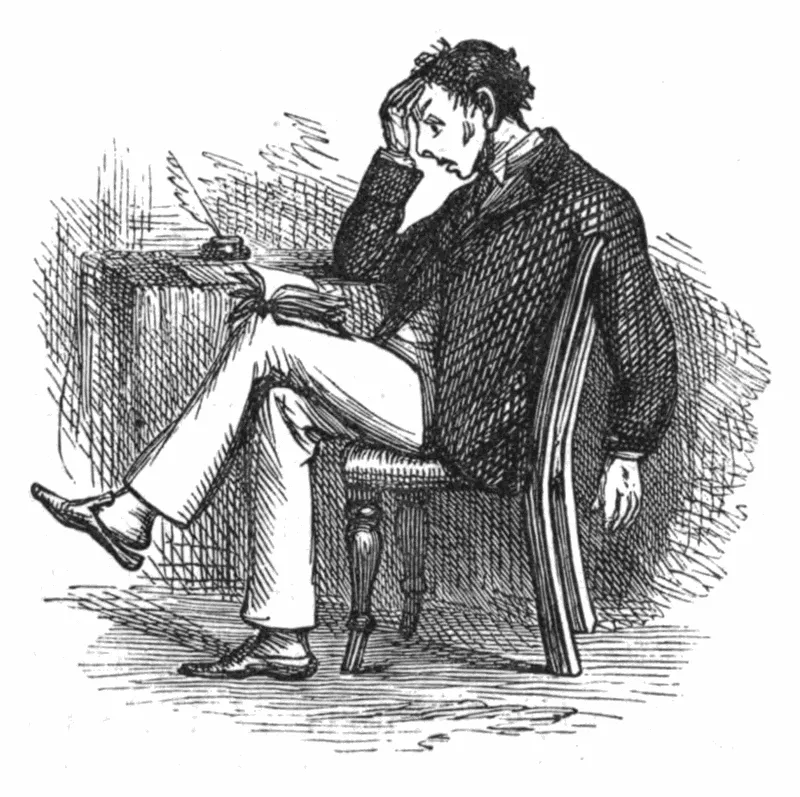
Nonplussed.
It would be difficult to express my sensation of
relief at these words; for already I had opened my
new ‘Elements of Logic,’ and, flushed with hope,
peeped at Chapter I.; but, confronted by the very
first word, ‘Psychology,’ I felt as staggered and faint
as when, burning to learn the noble art of self-defence,
I put on the gloves with the noted Punisher,
and he knocked me down the very first blow of the
first lesson. ‘Courage,’ I muttered, and pushing on,
saw something about ‘analysing phenomena’ and
their ‘mutual relations’ and ‘the mode of their
generation;’ and after this, I became unconscious,
until I was aroused by a shout of breakfast, and
found myself sitting staring blankly at my book with
ideas of chemists, newspaper accounts of ‘a strange
phenomenon,’ aunts and cousins hopelessly complicated,
and letters in the ‘Field’ about the breeding
of fowls, crowding in wild confusion across my
mind.
‘Tell me,’ resumed my tutor, ‘what you mean
by Logic, Dyver.’ ‘Logic,’ replied he, ‘is the
science and art of reasoning, or the science of the
conditions upon which correct thinking depends,
and the art of attaining to correct thinking, or the
science of the formal laws of thought—and other
definitions might be given.’
Observing my look of despair, Mr. Practical went
on: ‘Logic seems to be a science and an art, but if I
asked you what is a serpent, and you replied “a
reptile,” this would be no answer if I did not know
what “reptile” meant. “This is no answer, thou
unfeeling man!” the beginner might well exclaim,
were I to rest content with defining Logic as the
science and art of reasoning. If Logic is a science
and art let us leave Logic alone for the present, and
when we have grappled with these two mysterious
shadows Science and Art, return to our definitions to
find that the apparently different accounts of Logic
are only various ways of expressing the same thing.
Science is knowledge—but this is no explanation
until we know what knowledge is. First, then, let
us try and explain what knowledge is.
Imagine the whole world (i.e. everything that
exists—including of course the stars and the heavens
and yourself) to be divided into two parts; on the one
hand yourself, a being with faculties of observation;
and, on the other hand, everything but yourself, objects
which fall under that observation. And you must
remember that the observing powers can be turned
back upon yourself, so that in this sense you yourself
may be said at the same time to belong to both parts,
as being the person observing and the object observed.
You don’t follow, Destrawney? It will be clearer
presently. Now all that vast number of things which
form the part which is not yourself have, so to speak,
peculiar features and differences, qualities, or attributes,
or whatever you choose to call them. What I
mean is that they affect you differently as you hear,
see, smell, touch, or taste them. Take one or two
instances, a star—a tree—a pond. Each of these
objects has its peculiarities or attributes. The star
shines, the tree blooms, the pond is stagnant. You
are differently affected as you glance from the one
to the other. And this employment of the senses
given you by nature is knowledge. The world around
you is teeming with attributes, qualities, or peculiarities;
particular facts you may call them or
phenomena (from the Greek φαίνομαι, I appear or
show myself), and the noting or acceptation of these
particular facts by the senses is knowledge. The
lion roars, the rain falls, the flame rises, &c., and when
I say so I prove the existence of knowledge in me.’
‘I think I have some vague idea of your meaning,’
said I, ‘but I always thought knowledge was something
grander—more difficult somehow.’
‘Of course,’ he went on, ‘I only take the simplest
instances of the employment of our senses on the
world around us. It must be borne in mind that
each thing included under that term has an infinite
number of such attributes or phenomena. Take the
moon. That it is round and mountainous, &c., we
know, but there are a countless number of peculiarities
of the moon that we do not know anything
about, and the advance of knowledge only means the
observation of, or direction of our senses to, attributes
or phenomena not yet discovered or known to
exist. The man who first applied steam to locomotion
had noticed an attribute in steam hitherto
unobserved, viz. its elasticity. Knowledge, then, is
the application of our senses to the phenomena or
attributes of things around us. But it is something
more than the mere five senses that man employs.
The brute creation can hear, see, smell, touch, and
taste; but man has a higher power as well—that we
may call reason; a faculty by which he can gather
and group together particular facts and form universal
ideas and propositions. Not only are we
aware of the presence of “this horse,” “that draper,”
“yonder mountain;” but we can close our eyes and
picture to ourselves the image of a horse generally
that is not any horse in particular; and so with the
draper and the mountain. And not only can we
say “this horse is four-legged,” “that draper is
weak,” “yonder mountain attracts the clouds;”
but we can also say, “all horses are four-legged,”
“all drapers are weak,” “all mountains attract the
clouds,” supposing our observations to have been
sufficient to ground these universal propositions
upon. And notice the signs of the two different
propositions. The sign of a particular proposition is
generally “this” or “that” or “some”;[1] of a universal,
“all” or “no.”’
I could not help thinking how learned I was
becoming, and how easily I could now refute my
father if he ever again dared to argue with me.
‘Now, this second kind of knowledge we call
universal knowledge as opposed to particular knowledge,
and the results attained to are called generalisations,
uniformities, universal propositions, or laws,
or principles, as opposed to the particular facts from
which they are derived.’
‘Need we remember all those names?’ I gasped.
‘Never mind them for the present,’ he continued.
‘Remember that these universal propositions derived
from particular facts are called science, and thus
science is universal knowledge (where knowledge is
used for the results attained as well as the process of
attaining them). And science is divided into branches
according to the nature of the objects with which it
is concerned, and each branch is spoken of as a
separate science. Thus, if I gather universal truths
from particular facts observed about the stars, the
science is astronomy; and if about the earth,
geology; and if about trees, botany. For instance,
I observe this tree buds in the spring, and that and
that, and so on until at last I lay aside my particulars,
and assert once for all that “all trees bud in the
spring,” and this proposition forms a part of the
science of botany. Now, gather your universal
truths from particular facts observed about thought
and the science is Logic.’
At this triumphant flourish Dyver, who had for
some time exhibited signs of restlessness, could
restrain himself no longer, but burst in with his
difficulties. ‘Firstly,’ cried he, ‘what do you mean
by thought? and secondly, why should men care to
draw these generalisations that you speak of?’
‘Of thought more anon,’ replied our tutor; ‘as
to the generalisations, you must recall to your memory
the division above mentioned, yourself or mind, on
the one hand, and all external phenomena or matter
on the other; and on the side of mind or yourself.
You will find implanted by nature an inclination to
gather together the like, to classify, and arrange,
and group similar phenomena together—a yearning
after generalisation—more conspicuous in women
than in men, because in women the natural impulses
are less restrained by reason. But of this hereafter;
for the present recollect what we have said, that
knowledge was an employment of the senses upon
external phenomena; that knowledge was of two
kinds, universal and particular; and that universal
knowledge is called science, and that the branches
of science are named from the objects with which
they have to do; and the science of thought is Logic.
Of art we must speak to-morrow.’
That day we went for a lovely walk, Dyver seeming
buried in meditations of future knots for logical
solution, and whether it was that I over-tired myself,
or whether it was through working a brain usually
idle, I don’t know, but I had a remarkable dream
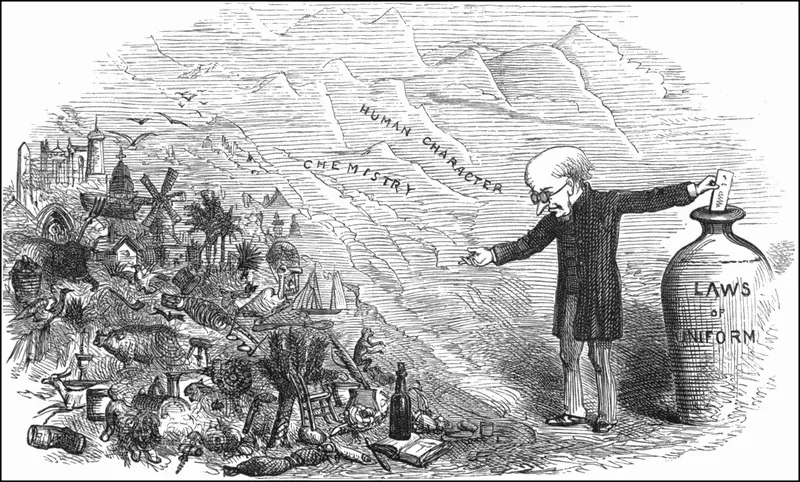
that night. I saw an old gentleman who had been
my house-master at Eton, standing at the foot of a
range of hills, and busily engaged in picking up
things, and putting something now and then into
a huge preserving jar that was at his side. On
approaching nearer I heard him muttering something
over and over again—about knowledge and
triumphs. ‘Rather tiring work, isn’t it?’ I ventured
to ask. ‘What triumphs do you refer to?’ ‘Why,
the triumphs of science, young man,’ he sharply
retorted. ‘Don’t you call it a triumph to arrange,
group, and classify yonder untidy wilderness of particulars?
to detect similarities and form universal
propositions, or uniformities, or laws, and lay by
these laws in jars for future use? to introduce neatness
and order in that tangled medley before you,
that bewildering chaos of confusion?’ ‘Most certainly
I do, but I don’t quite see how you mean. I
don’t pretend to be clever, though.’
SCIENCE PRESERVED IN JARS.
‘Keep silence, and observe the process. I’ll take
a very simple uniformity to make it plain to you.’
He then picked up a stone and let go of it, and
it fell to the ground. ‘This body tends to fall to
the earth,’ said he; and repeated the operation
with a book, a chair, a bottle, a purse, and several
other things, each time repeating the formula,
‘This body tends to fall to the earth,’ much in
the same way as a man repeats the responses in
church. Then he wrote something on a slip of
paper, and handed it to me. It was—‘All bodies
tend to fall to the earth (uniformity or law of
gravity).’ ‘There,’ said he, ‘that’s the process; of
course simple uniformities like these were observed
long ago. I’m engaged in much more abstruse and
complicated work now, but the process is precisely
the same.’ He slipped the paper into one of the
jars already filled, corked the jar carefully down, and
patting it affectionately, continued, ‘You see the
advantage. What a saving of time and trouble, for
we need not look every time at our stone, book,
purse, &c., i.e. the particulars, but we have our comprehensive
law once for all, and we can dispense
with all further experiments with the particular
facts. All knowledge, indeed, is power, and this is
as true in complicated instances but less obvious
than here. You hold in your hand a brittle ornament;
without any physical effort your knowledge
gives you the power to break it, for you know that
if you let it go it will fall to the earth and break,
because you have drawn the law of gravity from the
observation of particular facts.’
‘Quite so,’ said I, growing a little weary; ‘but
excuse me, what is that bump on your forehead?’
‘That,’ said he, ‘is the bump of generalisation,
and it indicates an innate desire in man to observe
similarities, and group and gather particulars, and in
virtue of the possession of similar qualities, and so
make laws. I’ve great trouble in preventing people,
especially women, from giving way to this impulse
too much. Men have what they call “hobbies,” and
women “jump at conclusions.”’ As I was musing
upon this, and thinking how I would enlighten their
dark minds at home, I was recalled to myself by
an angry shout from Mr. Science (for that he told
me was his name). Turning my eyes in the direction
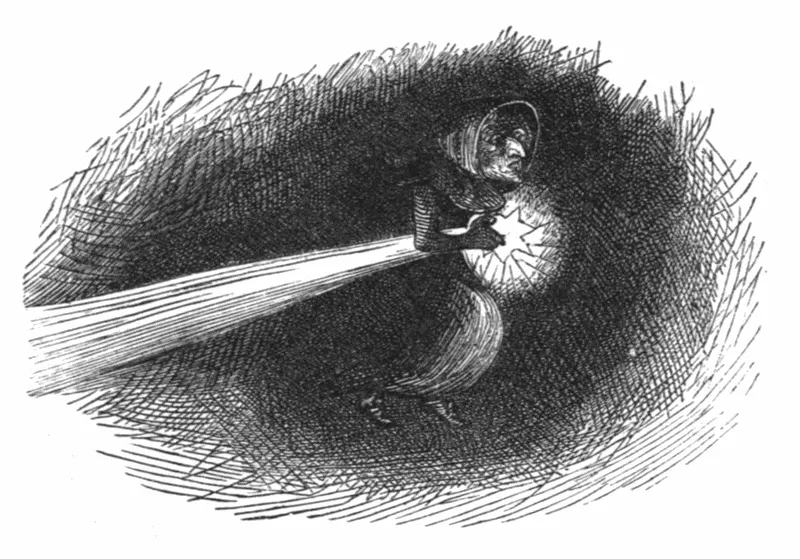
of his shout, I saw an old woman flying through the
air with a large comet under her right arm. She
clung tightly to it as if for support. ‘Ho, there,
where are you going to with that comet?’ cried he.
‘O please, Mr. Science,’ said she, ‘I’ve got a law at
home that “all comets are signs of war,” and as mother
made the law without seein’ no pertiklers, we thought
we’d collect pertiklers arterwards.’ ‘Be off,’ yelled
the old man in a perfect frenzy of rage, ‘how dare
you make laws without a sufficient number of particulars
to warrant your conduct. Be off, I say, you
old baggage, and drop that comet this moment!’ I
covered my face lest he should see my amusement at
his ferocious gesticulations, when the old woman fled,
still clasping the comet in her arms.
Superstition.
‘You see those two hills beyond,’ he said, turning
to me again; ‘we find it hard work there. We’ve
made most progress in mathematics and astronomy.
We can get our particulars separately there; but
those hills are composed of the particulars of chemistry
and human conduct, and they’re very difficult
to get at. And as one of the chief advantages of
science is its prediction (for when we know that all
steam is elastic, we can predict that any particular
steam will be elastic), we lose much by not having
its aid in the arrangement of these particulars.’
‘One might almost compare your work to mining,’
said I, ‘you seek for the gold of truth in things, and
when you have found it you can throw away the
earth or particular facts.’ This seemed to me a
splendid simile, and I only wish Dyver could have
heard it, but the old man took no notice of it at all.
‘It’s very hard to find uniformities in things,’ he
continued, ‘when you can’t get them separately.
Supposing gunpowder was always found with some
other substance, and you couldn’t separate them,
how would you know whether it was the gunpowder
or the other substance which possessed the quality of
exploding when a spark was applied? So you can’t
get your uniformities or laws, and science is backward
there.’
‘Or supposing,’ said I, ‘two men always visited
your house together, and at the sight of them the
dog always exploded into barking, unless you could
separate or isolate the men, you couldn’t make any
law as to which of the men the dog was barking at.’
‘Yes,’ said he, smiling contemptuously, ‘that
would do, but a better instance is’ ... and he went
on talking about crystals and double refractory
powers till the whole scene changed, and I found
myself climbing up, as of yore, to get a nearer view
of the beautiful glass lustres of the chandelier at
home, and upsetting the ink, and being called by my
mother a refractory child, for that’s all I knew about
‘crystals’ and ‘refractory powers.’
CHAPTER II. WHAT IS ART?
Next morning I arose, wondering at my dream, in
which I had seen much more than I had heard from
Mr. Practical, and accounting for the prodigy by
supposing that all the scraps I had read at odd times
in our domestic British Encyclopædia had been
aroused from their sleep in my memory by my late
efforts to think.
‘If science,’ resumed Mr. Practical, ‘may be
called universal knowledge derived from particular
facts, art is the application of that universal
knowledge to particular facts, and we may speak
of the arts as we do of the sciences, meaning
thereby branches of one great art and branches
of one great science. By science I establish the
law, for instance, that “all trees bud in the
spring.” Now supposing I were able to produce
a tree, I should say to myself, “Let me see, a tree is
to be produced; first of all it must bud in the spring,
for unless it did so it would not be a perfect tree,
and then it must be something else, and so on”; and
as a sculptor complies with orders in a contract,
so must I obey laws in the production of this tree,
and this is what we call the application of universal
knowledge to particular facts. And this is why the
laws of a science are also called conditions, because
without complying with them we cannot produce a
correct instance of a particular: e.g., from observation
we enunciate the law, “all water has drowning
properties.” Now this is a condition upon which
water’s being water depends, for if a man pointed to
some water and said, “This water has no drowning
properties,” we should say, “My good sir, this cannot
be water, then, for it does not comply with the conditions
required to constitute water.” Now art is
the application of universal laws in this way to
particular facts, strictly speaking, in production, but
also in criticism.’
‘I don’t quite understand,’ said I.
‘By production, I mean the process of making
something, as a picture, statue, or house; by criticism
the process of testing the genuineness, or right to its
name, of something, as a star, tree, or man. In
either case we apply universal knowledge to particular
facts, and the process is called art.’
Dyver, looking very subtle, here enquired whether
science was the process of attaining to universal
knowledge, or the knowledge so attained, for art
seemed to be the process only, and Mr. Practical
replied that it was difficult to say; he believed science
was used for both, perhaps on the whole it was more
often used for the knowledge attained, but it made
very little difference to the broad distinction between
science and art, and that was all he wanted to
show.
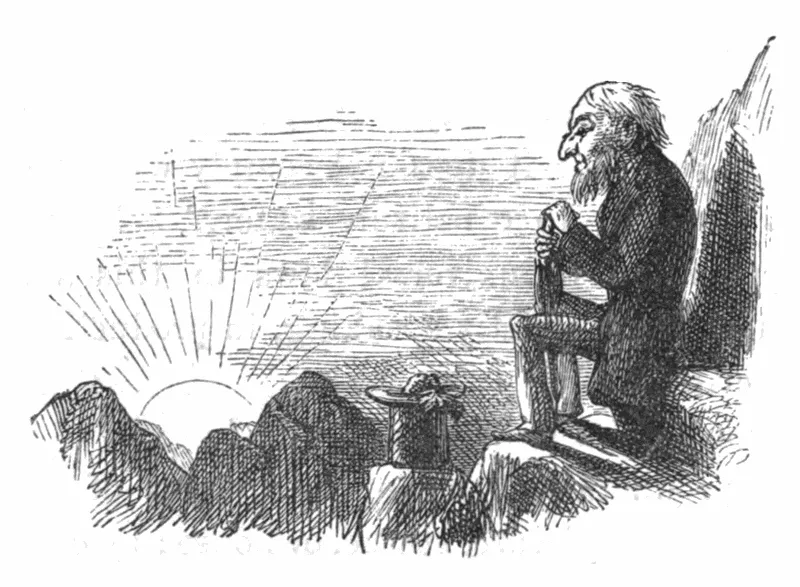
The Beginning of Science.
‘To give you an illustration of what I mean by
science and art, I shall make a rough sketch with
my pencil,’ he continued, scarcely a bit discomposed
by the penetrating subtlety of his senior pupil.
‘Here we have an aged admirer of scenery.
Night after night he gazes on the sunset from his
rocky seat. He observes certain points possessed in
common by each sunset (to speak of sunsets as distinct
particulars). The clouds may vary, but there
are certain particular rays of light he sees every
time he sees the sun set. He thinks to himself, “I
observe these sunsets agree in certain features—they
all have certain rays of light, &c. These common
elements, or uniformities, I will gather together and
make laws of them for the guidance of my boy, who
has shown a taste for painting.”’
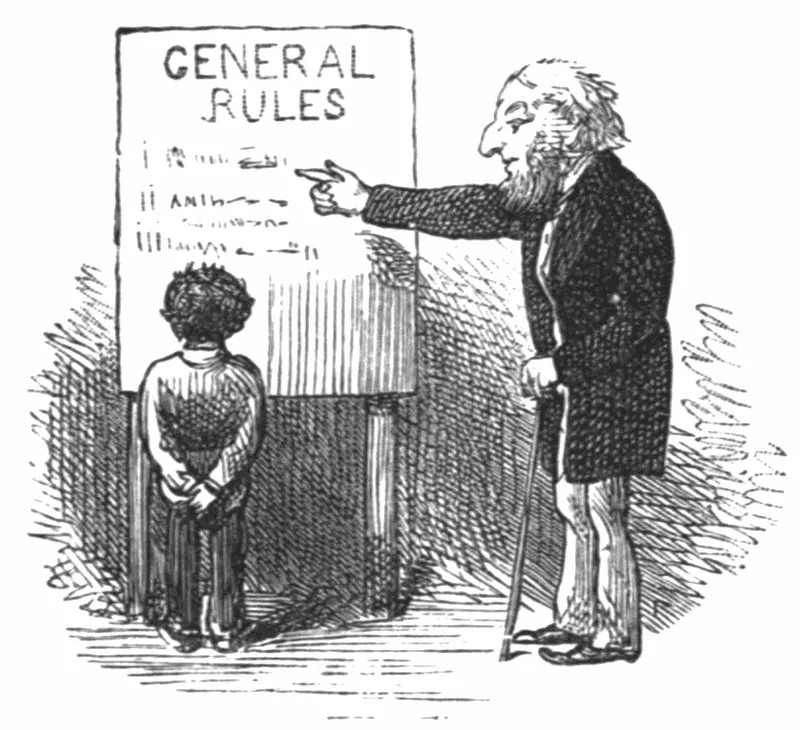
So he draws up these common elements in the
form of laws, and teaches them to his boy. ‘All
correct sunsets have such and such rays,’ &c. And
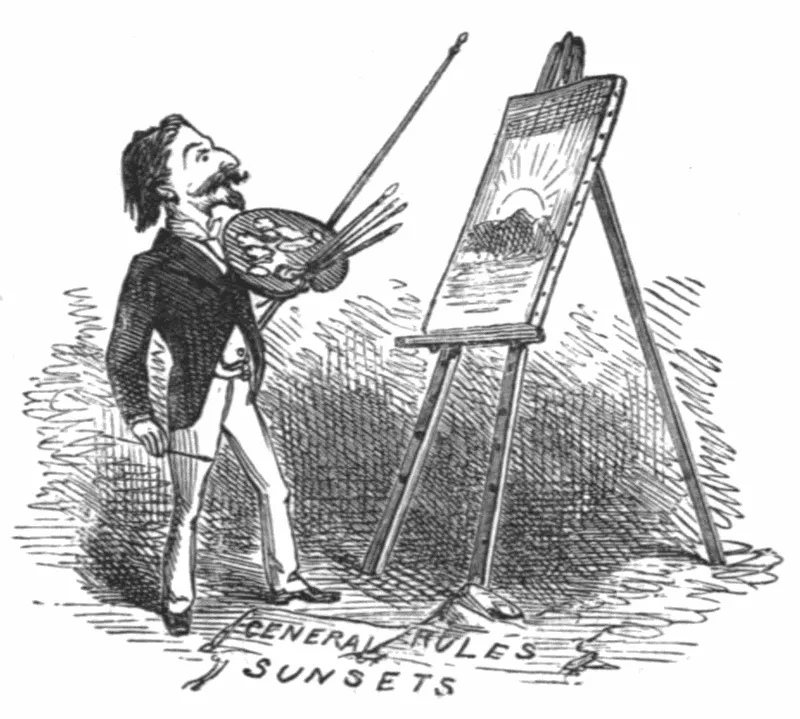
the boy grows up, and carries out in a particular
instance the laws his father drew from particular
instances, by painting a picture of a particular sunset
which obeys the laws his father drew; and if it
obeys all of them, it is said to be a very good painting
and a perfect work of art, and it hangs in some
national gallery. The first two illustrations here
would come under science; the last, art.’ While I
was laughing at the family likeness between the
father and son, ‘Could you give us an instance of
criticism as well?’ asked Dyver; ‘the above is
obviously production.’
The Beginning of Art.
‘I suppose it might fairly be called art to apply
universal laws to particulars in the way of testing
their truth or genuineness, and this would be criticism.
A judge of pictures looks at the sunset above
depicted, and tests its truth by calling up one after
another the laws gathered from the observation of
particular sunsets, and seeing whether the picture
before him complies with these laws. And this is
what is meant by saying that a picture presents to us
the essential, as well as any accidental, features of
its original.’
‘But is it the same,’ said I, ‘with the science
and art of riding, or swimming, or skating—those
sixpenny sciences, I mean, that you buy in yellow
covers with pictures on?’ ‘Precisely,’ replied he,
smiling at my earnestness; ‘the particulars of swimming
are the particular movements of the limbs by
this or that swimmer. These are observed by the
man of science—their uniformities or common elements
constituting laws or conditions—and he
enunciates them: “All correct swimmers spread
their limbs in such a way,” and several other laws.
Should he feel disposed to learn swimming himself,
and enter the water, attempting to spread his limbs
according to these laws, he would be employing art.
And the case is similar with shooting, or riding, or
skating. Wherever you draw universal knowledge
from particular facts you have science (the name
varying with the subject matter), and wherever you
apply your universal laws to particulars, again you
have art (the name varying in the same way), and
science and art applied to thought share the name of
Logic. Thus the beginning of science and art taken
together is the same as their end, viz. particular
facts, as you see in the case of the painter, the particular
sunsets you see in fig. i. and fig. iii. are the
beginning and the end.’
All of a sudden Dyver clutched his pencil convulsively,
and became so engrossed in his note-book
that I very nearly burst out laughing; it reminded me
so of the way we used to clasp our lexicons at school,
when the master returned unexpectedly, after leaving
us alone for a few moments. ‘Might not this
figure,’ he presently asked, ‘represent science and
art? it has just occurred to me it might.’ This was
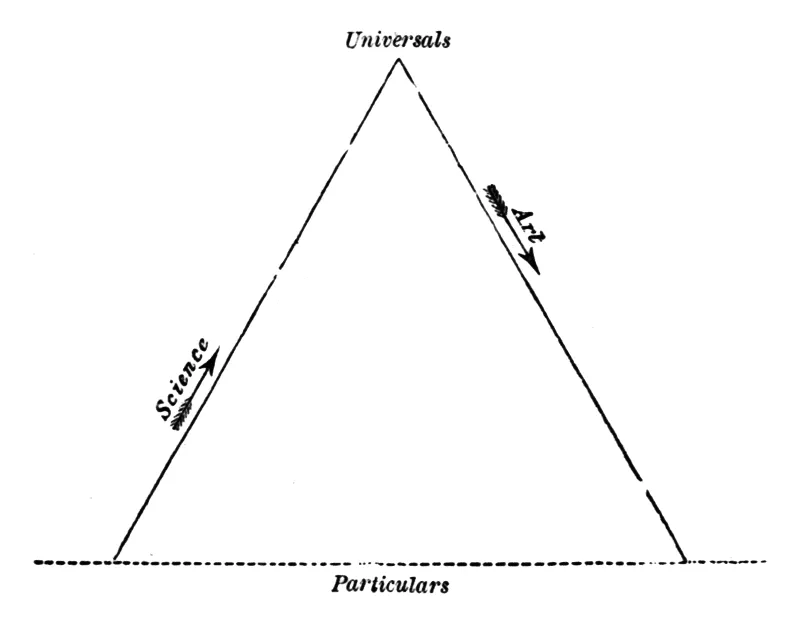
the figure, and Mr. Practical was highly pleased
with it; and the more so because he told us universal
knowledge is always regarded as something
higher than particular—we ‘ascend’ to it and deduce
from it—and we talk of particulars depending upon
or hanging from laws or conditions.
CHAPTER III. LOGIC IS A SCIENCE AND AN ART.
‘Yesterday,’ continued Mr. Practical, ‘we saw
what science and art were. If Logic claims to be
considered a branch of science and art, we must
not be content until we have heard proof that Logic
gathers laws from particular facts, and applies laws
to particular facts.
‘We have already observed that the eye of the soul,
so to speak, can be turned back upon itself—and we
can contemplate our very thoughts. And in this
field or sphere of thought we find particulars to work
upon, and Logic grounds upon these particular
thoughts uniformities, conditions, or laws in its
capacity of science, and applies these uniformities,
conditions, or laws to practice, in its capacity of art.’
‘But thought,’ said I, ‘is so vague and difficult,
please make the whole thing clearer. I think I begin
to understand about some of it.’
‘In a subsequent lecture I shall endeavour to
discuss thought more thoroughly—showing how all
thought is comparison. To take, for the present, a
common-sense view of the matter, thought may be
either unexpressed or expressed. You may be sitting
next to a lady at dinner and you may think “This
lady is very ugly,” this, we trust, would be an unexpressed
thought. Or you may think “The weather
is lovely” and turning to the lady you may express
this thought, and it becomes a remark. Again, you
may in your mind form a more complicated kind of
thought. You may think, “All cucumber is indigestible;
this is cucumber; therefore it is indigestible,”
a thought unexpressed also. Or you may
think, “All young ladies are charming companions;
my neighbour is a young lady; therefore my neighbour
is a charming companion,” a thought you may
express to her, and it becomes an inference. Now
it is obvious that there is an infinite number of remarks
and inferences that one might make, and we
shall regard these remarks and inferences as thought
for the present—for they are thought viewed from
the outside of the lips, so to speak, or Homer’s ἕρκος
ὁδόντων. Now, given a number of these various
remarks and inferences, you will find some correct,
some incorrect. Here, then, is work for science—to
collect a number of correct remarks or inferences
(as they are called), find out their uniformities, their
common elements (for something in common they
must have, or why were they called by the same
name?), erect these into laws and call these laws the
principles or conditions upon which correct remarks
or inferences depend—precisely as the botanist did
with his trees, the astronomer with his stars, and the
old man with the sunsets. Here, too, is work for
art, for the principles or conditions can be employed
either in the production of particular correct remarks
and inferences or in the criticism of the particular
remarks and inferences of others. And Logic is the
name given to the science and art, for these remarks
and inferences represent thoughts.’
‘How do you know when a remark or inference
is correct?’ asked Dyver.
‘This is just what Logic would tell us, by giving
us the laws required to be complied with by any
remark or inference that is entitled to the name of
“correct.” As a matter of fact, we generally know
by instinct and without any extraneous aid whether
any remark or inference is correct or not. Particular
correct thoughts were distinguished from particular
incorrect thoughts before Logic was thought of, but
Logic gives us the why and wherefore, and enables
us consciously to detect errors they unconsciously
detected before.’
‘I am afraid I don’t understand these last words,’
I remarked.
‘Never mind. All you need recollect is this—certain
thoughts are called correct among men
and certain thoughts incorrect. You step into a
third class carriage. It is full of costermongers and
illiterate persons. The man next to the window
makes a remark, “Deep rivers is allers shallow.” A
look of wonder steals slowly over every face. The
man proceeds to an inference. “Balloons is the
most riskiest travellin’, and I’m a goin’ by the Underground
Railway; so I think its pretty sartain I’m
a goin’ by the most riskiest travellin’.” There is a
hoarse laugh from all, and they tell the guard to look
after that man as a lunatic, one with reason or
thoughts perverted, for it wants no logic or cleverness
to detect an incorrect thought. You return to
your first class carriage, and a friend tells you there
that what those men unconsciously did Logic enables
us consciously to do, for Logic gathers the common
elements of correct thoughts and making laws of
them gives us principles for guidance in the
production of thoughts ourselves and the criticism
of thoughts in the case of others.’
‘Could you tell us any of these laws?’ asked
Dyver.
‘There are three primary laws to which all the
laws of thought may be reduced; and you only need
know their names for the present. They are—
I. The Law of Identity (whatever is, is).
II. The Law of Contradiction (a thing cannot
both be and not be).
III. The Law of Excluded Middle (a thing must
either be or not be).
Simple and even absurd they appear at first sight,
but still they are laws obeyed, though unconsciously,
by millions of men every day; and until you realise
their meaning, respect them for their universality: I
shall devote more time to them afterwards.’
‘Do you mean to say,’ indignantly demanded
Dyver, ‘that by learning these mere truisms—for
that’s what they seem to me to be—that we are
helped at all in the attainment of correct thoughts,
and the avoidance of error? Suppose I want to
invest some money in the Peruvian Stocks. The
only question that frightens me is, “Is the guano
adulterated?” I consult a logician as the wisest
of men. His oracular response is, “In reference to
this matter, I can tell you one thing. If it is adulterated,
it is adulterated; and furthermore, since
you seem much excited about it, I will proceed to
the disclosure, ‘that it can’t be both adulterated
and not adulterated’ (at least, in the same place
and time); while, on the other hand, error might be
incurred, were you not to keep well in mind the fact
that guano must either be adulterated or not adulterated.”
What should I gain by such information?
Should I not, in a fit of anger at his cold, dull certainties,
probably invest, and lose my money? and
would not this be an error of judgment? Ought he
not to have deterred me?’
I was highly delighted with this explosion, and
was half afraid that it would prove too much for our
dear old tutor; but as the sounds of Dyver’s voice
died way, like the smoke after a volley, I saw him
sitting calmly and quite unhurt by what seemed to
me the murderous fire of his pupil.
‘You mistake,’ said he, ‘the function of Logic.
You can’t blame Logic for not accomplishing what it
never pretended or professed to accomplish. Logic
is only responsible for the form, and not the matter
of our thoughts. I shall explain form and matter in
due time. Here it will be enough to say that it is
when thoughts are self-contradictory or inconsistent
that Logic interferes. If a man says, “The deep is
shallow,” Logic can correct him. If a man says,
“All deep water drowns; this is shallow water;
therefore it drowns,” Logic can correct him, for the
remark was self-contradictory, and the inference inconsistent.
But if a man says, “This water is deep,”
Logic cannot interfere; and if a man says, “All shallow
water is safe for bathing; this is shallow water;
therefore it is safe for bathing;” and then, with
Logic’s consent, proceeds to bathe, and is drowned
(for the water turned out to be deep), you couldn’t
blame Logic; for, as far as Logic was concerned, his
thought was correct, his inference was logical; the
only thing was that his data, his facts were not
correct; and for these facts (which we call matter)
Logic is not responsible. Given the facts, Logic can
tell you whether the remark is self-contradictory or
the inference inconsistent (i.e. can criticise the
form). Every science must have its data or facts to
start with, its materials to work upon. It’s hard
upon the oarsman if we blame his rowing, when we
gave him a rotten oar to start with, and he loses the
race; and upon the weaver, if we blame his weaving,
when we gave him bad wool to begin with, and the
cloth is useless. And it is hard upon the logician,
when we give him faulty remarks to pass judgment
upon, or faulty facts or data (or premisses) to draw
inferences or conclusions from, and then blame him
for any mistakes that may occur from acting upon
his decision. You bring this inference to the logician,
“All speculation is profitable; this Peruvian
affair is a speculation; therefore it is profitable.” “A
perfectly sound and correct inference!” exclaims the
logician, and so you invest and lose your money;
but it is you alone who are to blame, for you bring
him bad material to work upon. Your remark,
“All speculation is profitable” is as faulty as the
most rotten of oars and the very worst of wool.’
The warmth of this reply quite restored my confidence
in our good tutor, and it was entertaining
too, as we knew he himself had lately lost some of
his money in the Peruvian Stocks; and this is why
Dyver’s illustration came home to him so well.
‘After all, it cannot be denied that errors of form
in thought are more heinous than errors in matter.
We can make allowances for the latter, but not for
the former; and the science which remedies the
greater evil ought surely to be more highly valued.
‘But to sum up briefly. We have seen that
knowledge is of two kinds, particular and universal.
Universal knowledge derived from particular is
called science, and applied to particular, is called
art. The name of the science or art depends upon
the objects with which it is concerned. We have
also seen that there are such things as particular
correct thoughts, and that science and art can be
introduced here, enunciating and applying the conditions
or laws upon which those correct thoughts
depend. And this is called Logic, and has only to
do with the form as opposed to the matter of
thought, expressions which we have reserved with
the laws of thought for further explanation.’
CHAPTER IV. FORM AND MATTER OF THOUGHT.
‘Before commencing our explanation of the form
and matter of thought, I should like to answer any
questions that may have occurred to either of you.’
‘I am troubled about one thing,’ said Dyver.
‘What do we mean by saying a thing is “true” or
“correct”—how would you express the meaning of
these words?’
‘There is no need whatever to resolve these words
or further explain them. In Logic we start with
particulars as in most, if not all, of the sciences (for
some maintain that there are sciences which start
from the universal and work downwards, as we shall
find in course of time), and we must accept without
question, or take for granted, these particulars, for
whether we start from universals or particulars we
must begin with assuming some thing, and believing
it by instinct or intuition. For if we did not do so
we could never start at all, nor have any basis for
the construction of science, so to speak. In Euclid
we start with certain postulates, and in botany we
start with certain plants and trees, and in Logic we
start with “correct and incorrect thoughts.” If anyone
asks us how we know a correct from an incorrect
thought, we should reply by instinct or intuition, and
that would be a sufficient answer.
‘Still, to gratify your thirst for knowledge, I
should say that a thing is true when it agrees with
the impression of our own senses, and correct when
it agrees with the decision of our own reason. For
instance, if I heard a man say, “The comet is
visible,” and then saw it myself, I should declare
the thing to be true; or if I heard a man say,
“Comets are flying worlds,” I should declare the
thing to be correct enough, but I could not answer
for its truth, whereas if he said “Comets are not
comets,” I should declare the thought to be incorrect.
Of course the impression upon the senses and
the decision of the reason of our fellow-men is considered
almost as secure a pledge for the truth or
correctness of a thing as that of our own. But this
distinction I should not venture to insist upon.’
He then told us that to grasp the idea of form
and matter we must do as we did with science, that
is to say, we must first understand the idea generally,
and then apply it to thought.
‘Take any three statues; they may be of Mars,
Apollo, and Venus, and all of gold, when they would
differ in form and be the same in matter; or they
may be of gold, copper, and brass, and all of Apollo,
when they would differ in matter but be the same
in form. And so with houses. You may have a
villa, a mansion, or a public-house all built of brick,
or a villa of wood, brick, or stone. The more homely
instance is still better. A jelly, a cream, and a
blanc-mange may be all turned out of one shape or
mould, and then they would be different in matter
but of the same form; and three jellies may be turned
out of three different shapes or moulds, and then
they would be the same in matter but different in
form.
‘Apply this distinction to thought. Any thoughts
may differ in matter and be the same in form, or
vice versâ, as the statues, houses, or jellies. The
matter of a thought is that about which one is
thinking, and the form is the shape or mould into
which we cast the thought. There are an infinite
number of things which go to make up the matter
of thought. But the forms of thought are three (as
recognised by Logic):—
(1.) The Term or Concept.
(2.) The Proposition or Judgment.
(3.) The Syllogism or Inference.’
I shuddered as I heard that word syllogism, so
often had I heard of it before, as one of those things
that nobody could understand,—and had we really
penetrated so far into the domains of Logic as to
stir this giant from his lair? I was full of awe.
‘Into one or other of these three forms or moulds
Logic casts all the matter of thought; in other words,
everything we know of or can conceive. Of the proposition
or judgment, and the syllogism or inference,
we have already spoken under the names by which
they are known outside the pale of Logic, viz.
remarks and inferences. To consider these three
forms separately.
‘(1.) The Term or Concept is, roughly speaking,
the name of anything we can see or imagine. Horse,
star, James, white, black, fire, philosopher, hippopotamus,
priest, are all very different things to an
observer who regards their matter, but to the Logician,
who pays exclusive attention to the form, they are
all terms or concepts. Fierce or tame, small or
great, they are all equally terms to him. Were a
Logician to be told first that a bedstead, and then
that a rabid tiger were in the next room, separated
by a thin partition, in so far as he was a Logician
he would evince no emotion at the second piece of
intelligence, but would simply reply, “Two terms,”
for the Logician is only concerned with the form.’
‘In so far as he was a human being though,’
said I, ‘he would not stay long enough to say even
that.’
‘Quite so; because the matter of thought makes
a great difference in the regulation of conduct, but
is not recognised at all in Logic.
‘(2.) The Proposition or Judgment is a combination
of two terms, and is the mould into which Logic
casts all those “remarks” we spoke of above as the
beginning of thought. “Horses are swift,” “stars
twinkle,” “James is a haughty footman,” “white is
dazzling,” “fire is comforting,” “philosophers stoop,”
“hippopotami are large,” and “priests are good,” are
all very different things to an observer who regards
the matter of thought, but to the logician who pays
exclusive attention to the form, they are all propositions
or judgments. False or true, dogmatic or
liberal, interesting or dry, they are all equally
propositions or judgments to him. Tell him three
facts—“The mixture of chloride of mercury with
iodide of potassium produces a colourless liquid over
a brilliant red precipitate,” “beautiful women are
fatal to the peace of man,” and “rabid tigers infest
the adjoining room,” and in so far as he is a logician
he will simply articulate “propositions,” for
it is the form and not the matter with which he is
concerned.’
‘But surely those long instances are more than
the mere combination of a couple of terms,’ said
Dyver.
‘It makes no difference how many words there
are; there are only two ideas, though there are
several words; and this we shall explain when we
discuss propositions more fully. To proceed:—
‘(3.) The Syllogism or Inference couples together
two propositions and produces a conclusion. Here,
as in the case of propositions, it makes no difference
whatever to the logician what the matter of thought
may be. You may say to the logician “The mixture
of chloride of mercury and iodide of potassium produces
certain results;
This is such a mixture,
Therefore this produces certain results;”
or you may say, “Beautiful women are fatal to the
peace of men;
My cousin is a beautiful woman,
Therefore she is fatal to the peace of men,”
and he will, in so far as he is a logician, say nothing
more than “syllogisms,” for such is the form or
mould into which both these thoughts must fall.
Thus is Logic said to be a formal science, and in this
way is it concerned with the forms, ways, or modes
in which people think.’
‘I sincerely trust,’ said I, laughing, ‘that in so far
as I become more of a logician my peace of mind
will be less molested by what you call the “matter”
of thought, for it would save much worry.’
That night, my nerves being, I suppose, in an
excited state from my attempts to follow my tutor’s
arguments—for application to study was quite novel
to me—I dreamed a strange dream about the form
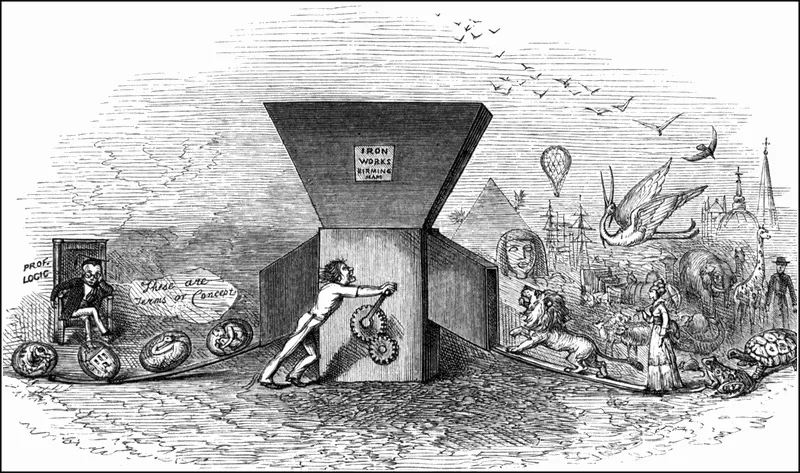
and matter of thought. In the midst of a plain I
beheld a huge machine. At first sight it resembled a
coffee grinder, but on closer inspection it proved to
be more like a monster sausage-machine. A college
friend of mind was working it by a small handle, the
perspiration pouring from his forehead.
THE LOGICAL SAUSAGE MACHINE.
On the left of the machine sat an old Professor,
and on the right of the machine there was an indescribable
confusion of all kinds of things; there were
birds, balloons, pyramids, and I could not tell how
many more things there—a lion was just entering
the machine, followed by a lady, a frog, a tortoise,
and a clergyman. I should never have had my
curiosity satisfied, had not the lion roared terribly in
his reluctance to enter, thereby eliciting the following
remarks from my friend at the wheel. ‘Now
then, in with you, you needn’t make all that fuss;
you’re not in the least degree formidable to us; why
we had a whole menagerie through the other day,
and trains, elephants, whales, worlds—all have to
pass through this machine and become terms for the
inspection of the great Professor Logic.’
For the first time I then noticed some things
that looked like sausages issuing from the left side
of the machine, only from having such big things
inside them they were swollen to the shape of eggs.
In one I observed a fish, in another a house, in a
third a bird, and in a fourth a man—all were painfully
cramped for want of room.
‘Ah! yes,’ he went on, ‘it’s with our machine
here as it is with the common ordinary sausage
machine, never mind what the material is—so long
as the shape is right. Large or small, young or old,
flesh or stone, you must all pass through, for
Professor Logic isn’t particular about the matter, all
he concerns himself with is the form,’ and he laughed
as well as he could with his hard work, the thought
of the common ordinary sausage amused him so
much.
‘Hard work, Frank,’ said I.
‘Indeed it is,’ said he, without the smallest sign
of surprise at seeing me. ‘Do you know the old boy
sitting there says, “One of the advantages, or practical
utilities of being a student under me is that it
affords hard exercise to, and is therefore invigorating
to, your faculties,” and I agree with him.’
‘But what does he do with these terms when he’s
made them?’
‘I’ll show you. I’ve done my share of turning
for to-day. The Professor likes us to work the terms
out ourselves; he says it makes us understand the
process, and I must get it up, you know, for my
exam. Still, I’ve done my share to-day.’
So, leaving the handle to another student, he
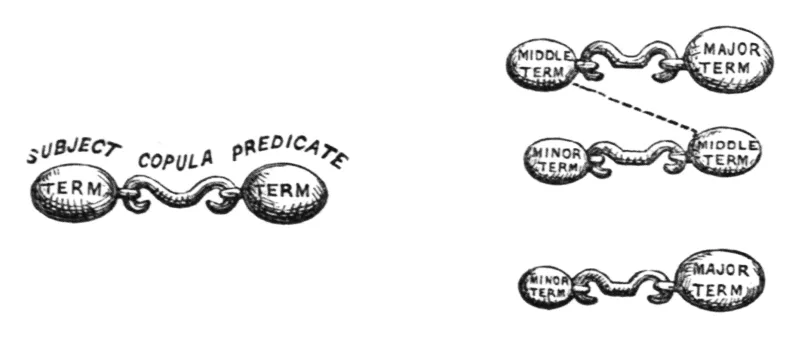
conducted me to the Professor’s workshop, where I
saw a vast number of terms from the machine linked
together in couples, and they were called propositions.
I afterwards learnt the meaning of the words written
over them. There were also syllogisms or inferences
composed of these same terms, and wondering at
them, I awoke.
CHAPTER V. THE RECONCILIATION, AND ALSO HOW LOGIC IS MORE OF A SCIENCE THAN AN ART.
‘We can now proceed to reconcile the various definitions
of Logic,’ resumed Mr. Practical. ‘According
to some, Logic is the science of reasoning. Science
is now no longer a difficult word to us, and reasoning
is the process employed in the syllogism (to speak
technically), or in the inference as opposed to the
remark (to speak roughly). As the syllogism implies
the existence of the proposition, reasoning is equivalent
in this sense to thought; and, if we suppose
that science also implies art, the definition becomes—Logic
is the science and art of thought. It has also
been defined as “the science of the necessary forms
of thought,” and so it has been called a “formal
science;” for, as we have seen, Logic is only concerned
with the forms or modes in which people
think as opposed to the matter. It has also been
called “the art of thinking,” i.e. the application of
universal laws to particular thoughts; and the
universal laws imply the existence of science. Lastly,
it has been well defined as “the science of the
conditions on which correct thoughts depend, and
the art of attaining to correct and avoiding incorrect
thoughts.”’
‘But which should we give as our definition?’ I
asked.
‘Provided you were ready with an explanation,
and thoroughly understood what you meant by the
words, you might be content with this—Logic is
the science and art of thought.’
‘I begin now to realise the meaning of the expressions.
“Science is knowing” or “a knowledge
of what is,” and “art gives rules for practice” and
acts, and science is theoretical and art practical.’
‘The next thing to be shown is that Logic is
more of a science than an art; that is to say, more
employed as a science than an art. Let us consider
the results of the employment of Logic as a science
and as an art, and then, if we find that we already
have the one and not the other, we shall perceive
that Logic is more useful as supplying us with what
we have not, than with what we have. Roughly
speaking, the results of Logic as a science are laws,
and the results of Logic as an art are particular
thoughts in accordance with those laws. Now we
already have the particular correct thoughts. We
do not want Logic to tell us when a thought is
correct or not. The costermonger detects a contradiction
or inconsistency in almost all cases as quickly
as the Logician, though he may not be able to say
why the thought is wrong. Whereas, we have not
already the laws. Therefore Logic is more useful to
us as a science than an art.’
Dyver looked a little puzzled, and then asked,
‘If art were only manifested in production, or
whether it were not also manifested in criticism?’
‘I was about to add that in the case of criticism
the art of Logic would be of great use; but, insomuch
as production is the chief part of art, Logic is not
held in good repute as an art. It is for this reason
that the practical utility of Logic has so often been
called into question. Of this we shall speak again.
The case would be the same with the science and
art of healthy breathing. It would be interesting
and profitable to know the laws upon which healthy
breathing depended, but few would have any idea of
changing their manner of breathing by an application
of those laws. It is thus that Logic is more of
a science than an art.’
It so happened that we had our Logic lecture
after supper this time, to enable us to make a sailing
expedition in the daytime; and, partly from fatigue,
partly from the effects of supper and work, I actually
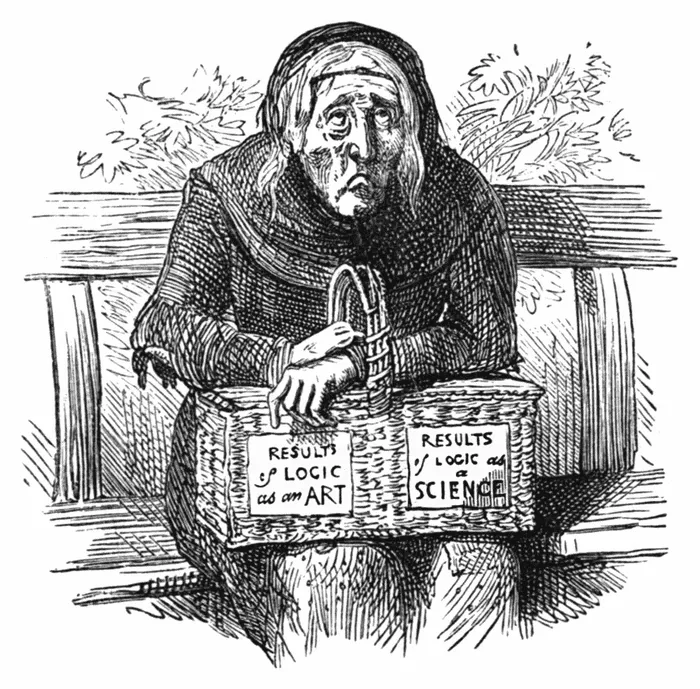
dreamt about Logic again. I thought I was wandering
in the parks at Oxford, and I came across an
old woman of so pitiable an aspect and such miserable
attire that I could not forbear stopping to inquire
what she did there and whence she came. She sat,
with a basket on her lap, swaying slowly from side
to side, and took no notice of me. At last she
heaved a sigh and began, ‘Ah, me! poor Dr. Logic
(he ain’t what once he was!). Good sir, I’m his
errand girl. I takes round what he makes up.
Deary me! day after day, door after door, the same
old answer. Fust of all I says, “D’ye please to
require any of my master’s beautiful works? I’ve
two sorts here, I says; beautiful ‘results of art’ on
this right side o’ my basket.” “What d’ye mean?”
says they. “Why,” says I, “pertikler kerrect
thoughts—just made and ready for use—please to
give ’em a look!” And they says, “O, then! we
won’t trouble you—we ain’t out of them—we’ve got
as many as we want of our own;” and ’ow can I ask
’em to buy what they’ve got a’ready? Ah, deary
me! poor Dr. Logic; he ain’t o’ much account now-a-days.
I catches ’em up, ’owever, and says, “Well,
you ain’t got these others in this left side—these
splendid ‘results of the science,’ the laws upon which
them pertikler kerrect thoughts as you’ve got a’ready
dippends;” and they says, “no, we ain’t,” and may be
they’ll take some o’ them—that left side’s all poor
Doctor ever sells! But, bless yer ’art alive, sir;
there’s many of ’em as won’t take even them. “We
ain’t got ’em? no! and we don’t want ’em. None of
yer humbuggy, cranky, theoretical stuff ’ere—practical
results—that’s what we want. Come—be off!’”
I woke, thoroughly moved to pity, and vowing I
would never treat poor Dr. Logic so badly.
CHAPTER VI. LOGIC THE SCIENCE OF SCIENCES AND ART OF ARTS.
‘Tell us, Destrawney, what you mean by science of
sciences.’
‘It seems to me to mean “best of all sciences;”
science—science—I forget the word—par exemple?
no, no! something like that—dear me—’
‘Par excellence,’ suggested Dyver.
‘That’s it,’ said I; ‘science par excellence.’
‘I should rather say that science of sciences and
art of arts means the science which is concerned
with every other science, and the art with every
other art. And this may be put simply thus:—Thought
is required for every science and art; for
without thought we cannot ascend from particulars
to universals, or descend from universals to particulars,
and this is science and art. It is for this
reason that the animals are destitute of science and
art. They have sensation—that is to say, they can
apprehend particulars, but general notions or universal
propositions or inferences we have every reason
to suppose they cannot attain to. The dog knows
“this fire” and “this fire burns.” But it is very
improbable that the dog can form the general
notion “fire,” or the universal proposition “all
fire burns,” or the deliberate inference “all fire
burns my nose; master’s cigar is fire; therefore
master’s cigar burns my nose.” Though the
bird and the beaver and the bee evince marvellous
sagacity, it is probably without any power to ascend
to the universal; or, at all events, to ascend consciously,
as man does. Thought, then, is required
for every science and art; but thought itself is, so to
speak, subject to its own science and art, Logic.
Thought has its laws, and must obey them wherever
it goes, if it would be called correct thought, as much
as men have their laws and must obey them wherever
they go if they would be called respectable men.
Consequently Logic is the science and art of every
science and art.
‘To put it briefly. Where thought goes there the
science and art of thought go also.
‘But the science and art of thought were proved
to be Logic.
‘Therefore where thought goes, there Logic goes
also.
‘But thought goes into every science and art.
‘Therefore Logic goes into every science and art.
‘Therefore Logic is the science of sciences and art
of arts.’
‘Q.E.D.’ muttered I mechanically and with an
involuntary shudder at the thought that Logic seemed
turning into mathematics; ‘but still I don’t understand
yet.’
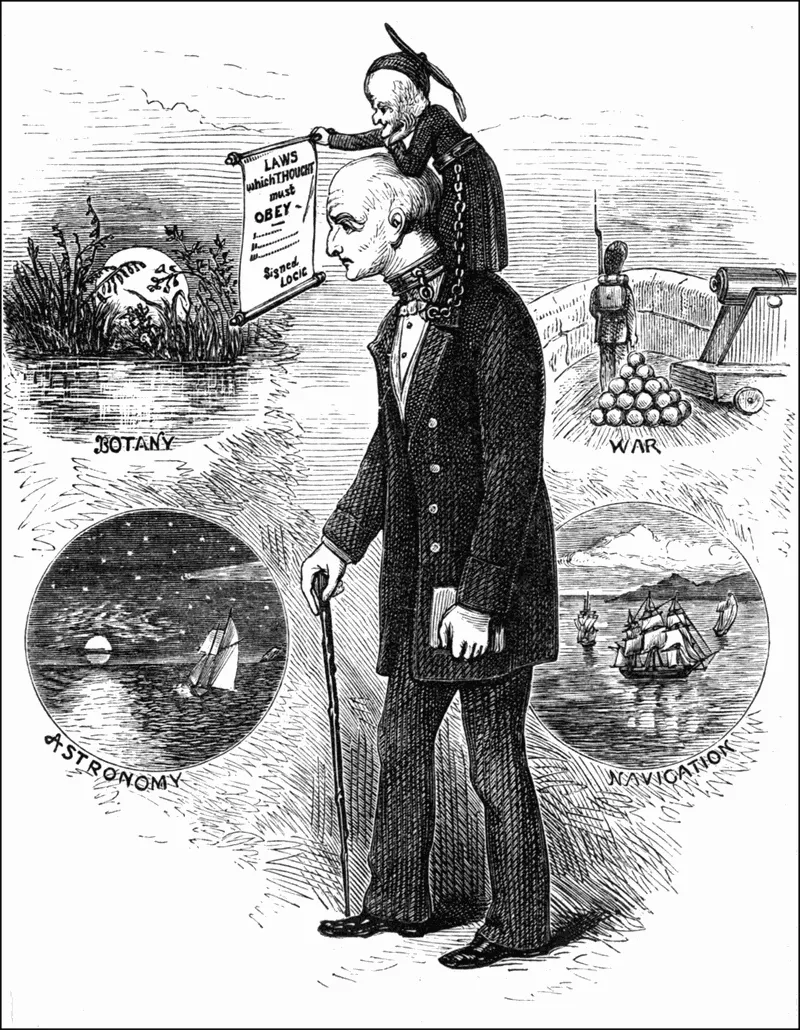
SINDBAD THE SAILOR.
‘Here is an illustration. The man with the high-forehead
is Thought. Chained to his neck is Logic,
holding perpetually before his eyes the rules he must
obey, never mind what field he wanders through.
Thought has a staff, for he is a great traveller. It
would be impossible to enumerate the fields through
which he passes. Four of them are given as specimens.
Take botany. Thought lingers by a stream
and gathers rushes. “Rushes are light,” he remarks,
and Logic is to all appearance asleep. He
gathers more and murmurs, “Rushes are heavy.”
A smart blow on the head from Logic and a cracked
voice crying, “Nonsense; WILL you look at your laws.
How can they be both heavy and light? You meant
when you had a big bundle they were heavy?—then
I wish you’d say what you mean and not give
me the trouble of showing you the law of contradiction.”
Thought meekly raises his head to read the
laws once more, and catches sight of some stars in
the sky. Gazing in wonder he meditates aloud,
“Yonder’s a lovely star; most assuredly that star
must be a planet, for I know some stars are planets.”
A violent pinch from Logic and a heap of reproaches
for the unwarrantable inference, and Thought
wanders on patiently listening to the monitor that
accompanies him wherever he goes, for though his
voice is harsh, dry, and difficult to understand
Thought knows that the restriction is good for him,
for he remembers that when, upon one occasion, he
silenced that squeaky voice by diving so deep into
metaphysics that the poor little monitor became insensible,
he was caught in a whirlpool of circular
arguments, dashed along wild torrents of fancy, and
hurled into fathomless depths of conjecture to such
an extent that it was with the greatest difficulty he
ever escaped to dry land to become the laughing-stock
of men. And many a time a Mrs. Cawdle has
made such havoc of the distinction between universal
and particular statements, by turning a deaf ear to
the voice of Logic, that Thought has been exposed to
sad ridicule and contempt. For upon Mr. Cawdle’s
once bringing in a friend late at night we find her
indignantly demanding what he meant by day after
day making a habit of bringing in mobs of the
wildest of the wild to eat legs upon legs of cold pork
and send girls miles for pickled walnuts in the
middle of the night through depths of snow. Or,
again, we find her violating the laws of contradiction
by lecturing Mr. Cawdle for what he had not
done, on the assumption that a man could both
do a thing and not do it at the same place and
time, e.g., when she upbraids him at length for
flirting at Greenwich fair, and upon his denying the
charge retorts that if he didn’t “it was no fault of
his” and continues the lecture precisely as if he had
pleaded guilty to the charge. Or, again, when she
expresses herself as being very anxious to learn the
Masonic secret, and at the same time declares it to be
a matter of the utmost indifference to her; or dwells
upon the pain caused her by some slight on the part
of Mr. Cawdle, and at the same time entreats him
not to allow himself for a moment to imagine that
any conduct of his can possibly produce the smallest
effect upon her; or, lastly, when she bitterly reviles
him for the loan of 5l. to a friend, casting in his
teeth at least 100l. worth of damages in the house
that might have been repaired with that five pounds—thereby
violating the law of contradiction to the
extent of 95l. Consequently thought has no wish to
rebel against Logic, whose sway is (in one sex at all
events) undisputed.’
‘I have read,’ remarked Dyver, who seemed a
little impatient of anything like homely instances—though
I always liked them better than scientific
ones—‘that the words biology, zoology, chronology,
&c., are equivalent to “Logic applied to life,” “Logic
applied to animals,” “Logic applied to time, &c.”’
‘Quite so,’ replied Mr. Practical, ‘and it is always
well to aid the memory as much as possible by understanding
the derivation and meaning of the names
you meet with.’
CHAPTER VII. THE RELATION OF LOGIC TO LANGUAGE.
Next day Mr. Practical was compelled to visit the
metropolis, and after a brief explanation of the
relation of Logic to language he took his departure,
expressing a wish that we should both endeavour
to illustrate his meaning during his absence.
He told us that Logic was really connected with
thought, but as it was impossible to get at thought
(or at least at other men’s thoughts) without the aid
of language of some kind or other, Logic was so far
connected with thought. The relation of Logic to
thought he characterised as primary, while that of
Logic to language was secondary. He also showed
us how Logic had been held by some to be primarily
connected with language, and so through
errors arising from the inability of language to express
exactly what we think, Logic had fallen into
disrepute. The remedy for such mistakes was the
knowledge of more than one language. As an
instance of such errors he gave us the notion that
the copula implied existence, and promised to explain
this further. Dyver retired to his corner and I to
mine, and on the following day we produced a couple
of rough sketches.
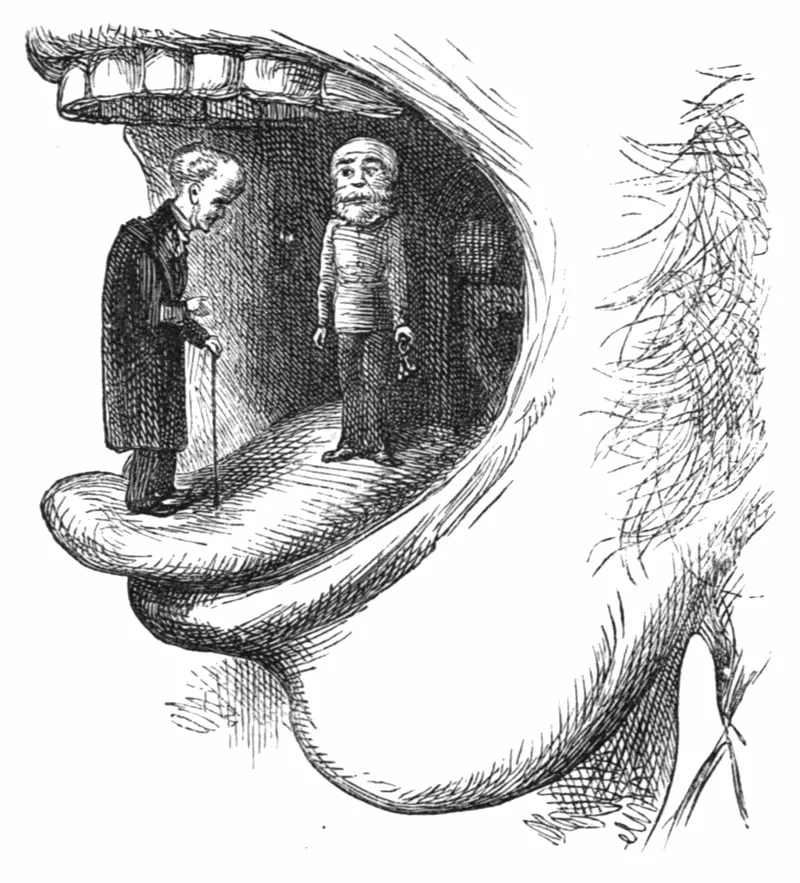
This was Dyver’s relation of logic to language.
Logic pays a Visit.
Scene, a man’s mouth. Thought peeping from
the throat. Language telling Logic (who has come
to visit Thought) that his orders are that no one can
see Thought, and that all communications must be
made through him (Language). ‘So you’d better
by ’alf tell me what you want ’owever.’
And Logic mutters, ‘What a coarse medium!
But there is no help for it. Alas! what mistakes
and confusions will arise!’
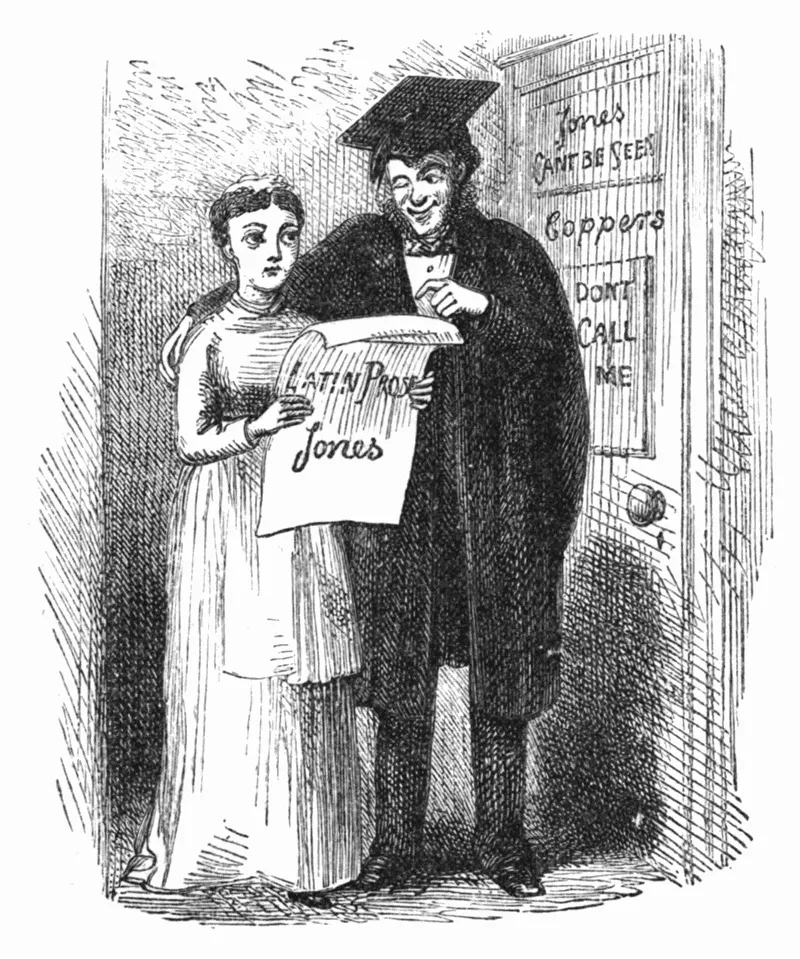
And this was mine.
A friend of mine, named Jones, who lived in
lodgings, used to work with a tutor for Latin
prose. Jones was in the habit of leaving his productions
daily at his tutor’s, and calling next morning
to see the mistakes; but as Jones was not an early
riser his tutor would often step over to his lodgings,
and leave the corrected prose with the people of the
house, pointing out the faults, and begging them to
point them out to Jones as soon as he appeared, for
he was not yet to be seen. It so happened that the
landlady’s daughter was very attractive, and by some
accident she always chanced to be at hand when
Jones’s tutor called. Scandal might have arisen from
the protracted interviews in the course of which
Jones’s tutor pointed out to Jones’s landlady’s daughter
the defects in Jones’s Latin composition, had it
not been well known that the primary object for which
the tutor came was not to converse with the damsel,
but to instruct the pupil, and being unable to see the
pupil, he was compelled to employ the aid of a third
person as a medium. His relation to the pupil was,
so to speak, primary, his relation to the landlady’s
daughter secondary. After a time, however, Jones
left, but the tutor still continued his visits, and
ended by marrying the landlady’s daughter. So
Logic, led away by the allurements of language, has
sometimes neglected thought, the object with which
it is primarily concerned, and has thereby become
involved in troubles and mistakes, and has fallen into
bad repute.
Mr. Practical was highly pleased with both our
illustrations, and added something to mine which I
had not thought of. ‘Had your unfortunate tutor,’
he said, ‘moved more in society, and known several
of the fair sex, and become more inured to their
attractions, he would not, in all probability, have
been led into a mésalliance, and in the same way
had Logic been conversant with several languages,
and become acquainted with their powers of misleading
and beguiling, instead of only knowing one,
Logic would not in all probability have been led into
entering upon a relationship with Language which
was likely to bring difficulties, error, and evil
repute.
Logic in Trouble.
CHAPTER VIII. ALL THOUGHT IS COMPARISON.
‘We have seen,’ resumed Mr. Practical, ‘that Logic
has for its subject-matter thought. What is thought?
To give a rough answer to this difficult question, we
must say that “all thought is comparison.” We
have already spoken of thought as consisting of
remarks and inferences, for we may consider thought
as unexpressed in the mind, or expressed in language.
But these remarks are compounded of two
things, something about which we are speaking, and
something that we affirm or deny of it. If I say
“dogs are animals” I am speaking about “dogs,”
and I say something about them—“that they are
animals.” Thought may therefore be divided into
three parts—The term or concept; the proposition
or judgment; and the inference or syllogism.’
‘Do you mean by thought here the process of
thinking or the results attained to?’ asked Dyver.
‘I should say the results attained to; of the
faculties we shall speak hereafter, so that if we can
show that the term, the proposition, and the inference
or syllogism are the results of comparison, we
shall have proved that all thinking is comparison;
nor need you be alarmed, Destrawney, at any nice
distinctions of the sort, for to pass your examination
it is not necessary to notice them at all. Remember
this:—
‘1. The term or concept is anything we can see
or imagine. Our minds are stocked with concepts
or terms formed in our earliest years. How came
they there? Take an infant, hold a dog up to it,
and the infant will recoil with a start of horror; it
has experienced a mere undefined sensation of the
presence of something strange, and therefore terrible.
Repeat the operation daily, always taking care to
accompany it with the word “bow-wow,” and the
child, from a comparison of the sensations, forms a
concept, and associates these familiar sensations
grouped into one idea with the name of “bow-wow,”
and if, after a time, you merely say “bow-wow,”
without introducing the dog, the child will manifest
joy or terror according as it likes or dislikes the dog,
proving that it has formed in its mind the concept or
term dog, and can shut its eyes, so to speak, and
see a dog though no dog is near. Thus, concepts
are the results of the comparison of simple sensations
and concepts expressed are terms. We gradually
accumulate our concepts and distinguish one from
another. As infants we had only a few under which
to arrange all the objects that met our view. Papa,
moo-cow, gee-gee, and bow-bow formed our stock,
then, and under one or other of these heads came
every man and every animal we saw. Nor can we
boast much now, for in botany, for instance, many of
us have one vague concept, “plant,” under which
to arrange all the phenomena of that science, and in
geology it is generally considered a sufficient reply to
the question, “What is this?” if we say “A kind of
rock.”
‘(2.) As the term or concept is a result of the
comparison of simple sensations, so the proposition
or judgment is a result of the comparison of terms or
concepts, and henceforth we shall speak only of
terms and propositions, having shown that they are
identical with concepts and judgments. With propositions
thought proper begins. It is true that
terms are necessary to form propositions, but they
do not by themselves constitute a thought. We
cannot have a brace of birds without single birds;
but single birds do not by themselves constitute a
brace. Suppose our infant to have formed several
terms—horse, book, house, sun, large, dry, tall,
bright, &c.—and never to attempt to couple them
together, but simply to repeat them singly, we
should at once question its sanity, as being unable
to attain to a thought, for, as we have said,
man has an innate tendency to group together the
like, and this is the origin of thought. We should
exclaim impatiently, “Horse, horse, horse! What
about it? What is the use of going on repeating
house, house, house—sun, sun, sun? If you repeat
them from your birth to your death you will not
have expressed a thought!” Thought begins when
the child, having formed in one part, so to speak, of
his mind a term—for instance, book, derived from
observations in his father’s library, &c., and in
another part another term, for instance, “nasty,”
derived from sensations of medicine, chastisement,
&c., couples the two together, and exclaims “Books
are nasty.” Thus propositions are the results of a
comparison of terms.
‘(3.) Lastly, the syllogism is a result of the
comparison of two propositions. When the child
upon being told to open its spelling book says
“nasty,” and further, upon being asked why he
thinks the book nasty, replies “all books are nasty,”
he has given utterance to a syllogism which in its
full form would read “All books are nasty; this is a
book; therefore it is nasty.”
‘We have traced, then, the gradual formation of
the term from sensations, the proposition from
terms, and the syllogism from propositions; and
shown that they are all results of comparison; and
these are the three parts of thought; they are also
called (as we have seen) the forms of thought.
CHAPTER IX. THE TERM.
‘As thought,’ resumed Mr. Practical, ‘is divided
into term, proposition, inference, so Logic, or the
science of thought, is divided into three parts, under
the heads of TERM, PROPOSITION, and INFERENCE; and
you will find this analysis of the subject very useful.
I. The term.
1. Definition of term and various kinds of terms.
2. Connotation and denotation of terms.
II. The proposition.
1. Definition of proposition and various kinds of propositions.
2. The copula of a proposition.
3. Distribution of terms in a proposition.
4. Heads of predicables, or a list of the relations which the
predicate of a proposition can bear to the subject.
5. Definition, or propositions expressing the connotation of a
term.
6. Division, or propositions expressing the denotation of a
term.
III. The inference or syllogism.*
1. Definition of inference and various kinds of inference.
2. Moods and figures.
3. Principles, laws, and canons of syllogism.
4. Reduction of syllogisms.
5. Trains of syllogisms.
6. Hypothetical syllogisms.
7. Probable reasoning.
8. The fallacies.
* The third division, ‘inference,’ includes inductive inference as
well as deductive inference, or the syllogism. But we are only now
concerned with that part of inference called ‘syllogism.’
If you learn this analysis and can give some account
of each of the heads, your knowledge will be
sufficient for the purpose in view. The analysis is
taken from Mr. Fowler’s “Deductive Logic,” and I
refer you to that work or to Mr. Jevons’s “Logic”
for information upon points that do not seem to
require further explanation.’
‘I hope,’ said I, ‘you will not leave us too much
to our own reading, for somehow or other things
seem to me to be put so difficultly in books.’
‘I will do my best,’ he continued; ‘and first let
us discuss the term. It comes from “terminus,” or
“boundary,” because terms are the boundaries of propositions;
for a term is defined as anything that may
stand as the subject or predicate of a proposition.
If a term is to express anything we can see or
imagine, it is clear that we must give an exhaustive
account of all things if we wish to enumerate terms.
Now everything that we can see or think of must be
a thing or a quality of thing; in other words, an
individual or an attribute of an individual. Mention
a few things, Destrawney.’
‘A star, fair, whiteness, chair, Lexicon, beauty,’
said I; ‘fun, William, suicide.’
‘Every one of these is either an individual or
thing, or an attribute or quality; and you must content
yourselves with these expressions, as the question
as to “What is the meaning of thing?” is beyond
the sphere of Logic.’
Dyver here took occasion to observe that he
knew that individual meant something incapable of
further division, i.e. a simple whole; and that attributes
meant the properties ascribed to such a whole,
e.g., tree and greenness, or man and reason, for you
couldn’t saw the tree or the man asunder without
destroying them, and greenness and reason were said
to be attributes of tree and man, and ‘thing’ and
‘quality’ meant the same as ‘individual’ and
‘attribute.’
‘Well, then, a term expresses either an individual
or group of individuals, or an attribute or
group of attributes; and this is as much as to say
that terms are an exhaustive enumeration of all that
we can see or think of. Take your fingers and thumb,
and remember the five terms thus:—(See diagram on
next page).
‘If a term expresses an individual it is a singular
term, e.g., Socrates (thumb). If it expresses a group
of individuals, it may either express the group and
not each individual as well; or the group and each
individual as well. Thus, the “Black Watch” expresses
a group of soldiers, but you can’t call each
soldier a “Black Watch;” whereas “horse” expresses
a group of animals, and you can call each of
those animals a “horse.” The former are called
collective terms, e.g., “the Black Watch” (1st finger);
the latter, common terms, e.g., horse (2nd finger).
If a term expresses an attribute or group of attributes,
it is called either abstract (3rd finger) or
attributive (4th finger), the abstract term being a
substantive, the attributive an adjective.’
‘Are there not several other kinds of terms?’
asked Dyver.
‘Yes; but it is my intention to work through
our analysis first, and afterwards to explain briefly
any names that may seem to interfere with the simplicity
of our scheme of Logic.’
The Logical Hand.
1. Socrates. 2. The Black Watch. 3. A horse. 4. Whiteness. 5. White.
N.B.—The second finger
the largest, and the
common term the most
important.
CHAPTER X. CONNOTATION AND DENOTATION.
‘Of the five terms, the common term is that with
which we shall have most to do. Let us endeavour
to explain connotation and denotation by taking a
common term or class name as an instance. To the
question “What is a man?” two answers may be
given. Firstly, closing our eyes, we may give the
attributes, the possession of which entitles a man
to the name of a man—saying, “by man is meant
the combination of the attributes of life, reason,
&c.;” or secondly, walking to the window, we
may point out Smith, Jones, &c. in the street and
say, “Those are men.” The first answer would give
the connotation of man, the second the denotation.
Do you follow?’
‘No!’ said I.
‘Well, then, look at it thus:—Every common term,
or class name, is a name given to certain individuals
upon their complying with certain conditions, so to
speak. You walk in the fields with a friend. You
speak of trees, men, stones, birds; and your friend
understands you to mean by them four distinct
things. They all have attributes, and if those attributes
were all the same, why should you not speak
of them all four as “trees?”’
‘But,’ said I, ‘their attributes are not the same;
at least, I do not feel my senses affected in the same
way when I look at a stone and a tree.’
‘Exactly so! and these very attributes are what
we mean by the connotation. With the origin of
common terms we have nothing to do. All we know
is that certain class names or common terms exist,
and that as fresh individuals present themselves we
enroll them under one or other of these names
according as they possess certain attributes, e.g., class
man, attributes required for admittance rational and
animal qualities. Any individual possessing these
would be entitled to become a member of the class
“man,” and so “rational and animal qualities” are
the connotation; and Jones, Brown, Smith, Socrates,
&c., are the denotation of the common term “man.”
Thus the connotation means the attributes in virtue
of the possession of which an individual belongs to
its class, and the denotation means the individuals
which, in virtue of the possession of certain attributes,
belong to a class. The connotation answers the
question “what?” and the denotation answers the
question “which?” e.g., “What is a steam-ship?” a
combination of the attributes of vessel with those of
steam; in other words, “a vessel propelled by steam.”
“Which are steam-ships?” The Great Eastern,
the Husband’s boat, &c.; or, again: last week when
we went gull-shooting, I said, “Perhaps we shall
get a puffin;” and you asked, “What is a puffin?”
and I replied a bird with such and such attributes,
with form, colour, flight, &c. (connotation). Soon
after several flew over and I said, “Look!—there—those
are puffins” (denotation). The connotation of
a term (under the name of intension) has been well defined
as the qualities necessarily possessed by objects
bearing the name, and the denotation (under the
name of extension) as the objects to which the term
may be applied. It has also been said that a term connotes
attributes and denotes individuals, and the five
terms are thus said to be connotative or denotative.
Denotative and Connotative Hand.
‘The singular and collective have only denotation;
the abstract and attributive only connotation;
and the common terms, both. For the singular term
is a mere mark arbitrarily imposed upon an individual,
not in virtue of the possession of certain attributes,
but simply that we may be able to know it
from its fellows. When our clergyman christened
his boy “Harold” it was not because the boy manifested
any peculiar attributes or qualities, but simply
to distinguish him from his numerous brethren, so
that (for instance) when they said “It was Harold
who set fire to the barn,” he might know which son
to chastise. And what the singular term is to an
individual, the collective is to a group of individuals—a
mere mark affixed arbitrarily, for the sake of
convenience.
‘The abstract and attributive express only attributes,
and therefore cannot be denotative; though
both are capable of being regarded as common
terms; for “redness” and “red” may be regarded
as “red things,” a class name or common term.’
‘I can’t quite understand the difference between
singular and common terms with regard to connotation,’
said I.
‘Take an instance. In my stables I keep a mare
known as “Fanny,” and a cow known as “Polly.”
One day I say to my man, “John, we’ll change these
names; in future if men ask for their names, tell
them the mare is called ‘Polly,’ and the cow
‘Fanny.’” “Werry good, sir,” says John. Next
day I add, “John, a further change is necessary;
we will call the mare a cow and the cow a mare,
and when men ask what they are, say this (the
mare) is a cow and the other a mare.” But
John stoutly refuses, and why? because the
names “mare” and “cow” are common terms
awarded to certain animals in virtue of their possession
of certain attributes, whereas singular terms are
mere marks arbitrarily affixed. Thus common terms
are connotative, as implying the possession of certain
attributes, and denotative as pointing to certain individuals,
while singular terms are only denotative.
‘You will see how the connotation of a common
term increases as its denotation decreases, and vice
versâ; for the more attributes required as a qualification
for admission into a class, the fewer the
individuals admitted.’
‘Something like an examination which requires
wide knowledge, or a club which is very exclusive,’
I suggested, ‘for the individuals who pass or are
admitted are very few.’
‘Quite so. Ask for a rose. The connotation is
small: “a flower with certain peculiarities;” the denotation
or individuals answering to that description
very numerous. The common rose is plentiful.
Then ask for a moss rose. The connotation is now
larger. Candidates successful in the previous demand
are now rejected as lacking the qualities implied
by the word “moss;” and so the denotation is
smaller, and you may continue the process until you
get your connotation so large that there is only one
individual, perhaps, that can satisfy all requirements—a
prize plant and the property of a nobleman.
Take one more instance. You advertise in the
“Field,”—“Wanted, a servant; salary enormous.
A. B., High Street, Oxford.” Next morning
the whole High, from Carfax to Magdalen, is a
seething mass of human beings. The Mayor is
furious, and compels you to withdraw your advertisement.
After a while you insert the advertisement
again, only this time you write the word “male”
before servant. Once more the High is in an
uproar, and the Mayor interferes; but the numbers
are now reduced by about a half, though selection is
still hopeless. Angry with your own thoughtlessness,
you determine to cut down still further the
number of applicants by adding more qualifications,
and eventually your advertisement reads, “Wanted,
a male servant, good looking, active, honest, with a
perfect knowledge of cooking and riding, who has
been in a training stable, and is able to translate
Livy and Virgil at sight, and to prepare all his
master’s lecture-work.” People now understand
why the salary is large, and upon looking from your
window you see two men, or one, or none, to answer
the advertisement. Thus the denotation dwindles
as the connotation grows.’
‘Are not these contrary processes to be seen in
the growth of language,’ asked Dyver, ‘under the
names of generalization and specialization?’
‘Yes; and to remember which is which bear
in mind the fact that it is from the denotation
the names are taken. The word “paper” (or papyrus)
originally meant “writing materials made of
byblus;” it gradually came to mean “writing material
made of rags, straw, or anything.” The denotation
has thus grown by the admission of several
other kinds of writing material; and the connotation
has diminished, for, at first, unless a candidate
for the class “paper” (so to speak) could show that
it possessed the attribute “made of byblus,” it was
not admitted; whereas now the class has been
thrown open, and anything that possesses the attributes
of “writing material” is admitted. On the
other hand, “physician” originally meant φυσικὸς,
“a man who studied nature.” It gradually came to
mean “a man who studied nature in respect of healing
man.” The denotation has here diminished, for
the men who studied nature in other ways, e.g.,
botanists, are excluded from the class; and the connotation
has grown; for whereas, at first, any one
who studied nature could have claimed admittance
into the class physician, now more attributes are
required to entitle individuals to admission into that
class.’
That night I dreamed I was sitting in my rooms
working, past midnight, when the door slowly
opened, and a most strange figure entered. He
seemed very unhappy. I asked his name and what
he was? ‘Ah, sir,’ he sobbed, ‘long years have made
havoc of memory. Every one I meet I ask, What
am I? and where is the class to which I belong?
No one knows. A student like you I thought might
give me help. My name? I’ve a faint recollection
of being called “Scaly.”’ ‘Ah! that,’ said I, ‘was
a mere mark, a singular term.’ ‘A what?’ he
gasped. ‘The thing to do is to find your connotation
and denotation; for you have attributes, and
you’re a connotative term.’ ‘Alas! what mean these
vile names?’ ‘Come with me,’ said I, laughing,
‘and we will find your class.’ We went to a kind of
Zoological Garden on a gigantic scale. The first
cage we came to had a notice-board over the door.
‘Class, Man—Connotation, Rational and Animal
Qualities: none admitted unless they possess these
qualities.’ Innumerable swarms of individuals formed
the denotation in that cage. ‘Can you satisfy the
requirement on that board?’ said I. He said he
could not, and we passed to the metal cage, and the
plant cage, &c., but we could not find his class. At
last a thought struck me. ‘You are painfully thin,’
said I; ‘did you ever hear the name “Euclid?”’
He started, and seemed violently agitated, muttering,
‘That name, that name!’ ‘Come,’ said I, as we
hurried to that part of the gardens where the figures
were. ‘Do you feel very empty, as though you had
nothing in you, and were only “lines enclosing a
space?”’ ‘I do.’ ‘Then,’ said I, ‘you’re a figure;
we shall soon find your class now, only “figure” is
so vague and general; one might as well direct a
letter “Smith, America,” as expect you to find
your class when you’re only told you’re a figure.
There are countless millions of them.’ ‘True,’ said
he. We came to a sign-post just then, on which was
printed: ‘To the Curvilineal Figures; To the Rectilineal
Figures,’ with the hands pointing different
ways. ‘Are you rectilineal?’ I asked. ‘Don’t look
so scared; it only means are your lines straight or
curved?’ ‘Straight,’ said he, feeling his sides. We
hadn’t gone far before we came to a place where the
road branched off into three directions, with a sign-post
marked, ‘To the Rectilineal Figures of three
sides (Triangles); To the Rectilineal Figures of four
sides (Quadrilateral); and, To the Rectilineal Figures
of more than four sides (Polygon).’ ‘How many
sides have you?’ I asked. ‘Three.’ ‘Then you’re
a triangle! This is our way.’ In spite of his over-flowing
gratitude, we hurried on and found a large
building with the name ‘Triangles’ over the entrance.
The interior was divided into three compartments.
For triangles with all sides equal
(equilateral); for triangles with two sides equal
(isosceles); and for triangles with no sides equal
(scalene). I had not time to answer to his cry of
delight, ‘Oh, joy! my scalene brethren!’ before he
was in their midst, and I slipped away, and awoke
muttering, ‘A scalene triangle, of course!’
CHAPTER XI. PROPOSITIONS.
‘We now pass to our second head, Propositions. A
proposition compares two terms, asserting or denying
one of the other. One of these terms is called the
subject, the other the predicate; and the verb which
intervenes is called the copula. To find the subject
ask yourself, “What am I talking about—what is
the subject of my remark?” To find the predicate
ask yourself, “What do I say about this subject?”
for prædĭco means “to assert.”’
‘Oughtn’t the (i) to be long?’ asked Dyver, ‘and
doesn’t it come from præ and dico, to foretell.’
‘No! there are two words; prædīco, “to say before”
(in the sense of time), and prædĭco, “to say before”
(in the sense of place, i.e. publicly); and
prædĭco is equivalent to κατηγορέω, and means “to
assert, or declare;” hence predicate.
‘Take an instance. “The sun is bright.” Sun,
subject—is, copula—bright, predicate.’
‘Then in “Fair was her form,”’ said I; ‘fair, subject—was,
copula—her form, predicate?’
‘No! remember the questions you are to ask
yourself, and pay no regard to the position of the
words. You are talking of “her form,” and you say
of it that it was “fair.” “Her form” is subject, and
“fair” predicate.
‘The copula is some part of the present tense of
the verb “to be.” It is the sign of comparison, or
of that innate tendency all men have to gather together
similar things and separate dissimilar things.
To state propositions logically, remember, they are
ideas and not words, with which you have to do. A
term often covers a multitude of words, e.g.,
Subject.
Copula.
Predicate.
The sun
is
bright.
Fires
are
burning.
The ‘Faraday’
is not
a-ship-that-will-convey-the-telegraph-cable.
The-sound-of-the-waves-on-the-shore
is
beautiful.
There are three important remarks to make upon the
copula.
‘1. It conveys no notion of time. If you want to
express logically the fact “that Elizabeth was a good
queen” say “Elizabeth—is—a-person-who-was-a-good-queen,”
and so with the future.
‘2. It conveys no notion of existence. The ancients
said, “The unicorn is a non-existent animal.”
Ergo, “The unicorn exists a non-existent animal.”
Ergo, “The unicorn exists and does not exist,” which
is absurd. The confusion arose from the idea that
“is” always means “exists,” and is one of the mistakes
we hinted at as due to the influence of language.
The copula only means “is equivalent to,” or “not
equivalent to.”
‘3. It conveys no notion of probability, &c.
The question of the modality of the copula is the
question whether we are allowed to assert or deny the
predicate of the subject in a certain manner (cum
modo), i.e. conditionally, or with some qualifying
word joined to the copula, or whether we are only
allowed to assert or deny the predicate of the subject
simply. The proposition, “Oysters are plentiful” is
called a pure proposition; “Oysters are possibly (or
probably, or certainly) plentiful” is a modal proposition.
Now, may the words “possibly, &c.,” be
joined to the copula? No. All words of this description
must be pressed into the subject or the
predicate, i.e. modal propositions must be reduced to
pure ones; e.g., “Prawns are possibly fierce” becomes
either “That-prawns-are-fierce—is—possible,” or
“Prawns—are—possibly-fierce.”
‘To impress upon your minds these three facts look
at this rough sketch. The copula is the coupling
chain between two railway carriages, the subject
and the predicate, which form a train, and if Time,
Existence, or Probability wish to travel on the Logic
line they must get into one or other of these carriages.
It is unreasonable to suppose that they are to
be allowed to travel on the coupling chain—however
full the carriages may be they must squeeze in somewhere,
or not go at all.
The Great Logic Branch.
‘Lastly, propositions are divided into universal
and particular according as their subjects are used
in their full extent or not, and into affirmative
and negative according as their copulæ affirm or
deny the predicate of the subject. We may say,
“All or no Cretans are liars,” or “Some Cretans are or are not liars,”
and the first of these are universal propositions,
the second particulars, and they are said to differ in
quantity because they differ in the amount of Cretans
to whom the term “liar” may be applied. Again,
we may say, “Cretans are liars,” or “Cretans are
not liars,” and these two are said to differ in quality.
We have thus four forms into one or other of which
all propositions must fall before Logic can pass
judgment upon them—
Universal affirmative
“All Cretans are liars”
A
Universal negative
“No Cretans are liars”
E
Particular affirmative
“Some Cretans are liars”
I
Particular negative
“Some Cretans are not liars”
O
A and I from AffIrmo, and E and O from nEgO.
There are many other kinds of propositions which
we shall explain afterwards, but these are the only
forms with which Logic is generally concerned.’
‘Under which of these four would you put,
“Harold is brave,” “The ‘Black Watch’ is a heroic
band,” “Virtue is rare?”’ asked Dyver.
‘Singular and collective terms rank as universals.
When you say, “Socrates is bilious,” you mean all of
Socrates; and as for abstract terms like virtue, it is
best to reduce them to common terms by saying,
“Virtuous men are rare”; and as for common terms,
remember Logic has no power to pass judgment upon
propositions unless they are brought to one or other
of the logical forms. The proposition, “Cretans are
liars” is called indefinite, and with such Logic is not
concerned. You must specify the quantity or you
can get no help from Logic.’
CHAPTER XII. DISTRIBUTION OF TERMS IN A PROPOSITION.
Mr. Practical began this lecture by shaking several
blots from his pen on to a sheet of note-paper.
‘This paper is wet with ink,’ said he, ‘and yet I can
put my finger upon it without soiling my finger with
ink.’
‘Of course;’ said I, ‘you touch the paper between
the blots; if the paper were wet all over with ink
you could not do it.’
‘It seems, then,’ said he, ‘that I used the words
“this paper” in a partial sense, as meaning “part of
this paper.” Now terms thus used in Logic are said
to be “undistributed,” whereas terms used in their
full extent are said to be “distributed.” In the
proposition, “All foxes are sly” the subject is distributed,
i.e. we use “foxes” in its full extent; but
the predicate is undistributed, i.e. the word “sly” or
“sly thing” is not used so, for there are many other
“sly things” besides foxes.
‘To apply this distinction to our five terms, we
find singular and collective terms are always distributed
(e.g., “Socrates is ill,” where “All of Socrates”
is meant) and abstract and attributives may be treated
as common terms, and for common terms in propositions
we have these two rules.
(1.) All universal propositions distribute their subject.
(2.) All negative propositions distribute their predicate.
‘(1) Is obvious, for the sign of every universal proposition
is “all” or “no,” and “all” or “no” attached
to the subject of a proposition proves that we are using
that subject in its full extent. If we say “All men
are animals,” or “No men are stars,” we use the word
“men” in both propositions in its full extent.
‘(2) All negatives distribute their predicate; for
in every negative proposition we may suppose ourselves
to be excluding the things implied by the
subject from the class implied by the predicate. In
“No men are stars,” “Some men are not poets,” we
exclude the things “men” from the class “stars,” and
the things “some men” from the class “poets.” Now,
before we are justified in excluding anything from a
class we must look all through the class to be sure
that the thing does not belong to it. Suppose I say
“There are no blank pages in this book,” which becomes
“No—blank-pages—are—pages-in-this-book;”
without thoroughly looking through the “pages-in-this-book”
the result is an error, for one of you will
quickly turn to the fly-leaves to prove I am wrong.
Again, if I say, “There are no violets in this park,”
which becomes, “No—violets—are—flowers-in-this-park,”
I must look carefully through the class
“flowers-in-this-park” before I am sure of this proposition;
in other words, I use the predicate in its
full extent; i.e. the predicate must be distributed.
And so with the particular negative; e.g., “Some men
are not poets,” we must look all through the class
“poets” before we can say that the “some men” referred
to do not belong to that class.’
‘I can’t quite see how the particular negative distributes
its predicate,’ said I.
‘Suppose I say “Some pheasants are not in the
stubble field,” which becomes “Some-pheasants—are
not—things-in-the-stubble-field,” I must look all
through “things-in-the-stubble-field” before I can
be sure of this remark, and even more carefully than
if I had said “No pheasants are in the stubble
field;” for by “some pheasants” I might have
meant “white pheasants;” and though I found a
thousand ordinary pheasants, it would not overthrow
my remark, “Some pheasants are not in the stubble
field;” but in both cases I must look through the
predicate. Hence it is far easier to affirm than to
deny—to say “Some Irish girls are pretty,” than
“Some Irish girls are not pretty;” for in the one
case, if you met three instances, it would be enough;
in the other you would have to go through the whole
class “pretty things” to be sure that your “some
Irish girls” were not among them.
‘Apply these two rules to A E I O, the four
forms of propositions. A (universal affirmative) must
obey rule (1) and distribute its subject; E (universal
negative) must obey both rules (1) and (2) and distribute
both its subject and predicate; I (particular
affirmative) obeys neither and distributes neither; O
(particular negative) must obey (2) and distribute its
predicate.
‘Remember this by the word A s E b I n O p
(A subject, E both, I neither, O predicate).’
‘A Word to the Wise.’
CHAPTER XIII. HEADS OF PREDICABLES.
‘The heads of predicables is the name given to
an exhaustive enumeration of the relations which
the predicate of a proposition can bear to the subject.
We are discussing propositions. In every one we
find a subject and a predicate, but not always in the
same relation to one another. Our aim is to find
out all the different relations in which the predicate
can stand to the subject. In “all men are animals”
the predicate is a larger class including smaller
classes. In “some men are yellow” the predicate is
an attribute belonging to the subject. A deeper
investigation than is necessary for us now has proved
that these heads are five—genus, species, differentia,
property, accident. The definitions of these may be
thus expressed:—
A genus is a larger class, including smaller classes.
A species is one of the classes included in the
genus.
A differentia is an attribute which is part of the
connotation of a term, and marks off the species
from the genus.
A property is an attribute which is not part of,
but follows from the connotation of a term.
An accident is any attribute that is not a differentia
or a property.
Don’t look so scared, Douglas; remember we are
only stating the ways in which a predicate can be
related to its subject, and we are only concerned
with common terms or class names. “What pudding
was that we had yesterday?”—“Dumplings.”—“What
kind of dumplings?”—“Apple dumplings.”—“Are
there any other kinds of dumplings?”—“Yes,
currant dumplings, suet dumplings, &c.”—“Very well;
here dumpling is the genus, and apple dumpling,
currant dumpling, &c., the species, and the attributes
“made of apple, made of suet, &c.,” are the
differentiæ; for they are that which makes one class
of dumpling differ from another, and part of the connotation
of the terms (the connotation being the
meaning of the word).’
‘What would be the property and accident?’
asked Dyver.
‘A property of “apple dumplings” would be that
they are “good for the health,” for though it is not
a part of it, it follows from the meaning of the name
“apple dumpling,” for apples are good for the health.’
‘But,’ said I, laughing, ‘you complained of indigestion
after them.’
‘True; but if “apple dumplings” are so made
that they cease to be entitled to the name, you can’t
expect the properties which follow from the meaning
of a term to remain when the meaning itself is gone.
I refer of course to “apple dumplings” rightly so
called. It was an “accident” of our candidates for
that name that they were heavy; for it is no part of,
nor does it follow from the meaning of, apple dumplings
that they should be “heavy.” We have now
all five heads, but be careful not to forget that they
express relationship between the two terms of a proposition.
If asked for the above heads, you would not
say “dumpling,” “apple dumpling,” “made of
apple,” &c.; but you first give the connotation or
meaning of the subject, and then give the various
relations of the predicate thus:—
Given the term “This pudding” (which we will call T. P.).
(Connotation, or meaning—“apple dumpling.”)
T. P. is a dumpling
(genus)
T. P. is an apple dumpling
(species)
T. P. is made-of-apple
(differentia)
T. P. is good-for-health
(property)
T. P. is heavy
(accident)
Of course the above example is for explanation
only, and not for use. The instances you would use
are the following pair, which are to be worked out in
precisely the same way as the above:—
Given the term “Man.”
(Connotation—“rational animal.”)
Man is an animal
(genus)
Man is a rational animal
(species)
Man is rational
(differentia)
Man is able-to-do-Euclid
(property)
Man is unwell or well
(accident)
Given the term “triangle.”
(Connotation—“three-sided, rectilineal figure.”)
Triangles are rectilineal figures
(genus)
Triangles are three-sided, rectilineal figures
(species)
Triangles are three-sided
(differentia)
Triangles have two sides greater than the third
(property)
Triangles are large or small
(accident)
Notice the arbitrary character of these heads in
two respects. 1. The heads themselves are not fixed,
but vary according to your wish. 2. The connotation
varies according to the point of view you choose
to take.
‘1. The genus answers the question “What?”
(τί; quid?). The species, the question “What kind?”
(ποῖον τί; quale quid?). “What is a dog?” Answer,
“An animal.” Of course it is; every one knows
that; that’s only the genus. We want to know
“what kind of animal?” We want the differentia,
or attributes which distinguish “dog” from all the
other classes in the same genus. We want the
species, for the differentia plus the genus gives the
species. The differentia (certain attributes, irrational,
domestic, &c.) is added to the genus, and we
get “animal with certain attributes, irrational,
domestic, &c.” for the species. But what is species
one moment may be genus the next. Man is a
species of the genus animal, but a genus of the
species European. There is, however, one genus
which never stands as a species, and one species
which never stands as a genus (the summum genus
and the infima species). Man is a species of animal,
animal is a species of living being, living being of
thing—and we can get no farther. So thing is the
summum genus. So man may be subdivided till we
come to a class which contains no classes, but only
individuals, which is called “infima species.” Even
these are arbitrary, in so far as we may fix our own
highest and lowest classes, provided we are consistent,
as in the following tree of Porphyry. Man is regarded
as an infima species.
Substance (or thing)
Corporeal
substance
=
Body
Incorporeal substance
(as air)
Animate
body
=
Living being
Inanimate body
(stones)
Sensible
living being
=
Animal
Insensible living being
(plants)
Rational
animal
=
Man
Irrational animal
(brute creation)
Socrates
Plato
Others
‘Suppose you are being cross-examined thus:—“You
speak of Plato. What is Plato?” “A man.”
“What is a man?” “A rational animal” (genus
“animal;” differentia, “rational”). “What then
do you mean by ‘animal?’” “Living being with
powers of feeling (i.e. sensible), for plants are ‘living
beings,’ but they cannot feel; so ‘sensible’ is the
differentia here, and ‘living being’ the genus.”
“But pray what do you mean by living being?”
“A kind of body; the genus ‘body’ is divided into
two species, ‘body with life and body without life’
(e.g., stones and stocks). Body with life is ‘living
being.’” “Please tell us what body is?” “Body
is a kind or species of thing—things being divided
into corporeal (as stones, &c.) or incorporeal (as air,
spirit). Body is a solid, tangible thing.” “What
then is a thing or substance?” “A thing is a thing—there
is no higher class; consequently no explanation
or unfolding into simpler elements. It’s a
‘summum genus,’ and I can’t answer any more.”
‘2. The connotation varies according to the point
of view taken. We have already shown how connotation
(or meaning) is the attributes implied by a
name. I see certain individuals; I group them into
a class and select certain attributes as characteristic
of these similar individuals, so that if I see any more
individuals I may be able to admit them into my
class or exclude them according as they possess or
do not possess these attributes. Obviously the attributes
thus selected are not all the attributes possessed
by the individuals (for it would be a hopeless task to
enumerate them all), but only a few of them. Nevertheless,
these few are called the connotation or
meaning or essence of the name; and thus, the
connotation of a word, which strictly should be all
its attributes, is in reality only a few. The question
is: “If all the attributes can’t be taken, which shall
be the privileged few to stand as connotation and to
be applied as a test to all candidates for admittance
into the class?” The answer is, “The attributes
which are most prominent;” and prominence of
course depends upon the side you stand on, or the
point of view you take, and so there are as many
connotations or meanings of a word as there are
points of view from which to regard it.’
‘Please give us an instance to make it clearer,’ I
gasped.
‘Take the term “man.” Here we have a group
of individuals—a class. They resemble one another
in countless attributes; which of those attributes are
we to select as connotation? It’s impossible to take
them all. We must have some to apply as a test,
and to exclude such animals as gorillas that clamour
for admittance. Take the most prominent. “Rational
and animal qualities” generally seem the most prominent.
But change our point of view and our
differentia (half-the-connotation) will change. Man
and his attributes are like the round table we sit at;
the part that is prominent to you is not prominent
to me. Here is an illustration.
‘According to all these “his” connotation differs.
The popular point of view seems the best. It is
represented by ascending steps. First—things, the
stocks and stones; then plants (life without feeling);
then animals (life with feeling); and at the top men
(life with feeling and reason); and here “animal and
rational qualities” are the connotation, intension,
meaning, or essence (for these all mean the same) of
man. To make this still clearer, take the expression
“a good country.” This to the hunting man means
“with good fields and fences,” to the painter “with
fine landscapes,” to the botanist “with rare flowers,”
to the thirsty man “with frequent public-houses,” and
to the missionary, “with pious views.” Here the
connotation or essential attributes vary with the
position of the spectator. Thus we hear people
rebuke those who take mistaken views of life, “You
seem to think life means nothing but ‘eating and
drinking,’” say they, where Logic would say, “You
seem to think the connotation of life is eating and
drinking qualities, and that ‘man is an eating and
drinking (instead of a rational) beast.’”
‘Lastly, remember verbal (or explicative, or
essential) propositions are those where the predicate
unfolds the meaning or essence of the subject, and
so tells you what you already knew, if you knew
what the subject meant. Real (ampliative or accidental)
propositions tell you something more than you
necessarily knew, if you knew the meaning of the
subject. Man is an animal, is verbal. Man is white
or black, real. Of the five heads of predicables, the
first three form verbal propositions, the other two real
propositions.
‘With regard to accidents, notice that they are of
two kinds, separable and inseparable. “Some men
are Europeans,” is an inseparable accident. It is not
a part of, nor does it follow from, the meaning of
man (“rational animal”) that he is a European, and
so it is an accident; at the same time it is an abiding
attribute, so to speak, as compared with such an
attribute as “Some men are ill, or eating, &c.,”
which is called a separable accident. So we talk of
men as “inseparables” when they are always found
together, though they are not obliged to be together,
and man and wife might be called “separables”
because to-day they live together and to-morrow they
may be divorced.’
THE ESSENCE OF MAN.
CHAPTER XIV. DEFINITION.
‘You have now some idea of the signification of
connotation, otherwise called intension, essence, or
meaning. The proposition which expresses this
connotation is called definition, as the proposition
which expresses the denotation or extension is called
division. It will be easy to follow now, if the idea of
connotation is once grasped. Remember
1. What can’t be defined.
2. All definition is incomplete in three ways.
3. All definition is relative.
4. All definition is “per genus et differentiam.”
5. Rules of definition.
‘1. Singular and collective terms can’t be defined.
Why? Definition gives connotation, and these two
have none. You give your gardener wasps and ask
him for the honey. He says they haven’t any. So
definition can’t give you the connotation of singular
and collective terms. Again, simple ideas can’t be
defined, for all definition is an unfolding, and you
can’t unfold what is already unfolded. So “thing
or substance,” the summum genus, can’t be defined;
and so sweet, bitter, harsh, &c. “What is love?”
asks your unsusceptible friend. “Oh, it’s very nice,
but I can’t explain it,” you reply. “You must feel
it to understand it; you’ll know some day; it’s one
of those things that nobody can define. To understand
what ‘sweet’ means, you must taste sugar.”
‘2. All definition is incomplete because (a) the
connotation it gives is only a part of the attributes.
As we have seen, “man” has an infinite number of
attributes, but those implied by “rational animal”
are considered enough to represent the class.
(b) Even the attributes thus given are not in their
simplest form—“rational” and “animal” are both
capable of analysis (or breaking up into simpler
elements). A being of another world may ask you,
“What is man?” and upon your replying “A
rational animal,” may go on “Yes, but what is
‘rational,’ and what is ‘animal’? Are not these
also open to further explanation?” and you would
have to give a long explanation of both by help of
Porphyry’s tree. Thus a beggar at your door might
receive a crust of bread, and depart grumbling at
your charity as doubly incomplete—First, because
of all your luxuries you only gave him a crust; and,
secondly, because upon inspection even that crust
turned out to be mouldy. So definition only gives us
a few out of many attributes, and even those few are
not in their simplest form. (c) All definition depends
upon the existing state of our knowledge.
Fresh discoveries upset old definitions. We talk of
plants and animals as two distinct kingdoms, but
the jelly fish looks very like a vegetable and certain
flowers strongly resemble animals. How if they were
discovered to be all one great kingdom instead of
two? All the definitions existing in the two kingdoms
would be bundled away and vanish as the
coaches upon the invention of the rail.
‘3. All definition is relative. Relative (re-fero)
means “has reference to something,” and we have
seen how the connotation depends upon the point of
view you take. The prominent attributes, the “important-for-the-time-being”
attributes are the connotation,
and the prominence depends upon the position
of the spectator. So definition is relative—has
reference to the point of view, and there are as
many definitions of a term as there are points of
view from which it can be regarded, e.g., “good
country.”
‘4. All definition is per genus et differentiam. If
you are asked to define words in examination remember
this. Always make your genus, find your
differentia, add the two, and you get genus + differentia
= species = whole essence, connotation, intension,
or meaning: and this is what definition gives,
for these four words mean the same. Ask yourself
first, “What is it?” and then “What kind of
it?”’
‘But is it easy to get the genus and differentia?’
asked Dyver. ‘I saw the words botany, monarchy,
money, metal, college, in a paper—how would you
do them?’
Never having dreamt of attempting to define
difficult words like these, I was astonished at the
simplicity of the process as then given.
‘Nothing easier,’ he replied. ‘As a last resource
you can always call everything “a thing;” e.g., a
whip = a thing for driving; a ship = a thing for going
on the sea, and so on; but you generally know something
more about the words, as here. Botany, quid? A
science (genus). How different from other sciences?
“Concerned with plants” (differentia); and hence
the “quale quid,” or species, “A science concerned
with plants” = whole essence = connotation; ergo
this is the definition. So monarchy. Genus?’
‘Rule,’ said Dyver.
‘What kind of rule?’
‘The rule of one.’
‘So money = “a medium of exchange.” Metal
= “a substance hard and bright.” College = “a
society of men formed for the pursuit of knowledge.”’
‘May I try “barrister?”’ said I.
‘By all means.’
‘A barrister is a man, genus (answer to what?),
and his differentia is “pleads at law,” and so the
species, “a man who pleads at law.” Would this do?’
‘Very well indeed.’ You see now how definition
gives the genus + differentia (= species.) Description
gives you the properties and accidents, e.g., “Man is
able-to-do-Euclid,” or “Man is a biped.”’
‘But if the connotation shifts with the position of
the spectator, surely the properties and accidents
from one point of view are differentiæ from another?’
said Dyver.
‘Quite so; before you begin to draw out your
genus, &c., you must determine your point of
view. In the illustration above, the proposition
“Man has a certain chest, posture, &c.,” is an accident
to the student who stands on the other side (so to
speak), and to whom the “rational qualities” of man
are the prominent ones; while to the student who
regards man as “an animal of certain chest, posture,
&c.,” the fact that “man is rational” is an accident.
Hence the definitions of one science become the
descriptions of another, for the definition = genus +
differentia, and the description = accidents or properties;
but the differentia becomes an accident or
property if you change your science, i.e. your point
of view, and so the definition becomes a description.
Do you understand?’
‘Not clearly,’ said I.
‘You are in the train, sitting opposite a probable
native of the country through which you are
passing. You ask, “Is this good country here?”
He looks at you carefully in order to get some idea
of your occupation in life, that he may know the
point of view from which you regard things. You
look like a farmer. He replies, “Crops is fair.”
You have a white necktie on. “Ah, sir, there’s a
deal of drinkin’.” Perhaps you carry a hunting
crop. He says, “Not much covert, sir”; or a microscope
with roots in your pockets, he says,
“Beautiful flowers about;” or lastly, you may be a
weary traveller, and he will reply, “Poor accommodation,
sir.” But should your appearance give him
no clue, he will reply, “Well, sir, that dippends upon
what you mean by country. Yer see, what would
make one man call a country good would be quite
secondary like to another man. It ain’t essential like
to the man as looks at country from a ’untin’ point
of view that there should be purty landscapes,
’owever, &c.” In other words, given a class name (e.g.,
man) with an infinite number of attributes, the prominent
attributes go to form the differentia, and all the
rest of the round (so to speak) sinks into the secondary
position of properties and accidents. Definition
gives the former; description the latter. Change
your point of view or science and your definitions
become descriptions.
‘5. The rules of definition are not difficult to
remember.
(a) It must be essential (i.e. give the prominent
attributes).
(b) It must be adequate (i.e. sufficient to distinguish
the term from others).
(c) It must not be obscurum per obscurius,
i.e. explaining an unintelligible term by
terms if anything more unintelligible still;
as if to enlighten a rustic you defined
the soul “as a species of eutelechy of
a potential spiritual existence, my good
man,” or a flea thus: “A flea, madam,
may be defined as an apterous hexapod.”
(d) It must not be “circulus in definiendo.”
You must not in your definition come
round to the term defined, and use it
again. You must not say, “Metal is
a metallic substance.”
(e) No metaphors allowed. You must not
define memory as “a storehouse of ideas.”
A metaphor is an image borrowed from
one class of things and applied to another.
When I speak of a lady “sailing” through
a ball-room, the image is borrowed from
ships. Metaphors are apt to mislead.
From the lady’s “sailing” in a room we
might be led to imagine she could float
in deep water, and the experiment might
drown her; showing how dangerous metaphors
are. So Logic does not admit them
into definitions. Remember these rules
by the examples of their violation. “Man is a biped;”
“Man is an animal;” “the soul;” “Metal;”
“Memory,” thus:—
The biped animal whose sole metal is memory
CHAPTER XV. DIVISION.
‘Division gives the denotation of a term as definition
gives the connotation. As there were five heads
under which to group all you need know about definition,
so there are four heads here. Only understand
and you will find it easy to remember.
1. Various kinds of division.
2. Technical terms of division.
3. Division and dichotomy distinguished.
4. Rules of division.
‘1. When you break a “plate” you divide it
into parts, but each part is not a complete plate;
whereas if you divide “plates” into soup plates, salad
plates, cheese plates, &c., each member of the division
is called a plate still. So if you divide “man”
into “arms, legs, &c.” or into “Europeans, Africans,
&c.” The first kind of division is called partition or
physical division; the second, logical division. One
divides wholes into parts, the other classes into
classes. There is also metaphysical division or the
process of making abstract terms.’
‘What are abstract terms?’ asked Dyver.
‘We have seen that the whole world around us
may be regarded as things and their qualities, or
individuals and their attributes. As a master of fact
we never see things and qualities apart. Every
quality we know of is always found in connection
with the thing which manifests it. We never see
“red” or “white” apart from “red thing,” “white
thing.” But by help of imagination we can picture
to ourselves “red” and “white” in the abstract.
Now an attribute viewed in connection with its individual
(con-cresco)[2] is said to be “concrete”; but
viewed apart from its individual it is called “abstract”
(abs traho), and the process of abstraction is
called metaphysical division. So physical division
divides wholes into parts, metaphysical separates
individuals from attributes, and logical divides classes
into classes.
‘2. The technical terms of division are the totum
divisum, the membra dividentia, and the fundamentum
divisionis. The totum divisum is the whole
class to be divided. As in definition you take the
species and resolve it into its component genus and
differentia; so in division you take a genus, and by
selecting some differentia or point of difference you
find all the species that are included in the genus.
The genus is then called the totum divisum; the
point of difference, or the ground or source of the
division, is called fundamentum divisionis; and the
species obtained the membra dividentia. Given the
genus, “picture.” Divide this. The question is
“upon what principle? What is to be our fundamentum
divisionis?” Take as F. D. (fundamentum
divisionis) “manner of frame,” and your M. D. (membra
dividentia) become “pictures with gilt frames,
pictures with wooden frames, pictures with all other
frames;” or, take as F. D. “material” and your
M. D. become “pictures in oil, pictures in water-colour,
pictures in all other material.” Loosely
speaking, definition may be said to break up the
species into the genus and differentia of which it is
composed, while division, by the addition of differentia,
builds up the species out of its genus and
differentia.’
‘Please explain this further,’ said I.
‘Given the common term, “guns.” Divide this.
You must select some point of difference if you want
to find the species which form this genus “guns.”
Take as F. D. “manner of loading,” and you get as
your species or membra dividentia “breech-loading
guns,” “muzzle-loading guns;” or, again, F. D.
number of barrels, and M. D. “double barrels” and
“single barrels.”
‘T. D., houses; F. D., “material;” M. D., houses
of brick, houses of stone, houses of all other material.
‘T. D., horses; F. D., “use;” M. D., hunters,
hacks, carriage horses, all other horses.
‘As there are as many definitions, so there are as
many divisions as there are points of view, for each
fresh point of view will start a fresh F. D. or source
of difference from which to form differentiæ. The
ordinary observer divides “animals” into “rational
and irrational,” the moralist into “animals with a
conscience and without,” the zoologist into “animals
with such and such teeth, breast, or posture,”
the tailor into “animals to be clothed and not to be
clothed,” and so on. Each is determined in his
choice of an attribute to stand as F. D. by the point
of view he takes.
‘3. Dichotomy is a kind of division. Dichotomy
(διχα τέμνω) or the “cutting into two” always divides
a genus into two species. It selects an F. D. and
divides the class into one part that possesses an
attribute implied and another part that does not, e.g.,
men: F. D. “nation,” M. D. “Asiatics and not-Asiatics.”
It depends upon the law of excluded
middle. It is more useful in matters of which we
know little. We should not divide the kings of
England by dichotomy into Norman and not-Norman,
and not-Norman into Plantagenet and not-Plantagenet,
&c., because we know all the names of
the houses. But in dividing mysterious things like
the “corns in a horse’s foot,” if we divided thus—
Corns
Corns from nature
Corns from bruises
Corns from shoeing,
a corn might appear which was due to none of
these causes, and we should have no class to enroll
this new-comer in. Whereas, if we had divided
thus,
Corns
From
nature
Not from
nature
From
bruises
Not from
bruises
From
shoeing
Not from
shoeing,
the new-comer would be immediately enrolled in the
class of “not from shoeing,” and our classification
would not have been found wanting.
‘4. Learn by heart these rules:—
(a) Each M. D. must be a common term.
(b) The T. D. must be predicable of each M. D.
(c) The M. D.s taken together must equal the
T. D. or the division must be exhaustive.
(d) There must be only one F. D.
‘(b) Distinguishes logical from physical division.
You can’t say this piece of a plate is a plate, but you
can say “soup-plates are plates.”
‘(c) The membra dividentia taken together must
make up the whole genus divided, or the division
will not be exhaustive, i.e. will not have exhausted
the number of species in the genus. Divide the
cartridges in your pouch according to colour—the
membra dividentia are blue and green cartridges.
After shooting away all the blue and green you find
several yellow ones, and so your division was not
exhaustive—luckily, or your shooting must have
ended.
‘(d) There must be only one F. D. or you have a
cross division. You may have several F. D.s, but
only one at a time. Thus—
where subdivisions take place, and there are three
different F. D.s in succession (nature of lines, number
of sides, equality of sides), but only one at a time.
A cross division would be to divide women into
sisters of mercy, Americans, spinsters, and loud
talkers, for in one division you have the F. D.’s “occupation,”
“nation,” “marriage,” and “manner of
speech.” Remember this:—
‘“Your[3] M. D. is common, TeDious, exhaustive,
but never cross,” i.e.
(1) The M. D. must be common terms.
(2) Each M. D. must be a T. D.
(3) The division must be exhaustive (M. D. together = T. D.).
(4) No cross division (i.e. one F. D.).
CHAPTER XVI. INFERENCE.
‘We have now arrived at the third head, Syllogism.
Syllogism is a kind of inference. Inference, from
in and fero, means “the bringing in of new truth,”
or the “bringing in” of the same truth in a new form
(for some say that in a syllogism we bring in no new
truth). Now we may “infer” from particulars to
universals, or from universals to particulars. From
“John is mortal, James is mortal,” &c., we may
infer that “All men are mortal;” or from “No two
straight lines can enclose a space,” we may infer
that these two ramrods cannot enclose a space. The
first is called induction, the second deduction. Setting
aside inductive Logic as beyond our limits, we
subdivide deductive inference into immediate and
mediate. Immediate—where we deduce one proposition
directly from another, mediate—where we do so
not directly, but by the help of a middle term.
Hence inference is thus divided:—
Inference
Inductive
Deductive
Immediate
(opposition, conversion,
permutation)
Mediate
(the syllogism).
‘To begin with immediate inference. (i) Opposition,
where the truth or falsity of one proposition is
inferred directly from the truth or falsity of another.
The four forms AEIO are opposed in various
ways, and this you will remember by this figure:—
For the opposition of
A and E is called contrary opposition
I and O is called sub-contrary opposition
A and I or E and O is called subaltern opposition
A and O or E and I is called contradictory opposition.
The only case in which we can always infer the truth
or falsity of one proposition from another is contradictory
opposition, and you need remember nothing
more than the names of the rest. To prove an adversary’s
statement false, use contradictory opposition.
At first sight contrary opposition seems more
powerful. If he says, for instance, “All Englishmen
are black-bearded,” you are strongly tempted to make
a sweeping retort, “No Englishmen are black-bearded;”
but if you do so, as a man who makes
too eager a lunge, you expose yourself, for he replies
“Jones, Smith, &c., i.e. some Englishmen, are so,”
and he produces them. In the first instance you
should have replied, “Some Englishmen are not
black-bearded,” and this would have refuted his
statement.’
‘How can you call it an opposition between I
and O (“Some men are maniacs”—“Some men are not
maniacs”), and still more between A and I and E and
O (“All men are mortal”—“Some men are mortal:”
“No men are fishes”—“Some men are not fishes”)’?
asked Dyver.
‘There is an opposition here, but only a very mild
one,’ he replied.
‘(ii) The inference called conversion makes the
predicate the subject and the subject the predicate,
and so gets a new proposition, e.g., “Some men are
bold leapers”—“Some bold leapers are men.”
‘This change is sometimes dangerous. From “All
our loveliest companions are women” it would be a
grievous error to infer that “All women are our
loveliest companions.” Or from “All dogs are animals
that bite,” that “All animals that bite are dogs,”
i.e. that there are no other “animals that bite” beside
dogs. Here we must change the quantity, and say
from “All men are animals” not “All animals
are men” (for where would the bears be?); but “Some
animals are men.” Where no change of quantity
takes place it is called “simple conversion;” where a
change takes place it is called “conversio per accidens.”
A propositions are converted per accidens; E simply;
I simply; O not at all. There is one case, however,
in which A converts simply—when the subject and
predicate are of the same size, so to speak, or coextensive.
Thus, “All men are rational animals”—“All
rational animals are men;” but, as a rule, and
unless you know that they are coextensive, convert
A per accidens.’
‘But if you are asked to convert things like,
“Talents are often misused, &c.,”’ said Dyver.
‘It is easy enough, if you will only remember to
bring them to one of your four logical forms, AEIO,
before you attempt to convert them, and then you
know whether they are converted simply or per
accidens: e.g.,
“Fixed stars are self-luminous.”
This proposition is not recognised by Logic except
as an indefinite proposition. You must bring it to
one of the recognised forms of Logic (AEIO). If
you want it converted.
Subject.Predicate.
All—fixed-stars—are—self-luminous. (A prop. per accidens.)
Some—self-luminous—are—fixed-stars.
i.e. Some self-luminous things are fixed stars.
“No one is always happy.”
Logical form:—
No—men—are—always-happy. (E prop. simply.)
No—always-happy—are—men.
i.e. No things always happy are men.
“Some of the most valuable books are seldom read.”
Logical form:—
Some-(of)-the-most-valuable-books-are-seldom-read. (I prop. simply.)
Some—seldom-read—are—the-most-valuable-books.
i.e. Some of the things seldom read are the most
valuable books.
“Every mistake is not culpable.”
Logical form:—
Some—mistakes—are not—culpable. (O, not at all.)
For it does not follow that “Some culpable things
are not mistakes;” nevertheless if you wish to convert
an O, you can change it to an I by saying,
“Some—mistakes—are—not-culpable”—and then it
converts simply.’
‘I understand these simple cases,’ said I, ‘but
how would you treat “He jests at scars who never
felt a wound”?’
‘Be careful about your subjects and predicates.
Remember the test questions, “What am I talking
of?” “What do I say about it?” What am I
talking of here? “He-who-never-felt-a-wound”—the
subject; and of him I say that he “jests at
scars.” It becomes then in logical form;
and this is obvious, for there are others who jest at
scars (e.g., hardy men) besides those who never felt a
wound.
‘Mistakes often arise from the predicate’s position.
Always ask yourself the test questions, and put your
propositions into logical form before you attempt to
convert them. Here is another. “No one is free
who doth not command himself” = “No-men-who-do-not-command-themselves—are—free,”
an E proposition
converted simply. “Life every man holds
dear” = “All—life—is—a thing which every man
holds dear,” an A proposition per accidens. “Only
the brave deserve the fair” = “No—not-brave, &c.”
“Nothing is beautiful except truth” = “No—not-truth,
&c.,” and “Every little makes a mickle” becomes
when converted—“One of the things which
make a mickle is every little.”
‘(iii) Lastly, permutation (or immediate inference
by privative conception) infers one proposition from
another by changing the quality alone, e.g.,
All men are mortal,
∴ No men are immortal.
No cowards are good soldiers
∴ All cowards are bad soldiers
Some investments are made with risk,
∴ Some investments are not made without risk.
Some investments are not made without risk,
∴ Some investments are made with risk.
And Mr. Jevons makes this very clear by diagrams,
by help of which we might represent it thus:—
‘Where it is plain that no part of the included
class man can be outside the class mortals: ∴ No
men are immortal.
‘No cowards are good soldiers; they are two separate
classes, and ∴ All cowards are not good (i.e.
bad) soldiers.
‘Here the two classes overlap one another; and,
as some of the investments are things made with
risk, it is clear that the part of investments which
overlaps is not without the other circle, i.e. is not
without risk, and the last case is clear by the same
figure.
‘N.B. These diagrams also serve to illustrate the
two kinds of conversion. The first proves that from
“All men are mortals” you get “Some mortals are
men;” the second, that from “No cowards are good
soldiers” you get “No good soldiers are cowards;”
and the third, that if “Some investments are things
with risk,” “Some things with risk are investments;”
and that if “Some investments are not
things with risk” you can infer nothing, for it does
not follow that “Some things with risk are not investments,”
for we happen to know that some things
with risk are investments.’
That night I had one of my Logic dreams. I
thought I was walking through a fair. A man was
shouting from a platform, ‘This way for the real,
live, strugglin’ propositions! Hevery kind of hoposition
’twixt them as differ in quantity or quality, or
both!’ I entered and saw all kinds of fights going
on between things with small waists, like wasps.
The Fight of Propositions.
The spectators seemed to take very little interest in
the fighting, except when, as every now and then it
happened, a small animal engaged a large one and
threw him and mortally wounded him. Then they
shouted with delight. For the other combatants
made a very poor fight of it. The man told me that
what made them fight was that they differed in
quantity or quality, or both. Suddenly, I heard
shouts of ‘Contradictory, contradictory!’ and,
hurrying to the spot, saw one of these mortal fights.
The smaller animal had ‘Particular’ branded on its
back, the larger ‘Universal.’ The spectators applauded
loudly.
Death of the Universal.
Quitting this tent, I heard another man crying,
‘Come and see the operations!’ I entered a kind
of hospital ward. They were operating upon animals
similar to those I had seen fighting. They kept
cutting off their heads and their bodies, and sticking
them on again; the heads where the bodies were and
the bodies where the heads were. ‘They don’t seem
to feel it in the least,’ I remarked to a bystander.
‘Ah! said he, they be E’s and I’s; wait till you see
an A done.’ Very soon an A did come, and they
had a severe struggle to convert him (for they called
the operation ‘conversion’), and he lost so much blood
in the operation, that they all cried, “What a quantity
lost! Oh! what a quantity!” Certainly he looked
much thinner after it, as if he had gone through an
accident (per accidens). Last came an animal that
kept struggling so violently that the operator said,
‘I hope I don’t hurt you?’ and he replied, ‘O, not
at all;’ at which the operator turned pale and let
him go at once.
After that they experimented on one of these
animals to show that the addition of a negative to
each end of them made no difference to them. They
hung one up by his waist, like a pair of scales, and
fastened something of equal weight to his head and
his body, so that the balance remained as before.
‘There,’ said the operator, ‘that’s permutation—change
of quality alone.’ At these words several of
his audience looked puzzled; but when he added
‘otherwise denominated immediate inference by privative
conception’ there was a wild rush to the door,
and I was carried along with the panic-stricken
crowd, and woke, repeating to myself, ‘Opposition,
quantity or quality, or both, conversion, subject and
predicate, permutation, quality alone, and by this I
remember them always.’
CHAPTER XVII. SYLLOGISM.
‘Mediate deductive inference, or syllogism, is the
assertion of a third proposition in virtue of two
other propositions. Some say that only inductive
inference is entitled to the name of inference. We
shall regard the syllogism as an inference for reasons
we will afterwards state. Take the instance,
“All men are mortal,
Socrates is a man,
∴ Socrates is mortal.”
‘Here there are three terms. Socrates, man,
mortal. The term “man” occurs twice, for it is the
middle term through which Socrates and mortal
are compared. Hence the name “mediate inference.”
‘Now there are three things to remember about
the syllogism.
(A) The principle upon which it depends.
(B) The rules which test its validity.
(C) The canons of its figures.
‘(A) The principle upon which all syllogisms depend
is that “things which are equal to the same are
equal to one another.” In the above instance the
conclusion is “Socrates is mortal.” Our object at
starting was to establish a comparison between
“Socrates” and “mortal.” But it so happened that
we could not bring those two terms directly together,
and we employed the help of a third term.
You have a station at the foot of the Alps on the
north side, and another at the foot of the Alps on the
south side. You can’t make a tunnel. How do you
effect a junction? You must ascend to the summit,
and from the summit you must descend. So to effect a
junction between the terms “Socrates” and “mortal”
you must take “man” as a middle term. Thus:—
The Syllogistic Alp.
Here we are asked to establish a comparison
between “Socrates” and “mortal.” Unable to see
through an intervening hill, we climb by ladder to
the point man, and then we can see both “Socrates”
and “mortal.” From the conclusion, remember, we
get our names. The predicate of the conclusion is
the major term (for the predicate of a proposition is
generally a larger class including the subject, as
“mortal” is larger than Socrates), and the subject
of the conclusion is called the minor term. Hence,
major and minor premiss. The proposition which
connects the major term and middle term is called
the major premiss, and that which joins the minor
and middle terms is called the minor premiss. The
former always comes first. Unless the principle that
“things which are equal to the same are equal to
one another” were true, it would not follow that
“Socrates” and “mortal,” which are equal to the
same (“man”), would be equal to one another.
‘(B) The rules of the syllogism. We now know
that a syllogism consists of three propositions, containing
amongst them three terms: minor, major,
and middle. Out of the propositions A E I O we
can frame a large number of such triplets, e.g., “All
animals can feel, all cats are animals, therefore all
cats can feel,” which would be all A propositions, or
A A A; “No angels are human, all women are
human, therefore no women are angels,” which
would be E A E, &c.’
‘But would they all be true or valid?’ I asked.
‘That we shall find out by the application of
rules. First of all, Douglas, look carefully at the
two syllogisms I have given you, and tell me if you
see anything wherein they differ from one another.’
‘To be sure,’ said I; ‘one is about cats and the
other about angels.’
‘True; but that is a difference of matter. What
I want is a difference of form, and lest you should be
tempted by the flesh of the propositions, so to speak,
let us strip them of all but their bare bones; let us
employ ciphers that in Logic we may not be misled by
the matter. Always use the same ciphers. A for the
major term[4], B the middle, and C the minor. Thus:—
A.
All animals can feel
= (i.)
All B is A
(where B = animals,
A.
All cats are animals
All C is B
where C = cats,
A.
Therefore all cats can feel
∴ All C is A
where A = things that feel.)
E.
No angels are human
= (ii.)
No A is B
(where B = human,
A.
All women are human
All C is B
where C = women,
E.
Therefore no women are angels
∴ No C is A
where A = angels.)
Now do you see any difference between these
two cipher syllogisms?’
‘Yes,’ said I; ‘the propositions that compose
them are different. In the first you have “all,”
“all,” “all,” and in the second “no,” “all,” “no.”’
‘Precisely so, and syllogisms differing thus are
said to differ in mood. The syllogism A A A differs
in mood from E A E, and so moods mean the various
arrangements of propositions in syllogisms. But
there is yet another difference.’
Neither of us could detect this until we were
told to mark the position of B, or the middle term in
the premisses, and then we saw that B was subject
in the major premiss (top proposition) of syllogism
(i), but predicate of major premiss of syllogism (ii).
‘Here, then, is another point in which these
triplets of propositions, called syllogisms, may differ.
And as syllogisms differ in mood according to the
arrangement of their propositions, so they differ in
figure according to the position of the middle term in
those propositions. There can only be four figures.
Where the middle term is subject in the major and
predicate in the minor premiss, where it is predicate
in both, where it is subject in both, and where it is
predicate and subject; e.g., take the mood A A A in
all the four figures:—
Fig. I.
A. All B is A └──┐
A. All C is B
A. ∴ All C is A
Fig. III.
A. All B is A │
A. All B is C
A. ∴ All C is A
Fig. II.
A. All A is B │
A. All C is B
A. ∴ All C is A
Fig. IV.
A. All A is B ┌──┘
A. All B is C
A. ∴ All C is A
We know there can be only four figures; the question
is, how many moods can we have in those four
figures. The four figures may be remembered by
the front of a collar.*
* See illustration. The figures are thus easily remembered; ╲║╱, these
lines being taken from the position of the middle term as marked above.
For further remarks upon the figures see Appendix A (i.).
The Front of a Collar.
As to moods, it is clear that
out of the four forms or propositions A E I O a
large number of different triplets can be made. We
may have A A A in all the four figures, and A A E,
A E E, and so on; these will be all syllogisms, i.e.
triplets of propositions comparing two terms through
a third; but whether they will be all valid syllogisms
is another question. Supposing we act upon the
conclusion we get from a syllogism and fall into
error, we should at once turn upon Logic and abuse
it. But Logic does not warrant as valid every combination
of the propositions A E I O in syllogistic
triplets.’
‘I don’t quite understand,’ said I.
‘Take the mood A A A in the second figure, and
tell me whether its conclusion is true:—
A. all A is B
A. all C is B
A. ∴ all C is A.’
‘It seems right, as far as I can judge,’ said I.
‘By this syllogism a man might pray for a dissolution
of his marriage on the ground that his wife was
married to a crocodile; for
“All crocodiles are animals,
All men are animals,
Therefore all men are crocodiles.”’
‘In this shape it certainly sounds wrong,’ said I.
‘Of course; and there are many other of the possible
moods which will be found to be not valid in
the same way. A mood not valid in one figure may be
valid in another. There are sixty-four possible moods.
How many of them can we admit into the four
figures as valid syllogisms? That all the moods are
not valid in all the figures is clear from the above
instance, where the mood A A A in the second figure
is found to produce an unheard-of conclusion. By
what test shall we try pretenders to the name of
valid syllogisms? The answer is, by applying certain
rules to them; and if they do not violate these
rules, they are valid; and if they do, they are not.
These rules are eight. Do not be alarmed; they are
all eight wrapped up in four lines easily learnt. To
explain these rules:—
‘(1) The middle term must be distributed at least
once. For unless it be used in its full extent once, it
may be used first for one part of itself, and secondly
for another part of itself; e.g.
WOMEN
COOKS
QUEENS
This whole figure represents the class “women;”
parts of this class are “cooks” and “queens.”
Hence:—
All queens are women,
All female cooks are women,
∴ all female cooks are queens.
Had the middle term “women” been once used in
its full extent, this false conclusion could not have
been drawn.
‘(2) You must only have three terms, otherwise the
principle of the syllogism is violated, “things which
are equal to the same,” &c. An ambiguous middle
term is the same as two terms, thus:—
All chests are boxes,
Part of me is a chest,
∴ part of me is a box,
where “chest” means “box” in the major premiss,
and “breast” in the minor.
‘(3) Two negative premisses prove nothing. For if
we wish to compare two things through a third, and
neither of these two things is connected with the
third, we can draw no conclusion. From “Socrates
is not an elephant,” and “Pugilists are not elephants,”
I should be in no way helped as to the
question whether Socrates was a pugilist or not.
‘(4) Two particular premisses prove nothing. For
they would be O, O, which violates (3), or I, I, which
violates (1), or I, O, which will be found to violate
(5). (For further explanation see Appendix A (ii.))
‘(5) If either premiss be negative, the conclusion
must be negative. For if, after taking our middle
term as a medium of comparison, we say that one of
the two things to be compared is equal to the
middle term and the other is not, it follows that
the two things to be compared cannot be equal to
one another. If we want to compare “Socrates”
and “stone” through the medium “animal,” we say
“Socrates is animal, stone is not animal,” and the
conclusion must be negative, “∴ Socrates is not
stone.”
‘(6) If either premiss be particular, the conclusion
must be particular. I will prove this rule afterwards.
(For further explanation see Appendix A (ii.))
‘(7) Let no term be distributed in the conclusion,
unless it has been already distributed in the premisses.
Otherwise we argue from part to whole. Violation
of this rule, if it be in the case of the minor term, is
called “illicit process of the minor,” or, if it be in
the case of the major term, “illicit process of the
major.”
‘(8) Let not the conclusion be negative, unless one
of the premisses is negative. For we could not say,
“Socrates is not stone” as a conclusion, unless
we had a “not” in one of our premisses; e.g.,
“Stone is not animal,” “Socrates is animal.”
(For further explanation see Appendix A (ii.))
‘Further explanation of these rules I do not think
to be necessary, but you can find it in the books of
Mr. Jevons or Mr. Fowler. For our purpose it will
be enough to remember them by heart, and this you
do by learning off these four hexameter lines:—
Distribuas medium, nec quartus terminus adsit,
(= Rules 1 and 2.)
Utraque nec præmissa negans, nec particularis;
(= Rules 3 and 4.)
Sectetur partem conclusio deteriorem,
(= Rules 5 and 6.)
Et non distribuat, nisi cum præmissa, negetve.[5]
(= Rules 7 and 8.)
(= unless when the premiss does so.)
‘How do you translate the third line?’ asked
Dyver.
‘“Let the conclusion follow the weaker part.”
The negative is thought “weaker” than the affirmative,
and the particular than the universal. Thus
this line conveys rules (5) and (6). And before proceeding
any further I must beg of you to learn these
four lines by heart, in order that you may move
amongst the syllogisms, armed, so to speak, with a
test, whereby you may prove their validity, and
dispel the false ones as evil spirits are dispelled by a
charm.’
CHAPTER XVIII. SYLLOGISM.
‘We are now ready to encounter all moods in all
figures; and, by the help of our “Distribuas medium,”
&c., to admit the true, and reject the false. Take
A A A in all four figures:—
Fig. i.
A. All B is A └──┐
A. All C is B
A. ∴ All C is A
Violates no rule. Call it
“bArbArA.”
Fig. ii.
All A is B │
All C is B
∴ All C is A
Violates “Distribuas medium”—for
A props. do not distribute
their predicate. Remember
ASEBINOP. Call
this “undistributed middle.”
Fig. iii.
A. All B is A
A. All B is C
A. ∴ All C is A
Violates “Et non distribuat nisi
cum præmissa.” C is distributed
in conclusion but not in
premiss (ASEBINOP). Call
this “illicit process of the
minor.”
Fig. iv.
All A is B ┌──┘
All B is C
∴ All C is A
Illicit process of the minor, as
in fig. iii. Remember ASEBINOP.
N.B.—For ASEBINOP refer back to the “Distribution of terms in
propositions,” pages 75-78.
Take E A E in all four figures:—
Fig. i.
E. No B is A └──┐
A. All C is B
E. ∴ No C is A
[Violates no rule. Call it
“cElArEnt.”]
Fig. ii.
No A is B │
All C is B
∴ No C is A
[Violates no rule. Call it
“cEsArE.”]
Fig. iii.
E. No B is A │
A. All B is C
E. ∴ No C is A
[Illicit process of the minor.
From part of C in premiss we
argue to whole of C in conclusion.]
Fig. iv.
No A is B ┌──┘
All B is C
∴ No C is A
[Illicit process of the minor.]
Thus, amongst these eight possible moods, we have
found three valid ones—Barbara, Celarent, and Cesare;
and by going through all the possible moods (which
you should do for practice), we should find the following
valid ones:—
These hexameter lines should be learnt by heart, as
there is much contained in them.’
‘We have not yet seen what I have much desired
to see,’ said I—‘an illicit process of the major.’
‘A. All B is A
or
All herrings are fishes
E. No B is C
No herrings are mackerel
E. ∴ No C is A
∴ No mackerel are fishes;
and if ever you have to examine arguments, put them
first into ciphers, if possible, in fig. i.; and then, by
the help of “Distribuas,” &c. and “Asebinop,” you
will quickly find their weak point. Thus, in the
instance above, it is hard to find the flaw in the
herring-shape, but in the cipher-shape Asebinop
finds A undistributed in the major premiss, and distributed
in the conclusion; i.e. an argument from
part to whole.’
‘I have found a mood here,’ said Dyver, ‘which
seems right, and yet it isn’t among that “Barbara,
Celarent” lot; it is A A I in fig. i.’
‘You are quite right—it is valid; it is called “a
subaltern mood.” There are five of them; they are
really contained in the others. Thus A A I is contained
in A A A; for if I can get the conclusion,
“all C is A,” it contains the conclusion, “some
C is A.” If from the premisses “all cats are animals,
all animals can feel,” I draw the conclusion “all cats
can feel,” much more can I draw the “weakened
conclusion,” “some cats can feel.”’
That night I had a strange dream. I thought
Mr. Practical told us he had four rooms which he
wished to stock with certain specimens. The names
of the rooms were ‘Fig. i.,’ ‘Fig. ii.,’ ‘Fig. iii.,’ and
‘Fig. iv.’ He gave Dyver a kind of hand fire-screen,
with ‘Distribuas medium,’ &c. printed in large letters
upon it. He gave me a stout staff, with Truth
engraved on the handle, bidding me to knock on the
head anything that Dyver could not repel without
violence. Then, with minute instructions as to the
kind of specimens we were to secure (‘moods’ was
their name), and as to the manner of capturing the
right ones and getting rid of the wrong ones (for
they were very like one another), and with no small
delight on my part at the idea of a liberal use of my
staff, and, lastly, accompanied by a keen-scented
pointer named ‘Asebinop,’ we started before daylight,
and made for the land of moods.
Upon arriving there we saw hundreds of animals
of a most wonderful description—each looked like
three gigantic wasps joined together one above
another; and there was a perfect hurricane of
‘ergos’ and ‘therefores,’ which they kept hissing
with human voices. Suddenly ‘Asebinop’ pointed;
Dyver grew pale, and I clutched my staff. Enveloped
in a cloud of darkness, a huge Form loomed before
us, and we heard a voice as of an irascible major in
hot argument saying over and over again, ‘All
officers are exposed to temptations, no officers are
saints, therefore no saints are exposed to temptations.’
A low growl from Asebinop, and the mood
(for such it was) caught sight of him for the first
time, and shuddered visibly. Meanwhile Dyver was
holding up his screen persistently, and shouting out
‘Dīs-trĭbŭ|-ās mĕdĭ|-um, nēc|,’ &c., with painful stress
on the scanning, without any effect, however, upon
the monster, until he arrived at the line ‘Et non|
dīstrĭbŭ|āt nisi| cūm prǣ|,’ &c., when the form uttered
a cry of pain, and seemed unable to move, being
fascinated by the screen. ‘Now then, Douglas,’ cried
Dyver, and with a blow of my club I finished the
illicit old wretch. After that we despatched an
‘illicit minor’ in the same way, and after that an
‘undistributed middle.’ This last was a horrid sight.
It was rolling about in an agony of pain, and gasping
out, ‘I must be right—“all lotions are medicine,”
and “all potions are medicine;” so lotions and potions
are the same; and in swallowing my lotion to cure
this indigestion, I must have been right, but the pain
is intense!’ We heard afterwards that this mood
had argued itself into swallowing poison to cure its
indigestion. We owed much to Asebinop, though
sometimes he took no notice of a mood; but Dyver’s
distinct reading of the rules was a sure test always.
We secured many valid specimens, and brought them
home, and Mr. Practical read ‘Barbara, Celarent,’ &c.
over them like a roll-call; and when each mood had
answered to its name, he praised us highly for having
found them all; and, bidding them retire to their
several figures, wished them all ‘good night,’ and
retired.
MOOD-HUNTING.
CHAPTER XIX. SYLLOGISM—CANON OF FIRST FIGURE—REDUCTION.
‘I can’t understand how you call a syllogism a universal
form of thought, when nobody ever speaks in
syllogisms,’ said I.
‘In ordinary writing or speaking,’ replied Mr.
Practical, ‘part of the full form is suppressed, and
the order changed; but to examine arguments it is
always better to restore them to their full and original
form. These shortened forms are called
“Enthymemes” (from ἐν and θυμός, because part is
suppressed, understood, or kept “in mind,” but not
expressed). You get three kinds of enthymeme by
suppressing either the major premiss, or the minor,
or the conclusion. You may say either, “Socrates
is a man,” ∴ “Socrates is mortal,” or “All men are
mortal, ∴ Socrates is mortal,” or “All men are
mortal, and Socrates is a man.” The order of the
first two in conversation would be “Socrates is mortal,
because he is a man,” and “Socrates is mortal,
because all men are so.” As to the last, its order
would not be changed, and if you wish to see how
quickly men supply the missing conclusion (which is
“in the minds,” ἐν θυμοῖς) go to the most illiterate
costermonger and say, “All costermongers are
scoundrels, and you are a costermonger,” and observe
the result. We now pass to
‘(C). The canon of the first figure. A glance at all
the moods in the first figure shows us that they all
agree in having a universal major premiss and an
affirmative minor premiss. Hence what is called the
canon or law of the first figure,
(1) The major premiss must be universal.
(2) The minor premiss must be affirmative.
‘There are also “canons” of the other figures, (Appendix A (iii.))
but they are of less importance, and I refer you to
other books for them. The use of this first figure
canon is that by it we are enabled to be still more
sure of the validity of the moods in the remaining
figures. By a change that does not interfere with
their validity we can reduce moods of figs. ii., iii., and
iv. to fig. i., when we can reassure ourselves as to their
validity by applying to them the canon of the first
figure. Take CESARE (i.e. mood E A E in fig. ii.).
E.
A.
E.
No A is B
All C is B
∴ No C is A
We want to bring this mood in
fig. ii. to a mood in fig. i., i.e.
we want to make the middle
term come as subject, predicate, instead of predicate,
predicate (for herein consists the difference of
figure). Remember conversion is our great instrument
here. If in the major premiss “No A is B”
we know by simple conversion that “No B is A,”
and the reduction is complete, we have
E.
A.
E.
No B is A
└──┐
All C is B
∴ No C is A
So the mood E A E in the second
figure becomes the mood
E A E in the first figure, or Cesare
becomes Celarent.
Now apply our canon and we find it obeyed, and we
thus have an additional proof of the validity of
Cesare. Take FESAPO (i.e. E A O in fig. iv.):—
E.
A.
O.
No A is B
┌──┘
All B is C
∴ Some C is not A
We want the middle term
(B), subject, predicate, instead
of predicate, subject.
We must change
both premisses. By simple conversion we make
“No B is A,” but we must not convert an A proposition
simply, we must employ conversion per accidens,
and it becomes “Some C is B.” We now have—
E.
I.
O.
No B is A
└──┐
Some C is B
∴ Some C is not A
Here the mood has changed
as well as the figure, and
FESAPO (or E A O of the
fourth) becomes FERIO
(or E I O of the first). Apply the canon and you
will find it is obeyed.[6]
‘Sometimes you have to change the premisses
when you do so remember you change your major and
minor terms. Take A E E of fig. ii. (Camestres).
A.
All A is B
No C is B
No B is C
...E
│
╳
│
└──┐
E.
No C is B
All A is B
but E converts simply, hence:—
All A is B
...A
E.
∴ No C is A
∴ No C is A
∴ No A is C
...E
∴ No C is A
(by simple conversion.)
Apply your canon and you will find it obeyed.
‘Thus Camestres becomes Celarent. As you must
have noticed, the first letter in each of these strange
names in figs. ii., iii., iv. means that the mood when
reduced becomes a mood which begins with the same
letter in fig. i. The vowels of course mean the
mood. The letter “s” after the vowel means “simple
conversion,” and “p” per accidens in the process
of reduction. “M” (mutation) means change the
premisses, and “k” means “per impossibile.” All
these facts might have been gathered from observation
and experiment, but it is a help to memory to
learn them thus as well.’
‘What does “per impossibile” mean? asked
Dyver.’
‘Reduction, as above exhibited, is called ostensive
or simple reduction, but there are two moods,
BAROKO (second figure) and BOKARDO (third
figure), which are beyond the power of simple reduction.
The process by which they are proved to
furnish us with true conclusions is as follows (and
here you had better not attempt ciphers, but remember
these instances and that will be quite enough).
If the conclusion they give is not true, it must be
false. Assume it to be false, and work on the
assumption till you are brought face to face with an
obvious absurdity, and then retrace your steps saying,
“After all our original conclusion was not false, but
true.” (i.) Take BAROKO (A O O, fig. ii.).
A. All bantams are fowls,
O. Some birds are not fowls,
O. ∴ Some birds are not bantams.
If I declared this
conclusion to be untrue,
an opponent
might reply, “Very
well, assume it false, and you will find you get a new
conclusion, which contradicts one of your premisses,
which, of course, you start by assuming to be true.”
If “Some birds are not bantams” is false, its contradictory,
“All birds are bantams” is true. Substitute
this new truth for your original minor premiss, and
you get
All bantams are fowls,
All birds are bantams,
(from which two premisses it follows that)
∴ All birds are fowls.
‘But this new conclusion contradicts our old
minor premiss “Some birds are not fowls,” which
we assumed to be true. Therefore we have come to
an absurdity, as we must do in any case if we
assume our first conclusion, “Some birds are not
bantams,” to be false.
‘Therefore that first conclusion is true.
‘(ii). So with BOKARDO (O A O, fig. iii.). Only
here you substitute your new truth for the original
major premiss:—
O. Some policemen are not fools,
A. All policemen are in the Queen’s service,
O. ∴ Some of those who are in the Queen’s service are not fools.
‘The new truth here will be, “All in the Q. S.
are fools.” Substitute this for the original major,
and we get—
All in the Q. S. are fools,
All policemen are in the Q. S.,
∴ All policemen are fools;
and this new conclusion is antagonistic to our old
major premiss, “Some policemen are not fools,” a
contradiction. Therefore our original conclusion
was not false but true. For by the law of excluded
middle a thing must be either true or false, and if
this conclusion isn’t false it must be true.’
CHAPTER XX. TRAINS OF REASONING—SORITES.
‘Syllogisms may be “heaped” one above another
(σῶρος, a heap) in a train of reasoning, called Sorites. See Appendix B.
Thus:—
All A is B,
All B is C,
All C is D,
All D is E,
∴ All A is E.
‘This you may resolve into as many syllogisms
as there are premisses between the first premiss and
the conclusion. Always start with the second premiss
and the rest is easy—
All B is C,
All A is B,
All C is D,
All A is C,
All D is E,
All A is D,
∴ All A is C.
∴ All A is D.
∴ All A is E.
‘These syllogisms are called pro-syllogisms or
epi-syllogisms, according as you regard them as
prior or subsequent to one another. There are two
rules:—
(1) Only one premiss (the first) can be particular.
(2) Only one premiss (the last) can be negative.
‘For if (1) be violated, you will find when you
expand your sorites into its full form that you have
a particular major in the first figure (contrary to
canon), and if (2) be violated you will find in the
same way that you have a negative minor in the first
figure (contrary to canon).
‘[If asked (as possibly you might be) what is the
regressive or Goclenian Sorites, remember it is the
reverse of the above. Begin with the last premiss
and write the train from last to first, and keep the
old conclusion, e.g.,
All D is E,
All C is D,
All B is C,
All A is B,
∴ All A is E.
‘The rules are reversed, too; only one premiss
particular, the last; only one negative, the first (the
same propositions being negative and particular as
before, you observe)].’
‘Would it be enough,’ asked I, ‘if you were
asked about the Goclenian Sorites to give a full
description of the ordinary Sorites, and then finish
up by saying, “Such is Sorites; and the Goclenian
is not this, but the reverse,” leaving the examiners
to draw upon their imaginations for your meaning.’
‘It would be a great deal better than leaving the
question out altogether,’ he replied with a laugh.
CHAPTER XXI. HYPOTHETICAL SYLLOGISMS.
‘As yet our propositions have been only simple or
categorical. There are propositions which link
together a couple of simple propositions as simple
propositions link together a couple of terms. These
are called “complex or hypothetical propositions.”
“Hypothetical” means “with something put under
or supposed” (ὑπὸ τίθημι = sub-pono = suppose), or
“with a condition.” Your father says, “I’ll give
you a horse,” that’s one thing; but it is quite
another thing if he says, “I’ll give you a horse IF
you pass your examination.” The universal dislike
of IF’s is proverbial, for they make all the difference
being the signs of “conditions.” Now simple propositions
may be linked together in two ways: first,
where the truth of the consequent depends upon the
truth of the antecedent (antecedent and consequent
are the names of the two simple propositions when
linked together; the first, the antecedent; the
second, the consequent); and secondly, where the
truth of the consequent depends upon the falsity of
the antecedent. The first kind are called “conjunctive,”
e.g., “If the weather is rainy my sponge is
damp” (their sign is “if”). The second kind are
called disjunctive, e.g., “Either Logic is deep or I am
dull” (their sign is “either—or”). Hence we may
divide propositions in the following manner:—
Propositions
Complex or
hypothetical
Simple or categorical
(of which we have
already spoken).
Conjunctive
Disjunctive.
‘Now syllogisms are composed of these hypothetical
propositions, and so borrow their names. We
have conjunctive and disjunctive hypothetical syllogisms,
i.e. syllogisms composed of such premisses.
Cases where both premisses are hypothetical we shall
discuss under “dilemma.” For the present we shall
consider cases where one premiss is hypothetical and
one simple.
‘I. Conjunctive Hypothetical Syllogisms. These admit
of two valid conclusions out of the four possible
ones you get by affirming and denying the antecedent
and consequent.
(a) If the weather is rainy, my sponge is damp.
The weather is rainy,
∴ my sponge is damp.
Affirming the antecedent for a minor premiss.
(b) If the weather is rainy, my sponge is damp.
The weather is not rainy.
No conclusion.
Denying the antecedent for a minor premiss.’
‘Surely,’ said I, ‘it follows that “my sponge is
not damp.”’
‘No,’ said he, ‘for it may have fallen into the
bath. Suppose I say “If the ‘Brighteyes’ are
going, I shall enjoy the ball;” it does not follow
that if they do not go, I shall not enjoy the ball, for
I may meet the “Lighttoes.”’
‘(c) If the weather is rainy, my sponge is damp.
My sponge is damp.
No conclusion.
Affirming the consequent for a minor premiss.
For though it follows that my sponge is damp if
the weather is wet, it does not follow that the
weather is wet because my sponge is damp. If the
wife weeps because the husband is condemned to
death, does it follow that the husband is condemned
to death because the wife weeps?
‘(d) If the weather is rainy, my sponge is damp.
My sponge is not damp.
∴ the weather is not rainy.
Denying the consequent for the minor premiss.
Thus the conjunctive hypothetical syllogism admits
of two conclusions—where you affirm the antecedent
called “constructive,” and where you deny
the consequent called “destructive.”
II. Disjunctive Hypothetical Syllogisms admit of
four conclusions, for you may affirm or deny antecedent
and consequent.
e.g.,
(1) Either Logic is deep, or I am dull.
Logic is deep.
∴ I am not dull.
(2) Either Logic is deep, or I am dull.
Logic is not deep.
∴ I am dull.
(3) Either Logic is deep, or I am dull.
I am dull.
∴ Logic is not deep.
(4) Either Logic is deep, or I am dull.
I am not dull.
∴ Logic is deep.
‘The dilemma is a combination of conjunctive and
disjunctive premisses. As it is a difficult matter to
understand, I should advise you to remember the
three forms of it by their examples, and after your
examination go more deeply into the theory of it as
expounded in the books on Logic. There are:—
(i.) The simple constructive dilemma
Instance: “Science.”
(ii.) The complex constructive dilemma
Instance: “Politician.”
(iii.) The destructive dilemma.
Instance: “Jesting at Scripture.”
‘(i) The Simple Constructive Dilemma is of this
form:—
If science lightens labour, it should be cultivated;
and if science invigorates the faculties,
it should be cultivated;
But science does one, or the other;
Therefore science should be cultivated.
‘(ii) The Complex Constructive Dilemma is of this
form:—
If a politician (who finds he is wrong) changes
his views, he is inconsistent; and if he does
not change them, he is not conscientious;
He must either change them or not change them;
Therefore he must be either inconsistent or not
conscientious.
‘(iii) The Destructive Dilemma is of this form:—
If a man were wise, he would not jest at Scripture
in fun; and if he were good, he would not
do so in earnest;
He must do it either in fun, or in earnest;
Therefore he must be either not wise or not good.
These three (the substance of which is borrowed
from Mr. Jevons’s book) will be quite enough to show
that you understand what dilemma means. A dilemma
may be rebutted thus: 1st Dilemma. “Do
not enter into public affairs; for if you say what is
just, men will hate you; and if you say what is
unjust, the gods will hate you. You must do one or
the other; therefore you must be hated by gods or
by men.” 2nd Dilemma. “Do enter into public
affairs; for if you say what is unjust, men will love
you; and if you say what is just, the gods will love
you; therefore you must be loved by gods or men.”’
‘In the “Oxford Spectator” I saw a dilemma,’
said I, ‘which seemed conclusive. How would you
rebut this: “Examinations are useless; for if you
know the questions already, they teach you nothing;
and if you do not know the questions, they teach you
nothing; you must either know them or not know
them; therefore examinations are useless?”’
To which Dyver replied, to my astonishment:
‘Examinations are useful; for if we do know the
questions, they teach us how to express our knowledge;
and if we do not know the questions, they
teach us what our weak points are (and it is not
their fault if we do not remedy them); we must
either know the questions or not know them; therefore
examinations must be useful.’
Mr. Practical expressed his approval, and I
began to think that if Mr. Practical taught Dyver
much more it would be a case of the young horse
running away with the ‘coach’ altogether.
CHAPTER XXII. PROBABLE REASONING.
‘Hitherto we have spoken of syllogisms with strictly
logical forms of propositions for their premisses,
when the conclusions are certain. There are two
kinds of reasoning which furnish us with conclusions
not strictly certain, but of sufficient weight to influence
our actions in life—self-infirmative, and self-confirmative
inference. By help of such probable
reasoning we are enabled to make syllogisms out of
propositions with the sign “most” or “many,” instead
of “all” or “some;” and we can take into account
the force of such words as “probably,” without (as in
strict Logic) thrusting them into the subject or
prædicate.
‘(i.) Self-infirmative inference is where each fresh
fact weakens the conclusion, so that the more premisses
you have the less likely is it that the conclusion
will be true. “Never go out of doors in a
severe frost,” says the anxious mother, “because the
Humane Society’s men are obliged to drink.”
‘But what has that to do with my “going out?”
you ask.
‘“You know,” she replies, “some of those who go
out in such times are tempted to skate, and some of
those who skate break the ice, and some of those
who break the ice are rescued by the Humane
Society’s men, and some of these men drink to keep
themselves warm; therefore, some of the men who
venture out in a severe frost may have to be rescued
by possibly intoxicated men.”
‘You laugh at this argument, because every fresh
premiss weakens the conclusion. So with the words
“possibly,” “probably,” &c.
‘By this process you can argue that men with
money are likely to commit suicide; thus:—
Men with money probably invest it;
Men who invest probably speculate;
Men who speculate possibly lose all;
Men who lose all are probably pinched with poverty;
Men who are pinched with poverty probably despair;
Men who despair possibly commit suicide.
∴ To this extent men with money are likely to commit suicide.
The amount of the probability may be estimated to
a fraction; but calculations of this sort seem to
belong rather to mathematics than Logic.’
‘What a comfort!’ I reflected.
‘(ii.) Self-confirmative inference is where each
fresh fact strengthens the conclusion you wish to
establish. It is called “circumstantial evidence,”
or a “chain” or “coil” of evidence. Many verdicts
are awarded in the Law Courts solely upon the
strength of this evidence, which amounts in some
cases almost to certainty. Each fact may be regarded
as the minor premiss of a syllogism, with a probable
major premiss and a probable conclusion. Given the
assertion “That our cook gave the joint to a follower,
when she said the dog ate it.” It is required to
prove this assertion by circumstantial evidence—for
nobody actually saw her give it. The evidence is as
follows:—“The dog was a remarkably well-behaved
dog.” “On the day of the mysterious disappearance
the kitchen blinds were kept down.” “Certain other
articles (such as beer, tea, spirits, &c.), which dogs
would not eat or drink, vanished during the same
cookship,” &c. Each of these facts becomes the
premiss of a syllogism; thus:—
I.
Well-behaved dogs probably are innocent of a
theft.
This was a well-behaved dog.
∴ The dog is probably innocent of the theft.
II.
The drawing of the blinds probably betokened
the presence of a follower.
The blinds were drawn.
∴ A follower was probably present.
If a follower was present, probably the dog is
innocent of the theft.
A follower was probably present.
Therefore the dog is probably innocent of the
theft.
III.
If tea, spirits, &c. disappeared also, the dog
is probably innocent of the theft.
Tea, spirits, &c. did disappear.
Therefore the dog is probably innocent of the
theft.
Every syllogism has the same conclusion, you
observe; and every fact thus becomes a link in the
chain of evidence. You may find instances for yourselves
in the newspapers. This evidence is also
called “Self-corroborative,” from “robur,” strength.
‘And here I may mention an exception to the
rule—“Ex duobus particularibus nihil sequitur,” or
“two particular premisses prove nothing” (Rule 4
of the Syllogistic Rules); for there is one case in the
third figure where two particular premisses do prove
something; e.g.,
“Most pins are good;
Most pins are cheap.
∴ Some cheap things are good.”’
CHAPTER XXIII. THE FALLACIES.
‘A fallacy (fallo, to deceive) is an argument which
seems to be true, but is really false. The fallacies
have been classed under two heads: material (extra
dictione) and formal (in dictione), i.e. fallacies arising
from mistakes in the matter and the form. For the
mistakes in matter Logic is not responsible (see
“Matter and Form of Thought”). But we shall
adopt Mr. Fowler’s arrangement.—(N.B. Learn off
this scheme, and read through the explanation that
follows).
I. Assumption of a false premiss.
Achilles and the tortoise.
II. Neglect of the laws of deductive inference.
Illicit major. (see Appendix A (ii).)
Illicit minor.
Undistributed middle.
Petitio principii (begging the question).
III. Ignoratio elenchi, or irrelevancy.
Argumentum ad hominem...(“early rising”).
Argumentum ad populum...(“weeping wife”).
Argumentum ad baculum...(“religious persecution”).
Composition and division...(“3 and 2—odd and even”).
Fallaciæ accidentis (2)...(“mad dog’s bite”).
Paronymous terms...(“drunk once, drunk ever”).
Fallacia plurium...(“Have you left off poaching yet?”).
Amphibolia, or amphibology...(“The duke yet lives that Henry shall depose”).
Fallacy of accent...(“and they saddled him”).
‘(I.) Is a mathematical difficulty, and strictly
speaking is out of the sphere of Logic. A tortoise
starts so many yards ahead of the fleet Achilles, and,
according to mathematical calculations, Achilles
never overtakes the tortoise. For when the tortoise
has advanced a few yards, Achilles has gained so
much that there is only half the distance between
them, and presently only a quarter, and then one-eighth,
and then one-sixteenth, and so on, the fraction
becoming smaller and smaller, but never quite
vanishing, so Achilles could never (according to
this) catch the tortoise quite. The logicians in
despair cried, “Solvitur ambulando,” or “Walk it
and see;” a better answer would have been, “Logic
has nothing to do with the complications and difficulties
and errors of the matter.” (See “Form and
Matter of Thought” p. 26 and p. 29). Under this head come all
fallacies of the matter.
‘(II.) These have already been explained except
the petitio principii. “Begging the question” is
proving the conclusion you wish to establish by
assuming that conclusion to be true before you have
proved it to be true. There is the simple form of it.
“A man is a man,” says a lady. “Why? prove it,”
say you. “Because he is a man,” she retorts. It
may be by a synonym (a like name). “The air is
dry.” “Why?” “Because the atmosphere is dry.”
Under this head comes the “argument in a circle,”
for you move in circles when you prove your statements
by making them your premisses as well as
your conclusion, e.g., “Fire is hot, because it burns,”
says your lecturer, and presently, when asked, “But
why does fire burn?” he blandly replies, “Because
it’s hot, of course.” In long speeches such arguments
pass unnoticed, especially in a language like
the English, compounded of Saxon, Norman, and
Latin—where there are so many different words all
meaning the same—forming excellent covert for
fallacies of this kind to hide themselves in.
‘III. Ignoratio elenchi, or irrelevancy, means
ignorance of the exact point to be refuted. Your
arguments are irrelevant when they miss the point
to be assailed, and batter down some unoffending,
innocent, unguarded point. Argumentum ad hominem
misses the theory and assaults the man. Its
object is to find a flaw, not in the theory advocated,
but in the person advocating. When Mr. Gladstone
advocated the theory of Disestablishment of the Irish
Church opponents condemned the idea simply because
its holder “once thought differently,” in other
words, galloping by the fortified heights of the
theory, they levelled their batteries at the weak
flesh from whence it emanated. They made the
inconsistency of the person a proof of the inefficiency
of the measure. And so when a late riser speaks in
glowing terms of early rising and its benefits, people
laugh. The point to be assailed may be weak or
strong, but the Logician must not swerve from that
point.’
‘But when a holder is attacked instead of his
theory,’ said Dyver, ‘do we not often find that a
man says one thing and does another, and ought we
not rather to believe what he does than what he
says?’
‘True; but we cannot “practice what we preach.”
As a Logician you have only to ask, “Is the theory
good or bad?” and all questions of persons should
be set aside. The argument “ad populum” appeals
to the feelings rather than the judgment of an
audience. When a prisoner at the bar brings his
weeping wife and children to excite pity he is missing
the point, so to speak; for the point he ought to aim
at is to prove his own innocence, the point he does
aim at is to win their pity. The argument “ad
baculum,” declining to face the argument, lays hold
upon the voice that pleads it, and by force compels
it to hold its peace. It is the refutation of those who
are strong of hand, but weak of head, for it crushes
theories by brute force. Religious persecution is an
instance.’
‘That reminds me,’ said I, ‘of the fox and the
serpent and the man. There was once a man who
found a wounded serpent and put it into his bosom.
And as soon as the serpent revived it bit the man’s
bosom. And the man called it an “ungrateful
monster;” upon which a long argument arose
between the two as to whether the man or the serpent
was the more ungrateful animal on the whole.
Appeals were made to various animals (old cows,
hunters, &c.) without any abatement of the hot discussion,
until the fox was consulted. “If you wish
this fierce argument to come to an end,” said the
fox to the serpent, “be so good as to enter into
this bag, and you will be so convinced that you will
never utter another syllable.” Upon the serpent’s
ready obedience, the fox tied up the neck of the bag,
and handing it to the man said, “Stamp on him,”
and so the argument was ended.’ Mr. Practical was
highly pleased at this, and continued.
‘IV. All fallacies arising from ambiguous use of
language. Equivocal and analogous words are instances.
Remember this—any word may be used in
one sense or more than one sense. If it is used in one
sense, it is said to be univocally used, as “butter”
(there are very few of these). If in more than one
sense, there may be a connection between the several
senses, or there may not. If there is, it is said to be
analogously used, as “muzzle,” in its three senses of
“part of a gun,” “part of a dog,” “a gag” (all have
something to do with the mouth). If there is not, it
is said to be equivocally used, as box in its three
senses of a “chest,” a “tree,” a “blow” (no connection
between these). Hence ambiguous middles
in syllogisms, as “The people here are the church;
the stones built up here are the church; ∴ the people
here are the stones built up here.”
‘The fallacy of composition is arguing from what
is true of things taken separately to what is true of
things taken together; e.g., from “two and three are
even and odd” to argue “five is odd and even.”
And division is the converse, from “five is odd” to
argue “two and three are both odd.” Or from
“Jones and his wife were happy when single” to
argue “Jones and his wife are happy together”; or
from “Jones and his wife are miserable together” to
argue that “Jones and his wife were miserable when
single.”
‘The fallaciæ accidentis are two, (1) the argument
“a dicto simpliciter ad dictum secundum quid;”
(2) the argument “a dicto secundum quid ad dictum
simpliciter.” Which formidable expressions simply
mean arguing from what is true as a general rule
to what is true under particular circumstances, and
from what is true under particular circumstances
to what is true as a general rule.
‘Now as a general rule “it is a bad thing to cut
off a man’s arm,” but under certain circumstances
(bite of a mad dog, for instance) it is not bad. According
to the first of the above fallacies, one would
persist in saying, “Do not cut off his arm—never
mind what has happened—do not cut it off, for it’s a
bad thing for a man to have his arm cut off.”
According to the second fallacy one would say, “Let
us cut off all the arms of all men, for once upon a
time I knew a man (who had been bitten by a mad
dog) who gained great advantage from losing his
arm.”
‘The fallacy of paronymous terms is exemplified
when you say, “Job Turnips is a drunkard,” because
he has been once or twice drunk; or “a thief,”
because he has once or twice stolen.
‘The fallacia plurium interrogationum is the fallacy
of asking two questions in one. For instance,
take the question of a barrister examining a prisoner:
“Have you left off poaching yet?” when the
unfortunate man criminates himself by saying, “Lor’
bles yer, yes, this six months or more.” For the
barrister asked him two questions in one: “Did you
ever poach?” and “Have you left off yet?” meaning
only to discover whether the man ever poached
at all.
‘The fallacy of amphibolia, or amphibology is a
purely grammatical one, and is the name given to
such doubtful passages as “The duke yet lives that
Henry shall depose.” Where you do not know
whether it is the duke who shall depose Henry, or
Henry the duke.
‘The fallacy of accent is a mere matter of emphasis.
For instance, if you lay stress upon the
pronoun “him” in the following words, “Saddle me
the ass. And they saddled him,” you convey a
wrong impression.
Lastly, there are two fallacies not mentioned
in the scheme above; that of “non-causa pro-causâ”
(as to say, “A comet shone, therefore there
will be war”), where you take for a cause that
which is not really so;[7] and the fallacy of the consequent
(fallacia consequentis or “non-sequitur”),
e.g., “he is an animal; ergo he is a man.”
APPENDIX A.
(i.) With regard to the four figures in the Syllogism
remember that—
Fig. I. is most useful for the discovery or proof of properties
of a thing.
Fig. II. is most useful for the discovery or proof of distinctions
between things.
Fig. III. is most useful for the discovery or proof of
instances or exceptions.
Fig. IV. is most useful for the discovery or exclusion of
the different species of a genus.
(Lambert.)
And this is because:—
(1) Fig. I. can prove (i.e. have for its conclusion) A, E,
I, or O.
(2) Fig. II. can prove (i.e. have for its conclusion) E and
O only (i.e. negatives only), for as in this figure the middle
term is prædicate (i.e. prædicate in both premisses) unless
one of the premisses were negative, the middle term would
be undistributed.
∴ One of the premisses must be negative.
∴ The conclusion must be negative.
(3) Fig. III. can prove (i.e. have for its conclusion) I or
O only (i.e. particulars only).[8]
(4) Fig. IV. proves E, I, O, and is of little use because its
work can be done more easily by Fig. I.
N.B.—From this it is plain that Fig. III. is the best for
the purpose of overthrowing an adversary’s conclusion, as it
furnishes us with material for the establishment of a contradictory
opposition (see p. 104).
(ii.) There are three rules (4), (6), and (8), which require
further explanations:—
Rule (4). ‘Two particular premisses prove nothing.’ I
and O are the only forms of particular propositions. Two
particular premisses must therefore be either I, I; or O, O;
or I, O; or O, I.
Take these four combinations in all figures:—
Fig. i.
Fig. ii.
Fig. iii.
Fig. iv.
I. Some B is A
Some A is B
Some B is A
Some A is B
└──┐
│
│
┌──┘
I. Some C is B
Some C is B
Some B is C
Some B is C
No conclusion.
No conclusion.
No conclusion.
No conclusion.
For by ASEBINOP[9] it is plain that the Middle Term
(B) is not once distributed in any of these—∴ There can be
no conclusion.
O. Some B is not A
Some A is not B
Some B is not A
Some A is not B
└────┐
│
│
┌────┘
O. Some C is not B
Some C is not B
Some B is not C
Some B is not C
No conclusion.
No conclusion.
No conclusion.
No conclusion.
In all these there are two negative premisses, which give
no conclusion (p. 130).
I. Some B is A
Some A is B
Some B is A
Some A is B
└────┐
└─┐
│
┌──┘
O. Some C is not B
Some C is not B
Some B is not C
Some B is not C
No conclusion.
No conclusion.
No conclusion.
No conclusion.
In all these (by Rule (5) p. 130) the conclusion, if there
be any, must be negative, and by Rule (6) particular.
In all four figures it will be ‘∴ Some C is not A.’
By ASEBINOP we know all four to be cases of Illicit Major
(p. 124-5), i.e. the term A is used in its full sense in the
conclusion, but only in a partial sense in the premisses—and
this is arguing from part to whole.
O. Some B is not A
Some A is not B
Some B is not A
Some A is not B
└─┐
┌─┘
│
┌────┘
I. Some C is B
Some C is B
Some B is C
Some B is C
No conclusion.
No conclusion.
No conclusion.
No conclusion.
For here we find that in figs. i. and iii. the Middle Term
(B) is undistributed; and in figs. ii. and iv. there will be an
‘Illicit Major’ as above.
N.B.—‘No conclusion’ means ‘No valid conclusion.’
Rule (6). ‘If either Premiss be particular, the conclusion
must be particular.’
For, so to speak, universal conclusions are expensive
luxuries to their premisses; premisses of small quantity cannot
afford them. To keep up a universal conclusion both
premisses must be at their full or universal stage in point of
quantity, and any diminution at once tells sensibly upon their
conclusion. Two universal premisses can sustain a universal
conclusion; but impoverish one of your premisses, without
making a corresponding reduction in your conclusion, and
you will find that Illicit Major or Minor has eaten away,
like a canker, the truth of your Reasonings. This is best seen
by going through all possible combinations of Particular and
Universal Premisses (the combination of two particulars is by
Rule (4) invalid):—
These are (AI), (AO), (IA), (OA), (EI), (EO), (IE), (OE). Of
these (EO) and (OE) are invalid by Rule (3), p. 120. We have
now to show that none of the remaining six moods, or parts
of moods, can have a universal conclusion (i.e. A or E) in any
of the figures.
Fig. i.
Fig. ii.
Fig. iii.
Fig. iv.
A. All B is A
All A is B
All B is A
All A is B
└───┐
└─┐
└─┐
┌─┘
I. Some C is B
Some C is B
Some B is C
Some B is C
Here in figs. ii. and iv. the middle is undistributed
(ASEBINOP), and there is no conclusion. In figs. i. and iii.
the conclusion cannot be E by Rule (8) (which will be explained
below); and it cannot be A, or in both figures you
would have Illicit Minor.
Fig. i.
Fig. ii.
Fig. iii.
Fig. iv.
A. All B is A
All A is B
All B is A
All A is B
└─────┐
└───┐
└─┐
┌─┘
O. Some C is not B
Some C is not B
Some B is not C
Some B is not C
In all these the conclusion, if universal at all, must be
universal neg. (E) by Rule (5). Now supposing E to be the
conclusion in each, we have in fig. i. Illicit Minor and Major
together (ASEBINOP); in fig. ii. Illicit Minor; in fig. iii.
Illicit Major; and in fig. iv., the middle being undistributed,
there can be no conclusion at all.
I. Some B is A
Some A is B
Some B is A
Some A is B
└─┐
┌─┘
┌─┘
┌───┘
A. All C is B
All C is B
All B is C
All B is C
In all of these the conclusion, if universal at all, must be
A by Rule (8). In figs. i. and ii. there are no conclusions at
all, the middle being undistributed. In figs. iii. and iv. if
the conclusion be A, you get illicit minors in both.
O. Some B is not A
Some A is not B
Some B is not A
Some A is not B
└─┐
┌───┘
┌─┘
┌─────┘
A. All C is B
All C is B
All B is C
All B is C
Here in fig. i. there is no conclusion (undist. mid.). In
the rest, the conclusion, if universal at all, must be E (Rule 5),
which would involve, in fig. ii. Illicit Major; in fig. iii. Illicit
Minor; in fig. iv. both together (ASEBINOP).
E. No B is A
No A is B
No B is A
No A is B
└───┐
└─┐
└─┐
┌─┘
I. Some C is B
Some C is B
Some B is C
Some B is C
In all these the conclusion, if universal at all, must be E
(Rule 5). This would involve an Illicit Minor in all four
figures (ASEBINOP).
I. Some B is A
Some A is B
Some B is A
Some A is B
└─┐
┌─┘
┌─┘
┌───┘
E. No C is B
No C is B
No B is C
No B is C
In all these, the conclusion, if universal at all, must be E
(Rule 5). This would involve Illicit Major in all four figures
(ASEBINOP).
Rule (8). ‘Let not the conclusion be negative unless one
of the premisses is negative.’
The necessity of this is evident from a consideration of
the principle upon which all Syllogism depends. For in it
two things are compared with one another through the medium
of a third thing. The comparison of the 1st thing with the
3rd thing makes one premiss; the comparison of the 2nd
thing with the 3rd thing makes another premiss; and the
comparison of the 1st and 2nd thing which results is the
conclusion. Now if this conclusion expresses dissimilitude,
i.e. is negative, it is clear that in one or other of the premisses
there must have been dissimilitude expressed before, else
whence could this dissimilitude have sprung? for the conclusion
is only a summary of what was contained in the premisses;
in other words, if the conclusion is negative (i.e. expresses
dissimilitude between its subject and prædicate) one of the
premisses must have been negative before it.
N.B.—The following are instances in words as opposed to
ciphers.
Violations of (Rule 4):—
‘Fishes fly; fishes do not fly.
This proves the futility of all
knowledge.’
=
Fig. i.
I. Some fishes fly.
I. Some things that don’t fly are fishes.
No conclusion.
‘Lancashire is lovely, old
women are lovely too. So
Lancashire must be an old woman
or Logic is untrue!’
=
Fig. ii.
I. Some of Lancashire is lovely.
I. Some old women are lovely.
No conclusion.
‘Inspectors are stern, and
Inspectors are mild, at the same
time and place. So “stern” and
“mild” must be the same thing.’
=
Fig. iii.
I. Some inspectors are stern.
I. Some inspectors are mild.
No conclusion.
‘Some ladies must be addicted
to drink, for they are thirsty, and
thirsty people are often addicted
to drink.’
=
Fig. iv.
I. Some ladies are thirsty.
I. Some thirsty people are addicted to drink.
No conclusion.
‘Some eagles have no wings;
for all birds are not eagles, and
there are other winged things
besides birds.’
=
Fig. i.
O. Some birds are not eagles.
O. Some winged things are not birds.
No conclusion.
‘Silence and speech are the
same things; for sometimes one is
not seemly, sometimes the other.’
=
Fig. ii.
O. Some silence is not seemly.
O. Some speech is not seemly.
No conclusion.
‘Carpenters can’t be handsome,
for tall men are often handsome,
and it isn’t every carpenter
that is tall.’
=
Fig. i.
I. Some tall men are handsome.
O. Some carpenters are not tall men.
No conclusion.
‘Some cabmen are honest, for
all men can’t be dishonest, and
cabmen are men.’
=
Fig. iii.
O. Some men are not dishonest.
I. Some men are cabmen.
No conclusion.
Violations of (Rule 6):—
‘We must eat cook’s children,
for we eat cook’s productions;
dumplings are her productions,
and we eat them.’
=
Fig. i.
A. All dumplings are to be eaten.
I. Some of cook’s productions are dumplings.
∴ All cook’s productions must be eaten.
‘How wretched must all men
under petticoat government be!
For all henpecked men are under
petticoat government, and how
miserable are some henpecked
men!’
=
Fig. iii.
I. Some henpecked men are miserable.
A. All henpecked men are under petticoat government.
∴ All under petticoat government are miserable.
N.B.—In both of these a particular conclusion would
have passed as valid.
(iii.)
Rules of fig. ii. are
The Major Premiss must be universal.
One of the Premisses must be negative.
Rules of fig. iii. are
The Minor Premiss must be affirmative.
The conclusion must be particular.
Fig. iv. can be more clearly arranged as fig. i.
(iv.) The moods of fig. iii. are Darapti, Disamis, Datisi,
Felapton, Bokardo, Ferison (see p. 124).
A. All B is A.
A. All B is C.
I. ∴ Some C is A.
I. Some B is A.
A. All B is C.
I. ∴ Some C is A.
A. All B is A.
I. Some B is C.
I. Some C is A.
E. No B is A.
A. All B is C.
O. Some C is not A.
O. Some B is not C.
A. All B is C.
O Some C is not A.
E. No B is A.
I. Some B is C.
O. Some C is not A.
In all of these a universal conclusion involves an ‘illicit
minor.’ So the 3rd fig. only gives particular conclusions.
Putting two of the above into words, we get:—
DARAPTI.
All fishes live in the water.
=
It would not be right to infer
that ‘all things that can swim live
in the water,’ for even swimming
masters do not live there always.
All fishes can swim.
∴ Some of the things that can swim live in the water.
DISAMIS.
Some persons can preach.
=
It would be wrong to conclude
that all the persons that think they
can preach, can preach.
All persons think they can.
∴ Some of the persons that think they can preach, can preach.
APPENDIX B.
An instance of Sorites would be:—
All fleas are animals.
All animals sustain life by assimilating food.
All that lives by assimilating food is liable to hunger.
All that is liable to hunger may be half famished.
∴ All fleas may be half famished.
Here
A = Fleas.
B = Animals.
C = ‘Sustaining life by assimilating food.’
D = ‘Liable to hunger.’
E = ‘May be half famished.’
And the Sorites may be resolved as in the cipher-form.
APPENDIX C.
Turning back to p. 103 we find inductive inference put aside.
Induction or inductive inference starts from particulars and
works towards universals. The process is fully explained
under the heading ‘What is Science?’ (pp. 4 to 13; read
carefully) for all science is inductive (p. 184, ‘Method’). As
deduction has its forms and rules (discovered by Logic), so
induction has its forms and rules (discovered by Logic); and
we have inductive as well as deductive logic. The mind of
man is as carefully controlled in its journey (μέΘοδος) from
the particular facts up to the universal laws, as it is in its
journey from the universal law down to the particular facts.
(See illustration, p. 45.) Let us consider:
1. Induction—what it is.
2. The principles upon which induction ultimately depends,
as deduction depends upon its principle, p. 113 (A.).[10]
3. The processes required for induction (observation and
experiment).
4. The ‘methods’ in Induction corresponding to the syllogistic
laws in Deduction.
(1) Induction has been called an ‘argument from the
known to the unknown,’ or ‘generalisation from experience,’
or ‘inference from particular facts to universals.’ (Pp. 4-13
give the process.) For by induction the old man ascends
from the particular objects he lets fall to the universal laws
of gravity. Most of the laws which deduction brings down
to particular facts have been by induction raised from particular
facts beforehand. For induction precedes deduction
except in cases where the laws were implanted in us by nature,
and even then induction in a sense precedes; for by it we
find those implanted laws (though we do not make them) before
we can bring them down to particular facts.
Now, induction may be thus subdivided (starting with
arguments from the known to the known, and working towards
arguments from the known to the unknown)[11]:—
Induction
Perfect (or Improper.)
Imperfect (or Proper.)
From known to known,
(e.g. officers in army.)
Traduction.
(Solomon.)
Colligation
of Facts.
(The Floods.)
Parity of
Reasoning.
(Ab uno
disce omnes.)
Induction
per simplicem
enumerationem.
(Swans.)
Scientific
Induction.
(Falling
Bodies.)
In arguing from particular facts to universal laws you may
know all the particular facts or you may not. If I say all
the officers in the British army weigh more than six stone,
after having gone through the Army List, and caused each
officer to be weighed, I am not in my calculation stating more
than I had already stated in my particular premisses. But
supposing some of our officers were stationed in parts where
no means of weighing existed, and I persisted in my conclusion,
then I should be stating something more in the conclusion
than I had already stated in my particular premisses. Then
there would be that ‘leap in the dark’ which, according to
some, takes away the certainty of induction and makes it imperfect
instead of perfect; according to others, is the very
‘soul’ of induction, and makes it proper, instead of improper.
For if you know all your particulars, you gain in the certainty
of your conclusion while you lose in its originality
(so to speak), for it only tells you what you already knew.
Whereas if you do not know all the particulars, but under the
impulse of what you do know hazard a conclusion for the rest,
you gain in the originality of your conclusion, but you lose in
its certainty; for the particulars you never saw may be unlike
those you did see, and this would upset your conclusion.
If you read that each of the kings of England was above four
years old when he began to reign, your conclusion to the
effect that ‘all the kings of England were above four years
old when they began to reign,’ teems with certainty, but lacks
interest. But if, after enumerating your racing experiences,
you come to the conclusion that ‘all gentlemen of the turf are
honourable men,’ your conclusion, while teeming with originality
(and the bigger the leap the more pleasurable the
sensation—for we have as strong a tendency to jump with
the mind as crickets and fleas with the body—see pp. 6 and
10), lacks certainty. A merit and a fault, then, attach to
each of these two cases; where you do know all the particulars,
and where you do not, and so two names have been
given to each case, the former being called ‘perfect induction’
by those who valued its certainty, but ‘improper’ by
those who looked for something more in the conclusion than
they already had in the premisses; the latter being called
‘imperfect induction’ by those who looked for certainty, but
‘proper’ by those who valued the fresh information given by
a conclusion which did something more than re-echo the
words of its premisses. For rich discoveries in science we are
indebted to induction proper (or imperfect), but we must not
forget the less brilliant aid of induction proper (or perfect).
The ‘leap in the dark’—like riding across unknown country,
contrasted with trotting along roads—has its dangers as well
as its charms. Glorious discoveries, like that of the steam-engine,
are doubtless the results of such a leap in induction
proper, but how many a man has bitterly rued the day when,
rejecting the safer argument, he chose the more brilliant one,
and from the narrow premisses of his happy experience, ‘This
married man has peace—and that—and that, &c.,’ leapt in
the dark, cried ‘all married men have peace,’ and took him
a wife!
Perfect (or improper) induction also includes traduction, or
arguing from particulars to particulars, e.g., Solomon was the
wisest man, Solomon was a married man, ∴ the wisest man was
a married man. Also Colligation of facts, closely resembling
the argument from the known to the known as above described,
only here our conclusion is a general conception or universal
idea rather than a law. Kepler wished to find out the curve
described by the planet Mars in its course. He marked all its
particular positions, and, when the course was completed,
‘read off,’ so to speak, an ellipse from his marks. So a man
when the floods are out at Oxford, after visiting every side of
Oxford is enabled to say ‘the floods surround Oxford.’ Supposing
he did not visit every side of Oxford, and still came to
the same conclusion, his induction would be ‘proper’ instead
of ‘improper.’ Mr. Mill gives the instance of a sailor who
views undiscovered land, and after sailing all round concludes
that it is an island. Mr. Mill says this is no inference, for it
‘brings in’ no new truth (p. 103). At all events it ‘brings
in’ truth in a new shape, and, as Dr. Whewell observes, the
sailor who joins his disconnected observations in one universal
idea, may be as truly said to ‘bring in’ something new as the
jeweller who strings together the pearls of a necklace; the
pearls were all there before, but the uniting thread is new.
Lastly, there is the argument from parity of reasoning, e.g.,
the propositions of Euclid. We take a single instance of a
triangle, and show that any two sides of it are together greater
than the third, and from this single instance we lay it down as
true of all triangles, that any two of their sides are greater than
the third. In walking nobody denies that, ‘cæteris paribus,’[12]
it is a short cut if you can cut off a corner. Now here we
argue from the known to the unknown, for no one has seen all
triangles, and yet there is such a strong likeness between all
triangles, that in a sense we know all if we know one; ‘Ab
uno disce omnes.’ Hence there is so much certainty about
this inference that it ranks as a perfect induction. Example
(p. 180) to be a safe inference, must only deal with cases
where a strong resemblance exists between the particular instances,
as in geometrical figures.
We now come to induction proper (or imperfect). This
is an argument from the known to the unknown, as well as
from the particular to the universal. ‘This and that and the
other swan—all the swans we’ve seen or heard of’ (Socrates
might have said) ‘are white. ∴ All swans are white.’ ‘This
and that and the other body, when let fall, fall towards the
earth, even though, from the revolutions of the earth, they have
to fall upwards. ∴ All bodies fly towards the earth.’ ‘This
and that and the other application of fire to powder result in
explosion. ∴ All do.’ And now to distinguish the two kinds
of induction proper, notice that two of these conclusions are far
more certain than the first. We know that black swans have
been discovered since the days of Socrates, but we feel convinced
that bodies will fly towards the earth as long as the
earth lasts, and explosions will follow the application of fire to
powder as long as fire burns. The explanation of this difference
is the secret of scientific induction. For a long time
men were content with inductio per simplicem enumerationem,
i.e., with saying ‘all the swans we know or have heard of are
white. ∴ All swans are white.’
Scientific induction begins with a demand for something
more reliable as a guide to our action, and this something is
found in the test of what is called cause or causation. Does
the swan depend upon his whiteness for being a swan? Could
he be a swan without being white? Yes; there are black
swans. But could application of fire to powder be an application
of fire to powder without an explosion? No, we
should at once say, there is something wrong with the powder;
it can’t be true powder.
To borrow Mr. Fowler’s exhausted pump instance. A
guinea and a feather in an exhausted air-pump fall in equal
times.
∴ These and all other bodies will, under the same circumstances,
do likewise.
(2) Now here is an inference grounded on two assumptions.
1. That everything has a cause—(law of causation).
2. That like causes are followed by like effects—(law of
uniformity of nature).
We know that in an exhausted air-pump there can be
nothing to act upon this guinea and this feather unless it be
the action of gravity, or that attraction to the centre of the
earth which keeps all our feet upon the spinning globe though
our heads may be downwards. We assume that everything
has a cause. ∴ This fall in equal times must be due to a
cause, and the only cause present is the action of gravity.
∴ The action of gravity is the cause of the fall.
Again, before inferring that the case will be the same with
a shilling, a watch-key, a marble, &c., we must assume that
like causes (e.g., the action of gravity here) are followed by
like effects (e.g., falls of shilling, watch-key, or marble).
Hence, underlying every scientific induction are found
these two assumptions or principles as already stated in a note
(p. 163).
Thus scientific induction, not content with a mere enumeration
of facts, founds upon the principle of causation some
more reliable basis of operations.
(3) Imagine man in the infancy of the sciences (cf. pp.
9,10), face to face with a tangled web of hopelessly complicated
phenomena; causes and effects mixed myriads together. His
innate love of order prompts him to arrange, and group, and
classify; to put things together. He finds that some things
always appear side by side, while others appear in succession,
like always following like. As a student of scientific induction
he will confine his attention to the sequences rather than
the co-existences, as likely to produce more certain laws. He
is not unarmed in this battle with nature. His instruments
or weapons are observation and experiment. By the former
he watches phenomena as they occur; by the latter he changes
their surroundings and sees what happens then. Thus observation
is natural; experiment artificial. The astronomer observes
the movements of the stars and makes laws; the botanist
observes the growth of plants and makes laws; and these laws
are certain in proportion as they express the relations between
cause and effect. But the plurality of causes (or the fact that
the same effect may be produced by several causes, e.g., death
by all kinds of things), and the intermixture of effects (or the
fact that effects may be produced partly by one thing, partly
by another, as water is produced by the mixture of two gases),
baffle mere observation, and experiment is called in to ‘isolate
the phenomena,’ as in the air-pump the action of gravity is
isolated. By experiment we can produce in our laboratories
the lightning in the shape of electrical sparks without the
danger or difficulty of watching it in the storm. To find the
effect of a given cause, experiment is better than observation;
but to find the cause of a given effect, observation is better than
experiment.[13]
It is easy to see that the more complicated the phenomena
the more difficult it is to distribute and arrange right causes
with right effects, and so to produce laws. In astronomy and
geometry much has been done, and they are called deductive
sciences because all their phenomena have been grouped and
classified under a few simple laws. In chemistry (read carefully
pp. 12, 13), it is very hard to isolate the phenomena.
In physiology it is still more so. To reduce human action to
laws of cause and effect in a social science,[14] is a hopeless task
for the same reason. The ancient philosophers not receiving
from their fathers the results of previous observation and experiment
as we do, unaided by all the triumphs of modern
invention, were compelled either to give up the attempt of
making laws altogether, or else to make theories and force the
facts into subjection to them, and call these theories laws.
Now hypotheses (see p. 182) are assumptions to explain phenomena
but only assumptions, and they only become laws by
standing the test of verification. Given the phenomena of
movements of the sun, winds, and rivers. The ancients said
‘a priori’ (p. 185), ‘things that move are living beings.
These move. ∴ These are living beings.’ They spun out their
theories and applied them to the facts, instead of starting with
the facts and working upwards. As the spider spins his web,
so they their theories—out of themselves; whereas they should
have flown from fact to fact like the bee. ‘Hypotheses non
fingo,’ cries a wise man. But hypotheses, like wine, must not
be condemned because some people are intoxicated with them.
Many great discoveries have been preceded by several tentative
hypotheses, which would not stand the test of verification.
Hypotheses are valuable enough if only subjected to impartial
and rigid verification. The following summary of Mr. Fowler’s
rules should be remembered with regard to observation and
experiment:—
1. Precision. Exact time at which an event occurs should
be noticed, &c. Hence all kinds of instruments—watches,
thermometers, dials, &c.
2. Waste no time with immaterial circumstances. Set aside
everything which you know to have nothing to do
with the effect you are trying to find the cause of;
e.g., if you’re a doctor and see your patient is worse,
don’t ask him if he feels better.
3. Vary the circumstances of the phenomenon as much as
possible. You do not feel well at Oxford. This is
the phenomenon. You say to yourself, ‘Probable
cause—wine.’ But before you can be certain, you
must take the same wine at several other places;
e.g., Brighton, Scarborough, &c.; and you will often
find that the wine is not the cause, but the climate or
some other thing. This rule especially applies to observation.
4. Isolate the phenomenon. This is a rule for experiment.
You bathe in sea-water. Your head aches afterwards.
It may be the cold or the salt that is the cause of your
pain. Isolate the cold by bathing in fresh water, and
you will find out which it is.
Remember these four by the word VIEW. V vary, I isolate, E exact,
W waste.
N.B. The word ‘cause’ is loosely used for any of the circumstances
which precede a phenomenon. The phenomena
(‘any things that appear or can be observed by the senses’)
which go to form that tangled web above described may be
regarded, supposing their orderly arrangement to be completed,
as rows of soldiers one behind the other, each front rank to
the row behind becoming a rear rank to the row in front—in
other words, each set of phenomena becoming antecedents to
the set in front of them and consequents to the set behind.
Often many antecedents combine to produce a consequent,
and strictly speaking all these antecedents taken together are
the cause of the effect. We speak of ‘pulling the trigger’ as
the cause of the explosion of a gun, but it is only the occasion
or last cause. No explosion could have taken place, had it
not been for the powder, the cap, the barrel, &c. All these
are ‘causally connected,’ or ‘part-causes of the effect.’ A cause
may be defined as a ‘necessary and indispensable antecedent.’
The above applies rather to physical or mechanical causes.
Efficient causes are those where the movement starts, so to
speak; e.g., the movement of the steam-engine is caused by
the revolution of the wheel, which is caused by the working of
the piston-rod, which is caused by the elasticity of the steam,
which is caused by the water heated by fire, which is caused
by the match applied by man.
Now this last agent, man, might or might not have applied
the match, but the rest of the causes had no choice about it.
They passed on the impetus mechanically. They were physical
causes. The man was an efficient cause. A great question—the
freedom of the will—hinges upon this distinction. Whether
man is the efficient or physical cause of his actions. If he is
only a physical cause, a social science would be possible.
(4) The Methods. ‘Felix qui potuit rerum cognoscere
causas.’ Man rules by obeying nature. By finding what effects
come from what causes, he can saddle those causes and bridle
them (so to speak), and make them his beasts of burden. But
he must study them carefully first, or they will crush him to
atoms. Inductive logic provides him with these methods of
experimental enquiry, as deductive logic gives him the rules
of the syllogism. To make these methods clearer we shall
give the examples first.
I. The Method of Agreement. You are an inductive logician.
The savages of some new island come to you and
beseech you to discover the cause of the madness which is
raging amongst them. You tell them to bring you instances.
They bring a dozen madmen. You find these men have
several points in common; they have all of them always been
nervous, delicate, and worn with anxiety; among other things
they have all been bitten by a dog. You cannot isolate your
phenomena—you cannot separate the nervousness, &c., and
the bite. You cannot be sure which is the cause of the madness.
You bid them bring you other instances of the same
madness, but differing in everything else except that they have
this madness. They bring all kinds of instances; mad horses,
mad squirrels, &c.; and you find that the instances of the
madness are so many and so various that they may be said to
have only one circumstance in common—a bite; in fact, the
only thing you can say of them all is that they have been
bitten by a dog.
You conclude that the bite is the cause or the effect of the
madness. But you know the bite came first, so it must be the
cause. This put into formal language becomes:[15]—‘If two or
more instances of the phenomenon under investigation have
only one circumstance in common, the circumstance in which
all the instances agree is the cause or the effect of the given
phenomenon.’
Here phenomenon = madness; instances = men, horses,
squirrels, &c.; circumstances in common = bite.
The principle of this is that whatever can be cut out without
affecting the phenomenon is not causally connected with it.
II. The Method of Difference. You have two guns of
precisely the same value and workmanship. One ‘kicks,’[16] and
the other does not. Your man tells you that the reason is
that one’s a badly made gun. But after a careful investigation
you find that the two guns, the kicker and the non-kicker,
are precisely the same except in one thing—have every circumstance
in common except one—viz., that the non-kicker is
cleaned daily and the kicker is not cleaned daily. You conclude
that the want of daily cleaning is the cause of the kicking
of the gun. Put into formal language this becomes:—
‘If an instance in which the phenomenon under investigation
occurs, and an instance in which it does not occur, have
every circumstance in common save one, that one being present
only in the former, the circumstance in which alone the
two instances differ is the effect, or the cause, or an indispensable
part of the cause, of that phenomenon.’
Here the instance in which the phenomenon under investigation
occurs is the ‘kicking’ gun; the instance in which it does
not occur is the ‘non-kicker;’ the circumstance in which alone
the two instances differ is the matter of cleaning; and the phenomenon
is ‘kicking.’
The principle of this is that whatever cannot be cut out
without affecting the phenomenon is causally connected with it.
III. The Joint Method of Agreement and Difference. An
officer who has seen much service finds that on certain days
he is subject to twinges of rheumatism. Some of these days
are fine, some wet, some cloudy, some clear, some in the summer,
some in the winter, some in the town, some in the country;
in fact these days of suffering have only one circumstance in
common—an east wind. On the other hand the days when he
feels no twinges are of all kinds also, they also differing in
everything except one thing, i.e. having only one circumstance
in common—the absence of an east wind. The officer concludes
that the east wind is the cause of the twinges. This
put formally becomes:—
‘If two or more instances in which the phenomenon under
investigation occurs have only one circumstance in common,
while two or more instances in which the phenomenon does
not occur have nothing in common save the absence of that
circumstance, the circumstance in which alone the two sets of
instances differ is the effect or the cause or some indispensable
part of the cause of that phenomenon.’
Here the first set of instances are the wet, fine, cloudy, &c.
days, with an east wind.
The second set are the various days without an east wind.
In the first set rheumatism (the phenomenon) occurs; in
the second it does not. The first set have only one thing
in common—an east wind; the second set only one thing in
common—no east wind.
IV. The Method of Concomitant Variations. I rub two
sticks together; the more I rub the hotter they grow, the less
I rub the cooler they grow. Therefore the friction is the
cause of the heat.
‘Whatever phenomenon varies in any way whenever
any other phenomenon varies in some particular way is either
a cause or an effect of that phenomenon, or is connected with
it through some fact of causation.’
V. There is also a Method of Residues. ‘Subduct from
any phenomenon such part as is known by previous inductions
to be the effect of certain antecedents, and the residue of the
phenomenon is the effect of the remaining antecedents;’ e.g.,
A man is taken seriously ill after bathing and overtiring
himself and drinking bad wine. Take away that part of his
illness which is due to wine and the exhaustion, the residue is
caused by the bathing.
N.B.—(I.) is the method for observation.
(II.) is the method for experiment (the best of all the
methods).
(III.) for cases where you cannot isolate your phenomenon.
(IV.) for cases where the causes are permanent. We can
modify heat[17] or the action of gravity, but so long as we are in
the world we cannot exclude them.
(V.) most fertile in unexpected results.
Remember these methods by their instances. ‘Even mad
creatures recoil from twingey old officers—hot as two sticks
rubbed together, and seriously ill from various causes.’ Or
by the hexameter and pentameter:
Agreement, difference, first apart, then taken together,
Concomitant variations—and a fifth—Residues.
FINIS.
Note.—The inductive syllogism runs as follows:—
This, that, and the other body fall to the ground.
This, that, and the other body are all bodies.
∴ All bodies fall to the ground.
This form is true enough, if we know all the instances.
(i.e. in perfect induction). In imperfect induction our minor
premiss is faulty, and our conclusion therefore not quite certain.
Archbishop Whately puts induction into a syllogism in
Barbara by making a major premiss of the law of the uniformity
of nature.
What belongs to this, and that, and the other body belongs
to all.
Falling earthwards belongs to this, that, and the other
body.
∴ Falling earthwards belongs to all.
Of course this is valid; the uncertainty of imperfect induction
is, however, latent in the major premiss, which is only
a generalisation from experience. Perfect induction seems to
possess the certainty of deduction.
A LIST OF USEFUL FACTS IN LOGIC.
Absolute terms (opposed to relative terms) mean terms
which are ‘loosed from’ (absolvo) any connection with other
terms (e.g., water); whereas relative terms have reference to
(refero), or suggest other terms (e.g., father [and son]—husband
[and wife]). The pairs are called correlatives. You can think of
‘water’ by itself; but you can’t think of ‘father’ without also
thinking of ‘son.’
Analogy. An argument whereby from similarity between
any two objects in points known we argue to further resemblance
in points unknown, e.g., moon and earth are two objects with
known points of similarity (clouds, mountains, shape, &c.). The
earth is inhabited; by analogy it follows that the moon is inhabited
also. The value of analogy depends upon the number of
points of resemblance known, as compared with the points of difference
known, or the points of which nothing is known: e.g.,
given two men; only known point of resemblance is—‘both barristers.’
One we know succeeds; but it would be a weak argument
of an analogy to say ∴ ‘the other succeeds also.’ But given
two fast men, with very many points of resemblance. One we
know repents in after life. It would be a strong argument of
analogy to say, ‘∴ the other repents.’ (For ‘analogous, equivocal, and univocal’ words see p. 150-1.)
A priori. (See Method.)
A posteriori. (See Method.)
Argumentum ad judicium means ‘an appeal to the common
sense of mankind.’ Argumentum ad ignorantiam, ‘an argument
founded on the ignorance of adversaries.’ Argumentum ad verecundiam,
‘an appeal to our respect for some great authority.’
Argumentum a concesso, ‘a proof derived from a proposition already
conceded.’ Argumentum a fortiori, = ‘arguing that you are right in
a case which is stronger and better than one in which you were
already allowed to be right.’ (E.g., even dogs can’t digest nails, à fortiori dyspeptic invalids can’t.)
Attribute (See Metaphysics).
Axiom. A proposition accepted on its own merits, so to speak,
which does not require proving itself, but from which we can
prove other propositions: e.g., ‘The whole is greater than its part’
(See Empiricism).
Categories. A list of ‘summa genera’ (or ‘highest classes’)
given by Aristotle. Everything was said to belong to one or other
of these genera, ‘substance, quantity, quality, relation, action,
passion, place, time, position, habit, or state.’
Cause means that without which a thing could not exist.
Thus, there are four causes; remember them by a statue. Take
away the stuff a statue is made of and there is no more statue;
the material is called the material cause. Take away the shape
and you destroy the statue; the shape or form = the formal cause.
Let there be no maker, and the statue can’t be made. The maker
= the efficient cause. Let there be no aim or object in that
maker’s work, and the statue is a mass of confusion. The end or
aim of the thing is its final cause. Hence there are four things
without which a statue ceases to be a statue, and these are the
four causes.
Conception (See Faculties).
Conceptualist (See Nominalist).
Contradictory (See Terms).
Dialectic. The art of discoursing. Also the old name of
Logic. Several other meanings.
Dictum de omni et nullo. This means to say that what is
true of a class is true of each individual in the class. Now to
those who hold that classes are merely the sum of individuals
composing them, this assertion is a truism. But to those who
hold that there is something more in a class than the mere list of
its individuals, it becomes an important truth.
Dilemma. Remember the three instances of Dilemma thus:
‘Science makes the Politician jest at Scripture’ (See Chapter on
Hypothetical Syllogisms, p. 139).
Empirical (ἐμπειρία, experience). Empirical knowledge is
knowledge derived from experience. The knowledge of the old
huntsman, or the old sailor is often empirical. They know what
to do in each particular case, not because they have any principles
or laws to act upon, but simply because they have an instinctive
inclination to act in a certain way under certain circumstances.
‘What do you do if a squall strikes the sail the wrong side?’ you
ask your sailor friend. ‘Well, Sir,’ he replies, ‘I don’t know what
I does—I couldn’t tell you—but when the squall comes I does it
quite natural.’ He has no principles consciously elaborated from
the observation of particular facts, his knowledge is purely ‘empirical.’
A famous dye was lost not long ago by the death of the
man who mixed the colours. ‘Tell us,’ said his employers, ‘the
principles upon which you mix, that the dye may not perish when
you die.’ ‘Alas,’ replied he, ‘I know not how I do it. I can mix
it myself, but I could not show another person how to mix it.’
The principles upon which he acted, the ‘why’ and the ‘wherefore’
and the ‘how’ he knew not; his knowledge was purely
empirical.
Empiricism is the technical name given to the theory that all
our principles or laws are derived from experience. All men allow
that some are. Such laws as ‘the sun rises daily’ are derived
from experience or the observation of particular facts. But there
are other laws which seem far deeper and more fundamental, such
as ‘The whole is greater than its part.’ We can easily imagine a
breach of the law, ‘the sun rises daily;’ but we can’t imagine a
part greater than its whole. Hence it is supposed that by nature
certain laws are implanted in us to be apprehended by our reason
and intellect, as particular facts are apprehended by our senses.
Of this deep and fundamental character are the laws of thought.
Nevertheless it is still true that in the science of thought we start
with particulars; for though the laws of thought already existed,
we did not know them; we found them, though we did not make
them; on our voyage of discovery we started with particulars and
landed at laws (so to speak), though we did not make the laws
any more than Columbus was making America when he started on
his voyage of discovery. Empiricism would maintain that we
make all our laws as we make all our laws of nature; e.g., the
laws of tides, sun, wind, &c., whereas others would maintain that
laws, whereof the breach is inconceivable, are part of our nature,
and found rather than made.
Example. Analogy takes two instances as its groundwork.
Induction takes more than two or several. Example takes one.
By example we take one member of a class to represent the whole
class, and argue from the individual to the class; e.g., ‘Tyrants
are cruel.’ Why? ‘Because Pisistratus (a tyrant) was cruel,’ i.e.:
P. was cruel.
P. was a tyrant.
∴ all tyrants are cruel.
The syntax of grammar abounds with instances. Care must be
taken in this dangerous inference that the individual fairly represents
the class.
Experimentum Crucis. ‘An experiment which decides between
two rival theories, and shews which is to be adopted, as a
finger-post shews which of the two roads is to be taken.’ Crosses
are often erected in Roman Catholic countries at the cross-roads,
or places where two or three roads meet. Hence also ‘a crucial
instance,’ one which at once shows you which of two contending
theories you are to adopt.
Fact. A word used in many senses, strictly means ‘what is
done or made.’ Sometimes it is opposed to universal proposition,
and sometimes to what is theoretical. Generally we speak of the
facts of a case as the data (or ground, or material given), upon
which we are to build up our inferences and theories. Facts would
then mean all that is intuitively apprehended by sense or reason.
And remember that at both ends of the domain of proof (traversed
by the roads or paths called method) are ultimate and simple
propositions which are called facts (see Method).
Faculties of Thinking.Sensation is the faculty by which
we are conscious of the presence of anything, without knowing
anything except that our senses are affected (e.g., child with dog,
in ‘Thought is Comparison’). When we are not only aware of
the presence of a phenomenon, but also recognise it, we have attained
to perception. Conception is the forming of concepts in the
mind resulting from sensation and perception; it employs imagination
(or the making of pictures or images in the mind).
Generalization is a faculty by which we ascend to universals
(ideas or propositions), which we apprehend by reason. By intuition,
we know anything that we know without the aid of proof
(see Method).
Figure of Speech. A fallacy, which comes under amphibolia—e.g.,
‘When we run we tread heavily upon what we run
on; sometimes we run on empty stomachs; ∴ sometimes we
tread heavily upon empty stomachs.’
Generalization. (1.) Opposed to specialization (see Connotation
of a Term).
(2.) Either the process or the result of our innate tendency to
gather and group the like with the like.
Generic Property. ‘That which belongs to the whole of a
genus;’ e.g., ‘hunger’ is a generic property of ‘man,’ because it
belongs to all the other species that go to make up the genus
‘animal’ to which the ‘species’ man belongs. Whereas ‘cooks
his food’ is a specific property, for it belongs only to the species
‘man.’ Both are properties, for both follow from the connotation
of man, ‘rational animals.’
Grammar is the science which is concerned with language
primarily, whereas logic is only concerned secondarily with
language. The grammatical analysis of the sentence, ‘She stoops
to conquer,’ is into pronouns, verbs, &c., &c., but the logical
analysis is into subject—copula—predicate. For ideas and not
words are the important things to logic. Also rhetoric, or the
science and art of persuading, differs from logic. For rhetoric
persuades, logic convinces. In rhetoric, a fallacy which escaped
notice would be no flaw, whereas in logic all fallacies are flaws.
Rhetoric appeals to the feelings, logic to the intellect; and rhetoric
relies upon the warmth of sympathy, while logic only recognises
the cold, calm intellect. Hence rhetoric is the more
popular, but logic the more true.
Hypotheses (or suppositions, ὑπὸ τίθημι, sub pono) are the conjectures
hazarded by men who seek to establish laws from the
observation of particular facts. If an hypothesis is right it becomes
a law. I see several mad dogs at different times. I am anxious
to establish a law as to the course of mad dogs. I hazard an
hypothesis by saying, ‘Happy thought! mad dogs run in circles.’
A neighbour acts upon this theory, gets bitten, and dies. I reject
this false hypothesis and select others, hoping to find one that
accounts for all the particulars. I end with ‘The course of mad
dogs is a straight line if possible,’ and many of my neighbours
are saved by attention to this hypothesis, which passes into a law,
or valid induction, as soon as it is found to stand the test of application
to particulars. So Kepler rejected about twenty hypotheses
before he found the true one as to the orbit or course of the
planets; and the true hypothesis became at once a law.
Individual. The name given to that which is incapable of
logical division, being a single object, as opposed to a class or
group of objects.
Inference. There are two kinds of immediate inference not
yet mentioned. (i.) Inference by added determinants, which is of
this form: ‘The horse is a beast; ∴ the noble horse is a noble
beast.’ Care must be taken, for from ‘The mouse is an animal’
it does not follow that ‘A huge mouse is a huge animal.’ (ii.)
Inference by complex conception of the form: ‘The horse is a
beast; ∴ the stride of the horse is the stride of a beast.’ Care
must be taken here also, for from ‘Misers are men,’ it does not
follow that ‘The most liberal of misers are the most liberal of
men.’
Intention (for Intension see Connotation of Terms). A word
is said to be of the first intention when it is the name of a thing;
of the second intention when it is the name of the name of a
thing. Thus, man, animal, &c., are names of things, while
species, genus, &c., are the names we give to these names of
things. We call ‘animal’ the ‘genus,’ ‘man’ the ‘species,’
and thus we name again (second intention) what were already the
names (first intention) of things.
Laws of Thought. The three great laws upon which all
thinking is found ultimately to depend are:—
I. The law of identity. Whatever is, is. This we assume in
every syllogism, for if one premiss changed while we were examining
the other no conclusion could be drawn. In the old
instance, when I seek to establish a connection between ‘Socrates’
and ‘mortal,’ after asserting ‘Socrates is a man,’ I may (so to
speak) turn my back upon ‘Socrates’ in my attempt to find out
how ‘man and mortal’ stand to one another, intending to return
to ‘Socrates’ as soon as I have found this out. If ‘Socrates’
changes while my back is turned, what conclusion can I draw?
On the contrary, by this law I know that if he is mortal he is,
and I need not fear to leave that premiss while I busy myself
with the other.
II. The law of contradiction. ‘A thing cannot both be and
not be.’ A man can’t be both tall and not tall at the same time.
Of course, ‘not tall’ means everything that isn’t called ‘tall,’ or
you might say ‘he is of middle height’ (which really means he is
not tall). Upon this law, remember, opposition is based. Contradictory
opposition would be powerless without this law. So also
would reduction ‘per impossible.’ (See Reduction of Figures,
p. 133.)
III. The law of excluded middle, or that which excludes a
middle state. ‘A thing must either be or not be.’ Upon this
law depends dichotomy. (See Division.) N.B.—Keep distinct
ideas of the laws of thought, the principle of the syllogism, the
rules of the syllogism, and the canons of the figures.
Metaphysics. We divided all the universe into two parts.
The ego, or person observing (subjective), and the non-ego, or objects
observed (objective). We spoke of the attributes of these
objects, as though each object was a something underlying its attributes,
as our own souls and wills underlie our actions. To that
underlying something (which we can’t see, but imagine to be at
the root of those attributes, as our own ‘selves’ are at the root
of our actions) is given the name of noumenon (νούμενον, the
thinking part), or substance as opposed to phenomenon[18] (the part
seen), or attribute. This mysterious something, this substratum,
baffles all human powers of search. We think it lies somewhere
behind the attributes, so we carefully remove the attributes one
after another, and, wonderful to tell, when all the attributes are
removed, there is nothing left at all! e.g., a tree—take away all
its attributes, ‘shape, height, size, hardness,’ &c., and you have
nothing left. Still (by analogy from ourselves) we speak and
think of objects as substance underlying attributes. Now, the
science which is conversant with these inscrutable substances is
metaphysics, or ontology.
Nominalists, Realists, Conceptualists. We saw that after
a time the infant would start at the name of ‘dog’ without the
presence of a dog. Imagination enables us to picture to ourselves
‘a dog’ which is not this or that dog, but simply a specimen possessing
the necessary attributes and no more. Now, with regard
to this perfect specimen, this type dog, with all the essential but
none of the accidental qualities of ‘dog,’ the realist holds that it
actually exists (though out of our view) as a model or pattern
after which all dogs are fashioned, but to the perfection of which
type canine frailty cannot attain. The conceptualist says, ‘Yes, it
exists, but only in our minds, by help of imagination. For seeing
many dogs, we gather into one imaginary dog all the essential
attributes, and this forms our conception “dog.”’ The nominalist
says, ‘That which we picture to ourselves as “dog” exists neither
in the mind nor out of it; it is merely “this or that dog”—some
particular dog we have seen, that we have photographed (so to
speak) in our souls. Thus the realists believe in the objective
existence of general notions (or common terms). The conceptualists
in their subjective existence, and the nominalists allow them
no existence at all.’
Method (μέθοδος). All our knowledge comes either from
intuition or from proof. There are the universals at the top, so to
speak, and the particulars at the bottom; and the first we apprehend
by reason or intellect, the second by sense. Between these
two extremes, which we accept upon intuition, comes a group of
facts accepted upon proof or inference. Our ‘whys’ and ‘becauses’
are obliged to stop when they reach the upper or lower
bounds, beyond which no proof can go. Now in the pursuit of
knowledge, as we pass through the domain of proof, we may travel
by two grand routes. We may either start with the universal
fact and journey southwards, or we may start with the particular
fact and journey northwards. And the roads or routes are called
μέθοδοι (ὅδος) or ‘ways after something.’ The journey downwards
is called the deductive, or the à priori, or the synthetic method,
and the upward journey the inductive, or the à posteriori, or the
analytical method. The former is also called the method of instruction,
the latter the method of discovery. An instance of the
first would be proving that these two slate pencils couldn’t enclose
a space by starting with the universal proposition, ‘two straight lines
can’t enclose a space.’ (For this is one of the ‘bounds’ of proof that
is accepted on intuition. If any one said, ‘Why can’t they?’ you’d
answer, ‘Because they can’t, and there’s an end of it;’ for it is one
of the upper side ‘bounds’). An instance of the second would
be to prove that ‘all bodies are attracted to the centre of the
earth from such propositions as ‘this book falls’ (Suppose some
one said, ‘Prove it falls’ after you’ve seen it fall, you’d answer
‘Can’t you believe your eyes?’ which means that it is a fact accepted
upon intuition or sense—one of the lower-side ‘bounds’ of
proof). [As to Logic, in so far as we start with particulars to find
the laws, it’s inductive, and in so far as those laws of thought
already existed, and we found and did not make them, it’s deductive.]
The truths at the upper end are said to be ‘notiora
naturæ,’ or better known in themselves and simpler; those at the
lower end are ‘notiora nobis,’ better known to us, but more complicated.
Now as universal truths are simpler, so they are said to
be prior to particular truths. Hence à priori and à posteriori, though
generally we learn particulars first (as a child calls every man
papa). Smith is coming from Leicestershire to hunt with me.
A priori Smith is a ‘good goer,’ for ‘all Leicestershire men are
good goers.’ But Smith prefers the roads when he comes. A
posteriori, then, Smith is not a good goer. Synthesis is ‘piecing
together’ and analysis ‘breaking up.’ I am anxious to know
what this pudding is made of. I may either take simple elements,
‘currants,’ ‘flour,’ &c., and ‘piece together’ till I arrive at
the particular pudding in question, or I may send for Drug, the
chemist, and we may analyse the pudding till we get at the simple
elements of which it is composed. So with the proposition
‘Socrates is mortal,’ I may either take simple elementary propositions
and piece them together as premisses until I arrive at this
conclusion, or I may take the proposition to start with, and eye it
narrowly until I find the simple elementary propositions of which
it is an instance. In one case I start with the universal, in the
other with the particular. Thus à priori and deductive and synthetical
may be regarded as the same, and à posteriori, analytical,
and inductive as their opposites.
Objective (Metaphysics).
Practical Utility of Logic. (1) As an abstruse study, it
braces the faculties of the mind. The harder the whetstone, the
keener the knife; and when you come to cut wood afterwards it’s
easy. So it is with less abstruse questions after Logic.
(2) It exposes fallacies. These recur. The foxhunter, who
has seen many a fox drawn from a covert, is more likely to tell me
whether there will be a fox in yonder untried covert than a raw
novice, though neither may have seen the covert before. In
Logic the covert is a wordy speech, the fox the fallacy, and the
old foxhunter the cold logician. When the mob is on the point
of ‘stones and fire’ with delight at a speech, the logician is muttering
‘accursed fallacy!’
(3) It is the study of the highest part of man, and man is the
highest thing in the world. Such a study must elevate and
ennoble us.
Proposition. Indefinite propositions, where the quantity is
not specified, as ‘girls are shy.’ Tautologous, where the predicate
simply repeats the subject, and no information is given. Eggs are
eggs.
Psychology. The science of the whole inner nature of man;
i.e. of the whole mind or soul. Its object is to arrange and group
these phenomena and find their laws. One of its results is
that the mind or soul is broadly divided into three parts. The
purely intellectual, the purely animal, and the combination of
the two, or the union of reason and desire. Other sciences
then step in, take these three results, and produce further
improvements and arrangements. The science of ethics takes off
the union of reason and desire, as its subject-matter; and Logic in
the same way takes the purely intellectual part. Thus psychology
provides Logic with its material, as the art of making oars provides
the art of rowing with material to work upon, or the science
of Euclid the science of land-measurement.
Quantification of Predicate. An attempt to quantify the
predicate as we do the subject. It is better not to adopt it:
(1) Because too troublesome.
(2) Because too unusual a form.
(3) Because makes one proposition into two.
Ratiocination. A grand name for syllogistic inference.
Realist (See Nominalist).
Rhetoric (See Grammar).
Secundi adjacentis. ‘Brutus lives’ is said to be a proposition
secundi adjacentis (i.e. with copula lost in verb). Brutus
is brave, is tertii adjacentis with copula distinct.
Substance (Metaphysics).
Syllogism. Valuable as an inference, because it brings in
truth in a new way, if it does not bring in new truth: moreover
it is of the greatest assistance to the memory, as it dispenses with
the recollection of innumerable particulars.
The principle of syllogism has these corollaries[19] (propositions
following from itself, crowning it, so to speak):
(1) Terms whereof both agree with the same middle term
agree with one another.
(2) Terms whereof one agrees and one does not agree
with the same middle term do not agree with one
another.
(3) Terms whereof neither agrees with the same middle
term may or may not agree with one another.
Terms (irregular). Categorematic terms are of the form
‘house, horse.’ Syncategorematic, ‘of, to, from.’ ‘Grateful,’
‘ungrateful’ are positive and negative terms (presence and absence
of a quality). ‘Dead’ is a privative term (loss of a quality). ‘Less
and greater’ are opposites (‘equal’ intervenes). ‘Negatives’ are
also called ‘contradictories.’
Truism = a tautologous proposition; e.g., whatever is, is.
This list Mr. Practical gave us as a bricklayer gives a series of
dabs of mortar to fill up all crevices. He entreated us to read it
over ‘the night before the battle,’ which I did with the zeal of a
Roman Catholic soldier counting his beads, and the result was
such as to exceed my wildest hopes. Both Dyver and myself
passed with colours flying, Dyver being gently rebuked for giving
up in a pass examination papers that would have carried off high
honours, and I being complimented on the fact ‘that I seemed to
understand well what I wrote, and that it was refreshing to read
papers that came from the writer’s head; and were not a string of
phrases from books learnt off, but never understood.’
The triumphant entry at home, the proud honours of a
conquering hero, the affable condescension towards a world of
inferiors who had never read Logic, or passed a public examination,
the earnest desire of the female part of the family that the
over-wrought brain that had soared to, and faced, and fought, and
mastered the mighty problems of that dimly awful monster Logic,
and passed through the anguish and tribulation and torture of an
Oxford examination, should have entire, absolute, and undisturbed
rest and enjoyment for months to come: all these things, as
likely to work upon the feelings, I leave to rhetoricians to describe;
for my part, under the strong influence of my logical
teaching, I am disposed to cultivate the cold demeanour of the
logician, and to this end I habitually amuse myself by detecting
fallacies in the conversation of my father’s friends, as they sip their
port after dinner, the exposition of which errors does not seem
so agreeable to them as it ought, though they are compelled to
acquiesce, my father nodding to them, as much as to say, ‘Take
care, I expect he’s right. He passed his examination very well in
Logic, you know.’ For there is an undefined panic among them
at the very idea of Logic—as it seems to me, at least: and, failing
this, as a last resource I can always call any of their assertions ‘A
flagrant instance of violation of the principles of constructive, conjunctive,
hypothetical syllogisms,’ and this produces a dead
silence at once.
FOOTNOTES:
[1] ‘This’ or ‘that’ may in another sense be regarded as the signs of
universal propositions, when they mean the ‘whole of this’ or the
‘whole of that.’—See p. 74.
[2] Concrescere = ‘to grow with.’ Abstrahere = ‘to draw away.’ So to
speak, we draw away the green from the trees in bloom when we talk of
‘greenness’—the green and the tree grew together.
[3] ‘It has been said that this is equally true whether M. D. stands
for Membra Dividentia, as above, or Membra Dividentes, i.e., Doctors.
But Logic is only concerned with the former and less violent rending.’
[4] Do not confuse this A (MAJOR TERM) with Proposition A—the first
of the four A E I O.
[6] Putting words for the ciphers we should reduce thus:
E. No colliers can manage balloons,
A. All good aeronauts can manage balloons,
E. ∴ No good aeronauts are colliers.
or fig. ii. may be
reduced to fig. i.
thus:—
E. No people who can manage balloons are colliers,
A. All good aeronauts can manage balloons,
E. ∴ No good aeronauts are colliers.
E. No flirts are true women,
A. All true women are dear to men,
O. ∴ Some of the things dear to men are not flirts.
or fig. iv. may be
reduced to fig. i.
thus:—
E. No true women are flirts,
I. Some (i.e. one of the) things dear to men are true women,
O. ∴ Some of the things dear to men are not flirts.
[7] This fallacy is the one referred to by the words, ‘Post hoc, sed
non propter hoc,’ as the man said when he stumbled after partaking
freely of a well-known light wine.
[8] By working out the six moods in Fig. III. you will find an illicit
minor in each case if you make the conclusion universal. For practice work
them out. See Appendix A (iv.).
[9] For Asebinop, see pp. 78 and 126. It only means that an A prop. distributes
its subject, E both subject and prædicate, I neither, O prædicate.
[10] This principle of syllogism is founded on the three great laws
upon which all deductive reasoning depends (Laws of Thought, p. 160).
The principles of inductive inference are not founded upon these
three self-evident axioms. Consequently we do not find the same certainty
about our conclusions in induction as we have in deduction. For
the principles of the syllogism are laws, the violation of which is inconceivable,
whereas the principles of induction are laws, whereof the
violation is not inconceivable. For the principles of induction are
generalisations from experience, and not like those of deduction part of
our nature, which we found but did not make.
[11] The four subdivisions of perfect induction are arranged according
as they resemble more or less closely imperfect induction. Parity of
reasoning might almost be called imperfect induction; colligation is
nearer than traduction; traduction and ‘from known to known’ are the
pure cases of perfect induction.
[12] It would not be shorter if you had a broad river in the way.
‘Cæteris paribus’ means ‘all other things being the same.’ A good
swimmer swims a mile in shorter time than a bad swimmer, ‘all other
things being the same,’—i.e. if they both have the same conditions of
swimming. But ‘cæteris’ not ‘paribus,’ or let one tow a boat and the
other not, and the bad swimmer may win the prize.
[13] This is important. Think it out and illustrate it by instances from
your own experience.
[14]Statistics are ‘observation systematised’ for this purpose.
[16] If you use this instance, for ‘kick’ read ‘recoil’ throughout.
[17] If we could banish the heat altogether, the sticks might be brought
to that most useful method of difference. But many causes are permanent,
and concomitant variations becomes a valuable method. The
whole N.B. is important.
PRINTED BY
SPOTTISWOODE AND CO., NEW-STREET SQUARE
LONDON
Transcriber’s Notes.
Evident typographical and punctuation errors have been corrected
silently. The author's hyphenation has been retained.
Half-titles and reiterations of chapter titles have been
discarded.
Where it was advantageous to do so, internal links printed as
footnotes have been moved into the text.
Remaining footnotes have been sequentially numbered and gathered at
the end of the text.
To improve text flow, illustrations have been relocated between
paragraphs. Page numbers in the List of Illustrations may no longer be
relevant, but will link to the image location.