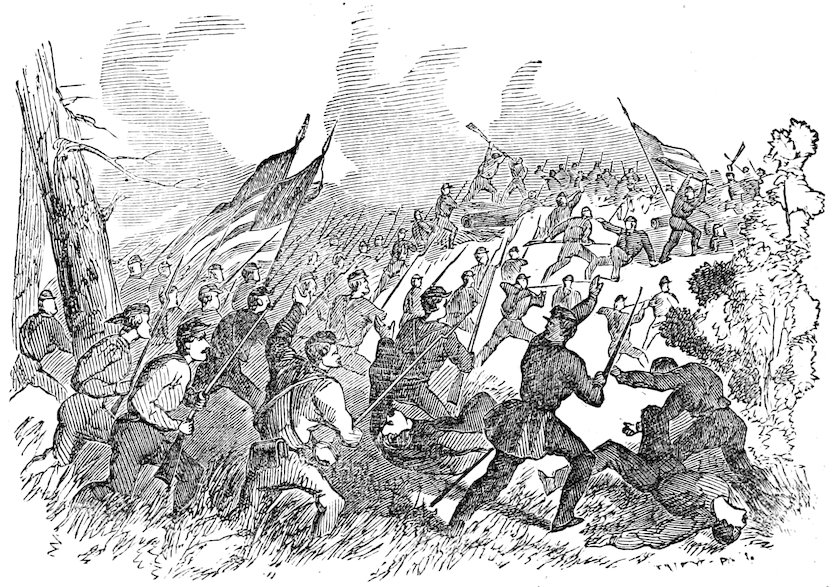
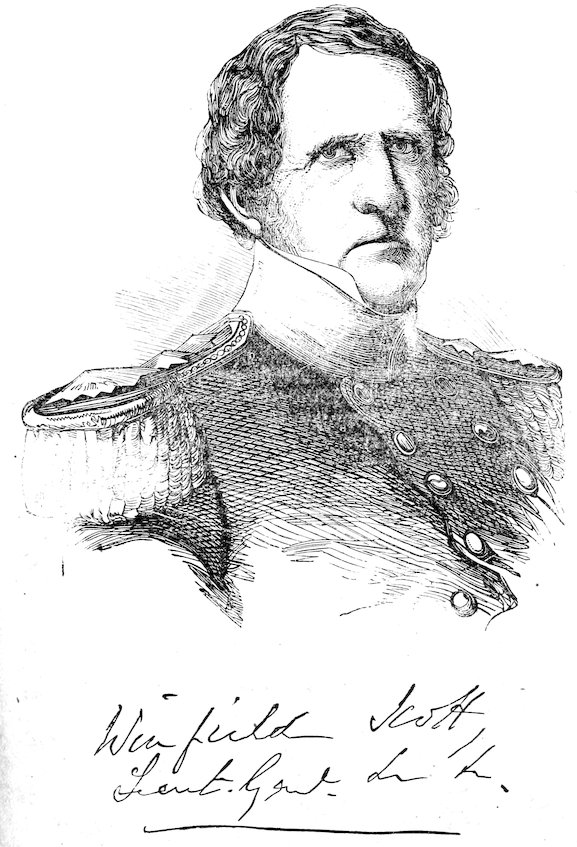
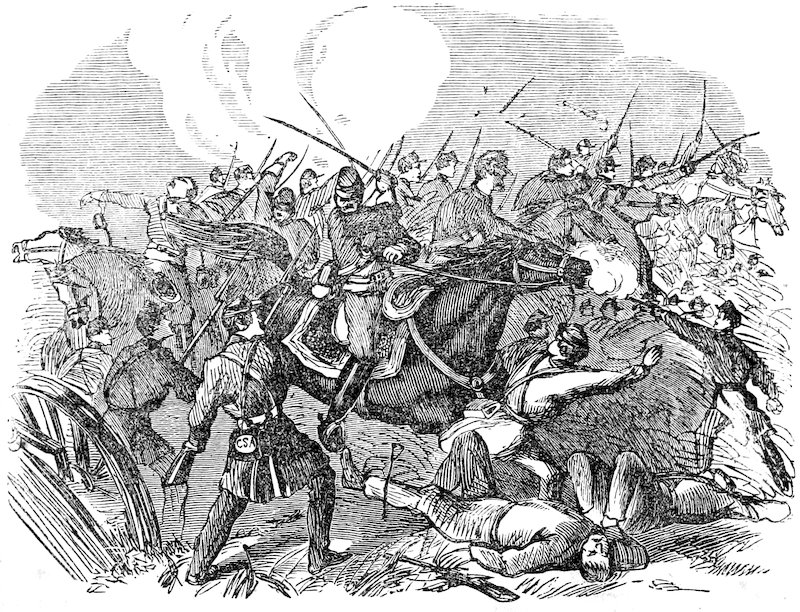
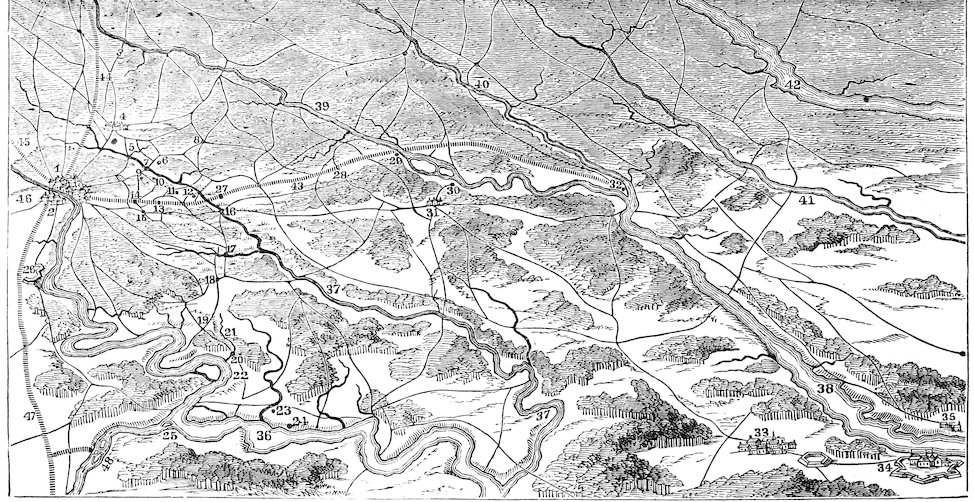
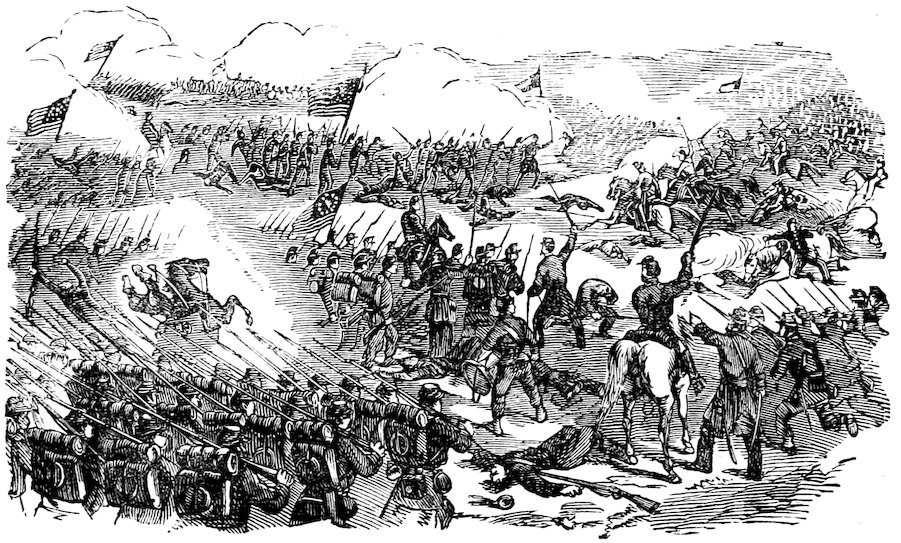
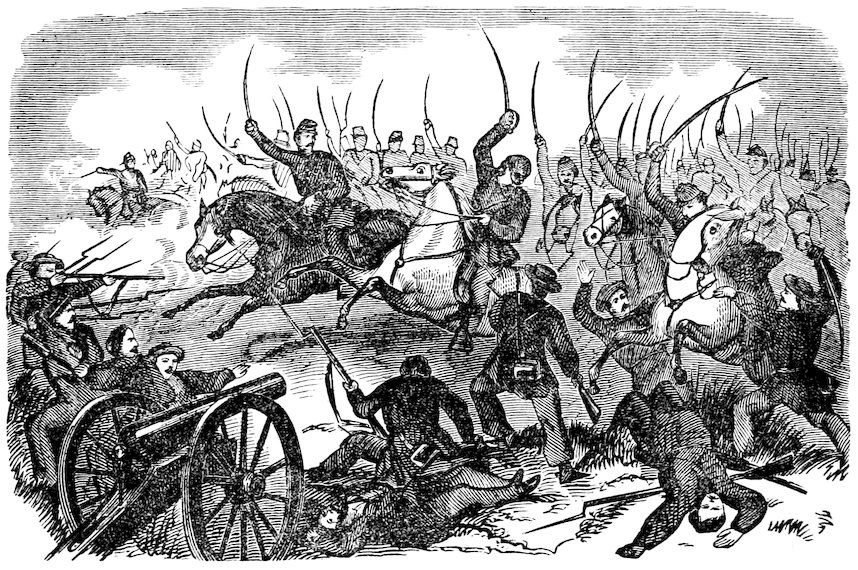
BATTLE OF PITTSBURG LANDING. — POSITION OF THE FEDERAL TROOPS. — THE BATTLE ON SUNDAY. — HURLBUT’S DIVISION. — M’CLERNAND’S DIVISION. — DESPERATE CONDITION OF THE NATIONAL TROOPS. — HURLBUT’S DIVISION. — WALLACE’S DIVISION. — ARRIVAL OF GENERAL BUELL. — NIGHT BETWEEN THE TWO BATTLES. — THE BATTLE ON MONDAY. — NELSON’S ADVANCE. — ADVANCE OF CRITTENDEN’S DIVISION. — M’COOK’S ADVANCE. — LEW. WALLACE’S MOVEMENTS. — SHERMAN’S DIVISION. — AFTER THE BATTLE. — THE ARTILLERY AND REGIMENTS ENGAGED. — LOSSES.
367
When the surrender of Forts Henry and Donelson reached Washington
and Richmond there was depression among the secessionists and
great rejoicing at the North. The news of these events was followed
directly by the capture of Nashville and New Madrid, and it became
certain to the Confederate leaders that Island No. 10 must soon
surrender. Under these untoward events it became imperative that a
new strategic point should be at once established beyond reach of the
gunboats, that had already produced so much mischief. Beauregard,
then in command, selected Corinth as the most promising point for his
operations, and a position which would render any attempt of the Federals
to cut him off from western Tennessee, or the eastern and southern
States, extremely difficult of success. He called on the Governors of
Tennessee, Mississippi and Alabama for help, and a prompt response
was made. First came Polk from Columbus, then Bragg from Mobile
and Pensacola, followed by General A. S. Johnston from Murfreesborough,
who took command. After selecting their new line of defence,
they commenced fortifying it and diligently concentrated their
forces. Generals Hardee, Breckinridge, Sterling Price and Hindman
soon came in, and the fortifications made rapid progress.
Corinth is a very important strategical point. It is situated in a
branch of the Apalachian range, which diverges from the Alleghany
mountains, and forms the uplands and gold-bearing regions of Georgia
and Alabama. The village is nearly surrounded by an irregular circle
of hills, rising in the north, about four miles distant, with the State line
between Tennessee and Mississippi crossing their summit. The Mobile
and Ohio railway intersects this ridge through a cut seventy-five feet
in depth. Similar cuts, of lesser depth, penetrate the hills on the east,
west and south, where the railways enter. Beyond these hills, in the
direction of Pittsburg and Savannah, the ground becomes more level,
and is generally low and swampy. The topography of the region renders
Corinth susceptible of strong defences. The village was formerly
called Farmington, and is so mentioned in the gazetteers. It is a post
village of Tishomingo county, Mississippi, distant two hundred and sixty-two
miles north-east from Jackson, the capital of the State. There
were not half a dozen stores in the village, and its population was
relatively small. Tishomingo county forms the north-eastern extremity
of Mississippi, bordering on Tennessee and Alabama. The
Tombigbee river rises in the county; the Tennessee flows along the
north-east border, and it is drained by Tuscumbia creek. A large
368portion of the county is covered with forests of oak, hickory, walnut
and pine.
The principal military value of this place consists in the fact that the
railroads from Memphis on the west, Columbus, on the north, and
Mobile on the south, cross at this point.
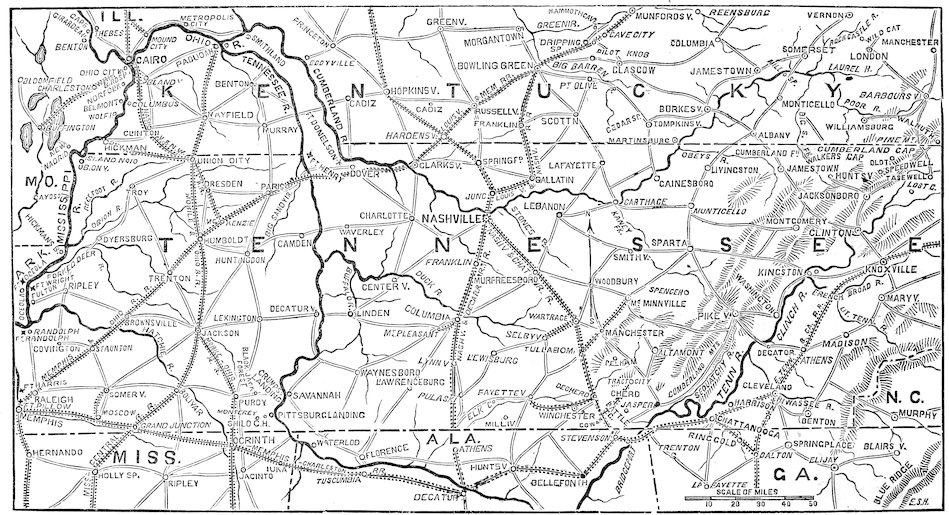
About the middle of March Grant’s victorious army at Nashville was
sent by Halleck to occupy first Savannah, and then Pittsburg Landing,
preparatory to the arrival of Buell’s Kentucky army, when Halleck intended
himself to take the field and move on Corinth.
Pittsburg Landing is situated in Hardin county, Tenn., on the west
side of the Tennessee river. It is in itself of little importance, being
close to Savannah, which is a flourishing post village of Hardin county,
situated on the eastern side of the river. The Landing is about one
hundred and twenty miles from Nashville; nearly one hundred miles
from Columbia, on the Nashville and Decatur railroad; by a turnpike
road, crossing the river at a ferry, about twenty-five miles from Corinth.
The country is very wild, the surface rising on both sides of the river
in a gradual ascent.
Savannah is the capital of Hardin county. Previous to the rebellion
it had been a place of considerable business note. The population in
1853 was only eight hundred, but it had been greatly increased. The
area of the county is about six hundred and fifty miles. The Tennessee
river flows through it, dividing it into nearly equal parts. The river is
navigable for steamboats through the entire county, which has a population
of over ten thousand persons, nine-tenths of whom are free.
General Grant proceeded at once to Savannah, where his headquarters
were established. The divisions of his army were sent gradually to
Pittsburg, and had not all arrived when the assault was made. No
defences had been erected, and the possibility of an attack from the
Confederates had not been for a moment entertained. On the 5th of
April Buell left Nashville and arrived at Savannah the same day. The
division of his army under Nelson was on the battle field on the sixth, at
five P. M.
The Confederates had for some time intended to attack Grant before
Buell could join him, and on hearing of his near approach they hastened
the action, without waiting for their own reinforcements. This bold
movement was made just one day too late.
Pittsburg Landing is simply a narrow ravine, down which a road
passes to the river bank, between high bluffs on either side. There is no
town whatever. Two log huts comprise all the signs of habitation visible.
Back from the river is a rolling country, cut up with numerous
369ravines, partially under cultivation, but the greater portion is thickly
wooded with large patches of underbrush. From the Landing a road
leads directly to Corinth, twenty miles distant. A mile or two out, this
road forks; one branch is known as the lower Corinth road; the other,
the Corinth ridge road. A short distance out, another road curves off
to the left, crosses Lick Creek, and leads back to the river at Hamburg,
some miles up the stream. On the right, two separate roads lead off to
Purdy, and another, a new one, runs across Snake Creek to Crump’s
Landing on the river below. Besides these, the whole country that composed
the battle-field was cut up with roads leading to different camps.
On and between these roads, at distances of from two to five miles
from Pittsburg Landing, lay several divisions of Major-General Grant’s
army on Sunday morning. The advance line was formed by three divisions—Brigadier-General
Sherman’s, Brigadier-General Prentiss’ and
Major-General McClernand’s. Between these and the Landing lay the
forces of Brigadier-General Hurlbut and Major-General Smith, who,
being absent from severe illness, left his command to Brigadier-General
W. H. L. Wallace.
The Union advance line, beginning at the extreme left, was thus
formed:—On the Hamburg road, just north of the crossing of Lick
creek, and under bluffs on the opposite bank that commanded the position,
lay Colonel D. Stuart’s brigade of General Sherman’s division.
Some three or four miles distant from this brigade, on the lower Corinth
road, between that and the road to Purdy, lay the remaining brigades
of Sherman’s division, McDowell’s forming the extreme right of
the whole advance line. Hildebrand’s came next to it, and Buckland’s
following. Next to Buckland’s brigade, though rather behind a portion
of Sherman’s, lay Major-General McClernand’s division, and between it
and Stuart’s brigade, already mentioned as forming the extreme left,
Brigadier-General Prentiss’ division completed the line.
Back of this line, within a mile of the Landing, lay Hurlbut’s division,
stretching across the Corinth road, with W. H. L. Wallace’s to his right.
Such was the position of the Union troops at Pittsburg Landing at daybreak
on Sunday morning. Major-General Lew. Wallace’s division
arrived at about half-past seven o’clock that day.
Nearly four miles intervened between the different parts of Sherman’s
division. McClernand’s lay partially behind Sherman, and there was a
gap between him and Prentiss, which the rebels did not fail speedily to
find. The extreme left was commanded by unguarded heights, easily
approached from Corinth.
The secession army was commanded by General Johnston; Beauregard
was second in command. The three army corps were led by Hardee,
Polk, and Bragg. Breckinridge commanded the reserve.
370On the evening of Friday, April 4, there had been a preliminary skirmish
with the enemy’s advance. Rumors reached the Union camp that
some officers had been taken prisoners by a considerable rebel force, near
the lines, and that pickets had been firing. A brigade, the Seventieth,
Seventy-second and Forty-eighth Ohio regiments, was sent out to ascertain
the facts. They came upon a party of rebels, perhaps a thousand
strong, and after a sharp action drove them off, losing Major Crocket, of
the Seventy-second Ohio, and two lieutenants from the Seventieth were
taken prisoners. In return the Union party took sixteen prisoners, and
drove the rebels back to a battery which they had placed undiscovered
at no great distance from the Federal lines. General Lew. Wallace’s
troops, at Crump’s Landing, were ordered out under arms; they marched
to Adamsville, half way between the river and Purdy, to hold position
there and resist any attack in that direction. The long rainy night
passed drearily and uncomfortably, but no further hostile demonstrations
were made, and it was generally supposed that the affair had been an
ordinary picket fight, presaging nothing more. On Saturday there was
more skirmishing along the advanced lines.
The secession leaders at Corinth knew that they largely outnumbered
Grant, and that no measures had been taken to strengthen the
position at Pittsburg Landing; they knew equally well, that when Buell’s
entire Kentucky army was added to Grant’s forces, they could not possibly
expect to hold their important position at Corinth. Their only
hope lay in attacking Grant before Buell arrived, and defeating his troops
in detail.
During Friday and Saturday the enemy had marched out of Corinth,
about seventy thousand strong, in three lines of battle; the first and
second extending from Owl Creek on the left to Lick Creek on the
right—a distance of about three miles, supported by the third and the
reserve. The first line, under Major-General Hardee, was constituted of
his corps, augmented on his right by Gladden’s brigade, of Major-General
Bragg’s corps, deployed in line of battle, with their respective artillery,
following immediately by the main road to Pittsburg, and the
cavalry in rear of the wings. The second line, composed of the other
troop of Bragg’s corps, followed Hardee at a distance of five hundred
yards, in the same order as the first. The army corps under General
Polk followed the second line, at the distance of about eight hundred
yards, in lines of brigades, deployed with their batteries in rear of each
brigade, moving by the Pittsburg road, the left wing supported by
cavalry. The reserve, under Brigadier-General Breckinridge, followed
closely the third line, in the same order, its right wing supported by
cavalry.
371
As if in beautiful contrast with the terrible scenes that were soon to
follow, the holy Sabbath-day which dawned on the sixth of April was
one of unusual loveliness. The soft spring sunshine lay upon the green
slopes, breaking up their delicate green with a thousand fleeting
shadows flung downward by the young leaves. A gentle, pleasant wind
shook the budding branches, and happy birds were singing their love-tunes
in the underbrush, a touching prelude to the stern battle music
that soon put them to flight. A few fleecy clouds wreathed themselves
along the serene blue of the sky, and floated idly over the battle
field, casting transparent shadows now in some green hollow, then upon
a hill slope, till the whole field smiled like an Eden—smiled even after
the cannon belched their thunders over it. While the morning dew was
yet on the grass, the enemy began pouring the fire and smoke of a most
deadly strife over this lovely scene.
The attack commenced so suddenly and with such bitter violence,
that the enemy’s artillery was brought to bear on the outer camps
almost simultaneously with the arrival of the pickets they had driven in.
The divisions of Sherman and Prentiss, composed in a great part of
inexperienced troops, were selected and compelled to meet the first
shock of the enemy’s onset. Much confusion and panic was occasioned
by the sudden and unexpected attack, from which neither corps was
able fully to recover during the day. Both commanders exerted themselves
with bravery and skill in the trying crisis, and were soon enabled
to bring the greater part of their troops into line of battle, and check
the advance of the Confederate forces, which were then devastating the
Federal camps.
It is impossible to describe the fearful scenes that followed the first
wild onset of the enemy. Many of the sick and wounded, and the
more tardy officers and men were shot in their tents and left for dead,
lying through the whole of this fearful struggle, gasping in their agony.
On Monday evening some of these poor fellows were found in the
riddled tents, scarcely able to ask for the drink for which they were
perishing.
But the Union forces were not long held at this terrible disadvantage.
As the enemy advanced in force on Sherman’s centre, and a battery
opened fire in the woods, shelling the Federal camp, the Unionists were
in a condition to respond with emphasis. Taylor’s and Waterhouse’s
batteries met this first regular attack.
Under cover of their artillery, the rebel advance, by heavy battalions
of infantry, was made obliquely to the left, across the open field
in front of the Fifty-third Ohio, while solid columns came in, direct upon
372Sherman’s front. Immediately the entire line opened fire, and the battle
became general. The enemy’s design was to left-flank Sherman. To
this end he flung himself with terrific force upon Prentiss. Directly
the sound of musketry and artillery announced that Prentiss was
engaged, and at nine A. M. he was falling back. About this time
Appler’s regiment broke, followed by Munger’s regiment, and the
enemy pressed forward on Waterhouse’s battery, exposed by the disordered
retreat. The three Illinois regiments in immediate support of
this battery stood for some time, but the enemy’s advance was so impetuous
and his fire so terrific that they began to waver. While the
Forty-third Illinois was in the thickest of the iron storm, Colonel
Raith received a severe wound and fell from his horse. This threw his
regiment into some disorder, and the enemy got possession of three
guns of Waterhouse’s battery.
Although the left was thus turned, and the enemy pressing the whole
line, Colonels McDowell and Buckland held their ground until ten
o’clock, A. M., when the enemy had got his artillery to the rear of the
Union left flank, and some changes became absolutely necessary. Two
regiments of Hildebrand’s brigade—Appler’s and Munger’s—had already
disappeared to the rear, and Hildebrand’s own regiment was in disorder.
Taylor’s battery—still at Shiloh—received orders to fall back as far as
the Purdy and Hamburg road; and McDowell and Buckland were
directed to adopt that road as their new line. Behr’s battery at the
cross-roads, was ordered immediately to come into battery action right.
As Captain Behr gave the order, he was shot from his horse, when
the drivers and gunners fled in confusion, carrying off the caissons,
and abandoning five out of the six guns. The enemy pressed on after
gaining this battery, and the Unionists were again forced to choose a
line of defence. Hildebrand’s brigade had substantially disappeared
from the field, though he himself bravely remained. McDowell’s and
Buckland’s brigades still maintained their organizations, and joined
McClernand’s right, thus abandoning the original camps and line.
General Prentiss, too, brave, eager, and resolute to retrieve lost
ground, reformed his lines under the hot fire of the enemy, without a
choice of position, and in the full raking fire of the foe, hid in the scrub
oak jungles, which gave them secure covert. If his troops had cowered
at first, the remainder of his division held their position and braved the
galling fire it was impossible to return with the heroism of old veterans.
Hildebrand and McDowell were compelled to withdraw their brigades
from their camps to a ravine behind them, but they made a gallant defence,
while Buckland’s men fell back, and McClernand threw forward
his left, supporting them.
It is hardly to be wondered that the raw regiments broke under this
373appalling fire, before which veteran troops were powerless to stand.
Yet it must be said that Hildebrand’s brigade gave way with unreasonable
panic. Colonel Hildebrand himself was cool and self-possessed
as any man that ever led a hostile force. He made a powerful effort
to keep his troops in place when he saw them giving way; but the
power of a single man is unavailing when panic seizes the masses. Still
this brave hero kept his individual regiment in force a full hour after
Appler’s and Munger’s regiments had retired from their proper field of
action, and thus a larger portion of his forces were scattered and drifted
away from the contest.
Prentiss still fought valiantly, but down on either flank came the
enemy in an overwhelming rush, and a wall of bayonets closed him in
on either side. It was an appalling situation. The enemy made vigorous
use of his advantage. They had driven two divisions from their camps
and nearly opened a passage to the river. Here it was, between
nine and ten o’clock, that McArthur’s brigade of W. H. L. Wallace’s
division came up to give assistance to Stuart’s brigade, of Sherman’s
division, now in imminent danger of being cut off. Mistaking the way,
McArthur marched far to the right, and instead of reaching Stuart,
came in on the other side of the rebels, now closely pushing Prentiss.
His men at once opened vigorously on the enemy, and for a time they
seemed likely to save the imperilled division. But coming unawares
upon the enemy, their positions were not well chosen, and the whole
force was compelled to fall back together.
Hurlbut’s division, in reserve, saved the first repulse from proving
an absolute defeat, by offering a line behind which the discomfited
divisions of Sherman and Prentiss could reform, while his solid ranks
were a wall of steel against which the enemy could not prevail. The
General, in his report, says of their five hours’ service:
“Receiving from General Prentiss a pressing request for aid, I took
command in person of the first and third brigades, respectively commanded
by Colonel N. G. Williams, of the Third Iowa, and Brigadier-General
Lauman. The first brigade consisted of the Third Iowa,
Forty-first Illinois, Twenty-eighth Illinois and Thirty-second Illinois.
The third brigade was composed of the Thirty-first and Forty-fourth
Indiana, the Seventeenth and Twenty-fifth Kentucky.
“In addition, I took with me the first and second battalions of the
Fifth Ohio cavalry; Mann’s light battery of four pieces commanded by
first Lieutenant E. Brotzmann; Ross’ battery of the Second Michigan;
and Meyer’s battery of the Thirteenth Ohio.
“I formed my line of battle—the first brigade thrown to the front
374on the southerly side of a large open field—the third brigade continuing
the line with an obtuse angle around the other side of the field, and
extending some distance into the brush and timber. Mann’s battery
was placed in the angle of the lines, Ross’ battery some distance to the
left, and the Thirteenth Ohio battery on the right, and somewhat advanced
in cover of the timber, so as to concentrate the fire upon the
open ground in front, and waited for the attack.”
At half-past seven o’clock, when Brigadier-General Sherman was attacked
in force and heavily upon his left, Colonel I. C. Veatch, commanding
the second brigade of General Hurlbut’s division, was ordered to proceed
to the left of General Sherman. This brigade, consisting of the
Twenty-fifth Indiana, Fourteenth, Fifteenth, and Forty-sixth Illinois,
was in march in ten minutes, arrived on General Sherman’s left and
went into action rapidly. In a few minutes they were in line of battle,
and moving forward to the attack. But the brigade had hardly left the
camp before it found the roads full of flying Unionists, and the route for
two miles was strewn with guns, knapsacks, and blankets. The front
had been completely surprised; nearly a whole division was scattered
and retreating in utter confusion, and the enemy in force was already a
mile within the Federal camps. The brigade, under command of Colonel
Veatch, was drawn up in line of battle in a skirt of timber, bordering a
large field, on the outer edge of which the Federal troops were engaging
the enemy. But the enemy pressed on in overwhelming force, and
just as the troops in front began to waver, they discovered that he
had flanked Veatch on the right and was rapidly advancing to attack
the brigade on the right and rear.
The Fifteenth Illinois was on the right, the Fourteenth Illinois in the
centre, and the Twenty-fifth Indiana on the left—the other regiment, the
Forty-sixth Illinois, by the rapid flanking of the enemy became detached
from the brigade, and was not with it again during the action. This
brought the first fire upon the Fifteenth Illinois, which stood it nobly, but
was soon overpowered; the Fourteenth followed with a like result. In
the mean time the troops in front and on the left were completely routed
by the enemy, and came pell mell through the Union lines, causing some
little confusion. Hardly had they passed through to the rear before the
enemy came rushing on, and the fire of musketry became terrific. There
was no resisting this fiery onset short of annihilation; so with a few
well-directed volleys the brigade left the field. The loss was very
heavy. All the field officers of the Twenty-fifth Illinois were killed
instantly; two lieutenants were killed and three wounded.
McClernand’s division lay a short distance in the rear, and with one
375brigade stretching out to the left of Sherman’s line. Properly speaking,
merely from the location of the camp, he did not belong to the front
line. Two-thirds of his division were entirely behind Sherman. But
as the latter fell back, McClernand was compelled to bear the shock of
battle.
His division was composed as follows:—First brigade, Colonel Hare
commanding, Eighth and Eighteenth Illinois, Eleventh and Thirteenth
Iowa; Second brigade, Colonel C. C. Marsh commanding, Eleventh,
Twentieth, Forty-eighth and Forty-fifth Illinois, Colonels Ransom,
Marsh, Haynie and Smith (the latter was the “Lead Mine regiment”);
Third brigade, Colonel Raith commanding, Seventeenth, Twenty-ninth
and Forty-ninth Illinois, Lieutenant-Colonels Wood, Farrell and Pease,
and Forty-third Illinois, Colonel Marsh. Besides this fine show of experienced
troops, they had Schwartz’s, Dresser’s, McAllister’s and Waterhouse’s
batteries.
McClernand was at once in the hottest of the fight. As Buckner’s
brigade fell back, the protecting woods grew thinner and storms of
grape swept over them like the blasts of a tornado. Lieutenant-Colonel
Canfield, commanding the Seventy-second Ohio, was mortally wounded,
and borne dying from the field. Colonel Sullivan, of the Forty-eighth
Ohio, was wounded, but continued at the head of his men. Company
officers fell in numbers and were carried away from the field. The
rebels, by a sudden dash, had taken part of Waterhouse’s battery, which
McClernand had sent over. Behr’s battery, too, was taken, and Taylor’s
Chicago Light Artillery was terribly exposed, and compelled to
retire with heavy loss. As the troops gave way they came out from
the open woods into old fields, completely raked by the enemy’s fire.
For them all was lost, and away went Buckner’s and Hildebrand’s brigades,
Ohioans and Illinoisans together, to the rear and right.
McDowell’s brigade had fallen back less slowly than its two companions
of the same division. It was now left entirely alone. Having
formed the extreme right, it had no support there; its supporting brigades
on the left had gone; and through the space they had occupied
the rebels were pouring furiously. In imminent danger of being entirely
cut off, they fell back among the ravines that border Snake creek.
Sherman was indefatigable in collecting and reorganizing his men,
and a contest was kept up along portions of his new lines. The General
bore with him one token of the danger to which he had so recklessly
exposed himself—a musket ball through the hand. It was a miracle
that he escaped so slightly, for his courage had been conspicuous. He
had dared death fifty times since the attack was made on his raw division
that memorable Sunday morning.
Now the great force of the enemy fell on McClernand’s right. As
376Sherman fell back, McClernand was compelled to bring in his brigades
to protect his left against the onset of the rebels, who, seeing how he
had weakened himself, hurled themselves against him with tremendous
force. A couple of new regiments, the Fifteenth and Sixteenth Iowa,
were brought up; but taking utterly raw troops on the field, under
heavy fire, was too severe a trial, and they gave way in confusion. Then
the whole division made a change of front, and faced along the Corinth
road. Here the batteries were placed in position, and till ten o’clock
the rebels were foiled in every attempt to gain the road.
But Sherman having now fallen back there was nothing to prevent
the enemy from coming in further out on the road, and turning McClernand’s
right. Prompt to seize the advantage, a rebel brigade dashed
audaciously through the abandoned camp of the division, pushing up
the road in order to come in above McClernand. Where Sherman had
been, a battery of rifled guns was turned upon them, hurling fearful
slaughter in their midst and driving them back.
But the enemy managed his reserves with great skill. A constant
advance of fresh regiments proved overwhelming, and the storm of
death swept many a brave Union officer away. Death after death was
proclaimed, disaster followed disaster with disheartening quickness.
This was about half-past ten A. M., at which time the enemy had made
a furious attack on General McClernand’s whole front. He struggled
determinedly; but finding him severely pressed, Sherman moved McDowell’s
brigade directly against the left flank of the enemy, forced him
back some distance, and then directed the men to avail themselves of every
cover—trees, fallen timber, and a wooded valley to the right. The brigade
held this position for four long hours, sometimes gaining and at
others losing ground, Generals McClernand and Sherman acting in
perfect concert, and struggling to maintain this line.
By eleven o’clock, many of the commanders of regiments had fallen,
and in some cases not a single field officer remained; yet the fighting
continued with desperate earnestness—the fearful contest on both
sides was for death or victory. The almost deafening sound of artillery,
and the rattle of the musketry, were all that could be heard.
The men stood and bravely delivered their fire, regardless of the thunders
of artillery and the storm of iron missiles that raked through them.
Foot by foot the ground was contested. The wounded fell in heaps on
the battle field. There was no easy transportation at hand, but such
means as the soldiers could invent were adopted, and their wounded
comrades carried to the rear. Many who were hurt fell back without
help, while others fought in the ranks until they were actually forced
back by their company officers.
Major Eaton, commanding the Eighteenth Illinois, was killed; Colonel
377Haynie was severely wounded; Colonel Raith, commanding a
brigade, had his leg so shattered that amputation was necessary; Major
Nevins, of the Eleventh Illinois, was wounded; Lieutenant-Colonel
Ransom, of the same regiment, was wounded; three of General McClernand’s
staff—Major Schwartz, Major Stewart and Lieutenant Freeman—were
wounded, and carried from the field. Line officers had
suffered heavily. The batteries were broken up—Schwartz had lost half
his guns and sixteen horses. Dresser had lost several of his rifled
pieces, three caissons and eighteen horses. McAllister had lost half his
twenty-four pound howitzers.
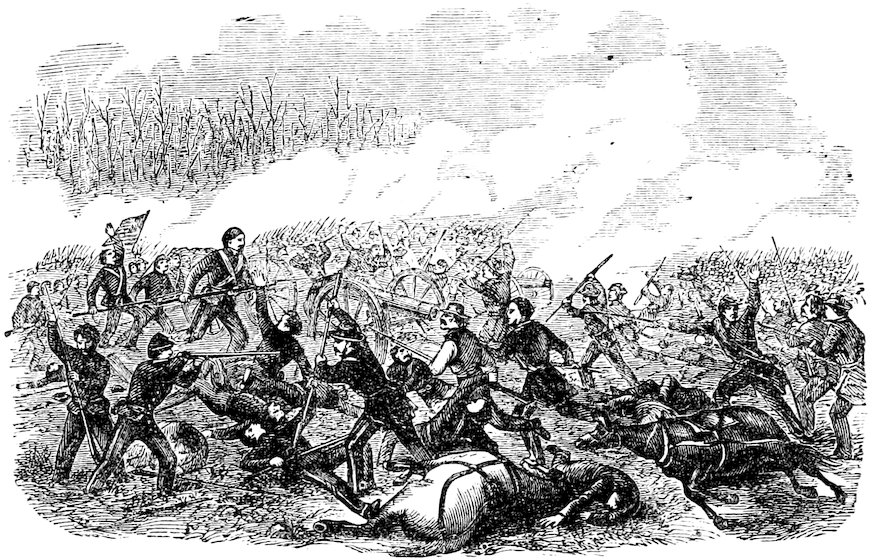
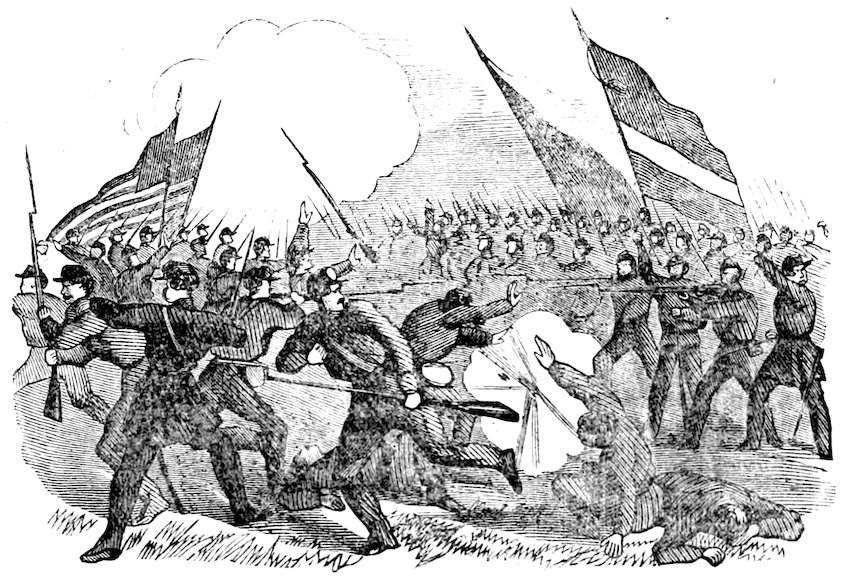
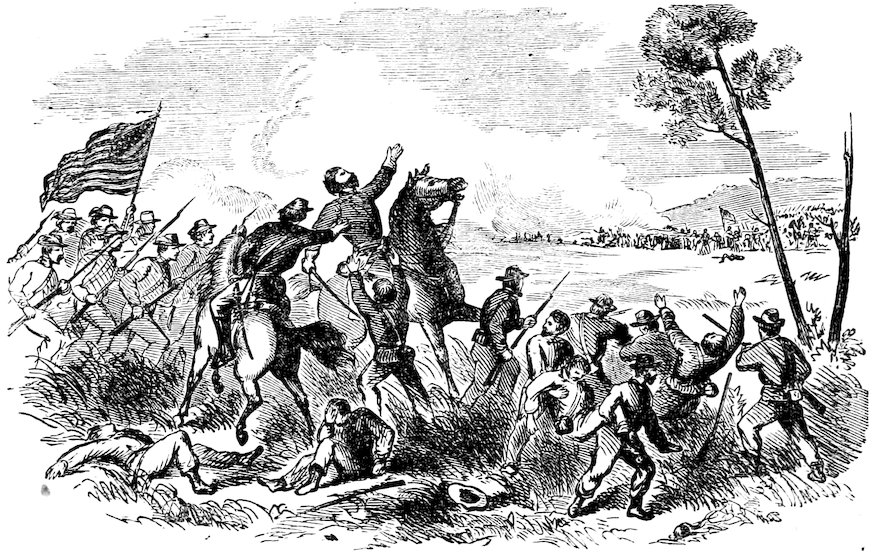
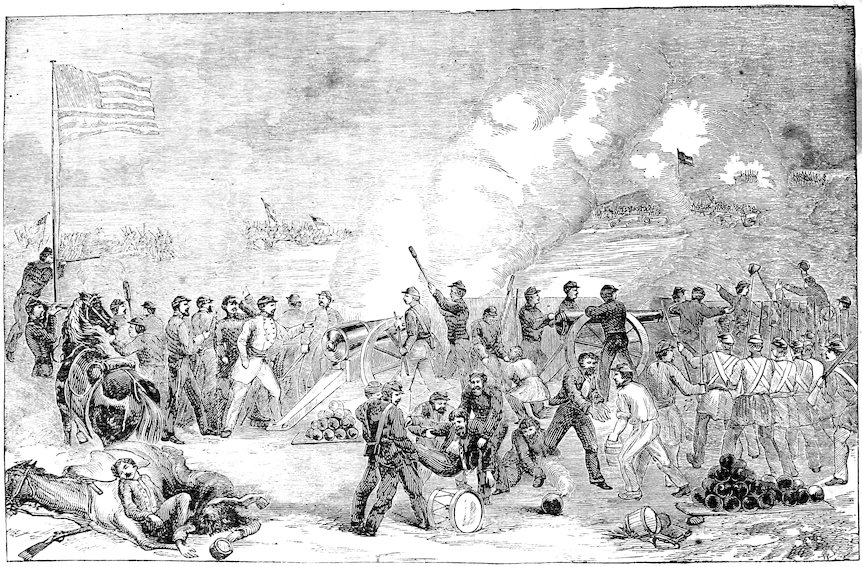
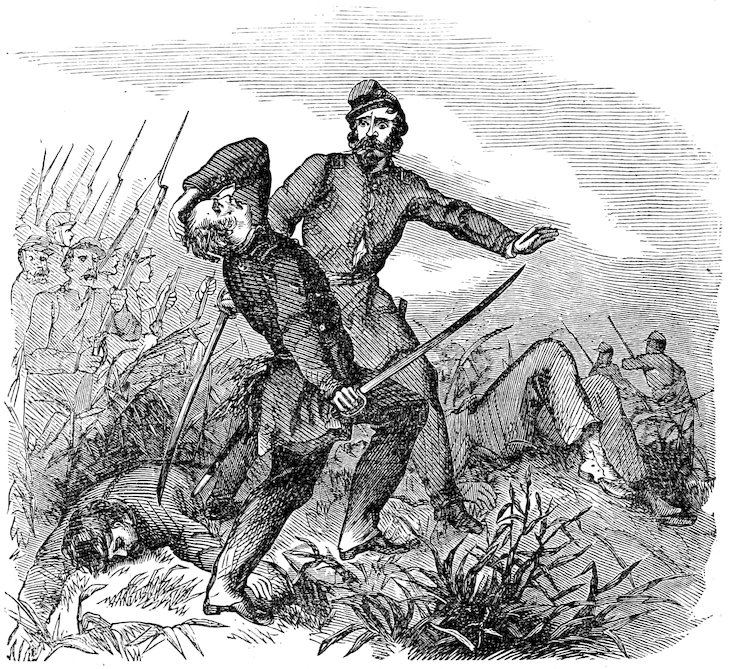
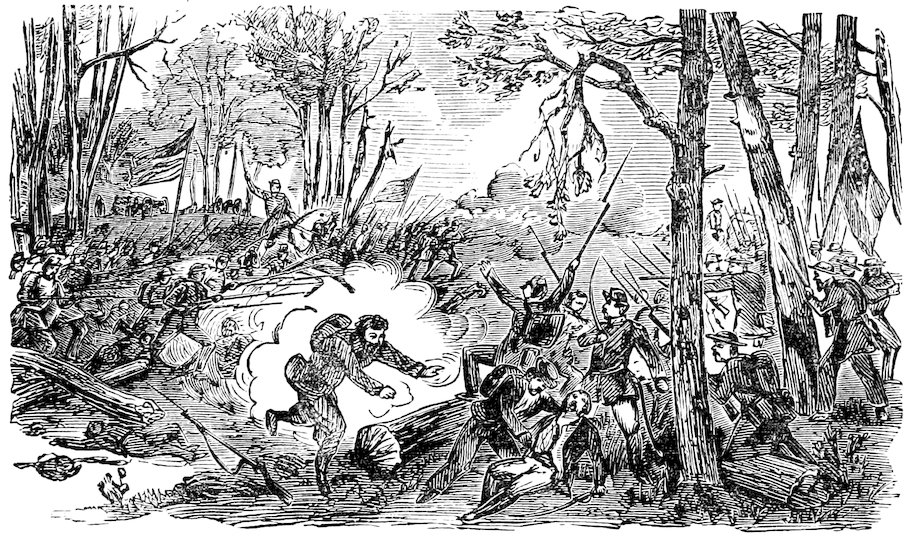
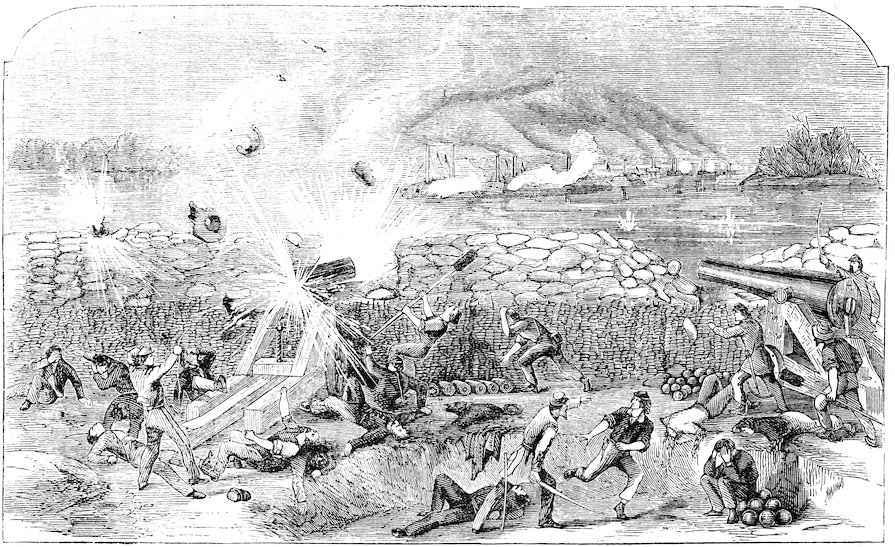
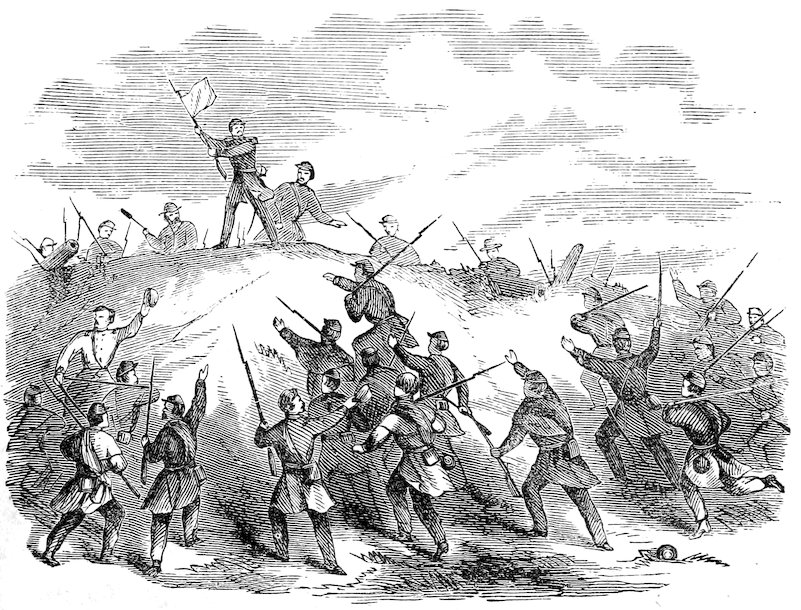
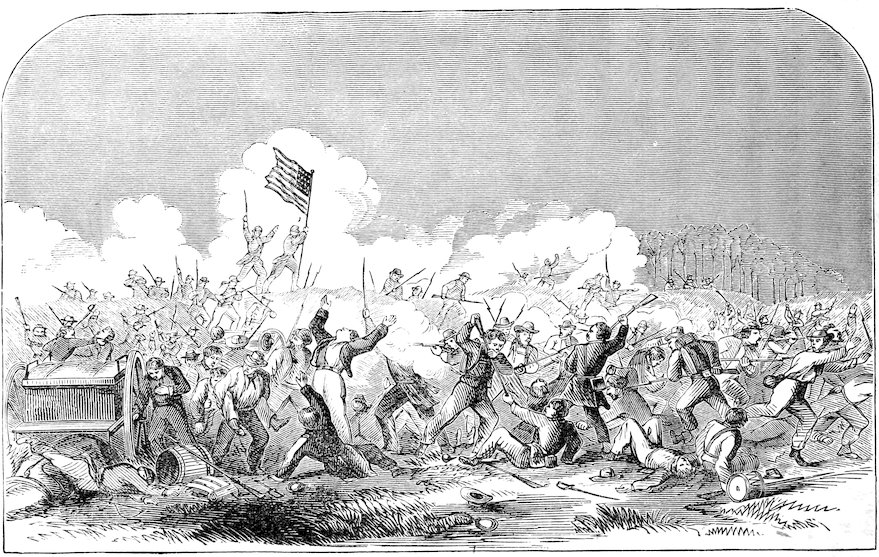
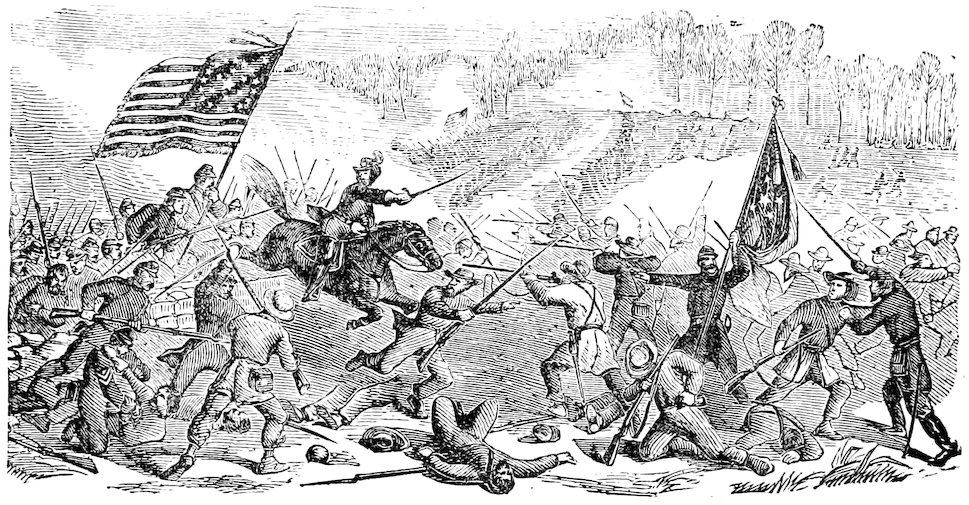
DESPERATE HAND-TO-HAND FIGHT OVER SCHWARTZ’S BATTERY.
The soldiers fought bravely to the last—bravely as ever men fought—but
they were at a terrible disadvantage. Gradually they began falling
back, making a determined resistance; occasionally they rallied and
repulsed the enemy for a hundred yards, then were beaten back again,
renewing the retreat to some new position for fresh defence.
By eleven o’clock the division was back in a line with Hurlbut’s. It
still did some gallant fighting; once its right swept round and drove
the enemy before it for a considerable distance, but again fell back;
at last it brought up near the position of W. H. L. Wallace’s division.
Now Prentiss, Sherman and McClernand were driven back, and their
camps were all in the hands of the enemy. The whole front line, for
which Hurlbut and Wallace were but the reserves, was gone.
Sherman’s brigade, on the extreme left, was doubly left alone by the
378Generals. General Grant did not arrive on the field until each division
General had been in action, and the respective Generals had in the best
manner they could, carried on the battle; but this brigade was even
left by its division General, who was four miles away, doing his utmost
to rally his panic-stricken regiments there.
It was commanded by Colonel David Stuart, and was composed of
the Fifty-fifth Illinois, Lieutenant-Colonel Malmbourg, commanding;
Seventy-first Ohio, Colonel Rodney Mason; the Fifty-fourth Ohio
(Zouaves), Colonel T. K. Smith. It was posted along the circuitous
road from Pittsburg Landing, up the river to Hamburg, some two
miles from the Landing, and near the crossing of Lick Creek, the bluffs
on the opposite side of which commanded the position, and stretching
on down to join Prentiss’ division on its right.
When the rebels marched out from Corinth, a couple of brigades
(rumored to be under the command of Breckinridge), had without molestation
reached the bluffs of Lick Creek, commanding Stuart’s position.
During the attack on Prentiss, Stuart’s brigade was formed along the
road, the left resting near the Lick Creek ford, the right, Seventy-first
Ohio, Colonel Rodney Mason, being nearest Prentiss. The first intimation
they had of disaster to their right was the partial cessation of firing.
An instant afterwards, muskets were seen glimmering among the leaves,
and presently a rebel column emerged from a bend in the road, with
banners flying, and moving at double-quick toward them. Their supports
to the left were more remote than the rebels, and it was evident
that, with but one piece of artillery, a single regiment could do nothing
there. They accordingly fell back toward the ford, and were reinforced
in an orchard near the other regiments.
The rebel column veered on further to the right, and for a brief space,
though utterly isolated, they remained unmolested.
Before ten, however, the brigade, which stood listening to the wild
roar of battle on the left, was startled by a shell that hurtled directly
over their heads. In an instant the rebel batteries that had gained the
commanding bluffs opposite, by approaching on the Corinth and Hamburg
road, were in fiery play. The orchards and open fields in which
they were posted, looking only for an attack in the opposite direction,
were swept with the exploding shells and a hail-storm of grape.
Under cover of this fire from the bluffs, the rebels rushed down,
crossed the ford, and in a moment were seen forming on the creek, in
open fields, and within close musket range. Their color-bearers stepped
defiantly to the front, as the engagement opened. The storm came in
sharp and quick volleys of musketry, the batteries above supporting
them with a destructive fire. The Union sharpshooters panted to pick
off the audacious rebel color-bearers, but Colonel Stuart interposed,—crying
379out, “No, no, they are too brave fellows to be killed.” Almost
at the first fire, Lieutenant-Colonel Barton S. Kyle, of the Seventy-first,
was shot through the breast. The brigade stood firmly at least ten
minutes, when it became evident that its position was untenable, and it
fell rapidly back, perhaps a quarter of a mile, to the next ridge; a few
of Stuart’s men, at great personal risk, carrying Lieutenant-Colonel
Kyle, in a dying condition, from the field they were abandoning. Ohio
lost no braver, truer man that day.
When they reached the next woody ridge, rebel cavalry, that had
crossed the creek lower down, were seen coming up on the left; and the
line of battle was formed fronting in that direction, to resist this new
attack. For three-quarters of an hour the brigade kept this position.
The cavalry, finding it prepared, did not come within range. In front
they were hard pressed, and the rebels began to come in on their right.
Colonel Stuart had sent across to Brigadier-General W. H. L. Wallace,
then not engaged, for support. Brigadier-General McArthur’s brigade
was promptly started across, but mistaking the way, and bearing too
much to the right, found itself in the midst of the rebel forces. He vigorously
engaged the rebels to his front and flanks, fell back to a good
position and held these troops in bay till the rest of his division came
up. General McArthur was himself disabled by a wound in the foot,
but he rode to a hospital, had it dressed, and returned to the brigade,
which meantime held its position stoutly.
But this brought Stuart’s isolated brigade little assistance. They were
soon forced to fall back to another ridge, then to another, and, finally,
about twelve o’clock, shattered and broken, they retreated to the right
and rear, falling in behind General McArthur’s brigade to reorganize.
Colonel Stuart was himself wounded by a ball through his right shoulder,
and the loss of field and company officers greatly disheartened the
troops.
Now the entire front was cleared. The enemy had full possession of
Sherman’s, Prentiss’ and McClernand’s camps. By ten o’clock the
whole front, except Stuart’s brigade, had given way, and the burden
of the fight was resting on Hurlbut and W. H. L. Wallace. Before
twelve, Stuart, too, had come back, and for the time, those two divisions
stood absolutely alone between the Union army and destruction.
But truly brave men are bravest when driven to extremities. Hurlbut
and Wallace made a most gallant stand; and most of the troops
from the three scattered divisions were still to some extent available.
Many of them had wandered down the river, some to Crump’s Landing,
and others even to Savannah, to be brought back on transports. Brigades
380could not be collected again, much less divisions, but the regiments
were gathered together from the loose squads wandering about,
and officered, often by men who could find scarcely a soldier of their
own commands. These were hurried to the front, and many of them
did good service.
According to general understanding, in the event of an attack at Pittsburg
Landing, Major-General Lew. Wallace was to come in on the Union
right, and flank the rebels by marching across from Crump’s Landing
below.
But, as has been stated, Wallace, with his division, though all
drawn up and ready to march anywhere at a moment’s notice, was not
ordered to Pittsburg Landing till nearly twelve o’clock. Then, by
mistake, he got on the new road, four miles of marching were lost, and
the circuitous route made it a march of twelve miles before he could
reach the scene of battle. Meantime the right was almost wholly unprotected.
Fortunately, however, the rebels did not seem to have discovered the
full extent of this weakness, and their heaviest fighting was done on the
centre and left, where the Union lines were still preserved.
Hurlbut’s division stretched across the Corinth road, facing to the
left. W. H. L. Wallace’s other brigades had gone over to assist McArthur,
and the divisions thus reunited, steadily closed the line. To
Hurlbut’s right the lines were united by the reorganized regiments that
had been resent to the field. McClernand and Sherman were both there.
Hurlbut had been encamped in the edge of a stretch of open fields,
backed with heavy timber, which lay nearest the river.
Three times during those long hours the heavy rebel passes on the
left charged upon the division, and three times were they repulsed with
terrible slaughter. Close, sharp, continuous musketry filled the air with
fire and smoke—whole lines belched their furious fire on the rebels,
and a leaden storm swept the fields over which they attempted to advance
with terrible fury. No troops could have withstood this deadly
fire. Rebel discipline gave way under it, though dead bodies left scattered
over the field, even on Monday evening, bore ghastly testimony
to the daring with which they had been precipitated towards the Federal
lines.
The rebel generals handled their forces with a skill that extorted admiration
even from their enemies. Repulse was nothing to them; if a
rush on the Union lines failed, they took their disordered troops to the
rear, and sent up fresh forces, who ignorant of the deadly reception that
awaited them, were ready to make a new trial. Hurlbut’s jaded division
381was compelled to yield at last, and after six hours’ magnificent fighting,
it fell back of its camps to a point within half a mile of the landing.
Hurlbut’s companion division—that of Brigadier-General W. H. L.
Wallace, included the Second and Seventh Iowa, Ninth and Twenty-eighth
Illinois, and several of the other regiments composing Major-General
Smith’s old division. Wallace had also three excellent batteries—Stone’s,
Richardson’s and Weber’s, all from Missouri.
With him, too, the fight began about ten o’clock, as already described.
From that time till four in the afternoon his troops bore up manfully.
The musketry fire was absolutely continuous; there was scarcely a
moment that some part of the line was not pouring in their rattling volleys,
and the artillery sent forth its death-thunders with but little intermission
through the entire time.
Once or twice the infantry advanced, attempting to drive back the continually
increasing enemy; but though they could hold their own ground,
their numbers were unequal to the task of conquering more.
Four separate times in turn the rebels attempted to charge on them.
Each time the infantry poured in its quickest volleys, the artillery redoubled
its exertions, and the rebels retreated with heavy slaughter.
The division was eager to remain, even when Hurlbut fell back, and
the noble fellows serving the guns were particularly indignant when
compelled to silence their own batteries. But their supports were gone
on both sides. It was madness to remain in isolated advance. Just as the
necessity for retreating was becoming apparent, General Wallace, whose
cool, collected bravery had commanded universal admiration, was, as it
was believed, mortally wounded, and borne away from the field. At
last the division fell back. Its soldiers claim the proud distinction of
being the last to yield, in the general breaking up of the lines that
gloomy Sunday afternoon.
Captain Stone could not resist the temptation of stopping, as he passed
what had been Hurlbut’s headquarters, to try a few parting shots. He
did fine execution, but his wheel horses were shot down, and he narrowly
escaped losing his guns.
With the first dash of the enemy on the left wing, it became evident
that a stupendous effort would be put forth to break through it. For
two hours sheets of fire blazed from both columns, and clouds of smoke
surged up between them with the rush and stifling effect of a prairie
fire. The Mississippi riflemen in the enemy’s ranks fought with terrible
valor, which was met with steady heroism by those who stood firmly
under their unerring fire. Three different times the enemy seemed on
the verge of a victory. They drove the Union forces slowly before
382them until they came in sight of the river, but up to three o’clock the
desperate attempt to break the Federal lines proved unavailing. Having
failed to drive in the main columns, they had turned with furious
strength on the right wing; baffled there, they made another onset on
the left wing, fighting more desperately than ever. But the Union
lines were prepared for the assault, fierce as it was, and met it with wonderful
steadiness.
The whole army was crowded into Wallace’s camps, and confined in
a circuit of from half to two-thirds of a mile around the Landing. The
Union army fighting bravely, had been falling back inch by inch all day.
The next repulse threatened to drive them into the river.
Brigadier-General Prentiss and three regiments with him—the
Twenty-third Missouri, of his own division, and the Twelfth and
Fourteenth Iowa, of those that had come to his assistance—delayed
their retreat too long, having relied too confidently on their supporting
division to check a flank movement of the enemy. Almost before they
saw their danger, the flanking forces rushed in from either side behind
them, and they stood, perhaps two thousand strong, in the midst of
thrice their number. Hedged in with battalions, with a forest of steel
bristling on every side, these brave men yielded to the force of numbers,
and were taken prisoners, after fighting bravely till further contest
would have been self-murder.
Meantime Sherman’s brigades had maintained a confused fight. Buckland’s
were almost gone, Hildebrand’s and McDowell’s were holding
their ground more tenaciously.
General Hurlbut gives a clear statement of the retreat and final position
of the Federal forces on Sunday afternoon:
“When, about three o’clock, Colonel Stewart, on my left, sent me
word that he was driven in, and that I would be flanked in a few moments,
it was necessary for me to decide at once to abandon either the
right or left. I considered that General Prentiss could, with the left of
General McClernand’s troops, probably hold the right, and sent him
notice to reach out toward the right, and drop back steadily parallel
with my first brigade, while I rapidly moved General Lauman from the
right to the left, and called up two twenty-pound pieces of Major
Cavender’s battalion to check the advance of the enemy upon the first
brigade. These pieces were taken into action by Dr. Corvine, the surgeon
of the battalion, and Lieutenant Edwards, and effectually checked
the enemy for half an hour, giving me time to draw off my crippled
artillery, and to form a new front with the third brigade. In a few
minutes, two Texas regiments crossed the ridge separating my line
from Stuart’s former one, while other troops also advanced.
“Willard’s battery was thrown into position, under command of
383Lieutenant Wood, and opened with great effect on the Lone Star flags,
until their line of fire was obstructed by the charge of the third brigade,
which, after delivering its fire with great steadiness, charged up the hill,
and drove the enemy back three or four hundred yards. Perceiving
that a heavy force was closing on the left, between my line and the
river, while heavy firing continued on the right and front, I ordered the
line to fall back. The retreat was made steadily, and in good order. I
had hoped to make a stand on the line of my camp, but masses of the
enemy were pressing on each flank, while their light artillery was closing
rapidly in the rear. On reaching the twenty-four-pounder siege guns
in battery, near the river, I again succeeded in forming line of battle in
rear of the guns, and, by direction of Major-General Grant, I assumed
command of all troops that came up. Broken regiments and disordered
battalions came into line gradually upon my division.
“Major Cavender posted six of his twenty-pound pieces on my right,
and I sent my aid to establish the light artillery, all that could be found,
on my left. Many officers and men, unknown to me, fled in confusion
through the line. Many gallant soldiers and brave officers rallied
steadily on the new line. I passed to the right and found myself in
communication with General Sherman, and received his instructions. In
a short time the enemy appeared on the crest of the ridge, led by the
Thirteenth Louisiana, but were cut to pieces by the steady and murderous
fire of our artillery.”
The enemy were in possession of nearly all the Union camps and
camp equipage. Half the field artillery had fallen into his hands; a
division general had been captured—many officers had followed him, and
more than one regiment of soldiers had been made prisoners. The battle
field was cumbered at every step with killed and wounded; the hospital
tents were overflowing and crowded with human agony. A long
ridge bluff set apart for surgical purposes swarmed with the maimed,
the dead and the dying, whose cries and groans broke fearfully through
the pauses of the artillery. A dogged, stubborn resolution took possession
of the men; regiments had lost their favorite officers; companies
had been bereft of their captains. Still they continued to fight desperately,
but with little hope.
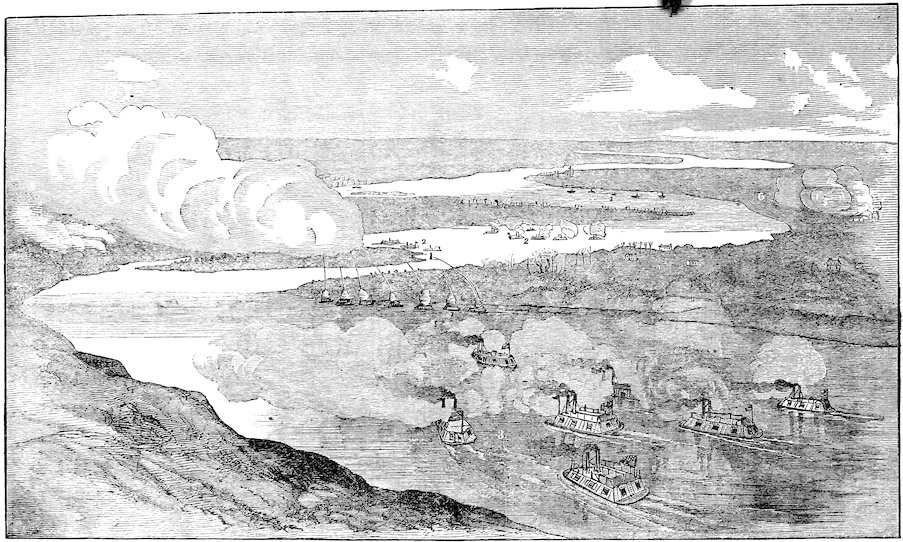
At three o’clock the gunboat Tyler opened fire on the enemy, and at
four the Lexington came up, taking position half a mile above the landing,
and opened fire, striking terror into the ranks of the enemy.
General Grant was confident that his troops could hold the enemy off
till morning, and said this while standing with his staff in a group by
the old log post-office on the landing, which was then crowded with
surgeons and the wounded; but still the men fought with a despairing
light in their eyes.
384In a time like this, minutes count for years. General Grant used them
to a golden purpose. Colonel Webster, chief of staff, and an artillery
officer of ability, had arranged all the guns he could collect in a sort of
semi-circle, protecting the Landing, and bearing chiefly on the Union
centre and left, by which the rebels were pretty sure to advance.
Corps of artillerists to man them were improvised from all the batteries
that could be found. Twenty-two guns in all were placed in position.
Two of them were very heavy siege guns, long thirty-two’s. Where
they came from, what battery they belonged to, no man questioned. It
was quite unimportant. Enough that they were there, in the right place,
half a mile back from the bluff, sweeping the approaches by the left, and
by the ridge Corinth road, but with few to work them. Dr. Corvine,
surgeon of Frank Blair’s First Missouri Artillery, proffered his services,
which were gladly accepted, and he worked them with terrible
effect.
It was half-past four o’clock—perhaps later still. Every division of
the Union army on the field had been repulsed. The enemy occupied
almost all their camps. The struggling remnant of Federal troops had
been driven to within little over half a mile of the Landing. Behind
was a deep, rapid river. In front was a victorious enemy. Still there
was an hour for fighting. O, that night or Lew. Wallace would come!
Nelson’s division of Buell’s army evidently could not cross in time to
save the day. No one could tell why Lew. Wallace was not on the
ground. In the justice of a righteous cause, and in that semi-circle of
twenty-two guns in position, lay all the hope these beleagured men
could see.
At five o’clock the artillery which had been thundering so stormily,
held its fire a little; the flash of muskets from the enemy’s lines died
away, and his columns fell back on the centre for nearly a mile. With
a sudden swoop they wheeled and again threw their entire force on the
left wing, determined to end the fearful contest of the day then and
there.
Suddenly a broad, sulphurous flash of light leaped out from the darkening
woods, and through the glare and smoke came whistling leaden
hail. The rebels were making their crowning effort for the day, and as
was expected, they came from the left and centre. They had wasted their
fire at one thousand yards. Instantaneously a new tempest from the
black-mouthed Union guns flung out its thunderous response. The rebel
artillery opened, and shell and round shot came tearing across the open
space back of the bluff. The Union infantry poured in a glorious response
from their broken battalions, invigorated by the announcement
that the advance of Buell’s army was in sight. Just then a body of
cavalry appeared across the Tennessee river, waiting transportation.
385In their extremity the soldiers turned their eyes anxiously that way.
Was it Buell—was it Nelson coming to the rescue?
The eyes of those weary soldiers brighten. Their courage revived.
Help was near. Even in that lurid atmosphere they could see the
gleaming of the gun-barrels amid the leaves and undergrowth down the
opposite side of the river. They caught hopeful glimpses of the steady,
swinging tramp of trained soldiers. A division of Buell’s army was
coming up.
Then came a boat across with a lieutenant and two or three privates
of the Signal Corps. Some orders were given the officer, and as
instantly telegraphed to the other side by the mysterious wavings and
raisings and droppings of the flags. A steamer came up with pontoons
on board, with which a bridge could be speedily thrown across the
river.
She quietly reconnoitered a few moments, and steamed back again.
Perhaps, after all, it was better to have no bridge there. It made escape
impossible, and left nothing but victory or death to the struggling
Union troops. Preparations were rapidly made for crossing General
Nelson’s division, (for he had the advance of Buell’s army,) on the
dozen transports that had been tied up along the bank.
The division of W. H. L. Wallace held the enemy at bay in his last
desperate effort to break the Union lines. While forcing through a
cross-fire, General Wallace fell mortally wounded. Brigadier-General
McArthur took the command, but he too was wounded, and Colonel
Tuttle, as senior in rank, rallied the shattered brigades. He was joined
by the Thirteenth Iowa, Colonel Crooker; Ninth Illinois, Colonel
Mersy; Twelfth Illinois, Lieutenant-Colonel Chatlain, and several other
fragments of regiments, and forming them in line on the road, held the
enemy in check until that noble line was formed that breasted that last
desperate charge.
At this critical moment a long, loud shout from the Union forces
welcomed in the reinforcements. Eight thousand strong had at length
crossed the river, and swept down upon the battle-field. Buell
and Nelson, by forced marches, made within sound of the booming
thunders of artillery, reached the battle-field just as the fate of war
trembled in the balance. There was no pause for rest or council. So
eager were they for the strife, they scarcely paused for breath before a
line of battle was formed which decided that stormy day’s fight.
The men, weary from the long march, and panting from the speed
which had marked its last stages, ranged themselves in advance of the
exhausted, but unfaltering troops of Sherman, McClernand, Hurlbut
386and of W. H. L. Wallace, who lay dying on the battle-field, while Colonel
Tuttle led his brigades to their noble work.
The gunboats Tyler, Lieutenant Gwinn commanding, and Lexington,
James W. Shirk commanding, now steamed up to the mouth of the
little creek, near which Stuart’s brigade had lain in the morning, and
where the rebels were attacking the Union left. When they reached the
mouth of the stream the boats rounded to, commanding a ravine cut
through the bluff, as if for the passage of their shells, which poured destruction
into the ranks of the enemy. This movement was made under
the direction of General Hurlbut, and it soon swept the enemy’s ranks,
carrying terror with every burst of deadly iron the guns belched forth.
Eager to avenge the death of their commanding General (now known
to have been killed a couple of hours before), and to complete the victory
they believed to be within their grasp, the rebels had incautiously
ventured within reach of their most dreaded antagonists, as broadside
after broadside of seven-inch shells and sixty-four-pound shot soon
taught them. This was a foe they had hardly counted on, and the unexpected
fire in flank and rear produced a startling effect. The boats
fired admirably, and with a rapidity that was astonishing. The twenty-two
land guns kept up their stormy thunder; and thus, amid the crash
and roar, the scream of shells and demon-like hiss of minie balls, that
Sabbath evening wore away.
Startled by the accumulated force, and disheartened by the fearful
combinations against them, the rebels fell slowly back, fighting as they
went, until they reached an advantageous position, somewhat in the
rear, yet occupying the main road to Corinth. The gunboats kept
pouring a storm of shell on their track, until they retired completely
out of reach, and the battle of the first day ended.
As the sounds of battle died away, and division generals drew off
their men, a council of war was held, and it was decided that as soon as
possible after daybreak the enemy should be attacked and driven from
their snug quarters in the Union camps. Lew. Wallace, who was coming
in on the new road from Crump’s Landing, and crossing Snake
Creek just above the Illinois Wallace’s (W. H. L.) camps, was to take
the right and sweep back toward the position from which Sherman had
been driven on Sunday morning. Nelson was to take the extreme left.
Buell promised to place Crittenden next to Nelson, and McCook next
to him, by a seasonable hour in the morning. The gap between McCook
and Lew. Wallace was to be filled with the reorganized divisions of
Grant’s army; Hurlbut coming next to McCook, then McClernand, and
Sherman closing the gap between McClernand and Lew. Wallace.
387
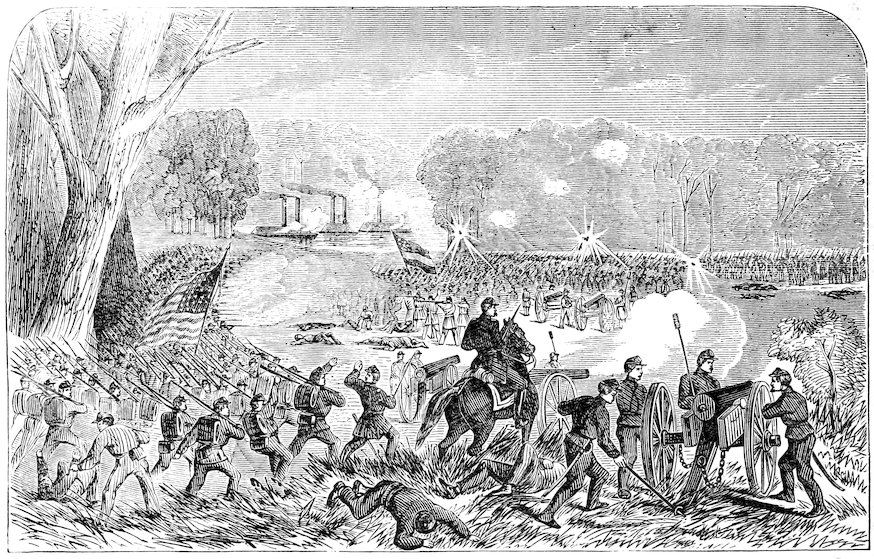
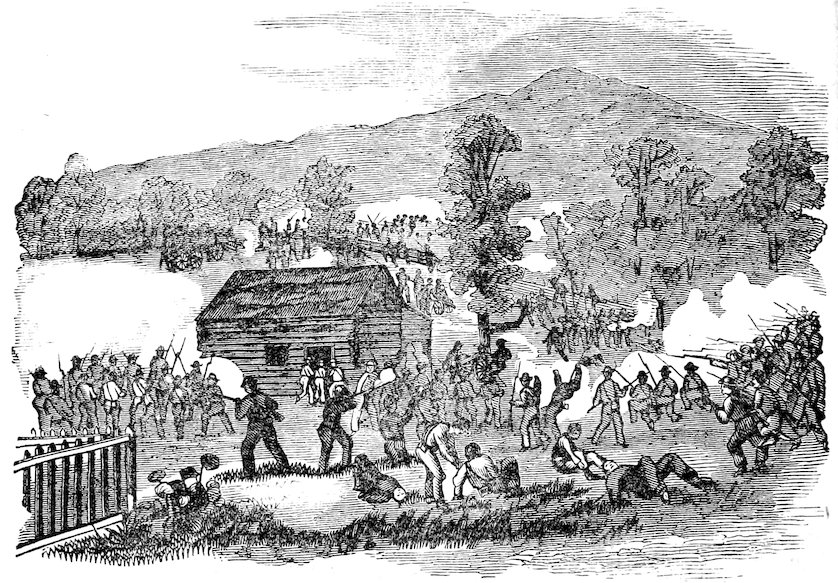
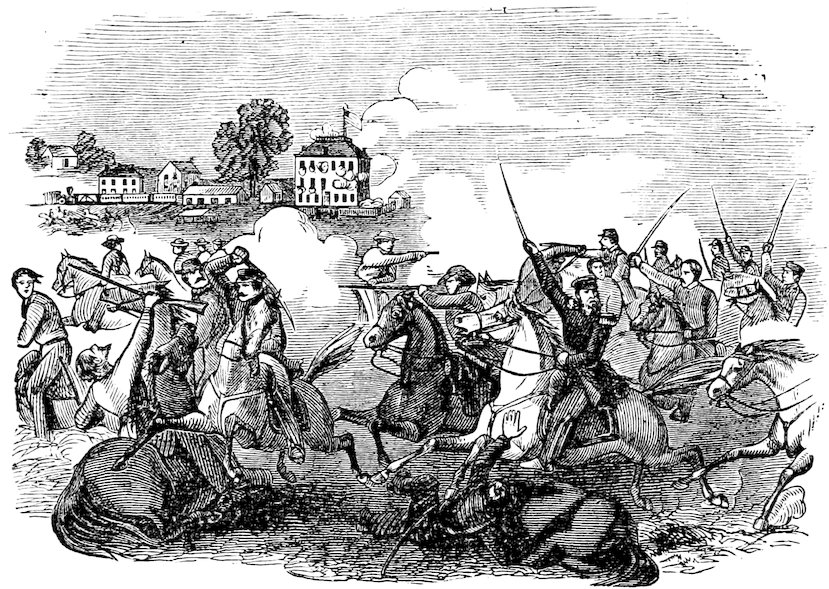
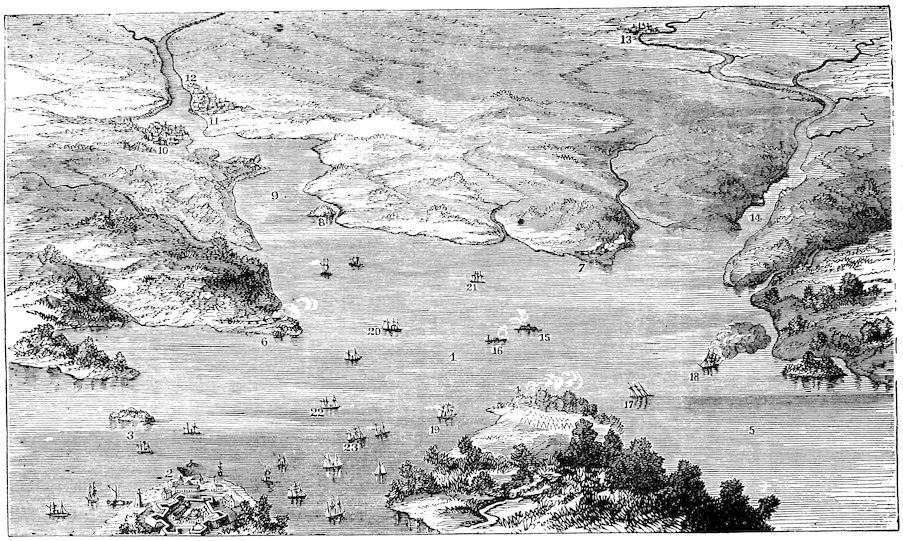
BATTLE OF PITTSBURG LANDING, APRIL 6, 1862.
389From the first fearful onslaught upon Buckland’s brigade, which,
gathering up its shattered regiments, and firing as they ran, to form in
the heavy woods, leaving winrows of slain on their track, to the last
outburst of shot and shell from the gunboats, the contest of that day
had been a fearful one. Most of the troops which received the first
shock of battle were raw recruits, just from the camp of instruction.
Hundred and hundreds of them had never seen a gun fired save in
sport in their lives. With officers equally inexperienced, admitting
brilliant exceptions, it is not wonderful that the ranks were broken and
driven back when the terrific roar of cannon burst in their midst, and
bombshells scattered fire and death among the tents, in which they were
quietly sleeping but an hour before. Springing to arms, half prepared
only to rush through the blinding smoke to meet the serried columns
of the rebels’ impetuous advance—truly it is not strange that they fell
into confusion, fighting blindly and at random. But it was a grand
sight when Sherman dashed along the lines, shouting encouragement to
the men, exposing his own life a hundred times, and rallying his forces
with a wonderful power of voice and action. The herculean exertions
of this brave man no doubt saved the division from utter destruction.
From the first tranquil opening of that beautiful day to its lurid and
bloody close more desperate bravery has seldom been exhibited. When
Americans meet Americans, all that is heroic and daring in the national
character springs to action, and deeds are done on both sides that thrill
the nation as it stands breathlessly listening, North and South, to know
how her sons have fought.
In dead silence the troops took their new position, and lay down on
their arms in line of battle. All night long the remainder of Buell’s
men were marching up from Savannah to a point opposite Pittsburg
Landing, whence they were brought over in transports. An hour after
dark Wallace came in with his division. There had been delay in getting
the right road, which made him late on the field. But once there he fell
to work with energy. He ascertained the position of certain rebel batteries
which lay in front of him on the right, and threatened to bar his
advance in the morning, and selected positions for a couple of his batteries
from which they could silence the enemy. In placing his guns and arranging
his brigades for support, he was occupied till one o’clock in the
morning. His wearied men had lain down to snatch a few hours of
sleep, with the shadows of death all around them.
At nine o’clock all was hushed near the landing. Men still panting
from the hot contest of the day, threw themselves on the earth to
sleep or die as they chanced to be unhurt or wounded unto death. The
bright stars looked down upon the ranks of sleeping, dying and dead
men, with sweet Sabbath-like calm, and never did the stars of heaven
390brood over a spectacle more appalling. The sound of marching troops
from the far distance alone broke the solemn stillness, save when the
moans of the wounded, and the agonizing cries for water thrilled the night
with sounds of anguish. Now a flash shed a flood of sheet-lightning
over the river, turning its waters to lurid fire, and the roar of heavy
naval guns reverberated on the bluffs, breaking up the sublime silence
of the night. Again and again the guns boomed great volumes of sound.
By the flashes, the gunboats could be seen receding back into the fiery
blue of the waters with each graceful recoil produced by the discharge.
A thin veil of smoke settled around them, floating drowsily between
their black hulls and the beautiful stars. Far away in the distant woods
came the muffled explosion of shells thus let loose on the tranquil air.
Thus the night wore on. The soldiers, far too weary for the boom of
cannon to awake them, slept quietly almost as the dead were sleeping.
The wounded answered back the dismal sound with more dismal groans.
At midnight a thunder storm broke over the battle field, and the artillery
of heaven swept its fires through the sky, while the guns from the
river boomed a sullen answer. Torrents of rain fell, drenching the
sleepers, but falling cool as balm on the parched lips of the wounded,
assuaging their burning thirst and moistening their wounds.
The vigilant officers knew that half a mile off lay a victorious army,
commanded by splendid Generals, rendered ardent by a half-won conquest
which might be a victory on the morrow. For them there was
little rest. When the day broke it found these men watching. When
the brain is active men do not sleep, and the General who has divisions
to command and protect must earn success by vigilance.
The line of battle agreed upon for the Union forces on Monday was
this:—Right wing, Major-General Lew. Wallace; left wing, Brigadier-General
Nelson. Between these, beginning at the left, Brigadier-Generals
T. Crittenden, A. McD. McCook, Hurlbut, McClernand and W. T.
Sherman. In the divisions of the three latter were to be included also
the remains of Prentiss’ and W. H. L. Wallace’s commands—shattered
and left without commanders, through the capture of one, and the
mortal wound of the other.
Buell’s three divisions were not full when the battle opened on Monday
morning, but the lacking regiments were gradually brought into
the rear. The different divisions were composed of the following forces:
Brigadier-General Nelson’s Division.—First Brigade—Col. Ammon,
24th Ohio, commanding; 36th Indiana, Col. Gross; 6th Ohio,
Lieut.-Col. Anderson; 24th Ohio, Lieut.-Col. Fred. C. Jones. Second
Brigade—Saunders D. Bruce, 20th Kentucky, commanding; 1st Kentucky,
391Col. Enyard; 2d Kentucky, Col. Sedgwick; 20th Kentucky,
Lieut.-Col. ——, commanding. Third Brigade—Col. Hazen, 41st
Ohio, commanding; 41st Ohio, 6th Kentucky and 9th Indiana.
Brigadier-General T. Crittenden’s Division.—First Brigade—Gen.
Boyle; 19th Ohio, Col. Beatty; 59th Ohio, Col. Pfyffe; 13th Kentucky,
Col. Hobson; 9th Kentucky, Col. Grider. Second Brigade—Col.
Wm. S. Smith, 13th Ohio, commanding; 13th Ohio, Lieut.-Col. Hawkins;
26th Kentucky, Lieut.-Col. Maxwell; 11th Kentucky, Col. P. P.
Hawkins; with Mendenhall’s regular and Bartlett’s Ohio batteries.
Brigadier-General McCook’s Division.—First Brigade—Brig.-Gen.
Lovell H. Rousseau; 1st Ohio, Col. Ed. A. Parrott; 6th Indiana,
Col. Crittenden; 3d Kentucky (Louisville Legion); battalions 15th,
16th and 19th regulars. Second Brigade—Brig.-Gen. Johnston; 32d
Indiana, Col. Willich; 39th Indiana, Col. Harrison; 49th Ohio, Col.
Gibson. Third Brigade—Colonel Kirk, 34th Illinois, commanding;
34th Illinois, Lieut.-Col. Badsworth; 29th Indiana, Lieut.-Col. Drum;
30th Indiana, Col. Bass; 77th Pennsylvania, Col. Stambaugh.
Major-General Lew. Wallace’s Division—Right of Army.—First
Brigade—Col. Morgan L. Smith, commanding; 8th Missouri, Col.
Morgan L. Smith, Lieut.-Col. James Peckham, commanding; 11th Indiana,
Col. George F. McGinnis; 24th Indiana, Col. Alvin P. Hovey;
Thurber’s Missouri battery. Second Brigade—Col. Thayer (1st Nebraska)
commanding; 1st Nebraska, Lieut.-Col. McCord, commanding;
23d Indiana, Col. Sanderson; 58th Ohio, Col. Bausenwein; 68th Ohio,
Col. Steadman; Thompson’s Indiana battery. Third Brigade—Col.
Chas. Whittlesey (20th Ohio) commanding; 20th Ohio, Lieut.-Col.
—— commanding; 56th Ohio, Col. Peter Kinney; 76th Ohio, Col.
Chas. R. Woods; 78th Ohio, Col. Leggett.
At daylight it became evident that the gunboat bombardment through
the night had not been without a most important effect. It had changed
the position of the rebel army. The sun had gone down with the
enemy’s lines encircling the Union forces closely on the centre and left,
pushing them to the river, and leaving them little over half a mile of
all the broad space they had held in the morning. The gunboats had
cut the coils and loosened the anaconda-like constriction. Their shells
had made the old position on the extreme Union left, which the rebels
had been occupying, utterly untenable. Instead of stealing upon their
foe in the night, which was doubtless their intention, they were compelled
to fall back from point to point out of range of the shells which
came dropping in; go where they would within range, the troublesome
visitors would find them out, and they fell back beyond the inner Union
camps, and thus lost more than half the ground they had gained the
afternoon before.
392Less easily accounted for was a movement of theirs on the right.
Here they had held a steep bluff, covered with underbrush, as their advanced
line. Through the night they abandoned this, the best possible
position for opposing Lew. Wallace, and had fallen back across some
open fields to the scrub oak woods beyond.
To those who had looked despairingly at the prospects on Sunday
evening, it seemed unaccountable that the rebels did not open the contest
by daybreak. Their retreat before the bombshells of the gunboats,
however, explained the delay. The Union divisions were put in motion
almost simultaneously. By seven o’clock Lew. Wallace opened the day
by shelling the rebel battery, of which mention has been made, from the
positions he had selected the night before. A brisk artillery duel was followed
by a rapid movement of infantry across a shallow ravine, as if to
storm; and the rebels, enfiladed and menaced in front, limbered up and
made the opening of their Monday’s retreating.
Nelson, who was assigned the left wing, moved his division about the
same time Wallace opened on the rebel battery, forming in line of battle,
Ammon’s brigade on the extreme left, Bruce’s in the centre, and
Hazen’s to the right. Skirmishers were thrown out, and for nearly a
mile the division thus swept the country, pushing a few outlying rebels
before it, till it came upon them in force. Then a general engagement
broke out along the line, and again the rattle of musketry and thunder
of artillery echoed over the late silent fields. There was no straggling
this morning. These men were well drilled, and strict measures were
taken to prevent miscellaneous thronging back out of harm’s way.
They stood up to their work and did their duty manfully.
It soon became evident that, whether from change of commanders or
some other cause, the rebels were pursuing a new policy in massing
their forces. On Sunday the heaviest fighting had been done on the
left. In the morning they seemed to make a less determined resistance
here, while toward the centre and right the ground was more obstinately
contested, and the struggle fiercely prolonged.
Until half-past ten o’clock Nelson advanced slowly but steadily,
sweeping his long lines over the ground of defeat on Sunday morning,
moving over scores of dead rebels, and resistlessly pressing back the
jaded and wearied enemy. The rebels had received but few reinforcements
during the night. Their men were exhausted with the desperate
contest of the day before, and manifestly dispirited by the fact that they
were fighting Grant and Buell combined.
Gradually, as Nelson pushed forward his lines under heavy musketry,
the enemy fell back, till about half-past ten, when, under cover of the
393heavy timber and a furious cannonading, they made a general rally. The
Union forces, flushed with their easy success, were scarcely prepared
for the sudden onset, when the rebel masses were hurled against them
with tremendous force. The men halted, wavered, and were driven back.
At this critical juncture Captain Terry’s regular battery came dashing up.
Scarcely taking time to unlimber, he was loading and sighting his pieces
before the caissons had turned, and in an instant was tossing in shell
from twenty-four-pound howitzers in to the compact and advancing
rebel ranks.
Here was the turning point of the battle on the left. The rebels were
checked, not halted. On they came. Horse after horse from the batteries
was picked off. Every private at one of the howitzers was shot
down, and the gun was worked by Captain Terry himself and a corporal.
A regiment dashed up from the Union line, and saved the disabled
piece. Then for two hours artillery and musketry raged at close range.
At last the enemy began to waver. The Federals pressed on, pouring
in deadly volleys. Just then Buell, who assumed the general direction
of his troops in the field, came up. At a glance he saw the position of
things, and gave a prompt order. “Forward at double-quick by brigades.”
The men leaped forward with the eagerness of unleashed
hounds. For a quarter of a mile the rebels fell back. Faster and
faster they ran; less and less resistance was made to the advance. At
last the front camps on the left were reached, and by half-past two
that point was cleared. The rebels had been steadily swept back
over the ground they had won, with heavy loss, and fell into confusion.
The Unionists had retaken all their own guns lost here the day before,
and one or two from the rebels were left to attest how bravely that
great victory in Tennessee was won.
Next to Nelson came Crittenden. He, too, swept forward over his
ground to the front some distance before finding the foe. Between
eight and nine o’clock, however, while keeping Smith’s brigade on his
left even with Nelson’s flank, and joining Boyle’s brigade to McCook
on the right, in the grand advance, he came upon the enemy with a
battery in position, and, well supported, Smith dashed his brigade forward.
There was sharp, close work with musketry, and the rebels fled.
He took three pieces—a twelve-pound howitzer and two brass six-pounders.
But they cost the gallant Thirteenth Ohio dear. Major
Ben. Piatt Runkle fell, mortally wounded.
For half an hour, perhaps, the storm raged around these captured
guns. Then came the recoiling rebel wave that had hurled Nelson back.
Crittenden, too, caught its full force. The rebels swept up to the batteries—around
394them, and down after the retreating Union column. But
the two brigades, like those of Nelson’s to their left, took a fresh position,
faced the foe, and held their ground. Mendenhall’s and Bartlett’s
batteries now began shelling the infantry that alone opposed them. Before
abandoning the guns so briefly held, they had spiked them with
mud, and this novel expedient was perfectly successful. From that time
till after one o’clock, while the fight raged back and forth over the same
ground, the rebels did not succeed in firing a shot from their mud-spiked
artillery.
At last the Union brigades began to gain the advantage. Crittenden
drove the enemy steadily forward. Captain Mendenhall, with First-Lieutenant
Parsons, a Western Reserve West Pointer, with Bartlett,
poured in their shell. A rush for the contested battery, and it was
taken again. The rebels retreated towards the left. Smith and Boyle
holding the infantry well in hand, Mendenhall again got their range and
poured in shell on the new position. The fortune of the day was against
them, as against their comrades in Nelson’s front, and they were soon in
full retreat.
Just then Brigadier-General Thomas J. Woods’ advance brigade from
his approaching division came up. It was too late for the fight, but it
relieved Crittenden’s weary fellows, and pushed on after the rebels until
they were found to have left the most advanced Union camps.
Thus the left was saved. Meanwhile McCook, with his magnificent
regiments, was doing equally well toward the centre. His division was
handled in a way to save great effusion of blood, while equally important
results were attained. The reserves were kept as much as possible from
under fire, while the troops in front were engaged. Thus the lists of
killed and wounded will show that while as heavy fighting was done
here as any where on the right or centre, the casualties were remarkably
few.
An Illinois battery, serving in the division, was in imminent danger.
The Sixth Indiana was ordered to its relief. A rapid rush, close musketry
firing—no need of bayonets here—the battery was safe. The
enemy were to the front and right. Advancing and firing the Sixth
pushed on. The rebel colors dropped. Another volley; yet once more
the fated colors fell. Was there fatality in this? The rebels seemed to
think so, for they wheeled and disappeared.
Rousseau’s brigade was drawn off in splendid style. The rebel General
saw the brigade filing back, and pushed his forces onward again.
Kirk’s brigade advanced to meet him, coming out of the woods into an
open field. It was met by a tremendous fire, which threw a battalion
395of regulars in its front into some confusion. They retired to reform,
and meanwhile down dropped the brigade on the ground. As the
front was cleared the men sprang up and charged across the open field,
straight to the woods, under cover, driving the enemy back with
their impetuous advance. He rallied promptly. Fierce musketry
firing swept the woods. They advanced thirty rods, perhaps, when the
Twenty-ninth Indiana got into a marsh and fell partially to the rear.
Heavier came the leaden hail. The Twenty-ninth and Thirtieth both
fell back fifteen or twenty rods; they rallied and advanced again. They
were repulsed, started impetuously forward, and this time came in on
the vulnerable points. Colonel Waggoner’s Fifteenth Indiana came up
to the support and the enemy disappeared. Fresh troops took their
places, and for them the fight ended.
Beginning at the left the waves of success swept forward from point
to point over the lost fields of Sunday. Pæans of victory, and the wild
cheers of successful soldiers sounded the requiem of the fallen rebels,
who had atoned for their treason by the brave man’s death. Nelson,
Crittenden, McCook, Hurlbut, McClernand, led their divisions bravely
through the fray. The contest lasted longer on the right, and was even
more fiercely contested.
When Major-General Lew. Wallace opened the battle at seven o’clock
by shelling with enfilading fires a rebel battery, a few shots demonstrated
to the rebels that their position was untenable. The instant
Sherman came in to protect his left, Wallace advanced his infantry.
The rebel battery at once limbered up and got out of the way. The
advance had withdrawn the division from Sherman, making a left half
wheel, to get back into the neighborhood of the Federal line; they advanced
some two hundred yards, which brought them to a little elevation,
with a broad open stretch to the front. As the division halted on
the crest of the swell, through the edge of the timber, skirting the
fields, the head of a rebel column appeared, marching past in splendid
style on the double-quick. Banner after banner flashed out through
the foliage; the “Stars and Bars” forming a long line, stretching parallel
with Wallace’s line of battle. Regiment after regiment swept
forward, the line lengthened, and doubled and trebled; the head of the
column was out of sight and still they came. Twenty regiments were
counted passing through the woods. Their design was plain. The
rebels had abandoned the idea of forcing their way through the Union
left, and the manifest attempt was to turn the right.
Thompson’s and Thurber’s batteries were now ordered up, and the
whole column was shelled as it passed. The rebels threw their artillery into
396position rapidly, and a brisk cannonading began. After a time,
while the fight still rested with the artillery, the rebels opened a new
and destructive battery to the right, which the Union men soon ascertained
was “Watson’s Louisiana battery,” from the marks on the
ammunition boxes the enemy were forced from time to time to leave
behind.
Batteries, with a brigade of supporting infantry, were now moved
forward over open fields, under heavy fire, to contend against this new
assailant. The batteries opened, the sharpshooters were thrown out to
the front to pick off the rebel artillerists, and the brigade was ordered
down on its face to protect it from the flying shell and grape. For an
hour and a half the contest lasted, while the body of the division was
still delayed, waiting for Sherman.
Sherman had received orders from Grant to advance and recapture
his camps. His division was composed of odds and ends, as it came
out of the conflict on Sunday evening.
His command was of a mixed character. Buckland’s brigade was the
only one that retained its organization. Colonel Hildebrand was personally
there, but his brigade was not. Colonel McDowell had been severely
injured by a fall of his horse, had gone to the river, and the regiments of
his brigade were not in line. The Thirteenth Missouri, Colonel Crafts
J. Wright, had reported itself on the field, and fought well, retaining
its regimental organization, and it formed a part of Sherman’s line during
Sunday night and all Monday. Other fragments of regiments and
companies had also fallen into his division, and acted with it during the
remainder of the battle.
This was not a very promising host with which to “advance and recapture
his camps.” Sherman, full of ardor, moved forward and reoccupied
the ground on the extreme right of General McClernand’s camp, where
he attracted the fire of a battery located near Colonel McDowell’s headquarters.
Here he remained, patiently awaiting the sound of General
Buell’s advance upon the main Corinth road. It was this independent
action of Sherman which caused Wallace to halt—he evidently not
understanding that General’s design.
By ten o’clock Sherman’s right, under Colonel Marsh, came up. He
started to move across the field, but the storm of musketry and grape
was too much for him, and he fell back in good order. Again he started
on the double-quick and gained the woods. The Louisiana battery was
turned; Marsh’s position left it subject to fire in flank and in front, and
it then fled. The other rebel batteries at once followed, and Wallace’s
division, in an instant, now that a master move had swept the board,
397pushed forward. Before them were broad fallow fields, then a woody
little ravine, succeeded by cornfields and woods.
The left brigade was sent forward. It crossed the fallow fields, under
fire, gained the ravine, and was rushing across the cornfields, when the
same Louisiana steel rifled guns opened on them. Dashing forward
they reached a little ground swell, behind which they dropped like dead
men, while skirmishers were sent forward to silence the troublesome
battery. The skirmishers crept forward till they gained a little knoll, not
more than seventy-five yards from the battery. Of course the guns
opened on them. They replied to some purpose. In a few minutes the
battery was driven off, the artillerists killed, the horses shot down, and
badly crippled every way. But the affair cost the Union cause a brave
man—Lieutenant-Colonel Garber, who could not control his enthusiasm
at the conduct of the skirmishers, and in his excitement incautiously exposed
himself. All this time rebel regiments were pouring on to attack
the audacious brigade that was supporting the skirmishers, but fresh
regiments from Wallace’s division came up in time to defeat their
purpose.
The battery was silenced. “Forward” was the division order. Rushing
across the cornfields under a heavy fire, they now met the rebels
face to face in the woods. The contest was quick and decisive. Close,
sharp, continuous musketry drove the rebels back.
Here unfortunately Sherman’s right gave way. Wallace’s flank was
exposed. He instantly formed Colonel Wood’s Seventy-sixth Ohio
in a new line of battle, in right angles with the real one, with orders to
protect the flank. The Eleventh Indiana was likewise contesting a sharp
engagement with the enemy, who made a desperate attempt to flank
it, and for a time the contest waxed furious. But Sherman soon
filled the place of his broken regiments. Wallace’s division came forward,
and again the enemy gave way.
By two o’clock the division was in the woods again, and for three-quarters
of a mile it advanced under a murderous storm of shot. Then
another contest, and another with the batteries, always met with skirmishers
and sharpshooting—then by four o’clock, two hours later than
on the right, a general rebel retreat—a sharp pursuit—from which the
triumphant Union soldiers were recalled to encamp on the old ground
of Sherman’s division, in the very tents from which those regiments were
driven that hapless Sunday morning.
With great thanksgiving and shouts of triumph the Union army took
possession of the camps. They had repulsed the enemy in one of the
most hardly contested battles of the war, under many disadvantages, and
with a heroism that fills a glorious page in the history of nations. The
enemy was near, yet retreating—his columns broken and altogether defeated.
398His cavalry still hovered within half a mile of the camps, but
it was allowed to depart, and the battle of Pittsburg Landing, written
by more than a hundred thousand bayonets, was at an end.
The sight of that battle field was horrible. The first approaches,
occupying the further range of the enemy’s guns, bore fearful witness
of the wild devastation made by the ball and shell which had over-shot
the mark. Large trees were entirely splintered off within ten feet of
the ground; heavy branches lay in every direction, and pieces of exploded
missiles were scattered over the forest sward. The carcasses
of horses and the wrecks of wagons strewed all the woods and marked
every step of the way.
Half a mile further on, and the most terrible results of the struggle
were brought to view. Lifeless bodies lay thickly in the woods; the
dead and dying lay close together in the fields, some in heaps on their
backs, some with clenched hands half raised in air—others with their
guns held in a fixed grip, as if in the act of loading when the fatal shaft
struck them dead. Others still had crawled away from further danger,
and, sheltering themselves behind old logs, had sunk into an eternal
sleep. Here were the bodies of men who had fallen the day before,
mingled with those from whose wounds the blood was yet warmly
trickling.
Around the open space known as “The battalion drill ground,”
the scene was still more appalling. This spot had been desperately
contested on both sides; but the dead on the rebel side were four to
one compared to the Union losses. It was horrible to see in what wild
attitudes they had fallen. Here a poor creature appeared in a sitting
posture, propped up by logs, on which the green moss had been
drenched with blood, and with his hands rigidly locked over his knees,
sat still as marble, with his ashen face drooping on his breast. One
poor wretch had crept away to the woods, and ensconcing himself
between two logs, spread his blanket above him as a shield from the
rain of the previous night. He was a wounded rebel, and asked pitifully
of those who searched among the dead if nothing could be done
for him.
In the track of the larger guns terrible havoc had been made, and
scenes of revolting mutilation presented themselves. The field of battle
extended over a distance of five miles in length, and three-quarters of
a mile in width. This space was fought over twice in regular battle
array, and many times in the charges and retreats of the different
divisions of the two armies. Every tree and sapling in that whole
space was pierced through and through with cannon-shot and musketballs,
399and it is reported that there was scarcely a rod of ground on the
five miles which did not have a dead or wounded man upon it.
On Sunday, especially, several portions of the ground were fought
over three and four times, and the two lines swayed backward and forward
like advancing and retreating waves. In repeated instances,
rebel and Union soldiers, protected by the trees, were within thirty
feet of each other. Many of the camps, as they were lost and retaken,
received showers of balls. At the close of the fight, General
McClernand’s tent contained twenty-seven bullet-holes, and his Adjutant’s
thirty-two. In the Adjutant’s tent, when the Union forces recaptured
it, the body of a rebel was found in a sitting position. He
had evidently stopped for a moment’s rest, when a ball struck and
killed him. A tree, not more than eighteen inches in diameter, which
was in front of General Lew. Wallace’s division, bore the marks of
more than ninety balls within ten feet of the ground.
A record of the dead, wounded and missing in that fearful battle,
bears sure evidence of the almost superhuman bravery with which it
was contested.
The Illinois men, already famous at Donelson, fought like tigers to
sustain their well-earned reputation. Missouri, Ohio, Indiana, Wisconsin,
and some of the Iowa regiments, won imperishable laurels. The
First and Second Kentucky were gloriously brave in the fight. They,
as well as the Sixth, were under fire more than five hours, yet when the
enemy turned their faces toward Mississippi, they were ready and eager
to follow. The Ohio Fifty-fourth, Zouave regiment, were at their post
in the thickest of the fight. Also the Fifty-seventh, who remembered
well that Ohio expected her buckeye sons to do their duty.
Taylor’s and Waterhouse’s batteries were first in the fight. Two regiments
that should have supported the last broke and ran. Waterhouse
was wounded in the thigh by a minie ball. Taylor’s battery continued
to fight, supported splendidly by the Twenty-third Illinois, until he and
his support were outflanked on both sides.
Waterhouse, with his three guns, took up a second position, supported
by the second brigade of McClernand’s division, Colonel Marsh commanding.
During the forenoon they were compelled to retire through
their own encampment, with heavy loss, into the woods. There a second
line of battle was formed, when McClernand ordered an advance.
A hundred rods brought the solid columns within sight of the rebels,
and then followed one of the most fiercely contested and sanguinary engagements
of that desperate field. It resulted in the repulse of the
rebels, who were driven back through the Union encampments. Then
400the enemy was reinforced, and Colonel Marsh, finding his ammunition
nearly expended, was compelled to retreat before the overwhelming
forces of the enemy.
On Monday a fine Michigan battery, captured by the enemy the day
before, was retaken by the Sixteenth Wisconsin, at the point of the
bayonet. The fight, after taking this battery, was conducted by General
Beauregard in person. In his efforts to recover it he was wounded
in the arm. He was successful in taking it, but it was again wrested
from him. This battery was retaken and recaptured no less than six
times.
Company A of the Chicago Light Artillery, so severely handled on
the first day, was only able to man three guns on Monday; but with
these, after a desperate contest, they succeeded in silencing and capturing
a rebel battery of six guns. They were, however, compelled to
abandon it from want of horses.
The report of General Lew. Wallace especially commended the Nebraska
First, the Twentieth, Fifty-eighth, Seventy-sixth and Seventy-eighth
Ohio, and the Twenty-third Indiana. The Indiana Twenty-fifth
literally covered itself with glory. The Indiana Sixth, Ninth, Eleventh,
Thirty-first, Thirty-second, Twenty-fourth, Forty-third and Fifty-seventh
all performed most honorable parts in the terrible drama.
Of the United States regulars, there was a fine representation. They
were used at those points where the utmost steadiness was demanded,
and fought with consummate skill and determination.
The losses of the Illinois regiments in McClernand’s division were
very heavy, in officers and men. On Sunday, company A, of the Forty-ninth
Illinois, lost from one volley twenty-nine men, including three officers;
and on Monday morning the company appeared on the ground
commanded by a second sergeant. General McClernand’s third brigade,
which was led by Colonel Raith until he was mortally wounded, changed
commanders three times during the battle. On Monday morning, one
of General Hurlbut’s regiments (the Third Iowa) was commanded by a
first lieutenant.
General Grant is an illustration of the fortune through which some
men, in the thickest showers of bullets, always escape. He has participated
in skirmishes and fourteen pitched battles, and is universally pronounced,
by those who have seen him on the field, daring even to rashness;
but he has never received a scratch. At four o’clock on Sunday
evening, he was sitting upon his horse, just in the rear of the Union
line of batteries, when Carson, the scout, who had reported to him a
moment before, had fallen back, and was holding his horse by the bridle,
about seven feet behind him. A six-pound shot, which flew very near
General Grant, carried away Carson’s head, passed just behind Lieutenant
401Graves, volunteer aid to General Wilson, tearing away the cantle
of his saddle and cutting his clothing, but leaving him uninjured. It then
took off the legs of a soldier in one of General Nelson’s regiments, which
was just ascending the bluff.
About the same hour, further up to the right, General Sherman,
who had been standing for a moment, while Major Hammond, his chief
of staff, was holding his bridle, remounted. By the prancing of his
horse, General Sherman’s reins were thrown over his neck, and he was
leaning forward in the saddle, with his head lowered, while Major Hammond
was bringing them back over his head, when a rifle ball struck
the line in Major Hammond’s hand, severing it within two inches of
his fingers, and passed through the top and back of General Sherman’s
hat. Had he been sitting upright it would have struck his head. At
another time a ball struck General Sherman on the shoulder, but his
metallic shoulder-strap warded it off. With a third ball he was less fortunate,
for it passed through his hand. General Sherman had three
horses shot under him, and ranks high among the heroes of that nobly
won battle.
General Hurlbut had a six-pound shot pass between his horse’s head
and his arm; a bullet hurtled through the animal’s mane, and one of his
horses was killed under him.
The statement has gone forth that General Prentiss was made prisoner
at the first early onslaught of the enemy, when his division was
driven in upon Sherman’s lines. But this is an error. Prentiss’ men
fought well even in retiring. They retired to reform, and pursued the
conflict up to late in the afternoon, under Prentiss’ personal lead. They
maintained a stand on McClernand’s left and Hurlbut’s right. In the
thick underbrush where they made their last stand, almost every shrub
and bush was struck by bullets; no spot on the entire field evidenced
more desperate fighting. The last time General Prentiss met
General Hurlbut, he asked him: “Can you hold your line?” General
Hurlbut replied, “I think I can.” Not long after he sent a messenger
to General Prentiss, to inform him that he was forced back, but the man
was probably killed, as he never returned or delivered the message.
About the same time, McClernand was forced back on his right, and
Prentiss, without knowing that his supports on each side were gone,
held his line. The enemy, both on his right and left, was half a mile in
his rear before he discovered it, and his capture was inevitable.
Of General Buell’s conduct in battle, one of his men wrote, “I wish
you could have seen the gallantry, the bravery, the dauntless daring, the
coolness of General Buell. He seemed to be omnipresent. If ever man
was qualified to command an army, it is he. He is a great, a very great
General, and has proved himself so; not only in organizing and disciplining
402an army, but in handling it. He had his horse shot under
him.”
The official reports of losses are given in the following tabular statement:
| GRANT’S ARMY. |
|---|
| |
|
|
|
|
| DIVISIONS. |
KILLED. |
WOUNDED. |
MISSING. |
TOTAL. |
| 1—General McClernand, |
251 |
1,351 |
236 |
1,848 |
| 2—General W. H. L. Wallace, |
228 |
1,033 |
1,163 |
2,424 |
| 3—General Lew. Wallace, |
43 |
257 |
5 |
305 |
| 4—General Hurlbut, |
313 |
1,449 |
223 |
1,985 |
| 5—General Sherman, |
318 |
1,275 |
441 |
2,034 |
| 6—General Prentiss, |
196 |
562 |
1,802 |
2,760 |
| |
|
|
|
|
| Total, |
1,349 |
5,927 |
3,870 |
11,356 |
| |
|
|
|
|
| |
|
|
|
|
| BUELL’S ARMY. |
|---|
| |
|
|
|
|
| 2—General McCook, |
95 |
793 |
8 |
896 |
| 4—General Nelson, |
90 |
591 |
58 |
739 |
| 5—General Crittenden, |
80 |
410 |
27 |
517 |
| |
|
|
|
|
| Total, |
265 |
1,794 |
93 |
2,152 |
| |
|
|
|
|
| Grand Total, |
1,614 |
7,721 |
3,963 |
13,508 |
The official report of General Beauregard states the rebel loss to be
1,728 killed, 8,012 wounded, and 959 missing; which is far below the
estimated losses of the enemy given by the Federal officers, who buried
the dead on the field.
Bravely was that battle contested on both sides. We have described
the way in which the Federal Generals fought and won a victory. But
the South was gallantly represented—so gallantly, that a victory over
such men was worth a double conquest over a meaner foe.
Beauregard seemed omnipresent along his lines throughout that memorable
day, striving by expostulation, entreaties, command, exposure
of his own person, to stem the tide of defeat; but it was in vain. The
steady flank advances of the Federal wings—the solidity of their centre,
rendered it necessary to “retreat,” if he would not be cut off entirely.
His baffled and somewhat dispirited brigades fell back slowly upon the
Corinth road, which, in all the fortunes of the two days’ fight, had been
carefully guarded from any approach of the Unionists. The retreat was
neither a panic nor a rout. Some regiments threw away their arms,
blankets, etc., from exhaustion; great numbers of killed and wounded
crowded the army wagons, and much camp equipage was necessarily
left behind.
The pursuit was kept up with but little energy. The nature of the
woods rendered cavalry movements extremely difficult, and though
three thousand splendidly mounted fellows had waited two days for an
403order to ride into the fray, it came too late for much service. The
infantry pushed onward only a mile or two, for being unacquainted with
the topography of the country, General Buell considered it dangerous
to pursue his advantages any farther.
In giving a record of this contest, one thing is assured—the Union
victory was won by the heroic fortitude of men, many of whom never
before had been under fire; and the field is written all over with the
records of soldiers whose unfaltering heroism gave the name of Pittsburg
Landing to the hardest fought and noblest won battle of the
American continent.
CHRONOLOGY.
465
Nov. 8. The election of Abraham Lincoln
and Hannibal Hamlin, as President
and Vice President of the United States,
was announced at Washington.
9–11. James Chesnut, Jr., and James H.
Hammond, U. S. Senators from South Carolina,
resigned their seats in the Senate.
Dec. 3. The Second Session of the 36th
Congress opened at Washington.
10. U. S. House of Representatives appointed
a Committee of 33 on the State of
the Union.
10. Howell Cobb, of Georgia, Secretary
of the U. S. Treasury, resigned his office.
John A. Dix, of New York, was appointed
his successor.
14. Lewis Cass, of Michigan, Secretary
of State, resigned.
17. Meeting of the South Carolina State
Convention at Columbus, and adjournment
to Charleston.
20. The South Carolina “Ordinance of
Secession” passed.
23. Discovery of a large embezzlement
of the Indian Trust Funds, in charge of
Jacob Thompson, Secretary of the Department
of the Interior.
24. Resignation of the South Carolina
Representatives in Congress.
25. Intervention of citizens of Pittsburgh,
Pa., to prevent the removal to the
South of ordnance in Alleghany Arsenal.
26. Major Anderson removed his command
from Fort Moultrie to Fort Sumter.
26. Messrs. Barnwell, Orr, and Adams,
Commissioners appointed by South Carolina
to treat with the Federal Government,
arrived at Washington.
27. Captain N. L. Coste, U.S.R. service,
in command of the cutter William Aiken,
betrayed his vessel into the hands of the
State authorities of South Carolina.
28. The palmetto flag was raised over
the custom house and post-office in Charleston,
S. C., and Castle Pinckney and Fort
Moultrie were occupied by the South Carolina
military.
28. Enthusiastic Union meeting at Memphis,
Tenn.
28. Twenty-one guns were fired at Wilmington,
Del., in honor of Major Anderson
and his men.
29. John B. Floyd resigned his position
as Secretary of War.
30. South Carolina troops took possession
of the U.S. Arsenal at Charleston, containing
many thousand stand of arms and
valuable military stores.
Jan. 2. Gov. Ellis, of North Carolina,
dispatched troops to seize Fort Macon, the
forts at Wilmington, and the U.S. Arsenal
at Fayetteville.
3. Fort Pulaski, at Savannah, Ga., taken
possession of by Georgia troops, by order
of the Governor.
3. South Carolina Commissioners left
Washington for Charleston, the President
declining to receive any official communication
from them.
4. United States Arsenal at Mobile seized
by secessionists. No defence.
4. Fast day, by proclamation of President
Buchanan.
4. Fort Morgan, at the entrance of Mobile
Bay, taken and garrisoned by 200 Alabama
troops.
5. Steamship Star of the West sailed
from New York with troops and provisions
for Fort Sumter.
7. Meeting of Alabama State Convention.
7. Meeting of Mississippi State Convention.
7. Meeting of Virginia Legislature.
7. Meeting of Tennessee Legislature.
8. Jacob Thompson resigned his place in
the Cabinet, as Secretary of the Interior.
8. United States sub-Treasury at Charleston
seized.
9. Mississippi Ordinance of Secession
passed.
9. Steamship Star of the West, with
supplies for Fort Sumter, fired into from
Morris’ Island and Fort Moultrie, and driven
from Charleston harbor.
11. Louisiana State troops, under Captain
Bradford, took possession of the U.S.
marine hospital, two miles below New Orleans,
and ordered the removal of the patients,
216 in number.
46611. Florida Convention adopted an
Ordinance of Secession by a vote of 62 to 7.
11. Alabama Convention adopted an Ordinance
of Secession by a vote of 61 to 39.
11. Abolition meeting at Rochester, N.
Y., broken up by a mob.
12. Senator Seward’s great Union speech
in the U.S. Senate.
12. Fort Barrancas and the Navy Yard
at Pensacola, Fla., seized by rebel troops.
15. Col. Hayne, Commissioner from
South Carolina to Washington, demanded
the withdrawal of the garrison of Fort
Sumter.
15. U. S. coast survey schooner Dana
seized by Florida State authorities.
18. Massachusetts Legislature unanimously
tendered to the President of the U.S.
such aid in men and money as he might request
to maintain the authority of the general
government.
19. Convention of Georgia adopted a secession
ordinance by a vote of 208 to 89.
21. Jefferson Davis, of Mississippi, withdrew
from U.S. Senate.
24. U. S. arsenal at Augusta, Ga., surrendered
to the State authorities.
26. Louisiana Convention passed an ordinance
of secession by a vote of 113 to 17.
The popular vote afterwards taken was
20,448 for; 17,296 against.
29. U. S. revenue cutter Robert McClelland,
Captain Breshwood, surrendered to
State of Louisiana.
29. Secretary Dix’s dispatch to Hemphill
Jones at New Orleans, “If any one attempts
to haul down the American flag, shoot him
on the spot.”
31. South Carolina authorities offered to
buy Fort Sumter.
31. U. S. branch mint and custom house
at New Orleans seized by State authorities.
Feb. 1. Texas Convention at Galveston
passed an ordinance of secession, to be
voted on by the people on the 23d of February,
and to take effect March 2.
1. U. S. revenue cutter Lewis Cass, Capt.
Morrison, surrendered to the State of Louisiana.
4. A convention of delegates from the seceded
States organized at Montgomery, Alabama;
Howell Cobb, President, J. F.
Hooper, Secretary.
5. Peace Convention at Washington organized;
John Tyler, of Va., Chairman, J.
C. Wright, of Ohio, Secretary.
8. Congress at Montgomery adopted a
Constitution for a provisional government,
to go into immediate operation; Jefferson
Davis, President, Alex. H. Stephens, Vice
President.
8. U. S. arsenal at Little Rock, Ark.,
with 9,000 stand of arms and 40 cannon,
&c., was surrendered to State authorities.
13. The election of Lincoln and Hamlin,
as President and V. President of the U. S.,
formally declared in the Senate by John C.
Breckinridge, V. President.
18. Jefferson Davis inaugurated as President
of the Southern Confederacy.
22. John Ross, principal Cherokee Chief,
rejected a proposition of Gov. H. M. Rector,
of Ark., to entice his nation to take
part in the rebellion.
23. Hon. Abraham Lincoln, President
elect, arrived in Washington.
23. U. S. property to a great amount,
together with the various army posts in
Texas, surrendered to the rebels by General
Twiggs. Property valued at $1,500,000,
besides buildings.
27. Peace Convention, at Washington,
submitted to the Senate a plan of adjustment
of the national difficulties, involving
seven amendments to the Constitution.
March 1. General Twiggs expelled
from the army of the United States.
2. Revenue cutter Dodge seized in Galveston
Bay by Texas authorities.
4. Abraham Lincoln inaugurated 16th
President of the U. S., at Washington.
4. A State Convention declared Texas
out of the Union.
5. Gen. P. T. Beauregard took command
of the forces investing Fort Sumter, S. C.
6. Fort Brown, Texas, surrendered to
State troops.
18. Supplies cut off from Fort Pickens
and the Federal fleet in the Gulf of Mexico,
by rebel authorities at Pensacola.
20. Sloop Isabel, at Pensacola, with provision
for the Federal fleet, was seized by
the rebels.
21. Great speech of A. H. Stephens, V.
President of the Southern Confederacy, at
Savannah, Ga.
30. Mississippi State Convention ratified
the Constitution of the C. S., by a vote of
78 to 7.
April 3. South Carolina Convention
ratified the Constitution of the C. S. by a
vote of 114 to 16.
10. Militia organized in District of Columbia
for defence of the capital.
11. Steamship Coatzacoalcos arrived in N.
York, bringing Federal troops from Texas.
11. Confederate States Commissioners left
Washington.
12. Attack on Fort Sumter.
12. Reinforcement of Fort Pickens.
14. Evacuation of Fort Sumter.
15. Seventeen vessels from Southern
ports, without U. S. clearances, were seized
at New York and fined $100 each.
46715. President’s proclamation, calling for
75,000 volunteers to suppress insurrection,
and also calling an extra session of U. S.
Congress on July 4.
16. The government of the Southern Confederacy
called for 32,000 men.
16. New York Legislature appropriated
$3,000,000 for war purposes.
16. At New York, Philadelphia, Trenton
and other places, journals were compelled
to display the American flag.
17. State Convention of Va., in secret
session, passed an ordinance of secession.
18. 500 volunteers from Pennsylvania,
and 300 regulars, arrived at Washington.
18. Lieut. Jones, in charge of Harper’s
Ferry arsenal, hearing of the advance of a
large Virginia force to seize the establishment,
set fire to it, and retreated to Carlisle,
Pa.
18. Great Union meeting at Wheeling,
Va.
19. Seizure of the U. S. transport Star
of the West, at Indianola, by Texas troops
under Col. Van Dorn.
19. Sixth Massachusetts regiment on its
way to Washington, attacked by a mob in
Baltimore, and 3 killed and 7 wounded. In
defending themselves, 7 rebels were killed
and 8 wounded.
19. The N. Y. 7th militia, Mass. 4th and
8th militia, and R. I. Providence Artillery
left New York on their way to Washington.
19. Clearances refused to vessels in
northern ports to ports south of Maryland.
20. Eighth Mass. regiment reached Annapolis,
Md.
20. Great Union mass meeting of citizens
in Union Square, N. Y.
20. 600 kegs of gunpowder, destined for
New Orleans, seized by the U. S. Marshal
at New York.
20. Fourth Mass. regiment landed at
Fortress Monroe.
20. U. S. arsenal at Liberty, Mo., seized.
20. Steamship Star of the West, having
been seized by secessionists, was taken into
New Orleans.
20. The ports of South Carolina, Georgia,
Alabama, Florida, Mississippi, Louisiana,
and Texas, ordered to be blockaded by
the President, as those States were in a
state of insurrection against the government.
20. Bridges on Pennsylvania Northern
and Philadelphia railway, near Baltimore,
burned by a mob from that city.
21. Gosport Navy Yard, opposite Norfolk,
Va., set on fire, and vessels scuttled
and sunk, by U. S. officers in charge, to
prevent their seizure by the rebels.
21. Branch Mint of the U. S. at Charlotte,
N. C., seized by order of the Governor
of that State.
21. Philadelphia and Baltimore railway
taken possession of by U.S. government.
21. The N. Y. 6th, 12th, and 71st, and
one R. I. and one Mass. regiment, with a
battery, left New York on transports for
the Chesapeake.
21. Fourth Mass. regiment arrived at
Fortress Monroe.
21. Andrew Johnson, U. S. Senator from
Tennessee, mobbed at Lynchburg, Va.
22. U. S. arsenal at Fayetteville, N. C.,
containing 37,000 stand of arms, 3,000 kegs
of powder, and a large quantity of shot and
shell, seized by State authority.
22. Depot of U. S. stores at Napoleon,
Ark., seized under orders of Henry M. Rector,
Governor of that State.
22. 3,200 Pennsylvania troops at Cockeysville,
14 miles from Baltimore.
22. Seventh N. Y. regiment land at Annapolis,
Md.
22. Embargo laid, by the Mayor and
Police Board of Baltimore, on provisions
and steamboats, thus withholding the government
stores in that city.
23. N. Y. 8th, 13th, 28th, and 69th regiments
embarked for Washington.
23. First South Carolina regiment left
Charleston for the Potomac.
24. Fort Smith, Ark., seized by a rebel
force under Col. Borland.
24. N. Y. 7th and Mass. 8th arrived in
Washington.
25. A large amount of arms removed to
Alton, Ill., from St. Louis arsenal, by Illinois
volunteers, to prevent their seizure by
rebels.
25. Col. Van Dorn, of Texas State troops,
captured 450 U. S. troops at Saluria.
25. Transport Empire City, from Texas,
arrived in N. Y. with 600 men of the 3d Infantry
and 2d Cavalry, U.S.A., from that State.
25. Gov. Letcher, of Va., by proclamation,
transferred that Commonwealth to the
Southern Confederacy.
26. Gov. Brown, of Georgia, by proclamation,
prohibited the payment of all debts
to Northern creditors till the end of hostilities.
26. Bridges over Gunpowder Creek, on
Philadelphia and Baltimore railway, and
bridge over Bush river, on the same route,
destroyed by the rebels.
26. Gov. Burton, of Delaware, issued a
proclamation calling for volunteers to defend
the Union.
27. Military Department of Washington
assigned to Col. Mansfield; Department of
Annapolis to Gen. Butler; Department of
Pennsylvania to Maj.-Gen. Patterson.
46827. Five men arrested at the
Navy Yard, Washington, for filling bombshells
with sand and sawdust.
27. A number of Southerners employed
in the Departments at Washington, refused
the oath of allegiance prescribed by the
Government, and resigned.
27. The ports of Virginia and North
Carolina were included in the blockade by
the President.
28. U. S. frigate Constitution arrived at
New York from Annapolis.
29. Secession defeated in Maryland
House of Delegates by a vote of 53 to 13.
29. Ellsworth’s Fire Zouaves left New
York for Annapolis.
29. Daily communication between Baltimore
and Philadelphia re-established.
May 1. Brig.-Gen. Harney addressed a
strong Union letter to his friends in Missouri.
2. N. Y. 69th (Irish) regiment arrived at
Washington.
2. Col. F. P. Blair, Jr., announced that
the four regiments called for from the State
of Missouri, by the President, were enrolled,
armed, and mustered into the service within
one week from the call.
3. Gov. Jackson, of Missouri, in a message
to the Legislature, recommended arming
the State, and a union of sympathy
and destiny with the slaveholding States.
3. Four New Jersey regiments, fully
equipped, under General Runyon, started
for the seat of war.
3. President Lincoln issued a proclamation
calling into service 42,000 volunteers
for three years, and directing the increase
of the regular army and navy of the
United States.
3. Privateer Savannah captured by the
U. S. brig Perry.
4. Steamship Star of the West was put
into commission as the receiving ship of
the Confederate navy, at New Orleans.
5. Brig.-Gen. Butler, with 6th Massachusetts
and 8th New York regiments, took
possession of the Relay House, at the junction
of the Baltimore, Washington and
Ohio railways, nine miles south of Baltimore.
6. The six regiments called for from Indiana,
were mustered into service in one
week from date of the call.
6. Virginia admitted into the Southern
Confederacy in secret session of Confederate
Congress.
6. Police Commissioners of St. Louis,
Mo., demanded of Capt. Lyon the removal
of U. S. troops from all places and buildings
occupied by them in that city outside
the Arsenal grounds.
6. City military of Baltimore disbanded
by order of Major Trimble, commander.
6. Confederate States Congress recognized
war with United States, and authorized
issue of letters of marque and reprisal.
6. Legislature of Arkansas passed an unconditional
ordinance of secession, 69 to 1.
7. Major Anderson, with consent of Sec. of War,
accepted command of Kentucky
state military.
7. Serious riot at Knoxville, Tenn.,
caused by hoisting a Union flag.
7. League between Tennessee authorities
and Confederate States.
7. The late U. S. garrison of Fort Davis,
Texas, consisting of 11 officers and 300
men, made prisoners of war by a force of
1,800 rebels near Eastonville. They all refused
to enlist in the rebel army.
9. U. S. troops landed at Locust Point,
in Baltimore, and were conveyed by the
Balt. and Ohio branch railroad through the
city.
9. The Confederate Congress authorized
President Davis to raise such force for the
war as he should deem expedient.
9. U. S. ships Cumberland, Pawnee, Monticello
and Yankee enforcing the blockade
off Fortress Monroe.
9. Steamers Philadelphia, Baltimore,
Powhatan and Mount Vernon, armed by
U. S. Government, and cruising on the
Potomac.
9. Virginians have batteries in Norfolk
harbor, at Craney Island, Sandy Point, the
Hospital, Fort Norfolk, and the Bluffs,
three miles from the Hospital.
10. Maj.-Gen. R. E. Lee appointed to
command the rebel forces in Virginia.
10. Maj.-Gen. McClellan appointed to
command the Department of Ohio.
10. The President directed that all officers
in the army should take anew the oath
of allegiance to the United States.
10. The secession military, under Gen.
Frost, at St. Louis, Mo., surrendered to
Capt. Lyon, commanding U. S. forces. A
mob assailed the U. S. military after the
surrender, and were fired on by them, and
many killed and wounded.
10. The Winans steam gun captured by
Gen. Butler, three miles from the Relay
House, Md.
10. The Maryland Legislature passed a
resolution imploring the President of the
United States to cease the present war.
11. U. S. steam frigate Niagara off
Charleston, S. C., and began the blockade
of that port.
11. Gen. Harney issued a proclamation
exhorting the people of Missouri, to maintain
peace, and announced his determination
469to use the authority of the Government for
that purpose.
11. A company of Home Guards, at St.
Louis, Mo., mostly German, were fired on
by a mob, and returned the fire. Three of
the Guards and 4 of the citizens were killed.
13. The 6th Mass. and 8th N. Y. regiments,
under Gen. Butler, occupied Federal
Hill, near Baltimore.
13. Convention of Union delegates from
35 counties in W. Virginia, met in Wheeling.
13. A lady from New Haven, Conn.,
teacher of a Grammar School in New Orleans,
denuded, tarred and feathered in Lafayette
Square, amid an immense crowd of
people, being accused of expressing abolition
sentiments.
14. Gov. Hicks, of Maryland, issued a
proclamation, calling for four regiments of
troops, to serve within Maryland, or for
the defence of the capital of the United
States.
14. Gen. Butler seized a large quantity
of arms stored in Baltimore, and a schooner
loaded with arms.
15. A proclamation of neutrality with
respect to the civil war in the U. S. was
issued by Queen Victoria, in which the
subjects of Great Britain were forbidden to
take part in the contest, or endeavor to
break a blockade “lawfully and effectually
established.”
15. The town of Potosi, Washington co.,
Mo., taken possession of by U. S. troops,
and rebel prisoners and munitions of war
taken to St. Louis.
16. Gen. Butler appointed Maj.-Gen. of
Volunteers.
18. Arkansas admitted to the Southern
Confederacy.
18. Military Department of Virginia organized,
embracing E. Virginia, N. Carolina
and Tennessee, Maj.-Gen. Butler in
command.
18. John Ross, principal Cherokee Chief,
in two admirable letters rejects the efforts
of the rebels in Arkansas to draw his nation
into rebellion.
19. Shots exchanged between U. S.
steamers Freeborn and Monticello, and the
rebel battery at Sewall’s Point, Va.
19. Eight thousand rebel troops at Harper’s
Ferry.
20. Death of Col. Vosburgh, N. Y. 71st,
at Washington.
20. Seizure by the Government of principal
telegraph offices throughout the free
States, and of the accumulated dispatches
for twelve months.
20. Ordinance of secession, and ordinance
assenting to the Confederate Constitution
passed by North Carolina State Convention.
20. Seizure of 1,600 muskets and 4,000
pikes by Federal troops in Baltimore.
20. Gen. Cadwallader, successor to Gen.
Butler, occupied Federal Hill, Baltimore.
20. Fort McHenry reinforced.
20. Prize ship Gen. Parkhill, of Liverpool,
arrived at Philadelphia, with a crew
from the frigate Niagara.
21. Confederate Congress at Montgomery
adjourned to meet at Richmond, July 20.
22. Erection of rebel batteries at Aquia
Creek.
22. Maj. Gen. Butler arrived at Fortress
Monroe.
22. Fort at Ship Island, Miss., destroyed
to prevent its falling into rebel hands.
22. Steamer J. C. Swan, 30 miles below
St. Louis, seized by order of Gen. Lyon.
22. Five thousand pounds of lead seized
at Ironton, Mo., en route for the South.
23. Strong secession speech by A. H.
Stephens, at Atlanta, Ga.
23. A battery of Whitworth guns, 12-pounders,
arrived in N. Y. city, a present
to the Government from patriotic Americans
abroad.
23. At Clarksburgh, Harrison co., Va.,
two companies of secession troops surrendered
their arms and dispersed at the demand
of Union companies under Capts.
Moore and Vance.
24. All vessels from the Northern States
at New Orleans, which arrived after the
6th inst., were seized by the Confederate
States Marshal.
24. Jeff. Davis appointed the 13th of June
to be observed as a day of fasting and
prayer.
24. Thirteen thousand Union troops
crossed the Potomac and entered Virginia,
occupying Alexandria and Arlington
Heights.
24. Assassination of Col. Ellsworth, at
Alexandria, Va.
25. Destruction of seven bridges and five
miles of rails from Alexandria to Leesburg,
Va., by the 69th N. Y. S. M.
26. Confederate privateer Calhoun arrived
at New Orleans with three whaling
vessels and cargoes as prizes.
26. Arrival of 600 U. S. troops at Havana,
from Texas.
27. A writ of habeas corpus was issued
at Baltimore, Md., by Chief-Justice Taney,
in the case of John Merryman. Gen. Cadwallader
declined surrendering him, and an
attachment was issued for the General’s arrest,
which was not served.
27. U. S. steamer Brooklyn commenced
the blockade of the Mississippi river.
47027. Brig.-Gen. McDowell took
command of the Federal forces in Virginia.
27. The blockade of Mobile, Ala., commenced.
28. Blockade of Savannah initiated by
U. S. gunboat Union.
28. The rebels erected barricades at
Harper’s Ferry and Point of Rocks; Manassas
Junction fortified.
28. Strength of the Rebels in Virginia
reported at 90,000 men.
28. Jeff. Davis arrived at Richmond.
28. Services of Miss D. L. Dix accepted
by the War Department, for organizing
military hospitals, and procuring nurses.
29. Advance of Ohio and Pennsylvania
troops through Maryland, towards Harper’s
Ferry; rebels fall back to Martinsburg.
29. Federal troops occupied Grafton, Va.
30. Concentration of Federal troops at
Chambersburg, Pa.
31. Steamers Freeborn and Anacosta
attacked rebel batteries at Aquia Creek, Va.
31. Gen. Harney superseded by Gen.
Lyon in Missouri.
31. Gens. Banks and Fremont commissioned
as Major-Generals.
31. Ex-Gov. Pratt of Maryland, arrested and
taken to Washington Navy Yard.
June 1. British Government prohibited
U. S. and rebel armed vessels from
bringing any prizes to British ports.
1. Charge of U. S. cavalry at Fairfax
Court House, Va., Lieut. Tompkins, commanding.
2. Federal batteries erected at the Rip
Raps, near Fortress Monroe.
2. Gen. Twiggs appointed Maj.-Gen.
Confederate army.
3. Gen. Beauregard took command of
the rebel forces at Manassas Junction.
3. Surprise of rebel troops at Philippi,
Va., by U. S. forces under Cols. Dumont,
Kelly and Lander. Col. Kelly was severely
wounded.
3. Hon. Stephen A. Douglas died at Chicago.
His dying message to his sons was,
“Tell them to obey the laws and support
the Constitution of the United States.”
3. Border State Convention met at
Frankfort, Ky.
4. Chief-Justice Taney’s protest published
against the suspension of the habeas
corpus by the President.
5. Gun factory and arms of Merrill and
Thomas, Baltimore, seized by U. S. Government.
6. Gov. Pickens, of S. C., forbade the remittance
of funds to Northern creditors.
6. Thirty-five Virginia cavalry were captured
at Alexandria. They took the oath
of allegiance and were released.
6. Treasonable dispatches to the rebel
Government discovered in the telegraph
office at Washington, from Jas. E. Harvey,
appointed minister to Portugal.
6. Secession camp at Ellicott’s Mills, Ky.,
ten miles from Cairo, broken up by troops
sent from latter station by Gen. Prentiss.
8. Bridges at Point of Rocks and Berlin,
on the Potomac river, burned by order of
rebel Gen. Johnston.
8. Sanitary Commission authorized and
appointed by the Government.
8. Four bridges on the Alexandria and
Hampshire railway, Va., burned by disunion
troops.
8. Gen. Patterson’s troops marched from
Chambersburg towards Harper’s Ferry.
8. Seizure of arms at Easton, Md., by U.
S. troops from Annapolis.
8. Vote of Tennessee reported in favor
of secession.
10. Gen. Banks assumed command in
Baltimore.
10. Gov. Harris, of Tenn., authorized the
raising of troops for the rebel army.
10. Repulse of Federal troops at Great
Bethel, near Fortress Monroe.
11. Surprise and rout of armed rebels at
Romney, Va., by Col. Wallace’s Indiana
regiment.
12. Gov. Jackson, of Missouri, issued a
proclamation calling 50,000 State militia
into service, to protect the “lives, liberty
and property of the citizens of the State.”
12. Meeting of W. Virginia State Convention
at Wheeling. They resolved to
elect loyal State officers.
13. Fast day in seceded States, by order
of Pres. Davis.
13. Skirmish at Seneca Mills, on the
Potomac, 28 miles above Washington, between
U. S. District Volunteers and rebel
cavalry.
14. Gen. J. A. Dix, of New York, appointed
Maj.-Gen. of U. S. Volunteers.
14. Harper’s Ferry evacuated by the
rebel forces, who destroyed all the available
property.
14. Flight of Gov. Jackson and Gen.
Price from Jefferson City, capital of Missouri.
The telegraph lines and bridges
destroyed by them on their route to
Booneville.
14. The great Union gun arrived at
Fortress Monroe.
14. Miss Dix and a number of nurses arrived
at Fortress Monroe.
14. Maryland election resulted in the
triumph of all the Union candidates but
Winter Davis.
15. Mr. Woodall, of Baltimore, hung by
rebels at Harper’s Ferry.
47115. Jefferson City, Mo., occupied by U.S.
troops, under Gen. Lyon.
16. Skirmish at Seneca Mills, Md. Rebel
captain and 2 men killed by Major Everett’s
command.
17. Skirmish at Edward’s Ferry, on the
Potomac, between the 1st Pennsylvania
regiment and a body of rebels.
17. Six persons killed in St. Louis, by
soldiers of Col. Kallman’s regiment discharging
a volley at the Recorder’s Court-building,
in retaliation of a shot fired into
their ranks.
17. Surprise at Vienna, Va. First Ohio
regiment fired into by a masked battery,
8 killed, 6 wounded.
17. Western Virginia Convention unanimously
declared their independence of the
eastern section of the State.
17. Rebel forces at Booneville, Mo., defeated
by Gen. Lyon. 35 rebels killed or
wounded, and 30 prisoners. Federal loss,
2 killed and 8 wounded. A large quantity
of arms and camp equipage captured.
17. Gov. Hicks, of Md., in a message repelled
the attempt of the Legislature to
search his executive records for supposed
correspondence with the Government.
18. U.S. troops at Hagerstown and Williamsport,
Md., crossed the Potomac, under
command of Gen. Patterson.
18. First balloon ascension for U.S. military
purposes, by Prof. Lowe, at Washington.
18. Surprise of 800 Union Home Guards
under Capt. Cook, at Camp Cole, Mo., by
rebels from Warsaw. 25 killed, 52 wounded,
23 prisoners: 45 of the enemy killed or
wounded.
18. Thirty-five rebels, with arms and
ammunition, captured at Liberty, Mo., by
U.S. regulars from Kansas City.
18. Railway bridge over New Creek, Va.,
burned by rebels from Romney.
20. Senator Lane, of Kansas, appointed
brigadier-general.
20. Gen. McClellan took command of
the Federal army in Western Virginia.
20. Cornelius Vanderbilt offered all the
steamships of the Atlantic and Pacific
Steamship Company, for the service of the
Government.
21. East Tennessee Union Convention
held at Greenville.
22. The exequator of Mr. Trappman,
Prussian Consul at Charleston, revoked by
the President, for complicity with the rebels.
23. Balloon observations by Prof. Lowe,
at Falls Church, Va.
23. Forty-eight locomotives, and a large
quantity of other railway property of the
Baltimore and Ohio railway, destroyed by
rebels at Martinsburgh, Va.
24. Great fire in Richmond, Va.
24. Riot in Milwaukee, Wis., occasioned
by the banks refusing to receive on deposit
certain bills comprising an important part
of the currency, and their consequent depreciation.
24. Rebel batteries at Mathias Point,
Va., shelled by U. S. steamers Pawnee and
Freeborn.
24. Engagement of U. S. steamer Monticello,
with rebels, at Carter’s Creek, Va.
24. Secession of Tennessee proclaimed
by Gov. Harris. Vote, 104,913 for, to
47,238 against.
25. Virginia vote announced to be
128,884 for, and 32,134 against secession.
25. Western Virginia government recognized
by the President.
26. Address of the Sanitary Commission
to the citizens of the United States.
26. Brilliant skirmish of Corp. Hayes
and 12 men of Col. Wallace’s Indiana regiment,
scouting on Patterson Creek, Md.
27. John C. Fremont arrived at Boston
from Liverpool, bringing a large quantity
of arms for the government.
27. Marshal Kane, of Baltimore, arrested
by order of Gen. Banks, and John R. Kenly
appointed provost-marshal.
27. Engagement between gunboat Freeborn
and rebel batteries at Mathias Point.
Captain Ward of the Freeborn killed.
27. Cols. Magruder and Hardee appointed
brigadier-generals in Confederate army.
27. East Tennessee Union Convention
meet at Nashville. Hon. Thomas A. R.
Nelson presiding.
28. Skirmish at Shorter’s Hill, Virginia.
Union loss, 1 killed and 1 wounded; rebel
loss, 2 killed.
29. Steamer St. Nicholas and three brigs
captured by secessionists on the Chesapeake.
July 1. Gen. Banks arrested Messrs.
Howard, Getchell, Hincks, and Davis, late
members of Police Board, Baltimore.
1. Skirmish at Farmington, Mo. A large
body of rebels routed by 50 Home Guards,
under Capt. Cooke.
2. Rebels driven from Martinsburgh,
Va., by Abercrombie’s brigade, Gen. Patterson’s
division. Union loss, 3 killed and
10 wounded; rebel loss, 30 killed and
wounded, 20 prisoners.
2. Organization of Virginia Legislature,
at Wheeling.
3. Gen. Lyon, with 2,000 Federal troops,
left Booneville, Mo., for the south-west.
3. Arkansas Military Board called out
10,000 men to repel invasion.
4724. U. S. Congress met in special
session.
4. Passenger trains on Louisville and
Nashville railway seized by rebels.
4. Skirmish at Harper’s Ferry between
N.Y. 9th and rebels. Federal loss, 2 killed
and 3 wounded.
4. Rebel battery erected at Mathias
Point, Va.
4. Great Union meeting at San Francisco.
5. Battle at Carthage, Mo. Union forces,
under Col. Sigel, 1,500; rebels, 4,000.
Union loss, 13 killed and 31 wounded; rebel
loss, 250 killed and wounded. Successful
retreat of Sigel.
5. Skirmish at Newport News, Va., between
a detachment of Hawkins’ Zouaves
and rebels.
4–7. U. S. steamer South Carolina captured
or destroyed 11 vessels off Galveston.
6. Western Military Department constituted:
Illinois, and the States and Territories
west of the Mississippi to the Rocky
Mountains, including New Mexico. Maj.-Gen.
Fremont commanding.
6. Skirmish of 45 men, 3d Ohio, at Middle
Fork Bridge, 12 miles east of Buckhannon,
Va. 1 killed and 3 wounded of the
Federals, and 7 rebels killed and wounded.
7. “Infernal” machines detected floating
in the Potomac.
7. Skirmish at Great Falls, Va. Major
Gerhardt’s 8th German battalion have 2
men killed. Several rebels killed.
7. Congressman Vallandigham assaulted
in the camp of 2d Ohio regiment.
8. Telegraphic dispatches of military operations
placed under censorship.
8. Skirmish at Bealington, Western Va.,
14th Ohio, and 7th and 9th Indiana, and
Col. Barnett’s 1st Ohio battery. Rebels
defeated with loss of 20 killed, 40 wounded;
Union loss, 2 killed, 6 wounded.
10. Loan bill passed by House of Representatives,
authorizing the Secretary of the
Treasury to borrow $250,000,000, redeemable
in 20 years.
10. Postal service discontinued in Middle
and West Tennessee.
10. Bill authorizing $500,000,000
and 500,000 volunteers, to suppress the rebellion
passed the Senate.
10. Gen. Banks appointed George R.
Dodge police marshal of Baltimore, vice
Col. Kenly, and removed all the military
to positions in the suburbs.
10. House of Representatives empowered
the President to close the ports of seceded
States.
10. Skirmish at Monroe Station, Mo., between
Federal troops, under Col. Smith,
and rebels, commanded by Gen. Harris.
Rebels routed on the following day, after
they had burned 25 railway cars and station
house, by Union forces sent to relieve
Col. Smith. Several Federals wounded;
rebel loss, 30 killed and wounded, and 70
prisoners.
10. Rebel General Wise issued a proclamation
to citizens of Western Va., calling
for volunteers, and offering pardon for past
offences.
10. Skirmish at Laurel Hill, Va. Federal
troops under Cols. McCook and Andrews,
rebels under Col. Pegram. Rebels
defeated. Union loss 1 killed, 3 wounded.
11. Alex. H. Stephens’ speech, at Augusta,
Ga., defending secession, and soliciting
contributions to aid the Confederacy.
11. The State Journal, at St. Louis, Mo.,
suppressed by Gen. Lyon for disloyal sentiments.
11. Battle of Rich Mountain, Va. Defeat
of the rebels under Col. Pegram, 60
killed, 150 wounded, and 150 prisoners.
Capture of 200 tents, 60 wagons, 6 cannon,
and other stores. Union loss 11 killed and
35 wounded.
12. Fight at Barboursville, Va. Six
companies of Col. Woodruff’s 2d Kentucky
attack and defeat 600 rebels. 1 Kentuckian
and 10 or 12 rebels killed.
12. 600 rebels, under Col. Pegram, surrendered
to Gen. McClellan, at Beverly, Va.
12. Twelve of Col. Bendix’s N. Y. regiment
captured at Newport News.
13. John B. Clark, of Mo., expelled from
the House of Representatives, having been
found in arms against the Government.
13. Great Union speech of Joseph Holt,
at Louisville, Ky.
13. Battle of Carrick’s Ford, Va., and
death of Gen. Garnett, rebel commander.
Defeat and rout of the rebels, with a loss
of 150 killed and wounded, and 800 prisoners.
Federal loss 13 killed, 40 wounded.
15. Skirmish at Bunker Hill, Va. Rout
of rebel cavalry by fire of R. I. battery.
The rebels pursued by 2d U.S. cavalry.
15. Peace meeting at Nyack, N. Y.
16. Railway cars, containing Union
troops, fired into at Millsville, Mo. 3 soldiers
killed, 7 wounded; 7 rebels killed.
16. Federal army under Gen. McDowell
marched toward Manassas.
16. Bill authorizing the President to call
out militia to suppress the rebellion, passed
the House of Representatives, and the bill
to accept services of 500,000 volunteers.
16. Speech of J. C. Breckinridge in the
Senate in opposition to the Union Defence
Bill.
16. Tilghman, a negro, killed 3 of a
rebel prize crew on the schooner S. J. Waring,
473and brought the vessel into N. York
on the 22d.
17. Advance column of national army
occupied Fairfax Court House, Va.
17. Battle at Scarytown, Va. Repulse
of Federate with loss of 9 killed, 38 wounded,
9 missing. Rebel loss less. 3 Federal
colonels and 2 captains captured.
17. Gen. Patterson’s army marched
from Bunker Hill, Va., to Charlestown.
17. Skirmish at Fulton, Mo. Rebels
driven back with loss.
18. Kansas City, Mo., Home Guards, under
Major Van Horn, attacked near Harrisonville
by a superior force of rebels,
whom they defeated, killing and wounding
20. Union loss 1 killed.
18. Battle at Blackburn’s Ford. Attack
on the rebel entrenchments at Bull Run by
a portion of Gen. Tyler’s Division, who
were repulsed with a loss of 83 men killed,
wounded and missing. Rebel loss 68
killed and wounded.
19. Six Federal officers, near Hampton,
Va., fired on by rebels in ambush. Major
Rawlings killed, and Lieut. Johnson and
Mr. Shurtliffe wounded and captured.
19. By Gen. Order No. 46 of War Department,
Maj.-Gen. Patterson was honorably
discharged, and Maj.-Gen. Banks appointed
his successor in the Department of
the “Shenandoah,” and Gen. Dix appointed
to succeed Gen. Banks in the Department
of Maryland.
19. The Captain-General of Cuba liberated
all the vessels brought into Cuban
ports by privateer Sumter as prizes.
20. Rebel Congress met at Richmond, Va.
21. Battle of Bull Run.
22. Brig.-Gen. Beauregard promoted to
the rank of “General” in the rebel army,
the highest grade.
22. Rebel Congress appointed a day of
thanksgiving for the victory at Manassas.
22. Maj. Gen. McClellan assigned to command
the Department of the Potomac.
22. Missouri State Convention met at
Jefferson City.
22. Rebels attacked and dispersed at
Forsythe, Mo., by Federal troops under
Gen. Sweeny, with loss of two wounded.
Rebel loss, 5 killed, 10 wounded.
24. Naval expedition from Fortress Monroe
to Black river, by Lieut. Crosby and
300 men. Nine sloops and schooners of
the rebels burnt, and one schooner with
bacon and corn captured.
25. U. S. steamer Resolute, Lieut. Budd,
brought two schooners and one sloop prizes
to Washington.
25. Gen. McClellan arrived at Washington,
and Gen. Fremont at St. Louis, and
Gen. Banks at Harper’s Ferry, to take
charge of their respective departments.
25. Robert Toombs resigned the Secretaryship
of State of the Confederacy, to
take office in the army, and R. M. T. Hunter,
of Va., was appointed to succeed him.
26. Fifteen Home Guards from Rolla,
Mo., were attacked at Lane’s Prairie by a
superior force of rebels, who were repulsed
with the loss of 1 lieutenant killed and
3 men wounded. Two guards were slightly
wounded.
26. Three rebels captured by Col. McLeod
Murphy, of New York, in Virginia,
scouting alone.
28. Flight of Gen. Wise’s army from
Gauley Bridge, Va., pursued by Gen. Cox,
who captured 1000 muskets and a quantity
of powder.
28. A detachment of Col. Mulligan’s
Chicago regiment, aided by Home Guards,
captured 28 rebels, 40 horses and 2 teams,
at Hickory Hill, Mo.
29. A rebel battery at Aquia Creek, Va.,
engaged by four U. S. steamers for three
hours, with slight damage.
30. Six Government clerks at Washington
resigned, owing to a Virginia ordinance
of disfranchisement.
30. Three hundred kegs of powder and
6 cannon were captured from the rebels
near Warsaw, Mo.
30. The Confederate forces occupied and
fortified New Madrid, Mo.
30–31. Missouri State Convention abolished
the State Legislature, declared the
offices of Governor, Lieut.-Gov. and Sec.-of-State
vacant, appointed special State
officers, and provided for a special election
by the people in Aug. 1862.
Aug. 1. Rebel privateer Petrel, formerly
U. S. revenue cutter Aiken, sunk by U. S.
frigate St. Lawrence, near Charleston.
Thirty-six out of 40 of her crew were
rescued by the frigate’s boats.
1. Gov. Gamble, of Mo., delivered his
inaugural to the State Convention.
1. Departure of Gen. Fremont’s expedition
from St. Louis to Cairo and Bird’s
Point.
2. Fort Fillmore, New Mexico, with 750
men, traitorously surrendered by Major
Lynde, U. S. A.
2. Schooner Enchantress, with a valuable
cargo, recaptured by U. S. steamer
Albatross, Capt. Prentiss, off Charleston,
S. C.
2. Defeat of rebel forces at Dug Spring,
Mo., by Gen. Lyon. Federal loss, 9 killed,
30 wounded. Rebel loss, 40 killed, 80
wounded.
3. Lieut.-Col. Baylor, commanding the
474rebel forces in Arizona, issued a proclamation
taking possession of New Mexico, in
the name of the Confederate States, declaring
all Federal offices vacant, and appointing
a secretary, attorney general and
other officers.
3. Engagement at Mesila, N. M.,
between Federal troops and 700 rebels. Capt.
McNeely and Lieut. Brooks, of Federal
army, were wounded, and 12 rebels killed.
5. The bark Alvarado, having a rebel
prize crew, chased ashore near Fernandina,
Fla., and burned by sailors from U. S. ship
Vincennes.
5. Skirmish at Point of Rocks, Md.
Sixty men of New York 28th attacked
rebel cavalry, killing 3, wounding 2 and
capturing 7 men and 20 horses, without
loss themselves.
5. Skirmish at Athens, Mo. 300 Home
Guards, under Col. Moore, defeated a force
of 1000 rebels, killing 23 and wounding
50. 10 Federals killed and 10 wounded.
5 wagon loads of supplies and 40 horses
were captured by the Guards.
5. Election in Kentucky for members of
the Legislature, the returns showing a large
Union majority.
6. Adjournment sine die of Special Congress
at Washington.
7. The village of Hampton, Va., was
burned by rebel forces under Gen. Magruder.
They were prevented from burning
the bridge by skirmishers of Max Weber’s
New York regiment.
7· The privateer York was burned by
gunboat Union, which also recaptured the
schooner G. V. Baker.
8. Rebel cavalry routed at Lorrettsville,
Va., with loss of 1 killed and 5 wounded,
by 100 men of 19th N. Y., under Capt.
Kennedy.
8. Messrs. Breckinridge and Vallandigham
partook of a banquet at the Eutaw
House, Baltimore. Mr. Breckinridge, in
an attempt to address the people, was prevented
by popular clamor.
9. Skirmish at Potosi, Mo. Rebels
driven off with loss of 2 killed, 3 wounded.
10. Battle of Wilson’s Creek, Mo. The
Federal army under Gen. Lyon, 5,200 men,
was defeated by the combined forces of
Gens. Price and McCulloch, 20,000. Gen.
Lyon was killed. Federal loss, 223 killed,
721 wounded, 292 missing. Rebel loss,
(McCulloch’s report,) 265 killed, 800
wounded, 30 missing; Price’s report of
Missouri troops, 156 killed, 517 wounded.
12. “Bangor (Me.) Democrat” office destroyed
by a mob.
12. C. J. Faulkener, ex-minister of U. S.
to France, arrested on a charge of treason.
13. Skirmish near Grafton, Va. 200
rebels routed, 21 killed and wounded, by
Capt. Dayton’s company of 4th Virginia,
without loss.
14. Mutiny in New York 79th regiment,
near Washington.
14 Gen. Fremont declares martial law
in St. Louis, Mo.
14 “War Bulletin” and “Missourian”
journals suppressed at St. Louis.
14. Mutiny of 60 men of 2d Maine at
Arlington, Va.; who were arrested and
sentenced to be sent to the Dry Tortugas.
14. All loyal men notified by Jeff. Davis
to leave the Confederate States in 40 days.
15. Two Federal sailors killed and 2
wounded, of the U. S. steamer Resolute,
in a skirmish at Mathias Point, Va.
16. Col Hecker’s regiment surprised 400
rebels at Fredericktown, Mo., capturing 12
men and all the camp equipage.
16. Five New York newspapers were
presented by the Grand Jury as hostile to
the Government.
16. A “Peace” meeting at Saybrook,
Conn., broken up.
16. $58,000 seized by U. S. troops at
Genevieve, Mo., and taken to St. Louis.
16. Proclamation of Pres. Lincoln, declaring
commercial intercourse with the
eleven States in rebellion unlawful, excepting
such parts thereof as have or may become
restored to loyal government, and
forfeiting all vessels therefrom or bound to
the same, after 15 days.
17. Railway train near Palmyra, Mo.,
fired into by rebels. One soldier was killed,
and several wounded.
18. Privateer Jeff. Davis wrecked on the
bar at St. Augustine, Fla.
18. Gen. Wool assumed command at
Fortress Monroe.
19. Capt. Haleman with 50 mounted men
left Bird’s Point for Charleston, Mo., and
encountered a body of rebels, killing 2 and
capturing 33 men and 35 horses, without
any casualty themselves.
19. Skirmish at Charleston, Mo. Two
hundred and fifty of 22d Illinois under Col.
Dougherty, and Lieut.-Col. Ransom of 11th
Illinois defeated 300 rebels under Col.
Hunter of Jeff. Thompson’s army. 20 rebels
were killed and wounded, and 17 prisoners
taken. The Union loss was 1 killed and 6
wounded.
19. Two hundred and forty Union fugitives
from E. Tenn. arrived at Danville,
Ky., and were fed in the Seminary yard.
19. Office of the “Sentinel,” Easton, Pa.,
destroyed by a Union mob.
19. A. L. Kimball, editor of the “Essex
Co. Democrat,” Haverhill, Mass., was tarred
475and feathered, and ridden on a rail by a
Union mob.
19. “Passports” required, by notice
from the Department of State, from all persons
leaving or arriving within the United
States.
19. Office of the “Jeffersonian,” Westchester,
Pa., destroyed by a Union mob.
19. Office of “The People’s Friend,” at
Covington, Ind., destroyed by a Union mob.
20. Skirmish at Hawk’s Nest, in the Kanawha
Valley, Va. A body of rebels attacked
the 11th Ohio, but were driven back with
loss. Union loss, 2 wounded and 1 missing.
20. The Wheeling (Va.,) Convention
passed an ordinance to erect a new State,
to be called Kanawha.
20. A railway train from Jefferson City,
Mo., when near Lookout Station, was fired
into by rebels, and 1 soldier killed and 6
wounded. 2 rebels were killed, several
wounded, and 5 prisoners taken.
20. Gen. McClellan assumed command
of the army of the Potomac.
20. Gen. Butler assumed command of
U.S. Volunteer forces near Fortress Monroe.
21. Surprise of part of company K, Ohio
7th, near Cross Lane, W. Virginia, 2 killed
and 9 wounded, 5 of whom were taken prisoners,
including Capt. Shutte.
22. Disloyal papers were rejected from
the U. S. mails. Large bundles of papers
were seized by the U. S. Marshals in Philadelphia
and other cities.
22. The “Stark County Democrat” office,
in Canton, Ohio, was destroyed by a Union
mob.
22. The steamer “Samuel Orr” was
seized at Paducah, Ky., by rebels, and
taken up the Tennessee river.
24. A portion of the Cherokee Indians
made an alliance with the “Southern Confederacy.”
The Cherokees and Creeks raised
2,000 men for the rebel army, and were
promised payment of their annuities by the
Confed. Commissioners.
24. Arrest of Mayor Berret, of Washington.
24. The office of the Bridgeport (Conn.,)
“Farmer” was destroyed by a Union mob.
24. Office of the “Alleghanian,” Cumberland,
Md., was destroyed by a Union mob.
25. A band of rebels at Wayne Court-House,
Va., was routed by 53 Federals
under Capt. Smith, from Camp Pierpont,
Ceredo, Wayne co., Va. 4 rebels were
killed, and 8 taken prisoners.
25. All vessels and boats on the Potomac
seized by Government authorities.
25. Gov. H. R. Gamble, of Mo., issued a
call for 42,000 State militia, to serve six
months, unless sooner discharged.
26. Surprise of 7th Ohio, Col. Tyler, at
Cross Lanes, near Summersville, W. Virginia,
by a large force of rebels. 15 killed,
40 wounded, and 30 prisoners. Rebel loss
not known.
26. The War Department prohibited the
transmission or publication of any intelligence
of army or naval movements calculated
to give information to the enemy.
26. The Postmaster-General directed
postal agents to arrest express agents or
others engaged in transmitting letters to
seceded States in violation of the President’s
proclamation of 16th inst.
26. Com. Foote ordered to the command
of U. S. naval forces on the Western waters.
26. A naval and military expedition to
N. Carolina coast sailed from Hampton
Roads, Va., under command of Com. Stringham
and Maj.-Gen. Butler.
26. Skirmish of two companies of N. Y.
23d, with a large force of rebels at Ball’s
Cross Roads, Va. One Federal killed, and
one wounded.
28. A party of Federal troops under
Capt. Smith attacked and dispersed a force
of rebels at Wayne Court-House, W. Virginia,
and returned to Ceredo without loss.
Five or 6 of the rebels were killed or
wounded, and 8 captured.
28–29. Bombardment and capture of
Forts Hatteras and Clark, at Hatteras
Inlet, N. C. 30 pieces of cannon, 1,000 stand
of arms, 3 vessels with valuable cargoes,
and 750 prisoners were taken.
29. Fight at Lexington, Mo. The rebels,
under Col. Reed, were driven off with loss
of 8 killed and several wounded. The Federals
had 5 or 6 wounded, and several loyal
citizens were captured.
30. Martial law was proclaimed throughout
Missouri, by Gen. Fremont, and the
slaves of all persons found in arms against
the U. S. declared free.
Sept. 1. Skirmish at Bennett’s Mills,
Mo. Attack on Home Guards commanded
by Lieut. Chandler, by a large force of
rebels. Federal loss, 3 killed, 6 wounded.
Rebel loss unknown.
1. Fight at Boone Court-House, Va.
Rebels defeated, with a loss of 30. Six
Federal soldiers wounded.
2. Fight near Fort Scott, Mo. 600 rebels
under Gen. Rains, were attacked and pursued
by 500 Federals under Col. Montgomery.
The rebels falling back on reinforcements,
Montgomery retreated.
2. The Mass. 13th captured 20 Charleston,
S. C., cavalry, after killing 3 and
wounding 5, 2½-miles from Harper’s Ferry.
2. Col. Crossman, of Gen. Kelly’s staff,
with two companies, attacked 400 rebels,
476at Worthington, Marion co., Va., by whom
he was repulsed with the loss of two men.
3. Passenger train on the Hannibal
and St. Joseph railway, Mo., was thrown
into the Platte river, by the giving way of
a bridge, partly burned by the rebels. 17
persons were killed, and 60 wounded.
4. An engagement on the Mississippi
river occurred, near Hickman, Ky., between
national gunboats Tyler and Lexington
and the rebel gunboat Yankee and
shore batteries.
6. Paducah, Ky., was occupied by Federal
forces under Gen. Grant.
7. Gens. Pillow and Polk occupied Columbus,
Ky., with 7,000 rebels.
7. Five schooners were captured by Federal
officers at Hatteras Inlet.
8. Gen. Pope broke up a camp of 3,000
rebels near Hunneville, Mo., under Gen.
Green, and captured a large quantity of
stores.
9. A revolt occurred among the N. Y.
Rifles, at Willett’s Point, N. Y. Two men
were killed and 5 wounded.
9. A government steamer conveying prisoners
from Lexington, Mo., to Fort Leavenworth,
broke her rudder, and being obliged
to land, the vessel was seized by the rebels,
the prisoners liberated, and 40 Federal
soldiers captured.
10. 156 Union prisoners, among them all
the principal officers held captive by the
rebels at Richmond, were sent to Castle
Pinckney, in Charleston harbor.
10. Battle of Carnifex Ferry, near Summersville,
Va. Federal commander, Rosecranz,
rebel, Floyd, who retreated with
small loss. Federal loss, 16 killed, 102
wounded.
11. Skirmish at Lewinsville, Va. Federal
loss, 6 killed, 10 wounded.
11. The President modified Gen. Fremont’s
emancipation proclamation.
11. The Kentucky Legislature, by a vote
of 71 to 26, ordered the Confederate troops
to leave the State.
12. A rebel camp at Petersburg, Hardy
co., Va., was broken up by Capt. Kid’s cavalry,
and large amount of stores captured.
12. Skirmish at Black river, near Ironton,
Mo. A detachment of Indiana cavalry,
under Major Gavitt, defeated a body of
rebels, under Ben. Talbot, killing 5, capturing
4, and 25 horses and a quantity of
arms.
12. The Legislature of Kentucky authorized
the Governor to call out the State military
to repel the Southern invaders.
12. Two slaves, the property of T. L.
Snead, a secessionist of St. Louis, were
manumitted by Gen. Fremont.
13. A large body of rebels, under Col.
Brown, were repulsed from Booneville, Mo.,
with a loss of 12 killed and 30 wounded,
by Home Guards under Capt. Eppstein,
who lost 1 killed and 4 wounded.
12–14. Two engagements occurred on
Cheat Mountain, Western Va., in which the
rebels, under Gen. R. E. Lee, were defeated
with a loss of 100 killed and wounded,
among the former, Col. J. A. Washington,
and 20 prisoners. The Federal forces, under
Gen. J. J. Reynolds, lost 13 killed, 20
wounded, and 60 prisoners.
13–18. The provost-marshal of Baltimore,
Md., arrested Mayor Brown, Ross
Winans, and Messrs. Pitts, Sangster, Wallis,
Scott, Dennison, Quinlan, Lynch, Warfield,
Hanson, and J. C. Brune, of the Legislature,
also editors Howard and Hall, by
order of the War Department.
13. An expedition from the U.S. frigate
Colorado, under Lieut. J. H. Russell, cut
out and destroyed the privateer Judah, under
the rebel guns at Pensacola. The Federal
loss was 3 killed and 15 wounded.
14. A rebel camp near Kansas City, Mo.,
was broken up; 7 men killed and 6 taken
prisoners.
18. Col. F. P. Blair, Jr., was arrested at
St. Louis for disrespectful language when
alluding to superior officers.
15. A body of rebels attacked Col. Geary’s
28th Pennsylvania regiment, stationed
on the Potomac, three miles above Harper’s
Ferry, and were repulsed with severe loss.
One of Col. Geary’s men was killed, and
several slightly wounded.
16. A naval expedition from Hatteras Inlet
under command of Lieut. J. Y. Maxwell,
destroyed Fort Ocracoke, on Beacon
Island, N. C.
16. The Federal gunboat Conestoga captured
the steamers V. R. Stephenson and
Gazelle, on Cumberland river, Ky.
16. Ship Island, near the mouth of the
Mississippi river, was occupied by Federal
forces from the steamer Massachusetts.
17. A fight took place at Mariatown, Mo.,
between 600 Federals, under Cols. Montgomery
and Johnson, and 400 rebels, who
were defeated with a loss of 7 killed, and
100 horses and their tents and supplies
captured. Col. Johnson and 2 Federal
privates were killed, and 6 wounded.
17. A train on the Ohio and Mississippi
railway, with a part of the 19th Illinois
regiment, broke through a bridge near Huron,
Ind., by which 26 soldiers were killed
and 112 wounded.
17. 500 of the 3d Iowa, under Lieut.-Col.
Scott, attacked and were repulsed by
3,000 rebels, under Gen. D. R. Atchison, at
477Blue Mills Landing, Mo. The Federal loss
was over 100 in killed and wounded.
18. Skirmish at Barboursville, Ky., between
the Home Guard and Zollicoffer’s
men. 7 rebels were killed, and 1 guard
wounded and another taken prisoner.
18. Eighteen secession members of the
Maryland Legislature were arrested and
lodged in Fort McHenry.
19. Ex-Governor Morehead and others,
of Louisville, Ky., were arrested by the
U. S. marshal on charges of treason, or
complicity with treason.
20. Surrender of Col. Mulligan’s command,
at Lexington, Mo., to the rebel Gen.
Price, after 4 days’ siege.
21. Gen. Lane’s command surprised a superior
force of rebels at Papinsville, Mo.,
routing them with a Union loss of 17 killed
and 40 wounded; rebel loss, 40 killed, 100
prisoners, and all their tents and supplies.
21. Two detachments of troops from
Union gunboats, near Glasgow, Mo., encountered
each other, while reconnoitering
at night, and by mistake four were killed
and several wounded.
21. Gen. Robert Anderson assumed command
of Federal and State troops in Ivy.
21. J. C. Breckinridge fled from Frankfort,
Ky., and openly joined the rebels.
22. Skirmish of the 7th Iowa, at Elliott’s
Mills, Ky., with rebel cavalry, who
were defeated with the loss of three of their
number.
23. Ross Winans, of Md., took the oath
of allegiance.
23. Capt. Goldsborough succeeded Com.
Stringham in command of the Chesapeake
blockading fleet.
23. Detachments of 8th and 4th Ohio,
and Ringgold’s cavalry, under Cols. Parke
and Cantwell, advancing from New Creek
toward Romney, Va., attacked and drove
out 700 rebels from Mechanicsville Gap,
and pursued their combined forces of 1,400
from Romney to the mountains. Federal
loss 3 killed, 10 wounded; rebel loss 15
killed, 30 wounded.
24. The Comte de Paris and the Duc de
Chartres, grandsons of Louis Philippe of
France, were attached as aids to Gen. McClellan’s
staff, and commissioned as captains.
25. Successful expedition of 3,000 men,
under Gen. W. F. Smith, for reconnoitering
and forage, from Chain Bridge to Lewinsville,
Va. A large quantity of stores were
captured.
25. Engagement at Chapmansville, Western
Va. Col. Pratt, with 560 of the 34th
Ohio, defeated a body of rebels under Col.
J. W. Davis, killing 29, including their
commander, and wounding a large number.
Col. Pratt’s loss was 4 killed, 8 wounded.
25. A body of rebels were defeated near
Osceola, Mo., by Federal troops under Col.
Montgomery, who set fire to the town. 10
rebels killed; 1 Federal killed, 4 wounded.
25. James B. Clay (son of the illustrious
Henry,) and 16 other rebels were captured
near Danville, Ky., while on their way to
Zollicoffer’s camp.
26. At Lucas Bend, Ky., 75 of Captain
Stewart’s cavalry attacked and routed 40
rebel cavalry, killing 4 and capturing 5,
without loss themselves.
26. By Presidential proclamation of August
12, this day was observed as a day of
fasting and prayer throughout the loyal
States.
27. A body of Kansas troops, under
Montgomery and Jamison, engaged the advance
guard of McCulloch’s rebel army
near Shanghai, in Benton co., Mo., and
drove them back with loss.
27. Gen. Fremont, with 15 steamers and
15,000 men, sailed from St. Louis up the
Missouri river.
27. The rebels evacuated Munson’s Hill,
Va., which was occupied by Federal troops.
28. Baker’s California regiment, and Baxter’s
Philadelphia volunteers mistook each
other for rebels, at Fall’s Church, Va., and
fired, killing 15 and wounding 30.
Oct. 1. The U. S. steamer Fanny, with
35 men of the 9th N. Y. volunteers, was
captured by the rebels on the north coast
of Hatteras Inlet. She was loaded with
government stores.
2. A secessionist camp at Charleston,
Mo., was broken up, and 40 rebels captured.
2. $33,000, deposited in the St. Louis
Building and Savings Association, for the
part payment of a U. S. annuity to the
Cherokee Indians, declared confiscated to
the Government in consequence of the secession
of that tribe.
3. Attack on an entrenched camp commanded
by Gen. H. A. Jackson, at Greenbrier,
Western Va., by Union forces under
Gen. J. J. Reynolds. Union loss 8 killed,
32 wounded; rebel loss greater. A drawn
battle.
3. Gen. Price, and the rebel army under
his command, withdrew from Lexington,
Mo., leaving a brigade as a guard.
3. Gustavus Smith, formerly Street Commissioner
of New York, was appointed a
Major-General in the rebel army.
4. Commander Alden, U. S. steamer
South Carolina, captured two schooners off
the S.W. Pass of the Mississippi, with four
to five thousand stand of arms.
4. A company of 110 Texas rangers were
478defeated by 100 U. S. troops from Fort
Craig, at Alimosa, N. M. 10 Texans and
their captain killed, and 30 wounded.
4. Two boats from U. S. steamer
Louisiana, Lieut. A. Murray, destroyed a rebel
schooner, being fitted out for a privateer,
at Chincoteague Inlet, Va. They engaged
and repulsed the rebels with a loss of 4
U. S. seamen wounded.
4. A large force of rebels, under Col.
Wright, attacked the 20th Indiana, Col.
Brown, at Chicamacomico, near Hatteras
Inlet. Federals retreated, leaving their
pickets, wounded, and camp equipage in the
hands of the enemy.
4. Gen. Butler, commanding the Military
Department of New England, had his headquarters
at Boston.
5. The rebel forces under Col. Wright
were driven from the Chicamacomico with
severe loss, by U.S. steamer Monticello.
7. John Ross, principal Chief of the
Cherokee Indians, negotiated a treaty of
alliance on behalf of that people with the
Confederate Government.
7. 57 released prisoners, taken by the
rebels at the battle of Bull Run, arrived at
Fortress Monroe from Richmond.
7. U. S. gunboats Tyler and Lexington
exchanged shots with rebel batteries at
Iron Bend, 3 miles above Columbus, Ky.
8. Brig.-Gen. William T. Sherman appointed
to command the Department of the
Cumberland (Kentucky), in place of Brig.-Gen.
R. Anderson, retired from ill-health.
8. 200 rebels under Capt. Holliday, encamped
two miles from Hillsboro’, Ky.,
were attacked and defeated by a body of
Home Guards, under Lieut. Sadler. Rebel
loss 11 killed, 29 wounded, 22 prisoners;
also 127 rifles and other arms. Federal
loss 3 killed, 3 wounded.
9. Attack upon Wilson’s N. Y. Zouaves,
at Santa Rosa Island, four miles from Fort
Pickens, at 2 A. M., by 1,500 rebels under
Gen. Anderson. The regulars from Fort
Pickens, and the Zouaves, defeated the rebels,
killing and wounding about 100, and
taking 35 prisoners. Federal loss 13 killed,
21 wounded.
9. Federal troops under Gen. Smith advanced
from Chain Bridge, and occupied
Lewinsville, Va.
10. Cavalry skirmish 4 miles from Paducah,
Ky. 2 of the 4th U. S. cavalry mortally
wounded, and 2 taken prisoners.
11. The rebel steamer Nashville, commanded
by Lieut. R. B. Pegram, escaped
from Charleston, S. C.
11. Lieut. Harrell, of U. S. steamer
Union, with three boats’ crews, cut out and
burnt a rebel schooner in Dumfries Creek,
on the Potomac, and escaped without loss.
11. Missouri State Convention met at St.
Louis.
11. Marshal Kane was transferred from
Fort McHenry to Fort Lafayette.
12. Rebel steamer Theodora ran the
blockade at Charleston, S. C., having on
board Messrs. Mason and Slidell, Commissioners
to England and France, with their
secretaries.
12. Capt. P. G. Morton captured a train
of 21 wagons, 425 cattle, and 35 prisoners,
with stores for hostile Cherokees, at Chelsea,
Kansas.
12. Cavalry skirmish south of Cameron,
Ray co., Mo. A company of Major James’
cavalry routed a large body of rebels, who
lost 8 killed and 5 prisoners. One Federal
was killed and 4 wounded.
12. Six rebel gunboats, the ram Manassas,
and a fleet of fireships, attacked the
U. S. fleet at the mouth of the Mississippi,
and were repulsed by them with slight loss
on either side.
12. A party of 12 of a N.Y. Zouave regiment,
under Lieut. Zeller, were captured
by the rebels near Newport News, Va.
12. Forty men of the 39th Indiana attacked
and defeated a superior force of rebels,
8 miles from Green river, Western Va.,
without loss themselves, killing 5 and
wounding 3 of the enemy.
12. Night skirmish near the residence
of Cy. Hutchinson, Barren co., Ky. Ten
Federal horsemen, under Cols. Hobson and
Pennebraker, and Capt. S. Taylor, encountered
100 rebel cavalry, of whom 4 were
killed and several wounded. Federal loss,
3 killed.
12. 500 men of the Piatt (Cincinnati)
Zouaves, under Lieut, Col. Toland, and two
companies of the 4th Va., drove out a large
body of rebels from Winfield, 20 miles below
Charleston, on the Kanawha, Western
Va., who had been committing depredations.
The Federals captured a large quantity
of military stores.
12. Skirmish between a detachment of
the 39th Indiana, under Lieut.-Col. Jones,
and 58 rebel cavalry, near Upton’s, 14
miles below Camp Nevin, Ky. The rebels
were repulsed with a loss of 5 killed and 3
wounded.
12. A woman and five children, from
families of U. S. soldiers from Utah, were
drowned while attempting to cross the
Platte river on a raft, near St. Josephs, Mo.,
the rope having been cut by an enemy.
13. Eighteen miles N.E. of Lebanon, Mo.,
Major Wright, with two companies of U.S.
cavalry, routed 300 mounted rebels, under
Capts. Lorrels and Wright. 62 of the rebels
479were killed and wounded, and 30 taken
prisoners. One Federal trooper was killed.
13. Skirmish at Beckweth’s farm, 12
miles S.E. of Bird’s Point, Mo. 20 men
under Lieut. Tufts, encountered a superior
force of rebels, and after engaging them
retired. 2 were killed, 5 wounded, and 3
missing, of the national force: 12 were
killed and wounded of the rebels.
13. Brig Grenada, of New York, was
captured by the privateer “Sallie,” of
Charleston, which ran the blockade on the
10th instant.
14. 150 voters of Chincoteague Island,
Accomac co., Va., took the oath of allegiance
to the U. S., in the presence of Lieut.
Murray, of U. S. ship Louisiana. The inhabitants
of the island, 1,000 in number,
were loyal: no other flag than the national
had thus far been allowed to float on the
island.
14. Major White, with one company of
Missouri Scouts, captured 45 rebels at Linn
Creek, Mo., commanded by Capt. Roberts.
14. The U. S. Secretary of State, Wm.
H. Seward, issued a circular to the Governors
of all States bordering on the ocean
and the lakes, recommending that their defences
should be put in effective condition
to meet the contingency of foreign war, instigated
by rebel emissaries.
5. U. S. steamer Roanoke, off Charleston,
captured and burnt the ship Thomas
Watson, which ran on Stono reef while attempting
to evade the blockade.
15. Ten of the N. Y. 14th killed 2 rebels
in a skirmish near Lewinsville, Va.
15. Gen. Wool, at Fortress Monroe, declined
to receive a flag of truce from Norfolk.
15. 600 rebels, under Gen. Jeff. Thompson,
attacked and captured 40 U. S. soldiers
guarding the Big river bridge, near
Potosi, Mo. Federal loss 1 killed, 6 wounded;
rebel loss 5 killed, 4 wounded. The
rebels paroled the U. S. soldiers and burnt
the bridge.
15. The rebel batteries at Aquia creek
and Shipping Point, on the Potomac, fired
on all vessels passing, but inflicted no serious
damage.
15. Three U. S. steamers sailed from
New York in pursuit of the privateer Nashville.
16. Col. J. W. Geary, of the Penn. 28th,
with 400 men from his own, the 13th Mass,
and 3d Wis., crossed the Potomac at Harper’s
Ferry, and captured 21,000 bushels
of wheat, stored in a mill near Bolivar
Heights. A severe skirmish occurred with
a body of rebels who disputed the ground,
from whom the Federals captured a 32-pounder,
and made good their retreat, accomplishing
the object of the expedition.
Federal loss, 4 killed, 8 wounded.
16. Major F. J. White, with 220 Missouri
scouts, surprised the rebels at Lexington,
Mo., and without loss, captured 60 or 70
prisoners, released Cols. White and Grover,
and 12 other captives, and seized 2 steamboats,
with arms, ammunition and stores.
16. 1,000 rebels under Gen. Thompson
and Col. Lowe, near Ironton, Mo., were defeated
with a loss of 36 killed and wounded,
by Maj. Gavitt’s Indiana cavalry, and 5
companies of Col. Alexander’s 21st Illinois.
Union loss, 11.
19. Col. Morgan, with 220 men of the
18th Missouri regiment, and two pieces of
artillery, defeated 400 rebels on Big Hurricane
Creek, Carroll co., Mo., killing 14,
and taking 8 prisoners. Col. Morgan had
14 men wounded—two mortally.
19. Twenty rebel N. C. prisoners were
sent to Fortress Monroe, to be released on
taking an oath not to bear arms against
the Government.
21. Battle of Edward’s Ferry, Va. 1,900
men from Gen. C. P. Stone’s division, under
command of Col. E. D. Baker, U. S. senator
from Oregon, were ordered to cross the Potomac
at Harrison’s Island, or Ball’s Bluff,
to support reconnoissances above and below
that point. At 4 P. M. they were attacked
by 3,000 rebels under Gen. Evans, and
driven to the river bank, where, there being
no adequate provision for crossing, they
suffered severe loss, by the enemy’s fire,
and by drowning. Killed, 223, wounded,
250, taken prisoners, 500. Rebel loss about
200 in killed and wounded.
21. About 2,500 rebels, near Fredericktown,
Mo., under Jeff. Thompson and Col.
Lowe, were attacked by 3,500 Federal
troops, commanded by Col. J. B. Plummer,
of 11th Missouri, with Missouri, Illinois,
Wisconsin and Indiana troops, under Cols.
Ross, Marsh, Hovey, Baker, Lieut.-Col.
Pennabaker, Maj. Schofield, Capt. Stewart
and Lieut. White. The rebels were defeated
with great loss, and Col. Lowe was
killed. They left 175 bodies on the field,
and had a large number wounded. Eighty
were taken prisoners, and 4 heavy guns
were captured. The Federal loss was 7
killed and 60 wounded.
21. A portion of the rebel General Zollicoffer’s
command was repulsed from an advanced
position of General Schoepf’s brigade,
near Camp Wild Cat, Laurel co.,
Ky. The Federal loss was 4 killed and 21
wounded.
22. Flag-officer Craven, of the Potomac
flotilla, reported the Potomac river commanded
480by rebel batteries, at all important
points below Alexandria.
22. A detachment of U. S. cavalry
broke up a rebel camp at Buffalo Mills,
Benton co., Mo., killing and wounding 20,
taking 60 prisoners, 22 wagons and a number
of horses.
23. Col. Len. Harris, with the 2d Ohio,
two guns of Capt. Konkle’s Ohio battery
and Capt. Laughlin’s cavalry, drove out a
body of 200 rebels from West Liberty,
Morgan co., Ky., after a skirmish in which
10 were killed, 5 wounded, and 6 made prisoners,
of the rebels, with no loss on the
part of the Federals. A small quantity of
stores was captured.
23. Fifty men of the 6th Indiana while
skirmishing near Hodgesville, Ky., were
attacked by a superior force of rebels,
whom they repulsed, killing 3 and wounding
5. Three of the Federals were severely
wounded, including Lieut. Grayson, their
commander.
23. Gen. Fred. W. Lander was appointed
to command the brigade of the late Col.
Baker.
24. President Lincoln suspended the
writ of habeas corpus, so far as related to
military arrests, in the District of Columbia.
24. The steamer Salvor was captured
while attempting to run the blockade at
Tampa Bay, Fla.
24. Western Virginia voted almost unanimously
in favor of a division of the State.
24. The western section of the California
telegraph was completed to Salt Lake City,
connecting the wires from the Pacific to the
Atlantic ocean.
24. Skirmish between the pickets of Gen.
Wm. T. Ward and a scouting party of rebels
near Campbellsville, Ky. Several of
the rebels were killed and wounded, and
their captain taken prisoner.
25. 160 of Gen. Fremont’s Body-guard,
under command of Major Zagonyi, charged
2,000 rebels, drawn up to receive them,
near Springfield, Mo., routed them, and
occupied the town. Rebel loss, 106 killed,
many wounded, and 27 prisoners. Zagonyi’s
loss, 15 killed, 27 wounded, 10 missing.
The Missouri “Prairie Scouts,” under Maj.
F. J. White, attacked the rear of the rebel
force, at the same time, making three successful
charges, and inflicting severe loss
on the enemy. The loss of the “Scouts”
was 33 in killed, wounded and missing.
26. An artillery fight across the Potomac,
at Edward’s Ferry, for several hours.
Two killed in Gen. Banks’ encampment,
and 3 wounded. Both parties were compelled
to move back their encampments.
26. Gen. B. F. Kelly, with 2,500 Virginia
and Ohio Volunteers, from New Creek,
Va., attacked an inferior rebel force near
Romney, who were routed and pursued
through that town with severe loss. Col.
Thos. Johns, of 2d regiment, Potomac Home
Brigade, made a diversion of the enemy’s
force, by marching to the rear of Romney,
by way of Frankfort, and engaged and held
in check a regiment of the rebels. The expedition
was successful in capturing a large
supply of military stores and provisions.
Federal loss, 2 killed, 14 wounded. Rebel
loss, 10 killed, 15 wounded, and a number
of prisoners, including Col. Angus McDonald,
their commander: their artillery wagons,
camps, etc., were captured.
26. Parson Brownlow was forced to suspend
the publication of the Knoxville
(Tenn.) Whig.
26. A wagon train was established between
Baltimore and Washington, for want
of sufficient railway facilities, consequent
on the danger from rebel batteries in navigating
the Potomac.
26. Major Phillips, with 300 of the 9th
Illinois, from Paducah, sailed on the steamer
Conestoga to West Eddyville, Ky., on the
Cumberland river, where they landed and
marched 6 miles to Saratoga, and surprised
a detachment of rebel cavalry, under Capt.
Wilcox. After a brief resistance the enemy
fled, losing 13 killed, many wounded,
24 prisoners, and 52 horses. Four of the
Illinois men were wounded.
26. Surprise of a rebel encampment at
Plattsburg, Clinton co., Mo., by a superior
force of Federals. Rebel loss, 8 killed, 12
prisoners, one cannon, and a quantity of
small arms.
28. Three rebel vessels were surprised
and burnt at Chincoteague Inlet, Va., by a
portion of the crew of U. S. gunboat Louisiana,
under Lieut. A. Hopkins.
28. D. Davis, of Ill., J. Holt, of Ky., and
H. Campbell, of Mo., were appointed Commissioners
by Pres. Lincoln to audit all unsettled
military claims in Missouri.
29. 250 U.S. Kentucky volunteers, under
Col. Burbridge, marched from Owensboro’
to Morgantown, Ky., crossed the river at
that point, defeated a superior rebel force
and destroyed their camp. Federal loss, 2
wounded.
28. Gen. J. B. Henderson, with a superior
force, surrounded and captured 400
rebels at Dyer’s Mills, near Concord, Mo.
They were allowed to lay down their arms
and return home.
29. Nearly 100 “contrabands” arrived
at Fortress Monroe in two days.
29. Rebel State “Conference” at Russellville,
Ky.
48129. The great naval expedition sailed
from Fortress Monroe, under the command
of Flag-officer Com. Samuel F. Dupont,
comprising 77 vessels of all classes. The
land forces, numbering 20,000 men, were
commanded by Brig.-Gen. Thos. W. Sherman.
31. Skirmish at Morgantown, Green
River, Ky. Col. McHenry’s command drove
a party of rebels attached to Buckner’s
camp across the river, with loss.
31. At N. York, the jury empaneled for
the trial of the sailors captured on the privateer
Savannah, the first rebel armed vessel
that was commissioned, failed to agree.
Nov. 1. Lieut.-Gen. Winfield Scott, at
his own request, was retired from active
service, and Maj.-Gen. George B. McClellan
was appointed to succeed him as Commander-in-chief
of the U. S. army.
1. Lieut.-Col. Morse, with 450 cavalry
and infantry, surprised and routed a rebel
force 800 strong, under Col. Sweeny, in
camp near Renick, Randolph co., Mo.
1. Rebels from Gen. Floyd’s command
attacked a Federal camp at Gauley Bridge,
Va., by cannonading from the opposite
shore. They were driven into the hills by
3 companies from Gen. Benham’s camp, at
Hawk’s Nest.
1. A violent storm overtook the naval
expedition off the N. C. coast. 3 vessels
were disabled and returned, 2 were driven
ashore, and 2 foundered. Seven lives lost.
2. Gen. Fremont, at Springfield, received
an order from Washington, relieving him
from command of the Department of Missouri.
Gen. Hunter was appointed temporarily
to the command.
2. An address was issued by Gov. Harris,
of Tenn., calling upon the people to
furnish every shot-gun and rifle to defend
the soil.
2. Major Joseph’s Missouri militia, numbering
129, were attacked at Platte City,
Mo., by Silas Gordon with 300 rebels, who
were repulsed with a loss of 13 killed and
wounded, 30 prisoners, many guns, and all
their equipments.
2. The English steamer Bermuda ran the
blockade at Charleston, S. C., with 2,000
bales of cotton.
2. Prestonburg, Ky., was occupied by
Union troops under Gen. Nelson, without
opposition.
3. et seq. Rising of Union men in E. Tenn.,
who burned or broke down several important
railroad bridges.
3. Five rebel boats made an attack on
Fort Hatteras, N. C., but were repulsed by
the U. S. gunboat National, and the Fort.
3. Col. Greensle drove rebel troops from
Houston, Mo., and returned to Rolla with
several prisoners and a large amount of
property.
4. Enthusiastic Union meeting in Baltimore
Co., Md., addressed by Reverdy Johnson.
4. Barboursville, Ky., was occupied by
1,500 Federals without opposition.
6. Extra session of South Carolina Legislature
adjourned, after choosing Presidential
electors and ordering the banks to loan
the State $300,000.
5. Colonel Corcoran and 15 other national
officers who were prisoners, were selected
by lot by the rebels, as hostages, to be hung
in the event of that punishment being awarded
to the privateers held by the national
government.
6. Two parties of rebel troops met above
Newport News, Va., and by mistake fired
on each other, killing and wounding a
number. Among the killed was Major
Bailey, of Mobile.
6. The grand jury at Frankfort, Ky.,
found indictments for treason against 32
prominent citizens, among whom were R.
J. Breckinridge, Jr., J. C. Breckinridge,
Humphrey Marshall, and Benj. Desha.
6. Electors for President and V. President
were chosen throughout the revolted
States, and also members of Congress.
6. 120 Federals, under Capt. Shields,
were captured by 500 rebels near Little
Santa Fé, Mo. They were on their way to
join Gen. Fremont’s column.
6. The 13th Indiana regiment, Col. J. J.
Sullivan, and Capt. Robinson’s Ohio cavalry,
returned to Huttonsville, Va., from an extensive
march through Webster Co. Several
rebels were killed and wounded in scouting,
and 13 prisoners taken.
7. Battle of Belmont, Mo., Gens. Grant
and McClernand with 2,850 men, landed at
Belmont at 8 A. M., drove in the rebel pickets
and captured their camp, which was
burnt. A battery of 12 guns was taken,
and about 200 prisoners. Meantime, a
large reinforcement of rebels was landed
from Columbus, on the opposite side of the
river, which intercepted Gen. Grant’s army
in their return to their boats. The Federals
cut their way through a much superior
force of the enemy, losing 150 of their number
prisoners, together with their killed
and wounded, who fell into the hands of the
rebels. Federal loss, 89 killed, 150 wounded,
150 missing. The rebel loss was greater,
155 were taken prisoners.
7. Gen. Hunter, Fremont’s successor in
Missouri, repudiated the agreement just,
made between Gens. Fremont and Price,
the rebel commander, concerning the privileges
482of unarmed citizens, and the disarming
of unrecognized bodies of men.
7. Skirmishing on New river, near
Gauley Bridge, Va. Federal forces under
Gen. Rosecrans, drove off a body of rebels
who had besieged his camp for several days.
Several rebels and one private of 13th
Ohio killed.
7. The Federal fleet under Com. Dupont
captured Forts Warren and Beauregard at
Port Royal entrance, and took the town of
Beaufort, S. C., with a loss of 8 killed, 6
badly wounded, and 17 slightly. None of
the national vessels seriously damaged.
Rebel loss unknown, but not large.
7. Two launches and 40 men, commanded
by Lieut. Jas. E. Jouett, from the U.S. frigate
Santee, off Galveston, Texas, surprised and
burnt the rebel privateer Royal Yacht, by
night, after a sharp conflict, killing several
of the rebels, and capturing 13. Federal
loss 2 killed and 7 wounded.
8. U. S. gunboat Rescue shelled out a
rebel battery at Urbana Creek, on the Rappahannock,
Va., and captured a large schooner
with stores.
8. Five railway bridges were burned in
E. Tennessee by Unionists.
8. Capt. Wilkes, with the U. S. steam
sloop-of-war San Jacinto, overhauled the
English mail-steamer Trent in the Bahama
channel, and took from her the rebel emissaries
Mason and Slidell, with their secretaries,
who had taken passage for England.
8. Col. Grensle returned with his command
to Rolla, Mo., from an expedition
against the rebels in Texas co., bringing 9
prisoners, 500 head of cattle and 40 horses
and mules.
8. A portion of Gen. Nelson’s Ky. brigade
were ambuscaded while on their way to
Piketon, Ky., by 200 rebels in a strong
position. The rebels were dispersed with
the loss of 10 killed, 15 wounded. Gen.
Nelson had 6 killed and 24 wounded. Another
portion of Gen. Nelson’s brigade under
command of Col. Sill, reached Piketon
by a circuitous route, and attacked a body
of rebels, defeating them with a small loss,
and having one Federal soldier killed.
8. A bridge on the E. Tenn. railway, 200
feet span, was destroyed by Unionists.
Also 4 on the line N. of Knoxville, and a
heavy wooden bridge at Charleston, Bradley
co., Tenn.
9. Maj.-Gen. Henry W. Halleck, of Cal.,
was ordered to take command of the Department
of Missouri, in place of Gen.
Fremont: Brig.-Gen. Don Carlos Buell, of
Ind., was appointed to command the Department
of Kentucky: Maj.-Gen. Hunter
to command the Department of Kansas:
Col. E. R. S. Canley, the Department of N.
Mexico.
10. A band of rebel marauders was captured
by Lieut. Shriver, with a squad of
1st Iowa cavalry, near Clark’s Station, Mo.
10. A portion of Gen. Cox’s brigade crossed
the New river near Gauley, Va., and
attacked Floyd’s forces posted there, who
retreated after a severe skirmish, in which
the 11th Ohio regiment lost 8 killed and 10
wounded.
10. 150 of the 9th Virginia regiment,
Col. K. V. Whaley, were surprised at Guyandotte,
Va., on the Ohio river, by a superior
force of rebels, and after a sharp skirmish,
in which 8 of the Federals were killed
and 12 wounded, and nearly the same loss
sustained by the rebels, Col. Whaley and
45 of his men were captured, and the rest
escaped. About two-thirds of the town
was burned next day by the Union Virginia
and Ohio troops who arrived there, in retaliation
for the treachery and cruelty of
the rebel inhabitants evinced in the scenes
of the engagement.
11. At Columbus, Ky., two rebel lieutenants
and six privates were killed by the
explosion of a Dahlgren gun. Rev. Maj.-Gen.
Polk narrowly escaped.
11. 110 of Col. Anthony’s regiment attacked
a rebel camp on the Little Blue
river, near Kansas City, Mo., which proved
too strong for them, and after severe fight,
Col. Anthony’s men were drawn off in good
order, losing 8 killed and 8 wounded.
12. Reconnoissance in force by Gen.
Heintzelman, with 6,000 men, to Occoquan
Creek, Va., 18 miles from Alexandria. Capt.
Todd’s company of Lincoln cavalry were
surprised by a superior force of rebels, 3
killed, 1 wounded and 3 taken prisoners,
including the captain.
12. Attack on the U.S. fleet at the Passes
of the Mississippi, by the Manassas Ram,
5 gunboats and several fire ships, under
command of Capt. Hollins. U. S. ship
Vincennes grounded, and the Richmond
was damaged by the ram and also grounded:
but the enemy were driven off without
obtaining any advantage.
12. The privateer Beauregard, of Charleston,
S. C., with 27 men, was captured 100
miles E. N. E. of Abaco, by the U. S. sloop-of-war
W. G. Anderson, Lieut. W. C. Rogers,
commanding.
12. Skirmish on Laurel Creek by portions
of Gen. Benham’s with Gen. Floyd’s forces,
in which the rebels retreated after small
loss.
12. Skirmish of Gen. Kelly’s pickets
near Romney, Va., losing 2 killed and several
wounded. 12 rebels taken prisoners.
48313. Rebel Gen. Zollicoffer retreated from
Cumberland Ford to Cumberland Gap, Tenn.
14. The privateer schooner Neva, from
China, was seized at San Francisco, Cal.,
by Capt. Pease, of U. S. cutter Mary.
14. Lieut. J. H. Rigby, with 20 men of
the Gist Artillery, on an expedition from
Salisbury, Md., to Wilmington and Newcastle,
Md., seized 3 brass 6-pounders and
100 muskets, in possession of secessionists
in those places.
14. The Gov. of Florida, by proclamation,
forbade the enlistment of citizens of
that State to serve in any other portion of
the Confederacy.
14. $30,000 had been raised by Southern
people for the widow of “the martyr Jackson,”
who killed Col. Ellsworth, at Alexandria,
Va.
14. Gen. Benham, in pursuit of the army
of Gen. Floyd, in W. Va., overtook the rear
guard near McCoy’s Mills, and defeated it,
killing 15 rebels, among them Col. Croghan.
Floyd, in his retreat, destroyed 200 of his
tents, and lost 10 wagon loads of ammunition
and arms.
14. Fast day was observed in the rebel
States.
14. Steamship Champion arrived at New
York from Aspinwall, bringing Gen. Sumner
and several companies of regular soldiers
from San Francisco, having under
arrest ex-Senators Gwin and Brent, and C.
Benham, late Attorney General of California,
charged with complicity with the
rebels.
16. A party of 57 of the N. Y. 30th, attached
to Gen. Keyes’ brigade on the Potomac,
while out foraging west of Upton’s
Hill, Va., were betrayed and surrounded by
200 rebel cavalry, and one-half their number,
with the teams and wagons, captured.
16. 50 wagons and 500 oxen, with the
teamsters and stores, were captured near
Pleasant Hill, Cass co., Mo., by the rebels.
16. 68 Federal prisoners, the crews of
fishing smacks captured off the Florida
coast, were taken to Tallahassee, Fla.
17. Union troops under Col. Alcorn,
defeated Hawkins’ regiment at Cypress
Bridge, McClean co., Ky., routing them
with severe loss, and taking 25 prisoners,
300 horses, etc. Federal loss, 10 killed,
15 wounded.
17. A party of Union troops recaptured
nearly all the wagons and cattle seized the
day before near Pleasant Hill, Mo.
17. U. S. gunboat Connecticut captured
British schooner Adelaide, with military
stores and supplies for rebels, near Cape
Canaveral, and took her into Key West.
17. Lieut. G. W. Snyder, U. S. A., a valuable
engineer officer, died at Washington,
of typhoid fever.
17. The 3d Missouri cavalry routed a
large number of rebels near Palmyra, Mo.,
while on their way to join Price’s army,
killing 3, wounding 5, taking 16 prisoners.
18. The rebel Congress met at Richmond,
Va., Howell Cobb, of Ga., in the chair.
18. Capt. A. H. Foote was appointed Flag-officer
of the fleet of the Western Military
Department.
18. Gen. Halleck assumed charge of the
Missouri Department, vice Gen. Hunter.
18. Information was received at Washington
of the imposition practised upon the
Indians west of Arkansas, by Albert Pike,
rebel Commissioner.
18. Rebel troops in Accomac and Northampton
cos., Va., disbanded, and Union
troops, under Gen. Lockwood, seized their
arms and took possession of the peninsula.
18. 150 rebels were taken prisoners by
Federal cavalry, near Warrensburg, Mo.
19. Missouri rebel legislature, at Neosha,
Newton co., passed an ordinance of secession.
19. N. Y. ship Harvey Birch was captured
and burnt in the British channel by
the rebel steamer Nashville.
19. The principal part of Warsaw, capital
of Benton co., Mo., was burnt by rebels.
19. Lieut. Worden, U.S.N., held prisoner
by the rebels, was exchanged for Lieut.
Short, of the Confederate army.
19. U. S. gunboat Conestoga engaged
rebel batteries on the Tennessee river, and
silenced them, receiving but slight damage
herself.
19. First flotilla of the “Stone Fleet”
sailed for the South, from Conn. and Mass.
20. Col. Burchard, with Lieut. Gregg and
24 men, attacked a large company of rebels
under Capts. Hays and Gregg, near Kansas
City, Mo., and defeated them, killing 5 and
wounding 8. The Col. and Lieut. were
slightly wounded.
20. A special Committee from the Virginia
State Convention to consider proposed
amendments to the State Constitution, reported
in opposition to free schools and
free suffrage for poor whites.
20. Secession State Convention at Russelville,
Ky., adopted an ordinance of secession,
and appointed Commissions to the
rebel government.
22. Two U. S. gunboats, Cambridge and
Hertzel, from Fortress Monroe, shelled out
the camps of the 2d Louisiana and 10th
Georgia regiments, at the junction of James
and Warwick rivers.
22. Fort Pickens opened fire on the rebel
encampments and forts, near Pensacola, Fla.,
484which was replied to by them, and a severe
cannonade ensued for two days. Much
damage was experienced by Fort McRae,
the Navy Yard, and town of Warrington—loss
of life slight on either side. The U. S.
fleet in the harbor took part. The Richmond
was badly damaged by a shot. 1
killed, 6 wounded at Fort Pickens: 1 killed,
7 wounded on the Richmond.
23. The Confederate gunboat Tuscorora
accidentally took fire and was destroyed
on the Mississippi, near Helena,
Ark.
24. An explosion took place at Fort Pickens,
Fla., by the careless handling of a shell,
by which 5 men were killed, and 7 wounded.
24. A skirmish in Lancaster, Mo., between
450 Federals under Col. Moore, and
420 rebels commanded by Lieut.-Col. Blanton.
The rebels were routed with the loss
of 13 killed, and many wounded and prisoners.
Union loss, 1 killed and 2 wounded.
24. Tybee Island, in Savannah harbor,
was occupied by U. S. forces under Flag-officer
Dupont.
24. Rebel Commissioners Mason and Slidell
were imprisoned in Fort Warren, Mass.
25. Col. Bayard with the 1st Pa. Cavalry
made a reconnoissance from Langley to
Dranesville, Va., and in a skirmish killed
2 and captured 4 rebels. 3 or 4 were
wounded. 6 secessionists were also arrested.
2 of the Cavalry were wounded.
25. Com. Tatnall, with 3 steamers and a
gunboat, attacked the Federal fleet in Cockspur
Roads, Ga., but withdrew without injury,
after 40 or 50 shots were exchanged.
25. The State of Missouri, as represented
by the late Governor Jackson and the Commissioners
from the rebel members of the
Legislature, was unanimously received by
the Richmond Congress as a member of
the Confederacy.
26. The house of Mr. Bell, near Franklin,
Tenn., was attacked by an armed party
of rebels, the building fired, and the inmates,
some 10 or 12, all killed or burned
but two, who escaped.
26. Skirmish at Black Oak Point, Hickory
co., Mo. Capt. Cosgrove and Lieut.
Bobbitt, with 25 men, surprised a rebel
camp, killed 5, captured 8, and took 75
tents, 6 wagons, 10 horses, 35 guns, and
other property, and released 6 loyal prisoners.
26. A squadron of the 3d Pa. Cavalry,
near Vienna, Va., were attacked on three
sides by a superior force of cavalry and infantry,
and retreated after a short engagement.
29 of their men were missing.
26. The Convention to form a new State
in W. Va., met at Wheeling.
27. Federal troops, from Gen. Sherman’s
command, visited Bear Island and Edisto
Island, near the mouth of the Ashepoo
river, S. C.
27. Henry R. Jackson was appointed a
Maj.-Gen. in the Georgia army.
27. Gen. McClellan appointed the hour
of 11 each Sabbath for religious worship
throughout the U. S. army, and directed
that all officers and men off duty should
have opportunity to attend.
27. Transport Constitution sailed from
Fortress Monroe to Ship Island, Mississippi
Sound, with a portion of Gen. Butler’s
expedition, under Brig.-Gen. Phelps.
28. Capts. Robb and White, and Lieut. Moonlight,
three U. S. officers, were captured
from the railway train at Weston,
Mo., by Sy. Gordon.
28. S. C. planters on the seaboard burnt
their cotton, to prevent its capture by the
Federal forces or the coast.
29. The English Government forbade
temporarily the exportation of cotton.
29. Major Hough, with 4 companies of
Missouri cavalry, in defence of the Sedalia
railway train, had an engagement at Black
Walnut Creek, Mo., in which 17 rebels were
killed and wounded, and 5 taken prisoners.
5 of the cavalry, including the Major, were
wounded.
29. Col. De Kay, Maj. Sharpf and other
Federal officers, and 40 men, had a skirmish
about a mile beyond New Market,
Va., in which the rebels were routed, leaving
2 dead, and carrying off their wounded.
Dec. 1. The U. S. steamer Penguin arrived
at Brooklyn with the prize “Albion,”
captured while attempting to run the blockade
at Charleston, S. C., with arms, ammunition,
provisions, &c., worth $100,000.
1. A party of Federals attacked the rebel
pickets at Morristown, E. Tenn., killing a
large number and putting the rest to flight.
1. Skirmish near Hunter’s Chapel, Va.,
between a squadron of Gen. Blenker’s horsemen
and a squadron of rebel cavalry, who
were defeated, losing 3 or 4 killed and
wounded, and 2 prisoners. 1 Federal killed.
2. The first regular session of the 37th
Congress commenced at Washington.
2. A party of citizens in Mo., near Dunksburg,
20 miles west of Sedalia, attacked a
body of rebels under Capts. Young and
Wheatley, killing 7 and wounding 10 of
them. Several citizens slightly wounded.
3. Skirmish at Salem, Dent co., Mo. A
party of Federal soldiers, commanded by
Maj. Bowen, were surprised and fired on,
while sleeping in a house near headquarters,
by 300 rebels under Cols. Freeman and
Turner, and 15 killed and wounded. The
485main body of the Federals were drawn out
by Maj. Bowen, who attacked the rebels in
turn and drove them from the town. 1
Federal killed and 4 wounded. Rebel loss
unknown.
3. H. C. Burnett of Ky. and J. W. Reed
of Mo. were expelled from U. S. House of
Representatives as traitors.
4. Col. Taylor with 30 men of the 3d
New Jersey had a skirmish with a number
of rebel cavalry near Annandale, Va., three
or four of whom were captured, and several
killed and wounded without Federal loss.
4. Gen. Phelps, with 2,000 men, attached
to Gen. Butler’s expedition, occupied Ship
Island, Mississippi Sound.
4. A detachment of Federal cavalry surprised
the rebel guard at Whip-poor-will
Bridge, on the Memphis Branch railway,
Ky., taking 11 prisoners. 5 or 6 Confederates
were killed or wounded. 4 Federals
were wounded.
4. J. C. Breckinridge was expelled from
the U. S. Senate.
5. Reports of the Secs. of War and Navy
show the Government had in service for
the war 682,971 men.
5. Skirmish at Brownsville, Ky. 100
Home Guards defeated a superior rebel
force under Gen. T. C. Hindman, of Ark.
Rebel loss, 3 killed, 5 wounded; the Guards
sustaining no loss.
5. Successful foray of the 13th Mass.,
Col. Leonard, from the Potomac to Berkley
Springs, Va., capturing a large quantity of
provisions.
5. Riot at Nashville, Tenn., occasioned by
the attempt of the rebel authorities to enforce
the endraftment of the militia. Two
persons were killed and several wounded.
7. At Sedalia, Mo., 106 mule teams and
the teamsters were seized by rebels.
7. Capt. Sweeney, with 35 rebel guerrillas,
were captured near Glasgow, Mo.,
by Capt. Merrill’s cavalry.
7. Skirmish near Dam No. 5 on the Potomac.
Rebels driven off, losing 12 men.
7. Skirmish near Olathe, Mo. 2 Federals
killed. 3 rebels killed and 5 wounded.
8. Capt. McGuire’s company of 27th Mo.,
captured 14 rebels at Sedalia, Mo.
8. U. S. steamer Augusta captured schr.
E. Waterman, loaded with provisions, coal
and war munitions, off Savannah, Ga.
9. Gen. Halleck required all municipal
officers at St. Louis, Mo., as well as State
officials, to subscribe to the oath of allegiance
prescribed by the State Convention in
October previous.
9. The U. S. steamer Harriet Lane, and
6 steamers attached to the upper Potomac
flotilla, shelled the woods at Budd’s Ferry,
and exchanged shots with the rebel batteries
opposite, at Shipping Point. Some large
buildings, containing rebel stores, were
burnt, by boatmen from the Jacob Bell and
Anacosta.
9. Gov. Pickens of S. C. proclaimed the
State invaded, by land and sea, and called
for 12,000 twelve-month volunteers.
9. A detachment of the “Stone Fleet”
left New Bedford, Mass., for a southern port.
9. Garret Davis was elected a senator
from Ky., in place of J. C. Breckinridge.
9. The rebel Congress “admitted” Kentucky
to the Confederacy.
11. Federal troops, under Lieut.-Col.
Rhodes, had a skirmish near Bertrand, Mo.,
losing 1 man. They took 16 prisoners and
a number of horses and fire-arms.
11. Five vessels of the Stone Fleet, and
the ships George Green and Bullion, of
Gen. Butler’s expedition, sailed from Boston,
Mass.
11. Skirmish at Dam No. 4, on the Potomac,
near Sharpsburg, Md. Seven rebels
on the Virginia shore were killed, and many
wounded. Capt. Williams and 6 men having
crossed the river were captured by the
rebels.
11. Great fire at Charleston, S. C. 600
houses destroyed.
12. A squad of men from Col. Whitaker’s
regiment were defeated in an attempt to
arrest secessionists near Bagdad, Shelby
co., Ky., and retreated with one wounded.
12. Col. Merrill’s cavalry regiment returned
to Sedalia, Mo., from Waverley,
bringing as prisoners 4 rebel capts., 2 lieuts.
and 40 men, a mortar, and many horses.
12. Co. I, of 15th Ohio, were attacked
on the banks of the Green river, Ky., by a
superior force of rebel cavalry, whom they
repulsed, wounding several of the cavalry,
without loss themselves.
13. Villages of Papinsville and Butler,
Bates co., Mo., rebel rendezvous, were
burned by Maj. Williams of the 3d Kansas.
13. Wm. H. Johnson, of the Lincoln Cavalry,
a deserter, who was captured, under
military order was shot.
13. The British ship Admiral was captured
off Savannah, Ga., while attempting
to run in, by the Augusta.
13. Rebel Gov. Jackson, of Mo., issued a
proclamation, from New Madrid, praising
the valor, fortitude and success of the rebel
army, and calling for more volunteers.
13. Battle of Camp Alleghany, Va. 2,000
Federal troops, under Brig.-Gen. R. H. Milroy,
marched from Cheat Mountain Summit
to attack a rebel camp on Alleghany Summit,
of 2,000 troops, under Col. E. Johnson.
The Federals approached in 2 divisions, of
486750 each, from different directions, but did
not arrive simultaneously, and alternately
attacked the whole rebel force. They retired
after a well contested fight of 8 hours,
losing 20 killed, 107 wounded, and 10 missing.
The rebels reported about the same
loss.
14. Ex-minister Faulkner was released
on parole, to be exchanged for Congressman
Ely.
14. Reconnoissance by Federal troops,
within 28 miles of Charleston, S. C. The
rebels, as they retreated, burnt their cotton.
15. Skirmish on the Virginia shore, opposite
Berlin, Md. A detachment from the
28th Penn. were attacked by 120 rebels in
ambush, but cut their way through to their
boat, and escaped, having 1 wounded, and
2 taken prisoners. 2 of the enemy were
killed and 5 wounded.
15. Many Union refugees escaped from
Arkansas. Capt. Ware, late of the Ark.
Legislature, organized a military company
of Ark. Union men at Rolla, Mo.
16. Platte City, Mo., was fired by rebels,
and the principal public buildings destroyed.
16. The Europa arrived from England,
with news of the excitement among the
British people occasioned by the arrest of
Messrs. Mason and Slidell, and also the ultimatum
of the British Government, demanding
a surrender of the rebel commissioners,
and an apology for their seizure.
Mr. Seward’s dispatch to Mr. Adams, dated
Nov. 30, having settled the matter in anticipation,
there was but little excitement
in the public mind.
16. Gen. Zollicoffer established a camp
on the banks of the Cumberland river, six
miles from Somerset, Ky.
16. A party of 8 men from the 2d and
4th N. J. advanced to Annandale, on the
south bank of the Potomac. They were
surprised by the enemy and 3 of them captured.
17. Battle at Munfordsville, Green river,
Ky. The rebels defeated; 33 killed and 60
wounded. Federal loss, 10 killed and 17
wounded.
17. Gen. Pope captured 300 rebels near
Osceola, Mo.
17. Entrance to the harbor at Savannah,
Ga., blockaded by sinking 7 vessels laden
with stone.
18. A part of Gen. Pope’s forces under
Col. J. C. Davis and Col. F. Steele, surprised
a rebel camp near Milford, north of
Warrensburg, Mo., and captured nearly
1300 men, 70 wagons loaded with stores,
and all their camp equipage and arms.
Federal loss, 2 killed, 17 wounded.
18. Gen. Barnard, Chief-engineer of the
U. S. army, reported to Congress that the
defences around Washington consisted of
48 works, the perimeter of which was 48
miles, mounting above 300 guns.
18. The Island City sailed from Boston
for Fortress Monroe with 240 rebel prisoners,
to be exchanged.
18. Rebel Gen. Jackson attempted a
movement against Williamsport, Md., but
Gen. Williams being on the alert, the rebel
force retired.
18. News from Ky., that Gen. McCook,
was at Munfordsville, Gen. Mitchell at
Bacon Creek, and Gen. Zollicoffer, (rebel)
at Cumberland river, near Mill Springs.
19. Skirmishing at Point of Rocks,
Md. Rebels from Va. shore commenced
shelling the encampment of Col. Geary’s
Pennsylvania regiment, but were repulsed
after half an hour’s fight, without loss on
the Federal side.
19. A band of 25 rebels visited the town
of Ripley, Jackson Co., Va., and seized all
the arms in the place, some ammunition
and clothing. They also robbed the post-office
and the principal store in the place.
20. George W. Jones, late U. S. Minister
to Bogota, was arrested in New
York on a charge of treason.
20. Battle of Dranesville, Va. Federal
forces, under Gen. E. O. C. Ord, defeated
about 2,800 Confederates from South
Carolina, Alabama, and Virginia. Federal
force about 4,000 men, of whom 7 were
killed and 61 wounded. Rebel loss, 75
killed 150 wounded and 30 prisoners, together
with a large supply of forage.
20. A scouting party under Capt. Wood,
captured 100 rebels near Springfield, Mo.,
who were released upon taking the oath
of allegiance.
20. A party of rebels from Gen. Price’s
army committed extensive ravages on the
N. Missouri railway, between Hudson and
Warrenton. The bridges, wood-piles, water
tanks, ties and rails were destroyed along
the route for 80 miles.
20. 103 Federal soldiers, under Major
McKee, repulsed a superior force of rebels
four miles S. of Hudson, Mo., killing 10 and
capturing 17 prisoners and 30 horses, at
the same time rescuing a stock train which
had just been seized by the rebels.
20. The main ship channel at Charleston
harbor, was obstructed by sinking 16 vessels
of the “stone fleet.”
22. Reconnoissance in the vicinity of Tybee
Island and Broad river, Ga., from Gen.
Sherman’s command.
22. Skirmish near New Market bridge,
Newport News, Va. Two companies of
48720th N. Y. regiment, under Major Schoepf,
were attacked by 700 rebel cavalry and infantry,
and escaped with loss of 6 wounded.
Ten of the enemy were killed and a
number wounded, when they retreated.
23. Gen. Pope sent an expedition to Lexington,
Mo. Two boats of the rebels were
captured and burnt.
26. A skirmish took place at Camp
Boyle, Columbia, Ky. A body of rebels
were attacked by a detachment of Col.
Hazzard’s regiment, under Major Ousley,
who dispersed them, killing 5 and wounding
others, without loss themselves.
26. Gen. McCall sent a reconnoitering
party towards Dranesville, Va., which was
driven back by the rebels, who had a force
of 10,000 men there.
26. A Cabinet Council at Washington,
decided to give up Mason and Slidell, on
the ground that they could not be held
consistently with the doctrine of neutral
rights always maintained by the U. S.
Government.
26. Gen. Scott arrived at New York, in
the Arago, from France.
26. Bluffton, S. C., was occupied by
Federal troops under Gen. Stevens.
26. The Lighthouse on Morris Island,
Charleston, S. C. harbor, was blown up by
order of rebel authorities.
26. Major Gower, with a squadron of
1st Iowa cavalry, arrived at Jefferson City,
Mo., bringing as prisoners, 1 capt., 13 men,
and 10 wagon loads of stores.
26. Philip St. George Cook, a Brig.-Gen.
in the rebel army, shot himself, at his residence
in Powhatan Co., Va.
26. A fire occurred in the government
stables at Washington, D. C., in which
nearly 200 horses were burned.
27. Lord Lyons, the British minister
at Washington, was notified that Mason
and Slidell awaited his disposal.
27. Alfred Ely, U. S. representative
from Rochester, N. Y., taken prisoner at
Manassas Plains, was released in exchange
for C. J. Faulkner.
27. The rebel privateer Isabel, ran the
blockade off Charleston, S. C.
27. The bridges over Fabias river on the
Palmyra railway, Mo., destroyed by rebels.
28. Gen. Buell’s army in Ky., was reported
by the War Department to number
60,000 men.
28. The rebels at Bowling Green, Ky.,
were reported to number 30,000, under
Gens. A. S. Johnston, Buckner, and Hindman.
28. Gen. Prentiss, with 5 companies 3rd
Missouri cavalry, under Col. John Glover,
and 5 companies of Col. Birge’s sharpshooters,
470 in all, attacked a rebel camp
at Mount Zion, in Boone Co., Mo., numbering
nearly 900 men. The rebels were
routed, losing 25 killed, 150 wounded, and
40 prisoners. 90 of their horses and 105
stand of arms were captured. The Federal
loss was 3 killed and 46 wounded.
28. A squadron of Federal cavalry, from
Col. Jackson’s regiment, commanded by
Major Murray, left their camp near Calhoun,
Ky., on a scouting expedition across
Green river. They were attacked near
Sacramento, by a large force of rebels under
Col. De Forrest, and after a short engagement
compelled to retire. Capt. A. G.
Bacon was killed, and Lieut. R. H. King,
of Frankfort, and 8 privates wounded.
Capt. Merriweather and two privates of
the rebels were killed, and a number
wounded.
30. The rebel Gen. H. H. Sibley having
entered New Mexico with a military force
without opposition, took possession of it,
and annexed it to the Southern Confederacy
by proclamation.
30. Messrs. Thomas and Burnett, of Ky.,
were “qualified” and took their seats in
the rebel Congress at Richmond, Va.
31. Two boats under Acting Masters
A. Allen, and H. L. Sturges, from the
U. S. steamer, Mount Vernon, destroyed a
light ship off Wilmington, N.C., which the
rebels had fitted up for a gunboat. The
expedition was at night, and the boats
were under fire from Fort Caswell, but escaped
injury.
31. Capt. Shillinglaw and Mason, N. Y.
79th, and Lieutenants Dickinson, 3rd U. S.
infantry, J. W. Hart, 20th Indiana, and
other officers and men were released by the
rebels from Richmond, Va.
31. Capture of the town of Biloxi, Miss,
by U. S. gunboats Lewis, Water Witch,
and New London, with national forces
from Ship Island. The town and fort
surrendered without a fight. The guns
were removed by Commander Smith, and
the Federals retired.
Jan. 1. The rebel Commissioners Mason
and Slidell, with their Secretaries, left Boston
for England, via Provincetown, Mass.,
where the British war steamer Rinaldo
received them.
1. Col. H. Brown opened fire from Fort
Pickens on the rebel vessels and fortifications
within range of his guns, which was
returned by the enemy.
1. The British bark Empress arrived at
New York as a prize, with 6,500 bags of
coffee, captured by the U. S. sloop-of-war
Vincennes, off New Orleans bar.
4881. Part of the Louisville and Nashville
railway was destroyed by order of
the rebel Gen. Buckner.
1. Skirmish at Port Royal Ferry, S. C.
Federal troops under Gen. Stevens, with
the assistance of five gunboats, crossed from
Beaufort to the mainland and attacked
batteries erected by the rebels, who retreated
towards Grahamville. Federal
loss, 3 killed, 11 wounded. Rebels, 6 killed,
12 wounded.
1. Jeff. Owens, Col. Jones, and 50 rebel
bridge-burners were captured near Martinsburg,
Adrian Co., Mo., by State militia under
General Schofield.
1. Four Federal soldiers were captured,
1 killed, and 10 guns taken by a party of
rebels on Green river, Ky., near Morgantown.
2. The U. S. gunboats Yankee and Anacosta,
exchanged shots with the rebel batteries
at Cockpit Point, on the Potomac.
2. Daniel P. White of Ky., qualified and
took his seat in the Confederate Congress.
3. Col. Glover, with 300 Federal troops,
attacked a rebel camp 9 miles N. of Hunnewell,
Mo., taking 8 prisoners, putting the
rest to flight, and capturing a quantity of
arms, &c.
3. 240 released Federal prisoners arrived
at Fortress Monroe from Richmond.
4. The 84th Pa., 39th Ill., 500 cavalry
and other troops were driven from
Bath, Va., by a superior rebel force under
Gen. Jackson, who took 30 Federals prisoners.
The Federals retreated to Hancock,
Md. 7 rebels were killed and a number
wounded. 3 of the Federals were killed,
several wounded.
4. Skirmish at Huntersville, W. Va. A
portion of the 25th Ohio, 2d Va., and
Bracken’s Ind. cavalry, all under Major
Webster, attacked a rebel force of 400
cavalry and 350 infantry who were guarding
the rebel supplies at that depot. They
were routed with a loss of 2 killed and 7
wounded, leaving $50,000 worth of army
stores which were destroyed by Unionists.
5. Skirmish on the mainland near Port
Royal, S. C. 7 rebels were captured.
5. Rebel army under Gen. Jackson bombarded
Hancock, Md. from the opposite
Va. shore, but were driven away by artillery
forces under Gen. Lander without a
close engagement.
5. Five Federal soldiers were killed by
rebels in ambush in Johnson Co., Kansas.
6. 4,000 Cherokee Indians were driven
from their homes by Texas rebels.
7. Destruction of bridges and culverts
on the Balt. and Ohio railway, near the
Cacapon river, by rebel Gen. Jackson.
7. Engagement at Blue’s Gap, near Romney,
W. Va. Federal troops under Col.
Dunning, of the 5th Ohio, attacked 2,000
of the enemy, routing them with the loss
of 15 killed, 20 prisoners, 2 pieces of cannon,
their wagons, &c. No Federal loss.
7. 300 of the 32d Ohio, under Capt.
Lacey, were sent by Gen. Milroy into Tucker
Co., Va., where they dispersed 400
rebels, capturing 2 officers and a private,
and a large quantity of stores. 4 rebels
were found dead and many were wounded.
7. Three brigades of Gen. Smith’s division,
S. side of the Potomac, proceeded toward
Peacock Hill, Lewinsville, Fairfax
Court House and Vienna, and captured an
immense quantity of hay, oats, corn, &c.
7. A band of rebels having seized a quantity
of army stores from the depot at Sutton,
Braxton Co., W. Va., information was
sent to Col. H. Anisansel, commanding 1st
Virginia Cavalry, at Clarksburg. The Col.
overtook the rebels 30 miles E. of Sutton,
and, attacking them, killed or wounded 22,
took 15 horses and 56 head of cattle, and recaptured
the greater part of the stores.
7. Skirmish at Paintsville, near Prestonburg,
Ky. Col. Garfield dispersed 2,500
rebels under Humphrey Marshall, killing 3,
wounding a large number, and capturing
15. Federal loss 2 killed and 1 wounded.
8. The newspapers of Missouri were put
under military censorship, and their editors
ordered to send two copies of each issue to
the Provost-Marshal.
8. Riot at Warsaw, Mo. Two secessionists
were shot.
8. Reconnoissance of gunboats towards
Savannah, Ga., under command of Capt.
Davis.
8. Capt. Latham and 17 men of 2d Virginia
regiment, encountered about 30 rebel
guerrillas on the Dry Fork of Cheat river,
W. Va., and after a severe fight of an hour’s
duration, the rebels were driven from the
field with the loss of 6 killed and several
wounded. Federal loss 6 wounded. Capt.
Latham destroyed the rebel tents and provisions.
8. The 1st Kansas regiment, on its march
from Sedalia to Lexington, Mo., was fired
upon from ambush, and a sergeant and 2
horses killed.
8. A. W. Bradford was inaugurated as
Governor of Maryland, and made an eloquent
address, expressing in the strongest
terms devotion to the Union and the Constitution.
8. Major W. M. G. Torrence of the 1st
Iowa cavalry, assisted by detachments of
the 1st Missouri cavalry, Major Hubbard,
4th Ohio and Merrill’s Horse, in all 500
489mounted men, attacked a rebel camp at
Silver Creek, Howard Co., Mo., where six
or eight hundred men were stationed, under
Col. Poindexter. The enemy were
routed with a loss of 12 killed, 22 wounded,
and 15 prisoners, leaving their horses, guns,
and camp and garrison equipage. The material
was destroyed by Major Torrence.
Federal loss 3 killed and 10 wounded.
9. A division of the Chamber of Commerce
at St. Louis, Mo., was occasioned by
disloyal sentiments. A new and loyal
Chamber was formed.
10. A reconnoitering force of 5,000 men
under the command of Brig. Gen. McClernand,
left Cairo, Ill., and proceeded toward
Columbus and Mayfield.
10. Waldo P. Johnson and Trusten Polk,
U. S. Senators from Missouri, were expelled
from the Senate for disloyalty.
10. Skirmish at Pohick Church, Va. The
5th Michigan dispersed a body of rebels.
10. Skirmish at Bath, Va., between a
detachment of Federals under Capt. Russell
and rebels from Gen. Jackson’s division.
10. Battle near Prestonburg, Ky. Gen.
Garfield, with 1,500 Federal troops, overtook
Humphrey Marshall with 3,000 rebels,
compelling him to destroy his stores and
putting him to flight. Rebel loss 50 killed
many wounded and 25 prisoners. Federal
loss, 2 killed, 25 wounded.
11. The 1st Kansas regiment arrived at
Lexington, Mo., and arrested several prominent
rebels. They also seized a large
quantity of stores designed for the use of
Gen. Price.
11. Fifty rebels belonging to Col. Alexander’s
regiment were captured 6 miles
from Sedalia, Mo.
12. The Burnside Expedition sailed from
Fortress Monroe, under command of Com.
Goldsborough and Gen. Burnside, for Albemarle
Sound, N. C.
12. Secretary Seward telegraphed the
British Consul at Portland, Me., that British
troops might pass through U. S. territory
on their way to Canada.
12. The rebels in Kentucky burned the
houses, and carried off or destroyed the
property of loyal men at Horse Cave and
in Cave City and vicinity, and the people
sought refuge at Munfordsville.
13. Hon. Simeon Cameron, Secretary of War,
resigned his position, and Edwin F.
Stanton was appointed in his stead on the
15th inst.
13. The steamship Constitution, with the
Maine 12th regiment, and the Bay State
regiment, sailed from Boston for Ship Island,
Miss., via. Fortress Monroe.
15. Gen. McClernand’s column advanced
to Mayfield, Ky., and Gen. Grant to Fort
Jefferson. 20,000 rebels reported at Columbus,
Ky., under Gen. Polk.
16. Hon. Edwin B. Stanton, the new
Secretary of War, assumed the duties of
his office.
17. 150 wounded Federal prisoners arrived
at Fortress Monroe from Richmond,
Va. Eight rebel officers were released
from the Fortress the same day.
17. Capture of British schooner Stephen
Hart, loaded with arms, ammunition and
stores for the rebels, by the U. S. storeship
Supply.
17. Ex-President John Tyler died at
Richmond, Va.
17. Skirmish near Ironton, Mo. Rebels
under Jeff. Thompson were defeated by Col.
Miles.
17. Two companies of the 1st Kansas
cavalry, under Major Halderman, arrested
Capt. Whitney, Joe Shelby and several
other rebel officers, and also recovered a
number of horses, mules, wagons, etc., taken
from Col. Mulligan’s command at Lexington,
Mo.
17. The Fortification Bill passed the U.
S. House of Representatives, appropriating
$5,960,000 for fort and harbor defences.
18. Gen. Grant made a reconnoissance in
force towards Columbus, Ky.
18. Gen. Halleck levied an assessment
on the wealthy secessionists of St. Louis,
Mo., to provide for the wants of loyal refugees
in the city who had been driven from
their homes in the S. W. section of the
State by rebels.
18. Capts. Murdock and Webster, with
their commands, returned to Cairo from an
expedition to Bloomfield, Mo. They captured
Lieut. Col. Farmer and 11 other rebel
officers and 68 privates, with a quantity of
army stores.
19. Battle of Mill Spring, Ky. The rebels
completely routed, with loss of 192
killed, and 140 prisoners. Gen. Zollicoffer,
their commander, was killed. The Federal
troops were under Gen. Thomas. 1,200
horses and mules, over 100 large wagons,
and 14 cannon, 2,000 muskets, etc., were
captured. Federal loss 39 killed, 207
wounded.
19. The U. S. gunboat Itasca captured
the rebel schooner Lizzie Weston, off Florida,
laden with 293 bales of cotton, 152,500
pounds, for Jamaica.
23. The property of several wealthy secessionists
at St. Louis was seized under
execution by Gen. Halleck, and sold to pay
the assessment to support Union refugees.
23. The second stone fleet was sunk in
Maffit’s Channel, Charleston, S. C., harbor.
49024. The Federal light boat off Cape
Henry, at the mouth of the Chesapeake,
went ashore and was captured by the rebels,
with its crew of 7 men.
24. Two rebel vessels laden with cotton,
while attempting to pass the blockade at the
mouth of the Mississippi, ran aground, were
deserted and burned. The fire was extinguished
on board the Calhoun and that vessel
captured.
26. The Burnside Expedition reached
Pamlico Sound.
26. A military Commission at Palmyra,
Mo., sentenced 7 bridge-burners to be shot.
28. Federal troops occupied Lebanon, Mo.
28. Rev. Bishop Ames and Hon. Hamilton
Fish, of N. Y., were appointed by Secretary of War
Stanton to visit the U. S.
prisoners in captivity at Richmond, Va., to
devise means for providing for their comfort.
The Commissioners were not allowed
to visit Richmond, but they opened negotiations
for the exchange of prisoners.
28. Skirmish between 50 men of the 37th
N. Y. regiment under Lieut.-Col. Burke,
and a body of Texas rangers near Colchester,
on the Occoquan river, Va., in which 9
rebels were killed. Two Federals were
killed, and 2 wounded.
29. The iron-clad battery Monitor was
launched at Greenpoint, N. Y.
29. Reconnoissance on either side of the
Savannah river from the Federal fleet at
Port Royal, through the Wilmington Narrows
and Wall’s Cut, by which the feasibility
of cutting off Fort Pulaski from communication
with Savannah was demonstrated.
30. Gen. Beauregard took command of
rebel troops in Tennessee.
30. The rebel commissioners, Mason and
Slidell, arrived at Southampton, England.
30. Rebels under Capt. John Morgan,
seized six Union men at a church near Lebanon,
Ky. They set fire to the church,
and attempted to burn one of the prisoners
in the flames, who effected his escape.
31. An order from the Secretary of State
released all civilians who were captured on
board vessels attempting to violate the
blockade.
31. Five telegraph operators were captured
by the rebels near Campbellsville, Ky.
31. Queen Victoria declared her determination
to observe strict neutrality during
the American contest, and to prevent the
use of English vessels and harbors to aid
the belligerents.
Feb. 1. The 2d Cavalry, 41st Indiana,
had a skirmish near Bowling Green, Ky.,
in which 3 rebels were killed and 2 wounded.
No loss on the Federal side.
1. The Spanish steamer Duero arrived
at Liverpool, England, from Cadiz, bringing
as passengers Captains Minott, of the
Vigilant; Smith of the Arcade, and Hoxie,
of the Eben Dodge—three American vessels
which had been burned by the privateer
Sumter.
1. An octavo volume of 1,100 pages was
published as a report by a Committee from
the U. S. House of Representatives, appointed
July, 1861, to investigate frauds
in Government contracts.
1. The President of the U. S. was empowered
by act of Congress to take possession
of all the railway and telegraphic
lines throughout the country, whenever requisite
for military purposes, till the close
of the rebellion.
1. An interesting conference was held by
U. S. Commissioner Dole with the loyal
chiefs of the Seminole, Creek, Iowa, and
Delaware Indians, in which the warriors
pledged themselves to conquer the rebel
Indians who had driven them from their
homes.
2. A skirmish occurred in Morgan county,
Penn., between a body of rebel cavalry,
under Lieut.-Col. White, and a company
of Federal infantry, under Captain Duncan,
in which the Federals were defeated,
with a loss of seven men.
2. 386 rank and file and 11 officers, rebel
prisoners, were sent to Fortress Monroe,
from Boston harbor, to be exchanged for
an equal number of Federal prisoners.
3. The privateersmen confined in the
City Prison, N. Y., were transferred to Fort
Lafayette, and there held as political prisoners.
3. In conformity with the decision of
the British Ministry, the privateer Nashville
was sent off from Southampton, England,
and the U. S. gunboat Tuscarora detained
from pursuing her for the space of
24 hours.
3. A flag of truce from the rebels to
Gen. McDowell, brought a document from
Jeff. Davis to President Lincoln, threatening
to hang Cols. Corcoran, Lee, and others,
prisoners in their hands, in retaliation,
should the punishment of death be inflicted
on the bridge-burners who had been
convicted in Missouri.
3. The Federal army under Gen. Grant
were within 3 miles of Fort Henry, on the
Tennessee river.
4. Capt. Lowing, with 80 men from Cos.
F and H, Third Michigan, encountered a
body of rebels near Occoquan, Va., whom
they dispersed. 4 of the rebels were shot.
No loss sustained by the Federals.
4. A scouting party under Capt. Harkness,
491of Col. Miles’ 81st Pa. regiment, returned
from the vicinity of Fairfax Court
House, Va., bringing several rebel prisoners.
4. Steamship Constitution, with the Mass.
Bay State, and the Maine 12th regiments,
and other troops, under Gen. Phelps, left
Fortress Monroe for Ship Island, Miss.
5. Attack on Fort Henry, Tenn. commenced
by Federal gunboats under Com.
Foote.
5. Queen Victoria, of England, removed
the prohibitions relating to the export of
material of war from the British dominions
declared on the 30th Nov. and 4th
Dec., 1861.
6. Jesse D. Bright, of Indiana, was expelled
from the U. S. Senate, for complicity
with treason.
7. A band of rebels concealed near the
landing at Harper’s Ferry, Va., having, by
means of a flag of truce, decoyed a boat
from the Maryland shore, and then fired
on its occupants, by order of Col. Geary,
the block of large buildings facing the
landing were burned. But seven families,
40 persons in all, then resided in the town.
7. Unconditional surrender of Fort Henry
to Com. Foote, with Gen. Tilghman and
staff, one colonel, two captains, and 80 privates.
Com. Foote transferred the fort to
Gen. Grant.
7. Federal troops took possession of the
Memphis and Ohio railway.
7. The rebels driven from Romney, Va.,
by Gen. Lander, who occupied the town.
7. Successful skirmish with rebel cavalry
near Fairfax Court House, Va., by Col.
Friedman, with the Cameron Dragoons; 1
rebel killed, and 12 captured, with 12
horses, &c. 2 Federals wounded.
8. Portions of Gen. Butler’s expedition
sailed from Boston and from Fortress Monroe,
for Ship Island, Miss.
8. Capture of rebel forts and garrisons
on Roanoke Island, N. C., by the Federal
forces under Com. Goldsborough and Gen.
Burnside. 2,500 prisoners, 6 forts, 40 guns,
3,000 small arms. Federal loss, 50 killed,
150 wounded.
8. Capt. Smith, of the 5th Virginia (loyal)
with 21 men, surprised 32 of Jenkins’ cavalry
on Linn Creek, Logan County, Va.,
killing 8, wounding 7, and capturing the
remainder, with 32 horses. One Federal
was killed and 1 wounded.
9. Skirmish of a body of Federal cavalry
with rebels near Fort Henry, Tenn. 5
rebels killed, and 30 taken prisoners.
9. Edenton, N. C., occupied by Federal
troops.
10. Destruction of rebel gunboats in the
Pasquotank river, N. C., also of the rebel
battery at Cobb’s Point, and the occupation
of Elizabeth City by Federal forces
from 14 gunboats, commanded by Capt.
Rowan.
10. Gen. Charles P. Stone, U. S. A., was
arrested by Gov’t. order, and imprisoned in
Fort Lafayette.
10. Arrest of several male and female
secessionists in Washington. Also, of Dr.
Ives, N. Y. Herald correspondent.
10. Capt. Phelps, of Com. Foote’s squadron,
commanding the gunboats Conestoga,
Taylor, and Lexington, captured a new rebel
gunboat, and destroyed all the rebel
craft between Fort Henry and Florence,
Ala.
11. Bursting of the “Sawyer” gun at
Newport News, Va., by which 2 Federal
soldiers were killed and 2 wounded.
12. An expedition under the command
of Col. Reggin returned to Fort Henry,
Tenn., from up the Tennessee river, having
captured $75,000 worth of contraband
goods at Paris, Tenn., and also the tents
and camp equipage of the rebel troops that
retreated from Fort Henry.
13. Evacuation of Springfield, Mo., by
the rebel army under Gen. Price. Occupation
of the town by Federal troops of
Gen. Curtis’ army. 600 of the rebel sick,
and many forage wagons were left behind.
14. The rebel camp at Blooming Gap, Va.,
was surprised by forces under Gen. Lander.
65 prisoners were taken, including
17 officers, and 13 killed and 20 wounded.
Federal loss, 7 in killed and wounded.
14. Fort Donelson was invested and attacked
by the Federal army under Gen.
Grant.
14. E. M. Stanton, Sec. of War, issued
an order releasing all political prisoners
upon their taking an oath of allegiance.
14. A skirmish took place near Flat Lick
Ford, on the Cumberland river, Ky., between
two companies of cavalry, under
Col. Munday, two companies of the 49th
Indiana, and some rebel pickets, in which
the latter lost 4 killed, 4 wounded, and 3
taken prisoners. There was no Federal
loss.
14. Com. Foote, with 6 gunboats, attacked
Fort Donelson, but was repulsed,
the Commodore being severely wounded.
Federal loss 60 in killed and wounded.
14. The rear guard of Gen. Price’s army
in S. W. Missouri was attacked by Gen.
Curtis’ command, and many prisoners taken.
14. Bowling Green, Ky., was evacuated
by rebel troops, who destroyed most of the
available property in the town that could
not be removed.
49214. Three rebel schooners and one
sloop, laden with rice, were destroyed by
the crews of armed boats from the U. S.
bark Restless, Lieut. E. Conroy, in Bull’s
Bay, S.C.
15. The national batteries at Venus Point,
on the Savannah river, were attacked by
4 rebel gunboats, which were repulsed, one
of them being severely injured.
15. The railway bridge crossing the Tennessee
river at Decatur, Ala., was destroyed
by Union men.
15. Gen. Burnside administered the oath
of allegiance to the inhabitants of Roanoke
Island.
15. The iron-clad steam gunboat Galena
was launched at Mystic, Conn.
16. Gen. Price was driven from Missouri
by Gen. Curtis, who followed him into Arkansas,
capturing many prisoners.
16. Gen. Mitchell’s troops occupied
Bowling Green, Ky.
16. Fort Donelson surrendered to the Federal
army, under Gen. Grant, after three
days’ desperate resistance. 15,000 prisoners
were captured, including Brig.-Gen.
Buckner, and an immense quantity of war
material. Gens. Floyd and Pillow escaped,
with a portion of the garrison.
16. Destruction of the “Tennessee Iron
works,” owned by John Bell and Messrs.
Lewis & Wood, on the Cumberland river,
six miles above Dover, by order of Com.
Foote.
17. The First Missouri cavalry fell into
an ambush of rebels at Sugar Creek, Ark.,
by which 13 of their number were killed
and wounded.
18. Gov. Rector of Arkansas, by proclamation,
called every man subject to military
duty into service within 20 days.
18. First session of the Congress of the
“permanent” Government of the Confederate
States opened at Richmond, Va.
18. The wire and suspension bridges
over the Cumberland river at Nashville,
Tenn., were destroyed by Gen. Floyd, despite
the remonstrances of the citizens.
18. A skirmish at Independence, Mo., between
a detachment of Ohio cavalry and a
band of rebels under Quantrel and Parker.
3 rebels killed, several wounded and taken
prisoners. 1 Federal killed, 3 wounded.
19. 1,000 additional rebel prisoners were
taken at Fort Donelson, they having come
down the river to reinforce Gen. Buckner.
19. Evacuation of Clarksville, Tenn., by
the rebels. The Federal forces, under Com.
Foote, took possession of the town, and
captured a large quantity of army stores.
19. Bentonville, Ark., was captured by
Gen. Curtis, after a short engagement with
the rebels, in which more prisoners and
supplies were taken.
20. The rebel steamer Magnolia, with
1,050 bales of cotton, was captured in the
Gulf of Mexico, by the U. S. steamers
Brooklyn and South Carolina. An attempt
to fire the vessel was frustrated by the Federal
seamen.
20. The town of Winton, N. C., was partially
burned by the national forces.
20. The track of the Memphis and Ohio
railway was torn up, and the bridges
burned in many places, by order of rebel
Gen. Polk.
21. Battle of Valvende, N. M. 1,500
Federals, under Col. Canby, were defeated
by an equal force of rebels, under Col.
Steele. Federal loss, 55 killed, 140 wounded.
Rebel loss, about the same.
22. Inauguration of Jefferson Davis, of
Miss., as President of the “Confederate
States,” at Richmond, Va., and Alex. H.
Stevens, of Ga., as Vice President, they
having received the unanimous vote of
109 delegates representing 11 States, viz.:
Ala., Ark., Fla., Ga., La., Miss., N. C., S. C.,
Tenn., Texas, Va., for the permanent organization
of the Confederate States.
22. The U. S. sloop-of-war Adironac was
launched at Brooklyn, N. Y.
23. 347 released Federal prisoners arrived
at Fortress Monroe, among them
Cols. Lee, Wood and Coggswell.
23. Lieut. Guin, of Com. Foote’s command,
made a reconnoissance up the Tenn.
river as high as Eastport, Miss., being well
received by the inhabitants. At Clifton,
Tenn., he took possession of 1500 sacks and
barrels of flour and 6,000 bush. of wheat.
23. Gallatin, Tenn., occupied by Gen.
Buell’s forces.
23. A skirmish at Mason’s Neck, near
Occoquan, Va., between Texas rangers,
and part of the N. Y. 37th, in which 2 of
the latter were killed and 1 wounded.
24. Harpers’ Ferry, Va., occupied by the
28th Pa. regiment.
25. Nashville, Tenn., was occupied by
Federal forces of Gen. Buell’s command.
25. The 9th Ohio and 2d Minnesota regiments
received handsome flags from
ladies of Louisville, Ky., in compliment of
their valor at Mill Spring, Jan. 19.
25. The remainder of Gen. Bank’s division
crossed the Potomac and occupied
Bolivar and Charlestown, Va.
25. All the telegraphic lines that could
be used by government were taken under
military control, and the transmission of
reports of military operations forbidden,
without permission of the military censor.
26. Cotton and tobacco planters of Va.,
493at a meeting held at Richmond, refused to
consent to the destruction of their crops.
26. The command of Capt. Montgomery,
was surprised by a large force of rebels at
Keittsville, Barry Co., Mo. 2 Federals
were killed, 1 wounded, and 40 of their
horses captured.
26. The U. S. gunboat R. B. Forbes ran
ashore near Nag’s Head, N. C., was set on
fire and destroyed.
27. Fayetteville, Ark., was occupied by
Gen. Curtis, who captured a number of
prisoners, stores, &c. The rebels retreated
across the Boston Mountains.
27. 42 Federal soldiers were poisoned at
Mud Town, Ark., by eating food which had
been left for them by rebels.
27. Col. Wood’s cavalry drove rebels
out of Dent, Texas and Howell Cos., Mo.,
capturing 60 prisoners.
27. U. S. iron-clad battery Monitor,
Lieut. Worden, sailed from N. York for
Fortress Monroe.
28. The British ship Labuan, with a valuable
cargo, arrived at N. York, captured
by the U. S. sloop-of-war Portsmouth off
Rio Grande river.
28. The rebel steamer Nashville ran the
blockade of Beaufort, N. C., and reached
the town.
28. Capt. Nolen with 64 of the 7th Ill.
cavalry attacked 90 of Jeff. Thompson’s
cavalry and a battery, west of Charlestown,
Mo., and captured 4 guns, losing 1
man.
March 1. The U. S. gunboats Tyler,
Lieut. Gwin, commanding, and Lexington,
Lieut. Shirk, on an expedition up the Tenn.
river, engaged and silenced a rebel battery
at Pittsburg, Tenn., 7 miles above
Savannah.
1. Evacuation of Columbus Ky., by
rebel troops, leaving their heavy guns,
and a large quantity of war material. 400
of the 2d Illinois cavalry occupied the
town next day, and troops from Com.
Foote’s flotilla the day after.
1. U. S. steamer Mount Vernon, captured
the schooner British Queen, at the
blockade of Wilmington, N. C.
1. John Minor Botts, Valentine Hecker,
Franklin Stearns, and others were arrested
at Richmond Va., on a charge of “treason.”
2. Death of Brig.-Gen. Lander, at
Camp Chase, on the Upper Potomac, from
a wound received at Edwards’ Ferry Va.,
Oct. 22, 1861.
3. Brig.-Gens. S. B. Buckner and Lloyd
Tilghman, rebel prisoners, arrived at Fort
Warren, Boston, Mass.
3. U.S. Senate confirmed Gens. McDowell,
Buell Burnside, McClernand, C. F. Smith,
Lew. Wallace and Sigel as Maj.-Gens.; and
Cols. Speed, of Tenn., Logan of Ill., McArthur
of Iowa, Lauman of Iowa, Wallace of
Ind., McCook of Ohio, Berry of Maine, and
Terry of Conn., as Brigadiers.
4. Occupation of Fort Clinch and Fernandina,
Fla., and St. Mary’s and Brunswick,
Ga., by Federal forces under Com.
Dupont and Gen. Wright.
4. A squadron of 1st Michigan cavalry
surprised and defeated a party of rebel
cavalry at Berryville, Va., killing 3 and
capturing 9 horses without loss.
4. Two bridges on the Nashville and Decatur
railway, Tenn., destroyed by rebels.
5. Bunker Hill, Va., was occupied by
rebel forces.
6. Two rebel officers were captured at
Vienna, Va., by a detachment of Col.
Averill’s cavalry.
6 A rebel picket of 5 was captured by
Van Alen’s cavalry near Bunker Hill, Va.
7. Capt. Cole’s Maryland cavalry encountered
a few of Ashby’s rebel cavalry,
near Winchester, Va., 6 rebels were
killed and 5 wounded. Capt. Cole had 3
men wounded.
6, 7, 8. Battle of Pea Ridge, Ark.
The combined rebel forces under Gens.
Van Dorn, Price, McCulloch and Pike,
were defeated by the Federal army under
Gens. Curtis, Sigel, Asboth and Davis.
Federal loss in killed, wounded and missing,
1351. The rebel loss about 2000.
Gens. McCulloch, McIntosh and Slack,
were killed.
8. Destruction of the U. S. sloop-of-war
Cumberland, and the frigate Congress, in
action with the rebel iron battery Merrimac,
in Hampton Roads, Va. 100 men
were killed or drowned on the Cumberland.
8. By order of the President, Maj.-Gen.
McClellan was directed to organize and
command the army of the Potomac, divided
into 5 army corps, under Maj. Gens.
McDowell, Brig.-Gens. E. V. Sumner, S. P.
Heintzelman, E. L. Keyes and N. P.
Banks.
8. Col. Geary entered Leesburg, Va.,
capturing many prisoners, stores, &c.
8. Manassas, Va., was evacuated by the
rebels.
9. Combat of the U. S. iron battery Monitor,
and the rebel iron battery Merrimac,
in Hampton Roads, Va. After a desperate
combat of 3 hours, the Merrimac was compelled
to retire, having received severe injuries.
9. The rebel battery at Cockpit Point,
on the Potomac captured by Federal troops.
9. Brilliant charge of 14 of the Lincoln
cavalry at Burk’s station, near Fairfax
494Court House, Va., against 100 infantry, 3
of whom were killed, 5 wounded and 11
captured. Lieut. Hidden was killed.
10. Lieut. O. Houston and 8
men of 2d Ohio battery was captured in
S. W. Mo. by Texas rangers.
10. Centreville, Va., was occupied by
national forces, the bridges, railway track,
depot, &c. having been destroyed by rebels.
11. Gen. Pope’s troops occupied Point
Pleasant, Mo., 8 miles below New Madrid.
11. Berryville, Va., was occupied by
Gen. Gorman, of Gen. Bank’s division.
11. The country intervening between
the Department of the Potomac and that
of the Mississippi, was organized as the
“Mountain Department,” and assigned to
Gen. Fremont.
11. The “Department of the Miss.,” was
organized and assigned to Gen. Halleck,
which included his previous department,
and that of Gen. Hunter’s in Kansas; also
all of Gen. Buell’s west of Knoxville, Tenn.
11. Occupation of St. Augustine, Fla.,
by Federal naval forces under Com. Rogers.
12. Winchester, Va., was occupied by
national troops, who captured rebel stores.
12. Curtis’s Iowa cavalry and a battalion
of the 1st Nebraska, defeated 600 rebels
and occupied Paris, Ky.
12. Occupation of Jacksonville, Fla., by
Federal forces from the U. S. gunboats Ottawa,
Seneca, and Pembina, under command
of Lieut. T. F. Stevens.
13. Brunswick, Ga., was occupied by
Federal forces under Flag-officer Dupont.
14. The rebels driven from New Madrid,
Mo., which was occupied by Gens. Pope
and Hamilton’s forces, who captured military
stores valued at $100,000. Federal
loss during the siege 51 killed and wounded.
14. Battle of Newbern, N. C. Gen.
Burnside’s forces attacked and carried a
continuous line of redoubts of half a mile
in extent, after 4 hours’ engagement. The
rebels in their retreat set fire to the town,
which was extinguished by the Federals
with slight damage. 200 prisoners and 6
forts were taken, mounting 40 heavy guns.
Federal loss, 39 killed, 150 wounded.
Rebel loss, 50 killed, 200 wounded.
14. A detachment of Ohio and Indiana
troops, under Col. Carter and Lieut. Col.
Keigwin, from their camp at Cumberland
Ford, Ky., attacked 300 rebels on the Cumberland
Mountains, and defeated them,
killing 3, wounding 6, and capturing 3
officers and 15 privates, 59 horses, 100
guns, 100 sabres and other material.
15. The Federal gunboats and mortars,
under Com. Foote, began the investment
and assault of Island No. 10, on the Miss.
16. Two rebel captains and 17 privates
were captured on Indian Creek, Arkansas.
17. Federal forces in Va., under Gen.
Shields, advanced from Winchester and
drove the enemy toward Strasburg.
18. The rebel fleet on the Mississippi at
Island No. 10, attacked Com. Foote’s flotilla,
but retired after slight loss on either
side, the rebels crippling two of the Federal
gunboats with their rams.
20. 67 citizens of Loudon co., Va., were
sent to Richmond on the Central cars, and
committed to one of the military prisons.
21. Santa Fé, N. M., was seized by 100
rebel Texans, under Major C. L. Pyron.
21. Washington, N. C., occupied by Federal
troops under Col. Stevenson.
22. Rebel forces, under Gens. Jackson,
Smith and Longstreet, advanced upon Winchester,
Va., where Gen. Shields’ forces engaged
them successfully until night.
22. A skirmish occurred between a detachment
of the 6th Kansas and Quantrall’s
band, near Independence, Mo. The latter
was routed with 7 killed. The Federals
lost 1 killed, and captured 11 prisoners and
20 horses.
22. Lieut. T. A. Budd and Acting Master
Mather, attached to Flag-officer Dupont’s
squadron, having imprudently ventured
on shore, with a portion of their men,
to examine a rebel earthwork, near Mosquito
Inlet, Fla., were fired upon by a party
of rebels in ambush. Both officers and 5
men were killed, and several wounded.
23. Morehead City, N. C., was occupied
by Federal troops under Gen. Parke.
23. Battle of Winchester, Va. The fight
of yesterday was renewed, and after a desperate
engagement, the rebels were driven
from the ground in disorder, with a loss of
600 killed and wounded, and 300 prisoners.
Federal loss, 100 killed, 400 wounded.
25. Maj. Pyron’s Texans were defeated
at Apache Cañon, between Santa Fé and
Fort Union, by Federal troops under Maj.
Chivington.
26. A band of rebels attacked 4 companies
of State militia at Humansville, Polk
co., Mo., and were defeated by them with
a loss of 15 killed and many wounded.
27. Big Bethel, Va., was occupied by the
Federal forces.
28. The Federal gunboats and mortars,
under Coms. Farragut and Porter, attacked
Forts Jackson and St. Philip, La.
28. Gen. Beauregard concentrated a large
force at Corinth, Miss.
28. Morgan’s rebel cavalry captured a
train on the Louisville and Nashville railway.
The locomotive was run into a ditch
and the cars destroyed. Col. Currin Pope,
495of Ky., and several other Federal officers
were taken prisoners.
28. 1,200 U. S. troops, under Col. Slough,
engaged the united rebel forces of Col.
Scurry and Maj. Pyron at Valle’s Ranch,
N. M., from 10 A. M. to 5 P. M., when an
armistice was agreed on. A flank movement
the next day by Maj. Chivington,
with 400 men, threw the rebels into confusion,
and after burning their train, they
sought safety in flight. Rebel loss, 80 killed,
100 wounded, 93 prisoners. Federal loss,
38 killed, 54 wounded, 17 prisoners. The
Texans retired to Santa Fé and the Federals
to Fort Union.
29. A detachment of the 1st Iowa cavalry,
under Capt. Thompson, overtook the
guerrilla band of Col. Parker, 10 miles west
of Warrensburg, Mo. 15 rebels were killed
and 25 taken prisoners, among the latter
Col. Parker and Captain Walton. 2 Federals
were killed and several wounded.
30. Maj.-Gen. Hunter arrived at Hilton
Head, S. C., and assumed command of the
Department of the South, comprising South
Carolina, Georgia and Florida.
31. 220 rebels, captured at Winchester,
Va., arrived at Fort Delaware, Del. Bay.
Apr. 1. During a storm at night, Col.
Roberts with 50 picked men of the 42d
Illinois, and as many seamen under First
Master Johnson, of the gunboat St. Louis,
surprised the rebels at the upper battery
of Island No. 10, and spiked 6 large guns.
1. Col. Carline, commanding the advance
of Gen. Steele’s brigade in Arkansas, had
a skirmish at Putnam’s Ferry, in which a
rebel lieutenant and several privates were
wounded, and 5 prisoners taken.
4. All of Maryland and Virginia lying
between the Mountain Department and the
Blue Ridge, was constituted the military
Department of the Shenandoah, and assigned
to Maj.-Gen. Banks; and that portion
of Virginia east of the Blue Ridge and
west of the Potomac constituted the Department
of the Rappahannock, and was
assigned to Maj.-Gen. McDowell.
1. Gen. Banks advanced from Strasburg,
Va., to Woodstock, and thence to Edenburg,
driving the enemy with slight skirmishing.
The railway bridge at Edenburg
was burnt by rebels under Gen. Jackson.
1. Heavy bombardment at Island No. 10.
2. Manassas Gap, Va., was occupied by
Col. Geary’s troops by strategy, frustrating
a similar attempt by the rebels.
3. U. S. Senate passed a bill for the abolition
of slavery in the District of Columbia,
by a vote of 29 yeas, 14 nays.
3. Gen. Steele’s forces in the advance of
Gen. Curtis’ army, reached Putnam, Ark.
4. A schooner containing 24 recruits en
route for the rebel army, was captured on
Black creek, near the Potomac river, Va.
4. The Federal gunboat Carondelet ran
past the rebel batteries at Island No. 10,
at night, without damage, and arrived at
New Madrid.
5. Gen. McClellan’s army advanced
through a severe storm from Camp Misery,
and after a tedious march arrived in front
of the rebel works, and commenced the
siege of Yorktown, Va. Heavy firing
throughout the day resulted in a loss to
the Federals of 3 killed, 22 wounded.
5. Federal transports and barges arrived
at New Madrid, Mo., through the inland
channel, cut by Col. Bissel’s engineer corps,
thus avoiding the rebel batteries at No. 10.
6–7. Battle of Pittsburg Landing, Tenn.
The combined rebel army, under Gens.
Johnston and Beauregard, attacked Gen.
Grant’s army on the morning of the 6th.
Federal loss, 1,614 killed, 7,721 wounded,
3,963 missing—total, 13,508; rebel loss,
(Beauregard’s report,) 1,728 killed, 8,012
wounded, 959 missing—total, 10,699.
7. Gen. Pope, with the assistance of the
gunboats Pittsburg and Carondelet, landed
his forces on the Tennessee shore, opposite
New Madrid, and took position in rear of
Island No. 10, at Tiptonville.
7. Island No. 10 on the Mississippi, and
the adjacent works on the Tenn. shore, were
abandoned by the rebels and taken possession
of by Col. Buford’s brigade.
7. Apalachicola, Fla., was captured by the
Federal gunboats Mercedita and Sagamore.
8. Surrender of the rebel army of 5,200
men and all their stores, under Gens. Mackall
and Gantt, to the Federal forces under
Gen. Paine, of Gen. Pope’s division, at Tiptonville,
Tenn.
8. Gen. W. T. Sherman was dispatched
by Gen. Grant with a large reconnoitering
force on the Corinth, Miss., road. A portion
of his force was routed by a charge of
rebel cavalry, and 15 killed and 25 wounded
of the 77th Ohio regiment.
10. Huntsville, Ala., was occupied by
Gen. Mitchel’s forces. 200 prisoners, 15
locomotives, and many cars captured.
10. Batteries on Tybee Island commenced
the attack of Fort Pulaski, Ga.
10. President Lincoln, by proclamation,
recommended the people throughout the
United States on the Sabbath succeeding
the receipt of his Proclamation to return
thanks to Almighty God for having vouchsafed
signal victories over rebellious enemies,
and also for having averted the dangers
of foreign interference and invasion.
11. Surrender of Fort Pulaski, Ga., after
496a bombardment of two days. Federal
loss, 1 killed, 1 wounded; rebels, 3 wounded
360 prisoners, 47 guns, 40,000 lbs. powder.
11. The rebel steamers Merrimac,
Jamestown and Yorktown, came down between
Newport News and Sewall’s Point,
on the Chesapeake, and captured 3 vessels.
11. Severe skirmishing in front of Yorktown,
Va., by General Jameson’s brigade.
20 of the Federals were killed or wounded.
11. Gen. Halleck assumed command of
the Federal army at Pittsburg, Tenn.
12. Gen. Milroy, at Monterey, Va., was
attacked by a large force of rebels, whom
he repulsed with slight loss.
12. The Charleston and Memphis railway
at Chattanooga Junction was seized by
Gen. Mitchel’s forces, and 2,000 rebels and
much property were captured.
12. 4,000 men on five transports, accompanied
by the gunboats Lexington and
Tyler, left Pittsburg Landing, Tenn., and
proceeded up the Tennessee river to Eastport,
Miss., where they landed, and destroyed
two bridges on the Ohio and Mobile
railway, intercepting the rebel communication
with Alabama. A body of
Confederate cavalry were met on their return,
who were routed, and four killed.
14. The U. S. forces were withdrawn
from Jacksonville, Fla., and the rebels soon
after returning the loyal inhabitants suffered
severely, and many were driven away.
14. The Potomac flotilla ascended the
Rappahannock river, Va., destroying several
batteries. Three vessels were captured.
14. Com. Foote’s mortar boats opened
fire on Fort Wright, on the Mississippi.
15. M. Mercier, French Minister at
Washington, paid an official visit to the
rebel authorities at Richmond.
15. Ex-Sec. of War Cameron was arrested
at Philadelphia, Pa., on the suit of
Pierce Butler, for alleged illegal arrest.
16. Engagement at Lee’s Mill, near
Yorktown, Va. Federal loss, 32 killed and
100 wounded. Rebels, 25 killed, and 75 w.
17. Mount Jackson, in Shenandoah Co.,
Va., was occupied by Gen. Williams’ troops,
who captured 50 of Ashby’s rebel cavalry.
17. A large boat was swamped at Castleman’s
Ferry, on the Shenandoah river,
Va., by which between 40 and 50 of the
75th Penn. were drowned, among them
Adj. Teatman, Capts. Wilson and Ward.
17. New Market, Va., occupied by Bank’s
army, and Fredericksburg by McDowell’s.
17. Bombardment of Fort Wright, on
the Mississippi, by the national flotilla.
17–24. Bombardment of Fort Jackson
and St. Philip, on the Mississippi.
20. Battle of Camden or South Mills,
N. C. Gen. Reno’s forces drove the rebels
from their batteries and entrenchments.
Federal loss in killed and wounded, 90.
22. Rebel steamer J. Robb was captured
on the Tenn. river by gunboat Tyler.
24. Yorktown, Va., was shelled by the
Federal gunboats.
24. Federal fleet passed Forts Jackson
and St. Philip, destroying 13 rebel gunboats,
the ram Manassas, and 3 transports.
25. New Orleans captured. Rebel batteries
on both sides of the river destroyed.
25. Maj.-Gen. C. F. Smith died at Savannah,
Tenn.
26. Rebel schooner Arctic was captured
by U. S. steamer Flambeau.
26. Rebel schooner Belle was captured
by U. S. steamer Uncas.
26. Skirmish at Neosho, Mo., between
1st Missouri volunteers, under Major Hubbard,
and rebels and Indians under Cols.
Coffee and Sternwright. Rebels defeated.
26. An advance lunette of the rebels at
Yorktown was carried by the 1st Mass.
26. Capture of Fort Macon, N. C., with
its garrison of 450 men under Col. White,
after a bombardment of 11 hours. Rebel
loss, 7 killed, 18 wounded. Federal loss,
1 killed, 3 wounded.
28. Forts St. Philip and Jackson, La.,
surrendered; Forts Livingston and Pike
abandoned, and the rebel iron battery
Louisiana blown up.
30. Skirmish of Gen. Mitchel’s forces
with the rebels near Bridgeport, Ala.
May 2. The U. S. steamer Brooklyn
and several gunboats, left New Orleans,
ascending the Mississippi, to open the river
and connect with Commodore Davis’ fleet.
3. A reconnoissance in force under Gen.
Paine from Pope’s division encountered
rebel cavalry pickets near Farmington,
Miss., in which 8 of the latter were killed.
4. Gen. Stoneman’s advance of McClellan’s
army encountered a rebel force near
Williamsburg, Va., seven of whom were
killed and 25 captured. 2 Feds. killed, 20 w.
5. Battle of Williamsburg, Va. Gen.
Kearney’s and Hooker’s divisions engaged
the rebel army under Gen. Longstreet
from dawn till dark, when the Federals
were reinforced and rebels defeated. Fed.
loss 2,073 in killed and wounded, and 623
prisoners. Reb. loss heavier, 500 prisoners.
6. Skirmish near Harrisonburg, Va., by
Federal troops under Major Vought.
7. Westpoint, Va. Gen. Franklin’s division
of McClellan’s army having been
conveyed by transports to the head of
York river, effected a landing, where he
was attacked by a force of rebels, and with
the aid of gunboats defeated the enemy.
- Silently corrected obvious typographical errors and variations in spelling.
- Retained archaic, non-standard, and uncertain spellings as printed.