Prince Charles—Contradictions in his
character—Extremes of bad and good—Evolution of
character—The Prince’s personal
advantages—Common mistake as to the colour of his
eyes—His portraits from youth to age—Descriptions of
Charles by the Duc de Liria; the President de Brosses; Gray;
Charles’s courage—The siege of Gaeta—Story of
Lord Elcho—The real facts—The Prince’s horse
shot at Culloden—Foolish fables of David Hume
confuted—Charles’s literary tastes—His
clemency—His honourable conduct—Contrast with
Cumberland—His graciousness—His faults—Charge
of avarice—Love of wine—Religious levity—James
on Charles’s faults—An unpleasant
discovery—Influence of Murray of Broughton—Rapid
decline of character after 1746—Temper, wine, and
women—Deep distrust of James’s Court—Rupture
with James—Divisions among Jacobites—King’s men
and Prince’s men—Marischal, Kelly, Lismore,
Clancarty—Anecdote of Clancarty and
Braddock—Clancarty and
d’Argenson—Balhaldie—Lally Tollendal—The
Duke of York—His secret flight from
Paris—‘Insigne Fourberie’—Anxiety of
Charles—The fatal cardinal’s hat—Madame de
Pompadour—Charles rejects her advances—His love
affairs—Madame de Talmond—Voltaire’s verses on
her—Her scepticism in religion—Her
husband—Correspondence with Montesquieu—The Duchesse
d’Aiguillon—Peace of Aix-la-Chapelle—Charles
refuses to retire to Fribourg—The gold plate—Scenes
with Madame de Talmond—Bulkeley’s
interference—Arrest of Charles—The
compasses—Charles goes to Avignon—His desperate
condition—His policy—Based on a scheme of
d’Argenson—He leaves Avignon—He is lost to
sight and hearing.
‘Charles Edward
Stuart,’ says Lord Stanhope, ‘is one of those
characters that cannot be portrayed at a single sketch, but have
so greatly altered as to require a new delineation at different
periods.’ [12a] Now he ‘glitters all over
like the star which they tell you appeared at his
nativity,’ and which still shines beside him, Micat
inter omnes, on a medal struck in his boyhood. [12b] Anon he is sunk in besotted
vice, a cruel lover, a solitary tippler, a broken man. We
study the period of transition.
Descriptions of his character vary between the noble encomium
written in prison by Archibald Cameron, the last man who died for
the Stuarts, and the virulent censures of Lord Elcho and Dr.
King. Veterans known to Sir Walter Scott wept at the
mention of the Prince’s name; yet, as early as the tenth
year after Prestonpans, his most devoted adherent, Henry Goring,
left him in an angry despair. Nevertheless, the character
so variously estimated, so tenderly loved, so loathed, so
despised, was one character; modified, swiftly or slowly, as its
natural elements developed or decayed under the various
influences of struggle, of success, of long endurance, of hope
deferred, and of bitter disappointment. The gay, kind,
brave, loyal, and clement Prince Charlie became the fierce,
shabby, battered exile, homeless, and all but friendless.
The change, of course, was not instantaneous, but gradual; it was
not the result of one, but of many causes. Even out of his
final degradation, Charles occasionally speaks with his real
voice: his inborn goodness of heart, remarked before his earliest
adventures, utters its protest against the self he has become;
just as, on the other hand, long ere he set his foot on Scottish
soil, his father had noted his fatal inclination to wine and
revel.
The processes in this change of character, the events, the
temptations, the trials under which Charles became an altered
man, have been very slightly studied, and, indeed, have been very
obscurely known. Even Mr. Ewald, the author of the most
elaborate biography of the Prince, [13] neglected some
important French printed sources, while manuscript documents,
here for the first time published, were not at his command.
The present essay is itself unavoidably incomplete, for of family
papers bearing on the subject many have perished under the teeth
of time, and in one case, of rats, while others are not
accessible to the writer. Nevertheless, it is hoped that
this work elucidates much which has long been veiled in the
motives, conduct, and secret movements of Charles during the
years between 1749 and the death, in 1766, of his father, the Old
Chevalier. Charles then emerged from a retirement of
seventeen years; the European game of Hide and Seek was over, and
it is not proposed to study the Prince in the days of his
manifest decline, and among the disgraces of his miserable
marriage. His ‘incognito’ is our topic; the
period of ‘deep and isolated enterprise’ which
puzzled every Foreign Office in Europe, and practically only
ended, as far as hope was concerned, with the break-up of the
Jacobite party in 1754–1756, or rather with Hawke’s
defeat of Conflans in 1759.
Ours is a strange and melancholy tale of desperate loyalties,
and of a treason almost unparalleled for secrecy and
persistence. We have to do with the back-stairs of
diplomacy, with spies and traitors, with cloak and sword, with
blabbing servants, and inquisitive ambassadors, with disguise and
discovery, with friends more staunch than steel, or weaker than
water, with petty jealousies, with the relentless persecution of
a brave man, and with the consequent ruin of a gallant life.
To understand the psychological problem, the degradation of a
promising personality, it is necessary to glance rapidly at what
we know of Charles before his Scottish expedition.
To begin at the beginning, in physical qualities the Prince
was dowered by a kind fairy. He was firmly though slimly
built, of the best stature for strength and health.
‘He had a body made for war,’ writes Lord Elcho, who
hated him. The gift of beauty (in his case peculiarly
fatal, as will be seen) had not been denied to him. His
brow was high and broad, his nose shapely, his eyes of a rich
dark brown, his hair of a chestnut hue, golden at the tips.
Though his eyes are described as blue, both in 1744 by Sir Horace
Mann, and in later life (1770) by an English lady in Rome, though
Lord Stanhope and Mr. Stevenson agree in this error, brown was
really their colour. [15a] Charles
inherited the dark eyes of his father, ‘the Black
Bird,’ and of Mary Stuart. This is manifest from all
the original portraits and miniatures, including that given by
the Prince to his secretary, Murray of Broughton, now in my
collection. In boyhood Charles’s face had a merry,
mutinous, rather reckless expression, as portraits prove.
Hundreds of faces like his may be seen at the public schools;
indeed, Charles had many ‘doubles,’ who sometimes
traded on the resemblance, sometimes, wittingly or unwittingly,
misled the spies that constantly pursued him. [15b] His adherents fondly declared
that his natural air of distinction, his princely bearing, were
too marked to be concealed in any travesty. Yet no man has,
in disguises of his person, been more successful. We may
grant ‘the grand air’ to Charles, but we must admit
that he could successfully dissemble it.
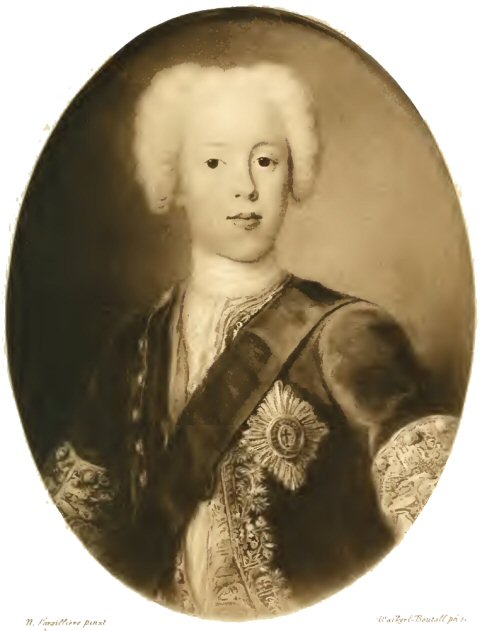
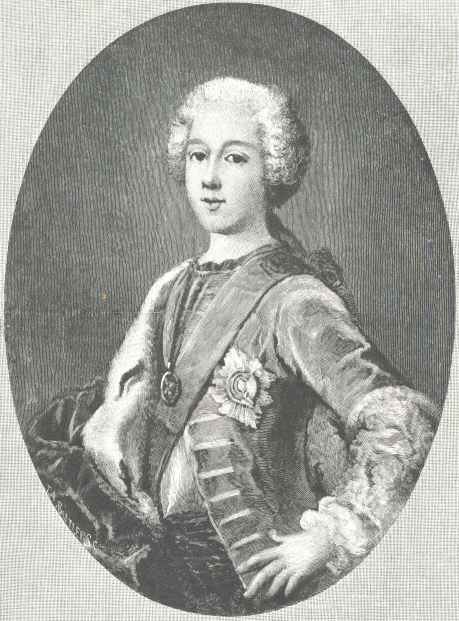
About 1743, when a number of miniatures of the Prince were
done in Italy for presentation to adherents, Charles’s
boyish mirth, as seen in these works of art, has become somewhat
petulant, if not arrogant, but he is still ‘a lad with the
bloom of a lass.’ A shade of aspiring melancholy
marks a portrait done in France, just before the expedition to
Scotland. Le Toque’s fine portrait of the Prince in
armour (1748) shows a manly and martial but rather sinister
countenance. A plaster bust, done from a life mask, if not
from Le Moine’s bust in marble (1750), was thought the best
likeness by Dr. King. This bust was openly sold in Red Lion
Square, and, when Charles visited Dr. King in September 1750, the
Doctor’s servant observed the resemblance. I have
never seen a copy of this bust, and the medal struck in 1750, an
intaglio of the same date, and a very rare profile in the
collection of the Duke of Atholl, give a similar idea of the
Prince as he was at thirty. A distinguished artist, who
outlined Charles’s profile and applied it to another of Her
present Majesty in youth, tells me that they are almost exact
counterparts.
Next we come to the angry eyes and swollen features of Ozias
Humphreys’s miniature, in the Duke of Atholl’s
collection, and in his sketch published in the ‘Lockhart
Papers’ (1776), and, finally, to the fallen weary old face
designed by Gavin Hamilton. Charles’s younger
brother, Henry, Duke of York, was a prettier boy, but it is
curious to mark the prematurely priestly and
‘Italianate’ expression of the Duke in youth, while
Charles still seems a merry lad. Of Charles in boyhood many
anecdotes are told. At the age of two or three he is said
to have been taken to see the Pope in his garden, and to have
refused the usual marks of reverence. Walton, the English
agent in Florence, reports an outbreak of ferocious temper in
1733. [17a] Though based on gossip, the
story seems to forebode the later excesses of anger.
Earlier, in 1727, the Duc de Liria, a son of Marshal Berwick,
draws a pretty picture of the child when about seven years
old:—
‘The King of England did not wish me to
leave before May 4, and I was only too happy to remain at his
feet, not merely on account of the love and respect I have borne
him all my life, but also because I was never weary of watching
the Princes, his sons. The Prince of Wales was now six and
a half, and, besides his great beauty, was remarkable for
dexterity, grace, and almost supernatural cleverness. Not
only could he read fluently, but he knew the doctrines of the
Christian faith as well as the master who had taught him.
He could ride; could fire a gun; and, more surprising still, I
have seen him take a crossbow and kill birds on the roof, and
split a rolling ball with a shaft, ten times in succession.
He speaks English, French, and Italian perfectly, and altogether
he is the most ideal Prince I have ever met in the course of my
life.
‘The Duke of York, His Majesty’s second son, is
two years old, and a prodigy of beauty and strength.’ [17b]
Gray, certainly no Jacobite, when at Rome with Horace Walpole
speaks very kindly of the two gay young Princes. He sneers
at their melancholy father, of whom Montesquieu writes,
‘ce Prince a une bonne physiononie et noble.
Il paroit triste, pieux.’ [18a] Young Charles was neither pious
nor melancholy.
Of Charles at the age of twenty, the President de Brosses (the
author of ‘Les Dieux Fétiches’) speaks as an
unconcerned observer. ‘I hear from those who know
them both thoroughly that the eldest has far higher worth, and is
much more beloved by his friends; that he has a kind heart and a
high courage; that he feels warmly for his family’s
misfortunes, and that if some day he does not retrieve them, it
will not be for want of intrepidity.’ [18b]
Charles’s gallantry when under fire as a mere boy, at
the siege of Gaeta (1734), was, indeed, greatly admired and
generally extolled. [18c] His courage
has been much more foolishly denied by his enemies than too
eagerly applauded by friends who had seen him tried by every
species of danger.
Aspersions have been thrown on Charles’s personal
bravery; it may be worth while to comment on them. The
story of Lord Elcho’s reproaching the Prince for not
heading a charge of the second line at Culloden, has unluckily
been circulated by Sir Walter Scott. On February 9, 1826,
Scott met Sir James Stuart Denham, whose father was out in the
Forty-five, and whose uncle was the Lord Elcho of that
date. Lord Elcho wrote memoirs, still unpublished, but used
by Mr. Ewald in his ‘Life of the Prince.’ Elcho
is a hostile witness: for twenty years he vainly dunned Charles
for a debt of 1,500l. According to Sir James Stuart
Denham, Elcho asked Charles to lead a final charge at Culloden,
retrieve the battle, or die sword in hand. The Prince rode
off the field, Elcho calling him ‘a damned, cowardly
Italian—.’
No such passage occurs in Elcho’s diary. He says
that, after the flight, he found Charles, in the belief that he
had been betrayed, anxious only for his Irish officers, and
determined to go to France, not to join the clans at
Ruthven. Elcho most justly censured and resolved
‘never to have anything more to do with him,’ a
broken vow! [19a] As a matter of fact, Sir Robert
Strange saw Charles vainly trying to rally the Highlanders, and
Sir Stuart Thriepland of Fingask gives the same evidence. [19b]
In his seclusion during 1750, Charles wrote a little memoir,
still unpublished, about his Highland wanderings. In this
he says that he was ‘led off the field by those about
him,’ when the clans broke at Culloden. ‘The
Prince then changed his horse, his own having been wounded by a
musket-ball in the shoulder.’ [20a]
The second-hand chatter of Hume, in his letter to Sir John
Pringle (February 13, 1773), is unworthy of serious
attention.
Helvetius told Hume that his house at Paris had sheltered the
Prince in the years following his expulsion from France, in
1748. He called Charles ‘the most unworthy of
mortals, insomuch that I have been assured, when he went down to
Nantz to embark on his expedition to Scotland, he took fright and
refused to go on board; and his attendants, thinking the matter
gone too far, and that they would be affronted for his cowardice,
carried him in the night time into the ship, pieds et mains
liés.’
The sceptical Hume accepts this absurd statement without even
asking, or at least without giving, the name of Helvetius’s
informant. The adventurer who insisted on going forward
when, at his first landing in Scotland, even Sir Thomas Sheridan,
with all the chiefs present, advised retreat, cannot conceivably
have been the poltroon of Hume’s myth. Even
Hume’s correspondent, Sir John Pringle, was manifestly
staggered by the anecdote, and tells Hume that another of his
fables is denied by the very witness to whom Hume appealed. [20b] Hume had cited Lord Holdernesse
for the story that Charles’s presence in London in 1753
(1750 seems to be meant) was known at the time to George
II. Lord Holdernesse declared that there was nothing in the
tale given by Hume on his authority! That Charles did not
join the rallied clans at Ruthven after Culloden was the result
of various misleading circumstances, not of cowardice. Even
after 1746 he constantly carried his life in his hand, not only
in expeditions to England (and probably to Scotland and Ireland),
but in peril from the daggers of assassins, as will later be
shown.
High-spirited and daring, Charles was also hardy. In
Italy he practised walking without stockings, to inure his feet
to long marches: he was devoted to boar-hunting, shooting, and
golf. [21a] He had no touch of Italian
effeminacy, otherwise he could never have survived his Highland
distresses. In travelling he was swift, and incapable of
fatigue. ‘He has,’ said early observer,
‘the habit of keeping a secret.’ Many
secrets, indeed, he kept so well that history is still baffled by
them, as diplomatists were perplexed between 1749 and 1766. [21b]
We may discount Murray of Broughton’s eulogies
Charles’s Greek, Latin, and Hebrew, and his knowledge of
history and philosophy, though backed by the Jesuit Cordara. [21c] Charles’s education had
been interrupted by quarrels between his parents about Catholic
or Protestant tutors. His cousin and governor, Sir Thomas
Sheridan (a descendant of James II.), certainly did not teach him
to spell; his style in French and English is often obscure, and,
when it is clear, we know not whether he was not inspired by some
more literary adviser. In matters of taste he was fond of
music and archæology, and greatly addicted to books.
De Brosses, however, considered him ‘less cultivated than
Princes should be at his age,’ and d’Argenson says
that his knowledge was scanty and that he had little
conversation. A few of his books, the morocco tooled with
the Prince of Wales’s feathers, remain, but not enough to
tell us much about his literary tastes. On these, however,
we shall give ample information. In Paris, after Culloden,
he bought Macchiavelli’s works, probably in search of
practical hints on state-craft. In spite of a proclamation
by Charles, which Montesquieu applauded, he certainly had no
claim to a seat in the French Academy, which Montesquieu
playfully offered to secure for him.
In brief, Charles was a spirited, eager boy, very capable of
patience, intensely secretive, and, as he showed in
1745–1746, endowed with a really extraordinary clemency,
and in one regard, where his enemies were concerned, with a sense
of honour most unusual in his generation. His care for the
wounded, after Prestonpans, is acknowledged by the timid and
Whiggish Home, in his ‘History of the Rebellion,’ and
is very warmly and gracefully expressed in a letter to his
father, written at Holyrood.’ [23a] He could not
be induced to punish miscreants who attempted his life and
snapped pistols in his face. He could hardly be compelled
to retort to the English offer of 30,000l. for his head by
issuing a similar proclamation about ‘the
Elector.’ ‘I smiled and created it’ (the
proclamation of a reward of 30,000l. for his head)
‘with the disdain it deserved, upon which they’ (the
Highlanders) ‘flew into a violent rage, and insisted upon
my doing the same by him.’ This occurs in a letter
from Charles to James, September 10, 1745, dated from
Perth. A copy is found among Bishop Forbes’s
papers. Here Charles deplores the cruelties practised under
Charles II. and James II., and the consequent estrangement of the
Duke of Argyll. [23b]
In brief, the contest between Charles and Cumberland was that
of a civilised and chivalrous commander against a foe as
treacherous and cruel as a Huron or an Iroquois. On this
point there is no possibility of doubt. The English
Government offered a vast reward for Charles, dead or
alive. The soldiers were told significantly, by Cumberland,
that he did not want prisoners. On the continent assassins
lurked for the Prince, and ambassadors urged the use of personal
violence. Meanwhile the Prince absolutely forbade even a
legitimate armed attack directed mainly against his enemy, then
red-handed from the murder of the wounded.
With this loyalty to his foes, with this clemency to enemies
in his power, Charles certainly combined a royal grace, and could
do handsome things handsomely. Thus, in 1745, some of the
tenants of Oliphant of Gask would not don the white cockade at
his command. He therefore ‘laid an arrest or
inhibition on their corn-fields.’ Charles, finding
the grain hanging dead-ripe, as he marched through Perthshire,
inquired the cause, and when he had learned it, broke the
‘taboo’ by cutting some ears with his sword, or by
gathering them and giving them to his horse, saving that the
farmers might now, by his authority, follow his example and break
the inhibition. [24a]
Making every allowance for an enthusiasm of loyalty on the
part of the narrators in Bishop Forbes’s MS. ‘Lyon in
Mourning’ (partly published by Robert Chambers in
‘Jacobite Memoirs’ [24b]), it is certain
that the courage, endurance, and gay content of the Prince in his
Highland wanderings deserve the high praise given by
Smollett. Thus, in many ways we see the elements of a
distinguished and attractive character in Charles. His
enemies, like the renegade Dr. King, of St. Mary’s Hall
(ob. 1763), in his posthumous ‘Anecdotes,’ accused
the Prince of avarice. He would borrow money from a lady,
says King, while he had plenty of his own; he neglected those who
had ruined themselves for his sake. Henry Goring accused
the Prince of shabbiness to his face, but assuredly he who
insisted on laying down money on the rocks of a deserted
fishers’ islet to pay for some dry fish eaten there by
himself and his companions—he who gave liberally to gentle
and simple out of the treasure buried near Loch Arkaig, who
refused a French pension for himself, and asked favours only for
his friends—afforded singular proofs of Dr. King’s
charge of selfish greed. The fault grew on him later.
After breaking with the French Court in 1748, Charles had little
or nothing of his own to give away. His Sobieski jewels he
had pawned for the expenses of the war, having no heart to wear
them, he said, ‘on this side of the water.’ He
was often in actual need, though we may not accept
d’Argenson’s story of how he was once seen selling
his pistols to a gun-maker. [25a] If ever he
was a miser, that vice fixed itself upon him in his utter moral
ruin.
Were there, then, no signs in his early life of the faults
which grew so rapidly when hope was lost? There were such
signs. As early as 1742, James had observed in Charles a
slight inclination to wine and gaiety, and believed that his
companions, especially Francis Strickland, [25b] were setting him against his younger
brother, the Duke of York, who had neither the health nor the
disposition to be a roysterer. [26a]
Again, on February 3, 1747, James recurs, in a long letter, to
what passed in 1742, ‘because that is the foundation, and I
may say the key, of all that has followed.’ Now in
1742 Murray of Broughton paid his first visit to Rome, and was
fascinated by Charles. This unhappy man, afterwards the
Judas of the cause, was unscrupulous in private life in matters
of which it is needless to speak more fully. He was, or
gave himself the air of being, a very stout Protestant.
James employed him, but probably liked him little. It is to
be gathered, from James’s letter of February 3, 1747, that
he suspected Charles of listening to advice, probably from
Murray, about his changing his religion. ‘You cannot
forget how you were prevailed upon to speak to your
brother’ (the devout Duke of York) ‘on very nice and
delicate subjects, and that without saying the least thing to me,
though we lived in the same house . . . You were then much
younger than you are now, and therefore could be more easily led
by specious arguments and pretences. . . . It will, to be
sure, have been represented to you that our religion is a great
prejudice to our interest, but that it may in some measure be
remedied by a certain free way of thinking and acting.’ [26b]
In 1749 James made a disagreeable discovery, which he
communicated to Lord Lismore. A cassette, or coffer,
belonging to Charles, had, apparently, been left in Paris, and,
after many adventures on the road, was brought to Rome by the
French ambassador. James opened it, and found that it
contained letters ‘from myself and the Queen.’
But it also offered proof that the Prince had carried on a secret
correspondence with England, long before he left Rome in
1744. Probably his adherents wished James to resign in his
favour. [27a]
As to religion, Dr. King admits that Charles was no bigot, and
d’Argenson contrasted his disengaged way of treating
theology with the exaggerated devoutness of the Duke of
York. Even during the march into England, Lord Elcho told
an inquirer that the Prince’s religion ‘was still to
seek.’ Assuredly he would never make shipwreck on the
Stuart fidelity to Catholicism. All this was deeply
distressing to the pious James, and all this dated from 1742,
that is, from the time of Murray of Broughton’s visit to
Rome. Indifference to religious strictness was, even then,
accompanied by a love of wine, in some slight degree.
Already, too, a little rift in the friendship of the princely
brothers was apparent; there were secrets between them which
Henry must have communicated to James.
As for the fatal vice of drink, it is hinted at on April 15,
1747, by an anonymous Paris correspondent of Lord
Dunbar’s. Charles had about him ‘an Irish
cordelier,’ one Kelly, whom he employed as a
secretary. Kelly is accused of talking contemptuously about
James. ‘It were to be wished that His Royal Highness
would forbid that friar his apartment, because he passes for a
notorious drunkard . . . and His Royal Highness’s
character, in point of sobriety, has been a little blemished on
this friar’s account.’ [28a]
The cold, hunger, and fatigue of the Highland distresses had,
no doubt, often prompted recourse to the national dram of
whiskey, and Charles would put a bottle of brandy to his lips
‘without ceremony,’ says Bishop Forbes. The
Prince on one occasion is said to have drunk the champion
‘bowlsman’ of the Islands under the table. [28b]
What had been a jovial feast became a custom, a consolation,
and a curse, while there is reason, as has been seen, to suppose
that Charles, quite early in life, showed promise of
intemperance. In happier circumstances these early tastes
might never have been developed into a positive disease.
James himself, in youth, had not been a pattern of strict
sobriety, but later middle age found him almost ascetic.
We have sketched a character endowed with many fine qualities,
and capable of winning devoted affection. We now examine
the rapid decline of a nature originally noble.
Returned from Scotland in 1746, Prince Charles brought with
him a head full of indigested romance, a heart rich in chimerical
expectations. He now prided himself on being a plain hardy
mountaineer. He took a line of his own; he concealed his
measures from the spy-ridden Court of his father in Rome; he
quarrelled with his brother, the Duke of York, when the Duke
accepted a cardinal’s hat. He broke violently with
the French king, who would not aid him. He sulked at
Avignon. He sought Spanish help, which was refused.
He again became the centre of fashion and of disaffection in
Paris. Ladies travelled from England merely to see him in
his box at the theatre. Princesses and duchesses
‘pulled caps for him.’ Naturally cold (as his
enemies averred) where women were concerned, he was now
beleaguered, besieged, taken by storm by the fair. He kept
up the habit of drinking which had been noted in him even before
his expedition to Scotland. He allowed his old boyish
scepticism (caused by a mixed Protestant and Catholic education)
to take the form of studied religious indifference. After
defying and being expelled by Louis XV., he adopted (what has
never, perhaps, been observed) the wild advice of
d’Argenson (‘La Bête,’ and Louis’s
ex-minister of foreign affairs), he betook himself to a life of
darkling adventures, to a hidden and homeless exile. In
many of his journeys he found Pickle in his path, and Pickle
finally made his labours vain. The real source of all this
imbroglio, in addition to an exasperated daring and a strangely
secretive temperament, was a deep, well-grounded mistrust of the
people employed by his father, the old ‘King over the
water.’ Whatever James knew was known in London by
next mail. Charles was aware of this, and was not aware
that his own actions were almost as successfully spied upon and
reported. He therefore concealed his plans and movements
from James, and even—till Pickle came on the
scene—from Europe and from England. The result of his
reticence was an irremediable rupture between ‘the King and
the Prince of Wales—over the water,’ an incurable
split in the Jacobite camp.
The general outline here sketched must now be filled up in
detail. The origo mali was the divisions among the
Jacobites. Ever since 1715 these had existed and
multiplied. Mar was thought to be a traitor.
Atterbury, in exile, suspected O’Brien (Lord
Lismore). The Earl Marischal and Kelly [30a] were set against James’s
ministers, Lord Sempil, Lord Lismore, and Balhaldie, the exiled
chief of the Macgregors. Lord Dunbar (Murray, brother of
Lord Mansfield) was in James’s disgrace at Avignon.
Sempil, Balhaldie, Lismore were ‘the King’s
party,’ opposed to Marischal, Kelly, Sheridan, Lally
Tollendal, ‘the Prince’s party.’ Each
sect inveighed against the other in unmeasured terms of
reproach. This division widened when Charles was in France,
just before the expedition to Scotland.
One of James’s agents in Paris, Lord Sempil, writes to
him on July 5, 1745, with warnings against the Prince’s
counsellors, especially Sir Thomas Sheridan (Charles’s
governor, and left-handed cousin) and Kelly. They, with
Lally Tollendal and others, arranged the descent on Scotland
without the knowledge of James or Sempil, whom Charles and his
party bitterly distrusted, as they also distrusted Lord Lismore
(O’Brien), James’s other agent. While the
Prince was in Scotland (1745–1746), even before
Prestonpans, the Jacobite affairs in France were perplexed by the
action of Lismore, Sempil, and Balhaldie, acting for James, while
the old Earl Marischal (who had been in the rising of 1715, and
the Glenshiel affair of 1719) acted for the Prince. With
the Earl Marischal was, for some time, Lord Clancarty, of whom
Sempil speaks as ‘a very brave and worthy man.’ [31a] On the other hand, Oliver
Macallester, the spy, describes Clancarty, with whom he lived, as
a slovenly, drunken, blaspheming rogue, one of whose eyes General
Braddock had knocked out with a bottle in a tavern brawl!
Clancarty gave himself forth as a representative of the English
Jacobites, but d’Argenson, in his
‘Mémoires,’ says he could produce no names of
men of rank in the party except his own. D’Argenson
was pestered by women, priests, and ragged Irish
adventurers. In September 1745, the Earl Marischal and
Clancarty visited d’Argenson, then foreign minister of
Louis XV. in the King’s camp in Flanders. They asked
for aid, and the scene, as described by the spy Macallester, on
Clancarty’s information, was curious.
D’Argenson taunted the Lord Marischal with not being at
Charles’s side in Scotland. To the slovenly Clancarty
he said, ‘Sir, your wig is ill-combed. Would you like
to see my perruquier? He manages wigs very
well.’ Clancarty, who wore ‘an ordinary black
tie-wig,’ jumped up, saying in English, ‘Damn the
fellow! He is making his diversion of us.’ [32a] The Lord Marischal was already
on bad personal terms with Charles. Clancarty was a
ruffian, d’Argenson was the adviser who suggested
Charles’s hidden and fugitive life after 1748. The
singular behaviour of the Earl Marischal in 1751–1754 will
afterwards be illustrated by the letters of Pickle, who drew much
of his information from the unsuspicious old ambassador of
Frederick the Great to the Court of Versailles. It is plain
that the Duke of Ormonde was right when he said that ‘too
many people are meddling in your Majesty’s affairs with the
French Court at this juncture’ (November 15, 1745).
The Duke of York, Charles’s brother, was on the seaboard of
France in autumn 1745. At Arras he met the gallant
Chevalier Wogan, who had rescued his mother from prison at
Innspruck. [32b] Clancarty, Lord Marischal, and
Lally Tollendal were pressing for a French expedition to start in
aid of Charles. Sempil, Balhaldie, Lismore, were intriguing
and interfering. Voltaire wrote a proclamation for Charles
to issue. An expedition was arranged, troops and ships were
gathered at Boulogne. Swedes were to join from
Gothenburg. On Christmas Eve, 1745, nothing was ready, and
the secret leaked out. A million was sent to Scotland; the
money arrived too late; we shall hear more of it. [33a] The Duke of York, though he
fought well at Antwerp, was kneeling in every shrine, and was in
church when the news of Culloden was brought to him. This
information he gave, in the present century, to one of the Stair
family. [33b] The rivalries and enmities went
on increasing and multiplying into cross-divisions after Charles
made his escape to France in August 1746. He was filled
with distrust of his father’s advisers; his own were
disliked by James. The correspondence of Horace Mann, and
of Walton, an English agent in Florence, shows that England
received all intelligence sent to James from Paris, and knew all
that passed in James’s cabinet in Rome. [33c] The Abbé Grant was
suspected of being the spy.
Among so many worse than doubtful friends, Charles, after
1746, took his own course; even his father knew little or nothing
of his movements. Between his departure from Avignon
(February 1749) and the accession of Pickle to the Hanoverian
side (Autumn 1749 or 1750), Charles baffled every Foreign Office
in Europe. Indeed, Pickle was of little service till 1751
or 1752. Curious light on Charles’s character, and on
the entangled quarrels of the Jacobites, is cast by
d’Argenson’s ‘Mémoires.’ In
Spring, 1747, the Duke of York disappeared from Paris, almost as
cleverly as Charles himself could have done.
D’Argenson thus describes his manœuvre.
‘He fled from Paris with circumstances of distinguished
treachery’ (insigne fourberie) towards his brother,
the Prince. He invited Charles to supper; his house was
brilliantly lighted up; all his servants were in readiness; but
he had made his escape by five o’clock in the
afternoon, aided by Cardinal Tencin. His Governor, the
Chevalier Graeme, was not in the secret. The Prince waited
for him till midnight, and was in a mortal anxiety. He
believed that the English attempts to kidnap or assassinate
himself had been directed against his brother. At last,
after three days, he received a letter from the Duke of York,
‘explaining his fatal design’ to accept a
cardinal’s hat. ‘Prince Charles is determined
never to return to Rome, but rather to take refuge in some
hole in a rock.’
Charles, in fact, saw that, if he was to succeed in England,
he could not have too little connection with Rome.
D’Argenson describes his brother Henry as ‘Italian,
superstitious, a rogue, avaricious, fond of ease, and jealous of
the Prince.’ Cardinal Tencin, he says, and Lord and
Lady Lismore, have been bribed by England to wheedle Henry into
the cardinalate, ‘which England desires more than anything
in the world.’ Charles expressed the same opinion in
an epigram. Lady Lismore, for a short time believed to be
the mistress of Louis XV., was deeply suspected. Whatever
may be the truth of these charges, M. de Puysieux, an enemy of
Charles, succeeded at the Foreign Office to d’Argenson, who
had a queer sentimental liking for the Prince. Cardinal
Tencin was insulted, and was hostile; the Lismores were
absolutely estranged, if not treacherous; there was a quarrel
between James and Henry in Rome, and Charles, in Paris. [35a] Such was the state of affairs at
the end of 1747, while Pickle was still a prisoner in the Tower
of London, engaged, he tells us, in acts of charity towards his
fellow-captives!
Meanwhile Charles’s private conduct demands a
moment’s attention. Madame de Pompadour was all
powerful at Court. [35b] This was,
therefore, a favourable moment for Charles, in a chivalrous
affection for the injured French Queen (his dead mother’s
kinswoman), to insult the reigning favourite. Madame de
Pompadour sent him billets on that thick smooth vellum
paper of hers, sealed with the arms of France. The Prince
tossed them into the fire and made no answer; it is Pickle who
gives us this information. Maria Theresa later stooped to
call Madame de Pompadour her cousin. Charles was prouder or
less politic; afterwards he stooped like Maria Theresa.
For his part, says d’Argenson, the Prince ‘now
amused himself with love affairs. Madame de
Guémené almost ravished him by force; they have
quarrelled, after a ridiculous scene; he is living now with the
Princesse de Talmond. He is full of fury, and wishes in
everything to imitate Charles XII. of Sweden and stand a siege in
his house like Charles XII. at Bender.’ This was in
anticipation of arrest, after the Treaty of Aix-la-Chapelle, in
which his expulsion from France was one of the conditions.
This Princesse de Talmond, as we shall see, was the unworthy
Flora Macdonald of Charles in his later wanderings, his
protectress, and, unlike Flora, his mistress. She was not
young; Madame d’Aiguillon calls her vieille femme in
a curious play, ‘La Prison du Prince Charles Edouard
Stuart,’ written by d’Argenson in imitation of
Shakespeare. [36a] The Princesse, née
Marie Jablonowski, a cousin of the Queen of France and of
Charles, married Anne Charles Prince de Talmond, of the great
house of La Trimouille, in 1730. She must have been nearly
forty in 1749, and some ten years older than her lover.
We shall later, when Charles is concealed by the Princesse de
Talmond, present the reader with her ‘portrait’ by
the mordant pen of Madame du Deffand. Here Voltaire’s
rhymed portrait may be cited:
Les dieux, en la donnant naissance
Aux lieux par la Saxe envahis,
Lui donnèrent pour récompense
Le goût qu’on ne trouve qu’en France,
Et l’esprit de tous les pays.
The Princesse, who frequented the Philosophes, appears
to have encouraged Charles in free thinking and ostentatious
indifference in religion.
‘He is a handsome Prince, and I should love
him as much as my wife does,’ says poor M. de Talmond, in
d’Argenson’s play, ‘but why is he not saintly,
and ruled by the Congrégation de Saint Ignace, like his
father? It is Madame de Talmond who preaches to him
independence and incredulity. She is bringing the curse of
God upon me. How old will she be before the conversion for
which I pray daily to Saint François Xavier?’
Such was Madame de Talmond, an old mistress of a young man,
flighty, philosophical, and sharp of tongue.
On July 18, 1748, Charles communicated to Louis XV. his
protest against the article of the Peace of Aix-la-Chapelle which
drove him out of every secular state in Europe. Louis broke
a solemn treaty by assenting to this article. Charles
published his protest and sent it to Montesquieu. He
complained that Montesquieu had not given him the new edition of
his book on the Romans. ‘La confiance devroit
être mieux établi entre les auteurs:
j’espère que ma façon de penser pour vous
m’attirera la continuation de votre bonne volonté
pour moi.’ [37a] Montesquieu praised
Charles’s ‘simplicity, nobility, and
eloquence’: ‘comme vous le dites très bien,
vous estes un auteur.’ ‘Were you not so great a
Prince, the Duchesse de Guillon’ (d’Aiguillon)
‘and I would secure you a place in the Academy.’
The Duchesse d’Aiguillon, who later watched by
Montesquieu’s death-bed, was a friend of Charles. She
and Madame de Talmond literally ‘pull caps’ for him
in d’Argenson’s play. But she was in favour of
his going to Fribourg with a pension after the Peace: Madame de
Talmond encouraged resistance. Louis’s minister, M.
de Cousteille, applied to Fribourg for an asylum for Charles on
June 24, 1748. On September 8, Burnaby wrote, for England,
a long remonstrance to the ‘Laudable States of
Fribourg,’ calling Charles ‘this young
Italian!’ The States, in five lines, rebuked
Burnaby’s impertinence, as ‘unconfined in its
expressions and so unsuitable to a Sovereign State that we did
not judge it proper to answer it.’ [38a]
To Fribourg Charles would not go. He braved the French
Court in every way. He even insisted on a goldsmith’s
preferring his order for a great service of plate to the
King’s, and, having obtained the plate, he feasted the
Princesse de Talmond, his friend and cousin, the Duc de Bouillon,
and a crowd of other distinguished people. [38b] In his demeanour Charles
resolutely affronted the French Ministers. There were
terrible scenes with Madame de Talmond, especially when Charles
was forbidden the house by her husband. Charles was led
away from her closed door by Bulkeley, the brother-in-law of
Marshal Berwick, and a friend of Montesquieu’s. [39a] Thus the violence which
afterwards interrupted and ended Charles’s liaison
with Madame de Talmond had already declared itself. One
day, according to d’Argenson, the lady said, ‘You
want to give me the second volume in your romance of
compromising Madame de Montbazon [his cousin] with your two
pistol-shots.’ No more is known of this
adventure. But Charles was popular both in Court and town:
his resistance to expulsion was applauded. De Gèvres
was sent by the King to entreat Charles to leave France;
‘he received de Gèvres gallantly, his hand on his
sword-hilt.’ D’Argenson saw him at the opera on
December 3, 1748, ‘fort gai et fort beau, admiré de
tout le public.’
On December 10, 1748, Charles was arrested at the door of the
opera house, bound hand and foot, searched, and dragged to
Vincennes. The deplorable scene is too familiar for
repetition. One point has escaped notice. Charles
(according to d’Argenson) had told de Gèvres that he
would die by his own hand, if arrested. Two pistols were
found on him; he had always carried them since his Scottish
expedition. But a pair of compasses was also
found. Now it was with a pair of compasses that his friend,
Lally Tollendal, long afterwards attempted to commit suicide in
prison. The pistols were carried in fear of assassination,
but what does a man want with a pair of compasses at the opera?
[40a]
After some days of detention at Vincennes, Charles was
released, was conducted out of French territory, and made his way
to Avignon, where he resided during January and February
1749. He had gained the sympathy of the mob, both in Paris
and in London. Some of the French Court, including the
Dauphin, were eager in his cause. Songs and poems were
written against Louis XV, D’Argenson, as we know, being out
of office, composed a play on Charles’s martyrdom. So
much contempt for Louis was excited, that a nail was knocked into
the coffin of French royalty. The King, at the dictation of
England, had arrested, bound, imprisoned, and expelled his
kinsman, his guest, and (by the Treaty of Fontainebleau) his
ally.
Applause and pity from the fickle and forgetful the Prince had
won, but his condition was now desperate. Refusing to
accept a pension from France, he was poor; his jewels he had
pawned for the Scottish expedition. He had disobeyed his
father’s commands and mortally offended Louis by refusing
to leave France. His adherents in Paris (as their letters
to Rome prove) were in despair. His party, as has been
shown, was broken up into hostile camps. Lochiel was
dead. Lord George Murray had been insulted and
estranged. The Earl Marischal had declined Charles’s
invitation to manage his affairs (1747). Elcho was a
persistent and infuriated dun. Clancarty was reviling
Charles, James, Louis, England, and the world at large.
Madame de Pompadour, Cardinal Tencin, and de Puysieux were all
hostile. The English Jacobites, though loyal, were
timid. Europe was hermetically sealed against the
Prince. Refuge in Fribourg, where the English threatened
the town, Charles had refused. Not a single shelter was
open to him, for England’s policy was to drive him into the
dominions of the Pope, where he would be distant and
despised. Of advisers he had only such attached friends as
Henry Goring, Bulkeley, Harrington, or such distrusted boon
companions as Kelly—against whom the English Jacobites set
all wheels in motion. Charles’s refuge at Avignon
even was menaced by English threats directed at the Pope.
The Prince tried to amuse himself; he went to dances, he
introduced boxing matches, [41a] just as years
before he had brought golf into Italy. But his position was
untenable, and he disappeared.
From the gossip of d’Argenson we have learned that
Charles was no longer the same man as the gallant leader of the
race to Derby, or the gay and resourceful young Ascanius who won
the hearts of the Highlanders by his cheerful courage and
contented endurance. He was now embittered by defeat; by
suspicions of treachery which the Irish about him kindled and
fanned, by the broken promises of Louis XV., by the indifference
of Spain. He had become ‘a wild man,’ as his
father’s secretary, Edgar, calls him—‘Our dear
wild man.’ He spelled the name ‘L’ome
sauvage.’ He was, in brief, a desperate, a soured,
and a homeless outcast. His chief French friends were
ladies—Madame de Vassé, Madame de Talmond, and
others. Montesquieu, living in their society, and sending
wine from his estate to the Jacobite Lord Elibank; rejoicing,
too, in an Irish Jacobite housekeeper, ‘Mlle. Betti,’
was well disposed, like Voltaire, in an indifferent well-bred
way. Most of these people were, later, protecting and
patronising the Prince when concealed from the view of Europe,
but theirs was a vague and futile alliance. Charles and his
case were desperate.
In this mood, and in this situation at Avignon, he carried
into practice the counsel which d’Argenson had elaborated
in a written memoir. ‘I gave them’ (Charles and
Henry) ‘the best possible advice,’ says La
Bête. ‘My “Mémoire” I
entrusted to O’Brien at Antwerp. Therein I suggested
that the two princes should never return to Italy, but that
for some years they should lead a hidden and wandering life
between France and Spain. Charles might be given a
pension and the vicariat of Navarre. This should only be
allowed to slip out by degrees, while England would grow
accustomed to the notion that they were not in Rome, and
would be reduced to mere doubts as to their place of
residence. Now they would be in Spain, now in France,
finally in some town of Navarre, where their authority would, by
slow degrees, be admitted. Peace once firmly established,
it would not be broken over this question. They would be in
a Huguenot country, and able to pass suddenly into Great
Britain.’ [43]
This was d’Argenson’s advice before Henry fled
Rome to be made a cardinal, and before the treaty of
Aix-la-Chapelle, closing Europe against Charles, was
concluded. The object of d’Argenson is plain; he
wished to keep Charles out of the Pope’s domains, as
England wanted to drive the Prince into the centre of
‘Popery.’ If he resided in Rome, Protestant
England would always suspect Charles; moreover, he would be
remote from the scene of action. To the Pope’s
domains, therefore, Charles would not go. But the scheme of
skulking in France, Spain, and Navarre had ceased to be
possible. He, therefore, adopted ‘the fugitive and
hidden life’ recommended by d’Argenson; he secretly
withdrew from Avignon, and for many months his places of
residence were unknown.
‘Charles,’ says Voltaire, ‘hid himself from
the whole world.’ We propose to reveal his
hiding-places.


