“Who are you?” demanded the man
with the lantern, “and what are you
doing here at this time o’ night?”
Dannie was too much frightened to answer at
once, and he began to back away.
“Stand still!” commanded the man. “No
one’s going to hurt you. I simply want to know
who you are and where you are going.”
“I—I’m going home,” faltered Dannie.
A voice came from out the shadows up the road.
“What’s the matter down there, John?”
“I don’t know,” replied John. “Here’s a
boy with a hatchet, alone. Looks suspicious,
very.”
“Tell him to stay where he is till I get there.
Go ahead now and give me a point to turn on.”
“You hear him?” said John to Dannie. “You
stand right there by that rock, and don’t you move
an inch till he comes up.”
The man with the lantern had an engineer’s
signal pole. He was followed by an axeman with
stakes. They went ahead some fifty feet, and,
with pole and lantern, under the direction of the
transitman back in the darkness, located a point
and drove a stake.
It did not take Dannie long to comprehend that
this was another surveying party, making a night
survey through the gap. It was a strange thing
to do—very strange. He could not understand
the purpose of it at all. Did these people know
of the afternoon survey? Did they know of his
night work of destruction? And if they did,
would they make him suffer for it? The situation
was as uncomfortable for Dannie as it was
mysterious. But he had scant time to revolve
these questions in his mind before the transitman
and his attendant came hurrying down to where
the boy was standing.
A tall, fine-looking fellow this transitman was;
but the moonlight, or possibly excitement or
fatigue, threw a pallor across his face, and in his
penetrating eyes there was a look of anxiety or
trouble.
“How is this, my boy?” he said. “What are
you doing here? Tell me quickly. I haven’t
time to parley.”
But Dannie had no mind to give him the
desired information.
He had grown suddenly fearful of the consequences
of his deed of destruction. He was not
untruthful about it, though.
“I had rather not tell you, sir,” he replied
frankly.
“Very well, I shall not oblige you to,” said
the man. “But, under these circumstances, I
will have to detain you. Morris,” addressing the
head chainman, “keep this boy with you. Don’t
let him give any signals, and don’t let him escape.
We’ll dispose of him later. Too much depends
on this night’s work to take any risks with
strangers. Come along, James!”
He shouldered his transit, and, followed by his
attendant, started rapidly ahead. Dannie, under
the eye of the head chainman, walked on down
the road. The axemen had already gone forward
to clear the way, and the rodman and leveller
were following close behind.
It was a unique task, this location of a railroad
route in the night-time. But, aided by the bright
moonlight and the glare of lamps for signals, it
became not only possible of performance, but
perfectly practicable.
Slowly the line of stakes stretched out, following,
with almost minute exactness, the route
surveyed in the afternoon.
Indeed, there was room in the gap but for one
railroad, and the second survey had, of necessity,
to take practically the same course as the
first.
As Dannie walked along in the company of
the head chainman, it became apparent to him
that these men did not know of the survey made
by the corps of engineers in the afternoon; much
less did they know of his work of obliteration.
The serious results of that work began also to
weigh more deeply on him. A hundred questions
arose in his mind. If the line of stakes set
in the afternoon were still standing, would these
men be here setting theirs to-night? And when
they learned that a prior survey had been made,
what would they do? And if any one should
ever know that he, Dannie Pickett, had destroyed
that line of stakes, what would happen then to
him? And of what avail was it, anyway, to wipe
out the marks of one location only to have the
stakes of another spring up in their places scarcely
an hour later? But with all his questioning he
could decide upon but one thing, and that was
that under any circumstances he must keep his
own counsel and reveal nothing.
At last the end of the gap was reached, but the
railroad route was located for yet another thousand
feet down the north slope of the hill.
“There is plenty of room here,” said the
transitman, finally; “there is no object in going
farther to-night. We’re safely through the gap.
We’re first through the gap, and the gap route is
ours by right of prior location.”
Dannie recalled the exultant declaration, made
under similar circumstances, by the engineer who
conducted the afternoon survey. Surely the plot
was thickening.
“You might step down the road a bit, John,”
added the transitman, “while we are getting the
things together here, and see if you can find any
trace of the D. V. and E. people. Nicholson
should have ended his survey somewhere near
here last evening if he had good luck.”
Ten minutes later John returned and reported
that he had found the D. V. and E. stakes
about three hundred feet farther down the road,
where the party had evidently stopped for the
night.
The transitman laughed softly.
“I should like to be behind a tree or a rock,”
he said, “and see Nicholson when he comes here
after daylight to continue his survey and finds his
proposed gap route already taken.”
Ever more deeply as he listened, Dannie
appreciated the difficulties in which he had involved
the railroad companies, and the dangers
into which he himself had plunged. One thing
only he was sure of, and that was that his mouth
must remain closed.
When everything was ready they all started
back, at a good pace, up the hill and into the glen.
“Here, my boy,” said the transitman, “come
with me. I want to talk with you.”
Dannie fell back and walked with him. They
were the last two in the party.
“There is no need of our being severe with
you any longer,” continued the man. “Our task
is accomplished, our route is located, no one can
interfere with us now. But you understand it
was necessary, in order to carry out our scheme
successfully, that we shouldn’t be disturbed until
after we were through the gap. We couldn’t
run the risk of having you go back up or down
the road and rouse the country, or the other
corps of engineers, or even the owner of this
property. So we had to take you along with us.
I am sorry to have caused you any inconvenience
or anxiety, and I am sure I beg your pardon if
I have done so; but really, you see, we couldn’t
help it.”
He had a very musical voice and winning
manner, this big engineer, now that the stress of
his work was off his mind; and Dannie felt at
once the strange attraction of his presence.
“Oh! it don’t matter very much,” he replied,
“so long as I get home before daylight. They—they
don’t know I’m out.”
As he spoke he glanced back over his shoulder
toward the eastern sky, already paling perceptibly
at the horizon.
“Do you live far from here?” inquired the
man.
“Not very far; just up the road a ways.”
“At what house? I used to be somewhat
acquainted about here years ago. Maybe I know
your people.”
“Why—why—well, if you please, I’d rather
not tell.”
“You needn’t. It’s none of my business anyway.
But let me ask you just one question. Do
you know Abner Pickett?”
“Yes, sir, I do.”
“Does he still own this gap?”
“Yes, sir, he does.”
“Do you know—is he well?”
“Yes, sir, I believe so. I saw him yesterday;
he went up to Port Lenox.”
“Thank you, my boy, thank you. Do you
happen to know whether he objects to having a
railroad in the gap?”
“I think he does. I heard him say last night
that—that—”
“Well?”
“Well, I don’t think he wants a railroad
across his property. I think he’d like to see all
the railroad stakes pulled out.”
“I’m sorry.”
After that, for some minutes, there was silence.
The man seemed to be in deep thought, and
Dannie pondered long over a question he desired
to ask. At last he found courage to ask it.
“Is it wrong—is it against the law to pull out
railroad stakes?”
“Well, I think the court would deal pretty
severely with a person convicted of pulling out or
destroying stakes set by an engineer.”
“Would such a person have to go to jail?”
“I should think it very likely. Why do you
ask?”
“Oh! I knew a fellow once who—who—started
to pull some out.”
“It’s a good thing he didn’t get any farther
with it. A county jail is not a pleasant place in
which to spend one’s time.”
Dannie knew that. He had visited the jail
once, with his grandfather, and had seen the prisoners
in their little iron-barred cells, and had
thought how dreadful it must be to be locked up
there, especially in the night-time.
But there was one hope still left to him.
“Suppose,” he suggested, “suppose the man
who pulled out the stakes was the one who
owned the land?”
“That wouldn’t help it much. A railroad has
a right to locate its route through any man’s land.”
“But suppose they drove their stakes in his
graveyard?”
The man stopped short and looked his questioner
in the eyes. But a cloud had come up and
covered the face of the moon, and the shadow of
it made the boy’s features indistinct. Yet these
were strange questions for a lad of his size to be
asking.
“I don’t think,” replied the man, as he started
on, “I don’t think that a railroad company would
have a right to locate its route through a graveyard,
and if it did—well, if it was my graveyard,
I believe I would pull up the stakes set in it and
throw them into the brook.”
“Thank you! Oh, thank you! That’s just
what—what a fellow did once that I knew.”
“Yes?”
“Yes, he—he—” But in the midst of his
stammering a new thought came to him. “You
ran your line through a graveyard, didn’t you?”
“Do you mean Abner Pickett’s graveyard?”
“Yes.”
“No; I went around it. I followed my tangent
to the south side of the brook opposite the
graveyard,—there’s a bit of shelving beach there
which gave room for the location,—and then I
put in a reverse curve and came down on this side
again, just at the entrance to the gap. Here, I’ll
show you how I did it. Come on!”
The rest of the party, walking more rapidly,
were far ahead. The engineer quickened his
pace, and Dannie hurried along by his side.
The subject had become one of absorbing interest
to both of them.
“My knowledge of the locality,” continued the
man, “served me handsomely for a night survey.
I used to know every foot of the ground here
when I was a boy. I knew where the trout hid
in this stream. I knew where the squirrels ran
over that hill. I knew where the blackberries
were most luscious, and where the nuts fell thickest
in the first frost. Why, I could have walked,
barefooted, from end to end of this gap, on the
darkest night you ever saw, and never stubbed my
foot against a stone, I was so familiar with the
road. Oh, those were happy days!”
By this time they had reached the western opening
into the glen.
“Here,” said the man, pointing to a stake at
the roadside, “here is where we come in, and
there,” indicating the curve with a sweep of his
arm, “is where we cross the brook, crowd the foot
of the ledge opposite the graveyard, and strike a
tangent that carries us in a straight line for more
than fifteen hundred feet.”
“I’m so glad you didn’t touch the graveyard!”
said Dannie.
“My boy, if this railroad is not built until I
run a line for it through that burial-place, you will
never live to see the first tie laid. Abner Pickett
himself holds this sacred plot in no greater reverence
than do I.”
They were moving on up the road now toward
the graveyard wall.
“I’m so glad,” repeated Dannie, softly; “I’m
so glad for Gran’pap’s sake.”
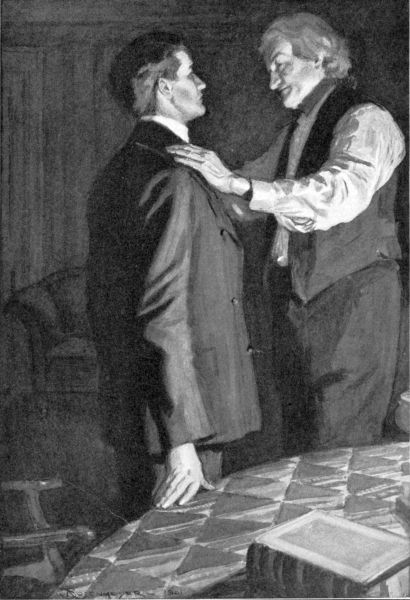
The next moment the man had a strong hand
on each of the boy’s shoulders, and was looking
down into his face with a fierce eagerness that
frightened him.
“Who are you?” he demanded. “Tell me
your name, quick!”
That imperative request gave room for no evasion.
There could be but one reply.
“I’m Abner Pickett’s grandson,” faltered the
boy. “My name is Dannie Pickett.”
The man loosed his grip on the lad’s shoulders
and took his hands instead. Dannie felt those
clear blue eyes piercing him through and through.
For a full minute they stood thus, then the grasp
was relaxed, the man turned his face upward in the
moonlight, and it seemed as if he were in prayer.
When Dannie saw his eyes again they were full of
tears; but there was a smile on his countenance,
and, when he spoke, his voice was very sweet and
gentle.
“Do not mind me,” he said. “I have a boy
whom I have not seen since he was a little baby.
You must be about his age. I think you must
look very much like him. Strangest of all, his
name, too, is Dannie. Come, let us go. It will
soon be daylight. See the red in the east. I
must find my men, and you must get to your
home.”
He took the boy’s hand and they started on.
But Dannie’s heart was beating to the music of
this man’s voice, and, swayed by the spell of his
presence, he felt that to him must be told the
secret of his midnight errand in the glen.
“I want to tell you,” he said, “what I was
doing in the gap to-night. I feel as though you
ought to know.”
“No,” was the quick reply; “you need not
confide in me. I cannot counsel you now.
Others must do that yet for a time. I only
trust that your errand was one of which you need
not be ashamed. Do I walk too fast for you?
There is so little time to lose.”
When they came opposite the marble column
that marked the grave of Dannie’s mother, they
stopped instinctively.
“This is Gran’pap’s graveyard,” said the
boy, simply, “and that is where my mother is
buried.”
The man did not answer.
He had removed his hat and stood gazing intently
at the white shaft and at the vine-covered
mound at its base. For a full minute he stood
there, motionless as the monument itself. Then
he turned to the boy.
“Let the thought of her be as dear and
sweet to you always as your own life,” he said.
“Come!”
With Dannie’s hand still in his, he hastened on.
The other members of the party were far ahead.
The morning glow was spreading in the east, and
in the west the paling moon was dropping down
behind the far-off hills. The autumn mist came
up and compassed them about, and now and then
some sound betokening daybreak came muffled
to their ears. On the souls of both the solemn
hush of morning rested, and neither of them broke
it by a single word.
When the gate that led to the Pickett farmhouse
was reached, they both stopped. Again
the man bared his head as he gazed through the
morning mist at the dim outline of the old
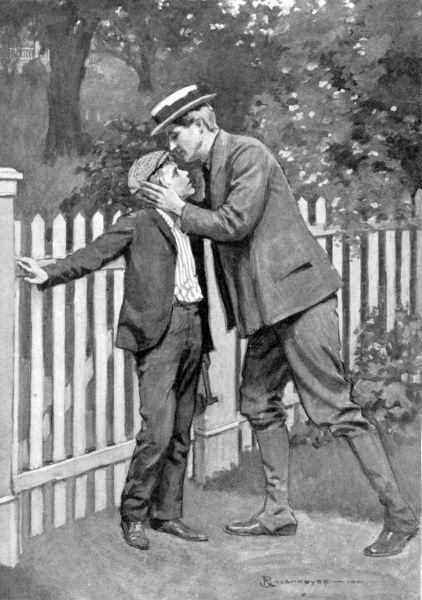
homestead. Then he bent down and took
Dannie’s face between his hands, and touched
the tangled hair on the boy’s forehead with his
lips.
“Good-by!” he said. “Good-by, my boy;
and God bless you and keep you!”
The next moment he was gone, a stalwart,
splendid figure, striding like an athlete through
the luminous haze.
Is it strange that up from Dannie’s heart came
again the old desire, and out from his lips the
spoken longing:—
“Oh, if I only had a father—like him!”
But there was no time now to indulge in
dreams or disappointments. He felt that he
must get at once into the house and to bed.
He went up the side path, and around to the
woodshed, where he left the hatchet. Max, the
dog, came whining and crouching at his feet, begging
for notice and caresses. Dannie paid little
heed to him, but hurried on. As he turned the
corner of the house by the kitchen porch, he came
face to face with his grandfather.
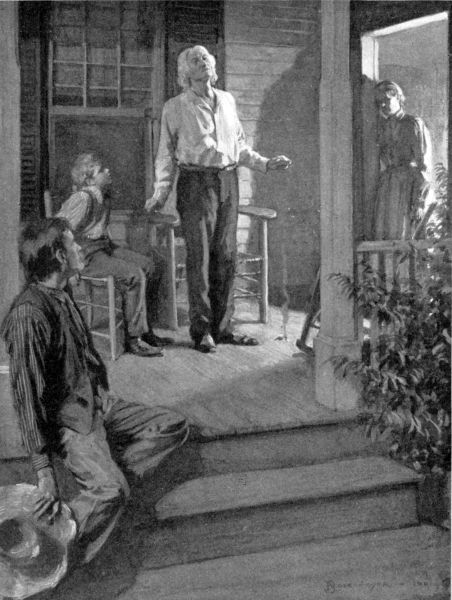
“Why, Dannie!” exclaimed the old man,
“what routed you out so early this morning?”
For a moment Dannie was at a loss for an
answer.
“Oh!” he stammered at last, “I—I just
thought I’d come out and look around.”
“That’s just what I thought I’d do, too,” was
the response. “I kind o’ want to see where
those stakes are set. I want to know how much
o’ my land, an’ what part of it, I’m expected to
present to the railroad company. Would you
like to come along, Dan?”
“Yes, Gran’pap, I would.”
They passed out at the gate and down the
road, and Dannie led the way to the potato field.
Near the big rock they found a stake. It was
one set by the engineers who made the last survey,
but it was within five feet of the place occupied
by the one Dannie had pulled out the night
before. The old man gazed at it bitterly.
“Takes the best part o’ the lot,” he said.
“Spoils the meadow,” he continued, as he looked
down the line, “cuts my farm in two, prevents
me from gettin’ to water, destroys the public
road, a damage and a curse.”
They followed down the line of stakes as he
talked. The survey took almost exactly the
same route as had the one made by the D. V.
& E. engineers the afternoon before. The crossing
at the public road was not five feet from the
first location, for Dannie saw the place in the bank
where he had pulled out the stake.
“Ruins the road,” muttered the old man,
“ruins the brook, ruins the gap, ruins the farm,
despoils the tomb!”
He was working himself into a passion again.
Dannie foresaw that in ten minutes more he would
be at a white heat.
“Why don’t you pull the stakes out, Gran’pap,
an’ throw ’em into the brook?”
Dannie never knew what strange impulse forced
him to ask that question. The old man turned
on him instantly.
“Don’t speak of it; it’s against the law.”
“But you said last night that no better deed
could be done.”
“I was in a temper last night an’ said things I
shouldn’t. No Pickett was ever yet arrested for
violatin’ the law. You and I don’t want to be
the first ones.”
“It might be done in the night-time, Gran’pap,
an’ no one be the wiser.”
Some fate was surely leading Dannie to his own
undoing.
“No, that’d be cowardly, an’ no Pickett was
ever yet a coward.”
Dannie winced as though his grandfather had
dealt him a physical blow.
They were walking on down the road now
toward the graveyard wall. The bitterness in
the old man’s heart forced itself again to his
lips.
“They might ’a’ taken my land, an’ my road,
an’ my stream, an’ my gap, an’ all, if they’d only
’a’ let my graveyard alone. I can’t stand that.
I won’t stand that. I’ll fight that. I’ll show ’em
that imposin’ on the livin’ is one thing an’ insultin’
the dead is another. I’ll make ’em—”
He stopped suddenly, his gaze fixed on the
line of stakes as it skirted the shore of the brook
and then crossed to the other side of the stream
opposite the graveyard.
“Dannie!” he exclaimed, “look! There they
go across the brook. They don’t touch the
graveyard. Do you see? They don’t touch it!”
He was pointing with intense excitement to
the staked-out curve showing distinctly under the
rising bank of fog.
“That line don’t go within ten rods o’ the
graveyard anywhere, Dannie,—not within ten
rods. Come, let’s see!”
He started on at a rapid pace, and, without
waiting to go in by the entrance, began hastily to
climb over the stone wall that surrounded the
burial-place. Reaching the centre of the plot,
halfway between the monument and the road, he
looked searchingly about him.
“Not a stake, Dannie!” he cried. “Not a
stick nor a stone anywhere inside. Not one!”
He was as intensely delighted as though he
had come suddenly upon a mine of hidden
treasure. The reaction from his state of mental
misery was too great to be concealed, even had
he desired to hide it. All night his distressed
fancy had conjured up visions of his burial-plot
ripped and torn with plough and pick and spade,
of his monument and headstone begrimed with
the smoke and shrinking from the touch of the
shrieking, thundering, plunging monster of the
rail. All night, in sleepless torture, his embittered
heart had burned with what he thought to
be an insult to the living and an outrage on the
dead. And now, to find his fancies and his
fears suddenly dispelled was like waking from
a dreadful dream. “But”—he turned sharply
on the boy at his side:—
“You told me they ran through the graveyard!
Why did you tell me that?”
“Well—they—they—I saw them in here,
anyway. They must ’a’ changed it afterward.
I can show you the place where the stake was
set.”
Sure enough he could, and did. The hole left
by it was still distinctly visible. And he pointed
out also where the grass was bruised by the
treading of feet and the dragging of the chain
across it.
The old man was satisfied, but Dannie’s mind
was in a tumult. He hardly knew which way to
turn or what to say. He dreaded every question
that might be asked him, lest the answer to it
should involve him in some hopeless contradiction.
“Oh, what a tangled web we weave
When first we practise to deceive!”
But Abner Pickett’s delight at finding his
graveyard free left him in no mood to question or
to criticise. The predominant thought in his
mind was that the engineer, at the cost of increased
distance, heavier grading, and additional
curvature, had avoided cutting through his graveyard.
It relieved his mind and gratified his pride.
“Look, Dannie!” he exclaimed, with a sweep
of his arm toward the mouth of the gap, “ain’t
that a beautiful curve? I tell you the engineer
that laid that out knew his business. What kind
of a lookin’ man did you say he was, Dannie?”
“Tall, Gran’pap. Han’some. Light hair, and
blue eyes that looked you through. Voice like
a—”
“What, Dannie! What! Light hair an’ blue
eyes?”
“Why—no. The man I talked with yesterday
afternoon had dark eyes an’ hair an’ whiskers.
I don’t know as he was so very tall, either. I
don’t know,—oh, I don’t know anything, I’m so
tired an’ hungry an’ done out!”
And he was tired and hungry and done out.
He dropped to the greensward at his grandfather’s
feet, this boy of thirteen, and burst into tears.
And Abner Pickett, believing that the boy had
undergone only what he himself had suffered,
bent down to him with soothing words, lifted him
to his feet, and, hand in hand, through the ever
deepening mist, these two walked the road toward
home.