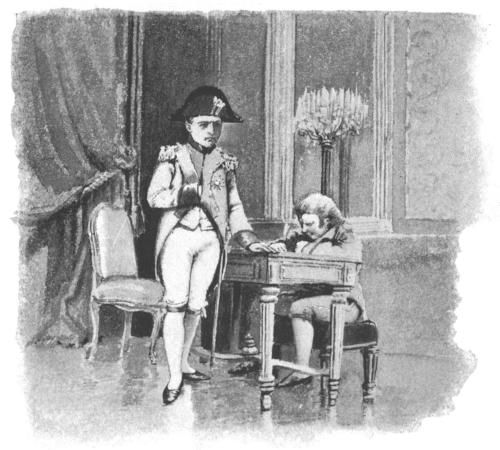
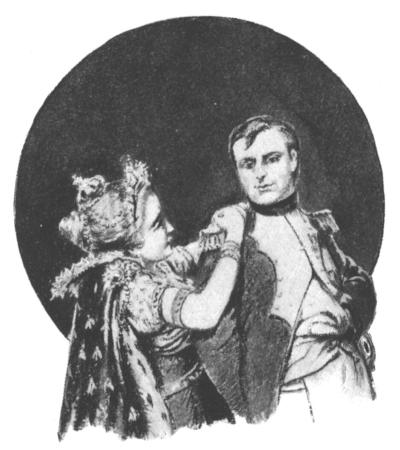
WITH HEAD AND TAIL PIECES FOR EACH CHAPTER AND NUMEROUS VIGNETTES.
INTRODUCTORY EPISTLE TO MADAME VIRGINIE ANCELOT.
I have reread my book, and I tremble in offering it to
you; yet who can appreciate it better? You like neither
romances nor dramas; my work is neither a romance nor a
drama.
The tale which I have related, madam, is simple; so simple,
indeed, that perhaps never has pen laboured on a subject
more utterly restricted. My heroine is so unimportant!
Not that I wish beforehand to throw the fault of failure on
her; for if the action of my little history is thus meagre, its
principle is lofty, its aim is elevated; and if I fail in attaining
my purpose, it will be that my strength is insufficient.
Yet I am not careless as to the fate of my labour, for in it are
the deepest of my convictions; and believe me that, more
from benevolence than vanity, I hope, though the crowd of
ordinary readers may pass over my work with carelessness,
that still for some it may possess a charm, for others, utility.
Do you find interest in the truth of a story? If so, I offer
that to you to compensate for what you may not find in the
story itself.
You remember that lovely woman, so lately dead, the
Countess de Charney, whose expression, though mournful,
seemed already to breathe of Heaven. Her look, so open, so
sweet, which seemed to caress while wandering over you, and
to make the heart swell as it lingered; from which one turned
away only to be drawn again within its enchantment; you
have seen it, at first timid as that of a young girl, suddenly
become animated, brilliant, and self-possessed, exhibiting
all its native energy, power, and devotion. Such was the
woman; a marvellous union of tenderness and courage, of the
weakness of sense and the strength of soul.
Such have I known her; such did others know her, long
before me, when her soul was excited only by the affections of
a daughter and of a wife. You understand the pleasure with
which I dwell with you on such a woman; I may not often
again have the opportunity. Still, she is not the heroine of
my story.
In the only visit which you made her at Belleville, where
was the tomb of her husband, and now, alas! her own, you
more than once seemed surprised with what you saw. You
were struck with an old, white-haired man, who sat next her
at table, whose appearance and manners were coarse, even
for his class. You saw him speak familiarly with the daughter
of the countess, who, beautiful as her mother had been,
answered him with kindness, and even with deference, giving
him the name of godfather, which, indeed, was the relation
he bore to her. Perhaps you have not forgotten a flower,
dried and colourless, in a rich case; and, also, that when
you asked her concerning it, a saddened look stole over the
countenance of the widow, and your questions remained unanswered.
This answer you now have before you.
Honoured with the confidence and affection of the countess,
more than once, before that simple flower, between her
and the venerable man, have I listened to long and touching
details. Besides this, I hold the manuscripts of the count, his
letters, and his two prison journals.
I have carefully retained in my memory those precious
details; I have attentively perused those manuscripts; I have
made important extracts from those letters; and in those
journals have I found my inspiration. If, then, I succeed in
rousing in your soul the feelings which have agitated mine in
presence of these relics of the captive, my fears for my little
book are vain.
One word. I have given throughout to my hero his title
of count, even during a time in which such dignities were obsolete.
This is because I have always heard him so called,
in French and in Italian; and in my memory his name and
his title are inseparably connected.
You now understand me, madam. You will not expect in
this book a history of important events, or the vivid details
of love. I have spoken of utility; and of what use is a love-story?
In that sweet study, practice is worth more than
theory, and each one needs his own experience: each one
hastens to acquire it, and cares little to seek it already prepared
in books. It is useless for old men, moralists by
necessity, to cry, “Shun that dangerous rock, where we have
once been shipwrecked!” Their children answer them,
“You have tempted that sea, and we must tempt it in turn.
We claim our right of shipwreck.”
Yet is there in my story something still of love; but, before
all, of a man’s love for——shall I tell you? No, read,
and you will learn.
X. B. Saintine.
BOOK I. — CHAPTER I.
Charles Veramont, Count de
Charney, whose name is not wholly
effaced from the annals of modern
science, and may be found inscribed
in the mysterious archives of the
police under Napoleon, was endowed
by nature with an uncommon capacity
for study. Unluckily, however, his intelligence
of mind, schooled by the forms
of a college education, had taken a disputatious
turn. He was an able logician rather than a
sound reasoner; and there was in Charney the
composition of a learned man, but not of a
philosopher.
At twenty-five, the count was master of seven languages;
but instead of following the example of certain
learned Polyglots, who seem to acquire foreign idioms for
the express purpose of exposing their incapacity to the contempt
of foreigners, as well as of their own countrymen,
through a confusion of tongues, as well as intellect, Charney
regarded his acquirements as a linguist only as a stepping-stone
to others of higher value. Commanding the services
of so many menials of the intellect, he assigned to each his
business, his duty, his fields to cultivate. The Germans
served him for metaphysics; the English and Italians for
politics and jurisprudence; all for history; to the remotest
sources of which he travelled in company with the Romans,
Greeks, and Hebrews.
In devoting himself to these serious studies, the count did
not neglect the accessory sciences. Till at length, alarmed
by the extent of the vast horizon, which seemed to expand as
he advanced; finding himself stumble at every step in the
labyrinth in which he was bewildered—weary of the pursuit
of Truth—(the unknown goddess,)—he began to contemplate
history as the lie of ages, and attempted to reconstruct the
edifice on a surer foundation. He composed a new historical
romance, which the learned derided from envy, and society
from ignorance.
Political and legislative science furnished him with more
positive groundwork; but these, from one end of Europe to
the other, were crying aloud for Reform; and when he tried
to specify a few of the more flagrant abuses, they proved so
deeply rooted in the social system—so many destinies were
based on a fallacious principle, that he was actually discouraged.
Charney had not the strength of mind, or insensibility
of heart, indispensable to overthrow, in other nations,
all that the tornado of the Revolution had left standing in his
own.
He recollected, too, that hosts of estimable men, as learned,
and perhaps as well-intentioned as himself, professed theories
in total opposition to his own. If he were to set the four
quarters of the globe on fire for the mere satisfaction of
a chimera? This consideration, more startling than even
his historical doubts, reduced him to the most painful perplexity.
Metaphysics afforded him a last resource. In the ideal
world, an overthrow is less alarming; since ideas may clash
without danger in infinite space. In waging such a war, he
no longer risked the safety of others; he endangered only his
own peace of mind.
The farther he advanced into the mysteries of metaphysical
science, analyzing, arguing, disputing—the more
deeply he became enveloped in darkness and mystery. Truth,
ever flying from his grasp, vanishing under his gaze, seemed
to deride him like the mockery of a will-o’-the-wisp, shining
to delude the unwary. When he paused to admire its
luminous brilliancy, all suddenly grew dark; the meteor
having disappeared to shine again on some remote and unexpected
point; and when, persevering and tenacious, Charney
armed himself with patience, followed with steady steps,
and attained the sanctuary, the fugitive was gone again!
This time he had overstepped the mark! When he fancied
the meteor was in his hand—grasped firmly in his hand—it
had already slipped through his fingers, multiplying into
a thousand brilliant and delusive particles. Twenty rival
truths perplexed the horizon of his mind, like so many false
beacons beguiling him to shipwreck. After vacillating between
Bossuet and Spinoza—deism and atheism—bewildered
among spiritualists, materialists, idealists, ontologists,
and eclectics, he took refuge in universal skepticism, comforting
his uneasy ignorance by bold and universal negation.
Having set aside the doctrine of innate ideas, and the revelation
of theologians, as well as the opinions of Leibnitz,
Locke, and Kant, the Count de Charney now resigned himself
to the grossest pantheism, unscrupulously denying the existence
of one high and supreme God. The contradiction existing
between ideas and things, the irregularities of the created
world, the unequal distribution of strength and endowment
among mankind, inspired his overtasked brain with the
conclusion that the world is a conglomeration of insensate
matter, and Chance the lord of all.
Chance, therefore, became his God here, and nothingness
his hope hereafter. He adopted his new creed with avidity—almost
with triumph—as if the audacious invention had
been his own. It was a relief to get rid of the doubts which
tormented him by a sweeping clause of incredulity; and from
that moment Charney, biding adieu to science, devoted himself
exclusively to the pleasures of the world.
The death of a relation placed him in possession of a considerable
fortune. France, reorganized by the consulate, was
resuming its former habits of luxury and splendour. The clarion
of victory was audible from every quarter; and all was joy
and festivity in the capital. The Count de Charney figured
brilliantly in the world of magnificence, elegance, taste, and enlightenment.
Having attracted around him the gay, the graceful,
and the witty, he unclosed the gates of his splendid mansion
to the glittering divinities of the day—to fashion, bon
ton, and distinction of every kind. Lost in the giddy crowd,
he took part in all its enjoyments and dissipations; amazed
that amid such a vortex of pleasures he should still remain a
stranger to happiness!
Music, dress, the perfumed atmosphere surrounding the
fair and fashionable, were the chief objects of his interest.
Vainly had he attempted to devote himself to the society of
men renowned for wit and understanding. The ignorance of
the learned, the errors of the wise, excited only his compassion
or contempt.
Such is the misfortune of proficiency! No one reaches
the artificial standard we have created. Even those who are
as learned as ourselves are learned after some other fashion;
and from our lofty eminence we look down upon mankind as
upon a crowd of dwarfs and pigmies. In the hierarchy of intellect,
as in that of power, elevation is isolated—to be
alone is the destiny of the great.
Vainly did the Count de Charney devote himself to sensual
pleasures. In the infancy of a social system so long
estranged from the joys of life, and still defiled by the blood-stained
orgies of the Revolution, attired in rags and tatters
of Roman virtue, yet emulating the licentious excesses of the
regency, he signalized himself by his prodigality and dissipation.
Labour lost. Horses, equipages, a splendid table,
balls, concerts, and hunting-parties, failed to secure Pleasure
as his guest. He had friends to flatter him, mistresses to
amuse his leisure; yet, though all these were purchased at
the highest price, the count found himself as far as ever from
the joys of love or friendship. Nothing availed to smooth
the wrinkles of his heart, or force it into a smile; Charney
actually laboured to be entrapped by the baits of society,
without achieving captivation. The syren Pleasure, raising
her fair form and enchanting voice above the surface of the
waters, fascinated the man, but the eye of the philosopher
could not refrain from plunging into the glassy depths below,
to be disgusted by the scaly body and bifurcal tail of the ensnaring
monster.
Truth and error were equally against him. To virtue he
was a stranger, to vice indifferent. He had experienced the
vanity of knowledge; but the bliss of ignorance was denied
him. The gates of Eden were closed against his re-entrance.
Reason appeared fallacious, joy apocryphal. The noise of
entertainments wearied him; the silence of home was still
more tedious; in company, he became a burden to others; in
retirement, to himself. A profound sadness took possession
of his soul!
In spite of all Charney’s efforts, the demon of philosophical
analysis, far from being exorcised, served to tarnish, undermine,
contract, and extinguish the brilliancy of every
mode of life he selected. The praise of his friends, the endearments
of his loves, seemed nothing more than the current
coin given in exchange for a certain portion of his property,
the paltry evidence of a necessity for living at his expense.
Decomposing every passion and sentiment, and reducing
all things to their primitive element, he, at length, contracted
a morbid frame of mind, amounting almost to aberration of intellect.
He fancied that in the finest tissue composing his garments,
he could detect the exhalations of the animal of whose
fleece it was woven—on the silk of his gorgeous hangings, the
crawling worm which furnishes them. His furniture, carpets,
gewgaws, trinkets of coral or mother-of-pearl, all were stigmatized
in his eyes as the spoil of the dead, shaped by the
labours of some squalid artisan. The spirit of inquiry had
destroyed every illusion. The imagination of the sceptic was
paralyzed!
To such a heart as that of Charney, however, emotion
was indispensable. The love which found no single object
on which to concentrate its vigour expanded into tenderness
for all mankind; and he became a philanthropist!
With the view of serving the cause of his fellow-creatures,
he devoted himself to politics, no longer speculative, but active;
initiated himself into secret societies, and grew a fanatic
for freedom, the only superstition remaining for those who
have renounced the higher aspirations of human nature. He
enrolled himself in a plot—a conspiracy against nothing less
than the sovereignty of the victorious Napoleon!
In this attempt, Charney fancied himself actuated by patriotism,
by philanthropy, by love of his countrymen! More
likely by animosity against the one great man, of whose
power and glory he was envious! An aristocrat at heart, he
fancied himself a leveller. The proud noble who had been
robbed of the title of count, bequeathed him by his ancestors,
did not choose that his inferior in birth should assume
the title of emperor, which he had conquered at the point of
his sword.
It matters little in what plot he embarked his destinies;
at that epoch, there was no lack of conspiracies! It was
one of the many hatched between 1803 and 1804, and not
suffered to come to light: the police—that second providence
which presides over the safety of empires—was beforehand
with it! Government decided that the less noise made on
the occasion, the better; they would not even spare it so
much as a discharge of muskets on the Plaine de Grenelle,
the scene of military execution: but the heads of the conspiracy
were privately arrested, condemned, almost without
trial, and conveyed away to solitary confinement in various
state prisons, citadels, or fortresses, of the ninety-six departments
of consular France.
CHAPTER II.
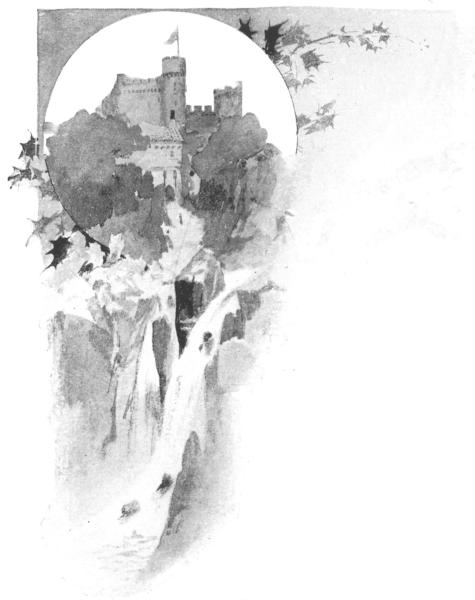
In traversing the Alps on
my way to Italy—an humble
tourist, with my staff in
my hand, and my wallet on
my shoulder, I remember pausing
to contemplate, near the
pass of Rodoretto, a torrent
swollen by the melting of the
glaciers. The tumultuous sounds
produced by its course, the foaming
cascades into which it burst,
the varying colors and hues created
by the movement of its waters, yellow,
white, green, black, according to its channel
through marl, slate, chalk, or peat earth—the vast blocks of
marble or granite it had detached without being able to
remove, around which a thousand ever-changing cataracts
added roar to roar, cascade to cascade; the trunks of trees it
had uprooted, of which the still foliaged branches emerging
from the water were agitated by the winds, while the roots
were buffeted by the waves; fragments of the very banks
clothed with verdure, and driven like floating islands against
the trees, as the trees were driven in their turn against the
blocks of granite—all this, these murmurs, clashings, and
roarings, confined between narrow and precipitous banks,
impressed me with wonder and admiration. And this torrent
was the Clusone!
Skirting its shores, I pursued the course of the stream
into one of the four valleys retaining the name of “Protestant,”
in the memory of the Vaudois who formerly took refuge
in their solitudes. There, my torrent lost its wild irregularity;
and its hundred roaring voices were presently subdued.
Its shattered trees and islands had been deposited on some
adjacent level; its colours had resolved themselves into one;
and the material of its bed no longer distinguishable on the
tranquil surface. Still strong and
copious, it now flowed with decency,
propriety, almost with coquetry:
affecting the airs of a
modest rivulet as it bathed the
rugged walls of Fenestrella.
It was then I visited Fenestrella,
a large town celebrated for
peppermint water, and the fortress
which crowns the two mountains
between which it is situated,
communicating with each other
by covered ways, but partly dismantled
during the wars of the
Republic. One of the forts, however,
was repaired and refortified
when Piedmont became incorporated
into France.
In this fortress of Fenestrella,
was Charles Veramont, Count de
Charney, incarcerated, on an accusation
of having attempted to subvert the laws of government,
and introduce anarchy and confusion into the country.
Estranged by rigid imprisonment, alike from men of
science and men of pleasure, and regretting neither—renouncing
without much effort his wild projects of political regeneration—bidding
a forced farewell to his fortune, by the
pomps of which he had been undazzled—to his friends, who
were grown tiresome, and his mistresses, who were grown
faithless; having for his abode, instead of a princely mansion,
a bare and gloomy chamber—the jailer of Charney was
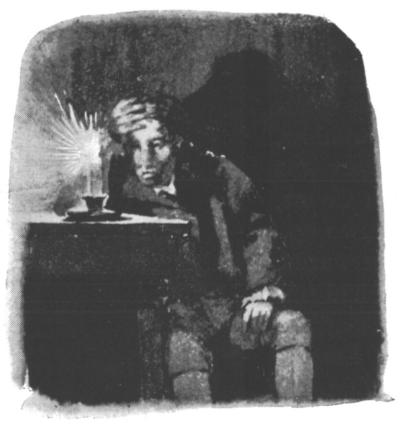
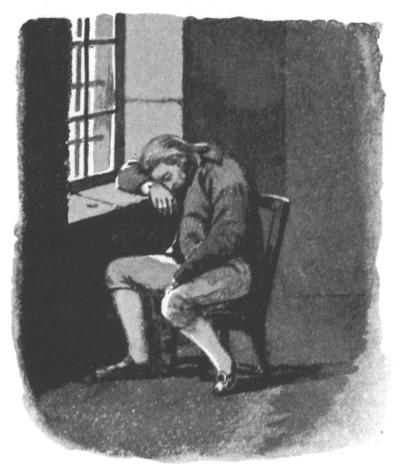
now his sole attendant, and his imbittered spirit his only companion.
But what signified the gloom and nakedness of his apartment?
The necessaries of life were there, and he had long
been disgusted with its superfluities. Even his jailer gave
him no offence. It was only his own thoughts that troubled
him!
Yet what other diversions remained for his solitude—but
self-conference? Alas! none! Nothing around him or before
him but weariness and vexation of spirit! All correspondence
was interdicted. He was allowed no books, nor
pens, nor paper; for such was the established discipline at
Fenestrella. A year before, when the count was intent only
on emancipating himself from the perplexities of learning,
this loss might have seemed a gain. But now, a book would
have afforded a friend to consult, or an adversary to be confuted!
Deprived of every thing, sequestered from the world,
Charney had nothing left for it, but to become reconciled to
himself, and live in peace with that natural enemy, his soul.
For the cruelty with which that unsilenceable monitor continued
to set before him the desperateness of his condition,
rendered conciliation necessary. His case was indeed a hard
one! A man to whom nature had been so prodigal, whose
cradle society had surrounded with honours and privileges—he
to be reduced to such abject insignificance—he to have
need of pity and protection, who had faith neither in the existence
of a God nor the mercy of his fellow-creatures!
Vainly did he strive to throw off this frightful consciousness,
when in the solitude of his reveries it alternately chilled
and scorched his shrinking bosom: and once more, the unhappy
Charney began to cling for support to the visible and
material world—now, alas! how circumscribed around him.
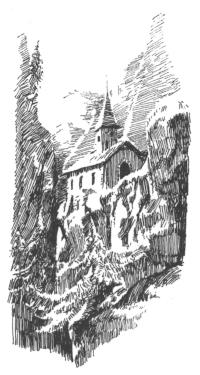
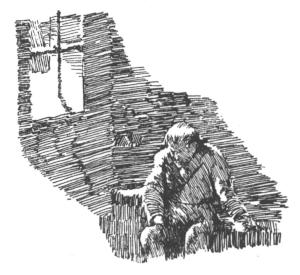
The room assigned to his use was at the rear of the citadel,
in a small building raised upon the ruins of a vast and strong
foundation, serving formerly for defence, but rendered useless
by a new system of fortification.
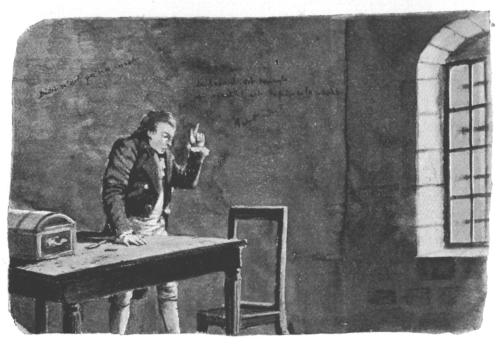
Four walls, newly whitewashed, so that he was denied
even the amusement of perusing the lucubrations of former
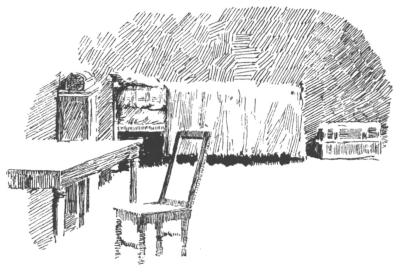
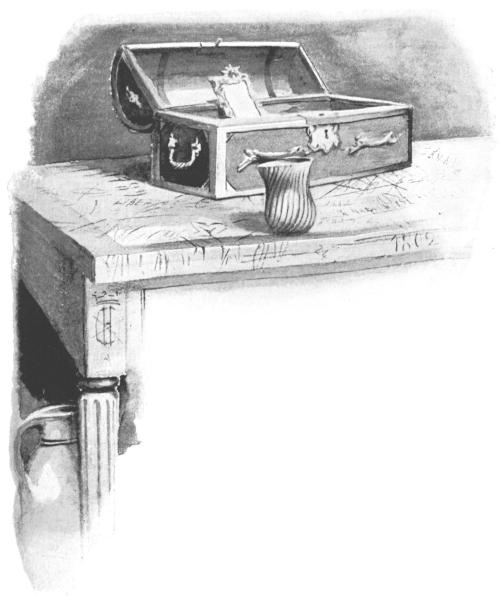
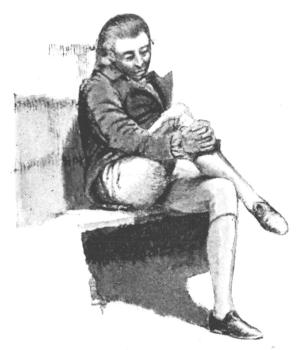
prisoners, his predecessors; a table, serving for his meals;
a chair, whose
insulated unity
reminded him,
that no human
being would
ever sit beside
him there in
friendly converse;
a trunk
for his clothes
and linen; a little
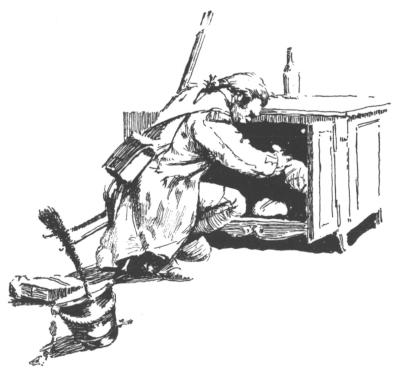
sideboard
of painted deal,
half worm-eaten, offered a singular contrast to the rich mahogany
dressing-case, inlaid with silver, standing there as
the sole representative of his former splendours. A clean,
but narrow bed, window-curtains of blue cloth (a mere mockery,
for, thanks to the closeness of his prison bars and the
opposite wall rising at ten feet distance, there was little to
fear from prying eyes or the importunate radiance of the sun).
Such was the complement of furniture allotted to the Count
de Charney.
Over his chamber was another, wholly unoccupied; he
had not a single companion in that detached portion of the
fortress.
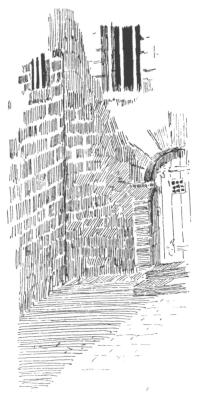
The remainder of his world consisted in a short, massive,
winding stone staircase, descending into a small paved court,
sunk into what had been a moat, in the earlier days of the
citadel, in which narrow space he was permitted to enjoy air
and exercise during two hours of the day. Such was the
ukase of the commandant of Fenestrella.
From this confined spot, however,
the prisoner was able to
extend his glance towards the
summits of the mountains, and
command a view of the vapours
rising from the plain; for the
walls of the ramparts, lowering
suddenly at the extremity of the
glacis, admitted a limited proportion
of air and sunshine into the
court. But once shut up again
in his room, his view was bounded
by an horizon of solid masonry,
and a surmise of the majestic
and picturesque aspect of nature
it served to conceal. Charney
was well aware that to the right
rose the fertile hills of Saluces;
that to his left were developed
the last undulations of the valley
of Aorta and the banks of the Chiara; that before him lay
the noble plains of Turin; and behind, the mighty chain of
Alps, with its adornment of rocks, forests, and chasms, from
Mount Genevra to Mount Cenis. But, in spite of this charming
vicinage, all he was permitted to behold was the misty
sky suspended over his head by a frame-work of rude masonry;
the pavement of the little court, and the bars of his
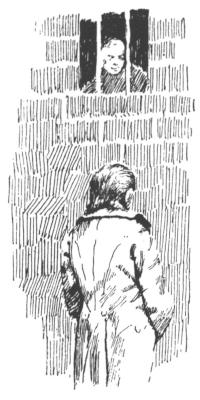
prison, through which he might admire the opposite wall,
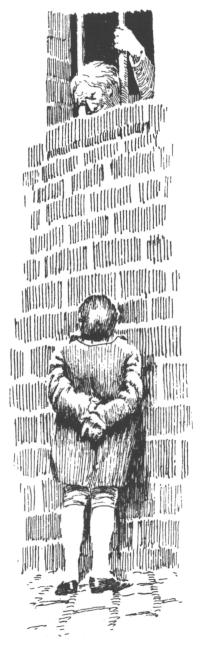
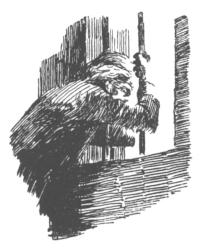
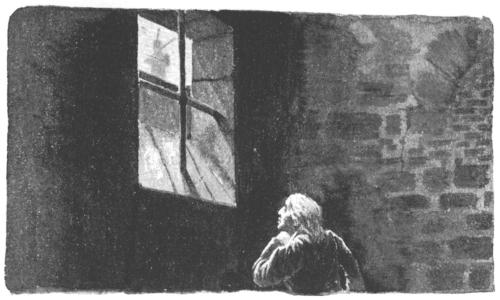
adorned with a single small square window, at which he had
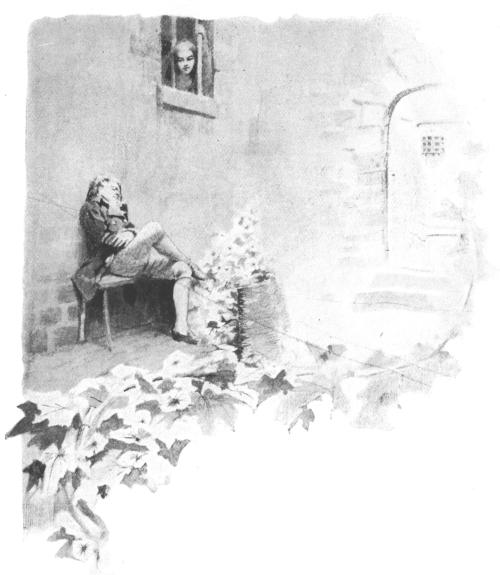
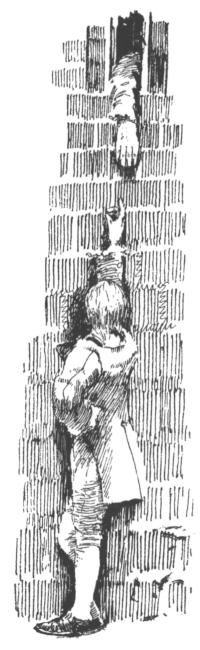
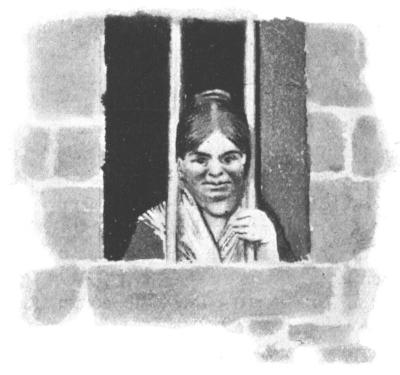
once or twice caught glimpses of a doleful human countenance.
What a world from which to extract delight and entertainment!
The unhappy Count wore out his patience in the attempt!
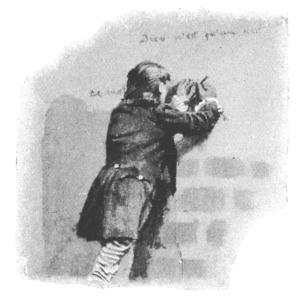
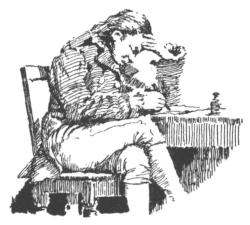
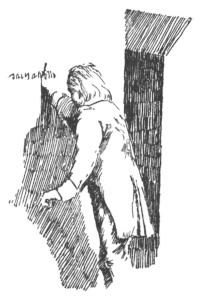
At first, he amused himself with scribbling with a
morsel of charcoal on the walls of his prison the dates of
every happy event of his childhood; but from this dispiriting
task he desisted, more discouraged than ever. The demon of
scepticism next inspired him with evil counsel; and having
framed into fearful sentences the axioms of his withering
creed, he inscribed them also on his wall, between recollections
consecrated to his sister and mother!
Still unconsoled, Charney at length made up his mind to
fling aside his heart-eating cares, adopt, by anticipation, all
the puerilities and brutalization which result from the prolongation
of solitary confinement. The philosopher attempted
to find amusement in unravelling silk or linen; in making
flageolets of straw, and building ships of walnut-shells. The
man of genius constructed whistles, boxes, and baskets, of
kernels; chains and musical instruments, with the springs of
his braces; nay, for a time, he took delight in these absurdities;
then, with a sudden movement of
disgust, trampled them, one by one,
under his feet!
To vary his employment, Charney
began to carve a thousand fanciful designs
upon his wooden table! No school-boy
ever mutilated his desk by such attempts
at arabesque, both in relief and
intaglio, as tasked his patience and address.
The celebrated portal of the
church of Candebee, and the pulpit and
palm trees of St. Gudula at Brussels, are
not adorned with a greater variety of
figures. There were houses upon houses,
fishes upon trees, men taller than steeples,
boats upon roofs, carriages upon
water, dwarf pyramids, and flies of gigantic
stature,—horizontal, vertical, oblique, topsy-turvy, upside
down, pell-mell, a chaos of hieroglyphics, in which he
tried to discover a sense symbolical, an accidental intention,
an occult design; for it was no great effort on the part of one
who had so much faith in the power of chance, to expect the
development of an epic poem in the sculptures on his table,
or a design of Raphael in the veins of his box-wood snuff-box.
It was the delight of his ingenuity to multiply difficulties
for conquest, problems for solution, enigmas for divination;
but even in the midst of these recreations, ennui, the formidable
enemy, again surprised the captive.
The man whose face he had noticed at the grated window
might have afforded him food for conjecture, had he not
seemed to avoid the observation of the Count, by retiring the
moment Charney made his appearance; in consequence of
which, he conceived an abhorrence of the recluse. Such was
his opinion of the human species, that the stranger’s desire
of concealment convinced him he was a spy, employed to
watch the movements of the prisoners, or, perhaps, some
former enemy, exulting over his humiliation.
On interrogating the jailer, however, this last supposition
was set at rest.
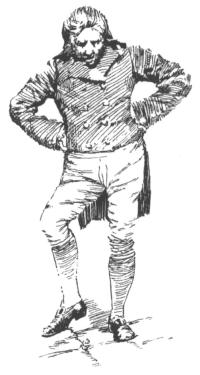
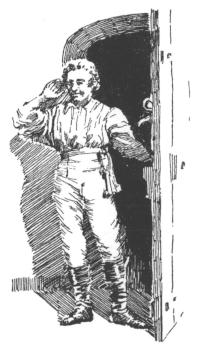
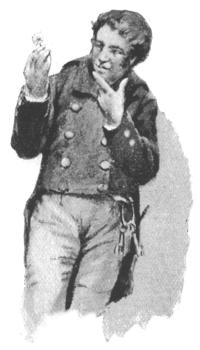
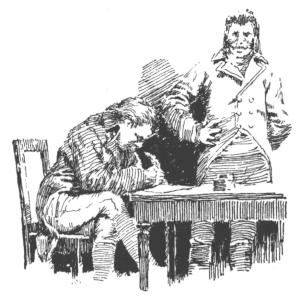
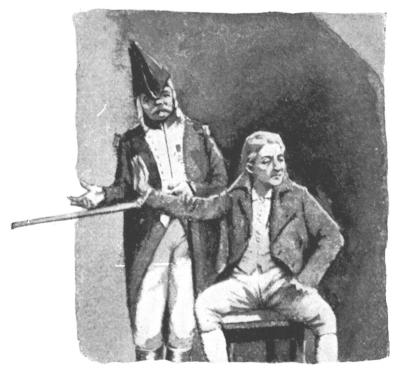
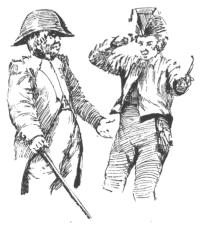
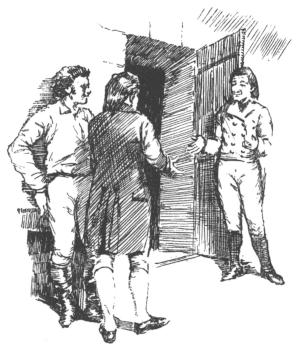
“’Tis an Italian,” said Ludovico, the turnkey. “A good
soul—and, what is more, a good Christian; for I often find
him at his devotions.”
Charney shrugged his
shoulders: “And what may
be the cause, pray, of his
retention?” said he.
“He attempted to assassinate
the Emperor.”
“Is he, then, a patriot?”
“A patriot! Rubbish!
Not he. But the poor soul
had once a son and daughter:
and now he has only
a daughter. The son was
killed in Germany. A cannon-ball broke a tooth for him.
Povero figliuolo!”
“It was a paroxysm of selfishness, then, which moved this
old man to become an assassin?”
“You have never been a father, Signor Conte!” replied
the jailer. “Cristo Santo! if my Antonio, who is still a babe,
were to eat his first mouthful for the good of this empire of
the French (which is a bantling of his own age, or thereabouts),
I’d soon—— But basta! I’ve no mind to take up
my lodging at Fenestrella, except as it may be with the keys
at my girdle or under my pillow.”
“And how does this fierce conspirator amuse himself in
prison?” persisted Charney.
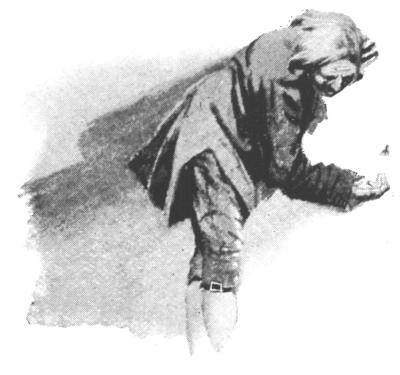
“Catching flies!” replied the jailer, with an ironical wink.
Instead of detesting his brother in misfortune, Charney
now began to despise him. “A madman, then?” he demanded.
“Perche pazzo, Signor Conte? Though you are the last
comer, you excel him already in the art of hacking a table
into devices. Pazienza!”
In defiance of the sneer conveyed in the jailer’s remark,
Charney soon resumed his manual labors, and the interpretations
of his hieroglyphics; but, alas! only to experience
anew their insufficiency as a kill-time. His first winter had
expired in weariness and discontent: when, by the mercy of
Heaven, an unexpected object of interest was assigned him.
CHAPTER III.
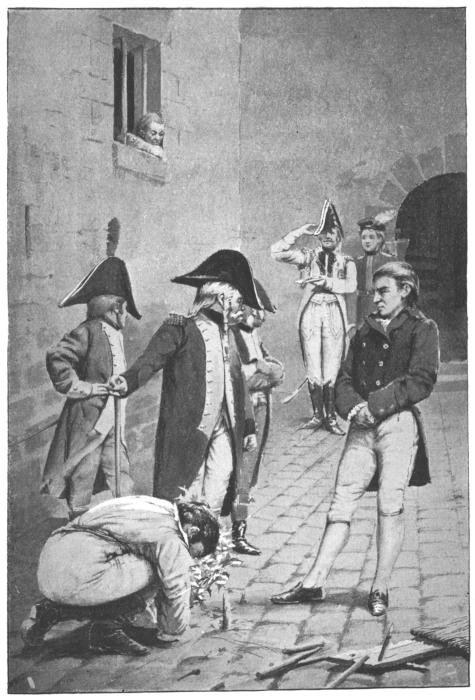
One day, Charney was breathing the fresh air in
the little court of the fortress, at the accustomed
hour, his head declining, his eyes downcast, his arms
crossed behind him, pacing with slow and measured steps,
as if his deliberation tended to enlarge the precincts of his
dominion.
Spring was breaking. A milder air breathing around,
tantalized him with a vain inclination to enjoy the season of
liberty, as master of his time and territory. He was proceeding
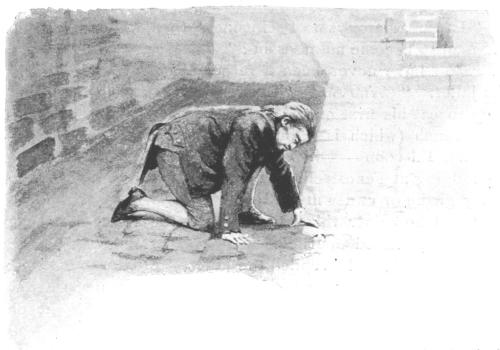
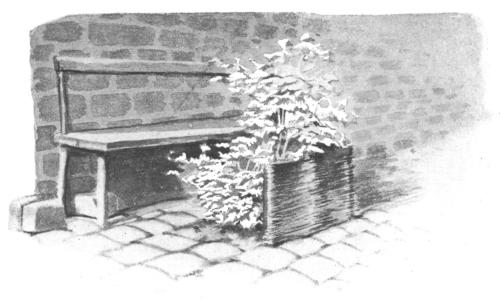
to number, one by one, the stones paving the courtyard,
(doubtless to verify the accuracy of former calculations—for
it was by no means the first time they had put his arithmetic
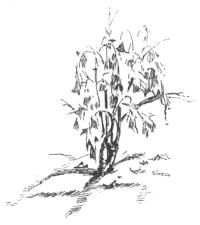
to the test), when he perceived a small mound of earth
rising between two stones of the pavement, cleft slightly at
its summit.
The Count stopped short—his heart beat hurriedly without
any rational grounds for emotion, except that every
trivial incident affords matter of hope or fear to a captive.
In the most indifferent objects, in the most unimportant
events, the prisoner discerns traces of a mysterious project
for his deliverance.
Who could decide that this trifling irregularity on the surface
might not indicate important operations under ground?
Subterraneous issues might have been secretly constructed,
and the earth be about to open and afford him egress towards
the mountains! Perhaps his former friends and accomplices
had been sapping and mining, to procure access to his
dungeon, and restore him to light and liberty!
He listened! he fancied he could detect the low murmur
of a subterraneous sound. He raised his head, and the loud
and rapid clang of the tocsin saluted his ear. The ramparts
were echoing with the prolonged roll of drums, like the call
to arms in time of war. He started—he passed his trembling
hand over his forehead, on which cold dews of intense agitation
were already rising. Is his liberation at hand? Is
France submitted to the domination of a new ruler?
The illusion of the captive vanished as it came. Reflection
soon restored him to reason. He no longer possesses
accomplices—he never possessed friends! Again he lends a
listening ear, and the same noises recur; but they mislead
his mind no longer. The supposed tocsin is only the church
bell which he has been accustomed to hear daily at the same
hour, and the drums, the usual evening signal for retreat to
quarters. With a bitter smile, Charney begins to compassionate
his own folly, which could mistake the insignificant
labors of some insect or reptile, some wandering mole or
field-mouse, for the result of human fidelity, or the subversion
of a mighty empire.
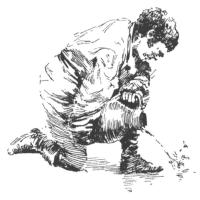
Resolved, however, to bring the matter to the test, Charney,
bending over the little hillock, gently removed the earth
from its summit; when he had the mortification to perceive
that the wild though momentary emotion by which he had
been overcome, was not produced by so much as the labors
of an animal armed with teeth and claws! but by the efforts
of a feeble plant to pierce the soil—a pale and sickly scatterling
of vegetation. Deeply vexed, he was about to crush
with his heel the miserable weed, when a refreshing breeze,
laden with the sweets of some bower of honeysuckles, or
syringas, swept past, as if to intercede for mercy towards the
poor plant, which might perhaps hereafter reward him with its
flowers and fragrance.
A new conjecture conspired to suspend his act of vengeance.
How has this tender plant, so soft and fragile as to
be crushed with a touch, contrived to pierce and cleave asunder
the earth, dried and hardened into a mass by the sun,
daily trodden down by his own footsteps, and all but cemented
by the flags of granite between which it was enclosed? On
stooping again to examine the matter with more attention, he
observed at the extremity of the plant a sort of fleshy valve
affording protection to its first and tenderest leaves, from
the injurious contact of any hard bodies they might have to
encounter in penetrating the earthy crust in search of light
and air.
“This, then, is the secret?” cried he, already interested
in his discovery. “Nature has imparted strength to the vegetable
germ, even as the unfledged bird which is able to break
asunder with its beak the egg-shell
in which it is imprisoned; happier
than myself—in possession of unalienable
instruments to secure its
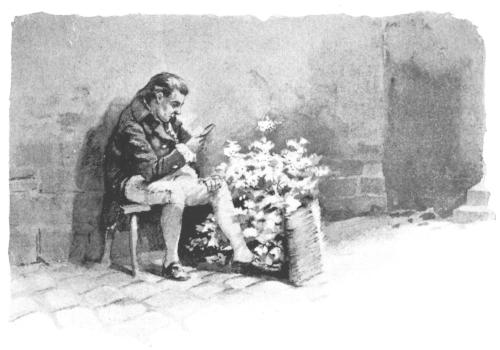
liberation!” And after gazing another
minute on the inoffensive plant,
he lost all inclination for its destruction.
On resuming his walk the next
day, with wide and careless steps,
Charney was on the point of setting
his foot on it, from inadvertence;
but luckily recoiled in time. Amused
to find himself interested in the preservation
of a weed, he paused to take
note of its progress. The plant was
strangely grown; and the free light
of day had already effaced the pale and sickly complexion of
the preceding day. Charney was struck by the power inherent
in vegetables to absorb rays of light, and, fortified by
the nourishment, borrow, as it were, from the prism, the very
colours predestined to distinguish its various parts of organization.
“The leaves,” thought he, “will probably imbibe a hue
different from that of the stem. And the flowers? what colour,
I wonder, will be the flowers? Nourished by the same
sap as the green leaves and stem, how do they manage to acquire,
from the influence of the sun, their variegations of
azure, pink, or scarlet? For already their hue is appointed.
In spite of the confusion and disorder of all human affairs,
matter, blind as it is, marches with admirable regularity:
still blindly, however! for lo, the fleshy lobes which served
to facilitate for the plant its progress through the soil, though
now useless, are feeding their superfluous substance at its expense,
and weighing upon its slender stalk!”
But, even as he spoke, daylight became obscured. A chilly
spring evening, threatening a frosty night, was setting in; and
the two lobes, gradually rising, seemed to reproach him with
his objections, by the practical argument of enclosing the still
tender foliage, which they secured from the attacks of insects
or the inclemency of the weather, by the screen of their protecting
wings.
The man of science was better able to comprehend this
mute answer to his cavilling, because the external surface of
the vegetable bivalve had been injured the
preceding night by a snail, whose slimy
trace was left upon the verdure of the
cotyledon.
This curious colloquy between action
and cogitation, between the plant and the
philosopher, was not yet at an end. Charney
was too full of metaphysical disquisition
to allow himself to be vanquished
by a good argument.
“’Tis all very well!” cried he. “In this instance, as in
others, a fortunate coincidence of circumstances has favoured
the developement of incomplete creation. It was the inherent
qualification of the nature of the plant to be born with a lever
in order to upraise the earth, and a buckler to shelter its tender
head: without which it must have perished in the germ,
like myriads of individuals of its species which proved incapable
of accomplishing their destinies. How can one guess the
number of unsuccessful efforts which nature may have made,
ere she perfected a single subject sufficiently organized! A
blind man may sometimes shoot home; but how many uncounted
arrows must be lost before he attains the mark? For
millions of forgotten centuries, matter has been triturating
between negative and positive attraction. How then can one
wonder that chance should sometimes produce coincidence?
This fleshy screen serves to shelter the early leaves. Granted!
But will it enlarge its dimensions to contain the rest as they
are put forth, and defend them from cold and insects? No,
no; no evidence of the calculating of a presiding Providence!
A lucky chance is the alpha and omega of the universe!”
Able logician!—profound reasoner! listen, and Nature
shall find a thousand arguments to silence your presumption!
Deign only to fix your inquiring eyes upon this feeble plant,
which the munificence of Heaven has called into existence
between the stones of your prison! You are so far right that
the cotyledon will not expand so as to cover with its protecting
wings the future progress of the plant. Already withering,
they will eventually fall and decay. But they will suffice
to accomplish the purpose of nature. So long as the northern
wind drives down from the Alps their heavy fogs or sprinkling
of sleet, the new leaves will find a retreat impermeable to the
chilly air, caulked with resinous or viscous matter, and expanding
or closing according to the impulse of the weather;
finally distended by a propitious atmosphere, the leaflets will
emerge clinging to each other for mutual support, clothed
with a furry covering of down to secure them against the fatal
influence of atmospheric changes. Did ever mother watch
more tenderly over the preservation of a child? Such are
the phenomena, Sir Count, which you might long ago have
learned to admire, had you descended from the flighty regions
of human science, to study the humble though majestic
works of God! The deeper your researches, the more positive
had been your conviction; for where dangers abound,
know that the protection of the Providence which you deny is
vouchsafed a thousand and a thousand fold in pity to the
blindness of mankind!
In the weariness of captivity, Charney was soon satisfied
to occupy his idle hours by directing his attention to the
transformations of the plant. But when he attempted to contend
with it in argument, the answers of the vegetable logician
were too much for him.
“To what purpose these stiff bristles, disfiguring a slender
stem?” demanded the Count. And the following morning
he found them covered with rime: thanks to their defence,
the tender bark had been secured from all contact with the
frost.
“To what purpose, for the summer season, this winter
garment of wool and down?” he again inquired. And when
the summer season really
breathed upon the
plant, he found the new
shoots array themselves
in their light spring
clothing; the downy
vestments, now superfluous,
being laid aside.
“Storms may be still
impending!” cried Charney,
with a bitter smile;
“and how will these
slender and flexile shoots
resist the cutting hail, the driving wind?” But when the
stormy rain arose, and the winds blew, the slender plant,
yielding to their intemperance, replied to the sneers of the
Count by prudent prostration. Against the hail, it fortified
itself by a new manœuvre; the leaves, rapidly uprising, adhered
to the stalks for protection; presenting to the attacks
of the enemy the strong and prominent nerves of their inferior
surface; and union, as usual, produced strength. Firmly
closed together, they defied the pelting shower; and the plant
remained master of the field; not, however, without having
experienced wounds and contusions, which, as the leaves expanded
in the returning sunshine, were speedily cicatrized by
its congenial warmth.
“Is chance endowed then with intelligence?” cried Charney.
“Must we admit matter to be spiritualized, or humiliate
the world of intelligence into materialism?”
Still, though self-convicted, he could not refrain from interrogating
his mute instructress. He delighted in watching,
day by day, her spontaneous metamorphoses. Often, after
having examined her progress, he found himself gradually
absorbed in reveries of a more cheering nature than those to
which he had been of late accustomed. He tried to prolong
the softened mood of mind by loitering in the court beside
the plant; and one day, while thus employed, he happened to
raise his eyes towards the grated window, and saw the fly-catcher
observing him. The colour rose to his cheek, as if
the spy could penetrate the subject of his meditations; but a
smile soon chased away the blush. He no longer presumed
to despise his comrade in misfortune. He, too, had been
engaged in contemplating one of the simplest creations of
nature; and had derived comfort from the study.
“How do I know,” argued Charney, “that the Italian may
not have discovered as many marvels in a fly, as I in a nameless
vegetable?”
The first object that saluted him on his returning to his
chamber, after this admission, was the following sentence,
inscribed by his own hand upon the wall, a few months before:
“Chance, though blind, is the sole author of the
creation.”
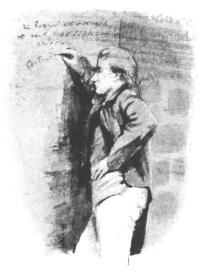
Seizing a piece of charcoal, Charney instantly qualified the
assertion, by the addition of a single word—“Perhaps.”
CHAPTER IV.
Charney had long ceased to find amusement
in these gratuitous mural inscriptions;
and if he still occasionally played the sculptor
with his wooden table, his efforts produced nothing
now but germinating plants; each protected
by a cotyledon, or a sprig of foliage, whose
leaves were delicately serrated and prominently
nerved. The greater portion of the time assigned
him for exercise was spent in contemplation of his
plant—in examining and reasoning upon its developement.
Even after his return to his chamber, he often watched
the little solitary through his prison-bars. It had become
his whim, his bauble, his hobby—perhaps only to be discarded
like other preceding favourites!
One morning, as he stood at the window, he observed the
jailer, who was rapidly traversing the courtyard, pass so close
to it that the stem seemed on the point of being crushed under
his footsteps; and Charney actually shuddered! When
Ludovico arrived as usual with his breakfast, the Count
longed to entreat the man would be careful in sparing the
solitary ornament of his walk; but he found some difficulty
in phrasing so puerile an entreaty. Perhaps the Fenestrella
system of prison discipline might enforce the clearing of the
court from weeds, or other vegetation. It might be a favour
he was about to request, and the Count possessed no worldly
means for the requital of a sacrifice. Ludovico had already
taxed him heavily, in the way of ransom, for the various objects
with which it was his privilege to furnish the prisoners
of the fortress.
Besides, he had scarcely yet exchanged a word with the
fellow, by whose abrupt manners and character he was disgusted.
His pride recoiled, too, from placing himself in the
same rank with the fly-catcher, towards whom Ludovico had
acknowledged his contempt. Then there was the chance of
a refusal! The inferior, whose position raises him to temporary
consequence, is seldom sufficiently master of himself to
bear his faculties meekly, incapable of understanding that indulgence
is a proof of power. The Count felt that it would
be insupportable to him to find himself repulsed by a turnkey.
At length, after innumerable oratorical precautions, and
the exercise of all his insight into the foibles of human nature,
Charney commenced a discourse, logically preconcocted, in
hopes to obtain his end without the sacrifice of his dignity—or,
to speak more correctly, of his pride.
He began by accosting the jailer in Italian; by way of
propitiating his natural prejudices, and calling up early associations.
He inquired after Ludovico’s boy, little Antonio;
and, having caused this tender string to vibrate, took from
his dressing-box a small gilt goblet, and charged him to present
it to the child!
Ludovico declined the gift, but refused it with a smile;
and Charney, though somewhat discountenanced, resolved to
persevere. With adroit circumlocution, he observed, “I am
aware that a toy, a rattle, a flower, would be a present better
suited to Antonio’s age; but you can sell the goblet, and procure
those trifles in abundance with the price.” And, lo!
à propos of flowers, the Count embarked at once into his
subject.
Patriotism, paternal love, personal interest, every influential
motive of human action, were thus put in motion in
order to accomplish the preservation of a plant! Charney
could scarcely have done more for his own. Judge whether
it had ingratiated itself into his affections!
“Signor Conte!” replied Ludovico, at the conclusion of
the harangue, “riprendi sua nacchera indorata! Were this
pretty bauble missing from your toilet-case, its companions
might fret after it! At three months old, my bantling has
scarce wit enough to drink out of a goblet; and with respect
to your gilly-flower—”
“Is it a gilly-flower?” inquired Charney, with eagerness.
“Sac à papious! how should I know? All flowers are
more or less gilly-flowers! But as to sparing the life of
yours, eccellenza, methinks the request comes late in the day.
My boot would have been better acquainted with it long ago,
had I not perceived your partiality for the poor weed!”
“Oh! as to my partiality,” interrupted Charney, “I beg
to assure you—”
“Ta, ta, ta, ta! What need of assurance,” cried Ludovico.
“I know whereabouts you are better than you do.
Men must have something to love; and state prisoners have
small choice allowed them in their whims. Why, among my
boarders here, Signor Conte (most of whom were grand gentry,
and great wiseacres in their day, for ’tis not the small fry
they send into harbour at Fenestrella), you’d be surprised at
what little cost they manage to divert themselves! One
catches flies—no harm in that; another—” and Ludovico
winked knowingly, to signify the application—“another chops
a solid deal table into chips, without considering how far I
may be responsible for its preservation.” The Count vainly
tried to interpose a word: Ludovico went on: “Some amuse
themselves with rearing linnets and goldfinches; others have
a fancy for white mice. For my part, poor souls, I have so
much respect for their pets, that I had a fine Angora cat of
my own, with long white silken hair, you’d have sworn ’twas
a muff when ’twas asleep!—a cat that my wife doated on, to
say nothing of myself. Well, I gave it away, lest the creature
should take a fancy to some of their favourites. All
the cats in the creation ought not to weigh against so much
as a mouse belonging to a captive!”
“Well thought, well expressed, my worthy friend!” cried
Charney, piqued at the inference which degraded him to the
level of such wretched predilections. “But know that this
plant is something more to me than a kill-time.”
“What signifies? so it serves but to recall to your mind
the green tree under which your mother hushed your infancy
to rest, per Bacco! I give it leave to overshadow half the
court. My instructions say nothing about weeding or hoeing,
so e’en let it grow and welcome! Were it to turn out a
tree, indeed, so as to assist you in escalading the walls, the
case were different! But there is time before us to look after
the business—eh! eccellenza?” said the jailer, with a coarse
laugh. “Not that you hav’n’t my best wishes for the recovery
of the free use of your legs and lungs; but all must come
in course of time, and the regular way. For if you were to
make an attempt at escape—”
“Well! and if I were?” said Charney, with a smile.
“Thunder and hail!—you’d find Ludovico a stout obstacle
in your way! I’d order the sentry to fire at you, with as
little scruple as at a rabbit! Such are my instructions! But
as to doing mischief to a poor harmless gilly-flower, I look
upon that man they tell of who killed the pet-spider of the
prisoner under his charge, as a wretch not worthy to be a
jailer! ’Twas a base action, eccellenza—nay, a crime!”
Charney felt amazed and touched by the discovery of so
much sensibility on the part of his jailer. But now that he
had begun to entertain an esteem for the man, his vanity
rendered it doubly essential to assign a rational motive for
his passion.
“Accept my thanks, good Ludovico,” said he, “for your
good-will. I own that the plant in question affords me scope
for a variety of scientific observations. I am fond of studying
its physiological phenomena.” Then (as Ludovico’s
vague nodding of the head convinced him that the poor fellow
understood not a syllable he was saying) he added,
“More particularly as the class to which it belongs possesses
medicinal qualities, highly favourable to a disorder to which
I am subject.”
A falsehood from the lips of the noble Count de Charney!
and merely to evade the contempt of a jailer, who, for the
moment, represented the whole human species in the eyes of
the captive.
“Indeed!” cried Ludovico; “then all I have to say is,
that if the poor thing is so serviceable to you, you are not so
grateful to it as you ought
to be. If I hadn’t been at the
pains of watering it for you
now and then, on my way
hither with your meals, la
povera picciola would have
died of thirst. Addio, Signor
Conte!”
“One moment, my good
friend,” exclaimed Charney,
more and more amazed to discover
such delicacy of mind
so roughly enclosed, and repentant at having so long mistaken
the character of his jailer. “Since you have interested
yourself in my pursuits, and without vaunting your services,
accept, I entreat you, this small memento of my gratitude!
Should better times await me, I will not forget you!”
And once more he tendered the goblet; which this time
Ludovico examined with a sort of vague curiosity.
“Gratitude, for what, Signor Conte?” said he. “A plant
wants nothing but a sprinkling of water; and one might
furnish a whole parterre of them in their cups, without ruining
oneself at the tavern. If la picciola diverts you from your
cares, and provides you with a specific, enough said, and God
speed her growth.”
And having crossed the room, he quietly replaced the
goblet in its compartment of the dressing-box.
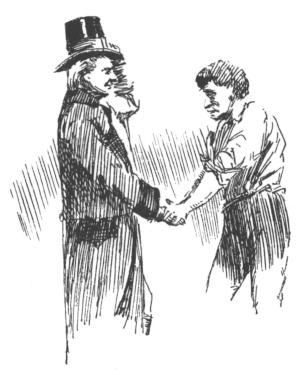
Charney, rushing towards Ludovico, now offered him his
hand.
“No, no!” exclaimed the jailer, assuming an attitude of
respect and constraint. “Hands are to be shaken only
between equals and friends.”
“Be my friend, then, Ludovico!” cried the Count.
“No, eccellenza, no!” replied the turnkey. “A jailer must
be on his guard, in order to perform his duties like a man of
conscience, to-day, to-morrow, and every day of the week.
If you were my friend, according to my notions of the word,
how should I be able to call out to the sentinel, Fire! if I
saw you swimming across the moat? I am fated to remain
your keeper, jailer, e divotissimo servo!”
CHAPTER V.
In the course of his solitary meditations, after Ludovico’s
departure, Charney was compelled to admit that, in his relations
with the jailer, the man of genius and education had
fallen below the level of the man of the people. To what
wretched subterfuges had he descended, in order to practice
upon the feelings of this kind-hearted and simple being! He
had even soiled his noble lips with an untruth.
He was startled to discover the services recently rendered
by Ludovico to the “povera picciola.” The boor, the jailer,
morose only when invited to a breach of duty, had actually
watched him in secret, not to exult over his weakness, but to
render him a service; nay, by his obstinate disinterestedness,
the man persisted in imposing an obligation on the Count de
Charney.
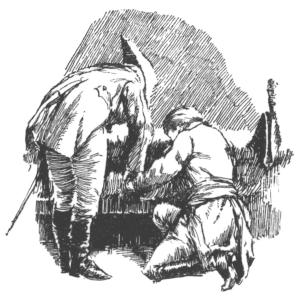
In his walk next morning, the Count hastened to share,
with his little favourite, the cruise of water allotted to his
use; not only watering the roots, but sprinkling the plant
itself, to refresh its leaves from dust or insects. While thus
occupied, the sky became darkened by a thunder-cloud, suspended
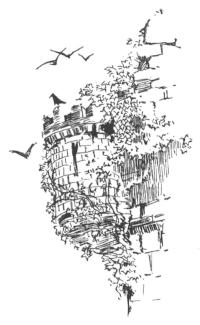
like a black dome over the turrets of the fortress.
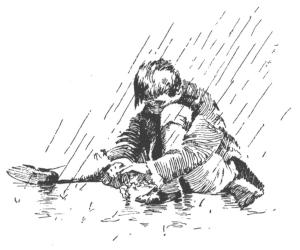
Large rain-drops began to fall: and Charney was about to
take refuge in his room, when a few hail-stones mingling with
the rain, pattered down on the pavement of the court. La
povera picciola seemed on the point of being uprooted by the
whirlwind which accompanied the storm. Her dishevelled
branches and leaves shrinking up towards their stalks for
protection against the chilling shower, trembled with every
driving blast of wind that howled, as if in triumph, through
the court.
Charney paused. Recalling to mind the reproaches of
Ludovico, he looked eagerly around for some object to defend
his plant from the storm; but nothing could be seen.
The hail-stones came rattling down with redoubled force,
threatening destruction to its tender stem; and, notwithstanding
Charney’s experience of its power of resistance
against such attacks, he grew uneasy for its safety. With an
effort of tenderness, worthy of a father or a lover, he stationed
himself between his protegée and the wind, bending over her,
to secure her from the hail; and, breathless with his struggles
against the violence of the storm, devoted himself, like a martyr,
to the defence of la picciola.
At length the hurricane subsided. But might not a recurrence
of the mischief bring destruction to his favourite at
some moment when bolts and bars divided her from her protector?
He had already found cause to tremble for her safety,
when the wife of Ludovico, accompanied by a huge mastiff,
one of the guardians of the prison, occasionally traversed
the yard; for a single stroke with its paw, or a snap of its
mouth, might have annihilated the darling of the philosophical
captive; and Charney accordingly passed the remainder of
the day in concocting a plan of fortification.
The moderate portion of wood allowed him for fuel,
scarcely supplied his wants in a climate whose nights and
mornings are so chilly, in a chamber debarred from all
warmth of sunshine. Yet he resolved to sacrifice his comfort
to the safety of the plant. He promised himself to
retire early to rest, and rise later; by which means, after a
few days of self-denial, he amassed sufficient wood for his
purpose.
“Glad to see you have more fuel than you require,” cried
Ludovico, on noticing the little stock. “Shall I clear the
room for you of all this lumber?”
“Not for the world,” replied Charney, with a smile. “I
am hoarding it to build a palace for my lady-love.”
The jailer gave a knowing wink, which signified, however,
that he understood not a word about the matter.
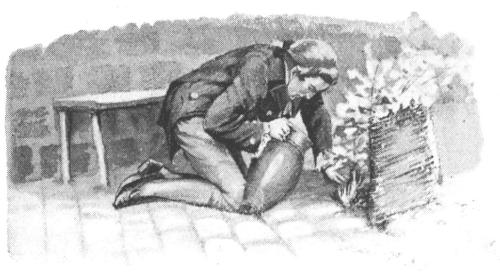
Meanwhile, Charney set about splitting and pointing the
uprights of his bastions; and carefully laid aside the osier
bands which served to tie up his daily fagots. He next tore
from his trunk its lining of coarse cloth; out of which he
drew the strongest threads: and his materials thus prepared,
he commenced his operations the moment the rules of the
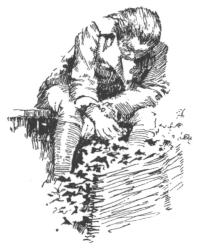
prison and the exactitude of the jailer would admit. He surrounded
his plant with palisades of unequal height, carefully
inserted between the stones of the pavement, and secured at
the base by a cement of earth, laboriously collected from the
interstices, and mortar and saltpetre secretly abstracted from
the ancient turret-walls around him. When the labours of
the carpenter and mason were achieved, he began to interlace
his scaffolding at intervals with split osiers, to screen la picciola
from the shock of exterior objects.
The completion of his work acquired, during its progress,
new importance in his eyes, from the opposition of Ludovico.
The jailer shook his head and grumbled when first he noticed
the undertaking. But before the close of the performance
the kind-hearted fellow withdrew his disapprobation; nay,
would even smoke his pipe, leaning against the wicket of the
courtyard, and watching, with a smile, the efforts of the unpractised
mechanic; interrupting himself in the enjoyment of
his favourite recreation, however, to favour Charney with
occasional counsels, the result of his own experience.
The work progressed rapidly; but, to render it perfect, the
Count was under the necessity of sacrificing a portion of his
scanty bedding; purloining handfuls of straw from his palliasse,
in order to band up the interstices of his basket-work,
as a shelter against the mountain wind, and the fierceness of
the meridian sun, which in summer would be reflected from
the flint of the adjacent wall.
One evening, a sudden breeze arose, after Charney had
been locked in for the night—and the yard was quickly strewn
with scattered straws and slips of osier, which had not been
worked in with sufficient solidity. Charney promised himself
to counteract next day the ill effects of his carelessness; but
on reaching the court at the usual hour, he found that all the
mischief had been neatly repaired: a hand more expert than
his own had replaced the matting and palisades. It was not
difficult to guess to whom he was indebted for this friendly interposition.
Meanwhile, thanks to her friend—thanks to her
friends, the plant was now secured by solid ramparts and
roofing: and Charney, attaching himself, according to the
common frailty of human nature, more tenderly to the object
on which he was conferring obligation, had the satisfaction
to see the plant expand with redoubled powers, and acquire
new beauties every hour. It was a matter of deep interest
to observe the progress of its consolidation. The herbaceous
stem was now acquiring ligneous consistency. A glossy bark
began to surround the fragile stalk; and already, the gratified
proprietor of this gratuitous treasure entertained eager
hopes of the appearance of flowers among its leaves. The
man of paralysed nerves—the man of frost-bound feelings,
had at length found something to wish for! The action of
his lofty intellect was at last concentrated into adoration of
an herb of the field. Even as the celebrated Quaker, John
Bartram, resolved, after studying for hours the organization
of a violet, to apply his powers of mind to the analysis of the
vegetable kingdom, and eventually acquired high eminence
among the masters of botanical science, Charney became a
natural philosopher.
A learned pundit of Malabar is said to have lost his reason
in attempting to expound the phenomena of the sensitive
plant. But the Count de Charney seemed likely to be restored
to the use of his by studies of a similar nature; and,
sane or insane, he had at least already extracted from his
plant an arcanum sufficiently potent to dispel the weariness
of ennui, and enlarge the limit of his captivity.
“If it would but flower!” he frequently exclaimed,
“what a delight to hail the opening of its first blossom! a
blossom whose beauty, whose fragrance, will be developed
for the sole enjoyment of my eager senses. What will be its
colour, I wonder! what the form of its petals?—time will
show! Perhaps they may afford new premises for conjecture—new
problems for solution. Perhaps the conceited gipsy
will offer a new challenge to my understanding? So much
the better! Let my little adversary arm herself with all her
powers of argument. I will not prejudge the case. Perhaps,
when thus complete, the secret of her mysterious nature will
be apparent? How I long for the moment! Bloom, picciola!
bloom—and reveal yourself in all your beauty to him to
whom you are indebted for the preservation of your life!”
“Picciola!” Such is the name, then, which, borrowed
from the lips of Ludovico, Charney has involuntarily bestowed
upon his favourite! “Picciola!” la povera picciola,
was the designation so tenderly appropriated by the jailer to
the poor little thing which Charney’s neglect had almost allowed
to perish.
“Picciola!” murmured the solitary captive, when every
morning he carefully searched its already tufted foliage for
indications of inflorescence; “when will these wayward flowers
make their appearance!” The Count seemed to experience
pleasure in the mere pronunciation of a name uniting in
his mind the images of the two objects which peopled his solitude—his
jailer and his plant!
Returning one morning to the accustomed spot, and, as
usual, interrogating Picciola branch by branch, leaf by leaf,
his eyes were suddenly attracted towards a shoot of unusual
form, gracing the principal stem of the plant. He felt the
beatings of his heart accelerated, and, ashamed of his weakness,
the colour rose to his cheek, as he stooped for re-examination
of the event. The spherical shape of the excrescence
which presented itself, green, bristly, and imbricated with
glossy scales, like the slates of a rounded dome surmounting
an elegant kiosk, announced a bud! Eureka! A flower
must be at hand!
CHAPTER VI.
The fly-catcher,
who
occasionally
made his appearance
at his
grated window,
seemed to take
delight in watching
the assiduities of
Charney towards his favourite!
He had observed the Count compose
his cement, weave his osier-work—erect
his palisades; and, admonished by his own long
captivity of the moral influence of such pursuits, readily conjectured
that a whole system of philosophy was developing
itself in the mind of his fellow-prisoner.
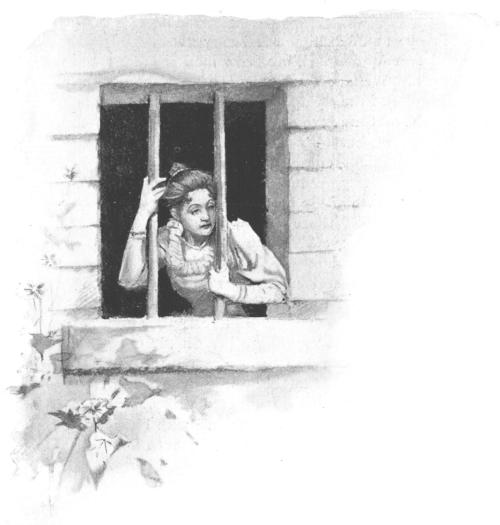
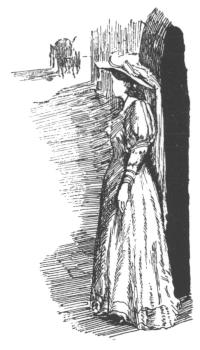
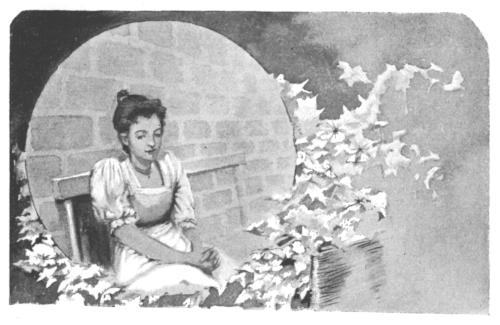
One memorable day, a new face made its appearance at
the window—a female face—fair, and fresh, and young. The
stranger was a girl, whose demeanour appeared at once timid
and lively; modesty regulated the movements of her well-turned
head, and the brilliancy of her animated eyes, whose
glances were veiled by long silken eyelashes of raven darkness.
As she stood behind the heavy grating, on which her
fair hand bent for support, her brow inclining in the shade as
if in a meditative mood, she might have stood for a chaste
personification of the nymph Captivity. But when her brow
was uplifted, and the joyous light of day fell on her lovely
countenance, the harmony and serenity of her features, her
delicate but brilliant complexion, proclaimed that it was in
the free air of liberty she had been nurtured, not under the
dispiriting influence of the bolts and bars of a dungeon. She
was, perhaps, one of those tutelary angels of charity, whose
lives are passed in soothing the sick and solacing the captive?—No!—the
instinct which brought the fair stranger
to Fenestrella was still more puissant—even that of filial
duty. Only daughter to Girardi the fly-catcher—Teresa had
abandoned the gay promenades and festivities of Turin, and
the banks of the Doria-Riparia, to inhabit the cheerless town
of Fenestrella, not that her residence near the fortress afforded
free access to her father: for some time she found it
impossible to obtain even a momentary interview with the
prisoner. But to breathe the same air with him—and think
of him nearer to herself, was some solace to her affliction.
This was her first time of admittance into the long-interdicted
citadel; and such is the origin of the delight which Charney
sees beaming in her eyes, and the colour which he observes
mantling on her cheek. Restored to the arms of her father,
Teresa Girardi has indeed a right to look gay, and glad, and
lovely!
It was a sentiment of curiosity which attracted her to the
window; a feeling of interest soon attaches her to the spot.
The noble prisoner and his occupation excite her attention;
but finding herself noticed in her turn, she tries to recede
from observation, as if convicted of unbecoming boldness.
Teresa has nothing to fear! The Count de Charney, engrossed
by Picciola and her flower-bud, has not a thought to
throw away on any rival beauty!
A week afterwards, when the young girl was admitted to
pay a second visit to her father, she turned her steps, almost
unconsciously, towards the grated window for a glimpse of
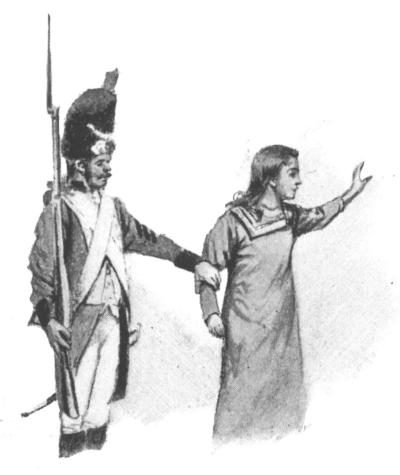
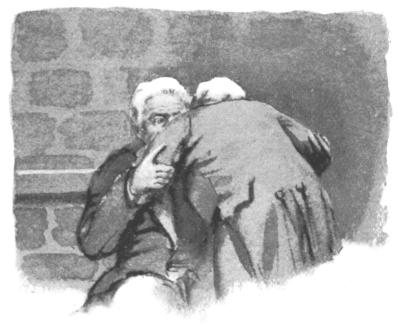
the prisoner; when Girardi, laying his hand upon her arm,
exclaimed, “My fellow-prisoner has not been near his plant
these three days. The poor gentleman must be seriously
ill.”
“Ill; seriously ill!” exclaimed Teresa, with emotion.
“I have noticed more than one physician traversing
the court: and from what I can learn from Ludovico, they
agree only to a single point—that the Count de Charney will
die.”
“Die!” again reiterated the young girl, with dilating eyes,
and terror rather than pity expressed in her countenance.
“Unhappy man—unhappy man!” Then turning towards her
father, with terror in her looks, she exclaimed, “People die,
then, in this miserable place!”
“Yes, the exhalations from the old moats have infected
the citadel with fever.”
“Father, dearest father!”
She paused—tears were gathering under her eyelids; and
Girardi, deeply moved by her affliction, extended his hand
tenderly towards her. Teresa seized and covered it with
tears and kisses.
At that moment Ludovico made his appearance. He
came to present to the fly-catcher a new captive whom he
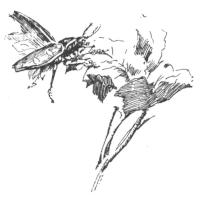
had just arrested—neither more nor less than a dragon-fly
with golden wings, which he offered with a triumphant smile
to Girardi. The fly-catcher smiled, thanked his jailer, and,
unobserved by Ludovico, set the insect at liberty; for it was
the twentieth individual of the same species, with which he
had furnished him during the last few days. He profited,
however, by the jailer’s visit to ask tidings of his fellow-prisoner.
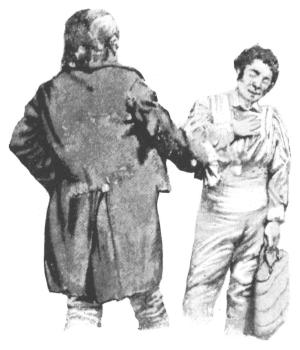
“Santissimo mio padrono! do you fancy I neglect the poor
fellow?” cried Ludovico, gruffly: “though still under my
charge, he will soon be under that of St. Peter. I have just
been watering his favourite tree.”
“To what purpose—since he is never to behold its blossoms?”
interrupted the daughter of Girardi.
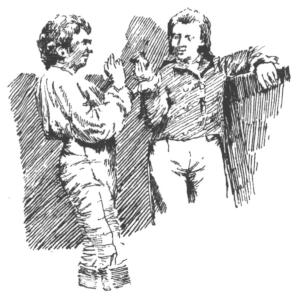
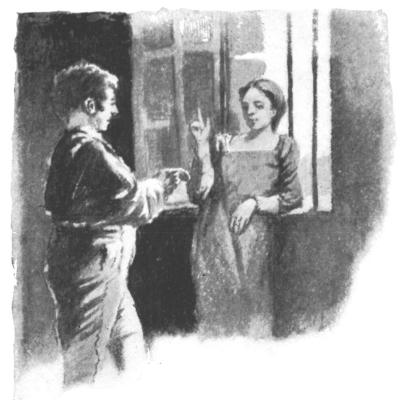
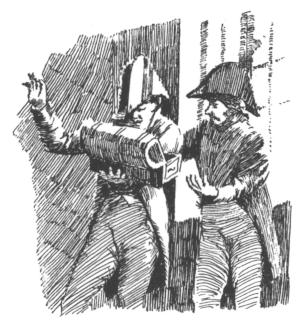
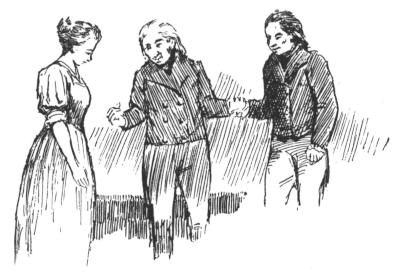
“Perche, damigella—perche?” cried the jailer, with his
accustomed wink, and sawing the air with a rude hand, of
which the forefinger
was authoritatively
extended; “because,
though the doctors
have decided that
the sick man has
taken an eternal
lease of the flat of
his back, I, Ludovico,
jailer of Fenestrella,
am of a
different opinion.
Non lo credo—trondidio!—I
have notions
of my own on
the subject.”
And turning on
his heel he departed; assuming, as he left the room, his big
voice of authority, to acquaint the poor girl, that only
twenty-two minutes remained of the time allotted for her
visit to her father. And at the appointed minute, to a
second, he returned, and executed his duty of shutting her
out.
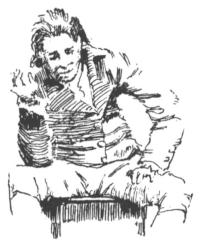
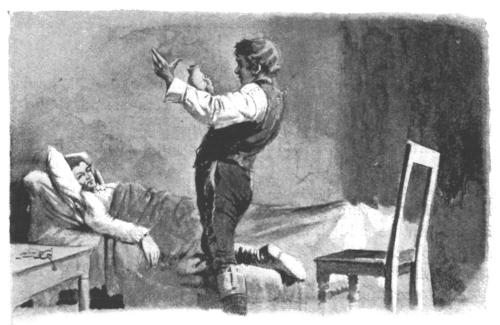
The illness of Charney was indeed of a serious nature.
One evening, after his customary visit to Picciola, an attack
of faintness overpowered him on regaining his room;
when, rather than summon assistance, he threw himself on
the bed, with aching brows, and limbs agitated by a nervous
shivering. He fancied sleep would suffice for his restoration.
But instead of sleep, came pain and fever; and on the
morrow, when he tried to rise, an influence more potent than
his will nailed him to his pallet. Closing his eyes, the Count
resigned himself to his sufferings. In the face of danger, the
calmness of the philosopher and the pride of the conspirator
returned. He would have felt dishonoured by a cry or murmur,
or an appeal to the aid of those by whom he was sequestered
from the breathing world—contenting himself with
instructions to Ludovico respecting the care of his plant,
in case he should be detained in bed, the carcere duro which
was to render still harder his original captivity. Physicians
were called in, and he refused to reply to their questioning.
Charney seemed to fancy that, no longer master of his
existence, he was exempted from all care for his life. His
health was a portion of his confiscated property; and those
who had appropriated all, might administer to that among
the rest. At first, the doctors attempted to overcome his
spirit of perversity; but finding the sick man obstinately
silent, they began to interrogate his disorder instead of his
temper.
The pathognomonic symptoms to which they addressed
themselves, replied in various dialects and opposite senses;
for the learned doctors invested their questions, each in the
language of a different system. In the livid hue of Charney’s
lips, and the dilated pupils of his eyes, one saw symptoms of
putrid fever; another, of inflammation of the viscera; while
the third inferred, from the coloration of the neck and temples,
the coldness of the extremities, and the rigidity of the
countenance, that the disorder was paralytic or apoplectic—protesting
that the silence of the patient was involuntary, the
result of the cerebral congestion.
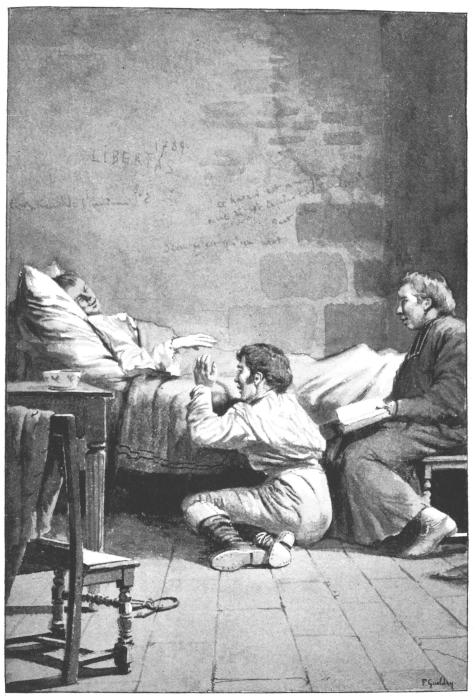
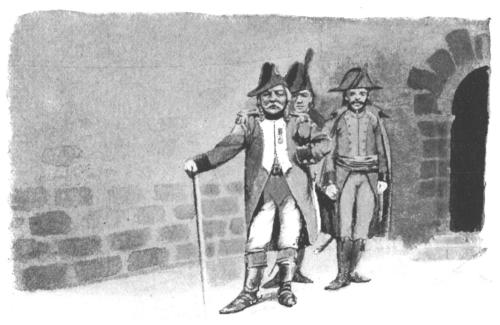
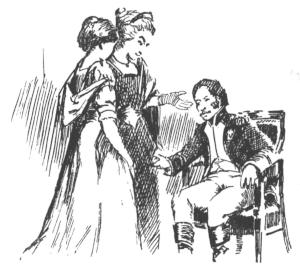
Twice did the captain-commandant of the fortress deign
to visit the bedside of the prisoner. The first time to
inquire whether the Count had any personal requests to
make—whether he was desirous of a change of lodging, or
fancied the locality had exercised an evil influence over
his health; to all which questions Charney replied by a
negative movement of the head. The second time, he came
accompanied by a priest. The Count had been given over
by his doctors as in a hopeless state. His time was expired;
it became necessary to prepare him for eternity; and
the functions of the commandant required that he should
see the last consolations of religion administered to his
dying prisoner.
Of all the duties of the sacerdotal office, the most august,
perhaps, are those of the ordinary of a prison—of the priest
whose presence sanctifies the aspect of the gibbet! Yet the
scepticism of modern times has flung its bitter mockeries in
the face of these devoted men! “Hardening their hearts
under the cuirass of habit,” says the voice of the scorner,
“these officials become utterly insensible. They forget to
weep with the condemned—they forget to weep for them; and
the routine of their professional exhortations has neither
grace nor inspiration in its forms of prayer.”
Alas! of what avail were the most varied efforts of eloquence—since
the exhortation is fated to reach but once the
ear of the victim? Alas! what need to inveigh against a calling
which condemns the pure and virtuous to live surrounded
by the profligate and hard-hearted, who reply to their words
of peace and love, with insults, imprecations, and contempt?
Like yourselves, these devoted men might have tasted the
luxuries and enjoyments of life—instead of braving the contact
of the loathsome rags of misery, and the infected atmosphere
of a dungeon. Endued with human sensibilities, and
that horror of sights of blood and death inherent in all mankind,
they compel themselves to behold, year after year, the
gory knife of the guillotine descend on the neck of the malefactor;
and such is the spectacle, such the enjoyment, which
men of the world denounce as likely to wear down their hearts
to insensibility!
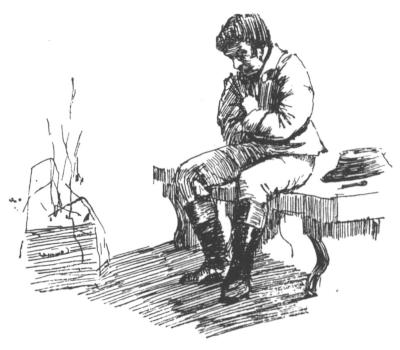
The priest at Charney’s bedside.
In place of this “man of sorrows and acquainted with
grief,” devoted for a lapse of years to this dreadful function,
in place of this humble Christian, who has made himself the
comrade of the executioner, summon a new priest to the aid
of every criminal! It is true, he will be more deeply moved;
it is true, his tears will fall more readily—but will he be more
capable of the task of imparting consolation? His words are
rendered incoherent by tears and sobs; his mind is distracted
by agitation. The emotion of which he is so deeply susceptible,
will communicate itself to the condemned, and enfeeble
his courage at the moment of rendering up his life
a sacrifice to the well-being of society. If the fortitude
of the new almoner be such as enables him to command
at once composure in his calling, be assured that his heart
is a thousand times harder than that of the most experienced
ordinary.
No—cast not a stone at the prison priest; throw no additional
obstacles in the way of so painful a duty! Deprive
not the condemned of their last friend. Let the cross of
Christ interpose, as he ascends the scaffold, between the eyes
of the criminal and the fatal axe of the executioner. Let his
last looks fall upon an object proclaiming, trumpet-tongued,
that after the brief vengeance of man comes the everlasting
mercy of God!
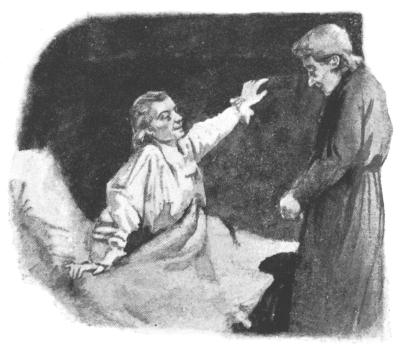
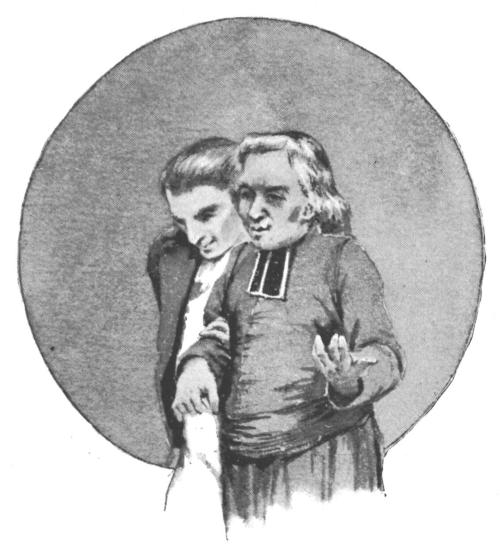
The priest summoned to the bedside of Charney was fortunately
worthy of his sacred functions. Fraught with tenderness
for suffering humanity, he read at once, in the obstinate
silence of the Count, and the withering sentences which
disfigured his prison walls, how little was to be expected of so
imperious and scornful a spirit; and satisfied himself with
passing the night in prayers by his bedside, charitably officiating
with Ludovico in the services indispensable to the sufferer.
The Christian priest waited, as for the light of dawning day,
an auspicious moment to brighten with a ray of hope the fearful
darkness of incredulity!
In the course of that critical night, the blood of the patient
determining to the brain, produced transports of delirium,
necessitating restraint to prevent the unfortunate Count
from dashing himself out of bed. As he struggled in the
arms of Ludovico and the priest, a thousand incoherent exclamations
and wild apostrophes burst from his lips; among
which the words “Picciola—povera Picciola!” were distinctly
audible.
“Andiamo!” cried Ludovico, the moment he caught the
sound. “The moment is come! Yes, yes, the Count is right;
the moment is come,” he reiterated with impatience. But
how was he to leave the poor chaplain there alone, exposed
to all the violence of a madman? “In another hour, it may
be too late!” cried Ludovico. “Corpo di Dio! it will be too
late. Blessed Virgin, methinks he is growing calmer! Yes,
he droops! he closes his eyes! he is sinking to sleep! If at
my return he is still alive, all’s well. Hurra! reverend father,
we shall yet preserve him, hurra, hurra!”
And away went Ludovico, satisfied, now the excitement
of Charney’s delirium was appeased, to leave him in the
charge of the kind-hearted priest.
In the chamber of death, lighted by the feeble flame of a
flickering lamp, nothing now was audible but the irregular
breathing of the dying man, the murmured prayers of the
priest, and the breezes of the Alps whistling through the
grating of the prison-window. Twice, indeed, a human voice
mingled in these monotonous sounds—the “qui vive?” of the
sentinel, as Ludovico passed and repassed the postern on his
way to his lodge, and back to the chamber of the Count.
At the expiration of half an hour, the chaplain welcomed the
return of the jailer, bearing in his hand a cup of steaming
liquid.
“Santo Christo! I had half a mind to kill my dog!” said
Ludovico, as he entered. “The brute, on seeing me, set up
a howl, which is a sign of evil portent! But how have you
been going on here? Has he moved? No matter! I have
brought something that will soon set him to rights! I have
made bold to taste it myself—bitter, saving your reverence’s
presence, as five hundred thousand diavoli! Pardon me! mio
padre!”
But the priest gently put aside the offered cup.
“After all,” said Ludovico, “’tis not the stuff for us. A
pint of good muscadello, warmed with a slice or two of lemon,
is a better thing for sitters-up with the sick—eh, Signore
Capellano? But this is the job for the poor Count; this will
put things in their places. He must drink it to the last drop;
for so says the prescription.”
And, as he spoke, Ludovico kept pouring the draught
from one cup to another, and blowing to cool it; till, having
reduced it to the proper temperature, he forced the half-insensible
Count to swallow the whole potion, while the
chaplain supported his shoulders for the effort. Then, covering
the patient closely up, they drew together the curtains of
the bed.
“We shall soon see the effects,” observed the jailer to his
companion. “I don’t stir from hence till all is right. My
birds are safe locked in their cages; my wife has got the
babe to keep her company. What say you, Signore Capellano?”
And Ludovico’s garrulity having been silenced by the
almoner, by a motion of the hand, the poor fellow stationed
himself in silence at the foot of the bed, with his eyes fixed
on the dying man; retaining his very breath in the anxiousness
of his watchfulness for the event. At length, perceiving
no sign of change in the Count, he grew uneasy. Apprehensive
of having accelerated the last fatal change, he started
up, and began pacing the room, snapping his fingers, and
addressing menacing gestures to the cup, which was still
standing on the table.
Suddenly he stopped short, and fixed his eyes on the livid
face of Charney.
“I have been the death of him,” cried he, accompanying
the apostrophe with a tremendous oath. “I have certainly
been the death of him.”
The chaplain raised his head, when Ludovico, unappalled
by his air of consternation, began anew to pace the room, to
stamp, to swear, to snap his fingers with all the energy of
Italian gesticulation, till, tired out by his own impetuosity,
he threw himself on his knees beside the priest, hiding his
head in the bedclothes, and murmuring his mea culpa, till, in
the midst of a paternoster, he fell asleep.
At dawn of day the chaplain was still praying, and Ludovico
still snoring; when a burning hand, placed upon the
forehead of the latter, suddenly roused him from his slumbers.
“Give me some drink,” murmured the faint voice of
Charney.
And, at the sound of a voice which he had supposed to
be for ever silenced, Ludovico opened his eyes wide with
stupefaction to fix them on the Count, upon whose face and
limbs the moisture of an auspicious effort of nature was perceptible.
The fever was yielding
to the effect of the powerful
sudorific administered by
Ludovico; and the senses of
Charney being now restored,
he proceeded to give rational
directions to the jailer concerning
the mode of treatment
to be adopted; then, turning
towards the priest, still humbly
stationed on his knees at
the bedside, he observed—
“I am not yet dead, sir!
Should I recover (as I have
every hope of doing), present
the compliments of the Count
de Charney to his trio of doctors, and tell them I dispense
with their further visits, and the blunders of a science as idle
and deceptions as all the rest. I overheard enough of their
consultations to know that I am indebted to chance alone for
my recovery.”
“Chance!” faltered the priest—“chance!”—And, having
raised his eyes to Heaven in token of compassion, they fell
upon the fatal inscription on the wall—
“Chance, though blind, is the sole author of the
creation.”
The chaplain paused, after perusing this frightful sentiment;
then, having gathered breath by a deep and painful
inspiration, he added, in a solemn voice, the last word inscribed
by Charney—
“Perhaps!”
And ere the startled Count could address him, he had
quitted the apartment.
CHAPTER VII.
Elated by success, Ludovico lent his ear, in a sort of
idiotic ecstasy, to every syllable uttered by the Count. Not
that he comprehended their meaning:—There, luckily, he
was safe. But his dead man was alive again; had resumed
his power of speaking, thinking, acting—a sufficient motive
of exultation and emotion to the delighted jailer.
“Viva!” cried he; “viva, evviva. He is saved. All’s
well! Che maraviglia! Saved!—and thanks to whom?—to
what?”
And, waving in the air his earthen vessel, he proceeded to
hug and embrace it, saluting it with the tenderest diminutives
of the Tuscan vocabulary.
“Thanks to what?” echoed the sick man. “Why, to
your friendly care, my good Ludovico. Nevertheless, should
my cure be perfected, you will find those doctors yonder
claiming all honour for their prescriptions; and the priest
for his prayers.”
“Neither they nor I have any title to the victory,” cried
Ludovico, with still wilder gesticulation. “As to the Signore
Capellano, his handiwork may have done something: ’tis hard
to say. But as to the other—ay, ay—as to the other bringer
of salvation—”
“To whom do you allude?” interrupted Charney, expecting
that the superstitious Ludovico would attribute his
recovery to the interposition of some favourite saint. “Who
has deigned to become my protector?”
“Say protectress, and you will be nearer the mark,” cried
Ludovico.
“The Madonna—eh?” demanded Charney, with an ironical
smile.
“Neither saint nor Madonna!” replied the jailer, stoutly.
“She who has preserved you from the jaws of death and
the claws of Satan (for dying without confession you were
damned as well as dead), is no other than my pretty little
god-daughter.”
“Your god-daughter!” said the Count, lending a more
attentive ear to his rhapsodies.
“Ay, Eccellenza, my god-daughter, Picciola, Picciolina, Piccioletta.
Was not I the first to baptize your favourite? Did
I not give her the name of Picciola? Have you not often
told me so yourself? Ergo—the plant is my god-daughter,
and I her godfather—per Bacco! I’m growing proud of the
distinction!”
“Picciola!” exclaimed Charney, starting up, and resting
his elbow on his pillow, while an expression of the deepest
interest took possession of his countenance. “Explain yourself,
my good Ludovico, explain yourself!”
“Come, come, no shamming stupid, my dear lord!” said
the jailer, resuming the customary wink of the eye, “as if
’twas the first time that she had saved your life!”
“The first time?”
“Didn’t you tell me yourself that the herb was the only
specific against the disorder to which you were subject?
Lucky job I hadn’t forgotten it; for the Signora Picciola
proves to have more wisdom in one of her leaves, than the
whole faculty of Montpellier in the noddles that fill its
trencher-caps. Trondidio, my little god-daughter is able to
defeat a regiment of doctors! ay, in full complements—four
battalions, and four hundred picked men to each. Pray, did
not your three humbugs in black throw back the coverlid on
your nose, and pronounce you to be a dead man? while Picciola,
the stout-hearted little weed (God send her seed in her
harvest!), brought you round in the saying of a paternoster?
’Tis a recipe I mean to keep like the apple of my eye; and if
ever poor little Antonio should fall sick, he shall drink broths
of the herb, and eat salads of it; though, good truth, ’tis as
bitter as wormwood. A single cup of the infusion, and all
acted like a charm. Vittoria! Viva l’illustrissima Signorina
Picciola!”
Charney had not the heart to resent these tumultuous ecstasies
of his worthy keeper. The idea of being indebted for
his life to the agency of the feeble favourite, which had embellished
his days of health, insensibly brought a smile to his
still feverish lips. But a vague apprehension oppressed his
feelings.
“In what way, my good Ludovico, did you manage to apply
your remedy?” said he, faintly.
“Faith! easily enough! A pint of scalding water poured
upon the leaves” (Charney bit his lips with anxiety), “in a
close kettle, which, after a turn or two over the stove, furnished
the decoction.”
“Indeed!” exclaimed the Count, falling back on his pillow,
and pressing his hand to his forehead. “You have then
destroyed the plant! I must not reproach you, Ludovico;
you did it for the best. And yet, my poor Picciola! What
will become of me, now I have lost my little companion!”
“Come, come! compose yourself!” answered Ludovico,
assuming the paternal tone of a father comforting his child
for the loss of a favourite plaything. “Compose yourself,
and do not expose your limbs to cold, by throwing off
your clothes in this way. Listen to reason!” he continued,
disposing the covering round the person of his patient.
“Was I to hesitate between the life of a gilly-flower and the
life of a man? Certainly not! ’Twould have been a sin—a
murder!”
Charney groaned heavily.
“However, I hadn’t the heart to plunge the poor thing
head foremost into the smoking kettle. I thought a loan
might do as well as total pillage; so, with my wife’s scissors,
I snipped off leaves enough for a strong infusion (sparing
the buds; for the jade has now three flower-buds for her top-knot),
and though her foliage is a little the thinner, I’ve a
notion the plant will not suffer from thinning. Picciola will,
perhaps, be the better for the job, as well as her master. So
now, be prudent, eccellenza! only be prudent, and all will go
by clock-work at Fenestrella.”
Charney, directing a glance of grateful affection towards
his jailer, extended towards him a hand which, this time,
Ludovico felt himself privileged to accept; for the eyes of
the Count were moistened by tears of emotion. But suddenly
recollecting himself, and angry with his own infraction of the
rule he had traced for his conduct towards those committed
to his charge, the muscles of Ludovico’s dark face contracted,
and he resumed his harsh, surly, every-day tone. Though
still holding within his own the hand of his prisoner, he affected
to give a professional turn to his attitude.
“See!” cried he, “in spite of my injunctions, you still
persist in uncovering yourself. Remember, sir, I am responsible
for your recovery!”
And, after further remonstrances, made in the dry tone
of office, Ludovico quitted the room, murmuring to the accompaniment
of his rattling keys, the burden of his favourite
song:
“I’m a jailer by my trade;
A better ne’er was made.
Easy ’tis to laugh for those that win, man!
I’d rather turn the key
Than have it turned on me.
Better out of doors than always in, man!
With a lira-lira-la—driva din, man!”
CHAPTER VIII.
During the remainder of that and the following day
Charney exhibited the depression of mind and body which
results from every great physical crisis. But on the third day
he resumed his powers of thought and action; and, if still
detained by weakness on his pillow, the time was not far distant
when he was likely to resume his former habits of life.
What delight to renew his acquaintance with his benefactress!
All his thoughts were now turned towards Picciola!
There seemed to be something beyond the common course of
events in the fact that a seed, accidentally shed within the
precincts of his prison, should have germinated in order to
cure in the first instance his moral disorder—ennui: and in
the second, the perilous physical disease to which he had been
about to fall a victim. He, whom the splendour of wealth
had failed to enliven—he, whom the calculations of human
learning had failed to restore—had been preserved, first and
last, by a plant! Enfeebled by illness, he was no longer able
to apply his full force of reasoning to the development of
the question; and a superstitious feeling, accordingly, began
to attach him with redoubled force to the mysterious Picciola.
It was impossible to ground upon a rational basis his
sentiments of gratitude towards a non-sentient being; nevertheless
Charney found it impossible to refuse his affection in
exchange for the existence bestowed upon him. Where reason
is paralysed, imagination exercises her influence without
restraint. Charney’s regard for his benefactress now became
exalted into a religious feeling, or rather into a blind superstition.
Between him and his favourite there existed a mysterious
sympathy of nature, like the attraction which draws
together certain inanimate substances. He even fancied himself
under a charm—a spell of enchantment. Who knows?
Perhaps the arrogant refuter of the existence of a God is
about to fall into the puerilities of judicial astrology. For in
the secrecy of his cell, Charney does not hesitate to apostrophize
Picciola as his star—his destiny—his talisman of
light and life!
It is a curious fact that scarcely one illustrious man, remarkable
for knowledge or genius, convicted of doubt in the
agency of a Providence, but has been in his own person the
slave of superstition; while attempting to throw off the yoke
of servitude, submitting to become threefold slaves. In the
blind eagerness of their pride to arrogate to their own merit
the power or glory they have attained—those deep-seated instincts
of religion which they have attempted to stifle in their
souls—thrust out of their natural channel—force a way of
their own towards daylight, and acquire a wild and irregular
character. The homage they arrest in its course to heaven,
falls back upon the earth. They would fain judge, though
they refuse to believe; and the genius whose horizon they
have circumscribed, requites the forced contraction by seeing
things in part instead of a whole, and losing all power of estimating
the homogeneous design of the great Master of all!
They attach themselves to details, because an isolated fact is
within the scope of their judgment, and do not so much as
notice the points of union which connect it with universal nature.
For what is the whole creation—earth, air, water—the
winds, the waves, the stars—mankind—the universe, but an
infinite being, complete, premeditated, varied into inscrutable
details, and breathing and palpitating under the omnipresent
hand of God?
Subdued, however, by the strength of his pride and the
weakness of his health, Charney saw nothing to admire in nature
but his weed—his plant—his Picciola; and, as if to justify
his folly by analogy, dived into the vast stores of his
memory for a precedent.
He called to mind all the miraculous plants recorded from
the earliest times, by poet or historian; the holly of Homer—the
palm-tree of Latona—the oak of Odin—nay, even the
golden herb which shines before the eyes of the ignorant
peasants of Brittany, and the May-flower, which preserves
from evil thoughts the simple shepherdess of La Brie. He
recollected the sacred fig-tree of the Romans—the olive of the
Athenians—the Teutatés of the Celts—the vervain of the
Gauls—the lotus of the Greeks—the beans of the Pythagoreans—the
mandrake of the Hebrews. He remembered the
green campac which blossoms everlastingly in the Persian’s
paradise; the touba tree which overshadows the celestial
throne of Mahomet; the magic camalata, the sacred amreet
on whose branches the Indians behold imaginary fruits of
Ambrosia and of voluptuous enjoyment. He recurred with
pleasure to the symbolical worship of the Japanese, who elevate
the altars of their divinities on pedestals of heliotropes
and water-lilies, assigning the throne of Love himself to the
corolla of a nenuphar. He admired the religious scruples of
the Siamese, which make it sacrilege to exterminate or even
mutilate certain consecrated shrubs. A thousand superstitions
which in former times excited his pity and contempt toward
the short-sightedness of human nature, tended now to elevate
his fellow-creatures in his estimation. For the Count had
discovered that, from the vegetation of an humble flower,
may emanate lessons of wisdom; and doubted not, that all
these idolatrous customs must have originated in sentiments
of gratitude unexampled by tradition.
“From his imperial throne of the west,” thought Charney,
“Charlemagne did not disdain to exhort the nation submitted
to his rule, to the culture of flowers. And have not Ælian
and Herodotus recorded that the great Xerxes himself took
such delight in the beauty of an oriental plane-tree, as to
caress its stem—press it tenderly in his arms—sleep enraptured
under its shade—decorating it with bracelets and
chains of gold, when compelled to bid adieu to his verdant
favourite!”
As the convalescence of the Count proceeded, he was
seated one morning reclining absorbed in thought in his
own chamber, of which he had not yet ventured to cross the
threshold, when his door was suddenly burst open, and Ludovico,
with a radiant countenance, hastened towards him.
“Vittoria!” cried he. “The creature is in bloom. Picciola!
Piccioletta! figlioccia mia!”
“In bloom?” cried Charney, starting up. “Let me see
her. I must see the blossom.”
In vain did the worthy jailer represent the imprudence of
going too soon into the air, and implore the Count to delay
the undertaking for a day or two. The morning was uncertain—the
atmosphere chilly. A relapse might bring the invalid
once more to the gates of death. But Charney was deaf
to all remonstrance! He consented only to wait an hour, in
order that the sun might become one of the party.
“Picciola is in bloom!” repeated Charney to himself.
And how long, how tedious did that hour appear, which was
still to divide him from the darling of his imagination! For
the first time since his illness, he judged it necessary to dress.
He chose to dedicate his first toilet to Picciola in bloom. He
actually looked into his pocket-glass while he arranged his
hair to do honour to his visit to a flower! A flower? Nay!
surely something more? His visit is that of the convalescent to
his physician—of the grateful man to his benefactress—almost
of the lover to his mistress! He was surprised to notice in the
glass the ravages which care and sickness had wrought in his
appearance. He began to suspect, for the first time, that bitter
and venomous thoughts may tend to canker the human
frame; and milder contemplations produce a more auspicious
temperament.
At the appointed moment Ludovico reappeared, to offer
to the Count de Charney the support of his arm down the
steep steps of the winding stone staircase; and scarcely had
the sick man emerged into the court, when the emotion
caused by a sudden restoration to light and air, operating on
the sensitiveness of an easily excitable nervous system, produced
a conviction on his mind that the whole atmosphere
was vivified and embalmed by the emanations of his flower.
It was to Picciola he attributed the delightful emotions which
agitated his bosom.
The enchantress had, indeed, attired herself in all her
charms! The coquette was shining in all her beauty. Her
brilliant and delicately streaked corolla, in which crimson,
pink, and white were blended by imperceptible gradations, her
large transparent petal bordered by a little silvery fringe or
ciliation, which the scattered rays of the sun seemed to
brighten into a halo encircling the flower, exceeded the utmost
anticipations of the Count, as he stood gazing with
transport upon his queen! He feared, indeed, to tarnish the
delicacy of the blossom by the contact of his hand or breath.
Analysis or investigation seemed out of the question, engrossed
as he was by love and admiration for the delicate
thing whose fragrance and beauty breathed enchantment upon
every sense!
But he was soon startled from his reveries! The Count
noticed, for the first time, traces of the mutilation by which
he had been restored to health; branches half cut away, and
fading leaves still wounded by contact with the scissors of
Ludovico. Tears started into his eyes! Instead of admiration
for the delicate lines and perfumes of those expanding
blossoms, he experienced only gratitude for the gift of life!
He beheld a benefactress in his Picciola.
CHAPTER IX.
The physician of the prison condescended to authorize on
the morrow the Count de Charney’s resumption of his daily
exercise. He was allowed the freedom of the little court,
not only at the usual hours, but at any moment of the day.
Air and exercise were considered indispensable to his recovery;
and thus, the prisoner was enabled to apply himself
anew to his long-interrupted studies.
In the view of committing to writing his scientific observations
on the development of his plant, from the moment of
its germination, he tried to seduce Ludovico into furnishing
him with pens and paper. He expected, indeed, to find the
jailer resume on this occasion an air of importance, and raise
a thousand difficulties, but probably yield in the sequel out
of love for his captive, or his god-daughter, or worldly pelf;
for where perquisites were concerned, turnkey-nature was still
uppermost. But to Charney’s great surprise, Ludovico received
his propositions with the most frank good-humour.
“Pens and ink? Nothing more easy, Signor Conte!” said
he, tapping his pipe and turning aside his head to keep it
alive by a whiff or two; for he made it a point to abstain
from smoking in presence of the Count, to whom the smell
of tobacco was disagreeable. “I, for my part, have no objection.
But you see, such little tools as pens and paper remain
under the lock and key of the governor, not under
mine; and if you want writing materials, you have only to
memorialize the captain-commandant, and your business is
done!”
Charney smiled, and persevered.
“But in order to frame my petition, good Ludovico,” said
he, “pens, ink, and paper are, in the first instance, indispensable?”
“True, eccellenza, true! But we must drag back the donkey
by the tail to make it get on—no uncommon method with
petitions,” quoth the jailer, half aside, crossing his hands consequentially
behind him. “I must go straight to the governor,
and tell him you have a request to make, no matter about
what. That is not my business, but his and yours. If inconvenient
to him to visit you in person, he’ll send his man of
business, who will furnish you with a pen and a piece of
stamped paper, just one sheet, ruled in form for a petition,
on which you must inscribe your memorial in his presence;
after which, he places his seal on it in yours; you return the
pen to him, he makes you a bow, and away he goes with the
petition!”
“But it is not from the governor I ask for paper, Ludovico,
’tis from yourself.”
“From me? You don’t then happen to know my orders!”
replied the jailer, resuming his accustomed severity.
Then drawing a deep breath of his pipe, he exhaled the smoke
with much deliberation, eying the Count askance during the
process, turned on his heel, and quitted the room.
Next day, when Charney returned to the charge, Ludovico
contented himself with winking his eye, shaking his head,
and shrugging his shoulders. Not a word now was to be
extracted from him.
Too proud to humiliate himself to the governor, but still
bent upon his project, Charney now set to work to make a
pen for himself out of a crow-quill tooth-pick. With some
soot, carefully dissolved in one of the golden cups of his
dressing-case, he furnished himself with ink and inkstand;
while his cambric handkerchiefs, relics of a former splendour,
were made to serve for writing-paper. With these awkward
materials, he resolved to record the peculiarities of Picciola;
occupying himself, even when absent from his favourite,
with details of her life and history.
What profound remarks already presented themselves for
inscription! What pleasure would Charney have found in
communicating his observations to any intelligent human
being! His neighbour, the fly-catcher, might have been a
satisfactory auditor; for Charney had now found occasion
to admire the bland and benevolent expression of a countenance
at first sight commonplace. Whenever the old man
stood contemplating from his little window, with an inquiring
and propitious eye, the beauty of Picciola, and the attentions
of her votary, the Count felt irresistibly attracted towards
his fellow-prisoner. Nay, smiles and salutations with the
hand had been exchanged between them; and it was only
the rigid interdiction of all intercourse between prisoners at
Fenestrella, which prevented mutual inquiries after each
other’s health and pursuits. The solitary explorers into the
mysteries of nature were therefore compelled to keep to
themselves their grand discoveries in botany and entomology.
First among those by which Charney was interested, after
the flowering of his plant, was the faculty exhibited by Picciola
of turning her sweet face towards the sun, and following
him with her looks throughout his daily course, as if to
imbibe the greatest possible portion of his vivifying rays.
When clouds obscured the orb of day, or there was a prospect
of rain, her petals instantly closed, like a vessel furling its
canvas before a storm. “Are light and heat so necessary,
then, to her existence?” mused the Count; “and why should
she fear to refresh herself with a sprinkling shower? Why?
why? Picciola will explain! I have perfect confidence in
Picciola!”
Already his darling had fulfilled towards him the functions
of a physician. She was now about to become his
compass and barometer, perhaps even his timepiece; for by
dint of constantly inhaling her fragrance, Charney found he
could discover that her perfumes varied in power and quality
at different hours of the day. At first, this phenomenon
seemed an illusion; but reiterated experiments convinced
him that he was not mistaken; and he was soon able to designate
to a certainty the hour of the day, according to the
varying odour of the flower.[1]
[1] Sir James Smith notices this property in the Antirrhinum repens. Flora
Britannica, vol. ii. p. 638.
Innumerable blossoms already studded his beautiful plant:
towards evening their exhalations were as delicious as they
were potent; and at that moment, what a relief to the weary
captive to draw near to his favourite! He now constructed
a rude bench, with some planks derived from the munificence
of Ludovico, and pointed a few logs, which he contrived to
insert into the interstices of the pavement. A rough plank,
nailed transversely, afforded him a leaning place, as he sat
for hours musing and meditating in the fragrant atmosphere
of his plant. He was happier there than he had ever felt on
his silken ottomans of former days; and hour after hour
would he sit reflecting on his wasted youth, which had elapsed
without the attainment of a single real pleasure, or genuine
affection! withering away in the midst of vain chimeras and
premature satiety.
Often, after such retrospections, Charney found himself
gradually soothed into reveries between sleep and waking;
his senses subdued into a sort of apathetic torpor, his imagination
excited to a visionary ecstasy, perplexing the desolate
Count with scenes of days past and days to come.
He sometimes fancied himself in the midst of those brilliant
fêtes, where, though himself the victim of ennui, he used
to lavish upon others all the pleasures and luxuries of life.
He seemed to stand gazing, some night of the Carnival, beside
the illuminated façade of his hotel in the Rue de Verneuil,
the rolling of a thousand carriages vibrating in his
ear. One by one, they entered, by torchlight, his circular
courtyard, depositing successively in the vestibule, covered
with rich carpets, and protected by silken hangings, the
fashionable belles of the day, enveloped in costly furs, under
which was audible the rustling of satin or brocade; the beaux
of the imperial court, with their high-crowned hats, cravats
up to their ears, and redundant knee strings; artists of
eminence, with naked throats, Brutus-heads, and a costume
half French, half Greek; and men of science or letters, wearing
the distinctive academic collar of green. A crowd of
lackeys clustered on all sides, insolently defying, under their
new liveries, the absolute decrees of the once puissant conventional
republic of France.
The fancy of Charney next ascended to the crowded
saloons in which were assembled all that was illustrious or
notorious of the capital. The toga and chlamyda were
jumbled together with jackets, or frock-coats. High-heeled
shoes, with rosettes, trod the same floors as jockey-boots,
with spur on heel, nay, even with the caliga and cothurnus.
Men of the law, the pen, the sword, moneyed men and
moneyless, artists and ministers of state, all were confounded
in this olla podrida of the Directory. An actor stood hand in
glove with an ex-bishop, a ci-devant peer with a ci-devant
pauper; aristocracy and democracy were united like twin
brothers; wealthy ignorance paraded itself arm in arm with
starving erudition. Such was the regeneration of society,
rallying round a common centre in masses, of which each felt
itself still too feeble to stand alone. The marshalling of the
crowd was deferred to some more convenient season; there
would be a time for that hereafter! Such is the system of a
play-ground, where all classes of a school mingle together
under the impulse of a common thirst after amusement. As
the boys grow older, the powerful influence of the spirit of
social order insensibly estranges them from unbecoming companions,
and high and low mechanically range themselves
under their appointed banners.
A reverie.
With a silent smile did Charney contemplate this phantasmagoric
display of piebald civilization. That which had once
excited the bitter sneers of the man of the world, now served
to divert him, as the memento of the wasted years spent by
his native country in shallow, theoretic experiments, exposing
it to the contempt of Europe.
At times, brilliant orchestras appeared to strike into animating
and joyous measures; and lo! the opening of the
ball! Charney fancied he could recognise the favourite airs
of former days, but more impressive than at their first hearing.
The glittering radiance of the lustres, their prismatic
reflection in the numerous mirrors, the soft and perfumed
atmosphere of a ball-room—the aroma of a banquet—the
mirth of the guests—the wild hilarity of the waltzers, who
rustled against him in the mazy round—the light and frivolous
topics which excited their merriment, all tended to
stimulate him to a degree of joyousness such as the reality of
the dream had never succeeded in producing.
Women, too—ivory-shouldered, slender-waisted, swan-throated—women,
arrayed in sumptuous brocades, gauzes
striped with gold, and gems of sparkling lustre, thronged
around him, smiling as they returned his salutations. One by
one, he recognised those lovely beings; the grace and ornaments
of his entertainments, when, opulent and free, the Count
de Charney was cited as one of the favoured ones of the
earth. There figured, unrivalled, the majestic Tallien, arrayed
in the classic tunic of Greece, and covered with gems
and costly rings, even to the toes of a foot from which might
have been modelled that of some Venus of antiquity, naked
but for the slight concealment of a golden sandal; the fair
Recamier, to whom Athens would have erected altars; and
Josephine, ci-devant Countess of Beauharnais, who, by dint of
grace and affability, often passed for the fairest of these
three graces of the Consulate. But even by the side of these,
a hundred lovely women distinguished themselves, by their
beauty or their elegance; and how exquisite did they now
appear in the dreaming eyes of Charney! How much fairer,
how much softer, than when they courted his smiles! How
gladly had he now commanded liberty of choice among so
many consummate enchantresses!
Sometimes, in the wildness of his reveries, he did venture
on selection!—from the brilliant crowd he singled out one—undistinguished,
however, by the lustre of ivory shoulders or
a tiara of diamonds. Simple in attire as in deportment, his
beauty lingered behind the rest, with downcast eyes, and
cheeks suffused with blushes; a girl, a young girl, arrayed in
simple white, and the no less spotless array of perfect innocence.
She had never shone in his galas of other times;
though now she stood out prominent on the canvas, while
all others vanished into shade. At last, she seemed alone;
and Charney began to reconsider her, charm by charm, feature
by feature. His feelings were gently agitated by the lovely
vision. But how much more when, on raising his eyes to the
dark braids of her raven hair, he beheld a flower blooming
there, his flower, the flower of Picciola! Involuntarily he extended
his arms towards the beauteous apparition, when, lo!
all grew confused and misty; and the distant music of the
orchestra became once more audible, as the fair maiden and
fair flower appeared to melt into each other. The fragrant
corolla, expanding, enclosed with its delicate petals the loveliest
of human faces, till all was hidden from his view. Instead
of the gorgeous hangings and gilded walls of the ball-room,
a hovering exhalation presented itself to the eyes of
the Count. The lustres gradually extinguished, vanished in
the distance, emitting a feeble arch of light on the outskirts
of the gathering clouds. Rude pavement replaced the smooth
and lustrous floor; stern Reason reappeared to take possession
of her throne; and the gracious illusions of fancy expired
at her approach. A touch of the fatal wand of Truth
dispelled at once the dream of the captive.
Charney woke to find himself musing on his rustic bench,
his feet resting on the stones of the courtyard, and the daylight
fading over his head. But Picciola—thanks be to Heaven,
Picciola is still before him!
The first time the Count became conscious of this species
of vertigo he noticed that it was only when meditating in
the atmosphere of his plant that such gentle visions descended
upon his mind. He recollected that the emanations
of certain flowers are of so intoxicating a nature as even to
produce asphyxia. It was, therefore, under the influence of
his favourite, that these delicious dreams visited his imagination;
and for his fête—his houris—his banquets—his music—he
was still indebted to Picciola.
But the fair girl—the modest, gentle girl by whose image
he had been so powerfully impressed—from whence has he
derived her image? Did he ever behold her among the
haunts of men? Is she, like the other divinities of his
dream, the creature of reminiscence? Memory had nothing
to reply! The past afforded no prototype for her charms!
But the future—if the vision his fancy has created should be
the creature of anticipation, of presentiment rather than of
recollection? alas! of what avail anticipations—of what avail
revelations of the future to the unfortunate Charney! In a
sentence of imprisonment for life, the destinies of the captive
are accomplished.
All human hope, therefore, must be laid aside. The
young girl of blooming blushes, and draperies of virgin
white, shall be the Picciola of his imagination—Picciola in
the poetical personification of a dream—his idol, his love, his
bride. The sweet countenance and graceful form revealed
to him shall image forth the guardian spirit of his plant:
with that, his reveries shall be brightened, and the aching
void in his heart and soul filled up for ever! She shall
dwell with him, muse with him, sit by his side, accompany
his lonely walks, reply to him, smile upon him, enchant him
with her ethereal love! She shall share his existence, his
breath, his heart, his soul. He will converse with her in
thought, and close his eyes to gaze upon her beauty! They
shall form but one, in order that he may be alone no longer.
These emotions superseded the graver studies of the prisoner
of Fenestrella, the enjoyments of the heart succeeding
to those of the mind. Charney now gave himself up to all
that poetry of existence, from whose sphere the soul returns
laden with perfumes, as the bee, after extracting from the
breast of the flower a harvest of honey. There was a life of
daily hardship and captivity to be endured; there was a life
of love and ecstasy to be enjoyed; and united, though apart,
they completed the measure of existence of the once envied,
but most unhappy Count de Charney. His time was shared
between Picciola, his mortal flower, and Picciola, his immortal
love: to reason, or rather reasoning, succeeded happiness
and love!
CHAPTER X.
Induced at length to renew his experimental inquiries
into the process of inflorescence, Charney became enchanted
by the prodigious and immutable congruities of Nature. For
some time, indeed, his eyes were baffled by the infinite minuteness
of the phenomena to which his attention was directed;
when, just as his patience became exhausted by his
own incapacity, Ludovico conveyed to him, from his neighbour
the fly-catcher, a microscopic lens, with which Girardi
had been enabled to number eight thousand oculary facets
on the cornea of a fly’s eye.
Charney was transported with joy at the acquisition!
The most occult portion of the flower now became manifested
for his investigation; and already he fancied himself
advancing with gigantic strides in the path of science. Having
carefully analyzed the texture of his flower, he convinced
himself that the brilliant colours of the petal, their form,
their crimson spots, the bands of velvet or satin which adorn
their bases or fringe their extremities, are not intended for
the mere gratification of the eye, but for the purpose of reflecting,
attracting, or modifying the rays of the sun, according
to the necessities of the flower during the grand process
of fructification. The polished crowns or studs of the calyx,
lustrous like porcelain, are doubtless glandular masses for
the absorption of the air, light, and moisture, indispensable
to the formation of the seed: for without light, no colour—without
air and moisture, no vitality. Moisture, light, and
heat, are the elements of vegetable life, which, on its extinction,
it bequeaths in restitution to the universe.
Unknown to Charney, his reveries and studies had attracted
two deeply interested spectators: Girardi and his
daughter. The latter, educated in habits of piety and seclusion,
by a father imbued with reverential religious sentiments,
was blessed with one of those ethereal natures in
which every good and holy interest seems united. The
beauty and excellence of Teresa Girardi, the graces of her
person and mind, had not failed to attract admirers; and her
deep and expansive sensibility seemed to announce a predisposition
for human affections. But if a vague preference
had occasionally influenced her feelings amid the fêtes of
Turin, every impulse of her gentle heart was now concentrated
into grief for the captivity of her father.
Her soul was humbled, her spirits subdued. Two only
objects predominated in her heart: her father in prison—her
Saviour on the cross; despair on earth, but trust in immortality.
Not that the fair daughter of Italy was of a melancholy
mind. Her duties were easy to her, her sacrifices a delight;
and where tears were to be dried or smiles awaked,
there was the place of Teresa: hitherto, she had accomplished
this task towards her father only; but from the moment
of beholding Charney, his air of depression excited a
two-fold compassion in her bosom. A captive like her
father, and with her father, a mysterious analogy seemed to
unite their destinies. But the Count is even more deserving
pity than her father. The Count had no earthly solace remaining
but a poor plant; and with what tenderness does he
cultivate this last remaining affection! The noble countenance
and fine person of the prisoner might, perhaps, unsuspected
by Teresa, tend to enhance her compassion; but had
she become acquainted with him in his days of splendour,
when surrounded by the deceptious attributes of happiness,
these would never have sufficed to distinguish him in her
eyes. His isolation—his abandonment—his calamity—his
resignation, have alone attracted her interest, and prompted
the gift of her tenderness and esteem. In her ignorance of
men and things, Teresa is induced to include misfortune in
her catalogue of virtues.
As bold in pursuance of a good action, as timid in personal
deportment, she often directed towards Charney the
good offices of her father; and one day when Girardi advanced
to the window, instead of contenting himself, as
usual, with a salutation of the hand, he motioned to the
Count to draw as near as possible to the window; and, having
moderated his voice to the lowest pitch, whispered—
“I have good news for you.”
“And I my thanks to return,” replied Charney, “for the
microscope you have been kind enough to send me.”
“It is rather to my daughter your thanks are due,” replied
Girardi. “It was Teresa who suggested the offer.”
“You have a daughter; and are you allowed the happiness
of seeing her?” demanded the Count, with interest.
“I am indeed so fortunate,” replied the old man; “and
return daily thanks to Heaven for having bestowed on me an
angel in my child. During your illness, sir, none were more
deeply interested in your welfare than my Teresa. Have you
never noticed her at the grating, watching the care you devote
to your flower?”
“I have some idea that——”
“But, in talking of my girl,” interrupted the old man. “I
neglect to acquaint you with important news. The Emperor
is on his way to Milan, for his coronation as King of Italy.”
“King of Italy!” reiterated Charney. “Doubtless, then,
alas! to be our master. As to the microscope,” continued
the Count, who cared less for king or kaiser than for his
ruling passion, “I have detained it too long: you may be in
want of it. Yet, as my experiments are still incomplete, perhaps
you will permit——”
“Keep it,” interrupted the fly-catcher with a beneficent
smile, perceiving, by the intonation of Charney’s voice, with
what regret he was about to resign the solace of his solitude,
“keep it in remembrance of a companion in misfortune, who
entertains a lively interest in your welfare.”
Charney would have expressed his gratitude; but his generous
friend refused all thanks. “Let me finish what I have
to communicate, ere we are interrupted,” said he. Then,
lowering his voice again, he added, “It is rumoured that a
certain number of prisoners will be released, and criminals
pardoned, in honour of the coronation. Have you friends,
sir, in Turin or Milan? Are there any to intercede for you?”
The Count replied by a mournful negative movement of
the head. “I have not a friend in the world!” was his reply.
“Not a friend!” exclaimed the old man, with a look of profound
pity. “Have you, then, exhibited mistrust of your fellow-creatures?—for
friendship is unpropitious only to those
who withhold their faith. I, Heaven be thanked, have friends
in abundance, good and faithful friends, who might, perhaps,
be more successful in your behalf than they have been in mine.”
“I have nothing to ask of General Bonaparte,” said Charney,
in a harsh tone, characteristic of all his former animosities.
“Hush! speak lower! I hear footsteps,” said Girardi.
There was an interval of silence; after which the Italian
resumed, in a tone which softened, by almost paternal tenderness,
the rebuke which it conveyed.
“Your feelings are still imbittered, my dear companion in
adversity. Surely your study of the works of Nature ought
to have subdued a hatred which is opposed to all the commandments
of God, and all the chances of human happiness!
Has not the fragrance of your flower poured balm into your
wounds? The Bonaparte, of whom you speak so vindictively,
surely I have more cause to hate him than yourself!
My only son perished under his banner of usurpation.”
“True! And did you not seek to avenge his death?”
“The false rumour, then, has reached you,” said the old
man, raising his head with dignity towards heaven, as if in
appeal to the testimony of the Almighty. “I revenge myself
by a deed of blood! No, sir! no! My utmost crime
consisted in the despair which prompted me, when all Turin
saluted the victor with acclamations, to oppose to them the
cries of my parental anguish. I was arrested on the spot; a
knife was found on my person, and I was branded with the
name of assassin; I, an agonized father, who had just learned
the loss of an only son.”
“Infamous injustice! infamous tyranny!” cried the
Count, with indignation.
“Nay,” remonstrated Girardi, “I thank Heaven I am able
to perceive that Bonaparte may have been deceived by appearances.
His character is neither wicked nor cruel; or
what was there to prevent him from putting us both to
death? By restoring me to liberty, he would only atone an
error; nevertheless, I should bless him as a benefactor. I
find captivity, however, by no means insupportable. Full of
trust in the mercy of Providence, I resign myself to the event;
but the sight of my imprisonment afflicts my daughter; and
for her sake I desire my liberation. I would fain shorten her
exile from the world, her alienation from the pleasures of her
age. Say!—have you no human being who sorrows over your
misfortunes?—no woman who weeps for you in secret, to
whom you would sacrifice even your pride, as an oppressed and
injured man? Come, come, my dear brother in adversity!
authorize my friends to include your name in their petitions!”
Charney answered with a smile—“No woman weeps for
me! no one sighs for my return: for I have no longer gold
to purchase their affection. What is there to allure me anew
into the world, where I was even less happy than at Fenestrella?
But even were troops of friends awaiting me—had I
still wealth, honour, and happiness in store—I would refuse
the gift of freedom from that hand, whose power and usurpations
I devoted myself to overthrow.”
“You deny yourself even the enjoyment of hope?” said
Girardi.
“Never will I bestow the title of emperor on one who is
either my equal or my inferior.”
“Beware of sacrificing yourself to a sentiment, the offspring
of vanity rather than of patriotism!” cried Girardi.
“But peace! silence!” said he,
more cautiously. “Some one approaches
in earnest. Addio, away!”
And the venerable Italian disappeared
from the grated window.
“Thanks!—a thousand thanks
for the microscope!” was Charney’s
last exclamation, as Girardi
vanished from his view. And at
that moment the door of the courtyard
creaked on its hinges, and Ludovico
made his appearance with
the basket of provisions, forming
the daily allowance of his prisoner.
Observing the Count to be silent
and absent-minded, the jailer accosted
him only by rattling the
plates as a signal that his dinner
was ready. Then, having ascended
to place all in order in the little chamber, amused himself, as
he recrossed the court, with making a silent obeisance to the
Signor and Signora, as he was now in the habit of qualifying
the Count de Charney and his plant.
“The microscope is mine!” mused Charney, when he
found himself alone. “But how have I merited such kind
consideration on the part of a stranger? Ludovico, too, has
become my friend. Under the rough exterior of the jailer,
beats a kind and noble heart. There exist, then, after all,
virtuous and warm-hearted men. But where! In a prison!”
“Be thankful to adversity,” remonstrated conscience,
“which has made you capable of appreciating a benefit received.
To what amounts the generosity of these two men?
One of them watered your plant for you in secret; the other
has conferred on you the means of analyzing its organization.”
“In the smallest services consists the truest generosity,”
argued Charney in reply.
“True,” resumed the voice, “when such services are dedicated
to your own convenience. Had Picciola never sprung
to life, these two beings would have remained in your eyes—the
one a doting old man, engrossed by puerile pursuits; the
other, a gross and sordid clod, absorbed by the love of gain.
In your world of other days, Sir Count, to what, pray, did
you attach yourself? To nothing. Your soul recoiled upon
itself, and no man cared for you. By love comes love. It is
your attachment to Picciola which has obtained you the affection
of your companions. Picciola is the talisman by
which you have attracted their regard.”
Charney interrupted this mono-dialogue by a glance from
the microscope towards Picciola. He has already forgotten
the announcement of “Napoleon, Emperor of the French,
and King of Italy!”—one half of which formerly sufficed to
convert him into a conspirator and a captive. How unimportant
in his eyes, now, those honours conferred by nations,
and based upon the liberties of Europe! An insect hovering
over his plant, threatening mischief to its delicate vegetation,
seems more alarming than the impending destruction of the
balance of power, by the conquests of a new Alexander.
CHAPTER XI.
Armed with his glass, Charney now extended his field
of botanical discovery; and, at every step, his enthusiasm
increased. It must be owned, however, that inexperienced as
he was in the method of scientific inquiry, devoid of first
principles and appropriate instruments, he often found himself
defeated; and the spirit of paradox became insensibly
roused to existence by the cavilling temper of his mind.
He invented half a hundred theories on the circulation of
the sap; on the coloration of the various parts of the flower;
on the secretion of different kinds of aroma by different organs
of the stem, the leaves, the flowers; on the nature of
the gum and resin emitted by vegetables, and the wax and
honey extracted by bees from the nectary. At first, ready
answers suggested themselves to all his inquiries; but new
systems arose, to confute on the morrow those of the preceding
day. Nay, Charney seemed to take delight in the impotence
of his own judgment, as if affording wider scope to the
efforts of his imagination, and an indefinite term to the duration
of his experiments and inferences.
A day of joy and triumph for the enthusiast was now approaching!
He had formerly heard, and heard with a smile
of incredulity, allusion to the loves of plants, and the sublime
discoveries of Linnæus concerning vegetable generation. It
was now his pleasing task to watch the gradual accomplishment
of maternity in Picciola; and when, with his glass fixed
on the stamens and pistils of the flower, he beheld them suddenly
endowed with sensibility and action, the mind of the
sceptic became paralyzed with wonder and admiration! By
analogical comparison, his perceptions rose till they embraced
the vast scale of the vegetable and animal creation. He recognised
with a glance the mightiness, the immensity, the harmony
of the whole. The mysteries of the universe seemed
suddenly developed before him. His eyes grew dim with
emotion—the microscope escaped his hand. The atheist
sinks back overpowered on his rustic bench, and after nearly
an hour of profound meditation, the following apostrophe
burst from the lips of Charney:—
“Picciola!” said he, in a tone of deep emotion—“I had
once the whole earth for my wanderings—I was surrounded
by those who called themselves my friends—by men of letters
and science: and not one of the learned ever bestowed upon
me as much instruction as I have received from thee!—not
one of the friendly ever rendered me such good offices as
thine! In this miserable courtyard, between the stones of
whose rugged pavement thou hast sprung to life, I have reflected
more, and experienced more profound emotions, than
while traversing in freedom all the countries of Europe!
Blind mortal that I have been!—When first I beheld thee,
pale, feeble, puny, I looked on thee with contempt! And it
was a companion that was vouchsafed to me—a book that
was opened for my instruction—a world that was revealing
itself to my wondering eyes! The companion solaces my
daily cares—attaching me to the existence restored me by
her aid, and reconciling me with mankind, whom I had unfairly
condemned. The BOOK teaches me to despise all works
of human invention, convicting my ignorance, and rebuking
my pride—instructing me that science, like virtue, is to be
acquired through lowliness of mind. Inscribed in the living
characters of a tongue so long unknown to me, it contains a
thousand enigmas, of which every solution is a word of hope.
The world is the region of the soul—the abstract and criterion
of celestial and eternal nature—the revelation of the
organic law of love, from which results the order of the universe,
the gravitation of atoms, the attraction of suns, and
the electric union of all created things, from the highest
star to the hyssop on the wall—from the crawling insect
to man, who walks the earth with his brows elevated towards
heaven—perhaps in search of the omnipotent Author of his
being!”
The breast of Charney swelled with irrepressible emotion
as he spoke. Thought succeeded thought in his brain; feeling
after feeling arose in his heart—till, starting from his
seat, he began to traverse the court with hurried footsteps.
At length, his agitation exhausted, he returned towards his
Picciola, gazed upon her with ineffable tenderness, raised his
eyes to heaven, and faintly articulated—“Oh! mighty and
unseen God! the clouds of learning have too much confused
my understanding—the sophistries of human reason
too much hardened my heart, for thy divine truths to penetrate
at once into my understanding. In my unworthiness
to comprehend thy glorious revelations, I can yet only call
upon thy name, and humbly seek thy infinite but invisible
protection.”
And with grave demeanour, Charney retraced his steps to
his chamber; where the first sentence that met his eyes, inscribed
with his own hand upon the wall, was—
“God is but a word!”
In another moment he had superadded to the inscription—“a
word, which serves perhaps to solve the great enigma
of creation!”
“Perhaps”—the master word of doubts, still disfigured
the phrase! But it was something for the arrogant Charney
to have arrived at doubt, from the extreme of absolute negation.
He was recoiling in the path of falsehood he had so
long pursued. He no longer pretended to rely for support
upon his own strength—his own faculties. He is willing now
to learn, eager to perpetuate the soft emotions by which his
pride has been subdued, and it is still to the insignificant Picciola
he turns for instruction—for a creed—a God—an immortality.
CHAPTER XII.
Thus passed the days of the prisoner; and
after whole hours devoted to inquiry and analysis,
Charney loved to turn from the weariness
of his studies to the brightness of his illusions—from
Picciola the blooming plant, to Picciola the
blooming girl. Whenever the awakening perfumes
of his flower ascended to his chamber, oppressing his
senses, and creating misty confusion before his eyes, he used
to exclaim, “To-night Picciola will hold her court; I must
hasten to Picciola.”
Thus predisposed to reverie, his mind was promptly attuned
into the sort of doze in which, during the absence of
reason, “mimic fancy wakes.” Oh! were it not, indeed, a
dearer enjoyment than any yet vouchsafed to human nature,
if man could so far acquire authority over his dreams, as to
live at will that secondary life where events succeed each
other with such rapidity; where centuries cost us but one
breathing hour; where a magic halo environs all the actors
of the drama, and where nothing is read but the emotions of
our thrilling hearts? Would you have music? Harmonious
concerts might arise in spontaneous unison, unprefaced by
discordant tuning, the anxious looks of the musicians, or the
ungraceful and quaint forms of their instruments. Such is
the world of dreams! Pleasure without repentance; the rainbow
without the storm!
To such illusions did Charney resign himself. Faithful
to the gentle image of his Picciola, it was to her he invariably
appealed; and the vision came at his call, simple, modest,
and beautiful, as at its first advent. Sometimes he surrounded
her with the companions of his early studies; sometimes,
united with his mother and sister, his imaginary love
served to create around him the domestic happiness of his
youth. Sometimes she seemed to introduce him into a dwelling
cheered by competence, and adorned with elegance, where
pleasures, hitherto unknown, came wooing his enjoyment. After
evoking the joys of memory and calling up reminiscences
of the past, she gave existence to hope, to ties undreamed of,
and joys unknown. Mysterious influence! Where was he to
find the solution of the mystery? With the view of future
comparison, the Count actually began to record on his cambric
pages the wild illusions of his dreams!
One evening, in the midst of a flight of fancy, Picciola for
the first time dispelled the charm of happiness and serenity,
by the exercise of a sinister influence! At a later moment
he recurred to the event as the effect of a fatal presentiment!
It was just as the fragrance of the plant indicated the
sixth hour of evening, and Charney was musing at his accustomed
post. Never had that aromatic vapour exercised its
powers more potently: for more than thirty full-blown flowers
were emitting the magnetic atmosphere, so influential
over the senses of the Count. He fancied himself surrounded
once more by the crowds of society; having drawn aside from
which, towards an esplanade of verdure, his beloved Picciola
deigned to follow his footsteps. The graceful phantom advanced
smiling towards him; and Charney, in a musing attitude,
stood admiring the supple grace of the young girl,
around whose well-turned form the drapery of her snow-white
dress played in harmonious folds, and her raven tresses, amid
which bloomed the never absent flower! On a sudden he
saw her start, stagger, and extend her arms towards him.
He tried to rush towards her; but an insurmountable obstacle
seemed to separate him from her side. A cry of horror
instantly escaped his lips, and lo! the vision disappears! He
wakes, but it is to hear a second cry, respondent to his own;
yes, the cry, the voice of a female!
Nevertheless, the Count is still in his usual place—in the
old court, and reclining on the rustic bench beside his Picciola!
But at the grating of the little window appeared the
momentary glimpse of a female form! A soft and melancholy
countenance, half hid in shade, seems gazing upon him; but
when, rising from his seat, he hastens towards it, the vision
vanishes, or rather the young girl hastens from the window.
However swift her disappearance, Charney was able to distinguish
her features, her hair, her form, the whiteness of her
robe. He paused. Is he asleep, or waking? Can it be that
the insurmountable obstacle which divides him from Picciola
is no other than the grating of a prison?
At that moment Ludovico hastens towards him with an
air of consternation.
“Are you again indisposed, Signor Conte?” cried the
jailer. “Have you had another attack of your old disorder?
Trondidio! If we are obliged, for form’s sake, to send for
the prison doctor, I’ll take care, this time, that no one but
Madame Picciola and myself have a hand in the cure!”
“I am perfectly well,” replied Charney, trying to recover
his composure. “What put it into your head that I was indisposed?”
“The fly-catcher’s daughter came in search of me. She
saw you stagger, and hearing you cry aloud, fancied you
were in need of assistance.”
The Count relapsed into a fit of musing. It seemed to
occur to him, for the first time, that a young girl occasionally
inhabited that part of the prison.
“The resemblance I fancied I could discover between the
stranger and Picciola, is doubtless a new delusion!” said he
to himself. And he now recalled to mind Teresa’s interest in
his favour, mentioned to him by the venerable Girardi. The
young Piedmontese had compassionated his condition during
his illness. To her he is indebted for the possession of his
microscope. His heart becomes suddenly touched with gratitude,
and in the first effusion, a sudden remark seems to
sever the double image, the young girl of his dreams, from
the young girl of his waking hours; “Girardi’s daughter wore
no flower in her hair.”
That moment, but not without hesitation, not without self-reproach,
he plucked with a trembling hand from his plant
a small branch covered with blossoms.
“Formerly,” thought Charney, “what sums of money did I
lavish to adorn, with gold and gems, brows devoted to perjury
and shame! upon how many abandoned women and heartless
men did I throw away my fortune, without caring more for
them than for the feelings of my own bosom, which, at the
same moment, I placed in the dust under their feet! Oh, if
a gift derives its value from the regard in which it is held by
the donor, never was a richer token offered by man to woman,
my Picciola, than these flowers which I borrow from thy
precious branches to bestow on the daughter of Girardi!”
Then, placing the blossomed bough in the hands of the
jailer, “Present these in my name to the daughter of my venerable
neighbour, good Ludovico!” said he. “Thank her
for the generous interest she vouchsafes me; and tell her
that the Count de Charney, poor, and a prisoner, has nothing
to offer her more worthy her acceptance.”
Ludovico received the token with an air of stupefaction.
He had begun to enter so completely into the passion of the
captive for his plant, that he could not conjecture by what
services the daughter of the fly-catcher had merited so distinguished
a mark of munificence.
“No matter! Capo di San Pasquali!” exclaimed Ludovico,
as he passed the postern. “They have long admired my
god-daughter at a distance. Let us see what they will say to
the brightness of her complexion, and sweetness of her
breath, on a nearer acquaintance, Piccioletta mia, andiamo!”
CHAPTER XIII.
Many sacrifices of a similar kind, however, were now required
of Charney. The epoch of fructification is arrived.
The brilliant petals of many of the flowers have fallen, and
their stamens become useless: decaying, like the cotyledons,
after the first leaves had attained maturity. The ovary containing
the germ of the seeds begins to enlarge within the
calyx. The fertile flowers lay aside their beauty, like matrons
who, in achieving their maternal triumphs, begin to disdain
for themselves the vain adornments of coquetry.
The Count now devotes his attention to the most sublime
of all the mysteries of nature, the perpetuation of created
kinds, and the reproduction of life. In opening and analyzing
a bud detached some time before from the tree, by the
injury of an insect, Charney had noticed the primary germ
destined to fertilization, but demanding protection and nutriment
from the flower before its feeble organization could be
perfected. Admirable foresight of nature, as yet unexplained
by the logic of science. But now the reproduction of a future
Picciola is to be completed; and the narrow seed must
be made to comprehend all the development of a perfect
plant. The curious observer is to direct his notice to the
fecundation of the vegetable egg; and for this purpose, Picciola
must be submitted to further mutilation. No matter!
She is already preparing herself for the reparation of her
losses. On all sides buds are reappearing. From every
joint of her stem, or branches, new shoots are putting forth
to produce a second flowering.
In pursuance of this task, Charney soon took his usual
seat with the grave demeanour of an experimentalist. But
scarcely had he cast his eyes upon the plant when he is
shocked by the air of languor apparent
in his favourite. The flowers
inclining on their peduncles
seem to have lost their power of
turning towards the sun; their
leaves curling inwards their deep
and lustrous verdure. For a moment
Charney fancies that a heavy
storm is at hand, and prepares his
mats and osier bands to secure Picciola
from the force of the wind or
hail. But no! the sky is cloudless—the
air serene—and the lark is
heard singing out of sight, overhead, secure in the breathlessness
of the blue expanse of heaven.
Charney’s brow becomes overcast. “She is in want of
water,” is his first idea; but having eagerly fetched the
pitcher from his chamber, and on his knees beside the plant,
removed the lower branches, in order at once to reach the
root, he is struck motionless with consternation. All—all—is
explained. His Picciola is about to perish!
While the flowers and perfumes were multiplying to increase
his studies and enjoyments, the stem of the plant, also,
was increasing unobserved. Enclosed between two stones of
the pavement, and strangled by their pressure, a deep indentation
first gave token of her sufferings, the surface of which
being at length crushed and wounded by the edges of the
granite, the sap has begun to exude from the fissures, and the
strength of the plant is exhausted!
Limited in the allotment of soil for her nutriment, her sap
unnaturally expanded, her strength overtasked, Picciola must
die, unless prompt relief can be afforded! Her doom is
sealed! One only resource remains. By removing the stones
that weigh upon her roots, the plant may yet be preserved.
But how to effect this, without an implement to assist her efforts?
Rushing towards the postern and knocking vehemently,
the Count summons Ludovico to his aid. But although
on the jailer’s arrival the explanation of the disaster and the
sight of his expiring god-daughter overwhelm him with sorrow,
no other answer can be obtained by Charney to his entreaties
that the pavement may instantly be removed, than
“Eccellenza, the thing is impossible!”
Without hesitation, the Count attempted to conciliate the
jailer’s acquiescence by the offer no longer of the gilt goblet
of his dressing-case, but the whole casket.
But Ludovico, assuming his most imposing attitude,
folded his arms upon his breast, exclaiming, in his half-provincial,
half-Piedmontese dialect, “Bagasse, bagasse! Ludovico
is too old a soldier to submit to bribery. I know my
orders. I know my duty. It is to the captain-commandant
you must address yourself.”
“No,” cried Charney. “Rather would I tear up the
stones with my hands, even were my bleeding nails sacrificed
in the attempt!”
“Ay, ay! time will show!” replied Ludovico, resuming
the pipe, which he was in the habit of holding half-extinguished
under his thumb, during his colloquies with the
Count; and after a puff or two, turning on his heel to
depart.
“Good Ludovico! I have hitherto found you so kind—so
charitable! Can you do nothing for my assistance?” persisted
Charney.
“Trondidio!” answered the jailer, trying to conceal by
an oath the emotion gaining upon his feelings, “can’t you
leave me a moment’s peace—you and your accursed gilly-flower!
As to the poverina, I forgive her—’tis no fault of
Picciola! but as to you, whose obstinacy will certainly be the
death of the poor thing——”
“What would you have me do, then?” exclaimed the
Count.
“Petition the commandant, I tell you, petition the commandant!”
cried Ludovico.
“Never!”
“There you are again; but if your pride is so tetchy, will
you give me leave to speak to him?”
“No,” replied Charney; “I forbid you.”
“You forbid me!” cried the jailer. “D——e! is it your
orders I am to obey? If I choose to speak to him, who is to
prevent me?”
“Ludovico!”
“Set your mind at ease; I am not going to undertake any
such fool’s errand. What business is it of mine? Let her
live, let her die; che m’ importa? If you want to put an end
to the plant, ’tis your own affair—Buona notte!”
“But has your commandant sense enough to understand
me?” demanded the Count, detaining him.
“Why not? do you take him for a kinserlick? Tell him
your story straight on end: pack it into pretty little sentences,
like a scholar who knows what he is about; for now’s
the time to put your learning to some use. Why shouldn’t
he enter into your love for a flower as well as I have? Besides,
I shall be there to put in a word. I can tell him what a
capital tisane is to be made of the herb. The commandant’s
an ailing man himself. He has got a sharp fit of the rheumatism
upon him at this very moment, which will perhaps make
him enter into the case.”
Charney still hesitated; but Ludovico pointed with one
of his knowing winks to Picciola, sick and suffering; and,
with a gesture of anxiety from the Count, off went the jailer
on his errand.
Some minutes afterwards, a man in a half-military, half-civil
uniform, made his appearance in the court, with an inkstand
and a sheet of paper bearing a government stamp. As
Ludovico had announced, this person remained present while
Charney wrote out his petition; and received it sealed into
his hands, and, with a respectful bow, departed, carrying off
the inkstand.
Reader, despise not the self-abasement of the haughty
Count de Charney, marvel not at the readiness with which
he has consented to an
act of humiliation. Remember
that Picciola is
all in all to the poor
prisoner. Reflect upon
the influence of isolation
on the firmest mind,
the proudest spirit. Had
he recourse to submission
when himself oppressed
with suffering,
pining after the free air
of liberty, overpowered
by the walls of his dungeon,
as Picciola by its pavement? No! for his own woes
the Count had fortitude; but between himself and his favourite,
a league of mutual obligation subsists—sacred enjoyments
have arisen. Picciola preserved his life; must her own
be sacrificed to his self-love?
The venerable Girardi presently beheld the Count pacing
the little court with agitated footsteps, and gestures of anxiety
and impatience. How tediously were the moments passing—how
cruel the delay to which he was exposed! Three
hours had elapsed since he despatched his petition; and no
answer. As the sap of the expiring plant oozed from the
wounded bark, Charney felt that he had rather his own blood
were required of him. The old man, addressing him from the
window, tried in vain to afford him consolation; but at
length, more experienced than himself in accidents of the
vegetable and animal kingdom, indicated a mode of closing
up the wounds of the stems, so as to remove at least one
source of peril.
With a mixture of finely chopped straw and moistened
clay, he forms a mastic, easily fixed upon the bark with bandages
of torn cambric. An hour passed rapidly in the performance;
but at its close, the Count
has to bewail anew the silence of the
governor.
At the usual dinner hour, Ludovico
made his appearance with a vexed
and careworn countenance, annunciatory
of no good tidings. The jailer
scarcely deigns a reply to the interrogations
of Charney, except by monosyllables,
or the roughest remonstrances.
“Can’t you wait? What use in so
much hurry? Give him time to
write!”
Ludovico seemed preparing himself
for the part which he found he
should be required to play in the
sequel.
Charney touched not a morsel:
the sentence of life or death was impending
over Picciola; and he sat
trying to inspire himself with courage,
by protesting that none but the most
cruel of men could refuse so trifling a
concession as he had asked. But his
impatience did but increase with his
arguments, as if the commandant
could have no business more important
in hand than to address an immediate
answer to his memorial. At the
slightest noise, Charney’s eyes turned eagerly towards the
door by which he was expecting the fiat of the governor.
Evening came—no news; night—not a word! The unfortunate
prisoner did not close his eyes that night!
CHAPTER XIV.
On the morrow, the anxiously expected missive was delivered
to him. In the dry and laconic style of office, the
commandant announced that no change could be made in the
distribution of the walls, moats, or ditches of the fortress of
Fenestrella, unless by the express sanction of the Governor
of Turin; “and the pavement of the court,” added the commandant,
“is virtually a wall of the prison.”
Charney stood confounded by the stupidity of such an
argument! To make the preservation of a flower a state
question—a demolition of the imperial fortification—to wait
a reply from the Governor of Turin! wait a century, when a
day’s delay was likely to prove fatal! The Governor might
perhaps refer him to the prime minister, the minister to the
senate, the senate to the emperor himself. What profound
contempt for the littleness of mankind arose in his bosom
at the idea! Even Ludovico appeared little better in his
eyes than the assistant of the executioner: for on the first
outburst of his indignation, the jailer remonstrated in the
tone of an underling of the administration, replying to all
his entreaties by citing the rules and regulations of the
fortress.
Charney drew near to the feeble invalid whose bloom was
already withering; with what grief did he now contemplate
her fading hues! The happiness—the
poetry of his life
seemed vanishing before him.
The fragrance of Picciola already
indicated a mistaken
hour, like a watch whose movements
are out of order. Every
blossom drooping on its stem
had renounced the power of
turning towards the sun; as a
dying girl closes her eyes that
she may not behold the lover, the sight of whom might attach
her anew to a world from which she is departing.
While Charney was giving way to these painful reflections,
the voice of his venerable companion in captivity appealed
to his attention.
“My dear comrade,” whispered the mild and paternal accents
of the old man, “if she should die—and I fear her hours
are numbered—what will become of you here alone? What
occupation will you find to fill the place of those pursuits that
have become so dear to you? You will expire, in your turn,
of lassitude and ennui; solitude once invaded, becomes insupportable
in the renewal! You will sink under its weight, as
I should, were I now parted from my daughter—from the
guardian angel whose smile is the sunshine of my prison.
With respect to your plant, the Alpine breezes doubtless
wafted hither the seed, or a bird of the air dropped it from
his beak; and even were the same circumstance to furnish
you with a second Picciola, your joy in the present would be
gone, prepared as you would be to see it perish like the first.
My dear neighbour, be persuaded! suffer me to have your
liberty interceded for by my friends. Your release will perhaps
be more easily obtained than you are aware of. A
thousand traits of clemency and generosity of the new emperor
are everywhere rumoured. He is now at Turin, accompanied
by Josephine.”
And this last name was pronounced by the old man as if
it contained the promise of success.
“At Turin!” exclaimed Charney, eagerly raising his
drooping head.
“For the last two days,” replied Girardi, delighted to
see his advice less vehemently rejected than usual by the
Count.
“And how far is it from Turin to Fenestrella?” continued
Charney.
“By the Giaveno and Avigliano road, not more than seven
leagues.”
“What space of time is necessary for the journey?”
“Four or five hours, at the least: for at this moment the
roads are obstructed by troops, baggage-waggons, and the
equipages of those who are hastening to the approaching festival.
The road that winds through the valleys by the riverside
is certainly the longest, but in the end would probably
cause less delay.”
“And do you think it possible,” resumed Charney, “to
procure a messenger for me who would reach Turin this very
night?”
“My daughter would try to find a trustworthy person.”
“And you say that General Bonaparte—that the First
Consul——”
“I said the Emperor,” gravely interrupted Girardi.
“The Emperor, then—you say that the Emperor is at
Turin?” resumed Charney, as if gathering courage for some
strong measure. “I will address a memorial, then, to the
Emperor.” And the Count dwelt upon the latter word, as
if to accustom himself to the new road he had determined to
follow.
“Heaven’s mercy be praised!” ejaculated the old man:
“for Heaven itself has inspired this victory over the instigations
of sinful human pride! Yes—write! let your petition
for pardon be worded in proper form; and my friends Fossombroni,
Cotenna, and Delarue, will support it with all their
interest, with Marescalchi, the minister, with Cardinal Caprara,
and even with Melzi, who has just
been appointed chancellor of the new
kingdom. Who knows? We may perhaps
quit Fenestrella on the same day!
you to recommence a life of usefulness
and activity—I, to follow the gentle
guidance of my daughter.”
“Nay, sir—nay,” cried the Count.
“Forgive me if I decline the protection
to which your good-will would generously
recommend me. It is to the Emperor
in person that my memorial must
be remitted—to-night, or early in the
morning. Do you answer to me for a
messenger?”
“I do,” said the old man, firmly,
after a momentary pause.
“One question more,” added Charney.
“Is there no chance of your being
compromised by the service you are so
kind as to render me?”
“The pleasure of being of use to
you leaves me no leisure for apprehension,”
answered Girardi. “Let me but
lend my aid to the alleviation of your
afflictions, and I am content. Should
evil arise, I know how to submit to the decrees of Providence.”
Charney was deeply touched by these simple expressions.
Tears glistened in his eyes as he raised them towards the
good old man.
“What would I give to press your hand!” cried he;
and he stretched out his arm with the utmost effort, in
hopes to reach the grated window, while Girardi extended
his between the bars. But it was all in vain. A movement
of mutual sympathy was the utmost that could pass
between them.
When Charney took leave of Picciola, on his way to his
chamber, he could not refrain from whispering, “Courage! I
shall save thee yet!” And, having reached his miserable
camera, he selected the whitest of his remaining handkerchiefs,
mended his tooth-pick with the greatest care, made up a fresh
supply of ink, and set to work. When his memorial was completed,
which was not without a thousand pangs of wounded
pride, a little cord descended
from the grating
of Girardi’s window,
to which the paper was
attached by the Count,
and carefully drawn up.
An hour afterwards,
the person who had undertaken
to present the
petition to the Emperor
was proceeding accompanied
by a guide,
through the valleys of
Suza, Bussolino, and St.
George, along the bank
of the river Doria. Both
were on horseback; but
the greater their haste,
the more perplexing the obstacles by which their way was
impeded. Recent rains had broken away the bank; the river
was, in many spots, overflowing; and more than one raging
torrent appeared to unite the Doria with the lake Avigliano.
Already the forges of Giaveno were reddening in the horizon,
announcing that the day was about to close, when, joyfully
regaining the high road, they entered, though not
without having surmounted many difficulties, the magnificent
avenue of Rivoli, and late in the evening, arrived at
Turin. The first tidings by which they were saluted was
an announcement that the emperor-king had already proceeded
to Alexandria.
BOOK II. — CHAPTER I.
At dawn of day, next
morning, the city of Alexandria
was arrayed in all its
attributes of festivity. An
immense population circulated
in the streets, festooned
with tapestry, garlands
of flowers, and glossy
foliage. The crowd pressed
chiefly from the Town Hall,
inhabited by Napoleon and
Josephine, towards the triumphal
arch, erected at the
extremity of the suburb
through which they were
to pass on their way to the memorable plains of Marengo.
The whole way, from Alexandria to the Marengo, the
same populace, the same cries, the same braying of trumpets.
Never had the pilgrimage to the shrine of our Lady of Loretto,
never had even the Holy Jubilee of Rome, attracted
such multitudes as were proceeding towards the field of that
tremendous battle, whose ashes were scarcely yet cold in the
earth. On the plain of Marengo, the Emperor has promised
to preside over a sham-fight—a mimic representation, given in
honour of the signal victory obtained five years before upon
the spot, by the Consul Bonaparte.
Tables, raised on trestles, appear to line the road. The
people, in innumerable masses, are eating, drinking, singing,
shouting, and acting plays in the open air. Even preaching
is not neglected; for more than one pulpit
has been improvisated between the theatres
and wine-shops; from
which hosts of greasy
monks, not satisfied
with giving their benediction
to the passengers,
and exhorting
them to temperance
and sobriety, gratify
their avarice by the
sale of consecrated
chaplets, and little virgins,
carved in ivory.
In the long and only street of the village of
Marengo, every house, transformed into an inn, presents
a scene of noise and confusion. To every
window, the eyes of the spectators are attracted
by strings of smoked hams or sausages; of quails or red
partridges, or pyramids of gingerbread and cakes. People
are pushing in, or pushing out at every door; Italians and
French, soldiers or peasants; heaps of maccaroni, of marchpane,
and other dainties, are beginning to disappear. In
the dark and narrow staircases, people rub quarrelsomely
against each other; some even compelled, by the rapacity of
their neighbours, to raise over their heads the food they are
carrying; while a cleverer hand and longer arm than their
own, makes off, unperceived, with the savoury burden:
whether a buttered loaf, figs, grapes, oranges, a Turin ham, a
larded quail, a force-meat pie, or an excellent stufato, in its
tureen; when cries of indignation, or shrieks of distress, accompanied
by mockeries and loud laughter, resound on every
side. The thief, in the ascending line upon the staircase, satisfied
with his plunder, tries to turn back and run away. The
victim, in the descending line, robbed of his dinner, attempts
to return, and furnish himself with new provisions; and the
flux and reflux of the crowd, disorganized by these irregular
movements, is pushed partly into the street, and partly into
the warehouse on the second story, amid oaths, imprecations,
and peals of laughter; while their discomfiture is hailed, with
added uproar, by the drinkers already established in the wine-shops
of the ground floor, in defiance of the sage counsels of
the monks.
From one room to another, among tables covered with
dishes and surrounded with guests, are seen circulating the
hostess and giannine, or waitresses of the house; some with
gay-coloured aprons, powdered hair, and the coquettish little
poniard, which forms part of their holiday costume; others
with short petticoats, long braids of hair, naked feet, and a
thousand glittering ornaments of tinsel or gold.
But to these animated scenes in the village or the road—the
chamber or the street—to these cries, songs, exclamations,
the noise of music, dancing, talking, and the jingling
of plates and glasses, other sounds of a different nature are
about to succeed.
In an hour the thundering noise of cannon will be heard;
cannon almost harmless, indeed, and likely only to break the
windows of the houses. The little street will echo with the
word of command, and every house be eclipsed by the smoke
of volleys of musketry, charged with powder. Then, beware
of pillage, unless every remnant of provision has been placed
in safety; nay, let the gay giannina look to herself: for a
mimic war is apt, in such particulars, to imitate its prototype.
In great particulars, however, no less: for nothing can exceed
the majesty of the preparations for the sham-fight upon
the plain of Marengo.
A magnificent throne, planted round with tri-coloured
standards, is raised upon one of the few hillocks which diversify
the field. Already the troops, in every variety of uniform,
are defiling towards the spot. The trumpet appeals to
the cavalry; the rolling of drums seems to cover the whole
surface of the plain, which trembles under the heavy progress
of the artillery and ammunition-waggons. The aide-de-camps,
in their glittering uniforms, are galloping hither and thither;
the banners waving to the wind, which causes, at the same
time, a pleasing undulation of the feathers, aigrettes, and tri-coloured
plumes; while the sun, that ever-present guest at
the fêtes of Napoleon, that radiant illustrator of the pomps
and vanities of the empire, casts its vivid reflections upon the
golden embroideries, the brass and bronze of the cannon, helmets,
cuirasses, and the sixty thousand bayonets bristling the
tumultuous field.
By degrees, the troops, arriving with hurried march at the
appointed spot, continue to force backward, in a wild semi-circle
of retreat, the crowds of curious spectators, broken up
like the rippling billows of the ocean, by the progress of one
enormous wave; while a few horsemen charging along the
line, proceed to clear the field for action.
The village is now deserted; the gay tents are struck, the
trestles removed, the songs and clamours reduced to silence.
On all sides are to be seen, scattered along the vast circuit of
the plane, men interrupted in their sport or repast, and women
dragging away their children, terrified by the flashing
sabres, or loud neighing of the chargers.
It is no difficult matter to discern, by attentively examining
the countenances of the men still collected under the
same colours, to which among them the orders of the general-in-chief,
Marshal Lannes, has assigned, in the coming fray,
the glory of victory—to which the duty of being vanquished;
while the gallant marshal himself, followed by a numerous
état major, is seen tracing and reconnoitring the ground, on
which it has been already his lot to figure with such distinction.
He now distributed to each brigade its part in the coming
battle; taking care, however, to omit in the representation
the blunders of that great and terrible day, the 14th of
June, 1800: for, after all, it is but a delicate flattery in military
tactics, a madrigal, composed with salvos of artillery,
which is about to be recited in honour of the new sovereign
of Italy.
Napoleon reviewing the troops.
The troops now proceed to form into line, deploy, and
form again, at the word of command; when military symphonies
are heard from the side of Alexandria; vague murmurs
increase from the mass of human population, which,
protected by the streams of the Tanaro, the Bormida, the
Orba, and the ravines of Tortona, form the moving girdle of
the vast arena. Suddenly, the drums beat to arms; cries and
huzzas burst from amid circling clouds of dust; sabres glitter
in the sunshine; muskets are shouldered, as if by a mechanical
movement; while a brilliant equipage, drawn by
eight noble horses, caparisoned and emblazoned with the
arms of Italy and France, conveys to the foot of their throne,
the Emperor and Empress—Napoleon and Josephine.
The Emperor, after receiving homage from all the deputations
of Italy, the envoys of Lucca, Genoa, Florence, Rome,
and even Prussia, mounts impatiently on horseback; and, instantaneously,
the whole plain is overspread with fire and
smoke.
Such were the sports of the youthful hero! War for his
pastime, war for the accomplishment of his puissant destinies!
Nothing less than war could satisfy that ardent temperament,
formed for conquest and supremacy, to which the
subjugation of the whole world would alone have left an hour
of leisure!
An officer, appointed by the Emperor, stood explaining to
Josephine, as she sat solitary on her throne, half terrified by
the spectacle before her, the meaning of the various manœuvres,
and the object of every evolution. He showed her the
Austrian general, Melas, expelling the French from the village
of Marengo, overpowering them at Pietra-Buona, at
Castel-Ceriola; and Bonaparte suddenly arresting him in
the midst of his victorious career, with only nine hundred
men of the consular guard. Her attention was next directed
to one of the most important movements of the
battle.
The republicans appear to be giving way, when Desaix
suddenly appears on the Tortona road; and the terrible Hungarian
column, under Zach, marches to meet him. But, while
the officer was yet speaking, Josephine’s attention is diverted
from the military movements by a sort of confusion around
her; on demanding the cause of which, she is informed that
“a young girl, having imprudently cleared the line of military
operations, at the risk of being crushed by the artillery, or
trampled by charges of cavalry, is creating farther confusion
by her obstinacy in pressing towards the presence of her
majesty, the Empress-Queen.”
CHAPTER II.
Teresa—for the intruder was no other than the daughter
of Girardi—had been for a moment overcome by the intelligence
she received at Turin of the departure of the Emperor
for Alexandria. But it was fatigue rather than discouragement
which made her pause; and nothing but the recollection
that an unhappy captive was dependent upon her for the
accomplishment of his only wish on earth, would have urged
her forward upon her perilous errand. Without regard, therefore,
to her weariness or loss of time, she signified to the
guide her intention of proceeding at once to Alexandria.
“To Alexandria! ’Tis twice as far as we have come already!”
cried the man.
“No matter, we must set out again immediately.”
“I, for my part, shall not set out again before to-morrow,”
replied the guide; “and then, only to return to Fenestrella;
so a pleasant journey to you, signora!”
All the arguments she could use were unavailing to change
his determination. The man, who had enveloped himself in
the iron obstinacy of the Piedmontese character, speedily unsaddled
his horses, and laid himself down between them in
the stable for a good night’s rest.
But Teresa, firmly devoted to her enterprise, would not now
recede from the undertaking. Having made up her mind to
pursue her journey, she entreated the landlady of the inn in
the Dora Grossa, where she had put up, to procure her the
means of proceeding to Alexandria without a moment’s delay;
and the hostess instantly despatched her waiters in various
directions through the city in search of a conveyance,
but without success. From the Suza gate to that of the Po,
from the Porta Nuova to that of the palace, not a horse, carriage
nor cart, public or private, was to be seen; all had long
been engaged in consequence of the approaching solemnization
at Alexandria.
Teresa now gave herself up to despair. Absorbed in anxious
thought, she stationed herself with downcast looks on the
steps of the inn, where luckily the
gathering darkness secured her
from recognition by the inhabitants
of her native city, when suddenly
the sound of approaching
wheels became audible, accompanied
by the tinkling of mule-bells;
and at the very door where
she was standing there appeared
two powerful mules drawing one
of those long caravans in use
among travelling merchants, of
which the boxes, closed by heavy
padlocks, are made to open and
form a movable shop, but the
only accommodation of which, for
passengers, consists in a narrow
leathern seat in front, half under cover of a small awning
of oil-cloth.
The man and woman, owners of the cart and its merchandise,
having alighted, began to stretch their arms and yawn
aloud, stamping with their feet by way of rousing themselves
after a long and heavy slumber. At length, having familiarly
saluted the hostess, they took refuge in the chimney-corner,
holding out their hands and feet towards the vine-stocks
blazing on the hearth; and after ordering the mules to be
unharnessed and carefully attended to, they began to congratulate
each other on the conclusion of their tedious journey,
ordered supper, and talked of bed.
The hostess, too, was preparing for rest. The yawning
waiters closed up the doors and window-shutters; and poor
Teresa, watching with tearful eyes all these preparations,
thought only of the hours that were passing away, the dying
flower, and the despair of the Count de Charney.
“A night, a whole night!” she exclaimed; “a night of
which every minute will be counted by that unhappy man;
while I shall be safe asleep. Nay, even to-morrow, it will be
perhaps impossible for me to find a conveyance!”
And she cast her wistful eyes upon the two travellers, as if
her last hope lay in their assistance. But she was still ignorant
of the road they were to take, or whether they could or
would be troubled with her company; and the poor girl, unaccustomed
to find herself alone among strangers, still less
among strangers of such a class, impelled by anxiety, but
withheld by timidity, advanced a step towards them, then
paused, mute, trembling, and undecided; when she was
startled by the approach of a female servant, holding a candle
and a key, who pointed out to her the room into which she
was to retire for the night. Forced by this proposition to
take some immediate step, Teresa put aside the arm of the
giannina, and advancing towards the couple, engaged in
munching their supper, entreated pardon for the interruption,
and inquired what road they were to take on quitting
Turin.
“To Alexandria, my pretty maid,” replied the woman,
starting at the question.
“To Alexandria! ’Twas then my guardian angel who
brought you hither!” cried Teresa, overjoyed.
“I wish he had picked out a better road, then, signorina,”
cried the woman, “for we are all but ground to powder!”
“But what do you want with us? How can we serve
you?” interrupted the man.
“Urgent business carries me to Alexandria. Can you
give me a cast?” inquired Teresa.
“Out of the question,” said the wife.
“I will pay you handsomely; two pieces of St. John the
Baptist; that is, ten livres of France.”
“I don’t know how we could manage it,” observed the
man. “In the first place, the bench is so narrow that it will
be scarcely possible
to sit three; though
I own, signorina, ’tis
no great matter of
room you will take
up. In the next
place, we are going
only as far as the
Mercato of Renigano,
near Asti, which
is only half-way to
Alexandria.”
“No matter,”
cried Teresa; “convey
me only so far
as to the gates of Asti. But we must set out this very night—this
very moment.”
“Impossible! quite impossible!” exclaimed both husband
and wife at the same moment. “We made no bargain of our
night’s rest.”
“The sum shall be doubled,” said Teresa, in a lower voice,
“if you will only oblige me.”
The man and the woman interchanged looks of interrogation.
“No,” cried the wife, at last; “we shall fall ill of fatigue
on the road. Besides, Losca and Zoppa want rest. Do
you wish to kill the poor mules?”
“Four pieces, remember!” murmured the husband. “Four
pieces!”
“What is that to the value of Losca and Zoppa!”
“Double price, recollect, for only half the fare, and no
danger to the beasts.”
“Pho! pho! a single Venetian sequin is worth two parpaîole
of Genoa.”
Nevertheless, the notion of four crowns to be earned so
easily was not without its charm for either wife or husband,
and at last, after farther objections on one side, and supplications
on the other, the mules were brought out and re-harnessed.
Teresa, enveloped in her mantle, to protect her
from the night air, arranged herself as well as she could on
the bench between the grumbling couple; and at length they
set off on their expedition. All the clocks in Turin were
striking eleven as they passed the gate of the city.
In her impatience to arrive and procure good tidings for
transmission to Fenestrella, Teresa would fain have found
herself carried away by the speed of impetuous coursers
towards Alexandria. But alas! the vehicle in which she had
secured a place lumbered heavily along the road. The mules
paced steadily along, lifting their legs with measured precision,
so as to put in motion the little chime of bells, which
imparted a still cooler character to the nonchalance of their
movements. For some time, indeed, the fair traveller took
patience, hoping the animals would become gradually excited,
or that the driver might urge them with a touch of the whip.
But finding his incitement limited to a slight clicking of the
tongue, she at length took courage to inform him that it was
essential to make all speed towards Asti, that she might arrive
by day-break at Alexandria.
“Take my word for it, my pretty maid,” replied the man,
“that ’tis not a whit more amusing to us than to yourself, to
pass the night in counting the stars. But the cobbler must
stick to his last. My cargo, young lady, consists of crockery
ware, which I am conveying for sale to the fair of Renigano,
and if my mules were to take to the trot, I should have only
potsherds to produce at the end of my journey.”
“Are you, then, a crockery merchant?” exclaimed Teresa,
in a tone of consternation.
“China merchants,” remonstrated the wife.
“Alas! alas!” exclaimed the disappointed girl—“is it then
impossible for you to go a little faster?”
“Except by knocking to pieces my whole freight.”
“It is so important for me to arrive in time at Alexandria!”
“And for us to keep an eye to our goods.”
As an act of concession, however, he condescended to bestow
a few additional clickings upon his beasts; but the
mules were too well broken to their pace to risk their master’s
property by quickening their speed.
Teresa now began to reproach herself with inconsideration,
in not having acquainted herself with the length of time
necessary to reach Asti, or personally attempted to discover
in Turin some more expeditious mode of conveyance. But
she had nothing now left for it but patience. The vehicle
jogged on at its accustomed rate, Losca and Zoppa soon
managed to take the soft sides of the road, avoiding the
rough jumbling of the pavement; and at length, the merchant
and his wife, after a few mutual consultations respecting
their chance of success at the fair of Renigano, relapsed into
silence; in the midst of which, soothed by the darkness, oppressed
by the cold, and lulled by the monotonous tinkling
of the mule-bells, Teresa was overpowered with drowsiness.
Her head, which wandered in search of a resting-place from
the shoulder of the driver to that of his wife, at length inclined
heavily on her own bosom.
“Lean upon me, my poor child; and happy dreams to
you!” said the man, in a compassionate tone; and having
accepted his offer, the overwearied Teresa was soon in a deep
sleep.
When she opened her eyes again, daylight was shining
brightly upon her. Startled to find herself in the open air,
on the high road, she strove to recall her bewildered recollections;
and on
attaining perfect
consciousness, perceived
with horror
that the vehicle was
standing still, and
appeared to have
been some time stationary.
The merchant,
his wife, the
very mules were
fast asleep; not the
slightest sound proceeded
from the
chime of bells!
Teresa now perceived
at some distance
on the road
they had been traversing
the pinnacles of several steeples; and through the
fantastic grouping of the morning mists, fancied she could
discern the heights of the Superga, the Château of Mille
Fiori, the Vigna della Regina, the Church of the Capuchins,
all the rich adornments of the noble hills overhanging Turin.
“Merciful Heaven!” vociferated the poor girl—“we have
scarcely got beyond the suburbs!”
Roused by this exclamation, the driver rubbed his eyes
and hastened to reassure her. “We are approaching Asti,”
said he. “The steeples you see behind you are those of Renigano.
No cause to find fault with Losca and Zoppa; they
can only just have begun their nap. Poor beasts! they have
earned their rest hardly. Heaven send they may not have
profited by mine, to make a trot of it.” Teresa smiled. “Gee!
away with you, jades!” he continued, with a crack of the
whip which awoke both his wife and the mules. And soon
afterwards, at the gates of Asti, the worthy china-man took
leave of his passenger, assisted her to alight, and after signing
the cross over the twenty livres he received for her fare,
turned straight round with his mules, and made off deliberately
for Renigano.
Half of her way to Alexandria was thus accomplished;
but, alas! it was now scarcely possible to arrive in time for
the levee of the Emperor. “Yet no doubt an Emperor must
be late in rising!” thought Teresa; and oh! how she longed
to thrust below the horizon again the sun which was just
making its importunate appearance! Expecting that every
thing around her would bear tokens of
her own agitation, she fancied the
whole population of Asti must be
already astir, in preparation for a
journey to Alexandria; and that amid
the confusion of carriages and carts
about to take the road, it would be
easy to secure a place in some public
conveyance.
What, therefore, was her astonishment,
on entering the town, to find the
streets still silent and deserted, and
the sun scarcely yet high enough to
shine on more than the roofs of the
highest houses and the dome of the
church! It occurred to her at that moment that one of her
maternal relations resided at Asti, who might render her
assistance; and perceiving through the ground-floor window
of a mean-looking house the red glimmering of a fire, she
knocked, and ventured to inquire her way to the abode of
her kinsman. A harsh voice answered her through the window
that, for the last three months, the individual in question
had been residing at his country-house at Monbercello;
and thus disappointed, and alone in the solitary streets of a
strange town, Teresa began to feel terrified and uneasy. To
reanimate her courage, she turned towards a Madonna, before
which, in an adjoining niche, a lamp was burning, and
breathed her morning prayer. Scarcely had she concluded
her orisons, when she was startled by the sound of approaching
footsteps, and a man soon made his appearance.
“Can you tell me of a conveyance to Alexandria?” said
she, civilly accosting the stranger.
“Too late, my pretty one! every cart and carriage has
been bespoken this week past!” he replied, and hastened on
his way.
A second man came by, to whom Teresa ventured to address
the same inquiry. But this time the answer was delivered
in a harsh and reproving tone.
“You want to be running after the French, then, razza
male, detta?” cried he, making off after his companion.
Teresa stood silent and intimidated at the accusation. At
last, perceiving a young workman singing as he proceeded
gaily to his business, she ventured to renew her inquiries.
“Aha, signorina!” cried he, in a tone of bantering, “you
must needs make one in the battle, eh? But there will be
little room left yonder for pretty damsels; better stay with
us here, at Asti. ’Tis a fête to-day. The dancing will begin
early in the afternoon; and the drudi ballarini will fall to
breaking each other’s heads, to have you for a partner. Faith,
you are worth the trouble of a fight! Eh! what say you to a
skirmish in your honour?”
And, approaching Teresa Girardi, he was about to throw
his arm round her waist; but, startled by her indignant glance
and exclamation, desisted, and resumed his song and his occupation.
A fourth, a fifth, now traversed the street, but the poor
girl no longer hazarded an inquiry, but kept watching every
opening door, and peeping into every courtyard in hopes to
find some carriage in waiting. At length, by especial favour,
she managed to obtain a place as far as Annone. Between
Annone and Felizano—between Felizano and Alexandria—she
was perplexed by a thousand farther difficulties. But with
courage and perseverance all were at length surmounted, and
she arrived happily at Alexandria. As she anticipated, the
Emperor had already taken his departure for Marengo; and
without pausing a moment for deliberation, she followed the
crowd which was pouring from the suburbs along the road
towards the field of battle.
Hurried on with the multitude, pressed and jostled on all
sides, watching eagerly for openings in the crowd, skirting
the outermost edges of the road, Teresa neglected no opportunity
of pushing forward. Undisturbed by the clamour of
the trumpets, the sports of the merry-andrews, or the discourses
of the monks, she pursued her way in the midst of
the laughing, yelling, shouting populace, which went leaping
on in the heat and dust—a poor solitary stranger, apart from
the sports and the joys of the day—her countenance anxious—her
eye haggard—and raising her hand at intervals to wipe
away the dew from her weary brows.
But the whole force and fortitude of Teresa’s mind were
devoted to her progress. She has scarcely even found a moment
for the contemplation of the farther means to be adopted.
But a halt being suddenly imposed upon the crowd on reaching
the outskirts of the field, she began to reflect on the uneasiness
the prolongation of her absence would cause to her
father (since the guide who had deserted her at Turin would
not be permitted to enter the prison). She thought of Charney
accusing his messenger of neglect and indifference; then
felt for the petition in her bosom, apprehensive that, by some
unlucky chance, it might have escaped her.
At the idea of her father grieving over the unwonted absence
of his child, tears rushed into the eyes of Teresa; and
it was from a reverie produced by these painful emotions
that she was recalled to herself by the cries of joy bursting
from the surrounding multitude. An open space had been
formed just beside the spot where she was resting, around
which the crowd seemed circling; and the moment Teresa
turned her head to ascertain the cause of the tumult, her
hands were seized, and in spite of her resistance, her depression,
her fatigue, she found herself compelled to take part in
a farandola, which went whirling along the road, recruiting all
the pretty girls and sprightly lads who could be involved in
the diversion.
Vexatious as was the interruption, Teresa at length found
means to disengage herself from such unsatisfactory society;
and having contrived by a painful effort to push her way
through the crowd, she at
length obtained a glimpse of
the vast plain glittering with
troops; and her eyes having
wandered for some minutes
over the splendid army,
paused upon the little hillock
occupied by the imperial
court. At the sight of the
throne, the aim and end of
her perilous journey, Teresa’s
heart leaped for joy;
her courage returned, her
strength seemed renewed.
All her preceding cares were
forgotten. But how to attain
the wished-for spot? How to traverse those battalions
of men and horses? There was madness in the very project!
But that which at first sight presented an obstacle, soon
appeared to farther her intentions. The foremost ranks of
the crowd pouring in torrents from Alexandria, having deployed
to the right and left, on reaching the plain, were gradually
gaining the banks of the Tanaro and the Bormida; where,
at one moment, they pushed on so impetuously as to seem on
the point of taking possession of the field of battle. A small
body of cavalry instantly galloped towards the spot, waving
their naked sabres, and by the plunging of their chargers
causing the terrified crowd to return to the limits assigned
them. The intruders evacuated the territory as rapidly as
they had gained it, with the exception of a single individual:
that individual was Teresa Girardi!
In an adjacent hollow of the plain, surrounded by a strong
quickset hedge, and sheltered by a small thicket of trees,
flowed a spring of limpid water; towards which, thrust onwards
by the crowd of spectators, the poor girl, whose eyes
were fixed upon the throne in the distance, found herself
irresistibly impelled. Apprehensive every moment of being
crushed in the throng, she seized in her arms the trunk of the
nearest poplar tree; and closing her eyes, like a child who
fancies the danger has ceased to exist which it is not obliged
to look upon, remained motionless, her hearing confused by
the rustling of the surrounding foliage. The advance and
retreat of the mob was, in fact, so instantaneous, that when
Teresa re-opened her eyes she was quite alone, separated
from the troops by the hedge and thicket, and from the crowd
by a column of dust, produced by the last detachment of fugitives.
Throwing herself at once into the little copse, she
found herself in the centre of about twenty poplar and aspen
trees, overshadowing a crystal spring welling out of the
ground over a bed of ivy, moss and celandine, till, bubbling
onward in a silver thread, it gradually formed a brook capable
of traversing the plain, over which its course was defined
by painted tufts of blue forget-me-not, and the clusters of
the white ranunculus. The refreshing exhalations of the
shady spot assisted to restore the self-possession and strength
of the exhausted girl. Teresa felt as though she had reached
an oasis of verdure in the desert, sheltered from dust, and
heat, and disturbance.
Meanwhile the plain has become suddenly quiet; she
hears neither the word of command, the huzza of the crowd,
nor the neighing of the horses. All she can discern is a
singular movement overhead; and, looking up, Teresa perceives
every bough and spray of the trees to be covered with
flights of sparrows, driven to shelter from all quarters of the
plain by the alarming movement of the troops and the incursions
of the crowd. The poor birds, like the poor girl contemplating
them, have taken refuge in that verdant solitude,
their little wings and throats apparently paralysed by affright;
for not a sound breaks from the band of feathered fugitives.
Even on the advance of a brigade of cavalry towards the
thicket, accompanied by the braying of trumpets, not a bird
is seen to stir. They appear to wait anxiously for the result;
while a similar feeling prompts Girardi’s daughter to
look through the foliage upon the field.
Her eyes are quickly attracted by files of troops, which
appear to have cut off all communication between the thicket
and the road.
“After all,” thought the trembling Teresa, “it is but a
sham-fight that is about to take place; and if I have been
imprudent in venturing hither, the Almighty, who knows the
innocence of my heart, will keep me in time of trouble!”
And, directing her attention through the opposite extremity
of the thicket, she discerns, at the distance of about three
hundred paces, the throne of Josephine and Napoleon. The
space between is occupied by the manœuvres of the soldiers;
but every now and then the ground is sufficiently cleared to
admit of passing. Teresa now takes courage!—she feels
that a decisive moment is at hand. Having opened a way
through the hedge, she is about to advance, when the disorder
of her toilet suddenly occurring to her mind, brings
blushes into her cheeks. Her tresses, unbraided and dishevelled,
are floating over her shoulders; her hands, her face,
her person, are disfigured with dust. To present herself in
such a condition before the sovereigns of Italy and France,
were perhaps to insure her rejection, and the failure of her
anxious mission.
Re-entering the thicket, therefore, and drawing near to
the spring, she unties her large Leghorn hat, shakes out and
smooths down her raven hair, braids up the flowing tresses,
bathes her hands and face; and, having completed her morning
toilet, breathes a prayer to Heaven for its blessing upon
the merciful purpose which hast cast her, thus defenceless,
into the ranks of an army.
While watching for an auspicious moment to recommence
her course, the stunning detonations of the cannon roar, from
twenty different points, into her ears. The ground seems to
tremble under her feet; and, while the poor girl stands motionless
with consternation, the scared birds, fluttering from
the trees above, with discordant cries and bewildered wings,
make off for the woods of Valpedo and Voghera.
The fight has begun! Teresa, deafened by the roar of
artillery and the universal clamour, stands transfixed, gazing
towards the throne, which is sometimes concealed from her
by clouds of smoke; sometimes by a screen of lances or
bayonets.
After the lapse of half an hour, during which every idea
seemed to abandon her mind, but that of indescribable terror,
the energy of
her soul resumed
its force. She
examined, with
greater composure,
the obstacles
with which
she is beset; and
decided that it
may still be possible
to attain the
imperial throne.
Two columns of
infantry, prolonged
into a
double line, to
which the flanks
of the thicket form a centre, were beginning to engage in
an animated fire upon each other. Under cover of the clouds
of smoke, she trusted to make her way between them, unobserved.
Still, however, Teresa trembled at the attempt,
when a troop of hussars, burning with thirst, suddenly invaded
her asylum, and the maiden hesitated no longer. Her
courage was roused, the moment her modesty took the alarm.
She rushed forth at once between two columns of infantry;
and when the smoke began to subside, the soldiers raised a
cry of astonishment, on perceiving in the midst of them the
white dress and straw hat of a young girl—a young and
pretty Piedmontese—whom each made it his immediate business
to capture.
At that moment a squadron of cuirassiers was galloping
up to re-enforce one of the lines, the captain of which was
on the point of trampling down the unfortunate Teresa; but,
pulling up his horse in time, he gave her in charge to two
soldiers of the line; not, however, without a few oaths and
great wonder at such an apparition on the field of battle.
One of the two cuirassiers deputed to escort her to quarters
quickly raised her to his saddle; and it was thus she was
conveyed to the rear of the hillock, where a few ladies belonging
to the suite of the Empress were stationed, accompanied
by an aid-de-camp and the corps diplomatique of the
Italian deputations.
Teresa now fancied that her enterprise was accomplished.
She had surmounted too many difficulties to be discouraged
by the few remaining; and when, on her demand to be admitted
to the Emperor, she was informed that he was on the
field, at the head of the troops, she entreated an audience of
the Empress. But this request appeared no less inadmissible
than the other. To get rid of her importunities, the bystanders
had recourse to intimidation, but Teresa’s courage
rose against their efforts. They insisted that she should at
least wait the conclusion of the evolutions; and were astonished
to find her persist in forcing her way towards the
throne. Detained and threatened, her struggles became the
more vehement. It was then that, raising her voice in self-defence,
its piteous accents reached the ear of Josephine, to
which the voice of a female in distress and appealing to her
protection, were never known to be addressed in vain.
CHAPTER III.
Scarcely were the commands of the Empress issued that
no farther obstruction should be offered to the young stranger,
when the brilliant crowd opened, to yield a passage to
Teresa Girardi, who appeared in the midst of the throng, in a
suppliant attitude, as if scarcely aware of being released from
the detention of her captors.
But on a sign from Josephine—a gracious sign, instantly
recognised by those around as a token of indulgence—the
young Piedmontese was set at liberty; and, on finding herself
free, Teresa rushed to the foot of the throne, breathless
with agitation, and, bending low before the Empress, proceeded
to unfold a handkerchief which she had taken from her
bosom.
“A poor prisoner, madam,” said she, “implores the clemency
of your majesty.” But, with every disposition to indulgence,
it was impossible for the Empress to divine the meaning
of the strange-looking handkerchief which Teresa Girardi,
sinking on one knee, tendered to her hands.
“Have you a petition to present to me?” demanded Josephine
at last, of the trembling girl, in a tone of encouragement.
“This, madam, is a petition; this is the memorial of an
unfortunate captive!” persisted Teresa, still holding up the
handkerchief. But tears of terror and anxiety, flowing down
her cheeks, almost concealed the smile which the gracious affability
of the Empress had for a moment called into existence.
“Rise, my poor girl, rise!” said Josephine, in a tone of
compassion. “You appear deeply interested in the welfare of
the petitioner!”
Teresa blushed, and hung down her head. “I have never
even spoken to him, madam,” she replied; “but he is so deserving
of pity! If your majesty would deign to read the
statement of his misfortunes——”
Josephine now unfolded the handkerchief, touched to the
heart by the evidence of misery and destitution conveyed in
such a substitute for writing-paper. Pausing, however, after
she had perused the first line of the petition, she exclaimed,
“But this is addressed to the emperor!”
“And are you not his wife?” cried Teresa. “Deign,
deign to read on! Every moment is of consequence. Indeed,
there is no time to be lost!”
Teresa before the Empress.
The fight was now at the hottest. The Hungarian column,
though exposed to the severe fire of Marmont’s artillery, was
formidable in its movements: Zach and Desaix were face to
face; and the result of their encounter was to decide the destinies
of the battle. The cannonade became general; the
field seemed to vomit flames and smoke; while the clamour
of the soldiers, uniting with the clang of arms, and call of
trumpets, agitated the air like a tempest. And it was while
all this was proceeding around her, that the Empress attempted
to give her attention to the following lines:
“Sire: The removal of two stones from the pavement of
the court of my prison will scarcely shake the foundation of
your empire; and such is the favour I presume to ask of your
majesty. It is not for myself I appeal to your protection.
But in the stony desert in which I am expiating my offences
against your government, a single living thing has solaced
my sufferings, and shed a charm over my gloomy existence!
A plant—a flower springing spontaneously among the
stones of Fenestrella, is the object of my solicitude. Let not
your majesty accuse me of folly—of madness; it needs to
have been a prisoner, to appreciate the value of such a friend.
To this poor flower am I indebted for discoveries which have
dispelled the mists of error from my eyes, for my restoration
to reason, for my peace of mind, nay, for my very life! It
is dear to me, sire, as glory to yourself.
“Yet, at this moment, my precious plant is perishing before
my eyes, for want of a little space for the expansion of
its roots; and the Commandant of
Fenestrella would fain submit to
the Governor of Turin my petition
for the removal of the two miserable
stones that impede its growth.
By the time that wisdom has decided
the question, the plant will
be dead; and it is therefore to your
compassion, sire, I appeal for the
preservation of my plant. Issue
orders that may yet preserve it
from destruction, and myself from
despair—I implore it on my bended
knees; and should you deign to favour my suit, the benefit
vouchsafed by your majesty shall be recorded in the inmost
depths of my heart!
“I admit, sire, that this poor plant has softened the vengeance
doomed by your majesty to fall upon my devoted
head; but it has also subdued my pride, and cast me a suppliant
at your feet. From the height of your double throne,
deign, therefore, to extend a pitying glance towards us. It
is not for your majesty to appreciate the power exercised by
solitary confinement over even the strongest heart, the most
iron fortitude. I do not complain of my captivity; I support
my sentence with resignation. Be its duration as that of my
own life; but spare, oh, spare my plant!
“The favour I thus presume to implore, must be conceded,
sire, on the spot, without the delay of a single hour!
On the brow of the human criminal, justice may hold her
sword suspended, in order to enhance the after-sentence of
pardon; but nature’s laws are more prompt in their operation.
Delay but a single day, and even the mighty power of
your majesty will be unavailing to farther the petition of the
prisoner of Fenestrella.
Charney.”
At that instant a sudden discharge of artillery seemed to
rend asunder the atmosphere, and immediately the thick
smoke, cut into circles and lozenges by the thousand lightnings
of the discharge, seemed to cover the field with a network
of light and shade. But on the cessation of the firing,
the curtain of smoke seemed gradually drawn aside; and a
brilliant spectacle was given to view, sparkling under the radiance
of the sun—even that noble charge, in the original of
which Desaix lost his life. Zach and his Hungarians, repulsed
in front by Bondet, harassed on the left flank by the
cavalry of Kellermann, were already thrown into disorder;
after which, the intrepid consul, re-establishing his line of battle
from Castel-Ceriola to St. Julian, resumed the offensive,
overthrew the imperialists at every point, and forced Melas
to a speedy retreat.
This sudden change of position, these grand movements
of the army, this flux and reflux of the human tide, at the
command of a single voice, the voice of a chief, motionless
and calm in the midst of the general disorder, might have
sufficed to produce an impression on the coldest imagination.
From the groups surrounding the throne, accordingly,
burst cries of triumph, and exulting acclamations; when
the Empress, startled by the contrast afforded by these
“vivats” to the hoarse uproar of the battle-field, was instantly
roused from her reverie to a sense of what was
passing around her. For to all those brilliant manœuvres
and imposing spectacles the future Queen of Italy had
remained insensible; her feelings and looks alike preoccupied
by the extraordinary memorial that still fluttered in
her hand.
Teresa Girardi, meanwhile, attentive to every gesture of
the Empress, felt instantaneously reassured by the soft smile
of sympathy which overspread the countenance of Josephine
while perusing the petition. With a beating heart, she stooped
to imprint a grateful kiss on the hand extended towards her,
a hand how puissant amid all its fragile fairness, for on its
slender finger glittered the nuptial ring of Napoleon!
Dismissed by this gracious movement from the presence
of the Empress, Teresa now hastened towards the women’s
quarters; and as soon as the field of Marengo was cleared of
its multitudes, proceeded to the nearest chapel, to tender to
her sovereign protectress, the Holy Virgin, an offering of
prayer and tears, the token of her heartfelt gratitude; for in
the condescension of Josephine she fancied she had obtained
a pledge for the eventual fulfilment of her wishes.
CHAPTER IV.
The sympathy of the Empress-Queen had been, in fact,
warmly excited by the memorial of the captive of Fenestrella.
Every word of the petition conveyed the most touching appeal
to her feelings. Josephine herself was an almost idolatrous
lover of flowers; as the permanent advantages derived
in France from her liberal encouragement of botanical science
and patronage of its professors continue to attest. Escaping
from the cares and splendours of sovereignty, often did the
empress recede from the courtier throng, to watch the expansion
of some rare exotic, in her fine conservatories at
Malmaison. There was the favourite empire of Josephine!
She loved the imperial purple of the rich cactus, at that period
a splendid novelty to European eyes, better than the hues of
the rich mantle adorning her throne; and the delicate fragrance
of her clustering magnolias proved more intoxicating
than the soothing but fatal breath of courtly adulation. At
Malmaison she reigned despotic over thousands of beauteous
subjects, collected from all quarters of the globe. She knew
them face by face, name by name—was fond of disposing
them in classes, castes, or regiments; and when some fresh
subject presented itself for the first time at her levee, was
able to interrogate the new-comer, so as to ascertain his
family and connections, and assign him an appropriate station
in the community of which every brigade had its banner, and
every banner a fitting standard-bearer.
Following the example of Napoleon, she respected the
laws and customs of those she rendered tributary. Plants of
all countries found their native soil and climate restored to
them by her providence. Malmaison was a world in miniature;
within whose circumscribed limits were to be found
rocks and savannas—the soil of virgin forests and the sand
of the desert—banks of marl or clay—lakes, cascades, and
strands liable to inundation. From the heat of a tropical
climate, you might fly to the refreshing coolness of the temperate
zone; and in these varied specimens of atmosphere
and soil, flourished, side by side, the various races of vegetative
kind, divided only by green edges or an intrenchment of
glass windows.
When Josephine held her field-days at Malmaison, the review
was indeed calculated to excite the tenderest associations.
First in the ranks was the hydrangea, which had
recently borrowed from her charming daughter its French
name of Hortensia. Glory, too, found its reminiscences there,
as well as maternal affection. Following the victories of
Bonaparte, she contrived to reap her share in the plunder of
conquered countries; and Italy and Egypt paid tribute to
her triumphant parterres. Blooming in resplendent union at
Malmaison were the soldanella of the Alps—the violet of
Parma—the adonis of Castiglione—the carnation of Lodi—the
willow and plane of Syria—the cross of Malta—the water-lily
of the Nile—the hibiscus of Palestine—the rose of
Damietta. Such were the conquests of Josephine: and of
those, at least, France still retains the benefits!
But even in the midst of these treasures, Josephine still
cultivated, by predilection, a plant reminding her of her days
of happy childhood; that beautiful jasmine of Martinique,
whose seeds, gathered and resown by her own hand, served
to bring to her recollection not only the sports of girlhood
and the roof of her fathers, but her earliest home of wedded
love.
With such pursuits and attachments, how could she fail to
appreciate the passion of the prisoner for his flower—his only
flower—his only companion! The widow of Beauharnais was
not always the happy and prosperous inmate of a consular or
imperial palace. Josephine has herself tasted the bitterness
of captivity; and the lesson is not thrown away.
Nor has she altogether forgotten the brilliant, successful,
but proud and insouciant Count de Charney; formerly so contemptuous
amid the pleasures of the world, and so incredulous
in the existence of human affections. To what is she to attribute
the singular change in his style and temper? What
influence has sufficed to soften that haughty character? He,
who once refused the homage of his knee to the Most High,
now kneels to a human throne to supplicate in utmost humility
for the preservation of a plant!
“The flower which has wrought so great a miracle,”
thought the Empress, with a smile, “deserves to be preserved
from destruction!” And eager to accomplish her benevolent
purpose, she grew impatient of the protraction of the fight,
and would fain
have put an end
to the last evolutions,
in order to
hasten her measures
in favour of
her petitioner.
The moment
Napoleon, surrounded
by his
generals, made
his reappearance,
exhausted by his
exertions, and
doubtless expecting compliments from her lips, the Empress
presented the handkerchief to his astonished eyes, exclaiming,
“An order from your hand, sire; an order for the commandant
of Fenestrella! and an express to despatch it to
the fortress!”
In the earnestness of her purpose, her voice assumed an
imperial tone, and her eyes an expression of impatience, as if
some new conquest were
within reach, and it was
her turn to assume command
and authority.
But after surveying her
from head to foot with
an air of surprise and
dissatisfaction, the Emperor
turned on his heel
and passed on without a
word. As if still reviewing
his troops, he appeared
only to be finishing
his inspection by the
last individual of the
brigade.
Impelled by the force
of habit, he next proceeded
to examine the
field of action, unmoistened
indeed with blood,
but covered with trophies
of the early harvest,
cut down by his victorious troops: fields of corn and
rice were trampled or hacked into chaff! In some spots, the
earth itself was ploughed into deep channels by the manœuvres
of the artillery; while here and there were scattered the buff-leather
gloves of the dragoons, broken plumes, or shreds of
gold lace—nay, even a few limping foot-soldiers and chargers,
lamed in the affray, still encumbered the ground.
At one moment of the day, however, more serious consequences
than these appeared imminent. The French soldiers
appointed to occupy, as Austrians, the village of Marengo,
resenting the part assigned them as beaten troops, had chosen
to prolong their resistance beyond the period specified in the
programme; and a violent struggle took place between them
and their opponents. The two regiments happened to be
irritated against each other by the jealousies of garrison
rivalship; and mutual insults and challenges having been exchanged
on the spot, bayonets were crossed in earnest between
the two corps.
But for the immediate intervention of the general officers
present, a terrible contest would have taken place; and the
mimic fight become only too fatally a reality. With some
difficulty, the troops were made to fraternise, by an exchange
of gourds; and these being unluckily empty, in order to perfect
the reconciliation, the cellars of the village were laid
under contribution. Excess now succeeded to obstinacy, but
a unanimous cry of “Vive l’Empereur” having been fortunately
raised by the men, the whole breach of discipline was
placed to the account of military enthusiasm; and, after
twenty healths had been tossed off, the gallant Austrians consented
to stagger defeated from
the field; while the victorious
French made their triumphal
entry into Marengo, dancing
the farandola, singing the Marseillaise,
and mingling occasionally
in their hurrahs the
now forbidden cry of “Vive la
République.” But their insubordination
was now justly attributed
to the enthusiasm of
intemperance.
The troops having been
formed once more into line, Napoleon
proceeded to a distribution of crosses of honour among
the old soldiers, who, five years before, had fought with him
on that memorable spot. A few of the more eminent of the
Cisalpine magistrates also received decorations on the field:
after which, accompanied by Josephine, the Emperor laid the
first stone of a monument, intended to perpetuate the victory
of Marengo; and the ceremonies of the morning accomplished,
the whole court, followed by the whole army, took their way
back towards Alexandria.
All this time the destinies of Picciola remained undecided!
CHAPTER V.
To conclude the solemnities of the day, a public banquet
was offered to the Emperor and Empress by the city of Alexandria,
in the Town Hall, which was splendidly decorated for
the occasion; after which, their majesties, wearied by their
exertions, retired to pass the evening in one of the private
apartments allotted to their use. The Emperor and Empress
were now together, attended only by the secretary of the
former; and, while dictating his despatches, Napoleon continued
to pace the room, rubbing his hands with an air of
satisfaction. Josephine, meanwhile, stood beguiling the time
allotted by her lord to the duties of empire, by admiring, in
one of the lofty mirrors of the saloon, the elegant coquetry
of her own dress, and the splendour of the jewels in which
she was arrayed.
After the departure of the secretary, the Emperor took his
seat; and, while resting his elbow on a table covered with
crimson velvet, richly fringed with gold, he fell into a train
of reflection, announced by the expression of his countenance,
of a highly agreeable nature. But the silence in which he
was absorbed was far from satisfactory to Josephine. She
felt that he had deported himself harshly towards her that
morning, in the affair of the Fenestrella memorial. But she
was beginning to perceive that she had been precipitate in
pressing her request at an inauspicious moment; and promised
herself to repair the injury she might have done her protégé,
by referring, at a more convenient season, his petition to the
Emperor. The happy moment, she fancied, was now arrived!
Seating herself at the table, exactly opposite to Napoleon,
and resting, like himself, her chin upon her hand, she met his
inquiring looks with a smile, and demanded the subject of his
cogitations.
“Of what am I thinking?” replied the Emperor, in a
cheerful tone—“that the imperial diadem is a very becoming
ornament; and that I should have been much to blame if I
had not added such a trinket to your majesty’s casket.”
The smiles of Josephine subsided as he spoke, while those
of the Emperor brightened. He was fond of repressing those
nervous tremors and evil auguries on the part of the Empress,
naturally excited by the extraordinary change of condition
which had elevated a simple subject to the imperial
throne.
“Are you not better pleased to salute me Emperor than
general?” he persisted, without noticing her serious looks.
“I am—for the higher title endows you with the prerogative
of mercy,” she replied; “and I have an appeal to make
to your clemency.”
It was now Napoleon’s turn to relapse into gravity. Knitting
his brows, he prepared himself sternly for resistance—ever
on the watch lest the influence of Josephine over his
mind should beguile him into some culpable weakness in
matters of state.
“How often have you promised me,” said he in a tone
of severity, “to interfere no more with the course of public
justice? Do you suppose that the privilege of according
pardon is assigned to sovereigns, that they may gratify the
caprices of their private feelings? Mercy should be exercised
only to soften the too rigorous justice of the laws, or
rectify the errors of public tribunals. To extend one’s hand
in continual acts of forgiveness, is wantonly to multiply and
strengthen the ranks of the enemies of government.”
“Nevertheless, sire,” remonstrated Josephine, concealing
with her handkerchief the tendency to mirth which she could
scarcely repress, “you will certainly comply with the request
I am about to make.”
“I doubt it.”
“And I persist in my opinion; for it is an act of justice
rather than of clemency, I implore at your hands. I demand
that two oppressors should be removed from the post they
hold! Yes, sire—let them be dismissed with ignominy—let
them be condemned, and discarded for ever from the service
of your majesty!”
“How, Josephine!” cried Napoleon, “it is by your lips
that for once I am instigated to severity? Have you become
the advocate of punishment? Upon whom, pray, are you
thus desirous to call down vengeance?”
“Upon two flagstones, sire, which are superfluous in the
pavement of a courtyard!” replied the Empress, indulging,
unrestrained, in the merriment she had so long found it difficult
to repress.
“Two flagstones! are you making a jest of me?” cried
Napoleon, in a severe tone, piqued at supposing himself
treated with levity by his wife.
“Never was I more truly in earnest,” replied Josephine,
“for on the removal of these two stones depends the happiness
of a suffering human being. Let me entreat your
majesty’s attention to a history that requires your utmost
indulgence, both towards myself and its unfortunate object.”
And without farther circumlocution, she proceeded to acquaint
him with the particulars of her singular interview with Teresa
Girardi, and the devoted services of the poor girl towards a
friendless prisoner, whose name she studiously kept concealed.
While enlarging on the sufferings of the captive, on
his passion for his plant, and the disinterestedness of his
young and lovely advocate—all the natural eloquence of a
humane and truly feminine heart flowed from her lips, and
irradiated her speaking countenance.
Impressed by the animation of her gestures, a respondent
smile played upon the lips of the Emperor; but that smile,
alas! was an exclusive tribute to the attractions and excellencies
of his wife!
CHAPTER VI.
During this tedious interval, the unhappy Charney was
counting the hours, the minutes, the seconds, with the utmost
impatience: he felt as if the minutest divisions of time
were maliciously heaping themselves together, to weigh down
the head of his devoted flower!
Two days had now elapsed. The messenger brought back
no tidings; and even the venerable Girardi was growing uneasy,
and beginning to deduce evil auguries from the absence
of his daughter. Hitherto, however, he had not named his
messenger to the Count; and, while trying to awaken hope
in the heart of his companion, experienced the mortification
of hearing accusations against the zeal and fidelity of the
person to whom the mission had been intrusted. Girardi
could no longer refrain from accusing himself in secret of
having hazarded the safety of his child. “Teresa, my daughter,
my dear daughter!” he exclaimed, amid the stillness of
his gloomy chamber, “what—what has become of you?”
And, lo! the third day came, and no Teresa made her appearance.
When the fourth arrived, Girardi had not strength to show
himself at the window. Charney could not even catch a
glimpse of his fellow-prisoner; but had he lent a more attentive
ear, he might, perhaps, have overheard the supplications,
broken by sobs, addressed to Heaven by the poor old man,
for the safety of his only child. A dark veil of misery seemed
suddenly to have overspread that little spot; where, but a
short time before, in spite of the absence of liberty, cheerfulness
and contentment diffused their enlivening sunshine.
The very plant was progressing rapidly to its last; and
Charney found himself compelled to watch over the dying
moments of his Picciola. He had now a double cause for
affliction: a dread of losing the object of his attachment, and
of having degraded himself by useless humiliation—if he
should have humbled himself in the dust, only to be repulsed
from the footstool of the usurper.
As if the whole world were in a conspiracy against him,
Ludovico, formerly so kind, so communicative, so genuine,
seemed unwilling now to address to him a single word. Taciturn
and morose, the jailer came and went, passed through
the court, or returned by the winding staircase, with his pipe
in his mouth, as if to avoid uttering a syllable. He seemed
to have taken a spite against the affliction of his captive.
The fact was, that from the moment the refusal of the commandant
had been made known, the jailer began to prepare
for the moment which he foresaw was about to take place
before him, the alternative of his duty and his inclination.
Duty, he knew, must eventually prevail; and he affected sullenness
and brutality, by way of gaining courage for the effort.
Such is the custom of persons unrefined by the polish
of education. In fulfilling whatever harsh functions may be
assigned them, they try to extinguish every generous impulse
in their souls, rather than soften them by courtesy of deportment.
Poor Ludovico’s goodness of heart was rarely demonstrated
in words; and where kindly deeds were interdicted by
those in authority over him, his secret compassion usually
found vent in surliness towards the very victim exciting his
commiseration. If his ill-humour should call forth resentment,
so much the better: his duty became all the easier.
War is indispensable between victim and executioner, prisoner
and jailer.
When the dinner hour arrived, Ludovico, finding Charney
transfixed in mournful contemplation beside his plant, took
care not to present himself in the gay mood with which he
was wont to accost the Count; sometimes sportively addressing
his god-daughter as “Giovanetta, fanciuletta,” or inquiring
after the health of the “Count
and Countess;” but, traversing
the court in haste, without
noticing his prisoner, he pretends
to suppose him in the
chamber above. By some accidental
movement, however, on
the part of Charney, Ludovico
suddenly found himself face to
face with the captive; and was
shocked to perceive the change
which the lapse of a few days
had effected in his countenance.
Impatience and anxiety had
furrowed his brow, and discoloured
his lips, and wasted
his cheeks; while the disorder
of his hair and beard served
to increase the wildness of his aspect. Against his will,
Ludovico stood motionless, contemplating these melancholy
changes; but, suddenly, calling to mind his previous resolutions,
he cast an eye upon the flower, winked ironically,
shrugged his shoulders, whistled a lively air, and was about
to take his departure, when Charney murmured, in a scarcely
recognisable voice, “What injury have I done to you, Ludovico?”
“Me!—done to me! None, that I know of,” replied the
jailer, more deeply touched than he cared to show, by the
plaintiveness of this apostrophe.
“In that case,” said the Count, advancing towards him
and seizing him by the hand, “be still my friend! Aid me
while there is yet time! I have found means of evading all
objections! The commandant can have no farther scruples—nay,
he need not know a word of the matter. Procure me
only a box of earth—we will gently raise the stones for a
moment and transplant the flower——”
“Ta-ta-ta-ta-ta!” interrupted Ludovico, drawing back his
hand. “The devil take the gilly-flower, for aught I care!
She has done mischief enough already; beginning with
yourself, who are about, I see, to have another fit of illness.
Better make a pitcher of tisane of her before ’tis
too late.”
Charney replied by an eloquent glance of scorn and indignation.
“If it were only yourself who had to suffer,” resumed
Ludovico, “you would have yourself to thank, and there
would be an end on’t. But there is a poor old man, whom
you have deprived of his daughter; for Signor Girardi will
see no more of his unhappy Teresa.”
“Deprived of his daughter!” cried the Count, his eyes
dilating with horror, “how?—in what manner?”
“Ay! how? in what manner?” pursued the jailer, setting
down his basket of provisions, and taking the attitude
of one about to administer a harsh reprimand. “People
lay the whip to the horses, and pretend to wonder when
the carriage rolls on. People let fly the stiletto, and pretend
to wonder when blood flows from the wound. Trondidio!
O che frascheria! You choose to write to the
Emperor—’twas your own affair: you wrote. Well and
good! You infringed the discipline of the prison, and the
commandant will find ’tis time to punish you. Well and
good again. But, because you must needs have a trusty
messenger to convey your unlucky letter, nothing less would
serve you than to employ the povera damigella on your fool’s
errand!”
“How!—you mean that Girardi’s daughter——”
“Ay, ay! open your eyes, and look surprised,” interrupted
Ludovico. “Did you suppose that your correspondence
with the Emperor was to be conveyed by the telegraph?
The telegraph, sir, has got other business on hand. All that
I have got to tell you is, that the commandant has discovered
the whole plot; perhaps through the guide (for the
Giovana could not hazard herself alone on such an expedition).
And so she is forbid to re-enter the fortress. Her
poor father will behold her face no more. And through
whose fault, I should like to know?”
Charney covered his face with his hands, and groaned
aloud.
“Unhappy Girardi! have I, indeed, deprived thee of thine
only consolation?” cried he, at last. Then, turning to Ludovico,
he inquired whether the old man was apprised of what
had befallen him.
“He has known it since yesterday,” replied the jailer;
“and no doubt loves you all the better. But make haste!
your dinner is getting cold!”
Charney, overwhelmed with grief, sank upon his bench.
A momentary pang suggested to him to crush Picciola at
once, executing retributive justice upon her with his own
hand. But he had not courage for a deed so ruthless; and a
faint hope already seemed to glimmer in the distance, for his
favourite. The young maiden, who had thus generously devoted
herself to serve him, must be already returned. Perhaps
she had been able to approach the Emperor? Yes!
doubtless she has been admitted to the honour of an audience;
and it is this discovery which has so irritated the commandant
against her. The commandant may possibly have
in his possession an order for the liberation of Picciola! In
that case how dares he venture on further delay? The
commands of the Emperor must be obeyed. “Blessings,
blessings,” thought Charney, “on the noble girl who has
befriended us—the girl whom I have been the means of
separating from her father! Teresa! sweet Teresa! how
willingly would I sacrifice half my existence for thy sake—for
thy happiness—nay, what would I not give for the mere
power of opening to thee once again the gates of the
fortress of Fenestrella!”
CHAPTER VII.
Scarcely half an hour had elapsed after the intimation
conveyed by Ludovico, when two municipal officers, arrayed
in their tri-coloured scarfs of office, presented themselves,
accompanied by the commandant, before the Count de Charney,
and requested him to accompany them to his own chamber;
on arriving in which, the commandant addressed his
prisoner with considerable pomposity and deliberation.
The commandant was a man of dignified corpulency, having
a round bald head, and gray and bushy whiskers. A
deep scar, extending from his left eyebrow to the upper lip,
seemed to divide his face in two. A long, blue, uniform coat,
with prodigious skirts, buttoned closely to the chin, top-boots
over his pantaloons, a slight tint of powder on his remnant of
a braided pigtail, and scanty side-curls, spurs to his boots
(by way of distinction, doubtless, for the rheumatism had
long constituted him chief prisoner in his own citadel)—such
were the outward and visible signs of the dignitary, whose
only warlike weapon was the cane on which his gouty limbs
leaned for support.
Appointed to the custody of prisoners of state alone, most
of whom were members of families of distinction, the commandant
piqued himself on his good breeding, in spite of frequent
outbreaks of fury: and, in spite of certain infractions
of prosody and syntax, on the chosen elegance of his language.
He was upright, moreover, as a pikestaff; rejoiced in an emphatic
and sonorous voice; flourished his hand when he attempted
a bow, and scratched his head when he attempted a
speech. Thus qualified and endowed, the brave Morand,
captain and commandant of Fenestrella, passed for a fine
soldierlike-looking man, and an efficient public functionary.
From the courteous tone assumed in his initiatory address,
and the professional attitude of the two commissaries
by whom he was accompanied, Charney fancied that their
sole business was to deliver to him a reprieve for his unhappy
Picciola. But the commandant’s next sentence consisted in
an inquiry, whether, upon any specific occasion, the prisoner
had to complain of his want of courtesy or abuse of authority.
The Count, still flattering himself that such a preamble
augured well for the accomplishment of his hopes, certified
all, and more than all, that civility seemed to require in reply
to this leading question.
“You cannot, I imagine, sir, have forgotten,” persisted the
commandant, “the care and kindness lavished upon you during
your illness? If it was not your pleasure to submit to the
prescriptions of the physicians appointed to visit you, the fault
was neither theirs nor mine, but your own. When it occurred
to me that your convalescence might be accelerated by a
greater facility for taking air and exercise, you were instantly
allowed, at all times and seasons, access to the prison-court?”
Charney inclined his head in token of grateful affirmation.
But impatience of the good man’s circumlocution already
caused him to compress his lips.
“Nevertheless, sir,” resumed the commandant, in the
tone of a man whose feelings have been wounded, and whose
advances were repaid with ingratitude, “you have not scrupled
to infringe the regulations of the fortress, of the tenor
of which you could not have been ignorant; compromising
me thereby in the eyes of General Menon, the governor of
Piedmont; nay, perhaps, of his gracious majesty the Emperor
himself. The memorial
which you have
contrived to place before
him——”
“Place before him!”
interrupted Charney; “has
he then received it?”
“Of course he has received
it.”
“And the result—the
result!” cried the Count,
trembling with anxiety;
“what has been decreed?”
“That, as a punishment
for your breach of
discipline, you are to be confined a month in the dungeon
of the northern bastion of the fortress of Fenestrella.”
“But what said the Emperor to my application?” cried
the Count, unable to resign at once all his cherished hopes of
redress.
“Do you suppose, sir, that the Emperor has leisure for the
consideration of any such contemptible absurdities?” was
the disdainful reply of the commandant; on which Charney,
throwing himself in complete abstraction into the only chair
the chamber happened to contain, became evidently unconscious
of all that was passing around him.
“This is not all!” resumed the commandant; “your communications
with the exterior of the fortress, being thus ascertained,
it is natural to suppose that your correspondence
may have been more extensive than we know of, and I beg to
inquire whether you have addressed letters to any person besides
his majesty the Emperor?”
To this address Charney vouchsafed no reply.
“An official examination of your chamber and effects is
about to take place,” added the man in authority. “These
gentlemen are appointed by the governor of Turin for the inquisitorial
duty, which they will discharge punctually, according
to legal form, in your presence. But previous to the
execution of the warrant, I request to know whether you
have any personal revelations to make? Voluntary disclosures,
sir, might operate favourably in your behalf.”
Still, however, the prisoner remained obstinately silent;
and the commandant, knitting his brows and contracting his
high forehead into a hundred solemn wrinkles, assumed an air
of severity, and motioned to the delegates of General Menon
to proceed with their duty. They immediately began to ransack
the chamber, from the chimney and palliasse of the bed, to
the linings of the coats of the prisoner; while Morand paced
up and down the narrow chamber, tapping with his cane
every square of the flooring, to ascertain whether excavations
existed for the concealment of papers or preparations for
flight. He called to mind the escape of Latude and other
prisoners from the Bastille; where moats, both deep and
wide, walls ten feet thick—gratings, counterscarps, drawbridges,
ramparts bristled with cannon and palisades, sentinels
at every postern, on every parapet—had proved insufficient
to baffle the perseverance of a man armed with a cord and
a nail! The Bastille of Fenestrella was far from possessing the
same iron girdle of strength and security. Since the year
1796, the fortifications had been in part demolished, and the
citadel was now defended only by a few sentries, planted on
the external bastion.
After a search prolonged as far as the limited space would
allow, nothing of a suspicious nature was brought to light,
with the exception of a small vial, containing a blackish
liquid, which had probably served the prisoner for ink. Interrogated
as to the means by which it came into his possession,
Charney turned towards the window, and began tapping
with his fingers on the glass, without condescending to reply
to the importunate querists.
The dressing-case still remained to be examined, but, on
being required to give up the key, the Count, instead of presenting
it with becoming respect to the commandant, almost
threw it into the hand extended towards him.
Thus boldly defied in presence of his subordinates, the
commandant disdained all farther attempts at conciliation.
He was, in fact, suffocating with rage. His eyes sparkled,
his complexion became livid, and he bustled up and down the
little chamber, buttoning and unbuttoning his coat, as if to
exhaust the transports of his repressed indignation.
At length, by a spontaneous movement, the two sbirri, occupied
in the examination of the casket, holding it in one
hand and turning over its
contents with the other, advanced
towards the window,
to ascertain whether it contained
secret drawers, and
immediately exclaimed, in
tones of triumph, “All’s
right! The mystery is in
our hands.”
Drawing out from beneath
the false bottom of
the case a number of cambric
handkerchiefs, closely
scribbled over and carefully
folded, they were satisfied
of having obtained possession of the proofs of a widely
organized conspiracy; for at this profanation of the sacred
archives so dear to him, Charney started up and extended
his hand to snatch back the treasures of which he saw himself
despoiled. Then, struck by the consciousness of his
own incapacity of resistance, he reseated himself in his chair,
without uttering a syllable of remonstrance.
But the impetuosity of his first movements was not lost
upon the governor; who saw at once that the documents
which had fallen into his hands were of the highest importance
in the estimation of the Count. The handkerchiefs,
therefore, were deposited, on the spot, in a government despatch-bag,
duly sealed and docketed. Even the soot-bottle
and tooth-pick were confiscated to the state! A report was
drawn up of the proceedings which had taken place, to which
the signature of Charney was formally demanded—impatiently
refused—and the refusal duly recorded at the end of the
document; after which, the commandant issued his mandate for
the immediate transfer of the prisoner to the northern bastion.
What vague, confused, and painful emotions prevailed,
meanwhile, in the mind of the prisoner! Charney was alive
only to a single stroke of his afflictions; a stroke which deadened
his consciousness of all the rest. He had not so much
as a smile of pity to bestow upon the imaginary triumph of
the blockheads who were carrying off what they supposed to
be the groundwork of a criminal impeachment; but which
consisted in a series of scientific observations upon the growth
and properties of his plant. Yes, even his tenderest recollections
snatched from
his possession, and an impassioned
lover required
to give up the letters of
his mistress, can alone
enter into the despair of
the captive. To preserve
Picciola from destruction,
he had tarnished
his honour, his self-esteem;
broken the heart
of a benevolent old man;
destroyed the happiness
of a gentle and lovely
girl; and of all that had
sufficed to attach him to
a life of wretchedness. Every trace is now effaced—every
record destroyed—the very journal of those happy hours
which he had enjoyed in the presence of his idol, is torn for
ever from his possession!
CHAPTER VIII.
The intervention of Josephine in Charney’s favour had
not proved so efficient as might have been supposed. At the
conclusion of her mild intercessions in favour of the prisoner
and his plant, when she proceeded to place in the hands of
Napoleon the handkerchief inscribed with his memorial, the
Emperor recalled to mind the singular indifference—so mortifying
to his self-love—with which, during the warlike evolutions
of the morning at Marengo, Josephine had cast her
vacant, careless gaze upon the commemoration of his triumph.
And thus predisposed to displeasure, the obnoxious name of
Charney served only to aggravate his ill-humour.
“Is the man mad?” cried he, “or does he pretend to deceive
me by a farce? A Jacobin turned botanist?—about as
good a jest as Marat descanting in the tribune on the pleasures
of a pastoral life; or Couthon presenting himself to the
Convention with a rose in his button-hole!”
Josephine vainly attempted to appeal against the name of
Jacobin thus lightly bestowed upon the Count; for, as she
commenced her remonstrance, a chamberlain made his appearance
to announce that the general officers, ambassadors,
and deputies of Italy, were awaiting their majesties in the
audience-chamber; where, having hastily repaired, Napoleon
immediately burst forth into a denunciation against visionaries,
philosophers, and liberals, mainly inspired by the recent
mention of the Count de Charney. In an imperious tone, he
threatened that all such disturbers of public order should be
speedily reduced to submission; but the loud and threatening
tone he had assumed, which was supposed to be a spontaneous
outbreak of passion, was, in fact, a premeditated
lesson bestowed on the assembly; and more especially on the
Prussian ambassador, who was present at the scene. Napoleon
seized the opportunity to announce to the representatives
of Europe the divorce of the Emperor of the French from
the principles of the French revolution!
By way of homage to the throne, the subordinates of the
Emperor hastened to emulate his new profession of faith.
The general commandant at Turin, more especially, Jacques-Abdallah
Menon, forgetting or renouncing his former principles,
burst forth into a furious diatribe against the pseudo
Brutuses of the clubs and taverns of Italy and France; on
which signal arose from the minions of the empire a unanimous
chorus of execrations against all conspirators, revolutionists,
and more especially Jacobins, till, overawed by their
virulence, Josephine began to tremble at the storm she had
been unwittingly the means of exciting. At length, drawing
near to the ear of Napoleon, she took courage to whisper, in
a tone of mingled tenderness and irony, “What need, sire,
of all these denunciations? My memorial regards neither a
Jacobin nor a conspirator; but simply a poor plant, whose
plots against the safety of the empire should scarcely excite
such vast tumults of consternation.”
Napoleon shrugged his shoulders. “Can you suppose me
the dupe of such absurd pretences?” he exclaimed. “This
Charney is a man of high faculties and the most dangerous
principles—would you pass him upon me for a blockhead?
The flower, the pavement, the whole romance, is a mere pretext.
The fellow is getting up a plan of escape! It must be
looked to. Menon! let a careful eye be kept upon the movements
of those imprisoned for political offences in the citadel
of Fenestrella. One Charney has presumed to address to me
a memorial. How did he manage to forward his petition otherwise
than through the hands of the commandant? Is such
the discipline kept up in the state-prisons of the empire?”
Again the Empress ventured to interpose in defence of her
protégé.
“Enough, madam, enough of this man!” exclaimed the
commander-in-chief; and discouraged and alarmed by the
displeasure expressed in his words and looks, Josephine cast
down her eyes and was silent from confusion. General Menon,
on the other hand, mortified by the public rebuke of the
Emperor, was not sparing in the reprimand despatched to the
captain-commandant of the citadel of Fenestrella; who, in his
turn, as we have seen, vented his vexation on the prisoners
committed to his charge. Even Girardi, in addition to the
cruel sentence of separation from his daughter (who, on arriving
full of hopes at the gate of the fortress, was commanded
to appear there no more), had been subjected, like
Charney, to a domiciliary visit, by which, however, nothing
unsatisfactory was elicited.
But emotions more painful than those resulting from the
forfeiture of his manuscripts, now awaited the Count; as he
traversed the courtyard on his way to the bastion with the
commandant and his two acolytes, Captain Morand, who had
either passed without notice on his arrival, the fences and
scaffolding surrounding the plant, or was now stimulated by
the arrogant contumacy of Charney to an act of vengeance,
paused to point out to Ludovico this glaring breach of prison
discipline manifested before his eyes.
“What is the meaning of all this rubbish?” cried he. “Is
such, sir, the order you maintain in your department?”
“That, captain,” replied the jailer, in a half-hesitating,
half-grumbling tone, drawing his pipe out of his mouth with
one hand and raising the other to his cap in a military salute,
“that, under your favour, is the
plant I told you of—which is so
good for the gout and all sorts
of disorders.”
Then, letting fall his arm by
an imperceptible movement, he
replaced his pipe in its usual
place.
“Death and the devil!” cried
the captain, “if these gentlemen
were allowed to have their own
way, all the chambers and courts
of the citadel might be made into
gardens, menageries, or shops—like
so many stalls at a fair.
Away with this weed at once, and
everything belonging to it!”
Ludovico turned his eyes alternately
towards the captain,
the Count, and the flower, and
was about to interpose a word
or two of expostulation. “Silence!” cried the commandant;
“silence, and do your duty.”
Thus fiercely admonished, Ludovico held his peace; removing
the pipe once more from his mouth, he extinguished
it, shook out the dust, and deposited it on the edge of the
wall while he proceeded to business. Deliberately laying
aside his cap, his waistcoat, and rubbing his hands as if to
gain courage for the job, he paused a moment, then suddenly,
with a movement of anger, as if against himself or his chief,
seized the haybands and matting, and dispersed them over
the court. Next went the uprights which had supported
them, which he tore up one after the other, broke over his
knee, and threw the pieces on the pavement. His former
tenderness for Picciola seemed suddenly converted into a fit
of abhorrence.
Charney, meanwhile, stood motionless and stupefied, his
eyes fixed wistfully upon the plant thus exposed to view, as if
his looks could still afford protection to its helplessness. The
day had been cool, the sky overclouded, and from the stem,
which had rallied during the night, sprang several little
healthy, verdant shoots. It seemed as though Picciola were
collecting all her strength to die!
To die! Picciola!—his own, his only!—the world of his
existence and his dreams, the pivot on which revolved his very
life, to be reduced to nothingness! Midway in his aspirations
towards a higher sphere, the flight of the poor captive,
over whose head heaven has suspended its sentence of expiation,
is to be suddenly arrested! How will he henceforward
fill up the vacant moments of his leisure? how satisfy the
aching void in his own bosom? Picciola, the desert which
thou didst people is about to become once more a solitary
wilderness! No more visions, no more hopes, no more reminiscences,
no more discoveries to inscribe, no farther objects
of affection! How narrow will his prison now appear—how
oppressive its atmosphere—the atmosphere of a tomb—the
tomb of Picciola! The golden branch—the sibylline divining
rod, which sufficed to exorcise the evil spirits by which he
was beset, will no longer protect him against himself! The
sceptic—the disenchanted philosopher, must return to his
former mood of incredulity, and bear once more the burden
of his bitter thoughts, with no prospect before him but eternal
extinction! No, death were a thousand times preferable
to such a destiny!
As these thoughts glanced through the mind of Charney,
he beheld, at the little grated window, the shadow of the venerable
Girardi. “Alas!” murmured the Count, “I have deprived
him of all he had to live for; and he comes to triumph
over my affliction—to curse me—to deride me! And he is
right; for what are sorrows such as mine compared to those
I have heaped upon his revered head?”
Charney perceived the old man clasping the iron window-bars
in his trembling hands, but dared not meet his eyes and
hazard an appeal to the forgiveness of the only human being
of whose esteem he was ambitious.
The Count dreaded to find that venerable
countenance distorted by the
expression of reproach or contempt;
and when at length their glances met,
he was touched to the soul by the
look of tender compassion cast upon
him by the unhappy father—forgetful
of his own sorrows in beholding
those of his companion in misfortune.
The only tears that had ever fallen
from the eyes of the Count de Charney started at that trying
moment! But, consolatory as they were, he dried them
hurriedly as they fell, in the dread of exposing his weakness
to the contempt and misapprehension of the men by whom
he was surrounded.
Among the spectators of this singular scene, the two sbirri
alone remained indifferent to what was passing—staring vacantly
at the prisoner, the old man, the commandant, and the
jailer; wondering what reference their emotions might bear
to the supposed conspiracy, and nothing doubting that the
mysterious plant, about to be dislodged, would prove to have
been a cover to some momentous hiding-place.
Meanwhile, the fatal operations proceeded. Under the
orders of the commandant, Ludovico was attempting to take
up the rustic bench, which at first seemed to resist his feeble
efforts.
“A mallet—take a mallet!” cried Captain Morand.
Ludovico obeyed; but the mallet fell from his hands.
“Death and the devil! how much longer am I to be kept
waiting?” now vociferated the captain; and the jailer immediately
let fall a blow, under which the bench gave way in a
moment. Mechanically, Ludovico bent down towards his
god-daughter, which was now alone and undefended in the
court; while the Count stood ghastly and overpowered, big
drops of agony rising upon his brow.
“Why destroy it, sir? why destroy it? You must perceive
that the plant is about to die!” he faltered, descending once
more to the abject position of a suppliant. But the captain
replied only by a glance of
ironical compassion. It was
now his turn to remain silent!
“Nay, then,” cried Charney,
in a sort of frenzy, “since
it must needs be sacrificed,
it shall die by no hand but
mine!”
“I forbid you to touch
it!” exclaimed the commandant;
and, extending his cane
before Charney, as if to create
a barrier between the prisoner
and his idol, he renewed
his orders to Ludovico, who, seizing the stem, was about to
uproot it from the earth.
The Count, startled into submission, stood like an image
of despair.
Near the bottom of the stem, below the lowest branches,
where the sap had got power to circulate, a single flower,
fresh and brilliant, had just expanded! Already, all the others
were drooping, withered, on their stalks; but this single
one retained its beauty, as yet uncrushed by the rude hand of
the jailer. Springing in the midst of a little tuft of leaves,
whose verdure threw out in contrast the vivid colours of its
petals, the flower seemed to turn imploringly towards its master.
He even fancied its last perfumes were exhaling towards
him; and, as the tears rose in his eyes, seemed to see the beloved
object enlarge, disappear, and at last bloom out anew.
The human being and the flower, so strangely attached to
each other, were interchanging an eternal farewell!
If, at that moment, when so many human passions were
called into action by the existence of an humble vegetable, a
stranger could have entered, unprepared, the prison-court of
Fenestrella, where the sky shed a sombre and saddening reflection,
the aspect of the officers of justice, invested in their
tri-coloured scarfs—of the commandant, issuing his ruthless
orders in a tone of authority—would naturally have seemed
to announce some frightful execution, of which Ludovico
was the executioner, and Charney the victim, whose sentence
of death had just been recited to him. And see, they come!
strangers are entering the court—two strangers, the one, an
aide-de-camp of General Menon, the other, a page of the
Empress Josephine. The dust with which their uniforms
were covered attests with what speed they have performed
their journey to the fortress; yet a minute more, and they
had been too late!
At the noise produced by their arrival, Ludovico, raising
his head, relaxed his grasp of Picciola, and confronted Charney.
Both the jailer and the prisoner were pale as death!
The commandant had now received from the hands of the
aide-de-camp an order, the perusal of which seemed to strike
him with astonishment; but after taking a turn or two in
the courtyard, to compare in his mind the order of to-day
with that of the day preceding, he assumed a more courteous
demeanour, and, approaching the Count de Charney, placed
in his hands the missive of General Menon. Trembling with
emotion, the prisoner read as follows:
“His majesty, the Emperor and King, deputes me, sir, to
inform you that he grants the petition forwarded to him by
the prisoner Charney, now under your custody in the fortress
of Fenestrella, relative to a plant growing among the
stones of one of its pavements. Such as are likely to be injurious
to the flower must be instantly removed; for which
purpose you are requested to consult the wishes and convenience
of your prisoner.”
“Long live the Emperor!” cried Ludovico.
“Long live the Emperor!” murmured another voice,
which seemed to issue from the adjoining wall; and while all
this was proceeding, the commandant stood leaning on his
cane, by way of keeping himself in countenance; the two officers
of justice, completely puzzled, were trying in vain to
connect the new turn of affairs with the plot which their imagination
had created; while the aide-de-camp and page
secretly wondered what could be the motive of the haste
which had been so urgently recommended to them. The latter
now addressed Charney, to inform him that the letter contained
a postscript in the handwriting of the Empress; and
the Count, turning over the page, read aloud as follows:
“I earnestly recommend Monsieur the Count de Charney
to the good offices of Captain Morand; to whom I shall feel
personally obliged for any acts of kindness by which he may
be enabled to alleviate the situation of his prisoner.
“Josephine.”
“Long live the Empress!” cried Ludovico. Charney said
not a word. His feelings could not be satisfied with less
than raising to his lips the precious signature of his benefactress.
The letter, held for some minutes in silence before his
eyes, served to conceal his face from the curiosity of the
spectators.
BOOK III. — CHAPTER I.
The commandant of Fenestrella was now unrelaxing in
his courtesies towards the protégé of her majesty the Empress
Queen. There was no further mention of a transfer to
the northern bastion; and Charney was even authorized to reconstruct
his fences for the defence of Picciola; who, feeble and
delicate after her recent transplantation, had more than ever
occasion for protection. So completely indeed had Captain
Morand’s irritation of feeling against the prisoner and plant
subsided, that every morning Ludovico appeared with a message
of inquiry from the commandant after the wants and
wishes of the Count, and the health of his pretty Picciola.
Profiting by these favourable dispositions, Charney obtained
from his munificence an allowance of pens, ink, and
paper, wherewith to commemorate the sequel of his studies
and observations on
vegetable physiology;
for the letter of the
Governor of Turin did
not go so far as to
cancel the confiscation
which had taken place
of his former lucubrations.
The two judiciary
sbirri, after carrying off
his cambric archives,
and submitting them to
the most careful examination, admitted their incompetency
to discover a key to the cipher, and transmitted the whole
to the minister of police in Paris, that more able decipherers
might be employed to search out the root of the mystery.
But Charney had now to deplore a far more important
privation. The commandant, resolved to visit upon Girardi,
the only victim within his reach, the reprimand originally addressed
to him by General Menon, had consigned the venerable
Italian to a stronger part of the fortress, secure from all
communication with the exterior; and the Count could not
refrain from bitter self-reproaches, when he reflected upon
the miserable isolation of the poor old man.
The greater portion of the day his eyes remained mournfully
fixed upon the grating in the wall, the little window of
which was now closed up. In fancy he still beheld Girardi
extending his arm through the bars, and trying to bestow
upon him a friendly pressure of the hand; nay, he still seemed
to see his precious memorial to the Emperor, fluttering
against the wall and gradually drawn up from his own hands
to those of Girardi—thence to proceed to the hands of Teresa
and the Empress. The very glance of pity and pardon
cast down upon him by Girardi in his moment of anguish
seemed to shine ineffaceably on the spot; and often did he
hear again the cry of exultation which burst from the window
on the arrival of Picciola’s reprieve. That very sentence
of pardon is in fact the gift of Girardi and Girardi’s daughter:
and though solely serviceable to himself, has become the
fatal origin of their separation and the sorrows of the parent
and his child.
Even the countenance of Teresa was restored, by the efforts
of his imagination, to the spot where alone it had been
momentarily revealed to his eyes, at the close of the uneasy
dream which he now believed to have foreshown the approaching
perils of his plant. Inseparably united in his mind with
the Picciola of his dreams, it was always under her form and
features that the living Teresa Girardi was revealed to him.
One day, as, with his eyes upraised towards the grating,
the prisoner stood indulging in these and similar illusions,
the dim and dusty window was flung open, and a female form
appeared behind the grating. But the new-comer was a
swarthy, savage-looking woman, with rapacious eyes, and an
enormous goître, in whom the Count soon recognised the wife
of Ludovico.
From that moment Charney never cast his eyes towards
the window. The charm was broken.
CHAPTER II.
Relieved from all constraint, imbedded in new earth, and
capaciously framed in the wide pavement, Picciola seemed to
rise triumphantly from her tribulations. She had, however,
survived her summer blossoms; with the exception of that
single flower, the last to open and the last to fall.
Charney already foresaw important discoveries to be deduced
from the seed, which was swelling and ripening in the
calyx. He promised himself the triumph of the Dies Seminalis,
or Feast of the Sowers. For space was no longer wanting
for his experiments: Picciola has more than enough room for
her own expansion. She has every facility to become a
mother, and shelter her uprising children under her branches.
While waiting this important event, the Count becomes
eager to ascertain the real name of the fair companion, to
whom he is indebted for so many happy hours.
“Shall I never be able,” thought Charney, “to bestow
upon my foundling, my adopted child, the name she inherits
from science, in common with her legitimate sisters of the
plain or mountain?”
And at the first visit paid by the commandant to his
charge, the Count admitted his desire to procure an elementary
botanical work. Morand, unwilling either to refuse or
to take upon himself the vast responsibility of compliance,
thought proper to signify the demand in punctilious form to
the governor of Piedmont. But from General Menon, the
protégé of the Empress was now safe from a refusal; and a
botanical dictionary soon arrived at the fortress, accompanied
by all the folios treating of botany which could be obtained
from the Royal Library of Turin.
“I have the honour,” wrote General Menon, “to facilitate
to the utmost the wishes of the Sieur Charney; for her Majesty
the Empress-Queen, a proficient in botanical science
(as in many others), will doubtless be glad to learn the name
of a plant in whose welfare she has deigned to evince an interest.”
When Ludovico made his appearance with the piles of
books, under the enormous weight of which his back was
breaking, Charney could not resist a smile.
“How!” cried he, “all this heavy artillery, to compel a
poor helpless flower to give up her name?”
Nevertheless, it afforded him satisfaction to look once
more upon a book. In turning over the leaves, his heart
thrilled with pleasure, as in former days, when the attainment
of knowledge was his chief delight in life. What months had
now elapsed since printed characters were before his eyes!
Already a plan of sage and sober study was concocting in his
excited mind.
“If ever I am released from captivity,” thought he, “I
will certainly become a botanist. Instead of scholastic and
pedantic controversies, which serve only to bewilder the human
intellect, I will devote myself to a science where nature,
ever varying, yet still the same, dispenses immutable laws to
her disciples.”
The books forwarded for the use of the Count de Charney
consisted of the Species Plantarum of Linnæus; the Institutiones
rei Herbariæ of Tournefort; the Theatrum Botanicum of
Bauhin; and the Phytographia, Dendrologia, and Agrostographia
of Plukenet, Aldrovandus, and Scheuchzer; besides half a
hundred works of minor classicality, in the French, English,
and Italian languages.
Though somewhat startled by so formidable an array of
learning, the Count was not discouraged; and, by way of
preparation for the worst, opened the thinnest volume of the
collection, and began
to examine the index
in search of the most
euphonous titles afforded
by botanic nomenclature.
He longed
to appropriate to his
purpose some of the
softer saints of the floral calendar; such as Alcea, Alisma,
Andryala, Bromelia, Celosia, Coronilla, Euphrasia, Helvelia,
Passiflora, Primula, Santolina, or some other equally soft to
the lip and harmonious to the ear.
And, now, for the first time, he began to tremble, lest his
pretty favourite should inherit some quaint or harsh patronymic.
A masculine or neuter termination would put to
flight all his poetical vagaries concerning his gentle friend.
What, for instance, would become of his ethereal Picciola, if
her earthly prototype were to be saluted as Rumex obtusifolius,
Satyrium, Hyoscyamus, Gossypium, Cynoglossum, Cucubalus, Cenchrus,
Buxus; or, worse still, and in more vulgar phrase, as
Old Man, Dogtooth, Houndstongue, Cuckoo-flower, Devil-in-a-bush,
Hen and Chickens, or Spiderwort! How should
he support such a disenchantment of his imagination! No!
better not to risk the vexation of such an ordeal.
Yet, in spite of himself, he found it impossible to resist
the temptation of opening every successive volume—led on
from page to page by the development of the mighty mysteries
of nature, but irritated by the love of system prevailing
among the learned, by whom so charming a science has been
rendered the harshest, most technical, and most perplexed, of
all the branches of natural history.
For a whole week he devoted himself to the analysis of
his flower, with a view to classification, but without success.
In the chaos of so many strange words, varying from system
to system—bewildered by the vast and ponderous synonymy,
which, like the net of Vulcan, overspreads the beauties of botany,
overpowering them by its weight, he soon gave up the
attempt; having consulted each author in succession, for a
clew, wandering from classes to orders, from orders to tribes,
from tribes to families, from families to species, from species
to individuals; and losing all patience with the blind guides,
ever at variance among themselves with respect to the purpose
and denomination of the parts of organization in vegetable
life.
At the close of his investigations, the poor little flower,
the last upon the tree, examined petal by petal, and to the
very depth of her calyx, suddenly fell off one day into the
hand of the operator, bearing with
it Charney’s hopes of inquiry into
the progress of the seed, the reproduction
of his favourite, the maternity
of the lovely Picciola!
“She shall have no other title
than Picciola!” cried Charney.
“Picciola, the flower of the captive.
What do I want to know more of
her name or nature? To what purpose
this idle thirst after human
knowledge?”
In a moment of petulance, Charney
even threw down the vast heap
of folios which had served to perplex
him; when, from one of the volumes,
came fluttering forth a slip of paper, on which had been
recently inscribed, in the handwriting of a woman, the following
verse, purporting to be a quotation from the Holy Scriptures:
“Hope, and bid thy neighbour hope: for, behold, I have
not forsaken ye, and a day of consolation is at hand.”
CHAPTER III.
Charney perused and re-perused a hundred times a sentence
which he could not but believe to have been especially
addressed to himself. His correspondent was evidently a
woman; but it grieved him to reflect that the only one to
whom he was indebted for real acts of service, the only woman
who had ever devoted herself to his cause, was still so
imperfectly known to him, that he was ignorant of the very
sound of her voice, and by no means sure of recognising her
person, should she present herself before him.
But by what means had Teresa contrived to evade the
vigilance of his Argus in the transmission of her letter?
Poor girl! Afraid to compromise her father by the mere
mention of his name! Unhappy father! to whom he is unable
to afford consolation by the sight of the handwriting of
his child!
Often, indeed, had Charney’s nights been rendered sleepless
by the idea of the solitary old man, to whom he had
been the innocent cause of such irreparable injury, when
one night, as he was lying awake, absorbed in these afflicting
recollections, his ear was struck by an unaccustomed sound
in the chamber above
his own, which had
remained uninhabited
during the whole period
of his confinement at
Fenestrella.
Next morning Ludovico
entered his apartment,
his countenance
full of meaning, which
he vainly attempted to
compose to its usual
vacuity of expression.
“What is the matter?”
demanded the
Count; “has anything
unusual occurred in the
citadel?”
“Nothing particular, Signor Conte; nothing of any consequence,
only we have had a sudden influx of prisoners; and
the chambers of the northern and southern turrets being full,
the commandant is under the necessity of placing another
state prisoner in this part of the fortress, who must share
with you the use of the courtyard. But this need be no
hindrance to your pursuits. We receive at Fenestrella only
gentlemen of high consideration—that is, I mean we have
no thieves or robbers among our prisoners. But stay, here
is the new-comer, waiting to pay you his visit of inauguration.”
Charney half rose at this announcement, scarcely knowing
whether to grieve or rejoice at the intelligence; but, on turning
to do the honours to his unexpected guest, what was his
amazement to behold the door open for the admission of—Girardi!
After gazing upon each other for a moment in silence, as
if still doubtful of the reality of their good fortune, the hands
of the two prisoners were suddenly pressed together in mutual
gratulations.
“Well and good,” cried Ludovico, with a cordial smile;
“no need, I see, of a master of the ceremonies between
you; the acquaintance has been quickly made;” and away
he went, leaving them to the enjoyment of each other’s
society.
“To whom are we indebted, I wonder, for this happy
meeting?” was Charney’s first exclamation.
“To my daughter—doubtless to my daughter,” replied
Girardi. “Every consolation of my life reaches me through
the hands of my Teresa.”
“Do you know this handwriting?” inquired Charney,
drawing from his casket the slip of paper he so dearly
treasured.
“It is Teresa’s!” cried Girardi; “it is the writing of my
child! She has not neglected us; nor have her promises been
tardy in their accomplishment. But how did this letter reach
your hands?”
The Count related all the circumstances, then carelessly
put forth his hand to receive back the slip of paper; but, perceiving
that the poor old man silently detained it, perusing
it word by word, letter by letter, and raising it a thousand
times, with trembling hands, to his lips, he saw that the pledge
was lost to him for ever; and experienced a regret at the
loss, which appeared almost unbearable.
After the first moments passed in conjectures, concerning
Teresa and the spot where she was likely to have taken
refuge, Girardi began to examine the lodgings of his new
friend; and gravely proceeded to decipher the inscriptions on
the wall. Two among them had been already modified; and
the old man could readily discern, in this recantation, the
influence exercised by Picciola over her votary. One of the
maxims of Charney ran as follows: “Mankind maintain,
upon the surface of the earth, the position they will one
day hold below it—side by side, without a single bond of
union. Physically considered, the world is a mob, where
millions meet and jostle together: morally
speaking, it is a solitary wilderness.”
To this withering sentence, the hand
of Girardi added, “Unless to him who
has a friend.” Then, turning to his
young companion, the old man extended
his arms towards him, and a mutual
embrace sealed between them a compact
of eternal friendship.
Next day, they dined together in the
camera of the Count—Charney seated
upon the bed, and his venerable guest
upon the chair—the sculptured table
between them being covered with double rations, viz.: a
fine trout from the lake of Avigliano, crayfish from the
Cenise, a bottle of excellent Mondovi wine, and a piece of
the celebrated Millesimo cheese, known over Italy under
the name of rubiola. The feast was a noble one for a prison;
but Girardi’s purse was richly replenished, and the commandant
willing to sanction every accommodation which
Ludovico could afford to the two prisoners, within the letter
of his instructions from headquarters.
Never had Charney more thoroughly enjoyed the pleasures
of the table. The happiest spirit of social intercourse
was already established between them. If exercise, and the
waters of the Eurotas, imparted a zest to the black broth of
the Lacedæmonians, how much more the presence and conversation
of a friend to the flavour of the choice viands of
Piedmont!
Their hearts expanded with the sense of enjoyment. Without
scruple, without preamble, but as if in fulfilment of the
sacred engagements conveyed in their promises of friendship,
Charney began to relate the presumptuous studies and idle
vanities of his youth; while Girardi, by way of encouragement
to this candour, did not hesitate to avow the early
errors of his own.
CHAPTER IV.
Girardi was a native of Turin; in which city his progenitors
had established a considerable manufactory of arms.
From time immemorial, Piedmont has afforded a medium for
the transmission of opinions and merchandise from Italy to
France, and a medium for the transmission of merchandise
and opinions from France to Italy; some portion of each, of
course, being detained on the road. The breezes of France
had breathed on Girardi’s father, who was a philosopher, a
reformer, a disciple of Voltaire: the breezes of Italy upon
his mother, who was a zealot to the utmost extent of bigotry.
The boy, loving and respecting both parents, and listening
to both with equal confidence, participating in both their
natures, became, of necessity, an amphibious moralist and
politician. A republican, as well as a devotee, he was incessantly
projecting the union of Liberty and Religion—a holy
alliance which he purposed to accomplish after a manner of
his own. For Girardi was but twenty; and at that period,
people were young at twenty years of age.
The enthusiastic youth was soon compelled to give pledges
on both sides. The Piedmontese nobility retained certain
nobiliary privileges—such as an exclusive right to appear in
a box at the theatre, or to dance at a public ball; and dancing
was held to be an aristocratic exercise, in which the
middle classes must content themselves with the part of
spectators.
At the head of a band of young people of his own age,
Giacomo Girardi chose, however, one day to infringe the national
rule established by
his betters; and at a public
ball, headed a quadrille
of untitled dancers, in the
very face of the aristocratic
portion of the assembly.
The patrician dancers, indignant
at the innovation,
would fain have put a stop
to the attempt; but vociferous
cries of “Amusement for
all alike—dancing for high
and low,” were raised by the
plebeians; and to this outbreak
of sedition succeeded other cries of a liberal nature.
In the tumult that ensued, twenty challenges were given and
refused, not from cowardice, but pride; and the imprudent
Giacomo, carried away by the impetuosity of his age and
character, ended with inflicting a blow upon the proudest
and most insolent of his adversaries.
The unpremeditated insult proved of serious moment.
The influential family of San Marsano swore that it should
not pass unpunished; the knights of St. Maurice, of the Annunciation,
all the chivalry and nobility of the country (which
an infringement of privilege is sure to render unanimous),
affected to resent the offence, both individually and collectively.
At his father’s suggestion, the young man took refuge
with one of his relations, vicar of a small village in the principality
of Masserano, in the environs of Bielle, and, in consequence
of his flight, Girardi was condemned, as contumacious,
to five years’ banishment from Turin.
The dignity to which the whole business was rashly elevated
by all this notoriety, investing a boyish affray with the
importance of a conspiracy, imparted considerable consequence
to Giacomo Girardi in the eyes of his fellow-countrymen.
Some saluted him as champion of the liberties of the
people; others as one of those dangerous innovators who
still dreamed of restoring the independence of Piedmont; but
while, at the court of Turin, the insolent chastiser of nobility
was denounced as a leading member of the democratic faction,
the poor little partisan was quietly ministering to the
performance of a village mass, after the fervent fulfilment of
his own religious duties!
This stormy commencement of a life which had seemed
predestined to peace and tranquillity, exercised a powerful
influence over the fortunes of Giacomo Girardi. In his old
age, he was fated to pay a severe penalty for the follies of
his boyhood, for, upon his arrest on the groundless charge of
having attempted the life of the First Consul, his accusers
did not fail to recur to his early disorders, as an evidence of
his dangerous tendency as a disturber of the public peace.
But from the moment of quitting Turin, and during the whole
period of his exile, Giacomo, indifferent to the love of equality
instilled into him by his father, resigned himself to the
influence of the religious principles derived from his mother.
He even carried them to excess; and his relative, the worthy
priest, whose faith was sincere, but whose capacity narrow
and uncultivated, instead of checking the exalted fervour of
the young enthusiast, excited it to the utmost, in the hope
that the loveliness of Christian humility would impose a check
upon the impetuosity of his character. But in the sequel, the
worthy vicar repented the rashness of his calculations: for
Giacomo would hear of nothing now but embracing the
sacerdotal profession. The wild, hot-headed young man insisted
on becoming a priest of the altar.
In the hope of arresting a measure which would deprive
them of their only son, his father and mother got him recalled
home; and by the utmost eloquence of parental tenderness,
prevailed upon him to resign
his projects, and acquiesce in
their own. In a few months,
Giacomo Girardi was married
to a beautiful girl, selected for
him by his family. But, to
the great astonishment of his
friends, the young fanatic not
only persisted in regarding his
lovely bride as an adopted sister,
but exercised over her mind
so strong an influence as to persuade
her to retire into a convent,
while he returned to his
pious calling in the neighbourhood
of Bielle.
At a short distance from his
favourite village, rose the last
branch of the Pennine Alps—a
vast and towering chain of
mountains; the highest peak of
which, Monte Mucrone, overshadowed
a gloomy little valley—shaggy with overhanging
rocks, obscured by mists, bordered by awful precipices, and
appearing at a distance to imbody all the horrors with which
Dante and Virgil have invested the entrance to the infernal
regions. But on drawing nearer to the defile, the impending
rocks were found to be clefted with verdure; the precipices
to be relieved by gentle slopes, where flowering shrubs afforded
a beautiful ladder of vegetation, interspersed with
natural bowers and thickets; while the mists, varying in hue
according to the reflections of the sun, after becoming white,
pink, or violet, evaporated altogether under the influence
of the noontide radiance. It was then that, deep in the
lovely valley, a lake of about five hundred feet in length
became apparent, alimented by crystal springs, and giving
rise to the little river called the Oroppa, which at some distance
farther encircled and formed into an island one of the
verdant hillocks of the valley, on which the piety of the inhabitants
has erected, at great cost, and consecrated to the
Holy Virgin, one of the most remarkable churches in the
country. If the legend is to be believed, St. Eusebius himself,
on his return from a pilgrimage to the Holy Land, deposited
there a wooden statue of the Virgin, carved by a hand
no less holy than that of St. Luke the
Evangelist, which he was desirous of securing
from the profanations of the Arians.
In this sequestered vale, on the banks
of this lonely lake, surrounded by the
shrubby rocks and gentle precipices—in
this church, and at the foot of the miraculous
statue, did Giacomo Girardi dream
away five years of his young existence—rejecting
the adoration of his lovely bride
for that of the wooden lady of Oroppa!
Incapable of distinguishing between
credulity and faith, unaware that superstition
may degenerate into idolatry, that all
extremes are unacceptable to God, he little
suspected that it was not the Mary of Scripture—the
mother of the Redeemer—to
whom he dedicated his prayers; but a divinity
of his own—the tutelary genius of
the place. Before the miraculous image, he passed his nights
and days, in prayers and tears, praying for a higher spiritualization,
and weeping over imaginary faults. His heart was
that of a child—his mind that of a fanatic. In vain did the
vicar, his worthy relative, labour to repress this unnatural
fervour, and bring him back to reason. In vain, to distract
his thoughts from one fixed and dangerous idea, did he suggest
a pilgrimage to other spots of peculiar sanctity, dedicated
to the worship of the Virgin. Giacomo would not
hear of our Lady of Loretto, or the Saint Mary of Bologna
or of Milan. He was infatuated by the pretended virtue of
a material image, a piece of black and worm-eaten wood;
and renounced all homage to its celestial prototype.
The sentiments of the enthusiast, if they eventually lost
in depth, gained only in extent. The Virgin of Oroppa was
surrounded by a whole court of saints and saintesses—and to
each of these, the infatuated Giacomo assigned some peculiar
duty of intercession. From one, he implored the dispersion of
the clouds charged with hail-showers, which from the heights
of Monte Mucrone, sometimes rattled down upon his beloved
valley. To another, he assigned the task of comforting his
mother for his absence, and sustaining the spiritual weakness
of his young wife. A third, he implored to watch over him
in sleep—a fourth, to defend him against the temptations of
Satan. His devotion, by this means, degenerated into an impure
polytheism, and Mount Oroppa into a new Olympus,
where every divinity but the one Almighty God was honoured
with a shrine.
Subjecting himself to the severest discipline, the most
painful privations, he continued to macerate himself, to fast,
to remain whole days without nourishment; and the exhaustion
that ensued was qualified with the name of divine ecstasy!
He saw visions, he heard revelations. After the delusions of
the Quietists, he fancied that by subjugating his physical
nature, he could develop and render visible his soul. But,
while resigning himself to this chimera, and holding imaginary
discourse with his immaterial nature, Girardi’s health
gave way, and his reason became disordered.
One day, a voice seemed to address him from on high,
commanding him to go and convert the heretic Waldenses,
remnants of which persecuted sect still exist in the Valais.
He accordingly set off, traversed the country adjoining the
river Sesia, attained the summit of the Alps, near Monte Rosa,
and there, suddenly arrested in his course by the snow of an
early winter, found himself under the necessity of passing
several months in a châlet.
This place of general refuge, designated, in the language
of the country, las strablas, or the stables, consisted in a vast
shed, five hundred feet square, open towards the south, but
carefully closed in all other directions, by strong pine logs,
filled in with moss
and lichens, cemented
into a mass by
resinous gums. Here,
in inclement weather,
men, women, children,
flocks, and
herds, united together,
as in a common
habitation, under the
control of the oldest
member of the tribe.
A large hearth, constantly
supplied with
fuel, sparkled in the
centre of the dwelling;
over which was
suspended an enormous
boiler, in which, alternately or together, the food of
the community was prepared—consisting of dried vegetables,
pork, mutton, quarters of chamois, or cutlets of the flesh
of the marmot; eaten afterwards at a general meal, with
bread made of chestnut-meal, and a fermented liquor made
from cranberries and whortleberries.
Occupations were not wanting in the châlet. The children
and flocks were to be attended to; the winter cheeses to be
made; the spinning, which was incessantly at work; and instruments
of husbandry, in progress of manufacture, to force
into cultivation, during the short summer season, the shallow
soil of the adjacent rocks. Garments of sheep-skin were also
manufactured; baskets of the bark of trees; and a variety of
elegant trifles, carved in sycamore, or larchwood, for sale in
the nearest towns. The population of the châlet, cheerful
and laborious, suffered not an hour to pass unimproved; and
songs and laughter intermingled with the strokes of the axe,
and busy murmur of the wheel. Labour scarcely appeared a
task; and study and prayer were accounted the duty and
recreation of the day. Harmonious and well-practised voices
united in chorus for the daily execution of pious canticles:
the elder shepherds instructed the young in reading and
arithmetic—nay, even in music, and a smattering of Latin;
for the civilization of the Higher Alps, like its vegetation,
seems to be preserved under the snow; and it is no uncommon
thing to see, at the return of spring, school-masters and
minstrels descend from the châlets, to diffuse knowledge and
hilarity among the agricultural villages of the plain.
The worthy hosts of Giacomo proved to be Waldenses.
The opportunity was an auspicious one for the young apostle;
but, scarcely had he let fall a word of the purport of his mission,
when the octogenarian chief of the community, high in
the renown, secured, among these humble peasants, by a life
of industry and virtue, cut short his expectations.
“Our fathers,” said he to the young man, “endured exile,
persecutions, death—rather than subscribe to the image-worship
practised among your people. Hope not, therefore,
that your feeble powers will effect what centuries of persecution
failed to accomplish. Stranger! you have found shelter
under our roof, and therein, for your own safety, must abide.
Pray, therefore, to God, according to the dictation of your
own conscience, as we do according to ours; but be advised
by the experience of a gray-beard, and take part in the
labours proceeding around you; or, in this solitude, remote
from the rumours and excitements of social life, want of
occupation will destroy you. Be our companion, our brother,
so long as the winter snows weigh upon your existence and
our own; and, at the return of spring, leave us, unquestioned,
as you came; without so much as bestowing your benediction
on our hearth—nay, without even turning back upon your
path, to salute, by a farewell gesture, those by whose fire you
have been warmed, and at whose frugal board, nourished.
For, having shared their industry, you will owe them nothing.
The fruit of your own labour will have maintained you; and,
should any debt be still owing, the God of mercy will repay
us a thousand-fold for our hospitality to the son of the
stranger.”
Forced to submit to a proposition so reasonable, Giacomo
remained five months an inmate of the châlet, and an eye-witness
of the virtuous career of its inhabitants. Night and
morning, he heard their prayers and thanksgivings offered up
to the throne of grace—to the throne of the one omnipresent
God; and his mind, no longer excited by the objects which
had wrought its exaltation, became gradually composed to a
reasonable frame. When the prison of ice, constructed for
him by nature, ceased to hold him captive, and the sun, shining
out with the return of spring, developed before his eyes
all the beauty and majesty of the mountain-scenery by which
he was surrounded, the idea of the Almighty Lord of the
universe seemed to manifest itself powerfully to his mind, and
resume its fitting influence on his heart.
The geniality of the weather, reviving all nature around
him, with her swarming myriads of birds and bees hovering
over the new-born flowers, starting anew to life from beneath
their winter mantle of snow, awoke in his bosom correspondent
transports of love and joy. It were vain to dilate on the expansion
of human feeling which gradually enlarged his perceptions.
The good old chief had begun to entertain an affection
for him; and, though unlearned in pedantic lore, had
stored up, in the course of his long existence, an infinity of
facts and observations, which, joined to those inherited from
the lessons of his fathers, inspired him with knowledge of the
Creator through the wisdom of his works. In a word, the
presumptuous youth, who had entered that humble asylum
for the purpose of converting its people to his opinions,
eventually quitted it, himself converted to their own!—nay,
the industrious habits he had acquired, and the examples of
domestic happiness he had witnessed, had brought him to a
due sense of his error in neglecting
the happiness and duties with which
Providence had endowed his existence.
Giacomo’s first visit after quitting
Monte Rosa, was to the convent in
which his wife was immured. A whole
romance might be developed in the
history of his wooing, and the difficulties
with which his courtship was beset.
Suffice it, that after many months
devoted to the obliteration of the lessons
he had himself inculcated, Girardi,
aided by the influence of his
parents, succeeded in removing his
wife from the cloistral seclusion to
which he had devoted her; and became, in the sequel, the
happiest of husbands and of fathers.
The errors of his youth were now redeemed by years of
wisdom and of virtue. Established in his native city of
Turin, in the enjoyment of a handsome fortune, the thriving
speculations in which he was engaged might have rendered it
colossal, but for the systematic benevolence which rendered
the opulence of Girardi a second providence to the poor. To
do good was the occupation of his life; his favourite recreation
was the study of animated nature. Girardi became a
proficient in natural history; and as God is greatest in the
least of his works, entomology chiefly engaged his attention.
It was this interest in the organization and habits of insects,
which had obtained for him from Ludovico, in the earlier
stages of his imprisonment, the appellation of “The Fly-catcher.”
CHAPTER V.
The two prisoners had no longer any secrets from each
other. After glancing rapidly over the history of their several
lives, they returned to the various incidents of each, and
the emotions to which they had given rise. They sometimes
spoke of Teresa; but at the very mention of her name, a
vivid blush overspread the face of Charney, and the old man
himself grew grave and sad. Any allusion to the absent angel
was sure to be followed by an interval of mournful silence.
Their discourse usually turned upon the discussion of
some point of morality; or comments upon the eccentricities
of human nature. Girardi’s philosophy, mild and benevolent,
invested the happiness of man in the love of his fellow-creatures;
nor could Charney, though half converted to his opinions,
understand by what means this spirit of tenderness and
indulgence could survive the injuries which the philosopher
had endured from mankind.
“Surely,” said he, “you must have bestowed your malediction
on those who, after basely calumniating you, tore you
from the bosom of domestic happiness—from the arms of—your
daughter?”
“The offence of a few,” replied Girardi, “was not to subvert
my principles of action towards the whole. Even those
few, blinded by political fanaticism, fancied they were fulfilling
a duty. Trust me, my young friend, it is indispensable to
survey even the injuries we receive through a medium of pardon
and pity. Which of us has not required forgiveness for
faults? Which of us has not, in his turn, mistaken error for
the truth? St. John bequeathed to us the blessed axiom that
God is love! True and beautiful proposition!—since by
love alone the soul re-elevates itself to its celestial source,
and finds courage for the endurance of misfortune! Had I
entered into captivity with a particle of hatred in my soul
against my fellow-creatures, I should have expired in my embittered
loneliness. But Heaven be praised, I have never
been the prey of a single painful reflection. The recollection
of my good and faithful friends, whose hearts I knew were
suffering with every suffering of my own, served to stimulate
my affection towards mankind; and the only unlucky moment
of my captivity was that in which I was debarred the
sight of a fellow-creature.”
“How!” cried Charney, “were you ever subjected to such
a deprivation?”
“At my first arrest,” resumed Girardi, “I was transported
to a dungeon in the citadel of Turin, so framed as to render
communication impossible even with my jailer. My food was
conveyed to me by a turning box inserted in the wall; and
during a whole month not the slightest sound interrupted
the stillness of my solitude. It needs to have undergone all
I then experienced, fully to comprehend the fallacy of that
savage philosophy which denied society to be the natural
condition of the human species. The wretch condemned to
isolation from his kind is a wretch indeed! To hear no human
voice—to meet no human eye—to be denied the pressure of a
human hand—to find only cold and inanimate objects on
which to rest one’s brow—one’s breast—one’s heart, is a privation
to which the strongest might fall a victim! The month
I thus endured weighed like years upon my nature; and
when, every second day, I discerned the footsteps of my jailer
in the corridor, coming to renew my provisions, the mere
sound caused my heart to leap within me. While the box
was turning round, I used to strain my eyes in hopes to catch,
at the crevice, the slightest
glimpse of his face, his hand,
his very dress; and my disappointment
drove me to despair.
Could I have discerned
a human face, even bearing
the characters of cruelty or
wickedness, I should have
thought it full of beauty; and
had the man extended his
arms towards me in kindness,
have blessed him for the concession!
But the sight of a human face was denied me till
the day of my translation to Fenestrella; and my only resource
consisted in feeding the reptiles which shared my
captivity, and in meditating upon my absent child!”
Charney started at the allusion; but his venerable companion
was himself too much distressed to notice the emotion
of his young friend.
“At length,” said he, after a long pause, which served to
restore him to his usual serenity, “a favourable change befel
me even in my dungeon. I discovered, by means of a straggling
ray of light, a crevice produced by the insertion of an
iron cross by way of support into the walls of my dungeon:
which, though it enabled me to obtain only an oblique glimpse
of the opposite wall, became a source of exquisite enjoyment.
My cell happened to be situated under the keep of the citadel;
and one blessed day, I noticed for the first time the
shadow of a man distinctly reflected upon the wall. A sentinel
had doubtless been posted on the platform over my head;
for the shadow went and came, and I could distinguish the
form of the man’s uniform, the epaulet, the knapsack, the
point of his bayonet—the very vacillation of his feather!
“Till evening extinguished my resource, I remained at
my post; and how shall I describe the thrill of joy with which
I acknowledged so unexpected a consolation! I was no longer
alone; I had once more a living companion. Next day and the
days succeeding, the shadow of another soldier appeared; the
sentinels were ever
changing, but my
enjoyment was the
same. It was always
a man—always a fellow-creature
I knew
to be near me—a
living, breathing fellow-creature,
whose
movements I could
watch, and whose
dispositions conjecture.
When the moment came for relieving guard, I welcomed
the new-comer, and bade good-by to his predecessor.
I knew the corporal by sight; I could recognise the
different profiles of the men; nay (dare I avow such a weakness!),
some among them were objects of my predilection.
The attitude of their persons, or comparative vivacity of
their movements, became so many indications of character,
from which their age and sentiments might be inferred. One
paced gaily along, turning lightly on his heel, balancing his
musket in sport, or waving his head in cadence to the air he
was whistling; he was doubtless young and gay, cheered by
visions of happiness and love. Another paced along, with his
brow inclining, pausing often, and leaning with his arms
crossed upon his musket, meditating mournfully, perhaps,
upon his distant village, his absent mother, his childhood’s
friends. He passed his hand rapidly over his eyes—perhaps to
dash away the tears gathered by these tender retrospections!
“For many of these shadows I felt a lively interest, an
inexplicable compassion; and the balm thus called into existence
within my bosom shed its soothing influence over my
fate. Trust me, my good young friend, the truest happiness is
that we derive from our sympathy with our fellow-creatures.”
“Why did I not become earlier acquainted with you, excellent
man?” cried Charney, deeply affected. “How different,
then, had been the tenor of my life! But what right
have I to complain? Have I not found in this desolate spot
all that was denied me amid the splendour of the world?—a
devoted heart—a noble soul—an anchor of strength—virtue
and truth—Girardi and Picciola?”
For among all these effusions of the heart, Picciola was
not forgotten. The two friends had constructed a more
capacious seat beside her; where, side by side, and facing the
lovely plant, they passed hour after hour together, all three
in earnest conversation. Charney had given to this new seat
the name of “The Bench of Conference.”
There did the simple-minded Girardi aspire for once to
eloquence: for without eloquence in the expositor, no conviction.
Nor were the eloquence or conviction wanting.
The bench had become the rostrum of a professor; a
professor, though less learned than his scholar, infinitely
wiser and more enlightened. The professor is Giacomo Girardi,
the pupil the Count de Charney, and the book in process
of exposition—Picciola!
CHAPTER VI.
As autumn approached, Charney could not forbear expressing
to his friend, as they sat together on the Bench of
Conference, his regret at losing all hopes of Picciola’s second
flowering, and his lamentations over her last blossom.
Girardi immediately attempted to supply the loss by a
dissertation on the fructification of plants, and the evidence
thereby afforded of the intervention of an all-wise Providence.
Girardi first alluded to the winged form of the seeds of
certain plants, whose foliage, large and complicated, would
oppose their dispersion, but for the feathery tuft attached to
each, which causes them to float in the atmosphere; and
described the elastic pods in which others are enclosed, which,
opening by a sudden spring, at the moment of maturity, discharge
the seed to a distance. “These wings, these springs,”
observed the old man, “are hands and feet bestowed upon
them by the Almighty, that they may reach their destined
place, and germinate in the sunshine. What human eye, for
instance,” said he, “is able to follow, in their aërial flight,
the membranous seeds of the elm, the maple, the pine, the
ash—circling in the atmosphere amid volumes of other
seeds, rising by their own buoyancy, and apparently flying
in search of the birds, of which they are to form the nourishment?”
The old man next proceeded to explain the phenomena
of aquatic plants; how the seeds of those destined for the
adornment of brooks, or the banks of lakes or ponds, are
endowed with a form enabling them to float upon the water,
so as to deposit themselves in various parts of the beach, or
cross from one bank to another; while such as are intended
to take root in the bed of the river fall at once by their own
weight to the bottom, and give birth to reeds and rushes,
or those beautiful water-lilies, whose roots are in the mud
beneath, while their large green shining leaves, and snow-white
blossoms, float in pride and glory upon the bosom of
the waters. The vallisneria was not forgotten; the male and
female plants of which being disunited, the latter uncoils her
long spiral peduncle, to raise her flower above the surface of
the stream, while the male, unpossessed of a similar faculty,
breaks its fragile flower-stalk, and rises spontaneously to the
surface, to accomplish the act of fecundation.
“How is it,” cried Charney, “that men remain insensible
to the existence of these wondrous prodigies of nature?”
And the old man rejoiced at the exclamation, as a proof
that his lessons were not shed upon a barren and ungrateful
soil.
“Tell me,” demanded the Count, “has the insect creation,
to which your studies have been peculiarly addressed, furnished
you with facts as curious as those for which I am
indebted to my Picciola?”
“So curious,” replied Girardi, “that you will not fully
appreciate even the marvels of Picciola till you have become
acquainted with the hosts of animated beings which hover
over her verdant branches. You will then learn to admire
the secret laws which connect the plant with the insect, the
insect with the plant; and perceive that ‘order is Heaven’s
first law,’ and that one vast intelligence influences the whole
creation.”
Girardi was proceeding to enlarge upon the harmony of
the universe, when, pausing suddenly, he pointed out to his
companion a brilliant and beautiful
butterfly, poised on one of the twigs
of his plant, with a peculiar quivering
of the wings. “See!” cried he,
“Picciola hastens to expound my
theory! An engagement has just
been contracted between her and
yonder insect, which is now consigning
its posterity to her guardianship.”
And when the butterfly flew away, Charney verified the
assertion by examining a little group of eggs, attached by a
viscous substance to the bark.
“Do you imagine,” inquired Girardi, “that it is by chance
the butterfly has proceeded hither, to intrust to Picciola this
precious deposit? On the contrary, Nature has assigned to
every plant analogies with certain insects. Every plant has
its insect to lodge, its insect to feed. Admire the long chain
of connexion between them! This butterfly, when a caterpillar,
was nourished on the substance of a plant of the same
species as Picciola; and after undergoing its appointed transformations,
and becoming a butterfly, it fluttered faithless
from flower to flower, sipping the sweets of a thousand different
nectaries. But no sooner did the moment of maturity
arrive for a creature that never beheld its mother, and will
never behold its children (for its task fulfilled, it is now
about to die), than, by an instinct surer than the best lessons
of experience, it flew hither to deposit its progeny on a plant
similar to that by which, under a different form and in a different
season, it was fed and protected. Instinctively conscious
that little caterpillars will emerge from its eggs, it
forgets, for their sake, the habits it has acquired as a butterfly!
“Who taught her all this? Who endowed her with memory,
powers of reasoning, and recognising the peculiarities
of a vegetable, whose present foliage bears no resemblance
to that which it bore during the spring? The most experienced
botanist is often mistaken—the insect, never!”
Charney involuntarily testified his surprise.
“You have still more to learn,” interrupted Girardi.
“Examine the branch selected by the insect. It is one of
the largest and strongest on the tree; not one of the new
shoots, likely to be decayed by frost during the winter, or
broken by the wind. All this has been foreseen by the insect.
Whence did it derive such prescience?”
“Do you not in some degree deceive yourself, my dear
friend?” demanded Charney, unwilling to avow how much
he was confounded by these discoveries.
“Peace, sceptic, peace!” replied the old man, with an
accusing smile. “You will admit, at least, that seeing is
believing! Picciola has now her part to play. The foresight
of the insect is not greater than that with which Nature endows
the plant towards the legacy bequeathed by the butterfly;
at the return of spring we will verify the prodigy together.
The moment the plant puts forth its leaves, the tiny
eggs will break, and emit the larvæ they contain: a law of
harmony regulates the vegetation of the plant in common
with the vitality of the insect. Were the larvæ to appear
first, there would be no food for them; were the leaves to
precede them, they would have acquired too firm a consistency
for their feeble powers. But Nature, provident over all,
causes both plant and insect to develop themselves at the
same moment, to grow together, and together attain their
maturity; so that the wings and flowers of each are simultaneous
in their display of beauty.”
“Another lesson derived from my gentle Picciola!” murmured
the astonished Charney; and conviction entered into
his soul.
Thus passed the days of the captives, in mutual solace
and instruction; and when, every evening, the hour arrived
for retreating singly into the camera of each, to wait the hour
of rest, the same object unconsciously occupied their meditations;
for Charney thought of Teresa, and Girardi of his
daughter, exhausting their minds in conjecture as to her present
destiny.
The young girl herself, meanwhile, was not inactive on
their behalf. Her first impulse had been to follow the Emperor
to Milan; where Teresa soon discovered that it is as
difficult to penetrate through the antechamber of royalty as
through the ranks of an army. The friends of Girardi, however,
roused by her efforts, renewed their applications, and
having undertaken to procure, at no remote period, the liberation
of the captive, his daughter, somewhat reassured, returned
to Turin, where an asylum was offered her in the
house of a near relation.
The husband of this relative happened to be the librarian
of the city; and to him did Menon address himself, to select
the botanical works destined for the use of the prisoner of
Fenestrella. It was no difficult matter for Teresa to infer
from the nature of the study to whom these books were destined;
and she accordingly managed to slip into one of the
volumes the mysterious despatch, which, even if discovered
by the commandant, was not of a nature to compromise either
her relation or the protégé in whose behalf she had already
ventured so largely. She was still ignorant that her father
and Charney no longer resided in each other’s neighbourhood;
and when the news of their separation was brought
back by the messenger employed to convey the books to Fenestrella,
it became her first object to accomplish the reunion
of the two captives.
After addressing letter after letter on the subject to the
governor of Piedmont, she continued to interest in her behalf
some of the chief inhabitants of Turin, and, through them, the
wife of Menon, till the general, having strong motives for desiring
to conciliate his influential petitioners, ended by granting
the prayer of Teresa Girardi. And when, under the auspices of
Madame Menon, she came to offer her grateful thanks to the
general, the veteran, touched by the devotedness of her filial
tenderness, laying aside for a moment the harshness of his
nature, took the young
girl kindly by the arm,
as he addressed her.
“You must come and
visit my wife from time
to time,” said he. “In
about a month’s time she
may have good news to
tell you.”
And Teresa, nothing
doubting that the good
news would consist in an
order for her readmission
into the fortress of Fenestrella, to pass a portion of
every day with her father, threw herself at the feet of the
general with a countenance bright with joy, loading him with
grateful acknowledgments.
While all this was proceeding undreamed of by the two
captives, Charney and Girardi sat enjoying on their bench a
glorious October sunshine, restoring, or rather forestalling
around them, the warmth and promise of spring. Both were
pensive and silent, leaning severally on the opposite arms
which closed in the rustic seat. They might have passed for
being estranged or indifferent to each other, but for the wistful
looks cast from time to time by Charney upon his companion,
who was absorbed in a profound reverie. It was not
often that the countenance of Girardi was overshadowed by
sadness—no wonder, therefore, that the Count should mistake
the motives of his depression.
“Yes!” cried he, replying, as he fancied, to the looks of
his friend; “captivity is, indeed, a purgatory! To be imprisoned
for an imaginary offence—to live apart from all we
love.”
But ere he could proceed, Girardi, raising his head, gazed
with surprise upon the Count. “True, my dear friend!” he
replied; “separation is one of the severest trials of human
fortitude!”
“I your friend!” interrupted Charney, with bitterness.
“Have you the charity to bestow such a name upon me—upon
me, who am the cause of your being parted from her?
for it is of your daughter you are thinking! Deny it not!
Teresa is the object of these mournful meditations; and, at
such a moment, how odious must I be in your sight!”
“Believe me, you are mistaken in your conjectures,”
mildly interrupted the venerable man. “Never was the image
of my daughter invested with such consolatory associations
as to-day. For Teresa has written to me. I have received
a letter from my child.”
“Written to you—you have a letter from her—they have
suffered it to reach your hands!” cried Charney, insensibly
drawing nearer to his companion. Then checking his exultation,
he added, “But you have, doubtless, learned some
afflicting tidings?”
“Far from it, I assure you.”
“Wherefore, then, this depression?”
“Alas! my dear friend, such is the frailty of human nature;
such is the mingled yarn of human destiny! A regret
is sure to embitter our sweetest hopes. The happiness of
this life casts its shadow before, and it is by the shadow that
our attention is first attracted. You spoke of separation from
those we love. Here is my letter! read it, and learn what
considerations depress my spirits while seated by your side.”
Charney took the letter, and for some moments held it
unopened in his hand; his eyes fixed on the countenance of
Girardi, he seemed desirous of reading there the intelligence
it contained. On examining the address he recognised with
emotion the handwriting of his precious billet; and at length
unfolding the paper, attempted to read aloud the contents.
But his voice faltered—the words expired upon his lips; and
stopping short, he concluded the letter almost inaudibly to
himself.
“Dearest father,” wrote Teresa, “bestow a thousand
kisses upon the paper you hold in your hands; for a thousand
and a thousand have I impressed upon it, as harvest for
your venerated lips!”
“What joy for us both, this renewal of correspondence!
It is to General Menon we are indebted for the concession;
he it is who has put an end to a silence which,
even more than distance, seemed to keep us asunder. Blessings
be upon him! Now, dear father, our thoughts, at least,
may fly towards each other. I shall communicate my hopes
to sustain your courage; you, your griefs, in weeping over
which I shall fancy I am weeping in your presence! But
if a greater happiness, dearest father, were in reserve for us!
For a moment, I beseech you, lay aside my letter, and summon
your strength to hear the sudden joy I am about to excite
in your bosom. Father! if I were once more permitted
to be with you! to approach you—to listen to your instruction—to
surround you with my attentions! Throughout
the two years in which we enjoyed this alleviation of our
affliction, captivity seemed to sit lightly on your spirits; and I
entertain the hope—yes, the earnest, earnest hope, that the
favour will be again vouchsafed me—that I shall be once
more permitted to enter your prison!”
“Teresa about to visit you! here in the fortress!” cried
Charney, wild with joy.
“Read on!” replied the old man, in a melancholy tone—“read
on!”
“I shall be once more permitted to enter your prison,” resumed
Charney, repeating the last sentence. “Are you not
happy in such a prospect? Are you not overjoyed?” continued
Teresa. “Pause a moment, to consider the good tidings
I have thus announced! Do not hurry on towards the
conclusion of my letter. Violent emotions are sometimes
dangerous. Have I not already said enough? Were an angel
to descend from heaven, charged with the accomplishment
of our wishes, you would not presume to require more;
but I, your child, might venture, ere he reascended to his native
skies, I might be tempted to implore your liberation from
captivity. At your age, father, it is a cruel thing to be denied
the sight of your native country. The banks of our beloved
Doria are so beautiful; and in our gardens on the Collina, the
trees planted by my poor mother and brother have acquired
surprising growth during your absence. There, more than
on any other spot, survives the precious memory of those we
have lost.
“Then, father, there are your friends—the friends who
have supported, by their generous efforts, my applications to
government. I am sure you regret your absence from them;
I am sure you would delight in seeing them again. Oh!
father, father! the pen seems to burn in my hand! My secret
is about to escape me! It has, probably, already escaped
me! You have, doubtless, summoned all your courage
to learn definitively that, in a few days, I am about to rejoin
you, not to lend my aid in softening your captivity, but to
announce its termination; not to be with you at stated hours,
and within the walls of a prison; but to carry you away with
me in triumph from Fenestrella—free, proud—ay, proud—for
you have now a right to resume your pride. Your faithful
friends, Cotenna and Delarue, did not rest till they obtained,
not your pardon, but your justification. Yes, your innocence
is fully recognised by the imperial government.
“Farewell, dearest and best of fathers. How I love you!
how happy do I feel at this moment! and how much happier
shall I be when again folded in your arms! Your own
“Teresa.”
The letter did not contain a single word in reference to
Charney. That word—that hoped-for word—how eagerly
did he seek for it in every page and line—how eagerly, and
how vainly! Yet, notwithstanding his disappointment, it was
a cry of joy that burst from the lips of the Count, when he
concluded the letter.
“You will soon be free!” cried he; “soon able to rest
under the shadow of green trees, and behold the rising of the
sun!”
“Yes!” replied the old man. “But I am also about to
leave you! Such is the shadow which precedes my happiness
to-day, to prevent my joy from falling into excess.”
“Think not of me, I beseech you!” cried Charney; proving,
by his generous transports, and forgetfulness of self,
how truly he deserved the friendship of which he was the object.
“At last, you will be restored to her arms! At last,
she will cease to suffer from the consequence of my rashness!
You will be happy, and I no longer oppressed by the heaviness
of remorse. During the last few hours that remain for
us to be together, we may at least talk of her unreservedly.”
And, as he uttered these last incoherent words, the Count
de Charney threw himself into the arms of his venerable
friend.
CHAPTER VII.
The knowledge of their approaching separation seemed
only to augment the tender affection existing between the
two friends. Seldom an hour apart, both seemed eager to
continue till the last moment their conferences on the bench
of the little court.
There was a solemn subject, to which Girardi often endeavoured
to lead the way, but Charney invariably evaded
the discussion. The old man was, however, too deeply interested
in sounding the opinions of the Count to be easily discouraged,
and one day an occasion unexpectedly presented
itself for the accomplishment of his wishes.
“How unaccountable the chance,” cried Charney, after a
short silence, “which united us in this place; naturally divided
as we are by difference of birth-place, of languages, of
faith, of prejudices! Yet, in spite of all these obstacles, we
have met at Fenestrella, to unite in the same religious principles,
the same adoration of the one supreme Being.”
“On that point, give me leave to differ with you,” said
Girardi, with a smile. “To lose sight of, is not to deny. Our
views have never been the same.”
“Certainly not. But which of the two, the bigot or
the sceptic, was most mistaken—which the most deserving
pity?”
“Yourself,” replied the old man, without hesitation—“yes,
my dear young friend, yourself! All extremes are dangerous;
but in superstition there is faith, passion, vitality; and
in scepticism, universal night—universal death. Superstition
is the pure stream diverted from its natural channel, which
inundates, submerges, and displaces the vegetable soil, but
conveys it elsewhere, and repairs, farther on its course, the
injuries it has produced; while scepticism is drought, dearth,
sterility; burning and scorching up, transmuting earth to
sand, and rendering the mighty Palmyra a ruin of the desert.
Not content with placing an eternal bar betwixt us and the
Creator, incredulity relaxes the bonds of society and destroys
the ties of kindred and affection. In depriving man of his
importance as a being eternally responsible, it creates around
him isolation and contempt. He is alone in the world—alone
with his pride; or, as I said before, alone as a ruin in the
desert.”
“Alone with his pride!” murmured Charney, reclining his
elbow on the arm of the bench, and his face upon his hand.
“Pride! of what?—of knowledge? of science? Oh, why
should man labour to destroy the elements of his happiness
by seeking to analyze them or to sound their depths? Even
if indebted for his joys to a deception, why seek to raise the
mask and accelerate the disenchantment of his future life?
Is truth so dear to him? Does knowledge suffice the desires
of his ambition? Madman! such was my own delusion. ‘I
am but a worm,’ said I to myself, ‘a worm destined to annihilation’:
then, raising myself in the dust where I was crawling,
I felt proud of the discovery—vain of my helpless nakedness.
I believed neither in virtue nor happiness; but at the
thought of annihilation I stopped proudly short and accorded
my unlimited faith. My degradation appeared a triumph to
me, for it was assured by a discovery of my own. Was I not
justified in my estimation of a theory for which I had given
in exchange no less than my regal mantle—the countless
treasure of my immortality?”
The old man extended his hand encouragingly towards his
companion.
“Be judged by your own image of the worm,” said Girardi.
“The worm, after crawling its season on the earth,
fed with bitter leaves, condemned to the slime of the marsh
or the dust of the road, constructs
his own chrysalis—a temporary
coffin—from which to
emerge, transformed, purified—to
flutter from flower to flower
and feed upon their precious perfumes.
On two radiant wings
the new creature takes its flight towards the skies, even as
man, the image of his Creator, rises to the bosom of his God.”
Charney replied by a negative movement of the head.
“Your disease was more deeply rooted than my own,” observed
Girardi, with a mournful smile, “for your convalescence,
I see, will be more tedious. Have you already forgot
the lessons of Picciola?”
“Not one of them!” replied Charney, in a tone of deep
emotion. “I believe in God. I believe in a first cause. I
believe in an omniscient Power, the eternal Controller of the
universe. But your comparison of the worm supposes the
immortality of the soul; and by what is it demonstrated to
my reason?”
“By the instincts of the human soul, which irresistibly impel
us to look forward with hope and joy. Our life is a life
of expectation. From infancy to old age hope is the dominating
pole of our destinies. In what savage nation of the
earth has not the doctrine of a future state been found existent?
And why should not the hope thus conceded be accomplished?
Is the power of God more infinite than the
mind of his creatures? I do not invoke the authority of
revelation and the Holy Scriptures. All convincing to myself:
for you they possess no authority. The breeze which impels
the ship is powerless to move the rock: for the rock has no
expanding sails to receive its impulse, and its feet are buried
in the ponderous immobility of earth. Shall we believe in the
eternity of matter, and not in that of the intelligence which
serves to regulate our opinions concerning matter? Or are
we to suppose that love, virtue, genius, result from the affinity
of certain terrestrial molecules? Can that which is devoid of
thought enable us to think? Can brute matter be the basis
of human intelligence, when human intelligence is able to direct
and govern matter? Why, then, do not stocks and stones
think and feel as we do?”
“Locke, the great English metaphysician, was inclined to
suppose that matter might be endowed with ideas,” observed
Charney. “There was contradiction, indeed, in his theory,
since he rejected the doctrine of innate ideas, and seemed to
admit the possibility of intuitive knowledge.” Then, interrupting
himself with a laugh, the Count exclaimed, “Have a
care, my kind instructor! I see you would fain involve me
once more in the quicksand of doubt, or plunge me into the
bottomless pit of metaphysics!”
“I have no knowledge of metaphysics,” said Girardi,
gravely.
“And I but little,” observed Charney; “not, however, for
want of devoting my time to the study. But let us drop a
subject unprofitable, and, perhaps, injurious. You believe—rejoice
in your belief! Your faith is dear to me; and if,
perchance, I should shake its foundations——”
“I defy you to the contest!” cried Girardi.
“What have you to gain by the result?”
“Your conversion; nothing less, my dear young friend,
than your conversion. Just now you quoted Locke. Of that
eminent philosopher I know but a single trait—that through
life, and even on his death-bed, he asserted the true happiness
of mankind to consist in purity of conscience and hope in eternal
life.”
“I perfectly comprehend the consolation to be derived from
such a creed, but my better reason forbids me to accept it.
I entreat you, let us drop the subject,” said the Count de
Charney.
And a constrained silence ensued.
Soon afterwards, something which had been circling overhead
suddenly alighted on the foliage of the plant; a greenish
insect, of which the narrow corslet was undulated with whitish
stripes.
“Sir!” cried Charney, “behold in good time a new text
enabling you to enlarge upon the mysteries of creation.”
Girardi took the insect with due precaution: examined it
carefully; paused for reflection; and suddenly an expression
of triumph developed itself in
his countenance. An irresistible
argument seemed to have
fallen from heaven in his
hands. Commencing in his
usual professional tone, he
gradually assumed a more sublime
expression, as the secret
object of his lesson penetrated
through his language.
“Mere fly-catcher as I am,”
he began with an arch smile,
“I must restrict myself to my humble attributions, and not
presume to affect the pedantry of the scholar.”
“The most enlightened mind,” said Charney, “the mind
which has profited most largely by the acquirement of knowledge,
is that which soonest discovers the limitation of its own
powers, after vainly attempting to penetrate into the hidden
mysteries of things. Genius itself breaks its wings against
such obstacles, without having extracted from the wall of
flints, by which it is obstructed, one spark of the light of
truth.”
“We ignoramuses,” observed Girardi, “arrive sooner at
our object by taking the most direct road. If we do but
open our eyes, God deigns to reveal himself in the august
sublimity of his works.”
“On that point we are agreed,” interrupted Charney.
“Proceed we then in our course. An herb of the field
sufficed to prove to you the existence of a Providence; a butterfly,
the law of universal harmony; the insect before us, of
which the organization is of a still higher order, may lead us
still farther towards conviction.”
Charney, at the instance of his friend, proceeded to examine
the little stranger with curious attention.
“Behold this insignificant creature,” resumed Girardi.
“All that human genius could effect would not add one tittle
to an organization perfectly
adapted to its wants and necessities.
It has wings to transport
it from one place to another;
elytra to incase and secure them
from the contact of any hard substance.
Its breast is defended by
a cuirass, its eyes by a curious
network that defies the prick of
a thorn or the sting of an enemy.
It possesses antennæ to interrogate
the obstacles that present
themselves, feet to attain its prey,
iron mandibles to assist in devouring
it, in digging the earth for a refuge or a depository
for its food or eggs. If a dangerous adversary should approach,
it has in reserve an acrid and corrosive fluid, by discharging
which it defies its enemies. Instinct teaches it to
find its food, to provide its lodging, and exercise its powers
of offence and defence. Nor is this a solitary instance.
Other insects are endowed with similar delicacy of organization;
the imagination recoils with wonder from the multiplicity
and variety of provisions invented by nature for the
security of the apparently feeble insect tribe. We have
still to consider this fragile creature as demonstrating the
line of demarcation between mankind and the brute creation.
“Man is sent naked into the world—feeble, helpless—unendowed
with the wings of a bird, the swiftness of the stag,
the tortuous speed of the serpent; without means of defence
against the claws or darts of an enemy, nay, against even
the inclemency of the weather. He has no shell, no fleece,
no covering of fur, nor even a den or burrow for his hiding-place.
Yet by force of his natural powers, he has driven the
lion from his cave—despoiled the bear of his shaggy coat for
a vestment, and the bull of his horn to form a drinking-cup. He
has dug into the entrails of the earth, to bring forth elements
of future strength; the very eagle, in traversing the skies,
finds itself struck down in the midst of its career to adorn his
cap with a trophy of distinction.
“Which of all the animal creation could have supported
itself in the midst of such difficulties and such privations?
Let us for a moment suppose the disunion of power and action—of
God and nature. Nature has done wonders for the
insect before us; for man, apparently nothing. Because man,
an emanation from God himself, and formed after his image,
was created feeble and helpless as regards the organization
of matter, in order to demonstrate the divine influence of that
ethereal spark, which endows him with all the elements of
future greatness.”
“Explain to me, at least,” interrupted Charney, “the peculiar
value of this precious gift, bestowed, you say, exclusively
upon the human species; superior in many points to
the animal creation, surely we are inferior in the majority.
This very insect, whose wondrous powers you have expounded,
inspires me with a sense of inferiority and profound humiliation.”
“From time immemorial,” replied Girardi, “animals have
displayed no progress in their powers of operation. What
they are to-day, such have they ever been; what to-day they
know, they have known from the beginning of the world. If
born so lavishly endowed, it is because they are incapable of
improvement. They live not by their own will, but by the
impulse imparted to them by nature. From the creation until
now, the beaver has constructed his lodge upon the same
plan; the caterpillar and spider woven their cocoons and tissues
of the same form; the bee projected his cell of the same
hexagon; the lion-ant traced, without a compass, its circles
and arches. The character of their labours is that of exactitude
and uniformity; that of man, diversity—for human labour
arises from a free and creative faculty of mind. Judge
therefore between them! Of all created beings, man alone
possesses the idea of duty, of responsibility, of contemplation,
of piety. Alone of all the earth he is endowed
with insight into futurity, and the knowledge of life and
death.”
“But is this knowledge an advantage? is it a source of
happiness?” demanded the Count. “Why has God bestowed
upon us reason by which we are led astray, and learning
which serves but to perplex us? With all our superiority,
how often are we forced to despise ourselves! Why is the
exclusively privileged being the only one liable to error? Is
not the instinct of animals preferable to our glimmering reason?”
“Both species were not created for the same end. God
requires not virtue of the brute creation. Were they endowed
with reason, with liberty of choice as regards their food and
lodgment, the equilibrium of the world would be destroyed.
The will of the Creator decided that the surface of the globe,
and even its depths, should be filled with animated beings—that
life should pervade the universe; in pursuance of which,
plains, valleys, forests, from the mountain top to the lowest
chasms—trees, rocks, rivers, lakes, oceans, from the sandy
desert to the marshy swamp—in all climates and latitudes—from
one pole to the other—all is peopled—all instinct with
life, all blended in one vast sphere of existence. Whether
sheltered in the depths of the wilderness, or behind a blade
of grass, the lion and the pismire are alike at the post assigned
them by nature. Each has his part to play, his place to
guard, his predestined line of action; each is enchained within
his proper bound; for every square of the infinite chess-board
was from the first appropriately filled. Man alone is
free to range over all, to traverse oceans and deserts; pitch
his tent on the sand, or construct a floating palace on the
waters; to defy the Alpine snows or the fervours of the torrid
zone—
“‘The world is all before him, where to choose
His place of rest, and Providence his guide!’”
“But if Providence indeed exert such influence, from
whence the crimes arising in all human communities, and
the disasters which overwhelm mankind?” cried Charney.
“I sympathize in your admiration of all created things;
my reason is overwhelmed when I examine the mighty
whole, but on descending to the history of the human species——”
“My friend,” interrupted Girardi, “arraign not the wisdom
of the Almighty because of the errors of mankind, the
devastations of a hurricane, or the eruptions of a volcano!
Immutable laws are imprinted upon matter; and the work of
ages is accomplished, whether a vessel founder in a storm,
or a city disappear beneath the surface of the earth. Of
what account in the sight of the Almighty a few human existences
more or less? Does the Supreme Being believe in
the reality of death, the darkness of the grave?
“No! But He has conferred on our souls the power of
self-government, and this is proved by the independence of
our passions. I have portrayed animals submitted to the
irresistible influence of instinct—possessing only blind tendencies,
and the qualities inherent in their several species.
Man alone is the parent of his virtues and his vices; man
alone is endowed with free agency; because for him this
earth is a place of probation. The tree of good and evil
which we cultivate here, is to bear its fruits in a higher or a
lower region. Do you imagine the omniscient God so unjust
as to leave the afflictions of the virtuous unrewarded? Were
this world the limit of our reward and punishment, the man
who dies by a stroke of lightning ought to be accounted a
malefactor, and the fortune of the prosperous should suffice
as a certification of excellence!”
Charney listened in silence: impressed by the simple eloquence
of his instructor, his eyes were fixed upon the noble
countenance on which the excitement of a mind innately
pious was imprinting an almost august character of inspiration.
“But why,” at length murmured the Count, “why has
not God vouchsafed us the positive certainty of our immortality?”
“Doubt was perhaps indispensable,” replied the venerable
man, rising and placing his hand affectionately on the shoulder
of his youthful companion, “to repress the vanity of human
reason. What is the merit of virtue, if its rewards be assured
beforehand? What would become of free will? The soul
of man is expansive, but not infinite—vast in its power of
apprehending its own distinctions, and of appreciating the
Creator by the mightiness of his works; yet so limited as to
render it profoundly sensible of its dependence upon Providence.
Man is permitted a glimpse of his destinies—Faith
must effect the rest.
“Oh! mighty and all-seeing God!” cried Girardi, suddenly
interrupting himself, and clasping his hands in all the
fervour of supplication, “lend me the strength of thine arm
to upraise from the dust this man who is struggling with his
human weakness and the desire to reach thy fountains of
light! Lend me thy wisdom to direct the aspirations of this
longing and bewildered soul! Lend eloquence to the words
of my lips, that they may be endued with the strength and
power of the faith that is in me! The humblest of thy creations—a
flower, and an insect—have startled the sceptic in
his self-security; give grace to these, O Lord! if not to me,
to perfect the work thine infinite mercy has begun; and if
not by me, by the humble plant before us, be the miracle of
thy holiness accomplished!”
The old man was silent. An ecstacy of prayer had taken
possession of his soul; and when, at the close of his unuttered
devotions, he turned towards his companion, Charney
was bending his head upon his hands, clasped together upon
the back of the bench where they were sitting. On raising
his head, his countenance bore traces of the most devout
meditation.
CHAPTER VIII.
In the purified heart of Charney, the blood now flowed
more calmly: in his expanded mind, mild and consolatory
ideas succeeded each other in gentle gradation. Like the
wise Piedmontese, his friend, he was fully alive to the conviction
that happiness connects itself indissolubly with love of
our fellow-creatures; and in striving to people his imagination
with those to whom he was bound by ties of gratitude;
the Empress, Girardi, and Ludovico, presented themselves
first to his mind. But at length two female shadows became
perceptible at either extremity of this rainbow of love, expanding
after the storm, just as we see in altar-pieces, two
seraphim, with brows inclined, and half-closed wings, supporting
the arch of the picture.
One of these shadows was the fairy of his dreams—the
maiden Picciola, emanating, fresh, fair, and blooming, from
the perfumes of his flower; the other, the guardian angel of
his prison—his second providence—Teresa Girardi.
By a singular inconsistency, the former, whose existence
was purely ideal, haunted his memory in a fixed, distinct, and
positive form; he could discern the varying expression of
her brow, the glittering of her eye, the smile of her lips—such
as she had once appeared to him in his dreams, such
was she ever manifested. Whereas Teresa, on whom he had
never fixed his eyes, or only while still under the influence of
a waking dream, under what traits could he summon her to
his remembrance? In her instance, the countenance of the
seraph was veiled; and when Charney, in despair, attempted
to raise the veil, it was still the face of Picciola that smiled
upon him: of Picciola, multiplying herself as if for the purpose
of interrupting the homage he would fain have offered
to her rival.
One morning, the prisoner of Fenestrella, though wide
awake, fancied himself alarmingly dominated by this strange
hallucination. The day was dawning. Having risen from
his cheerless bed, he was musing upon Girardi, who, prepared
for his speedy release from prison, had infused such tenderness
into his adieu of the preceding night, that the Count
had been kept all night sleepless by the impression of their
approaching separation. After pacing his room for some
time in silence, he looked out from his grated window upon
the bench of conference, where, only the evening before, he
had been engaged with Girardi in conversation relative to his
daughter; and lo! through the gray-hued mists of autumn,
he fancied he could discern a woman—the figure of a young
and graceful woman—seated on the spot. She was alone,
and in an inclining attitude; as if engaged in contemplation
of the flower before her.
Recalling to mind the probability of Teresa’s arrival,
Charney naturally exclaimed, “It is herself! Teresa is arrived!
I am about to see her for a moment, and then behold
her face no more; and in losing her I shall also be deprived
of my venerated companion.”
As he spoke, the figure turned toward his window; and
the countenance revealed to him by the movement was no
other than the face of his dream-love—of Picciola—still and
always, Picciola!
Stupefied by the discovery, he passed his hand over his
brow, his eyes, his garments, the cold iron bars of his window—in
order to be satisfied that he was awake, and that this
time, at least, it was not a dream.
The young woman rose, moved a few paces towards
him, and smiling and blushing, addressed him a confused
gesture of salutation; but Charney made no acknowledgment,
either of the smile or the gesture by which it was accompanied.
He kept his eye fixed upon the graceful form
which traversed the misty court; a form in every point resembling
that with which his ideal Picciola was invested in the
dreams of his solitude. Fancying himself under the influence
of delirium, he threw himself on the bed, in hopes of recovering
his composure and presence of mind. Some minutes
afterwards the door opened, and Ludovico made his appearance.
“Oimé! oimé!—Sad news and great news, eccellenza!”
cried he. “One of my birds is about to take flight—not over
the walls, indeed, but over the drawbridge. So much the
better for him, and the worse for you.”
“Is it to be to-day, then?” demanded Charney, in a tone
of emotion.
“I hardly know, Signor Conte; but it can’t be far off; for
the act of release has been already signed in Paris, and is
known to be on its way to Turin; at least, so the young lady
just now told her father in my hearing.”
“How!” cried Charney, starting from his reclining attitude.
“She is arrived, then—she is here!”
“At Fenestrella, eccellenza, since yesterday evening, and
provided with a formal order for her admission into the fortress.
But there is a special injunction against letting down
the drawbridge after hours, for a female; so she was obliged
to put off her visit till this morning, Capo di Dio! I knew
she was there, but kept the secret as close as wax. Not a
syllable did I let fall before the poor old gentleman, or he
would not have had a wink of sleep. The night would have
seemed as long as ten, had he known that his child was so
near. This morning she was up before the sun; and waited
for admittance at the gates of the citadel, in the morning
fogs—like a good soul and good daughter, as she is.”
“And did she not wait some time in the courtyard—seated
yonder on the bench?” cried Charney, confounded
by all he was hearing. And, rushing to the window, he cast
an inquiring glance anew upon the little court, adding, in
an altered voice, “But she is gone, I see! she is there no
longer!”
“Of course not—now; but she was there half an hour
ago,” replied the jailer. “She stayed in the court while I
went up stairs to prepare her father for the visit; for the
poor young lady had heard that people may die of joy. Joy,
you see, eccellenza, is like spirituous liquors—a thimblefull,
now and then, does a man a power of good; but, let him toss
off a whole gourd, and there’s an end of him at once. Now,
bless their poor hearts, they are together; and, seeing them
so happy, per Bacco, I found myself suddenly all of a no-how;
which made me think of your excellency, and how you were
about to be deprived of your friend; and so I made off to
remind you that Ludovico will still be left you—to say nothing
of Picciola. To be sure, poor thing, she is losing her
beauty—scarce a leaf left. But that is the natural effect of
the season. You must not despise her for that.”
And the jailer quitted the room, without waiting the reply
of Charney; who, deeply affected, vainly tried to explain to
himself the mysteries of his vision. He was now almost persuaded
that the sweet figure by which his dreams were haunted,
to which he had assigned the name of Picciola, was the creature
of reminiscence—that, absorbed by interest in his plant,
he had cast his eyes on Teresa Girardi, as she stood at the
grated window, and unwittingly received an impression eventually
reproduced by his dreams.
While he was thus reasoning, the murmur of two voices
reached him from the stairs; and, in addition to the well-known
steps of the old man, gliding over the stones, he could
distinguish the light, airy foot of one who scarcely seemed to
touch the steps as she descended. At length, the measured
sound ceased at his door. He started. But Girardi made his
appearance alone.
“My daughter is here,” said the old man. “She is waiting
for us beside your plant.”
Charney followed in silence. He had not courage to
articulate a syllable. A consciousness of pain and constraint
chased every feeling of pleasure from his heart.
Was this the consequence of being about to present himself
before a woman to whom he was so largely indebted, and
towards whom it was impossible for him to discharge the obligation;
or of shame for his ungraciousness of the morning,
in neglecting to return her smile and salutation? As the time
of separation from Girardi approached, were his fortitude and
resignation forsaking him? No matter what the motive of
his embarrassment in presenting himself before Teresa Girardi,
no one could have discerned, in his language or demeanour,
traces of the brilliant and popular Count de Charney—the
ease of the man of the world, the self-possession of the philosopher,
had given place to an awkwardness, a hesitation,
which called forth, in the answers of Teresa, a correspondent
tone of coldness and circumspection.
In spite of all Girardi’s exertions to place his daughter
and his friend on an agreeable footing, their conversation
turned only upon indifferent subjects, or trite remarks upon
the dawning hopes of all parties. Having in some degree
recovered from his emotion, Charney read, in the features of
the lovely Piedmontese, only the most complete indifference;
and persuaded himself that the services she had rendered him
had been instigated by the impulses of a generous disposition;
or, perhaps, by the commands of her father.
Charney began almost to regret that the interview had
taken place; for he felt that he could never more invest her,
in his reveries, with her former fascinations. While all three
were seated on the bench, Girardi, wrapt in contemplation of
his daughter, and Charney giving utterance to a few cold,
incoherent remarks, there escaped, from the folds of Teresa’s
dress, as she was drawn suddenly forward, by the tender embrace
of her father, a medallion of gold and crystal. On
stooping to pick it up, Charney could readily discern that one
side was occupied by a lock of her father’s gray hair, and
the other by a withered flower. He looked again; he gazed
anxiously; he could not mistake it. The hidden treasure
was the identical flower of Picciola which he had sent her by
Ludovico.
Teresa had kept his flower, then—had preserved it—treasured
it with the gray hairs of her father—the father whom
she adored! The flower of Picciola no longer adorned the
raven tresses of the young girl, but rested upon her heart!
This discovery produced an instantaneous revolution in the
sentiments of Charney. He began to consider the charms of
Teresa, as if a new personage had offered herself to his observation—as
if he had seen her metamorphosed by enchantment
before his eyes.
The Count now perceived that, as she turned her expressive
looks towards her father, the two-fold character of tenderness
and placidity impressed upon her beauty, was analogous
with that of Raphael’s Madonnas—that she was lovely
with the loveliness of a pure and perfect soul. Charney
retraced, with deliberate admiration, her animated profile—her
countenance, expressive of the union of strength and
softness, energy and timidity. It was long since he had
looked upon a new human face—how much longer since he
had contemplated, in combination, youth, beauty, and virtue!
The spectacle seemed to intoxicate his senses; and, after a
glance at the graceful form and perfect symmetry of Teresa
Girardi, his wandering eyes fixed themselves once more on
the medallion.
“You did not disdain my humble offering, then!” faltered
the Count; and faint as was the whisper in which the
words were conveyed, they roused the pride of Teresa; who,
advancing her hand to receive the trinket, replaced it hurriedly
in her dress. But at that moment she was struck by
the change of expression visible in the features of the Count;
and both their faces became suffused with blushes.
“What is the matter, my dear child?” demanded Girardi,
noticing her confusion.
“Nothing!” she replied, with emotion. Then, as if
ashamed of playing the hypocrite with her parent, suddenly
added, “This medallion, father, contains a lock of your hair.”
Then, as she turned towards Charney—“And this flower, sir,
is the one you sent me by Ludovico. I have preserved it,
and shall keep it forever.”
In her words—in the sound of her voice—in the intuitive
modesty which induced her to unite her father and the stranger
in her explanations, there was at once so much ingenuousness
and purity of feminine instinct, that Charney began for the
first time to appreciate the true merits of Teresa Girardi.
The remainder of that happy day elapsed amid effusions
of mutual friendship, which every moment seemed to enhance.
Independent of the secret power which attracts us
towards another, the progress of friendship is always rapid in
proportion to the time we know to be allowed us for the cultivation
of dawning partiality. This was the first day that
Charney and Teresa had conversed together; but they had
had occasion to think so much of each other, and so few hours
were assigned them to be together, that a mutual acquaintance
was speedily accomplished; so that, when Charney, impelled
by good breeding and good feeling, would fain have
retired, in order to afford an opportunity to the father and
daughter, so long separated, to converse together alone, Girardi
and Teresa alike opposed the movement of retreat.
“Are you about to leave us?” said the latter. “Do you,
then, consider yourself a stranger to my father, or to me?”
added the young girl in a tone of gentle reproach. And, in
order to make him fully apprehend how little restraint was
imposed upon her by his presence, Teresa began to detail to
her father all that had befallen her from the moment of her
departure from Fenestrella, and the means she had employed
to bring together the two captives; addressing, at the conclusion
of her narrative, a request to Charney, to relate all
the little events of the citadel, and the progress of his studies
connected with Picciola. After this appeal, the Count did
not hesitate to confess the history of his early miseries—the
tedium of his captivity—and the blessing vouchsafed him in
the arrival of his plant: while Teresa, gay and naïve, stimulated
his confession, by the liveliness of her inquiries and
repartees.
Seated between the two, and holding a hand of each—of
the daughter thus restored to him, and the friend he was
about to leave—the venerable Girardi listened to their discourse
with an air of mingled joy and sadness. At one moment,
when, by a spontaneous movement, he was about to
clasp his hands, those of Charney and Teresa were brought
almost into contact, the two young people appeared startled,
touched, embarrassed, and, though silent, communicated their
emotion to each other by a rapid glance. But, without affectation
or prudery, Teresa soon disengaged her hand from that
of her father; and, placing it affectionately on his shoulder,
looked smilingly towards the Count, as if inviting him to
resume his narrative.
Enchanted and emboldened by so much grace and candour,
Charney described the reveries produced by the emanations
of his plant. How could he forbear allusion to that
which constituted the great event of his captivity? He
spoke of the fair being whom he had been induced to worship
as the personification of Picciola; and, while tracing her portrait
with warmth—or rather transport—the smiles of Teresa
gradually disappeared, and her bosom swelled with agitation.
The narrator was careful to assign no name to the soft
image he tried to call up before their eyes; but when, in
completing the history of the disasters of his plant he reached
the moment when, by order of the commandant, the dying
Picciola was on the eve of being torn up before his eyes,
Teresa could not refrain from a cry of sympathy.
“My poor Picciola!” cried she.
“Thine!” reiterated her father, with a smile.
“Yes, mine! Did I not contribute to her preservation?”
persisted Teresa.
And Charney, in confirming her title to the adoption, felt
as if, from that moment, a sacred bond of community were
established between them for evermore.
CHAPTER IX.
Gladly would the Count de Charney have renounced his
liberty for the remainder of his days, could he have secured
the sentence of passing them at Fenestrella, between Teresa
Girardi and her father. He no longer deceived himself. He
felt that he loved Teresa as he had never loved before. A
sentiment to which his breast had hitherto been a stranger,
now penetrated into its depths, impetuous and gentle, sweet
and stimulating, like some acid fruit of the tropics, at once
sweet and refreshing. His new passion revealed itself not
only by transports hitherto unknown, but by the serene glow
of a holy tenderness, embracing universal nature; nay, the
great Lord and Creator of nature and nature’s works. His
brain, his heart, his whole existence, seemed to dilate, as if to
embrace the new hopes, projects, and emotions, crowding on
his regenerate existence.
Next day, the three friends met again beside Picciola;
Girardi and the Count occupying their bench, and Teresa a
chair of state, placed opposite them by the gallantry of Ludovico.
She had brought with her some task of woman’s work,
some strip of delicate embroidery, over which her soft countenance
inclined, her graceful head following the movements
of her needle; and every now and then raising her
eyes and suspending her work, to interpose some playful
remark in their grave dissertations. At length, suddenly
rising, she crossed over towards her father, threw her arms
round his neck, and pressed her lips repeatedly to his
reverend locks.
The conversation between the two disputants was not renewed:
for Charney was already absorbed in profound meditation.
He could not forbear inquiring of himself whether he
were beloved in return by Teresa—a question which produced
two conflicting sentiments in his bosom. He feared to believe—he
trembled to doubt. The flower—his gift—so carefully
preserved—the emotion evinced when their hands were accidentally
united on the knees of the old man—the tremor
with which she had listened to the recital of his impassioned
dreams—all this was in his favour. But the words breathed
with so tender an inflexion of voice had been pronounced in
the presence of her father; what sense, therefore, dared he
assign to her tokens of compassion, her deeds of kindness
and devotion? Had she not afforded proofs of the same
good-will before they had even met—before even an interchange
of looks and words had taken place between
them? What right has he to interpret in his favour the
indications of feeling he has since detected in her deportment?
No matter: of his own attachment, at least, he is certain.
He not only loves Teresa, but has sworn within his heart of
hearts to love her through life and death; substituting for
an ideal image, henceforward superfluous, one of the most
charming realities of human nature.
But the attachment of which he is thus conscious is a
secret to be preserved in the inmost archives of his soul:
it would be a sin, a crime, to invoke the participation of
Teresa in his passion. What right has he to imbitter the
happy prospects of her life? Are they not destined to live
apart from each other? she, free, happy, in the midst of a
world which she embellishes, and where she will doubtless
soon confer happiness on another in the bosom of domestic
life; while he, in his solitary prison, must consecrate himself
to eternal solitude and eternal regrets for his momentary
happiness.
No! his passion shall be sedulously concealed. He will
assume towards Teresa Girardi the demeanour of a person
wholly indifferent, or satisfy himself with the calm demonstrations
of a prudent and equable friendship. It would be too
deep a misfortune for him—for both—were he to succeed in
engaging her affections.
Full of these fine projects for the future, the first sounds
that meet his ear on the cessation of his reverie were the following
sentences interchanged between Teresa and her father,
the former of whom was exerting all her eloquence to
persuade the old man that the moment of his liberation was
at hand; while Girardi persisted in expressing a conviction
that the remainder of the year would expire without producing
any material change in his destinies. “I know the
dilatoriness of public functionaries,” said he; “I know the
vacillations of government. So little suffices as a pretext
for the suspension of justice, and the cooling of a great
man’s mercy!”
“If such is your opinion,” cried Teresa, “I will return to-morrow
to Turin, to hasten the fulfilment of their promises.”
“What need of so much haste?” demanded the father.
“How, dear father!” she replied, “is it possible that you
prefer your mean and narrow chamber, and this wretched
court, to your beautiful villa and gardens on the Collina?”
This seeming anxiety on the part of Teresa to leave Fenestrella
ought to have convinced Charney that he was beloved,
and that the danger that he dreaded for the object of
his romantic attachment was already consummated. But the
part he had intended to play was now wholly frustrated. Instead
of affecting indifference, tranquillity, or even the reserve
of a prudent friendship, he manifested only the petulance of
a lover. Teresa, however, remained apparently unconscious
of his fit of perversity; and was not deterred by his resentment
from repeating, that if the decree of her father’s
liberation should be again delayed, it was her duty to
set off for Turin, and renew her solicitations to General
Menon; nay, even for Paris, for a personal application to
the Emperor. Usually so reserved and mild, the fair Piedmontese
seemed excited on the present occasion to unusual
vivacity.
“I scarcely understand you this morning,” said her father,
amazed to observe the gaiety of her deportment in presence
of the poor prisoner whom they were about to abandon to his
misfortunes; and if her father found something to regret in
her demeanour, how much rather the grieved and disappointed
Charney!
The same reflections which had perplexed his mind the
preceding night had, in fact, been passing also through the
mind of Teresa. She had discovered, not the arrival of Love
in her bosom, but that it had long resided there an unsuspected
inmate: and though, like Charney, she would
willingly have accepted, as regarded her own happiness,
the perils and privations with which it was accompanied, like
Charney she was reluctant that all these should be inflicted
upon another. The delight of loving, the dread of being
loved, threw her into a state of mental contradiction, and
produced the garrulity in which she sought refuge from
herself.
Soon, however, all this constraint, all these efforts to disguise
their real sentiments, were suddenly dropped on both
sides. After listening attentively to the information imparted
by Girardi, who mentioned frequent instances where the pardon
of prisoners, though publicly announced, had not been
suffered to take effect for many succeeding months, the young
people allowed themselves to be convinced; and with mutual
and unconcealed delight, began performing projects for
the morrow and succeeding days, as if, henceforward, the
fortress of Fenestrella were to be the home of their happiness
and choice. Restored to the society of Teresa, their
guardian angel, the two captives appeared to have but a
single earthly misfortune to apprehend, the liberation of one
of them to disunite the little party.
Already, the philosophers were resuming their arguments,
and Teresa her embroidery. The pale rays of the sun, partially
illuminating the little court, fell lightly on the countenance
of Girardi’s daughter, while a refreshing breeze
played amid the folds of her drapery and the floating ribands
by which it was confined. At length, excited by the freshness
of the atmosphere, she threw aside her work, rose from
her seat, shook out the ringlets of her raven hair, rejoicing
in the return of hope and sunshine, when suddenly
the postern-door was thrown open, and Captain Morand,
accompanied by Ludovico and a municipal officer, made his
appearance.
They came to signify to Giacomo Girardi the act of his
liberation. He was to quit Fenestrella without delay; a carriage
was in waiting at the extremity of the glacis to convey
him and his daughter to Turin.
At the moment of the commandant’s arrival, Teresa was
standing beside her father, but she instantly sank backward
in her chair, resumed her needlework, and, had Charney ventured
a look towards her, he would have been startled, on
perceiving how instantaneously the hues of life and health
had faded from her cheek. But Charney neither stirred nor
raised his eyes from the ground, while Girardi was receiving
from the hands of the officers those papers and documents
which were to restore him, with an unblemished reputation,
to his station in society. All was now complete; and there
was no longer an excuse for prolonging the liberated prisoner’s
preparations for departure.
Ludovico had already brought down from Girardi’s chamber
the solitary trunk containing his effects; the officers
waited to escort him back to Turin; the hour of parting had
irrevocably struck. Rising once from her seat, Teresa began
deliberately to put up her working materials, and arrange
the scarf upon her shoulders; she even tried to put on her
gloves, but her hands trembled too much to effect her purpose.
The farewell.
Charney stood for a moment paralysed by the blow. Then,
arming himself with courage, he exclaimed, as he threw himself
into the arms of Girardi—
“Farewell, my dearest father!”
“Farewell, my son! farewell, my beloved son,” faltered
the good old man. “Be of good cheer. Rely upon our exertions
in your behalf; rely on the steadiness of our affection.
Adieu, adieu!”
For some moments longer Girardi held him pressed to his
heart; then, by a sudden effort, relinquishing his warm embrace,
turned towards Ludovico,
and, by way of concealing his own
emotion, affected to busy himself
by giving in charge to the jailer the
friend he was about to leave; to
which the poor fellow, perfectly
comprehending the old man’s motives,
replied only by offering the
support of his arm to conduct his
faltering steps to the carriage.
Charney, meanwhile, drew near
to Teresa for the purpose of a last
farewell. Leaning with one hand
on the back of her chair, her eyes
fixed on the ground, she stood motionless,
speechless, as if there were no question of quitting
the place. Even when the Count advanced towards her, she
remained for some moments without speaking, till, irresistibly
moved by his paleness and agitation, she exclaimed, “I
call our Picciola to witness that——” But Teresa was not
able to complete the sentence; her heart was too full to
utter another syllable. One of her gloves at that moment
escaped her trembling hands, which Charney picked up; and,
ere he restored it, raised it silently to his lips.
“Keep it!” said she, while tears streamed down her
cheeks, “keep it till we meet again.”
Another moment, and she was following her father. They
were gone! All was dark in the destinies of the Count de
Charney. After watching the closing of the postern-door, he
stood like one petrified, with his eyes fixed on the spot where
they had disappeared; his hand still grasping convulsively
the parting pledge bestowed upon him by Teresa.
CONCLUSION.
A philosopher has remarked that greatness must be renounced
before it can be appreciated; the same thing might
have been said of fortune, happiness, or any mode of enjoyment
liable to become habitual.
Never had the poor captive of Fenestrella so venerated
the wisdom of Girardi, the charms and virtues of his daughter,
as after the departure of his two companions! Profound
sadness succeeded to this momentary elation. The efforts of
Ludovico, the attentions required by Picciola, were insufficient
to divert his attention from his sorrows. But at length,
the sources of consolation he had derived from the study of
nature brought forth their fruit; and the depressed Charney
gradually resumed his strength of mind.
His last stroke of affliction had perfected the happy
frame of his feelings. His first impulse had been to bless
the loneliness which afforded his whole leisure to muse upon
his absent friends; but eventually he learned to behold with
satisfaction a new guest seated in the vacant place of the
old man.
His first and most assiduous visitor was the chaplain of
the prison, even the worthy priest whom during his illness
he had so harshly repulsed.
Apprised by Ludovico
of the state of
despair to which the prisoner
was reduced, he
made his appearance, forgetful
of the past, to offer
his good offices, which
were received with courtesy
and gratitude. More
amicably disposed than formerly towards mankind, the Count
soon became favourably, nay, even affectionately disposed
towards the man of God; and the rustic seat became once
more the bench of conference. The philosopher loved to enlarge
upon the wonders of his plant, the wonders of nature,
and repeat the lessons of the excellent Girardi; while the
priest, without bringing forward a single dogma of religion,
contented himself, in the first instance, with reciting the sublime
moral lessons of Christianity: grounding their strength
upon the principles already imbibed by the votary of natural
religion.
The second visitor was the commandant; and Charney
now discovered that Morand was essentially a good sort of
man, whose heart was militarily disciplined; that is, disposed
to torment the unfortunate beings under his charge no farther
than he was necessitated by the letter of government instructions.
So just, too, did he show himself in his appreciation
of the merits of the two prisoners recently released, as
almost to put Charney into good humour with petty tyranny.
But all this was soon to end; and it became Charney’s
turn to bid adieu to the priest and the captain. One fine day,
when least prepared for the concession, the gates of his prison
opened, and he was set at liberty!
On Napoleon’s return from Austerlitz, incessantly importuned
by Josephine (who had probably some person besetting
her in turn with supplications in favour of the prisoner
of Fenestrella), the Emperor caused an inquiry to be made
into the nature of the papers seized among the effects of the
Count de Charney. The cambric manuscripts were accordingly
forwarded to the Tuileries, from the archives of the police,
where they had been deposited; and, attracted by the
singularity of their appearance, Napoleon himself deigned to
investigate the indications of treason contained in their mysterious
records.
“The Count de Charney is a madman,” exclaimed the
Emperor, after most deliberate examination; “a visionary
and a madman; but not the dangerous person represented to
me. He who could submit his powers of mind to the influence
of a sorry weed, may have in him the making of an excellent
botanist, but not of a conspirator. He is pardoned!
Let his estates be restored to him, that he may cultivate
there, unmolested, his own
fields, and his taste for natural
history.”
Need it be added that the
Count did not loiter at Fenestrella
after receiving this welcome
intelligence; or that he
did not quit the fortress alone?
but, transplanted into a solid
case, filled with good earth,
Picciola made her triumphal
exit from her gloomy birth-place—Picciola,
to whom he
owed his life—nay, more than
life—his insight into the wondrous
works of God, and the joys resulting from peace and
good-will towards mankind—Picciola, by whom he has been
betrayed into the toils of love—Picciola, through whose influence,
finally, he is released from bondage!
As Charney was about to cross the drawbridge of the
citadel, a rude hand was suddenly extended towards him.
“Eccellenza!” said Ludovico, repressing his rising emotion,
“give us your hand! we may be friends now that you are going
away—now that you are about to leave us—now that we
shall see your face no more! Thank Heaven, we may be
friends!”
Charney heartily embraced him. “We shall meet again,
my good Ludovico,” cried he; “I promise you that you do
not see me for the last time.” And, having shaken both the
hands of the jailer again and again with the utmost cordiality,
the Count quitted the fortress.
After his carriage had traversed the esplanade, and left
far behind the mountain on which the citadel is situated,
crossed the bridge over the Clusone, and attained the Suza
road, a voice still continued crying aloud from the ramparts,
“Addio, Signor Conte! Addio, addio, Picciola!”
Six months afterwards, a rich equipage stopped at the
gate of the state prison of Fenestrella; from which alighted
a traveller inquiring for Ludovico Ritti: the former prisoner
was come to pay a visit to his jailer! A young lady, richly
attired, was leaning tenderly upon his arm—Teresa Girardi,
now Countess de Charney. Together,
the young couple visited
the little court and the
miserable camera, so long the
abode of weariness, scepticism,
and despair. Of all the sentences
which had formerly disfigured
the wall, one only had
been suffered to remain—
“Learning, wit, beauty,
youth, fortune, are insufficient
to confer happiness upon
man.”
To which the gentle hand
of Teresa now added, “if unshared
by affection”—and a
kiss, deposited by Charney upon
her lovely cheek, seemed to confirm her emendation.
The Count was come to request Ludovico would stand
godfather to his first-born child,
which was to make its appearance
before the close of the year; and,
the object of their mission accomplished,
the young couple proceeded
to Turin, where, in his beautiful
villa, Girardi was awaiting their
return.
There, in a garden closely adjoining
his own apartment, in the centre
of a rich parterre, warmed and brightened
by the beams of the setting
sun, Charney had deposited his beloved
plant, out of reach of all danger
or obstruction. By his especial
order, no hand but his own was to
minister to her culture. He alone was to watch over Picciola.
It was an occupation, a duty, a tax eternally adopted
by his gratitude.
How quickly—how enchantingly did his days now glide
along! In the midst of exquisite gardens, on the banks of a
beautiful stream, under an auspicious sky, Charney was the
happiest of the human kind! Time imparted only additional
strength to the ties in which he had enchained himself; as
the ivy cements and consolidates the wall it embraces. The
friendship of Girardi, the tenderness of Teresa, the attachment
of all who resided under his roof, conspired to form his
happiness, perfected at the happy moment when he heard
himself saluted as a father.
Charney’s affection for his son soon seemed to rival that he
bore his young and lovely wife. He was never weary of contemplating
and adoring them, and could scarcely make up his
mind to lose sight of them for a moment. And lo! when
Ludovico Ritti arrived from Fenestrella to fulfil his promise
to the Count, and proceeded to visit, in the first instance, his
original god-daughter—the god-daughter of the prison—he
found that amid all this domestic happiness—all these transports
of joy and affection—all the rapture and prosperity
brightening the home of the Count and Countess de Charney,
Picciola had been forgotten—La povera Picciola had died of
neglect, unnoticed and unlamented. The appointed task was
over. The herb of grace had nothing farther to unfold to the
happy husband, father, and believer!
THE END.
D. APPLETON & CO.’S PUBLICATIONS.
IN THE TRACK OF THE SUN. Readings from the
Diary of a Globe Trotter. By Frederick Diodati Thompson. Profusely
illustrated with Engravings from Photographs and Drawings by
Harry Fenn. Large 8vo. Cloth, gilt.
In this magnificently illustrated volume the author describes in an easy, entertaining,
intelligent manner the tour of the world. Starting from New York, he crosses
the continent, sails from Vancouver for Japan, where he spends some time in studying
noteworthy features of that delightful country, and then visits China, Singapore, Ceylon,
and other places, reserving a considerable portion of his time for India and Egypt,
where he does most extensive sight-seeing, and afterward traversing Italy and France
and returning to New York by way of London and Liverpool. Mr. Thompson is an
instructive and amusing cicerone. The illustrations, comprising full-page pictures,
vignettes and other text cuts, head and tail pieces, and initials, number over two
hundred, and present an itinerary of the journey around the world, including
not only scenery, historic and remarkable buildings and street scenes, but also an
abundance of studies from life, which show contrasting types of humanity the world
over, ranging from our Western Indians to Maharajahs of the Orient, and from the
beautiful women of Japan to Egyptian fellahs. “In the Track of the Sun” gives a
bird’s-eye view of the world’s picturesque features.
POEMS OF NATURE. Selections from the Works of
William Cullen Bryant. Profusely illustrated by Paul de Longpré.
8vo, Cloth, gilt.
These verses offer a full expression of the great poet’s love of Nature. The volume
contains over forty poems, the list beginning with the classic “To a Waterfowl,” and
closing with “Our Fellow-Worshippers.” The chronological arrangement enables
the student of Bryant to follow the influences of ripening age and enlarged experience
upon the poet’s attitude toward Nature. M. Longpré, an exact as well as a loving
student of the fields and forests, has gathered a rich harvest of the American flora,
and his thoroughly artistic and beautiful studies, comprising nearly one hundred subjects,
have the value of truthful records as well as high aesthetic worth.
THE COUNTRY SCHOOL IN NEW ENGLAND.
By Clifton Johnson. With 60 Illustrations from Photographs and
Drawings made by the Author. Square 8vo. Cloth, gilt edges, $2.50.
This volume is so delightfully novel, quaint, picturesque, and so thoroughly informed
with the fresh and unsophisticated spirit of childhood, that it inspires instant
sympathy and appreciation. The author describes successive periods of the country
school—the winter and summer terms, the scholars in their classes and at the blackboard,
their punishments, their fishing and coasting, their duties and amusements on
the farm—in short, the every-day life of the boys and girls of rural New England in
the days of our fathers and our own. Every phase of his subject is aptly illustrated
with pictures from life.
THE STORY OF WASHINGTON. By Elizabeth
Eggleston Seelye. Edited by Dr. Edward Eggleston. With over
100 Illustrations by Allegra Eggleston. 12mo. Cloth, $1.75.
This book will supply a demand for a life of Washington, the man, of convenient
size, popular, including the latest results of research, planned according to the methods
of the new school of history, and containing illustrations of almost every available
subject which the story includes. Mrs. Seelye’s book is always interesting, and it is
not encumbered with superfluous details. It is uniform with “The Story of Columbus,”
by the same author.
HERMINE’S TRIUMPHS. A Story for Girls and
Boys. By Madame Colomb. With 100 Illustrations. 8vo.
Cloth, $1.50.
The popularity of this charming story of French home life, which has passed
through many editions in Paris, has been earned by the sustained interest of the
narrative, the sympathetic presentation of character, and the wholesomeness of the
lessons which are suggested. One of the most delightful books for girls published in
recent years. It is bound uniformly with “Straight On.”
STRAIGHT ON. A Story of a Boy’s School-life in France.
By the author of “The Story of Colette.” With 86 Illustrations
by Edouard Zier. 320 pages. 8vo. Cloth, $1.50.
“It is long since we have encountered a story for children which we can recommend
more cordially. It is good all through and in every respect.”—Charleston
News and Courier.
“A healthful tale of a French school-boy who suffers the usual school-boy persecution,
and emerges from his troubles a hero. The illustrations are bright, and well
drawn, and the translation is excellently done.”—Boston Commercial Bulletin.
“A real story-book of the sort which is difficult to lay down, having once begun it.
It is fully illustrated and handsomely bound.”—Buffalo Courier.
“The story is one of exceptional merit, and its delightful interest never flags.”—Chicago
Herald.
ILLUSTRATED EDITION OF “COLETTE.”
THE STORY OF COLETTE, a new, large-paper edition.
With 36 Illustrations. 8vo. Cloth, $1.50.
The great popularity which this book has attained in its smaller form has led the
publishers to issue an illustrated edition, with thirty-six original drawings by Jean
Claude, both vignette and full-page.
“This is a capital translation of a charming novel. It is bright, witty, fresh, and
humorous. ‘The Story of Colette’ is a fine example of what a French novel can be,
and all should be.”—Charleston News and Courier.
“Colette is French and the story is French, and both are exceedingly pretty. The
story is as pure and refreshing as the innocent yet sighing gayety of Colette’s life.”—Providence
Journal.
“A charming little story, molded on the simplest lines, thoroughly pure, and admirably
constructed. It is told with a wonderful lightness and raciness. It is full of
little skillful touches, such as French literary art at its best knows so well how to produce.
It is characterized by a knowledge of human nature and a mastery of style and
method which indicate that it is the work rather of a master than of a novice....
Whoever the author of ‘Colette’ may be, there can be no question that it is one of
the prettiest, most artistic, and in every way charming stories that French fiction has
been honored with for a long time.”—New York Tribune.
LOVE SONGS OF ENGLISH POETS, 1500-1800. With
Notes by Ralph H. Caine. 16mo. Cloth.
In this collection the editor has carefully culled the rarest flowers from the rich
fields of English poetry, and has produced a volume which is a singularly delicate
and perfect expression of the universal passion in verse. To find all that is contained
in this volume it would be necessary to search the pages of many books.
“Is it not a little singular that, amid the many treasuries of poetry which have
been published with so much acceptance during the last five-and-twenty years, there
have been so few devoted to the poetry of love? This is the consideration which emboldens
me in putting forth the present volume. Its scope is limited, and even within
its limits its possibilities are circumscribed. A body of English love-poetry from the
earliest times to the present has appeared to me too great for representation within
the space of a single volume. I have therefore contented myself with the fullest
selection possible, down to the beginning of the present century.... Of lovers of
every mood and variety, examples will be found in these pages. There are the true
lover and the false lover, the constant lover and the jealous lover, the quiet lover and
the boisterous lover, the merry lover and the mournful lover, the humble lover and
the conceited lover, the admiring lover and the pressing lover. We have the lover
before marriage and the lover after marriage....”—From the Introduction.
“An admirable selection.”—London Athenæum.
“From the stores of some three centuries much poetic treasure of the first order
in art is forthcoming.”—London Saturday Review.
ILLUSTRATED EDITION OF
AN ATTIC PHILOSOPHER IN PARIS; or, A Peep
at the World from a Garret. Being the Journal of a Happy
Man. By Émile Souvestre. With 39 Illustrations by Jean
Claude. 8vo. Cloth, $1.50.
The great popularity of “An Attic Philosopher in Paris,” by Émile Souvestre,
has led the publishers to prepare this fine illustrated edition, uniform with the illustrated
edition of “Colette.” For this volume a large number of full-page and
vignette illustrations have been made by the French artist Jean Claude, the illustrator
of “Colette.” A rich binding has been specially designed, and this volume,
considering the fine literary quality of the text and the daintiness of the book’s appearance,
will be found to possess a permanent value.
“A delightful bit of French sentiment. The poor and unfortunate are represented
as making the best of their miserable surroundings, helping each other with
unselfish zeal, and a rose-colored light is thrown over many a disagreeable situation.
The tone is wholesome and helpful, and many passages are full of pathos. There is,
too, an enthusiasm for country, for the growth and glory of France, which is charming.”—Portland
Transcript.
“From his loophole of retreat in a garret the philosopher peeps at the world and
moralizes wisely, in a spirit of gentle humanity, and without a touch of cynicism.
A very bright and wholesome piece of writing, and well worth the translating.”—Christian
Register.
“Made up of simple incidents and observations growing therefrom, the attic philosopher
finds plenty of material on which to train his pretty sentiments like vines
upon a trellis.... Humanity will suffer nothing by the perusal of this little book.”—Chicago
Evening Journal.
THE HOUSEHOLD BOOK OF POETRY. Edited by
Charles A. Dana. Entirely new edition, from new type,
with nearly two hundred additional poems. Steel engravings.
Square 8vo. Cloth, gilt, $5.00.
“When the first edition of ‘The Household Book of Poetry’ was published by
Mr. Dana in 1857, no other collection could so much as aspire to rival it. Since then
we have had Bryant’s collection and Emerson’s collection, both by poets of fame, and
both presumably eclipsing the effort of a writer who is not, so far as the world knows,
a poet. Nevertheless Mr. Dana’s collection remains the best of the three. The book
deservedly keeps the lead in popular favor which it took at the start.”—New York
Times.
“Every intelligent reader and student of poetry has of course his own favorites,
but we are safe in saying that no popular anthology is so well calculated as this to
gratify and instruct the general public, or to provide for the genuine lover of verse
so much that is good and worthy of preservation.”—Boston Traveller.
“Mr. Dana has added nearly two hundred poems to his well-arranged collection,
including many short poems by authors who have not published volumes. The
collection now includes eleven hundred and seventy-five selections from three hundred
and seventy-seven authors, eighty-five of whom are Americans, and fifty-two women.
This edition gives a list of authors, a list of the poems, and an index of first lines,
and is printed with new type.”—New York World.
FIFTY PERFECT POEMS. A Collection of Fifty Acknowledged
Masterpieces, by English and American Poets,
selected and edited by Charles A. Dana and Rossiter Johnson.
With Seventy Original Illustrations from Drawings by
Alfred Fredericks, Frank Millet, Will Low, T. W. Dewing,
W. T. Smedley, F. O. C. Darley, Swain Gifford, Harry Fenn,
Appleton Brown, William Sartain, Arthur Quartley, J. D. Woodward,
Walter Satterlee, S. G. McCutcheon, and J. E. Kelley.
The illustrations are printed on Japanese silk paper, and mounted
on the page. The volume is bound in silk. Large 8vo. $10.00.
“The title of this volume may perhaps appear a little audacious to those who recall
Pope’s familiar dictum as to the impossibility of a faultless piece. In the absolute
sense of the term there is, of course, no perfect poem, because there is no perfect
thing of any kind. But as every art has its limitations, in whatsoever work the imperfections
are caused by these limitations alone, the artist may fairly be said to have
succeeded to perfection. On this principle the poems here collected have been
chosen.”—From Preface.
POEMS. By William E. H. Lecky, author of “The History
of England in the Eighteenth Century.” 18mo. White
vellum, stamped in gold. $1.00.
Only the personal friends of the eminent historian have known his verses, and
this is his first public appearance as a poet.
GEORGE H. ELLWANGER’S BOOKS.
THE GARDEN’S STORY; or, Pleasures and Trials of
an Amateur Gardener. With Head and Tail Pieces by Rhead.
12mo. Cloth, extra, $1.50.
“One of the most charming books of the season.... This little volume, printed
in excellent taste, is redolent of garden fragrance and garden wisdom.... It is in no
sense a text-book, but it combines a vast deal of information with a great deal of out-of-door
observation, and exceedingly pleasant and sympathetic writing about flowers
and plants.”—Christian Union.
“This dainty nugget of horticultural lore treats of the pleasures and trials of an
amateur gardener. From the time when daffodils begin to peer and the ‘secret of the
year’ comes in to mid-October, Mr. Ellwanger provides an outline of hardy flower-gardening
that can be carried on and worked upon by amateurs.... A little chapter
on ‘Warm Weather Wisdom’ is a presentment of the cream of English literature.
Nor is the information of this floral calendar confined to the literary or theoretical
sides. ‘Plant thickly; it is easier and more profitable to raise flowers than weeds,’ is
a practical direction from the garden syllabus.”—Philadelphia Public Ledger.
“A dainty, learned, charming, and delightful book.”—New York Sun.
“The book has the flavor of leisure and culture that belonged to such work in the
last century, and its dainty form and attractive head and tail pieces add to its charm.”—San
Francisco Chronicle.
THE STORY OF MY HOUSE. With an Etched Frontispiece
by Sidney L. Smith, and numerous Head and Tail Pieces
by W. C. Greenough. 12mo. Cloth, extra, $1.50.
“An essay on the building of a house, with all its kaleidoscopic possibilities in the
way of reform, and its tantalizing successes before the fact, is always interesting; and
the author is not niggardly in the good points he means to secure. It is but natural to
follow these with a treatise on rugs full of Orientalism and enthusiasm; on the literary
den and the caller, welcome or otherwise; on the cabinets of porcelain, the rare editions
on the shelves, the briefly indicated details of the spoils of the chase in their
proper place; on the greenhouse, with its curious climate and wonderful botany and
odors, about which the author writes with unusual charm and precision; on the dining-room
and the dinner.... The book aims only to be agreeable; its literary flavor is
pervasive, its sentiment kept well in hand.”—New York Evening Post.
“When the really perfect book of its class comes to a critic’s hands, all the words
he has used to describe fairly satisfactory ones are inadequate for his new purpose,
and he feels inclined, as in this case, to stand aside and let the book speak for itself.
In its own way, it would be hardly possible for this daintily printed volume to do
better.”—Art Amateur.
IN GOLD AND SILVER. With many Illustrations. 16mo.
Cloth, $2.00. Also, limited édition de luxe, on Japanese vellum,
$5.00.
In this volume the author carries the reader from the Orient to the outdoor life of
our own country, of which he is so competent to speak. “In Gold and Silver” has
been magnificently illustrated by two of the foremost American artists, W. Hamilton
Gibson and A. B. Wenzell, who have furnished full-page drawings, vignettes, and
initials; while there are several pen-and-ink drawings of Oriental articles by W. C.
Greenough, and a specially designed title-page and cover by H. B. Sherwin. Altogether,
this book may safely be called one of the best examples of fine book-making
produced in recent years.
THE LAST WORDS OF THOMAS CARLYLE. Including
Wotton Reinfred, Carlyle’s only essay in fiction; the Excursion
(Futile Enough) to Paris; and letters from Thomas Carlyle,
also letters from Mrs. Carlyle to a personal friend. With Portrait.
12mo. Cloth, gilt top, $1.75.
“‘Wotton Reinfred’ is interesting as a historical document. It gives Carlyle before
he had adopted his peculiar manner, and yet there are some characteristic bits—especially
at the beginning—in the Sartor Resartus vein. I take it that these are
reminiscences of Irving and of the Thackeray circle, and there is a curious portrait of
Coleridge, not very thinly veiled. There is enough autobiography, too, of interest in
its way.”—Leslie Stephen.
“No complete edition of the Sage of Chelsea will be able to ignore these manuscripts.”—Pall
Mall Gazette.
MEN, MINES, AND ANIMALS IN SOUTH AFRICA.
By Lord Randolph S. Churchill. With Portrait, Sixty-five
Illustrations, and a Map. 8vo. 337 pages. Cloth, $5.00.
“Lord Randolph Churchill’s pages are full of diversified adventures and experience,
from any part of which interesting extracts could be collected.... A thoroughly
attractive book.”—London Telegraph.
AN ENGLISH MAN IN PARIS. Notes and Recollections.
Two volumes in one. 12mo. Cloth, $2.00.
This work gives an intimate and most entertaining series of pictures of life in
Paris during the reigns of Louis Philippe and Louis Napoleon. It contains personal
reminiscences of the old Latin Quarter, the Revolution of 1848, the coup d’état, society,
art, and letters during the Second Empire, the siege of Paris, and the reign of
the Commune. The author enjoyed the acquaintance of most of the celebrities of this
time; and he describes Balzac, Alfred de Musset, Sue, the elder Dumas, Taglioni,
Flaubert, Auber, Félicien David Delacroix, Horace Vernet, Decamps, Guizot, Thiers,
and many others, whose appearance in these pages is the occasion for fresh and interesting
anecdotes. This work may well be described as a volume of inner history
written from an exceptionally favorable point of view.
“... The reader of these volumes will not marvel more at the unfailing interest
of each page than at the extraordinary collection of eminent persons whom the author
all his life knew intimately and met frequently. A list would range from Dumas the
elder to David the sculptor, from Rachel to Balzac, from Louis Napoleon to Eugène
Delacroix, from Louis Philippe to the Princess Demidoff, and from Lola Montez to
that other celebrated woman, Alphonsine Plessis, who was the original of the younger
Dumas’s ‘Dame aux Caméllias.’ He knew these persons as no other Englishman
could have known them, and he writes about them with a charm that has all the attraction
of the most pleasing conversation.”—New York Times.
“We have rarely happened upon more fascinating volumes than these Recollections....
One good story leads on to another; one personality brings up reminiscences of
another, and we are hurried along in a rattle of gayety.... We have heard many
suggestions hazarded as to the anonymous author of these memoirs. There are not
above three or four Englishmen with whom it would be possible to identify him. We
doubted still until after the middle of the second volume we came upon two or three
passages which strike us as being conclusive circumstantial evidence.... We shall
not seek to strip the mask from the anonymous.”—London Times.
New York: D. APPLETON & CO., 1, 3, & 5 Bond Street.