Some forty thousand years ago plus or minus
a few odd centuries, years, months, weeks
and days, a strange group might have been
seen wending its way northward through
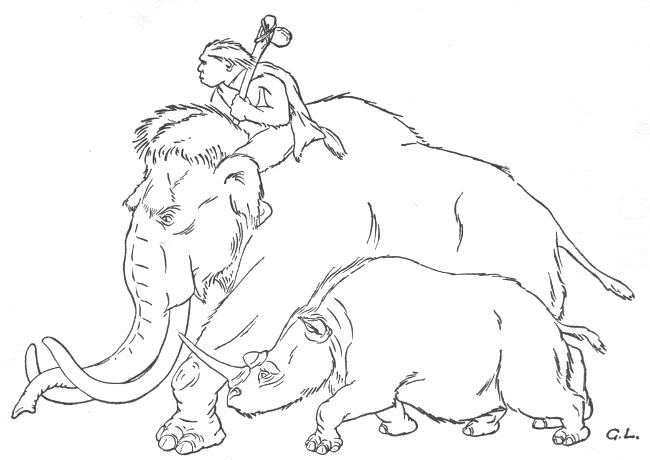
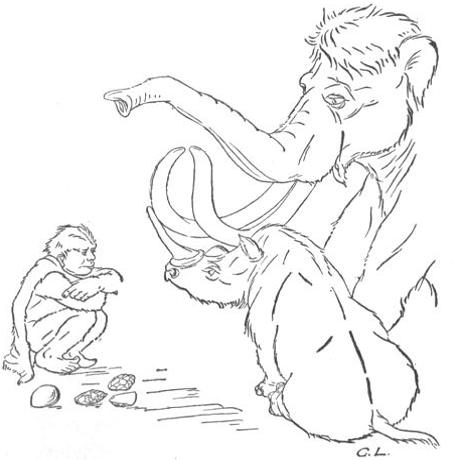
the very heart of France. It was the Ape Boy
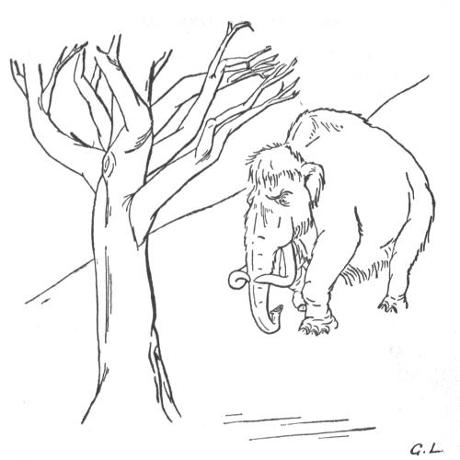
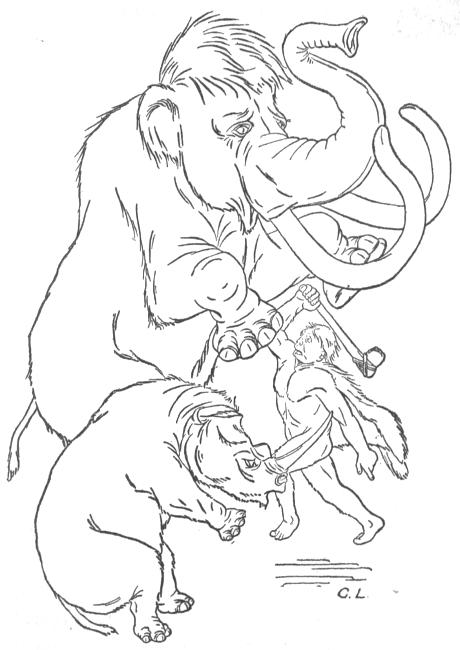
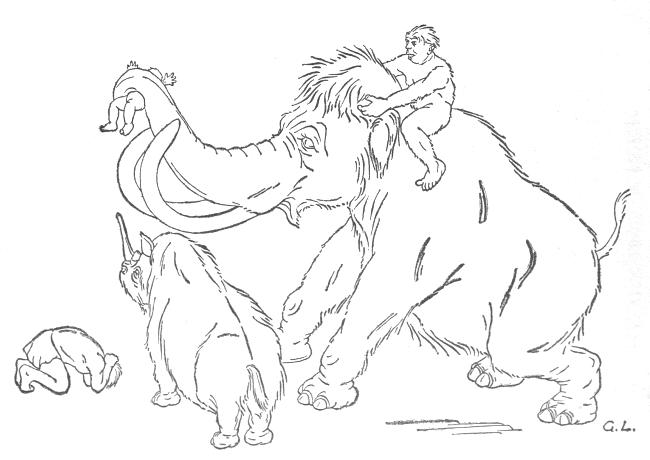
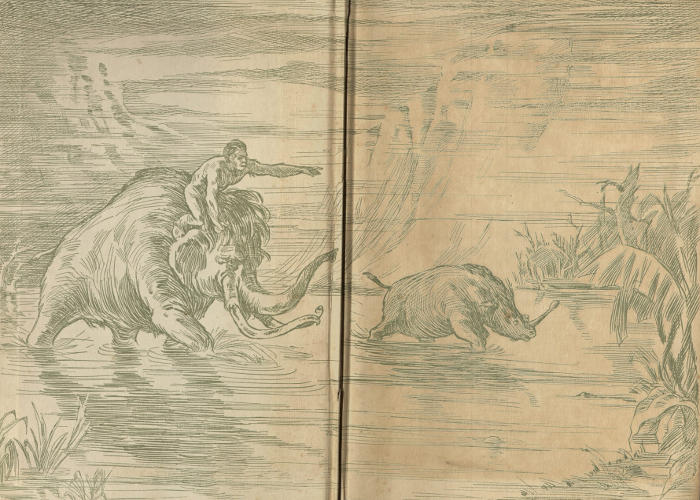
and his two animal friends, the Hairy Mammoth
Elephant and Woolly Rhinoceros. The
two shaggy beasts lumbered on side by side,
the former towering twice above the height of
his smaller companion. On the Mammoth’s neck
settled deeply in the depression between head and
shoulders, sat Pic with ax held across his thighs
and his hyena robe trailing behind him in the
breeze.
Hairi a beast of burden? How hath the mighty
fallen! We must go back a bit to learn why.
When the duet became a trio—Ape Boy, Mammoth
and Rhinoceros—and the party left the
Grotto of Sha Pell to journey northward, Spring
was already far advanced. Warm weather was
something of a hardship to Hairi and Wulli, all
bundled up as they were in their shaggy overcoats,
to say nothing of thick woolen underwear concealed
beneath. And so they made all haste to reach a
more congenial climate. In spite of their vast
bodies and stumpy legs, both could travel fast; but
the need of food and rest had some voice as to the
speed at which they travelled. They were tremendous
eaters, but unfortunately the high rocky country
provided poor feeding-grounds.
Their favorite foods were scarce, the grass-tufts
few. Their northern march was a constant turning
this way and that in search of edibles which were
snatched up greedily wherever found. On the
rough ground, Pic had the better of his comrades.
No rock was too high, no ravine too deep to bar his
way. His step was sure, his head clear and he
found little trouble in making rapid progress over
obstacles which caused the others endless annoyance
and delay. Up hill, down dale, through tangled
forest undergrowth and over fallen trees, the Ape
Boy led the other two a merry dance until the party
approached the Loire River. Here the tables were
turned. The ground which they had covered was a
gradual descent from forested highlands to comparatively
level lowlands as the land-surface dipped
down to the northwest. On the high, rough country,
the Mammoth and Rhinoceros had been at a
disadvantage but in the broad level region of the
Loire, food was abundant and everything promised
a speedy journey.
But now an unforeseen complication arose; Pic
was too slow. He could not walk as fast as the
others, simply because his heels were much too
short; also each big toe stood apart from its mates
and lacked stiffness. Soft, flexible feet were well
suited for climbing and clambering about in rough,
broken country;—among cliffs, ravines, rocks and
tangled undergrowth—but in the open they were at
a disadvantage. With his short heels and soft feet,
Pic promised to become a burden to his friends,
through no real fault of his own.
“Where is Pic? Stopping to crack rocks, I
suppose,” grumbled the Mammoth, as for the fifth
time he halted and observed the one in question
lagging far in the rear. Pic was shuffling along at
his best gait with knees half bent and head held forward,
making hard work of the little he accomplished
and tiring fast with the doing of it.
Hairi and Wulli ground their teeth and stamped
impatiently until the laggard finally caught up.
He halted before them, squatted on heels and
haunches and wiped the sweat from his brow. He
looked warm, tired and discouraged, knowing well
that the best he could do was poor enough. His
comrades’ remarks were little calculated to give him
comfort.
“You must walk faster,” Hairi scolded. “If you
cannot do better than that, I will soon have to carry
you.”
“Carry me?” Pic looked up quickly at the great
giant towering over him; at the Elephant’s head-peak
and mighty shoulder-hump and the deep depression
where neck joined body. His face
brightened. He rose to his feet and stepped to the
Mammoth’s side.
“Yes, it might be done if you will. Raise your
foreleg.” He laid his hand on the great right wrist
which rose above the level of his own knees.
“Fancy my taking orders from small creatures,”
Hairi thought to himself; but he raised his foreleg
obediently and stood waiting, curious to see what
would happen next. The Ape Boy climbed upon
the outstretched limb and reaching on high with his
hands, secured a firm grip on the Mammoth’s ear.
“Now your trunk,” he commanded. “Help me to
climb up.”
Hairi’s trunk curled around sideways and raised
the other with scarce an effort. With this assistance
Pic scrambled up. Before the astonished Mammoth
realized what had happened, his neck bore a
rider and for the first time in his life, the head of a
living creature towered above his own.
“I am so small, you can easily carry me,” a voice
sounded from behind his ears. “Now you may go
on as fast as you please.”
Before many hours, the Mammoth had become
accustomed to his rider and in that time the wisdom
of the new arrangement became apparent to all.
From his elevated position, Pic was enabled to inform
his friends regarding the nature of the country
ahead and call their attention to various interesting
things among which they passed. Then too, he
selected the best routes and chose the safest fords
when crossing streams. In these and many other
ways, he relieved his friends of many perplexing
problems. In short, he had become the eyes and
brains of the party.
Northern France was beginning to prepare itself
for a season of warm breezes and sunny skies when
our three tourists crossed the Loire River and
entered the more rolling country beyond. And yet
none but hardy forms of green growth dared show
themselves; for the ice-fields yet hung threateningly
to the north, casting their sombre shadows over
Western Europe. Only scattered clumps and
single trees—dwarf birch, fir, spruce and arctic willow
strewn sparingly along streams and hillside—marked
once-forested regions. Coarse grass and
sedge formed but a threadbare carpet on meadow
and pasture land. And yet this semi-bleak waste
abounded with animal life,—hardy forms in keeping
with the grass, brush and trees. There were
wild horses, stilt-legged bison with shaggy heads
and shoulders, long-horned cattle and lesser
creatures of the open pasture lands; stags, roe-deer
and Irish Elk of hill and glade; and least numerous
but most menacing, prowling wolves and hyenas
which crawled and skulked from sight, awaiting
their chance to secure any tender colt, calf or fawn
or even grown animal that strayed from the protection
of its fellows.
Horse, bison, ox and all stopped work—feeding,
playing, sleeping—to inspect the strangers coming
from the south. As the latter drew nearer, all eyes,
ears and noses were gradually drawn to the Mammoth
or rather to something upon his neck which
looked and smelled like a Trog-man, but of course
must be something else. Men and beasts did nothing
but quarrel with one another as a rule. No
elephant ever travelled about with a man upon his
neck; such a thing was unheard of in the animal
world.
But for all that, something of the kind was happening
under their very noses; so the horses, bison,
oxen and everything else crowded as closely as they
dared along the line of march, leaving a wide lane
through which the strangers might pass without
interruption.
Hairi could not conceal his satisfaction at this
publicity so suddenly thrust upon him. He held
his head high and swept on at his most majestic
gait while the spectators stared and admired and
wished they were as big and grand-looking. The
Ape Boy caught the spirit of his noble steed and
bore himself right royally, with ax held over one
shoulder, like a ruler parading before his vassals.
Several days journey in this regal splendor
brought the party to the border of a vast, shallow
depression scooped as it were from the earth. Its
sides were coated with patches of loam and sand
becoming deeper towards the bottom as though
giant hands had washed therein and left their grime.
It was like a saucer—a mighty basin too broad for
mortal eye to span—bounded by a rim of encircling
hills which dipped lower and lower as they swept
in two wide arcs to the northwest. Thus the saucer
stood not squarely on its broad base but tipped as
though to empty itself of a river winding through
it from the southeast. After passing a small island
which reposed at the bottom of the saucer, the river
swung from northwest to southwest, then turned
back and forth upon itself thus forming a rude
inverted letter S.
Far to the southeast, a tributary joined the
larger stream. Low hills and pastures, sloping
towards the valley through which the central river
flowed; scattered shade-trees dotting the western
lowlands; scrub and brush adorning the eastern
heights;—such was the Paris Basin, the Seine River
winding through it and the Marne tributary flowing
from the east.
Slopes, river banks and even the river surface
itself were dotted and blotched with living forms,
single and in groups, some motionless, others shifting
restlessly about; sleeping, lunching or besporting
themselves as wild animals do when in the midst
of congenial surroundings.
A herd of horses was gliding swiftly along the
southern slopes overlooking the valley—sorrels,
bays, chestnuts, with manes and tails streaming behind
them—all uniting to form a single moving
mass of color. Groups of long-horned cattle lined
the river-banks farther below, standing high and
dry, wading in the water or swimming with all but
their heads submerged.
To the west, a score of bison grazed beneath the
scattered shade-trees. Others lay on the grass near
by, chewing their cuds and gazing dreamily into
space. A tiny calf consisting of a small piece of
body mounted on four stilts, ran here and there
calling “Ma-ma” and causing no disturbance but
its own noise. By some peculiar combination of
sight, smell and sound whereby cows and calves
find each other without mistakes, the bawling infant
soon discovered the object of its search and its
troubles ended with a draught of home-brewed
nectar, of which the fond mother carried an abundant
supply. Meanwhile the bull bison leader found
nothing to do but loll about awaiting the day’s end
and whatever the morrow might bring. But with
all his cud-chewing and seeming laziness, he kept
one eye upon a burly brown bear who in the distance
was poking the stones and rotten logs about with
his big paws in search of grubs and things that
bears like when honey is scarce and the berries are
still green.
In spite of their apparent lack of interest in any
but their own affairs, bison, horse, ox, bear and all
frequently turned their noses windward to sniff
the air as though suspicious of its tainted odor.
Grass-eaters, even hunting-animals never trusted
blood-thirsty creatures that roved in packs—wolves,
hyenas and more particularly, other strange beings
beyond the pale who walked on their hind legs and
fought with sticks and stones.
As the three travellers glided down the Basin
slope and neared a more abrupt descent to the river,
Pic espied a group of figures on the bank below
him, near where the river made its first sharp turn
from south to north. He said nothing of this discovery
for fear of alarming his companions; but
already the Mammoth had begun to show signs of
uneasiness. His trunk had caught a strange scent
below him. With each step, his pace slackened.
The Rhinoceros shared his comrade’s increasing
concern. His ears were held pricked forward to
catch the sound of that which he smelled but could
not see.
Suddenly, two of the distant figures jumped up.
A shout; and every figure stood erect. A score
of wondering faces stared up at the Mammoth and
Rhinoceros. A second shout followed. The figures—faces
and all—dropped to the ground and lay
still.
At the first shout, Hairi gave a great bound
which almost unseated his rider; at the second, he
stopped abruptly, only to move forward again as
Pic patted his cheek and spoke reassuring words
to coax him on. Nearer and nearer, they approached
the prostrate figures, not one of which
moved or made a sound. When but a dozen paces
distant, the Mammoth stopped and refused to
advance another step. He hung back on the shelving
bank, beneath which he could see dark figures
kneeling with their faces in the dust. His nose told
him that these were Trog-men, a fact concerning
which his eyes and ears now felt some doubts, for
the prone forms neither moved nor made a sound.
When eyes, ears and nose failed to agree on things,
those things had best be avoided.
To Pic, sitting astride the Mammoth’s neck, the
sight of the prone figures was astounding. Men
either fought or fled in the face of danger but never
did they pretend to be asleep or dead. Why did
they act so? He saw a score of human beings
grovelling in the dust. About them lay piles of
cream colored lumps, also hammer-stones and axes
scattered in confusion. He suspected treachery;
but if this were an ambuscade, one more remarkable
he had never encountered.
“Can these really be men?” he asked himself.
“So silent and still all; lying upon their faces.
What does it mean?”
As if in reply, one of the figures stirred. A
grizzled grey head raised itself. A pair of deep-set
eyes peered up furtively at the towering Mammoth.
Hairi threw his trunk aloft and settled back. The
Rhinoceros squared his legs. The Ape Boy looked
down. He saw the face of an old man with heavy
brows, sloping forehead and massive chinless jaws.
The eyes shone like those of a fanatic—of one inspired.
The patriarch’s lips moved. “The Man Mammoth!”
he muttered in an awed voice, so hushed
that it sounded scarcely above a whisper. “He
comes to jar the heavens and hurl down fire. Woe
to us!” He groaned and covered his face with his
hands.
Low howls and white puffs arose from the dust
as his companions added their dismal chorus.
“Arrah! What is that you say?” demanded the
now thoroughly mystified Pic. “Man Mammoth?
Man and Mammoth, you mean. Tell me, Old Grey
Head, is this some of your trickery?” He raised his
ax on high as he said this and glared fiercely from
one figure to another.
Low moans and white puffs again arose from the
bank below him. Once more the patriarch uncovered
his face and gazed in awe at the Mammoth-head
and its human rider.
“What trickery can we poor cave-folk offer to
the Man Mammoth who sees and knows all? We
but humble ourselves that he may shine upon us
and cease to ravage the land with flood and flame.”
“Agh-h,” grunted Pic. He smiled and his eyes
twinkled. Now he understood. The Cave-men
mistook him for a god because he rode upon the
Mammoth’s neck. To them, he and the Elephant
were one; part man, part beast—the Man Mammoth,
ruler of the sky whose smile was sunshine;
lowering clouds, his frown; and storm, his wrath.
With thunder and lightning, he vented his rage
upon the earth.
“Why do you all herd here above the valley?”
Pic asked in a low voice that—to the humble cave-men—fore-shadowed
clear sunny skies.
“We came to find and hammer the flints,” replied
the patriarch rising to his knees and pointing at the
bank above him. “Here lie the finest in the land.”
“Flints?” Pic leaned far over the Mammoth’s
neck and looked eagerly at the ground beneath him.
He saw yellow lumps, broken flakes and hammer-stones,
in profusion. “Whoow-w!” he sucked in his
breath and gazed at them in astonishment.
He had intruded upon a colony of flint-workers.
These men were merely engaged in procuring one
of life’s necessities; means for destroying other lives
to preserve their own. The bank was a chalk-ledge
overlooking the Seine. It was the center of a
thriving industry—a mine and munitions factory
combined. It contained wealth more precious than
gold or silver; for to these men unfamiliar with
metals, flint was the staff of life whereby they were
enabled to exist.
There it was in piles freshly extracted from the
chalk, awaiting the first manufacturing operation—splitting
by the hammer-stone. Many lumps already
split, also the wax-like flakes hewn from
them, lay strewn upon the ground. Flints! and
such wonderful ones too! Pic’s eyes caught the
lustre of broken flakes. Was the workmanship as
fine as the material itself? He looked at the blade
of his own ax and trembled. The secret of its
making, might at that very moment be lying at
his feet.
“We must know more of this. Why do you
stop, clumsy beast”—these last words were addressed
to the Mammoth who showed a decided
reluctance to move closer.—“Forward. Do you
fear a handful of cave-men? Agh! hurry, I say.”
Hairi shook his head from side to side and protested
with loud grunts, but ended by descending
the bank and striding among the workers and piles
of flint. At a signal from his rider, he stopped.
Pic peered down between his head and shoulder.
His gaze alighted on a hide heaped with broken
flakes. The patriarch who had first spoken was
kneeling beside it.
“Fling-stones,” Pic exclaimed in tones of withering
scorn. “Is this your best work? Stand up,
old man and answer before I lose patience and bid
the Mammoth crush you where you lie.”
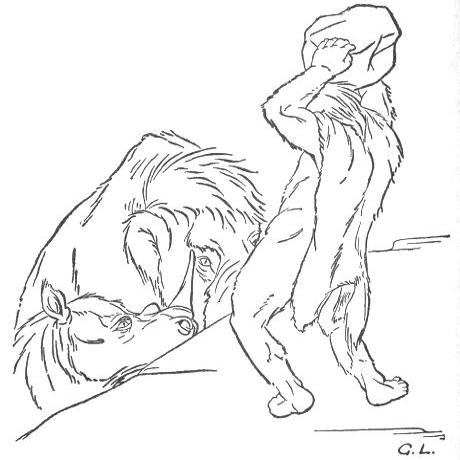
The patriarch scrambled to his feet and stood
with head bowed, arms folded across his breast;
awed in spirit but heedless of bodily danger. Pic’s
heart softened.
“Is this your best work?” he asked, again pointing
to the broken flakes. “If so, it ill becomes such
fine material to be so butchered. Have you none
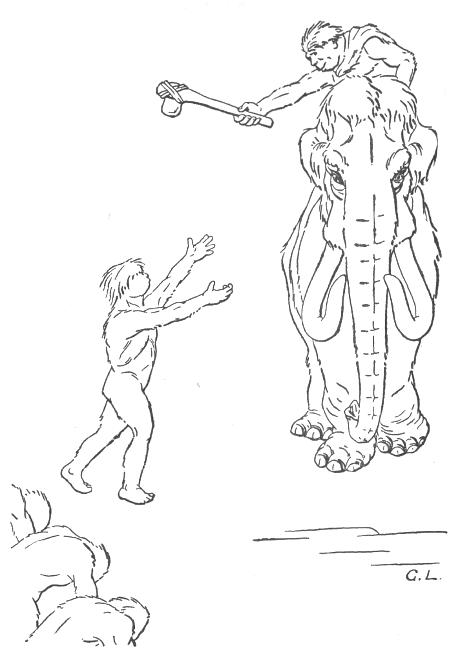
like this?” He held out his own ax by its long
wooden handle so that the other might see.
The old man’s eyes brightened as they caught
sight of the wonderful blade. He stepped forward
and stood directly beneath the Mammoth’s chin.
His arms were outstretched towards the great flint
like those of a worshipper before a shrine.
“Marvellous,” he muttered in an awed voice.
“Never have I seen so fine a blade. May I touch
it, noble master?” His palms trembled as they
hovered over the object of his adoration.
“Yes, you may touch it,” replied the Ape Boy
with a kindly smile; and for an instant the ax was
hidden between the old man’s hands.
“Ah, Blade of Ach Eul!” he murmured devoutly.
“None can equal it. Never will the work of us poor
cave-folk equal that of the Terrace Men. We
strive in vain.”
“Well spoken,” Pic interrupted. “None can
equal it. But how was it done?” This question
was delivered with such earnestness, the old man
trembled.
“Of that I know nothing,” he stammered. “The
Terrace Men have passed away and their secret
with them.”
“Who were the Terrace Men?” asked Pic. His
voice shook even more than that of the patriarch.
The Meeting With the Seine Flint Workers
“A race of flint-workers who once lived on the
high river banks—the upper terraces,” was the answer.
“But this is the Man Mammoth’s Weapon;
incomparable with the Terrace Man’s finest flint.
And yet it is much the same.” He patted the blade
reverently. “But as calf’s flesh pleases the taste
more than does that of the aged bull, so does this
blade of Ach Eul shame the work of mortal hands.”
“Blade of Ach Eul—it is well worth a name.
And these Terrace Men—where may they be
found?” asked Pic. “You and your fellows might
learn much from them. Agh! even my turtle-backs
are more finely hammered. Not a knife nor ax-blade
in the lot—mere fling-stones; children’s’ and
women’s work.”
“They once lived on the banks of a river to the
north,” the old man replied. “But no longer do
we see them or their blades. The Terrace Men are
gone and their secret with them.”
“Um—we shall see. Go on,” Pic said to the
Mammoth. The latter picked his way carefully
among the prostrate men but made no effort to
avoid their flints or tools which he scattered recklessly
about with his ponderous feet.
For an instant, Pic’s eyes blazed at sight of this
wanton desecration; but another look at the small,
ill-hewn fragments and he held his peace.
“Well done, good old friend,” he whispered.
“Even you have no patience with such feeble efforts,”
and without deigning so much as another
glance at the cave-men or their clumsy flint-making,
he urged his steed down the bank to the river while
the Woolly Rhinoceros followed close behind.