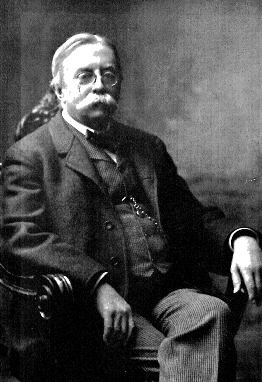
PIANO MASTERY — TALKS WITH MASTER PIANISTS AND TEACHERS — AN ACCOUNT OF A VON BÜLOW CLASS, HINTS ON INTERPRETATION, BY TWO AMERICAN TEACHERS (DR. WILLIAM MASON AND WILLIAM H. SHERWOOD) AND A SUMMARY BY THE AUTHOR — BY
E-text prepared by Chuck Greif
and the Project Gutenberg Online Distributed Proofreading Team
from page images generously provided by
the Internet Archive Million Book Project
IGNACE JAN PADEREWSKI
AND
HARRIETTE BROWER — Author of "The Art of the Pianist" — WITH SIXTEEN PORTRAITS — NEW YORK FREDERICK A. STOKES COMPANY PUBLISHERS — 1915
PRELUDE — TO AMERICAN PIANO TEACHERS AND STUDENTS — PIANO MASTERY
The following "Talks" were obtained at the suggestion of the
Editor of Musical America, and have all, with one or two
exceptions, appeared in that paper. They were secured with the
hope and intention of benefiting the American teacher and
student.
Requests have come from all over the country, asking that
the interviews be issued in book form. In this event it was the
author's intention to ask each artist to enlarge and add to his
own talk. This, however, has been practicable only in certain
cases; in others the articles remain very nearly as they at
first appeared.
The summer of 1913 in Europe proved to be a veritable
musical pilgrimage, the milestones of which were the homes of
the famous artists, who generously gave of their time and were
willing to discuss their methods of playing and teaching.
The securing of the interviews has given the author
satisfaction and delight. She wishes to share both with the
fellow workers of her own land.
The Talks are arranged in the order in which they were
secured.
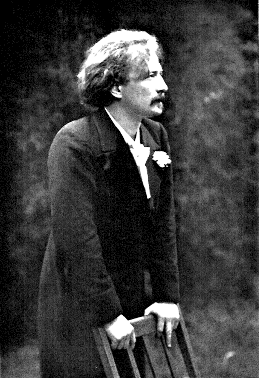
IGNACE JAN PADEREWSKI — CLEARNESS A MUST PRINCIPLE — FINGERING — CORRECT MOTION — STUDYING EFFECTS — INTERPRETATION
One of the most consummate masters of the piano at the
present time is Ignace Jan Paderewski. Those who were
privileged to hear him during his first season in this country
will never forget the experience. The Polish artist conquered
the new world as he had conquered the old; his name became a
household word, known from coast to coast; he traveled over our
land, a Prince of Tones, everywhere welcomed and honored. Each
succeeding visit deepened the admiration in which his wonderful
art was held.
The question has often been raised as to the reason of
Paderewski's remarkable hold on an audience; wherein lay his
power over the musical and unmusical alike. Whenever he played
there was always the same intense hush over the listeners, the
same absorbed attention, the same spell. The superficial
attributed these largely to his appearance and manner;
the more thoughtful looked deeper. Here was a player who was
a thoroughly trained master in technic and interpretation;
one who knew his Bach, Beethoven, Chopin, Schumann and
Liszt. These things of themselves would not hold an audience
spellbound, for there were other artists equally well
equipped. In a final analysis it was doubtless Paderewski's
wonderful piano tone, so full of variety and color,
so vital with numberless gradations of light and shade, that
charmed and enthralled his listeners. It mattered to no
one—save the critics—that he frequently repeated
the same works. What if we heard the Chromatic Fantaisie a
score of times? In his hands It became a veritable Soliloquy
on Life and Destiny, which each repetition invested with new
meaning and beauty. What player has ever surpassed his
poetic conception of Schumann's Papillons, or the
Chopin Nocturnes, which he made veritable dream poems of
love and ecstasy. What listener has ever forgotten the
tremendous power and titanic effect of the Liszt Rhapsodies,
especially No. 2? When Paderewski first came to us, in the
flush of his young manhood, he taught us what a noble
instrument the piano really is in the hands of
a consummate master. He showed us that he
could make the piano speak with the delicacy and power of a
Rubinstein, but with more technical correctness; he proved
that he could pierce our very soul with the intensity of his
emotion, the poignant, heart-searching quality of his tones,
the poetry and beauty of his interpretation.
Paderewski is known as composer and pianist, only rarely
does he find time to give instruction on his instrument. Mme.
Antoinette Szumowska, the Polish pianist and lecturer was at
one time termed his "only pupil." Mr. Sigismond Stojowski, the
Polish composer, pianist and teacher has also studied with him.
Both can testify as to his value as an instructor.
Mme. Szumowska says:
"Paderewski lays great stress on legato playing, and desires
everything to be studied slowly, with deep touch and with full,
clear tone. For developing strength he uses an exercise for
which the hand is pressed against the keyboard while the wrist
remains very low and motionless and each finger presses on a
key, bringing, or drawing out as much tone as possible.
"Paderewski advises studying scales and arpeggios with
accents, for instance, accenting every third note, thus enabling each finger
in turn to make the accent impulse: this will secure
evenness of touch. Double passages, such as double thirds
and sixths, should be divided and each half practised
separately, with legato touch. Octaves should be practised
with loose wrists and staccato touch. As a preparatory study
practise with thumb alone. The thumb must always be kept
curved, with joints well rounded out; it should touch the
keys with its tip, so as to keep it on a level with the
other fingers. Paderewski is very particular about this
point.
"It is difficult to speak of Paderewski's manner of teaching
expression, for here the ideas differ with each composer and
with every composition. As to tonal color, he requires all
possible variety in tone production. He likes strong contrasts,
which are brought out, not only by variety of touch but by
skilful use of the pedals.
"My lessons with Paderewski were somewhat irregular. We
worked together whenever he came to Paris. Sometimes I did not
see him for several months, and then he would be in Paris for a
number of weeks; at such seasons we worked together very often.
Frequently these lessons, which were given in my
cousin's house, began very late in the
evening—around ten o'clock—and lasted till
midnight, or even till one in the morning.
"Paderewski the teacher is as remarkable as Paderewski the
pianist. He is very painstaking; his remarks are clear and
incisive: he often illustrates by playing the passage in
question, or the whole composition. He takes infinite trouble
to work out each detail and bring it to perfection. He is very
patient and sweet tempered, though he can occasionally be a
little sarcastic. He often grows very enthusiastic over his
teaching, and quite forgets the lapse of time. In general,
however, he does not care to teach, and naturally has little
time for it."
Mr. Stojowski, when questioned in regard to his work with
the Polish pianist, said:
"Paderewski is a very remarkable teacher. There are teachers
who attempt to instruct pupils about what they do not
understand, or cannot do themselves: there are others who are
able to do the thing, but are not able to explain how they do
it. Paderewski can both do it and explain how it is done. He
knows perfectly what effects he wishes to produce, how they are
to be produced, the causes which underlie and bring them about;
he can explain and demonstrate these to the pupil with the
greatest exactness and detail.
"As you justly remark the quality of tone and the variety of
tonal gradations are special qualities of Paderewski's playing.
These must be acquired by aid of the ear, which tests and
judges each shade and quality of tone. He counsels the student
to listen to each tone he produces, for quality and
variety.
"The player, as he sits at the piano, his mind and heart
filled with the beauty of the music his fingers are striving to
produce, vainly imagines he is making the necessary effects.
Paderewski will say to him: 'No doubt you feel the beauty of
this composition, but I hear none of the effects you fancy you
are making; you must deliver everything much more clearly:
distinctness of utterance is of prime importance.'' Then he
shows how clearness and distinctness may be acquired. The
fingers must be rendered firm, with no giving in at the nail
joint. A technical exercise which he gives, and which I also
use in my teaching, trains the fingers in up and down
movements, while the wrist is held very low and pressed against
the keyboard. At first simple five-finger forms are used; when the hand has become accustomed
to this tonic, some of the Czerny Op. 740 can be played,
with the hand in this position. Great care should be taken
when using this principle, or lameness will result. A low
seat at the piano is a necessity for this practise; sitting
low is an aid to weight playing: we all know how low
Paderewski himself sits at the instrument.
"You ask what technical material is employed. Czerny, Op.
740; not necessarily the entire opus; three books are
considered sufficient. Also Clementi's Gradus. Of course
scales must be carefully studied, with various accents, rhythms
and tonal dynamics; arpeggios also. Many arpeggio forms of
value may be culled from compositions.
"There are, as we all know, certain fundamental principles
that underlie all correct piano study, though various masters
may employ different ways and means to exemplify these
fundamentals. Paderewski studied with Leschetizky and
inculcates the principles taught by that master, with this
difference, that he adapts his instruction to the physique and
mentality of the student; whereas the Vorbereiters of
Leschetizky prepare all pupils along the same lines, making
them go through a similar routine, which may not in every
instance be necessary.
"One point Paderewski is very particular about, and that is
fingering. He often carefully marks the fingering for a whole
piece; once this is decided upon it must be kept to. He
believes in employing a fingering which is most comfortable to
the hand, as well as one which, in the long run, will render
the passage most effective. He is most sensitive to the choice
of fingering the player makes, and believes that each finger
can produce a different quality of tone. Once, when I was
playing a Nocturne, he called to me from the other end of the
room: 'Why do you always play that note with the fourth finger?
I can hear you do it; the effect is bad,' He has a keen
power of observation; he notices little details which pass
unheeded by most people; nothing escapes him. This power,
directed to music, makes him the most careful and painstaking
of teachers. At the same time, in the matter of fingering, he
endeavors to choose the one which can be most easily
accomplished by the player. The Von Bülow editions, while
very erudite, are apt to be laborious and pedantic; they show
the German tendency to over-elaboration, which,
when carried too far becomes a positive fault.
"Another principle Paderewski considers very important is
that of appropriate motion. He believes in the elimination of
every unnecessary movement, yet he wishes the whole body free
and supple. Motions should be as carefully studied as other
technical points. It is true he often makes large movements of
arm, but they are all thought out and have a dramatic
significance. He may lift the finger off a vehement staccato
note by quick up-arm motion, in a flash of vigorous enthusiasm;
but the next instant his hand is in quiet position for the
following phrase.
"The intent listening I spoke of just now must be of vital
assistance to the player in his search for tonal variety and
effect. Tone production naturally varies according to the space
which is to be filled. Greater effort must be put forth in a
large hall, to make the tone carry over the footlights, to
render the touch clear, the accents decisive and contrasts
pronounced. In order to become accustomed to these
conditions, the studio piano can be kept
closed, and touch must necessarily be made stronger to
produce the desired power.
"A great artist's performance of a noble work ought to sound
like a spontaneous improvisation; the greater the artist the
more completely will this result be attained. In order to
arrive at this result, however, the composition must be
dissected in minutest detail. Inspiration comes with the first
conception of the interpretation of the piece. Afterward all
details are painstakingly worked out, until the ideal blossoms
into the perfectly executed performance. Paderewski endeavors
uniformly to render a piece in the manner and spirit in which
he has conceived it. He relates that after one of his recitals,
a lady said to him:
"'Why, Mr. Paderewski, you did not play this piece the same
as you did when I heard you before,'
"'I assure you I intended to,' was the reply.
"'Oh, it isn't necessary to play it always the same way; you
are not a machine,' said the lady.
"This reply aroused his artist-nature.
"'It is just because I am an artist that I
ought at all times to play in the same way. I have thought
out the conception of that piece, and am in duty bound to
express my ideal as nearly as possible each time I perform
it.'
"Paderewski instructs, as he does everything else, with
magnificent generosity. He takes no account of time. I would
come to him for a stipulated half-hour, but the lesson would
continue indefinitely, until we were both forced to stop from
sheer exhaustion. I have studied with him at various times. One
summer especially stands out in my memory, when I had a lesson
almost every day."
Speaking of the rarely beautiful character of Paderewski's
piano compositions, Mr. Stojowski said:
"I feel that the ignorance of this music among piano
teachers and students is a crying shame. What modern piano
sonata have we to-day, to compare with his? I know of none. And
the songs—are they not wonderful! I love the man and his
music so much that I am doing what lies in my power to make
these compositions better known. There is need of pioneer work
in this matter, and I am glad to do some of it."
ERNEST SCHELLING — THE HAND OF A PIANIST
As I sat in the luxurious salon of the apartments near the
Park, where Mr. and Mrs. Ernest Schelling were spending the
winter, sounds of vigorous piano practise floated out to me
from a distant chamber. It was unusual music, and seemed to
harmonize with the somewhat Oriental atmosphere and coloring of
the music-room, with its heavily beamed ceiling of old silver,
its paintings and tapestries.
The playing ceased and soon the artist appeared, greeting
the visitor with genial friendliness of manner. He was
accompanied by the "lord of the manor," a beautiful white bull
terrier, with coat as white as snow. This important personage
at once curled himself up in the most comfortable arm-chair, a
quiet, profound observer of all that passed. In the midst of
some preliminary chat, the charming hostess entered and poured
tea for us.
The talk soon turned upon the subject in
which I was deeply interested—the technical training
of a pianist.
"Technic is such an individual matter," began Mr. Schelling;
"for it depends on so many personal things: the physique, the
mentality, the amount of nervous energy one has, the hand and
wrist. Perhaps the poorest kind of hand for the piano is the
long narrow one, with long fingers. Far better to have a short,
broad one with short fingers. Josef Hofmann has a wonderful
hand for the piano; rather small, yes, but so thick and
muscular. The wrist, too, is a most important factor. Some
pianists have what I call a 'natural wrist,' that is they have
a natural control of it; it is no trouble for them to play
octaves, for instance. Mme. Carreño has that kind of
wrist; she never had difficulty with octaves, they are perfect,
Hofmann also has a marvelous wrist. I am sorry to say I have
not that kind of wrist, and therefore have been much
handicapped on that account. For I have had to work
tremendously to develop not only the wrist but the whole
technic. You see I was a wonder child, and played a great deal
as a small boy. Then from fifteen to twenty I did not practise
anything like what I ought to have done. That is the
period when the bones grow, muscles
develop—everything grows. Another thing against me is
the length of my fingers. When the fingers are longer than
the width of the hand across the knuckle joint, it is not an
advantage but a detriment. The extra length of finger is
only so much dead weight that the hand has to lift. This is
another disadvantage I have had to work against. Yes, as you
say, it is a rather remarkable hand in regard to size and
suppleness. But I hardly agree that it is like Liszt's; more
like Chopin's, judging from the casts I have seen of his
hand.
"As for technical routine, of course I play scales a good
deal and in various ways. When I 'go into training,' I find the
best means to attain velocity is to work with the metronome.
One can't jump at once into the necessary agility, and the
metronome is a great help in bringing one up to the right
pitch. You see by the firmness of these muscles at the back and
thumb side of my hand, that I am in good trim now; but one soon
loses this if one lets up on the routine.
"Then I practise trills of all kinds, and octaves. Yes, I
agree that octaves are a most necessary and important factor in
the player's technical equipment."
Going to the piano and illustrating as he
talked, Mr. Schelling continued:
"Merely flopping the hand up and down, as many do, is of
little use—it does not lead to strength or velocity. As
you see, I hold the hand arched and very firm, and the firmness
is in the fingers as well; the hand makes up and down movements
with loose wrist; the result is a full, bright, crisp tone. One
can play these octaves slowly, using weight, or faster with
crisp, staccato touch. I play diatonic or chromatic octave
scales, with four repetitions or more, on each note—using
fourth finger for black keys.
"I sit low at the piano, as I get better results in this
way; though it is somewhat more difficult to obtain them. I
confess it is easier to sit high and bear down on the hands.
Yes, I thoroughly approve of 'weight touch,' and it is the
touch I generally use. Sometimes it is a certain pressure on
the key after it is played, using arm weight.
"Ah, you are right. The young teacher or player, in
listening to the artist, and noticing he does not lift his
fingers to any extent, and that he always plays with weight,
hastily concludes these are the principles with which he must
begin to study or teach the piano. It is a mistake to begin in that way. Very exact
finger movements must be learned in the beginning. As I said
before, technic is such an individual matter, that after the
first period of foundational training, one who has the
desire to become an artist, must work out things for
himself. There should be no straight-laced methods. Only a
few general rules can be laid down, such as will fit most
cases. The player who would rise to any distinction must
work out his own salvation.
"In regard to memorizing piano music, it may be said this
can be accomplished in three ways: namely, with the eye, with
the ear, and with the hand. For example: I take the piece and
read it through with the eye, just as I would read a book. I
get familiar with the notes in this way, and see how they look
in print. I learn to know them so well that I have a mental
photograph of them, and if necessary could recall any special
measure or phrase so exactly that I could write it. All this
time my mental ear has been hearing those notes, and is
familiar with them. Then the third stage arrives; I must put
all this on the keyboard, my fingers must have their training;
impressions must pass from the mind to the fingers; then all is
complete."
ERNESTO CONSOLO — MAKING THE PIANO A MUSICAL INSTRUMENT
In a long conversation with Ernesto Consolo, the eminent
pianist and instructor, many points of vital importance to the
player and teacher were touched upon. Among other things Mr.
Consolo said:
"It is absolutely necessary that the piano teacher should
take his profession very seriously. In my opinion there is most
excellent instruction to be secured right here in America, with
such teachers as are willing to take their work seriously. The
time is not far away, I think, when America will enjoy a very
prominent position in the matter of musical instruction, and
perhaps lead the world in musical advantages. The time is not
here just yet, but it is surely coming. You are still young in
this country, though you are wonderfully progressive.
"If I have spoken of the serious aims of many teachers of piano, I cannot say as much
for the students: they are often superficial and want to go
too quickly; they are apt to be in a hurry and want to make
a show, without being willing to spend the necessary years
on preparation. No art can be hurried. Students of painting,
sculpture, architecture or music must all learn the
technique of their art; they must all learn to go deep into
the mysteries and master technic as the means to the end,
and no one requires exhaustive preparation more than the
executive musician. The person who would fence, box or play
baseball must know the technic of these things; how much
more must the pianist be master of the technique of his
instrument if he would bring out the best results.
"At the very bottom and heart of this subject of mastery
lies Concentration: without that, little of value can be
accomplished. Students think if they sit at the piano and
'practise' a certain number of hours daily, it is sufficient. A
small portion of that time, if used with intense concentration,
will accomplish more. One player will take hours to learn a
page or a passage which another will master in a fraction of
the time. What is the difference? It may be said one has
greater intelligence than the other. The greater the
intelligence, the stronger the power of concentration.
"If a pupil comes to me whose powers of concentration have
not been awakened or developed, I sometimes give him music to
read over very slowly, so slowly that every note, phrase and
finger mark can be distinctly seen. Not being used to thinking
intently, mistakes occur, in one hand or the other, showing
that the mind was not sufficiently concentrated. It is the mind
every time that wins. Without using our mental powers to their
fullest extent we fail of the best that is in us.
"In regard to technical equipment and routine, I do
different work with each pupil, for each pupil is different. No
two people have the same hands, physique or mentality; so why
should they all be poured into the same mold? One student, for
example, has splendid wrists and not very good fingers. Why
should I give him the same amount of wrist practise that I give
his brother who has feeble wrists; it would only be a waste of
time. Again, a pupil with limited ideas of tonal quality and
dynamics is advised to study tone at the piano in some simple
melody of Schubert or Chopin, trying to realize a beautiful
tone—playing it in various ways until such a quality
Is secured. The piano is a responsive instrument and gives
back what you put into it. If you attack it with a hard
touch, it will respond with a harsh tone. It rests with you
whether the piano shall be a musical instrument or not.
"A student who comes to me with a very poor touch must of
course go back to first principles and work up. Such an one
must learn correct movements and conditions of hands, arms and
fingers; and these can be acquired at a table. Along with
these, however, I would always give some simple music to play,
so that the tonal and musical sense shall not be neglected.
"Of course I advise comprehensive scale practise; scales in
all keys and in various rhythms and touches. There is an almost
endless variety of ways to play scales. Those in double thirds
and sixths I use later, after the others are under control.
Arpeggios are also included in this scale practise.
"I have said that Concentration is the keynote of piano
mastery. Another principle which goes hand in hand with it is
Relaxation. Unless this condition is present in arms, wrist and
shoulders, the tone will be hard and the whole performance
constrained and unmusical. There is no need of having tired muscles or
those that feel strained or painful. If this condition
arises it is proof that there is stiffness, that relaxation
has not taken place. I can sit at the piano and play
forte for three hours at a time and not feel the
least fatigue in hands and arms. Furthermore, the playing of
one who is relaxed, who knows how to use his anatomy, will
not injure the piano. We must remember the piano is a thing
of joints; the action is so delicately adjusted that it
moves with absolute freedom and ease. The player but adds
another joint, which should equal in ease and adjustment the
ones already there. On the other hand a person with stiff
joints and rigid muscles, thumping ragtime on a good piano,
can ruin it in a week; whereas under the fingers of a player
who understands the laws of relaxation, it would last for
many years.
"This principle of relaxation is exemplified in the athlete,
baseball player, and others. They have poise and easy
adjustment in every part of the body: they never seem to fall
into strained or stiff attitudes, nor make angular or stiff
movements. Arms, shoulders, wrists and fingers are all relaxed
and easy. The pianist needs to study these principles as well
as the athlete, I believe in physical exercises to
a certain extent. Light-weight dumb-bells can be used; it is
surprising how light a weight is sufficient to accomplish
the result. But it must be one movement at a time,
exercising one muscle at a time, and not various muscles at
once.
"For memorizing piano music I can say I have no method
whatever. When I know the piece technically or mechanically, I
know it by heart. I really do not know when the memorizing
takes place. The music is before me on the piano; I forget to
turn the pages, and thus find I know the piece. In playing with
orchestra I know the parts of all instruments, unless it be
just a simple chord accompaniment; it would not interest me to
play with orchestra and not know the music in this way. On one
occasion I was engaged to play the Sgambatti concerto, which I
had not played for some time. I tried it over on the piano and
found I could not remember it. My first idea was to get out the
score and go over it; the second was to try and recall the
piece from memory. I tried the latter method, with the result
that in about three hours and a half I had the whole concerto
back in mind. I played the work ten days later without having
once consulted the score. This goes to prove
that memory must be absolute and not merely mechanical.
"Students think they cannot memorize, when it would be quite
easy if they would apply themselves in the right way. I ask
them to look intently at a small portion, two measures, or even
one, and afterward to play it without looking at the notes. Of
course, as you say, this can be done away from the piano; the
notes can even be recited; but there are other signs and marks
to be considered and remembered, so when one can be at the
piano I consider it better.
"Piano playing is such an individual and complex thing. I do
not require nor expect my pupils to play as I do, nor interpret
as I interpret, for then I would only see just so many replicas
of myself, and their individuality would be lost. I often hear
them play a composition in a different way and with a different
spirit from the one I find in it. But I don't say to them,
'That is wrong; you must play it as I do,' No, I let them play
it as they see and feel it, so long as there is no sin against
artistic taste.
"I trust these few points will be helpful to both player and
teacher. The latter needs all the encouragement we artists can give, for
in most cases he is doing a good work.
"Volumes might be added to these hurried remarks, but for
that my time is too limited."
SIGISMOND STOJOWSKI — MIND IN PIANO STUDY — NATURAL TECHNIC — KEEPING UP A REPERTOIRE — FILLING IN A PASSAGE
Mr. Sigismond Stojowski, the eminent Polish pianist and
composer, was found one morning in his New York studio, at work
with a gifted pupil. He was willing to relax a little, however,
and have a chat on such themes as might prove helpful to both
teacher and student.
"You ask me to say something on the most salient points in
piano technic; perhaps we should say, the points that are most
important to each individual; for no two students are exactly
alike, nor do any two see things in precisely the same light.
This is really a psychological matter. I believe the subject of
psychology is a very necessary study for both teacher and
student. We all need to know more about mental processes than
we do. I am often asked how to memorize, for instance—or
the best means for doing this; another psychological process. I recommend students
to read William James' Talks on Psychology; a very
helpful book.
"The most vital thing in piano playing is to learn to think.
Has it ever occurred to you what infinite pains people will
take to avoid thinking? They will repeat a technical
illustration hundreds of times it may be, but with little or no
thought directed to the performance. Such work is absolutely
useless. Perhaps that is a little too strong. With countless
repetitions there may at last come to be a little improvement,
but it will be very small.
"There is quite a variety of views as to what the essentials
of piano technic are; this is a subject on which teachers,
unluckily, do not agree. For instance, on the point of finger
lifting there is great diversity of opinion. Some believe in
raising the fingers very high, others do not. Lifting the
fingers high is not good for the tone, though it may be used
for velocity playing. I use quite the reverse where I wish
beautiful, singing, tone quality. The young pupil, at the
beginning, must of course learn to raise fingers and make
precise movements; when greater proficiency is reached, many
modifications of touch are used. That the best results are not
more often obtained in piano teaching and study, is as
much the fault of the teacher as the pupil. The latter is
usually willing to be shown and anxious to learn. It is for
the teacher to correctly diagnose the case and administer
the most efficient remedy.
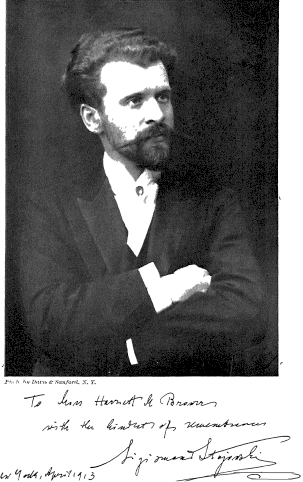
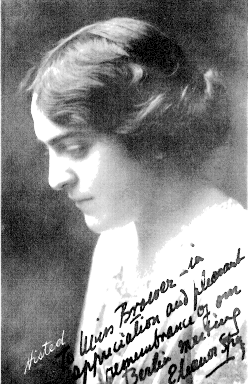
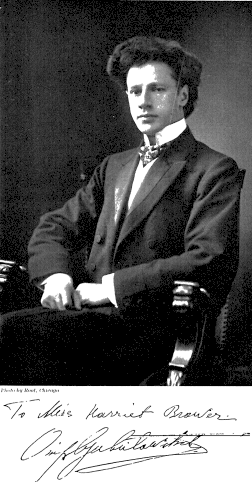
To Miss Harriett Brower with the kindest of
remembrances, Sigismond Stojowski New York, April 1913
"There is a certain amount of what I might call 'natural
technic' possessed by every one—some one point which is
easy for him. It Is often the trill. It has frequently come
under my notice that players with little facility in other
ways, can make a good trill. Some singers have this gift; Mme.
Melba is one who never had to study a trill, for she was born
with a nightingale in her throat. I knew a young man in London
who was evidently born with an aptitude for octaves. He had
wonderful wrists, and could make countless repetitions of the
octave without the least fatigue. He never had to practise
octaves, they came to him naturally.
"The teacher's work is both corrective and constructive. He
must see what is wrong and be able to correct it. Like a
physician, he should find the weak and deficient parts and
build them up. He should have some remedy at his command that will fit the needs of
each pupil.
"I give very few études, and those I administer in
homeopathic doses. It is not necessary to play through a mass
of études to become a good pianist. Much of the
necessary technic may be learned from the pieces themselves,
though scales and arpeggios must form part of the daily
routine.
"In keeping a large number of pieces in mind, I may say that
the pianist who does much teaching is in a sense taught by his
pupils. I have many advanced pupils, and in teaching their
repertoire I keep up my own. Of course after a while one grows
a little weary of hearing the same pieces rendered by students;
the most beautiful no longer seem fresh. My own compositions
are generally exceptions, as I do not often teach those. To the
thoughtful teacher, the constant hearing of his repertoire by
students shows him the difficulties that younger players have
to encounter, and helps him devise means to aid them to conquer
these obstacles. At the same time there is this disadvantage:
the pianist cannot fail to remember the places at which such
and such a student had trouble, forgot or
stumbled. This has happened to me at various times. In my
recitals I would be playing ahead, quite unconscious that
anything untoward could occur—wholly absorbed in my
work; when, at a certain point, the recollection would flash
over me—this is where such or such a pupil stumbled.
The remembrance is sometimes so vivid that I am at some
effort to keep my mental balance and proceed with smoothness
and certainty.
"Yes, I go over my pieces mentally, especially if I am
playing an entirely new program which I have never played
before; otherwise I do not need to do so much of it.
"You suggest that a composer may fill in or make up a
passage, should he forget a portion of the piece when playing
in public. True; but improvising on a well-known work is rather
a dangerous thing to do in order to improve a bad case. Apropos
of this, I am reminded of an incident which occurred at one of
my European recitals. It was a wholly new program which I was
to give at Vevay. I had been staying with Paderewski, and went
from Morges to Vevay, to give the recital. In my
room at the hotel I was mentally reviewing
the program, when in a Mendelssohn Fugue, I found I had
forgotten a small portion. I could remember what went before
and what came after, but this particular passage had
seemingly gone. I went down to the little parlor and tried
the fugue on the piano, but could not remember the portion
in question. I hastened back to my room and constructed a
bridge which should connect the two parts. When the time
came to play the fugue at the recital, it all went smoothly
till I was well over the weak spot, which, it seems, I
really played as Mendelssohn wrote it. As I neared the last
page, the question suddenly occurred to me, what had I done
with that doubtful passage? What had really happened I could
not remember; and the effort to recall whether I had played
Mendelssohn or Stojowski nearly brought disaster to that
last page.
"As soon as my season closes here I shall go to London and
bring out my second piano concerto with the London Symphony
Orchestra, under Nikisch. I shall also play various
recitals."
It was my good fortune to be present at the orchestral
concert at Queen's Hall, when Mr. Stojowski was the soloist. It was pleasant
to see the enthusiasm aroused by the concerto itself, and
the performance of it by the artist.
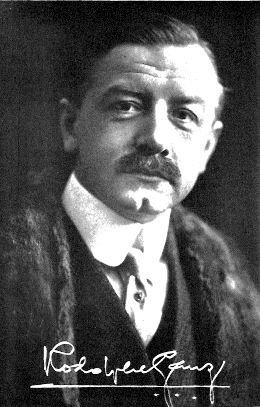
RUDOLPH GANZ — CONSERVING ENERGY IN PIANO PRACTISE
Rudolph Ganz
"One of the most necessary things is the conserving of vital
energy in piano practise," said the pianist Rudolph Ganz to me
one day. "The wrong way is to continually practise the piece as
though you were playing it in public—that is to say, with
all possible energy and emotion. Some of the pianists now
before the public do this, and it always makes me sorry for
them, for I know what a needless waste of energy and vital
force it is. An actor, studying his lines, does not need to
continually shout them in order to learn how they should be
interpreted. Neither does the lyric actress practise her roles
with full tones, for she is well used to saving her voice. Why
then should the pianist exhaust himself and give out his whole
strength merely in the daily routine of practise? I grant this
principle of saving one's self may not be easy to learn, but it
should be acquired by all players, great and small. I think a pianist should be able to
practise five or six hours daily without fatigue. If the
player is accustomed to husband his vital force during the
daily routine of practise, he can play a long, exacting
program in public without weariness. In every day practise
one often does not need to play forte nor use the
pedals; a tone of medium power is sufficient. Suppose, for
instance, you are studying the Chopin Étude Op. 10,
No. 12, with the left hand arpeggio work. Every note and
finger must be in place, every mark of phrasing obeyed; but
during practise hours you need not give the piece all its
dashing vigor and bravura at every repetition. Such a course
would soon exhaust the player. Yet every effect you wish to
make must be thoroughly studied, must be in mind, and used
at intervals whenever a complete performance of the piece is
desired.
"As I said before, it is often difficult to control the
impulse to 'let loose,' if the work is an exciting one. At a
recent rehearsal with the Symphony Orchestra, I told the men I
would quietly run through the concerto I was to play, merely
indicating the effects I wanted. We began, but in five minIutes
I found myself playing with full force and
vigor.
"In regard to methods in piano study there seems to be a
diversity of opinion, resulting, I think, from the various ways
of touching the keys—some players using the tip and
others the ball of the finger. Busoni may be cited as one who
employs the end of the finger—Pauer also; while the
Frenchman, Cortôt, who has an exquisite tone, plays with
the hand almost flat on the keys, a method which certainly
insures weight of hand and arm. Of course players generally,
and teachers also, agree on the employment of arm weight in
playing. The principles of piano technic are surely but few.
Was it not Liszt who said: 'Play the right key with the right
finger, the right tone and the right intention—that is
all!' It seems to me piano technic has been pushed to its
limit, and there must be a reversal; we may return to some of
the older methods of touch and technic.
"The vital thing in piano playing is to bring out the
composer's meaning, plus your own inspiration and feeling. You
must study deeply into the composer's idea, but you must also
put your own feeling, intensity and emotion into the piece. And
not only must you feel the meaning yourself, but you must play
it in a way to touch others. There are many pianists who are not cultured musicians; who
think they know their Beethoven because they can play a few
sonatas. In music 'knowledge is power.' We need all possible
knowledge, but we also need to feel the inspiration. One of
the greatest teachers of our time holds that personal
inspiration is not necessary; for the feeling is all in the
music itself. All we have to do is to play with such and
such a dynamic quality of tone. Like a country doctor
measuring out his drugs, this master apportions so many
grains of power for forte, for mezzo, for
piano, and so on. This plan puts a damper on
individuality and enthusiasm, for it means that everything
must be coldly calculated. Such playing does not really warm
the heart.
"I believe in teaching tonal contrasts and tone color even
to a beginner. Why should not the child form a concept of
forte and piano, and so get away from the deadly
monotony of mezzo? I have written some little
descriptive piano pieces, and my small boy learned one of them
to play for me. There is a closing phrase like this," and Mr.
Ganz illustrated at the piano; "it is to be played
forte, and is followed by a few notes to be touched very
softly, like an echo. It was really beautiful to see how the
little fellow reached out for the pedal to make the loud part more emphatic, and then
played the echo very softly and neatly. He had grasped the
first principle of tone color—namely tone contrast,
and also a poetic idea.
"There are so many wonder children in these days, and many
marvels are accomplished by infant prodigies. Very often
however, these wonder children develop no further; they fail to
fulfil their early promise, or the expectations held of
them.
"A youthful wonder in the field of composition is Eric
Korngold, whose piano sonata I played in my New York recital. I
have played this work eight times in all, during my present
tour, often by request. To me it is most interesting. I cannot
say it is logical in the development of its ideas; it often
seems as though the boy threw in chords here and there with no
particular reason. Thus the effort of memorizing is
considerable, for I must always bear in mind that this C major
chord has a C sharp in it, or that such and such a chord is
changed into a most unusual one. One cannot predict whether the
boy will develop further. As you say, Mozart was an infant
prodigy, but if we judge from the first little compositions
that have been preserved, he began very simply and worked up,
whereas Korngold begins at Richard Strauss. His
compositions are full of the influence of Strauss. The
critics have much to say for and against these early works.
I do not know the young composer personally, though he has
written me. In a recent letter which I have here, he
expresses the thought that, though the critics have found
many things to disapprove of in the sonata, the fact that I
have found it worth studying and bringing out more than
compensates him for all adverse criticism. To make the work
known in the great musical centers of America is surely
giving it wide publicity."
On a later occasion, Mr. Ganz said:
"I thoroughly believe in preserving one's enthusiasm for
modern music, even though, at first glance, it does not attract
one, or indeed seems almost impossible. I enjoy studying new
works, and learning what is the modern trend of thought in
piano work; it keeps me young and buoyant.
"One of the novelties lately added to my repertoire is the
Haydn sonata in D. On the same program I place the Korngold
sonata. A hundred years and more divide the two works. While I
revere the old, it interests me to keep abreast of the new
thought in musical art and life."
TINA LERNER — AN AUDIENCE IS THE BEST TEACHER
Between the many engagements that crowded upon the close of
her long American tour, Miss Tina Lerner found time to talk
over certain topics of significance which bear upon pianistic
problems.
We began by referring to the different methods of holding
the hands, moving the fingers and touching the keys, as
exemplified by the various pianists now before the public.
"It is true that I play with the ball of the finger on the
key, which necessitates a flat position of hand, with low
wrist." Here the pianist illustrated the point by playing
several pearly scales with straight, outstretched fingers. "I
never realized, however, that I played in this way, until Mr.
Ernest Hutcheson, the pianist, of Baltimore, recently called my
attention to it. The fact is, I have always taken positions of
body, arms, hands and fingers, which seemed to me the most natural
and easy. This I did when I began, at the age of five, and I
have always kept to them, in spite of what various teachers
have endeavored to do for me. Fortunately my early teachers
were sensible and careful; they kept me at the classics, and
did not give too difficult pieces. The principles followed
by most great pianists I believe are correct; but I have
always kept to my own natural way. In hand position,
therefore, I am individual; perhaps no one else plays with
such a finger position, so in this I am unique.
"For some reason unknown to me, it has come to be imagined
that I have studied with Leschetizky; this is entirely refuted
when I say I have never been in Vienna. It seems we are getting
away from the idea of helping ourselves out with the name of
some great teacher. The question should be: What has the player
in himself, what can he accomplish? not, Whose pupil is he? We
know of some of Leschetizky's famous pupils, but we never hear
of the thousands he must have had, who have come to nothing. A
teacher can only do a certain amount for you; he can give you
new ideas, which each pupil works out for himself in his own
way. The piano student learns from so many different sources. He attends a piano
recital and acquires many ideas of touch, tone, phrasing and
interpretation; he hears a great singer or violinist and
absorbs a wholly new set of thoughts, or he listens to a
grand orchestra, and gains more than from all the others.
Then there is life to study from:
experience—living—loving: all go into the work
of the musician. A musical career is indeed the most
exacting one that can be chosen.
"I have been asked whether I prefer to play for an audience
of 'music-lovers' or one of 'music knowers.' Perhaps an equal
mixture is the happy medium. Of the two sorts it seems to me
the music-knowers are preferable, for even if they are very
critical, they also recognize the various points you make; they
see and appreciate what you are striving for. They are not
inclined to say, 'I don't like such or such a player'; for the
music-knower understands the vast amount of time and energy,
labor and talent that go to make a pianist. He rather says, 'I
prefer the playing of such or such an artist.' The word 'like'
in connection with a great artist seems almost an affront. What
does it matter if his work is not 'liked' by some? He knows it
can stand for what it is—the utmost perfection of his
powers—of himself. And after all the audience is the
greatest teacher an artist can have; I have learned more
from this teacher than from any other. In this school I
learn what moves and touches an audience; how to improve
this or that passage; how to make a greater climax here, or
more sympathetic coloring there. For in conceiving how a
work should sound, I get—in my study of it—a
general idea of the whole, and make it as nearly perfect as
I am able. But it has to be tested and tried—an
audience must pass its opinion—must set the seal of
approval upon it. When the work has been polished by
repeated trials in this school, interpretation then becomes
crystallized in the mind and the piece can always be given
in nearly the same way. A painter does not change nor
repaint his picture each time he exhibits it; why need the
musician change his idea of the interpretation at each
repetition? To trust too much to the inspiration of the
moment might injure the performance as a whole. When I have
my ideal of the interpretation worked out in mind, it
becomes my sacred duty to play it always in this
spirit—always to give my best. I can never think that
because I am playing in Boston or New York, I must strive
harder for perfection than if I play in a little
town. No, I must give the highest that is in me,
no matter where it may be. People sometimes ask me if I am
nervous before a recital. It is not that I am afraid of
people; but I am always anxious about being able to realize
my ideal, when the moment comes.
"I can say I prefer playing in America to anywhere else in
the world; for there are more real appreciation and
understanding here than in any other country. Of course the
great music centers all over the world are about the same; but
the difference lies in the smaller cities, which in America are
far more advanced musically than in Europe. I have proved this
to be the case repeatedly. Not long ago I was booked for a
couple of recitals in a small town of not more than two
thousand inhabitants. When I arrived at the little place, and
saw the barn of a hotel, I wondered what these people could
want with piano recitals. But when I came to the college where
I was to play and found such a large, intelligent audience
gathered, some of whom had traveled many miles to be present,
it proved in what estimation music was held. The teacher of
this school was a good musician, who had studied nine years
with Leschetizky, in Vienna; the pupils understood the numbers
on the program, were wide awake, and well informed as to what was going on in
the world of music.
"One handicap the present day pianist encounters, who plays
much with orchestra, and that is the dearth of modern
concertos. The familiar ten or dozen famous ones are played
over and over, and one seldom hears anything new. There are new
ones written, to be sure, but the public has not learned to
care for them. The beautiful second concerto of Rachmaninoff
has not made a success, even in the great music centers, where
the most intelligent audiences have heard it. I believe that if
an audience of the best musicians could be assembled in a small
room and this work could be played to them, they could not fail
to be impressed with its beauties. I am now studying a new
concerto by Haddon Wood, which you see in manuscript there on
the piano; it is one I find very beautiful."
A subsequent conversation with the artist elicited the
following:
"I might say that I began my music when about four years
old, by playing the Russian National Hymn, on a toy piano
containing eight keys, which had been given me. My older
sister, who was studying the piano, noticed this, showed me a
few things about the notes, and I constantly picked out little
tunes and pieces on the real piano. Finally one day my
sister's teacher, Rudolph Heim, came to the house, mainly on
my account. This was in Odessa, in the south of Russia,
where I was born and where I spent my early years. On this
occasion, he wanted to look at me and see what I could do.
Unluckily a sudden fit of shyness overcame me and I began to
cry; the exhibition could not take place, as nothing could
be made out of me that day. You see I was headstrong even at
that early age," said the young pianist, with one of her
charming smiles.
"Soon after this incident, I was taken to the Professor's
studio. He examined me, considered I had talent, and thought it
should be cultivated. So he took me in hand. I was then five,
and my real musical education began at that time.
"From the very first I adopted a position of hand which
seemed to me most convenient and comfortable, and no amount of
contrary instruction and advice has ever been able to make me
change it. I play scales and passages with low hand and flat
fingers because that position seems the most favorable for my
hand. When practising, I play everything very slowly, raising my fingers high and
straight from the knuckle joint. This gives me great
clearness and firmness. In rapid passage work the action is
reduced, but the position remains. I am said to have a
clear, pearly touch, with quite sufficient power at my
command for large works.
"After five years of study with my first teacher, Rudolph
Heim, a pupil of Moscheles, I entered the Moscow Conservatory,
and continued my studies under Professor Pabst, brother and
teacher of the composer of that name. I was then ten years old.
Professor Pabst was very conservative, very strict, and kept me
at work on the music of the older masters. This kind of music
suits me, I think; at least I enjoy it. Even here I still clung
to my ideas of holding my hands and of touching the keys, and
always expect to do so.
"I remained with this professor about six years and then
began my public career.
"You ask about my present studies, and how I regulate my
practise. During my periods of rest from concert work, I
practise a great deal—I wish I could say all the time,
but that is not quite possible. I give an hour or more a day to
technical practise. As to the material, I use Chopin's
Études constantly, playing them with high-raised, outstretched
fingers, in very slow tempo. One finds almost every
technical problem illustrated in these études;
octaves, arpeggios, scales in double thirds and sixths,
repeated notes, as in number 7, broken chords and passage
work. I keep all these études in daily practise, also
using some of the Liszt Études Transcendantes,
and, of course, Bach. The advantage of using this sort of
material is that one never tires of it; it is always
interesting and beautiful. With this material well in hand,
I am always ready for recital, and need only to add special
pieces and modern music.
"In learning a new work I first study it very slowly, trying
to become familiar with its meaning. I form my concept of it
and live with it for months before I care to bring it
forward. I try to form an ideal conception of the piece, work
this out in every detail, then always endeavor to render it as
closely like the ideal as possible."
ETHEL LEGINSKA — RELAXATION THE KEYNOTE OF MODERN PIANO PLAYING
The brilliant young pianist, Ethel Leginska, who is located
for a time in America, was seen in her Carnegie Hall studio, on
her return from a concert tour. The young English girl is a
petite brunette; her face is very expressive, her manner at
once vivacious and serious. The firm muscles of her fine,
shapely hands indicate that she must spend many hours daily at
the keyboard.
"Yes, I have played a great deal in public—all my
life, in fact—ever since I was six. I began my musical
studies at Hull, where we lived; my first teacher was a pupil
of McFarren. Later I was taken to London, where some rich
people did a great deal for me. Afterward I went to
Leschetizky, and was with him several years, until I was
sixteen; I also studied in Berlin. Then I began my career,
and concertized all over Europe; now I am in
America for a time. I like it here; I am fond of your
country already.
"The piano is such a wonderful instrument to me; I feel we
are only beginning to fathom its possibilities; not in a
technical sense, but as a big avenue for expression. For me the
piano is capable of reflecting every mood, every feeling; all
pathos, joy, sorrow—the good and the evil too—all
there is in life, all that one has lived." (This recalls a
recently published remark of J. S. Van Cleve: "The piano can
sing, march, dance, sparkle, thunder, weep, sneer, question,
assert, complain, whisper, hint; in one word it is the most
versatile and plastic of instruments.")
"As for the technic of the piano, I think of it only as the
material—only as a means to an end. In fact I endeavor to
get away from the thought of the technical material, in order
that I may get at the meaning of the music I wish to interpret.
I am convinced there is a great future for the piano and its
music. Even now we are taking piano music very seriously, and
are trying to interpret it in a far deeper and broader sense
than the pianists of, say, fifty years ago ever thought of
doing. I fancy if Clara Schumann, for instance, could
return and play to us, or even Liszt
himself, we should not find their playing suited to this age
at all. Some of us yet remember the hand position Mme.
Schumann had, the lack of freedom in fingers and arms. It
was not the fashion of her time to play with the relaxed
freedom, with the breadth and depth of style which we demand
of artists to-day. In those days relaxation had not received
the attention it deserved, therefore we should probably find
the playing of the greatest artists of a former generation
stiff and angular, in spite of all we have heard of their
wonderful performances.
"Relaxation is a hobby with me; I believe in absolute
freedom in every part of the arm anatomy, from the shoulder
down to the finger-tips. Stiffness seems to me the most
reprehensible thing in piano playing, as well as the most
common fault with all kinds of players. When people come to
play for me, that is the thing I see first in them, the
stiffness. While living in Berlin, I saw much of Mme. Teresa
Carreño, and she feels the same as I do about
relaxation, not only at the keyboard, but when sitting, moving
about or walking. She has thought along this line so
constantly, that sometimes, if carrying something in hand, she
will inadvertently let it drop, without realizing
it—from sheer force of the habit of
relaxation.
"You ask how I would begin with a young pupil who never has
had lessons. I use the principle of relaxation first of all,
loosening arms and wrists. This principle can be taught to the
youngest pupil. The wrist is elevated and lowered, as the hand
is formed on the keys in its five finger position, with arched
knuckles. It does not take long to acquire this relaxed
condition; then come the finger movements. I do not believe in
lifting the fingers high above the keys; this takes time and
interferes with velocity and power. I lift my fingers but
little above the keys, yet I have plenty of power, all the
critics agree on that. In chords and octaves I get all the
power I need by grasping the keys with weight and pressure. I
do not even prepare the fingers in the air, before taking the
chord; I do not find it necessary." Here the pianist played a
succession of ringing chords, whose power and tonal quality
bore out her words; the fingers seemed merely to press and
cling; there was no striking nor percussion.
"To return to the beginning pupil. As for a book to start
with, I often use the one by Damm, though any foundational work
may be employed, so long as correct principles
are taught. It is said by Leschetizky that he has no method.
That may be understood to mean a book, for he certainly has
what others would call a method. There are principles and
various sets of exercises to be learned; but it is quite
true that none of the Vorbereiters use a book.
"In teaching the piano, as you know, every pupil is
different; each has his or her own peculiar hand, and a
different degree of intelligence. So each pupil must be treated
differently. This is really an advantage to the teacher; for it
would be very monotonous if all pupils were alike.
"The piano is such a revealer of character; I need only to
hear a person play to know what sort of character he has. If
one is inclined to much careful detail in everything, it comes
out in the playing. If one is indolent and indifferent, it is
seen the moment one touches the keys; or if one is built on
broad, generous lines, and sees the dramatic point in life and
things, all this is revealed at the piano.
"To refer again to the subject of finger action. I do not
believe in the so-called finger stroke; on the contrary I
advocate fingers close to the keys, clinging to them whenever
you can. This is also Arthur Schnabel's idea. You
should hear Schnabel; all Berlin is wild over him, and
whenever he gives a concert the house is sold out. He has
quantities of pupils also, and is quite a remarkable
teacher. One point I insist upon which he doesn't: I will
not allow the joint of the finger next the tip to break or
give in. I can not stand that, but Schnabel doesn't seem to
care about it; his mind is filled with only the big, broad
things of music.
"In regard to memorizing piano compositions. I do it phrase
by phrase, and at the instrument, unless I am traveling or
unable to get to a piano, in which case I think it out from the
notes. If the piece is very difficult I take a short passage of
two or three measures and play each hand separately and then
together; but generally I play the passage complete—say
half a dozen times with the notes, and then repeat it the same
number of times from memory. Perhaps the next day I have
forgotten it, so the work has to be done over again; the second
time, however, it generally sticks.
"My great longing and ambition is to write music, to become
a composer. With this end in view, I give whatever time I am
able to the study of composition. I hope some day to
create something that will be worthy the high aim I have
before me."
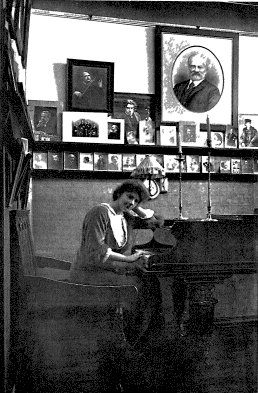
If environment and atmosphere are inspirational aids to
piano teaching and playing, the students of Mrs. Thomas Tapper
have the incentives of both in their lesson hours. Her
apartments on the Drive have the glory of sunlight all the long
afternoons. Outside the Hudson shimmers in blue and gold;
indoors all is harmonious and home-like. In the large
music-room, facing the river, two grand pianos stand side by
side; there are many portraits and mementoes of the great in
music; fresh flowers, books—everything to uplift thought;
while in the midst of it all is Mrs. Tapper herself, the
serious, high-minded, inspiring teacher; the "mother confessor"
to a large number of young artists and teachers.
"Music study means so much more than merely exercising the
fingers," she said; "the student should have a good all-round
education. When young people come to me for instruction, I ask what they are doing in
school. If they say they have left school in order to devote
their whole time to the piano, I say, 'Go back to your
school, and come to me later, when you have finished your
school course.' It is true that in rare cases it may be
advisable for the student to leave school, but he should
then pursue general or special studies at home. I often wish
the music student's education in this country could be
arranged as it is in at least one of the great music schools
in Russia. There the mornings are given to music, while
general studies are taken up later in the day. It is really
a serious problem, here in America, this fitting in music
with other studies. Both public and private schools try to
cover so much ground that there is very little time left for
music or anything else. The music pupil also needs to know
musical literature, history and biography, to be familiar
with the lives and writings of the great composers. Take the
letters and literary articles of Robert Schumann, for
instance. How interesting and inspiring they are!
"In regard to methods in piano study my principles are based
wholly upon my observations of Leschetizky's work with me
personally, or with others. What I know he has taught
me; what I have achieved I owe to him. My
first eight weeks in Vienna were spent in learning, first,
to control position and condition of hands and arms
according to the law of balance; secondly, to direct each
motion with the utmost accuracy and speed. To accomplish
this I began with the most elementary exercises in
five-finger position, using one finger at a time. Then came
the principles of the scale, arpeggios, chords and octaves.
All these things were continued until every principle was
mastered. I practised at first an hour a day, then increased
the amount as my hands grew stronger and the number of
exercises increased.
"Next came the study of tone production in various forms, a
good quality invariably being the result of a free condition of
the arm combined with strength of fingers and hands.
"The Leschetizky principles seem to me the most perfect and
correct in every particular. Yes, there are several books of
the method, by different authors, but I teach the principles
without a book. The principles themselves are the essential
things. I aim to build up the hand, to make it strong and
dependable in every part, to fill out the weak places and
equalize it. That this may be thoroughly and successfully accomplished, I require that
nothing but technical exercises be used for the first nine,
ten, or twelve weeks. We begin with the simplest exercises,
one finger at a time, then two, three and so on through the
hand. I believe in thus devoting all the practise time to
technic, for a certain period, so that the mind is free to
master the principles, undisturbed by piece playing. When
the principles have been assimilated, the attention can then
be directed to the study of music itself. If any weak places
appear in the hand from time to time, they can be easily
corrected.
"If a pupil comes to me who has played a great deal but with
no idea of the principles of piano playing, who does not know
how to handle herself or the keyboard, it is absolutely
necessary to stop everything and get ready to play. If you
attempt even a simple sonata with no legato touch, no idea of
chord or scale playing, you can not make the piece sound like
anything. It is like a painter trying to paint without brushes,
or an artist attempting to make a pen and ink drawing with a
blunt lead pencil; to do good work you must have the tools to
work with.
"For application of all principles, the studies of Czerny,
Op. 299, 740, and others, offer unequaled opportunity. They are simple,
direct, and give the student a chance for undivided
attention to every position taken and to every motion
made.
"What happens afterward is altogether according to the
individual characteristics of the student. How to recognize
these and deal with them to the best advantage is the
interesting task of my great master (and those who try to
follow in his steps)—the man of keenest intelligence, of
profound learning and experience. To learn this lesson from him
has been my greatest aim, and to see him at work, as it has
been my privilege to do for several summers, has been of the
greatest influence and inspiration in my own work.
"My chief endeavor is to create a desire for good
musicianship. To this end I insist upon the study of theory,
harmony, ear-training and analysis. In the piano lessons I do
not have sufficient time to teach these things. I have
assistant teachers who help me with these subjects and also
with the technical training. Once a month during the season, my
assistant teachers bring their pupils to play for me, and we
have a class in piano teaching. There are sometimes eighteen or
twenty students who come to a class. I can in this way
supervise all the work done, and keep in touch with my
teachers, their work, and with all the students.
"On the first Saturday of the month I have my own pupils
here for a class; they play for me and for each other.
Everything is played from memory, not a printed note is used.
Students tell me it is very difficult to play here, where all
listen so intently. Especially is it difficult the first time a
student plays in class, to keep the mind wholly on what he is
doing, with sufficient concentration. Later on, at the end of
the season, it comes easier.
"This idea of separating the technical work at the outset
from the study of music itself, secures, in my opinion, the
most perfect foundation, and later on the best results. It is
sometimes wonderful how, with proper training, the hand will
improve and develop in a comparatively short time. I often
marvel at it myself."
The writer had the privilege of being one of the guests at
the last audition of the season. Eight or nine young artists
played a long and difficult program. Among the numbers were a
Beethoven sonata, entire; Chopin's Ballade in A flat major;
Cesar Franck, Prelude, Fugue and Variations; a Mozart
Fantaisie; Grieg Concerto, first movement; Weber's
Concertstück, and Chopin's Scherzo in
E. The recital was most instructive from an educational
point of view. All the players had repose and concentration,
and there were no noticeable slips, though every piece was
played from memory. Hands were well arched at the knuckles,
fingers curved—with adequate action at the knuckle
joint; wrists in normal position, and extremely loose; the
whole arm swung from the shoulder and poised over the keys,
thus adjusting itself to every requirement of the
composition. Every note had its amount of hand or arm
weight. The tone quality was full and singing. These points
were exemplified even in the playing of the youngest pupils.
Furthermore they had an intelligent grasp of the meaning of
the music they played, and brought it out with conviction,
power, and brilliancy.
CARL M. ROEDER — PROBLEMS OF PIANO TEACHERS — FOUNDATIONAL EXERCISES — USE OF STUDIES — BOOKS THAT ARE HELPFUL — IN REGARD TO INTERPRETATION — QUESTION OF PERSONALITY
"The progressive teacher's method must be one of accretion,"
said Carl Roeder, when interviewed between lesson hours in his
delightful studio in Carnegie Hall. "He gains ideas from many
methods and sources, and these he assimilates and makes
practical for his work. At the same time he must originate and
work out things for himself. This has been my experience.
"I was something of a wonder child, and at an early age
developed considerable facility and brilliancy. After knocking
about as a pupil of various private teachers and
conservatories, I became, while quite a young lad, the pupil of
de Konstki, then a lion of the day." The speaker joined in the
laugh his remark called up, which brought to mind the
Chevalier's famous battle-horse, "The Awakening of the
Lion."
"De Konstki's style was very brilliant and I
endeavored to imitate him in this respect. I did quite a
little concert work at that time. Realizing, however, that a
pianist's income must be rather precarious, I decided to
teach. In those youthful days I had the idea that the
teacher of the piano had an easy life. I remembered one of
my professors, a man of considerable reputation, who took
the duties of his profession very lightly. His method of
giving a lesson was to place the music upon the piano, start
the pupil going, then retire to a comfortable couch, light
his pipe and smoke at ease, troubling himself little about
the pupil's doings, except occasionally to call out
'Falsch!'
"So I, too, began to teach the piano. But I soon discovered
that teaching was something quite different from what I had
imagined it to be, and that it was something I knew very little
about. I now set myself to learn how to teach—how to help
those pupils who came to me.
"One of my first discoveries was that most of the pupils
were afflicted with stiff wrists and arms, and that this
stiffness must be remedied. My own playing had always been
free, due to one of my early teachers having thoroughly
inculcated the principle of 'weight,' so often acclaimed in these days as a modern
discovery. But how to bring about this condition in others
was a great problem. I studied the Mason method, and found
many helpful, illuminating ideas in regard to relaxation and
devitalization. I had some lessons with S. B. Mills, and
later did considerable valuable work with Paolo Gallico, who
opened up to me the great storehouse of musical treasure,
and revealed to me among other things the spiritual technic
of the pianist's art. Subsequently I investigated the Virgil
and Leschetizky methods. Mr. Virgil has done some remarkable
things in the way of organizing and systematizing technical
requirements, and for this we owe him much. Such analyses
had not before been made with anything like the care and
minuteness, and his work has been of the greatest benefit to
the profession. My subsequent studies with Harold Bauer
revealed him to be a deep musical thinker and a remarkable
teacher of the meaning of music itself.
"In my teaching I follow many of the ideas of Leschetizky,
modified and worked out in the manner which I have found most
useful to my own technic and to that of my pupils. I have
formulated a method of my own, based on the principles which
form a dependable foundation to build the future structure
upon. Each pupil at the outset is furnished with a blank
book, in which are written the exercises thus developed as
adapted to individual requirements.
"We begin with table work. I use about ten different
exercises which embody, as it were, in a nutshell, the
principles of piano playing. The hand is first formed in an
arched position, with curved fingers, and solidified. The thumb
has to be taught to move properly, for many people have never
learned to control it at all.
"With the hand in firm, solid position, and the arm hanging
freely from the shoulder, I begin to use combined arm and wrist
movements, aiming to get the weight of the arm as well as its
energy at the complete disposal of the finger tip. Each finger
in turn is held firmly in a curved position and played with a
rotary movement of arm and wrist. When this can be done we next
learn hand action at the wrist from which results the staccato
touch. In this form of hand staccato there is an element of
percussion, as you see, but this element gives directness and
precision to the staccato touch, which in my opinion are
necessary. After this we come to finger action itself. This
principle is taken up thoroughly, first with one finger,
then with two, three, four, and five—in all possible
combinations. In this way we come down from the large
free-arm movements to the smaller finger movements; from the
'general to the particular,' instead of working from the
smaller to the larger. I find it most necessary to establish
relaxation first, then strengthen and build up the hand,
before finger action to any extent is used. When these
foundational points have been acquired, the trill, scales,
arpeggios, chords, octaves and double notes follow in due
course. At the same time the rhythmic sense is developed,
all varieties of touch and dynamics introduced, and harmonic
and structural analysis dwelt upon.
"Above the third or fourth grade I make frequent use of
studies, selecting them from various books. Duvernoy, Op. 120;
Berens, Op. 61; Czerny, Op. 740 I find far more interesting
than the threadbare 299. Heller is indispensable, so melodious
and musical. Arthur Foote's studies, Op. 27, are very useful;
also MacDowell's, Op. 39 and 46. Sometimes I
use a few of Cramer's and the Clementi 'Gradus,' though
these seem rather old-fashioned now.
"For more advanced pupils I find Harberbier, Op. 53
especially applicable; there is beautiful work in them.
Kessler, Op. 20, and the Moszkowski studies, Op. 72, have
splendid material for the advanced player, and prepare for
Henselt, Rubinstein, Chopin and Liszt études. I find
that studies are valuable for application of technical
principles, for reacting purposes, and for the cultivation of
all the refinements of playing. Some teachers believe in
applying the technic directly to pieces, and use almost no
studies; but I think a study is often more valuable than a
piece, because a definite technical principle is treated in
every kind of way. Though I do not require studies to be
memorized, they must be played with all the finish of a piece,
if the pupil is to derive the maximum of benefit from them.
"As aids to my studies in the art of teaching, several books
have been most helpful. Among these are two volumes by Dr.
Herman H. Home, The Philosophy of Education, and
The Psychology of Education. Another
book, from which I have profited much is William James'
Talks to Teachers on Psychology. Every teacher should
possess it.
"You ask what method I pursue with new pupils who have
played a great deal of music but with little idea of correct
principles of piano study. Let us take, for instance, one who
has had lessons for years but is in ignorance of first
principles. Arms and wrists are stiff, hands and fingers held
in cramped position; no freedom anywhere. My first move is to
have the pupil stand and learn to relax arms, shoulders and
body; then learn to breathe. But relaxation, even at first, is
not the only thing; after devitalization comes organization,
firmness and solidity—in the right places. It must be
understood at the very beginning that piano playing is far more
than sitting before the instrument working the fingers six or
seven hours a day. The mechanical side is only preliminary.
Some one has said that the factors in playing are a trinity of
H's—head, hand and heart. I try at once to awaken
thought, to give a wider outlook, to show that piano playing is
the expression, through the medium of tone, of all that the
poet, painter and philosopher are endeavoring to show through
other means: to this end I endeavor to
stimulate interest in the wonders of the visible universe,
the intellectual achievements of men and the deep things of
spiritual discernment.
"On this subject I think we should avoid pedantry; not to
say to the pupil, you must play this piece a certain way; but
rather say, I see or feel it in this way, and give the reasons
underlying the conception. I believe the successful teacher
should be a pianist. He should understand every point and be
able to do the thing, else how can he really show the
manner of the doing? Many of the nuances, subtleties of
color and phrase, effects of charm or of bravura, cannot be
explained; they must be illustrated. And furthermore, only he
who has been over the road can be a safe or sympathetic guide.
Tolstoi realized he could not be of service to the people he
would uplift unless he lived among them, shared their trials
and experienced their needs. The time has gone by when the
musician and composer was considered a sort of freak, knowing
music and nothing else. We know the great composers were men of
the highest intelligence and learning, men whose aim was to
work out their genius to the utmost perfection. Nothing
less than the highest would satisfy them. As George Eliot
said, 'Genius is the capacity for taking infinite pains.'
Think of the care Beethoven took with every phrase, how many
times he did it over, never leaving it till he was
satisfied."
In speaking of the great European teachers Mr. Roeder
continued:
"We hear much of the Leschetizky method; but with that
master technic is quite a secondary matter over which, when
once the principles are mastered, he troubles himself but
little. It is the conception of the work as a whole which
concerns him, how to project it, so to say, most effectively to
an audience. He brings into prominence now this part, now that,
accenting here, slightly exaggerating there, in order to make
the picture more vivid to the listener. Harold Bauer is another
illuminating master for those who have a technical equipment
adequate to the performance of great works of piano literature.
Some go to him who are not ready for what he has to give, but
to those who can direct attention to the meaning of the music,
he is a wonderful inspirational force. First he will point out
a phrase here, another there, and so on through
the piece, showing how the same idea takes
on various aspects in the composer's thought. Then he shows
how to gather up these different threads to form the perfect
pattern which the author of the work had in mind; and
finally the master teacher reaches down below the surface of
form and design to the vital significance of the
composition, and the disciple feels the glow and power of
the revelation.
"There is no gainsaying the fact that this age is
superficial, and the great office of art is to cultivate that
idealism which will uplift and inspire. In an important sense
the teacher must be a preacher of righteousness. He knows that
'beautiful things are fashioned from clay, but it has first to
pass through the fire,' and only those who can endure that
scorching can hope to achieve success.
"If asked to what extent a player's personality enters into
the performance, my answer would be: Only in so far as the
performance remains true to the composer's intention. So long
as personality illumines the picture and adds charm, interest,
and effectiveness to it, it is to be applauded; but when it
obstructs the view and calls attention to itself it should
not be tolerated. It is not art; it is vanity.
"Yes, I teach both high finger action and pressure touch,
once the principle of arm weight is thoroughly established,
although I use high finger action only to develop finger
independence and precision, and for passages where sharp
delineation is required. I believe in freedom of body, arm and
wrist, a firm, solid arched hand and set fingers. That freedom
is best which insures such control of the various playing
members as to enable the player to produce at will any effect
of power, velocity or delicacy desired; thereby placing the
entire mechanical apparatus under complete subjection to the
mind, which dominates the performance. In other words, I am
neither an anarchist who wants no government, namely
unrestrained devitalization, nor a socialist, whose cry is for
all government—that is, restriction and rigidity. In
piano playing, as in all else, 'Virtue is the happy mean
between two vices.'"
KATHARINE GOODSON — AN ARTIST AT HOME — MEMORIZING BY ANALYSIS — A PIANO HAND
When one has frequently listened to a favorite pianist in
the concert room, and has studied impersonally, so to speak,
the effects of touch, tone and interpretation produced during a
recital, it is a satisfaction and delight to come into personal
touch with the artist in the inner circle of the home; to be
able to speak face to face with one who has charmed thousands
from the platform, and to discuss freely the points which
impress one when listening to a public
performance.
Katharine Goodson
It has been my recent privilege thus to come into intimate
touch with the artist pair, Mr. and Mrs. Arthur Hinton, the
latter being known all over the world as Katharine Goodson.
They have a quiet, beautiful home in London—a true
artist's home. One feels at once on entering and enjoying its
hospitality, that here at least is one instance where two
musicians have perfect harmony in the home
life. Mr. Hinton, as is widely known, is a composer and also
a violinist and pianist. The beautiful music-room, which has
been added to one side of the house and leads into the
garden, contains two grand pianos on its raised platform.
This music-room is Miss Goodson's own sanctum and workroom,
and here piano concertos, with orchestral accompaniment
supplied on the second piano, can be studied ad
infinitum. Mr. Hinton has his own studio at the top of
the house.
The garden music-room is lighted at one end by a great
arched window, so placed that the trees of the garden are seen
through its panes. It is easy to imagine one's self in some
lovely sylvan retreat—which is indeed true! All the
appointments of this room, and indeed of the whole house, every
article of furniture and each touch of color, betoken the
artistic sense for fitness and harmony. Miss Goodson has a keen
and exquisite sense for harmony in colors as well as for color
in the harmonies she brings from her instrument.
"My coming tour will be the fifth I have made in America,"
she said. "I enjoy playing in your country immensely; the
cities of New York, Boston, Chicago, and Philadelphia
are the most appreciative in the world. It
is true we have masses of concerts in London, but few of
them are really well attended and people are not so
thoroughly acquainted with piano music as you are in
America. And you are so appreciative of the best—even
in the smaller cities.
"I can recall a recital which I gave in a city of not more
than forty thousand, in the West. The recital was arranged by a
musical club; they asked for the program some time in advance,
studied it up and thus knew every piece I was to play. There
was an enormous audience, for people came from all the country
round. I remember three little elderly ladies who greeted me
after the recital; in parting they said, 'You will see us
to-morrow,' I thought it over afterward and wondered what they
meant, for I was to play at a place many miles from there the
next night. What was my surprise to be greeted by the same
ladles the following evening. 'You see, we are here; we told
you we would come.' Fancy taking a trip from London to
Edinburgh just to hear a concert! For it was a journey like
that. Such incidents show the enthusiasm in America for
music—and for piano music.
"I hope to play both the Brahms and Paderewski concertos in America. To me the
latter is a beautiful work—the slow movement is
exquisite. I have as yet scarcely done anything with the
composition, for I have been on a long tour through Norway,
Sweden, and Finland. It was most inspiring to play for these
people; they want me to come back to them now, but I cannot
do so, nor can I go next season, but after that I shall go.
I returned home greatly in need of rest. I shall now begin
work in earnest, however, as summer is really the only time
I have for study throughout the year. I shall have six full
weeks now before we take our usual holiday in the
Grindelwald. On the way there we shall stop at Morges and
visit Paderewski, and then I will go over the concerto with
him and get his ideas as to interpretation.
"You ask how I memorize. First I go over the work several
times to get a general idea of the whole. Then I analyze it,
for I feel it absolutely necessary to know keys, chords, and
construction. A work should be so well understood along these
lines that it can be played in another key as well as in the
one in which it is written. For the actual memorizing of the
piece I generally do it phrase by phrase,
not always 'each hand alone,' though occasionally I do this
also. I remember learning the Bach A minor Prelude and Fugue
in this way. If I were now asked to play any measure or
passage in any part of it I could do so; it is mine forever,
never to be forgotten."
Asked about the different ways of teaching the Leschetizky
method by various teachers, Miss Goodson said:
"As we all know, people claim to understand and teach the
Leschetizky principles who are not competent to do so. I do not
recall, for instance, that the professor requires the tips of
the fingers to form a straight line on the edge of the keys. I
myself have never done this. I believe in a perfectly easy and
natural position of hand at the keyboard. When this is the case
the finger-tips form a curve, the middle fingers being placed a
little farther in on the keys than is natural for the first and
fifth. Of course the hand takes an arched position and the
joints nearest the tip of the fingers must be firm; there
should be no wavering nor giving in there. The whole arm, of
course, is relaxed, and swings easily from the
shoulder.
"I have, as you say, a good hand for the piano; much depends
on that; I have always had a good deal of what is called a
natural technic. Thus when I am obliged to forego practising I
do not lose my facility; an hour's work puts the hand in
condition again. What do I do to accomplish this? Different
things. First some finger movements, perhaps with fingers in an
extended chord position; then some scales and arpeggios; then a
Chopin étude, and so on. When practising regularly, I do
not generally work at the piano more than four hours a day; it
seems to me that amount is sufficient, if used with absolute
concentration."
Later we adjourned to the pretty garden back of the
music-room, and here we were joined by a beautiful gray Angora
cat, the pet and pride of his mistress, and a very important
personage indeed. He has a trick of climbing to Miss Goodson's
shoulder, from which point of vantage he surveys the world
about him with all the complaisance of which an animal of such
high degree is capable.
MARK HAMBOURG — FORM, TECHNIC, AND EXPRESSION — LOW HAND POSITION — AMOUNT OF PRACTISE
MARK HAMBOURG
In one of the most quiet, secluded quarters of London can be
found the home of the Russian pianist, Mark Hambourg. Mr.
Hambourg lives on a terrace, "far from the madding crowd," and
difficult enough of access to keep mere curiosity seekers at a
distance. One can scarcely picture to one's self, without an
actual sight of them, the quaint charm of these short passages
or streets, usually termed "terraces," or "gardens." This
particular terrace looks out on a restful green park, where
luxuriant trees make long shadows on the sunlit turf. The house
is large and comfortable—built over a hundred years ago;
its rooms are spacious, and the drawing-room and library, which
lead one into the other, form a fine music salon. Surely, amid
such surroundings, with priceless pictures and objets
d'art all about, with exquisite colors, with space and
quiet, an artist must find an ideal spot for both work
and play. I expressed this thought to Mr. Hambourg when he
entered; then we soon fell to discussing the necessary
equipment of the teacher and pianist.
"I agree with you," he said, "that it is the beginning of
piano study which is the most difficult of all; this is where
the teacher has such great responsibility and where so many
teachers are so incompetent. Perhaps there are more poor
teachers for the piano than for the voice. The organs of voice
production cannot be seen, they can only be guessed at; so
there may be a little more excuse for the vocal teacher; but
for the piano we have the keys and the fingers. It should not
therefore be such a very difficult thing to learn to play
intelligently and correctly! Yet few seem to have got hold of
the right principles or know how to impart them."
"I have heard a number of the young pianists here," I
remarked, "and they all play with very little finger
action—with fingers close to the keys. Do you advocate
this?"
"Do not forget that for centuries England has been a country
of organists; without doubt organ playing has had some effect on the
piano touch. Some schools of piano playing advise lifting
the fingers high above the keys, with a view to producing
greater power; but I think the tone thus produced is often
of a somewhat harsh and disagreeable quality. Then, too,
high lifting interferes with smoothness and velocity. For
myself I advocate keeping the fingers close to the keyboard,
and pressing the keys, which gives the tone a warmer and
more elastic quality."
"A point in hand position I should like to ask you about.
Some teachers advise placing the finger-tips close to the edge
of the keys, forming a straight line with them; it seems to me
such a position is forced and unnatural."
Mr. Hambourg smiled assent.
"I do not advocate anything forced and unnatural," he
answered. "So many people think that a beautiful touch is
'born, not made,' but I do not agree with them. One can
acquire, I am sure, a fine piano touch with the proper study.
The principal requirement is, first of all, a loose wrist. This
point seems simple enough, but it is a point not sufficiently
considered nor understood. No matter how much the player may
feel the meaning of the music, he cannot express this
meaning with stiff wrists and arms. Some people have a
natural flexibility, and to such the securing of a musical
tone presents far less difficulty; but with time, patience,
and thought, I fully believe all can arrive at this
goal.
"In regard to practise I do not think it wise for the
aspiring pianist to spend such a great amount of time at the
piano. Four hours of concentrated work daily seems to me
sufficient. Of course it is the quality of practise that
counts. The old saying, 'Practise makes perfect,' does not mean
constant repetition merely, but constant thinking and
listening. I advise students to stop after playing a passage
several times, and think over what the notes mean. This pause
will rest ears and hands; in a few moments work can be resumed
with fresh vigor.
"I have been so frequently asked to write on the subject of
technic that I have done so in a few articles which have been
printed in a small booklet. From these you may see what my
ideas are on these points. I do very little teaching
myself—just a few talented pupils; they must be something
out of the ordinary. You see, I do not live in London
continuously; I am here only about four months of the year;
the rest of the time is spent traveling all
over the world. Only that small part of the year when I am
stationary can I do any solid work. Here it is generally
quiet enough: the Zoological Garden is not far away,
however, and sometimes I have the roaring of the lions as an
accompaniment to my piano.
"I am always increasing my repertoire, though I find the
public does not care for new things; it prefers the old. It may
listen to the new if forced to, but it will not attend a
recital unless various familiar things are on the program.
"I have made several tours in America. The rush of travel
from place to place over there, is fatiguing, but I feel that
your people are very appreciative. You demand the best, and
concert giving in America is so costly that a manager can
afford to exploit only the highest artists. Here in London,
where the expense is only about two hundred dollars, say, to
get up a recital, almost any one can scrape together that sum
and bring himself or herself before the public. In America the
outlay is four or five times greater. No wonder that only a
very good artist can take the risk."
On leaving, Mr. Hambourg took us to another room, where he
showed us with much satisfaction, a very valuable painting of the old Italian
school, by Ghirlandajo, of which he is very fond.
TOBIAS MATTHAY — WATCHING THE ARTIST TEACHER AT WORK
One of the first things accomplished after my arrival in
London was to seek out Tobias Matthay, the composer and
teacher, for an echo of his fame had reached me across the
water.
Matthay has done much to make the principles of piano
technic so clear and simple that even a child can understand
them. If he has stated facts in a way which seems to some
revolutionary it is because these facts are seldom understood
by the rank and file of piano teachers. The work he has done
has compelled attention and admiration; his ideas are now
accepted as undeniable truths by those who at first repudiated
them. The writings of Mr. Matthay will doubtless be better
known in America a little later on than they are at present.
They consist in part of an exhaustive work on The Act of
Touch in all its Diversity; First Principles of Piano
Playing; Relaxation Studies; The Child's First Steps in
Piano Playing; The Principles of Fingering and Laws of
Pedaling; Forearm Rotation Principle; and, in press,
The Principles of Teaching Interpretation. These very
titles are inspiring and suggestive, and show Matthay to be
a deep thinker along educational
lines.
Cordially Yours, Tobias Matthay
Matthay's activities are enormous. He is professor of
advanced piano playing at the Royal Academy of Music; also
founder and head of his own school of piano playing. So
occupied early and late is he, that it is almost impossible to
get a word with him. I was fortunate enough, however, to obtain
an hour's audience, and also permission to attend various
private classes at the Royal Academy, and hear a number of
pupils in recital.
In appearance Matthay is a striking personality. His head
and features recall pictures of Robert Louis Stevenson. His
tall, muscular form has the stoop of the scholar; and little
wonder when one remembers he must sit in his chair at work day
in and day out. His somewhat brusk manner melts into kind
amiability when discussing the topics in which he is vitally
interested. In his intercourse with students he is ever kind, sympathetic and
encouraging. They, on their part, treat him with profound
respect.
Matthay believes, and rightly, that the beginning pupil
should learn essentials of note values, rhythm, time,
ear-training and so on, before attempting to play anything at
the piano. When first taken to the instrument, its mechanism is
carefully explained to the learner, and what he must do to make
a really musical tone. He says (Child's First Steps):
"Before you take the very first step in tone production, be
sure to understand that you must never touch the piano without
trying to make music. It is only too easy to sound notes
without making music at all. To make music we must make all the
sounds mean something, just as it is no use to pretend to speak
unless the sounds we make with our lips mean something, that is
unless they form reasoned phrases and sentences."
Here nothing is left vague. Matthay shows clearly how all
musical Form and Shape imply Movement and Progression: the
movement of a phrase toward its cadence; the movement of a
group of notes toward a beat or pulse ahead, or the movement of
a whole piece toward its climax, etc. This original view of his
regarding form, which he has advocated for the last
twenty years, is now being accepted generally by the more
up-to-date of the English theorists and teachers.
In regard to key mechanism and what must be done to produce
all varieties of touch and tone, Matthay has made exhaustive
studies. He says (First Principles of Piano Playing):
"The two chief rules of technic, as regards the key, are,
therefore: Always feel how much the key resists you: feel how
much the key wants for every note. Second, Always listen
for the moment each sound begins, so that you may learn to
direct your effort to the sound only, and not to the key bed.
You must never hit a key down, nor hit at it. The
finger-tip may fall on the key, and in gently reaching the key
you may follow up such fall by acting against the key. This
action against the key must be for the sole purpose of making
it move—in one of the many ways which each give us quite
a different kind of sound. And you must always direct such
action to the point in key descent where the sound begins."
I quote also this little summary from the same work:
"(a) It is only by making the hammer-end of the key move
that you can make a sound. (b) The swifter the movement the louder the
sound. (c) The more gradual this swiftness is obtained the
more beautiful the quality of sound. (d) For brilliant tone
you may hit the string by means of the key, but do not, by
mistake, hit the key instead. (e) You must 'aim' the key to
the beginning of each sound, because the hammer falls
off the string as you hear that beginning, and it is too
late then to influence the sound except its continuance. (f)
It is wrong to squeeze the key beds, because it prevents
tone, impairs musical result, impedes agility, and is,
besides, fatiguing. (g) You must feel the 'giving way point'
of the key, so that you may be able to tell how much force
is required for each note. Never, therefore, really hit the
keys."
Mr. Matthay as minutely gives directions as to the muscular
problems of touch and technique. For instance, he explains how
all varieties of tone, good and bad, are caused, all
inflections of Duration, and the laws which govern the
attainment of Agility and ease of Technique; and also explains
the nature of incorrect muscular actions which prevent the
attainment of all these things. He shows where the released arm
weight should be applied, and again, where it should be
eliminated; makes clear the two opposite forms of technic
implied by "flat" and "bent" finger actions, and he goes
exhaustively into the little-understood question of forearm
rotary exertions, the correct application of which he proves
to be necessary for every note we play.
In speaking of methods in piano teaching, Mr. Matthay said
to me:
"I can say I have no method of playing, and moreover
I have not much faith in people who have. My teachings merely
show how all playing, good or bad, is accomplished. There are
certain principles, however, which every player should know,
but which, I am sorry to say, are as yet scarcely apprehended
even by the best teachers. The great pianists have experimented
till they have hit upon effects which they can repeat if all
conditions are favorable, and they are in the mood. As a rule
they do not know the laws underlying these effects. You may ask
the greatest pianists, for example, how to play octaves. 'Oh, I
play them thus'—illustrating. Just what to do to attain
this result they cannot explain. In my own case I have done
much experimenting, but always with the view to discovering
how things are done—the facts and laws governing
actual tone production and interpretation. I made
a study of Rubinstein's playing, for I found
he played a great deal better than I did. So I discovered
many things in listening to him, which he perhaps could not
have explained to me. These facts are incontrovertible and I
have brought many of my colleagues to see the truth of them.
More than this, I have brought many even of my older
colleagues who had a life-time of wrong mental habits to
impede them, to realize the truth of my teachings.
"The work of a teacher should speak for itself. For my own
part I never advertise, for I can point to hundreds of
pupils—this is no exaggeration in the least!—who
are constantly before the public, as concert pianists and
successful teachers.
"If there is one thing that rouses me deeply, it is the
incompetence of so many teachers of piano. They say to the
pupil: 'You play badly, you must play better'; but they do not
tell the pupil how to play better. They give doses of
études, sonatas and pieces, yet never get at the heart
of the matter at all. It is even worse than the fake singing
teachers; I feel like saying it is damnable!"
It was my privilege to be present at some of Mr. Matthay's
private lessons, given at the Royal Academy. Several young men
were to try for one of the medals, and were playing
the same piece, one of the Strauss-Tausig Valse
Caprices.
Matthay listens to a complete performance of the work in
hand, then turns back to the beginning and goes over it again
for corrections and suggestions. He enters into it with
absolute devotion, directing with movements of head and hands
as a conductor might direct an orchestra; sometimes he dashes
down a chord in the treble to urge more force; at other times
lays a restraining hand on the player's arm, where the tone
should be softer. His blue pencil is often busy adding phrasing
marks. In the pauses he talks over with the pupil the character
of the piece, and the effects he thinks should be made. In
short his lessons are most helpful and illuminating.
I also had the opportunity to attend a pupils' "Practise
Concert," and here the results attained were little short of
marvelous. Small children, both boys and girls, played
difficult pieces, like the Grieg Variations for two pianos, the
Weber Invitation to the Dance, and works by Chopin and
Liszt, with accuracy and fluency. Almost every selection was
played from memory. The tone was always musical and often of
much power, and the pupils seemed thoroughly to understand what they
were doing and the meaning of the music. They certainly
exemplified the professor's maxim:
"Never touch the piano without trying to make music."
Not long afterward I received a copy of the new book, which
had just come from the press. Its comprehensive title is
Musical Interpretation, its Laws and Principles, and their
Application in Teaching and Performing. The material was
first presented in the form of lectures; on repeated requests
it has been issued in book form. The author at the outset
claims no attempt to treat such a complex problem exhaustively;
he has, however, selected the following seven points for
elucidation:
1. The difference between Practise and Strumming.
2. The difference between Teaching and Cramming.
3. How one's mind can be brought to bear on one's work.
4. Correct ideas of Time and Shape.
5. Elements of Rubato and its application.
6. Elements of Duration and Pedaling and their
application.
7. Some details as to the application of the Element of
Tone-variety.
Such themes must cause the thoughtful reader to pause and
think. They are treated with illuminating originality. The
great aim of the teacher must ever be to awaken thought along
correct lines; the pupil must be assisted to concentrate his
thought on what he is doing: to constantly think and listen.
Teaching does not consist merely in pointing out faults; the
teacher must make clear the cause of each fault and the
way to correct it. That section of the book devoted to the
Element of Rubato, is illustrated with many examples from
well-known compositions, by which the principle is explained.
He shows how frequently this principle is misunderstood by the
inexperienced, who seem to think that rubato means breaking the
time; whereas true rubato is the bending of the time,
but not breaking it. If we give extra time to certain
notes, we must take some time from other notes, in order to
even things up.
The subject of Pedaling is aptly explained by means of
numerous illustrations. The author deplores the misuse of the damper
pedal, which can be made to ruin all the care and effort
bestowed on phrasing and tonal effects by the fingers. The
fault can, in most cases, be traced to inattention to the
sounds coming from the piano.
There are quotable paragraphs on every page, which in their
sincerity and earnestness, their originality of expression,
stamp themselves on the reader's imagination. Every teacher who
is serious in his work and has the best interests of his pupils
at heart, should read and ponder these pages.
HAROLD BAUER — THE QUESTION OF PIANO TONE — VARIETY OF TONE — AVOID RESTRICTING RULES — THE QUESTION OF VELOCITY — OBTAINING POWER
Buried deep in the heart of old Paris, in one of the narrow,
busy thoroughfares of the city, stands the ancient house in
which the master pianist, Harold Bauer, has made a home.
One who is unfamiliar with Paris would never imagine that
behind those rows of uninviting buildings lining the noisy,
commercial street, there lived people of refined and artistic
tastes. All the entrances to the buildings look very much
alike—they seem to be mere slits in the walls. I stopped
before one of the openings, entered and crossed a paved
courtyard, climbed a winding stone stairway, rang at a plain
wooden doorway, and was ushered into the artist's abode. Once
within, I hardly dared to speak, lest what I saw might vanish
away, as with the wave of a fairy's wand. Was I not a moment
before down in that dusty, squalid street, and here I am now in
a beautiful room whose appointments are all of quiet
elegance—costly but in exquisite taste, and where
absolute peace and quiet reign. The wide windows open upon a
lovely green garden, which adds the final touch of restful
repose to the whole picture.
Mr. Bauer was giving a lesson in the music salon beyond,
from which issued, now and again, echoes of well-beloved themes
from a Chopin sonata. When the lesson was over he came out to
me.
"Yes, this is one of the old houses, of the sort that are
fast passing away in Paris," he said, answering my remark;
"there are comparatively few of them left. This building is
doubtless at least three hundred years old. In this quarter of
the city—in the rue de Bac, for instance—you may
find old, forbidding looking buildings, that within are
magnificent—perfect palaces; at the back of them,
perhaps, will be a splendid garden; but the whole thing is so
hidden away that even the very existence of such grandeur and
beauty would never be suspected from without."
He then led the way to the music-room, where we had an
hour's talk.
HAROLD BAUER
"I was thinking as I drove down here," I began, "what the
trend of our talk might be, for you have already spoken on so many
subjects for publication. It occurred to me to ask how you
yourself secure a beautiful tone on the piano, and how you
teach others to make it?"
Mr. Bauer thought an instant.
"I am not sure that I do make it; in fact I do not believe
in a single beautiful tone on the piano. Tone on the piano can
only be beautiful in the right place—that is, in relation
to other tones. You or I, or the man in the street, who knows
nothing about music, may each touch a piano key, and that key
will sound the same, whoever moves it, from the nature of the
instrument. A beautiful tone may result when two or more notes
are played successively, through their difference of
intensity, which gives variety. A straight, even tone is
monotonous—a dead tone. Variety is life. We see this fact
exemplified even in the speaking voice; if one speaks or reads
in an even tone it is deadly monotonous.
"Now the singer or the violinist can make a single tone on
his instrument beautiful through variety; for it is impossible
for him to make even one tone which does not have shades
of variation in it, however slight they may be,
which render it expressive. But you cannot do this on the
piano: you cannot color a single tone; but you can do this
with a succession of tones, through their difference,
through their relation to each other. On the other hand you
may say any tone is beautiful if in the right place, no
matter how harsh it may be. The singer's voice may break
from emotion, or simulated emotion, in an impassioned
phrase. The exact note on which it breaks may not be a
beautiful one, it may even be very discordant, but we do not
think of that, for we are moved by the meaning back of the
tones. So on the piano there may be one note in a phrase
which, if heard alone, would sound harsh and unpleasant, but
in its relation to other tones it sounds beautiful, for it
gives the right meaning and effect. Thus it is the
relation of tones which results in a 'beautiful tone'
on the piano.
"The frequent trouble is that piano teachers and players
generally do not understand their instrument. A singer
understands his, a violinist, flutist or drummer knows his, but
not a pianist. As he only has keys to put down and they are
right under his hand, he does not bother himself further. To
obviate this difficulty, for those who come to me, I have had
this complete model of piano-key mechanism
made. You see I can touch the key in a variety of ways, and
the results will be different each time. It is necessary for
the pianist to look into his instrument, learn its
construction, and know what happens inside when he touches a
key.
"As you say, there are a great many methods of teaching the
piano, but to my mind they are apt to be long, laborious, and
do not reach the vital points. The pianist may arrive at these
after long years of study and experimenting, but much of his
time will be wasted in useless labor.
"In my own case, I was forced by necessity to make headway
quickly. I came to Paris years ago as a violinist, but there
seemed no opening for me then in that direction. There was
opportunity, however, for ensemble work with a good violinist
and 'cellist. So I set to work to acquire facility on the piano
as quickly as possible. I consulted all the pianists I
knew—and I knew quite a number—as to what to do.
They told me I must spend many months on technic alone before I
could hope to play respectably, but I told them I had no time
for that. So I went to work to study out the effects I needed.
It didn't matter to me how my hand looked on the keyboard; whether my
fingers were curved, flat, or stood on end. I was soon able
to get my effects and to convince others that they were the
effects I wanted. Later on, when I had more leisure, I took
more thought about the position of hand and fingers. But I
am convinced that much time is spent uselessly on externals,
which do not reach the heart of the matter.
"For instance, players struggle for years to acquire a
perfectly even scale. Now I don't believe in that at all. I
don't believe a scale ever should be even, either in tone or in
rhythm. The beginner's untrained efforts at a scale sound like
this"—the speaker illustrated at the piano with a scale
in which all the tones were blurred and run into each other;
then he continued, "After a year's so-called 'correct
training,' his scale sounds like this"—again he
illustrated, playing a succession of notes with one finger,
each tone standing out by itself. "To my thinking such teaching
is not only erroneous, it is positively poisonous—yes,
poisonous!"
"Is it to be inferred that you do not approve of scale
practise?"
"Oh, I advise scale playing surely, for facility in passing
the thumb under and the hand over is very necessary. I do not,
however, desire the even, monotonous scale, but one
that is full of variety and life.
"In regard to interpretation, it should be full of tonal and
rhythmic modifications. Briefly it may be said that expression
may be exemplified in four ways: loud, soft, fast, and slow.
But within these crude divisions what infinite shades and
gradations may be made! Then the personal equation also comes
in. Variety and differentiation are of supreme
importance—they are life!
"I go to America next season, and after that to Australia;
this will keep me away from my Paris home for a long time to
come. I should like to give you a picture to illustrate this
little talk. Here is a new one which was taken right here in
this room, as I sat at the piano, with the strong sunlight
pouring in at the big window at my left."
On a subsequent occasion, Mr. Bauer spoke further on some
phases of his art.
"As you already know I do not believe in so-called 'piano
technic,' which must be practised laboriously outside of
pieces. I do not believe in spending a lot of time in such
practise, for I feel it is time wasted and leads nowhere. I do
not believe, for instance, in the struggle to play a perfectly even scale. A
scale should never be 'even,' for it must be full of variety
and life. A perfectly even scale is on a dead level; it has
no life; it is machine-made. The only sense in which the
word 'even' may be applied to a scale is for its rhythmic
quality; but even in this sense a beautiful scale has slight
variations, so that it is never absolutely regular, either
in tone or rhythm.
"Then I do not believe in taking up a new composition and
working at the technical side of it first. I study it in the
first place from the musical side. I see what may be the
meaning of the music, what ideas it seeks to convey, what was
in the composer's mind when he wrote it. In other words, I get
a good general idea of the composition as a whole; when I have
this I can begin to work out the details.
"In this connection I was interested in reading a statement
made by Ruskin in his Modern Painters. The statement,
which, I think, has never been refuted, is that while the great
Italian painters, Raphael, Coreggio, and the rest have left
many immature and imperfect pictures and studies in color,
their drawings are mature and finished, showing that they made
many experiments and studies in color before they thought of
making the finished black and white drawing. It seems they put the art
thought first before the technical detail. This is the way I
feel and the way I work.
"Because our ancestors were brought up to study the piano a
certain way, and we—some of us—have been trained
along the same rigid lines, does not mean there are no better,
broader, less limited ways of reaching the goal we seek. We do
not want to limit ourselves or our powers. We do not need to
say: 'Now I have thought out the conception of this composition
to my present satisfaction; I shall always play it the same
way.' How can we feel thus? It binds us at once with iron
shackles. How can I play the piece twice exactly alike? I am a
different man to-day from what I was yesterday, and shall be
different to-morrow from what I am to-day. Each day is a new
world, a new life. Don't you see how impossible it is to give
two performances of the piece which shall be identical in every
particular? It is possible for a machine to make any
number of repetitions which are alike, but a human, with active
thought and emotion, has a broader outlook.
"The question as to whether the performer must have experienced every emotion he
interprets is as old as antiquity. You remember in the
Dialogues of Plato, Socrates was discussing with another
sage the point as to whether an actor must have felt every
emotion he portrayed in order to be a true artist. The
discussion waxed warm on both sides. Socrates' final
argument was, If the true artist must have lived through
every experience in order to portray it faithfully, then, if
he had to act a death scene he would have to die first in
order to picture it with adequate fidelity!"
In speaking of velocity in piano playing and how it is to be
acquired, Mr. Bauer continued:
"I believe the quality of velocity is inherent—an
integral part of one's thought. Even a child, if he has this
inherent quality, can play a simple figure of five notes as
fast as they need to be played. People of the South—not
on this side of the water—but of Spain and Italy, are
accustomed to move quickly; they gesticulate with their hands
and are full of life and energy. It is no trouble for them to
think with velocity. Two people will set out to walk to a given
point; they may both walk fast, according to their idea of that
word, but one will cover the ground much more quickly
than the other. I think this idea of a time unit is again a
limiting idea. There can be no fixed and fast rule as
to the tempo of a composition; we cannot be bound by such
rules. The main thing is: Do I understand the meaning and
spirit of the composition, and can I make these clear to
others? Can I so project this piece that the picture is
alive? If so, the fact as to whether it is a few shades
slower or faster does not enter into the question at
all.
"Many players totally mistake in what power consists. They
think they must exert great strength in order to acquire
sufficient power. Many women students have this idea; they do
not realize that power comes from contrast. This is the secret
of the effect of power. I do not mean to say that we must not
play with all the force we have at times; we even have to pound
and bang occasionally to produce the needed effects. This only
proves again that a tone may be beautiful, though in itself
harsh, if this harshness comes in the right time and place.
"As with velocity so with power; there is no fixed
and infallible rule in regard to it, for that would only be another limitation to the
feeling, the poetry, the emotion of the executant's
thought. The quality and degree of power are due to
contrast, and the choice of the degree to be used lies with
the player's understanding of the content of the piece and
his ability to bring out this content and place it in all
its perfection and beauty before the listener. This is his
opportunity to bring out the higher, the spiritual
meaning."
A VISIT TO RAOUL PUGNO — TRAINING THE CHILD — TRAINING THE CHILD
"An audience has been arranged for you to-day, with M. Raoul
Pugno; he will await you at four o'clock, in his Paris studio."
Thus wrote the courteous representative of Musical
America in Paris.
It had been very difficult to make appointments with any of
the famous French musicians, owing to their being otherwise
engaged, or out of the city. I therefore welcomed this
opportunity for meeting at least one of the great pianists of
France.
At the appointed hour that afternoon, we drove through the
busy rue de Clicy, and halted at the number which had been
indicated. It proved to be one of those unpromising French
apartment buildings, which present, to the passer-by, a stern
façade of flat wall, broken by rows of shuttered
windows, which give no hint of what may be hidden behind them.
In this case we did not find the man we sought in the front portion of the
building, but were directed to cross a large, square court.
The house was built around this court, as was the custom in
constructing the older sort of dwellings.
At last we discovered the right door, which was opened by a
neat housekeeper.
"M. Pugno is not here, he lives in the country," she said,
in answer to our inquiry. (How difficult these French musicians
are to find; they seem to be one and all "in the country"!)
"But, madame, we have an appointment with M. Pugno; will you
not be good enough to see if he is not here after all?"
She left us standing, but returned almost immediately with
the message that M. Pugno had only that moment entered his
studio, to which she would conduct us.
RAOUL PUGNO
In another moment we had crossed the tiny foyer and were
standing within the artist's sanctuary. At first glance one
felt as though in an Oriental chamber of some Eastern monarch.
Heavy gold and silver Turkish embroideries hung over doors and
windows. The walls were covered with many rare paintings; rich
objets d'art were scattered about in profusion; an open
door led out into a pretty garden, where flowers bloomed, and a
fountain dripped into its marble basin. A raised dais
at one side of the room held a divan, over which were
draperies of Oriental stuffs. On this divan, as on a throne,
sat the great pianist we had come to see. He made a stately
and imposing figure as he sat there, with his long silvery
beard and his dignified bearing. Near him sat a pretty young
woman, whom we soon learned was Mlle. Nadia Boulanger, a
composer and musician of brilliant attainments.
"I regret that I am unable to converse with you in English,
as I speak no language but my own," began M. Pugno, with a
courteous wave of the hand for us to be seated.
"You wish to know some of my ideas on piano playing—or
rather on teaching. I believe a child can begin to study the
piano at a very early age, if he show any aptitude for it;
indeed the sooner he begins the better, for then he will get
over some of the drudgery by the time he is old enough to
understand a little about music.
"Great care must be taken with the health of the child who
has some talent for music, so that he shall not overdo in his piano
study. After all a robust physical condition is of the first
importance, for without it one can do little.
"A child in good health can begin as early as five or six
years. He must be most judiciously trained from the start. As
the ear is of such prime importance in music, great attention
should be paid to tone study—to listening to and
distinguishing the various sounds, and to singing them if
possible, in solfeggio.
"At the outset a good hand position must be secured, with
correct finger movements. Then there must be a thorough drill
in scales, arpeggios, chords, and a variety of finger
exercises, before any kind of pieces are taken up. The young
student in early years, is expected to play various
études, as well as the technic studies I have
mentioned—Czerny, Cramer, Clementi, and always Bach. In
my position, as member of the faculty of the Conservatoire, a
great many students pass before me. If I personally accept any
pupils, they naturally must be talented and advanced, as I
cannot give my time to the children. Still it is interesting to
see the child-thought develop."
The conversation turned upon the charming studio with its
lovely garden—where absolute quiet could be secured in
spite of the noise and bustle of one of the busiest quarters of
Paris. The studio itself, we were told, had formerly
belonged to the painter Decamps, and some of the pictures
and furnishings were once his. A fine portrait of Pugno,
life size, filling the whole space above the piano, claimed
our attention. He kindly rose, as we admired the painting,
and sought a photograph copy. When it was found—the
last one he possessed—he presented it with his
compliments.
We spoke of Mlle. Boulanger's work in composition, a subject
which seemed deeply to interest M. Pugno.
"Yes, she is writing an opera; in fact we are writing it
together; the text is from a story of d'Annunzio. I will jot
down the title for you."
Taking a paper which I held in my hand, he wrote,
"La Ville Morte, 4 Acts de d'Annuncio; Musique de Nadia
Boulanger et Raoul Pugno"
"You will certainly have it performed in America, when it is
finished; I will tell them so," I said.
The great pianist smiled blandly and accepted the suggestion
with evident satisfaction.
"Yes, we will come to America and see the work performed, when it is completed," he
said.
With many expressions of appreciation we took our leave of
the Oriental studio and its distinguished occupants; and, as we
regained the busy, noisy rue de Clicy, we said to ourselves
that we had just lived through one of the most unique
experiences of our stay in Paris.
(The above is the last interview ever taken from this great
French artist, who passed away a few months later.)
The following items concerning M. Pugno's manner of teaching
and personal traits, were given me by Mme. Germaine Schnitzer,
the accomplished French pianist and the master's most gifted
pupil.
"Pugno had played the piano almost from infancy, and in
early youth had taken several piano prizes. Later, however, he
gave much more of his time to the organ, to the seeming neglect
of the former instrument. How his serious attention was
reverted to the piano happened in this wise. It was announced
that Edward Grieg, the noted Norwegian, was coming to Paris.
Pugno was one day looking over his piano Concerto which had
recently appeared. 'Why don't you play the work for
the composer when he comes?' asked a friend. 'I am no
pianist,' objected Pugno. 'Why not?' said his friend; 'you
know enough about the piano, and there are still four weeks
in which to learn the Concerto.' Pugno took the advice,
practised up the work, played it in the concert given by
Grieg, and scored a success. He was then thirty-nine years
of age. This appearance was the beginning; other engagements
and successes followed, and thus he developed into one of
the great pianists of France.
"Pugno was a born pianist; he had a natural gift for
technic, and therefore never troubled himself much about
teaching technical exercises nor practising them. If the work
of a pupil contained technical faults, he made no remarks nor
explanations, but simply closed the music book and refused to
listen any further. The pupil, of course, retired in
discomfiture. He was fond of playing along with the pupil
(generally with the left hand), or singing the melodies and
themes, in order to give him ideas of the meaning and
interpretation of the music. This gave independence to the
pupils, though it often afforded them much amusement.
"With advanced students Pugno spoke much
about music and what it could express; he translated themes
and passages back into the feelings and emotions which had
originated them; he showed how all emotions find their
counterpart in tones. 'Above all let kindness and goodness
control you,' he once wrote; 'if you are filled with
kindness, your tone will be beautiful!'
"Pugno's instruction took the form of talks on the inner
meaning of the composition, and the art of interpreting it,
rather than any training on the technical side; about the
latter he concerned himself very little. It goes without saying
that only talented pupils made progress under such a master;
indeed those without talent interested him not at all. He was a
wonderful teacher for those who had the insight to read between
the lines, and were able to follow and absorb his artistic
enthusiasms.
"I have said that Pugno did not concern himself about
teaching the technical side of piano playing. Even with me, his
best pupil, he rarely touched upon technical points. I must
mention a notable exception. He gave me one technical
principle, expressed in a few simple exercises, which I have
never heard of from any one else. The use of this
principle has helped me amazingly to conquer many knotty
passages. I have never given these exercises to any one; I
am willing however, to jot them down for you."
(The following is a brief plan of the exercises, as sketched
by Mme. Schnitzer)
"Pugno wished the thirty-seconds and sixty-fourths to be
played with the utmost quickness. This idea is not alone
applicable to all scales, but can be used with any difficult
passage found in a composition.
"Pugno took a keen interest in my work, my progress and
career. A few sentences culled here and there from the many
letters of his which I have preserved, may serve to throw more
light on the inner nature of the man:
"'I have endeavored to make clear to your young mind the
thoughts expressed in music, so that your understanding and
your emotions also might grow; all this has created a link of
gratitude in you and an affection within me. I have opened the
windows for you and have given you light, and I have reaped the
satisfaction of my sowing.'
"'Hear all the music you can—do not miss any of the
pianists either good or bad; there is always something to be
learned, even from a poor player—if it is only what to
avoid! Study great works, but even in those there are some
figures and phrases which need not be brought into the
foreground, lest they attain too much significance.'
"(After playing with Hans Richter's Orchestra): 'What
intoxication of sound—what exhilaration and collaboration
in music! What a force within us, which sways us and
throbs through us, developing and
expressing each sentiment and instinct! What art can be
compared to music, which finds expression through this
medium, called an orchestra. I feel myself greater amid the
orchestra, for I have a giant to converse with. I keep pace
with him, I lead him where I will—I calm him and I
embrace him. We supplement each other; in a moment of
authority I become his master and subdue him. The piano
alone is too small for me; it does not tempt me to play it
except under such conditions—with a grand
orchestra!'"
THUEL BURNHAM — THE "MELODY" AND "COLORATURA" HAND — PRINCIPLES OF TOUCH — MELODY HAND — THE TECHNICAL HAND — ASSIMILATION OF PRINCIPLES — MEMORIZING — OCTAVE STUDIES — KEEPING UP REPERTOIRE — DETAILS OF PRACTISE
A prominent figure in the musical life of Paris is Thuel
Burnham, pianist and teacher.
Mr. Burnham is an American, who for a number of years has
made his home in Paris. He has studied with the greatest
masters of his instrument on both sides of the water. More than
this he is a musical thinker who has worked out things for
himself, amalgamating what he has found best in other methods
with what he has discovered in his own experience. He has been
able to simplify the whole fabric of technical material, so
there is no time lost in useless labor.
As a pianist Mr. Burnham takes high rank. Technical
difficulties do not exist for him. He has come to the last
turning of the road; before him rise the heights of supreme
spiritual mastery. A touch that is limpid, clear, and capable
of many gradations of tints; splendid power in
fortissimo; delicacy, velocity and variety are all his; together with all
this he has a sympathetic insight into the mood and meaning
of the composer. Of late he has been giving several recitals
of a semi-private nature, at which he has brought out some
of the larger works in his repertoire. These recitals have
taken place in his charming studios, and it was my good
fortune to be present when two concertos were played, the
MacDowell in D minor, and the Grieg in A minor. Mr. Burnham
is a warm admirer of the works of our great American
composer, and has prepared an entire program of MacDowell's
music, which included the Tragica Sonata, Polonaise, and
many of the shorter pieces.
In a conversation with Mr. Burnham in regard to methods of
teaching, he gave many helpful points, explaining how he had
reduced technical difficulties to a minimum through the
exercise of a few simple principles.
"The position and condition of the hand varies according to
the character of the music, and the tone you wish to produce.
If you give out a melody, you want a full, luscious tone, the
weight of arm on the key, everything relaxed, and a clinging, caressing pressure
of finger. Here then, you have the 'Melody Hand,' with
outstretched, flat fingers. If, on the contrary, you want
rapid passage work, with clear, bright, articulate touch,
the hand must stand up in well-arched, normal playing
position, with fingers well rounded and good finger action.
Here you have the 'Technical' or 'Coloratura Hand.'
"The Melody Hand is weighty and 'dead,' so to speak. The
touch is made with flat fingers; the ball of the finger comes
in contact with the key, the whole arm, hand and fingers are
relaxed—as loose as possible. You caress the keys as
though you loved them, as though they were a very part of you;
you cling to them as to something soft, velvety or
downy—with pressure, pressure, pressure, always."
(This illustration recalled to the listener's mind one of
Kitty Cheatham's stories, the one about the little girl
caressing a pet kitten. She was asked which she loved
best—her mother or the kitten. "Of course I love her
best," was the rather hesitating answer; "but I love kitty
too—and she has fur!")
"To acquire the melody touch, I teach it with the simplest exercises, sometimes with
only single tones. When the idea is apprehended, the pupil
works it out in some lyric piece, like a Song without
Words, by Mendelssohn.
"There are three touches for melody playing: First, the
down touch, made by descending arm and hand; second, the
up touch, made by elevating the wrist, while the finger
lies upon the key; third, the wiping-off touch, which
draws the finger off the key, with an arm and hand
movement.
"The technical hand employs finger touch and finger action;
the hand is held up, in military position, so to speak; the
finger movements are quick, alert and exact; the hand is
alive, not dead and heavy, as is the melody hand. The
two ways of playing are quite opposite in their fundamental
character, but they can be modified and blended in endless
ways.
"For the technical or coloratura touch, the hand is in
arched position, the five fingers are well rounded and curved,
their tips are on the keys, everything is rounded. When a
finger is lifted, it naturally assumes a more rounded position
until it descends to the same spot on the key from which it was lifted, as though
there were five little imaginary black spots on the keys,
showing exactly where the finger-tips should rest. The
fingers are lifted cleanly and evenly and fall on the
keys—no hitting nor striking. I make a great
distinction between the coloratura touch and the melody
touch. The first is for rapid, brilliant passage work,
sparkling, glittering, iridescent—what you
will—but cold. It is made, as I said, with arched hand
and raised finger action. Melody touch expresses warmth and
feeling; is from the heart. Then there are the down and up
arm movements, for chords, and, of course, scale and
arpeggio work, with coloratura touch. I generally expect
pupils who come to me to go through a short course of
preparatory study with my assistant, Miss Madeleine Prosser,
who has been with me for years, and does most thorough work
in this line.
"Many pupils come to me with no very definite ideas as to
touch and what they may express through it. They think if they
feel a passage sufficiently, they will be able to use
the right touch for it. Sometimes they may be able to hit upon
the effect they want, but they don't know quite how they got it, nor can
they repeat it another time at will. I believe the
principles governing certain touches can be so thoroughly
learned and assimilated that when the player sees a
certain passage, he knows at once what touch is required to
express it. A great actor illustrates what I
mean—he knows how to employ his features and body to
express the thought of his lines. When you go to the Theatre
Français in Paris, you know every member of the
company is thoroughly trained in every phase of his art. You
are aware that each actor has studied expression to such an
extent that the features naturally fall into the required
lines and curves whenever a certain emotion comes up for
expression. So with the pianist—he should have the
various touches at his finger-tips. The step beyond is to
express himself, which he will do easily and naturally, when
his has such a preparation as I have referred to.
"I am often questioned on the subject of memorizing. Some
pupils think if they play the piece a sufficient number of
times they will know it; then are troubled because they cannot
at all times remember the notes. Such players must know every note of the piece
away from the piano, and be able to recite them. I have
students who are able to learn their music away from the
instrument, and can play it to me without having tried it on
the piano. I require the piece so thoroughly memorized that
if I correct a measure or phrase, the pupil can go right on
from that point, without being obliged to start farther
back, or at the beginning. In some cases, however, if the
pupil has her own method of committing to memory, and it is
successful, I have no desire to change it.
"For octave study, form the hand with the 'octave
grimace,'—that is with arched hand, the unemployed
fingers slightly curved. In staccato touch of course use light
wrist. Begin with one beat in sixteenths and finish with the
'wiping off' touch. Build up more and more beats in notes of
the same value, always ending the passage with the same touch,
as above mentioned. This exercise can be played the full length
of the keyboard, in all keys, and also chromatically. It can be
played in the same fashion, using four-voiced chords instead of
octaves. When such an exercise can be prolonged for twenty minutes at a time,
octave passages in pieces have no terrors for the pianist.
For the octaves in Chopin's Polonaise Op. 53, he would
merely have to learn the notes, which can be done away from
the piano; there is no need for exhaustive practise of the
passage.
"In order to keep repertoire in repair, one should have it
arranged so that old pieces are gone over once a week. Group
your repertoire into sections and programs. It might be well to
begin the week with Chopin, playing through the whole list;
after which pick out the weak places, and practise those.
Tuesday, take Schumann, and treat him in the same way. Then
comes Liszt, Russian music, modern composers, concertos, and
chamber music. In this systematic way the whole repertoire is
kept up.
"My mornings are given up to practise, my afternoons to
teaching. Of these practise hours, at least one hour is given
to technic, scales, arpeggios, octaves, chords—and Bach!
I believe in taking one selection of Bach, say
a Two-voiced Invention, and perfecting it,
playing it in various ways—transposing it into all
keys and polishing it to the highest degree possible. The B
flat Invention is a useful one for this treatment. So with
études; instead of playing at so many, is it
not better to perfect a few and bring them up to the highest
degree of completeness?
"I am very susceptible to color, anywhere, in
anything—especially in pictures. Music should express
color. Certain compositions seem to embody certain colors. As
you suggest, red is certainly the motif of Chopin's great
Polonaise, Op. 53."
Mr. Burnham should certainly look forward to success in his
visit to his native land. His fine touch and tone, sincere and
musicianly style, and buoyant, genial personality will make
friends for his art and himself everywhere.
EDWIN HUGHES — SOME ESSENTIALS OF PIANO PLAYING — TONE PRODUCTION — RHYTHM IN PIANO PLAYING — ABOUT MEMORIZING — KEEPING TECHNIC IN REPAIR — AMERICAN VERSUS EUROPEAN CONDITIONS
When one has read with pleasure and profit the published
ideas of a musical worker and thinker, it is always an
interesting experience to meet such an one personally, and have
the opportunity to discuss points of special import,
particularly when the meeting can take place in some ideal spot
in the old world. Such was my thought in visiting Mr. Edwin
Hughes, an American who has made a name and place for himself
among the pianists and teachers of Europe. After years of study
in Vienna with Leschetizky, where he also acted as one of the
Vorbereiters, he has established himself in Munich,
where he feels he has found a true home of music and art. Here,
amid beautiful and artistic surroundings, he lives and works,
dividing his time between teaching and concert playing. As a
pianist Mr. Hughes has met with gratifying success in the most
important cities of Germany, while as a teacher he has been sought by students
from almost every State in America, from Maine to Texas, and
also from Canada. What has given him special satisfaction is
that during the past year a number of pupils have come to
him from the Conservatory here in Munich. They have been
greatly pleased with their progress, only regretting they
had not come to him before.
As to whether he uses the Leschetizky method in its
entirety, Mr. Hughes testified in the affirmative.
"If you were to ask Leschetizky about the 'Leschetizky
Method,' he would probably laugh and tell you he has no method,
or he would tell you his 'method' consists of only two
things—firm fingers and pliable wrist.
"These are the principles upon which I base the technical
training of my pupils. I first establish an arched hand
position, and then test the firmness of the fingers and knuckle
joints by tapping them. At first the joints, particularly the
nail joints, are very apt to sink in when tapped by a lead
pencil; but by having the pupil continue the tapping process at
home, it is not long before he acquires the feeling of
conscious firmness in his fingers.
"Along with this exercise it is most important
to begin at once with wrist exercises, as
otherwise, from the effort to acquire firmness of finger,
the wrist may become stiff and unwieldy. The wrist exercises
consist in raising and lowering this joint, with the hand
and arm supported first on each finger separately, then on
two, three, four and five fingers. The wrist should not be
so limp as to be incapable of resistance; but rather it
should be like a fine steel spring—a 'spring-wrist,' I
call it—capable of every degree of resistance or
non-resistance the quality of tone demands.
"High finger action is not so necessary for beginners as
most piano teachers imagine. It is much easier to teach pupils
to raise their fingers high, than it is to teach them the
acquisition of the legato touch at the piano, which is
only to be attained by playing close to the keys, without
raising the fingers. It is difficult to get pupils to play a
perfect legato who have had years of training with high
finger action, something which should be taken up for
non-legato and staccato finger work after
the more difficult legato touch has been mastered.
"The subject of tone production is one which is much
neglected by piano teachers. Viewed from this standpoint the piano is
an instrument apart from every other, except in some
respects the organ. A young violinist, 'cellist or flutist
has to study for some time before he can produce a tone of
good musical quality on his instrument. Think what the
beginner on the violin has to go through before he can make
a respectable middle C; but anybody, even a totally
unmusical person, can play middle C on the piano without the
least trouble. It is just this ease in tone production at
the piano which leads to carelessness as to the kind
of tone produced; and so piano teachers, above all others,
complain they cannot get their pupils to listen to what they
are playing. Pupils should be made to listen, by means of a
special course in tone production, which should go hand in
hand with the technical exercises used at the very
beginning. Otherwise they imagine they are making music when
they place the printed page on the rack, and set the correct
keys in motion.
"There is no other instrument with which it is so easy to
'bluff' a large part of the audience; for the character of the
piano is such that the general public often think it fine music
if the player makes a big noise. Pianists of considerable
reputation often take advantage of this lack of discrimination on the part of
piano-recital audiences, which, above all the other
audiences, seem peculiarly incapable of judging correctly
the musical value of a performance.
"Of the hundreds of piano recitals which take place yearly
in the musical centers of Europe, only a comparatively small
number are of real musical interest. In many cases it seems as
though the players were merely repeating something learned by
rote, in an unknown language; just as though I should repeat a
poem in Italian. The words I might pronounce after a fashion,
but the meaning of most of them would be a blank to me—so
how could I make others understand them.
"The subject of rhythm is an important one, and more
attention should be given it. Leschetizky once said that tones
and rhythm are the only things which can keep the piano alive
as a solo instrument. I find in pupils who come to me so much
deficiency in these two subjects, that I have organized classes
in ear-training and rhythm.
"If pupils have naturally a poor sense of rhythm, there is
no remedy equal to practising with a metronome, using this
instrument of torture daily until results are evident,
when, of course, there must be a judicious slowing down in
its use. The mechanical sense of rhythm, the ability to
count three or four to a measure, and to group the notes of
a piece correctly, can be taught to any person, if one has
the patience; but for those delicate rhythmic nuances
required by a Chopin mazurka or a Viennese waltz, a specific
rhythmic gift must be possessed by the pupil.
"Leschetizky says little to his pupils on the subject of
technic; I cannot remember his having spoken a dozen words to
me on the subject, during all the time I have known him. His
interest, of course, lies wholly in the matter of
interpretation, and technic comes into consideration only as a
means and never as an end.
"Leschetizky likes to have the player talk to him, ask
questions, do anything but sit still and not speak. 'How do I
know you comprehend my meaning,' he asks, 'that you understand
what I am talking about, if you say nothing?' At first a
student may be silent from nervousness, but if he is bright he
will soon 'catch on,' and see what is expected of him.
Leschetizky says sometimes: 'When the Lord made the ten
commandments He omitted the eleventh, "Thou shalt not be stupid."'
If one is not very quick, one may have a hard time with this
master.
"As a high school in technic I use Joseffy's School of
Advanced Piano Playing with my pupils. This work leads to
the highest possible technical development at the keyboard, and
I consider it the last word in piano technic. The hundreds of
exercises have been devised with most wonderful ingenuity, and
the musicianship of the author stands out on every page. The
book is not a dry series of technics but has vital connection
with all the big technical problems found in the literature of
the piano.
"In teaching, I consider a second piano an absolute
necessity. There are so many things in piano playing which
cannot be put into words, and the teacher must constantly
illustrate. How can one teach the interpretation of a Chopin
nocturne, for instance, by merely talking about it. I can say,
'play loud here—soft there'; but how far do such
directions go toward an artistic conception of the piece? One
cannot indicate the swell of a melody, the tonal and rhythmic
nuance of a groupetto—and a thousand other
things in any other way than by the living example. Through
imitation one learns rapidly and surely, until one
reaches the point where the wings of one's own individuality
begin to sprout.
"On the subject of memorizing who can lay down rules for
this inexplicable mental process, which will hold good for
every one? For myself, I hear the notes mentally, and know
their position on the keyboard. In actual performance much must
be left to finger memory, but one must actually have the notes
in his mind as well as in his fingers. Before a concert I go
over all my program mentally, and find this an excellent method
of practise when traveling from one city to another. To those
who study with me I say, you must try various methods of
memorizing; there is no universal way; each must find out by
experiment which is most suited to his individual case.
"With some pianists visual memory of the printed page plays
the principal rôle in memorizing; with others visual
memory of the notes on the keyboard; with still others
ear-memory, or memory of the harmonic progressions. I believe
in making the pupil familiar with all these different ways, so
that he may find out which one is most helpful to him.
"For pupils with weak hands and arms I
recommend simple gymnastic exercises to be done morning and
evening. Physical strength is a very necessary essential for
a brilliant technic; the student who would accomplish big
things must possess it in order to succeed.
"The only way to keep one's technic in repair is to be
constantly working at it. Technic is the mechanical part of
music-making; to keep it in good working order one must be
constantly tinkering with it, just as the engine driver tinkers
with his locomotive or the chauffeur with his automobile. In
the course of his technical study every intelligent pupil will
recognize certain exercises which are particularly important
for the mechanical well-being of his playing; from these
exercises he will plan his daily schedule of technical
practise.
"In order to keep a large repertoire going at the same time,
one must have a weekly practise plan, which will allow for a
frequent repetition of the pieces. Those pieces which have been
recently added to one's list will require more frequent
repetition, while those which have been played for a longer
period may be left for an occasional brushing up. Frequent
playing before others, either publicly or
privately, is above everything else to be recommended to the
pianist, as the greatest incentive to keeping up his
repertoire and toward growing in his art.
"In America many people who have little talent study music,
intending to make it their profession; whereas in Europe there
is such a profusion of music and music-making that only those
of more than average gifts think of making music their life
work. In America we are still 'in the making,' from a musical
standpoint, and although we have accomplished much there is
still much to be done. It is the office of the piano teacher in
America to make music study easy and interesting to pupils of
moderate ability. Just these conditions have brought about very
excellent methods of piano and music study for American
children, which have no counterpart in Europe."
FERRUCCIO BUSONI — AN ARTIST AT HOME
As a man's surroundings and environment are often
reflections of his character, it is always a matter of deep
interest to get in touch with the surroundings of the creative
or executive musician. To meet him away from the glare of the
footlights, in the privacy and seclusion of the home, gives one
a far more intimate knowledge of the artist as a man. Knowing
how difficult it often is to obtain such an opportunity, I can
be the more thankful that this privilege has been granted me
many times, even with those artists who hold themselves most
aloof. I was told Busoni was exceedingly difficult to approach,
and the only way I could see him was to call at his house quite
unannounced, when I might have the good fortune to find him at
home and willing to see me. Not wishing to take him by storm in
this way, I quietly waited, until I received the following
note: "While I am not fond of interviews, if you will come to tea on
Thursday afternoon, you will be welcome."
Busoni is located in a stately Wohnung overlooking
the handsome Victoria Luise Platz, in the newer western section
of Berlin. Mme. Busoni met us as we arrived, and conducted us
to the master, who rose from a cozy nook in a corner of the
library to greet us. Tea was soon brought in and our little
party, which included a couple of other guests, was soon
chatting gaily in a mixture of French, German and English.
During the sprightly chat I could not help glancing from
time to time around the great library in which we sat, noting
its artistic furnishings, and the rows upon rows of volumes in
their costly bindings, which lined the walls. One appreciates
what Dr. Johnson meant when he said that whenever he saw
shelves filled with books he always wanted to get near enough
to them to read their titles, as the choice of books indicates
character.
Presently Busoni turned to me: "I am composing a rhapsodie
on American Indian themes."
"And where did you capture the themes?" he was
asked.
Ferruccio Busoni
"From a very charming lady, a countrywoman of yours, Miss Natalie Curtis. She has
taken great interest in the idea and has been most helpful
to me."
"One of the German music papers announced that you are about
to leave Berlin, and have accepted an offer elsewhere—was
it in Spain?"
"I intend leaving Berlin for a time," he admitted, "and will
go to Bologna—perhaps you thought that was in Spain,"
with a sly side glance and a humorous twinkle in his eyes. "My
offer from Bologna appears most flattering. I am appointed head
of the great conservatory, but I am not obliged to live in the
city, nor even to give lessons. I shall, however, go there for
a time, and shall probably teach. I am to conduct six large
orchestral concerts during the season, but aside from this I
can be absent as much as I wish. We shall probably close up our
house here and go to Italy in the autumn. Living is very cheap
in Bologna; one can rent a real palace for about $250 a
year."
Mme. Busoni now invited us to inspect other parts of the
house. We passed to the adjoining room, which contains many
rare old prints and paintings and quaint old
furniture—"everything old," as Mme. Busoni said, with
a smile. In this room stands a harpsichord,
with its double keyboard and brilliant red case. It is not
an antique but an excellent copy made by Chickering.
Farther on is a veritable musician's den, with upright
piano, and with a large desk crowded with pictures and
mementoes. On the walls hang rare portraits chiefly of Chopin
and Liszt. Beyond this room came the salon, with its two grand
pianos side by side. This is the master's teaching and recital
room, and here are various massive pieces of richly carved
furniture. Mme. Busoni called our attention to the elaborate
chandelier in old silver, of exquisite workmanship, which, she
said, had cost her a long search to find. There are several
portraits here of the composer-pianist in his youth—one
as a boy of twelve, a handsome lad—bildschön,
with his curls, his soulful eyes and his big white collar.
Busoni soon joined us in the salon and the conversation was
turned to his activities in the new field.
"When you have finished the new rhapsodie you will come and
play it to us in America—and in London also," he was
urged.
"Ah, London! I am almost homesick for London; it is
beautiful there. I am fond of America, too. You know I lived there for
some years; my son was born there; he is an American
citizen. Yes, I will return, though just when I do not yet
know, and then I will assuredly play the rhapsodie."
ADELE AUS DER OHE — ANOTHER ARTIST AT HOME — LETTING THE HAND FIND ITSELF
Another opportunity to see the home of an artist was
afforded me when Frl. Aus der Ohe invited me to visit her in
her Berlin home. She also lives in the newer western portion of
the city, where so many other artists are located. One feels on
entering the spacious rooms that this home has the true German
atmosphere. Adele Aus der Ohe, whose personality is well
remembered in America, on account of her various pianistic
tours, now wears her brown hair softly drawn down over her
ears, in Madonna fashion, a mode which becomes her vastly.
"My time is divided between playing in concert, composing,
and my own studies," began the artist. "I give almost no
lessons, for I have not time for them. I never have more than a
couple of pupils studying with me at one time; they must be
both talented and eager. The amount of time I consider
necessary for practise depends, of course, on quickness
of comprehension. In general, I may say four, or at most
five hours are quite sufficient, If used with absolute
concentration. The quality of practise is the great
essential. If the passage under consideration is not
understood, a thousand times going over it will be only vain
repetitions; therefore, understand the construction and
meaning of the passage in the beginning, and then a thousand
repetitions ought to make it perfect.
"There is so much practise which can be done away from the
instrument, by reading the notes from the printed page and
thinking about them. Is this understood in America? Always
listen to your playing, to every note you make on the
piano; I consider this point of the very first importance. My
pupils are generally well advanced or are those who intend
making music a profession. I have, however, occasionally taken
a beginner. This point of listening to every note, of training
the ear, should stand at the very foundation.
"In regard to hand position, I endeavor not to be narrow and
pedantic. If pupils play with good tone and can make reasonably
good effects, I take them, at the point where
they are and try to bring them forward, even if the hand
position is not just what I would like. If I stop everything
and let them do nothing but hand position, they will be
discouraged and think they are beginning all over again.
This beginning again is sometimes detrimental. To take a
pupil at his present point, and carry him along was also
Liszt's idea. He did not like to change a hand position to
which the player has grown accustomed for one which seems
unnatural, and which the pianist has to work a long time to
acquire. He felt that one's time could be spent to more
advantage. There are so many legitimate positions, each hand
is a separate study, and is apt to take the position most
natural to itself.
"I shall play numerous concerts and recitals in Europe the
coming season, but shall not be in America. I know your country
well as I have made several tours and have lived there. I left
it the last time under sad circumstances, as my sister, who
always accompanied me, had just passed away after quite a long
illness. So you see I have not much zest to return.
"However I am fond of America, and admire the great progress
you are making in music and art. And you have the courage of
your convictions; you do not admire a musical work simply
because some one else says you should, or the critics tell
you to. You do not ask your neighbor's opinion before you
applaud it. If you do not like it you are not afraid to say
so. Even when it is only ragtime that pleases you, you are
not afraid to own up to it. When you learn what is better
you say so. It Is this honesty which leads to progressive
results. You are rapidly becoming competent to judge what is
best. I have found the most appreciative audiences in
America."
Miss Aus der Ohe had much to relate of the Woman's Lyceum.
The Department of Music was founded by Aus der Ohe herself. Not
long ago there was an exhibition of woman's work in music.
Women composers from all over the country sent examples of
their work. Our own Mrs. H.A.A. Beach, who has been located for
some time in Munich, was well represented. There are branches
of this institution in other German cities.
Several paintings of large size and striking originality
hang on the walls of the pianist's home. They all illustrate
religious themes and are the work of Herr Aus der Ohe, the
pianist's only brother, who passed away at the height of his
career.
"Yes," said the composer, "my mother, brother and sister
have been taken away, since I was last in America, and now I am
quite alone; but I have my art."
ELEANOR SPENCER — MORE LIGHT ON LESCHETIZKY'S IDEAS — MEMORIZING — POWER AND VELOCITY
Eleanor Spencer, whose first American tour is announced for
the coming season, happened to be in Berlin during my visit
there. I found her in her charming apartments in the
Schönberg section of the city, far away from the noise and
bustle of traffic. Her windows look out upon a wide inner court
and garden, and she seems to have secured the quiet, peaceful
environment so essential to an artist's development. Indeed
Miss Spencer has solved the problems of how to keep house, with
all the comforts of an American home, in a great German
city.
"I grew so tired of living in pensions that I took
this little apartment over two years ago," she said, "and I
like it so much better.
"I have been away from America for nine years, so the
foreign cities where I have lived seem almost more like home to
me than my native land, to which I have only paid two short
visits during those nine years. But I love
America, and perhaps you can imagine how eagerly I am
looking forward to my coming tour.
"The first eight years of my life were spent in Chicago, and
then my family moved to New York. Here I studied with Dr.
William Mason. When I was about fifteen I went to Europe for
further study, and although I had another master at first, it
was not so very long before I went to Vienna, to Leschetizky,
for I felt the need of more thorough preparation than I had yet
had. There is nothing like a firm technical foundation; it is a
rock to build upon; one cannot do great things without it. I
have had to labor hard for what I have attained, and am not
ashamed to say so. I practise 'all my spare time,' as one of my
colleagues expresses it; though, of course, if one studies with
the necessary concentration one cannot practise more than five
hours to advantage.
To Miss Brower in appreciation and pleasant remembrance
of our Berlin meeting ...ELEANOR SPENCER
"I thoroughly believe in practising technic outside of
pieces; I have always done so and still continue to do it. This
brings the hand into condition, and keeps it up to the mark, so
that difficult compositions are more readily within the grasp,
and the technical requirements in them are more easily met. When the hand
is in fine condition, exhaustive technical practise in
pieces is not necessary, and much wear and tear of nerve
force is saved. In this technical practise, to which I give
an hour or more daily, I use very simple exercises, but each
one contains some principle of touch, movement or condition.
Hand over thumb and thumb under hand; different qualities of
tone; staccato or clinging touch; scales, arpeggios and
various other forms are used. Part of the technic study
period is always given to Bach.
"I began my studies in Vienna with Mme. Bree, to get the
preparatory foundation, but before long combined her lessons
with those of the professor, and later went to him
entirely."
"Just here I should like to mention a trifling point, yet it
seems one not understood in America by those who say they are
teachers of the Leschetizky method. These teachers claim that
the professor wishes the fingers placed on a straight line at
the edge of the keys, and in some cases they place the tip of
the thumb in the middle of its key, so that it extends
considerably beyond the tips of the other fingers. Is this the
position taught by the Vorbereiters, or favored by
Leschetizky?"
Miss Spencer's laugh rang out merrily.
"This is the first I have ever heard of the idea! Such a
position must seem very strained and unnatural. Leschetizky, on
the contrary, wishes everything done in the most easy, natural
way. Of course, at first, when one is seeking to acquire
strength and firmness of hand and fingers, one must give time
and thought to securing an arched hand and steady first joints
of fingers. Later, when these conditions have been thoroughly
established, the hand can take any position required.
Leschetizky's hand often lies quite flat on the keys. He has a
beautiful piano hand; the first joints of the fingers have so
long been held firmly curved, that they always keep their
position, no matter what he is doing; if he only passes his
fingers through his hair, his hand is in shape.
"Leschetizky is indeed a wonderful teacher! The player,
however, must divine how to be receptive, how to enter into the
master's thought, or it may go hard with him. If he does not
understand, nor grasp the master's words he may suffer terribly
during the ordeal of the lessons. I have witnessed such scenes!
Those who are equal to the situation receive most illuminative
instruction.
"I trust I do not give you the impression of being so
devoted to, and enthusiastic in, the work I enjoyed with my
venerated master that I wish to exclude other masters and
schools. I think narrowness one of the most unpleasant of
traits, and one I should dread to be accused of. I see so much
good in others, their ways and ideas, that, to me, all
things great and beautiful in art seem very closely
related.
"How do I memorize a composition? I first play it over a few
times to become somewhat familiar with its form and shape. Then
I begin to analyze and study it, committing it by phrases, or
ideas, one or two measures at a time. I do not always
take each hand alone, unless very intricate; sometimes it is
easier to learn both hands together. It is a good thing to
study out the melodic line, to build each phrase, to work with
it till you get it to suit you. Then come the larger
proportions, the big climaxes, which have to be thought out and
prepared for in advance. A composition should be so thoroughly
your own that you can play it at any time, if your hand is in
condition. Or, if it has been laid aside for a long
time, a couple of days should bring it
back.
"The subject of forming a repertoire is one often overlooked
or not understood. The repertoire should be comprehensive and
built on broad lines. A pupil intending to make music a
profession should know the literature of the piano, not only
the small and unimportant works of the great composers (as is
too often the case), but the big works as well. If one is well
grounded in the classics at an early age, it is of great
benefit afterwards.
"For gaining power, heavy chords are very beneficial;
combinations of five notes that take in all the fingers are
most useful.
"The principle of velocity is the doing away with all
unnecessary movement—raising the fingers as little as
possible, and so on. But in early stages of study, and at all
times for slow practise, exactness and clearness, the fingers
must be raised, Leschetizky is a great believer in finger
action; he holds it to be absolutely necessary for finger
development.
"I have been concertizing for the last three years, and
studying alone. This does not mean I have learned all the
masters can teach, but only that I have come to a place where
I felt I had to go alone, that I must work
out what is in me. No master can teach us that; we have to
find ourselves alone.
"I shall probably play considerably with orchestra next
season. There is a Concerto by Rimsky-Korsakow which is quite
short, only one movement. It Is charming and brilliant, and I
think has not yet been played in America. There is also a new
work by Stavenhagen for piano and orchestra, which is a novelty
on the other side. I greatly enjoy playing with orchestra, but
of course I shall play various recitals as well."
Miss Spencer has appeared with the best orchestras in
England and on the continent, and has everywhere received
commendation for her pure, singing tone, plastic touch, and
musical temperament. She is certain to have success in America,
and to win hosts of friends there.
ARTHUR HOCHMAN — HOW THE PIANIST CAN COLOR TONE WITH ACTION AND EMOTION — FOUR REQUISITES FOR PIANISTS — MAKING CLIMAXES PIANISSIMO — WE DO NOT WANT CUT-AND-DRIED PERFORMANCES — DISSECTION OF DETAILS
"A pianist, like a painter, should have an infinitude of
colors on his palette," remarked Arthur Hochman, the young
Russian pianist, in a recent chat about piano playing. He
should paint pictures at the keyboard, just as the artist
depicts them upon the canvas. The piano is capable of a
wonderful variety of tonal shading, and its keys will respond
most ideally to the true musician who understands how to awaken
and bring forth all this tonal beauty from the instrument.
"The modern pianist is often lacking in two important
essentials—phrasing and shading. Inability to grasp the
importance of these two points may be the cause of artistic
failure. An artist should so thoroughly make his own the
composition which he plays, and be so deeply imbued with its
spirit, that he will know the phrasing and dynamics which best
express the meaning of the piece. When he has risen
to such heights, he is a law to himself in
the matter of phrasing, no matter what marks may stand upon
the printed page. As a rule the editing of piano music is
extremely inadequate, though how can it really be otherwise?
How is it possible, with a series of dots, lines, dashes and
accents, to give a true idea of the interpretation of a work
of musical art? It is not possible; there are
infinite shadings between piano and
forte—numberless varieties of touch which have
not been tabulated by the schools. Great editors like von
Bülow, Busoni and d'Albert have done much to make the
classics clearer to the student; yet they themselves realize
there are a million gradations of touch and tone, which can
never be expressed by signs nor put into words.
"Four things are necessary for the pianist who would make an
artistic success in public. They are: Variety of tone color;
Individual and artistic phrasing; True feeling; Personal
magnetism. Colors mean so much to me; some are so beautiful,
the various shades of red, for instance; then the golden
yellows, rich, warm browns, and soft liquid blues. We can make
as wonderful combinations with them as ever the painters do. To me dark red speaks
of something tender, heart-searching, mysterious." Here Mr.
Hochman illustrated his words at the piano with an
expressive fragment full of deep feeling. "On the other
hand, the shades of yellow express gaiety and brightness";
here the illustrations were all life and fire, in crisp,
brilliant staccatos. Other colors were just as effectively
represented.
"What I have just indicated at the keyboard," continued the
artist, "gives a faint idea of what can be done with tone
coloring, and why I feel that pianists who neglect this side of
their art, or do not see this side of it, are missing just so
much beauty. I could name one pianist, a great name in the
world of music—a man with an absolutely flawless technic,
yet whose playing to me, is dry and colorless; it gives you no
ideas, nothing you can carry away: it is like
water—water. Another, with great variety of tonal beauty,
gives me many ideas—many pictures of tone. His name is
Gabrilowitsch; he is for me the greatest pianist.
"In my own playing, when I color a phrase, I do not work up
to a climax and make that the loudest note, as most pianists
do, but rather the soft note of the phrase; this
applies to lyric playing. I will show you what I mean. Here
is a fragment of two measures, containing a soulful melody.
I build up the crescendo, as you see, and at the highest
point, which you might expect to be the loudest, you find
instead that it is soft: the sharpness has been taken out of
it, the thing you did not expect has happened; and so there
are constant surprises, tonal surprises—tone colors
not looked for.
"It is generally thought that a pianist should attend many
recitals and study the effects made by other pianists; I, on
the contrary, feel I gain more from hearing a great singer. The
human voice is the greatest of all instruments, and the player
can have no more convincing lesson in tone production and tone
coloring, than he can obtain from listening to a great
emotional singer. The pianist should hear a great deal of
opera, for there he will learn much of color, of effect, light
and shade, action and emotion.
"The third requisite for the pianist, as I have said, is
true feeling. I have no sympathy with dry, mechanical performance, where
every effect is coldly calculated beforehand, and the player
always strives to do it the same way. How can he always play
the same way when he does not feel the same? If he simply
seeks for uniformity where does the inspiration come in?
"The true artist will never give a mechanical performance.
At one time he may be in a tender, melting mood; at another in
a daring or exalted one. He must be free to play as he feels,
and he will be artist enough never to overstep bounds. The
pianist who plays with true feeling and 'heart' can never play
the same composition twice exactly alike, for he can never feel
precisely the same twice. This, of course, applies more
especially to public performance and playing for others.
"Another essential is breath control. Respiration must be
easy and natural, no matter how much physical strength is
exerted. In fortissimo and all difficult passages, the
lips must be kept closed and respiration taken through the
nostrils, as it always ought to be.
"Yes, I do a great deal of teaching, but prefer to take only
such pupils as are intelligent and advanced. With pupils I am very
particular about hand position and touch. The ends of the
fingers must be firm, but otherwise the hand, wrist and arm,
from the shoulder, are all relaxed. In teaching a
composition, I am immensely careful and particular about
each note. Everything is dissected and analyzed. When all is
understood and mastered, it is then ready for the stage
setting, the actors, the lights, and the colors!"
"I was intended for a pianist from the first. Born in
Russia, I afterward came to Berlin, studying seven or eight
years with Xaver Scharwenka, then with d'Albert, Stavenhagen
and others. But when one has all that can be learned from
others, a man's greatest teacher is himself. I have done a
great deal of concert work and recital playing in Europe, and
have appeared with the leading orchestras in the largest cities
of America."
Mr. Hochman has done considerable work in composition.
Numerous songs have been published and doubtless larger works
may be expected later.
TERESA CARREÑO — EARLY TECHNICAL TRAINING — 580 TECHNICAL EXERCISES — VALUE OF TRANSPOSING
A music critic remarked, "That ever youthful and fascinating
pianist, Teresa Carreño is with us again."
I well remember how fascinated I was, as a young girl, with
her playing the first time I heard it—it was so full of
fire, enthusiasm, brilliancy and charm. How I longed and
labored to imitate it—to be able to play like that! I not
only loved her playing but her whole appearance, her gracious
manner as she walked across the stage, her air of buoyancy and
conscious mastery as she sat at the piano; her round white arms
and wrists, and—the red sash she wore!
During a recent talk with Mme. Carreño, I recalled
the above incident, which amused her, especially the memory of
the sash.
TERESA CARREÑO
"I assure you that at heart I feel no older now than in the
days when I wore it," she said. The conversation then turned to
questions of mastering the piano, with particular reference
to the remarkable technic of the artist
herself.
"The fact that I began my studies at a very early age was a
great advantage to me," she said. "I loved the sound of the
piano, and began to pick out bits of tunes when I was little
more than three. At six and a half I began to study seriously,
so that when I was nine I was playing such pieces as Chopin's
Ballade in A flat. Another fact which was of the utmost
advantage to me was that I had an ideal teacher in my father.
He saw that I loved the piano, and decided I must be properly
taught. He was passionately fond of music, and if he had not
been a statesman, laboring for the good of his country, he
would undoubtedly have been a great musician. He developed a
wonderful system for teaching the piano, and the work he did
with me I now do with my pupils. For one thing he invented a
series of stretching and gymnastic exercises which are
splendid; they did wonders for me, and I use them constantly in
my teaching. But, like everything else, they must be done in
the right way, or they are not beneficial.
"My father wrote out for me a great many technical
exercises; to be exact, there were 580 of them! Some consisted of difficult
passages from the great composers—perhaps originally
written for one hand—which he would arrange for two
hands, so that each hand had the same amount of work to do.
Thus both my hands had equal training, and I find no
difference between them. These 580 exercises took just three
days to go through. Everything must be played in all keys,
and with every possible variety of touch—legato,
staccato, half-staccato, and so on; also, with all kinds of
shading."
(Think of such a drill in pure technic, O ye teachers and
students, who give little or no time to such matters outside of
études and pieces!)
"Part of my training consisted in being shown how to
criticize myself. I learned to listen, to be critical, to judge
my own work; for if it was not up to the mark I must see what
was the matter and correct it myself. The earlier this can be
learned the better. I attribute much of my subsequent success
to this ability. I still carry out this plan, for there on the
piano you will find all the notes for my coming recitals, which
I work over and take with me everywhere. This method of study I
always try to instill into my pupils. I tell them any one can make a lot of
noise on the piano, but I want them, to make the
piano speak! I can do only a certain amount for them;
the rest they must do for themselves.
"Another item my zealous teacher insisted upon was
transposing. I absorbed this idea almost unconsciously, and
hardly know when I learned to transpose, so natural did it seem
to me. My father was a tactful teacher; he never commanded, but
would merely say, 'You can play this in the key of C, but I
doubt if you can play it in the key of D.' This doubt was the
spur to fire my ambition and pride: I would show him I could
play it in the key of D, or in any other key; and I did!
"With all the technic exercises, I had many études
also; a great deal of Czerny. Each étude must also be
transposed, for it would never do to play an étude twice
in the same key for my father. So I may say that whatever I
could perform at all, I was able to play in any key.
"For one year I did nothing but technic, and then I had my
first piece, which was nothing less than the Capriccio of
Mendelssohn, Op. 22. So you see I had been well grounded;
indeed I have been grateful all my life for
the thorough foundation which was laid for me. In these days
we hear of so many 'short cuts,' so many new methods,
mechanical and otherwise, of studying the piano; but I fail
to see that they arrive at the goal any quicker, or make any
more thorough musicians than those who come by the royal
road of intelligent, well-directed hard work."
Asked how she obtained great power with the least
expenditure of physical strength, Mme. Carreño
continued:
"The secret of power lies in relaxation; or I might say,
power is relaxation. This word, however, is apt to be
misunderstood. You tell pupils to relax, and if they do not
understand how and when they get nowhere. Relaxation does not
mean to flop all over the piano; it means, rather, to loosen
just where it is needed and nowhere else. For the heavy chords
in the Tschaikowsky Concerto my arms are absolutely limp from
the shoulder; in fact, I am not conscious I have arms. That is
why I can play for hours without the slightest fatigue. It is
really mental relaxation, for one has to think it; it must be
in the mind first before it can be worked out in arms and
hands. We have to think it and then act it.
"This quality of my playing must have impressed Breithaupt,
for, as you perhaps know, it was after he heard me play that he
wrote his famous book on 'Weight Touch,' which is dedicated to
me. A second and revised edition of this work, by the way, is
an improvement on the first. Many artists and musicians have
told me I have a special quality of tone; if this is true I am
convinced this quality is the result of controlled
relaxation."
I referred to the artist's hand as being of exceptional
adaptability for the piano.
"Yes," she answered, "and it resembles closely the hand of
Rubinstein. This brings to mind a little incident. As a small
child, I was taken to London, and on one occasion played in the
presence of Rubinstein; he was delighted, took me under his
wing, and introduced me all about as his musical daughter.
Years afterward we came to New York, and located at the old
Clarendon Hotel, which has housed so many men of note. The
first day at lunch, my aunt and I were seated at a table mostly
occupied by elderly ladies, who stared at us curiously. I was a
shy slip of a girl, and hardly ventured to raise my eyes after
the first look around the room. Beside me sat a gentleman. I
glanced at his hand as it rested on the table—then I looked
more closely; how much it reminded me of Rubinstein's hand!
My eyes traveled slowly up to the gentleman's face—it
was Rubinstein! He was looking at me; then he turned and
embraced me, before all those observing ladles!"
We spoke of Berlin, the home of the pianist, and of its
musical life, mentioning von Bülow and Klindworth. "Both
good friends of mine," she commented. "What a wonderful work
Klindworth has accomplished in his editions of Beethoven and
Chopin! As Goethe said of himself, we can say of
Klindworth—he has carved his own monument in this work.
We should revere him for the great service he has done the
pianistic world.
"I always love to play in America, and each time I come I
discover how much you have grown. The musical development here
is wonderful. This country is very far from being filled with a
mercenary and commercial spirit. If Europeans think so it is
because they do not know the American at home. Your progress in
music is a marvel! There is a great deal of idealism here, and
idealism is the very heart and soul of music.
"I feel the artist has such a beautiful
calling—a glorious message—to educate a
people to see the beauty and grandeur of his art—of
the ideal!"
WILHELM BACHAUS — TECHNICAL PROBLEMS DISCUSSED — OVERHAULING ONE'S TECHNIC — MODERN PIANO MUSIC — A BRAHMS CONCERTO
"How do I produce the effects which I obtain from the
piano?"
The young German artist, Willielm Bachaus, was comfortably
seated in his spacious apartments at the Ritz, New York, when
this question was asked. A grand piano stood close at hand, and
the pianist ran his fingers lightly over its keys from time to
time, or illustrated some technical point as he talked.
"In answer I would say I produce them by listening,
criticizing, judging—working over the point, until I get
it as I want it. Then I can reproduce it at will, if I want to
make just the same effect; but sometimes I want to change and
try another.
WILHELM BACHAUS
"I am particular about the seat I use at the piano, as I sit
lower than most amateurs, who in general are apt to sit too
high. My piano stool has just been taken out for a few repairs,
or I could show you how low it is. Then I am old-fashioned enough to still
believe in scales and arpeggios. Some of the players of the
present day seem to have no use for such things, but I find
them of great importance. This does not necessarily mean
that I go through the whole set of keys when I practise the
scales; but I select a few at a time, and work at those. I
start with ridiculously simple forms—just the hand
over the thumb, and the thumb under the hand—a few
movements each way, especially for arpeggios. The principle
I have referred to is the difficult point; a few doses of
this remedy, however, bring the hand up into order
again."
The pianist turned to the keyboard and illustrated the point
very clearly.
"As you see, I slant the hand considerably across the keys,"
he said, "but this oblique position is more comfortable, and
the hand can accommodate itself to the intervals of the
arpeggio, or to the passing of the thumb in scales. Some may
think I stick out the elbow too much, but I don't care for
that, if by this means the scale becomes smooth and even.
"I have to overhaul my technic once or twice a week, to see
that everything is all right—and of course the scales and
arpeggios come in for their share of criticism. I practise
them in legato, staccato and in other touches, but mostly in
legato, as that is somewhat more difficult and more
beautiful than the others.
"Perhaps I have what might be called a natural technic; that
is I have a natural aptitude for it, so that I could acquire it
easily, and it stays with me. Hofmann has that kind of natural
technic; so has d'Albert. Of course I have to practise technic;
I would not allow it to lapse; I love the piano too much to
neglect any part of the work. An artist owes it to himself and
the public to keep himself up in perfect condition—for he
must never offer the public anything but the best. I only mean
to say I do not have to work at it as laboriously as some
others have to do. However, I practise technic daily, and will
add that I find I can do a great deal in a short time. When on
tour I try to give one hour a day to it, not more."
Speaking of the action of fingers, Mr. Bachaus
continued:
"Why, yes, I raise my fingers whenever and wherever
necessary—no more. Do you know Breithaupt? Well, he does not approve
of such technical exercises as these (illustrating); holding
down some fingers and lifting others, for technical
practise, but I do. As for the metronome, I approve of it to
cultivate the sense of rhythm in those who are lacking in
this particular sense. I sometimes use it myself, just to
see the difference between the mechanical rhythm and the
musical rhythm—for they are not always the same by any
means.
"Do you know these Technical Exercises of Brahms? I think a
great deal of them, and, as you see, carry them around with me;
they are excellent.
"You ask me about octaves. It is true they are easy for me
now, but I can remember the time when they were difficult. The
only alternative is to work constantly at them. Of course they
are more difficult for small hands; so care must be taken not
to strain nor over-tire the hand. A little at a time, in
frequent doses, ought in six months to work wonders. Rowing a
boat is good to develop wrists for octave playing.
"You ask if I can tell how I obtain power. That is a very
difficult question. Why does one child learn to swim almost immediately,
while another cannot master it for a long time? To the first
it comes naturally—he has the knack, so to
speak. And it is just so with the quality of power at the
piano. It certainly is not due to physique, nor to brute
strength, else only the athlete would have sufficient power.
No, it is the 'knack,' or rather it is the result of
relaxation, as you suggest.
"Take the subject of velocity. I never work for that special
thing as some do. I seldom practise with great velocity, for it
interferes with clearness. I prefer to play more slowly, giving
the greatest attention to clearness and good tone. By pursuing
this course I find that when I need velocity I have it.
"I am no pedagogue and have no desire to be one. I have no
time for teaching; my own studies and concert work fill all my
days. I do not think that one can both teach and play
successfully. If I were teaching I should no doubt acquire the
habit of analyzing and criticizing the work of others; of
explaining and showing just how a thing should be done. But I
am not a critic nor a teacher, so I do not always know how I
produce effects. I play 'as the bird sings,' to quote an old
German song.
"Your MacDowell has written some nice music, some pretty
music; I am familiar with his Concerto in D minor, some of the
short pieces and the Sonatas. As for modern piano concertos
there are not many, it is quite true. There is the
Rachmaninoff, the MacDowell I mentioned, the D minor of
Rubinstein, and the Saint-Saens in G minor. There is also a
Concerto by Neitzel, which is a most interesting work; I do not
recall that it has been played in America. I have played it on
the other side, and I may bring it out here during my present
tour. This Concerto is a fine work, into which the author has
put his best thought, feeling and power."
As I listened to the eloquent reading of the Brahms second
Concerto, which Mr. Bachaus gave soon afterward with the New
York Symphony, I was reminded of a memorable event which
occurred during my student days in Berlin. It was a special
concert, at which the honored guest and soloist was the great
Brahms himself. Von Bülow conducted the orchestra, and
Brahms played his second Concerto. The Hamburg master was not a
virtuoso, in the present acceptance of the term: his touch
on the piano was somewhat hard and dry; but he played the
work with commendable dexterity, and made an imposing figure
as he sat at the piano, with his grand head and his long
beard. Of course his performance aroused immense enthusiasm;
there was no end of applause and cheering, and then came a
huge laurel wreath. I mentioned this episode to Mr. Bachaus
a few days later.
"I first played the Brahms Concerto in Vienna under Hans
Richter; he had counseled me to study the work. The Americans
are beginning to admire and appreciate Brahms; he ought to have
a great vogue here.
"In studying such a work, for piano and orchestra, I must
not only know my own part but all the other parts—what
each instrument is doing. I always study a concerto with the
orchestral score, so that I can see it all before me."
ALEXANDER LAMBERT — AMERICAN AND EUROPEAN TEACHERS — POWER WITHOUT EFFORT
Among American teachers Alexander Lambert takes high rank.
For over twenty-five years he has held aloft the standard of
sound musicianship in the art of teaching and playing. A
quarter of a century of thorough, conscientious effort along
these lines must have left its impress upon the whole rising
generation of students and teachers in this country, and made
for the progress and advancement of American art.
It means much to have a native-born teacher of such high
aims living and working among us; a teacher whom no flattery
nor love of gain can influence nor render indifferent to the
high aim ever in view. There is no escaping a sound and
thorough course of study for those who come under Mr. Lambert's
supervision. Scales must be, willingly or unwillingly, the
daily bread of the player; the hand must be put in
good shape, the finger joints rendered
firm, the arms and body supple, before pieces are thought
of. Technical study must continue along the whole course,
hand in hand with piece playing; technic for its own sake,
outside the playing of compositions. And why not? Is the
technic of an art ever quite finished? Can it ever be laid
away on the shelf and considered complete? Must it not
always be kept in working order?
"Have you not seen many changes in the aims of students, and
in the conditions of piano teaching in New York, during the
years you have taught here?" I asked Mr. Lambert, in the course
of a recent conversation.
"Some changes, it is true, I have seen," he answered; "but I
must also say that the conditions attending piano teaching in
America are peculiar. We have some excellent teachers here,
teachers who can hold their own anywhere, and are capable of
producing finished artists. Yet let a pupil go to the best
teacher in this country, and the chances are that he or she is
still looking forward to 'finishing' with some European artist.
They are not satisfied until they have secured the foreign
stamp of approval. While this is true of the advanced pianist,
it is even more in evidence in the mediocre player. He, too,
is dreaming of the 'superior advantages,' as he calls them,
of European study. He may have no foundation to build
upon—may not even be able to play a scale correctly,
but still thinks he must go abroad!
"You ask if I think students can obtain just as good
instruction here as in Europe? That is a little difficult to
answer off-hand. I fully believe we have some teachers in
America as able as any on the other side; in some ways they are
better. For one thing they are morally better—I repeat,
morally better. For another they are more thorough: they
take more interest in their pupils and will do more for them.
When such a teacher is found, he certainly deserves the deep
respect and gratitude of the American student. But alas, he
seldom experiences the gratitude. After he has done everything
for the pupil—fashioned him into a well-equipped artist,
the student is apt to say: 'Now I will go abroad for lessons
with this or that famous European master!' What is the result?
He may never amount to anything—may never be heard of
afterward. On the other hand, I have pupils coming to me, who
have been years with some of the greatest foreign masters, yet
who are full of faults of all kinds, faults which
it takes me years to correct. Some of them come with hard
touch, with tense position and condition of arms and body,
with faulty pedaling, and with a lack of knowledge of some
of the fundamental principles of piano playing.
"How do I teach them to acquire power with little effort?
Relaxation is the whole secret. Your arm is really quite heavy,
it weighs considerable. Act on this principle then: let the
arms fall with their full weight on the keys, and you will have
all the power you need, provided the fingers are rounded and
firm. That is the other half of the secret. The finger joints
must be firm, especially the third joint. It stands to reason
there can be no power, no brilliancy when this joint is
wavering and wobbling.
"I teach arched hand position, and, for children and
beginners, decided finger action; the fingers are to be raised,
in the beginning, though not too high. Some teachers may not
teach finger action, because they say artists do not use it.
But the artist, if questioned, would tell you he had to learn
finger action in the beginning. There are so many stages in
piano playing. The beginner must raise his
fingers in order to acquire finger development and a good,
clear touch. In the middle stage he has secured enough
finger control to play the same passage with less action,
and still perform it with sufficient clearness; while in the
more finished stage the passage may be played with scarcely
any perceptible motion, so thoroughly do the fingers respond
to every mental requirement.
"Sometimes pupils come to me who do not know scales, though
they are playing difficult compositions. I insist on a thorough
knowledge of scales and arpeggios, and a serious study of Bach.
I use almost everything Bach ever wrote for the piano; the Two
and Three Part Inventions, French and English Suites,
Well-tempered Clavichord, and the organ Preludes and Fugues,
arranged by Liszt."
FANNIE BLOOMFIELD ZEISLER — THE SCOPE OF PIANO TECHNIC — WHAT TECHNIC INCLUDES — EACH PUPIL A DIFFERENT PROBLEM — HARMONY STUDY — ACCORDING TO RULE — ON INTERPRETATION — MUSICAL CONDITIONS IN AMERICA — A GROUP OF QUESTIONS
Each year, as Mme. Bloomfleld Zeisler plays for us, we feel
the growth of a deeper experience, a clearer insight into human
nature, a broader outlook and grasp on art and life. Such a
mentality, ever seeking for truth and the sincerest expression
of it, must continually progress, until—as now—the
greatest heights are reached. Mme. Zeisler is no keyboard
dreamer, no rhapsodist on Art. She is a thoroughly practical
musician, able to explain as well as demonstrate, able to talk
as well as play. Out of the fulness of a rich experience, out
of the depth of deepest sincerity and conviction the artist
speaks, as she plays, with authority and
enthusiasm.
With sincerest good wishes Fannie Bloomfield Zeisler
Chicago Dec 30 '14
"The first thing to be done for a pupil is to see that the
hand is in correct position. I explain that the wrist should be
about on a level with the second joint of the middle finger,
when the fingers are properly rounded. The knuckles will then be somewhat elevated; in
fact they will naturally take care of themselves, other
points of the hand being correct. Two things are of supreme
importance: namely, firm finger joints and loose wrists;
these must be insisted on from the very beginning. I
sometimes use firm wrists in my own playing, if I wish to
make a certain effect; but I can safely affirm, I think,
that no one has ever seen me play with weak, bending
fingers.
"Piano technic includes so much; everything goes into
it—arithmetic, grammar, diction, language study, poetry,
history, and painting! In the first stages there are rules to
be learned, just as in any other study. In school we had to
learn the rules of grammar and mathematics. Just such rules are
applicable to musical performance. I must know the rules of
versification in order to scan poetic stanzas; so I must know
the laws of rhythm and meter to be able to punctuate musical
phrases and periods. Pupils who have long passed the stage of
division and fractions do not seem able to determine the
time-values of the various notes and groups of
notes used in music; they do not know what
must be done with triplets, dotted notes, and so on. So you
see 'just technic' includes a multitude of things; it is a
very wide subject.
"Each pupil presents a different problem as to physical
formation of hand and body, intelligence and talent. Those who
are the most talented do not always prove the most satisfactory
students. They grasp the composer's ideas quickly enough, it is
true, so that sometimes in a few days, they can take up a
difficult composition and clash it off with such showy effect
as to blind the eyes of the superficial listener; but these
students are not willing to work out the fine points of the
piece and polish it artistically. Neither are they willing to
get right down, to the bed rock of technic and work at that
seriously and thoroughly. If this course is suggested they grow
restive, think they are being held back, and some times prefer
to study with a more superficial teacher. The consequence is
they never really amount to anything; whereas if these same
players possessed perseverance along with their talent they
could become great artists. I would rather have an intelligent,
earnest, serious pupil, who is obedient and willing to work,
than a very gifted pupil. The two seldom go together. When
you find both in one person, a marvelous musician is the
result, if assisted by the right sort of training.
"One thing a teacher should insist upon, and that is that
the pupil should study harmony. He should have a practical
working knowledge of keys, chords, and progressions. There may
be no need for him to study orchestration or composition, but
he must know the foundation and structure of the material of
music. My pupil must be familiar with the various chords of the
scale and know how to analyze them, before I can make clear to
him the rules of pedaling. Without this knowledge, my words
about the use of the pedals are as so much Greek to him. He
must go and learn this first, before coming to me.
"Experience counts for much with the teacher, but much, more
with the pianist. The beginner must go according to rule, until
he has thoroughly mastered the rules. He must not think because he sees a great artist
holding his hands a certain way at times—turning under
his unemployed fingers for octaves perhaps, or any other
seeming eccentricity, that he himself is at liberty to do
the same things. No, he must learn to play in a normal, safe
way before attempting any tricks. What may seem eccentric to
the inexperienced student may be quite a legitimate means of
producing certain effects to the mature artist, who through
wide experience and study knows just the effect he wants and
the way to make it. The artist does many things the pupil
should not attempt. The artist knows the capabilities of his
own hand; his technic is, in a certain sense, individual; it
should not be imitated by the learner of little or no
experience. If I play a chord passage with high wrist, that
I may bring out a certain effect or quality of tone at that
point, the thoughtless student might be under the impression
that a high wrist was habitual with me, which is not true.
For this reason I do not give single lessons to any one, nor
coach on single pieces. In the case of the interpretation of
a piece, a student can get the ideas of it from hearing it
in recital, if he can grasp and assimilate
them.
"Interpretation! That is a wide subject; how can it be
defined? I try to arouse the imagination of the student first
of all. We speak of the character of the piece, and try to
arrive at some idea of its meaning. Is it
largo—then it is serious and soulful; is it
scherzo—then it should be blithe and gay. We
cannot depend on metronome tempi, for they are not reliable.
Those given in Schumann are generally all wrong. We try to feel
the rhythm of the music, the swing of it, the spirit of it. In
giving out the opening theme or subject, I feel it should be
made prominent, to arrest attention, to make it clear to the
listener; when it appears at other times in the piece, it can
be softened or varied. Variety of effect we must have; but
whether a passage is played with decreasing or increasing tone,
whether this run is soft and the next loud, or vice versa, does
not matter so much as to secure variety and individuality. I
may look at it one way, another player an opposite way. One
should be broad-minded enough to see the beauty of each
interpretation. I do not expect my pupils to copy me or do
things just as I do them. I show them how I do it,
then leave them to work it out as they see
it.
"Pianissimo is one of the later things to teach. A
beginner should not attempt it too soon, for then it will only
result in flabbiness. A true pianissimo is not the
result of weakness but of strength.
"America has made marvelous progress in the understanding
and appreciation of music; even the critics, many of them, know
a great deal about music. The audiences, even in small towns,
are a pleasure and delight to play to. I am asked sometimes why
I attempt the last sonata of Beethoven in a little town. But
just such audiences listen to that work with rapt attention;
they hang on every note. How are they to learn what is best in
music unless we are willing to give it to them?
"The trouble with America is that it does not at all realize
how much it knows—how much talent is here. We are so
easily tricked with a foreign name and title; our serious and
talented musicians are constantly being pushed to the wall by
some unknown with a name ending in ski. These are the
people who tour America (for one season at least), who get the
best places in our music schools and colleges, crowding out our native
musicians. It makes me very bitter against this utterly
mistaken and fallacious idea of ours. I have many talented
students, who come to me from all over the country. Some of
them become most excellent concert artists. If I recommend
them to managers or institutions, should not my word count
for something? Ought I not to know what my students can do,
and what is required of a concert artist? But instead of
their securing an engagement, with such a recommendation, a
foreigner with the high-sounding name is the one invariably
chosen. When I first started on my career I endeavored in
every way to get a proper hearing in America. But not until
I had made a name for myself in Europe was I recognized
here, in my own land. All honor to those who are now
fighting for the musical independence of America!"
Not long after the above conversation with Mme. Zeisler, I
jotted down some questions, leading to further elucidation of
her manner of teaching and playing, and sent them to her. The
artist was then fully occupied with her long and arduous tours
and later went to Europe. My questions remained unanswered
for nearly a year. When she next played in New York, she
sent for me to come to her hotel. As she entered the room to
greet me, she held in her hand the paper containing the
questions. I expressed surprise that she had preserved the
bit of paper so long.
"I am very conscientious," she answered; "I have kept this
ever since you sent it, and now we will talk over the topics
you suggest."
(1) What means do you favor for gaining power?
"I can say—none. There is no necessity for using
special means to acquire power; when everything is right you
will have sufficient power; you cannot help having it. If you
know the piece thoroughly, your fingers have acquired the
necessary strength through efficient practise, so that when the
time comes to make the desired effects, you have the strength
to make them, provided everything is as it should be with your
technic. Power is a comparative term at best; one pianist may
play on a larger scale than another. I am reminded of an
amusing incident in this connection. My son Paul, when a little
fellow, was fond of boasting about his mother; I could not seem
to break him of it. One day he got into an
argument with another boy, who asserted that his father, an
amateur pianist, could play better than Paul's mother,
because he 'could play louder, anyway.' I don't know whether
they fought it out or not; but my boy told me about the
dispute afterward.
"'What do you think makes a great player?' I asked him.
"'If you play soft enough and loud enough, slow enough and
fast enough, and it sounds nice,' was his answer. It is the
whole thing in a nutshell: and he was such a little fellow at
the time!
"As I said, you must have everything right with your
technic, then both power and velocity will come almost
unconsciously."
(2) What do you do for weak finger joints?
"They must be made strong at once. When a new pupil comes to
me the first thing we do is to get the hand into correct
position, and the fingers rounded and firm. If the pupil is
intelligent and quick, this can be accomplished in a few weeks;
sometimes it takes several months. But it must be done. Of what
use is it to attempt a Beethoven sonata when the fingers are so
weak that they cave in. The fingers must keep their rounded
position and be strong enough to bear up under the
weight you put upon them. As you say, this work can be done
at a table, but I generally prefer the keyboard; wood is so
unresponsive.
"I think, for this work, children are easier to handle than
their elders; they have no faults to correct; they like to hold
their hands well and make them look pretty. They ought to have
a keyboard adapted to their little delicate muscles, with
action much less heavy than two ounces, the minimum weight of
the clavier. As they grow and gain strength, the weight can be
increased. If they should attempt to use my instrument with its
heavy action, they would lame the hand in a few moments or
their little fingers could not stand up under the weight."
(3) Do you approve of finger action?
"Most emphatically. Finger action is an absolute essential
in playing the piano. We must have finger development. As you
say, we can never make the fingers equal in themselves; we
might practise five hundred years without rendering the fourth
finger as strong as the thumb. Rather let us learn to so adjust
the weight and pressure of each finger, that all will sound
equal, whenever we wish them to do so. I tell my pupils that in
regard to strength, their fingers are in this relation to
each other," and the pianist drew with her pencil four
little upright lines on the paper, representing the relative
natural weight of the four fingers. "The fifth finger," she
said, "figures very little in scale or passage playing. By
correct methods of study the pupil learns to lighten the
pressure of the stronger fingers and proportionately
increase the weight of the weaker fingers."
(4) Do you approve of technic practise outside of
pieces?
"I certainly do. The amount of time given to technic study
varies with the pupil's stage of advancement. In the beginning,
the whole four hours must be devoted to technic practise. When
some degree of facility and control have been attained, the
amount may be cut down to two hours. Later one hour is
sufficient, and when one is far advanced a very short time will
suffice to put the hand in trim; some rapid, brilliant
arpeggios, or an étude with much finger work may be all
that is necessary.
"The player gains constantly in strength and technical
control while studying pieces, provided correct methods are
pursued. Every piece is first of all a study in technic.
The foundation must be rightly laid; the principles can then
be applied to étude and piece."
(5) What do you consider the most vital technical
points?
"That is a difficult question, involving everything about
piano playing. There are the scales of all kinds, in single and
double notes. Arpeggios are of great importance, because, in
one form or another, they constantly occur. Octaves, chords,
pedaling, and so on."
"The trill, too," I suggested.
"Yes, the trill; but, after all, the trill is a somewhat
individual matter. Some players seem to have it naturally, or
have very little trouble with it; others always have more or
less difficulty. They do not seem able to play a rapid, even
trill. Many are unable to finish it off deftly and
artistically. They can trill for a certain number of
repetitions; when they become accustomed to the monotonous
repetition it is not so easy to go into the ending without a
break."
(6) What means do you advise to secure velocity?
"I make the same answer to this question that I made to the
first—none. I never work for velocity, nor do I work up
velocity. That is a matter that generally takes care of
itself. If you know the piece absolutely, know what it means
and the effects you want to make, there will be little
difficulty in getting over the keys at the tempo required.
Of course this does not apply to the pupil who is playing
wrong, with weak fingers, uncertain touch and all the rest
of the accompanying faults. I grant that these faults may
not be so apparent in a piece of slow tempo. A pupil may be
able to get through Handel's Largo, for instance; though his
fingers are uncertain he can make the theme sound half-way
respectable, while a piece in rapid tempo will be quite
beyond him. The faults were in the Largo just the same, but
they did not show. Rapid music reveals them at once. Certain
composers require almost a perfect technical equipment in
order to render their music with adequate effect. Mozart is
one of these. Much of his music looks simple, and is really
quite easy to read; but to play it as it should be played is
another thing entirely. I seldom give Mozart to my pupils.
Those endless scales, arpeggios and passages, which must be
flawless, in which you dare not blur or miss a single note!
To play this music with just the right spirit, you must
put yourself en rapport with the
epoch in which it was written—the era of crinoline,
powdered wigs, snuffboxes and mincing minuets. I don't mean
to say Mozart's music is not emotional; it is filled with
it, but it is not the emotion of to-day, but of yesterday,
of more than a century back.
"For myself, I love Mozart's music. One of my greatest
successes was in a Mozart concerto with the Chicago Orchestra.
I afterward remarked to one of my colleagues that it had been
one of the most difficult tasks I had ever accomplished. 'Yes,
when one plays Mozart one is so exposed,' was his clever
rejoinder."
(7) How do you keep repertoire in repair?
"If you mean my own, I would answer that I don't try to keep
all my pieces up, for I have hundreds and hundreds of them, and
I must always save time to study new works. A certain number
are always kept in practise, different programs, according to
the requirements of the hour. My method of practise is to play
slowly through the piece, carefully noting the spots that are
weak and need special treatment. To these I give a certain
number of repetitions, and then repeat the whole to see if the weak places are equal
in smoothness to the rest. If not, they must have more
study. But always slow practise. Only occasionally do I go
through the piece at the required velocity.
"My pupils are always counseled to practise slowly. If they
bring the piece for a first hearing, it must be slowly and
carefully played; if for a second or third hearing, and they
know it well enough to take it up to time, they can play it
occasionally at this tempo before coming to me. But to
constantly play a piece in rapid tempo is very harmful; it
precludes all thought of analysis, of how you are doing
it. When you are playing at concert speed, you have no time to
think of fingering, movement or condition—you are beyond
all that. It is only in slow practise that you have time and
opportunity to think of everything.
"As an illustration, take the case of a pianist in a
traveling concert company. He must play the same pieces night
after night, with no opportunity to practise between. For the
first few days the pieces go well; then small errors and weak
spots begin to appear. There is no time for slow practise, so
each nightly repetition increases the uncertainty. In a few
months his playing degenerates so it is hardly
fit to listen to. This is the result of
constant fast playing."
(8) How do you keep technic up to the standard?
"If one is far advanced a few arpeggios and scales, or a
brilliant étude will put the hand in condition. After
one has rested, or had a vacation, some foundational exercises
and finger movements may be necessary, to limber up the muscles
and regain control and quickness. One may often have to review
first principles, but technical facility is soon regained if it
has once been thoroughly acquired. If one has stopped practise
for quite a period, the return is slower, and needs to be more
carefully prepared.
"I use considerable Czerny for technical purposes, with my
pupils. Op. 299, of course, and even earlier or easier ones;
then Op. 740. A few of the latter are most excellent for
keeping up one's technic. The Chopin Studies, too, are daily
bread."
(9) The best way to study chords?
"From the wrist and with fingers of steel Small hands must
of course begin with smaller positions."
(10) What gymnastic exercises do you suggest?
"Whatever seems necessary for the special
hand. Tight hands need to be massaged to limber the fingers
and stretch the web of flesh between them. The loose, flabby
hand may also be strengthened and rendered firm by massage;
but this is often a more difficult task than to stretch the
right hand. If technical training is properly given, it is
sure to render the hand flexible and strong."
AGNES MORGAN — SIMPLICITY IN PIANO TEACHING — INSPIRATION FROM AN AMERICAN TEACHER — SIMPLICITY — FINGER ACTION — QUESTIONS OF PEDALING
One of the busiest of New York piano teachers, whose list of
students taking private lessons in a season, almost touches the
hundred mark, is Mrs. Agnes Morgan. Mrs. Morgan has been
laboring in this field for more than two decades, with ever
increasing success. And yet so quietly and unobtrusively is all
this accomplished, that the world only knows of the teacher
through the work done by her pupils. The teacher has now risen
to the point where she can pick and choose her own pupils,
which is a great comfort to her, for it dispels much of the
drudgery of piano teaching, and is one of the reasons why she
loves her work.
When one teaches from nine in the morning till after six
every day of the season, it is not easy to find a leisure hour
in which to discuss means and methods. By a fortunate chance,
however, such an interview was recently possible.
The questions had been borne in upon me: By
what art or influence has this teacher attracted so large a
following? What is it which brings to her side not only the
society girl but the serious art-student and young teacher?
What is the magnet which draws so many pupils to her that
five assistants are needed to prepare those who are not yet
ready to profit by her instruction? When I came in touch
with this modest, unassuming woman, who greeted me with
simple cordiality, and spoke with quiet dignity of her work,
I felt that the only magnet was the ability to impart
definite ideas in the simplest possible way.
"Dr. William Mason, with whom I studied," began Mrs. Morgan,
"used to say that a musical touch was born, not made; but I
have found it possible to so instruct a pupil that she can make
as beautiful a tone as can be made; even a child can do this.
The whole secret lies in arm and wrist relaxation, with arched
hand, and firm nail joint.
"I feel that Dr. Mason himself was the one who made me see
the reason of things. I had always played more or less
brilliantly, for technic came rather easy to me. I had
studied in Leipsic, where I may say I learned little or
nothing about the principles of piano playing, but only
'crammed' a great number of difficult compositions. I had
been with Moszkowski also; but it was really Dr. Mason, an
American teacher, who first set me thinking. I began to
think so earnestly about the reason for doing things that I
often argued the points out with him, until he would laugh
and say, 'You go one way and I go another, but we both reach
the same point in the end.' And from that time I have gone
on and on until I have evolved my own system of doing
things. A teacher cannot stand still. I would be a fool not
to profit by the experience gained through each pupil, for
each one is a separate study. This has been a growth of
perhaps twenty-five years—as the result of my effort
to present the subject of piano technic in the most concise
form. I have been constantly learning what is not essential,
and what can be omitted.
"Simplicity Is the keynote of my work. I try to teach only
the essentials. There are so many études and studies
that are good, Czerny, for instance, is splendid. I believe in
it all, but there is not time for much of
it. So with Bach. I approve of studying everything we have
of his for piano, from the 'Little Pieces' up to the big
Preludes and Fugues. Whenever I can I use Bach. But here
again we have not time to use as much of Bach as we should
like. Still I do the best I can. Even with those who have
not a great deal of time to practise, I get in a Bach
Invention whenever possible.
"When a new pupil comes who is just starting, or has been
badly taught, she must of course begin with hand formation. She
learns to form the arch of the hand and secure firm finger
joints, especially the nail joint. I form the hand away from
the piano, at a table. Nothing can be done toward playing till
these things are accomplished. I often have pupils who have
been playing difficult music for years, and who consider
themselves far advanced. When I show them some of these simple
things, they consider them far too easy until they find they
cannot do them. Sometimes nothing can be done with such pupils
until they are willing to get right down to rock bottom, and
learn how to form the hand. As to the length of time required,
it depends on the mentality of the pupil and the kind of
hand. Some hands are naturally very soft
and flabby, and of course it is more difficult to render
them strong.
"When the arch of the hand is formed, we cultivate
intelligent movement in the finger tips, and for this we must
have a strong, dependable nail joint. Of course young students
must have knuckle action of the fingers, but I disapprove of
fingers being raised too high. As we advance, and the nail
joint becomes firmer and more controlled, there is not so great
need for much finger action. Velocity is acquired by less and
less action of the fingers; force is gained by allowing arm
weight to rest on the fingers; lightness and delicacy by taking
the arm weight off the fingers—holding it back.
"I use no instruction books for technical drill, but give my
own exercises, or select them from various sources. Certain
principles must govern the daily practise, from the first. When
they are mastered in simple forms later work is only
development. Loose wrist exercises, in octaves, sixths, or
other forms, should form a part of the daily routine. So should
scale playing, for I am a firm believer in scales
of all kinds. Chords are an important item
of practise. How few students, uninstructed in their
principles, ever play good chords? They either flap the hand
down from the wrist, with a weak, thin tone, or else they
play with stiff, high wrists and arms, making a hard, harsh
tone. In neither case do they use any arm weight. It often
takes some time to make them see the principles of arm
weight and finger grasp.
"Another point which does not receive the attention it
deserves is pedaling. Few students have a true idea of the
technic of the foot on the pedal. They seem to know only one
way to use the damper pedal, and that is to come down hard on
it, perhaps giving it a thump at the same time. I give special
preparatory exercises for pedal use. Placing the heel on the
floor, and the forepart of the foot on the pedal, they learn to
make one depression with every stroke of the metronome; when
this can be done with ease, then two depressions to the beat,
and so on. In this exercise the pedal is not pressed fully
down; on the contrary there is but a slight depression; this
vibration on the pedal has the effect of a constant shimmering of light upon the tones,
which is very beautiful." Here the artist illustrated most
convincingly with a portion of a Chopin Prelude. "One needs
a flexible ankle to use the pedal properly; indeed the ankle
should be as pliant as the wrist. I know of no one else who
uses the pedal in just this fashion; so I feel as though I
had discovered it.
"Yes, I have numbers of pupils among society people; girls
who go out a good deal and yet find time to practise a couple
hours a day. The present tendency of the wealthy is to take a
far more serious view of music study than was formerly the
case. They feel its uplifting and ennobling influence, respect
its teachers, and endeavor to do carefully and well whatever
they attempt.
"While necessary and important, the technical foundation is
after all but a small part compared to the training for
rhythmic sense, and for the knowledge of how to produce good
and beautiful results in musical interpretation."
EUGENE HEFFLEY — MODERN TENDENCIES IN PIANO MUSIC
Eugene Heffley, the Founder and first President of the
MacDowell Club, of New York, a pianist and teacher of high
ideals and most serious aims, came to New York from Pittsburg,
in 1900, at the suggestion of MacDowell himself. He came to
make a place for himself in the profession of the metropolis,
and has proved himself a thoroughly sincere and devoted
teacher, as well as a most inspiring master; he has trained
numerous young artists who are winning success as pianists and
teachers.
Mr. Heffley, while entertaining reverence for the older
masters, is very progressive, always on the alert to discover a
new trend of thought, a new composer, a new gospel in musical
art. He did much to make known and arouse enthusiasm for
MacDowell's compositions, when they were as yet almost unheard
of in America. In an equally broad spirit does he introduce to his students
the works of the ultra modern school, Debussy, Rachmaninoff,
Florent Schmitt, Reger, Liadow, Poldini and others.
"My students like to learn these new things, and the
audiences that gather here in the studio for our recitals, come
with the expectation of being enlightened in regard to new and
seldom heard works, and we do not disappoint them. Florent
Schmitt, in spite of his German surname, is thoroughly French
in his manner and idiom, though they are not of the style of
Debussy; he has written some beautiful things for the piano; a
set of short pieces which are little gems. I rank Rachmaninoff
very highly, and of course use his Preludes, not only the
well-known ones—the C and G minor—but the set of
thirteen in one opus number; they are most interesting. I use a
good deal of Russian music; Liadow has composed some beautiful
things; but Tschaikowsky, in his piano music, is too
complaining and morbid, as a rule, though he is occasionally in
a more cheerful mood. It seems as though music has said all it
can say along consonant lines, and regular rhythms. We must
look for its advancement in the realm of Dissonance; not only
in this but in the way of variety in Rhythm. How these modern composers vary
their rhythms, sometimes three or four different ones going
at once! It is the unexpected which attracts us in musical
and literary art, as well as in other things: we don't want
to know what is coming next; we want to be surprised.
"Of the classic literature, I use much Bach, when I can. I
used to give more Mozart than I do now; latterly I have
inclined toward Haydn; his Variations and Sonatas are fine; my
students seem to prefer Haydn also. I thoroughly believe in the
value of polyphonic music as a mental study; it is a necessity.
And Bach is such a towering figure, such a rock of strength in
musical art. Bach was essentially a Christian, and this element
of devoutness, of worship, shines out in everything he wrote. I
do not believe that music, without this element of worship,
will live. Tschaikowsky did not have it, nor Berlioz, nor even
Mozart, for Mozart wrote merely from the idea of sheer beauty
of sound; in that sense he was a pagan. I doubt if Strauss has
it. One cannot foresee how the future will judge the music of
to-day; what will it think of Schönberg? I am holding in
abeyance any opinion I might form regarding his work till
I have had more time to know it better. I
can only say I have heard his string Quartet three times.
The first time I found much in it to admire; the second time
I was profoundly moved by certain parts of it, and on the
third occasion I felt that the work, especially the latter
part, contained some of the most beautiful music I had ever
listened to.
"In regard to the technical training my pupils receive, it
is not so easy to formulate my manner of teaching. Each pupil
is a separate study, and is different from every other. As you
well know, I am not a 'method man': I have little use for the
so-called piano method. To be a true teacher of the piano is a
high calling indeed; for there are many pedagogues but
comparatively few real teachers. I make a distinction between
the two. A pedagogue is one who, filled with many rules and
much learning, endeavors to pour his knowledge into the pupil;
whereas the true teacher seeks to draw out what is in the
pupil. He strives to find what the pupil has aptitude for, what
he likes to do and can do best. The teacher must be something
of a psychologist, or how can he correctly judge of the pupil's
temperament, his tastes, his mentality, and what to do for
him?
"When a new pupil comes, I must make a
mental appraisement of his capacity, his likelihood to grasp
the subject, his quickness of intelligence, his health, and
so on. No two pupils can be treated in the same way. One who
has little continuity, who has never followed out a serious
line of thought in any direction, must be treated quite
differently from one of an opposite mentality and
experience. It would be useless to give Bach to the first
pupil, it would only be a waste of time and patience: he
could not comprehend the music in any sense; he would have
no conception of the great things that Bach stands for. Such
a course of treatment would only make him hate music;
whereas to one of a more serious and thoughtful turn of
mind, you might give any amount of Bach.
"A student with a poor touch and undeveloped hand, must go
through a regular course of training. The hand is first placed
in position, either at the keyboard or on a table; the fingers
are taught to start with up movements, as the lifting muscles
need special attention. A muscle or a finger, is either
taut, flabby or stiff; it is the taut
condition I strive for—to make the finger responsive,
like a fine steel spring.
"It is absolutely necessary to establish correct finger
action at the outset; for the sake of finger development,
clearness, and accuracy. When single fingers can make accurate
up and down movements, we can put two fingers together and
acquire a perfect legato. I teach three kinds of
legato—the passage legato, the singing
legato, and the accompanying legato; the pupil must
master the first before attempting the others. I advise technic
practise with each hand alone, for you must know I am a firm
believer in the study of pure technic outside of pieces.
"As the student advances we take up chord playing with
different touches, scales, arpeggios and octaves. I institute
quite early what I call polyphonic technic—one hand doing
a different movement or touch from the other. This works out in
scales and arpeggios with a variety of touches—one hand
playing a passage or scale staccato while the other plays
legato, and vice versa."
Asked if he taught technical material without a book, Mr.
Heffley replied:
"No, I generally use the Heinrich Germer work, as it covers
the ground very satisfactorily; it is compact, concise, and
complete in one volume. I also use Mertke to some
extent. Every form of exercise must be
worked out in all keys; I find the books useful for all
kinds of students. I may add that I use comparatively few
études.
"If the student seems to have a very imperfect rhythmic
sense, I use the metronome, but as sparingly as possible, for I
want to establish the inner sense of rhythm.
"In regard to memorizing. I give no special advice, but
counsel the student to employ the way which is easiest and most
natural to him. There are three distinct ways of committing
music: the Analytic, Photographic, and Muscular. The Analytic
memory picks the passage apart and learns just how it is
constructed, and why; the Photographic memory can see the
veritable picture of the passage before the mind's eye; while
the Muscular memory lets the fingers find the notes. This is
not a very reliable method, but some pupils have to learn in
this way. Of course the Analytical memory is the best; when the
pupil has the mental ability to think music in this way, I
strongly recommend it.
"One point I make much of in my teaching, and that is Tone
Color, as a distinct factor in musical interpretation. It is
not merely a question of using the marks of expression,
such as FF, MF, PP, and so on; it is more
subtle than that—it is the quality of tone I
seek after. Sometimes I work with a pupil for several
minutes over a single tone, until he really comprehends what
he has to do to produce the right quality of tone, and can
remember how he did it. The pedal helps wonderfully, for it
is truly the 'soul of the piano.'
"Some pupils have fancy but no imagination, and vice versa.
The terms are not synonymous. Reading poetry helps to develop
the aesthetic sense; pictures help also, and nature. I must
necessarily take into account the pupil's trend of temperament
while instructing him.
"Interpretative expression is not a positive but a relative
quantity. One player's palette is covered with large blotches
of color, and he will paint the picture with bold strokes;
another delights in delicate miniature work. Each will conceive
the meaning and interpretation of a composition through the
lens of his own temperament. I endeavor to stimulate the
imagination of the pupil through reading, through knowledge of
art, through a comprehension of the correlation of all the
arts.
"The musical interpreter has a most difficult, exacting and
far-reaching task to perform. An actor plays one part night
after night; a painter is occupied for days and weeks with a
single picture; a composer is absorbed for the time being on
one work only. The pianist, on the other hand, must, during
a recital, sweep over the whole gamut of expression: the
simple, the pastoral, the pathetic, the passionate, the
spiritual—he is called upon to portray every phase of
emotion. This seems to me a bigger task than is set before
any other class of art-workers. The pianist must be able to
render with appropriate sentiment the simplicity and fresh
naïveté of the earlier classics, Haydn, Mozart;
the grandeur of Bach; the heroic measures of Beethoven; the
morbid elegance of Chopin; the romanticism of Schumann; the
magnificent splendor of Liszt.
"In choosing musical food for my pupils, I strive to keep
away from the beaten track of the hackneyed. The mistake made
by many teachers is to give far too difficult music. Why should
I teach an old war-horse which the pupil has to struggle over
for six months without being really able to master, and which
he will thoroughly hate at the end of that time? The Scherzo
Op. 31, of Chopin, and the Liszt Rhapsodies he can hear in the
concert room, where he can become familiar with most of the
famous piano compositions. Why should he
not learn to know many less hackneyed pieces, which do not
so frequently appear on concert programs?
"Herein lies one of the great opportunities for the
broad-minded teacher—to be individual in his work.
According to his progressive individuality will his work be
valued."
GERMAINE SCHNITZER — MODERN METHODS IN PIANO STUDY — TONE WHICH VIBRATES THROUGH THE WHOLE BODY — ON MEMORIZING — ABSTRACT TECHNIC
"It is difficult to define such a comprehensive term as
technic, for it means so much," remarked Germaine Schnitzer the
French pianist to me one day, when we were discussing pianistic
problems. "There is no special sort or method of technic that
will do for all players, for every mentality is different;
every hand is peculiar to itself, and different from every
other. Not only is each player individual in this particular,
but one's right hand may differ from one's left; therefore each
hand may require separate treatment.
"An artistic technic can be acquired only by those who have
an aptitude for it, plus the willingness to undertake the
necessary drudgery; practise alone, no matter how arduous, is
not sufficient. Technic is evolved from thought, from hearing
great music, from much listening to great players; intent
listening to one's own playing, and to the effects one
strives to make. It is often said that the
pianist cannot easily judge of the tonal effects he is
producing, as he is too near the instrument. With me this is
not the case. My hearing is so acute that I know the exact
dynamics of every tone, every effect of light and shade;
thus I do not have to stand at a distance, as the painter
does, even if I could do so, in order to criticize my work,
for I can do this satisfactorily at close range.
"I hardly know when I learned technic; at all events it was
not at the beginning. At the start I had some lessons with
quite a simple woman teacher. We lived near Paris, and my elder
sister was then studying with Raoul Pugno; she was a good
student and practised industriously. She said she would take me
to the master, and one day she did so. I was a tiny child of
about seven, very small and thin—not much bigger than a
fly. The great man pretended he could hardly see me. I was
perched upon the stool, my feet, too short to reach the floor,
rested on the extension pedal box which I always carried around
with me, I went bravely through some Bach Inventions. When I
finished, Pugno regarded me with interest. He said he would
teach me; told me to prepare some more Inventions, some
Czerny studies and the Mendelssohn
Capriccio, Op. 22, and come to him in four weeks. Needless
to say, I knew every note of these compositions by heart
when I took my second lesson. Soon I was bidden to come to
him every fortnight, then every week, and finally he gave me
two lessons a week.
"For the first five years of my musical experience, I simply
played the piano. I played everything—sonatas,
concertos—everything; large works were absorbed from one
lesson to the next. When I was about twelve I began to awake to
the necessity for serious study; then I really began to
practise in earnest. My master took more and more interest in
my progress and career: he was at pains to explain the meaning
of music to me—the ideas of the composers. Many
fashionable people took lessons of him, for to study with Pugno
had become a fad; but he called me his only pupil, saying that
I alone understood him. I can truly say he was my musical
father; to him I owe everything. We were neighbors in a suburb
of Paris, as my parents' home adjoined his; we saw a great deal
of him and we made music together part of every day. When he
toured in America and other countries, he wrote me frequently;
I could show you many letters, for I have preserved a
large number—letters filled with beautiful and exalted
thoughts, expressed in noble and poetic language. They show
that Pugno possessed a most refined, superior mind, and was
truly a great artist.
"I studied with Pugno ten years. At the end of that time he
wished me to play for Emil Saur. Saur was delighted with my
work, and was anxious to teach me certain points. From him I
acquired the principles of touch advocated by his master,
Nicholas Rubinstein. These I mastered in three months' time, or
I might say in two lessons.
"According to Nicholas Rubinstein, the keys are not to be
struck with high finger action, nor is the direct end of the
finger used. The point of contact is rather just back of the
tip, between that and the ball of the finger. Furthermore we do
not simply strive for plain legato touch. The old instruction
books tell us that legato must be learned first, and is the
most difficult touch to acquire. But legato does not bring the
best results in rapid passages, for it does not impart
sufficient clarity. In the modern idea something more crisp,
scintillating and brilliant is needed. So we use a half
staccato touch. The tones, when separated a hair's breadth from each other,
take on a lighter, more vibrant, radiant quality; they are
really like strings of pearls. Then I also use pressure
touch, pressing and caressing the keys—feeling as it
were for the quality I want; I think it, I hear it mentally,
and I can make it. With this manner of touching the keys,
and this constant search for quality of tone, I can make any
piano give out a beautiful tone, even if it seems to be only
a battered tin pan.
"Weight touch is of course a necessity; for it I use not
only arms and shoulders, but my whole body feels and vibrates
with the tones of the piano. Of course I have worked out many
of these principles for myself; they have not been acquired
from any particular book, set of exercises, or piano method; I
have made my own method from what I have acquired and
experienced in ways above mentioned.
"In regard to memorizing piano music I have no set method.
The music comes to me I know not how. After a period of deep
concentration, of intent listening, it is
mine, a permanent possession. You say Leschetizky advises
his pupils to learn a small portion, two or four measures,
each hand alone and away from the piano. Other pianists tell
me they have to make a special study of memorizing. All this
is not for me—it is not my way. When I have studied
the piece sufficiently to play it, I know it—every
note of it. When I play a concerto with orchestra I am not
only absolutely sure of the piano part, but I also know each
note that the other instruments play. Of course I am
listening intently to the piano and to the whole orchestra
during a performance; if I allowed myself to think of
anything else, I should be lost. This absolute concentration
is what conquers all difficulties.
"About practising technic for itself alone: this will not be
necessary when once the principles of technic are mastered. I,
at least, do not need to do so. I make, however, various
technical exercises out of all difficult passages in pieces. I
scarcely need to look at the printed pages of pieces I place on
my recital programs. I have them with me, to be sure, but they
are seldom taken out of their boxes. What I do is to think the pieces through
and do mental work with them, and for this I must be quiet
and by myself. An hour's actual playing at the piano each
day is sufficient to prepare for a recital.
"It must not be thought that I do not study very seriously.
I do not work less than six hours a day; if on any day I fail
to secure this amount of time, I make it up at the earliest
moment. During the summer months, when I am preparing new
programs for the next season, I work very hard. As I said, I
take the difficult passages of a composition and make the
minutest study of them in every detail, making all kinds of
technical exercises out of a knotty section, sometimes playing
it in forty or fifty different ways. For example, take the
little piece out of Schumann's Carneval, called 'The
Reconnaissance.' That needed study. I gave three solid days to
it; that means from nine to twelve in the morning, and from one
to five in the afternoon. At the end of that time I knew it
perfectly and was satisfied with it. From that day to this I
have never had to give a thought to that number, for I am
confident I know it utterly. I have never had an accident to
that or to any of my pieces when playing in public. In my
opinion a pianist has a more difficult task
to accomplish than any other artist. The singer has to sing
only one note at a time; the violinist or 'cellist need use
but one hand for notes. Even the orchestral conductor who
aspires to direct his men without the score before him, may
experience a slip of memory once in awhile, yet he can go on
without a break. A pianist, however, has perhaps half a
dozen notes in each hand to play at once; every note must be
indelibly engraved on the memory, for one dares not make a
slip of any kind.
"An artist playing in London, Paris or New York—I
class these cities together—may play about the same sort
of programs in each. The selections will not be too heavy in
character. In Madrid or Vienna the works may be even more
brilliant. It is Berlin that demands heavy, solid meat. I play
Bach there, Beethoven and Brahms. It is a severe test to play
in Berlin and win success.
"I have made several tours in America. This is a wonderful
country. I don't believe you Americans realize what a great
country you have, what marvelous advantages are here, what fine
teachers, what great orchestras, what opera, what audiences!
The critics, too, are so well informed and so just. All these
things impress a foreign artist—the love for
music that is here, the knowledge of it, and the enthusiasm
for it. A worthy artist can make a name and success in
America more quickly and surely than in any country in the
world.
"For one thing America is one united country from coast to
coast, so it is much easier getting about here than in Europe.
For another thing I consider you have the greatest orchestras
in the world, and I have played with the orchestras of all
countries. I also find you have the most enthusiastic audiences
to be found anywhere.
"In Europe a musical career offers few advantages. People
often ask my advice about making a career over there, and I try
to dissuade them. It sometimes impresses me as a lions' den,
and I have the desire to cry out 'Beware' to those who may be
entrapped into going over before they are ready, or know what
to expect. Of course there are cases of phenomenal success, but
they are exceptions to the general rule.
"People go to Europe to get atmosphere (stimmung)—that
much abused term! I could tell them they make their own
atmosphere wherever they are. I have lived in music all my
life, but I can say I find musical atmosphere right here in America. If I
listen to the Boston Symphony Orchestra, or to the Kneisel
Quartet, when these organizations are giving an incomparable
performance of some masterpiece, I am entirely wrapt up in
the music; am I not then in a musical atmosphere? Or if I
hear a performance of a Wagner opera at the Metropolitan,
where Wagner is given better even than in Bayreuth, am I not
also in a musical atmosphere? To be sure, if I am in
Bayreuth I may see some reminiscences of Wagner the man, or
if I am in Vienna I can visit the graves of Beethoven and
Schubert. But these facts of themselves do not create a
musical atmosphere.
"You in America can well rejoice over your great country,
your fine teachers and musicians and your musical growth. After
a while you may be the most musical nation in the world."
OSSIP GABRILOWITSCH — CHARACTERISTIC TOUCH ON THE PIANO — TECHNICAL STUDY — VELOCITY — POWER — MEMORIZING
Arthur Hochman, Russian pianist and composer, once remarked
to me, in reference to the quality of tone and variety of tonal
effects produced by the various artists now before the
public:
"For me there is one pianist who stands above them
all—his name is Gabrilowitsch."
The quality of tone which this rare artist draws from his
instrument, is unforgettable. I asked him one morning, when he
was kind enough to give me the opportunity for a quiet chat,
how he produced this luscious singing quality of tone.
"A beautiful tone? Ah, that is difficult to describe,
whether in one hour or in many hours. It is first a matter of
experiment, of individuality, then of experience and memory. We
listen and create the tone, modify it until it expresses our
ideal, then we try to remember how we did it.
"I cannot say that I always produce a
beautiful tone; I try to produce a characteristic tone, but
sometimes it may not be beautiful: there are many times when
it may be anything but that. I do not think there can be any
fixed rule or method in tone production, because people and
hands are so different. What does for one will not do for
another. Some players find it easier to play with high
wrist, some with low. Some can curve their fingers, while
others straighten them out. There are of course a few
foundation principles, and one is that arms and wrists must
be relaxed. Fingers must often be loose also, but not at the
nail joint; that must always be firm. I advise adopting the
position of hand which is most comfortable and convenient.
In fact all forms of hand position can be used, if for a
right purpose, so long as the condition is never cramped or
stiff. I permit either a high or low position of the wrist,
so long as the tone is good. As I said, the nail joint must
remain firm, and never be crushed under by the weight of
powerful chords, as is apt to be the case with young players
whose hands are weak and delicate.
TO MISS HARRIETTE BROWER, OSSIP GABRILOWITSCH
"Yes, I am certainly in favor of technical practise outside
of pieces. There must be scale and arpeggio study, in which the
metronome can be used. But I believe in striving to make even
technical exercises of musical value. If scales are played they
should be performed with a beautiful quality and variety of
tone; if one attempts a Czerny étude, it should be
played with as much care and finish as a Beethoven sonata.
Bring out all the musical qualities of the étude. Do not
say, 'I'll play this measure sixteen times, and then I'm done
with it.' Do nothing for mechanical ends merely, but everything
from a musical standpoint. Yes, I give some Czerny to my
students; not many études however. I prefer Chopin and
Rubinstein. There is a set of six Rubinstein Studies which I
use, including the Staccato Étude.
"In regard to technical forms and material, each player may
need a different tonic. I have found many useful things in a
work by your own Dr. William Mason, Touch and Technic. I
have used this to a considerable extent. To my knowledge he was
the first to illustrate the principle of weight, which is now
pretty generally accepted here as well as
in Europe.
"An ancient and famous philosopher, Seneca, is said to have
remarked that by the time a man reaches the age of twenty-five,
he should know enough to be his own physician, or he is a fool.
We might apply this idea to the pianist. After studying the
piano for a number of years he should be able to discover what
sort of technical exercises are most beneficial; if he cannot
do so he must be a fool. Why should he always depend on the
exercises made by others? There is no end to the list of method
books and technical forms; their name is legion. They are
usually made by persons who invent exercises to fit their own
hands; this does not necessarily mean that they will fit the
hands of others. I encourage my pupils to invent their own
technical exercises. They have often done so with considerable
success, and find much more pleasure in them than in those made
by others.
"Two of the most important principles in piano playing are:
full, round, exact tone; distinct phrasing. The most common
fault is indistinctness—slurring over or leaving out
notes. Clearness in piano playing is absolutely essential. If
an actor essays the rôle of Hamlet, he must first of all speak
distinctly and make himself clearly understood; otherwise
all his study and characterization are in vain. The pianist
must likewise make himself understood; he therefore must
enunciate clearly.
"You speak of velocity as difficult for some players to
acquire. I have found there is a general tendency to play
everything too fast, to rush headlong through the piece,
without taking time to make it clear and intelligible. When the
piece is quite clear in tone and phrasing, it will not sound as
fast as it really is, because all the parts are in just
relation to each other. As an illustration of this fact, there
is a little Gavotte of mine, which I had occasion to play
several times in Paris. A lady, a very good pianist, got the
piece, learned it, then came and asked me to hear her play it.
She sat down to the piano, and rushed through the piece in a
way that so distorted it I could hardly recognize it. When she
finished I remonstrated, but she assured me that her tempo was
exactly like mine as she had heard me play the piece three
times. I knew my own tempo exactly and showed her
that while it did not differ so greatly
from hers, yet my playing sounded slower because notes and
phrasing were all clear, and everything rightly
balanced.
"How do I gain power? Power does not depend on the size of
the hand or arm; for persons of quite small physique have
enough of it to play with the necessary effect. Power is a
nervous force, and of course demands that arms and wrists be
relaxed. The fingers must be so trained as to be strong enough
to stand up under this weight of arms and hands, and not give
way. I repeat, the nail joint must remain firm under all
circumstances. It is so easy to forget this; one must be
looking after it all the time.
"In regard to memorizing, I have no special rule or method.
Committing to memory seems to come of its own accord. Some
pieces are comparatively easy to learn by heart; others, like a
Bach fugue, require hard work and close analysis. The surest
way to learn a difficult composition, is to write it out from
memory. There is a great deal of benefit in that. If you want to remember the name of a
person or a place, you write it down. When the eye sees it,
the mind retains a much more vivid impression. This is
visual memory. When I play with orchestra, I of course know
every note the orchestra has to play as well as my own part.
It is a much greater task to write out a score from memory
than a piano solo, yet it is the surest way to fix the
composition in mind. I find that compositions I learned in
early days are never forgotten, they are always with me,
while the later pieces have to be constantly looked after.
This is doubtless a general experience, as early impressions
are most enduring.
"An orchestral conductor should know the works he conducts
so thoroughly that he need not have the score before him. I
have done considerable conducting the past few years. Last
season I gave a series of historical recitals, tracing the
growth of the piano concerto, from Mozart down to the present.
I played nineteen works in all, finishing with the Rachmaninoff
Concerto."
Mr. Gabrilowitsch has entirely given up teaching, and
devotes his time to recital and concert, conducting, and
composing.
HANS VON BÜLOW AS TEACHER AND INTERPRETER
Those who heard Hans von Bülow in recital during his
American tour, in 1876, listened to piano playing that was at
once learned and convincing. A few years before, in 1872,
Rubinstein had come and conquered. The torrential splendor of
his pianism, his mighty crescendos and whispering diminuendos,
his marvelous variety of tone—all were in the nature of a
revelation; his personal magnetism carried everything before
it. American audiences were at his feet.
HANS VON BÜLOW
In Von Bülow was found a player of quite a different
caliber. Clarity of touch, careful exactness down to the
minutest detail caused the critics to call him cold. He was a
deep thinker and analyzer; as he played one saw, as though
reflected in a mirror, each note, phrase and dynamic mark of
expression to be found in the work. From a Rubinstein recital
the listener came away subdued, awed, inspired, uplifted, but
disinclined to open the piano or touch the keys that had been
made to burn and scintillate under those wonderful hands.
After hearing Von Bülow, on the other hand, the impulse
was to hasten to the instrument and reproduce what had just
seemed so clear and logical, so simple and attainable. It
did not seem to be such a difficult thing to play the
piano—like that! It was as though he had said:
"Any of you can do what I am doing, if you will give the
same amount of time and study to it that I have done. Listen
and I will teach you!"
Von Bülow was a profound student of the works of
Beethoven; his edition of the sonatas is noted for recondite
learning, clearness and exactness in the smallest details.
Through his recitals in America he did much to make these works
better known and understood. Nor did he neglect Chopin, and
though his readings of the music of the great Pole may have
lacked in sensuous beauty of touch and tone, their
interpretation was always sane, healthy, and beautiful.
Toward the end of a season during the eighties, it was
announced that Von Bülow would come to Berlin and teach an
artist class in the Klindworth Conservatory. This was an
unusual opportunity to obtain lessons from so famous a musician
and pedagogue, and about twenty pianists were enrolled for the
class. A few of these came with the master from Frankfort,
where he was then located.
Carl Klindworth, pianist, teacher, critic, editor of Chopin
and Beethoven, was then the Director of the school. The two men
were close friends, which is proved by the fact that Von
Bülow was willing to recommend the Klindworth Edition of
Beethoven, in spite of the fact that he himself had edited many
of the sonatas. Another proof is that he was ready to leave his
work in Frankfort, and come to Berlin, in order to shed the
luster of his name and fame upon the Klindworth
school—the youngest of the many musical institutions of
that music-ridden, music-saturated capital.
It was a bright May morning when the Director entered the
music-room with his guest, and presented him to the class. They
saw in him a man rather below medium height, with large
intellectual head, beneath whose high, wide forehead shone
piercing dark eyes, hidden behind glasses.
He bowed to the class, saying he was pleased to see so many
industrious students. His movements, as he looked around the
room, were quick and alert; he seemed to see everything
at once, and the students saw that nothing
could escape that active mentality.
The class met four days in each week, and the lessons
continued from nine in the morning until well on toward one
o'clock. It was announced that only the works of Brahms, Raff,
Mendelssohn and Liszt would be taught and played, so nothing
else need be brought to the class; indeed Brahms was to have
the place of honor.
While many interesting compositions were discussed and
played, perhaps the most helpful thing about these hours spent
with the great pedagogue was the running fire of comment and
suggestion regarding technic, interpretation, and music and
musicians in general. Von Bülow spoke in rapid, nervous
fashion, with a mixture of German and English, often repeating
in the latter tongue what he had said in the former, out of
consideration for the Americans and English present.
In teaching, Von Bülow required the same qualities
which were so patent in his playing. Clearness of touch,
exactness in phrasing and fingering were the first
requirements; the delivery of the composer's idea must be just
as he had indicated it—no liberties with the text were
ever permitted. He was so honest, so upright in his attitude toward the makers
of good music, that it was a sin in his eyes to alter
anything in the score, though he believed in adding any
marks of phrasing or expression which would elucidate the
intentions of the composer. Everything he said or did showed
his intellectual grasp of the subject; and he looked for
some of the same sort of intelligence on the part of the
student. A failure in this respect, an inability to
apprehend at once the ideas he endeavored to convey, would
annoy the sensitive and nervous little Doctor; he would
become impatient, sarcastic and begin to pace the floor with
hasty strides. When in this state he could see little that
was worthy in the student's performance, for a small error
would be so magnified as to dwarf everything that was
excellent. When the lion began to roar, it behooved the
players to be circumspect and meek. At other times, when the
weather was fair in the class-room, things went with
tolerable smoothness. He did not trouble himself much about
technic, as of course a pupil coming to him was expected to
be well equipped on the technical side; his chief concern
was to make clear the content and interpretation of the
composition. In the lessons he often played detached phrases
and passages for and with the student, but
never played an entire composition.
One of the most remarkable things about this eccentric man
was his prodigious memory. Nearly every work for piano which
could be mentioned he knew and could play from memory. He often
expressed the opinion that no pianist could be considered an
artist unless he or she could play at least two hundred pieces
by heart. He, of course, more than fulfilled this requirement,
not only for piano but for orchestral music. As conductor of
the famous Meiningen orchestra, he directed every work given
without a note of score before him—considered a great
feat in those days. He was a ceaseless worker, and his eminence
in the world of music was more largely due to unremitting labor
than to genius.
From the many suggestions to the Berlin class, the following
have been culled.
"To play correctly is of the first importance; to play
beautifully is the second requirement. A healthy touch is the
main thing. Some people play the piano as if their fingers had
migrane and their wrists were rheumatic. Do not play on
the sides of the finger nor with a sideways stroke, for then
the touch will be weak and uncertain.
"Clearness we must first have; every line
and measure, every note must be analyzed for touch, tone,
content and expression.
"You are always your first hearer; to be one's own critic is
the most difficult of all.
"When a new theme enters you must make it plain to the
listener; all the features of the new theme, the new figure,
must be plastically brought out.
"Brilliancy does not depend on velocity but on clarity. What
is not clear cannot scintillate nor sparkle. Make use of your
strongest fingers in brilliant passages, leaving out the fourth
when possible. A scale to be brilliant and powerful must not be
too rapid. Every note must be round and full and not too
legato—rather a mezzo legato—so that single tones,
played hands together, shall sound like octaves. One of the
most difficult things in rhythm, is to play passages where two
notes alternate with triplets. Scales may be practised in this
way alternating three notes with two.
"We must make things sound well—agreeably, in a way to
be admired. A seemingly discordant passage can be made to sound
well by ingeniously seeking out the best that is in it and
holding that up in the most favorable light. Practise dissonant chords until they
please the ear in spite of their sharpness. Think of the
instruments of the orchestra and their different qualities
of tone, and try to imitate them on the piano. Think of
every octave on the piano as having a different color; then
shade and color your playing. (Also bitte
coloriren)!"
If Bülow's musical trinity, Bach, Beethoven, and
Brahms, had a fourth divinity added, it would surely have been
Liszt. The first day's program contained chiefly works by the
Hungarian master; among them Au bord d'une Source,
Scherzo and March, and the Ballades. The player who rendered
the Scherzo was advised to practise octaves with light,
flexible wrist; the Kullak Octave School was recommended,
especially the third book; the other books could be read
through, practising whatever seemed difficult and passing over
what was easy. Of the Ballades the first was termed more
popular, the second finer and more earnest—though neither
makes very much noise.
The Annees de Pelerinage received much attention.
Among the pieces played were, Les Cloches, Chasse
Neige, Eclogue, Cloches de Geneva,
Eroica, Feux Follets and
Mazeppa. Also the big Polonaise in E,
the two Études, Waldesrauschen and
Gnomenreigen; the Mazourka, Valse Impromptu, and the
first Étude, of which last he remarked: "You can all
play this; thirty years have passed since it was composed
and people are only just finding out how fine it is. Such is
the case with many of Liszt's works. We wonder how they ever
could have been considered unmusical. Yet the way some
people play Liszt the hearer is forced to exclaim, 'What an
unmusical fellow Liszt was, to be sure, to write like
that!'
"Exactness in everything is of the greatest importance," he
was fond of saying. "We must make the piano speak. As in
speaking we use a separate movement of the lips for each word,
so in certain kinds of melody playing, the hand is taken up
after each note. Then, too, we cannot make the piano speak
without very careful use of the pedals."
The Mazourka of Liszt was recommended as one of the most
delightful of his lighter pieces. The Waldesrauschen
also, was termed charming, an excellent concert number. "Begin
the first figure somewhat louder and slightly slower, then
increase the movement and subdue the tone. Everything
whichis to be played softly should be
practised forte."
Of Joachim Raff the Suite Op. 91 held the most important
place. Each number received minute attention, the Giga being
played by Ethelbert Nevin. The Metamorphosen received a
hearing, also the Valse Caprice, Op. 116, of which the master
was particular about the staccato left hand against the legato
right. Then came the Scherzo Op. 74, the Valse Caprice and the
Polka, from Suite Op. 71. Von Bülow described the little
group of notes in left hand of middle section as a place where
the dancers made an unexpected slip on the floor, and suggested
it be somewhat emphasized. "We must make this little
witticism," he said, as he illustrated the passage at the
piano.
"Raff showed himself a pupil of Mendelssohn in his earlier
compositions; his symphonies will find more appreciation in the
coming century—which cannot be said of the Ocean
Symphony, for instance."
Of Mendelssohn the Capriccios Op. 5 and 22 were played, also
the Prelude and Fugue in E. Von Bülow deplored the neglect
which was overtaking the works of Mendelssohn,
and spoke of the many beauties of his piano
compositions. "There should be no sentimentality about the
playing of Mendelssohn's music," he said; "the notes speak
for themselves.
"The return to a theme, in every song or instrumental work
of his is particularly to be noticed, for it is always
interesting; this Fugue in E should begin as though with the
softest register of the organ."
The subject of Brahms has been deferred only that it may be
spoken of as a whole. His music was the theme of the second,
and a number of the following lessons. Bülow was a close
friend of the Hamburg master, and kept in touch with him while
in Berlin. One morning he came in with a beaming face, holding
up a sheet of music paper in Beethoven's handwriting, which
Brahms had discovered and forwarded to him. It seemed that
nothing could have given Bülow greater pleasure than to
receive this relic.
DR. WILLIAM MASON
The first work taken up in class was Brahms' Variations on a
Handel theme. Von Bülow was in perfect sympathy with this
noble work of Brahms and illumined many passages with clear
explanations. He was very exact about the phrasing, "What
cannot be sung in one breath cannot be played in
one breath," he said; "many composers have their own terms
for expression and interpretation; Brahms is very exact in
these points—next to him comes Mendelssohn. Beethoven
not at all careful about markings and Schumann extremely
careless. Brahms, Beethoven, and Wagner have the right to
use their own terms. Brahms frequently uses the word
sostenuto where others would use
ritardando."
Of the Clavier Stücke, Op. 76, Von Bülow said:
"The Capriccio, No. 1 must not be taken too fast. First page is
merely a prelude, the story begins at the second page. How
wonderfully is this melody formed, so original yet so regular.
Compare it with a Bach gigue. Remember, andante does not mean
dragging (schleppando), it means going (gehend)."
To the player who gave the Capriccio, No. 5 he said: "You play
that as if it were a Tarantelle of Stephan Heller's. Agitation
in piano playing must be carefully thought out; the natural
sort will not do at all. We do not want blind agitation,
but seeing agitation (aufregung). A diminuendo of
several measures should be divided into stations, one each for
F, MF, M, P, and PP. Visit the Zoological Gardens, where you
can learn much about legato and staccato from the
kangaroos."
The Ballades were taken up in these lessons, and the light
thrown upon their poetical content was often a revelation. The
gloomy character of the Edward Ballade, Op. 10, No. 1,
the source of the Scottish poem, the poetic story, were dwelt
upon. The opening of this first Ballade is sad, sinister and
mysterious, like the old Scotch story. The master insisted on
great smoothness in playing it—the chords to sound like
muffled but throbbing heartbeats. A strong climax is worked up
on the second page, which dies away on the third to a
pianissimo of utter despair. From the middle of this
page on to the end, the descending chords and octaves were
likened to ghostly footsteps, while the broken triplets in the
left hand accompaniment seem to indicate drops of blood.
The third Ballade also received an illumination from Von
Bülow. This is a vivid tone picture, though without motto
or verse. Starting with those fateful fifths in the bass, it
moves over two pages fitfully gloomy and gay, till at the end
of the second page a descending passage leads to three chords
so full of grim despair as to impart the atmosphere
of a dungeon. The player was hastily turning the leaf.
"Stop!" cried the excited voice of the master, who had been
pacing restlessly up and down, and now hurried from the end
of the salon. "Wait! We have been in prison—but now a
ray of sunshine pierces the darkness. You must always pause
here to make the contrast more impressive. There is more
music in this little piece than in whole symphonies by some
of the modern composers."
Both Rhapsodies Op. 79 were played; the second, he said, has
parts as passionate as anything in the
Götterdammerung. Both are fine and interesting
works.
Again and again the players were counseled to make
everything sound well. Some intervals, fourths for instance,
are harsh; make them as mild as possible. For one can play
correctly, but horribly! Some staccatos should be shaken out of
the sleeve as it were.
The first time a great work is heard there is so much to
occupy the attention that only a small amount of pleasure can
be derived from it. At the second hearing things are easier and
by the twelfth time one's pleasure is complete. The pianist
must consider the listener in a first rendering, and endeavor
to soften the sharp discords.
With a group of five notes, play two and then three—it
sounds more distinguished. Remember that unlearning gives much
more trouble than learning.
In this brief résumé of the Von Bülow
lessons, the desire has been to convey some of the hints and
remarks concerning the music and its interpretation. The
master's fleeting sentences were hurriedly jotted down during
the lessons, with no thought of their ever being seen except by
the owner. But as Bülow's fame as a teacher became so
great, these brief notes may now be of some value to both
teacher and student.
If it were only possible to create a picture of that Berlin
music-room, with its long windows opening out to a green
garden—the May sunshine streaming in; the two grand
pianos in the center, a row of anxious, absorbed students about
the edge of the room—and the short figure of the little
Doctor, pacing up and down the polished floor, or seating
himself at one piano now and then, to illustrate his
instruction. This mental picture is the lifelong possession of
each of those players who were so fortunate as to be present at the sessions.
It can safely be affirmed, I think, that the principles of
artistic rectitude, of exactness and thorough musicianship
which were there inculcated, ever remained with the members
of that class, as a constant incentive and inspiration.
HINTS ON INTERPRETATION FROM TWO AMERICAN TEACHERS — WILLIAM H. SHERWOOD AND DR. WILLIAM MASON — WILLIAM H. SHERWOOD — DR. WILLIAM MASON
While a young student the opportunity came to attend a
Summer Music School, founded by this eminent pianist and
teacher. He had surrounded himself with others well known for
their specialties in voice, violin and diction; but the
director himself was the magnet who attracted pianists and
teachers from the four corners of the land.
Perhaps the most intimate way to come in touch with a famous
teacher, is to study with him during the summer months, in some
quiet, retired spot. Here the stress of the metropolis, with
its rush and drive, its exacting hours, its remorseless round
of lesson giving, is exchanged for the freedom of rural life.
Hours may still be exact, but a part of each day, or of each
week, is given over to relaxation, to be spent in the open, with
friends and pupils.
It was under such conditions that I first met Mr. Sherwood.
I had never even heard him play, and was glad the session
opened with a piano recital. His playing delighted me; he had
both power and delicacy, and his tone impressed me as being
especially mellow and fine. There was deep feeling as well as
poetry in his reading of both the Chromatic Fantaisie of Bach,
and the Chopin Fantaisie in F minor which were on the program.
This opinion was strengthened at each subsequent hearing, for
he gave frequent recitals and concerts during the season.
My summer study with Mr. Sherwood consisted mainly in
gaining ideas on the interpretation of various pieces. Many of
these ideas seem to me beautiful and inspiring, and I will set
them down as fully as I can from the brief notes jotted down at
the time. I trust I may be pardoned a few personal references,
which are sometimes necessary to explain the situation.
With advanced students Mr. Sherwood gave great attention to
tone study and interpretation, even from the first lesson. He
laid much stress on the use of slow, gentle motions in practise and in playing; on the
spiritualization of the tones, of getting behind the notes
to find the composer's meaning. He had, perhaps, a more
poetic conception of piano playing than any master I have
known, and was able to impart these ideas in clear and
simple language.
The first composition considered was Schumann's
Nachtstück, the fourth of the set. He had a peculiar way
of turning the hand on the middle finger, as on a pivot, for
the extended chords, at the same time raising the whole outer
side of the hand, so that the fifth finger should be able to
play the upper melody notes round and full. In the middle
section he desired great tenderness and sweetness of tone.
"There are several dissonances in this part," he said, "and
they ought to be somewhat accented—suspensions I might
call them. In Bach and Handel's time, the rules of composition
were very strict—no suspensions were allowed; so they
were indicated where it was not permitted to write them."
Chopin's étude in sixths came up for analysis. "This
study needs a very easy, quiet, limpid touch—the motions
all gliding and sliding rather than pushing and forceful. I
would advise playing it at first pianissimo;
the wrist held rather low, the knuckles
somewhat high, and the fingers straightened. In preparation
for each pair of notes raise the fingers and let them
down—not with a hard brittle touch, if I may use the
word, but with a soft, velvety one. A composition like this
needs to be idealized, spiritualized, taken out of everyday
life. Take, for instance, the Impromptu Op. 36, Chopin; the
first part of it is something like this étude, soft,
undulating—smooth as oil. There is something very
uncommon, spiritual, heavenly, about the first page of that
Impromptu—very little of the earth, earthy. The second
page is in sharp contrast to the first, it comes right down
to the hard, everyday business of life—it is full of
harsh, sharp tones. Well, the idea of that first page we get
in this study in sixths. I don't want the bare tones that
stand there on the printed page; I want them
spiritualized—that is what reveals the artist. In the
left hand the first note should have a clear, brittle
accent, with firm fifth finger, and the double sixths played
with the creeping, clinging movement I have indicated. If I
should practise this étude for half an hour, you
might be surprised at the effects I could produce. Perhaps
it might take ten hours, but in the end I am confident I could produce this floating,
undulating effect. I heard Liszt play nearly all these
études at one time; I stood by and turned the pages.
In this étude he doubled the number of sixths in each
measure; the effect was wonderful and beautiful.
"The Chopin Octave study, number 22, needs firm, quiet
touch, elevating the wrist for black keys (as Kullak explains)
and depressing it for white keys. The hand must be well arched,
the end fingers firm and strong, and the touch very pressing,
clinging, and grasping. You always want to cling whenever there
is any chance for clinging in piano playing. The second part of
this étude should have a soft, flowing, poetic touch in
the right hand, while the left hand part is well brought out.
The thumb needs a special training to enable it to creep and
slide from one key to another with snake-like movements.
"Rubinstein's Barcarolle in G major. The thirds on the first
page are very soft and gentle. I make a good deal of extra
motion with these thirds, raising the fingers quite high and
letting them fall gently on the keys. The idea of the first
page of this barcarolle is one of utter quietness,
colorlessness; one is alone on the water; the evening is quiet
and still; not a sound breaks the hushed silence. The
delicate tracery of thirds should be very soft,
thin—like an airy cloud. The left hand is soft too,
but the first beat should be slightly accented, the second
not; the first is positive, the second negative. Herein lies
the idea of the barcarolle, the ebb and flow, the undulation
of each measure.
"Begin the first measure very softly, the second measure a
trifle louder, the third louder still, the fourth falling off
again. As you stand on the shore and watch the great waves
coming in, you see some that are higher and larger than others;
so it is here. The concluding passage in sixths should
diminish—like a little puff of vapor that ends
in—nothing. On the second page we come upon something
more positive; here is a tangible voice speaking to us. The
melody should stand out clear, broad, beautiful; the
accompanying chords should preserve the same ebb and flow, the
advancing and receding wave-like movement. The exaggerated
movement I spoke of a moment ago, I use in many ways. Any one
can hit the piano, with a sharp, incisive touch; but what I
refer to is the reaching out of the fingers for the notes, the
passing of the hand in the air and the final gentle fall on
the key, not in haste to get there, but
with confidence of reaching the key in time. If you throw a
stone up in the air it will presently fall back again with a
sharp thud; a bird rising, hovers a moment and descends
gently. This barcarolle is not at all easy; there is plenty
of work in it for flexible hands; it is a study in
pianissimo—in power controlled, held back,
restrained."
Taking up the Toccatina of Rheinberger, Mr. Sherwood said:
"I like this piece, there is good honest work in it; it is very
effective, and most excellent practise. You ought to play this
every day of the year. It is written in twelve-eighths, which
give four beats to the measure, but I think that gives it too
hard and square a character. I would divide each measure into
two parts and slightly accent each. Though your temperament is
more at home in the music of Chopin and Schumann, I recommend
especially music of this sort, and also the music of Bach;
these give solidity and strength to your conception of musical
ideas."
We went through the Raff Suite, Op. 94. "The Preludio is
very good," he said; "I like it. The Menuetto is, musically,
the least strong of any of the numbers, but it has a certain
elegance, and is the most popular of them all. The Romanza is a great favorite of
mine, it is very graceful, flowing and melodious. The
concluding Fugue is a fine number; you see how the theme is
carried from one hand to the other, all twisted about, in a
way old Bach and Handel never thought of doing. I consider
this Raff fugue one of the best examples of modern fugue
writing."
Mr. Sherwood was fond of giving students the Josef
Wieniawski Valse, for brilliancy. "There are many fine effects
which can be made in this piece; one can take liberties with
it—the more imagination you have the better it will go. I
might call it a stylish piece; take the Prelude as
capriciously as you like; put all the effect you can into it.
The Valse proper begins in a very pompous style, with right
hand very staccato; all is exceedingly coquettish. On the fifth
page you see it is marked amoroso, but after eight
measures the young man gives the whole thing away to his
father! The beginning of the sixth page is very piano
and light—it is nothing more than a breath of smoke, an
airy nothing. But at the poco piu lento, there is an
undercurrent of reality; the two parts are going at the same
time—the hard, earthly part, with accents, and the
spiritual, thin as air. To realize these qualities
in playing is the very idealization of
technic."
The Chopin-Liszt Maiden's Wish, was next considered.
"The theme here is often overlaid and encrusted with the
delicate lace-like arabesques that seek to hide it; but it must
be found and brought out. There is so much in being able to
find what is hidden behind the notes. You must get an insight
into the inner idea; must feel it. This is not technic, not
method even; it is the spiritualization of playing. There are
pieces that will sound well if the notes only are played, like
the little F minor Moment Musicale of Schubert; yet even in
this there is much behind the notes, which, if brought out,
will make quite another thing of the piece.
"Schumann's Andante, for two pianos, should have a very
tender, caressing touch for the theme. The place where the
four-sixteenths occur, which make rather a square effect, can
be softened down. On the second page, be sure and do not accent
the grace notes; let the accent come on the fifth finger every
time. For the variation containing chords, use the grasping
touch, which might be described as a certain indrawing of force
in the end of the finger, as though taking a long breath. The
variation in triplets seems at first sight almost a caricature, a
burlesque on the theme, but I don't think that Schumann had
any such idea. On the contrary he meant it as a very sweet,
gentle, loving thought. The last page has something
ethereal, ideal about it; it should be breathed out, growing
fainter and fainter to the end.
"The G minor Ballade, of Chopin, begins slowly, with much
dignity. The opening melody is one of sadness, almost gloom.
The a tempo on second page contains four parts going on
at the same time. At the piu forte, care must be taken
to have the outer side of the hand well raised, and moved from
the wrist. The idea here is one of great agitation and unrest.
The fifth page needs great power and the legato octaves well
connected and sustained. The feeling of unrest is here
augmented until it becomes almost painful, and not until the
animato does a restful feeling come. This should be
played lightly and delicately, the left hand giving the rhythm.
The presto demands great power and dash. Let the wrist
be low when beginning the chords, raise it after the first and
let it fall after the second. Always accent the second chord.
Begin the final double runs slowly and increase in speed and
tone. So, too, with the octaves, begin slowly and increase in
power and fire."
Numerous other compositions were analyzed, but the ones
already quoted stand out in memory, and give some idea of Mr.
Sherwood's manner of teaching.
Years after the foregoing experiences I had the privilege of
doing some work with the dean of all American piano masters,
Dr. William Mason. I had spent several years in European study,
with Scharwenka, Klindworth and von Bülow, and had
returned to my own land to join its teaching and playing force.
My time soon became so largely occupied with teaching that I
feared my playing would be entirely pushed to the wall unless I
were under the guidance of some master. With this thought in
mind, I presented myself to Dr. Mason.
"You have studied with Sherwood," he began. "He has
excellent ideas of touch and technic. Some of these ideas came
from me, though I don't wish to claim too much in the matter.
Sherwood has the true piano touch. Very few pianists have it;
Klindworth did not have it, nor von Bülow, nor even Liszt,
entirely, for he as well as the others,
sought for a more orchestral manner of playing. Sherwood has
this touch; Tausig had it, and de Pachmann and Rubinstein
most of all. It is not taught in Germany as it should be.
The best American teachers are far ahead in this respect; in
a few years the Europeans will come to us to learn these
things." (This was Sherwood's idea also.)
The first composition played to Dr. Mason was the G minor
Rhapsodie of Brahms, with which, as it happened, he was
unfamiliar. I played the entire piece through without
interruption, and he seemed pleased.
"You have a beautiful tone—a really beautiful tone,
and you play very artistically; much of this must be natural to
you, you could not have acquired it. You also have an
excellently trained hand. I may say that in my forty years of
teaching I have never had any one come to me with a better
position, or more natural and normal condition. Now, what do
you think I can do for you?"
I explained that I needed some new ideas in my teaching, and
wished to keep up my own practise.
"I will explain my theories to you, and we will then study
some compositions together.
"There is everything in knowing how to
practise, but it is something that cannot be taught. I
played in public ten years before I found out the
secret.
"Practise slowly and in sections. Not only must all the
notes be there, they must be dwelt on. There must be a firm and
rock-like basis for piano playing; such a foundation can only
be laid by patient and persevering slow practise. If the player
has not the control over his fingers to play a piece slowly, he
certainly cannot play it fast. Slow practise—one
difficulty at a time—one hand at a time; Napoleon's
tactics, 'one division at a time,' applies to music study.
Above all do not hurry in fugue playing, a universal fault.
Bach needs a slower trill than modern music. Chords are not to
be played with percussion but with pressure. The main things in
piano playing are tone and sentiment. When you take up a new
piece, practise a few measures slowly, till you know them, then
play faster; take the next few measures in the same way; but at
first do not practise the whole piece through at once.
"Just as in life every experience of great joy or great
grief leaves one better or more callous, so every time you
practise you have either advanced or gone back. Right
playing, like good manners in a well-trained child, becomes
habitual from always doing right. As we are influenced for
good or evil by those we associate with, so are we
influenced by the character and quality of the tones we make
and hear. Be in earnest; put your heart, your whole soul,
your whole self into your playing."
Among other pieces we studied together was the Schumann
sonata in F minor, the Eusebius Sonata—a glorious
work! In the opening movement the left hand should be very
serious and ponderous, with the hand and fingers held close to
the keys; using arm weight. The melody in octaves in right hand
is beseeching, pleading, imploring. In many places the touch is
very elastic. The second movement begins very softly, as though
one heard something faintly in the distance, and did not quite
know what it was, but thought it might be music. The accents in
this movement are to be understood in a comparative degree, and
are not as strong as the marks seem to indicate. The Scherzo is
extremely pompous and is to be played with heavy accents and a
great deal of vim and go; the chords with the utmost freedom
and dash. One must use the "letting-go" principle, which Paderewski
has to perfection.
We next took up the Grieg Concerto; the Peter's edition of
this work has been corrected by the composer. At the first
lesson, Dr. Mason accompanied on a second piano, and seemed
pleased with the work I had done, making no corrections, except
to suggest a somewhat quicker tempo. "Not that I would do
anything to impair your carefulness and accuracy, but you must
take a risk, and from the beginning, too. I am reminded of the
young man who has been very carefully brought up. When the time
comes for him to strike out and take his chance in life, he
holds back and is afraid, while another with more courage,
steps in and takes away his opportunity."
We discussed the slow movement at great length. "Note in
this movement the slow, dreamy effect that can be made at the
ending of the second solo, and the artistic use of the pedal in
the following chords. The third movement must have great swing
and 'go'; the octave passage cadenza should be practised in
rhythmical groups, and the final Andante must be fast."
The third time we played the concerto I had
it well in hand. Dr. Mason accompanied as
only he could do, and at the close praised me on the way I
had worked it up, and the poetry and fire I was able to put
into it. Who could help playing with fire and enthusiasm
when led by such a master!
Dr. Mason was a most inspiring teacher, quick to note and
praise what was good, and equally vigilant in correcting what
was blameworthy. His criticisms were of the utmost value, for
he had such wide experience, and such a large acquaintance with
music and musicians. Best of all he was a true artist, always
ready to demonstrate his art for the benefit of the pupil,
always encouraging, always inspiring.
VITAL POINTS IN PIANO PLAYING — COMPOSITE PRINCIPLES DEDUCED FROM TALKS WITH EMINENT PIANISTS AND TEACHERS — SECTION I — ESSENTIALS OF PIANISM — THE DESIRE FOR REAL KNOWLEDGE — SEARCHING FOR TRUTH
How things are done, how others do them, and the reasons for
the doing of them in one way and not in another, used to occupy
my thoughts back as far as I can remember. As a child I was
fond of watching any one doing fine needlework or beautiful
embroidery, and tried to imitate what I saw, going into
minutest details. This fondness for exactness and detail, when,
applied to piano study, led me to question many things; to
wonder why I was told to do thus and so, when other people
seemed to do other ways; in fact I began to discover that every
one who played the piano played it in a different fashion. Why
was there not one way?
One memorable night I was taken to hear Anton Rubinstein.
What a marvelous instrument the piano was, to be sure, when its
keys were moved by a touch that was at one
moment all fire and flame, and the next smooth as velvet or
soft and light as thistle-down. What had my home piano in
common with this wonder? Why did all the efforts at piano
playing I had hitherto listened to sink into oblivion when I
heard this master? What was the reason of it all?
More artists of the piano came within my vision, Mehlig,
Joseffy, Mason, and others. As I listened to their performances
it was brought to me more clearly than ever that each master
played the piano in the manner which best suited himself; at
the same time each and every player made the instrument utter
tones and effects little dreamed of by the ordinary learner.
What was the secret? Was it the manner of moving the keys, the
size of hand, the length of finger, or the great strength
possessed by the player? I had always been taught to play
slowly and carefully, so that I should make no mistakes; these
great pianists had wonderful fearlessness; Rubinstein at least
did not seem to care whether or not he hit a few wrong notes
here and there, if he could only secure the speed and effect
desired. Whence came his fearless velocity, his tremendous
power?
Little by little I began to realize the essentials of
effective piano playing were these: clear touch, intelligent
phrasing, all varieties of tone, all the force the piano would
stand, together with the greatest delicacy and the utmost
speed. These things the artists possessed as a matter of
course, but the ordinary student or teacher failed utterly to
make like effects, or to play with sufficient clearness and
force. What was the reason?
In due course I came under the supervision of various piano
pedagogues. To the first I gave implicit obedience, endeavoring
to do exactly as I was told. The next teacher said I must begin
all over again, as I had been taught "all wrong." I had never
learned hand position nor independence of fingers—these
must now be established. The following master told me finger
independence must be secured in quite a different fashion from
the manner in which I had been taught, which was "all wrong."
The next professor said I must bend the finger squarely from
the second joint, and not round all three joints, as I had been
doing. This so-called fault took several months to
correct.
To the next I am indebted for good orthodox (if somewhat
pedantic) ideas of fingering and phrasing, for which he was
noted. The hobby of the next master was slow motions with soft
touch. This course was calculated to take all the vim out of
one's fingers and all the brilliancy out of one's playing in
less than six months. To the next I owe a comprehension of the
elastic touch, with devitalized muscles. This touch I practised
so assiduously that my poor piano was ruined inside of a year,
and had to be sent to the factory for a new keyboard. The next
master insisted on great exactness of finger movements, on
working up velocity with metronome, on fine tone shading and
memorizing.
Such, in brief, has been my experience with pedagogues and
teachers of the piano. Having passed through it (and in passing
having tried various so-called and unnamed methods) I feel I
have reached a vantage ground upon which I can stand and look
back over the course. The desire to know the experience of the
great artists of the keyboard is as strong within me as ever.
What did they not have to go through to master their
instrument? And having mastered it, what do they
consider the vital essentials of piano technic and piano
playing? Surely they must know these things if any one can
know them. They can tell, if they will, what to do and what
to avoid, what to exclude as unnecessary or unessential and
what to concentrate upon.
The night Rubinstein's marvelous tones fell upon my childish
ears I longed to go to him, clasp his wonderful hands in my
small ones and beg him to tell me how he did it all. I now know
he could not have explained how, for the greater the
genius—the more spontaneous its expression—the less
able is such an one to put into words the manner of its
manifestation. In later years the same impulse has come when
listening to Paderewski, Hofmann and others. If they could only
tell us exactly what is to be done to master the piano, what a
boon it would be to those who are awake enough to profit by and
follow the directions and experiences of such masters.
In recognition of the strength of this desire, months after
a half-forgotten wish had been expressed by me, came a request
by Musical America to prepare a series of interviews
with the world famed pianists who were visiting our shores, and
also with prominent teachers who were making good among us, and who were
proving by results attained that they were safe and
efficient guides.
Never was an interesting and congenial labor undertaken with
more zest. The artists were plied with questions which to them
may have seemed prosaic, but which to the interrogator were the
very essence of the principles of piano technic and piano
mastery. It is not a light task for an artist to sit down and
analyze his own methods. Some found it almost impossible to put
into language their ideas on these subjects. They had so long
been concerned with the highest themes of interpretation that
they hardly knew how the technical effects were produced, nor
could they put the manner of making them into words. They could
only say, with Rubinstein, "I do it this way," leaving the
questioner to divine how and then to give an account of it.
However, with questions leading up to the points I was anxious
to secure light upon, much information was elicited.
One principle was ever before me, namely the Truth. I
desired to find out the truth about each subject and then
endeavored to set down what was said, expressed in the
way I felt would convey the most exact meaning. In
considering the vital points or heads under which to group
the subjects to be considered, the following seem to cover
the ground pretty thoroughly:
1. Artistic piano technic; how acquired and retained. 2. How
to practise. 3. How to memorize. 4. Rhythm and tone color in
piano playing.
SECTION II — Hand Position, Finger Action, and Artistic Touch — WHAT TECHNIC INCLUDES — HAND POSITION — FINGER ACTION — ARTISTIC TOUCH — MELODY AND COLORATURA HANDS
When we listen to a piano recital by a world-famous artist,
we think—if we are musicians—primarily of the
interpretation of the compositions under consideration. That
the pianist has a perfect technic almost goes without saying.
He must have such a technic to win recognition as an artist. He
would not be an artist without a great technic, without
a complete command over the resources of
the instrument and over himself.
Let us use the word technic in its large sense, the sense
which includes all that pertains to the executive side of piano
playing. It is in this significance that Harold Bauer calls
technic "an art in itself." Mme. Bloomfield Zeisler says:
"Piano technic includes so much! Everything goes into it:
arithmetic, grammar, diction, language study, poetry, history
and painting. In the first stages there are rules to be
learned, just as in any other study. I must know the laws of
rhythm and meter to be able to punctuate musical phrases and
periods. Pupils who have long since passed the arithmetic stage
have evidently forgotten all about fractions and division, for
they do not seem to grasp the time values of notes and groups
of notes used in music; they do not know what must be done with
triplets, dotted notes and so on. Thus you see technic includes
a multitude of things; it is a very wide subject."
The first principle a piano teacher shows his pupil is that
of hand position. It has been my effort to secure a definite
expression on this point from various artists. Most of them
agree that an arched position with rounded
finger joints is the correct one. It was Paderewski who
said, "Show me how the player holds his hands at the piano,
and I will tell you what kind of player he is"—showing
the Polish pianist considers hand position of prime
importance.
"I hold the hand arched and very firm,"—Ernest
Schelling.
"The hand takes an arched position, the finger-tips forming
a curve on the keys, the middle finger being placed a little
farther in on the key than is natural for the first and
fifth."—Katharine Goodson.
"The hand is formed on the keys in its five-finger position,
with arched knuckles."—Ethel Leginska.
"The hand is formed in an arched position, with curved
fingers, and solidified."—Carl Roeder.
"The hand, in normal playing position, must stand up in well
arched form, with fingers well rounded."—Thuel
Burnham.
"I first establish an arched hand position, with firm
fingers."—Edwin Hughes.
"I teach arched hand position."—Alexander Lambert.
"One must first secure an arched hand, with
steady first joints of the fingers."—Eleanor
Spencer.
"The first thing to do for a pupil is to see that the hand
is in correct position; the knuckles will be somewhat elevated
and the fingers properly rounded."—Bloomfield
Zeisler.
"A pupil must first form the arch of the hand and secure
firm finger joints. I form the hand away from the piano, at a
table."—Agnes Morgan.
Leschetizky teaches arched hand position, with rounded
fingers, and all who have come under his instruction advocate
this form. It is the accepted position for passage playing. A
few pianists, notably Alfred Cortôt and Tina Lerner, play
their passage work with flat fingers, but this, in Miss
Lerner's case, is doubtless caused by the small size of the
hand.
It is clear from the above quotations, and from many other
opinions which could be cited, that the authorities agree the
hand should be well arched, the end of the finger coming in
contact with the key; furthermore there should be no weakness
nor giving in at the nail joint.
The question of lifting the fingers seems to be one on which
various opinions are held. Some pianists, like Godowsky for
instance, will tell you they do not approve of raising the
fingers—that the fingers must be kept close to the keys.
It is noticeable, however, that even those who do not speak
favorably of finger action, use it themselves when playing
passages requiring distinctness and clearness. Other players
are rather hazy on the subject, but these are generally persons
who have not gone through the routine of teaching.
The accepted idea of the best teachers is that at the
beginning of piano study positive finger movements must be
acquired; finger action must be so thoroughly grounded that it
becomes second nature, a very part of the player, something he
can never forget nor get away from. So fixed should it become
that no subsequent laxity, caused by the attention being wholly
centered on interpretation can disturb correct position,
condition, or graceful, plastic movement.
"For passage work I insist on finger action; the fingers
must be raised and active to insure proper development. I think
one certainly needs higher action when practising technic
and technical pieces than one would use when playing the
same pieces before an audience."—Clarence Adler.
Alexander Lambert speaks to the point when he says: "I teach
decided finger action in the beginning. Some teachers may not
teach finger action because they say artists do not use it. But
the artist, if questioned, would tell you he had to acquire
finger action in the beginning. There are so many stages in
piano playing. The beginner must raise his fingers in order to
acquire finger development and a clear touch. In the middle
stage he has secured enough finger control to play the same
passages with less action, yet still with sufficient clearness,
while in the more or less finished stages the passage may be
played with scarcely any perceptible motion, so thoroughly do
the fingers respond to every mental requirement."
It is this consummate mastery and control of condition and
movement that lead the superficial observer to imagine that the
great artist gives no thought to such things as position,
condition and movements. Never was there a greater mistake. The
finest perfection of technic has been acquired with painstaking
care, with minute attention to exacting
detail. At some period of his career, the artist has had to
come down to foundation principles and work up. Opinions may
differ as to the eminence of Leschetizky as a teacher, but
the fact remains that many of the pianists now before the
public have been with him at one time or another. They all
testify that the Viennese master will have nothing to do
with a player until he has gone through a course of rigorous
preparation spent solely in finger training, and can play a
pair of Czerny études with perfect control and
effect.
One of the greatest American teachers of touch was Dr.
William Mason, who made an exhaustive study of this subject.
His own touch was noted for its clear, bell-like, elastic
quality. He remarked on one occasion, in regard to playing in
public: "It is possible I may be so nervous that I can hardly
walk to the piano; but once I have begun to play I shall hold
the audience still enough to hear a pin drop, simply by the
beauty of my touch and tone." Dr. Mason's touch specialties
were "pressure" and "elastic" or "drawing-off" touches. He
found these gave both weight and crisp lightness to the
tones.
Mr. Tobias Matthay, of London, has given much time and
thought to the study of touch and key mechanism. He says: "The
two chief rules of technic, as regards the key are: Always feel
how much the key resists you, feel how much the key
wants for every note. Second, always listen for the
moment each sound begins, so that you may learn to direct your
effort to the sound only and not to the key bed. It is only by
making the hammer end of the key move that you can make a
sound. The swifter the movement, the louder the sound. The more
gradual the movement the more beautiful the quality of sound.
For brilliant tone, you may hit the string by means of the key,
but do not, by mistake, hit the key instead."
Thuel Burnham, a pupil of Mason and Leschetizky, has welded
the ideas of these two masters into his own experience, and
simplifies the matter of piano touch as follows:
"The position and condition of the hand varies according to
the character of the music and the quality of tone you wish to
produce. If you give out a melody, you want a full,
luscious tone, the weight of arm on the
key, everything relaxed and a clinging, caressing pressure
of finger. Here you have the 'Melody Hand,' with
outstretched, flat fingers. On the contrary, if you wish
rapid passage work, with clear, bright, articulate touch,
the hand must stand up in well-arched, normal playing
position, with fingers well rounded and good finger action.
Here you have the 'Technical' or 'Coloratura Hand.'"
The distinction made by Mr. Burnham clears up the
uncertainty about arched hand and articulate touch, or low hand
and flat fingers. Both are used in their proper place,
according to the demands of the music. The player, however, who
desires a clean, reliable technic, should first acquire a
coloratura hand before attempting a melody hand.
SECTION III — The Art of Practise — THE PIANIST A MECHANIC — INVENTING EXERCISES — SLOW PRACTISE — A FEW EXCEPTIONS
We have seen that if the pianist hopes to perfect himself in
his art he must lay the foundation deep down in the
fundamentals of hand position, body condition, correct finger
movements and in careful attention to the
minutest details of touch and tone production.
The remark is often heard, from persons who have just
listened to a piano recital: "I would give anything in the
world to play like that!" But would they even give the
necessary time, to say nothing of the endless patience,
tireless energy and indomitable perseverance which go to the
making of a virtuoso.
How much time does the artist really require for study?
Paderewski owns to devoting all his time to it during
the periods of preparation for his recital tours. At certain
seasons of the year most of the artists give a large portion of
each day to the work. Godowsky is an incessant worker; Burnham
devotes his entire mornings to piano study; Germaine Schnitzer
gives six hours daily to her work, and if interrupted one day
the lost time is soon made up. Eleanor Spencer "practises all
her spare time," as she quaintly puts it. A professional
pianist must give a number of hours each day to actual practise
at the keyboard, besides what is done away from it. The work is
mentally going on continually, whether one really sits at the
instrument or not.
The point which most concerns us is: How
shall one practise so as to make the most of the time and
accomplish the best results? What études, if any,
shall we use, and what technical material is the most useful
and effectual?
Wilhelm Bachaus, whose consummate technic we have so often
admired, says: "I am old-fashioned enough to still believe in
scales and arpeggios. Some of the players of the present day
seem to have no use for such things, but I find them of great
importance. This does not necessarily mean that I go through
the whole set of keys when I practise the scales. I select a
few at a time and work at those. I start with ridiculously
simple forms—just the thumb under the hand and the hand
over the thumb—a few movements each way, but these put
the hand in trim for scales and arpeggios. I practise the
latter about half an hour a day. I have to overhaul my technic
once or twice a week to see that everything is in order. Scales
and arpeggios come in for their share of criticism. I practise
them in various touches, but oftener in legato, as that
is more difficult and also more beautiful than the others. I
practise technic, when possible, an hour a day, including
Bach."
Sigismond Stojowski considers that scales
and arpeggios must form a part of the daily routine.
Thuel Burnham says: "Of my practise hours at least one is
given to technic, scales, arpeggios, octaves, chords, and Bach!
I believe in taking one selection of Bach and perfecting
it—transposing it in all keys and polishing it to the
highest point possible. So with études, it is better to
perfect a few than to play at so many."
Edwin Hughes, the American pianist and teacher in Munich,
remarks: "Technic is the mechanical part of music making; to
keep it in running order one must be constantly tinkering with
it, just as the engine driver with his locomotive or the
chauffeur with his automobile. Every intelligent player
recognizes certain exercises as especially beneficial to the
mechanical well-being of his playing; from these he will plan
his daily schedule of technical practise."
Teresa Carreño asserts she had in the beginning many
technical exercises which her teacher wrote out for her, from
difficult passages taken from the great composers. There
were hundreds of them, so many that it took
just three days to go the rounds. She considers them
invaluable, and constantly uses them in her own practise and
in her teaching. Each exercise must be played in all keys
and with every possible variety of touch and tone.
Paderewski gives much time daily to pure technic practise.
He has been known to play scales and arpeggios in a single key
for three quarters of an hour at a stretch. These were played
with every variety of touch, velocity, dynamic shading and so
on.
It is seen from the instances quoted that many great
pianists believe in daily technic practise, or the study of
pure technic apart from pieces. Many more testify that scales,
chords, arpeggios and octaves constitute their daily bread.
Some have spoken to me especially of octave practise as being
eminently beneficial. They feel these things are essential to
the acquiring of a fine technic, and keeping it up to concert
pitch.
Some artists are partial to certain technical studies.
Bachaus highly recommends those of Brahms, for instance. All
artists use Bach in connection with their technic practise; in
fact the works of Bach may be considered to embody pure technic principles, and pianists
and teachers consider them a daily necessity.
Together with their studies in pure technic alone, the
artists invent exercises out of the pieces they study, either
by playing passages written for both hands with one hand, by
turning single notes into octaves, by using more difficult
fingering than necessary, thus bringing into use the weaker
fingers, changing the rhythm, and in numerous other ways
increasing the effort of performance, so that when the passage
is played as originally written, it shall indeed seem like
child's play.
Another means to acquire technical mastery is through
transposition. One would think Bach's music difficult enough
when performed as written, but the artists think nothing of
putting it through the different keys. Burnham relates that
during early lessons with Dr. Mason, that master gave him a
Bach Invention to prepare, casually remarking it might be well
to memorize it. The simple suggestion was more than sufficient,
for the ambitious pupil presented himself at the next lesson
with not only that particular Invention learned
by heart, but likewise the whole set! De
Pachmann, in his eagerness to master the technic and
literature of the piano, says that when a Bach Prelude and
Fugue was on one occasion assigned him by his teacher, he
went home and learned the whole twenty-four, which he was
able to play in every key for the next lesson!
The question is often put to artists: "Do you deem it
necessary to work for velocity, or do you practise the
composition much at the required speed?" Many pianists practise
very slowly. This was William H. Sherwood's custom. Harold
Bauer believes velocity to be inherent in the individual, so
that when the passage is thoroughly comprehended it can be
played at the necessary rate of speed. Bachaus testifies he
seldom works for velocity, saying that if he masters the
passage he can play it at any required tempo. "I never work for
velocity as some do," he remarks. "I seldom practise fast, for
it interferes with clearness. I prefer to play more slowly,
giving the greatest attention to clearness and good tone. By
pursuing this course I find that when I need velocity I have
it."
Clarence Adler counsels pupils always to
begin by practising slowly—faster tempo will develop
later, subconsciously. Velocity is only to be employed after
the piece has been thoroughly learned, every mark of
expression observed, all fingering, accents and dynamic
marks mastered. "You would scarcely believe," he adds, "how
slowly I practise myself."
There are very few exceptions to the general verdict in
favor of technic practise apart from pieces. Godowsky asserts
he never practises scales. Bauer cares little for pure technic
practise, believing the composition itself contains sufficient
material of a technical nature.
Whether or not these brilliant exceptions merely prove the
rule, the thoughtful student of the piano must decide for
himself. He has already discovered that modern piano playing
requires a perfect technic, together with the personal equation
of vigorous health, serious purpose and many-sided mentality.
Mme. Rider-Possart says: "Technic is something an artist has to
put in the background as something of secondary importance, yet
if he does not possess it he is nowhere." The student
will not overlook the fact that to acquire the necessary
technical control he must devote time and thought to it
outside of piece playing. He must understand the principles
and follow out a certain routine in order to secure the best
results in the quickest and surest way. While each one must
work out his own salvation, it is an encouragement to know
that even the greatest artists must toil over their technic,
must keep eternally at it, must play slowly, must memorize
bit by bit. The difference between the artist and the
talented amateur often lies in the former's absolute
concentration, perseverance and devotion to the highest
ideals.
SECTION IV — How to Memorize — ONE YEAR'S MEMORIZING — PHRASE BY PHRASE — CONSTANT REPAIRS NECESSARY — SECTION V
At the present stage of pianistic development, an artist
does not venture to come before the public and "use his notes."
No artist who values his reputation would attempt it.
Everything must be performed from memory—solos,
concertos, even accompaniments. The pianist must know every
note of the music he performs. The star accompanist aspires
to the same mastery when he plays for a famous singer or
instrumentalist. We also have the artist conductor, with
opera, symphony or concerto at his finger-tips. Hans von
Bülow, who claimed that a pianist should have more than
two hundred compositions in his repertoire, was himself
equally at home in orchestral music. He always conducted his
Meiningen Orchestra without notes.
Let us say, then, that the present-day pianist ought to have
about two hundred compositions in his repertoire, all of which
must be played without notes. The mere fact of committing to
memory such a quantity of pages is no small item in the
pianist's equipment. The problem is to discover the best means
of memorizing music quickly and surely. Here again we are
privileged to inquire of the artist and of the artist teacher.
His knowledge and experience will be practical, for he has
evolved it and proved it over and over again.
It is a well-known fact that Leschetizky advises memorizing
away from the instrument. This method at once shuts the door on
all useless and thoughtless repetition employed by so many
piano students, who repeat a passage endlessly, to avoid
thinking it out. Then they wonder why they cannot commit to memory!
The Viennese master suggests that a short passage of two or
four measures be learned with each hand alone, then tried on
the piano. If not yet quite fixed in consciousness the
effort should be repeated, after which it may be possible to
go through the passage without an error. The work then
proceeds in the same manner throughout the composition.
A player who gives five or six hours daily to study, and who
has learned how to memorize, should be able to commit one page
of music each day. This course, systematically pursued, would
result in the thorough assimilation of at least fifty
compositions in one year. This is really a conservative
estimate, though at first glance it may seem rather large. If
we cut the figure in half, out of consideration for the
accumulative difficulties of the music, there will still remain
twenty-five pieces, enough for two programs and a very
respectable showing for a year's study.
It may be that Leschetizky's principle of memorizing will
not appeal to every one. The player may find another path to
the goal, one more suited to his peculiar temperament.
Or, if he has not yet discovered the right path, let him try
different ways till he hits upon one which will do the work
in the shortest and most thorough manner. All masters agree
that analysis and concentration are the prime factors in the
process of committing music to memory.
Michael von Zadora, pianist and teacher, said to me
recently: "Suppose you have a difficult passage to learn by
heart. The ordinary method of committing to memory is to play
the passage over and over, till the fingers grow accustomed to
its intervals. That is not my manner of teaching. The only way
to master that passage is to analyze it thoroughly, know just
what the notes are, the sequences of notes, if you will, their
position on the keyboard, the fingering, the positions the
hands must take to play these notes, so that you know just
where the fingers have to go before you put them on the keys.
When you thus thoroughly understand the passage or piece, have
thought about it, lived with it, so that it is in the blood, we
might say, the fingers can play it. There will be no difficulty
about it and no need for senseless
repetitions."
Most of the artists agree that memorizing must be done
phrase by phrase, after the composition has been thoroughly
analyzed as to keys, chords, and construction. This is
Katharine Goodson's way, and also Eleanor Spencer's and Ethel
Leginska's, three of Leschetizky's pupils now before the
public. "I really know the composition so thoroughly that I can
play it in another key just as well as the one in which it is
written, though I do not always memorize it each hand alone,"
says Miss Goodson. "I first play the composition over a few
times to become somewhat familiar with its form and shape,"
says Eleanor Spencer, "then I begin to analyze and study it,
committing it by phrases, or ideas, one or two measures at a
time. I do not always take the hands alone, unless the passage
is very intricate, for sometimes it is easier to learn both
hands together." Germaine Schnitzer avers that she keeps at a
difficult passage until she really knows it perfectly, no
matter how long it takes. "What is the use of going on," she
says, "until you are absolutely sure of the work in hand."
It is plain from the opinions already cited
and from many I have heard expressed that
the artists waste no time over useless repetitions. They
fully realize that a piece is not assimilated nor learned
until it is memorized. When they have selected the
composition they wish to learn, they begin at once to
memorize from the start. The student does not always bring
to his work this definiteness of aim; if he did, much
precious time would be saved. The ability to memorize ideas
expressed in notes grows with use, just as any other
aptitude grows with continued effort.
Instead, then, of playing with a piece, why do you
not at once begin to make it your own? Look at the phrases so
intently that they become as it were, photographed on your
mind. Ruskin said: "Get the habit of looking intently at
words." We might say the same of notes. Look at the phrase with
the conviction that it can be remembered after a glance or two.
It is only an indication of indolence and mental inertness to
look continually at the printed page or passage and keep on
playing it over and over, without trying to fix it indelibly in
the mind.
In my work as teacher I constantly meet students, and
teachers too, who do little or no memorizing. Some do not even
approve of it, though it is difficult to conceive how any
one in his right mind can disapprove knowing a thing
thoroughly. The only way to know it thoroughly is to know it
by heart.
A repertoire once committed must be constantly kept in
repair. The public player, in his seasons of study, generally
has a regular system of repetition, so that all compositions
can be gone over at least once a week. One artist suggests that
the week be started with the classics and concluded with modern
compositions and concerted numbers. Thus each day will have its
allotted task. The pieces are not merely to be played over, but
really overhauled, and all weak places treated to a dose of
slow, careful practise, using the printed pages. Artists on
tour, where consecutive practise is difficult or unattainable,
always carry the printed notes of their repertoire with them,
and are ceaselessly studying, repairing, polishing their
phrases, thinking out their effects.
To those who wish to become pianists, I would say: "Keep
your memory active through constant use. Be always learning by
heart; do it systematically, a little at a
time. So it will be daily progress. So your
repertoire is built!"
SECTION V — Rhythm and Tone Color in Piano Playing — THE METRONOME — TONE COLOR — TONAL VARIETY
How shall two such opposites as rhythm and tone color be
connected, even in name, some will ask. One belongs to the
mechanical side of piano playing, while the other appertains to
the ideal, the poetic, the soulful. The two subjects, however,
are not so wide apart as might at first appear; for the beauty
and variety of the second depends largely upon the mastery of
the first. You must play rhythmically before you can play
soulfully; you must first be able to keep time before you can
attempt to express color and emotion through any fluctuation of
rhythm. One depends on the other, therefore time and rhythm
come first; when these are well under control, not before, we
can go further and enter the wider field of tonal variety.
Rhythm is one of the pianist's most important assets,
something he cannot do without. It might be said that the
possession of a well-developed rhythmic sense is one point in
which the artist differs greatly from the
amateur. The latter thinks nothing of breaking the rhythm at
any time and place that suits his fancy; while the artist is
usually conscientious about such matters, because his time
sense is more highly developed. A perfect time sense is
often inherent in the artist, a part of the natural gift
which he has cultivated to such a high state of achievement.
It may be he has never had any difficulty with this
particular point in piano playing, while the amateur has
constantly to struggle with problems of time and rhythm.
When the subject of using such a mechanical aid as the
metronome to cultivate rhythmic sense, is broached to the
executive artist, it does not always meet with an assenting
response. With such bred-in-the-bone sense of time as the
artist commands, it is little wonder he takes no great interest
in mechanical time-beating. Josef Hofmann's censure of the
metronome was probably due to his inborn rhythmic and artistic
sense; yet his words have doubtless had their effect on many
students, who, lacking his sense of rhythm, would have been
greatly benefited by its use.
Godowsky, when asked his opinion of the
metronome, replied: "I assuredly approve of its use; I have
even devoted a chapter to the metronome in the
Progressive Series, my great work on piano playing."
Edwin Hughes remarks: "If pupils have naturally a poor sense
of rhythm, there is no remedy equal to practising with the
metronome, using it daily until results are evident, when
there can be a judicious letting up of the discipline. The
mechanical sense of rhythm, the ability to count and to
group the notes of a piece correctly, can be taught to any
person, if one has the patience; but for the delicate
rhythmic nuances required by a Chopin Mazourka or a
Viennese Valse, a special rhythmic gift is necessary."
Artists and teachers who have come under Leschetizky's
influence and use his principles, are generally in favor of the
metronome, according to their own testimony. The fact is, they
as teachers often find such deficiency in their pupils on the
subject of time sense and accuracy in counting, that they are
forced to institute strict measures to counteract this lack of
rhythmic comprehension.
Granting, then, that the correct use, not the abuse, of the
metronome is of great assistance in establishing firm rhythmic sense, let us
turn our thought to the fascinating subject of—
When De Pachmann affirmed that he uses certain fingers to
create certain effects, the idea was thought to be one of the
eccentric pianist's peculiar fancies. Other players, however,
have had the same thought, and have worked along the same
line—the thought that on the fingering used depends the
quality of tone. For instance you might not play an expressive
melody with a consecutive use of the fifth finger, which is
called a "cold finger" by Thuel Burnham. He would use instead
the third, a "warm finger," to give out a soulful melody.
The pianist who desires to play effectively, must
continually strive for variety of tone, for tonal coloring.
These can be studied in scales, chords, arpeggios and other
technical forms. The singer seeks to make a tone of resonant
color, not a straight, flat tone; the pianist, on his part,
endeavors to give color and variety to his playing in the same
way. Harold Bauer thinks variety must be secured by the
contrast of one tone with another. Even a very harsh tone may be beautiful in its
right place, owing to its relation to other tones, and its
ability to express an idea. To render the playing expressive
by the contrast of light and shade, by tonal gradations, by
all varieties of touch, by all the subtleties of
nuance, is a great art, and only the most gifted ever
master it in its perfection. These are the things that
enchant us in Paderewski's performance, and in the tonal
coloring of Gabrilowitsch. Hofmann's playing is a marvel of
atmosphere and color; such playing is an object lesson to
students, a lesson in variety of light and shade, the
shifting of exquisite tonal tints.
The sensitive musician is highly susceptible to color
effects in nature, in art or in objects about him. Certain
colors attract him, for he sees an affinity between them and
the tonal effects he strives to produce. Other colors repel,
perhaps for the opposite reason. Brilliant red is a warlike
color, and finds analogous expression in such pieces as
Chopin's Polonaise Militaire, and MacDowell's Polonaise.
We cannot help seeing, feeling the color red, when playing such
music. Soft pink and rose for love music, tender blues and
shades of gray for nocturnes and night pieces are some of the
affinities of tone and color. Warm shades of yellow and golden brown suggest an
atmosphere of early autumn, while delicate or vivid greens
give thoughts of spring and luscious summer. Certain pieces
of Mozart seem to bring before us the rich greens of a
summer landscape; the Fantaisie in C minor, and the
Pastorale Varie are of this type.
Arthur Hochman says: "Colors mean so much to me; some are so
beautiful, the various shades of red for instance, then the
golden yellows, rich warm browns, and liquid blues. We can make
as wonderful combinations in tone color as ever painter put
upon canvas. To me dark red speaks of something tender,
heart-searching, mysterious. On the other hand the shades of
yellow express gaiety and brightness."
It has been said that a pianist should study color effects
in order to express them in his playing. He can do this to
special advantage at the theater or opera, where he can see
unrolled before him the greatest possible variety in light and
shade, in colors, and in the constantly changing panorama of
action and emotion.
The pianist can receive many ideas of tone color when
listening to a great singer, and watching the infinite tonal
gradations produced on the "greatest of all
instruments," the human voice.
In short the pianist draws from many sources the experience,
the feeling and emotion with which he strives to inspire the
tones he evokes from his instrument. The keener his
perceptions, the more he labors, suffers, and lives, the
more he will be able to express through his chosen
medium—the piano!