Transcriber’s Note: Due to the age of this book, spelling, grammar,
hyphenation, capitalization etc do not conform to modern standards,
and in many cases are not even consistent within the text itself.
Text has been retained as printed. Exceptions were made for a few
extremely obvious printer’s errors (such as RAEDER for READER in the
heading TO THE READER, and confusion between similar-looking Hebrew
letters).
PHYSICO-THEOLOGY: OR, A
DEMONSTRATION OF THE Being and Attributes of GOD, FROM HIS Works of Creation.
Being the Substance of Sixteen SERMONS
Preached in St. Mary-le-Bow-Church, London;
At the Honourable Mr. BOYLE’s Lectures,
in the Years 1711, and 1712.
With large Notes, and many curious Observations.
By W: DERHAM, Canon of Windsor, Rector
of Upminster in Essex, and F. R. S.
Mala & impia consuetudo est contra Deos disputare, sive animo id fit,
sive simulatè. Cicer. de Nat. Deor. L. 2. fine.
The Fifth Edition, more Correct than any of the former.
LONDON: Printed for W. and J. Innys, at the Prince’s-Arms the West End of St. Paul’s. 1720.
TO THE Most Reverend Father in GOD, THOMAS , Lord Archbishop of Canterbury . Primate of all ENGLAND , &c. The Surviving Trustee of the Honourable Mr. BOYLE ’s Lectures . — FOOTNOTES:
May it please Your Grace,
I may justly put these Lectures
under your Graces Patronage,
their Publication being wholly
owing to You: For having the
Honour to be a Member of
the Royal Society, as well as a Divine,
I was minded to try what I could do towards
the Improvement of Philosophical Matters
to Theological Uses; and accordingly laid a
Scheme of what I have here published a
Part of, and when I had little else to do, I
drew up what I had to say, making it rather
the diverting Exercises of my Leisure
Hours, than more serious Theological Studies.
This Work, (although I made a considerable
Progress in it at first, whilst a Novelty,
yet) having no Thoughts of Publishing,
I laid aside, until your Grace, being
informed of my Design by some of my
Learned Friends, both of the Clergy and
Laity, was pleased to call me to the unexpected
Honour of Preaching Mr. Boyle’s
Lectures: An Honour I was little aware
of in my Country-Privacy, and not much
acquainted with Persons in high Stations,
and not at all, particularly, with your Grace.
So that therefore as it pleased your Grace,
not only to confer an unsought profitable
Honour upon me (a Stranger) but also to
continue it for Two Years, out of Your
good Opinion of my Performance, in some
measure, answering Mr. Boyle’s End; so I
can do no less than make this publick, grateful
Acknowledgment of your Grace’s great
and unexpected Favour.
But it is not my self alone; but the whole
Lecture also is beholden to your Grace’s
kind and pious Endeavours. It was You
that encouraged this noble Charity, and
assisted in the Settlement of it, in the Honourable
Founder’s Life-time; and since his
Death, it was You that procured a more
certain Salary for the Lecturers, paid
more constantly and duly than it was before[a].
These Benefits as I my self have been a
Sharer of, so I should be very ungrateful
should I not duly acknowledge, and repay
with my repeated Thanks and good Wishes
And that the infinite Rewarder of well-doing
may give Your Grace a plentiful Reward
of these, and Your many other, both
Publick and Private Benefactions, is the
hearty Wish of,
Your Grace’s
Most Humble and Thankful
Son and Servant,
W. Derham.
[a] It may not only gratify the Reader’s Curiosity, but also
be of Use for preventing Encroachments in Time to
come, to give the following Account of Mr. Boyle’s Lectures.
Mr. Boyle, by a Codicil, dated July 28. 1691. and annexed
to his Will, charged his Messuage or Dwelling-House
in St. Michael’s Crooked-Lane, London, with the Payment of
the clear Yearly Rents and Profits thereof, to some Learned
Divine in London, or within the Bills of Mortality, to
be Elected for a Term not exceeding Three Years, by his
Grace the present Lord Archbishop of Canterbury (then
Dr. Tenison), Sir Henry Ashurst, Sir John Rotheram, and
John Evelyn, Esq; The Business he appointed those Lectures
for, was, among others, to be ready to satisfie real Scruples,
and to answer such new Objections and Difficulties, as
might be started: to which good Answers had not been made.
And also, To Preach Eight Sermons in the Year, the first
Monday of January, February, March, April
and May,
and of September, October and November. The Subject
of these Sermons was to be, The Proof of the Christian
Religion against notorious Infidels, viz. Atheists, Theists, Pagans,
Jews, and Mahometans, not descending lower to any
Controversies that are among Christians themselves. But by
Reason the Lecturers were seldom continued above a Year,
and that the House sometimes stood empty, and Tenants
brake, or failed in due Payment of their Rent, therefore
the Salary sometimes remained long unpaid, or could not
be gotten without some Difficulty: To remedy which Inconvenience,
his present Grace of Canterbury procured a
Yearly Stipend of 50l. to be paid Quarterly for ever, charged
upon a Farm in the Parish of Brill, in the County of
Bucks: Which Stipend is accordingly very duly paid when
demanded, without Fee or Reward.
TO THE READER.
Vid. Bp. Burnet’s Funeral Serm. p. 24.
As the noble Founder of the Lectures
I have had the Honour of Preaching,
was a great Improver of Natural
Knowledge, so, in all Probability,
he did it out of a pious End, as well as
in Pursuit of his Genius. For it was his
settled Opinion, that nothing tended more to
cultivate true Religion and Piety in a Man’s
Mind, than a thorough Skill in Philosophy.
And such Effect it manifestly had in him, as
is evident from divers of his published Pieces;
from his constant Deportment in never
mentioning the Name of
God without a Pause, and visible
Stop in his Discourse; and
from the noble Foundation of his Lectures
for the Honour of God, and the generous
Stipend he allowed for the same.
Vid. Mr. Boyle’s Will.
And forasmuch as his Lectures were appointed
by him for the Proof of
the Christian Religion against
Atheists and other notorious Infidels,
I thought, when I had the Honour to
be made his Lecturer, that I could not better
come up to his Intent, than to attempt a Demonstration
of the Being and Attributes of
God, in what I may call Mr. Boyle’s own,
that is a Physico-Theological, Way. And, besides
that it was for this very Service that I
was called to this Honour, I was the more
induced to follow this Method, by reason none
of my learned and ingenious Predecessors in
these Lectures, have done it on purpose, but
only casually, in a transient, piece-meal manner;
they having made it their Business to
prove the great Points of Christianity in another
Way, which they have accordingly admirably
done. But considering what our Honourable
Founder’s Opinion was of Natural
Knowledge, and that his Intent was, that
those Matters by passing through divers Hands,
and by being treated of in different Methods,
should take in most of what could be said upon
the Subject, I hope my Performance may
be acceptable, although one of the meanest.
As for others, who have before me done
something of this kind; as Mersenne on Genesis;
Dr. Cockburne in his Essays; Mr.
Ray in his Wisdom of God, &c. and I may add
the first of Mr. Boyle’s Lecturers, the most
learned Dr. Bently in his Boyle’s Lectures, the
eloquent Arch-Bishop of Cambray, (and I
hear, the ingenious Mons. Perault hath something
of this kind, but never saw it:) I say,
as to these learned and ingenious Authors,
as the Creation is an ample Subject, so I industriously
endeavour’d to avoid doing over
what they before had done; and for that Reason
did not, for many Years, read their Books
until I had finish’d my own. But when I came
to compare what each of us had done, I found
my self in many Things to have been anticipated
by some or other of them, especially by my
Friend, the late great Mr. Ray. And therefore
in some Places I shorten’d my Discourse,
and referr’d to them; and in a few others,
where the Thread of my Discourse would
have been interrupted, I have made use of
their Authority, as the best Judges; as of
Mr. Ray’s, for Instance, with Relation to
the Mountains and their Plants, and other
Products. If then the Reader should meet
with any Thing mention’d before by others,
and not accordingly acknowledged by me, I
hope he will candidly think me no Plagiary,
because I can assure him I have along, (where
I was aware of it,) cited my Authors with
their due Praise. And it is scarce possible,
when Men write on the same, or a Subject near
a-kin, and the Observations are obvious, but
that they must often hit upon the same Thing:
And frequently this may happen from Persons
making Observations about one, and the same
Thing, without knowing what each other hath
done; which indeed, when the first Edition of
my Book was nearly printed off, I found to be
my own Case, having (for want of Dr. Hook’s
Micrography being at hand, it being a very
scarce Book, and many Years since I read it,)
given Descriptions of two or three Things,
which I thought had not been tolerably well
observ’d before, but are describ’d well by that
curious Gentleman.
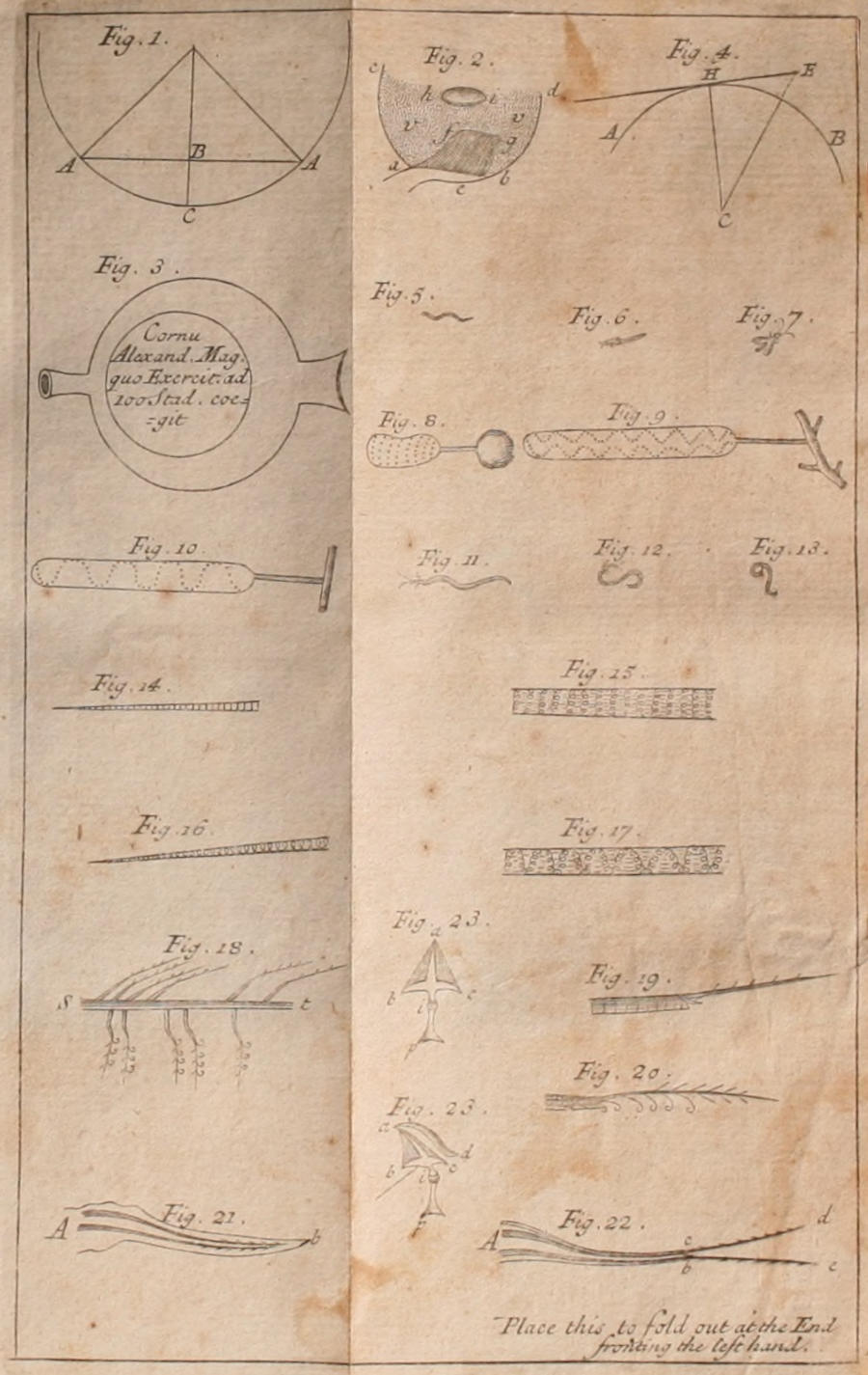
One is a Feather, the Mechanism of which
we in the main agree in, except in his Representation
in Fig. 1. Scheme 22. which is
somewhat different from what I have represented
in my Fig. 18, &c. But I can stand by
the Truth, though not the Elegance of my
Figures. But as to the other Differences,
they are accidental, occasion’d by our taking
the Parts in a different View, or in a different
Part of a Vane; and to say the Truth,
(not flattering my self, or detracting from the
admirable Observations of that great Man,)
I have hit upon a few Things that escap’d him,
being enabled to do so, not only by the Help of
such Microscopes as he made use of; but also
by those made by Mr. Wilson, which exceed
all I ever saw, whether of English, Dutch,
or Italian make; several of which Sorts I
have seen and examined.
The other Thing we have both of us figur’d
and describ’d, is, The Sting of a Bee
or Wasp; in which we differ more than in
the last. But by a careful Re-examination,
I find, that although Dr. Hook’s Observations
are more critical than any were before,
yet they are not so true as mine. For as to
the Scabbard, (as he calls it,) I could never
discover any Beards thereon; and I dare be
confident there are none, but what are on the
two Spears. And as to the Point of the
Scabbard, he hath represented it as tubular,
or bluntish at the Top; but it really terminates
in a sharp Point, and the two Spears
and the Poyson come out at a Slit, or longish
Hole, a little below the Top or Point. And
as to the Spears, he makes them to be but
one, and that the Point thereof lies always
out of the Scabbard. But by a strict Examination,
they will be found to be two, as I
have said, and that they always lie within
the Scabbard, except in stinging; as I have
represented them, in Fig. 21. from the transparent
Sting of a Wasp. And as to the
Spear being made of Joynts, and parted into
two, as his Fig. 2. Scheme 16. represents,
I could never upon a Review, discover it to
be so, but imagine, that by seeing the Beards
lying upon, or behind the Spears, he might
take them for Joynts, and by seeing the Point
of one Spear lie before the other, he might
think the Spear was parted in two. But
lest the Reader should think himself imposed
upon both by Dr. Hook and my Self, it is
necessary to be observ’d, that the Beards (or
Tenterhooks as Dr. Hook calls them) lie
only on one Side of each Spear, not all round
them; and are therefore not to be seen, unless
they are laid in a due Posture in the
Microscope, viz. sideways, not under, or atop
the Spear.
The last Thing (which scarce deserves
mention) is the Mechanism of the Hair,
which Dr. Hook found to be solid, like a
long Piece of Horn, not hollow, as Malpighi
found it in some Animals. And I have found
both those great Men to be in some Measure
in the Right, the Hair of some Animals, or
in some Parts of the Body being very little,
if at all tubular; and in others, particularly
Mice, Rats and Cats, to be as I have represented
in my Fig. 14. &c.
And now if my Inadvertency in other
Things hath no worse Effect than it hath had
in these, namely, to confirm, correct, or clear
others Observations, I hope the Reader will
excuse it, if he meets with any more of the
like kind. But not being conscious of any
such Thing (although probably there may be
many such) I am more sollicitous to beg the
Reader’s Candour and Favour, with Relation
both to the Text and Notes: In the former
of which, I fear he will think I have
much under-done, as in the latter over-done
the Matter: But for my Excuse, I desire
it may be consider’d, that the textual
Part being Sermons, to be deliver’d in the
Pulpit, it was necessary to insist but briefly
upon many of the Works of God, and to leave
out many Things that might have been admitted
in a more free Discourse. So that I wish
it may not be thought I have said too much
rather than too little for such an Occasion
and Place. And indeed, I had no small
Trouble in expunging some Things, altering
many, and softening the most, and, in a word,
giving in some measure the Whole a different
Dress than what I had at first drawn
it up in, and what it now appears in.
And as for the Notes, which may be thought
too large, I confess I might have shorten’d
them, and had Thoughts of doing it, by casting
some of them into the Text, as an ingenious,
learned Friend advis’d. But when
I began to do this, I found it was in a Manner
to new-make all, and that I should be necessitated
to transcribe the greatest Part of
the Book, which (having no Assistant) would
have been too tedious for me, being pretty
well fatigu’d with it before. I then thought
it best to pare off from some, and to leave
out others, and accordingly did so in many
Places, and would have done it in more, particularly,
in many of the Citations out of the
Ancients, both Poets and others, as also in
many of the anatomical Observations, and
many of my own and others Observations:
But then I consider’d as to the First, that
those Citations do (many of them at least)
shew the Sense of Mankind about God’s
Works, and that the most of them may be acceptable
to young Gentlemen at the Universities,
for whose Service these Lectures are
greatly intended. And as to the anatomical
Notes, and some others of the like Nature,
most of them serve either to the Confirmation,
or the Illustration, or Explication of the
Text, if not to the learned, yet to the unskilful,
less learned Reader; for whose sake,
if I had added more, I believe he would forgive
me. And lastly, as to the Observations
of my self and some others, where it happens
that they are long, it is commonly where a
Necessity lay upon me of fully expressing the
Author’s Sense, or my own, or where the
Thing was new, and never before Publish’d;
in which Case, it was necessary to be more
Express and Particular, than in Matters
better known, or where the Author may be
referr’d unto.
In the former Editions I promised another
Part I Had relating to the Heavens, if I was
thereunto encouraged. And two large Impressions
of this Book, having been sold off,
so as to admit of a Third before the Year was
gone about; and hearing that it is translated
into two, if not three Languages; but especially
being importuned by divers learned
Persons, both known and unknown, I have
thought my self sufficiently engaged to perform
that Promise; and have accordingly
published that Part.
So that I have now carry’d my Survey
through most Parts of the visible Creation,
except the Waters, which are for the most
Part omitted; and the Vegetables, which,
for want of Time, I was forced to treat of
in a perfunctory Manner. And to the Undertaking
of the former of these, having receiv’d
divers Sollicitations from Persons unknown
as well as known, I think my self
bound in Civility to own their Favour, and
to return them my hearty Thanks for the
kind Opinion they have shewn of my other
Performances, that they have encourag’d me
to undertake this other Task. And accordingly
I have begun it, and (as far as my
Affairs will permit) have made some Progress
in it: But Age and Avocations growing
upon me, I begin to fear I shall scarce be able
to finish it as I would, and therefore must
recommend that ample and noble Subject to
others, who have more leisure, and would
do it better than I.
As to Additions, I have been much sollicited
thereto by divers curious and learned
Persons, who would have had me to insert
some of their Observations, and many more
of my own: But in a Work of this Nature,
this would have been endless; and although
the Book would thereby be render’d much
better, and more compleat, yet I could by no
Means excuse so great an Injustice to the
Purchasers of the former Editions. And
therefore (except in the second Edition,
where it was not easy to be avoided) few
Additions or Alterations have been made, besides
what were Typographical, or of small
Consideration. Only in the third Edition I amended
the first Paragraph of Note (a). Chap. 5.
Book 1. concerning Gravity; and in the
Fourth, Page 16. and 18. I inserted two
Passages out of Seneca, that were inadvertently
left out, and corrected many Things,
that upon a careful Review, seem’d to want
amendment.
And lastly, as to the following Analysis,
it was added at the Request of some of my
learned and ingenious Friends; and although
it might have been contracted, they would
not suffer it to be so.
AN ANALYSIS OF THE Following Book .
The Works of the Creation relating to our Terraqueous
Globe, are such as are visible in the
Outworks or Appendages of the Globe, viz. these three:
Man suitable to his erect Posture; and all its Parts, the Helix, Tragus, Concha,
&c. admirably suited to the Reception and Melioration of Sounds, and the Security of the Part.
Delight which the various Tribes of Animals have to the Varieties of Food, so that what is grateful to one, is nauseous to another: Which is a wise means to cause
All Creatures to be sufficiently supplied.
All sorts of Food to be consumed.
The World to be kept sweet and clean by those means
Having in the Fourth Book thus dispatched the Decad of Things in common to the Sensitive Creatures, I take a view of their particular Tribes, viz. of
Man; whom I consider with relation to his
Soul. Concerning which having cursorily mentioned divers things, I insist upon two as shewing an especial divine Management, the
Various Genii, or Inclinations of Men, which is a wise Provision for the Dispatch for all the World’s Affairs, and that they may be performed with Pleasure
Its Compass is so large, extending to all things of Use, and occasioning so many several Callings.
Things of greatest Necessity and Use were soon and easily found out; but things less useful later, and dangerous things not yet. Here of divers particular Inventions, with an Exhortation to exercise and improve our Gifts.
Body. In which the things particularly remarked upon are the
Made of the very best Materials, viz. of Bones
light and strong; Joynts exactly opening, shutting, and moving,
as the Occasions of Flight require; and the Pectoral Muscles,
of the greatest Strength of any in the whole Body.
Placed in the nicest point of the Body of every Species, according to the Occasions of Flight, Swimming or Diving.
Tail, which is well made, and placed to keep the Body steady, and assist in its Ascents and Descents
Act itself; that these Creatures should betake themselves to it, know this to be the Way to produce their Young, and with delight and Patience fit such a due Number of Days.
The Neglect of it in any, as the Ostrich, and the wonderful Provision for the Young in that Case
Wisely contrived for Dispatch of Business, and to prevent Carnality.
Whose proper Business is, to cease from Worldly, and to follow Spiritual Employments; the chief of which is the Publick Worship of GOD.
A SURVEY OF THE Terraqueous Globe.
INTRODUCTION. — FOOTNOTES:
In Psal. cxi. 2. The Psalmist asserts, That
the[a] Works of the Lord are great; sought
out of all them that have Pleasure therein.
This is true of all God’s Works, particularly
of his Works of Creation: Which, when sought
out, or, as the Hebrew Word [b] signifieth, when
heedfully and deeply pried into, solicitously observ’d
and enquir’d out, especially when clearly discovered
to us; in this Case, I say, we find those Works
of God abundantly to deserve the Psalmist’s Character
of being Great and Noble; inasmuch as they are
made with the most exquisite Art, [c] contrived with
the utmost Sagacity, and ordered with plain wise Design,
and ministring to admirable Ends. For which
reason St. Paul might well affirm of those Ποιήματα
of God, [d] That the invisible Things of God, even
his eternal Power and Godhead, are understood by them.
And indeed they are the most easy, and intelligible
Demonstrations of the Being and Attributes of God;[e]
especially to such as are unacquainted with the
Subtilties of Reasoning and Argumentation; as the
greatest part of Mankind are.
It may not therefore be unsuitable to the Nature
and Design of Lectures[f] founded by one of the
greatest Vertuoso’s of the last Age, and instituted
too on purpose for the Proof of the Christian Religion
against Atheists and other Infidels, to improve
this occasion in the Demonstration of the Being
and Attributes of an infinitely wise and powerful
Creator, from a Cursory Survey of the Works
of Creation, or (as often called) of Nature.
Which Works belong either to our Terraqueous
Globe, or the Heavens.
I shall begin with our own Globe, being nearest,
and falling most under our Senses. Which being a
Subject very various and copious, for the more methodical
and orderly proceeding upon it, I shall distribute
the Works therein:
I. Into such as are not properly Parts, but Appendages
or Out-works of the Globe.
II. The Globe it self.
[a] It is not unlikely that the Psalmist might mean, at least
have an Eye to, the Works of the Creation in this Text, the
Word מעשה being the same that in Psal. 19. 1. is translated
God’s Handy-work, which is manifestly applied to the Works
of Creation, and properly signifieth Factum, Opus, Opisicium,
from עשה Fecit, Paravit, Aptavit. And saith Kircher, significat
talem affectionem, quâ aliquid existit vel realiter, vel ornatè,
velut non sit in pristino statu quo fuit. Concord, p. 2. col. 931.
[b] דרש Quasivit, perquisivit, sciscitatus est, Buxtor. in verb.
Et simul importat curam, & solicitudinem. Conrad. Kirch. ib.
p. 1. col. 1174.
[c]Quod si omnes mundi partes ita constitute sunt, ut neque ad
usum meliores potuerint esse, neque ad speciem pulchriores; videamus
utrùm ea fortuita sint, an eo statu, quo cohærere nullo modo
potuerint, nisi sensu moderante divinâque providentia. Si ergo
meliora sunt ea quæ Naturâ, quàm illa, quæ Arte perfecta sunt,
nec Ars efficit quid sine ratione; ne Natura quidem rationis expers
est habenda. Qui igitur convenit, signum, aut tabulam pictam
cùm adspexeris, scire adhibitam esse artem; cumque procul cursum
navigii videris, non dubitare, quin id ratione atque arte moveatur:
aut cùm Solarium, &c. Mundum autem, qui & has ipsas
artes, & earum artifices, & cuncta complectatur, consilii & rationis
esse expertem putare? Quod si in Scythiam, aut in Britanniam,
Sphæram aliquis tulerit hanc, quam nuper familiaris noster
effecit Posidonius, cujus singulæ conversiones idem efficiunt in Sole,
&c.——quod efficitur in cœlo singulis diebus & noctibus; quis in
illâ barbarie dubitet, quin ea Sphæra sit perfecta Ratione? Hi autem
dubitant de Mundo, ex quo & oriuntur, & fiunt omnia, casune
ipse sit effectus,—an Ratione, an Mente divinâ? Et Archimedem
arbitrantur plus valuisse in imitandis Sphæræ conversionibus,
quàm Naturam in efficiendis, præsertim cùm multis partibus sint
illa perfecta, quam hæc simulata, solertius, &c. Cic. de Nat.
l. 2. c. 34, 35.
[d] And a little before he saith of Nature it self, Omnem ergo
regit Naturam ipse [Deus] &c.
[e]Mundus codex est Dei, in quo jugiter legere debemus, Bernard.
Serm.
Arbitror nullam gentem, neque Hominum societatem, apud
quos ulla Deorum est religio, quidquam habere sacris Eleusiniis
aut Samothraciis simile: Ea tamen obscurè docent quæ profitentur:
Natura verò opera in omnibus animantibus sunt perspicua.
Galen. de Us. Part. l. 17. c. 1.
[f]Philosophia est Catechismus ad Fidem. Cyril. 1. contr. Jul.
BOOK I.
Of the Out-works of the Terraqueous
Globe; the Atmosphere, Light, and
Gravity.
CHAP. I.
Of the Atmosphere in general.
The Atmosphere, or Mass of Air, Vapours
and Clouds, which surrounds our Globe,
will appear to be a matter of Design, and
the infinitely wise Creator’s Work, if we
consider its Nature and Make[a], and its Use to the
World[b].
1. Its Nature and Make, a Mass of Air, of subtile
penetrating Matter, fit to pervade other Bodies,
to penetrate into the inmost Recesses of Nature, to
excite, animate, and spiritualize; and in short, to
be the very Soul of this lower World. A thing
consequently
2. Of greatest Use to the World, useful to the
Life, the Health, the Comfort, the Pleasure, and
Business of the whole Globe. It is the Air the
whole Animal World breatheth, and liveth by; not
only the Animals inhabiting the Earth[c] and
Air[d], but those of the Waters[e]
too. Without it
most Animals live scarce half a Minute[f]; and others,
that are the most accustomed to the want of
it, live not without it many Days.
And not only Animals themselves, but even
Trees and Plants, and the whole vegetable Race,
owe their Vegetation and Life to this useful Element;
as will appear when I come to speak of
them, and is manifest from their Glory and Verdure
in a free Air, and their becoming Pale and
Sickly, and Languishing and Dying, when by any
means excluded from it[g].
Thus useful, thus necessary, is the Air to the Life
of the animated Creatures; and no less is it to the
Motion and Conveyance of many of them. All
the winged Tribes owe their Flight and Buoyancy[h]
to it, as shall be shewn in proper place:
And even the watery Inhabitants themselves cannot
ascend and descend into their Element, well without
it[i].
But it would be tedious to descend too far into
Particulars, to reckon up the many Benefits of this
noble Appendage of our Globe in many useful Engines[k];
in many of the Functions and Operations
of Nature[l] in the Conveyance of Sounds;
and a Thousand Things besides. And I shall but
just mention the admirable use of our Atmosphere
in ministring to the enlightening of the World, by
its reflecting the Light of the heavenly Bodies to us[m];
and refracting the Sun-beams to our Eye, before
it ever surmounteth our Horizon[n]; by which
means the Day is protracted throughout the whole
Globe; and the long and dismal Nights are
shorten’d in the frigid Zones, and Day sooner approacheth
them; yea the Sun itself riseth in Appearance
(when really it is absent from them) to
the great Comfort of those forlorn Places[o].
But passing by all these Things with only a bare
mention, and wholly omitting others that might
have been named, I shall only insist upon the excellent
Use of this noble circumambient Companion
of our Globe, in respect of two of its Meteors, the
Winds, and the Clouds and Rain[p].
FOOTNOTES:
[a]Mundi pars est Aer, & quidem necessaria: Hic est enim qui
cœlum terramque connectit, &c. Senec. Nat. Qu. l. 2. c. 4.
[b]Ipse Aer nobiscum videt, nobiscum audit, nobiscum sonat;
nihil enim eorum sine eo fieri potest, &c. Cic. de Nat. Deor. l. 2.
c. 33.
[c] As the Air is of absolute Necessity to Animal Life, so it
is necessary that it should be of a due Temperament or Consistence;
not foul, by reason that suffocateth: not too rare and
thin, because that sufficeth not; with Examples of each of
which, I shall a little entertain the Reader. In one of Mr.
Hawksbee’s Compressing Engines, I closely shut up a Sparrow
without forcing any Air in; and in less than an Hour the Bird
began to pant, and be concerned; and in less than an Hour and
half to be sick, vomit, and more out of Breath; and in two
Hours time was nearly expiring.
Another I put in and compressed the Air, but the Engine
leaking, I frequently renewed the Compressure; by which
means, (although the Bird panted a little after the first Hour,)
yet after such frequent Compressures, and Immission of fresh
Air, it was very little concerned, and taken out seemingly unhurt
after three Hours.
After this I made two other Experiments in compressed Air,
with the Weight of two Atmospheres injected, the Engine holding
tight and well; the one with the Great Titmouse, the other
with a Sparrow. For near an Hour they seemed but little concerned;
but after that grew fainter, and in two Hours time
sick, and in three Hours time died. Another thing I took notice
of, was, that when the Birds were sick and very restless,
I fancied they were somewhat relieved for a short space, with
the Motion of the Air, caused by their fluttering and shaking
their Wings, (a thing worth trying in the Diving-Bell). I shall
leave the ingenious Reader to judge what the cause was of both
the Birds living longer in compressed, than uncompressed Air;
whether a less quantity of Air was not sooner fouled and
rendred unfit for Respiration, than a greater.
From these Experiments two Things are manifested; one is,
that Air, in some measure compressed, or rather heavy, is necessary
to Animal Life: Of which by and by. The other, that
fresh Air is also necessary: For pent up Air, when overcharged
with the Vapours emitted our of the Animal’s Body, becomes
unfit for Respiration. For which Reason, in the Diving-Bell, after
some time of stay under Water, they are forced to come
up and take in fresh Air, or by some such means recruit it. But
the famous Cornelius Drebell contrived not only a Vessel to be
rowed under Water, but also a Liquor to be carried in that
Vessel, that would supply the want of fresh Air. The Vessel
was made for King James I. It carried twelve Rowers, besides
the Passengers. It was tried in the River of Thames; and one
of the Persons that was in that submarine Navigation was then
alive, and told it one, who related the Matter to our famous
Founder, the Honourable, and most Ingenious Mr. Boyl. As
to the Liquor, Mr. Boyl saith, he discovered by a Doctor of
Physick, who married Drebell’s Daughter, that it was used from
time to time when the Air in the submarine Boat was clogged
by the Breath of the Company, and thereby made unfit for
Respiration; at which time, by unstopping a Vessel full of
this Liquor, he could speedily restore to the troubled Air such
a proportion of vital Parts, as would make it again for a good
while fit for Respiration. The Secret of this Liquor Drebell
would never disclose to above one Person, who himself assured
Mr. Boyl what it was. Vid.Boyl. Exp. Phys. Mech.
of the Spring of the Air, Exp. 41. in the Digres. This Story
I have related from Mr. Boyl, but at the same time much
question whether the Virtues of the Liquor were so effectual
as reported.
And as too gross, so too rare an Air is unfit for Respiration.
Not to mention the forced Rarefactions made by the Air-Pump,
in the following Note; it is found, that even the extraordinary
natural Rarefactions, upon the tops of very high Hills, much
affect Respiration. An Ecclesiastical Person, who had visited the
high Mountains of Armenia, (on which some fancy the Ark
rested) told Mr. Boyl, that whilst he was on the upper part of
them, he was forced to fetch his Breath oftner than he was
wont. And taking notice of it when he came down, the People
told him, that it was what happen’d to them when they were so
high above the Plane, and that it was a common Observation among
them. The like Observation the same Ecclesiastick made
upon the top of a Mountain in the Cevennes. So a learned Traveller,
and curious Person, on one of the highest Ridges of the
Pyrenees, call’d Pic de Midi, found the Air not so fit for Respiration,
as the common Air, but he and his Company were
fain to breath shorter and oftner than in the lower Air. Vid.Phil. Transact. No. 63, or Lowthorp’s Abridg. Vol. 2. p. 226.
Such another Relation the learned Joseph Acosta gives of
himself and his Company, that, when they passed the high
Mountains of Peru, which they call Periacaca, (to which he
saith, the Alps themselves seemed to them but as ordinary Houses,
in regard of high Towers,) He and his Companions were surprized
with such extreme Pangs of Straining and Vomiting, (not
without casting up of Blood too,) and with so violent a Distemper,
that he concludes he should undoubtedly have died; but that this
lasted not above three or four Hours, before they came into a more
convenient and natural Temperature of the Air. All which he
concludes proceeded from the too great Subtilty and Delicacy
of the Air, which is not proportionable to humane Respiration,
which requires a more gross and temperate Air, Vid.Boyl,
ubi supra.
Thus it appears, that an Air too Subtile, Rare and Light, is
unfit for Respiration: But the Cause is not the Subtilty or too
great Delicacy, as Mr. Boyl thinks, but the too great Lightness
thereof, which renders it unable to be a Counterbalance, or
an Antagonist to the Heart, and all the Muscles ministring to
Respiration, and the Diastole of the Heart. Of which see
Book 4. Chap. 7. Note 1.
And as our Inability to live in too rare and light an Air may
discourage those vain Attempts of Flying and Whimsies of passing
to the Moon, &c. so our being able to bear an heavier
State of the Air is an excellent Provision for Mens Occasions
in Mines, and other great Depths of the Earth; and those other
greater Pressures made upon the Air, in the Diving-Bell,
when we descend into great Depths of the Waters.
[d] That the Inhabitants of the Air, (Birds and Insects,) need
the Air as well as Man and other Animals, is manifest from
their speedy dying in too feculent, or too much rarefied Air;
of which see the preceding and following Note (f). But yet
Birds and Insects (some Birds at least) can live in a rarer Air than
Man. Thus Eagles, Kites, Herons, and divers other Birds, that
delight in high Flights, are not affected with the Rarity of the
Medium, as those Persons were in the preceding Note. So
Insects bear the Air-Pump long, as in the following Note (f).
[e] Creatures inhabiting the Waters need the Air, as well as
other Animals, yea, and fresh Air too. The Hydrocanthari
of all Sorts, the Nymphæ of Gnats, and many other Water-Insects,
have a singular Faculty, and an admirable Apparatus,
to raise their back Parts to the top of the Waters, and take in
fresh Air. It is pretty to see, for Instance, the Hydrocanthari
come and thrust their Tails out of the Water, and take in a
Bubble of Air, at the tip of their Vaginæ and Tails, and then
nimbly carry it down with them into the Waters; and, when
that is spent, or fouled, to ascend again and recruit it.
So Fishes also are well known to use Respiration, by passing
the Water through their Mouths and Gills. But Carps will live
out of the Water, only in the Air; as is manifest by the Experiment
of their way of Fatting them in Holland, and which
hath been practised herein England, viz. they hang them up in
a Cellar, or some cool Place, in wet Moss in a small Net, with
their Heads out, and feed them with white Bread soaked in Milk
for many Days. This was told me by a Person very curious, and
of great Honour and Eminence, whose Word (if I had leave to
name him) no Body would question: And it being an Instance
of the Respiration of Fishes very singular, and somewhat out of
the way, I have for the Reader’s Diversion taken notice of it.
[f] By Experiments I made my self in the Air Pump, in
September and October, 1704; I observed that Animals whose
Hearts have two Ventricles, and no Foramen Ovale, as Birds,
Dogs, Cats, Rats, Mice, &c. die in less than half a Minute
counting from the very first Exsuction; especially in a small
Receiver.
A Mole (which I suspected might have born more than other
Quadrupeds) died in one Minute (without Recovery) in a large
Receiver; and doubtless would hardly have survived half a Minute
in a small Receiver. A Bat (although wounded) sustained
the Pump two Minutes, and revived upon the re-admission
of the Air. After that, he remained four Minutes and a half
and revived. Lastly, After he had been five Minutes, he continued
gasping for a time, and after twenty Minutes I re-admitted
the Air, but the Bat never revived.
As for Insects: Wasps, Bats, Hornets, Grashoppers, and Lady-Cows
seemed dead in appearance in two Minutes, but revived
in the open Air in two or three Hours time, notwithstanding
they had been in Vacuo twenty four Hours.
The Ear-wig, the great Staphylinus, the great black lowsy
Beetle, and some other Insects would seem unconcerned at the
Vacuum a good while, and lie as dead; but revive in the Air,
although some had lain sixteen Hours in the exhausted Receiver.
Snails bear the Air Pump prodigiously, especially those in
Shells; two of which lay above twenty four Hours, and seemed
not much affected. The same Snails I left in twenty eight
Hours more after a second Exhaustion, and found one of them
quite dead, but the other revived.
Frogs and Toads bear the Pump long, especially the former.
A large Toad, found in the House, died irrecoverably in less
than six Hours. Another Toad and Frog I put in together,
and the Toad was seemingly dead in two Hours, but the Frog
just alive. After they had remained there eleven Hours, and
seemingly dead, the Frog recovered in the open Air, only
weak, but the Toad was quite dead. The same Frog being put
in again for twenty seven Hours, then quite died.
The Animalcules in Pepper-Water remained in Vacuo twenty
four Hours. And after they had been exposed a Day or two
to the open Air, I found some of them dead, some alive.
[g] That the Air is the principal Cause of the Vegetation of
Plants, Borelli proves in his excellent Book De Mot. Animal.
Vol. 2. Prop. 181. And in the next Proposition, he assureth,
In Plantis quoque peragi Aeris respirationem quandam imperfectam,
à quâ earum vita pendet, & conservatur. But of this
more when I come to survey Vegetables.
Some Lettice-Seed being sown upon some Earth in the open
Air, and some of the same Seed at the same time upon other
Earth in a Glass-Receiver of the Pneumatick Engine, afterwards
exhausted of Air: The Seed exposed to the Air was grown up
an Inch and half high within Eight Days; but that in the exhausted
Receiver not at all. And Air being again admitted into
the same emptied Receiver, to see whether any of the Seed
would then come up, it was found, that in the Space of one
Week it was grown up to the Height of two or three Inches.
Vid. Phil. Trans. No. 23. Lowth. Abridg. Vol. 2. p. 206.
[h]In volucribus pulmones perforati aerem inspiratum in totam
ventris cavitatem admittunt. Hujus ratio, ut propter corporis
truncum Aere repletum & quasi extensum, ipsa magis volatilia
evadant, faciliusque ab aere externo, proper intimi penum, sustententur.
Equidem pisces, quò leviùs in aquis natent, in Abdomine
vesicas Aere inflatas gestant: pariter & volucres, propter
corporis truncum Aere impletum & quasi inflatum, nudo Aeri
incumbentes, minus gravantur, proindeque levius & expeditiùs
volant. Willis de Anim. Brut. p. 1. c. 3.
[i]Fishes by reason of the Bladder of Air within them, can
sustain, or keep themselves in any Depth of Water: For the Air
in that Bladder being more or less compressed, according to the
Depth the Fish swims at, takes up more or less Space; and consequently,
the Body of the Fish, part of whose Bulk this Bladder
is, is greater or less according to the several Depths, and yet retains
the same Weight. Now the Rule de Insidentibus humido
is, that a Body, that is heavier than so much Water, as is equal
in Quantity to the Bulk of it, will sink, a Body that is lighter
will swim; a Body of equal Weight will rest in any part of the
Water. By this Rule, if the Fish, in the middle Region of the
Water, be of equal Weight to the Water, that is commensurate
to the Bulk of it, the Fish will rest there, without any Tendency
upwards or downwards: And if the Fish be deeper in the Water,
the Bulk of the Fish becoming less by the Compression of the
Bladder, and yet retaining the same Weight, it will sink, and
rest at the Bottom. And on the other side, if the Fish be higher
than the middle Region, the Air dilating it self, and the Bulk
of the Fish consequently increasing, but not the Weight, the Fish
will rise upwards and rest at the top of the Water. Perhaps the
Fish by some Action can emit Air out of its Bladder——, and,
when not enough, take in Air,——and then it will not be wondred,
that there should be always a fit Proportion of Air in all
Fishes to serve their Use, &c. Then follows a Method of Mr.
Boyl to experiment the Truth of this. After which, in Mr.
Lowthorp’s Abridgment, follow Mr. Ray’s Observations. I
think that——hath hit upon the true Use of the Swimming-Bladders
in Fishes. For, 1. It hath been observed, that if the
Swimming-Bladder of any Fish be pricked or broken, such a Fish
sinks presently to the Bottom, and can neither support or raise it
self up in the Water. 2. Flat Fishes, as Soles, Plaise, &c. which
lie always grovelling at the Bottom, have no Swimming-Bladders
that ever I could find. 3. In most Fishes there is a manifest
Chanel leading from the Gullet——to the said Bladder,
which without doubt serves for the conveying Air thereunto.——In
the Coat of this Bladder is a musculous Power to contract it
when the Fish lifts. See more very curious Observations relating
to this Matter, of the late great Mr. Ray, as also of
the curious anonymous Gentleman in the ingenious Mr. Lowthorp’s
Abridgment, before cited, p. 845. from Phil. Trans.
N. 114, 115.
[k] Among the Engines in which the Air is useful, Pumps
may be accounted not contemptible ones, and divers other Hydraulical
Engines, which need not to be particularly insisted on.
In these the Water was imagined to rise by the power of Suction,
to avoid a Vacuum, and such unintelligible Stuff; but the
justly famous Mr. Boyl was the first that solved these Phænomena
by the Weight of the Atmosphere. His ingenious and
curious Observations and Experiments relating hereto, may be
seen in his little Tract, Of the Cause of Attraction by Suction,
and divers others of his Tracts.
[l] It would be endless to specify the Uses of the Air in
Nature’s Operations: I shall therefore, for a Sample only,
name its great Use to the World in conserving animated Bodies,
whether endowed with animal or vegetative Life, and
its contrary Quality of dissolving other Bodies; by which means
many Bodies that would prove Nuisances to the World, are
put out of the Way, by being reduced into their first Principles,
(as we say), and so embodied with the Earth again. Of its
Faculty as a Menstruum, or its Power to dissolve Bodies; I
may instance in Crystal Glasses, which, with long keeping,
especially if not used, will in Time be reduced to a Powder,
as I have seen. So divers Minerals, Earths, Stones, Fossil-Shells,
Wood, &c. which from Noah’s Flood, at least for many
Ages, have lain under Ground, so secure from Corruption,
that, on the contrary, they have been thereby made much the
stronger, have in the open Air soon mouldered away. Of
which last, Mr. Boyl gives an Instance (from the Dissertation
de admirandis Hungar. Aquis) of a great Oak, like a huge
Beam, dug out of a Salt Mine in Transylvania, so hard, that
it would not easily be wrought upon by Iron Tools, yet, being
exposed to the Air out of the Mine, it became so rotten that in
four Days it was easy to be broken, and crumbled between one’s
Fingers. Boyl’s Suspic. about some hid. Qual. in the Air,
p. 28. So the Trees turned out of the Earth by the Breaches
at West-Thurrock and Dagenham, near me, although probably
no other than Alder, and interred many Ages ago in a rotten
oazy Mold, were so exceedingly tough, hard, and found at
first, that I could make but little Impressions on them with the
Strokes of an Ax; but being exposed to the Air and Water,
soon became so rotten as to be crumbled between the Fingers.
See my Observations in Philos. Transact. Nᵒ. 335.
[m]By reflecting the Light of the heavenly Bodies to us, I
mean that Whiteness or Lightness which is in the Air in the
Day-time, caused by the Rays of Light striking upon the Particles
of the Atmosphere, as well as upon the Clouds above, and
the other Objects beneath upon the Earth. To the same Cause
also we owe the Twilight, viz. to the Sun-beams touching
the uppermost Particles of our Atmosphere, which they do
when the Sun is about eighteen Degrees beneath the Horizon.
And as the Beams reach more and more of the airy Particles,
so Darkness goes off, and Day light comes on and encreaseth.
For an Exemplification of this, the Experiment may serve of
transmitting a few Rays of the Sun through a small Hole into a
dark Room: By which means the Rays which meet with Dust,
and other Particles flying in the Air, are render’d visible; or
(which amounts to the same) those swimming small Bodies are
rendered visible, by their reflecting the Light of the Sun-beams
to the Eye, which, without such Reflection, would it
self be invisible.
The Azure Colour of the Sky Sir Isaac Newton attributes to
Vapours beginning to condense, and that are not able to reflect
the other Colours. V.Optic. l. 2. Par. 3. Prop. 7.
[n] By the Refractive Power of the Air, the Sun, and the
other heavenly Bodies seem higher than really they are, especially
near the Horizon. What the Refractions amount unto,
what Variations they have, and what Alterations in time they
cause, may be briefly seen in a little Book called, The Artificial
Clock-Maker, Chap. 11.
Although this inflective Quality of the Air be a great Incumbrance
and Confusion of Astronomical Observations;——yet it
is not without some considerable Benefit to Navigation; and indeed
in some Cases, the Benefit thereby obtained is much greater
than would be the Benefit of having the Ray proceed in an exact
straight Line. [Then he mentions the Benefit hereof to the Polar
Parts of the World.] But this by the by (saith he.) The great
Advantage I consider therein, is the first Discovery of Land upon
the Sea; for by means hereof, the tops of Hills and Lands are
raised up into the Air, so as to be discoverable several Leagues
farther off on the Sea than they would be, were there no such
Refraction, which is of great Benefit to Navigation for steering
their Course in the Night, when they approach near Land; and
likewise for directing them in the Day-time, much more certainly
than the most exact Celestial Observations could do by the Help
of an uninflected Ray, especially in such Places as they have no
Soundings. [Then he proposes a Method to find by these means
the Distance of Objects at Sea.] V. Dr. Hook’s Post. Works.
Lect. of Navig. p. 466.
[o]Cum Belgæ in novâ Zemblâ hybernarent, Sol illis apparuit
16 diebus citiùs, quàm revera in Horizonte existeret, hoc est, cùm
adhuc infra Horizontem depressus esset quatuor circiter gradibus,
& quidem aere sereno. Varen. Geog. c. 19. Prop. 22.
[These Hollanders] found, that the Night in that place shortened
no less than a whole Month; which must needs be a very
great Comfort to all such Places as live very far towards the North
and South Poles, where length of Night, and want of seeing the
Sun, cannot chuse but be very tedious and irksome. Hook Ibid.
[By means of the Refractions] we found the Sun to rise twenty
Minutes before it should; and in the Evening to remain above the
Horizon twenty Minutes (or thereabouts) longer than it should.
Captain James’s Journ. in Boyl of Cold. Tit. 18. p. 190.
[p]Aer—in Nubes cogitur: humoremque colligens terram auget
imbribus: tum effluens huc & illuc, ventos efficit. Idem annuas
frigorum & calorum facit varietates: idemque & volatus Alitum
sustinet, & spiritu ductus alit & sustentas animantes. Cic. de
Nat. Deor. l. 2. c. 39.
To pass by other Considerations, whereby I
might demonstrate the Winds to be the infinite
Creator’s Contrivance, I shall insist only upon
their great usefulness to the World. And so great
is their Use, and of such absolute Necessity are they
to the Salubrity of the Atmosphere, that all the
World would be poisoned without those Agitations
thereof. We find how putrid, fetid, and unfit for
Respiration, as well as Health and Pleasure, a stagnating,
confined, pent up Air is. And if the whole
Mass of Air and Vapours was always at Rest, and
without Motion, instead of refreshing and animating,
it would suffocate and poison all the World:
But the perpetual Commotions it receives from the
Gales and Storms, keep it pure and healthful[b].
Neither are those Ventilations beneficial only to
the Health, but to the Pleasure also of the Inhabitants
of the Terraqueous Globe; witness the Gales
which fan us in the heat of Summer; without
which, even in this our temperate Zone, Men are
scarce able to perform the Labours of their Calling,
or not without Danger of Health and Life[c].
But especially, witness the perpetual Gales which
throughout the whole Year do fan the Torrid Zone,
and make that Climate an healthful and pleasant
Habitation, which would otherwise be scarce habitable.
To these I might add many other great Conveniencies
of the Winds in various Engines, and various
Businesses. I might particularly insist upon its
great Use to transport Men to the farthest distant
Regions of the World[d] and I might particularly
speak of the general and coasting Trade-Winds,
the Sea, and the Land-Breezes;[e] the one serving
to carry the Mariner in long Voyages from East to
West; the other serving to waft him to particular
Places; the one serving to carry him into his Harbour,
the other to bring him out. But I should go
too far to take notice of all Particulars[f]. Leaving
therefore the Winds, I proceed in the next Place
to the Clouds and Rain.
FOOTNOTES:
[a]Ventus est aer fluens, is Seneca’s Definition, Na. Qu. l. 5.
And as Wind is a Current of the Air, so that which excites or alters
its Currents may be justly said to be the Cause of the Winds.
An Æquipoise of the Atmosphere produceth a Calm; but if that
Æquipoise be more or less taken off, a Stream of Air, or Wind,
is thereby accordingly produced either stronger or weaker, swifter
or slower. And divers things there are that may make such
Alterations in the Æquipoise or Balance of the Atmosphere, viz.
Eruptions of Vapours from Sea or Land; Rarefactions and
Condensations in one Place more than another; the falling of
Rain, pressure of the Clouds, &c.Pliny, l. 2. c. 45. tells us of
a certain Cavern in Dalmatia, called Senta, in quem, saith he,
dejecto levi pondere, quamvis tranquillo die, turbini similis
emicat procella. But as to Caves it is observed, that they
often emit Winds more or less. Dr. Connor, taking notice of
this matter, specifies these, In regno Neapolitano ex immani Cumanæ
Sibyllæ antro tenuem ventum effluentem percepi. The like he observed
at the Caves at Baiæ, and in some of the Mines of Germany,
and in the large Salt-Mines of Cracow in Poland. Ubi,
saith he, opifices, & ipse fodinæ dominus Andreas Morstin, Nob.
Polonus, mihi asseruerunt, quòd tanta aliquando Ventorum tempestas
ex ambagiosis hujus fodinæ recessibus surgere solebat, quod
laborantes fossores humi prosternebat, nec non portas & domiciliæ
(quæ sibi in hâc fodinâ artifices exstruunt) penitùs evertebat.
Bern. Connor. Dissert. Med. Phys. p. 33. Artic. 3.
And as great Caves, so great Lakes sometimes send forth
Winds. So Gassendus saith the Lacus Legnius doth, E quo dum
exoritur fumus, nubes haud dubiê creanda est, quæ sit brevi in
tempestatem sævissimam exoneranda. Gassend. Vit. Peiresk. l. 5.
P. 417.
But the most universal and constant Alterations of the Balance
of the Atmosphere are from Heat and Cold. This is
manifest in the General Trade-Winds, blowing all the Year
between the Tropicks from East to West: if the Cause thereof
be (as some ingenious Men imagine) the Sun’s daily Progress
round that part of the Globe, and by his Heat rarefying
one part of the Air, whilst the cooler and heavier Air behind
presseth after. So the Sea and Land Breezes in Note (d).
And so in our Climate, the Northerly and Southerly Winds
(commonly esteemed the Causes of cold and warm Weather),
are really the Effects of the Cold or Warmth of the Atmosphere:
Of which I have had so many Confirmations, that
I have no doubt of it. As for Instance, it is not uncommon
to see a warm Southerly Wind, suddenly changed to the
North, by the fall of Snow or Hail; to see the Wind in a
frosty, cold Morning North, and when the Sun hath well
warmed the Earth and Air, you may observe it to wheel about
towards the Southerly Quarters; and again to turn Northerly
or Easterly in the cold Evening. It is from hence also,
that in Thunder-Showers the Wind and Clouds are oftentimes
contrary to one another, (especially if Hail falls) the
sultry Weather below directing the Wind one way; and the
Cold above the Clouds another way. I took Notice upon
March the 10ᵗʰ 1710/1, (and divers such like Instances I have
had before and since) that the Morning was warm, and what
Wind stirred was West-South-West, but the Clouds were thick
and black (as generally they are when Snow ensues): A little
before Noon the Wind veered about to North by West, and
sometimes to other Points, the Clouds at the same time flying
some North by West, some South-West: About one of the
Clock it rained apace, the Clouds flying sometimes North-East,
then North, and at last both Wind and Clouds settled
North by West; At which time Sleet fell plentifully, and it
grew very cold. From all which I observe, 1. That although
our Region below was warm, the Region of the
Clouds was cold, as the black, snowy Clouds shewed. 2. That
the struggle between the warmth of ours, and the cold of the
cloudy Region, stopped the airy Currents of both Regions.
3. That the falling of the Snow through our warmer Air
melted into Rain at first; but that it became Sleet after the
superiour Cold had conquered the inferiour Warmth. 4. That,
as that Cold prevailed by Degrees, so by Degrees it wheeled
about both the Winds and Clouds from the Northwards towards
the South.
Hippocrates, l. 2. De Vict. Orat.Omnes Ventos vel à nive,
glacie, vehementi gelu, fluminibus, &c. spirare necesse judicat,
Bartholin. de usu Nivis, c. 1.
[b]It is well observed in my Lord Howards Voyage to Constantinople,
that at Vienna they have frequent Winds, which
if they cease long in Summer, the Plague often ensues: So that
it is now grown into a Proverb, that if Austria be not windy,
it is subject to Contagion. Bohun of Wind, p. 213.
From some such Commotions of the Air I imagine it is,
that at Grand Cairo the Plague immediately ceases, as soon as
the Nile begins to overflow; although Mr. Boyl attributes it
to nitrous Corpuscles. Determ. Nat. of Effluv. Chap. 4.
Nulla enim propemodum regio est, quæ non habeat aliquem flatum
ex se nascentem, & circa se cadentem.
Inter cætera itaq; Providentiæ opera, hoc quoq; aliquis, ut dignum
admiratione suspexerit. Non enim ex unâ causâ Ventos
aut invenit, aut per diversa disposuit: sed primum ut aera non
sinerent pigrescere, sed assiduâ vexatione utilem redderens, vitaiemq;
tracturis. Sen. Nat. Quæst. l. 5. c. 17, 18.
All this is more evident, from the Cause assigned to malignant
epidemical Diseases, particularly the Plague, by my ingenious,
learned Friend, Dr. Mead; and that is, an hot and
moist Temperament of the Air, which is observed by Hippocrates,
Galen, and the general Histories of Epidemical Diseases,
to attend those Distempers. Vid.Mead of Poisons, Essay 5.
p. 161. But indeed, whether the Cause be this, or poisonous,
malignant Exhalations or Animalcules, as others think,
the Winds are however very salutiferous in such Cases, in
cooling the Air, and dispersing and driving away the moist
or pestiferous Vapours.
[c]July 8. 1707, (called for some time after the Hot Tuesday,)
was so excessively hot and suffocating, by reason there
was no Wind stirring, that divers Persons died, or were in
great Danger of Death, in their Harvest-Work. Particularly
one who had formerly been my Servant, a healthy,
lusty, young Man, was killed by the Heat: And several
Horses on the Road dropped down and died the same Day.
In the foregoing Notes, having Notice of some Things
relating to Heat, although it be somewhat out of the way, I
hope the Reader will excuse me, if I entertain him with some
Observations I made about the Heat of the Air under the
Line, compared with the Heat of our Bodies. J. Patrick,
who, as he is very accurate in making Barometrical and Thermometrical
Instruments, had the Curiosity for the nicer adjusting
his Thermometers, to send two abroad under the Care
of two very sensible, ingenious Men; one to the Northern
Lat. of 81; the other to the Parts under the Æquinoctial: In
these two different Climates, the Places were marked where
the Spirits stood at the severest Cold and greatest Heat. And
according to these Observations he graduates his Thermometers.
With his Standard I compared my Standard Thermometer,
from all the Degrees of Cold, I could make with Sal
Armoniack, &c. to the greatest Degrees of Heat our Thermometers
would reach to. And with the same Thermometer
(of mine) I experimented the greatest Heat of my Body,
in July 1709. First in an hot Day without Exercise, by patting
the Ball of my Thermometer under my Armpits, and
other hottest Parts of my Body. By which means the Spirits
were raised 284 Tenths of an Inch above the Ball. After
that, in a much hotter Day, and indeed nearly as hot as any
Day with us, and after I had heated my self with strong
Exercise too, as much as I could well bear, I again tried the
same Experiment, but could not get the Spirits above 288
Tenths; which I thought an inconsiderable Difference, for so
seemingly a very different Heat of my Body. But from some
Experiments I have made (altho’ I have unfortunately forgotten
them) in very cold Weather, I imagine the Heat of an healthy
Body to be always much the same in the warmest Parts
thereof, both in Summer and Winter. Now between those
very Degrees of 284 and 288, the Point of the equatorial
Heat falleth. From which Observation it appears, that there
is pretty nearly an equal Contemperament of the Warmth of
our Bodies, to that of the hottest Part of the Atmosphere inhabited
by us.
If the Proportion of the Degrees of Heat be desired from
the Freezing-Point, to the Winter, Spring, and Summer Air,
the Heat of Man’s Body, of heated Water, melted Metals,
and so to actual Fire; an Account may be met with of it,
by my most ingenious Friend, the great Sir Isaac Newton, in
Phil. Transact. Nᵒ. 270.
[d]In hoc Providentia ac Dispositor ille Mundi Deus,
aera
ventis exercendum dedit,——non ut nos classes partem freti occupaturas
compleremus milite armato, &c. Dedit ille ventos ad
custodiendam cœli terrarumq; temperiem, ad evocandas supprimendásq;
aquas, ad alendos satorum atq; arborum fructus;
quos ad maturitatem cum aliis causis adducit ipsa jactatio, attrahens
cibum in summa, & ne torpeat, promovens. Dedit ventos
ad ulteriora noscenda: fuisset enim imperitum animal, & fine
magnâ experientiâ rerum Homo, si circumscriberetur natalis soli
fine. Dedit ventos ut commoda cujusq; regionis fierent communia;
non ut legiones equitemq; gestarent, nec ut perniciosa gentibus
arma transveherent. Seneca, ibid.
[e]Sea-Breezes commonly rise in the Morning about nine a
Clock.——They first approach the Shore gently, as if they were
afraid to come near it.——It comes in a fine, small, black
Curle upon the Water, whereas all the Sea between it and the
Shore (not yet reached by it) is as smooth and even as Glass in
Comparison. In half an Hours time after it has reached the
Shore, it fans pretty briskly, and so encreaseth gradually till
twelve a Clock; then it is commonly strongest, and lasts so till
two or three, a very brisk Gale.——After three it begins to die
away again, and gradually withdraws its force till all is spent;
and about five a Clock——it is lulled asleep, and comes no more
till next morning.
And as the Sea Breezes do blow in the Day, and rest in the
Night; so on the contrary [The Land-Breezes] blow in the
Night, and rest in the Day, alternately succeeding each other.——They
spring up between six and twelve at Night, and last
till six, eight, or ten in the Morning. Dampier’s Disc. of
Winds, ch. 4.
[f] One Thing more I believe some of my Friends will
expect from me is, that I shew the Result of comparing my
own Observations of the Winds, with others they know I
have from Ireland, Switzerland, Italy, France, New-England,
and some of our Parts of England. But the Observations being
some of them but of one Year, and most of the rest of
but a few Years, I have not been able to determine any
great Matters. The chief of what I have observed is, that
the Winds in all these Places seldom agree, but when they
most certainly do so, it is commonly when the Winds are
strong, and of long continuance in the same Quarter: And
more I think in the Northerly and Easterly, than other Points.
Also a strong Wind in one Place, is oftentimes a weak one
in another Place, or moderate, according as Places have been
nearer or farther distant. Vid.Phil. Trans. Nᵒ. 297, and 321.
But to give a good and tolerable Account of this or any
other of the Weather, it is necessary to have good Histories
thereof from all Parts; which, as yet we have but few of,
and they imperfect, for want of longer and sufficient Observations.
CHAP. III.
Of the Clouds and Rain.
The Clouds and Rain[a] we shall find to be
no less useful Meteors than the last mentioned;
as is manifest in the refreshing pleasant Shades
which the Clouds afford, and the fertile Dews and
Showers which they pour down on the Trees and
Plants, which would languish and die with perpetual
Drought, but are hereby made Verdant and
Flourishing, Gay and Ornamental; so that (as the
Psalmist saith, Psal. lxv. 12, 13.) The little Hills rejoice
on every side, and the Valleys shout for Joy, they
also sing.
And, if to these Uses, we should add the Origine
of Fountains and Rivers, to Vapours and the
Rains, as some of the most eminent modern
Philosophers[b] have done, we should have another Instance
of the great Use and Benefit of that Meteor.
And now, if we reflect upon this necessary Appendage
of the Terraqueous Globe, the Atmosphere; and
consider the absolute Necessity thereof to many Uses
of our Globe, and its great Convenience to the
whole: And in a Word, that it answereth all the
Ends and Purposes that we can suppose there can be
for such an Appendage: Who can but own this to be
the Contrivance, the Work of the great Creator?
Who would ever say or imagine such a Body, so different
from the Globe it serves, could be made by
Chance, or be adapted so exactly to all those forementioned
grand Ends, by any other Efficient than
by the Power and Wisdom of the infinite God!
Who would not rather, from so noble a Work,
readily acknowledge the Workman[c] and as easily
conclude the Atmosphere to be made by God, as an
Instrument wrought by its Power, any Pneumatick
Engine, to be contrived and made by Man!
FOOTNOTES:
[a] Clouds and Rain are made of Vapours raised from Water,
or Moisture only. So that I utterly exclude the Notion
of Dry, Terrene Exhalations, or Fumes, talked much of by
most Philosophers; Fumes being really no other than the humid
Parts of Bodies respectively Dry.
These Vapours are demonstratively no other than small Bubbles,
or Vesiculæ detached from the Waters by the Power of
the Solar, or Subterraneous Heat, or both. Of which see
Book 2. Chap. 5. Note (b). And being lighter than the Atmosphere,
are buoyed up thereby, until they become of an
equal Weight therewith, in some of its Regions aloft in the
Air, or nearer the Earth; in which those Vapours are formed
into Clouds, Rain, Snow, Hail, Lightning, Dew, Mists,
and other Meteors.
In this Formation of Meteors the grand Agent is Cold,
which commonly, if not always, occupies the superior Regions
of the Air; as is manifest from those Mountains which
exalt their lofty Tops into the upper and middle Regions,
and are always covered with Snow and Ice.
This Cold, if it approaches near the Earth, presently precipitates
the Vapours, either in Dews; or if the Vapours more
copiously ascend, and soon meet the Cold, they are then condensed
into Misting, or else into Showers of small Rain, falling
in numerous, thick, small Drops: But if those Vapours
are not only copious, but also as heavy as our lower Air it
self, (by means their Bladders are thick and fuller of Water,)
in this Case they become visible, swim but a little Height
above the Earth, and make what we call a Mist or Fog. But
if they are a Degree lighter, so as to mount higher, but not
any great Height, as also meet not with Cold enough to condense
them, nor Wind to dissipate them, they then form an
heavy, thick, dark Sky, lasting oftentimes for several Weeks
without either Sun or Rain. And in this Case, I have scarce
ever known it to Rain, till it hath been first Fair, and then
Foul. And Mr. Clarke, (an ingenious Clergyman of Norfolk,
who in his Life-time, long before me, took notice of it, and
kept a Register of the Weather for thirty Years, which his
learned Grandson, Dr. Samuel Clarke put into my Hands, he,
I say) saith, he scarce ever observed the Rule to fail in all that
Time; only he adds, If the Wind be in some of the easterly
Points. But I have observed the same to happen, be the
Wind where it will. And from what hath been said, the
Case is easily accounted for, viz. whilst the Vapours remain
in the same State, the Weather doth so too. And such
Weather is generally attended with moderate Warmth, and
with little or no Wind to disturb the Vapours, and an heavy
Atmosphere to support them, the Barometer being commonly
high then. But when the Cold approacheth, and by condensing
drives the Vapours into Clouds or Drops, then is way
made for the Sun-beams, till the same Vapours, being by
further Condensation formed into Rain, fall down in Drops.
The Cold’s approaching the Vapours, and consequently the
Alteration of such dark Weather I have beforehand perceived,
by some few small Drops of Rain, Hail, or Snow, now
and then falling, before any Alteration hath been in the
Weather; which I take to be from the Cold meeting some
of the straggling Vapours, or the uppermost of them, and
condensing them into Drops, before it arrives unto, and exerts
it self upon the main Body of Vapours below.
I have more largely than ordinary insisted upon this part of
the Weather, partly, as being somewhat out of the way;
but chiefly, because it gives Light to many other Phænomena
of the Weather. Particularly we may hence discover the
Original of Clouds, Rain, Hail and Snow; that they are Vapours
carried aloft by the Gravity of the Air, which meeting
together so as to make a Fog above, they thereby form
a Cloud. If the Cold condenseth them into Drops, they then
fall in Rain, if the Cold be not intense enough to freeze
them: But if the Cold freezeth them in the Clouds, or in
their Fall through the Air, they then become Hail or Snow.
As to Lightning, and other enkindled Vapours, I need say
little in this Place, and shall therefore only observe, that they
owe also their Rise to Vapours; but such Vapours as are detached
from mineral Juices, or at least that are mingled with
them, and are fired by Fermentation.
Another Phænomenon resolvable from what hath been said
is, why a cold, is always a wet Summer, viz. because the
Vapours rising plentifully then, are by the Cold soon collected
into Rain. A remarkable Instance of this we had in the
Summer of 1708, part of which, especially about the Solstice,
was much colder than usually. On June 12, it was so cold,
that my Thermometer was near the Point of hoar Frost, and
in some Places I heard there was an hoar Frost; and during all
the cool Weather of that Month, we had frequent and large
Rains, so that the whole Month’s Rain amounted to above
two Inches Depth, which is a large Quantity for Upminster,
even in the wettest Months. And not only with us at Upminster,
but in other Places, particularly at Zurich in Switzerland,
they seem to have had as unseasonable Cold and Wet as
we. Fuit hic mensis——præter modum humidus, & magno
quidem vegetabilibus hominibusque damno. Multum computruit
Fœnum, &c. complains the industrious and learned Dr. J. J.
Scheuchzer: Of which, and other Particulars, I have given a
larger Account in Phil. Trans. Nᵒ. 321.
In which Transaction I have observed farther, that about
the Equinoxes we (at Upminster at least) have oftentimes more
Rain than at other Seasons. The Reason of which is manifest
from what hath been said, viz. in Spring, when the Earth
and Waters are loosed from the brumal Constipations, the
Vapours arise in great Plenty: And the like they do in Autumn,
when the Summer Heats, that both dissipated them,
and warmed the superior Regions, are abated; and then the
Cold of the superior Regions meeting them, condenseth them
into Showers, more plentifully than at other Seasons, when either
the Vapours are fewer, or the Cold that is to condense
them is less.
The manner how Vapours are precipitated by the Cold, or
reduced into Drops, I conceive to be thus: Vapours being,
as I said, no other than inflated Vesiculæ of Water; when
they meet with a colder Air than what is contained in them,
the contained Air is reduced into a less Space, and the watery
Shell or Case rendered thicker by that means, so as to
become heavier than the Air, by which they are buoyed up,
and consequently must needs fall down. Also many of those
thickned Vesiculæ run into one, and so form Drops, greater
or smaller, according to the Quantity of Vapours collected
together.
As to the Rain of different Places, I have in some of our
Transactions assigned the Quantities; particularly in the last cited
Transaction, I have assigned these, viz. the Depth of the
Rain one Year with another, in English Measure, if it was to
stagnate on the Earth, would amount unto, at Townely in
Lancashire, 42½ Inches; at Upminster in Essex 19¼ Inches; at
Zurich in Switzerland 32¼ Inches; at Pisa in Italy 43¼ Inches;
at Paris in France 19 Inches; and at Lisle in Flanders 24 Inches.
It would be endless to reckon up the bloody and other prodigious
Rains taken notice of by Historians, and other Authors,
as præternatural and ominous Accidents; but, if strictly
pried into, will be found owing to natural Causes: Of
which, for the Reader’s Satisfaction, I will give an Instance
or two. A bloody Rain was imagined to have fallen in France,
which put the Country People into so great a Fright, that they
left their Work in the Fields, and in great haste flew to the
Neighbouring Houses. Peirise (then in the Neighbourhood)
strictly enquiring into the Cause, found it to be only red
Drops coming from a sort of Butterfly that flew about in
great Numbers at that Time, as he concluded from seeing such
red Drops come from them; and because these Drops were
laid, Non supra ædificia, non in devexis lapidum superficiebus, uti
debuerat contingere, si è cœlo sanguine pluisset; sed in subcavis
potius & in foraminibus.——Accessit, quòd parietes iis tingebantur,
non qui in mediis oppidis, sed qui agrorum vicini erant,
neque secundum partes elatiores, sed ad mediocrem solùm altitudinem,
quantam volitare Papiliones solent. Gassend in vit.
Peiresk. L. 2. p. 156.
So Dr. Merret saith also, Pluvia Sanguinis quàm certissimè constat
esse tantùm Insectorum excrementa: Pluvia Tritici quàm nihil
aliud esse quàm Hederæ bacciferæ grana à Sturnis devorata excretaque
comparanti liquidissimè patet. Pinax rerum, &c.p. 220.
The curious Worm tells of the raining of Brimstone, An. 1646.
Maii 16.Hic Hafniæ cùm ingenti pluviâ tota urbs, omnesque ita
inundarentur plateæ, ut gressus hominum impediret, Sulphureoque
odore aërem inficeret, dilapsis aliquantulum aquis, quibusdam in
locis colligere licuit Sulphureum pulverem, cujus portionem servo,
colore, odore, & aliis verum Sulphur ferentem. Mus. Worm.
L. 1. c. 11. Sect. 1.
Together with the Rain we might take notice of other Meteors,
particularly Snow; which although an irksome Guest,
yet hath its great Uses, if all be true that the famous T. Bartholin
saith of it, who wrote a Book de Nivis usu Medico.
In which he shews of what great Use Snow is in fructifying
the Earth, preserving from the Plague, curing Fevers, Colicks,
Head-Aches, Tooth-Aches, Sore Eyes, Pleurisies, (for
which Use he saith his Country-Women of Denmark keep
Snow-Water gathered in March), also in prolonging Life,
(of which he instanceth in the Alpine Inhabitants, that live to
a great Age,) and preserving dead Bodies; Instances of which
he gives in Persons buried under the Snow in passing the Alps,
which are found uncorrupted in the Summer, when the Snow
is melted; which sad Spectacle he himself was an Eye-Witness
of. And at Spitzberg in Greenland, dead Bodies remain
entire and uncorrupted for thirty Years. And lastly, concerning
such as are so preserv’d when slain, he saith they remain
in the same Posture and Figure: Of which he gives this odd
Example, Visum id extra urbem nostram [Hafniam] quum,
11 Feb. 1659. oppugnantes hostes repellerentur, magnâque strage
occumberent; alii enim rigidi iratum vultum ostendebant, alii oculos
elatos, alii ore diducto ringentes, alii brachiis extensis Gladium
minari, alii alio situ prostrati jacebant. Barthol. de usu
Niv. c. 12.
But although Snow be attended with the Effects here named,
and others specified by the learned Bartholin; yet this is not to
be attributed to any peculiar Virtue in the Snow, but some
other Cause. Thus when it is said to fructify the Earth, it
doth so by guarding the Corn or other Vegetables against the
intenser cold of the Air, especially the cold piercing Winds;
which the Husbandmen observe to be the most injurious to
their Corn of all Weathers. So for Conserving dead Bodies, it
doth it by constipating such Bodies, and preventing all such
Fermentations or internal Conflicts of their Particles, as would
produce Corruption.
Such an Example as the preceding is said to have happened
some Years ago at Paris, in digging in a Cellar for supposed
hidden Treasure; in which, after digging some Hours, the
Maid going to call her Master, found them all in their digging
Postures, but dead. This being noised abroad, brought in not
only the People, but Magistrates also, who found them accordingly;
Ille qui ligone terram effoderat, & socius qui palâ effossam
terram removerat, ambo pedibus stabant, quasi sua quisque operâ
affixus incubuisset; uxor unius quasi ab opere defessa in scamno,
solicito quodam vultu, sedebat, inclinato in palmam manûs genibus
innitentis capite; puerulus laxatis braccis in margine excavatæ
foveæ defixis in terram oculis alvum exonerabat; omnes in
naturali situ, carneæ tanquam statuæ rigidi, apertis oculis & vultu
vitam quasi respirante, exanimes stabant. Dr. Bern. Connor,
Dissert. Med. Phys. p. 15.
The Doctor attributes all this to Cold; but I scarce think there
could be Cold enough to do all this at Paris, and in a Cellar too.
Bur his following Stories are not improbable, of Men and Cattle
killed with Cold, that remained in the very same Posture in
which they died; of which he gives, from a Spanish Captain,
this Instance, that happened two Years before, of a Soldier
who unfortunately straggled from his Company that were foraging,
and was killed with the Cold, but was thought to have
fallen into the Enemies Hands. But soon after their return to
their Quarters, they saw their Comrade returning, sitting on
Horseback, and coming to congratulate him, found him dead,
and that he had been brought thither in the same Posture on
Horseback, notwithstanding the jolting of the Horse. Ibid. p. 18.
[b] Of this Opinion was my late most ingenious and learned
Friend, Mr. Ray, whose Reasons see in his Physico-Theolog. Discourses,
Disc. 2. ch. 2. p. 89, &c. So also my no less learned
and ingenious Friends, Dr. Halley, and the late Dr. Hook, many
of the French Vertuoso’s also, and divers other very considerable
Men before them, too many to be specified here.
[c]An Polycletum quidem admirabimur propter partium Statuæ—convenientiam
ac proportionem? Naturam autem non modò
non laudabimus, sed omni etiam arte privabimus, quæ partium
proportionem non solùm extrinsecus more Statuariorum, sed in
profundo etiam servavit? Nonne & Polycletus ipse Naturæ est imitator,
in quibus saltem eam potuit imitari? Potuit autem in
solis externis partibus in quibus artem consideravit. With much
more to the like Purpose, Galen. de Us. Part. l. 17. c. 1.
CHAP. IV.
Of Light.
Thus much for the first Thing ministring to the
Terraqueous Globe, the Atmosphere and its
Meteors; the next Appendage is Light.[a] Concerning
which I have in my Survey of the Heavens[b]
shewed what admirable Contrivances the infinitely
wise Creator hath for the affording this noble, glorious
and comfortable Benefit to other Globes, as
well as ours; the Provision he hath made by Moons,
as well as by the Sun, for the Communication of it.
And now let us briefly consider the great Necessity
and Use thereof to all our Animal World. And
this we shall find to be little less than the very Life
and Pleasure of all those Creatures. For what Benefit
would Life be of, what Pleasure, what Comfort
would it be for us to live in perpetual Darkness?
How could we provide ourselves with Food and Necessaries?
How could we go about the least Business,
correspond with one another, or be of any Use in the
World, or any Creatures be the same to us, without
Light, and those admirable Organs of the Body,
which the great Creator hath adapted to the Perception
of that great Benefit?
But now by the help of this admirable, this first-made[c],
because most necessary, Creature of God,
by this, I say, all the Animal World is enabled to
go here and there, as their Occasions call; they can
transact their Business by Day, and refresh and recruit
themselves by Night, with Rest and Sleep. They
can with Admiration and Pleasure, behold the glorious
Works of God; they can view the Glories of
the Heavens, and see the Beauties of the flowry
Fields, the gay Attire of the feathered Tribe, the exquisite
Garniture of many Quadrupeds, Insects, and
other Creatures; they can take in the delightsome
Landskips of divers Countries and Places; they can
with Admiration see the great Creator’s wonderful
Art and Contrivance in the Parts of Animals and Vegetables:
And in a word, behold the Harmony of this
lower World, and of the Globes above, and survey
God’s exquisite Workmanship in every Creature.
To all which I might add the Improvements
which the Sagacity of Men hath made of this noble
Creature of God, by the Refractions and Reflections
of Glasses. But it would be endless to enumerate all
its particular Uses and Benefits to our World.
But before I leave this Point, there are two Things
concerning Light, which will deserve an especial
Remark; and that is, its swift and almost instantaneous
Motion, and its vast Extension.
1. It is a very great Act of the Providence of
God, that so great a Benefit as Light is, is not long
in its Passage from Place to Place. For was the Motion
thereof no swifter than the Motion of the swiftest
Bodies on Earth, such as of a Bullet out of a
great Gun, or even of a Sound[d] (which is the
swiftest Motion we have next Light), in this Case
Light would take up, in its Progress from the Sun
to us above thirty two Years at the rate of the first,
and above seventeen Years at the rate of the latter
Motion.
The Inconveniencies of which would be, its Energy
and Vigour would be greatly cooled and abated;
its Rays would be less penetrant; and Darkness
would with greater Difficulty and much Sluggishness,
be dissipated, especially by the fainter
Lights of our sublunary, luminous Bodies. But passing
with such prodigious Velocity, with nearly the
instantaneous Swiftness of almost Two hundred thousand
English Miles in one Second of Time,[e] or
(which is the same Thing) being but about seven or
eight Minutes of an Hour in coming from the Sun
to us, therefore with all Security and Speed, we receive
the kindly Effects and Influences of that noble
and useful Creature of God.
2. Another Thing of great Consideration about
Light is, its vast Expansion, it’s almost incomprehensible,
and inconceivable Extension, which as a
late ingenious Author[f] saith, “Is as boundless
and unlimited as the Universe it self, or the Expansum
of all material Beings: The vastness of
which is so great, that it exceeds the Comprehensions
of Man’s Understanding. Insomuch that very
many have asserted it absolutely infinite, and
without any Limits or Bounds.”
And that this noble Creature of God is of this
Extent,[g] is manifest from our seeing some of the
farthest distant Objects, the heavenly Bodies, some
with our naked Eye, some with the help of Optical
Instruments, and others in all Probability farther and
farther, with better and better Instruments: And
had we Instruments of Power equivalent to the Extent
of Light, the luminous Bodies of the utmost
Parts of the Universe, would for the same Reason
be visible too.
Now as Light is of greatest Use to impower us to
see Objects at all, so the Extension thereof is no less
useful to enable us to see Objects afar off. By which
means we are afforded a Ken of those many glorious
Works of the infinite Creator, visible in the Heavens,
and can improve them to some of the noblest
Sciences, and most excellent Uses of our own Globe.
FOOTNOTES:
[a] It is not worth while to enumerate the Opinions of the
Aristotelians, Cartesians, and others, about the Nature of
Light, Aristotle making it a Quality; Cartes a Pulsion, or Motion
of the Globules of the second Element, Vid.Cartes Princip.
p. 3. §. 55, &c. But with the Moderns, I take Light to consist
of material Particles, propagated from the Sun, and other
luminous Bodies, not instantaneously, but in time, according
to the Notes following in this Chapter. But not to insist upon
other Arguments for the Proof of it, our noble Founder hath
proved the Materiality of Light and Heat, from actual Experiments
on Silver, Copper, Tin, Lead, Spelter, Iron, Tutenage,
and other Bodies, exposed (both naked and closely shut
up) to the Fire: All which were constantly found to receive an
Increment of Weight. I wish he could have met with a favourable
Season to have tried his Experiments with the Sun-beams
as he intended. Vid.Boyl Exp. to make Fire and Flame
ponderable.
[c] Gen. i. 3. And God said, Let there be Light, and there was
Light.
[d] It may not be ungrateful to the Curious, to take notice
of the Velocity of these two Things.
According to the Observations of Mersennus, a Bullet-shot
out of a great Gun, flies 92 Fathom in a Second of Time,
(Vid.Mersen. Balist.) which is equal to 589½ Feet English, and
according to the Computation of Mr. Huygens, it would be
25 years in passing from the Earth to the Sun. But according to
my own Observations made with one of her Majesty’s
Sakers, and a very accurate Pendulum-Chronometer, a Bullet,
at its first Discharge, flies 510 Yards in five half Seconds, which
is a Mile in a little above 17 half Seconds. And allowing the
Sun’s Distance to be, as in the next Note, a Bullet would be
32½ Years in flying with its utmost Velocity to the Sun.
As to the Velocity of Sound, see Book 4. Chap. 3. Note 28.
according to which rate there mentioned, a Sound would be
near 17½ Years in flying as far as the distance is from the
Earth to the Sun. Confer here the Experiments of the Acad.
del Ciment. p. 140, &c.
[e] Mr. Romer’s ingenious Hypothesis about the Velocity of
Light, hath been established by the Royal Academy, and in
the Observatory for eight Years, as our Phil. Trans. Nᵒ. 136.
observe from the Journ. des Scavans; our most eminent Astronomers
also in England admit it: But Dr. Hook thinks with
Monsieur Cartes, the Motion of Light Instantaneous, Hook
Post. Works, pag. 77. And this he endeavours to explain, pag.
130, &c.
What Mr. Romer’s Hypothesis is, may be seen in the Phil.
Transact. before-cited: As also in the before commended Sir
Isaac Newton’s Opticks: Light is propagated from luminous Bodies
in time, and spends about seven or eight Minutes of an
Hour in passing from the Sun to the Earth. This was first observed
by Romer, and then by others, by means of the Eclipses
of the Satellites of Jupiter. For these Eclipses, when the Earth
is between the Sun and Jupiter, happen about seven or eight Minutes
sooner than they ought to do by the Tables; and when the
Earth is beyond the ☉, they happen about seven or eight Minutes
later than they ought to do: The reason being, that the
Light of the Satellites hath farther to go in the latter Case than
in the former, by the Diameter of the Earth’s Orbit. Newt.
Opt. L. 2. Part. 3. Prop. 11.
Now forasmuch as the Distance between the Sun and the
Earth (according to the Computations in my Astro-Theology,
B. 1. ch. 3. Note 2.) is 86051398 English Miles; therefore,
at the rate of 7½ Minutes, or 450 Seconds in passing from
the Sun, Light will be found to fly above 191225 Miles in
one Second of Time.
[f] Dr. Hook Post. Works. Lect. of Light, pag. 76.
[g] For the proof of this vast Extent of Light, I shall take
the Computation of the same great Man, pag. 77. If, saith
he, we consider first the vast Distance between us and the Sun,
which from the best and latest Observations in Astronomy, is
judged to be about 10000 Diameters of the Earth, each of which
It about 7925 English Miles; therefore the Sun’s distance is
7925000 Miles; and if we consider that according to the Observations,
which I published to prove the Motion of the Earth,
[which were Observations of the Parallax of some of the fixt
Stars in the Head of Draco, made in 1699] the whole Diameter
of the Orb, viz. 20000, made the Subtense but of one Minute to
one of the fixt Stars, which cannot therefore be less distant than
3438 Diameters of this great Orb, and consequently 68760000
Diameters of the Earth: And if this Star be one of the nearest,
and that the Stars that are of one Degree lesser in Magnitude
(I mean not of the Second Magnitude, because there may
be many Degrees between the first and second) be as much farther;
and another sort yet smaller be three times as far; and
a fourth four times as far, and so onward, possibly to some
100 Degrees of Magnitude, such as may be discovered by longer
and longer Telescopes, that they may be 100 times as far; then
certainly this material Expansion, a part of which we are, must
be so great, that ’twill infinitely exceed our shallow Conception
to imagine. Now, by what I last mentioned, it is evident that
Light extends it self to the utmost imaginable Parts, and by the
help of Telescopes we collect the Rays, and make them sensible to
the Eye, which are emitted from some of the almost inconceivably
remote Objects, &c.——Nor is it only the great Body of the
Sun, or the vast Bodies of the fixt Stars, that are thus able to
disperse their Light through the vast Expansum of the Universe;
but the smallest Spark of a lucid Body will do the very
same Thing, even the smallest Globule struck from a Steel by a
Flint, &c.
CHAP. V.
Of Gravity.
The last Thing subservient to our Globe, that
I shall take notice of, is Gravity[a], or that
Tendency which Bodies have to the Centre of the
Earth.
In my Astro-Theology, Book 6. Ch. 2. I have
shewn of what absolute Necessity, and what a
noble Contrivance this of Gravity is, for keeping
the several Globes of the Universe from shattering
to Pieces, as they evidently must do in a little Time
by their swift Rotation round their own Axes[b].
The Terraqueous Globe particularly, which circumvolves
at the rate of above 1000 Miles an Hour[c],
would by the centrifugal force of that Motion, be
soon dissipated and spirtled into the circumambient
Space, was it not kept together by this noble Contrivance
of the Creator, this natural inherent Power,
namely, the Power of Attraction or Gravity.
And as by this Power our Globe is defended against
Dissipation, so all its Parts are kept in their
proper Place and Order. All material Things do naturally
gravitate thereto, and unite themselves therewith,
and so preserve its Bulk intire[d]. And the
fleeting Waters, the most unruly of all its Parts, do
by this means keep their constant æquipoise in the
Globe[e], and remain in that Place which, the
Psalmist saith, God had founded for them; a bound he
had set, which they might not pass; that they turn
not again to cover the Earth, Psal. civ. 8, 9. So,
that even in a natural Way, by virtue of this excellent
Contrivance of the Creator, the Observation
of the Psalmist is perpetually fulfilled, Psal. lxxxix.
9. Thou rulest the raging of the Sea; when the Waves
thereof arise, thou stillest them.
To these, and an hundred other Uses of Gravity
that I might have named, I shall only just mention
another Thing owing to it, and that is
Levity[f], that, whereby what we call light Bodies swim,
a Thing no less useful to the World than its opposite,
Gravity, is in many Respects, to divers Tribes
of Animals, but particularly serviceable to the raising
up of Vapours[g], and to their Conveyance about
the World.
And now from this transient View of no other
than the Out-works, than the bare Appendages of
the Terraqueous Globe, we have so manifest a Sample
of the Wisdom, Power, and Goodness of the
infinite Creator, that it is easy to imagine the whole
Fabrick is of a Piece, the Work of at least a skilful
Artist. A Man that should meet with a Palace[h],
beset with pleasant Gardens, adorned with stately
Avenues, furnished with well-contrived Aqueducts,
Cascades, and all other Appendages conducing to
Convenience or Pleasure, would easily imagine, that
proportionable Architecture and Magnificence were
within: But we should conclude the Man was out
of his Wits that should assert and plead that all was
the Work of Chance, or other than of some wise
and skilful Hand. And so when we survey the bare
Out-works of this our Globe, when we see so vast
a Body, accouter’d with so noble a Furniture of
Air, Light and Gravity; with every Thing, in
short, that is necessary to the Preservation and Security
of the Globe it self, or that conduceth to
the Life, Health, and Happiness, to the Propagation
and Increase of all the prodigious Variety of
Creatures the Globe is stocked with; when we see
nothing wanting, nothing redundant or frivolous,
nothing botching or ill-made, but that every thing,
even in the very Appendages alone, exactly answereth
all its Ends and Occasions: What else
can be concluded, but that all was made with manifest
Design, and that all the whole Structure is
the Work of some intelligent Being; some Artist,
of Power and Skill equivalent to such a Work?
FOOTNOTES:
[a] That there is such a Thing as Gravity, is manifest from
its Effects here upon Earth; and that the Heavenly Bodies attract
or gravitate to one another, when placed at due Distances,
is made highly probable by Sir Isaac Newton. This attractive
or gravitating Power, I take to be congenial to Matter,
and imprinted on all the Matter of the Universe by the
Creator’s Fiat at the Creation. What the Cause of it is, the
Newtonian Philosophy doth not pretend to determine for want
of Phænomena, upon which Foundation it is that that Philosophy
is grounded, and not upon chimerical and uncertain Hypotheses:
But whatever the Cause is, that Cause penetrates even
to the Centers of the Sun and Planets, without any Diminution
of its Virtue; and it acteth not according to the Superficies of Bodies
(as Mechanical Causes do) but in proportion to the Quantity
of their solid Matter; and lastly, it acteth all round it at
immense Distances, decreasing in duplicate proportion to those
Distances, as Sir Isaac Newton saith, Princip. pag. ult. What
useful Deductions, and what a rational Philosophy have been
drawn from hence, may be seen in the same Book.
This Attraction, or Gravity, as its Force is in a certain proportion,
so makes the Descent of Bodies to be at a certain
rate. And was it not for the Resistence of the Medium, all
Bodies would descend to the Earth at the same rate; the lightest
Down, as swiftly as the heaviest Mineral: As is manifest in
the Air-Pump, in which the lightest Feather, Dust, &c. and a
piece of Lead, drop down seemingly in the same Time,
from the top to the bottom of a tall exhausted Receiver.
The rate of the Descent of heavy Bodies, according to
Galileo, Mr. Huygens, and Dr. Halley (after them) is 16 Feet
one Inch in one Second of Time; and in more Seconds, as
the Squares of those Times. But in some accurate Experiments
made in St. Paul’s Dome, June 9. 1710, at the Height
of 220 Feet, the Descent was scarcely 14 Feet in the first
Second. The Experiments were made in the Presence of
some very considerable Members of the Royal Society, by
Mr. Hawksbee, their Operator, with glass, hollow Balls, some
empty, some filled with Quick-silver, the Barometer at 297, the
Thermometer 60 Degrees above Freezing. The Weight of the
Balls, their Diameters, and Time of the Descent is in this
Table.
Balls filled with ☿.
Empty Balls.
Weight.
Diameter.
Time.
Weight.
Diameter.
Time.
Grains.
Tenth inch.
½ Secᵈˢ.
Grains.
Inch.
Tenth.
½ Secᵈˢ.
908
8
8
510
5
1
17
993
8
8 less.
642
5
2
16
866
8
8
599
5
1
16
747
7½
8 more.
515
5 nearly
16½
808
7½
8
483
5 nearly
17
784
7½
8 more.
641
5
2
16
The Reason why the heavy, full Balls fell in half the Time
of the hollow ones, was the Resistence of the Air: Which
Resistence is very ingeniously and accurately assigned by Dr.
Wallis, in Philos. Trans. Nᵒ. 186. And the cause of the Resistence
of all Fluids, (as Sir Isaac Newton, Opt. Q. 20.) is
partly from the Friction of the Parts of the Fluid, partly from
the Inertia thereof. The Resistence a spherical Body meets
with from Friction, is as the right Angle under the Diameter,
and the Velocity of the moving Body: And the Resistence
from the Vis Inertia, is as the Square of that Product.
For a farther Account of the Properties and Proportions,
&c. of Gravity in the Fall or Projection of Bodies, I shall
refer to the larger Accounts of Galilæus, Torricellius, Huygens,
Sir Isaac Newton, &c. or to the shorter Accounts of Dr.
Halley in Philos. Trans. abridged by Mr. Lowthorp, Vol. I.
p. 561. or Dr. Clarke in his Notes on Rohault, Phys. 2. c. 28.
§. 13, 16. And for the Resistence of Fluids, I refer to Dr.
Wallis before-cited, and the Act. Erudit. Lips. May 1693.
where there is a way to find the Force of Mediums upon Bodies
of different Figures.
[b] That the heavenly Bodies move round their own Axes,
is, beyond all doubt, manifest to our Eye, in some of them,
from the Spots visible on them. The Spots on the Sun (easily
visible with an ordinary Glass) do manifest him to revolve
round his own Axis in about 25¼ Days. The Spots on ♃
and ♂ prove those two Planets to revolve also from East to
West, as Dr. Hook discover’d in 1664, and 1665. And ♀ also
(although near the strong Rays of the Sun) hath, from
some Spots, been discovered by Mr. Cassini, in 1666, and
1667, to have a manifest Rotation. V.Lowth. Abridg. Vol. 1.
p. 382, and 423, 425. And such Uniformity hath the Creator
observ’d in the Works of Nature, that what is observable
in one, is generally to be found in all others of the same
kind. So that since ’tis manifest the Sun, and three of his
Planets whirl round, it is very reasonable to conclude all the
rest do so too, yea, every Globe of the Universe.
[c] The Earth’s Circumference being 25031½ Miles, (according
to Book II. Chap. 2. Note (a).) if we divide that into
24 Hours, we shall find the Motion of the Earth to be nearly
1043 Miles in an Hour. Which, by the by, is a far more
reasonable and less rapid Rate, than that of the Sun would
be, if we suppose the Earth to stand still, and the Sun to
move round the Earth. For according to the Proportions in
Note (e), of the preceding Chapter, the Circumference of the
Magnus Orbis is 540686225 English Miles, which divided by
24 Hours, gives 22528364 Miles in an Hour. But what is
this to the Rapidity of the fixt Stars, if we suppose them;
not the Earth, to move? Which is a good Argument for the
Earth’s Motion.
[d]Nihil majus, quàm quòd ita stabilis est Mundus, atque
ita cohæret ad permanendum, ut nihil nè excogitari quidem possit
aptius. Omnes enim partes ejus undique medium locum capessentes,
nituntur æqualiter: maximè autem corpora inter se
juncta permanent, cum quodam quasi vinculo circumdata colligantur:
quod facit ea natura, quæ per omnem mundum omnia
Mente, & Ratione conficiens, funditur, & ad medium rapit, &
convertit extrema, Cic. de Nat. Deor. l. 2. c. 45.
[e]Eâdem ratione Mare, cùm supra terram sit, medium tamen
terræ locum expetens, conglobatur undique æqualiter, neque
redundat unquam, neque effunditur. Id. paulo post.
[f] That there is no such Thing as positive Levity, but
that Levity is only a less Gravity, is abundantly manifested
by the acute Seig. Alph. Borelli de Mot. à Grav. pend. cap. 4.
See also the Annotations of the learned and ingenious Dr.
Clark on Rohaulti Phys. p. 1. c. 16. Note 3. Also the Exper.
of the Acad. del Cimento, p. 118, &c. Dr. Wallis’s Disc. of
Gravity and Gravitation before the Royal Society, Nov. 12.
1674. p. 28, &c.
[g] I have before in Note (a), Chap. 3. shewn what Vapours
are, and how they are rais’d. That which I shall here note,
is their Quantity: Concerning which the before-commended
Dr. Halley hath given us some curious Experiments in our
Phil. Transact. which may be met with together in Mr. Lowthorp’s
Abridg. Vol. II. p. 108. and 126. Mr. Sedileau also at
Paris observed it for near three Years. By all their Observations
it appears, that in the Winter Months the Evaporations
are least, and greatest in Summer, and most of all in windy
Weather. And by Monsieur Sedileau’s Observations it appears,
that what is raised in Vapours, exceeds that which falleth in
Rain. In the seven last Months of the Year 1688, the Evaporations
amounted to 22 Inches 5 Lines; but the Rain only
to Inches 6⅓ Lines: In 1689, the Evaporations were 32
Inches 10½ Lines; but the Rain 18 Inches 1 Line: In 1690,
the Evaporations 30 Inches 11 Lines; the Rain 21 Inches ⅓
of a Line. Vid.Mem. de Math. Phys. Ann. 1692. p. 25.
If it be demanded, What becomes of the Overplus of Exhalations
that descend not in Rain? I answer, They are partly
tumbled down and spent by the Winds, and partly descend
in Dews, which amount to a greater quantity than is commonly
imagined. Dr. Halley found the descent of Vapours
in Dews so prodigious at St. Helena, that he makes no doubt
to attribute the Origine of Fountains thereto. And I my
self have seen in a still, cool Evening, large thick Clouds
hanging, without any Motion in the Air, which in two or
three Hours Time have been melted down by Degrees, by
the cold of the Evening, so that not any the least Remains
of them have been left.
In the foregoing Book having dispatch’d
the Out-works, let us take a Survey of the
Principal Fabrick, viz. the Terraqueous
Globe it self; a most stupendious Work
in every particular of it, which doth no less aggrandize
its Maker[a], than every curious, complete
Work, doth its Workman. Let us cast our Eyes
here and there, let us ransack all the Globe, let us
with the greatest Accuracy inspect every part thereof,
search out the inmost Secrets of any of the Creatures;
let us examine them with all our Gauges,
measure them with our nicest Rules, pry into them
with our Microscopes, and most exquisite Instruments[b]
still we find them to bear Testimony to
their infinite Workman; and that they exceed all
humane Skill so far, as that the most exquisite Copies
and Imitations of the best Artists, are no other
than rude bungling Pieces to them. And so far
are we from being able to espy any Defect or Fault
in them, that the better we know them, the more
we admire them; and the farther we see into them,
the more exquisite we find them to be.
And for a Demonstration of this; I shall,
I. Take a general Prospect of the Terraqueous
Globe.
II. Survey its Particulars.
I. The Things which will fall under a general
Prospect of the Globe, will be its Figure, Bulk, Motion,
Place, Distribution into Earth and Waters, and
the great Variety of all Things upon it and in it.
[a]Licet——oculis quodammodo contemplari pulchritudinem
earum rerum, quas Divinâ Providentiâ dicimus constitutas. Ac
principio Terra universa cernatur, locata in media mundi sede,
solida, & globosa——vestita floribus, herbis, arboribus, frugibus.
Quorum omnium incredibilis multitudo, insatiabili varietate distinguitur.
Adde huc Fontium gelidas perennitates, liquores
perlucidos Amnium, Riparum vestitus viridissimos, Speluncarum
concavas altitudines, Saxorum asperitates, impendentium Montium
altitudines, immensitatesque Camporum: Adde etiam reconditas
Auri——venas——Qua verò, & quàm varia genera
Bestiarum?——Qui Volucrum lapsus, atque cantus? Qui
Pecudum pastus?——Quid de Hominum genere dicam? Qui
quasi cultores terra constituti, &c.——Qua si, ut animis,
sic oculis videre possemus, nemo cunctam intuens terram, de Divinâ
Ratione dubitaret. Cic. de Nat. Deor. l. 2. c. 39.
[b]I cannot here omit the Observations that have been made
in these later Times, since we have had the Use and Improvement
of the Microscope, concerning the great Difference, which
by the help of that, doth appear betwixt Natural and Artificial
Things. Whatever is Natural, doth by that appear adorned
with all imaginable Elegance and Beauty.——Whereas the most
curious Works of Art, the sharpest, finest Needle doth appear
as a blunt, rough Bar of Iron, coming from the Furnace or the
Forge. The most accurate Engravings or Embossments seem such
rude, bungling, deformed Works, as if they had been done with
a Mattock, or a Trowel. So vast a Difference is there betwixt
the Skill of Nature, and the Rudeness and Imperfection of Art.Bp. Wilk. Nat. Rel. L. 1. Ch. 6.
CHAP. I.
Of the Figure of the Terraqueous Globe.
This I suppose I may take for granted to be
Spherical, or nearly so[a]. And this must be
allowed to be the most commodious, apt Figure for
a World on many Accounts; as it is most capacious,
as its Surface is equi-distant from the Center,
not only of the Globe, but at least (nearly) of Gravity
and Motion too, and as some have thought, of
the central Heat and Waters. But these, and divers
other Things I shall pass over, and insist only upon
two or three other Benefits of this globous Figure of
the Earth and Waters.
1. This Figure is the most commodious in regard
of Heat, and I may add of Light also in some measure.
For by this means, those two great Benefits
are uniformly and equally imparted to the World:
They come harmoniously and gradually on, and as
gradually go off again. So that the daily and yearly
Returns of Light and Darkness, Cold and Heat,
Moist and Dry, are Regular and Workman-like,
(we may say,) which they would not be, especially
the former, if the Mass of Earth and Waters were
(as some fancied[b] it) a large Plain; or as others,
like a large Hill in the midst of the Ocean; or of a
multangular Figure; or such like.
2. This Figure is admirably adapted to the commodious
and equal Distribution of the Waters in the
Globe. For since, by the Laws of Gravity, the
Waters will possess the lowest Place; therefore, if
the Mass of the Earth was cubick, prismatick, or
any other angular Figure, it would follow, that one
(too vast a Part) would be drowned; and another be
too dry. But being thus orbicular, the Waters are
equally and commodiously distributed here and there,
according as the Divine Providence saw most fit;
of which I shall take notice by and by.
3. The orbicular Figure of our Globe, is far the
most beneficial to the Winds and Motions of the
Atmosphere. It is not to be doubted, if the Earth
was of some other, or indeed any other Figure, but
that the Currents of Air would be much retarded,
if not wholly stopped. We find by Experience
what Influence large and high Mountains, Bays,
Capes, and Head-lands have upon the Winds; how
they stop some, retard many, and divert and change
(near the Shores) even the general and constant
Winds[c], that blow round the Globe in the Torrid
Zone. And therefore, since this is the effect of
such little Excrescences, which have but little Proportion
to our Globe, what would be the Consequences
of much vaster Angles, which would equal
a Quarter, Tenth, or but an Hundredth Part of the
Globe’s Radius? Certainly these must be such a Barricade,
as would greatly annoy, or rather absolutely
stop the Currents of the Atmosphere, and thereby
deprive the World of those salutiferous Gales that
I have said keep it sweet and clean.
Thus the Figure of our Globe doth manifest it to
be a Work of Contrivance, inasmuch as it is of the
most commodious Figure; and all others would be
liable to great and evident Inconveniences.
FOOTNOTES:
[a] Although the Terraqueous Globe be of an orbicular
Figure, yet it is not strictly so, 1. On account of its Hills
and Vallies. But there are inconsiderable to the Earth’s Semidiameter;
for they are but as the Dust upon a common
Globe. But, 2. Our modern Astronomers assign a much
greater Variation from a globous Form, namely, that of a
prolate Sphæroid, making the Polar about 34 Miles shorter than
the Equatorial Diameter. The Cause of which they make to
be the centrifugal Force of the diurnal Rotation of the Globe.
This Figure they imagine is in Jupiter, his Polar being to
his Equatorial Diameter, as 39⅗ to 40⅗. But whether it be
so or no, I confess I could never perceive, although I have
often viewed that Planet through very good, and long Glasses,
particularly a tolerable good one of 72 Feet in my Hands:
And although by Reason of cloudy Weather, and (at present)
Jupiter’s Proximity to the Sun, I have not been of late able
to take a review of that Planet; yet Saturn (so far as his Ring
would permit,) and Mars appear perfectly round thro’ Mr.
Huygens’s long Glass of 126 Feet, which by Will he bequeathed,
with its whole Apparatus, to our R. S. by whose Favour
it is now in my Hands. And moreover, I believe it difficult,
next to impossible, to measure the two Diameters to a 40ᵗʰ
Part, by reason of the smallness of Jupiter’s apparent Diameter,
and by reason he is moving all the time of measuring
him.
As to what is alledged from lengthening the Pendulums of
Clocks, to make them keep the same Time under the Equator,
as they do in our Climes; I have shewn from the like Variations
in the Air-Pump, that this may arise from the rarity of
the Air there, more than here. V.Phil. Trans. Nᵒ. 294. But if
the Degrees of a Meridian grow larger, the more we go towards
the Line, (as Mr. Cassini affirms they do, by an 800ᵗʰ
Part in every Degree, in Phil. Trans. Nᵒ. 278.) then there is
great reason to conclude in behalf of this Sphæroidal Form.
The natural Cause of this Sphericity of our Globe, is (according
to Sir Isaac Newton’s Principles) that Attraction, which
the infinite Creator hath stamp’d on all the Matter of the Universe,
whereby all Bodies, and all the Parts of Bodies
mutually attract themselves and one another. By which means,
as all the Parts of Bodies tend naturally to their Center, so
they all betake themselves to a globous Figure, unless some
other more prevalent Cause interpose. Thus Drops of
Quick-silver put on a spherical Form, the Parts thereof
strongly attracting one another. So Drops of Water have
the same Form, when falling in the Air; but are Hemispherical
only when they lie on a hard Body, by reason their Gravity
doth so far over-power their self-attracting Power, as to
take off one half of their Sphericity. This Figure is commonly
attributed to the Pressure of the circumambient Air:
But that this can’t be the cause, is manifest from the Air-Pump;
the case being the very same in an exhausted Receiver,
as in the open Air, and not any the least Alteration of the
Figure that I could perceive, in all the Trials I have made.
[b] It would be frivolous as well as endless to reckon up the
various Opinions of the Ancients about the Figure of the Terraqueous
Globe; some of them may be seen in Varen. Geogr.
l. 1. c. 3. init. or Johnston’s Thaumat. c. 1. Artic. 3. But among
the variety of Opinions, one of the principal was,
That the visible Horizon was the Bounds of the Earth, and
the Ocean the Bounds of the Horizon, that the Heavens and
Earth above this Ocean, was the whole visible Universe; and
that all beneath the Ocean was Hades, or the invisible World.
Hence, when the Sun set, he was said tingere se Oceano;
and when any went to Hades, they must first pass the Ocean.
Of this Opinion were not only the ancient Poets, and others
among the Heathens, but some of the Christian Fathers too,
particularly Lactantius, St. Augustine, and others, who thought
their Opinion was favoured by the Psalmist, in Psal. xxiv.
2. and cxxxvi. 6. See Bp. Usher’s Ans. to a Jes. Chall. p. 366.
&c.
[c]Neither do these constant Trade-Winds usually blow near
the Shore, but only on the Ocean, at least 30 or 40 Leagues off
at Sea, clear from any Land; especially on the West Coast, or
Side of any Continent: For indeed on the East Side, the Easterly
Wind being the true Trade-Wind, blows almost home to the
Shore, so near as to receive a check from the Land-Wind. Dampier’s
Winds, Ch. 1.
And not only the general Trade-Winds, but also the constant
coasting Trade-Winds, are in like manner affected by the Lands.
Thus, for Instance, on the Coast of Angola and Peru. But
this, saith the curious Captain Dampier, the Reader must take
notice of, That the Trade-Winds that blow on any Coast, except
the North Coast of Africa, whether they are constant, and blow
all the Year, or whether they are shifting Winds, do never blow
right in on the Shore, nor right along Shore, but go slanting,
snaking an acute Angle of about 22 Degrees. Therefore, as the
Land tends more East or West, from North or South on the Coast;
so the Winds do alter accordingly. Ibid. Ch. 2.
CHAP. II.
Of the Bulk of the Terraqueous Globe.
The next Thing remarkable in the Terraqueous
Globe, is the prodigious Bulk thereof[a]. A
Mass of above 260 Thousand Million of Miles solid
Content. A Work too grand for any thing less
than a God to make. To which in the next Place
we may add,
FOOTNOTES:
[a] It is not difficult to make a pretty near Computation of
the Bulk of the Terraqueous Globe, from those accurate Observations
of a Degree made by Mr. Norwood in England,
and Mr. Picart, and Mr. Cassini in France. Whose Measures
do in a surprizing manner agree. But Mr. Cassini’s seeming
to be the most accurate (as I have shewn in my Astro-Theology,
B. 1. Ch. 2. Note (a).) I have there made use of his Determinations.
According to which the Diameter of the Earth
being 7967,72 English Miles, its Ambit will be 25031½ Miles;
and (supposing it to be Spherical) its Surface will be 199444220
Miles; which being multiplied into ⅓ of its Semidiameter,
gives the Solid Content, viz. 264856000000 Miles.
CHAP. III.
The Motions of the Terraqueous Globe.
The Motions the Terraqueous Globe hath, are
round its own Axis, and round its Fountain of
Light and Heat, the Sun[a]. That so vast a Body
as the Earth and Waters should be moved at
all[b], that it should undergo two such different
Motions, as the Diurnal and Annual are, and that
these Motions should be so constantly and regularly[c]
performed for near 6000 Years, without any
the least Alteration ever heard of (except some
Hours which we read of in Josh. x. 12, 13. and
in Hezekiah’s Time, which, if they cannot be accounted
for some other way, do greatly encrease
the Wonder[d]; these Things, I say,) do manifestly
argue some divine infinite Power to be concerned
therein[e]: But especially, if to all this we add
the wonderful Convenience, yea absolute Necessity
of these Circumvolutions to the Inhabitants, yea all
the Products of the Earth and Waters. For to one
of these we owe the comfortable Changes of Day
and Night; the one for Business, the other for
Repose;[f] the one for Man, and most other Animals
to gather and provide Food, Habitation, and other
Necessaries of Life; the other to rest, refresh,
and recruit their Spirits[g], wasted with the Labours
of the Day. To the other of those Motions we
owe the Seasons of Summer and Winter, Spring and
Autumn, together with the beneficial Instances and
Effects which these have on the Bodies and State of
Animals, Vegetables, and all other Things, both in
the Torrid, Temperate, and Frigid Zones.
FOOTNOTES:
[a] With the Copernicans, I take it here for granted, that
the Diurnal and Annual Revolutions are the Motions of the
Terraqueous Globe, not of the Sun, &c. but for the Proof
thereof I shall refer the Reader to the Preface of my Astro-Theology,
and B. 4. Chap. 3.
[b]Every thing that is moved, must of Necessity be moved by
something else; and that thing is moved by something that is
moved either by another Thing, or not by another Thing. If it be
moved by that which is moved by another, we must of Necessity
come to some prime Mover, that is not moved by another. For
it is impossible, that what moveth, and is moved by another,
should proceed in infinitum. Aristot. Phys. l. 8. c. 5.
Solum quod seipsum movet, quia nunquam deseritur à se,
nunquam ne moveri quidem definit; quinetiam cæteris quæ moventur,
hic fons: hoc principium est movendi. Principii autem
nulla est origo: nam ex principio oriuntur omnia; ipsum autem
nullâ ex re aliâ nasciepotest: nec enim esset id principium, quod
gigneretur aliunde. Cicer. Tusc. Quest. l. 1. c. 23.
Cogitemus qui fieri possit, ut tanta magnitudo, ab aliquâ possit
naturâ, tanto tempore circumferri? Ego igitur assero Deum
causam esse, nec aliter posse fieri. Plato in Epinom.
[c] Among the Causes which Cleanthes is said in Tully to
assign for Men’s Belief of a Deity, one of the chief is, Æquabilitatem
motûs, conversionem Cœli, Solis, Lunæ, Siderumque
omnium distinctionem, varietatem, pulchritudinem, ordinem:
quarum rerum aspectus ipse satis indicaret, non esse ea fortuita.
Ut siquis in domum aliquam, aut in gymnasium, aut in
forum venerit; cùm videat omnium rerum rationem, modum,
disciplinam, non possit ea sine causâ fieri judicare, sed esse aliquem
intelligat, qui præsit, & cui pareatur: multo magis in tantis
motibus, tantisque vicissitudinibus, tam multarum rerum atque
tanrarum ordinibus, in quibus nihil unquam immmensa & infinita
vetustas mentita sit, statuat necesse est ab aliquâ Mente
tantos naturæ motus gubernari. Cir. de Nat. Deor. l. 1.
c. 5.
Homines cœperunt Deum agnoscere, cùm viderent Stellas, tantam
concinnitatem efficere; ac dies, noctesque, æstate, & hyeme,
suos servare statos ortus, atque obitus. Plutarch de placit. l. 1.
c. 6.
[d] We need not be sollicitous to elude the History of these
Miracles, as if they were only poetical Strains, as Maimonides,
and some others fancy Joshua’s Day to have been, viz. only an
ordinary Summer’s Day; but such as had the Work of many
Days done in it; and therefore by a poetical Stretch made,
as if the Day had been lengthened by the Sun standing still.
But in the History they are seriously related, as real Matters
of Fact, and with such Circumstances as manifest them to have
been miraculous Works of the Almighty; And the Prophet
Habakkuk, iii. 11. mentions that of Joshua as such. And therefore
taking them to be miraculous Perversions of the Course
of Nature, instead of being Objections, they are great Arguments
of the Power of God: For in Hezekiah’s Case, to
wheel the Earth it self backward, or by some extraordinary
Refractions, to bring the Sun’s Shadow backward 10 Degrees:
Or in Joshua’s Case, to stop the diurnal Course of the Globe
for some Hours, and then again give it the same Motion; to
do, I say, there Things, required the same infinite Power
which at first gave the Terraqueous Globe its Motions.
[f]Diei noctisque vicissitudo conservat animantes, tribuens
aliud agendi tempus, aliud quiescendi. Sic undique omni ratione
concluditur, Mente, Consilioque divino omnia in hoc mundo ad
salutem omnium, conservationemque admirabiliter administrari.
Cicer. de Nat. Deor. l. 2. c. 53.
[g] The acute Dr. Cheyne, in his ingenious Philos. Princ. of
Natural Religion, among other uses of Day and Night, saith,
the Night is most proper for Sleep; because when the Sun is
above the Horizon, Sleep is prejudicial, by reason the Perspirations
are then too great. Also that Nutrition is mostly, if
not altogether, performed in Time of Rest; the Blood having
too quick a Motion in the Day: For which Reason, weak Persons,
Children, &c. are nourished most, and recruit best by
Sleep.
CHAP. IV.
Of the Place and Situation of the Terraqueous
Globe, in respect of the Heavenly Bodies.
Another Thing very considerable in our Globe,
is its Place and Situation at a due Distance
from the Sun[a], its Fountain of Light and Heat;
and from its neighbouring Planets of the solar System,
and from the fixt Stars. But these Things I
have spoken more largely of in my Survey of the
Heavens[b], and therefore only barely mention them
now; to insist more largely upon,
FOOTNOTES:
[a] It is a manifest Sign of the Creator’s Management and
Care, in placing the Terraqueous Globe at that very Distance
it is from the Sun, and contempering our own Bodies and all
other Things so duly to that Distance. For was the Earth
farther from the Sun, the World would be starved and frozen
with Cold: And was it nigher we should be burnt, at least the
most combustible Things would be so, and the World would be
vexed with perpetual Conflagrations. For we see that a few of
the Rays of the Sun, even no more than what fall within the
Compass of half an Inch or an Inch in a Burning-Glass, will
fire combustible Bodies, even in our own Climate.
The Distribution of the Waters and the dry
Land, although it may seem rude and undesigned
to a careless View, and is by some taxed as
such[a], yet is admirably well adjusted to the Uses
and Conveniences of our World.
For in the first Place, the Distribution is so well
made, the Earth and Waters so handsomely, so
Workman-like laid, every where all the World over,
that there is a just æquipoise of the whole Globe. The
Northern balanceth the Southern Ocean, the Atlantick
the Pacifick Sea. The American dry Land, is a Counterpoise
to the European, Asiatick and African.
In the next Place, the Earth and the Waters are
so admirably well placed about in the Globe, as to
be helpful to one another, to minister to one another’s
Uses. The great Oceans, and the lesser Seas and
Lakes, are so admirably well distributed throughout
the Globe[b], as to afford sufficient Vapours[c] for
Clouds and Rains, to temperate the Cold[c] of
the Northern frozen Air, to cool and mitigate the
Heats[d] of the Torrid Zone, and to refresh the
Earth with fertile Showers; yea, in some measure to
minister fresh Waters to the Fountains and Rivers.
Nay, so abundant is this great Blessing, which the
most indulgent Creator hath afforded us by means
of this Distribution of the Waters I am speaking of,
that there is more than a scanty, bare Provision, or
mere Sufficiency; even a Plenty, a Surplusage of
this useful Creature of God, (the fresh Waters) afforded
to the World; and they so well ordered, as not to
drown the Nations of the Earth, nor to stagnate,
stink, and poison, or annoy them; but to be gently
carried through convenient Chanels back again
to their grand Fountain[e] the Sea; and many of
them through such large Tracts of Land, and to such
prodigious Distances, that it is a great Wonder the
Fountains should be high enough[f], or the Seas
low enough, ever to afford so long a Conveyance.
Witness the Danube[g] and Wolga of Europe, the
Nile[h] and the Niger[i] of Africk,
the Ganges[k] and
Euphrates of Asia, and the Amazons River[l] and
Rio de la Plata of America, and many others which
might be named; some of which are said to run
above 5000 Miles, and some no less than 6000 from
their Fountains to the Sea. And indeed such prodigious
Conveyances of the Waters make it manifest,
that no accidental Currents and Alterations
of the Waters themselves, no Art or Power of
Man, nothing less than the Fiat of the Almighty,
could ever have made, or found, so long and commodious
Declivities, and Chanels for the Passage of
the Waters.
FOOTNOTES:
[a] The most eminent Author I have met with, that finds
fault with the Distribution of the Earth and Waters, and indeed
with the whole present Structure of the Globe, is the
learned and eloquent Theorist, Dr. Burnet, who frequently exclaims
on this Point, Tellus nostra, si totam simul complectamur,
non est ordinata & venusta rerum compages——sed moles aggesta
vario, incertoque situ partium, nullâ ordinis aut venustatis habitâ
ratione. Theor. Sacr. l. 1. c. 7. Ecquis autem à Deo hæc
ita facta? &c. ib. Quo autem Herculeo labore opus effet ad excavandum
terram in tantum hiatum?——Si immediatè à causâ
primâ effectus fuisset hic alveus, aliquem saltem ordinem, mensuram,
& proportionem notare voluisset in ipsius formâ, & partium
dispositione;——sed confusa omnia, &c. ib. c. 8. Tellus nostra
cùm exigua sit, est etiam rudis: Et in illâ exiguitate multa
sunt superflua, multa inelegantia. Dimidiam terræ superficiem
inundat Oceanus; magnâ ex parte, ut mihi videtur, inutilis.
And then he goes on to shew how this Part of the Creation
might be mended, ib. c. 10. All this is to me surprizing from an
Author of great Ingenuity, who seems in his Book to have a
just Opinion of, and due Veneration for God. But certainly
such Notions are very inconsistent with the Belief of God’s
creating, especially his governing and ordering the World.
But suppose the Terraqueous Globe was such a rude, confused,
inconvenient Mass, as he pretends, yet it is well enough
for a sinful World. But besides, what others have long ago
abundantly answered, the following Survey, will, I hope, sufficiently
manifest it to be the Work of a wise and beneficent,
as well as omnipotent Creator.
[b] Some have objected against the Distribution of the Earth
and Waters, as if the Waters occupied too large a part of the
Globe, which they think would be of greater Use, if it was
dry Land. But then they do not consider that this would deprive
the World of a due Quantity of Vapours and Rain. For if the
Cavities which contain the Sea, and other Waters, were deeper,
although the Waters were no less in Quantity, only their
Surfaces narrower and lesser, the Evaporations would be so
much the less, inasmuch as those Evaporations are made from
the Surface, and are, consequently, in proportion to the Surface,
not the Depth or Quantity of Water.
[c] I took notice before in Book I. Chap. 3. Note (a). That
the Vapours constituting Clouds and Rain, are Vesiculæ of Water
detached by Heat. The manner of which I conceive to
be thus; Heat being of an agile Nature, or the lightest of all
Bodies, easily breaks loose from them; and if they are humid,
in its Passage, carries along with it Particles, or little Cases of
the Water; which being lighter than Air, are buoyed up thereby,
and swim in it; until by knocking against one another, or
being thickened by the Cold, (as in the Note before-cited,)
they are reduced into Clouds and Drops.
Having mentioned the manner how Vapours are raised, and
there being more room here than in the Note before-cited, I
shall, for the Illustration of Natures Process, take notice of
three Things observable to our purpose, in Water over the
Fire. 1. That the Evaporations are proportional to the Heat
ascending out of the Water. A small Heat throws off but few
Vapours, scarce visible: A greater Heat, and ascending in
greater Quantities, carries off grosser, larger, and more numerous
Vesiculæ, which we call a Steam: And if the Heat
breaks through the Water with such a Fury, as to lacerate and
lift up great Quantities or Bubbles of Water, too heavy for
the Air to carry or buoy up, it causeth what we call Boyling.
And the Particles of Water thus mounted up by the Heat, are
visible Sphærules of Water, if viewed with a Microscope, as
they swim about in a Ray of the Sun let into a dark Room,
with warm Water underneath; where some of the Vapours
appear large, some smaller Sphærules, according (no doubt)
to the larger and lesser Quantities of Heat blowing them up
and carrying them off. 2. If these Vapours be intercepted in
their Ascent by any Context, especially cold Body, as Glass,
Marble, &c. they are thereby reduced into Drops, and Masses
of Water, like those of Rain, &c. 3. These Vapours in their
Ascent from the Water, may be observed, in cold frosty
Weather, either to rise but a little above the Water, and there
to hang, or to glide on a little above its Surface: Or if the
Weather be very cold, after a little ascent, they may be seen
to fall back again into the Water; in their Ascent and Descent
describing a Curve somewhat like that of an Arrow
from a Bow. But in a warmer Air, and still, the Vapours
ascend more nimbly and copiously, mounting up aloft, till
they are out of Sight. But if the Air be warm and windy
too, the Vapours are sooner carried out of Sight, and make
way for others. And accordingly I have often observed, that
hot Liquors, if not set too thin, and not frequently stirred,
cool slower in the greatest Frosts, than in temperate Weather,
especially if windy. And it is manifest by good Experiments,
that the Evaporations are less at those times than these; less
by far in the Winter than the warmer Months.
[c] As our Northern Islands are observed to be more temperate
than our Continents, (of which we had a notable Instance
in the great Frost in 1708/9, which Ireland and Scotland
felt less of, than most Parts of Europe besides; of which see
Book IV. Chap. 12. Note (c).) so this Temperature is owing to
the warm Vapours afforded chiefly by the Sea, which by the
preceding Note must necessarily be warm, as they are Vapours,
or Water inflated by Heat.
The Cause of this Heat I take to be partly that of the
Sun, and partly Subterraneous. That it is not wholly that of
the Sun, is manifest from Vapours, being as, or more copiously
raised when the Sun Beams are weakest, as when strongest,
there being greater Rains and Winds at the one time than
the other. And that there is such a thing as Subterraneous
Heat, (whether Central, or from the meeting of Mineral
Juices; or such as is Congenial or Connatural to our Globe,
I have not Time to enquire; but I say, that such a Thing is,)
is evident not only from the Hot-Baths, many fiery Erruptions
and Explosions, &c. but also from the ordinary Warmth
of Cellars and Places under Ground, which are not barely
comparatively warm, but of sufficient Heat to raise Vapours
also: As is manifest from the smoking of perennial Fountains
in frosty Weather, and Water drawn out of Pumps and open
Wells at such a Time. Yea, even Animals themselves are sensible
of it, as particularly Moles, who dig before a Thaw, and
against some other Alterations of the Weather; excited, no
doubt, thereunto by the same warm Vapours arising in the
Earth, which animate them, as well as produce the succeeding
Changes of the Weather.
[d] Besides the Trade-Winds, which serve to mitigate the excessive
Heats in the Torrid Zone; the Clouds are a good Screen
against the scorching Sun-Beams, especially when the Sun
passeth their Zenith; at which Time is their Winter, or coolest
Season, by reason they have then most Clouds and Rain.
For which Service, that which Varene takes notice of, is a
great Providence of God, viz.Pleraque loca Zonæ Torridæ vicinum
habent mare, ut India, Insulæ Indicæ, Lingua Africæ,
Guinea, Brasilia, Peruvia, Mexicana, Hispania: Pauca loca
Zonæ Torridæ sunt Mediterranea. Varenii. Geogr. l. 2. c. 26.
Prop. 10. §. 7.
[e] That Springs have their Origine from the Sea, and not
from Rains and Vapours, among many other strong Reasons,
I conclude from the Perennity of divers Springs, which always
afford the same quantity of Water. Of this sort there
are many to be found every where. But I shall, for an Instance,
single out one in the Parish of Upminster, where I live,
as being very proper for my purpose, and one that I have had
better Opportunities of making Remarks upon above twenty
Years. This in the greatest Droughts is little, if at all diminished,
that I could perceive by my Eye, although the Ponds
all over the Country, and an adjoining Brook have been dry
for many Months together; as particularly in the dry Summer
Months of the Year 1705. And in the wettest Seasons, such as
the Summer and other Months were, preceding the violent
Storm in November 1703. (Vid.Philos. Trans. Nᵒ. 289.) I say,
in such wet Seasons I have not observed any Increment of its
Stream, excepting only for violent Rains falling therein, or
running down from the higher Land into it; which discoloureth
the Waters oftentimes, and makes an increase of only a
Day’s, or sometimes but a few Hours Continuance. But now,
if this Spring had its Origine from Rain and Vapours, there
would be an increase and decrease of the one, as there should
happen to be of the other: As actually it is in such temporary
Springs as have undoubtedly their Source from Rain and Vapours.
But besides this, another considerable Thing in this Upminster
Spring (and Thousands of others) is, that it breaks out
of so inconsiderable an Hillock, or Eminence of Ground,
that can have no more Influence in the Condensation of the
Vapours, or stopping the Clouds, (which the Maintainers of
this Hypothesis suppose) than the lower Lands about it have.
By some Critical Observations I made with a very nice portable
Barometer, I found that my House stands between 80 and
90 Feet higher than the Low-Water Mark in the River of
Thames, nearest me; and that part of the River being scarce
thirty Miles from the Sea, I guess, (and am more confirmed
from some later Experiments I made nearer the Sea) that we
cannot be much above 100 Feet above the Sea. The Spring I
judge nearly level with, or but little higher than where my
House stands; and the Lands from whence it immediately issues,
I guess about 15 or 20 Feet higher than the Spring:
and the Lands above that, of no very remarkable Height.
And indeed, by actual Measure, one of the highest Hills I
have met with in Essex, is but 363 Feet high; (Vid.Phil. Trans.
Nᵒ. 313. p. 16.) and I guess by some very late Experiments I
made, neither that, nor any other Land in Essex, to be above
400 Feet above the Sea. Now what is so inconsiderable a rise
of Land to a perennial Condensation of Vapours, fit to maintain
even so inconsiderable a Fountain, as what I have mentioned
is? Or indeed the High-lands of the whole large County
of Essex, to the maintaining of all its Fountains and Rivulets?
But I shall no farther prosecute this Argument, but refer to
the late learned, curious and industrious Dr. Plot’s Tentamen
Phil. de Orig. Font. in which he hath fully discussed this Matter.
As to the manner how the Waters are raised up into the
Mountains and Higher Lands, an easy and natural Representation
may be made of it, by putting a little Heap of Sand,
Ashes, or a little Loaf of Bread, &c. in a Bason of Water;
where the Sand will represent the dry Land, or an Island,
and the Bason of Water the Sea about it. And as the Water
in the Bason riseth to, or near the top of the Heap in it, so
doth the Waters of the Sea, Lakes, &c. rise in the Hills. Which
case I take to be the same with the ascent of Liquids in capillary
Tubes, or between contiguous Planes, or in a Tube filled
with Ashes: Of which the industrious and compleat Artificer
in Air-Pumps, Mr. Hawksbee, hath given us some, not
contemptible Experiments, in his Phys. Mech. Exp. pag. 139.
Among the many Causes assigned for this ascent of Liquors,
there are two that bid the fairest for it, viz.the Pressure of the
Atmosphere, and the Newtonian Attraction. That it is not the
former, appears from the Experiments succeeding, as well,
or better in Vacuo, than in the open Air, the ascent being rather
swifter in Vacuo. This then being not the Cause, I shall
suppose the other is; but for the Proof thereof, I shall refer
to some of our late English Authors, especially some very
late Experiments made before our most famous R. S. which
will be so well improved by some of that illustrious Body, as
to go near to put the Matter out of doubt.
[g]The Danube in a sober Account, performs a Course of above
1500 Miles, (i.e. in a strait Line) from its Rise to its
Fall. Bohun’s Geogr. Dict.
[h]Tractus sc. Longitudo [Nili] est milliarium circiter 630
Germ. sive Ital. 2520, pro quibus ponere licet 3000 propter curvaturas.
Varen. Geogr. l. 1. c. 16. p. 27.
[i]Varene reckons the Course of the Niger, at a middle
Computation, 600 German Miles, that is 2400 Italian.
[k] That of the Ganges he computes at 300 German Miles.
But if we add the Curvatures to these Rivers, their Chanels
are of a prodigious Length.
[l]Oritur, flumen (quod plerumque Amazonum, &c.) haud
procul Quito in montibus——Cùm per leucas Hispanicas 1356.
cursum ab occidente in orientem continuârit, ostio 84 leucas lato——in
Oceanum præcipitatur. Chr. D’Acugna Relatio de
flumine Amaz. in Act. Erud. Aug. 1683.
CHAP. VI.
The great Variety and Quantity of all Things
upon, and in the Terraqueous Globe, provided
for the Uses of the World.
The last Remark I shall make about the Terraqueous
Globe in general is, the great Variety
of Kinds, or Tribes, as well as prodigious Number
of Individuals of each various Tribe, there is of all
Creatures[a]. There are so many Beasts, so many
Birds, so many Insects, so many Reptiles, so many
Trees, so many Plants upon the Land; so many
Fishes, Sea-Plants, and other Creatures in the Waters;
so many Minerals, Metals, and Fossiles in the
Subterraneous Regions; so many Species of these Genera,
so many Individuals of those Species, that there
is nothing wanting to the Use of Man, or any other
Creature of this lower World. If every Age
doth change its Food, its way of Cloathing, its
way of Building; if every Age[b] hath its Variety
of Diseases; nay, if Man, or any other Animal,
was minded to change these Things every Day, still
the Creation would not be exhausted, still nothing
would be wanting for Food, nothing for Physick,
nothing for Building and Habitation, nothing
for Cleanliness and Refreshment, yea, even for Recreation
and Pleasure. But the Munificence of the
Creator is such, that there is abundantly enough to
supply the Wants, the Conveniencies, yea, almost
the Extravagancies of all the Creatures, in all Places,
all Ages, and upon all Occasions.
And this may serve to answer an Objection against
the Excellency of, and Wisdom shewed in the Creation;
namely, What need of so many Creatures[c]?
Particularly of so many Insects, so many Plants,
and so many other Things? And especially of some
of them, that are so far from being useful, that
they are very noxious; some by their Ferity, and
others by their poisonous Nature, &c.?
To which I might answer, that in greater Variety,
the greater Art is seen; that the fierce, poisonous,
and noxious Creatures serve as Rods and
Scourges to chastise us[d], as means to excite our
Wisdom, Care, and Industry, with more to the
same purpose. But these Things have been fully
urged by others; and it is sufficient to say, that this
great Variety is a most wise Provision for all the Uses
of the World in all Ages and all Places. Some for
Food, some for Physick[e], some for Habitation,
some for Utensils, some for Tools and Instruments of
Work, and some for Recreation and Pleasure, either
to Man, or to some of the inferior Creatures themselves;
even for which inferior Creatures, the liberal
Creator hath provided all Things necessary, or
any ways conducing to their happy, comfortable
living in this World, as well as for Man.
And it is manifest, that all the Creatures of God,
Beasts, Birds, Insects, Plants, and every other Genus
have, or may have, their several Uses even among
Men. For although in one Place many Things may
lie neglected, and out of Use, yet in other Places they
may be of great Use. So what hath seemed useless
in one Age, hath been received in another; as all the
new Discoveries in Physick, and all the Alterations
in Diet do sufficiently witness. Many Things also
there are which in one Form may be pernicious to
Man; but in another, of great Use. There are many
Plants[f], many Animals, many Minerals, which
in one Form destroy, in another heal. The Cassada
Plant unprepared poisoneth, but prepared, is the
very Bread of the West-Indies[g]. Vipers and Scorpions,
and many Minerals, as destructive as they are to
Man, yet afford him some of his best Medicines.
Or if there be many Things of little, immediate
Use to Man, in this, or any other Age; yet to other
Creatures they may afford Food or Physick, or be of
some necessary Use. How many Trees and Plants, nay,
even the very Carcases of Animals, yea, the very
Dust of the Earth[h], and the most refuse, contemptible
Things to be met with; I say, how many such
Things are either Food, or probably Medicine to many
Creatures, afford them Retreat, are Places of Habitation,
or Matrixes for their Generation, as shall be
shewed in proper Place? The prodigious Swarms of
Insects in the Air, and in the Waters, (many of which
may be perhaps at present of no great Use to Man) yet
are Food to Birds, Fishes, Reptiles, Insects themselves,
and other Creatures[i], for whose happy and comfortable
Subsistence, I have said the bountiful Creator
hath liberally provided, as well as for that of Man.
FOOTNOTES:
[a]Non dat Deus beneficia? Unde ergò ista qua possides?——Unde
hæc innumerabilia, oculos, aures & animum mulcentia?
Unde illa luxuriam quoque instruens copia? Neque enim necessitatibus
tantummodò nostris provisum est: usque in delicias amamur.
Tot arbusta, non uno modo frugifera, tot herba salutares,
tot varietates ciborum, per totum annum digestæ, ut inerti quoque
fortuita terræ alimenta præberent. Jam animalia omnis
generis, alia in sicco, &c.——ut omnis rerum naturæ pars tributum
aliquod nobis conferret. Senec. de Benef. l. 4. c. 5.
ubi plura vide.
Hic, ubi habitamus non intermittit suo tempore Cœlum nitescere,
arbores frondescere——cum multitudinem pecudum partim
ad vescendum, partim ad cultus agrorum, partim ad vehendum,
partim ad corpora vestienda; hominemque ipsum quasi contemplatorem
cœli ad deorum, ipsorumque cultorem.——Hæc igitur,
& alia innumerabilia cùm cernimus, possumusne dubitare,
quin his præsit aliquis vel Effector, si hæc nata sunt, ut Platoni
videtur: vel si semper fuerint, ut Aristoteli placet, Moderator
tanti operis & muneris? Cicer. Tusc. Quæst. l. 1. c. 28, 29.
[b]Sunt & gentium differentiæ non mediocres——quæ contemplatio
aufert rursus nos ad ipsorum animalium naturas, ingenitasque
iis vel certiores morborum omnium medicinas. Enim
verò rerum omnium Parens, nullum animal ad hoc tantum ut
pasceretur, aut alia satiaret nasci voluit: artesque salutares iis
inseruerit. Plin. N. H. l. 27. c. 13.
[c] This was no very easy Question to be answered by such
as held, that all Things were made for Man, as most of the
Ancients did; as Aristotle, Seneca, Cicero and Pliny, (to name
only some of the chief). And Cicero cites it as the celebrated
Chrysippus’s Opinion, Præclare enim Chrysippus, Cætera nata
esse Hominum Causâ, & Deorum.De fin. bon. & mal. l. 3.
And in his De Nat. Deor. l. 2. fin. he seriously proves the
World it self to have been made for the Gods and Man, and
all Things in the World to have been made and contrived for
the Benefit of Man (parata & inventa ad fructum Hominum,
are his Words). So Pliny in his Preface to his 7ᵗʰ Book saith,
Nature made all Things for Man; but then he makes a doubt,
whether she shewed her self a more indulgent Parent, or cruel
Step-Mother, as in Book IV. Chap. 12. Note (b). But since the
Works of God have been more discovered, and the Limits of
the Universe have been found to be of infinitely greater Extent
than the Ancients supposed them; this narrow Opinion hath
been exploded. And the Answer will be found easy to these
Questions, Why so many useless Creatures? In the Heavens,
Why so many fixt Stars, and the greatest part of them scarce
visible? Why such Systems of Planets, as in Jupiter, Saturn,
&c. (See my Astro-Theology.) In the Earth and Waters, Why
so many Creatures of no use to Man?
[d]Nec minùs clara exitii documenta sunt etiam ex contemnendis
animalibus. M. Varro author est, à cuniculis suffossum
in Hispaniâ opidum, à talpis in Thessaliâ: ab ranis civitatem in
Galliâ pulsam, ab locustis in Africâ: ex Gyaro, Cycladum insulâ,
incolas à muribus fugatos; In Italiâ Amyclas à serpentibus
delatas. Citra Cynamolgos Æthiopas latè deserta regio est,
à scorpionibus & solpugis gente sublatâ: & à scolopendris abactos
Trerienses, author est Theophrastus. Plin. Nat. Hist. l. 8. c. 29.
To these Instances may be added, the Plague they sometimes
suffer from a kind of Mice (they call Leming, Leminger,
Lemmus, &c.) in Norway, which eat up every green
Thing. They come in such prodigious Numbers, that they
fancy them to fall from the Clouds; but Ol. Magnus, rather
thinks they come from some of the Islands. Hist. l. 8. c. 2. If
the Reader hath a mind to see a large Account of them, with
a Dispute about their Generation, a handsome Cut of them,
with the Prayers, and an Exorcism against them used in the
Church of Rome, I shall refer him, (it being too tedious to
recite in these Notes) to Musæum Wormian. l. 3. c. 23.
Quare patimur multa mala à creaturâ quam fecit Deus, nisi
quia offendimus Deum?——De pœnâ tuâ peccatum tuum accusa,
non judicem. Nam propter Superbiam instituit Deus creaturam
istam minimam & abjectissimam, ut ipsa nos torqueret, ut cùm
superbus fuerit homo, & se jactaverit adversus Deum,——cùm
se erexerit, Pulicibus subdatur. Quid est, quòd te inflas humanâ
superbiâ?——Pulicibus resiste, ut dormias. Cognosce qui sis. Nam
propter superbiam nostram domandam——creata illa quæ molesta
sunt: populum Pharaonis superbum potuit Deus domare de
Ursis, de &c. Muscas & Ranas illis immisit, ut rebus vilissimis
superbia domaretur. Omnia ergo per ipsum——facta sunt;
& fine ipso factum est nihil. August. Tract. 1. in S. Johan.
But although the infinitely wise Creator hath put it in the
Power of such vile Animals to chastise us, yet hath he shewed
no less Wisdom and Kindness in ordering many, if not most
of them so, as that it shall be in the Power of Man, and other
Creatures to obviate or escape their Evils. For, besides the
noble Antidotes afforded by Minerals, Vegetables, &c. many,
if not most of our European venemous Animals carry their
Cure, as well as Poison, in their own Bodies. The Oil, and
I doubt not, the Body of Scorpions too, is a certain Remedy
against its Stroke. A Bee, Wasp, or Hornet crushed and rubbed,
and bound upon the Place, I have always found to be a
certain Cure for the Sting of those Creatures. And I question
not, but the Flesh, especially the Head of Vipers, would be
found a Remedy for their Bites.
Our Viper-Catchers have a Remedy in which they place so
great Confidence, as to be no more afraid of the Bite [of a Viper],
than of a common Puncture, immediately curing themselves
by the Application of their Specifick. This though they keep
a great Secret, I have upon strict Enquiry found to be no other
than Axungia Viperina, presently rubbed into the Wound. This
Remedy the learned Doctor tried himself with good Success
in a young Dog that was bitten in the Nose. Vid.Mead of
Poisons, p. 29.
And as to the means to escape the Mischief of such noxious
Animals, besides what may be effected by the Care, Industry
and Sagacity of Man; some of them are so contrived and
made, as to give Warning or Time to Creatures in danger
from them. Thus, for Instance, the Rattle-Snake, the most
poisonous of any Serpent, who darts its poisonous Vapours
to some distance, and in all Probability was the Basilisk of the
Ancients, said to kill with its Eyes, this involuntarily gives
warning by the Rattle in its Tail. So the Shark, the most rapacious
Animal of the Waters, is forced to turn himself on
his Back, (and thereby gives an Opportunity of Escape) before
he can catch his Prey.
[e]Hæc sola Naturæ placuerat esse remedia parata vulgo, inventu
facilia, ac sine impendio, ex quibus vivimus. Posteà fraudes
hominum & ingeniorum capturæ officinas invenire istas, in
quibus sua cuique homini vœnalis promittitur vita. Statim compositiones
& misturæ inexplicabiles decantantur. Arabia atque
India in medio æstimantur, ulcerique parvo medicina à Rubro
mari imputatur, cùm remedia vera quotidie pauperrimus quisque
cœnet. Plin. l. 24. c. 1.
Non sponte suâ ex tellure germinant Herbæ, quæ contra quoscunque
morbos accommodæ sunt; sed eæ voluntate Opisicis, ad
nostram utilitatem producta sunt. Basil. Ascet. Tom. 2.
[f] Among poisonous Vegetables, none more famous of old
than Hemlock, accounted at this Day also very dangerous to
Man, of which there are some dismal Examples in our Phil.
Trans. Wepfer, &c. But yet this Plant is Food for Goats, and its
Seeds to Bustards; and as Galen saith, to Starlings also. Neither
is this, so pernicious a Plant, only Food, but also Physick to
some Animals. An Horse troubled with the Farcy, and could
not be cured with the most famed Remedies, cured himself
of it in a short Time, by eating Hemlock, of which he eat
greedily. Vid.Phil. Trans. Nᵒ. 231. And a Woman which was
cured of the Plague, but wanted Sleep, did with very good Effect
eat Hemlock for some time; till falling ill again of a Fever,
and having left off the Use of this Remedy, he [Nic. Fontanus]
endeavoured to procure her Rest by repeated Doses of Opium,
which had no Operation, till the Help of Cicuta was again
called in with desired Success. Mead of Pois. p. 144.
And not only Hemlock, but many other, if not most Plants
accounted poisonous, may have their great Use in Medicine: Of
which take the Opinion of an able Judge, my ingenious and
learned Friend Dr. Tancred Robinson, in a Letter I have of his
to the late great Mr. Ray, of Nov. 7. 1604, viz. According to
my Promise, I here send you a few Observations concerning some
Plants, seldom used in Medicine, being esteemed poisonous, which
if truly corrected, or exactly dosed, may perhaps prove the most
powerful and effectual Medicines yet known. Having then given
an Account of some of their Correctives, he gives these following
Examples, viz.1. The Hellebores incorporated with a Sapo,
or Alkaly-Salts alone, are successful Remedies in Epilepsies,
Vertigo’s, Palsies, Lethargies, and Mania’s. Dos. a ℈j. to ʒss.
2. The Radic. Assari, Cicutæ, and the Napellus, in Agues and
periodical Pains. Dos. ℈j. to ʒss. 3. The Hyoscyamus in Hæmorrhagies,
violent Heats and Perturbation of the Blood, and also
in all great Inflammations. Dos. ℈j. to ʒss. 4. The Semen Stramonia
is a very good Anodyne, useful in Vigilia’s, Rheumatisms,
Hysterick Cases, in all the Orgasms of the Blood or Spirits, and
where-ever there is an Indication for a Paregorick. Dos. ℈j. to ʒss.
5. Elaterium thus corrected, may be given from gr. x. to xv. in
Hydropical Cases, without any sensible Evacuation or Disturbance.
So may the Soldanella and Gratiola in greater Doses. 6. Opium
corrected as afore-mentioned, loses its Narcotick Faculty, and
may be given very safely in great Doses, and proves more than
usually prevalent in Convulsive Cases, Fluxes, Catarrhs, and
all painful Paroxysms, &c.
[g]It is of the most general Use of any Provision all over the
West-Indies, especially in the hotter Parts, and is used to Victual
Ships.Dr. Sloan’s Nat. Hist. of Jamaica, Vol. 1. Chap. 5. §. 12.
[h] I have shewn in the Phil. Trans. that the Pediculus fatidicus,
Mortisaga, Pulsatorius, or Death-Watch there described,
feedeth upon Dust; but that this Dust they eat, is powdered
Bread, Fruits, or such like Dust, not powdered Earth; as is
manifest from their great Diligence and Curiosity in hunting
among the Dust. See more in Phil. Trans. Nᵒ. 291.
Of the Terraqueous Globe in particular,
more especially the Earth.
Having thus taken a general Prospect of our
Terraqueous Globe, I shall in this Book
come to its Particulars. But here we have
such an immense Variety presenting it self
to our Senses, and such amazing Strokes of Power
and Wisdom, that it is impossible not to be at a
Stand, and very difficult to know where to begin,
how to proceed, or where to end. But we must
however attempt.
And for the more clear and regular proceeding on
this copious Subject, I shall distribute the Globe into
its own grand constituent Parts.
I. The Earth and its Appurtenances.
II. The Waters and Theirs.
The first of these only, is what at present I shall
be able to take into this Survey.
And in Surveying the Earth, I intend,
1. To consider its constituent Parts, or Things
peculiar to its self.
2. The Inhabitants thereof, or the several Kinds
of Creatures that have their Habitation, Growth,
or Subsistence thereon.
1. As to the Earth it self, the most remarkable
Things that present themselves to our View, are,
1. Its various Moulds and Soils.
2. Its several Strata, or Beds.
3. Its very Subterraneous Passages, Grotto’s and
Caverns.
4. Its Mountains and Vallies.
CHAP. I.
Of the Soils and Moulds in the Earth.
The various Soils and Moulds are an admirable
and manifest Contrivance of the All-wise
Creator, in making this Provision for the various
Vegetables[a], and divers other Uses of the Creatures.
For, as some Trees, some Plants, some
Grains dwindle and die in a disagreeable Soil, but
thrive and flourish in others; so the All-wise Creator
hath amply provided for every Kind a proper Bed.
If some delight in a warm, some a cold Soil;
some in a lax or sandy, some a heavy or clayie Soil;
some in a Mixture of both, some in this, and that
and the other Mould, some in moist, some in dry
Places[b]; still we find Provision enough for all
these Purposes: Every Country abounding with its
proper Trees and Plants[c], and every Vegetable
flourishing and gay, somewhere or other about the
Globe, and abundantly answering the Almighty
Command of the Creator, when the Earth and Waters
were ordered to their peculiar Place, Gen. i. 11.
And God said, Let the Earth bring forth Grass, the
Herb yielding Seed, and the Tree yielding Fruit after
his kind. All which we actually see is so.
To this Convenience which the various Soils that
coat the Earth are of to the Vegetables, we may
add their great Use and Benefit to divers Animals,
to many Kinds of Quadrupeds, Fowls, Insects, and
Reptiles, who make in the Earth their Places of
Repose and Rest, their Retreat in Winter, their
Security from their Enemies, and their Nests to repose
their Young; some delighting in a lax and pervious
Mould, admitting them an easy Passage; and
others delighting in a firmer and more solid Earth,
that will better secure them against Injuries from
without.
FOOTNOTES:
[a] It is not to be doubted, that although Vegetables delight
in peculiar Soils, yet they owe not their Life and Growth to the
Earth it self, but to some agreeable Juices or Salts, &c. residing
in the Earth. Of this the great Mr. Boyl hath given us some
good Experiments. He ordered his Gardener to dig up, and
dry in an Oven some Earth fit for the Purpose, to weigh it,
and to set therein some Squash Seeds, (a kind of Indian Pompion).
The Seeds when sown were watered with Rain or
Spring-water only. But although a Plant was produced in one
Experiment of near 3 l. and in another of above 14 l. yet the
Earth when dried, and weighed again, was scarce diminished
at all in its Weight.
Another Experiment he alledges is of Helmont’s, who dried
200 l. of Earth, and therein planted a Willow weighing 5 l.
which he watered with Rain or distilled Water: And to secure
it from any other Earth getting in, he covered it with a
perforated Tin Cover. After five Years, weighing the Tree
with all the Leaves it had born in that time, he found it to
weigh 169 l. 3 Ounces, but the Earth to be diminished only
about 2 Ounces in its weight. Vid.Boyl’s Scept. Chym. Part
2. pag. 114.
Of the various Strata or Beds observable
in the Earth.
The various Strata or Beds, although but little
different from the last, yet will deserve a
distinct Consideration.
By the Strata or Beds, I mean those Layers
of Minerals[a], Metals[b],
Earth, and Stone[c],
lying under that upper Stratum, or Tegument
of the Earth last spoken of, all of a prodigious Use
to Mankind: Some being of great Use for Building;
some serving for Ornament; some furnishing
us with commodious Machines, and Tools to prepare
our Food, and for Vessels and Utensils, and for
multitudes of other Uses; some serving for Firing
to dress our Food, and to guard us against the Insults
of Cold and Weather; some being of great
Use in Physick, in Exchange and Commerce, in
manuring and fertilizing our Lands, in dying
and colouring, and ten thousand other Conveniences,
too many to be particularly spoken of: Only
there is one grand Use of one of these Strata or
Beds, that cannot easily be omitted, and that is,
those subterraneous Strata of Sand, Gravel, and
laxer Earth that admit of, and facilitate the Passage
of the sweet Waters[d], and may probably be the
Colanders whereby they are sweetened, and then at
the same time also convey’d to all Parts of the habitable
World, not only through the temperate and
torrid Zones, but even the farthest Regions of the
frozen Poles.
That these Strata are the principal Passages of the
sweet Fountain-Waters, is, I think not to be doubted,
considering that in them the Waters are well
known to pass, and in them the Springs are found
by those that seek for them. I say, the principal
Passages, because there are other subterraneous Guts
and Chanels, Fissures and Passages, through which
many Times the Waters make their way.
Now that which in a particular manner doth seem
to me to manifest a special Providence of God in
the repositing these watery Beds is, that they should
be dispersed all the World over, into all Countries,
and almost all Tracts of Land: That they should
so entirely, or for the most part, consist of lax, incohering
Earth, and be so seldom blended with other
impervious Moulds, or if they are so, it is commonly
but accidentally; and that they are interposed between
the other impervious Beds, and so are as a
Prop and Pillar to guard them off, and to prevent
their sinking in and shutting up the Passages of the
Waters.
The Time when those Strata were laid, was doubtless
at the Creation, when God said (Gen. i. 9.) Let
the Waters under the Heaven be gathered together unto
one Place, and let the dry Land appear; or else at
the Deluge, if, with some sagacious Naturalists,
we suppose the Globe of Earth to have been dissolved
by the Flood[e]. At that Time (whatever it
was) when the terraqueous Globe was in a chaotick
State, and the earthy Particles subsided, then
those several Beds were in all Probability reposited in
the Earth, in that commodious Order in which
they now are found; and that, as is asserted, according
to the Laws[f] of Gravity.
FOOTNOTES:
[a] Altho’ Minerals, Metals and Stones lie in Beds, and
have done so ever since Noah’s Flood, if not from the Creation;
yet it is greatly probable that they have Power of growing
in their respective Beds: That as the Beds are robbed and
emptied by Miners, so after a while they recruit again. Thus
Vitriol, Mr. Boyl thinks, will grow by the Help of the Air. So
Alum doth the same. We are assured (he saith) by the experienced
Agricola, That the Earth or Ore of Alum, being robbed of
its Salt, will in tract of Time recover it, by being exposed to the
Air.Boyl’s Suspic. about some Hid. Qual. in the Air, p. 18.
[b] As to the Growth of Metals, there is great Reason to
suspect that also, from what Mr. Boyl hath alledged in his Observations
about the Growth of Metals: And in his Scept. Chym.
Part 6. pag. 362. Compare also Hakewil’s Apol. pag. 164.
And particularly as to the Growth of Iron, to the Instances
he gives from Pliny, Fallopius, Cæsalpinus, and others;
we may add, what is well known in the Forest of Dean in
Gloucestershire: That the best Iron, and most in Quantity,
that is found there, is in the old Cinders, which they melt over
again. This is the Author of the Additions to Gloucestershire
in Cambd. Brit. of the last Edition, p. 245. attributes to
the Remissness of the former Melters, in not exhausting the
Ore: But in all Probability it is rather to be attributed to the
new Impregnations of the old Ore, or Cinders, from the
Air, or from some seminal Principle, or plastick Quality in
the Ore it self.
[c] As for the Growth of Stone, Mr. Boyl gives two Instances.
One is that famous Place in France, called Les Caves
Goutieres: Where the Water falling from the upper Parts of
the Cave to the Ground, doth presently there condense into little
Stones, of such Figures as the Drops, falling either severally,
or upon one another, and coagulating presently into Stones,
chance to exhibit. Vid. Scept. Chym. pag. 360.
Such like Caves as these I have my self met with in England;
particularly on the very Top of Bredon-Hill in Worcestershire,
near the Precipice, facing Pershore, in or near the
old Fortress, called Bembsbury-Camp; I saw some Years ago
such a Cave, which (if I mis-remember not) was lined with
those Stalactical Stones on the Top and Sides. On the Top
they hung like Icicles great and small, and many lay on the
Ground. They seemed manifestly to be made by an Exsudation,
or Exstillation of some petrifying Juices out of the
rocky Earth there. On the Spot, I thought it might be from
the Rains soaking through, and carrying with it Impregnations
from the Stone, the Hill being there all rocky. Hard by
the Cave is one or more vast Stones, which (if I mistake not)
are incrustated with this Sparry, Stalactical Substance, if
not wholly made of it. But it is so many Years ago since I
was at the Place, and not being able to find my Notes about
it, I cannot say whether the whole Stone is (in all Probability)
Spar, (as I think it is,) or whether I found it only cased
over with it, notwithstanding I was very nice in examining it
then, and have now some of the Fragments by me, consisting,
among other shining Parts, of some transparent angular ones.
The other Instance of Mr. Boyl, is from Linschoten, who
saith, that in the East-Indies, when they have cleared the Diamond
Mines of all the Diamonds, In a few Years Time they
find in the same Place new Diamonds produced. Boyl. Ibid.
[d] It is not only agreeable to Reason, but I am told by
Persons conversant in digging of Wells throughout this County
of Essex, where I live, that the surest Beds in which they
find Water, are Gravel, and a coarse, dark coloured Sand;
which Beds seldom fail to yield Plenty of sweet Water: But
for Clay, they never find Water therein, if it be a strong, stiff
Clay; but if it be lax and sandy, sometimes Springs are found
in it; yet so weak, that they will scarcely serve the Uses of
the smallest Family. And sometimes they meet with those
Beds lying next, under a loose, black Mould, (which, by
their Description, I judged to be a sort of oazy, or to have
the Resemblance of an ancient, rushy Ground,) and in that
Case the Water is always naught, and stinks. And lastly, Another
sort of Bed they find in Essex, in the clayie-Lands,
particularly that part called the Rodings, which yields Plenty of
sweet Water, and that is a Bed of white Earth, as though
made of Chalk and white Sand. This they find, after they
have dug through forty, or more Feet of Clay; and it is so
tender and moist, that it will not lie upon the Spade, but they
are forced to throw it into their Bucket with their Hands, or
with Bowls; but when it comes up into the Air, it soon becomes
an hard white Stone.
Thus much for the Variety of Beds wherein the Waters
are found. That it is in these Beds only or chiefly the Springs
run, is farther manifest from the forcible Eruption of the Waters
sometimes out of those watery Beds. Of which see
Chap. 4. Note (k). This Eruption shews, that the Waters
come from some Eminence or other, lying at a Distance, and
being closely pent up within the watery Stratum, by the clayie
Strata, the Waters with force mount up, when the Strata
above are opened.
[e]V. Dr. Woodward’s Essay, Part 2. Steno’s Prodr. &c.
[f] Id. ib. pag. 28. and 74. But Dr. Leigh in his Nat. History
of Lancashire, speaking of the Coal-pits, denies the Strata
to lie according to the Laws of Gravitation, saying the Strata
are a Bed of Marle, afterwards Free-Stone, next Iron-Stone,
then Coal, or Kennel-Mine, then some other Strata, and again
Coal, &c.
But upon a stricter Enquiry into the Matter, finding I had
reason to suspect that few, if any, actually had tried the Experiment,
I was minded to bring the Thing to the Test of
Experiment my self; and having an Opportunity, on April
11. 1712. I caused divers Places to be bored, laying the several
Strata by themselves; which afterwards I weighed with
all Strictness, first in Air, then in Water, taking Care that no
Air-bubbles, &c. might obstruct the Accuracy of the Experiment.
The Result was, that in my Yard, the Strata were
gradually specifically heavier and heavier, the lower and lower
they went; and the upper which was Clay, was considerably
specifically lighter than the lower Stratum; which was
first a loose Sand, then a Gravel. In which Stratum principally
the Springs run that supply my Well.
But in my Fields, where three Places were bored (to no
great Depth) I found below the upper (superficial Stratum) a
deep Bed of Sand only, which was of different Colours and
Consistence, which I weighed as before, together with the
Virgin-Mould; but they were all of the same, or nearly the
same specifick Gravity, both out of the same Hole, and out
of different Holes, although the Sand was at last so gravelly,
that it hinder’d our boring any deeper.
Upon this, fearing lest some Error might be in the former
Experiments, I try’d them over again; and that with the
same Success.
After this, I made some Experiments in some deep Chalk-Pits,
with the Flints, Chalk, &c. above and below; but the
Success was not so uniform as before.
Acquainting our justly renowned R. S. with these Experiments,
they ordered their Operator to experiment the Strata
of a Coal-Pit; the Success whereof may be seen in Philos.
Trans. Nr. 336.
CHAP. III.
Of the Subterraneous Caverns, and the
Vulcano’s.
I shall take notice of the subterraneous Caverns,
Grotto’s and Vulcano’s, because they are made
an Objection[a] against the present Contrivance and
Structure of the Globe. But, if well considered,
they will be found to be wise Contrivances of the
Creator, serving to great Uses of the Globe, and
Ends of God’s Government. Besides many secret,
grand Functions and Operations of Nature in the
Bowels of the Earth, that in all Probability these
Things may minister unto, they are of great Use to
the Countries where they are[b]. To instance in
the very worst of the Things named, viz. the
Vulcano’s and ignivomous Mountains; although
they are some of the most terrible Shocks of the
Globe, and dreadful Scourges of the sinful Inhabitants
thereof, and may serve them as Emblems, and
Presages of Hell it self; yet even these have their
great Uses too, being as Spiracles or Tunnels[c] to
the Countries where they are, to vent the Fire and
Vapours that would make dismal Havock, and oftentimes
actually do so, by dreadful Succussions and
Convulsions of the Earth. Nay, if the Hypothesis
of a central Fire and Waters be true, these Outlets
seem to be of greatest Use to the Peace and
Quiet of the terraqueous Globe, in venting the
subterraneous Heat and Vapours; which, if pent
up, would make dreadful and dangerous Commotions
of the Earth and Waters.
It may be then accounted as a special Favour of
the divine Providence, as is observed by the Author
before praised[d], “That there are scarcely any
Countries, that are much annoyed with Earthquakes,
that have not one of these fiery Vents.
And these, (saith he) are constantly all in Flames
whenever any Earthquake happens, they disgorging
that Fire, which whilst underneath, was the
Cause of the Disaster. Indeed, (saith he,) were
it not for these Diverticula, whereby it thus gaineth
an Exit, ’twould rage in the Bowels of the
Earth much more furiously, and make greater
Havock than now it doth. So, that though
those Countries, where there are such Vulcano’s,
are usually more or less troubled with Earthquakes;
yet, were these Vulcano’s wanting, they
would be much more annoyed with them than
now they are; yea, in all Probability to that Degree,
as to render the Earth, for a vast Space
around them, perfectly uninhabitable. In one
word, (saith he) so beneficial are these to the
Territories where they are, that there do not
want Instances of some which have been rescued,
and wholly delivered from Earthquakes by the
breaking forth of a new Vulcano there; this continually
discharging that Matter, which being till
then barricaded up, and imprisoned in the Bowels
of the Earth, was the occasion of very great and
frequent Calamities”. Thus far that ingenious
Author.
FOOTNOTES:
[a]Nemo dixerit terram pulchriorem esse quòd cavernosa sit,
quòd dehiscat in multis locis, quòd disrupta caveis & spatiis inanibus;
iisque nullo ordine dispositis, nullâ formâ: nec quæ aliud
contineant quàm tenebras & sordes; unde graves & pestifera
exhalationes, terræ motus, &c. Burnet ubi supr. c. 7.
[b] The Zirchnitzer Sea in Carniola, is of great Use to the
Inhabitants of that Country, by affording them Fish, Fowls,
Fodder, Seeds, Deer, Swine, and other Beasts, Carriage for
their Goods, &c.Vid.Phil. Trans. Nr. 191, &c. or Lowth.
Abridg. Vol. 2. p. 306, &c. where you have put together in
one View, what is dispersed in divers of the Transactions.
This Sea or Lake proceeds from some subterraneous Grotto,
or Lake, as is made highly probable by Mr. Valvasor, Ibid.
The Grotto Podpetschio may be another Instance, that the
very subterraneous Lakes may be of Use, even to the Inhabitants
of the Surface above: Of which see Lowth. ubi supr.
pag. 317.Sturmius also may be consulted herein his Philos. Eclect.
Exercit. 11. de Terræ mot. particularly in Chap. 3. some
of the most eminent Specus’s are enumerated, and some of
their Uses.
[c]Crebri specus [remedium] præbent. Præconceptum enim
spiritum exhalant: quod in certis notatur oppidis, quæ minùs quatiuntur,
crebris ad eluviem cuniculis cavata. Plin. Hist. Nat.
lib. 2. cap. 82.
The last Thing I shall take notice of relating to
the Earth, shall be the Hills and Valleys. These
the eloquent Theorist owns to “contain somewhat
august and stately in the beholding of them, that
inspireth the Mind with great Thoughts and Passions,
that we naturally on such Occasions think
of God and his Greatness”. But then, at the
same Time he saith, “The Hills are the greatest
Examples of Ruin and Confusion; that they have
neither Form nor Beauty, nor Shape, nor Order,
any more than the Clouds in the Air; that they
consist not of any proportion of Parts, referable
to any Design, nor have the least Footsteps of
Art or Counsel”. Consequently one grand Part
of this lower Creation, even the whole present Face
of our terraqueous Globe, according to this ingenious
Author, is a Work of mere Chance, a Structure
in which the Creator did not concern himself.
Part of this Charge I have already briefly answered,
and my Survey now leads me to shew, that the
Mountains are so far from being a Blunder of Chance,
a Work without Design, that they are a noble,
useful, yea, a necessary part of our Globe[a].
And in the first Place, as to the Business of Ornament,
Beauty, and Pleasure, I may appeal to all
Men’s Senses, whether the grateful Variety of Hills
and Dales, be not more pleasing than the largest
continued Planes. Let those who make it their Business
to visit the Globe, to divert their Sight with
the various Prospects of the Earth; let these, I say,
judge whether the far distant Parts of the Earth
would be so well worth visiting, if the Earth was
every where of an even, level, globous Surface, or
one large Plane of many 1000 Miles; and not rather,
as now it is, whether it be not far more pleasing
to the Eye, to view from the Tops of the
Mountains the subjacent Vales and Streams, and
the far distant Hills; and again from the Vales to
behold the surrounding Mountains. The elegant
Strains and lofty Flights, both of the ancient and
modern Poets on these Occasions, are Testimonies
of the Sense of Mankind on this Configuration of
the Earth.
But be the Case as it will as to Beauty, which is
the least valuable Consideration, we shall find as to
Convenience, this Configuration of the Earth far
the most commodious on several Accounts.
1. As it is the most salubrious, of great use to
the Preservation or Restoration of the Health of
Man. Some Constitutions are indeed of so happy
a Strength, and so confirmed in Health, as to be
indifferent to almost any Place or Temperature of
the Air: But then others are so weakly and feeble,
as not to be able to bear one, but can live comfortably
in another Place. With some, the finer and
more subtile Air of the Hills doth best agree, who
are languishing and dying in the feculent and
grosser Air of great Towns, or even the warmer,
and vaporous Air of the Valleys and Waters: But
contrarywise, others languish on the Hills, and grow
lusty and strong in the warmer Air of the Valleys.
So that this Opportunity of shifting our Abode
from the warmer and more vaporous Air of the Valleys,
to the colder and mote subtile Air of the Hills,
or from the Hills to the Vales, is an admirable Easement,
Refreshment, and great Benefit to the valetudinarian,
feeble part of Mankind, affording those
an easy and comfortable Life, who would otherwise
live miserably, languish and pine away.
2. To this salutary Conformation of the Earth,
we may add another great Convenience of the Hills,
and that is, in affording commodious Places for Habitation;
serving (as an eminent Author[b] wordeth
it) “as Skreens to keep off the cold and nipping
Blasts of the northern and easterly Winds,
and reflecting the benign and cherishing Sun-Beams,
and so rendering our Habitations both
more comfortable and more chearly in Winter;
and promoting the Growth of Herbs and Fruit-Trees,
and the Maturation of the Fruits in Summer.”
3. Another Benefit of the Hills is, that they serve
for the Production of great Varieties of Herbs and
Trees[c]. And as there was not a better Judge of
those Matters, so I cannot give a better Account of
this Convenience, than in the Words of the last
cited famous Author, the late most eminent and
learned Mr. Ray[d], (who hath so fully discussed
this Subject I am upon, that it is scarce possible to
tread out of his Steps therein). His Observation is,
“That the Mountains do especially abound with
different Species of Vegetables, because of the
great Diversity of Soils that are found there, every
Vertex or Eminence almost, affording new
Kinds. Now these Plants, (saith he,) serve partly
for the Food and Sustenance of such Animals
as are proper to the Mountains, partly for medicinal
Uses; the chief Physick, Herbs and Roots,
and the best in their Kinds growing there: It being
remarkable, that the greatest and most luxuriant
Species in most Genera of Plants are native
of the Mountains.”
4. Another Convenience which my last named
learned Friend observes[e] is, “That the Mountains
serve for the Harbour, Entertainment, and
Maintenance of various Animals; Birds, Beasts
and Insects, that breed, feed and frequent there.
For, (saith he) the highest Tops and Pikes of
the Alps themselves are not destitute of their Inhabitants,
the Ibex or Stein-buck, the Rupicapra
or Chamois, among Quadrupeds; the Lagopus among
Birds. And I my self (saith he) have observed
beautiful Papilio’s, and Store of other Insects
upon the Tops of some of the Alpine Mountains.
Nay, the highest Ridges of many of these
Mountains, serve for the Maintenance of Cattle,
for the Service of the Inhabitants of the
Valleys.”
5. Another Thing he observes is, “That those
long Ridges and Chains of lofty and topping
Mountains, which run through whole Continents
East and West[f], serve to stop the Evagation of
the Vapours to the North and South in hot Countries,
condensing them like Alembick Heads into
Water and so (according to his Opinion) by a
kind of external Distillation giving original to
Springs and Rivers; and likewise by amassing,
cooling and constipating of them, turn them into
Rain, by those Means rendring the fervid Regions
of the torrid Zone habitable.”
To these might be added some other Uses and
Conveniences[g]; as that the Hills serve to the
Generation of Minerals and Metals[h], and that in
them principally are the most useful Fossiles found;
or if not found and generated only in them, yet at
least all these subterraneous Treasures are most easily
come at in them: Also their Use to several Nations
of the Earth, in being Boundaries and Bullwarks
to them. But there is only one Use more
that I shall insist on, and that is,
6. And lastly, That it is to the Hills that the
Fountains owe their Rise, and the Rivers their Conveyance.
As it is not proper, so neither shall I here
enter into any Dispute about the Origine of Springs,
commonly assigned by curious and learned Philosophers.
But whether their Origine be from condensed
Vapours, as some think[i]; or from Rains falling,
as others; or whether they are derived from
the Sea by way of Attraction, Percolation, or Distillation;
or whether all these Causes concur, or only
some, still the Hills are the grand Agent in this
prodigious Benefit to all the Earth: Those vast Masses
and Ridges of Earth serving as so many huge Alembicks
or Cola in this noble Work of Nature.
But be the Modus, or the Method Nature takes in
this great Work as it will, it is sufficient to my Purpose,
that the Hills are a grand Agent in this so noble
and necessary a Work: And consequently, that
those vast Masses and lofty Piles are not as they are
charged, such rude and useless Excrescences of our
ill-formed Globe; but the admirable Tools of Nature,
contrived and ordered by the infinite Creator,
to do one of its most useful Works, and to dispense
this great Blessing to all Parts of the Earth; without
which neither Animals could live, nor Vegetables
scarcely grow, nor perhaps Minerals, Metals, or
Fossiles receive any Increase. For was the Surface
of the Earth even and level, and the middle Parts
of its Islands and Continents, not mountainous and
high, (as now it is) it is most certain there could be
no Descent for the Rivers, no Conveyance for the
Waters; but instead of gliding along those gentle
Declivities which the higher Lands now afford them
quite down to the Sea, they would stagnate, and perhaps
stink, and also drown large Tracts of Land.
But indeed, without Hills, as there could be no
Rivers, so neither could there be any Fountains, or
Springs about the Earth; because, if we could suppose
a Land could be well watered (which I think
not possible) without the higher Lands, the Waters
could find no Descent, no Passage through any commodious
Out-lets, by Virtue of their own Gravity;
and therefore could not break out into those commodious
Passages and Currents, which we every
where almost find in, or near the Hills, and seldom,
or never in large and spacious Planes; and
when we do find them in them, it is generally
at great and inconvenient Depths of the Earth;
nay, those very subterraneous Waters, that are any
where met with by digging in these Planes, are in
all Probability owing to the Hills, either near or
far distant: As among other Instances may be
made out, from the forcible Eruption of the subterraneous
Waters in digging Wells, in the lower
Austria, and the Territories of Modena, and Bologna
in Italy, mentioned by my fore-named learned
Friend Mr. Ray[k]. Or if there be any such Place
found throughout the Earth, that is devoid of
Mountains, and yet well watered, as perhaps some
small Islands may; yet in this very Case, that whole
Mass of Land is no other than as one Mountain
descending, (though unperceivedly) gently down
from the Mid-land Parts to the Sea, as most other
Lands do; as is manifest from the Descent of their
Rivers, the Principal of which in most Countries
have generally their Rise in the more lofty Mid-land
Parts.
And now considering what hath been said concerning
this last Use of the Hills, there are two or
three Acts of the divine Providence observable
therein. One is, that all Countries throughout the
whole World, should enjoy this great Benefit of
Mountains, placed here and there, at due and proper
Distances, to afford these several Nations this
excellent and most necessary Element the Waters.
For according to Nature’s Tendency, when the
Earth and Waters were separated, and order’d to their
several Places, the Earth must have been of an even
Surface, or nearly so. The several component Parts
of the Earth, must have subsided according to their
several specifick Gravities, and at last have ended in
a large, even, spherical Surface, every where equi-distant
from the Center of the Globe. But that
instead of this Form, so incommodious for the
Conveyance of the Waters, it should be jetted out
every where into Hills and Dales, so necessary for
that purpose, is a manifest Sign of an especial Providence
of the wise Creator.
So another plain Sign of the same especial Providence
of God, in this Matter, is, that generally
throughout the whole World, the Earth is so dispos’d,
so order’d, so well laid; I may say, that the
Mid-land Parts, or Parts farther from the Sea, are
commonly the highest: Which is manifest, I have
said, from the Descent of the Rivers. Now this is
an admirable Provision the wise Creator hath made
for the commodious Passages of the Rivers, and for
draining the several Countries, and carrying off the
superfluous Waters from the whole Earth, which
would be as great an Annoyance, as now they are
a Convenience.
Another providential Benefit of the Hills supplying
the Earth with Water, is, that they are not
only instrumental thereby, to the Fertility of the
Valleys, but to their own also[l]; to the Verdure
of the Vegetables without, and to the Increment
and Vigour of the Treasures within them.
Thus having vindicated the present Form and
Fabrick of the Earth, as distributed into Mountains
and Valleys, and thereby shewn in some Measure
the Use thereof, particularly of the Mountains,
which are chiefly found fault with: I have, I hope,
made it in some Measure evident, that God was no
idle Spectator[m], nor unconcerned in the ordering
of the terraqueous Globe, as the former bold
Charges against it do infer; that he did not suffer
so grand a Work, as the Earth, to go unfinish’d
out of his almighty Hand; or leave it to be ordered
by Chance, by natural Gravity, by casual Earthquakes,
&c. but that the noble Strokes, and plain
Remains of Wisdom and Power therein, do manifest
it to be his Work. That particularly the Hills
and Vales, though to a peevish weary Traveller,
they may seem incommodious and troublesome; yet
are a noble Work of the great Creator, and wisely
appointed by him for the Good of our sublunary
World.
And so for all the other Parts of our terraqueous
Globe, that are presumed to be found fault with by
some, as if carelessly order’d, and made without any
Design or End; particularly the Distribution of the
dry Land and Waters; the laying the several Strata,
or Beds of Earth, Stone, and other Layers before
spoken of; the Creation of noxious Animals,
and poisonous Substances, the boisterous Winds;
the Vulcano’s, and many other Things which some
are angry with, and will pretend to amend: I have
before shewn, that an infinitely wise Providence,
an almighty Hand was concerned even in them;
that they all have their admirable Ends and Uses,
and are highly instrumental and beneficial to the
Being, or Well-being of this our Globe, or to the
Creatures residing thereon.
So also for humane Bodies, it hath been an ancient[n],
as well as modern Complaint, that our Bodies
are not as big as those of other Animals; that
we cannot run as swift as Deer, fly like Birds, and
that we are out-done by many Creatures in the Accuracy
of the Senses, with more to the same Purpose.
But these Objections are well answered by
Seneca[o], and will receive a fuller Solution from
what I shall observe of animal Bodies hereafter.
But indeed, after all, it is only for want of our
knowing these Things better, that we do not
admire[p] them enough; it is our own Ignorance,
Dulness or Prejudice, that makes us charge those
noble Works of the Almighty, as Defects or Blunders,
as ill-contriv’d, or ill-made.
It is therefore fitter for such finite, weak, ignorant
Beings as we, to be humble and meek, and
conscious of our Ignorance, and jealous of our own
Judgment, when it thus confronteth infinite Wisdom.
Let us remember how few Things we know,
how many we err about, and how many we are
ignorant of: And those, many of them, the most
familiar, obvious Things: Things that we see and
handle at Pleasure; yea, our own very Bodies, and
that very Part of us whereby we understand at all,
our Soul. And should we therefore pretend to censure
what God doth! Should we pretend to amend
his Work! Or to advise infinite Wisdom! Or to
know the Ends and Purposes of his infinite Will, as
if we were of his Council! No, let us bear in Mind,
that there Objections are the Products, not of Reason,
but of Peevishness. They have been incommoded
by Storms and Tempests; they have been
terrify’d with the burning Mountains, and Earthquakes;
they have been annoy’d by the noxious Animals,
and fatigu’d by the Hills; and therefore are
angry, and will pretend to amend these Works of
the Almighty. But in the Words of St. Paul[q],
we may say, Nay, but O Man, who art thou that
repliest against God? Shall the Thing formed say to
him that formed it, Why hast thou made me thus?
Hath not the Potter power over the Clay, of the same
Lump to make one Vessel to honour, and another to
dishonour? If the Almighty Lord of the World, had
for his own Pleasure, made this our World more inconvenient
for Man, it would better become us to
sit still, and be quiet; to lament our own great Infirmities
and Failings, which deserve a worse Place,
a more incommodious Habitation, than we meet with
in this elegant, this well contriv’d, well formed
World; in which we find every Thing necessary
for the Sustentation, Use and Pleasure, both of
Man, and every other Creature here below; as well
as some Whips, some Rods to scourge us for our
Sins[r]. But yet so admirably well temper’d is our
State, such an Accord, such an Harmony is there
throughout the Creation, that if we will but pursue
the Ways of Piety and Virtue, which God hath
appointed; if we will form our Lives according to
the Creator’s Laws, we may escape the Evils of
this our frail State, and find sufficient Means to
make us happy while we are in the Body. The
natural Force and Tendency of our Virtue, will
prevent many of the Harms[s], and the watchful
Providence of our Almighty Benefactor, will be a
Guard against others; and then nothing is wanting
to make us happy, as long as we are in this World,
there being abundantly enough to entertain the
Minds of the most contemplative; Glories enough
to please the Eye of the most curious and inquisitive;
Harmonies and Conforts of Nature’s own,
as well as Man’s making, sufficient to delight the
Ear of the most harmonious and musical; All
Sorts of pleasant Gusto’s to gratify the Taste and
Appetite, even of the most luxurious; And fragrant
Odours to please the nicest and tenderest
Smell: And in a Word, enough to make us love
and delight in this World, rather too much, than
too little, considering how nearly we are ally’d to
another World, as well as this.
FOOTNOTES:
[a]Though there are some that think Mountains to be a Deformity
to the Earth, &c. yet if well considered, they will be
found as much to conduce to the Beauty and Conveniency of the
Universe, as any of the other Parts. Nature (saith Pliny) purposely
framed them for many excellent Uses; partly to tame the
Violence of greater Rivers, to strengthen certain Joints within
the Veins and Bowels of the Earth, so break the Force of the
Sea’s Inundation, and for the Safety of the Earth’s Inhabitants,
whether Beasts or Men. That they make much for the Protection
of Beasts, the Psalmist testifies, The highest Hills are a
Refuge for the wild Goats, and the Rocks for Conies. The
Kingly Prophet had likewise learnt the Safety of those by his
own Experience, when he also was fain to make a Mountain his
Refuge from the Fury of his Master Saul, who prosecuted him in
the Wilderness. True indeed, such Places as these keep their
Neighbours poor, as being most barren, but yet they preserve
them safe, at being most strong; witness our unconquered
Wales and Scotland.——Wherefore a good Author doth rightly
call them Natures Bulwarks, cast up at God Almighty’s Charges,
the Scorns and Curbs of victorious Armies; which made the
Barbarians in Curtius so confident of their own Safety, &c. Bishop
Wilkin’s World in the Moon, pag. 114.
[b]Ray’s Wisdom of God, &c. pag. 251. Dissolution of the
World, pag. 35.
[c]Theophrastus having reckoned up the Trees that delight
most in the Hills, and others in the Valleys, observeth, Ἅπαντα
δὲ ὅσα κοινὰ τῶν ὀρῶν καὶ τῶν πεδίων, μείζω μὲν καὶ καλλίω τῄ ὅψες
τὰ ἐν τοῖς πεδιοις γινε ται. κρείττω δὲ χρήσες τῶν ξύλων καὶ τῶν καρπῶν,
τὰ ὀρεινά. Theoph. Hist. Pl. l. 3. c. 4. Ἅπαντα δὲ ἐν τοῖς
ὀικείοις τόποις καλλίω γίνεται, καὶ μᾶλλον ἐυσθενεῖ·——Τὰ μὲν γαρ φιλει
τοὺς ἐφίδρους καὶ ἑλώδεις.——Τὰ δὲ, τοὺς ἐυτκεπεῖς καὶ ἐυηλιους. Ib.
l. 4. c. 1.
[f] Many have taken Notice, that some of the greatest Eminences
of the World run generally East and West, of which
take the late ingenious and learned Dr. Nichols’s Account,
[Confer. with a Theist, Part 2. pag. 191.] To go no farther
than our own Country, all our great Ridges of Hills in England
run East and West; so do the Alps in Italy, and in some
Measure the Pyrenees; so do the Mountains of the Moon in Africk,
and so do Mount Taurus and Caucasus. This he saith
is a wise Contrivance to prevent the Vapours, which would all
run Northwards, and leave no Rains in the Mediterranean
Countries.
[g] That the Generation of many of the Clouds is owing
to the Hills, appears from the Observations of the ingenious
and learned Dr. Joh. Jam. Scheuchzer of Zurich, and Mr.
Joach. Frid. Creitlovius cited by him. They observed at Sun-rising,
divers Clouds detached by the Heat of the Sun, from
some of the Tops of the Alps, &c. upon all which their Observations,
the Conclusion is, Mirati summam Creatoris sapientiam,
qui & id quod paulò antè nulli nobis usui esse videbatur,
maximis rebus destinaverat, adeóque ex illo tempore dubitare cœpi,
num Nubes essent futura, si istiusmodi Montes & Petræ non
darentur. Hypothesi hâc stante, elucesceret permagna utilitas,
imò necessitas, quam Helviticæ Alpes non nobis tantùm accolis
sed & vicinis aliis regionibus præstant, dispensando, quas gignunt
Nubes, Ventos, Aquas. Scheuch. Iter. Alpin. 2. p. 20.
[h] Let us take here Ol. Mag. Observation of his Northern
Mountains, Montes excelsi sunt, sed pro majori parte steriles, &
aridi; in quibus ferè nil aliud pro incolarum commoditate &
conservatione gignitur, quàm inexhausta pretiosorum Metallorum
ubertas, quâ satìs opulenti, fertilesque sunt in omnibus vitæ necessariis,
forsitan & superfluis aliunde si libet conquirendis, unanimique
robore, ac viribus, ubi vis contra hæc naturæ dona intentata
fuerit, defendendis. Acre enim genus hominum est, &c.Ol. Mag. Hist. L. 6. Præf. See also Sir Robert Sibbald’s Prodr.
Nat. Hist. Scot. p. 47.
[k]Monsieur Blundel, related to the Parisian Academy, what
Device the Inhabitants the lower Austria, (which is encompassed
with the Mountains of Stiria) are wont to use to fill their
Wells with Water. They dig in the Earth to the Depth of 25
and 20 Feet, till they come to an Argilla [clammy Earth]——which
they bore through so deep, till the Waters break forcibly
out; which Water it is probable comes from the neighbouring
Mountains in subterraneous Chanels. And Cassinus observed,
that in many Places of the Territory of Modena and Bologna in
Italy, they make themselves Wells by the like Artifice, &c. By
this Means the same Seig. Cassini made a Fountain at the Castle
of Urbin, that cast up the Water five Foot high above the level
of the Ground.Ray’s Disc. 1. pag. 40. ubi plura.
Upon Enquiry of some skilful Workmen, whose Business it
is to dig Wells, &c. whether they had ever met with the like
Case, as these in this Note, they told me they had met with
it in Essex, where after they had dug to 50 Foot Depth, the
Man in the Well observed the clayie Bottom to swell and begin
to send out Water, and stamping with his Foot to stop the
Water, he made way for so suddain and forcible a Flux of
Water, that before he could get into his Bucket, he was above
his Waste in Water; which soon ascended to 17 Feet
height, and there stayed: And although they often with great
Labour endeavoured to empty the Well, in order to finish
their Work, yet they could never do it, but were forced to
leave it as it was.
[l] As the Hills being higher, are naturally disposed to be
drier than the Valleys; so kind Nature hath provided the
greater Supplies of Moisture for them, such at least of them
as do not ascend above the Clouds and Vapours. For, besides
the Fountains continually watering them, they have
more Dews and Rains commonly than the Valleys. They
are more frequently covered with Fogs; and by retarding,
stopping, or compressing the Clouds, or by their greater Colds
condensing them, they have larger Quantities of Rain fall
upon them. As I have found by actual Experience, in comparing
my Observations with those of my late very curious
and ingenious Correspondent, Richard Townley, Esq; of Lancashire,
and some others, to be met with before, Chap. 2. Note
(a). From which it appears, that above double the Quantity
of Rain falleth in Lancashire, than doth at Upminster. The
Reason of which is, because Lancashire hath more, and much
higher Hills than Essex hath. See Book II. Chap. 5. Note (e).
[m]Accusandi sanè meâ sententiâ hìc sunt Sophistæ, qui cùm
nondum invenire, neque exponere opera Naturæ queant, eam tamen
inertiâ atque inscitiâ condemnant, &c. Galen. de Us.
Part 1. l. 10. c. 9.
[n]Vide quàm iniqui sint divinorum munerum astimatores, etiam
quidam professi sapientiam. Queruntur quòd non magnitudine
corporis æquemus Elephantes, velocitate Cervos, levitate Aves,
impetu Tauros; quòd solidior sit cutis Belluis, decentior
Damis, densior Ursis, mollior Fibris; quòd sagacitate nos narium
Canes vincant, quòd acie luminum Aquilæ, spatio ætatis Corvi,
multa Animalia nandi facilitate. Et cùm quædam nè coire
quidem in idem Natura patiatur, ut velocitatem corporis & vires
pares animalibus habeamus; ex diversis & dissidentibus bonis
Hominem non esse compositum, injuriam vocant; & in negligentes
nostri Deos querimoniam jaciunt, quòd non bona valetudo, & vitiis
inexpugnabilis data sit, quòd non futuri scientia. Vix sibi
temperant quin eousque impudentiæ provehantur, ut Naturam oderint,
quòd infra Deos sumus, quòd non in æquo illis stetimus. Seneca
de Benef. l. 2. c. 29.
[o]Quanto satiùs est ad contemplationem tot tantorumque beneficiorum
reverti, & agere gratias, quòd nos in hoc pulcherrimo
domicilio voluerunt (Dii) secundos fortiri, quòd terrenis
præfecerunt. Then having reckoned up many of the Privileges
and Benefits, which the Gods, he saith, have conferred upon
us, he concludes, Ita est: carissimos nos habuerunt Dii immortales,
habentque. Et qui maximus tribui honos potuit, ab ipsis proximos
collocaverunt. Magna accepimus, majora non cepimus.
Senec. Ibid.
[p]Naturam maximè admiraberis, si omnia ejus opera perlustraris.
Galen. de Us. Part. I. 11. conclus.
[r]Neither are they [noxious Creatures] of less Use to amend
our Minds, by teaching us Care and Diligence, and more
Wit. And so much the more, the worse the Things are we see,
and should avoid. Weezels, Kites, and other mischievous Animals,
induce us to a Watchfulness: Thistles and Moles to
good Husbandry; Lice oblige us to Cleanliness in our Bodies;
Spiders in our Houses; and the Moth in our Clothes. The Deformity
and Filthiness of Swine, make them the Beauty-Spot of
the Animal Creation, and the Emblems of all Vice——The
truth is, Things are hurtful to us only by Accident; that is,
not of Necessity, but through our own Negligence or Mistake.
Houses decay, Corn is blasted, and the Weevel breeds in Mault,
soonest towards the South. Be it so, it is then our own Fault,
if we use not the Means which Nature and Art have provided
against these Inconveniencies. Grew’s Cosmol. c. 2. §. 49, 50.
In the last Book, having survey’d the
Earth it self in Particular, I shall next
take a View of the Inhabitants thereof;
or the several Kinds of Creatures[a],
that have their Habitation, Growth, or Subsistence
thereon.
These Creatures are either Sensitive, or Insensitive
Creatures.
In speaking of those endow’d with Sense, I shall
consider:
I. Some Things common to them all.
II. Things peculiar to their Tribes.
I. The Things in common, which I intend to
take Notice of, are these Ten:
1. The five Senses, and their Organs.
2. The great Instrument of Vitality, Respiration.
3. The Motion, or Loco-motive Faculty of Animals.
4. The Place, in which they live and act.
5. The Balance of their Numbers.
6. Their Food.
7. Their Cloathing.
8. Their Houses, Nests or Habitations.
9. Their Methods of Self-Preservation.
10. Their Generation, and Conservation of their
Species by that Means.
The first Thing to be consider’d, in common
to all the Sensitive Creatures, is, their Faculty
of Seeing, Hearing, Smelling, Tasting and Feeling;
and the Organs ministring to there five Senses, together
with the exact Accommodation of those Senses,
and their Organs, to the State and Make of every
Tribe of Animals[a]. The Consideration of which
Particulars alone, were there no other Demonstrations
of God, is abundantly sufficient to evince the
infinite Wisdom, Power and Goodness, of the great
Creator. For, Who can but stand amaz’d at the
Glories of these Works! At the admirable Artifice
of them! And at their noble Use and Performances!
For suppose an Animal, as such, had Breath
and Life, and could move it self hither and thither;
yet how could it know whither to go, what it was
about, where to find its Food, how to avoid thousands
of Dangers[b], without Sight! How could
Man, particularly, view the Glories of the Heavens,
survey the Beauties of the Fields, and enjoy
the Pleasure of beholding the noble Variety of diverting
objects, that do, above us in the Heavens,
and here in this lower World, present themselves to
our View every where; how enjoy this, I say,
without that admirable Sense of Sight[c]! How
could also the Animal, without Smell and Taste, distinguish
its Food, and discern between wholsome
and unwholsome; besides the Pleasures of delightful
Odours, and relishing Gusto’s! How, without
that other Sense of Hearing, could it discern many
Dangers that are at a Distance, understand the Mind
of others, perceive the harmonious Sounds of Musick,
and be delighted with the Melodies of the
winged Choir, and all the rest of the Harmonies
the Creator hath provided for the Delight and Pleasure
of his Creatures! And lastly, How could Man,
or any other Creature distinguish Pleasure from
Pain, Health from Sickness, and consequently be
able to keep their Body sound and entire, without
the Sense of Feeling! Here, therefore, we have a
glorious Oeconomy in every Animal, that commandeth
Admiration, and deserveth our Contemplation:
As will better appear by coming to Particulars,
and distinctly considering the Provision
which the Creator hath made for each of these
Senses.
FOOTNOTES:
[a]Ex sensibus ante cætera Homini Tactus, deinde Gustatus:
reliquis superatur à multis. Aquilæ clariùs cernunt: Vultures
sagaciùs ordorantur, liquidiùs audiunt Talpæ obrutæ terrâ, tam
denso atque surdo naturæ elemento. Plin. Nat. Hist. l. 10. c. 69.
[b]Subjacent Oculi, pars corporis pretiosissima, & qui lucis usu
vitam distinguant à morte. Plin. Nat. Hist. l. 11. c. 37.
[c]Fœminæ aliquæ Megarenses solis oculis discernere valebant
inter Ova quæ ex Gallinâ nigrâ, & quæ ex albâ nata sunt, is
what is affirmed (how truly I know not) by Grimald. de Lumin.
& Color. Pr. 43. §. 60.
CHAP. II.
Of the Eye.
For our clearer Proceeding in the Consideration
of this noble Part[a], and understanding
its Oeconomy, I shall consider:
1. The Form of the Eye.
2. Its Situation in the Body.
3. Its Motions.
4. Its Size.
5. Its Number.
6. Its Parts.
7. The Guard and Security Nature hath provided
for this so useful a Part.
As this eminent Part hath not been pretermitted
by Authors, that have made it their particular Design
and Business to speak of the Works of God;
so divers of the aforesaid Particulars have been
touched upon by them. And therefore I shall take
in as little as possible of what they have said, and as
near as I can, mention chiefly what they have omitted.
And,
1. For the Form of the Eye; which is for the
most part Globous, or somewhat of the sphæroidal
Form: Which is far the most commodious optical
Form, as being fittest to contain the Humours
within, and to receive the Images of Objects from
without[b]. Was it a Cube, or of any multangular
Form, some of its Parts would lie too far off[c],
and some too nigh those lenticular Humours, which
by their Refractions cause Vision. But by Means
of the Form before-mentioned, the Humours of
the Eye are commodiously laid together, to perform
their Office of Refraction; and the Retina, and every
other Part of that little darkned Cell, is neatly
adapted regularly to receive the Images from without,
and to convey them accordingly to the common
Sensory in the Brain.
To this we may add the aptitude of this Figure
to the Motion of the Eye, for it is necessary for
the Eye to move this way, and that way, in order
to adjust it self to the Objects it would view; so by
this Figure it is well prepared for such Motions, so
that it can with great Facility and Dexterity direct
it self as occasion requires.
And as the Figure, so no less commodious is,
2. The Situation of the Eye, namely in the
Head[d], the most erect, eminent Part of the
Body, near the most sensible, vital Part, the Brain.
By its Eminence in the Body, it is prepar’d to take
in the more[e] Objects. And by its Situation in
the Head, besides its Proximity to the Brain, it is
in the most convenient Place for Defence and Security.
In the Hands, it might indeed (in Man) be
render’d more eminent than the Head, and be turned
about here and there at pleasure. But then it
would be exposed to many Injuries in that active
Part, and the Hands[f] render’d a less active and
useful Part. And the like may be said to its Sight,
in any other Part of the Body, but where it is.
But in the Head, both of Man, and other Animals,
it is placed in a Part that seems to be contrived,
and made chiefly for the Action of the principal
Senses.
Another Thing observable in the Sight of the
Eye, is the Manner of its Situation in the Head, in
the Fore-part, or Side-part thereof; according to
the particular Occasions of particular Animals. In
Man, and some other Creatures, it is placed to look
directly forward chiefly; but withal it is so order’d,
as to take in near the Hemisphere before it. In
Birds, and some other Creatures, the Eyes are so
seated, as to take in near a whole Sphere, that they
may the better seek their Food, and escape Dangers.
And in some Creatures they are seated, so as
to see best behind them[g], or on each Side, whereby
they are enabled to see their Enemy that pursues
them that way, and so make their Escape.
And for the Assistance of the Eyes, and some of
the other Senses in their Actions; the Head is generally
made to turn here and there, and move as
Occasion requires. Which leads me to the
3. Thing to be remarked upon, the Motions of
the Eye it self. And this is generally upwards,
downwards, backwards, forwards, and every way[h],
for the better, more easy, and distinct Reception of
the visual Rays.
But where Nature any way deviateth from this
Method, either by denying Motion to the Eyes, or
the Head[i], it is a very wonderful Provision she
hath made in the Case. Thus for a Remedy of
this Inconvenience, in some Creatures their Eyes
are set out at a Distance[k] from the Head, to be circumvolved
here and there, or one this, the other
that way, at Pleasure. And in Creatures, whose
Eyes are without Motion, as in divers Insects; in
this Case, either they have more than two Eyes, or
their Eyes are nearly two protuberant Hemispheres,
and each Hemisphere often consisting of a prodigious
number of other little Segments of a Sphere[l].
By which Means those Creatures are so far from being
deny’d any Benefit, of that noble and most necessary
Sense of Sight, that they have probably
more of it than other Creatures, answerable to the
Rapidity of their Flight, and brisk Motion; and to
their Inquests after Food, Habitation, or Repositories
of Generation, or such other Necessity of the
Animal.
4. Another admirable Provision in the Eye, is,
its Size; in some Animals large, in some little. It
would be endless here to enumerate Particulars; as
thole of Quadrupeds, Birds, Insects, and other terrestrial
Animals. And as for Fishes, they will fall
under another Part of my Survey.
I shall therefore only take Notice of its Size in
one Creature, the Mole[m]. As the Habitation of
that uncouth Animal is wholly subterraneous, its
Lodging, its Food, its Exercises, nay, even all its
Pastimes and Pleasures, are in those subterraneous
Recesses and Passages, which its own Industry hath
made for it self; so it is an admirable Provision
made in the Size of the Eye of that little Creature,
to answer all its Occasions, and at the same time to
prevent Inconveniences. For as a little Light will
suffice an Animal living always under Ground; so
the smallest Eye will abundantly supply that Occasion.
And as a large protuberant Eye, like that
of other Animals, would much annoy this Creature
in its principal Business, of digging for its Food
and Passage; so it is endow’d with a very small
one, commodiously seated in the Head, and well
fenced and guarded against the Annoyances of the
Earth.
5. Another Thing remarkable in this noble Part
of Animals, is, its Numbers; no less than two[n]
in any Instance, that I know of; and in some Animals
more, as I have already hinted[o].
Now this is an admirable Provision; first, for
the Convenience of taking in the larger Angle or
Space: And in the next Place, the Animal is by
this Provision, in some Measure prepar’d for the
Misfortune of the Loss of one of these noble, and
necessary Organs of its Body.
But then besides all this, there is another Thing
considerable in this multiplicate Number of the
Eye; and that is, that the Object seen is not multiplied
as well as the Organ, and appears but one,
though seen with two or more Eyes[p]. A manifest
Sign of the infinite Skill of the Contriver of
this so noble a Part, and of the exquisite Art he employed
in the Formation thereof. But the Design
and Skill of the infinite Workman, will best be set
forth by
6. Surveying the Parts and Mechanism of this
admirable Organ the Eye. And here indeed we
cannot but stand amazed, when we view its admirable
Fabrick, and consider the prodigious Exactness,
and the exquisite Skill employed in every
part ministring to this noble and necessary Sense.
To pass by its Arteries and Veins, and such other
Parts common to the rest of the Body, let us cast
our Eye on its Muscles. These we shall find exactly
and neatly placed for every Motion of the
Eye. Let us view its Tunicks, and these we shall
find so admirably seated, so well adapted, and of so
firm a Texture, as to fit every Place, to answer every
Occasion, and to be Proof against all common
Inconveniences and Annoyances. Let us examine
its three Humours, and these we shall find all of exquisite
Clearness and Transparency, for an easy Admission
of the Rays; well placed for the refracting
of them, and formed (particularly the Crystalline
Humour) by the nicest Laws of Opticks, to collect
the wandring Rays into a Point. And to name
no more, let us look into its darkned Cell, where
those curious Humours lie, and into which the Glories
of the Heavens and the Earth are brought, and
exquisitely pictured; and this Cell we shall find,
without, well prepared by Means of its Texture,
Aperture, and Colour, to fence off all the useless
or noxious Rays; and within, as well coated with
a dark Tegument, that it may not reflect, dissipate,
or any way confuse or disturb the beneficial
Rays[q].
But to descend to Particulars, although it would
be a great Demonstration of the Glory of God, yet
would take up too much Time, and hath been in
some Measure done by others that have written of
God’s Works. Passing over therefore what they
have observed, I shall under each principal Part
take a transient Notice of some Things they have
omitted, or but slightly spoken of.
And my first Remark shall be concerning the
Muscles of the Eye, and their Equilibration. Nothing
can be more manifestly an act of Contrivance
and Design, than the Muscles of the Eye, admirably
adapted to move it any, and every way; upwards,
downwards, to this side or that, or howsoever
we please, or there is occasion for, so as to
always keep that Parallelism of the Eye, which is
necessary to true Vision. For the Performance of
which Service, the Form, the Position, and the
due Strength of each Muscle is admirable. And
here I might Instance the peculiar and artificial
Structure of the Trochlearis, and the Augmentation
of its Power by the Trochlea[r]; the Magnitude
and Strength of the Attollent Muscle, somewhat exceeding
that of its Antagonist; the peculiar Muscle,
called the Seventh, or Suspensory Muscle[s], given
to Brutes, by reason of the prone Posture of their
Bodies, and frequent Occasions to hang down their
Heads: And I might speak also of the peculiar Origine
and Insertion of the lower Oblique Muscle[t],
which is very notable, and many other Things relating
to these Parts; but it would be tedious to descend
too much to those admirable Particulars. And
therefore to close up these Remarks, all I shall farther
take Notice of, shall be only the exquisite Equilibration
of all these Opposite and Antagonist Muscles,
affected partly by the Equality of the Strength;
which is the Case of the Adducent and Abducent
Muscles; partly by their peculiar Origine, or the
Addition of the Trochlea, which is the Case of the
Oblique Muscles[u]: and partly by the natural Posture
of the Body, and the Eye, which is the Case
of the Attollent and Depriment Muscles. By this so
curious and exact a Libration, not only unseemly
Contortions, and incommodious Vagations of the
Eye are prevented, but also it is able with great
Readiness and Exactness to apply it self to every Object.
As to the Tunicks of the Eye, many Things
might be taken notice of, the prodigious Fineness of
the Arachnoïdes, the acute Sense of the Retina, the
delicate Transparency of the Cornea[w], and the
firm and strong Texture of that and the Sclerotica
too; and each of them, in these and every other
respect, in the most accurate manner adapted to the
Place in which it is, and the Business it is there to
perform. But for a Sample, I shall only take notice
of that part of the Uvea which makes the Pupil.
It hath been observed by others, particularly
by our Honourable Founder[x], That as we are
forced to use various Apertures to our Optick
Glasses, so Nature hath made a far more compleat
Provision in the Eyes of Animals, to shut out too
much, and to admit sufficient Light, by the Dilatation
and Contraction of the Pupil[y]. But it deserveth
our especial Remark, that these Pupils are
in divers Animals of divers Forms, according to their
peculiar Occasions. In some (particularly in Man)
it is round; that being the most proper Figure for
the Position of our Eyes, and the Use we make of
them both by Day and Night. In some other Animals
it is of a longish Form; in some Transverse[z],
with its Aperture large, which is an admirable
Provision for such Creatures to see the better
laterally, and thereby avoid Inconveniencies, as
well as help them to gather their Food on the
Ground, both by Day and Night. In other Animals
the Fissure of the Pupil is erect[aa], and also
capable of opening wide, and shutting up close.
The latter of which serveth to exclude the brighter
Light of the Day, and the former to take in the
more faint Rays of the Night, thereby enabling
those Nocturnal Animals (in whom generally this
erect Form of the Pupil is) to catch their Prey with
the greater Facility in the dark[bb], to see upwards
and downwards, to climb, &c. Thus much for the
Tunicks.
The next Thing I shall take notice of, will relate
to the Humours of the Eye, and that only concerning
the Mechanism of the Crystalline Humour;
not its incomparable Transparency; nor its exact
lenticular Form; nor its curious araneous Membrane[cc],
that constringeth and dilateth it, and
so varieth its Focus, (if any such Variation there
be, as some affirm with great Probability,) nor lastly,
its admirable Approach to or from the Retina,
by help of the Ciliar Ligament[dd], according as
Objects are far off or near, because these Things
are what are usually taken notice of; but that which
I shall observe is, the prodigious Art and Finery
of its constituent Parts, it being, according to
some late nice Microscopical Observations[ee], composed
of divers thin Scales, and these made up of
one single minutest Thread or Fibre, wound round
and round, so as not to cross one another in any
one Place, and yet to meet, some in two, and some
in more different Centers; a Web not to be woven,
an Optick Lens, not to be wrought by any Art less
than infinite Wisdom.
Lastly, To conclude the Parts of this admirable
Organ, I shall make only one Remark more, and
that is about its Nerves. And here, among others,
the admirable Make of the Optick Nerves might
deserve to be taken notice of in the first Place, their
Medullary Part[ff] terminating in the Brain it self,
the Teguments propagated from the Meninges, and
terminating in the Coats of the Eye, and their commodious
Insertions into the Ball of the Eye, in some
directly opposite to the Pupil of the Eye, in others
obliquely towards one Side[gg]. But most of these
Things have been treated of, and the Convenience
hereof set forth by others that have written of
God’s Works. I shall therefore take notice only of
one wise Provision the Creator hath made about the
Motion of the Eye, by uniting into one the Third
Pair of Nerves, called the Motory Nerves[hh], each
of which sending its Branches into each Muscle of
each Eye, would cause a Distortion in the Eyes; but
being united into one, near their Insertion into the
Brain, do thereby cause both Eyes to have the same
Motion; so that when one Eye is moved this way and
that way, to this and that Object, the other Eye is
turned the same way also.
Thus from this transient and slight View (I may
call it) of the Parts of the Eye, it appears what an
admirable Artist was the Contriver thereof. And
now in the
Seventh and last Place, Let us consider what Provision
this admirable Artist hath made for the Guard
and Security of this so well formed Organ[ii]. And
here we shall find the Guard equivalent to the Use
and Excellency of the Part. The whole Organ fortified
and fenced with strong, compact Bones, lodged
in a strong, well made Socket, and the Eye it
self guarded with a nice made Cover[kk]. Its Humours,
and its inward Tunicks, are indeed tender,
proportionate to their tender, curious Uses; but
the Coats without, are context and callous, firm
and strong. And in some Animals, particularly
Birds[ll], some Part of those Tunicles have the Nature
and Hardness of Bone or Horn.
But for Creatures, whose Eyes, like the rest of
their Body, are tender, and without the Guard of
Bones; there Nature hath provided for this necessary
and tender Sense, a wonderful kind of Guard,
by endowing the Creature with a Faculty of withdrawing
its Eyes into its Head[mm], and lodging
them in the same Safety with the Body.
Thus have I survey’d this first Sense of Animals,
I may say in a cursory, not accurate, strict manner,
considering the prodigious Workmanship thereof;
but so, as abundantly to demonstrate it to be the
Contrivance, the Work of no less a Being than the
infinite Wise, Potent, and Indulgent Creator[nn].
For none less could compose so admirable an Organ,
so adapt all its Parts, so adjust it to all Occasions,
so nicely provide for every Use, and for every
Emergency: In a word, none less than God, could,
I say, thus contrive, order, and provide an Organ,
as magnificent and curious as the Sense is useful; a
Sense without which, as all the Animal World
would be in perpetual Darkness, so it would labour
under perpetual Inconveniencies, be exposed to perpetual
Harms, and suffer perpetual Wants and Distresses.
But now by this admirable Sense, the great
God, who hath placed us in this World, hath as
well provided for our comfortable Residence in it;
enabled us to see and chuse wholsome, yea delicate
Food, to provide our selves useful, yea gaudy Cloathing,
and commodious Places of Habitation and Retreat.
We can now dispatch our Affairs with Alacrity
and Pleasure, go here and there as our Occasions
call us. We can, if need be, ransack the whole
Globe, penetrate into the Bowels of the Earth, descend
to the bottom of the Deep, travel to the farthest
Regions of this World, to acquire Wealth,
to encrease our Knowledge, or even only to please
our Eye and Fancy. We can now look about us,
discern and shun the Precipices and Dangers which
every where enclose us, and would destroy us. And
those glorious Objects which fill the Heavens and
the Earth, those admirable Works of God which
every where surround us, and which would be as
nothing to us, without being seen, do by means of
this noble Sense present their Glories to us[oo], and
fill us with Admiration and Pleasure. But I need
not expatiate in the Usefulness and Praises of this
Sense, which we receive the Benefit of every Moment,
and the want, or any defect of which, we
lament among our greatest Misfortunes.
Leaving then this Sense, I shall proceed to the
other four, but more briefly treat of them, by reason
we have so ample a Sample of the divine Art in
the last, and may presume that the same is exerted
in all as well as one. For a Demonstration of
which, let us in the next Place carry our Scrutiny
to the Sense of Hearing.
FOOTNOTES:
[a]In Dissectionibus anatomicis vix aliquid admirabilius, aut
artificiosius structurâ Oculi humani, meo quidem judicio, occurrit:
ut meritò, per excellentiam, Creatoris appelletur Miraculum.
Gul. Fabr. Hildan. Cent. 2. Observ. 1.
So likewise that accurate Surveyor of the Eye, Dr. Briggs,
whose Ophthalmography I have met with since my penning this
part of my Survey. His Character of this curious piece of
God’s Work is, Inter præcipuas corporis animati partes, quæ magni
Conditoris nostri sapientiam ostendunt, nulla sanè reperitur, quæ
majori pompâ elucet quàm ipse Oculus, aut quæ elegantiori formâ
concinnatur. Deum enim aliæ partes vel minori satellitio
stipantur, vel in tantam venustatem haud assurgunt; Ocelli peculiarem
honorem & decus à supremo Numine efflatum referunt,
& nunquam non stupendæ suæ Potentia characteres repræsentant.
Nulla sanè pars tam divino artificio & ordine, &c. Cap. 1. §. 1.
[b] It is a good Reason Frier Bacon assigns for the Sphæricity
of the Eye: Nam si esset planæ figuræ, species rei majoris
oculo non posset cadere perpendiculariter super eum——Cùm
ergò Oculus videt magna corpora, ut ferè quartam cœli uno
aspectu, manifestum est, quòd non potest esse planæ figuræ, nec alicujus
nisi sphæricæ, quoniam super sphæram parvam possunt cadere
perpendiculares infinitæ, quæ à magno corpore veniunt, &
tendunt in centrum Sphæræ: Et sic magnum corpus potest ab oculo
parvo videri. For the Demonstration of which he hath given
us a Figure. Rog. Bacon. Perspect. Distinct. 4. Cap. 4.
Dr. Briggs saith, Pars antica, (sive Cornea,) convexior est
posticâ: hâc enim ratione radii meliùs in pupillam detorquentur,
& Oculi fundus ex altarâ parte in majorem (propter imagines
rerum ibidem delineandos) expanditur. Ibid. §. 2.
[c] Suppose the Eye had the Retina, or back part flat for
the Reception of the Images, as in Fig. 1. ABA: it is manifest,
that if the Extremes of the Image AA were at a due
focal distance, the middle B would be too nigh the Crystalline,
and consequently appear confused and dim; but all Parts
of the Retina lying at a due focal distance from the Crystalline,
as at ACA, therefore the Image painted thereon is seen
distinct and clear. Thus in a dark Room, with a Lens at a
Hole in the Window, (which Sturmius calls his Artificial Eye,
in his Exercit. Acad. one of which he had made for his Pupils,
to run any where on Wheels). In this Room, I say, if
the Paper that receives the Images be too nigh, or too far off
the Lens, the Image will be confused and dim; but in the
Focus of the Glass, distinct, clear, and a pleasant Sight.
[d]Blemmyis traduntur capita abesse, Ore & Oculis pectori
affixis. Plin. Nat. Hist. l. 5. c. 8. Occidentem versus quosdam
sine cervice Oculos in humeris habentes. Ib. l. 7. c. 2. From these,
and other such like Fables, in this last cited Chapter of Pliny,
no doubt our famous Romancer Sir J. Mandevile, had his
Romnantick Stories related in his Travels.
[f]Galen deserves to be here consulted, who in his Book
De Usu Partium, from many Considerations of the Hand,
such as what is here mentioned, as also its Structure, Site and
Use, largely proves and reflects upon the Wisdom and Providence
of the Contriver and Maker of that Part.
[g] Thus in Hares and Conies, their Eyes are very protuberant,
and placed so much towards the sides of their Head,
that their two Eyes take in nearly a whole Sphere: Whereas
in Dogs, (that pursue them) the Eyes are set more forward in
the Head, to look that way more than backward.
[h]Sed lubricos Oculos fecit [Natura] & mobiles, ut & declinarent
siquid noceret; & aspectum, quo vellent, facile converterent.
Cicer. de Nat. Deor. l. 2. c. 57.
[i]The Eyes of Spiders, (in some four, in some six, and in
some eight) are placed all in the fore-front of their Head,
(which is round, and without any Neck) all diaphanous and
transparent, like a Locket of Diamonds, &c. neither wonder why
Providence should be so anomalous in this Animal, more than in
any other we know of. For, 1. Since they wanting a Neck,
cannot move their Head, it is requisite that Defect should be
supplied by the multiplicity of Eyes. 2. Since they were to live by
catching so nimble a Prey as a Fly is, they ought to see her every
way, and to take her per saltum, (as they do) without any
Motion of the Head to discover her: Which Motion would have
scared away so timorous an Insect.Power’s Micros. Observ.
pag. 11.
The Eyes of the Cameleon resemble a Lens, or Convex Glass,
set in a versatile globular Socket, which she turneth backward,
or any way, without moving her Head; and ordinarily the one
a contrary, or quite different way from the other. Dr. Goddard
in Phil. Tran. Nᵒ. 137.
But what is more extraordinary in this Motion [of the Cameleon’s
Eye] is to see one of the Eyes move, whilst the other
remains immoveable; and the one to turn forward, at the same
time that the other looketh behind; the one to look up to the
Sky, when the other is fixed on the Ground. And these Motions
to be so extreme, that they do carry the Pupilla under the Crest
which makes the Eye-brow, and so far into the Canthi, or Corners
of the Eyes, that the Sight can discern whatever is done
just behind it, and directly before, without turning the Head,
which is fastned to the Shoulders. Mem. for a Nat. Hist. in
Anatom. Dissect. at Paris. Diss. of Camel. pag. 22.
[k]Snails send out their Eyes at a distance, they being
contained in their four Horns, like atramentous Spots, fitted to
the end of their Horns, or rather to the ends of those black Filaments
or optick Nerves, which are sheathed in her Horns, as
Dr. Power wordeth it. Obs. 31. pag. 36. So the ingenious
Dr. Lister. Exercit. Anat. Cochl. & Limac.
[m]Severinus is of Aristotle’s, Pliny’s, and Alb. Magnus’s
Opinion, that the Mole hath no Sight; G. Seger denies any
Humour to be therein, but thinks they may probably see, because
Nature made nothing in vain. But Borrichius saith,
their Eyes have appendiculam nerveam in cerebrum euntem,
cujus beneficio globuli illi [the little Eyes] extra pellem facilè
poterant exseri, retrahique pro arbitrio——In illis oculorum
globulis humor aqueus copiose satis natabat; cæterorum non nisi
tenue vestigiem. Blas. Anat. Anim. c. 35.
Et quoniam Natura hoc vitæ genus ipsi destinavit, etiam perquàm
exiguos Oculos——dedit eo concilio, ut ii, pretiosissima
corporis pars, à terræ pulvere nè affligerentur. Ii insuper pilis
recti, &c. Humores illis oculis insunt, & tunica nigra, uvea,
se prodit. Ad hos tramite alio nervus venit. Schneider in
Blas. ibid.
Some time since I made divers accurate Dissections of the
Eyes of Moles, with the help of Microscopes, having a doubt
whether what we take to be Eyes, were such or no. And
upon a strict Scrutiny I plainly could distinguish the Vitreous
and Crystalline Humours, yea, the Ligamentum Ciliare, and
the atramentaceous Mucus. The Pupil I could manifestly
discern to be round, and the Cornea copped, or conical:
The Eye is at a great distance from the Brain, the Optick
Nerve very slender and long, reaching from the Eye through
the intermediate Flesh, and so passeth to the Brain, along
with the pair of Nerves reaching to the Nose, which are
much the largest that are in all the Animal. These Creatures,
I imagine, have the Faculty of withdrawing their Eyes,
if not quite into the Head, (as Snails) yet more or less within
the Hair, as they have more or less Occasion to use or
guard their Eyes.
Galen saith, Moles have Eyes, the Crystalline and Vitreous
Humours, encompassed with Tunicks. De Us. Part. l. 14.
c. 6. So accurate an Anatomist was he for his Time.
[n]Pliny tells us of a sort of Heron with but one Eye,
but ’twas only by hear-say. Inter Aves Ardeolarum genere,
quos Leucos vocant, altero oculo carere tradunt. Nat. Hist. l. 11.
c. 37. So the King of the Nigræ that hath but one Eye, and
that in his Forehead, l. 6. c. 30. Which Fables I take notice
of more for the Reader’s Diversion, than any Truth in
them.
[p] The most celebrated Anatomists differ greatly about the
Reason why we see not double with two Eyes. This Galen,
and others after him, generally thought to be from a Coalition
or Decussation of the Optick Nerves, behind the Os
Sphenoïdes. But whether they decussate, coalesce, or only
touch one another, they do not well agree. The Bartholines
expressly assert they are united, non per simplicem contactum vel
intersectionem in homine, sed totalem substantiæ confusionem,
Anat. l. 3. c. 2. And whereas Vesalius, and some others had
found some Instances of their being disunited; they say, sed
in plerisque ordinarie confunditur interior substantia, ut accuratâ
disquisitione deprehendi.
But our Learned Dr. Gibson, (Anat. l. 3. c. 10.) saith, they
are united by the closest Conjunction, but not Confusion of their
Fibres.
But others think the Reason is not from any Coalescence,
Contact, or crossing of the Optick Nerves, but from a Sympathy
between them. Thus Monsieur Cartes is of Opinion,
that the Fibrillæ constituting the medullary Part of those
Nerves, being spread in the Retina of each Eye, have each
of them corresponding Parts in the Brain; so that when any
of those Fibrillæ are struck by any part of an Image, the
corresponding Parts of the Brain are thereby affected, and
the Soul thereby informed, &c. but see more hereafter under
Note (oo), from Cartes himself.
Somewhat like this is the Notion of our judicious Dr.
Briggs, who thinks the Optick Nerves of each Eye consist of
Homologous Fibres, having their rise in the Thalamus Nervorum
Opticorum, and thence continued to both the Retinæ,
which are made of them; And farther, that those Fibrillæ
have the same Parallelism, Tension, &c. in both Eyes; and
consequently when an Image is painted on the same corresponding,
sympathizing Parts of each Retina, the same Effects
are produced, the same Notice or Information is carried
to the Thalamus, and so imparted to the Soul, or judging
Faculty. That there is such an Ὁμοιοπάθεια between the
Retina, &c. he makes very probable from the ensuing of
double Vision upon the Interruption of the Parallelism of
the Eyes; as when one Eye is depressed with the Finger, or
their Symphony interrupted by Disease, Drunkenness, &c.
And lastly, That simple Vision is not made in the former
way, viz. by a Decussation or Conjunction of the Optick
Nerves, he proves, because those Nerves are but in few Subjects
decussated, and in none conjoined otherwise than by a
bare Contact, which is particularly manifest in Fishes; and
in some Instances it hath been found, that they have been
separated without any double Vision ensuing thereupon. Vid.Brig. Ophthalmogr. cap. 11. & 5. and Nov. Vis. Theor.passim.
What the Opinion of our justly eminent Sir Isaac Newton
is, may be seen in his Opticks, Qu. 15. Are not the Species of
Objects seen with both Eyes, united where the Optick Nerves
meet before they come into the Brain, the Fibres on the right
side of both Nerves uniting there, &c. For the Optick Nerves
of such Animals as look the same way with both Eyes, (as of
Men, Dogs, Sheep, Oxen, &c.) meet before they come into the
Brain; but the Optick Nerves of such Animals as do not look
the same way with both Eyes, (as of Fishes and of the Cameleon)
do not meet, if I am rightly informed. Newt. Opt.
Q. 15.
[q]Nigra est [Uvea] ut radios (ab Oculi fundo ad anteriorem
ejus partem reflexos) obumbret; nè hi (ut ait clar. Cartesius)
ad Oculi fundum retorti ibidem confusam visionem efficerent.
Alia forsan ratio hujus nigredinis statuatur, quòd radii
in visione superflui, qui ab objectis lateralibus proveniunt hoc
ritu absorbeantur. Ita enim è loco obscuro interdiu objecta optimè
intuemur, quia radii tunc temporis circumfuso lumine non
diluuntur. Brigg’s Ophthal. c. 3. §. 5.
[r]Admirandum Dei artificium ex diversorum animalium
comparatione indies evadit manifestiùs. Mirantur omnes Trochlearem
in oculis Hominum & Quadrupedum, & quidem jure:
sed admirationem omnem superat, quòd sine Trochleâ oculum
movens in Avibus novum genus Trochleæ longè artificiosiùs Nictitandi
Membranæ dederit. Blas. Anat. Animal. p. 2. c. 4. ex
Stenon.
[Musculum Trochlearem] per intermedium trochleam traductum,
nunquam intueor, quin admirabundus mecum, Ὁ Θεὸς,
exclamem ὀυ μόνον ἀεὶ γεωμετρεῖ, ἀλλὰ καὶ ἀεὶ μηχανᾶται.I. C.
Sturmii Exercit. Acad. 9. de Vis. Org. & Rat. c. 3. §. 4.
p. 446.
[s]Observare est quod Quadrupedes, qui oculos in terram
pronos, ac pendulos gerunt, Musculum peculiarem habent, quo
Oculi globus suspenditur——Hoc Musculo Bos, Equus, Ovis,
Lepus, Porcus, &c. præditi sunt: hoc etiam Canis instruitur,
sed alio modo conformatum habet. Willis de An. Brut. p. 1. c. 15.
Of this Opinion also was Bartholine Anat. l. 3. c. 8. and
divers other eminent Anatomists.
But Dr. Briggs is of Opinion that the Adnata, and the
other Muscles sufficiently answer all those Ends ascribed to
that Muscle by former Anatomists, and thinks Probabiliùs itaque
esse hunc Musculum nervi Optici actionem (per vices) confirmare,
nè à prono Brutorum incessu & copioso affluxu humorum
debilitetur, Ophthal. c. 2. §. 2.
The Musculus Suspensorius being in the Porpess, as well as
Brutes, Dr. Tyson thinks the Use of it is not to suspend the
Bulk of the Eye; but rather by its equal Contraction of the
Sclerotis, to render the Ball of the Eye more or less Spherical,
and so fitter for Vision. Tyson’s Anat. of the Porpess,
p. 39.
[t]Musculus obliquus inferior oritur à peculiari quodam foramine
in latere Orbitæ ocularis facto, (contra quam in cæteris,
&c.) quo fit ut ex unâ parte à Musculo trochleari, ex alterâ
verò ab hujus Musculi commodissimâ positione, Oculus in
æquilibrio quodam constitutus, irretorto obtutu versus objecta feratur,
nec plus justo accedat versus internum externumve canthum;
quæ quidem Libratio omnino nulla fuisset, absque hujus
Musculi peculiari originatione (cujus ratio omnes hucusque Anatomicos
latuit). And so this curious Anatomist goes on to
shew farther the stupendous Artifice of the great Creator in
this Position of the Oblique Muscles. Brigg’s Nova Vis. Theor.
p. 11. meo libro.
[u] Besides those particular Motions which the Eye receives
from the Oblique Muscles, and I may add its Libration also
in some Measure, some Anatomists ascribe another no less considerable
Use to them; namely, to lengthen and shorten the
Eye (by squeezing and compressing it) to make it correspond
to the Distances of all Objects, according as they are nigh or
far off. Thus the ingenious Dr. Keil; The Aqueous Humour
being the thinnest and most liquid, easily changeth its Figure,
when either the Ligamentum Ciliate contracts, or both the Oblique
Muscles squeeze the middle of the Ball of the Eye, to
render it Oblong when Objects are too near us.Keil’s Anat.
Chap. 4. Sect. 4. See Note (y).
[w]Quis verò opifex præter Naturam, quâ nihil potest esse
callidiùs, tantam solertiam persequi potuisset in Sensibus? quæ
primùm Oculos membranis tenuissimis vestivit, & sepiit; quas
primum perlucidas fecit, ut per eas cerni posset: firmas aurem,
ut continerentur. Cic. de Nat. Deor. l. 2. c. 57.
[y] It is easy to be observed, that the Pupil openeth in
dark Places; as also when we look at far distant Objects, but
contracts by an Increase of Light, and when the Objects are
nigh. This Motion of the Pupil some say, is effected by
the circular and strait Fibres of the Uvea, and some attribute
it to the Ligamentum Ciliare. Yet I have no great doubt but
that they both concur in that Action, and that the Ligamentum
Ciliare doth, at the same time the Pupil opens or shuts,
dilate or compress the Crystalline, and bring it nigher unto,
or carry it farther off the Retina. For the Structure of the
Ligamentum Ciliare, and its two Sorts of Fibres, drawn with
the Help of a Microscope, I shall refer to Mr. Cowper’s Anat.
T. 11.
[z]In Bove, Caprâ, Equo, Ove, & quibusdam aliis elliptica
est (Pupilla) ut eo magis in hisce forsan animalibus, quæ prono incessu
victum in agris quæritant, radios laterales ad mala & incommoda
utrinque devitanda admittat.Briggs’s Ophthal. c. 7. §. 6.
Homini erecto, aliisque, &c. caput erigere, & quaquaversus
circumspicere solitis, plurima simul objecta, tum suprà, tum infrà,
tum è latere utroque——visu excipiuntur; quapropter Oculi
Pupilla rotunda esse debet.——Attamen bovi, &c. caput ferè
semper pronum——gerentibus, tantùm quæ coràm, & paulo à latere
obversantur, intuitu opus est: quapropter Pupilla——oblonga
est, &c. Willis de Anim. Brut. p. 1. c. 15.
[aa] Thus Cats (their Pupils being erect, and the shutting
of their Eye-lids transverse thereunto) can so close their Pupil,
as to admit of, as it were, one only single Ray of Light;
and by throwing all open, they can take in all the faintest
Rays. Which is an incomparable Provision for these Animals,
that have occasion to watch and way-lay their Prey
both by Day and Night.
[bb] There is besides this large opening of the Pupil, in some
nocturnal Animals, another admirable Provision, enabling
them to catch their Prey in the Dark; and that is a Radiation
of the Eyes: Of which Dr. Willis thus; Hujus usus est Oculi
Pupillam, quasi jubare insito, illuminare, ut res noctu, & in tenebris
positas conspicere valeat: quare in Fele plurimùm illustris
est: at Homini, Avibus, & Piscibus deest. This Illumination
he speaks of, is from the Tapetum, in the Bottom of the Eye,
or the shining of the Retina, round the optick Nerve.
Besides which, he saith, the Iris hath a Faculty also, in
some, of darting out Rays of Light, so as to enable them to
see in the Dark: Of which he tells this Story; Novi quendam
cerebro calidiori præditum, qui post uberiorem vini generosi potum
in nocte atratâ, sive tenebris profundis, literas distincte legere potuit.
Cujus ratio videtur esse, quòd spiritus animales velut accensi,
adeòque ab hâc Iride irradiantes, jubare infito Medium illuminabant.
Willis Ibid.
Such another Thing, Pliny tells us, was reported of Tiberius
Cæsar: Ferunt Tib. Cæs. nec alii genitorum mortalium, fuisse naturam,
ut expergefactus noctu paulisper, haud alio modo quam
luce clarâ, contueretur omnia. Nat. Hist. l. 11. c. 37.
So Dr. Briggs: Virum sanè calidæ indolis novi in Comitatu Bedfordiensi
degentem, qui oculis felineis——donatus est: adeò ut epistolam——mirè
admodùm in loco obscuro (ubi eadem mihi vix
apparuit) perlegit. Hujus verò Oculi (nisi quod Pupillas insigniores
obsinuere) ab aliorum formatione neutiquam discrepabant.
Ophthal. c. 5. §. 12.
[cc] The Tunica Aranea is taken notice of by Frier Bacon,
who calls it, Tela Aranea, and saith, in hâc continetur——glaciale
vel Crystallinum. Rog. Bacon’s Perspect. Distinct. 2.
c. 3. The wrinkling of this, and the Cornea (as the Skin is of
old Persons) he thinks is the Cause of the Obscurity of the
Sight in such Persons. Bacon Ib. par. 2. cap. 2. But this Tunick
some deny, and others allow of: Dr. A. M. of Trinity-College,
Dublin, (in his Relat. of Anat. Obs. in the Eyes of
Animals, in a Letter to Mr. Boyl, Ann. 1682. annexed to his
Anat. Account of the Elephant burnt in Dublin, p. 57.) affirms
the Tunica Aranea, and saith, I have often seen it before ’twas
exposed to the Air one Minute, notwithstanding what Dr. Briggs
saith to the contrary, &c. But Dr. Briggs his Opinion is, Humor
Crystallinus, nisi aeri diutiùs expositus, vel lenitèr coctus
(instar lactis) cuticulam non acquirit: quæ verò impropriè, Tunica
Aranea dicitur, cùm si tantùm adventitia, ut in Oculo Bovis
recens execto appareat.Briggs’s Ophthalm. c. 3.
The Crystalline Humour being of a double Substance, outwardly
like a Gelly, towards the Center as consistent as hard
Suet, upon occasion whereof its Figure may be varied; which
Variation may be made by the Ligamentum Ciliare; Dr. Grew
doth, upon these Accounts, not doubt to ascribe to the Ligamentum
Ciliare, a Power of making the Crystalline more Convex,
as well as of moving it to, or from the Retina. See
Grew’s Cosmolog. Sacr. l. 1. c. 4. Now it is certain by the
Laws of Opticks, that somewhat of this is absolutely necessary
to distinct Vision, inasmuch as the Rays proceeding
from nigh Objects do more diverge, and those from distant
Objects less: Which requires either that the Crystalline Humour
should be made more Convex, or more flat; or else an
Elongation, or shortning of the Eye, or of the Distance between
the Crystalline Humour and the Retina.
But although Dr. Briggs (so good a Judge) denies the Tunica
Crystallina, contrary to the Opinion of most former Anatomists;
yet there is great Reason to conclude he was in a
Mistake, in my Opinion, from the Observations of the French
Anatomists, of the Crystalline of the Eye, of the Gemp or Chamois,
who say, The Membrana Arachnoïdes was very thick,
and hard, so that it was easily separated from the Crystallinus,
p. 145.
The same Anatomists also favour the Surmise of Dr. Grew,
This [Contraction of the Fibres of the Ligamentum Ciliare on
one side, and Dilatation on the other] would make us think
that these Fibres of the Ligamentum Ciliare, are capable of
Contraction, and voluntary Dilatation, like that of the Fibres of
the Muscles; and that this Action may augment, or diminish the
Convexity of the Crystallinus, according as the Need which the
Distance of the Objects may make it to have on the Eye, to see
more clearly and distinctly. Anat. Descrip. of a Bear, p. 49.
Since my penning the foregoing Notes, having as critically
as I could, dissected many Eyes of Birds, Beasts and Fishes,
I manifestly found the Membrana Arachnoïdes, and will undertake
to shew it any one, with great Ease and Certainty.
It is indeed so transparent, as not to be seen distinct from the
Crystalline. But if the Cornea and Uvea be taken off before,
or the vitreous Humour behind it, and the out-side of the Crystalline
be gently cut, the Arachnoïdes may be seen to open,
and the Crystalline will easily leap out, and part from the Ligamentum
Ciliare; which otherwise it would not do: For it
is by the Arachnoïdes braced to the Ligamentum Ciliare. This
Membrane or Tunick, in the Ox, is so substantial and strong,
though thin, that it yields to, or sinks under the sharpest Lancet,
and requires (for so thin and weak a Membrane in appearance)
a strong Pressure to pierce it.
[dd] As Birds and Fishes are in divers Things conformable,
so in some sort they are in their Eye; to enable it to correspond
to all the Convergences, and Divergences of the Rays,
which the Variations of each of the Mediums may produce.
For this Service the Tunica Choroeides, (in Fishes) hath a musculous
Substance at the Bottom of it, lying round the optick
Nerve, at a small Distance from it; by which Means I imagine
they are able to contract, and dilate the Choroeides, and
thereby to lengthen and shorten the Eye: For the helping in
which Service, I imagine it is that the Choroeides, and Sclerotica,
are in a great Measure parted, that the Choroeides may
have the greater Liberty of acting upon the Humours within.
But in Birds, I have my self found, that although the Choroeides
be parted from the Sclerotica; yet the Choroeides hath
no Muscle, but instead thereof, a curious pectinated Work,
seated on the optick Nerve, represented in Fig. 2. In which
c.a.e.b.d. represents the Choroeides and Sclerotica: a.b. the
Part of the optick Nerve, that is within the Eye: v.v.v. the
vitreous Humour: a.f.g.b. the Pecten: h.i. the Crystalline.
For the Reception of this Pecten, the optick Nerve comes farther
within the Eye, than in other Creatures. The Structure
of this Pecten, is very like that of the Ligamentum Ciliare;
and in the Eye of a Magpy, and some others, I could perceive
it to be musculous towards the Bottom. This Pecten is
so firmly fixed unto, or embodied in the vitreous Humour,
that the vitreous Humour hangs firmly to it, and is not so easily
parted from it. By which Means all the Motions of the
Pecten are easily communicated to the vitreous Humour, and
indeed to all contained in the Choroeides. And forasmuch as
the Crystalline is connected to the vitreous Humour, therefore
also the Alterations in the vitreous Humour affect also the Crystalline;
and the Crystalline is hereby brought nearer unto,
or farther from the Retina, as occasion is.
Besides all which Observables in the Choroeides, and inner
Eye, I have also found this farther remarkable in the Sclerotica,
and outer-part of the Eye of Birds, viz. That the fore-part
of the Sclerotica is horny and hard, the middle-part thin
and flexible, and Braces intervene between the fore and hind-part,
running between the Choroeides and Sclerotica; by which
Means the Cornea, and back-part of the Eye, are brought to
the same Conformity, that the rest of the Eye hath.
The great End and Design of this singular and curious Apparatus
in the Eyes, both of Birds and Fishes, I take to be,
1. To enable those Creatures to see at all Distances, far off,
or nigh; which (especially in the Waters) requireth a different
Conformation of the Eye. In Birds also, this is of great
Use, to enable them to see their Food at their Bill’s End, or
to reach the utmost Distances their high Flights enable them
to view; as to see over great Tracts of Sea or Land, whither
they have occasion to fly; or to see their Food or Prey, even
small Fishes in the Waters, and Birds, Worms, &c. on the
Earth, when they sit upon Trees, high Rocks, or are hovering
high in the Air. 2. To enable those Animals to adapt
their Eye to all the various Refractions of their Medium. Even
the Air it self varies the Refractions, according as it is rarer
or denser, more or less compressed; as is manifest from
the learned and ingenious Mr. Lowthorp’s Experiment in Phil.
Trans. Nᵒ. 257. and some other Experiments since of the before-commended
Mr. Hawksbee, both in natural, rarify’d and
compressed Air; in each of which, the Refractions constantly
varied in exact Proportion to the Rarity or Density of the
Air. Vid.Hawksbee’s Exp. pag. 175, &c.
Besides this Conformity in general, between the Eyes of
Birds and Fishes, Du Hamel tells us of a singular Conformity
in the Cormorant’s Eye, and that is, that the Crystalline
is globous, as in Fishes, to enable it to see and pursue its Prey
under Water: Which J. Faber, in Mr. Willoughby saith, they
do with wonderful Swiftness, and for a long Time. Will. Ornithol.
p. 329.
[ee] The Crystalline Humour, when dry’d, doth manifestly
enough appear to be made up of many very thin spherical
Laminæ, or Scales lying one upon another. Mr. Lewenhock
reckons there may be 2000 of them in one Crystalline, from
the outermost to the Center. Every one of these Scales, he
saith, he hath discovered to be made up of one single Fibre,
or finest Thread wound, in a most stupendous Manner, this
way, and that way, so as to run several Courses, and meet in
as many Centers, and yet not to interfere, or cross one another,
in any one Place. In Oxen, Sheep, Hogs, Dogs and Cats,
the Thread spreads into three several Courses, and makes as
many Centers: In Whales five; but in Hares and Rabbets only
two. In the whole Surface of an Ox’s Crystalline, he reckons
there are more than 12000 Fibres juxtaposited. For the
right and clear Understanding of the Manner of which admirable
Piece of Mechanism, I shall refer to his Cuts and Descriptions
in Philos. Trans. Nᵒ. 165. and 293. The Truth
hereof I have heard some ingenious Men question; but it is
what I my self have seen, and can shew to any Body, with
the Help of a good Microscope.
[ff]S. Malpighi observed the Middle of the optick Nerve
of the Sword-Fish, to be nothing else but a large Membrane,
folded according to its Length in many Doubles, almost like
a Fan, and invested by the Dura mater; whereas in Land-Animals
it is a Bundle of Fibres. V.Phil. Trans. Nᵒ. 27.
[gg]Certissimum est, quòd in omnibus Oculis humanis (quos
saltem mihi dissecare contigit) Nervus opticus Pupillæ è diametro
apponitur, &c. Briggs’s Ophthal. c. 3. §. 15. Ita Willis de Anim.
Brut. p. 1. c. 15.
Nervi Optici in nobis, item in Cane, Fele (& in cateris forsan
animalibus calidis) ad fundum Oculi delati Pupilla regioni prospiciunt,
dum interim in aliis Quadrupedibus, uti etiam in Piscibus
& Volueribus, obliquè semper Tunica Sclerotidi inseruntur.
Unde, &c.Willis Ib. c. 7. §. 11.
[hh]This Pair is united at its Rise; whence is commonly
drawn a Reason why one Eye being mov’d towards an Object,
the other is directed also to the same. Gibson’s Anat. Book III.
Chap. 11. So Bartholine Anat. Libellus 3. c. 2.
[ii] Among all the other Security the Eye hath, we may
reckon the Reparation of the aqueous Humour; by which
Means the Eye when wounded, and that in all Appearance
very dangerously too, doth often recover its Sight: Of which
Bern. Verzascha gives divers Examples ancient and modern.
One is from Galen, of a Boy so wounded, that the Cornea
fell, and became flaccid, but yet recovered his Sight. Other
such like Instances also he gives from Realdus Columbus, Rhodius,
and Tulpius; and one that he cured himself in these
Words, Ego in Nobilissimi viri filiolâ similem casum observavi:
hæc dum levibus de causis cum fratre altercaret, iste iracundiâ
percitus cultellum Scriptorium apprehendit, & sororis oculo
vulnus infligit, inde humor aqueus effluxit. Vocatus præsentem
Chirurgum jussi sequens collyrium anodynum & exsiccans tepidè
sæpiùs admovere. ℞ aq. Plantag. ℥iv. Rosar. Sanicul. Euphras.
ana Trochisc. alb. Rhaf. cum Opio ℈ii. Tutiæ pp. ℈i. Croci
orient. ℈ss. M. Hoc Collyrium inflammationem compescuit, vulnus
siccavit & sanavit. Hinc post aliquot menses Humor aqueus
succrevit. Nam visus, sed dibilior, cum summo parentum gaudio
redivit. B. Verzaschæ Observ. Medicæ. Obs. 14.
Another Cure of this kind, was experimented by Dr. Daniel
Major, upon a Goose, Ann. 1670, the aqueous Humour
of both whose Eyes they let out, so that the Eyes fell, and
the Goose became quite blind: But without the Use of any Medicine,
in about two Days Time, Nature repaired the watery
Humour again, the Eyes returned to their Former Turgency,
and the Goose was in a Week after produced seeing
before twenty eight or thirty Spectators. Ephem. Germ. T. 1.
Add. ad. Obs. 117.
From the same Cause, I doubt not, it was that the Eye of
a Gentleman’s Daughter, and those of a Cock, when wounded,
so that the Cornea sunk, were restored by a Lithuanian
Chymist, that passed for a Conjurer, by the Use of a Liquor
found in May, in the Vesiculæ of Elm. Of which see Mr.
Ray’s Catal. Cantab. in Ulmus from Henr. ab Heers.
[kk]Palpebræ, quæ sunt tegumenta Oculorum, mollissimæ
tactu, nè lederent aciem, aptissimæ factæ, & ad claudendas Pupillas,
nè quid incideret, & ad aperiendas; idque providit, ut
identidem fieri posset cum maximâ celeritate. Munitæque sunt
Palpebræ tanquàm vallo pilorum: quibus & apertis Oculis, si
quid incideret, repelleretur, & somno conniventibus, cùm Oculis
ad cernendum non egerimus, ut qui, tanquàm involuti, quièscerent.
Latent prætereà utiliter, & excelsis undique partibus
sepiuntur. Primùm enim superiora Superciliis obducta sudorem
à capitæ, & fronte destuentem repellunt. Genæ deinde ab inferiore
parte tutantur subjectæ, leviterque eminentes. Cicer. de
Nat. Deor. L. 2. c. 57.
Tully, in the Person of a Stoick, having so well accounted
for the Use of the Eye-Lids, I shall for a further Manifestation
of the Creator’s Contrivance and Structure of them,
take notice of two or three Things: 1. They consist of a
thin and flexible, but strong Skin, by which means they the
better wipe, clean, and guard the Cornea. 2. Their Edges
are fortified with a soft Cartilage, by which means they are
not only enabled the better to do their Office, but also to
close and shut the better. 3. Out of these Cartilages grow a
Pallisade of stiff Hairs, of great Use to warn the Eye of the
Invasion of Dangers, to keep off Motes, and to shut out too
excessive Light, &c. and at the same time to admit of (through
their Intervals) a sufficient Passage for Objects to approach
the Eye. And it is remarkable, that these Hairs grow but to
a certain, commodious Length, and need no cutting, as many
other Hairs of the Body do: Also, that their Points stand
out of the way, and in the upper-lid bend upwards, as they
do downwards in the lower lid, whereby they are well
adapted to their Use. From which last Observables, we may
learn how critical and nice the great Author of Nature hath
been, in even the least and most trivial Conveniencies belonging
to Animal Bodies; for which Reason I have added it to
Tully’s Remarks. And more might have been added too, as
particularly concerning the curious Structure and Lodgment
of the Right Muscle, which opens the Eye-Lids; and the
Orbicularis, or Circular one, that shuts them; the nice Apparatus
of Glands that keep the Eye moist, and serve for
Tears; together with the Reason why Man alone, who is a
social Animal, doth exhibit his social Affections by such outward
Tokens as Tears; the Nerves also, and other Organs
acting in this Ministry. I might also speak of the Passages
for discharging the superfluous Moisture of the Eyes
through the Nostrils, and much more of the like kind. But
it would take up too much Room in these Notes; and therefore
it shall suffice to give only such Hints as may create a
Suspicion of a noble Œconomy and Contrivance in this (I
had almost said) least considerable part of the Eye. But for
Particulars I shall refer to the Anatomists; and for some of
these Things, particularly to Dr. Willis’s Cereb. Anat. and de
Anim. Brut. and Mr. Cowper’s Elegant Cuts in the 11ᵗʰ Tab.
of his Anatomy.
To the Eye-Lids we may add another Guard afforded the
Eyes of most Quadrupeds, Birds, and Fishes, by the nictitating
Membrane, which Dr. Willis gives this Account of, Plurimis
[Animalibus] quibus Musculus suspensorius adest (which
Limitation he needed not to have added) etiam alter Membranosus
conceditur, qui juxta interiorem oculi canthum situs,
quando elevatur, Oculi globum ferè totum obtegit. Hujus
usus esse videtur, ut cùm Bestiæ inter gramina, &c. capita sua
propter victum capessendum demergunt, hic Musculus Oculi Pupillam,
nè à stipularum incursu seriatur, oculit, munitque. De
Anim. Brut. p. 1. c. 15.
This Membrane Man hath not, he having little Occasion
to thrust his Head into such Places of Annoyance, as Beasts
and other Animals; or if he hath, he can defend his Eyes
with his Hands. But Birds (who frequent Trees and Bushes)
and Quadrupeds, (Hedges and long Grass) and who have no
part ready, like the Hand, to fence off Annoyances; these, I
say, have this incomparable Provision made for the Safety of
their Eyes. And for Fishes, as they are destitute of Eye-Lids,
because in the Waters there is no occasion for a Defensative
against Dust and Motes, offensive to the Eyes of
Land Animals, nor to moisten and wipe the Eyes, as the
Eye-Lids do, so the Nictitating-Membrane is an abundant
Provision for all their Occasions, without the Addition of
the Eye-Lids.
And now, if we reflect, are these the Works of any Thing
but a wise and indulgent Agent?
[ll] Although the Hardness and Firmness of the Adnata,
or Sclerotica in Birds, is a good Guard to their Eyes, yet I do
not think it is made thus, so much for a Defence, as to minister
to the lengthning and shortning the Eye, mentioned before
in Note (cc).
[mm]Cochleis oculorum vicem Cornicula bina pratentu implent.
Plin. Nat. Hist. l. 11. c. 37. See more of the Eyes of Snails
before in Note (k); and in Note (l), I said that I suspected
Moles also might thrust out, or withdraw their Eyes more or
less within the Hair or Skin.
[nn] The diligent Sturmius was fully persuaded there could
not be any speculative Atheism in any one that should well
survey the Eye. Nobis, saith he, fuit persuasissimum. Atheismum,
quem vocant speculativum, h. e. obsirmatam de Deitate
in Universo nullâ persuasionem, habere locum aut inveniri non
posse in eo homine, qui vel unius corporis organici, & speciatim
Oculi fabricam attento animo aspexerit. Sturm. Exerc. Acad.
9. De Vis. Organ. & Rat. in Epilogo.
[oo] The glorious Landskips, and other Objects that present
themselves to the Eye, are manifestly painted on the Retina,
and that not erect, but inverted as the Laws of Opticks
require; and is manifest to the Eye from Monsieur Cartes’s
Experiment, of laying bare the vitreous Humour on the
back part of the Eye, and clapping over it a Bit of white Paper,
or the Skin of an Egg; and then placing the fore-part of
the Eye to the Hole of the Window of a darkned Room. By
which means we have a pretty Landskip of the Objects
abroad invertedly painted on the Paper, on the back of the
Eye. But now the Question is, How in this Case the Eye
comes to see the Objects erect? Monsieur Cartes’s Answer is,
Notitia illius ex nullâ imagine pendet, nec ex ullâ actione ab objectis
veniente, sed ex solo situ exiguarum partium cerebri, è quibus
Nervi expullulant.——E.g. cogitandum in Oculo——situm
capillamenti nervi optici——respondere ad alium
quendam partis cerebri——qui facit ut Anima singula loca
cognoscat, quæ jacent in rectâ, aut quasi rectâ lineæ; ut ita
mirari non debeamus corpora in naturali situ videri, quamvis
imago in oculo delineata contrarium habeat. Dioptr. c. 6. But
our most ingenious Mr. Molyneux answereth thus, The Eye is
only the Organ or Instrument, ’tis the Soul that sees by means
of the Eye. To enquire then how the Soul perceives the
Object erect, by an inverted Image, is to enquire into the Soul’s
Faculties——But erect and inverted are only Terms of Relation
to up and down; or farther from, or nigher to the Center
of the Earth, in Parts of the same Thing.——But the
Eye, or visive Faculty takes no notice of the internal Posture of
its own Parts, but useth them as an Instrument only, contrived
by Nature for the Exercise of such a Faculty.——Let us imagine,
that the Eye (on its lower Part) receives an Impulse [by a Ray
from the upper part of the Object] must not the visive Faculty
be necessarily directed hereby to consider this Stroke, as coming
from the top rather than the bottom [of the Object] and consequently
be directed to conclude it the Representation of the
top? Hereof we may be satisfied, by supposing a Man standing
on his Head. For here, though the upper Parts of Objects are
painted on the upper Parts of the Eye, yet the Objects are
judged to be erect. What is said of Erect and Reverse, may be
understood of Sinister and Dexter. Molyneux’s Dioptr. Nov.
Part I. Prop. 28.
CHAP. III.
Of the Sense of Hearing.
Concerning the Sense of Hearing, I shall take
notice of two Things, the Organ, the Ear;
and its Object, Sound.
I. For the Organ, the Ear; I shall pass by its
convenient Number of being double, which (as in
the last Sense) serves for the commodious Hearing
every way round us; as also a wise Provision for the
utter Loss or Injury[a] of one of the Ears. But
I shall a little insist upon its Situation, and its admirable
Fabrick and Parts.
1. It is situated in the most convenient Part of
the Body, (like as I said the Eye is) in a Part near
the common Sensory in the Brain, to give the more
speedy Information; in a Part where it can be best
guarded, and where it is most free from Annoyances
and Harms it self, and where it gives the least
Annoyance and Hindrance to the Exercises of any
other Part; in a Part appropriated to the peculiar Use
of the principal Senses, in the most lofty, eminent
Part of the Body, where it can perceive the most
Objects, and receive the greatest Information: And
lastly, in a Part in the Neighbourhood of its Sister
Sense the Eye, with whom it hath peculiar and admirable
Communication by its Nerves, as I intend
to shew in its proper Place. In respect then of its
Situation and Place in the Body, this Sense is well
designed and contrived, and may so far be accounted
the Work of some admirable Artist. But,
2. If we survey its Fabrick and Parts, it will
appear to be an admirable Piece of the Divine Wisdom,
Art, and Power. For the Manifestation of
which, let us distinctly survey the outward and the
inward Part of its curious Organ.
1. For the outward Ear: If we observe its Structure
in all Kinds of Animals, it must needs be acknowledged
to be admirably Artificial, it being so
nicely prepared, and adjusted to the peculiar Occasions
of each respective Animal. In Man[b], it is
of a Form proper for the erect Posture of his Body.
In Birds, of a Form proper for Flight; not protuberant,
because that would obstruct their Progress, but
close and covered, to afford the easier Passage through
the Air. In Quadrupeds, its Form is agreeable to
the Posture, and slower Motion of their Bodies;
and in these too, various, according to their various
Occasions. In some large, erect, and open, to
hear the least Approaches of Dangers[c], in others
covered, to keep out noxious Bodies. In the Subterraneous
Quadrupeds, who are forced to mine,
and dig for their Food and Habitation, as a protuberant
Ear, like that of other Quadrupeds, would
obstruct their Labours, and be apt to be torn and injured;
so they have the contrary[d], their Ears short,
lodged deep and backward in their Head, and passing
to the under Part thereof, and all sufficiently
fenced and guarded. And as for Insects, Reptiles,
and the Inhabitants of the Waters, if they enjoy
this Sense, (as there is great Reason to think they
do,) it may probably be lodged commodiously under
the same Security and Guard, as the Smelling,
or some other Sense is.
And moreover, as the Form of this Organ is various
in various Animals, so in each of them its
Structure is very curious and observable, being in
all admirably contrived to collect the wandering,
circumambient Impressions, and Undulations of
Sound, and to convey them to the Sensory within.
If I should run over the several Genera of Animals,
we might find a notable Prospect of the handy-work
of God[e], even in this so inconsiderable Part of
Animals. But I shall only carry my Survey to
that of Man. And here the first Thing that offereth
it self to our View, is the Helix, with its tortuous
Cavities, made to stop, and collect the sonorous
Undulations, to give them a gentle Circulation
and Refraction, and so convey them to the Concha,
or larger and more capacious round Cell at the Entrance
of the Ear. And to bridle the Evagation of
the Sound, when arrived so far, but withal not to
make a Confusion thereof, by any disagreeable Repercussions,
we may take notice of a very curious
Provision in those little Protuberances, called the
Tragus, and Antitragus of the outward Ear, of a
commodious Form and Texture[f], and conveniently
lodged for this Use. The great Convenience
and Benefit of this Form and Contrivance of the
outward Ear, is sufficiently manifest by the want
thereof, which causeth a Confusion in the Hearing,
with a certain Murmur, or Swooing like the Fall of
Waters[g].
Another wise Provision of the Creator, is in the
Substance of the outward Ear, which is cartilaginous,
the fittest for this Place. For (as an ingenious
Anatomist[h] observes) “If it had been Bone,
it would have been troublesome, and might by
many Accidents have been broken off: If Flesh,
it would have been subject to Contusion”. But
indeed a worse Consequence than this would have
ensu’d such a Softness as that of Flesh, and that is,
it would neither have remain’d expanded, neither
would it so kindly receive and circulate the Sounds,
but absorb, retard, or blunt their Progress into the
inward Organ. But being hard, and curiously
smooth and tortuous, Sounds find an easie Passage,
with a regular Volutation and Refraction: As in a
well-built Arch, Grotto, or musical Instrument,
which magnify and meliorate Sounds; and some
of which convey even a Whisper to a large Distance[i]:
But from the outward, let us carry our
Survey,
2. To the inward Part of this admirable Organ.
And here we find the most curious and artful Provision
for every Emergency and Occasion. The
auditory Passage, in the first Place, curiously tunnelled,
and artfully turned, to give Sounds an easie
Passage, as well as a gentle Circulation and Refraction;
but withal, so as to prevent their too furious
rushing in, and assaulting the more tender Parts
within.
And forasmuch as it is necessary that this Passage
should be always open, to be upon the Watch[k];
therefore to prevent the Invasion of noxious Insects,
or other Animals, (who are apt to make
their retreat in every little Hole), Nature hath
secured this Passage[l], with a bitter nauseous
Excrement[m], afforded from the Glands[n] appointed
for that Purpose.
From hence let us approach the most inward
Parts, in which we shall see Strokes of the most
exquisite Art. To pass over the innate Air, that
most Authors talk of[o], (because there is no such)
the passage to the Palate[p], and their Uses, with
divers other curious Things that might be named;
let us stop a little at the Part containing the rest,
namely, the Bone[q]. The particular Texture and
Hardness of which, above other Bones of the Body,
is very remarkable; whereby it serves not only
as a substantial Guard to the Sensory, but also to
oppose the Impulses of the ætherial Matter, that
there may be no loss, nor Confusion in the Sound;
but that it may be conveyed regularly, and intirely
to the auditory Nerves.
The next Part I shall take Notice of, may be
that fine Membrane, called the Tympanum, or Membrana
Tympani[r], with its inner Membrane[s];
together with the four little appendent Bones[t],
and the three inner Muscles to move them, and
adjust the whole Compages to the several Purposes
of Hearing, to hear all Manner of Sounds, loud or
languid, harsh or grateful[u].
From this Region of the Tympanum, I might
pass to that of the Labyrinth[w], and therein survey
the curious and admirable Structure of the Vestibulum,
the Semicircular Canals[x], and Cochlea; particularly
the artificial Gyrations, and other singular
Curiosities observable in the two latter.
But I shall not expatiate on these recluse Parts;
only there is one special Contrivance of the Nerves,
ministring to this Sense of Hearing, which must
not be passed by; and that is, the Branches of one
of the auditory Nerves[y], spread partly to the
Muscles of the Ear, partly to the Eye, partly to
the Tongue and Instruments of Speech, and inosculated
with the Nerves to go to the Heart and
Breast. By which Means there is an admirable,
and useful Content between these Parts of the Body;
it being natural for most Animals, upon the
Hearing any uncouth Sound, to erect their Ears,
and prepare them to catch every Sound; to open
their Eyes (those constant faithful Sentinels) to stand
upon their Watch; and to be ready with the Mouth
to call out, or utter what the present Occasion shall
dictate. And accordingly it is very usual for most
Animals, when surpriz’d, and terrify’d with any
Noise, presently to shriek and cry out.
But there is besides this, in Man, another great
Use of this nervous Commerce between the Ear and
Mouth: And that is, (as one of the best Authors on
this Subject expresseth it)[z], “That the Voice
may correspond with the Hearing, and be a kind
of Echo thereof, that what is heard with one
of the two Nerves, may be readily expressed
with the Voice, by the help of the other.”
Thus much shall suffice to have spoken concerning
the Organ. Let us,
II. Take Notice of the Object of this admirable
Sense, namely, Sound; and so conclude this Chapter.
I shall not here enquire into the Nature and
Properties of Sound, which is in a great Measure intricate,
and hath puzzelled the best Naturalists:
Neither shall I shew how this admirable Effect of
the divine Contrivance, may be improv’d to divers
Uses[aa] and Purposes in humane Life; but my
Business will be to shew that this Thing, of so admirable
Use in the animal World, is the Work of
God. And this will appear, let the subject Matter
of Sounds be what it will; either the Atmosphere[bb]
in Gross, or the ætherial Part thereof,
or soniferous Particles of Bodies, as some fancy, or
whatever else the Philosopher may think it. For
who but an intelligent Being, what less than an
omnipotent and infinitely wise God could contrive,
and make such a fine Body, such a Medium, so
susceptible of every Impression, that the Sense of
Hearing hath occasion for, to empower all Animals
to express their Sense and Meaning to others; to
make known their Fears, their Wants, their Pains
and Sorrows in melancholick Tones; their Joys
and Pleasures in more harmonious Notes; to send
their Minds at great Distances[cc], in a short
Time[dd], in loud Boations; or to express their
Thoughts near at hand with a gentle Voice, or in
secret Whispers! And to say no more, who less
than the same most wise and indulgent Creator,
could form such an Oeconomy, as that of Melody
and Musick is! That the Medium should (as I said)
so readily receive every Impression of Sound, and
convey the melodious Vibration of every musical
String, the harmonious Pulses of every animal
Voice, and of every musical Pipe; and the Ear be
as well adapted, and ready to receive all these Impressions,
as the Medium to convey them: And lastly,
that by Means of the curious Lodgment, and
Inosculations of the auditory Nerves before-mentioned,
the Orgasms of the Spirits should be allay’d,
and Perturbations of the Mind, in a great Measure
quieted and stilled[ee]: Or to express it in the
Words of the last-cited famous Author[ff], “That
Musick should not only affect the Fancy with
Delight; but also give Relief to the Grief and
Sadness of the Heart; yea, appease all those turbulent
Passions, which are excited in the Breast
by an immoderate Ferment, and Fluctuation of
the Blood”.
And now, who can reflect upon all this curious
Apparatus of the Sense of Hearing, and not give
the great Creator his due Praise! Who can survey
all this admirable Work, and not as readily own
it to be the Work of an omnipotent, and infinitely
wise and good GOD[gg], as the most artful Melodies
we hear, are the Voice or Performances of a
living Creature!
FOOTNOTES:
[a] I presume it will not be ungrateful to take notice here
of the admirable, as well as useful Sagacity of some deaf
Persons, that have learnt to supply their want of Hearing by
understanding what is said by the Motion of the Lips. My
very ingenious Friend Mr. Waller, R. S. Secr. gives this Account,
There live now and have from their Birth, in our Town,
a Man and his Sister, each about fifty Years old, neither of
which have the least Sense of Hearing,——yet both of these
know, by the Motion of the Lips only, whatever is said to
them, and will answer pertinently to the Question proposed to
them——The Mother told me they could hear very well, and
speak when they were Children, but both lost that Sense afterwards,
which makes them retain their Speech; though that, to
Persons not used to them, is a little uncouth and odd, but intelligible
enough. Phil. Trans. No. 312.
Such another Instance is that of Mr. Goddy, Minister of
St. Gervais in Geneva, his Daughter. She is now about sixteen
Years old. Her Nurse had an extraordinary Thickness of Hearing;
at a Year old, the Child spake all those little Words that
Children begin to speak at that Age.——At two Years old, they
perceived she had lost her Hearing, and was so Deaf, that ever
since, though she hears great Noises, yet she hears nothing that
one can speak to her.——But by observing the Motions of the
Mouth and Lips of others, she hath acquired so many Words,
that out of these she hath formed a sort of Jargon, in which
she can hold Conversation whole Days with those that can speak
her own Language. I could understand some of her Words, but
could not comprehend a Period, for it seemed to be but a confused
Noise. She knows nothing that is said to her, unless she
seeth the Motion of their Mouths that speak to her; so that in
the Night, when it is necessary to speak to her, they must light
a Candle. Only one thing appeared the strangest part of the
whole Narration: She hath a Sister, with whom she hath
practised her Language more than with any other: And in the
Night, by laying her Hand on her Sister’s Mouth, she can perceive
by that what she saith, and so can discourse with her in
the Night. Bishop Burnet’s Let. 4. p. 248.
[b] I cannot but admire that our most eminent modern
Anatomists should not agree, whether there be any Muscles
in the outward Ear of Man or not. Dr. Keil saith there are
two; Dr. Drake the same Number; and Dr. Gibson makes
them to be four. So also doth Monsieur Dionis, and so did
the ancient Anatomists: But Dr. Schelhammer expressly denies
there are any, and saith, Seduxit autem reliquos Brutorum
Anatome, in quorum plerisque tales Musculi plures inveniuntur;
putârunt autem fortassis ignominiosum Homini, si non &
his instructus esset, & minùs inde perfectum animal fore. Schel.
de Auditu p. 1. c. 1. §. 7. But Valsalva, who wrote very
lately, and is very accurate in his Survey of the Ear, saith,
Musculi auriculæ posteriores quandoque quatuor, quandoque duo;
sed ut plurimùm tres adnotantur; & quando solùm duo se manifestant,
tunc unus ex illis duplicato tendine versùs Concham deferri
solet. Horum musculorum in numero varietatem non solùm
in diversis; verùm etiam in eodem subjecto quandoque vidi——Ex
quibus differentiis subortæ sunt Auctorum discrepantiæ in horum
Musculorum numero, & positu:——quod non evenisset,
si pluries in diversis Corporibus iidem Musculi quæsiti essent. Ant.
Mar. Valsalva de Aur. Human. c. 1. §. 6. But Dr. Drake
thinks some of Valsalva’s Muscles the Product of Fancy. Mr.
Cowper makes them to be three, one Attollent, and two Retrabent
Muscles. See Anat. Tab. 12.
[c]Inter cætera [animalia aurita] maximè admirabilis est auris
leporinæ fabrica, quod cùm timidissimum animal sit, &
prorsus inerme, natura id tum auditu acurissimo, tanquam hostium
exploratore ad perfentienda pericula, tum pedibus ceu armis
ad currendum aptis munisse videtur. A. Kircher’s Phonurg.
l. 1. §. 7. Technas. 2.
[d]Moles have no protuberant Ear, but only a round Hole
between the Neck and Shoulder; which Situation of it, together
with the thick, short Fur that covers it, is a sufficient
Defensative against external Annoyances. The Meatus Auditorius
is long, round and cartilaginous, reaching to the under
part of the Skull. Round the inside runs a little Ridge,
resembling two Threads of a Skrew; at the Bottom whereof
is a pretty Inlet, leading to the Drum, made, on one side
with the aforesaid cochleous Ridge, and on the other, with
a small Cartilage. I observed there was Cerumen in the
Meatus.
As to the inner Ear, it is somewhat singular, and different
from that of the other Quadrupeds, and much more from
Birds, although I have met with some Authors that make it
agreeing with that of Birds. There are three small Bones
only (all hollow) by which the Drum (to use the old Appellation)
or the Membrana Tympani (as others call it) acteth
upon the Auditory Nerve. The first is the Malleus, which
hath two Processes nearly of equal Length; the longer of
which is braced to the Membrana Tympani, the shorter to the
side of the Drum or Os Petrosum; the back part of it resembles
the Head and Stalk of a small Mushroom, such as are
pickled. On the back of the Malleus lies the next small
Bone, which may be called the Incus, long, and without any
Process, having somewhat the Form of the short Scoop
wherewith Water-men throw the Water out of their Wherries.
To the end of this the third and last small Bone is tacked
by a very tender Brace. This little Bone bears the Office of
the Stapes, but is only forked without any Base. One of
these Forks is at one Fenestra, or Foramen, the other at another;
in which Fenestra I apprehend the Forks are tacked to the
Auditory Nerve. These Fenestra (equivalent to the Fenestra
Ovalis, and Rotunda in others) are the Inlets into the Cochlea
and Canales Semicirculares, in which the Auditory Nerve lieth.
The Semicircular Canales lie at a distance from the Drum,
and are not lodged (as in other Animals) in a strong, thick
Body of Bone, but are thrust out, within the Skull, making
an Antrum, with an handsome Arch leading into it, into
which a part of the Brain enters.
One Leg of the Malleus being fastned to the Membrana
Tympani, and the Incus to the back of the Malleus, and the
top of that to the top of the Stapes, and the Forks or Branches
of the Stapes to the Auditory Nerve, I observed that whenever
I moved the Membrane, all the little Bones were at the
same time moved, and consequently the Auditory Nerve
thereby affected also.
I hope the Reader will excuse me for being so particular in
this Organ only of the Mole, a despised Creature, but as notable
an Example of God’s Work, as its Life is different from
that of other Quadrupeds; for which Reason it partly is that
I have enlarged on this part differing from that of others,
and which no Body that I know of, hath taken much notice
of, and which is not discoverable without great Patience and
Application; and partly because by comparing these Observations
with Book VII. Chap. 2. Note (d), we may judge how
the Sense of Hearing is performed.
[e]Among many Varieties, both in the inner and outer
Ear, those which appear in the Passage into the Rock-Bone, are
remarkable. For in an Owl, that perches on a Tree or Beam,
and hearkens after the Prey beneath her, it is produced farther
out above than it is below, for the better Reception of the least
Sound. But in a Fox, that scouteth underneath the Prey at
Roost; it is for the same Reason, produced farther out below.
In a Pole-Cat, which hearkens strait forward, it is produced
behind, for the taking of a forward Sound. Whereas in a Hare,
which is very quick of Hearing, and thinks of nothing but being
pursued, it is supplied with a bony Tube, which as a natural
Otocoustick, is so directed backward, as to receive the
smallest and most distant Sound that comes behind her. Grew’s
Cosmolog. Sacr. lib. 1. c. 5. §. 6.
[f] The Texture of the Tragus and Antitragus, is softer
than that of the Helix, which serveth gently to blunt, not
forcibly to repel the Sound in the Concha.
Those whose Ears are cut off, have but a confused way of
Hearing, and are obliged either to form a Cavity round the
Ear with their own Hands, or else to make use of a Horn, and
apply the end of it to the inner Cavity of the Ear, on order to
receive the agitated Air. ’Tis likewise observed, that those
whose Ears jut out, hear better than flat-eared Persons. Monsieur
Dionis’s Anat. Demonstr. 8.
[i] It would nauseate the Reader to reckon up the Places
famed for the Conveyance of Whispers, such as the Prison
of Dionysius at Syracuse, which is said to encrease a Whisper
to a Noise; the clapping ones Hands to the Sound of a Cannon,
&c. Nor the Aquaducts of Claudius, which carry a
Voice sixteen Miles, and many others both Ancient and Modern.
If the Reader hath a mind to be entertained in this
way, he may find enough in Kircher’s Phonurgia. But it may
not be irksome to mention one or two of our own in England.
Among which, one of the most famed is the Whispering-Place
in Gloucester Cathedral, which is no other than a
Gallery above the East-end of the Choir, leading from one
side thereof to the other. It consisteth, (if I mistake not)
of five Angles, and six Sides, the middle-most of which is a
naked, uncovered Window, looking into a Chapel behind it.
I guess the two Whisperers stand at about twenty five Yards
Distance from one another. But the Dome of St. Paul’s,
London, is a more considerable Whispering-Place, where the
ticking of a Watch (when no Noise is in the Streets) may
be heard from Side to Side; yea, a Whisper may be sent all
round the Dome. And not only in the Gallery below, but
above, upon the Scaffold, I tried, and found that a Whisper
would be carried over one’s Head round the top of the Arch,
notwithstanding there is a large Opening in the middle of it
into the upper part of the Dome.
[k]Auditus autem semper patet: ejus enim sensu etiam dormientes
egemus: A quo cùm sonus est acceptus, etiam è somno
excitamur. Flexuosum iter habet, nè quid intrare possit, si simplex,
& directum pateret; provisum etiam, ut siqua minima
bestiola conaretur irrumpere, in sordibus aurium, tanquàm in
visco, inhæresceret. Cicer. de Nat. Deor. l. 2. c. 57.
It deserves a particular Remark here, that in Infants in the
Womb, and newly born, the Meatus Auditorius is shut up very
closely, partly by the Constriction of the Passage, and
partly by a glutinous Substance, whereby the Tympanum is
guarded against the Water in the Secundine, and against the
Injuries of the Air as soon as the Infant is born.
[l] It is remarkable, that in most, if not all Animals, whose
Ears are tunnelled, or where the Meatus Auditorius is long
enough to afford Harbour to Ear-wigs, or other Insects; that,
I say, in the Ears of such, Ear-wax is constantly to be found.
But in Birds, whose Ears are covered with Feathers, and
where the Tympanum lies but a little way within the Skull,
no Ear-wax is found, because none is necessary to the Ears
so well guarded, and so little tunnelled.
[m] The Ear-wax was thought by the old Anatomists to be
an Excrement of the Brain: Humor biliosus à cerebro expugnatus,
the Bartholines say of it, l. 3. c. 9. But as Schelhammer
well observes, Nil absurdius, quàm cerebri excrementum
hoc statuere. Nam & ratio nulla suadet, ut in cerebro fieri excrementum
tale credamus:——neque viæ patent per quas ab
eo seclusum in meatum auditorium possit inde penetrare. As to
its Taste, Casserius gives Instances of its being sweet in some
Creatures. But Schelhammer says, Ego verò semper, cum amaritie
aliquid dulcedinis in illo deprehendi. Vid. Schel. de Audit.
p. 1. c. 2. §. 10. But I could never distinguish any Sweetness
in it; but think it insipid mixed with a Bitterness.
[n]Cerumina amara Arteriolis exudantia. Willis de Anim.
Brut. par. 1. c. 14. In the Skin——are little Glands,
which furnish a yellow and bitter Humour. Monsieur Dionis’s
Dem. 18. An handsome Cut of those Glandulæ ceruminosæ
is in Dr. Drake, from Valsalva.
Pliny attributes a great Virtue to the Ear-wax; Morsus hominis
inter asperrimos numeratur: medentur sordes ex auribus:
ac ne quis miretur, etiam Scorpionum ictibus Serpentiumque
statim impositæ. Plin. Nat. Hist. l. 28. c. 4. And that it hath
an healing Quality, and may be accounted a good Balsam, I
my self have experienced.
[o] That there is such a Thing as the innate Air, (talked
of much by most Authors on this Subject) Schelhammer very
justly, I think, denies, by Reason there is a Passage into the
inner Ear from the Throat, through which the innate Air
may pass out, and the outward Air enter in. V.Par. Alt.
p. 2. c. 1. §. 10. When by stopping our Breath, and Straining,
we force the external Air into the Ear, it may be heard
rushing in; and if much be forced in, it may be felt also to
beat against the Tympanum. When the Passage to the Throat
is by any Means stopp’d, as by a Cold in the Head, &c. the
Hearing thereby becomes dull and blunt; by Reason the
Communication between the outward and inward Air are obstructed:
But when by strong Swallowing, or such-like Motion
of the Throat, the Passage is opened, we perceive it by a
sudden Smack or Crack, and we immediately hear very clearly;
the load of feculent Air being at that Time discharged
from the inner Ear.
It is a wise Provision, that the Passage for the Air into the
Ear, is from the Throat; Ut non statim quivis aer externus irrumpere
queat (as Schelhammer saith, Par. Ult. c. 4. §. 8.) sed
nonnihil immutatus, ac temperatus, calore ex medio ventre exspirante;
imò fortassis non facilè alius, nisi ex pulmonibus.
[p]Valsalva hath given us a more accurate Description of
the Tuba Eustachiana, or Passage to the Palate, than any other
Author, to whom I therefore refer, De Aur. Human. c. 2. §.
16, &c.
The chief Use hereof, he thinks, is to give way to the inner
Air, upon every Motion of the Membrana Tympani, the
Malleus, Incus and Stapes. This Passage, if it be shut up,
Deafness ensues: Of which he gives two Instances: One a Gentleman,
who lost his Hearing by a Polypus in the Nose reaching
to the Uvula; the other a Yeoman, labouring with an
Ulcer above the left Side of the Uvula; which when he stopt
with a Tent dipped in Medicine, he lost his Hearing in the
left Ear, and recovered it, as soon as the Tent was out. Ibid.
c. 5. §. 10.
[q] Os [petrosum] ex quo interiores [Labyrinthi] cavitatum
parietes conflati sunt, album, durissimum, necnon maximè compactum.
Id autem à Naturâ ita comparatum esse videtur, ut
materia ætherea Sonorum objectorum impressionibus onusta, dum
prædictis impingitur Parietibus, nihil aut saltem ferè nihil motûs
sui amittat, atque adeò illum qualem ab Objectis sonoris accepit,
talem communicet spiritui animali contento intra expansiones rami
mollioris Nervorum auris. Dr. Raym. Vieussens of Montpellier,
in Phil. Trans. Nᵒ. 258.
[r] The Tympanum of the Ear, or as Valsalva and the Moderns,
the Membrana Tympani was taken notice of as early as
Hippocrates’s Time. In Birds, it is strained towards the outward
Parts; in other Animals towards the Brain, or inner Parts.
Monsieur Dionis saith, It is not equally fastened to the whole
Circumference of the bony Circle, in which it is inchased; for on
the upper Side it hath a free disengaged Part, by which some can
give vent to the Smoak in their Mouth. Demonstr. 8. That there
is some Passage I doubt not, but I question whether Monsieur
Dionis ever saw the disengaged Part he mentions. I have
my self carefully searched divers Subjects, and do not remember
to have seen any such Passage; and I perceive it escaped
the diligent Schelhammer’s Eye. Valsalva also by injecting in
through the Tuba Eustachiana, could not force any Liquor
into the Meatus Auditorius; but yet he imagines he found the
Passage out in another Place of the Drum, in some morbid,
and one sound Head. Valsalv. de Aur. Hum. c. 2. §. 8. Mr.
Cowper also affirms there is a Passage by the upper Part of the
Membrane. Anat. Ap. Fig. 8.
[s] Dr. Vieussens, before-named, discovered a Membrane,
tenuissimæ raræque admodùm texturæ intra cavitatem Tympani;
as he describes it. Whose use he saith is, 1. Occludens Labyrinthi
januam impedit nè naturalis purissimus ac subtilissimus Aer
intra cavitates——communicationem——habeat cum aere crasso.
2. Labyrinthi basin calefacit, &c. ubi supra. Probably
this double Membrane may be such, or after the same Manner
as it is in the Tympanum of Birds: Of which see my Observations
in Book VII. Chap. 2. Note (d).
[t] The four little Bones being treated of by all that have
concerned themselves about this Sense of Hearing, since their
Discovery, I shall take Notice of only two Things concerning
them. 1. The Discovery of them is owing wholly to the
Diligence and Sagacity of the latter Ages; of which Schelhammer
gives this Account from Fallopius, Hæc Officula antiquis
Anatomicis——ignota fuere; primusque qui in lucem produxit
[Malleum & Incum] fuit Jac. Carpensis; primus quoque
procul omni dubio Anatomicæ artis, quam Vesalius posteà perfecit,
restaurator. Tertium [Stapedem] invenit ac promulgavit primus
Joh. Phil. ab Ingrassia, Siculus, Philosophus ac Medicus doctissimus.
Quartum, Thomâ Bartholin. teste, viro longè celeberrimo,
Fran. Sylvio debetur Schel. ubi supr. c. 3. §. 9. 2.
Their Difference in Animals: In Man, and Quadrupeds, they
are four, curiously inarticulated with one another; with an
external and internal Muscle to draw, or work them, in extending,
or relaxing the Drum; but in Fowls the Case is very
different: His unum Ossiculum solùm largita est Natura, quod
Collumellam fortè appellaveris: teres enim est & subtilissimum,
basi innitens latiori, rotundæ. Huic adnexa est cartilago valde
mobilis, quæ in Tympanum videtur terminari. Id. Ib. §. 8. In
the Ears of all the Fowl that I could examine, I never found any
more than one Bone, and a Cartilage, making a Joynt with
it, that was easily moveable. The Cartilage had generally an
Epiphyse, or two, one on each Side.——The Bone was very hard
and small, having at the end of it a broad Plate, of the same
Substance, very thin, upon which it rested, as on its Basis. Dr.
Al. Moulen in Phil. Trans. Nᵒ. 100.
These are the most material Things I find observed by others,
concerning the Ears of Fowls, and some of them
hardly, I believe, observed before. To which I shall subjoyn
some other Things I have my self discovered, that I presume
escaped the Eyes of those most curious and inquisitive Anatomists.
Of which the last cited Book VII. Chap. 2. Note (d).
[u]Videtur quòd Tympanum Auditionis instrumentum præliminare,
& quasi præparatorium fuerit, quad Soni impressionem,
sive species sensibiles primo suscipiens, eas in debitâ proportione,
& aptâ conformitate, versùs Sensorium, quod adhuc interiùs situm
est, dirigat: simili officio fungitur respectu Auditûs, ac tunicæ
Oculi Pupillam constituentes, respectu Visûs; utræque Membranæ
Species sensibiles refringunt & quasi emolliunt, easque
Sensorio non nisi proportionatas tradunt, cui nudo si adveniant,
teneriorem ejus crasin facilè lædant, aut obruant. Reverà Tympanum
non audit, sed meliori tutiorique Auditioni confert. Si
hæc pars destruatur, Sensio adhuc aliquamdiu, rudi licèt modo,
peragi possit; quippe experimento olim in Cane facto, &c.——Janitoris
officio ut Tympanum rectè defungi possit, expansum ejus
pro datâ occasione stringi, aut relaxari debet, veluti nimirùm
Oculi Pupilla——Quapropter huic Auris Tympano, non secus
ac bellico, machinæ sive tæniæ quædam apponuntur, quæ superficiem
ejus modò tensiorem, modò laxiorem reddant: hoc enim efficiunt
tria Ossicula, cum Musculo, &c.Willis’s de Anim. Brut.
c. 14.
For this Opinion of Dr. Willis, Dr. Schelhammer is very severe
upon him, deriding the Refractions he speaks of; and therefore
seriously proves that they are the Humours, not Tunicks of the
Eye, that refract the Rays of Light; and then jeeringly demandeth,
Whether the sonorous Rays are refracted by passing
through a different Medium? Whether the Convexity or Concavity
of the Drum collects those Rays into a focal Point, or
scatters them? &c. And then saith, Ob has rationes à clariss.
Viri, ac de re Medicâ præclarè meriti, sententiâ non possumus non
esse alieniores; in quo uti ingenium admiror, quoties medicamentorum
vires, aut morborum causas explicat, sic ubi forum suum
egressus, Philosophum agit, ac vel Partium usum, vel Chymicarum
rerum naturam scrutetur, ejus haud semel non modò judicium
desidero, verùm aliquando etiam fidem. This is so severe
and unjust a Censure of our truly famous Countryman, (a
Man of known Probity) that might deserve a better Answer;
but I have only Time to say, that although Dr. Schelhammer
hath out-done all that wrote before him, in his Book de
Auditu, and shewed himself a Man of Learning and Industry;
yet as our Countryman wrote more than he, (though
perhaps not free from Errors too) so he hath manifested himself
to have been as curious and sagacious an Anatomist, as
great a Philosopher, and as learned and skilful a Physician, as
any of his Censurers, and his Reputation for Veracity and
Integrity, was no less than any of theirs too. But after all
this terrible Clamour, Dr. Schelhammer prejudicately mistaketh
Dr. Willis’s Meaning, to say no worse. For by utræque
Membranæ refringunt, Dr. Willis plainly enough, I think,
means no more than a Restriction of the Ingress of too many
Rays; as his following explicatory Words manifest, viz. refringunt,
& quasi emolliunt, easque Sensorio non nisi proportionatas tradunt.
But indeed Dr. Schelhammer hath shewn himself a too
rigid Censor, by making Dr. Willis say, the Ear-Drum hath
such like Braces as the War-Drum, viz. Quod porrò de machinis
seu tæniis Tympani bellici adducit, dicitque idem in Tympano
auditorio conspici, id prorsus falsissimum est. I wonder Dr.
Schelhammer did not also charge Dr. Willis with making it a
Porter, since he saith in the same Paragraph, Janitoris officio, &c.
But Dr. Willis’s Meaning is plain enough, that the little Bones
and Muscles of the Ear-Drum do the same Office in straining
and relaxing it, as the Braces of the War-Drum do in that.
And considering how curious and solemn an Apparatus there
is of Bones, Muscles, and Joynts, all adapted to a ready Motion;
I am clearly of Dr. Willis’s Opinion, that one great
Use of the Ear-Drum is for the proportioning Sounds, and
that by its Extension and Retraction, it corresponds to all
Sounds, loud or languid, as the Pupil of the Eye doth to several
Degrees of Light: And that they are no other than secondary
uses assigned by Dr. Schelhammer, as the principal or
sole Uses of keeping out the external colder Air, Dust, and
other Annoyances; but especially that, ob solius aerís interni
potissimùm irrumpentis vim, hunc motum Tympani ac Mallei
esse conditum, ut cedere primùm, deinde sibi restitui queat; as
his Words are, P. ult. c. 6. §. 13.
It was no improbable thought of Rohault, nos attentos præbere,
nil aliud est, nisi Tympanum, ubi ita opus est facto, contendere
aut laxare, & operam dare ut illud in eâ positione intentum
stet, in quâ tremulum aeris externi motum commodissimè
excipere possit. Roh. Phys. p. 1. c. 26. §. 48.
The Hearing of deaf Persons more easily by Means of loud
Noises, is another Argument of the Use of the Straining or
Relaxation of the Tympanum in Hearing. Thus Dr. Willis
(ubi supra) Accepi olim à viro fide digno, se mulierem novisse,
quæ licèt surda fuerit, quousque tamen intra conclave Tympanum
pulsaretur, verba quævis clarè audiebat: quare Maritus ejus
Tympanistam pro servo domestico conducebat, ut illius ope,
colloquia interdum cum Uxore suâ haberet. Etiam de alio Surdastro
mihi narratum est, qui prope Campanile degens, quoties
unà plures Campanæ resonarent, vocem, quamvis facilè audire,
& non aliàs, potuit.
Abscisso Musculo [Processus majoris Mallei] in recenti aure,
relaxatur [Tympani Membrana].Valsalv. de Aur. Hum. c.
2. §. 5.
Upon considering the great Difference in Authors Opinions,
about the Use of the Parts, and Manner how Hearing is
performed, as also what a curious Provision there is made in
the Ear, by the four little Bones, the Muscles, Membrane,
&c. I was minded (since I penned this Note) to make enquiry
my self into this Part, and not to rely upon Authority.
And after a diligent search of various Subjects, I find we may
give as rational and easie an Account of Hearing, as of Seeing,
or any other Sense; as I have shewn in my last cited
Note (d) Book VII. Chap. 2. with relation to Birds. And as to
Man and Beasts, the Case is the same, but the Apparatus
more complex and magnificent. For whereas in Birds, the
auditory Nerve is affected by the Impressions made on the
Membrane, by only the Intermediacy of the Collumella; in
Man, it is done by the Intervention of the four little Bones,
with the Muscles acting upon them; his Hearing being to be
adjusted to all kinds of Sounds, or Impressions made upon the
Membrana Tympani. Which Impressions are imparted to the
auditory Nerve, in this Manner, viz. First they act upon the
Membrane and Malleus, the Malleus upon the Incus, and the
Incus upon the Os Orbiculare and Stapes; and the Stapes upon
the auditory Nerve: For the Base of the Stapes (the same as
the Operculum in Birds) not only covers the Fenestra Ovalis,
within which the auditory Nerve lieth, but hath a Part of the
auditory Nerve spread upon it too. It is manifest that this is
the true Process of Hearing; because, if the Membrane be
mov’d, you may see all the Bones move at the same Time,
and work the Base of the Stapes up and down in the Fenestra
Ovalis, as I shewed in this Chapter, Note (d) concerning the
Mole; and as it may be seen in other Ears carefully opened,
if the Parts remain in situ.
[w] I do not confine the Labyrinth to the Canales Semicirculares,
or any other Part, as the elder Anatomists seem to
have done, who by their erroneous and blind Descriptions
seem not well to have understood there Parts; but with those
much more curious and accurate Anatomists, Monsieur de Vernay,
and Dr. Valsalva; under the Labyrinth, I comprehend
the Canales Semicirculares, and the Cochlea, together with
the intermediate Cavity, called by them the Vestibulum.
[x] In the semicircular Canals, two Things deserve to be
noted. 1. That the three Canals are of three different Sizes,
Major, Minor, and Minimus. 2. Although in different Subjects,
they are frequently different; yet in the same Subject
they are constantly the same. The Reason of all which, together
with their Uses, Valsalva ingeniously thinks is, that as
a Part of the tender auditory Nerve is lodged in these Canals,
so they are of three Sizes, the better to suit all the Variety of
Tones; some of the Canals suiting some, and others, other
Tones. And although there be some Difference as to the
Length and Size of these Canals, in different Persons; yet,
lest there should be any discord in the auditory Organs of one
and the same Man, those Canals are always in exact Conformity
to one another in one and the same Man. V.Valsal.ubi supr. c. 3. §. 7. and c. 6. §. 4. 9.
[y]Hic posterior Nervus extra cranium delatus, in tres ramos
dividitur, qui omnes motibus patheticis——inserviunt. Primus——musculis
Auris impenditur. Proculdubio hujus actione
efficitur, ut animalia quævis, à subito soni impulsu, aurs,
quasi sonum nimis citò transeuntem captaturas erigant. Ramus
alter——versus utrumque oculi angulum surculos emittit:
qui musculis palpebrarum attollentibus inseruntur; quorum
certè munus est ad subitum soni appulsum oculos confestim aperire,
eosque velut ad Excubias vocare.——Tertius——ramus
versus Linguæ radicem descendens, musculis ejus & ossis Hyoeideos
distribuitur, adeóque organa quædam vocis edendæ actuat, &c.Willis’s Cereb. Anat. c. 17.
[z]Hujusmodi Nervorum conformatio in Homine usum alium
insigniorem præstas, nempe ut Vox, &c.Willis Ibid.
[aa] Among the Uses to which the Wit of Man hath employ’d
Sounds, we may reckon the Instruments useful in convocating
Assemblies, managing Armies, and many other Occasions,
wherein Bells, Trumpets, Drums, Horns, and other
sounding Instruments are used; the Particularities of which it
would be tedious to recount: As that the biggest Bell in Europe
is reckoned to be at Erfurt in Germany, which they say
may be heard twenty four Miles; with much more to the
same Purpose. I shall therefore only for a Sample take notice
of the Speaking-Trumpet; the Invention of which is commonly
ascribed to our eminent Sir Samuel Morland; but was
more probably Ath. Kircher’s; at least he had contrived such
an Instrument, before Sir Samuel hit upon his. Kircher in his
Phonurg. saith, the Tromba published last Year in England, he
had invented twenty four Years before, and published in his
Misurgia; that Jac. Albanus Ghibbesius, and Fr. Eschinardus
ascribe it to him; and that G. Schottus testifieth he had such
an Instrument in his Chamber in the Roman College, with
which he could call to, and receive Answers from the Porter.
And considering how famed Alexander the Great’s Tube was,
which is said might be heard 100 Stadia, it is somewhat
strange that no Body sooner hit upon the Invention. Of
this Stentorophonick Horn of Alexander, there is a Figure preserved
in the Vatican, which for Curiosity sake, I have from
Kircher represented in Fig. 3. He saith its Diameter was five
Cubits, and that it was suspended on a Supporter.
For the Make of the Speaking-Trumpet, and the Reason
why it magnifies Sounds, I shall refer to Kircher; especially
to Sir Samuel Morland’s Tuba Stentorophonica, Published
in 1672.
[bb] That the Air is the Subject, or Medium of Sound, is
manifest from the Experiments in rarefied and condensed
Air. In an unexhausted Receiver, a small Bell may be heard
at the Distance of some Paces; but when exhausted, it can
scarce be heard at the nearest Distance: And if the Air be
compressed, the Sound will be louder, proportionably to the
Compression or Quantity of Air crouded in, as I have often
tried my self, and may be seen in Mr. Hawksbee’s curious
Experiments, p. 97. Also his Experiments in Phil. Trans.
Nᵒ. 321.
Kircher saith, he took one of these Trumpets of fifteen
Palms length, along with him to the Mons Eustachianus,
where he convocated 2200 Persons to Prayers, by means of
the unusual Sound, at two, three, four, and five Italian
Miles Distance.
With these Bellowing Trumpets, I shall join some Bellowing-Caves
for the Reader’s Diversion. Ol. Magnus describes a
Cave in Finland, near Viburg, called Smellen, into which, if
a Dog, or other Living Creature be cast, it sends forth so
dreadful a Sound, that knocks down every one near it. For
which Reason they have guarded the Cave with high Walls,
to prevent the Mischiefs of its Noise. Vid.Ol. Magn. Histor.
l. 11. c. 4. Such another Peter Martyr saith is in Hispaniola,
which, with a small Weight cast into it, endangers Deafness
at five Miles Distance. And in Switzerland, Kircher saith,
in the Cucumer-Mountain is a Pit that sends out both a dreadful
Noise and a great Wind therewith; and that there is a
Well in his Country 3000 Palms deep, whose Sound is equal
to that of a great Gun. Vid.Kirch. Phonurg.
Ol. Magnus speaking of the vast high Mountains of a Northern
Province, call’d Angermannia saith, Ubi bases eorum in
profundissimo gurgite stantes, casu aliquo, vel proposito Nautæ
accesserint, tantum horrorem ex altâ fluctuum collisione percipiunt,
ut nisi præcipiti remigio, aut valido vento evaserint, solo
pavore ferè exanimes fiant, multoque dierum curriculo, ob capitis
turbationem, pristinæ mentis, & sanitatis compotes vix evadant.
Habent bases illorum montium in fluctuum ingressu &
regressu tortuosas rimas, sive scissuras, satis stupendo naturæ opificio
fabricatas, in quibus longâ varagine formidabilis ille Sonitus
quasi subterraneum tonitru generatur. Ol. Magn. l. 2. c. 4.
See also Chap. 12.
Neither doth this succeed only in forced Rarefactions and
Condensations of the Air, but in such also as are natural; as
is evident from David Frœdlichius in Varenius, upon the
highest Eminencies of Carpathus, near Kesmarckt in Hungary.
The Story of Frœdlichius is this, Ego Mense Junii 1615. tum
adolescens, sublimitatem horum montium, cum duobus comitibus
Scholaribus, experiri volens, ubi, cùm in primæ rupis vertice,
magno labore, me summum terminum assecutum esse putarem,
demum sese obtulit alia multo altior cautes, ubi pervasta
eaque vacillantia saxa (quorum unum, si loco à viatore dimovetur——aliquot
centena——rapit, & quidem tanto cum
fragore, ut illi metuendum sit nè totus Mons corruat, eumque
obruat) enixus essem, iterum alia sublimior prodiit, &c. donec
summo vitæ periculo ad supremum cacumen penetraverim. Ex
declivioribus montibus cùm in subjectas valles,——nil nisi
obscuram noctem, aut cœruleum quid, instar profundi aeris,
quod vulgò sudum cœlum appellatur, observare potui, mihique
videbar, si de monte caderem, non in terram, sed recte in solum
me prolapsurum. Nimiá enim declivitate, species visibiles
extenuatæ & hebetatæ fuerunt. Cum verò altiorem montem peterem,
quasi intra nebulas densissimas hærebam——Et cùm
non procul à summo vertice essem de sublimi quiescens prospexi
& animadverti iis in locis, ubi mihi antea videbar intra nebulas
hæsisse, compactas atque albas sese movere nubes, supra quas,
per aliquot milliaria, & ultra terminos Sepusi commodus mihi
prospectus patuit. Alias tamen etiam nubes altiores, alias item
humiliores, necnon quasdam æqualiter à terrâ distantes vidi.
Atque hinc tria intellexi, 1. Me tum transivisse principium
media Aeris regionis. 2. Distantiam nubium à terrâ, non esse
æqualem.——3. Distantiam nubium——non 72 Mill. Ger. ut
quidam——sed tantum dimidiatum Mill. Ger. In summum
montis verticem cùm pervenissem, adeò tranquillum & subtilem
aërem ibi offendi, ut nè pili quidem motum sentirem, cùm
tamen in depressioribus ventum vehementem expertus sim: unde
collegi summum cacumen istius montis Carpathici ad Mill. Germ.
à radicibus suis imis exsurgere, & ad supremam usque aëris regionem,
ad quam Venti non ascendunt, pertingere. Explosi in
eâ summitate Sclopetum: quod non majorem sonitum primò præ
se tulit, quàm si ligillum vel bacillum confregissem; post intervallum
autem temporis murmur prolixum invaluit, inferioresque
montis partes, convalles & sylvas opplevit. Descendendo per
nives annosas intra convalles, cùm iterum Sclopetum exonerarem,
major & horribilior fragor, quàm ex tormento capacissimo
inde exoriebatur: hinc verebar nè totus mons concussus mecum
corrueret: duravitque hic sonus per semiquadrantem horæ usque
dum abstrusissmas cavernas penetrâsset, ad quas aër undiq; multiplicatus
resiliit.——In his celsis montibus, plerumq; ningit
grandinatve mediâ astate, quoties nempe in subjectâ & vicinâ
planitie pluit, utì hoc ipsum expertus sum. Nives diversorum
annorum ex colore & cortice duriore dignosci possunt. Varen.
Georg. Gen. l. 1. c. 19. Prop. ult.
The Story being diverting, and containing divers Things
remarkable, I have chosen to note the whole of it (altho’
somewhat long) rather than single out the Passages only which
relate to the diminishing the Sound of his Pistol, by the Rarity
of the Air at that great Ascent into the Atmosphere;
and the magnifying the Sound by the Polyphonisms or Repercussions
of the Rocks, Caverns, and other Phonocamptick
Objects below in the Mount.
But ’tis not the Air alone that is capable of the Impressions
of Sound, but the Water also, as is manifest by striking a Bell
under Water, the Sound of which may plainly enough be
heard, but it is much duller, and not so loud; and it is also
a fourth deeper, by the Ear of some great Judges in Musical
Notes, who gave me their Judgments in the matter. But
Mersenne saith, a Sound made under Water, is of the same
Tone or Note, if heard under Water; as are also Sounds
made in the Air, when heard under Water. Vid.Mersen.
Hydraul.
Having mentioned the hearing of Sounds under Water,
there is another Curiosity worth mentioning, that also farther
proves Water to be susceptible of the Impressions of
Sound, viz.Divers at the bottom of the Sea, can hear the
Noises made above, only confusedly. But, on the contrary,
those above cannot hear the Divers below. Of which an Experiment
was made, that had like to have been fatal: One
of the Divers blew an Horn in his Diving-Bell, at the bottom
of the Sea; the Sound whereof (in that compressed Air)
was so very loud and irksome, that stunned the Diver, and
made him so giddy, that he had like to have dropt out of his
Bell, and to have been drowned. Vid.Sturmii Colleg. Cur.
Vol. 2. Tentam. 1.
[cc] As to the Distance to which Sound may be sent, having
some doubt, whether there was any Difference between
the Northern and Southern Parts, by the Favour of
my learned and illustrious Friend Sir Henry Newton, her Majesty’s
late Envoy at Florence: I procured some Experiments
to be made for me in Italy. His most Serene Highness the
Great Duke, was pleased to order great Guns to be fir’d for this
purpose at Florence, and Persons were appointed on purpose
to observe them at Leghorne, which they compute is no less
than 55 Miles in a strait Line. But notwithstanding the Country
between being somewhat hilly and woody, and the Wind
also was not favouring, only very calm and still, yet the
Sound was plainly enough heard. And they tell me, that
the Leghorne Guns are often heard 66 Miles off, at Porto Ferraio;
that when the French bombarded Genoa, they heard it
near Leghorne, 90 Miles distant: and in the Messina Insurrection,
the Guns were heard from thence as far as Augusta and
Syracuse, about 100 Italian Miles. These Distances being so
considerable, give me Reason to suspect, that Sounds fly
as far, or nearly as far in the Southern, as in the Northern
Parts of the World, notwithstanding we have a few Instances
of Sounds reaching farther Distances. As Dr. Hearn tells us
of Guns fired at Stockholm in 1685, that were heard 180
English Miles. And in the Dutch War, 1672, the Guns were
heard above 200 Miles. Vid.Phil. Trans. Nᵒ. 113. Also
there is this farther Reason of Suspicion, that the Mercury
in the Barometer riseth higher without than within the Tropicks,
and the more Northerly, still the higher, which may
encrease the Strength of Sounds, by Note (bb).
[dd] As to the Velocity of Sounds, by Reason the most
celebrated Authors differ about it, I made divers nice Experiments
my self, with good Instruments; by which I found,
1. That there is some, although a small Difference in the
Velocity of Sounds, with or against the Wind: which also is,
2. Augmented or diminished by the Strength or Weakness of
the Wind. But that nothing else doth accelerate or retard it,
not the Differences of Day or Night, Heat or Cold, Summer
or Winter, Cloudy or Clear, Barometer high or low, &c.
3. That all kinds of Sounds have the same Motion, whether
they be loud or languid, of Bells, Guns, great or small,
or any other sonorous Body. 4. That they fly equal Spaces
in equal Times. Fifthly and Lastly, That the Mean of their
Flight is at the Rate of a Mile in 9¼ half Seconds, or 1142
Feet in one Second of Time. Vid.Phil. Trans. Ibid.
[ee]Timothy a Musician could excite Alexander the Great to
Arms with the Phrygian Sound, and allay his Fury with another
Tone, and excite him to Merriment. So Ericus King
of Denmark, by a certain Musician, could be driven to such a
Fury, as to kill some of his best and most trusty Servants.
More of this Power of Musick over the Affections, may be
seen in Ath. Kirch. Phonurg. L. 2. §. 1. Also in Is. Vossius de
Poematum cantu, & Rythmi viribus.
And not only upon the Affections, but also on the Parts of
the Body. Musick is able to exert its Force, as appears from
the Gascoigne Knight, Cui Phormingis sono audito Vesica statim
ad Urinam reddendam vellicabatur. Such another we have in
Aᵒ. 1. Ephem. Nat. Curios. Observ. 134. Also Morhoff de
Scyph. vitr. per cert. human. vocis sonum fracto: where there
is not only the Account of the Dutchman at Amsterdam, one
Nich. Peter, that brake Romer-Glasses with the Sound of his
Voice; but also divers other Instances of the Powers and Effects
of Sound. But to the Story of the Gascoigne Knight,
Mr. Boyl, from Scaliger, adds a pleasant Passage, That one he
had disobliged, to be even with him, caused at a Feast, a
Bag-pipe to be played, when he was hemmed in with the
Company; which made the Knight bepiss himself, to the
great Diversion of the Company, as well as Confusion of
himself. Boyl’s Essay of the Effect of Lang. Motion. In the
same Book are other Matters that may be noted here. One
whose Arm was cut off, was exceedingly tormented with the
discharge of the great Guns at Sea, although he was at a
great Distance on Land. And a great Ship-Commander observed
his wounded Men, with broken Limbs, suffered in like
manner at the Enemies Discharges. An ingenious Domestick
of his own would have his Gums bleed at the tearing
of Brown-Paper. And an ingenious Gentleman of Mr. Boyl’s
Acquaintance confessed to him, that he was inclined to the
Knight of Gascoigne’s Distemper, upon hearing the Noise of
a Tap running. The dancing to certain Tunes, of Persons
bit with the Tarantula, he was assured of by an ingenious Acquaintance
at Tarentum, who saw several, among the rest a
Physician, affected with that Distemper. And many other
Accounts of this kind, seemingly credible, are related in Morhoff,
Kircher, and many others; although Dr. Cornelio questions
the Matters of Fact relating to the cure of the Tarantula-bite,
in Phil. Trans. Nᵒ. 83. Mr. Boyl also saith, a sober
Musician told him, he could make a certain Woman
weep, by playing one Tune, which others would be little affected
at. And he saith, that he himself had a kind of shivering
at the repeating two Verses in Lucan. And I add, that
I very well know one to have a sort of chill about his Præcordia
and Head, upon reading or hearing the 53ᵈ Chapter of
Isaiah; as also David’s Lamentations for Saul and Jonathan,
1 Sam. i.
Neither are our own Minds and Bodies only affected with
Sounds, but inanimate Bodies are so also. Of which many
Stories may be met with in Kircher, particularly a large Stone
that would tremble at the Sound of one particular Organ-Pipe;
in Morhoff also, who among many other Relations hath
this, Memini cùm ipsi [clarif. Willisio] de experimento Vitri per
vocem fracti narrarem, ex eo audivisse, quod in adibus Musicis sibi
vicinis aliquoties collapsum pavimentum fuerit; quod ipse sonis
continuis adscribere non dubitavit. Morhoff. cap. 12. Mersenne
also, among many Relations in his Harmon. and other Books,
tells a far more probable Story, of a particular Part of a
Pavement, that would shake, as if the Earth would open,
when the Organs played, than what he relates about Antipathy,
in his Quæst. Comment. in Genes. viz. That the Sound of
a Drum made of a Wolf’s Skin, will break another made of
Sheep’s Skin: That Hens will fly at the Sound of an Harp
strung with Fox-Gut-Strings, and more to the same purpose.
Mr. Boyl also, in his last cited Book tells us, Seats will tremble
at the Sound of Organs; and that he hath felt his Hat
do so too under his hand, at certain Notes both of Organs,
and in Discourse, that he tried an Arch that would answer
to C fa-ut, and had done so an 100 Years; and that an
experienced Builder told him any well-built Vault will answer
some determinate Note. And at Eastbury-House near Barking,
I my self discovered the Porch, (having firm Brick-Walls,)
not only to sound when struck on the Bottom, but
also to give almost as loud a Sound, when I sounded the same
Note with my Voice.
[gg]Ille Deus est——qui non calamo tantùm cantare, & agreste,
atque inconditum carmen ad aliquam tantùm oblectationem
modulari docuit, sed tot artes, tot vocum varietates, tot
sonos, alios spiritu nostro, alios externo cantu edituros commentus
est. Senec. de Benef. l. 4. cap. 6.
CHAP. IV.
Of the Sense of Smelling.
This Sense I shall dispatch in less Compass
than the two last, because its Apparatus (although
sufficiently grand and admirable, yet) is not
so multiplicious as of the Eye and Ear; it being
sufficient in this Sense, that the odoriferous Effluvia
of Bodies[a] can have an easy, free Passage to the
olfactory Nerves, without the Formalities of Refractions,
and other Preparations necessary to the
Perfection of the two former Senses. Accordingly
the all-wise Creator hath made sufficient Provision
for the Reception of Smells, by the Apertures of
the Nostrils[b]; made not of Flesh, or Bone, but
cartilaginous, the better to be kept open, and
withal, to be dilated or contracted, as there is occasion:
For which Service it hath several proper
and curious Muscles[c].
And forasmuch as it is by Breathing[d], that
the odorant Particles are drawn in, and convey’d
to the Sensory; therefore there is a very wise Provision
made in the Laminæ, with which the upper
Part of the Nose is barricaded, which serve to two
excellent Uses: Partly, to fence out any noxious
Substances from entering the breathing Passages in
our Sleep, or when we cannot be aware[e]; and
partly, to receive the Divarications of the olfactory
Nerves, which are here thick spread, and which do
by these Means meet the Smells entring with the
Breath, and striking upon them.
And accordingly, the more accurate this Sense is
in any Animal, the longer we may observe those
Laminæ are; and more of them in number folded
up, and crouded together, to contain the more
nervous Filaments, and to detain and fetter the
odoriferous Particles in their Windings and Turnings.
And an admirable Provision this is, which the
great Creator hath made for the good of brute
Creatures[f]; the chief Acts of many of whose
Lives, are perform’d by the Ministry of this Sense.
In insects, and many other Creatures, it is of great
Use in the Propagation of their Kind; as particularly
in helping them to safe and convenient Places
for the Incubation of their Eggs, and breeding up
their Young. Others are by the Accuracy of this
Sense, of Use to Mankind, which would be otherwise
of little or no Use[g]. And most of the irrational
Animals, Birds, Beasts, and creeping Things,
do, by their Smell, find out their Food; some at
great Distances, and some at Hand. With what
Sagacity do some discover their Food in the Midst
of Mud and Dirt[h]? With what Curiosity do the
herbaceous Kind pick and chuse such Plants as afford
them wholsome Food, or sometimes such as
are Medicinal[i], and refute such as would hurt
and destroy them? And all by the Help principally,
if not only, of the Smell, assisted by its near Ally
the Taste. Of which I shall in the next Place
speak very briefly.
FOOTNOTES:
[a] Piece of Ambergrease suspended in a Pair of Scales,
that would turn with a very small Part of a Grain, lost nothing
of its Weight in 3½ Days; neither did Assa fœtida in
5½ Days; but an Ounce of Nutmegs lost 5½ Grains in 6
Days; and Cloves 7⅘ Grains. Boyl’s Subtil. of Effluv. c. 5.
[b]Nares, eò quòd omnis Odor ad superiora fertur, rectè sursum
sunt: Et quòd Cibi & Potionis judicium magnum earum
est, non sine causâ vicinitatem Oris secutæ sunt. Cicero de
Nat. Deor. l. 2. c. 56.
[c] Had not the Contriver of Animal Bodies been minded
that his Work should have all the Signatures of Accuracy, this
Sense might have been performed with a bare Aperture of
the Nose; but that nothing might go imperfect out of his
Hand, he hath made a part of the Nose easily moveable, and
given a Set of Muscles to lift up, and open and shut the Nostrils;
and so adjust it to every Occasion of this Sense.
[d]Odorem non aliud, quàm infectum Aera, intelligi posse.
Plin. Nat. Hist. l. 9. c. 7.
[e] For a further Guard against the Ingress of noxious
Things, the Vibrissi, or Hairs placed at the Entrance of the Nostrils
serve, which, in some measure, stop the Entrance of
Things improper, or however give Warning of them, but
at the same Time allow an easy Passage to the Breath and
Odours.
[f]Multò præclarius emicat [Olfactus] in brutis animalibus,
quàm in homine: ista namque hoc solo indice, herbarum, aliorumque
corporum priùs ignotorum virtutes certissimè dignoscunt,
quin & victum suum absentem, vel in abstruso positum, Odoratu
venantur, ac facillimè investigant. Quòd autem minùs sagaces
sunt hominum nares, illud non facultatis hujus abusui
(prout nonnulli volunt) ascribi debet, verùm in causâ est ipsius
Organi defectus: hoc enim circa victûs humani criteria (ubi ratio,
& intellectus adsunt) non ita accuratum requiritur: Proptereà
enim inferiores potentiæ in homine, à naturâ minùs perfectæ
existunt, ut superiorum cultui & exercitio relinqueretur
locus. Willis de Anim. Brut. cap. 13.
[g] Thus the chief Use of Hounds is to hunt; and other
Dogs, to be a Watch and Guard to our Houses by Night.
For which Services (particularly in Hounds) their Olfactory
Nerves are not only remarkably large, (like as they are in
other Brutes,) but their Branches and Filaments are, in the
Laminæ of the Nostrils, both more and larger than I have
seen in any other Creature whatsoever. Also there are more
Convulsions of the Laminæ than I ever remember to have
found in any other Animal.
In this, as in the last Sense, we have an Apparatus
abundantly sufficient to the Sense; Nerves
curiously divaricated about the Tongue[b], and
Mouth, to receive the Impressions of every Gusto;
and these Nerves guarded with a firm and proper
Tegument to defend them from Harms; but withal,
so perforated in the papillary Eminences, as to
give a free Admission to Tastes.
But I shall say no more of this Sense; only a
Word or two of its Consent with the Smell, and
the Situation of them both: Their Situation is in
the most convenient Place imaginable, for the Discharge
of their Offices; at the first Entrance[c],
in the Way to the grand Receptacle of our Food
and Nourishment; to survey what is to be admitted
therein; to judge between what is wholsome,
and fit for Nourishment, and what is unsavoury
and pernicious. And for this End, the all-wise
Creator seems to have establish’d a great Consent
between the Eye, the Nose, and Tongue, by ordering
the Branches of the same Nerves[d], to each
of those three Parts; as also indeed to divers other
Parts of the Body, which I may have occasion to
mention in a more proper Place[e]. By which
Means, there is all the Guard that can be, against
pernicious Food; forasmuch as before it is taken
into the Stomach, it is to undergo the Trial of
three of the Senses; the Scrutiny of the Eye, the
strict Surveyor of its outward Appearance; and
the Probation of the Smell and Taste, the two
severest Judges of its natural Constitution and Composition.
FOOTNOTES:
[a] τὰ δὲ εἴδη τῶν χυλῶν, &c. Saporum genera,——dulcis,
pinguis, austerus, acerbus, acris, salsus, amarus, acidus. Theophr.
de Caus. Plant. l. 6. c. 1. What may the Cause of the
difference of Tastes, he saith is hard to assign, πότερον γὰρ τοῖς
πάθεσι, &c. Utrum affectionibus Sensuum——an figuris, quibus
singuli constant, ut Democritus censet. id. ib. Δημόκριτος δὲ,
&c. Democritus——dulcem esse saporem qui rotundus: acerbum
qui figurâ magnâ; asperum qui multis angulis, &c. id. ib.
&c. But of the Diversities and Causes of Tastes, see Dr.
Grew, Lect. 6. and Dr. Willis de Anim. Brut. c. 12.
[b]Intellectus Saporum est cæteris in primâ linguâ: Homini,
& in palato. Plin. l. 11. c. 37.
The Opinions of Anatomists concerning the Organ of
Taste, are various. Bauhin, T. Bartholin, Bartholette, Vestinge,
Deusinge, &c. place it in the laxer, fleshy Parts of the Tongue.
Our famous Wharton, in the Gland at the Root of the Tongue:
Laurentius in the thin Tunick covering the Tongue; but the
Learned Malpighi with great Probability concludes, because
the outward Cover of the Tongue is perforated, under which
lie papillary Parts, (of which Mr. Cowper, hath very good
Cuts in his Anat. Tab. 13.) that in these the Taste lieth. Malpighi’s
Words are, Quare cùm dictis meatibus insignibus occurrant
papillaria corpora, probabilius est in his ultimo, ex subintranti
sapido humore titillationem, & mordicationem quandam
fieri, quæ Gustum efficiat. Malpig. Op. Tom. 2. De Linguâ,
pag. 18.
Præcipuum ac ferè solum Gustatûs organon est Lingua; cui
aliquatenus subobscure tamen Palatum, & superior Gulæ pars
consentiunt: in omnibus verò fibræ nervosæ immediata sensionis
instrumenta sunt. Quare observare est, Linguam præ aliâ quâvis
parte insigniter fibrosam esse, etiam texturâ valdè porosâ
constare, in eum nempe finem, ut particulæ rei sapidæ copiosiùs ac
penitiùs intra Sensorii meatus admittantur——Nervi autem
qui fibris Linguæ densissimè intertextis famulantur, ac saporum
impressiones τῷ πρώτῳ αἰσθητηρίῳ communicant, sunt——Nervi
è paribus tum quinto, tum nono; & ubique cum densâ propaginum
serie per totam ejus compagem distributi. Willis ibid.
[c]Gustatus, qui sentire eorum quibus vescimur genera debet,
habitat in eâ parte Oris, quâ esculentis & poculentis iter
natura patefecit. Cicer. de Nat. Deor. l. 2. c. 56. Vid.quoque
supr.Note (b), Chap. 4.
[d]Multa hujus [quinti paris] Nervi propagines Masticationis
operi destinantur; ideoque quoniam alimenta ingerenda non
modo Gustus, ast etiam Olfactûs & Visûs examen subire debent,
ab eodem Nervo, cujus rami ad Palatum & Fauces missi, Manducationis
negotium peragunt, propagines aliæ, velut exploratrites,
ad Nares & Oculos feruntur, nempe ut isthæc aliorum sensuum
organa, etiam ad objecta Gustûs melius dignoscenda probationum
auxiliis quibusdam instruantur. Willis Nerv. Descrip.
& Usus. cap. 22.
Having spent so much Time upon the other
Senses, and therein given such ample Proofs
of the infinite Creator’s Wisdom; I shall but briefly
take Notice of two Things relating to this last
Sense.
One is its Organ, the Nerves. For as all Sensation
is performed by the Nerves[b], and indeed the
other Senses (performed by Nerves) are a kind of
Feeling; so is this Sense of Feeling performed by
Nerves likewise, spread in the most incomparable,
curious Manner throughout the whole Body. But
to describe their Origine in the Brain, and Spinal-Marrow,
their Ramifications to all the Parts; their
Inosculations with one another; and other Matters;
whereby not only the Sense of Feeling is perform’d,
but also animal Motion, and an admirable Consent
and Harmony of all the Parts of the Body is effected:
(To describe, I say, these Things) would take
up too much Time, and I have already, and shall,
as I go along, give some Hints thereof.
The other Thing I shall take Notice of, is, the
Dispersion of this Sense throughout the Body, both
without, and within. The other Senses, I have observ’d,
are seated in the very best Place for the
Relief and Comfort, the Guard and Benefit of the
Animal. And forasmuch as it is necessary to the
Being, and well-being of the Body, that every
Part should be sensible of Things safe, or Things
prejudicial to it self; therefore it is an admirable
Contrivance of the great Creator, to disperse this
Sense of Feeling throughout every Part[c]; to distinguish
between Pleasure and Pain; Things salutary,
and Things hurtful to the Body.
Thus in the five Senses of Animals, we have an
Œconomy worthy of the Creator, and manifestly
demonstrating his Power, Wisdom and Indulgence.
For whether we consider the Mechanism of the
Organs, or the great Use and Convenience of each
Sense, we find it noble and grand, curious and artificial;
and every way worthy of its infinite Maker,
and beyond the Wit and Power of any Thing
but a GOD: And therefore we must even deny our
Senses, by denying them to be God’s handy-work.
And now from those chief Machines of animal
Performances and Enjoyments, the five Senses; let
us pass to another Thing in common to all the Sensitive
Creatures, which is Respiration.
FOOTNOTES:
[a]Malpighi is of this Opinion, that as Taste is performed
by the Papillæ in the Tongue, so is Feeling by such like Papillæ
under the Skin. From several Dissections, and other Observations,
he thus concludes, Ex his & similibus videbatur animus
abundè certior redditus, earundem Papillarum pyramidalium
copiam, quas aliàs in Linguâ descripsi, in locis præcipuè
acquisitiori Tactui dicatis reperiri, eodem progigni nervoso &
cuticulari corpore, simulque circumvolvi reticulari involucro,
& extimam cuticulam, veluti ultimum terminum attingere.——Microscopio
quilibet in manûs dorso pro sudore
orificia quædam miro ordine dispersa intueri potest, circa quæ
frequentia quædam capitula assurgunt; hæc verò sunt Papillarum
fines, dum à cute assurgentes interpositum superant rete,
simulque extimam cuticulam. Hæc repetitis sectionibus deprehendi;
ex quibus non improbabiliter deducam, sicuti ex elatioribus——papillis——in
Linguâ, Gustûs Organon elicitur,——ita
ex copiosâ harum Papillarum congerie——in organis,
ubi maximè animalia Tactûs motione afficiuntur,——adæquatum
Tactûs organum sufficientèr haberi. Malpig. de extern.
Tact. Org. p. 26.Consul. quoque ejusd. Vit. p. 28.
These Observations of Malpighi, our late curious and diligent
Mr. Cowper hath confirmed, and given us very elegant
Cuts both of the Skin, and the Papillæ, and the Nerves,
Glands, &c. under it, from Microscopical Observations. Vid.Cowper’s Anat. Introd. and Tab. 4.
[b] Although the Eye be the usual Judge of Colours, yet
some have been able to distinguish them by their Feeling.
Quidam fuit qui venit ad M. Duc. Hetruriæ aulam qui colores
per Tactum cognoscebat. Pro experimento velum sericum, uniformiter
textum, & pluribus coloribus tinctum, offerebatur, &
veracitèr de colore to singulis partibus judicabat. Grimald. de
Lum. & Col. prop. 43. §. 59.
[c]Tactus autem toto corpore æquabilitèr fusus est, ut omnes
ictus, omnesque nimios & frigoris, & caloris appulsus sentire
possimus. Cicer. ubi supr.
Tactus sensus omnibus est, etiam quibus nullus alius; nam
& Ostreis, & terrestribus Vermibus quoque. Existimaverim omnibus
sensum & Gustatûs esse. Cur enim alios alia sapores appetunt?
in quo vel præcipua Naturæ architectio. Plin. Nat.
Hist. l. 10. c. 71.
CHAP. VII.
Of Respiration.
Of all the Acts of Animal Life, this is one of
the chief, and most necessary. For whatsoever
hath Animal Life, hath also the Faculty of Respiration,
or somewhat equivalent thereto[a]. Indeed
so congenial is this with Life, that Breath
and Life are in Scripture Phrase and Common
Speech taken as synonymous Things, or at least
necessary Concomitants of one another.
Moses[b] expresseth animal Life, by [The Breath of
Life]. Saith he, Gen. vii. 21, 22. All Flesh that moved
on the Earth, Fowl, Cattle, Beast, creeping
Things, and Man; all in whose Nostrils was the
Breath of Life in the dry Land died. So the Psalmist,
Psal. civ. 29. Thou takest away their Breath,
they die. So grand an Act therefore in common to
all Animals, may justly deserve a Place in this Survey
of the Works of God in the animal Kingdom.
And here I might launch out into an ample Description
of all the Parts ministering to this necessary
Act, and shew the curious Contrivance and artificial
Structure of them; but a transient View
shall suffice. I might begin with the outward
Guards, the Nose and Mouth; but these have been
already touched upon. But the exquisite Mechanism
of the Larynx, its Variety of Muscles, its
Cartilages, all so exquisitely made for the Purpose
of Respiration, and forming the Voice[c], are very
admirable: And no less so is the Tongue[d], which
ministers to that, and many other Uses too.
Next, the Fabrick of the[e]Trachea deserves
especial Remark. Its Valve, the Epiglottis on the
Top, to fence against all Annoyances; its cartilaginous
Rings[f] nearly environing it, with its membranous
Part next the Gullet, to give the freer Passage
to the Descent of the Food. And Lastly, Its
inner Tegument of exquisite Sense to be readily affected
with, and to make Efforts against every
Thing that is hurtful or offensive; these, I say, do
all justly deserve our Admiration.
And no less prodigious are the Parts farther within;
the Bronchi, the Vesiculæ[g], with their muscular
Fibres[h], as some assert they have, together
with the Arteries and Veins, which every where
accompany the airy Passages, for the Blood to receive
there its Impregnations from the Air.
From hence I might proceed to the commodious
Form of the Ribs[i], the curious Mechanism of
the Intercostal-Muscles[k], the Diaphragm, and all
the other Muscles[l] ministring both to the ordinary,
and extraordinary Offices of Respiration.
But passing them by, I shall stop at one prodigious
Work of Nature, and manifest Contrivance of the
Almighty Creator, which although taken notice of
by others[m], yet cannot be easily passed by in the
Subject I am upon; and that is the Circulation of
the Blood in the Fœtus in the Womb, so different
from the Method thereof after it is Born. In the
Womb, whilst it is as one Body with the Mother,
and there is no Occasion, nor Place for Respiration,
there are two Passages[n] on purpose for the Transmission
of the Blood without passing it through the
Lungs. But as soon as the Fœtus is Born, and become
thereby a perfectly distinct Being, and breathes
for it self, then these two Passages are shut up: one
nearly obliterated, the other becomes only a Ligament,
except in some Creatures that are Amphibious,
or are forced to lie long under Water, in whom
these Passages probably remain open[o].
And now what Action of any rational Creature,
what is there in a Man’s Life, that doth more
plainly shew Design, Reason, and Contrivance,
than this very Act of Nature doth the Contrivance
and Design of the great GOD of Nature? What is
Thought and Contrivance, if this be not? Namely,
That there should be a temporary Part in the Body,
made just for the present Exigence; to continue
whilst there is occasion for it, and to cease when
there is none; in some Creatures to remain always,
by Reason of their amphibious Way of Living, and
in Land-animals (purely such) to cease?
Another excellent Contrivance, a-kin to the last,
is, for the Preservation of such Creatures whose occasions
frequently necessitate them to live without,
or with but little Respiration: Fishes might be
named here, whose Habitation is always in the
Waters; but these belong to an Element which I
cannot at present engage in. But there are many
Animals of our own Element, or partly so, whose
Organs of Respiration, whose Blood, whose Heart,
and other Instruments of Life, are admirably accommodated
to their Method of Living: Thus many
amphibious Creatures[p], who live in Water
as well as Air; many quadrupeds, Birds, Insects,
and other Animals, who can live some Hours, Days,
yea, whole Winters, with little or no Respiration,
in a Torpitude, or sort of Sleep, or middle State
between Life and Death: The Provision made for
these peculiar Occasions of Life, in the Fabrick of
the Lungs, the Heart, and other Parts of such
Creatures[q], is manifestly the Work of him, who
as St. Paul saith[r], giveth to all Breath, and Life,
and all Things.
FOOTNOTES:
[a] The Uses assign’d to Respiration by all the Anatomists
before Malpighi’s Discoveries of the Structure of the Lungs,
are so various, and many of them so improbable, that it
would be frivolous to recount them. But the more eminent
modern Anatomists assign these Uses. Willis thus sums up his
Opinion, Præcipua Pulmonum functio, & usus sunt, sanguinem
& aerem per totas partium compages, intimosque recessus, atq;
ductus quosque minutissimos traducere, & ubique invicem committere;
in cum nempe finem, ut sanguis venosus à circuitu
redux, & chymo recenti dilutus,——tum perfectiùs misceatur
& velut subigatur, tum potissimùm ut secundùm omnes suas
partes ab aëre nitroso de novo accendatur. Pharmaceut. p. 2.
S. 1. c. 2. §. 2. Mayow saith rightly, that one grand Use of
Expiration is, Ut cum aëre expulso, etiam vapores è sanguine
exhalantes, simul exsufflentur. And as for Inspiration, that it
coveyeth a nitro-aerial ferment to the Blood, to which the
Animal-Spirits are owing, and all Muscular-Motion. Mayow
de Respir. p. 22. &c.meâ Edit.
Somewhat of the Opinion of these two last cited, if I mistake
not (it being long since I read their Tracts, and have
them not now at hand,) were Ent, Sylvius, Swammerdam,
Diemerbroek, and my Friend Mr. Ray in an unpublished Tract
of his, and in his Letters now in my Hands.
But our Dr. Thurston, for good Reasons, rejects these from
being principal Uses of Respiration, and thinks, with great
Reason, the principal Uses to be to move, or pass the Blood
from the right to the left Ventricle of the Heart. Upon
which account Persons hanged, drowned, or strangled by
Catarrhs, so suddenly die, namely, because the Circulation of
their Blood is stopped. For the same Reason also it is, that
Animals die so soon in the Air-Pump. Among other Proofs
he instanceth in an Experiment of Dr. Croon, Profess. Gresh.
which he made before our R. S. by strangling a Pullet, so
that not the least Sign of Life appear’d; but by blowing
Wind into the Lungs through the Trachea, and so setting the
Lungs a playing, he brought the Bird to Life again. Another
Experiment was once tried by Dr. Walter Needham, before
Mr. Boyl, and others at Oxford, by hanging a Dog, so
that the Heart ceased moving. But hastily opening the Dog,
and blowing Wind into the Ductus Pecquetianus, he put the
Blood in Motion, and by that means the Heart, and so recovered
the Dog to Life again. V.Thurston de Respir. Us.
p. 60, and 63. meâ Edit.
Such an Experiment as Dr. Croon’s my Friend, the late
justly renowned Dr. Hook shewed also our R. S. He cut away
the Ribs, Diaphragm, and Pericardium, of a Dog; also
the top of the Wind-Pipe, that he might tie it on to the Nose
of a Pair of Bellows; and by blowing into the Lungs, he restored
the Dog to Life; and then ceasing blowing, the Dog
would soon fall into dying Fits; but by blowing again, he recovered;
and so alternately would die, and recover, for a
considerable Time, as long, and often as they pleased. Philos.
Trans. Nᵒ. 28.
For the farther Confirmation of Dr. Thurston’s Opinion,
the ingenious Dr. Musgrave cut off, and close stopped up the
Wind-Pipe of a Dog with a Cork, and then threw open the
Thorax; where he found the Blood stagnating in the Lungs,
the Arteria Pulmonaris the right Ventricle and Auricle of the
Heart, and the two great Trunks of the Cava, distended with
Blood to an immense Degree; but at the same Time, the Vena
Pulmonaris, the left Ventricle and Auricle of the Heart in a
manner empty, hardly a spoonful of Blood therein. Philos.
Trans. Nᵒ. 240. Or both the Experiments may be together
met with in Lowth. Abridg. Vol. 3. p. 66, 67.
This Opinion of our learned Thurston, the late learned Etmullerus
espoused, who being particular in reckoning up the
Uses of Respiration, I shall therefore the more largely cite
him. Respiration, saith he, serves, 1. Ad Olfactum. 2. Ad
Screatum & Sputationem. 3. Ad Oscitationem, Tussim, Sternutationem,
Emunctionemque. 4. Ad liquidorum Sorbitionem,
Suctionemve. 5. Ad Loquelam, Cantum, Clamorem, Risum,
Fletum, Flatum, &c. 6. Ad facum Alvi, Urinæ, Fœtûs Molæve,
necnon Secundinarum expulsionem. 7. Ad promovendi
Ventriculi, Intestinorum, Lacteorumque vasorum, &c. contenta.
8. Ad halitus aqueos Sanguinis è pulmonibus, aëris ope, exportandos.
9. Ad Diapnoën. 10. Ad exactiorem Chyli, Lymphaque,
necnon Sanguinis——miscelam. 11. Ad conciliandum sanguini——coccineam
rubedinem, &c. 12. Nec merosè negabimus,
aërem——pulmones, & sanguinem illos transcurrentem,
minùs calida reddere, &c. 13. Quod denique aër sanguini singulis
Respirationibus aliquantillâ sui parte, admixtus, paucissimas
quasdam in spiritum animalium elaboratione particulas
simul contribuat. All these Uses, although of great Consequence,
yet he thinks rather conduce to the Well-Being, than
the Being of the Animal; because without any of them, the
Animal would not so speedily die, as it doth by Strangling, or
in the Air-Pump. He therefore assigns a 14ᵗʰ, and the principal
Use of Respiration to be, For the passing of the Blood
through the Lungs, that is thrown into them by the Heart.
Etmull. Dissert. 2. c. 10. §. 1. & 16.
But the late Dr. Drake, with great Ingenuity and Address,
(like a Person so considerable for his Years, as he was in his
Time,) not only establish’d this Notion of Respiration, but
also carries it farther, making it the true Cause of the Diastole
of the Heart; which neither Borelli, Lower, or Cowper,
much less any before those great Men, have well accounted
for. That the Heart is a Muscle, is made evident beyond all
doubt by Dr. Lower. And that the Motion of all Muscles
consists in Constriction, is not to be doubted also. By which
means the Systole is easily accounted for. But forasmuch as
the Heart hath no Antagonist-Muscle, the Diastole hath puzzled
the greatest Wits. But Dr. Drake with great Judgment,
and much Probability of Reason, maketh the Weight of the
Incumbent Atmosphere to be the true Antagonist to all the
Muscles which serve both for ordinary Inspiration and the
Constriction of the Heart. The Particulars of his Opinion
may be seen in his Anatomy, l. 2. c. 7. And in Philos.
Trans. 281.
And I remember when I was at the University, my most
ingenious and learned Tutor Dr. Wills, when he read Anatomy
to us, was of Opinion, that the Lungs were blown up
by the Weight of the incumbent Air, and represented the
manner of Respiration in this manner, viz. He put a Bladder
into a Pair of Bellows, turning back the Neck of the Bladder,
and tying it fast, so that no Air might enter in between
the Bladder and Bellows. This being done, when the Bellows
were opened, the Bladder would be blown up by the
Weight of the incumbent Air; and when shut, the Air
would be thereby pressed forcibly out of the Bladder, so as to
blow the Fire. This Experiment I take Notice of here; because
(besides the Illustration it gives to Respiration) that great
Genius seems to have had a truer Notion of this Phænomenon,
than was very common then, viz. about the Year 1677 or
78; as also, because I have in some Authors met with the
same Experiment, without mention of Dr. Wills, whose I
take it to have been.
Another Use of great Consideration, the already commended
Dr. Cheyne assigns; namely, to form the elastick Globules
of which the Blood principally consists, without which there
would be a general Obstruction in all the capillary Arteries.
Cheyne’s Phil. Prin. of Nat. Rel. or Harris’s Lex. Tech. in Lungs.
[c] Because it would be endless to specify the curious Mechanism
of all the Parts, concurring to the Formation of the
Voice; I shall therefore for a Sample note only two Things,
1. There are thirteen Muscles provided for the Motion of the
five Cartilages of the Larynx, Gibs. Anat. l. 2. c. 14, a Sign of
the careful and elaborate Provision that is made for the Voice.
2. It is a prodigious Faculty of the Glottis, in contracting and
dilating itself with such Exquisiteness, as to form all Notes.
For (as the ingenious Dr. Keil saith) supposing the greatest Distance
of the two Sides of the Glottis, to be one tenth Part of an
Inch in sounding 12 Notes, (to which the Voice easily reaches;)
this Line must be divided into 12 Parts, each of which gives the
Aperture requisite for such a Note, with a certain Strength.
But if we consider the Sub-division of Notes, into which the Voice
can run, the Motion of the Sides of the Glottis is still vastly nicer.
For if two Chords sounding exactly Unisons, one be shortened,
⅟₂₀₀₀ Part of its Length, a just Ear will perceive the
Disagreement, and a good Voice will sound the Difference, which
is ⅟₁₉₆ Part of a Note. But suppose the Voice can divide a Note
into 100 Parts, it follows that the different Apertures of the
Glottis actually divide the tenth Part of an Inch into 1200
Parts, the Effect of each of which produces a sensible Alteration
upon a good Ear. But because each Side of the Glottis moves
just equally, therefore the Divisions are just double, or the Sides
of the Glottis, by their Motion do actually divide one tenth Part
of an Inch into 2400 Parts.Keil’s Anat. c. 3. Sect. 7.
[d] Among the Instruments of Speech, the Tongue is a necessary
one; and so necessary, that it is generally thought no
Speech can be without it. But in the third Tome of the Ephem.
Germ. is published, Jac. Rolandi Aglossostomographia, sive
Descriptio Oris sine Linguâ, quod perfecte loquitur, & reliquas
suas functiones naturalitèr exercet. The Person described
is one Pet. Durand, a French Boy of eight or nine Years old,
who at five or six lost his Tongue by a Gangrene, occasioned
the Small-Pox. Notwithstanding which, he could (as the Title
saith) speak perfectly, as also taste, spit, swallow, and chew
his Food; but this latter he could do only on that Side he put
it into, not being able to turn it to the other Side his Mouth.
In the same Tract, Chap. 6. is this Observation of ventriloquous
Persons, Memini me à quodam sat celebri Anatomico audivisse,
dum de duplicaturâ Mediastini ageret, si Membrana ista
duplex naturalitèr unita in duas partes dividatur, loquelam quasi
ex pectore procedere, ut circumstantes credant Dæmoniacum
hunc, aut Sternomythum.
[e]The Variation of the Wind-pipe is observable in every Creature,
according as it is necessary for that of the Voice. In an
Urchin, which hath a very small Voice, ’tis hardly more than
membranous. And in a Pigeon, which hath a low and soft
Note, ’tis partly cartilaginous, and partly membranous. In an
Owl, which hath a good audible Note, ’tis more cartilaginous;
but that of a Jay, hath hard Bones instead of Cartilages; and
so of a Linnet: Whereby they have both of them a louder and
stronger Note, &c.
The Rings of the Wind-pipe are fitted for the Modulation of
the Voice: For in Dogs and Cats, which in the Expression of
divers Passions use a great many Notes, (as Men do,) they are open
and flexible, as in Man. Whereby all, or any of them are
dilated, or contracted, more or less, as is convenient for a higher
or deeper Note, &c. whereas in some other Animals, as in
the Japan-Peacock, which useth hardly more than one single
Note, they are entire, &c.Grew’s Cosmolog. Sacr. Book I.
Chap. 5. §. 9, 10.
[f] It is a farther manifest Indication of singular Design in
the cartilaginous Rings of the aspera Arteria, that all the Way
where they are contiguous to the Oesophagus, they are membranous,
to afford an easie Passage to the Food; but after that,
in the Bronchi; they are, some compleatly annular, some triangular,
&c. And another observable is, the lower Parts of
the superior Cartilages, receive the upper Parts of the inferior,
in the Bronchi; whereas in the aspera Arteria, the Cartilages
run and remain parallel to one another; which is a noble
Difference or Mechanism in this (in a Manner) one and
the same Part, enabling the Lungs and Bronchi to contract
themselves in Expiration, and to extend and dilate themselves
in Inspiration.
[g] I shall not here intrench so much upon the Anatomist’s
Province, to give a Description of the Lungs, although it be
a curious Piece of God’s Workmanship; but refer to Seignior
Malpighi, the first Discoverer of their Vesiculæ in 1660, in his
two Letters to Borelli de Pulmon. Also to Dr. Willis’s Pharm.
Rat. p. 2. S. 1. c. 1. de Respir. Orig. & Us. who as he wrote after
Malpighi, so hath more accurately described those parts;
and to Mr. Cowper’s Anat. Tab. 24, 25. And if the Reader
hath a Mind to see what Opposition Seignior Malpighi’s Discoveries
met with at Home and Abroad, and what Controversies
he had on that Account, as also his Censures of Dr.
Willis’s Descriptions and Figures, he may consult Malpighi’s
Life written by himself, pag. 4 to 21.
That the Lungs consist of Vesiculæ, or Lobuli of Vesiculæ admitting
of Air from the Bronchi, is visible, because they may
be blown up, cleansed of Blood, and so dried. But Mr. Cowper
saith, he could never part the Lobuli, (so as to make Dr.
Willis’s Fig. 1. Tab. 3. & 4.) so that probably the Vesiculæ are
contiguous to one another throughout each Lobe of the
Lungs. And not only Air; but Diemerbroeck proves, that
the Vesiculæ admit of Dust also, from two asthmatick Persons
he opened; one a Stonecutter’s Man, the Vesiculæ of whose
Lungs were so stuffed with Dust, that in cutting, his Knife
went as if through an Heap of Sand; the other was a Feather-driver,
who had these Bladders filled with the fine Dust
or Down of Feathers.
[h] There is a considerable Difference between Dr. Willis,
and Etmuller, viz. Whether the Vesiculæ of the Lungs have
any muscular Fibres or not? Etmuller expressly saith, Nullas
Fibras musculosas, multo minùs rubicundam Musculorum compagem
(sunt enim Vesiculæ albidæ & fere diaphanæ) in ipsis reperiri.
ubi supr. c. 6. §. 2. And afterwards, §. 3. Pulmones esse molles
flexilesque musculosis fibris ceu propriæ explicationis organis destitutos.
But Dr. Willis as expressly alerts they have musculous
Fibres, and assigns an excellent Use of them; Cellulæ istæ
vesiculares, ut nixus pro expiratione contractivos edant, etiam
fibras, utì per Microscopium planè conspicere est, musculares obtinent,
ubi supr. §. 16. And in the next §, Ut pro datâ occasione
majorem aëris copiam exsufflent, aut materiam extussiendam ejiciant,
fibris muscularibus donatæ, sese arctiùs contrahunt, contentaque
sua penitùs exterminant. Et enim ordinariæ pectoris Systolæ,
quas musculorum relaxationes ex parte efficiunt, aërem
forsan totum à Tracheâ & Bronchiis, haud tamen à Vesiculis,
quâque vice ejiciunt: propter has (quoties opus erit) inaniendas,
& totius Pectoris cavitas plurimùm angustatur, & cellulæ ipsæ
vesiculures à propriis fibris constrictis coarctantur.
[i]Circa hos motus [Scil. Pectoris dilatationem, &c.] divini
Conditoris mechanicen, ad regulas Mathematicas planè adaptaram,
satis admirari non possumus; siquidem nullâ aliâ in re
manifestùs Ὁ Θεὸς γεωμετρεῖν videtur. Quippe cùm pectoris,
tum ampliato, tum coarctatio à quibusdam Musculis (quorum
munus unicum est contrahere) perfici debeat; res ita instituitur,
ut Costæ quæ thoracis, volut parallelogrammi oblongi versus
cylindrum incurvati, latera efformant, in figuram modò quadratam,
cum angulis rectis, pro pectoris ampliatione; modò in
rhomboeidem, cum angulis acutis pro ejusdem contractione, ducantur,
&c. Willis, ubi supr. §. 28.
Galen having spoken of the Parts ministring to Respiration,
concludeth, Nihil usquam à Naturâ ullo pacto per incuriam,
fuisse præteritum, qua cùm omnia præsentiret & provideret, quæ
sunt necessaria illa, quæ causa alicujus extiterunt, confecutura,
omnibus instaurationes parare occupavit, cujus apparatus copiosa
facultas admirabilem Sapientiam testantur. De us. part. l. 5.
c. 15. See also l. 6. c. 1.
[k] For the Structure of the Intercostals, Midriff, &c. I
shall refer to Dr. Willis, and other Anatomists. Bur Dr. Drake
taxeth Dr. Willis with an Error in fancying there is an Opposition
in the Office of the Intercostals, by reason that the Fibres
of the external and internal Intercostals decussate; that
therefore the external serve to raise the Ribs, the internal
to draw them down. But Dr. Drake is of Steno’s, and Dr.
Mayow’s Opinion, that notwithstanding the Decussation of their
Fibres, the Power they exert upon, and the Motion they
effect in the Ribs, is one and the same. Drake’s Anat. l. 2.
c. 7. and l. 4. c. 5. Mayow de Respir. c. 7.
[l] Although Dr. Drake and some others deny the Intercostals
being Antagonist-Muscles, as in the preceding Note,
yet they, and most other Anatomists that I have met with,
attribute a considerable Power to them in the act of Respiration,
as they do also to the Subclavian and Triangular Muscles:
but the learned Etmuller denies it for these three Reasons,
1. Quia respirando nullam in illis contractionem sentio.
2. Quia——sibi invicem non adducuntur, &c. 3. Quia
Costæ omnes ab aliis modò enarratis musculis moventur, idque
simul, &c. Intercostales itaque, necnon Subclavios Musculos
Costis, parietum instar, ad complenda interstitia intercostalia,
pectusque integrandum, ac Costas connectendas, intertectos esse,
probabiliter concludo; quo munere triangulares etiam——fungi,
rationi consentaneum est. Etmul. Dissert. 2. cap. 4. §. 6.
But as to the Use of the Triangular Muscle in Respiration,
we may judge of it, from its remarkable Size, and Use in a
Dog; of which Dr. Willis gives this Account from Fallopius:
In Homine parvus adeò & subtilis iste [Musculus] est, ut vix
pro Musculo accipi queat: in Cane per totum os pectoris protenditur,
& cartilagines omnes, etiam verarum Costarum sterno inosculatas,
occupat: Cujus discriminis ratio divinam circa Animalium
fabricas Providentiam planè indigitat. Quippe cùm hoc
animal, ad cursus velocissimos & diu continuandos natum, quo
sanguis, dum intensiùs agitatur, ritè accendatur eventileturque,
aërem celerrimè & fortiter uti inspirare, ita etiam exspirare debet——idcirco
propter hunc actum firmiùs obeundum (cujus
in Homine haud magnus est usus) musculus caninas molem ingentem
& tanto operi parem fortitur. Willis ubi supr. §. 32.
[n] Mr. Cheselden, an ingenious and most accurate Anatomist,
having somewhat particular in his Observations about
the Circulation of the Blood through the Heart of the Fœtus,
I shall present the Reader with some of his Observations,
which he favoured me with the Sight of. The Blood
(saith he) which is brought to the Heart by the ascending Cava,
passes out of the right Auricle into the left, through a Passage
called Foramen Ovale, in the Septum[common to them
both] without passing through the right Ventricle (as after the
Birth) while the Blood from the descending Cava passeth through
the right Auricle and Ventricle into the pulmonary Artery, and
thence into the Aorta through the Duct, betwixt that and the
pulmonary Artery, called Ductus Arteriosus, whilst a small
Portion of the Blood, thrown into the pulmonary Artery passeth
through the Lungs, no more than is sufficient to keep open the
pulmonary Vessels. Thus both Ventricles are employed in driving
the Blood through the Aorta to all Parts of the Fœtus, and
to the Mother too. But after the Birth, the Blood being to be
driven from the Aorta through the Fœtus alone, and not the
Mother too, one Ventricle becomes sufficient, whilst the other is
employed in driving the Blood through the Lungs, the Ductus
Arteriosus being shut up by means of the Alteration of its Position,
which happens to it from the raising the Aorta by the Lungs
when they become inflated. After that the Blood is thus driven
into the Lungs, in its return it shuts the Valve of the Foramen
Ovale against the Foramen it self, to whose Sides it soon
adheres, and so stops up the Passage. The Ductus Arteriosus,
or Ductus Arteriosus in Ligamentum versus, is seldom to be
discerned in adult Bodies, but the Figure of the Foramen Ovale
is never obliterated.
[o] It hath been generally thought to be not improbable,
but that on some Occasions the Foramen Ovale may remain
open in Man. In a Girl of four or five Years of Age, Dr.
Connor found it but half closed, and in the Form of a Crescent.
And he thinks somewhat of this kind might be in the
Person whose Skeleton was found to have no Joynts in the
Back-Bone, Ribs, &c. Of which a Description, with Cuts,
may be found in Phil. Trans. Nᵒ. 215. and more largely in his
Dissert. Med. Phys. de stupendo Ossium coalitu, where he adds
to the Girl, in whom the For. Ov. was not shut, a like Observation
of another Girl he opened at Oxford of three Years
Old, In quâ Foramen Ovals ferè erat occlusum, in medio tamen,
exili foramine, per quod Turundam facilè transmisi, erat
pervium, pag. 30. So Mr. Cowper (than whom none more
accurate and a better Judge) saith, I have often found the Foramen
Ovale open in the Adult. Anat. Append. Fig. 3. But
Mr. Cheselden is of a different Opinion. Of which in the
following Note.
From somewhat of this Cause I am apt to think it was
that the Tronningholm Gardiner escaped drowning, and some
others mentioned by Pechlin. His Stories are, Hortulanus
Tronningholmensis etiamnum vivens, annos natos 65, pro illâ
ætate satis adhuc valens & vegetus, cùm ante 18 annos, alii in
aquas delapso opem ferre vellet, forte fortunâ & ipse per glaciem
incautiùs procedens, aquas incidet 18 ulnas profundas: ubi ille,
corpore erecto quasi ad perpendiculum, pedibus fundo adhæsit.
Constitit sic per 16 horas, antequàm produceretur in auras.
Dixit autem, simul ac infra aquarum superficiem fuit demersus,
statim obriguisse totum, &, si quem tum habuit motum &
sensum, amisisse, nisi quod sonantes Stockolmii campanas etiam
sub aquis obscuriùs percipere sibi sit visus. Sensit etiam, statim
sese velut vesiculam ori applicâsse, adeò ut aqua nulla os penetraverit,
in aures verò transitum, etiam sentiente illo, habuerit;
atque inde auditum suum debilitatum aliquandiu esse. Hoc
statu dum 16 horas permansit frustrà quæsitus, tandem repertum,
conto in caput infixo, cujus etiam sensum se habuisse dixit, fundo
extraxerunt, sperantes ex more aut persuasione gentis revicturum
esse. Itaque pannis linteisque productum obvolvunt, ne
aër admitti possit perniciosus futurus subito illapsu: custoditum
sic satis ab aëre sensim sensimque tepidiori loco admovent mox
calidis adoriuntur fasciis, fricant, radunt, & sufflaminatum
tot horis sanguinis corporisque motum negotiosâ illâ operâ reducunt:
denique antapoplecticis & genialibus liquoribus vitæ reddunt
& pristinæ mobilitati. Retulit is atque ostendit se etiamnum
in capite circumferre vestigia violentiæ à conto illatæ, &
cephalalgiis vexari gravissimis. Et propter hunc ipsum casum,
religiosè à popularibus, & hujusce rei testibus probatum, Serenissimæ
Reginæ matris munificentiâ & annuo stipendio est donatus——&
Serenis. Principi——oblatus, vivus sui testis——Consignatam
manu habes Historiam D. Tilasii, Biblioth. Reg.
Præfecti, qui testatus est se prænovisse mulierem, quæ tres ipsos
dies sub aquis hæsit, & similem in modum, quo Hortulanus ille,
resuscitata, adhuc dum lucis plenâ fruitur usurâ. Accedit Nob.
Burmanni——fides. qui confessus est,——se in pago Boness
parochiæ Pithoviæ concionem frequentâsse funebrem, in quâ,
dum acta recenseret Præco Senis cujusdam septuagenarii Laur. Jonæ——audiverit
ex ore Concionatoris, vivum eum, adolescentum
17 annorum, aquis submersum, 7 demum hebdomadâ
(rem prodigiosam!) extractum ad se rediisse vivum & incolumem.
Pechlin. de Aer. & Alim. def. c. 10.
Shall we to this Cause, or to the Ossification, or more
than ordinary Strength of the Wind-Pipe, attribute the Recovery
to Life of Persons hanged? Of which Pechlin gives
an Instance that fell under his own Knowledge, of a Woman
hanged, and in all Appearance dead, but recovered by a Physician
accidentally coming in, with a plentiful Administration
of Spir. Sal. Armon. Pechl. ib. c. 7. And the Story of Anne
Green, executed at Oxford, Dec. 14. 1650. is still well remembered
among the Seniors there. She was hanged by the Neck
near half an Hour, some of her Friends in the mean Time
thumping her on the Breast, others hanging with all their Weight
upon her Legs, sometimes lifting her up, and then pulling her
down again with a sudden Jirk, thereby the sooner to dispatch
her out of her Pain: as her printed Account wordeth it. After
she was in her Coffin, being observed to breath, a lusty
Fellow stamped with all his Force on her Breast and Stomach,
to put her out of her Pain. But by the assistance of Dr Peity,
Dr. Willis, Dr. Bathurst, and Dr. Clark, she was again brought
to Life. I my self saw her many Years after, after that she
had (I heard) born divers Children. The Particulars of her
Crime, Execution and Restauration, see in a little Pamphlet,
called News from the Dead, written, as I have been informed,
by Dr. Bathurst, (afterwards the most vigilant and learned
President of Trinity-College, Oxon,) and published in
1651. with Verses upon the Occasion.
[p] The Sea-Calf hath the Foramen Ovale, by which means
it is enabled to stay long under the Water, as the Paris. Anatomists.
Of which see in Book VI. Chap. 5. Note (c).
But the fore-commended Mr. Cheselden thinks the Foramen
Ovale is neither open in amphibious Creatures, nor any adult
Land-Animals. When I first (saith he) applied my self to the
Dissection of Human Bodies, I had no distrust of the frequent
Accounts of the Foramen Ovale being open in Adults: but I
find since, that I mistook the Ostium Venarum Coronariarum
for the Foramen. The like I suppose Authors have done, who
assert that it is always open in amphibious Animals: for we have
made diligent Enquiry into those Animals, and never found it
open. Neither would that (as they imagine) serve these Creatures
to live under Water, as the Fœtus doth in Utero, unless
the Ductus Arteriosus was open also.
This Opinion of Mr. Cheselden hath this to render it probable,
that the Ostium Venarum Coronariarum is so near the
Foramen Ovale, that without due regard, it may be easily
mistaken for it. Such therefore as have Opportunity of examining
this Part in amphibious Animals, or any other Subject,
ought to seek for the Ostium, whenever they suspect
they have met with the Foramen.
[q] Of the singular Conformation of the Heart and Lungs
of the Tortoise, which is an amphibious Animal. See Book VI.
Chap. 5. Note (b).
Next to the two grand Acts of animal Life,
their Sense or Respiration, I shall consider
their Motion, or locomotive Faculty; whereby they
convey themselves from Place to Place, according
to their Occasions, and Way of Life: And the admirable
Apparatus to this Purpose, is a plain Demonstration
of God’s particular Foresight, Care,
and especial Providence towards all the animal
World.
And here I might view in the first Place the
Muscles, their curious Structure[a], the nice tacking
them to every Joynt, to pull it this Way, and
that Way, and the other Way, according to the
special Purpose, Design, and Office of every such
Joint: Also their various Size and Strength; some
large and corpulent, others less, and some scarce
visible to the naked Eye; all exactly fitted to every
Place, and every use of the Body. And lastly, I
might take Notice of the muscular Motions, both
involuntary and spontaneous[b].
Next, I might survey the special Fabrick of the
Bones[c], ministring to animal Motion. Next, I
might take notice of the Joynts[d], their compleat
Form adjusted to the Place, and Office they
are employed in; their Bandage, keeping them
from Luxations; the oily Matter[e] to lubricate
them, and their own Smoothness to facilitate their
Motion.
And lastly, I might trace the various Nerves
throughout the Body; sent about to minister to its
various Motions[f]. I might consider their Origine[g],
their Ramifications to the several Parts,
and their Inosculations with one another, according
to the Harmony and Accord of one Part with another,
necessary for the Benefit of the Animal. But
some of those Things I have given some Touches upon
already, and more I shall mention hereafter[h],
and it would be tedious here to insist upon them all.
I shall therefore only speak distinctly to the Locomotive
Act it self, or what directly relates to it.
And here it is admirable to consider the various
Methods of Nature[i], suited to the Occasions of
various Animals. In some their Motion is swift,
in others slow. In some performed with two, four,
or more Legs: in some with two, or four Wings:
in some with neither[k].
And first for swift or slow Motion. This we find
is proportional to the Occasions of each respective
Animal. Reptiles, whose Food, Habitation, and
Nests, lie in the next Clod, Plant, Tree, or Hole,
or can bear long Hunger and Hardship, they need
neither Legs nor Wings for their Transportation;
but their vermicular or sinuous Motion (performed
with no less Art, and as curiously provided for as
the Legs or Wings of other Creatures: This, I
say,) is sufficient for their Conveyance.
Man and Beasts, whose Occasions require a large
Room, have accordingly a swifter Motion, with
proper Engines for that Service; answerable to
their Range for Food, their Occupation of Business,
or their want of Armature, and to secure
them against Harms[l].
But for the winged Creatures (Birds and Insects,)
as they are to traverse large Tracts of Land and Water,
for their Food, for their commodious Habitation,
or Breeding their Young, to find Places of
Retreat and Security from Mischiefs; so they have
accordingly the Faculty of flying in the Air; and
that swiftly or slowly, a long or short a Time,
according to their Occasions and Way of Life. And
accordingly their Wings, and whole Body, are curiously
prepared for such a Motion; as I intend to
shew in a proper Place[m].
Another remarkable Thing in the motive Faculty
of all Creatures, is the neat, geometrical Performance
of it. The most accurate Mathematician,
the most skilful in mechanick Motions, can’t prescribe
a nicer Motion (than what they perform) to
the Legs and Wings of those that walk or fly[n],
or to the Bodies of those that creep[o]. Neither
can the Body be more compleatly poised for the Motion
it is to have in every Creature, than it already
actually is. From the largest Elephant, to the smallest
Mite, we find the Body artfully balanced[p].
The Head not too heavy, nor too light for the rest
of the Body, nor the rest of the Body for it[q].
The Viscera are not let loose, or so placed, as to swag,
over-balance, or over-set the Body; but well-braced,
and distributed to maintain the æquipoise of the Body.
The motive Parts also are admirably well fixed
in respect to the Center of Gravity; placed in the
very Point, fittest to support and convey the Body.
Every Leg beareth his true Share of the Body’s
Weight. And the Wings so nicely are set to the
Center of Gravity, as even in that fluid Medium,
the Air, the Body is as truly balanced, as we could
have balanced it with the nicest Scales.
But among all Creatures, none more elegant
than the sizing the Body of Man, the gauging his
Body so nicely, as to be able to stand erect, to
stoop, to sit, and indeed to move any way, only
with the Help of so small a Stay as the Feet[r]:
whose Mechanism of Bones, Tendons and Muscles
to this purpose, is very curious and admirable.
FOOTNOTES:
[a] That the Muscles are compounded of Fibres, is visible
enough. Which Fibres, the curious and ingenious Borelli
saith, are cylindraceous; not hollow, but filled with a
spungy, pithy Substance, after the manner of Elder, as he
discovered by his Microscopes. Borel. de Mot. Animal. Part 1.
These Fibres, he saith, are naturally white; but derive
their Redness only from the Blood in them.
These Fibres do in every Muscle, (in the Belly at least of
the Muscle,) run parallel to one another, in a neat orderly
Form. But they do not at all tend the same Way, but some
run aslant, some longways, &c. according to the Action or
Position of each respective Muscle. The Particulars of which,
and of divers other Observables in the Muscles, would, besides
Figures, take up too much room in these Notes; and
therefore I must refer to the Anatomists, particularly Steno,
Borelli, Cowper, &c.
[b] The infinite Creator hath generally exerted his Art and
Care, in the Provision made by proper Muscles and Nerves,
for all the different Motions in animal Bodies, both involuntary,
and voluntary. It is a noble Providence that most of
the vital Motions, such as of the Heart, Stomach, Guts, &c.
are involuntary, the Muscles acting whether we sleep or wake,
whether we will or no. And it is no less providential that
some, even of the vital Motions, are partly voluntary, partly
involuntary, as that for Instance, of Breathing, which is
performed both sleeping and waking; but can be intermitted
for a short Time on occasion, as for accurate hearing any
Thing, &c. or can be encreased by a stronger Blast, to make
the greater Discharges of the Blood from the Lungs, when
that any Thing overcharges them. And as for the other
Motions of the Body, as of the Limbs, and such as
are voluntary, it is a no less Providence, that they are absolutely
under the Power of the Will; so as that the Animal
hath it in his Power to command the Muscles and Spirits of
any part of its Body, to perform such Motions and Actions
as it hath Occasion for.
[c]Quid dicam de Ossibus? quæ subjecta corpori mirabiles
commissuras habent, & ad stabilitatem aptas, & ad artus finiendos
accommodatas, & ad motum, & ad omnem corporis actionem.
Cicer. de Nat. Deor. l. 2. c. 55.
By Reason it would be endless to mention all the Curiosities
observable in the Bones, I shall for a Sample, single out
only an Instance or two, to manifest that Design was used in
the Structure of these Parts in Man.
The first shall be in the Back-Bone, which (among many
others) hath these two Things remarkable. 1. Its different
Articulations from the other Joynts of the Body. For here
most of the Joynts are flat, and withal guarded with Asperities
and Hollows, made for catching and holding; so as
firmly to lock and keep the Joynts from Luxations, but withal
to afford them such a Motion, as is necessary for the Incurvations
of the Body. 2. The difference of its own Joynts
in the Neck, Back and Loins. In the Neck, the Atlas, or
upper Vertebra, as also the Dentata, are curiously made,
and joynted (differently from the rest) for the commodious
and easie bending and turning the Head every way. In the
Thorax, or Back, the Joynts are more close and firm; and
in the Loins, more lax and pliant; as also the Spines are different,
and the Knobs and Sockets turned the quite contrary
way, to answer the Occasions the Body hath to bend more
there, than higher in the Back. I shall close this Remark
with the ingenious Dr. Keil’s Observation.
The Structure of the Spine is the very best that can be contrived;
for had it been all Bone, we could have had no Motion
in our Backs; had it been of two or three Bones articulated
for Motion, the Medulla Spinalis must have been necessarily
bruised at every Angle or Joynt; besides, the whole would not
have been so pliable for the several Postures we have occasion to
put our selves in. If it had been made of several Bones without
intervening Cartilages, we should have had no more Use of
it, than if it had been but one Bone. If each Vertebra had
had its own distinct Cartilages, it might have been easily dislocated.
And lastly, The oblique Processes of each superior and inferior
Vertebra, keep the middle one that it can neither be thrust
backwards nor forwards to compress the Medulla Spinalis.Keil’s Anat. c. 5. §. 8.
Compare here what Galen saith of the Articulations, Ligaments,
Perforation, &c. of the Spine, to prove the Wisdom
and Providence of the Maker of animal Bodies, against such
as found fault with Nature’s Works; among which he names
Diagoras, Anaxagoras, Asclepiades and Epicurus. V.Galen. de
Us. Part. L. 12. init. and Chap. 11, &c. also L. 13. init.
2. The next Instance shall be in one or two Things, wherein
the Skeletons of Sexes differ. Thus the Pelvis made in
the Belly by the Ilium, Ossa Coxendicis and Pubis, is larger
in a Female than Male Skeleton, that there may be more
room for the lying of the Viscera and Fœtus. So the Cartilage
bracing together the two Ossa Pubis, or Sharebones,
Bartholine saith, is twice thicker and laxer in Women than
Men: As also is the Cartilage that tieth the Os Sacrum to its
Vertebra; and all to give way to the Passage of the Fœtus.
Another considerable Difference is in the cartilaginous Production
of the seven long Ribs, whereby they are braced to
the Breast-Bone. These are harder and firmer in Women
than in Men; the better to support the Weight of the
Breasts, the sucking Infant, &c.
[d] It is remarkable in the Joynts, and a manifest Act of
Caution and Design, 1. That altho’ the Motion of the Limbs
be circular, yet the Center of that Motion is not in a Point,
but an ample Superficies. In a Point, the Bones would wear
and penetrate one another; the Joynts would be exceedingly
weak, &c. but the Joynts consisting of two large Superficies,
Concave and Convex, some furrowed and ridged, some like
a Ball and Socket, and all lubricated with an oily Substance,
they are incomparably prepared both for Motion and Strength.
2. That the Bones next the Joynt are not spungy, as their
Extremities commonly are, nor hard and brittle, but capped
with a strong, tough, smooth, cartilaginous Substance, serving
both to Strength and Motion.
But let us here take notice of what Galen mentions on this
Subject. Articulorum unusquisque Eminentiam Cavitati immissam
habet: Veruntamen hoc fortasse non adeò mirabile est:
Sed si, consideratâ omnium totius corporis ossium mutuâ connexione,
Eminentias cavitatibus suscipientibus æquales semper inveneris;
Hoc mirabile. Si enim justo amplior esset Cavitas, laxus
sanè & infirmus fieret Articulus; si strictior, motus difficulter
fieret, ut qui nullam versionem haberet; ac periculum esset non
parvum, eminintias ossium arctatas frangi: sed horum neutrum
factum est.——Sed quoniam ex tam securâ constructione periculum
erat, nè motiones difficiliùs fierent, & eminentiæ ossium
extererentur, duplex rursus auxilium in id Natura molita est.
1. Cartilagine os utrumque subungens, atque oblinens: alterum,
ipsis Cartilaginibus humorem unctuosum, velut oleum,
superfundens; per quem facilè mobilis, & attritu contumax omnis
articulatio Ossium facta est.——Ut undique diligenter Articulus
omnis custodiretur, Ligamenta quædam ex utroque osse
produxit Natura. Galen de Us. Part. l. 1. c. 15.
[e] For the affording this oily or mucilaginous Matter,
there are Glandules very commodiously placed near the Joynts,
so as not to suffer too great Compression by the Motion of
the neighbouring Bones, and yet to receive a due Pressure,
so as to cause a sufficient Emission of the Mucilage into the
Joynts. Also another Thing considerable is, that the excretory
Ducts of the mucilaginous Glands have some Length in
their Passage from the Glands to their Mouths; which is a
good Contrivance, to prevent their Mouths being oppressed by
the Mucilage, as also to hinder the too plentiful Effusion
thereof, but yet to afford a due Expressure of it at all Times,
and on all Occasions, as particularly in violent and long-continued
Motions of the Joynts, when there is a greater than
ordinary Expence of it. See Cowper’s Anat. Tab. 79.
[f] There is no doubt to be made, but that the Muscles
receive their Motion from the Nerves. For if a Nerve be
cut, or straightly bound, that goes to any Muscle, that Muscle
shall immediately lose its Motion. Which is doubtless
the case of Paralyticks; whose Nerves are some of them by
Obstructions, or such like Means, reduced to the same State
as if cut or bound.
And this also is the cause of that Numness or Sleepiness we
find oftentimes, by long sitting or lying on any Part.
Neither is this a modern Notion only: For Galen saith,
Principium Nervorum omnium Cerebrum est, & spinalis Medulla.——Et
Nervi à Cerebro animalem virtutem accipiunt——Nervorum
utilitas est facultatem Sensûs & Motûs à principio in
partes diducere. And this he intimates to have been the Opinion
of Hippocrates and Plato. De Us. Part. l. 1. c. 16. &
passim.
[g] Dr. Willis thinks, that in the Brain the Spirits are elaborated
that minister to voluntary Motion; but in the Cerebellum,
such as effect involuntary, or natural Motions; such
as that of the Heart, the Lungs, &c.Cerebri Anat. c. 15.
[i] To the foregoing, I shall briefly add some Examples of
the special Provision made for the Motion of some Animals
by Temporary Parts. Frogs and Toads, in their Tadpole-state,
have Tails, which fall off when their Legs are grown out.
The Lacerta aquatica, or Water-Newt, when Young, hath
four neat ramified Fins, two on a Side, growing out a little
above its Fore-Legs, to poise and keep its Body upright,
(which gives it the Resemblance of a young Fish,) which
fall off when the Legs are grown. And the Nymphæ and
Aureliæ, of all or most of the Insects bred in the Waters, as
they have particular Forms, different from the Insects they
produce; so have also peculiar Parts afforded them for their
Motion in the Waters: Oars, Tails, and every Part adapted
to the Waters, which are utterly varied in the Insects themselves,
in their mature State in the Air.
[k]Jam verò alia animalia gradiendo, alia serpendo ad
pastum accedunt, alia volando, alia nando. Cic. de Nat. Deor.
l. 2. c. 47.
Compare also what Galen excellently observes concerning
the Number of Feet in Man, and in other Animals; and the
wise Provision thereby made for the Use and Benefit of the
respective Animals. De Us. Part. in the beginning of the
third Book.
[l] As I shall hereafter shew, that the indulgent Creator
hath abundantly provided for the Safety of Animals by their
Cloathing, Habitations, Sagacity and Instruments of Defence;
so there appears to be a Contemperament of their
Motion with these Provisions. They that are well armed and
guarded, have commonly a slower Motion; whereas they that
are destitute thereof, are swifter. So also timid helpless Animals
are commonly swift; thus Deer and Hares: But Animals
endowed with Courage, Craft, Arms, &c. commonly
have a slower Motion.
[p]Siquis unquam alius Opifex, æqualitatis & proportionis
magnam habuit providentiam, certè Natura habuit in animalium
corporibus conformandis; unde Hippocrates eam rectissimè
justam nominat. Galen. de Us. Part. l. 2. c. 16.
[q] The Make of the Bodies of some Water-fowl, seems
to contradict what I here say, the Heads and long Necks of
some, as of Swans, Ducks and Geese; and the hinder Parts
of others, as of the Doucker and More-hen, and some other
Kinds, seeming to be too heavy for the rest of their Body.
But instead of being an Argument against, it is a notable Instance
of, the divine Art and Providence, these Things being
nice Accommodations to their way of Life. Of such as
have long Necks, see Book VII. Chap. 2. Note (i).
And as for such whose hinder Parts seem to over-balance
their foremost Parts, whereby they fly with their Bodies in a
manner erect, this also is an excellent Accommodation to
their way of Life, which is Diving rather than Flying. Vid.Book VII. Chap. 4. Note (k).
Of the Place allotted to the several Tribes
of Animals.
Having dispatched the Motion of Animals, let
us in the next Place consider the Place which
the infinitely wise Creator hath appointed them to
move and act, and perform the Offices of the Creation
in. And here we find every Particular well
ordered. All Parts of our Terraqueous Globe fit
for an Animal to live and act in, are sufficiently
stocked with proper Inhabitants: The watery Element
(unfit, one would think, for Respiration and
Life) abounding with Creatures fitted for it; its
Bowels abundantly stored, and its Surface well bespread.
The Earth also is plentifully stocked in all
its Parts, where Animals can be of any Use; not
probably the deepest Bowels thereof indeed, being
Parts in all likelihood unfit for Habitation and Action,
and where a living Creature would be useless in
the World; but the Surface every where abundantly
stored.
But that which is most considerable in this Matter,
and plainly sheweth the divine Management in
the Case, is, that those Creatures are manifestly
designed for the Place in which they are, and the
Use and Services they perform therein. If all the
Animals of our Globe had been made by Chance,
or placed by Chance, or without the divine Providence,
their Organs would have been otherwise
than they are, and their Place and Residence confused
and jumbled. Their Organs (for Instance)
of Respiration, of Vision, and of Motion, would
have fitted any Medium, or have needed none;
their Stomachs would have served any Food, and
their Blood, and Covering of their Bodies been
made for any Clime, or only one Clime. Consequently
all the Animal World would have been in a
confused, inconvenient, and disorderly Commixture.
One Animal would have wanted Food, another Habitation,
and most of them Safety. They would
have all flocked to one, or a few Places, taken up
their Rest in the Temperate Zones only, and coveted
one Food, the easiest to be come at, and most
specious in shew; and so would have poisoned, starved,
or greatly incommoded one another. Bur as the
Matter is now ordered, the Globe is equally bespread,
so that no Place wanteth proper Inhabitants, nor
any Creature is destitute of a proper Place, and all
Things necessary to its Life, Health, and Pleasure.
As the Surface of the Terraqueous Globe is covered
with different Soils, with Hills and Vales,
with Seas, Rivers, Lakes and Ponds, with divers
Trees and Plants, in the several Places; so all these
have their Animal Inhabitants, whole Organs of
Life and Action are manifestly adapted to such and
such Places and Things; whose Food and Physick,
and every other Convenience of Life, is to
be met with in that very Place appointed it. The
watery, the amphibious[a], the airy Inhabitants,
and those on the dry Land Surface, and the Subterraneous
under it, they all live and act with Pleasure,
they are gay, and flourish in their proper Element
and allotted Place, they want neither for
Food, Cloathing, or Retreat; which would dwindle
and die, destroy, or poison one another, if all
coveted the same Element, Place, or Food.
Nay, and as the Matter is admirably well ordered,
yet considering the World’s increase, there
would not be sufficient Room, Food, and other
Necessaries for all the living Creatures, without
another grand Act of the divine Wisdom and Providence,
which is the Balancing the Number of Individuals
of each Species of Creatures, in that Place
appointed thereto: Of which in the next Chapter.
FOOTNOTES:
[a]Est etiam admiratio nonnulla in bestiis aquatilibus iis,
quæ gignuntur in terrâ: veluti Crocodili, fluviatilesque Testudines,
quædamque Serpentes ortæ extra aquam, simul ac primùm
niti possunt, aquam persequuntur. Quin etiam Anatum
ova Gallinis sæpe supponimus——[Pulli] deinde eas [matres]
relinquunt——& effugiunt, cùm primùm aquam, quasi naturalem
domum, videre potuerunt. Cic. de Nat. Deor. l. 2. c. 48.
CHAP. X.
Of the Balance of Animals, or the due Proportion
in which the World is flocked with
them.
The whole Surface of our Globe can afford
Room and Support only to such a Number of
all Sorts of Creatures. And if by their doubling,
trebling, or any other Multiplication of their
Kind, they should encrease to double or treble that
Number, they must starve, or devour one another.
The keeping therefore the Balance even, is manifestly
a Work of the divine Wisdom and Providence.
To which end, the great Author of Life
hath determined the Life of all Creatures to such a
Length, and their Increase to such a Number, proportional
to their Use in the World. The Life of
some Creatures is long, and their Increase but small,
and by that means they do not over-stock the World.
And the same Benefit is effected, where the Increase
is great, by the Brevity of such Creatures Lives, by
their great Use, and the frequent Occasions there
are of them for Food to Man, or other Animals.
It is a very remarkable Act of the Divine Providence,
that useful Creatures are produced in great
Plenty[a], and others in less. The prodigious and
frequent Increase of Insects, both in and out of
the Waters, may exemplify the one; and ’tis observable
in the other, that Creatures less useful, or
by their Voracity pernicious, have commonly fewer
Young, or do seldomer bring forth: Of which
many Instances might be given in the voracious
Beasts and Birds. But there is one so peculiar an Animal,
as if made for a particular Instance in our
present Case, and that is the Cuntur of Peru[b]: A
Fowl of that Magnitude, Strength and Appetite, as
to seize not only on the Sheep, and lesser Cattle, but
even the larger Beasts, yea, the very Children too.
Now these, as they are the most pernicious of Birds,
so are they the most rare, being seldom seen, or
only one, or a few in large Countries; enough to
keep up the Species; but not to over-charge the
World.
Thus the Balance of the animal World, is,
throughout all Ages, kept even; and by a curious
Harmony, and just Proportion between the Increase
of all Animals, and the Length of their
Lives, the World is through all Ages well; but
not over-stored: One Generation passeth away, and
another Generation cometh[c]; so equally in its
Room, to balance the Stock of the terraqueous
Globe in all Ages, and Places, and among all
Creatures; that it is an actual Demonstration of
our Saviour’s Assertion, Mat. x. 29. that the most
inconsiderable, common Creature, Even a Sparrow
(two of which are sold for a Farthing) doth not fall
on the Ground without our heavenly Father.
This Providence of God is remarkable in every
Species of living Creatures: But that especial Management
of the Recruits and Decays of Mankind,
so equally all the World over, deserves our especial
Observation. In the Beginning of the World,
and so after Noah’s Flood, the Longævity of Men,
as it was of absolute Necessity to the more speedy
peopling of the new World; so is a special Instance
of the divine Providence in this Matter[d].
And the same Providence appears in the following
Ages, when the World was pretty well peopled,
in reducing the common Age of Man then to 120
Years, (Gen. vi. 3.) in Proportion to the Occasions
of the World at that Time. And lastly, when the
World was fully peopled after the Flood, (as it
was in the Age of Moses, and so down to our present
Time) the lessening the common Age of Man
to 70 or 80 Years[e], (the Age mentioned by Moses,
Psal. xc. 10. this, I say,) is manifestly an Appointment
of the same infinite Lord that ruleth the
World: For, by this Means, the peopled World
is kept at a convenient Stay; neither too full, nor
too empty. For if Men (the Generality of them,
I mean) were to live now to Methusalah’s Age of
969 Years, or only to Abraham’s, long after the
Flood, of 175 Years, the World would be too
much over-run; or if the Age of Man was limited
to that of divers other Animals, to ten, twenty, or
thirty Years only; the Decays then of Mankind
would be too fast: But at the middle Rate mentioned,
the Balance is nearly even, and Life and
Death keep an equal Pace. Which Equality is so
great and harmonious, and so manifest an Instance
of the divine Management, that I shall spend some
Remarks upon it.
It appears from our best Accounts of these Matters,
that in our European Parts[f], and I believe
the same is throughout the World; that, I say,
there is a certain Rate and Proportion in the Propagation
of Mankind: Such a Number marry[g],
so many are born, such a Number die; in Proportion
to the Number of Persons in every Nation,
County, or Parish. And as to Births, two Things
are very considerable: One is the Proportion of
Males and Females[h], not in a wide Proportion,
not an uncertain, accidental Number at all Adventures;
but nearly equal. Another Thing is, that a
few more are born than appear to die, in any certain
Place[i]. Which is an admirable Provision
for the extraordinary Emergencies and Occasions
of the World; to supply unhealthful Places, where
Death out-runs Life; to make up the Ravages of
great Plagues, and Diseases, and the Depredations
of War, and the Seas; and to afford a sufficient
Number for Colonies in the unpeopled Parts of
the Earth. Or on the other Hand, we may say,
that sometimes those extraordinary Expences of
Mankind, may be not only a just Punishment of
the Sins of Men; but also a wise Means to keep
the Balance of Mankind even; as one would be
ready to conclude, by considering the Asiatick, and
other the more fertile Countries, where prodigious
Multitudes are yearly swept away with great Plagues,
and sometimes War; and yet those Countries are
so far from being wasted, that they remain full of
People.
And now upon the whole Matter, What is all
this but admirable and plain Management? What
can the maintaining throughout all Ages, and Places,
these Proportions of Mankind, and all other
Creatures; this Harmony in the Generations of
Men be, but the Work of one that ruleth the
World? Is it possible that every Species of Animals
should so evenly be preserved, proportionate
to the Occasions of the World? That they should
be so well balanced in all Ages and Places, without
the Help of almighty Wisdom and Power? How
is it possible by the bare Rules, and blind Acts of
Nature, that there should be any tolerable Proportion;
for Instance, between Males and Females,
either of Mankind, or of any other Creature[k];
especially such as are of a ferine, not of a domestick
Nature, and consequently out of the Command
and Management of Man? How could Life
and Death keep such an even Pace through all the
animal World? If we should take it for granted,
that, according to the Scripture History, the
World had a Beginning, (as who can deny it[l];
or if we should suppose the Destruction thereof by
Noah’s Flood: How is it possible, after the World
was replenished,) that in a certain Number of Years,
by the greater Increases and Doublings of each
Species of Animals; that, I say, this Rate of Doubling[m]
should cease; or that it should be compensated
by some other Means? That the World
should be as well, or better stocked than now it is,
in 1656 Years (the Time between the Creation
and the Flood; this) we will suppose may be done
by the natural Methods of each Species Doubling
or Increase: But in double that Number of Years,
or at this Distance from the Flood, of 4000 Years,
that the World should not be over stock’d, can
never be made out, without allowing an infinite
Providence.
I conclude then this Observation with the Psalmist’s
Words, Psal. civ. 29, 30. Thou hidest thy Face,
all Creatures are troubled; thou takest away their
Breath, they die, and return to their Dust. Thou
sendest forth thy Spirit, they are created; and thou
renewest the Face of the Earth.
FOOTNOTES:
[a]Benigna circa hoc Natura, innocua & esculenta animalia
fœcunda generavit. Plin. Nat. Hist. l. 8. c. 55.
[b]Captain J. Strong gave me this Account, together with a
Quill-Feather of the Cuntur or Condor of Peru. On the Coast
of Chili, they met with this Bird in about 33° S. Lat. not far
from Mocha, an Island in the South-Sea,——they shot it sitting
on a Cliff, by the Sea-side; that it was 16 Feet from Wing
to Wing extended; that the Spanish Inhabitants told them they
were afraid of these Birds, lest they should prey upon their
Children. And the Feather he gave me (saith the Doctor) is
2 Feet, 4 Inches long; the Quill-part 5¾ Inches long, and 1½
Inch about in the largest Part. It weighed 3 dr. 17½ gr. and
is of a dark brown Colour. Dr. Sloane in Phil. Trans. Nᵒ. 208.
To this Account, the Doctor, (in a Letter to Mr. Ray,
March 31, 1694, with other Papers of Mr. Ray’s, in my
Hands,) adds the Testimony of Jos. Acosta, l. 4. c. 7. and
Garcilass. de la Vega, who l. 8. c. 19. saith, There are other
Fowls, call’d Cuntur, and by the Spaniards corruptly Condor.
Many of these Fowls having been kill’d by the Spaniards, had
their Proportion taken, and from End to End of their Wings
measured 15 or 16 Feet.——Nature, to temper and allay
their Fierceness, deny’d them the Talons which are given to the
Eagle; their Feet being tipp’d with Claws like a Hen: However,
their Beak is strong enough to tear off the Hide, and rip up the
Bowels of an Ox. Two of them will attempt a Cow or Bull,
and devour him: And it hath often happened, that one of then
alone hath assaulted Boys of ten or twelve Years of Age, and
eaten them. Their Colour is black and white, like a Magpie.
It is well there are but few of them; for if they were many,
they would very much destroy the Cattle. They have on the
forepart of their Heads, a Comb, not pointed like that of a Cock;
but rather even, in the Form of a Razor. When they come to
alight from the Air, they make such an humming Noise, with
the fluttering of their Wings, as is enough to astonish, or make
a Man deaf.
[d] The Divine Providence doth not only appear in the
Longævity of Man, immediately after the Creation and
Flood; but also in their different Longævity at those two
Times. Immediately after the Creation, when the World
was to be peopled by one Man, and one Woman, the Age
of the greatest Part of those on Record, was 900 Years, and
upwards. But after the Flood, when there were three Persons
by whom the World was to be peopled, none of those
Patriarchs, except Shem, arriv’d to the Age of 500; and only
the three first of Shem’s Line, viz.Arphaxad, Salah, and
Eber, came near that Age; which was in the first Century
after the Flood. But in the second Century, we do not find
any reached the Age of 240. And in the third Century, (about
the latter End of which Abraham was born,) none, except
Terah, arriv’d to 200 Years: By which Time the World
was so well peopled, (that Part of it, at least where Abraham
dwelt,) that they had built Cities, and began to be cantoned
into distinct Nations and Societies, under their respective
Kings; so that they were able to wage War, four Kings against
five, Gen. xiv. Nay, if the Accounts of Anian, Berosus,
Manetho, and others, yea, Africanus be to be credited;
the World was so well peopled, even before the Times we
speak of, as to afford sufficient Numbers for the great Kingdoms
of Assyria, Ægypt, Persia, &c. But learned Men generally,
with great Reason, reject these as legendary Accounts.
If the Reader hath a Mind to see a Computation of the
Increase of Mankind, in the three first Centuries after the
Flood, he may find two different Ones of the most learned
Archbishop Usher, and Petavius; together with a Refutation
of the so early Beginning of the Assyrian Monarchy; as also
Reasons for placing Abraham near 1000 Years after the Flood,
in our most learned Bishop Stillingfleet’s Orig. Sacr. Book III.
Chap. 4. §. 9.
[e] That the common Age of Man hath been the same in
all Ages since the World was peopled, is manifest from prophane,
as well as sacred History. To pass by others: Plato
lived to the Age of 81, and was accounted an old Man. And
those which Pliny reckons up, l. 7. c. 48. as rare Examples of
long Life, may for the most Part be match’d by our modern
Histories; especially such as Pliny himself gave Credit unto.
Dr. Plot hath given us divers Instances in his History of Oxfordshire,
c. 2. §. 3. and c. 8. §. 54. and History of Staffordshire,
c. 8. §. 91, &c. Among others, one is of twelve Tenants
of Mr. Biddulph’s, that together made 1000 Years of
Age. But the most considerable Examples of aged Persons among
us, is of old Parre of Shropshire, who lived 152 Years
9 Months, according to the learned Dr. Harvey’s Account;
and Henry Jenkins of Yorkshire, who lived 169 Years, according
to the Account of my learned and ingenious Friend Dr.
Tancred Robinson; of both which, with others, see Lowth.
Abridg. Phil. Trans. V. 3. p. 306. The great Age of Parre of
Shropshire, minds me of an Observation of the Reverend Mr.
Plaxton, that in his two Parishes of Kinardsey and Donington
in Shropshire, every sixth Soul was 60 Years of Age, or upwards,
Phil. Trans. Nᵒ. 310.
And if we step farther North into Scotland, we shall find
divers recorded for their great Age: Of which I shall present
the Reader with only one modern Example of one Laurence,
who married a Wife after he was 100 Years of Age, and
would go out to Sea a Fishing in his little Boat, when he
was 140 Years old; and is lately dead of no other Distemper
but mere old Age, saith Sir Rob. Sibbald, Prodr. Hist. Nat.
Scot. p. 44. and l. 3. p. 4.
As for Foreigners, the Examples would be endless; and
therefore that of Joh. Ottele shall suffice, who was as famous
for his Beard, as for being 115 Years of Age. He was but
two Brabant Ells ³⁄₉ high; and his long grey Beard was one
Ell ¼ long. His Picture and Account may be seen in Ephem.
Germ. T. 3. Obs. 163.
As for the Story Roger Bacon tells, of one that lived 900
Years by the Help of a certain Medicine, and many other
such Stories, I look upon them as fabulous. And no better is that
of the Wandring Jew, named Joh. Buttadæus, said to have been
present at our Saviour’s Crucifixion; although very serious
Stories are told of his being seen at Antwerp, and in France,
about the Middle of the last Century but one; and before in Ann.
1542, conversed with by Paul of Eitsen, Bishop of Sleswick;
and before that, viz. in 1228, seen and convers’d with by an
Armenian Archbishop’s Gentleman; and by others at other
Times.
If the Reader hath a Mind to see more Examples, he may
meet with some of all Ages, in the learned Hakewill’s Apol.
p. 181. where he will also find that learned Author’s Opinion
of the Causes of the Brevity and Length of humane Life.
The Brevity thereof he attributeth to a too tender Education,
sucking strange Nurses, too hasty Marriages; but above all,
to Luxury, high Sauces, strong Liquors, &c. The Longævity
of the Ancients he ascribes to Temperance in Meat and
Drink, anointing the Body, the Use of Saffron and Honey,
warm Clothes, lesser Doors and Windows, less Physick and
more Exercise.
[f] The Proportions which Marriages bear to Births, and
Births to Burials, in divers Parts of Europe, may be seen at
an easy View in this Table:
Names of the Places.
Marriages to Births: As
Births to Burials: as
England in general.
1
to
4.63
1.12
to
1
London.
1
to
4.
1
to
1.1
Hantshire, from 1569, to 1658.
1
to
4.
1.2
to
1
Tiverton in Devon, 1560, to 1649.
1
to
3.7
1.26
to
1
Cranbrook in Kent, 1560, to 1649.
1
to
3.9
1.6
to
1
Aynho in Northamptonshire for 118 Y.
1
to
6
1.6
to
1
Leeds in Yorkshire for 122 Years.
1
to
3.7
1.07
to
1
Harwood in Yorkshire 57 Years.
1
to
3.4
1.23
to
1
Upminster in Essex 100 Years.
1
to
4.6
1.08
to
1
Frankfort on the Main in 1695.
1
to
3.7
1.2
to
1
Old middle and lower Marck in 1698.
1
to
3.7
1.9
to
1
Domin. of the K. of Prussia in 1698.
1
to
3.7
1.5
to
1
Breslaw in Silesia from 1687 to 1691.
1.6
to
1
Paris in 1670, 1671, 1672.
1
to
4.7
1
to
1.6
Which Table I made from Major Graunt’s Observations
on the Bills of Mortality; Mr. King’s Observations in the first
of Dr. Davenant’s Essays; and what I find put together by
my ingenious Friend Mr. Lowthorp, in his Abridgment, Vol.
3. p. 668. and my own Register of Upminster. That from
Aynho Register in Northamptonshire, I had from the present
Rector, the learned and ingenious Mr. Wasse: And I was promised
some Accounts from the North, and divers others Parts
of this Kingdom; but have not yet received them: Only
those of Leeds and Harwood in Yorkshire, from my curious and
ingenious friend Mr. Thoresby.
[g] The preceding Table shews, that Marriages, one with
another, do each of them produce about four Births; not
only in England, but in other Parts of Europe also.
And by Mr. King’s Estimate, (the best Computations I imagine
of any, being derived from the best Accounts; such as
the Marriage, Birth, Burial-Act, the Poll Books, &c. by his
Estimate, I say,) about 1 in 104 marry. For he judgeth the
Number of the People in England, to be about five Millions
and a half; of which about 41000 annually marry. As to
what might be farther remarked concerning Marriages, in regard
of the Rights and Customs of several Nations, the Age
to which divers Nations limited Marriage, &c. it would be
Endless, and too much out of the Way to mention them:
I shall only therefore, for the Reader’s Diversion, take Notice
of the Jeer of Lactantias, Quare apud Poetas salacissimus
Jupiter desiit liberos tollere? Utrum sexagenarius factus, & ei Lex
Papia fibulam imposuit? Lactant. Instit. l. 1. c. 16. By which
Lex Papia, Men were prohibited to marry after 60, and Women
after 50 Years of Age.
[h]Major Graunt, (whose Conclusions seem to be well-grounded,)
and Mr. King, disagree in the Proportions they
assign to Males and Females. This latter makes in London,
10 Males to be to 13 Females; in other Cities and Market-Towns,
8 to 9; and in the Villages and Hamlets, 100 Males
to 99 Females. But Major Graunt, both from the London,
and Country Bills, saith, there are 14 Males to 13 Females:
From whence he justly infers, That Christian Religion, prohibiting
Polygamy, is more agreeable to the Law of Nature than
Mahumetism, and others that allow it, Chap. 8.
This Proportion of 14 to 13, I imagine is nearly just, it
being agreeable to the Bills I have met with, as well as those
in Mr. Graunt. In the 100 Years, for Example, of my own
Parish-Register, although the Burials of Males and Females
were nearly equal, being 636 Males, and 623 Females in all
that Time; yet there were baptized 709 Males, and but 675
Females, which is 13 Females to 13.7 Males. Which Inequality
shews, not only, that one Man ought to have but
one Wife; but also that every Woman may, without Polygamy,
have an Husband, if she doth not bar her self by the
want of Virtue, by Denial, &c. Also this Surplusage of
Males is very useful for the Supplies of War, the Seas, and
other such Expences of the Men above the Women.
That this is a Work of the Divine Providence, and not
a Matter of Chance, is well made out by the very Laws of
Chance, by a Person able to do it, the ingenious and learned
Dr. Arbuthnot. He supposeth Thomas to lay against John,
that for eighty two Years running, more Males shall be born
than Females; and giving all Allowances in the Computation
to Thomas’s side, he makes the Odds against Thomas, that it
doth not happen so, to be near five Millions of Millions, of
Millions, of Millions to one; but for Ages of Ages (according
to the World’s Age) to be near an infinite Number to
one against Thomas. Vid.Phil. Trans. Nᵒ. 328.
[i] The foregoing Table shews, that in England in general
fewer die than are born, there being but 1 Death to
1¹²⁄₁₀₀ Births. But in London more die than are born. So by
Dr. Davenant’s Table, the Cities likewise and Market-Towns
bury ⁷⁄₁₀₀ to one Birth. But in Paris they out-do London,
their Deaths being 1½ to one Birth: The Reason of which I
conceive is, because their Houses are more crowded than in
London. But in the Villages of England, there are fewer die
than are born, there being but 1 Death to 1¹⁷⁄₁₀₀ Births. And
yet Major Graunt, and Dr. Davenant, both observe, that
there are more Breeders in London, and the Cities and Market-Towns,
than are in the Country, notwithstanding the
London-Births are fewer than the Country; the Reason of
which see in Graunt, Chap. 7. and Davenant ubi supr. p. 21.
The last Remark I shall make from the foregoing Table,
shall be, that we may from thence judge of the Healthfulness
of the Places there mentioned. If the Year 1698 was
the mean Account of the three Marcks, those Places bid the
fairest for being most healthful; and next to them, Aynho and
Cranbrook for English Towns.
[k]Quid loquar, quanta ratio in bestiis ad perpetuam conservationem
earum generis appareat? Nam primum aliæ Mares,
aliæ Fœminæ sunt, quod perpetuitatis causâ machinata natura
est. Cic. de Nat. Deor. l. 2. c. 51.
[l] Altho’ Aristotle held the Eternity of the World, yet he
seems to have retracted that Opinion, or to have had a different
Opinion when he wrote his Metaphysicks; for in his
first Book he affirms, that God is the Cause and Beginning of
all Things; and in his Book de Mundo he saith, There is no
doubt, but God is the Maker and Conservator of all Things in
the World. And the Stoicks Opinion is well known, who
strenuously contended that the Contrivance and Beauty of the
Heavens and Earth, and all Creatures was owing to a wise,
intelligent Agent. Of which Tully gives a large Account in
his second Book de Nat. Deor. in the Person of Balbus.
[m] I have before in Note (g), observed, that the ordinary
rate of the Doubling or Increase of Mankind is, that every
Marriage, one with another, produces about four Births; but
some have much exceeded that. Babo, Earl of Abensperg,
had thirty two Sons and eight Daughters, and being invited
to hunt with the Emperor Henry II. and bring but few Servants,
brought only one Servant, and his thirty two Sons.
To these many others might be added; but one of the most
remarkable Instances I have any where met with, is that
of Mrs. Honywood, mentioned by Hakewill, Camden, and
other Authors; but having now before me the Names, with
some Remarks (which I received from a pious neighbouring
Descendant of the same Mrs. Honywood) I shall give a more particular
Account than they. Mrs. Mary Honywood was Daughter,
and one of the Co-Heiresses of Robert Atwaters, Esq;
of Lenham in Kent. She was born in 1527, married in
February 1543, at sixteen Years of Age, to her only Husband
Robert Honywood, of Charing in Kent, Esq; She died in the
ninety third Year of her Age, in May 1620. She had sixteen
Children of her own Body, seven Sons and nine Daughters;
of which one had no issue, three died young, and the
youngest was slain at Newport Battle, June 20, 1600. Her
Grand-Children in the second Generation, were one hundred
and fourteen; in the third two hundred and twenty eight;
and nine in the fourth Generation. So that she could say
the same that the Distick doth, made of one of the Dalburg’s
Family of Basil:
1234
Mater ait Natæ, dic Natæ, filia Natam
56
Ut moneat, Natæ, plangere Filiolam.
123
Rise up Daughter, and go to thy Daughter,
456
for her Daughters Daughter hath a Daughter.
Mrs. Honywood was a very pious
Woman, afflicted, in her declining Age, with Despair, in
some measure; concerning which, some Divines once discoursing
with her, she in a Passion said, She was as certainly
damned as this Glass is broken, throwing a Venice-Glass against
the Ground, which she had then in her Hand. But the Glass
escaped breaking, as credible Witnesses attested.
CHAP. XI.
Of the Food of Animals.
The preceding Reflection of the Psalmist,
mindeth me of another Thing in common to
Animals, that pertinently falleth next under Consideration,
which is the Appointment of Food, mentioned
in Verse 27, 28, of the last cited Psalm civ.
These [Creatures] wait all upon thee, that thou may’st
give them their Meat in due Season. That thou givest
them, they gather; thou openest thy Hand, they are
filled with Good. The same is again asserted in Psal.
cxlv. 15, 16. The Eyes of all wait upon thee, and thou
givest them their Meat in due Season. Thou openest thy
Hand, and satisfiest the Desire of every living Thing.
What the Psalmist here asserts, affords us a glorious
Scene of the divine Providence and Management.
Which, (as I have shew’d it to concern it self in other
lesser Things;) so we may presume doth exert it
self particularly in so grand an Affair as that of Food,
whereby the animal World subsists: And this will be
manifested, and the Psalmist’s Observations exemplified,
from these six following Particulars:
I. From the subsisting and maintaining such a
large Number of Animals, throughout all Parts of
the World.
II. From the proportionate Quantity of Food to
the Eaters.
III. From the Variety of Food suited to the Variety
of Animals: Or the Delight which various
Animals have in different Food.
IV. From the peculiar Food which peculiar Places
afford to the Creatures suited to those Places.
V. From the admirable and curious Apparatus
made for the gathering, preparing, and Digestion
of the Food. And,
VI. and lastly, From the great Sagacity of all Animals,
in finding out and providing their Food.
I. It is a great Act of the divine Power and
Wisdom, as well as Goodness, to provide Food
for such a World of Animals[a], as every where
possess the terraqueous Globe; on the dry Land;
and in the Sea and Waters; in the torrid and frozen
Zones, as well as the temperate. That the
temperate Climates, or at least the fertile Valleys,
and rich and plentiful Regions of the Earth, should
afford Subsistence to many Animals, may appear less
wonderful perhaps: But that in all other the most
likely Places for Supplies sufficient Food should be
afforded to such a prodigious Number, and so great
Variety of Beasts, Birds, Fishes and Insects; is owing
to that Being, who hath as wisely adapted their
Bodies to their Place and Food, as well as carefully
provided Food for their Subsistence there.
But I shall leave this Consideration, because it
will be illustrated under the following Points; and
proceed,
II. To consider the Adjustment of the Quantity
of Food, in Proportion to the Eaters. In all Places
there is generally enough; nay, such a Sufficiency,
as may be styled a Plenty; but not such a Superfluity,
as to waste and corrupt, and thereby annoy
the World. But that which is particularly remarkable
here, is, that among the great Variety of
Foods, the most useful is the most plentiful, most
universal, easiest propagated, and most patient of
Weather, and other Injuries. As the herbaceous
Eaters, (for Instance) are many, and devour much;
so the dryland Surface we find every where almost
naturally carpeted over with Grass, and other agreeable
wholsome Plants; propagating themselves in a
Manner every where, and scarcely destroyable by
the Weather, the Plough, or any Art. So likewise
for Grain, especially such as is most useful, how easily
is it cultivated, and what a large Increase doth
it produce? Pliny’s Example of Wheat[b], is a sufficient
Instance in this Matter; which (as that curious
Heathen observes) being principally useful to
the Support of Man, is easily propagated, and in
great Plenty: And an happy Faculty that is of it,
that it can bear either extreams of Heat or Cold,
so as scarce to refuse any Clime.
III. Another wise Provision the Creator hath made
relating to the Food of Animals, is, that various
Animals delight in various Food[c]; some in Grass
and Herbs; some in Grain and Seeds; some in
Flesh; some in Insects; some in this[d], some in
that; some more delicate and nice; some voracious
and catching at any Thing. If all delighted in, or
subsisted only with one Sort of Food, there would
not be sufficient for all; but every Variety chusing
various Food, and perhaps abhorring that which others
like, is a great and wise Means that every Kind
hath enough, and oftentimes somewhat to spare.
It deserves to be reckoned as an Act of the divine
Appointment, that what is wholesome Food
to one, is nauseous, and as a Poyson to another;
what is a sweet and delicate Smell and Taste to
one, is fœtid and loathsome to another: By which
Means all the Provisions the Globe affords are
well dispos’d of. Not only every Creature is well
provided for, but a due Consumption is made of
those Things that otherwise would encumber the
World, lie in the Way, corrupt, rot, stink and annoy,
instead of cherishing and refreshing it. For
our most useful Plants, Grain and Fruits, would
mould and rot; those Beasts, Fowls and Fishes,
which are reckoned among the greatest Dainties,
would turn to Carrion, and poyson us: Nay, those
Animals which are become Carrion, and many other
Things that are noysome, both on the Dry-land,
and in the Waters, would be great Annoyances,
and breed Diseases, was it nor for the Provision
which the infinite Orderer of the World
hath made, by causing these Things to be sweet,
pleasant, and wholsome Food to some Creature
or other, in the Place where those Things fall: To
Dogs, Ravens, and other voracious Animals, for
Instance, on the Earth; and to rapacious Fishes,
and other Creatures inhabiting the Waters.
Thus is the World in some Measure kept sweet
and clean, and at the same Time, divers Species of
Animals supply’d with convenient Food. Which
Providence of God, particularly in the Supplies
afforded the Ravens, is divers Times taken Notice
of in the Scriptures[e]; but whether for the Reasons
now hinted, or any other special Reasons, I
shall not enquire. Thus our Saviour, Luke xii. 24.
Consider the Ravens; for they neither sow nor reap,
which neither have Storehouse, nor Barn, and God
feedeth them. It is a manifest Argument of the
divine Care and Providence, in supplying the
World with Food and Necessaries, that the Ravens,
accounted as unclean, and little regarded by
Man, destitute of Stores, and that live by Accidents,
by what falleth here and there; that such a
Bird, I say, should be provided with sufficient
Food; especially if that be true, which Aristotle[f],
Pliny[g], and Ælian[h], report of their
unnatural Affection and Cruelty to their Young:
“That they expel them their Nests as soon as
they can fly, and then drive them out of the
Country”.
Thus having considered the wise Appointment
of the Creator, in suiting the Variety of Food, to
Variety of Animals: Let us in the
IV. Place, Take a View of the peculiar Food,
which particular Places afford to the Creatures inhabiting
therein.
It hath been already observed[i], that every
Place on the Surface of the terraqueous Globe, is
stocked with proper Animals, whose Organs of
Life and Action are curiously adapted to each respective
Place. Now it is an admirable Act of the
divine Providence, that every Place affords a
proper Food to all the living Creatures therein.
All the various Regions of the World, the different
Climates[k], the various Soils, the Seas, the
Waters, nay our very Putrefactions, and most nasty
Places about the Globe, as they are inhabited by
some or other Animal, so they produce some proper
Food or other, affording a comfortable Subsistence
to the Creatures living there. I might for
Instances[l] of this, bring the great Variety of
Herbs, Fruits and Grains on the Earth, the large
Swarms of Insects in the Air, with every other
Food of the Creatures residing in the Earth, or
flying in the Air. But I shall stop at the Waters,
because the Psalmist, in the fore-cited civᵗʰ Psalm,
speaks with relation to the especial Provision for
the Inhabitants of the Waters; and also by reason
that many Land Animals have their chief Maintenance
from thence.
Now one would think, that the Waters were a
very unlikely Element to produce Food for so great
a Number of Creatures, as have their Subsistence
from thence. But yet how rich a Promptuary is
it, not only to large multitudes of Fishes, but also
to many amphibious Quadrupeds, Insects, Reptiles,
and Birds! From the largest Leviathan, which the
Psalmist saith[m]playeth in the Seas, to the smallest
Mite in the Lakes and Ponds, all are plentifully
provided for; as is manifest from the Fatness of
their Bodies, and the Gaiety of their Aspect and
Actions.
And the Provision which the Creator hath made
for this Service in the Waters is very observable;
not only by the Germination of divers aquatick
Plants there, but particularly by appointing the
Waters to be the Matrix of many Animals, particularly
of many of the Insect-Kind, not only of
such as are peculiar to the Waters, but also of many
appertaining to the Air and the Land, who, by
their near Alliance to the Waters, delight to be
about them, and by that means become a Prey,
and plentiful Food to the Inhabitants of the Waters.
And besides these, what prodigious Shoals
do we find of minute Animals, even sometimes discolouring
the Waters[n]! Of these (not only in
the Water, but in the Air and on Land) I have
always thought there was some more than ordinary
Use intended by the All-wise Creator. And
having bent many of my Observations that way, I
have evidently found it accordingly to be. For be
they never so numberless or minute, those Animals
serve for Food to some Creatures or other. Even
those Animalcules in the Waters, discoverable only
with good Microscopes, are a Repast to others
there, as I have often with no less Admiration than
Pleasure seen[o].
But now the usual Objection is, that Necessity
maketh Use[p]. Animals must be fed, and they
make use of what they find: In the desolate Regions,
and in the Waters, for Instance, they feed
upon what they can come at; but, when in greater
Plenty, they pick and chuse.
But this Objection hath been already in some
measure answered by what hath been said; which
plainly argues Design, and a super-intending Wisdom,
Power and Providence in this special Business
of Food. Particularly the different Delight of divers
Animals in different Food, so that what is
nauseous to one, should be Dainties to another,
is a manifest Argument, that the Allotment of
Food is not a Matter of mere Chance, but entailed
to the very Constitution and Nature of Animals;
that they chuse this, and refuse that, not
by Accident, or Necessity, but because the one is
a proper Food, agreeable to their Constitution, and
so appointed by the infinite Contriver of their Bodies;
and the other is disagreeable and injurious to
them.
But all this Objection will be found frivolous,
and the Wisdom and Design of the great Creator
will demonstratively appear, if we take a Survey,
V. Of the admirable and curious Apparatus in
all Animals, made for the Gathering, Preparing and
Digestion of their Food. From the very first
Entrance, to the utmost Exit of the Food, we find
every Thing contrived, made and disposed with
the utmost Dexterity and Art, and curiously adapted
to the Place the Animal liveth in, and the Food
it is to be nourished with.
Let us begin with the Mouth. And this we find,
in every Species of Animals, nicely conformable
to the Use of such a Part; neatly sized and shaped
for the catching of Prey, for the gathering or receiving
Food[q], for the Formation of Speech,
and every other such like Use[r]. In some Creatures
it is wide and large, in some little and narrow:
in some with a deep Incisure up into the
Head[s], for the better catching and holding of
Prey, and more easy Comminution of hard, large
and troublesome Food; in others with a much
shorter Incisure, for the gathering and holding of
herbaceous Food.
In Insects it is very notable. In some forcipated;
to catch hold and tear their Prey[t]. In some
aculeated, to pierce and wound Animals[u], and
suck their Blood. And in others strongly rigged
with Jaws and Teeth, to gnaw and scrape out their
Food, to carry Burdens[w] to perforate the Earth,
yea the hardest Wood, yea even Stones themselves,
for Houses[x] to themselves, and Nests for their
young.
And lastly, in Birds it is no less remarkable. In
the first Place, it is neatly shaped for piercing the
Air, and making Way for the Body thro’ the airy
Regions. In the next Place, it is hard and horny,
which is a good Supplement for the want of Teeth,
and causeth the Bill to have the Use and Service of
the Hand. It’s hooked Form is of great Use to
the rapacious Kind[y], in catching and holding
their Prey, and in the Comminution thereof by
tearing; to others it is no less serviceable to their
Climbing, as well as neat and nice Comminution
of their Food[z]. Its extraordinary Length and
Slenderness is very useful to some, to search and
grope for their Food in moorish Places[aa]; as
its Length and Breadth is to others to hunt and
search in muddy Places[bb]: And the contrary
Form, namely, a thick, short, and sharp-edg’d
Bill, is as useful to other Birds, who have occasion
to husk and flay the Grains they swallow. But it
would be endless, and tedious, to reckon up all the
various Shapes, and commodious Mechanism of
all; the Sharpness and Strength of those who have
Occasion to perforate Wood and Shells[cc]; the
Slenderness and Neatness of such as pick up small Insects;
the Cross-form of such as break up Fruits[dd];
the compressed Form of others[ee], with many other
curious and artificial Forms, all suited to the
Way of Living, and peculiar Occasions of the
several Species of Birds. Thus much for the
Mouth.
Let us next take a short View of the Teeth[ff],
In which their peculiar Hardness[gg] is remarkable,
their Growth[hh] also, their firm Insertion
and Bandage in the Gums and Jaws, and their various
Shape and Strength, suited to their various
Occasion and Use[ii]; the foremost weak and
farthest from the Center, as being only Preparers
to the rest; the others being to grind and mince,
are accordingly made stronger, and placed nearer
the Center of Motion and Strength. Likewise
their various Form[kk], in various Animals is considerable,
being all curiously adapted to the peculiar
Food[ll], and Occasions of the several Species
of Animals[mm]. And lastly, the temporary Defect
of them[nn], is no less observable in Children,
and such young Creatures, where there is no Occasion
for them; but they would be rather an Annoyance
to the tender Nipples and Breasts.
From the Teeth, the grand Instruments of Mastication;
let us proceed to the other ministerial
Parts. And here the Parotid, Sublingual, and maxillary
Glands; together with those of the Cheeks
and Lips, are considerable; all lodged in the most
convenient Places about the Mouth and Throat
to afford that noble digestive salival Liquor, to be
mixed with the Food in Mastication, and to moisten
and lubricate the Passages, to give an easie
descent to the Food. The commodious Form also
of the Jaws, deserves our Notice; together with
the strong Articulation of the lowermost, and its
Motion. And lastly, the curious Form, the great
Strength, the convenient Lodgment and Situation
of the several Muscles and Tendons[oo], all ministring
to this so necessary an Act of Life, as
Mastication is; they are such Contrivances, such
Works, as plainly set forth the infinite Workman’s
Care and Skill.
Next to the Mouth, the Gullet presenteth it self;
in every Creature well-siz’d to the Food it hath
occasion to swallow; in some but narrow, in others
as large and extensive[pp]; in all exceedingly
remarkable for the curious Mechanism of its
Muscles, and the artificial Decussation and Position
of their Fibres[qq].
And now we are arriv’d to the grand Receptacle
of the Food, the Stomach; for the most Part
as various as the Food to be convey’d therein.
And here I might describe the admirable Mechanism
of its Tunicks, Muscles, Glands, the Nerves,
Arteries and Veins[rr]; all manifesting the super-eminent
Contrivance and Art of the infinite
Workman[ss]; they being all nicely adjusted to
their respective Place, Occasion and Service. I
might also insist upon that most necessary Office
of Digestion; and here consider that wonderful Faculty
of the Stomachs of all Creatures, to dissolve[tt]
all the several Sorts of Food appropriated
to their Species; even sometimes Things of
that Consistency as seem insoluble[uu]; especially
by such seemingly simple and weak Menstruums
as we find in their Stomachs: But I shall only
give these Things a bare mention, and take more
peculiar Notice of the Special Provision made in
the particular Species of Animals, for the Digestion
of that special Food appointed them.
And in the first Place it is observable, that, in
every Species of Animals, the Strength and Size
of their Stomach[ww] is conformable to their
Food. Such whose Food is more delicate, tender,
and nutritive, have commonly this Part thinner,
weaker, and less bulky; whereas such whose Aliment
is less nutritive, or whose Bodies require larger
Supplies to answer their Bulk, their Labours, and
waste of Strength and Spirits, in them it is large
and strong.
Another very remarkable Thing in this Part, is,
the Number of Ventricles in divers Creatures. In
many but one; in some two or more[xx]. In
such as make a sufficient Comminution of the
Food in the Mouth, one suffices. But where Teeth
are wanting, and the Food dry and hard, (as in
granivorous Birds,) there the Defect is abundantly
supply’d by one thin membranaceous Ventricle,
to receive and moisten the Food, and another
thick, strong, muscular one, to grind and
tear[yy] it. But in such Birds, and other Creatures,
whose Food is not Grain, but Flesh, Fruits, Insects,
or partly one, partly the other, there their
Stomachs are accordingly conformable to their
Food[zz], stronger or weaker, membranaceous
or muscular.
But as remarkable a Thing, as any in this Part of
Animals, is, the curious Contrivance and Fabrick
of the several Ventricles of ruminating Creatures.
The very Act it self of Rumination, is an excellent
Provision for the compleat Mastication of the
Food, at the Resting, leisure Times of the Animal.
But the Apparatus for this Service, of divers
Ventricles for its various Uses and Purposes,
together with their curious Mechanism, deserves
great Admiration[aaa].
Having thus far pursu’d the Food to the Place,
where by its Reduction into Chyle, it becomes
a proper Aliment for the Body; I might next trace
it through the several Meanders of the Guts, the
Lacteals, and so into the Blood[bbb], and afterwards
into the very Habit of the Body: I might
also take Notice of the Separation made in the
Intestines, of what is nutritive, (which is received,)
and what is feculent, (being ejected;) and the Impregnations
there from the Pancreas and the Gall;
and after it hath been strained through those curious
Colanders, the lacteal Veins, I might also
observe its Impregnations from the Glands and Lymphæducts;
and, to name no more, I might farther
view the exquisite Structure of the Parts ministring
to all these delicate Offices of Nature;
particularly the artificial Conformation of the Intestines
might deserve a special Enquiry, their Tunicks,
Glands, Fibres traversing one another[ccc],
and peristaltick Motion in all Creatures; and their
cochleous Passage[ddd] to retard the Motion of the
Chyle, and to make amends for the Shortness of
the Intestines, in such Creatures who have but one
Gut; together with many other Accommodations
of Nature in particular Animals that might be mention’d.
But it shall suffice to have given only a general
Hint of those curious and admirable Works
of God. From whence it is abundantly manifest
how little weight there is in the former atheistical
Objection. Which will receive a further Confutation
from the
VI. and last Thing relating to Food, that I shall
speak of, namely, The great Sagacity of all Animals,
in finding out and providing their Food. In Man
perhaps we may not find any Thing very admirable,
or remarkable in this Kind, by Means of his
Reason and Understanding, and his Supremacy over
the inferior Creatures; which answereth all his
Occasions relating to this Business: But then even
here the Creator hath shewed his Skill, in not
over-doing the Matter; in not providing Man with
an unnecessary Apparatus, to effect over and over
again what is feasible, by the Reach of his Understanding,
and the Power of his Authority.
But for the inferior Creatures, who want Reason,
the Power of that natural Instinct, that Sagacity[eee]
which the Creator hath imprinted upon
them, do amply compensate that Defect. And
here we shall find a glorious Scene of the divine
Wisdom, Power, Providence and Care, if we view
the various Instincts of Beasts, great and small, or
Birds, Insects and Reptiles[fff]. For among every
Species of them, we may find notable Acts of
Sagacity, or Instinct, proportional to their Occasions
for Food. Even among those whose Food is
near at Hand, and easily come at; as Grass and
Herbs; and consequently have no great need of
Art to discover it; yet, that Faculty of their accurate
Smell and Taste, so ready at every turn, to
distinguish between what is salutary, and what pernicious[ggg],
doth justly deserve Praise. But for
such Animals, whose Food is not so easily come at,
a Variety of wonderful Instinct may be met with,
sufficient to entertain the most curious Observer.
With what entertaining Power, and Artifice do
some Creatures hunt[hhh], and pursue their Game
and Prey! And others watch and way-lay theirs[iii]!
With what prodigious Sagacity do others grope
for it under Ground, out of Sight, in moorish Places,
in Mud and Dirt[kkk]; and others dig and
delve for it, both above[lll], and under the Surface
of the drier Lands[mmm]! And how curious
and well designed a Provision is it of particular
large Nerves in such Creatures, adapted to that especial
Service!
What an admirable Faculty is that of many Animals,
to discover their Prey at vast Distances;
some by their Smell some Miles off[nnn]; and
some by their sharp and piercing Sight, aloft in
the Air, or at other great Distances[ooo]! An Instance
of the latter of which GOD himself giveth,
(Job xxxix. 27, 28, 29.) in the Instinct of the Eagle:
Doth the Eagle mount up at thy Command, and make
her Nest on high? She dwelleth and abideth on the
Rock, upon the Crag of the Rock, and the strong
Place[ppp]. From thence she seeketh her Prey, and
her Eyes behold afar off. What a commodious Provision
hath the Contriver of Nature made for Animals,
that are necessitated to climb for their Food;
not only in the Structure of their Legs and Feet,
and in the Strength of their Tendons and Muscles,
acting in that particular Office[qqq]; but also in
the peculiar Structure of the principal Parts, acting
in the Acquest of their Food[rrr]! What a
Provision also is that in nocturnal Birds and Beasts,
in the peculiar Structure of their Eye[sss], (and we
may perhaps add the Accuracy of their Smell too)
whereby they are enabled to discover their Food in
the Dark? But among all the Instances we have of
natural Instinct, those Instincts, and especial Provisions
made to supply the Necessities of Helpless
Animals, do in a particular Manner demonstrate
the great Creator’s Care. Of which I shall give
two Instances.
1. The Provision made for young Creatures.
That Στοργὴ, that natural Affection, so connatural
to all, or most Creatures towards their Young[ttt],
what an admirable noble Principle is it, implanted
in them by the wise Creator? By Means of
which, with what Alacrity do they transact their
parental Ministry? With what Care do they nurse
up their Young; think no Pains too great to be
taken for them, no Dangers[uuu] too great to
be ventured upon for their Guard and Security?
How carefully will they lead them about in
Places of Safety, carry them into Places of Retreat
and Security; yea, some of them admit them into
their own Bowels[www]? How will they caress
them with their affectionate Notes, lull and
quiet them with their tender parental Voice, put
Food into their Mouths, suckle them, cherish and
keep them warm, teach them to pick, and eat,
and gather Food for themselves; and, in a word,
perform the whole Part of so many Nurses, deputed
by the Sovereign Lord and Preserver of the
World, to help such young and shiftless Creatures,
till they are come to that Maturity, as to be able to
shift for themselves?
And as for other Animals (particularly Insects,
whose Sire is partly the Sun, and whose numerous
Off-spring would be too great for their Parent-Animal’s
Care and Provision) these are so generated, as
to need none of their Care, by Reason they arrive
immediately to their Ἡλικία, their perfect, adult
State, and are able to shift for themselves. But
yet, thus far their parental Instinct (equivalent to
the most rational Care and Fore-sight) doth extend,
that the old ones do not wildly drop their
Eggs and Sperm any where, at all Adventures, but
so cautiously reposit it in such commodious Places
(some in the Waters, some on Flesh, some on Plants
proper and agreeable to their Species[xxx]; and
some shut up agreeable Food in their Nests, partly
for Incubation, partly for Food[yyy],) that their
young in their Aurelia, or Nympha State, may find
sufficient and agreeable Food to bring them up, till
they arrive to their Maturity.
Thus far the Parental Instinct and Care.
Next we may observe no less in the young
themselves, especially in those of the irrational Animals.
Forasmuch as the Parent-Animal is not
able to bear them about, to cloath them, and to
dandle them, as Man doth; how admirably hath
the Creator contrived their State, that those poor
young Creatures can soon walk about, and with
the little Helps of their Dam, shift for, and help
themselves? How naturally do they hunt for their
Teat, suck, pick[zzz], and take in their proper
Food?
But for the young of Man, their Parents Reason,
joined with natural Affection, being sufficient
to help, to nurse, to feed, and to cloath them;
therefore they are born helpless, and are more absolutely
than other Creatures, cast upon their Parents
Care[aaaa]. A manifest Act and Designation
of the Divine Providence.
2. The other Instance I promised, is the Provision
made for the Preservation of such Animals as
are sometimes destitute of Food, or in Danger of
being so. The Winter is a very inconvenient, improper
Season, to afford either Food or Exercise
to Insects, and many other Animals. When the
flowry Fields are divested of their Gaiety; when
the fertile Trees and Plants are stripp’d of their
Fruits, and the Air, instead of being warmed with
the cherishing Beams of the Sun, is chilled with
rigid Frost; what would become of such Animals
as are impatient of Cold? What Food could be
found by such as are subsisted by the Summer-Fruits?
But to obviate all this Evil, to stave off the Destruction
and Extirpation of divers Species of Animals,
the infinitely wise Preserver of the World hath as
wisely ordered the matter; that, in the first Place,
such as are impatient of Cold, should have such a
special Structure of their Body, particularly of their
Hearts, and Circulation of their Blood[bbbb], as
during that Season, not to suffer any waste of their
Body, and consequently not to need any Recruits;
but that they should be able to live in a kind of
sleepy, middle State, in their Places of safe Retreat,
until the warm Sun revives both them and
their Food together.
The next Provision is for such as can bear the
Cold, but would want Food then; and that is in
some by a long Patience of Hunger[cccc], in others
by their notable Instinct in laying up Food beforehand
against the approaching Winter[dddd]. Of
this many entertaining Examples may be given;
particularly we may, at the proper Season, observe
not only the little Treasures and Holes well-stocked
with timely Provisions, but large Fields[eeee]
here and there throughout bespread with considerable
Numbers of the Fruits of the neighbouring
Trees, laid carefully up in the Earth, and covered
safe, by the provident little Animals inhabiting
thereabouts. And not without Pleasure have I seen
and admired the Sagacity of other Animals, hunting
out those subterraneous Fruits, and pillaging
the Treasures of those little provident Creatures.
And now from this bare transient View of this
Branch of the Great Creator’s Providence and
Government, relating to the Food of his Creatures, we
can conclude no less, than that since this grand
Affair hath such manifest Strokes of admirable and
wise Management, that since this is demonstrated
throughout all Ages and Places, that therefore it
is God’s Handy-Work. For how is it possible that
so vast a World of Animals should be supported,
such a great Variety equally and well supplied with
proper Food, in every Place fit for Habitation,
without an especial Superintendency and Management,
equal to, at least, that of the most prudent
Steward and Housholder? How should the Creatures
be able to find out their Food when laid up
in secret Places? And how should they be able to
gather even a great deal of the common Food, and
at last to macerate and digest it, without peculiar
Organs adapted to the Service? And what less than
an infinitely Wise God could form such a Set of
curious Organs, as we find every Species endowed
with, for this very Life? Organs so artificially made,
so exquisitely fitted up, that the more strictly we
survey them, the more accurately we view them
(even the meanest of them with our blest Glasses)
the less Fault we find in them, and the more we
admire them: Whereas the best polished, and
most exquisite Works, made by human Art, appear
through our Glasses, as rude and bungling, deformed
and monstrous; and yet we admire them, and
call them Works of Art and Reason. And lastly,
What less than Rational and Wise could endow irrational
Animals with various Instincts, equivalent,
in their special Way, to Reason it self? Insomuch
that some from thence have absolutely concluded,
that those Creatures had some Glimmerings of Reason.
But it is manifestly Instinct, not Reason they
act by, because we find no varying, but that every
Species doth naturally pursue at all Times the same
Methods and Way, without any Tutorage or Learning:
Whereas Reason, without Instruction, would
often vary, and do that by many Methods, which
Instinct doth by one alone. But of this more hereafter.
FOOTNOTES:
[a]Pastum animantibus largè & copiosè natura eum, qui
cuique aptus erat, comparavit. Cic. de Nat. Deor. l. 2. c. 47.
Ille Deus est,——qui per totum orbem armenta dimisit, qui
gregibus ubique passim vagantibus pabulum præstat. Senec. de
Benef. l. 4. c. 6.
[b]Tritico nihil est fertilius: hoc ei natura tribuit, quoniam
eo maximè alat hominem; utpote cùm è modio, si sit aptum
solum——150 modii reddantur. Misit D. Augusto procurator—ex
uno grano (vix credibile dictu) 400 paucis minùs germina.
Misit & Neroni similiter 340 stipulas ex uno grano.
Plin. Nat. Hist. l. 18. c. 10.
[c]Sed illa quanta benignitas Natura, quòd tam multa ad
vescendum, tam varia, tam jucunda gignit: neque ea uno
tempore anni, ut semper & novitate delectemur & copiâ. Cic.
de Nat. Deor. l. 2. c. 53.
[d]Swammerdam observes of the Ephemeron Worms, that
their Food is Clay, and that they make their Cells of the
same. Upon which occasion he saith of Moths, that eat
Wool and Fur, There are two Things very considerable, 1. That
the Cells they make to themselves, wherein they live, and with
which (as their House, Tortoise-like) they move from Place to
Place, they make of the Matter next at hand. 2. That they
feed also on the same, therefore when you find their Cells, or
rather Coats or Cases to be made of yellow, green, blue or
black Cloth, you will also find their Dung of the same Colour.
Swammerd. Ephem. vita. Published by Dr. Tyson, Chap. 3.
[g]Pliny affirms this of the Crow as well as Raven: Cæteræ
omnes [i.e. Cornices] ex eodem genere pellunt nidis pullos,
ac volare cogunt, sicut & Corvi, qui——robustos suos fœtus
fugant longiùs. Nat. Hist. l. 10. c. 12.
[k]Admiranda Naturæ dispensatio est, ut aliter, alioque modo,
tempore, & industriâ colatur terra septentrionalis, aliter
Æthiopia, &c. Quoad Aquilonares, hoc certum est, in plerisque
agris Vestrogothorum, parte objectâ Meridionali plagæ, Hordeum
spatio 36 Dierum à femine projecto maturum colligi, hoc
est à fine Junii usque medium Augusti, aliquando celerius. Ea
namque maturitas ex soli naturâ, aërisque clementiâ, ac humore
lapillorum fovente radices, Soleque torrente, necessariò provenit,
ut ita nascatur, ac maturetur, talesque spicæ sex ordines
in numero aristæ habent. Ol. Mag. Hist. l. 15. c. 8. Prata
& pascua tantâ luxuriant graminum ubertate ac diversitate,
ut necessum sit inde arcere jumenta, nè nimio herbarum
esu crepent, &c. Id. ib. l. 19. c. 36.
[l] Among the many noble Contrivances for Food, I cannot
but attribute that universal Aliment, Bread, to the Revelation,
or at least the Inspiration of the Creator and Conservator
of Mankind; not only because it is a Food used in all,
or most Parts of the World; but especially because it is of
incomparable Use in the great Work of Digestion, greatly
assisting the Ferment, or whatever causes the Digestion of
the Stomach. Of which take this Example from the noble
Mr. Boyle. “He extracted a Menstruum from Bread alone,
that would work on Bodies more Compact than many
hard Minerals, nay even on Glass it self, and do many
Things that Aqua-fortis could not do——Yet by no
means was this so corrosive a Liquor as Aq. fort. or as the
other acid Menstruum”. Vid. the ingenious and learned
Dr. Harris’s Lex. Tech. verbo Menstruum, where the way of
preparing it may be met with.
[n] The Insects that for the most part discolour the Waters,
are the small Insects of the Shrimp-kind, called by Swammerdam,
Pulex aquaticus arborescens. These I have often
seen so numerous in stagnating Waters in the Summer-Months,
that they have changed the Colour of the Waters
to a pale or deep Red, sometimes a Yellow, according to
the Colour they were of. Of this Swammerdam hath a pretty
Story told him by Dr. Florence Schuyl, viz. Se aliquando
Studiis intentum, magno quodam & horrifico rumore fuisse turbatum,
& simul ad causam ejus inquirendam excitatum; verùm
se vix eum in finem surrexisse, cùm Ancilla ejus pœne exanimis
adcurreret, & multo cum singultu referret, omnem Lugduni
[Batavorum] aquam esse mutatam in sanguinem. The
Cause of which, upon Examination he found to be only
from the numerous Swarms of those Pulices. V. Swamm.
Hist. Insect. p. 70.
The Cause of this great Concourse, and Appearance of
those little Insects, I have frequently observed to be to perform
their Coït; which is commonly about the latter end of
May, and in June. At that Time they are very venereous,
frisking and catching at one another; and many of them
conjoined Tail to Tail, with their Bellies inclined one towards
another.
At this Time also they change their Skin or Slough; which
I conceive their rubbing against one another mightily promoteth.
And what if at this Time they change their Quarters?
Vid.Book VIII. Chap. 4. Note (f).
These small Insects, as they are very numerous, so are
Food to many Water-Animals. I have seen not only Ducks
shovel them up as they swim along the Waters, but divers Insects
also devour them, particularly some of the middle-sized
Squillæ aquaticæ, which are very voracious Insects.
[o] Besides the Pulices last mentioned, there are in the Waters
other Animalcules very numerous, which are scarce visible
without a Microscope. In May, and the Summer
Months, the green Scum on the top of stagnating Waters, is
nothing else but prodigious Numbers of these Animalcules:
So is likewise the green Colour in them, when all the Water
seems green. Which Animalcules, in all Probability, serve
for Food to the Pulices Aquatici, and other the minuter Animals
of the Waters. Of which I gave a pregnant Instance
in one of the Nymphæ of Gnats, to my Friend the late admirable
Mr. Ray, which he was pleased to publish in the last
Edition of his Wisdom of God in the Creation, p. 430.
And after the same manner he discourseth of Thirst, and
divers other Things. Vid.Lucret. l. 4. v. 831, &c.
Against this Opinion of the Epicureans, Galen ingeniously
argues in his Discourse about the Hand. Non enim Manus
ipsæ (saith he) hominem artes docuerunt, sed Ratio. Manus
autem ipsæ sunt artium organa; sicut Lyra musici——Lyra
musicam non docuit, sed est ipsius artifex per eam, quâ præditus
est, Rationem: agere autem non potest ex arte absque organis,
ita & una quælibet anima facultates quasdam à suâ ipsius
substantiâ obtinet,——Quòd autem corporis particulæ animam
non impellunt,——manifeste videre licet, si animalia recèns
nata confideres, quæ quidem priùs agere conantur, quàm
perfectas habeant particulas. Ego namque Bovis vitulum cornibus
petere conantem sæpenumero vidi, antequam ei nata essent
cornua; Et pullum Equi calcitrantem, &c. Omne enim
animal suæ ipsius Animæ facultates, ac in quos usus partes suæ
polleant maximè, nullo doctore, præsentit.——Quâ igitur ratione
dici potest, animalia partium usus à partibus doceri, cùm
& antequam illas habeant, hoc cognoscere videantur? Si igitur
Ova tria acceperis, unum Aquilæ, alterum Anatis, reliquum
Serpentis, & calore modico foveris, animaliaque excluseris;
illa quidem alis volare conantia, antequàm volare possint;
hoc autem revolvi videbis, & serpere affectans, quamvis molle
adhuc & invalidam fuerit. Et si, dum perfecta erunt, in
unâ eâdemque domo nutriveris, deinde ad locum subdialem
ducta emiseris, Aquila quidem ad sublime; Anas autem in
paludem;——Serpens verò sub terrâ irrepet——Animalia quidem
mihi videntur Naturâ magis quàm Ratione artem aliquam [τεχνικὰ
artificiosa] exercere: Apes fingere alveolos, &c. Galen de
usu. Part I. c. 3.
[q]Alia dentibus prædantur, alia unguibus, alia rostri aduncitate
carpunt, alia latitudine [ejusdem] ruunt, alia acumine
excavant, alia sugunt, alia lambunt, sorbent, mandunt,
vorant. Nec minor varietas in Pedum ministerio, ut rapiant,
distrahant, teneant, premant, pendeant, tellurem scabere non
cessent. Plin. Nat. Hist. l. 10. c. 71.
[r] Because it would be tedious to reckon up the Bones,
Glands, Muscles, and other Parts belonging to the Mouth,
it shall suffice to observe, that, for the various Services of
Man’s Mouth, besides the Muscles in common with other
Parts, there are five Pair, and one single one proper to the
Lips only, as Dr. Gibson reckons them: But my most diligent
and curious Friend the late Mr. Cowper, discovered a
sixth Pair. And accordingly Dr. Drake reckons six Pair, and
one single one proper to the Lips, l. 3. c. 13.
[s]Galen deserves to be here consulted, who excellently
argues against the casual Concourse of the Atoms of Epicurus
and Asclepiades, from the provident and wise Formation
of the Mouths of Animals, and their Teeth answerable
thereto. In Man, his Mouth without a deep Incisure, with
only one canine Tooth on a side, and flat Nails, because,
saith he, Hic Natura certò sciebat, se animal mansuetum ac
civile effingere, cui robur & vires essent ex sapientiâ, non ex
corporis fortitudine. But for Lions, Wolfs and Dogs, and all
such as are called Καρχαρόδοντες, (or having sharp, serrated
Teeth) their Mouths are large, and deep cut; Teeth strong
and sharp, and their Nails sharp, large, strong and round,
accommodated to holding and tearing. Vid.Galen. de Us. Part.
l. 11. c. 9.
[t] Among Insects the Squillæ aquaticæ, as they are very
rapacious, so are accordingly provided for it: Particularly
the Squilla aquatica maxima recurva (as I call it) who hath
somewhat terrible in its very Aspect, and in its Posture in
the Water, especially its Mouth, which is armed with long,
sharp Hooks, with which it boldly, and greedily catcheth
any thing in the Waters, even one’s Fingers. When they
have seized their Prey, they will so tenaciously hold it with
their forcipated Mouth, that they will not part therewith,
even when they are taken out of the Waters, and jumbled
about in one’s Hand. I have admired at their peculiar way
of taking in their Food; which is done by piercing their
Prey with their Forcipes (which are hollow) and sucking the
Juice thereof through them.
The Squilla here mentioned, is the first and second in
Mouffet’s Theat. Insect. l. 2. c. 37.
[u] For an Instance of Insects endued with a Spear, I
shall, for its Peculiarity, pitch upon one of the smallest, if
not the very smallest of all the Gnat-kind, which I call, Culex
minimus nigricans maculatus sanguisuga. Among us in
Essex, they are called Nidiots, by Mouffet Midges. It is about
⅒ of an Inch, or somewhat more long, with short
Antennæ, plain in the Female, in the Male feather’d, somewhat
like a Bottle-Brush. It is spotted with blackish Spots,
especially on the Wings, which extend a little beyond the
Body. It comes from a little slender Eel-like Worm, of a
dirty white Colour, swimming in stagnating Waters by a
wrigling Motion; as in Fig. 5.
Its Aurelia is small, with a black Head, little short Horns,
a spotted, slender, rough Belly, Vid.Fig. 6. It lies quietly
on the top of the Water, now and then gently wagging it
self this way and that.
These Gnats are greedy Blood-Suckers, and very troublesome,
where numerous, as they are in some Places near the
Thames, particularly in the Breach-Waters that have lately
befallen near us, in the Parish of Dagenham; where I found
them so vexatious, that I was glad to get out of those Marshes.
Yea, I have seen Horses so stung with them, that they have
had Drops of Blood all over their Bodies, where they were
wounded by them.
I have given a Figure (in Fig. 7.) and more particular
Description of the Gnats, because, although it be common,
it is no where taken notice of by any Author I know, except
Mouffet, who, I suppose, means these Gnats, which he
calls Midges, c. 13. p. 82.
[w]Hornets and Wasps have strong Jaws, toothed, wherewith
they can dig into Fruits, for their Food; as also gnaw
and scrape Wood, whole Mouthfuls of which they carry
away to make their Combs. Vid.infr.Chap. 13. Note (c).
[x]Monsieur de la Voye tells of an ancient Wall of Free-Stone
in the Benedictines-Abby at Caen in Normandy, so eaten
with Worms, that one may run ones Hand into most of the
Cavities: That these Worms are small and black, lodging in a
greyish Shell, that they have large flattish Heads, a large
Mouth, with four black Jaws, &c.Phil. Trans. Nᵒ. 18.
[y]Pro iis [Labris] cornea & acuta Volucribus Rostra.
Eadem rapto viventibus adunca: collecto, recta: herbas ruentibus
limumque lata, ut Suum generi. Jumentis vice manûs ad
colligenda pabula: ora apertiora laniatu viventibus. Plin. Nat.
Hist. l. 11. c. 37.
[z]Parrots have their Bills nicely adapted to these Services,
being hooked, for climbing and reaching what they
have occasion for; and the lower Jaw being compleatly fitted
to the Hooks of the upper, they can as minutely break their
Food, as other Animals do with their Teeth.
[aa] Thus in Woodcocks, Snipes, &c. who hunt for Worms
in moorish Ground, and, as Mr. Willughby saith, live also on
the fatty unctuous Humour they suck out of the Earth. So also
the Bills of Curlews, and many other Sea-Fowl, are very
long, to enable them to hunt for the Worms, &c. in the
Sands on the Sea-shore, which they frequent.
[bb]Ducks, Geese, and divers others, have such long broad
Bills, to quaffer and hunt in Water and Mud; to which we
may reckon the uncouth Bill of the Spoon-Bill: but that
which deserves particular Observation in the Birds named in
these two last Notes is, the Nerves going to the end of their
Bills, enabling them to discover their Food out of Sight;
of which see Book VII. Chap. 2. Note (e).
[cc] The Picus viridis, or Green-Woodspite, and all the
Wood-Peckers have Bills, curiously made for digging Wood,
strong, hard, and sharp. A neat Ridge runs along the top
of the green Wood-Pecker’s Bill, as if an Artist had designed
it for Strength and Neatness.
[dd] The Loxia, or Cross-Bill, whose Bill is thick and
strong, with the Tips crossing one another; with great Readiness
breaks open Fir-cones, Apples, and other Fruit, to
come at their Kernels, which are its Food, as if the crossing
of the Bill was designed for this Service.
[ee] The Sea-Pie hath a long, sharp, narrow Bill, compressed
side-ways, and every way so well adapted to the
raising Limpets from the Rocks (which are its chief, if not
only Food) that Nature (or rather the Author of Nature)
seems to have framed it purely for that Use.
[ff]Those animals which have Teeth on both Jaws, have
but one Stomach; but most of those which have no upper Teeth,
or none at all, have three Stomachs; as in Beasts, the Paunch,
the Read, and the Feck; and in all granivorous Birds, the
Crop, the Echinus and the Gizard. For as chewing is to an
easie Digestion, so is swallowing whole to that which is more
laborious. Dr. Grew’s Cosmol. Sacr. c. 5. §. 24.
[gg]J. Peyer saith, the Teeth are made of convolved
Skins hardened; and if we view the Grinders of Deer, Horses,
Sheep, &c. we shall find great Reason to be of his Mind.
His Observations are, Mirum autem eos (i.e. Dentes) cùm
primùm è pelliculis imbricatim convolutis & muco viscido constarent,
in tantam dirigescere soliditatem, quæ ossa cuncta superet.
Idem fit etiam in Ossiculis Ceraforum, &c.——Separatione
factâ, per membranas conditur Magma locellis, quos formant
laminæ tenues, ac duriusculæ ad Dentis figuram anteà divinitùs
compositæ. J. Peyer Merycol. l. 2. c. 8.
[hh]Qui autem (i.e. Dentes) renascuntur, minimè credendi
sunt à facultate aliquâ plasticâ Brutorum denuò formari, sed
latentes tantummodo in conspectum producuntur augmento molis
ex effluente succo. Id. ibid.
[ii] From these, and other like Considerations of the
Teeth, Galen infers, that they must needs be the Work of
some wise, provident Being; not Chance, nor a fortuitous
Concourse of Atoms. For the Confirmation of which he
puts the Case, That suppose the order of the Teeth should
have been inverted, the Grinders set in the room of the Incisors,
&c. (which might as well have been, had not the
Teeth been placed by a wise Agent) in this case, what Use
would the Teeth have been of? What Confusion by such
a slight Error in their Disposal only? Upon which he argues,
At siquis choream hominum 32 (the Number of the Teeth)
ordine disposuit, eum ut hominem industrium laudaremus; cùm
verò Dentium choream Natura tam bellè exornârit, nonne ipsam
quoque laudabimus? And then he goes on with the Argument,
from the Sockets of the Teeth, and their nice fitting
in them, which being no less accurately done, than
what is done by a Carpenter, or Stone-Cutter, in fitting a
Tenon into a Mortice, doth as well infer the Art and Act of
the wise Maker of Animal Bodies, as the other doth the Act
and Art of Man. And so he goes on with other Arguments
to the same Effect. Galen. de Us. Part. l. 11. c. 8.
[kk] A curious Account of this may be found in an Extract
of a Letter concerning the Teeth of divers Animals.
Printed at Paris, in M. Vaugnion’s Compleat Body of Chirurg.
Oper. Chap. 53.
[ll] As it hath been taken notice of, that various Animals
delight in various Food; so it constantly falls out, that their
Teeth are accordingly fitted to their Food; the rapacious to
catching, holding and tearing their Prey; the herbaceous to
Gathering and Comminution of Vegetables: And such as
have no Teeth, as Birds, their Bill, Craw and Gizard, are
assisted with Stones, to supply the defect of Teeth. But the
most considerable Example of this Kind is in some Families
of the Insect-Tribes, as the Papilio-Kind, &c. who have
Teeth, and are voracious, and live on tender Vegetables in
their Nympha, or Caterpillar-State, when they can only
creep; but in their mature Papilio-State, they have no Teeth,
but a Proboscis, or Trunk to suck up Honey, &c. their Parts
for gathering Food, as well as their Food being changed, as
soon as they have Wings to enable them to fly to it.
[mm] It is remarkable in the Teeth of Fishes, that in some
they are sharp, as also jointed, so as to fall back, the better
to catch and hold their Prey, and to facilitate its Passage into
the Stomach: So in others they are broad and flat, made to
break the Shells of Snails and Shell-Fish devoured by them.
These Teeth, or Breakers, are placed, in some, in the
Mouth; in some, in the Throat; and in Lobsters, &c. in the
Stomach it self; in the bottom of whose Stomachs are three
of those Grinders, with peculiar Muscles to move them.
[nn] What is there in the World can be called an Act of
Providence and Design, if this temporary Defect of Teeth
be not such; that Children, for Instance, should have none
whilst they are not able to use them, but to hurt themselves;
or the Mother; and that at the very Age when they can take
in more substantial Food, and live without the Breast, and
begin to need Teeth, for the sake of Speech; that then, I
say, their Teeth should begin to appear, and gradually grow,
as they more and more stand in need of ’em.
[oo] It would be endless to particularize here, and therefore
I shall refer to the Anatomists; among the rest, particularly
to Galen, for the sake of his Descant upon this Subject.
For having described the great Accuracy of the Contrivance
and Make of these Parts, he saith, Haud scio an hominum
sit sobriorum ad Fortunam opificem id revocare: alioqui
quid tandem erit, quod cum Providentiâ atque Arte efficitur?
Omnino enim hoc ei contrariaum esse debet, quod casu ac fortuitè
fit. Galen. de Us. Part. l. 11. c. 7. ubi plura.
[pp]The Bore of the Gullet is not in all Creatures alike answerable
to the Body or Stomach. As in the Fox, which both
feeds on Bones, and swallows whole, or with little chewing;
add next in a Dog, and other ossivorous Quadrupeds, ’tis very
large, viz. to prevent a Contusion therein. Next in a Horse,
which though he feeds on Grass, yet swallows much at once,
and so requires a more open Passage. But in a Sheep, Rabbit,
or Ox, which bite short, and swallow less at once, ’tis smaller.
But in a Squirrel, still lesser, both because he eats fine, and to keep
him from disgorging his Meat upon his descending Leaps. And
so in Rats and Mice, which often run along Walls with their
Heads downwards. Dr. Grew’s Comp. Anat. of Stom. and
Guts. Chap. 5.
[qq] Of this see Dr. Willis’s Pharm. Rat. Part 1. Sect. 1.
c. 2. Steno also, and Peyer Mery, l. 2.
The Description these give of the muscular Part of the
Gullet, the late ingenious and learned Dr. Drake saith is very
exact in Ruminants, but not in Men. In Men, this Coat
(the second of the Gullet) consists of two fleshy Lamellæ,
like two distinct Muscles. The outward being compared of strait
longitudinal Fibres.——The inner Order of Fibres is annular,
without any observable Angles.——The Use of this Coat, and
these Orders of Fibres is to promote Deglutition; of which the
Longitudinal,——shorten the Oesophagus, and so make its
Capacity larger, to admit of the Matter to be swallowed. The
Annular, on the contrary, contract the Capacity, and closing
behind the descending Aliment, press it downwards. Drake’s
Anat. vol. 1. l. 1. c. 9.
[rr] See Willis, ibid. Cowper’s Anat. Tab. 35. and many
other Authors.
[ss]Promptuarium autem hoc, alimentum universum excipiens,
ceu Divinum, non Humanum sit opificium. Galen. de
Us. Part. l. 4. c. 1.
[tt]How great a Comprehension of the Nature of Things,
did it require, to make a Menstruum, that should corrode all
sorts of Flesh coming into the Stomach, and yet not the Stomach
it self, which is also Flesh? Dr. Grew’s Cosmol. Sacr. c. 4.
[uu] The Food of the Castor being oftentimes, if not always,
dry Things, and hard of Digestion, such as the Roots
and Bark of Trees, ’tis a wonderful Provision made in that
Creature’s Stomach, by the digestive Juice lodged in the curious
little Cells there. A Description of whose admirable
Structure and Order may be found in Blasius from Wepser;
concerning which he saith, In quibus Mucus reconditus, non
secus ac Mel in Favis.——Nimiram quia Castoris alimentum
exsuccum, & coctu difficillimum est, sapientissimus & summè
admirandus in suis operibus rerum Conditor, D. O. M. ipsi
pulcherrimâ istâ & affabrè factâ structurâ benignissimè prospexit,
ut nunquam deesset Fermentum, quod ad solvendum, & comminuendum
alimentum durum & asperum par foret. Vid.
Blas. Anat. Animal. c. 10. Confer etiam Act. Erud. Lips. Ann.
1684. p. 360.
Most of our modern Anatomists and Physicians attribute
Digestion to a dissolving Menstruum; but Dr. Drake takes it
to be rather from fermentative, dissolving Principles in the
Aliment it self, with the Concurrence of the Air and Heat
of the Body; as in Dr. Papin’s Digester. Vid.Dr. Anat. vol. 1.
c. 14.
[ww]All carnivorous Quadrupeds have the smallest Ventricles,
Flesh going farthest. Those that feed on Fruits, and Roots,
have them of a middle Size. Yet the Mole, because it feeds unclean,
hath a very great one. Sheep and Oxen, which feed on
Grass, have the greatest. Yet the Horse (and for the same
Reason the Coney and Hare) though Graminivorous, yet comparatively
have but little ones. For that a Horse is made for
Labour, and both this, and the Hare, for quick and continued
Motion; for which, the most easie Respiration, and so the freest
Motion of the Diaphragme is very requisite; which yet could
not be, should the Stomach lie big and cumbersome upon it, as in
Sheep and Oxen it doth, Grew, ib. Chap. 6.
[xx] The Dromedary hath four Stomachs, one whereof is
peculiarly endowed with about twenty Cavities, like Sacks,
in all Probability for the holding of Water. Concerning
which, see Book VI. Chap. 4. Note (a).
[yy] To assist in which Office, they swallow small angular
Stones, which are to be met with in the Gizards of all granivorous
Birds; but in the Gizard of the Iynx, or Wryneck,
which was full only of Ants, I found not one Stone. So in
that of the Green Wood-Pecker (full of Ants and Tree-maggots)
there were but few Stones.
[zz]In most carnivorous Birds, the third Ventricle is Membranous;
where the Meat is concocted, as in a Man: Or somewhat
Tendinous, as in an Owl; as if it were made indifferently
for Flesh, or other Meat, as he could meet with either. Or
most thick and tendinous, called the Gizard; wherein the
Meat, as in a Mill, is ground to Pieces. Grew, ubi supra,
Chap. 9.
[aaa] It would be much too long a Task to insist upon it
here as it deserves, and therefore concerning the whole Business
of Rumination, I shall refer to J. Conr. Peyeri Merycolog.
seu de Ruminantibus & Ruminatione Commentar. where
he largely treateth of the several Ruminating Animals, of
the Parts ministring to this Act, and the great Use and Benefit
thereof unto them.
[bbb] There are too many Particulars to be insisted on, observable
in the Passages of the Chyle, from the Guts to the
Left Subclavian Vein, where it enters into the Blood; and
therefore I shall only, for a Sample of this admirable Oeconomy,
take notice of some of the main and more general
Matters. And,
1. After the Food is become Chyle, and gotten into the
Guts, it is an excellent Provision made, not only for its Passage
through the Guts, but also for its Protrusion into the
Lacteals, by the Peristaltick Motion and Valvulæ conniventes
of the Guts. 2. It is an admirable Provision, that the
Mouths of the Lacteals, and indeed the Lacteals primi generis
themselves are small and fine, not wider than the Capillary
Arteries are, lest by admitting Particles of the Nourishment
grosser than the Capillaries, dangerous Obstructions
might be thereby produced. 3. After the Reception of the
Aliment into the Lacteals primi generis, it is a noble Provision
for the Advancement of its Motion, that in the Mesenterick
Glands, it meets with some of the Lymphæ-Ducts, and
receives the Impregnations of the Lympha. And passing on
from thence, it is no less Advantage. 4. That the Lacteals,
and Lymphæ-Ducts meet in the Receptaculum Chyli, where
the Aliment meeting with more of the Lympha, is made of
a due Consistence, and Temperament, for its farther Advancement
through the Thoracick Duct, and so into the Left Subclavian
Vein and Blood. Lastly, This Thoracick Duct it self
is a Part of great Consideration. For (as Mr. Cowper saith)
If we consider in this Duct its several Divisions and Inosculations,
its numerous Valves looking from below upwards, its advantagious
Situation between the great Artery and Vertebræ
of the Back, together with the Ducts discharging their refluent
Lympha from the Lungs, and other neighbouring Parts, we
shall find all conduce to demonstrate the utmost Art of Nature
used in furthering the steep and perpendicular Ascent of the
Chyle. Anat. Introduct.
[ccc] These, although noble Contrivances and Works of
God, are too many to be insisted on, and therefore I shall
refer to the Anatomists, particularly Dr. WillisPharmaceut.
Dr. Cole, in Phil. Trans. Nᵒ. 125. and Mr. Cowper’s elegant
Cuts in Anat. Tab. 34, 35. and Append. Fig. 39, 40.
[ddd] In the Thornback, and some other Fishes, it is a very
curious Provision that is made to supply the Paucity and
Brevity of the Guts; by the Perforation of their single Gut, going
not strait along, but round like a Pair of Winding Stairs; so
that their Gut, which seems to be but a few Inches long,
hath really a Bore of many Inches. But of these, and many
other noble Curiosities and Discoveries in Anatomy, the
Reader will, I hope, have a better and larger Account from
the curious and ingenious Dr. Dowglas, who is labouring in
those Matters.
[eee]Quibus bestiis erat is cibus, ut alius generis bestiis vescerentur,
aut vires natura dedit, aut celeritatem: data est quibusdam
etiam machinatio quædam, atque solertia, &c. Cic. de
Nat. Deor. l. 2. c. 48.
[fff] Among Reptiles that have a strange Faculty to shift
for Food, &c. may be reckoned Eels, which, although belonging
to the Waters, can creep on the Land from Pond to
Pond, &c. Mr. Mosely of Mosely, saw them creep over the
Meadows, like so many Snakes from Ditch to Ditch; which
he thought, was not only for bettering their Habitation, but
also to catch Snails in the Grass. Plot’s Hist. of Staffordshire,
c. 7. §. 32.
And as early as the Year 1125, the Frost was so very intense,
that the Eels were forced to leave the Waters, and
were frozen to Death in the Meadows. Vid.Hakewill’s Apol.
l. 2. Chap. 7. S. 2.
[ggg]Enumerare possum, ad pastum capessendum conficiendúmque,
quæ sit in figuris animantium & quam solers, subtilisque
descriptio partium, quámque admirabilis fabrica membrorum.
Omnia enim quæ intus inclusa sunt, ita nata, atque ita
locata sunt, ut nihil eorum supervacaneum sit, nihil ad vitam retinendam
non necessarium. Dedit autem eadem Natura belluis
& sensum, & appetitum, ut altero conatum haberent ad
naturales pastus capessendos; altero secernerent pestifera à salutaribus.
Cic. de Nat. Deor. l. 2. c. 37. See Book IV. Chap. 4.
[hhh] It would be endless to give Instances of my own and
others Observations of the prodigious Sagacity of divers Animals
in Hunting, particularly Hounds, Setting-Dogs, &c. one
therefore shall suffice of Mr. Boyl’s, viz. A Person of Quality——to
make a Trial, whether a young Blood-Hound was
well instructed,——caused one of his Servants——to walk to
a Town four Miles off, and then to a Market-Town three Miles
from thence.——The Dog, without seeing the Man he was to
pursue, followed him by the Scent to the abovementioned Places,
notwithstanding the Multitude of Market-People that went along
in the same Way, and of Travellers that had occasion to cross it.
And when the Blood-Hound came to the chief Market-Town, he
passed through the Streets, without taking notice of any of the
People there, and left not till he had gone to the House, where
the Man he sought rested himself, and found him in an upper
Room, to the wonder of those that followed him. Boyl. Determ.
Nat. of Effluv. Chap. 4.
[iii] There are many Stories told of the Craft of the Fox,
to compass his Prey; of which Ol. Magnus hath many such,
as, feigning the barking of a Dog, to catch Prey near Houses;
feigning himself dead, to catch such Animals as come to
feed upon him; laying his Tail on a Wasp-Nest, and then
rubbing it hard against a Tree, and then eating the Wasps
so killed: Ridding himself of Fleas, by gradually going into
Water, with a Lock of Wool in his Mouth, and so driving
the Fleas up into it, and then leaving it in the Water;
By catching Crab-Fish with his Tail, which he saith he himself
was an Eye-Witness of; Vidi & ego in Scopulis Norvegia
Vulpem, inter rupes immissâ caudâ in aquas, plures educere
Cancros, ac demum devorare. Ol. Mag. Hist. l. 18. c. 39, 40.
But Pliny’s fabulous Story of the Hyæna out-does these
Relations of the Fox, Sermonem humanum inter pastorum stabula
assimulare, nomenque alicujus addiscere, quem evocatum
foràs laceret. Item Vomitionem hominis imitari ad sollicitandos
Canes quos invadat. Plin. Nat. Hist. l. 8. c. 30.
[kkk] This do Ducks, Woodcocks, and many other Fowls,
which seek their Food in dirty, moorish Places. For which
Service they have very remarkable Nerves reaching to the
end of their Bills. Of which see Book VII. Chap. 2. Note (e).
[lll]Swine, and other Animals that dig, have their Noses
made more tendinous, callous, and strong for this Service,
than others that do not dig. They are also edged with a proper,
tough Border, for penetrating and lifting up the Earth;
and their Nostrils are placed well, and their Smell is very accurate,
to discover whatsoever they pursue by digging.
[mmm] The Mole, as its Habitation is different from that
of other Animals, so hath its Organs in every respect curiously
adapted to that way of Life; particularly its Nose made
sharp, and slender, but withal tendinous and strong, &c. But
what is very remarkable, it hath such Nerves reaching to the
end of its Nose and Lips, as Ducks, &c. have, mentioned
above in Note (kkk). Which Pair of Nerves I observed to be
much larger in this Animal than any other Nerves proceeding
out of its Brain.
[nnn] Predacious Creatures, as Wolfs, Foxes, &c. will discover
Prey at great Distances; so will Dogs and Ravens discover
Carrion a great way off by their Smell. And if (as
the Superstitious imagine) the latter flying over and haunting
Houses be a sign of Death, it is no doubt from some cadaverous
Smell, those Ravens discover in the Air by their
accurate Smell, which is emitted from those diseased Bodies,
which have in them the Principles of a speedy Death.
[ooo] Thus Hawks and Kites on Land, and Gulls and other
Birds that prey upon the Waters, can at a great Height in
the Air see Mice, little Birds and Insects on the Earth, and
small Fishes, Shrimps, &c. in the Waters, which they will
dart down upon, and take.
[ppp] Mr. Ray gives a good Account of the Nidification of
the Chrysaëtos caudâ annulo albo cinctâ. Hujus Nidus Ann.
1668. in sylvosis prope Derwentiam, &c. inventus est è bacillis
seu virgis ligneis grandioribus compositus, quorum altera extremitas
rupis cujusdam eminentiæ, altera duabus Betulis innitebatur,—Erat
Nidus quadratus, duas ulnas latus.—In eo pullus
unicus, adjacentibus cadaveribus unius agni, unius leporis, &
trium Grygallorum pullorum. Synops. Method. Avium, p. 6.
And not only Lambs, Hares, and Grygalli, but Sir Robert
Sibbald tells us, they will seize Kids and Fawns, yea, and
Children too: Of which he hath this Story of an Eagle in
one of the Orcades Islands, Quæ Infantulum unius anni pannis
involutum arripuit (quem Mater tessellas ustibiles pro igne
allatura momento temporis deposuerat in loco Houton-Hed dicto)
cumque deportâsse per 4 milliaria passuum ad Hoiam; quâ re ex
matris ejulatibus cognitâ, quatuor viri illuc in naviculâ profecti
sunt, & scientes ubi Nidus esset, infantulum illæsum & intactum
deprehenderunt. Prod. Nat. Hist. Scot. l. 3. p. 2. p. 14.
[rrr]The Contrivance of the Legs, Feet and Nails [of the
Opossum] seems very advantagious to this Animal in climbing
Trees (which it doth very nimbly) for preying upon Birds. But
that which is most singular in this Animal, is the Structure of
its Tail, to enable it to hang on Boughs. The Spines, or
Hooks——in the middle of the under side of the Vertebræ of
the Tail; are a wonderful Piece of Nature’s Mechanism. The
first three Vertebræ had none of these Spines, but in all the rest
they were to be observed.——They were placed just at the
Articulation of each Joynt, and in the middle from the Sides.——For
the performing this Office [of hanging by the Tail] nothing,
I think, could be more advantagiously contrived. For when the
Tail is twirled or wound about a Stick, this Hook of the Spinæ
easily sustains the Weight, and there is but little labour of the
Muscles required, only enough for bowing or crooking the Tail.
This, and more to the same purpose, see in Dr. Tyson’s Anat.
of the Oposs. in Phil. Trans. No. 239.
[ttt]Quid dicam quantus amor bestiarum sit in educandis
custodiendisque iis, qua procreaverint, usque ad eum finem, dum
possint seipsa defendere? And having instanced in some Animals,
where this Care is not necessary, and accordingly is
not employed, he goes on, Jam Gallinæ, avesque reliquæ,
& quietum requirunt ad pariendum locum, & cubilia sibi, nidosque
construunt, eosque quàm possunt mollissimè substernunt,
ut quàm facillime ova serventur. Ex quibus pullos cùm excluserint,
ita tuentur, ut & pennis foveant, ne frigore lædantur,
& si est calor, à sole se opponant. Cic. de Nat. Deor. l. 2.
c. 51, 52.
To this natural Care of Parent-Animals to their young,
we may add the Returns made by the young of some towards
the old ones. Pliny saith of Rats, Genitores suos fesses senectâ,
alunt insigni pietate. Nat. Hist. l. 8. c. 57. So Cranes,
he saith, Genitricum senectam invicem educant. L. 10. c. 23.
This St. Ambrose takes Notice of in his Hexameron, and
Ol. Magnus after him, Depositi patris artus, per longævum senectutis
plumis nudatos circumstans soboles pennis propriis fovet,——collatitio
cibo pascit, quando etiam ipsa naturæ reparat
dispendia, ut hinc inde senem sublevantes, fulcro alarum suarum
ad volandum exerceant, & in pristinos usus desueta membra
reducant. For which Reason this Bird is denominated Pia.
Vid. Ol. Mag. Hist. l. 19. c. 14.
Hereto may be added also the conjugal Στοργὴ of the little
green Æthiopian Parrot, which Mr. Ray describes from
Clusius. Fœmellea senescentes (quod valdè notabile) vix edere
volebant, nisi cibum jam à mare carptum, & aliquandiu in prolobo
retentum, & quasi coctum rostro suo exciperent, ut Columbarum
pulli à matre ali solent. Synops. Meth. Av. p. 32.
[uuu] The most timid Animals, that at other Times abscond,
or hastily fly from the Face of Man, Dogs, &c. will,
for the sake of their young, expose themselves. Thus among
Fowls, Hens will assault, instead of fly from such as meddle
with their Brood. So Partridges, before their young
can fly, will drop frequently down, first at lesser, and then
at greater Distances, to dodge and draw off Dogs from pursuing
their young.
[www] The Opossum hath a curious Bag on purpose for the
securing and carrying about her young. There are belonging
to this Bag two Bones (not to be met with in any other
Skeleton) and four Pair of Muscles; and some say Teats
lie therein also. Dr. Tyson, Anat. of the Oposs. in Phil.
Trans. Nᵒ. 239. where he also, from Oppian, mentions the
Dog-Fish, that upon any Storm or Danger, receives the
young Ones into her Belly, which come out again when the
Fright is over. So also the Squatina and Glaucus, the same
Author saith, have the same Care for their young, but receive
them into different Receptacles.
[zzz] There is manifestly a superintending Providence in
this Case, that some Animals are able to suck as soon as ever
they are born, and that they will naturally hunt for the
Teat before they are quite gotten out of the Secundines, and
parted from the Navel-String, as I have seen. But for Chickens,
and other young Birds, they not being able immediately
to pick till they are stronger, have a notable Provision made
for such a Time, by a part of the Yolk of the Egg being
inclosed in their Belly, a little before their Exclusion or
Hatching, which serves for their Nourishment, till they are
grown strong enough to pick up Meat. Vid.Book VII. Chap. 4.
Note (a).
[aaaa]Qui [Infantes] de ope nostrâ ac de divinâ misericordia
plus merentur, qui in primo statim nativitatis sua ortu plorantes
ac stentes, nil aliud faciunt quam deprecantur. Cypr.
Ep. ad Fid.
[bbbb] I might name here some of the Species of Birds,
the whole Tribe almost of Insects, and some among other
Tribes, that are able to subsist for many Months without
Food, and some without Respiration too, or very little;
But it may suffice to instance only in the Land-Tortoise, of
the Structure of whose Heart and Lungs: See Book VI. Chap. 5.
Note (b).
[cccc]Inediam diutissimè tolerat Lupus, ut & alia omnia carnivora,
licèt voracissima; magnâ utique naturæ providentiâ;
quoniam esca non semper in promptu est.Ray’s Synops. Quadr.
p. 174.
To the long Abstinence mentioned of Brute-Animals, I
hope the Reader will excuse me if I add one or two Instances
of extraordinary Abstinence among Men. One Martha Taylor,
born in Derbyshire, by a Blow on the Back fell into such
a Prostration of Appetite, that she took little Sustenance,
but some Drops with a Feather, from Christmas 1667. for
thirteen Months, and slept but little too all the Time. See Dr.
Sampson’s Account thereof in Ephem. Germ. T. 3. Obs. 173.
To this we may add the Case of S. Chilton, of Tinsbury,
near Bath, who in the Years 1693, 1696, and 97, slept divers
Weeks together. And although he would sometimes,
in a very odd manner, take Sustenance, yet would lie a long
Time without any, or with very little, and all without any
considerable Decay. See Phil. Trans. Nᵒ. 304.
[dddd] They are admirable Instincts which the Sieur de
Beauplan relates of his own Knowledge, of the little Animals
called Bohaques in Ukraine. They make Burroughs like Rabbets,
and in October shut themselves up, and do not come out
again till April.——They spend all the Winter under Ground,
eating what they laid up in Summer.——Those that are lazy
among them, they lay on their Backs, then lay a great handful
of dry Herbage upon their Bodies, &c. then others drag those
Drones to the Mouths of their Burroughs, and so those Creatures
serve instead of Barrows, &c. I have often seen them
practise this, and have had the Curiosity to observe them whole
Days together.——Their Holes are parted like Chambers; some
serve for Store-Houses, others for Burying-Places, &c. Their
Government is nothing inferior to that of Bees, &c. They never
go abroad without posting a Centinel upon some high Ground, to
give notice to the others whilst they are feeding. As soon as
the Centinel sees any Body, it stands upon his Hind-Legs and
whistles. Beauplan’s Description of Ukraine, in Vol. I. of the
Collection of Voyages, &c.
A like Instance of the Northern Galli Sylvestres, see in
Chap. 13. Note (g).
[eeee] I have in Autumn, not without Pleasure observed,
not only the great Sagacity and Diligence of Swine, in hunting
out the Stores of the Field-Mice; but the wonderful Precaution
also of those little Animals, in hiding their Food beforehand
against Winter. In the Time of Acorns falling, I
have, by means of the Hogs, discovered, that the Mice had,
all over the neighbouring fields, treasured up single Acorns
in little Holes they had scratched, and in which they had
carefully covered up the Acorn. These the Hogs would,
Day after Day, hunt out by their Smell.
CHAP. XII.
Of the Cloathing of Animals.
Having in the foregoing Chapter somewhat
largely taken a view of the Infinite Creator’s
Wisdom and Goodness towards his Creatures,
in ordering their Food, I shall be more brief in this
Chapters in my View of their Cloathing[a]; another
necessary Appendage of Life, and in which
we have plain Tokens of the Creator’s Art, manifested
in these two Particulars; the Suitableness of
Animals Cloathing to their Place and Occasions; and
the Garniture and Beauty thereof.
I. The Cloathing of Animals is suited to their
Place of Abode, and Occasions there; a manifest
Act of Design and Skill. For if there was a Possibility,
that Animals could have been accoutred
any other Way, than by God that made them, it
must needs have come to pass, that their Cloathing
would have been at all Adventures, or all made the
same Mode and Way, or some of it, at least, inconvenient
and unsuitable. But on the contrary,
we find all is curious and compleat, nothing too
much, nothing too little, nothing bungling, nothing
but what will bear the Scrutiny of the most
exquisite Artist; yea, and so far out-do his best
Skill, that his most exquisite Imitations, even of
the meanest Hair, Feather, Scale, or Shell, will be
found only as so many ugly, ill-made Blunders and
Botches, when strictly brought to the Test of good
Glasses. But we shall find an Example remarkable
enough in the present Case, if we only compare the
best of Cloathing which Man makes for himself,
with that given by the Creator for the Covering of
the irrational Creatures. Of which it may be said,
as our Saviour doth of the Flowers of the Field,
Mat. vi. 29. That even Solomon, in all his Glory, was
not arrayed like one of these.
But let us come to Particulars, and consider the
Suitableness of the different Method the Creator
hath taken in the Cloathing of Man, and of the
irrational Animals. This Pliny[b] pathetically laments,
and says, It is hard to judge, whether Nature
hath been a kinder Parent, or more cruel Step-Mother
to Man. For, says he, Of all Creatures, he
alone is covered with other’s Riches, whereas Nature
hath given various Cloathing to other Animals, Shells,
Hides, Prickles, Shag, Bristles, Hair, Down, Quills,
Scales, Fleeces; and Trees she hath fenced with a Bark
or two against the Injuries of Cold and Heat. Only
poor naked Man, says he, is in the Day of his Birth
cast into the wide World, to immediate crying and
squalling; and none of all Creatures besides, so soon to
Tears in the very beginning of their Life.
But here we have a manifest Demonstration of
the Care and Wisdom of God towards his Creatures;
that such should come into the World with
their Bodies ready furnished and accommodated,
who had neither Reason nor Forecast to contrive,
nor Parts adapted to the Artifices and Workmanship
of Cloathing; but for Man, he being endowed
with the transcending Faculty of Reason, and
thereby made able to help himself, by having
Thoughts to contrive, and withal Hands to effect,
and sufficient Materials[c] afforded him from the
Skins and Fleeces of Animals, and from various
Trees and Plants: Man, I say, having all this
Provision made for him, therefore the Creator
hath wisely made him naked, and left him to shift
for himself, being so well able to help himself.
And a notable Act this is of the Wisdom of God,
not only as the more setting forth his Care and
Kindness to them that most needed his Help, the
helpless irrational Animals, and in his not over-doing
his Work; but also as it is most agreeable to
the Nature and State of Man[d], both on natural
and political Accounts. That Man should cloath
himself is most agreeable to his Nature, particularly
(among other Things,) as being most salutary, and
most suitable to his Affairs. For by this Means,
Man can adapt his Cloathing to all Seasons, to all
Climates, to this, or to any Business. He can hereby
keep himself sweet and clean, fence off many
Injuries; but above all, by this Method of Cloathing,
with the natural Texture of his Skin adapted
to it, it is that grand Means of Health, namely,
insensible Perspiration[e] is perform’d, at least greatly
promoted, without which an human Body would
be soon over-run with Disease.
In the next Place, there are good political Reasons
for Man’s cloathing himself, inasmuch as his
Industry is hereby employ’d in the Exercises of his
Art and Ingenuity; his Diligence and Care are
exerted in keeping himself sweet, cleanly, and
neat; many Callings and Ways of Life arise from
thence, and, (to name no more,) the Ranks and
Degrees of Men are hereby in some Measure render’d
visible to others, in the several Nations of
the Earth.
Thus it is manifestly best for Man that he should
cloath himself.
But for the poor shiftless Irrationals, it is a
prodigious Act of the great Creator’s Indulgence,
that they are all ready furnished with such Cloathing,
as is proper to their Place and Business[f].
Some covered with Hair[g], some with
Feathers[h], some with Scales, some with Shells[i],
some only Skin, and some with firm and stout Armature;
all nicely accommodated to the Element
in which the Creature liveth, and its occasions
there[k]. To Quadrupeds Hair is a commodious
Cloathing; which, together with the apt Texture
of their Skin, fitteth them for all Weathers,
to lie on the Ground, and to do the Offices of
Man; and the thick and warm Furs and Fleeces of
others, are not only a good Defensative against the
Cold and Wet; but also a soft Bed to repose
themselves in; and to many of them, a comfortable
covering, to nurse and cherish their tender Young.
And as Hair to Quadrupeds; so Feathers are as
commodious a Dress to such as fly in the Air, to
Birds, and some Insects; not only a good Guard
against Wet and Cold, and a comfortable Covering
to such as hatch and brood their Young; but
also most commodious for their Flight. To which
purpose they are nicely and neatly placed every
where on the Body, to give them an easie Passage
through the Air[l], and to assist in the wafting
their Body through that thin Medium. For which
Service, how curious is their Texture for Lightness,
and withal for Strength? Hollow and thin
for Lightness, but withal, context and firm for
Strength. And where ’tis necessary they should
be filled, what a light and strong medullary Substance
is it they are filled with? By which curious
Contrivances, even the very heaviest Parts made for
Strength, are so far from being a Load to the Body,
that they rather assist in making it light and buoyant,
and capacitate it for Flight. But for the Vanes,
the lightest part of the Feather, how curiously are
they wrought with capillary Filaments, neatly interwoven
together[m], whereby they are not only
light, but also sufficiently close and strong, to keep
the Body warm, and guard it against the Injuries of
Weather, and withal, to impower the Wings, like
so many Sails, to make strong Impulses upon the
Air in their Flight[n]. Thus curious, thus artificial,
thus commodious is the Cloathing of Beasts
and Birds: Concerning which, more in proper Place.
And no less might I shew that of Reptiles and
Fishes[o] to be, if it was convenient to enlarge upon
this Branch of the Creator’s Works. How well
adapted are the Annuli of some Reptiles, and the
Contortions of the Skin of others, not only to fence
the Body sufficiently against outward Injuries; but
to enable them to creep, to perforate the Earth[p],
and in a word, to perform all the Offices of their
Reptile State, much better than any other Tegument
of the Body would do? And the same might
be said of the Covering of the Inhabitants of the
Waters, particularly the Shells of some, which are
a strong Guard to the tender Body that is within,
and consistent enough with their slower Motion;
and the Scales and Skins of others, affording them
an easie and swift Passage through the Waters. But
it may be sufficient to give only a Hint of these
Things, which more properly belong to another
Place.
Thus hath the indulgent Creator furnish’d the
whole animal World with convenient, suitable
Cloathing.
II. Let us in the next Place take a short View
of the Garniture[q], and Beauty thereof. And here
we shall thus far, at least, descry it to be beautiful;
that it is compleat and workman-like. Even
the Cloathing of the most sordid Animals, those
that are the least beautified with Colours, or rather
whose Cloathing may regrate the Eye[r];
yet when we come strictly to view them, and seriously
consider the nice Mechanism of one Part,
the admirable Texture of another, and the exact
Symmetry of the Whole; we discern such Strokes
of inimitable Skill, such incomparable Curiosity,
that we may say with Solomon, Eccl. iii. 11. [God]
hath made every Thing beautiful in his Time.
But for a farther Demonstration, of the super-eminent
Dexterity of his almighty Hand, he hath
been pleas’d, as it were on Purpose, to give surprizing
Beauties to divers Kinds of Animals. What
radiant Colours are many of them, particularly
some Birds and Insects[s], bedeck’d with! What
a prodigious Combination is there often of these,
yea, how nice an Air frequently of meaner Colours[t],
as to captivate the Eye of all Beholders,
and exceed the Dexterity of the most exquisite Pencil
to copy?
And now, when we thus find a whole World of
Animals, cloathed in the wisest Manner, the most
suitable to the Element in which they live, the
Place in which they reside, and their State and Occasions
there; when those that are able to shift for
themselves, are left to their own Discretion and Diligence,
but the Helpless well accouter’d and provided
for; when such incomparable Strokes of Art
and Workmanship appear in all, and such inimitable
Glories and Beauties in the Cloathing of others;
who can, without the greatest Obstinacy and Prejudice,
deny this to be GOD’s Handy-work? The
gaudy, or even the meanest Apparel which Man
provideth for himself, we readily enough own to be
the Contrivance, the Work of Man: And shall
we deny the Cloathing of all the Animal World
betides (which infinitely surpasseth all the Robes of
earthly Majesty; shall we, dare we, deny that) to
be the Work of any Thing less than of an infinite,
intelligent Being, whose Art and Power are equal to
such glorious Work!
FOOTNOTES:
[a] Concerning the Cloathing of Animals, Aristotle observes,
That such Animals have Hair as go on Feet and are viviparous;
and that such are covered with a Shell, as go on Feet,
and are oviparous, Hist. Anim. l. 3. c. 10.
[b]Cujus [Hominis] causâ videtur cuncta alia genuisse Natura,
magnâ & sævâ mercede contra tanta sua munera: ut
non sit satìs æstimare, Parens melior homini, an tristior Noverca
fuerit. Ante omnia unum Animantium cunctorum alienis
velat opibus: cæteris variè tegumenta tribuit, testas, cortices,
coria, spinas, villos, setas, pilos, plumam, pennas, squamas,
vellera. Truncos etiam arboresque cortice, interdum gemino,
à frigoribus, & calore tutata est. Hominem tantum nudum,
& in nudâ humo, natali die abjicit ad vagitus statim &
ploratum, nullumque tot animalium aliud ad lacrymas, & has
protinus vita principio. Plin. Nat. Hist. l. 7. Proœm.
Let Seneca answer this Complaint of Pliny, although perhaps
what he saith might be more properly noted in another
Place: Quisquis es iniquus æstimator fortis humana, cogita
quanta nobis tribuerit Parens noster, quanto valentiora animalia
sub jugum miserimus, quanto velociora assequamur, quàm
nihil sit mortale non sub ictu nostro positum. Tot virtutes accepimus,
tot artes, animum denique cui nihil non eodem quo intendit
momento pervium est, Sideribus velociorem, &c. Senec. de
Benef. l. 2. c. 29.
[c]Mirantur plurimi quomodo tutè, & sanè vivant homines
in horrendis frigoribus plagæ Septentrionalis; hancque levem quæstionem
ultra 30 annos audieram in Italia, præsertim ab Æthiopibus,
& Indis, quibus onerosus videtur vestitus sub Zonâ terridâ.——Quibus
respondetur,——Gaudet Indus multiplici plumarum
genere, magìs forsan pro tegumento, quàm necessitate:
rursus Scytha villoso vestitu——Ita sub polo Arctico adversùs
asperrimas hyemes——opportuna remedia faciliter administrat
[Natura]. Ligna videlicet in maxima copia, & levissimo pretio,
& demum Pelles diversorum animalium, tam sylvestrium quàm
domesticorum. Then he gives a Catalogue of them, and saith,
Quarum omnium experti pellifices ita ingeniosè noverunt mixturas
componere, ut pulcherrimum decorum ostendat varietas, & calidissimum
fomentum adjuncta mollities. Ol. Mag. Hist. l. 6. c. 20.
To this Guard against the Cold, namely, of Fire and
Cloathing; I hope the Reader will excuse me, if I take this
Opportunity of adding some other Defensatives Nature, (or
rather the great Author of Nature,) hath afforded these northern
Regions: Such are their high Mountains, abounding,
as Ol. Magnus saith, through all Parts; also their numerous
Woods, which besides their Fire, do, with the Mountains,
serve as excellent Screens against the Cold, piercing Air and
Winds. Their prodigious Quantities of Minerals, and Metals,
also afford Heat, and warm Vapours, Mineræ septentrionalium
regionum satìs multæ, magnæ, diversæ, & opulentæ sunt,
saith the same curious, and (for his Time,) learned Archbishop,
l. 6. c. 1. and in other Places. And for the Warmth
they afford, the Volcano’s of those Parts are in Evidence; as
are also their terrible Thunder and Lightning, which are observ’d
to be the most severe and mischievous in their metalline
Mountains, in which large Herds of Cattle are sometimes
destroy’d; the Rocks so rent and shatter’d, that new Veins of
Silver are thereby discover’d; and a troublesome Kind of
Quinsie is produc’d in their Throats, by the stench, and poisonous
Nature of the sulphureous Vapours, which they dissolve,
by drinking warm Beer and Butter together, as Olaus
tells us in the same Book, Chap. 11.
To all which Defensatives, I shall, in the last Place add,
the warm Vapours of their Lakes, (some of which are prodigiously
large, of 130 Italian Miles in Length, and not much
less in Breadth;) also of their Rivers, especially the Vapours
which arise from the Sea. Of which Guard against severe
Cold, we have lately had a convincing Proof in the great
Frost, in 1708, wherein, when England, Germany, France,
Denmark; yea, the more southerly Regions of Italy, Switzerland,
and other Parts suffer’d severely, Ireland and Scotland
felt very little of it, hardly more than in other Winters; of
the Particulars of which, having given an Account in the
Phil. Trans. Nᵒ. 324. I shall thither refer the Reader. But it
seems this is what doth ordinarily befal those northern Parts;
particularly the Islands of Orkney, of which the learned Dr.
Wallace gives this Account: Here the Winters are generally
more subject to Rain than Snow; nor doth the Frost and Snow
continue so long here, as in other Parts of Scotland; but the
Wind in the mean Time will often blow very boisterously; and
it Rains sometimes, not by Drops, but by spouts of Water, as if
whole Clouds fell down at once. In the Year 1680, in the
Month of June, after great Thunder, there fell Flakes of Ice
near a Foot thick.Wall. Account of Ork. Chap. 1. p. 4. From
which last Passage I observe; That although in those Parts,
the Atmosphere near the Earth be warm, it is excessively
cold above; so as to freeze some of those Spouts of Water
in their Descent, into such great, and almost incredible Masses
of Hail. And whence can this Warmth proceed, but from
the Earth, or Sea, emitting Heat sufficient to stave off the
Cold above? Consult Book II. Chap. 5. Note (c).
[d]Sicut enim si innata sibi [i.e. Homini] aliqua haberat
arma, illa ei sola semper adessent, ita & si artem aliquam Natura
fortitus esset, reliquas sanè non haberet. Quia verò ei melius
erat omnibus armis, omnibusque artibus uti, neutrum eorum
à naturâ ipsi propterea datum est. Galen. de Us. Part.
l. 1. c. 4.
[e] Concerning insensible Perspiration, Sanctorius observes,
That it much exceeds all the Sensible put together. De Stat.
Med. Aph. 4. That as much is evacuated by insensible Perspiration
in one Day, as is by Stool in fourteen Days. Particularly,
that, in a Night’s Time, about sixteen Ounces is
commonly sent out by Urine, four Ounces by Stool; but above
forty Ounces by insensible Perspiration, Aphor. 59, 60.
That if a Man eats and drinks 8 l. in a Day, 5 l. of it is spent
in insensible Perspiration, §. 1. Aph. 6. And as to the Times,
he saith, Ab assumpto cibo 5 horis 1 l. circiter perspirabilis——exhalare
solet, à 5a ad 12am 3 l. circiter; à 12a ad 16am vix
selibram, Aph. 56.
And as to the wonderful Benefits of insensible Perspiration,
they are abundantly demonstrated by the same learned Person,
ubi supra; as also by Borelli in his second Part, De Mot. Animal,
Prop. 168. who saith, Necessaria est insensibilis Transpiratio,
ut vita Animalis conservetur.
[f]Animantium verò quanta varietas est? Quanta ad cam
rem vis, ut in suo quæque genere permaneant? Quaram aliæ
coriis tectæ sunt, aliæ villis vesticæ, aliæ spinis hirsutæ: plumâ
alias, alias squamâ videmus obductas, alias esse cornibus armatas,
alias habere effugia pennarum. Cic. de Nat. Deor. l. 2.
c. 47.
[g] From Malpighi’s curious Observations of the Hair, I
shall note three Things. 1. Their Structure is fistulous, or
tubular; which hath long been a Doubt among the curious.
Fistulosum [esse Pilum] demonstrant lustratio pilarum à caudâ
& collo Equorum, &c.——præcipuè setarum Apri, quæ patentiorem
ex fistulis compositionem exhibent. Est autem dictus Apri
pilus Cylindricum corpus quasi diaphanum——fistularum aggere
conflatum, & speciem columnæ striatæ præ se fert. Componentes
fistulæ in gyrum situatæ in apice patentiores redduntur; nam hians
pilus in geminas dividitur partes, & componentes minimæ fistulæ——libersores
redditæ manifestantur, ita ut enumerari
possunt; has autem 20, & ultra numeravi.——Expositæ fistulæ——tubulosæ
sunt, & frequentibus tunicis transversaliter
situatis, veluti valvulis pollent. Et quoniam Spinæ, in Erinaceis
præcipui, &c. nil aliud sunt, quam duri & rigidi pili, ideo,
&c. And then he describes the Hedgehog’s Spines, in which
those Tubes manifestly appear; together, with medullary
Valves and Cells; not inelegant, which he hath figur’d in
Tab. 16. at the End of his Works.
That which this sagacious, and not enough to be commended
Observer, took notice of in the Structure of Hair,
and its Parity to the Spines; I have my self observ’d in some
Measure to be true, in the Hair of Cats, Rats, Mice, and divers
other Animals; which look very prettily when view’d
with a good Microscope. The Hair of a Mouse, (the most
transparent of any I have view’d,) seems to be one single
transparent Tube, with a Pith made up of a fibrous Substance,
running in dark Lines; in some Hairs tranversly, in others
spirally, as in Fig. 14, 15, 16, 17. These darker medullary
Parts, or Lines, I have observ’d, are no other than small Fibres
convolved round, and lying closer together than in other
Parts of the Hair. They run from the Bottom, to the Top
of the Hair; and I imagine, serve to the gentle Evacuation
of some Humour out of the Body; perhaps the Hair serves
as well for the insensible Perspiration of hairy Animals, as to
fence against Cold and Wet. In Fig. 14, 16, is represented
the Hair of a Mouse, as it appears through a small Magnifier;
and in Fig. 15, 17, as it appears when view’d with a larger
Magnifier.
Upon another Review, I imagine, That although in Fig.
14, 15, the dark Parts of the Pith seem to be transverse; that
they, as well as in the two other Figures, run round in a screw-like
Fashion.
[k] It is a Sign some wise Artist was a Contriver of the
Cloathing of Animals; not only as their Cloathing varies,
as their Way of Living doth; but also because every Part
of their Bodies is furnish’d with proper suitable Cloathing.
Thus divers Animals, that have their Bodies cover’d
for the most Part with short, smooth Hair; have some Parts
left naked, where Hair would be an Annoyance: And some
Parts beset with long Hair; as the Mane and Tail; And
some with stiff, strong Bristles; as about the Nose; And
sometimes within the Nostrils; to guard off, or give warning
of Annoyances.
[l] The Feathers being placed from the Head towards the
Tail, in close and neat Order, and withal preened and dressed
by the Contents of the Oil-Bag, afford as easie a Passage
through the Air, as a Boat new cleaned and dressed finds in
its Passage through the Waters. Whereas, were the Feathers
placed the contrary, or any other way (as they would have
been, had they been placed by Chance, or without Art) they
would then have gathered Air, and been a great Encumbrance
to the Passage of the Body through the Air. See Book VII.
Chap. 1. Note (b).
[m] In Book VII. Chap. 1. Note (e). there is a particular Account
of the Mechanism of their Vanes, from some nice Microscopical
Observations, and therefore I shall take no farther
Notice of it here.
[p] For a Sample of this Branch of my Survey, let us
chuse the Tegument of Earth-Worms, which we shall find
compleatly adapted to their Way or Life and Motion, being
made in the most compleat Manner possible for terebrating
the Earth, and creeping where their Occasions lead them.
For their Body is made throughout of small Rings, and these
Rings have a curious Apparatus of Muscles, enabling those
Creatures with great Strength to dilate, extend, or contract
their Annuli, and whole Body; those Annuli also are each
of them armed with small, stiff, sharp Beards, or Prickles,
which they can open, to lay hold on, or shut up close to their
Body: And lastly, Under the Skin there lies a slimy Juice,
that they emit, as Occasion is, at certain Perforations between
the Annuli, to lubricate the Body, and facilitate their
Passage into the Earth. By all which Means they are enabled
with great Speed, Ease, and Safety, to thrust and wedge
themselves into the Earth; which they could not do, had
their Bodies been covered with Hair, Feathers, Scales, or
such like Cloathing of the other Creatures. See more concerning
this Animal, Book IX. Chap. 1. Note (a).
[q]Aristotle, in his Hist. Anim. l. 3. c. 12. names several
Rivers, that by being drank of, change the Colour of the Hair.
[r] For an Example; Let us take the Cloathing of the
Tortoise and Viper; because, by an incurious View, it rather
regrateth, than pleaseth the Eye: But yet, by an accurate
Survey, we find the Shells of the Former, and the Scales of
the Latter, to be a curious Piece of Mechanism, neatly
made; and so compleatly, and well put, and tack’d together,
as to exceed any human Composures: Of the Latter see more
in Book IX. Chap. 1. Note (c).
[s] It would be endless to enter into the Particulars of the
beautiful Birds and Insects of our European Parts; but especially
those inhabiting the Countries between the Tropicks,
which are observed as much to exceed our Birds in their Colours,
as ours do theirs in their Singing.
[t] The Wryneck, at a Distance, is a Bird of mean Colour;
neither are indeed its Colours radiant, or beautiful, singly
considered: But when it is in the Hand we see its light and
darker Colours so curiously mixed together, as to give the
Bird a surprizing Beauty. The same is also observable in many
Insects, particularly of the Phalæna kind.
CHAP. XIII.
Of the Houses and Habitation of Animals.
Having in the last Chapter, as briefly as well I
could, surveyed the Cloathing of Animals, I
shall in this take a View of their Houses, Nests,
their Cells and Habitations; another Thing no less
necessary to their Well-being than the last; and in
which the Great Creator hath likewise signalized
his Care and Skill, by giving Animals an architectonick
Faculty, to build themselves convenient Places
of Retirement, in which to repose and secure
themselves, and to nurse up their Young.
And here, as before, we may consider the case of
Man, and that of the irrational Animals. Man having
(as I said) the Gift of Reason and Understanding,
is able to shift for himself, to contrive and
build, as his Pleasure leads him, and his Abilities
will admit of. From the meanest Huts and Cottages,
he can erect himself stately Buildings, bedeck
them with exquisite Arts of Architecture, Painting,
and other Garniture, ennoble them, and render them
delightful with pleasant Gardens, Fountains, Avenues,
and what not? For Man therefore the Creator
hath abundantly provided in this respect, by
giving him an Ability to help himself. And a wise
Provision this is, inasmuch as it is an excellent Exercise
of the Wit, the Ingenuity, the Industry and
Care of Man.
But since Ingenuity, without Materials, would
be fruitless, the Materials therefore which the Creator
hath provided the World with, for this very
Service of Building, deserves our Notice. The
great Varieties of Trees[a], Earth, Stones and
Plants, answering every Occasion and Purpose of
Man for this Use, in all Ages and Places all the
World over, is a great Act of the Creator’s Goodness;
as manifesting, that since he has left Man to
shift for himself, it should not be without sufficient
Help to enable him to do so, if he would but make
use of them, and the Sense and Reason which God
hath given him.
Thus sufficient Provision is made for the Habitation
of Man.
And no less shall we find is made for the rest of
the Creatures; who although they want the Power
of Reason to vary their Methods, and cannot
add to, or diminish from, or any way make Improvements
upon their natural Way; yet we find
that natural Instinct, which the Creator’s infinite
Understanding hath imprinted in them, to be abundantly
sufficient, nay, in all Probability, the very
best or only Method they can take, or that can be
invented for the respective Use and Purpose of each
peculiar Species of Animals[b]. If some Creatures
make their Nests in Holes, some in Trees,
some in Shrubs, some in the Earth[c], some in
Stone, some in the Waters, some here, and some
there, or have none at all; yet we find, that that
Place, that Method of Nidification doth abundantly
answer the Creatures Use and Occasions. They
can there sufficiently and well repose, and secure
themselves, lay, and breed up their Young. We
are so far from discovering any Inconvenience in
any of their respective Ways, from perceiving any
Loss befal the Species, any decay, any perishing
of their Young; that in all Probability, on the
contrary, in that particular Way they better thrive,
are more secure, and better able to shift for, and
help themselves. If, for Instance, some Beasts make
to themselves no Habitation, but lie abroad in the
open Air, and there produce their Young; in this
case we find there is no need it should be otherwise,
by Reason they are either taken care of by
Man [d], or in no Danger, as other Creatures,
from Abroad. If others reposite their Young in
Holes[e] and Dens, and secure themselves also
therein, it is, because such Guard, such Security is
wanting, their Lives being sought either by the
Hostility of Man, or to satisfie the Appetite of rapacious
Creatures[f]. If among Birds, some build
their Nests close, some open, some with this, some
with another Material, some in Holes, some in
Trees, some on the Ground[g], some on Rocks
and Crags on high (of which God himself hath
given an Instance in the Eagle, Job xxxix. 27, 28.)
And so among the Insect and Reptile Kinds, if some
reposite their Eggs or Young in the Earth, some in
Wood, some in Stone, some on one Kind of Plant,
some on another, some in warm and dry Places, some
in the Water and moist Places, and some in their
own Bodies only, as shall be shewn in proper Place;
in all these Cases it is in all Probability, the best or
only Method the Animal can take for the Hatching
and Production of its Young, for their Supplies,
Safety, or some other main Point of their Being
or Well-being. This is manifest enough in many
Cases, and therefore probable in all. It is
manifest that such Animals, for Instance, as breed
in the Waters (as not only Fish, but divers Insects,
and other Land-Animals do) that their Young
cannot be hatched, fed, or nursed up in any other
Element. It is manifest also, that Insects, which
lay their Eggs on this, and that, and the other agreeable
Tree, or Plant, or in Flesh, &c. that it is
by that Means their Young are fed and nursed up.
And it is little to be doubted also, but that these
Matrixes may much conduce to the Maturation and
Production of the Young. And so in all other the
like Cases of Nidification, of Heat or Cold, Wet
or Dry, Exposed or Open, in all Probability this is
the best Method for the Animal’s Good, most salutary
and agreeable to its Nature, most for its Fecundity,
and the Continuance and Increase of its Species;
to which every Species of Animals is naturally
prompt and inclined.
Thus admirable is the natural Sagacity and
Instinct[h] of the irrational Animals in the Convenience
and Method of their Habitations. And no
less is it in the Fabrick of them. Their architectonick
Skill, exerted in the Curiosity and Dexterity
of their Works, and exceeding the Skill of Man
to imitate; this, I say, deserves as much or more
Admiration and Praise, than that of the most exquisite
Artist among Men. For with what inimitable
Art[i] do these poor untaught Creatures lay
a parcel of rude and ugly Sticks and Straws, Moss
and Dirt together, and form them into commodious
Nests? With what Curiosity do they line
them within, wind and place every Hair, Feather,
or Lock of Wool, to guard the tender Bodies of
themselves and their Young, and to keep them
warm? And with what Art and Craft do many
of them thatch over, and coat their Nests without,
to dodge and deceive the Eye of Spectators,
as well as to guard and fence against the Injuries of
Weather[k]? With what prodigious Subtilty do
some foreign Birds[l] not only plat and weave the
fibrous Parts of Vegetables together, and curiously
tunnel them, and commodiously form them into Nests,
but also artificially suspend them on the tender Twigs
of Trees, to keep them out of the reach of rapacious
Animals?
And so for Insects, those little, weak, those tender
Creatures; yet, what admirable Artists are they
in this Business of Nidification! With what great
Diligence doth the little Bee gather its Combs
from various Trees[m] and Flowers, the Wasp
from solid[n] Timber! And with what prodigious
geometrical Subtilty do those little Animals
work their deep hexagonal Cells, the only proper
Figure that the best Mathematician could chuse for
such a Combination of Houses[o]! With what
Accuracy do other Insects perforate the Earth[p],
Wood, yea, Stone it self[q]! For which Service,
the compleat Apparatus of their Mouths[r], and
Feet[s], deserves particular Observation, as hath
been, and will be hereafter observ’d. And further
yet; With what Care and Neatness do most
of those little sagacious Animals line those their
Houses within, and seal them up, and fence them
without[t]! How artificially will others fold up
the Leaves of Trees and Plants[u]; others house
themselves in Sticks and Straws; others glue light
and floating Bodies together[w], and by that Artifice
make themselves floating Houses in the Waters,
to transport themselves at Pleasure after their
Food, or other necessary Occasions of Life! And
for a Close, let us take the scriptural Instance of
the Spider, Prov. xxx. 28. which is one of the four
little Things, which, v. 44. Agur says, is exceeding
Wise: The Spider taketh hold with her Hands, and is
in Kings Palaces[x]. I will not dispute the Truth
of our English Translation of this Text, but supposing
the Animal mention’d to be that which is
meant; it is manifest, that the Art of that Species
of Creatures, in spinning their various Webs, and
the Furniture their Bodies afford to that Purpose,
are an excellent Instinct, and Provision of Nature,
setting forth its glorious Author.
And now from this short and transient View of
the architectonick Faculty of Animals, especially
the Irrationals; we may easily perceive some superiour
and wise Being was certainly concern’d in
their Creation or Original. For, how is it possible
that an irrational Creature should, with ordinary
and coarse, or indeed any Materials, be ever able
to perform such Works, as exceed even the Imitation
of a rational Creature? How could the
Bodies of many of them, (particularly the last mention’d,)
be furnish’d with architective Materials?
How could they ever discover them to be in their
Bodies, or know what Use to make of them? We
must therefore necessarily conclude, That the Irrationals
either have Reason and Judgment, not
only Glimmerings thereof, but some of its superiour
Acts, as Wisdom and Foresight, Discretion,
Art and Care; or else, that they are only passive in
the Case, and act by Instinct, or by the Reason of
some superiour Being imprinted in their Nature, or
some Way or other, (be it how it will,) congenial
with them. That they are Rational, or excel
Man in Art and Wisdom, none surely will be so
foolish as to say: And therefore we must conclude,
That those excellent Ends they pursue, and that
admirable Art they exert, is none of their own,
but owing to that infinitely wise and excellent Being,
of whom it may be said, with reference to
the irrational, as well as rational Creatures, as it is,
Prov. ii. 6. The Lord giveth Wisdom; out of his
Mouth cometh Knowledge and Understanding.
[c] Many of the Vespæ-Ichneumones are remarkable enough
for their Nidification and Provision for their Young. Those
that build in Earth (who commonly have golden and black
Rings round their Alvi) having lined the little Cells, they
have perforated, lay therein their Eggs, and then carry into
them Maggots from the Leaves of Trees, and seal them up
close and neatly. And another Ichneumon, more of the Vespa
than Musca-Ichneumon Kind (having a little Sting in its
Tail, of a black Colour) gave me the Pleasure, one Summer,
of seeing it build its Nest in a little Hole in my Study-Window.
This Cell was coated about with an odoriferous, resinous
Gum, collected, I suppose, from some Fir-Trees near;
after which it laid two Eggs (I think the Number was) and
then carried in divers Maggots, some bigger than it self.
These it very sagaciously sealed close up into the Nest, leaving
them there doubtless, partly to assist the Incubation; and especially
for Food to the future Young when hatched.
Of this Artifice of these Ichneumons, Aristotle himself takes
Notice, (but I believe he was scarce aware of the Eggs sealed
up with the Spiders). Ὁι δὲ Σφῆκες Ιχνεύμονες καλούμενοι, &c.
As to the Vespæ, called Ichneumones, (less than others) they
kill Spiders, and carry them into their Holes, and having sealed
them up with Dirt, they therein hatch, and produce those of
the same Kind. Hist. Anim. l. 5. c. 20.
To what hath been said about these Ichneumon Wasps, I
shall add one Observation more, concerning the providential
Structure of their Mouth in every of their Tribes, viz. their
Jaws are not only very strong, but nicely sized, curved and
placed for gnawing and scraping those compleat little Holes
they perforate in Earth, Wood, yea in Stone it self.
[d]Tully having spoken of the Care of some Animals towards
their Young, by which they are nursed and brought
up, saith, Accedit etiam ad nonnulloram animantium, & earum
rerum quas terra gignit, conservationem, & salutem, hominum
etiam solertia & diligentia. Nam multæ & pecudes, &
stirpes sunt, quæ fine procuratione hominum salvæ esse non possunt.
Cic. de Nat. Deor. l. 2. c. 52.
[e] Prov. xxx. 26. The Conies are but a feeble Folk, yet make
they their Houses in the Rocks.
[g] It is a notable Instinct which Ol. Magnus tells of the
Galli Sylvestres in his Northern Country, to secure themselves
against the Cold and Storms of the Winter. Cùm nives
instar collium terræ superficiem ubique cooperiunt, ramosque
arborum diutiùs deprimunt & condensant, certos fructus Betulæ
arboris——in formâ longi Piperis vorant, & glutiunt indigestos;
idque tantâ aviditate, ac quantitate, ut repletum
guttur toto corpore majus appareat. Deinde partitis agminibus
sese inter medios nivium colles immergunt, præfortim in Jan.
Febr. Martio, quando nives ut turbines, typhones, vel tempestates
gravissimæ è nubibus descendunt. Cumque coopertæ sunt,
certis hebdomadis cibo in gutture collecto, egesto, & resumpto vivunt.
Venatorum canibus non produntur.——Quod si præsentiunt
nivem imminere majorem, prædicto fructu, iterum devorato,
aliud domicilium captant, in eoque manent usque ad sinem
Martii, &c. Ol. Mag. Hist. l. 19. c. 33.
[h] It is a very odd Story (which I rather mention for
the Reader’s Diversion, than for its Truth) which Dr. Lud.
de Beaufort relates, Vir fide dignus narravit mihi, quod cùm
semel, animi gratiâ, nidum aviculæ ligno obturâsset, seque
occultâsset, cupidus videndi, quid in tali occasione præstaret; illa
cùm frustra sæpiùs tentâsset rostro illud auferre, casus admodum
impatiens, abiit, & post aliquod temporis spatium reversa
est, rostro gerens plantulam, quâ obturamento applicatâ, paulò
post, illud veluti telum eripuit tantâ vi, ut dispersa impetu
herbula, ac occasionem ipsi, ab aviculâ ejus virtutem discendi,
præripuerit. Cosmop. divina, Sect. 5. C. 1. Had he told us
what the Plant was, we might have given better Credit to
this Story.
[i] Of the Subtilty of Birds in Nidification, see Plin. Nat.
Hist. l. 10. c. 33.
[k] Among many Instances that might be given of this
Subtilty of birds, and other Creatures, that of the long-tailed
Titmouse deserves Observation, who with great Art builds
her Nest with Mosses, Hair, and the Webs of Spiders, cast
out from them when they take their Flight (see Book VIII.
Chap. 4. Note (e)) with which the other Materials are strongly
tied together. Having neatly built, and covered her Nest
with these Materials without; she thatcheth it on the top with
the Muscus arboreus ramosus, or such like broad, whitish
Moss, to keep out Rain, and to dodge the Spectator’s Eye;
and within she lineth it with a great Number of soft Feathers;
so many, that I confess I could not but admire how so small
a Room could hold them, especially that they could be laid
so close and handsomely together, to afford sufficient Room
for a Bird with so long a Tail, and so numerous an Issue as
this Bird commonly hath, which Mr. Ray saith (Synops. Method.
Avium, p. 74.) Ova inter omnes aviculas numerosissima
ponit. See more of the Nest of this Bird, from Aldrovand.
in Willugh. Ornith. p. 243.
[l] The Nest of the Guira tangeima, the icterus minor,
and the Jupujuba, or whatever other Name the American
Hang-Nests may be called by, are of this Kind. Of which
see Willughby’s Ornith. Lib. 2. Chap. 5. Sect. 12, 13. Also
Dr. Grew’s Museum Reg. Soc. Part 1. Sect. 4. Chap. 4. These
Nests I have divers Times seen, particularly in great Perfection
in our R. S. Repository, and in the noble and well-furnished
Museum of my often-commended Friend Sir Hans
Sloane; and at the same Time I could not but admire at the
neat Mechanism of them, and the Sagacity of the Bird, in
hanging them on the Twigs of Trees, to secure their Eggs
and Young from the Apes.
[m] I mention Trees, because I have seen Bees gather the
Gum of Fir-Trees, which at the same Time gave me the
Pleasure of seeing their way of loading their Thighs therewith;
performed with great Art and Dexterity.
[n]Wasps, at their first Coming, may be observ’d to frequent
Posts, Boards, and other Wood that is dry and sound;
but never any that is rotten. There they may be heard to
scrape and gnaw; and what they so gnaw off, they heap
close together between their Chin and Fore-Legs, until they
have gotten enough for a Burden, which they then carry away
in their Mouths, to make their Cells with.
[o] Circular Cells would have been the most capacious;
but this would by no Means have been a convenient Figure,
by Reason much of the Room would have been taken up by
Vacancies between the Circles; therefore it was necessary to
make Use of some of the rectilinear Figures. Among which
only three could be of Use; of which Pappus Alexandrin.
thus discourseth; Cùm igitur tres figuræ sunt, quæ per seipsas
locum circa idem punctum consistentem replere possunt, Triangulum
seil. Quadratum & Hexagonum, Apes illam quæ ex pluribus
angulis constat sapienter delegerunt, utpote suspicantes eam plus
mellis capere quàm utramvis reliquarum. At Apes quidem illud
tantùm quod ipsis utile est cognoscunt, viz. Hexagonum Quadrato
& Triangulo esse majus & plus Mellis capere posse, nimirum
æquali materiâ in constructionem uniuscujusque consumptâ. Nos
verò qui plus sapientiæ quàm Apes habere profitemur, aliquid etiam
magìs insigne investigabimus. Collect. Math. l. 5.
[s] Among many Examples, the Legs and Feet of the
Mole-Cricket, (Gryllotalpa,) are very remarkable. The Fore-Legs
are very brawny and strong; and the Feet armed each
with four flat strong Claws, together with a small Lamina,
with two larger Claws, and a third with two little Claws:
Which Lamina is joynted to the Bottom of the Foot, to be
extended, to make the Foot wider, or withdrawn within the
Foot. These Feet are placed to scratch somewhat sideways
as well as downward, after the Manner of Moles Feet; and
they are very like them also in Figure.
Somewhat of this Nature, Swammerdam observes of the
Worms of the Ephemeron. To this Purpose, [to dig their
Cells,] the wise Creator hath furnish’d them, (saith he,) with
fit Members. For, besides that their two Fore-Legs are formed
somewhat like those of the ordinary Moles, or Gryllotalpa; he
hath also furnish’d them with two toothy Cheeks, somewhat like
the Sheers of Lobsters, which serve them more readily to bore
the Clay. Swammerdam’s Ephem. Vit. Publish’d by Dr. Tyson,
Chap. 3.
[u] They are for the most Part, some of the Phalænæ-Tribe,
which inhabit the tunnelled, convolved Leaves, that
we meet with on Vegetables in the Spring and Summer.
And it is a somewhat wonderful Artifice, how so small and
weak a Creature, as one of those newly-hatch’d Maggots,
(for doubtless it is they, not the Parent-Animal, because she
emits no Web, nor hath any tectrine Art,) can be able to convolve
the stubborn Leaf, and then bind it in that neat round
Form, with the Thread or Web it weaves from its own Body;
with which it commonly lines the convolved Leaf, and
stops up the two Ends, to prevent its own falling out; and
Earwigs, and other noxious Animals getting in.
[w] The several Sorts of Phryganea, or Cadews, in their
Nympha, or Maggot-state, thus house themselves; one Sort
in Straws, call’d from thence Straw-Worms; others in two or
more Sticks, laid parallel to one another, creeping at the Bottom
of Brooks; others with a small Bundle of Pieces of Rushes,
Duck-weed, Sticks, &c. glu’d together, where-with they
float on the Top, and can row themselves therein about the
Waters, with the Help of their Feet: Both these are call’d
Cob-bait. Divers other Sorts there are, which the Reader
may see a Summary of, from Mr Willughby, in Raii Method.
Insect. p. 12. together with a good, though very brief Description
of the Papilionaceous Fly, that comes from the Cod-bait
Cadew. It is a notable architectonick Faculty, which all
the Variety of these Animals have, to gather such Bodies as
are fittest for their Purpose, and then to glue them together;
some to be heavier than Water, that the Animal may remain
at the Bottom, where its Food is; (for which Purpose they
use Stones, together with Sticks, Rushes, &c.) and some to
be lighter than Water, to float on the Top, and gather its
Food from thence. These little Houses look coarse and
shew no great Artifice outwardly; but are well tunnelled,
and made within with a hard tough Paste; into which the
hinder Part of the Maggot is so fix’d, that it can draw its
Cell after it any where, without Danger of leaving it behind;
as also thrust its Body out, to reach what it wanteth; or
withdraw it into its Cell, to guard it against Harms.
[x] Having mention’d the Spider, I shall take this Occasion,
(although it be out of the Way,) to give an Instance of
the Poyson of some of them. Scaliger Exerc. 186. relates,
That in Gascony, his Country, there are Spiders of that virulency,
that if a Man treads upon them, to crush them, their
Poyson will pass through the very Soles of his Shoe. Boyl. Subtil.
of Effluv. c. 4.
Mr. Leewenhoek put a Frog and a Spider together into a
Glass, and having made the Spider sting the Frog divers Times,
the Frog dy’d in about an Hour’s Time. Phil. Trans. Nᵒ. 272.
In the same Transaction, is a curious Account of the Manner
how Spiders lay, and guard their eggs, viz. they emit
them not out of the hindermost Part of the Body, but under
the upper Part of her Belly, near the Hind-Legs, &c. Also
there is an Account of the Parts from which they emit their
Webs, and divers other Things worth Observation, with
Cuts illustrating the Whole.
But in Phil. Trans. Nᵒ. 22. Dr. Nath. Fairfax, from S.
Redi, and his own Observations, thinks Spiders not venomous;
several Persons, as well as Birds, swallowing them without
Hurt: Which I my self have known in a Person of Learning,
who was advis’d to take them medicinally at first, and
would at any Time swallow them, affirming them to be
sweet, and well tasted: And not only innocuous, but they
are very salutiferous too, in some of the most stubborn Diseases,
if the pleasant Story in Mouffet be true; of a rich London
Matron, cur’d of a desperate Tympany, by a certain Debauchee,
that hearing of her Case, and that she was given over
by the Doctors, went to her, pretending to be a Physician,
and confidently affirming he would cure her; which she being
willing to believe, agrees with him for so much Money, one
half to be paid down, the other upon Cure. Upon which
he gives her a Spider, promising her Cure in three Days. Upon
which, (not doubting but that he had poison’d her, and
fearing he might be call’d to account for it,) he gets out of
Town as fast as he could. But instead of being poison’d, she
soon recover’d. After some Months, the Quack gets privately
to Town, when he thought the Bustle might be over;
and enquiring how his Patient did, was inform’d of her Cure;
and thereupon visiting her, and making an Excuse for his
Absence, he receiv’d his Pay with great Applause and Thanks.
Mouff. Insect. l. 2. c. 15.
Having thus consider’d the Food, Cloathing,
and Houses of Animals; let us in this Chapter
take a Glance of another excellent Provision,
the wise Creator hath made for the Good of the
animal World; and that is, the Methods which all
Animals naturally take for their Self-Preservation
and Safety. And here it is remarkable, (as in the
Cases before,) that Man, who is endow’d with Reason,
is born without Armature, and is destitute of
many Powers, which irrational Creatures have in a
much higher Degree than he, by Reason he can
make himself Arms to defend himself, can contrive
Methods for his own Guard and Safety, can many
Ways annoy his Enemy, and stave off the Harms
of noxious Creatures.
But for others, who are destitute of this super-eminent
Faculty; they are some Way or other provided
with sufficient Guard[a], proportionate to
their Place of Abode, the Dangers they are like to
incur there[b]; and in a Word, to their greatest
Occasions, and Need of Security. Accordingly,
some are sufficiently guarded against all common
Dangers, by their natural Cloathing, by their Armature
of Shells, or such like hard, and impregnable
Covering of their Body[c]. Others destitute of
this Guard, are armed, some with Horns[d], some
with sharp Quills and Prickles[e], some with
Claws, some with Stings[f]; some can shift and
change their Colours[g]; some can make their
Escape by the Help of their Wings, and others by
the Swiftness of their Feet; some can screen themselves
by diving in the Waters, others by tinging
and disordering the Waters[h], can make their Escape;
and some can guard their Bodies, even in
the very Flames, by the Ejection of the Juice of
their Bodies[i]; and some by their accurate Smell,
Sight or Hearing, can foresee Dangers[k]; others
by their natural Craft, can prevent or escape
them[l]; others by their Uncouth Noise[m];
by the horrid Aspect, and ugly Gesticulations of
their Body[n]; and some even by the Power of
their Excrements, and their Stink[o], can annoy
their Enemy, and secure themselves; and against
some[p], the divine Providence it self hath provided
a Guard.
By such Shifts and Means as these, a sufficient
Guard is ministred to every Species of Animals, in
its proper respective Place; abundantly enough to
secure the Species from Destruction, and to keep
up that Balance, which I have formerly shew’d, is
in the World among every, and all the Species of
Animals; but yet not enough to secure Individuals,
from becoming a Prey to Man, or to other Creatures,
as their Necessities of Life require. To
which Purpose, the natural Sagacity and Craft of
the one intrapping[q], and captivating, being in
some Measure equivalent to that of the other in evading,
is as excellent a Means for the maintaining
the one, as preserving the other; and if well consider’d,
argues the Contrivance of the infinitely wise
Creator and Preserver of the World.
FOOTNOTES:
[a]Callent in hoc cuncta animalia, sciuntque non sua modò
commoda, verum & hostium adversa; nôrunt sua cela, nôrunt
occasiones, partesque dissidentium imbellis. In ventre mollis est
tenuisque cutis Crocodilo: ideoque se, ut territi, mergent Delphini,
subcuntesque alvum illâ secant spinâ. Plin. Nat. Hist.
l. 8. c. 25.
[b]Omnibus aptum est Corpus Animæ moribus & facultatibus:
Equo fortibus ungulis & juba est ornatum (etenim velox
& superbum & generosum est animal.) Leoni autem, utpose animoso
& feroci, dentibus & unguibus validum. Ita autem &
Tauro & Apro; illi enim Cornua, huic exerti Dentes.——
Cervo autem & Lepori (timida enim animalia) velox corpus,
sed inerme. Timidis enim velocitas, arma audacibus conveniebant——Homini
autem (sapiens enim est——) manus
dedit, instrumentum ad omnes artes necessarium, paci non minùs
quàm bello idoneum. Non igitur indiguit Cornu sibi innato
cùm meliora Cornibus arma manibus, quandocunque volet,
possit accipere: Etenim Ensis & Hasta majora sunt Arma,
& ad incidendum promptiora.——Neque Cornu, neque Ungulæ
quicquam nisi cominùs agere possunt; Hominum verò arma eminùs
juxtà ac cominùs agunt: telum quidem & sagitta magis
quàm cornua.——Non igitur est nudus, neque inermis.——sed
ipsi est Thorax ferreus, quandocunque libet, omnibus Coriis
difficilius sauciatu organum.——Nec Thorax solùm sed &
Domus, & Murus, & Turris, &c. Galen. de Us. Part. l. 1.
c. 2.
[c] Shells deserve a Place in this Survey, upon the Account
of their great Variety; the curious and uncouth Make
of some, and the beautiful Colours, and pretty Ornaments
of others; but it would be endless to descend to Particulars.
Omitting others, I shall therefore only take Notice of
the Tortoiseshell, by Reason a great deal of Dexterity appears,
even in the Simplicity of that Animal’s Skeleton. For,
besides that the Shell is a stout Guard to the Body, and affords
a safe Retreat to the Head, Legs and Tail, which it
withdraws within the Shell upon any Danger; besides this, I
say, the Shell supplieth the Place of all the Bones in the Body,
except those of the extreme Parts, the Head and Neck,
and the four Legs and Tail. So that at first Sight, it is somewhat
surprizing to see a compleat Skeleton consisting of so
small a Number of Bones, and they abundantly sufficient for
the Creature’s Use.
[e] The Hedgehog being an helpless, slow, patient Animal,
is accordingly guarded with Prickles, and a Power of
rolling it self up in them. Clavis terebrari sibi pedes, & discindi
viscera patientissimè ferebat, omnes cultri ictus sine gemitu
plusquam Spartanâ nobilitate concoquens. Borrichius in Blas.
de Echino. Panniculum carnosum amplexabatur Musculus panè
circularis, admirandæ fabricæ, lacinius suas ad pedes, caudam,
caput, variè exporrigens, cujus minsterio Echinus se ad
arbitrium in orbem contrahit. Act. Dan. in Blasio.
Iste licèt digitos restudine pungat acutâ,
Cortice deposito mollis Echinus erit.
Mart. l. 13. Epig. 86.
[f] The Sting of a Wasp, or Bee, &c. is so pretty a Piece
of Work, that it is worth taking Notice of, so far as I have
not found others to have spoken of it. Others have observ’d
the Sting to be an hollow Tube, with a Bag of sharp penetrating
Juices, (its Poison,) joined to the End of it, within
the Body of the Wasp, which is, in Stinging, injected into the
Flesh through the Tube. But there are besides this, two small,
sharp, bearded Spears, lying within this Tube or Sting, as in
a Sheath. In a Wasp’s Sting, I counted eight Beards on the
Side of each Spear, somewhat like the Beards of Fish-hooks.
These Spears in the Sting, or Sheath, lie one with its Point
a little before that of the other; as is represented in Fig. 21.
to be ready, (I conceive,) to be first darted into the Flesh;
which being once fix’d, by Means of its foremost Beard, the
other then strikes in too, and so they alternately pierce deeper
and deeper, their Beards taking more and more hold in
the Flesh; after which the Sheath or Sting follows, to convey
the Poison into the Wound. Which, that it may pierce
the Better, it is drawn into a Point, with a small Slit a little
below that Point, for the two Spears to come out at. By
Means of this pretty Mechanism in the Sting, it is, that the
Sting when out of the Body, and parted from it, is able to
pierce and sting us: And by Means of the Beards being lodged
deep in the Flesh, it comes to pass that Bees leave their
Stings behind them, when they are disturbed before they
have Time to withdraw their Spears into their Scabbard. In
Fig. 21. is represented the two Spears as they lie in the Sting.
In Fig. 22. the two Spears are represented when squeez’d out
of the Sting, or the Scabbard; in which Latter, Fig. A c b, is
the Sting, c d, and b e, the two bearded Spears thrust out.
[g] The Camelion is sufficiently fam’d on this Account.
Besides which, Pliny tells us of a Beast as big as an Ox, called
the Tarandus, that when he pleaseth, assumes the Colour
of an Ass, and Colorem omnium fruticum, arborum, florum,
locorumgue reddit, in quibus latet metuens, ideoque rarò capitur.
Plin. l. 8. c. 34.
How true this is, there may be some Reason to doubt;
but if any Truth be in the Story, it may be from the Animal’s
chusing such Company, or Places, as are agreeable to
its Colour: As I have seen in divers Caterpillars, and other
Insects, who I believe were not able to change their Colour,
from one Colour to another; yet I have constantly observ’d,
do fix themselves to such Things as are of the same Colour;
by which Means they dodge the Spectator’s Eye. Thus the
Caterpillar that feeds on Elder, I have more than once seen,
so cunningly adhering to the small Branches of the same Colour,
that it might be easily mistaken for a small Stick, even
by a careful View. So a large green Caterpillar, that feeds
on Buckthorn, and divers others. To which I may add the
prodigious Sagacity of the Ichneumon Flies, that make the
Kermes, (for of that Tribe all the Kermes I ever saw was;)
how artificially they not only inclose their Eggs within that
gummy Skin, or Shell; but also so well humour the Colour
of the Wood they adhere to, by various Streaks and Colours,
that it is not easie to distinguish them from the Wood
it self.
[h]Contra metum & vim, suis se armis quæque defendit.
Cornibus Tauri, Apri dentibus, morsu Leones, aliæ fugâ se, aliæ
occultatione tutantur: atramenti effusione Sepia, torpore Topedines.
Multa etiam insectantes odoris intolerabili, fœditate depellunt.
Cic. de Nat. Deor. l. 2. c. 50.
[i] A Knight call’d Corvini at Rome, cast a Salamander into
the Fire, which presently swell’d, and then vomited Store
of thick slimy Matter, which put out the Coals; to which
the Salamander presently retir’d, putting them out again in
the same Manner, as soon as they re-kindled, and by this
Means sav’d it self from the Force of the Fire for the Space
of two Hours: After which it liv’d nine Months. Vid.Philos.
Transact. Nᵒ. 21. in Lowth. Abridg. Vol. 2. p. 816.
[k]Pliny gives an Instance in each. L. 10. c. 69.Aqullæ
clariùs cernunt [quàm homines;] Vultures sagaciùs odorantur:
liquidiùs audiunt Talpæ obrutæ terrâ, tam denso atque surdo naturæ
elemento.
[l] The Doubling of the Hare, before she goes to Form,
thereby to dodge and deceive the Dogs, although a vulgar
Observation, is a notable Instinct for an Animal, less fam’d
for Cunning than the Fox, and some others.
[m] It is natural for many Quadrupeds, Birds and Serpents,
not only to put on a torvous angry Aspect, when in Danger;
but also to snarl, hiss, or by some other Noise deter
their Adversary.
[n] The Iynx, or Wryneck, although a Bird of very beautiful
Feathers, and consequently far enough off from being any
way terrible; yet being in Danger, hath such odd Contortions
of its Neck, and Motions of its Head, that I remember
have scar’d me, when I was a Boy, from taking their
Nests, or touching the Bird; daring no more to venture my
Hand into their Holes, than if a Serpent had lodged in it.
[o]Bonasus tuetur se calcibus & stercore, quòd ab se quaternis
passibus [trium jugerum longitudine. Plin. Nat. Hist. l. 8.
c. 15.] ejaculatur, quod sæpe comburit adeò ut deglabrentur canes.
Ray’s Synops. Quadr. p. 71.
Camelus Peruvianus Clama dictus neminem offendit, sed miro
admodum ingenio se ab iliatâ vindicat injuriâ, nimirum vomitæ
vel cibi, vel humoris in vexantem retrarsum cum impetu
ejaculato, ob protensam colli longitudinem. Id. ib. p. 146.
Tzquiepatl (Anglicè Squnck Præf. and one that I saw they
call’d a Stonck.) Cùm quis eam insectatur, fundit cum ventris
crepitu halitum fœtidissimum: quin ipsa tota teterrimum exhalat
odorem, & urina stercusque est fœtidissimum, atque adeò pestilens,
ut nihil sit reperire in nostro orbe, cui in hâc re possit
comparari: quo fit, ut in periculo constituta, urinam & fæces ad
8 pluriumve passuum intervallum ejiciat, hoc modo se ab omnibus
vindicans injuriit, ac vestes inficiens maculis luteis indelibilibus,
& nunquam satis perspirante odore: aliàs innoxium Animal
eduleque, hæc solâ ratione horrendissimum. Id. ib. p. 182.
Si Accipiter Ardeam in sublimi molestat, stercore immisso in
pennas ejus, eas putrescere facit: utì Solinus scribis de Bonaso,
&c. Ita & Lupus urinam spargit in persequentem. Ol. Mag.
Hist. l. 19. c. 14.
[p] Thus against the Crocodile, which can catch its Prey
only before it, not on one Side. So the Shark, of which take
my often-commended Friend Sir Hans Sloane’s Observation:
It hath this particular to it, with some others of its own Tribe;
that the Mouth is in its under Part, so that it must turn the
Belly upwards to Prey. And was it not for that Time it is in
turning, in which the pursu’d Fishes escape, there would be nothing
that could avoid it; for it is very quick in Swimming,
and hath a vast Strength, with the largest Swallow of any Fish,
and is very devouring. Sloane’s Voyage to Jamaica, p. 23.
There remains now only one Thing more of the
ten Things in common to Animals, and that
is what relates to their Generation[a],
and Conservation
of their Species[b], by that Means. It
would not be seemly to advance far in this admirable
Work of God; neither shall I at all insist upon
that of Man for the same Reason. And as for
the Irrationals[c], I shall confine my self to these
five Matters.
I. Their natural Sagacity in chusing the fittest
Places to reposite their Eggs and Young.
II. The fittest Times and Seasons they make use
of for their Generation.
III. The due and stated Number of their Young.
IV. Their Diligence and earnest Concern in their
Breeding up.
V. Their Faculty of Feeding them, and their
Art and Sagacity exerted therein.
I. The natural Sagacity of irrational Animals, in
chusing the fittest Places to reposite their Eggs and
Young. Of this I have given larger Hints already
than I needed to have done, when I spake of the
Architecture[d] of Animals, intending then to have
wholly pass’d by this Business of Generation; I shall
therefore now only superadd a few other Instances,
the more to illustrate this Matter.
It hath been already shewn, and will hereafter[e]
farther appear, that the Places in which the several
Species of Animals lay up their Eggs, and
Young, are the best for that Purpose; Waters[f]
for one; Flesh for another; Holes in Wood[g],
Earth, or Stone[h], for others; and Nests for others;
and we shall find, that so ardent is the Propensity
of all Animals, even of the meanest Insects,
to get a fit Place for the Propagation of their
Young; that, as will hereafter appear, there is
scarce any Thing that escapeth the Inquest of those
little subtile Creatures. But besides all this, there
are two or three Things more observable, which
plainly argue the Instinct of some superior rational
Being. As,
1. The compleat and neat Order which many
Creatures observe in laying up their Seed, or Eggs,
in proper Repositories: Of which I shall speak in
another Place[i].
2. The suitable Apparatus in every Creature’s
Body, for the laying-up its Eggs, Seed, or Young,
in their proper Place. It would be as endless as
needless to name all Particulars, and therefore an Instance
or two of the Insect-Tribe may serve for a
Specimen in this Place, till I come to other Particulars.
Thus Insects, who have neither Feet adapted
to scratch, nor Noses to dig, nor can make artificial
Nests to lay up their Young; yet what abundant
Amends is there made them, in the Power
they have either to extend the Abdomen[k], and
thereby reach the commodious Places they could
not otherwise come at; or else they have some aculeous
Part or Instrument to terebrate, and make
Way for their Eggs into the Root[l],
Trunk[m],
Fruit[n], Leaves[o],
and the tender Buds of Vegetables[p],
or some other such curious and secure
Method they are never destitute of. To which we
may add,
3. The natural Poison[q], (or what can I call
it?) which many or most of the Creatures, last intended,
have, to cause the Germination of such
Balls, Cases, and other commodious Repositories,
as are an admirable Lodgment to the Eggs and
Young; that particularly in the Incubation
and Hatching the Young, and then afford them
sufficient Food and Nourishment in all their Nympha-State,
in which they need Food; and are afterwards
commodious Houses and Beds for them in
their Aurelia-State, till they are able to break Prison,
fly abroad, and shift for themselves. But this
shall be taken Notice of, when I come to treat of
Insects.
II. As irrational Animals chuse the fittest Place,
so also the fittest Times and Seasons for their Generation.
Some indeed are indifferent to all Times,
but others make use of peculiar Seasons[r]. Those,
for Instance, whose Provisions are ready at all Seasons,
or who are under the Tuition of Man, produce
their Young without any great regard to Heat
or Cold, Wet or Dry, Summer or Winter. But
others, whose Provisions are peculiar, and only to
be met with at certain Seasons of the Year, or who,
by their Migration and Change of Place, are tied
up to certain Seasons; these (as if endowed with a
natural Care and Foresight of what shall happen)
do accordingly lay, hatch and nurse up their Young
in the most proper Seasons of all the Year for their
Purpose; as in Spring, or Summer, the Times of
Plenty of Provisions, the Times of Warmth for
Incubation, and the most proper Seasons to breed
up their Young, till they are able to shift for themselves,
and can range about for Food, and seek
Places of Retreat and Safety, by flying long Flights
as well as their Progenitors, and passing into far
distant Regions, which (when others fail) afford
those helpless Creatures the Necessaries of Life.
III. To the special Seasons, I may add the peculiar
Number of Young produced by the irrational
Creatures. Of which I have already taken some
Notice, when I spake of the Balance of Animals[s].
Now, if there was not a great deal
more than Chance in this Matter, even a wise Government
of the Creation, it could never happen
that every Species of Animals should be tied up to
a certain Rate and Proportion of its Increase; the
most useful would not be the most fruitful, and the
most pernicious produce the fewest Young, as I
have observed it commonly is. Neither would every
Species produce such a certain Rote as it is only
able to breed up: But all would be in a confused,
huddled State. Instead of which, on the contrary,
we find every Thing in compleat Order;
the Balance of Genera, Species and Individuals always
proportionate and even; the Balance of Sexes
the same; most Creatures tied up to their due
Stint and Number of Young, without their own
Power and Choice, and others (particularly of the
winged[t] Kind) producing their due Number at
their Choice and Pleasure; some large Numbers,
but not more than they can cover, feed and foster;
others fewer, but as many as they can well nurse
and breed up. Which minds me,
IV. Of the Diligence and earnest Concern which
irrational Animals have of the Production and Breeding
up their Young. And here I have already taken
Notice of their Στοργὴ, or natural Affection,
and with what Zeal they feed and defend,
their Young. To which may be added these two
Things.
1. The wonderful Instinct of Incubation. It is
utterly impossible, that ever unthinking, untaught
Animals should take to that only Method of hatching
their Young, was it not implanted in their
Nature by the infinitely wise Creator. But so ardent
is their Desire, so unwearied is their Patience
when they are ingaged in that Business, that they
will abide their Nests for several Weeks, deny
themselves the Pleasures, and even the Necessaries
of Life; some of them even starving themselves
almost, rather than hazard their Eggs, to get
Food, and others either performing the Office by
Turns[u], or else the one kindly seeking out, and
carrying Food to the other[w], engaged in the
office of Incubation. But of these Matters in a
more proper Place[x].
2. When the young ones are produced, not only
with what Care do they feed and nurse them, but
with what surprizing Courage do all or most Creatures
defend them! It is somewhat strange to see
timid Creatures[y], who at other Times are cowardly,
to be full of Courage, and undaunted at that
Time; to see them furiously and boldly encounter
their Enemy, instead of flying from him, and expose
themselves to every Danger, rather than hazard and
forsake their Young.
With this earnest Concern of the irrational Animals
for their Young, we may join in the
V. And last Place, Their Faculty and Sagacity of
feeding them. About which I shall take notice of
three Things.
1. The Faculty of suckling the Young, is an excellent
Provision the Creator hath made for those
helpless Creatures. And here the Agreeableness and
Suitableness of that Food to young Creatures, deserves
particular Observation, as also their Delight
in it, and Desire and Endeavours after it, even as
soon as born[z], together with the Willingness of
all, even the most savage and fierce Animals, to
part with it, and to administer it to their Young,
yea, to teach and institute them in the Art of taking
it.
And lastly, to name no more, the curious Apparatus
which is made for this Service in the divers
Species of Animals, by a due Number of Breasts,
proportionable to the Occasions of each Animal, by
curious Glands in those Breasts, to separate that nutritive
Juice, the Milk, by Arteries and Veins to
convey it to them, and proper Rivulets and Channels
to convey it from them, with Dugs and Nipples,
placed in the most convenient Part of the
Body[aa] of each Animal, to administer it to
their Young; all these Things, I say, do manifestly
proclaim the Care and Wisdom of the great
Creator.
2. As for such Animals as do in another manner
breed up their Young, by finding out Food, and
putting it into their Mouth, the Provision made in
them for this Service, to strike, catch, to pouch
and convey their Prey and Food to their Young[bb],
is very considerable. And so is also their Sagacity
in equally distributing it among them, that among
many, all shall be duly, equally, and in good Order,
fed.
3. There is yet another Instinct remaining, of
such Animals as can neither administer Suck to their
Young, neither lay them in Places affording Food,
nor can convey and bring them Food, but do with
their Eggs, lay up Provisions for their future Young.
Somewhat of this is reported of some Birds[cc];
but I have my self with Pleasure, frequently seen
some of the Species of Insects to carry ample Provisions
into their dry and barren Cells, where they
have seal’d them carefully and cautiously up with
their Eggs, partly, ’tis like, for Incubation sake,
and partly as an easy Bed to lodge their Young; but
chiefly for future Provision for their Young, in
their Nympha-State, when they stand in need of
Food[dd].
FOOTNOTES:
[a]Spontaneous Generation, is a Doctrine so generally exploded,
that I shall not undertake the Disproof of it. It is so
evident, that all Animals, yea, Vegetables too, owe their
Production to Parent-Animals and Vegetables; that I have often
admir’d at the Sloath and Prejudices of the ancient Philosophers,
in so easily taking upon Trust the Aristotelian, or rather,
the Ægyptian Doctrine of equivocal Generation; that when
they saw Flies, Frogs and Lice, for Instance, to be Male and
Female, and accordingly to ingender, lay Eggs, &c. they
could ever imagine any of these Creatures should be spontaneously
produc’d, especially in so romantick a Manner, as in
the Clouds: as they particularly thought Frogs were, and that
they dropp’d down in Showers of Rain. For an Answer to
this Case of Frogs, I shall refer to a Relation of my own,
which my late most ingenious, and learned Friend, the great
Mr. Ray, requested of me, and was pleas’d to publish in his
last Edition of his Wisdom of God manifested, &c. p. 365.
But some will yet assert the Raining of Frogs; among
which the curious Dr. Plot is somewhat of this Opinion; telling
us of Frogs found on the Leads of the Lord Aston’s Gatehouse,
at Tixal in Staffordshire, which he thinks by some such
Means came there; as also on the Bowling-Green, frequently
after a Shower of Rain. Plot’s Hist. Staff. c. 1. §. 47.
But we may take a Judgment of this, and an Hundred such
like Reports, to be met with in considerable Authors, from
other the like Reports that have been better inquir’d into. In
a Scarcity in Silesia, a mighty Rumour was spread of its raining
Millet-Seed; but the Matter being inquir’d into, ’twas
found to be only the Seeds of the Ivy-leaved Speedwell, or
small Henbit, growing in the Place in great Plenty. Eph.
Germ. An. 3. Obs. 40. So in the Archipelago, it was thought
Ashes were rain’d, Ships being cover’d therewith at a hundred
Leagues Distance; but in all Probability, it was from an
Eruption of Vesuvius, that then happen’d. About Warminster
in Wilts, ’twas reported it rain’d Wheat; but a curious Observer,
Mr. Cole, found it to be only Ivy-Berries, blown thither
in a considerable Quantity by a Tempest. In the Year
1696, at Cranstead near Wrotham in Kent, a Pasture-Field
was over-spread with little young Whitings, suppos’d to fall
from the Clouds, in a Tempest of Thunder and Rain; but
doubtless they were brought thither with Waters from the
Sea by the Tempest. See the before-commended Mr. Lowth.
Abridg. Philos. Trans. Vol. 2. p. 143, 144.
Neither needeth it seem strange, that Ashes, Ivy-Berries,
small Fishes, or young Frogs, (which yet may have some other
Conveyance,) should be thus transported by tempestuous
Winds, considering to what Distance, and in what Quantities
the Sea-Waters were carry’d by the Great-Storm, Nov. 26.
1703, of which an ingenious Friend sent me these Accounts
from Lewes in Sussex, viz. That a Physician travelling soon after
the Storm, to Tisehurst, twenty Miles from the Sea, as he
rode along pluck’d some Tops of Hedges, and chewing them,
found them Salt: That some Grapes hanging on the Vines at
Lewes were so too. That Mr. Williamson Rector of Ripe,
found the Twigs in his Gardens Salt the Monday after the Storm;
and others observ’d the same a Week after. That the Grass of
the Downs about Lewes, was so Salt, that the Sheep would not
feed till Hunger compell’d them: And that the Miller of Berwick,
(three Miles from the Sea,) attempting with his Man to
secure his Mill, were so wash’d with Flashes of Sea-Water, like
the Breakings of Waves against the Rocks, that they were almost
strangled therewith, and forced to give over their Attempt.
I call’d this Doctrine of equivocal Generation, an Ægyptian
Doctrine; because probably it had its Rise in Ægypt, to salve
the Hypothesis, of the Production of Men, and other Animals,
out of the Earth, by the Help of the Sun’s Heat. To
prove which, the Ægyptians, (as Diod. Sicul. saith,) produce
this Observation, That about Thebes, when the Earth is moistened
by the Nile, by the Intense Heat of the Sun, an innumerable
Number of Mice do spring out. From whence he infers,
That all Kinds of Animals, might as well at first come likewise
out of the Earth. And from these the learned Bishop
Stillingfleet thinks other Writers, as Ovid, Mela, Pliny, &c.
have, without examining its Truth, taken up the same Hypothesis.
V.Stillingfleet’s Orig. Sacr. Part 2. Book 1. Chap. 1.
The before-commended Dr. Harris, from the Observations
of Dr. Harvey, Sr. Malpighi, Dr. de Graaf, and Mr. Leewenhoeck,
infers three Things concerning Generation as highly
probable. 1. That Animals are ex Animalculo. 2. That the
Animalcules are originally in femine Marium, & non in Fœminis.
3. That they can never come forward, or be formed into
Animals of the respective Kind, without the Ova in Fœminis.
His Proofs and Illustrations, see under the Word Generation,
in his Lex. Techn. Vol. 2.
[b]At certè Natura, si fieri potuisset, maximè optasset suum
opificium esse immortale: quod cùm per materiam non liceret
(nam quod——ex carne est compositum, incorruptibile esse non
potest) subsidium quod potuit ipsi ad immortalitatem est sacricata,
sapientis cujusdam urbis conditoris exemplo, &c. Nam mirabilem
quondam rationem invenit, quomodo in demortui animalis
locum, novum aliud sufficiat. Galen. de Usu. Part. l. 14.
c. 22.
[c]Animantia Bruta Obstetricibus non indigent in edendo
Partu, cùm inditâ Naturæ vi Umbilicus seipsum occludat. Ol.
Rudbeck in Blasii Anat. Felis.
[f] The Ephemeron, as it is an unusual and special Instance
of the Brevity of Life; so I take to be a wonderful Instance
of the special Care and Providence of God, in the Conservation
of the Species of that Animal. For, 1. As an Animal,
whose Life is determin’d in about five or six Hours Time,
(viz. from about six in the Evening, till about eleven a Clock
at Night,) needs no Food; so neither doth the Ephemeron eat,
after it is become a Fly. 2. As to its Generation; in those
five Hours of its Life, it performs that, and all other necessary
Offices of Life: For in the Beginning of its Life, it
sheds its Coat; and that being done, and the poor little Animal
thereby render’d light and agile, it spends the rest of its short
Time in striking over the Waters, and at the same Time the
Female droppeth her Egg on the Waters, and the Male his
Sperm on them to impregnate them. These Eggs are spread
about by the Waters; descend to the Bottom by their own
Gravity; and are hatch’d by the Warmth of the Sun, into little
Worms, which make themselves Cases in the Clay, and
feed on the same without any Need of parental Care. Vid.Ephem. vita, translated by Dr. Tyson from Swammerdam. See
also Book VIII. Chap. 6. Note (r).
[k] Many, if not most Flies, especially those of the Flesh-Fly-kind,
have a Faculty of extending their Uropygia, and
thereby are enabled to thrust their Eggs into convenient
Holes, and Receptacles for their Young, in Flesh, and whatever
else they Fly-blow. But none more remarkable than the
Horse-Fly, called by Pennius, in Mouffet, (p. 62.) Σκολιοῦρος,
i.e. Curvicauda, and the Whame or Burrel-Fly, which is vexatious
to Horses in Summer, not by stinging them, but only
by their bombylious Noise, or tickling them in sticking their
Nits, or Eggs on the Hair; which they do in a very dexterous
Manner, by thrusting out their Uropygia, bending them
up, and by gentle, slight Touches, sticking the Eggs to the
Hair of the Legs, Shoulders, and Necks, commonly of Horses;
so that Horses which go abroad, and are seldom dressed,
are somewhat discoloured by the numerous Nits adhering to
their Hair.
Having mentioned so much of the Generation of this Insect,
although it be a little out of the Way, I hope I shall
be excused for taking Notice of the long-tailed Maggot,
which is the Product of these Nits or Eggs, called by Dr. Plot,
Eruca glabra, [or rather Eula Scabra, it should be] caudata
aquatico-arborea, it being found by him in the Water of an
hollow Tree, but I have found it in Ditches, Saw-Pits, Holes
of Water in the High-way, and such-like Places where the
Waters are most still and foul. This Maggot I mention, as
being a singular and remarkable Work of God, not so much
for its being so utterly unlike as it is to its Parent Bee-like-Fly,
as for the wise Provision made for it by its long Tail;
which is so joynted at certain Distances from the Body, as
that it can be withdrawn, or sheathed, one Part within another,
to what Length the Maggot pleaseth, so as to enable it
to reach the Bottom of very shallow, or deeper Waters, as it
hath Occasion, for the gathering of Food. At the end of
this tapering is a Ramification of Fibrillæ, or small Hairs representing,
when spread, a Star; with the help of which,
spread out on the top of the Waters, it is enabled to hang
making by that means a small Depression or Concavity on
the Surface of the Water. In the midst of this Star, I imagine
the Maggot takes in Air, there being a Perforation,
which with a Microscope I could perceive to be open, and
by the Star to be guarded against the Incursion of the
Water.
[l] The Excrescences on the Root of Cabbages, Turneps,
and divers other Plants, have always a Maggot in them; but
what the Animal is that thus makes its way to the Root under
Ground, whether Ichneumon, Phalæna, Scarab, or Scolopendra,
I could never discover, being not able to bring them to
any thing in Boxes.
[m] I presume they are only of the Ichneumon-Fly-kind,
that have their Generation in the Trunks of Vegetables. In
Malpighi de Gallis, Fig. 61. is a good Cut of the gouty Excrescences,
or rather Tumours of the Briar-stalk: From
which proceeds a small black Ichneumon-Fly, with red Legs;
black, smooth jointed Antennæ; pretty large Thorax; and
short, round Belly, of the Shape of an Heart. It leapeth as
a Flea. The Male, (as in other Insects,) is lesser than the Female,
and very venereous, in spite of Danger, getting upon
the Female, whom they beat and tickle with their Breeches
and Horns, to excite them to a Coït.
Another Example of the Generation in the Trunks of Vegetables,
shall be from the Papers of my often-commended
Friend Mr. Ray, which are in my Hands, and that is an Observation
of the ingenious Dr. Nath. Wood: I have (said he)
lately observed many Eggs in the common Rush. One sort are
little transparent Eggs, in Shape somewhat like a Pear, or Retort,
lying within the Skin, upon, or in the Medulla, just against
a brownish Spot on the out-side of the Rush; which is apparently
the Creatrix of the Wound made by the Fly, when she
puts her Eggs there. Another Kind is much longer, and not so
transparent, of a long oval, or rather cylindrical Form; six,
eight, or more, lie commonly together, across the Rush, parallel
to each other, like the Teeth of a Comb, and are as long as the
Breadth of the Rush. Letter from Kilkenny in Ireland, Apr.
28. 1697.
[o] I have in Chap. 13. Note (u), and Book VIII. Chap. 6.
Note (c), (f), taken Notice of the Nidification and Generation
of some Insects on the Leaves of Vegetables, and shall
therefore, for the Illustration of this Place, chuse an uncommon
Example out of the Scarab-kind (the Generation of
which Tribe hath not been as yet mentioned) and that is of
a small Scarab bred in the very Tips of Elm-Leaves. These
Leaves, in Summer, may be observed to be, many of them,
dry and dead, as also turgid; in which lieth a dirty, whitish,
rough Maggot. From which proceeds a Beetle of the smallest
kind, of a light, Weesle Colour, that leapeth like a Grashopper,
although its Legs are but short. Its Eyes are blackish,
Elytra thin, and prettily furrowed, with many Concavities
in them; small club-headed Antennæ, and a long Rostrum
like a Proboscis.
The same, or much like this, I have met with on Tips of
Oaken and Holly-Leaves. How the Scarab lays its Eggs in the
Leaf, whether by terebrating the Leaf, or whether the Maggot,
when hatched, doth it, I could never see. But with
great Dexterity, it makes its Way between the upper and under
Membranes of the Leaf feeding upon the parenchymous
Part thereof. Its Head is slenderer and sharper than most of
Maggots, as if made on purpose for this Work; but yet I
have often wondered at their Artifice in so nicely separating
the Membranes of the Elm-Leaf, without breaking them,
and endangering their own tumbling out of ’em, considering
how thin and very tender the Skins of that Leaf (particularly)
are.
[t] Mr. Ray alledges good Reasons to conclude, that although
Birds have not an exact Power of numbering, yet, that
they have of distinguishing many from few, and knowing
when they come near to a certain Number; and that they
have it in their Power to lay many or few Eggs. All which
he manifesteth from Hens, and other domestick Fowls, laying
many more Eggs when they are withdrawn, than when
not. Which holds in wild as well as domestick Birds, as appears
from Dr. Lister’s Experiment in withdrawing a Swallow’s
Eggs, which by that Means laid nineteen Eggs successively
before she gave over. V.Ray’s Wisdom of God, &c.
p. 137.
[u]Palumbes incubat fœmina post meridiana in matutinum,
cætero mas. Columbæ incubant ambo, interdiu Mas, noctu Fœmina.
Plin. Nat. Hist. l. 10. c. 58.
[w] Of the common Crow, Mr. Willughby saith, The Females
only sit, and that diligently, the Males in the mean time
bring them Victuals, as Aristotle saith. In most other Birds,
which pair together, the Male and Female sit by Turns. Ornithol.
l. 2. §. 1. c. 2. §. 2. And I have observed the Female-Crows
to be much fatter than the Males, in the Time of Incubation,
by Reason the Male, out of his conjugal Affection,
almost starves himself, to supply the Female with
Plenty.
[y]Volucribus Natura novam quandam, Pullos educandi, rationem
excogitavit: ipsis enim præcipuum quendam amorem in ea
quæ procrearent, ingeneravit, quo impulsu bellum pro pullis cum
ferocibus animalibus, quæ ante declinârunt, intrepide suscipiunt,
victúmque ipsis convenientem suppeditant. Galen. de Us. Part.
l. 14. c. 4.
[z]In iis animanatibus quæ lacte aluntur, omnis ferè cibus
matrum lactescere incipit; eaque, quæ paulo antè nata sunt,
sine magistro, duce naturâ, mammas appetunt, earumque ubertate
saturantur. Atque ut intelligamus nihil horum esse fortutitum,
& hæc omnia esse provida, solertisque naturæ, quæ multiplices
fœtus procreant, ut Sues, ut Canes, his Mammarum data
est multitudo; quas easdam paucas habent eæ bestiæ, quæ pauca
gignunt. Cic. de Nat. Deor. l. 2. c. 51. Consule quoque
Galen de Us. Part. l. 4. c. 4. & l. 15. c. 7.
[aa]Animalia solidipeda, & ruminantia, vel cornigera, inter
femora Mammas habent, quorum Fœtus statim à partu pedibus
insistunt, quòd matres inter lactandum non decumbant, ut
Equa, Asina, &c. Animalia digitata & multipara in medio
ventre, scil. spatio ab inguine ad pectus (in Cuniculo usque ad
jugulum) duplicem mammarum seriem fortita sunt, quæ omnia
decumbentia ubera fœtibus admovent, ut Ursa, Leæna, &c. Si
verò hæc in solo inguine Mammas gererent, propria cura inter
decumbendum fœtus accessum ad mammas nonnihil præpedirent.
Mulieribus Mammæ binæ sunt, ut & Papillæ, nimirum
ut latus lateri conformitèr respondeat, & ut alternatim infans
à latere in latus inter sugendum tranferatur, ne corpus ejus
uni lateri nimis assuescens quoquo modo incurvetur. Simia,
homo Sylvestris, &c. Blas. Anat. Animal. Par. 1. Cap. 6.
de Cane ex Whartono. See here what Pliny hath also, L. 11.
Cap. 40.
In the Elephant, the Nipples are near the Breast, by Reason
the old one is forced to suck her self, and by the help of
her Trunk conveys the Milk into the Mouth of her Young.
Vid.Phil. Trans. No. 336.
[bb] For an Exemplification, I might name many Animals,
particularly Birds, whole Parts are compleatly suited to
this Service. They are Characteristicks of rapacious Birds,
to have aduncous Bills and Talons to hold and tear, and
strong brawny Thighs to strike and carry their Prey, as well
as a sharp piercing Sight to spy it afar off. Raii Synops. Method.
Av. p. 1. The Pelecane also might be here named, for
its prodigious Bag under its Bill and Throat, big enough to
contain thirty Pints. Id. ibid. p. 122. And to name no more,
the common Heron hath its most remarkable Parts adapted
to thus Service; long Legs for wading, and a long Neck answerable
thereto to reach Prey, a wide, extensive Throat to
pouch it; long Toes, with strong hooked Talons, (one of
which is remarkably serrate on the Edge) the better to hold
their Prey; a long sharp Bill to strike their Prey, and serrate
towards the Point, with sharp hooked Beards standing backward,
to hold their Prey fast when struck; and lastly, large,
broad, concave Wings (in Appearance much too large, heavy
and cumbersome for so small a Body, but) of greatest
Use to enable them to carry the greater Load to their Nests
at several Miles Distance; as I have seen them do from several
Miles beyond me, to a large Heronry above three Miles
distant from me. In which I have seen Plaise, and other
Fish, some Inches long, lying under the high Trees in which
they build; and the curious and ingenious Owner thereof,
D’Acre Barret, Esq; hath seen a large Eel convey’d by
them, notwithstanding the great Annoyance it gave them in
their Flight, by its twisting this Way and that Way about
their Bodies.
[cc] This is reported of the American Ostrich, mentioned
by Acarette, in Phil. Trans. Nᵒ. 89. Of which see Book VII.
Chap. 4. Note (e).
[dd]Hornets, Wasps, and all the Kinds of Bees provide Honey;
and many of the Pseudosphecæ, and Ichneumon Wasps
and Flies, carry Maggots, Spiders, &c. into their Nests; of
which see above, Note (c) Chap. 13.
CHAP. XVI.
The Conclusion.
Thus I have, as briefly as well I could (and
much more briefly than the Matters deserved)
dispatched the Decad of Things I proposed in common
to the sensitive Creatures. And now let us
pause a little, and reflect. And upon the whole
Matter, what less can be concluded than that there
is a Being infinitely Wise, Potent, and Kind, who
is able to contrive and make this glorious Scene of
Things, which I have thus given only a Glance of?
For what less than Infinite, could stock so vast a
Globe with such a noble Set of Animals? All so
Contrived, as to minister to one another’s Help some
Way or other, and most of them serviceable to
Man peculiarly, the Top of this lower World, and
who was made, as it were, on purpose to observe,
and survey, and set forth the Glory of the infinite
Creator, manifested in his Works! Who! What
but the Great GOD could so admirably provide
for the whole Animal World every Thing serviceable
to it, or that can be wished for, either to conserve
its Species, or to minister to the Being or
Well-being of Individuals! Particularly, who could
Feed so spacious a World, who could please so large
a Number of Palates, or suit so many Palates to so
great a Variety of Food, but the infinite Conservator
of the World! And who but the same great
HE, could provide such commodious Cloathing for
every Animal; such proper Houses, Nests and Habitations;
such suitable Armature and Weapons; such
Subtilty, Artifice and Sagacity, as every Creature is
more or less armed and furnished with, to fence off
the Injuries of the Weather, to rescue it self from
Dangers, to preserve it self from the Annoyances of
its Enemies; and, in a word, to conserve its Self,
and its Species! What but an infinite superintending
Power could so equally balance the several Species
of Animals, and conserve the Numbers of the
individuals of every Species so even, as not to over
or under-people the terraqueous Globe! Who, but
the infinite wise Lord of the World, could allot
every Creature its most suitable Place to live in, the
most suitable Element to breath, and move, and act
in. And who but HE could make so admirable a
Set of Organs, as those of Respiration are, both
in Land and Water-Animals! Who could contrive
so curious a Set of Limbs, Joynts, Bones, Muscles,
and Nerves, to give to every Animal the most commodious
Motion to its State and Occasions! And to
name no more, what Anatomist, Mathematician,
Workman, yea Angel, could contrive and make so
curious, so commodious, and every way so exquisite
a Set of Senses, as the five Senses of Animals are;
whole Organs are so dexterously contrived, so conveniently
placed in the Body, so neatly adjusted, so
firmly guarded, and so compleatly suited to every
Occasion, that they plainly set forth the Agency of
the infinite Creator and Conservator of the World.
So that here, upon a transient View of the Animal
World in general only, we have such a Throng
of Glories, such an enravishing Scene of Things as
may excite us to admire, praise, and adore the infinitely
wise, powerful, and kind CREATOR; to
condemn all atheistical Principles; and with holy
David, Psalm xiv. 1. to conclude that he is in good
earnest a Fool, that dares to say, There is no God,
when we are every where surrounded with such manifest
Characters, and plain Demonstrations of that
infinite Being.
But in the next Book we shall still find greater
Tokens, if possible, when I come to take a View of
Animals in particular.
A SURVEY Of the Particular Tribes of ANIMALS .
In the foregoing Book, having taken
a View of the Things in common to
Animals, my Business in the next, will
be to inspect the particular Tribes, in
order to give further Manifestations of
the Infinite Creator’s Wisdom, Power and Goodness
towards the Animal World.
BOOK V.
A SURVEY of Man.
The first Genus of Animals that I shall
take Notice of, shall be Man, who may
justly claim the Precedence in our Discourse,
inasmuch as God hath given him
the Superiority in the Animal World; Gen. i. 26.
And God said, Let us make Man in our Image, after
our Likeness; and let them have Dominion over the
Fish of the Sea, and over the Fowl of the Air, and
over the Cattle, and over all the Earth, and over every
creeping Thing that creepeth upon the Earth.
And as to Man, we have so excellent a Piece of
Workmanship, such a Microcosm, such an Abridgment
of the Creator’s Art in him, as is alone sufficient
to demonstrate the Being and Attributes of
GOD. Which will appear by considering the
Soul and the Body of Man.
CHAP. I.
Of the Soul of Man.
My Survey of Man, I shall begin with the Soul
of Man, by Reason it is his most noble
Part[a], the Copy of the Divine Image in us[b],
in which we have enough to fill us with Admiration
of the Munisence, Power, and Wisdom of the
Infinite Creator[c], when we contemplate the noble
Faculties of this our superiour Part, the vast
Reach and Compass of its Understanding, the prodigious
Quickness and Piercingness of its Thought, the
admirable Subtilty of its Invention, the commanding
Power of its Wisdom, the great Depth of its
Memory[d], and in a word, its Divine Nature and
Operations.
But I shall not dwell on this, tho’ the superiour
Part of Man, because it is the least known. Only
there are two Things I can’t easily pass by, because
they manifest the especial Concurrence and Design
of the infinitely Wise Creator, as having a particular
and necessary Tendency to the Management and
good Order of the World’s Affairs. The
I. Of which is the various Genii, or Inclinations
of Men’s Minds to this, and that, and the other Business[e].
We see how naturally Men betake themselves
to this and that Employment: Some delight
most in Learning and Books, some in Divinity,
some in Physick, Anatomy and Botany, some in
Critical Learning and Philology, some in Mathematicks,
some in Metaphysicks, and deep Researches;
and some have their Delight chiefly in Mechanicks,
Architecture, War, Navigation, Commerce,
Agriculture; and some have their Inclinations lie
even to the servile Offices of the World, and an
hundred Things besides.
Now all this is an admirably wise, as well as most
necessary Provision, for the easy and sure transacting
the World’s Affairs; to answer every End and Occasion
of Man, yea, to make Man Helpful to the
poor, helpless Beasts, as far as his Help is needful
to them; and all, without any great Trouble, Fatigue,
or great Inconvenience to Man; rather as a
Pleasure, and Diversion to him. For so far it is
from being a Toil, that the greatest Labours[f],
Cares, yea, and Dangers too, become pleasant to
him who is pursuing his Genius; and whose Ardour
of Inclination eggs him forward, and buoys him
up under all Opposition, and carrieth him through
every Obstacle, to the End of his Designs and
Desires.
II. The next is, The inventive Power of the
Soul[g]. Under which I might speak of many
Things; but I shall take Notice only of two, because
they manifest the particular Concern and Agency
of the infinitely wise Creator. The
1. Is, That Man’s Invention should reach to such
a great Variety of Matters; that it should hit upon
every Thing, that may be of any Use, either to
himself, or to human Society; or that may any
Ways promote, (what in him lies,) the Benefit of
this lower Part of the Creation.
For the Illustration of this, I might take a View
of all the Arts and Sciences, the Trades, yea, the
very Tools they perform their Labours, and Contrivances
with, as numerous as their Occasions and
Contrivances are various. Indeed, What is there
that falleth under the Reach of Man’s Senses, that
he doth not employ to some Use and Purpose, for
the World’s Good? The celestial Bodies, the Sun,
the Moon, with the other Planets, and the fix’d
Stars, he employs to the noble Uses of Astronomy,
Navigation and Geography. And, What a noble
Acumen, what a vast Reach must the Soul be endow’d
with, to invent those curious Sciences of
Geometry and Arithmetick, both Specious, and in
Numbers; and those nice and various Instruments,
made use of by the Geometrician, Astronomer, Geographer
and Sailor? And lastly, What a wonderful
Sagacity is shewn in the Business of Optics, and
particularly in the late Invention of the Telescope;
wherewith new Wonders are discover’d among God’s
Works, in the Heavens, as there are here on Earth,
with the Microscope, and other Glasses.
And as for this lower World, What Material is
here to be found; what kind of Earth, or Stone,
or Metal; what Animal, Tree, or Plant, yea, even
the very Shrubs of the Field; in a Word, what
of all the excellent Variety, the Creator has furnish’d
the World with, for all its Uses and Occasions,
in all Ages; what, I say, that Man’s Contrivance
doth not extend unto, and make some Way
or other advantagious to himself, and useful
for Building, Cloathing, Food, Physick, or for
Tools or Utensils, or for even only Pleasure and
Diversion?
But now considering the great Power and Extent
of human Invention.
2. There is another Thing, that doth farther demonstrate
the Super-intendence of the great Creator,
and Conservator of the World; and that is,
That Things of great, and absolutely necessary Use,
have soon, and easily occurr’d to the Invention of
Man; but Things of little Use, or very dangerous
Use, are rarely and slowly discover’d, or still utterly
undiscover’d. We have as early as the Mosaick
History, an Account of the Inventions of the more
useful Crafts and Occupations: Thus Gen. iii. 23.
Adam was sent forth from the Garden of Eden, by
God himself, to till the Ground. And in the next
Chapter, his two Sons Cain and Abel; the one was
of the same Occupation, a Tiller of the Ground,
the other a Keeper of Sheep[h]. And the Posterity
of these, are in the latter End of Gen. iv. recorded,
Jabal to have been the Father of such as dwell in
Tents[i]; i.e. He was the Inventor of Tents, and
pitching those moveable Houses in the Fields, for
looking after, and depasturing their Cattel in the
Desarts, and uncultivated World. Tubal-Cain was
an Instructer of every Artificer in Brass and Iron[k], or
the First that found out the Art of melting, and
malleating[l] Metals, and making them useful for
Tools, and other necessary Implements. And his
Sister Naamah, whose Name is only mentioned, is
by some thought to have been the Inventor of Spinning
and Cloathing. Yea, the very Art of Musick
is thus early ascribed to Jubal[m]; so indulgent was
the Creator, to find a Means to divert Melancholy,
to cheer the Spirits, and to entertain and please
Mankind. But for Things of no Use, or but little
Use, or of pernicious Consequence; either they have
been much later thought of, and with great Difficulty,
and perhaps Danger too, brought to pass;
or else they still are, and perhaps will always remain,
Exercises of the Wit and Invention of Men.
Of this we might give divers Instances: In Mathematicks,
about squaring the Circle[n]; in
Mechanicks[o], about the Art of Flying; and in
Navigation, about finding the Longitude. These
Things, although some of them in Appearance innocent,
yea, perhaps very useful, yet remain for
the most Part secret; not because the Discovery of
most of them is more impossible, or difficult than
of many other Things, which have met with a
Discovery; nor is it for want of Man’s Diligence
therein, or his careful Pursuit and Enquiry after
them, (for perhaps, nothing already discover’d hath
been more eagerly sought after;) but with much
better Reason, (I am sure with greater Humility
and Modesty,) we may conclude it is, because the
infinitely wise Creator, and Ruler of the World,
hath been pleas’d to lock up these Things from
Man’s Understanding and Invention, for some Reasons
best known to himself, or because they might
be of ill Consequence, and dangerous amongst Men.
As in all Probability the Art of Flying would
particularly be: An Art which in some Cases might
be of good Use, as to the Geographer and Philosopher;
but in other Respects, might prove of dangerous
and fatal Consequence: As for instance, By
putting it in Man’s Power to discover the Secrets
of Nations and Families, more than is consistent
with the Peace of the World, for Man to know;
by giving ill Men greater Opportunities to do Mischief,
which it would not lie in the Power of others
to prevent; and, as one[p] observes, by making
Men less sociable: “For upon every true or
false Ground of Fear, or Discontent, and other
Occasions, he would have been fluttering away
to some other Place; and Mankind, instead of
cohabiting in Cities, would, like the Eagle, have
built their Nests upon Rocks”.
That this is the true Reason of these Matters, is
manifest enough from holy Scripture, and Reason[q]
also gives its Suffrage thereto. The Scripture
expressly tells us, That every good Gift, and every
perfect Gift, is from above, and cometh down from the
Father of Lights, S. James i. 17. Solomon, Prov. ii. 6.
saith, The Lord giveth Wisdom; out of his Mouth cometh
Knowledge and Understanding. And Elihu is
very express, Job xxxii. 8. But there is a Spirit in
Man, and the Inspiration of the Almighty giveth them
Understanding, Πνοὴ παντοκράτορός ἐστιν ἡ διδάσκουσα, as
the LXX render it, The Inspiratus, the Afflatus of
the Almighty, is their Instructor, Mistress or Teacher.
And in Scripture, not only the more noble, superiour
Acts of Wisdom or Science; but much inferiour
also, bear the Name of Wisdom, Knowledge
and Understanding, and are ascrib’d unto GOD.
’Tis well known that Solomon’s Wisdom is wholly
ascrib’d unto GOD; and the Wisdom and Understanding
which GOD is said to have given him,
1 Kings iv. 29. is particularly set forth in the
following Verses, by his great Skill in moral and natural
Philosophy, in Poetry, and probably in Astronomy,
Geometry, and such other of the politer Sciences,
for which Ægypt, and the eastern Nations were celebrated
of old[r]: And Solomon’s Wisdom excell’d
the Wisdom of all the Children of the east Country,
and all the Wisdom of Ægypt. For he was wiser
than all Men, than Ethan, &c. And he spake 3000
Proverbs: And his Songs were 1005. And he spake
of Trees, from the Cedar to the Hyssop of the Wall,
(i.e. of all Sorts of Plants;) also of Beasts, Fowl,
creeping Things, and Fishes. So likewise the Wisdom
of Daniel, and his three Companions, is ascrib’d
unto GOD, Dan. i. 17. As for these four
Children, God gave them Knowledge, and Skill in all
Learning and Wisdom; and Daniel had Understanding
in all Visions and Dreams. And accordingly in
the next Chapter, Daniel acknowledgeth and praiseth
God. ℣. 20. 21. Daniel answered and said,
Blessed be the Name of God for ever and ever, for
Wisdom and Might are his.——He giveth Wisdom
unto the Wise, and Knowledge to them that know Understanding.
But not only Skill in the superiour
Arts and Sciences; but even in the more inferiour
mechanick Art, is call’d by the same Names, and
ascrib’d unto GOD: Thus for the Workmanship
of the Tabernacle, Exod. xxxi. 2. to ℣. 6. See, I have
call’d Bezaleel; and I have fill’d him with the Spirit
of God, in Wisdom, and in Understanding, and in
all Manner of Workmanship: To devise cunning Works,
to work in Gold, Silver and Brass; and in cutting of
Stones, to set them; and in carving of Timber, to
work in all Manner of Workmanship. So the Spinsters,
Weavers, and other Crafts-people, are call’d
wise-hearted, Exod. xxxiv. 10. 25. and other Places.
And in Exod. xxxvi. 1. &c. the LORD is
said to have put this Wisdom in them, and Understanding
to know how to work all these Manner
of Works, for the Service of the Sanctuary. And
lastly, to name no more Instances, Hiram the chief
Architect of Solomon’s Temple, is in 1 Kings vii. 14.
and 2 Chron. ii. 14. call’d a cunning Man, fill’d with
Wisdom and Understanding, to work in Gold, Silver,
Brass, Iron, Stone, Timber, Purple, Blue, fine Linen,
and Crimson; also to grave, and find out every
Device which should be put to him.
Thus doth the Word of God, ascribe the Contrivances
and Crafts of Men, to the Agency, or Influence
of the Spirit of God, upon that of Man. And
there is the same Reason for the Variety of Genii, or
Inclinations of Men also; which from the same Scriptures,
may be concluded to be a Designation, and
Transaction of the same almighty Governour of the
World’s Affairs. And who indeed but HE, could
make such a divine Substance, endow’d with those
admirable Faculties, and Powers, as the rational Soul
hath; a Being to bear the great Creator’s Vicegerency
in this lower World; to employ the several Creatures;
to make Use of the various Materials; to manage
the grand Businesses; and to survey the Glories
of all the visible Works of God? A Creature, without
which this lower World would have been a dull,
uncouth, and desolate kind of Globe. Who, I say,
or what less than the infinite GOD, could make such
a rational Creature, such a divine Substance as the
Soul? For if we should allow the Atheist any of his
nonsensical Schemes, the Epicurean his fortuitous
Concourse of Atoms, or the Cartesian[s] his created
Matter put in Motion; yet with what tolerable
Sense could he, in his Way, produce such a divine,
thinking, speaking, contriving Substance as
the Soul is; endow’d exactly with such Faculties,
Power, and Dispositions as the various Necessities
and Occasions of the World require from such a
Creature? Why should not rather all the Acts, the
Dispositions and Contrivances of such a Creature as
Man, (if made in a mechanical Way, and not contriv’d
by God,) have been the same? Particularly,
Why should he not have hit upon all Contrivances
of equal Use, early as well as many Ages since?
Why not that Man have effected it, as well as
this, some thousands of Years after? Why also
should not all Nations, and all Ages[t], improve
in every Thing, as well as this, or that Age, or
Nation[u] only? why should the Greeks, the Arabians,
the Persians, or the Ægyptians of old, so
far exceed those of the same Nations now? Why
the Africans and Americans so generally ignorant
and barbarous, and the Europeans, for the most
part, polite and cultivated, addicted to Arts and
Learning? How could it come to pass that the
Use of the Magnet[w], Printing[x],
Clocks[y],
Telescopes[z], and all hundred Things besides,
should escape the Discovery of Archimedes, Anaximander,
Anaximenes, Posidonius, or other great Virtuoso’s
of the early Ages, whose Contrivances of
various Engines, Spheres, Clepsydræ and other curious
Instruments are recorded[aa]? And why
cannot the present or past Age, so eminent for
polite Literature, for Discoveries and Improvements
in all curious Arts and Businesses (perhaps
beyond any known Age of the World; why cannot
it, I say) discover those hidden Quæsita, which
may probably be reserved for the Discovery of future
and less learned Generations?
Of these Matters, no satisfactory Account can
be given by any mechanical Hypothesis, or any other
Way, without taking in the Superintendence
of the great Creator and Ruler of the World;
who oftentimes doth manifest himself in some of
the most considerable of those Works of Men,
by some remarkable Transactions of his Providence,
or by some great Revolution or other happening
in the World thereupon. Of this I might instance
in the Invention of Printing[bb], succeeded
first by a train of Learned Men, and the Revival
of Learning, and soon after that by the Reformation,
and the much greater Improvements
of Learning at this Day. But the most considerable
Instance I can give is, the Progress of Christianity,
by means of the civilized Disposition, and
large Extent of the Roman Empire. The latter
of which, as it made way for human Power; so
the former made way for our most excellent Religion
into the Minds of Men. And so I hope,
and earnestly pray, that the Omnipotent and All-wise
Ruler of the World will transact the Affairs
of our most Holy Religion, e’er it be long, in the
Heathen World; that the great Improvements
made in the last, and present Age, in Arts and
Sciences, in Navigation and Commerce, may be
a Means to transport our Religion, as well as
Name, through all the Nations of the Earth. For
we find that our Culture of the more polite and
curious Sciences, and our great Improvements in
even the Mechanick Arts, have already made a
Way for us into some of the largest and farthest
distant Nations of the Earth; particularly into the
great Empire of China[cc].
And now, before I quit this Subject, I cannot
but make one Remark, by way of practical Inference,
from what has been last said; and that is,
Since it appears that the Souls of Men are ordered,
disposed and actuated by God, even in secular,
as well as spiritual Christian Acts; a Duty
ariseth thence on every Man, to pursue the Ends,
and answer all the Designs of the divine Providence,
in bestowing his Gifts and Graces upon
him. Men are ready to imagine their Wit, Learning,
Genius, Riches, Authority, and such like,
to be Works of Nature, Things of Course, or owing
to their own Diligence, Subtilty, or some Secondary
Causes; that they are Masters of them,
and at Liberty to use them as they please, to gratifie
their Lust or Humour, and satsifie their depraved
Appetites. But it is evident, that these
Things are the Gifts of God, they are so many
Talents entrusted with us by the infinite Lord of
the World, a Stewardship, a Trust reposed in us;
for which we must give an Account at the Day
when our Lord shall call; according to the parabolical
Representation of this Matter by our Blessed
Saviour, Matt. xxv. 14.
Our Duty then is not to abuse these Gifts of
God, not to neglect the Gift that is in us, not to
hide our Talent in the Earth; but as St. Paul exhorteth
Timothy, 2 Tim. i. 6. we must stir up the
Gift of God which is in us, and not let it lie idle,
concealed or dead; but we must ἀναζωπυρεῖν τὸ χάρισμα,
blow it up, and enkindle it, as the Original
imports; we must improve and employ our Gift
to the Glory of the Giver; or in that Ministration,
that Use and Service of the World, for which
he gave it. Our Stewardship, our Craft, our Calling,
be it that of Ambassadors of Heaven, committed
to us, as ’twas to Timothy,[dd] by the laying on
of Hands; or be it the more secular Business of the
Gentleman, Tradesman, Mechanick, or only Servant;
nay, our good Genius, our Propensity to
any Good, as suppose to History, Mathematicks,
Botany, Natural Philosophy, Mechanicks, &c. I
say all these Occupations, in which the Providence
of God hath engaged Men, all the Inclinations to
which his Spirit hath disposed them, ought to be
discharged with that Diligence, that Care and Fidelity,
that our great Lord and Master may not
say to us, as He said to the unfaithful Steward,
Luke xvi. 2. Give an Account of thy Stewardship,
for thou mayest be no longer Steward; but that he
may say, as ’tis in the Parable before cited, Mat.
xxv. 21. Well done thou good and faithful Servant,
thou hast been faithful over a few Things, I
will make thee Ruler over many Things, enter thou
into the Joy of thy Lord. Since now the Case is
thus, let us be persuaded to follow Solomon’s Advice,
Eccles. ix. 10. Whatsoever thy Hand findeth
to do, do it with thy Might[ee]: “Lay hold on
every Occasion that presents it self, and improve
it with the utmost Diligence; because now is the
Time of Action, both in the Employments of
the Body, and of the Mind; now is the Season
of studying either Arts and Sciences, or
Wisdom and Virtue, for which thou wilt have
no Opportunities in the Place whither thou art
going in the other World. For there is no Work,
nor Device, nor Knowledge, nor Wisdom in the
Grave whither thou goest.”
FOOTNOTES:
[a]Fam verò, Animum ipsum, Mentemque homines, Rationem,
Consilium, Prudentiam, qui non divinâ curá perfecta esse
perspicit, is his ipsis rebus mihi videtur carere. Cic. de Nat,
Deor. l. 2. c. 59.
[c]Nam siquis nulli sectæ addictus, sed liberâ sententiâ rerum
considerationem inierit, conspicatus in tantâ carnium ac
succorum colluvie tantam mentem habitare; conspicatus item &
cujusvis animalis constructionem (omnia enim declarans Opisicis
Sapientiam) Mentis, quæ homini inest, excellentiam intelliget,
tum opus de partium utilitate, quod prius exiguum esse sibi videbatur,
perfectissimæ Theologiæ verum principium constituet; quæ
Theologia multò est major atque præstantior totâ Medicinâ. Galen.
de usu Part. L. 17. c. 1.
[d] Among many Examples that I could give of Persons
famous for Memory, Seneca’s Account of himself may be one,
Hanc [Memoriam] aliquando in me floruisse, ut non tantùm ad
usum sufficeret, sed in miraculum usque procederet, non nego.
Nam & 2000 nominum recitata, quo ordine erant dicta, reddebam:
& ab his qui ad audiendum præceptorem nostrum convenerunt,
singulos versus à singulis datos, cùm plures quàm 200
efficerentur, ab ultimo incipiens usque ad primum recitabam.
After which, mention is made of the great Memory of Latro
Porcius (charissimi mihi sodalis, Seneca calls him) who retained
in his Memory all the Declamations he had ever spoken,
and never had his Memory fail him, not so much as in
one single Word. Also he takes Notice of Cyneas, Ambassador
to the Romans from King Pyrrhus, who in one Day had
so well learnt the Names of his Spectators, that postero die novus
homo & Senatum, & omnem urbanam circumfusam Senatui
plebem, nominibus suis persalutavit. Senec. controvers.
L. 1. init. Vid. quoque Plin. L. 7. c. 24. where he also adds
other Examples, viz. Cyrus rex omnibus in exercitu suo militibus
nomina reddidit; L. Scipio populo Rom. Mithidrates 22 gentium
rex, totidem linguis jura dedit, pro concione singulas sine
interprete affatus. Charmidas (seu potiùs Carneades)——quæ
quis exegerat volumina in bibliothecis, legentis modo repræsentavit.
Οἵτως ὀυ παντεπι Θεὸς χαρίεντα δίδωσι Ἀνδράσιν, &c.
Ita non omnibus hominibus sua dona dat Deus,
neque bonam indolem, neque prudentiam, nec eloquentiam:
alius namque vultum habet deformem; sed Deus formam eloquentiâ
ornat, &c. Homer. Odys. 8. The like also in Iliad.
L. 13.
[f] Although Solomon declares, Eccles. xii. 12. That much
Study is a Weariness to the Flesh; yet we see with what Pleasure
and Assiduity many apply themselves to it. Thus Cicero
tells of Cato, whom he casually found in Lucullus’s Library,
M. Catonem vidi in Bibliothecâ sedentem, multis circumfusum
Stoicorum libris. Erat enim, ut scis, in eo inexhausta aviditas
legendi, nec satiari poterat: quippe ne reprehensionem quidem
vulgi inanem reformidans, in ipsa curiâ soleret legere sæpe, dum
senatus cogeretur——ut Heluo librorum——videbatur. Cicer.
de finib. L. 3. c. 2.
[g]Mentem hominis, quamvis eam non videas, ut Deum non
vides, tamen ut Deum agnoscis ex operibus ejus, sic ex memoriâ
rerum, & Inventione, & celeritate motûs, omnique pulchritudine
virtutis vim divinam mentis agnoscito. Cicer. Tusc. Quæst.
L. 1. c. 29.
[n] Although the Quadrature of the Circle, hath in former
Ages exercis’d some of the greatest mathematical Wits; yet
nothing has been done in that Way so considerable, as in,
and since the Middle of the last Century; when in the Year
1657, those very ingenious and great Men, Mr William Neile,
and my Lord Brounker, and Sir Christopher Wren afterwards,
in the same Year, geometrically demonstrated the Equality of
some Curves to a strait Line. Soon after which, others at
Home, and Abroad, did the like in other Curves. And not
long afterwards, this was brought under an analytical Calculus:
The first Specimen whereof, that was ever publish’d.
Mr. Mercator gave in 1688, in a Demonstration of my Lord
Brounker’s Quadrature of the Hyperbola, by Dr Wallis’s Reduction
of a Fraction, into an infinite Series by Division.
But the penetrating Genius of Sir Isaac Newton, had discover’d
a Way of attaining the Quantity of all quadrible Curves
analytically, by his Method of Fluxions, some Time before
the Year 1668, as I find very probable from an historical Account,
in a long Letter of Mr. Collins, written in his own
Hand, and sent to Richard Townley, Esq; of Lancashire, whose
Papers are in my Hands. In that Letter, Mr. Collins saith,
That in September 1668, Mr. Mercator publish’d his Logarithmotechnia,
one of which he soon sent to Dr. Barrow, who
thereupon sent him up some Papers of Mr. Newton’s, [now Sir
Isaac;] by which, and former Communications made thereof by
the Author, to the Doctor; it appears that the said Method was
invented some Years before, by the said Mr. Newton, and generally
apply’d. And then he goes on to give some Account of
the Method; what it performs in the Circle, &c. what Mr.
Gregory had done in that kind, who intended to publish somewhat
in Latin about it, but would not anticipate Mr. Newton,
the first Inventor thereof; with much more of this Nature.
The Design, I find, of that indefatigable Promoter of Mathematicks,
Mr. Collins, was to acquaint Mr. Townley, in his
Letter, with what had been done; and to get the Assistance
of that ingenious Gentleman, towards the compleating a Body
of Algebra.
[o] I do not mention here the perpetual Motion, which hath
exercis’d the mechanical Wits for many Ages; because it is a
Thing impossible, if not a Contradiction: As the before-commended
Dr. Clarke asserts in Rohaul. Phys. p. 133.
[q]Nemo igitur vir magnus sine aliquo afflatu divino unquam
fuit. Cic. de Nat. Deor. l. 2. c. 66.
[r]Ægypt, and some of the eastern Nations, are celebrated
for their Skill in polite Literature: both in Scripture and
profane story: Job was of those Parts; so were the Σοφοὶ
and Μάγοι, the Brachmans and Gymnosophists. Moses and Daniel
had their Education in these Parts: And Pythagoras, Democritus,
and others, travell’d into these Parts for the Sake
of their Learning.
[s] As we are not to accuse any falsly; so far be it from
me to detract from so great a Man as Monsieur Cartes was:
Whose Principles, although many have perverted to atheistical
Purposes, and whose Notions have, some of them, but an
ill Aspect; yet I am unwilling to believe he was an Atheist;
since in his Principia Philosiphiæ, and other of his Works, he
vindicates himself from this Charge; and frequently shews
seemingly a great Respect for Religion: Besides, That many
of his suspicious Opinions are capable of a favourable Interpretation,
which will make them appear in a better Form:
Thus when he discardeth final Causes from his Philosophy, it
is not a Denial of them; but only excluding the Consideration
of them, for the Sake of free philosophising; it being
the Business of a Divine, rather than a Philosopher, to treat
of them.
[t] For Ages of Learning and Ignorance, we may compare
the present, and some of the Ages before the Reformation.
The last Century, and the few Years of this, have had the
Happiness to be able to vie with any Age for the Number of
learned Men of all Professions, and the Improvement made
in all Arts and Sciences; too many, and too well known to
need a Specification.
But for Ignorance, we may take the ninth Age, and so
down to the Reformation; even as low as Queen Elizabeth,
although Learning began to flourish; yet we may guess how
Matters stood, even among the Clergy, by her 53 Injunct. Nᵒ.
1559, Such as are but mean Readers, shall peruse over before,
once or twice, the Chapters and Homilies, to the Intent they
may read to the better Understanding of the People, the more Encouragement
of Godliness. Spar. Collect. p. 82. But this is
nothing, in comparison to the Ages before, when the Monk
said, Græcum non est legi; or as Espencæus more elegantly hath
it, Gracè nôsse suspectum, Hebraicè prope Hæreticum. Which
Suspicion, (said the learned Hakewill,) Rhemigius surely was
not guilty of, in commenting upon diffamatus, 1 Thes. i. 8.
who saith, that St. Paul somewhat improperly put that for divulgatus,
not being aware that St. Paul wrote in Greek, and
not in Latin. Nay, so great was their Ignorance, not only of
Greek, but of Latin too, that a Priest baptiz’d in nomine Patria,
& Filia, & Spiritua sancta. Another suing his Parishioners
for not paving his Church, prov’d it from Jer. xvii. 18. Paveant
illi, non paveam ego. Some Divines in Erasmus’s Time,
undertook to prove Hereticks ought to be burnt, because the
Apostle said, Hæreticum devita. Two Fryars disputing about
a Plurality of Worlds, one prov’d it from Annon decem sunt
facti mundi? The other reply’d, Sed ubi sunt novem? And
notwithstanding their Service was read in Latin, yet so little
was that understood, that an old Priest in Hen. VIII. read
Mumpsimus Domine, for Sumpsimus: And being admonish’d
of it, he said, he had done so for thirty Years, and would
not leave his old Mumpsimus for their new Sumpsimus. Vid.
Hakew. Apol. L. 3. c. 7. Sect. 2.
[u]There is (it seems) in Wits and Arts, as in all Things
beside, a kind of circular Progress: They have their Birth,
their Growth, their Flourishing, their Failing, their Fading;
and within a while after, their Resurrection, and Reflourishing
again. The Arts flourished for a long Time among the Persians,
the Chaldæans, the Ægyptians.——But afterwards
the Grecians got the start of them, and are now become as
barbarous themselves, as formerly they esteemed all besides
themselves to be. About the Birth of Christ, Learning began
to flourish in Italy, and spread all over Christendom; till
the Goths, Huns, and Vandals ransacked the Libraries, and
defaced almost all the Monuments of Antiquity: so that the
Lamp of Learning seemed to be put out for near the Space
of 1000 Years, till the first Mansor, king of Africa and
Spain, raised up, and spurred forward the Arabian Wits, by
great Rewards and Encouragement. Afterwards Petrarch
opened such Libraries as were undemolished. He was seconded
by Boccace, and John of Ravenna, and soon after by
Aretine, Philelphus, Valla, &c. And those were followed
by Æneas Sylvius, Angelus Politianus, Hermolaus Barbarus,
Marsilius Ficinus, and Joh. Picus, of Mirandula. These
were backed by Rud. Agricola, Reucline, Melancthon, Joach.
Camerarius, Wolphlazius, Beat. Rhenanus, Almaines; By Erasmus
of Rotterdam; Vives a Spaniard; Bembus, Sadoletus,
Eugubinus, Italians: Turnebus, Muretus, Ramus, Pithæus,
Budæus, Amiot, Scaliger, Frenchmen; Sir Tho. More and Linaker,
Englishmen. And about this Time, even those Northern
Nations yielded their great Men; Denmark yielded Olaus
Magnus, Holster, Tycho Brahe, and Hemingius; and Poland,
Hosius, Frixius, and Crumerus. But to name the Worthies
that followed these, down to the present Time, would
be endless, and next to impossible. See therefore Hakewill’s
Apolog. L. 3. c. 6. §. 2.
[w] Dr. Gilbert, the most learned and accurate Writer on
the Magnet, shews, that its Attractive Virtue was known as
early as Plato and Aristotle: but its Direction was a Discovery
of later Ages. He saith, Superiori ævo 300 aut 400 labentibus
annis, Motus Magneticus in Boream & Austrum repertus,
aut ab hominibus rursus recognitus fuit. De Mag.
L. 1. c. 1. But who the happy Inventer of this lucky
Discovery was, is not known. There is some, not inconsiderable,
Reason, to think our famous Country-man, Rog.
Bacon, either discovered, or at least knew of it. But for
its Use in Navigation, Dr. Gilbert saith, in regno Neapolitano
Melphitani omnium primi (utì ferunt) pyxidem instruebant
nauticam.——edocti à cive quodam Jol. Goia A. D. 1300.
ibid. If the Reader hath a mind to see the Arguments for
the Invention, being as old as Solomon’s or Plautus’s Time,
or of much younger Date, he may consult Hakewill. ib. c. 10.
§. 4. or Purchas Pilgr. L. 1. c. 1. §. 1.
As to the Magnetick Variation, Dr. Gilbert attributes the
Discovery of it to Sebastian Cabott. And the Inclination,
or Dipping of the Needle, was the Discovery of our ingenious
Rob. Norman. And lastly, The Variation of the Variation
was first found out by the ingenious Mr. H. Gellibrand.
Astr. Prof. of Gresham-Col. about 1634. Vid.Gellibr. Disc.
Math. on the Variat. of the Mag. Need. and its Variat. Anno
1635.
But since that, the before commended Dr. Halley, having
formerly, in Philos. Trans. Nᵒ. 148, and 195, given a probable
Hypothesis of the Variation of the Compass, did in
the Year 1700, undertake a long and hazardous Voyage, as
far as the Ice near the South Pole, in order to examine his
said Hypothesis, and to make a System of the Magnetical
Variations: Which being soon after published, has been since
abundantly confirmed by the French, as may be seen in several
of the late Memoirs de Physique & de Mathematique,
publish’d by the French Academie des Sciences.
To these Discoveries, I hope the Reader will excuse me,
if I add one of my own, which I deduced some Years ago,
from some magnetical Experiments and Observations I made;
which Discovery I also acquainted our Royal Society with
some time since, viz. That as the common, horizontal Needle
is continually varying up and down, towards the E. and
W. so is the Dipping-Needle varying up and down, towards
or fromwards the Zenith, with its Magnetick Tendency,
describing a Circle round the Pole of the World, as
I conceive, or some other Point. So that if we could procure
a Needle so nicely made, as to point exactly according
to its Magnetick Direction, it would, in some certain Number
of Years, describe a Circle, of about 13 gr. Radius round
the Magnetick Poles Northerly and Southerly. This I have
for several Years suspected, and have had some Reason for
it too, which I mentioned three or four Years ago at a
Meeting of our Royal Society, but I have not yet been
so happy to procure a tolerable good Dipping-Needle, or
other proper one to my Mind, to bring the Thing to sufficient
Test of Experience; as in a short Time I hope to do,
having lately hit upon a Contrivance that may do the Thing.
[x] It is uncertain who was the Inventer of the Art of
Printing, every Historian ascribing the Honour thereof to
his own City or Country. Accordingly some ascribe the Invention
of it to John Guttenburg, a Knight of Argentine,
about 1440, and say, that Faustus was only his Assistant. Bertius
ascribes it to Laurence John, of Harlem, and saith, Fust
or Faust, stole from him both his Art and Tools. And to
name no more, some attribute it to John Fust or Faust, and
Peter Schoeffer (called by Fust in some of his Imprimaturs,
Pet. de Gerneshem puer meus.) But there is now to be seen at
Haerlem, a Book or two printed by Lau. Kofter, before any
of these, viz. in 1430, and 1432. (See Mr. Ellis’s Letter to
Dr. Tyson, in Phil. Trans. Nᵒ. 286.) But be the first Inventer
who it will, there is however great Reason to believe,
the Art receiv’d great improvements from Faust and his Son-in-Law
Schoeffer, the latter being the Inventer of metalline
Types, which were cut in Wood before, first in whole
Blocks, and afterwards in single Types or Letters. See my
learned Friend Mr. Wanley’s Observations, in Philos. Trans.
Nᵒ. 288, and 310.
[y] Concerning the Antiquity and Invention of Clocks
and Clock Work, I refer the Reader to a little Book, called
the Artificial Clock-maker, chap. 6. Where there is some Account
of the Ancients Inventions in Clock-Work, as Archimedes’s
Sphere, Cresibius’s Clock, &c.
[z] The Invention of Telescopes, Hieron. Syrturus gives
this Account of, Prodiit Anno 1609, Seu Genius, seu alter
vir adhuc incognitus, Hollandi specie, qui Middelburgi in Zelandiâ
convenit Job. Lippersein——Jussit perspicilla plura
tam cava quam convexa, confeci. Condicto die rediit, absolutum
opus cupiens, atque ut statim habuit præ manibus, bina
suscipiens, cavum scil. & convexum, unum & alterum oculo
admovebat, & sensim dimovebat sive ut punctum concursûs,
sive ut artificis opus probaret, postea abiit. Artifex, ingenii
minimè expers, & novitatis curiosus cœpit idem facere & imitari,
&c. Vid. Mus. Worm. L. 4. c. 7.
[aa] Among the curious Inventions of the Ancients Archytas’s
Dove was much famed; of which Aul. Gellius gives
this Account: Scripserunt Simulachrum Columbæ è ligno ab
Archytâ ratione quâdam disciplinâque mechanicâ factum, volâsse:
Ita erat scilicet libramentis suspensum, & aurâ spiritûs
inclusâ atque occultâ concitum. Noct. Attic. L. 10. c. 12.
The same eminent Pythagoræan Philosopher (as Favorinus
in Gellius calls him) is by Horace accounted a noble Geometrician
too, Te maris & terræ, numeroque carentis arenæ Mensorum
Archyta. Among the rest of his Inventions, Children’s
Rattles are ascribed to him. Aristotle calls them Ἀρχύτου
πλαταγὴ, Polit. 8. i.e. Archytas’s Rattle. And Diogenianus
the Grammarian, gives the Reason of his Invention,
Ἀρχύτου πλαταγὴ ἐπὶ τῶν, &c. That Archytas’s Rattle
was to quiet Children; for he having Children, contrived the
Rattle, which he gave them to prevent their [tumbling, διασαλεύσωσι]
other Things about the House.
To these Contrivances of Archytas, we may add Regiomontanus’s
Wooden Eagle, which flew forth of the City aloft
in the Air, met the Emperor a good Way off, coming towards
it, and having saluted him, return’d again, waiting on him
to the City Gates. Also his Iron-fly, which at a Feast flew
forth off his Hands, and taking a Round, returned thither again.
Vid. Hakewill ub. supr. c. 10. §. 1.
As to other Inventions of the Ancients, such as of Letters,
Brick and Tiles, and building Houses, with the Saw,
Rule, and Plumber, the Lath, Augre, Glue, &c. also the
making Brass, Gold, and other Metals; the use of Shields,
Swords, Bows and Arrows, Boots, and other Instruments
of War; the Pipe, Harp, and other Musical Instruments;
the building of Ships and Navigation, and many other
Things besides; the Inventors of these (as reported by ancient
Heathen Authors) may be plentifully met with in Plin.
Nat. Hist., L. 7. c. 56.
But in this Account of Pliny, we may observe whence
the Ancients (even the Romans themselves in some measure)
had their Accounts of these Matters, viz. from the fabulous
Greeks, who were fond of ascribing every Thing to
themselves. The Truth is (saith the most learned Bishop Stillingfleet)
there is nothing in the World useful or beneficial to
Mankind, but they have made a shift to find the Author of
it among themselves. If we enquire after the Original of Agriculture,
we are told of Ceres and Triptolemus; if of Pasturage,
we are told of an Arcadian Pan; if of Wine, we presently
hear of a Liber Pater; if of iron Instruments, then who
but Vulcan? if of Musick, none like to Apollo. If we press
them then with the History of other Nations, they are as well
provided here; if we enquire an Account of Europe, Asia, or
Libya; for the first we are told a fine Story of Cadmus’s Sister;
for the second of Prometheus’s Mother of that Name;
and for the third of a Daughter of Epaphus. And so the
learned Author goes on with other particular Nations,
which they boasted themselves to be the Founders of. Only
the grave Athenians thought Scorn to have any Father assigned
them, their only Ambition was to be accounted Aborigines &
genuini Terræ. But the Ignorance and Vanity of the Greek
History, that learned Author hath sufficiently refuted. Vid.Stilling. Orig. Sacr. Part. 1. B. 1. c. 4.
[bb] Whether Printing was invented in 1440, as many
imagine, or was sooner practised, in 1430, or 1432, as
Mr. Ellis’s Account of the Dutch Inscription in Phil. Trans.
Nᵒ. 286. doth import; it is however manifest, how great
an Influence (as it was natural) this Invention had in the
promoting of Learning soon afterwards, mentioned before
in Note (x). After which followed the Reformation about
the Year 1517.
[cc] The Chinese being much addicted to Judicial Astrology,
are great Observers of the Heavens, and the Appearances
in them. For which Purpose they have an Observatory
at Pekin, and five Mathematicians appointed to watch
every Night; four towards the four Quarters of the World,
and one towards the Zenith, that nothing may escape their
Observation. Which Observations are the next Morning
brought to an Office to be registred. But notwithstanding
this their Diligence for many Ages, and that the Emperor
hath kept in his Service above 100 Persons to regulate the
Kalendar, yet are they such mean Astronomers, that they
owe the Regulation of their Kalendar, the Exactness in calculating
Eclipses, &c. to the Europeans; which renders the
European Mathematicians so acceptable to the Emperor, that
Father Verbiest and divers others, were not only made Principals
in the Observatory, but put into Places of great Trust
in the Empire, and had the greatest Honours paid them at
their Deaths. Vid.La Comte Mem. of China. Letter 2d. &c.
Having thus, as briefly as well I could, surveyed
the Soul, let us next take a View of Man’s
Body. Now here we have such a Multiplicity of
the most exquisite Workmanship, and of the best
Contrivance, that if we should strictly survey the
Body from Head to Foot, and search only into the
known Parts (and many more lie undiscovered) we
should find too large and tedious a Task to be dispatched.
I shall therefore have Time only to
take a transient and general Kind of View of this
admirable Machine, and that somewhat briefly too,
being prevented by others, particularly two excellent
Authors of our own[a], who have done it
on the same Account as my self. And the
I. Thing that presents itself to our View, is the
Erect Posture[b] of Man’s Body; which is far the
most, if not the only commodious Posture for a
rational Creature, for him that hath Dominion
over the other Creatures, for one that can invent
useful Things, and practise curious Arts. For
without this erect Posture, he could not have
readily turned himself to every Business, and on every
Occasion. His Hand[c] particularly could
not have been in so great a Readiness to execute
the Commands of the Will, and Dictates of the
Soul. His Eyes would have been the most prone,
and incommodiously situated of all Animals; but
by this Situation, he can cast his Eyes upwards,
downwards, and round about him; he hath a
glorious Hemisphere of the Heavens[d], and
an ample Horizon on Earth[e], to entertain
his Eye.
And as this Erection of Man’s Body is the most
compleat Posture for him; so if we survey the
Provision made for it, we find all done with manifest
Design, the utmost Art and Skill being employ’d
therein. To pass by the particular Conformation
of many of the Parts, the Ligaments
and Fastnings to answer this Posture; as the Fastning,
for Instance, of the Pericardium to the Diaphragm,
(which is peculiar to Man[f]; I say,
passing by a deal of this Nature, manifesting this
Posture to be an Act of Design,) let us stop a little
at the curious Fabrick of the Bones, those Pillars
of the Body. And how artificially do we
find them made, how curiously plac’d from the
Head to Foot! The Vertebræ of the Neck and
Back-bone[g], made short and complanated, and
firmly braced with Muscles and Tendons, for easy
Incurvations of the Body; but withal for greater
Strength, to support the Body’s own Weight,
together with other additional Weights it may
have Occasion to bear. The Thigh-bones and Legs
long, and strong, and every Way well fitted for
the Motion of the Body. The Feet accommodated
with a great Number of Bones, curiously and
firmly tack’d together, to which must be added
the Ministry of the Muscles[h], to answer all the
Motions of the Legs and Thighs, and at the same
Time to keep the Body upright, and prevent its
falling, by readily assisting against every Vacillation
thereof, and with easy and ready Touches keeping
the Line of Innixion, and Center of Gravity in
due Place and Posture[i].
And as the Bones are admirably adapted to
prop; so all the Parts of the Body are as incomparably
plac’d to poise it. Not one Side too heavy
for the other; but all in nice Æquipoise: The
Shoulders, Arms, and Side æquilibrated on one
Part; on the other Part the Viscera of the Belly
counterpois’d with the Weight of the scapular
Part, and that useful Cushion of Flesh behind.
And lastly, To all this we may add the wonderful
Concurrence, and Ministry of the prodigious
Number and Variety of Muscles, plac’d throughout
the Body for this Service; that they should
so readily answer to every Posture; and comply
with every Motion thereof, without any previous
Thought or Reflex act, so that (as the excellent
Borelli[k] saith), “It is worthy of Admiration,
that in so great a Variety of Motions, as running,
leaping, and dancing, Nature’s Laws of
Æquilibration should always be observed; and
when neglected, or wilfully transgressed, that
the Body must necessarily and immediately tumble
down.”
FOOTNOTES:
[a]Mr. Ray in his Wisdom of God manifested in the Works
of Creation, Part 2. and Dr. Cockburn’s Essays on Faith,
Part 1. Essay 5.
[b]Ad hanc providentiam Naturæ tam diligentera [of which
he had been before speaking] tamque solertem adjungi multa
possunt, è quibus intelligatur, quantæ res hominibus à Deo,
quamque eximiæ tributæ sunt: qui primùm eos humo excitaros,
celsos & erectos constituit, ut Deorum cognitionem, cœlum
intuentes, capere possunt. Sunt enim è terra homines non ut incolæ,
atque habitatores, sed quasi spectatores superarum rerum,
atque cœlestium, quarum spectaculum ad nullum aliud genus
animantium pertinet. Cic. de Nat. Deor. L. 2. c. 56.
[c]Ut autem sapientissimum animalium est Homo, sic & Manus
sunt organa sapienti animali convenientia. Non enim quia
Manus habuit, propterea est sapientissimum, ut Anaxagoras dicebat;
sed quia sapientissimum erat, propter hoc Manus habuit,
ut rectissimè censuit Aristoteles. Non enim Manus ipse
hominem artes docuerunt, sed Ratio. Manus autem ipsa sunt
artium organa, &c. Galen. de Us. Part. L. 1. c. 3. After
which, in the rest of this first Book, and part of the second,
he considers the Particulars of the Hand, in order to enquire,
as he saith, ch. 5. Num eam omnino Constitutionem habeas
[manus] quâ meliorem aliam habere non potuit.
Of this Part, (and indeed of the other Parts of human
Bodies) he gives so good an Account, that I confess I could
not but admire the Skill of that ingenious and famed Heathen.
For an Example, (because it is a little out of the
Way,) I shall pitch upon his Account of the different Length
of the Fingers, L. 1. 2. 24. The Reason of this Mechanism,
he saith, is, That the Tops of the Fingers may come
to an Equality, cùm magnas aliquas moles in circuitu comprehendunt,
& cùm in seipsis humidum vel parvum corpus continere
conantur.——Apparent verò in unam circuli circumferentiam
convenire Digiti quinque in actionibus hujusmodi maximè
quando exquisitè sphæricum corpus comprehendunt. And
this Evenness of the Fingers Ends, in grasping sphærical,
and other round Bodies, he truly enough saith, makes the
Hold the firmer. And it seems a noble and pious Design
he had in so strictly surveying the Parts of Man’s Body,
which take in his own translated Words, Cùm multa namque
esset apud veteres, tam Medicos, quàm Philosophos de utilitate
particularum dissensio (quidam enim corpora nostra nullius gratiâ
esse facta existimant, nullâque omnino arte; alii autem &
alicujus gratiâ, & artificiosè,——) primum quidem tantæ
hujus dissensionis κριτήριον invenire studui: deinde verò & unam
aliquam universalem methodum constituere, quâ singularum
partium corporis, & eorum quæ illis accidunt utilitatem invenire
possemus. Ibid. cap. 8.
[e] If any should be so curious, to desire to know how
far a Man’s Prospect reacheth, by Means of the Height of
his Eye, supposing the Earth was an uninterrupted Globe;
the Method is a common Case of right-angled plain Triangles,
where two Sides, and an opposite Angle are given:
Thus in Fig. 4.A H B is the Surface, or a great Circle of
the terraqueous Globe; C the Center, H C its Semidiameter,
E the Height of the Eye; and foreasmuch as H E is a
Tangent, therefore the Angle at H is a right Angle: So
that there are given H C 398,386 Miles, or 21034781 English
Feet, (according to Book II. Chap. 2. Note (a);) C E
the same Length with the Height of the Eye, on the Mast
of a Ship, or at only a Man’s Height, &c. added to it; and
E H C the opposite right Angle. By which three Parts given,
it is easy to find all the other Parts of the Triangle.
And first, the Angle at C, in order to find the Side H E,
the Proportion is, As the Side C E, to the Angle at H; so
the Side H C, to the Angle at E, which being substracted out
of 90 gr. the Remainder is the Angle at C. And then, As
the Angle at E, is to its opposite Side H C, or else as the
Angle at H is to its opposite Side C E; so the Angle at
C, to its opposite Side E H, the visible Horizon. Or the
Labour may be shortned, by adding together the Logarithm
of the Sum of the two given Sides, and the Logarithm of
their Difference; the half of which two Logarithms, is the
Logarithm of the Side requir’d, nearly. For an Example,
We will take the two Sides in Yards, by Reason scarce
any Table of Logarithms will serve us farther. The Semidiameter
of the Earth is 7011594 Yards; the Height
of the Eye is two Yards more, the Sum of both Sides, is
14023190.
Logar. of which Sum is,
7,1468468
Logar. of two Yards (the Differ.) is,
0,3010300
Sum of both Logar.
7,4478768
The half Sum,
3,7239384
is the Logar. of 5296 Yards = three Miles, which is the
Length of the Line E H, or Distance the Eye can reach at
six Feet Height.
This would be the Distance, on a perfect Globe, did the
visual Rays come to the Eye in a strait Line; but by Means
of the Refractions of the Atmosphere, distant Objects on
the Horizon, appear higher than really they are, and may
be seen at a greater Distance, especially on the Sea; which
is a Matter of great Use, especially to discover at Sea the
Land, Rocks, &c. and it is a great Act of the divine Providence,
in the Contrivance and Convenience of the Atmosphere,
which by this Means enlargeth the visible Horizon,
and is all one, as if the terraqueous Globe was much
larger than really it is. As to the Height of the Apparent
above the true Level, or how much distant Objects are
rais’d by the Refractions, the ingenious and accurate Gentlemen
of the French Academy Royal, have given us a Table
in their Measure of the Earth, Art. 12.
[h] The Mechanism of the Foot, would appear to be
wonderful, if I should descend to a Description of all its
Parts; but that would be too long for these Notes; therefore
a brief Account, (most of which I owe to the before-commended
Mr. Cheselden,) may serve for a Sample: In the
first Place, It is necessary the Foot should be concave, to
enable us to stand firm, and that the Nerves and Blood-Vessels
may be free from Compression when we stand or
walk. In order hereunto, the long Flexors of the Toes
cross one another at the Bottom of the Foot, in the Form
of a St. Andrew’s Cross, to incline the lesser Toes towards
the great One, and the great One towards the lesser. The
short Flexors are chiefly concern’d in drawing the Toes towards
the Heel. The transversalis Pedis draws the Outsides
of the Foot towards each other; and by being inserted
into one of the sesamoid Bones, of the great Toe, diverts
the Power of the abductor Muscle, (falsly so call’d,)
and makes it become a Flexor. And lastly, the peronæus
Longus runs round the outer Ankle, and obliquely forwards
cross the Bottom of the Foot, and at once helps to extend
the Tarsus, to constrict the Foot, and to direct the Power
of the other Extensors towards the Ball of the great Toe:
Hence the Loss of the great Toe, is more than of all the other
Toes. See also Mr. Cowper’s Anat. Tab. 28. &c.
[i] It is very well worth while to compare here what Borelli
saith, de motu Animal. Par. 1. cap. 18. De statione
Animal. Prop. 132, &c. To which I refer the Reader, it
being too long to recite here.
The Figure and Shape of Man’s Body, is the
most commodious that could possibly be invented
for such an Animal; the most agreeable to
his Motion, to his Labours, and all his Occasions.
For had he been a rational Reptile, he could not
have moved from Place to Place fast enough for
his Business, nor indeed have done any almost. Had
he been a rational Quadrupede, among other Things,
he had lost the Benefit of his Hands, those noble
Instruments of the most useful Performances of the
Body. Had he been made a Bird, besides many
other great Incoveniencies, those before-mentioned
of his Flying would have been some. In a
word, any other Shape of Body, but that which
the All-wise Creator hath given Man, would have
been as incommodious, as any Posture but that of
erect; it would have rendered him more helpless,
or have put it in his Power to have been more pernicious,
or deprived him of Ten thousand Benefits,
or Pleasures, or Conveniences, which his present
Figure capacitates him for.
CHAP. IV.
Of the Stature and Size of Man’s Body.
As in the Figure, so in the Stature and Size of
Man’s Body, we have another manifest Indication
of excellent Design. Not too Pygmean[a],
nor too Gigantick[b], either of which
Sizes would in some particular or other, have been
incommodious to Himself, or to his Business, or
to the rest of his Fellow-Creatures. Too Pygmean
would have rendered him too puny a Lord
of the Creation; too impotent and unfit to manage
the inferiour Creatures, would have exposed him
to the Assaults of the weakest Animals, to the ravening
Appetite of voracious Birds, and have put
him in the Way, and endangered his being trodden
in the Dirt by the larger Animals. He would
have been also too weak for his Business, unable
to carry Burdens, and in a word, to transact the
greater part of his Labours and Concerns.
And on the other hand, had Man’s Body been
made too monstrously strong, too enormously
Gigantick[c],
it would have rendered him a dangerous
Tyrant in the World, too strong[d] in some
Respects, even for his own Kind, as well as the
other Creatures. Locks and Doors might perhaps
have been made of sufficient Strength to have
barricaded our Houses; and Walls, and Ramparts
might perhaps have been made strong enough to
have fenced our Cities. But these Things could
not have been without a great and inconvenient
Expence of Room, Materials, and such Necessaries,
as such vast Structures and Uses would have
occasioned; more perhaps than the World could
have afforded to all Ages and Places. But let us
take the Descant of a good Naturalist and Physician
on the Case[e]. “Had Man been a Dwarf
(said he) he had scarce been a reasonable Creature.
For he must then have had a Jolt Head;
so there would not have been Body and Blood
enough to supply his Brain with Spirits; or he
must have had a small Head, answerable to his
Body, and so there would not have been Brain
enough for his Business—Or had the Species of
Mankind been Gigantick, he could not have
been so commodiously supplied with Food. For
there would not have been Flesh enough of the
best edible Beasts, to serve his Turn. And if
Beasts had been made answerably bigger, there
would not have been Grass enough.” And so he
goeth on. And a little after, “There would not
have been the same Use and Discovery of his
Reason; in that he would have done many
Things by mere Strength, for which he is now
put to invent innumerable Engines—. Neither
could he have used an Horse, nor divers other
Creatures. But being of a middle Bulk, he is
fitted to manage and use them all. For (saith
he) no other cause can be aligned why a Man
was not made five or ten Times bigger, but his
Relation to the rest of the Universe.” Thus far
our curious Author.
FOOTNOTES:
[a] What is here urged about the Size of Man’s Body,
may answer one of Lucretius’s Reasons why Nil ex nihilo
gignitur. His Argument is
Denique cur Homines ramos natura parare
Non potuit, pedibus qui pontum per vada possent
Transire, & magnos manibus divellere monteis?
Lucret. L. 1. Carm. 200.
[b]Haud facile fit ut quisquam & ingentes corporis vires,
& ingenium subtile habeat. Diodor. Sic. L. 17.
[c] Altho’ we read of Giants before Noah’s Flood, Gen.
vi. 4. and more plainly afterwards in Numb. xiii. 33. Yet
there is great Reason to think the Size of Man was always
the same from the Creation. For as to the Nephilim or Giants,
in Gen. vi. the Ancients vary about them; some taking
them for great Atheists, and Monsters of Impiety, Rapine,
Tyranny, and all Wickedness, as well as of monstrous Stature,
according as indeed the Hebrew Signification allows.
And as for the Nephilim in Numb. xiii. which were evidently
Men of a Gigantick Size, it must be considered, that
it is very probable, the Fears and Discontentments of the
Spies might add somewhat thereunto.
But be the Matter as it will, it is very manifest, that in
both these Places, Giants are spoken of as Rarities, and
Wonders of the Age, not of the common Stature. And
such Instances we have had in all Ages; excepting some fabulous
Relations; such as I take to be that of Theutobotchus,
who is said to have been dug up, Anno 1613, and to have
been higher than the Trophies, and 26 Feet long; and no
better I suppose the Giants to have been, that Ol. Magnus
gives an Account of in his 5ᵗʰ Book, such as Harthen, and
Starchater, among the Men; and among the Women, reperta
est (saith he) puella——in capite vulnerata, ac mortua,
induta chlamyde purpureâ, longitudinis cubitorum 50, latitudinis
inter humeros quatuor. Ol. Mag. Hist. L. 5. c. 2.
But as for the more credible Relations of Goliath (whose
height was 6 Cubits and a Span, 1 Sam. xvii. 4. which according
to the late curious and learned Lord Bishop of Peterborough
is somewhat above 11 Feet English, vid. Bishop Cumberland
of Jewish Weights and Measures) of Maximinus the
Emperor, who was 9 Feet high, and others in Augustus, and
other Reigns, of about the same Height: To which we
may add the Dimensions of a Skeleton, dug up lately in the
Place of a Roman Camp near St. Albans, by an Urn inscribed,
Marcus Antoninus; of which an Account is given by
Mr. Cheselden, who judgeth by the Dimensions of the Bones,
that the Person was 8 Foot high, vid.Philos. Trans. Nᵒ. 333.
These antique Examples and Relations, I say, we can match,
yea, out-do, with modern Examples; of which we have divers
in J. Ludolph. Comment. in Hist. Æthiop. L. 1. c. 2.
§. 22. Magus, Conringius, Dr. Hakewill, and others. Which
later relates from Nannez, of Porters and Archers belonging
to the Emperor of China, of 15 Feet high; and others
from Purchas, of 10 and 12 Feet high, and more. See the
learned Author’s Apolog. p. 208.
These indeed exceed what I have seen in England; but
in 1684, I my self measur’d an Irish Youth, said to be not
19 Years old, who was 7 Feet near 8 Inches, and in 1697,
a Woman who was 7 Feet 3 inches in Height.
But for the ordinary size of Mankind, in all Probability,
it was always (as I said) the same, as may appear from the
Monuments, Mummies, and other ancient Evidences to be
seen at this Day. The most ancient Monument at this Day,
I presume is that of Cheops, in the first and fairest Pyramid
of Ægypt; which was, no doubt, made of Capacity every
Way sufficient to hold the Body of so great a Person as was
intended to be laid up in it. But this we find by the nice
Measures of our curious Mr. Greaves, hardly to exceed our
common Coffins. The hollow Part within (saith he) is in Length
only 6,488 Feet, and in Breadth but 2,218 Feet: The Depth
2,860 Feet. A narrow space, yet large enough to contain a
most potent and dreadful Monarch, being dead; to whom living,
all Ægypt was too streight and narrow a Circuit. By
these Dimensions, and by such other Observations, as have
been taken by me from several embalmed Bodies in Ægypt, we
may conclude there is no decay in Nature (though the Question
is as old as Homer) but that the Men of this Age are of
the same Stature they were near 3000 Years ago, vid. Greaves
of the Pyr. in 1638, in Ray’s Collect. of Trav. Tom. 1.
pag. 118.
To this more ancient, we may add others of a later Date.
Of which take these, among others, from the curious and
learned Hakewill. The Tombs at Pisa, that are some thousand
Years old, are not longer than ours; so is Athelstane’s
in Malmesbury-Church; so Sehba’s in St. Paul’s, of the Year
693; so Etheldred’s, &c. Apol. 216, &c.
The same Evidence we have also from the Armour,
Shields, Vessels, and other Utensils dug up at this Day.
The Brass Helmet dug up at Metaurum, which was not
doubted to have been left there at the Overthrow of Asdrubal,
will fit one of our Men at this Day.
Nay, besides all this, probably we have some more certain
Evidence. Augustus was 5 Foot 9 Inches high, which
was the just Measure of our famous Queen Elizabeth, who
exceeded his Height 2 Inches, if proper Allowance be made
for the Difference between the Roman and our Foot. Vid.Hakew. ib. p. 215.
[d] To the Stature of Men in the foregoing Note, we
may add some Remarks about their unusual Strength. That
of Sampson (who is not said to have exceeded other Men in
Stature as he did in Strength) is well known. So of old,
Hector, Diomedes, Hercules, and Ajax are famed; and since
them many others; for which I shall seek no farther than
the before commended Hakewill, who by his great and curious
Learning, hath often most of the Examples that are to
be met with on all his Subjects he undertakes. Of the After-Ages
he names C. Marius, Maximinus, Aurelian, Scanderberge,
Bardesin, Tamerlane, Siska, and Hunniades. Anno
1529, Klunher, Provost of the great Church at Misnia, carry’d
a Pipe of Wine out of the Cellar, and laid it in the
Cart. Mayolus saw one hold a Marble Pillar in his Hand
3 Foot long, and 1 Foot diameter, which he toss’d up in
the Air, and catched again, as if it were a Ball. Another
of Mantua, and a little Man, named Rodamas, could break
a Cable, &c.Ernando Burg, fetched up Stairs an Ass laden
with Wood, and threw both into the Fire. At Constantinople,
Anno 1582, one lifted a Piece of Wood, that twelve
Men could scarce raise: then lying along, he bare a Stone
that ten Men could but just roll to him. G. of Fronsberge,
Baron Mindlehaim, could raise a Man off his Seat, with only
his middle Finger; stop an Horse in his full Career; and
shove a Cannon out of its Place. Cardan saw a Man dance
with two Men in his Arms, two on his Shoulders, and one
on his Neck. Patacoua, Captain of the Cossacks, could tear
an Horse-Shoe (and if I mistake not, the same is reported
of the present King Augustus of Poland.) A Gigantick Woman
of the Netherlands could lift a Barrel of Hamburgh Beer.
Mr. Carew had a Tenant that could carry a But’s Length,
6 Bushel of Wheaten Meal (of 15 Gallon Measure) with the
Lubber, the Miller of 24 Years of Age, on the top of it.
And J. Roman of the same County, could carry the Carcass
of an Ox. Vid. Hakewill, ib. p. 238.
Viros aliquot moderna memoria tam à mineralibus, quàm aliis
Seuthia & Gothia provinciis adducere congruis, tantâ fortitudine
præditos, ut quisque eorum in humeros sublevatum Equum,
vel Bovem maximum, imò vas ferri 600, 800, aut
1000 librarum (quale & alique Puellæ levare possunt) ad plura
stadia portaret. Ol. Mag. ubi supr.
Having thus taken a View of the Posture,
Shape, and Size of Man’s Body, let us in
this Chapter survey the Structure of its Parts.
But here we have so large a Prospect, that it
would be endless to proceed upon Particulars. It
must suffice therefore to take Notice, in general
only, how artificially every Part of our Body is
made. No Botch, no Blunder, no unnecessary Apparatus
(or in other Words) no Signs of Chance[a];
but every Thing curious, orderly, and performed
in the shortest and best Method, and adapted to
the most compendious Use. What one Part is
there throughout the whole Body, but what is
composed of the fittest Matter for that Part;
made of the most proper Strength and Texture;
shaped in the compleatest Form; and in a word,
accouter’d with every Thing necessary for its Motion,
Office, Nourishment, Guard, and what not!
What so commodious a Structure and Texture
could have been given to the Bones, for Instance,
to make them firm and strong, and withal light,
as that which every Bone in the Body hath? Who
could have shaped them so nicely to every Use,
and adapted them to every Part, made them of such
just Lengths, given them such due Sizes and Shapes,
chanelled, hollowed, headed, lubricated, and every
other Thing ministring, in the best and most
compendious manner to their several Places and
Uses? What a glorious Collection and Combination
have we also of the most exquisite Workmanship
and Contrivance in the Eye, in the Ear, in the
Hand[b], in the Foot[c], in the Lungs, and other
Parts already mention’d? What an Abridgment of
Art, what a Variety of Uses[d], hath Nature laid
upon that one Member of the Tongue, the grand Instrument
of Taste, the faithful Judge, the Centinel,
the Watchman of all our Nourishment, the artful
Modulator of our Voice, the necessary Servant of
Mastication, Swallowing, Sucking, and a great
deal besides? But I must desist from proceeding
upon Particulars, finding I am fallen upon what I
propos’d to avoid.
And therefore for a Close of this Chapter, I
shall only add Part of a Letter I receiv’d from the
before-commended very curious and ingenious Physician
Dr. Tancred Robinson, What, (saith he,) can
possibly be better contriv’d for animal Motion and
Life, than the quick Circulation of the Blood and
Fluids, which run out of Sight in capillary Vessels,
and very minute Ducts, without Impediment, (except
in some Diseases,) being all directed to their peculiar
Glands and Chanels, for the different Secretion, sensible
and insensible; whereof the last is far the greatest
in Quantity and Effects, as to Health and Sickness,
acute Distempers frequently arising from a Diminution
of Transpiration, through the cutaneous Chimneys,
and some chronical Ones from an Augmentation:
Whereas Obstructions in the Liver, Pancreas,
and other Glands, may only cause a Schirrus,
a Jaundice, an Ague, a Dropsy, or other slow Diseases.
So an Increase of that Secretion may accompany
the general Colliquations, as in Fluxes, hectick
Sweats and Coughs, Diabetes, and other Consumptions.
What a mighty Contrivance is there to preserve
these due Secretions from the Blood, (on which
Life so much depends,) by frequent Attritions, and
Communications of the Fluids in their Passage through
the Heart, the Lungs, and the whole System of the
Muscles? What Mæanders and Contortions of Vessels,
in the Organs of Separation? And, What a Concourse
of elastick Bodies from the Air, to supply the
Springs, and continual Motions of some Parts, not
only in Sleep, and Rest; but in long violent Exercises
of the Muscles? Whose Force drive the Fluids round
in a wonderful rapid Circulation through the minutest
Tubes, assisted by the constant Pabulum of the Atmosphere,
and their own elastick Fibres, which impress
that Velocity on the Fluids.
Now I have mention’d some Uses of the Air, in
carrying on several Functions in animal Bodies; I
may add the Share it hath in all the Digestions of the
solid and fluid Parts. For when this System of Air
comes, by divine Permittance, to be corrupted with
poysonous, acrimonious Steams, either from the Earth,
from Merchandise, or infected Bodies, What Havock
is made in all the Operations of living Creatures?
The Parts gangrene, and mortify under Carbuncles,
and other Tokens: Indeed, the whole animal
Oeconomy is ruin’d; of such Importance is the Air to
all the parts of it. Thus my learned Friend.
FOOTNOTES:
[a] It is manifestly an Argument of Design, that in the
Bodies of different Animals, there is an Agreement of the
Parts, so far as the Occasions and Offices agree, but a difference
of those, where there is a difference of these. In an
Human Body are many Parts agreeing with those of a Dog
for Instance; but in his Forehead, Fingers, Hand, Instruments
of Speech, and many other Parts, there are Muscles,
and other Members which are not in a Dog. And so contrariwise
in a Dog, which is not in a Man. If the Reader
is minded to see what particular Muscles are in a Man, that
are not in a Dog; or in a Dog that are not in an Humane
Body, let him consult the curious and accurate Anatomist
Dr. Douglass’s Myogr. compar.
[b]Galen having described the Muscles, Tendons, and other
Parts of the Fingers, and their Motions, cries out, Considera
igitur etiam hìc mirabilem Creatoris sapientiam!
De Us. Part. L. 1. c. 18.
[c] And not only in the Hand, but in his Account of the
Foot (L. 3.) he frequently takes notice of what he calls Artem,
Providentiam & Sapientiam Conditoris. As Ch. 13. An
igitur non equum est hìc quoque admirari Providentiam Conditoris,
qui ad utrumque usum, eisi certè contrarium, exactè
convenientes & consentientes invicem fabricatus est totius membri
[tibiæ] particulas? And at the end of the Chap. Quòd
si omnia quæ ipsarum sunt partium mente immutaverimus, neque
invenerimus positionem aliam meliorem eâ quam nunc sortita
sunt, neque figuram, neque magnitudinem, neque connexionem,
neque (ut paucis omnia complectar) aliud quidquam
eorum, quæ corporibus necessariò insunt, perfectissimam pronunciare
oportet, & undique recte constitutam præsentem ejus constructionem.
The like also concludes, Ch. 15.
[d]At enim Opisicis indistrii maximum est indicium (quemadmodum
antè sapenumerò jam diximus) iis quæ ad alium usum
fuerunt comparata, ad alias quoque utilitates abuti, neque
laborare ut singulis utilitatibus singulas faciat proprius particulas.
Galen. ub. supr. L. 9. c. 5.
CHAP. VI.
Of the Placing the Parts of Man’s Body.
In this Chapter, I propose to consider the Lodgment
of the curious Parts of Man’s Body,
which is no less admirable than the Parts themselves,
all set in the most convenient Places of the
Body, to minister to their own several Uses and
Purposes, and assist, and mutually to help one another.
Where could those faithful Watchmen
the Eye, the Ear, the Tongue, be so commodiously
plac’d, as in the upper Part of the Building?
Where could we throughout the Body find so
proper a Part to lodge four of the five Senses, as
in the Head[a], near the Brain[b], the common
Sensory, a Place well guarded, and of little other
Use than to be a Seat to those Senses? And, How
could we lodge the fifth Sense, that of Touching
otherwise[c], than to disperse it to all Parts of the
Body? Where could we plant the Hand[d], but
just where it is, to be ready at every Turn, on all
Occasions of Help and Defence, of Motion, Action,
and every of its useful Services? Where could
we set the Legs and Feet, but where they are, to
bear up, and handsomely to carry about the Body?
Where could we lodge the Heart, to labour about
the whole Mass of Blood, but in, or near the
Center of the Body[e]? Where could we find
Room for that noble Engine to play freely in?
Where could we so well guard it against external
Harms, as it is in that very Place in which it is
lodg’d and secur’d? Where could we more commodiously
Place, than in the Thorax and Belly,
the useful Viscera of those Parts, so as not to swag,
and jog, and over-set the Body, and yet to minister
so harmoniously, as they do, to all the several
Uses of Concoction, Sanguification, the Separation
of various Ferments from the Blood, for
the great Uses of Nature, and to make Discharges
of what is useless, or would be burdensome or
pernicious to the Body[f]? How could we plant
the curious and great Variety of Bones, and of
Muscles, of all Sorts and Sizes, necessary, as I
have said, to the Support, and every Motion of
the Body? Where could we lodge all the Arteries
and Veins, to convey Nourishment; and the
Nerves, Sensation throughout the Body? Where,
I say, could we lodge all these Implements of the
Body, to perform their several Offices? How
could we secure and guard them so well, as in the
very Places, and in the self same Manner in which
they are already plac’d in the Body? And lastly,
to name no more, What Covering, what Fence
could we find out for the whole Body, better than
that of Nature’s own providing, the Skin[g]?
How could we shape it to, or brace it about every
Part better, either for Convenience or Ornament?
What better Texture could we give it,
which although less obdurate and firm, than that
of some other Animals; yet is so much the more
sensible of every touch, and more compliant with
every Motion? And being easily defensible by the
Power of Man’s Reason and Art, is therefore
much the properest Tegument for a reasonable
Creature.
FOOTNOTES:
[a]Sensus, interpretes ac nuntii rerum, in capite, tanquam
in arce, mirificè ad usus necessarios & facti, & collocati sunt.
Nam oculi tanquam speculatores, altissimum locum obtinent;
ex quo plurima conspicientes, fungantur suo munere. Et aures
cum sonum recipere debeant, qui naturâ in sublime fertur; rectè
in illis corporum partibus collocata sunt. Cic. de Nat. Deor.
L. 2. c. 56. ubi plura de cæteris Sensibus.
[b]Galen well observes, that the Nerves ministring to Motion,
are hard and firm, to be less subject to Injury; but
those ministring to Sense, are soft and tender; and that for
this Reason it is, that four of the five Senses are lodg’d so
near the Brain, viz. partly to partake of the Brain’s Softness
and Tenderness, and partly for the Sake of the strong Guard
of the Skull. Vid. Gal. de Us. Part. L. 8. c. 5. 6.
[d]Quàm verò aptas, quamque multarum artium ministras
Manus natura homini dedit? The Particulars of which, enumerated
by him, see in Cic. ubi supr. c. 60.
[f]Ut in ædificiis Architecti avertunt ab oculis & naribus
dominorum ea, quæ profluentia necessariò tetri essent aliquid habitura;
sic natura res similes (scil. excrementa) procul amandavit
à sensibus. Cicer. de Nat. Deor. L. 2. c. 56.
[g] Compare here Galen’s Observations de Us. Part. L. 11.
c. 15. Also L. 2. c. 6. See also Cowper. Anat. where in
Tab. 4. are very elegant Cuts of the Skin in divers Parts of
the Body, drawn from microscopical Views; as also of the
papillæ Pyramidales, the sudoriferous Glands and Vessels, the
Hairs, &c.
CHAP. VII.
Of the Provision in Man’s Body against
Evils.
Having taking a transient View of the Structure,
and Lodgment of the Parts of human
Bodies; let us next consider the admirable
Provision that is made throughout Man’s Body,
to stave off Evils, and to discharge[a] them when
befallen. For the Prevention of Evils, we may
take the Instances already given, of the Situation
of those faithful Sentinels, the Eye, the Ear, and
Tongue, in the superiour Part of the Body, the
better to descry Dangers at a Distance, and to
call out presently for Help. And how well situated
is the Hand to be a sure and ready Guard to
the Body, as well as the faithful Performer of
most of its Services? The Brain, the Nerves, the
Arteries, the Heart[b], the Lungs; and in a
Word, all the principal Parts, how well are they
barricaded, either with strong Bones, or deep
Lodgments in the Flesh, or some such the wisest,
and fittest Method, most agreeable to the Office
and Action of the Part? Besides which, for greater
Precaution, and a farther Security, what an
incomparable Provision hath the infinite Contriver
of Man’s Body made for the Loss of, or any
Defect in some of the Parts we can least spare, by
doubling them? By giving us two Eyes, two
Ears, two Hands, two Kidneys, two Lobes of
the Lungs, Pairs of the Nerves, and many Ramifications
of the Arteries and Veins in the fleshy
Parts, that there may not be a Defect of Nourishment
of the Parts, in Cases of Amputation, or
Wounds, or Ruptures of any of the Vessels.
And as Man’s Body is admirably contriv’d, and
made to prevent Evils; so no less Art and Caution
hath been us’d to get rid of them, when they
do happen. When by any Misfortune, Wounds
or Hurts do befal; or when by our own wicked
Fooleries and Vices, we pull down Diseases and
Mischiefs upon our selves, what Emunctories[c],
what admirable Passages[d], are dispers’d throughout
the Body; what incomparable Methods doth
Nature take[e]; what vigorous Efforts is she enabled
to make, to discharge the peccant Humours,
to correct the morbifick Matter; and in a Word,
to set all Things right again? But here we had
best take the Advice of a learned Physician in the
Case: “The Body, (saith he,) is so contriv’d, as
to be well enough secur’d against the Mutations
in the Air, and the lesser Errors we daily
run upon; did we not in the Excesses of Eating,
Drinking, Thinking, Loving, Hating, or
some other Folly, let in the Enemy, or lay violent
Hands upon our selves. Nor is the Body
fitted only to prevent; but also to cure, or mitigate
Diseases, when by these Follies brought
upon us. In most Wounds, if kept clean, and
from the Air,——the Flesh will glew together,
with its own native Balm. Broken Bones are
cemented with the Callus, which themselves
help to make”. And so he goes on with ample
Instances in this Matter, too many to be here
specify’d[f]. Among which he instanceth in the
Distempers of our Bodies, shewing that even many
of them are highly serviceable to the Discharge
of malignant Humours, and preventing greater
Evils.
And no less kind than admirable is this Contrivance
of Man’s Body, that even its Distempers
should many Times be its Cure[g]; that when the
Enemy lies lurking within to destroy us, there
should be such a Reluctancy, and all Nature excited
with its utmost Vigour to expel him thence.
To which Purpose, even Pain it self is of great
and excellent Use, not only in giving us Notice
of the Presence of the Enemy, but by exciting us
to use our utmost Diligence and Skill to root out
so troublesome and destructive a Companion.
FOOTNOTES:
[a] One of Nature’s most constant Methods here, is by
the Glands, and the Secretions made by them; the Particulars
of which being too long for these Notes, I shall refer
to the modern Anatomists, who have written on these Subjects;
and indeed, who are the only Men that have done it
tolerably: Particularly, our learned Drs. Cockburn, Keil, Morland,
and others at Home and Abroad: An Abridgment of
whose Opinions and Observations, for the Reader’s Ease,
may be met with in Dr. Harris’s Lex. Tech. Vol. 2. under
the Words Glands, and Animal Secretion.
[b] In Man, and most other Animals, the Heart hath the
Guard of Bones; but in the Lamprey, which hath no Bones,
(no not so much as a Back-bone,) the Heart is very strangely
secur’d, and lies immur’d, or capsulated in a Cartilage, or grisly
Substance, which includes the Heart, and its Auricle, as the
Skull——doth the Brain in other Animals. Powers Micros.
Obser. 22.
[c]Here [from the Pustules he observ’d in Monomotapa]
were Grounds to admire the Contrivance of our Blood, which
on some Occasions, so soon as any Thing destructive to the Constitution
of it, comes into it, immediately by an intestine Commotion,
endeavoureth to thrust it forth, and is not only freed
from the new Guest; but sometimes what likewise may have
lain lurking therein——for a great while. And from hence
it comes to pass, that most Part of Medicines, when duly administred,
are not only sent out of the body themselves; but
likewise great Quantities of morbifick Matter: As in Salivation,
&c. Dr. Sloane’s Voy. to Jamaica, p. 25.
[d]Valsalva discover’d some Passages into the Region of
the Ear-drum, of mighty Use, (among others,) to make Discharges
of Bruises, Imposthumes, or any purulent, or morbifick
Matter from the Brain, and Parts of the Head. Of
which he gives two Examples: One, a Person, who from a
Blow on his Head, had dismal Pains therein, grew Speechless,
and lay under an absolute Suppression and Decay of his
Strength; but found certain Relief, whenever he had a Flux
of Blood, or purulent Matter out of his Ear; which after
his Death Valsalva discover’d, was through those Passages.
The other was an apoplectical Case, wherein he found a
large Quantity of extravasated Blood, making Way from the
Ventricles of the Brain, through those same Passages. Valsal.
de Aure hum. c. 2. §. 14. and c. 5. §. 8.
[e]Hippocrates Lib. de Alimentis, takes notice of the Sagacity
of Nature, in finding out Methods and Passages for the
discharging Things offensive to the Body, of which the late
learned and ingenious Bishop of Clogher, in Ireland, (Boyle,)
gave this remarkable Instance, to my very curious and ingenious
Neighbour and Friend, D’Acre Barret, Esq; viz. That
in the Plague Year, a Gentleman at the University, had a
large Plague Sore gather’d under his Arm, which, when they
expected it would have broken, discharg’d it self by a more
than ordinary large and fœtid Stool; the Sore having no other
Vent for it, and immediately becoming sound and well
thereon.
Like to which, is the Story of Jos. Lazonius, of a Soldier
of thirty five Years of Age, who had a Swelling in his
right Hip, accompany’d with great Pain, &c. By the Use
of emollient Medicines, having ripen’d the Sore, the Surgeon
intended the next Day to have open’d it; but about
Midnight, the Patient having great Provocations to stool,
disburthen’d himself three Times; immediately upon which,
both the Tumor and Pain ceas’d, and thereby disappointed
the Surgeon’s Intentions. Ephem. Germ. Anno 1690. Obs.
49. More such Instances we find of Mr. Tonges in Philos.
Transact. Nᵒ. 323. But indeed there are so many Examples
of this Nature in our Phil. Trans. in the Ephem. German.
Tho. Bartholine, Rhodius, Sennertus, Hildanus, &c. that it
would be endless to recount them. Some have swallow’d
Knives, Bodkins, Needles and Pins, Bullets, Pebbles, and
twenty other such Things as could not find a Passage the ordinary
Way, but have met with an Exit through the Bladder,
or some other Way of Nature’s own providing. But passing
over many Particulars, I shall only give one instance more,
because it may be a good Caution to some Persons, that
these Papers may probably fall into the Hands of; and that
is, The Danger of swallowing Plum-stones, Prune-stones, &c.
Sir Francis Butler’s Lady had many Prune-stones that made
Way through an Abscess near her Navel. Philos. Trans. Nᵒ.
165. where are other such like Examples. More also may
be found in Nᵒ. 282, 304, &c. And at this Day, a young
Man, living not far off me, laboureth under very troublesome
and dangerous Symptoms, from the Stones of Sloes
and Bullace, which he swallow’d eight or ten Years ago.
[g]Nor are Diseases themselves useless: For the Blood in a
Fever, if well govern’d, like Wine upon the Fret, dischargeth
it self of all heterogeneous Mixtures; and Nature, the Disease,
and Remedies, clean all the Rooms of the House; whereby that
which threatens Death, tends, in Conclusion, to the prolonging
of Life. Grew ubi supr. §. 52.
And as Diseases minister sometimes to Health; so to other
good Uses in the Body, such as quickning the Senses:
Of which take these Instances relating to the Hearing and
Sight.
A very ingenious Physician falling into an odd Kind of Fever,
had his Sense of Hearing thereby made so very nice and
tender, that he very plainly heard soft Whispers, that were
made at a considerable Distance off, and which were not in the
least perceiv’d by the Bystanders, nor would have been by him
before his Sickness.
A Gentleman of eminent Parts and Note, during a Distemper
he had in his Eyes, had his Organs of Sight brought to be
so tender, that both his Friends, and himself have assur’d me,
that when he wak’d in the Night, he could for a while plainly
see and distinguish Colours, as well as other Objects, discernible
by the Eye, as was more than once try’d. Boyl. deter. nat.
of Effluv. ch. 4.
Daniel Fraser——continu’d Deaf and Dumb from his Birth,
till the 17ᵗʰ Year of his Age——After his Recovery from a Fever,
he perceiv’d a Motion in his Brain, which was very uneasy
to him; and afterwards he began to hear, and in Process of
Time, to understand Speech, &c. Vid. Philos. Trans. Nᵒ. 312.
CHAP. VIII.
Of the Consent between the Parts of
Man’s Body.
It is an admirable Provision the merciful Creator
hath made for the Good of Man’s Body,
by the Consent and Harmony between the Parts
thereof: Of which let us take St. Paul’s Description,
in 1 Cor. xii. 8. But now hath God set the
Members, every one of them in the Body, as it hath
pleas’d him. And (℣. 21) The Eye cannot say unto
the Hand, I have no need of thee: Nor again, the
Head to the Feet, I have no need of you. But such
is the Consent of all the Parts, or as the Apostle
wordeth it, God hath so temper’d the Body together,
that the Members should have the same Care one for
another, ℣. 25. So that whether one Member suffer,
all the Members suffer with it; or one Member
be honoured, (or affected with any Good,) all the
Members rejoyce, [and sympathize] with it, ℣. 26.
This mutual Accord, Consent and Sympathy of
the Members, there is no Reason to doubt[a], is
made by the Commerce of the Nerves[b], and
their artificial Positions, and curious Ramifications
throughout the whole Body, which is admirable
and incomparable, and might deserve a Place
in this Survey, as greatly, and manifestly setting
forth the Wisdom and Benignity of the great Creator;
but that to give a Description thereof from
the Origin of the Nerves, in the Brain, the Cerebellum
and Spine, and so through every Part of
the Body, would be tedious, and intrench too
much upon the Anatomist’s Province: And therefore
one Instance shall suffice for a Sample of the
Whole; and that shall be, (what was promis’d before[c]),
the great Sympathy occasion’d by the
fifth Pair of Nerves; which I chuse to instance
in, rather than the Par vagum, or any other of the
Nerves; because although we may have less variety
of noble Contrivance and Art, than in that
Pair; yet we shall find enough for our Purpose,
and which may be dispatch’d in fewer Words.
Now this fifth Conjugation of Nerves, is branch’d
to the Ball, the Muscles, and Glands of the Eye;
to the Ear; to the Jaws, the Gums, and Teeth;
to the Muscles of the Lips[d]; to the Tonsils,
the Palate, the Tongue, and the Parts of the
Mouth; to the Præcordia also, in some Measure,
by inosculating with one of its Nerves; and lastly,
to the Muscles of the Face, particularly the Cheeks,
whose sanguiferous Vessels it twists about.
From hence it comes to pass, that there is a
great Consent and Sympathy[e] between these
Parts; so that a gustable Thing seen or smelt, excites
the Appetite, and affects the Glands and
Parts of the Mouth; that a Thing seen or heard,
that is shameful, affects the Cheeks with modest
Blushes; but on the contrary, if it pleases and
tickles the Fancy, that it affects the Præcordia,
and Muscles of the Mouth and Face with Laughter;
but a Thing causing Sadness and Melancholy,
doth accordingly exert it self upon the Præcordia,
and demonstrate it self by causing the Glands of
the Eyes to emit Tears[f], and the Muscles of
the Face to put on the sorrowful Aspect of Crying.
Hence also that torvous sour Look produc’d
by Anger and Hatred: And that gay and pleasing
Countenance accompanying Love and Hope. And
in short, it is by Means of this Communication of
the Nerves, that whatever affects the Soul, is demonstrated,
(whether we will or no,) by a consentaneous
Disposition of the Præcordia within,
and a suitable Configuration of the Muscles and Parts
of the Face without. And an admirable Contrivance
of the great GOD of Nature this is; That
as a Face is given to Man, and as Pliny saith[g],
to Man alone of all Creatures; so it should be, (as
he observes,) the Index of Sorrow and Chearfulness,
of Compassion and Severity. In its ascending Part
is the Brow, and therein a Part of the Mind too.
Therewith we deny, therewith we consent. With
this it is we shew our Pride, which hath its Source
in another Place; but here its Seat: In the Heart it
hath its Birth; but here it abides and dwells; and
that because it could find no other Part throughout
the Body higher, or more craggy[h], where it might
reside alone.
Thus I have dispatch’d what I shall remark concerning
the Soul and Body of Man. There are
divers other Things, which well deserve a Place
in this Survey; and these that I have taken Notice
of, deserv’d to have been enlarg’d upon: But
what hath been said, may suffice for a Taste and
Sample of this admirable Piece of God’s Handy-work;
at least serve as a Supplement to what others
have said before me. For which Reason I
have endeavour’d to say as little wittingly as I
could, of what they have taken Notice of, except
where the Thread of my Discourse laid a Necessity upon me.
[b]Tria proposita ipsi Naturæ in Nervorum distributione fuerunt.
1. Ut sensoriis instrumentis Sensum impertiret. 2. Ut
motoriis Motum. 3. Ut omnibus aliis [partibus] daret, ut quæ
si dolorem adferrent, dignoscerent. And afterwards, Si quis
in dissectionibus spectavit, consideravitque justéne, an secus Natura
Nervos non eâdem mensurâ omnibus partibus distribuerit,
sed aliis quidem liberaliùs, aliis verò parciùs, eadem cum Hippocrate,
velit nolit, de Naturâ omnino pronunciabit, quod ea
scilicet sagax, justa, artificiosa, animaliumque provida est. Galen.
de Us. Part. L. 5. c. 9.
[d] Dr. Willis gives the Reason, cur mutua Amasiorum oscula
labiis impressa, tum præcordia, tum genitalia afficiendo, amorem
ac libidinem tam facilè irritant, to be from the Consent
of those Parts, by the Branches of this fifth Pair. Nerv.
Deser. c. 22.
And Dr. Sachs judges it to be from the Consent of the Labia
Oris cum Labiis Uteri, that in April 1669, a certain breeding
Lady, being affrighted with seeing one that had scabby
Lips, which they told her were occasion’d by a pestilential
Fever, had such like Pustules brake out in the Labia Uteri.
Ephem. Germ. T. 1. Obs. 20.
[f] Tears serve not only to moisten the Eye, to clean
and brighten the Cornea, and to express our Grief; but also
to alleviate it, according to that of Ulysses to Andromache,
in Seneca’s Troas, ℣. 762.
Of the Variety of Mens Faces, Voices,
and Hand-Writing.
Here I would have put an End to my Observations
relating to Man; but that there
are three Things so expressly declaring the Divine
Management and Concurrence, that I shall just
mention them, although taken Notice of more
amply by others; and that is, The great Variety
throughout the World of Mens Faces[a],
Voices[b], and Hand-writing. Had Man’s Body
been made according to any of the atheistical
Schemes, or any other Method than that of the
infinite Lord of the World, this wise Variety
would never have been: But Mens Faces would
have been cast in the same, or not a very different
Mould, their Organs of Speech would have sounded
the same, or not so great a Variety of Notes;
and the same Structure of Muscles and Nerves,
would have given the Hand the same Direction
in Writing. And in this Case, what Confusion,
what Disturbance, what Mischiefs would the
World eternally have lain under? No Security
could have been to our Persons; no Certainty, no
Enjoyment of our Possessions[c]; no Justice between
Man and Man; no Distinction between
Good and Bad, between Friends and Foes, between
Father and Child, Husband and Wife, Male
or Female; but all would have been turn’d topsey-turvey,
by being expos’d to the Malice of the Envious
and Ill-natur’d, to the Fraud and Violence of
Knaves and Robbers, to the Forgeries of the crafty
Cheat, to the Lusts of the Effeminate and Debauch’d,
and what not! Our Courts of Justice[d],
can abundantly testify the dire Effects of mistaking
Men’s Faces, of counterfeiting their Hands, and
forging Writings. But now, as the infinitely wise
Creator and Ruler hath order’d the Matter, every
Man’s Face can distinguish him in the Light, and
his Voice in the Dark; his Hand-writing can speak
for him though absent, and be his Witness, and
secure his Contracts in future Generations. A manifest,
as well as admirable Indication of the divine
Super-intendence and Management[e].
FOOTNOTES:
[a] If the Reader hath a Mind to see Examples of Men’s
Likeness, he may consult Valer. Maximus, (L. 9. c. 14.) concerning
the Likeness of Pompey the Great, and Vibius and
Publicius Libertinus; as also of Pompey the Father, who got
the Name of Coquus, he being like Menogenes the Cook;
with divers others.
[b] As the Difference of Tone makes a Difference between
every Man’s Voice, of the same Country, yea, Family; so
a different Dialect and Pronunciation, differs Persons of divers
Countries; yea, Persons of one and the same Country,
speaking the same Language: Thus in Greece, there were
the Ionick, Dorick, Attick, and Æolick Dialects. So in Great-Britain,
besides the grand Diversity of English, and Scotch, the
different Counties vary very much in their Pronunciation,
Accent and Tone, although all one and the same Language.
And the Way of the Gileadites proving the Ephraimites, Judg.
xii. 6. by the Pronunciation of Shibboleth, with a Schin, or
Sibboleth with a Samech, is well known. So à Lapide saith,
the Flemings prove whether a Man be a Frenchman or not,
by bidding him pronounce, Act en tachtentich; which they
pronounce, Acht en tactentic, by Reason they can’t pronounce
the Aspirate h.
[c]Regi Antiocho unus ex æqualibus——nomine Artemon,
perquam similis fuisse traditur. Quem Laodice, uxor Antiochi,
interfecto viro, dissimulandi sceleris gratiâ, in lectulo perinde
quasi ipsum Regem ægrum collocavit. Admissumq; universum
populum, & sermone ejus & vultu consimili fefellit: credideruntque
homines ab Antiocho moriente Laodicen & natos ejus
sibi commendari. Valer. Max. ib.
[d]Quid Trebellius Calca! quàm asseveranter se Clodium
tulit! & quidem dum de bonis ejus contendit, in centumvirale
judicium adeò favorabilis descendit, ut vix justis & æquis sententiis
consternatio populi ullum relinqueret locum. In illâ tamen
quæstione neque calumniæ petitoris, neque violentiæ plebis
judicantium religio cessit. Val. Max. ib. c. 15.
[e] To the foregoing Instances of divine Management,
with relation to the political State of Man, I shall add another
Thing, that I confess hath always seem’d to me somewhat
odd, but very providential; and that is, the Value that
Mankind, at least the civiliz’d Part of them, have in all Ages
put upon Gems, and the purer finer Metals, Gold and
Silver; so as to think them equivalent unto, and exchange
them for Things of the greatest Use for Food, Cloathing,
and all other Necessaries and Conveniences of Life. Whereas
those Things themselves are of very little, if any Use in
Physick, Food, Building or Cloathing, otherwise than for
Ornament, or to minister to Luxury; as Suetonius tells us
of Nero, who fish’d with a Net gilt with Gold, and shod his
Mules with Silver; but his Wife Poppæa, shod her Horses
with Gold. Vit. Ner. c. 30. Plin. N. H. L. 33. c. 11. So the
same Suetonius tells us, Jul. Cæsar lay in a Bed of Gold, and
rode in a silver Chariot. But Heliogabalus rode in one of
Gold, and had his Close-stool Pans of the same Metal. And
Pliny saith, Vasa Coquinaria ex argento Calvus Orator fieri
queritur.Ibid. Neither are those precious Things of greater
Use to the making of Vessels, and Utensils, (unless some
little Niceties and Curiosities,) by Means of their Beauty,
Imperdibility, and Ductility. Of which last, the great Mr.
Boyle hath among others, there two Instances, in his Essay
about are Subtilty of Effluviums. Chap. 2. Silver, whose
Ductility, and Tractility, are very much inferior to those of
Gold, was, by my procuring, drawn out to so slender a Wire,
that——a single Grain of it amounted to twenty seven Feet.
As to Gold, he demonstrates it possible to extend an Ounce
thereof, to reach to 777600 Feet, or 155 Miles and an half,
yea, to an incredibly greater Length.
And as to Gems, the very Stories that are told of their
prodigious Virtues, are an Argument, that they have very
little, or none more than other hard Stones. That a Diamond
should discover whether a Woman be true or false to
her Husband’s Bed; cause Love between Man and Wife;
secure against Witchcraft, Plague and Poisons; that the Ruby
should dispose to Cheerfulness, cause pleasant Dreams,
change its Colour against a Misfortune befalling, &c. that
the Sapphire should grow foul, and lose its Beauty, when
worn by one that is Leacherous; that the Emerald should
fly to pieces, if it touch the Skin of any unchaste Person
in the Act of Uncleanness: That the Chrysolite should lose
its Colour, if Poyson be on the Table, and recover it again
when the Poyson is off: And to name no more, that the
Turcoise, (and the same is said of a gold Ring,) should strike
the Hour when hung over a drinking Glass, and much more
the same Purpose: All these, and many other such fabulous
Stories, I say, of Gems, are no great Arguments, that their
Virtue is equivalent to their Value. Of these, and other Virtues,
consult Worm in his Museum, L. 1. §. 2. c. 17, &c.
But as to Gems changing their Colour, there may be somewhat
of Truth in that, particularly in the Turcoise last mention’d.
Mr. Boyle observ’d the Spots in a Turcoise, to shift
their Place from one Part to another, by gentle Degrees.
So did the Cloud in an Agate-handle of a Knife. A Diamond
he wore on his Finger, he observ’d to be more illustrious
at some Times than others: Which a curious Lady
told him she had also observ’d in hers. So likewise a rich
Ruby did the same. Boyle of Absol. Rest in Bodies.
CHAP. X.
The Conclusion of the Survey of Man.
And now having taken a View of Man, and
finding every Part of him, every Thing relating
to him contriv’d, and made in the very best
Manner; his Body fitted up with the utmost Foresight,
Art and Care; and this Body, (to the great
Honour, Privilege, and Benefit of Man,) possess’d
by a divine Part, the Soul, a Substance made as
’twere on Purpose to contemplate the Works of
God, and glorify the great Creator; and since this
Soul can discern, think, reason, and speak; What
can we conclude upon the whole Matter, but that
we lie under all the Obligations of Duty and Gratitude,
to be thankful and obedient to, and to set forth
the Glories of our great Creator, and noble Benefactor?
And what ungrateful Wretches are we, how
much worse than the poor Irrationals, if we do
not employ the utmost Power of our Tongue, and
all our Members, and all the Faculties of our Souls
in the Praises of God! But above all, should
we, who have the Benefit of those glorious Acts
and Contrivances of the Creator, be such wicked,
such base, such worse than brutal Fools, to
deny the Creator[a], in some of his noblest
Works? Should we so abuse our Reason, yea,
our very Senses; should we be so besotted by the
Devil, and blinded by our Lusts, as to attribute
one of the best contriv’d Pieces of Workmanship
to blind Chance, or unguided Matter and Motion,
or any other such sottish, wretched, atheistical
Stuff; which we never saw, nor ever heard
made any one Being[b] in any Age since the Creation?
No, No! But like wise and unprejudic’d
Men, let us with David say, Psalm cxxxix. 14.
(with which I conclude,) I will praise thee, for I
am fearfully and wonderfully made; marvellous are
thy Works, and that my Soul knoweth right well.
Having thus made what (considering the Copiousness
and Excellence of the Subject,) may be called
a very brief Survey of Man, and seen such admirable
Marks of the divine Design and Art; let
us next take a transient View of the other inferiour
Creatures; and begin with Quadrupeds.
FOOTNOTES:
[a] It was a pious, as well as just Conclusion, the ingenious
Laurence Bellini makes of his Opusculum de Motu Cordis,
in these Words: De Motu Cordis isthæc. Quæ equidem omnia,
si à rudi intelligentiâ Hominis tantum consilii, tantum ratiocinii,
tantum peritiæ mille rerum, tantum scientiarum exigunt,
ad hoc, ut inveniantur, seu ad hoc, ut percipiantur postquam
facta sunt; illum, cujus operâ, fabrefacta sunt hæc singula, tam
vani erimus atque inanes, ut existimemus esse consilii impotem,
rationis expertem, imperitum, aut ignarum omnium rerum?
Quantum ad me attinet, nolim esse Rationis compos, si tantum
insudandum mihi esset ad consequendam intelligentiam earum
rerum, quas fabrefaceret nescio quæ Vis, quæ nihil intelligeret
eorum quæ fabrefaceret; mihi etenim viderer esse vile quiddam,
atque ridiculum, qui vellem totam ætatem meam, sanitatem,
& quicquid humanum est deterere, nihil curare quicquid est jucunditatum,
quicquid latitiarum, quicquid commodorum; non
divitias, non dignitates; non pœnas etiam, & vitam, ipsam,
ut gloriari possem postremo invenisse unum, aut alterum, & fortasse
me invenisse quidem ex iis innumeris, quæ produxisset, nescio
quis ille, qui sine labore, sine curâ, nihil cogitans, nihil cognoscens,
non unam aut alteram rem, neque dubiè, sed certò produxisset
innumeras innumerabilitates rerum in hoc tam immenso
spatio corporum, ex quibus totus Mundus compingitur. Ab
Deum immortalem! Video præsens numen tuum in hisce tam
prodigiosis Generationis initiis, & in altissimâ eorum contemplatione
defixus, nescio quo œstro admirationis conciter, & quasi
divinè furens cohiberi me minimè possum quin exclamem.
Magnus Dominus! Magnus Fabricator Hominum Deus! Magnus
atque Admirabilis! Conditor rerum Deus quàm Magnus es!
Bellin. de Mot. Cord. fin.
[b]Hoc [i.e. mundum effici ornatissimum, & pulcherrimum
ex concursione fortuita] qui existimat fieri potuisse, non
intelligo cur non idem putet, si innumerabiles unius, & viginti
formæ literarum, vel aureæ, vel qualeslibet, aliquo conficiantur,
posse ex his in terram excussis annales Ennii ut deinceps legi possint,
effici, &c.——Quod si Mundum efficere potest concursus
Atomorum, cur porticum, cur templum, cur domum, cur urbem
non potest? Quæ sunt minus operosa, & multo quidem faciliora.
Cicero de Nat. Deor. L. 2. c. 37.
BOOK VI.
A Survey of Quadrupeds.
CHAP. I.
Of their Prone Posture.
In taking a View of this Part of the Animal
World, so far as the Structure of
their Bodies is conformable to that of
Man, I shall pass them by, and only
take notice of some Peculiarities in them, which
are plain Indications of Design, and the Divine
Super-intendence and Management. And, 1. The
most visible apparent Variation is the Prone Posture
of their Body: Concerning which, I shall take
notice only of two Things, the Parts ministring
thereto, and the Use and Benefit thereof.
I. As for the Parts, ’tis observable, that in all
these Creatures, the Legs are made exactly conformable
to this Posture, as those in Man are to his
erect Posture: And what is farther observable also,
is, that the Legs and Feet are always admirably
suited to the Motion and Exercises of each
Animal: In some they are made for Strength only,
to support a vast, unwieldy Body[a]; in others
they are made for Agility and Swiftness[b], in some
they are made for only Walking and Running, in
others for that, and Swimming too[c]; in others
for Walking and Digging[d]; and in others for
Walking and Flying[e]: In some they are made
more lax and weak, for the plainer Lands; in others
rigid, stiff, and less flexible[f], for traversing
the Ice, and dangerous Precipices of the high
Mountains[g]; in some they are shod with tough
and hard Hoofs, some whole, some cleft; in others
with only a callous Skin. In which latter, ’tis observable
that the Feet are composed of Toes, some
short for bare-going; some long to supply the
Place of a Hand[h]; some armed with long and
strong Talons, to catch, hold, and tear the Prey;
some fenced only with short Nails, to confirm the
Steps in Running and Walking.
II. As the Posture of Man’s Body is the fittest
for a rational Animal, so is the Prone Posture of
Quadrupeds the most useful and beneficial to themselves,
as also most serviceable to Man. For they
are hereby better made for their gathering their
Food, to pursue their Prey, to leap, to climb, to
swim, to guard themselves against their Enemies,
and in a word, to do whatever may be of principal
Use to themselves; as also they are hereby rendered
more useful and serviceable to Man, for carrying
his Burdens, for tilling his Ground, yea, even
for his Sports and Diversions.
And now I might here add a Survey of the excellent
Contrivances of the Parts ministring to this
Posture of the four-footed Animals, the admirable
Structure of the Bones[i], the Joints and Muscles;
their various Sizes and Strength; their commodious
Lodgment and Situation, the nice Æquipoise
of the Body, with a great deal more to the same
purpose. But I should be tedious to insist minutely
upon such Particulars, and besides, I have given
a Touch upon these Kinds of Things, when I
spake of Man.
Passing by therefore many Things of this Kind,
that might deserve Remark, I shall only consider
some of the Parts of Quadrupeds, differing from
what is found in Man[k], and which are manifest
Works of Design.
FOOTNOTES:
[a] The Elephant being a Creature of prodigious Weight,
the largest of all Animals; Pliny saith, hath its Legs accordingly
made of an immense Strength, like Pillars, rather
than Legs.
[b] Deer, Hares, and other Creatures, remarkable for
Swiftness, have their Legs accordingly slender, but withal
strong, and every way adapted to their Swiftness.
[c] Thus the Feet of the Otter are made, the Toes being
all conjoined with Membranes, as the Feet of Geese and
Ducks are. And in Swimming, it is observable, that when
the Foot goes forward in the Water, the Toes are close;
but when backward, they are spread out, whereby they
more forcibly strike the Water, and drive themselves forward.
The same may be observed also in Ducks and Geese,
&c.
Of the Castor or Beaver, the French Academists say, The
Structure of the Feet was very extraordinary, and sufficiently
demonstrated, that Nature hath designed this Animal to live
in the Water, as well as upon Land. For although it had four
Feet, like Terrestrial Animals, yet the hindmost seemed more
proper to swim than walk with, the Five Toes of which they
were compos’d, being joined together like those of a Goose by a
Membrane, which serves this Animal to swim with. But the
fore ones were made otherwise; for there was no Membrane
which held those Toes joined together: And this was requisite
for the Conveniency of this Animal, which useth them as
Hands like a Squirrel, when he eats. Memoirs for a Nat.
Hist. of Animals, pag. 84.
[e] The Wings of the Bat are a prodigious Deviation from
Nature’s ordinary Way. So ’tis in the Virginian Squirrel,
whose Skin is extended between the Fore-Legs and its Body.
[f] Of the Legs of the Elk, the French Academists say,
Although some Authors report, that there are Elks in Moscovia,
whose Legs are jointless; there is great Probability, that
this Opinion is founded on what is reported of those Elks of
Muscovia, as well as of Cæsar’s Alce, and Pliny’s
Machlis,
that they have Legs so stiff and inflexible, that they do run on
Ice without slipping; which is a Way that is reported that they
have to save themselves from the Wolves, &c. ibid. p. 108.
[g] The common tame Goat (whose Habitation is generally
on Mountains and Rocks, and who delighteth to walk on
the tops of Pales, Houses, &c. and to take great and seemingly
dangerous Leaps) I have observ’d, hath the Joints of
the Legs very stiff and strong, the Hoof hollow underneath,
and its Edges sharp. The like, I doubt not, is to be found
the Wild Goat, considering what Dr. Scheuchzer hath said
of its climbing the most dangerous Craggs of the Alps, and
the Manner of their hunting it. Vid.Iter. Alpin. 3. p. 9.
[h] Thus in Apes and Monkeys, in the Beaver before, and
divers others.
[i] It is a singular Provision Nature hath made for the
Strength of the Lion, if that be true, which Galen saith is
reported of its Bones being not hollow (as in other Animals)
but solid: Which Report he thus far confirms, that most of
the Bones are so; and that those in the Legs, and some other
Parts, have only a small and obscure Cavity in them. Vid.Galen. de Us. Part. L. 11. c. 18.
[k]These Sorts of Differences in the Mechanism of Animals,
upon the Score of the Position of their Bodies, occur so often,
that it would be no mean Service to Anatomy——if any
one would give us a History of those Variations of the Parts of
Animals, which spring from the different Postures of their Bodies.
Drake Anat. V. 1. B. 1. c. 17.
CHAP. II.
Of the Heads of Quadrupeds.
It is remarkable, that in Man, the Head is of
one singular Form; in the four-footed Race,
as various as their Species. In some square and
large, suitable to their slow Motion, Food, and
Abode; in others less, slender, and sharp, agreeable
to their swifter Motion, or to make their Way
to their Food[a], or Habitation under Ground[b].
But passing by a great many Observations that
might be made of this Kind, I shall stop a little at
the Brain, as the most considerable Part of this
part of the Body, being the great Instrument of
Life and Motion in Quadrupeds, as ’tis in Man of
that, as also in all Probability the chief Seat of his
immortal Soul. And accordingly it is a remarkable
Difference, that in Man the Brain is large, affording
Substance and Room for so noble a Guest;
whereas in Quadrupeds, it is but small. And another
Thing no less remarkable, is the Situation of
the Cerebrum and Cerebellum, or the greater or lesser
Brain, which I shall give in the Words of one
of the most exact Anatomists we have of that
Part[c]: “Since, saith he, God hath given
to Man a lofty Countenance, to behold the
Heavens, and hath also seated an immortal Soul
in the Brain, capable of the Contemplation of
heavenly Things; therefore, as his Face is erect,
so the Brain is set in an higher Place, namely,
above the Cerebellum and all the Sensories. But
in Brutes, whose Face is prone towards the
Earth, and whose Brain is capable of Speculation,
the Cerebellum, (whose Business it is to
minister to the Actions and Functions of the
Præcordia, the principal Office in those Creatures)
in them is situated in the higher Place,
and the Cerebrum lower. Also some of the Organs
of Sense, as the Ears and Eyes, are placed,
if not above the Cerebrum, yet at least equal
thereto.”
Another Convenience in this Position of the Cerebrum
and Cerebellum, the last ingenious Anatomist[d]
tells us is this, “In the Head of Man,
saith he, the Base of the Brain and Cerebell, yea,
of the whole Skull, is set parallel to the Horizon;
by which Means there is the less Danger of
the two Brains joggling, or slipping out of their
Place. But in Quadrupeds, whose Head hangs
down, the Base of the Skull makes a right Angle
with the Horizon, by which Means the Brain
is undermost, and the Cerebell uppermost; so
that one would be apt to imagine the Cerebell
should not be steady, but joggle out of its
Place. To remedy which Inconvenience he
tells us, And lest the frequent Concussions of
the Cerebell should cause a Fainting, or disorderly
Motion of the Spirits about the Præcordia,
therefore, by the Artifice of Nature, sufficient
Provision is made in all, by the dura Meninx
closely encompassing the Cerebellum; besides
which, it is (in some) guarded with a strong
bony Fence; and in others, as the Hare, the
Coney, and such lesser Quadrupeds, a part
of the Cerebell is on each Side fenced with the
Os Petrosum: So that by this double Stay, its
whole Mass is firmly contained within the Skull.”
Besides these Peculiarities, I might take notice
of divers other Things no less remarkable, as the
Nictitating Membrane of the Eye[e], the different
Passages of the Carotid Arteries[f] through the
Skull, their Branching into the Rete Mirabile[g],
the different Magnitude of the Nates, and some
other Parts of the Brain in Beasts, quite different
from what it is in Man: But the Touches already
given, may be Instances sufficient to prevent my
being tedious in inlarging upon these admirable
Works of God.
FOOTNOTES:
[a] Thus Swine, for Instance, who dig in the Earth for
Roots and other Food, have their Neck, and all Parts of
their Head very well adapted to that Service. Their Neck
short, brawny, and strong; their Eyes set pretty high out of
the Way; their Snout long; their Nose callous and strong;
and their Sense of Smelling very accurate, to hunt out and
distinguish their Food in Mud, under Ground, and other the
like Places where it lies concealed.
[b] What hath been said of Swine is no less, rather more
remarkable in the Mole, whose Neck, Nose, Eyes and Ears,
are all fitted in the nicest Manner to its subterraneous Way
of Life.
[c]Willis Cereb. Anat. cap. 6. Cumque huic Deus os sublime
dederit, &c.
[d] Id. paulo post. In capite humano Cerebri & Cerebelli, &c.
[f]Arteria Carotis Aliquanto posterius in homine quàm in
alio quovis animali, Calvariam ingreditur, scil. juxta illud foramen,
per quod sinus lateralis in Venam jugularem desiturus
cranio elabitur; nam in cæteris hæc arteria sub extremitate, seu
processu acuto ossis petrosi, inter cranium emergit: verùm in capite
humano, eadem, ambage longiori circumducta (ut sanguinis
torrens, priusquam ad cerebri oram appellit, fracto impetu,
leniùs & placidiùs fluat) prope specum ab ingressu sinûs lateralis
factum, Calvariæ basin attingit;——& in majorem
cautelam, tunicâ insuper ascititiâ crassiore investitur. And so
he goes on to shew the Conveniency of this Guard the Artery
hath, and its Passage to the Brain, and then saith, Si hujusmodi
conformationis ratio inquiritur, facilè occurrit, in capite
humano, ubi generosi affectus & magni animorum impetus
ac ardores excitantur, sanguinis in Cerebri oras appulsum
debere esse liberum & expeditum, &c. Atque hoc quidem respectu
differt Homo à plerisque Brutis, quibus, Arteria in mille
surculos divisa, ne sanguinem pleniore alveo, aut citatiore,
quàm par est, cursu, ad cerebrum evehat, Plexus Retiformes
constituit, quibus nempe efficitur, ut sanguis tardo admodum,
lenique & æquabili fere stillicidio, in cerebrum illabatur. And
then he goes on to give a farther Account of this Artery,
and the Rete mirabile in divers Creatures. Willis, ibid.
cap. 8.
[g]Galen thinks the Rete mirabile is for concocting and
elaborating the Animal Spirits, as the Epididymides, [the
Convolutions κιρσοειδοῦς ἕλικος] are for elaborating the Seed.
De Us. Part. L. 9. c. 4. This Rete is much more conspicuous
in Beasts than Man; and as Dr. Willis well judges, serves,
1. To bridle the too rapid Incursion of the Blood into
the Brain of those Creatures, whose Heads hang down much.
2. To separate some of the superfluous serous Parts of the
Blood, and send them to the Salival Glands, before the Blood
enters the Brain of those Animals, whose Blood is naturally
of a watery Constitution. 3. To obviate any Obstructions
that may happen in the Arteries, by giving a free Passage
through other Vessels, when some are stopped.
In Quadrupeds, as the Carotid Arteries are branched into
the Rete Mirabile, for the bridling the too rapid Current of
Blood into the Brain; so the Vertebral Arteries, are, near
their Entrance into the Skull, bent into an acuter Angle
than in Man, which is a wise Provision for the same Purpose.
CHAP. III.
Of the Necks of Quadrupeds.
From the Head pass we to the Neck, no principal
Part of the Body, but yet a good Instance
of the Creator’s Wisdom and Design, inasmuch
as in Man it is short, agreeable to the
Erection of his Body; but in the Four-footed
Tribe it is long, answerable to the Length of the
Legs[a], and in some of these long, and less strong,
serving to carry the Mouth to the Ground; in others
shorter, brawny and strong, serving to dig,
and heave up great Burdens[b].
But that which deserves especial Remark, is that
peculiar Provision made in the Necks of all, or most
granivorous Quadrupeds, for the perpetual holding
down their Head in gathering their Food, by that
strong, tendinous and insensible Aponeurosis, or Ligament[c]
braced from the Head to the middle of
the Back. By which means the Head, although
heavy, may be long held down without any Labour,
Pain, or Uneasiness to the Muscles of the
Neck, that would otherwise be wearied by being
so long put upon the Stretch.
FOOTNOTES:
[a] It is very remarkable, that in all the Species of Quadrupeds,
this Equality holds, except only the Elephant; and
that there should be a sufficient special Provision made for
that Creature, by its Proboscis or Trunk. A Member so admirably
contrived, so curiously wrought, and with so great
Agility and Readiness, applied by that unwieldy Creature to
all its several Occasions, that I take it to be a manifest Instance
of the Creator’s Workmanship. See its Anatomy to
Dr. A. Moulen’s Anat. of the Elephant, p. 33. As also in
Mr. Blair’s Account in Phil. Trans. Nᵒ. 326.
Aliorum ea est humilitas ut cibum terrestrem rostris facilè
contingant. Quæ autem altiora sunt, ut Anseres, ut Cygni,
ut Grues, ut Cameli, adjuvantur proceritate collorum. Manus
etiam data Elephantis, qui propter magnitudinem corporis
difficiles aditus habebant ad pastum. Cic. de N. D. L. 2. c. 47.
Quod iis animalibus quæ pedes habent fissos in digitos, Collum
brevius sit factum, quàm ut per ipsum Cibum ori admovere
queant: iis verò quæ ungulas habent solidas, aut bifidas, longius,
ut prona atque inclinantia pasci queant. Qui id etiam
opus non sit Artificis utilitatis memoris? Ad hæc quòd Grues
at Ciconiæ, cùm crura haberent longiora, ob eam causam Rostrum
etiam magnum, & Collum longius habuerint. Pisces
autem neque Collum penitus habuere, utpote qui neque Crura
habent. Quo pacto non id etiam est admirandum? Galen. de
Us. part. L. 11. c. 8.
[c] Called the Whiteleather, Packwax, Taxwax, and Fixfax.
CHAP. IV.
Of the Stomachs of Quadrupeds.
From the Neck, let us descend to the Stomach,
a Part as of absolute Necessity to the
Being and Well-being of Animals, so is in the several
Species of Quadrupeds, sized, contrived, and
made with the utmost Variety and Art.[a] What
Artist, what Being, but the infinite Conservator
of the World, could so well adapt every Food to
all the several Kinds of those grand Devourers of
it! Who could so well sute their Stomachs to the
Reception and Digestion thereof; one kind of Stomach
to the Carnivorous, another to the Herbaceous
Animals; one fitted to digest by bare Mastication;
and a whole set of Stomachs in others,
to digest with the Help of Rumination! Which
last Act, together with the Apparatus for that Service,
is so peculiar, and withal so curious an Artifice
of Nature, that it might justly deserve a more
particular Enquiry; but having formerly mention’d
it[b], and least I should be too tedious, I shall
pass it by.
FOOTNOTES:
[a] The peculiar Contrivance and Make of the Dromedary’s
or Camel’s Stomach, is very remarkable, which I will
give from the Parisian Anatomists: At the top of the Second
[of the 4 Ventricles] there were several square Holes, which
were the Orifices of about 30 Cavities, made like Sacks placed
between the two Membranes, which do compose the Substance
of this Ventricle. The View of these Sacks made us to think
that they might well be the Reservatories, where Pliny saith,
that Camels do a long Time keep the Water, which they drink in
great Abundance——to supply the Wants thereof in the
dry Desarts, &c. Vid. Memoirs, &c. Anat. of Dromedary,
p. 39. See also Peyer, Merycol. L. 2. c. 3.
In this Part there is a notable Difference found
between the Heart of Man and that of Beasts,
concerning the latter, of which I might take notice
of the remarkable Confirmation of the Hearts
of Amphibious Quadrupeds, and their Difference
from those of Land-Animals, some having but one
Ventricle[a], some three[b], and some but two
(like Land-Animals) but then the Foramen Ovale
therewith[c]. All which may be justly esteemed
as wonderful, as they are excellent Provisions for
the Manner of those Animals living. But I shall
content my self with bare Hints of these Things,
and speak only of two Peculiars more, and that but
briefly.
One is the Situation of the Heart, which in Beasts
is near the middle of the whole Body; in Man,
nearer the Head[d]. The Reasons of which I
shall give from one of the most curious Anatomists
of that Part[e]. “Seeing, saith he, the Trajection
and Distribution of the Blood depends wholly
on the Systole of the Heart, and that its Liquor
is not driven of its own Nature so readily
into the upper Parts as into Vessels even with it,
or downwards into those under it: If the Situation
of the Heart had been further from the Head,
it must needs either have been made stronger to
cast out its Liquor with greater Force; or else
the Head would want its due Proportion of
Blood. But in Animals that have a longer Neck,
and which is extended towards their Food as it
were, the Heart is seated as far from the other
Parts; and they find no Inconvenience from it,
because they feed with their Head for the most
part hanging down; and so the Blood, as it hath
farther to go to their Head than in others, so it
goes a plainer and often a steep Way[f].”
The other peculiar Matter is, the fastning (I
formerly mentioned) which the Cone of the Pericardium
hath in Man to the Diaphragm[g], whereas
in all Quadrupeds it is loose. By which Means
the Motion of the Midriff, in that necessary Act
of Respiration, is assisted both in the upright Posture
of Man, as also in the prone Posture of Quadrupeds[h];
which would be hindred, or rendred
more difficult, if the Case was otherwise: “Which
must needs be the Effect of Wisdom and Design,
and that Man was intended by Nature to walk
erect, and not upon all-four, as Quadrupeds do:”
To express it in the Words of a great Judge in
such Matters [i].
FOOTNOTES:
[a]Frogs are generally thought to have but one Ventricle
in their Hearts.
[b] The Tortoise hath three Ventricles, as the Parisian Academists
in their Memoirs affirm. Besides these two Ventricles
[before spoken of] which were in the hinder Part of the
Heart, which faceth the Spine; there was, say they, a third
in the Fore-part, inclining a little towards the Right-side, &c.
Memoirs, &c. p. 259. But Mr. Bussiere charges this as a Mistake
in those ingenious Gentlemen, and asserts there is but
one Ventricle in the Tortoise’s Heart. See his Description
of the Heart of the Land Tortoise, in Philos. Transact. Nᵒ.
328.
[c] The Sea-Calf is said by the French Academists, to have
this Provision, and their Account of it is this: Its Heart was
round and flat. Its Ventricles appeared very large, and its Auricles
small.——Underneath the great Aperture, through
which the Trunk of the Vena Cava conveyed the Blood into
the right Ventricle of the Heart, there was another, which penetrated
into the Arteria Venosa, and from thence into the
left Ventricle, and afterwards into the Aorta. This Hole called
the Foramen Ovale in the Fœtus, make the Anastomisis, by
the Means of which, the Blood goes from the Cava into the
Aorta, without passing through the Lungs. French Anatomists,
p. 124.
[d] Τὴν τε Καρδίαν περὶ τὸ μέσον πλὴν ἐν ἀνθρώπῳ, &c. Arist.
Hist. An. L. 2. c. 17.
[f] I might have mentioned another wise Provision from
the same Author, which take in his own Words: In Vitulu
& Equis, imò plerique aliis animalibus majoribus, non solas
propagines à Nervo sexti paris ut in Homine, sed etiam plurimas
à Nervo intercostali, ubi rectà cor transit, cor accedere,
imò in parenchyma ejus dimitti: & hoc ideo à Naturâ quasi
subsidium Brutis comparatum, ne capita quæ terram prona spectant,
non satis facilè aut copiosè Spiritus Animales impertirent.
Blasii Anat. Animal. Par. 1. c. 4. ex Lowero. de Corde.
[g]Diaphragmatis circulo nerveo firmiter adheret [Pericardium]
quod Homini singulare; nam ab eo in Canibus & Simiis
distat, item in aliis animalibus omnibus. Bartholm. Anat.
L. 2. c. 5.
[h]Finalem causam quod atrinet,——cùm erectus sit Hominis
incessus atque figura, eoque facilius abdominis viscera suo pondere
descendant, minore Diaphragmatis nixu atque Systole ad
Inspirationem opus est; porro, cùm in Exspiratione pariter necessarium
sit Diaphragma relaxari,——cùm capsula cordis omnino
connectendum fuit, in Homine, ne fortè, quamdiu erectus
incedit, ab Hepatis aliorumque viscerum appensorum pondere deorsum
adeò deprimeretur, ut neque Pulmo satis concidere, neque
Expiratio debito modo peragi potuerit. Quocirea in Quadrupedibus,
ubi abdominis viscera in ipsum Diaphragma incumbunt,
ipsumque in pectoris cavitatem suo pondere impellant, ista partium
accretio Exspirationi quidem inutilis, Inspirationi autem
debitam Diaphragmatis tensionem impediendo, prorsus incommoda
fuisset. Lower, ib. p. 8.
[i]Dr. Tyson’s Anat. of the Orang-Outang, in Ray’s Wisd.
of God, p. 262.
CHAP. VI.
Of the Difference between Man and Quadrupeds
in the Nervous Kind.
There is only one Difference more between
Man and Quadrupeds that I shall take notice
of, and that is the Nervous Kind: And because it
would be tedious to insist upon many Particulars[a],
I shall, for a Sample, insist chiefly upon one, and
that is, of Nature’s prodigious Care for a due Communication
and Correspondence between the Head
and Heart of Man, more than what is in the four-footed
Tribe. For this Purpose, besides the Correspondence,
those Parts have by Means of the
Nerves of the Par Vagum (common both to Man
and Beast) there is a farther and more special Communication
and Correspondence occasioned by the
Branches[b] of the intercostal Pair sent from the
Cervical Plexus to the Heart, and Præcordia. By
which Means the Heart and Brain of Man have a
mutual and very intimate Correspondence and Concern
with each other, more than is in other Creatures;
or as one of the most curious Anatomists
and Observers of these Things saith[c], “Brutes
are as ’twere Machines made with a simpler,
and less operose Apparatus, and endowed therefore
with only one and the same Kind of Motion,
or determined to do the same Thing:
Whereas in Man, there is a great Variety of
Motions and Actions. For by the Commerce
of the aforesaid Cervical Plexus[d] he saith,
The Conceptions of the Brain presently affect
the Heart, and agitate its Vessels and whole
Appendage, together with the Diaphragm. From
whence the Alteration in the Motion of the
Blood, the Pulse and Respiration. So also on
the contrary, when any Thing affects or alters
the Heart, those Impressions are not only retorted
to the Brain by the same Duct of the
Nerves, but also the Blood it self (its Course
being once changed) flies to the Brain with a
different and unusual Course, and there agitating
the animal Spirits with divers Impulses,
produceth various Conceptions and Thoughts
in the Mind.” And he tells us, “That hence
it was that the ancient Divines and Philosophers
too, made the Heart the Seat of Wisdom; and
certainly (saith he) the Works of Wisdom and
Virtue do very much depend upon this Commerce
which is between the Heart and Brain:”
And so he goeth on with more to the same purpose.
Upon the Account of this Intercostal Commerce
with the Heart, being wanting in Brutes,
there is another singularly careful and wise Provision
the infinite Creator hath made in them,
and that is, That by Reason both the Par Vagum
and the Intercostal too, do not send their Branches
to the Heart, and its Appendage in Brutes, therefore,
lest their Heart should want a due Proportion
of Nervous Vessels, the Par Vagum sends
more Branches to their Heart than to that of
Man. This as it is a remarkable Difference between
Rational and Irrational Creatures; so it is
as remarkable an Argument of the Creator’s Art
and Care; who altho’ he hath denied Brute-Animals
Reason, and the Nerves ministring thereto,
yet hath another Way supplied what is necessary
to their Life and State. But let us hear the same
great Author’s Descant upon the Point[e]; “Inasmuch
saith he, as Beasts are void of Discretion,
and but little subject to various and different
Passions, therefore there was no need that
the Spirits that were to be convey’d from the
Brain to the Præcordia, should pass two different
Ways, namely, one for the Service of the vital
Functions, and another for the reciprocal Impressions
of the Affections; but it was sufficient that
all their Spirits, whatever Use they were designed
for, should be conveyed one and the same
Way.”
Here now in the Nervous Kind we have manifest
Acts of the Creator’s Design and Wisdom, in
this so manifest and distinct a Provision for Rational
and Irrational Creatures; and that Man was
evidently intended to be the one, as the Genus of
Quadrupeds was the other.
FOOTNOTES:
[a] Amongst these, I might name the Site of the Nerves
proceeding from the Medulla Spinalis, which Dr. Lower takes
notice of. In Beasts, whose Spine is above the rest of the
Body, the Nerves tend directly downwards; but in Man, it
being erect, the Nerves spring out of the Spine, not at Right,
but in Oblique Angles downwards, and pass also in the Body
the same Way. Ibid. p. 16.
[b]In plerisq; Brutis tantùm hâc viâ (i.e. by the Par vagum)
& vix omnino per ullos Paris Intercostalis nervos, aditus
ad cor aut Appendicem ejus patescit. Verùm in Homine, Nervus
Intercostalis, præter officia ejus in imo ventre huic cum cæteris
animalibus communia, etiam ante pectoris claustra internuncii
specialis loco est, qui Cerebri & Cordis sensa mutua ultra
citraque refert. Willis Nervor. descr. & usus, Cap. 26.
[c] Id. ib. Dum hanc utriusque speciei differentiam perpendo,
succurrit animo, Bruta esse velut machinas, &c.
[d] That our great Man was not mistaken, there is great
Reason to imagine, from what he observed in dissecting a
Fool. Besides, the Brain being but small, he saith, Præcipua
autem discriminis nota quam inter illius & viri cordati partes
advertimus, bæcce erat; nempe quòd prædictus Nervi Intercacostalis
Plexus, quem Cerebri & Cordis internuncium & Hominis
proprium diximus, in Stulto hoc valde exilis, & minori
Nervorum satellitio stipatus fuerit. Ibid.
[e] Id. ib. cap. 29. In quantum Bestiæ prudentiâ carent, &
variis diversisque passionibus, &c.
CHAP. VII.
The Conclusion.
And now ’tis Time to pause a while, and
reflect upon the whole. And as from the
Confederations in the preceding Book, we have
especial Reason to be thankful to our infinitely
merciful Maker, for his no less kind than wonderful
Contrivances of our Body; so we have Reason
from this brief View I have taken of this last Tribe
of the Creation, to acknowledge and admire the
same Creator’s Work and Contrivances in them.
For we have here a large Family of Animals, in
every particular Respect, curiously contrived and
made, for that especial Posture, Place, Food, and
Office or Business which they obtain in the World.
So that if we consider their own particular Happiness
and Good, or Man’s Use and Service; or if
we view them throughout, and consider the Parts
wherein they agree with Man, or those especially
wherein they differ, we shall find all to be so far
from being Things fortuitous, undesigned, or any
way accidental, that every Thing is done for
the best; all wisely contrived, and incomparably
fitted up, and every way worthy of the great Creator.
And he that will shut his Eyes, and not see
God[a] in these his Works, even of the poor
Beasts of the Earth, that will not say (as Elihu
hath it, Job xxxv. 10, 11.) Where is God my Maker,
who teacheth us more than the Beasts of the Earth,
and maketh us wiser than the Fowls of the Heaven?
Of such an one we may use the Psalmist’s Expression,
Psal. xlxix. 12. That he is like the Beasts[b]
that perish.
[b]Illos qui nullum omnino Deum esse dixerunt, non modò
non Philosophos, sed ne homines quidem fuisse dixerim; qui,
mutis simillimi, ex solo corpore constiterunt, nihil videntes animo.
Lactant. L. 7. c. 9.
BOOK VII.
A Survey of Birds.
Having briefly, as well as I could,
dispatch’d the Tribe of Quadrupeds,
I shall next take as brief and transient
a View of the feather’d Tribe.
And here we have another large
Province to expatiate in, if we should descend to
every Thing wherein the Workmanship of the Almighty
appears. But I must contract my Survey
as much as may be; and shall therefore give only
such Hints and Touches upon this curious Family
of Animals, as may serve for Samples of the rest
of what might be observ’d.
CHAP. I.
Of the Motion of Birds, and the Parts
ministring thereto.
As this Tribe hath a different Motion from
that of other Animals, and an amphibious
Way of Life; partly in the Air, and partly on
the Land and Waters; so is their Body accordingly
shap’d, and all their Parts incomparably fitted
for that Way of Life and Motion; as will be found
by a cursory View of some of the Particulars.
And the
I. And most visible Thing, is the Shape and
Make of their Body, not thick and clumsy, but
incomparably adapted to their Flight: Sharp before,
to pierce and make Way through the Air,
and then by gentle Degrees rising to its full Bulk.
To which we may add,
II. The neat Position of the Feathers throughout
the Body; not ruffled, or discompos’d, or plac’d
some this, some a contrary Way, according to the
Method of Chance; but all artificially plac’d[a],
for facilitating the Motion of the Body, and its Security
at the same Time, by way of Cloathing:
And for that End, most of the Feathers tend backward,
and are laid over one another in exact and regular
Method, armed with warm and soft Down
next the Body, and more strongly made, and curiously
clos’d next the Air and Weather, to fence
off the Injuries thereof. To which Purpose, as
also for the more easy and nimble gliding of the
Body through the Air, the Provision Nature hath
made, and the Instinct of these Animals to preen
and dress their Feathers, is admirable; both in respect
of their Art and Curiosity in doing it, and
the Oyl-bag[b], Glands, and whole Apparatus for
that Service.
III. And now having said thus much relating to
the Body’s Motion, let us survey the grand Instrument
thereof, the Wings. Which as they are principal
Parts, so are made with great Skill, and plac’d
in the most commodious Point of the Body[c], to
give it an exact Equipoise in that subtile Medium,
the Air.
And here it is observable, with what incomparable
Curiosity every Feather is made; the Shaft
exceeding strong, but hollow below, for Strength
and Lightness sake; and above, not much less
strong, and fill’d with a Parenchyma or Pith, both
strong and light too. The Vanes as nicely gaug’d
on each Side as made; broad on one Side, and narrower
on the other; both which incomparably minister
to the progressive Motion of the Bird, as also
to the Union and Closeness of the Wing[d].
And no less exquisite is the textrine Art of the
Plumage[e] also; which is so curiously wrought,
and so artificially interwoven, that it cannot be
viewed without Admiration, especially when the
Eye is assisted with Glasses.
And as curiously made, so no less curiously are
the Feathers placed in the Wing, exactly according
to their several Lengths and Strength: The
Principals set for Stay and Strength, and these again
well lined, faced, and guarded with the Covert
and Secondary Feathers, to keep the Air from
passing through, whereby the stronger Impulses
are made thereupon.
And lastly, To say no more of this Part, that
deserves more to be said of it, what an admirable
Apparatus is there of Bones, very strong, but withal
light and incomparably wrought? of Joynts,
which open, shut, and every way move, according
to the Occasions either of extending it in
Flight, or withdrawing the Wing again to the
Body? And of various Muscles; among which the
peculiar Strength of the Pectoral Muscles deserves
especial Remark, by Reason they are much stronger[f]
in Birds than in Man, or any other Animal,
not made for Flying.
IV. Next the Wings, the Tail is in Flight considerable;
greatly assisting in all Ascents and Descents
in the Air, as also serving to steady[g]
Flight, by keeping the Body upright in that subtile
and yielding Medium, by its readily turning
and answering every Vacillation of the Body.
And now to the Parts serving to Flight, let us add
the nice and compleat Manner of its Performance;
all done according to the strictest Rules of Mechanism[h].
What Rower on the Waters, what Artist
on the Land, what acutest Mathematician
could give a more agreeable and exact Motion to
the Wings, than these untaught flying Artists do
theirs! Serving not only to bear their Bodies up in
the Air, but also to waft them along therein, with
a speedy progressive Motion, as also to steer and
turn them this Way and that Way, up and down,
faster or slower, as their Occasions require, or their
Pleasure leads them.
V. Next to the Parts for Flight, let us view the
Feet and Legs ministering to their other Motion:
Both made light, for easier Transportation through
the Air; and the former spread, some with Membranes
for Swimming[i], some without, for steady
Going, for Perching, for Catching and Holding
of Prey[k], or for Hanging by the Heels to gather
their Food[l], or to fix themselves in their
Places of Retreat and Safety. And the latter, namely
the Legs, all curved for their easy Perching,
Roosting, and Rest, as also to help them upon
their Wings in taking their Flight, and to be
therein commodiously tucked up to the Body, so
as not to obstruct their Flight. In some long, for
Wading and Searching the Waters; in some of a
moderate Length, answerable to their vulgar Occasions;
and in others as remarkably short, to answer
their especial Occasions and Manner of Life[m].
To all which let us add the placing these last mentioned
Parts in the Body. In all somewhat out of
the Center of the Body’s Gravity[n], but in such
as swim, more than in others, for the better rowing
their Bodies through the Waters, or to help
them in that Diving[o] too.
[b] Mr. Willughby saith, there are two Glands for the Secretion
of the unctuous Matter in the Oyl-bag. And so they
appear to be in Geese. But upon Examination, I find, that
in most other Birds, (such at least as I have enquir’d into,)
there is only one Gland: In which are divers little Cells,
ending in two or three larger Cells, lying under the Nipple
of the Oyl-bag. This Nipple is perforated, and being pressed,
or drawn by the Bird’s Bill, or Head, emits the liquid
Oyl, as it is in some Birds, or thicker unctuous Grease, as it
is in others. The whole Oyl-bag is in its structure somewhat
conformable to the Breasts of such Animals as afford Milk.
[c] In all Birds that fly much, or that have the most occasion
for their Wings, it is manifest that their Wings are
plac’d in the very best Part, to balance their Body in the Air,
and to give as swift a Progression, as their Wings and Body
are capable of: For otherwise we should perceive them to
reel, and fly unsteadily; as we see them to do, if we alter
their Æquipoise, by cutting the End of one of the Wings,
or hanging a Weight at any of the extreme Parts of the Body.
But as for such Birds as have as much occasion for Swimming
as Flying, and whole Wings are therefore set a little out of the
Center of the Bodies Gravity. See Book IV. Chap. 8. Note (q).
And for such as have more occasion for Diving than Flying,
and whose Legs are for that Reason set more backward, and
their Wings more forward. Chap. 4. Note (k) of this Book.
[d] The wise Author of Nature hath afforded an Example
of the great Nicety in the Formation of Birds, by the
Nicely observ’d in a Part no more considerable than the
Vanes of the Flag-feathers of the Wing. Among others,
these two Things are observable: 1. The Edges of the exterior
or narrow Vanes bend downwards, but of the interior
or wider Vanes upwards; by which Means they catch, hold,
and lie close to one another, when the Wing is spread; so
that not one Feather may miss its full Force and Impulse
upon the Air. 2. A yet lesser Nicety is observ’d, and that
is, in the very sloping the Tips of the Flag-feathers: The
interiour Vanes being neatly slop’d away to a Point, towards
the outward Part of the Wing; and the exteriour
Vanes slop’d towards the Body, at least in many Birds; and
in the Middle of the Wing, the Vanes being equal, are but
little slop’d. So that the Wing, whether extended or shut,
is as neatly slop’d and form’d, as if constantly trimm’d with
a Pair of Scissors.
[e] Since no exact Account that I know of, hath been given
of the Mechanism of the Vanes, or Webs of the Feathers,
my Observations may not be unacceptable. The Vane consists
not of one continu’d Membrane; because if one broken, it
would hardly be reparable: But of many Laminæ, which
are thin, stiff, and somewhat of the Nature of a thin Quill.
Towards the Shaft of the Feather, (especially in the Flag-feathers
of the Wing,) those Laminæ are broad, &c. of a
semicircular Form; which serve for Strength, and for the
closer shutting of the Laminæ to one another, when Impulses
are made upon the Air. Towards the outer Part of the
Vane, those Laminæ grow slender and taper: On their under
Side they are thin and smooth, but their upper outer
Edge is parted into two hairy Edges, each Side having a
different Sort of Hairs, laminated or broad at Bottom, and
slender and bearded above the other half. I have, as well
as I could, represented the uppermost Edge of one of these
Laminæ in Fig. 18. with some of the Hairs on each Side,
magnify’d with a Microscope. These bearded Bristles, or
Hairs, on one Side the Laminæ, have strait Beards, as in Fig.
19. those on the other Side, have hook’d Beards on one
Side the slender Part of the Bristle, and strait ones on the other,
as in Fig. 20. Both these Sorts of Bristles magnify’d,
(only scattering, and not close,) are represented as they grow
upon the upper Edge of the Lamina s. t. in Fig. 18. And
in the Vane, the hook’d Beards of one Lamina, always lie
next the strait Beards of the next Lamina; and by that Means
lock and hold each other; and by a pretty Mechanism, brace
the Laminæ close to one another. And if at any Time the
Vane happens to be ruffled and discompos’d, it can by this
pretty easy Mechanism, be reduc’d and repair’d. Vid. Book
IV. Chap. 12. Note (m).
[f]Pectorales Musculi Hominis flectentes humeros, parvi
& parum carnosi sunt; non æquant 50am aut 70am partem
omnium Musculorum Hominis. E contra in Avibus, Pectorales
Musculi vastissimi sunt, & aquant, imò excedunt, & magìs
pendent, quàm reliqui omnes Musculi ejusdem Avis simul
sumpti. Borell. de Mot. Animal. Vol. I. Prop. 184.
Mr. Willughby having made the like Observation, hath this
Reflection on it, whence, if it be possible for Man to fly, it is
thought by them who have curiously weighed and considered the
matter, that he would attempt such a Thing with Hopes
of Success, must so contrive and adapt his Wings, that he may
make use of his Legs, and not his Arms in managing them:
(because the Muscles of the Legs are stronger, as he observes.)
Willugh. Ornith. L. 1. c. 1. §. 19.
[g] Mr. Willughby, Ray, and many others, imagine the
principal use of the Tail to be to steer, and turn the Body in
the Air, as a Rudder. But Borelli hath put it beyond all
doubt, that this is the least use of it, and that it is chiefly to
assist the Bird in its Ascents and Descents in the Air, and to
obviate the Vacillations of the Body and Wings. For as for
turning to this or that Side, it is performed by the Wings
and Inclination of the Body, and but very little by the help
of the Tail.
[i] It is considerable in all Water-Fowl, how exactly their
Legs and Feet correspond to that way of Life. For either
their Legs are long, to enable them to wade in the Waters:
In which case, their Legs are bare of Feathers a good way
above the Knees, the more conveniently for this Purpose.
Their Toes also are all abroad; and in such as bear the
Name of Mudsuckers, two of the Toes are somewhat joined,
that they may not easily sink in walking upon boggy
Places. And as for such as are whole-footed, or whose
Toes are webbed together (excepting some few) their Legs
are generally short, which is the most convenient Size for
Swimming. And ’tis pretty enough to see how artificially
they gather up their Toes and Feet when they withdraw
their Legs, or go to take their Stroke; and as artificially again
extend or open their whole Foot, when they press upon,
or drive themselves forward in the Waters.
[k] Some of the Characteristicks of Rapacious Birds, are,
to have hooked, strong, and sharp-pointed Beaks and Talons,
fitted for Rapine, and tearing of Flesh; and strong and brawny
Thighs, for striking down their Prey. Willughby Ornith.
L. 2. c. 1. Raii Synops. Av. Method. p. 1.
[l] Such Birds as climb, particularly those of the Wood-pecker
Kind, have for this Purpose (as Mr. Willughby observes, L. 2.
c. 4.) 1. Strong and musculous Thighs. 2. Short Legs and
very strong. 3. Toes standing two forwards and two backwards.
Their Toes also are close joined together, that they
may more strongly and firmly lay hold on the Tree they
climb upon. 4. All of them——have a hard stiff Tail bending
also downwards, on which they lean, and so bear up
themselves in climbing.
[m]Swifts and Swallows have remarkably short Legs, especially
the former, and their Toes grasp any Thing very
strongly. All which is useful to them in building their Nests,
and other such Occasions as necessitate them to hang frequently
by their Heels. But there is far greater use of this
Structure of their Legs and Feet, if the Reports be true of
their hanging by the Heels in great Clusters (after the manner
of Bees) in Mines and Grotto’s, and on the Rocks by
the Sea, all the Winter. Of which latter, I remember the
late learned Dr. Fry told this Story at the University, and
confirmed it to me since, viz. That an ancient Fisherman,
accounted an honest Man, being near some Rocks on the
Coast of Cornwal, saw at a very low Ebb, a black List of
something adhering to the Rock, which when he came to
examine, he found it was a great Number of Swallows, and,
if I misremember not, of Swifts also, hanging by the Feet to
one Another, as Bees do; which were covered commonly
by the Sea-Waters, but revived in his warm Hand, and by
the Fire. All this the Fisherman himself assured the Doctor
of. Of this, see more, Chap. 3. Note (d) of this Book.
[n] In Birds that frequent not the Waters, the Wings are
in the Center of Gravity, when the Bird lies along, as in
Flying; but when it stands or walks, the Erection of the
Body throws the Center of Gravity upon the Thighs and
Feet.
Thus having dispatched the Parts principally
concerned in the Motion of the Feather’d
Tribe, let us proceed to some other Parts not yet
animadverted upon. And we will begin with the
Head, concerning which I have already taken notice
of its Shape for making way through the Air;
of the make of the Bill, for gathering Food, and
other Uses; the commodious Situation of the Eye;
and I might add that of the Ear too, which would
be in the way, and obstruct Flight, if ’twas like
that of most other Animals: Also I might say a
great deal of the Conformation of the Brain, and
of the Parts therein wanting, and of others added,
like to what is observable in Fishes; whose Posture
in the Waters resembles that of Birds in the Air[a],
and both very different from Man and Beasts;
and lastly, to hint at no more, I might survey
the peculiar Structure of the Larynx[b], the
Tongue[c], the inner Ear[d],
and many Matters
besides; but for a Sample, I shall only insist upon
the wonderful Provision in the Bill for the judging
of the Food, and that is by peculiar Nerves
lodged therein for that Purpose; small and less numerous
in such as have the Assistance of another
Sense, the Eye; but large, more numerous, and
thickly branched about, to the very End of the
Beak, in such as hunt for their Food out of Sight
in the Waters, in Mud, or under Ground[e].
And now from the Head and Mouth, pass we
to its near Ally, the Stomach, another no less notable
than useful Part; whether we consider the
Elegancy of its Fibres and Muscles, or its Multiplicity;
one to soften and macerate, another to digest;
or its Variety, suited to various Foods, some
membraneous, agreeable to the frugivorous, or carnivorous
Kind; same musculous and strong[f], suited
to the Comminution, and grinding of Corn
and Grain, and so to supply the Defect of Teeth.
And now to this Specimen of the Parts, I
might add many other Things, no less curiously
contriv’d, made and suited to the Occasions of these
Volatiles; as particularly the Stratum and Lodgment
of the Lungs[g]; the Configuration of the
Breast, and its Bone, made like a Keel, for commodious
Passage through the Air, to bear the large
and strong Muscles, which move the Wings, and
to counterpoise the Body, and support and rest it
upon at roost. The Neck also might deserve our
Notice, always either exactly proportion’d to the
Length of the Legs, or else longer, to hunt out
Food, to search in the Waters[h]; as also to
counterpoise the Body in Flight[i]. And lastly,
I might here take Notice of the Defect of the Diaphragm,
so necessary in other Animals to Respiration;
and also of divers other Parts redundant, defective,
or varying from other Animals. But it
would be tedious to insist upon all; and therefore to
the Examples already given, I would rather recommend
a nice Inspection[k], of those curious Works
of God, which would be manifest Demonstrations
of the admirable Contrivance and Oeconomy of the
Bodies of those Creatures.
From the Fabrick therefore of their Bodies, I
shall pass to a Glance of one or two Things, relating
to their State; and so conclude this Genus of
the animal World.
FOOTNOTES:
[a]Cerebra Hominum & Quadrupedum in plerisque similia
existunt——Capitibus Volucrum & Piscium contenta, ab
utrisque prioribus longè diversa, tamen inter se, quoad præcipuas
ἐγκεφάλου partes, Symbola reperiuntur. The Particulars
wherein the Brains of Birds and Fishes agree with one another,
and wherein they differ from the Brain of Man and
Beasts, see in the same justly famous Author, Willis Cereb.
Anat. c. 5.
[b]Circa bifurcationem Asperæ Arteriæ, elegans Artificis liberè
agentis indicium detegitur ex Avium comparatione cum
Quadrupedibus: cùm Vocis gratia in diversis Avibus diversam
musculorum fabricam bifurcationi Asperæ Arteriæ dederit, quorum
nullum vestigium extat in Homine & Quadrupedibus mihi
visis, ubi omnes vocis musculos capiti Arteriæ junxit. In Aquilâ,
&c. supra bifurcationem, &c. Steno in Blas. Anat.
Animal. P. 2. c. 4.
The Aspera Arteria is very remarkable in the Swan, which
is thus described by T. Bartholin, viz. Aspera Arteria admirandæ
satìs structuræ. Nam pro Colli longitudine deorsum Oesophagi
comes protenditur donec ad sternum perveniat, in cujus
capsulam se incurvo flexu insinuat & recondit, velut in tuto
loco & thecâ, moxque ad fundum ejusdem cavitatis delata sursum
reflectitur, egrediturque angustias Sterni, & Claviculis mediis
concensis, quibus ut fulcro nititur, ad Thoracem se flectit——Miranda
hercle modis omnibus constitutio & Respriationi
inservit & Voci. Nam cùm in stagnorum fundo edulia pro
victu quærat, longissimo indiguis collo, ne longa mora suffocationis
incurreret periculum. Et certè dum dimidiam fere horam
toto Capite & Collo pronis vado immergitur, pedibus in altum
elatis cœloque obversis, ex eâ Arteriæ quæ pectoris dictæ vaginæ
reclusa est portione, tanquam ex condo promo spiritum haurit.
Blas. ib. c. 10.
[c] The Structure of the Tongue of the Wood-Pecker is very
singular and remarkable, whether we look at its great Length,
its Bones and Muscles, its encompassing part of the Neck
and Head, the better to exert it self in Length; and again,
to retract it into its Cell; and lastly, whether we look at
its sharp, horny, bearded Point, and the glewy Matter at
the end of it, the better to stab, to stick unto, and draw
out little Maggots out of Wood. Utilis enim Picis (saith
Coiter) ad Vermiculos, Formicas, aliaque Insectæ venanda talis
Lingua foret. Siquidem Picus, innata suâ sagacitate cùm deprehendit
alibi in arboribus, vel carie, vel aliâ de causâ cavatis,
Vermes insectaque delitescere, ad illas volitat, seseque digitis,
ungulisque posterioribus robustissimis, & Caudæ pennis rigidissimis
sustentat, donec valido ac peracuto Rostro arborent pertundat;
arbore pertusâ, foramini rostrum immittit, ac quo animacula
stridore excitet percellatque, magnam in arboris cavo
emittit vocem, insecta vociferatione hâc concitata huc illucque
repunt; Picus v. linguam suam exerit, atque aculeis, hamisque
animalia infigit, infixa attrahit & devorat. Vid. Blasii ubi
supra. P. 2. c. 24.
[d] I have before, in Book IV. Chap. 3. Note (u), taken
notice of what others have observed concerning the inner
Ear of Birds, reserving my own Observations for this Place:
Which I hope may be acceptable, not only for being some
of them new, but also shewing the Mechanism of Hearing
in general.
In this Organ of Birds, I shall take notice only of three
Parts, the Membranes and Cartilages; the Columella; and
the Conclave: The Drum, as some call it, or Membrana
Tympani, as others, consists of two Membranes, the Outer,
which covers the whole Meatus, Bason or Drum, (as some
call it) and the inner Membrane. To support, distend and
relax the outermost, there is one single Cartilage, reaching
from the Side of the Meatus, to near the middle of the
Membrane. On the top of the Columella is another Cartilage,
consisting of three Branches, a.b.c. in Fig. 23. The
longest middle Branch a. is joined to the top of the single
upper Cartilage before spoken of, and assists it to bear up
the upper outer Membrane: The two Branches, b.c. are
joined to the Os Petrosum, at some distance from the outer
Membrane: Upon this inner Cartilage, is the inner Membrane
fixed, the two outer Sides of which, a.b. and a.c.
are joined to the outer Membrane, and make a kind of
three-square Bag. The Design of the two Branches or Legs
of the Cartilage, b.c. are I conceive to keep the Cartilage
and Columella from wavering side-ways, and to hinder them
from flying too much back: There is a very fine slender Ligament
extended from the opposite side, quite cross the Meatus
or Bason, to the Bottom of the Cartilage, near its joining
to the Columella. Thus much for the Membranæ Tympani,
and their Cartilages.
The next Part is the Columella (as Schelhammer calls it.)
This is a very fine, thin, light, bony Tube; the Bottom of
which spreads about, and gives it the Resemblance of a
wooden Pot-lid, such as I have seen in Country-Houses. It
exactly shuts into, and covers a Foramen of the Conclave,
to which it is braced all round, with a fine subtile Membrane,
composed of the tender Auditory Nerve. This Bottom
or Base of the Columella, I call the Operculum.
The last Part, which some call the Labyrinth and Cochlea,
consisting of Branches more like the Canalos Semicirculares
in Man, than the Cochlea, I call the Conclave Auditûs. It
is (at in most other Animals) made of hard context Bone.
In most of the Birds I have opened, there are circular Canals,
some larger, some lesser, crossing one another at right Angles,
which open into the Conclave. But in the Goose it is
otherwise, there being cochleous Canals, but not like those
of other Birds. In the Conclave, at the Side opposite to the
Operculum, the tender Part of the Auditory Nerve enters, and
lineth all those inner retired Parts, viz. the Conclave and Canals.
As to the Passages, Columnæ, and other Parts observable in
the Ear of Birds, I shall pass them by, it being sufficient to
my Purpose, to have described the Parts principally concerned
in the Act of Hearing. And as the Ear is in Birds the
most simple and incomplex of any Animals Ear; so we may
from it make an easy and rational Judgment, how Hearing
is performed, viz.Sound being a Tremor, or Undulation in
the Air, caused by the Collision of Bodies, doth as it moves
along, strike upon the Drum, or Membrana Tympani of the
Ear: Which Motion, whether strong or languid, shrill or
soft, tuneful or not, is at the same Instant impressed upon
the Cartilages, Columella, and Operculum, and so communicated
to the Auditory Nerve in the Conclave.
And now if we compare the Organ and Act of Hearing,
with those of Sight, we shall find, that the Conclave is to
Hearing, as the Retina is to Sight; that sonorous Bodies make
their Impressions thereby on the Brain, as visible Objects do
by the Retina. Also, that as there is an Apparatus in the Eye,
by the opening and shutting of the Pupil, to make it correspond
to all the Degrees of Light, so there is in the Ear to make
it conformable to all the Degrees of Sound, a noble Train of
little Bones and Muscles in Man, &c. to strain and relax the
Membrane, and at the same Time to open and shut the Basis
of the Stapes (the same as what I call the Operculum in
Birds:) But in Birds, there is a more simple, but sufficient
Apparatus for this Purpose, tender Cartilages, instead of
Bones and Joints, to correspond to the various Impressions
of Sounds, and to open and shut the Operculum. Besides
which, I suspect the Ligament I mentioned, is only the Tendon
of a Muscle, reaching to the inner Membrana Tympani,
and joined thereto (as I find by a stricter Scrutiny) and not
to the Cartilage, as I imagined. By this Muscle, the inner
Membrane, and by Means of that the Outer also can be distended
or relaxed, as it is in Man, by the Malleus and its
Muscle, &c.
[e]Flat-billed Birds, that grope for their Meat, have three
Pair of Nerves, that come into their Bills, whereby they have
that Accuracy to distinguish what is proper for Food, and what
to be rejected by their Taste, when they do not see it. This
was most evident in a Duck’s Bill and Head; a Duck having
larger Nerves that come into their Bills than Geese, or any
other Bird that I have seen; and therefore quaffer and grope
out their Meat the most. But then I discovered none of these
Nerves in round-bill’d Birds. But since, in my Anatomies in
the Country, in a Rook, I first observed two Nerves that came
down betwixt the Eyes into the upper Bill, but considerably
smaller than any of the three Pair of Nerves, in the Bills of
Ducks, but larger than the Nerves in any other round-bill’d
Birds. And ’tis remarkable that these Birds, more than any
other round-bill’d Birds, seem to grope for their Meat in Cow-dung,
&c.Mr. J. Clayton, in Philos. Transact. Nᵒ. 206.
I observ’d three Pair of Nerves in all the broad-bill’d Birds
that I could meet with, and in all such at feel for their Food
out of Sight, as Snipes, Woodcocks, Curlews, Geese, Ducks, Teals,
Widgeons, &c. These Nerves are very large, equalling almost
the Optic Nerve in Thickness.——Two are distributed nigh the
End of the upper Bill, and are there very much expanded, passing
through the Bone into the Membrane, lining the Roof of the
Mouth. Dr. A. Moulen. Ibid. Nᵒ. 199. Or both in Mr.
Lowthorp’s Abridg. V. 2. p. 861, 862.
[f] The Gizzard is not only made very strong, especially
in the Granivorous; but hath also a Faculty of Grinding
what is therein. For which Purpose, the Bird swalloweth
rough Stones down, which, when grown smooth, are rejected
and cast out of the Stomach, as useless. This Grinding
may be heard in Falcons, Eagles, &c. by laying the Ear close
to them, when their Stomachs are empty, as the famous Dr.
Harvey saith. De Generat. Exer. 7.
As to the Strength of the Gizzard, and the Use of Stones
to the Digestion of Fowls, divers curious Experiments may
be met with, try’d by Seigneur Redi, with glass Bubbles, solid
Glass, Diamonds, and other hard Bodies. See his Exp. Nat.
[g] It is no less remarkable in Birds, that their Lungs adhere
to the Thorax, and have but little play, than that to other
Animals they are loose, and play much, which is a good
Provision for their steady Flight. Also they want the Diaphragm,
and instead thereof, have divers large Bladders made
of thin transparent Membranes, with pretty large Holes out
of one into the other. These Membranes seem to me to serve
for Ligaments, or Braces to the Viscera, as well as to contain
Air. Towards the upper Part, each Lobe of the Lungs is
perforated in two Places, with large Perforations; whereof
one is towards the outer, the other towards the inner Part
of the Lobe. Through these Perforations, the Air hath a
Passage into the Belly, (as in Book I. Chap. 1. Note (b);) that
is, into the foremention’d Bladders; so that by blowing into
the aspera Arteria, the Lungs will be a little rais’d, and the
whole Belly blown up, so as to be very turgid. Which doubtless
is a Means to make their Bodies more or less buoyant, according
as they take in more or less Air, to facilitate thereby,
their Ascents, and Descents: Like as it is in the Air-bladders
of Fishes, in the last cited Place. Note (i).
[h]Such Birds as have long Legs, have also a long Neck; for
that otherwise they could not commodiously gather up their Food,
either on Land, or in the Water. But on the other Side, those
which have long Necks, have not always long Legs, as in Swans——whose
Necks serve them to reach to the Bottom of Rivers,
&c. Willughby’s Ornithol. L. 1. c. 1. §. 7.
[i] We have sufficient Instances of this in Geese, Ducks, &c.
whose Wings, (their Bodies being made for the Convenience
of Swimming,) are plac’d out of the Center of Gravity,
nearer the Head. But the extending the Neck and Heads in
Flight, causeth a due Æquipoise and Libration of the Body
upon the Wing. Which is another excellent Use of the
long Necks of these Birds, besides that of reaching and searching
in the Waters for their Food.
But in the Heron, whose Head and long Neck, (although
tuck’d up in Flight,) over-balance the hinder Part of the Body;
the long Legs are extended in Flight, to counterpoise
the Body, as well as to supply what is wanting in the Tail,
from the Shortness of it.
[k]Steno thus Concludes his Myology of the Eagle, Imperfecta
hæc Musculorum descriptio, non minùs arida est Legentibus,
quàm Inspectantibus fuerit jucunda eorundem præparatio.
Elegantissima enim Mechanices artificia, creberrimè in illis obvia,
verbis non nisi obscure exprimuntur, carnium autem ductu,
tendinum colore, insertionum proportione, & trochlearam
distributione oculis exposita omnem superant admirationem. Steno
in Blas. Anat. Animal. P. 2. c. 4.
CHAP. III.
Of the Migration of Birds.
Concerning the State of this Tribe of Animals,
the first Thing I shall speak of, (by
Reason God himself instanceth in it,) shall be
their Migration, mention’d, Jer. viii. 7. Yea, the
Stork in the Heaven knoweth her appointed Times,
and the Turtle, and the Crane, and the Swallow observe
the Time of their Coming; but my People, &c.
In which Act of Migration, there are two
Things to me, exceedingly notable. One is what
the Text speaks of, their knowing their proper
Times for their Passage, when to come[a], when
to go; as also that some should come when others
go; and some others go when these come. There
is no doubt but the Temperature of the Air, as to
Heat and Cold, and their natural Propensity to
breed their Young; may be great Incentives to those
Creatures to change their Habitation: But yet it is
a very odd Instinct, that they should at all shift
their Habitation: That some certain Place is not
to be found in all the terraqueous Globe, affording
them convenient Food and Habitation all the Year,
either in the colder Climes, for such as Delight in
the colder Regions, or the hotter, for such Birds
of Passage as fly to us in Summer.
Also it is somewhat strange, that those untaught,
unthinking Creatures, should so exactly know the
best and only proper Seasons to go and come.
This gives us good Reason to interpret the מועדיה
appointed times[b], in the Text, to be such Times
as the Creator hath appointed those Animals, and
hath accordingly, for this End, imprinted upon
their Natures such an Instinct, as exciteth and
moveth them thus, at proper Times, to fly from
a Place that would obstruct their Generation, or
not afford convenient Food for them, and their
Young, and betake themselves to another Place, affording
all that is wanting for Food or Incubation.
And this leads me to another Thing remarkable
in this Act of Migration; and that is, That those
unthinking Creatures should know what Way to
steer their Course[c] and whither to go. What
but the great Creator’s Instinct should ever move a
poor foolish Bird, to venture over vast Tracts of
Land, but especially over large Seas? If it should
be said, That by their high Ascents up into the Air,
they can see cross the Seas; yet what should teach
or persuade them, that that Land is more proper
for their Purpose, than this? That Britain, (for
Instance,) should afford them better Accommodations
than Ægypt[d], than the Canaries, than Spain,
or any of those many intermediate Places over
which some of them probably fly.
And lastly, to all this, let us briefly add the Accommodations
these Birds of Passage have, to enable
them to take such long Flights, viz. the
Length of their Wings, or their more than ordinary
Strength[e] for Flight.
FOOTNOTES:
[a]Curiosa res est, scire, quàm exacte hoc genus avium,
[Gruum] quontannis observet tempora sui reditûs ad nos. Anno
1667. primæ Grues comparuerunt in campestribus Pisæ 20 Feb.
&c. F. Redi Exp. Nat. p. 100. ubi plura.
[b] From יעד indixit, constituit, scil locum, vel tempus, ubi
vel quando aliquid fieri debet. Buxt. in verb.
De voluntate suâ certiorem reddidit. Con. Kircher concordant.
Pars. 1. Col. 1846. מועד Generaliter pro re aliguâ certà,
artestatâ, & definitâ accipitur. 1. Pro tempore certo &
constituto. 2. Deinde pro sesto seu Solennitate, quæ certo & stato
tempore celebratur. 3. Pro loco certo constituto. Id. ibid.
Col. 1847.
[c]Quis non cum admiratione videat ordinem & politiam peregrinantium
Avium, in itinere, turmatim volantium, per longos
terrarum & maris tractus absque Acu marinâ?——Quis
eas certum iter in aëris mutabili regione docuit? Quis præteritæ
signa, & futuræ viæ indicia; quis eas ducit, nutrit, & vitæ
necessaria ministrat? Quis insulas & hospitia, illa, in quibus
victum reperiant, indicavat; modumque ejusmodi loca in peregrinationibus
suis inveniendi? Hæc sanè superant hominum captum
& industriam, qui non nisi longis experientiis, multis itinerariis,
chartis geographicis,——& acûs magneticæ beneficio,——ejusmodi
marium & terrarum tractus conficere tentant &
audent. Lud. de Beaufort. Cosmop. divina Sect. 5. c. 1.
[d] I instance particularly in Ægypt, because Mr. Willughby
thinks Swallows fly thither, and into Æthiopia, &c. and
that they do nor lurk in Holes, or under Water, as Olaus
Magnus Reports. Vid.Ornith. L. 2. c. 3. But Etmuller puts
the Matter out of doubt; who saith, Memini me plures, quàm
quas Medimnus caperit, Hirundines arcte coacervatas intra Piscinæ
cannas, sub glacie prorsus ad sensum exanimes pulsantes
tamen, reperiisse. Etmuller Dissert. 2. c. 10. §. 5. This as
it is like what Ol. Magnus saith, so is a Confirmation of it.
The Archbishop’s Account is, In Septentrionalibus aquis sæpius
casu Piscatoris extrahuntur Hirundines, in modum conglemeratæ
massæ, quæ ore ad os, & alâ ad alam, & pede ad pedem
post principium autumni sese inter cannas descensuræ colligârunt.——Massa
autem illa per imperitos adolescentes——extracta,
atque in æstuaria portata, caloris accessu Hirundines resolutæ,
volare quidem incipiunt, sed exiguo tempore durant. Ol. Mag.
Hist. L. 19. c. 20.
Since my penning this Note, we had, at a Meeting of the
Royal-Society, Feb. 12. 1712-13. a farther Confirmation of
Swallows retiring under Water in Winter, from Dr. Golas, a
Person very curious in these Matters; who speaking of their
Way of Fishing in the northern Parts, by breaking Holes,
and drawing their Nets under the Ice, saith, that he saw sixteen
Swallows so drawn out of the Lake of Samrodt, and about
Thirty out of the King’s great Pond in Rosineilen; and
that at Schlebitten, near an House of the Earl of Dohna, he
saw two Swallows just come out of the Waters, that could
scarce stand, being very wet and weak, with their Wings
hanging on the Ground: And that he hath observ’d the Swallows
to be often weak for some Days after their Appearance.
[e] As Swallows are well accommodated for long Flights,
by their long Wings, so are Quails by the Strength of their
pectoral Muscles, by the Breadth of their Wings, &c. For
Quails have but short Wings for the Weight of their Body;
and yet they fly from us into warmer Parts, against Winter,
and to us in Spring, crossing our Seas. So divers Travellers
tell us they cross the Mediterranean twice a Year, flying from
Europe to Africa, and back again: Thus Bellonius in Mr.
Willughby, saith, When we sail’d from Rhodes to Alexandria
of Ægypt, many Quails flying from the North towards the
South, were taken in our Ship; whence I am verily persuaded,
that they shift Places: For formerly also, when I sail’d
out of the Isle of Zant to Morea, or Negropont, in the Spring
Time, I had observ’d Quails flying the contrary Way, from
South to North, that they might abide there all Summer. At
which Time also, there were a great many taken in our Ship.
Ornith. p. 170.
CHAP. IV.
Of the Incubation of Birds.
Another Thing relating to the State of this
Tribe of Animals, is their Incubation.
And first, the Egg it self deserves our Notice.
Its Parts within, and its crusty Coat without, are
admirably well fitted for the Business of Incubation.
That there should be one Part provided for
the Formation of the Body[a], before its Exit into
the World, and another for its Nourishment,
after it is come into the World, till the Bird is able
to shift for, and help it self; and that these
Parts should be so accurately brac’d, and kept in
due Place[b], is certainly a design’d, as well as
curious Piece of Workmanship.
And then as to the Act it self, of Incubation,
What a prodigious Instinct is it in all, or almost
all the several Species of Birds, that they, and only
they, of all Creatures, should betake themselves to
this very Way of Generation? How should they
be aware that their Eggs contain their Young, and
that their Production is in their Power[c]? What
should move them to betake themselves to their
Nests, and there with Delight and Patience to abide
the due Number of Days? And when their
Young are gotten into the World, I have already
shewn how admirable their Art, their Care, and
Στοργὴ is in bringing them up until, and only until,
they are able to shift for themselves.
And lastly, when almost the whole Tribe of
Birds, do thus by Incubation, produce their Young,
it is a wonderful Deviation, that some few Families
only, should do it in a more novercal Way[d],
without any Care or Trouble at all, only by laying
their Eggs in the Sand, exposed to the Heat
and Incubation of the Sun. Of this the Holy
Scripture it self gives us an Instance in the Ostrich:
Of which we have an Hint, Lam. iv. 3.
The Daughter of my People is become cruel, like the
Ostriches in the Wilderness. This is more plainly
expressed in Job xxxix. 14, 15, 16, 17. [The Ostrich]
leaveth her Eggs in the Earth, and warmeth
them in the Dust, and forgetteth that the Foot may
crush them, or that the Wild-Beast may break them.
She is hardened against her Young ones, as though they
were not hers: Her Labour is in vain, without Fear.
Because God hath deprived her of Wisdom, neither
hath he imparted unto her Understanding. In which
Words I shall take notice of three Things, 1. Of
this anomalous Way of Generation. It is not very
strange, that no other Incubation but that of
the Sun, should produce the Young; but ’tis very
odd and wonderful that any one Species should
vary from all the rest of the Tribe. But above all,
2. The singular Care of the Creator, in this Case,
is very remarkable, in supplying some other Way
the Want of the Parent-Animals Care and Στοργὴ[e],
so that the Young should notwithstanding
be bred up in those large and barren Desarts of Arabia
and Africa, and such like Places where those
Birds dwell, the most unlikely and unfitting (in
all human Opinion) to afford Sustenance to young
helpless Creatures; but the fittest therefore to give
Demonstrations of the Wisdom, Care, and especial
Providence of the infinite Creator and Conservator
of the World. 3. The last Thing I shall remark
is, That the Instincts of Irrational Animals,
at least of this specified in the Text, is attributed
to God. For the Reason the Text gives why
the Ostrich is hardened against her young Ones, as
though they were not hers, is, Because GOD hath
deprived her of Wisdom, and not imparted Understanding
to her; i.e. he hath denied her that Wisdom,
he hath not imparted that Understanding,
that Στοργὴ, that natural Instinct to provide for,
and nurse up her Young, that most other Creatures
of the same, and other Tribes are endowed
with.
Thus I have dispatched what I intend to insist
upon concerning the State of this Set of Animals;
of which, as also of their admirable Instincts, a
great deal more might deserve our especial Observation;
particularly the admirable Curiosity, Art,
and Variety of Nidification[f], used among the
various Species of Birds; the great Sagacity,
and many Artifices used by them in the Investigation
and Capture of their Prey[g], the due Proportion
of the more and less useful, the Scarcity
of the Voracious and Pernicious, and the Plenty
of the Mansuete and Useful[h]. Also the Variety
of their Motion and Flight might deserve Consideration,
the Swiftness of such whose Food is to
be sought in far distant Places, and different Seasons[i];
the slower Motion and short Flights of
others more domestick; and even the Aukwardness
of some others to Flight, whose Food is near
at hand, and to be gotten without any great Occasion
of Flight[k]. These and divers other such
like Things as these, I say, I might have spoken
more largely unto; but I shall pass them by with
only a bare Mention, having already taken notice
of them in the Company of other Matters of the
like Nature, and manifested them to be Acts of excellent
Design, Wisdom, and Providence, in the
great Creator.
FOOTNOTES:
[a]The Chicken is form’d out of, and nourish’d by the White
alone, till it be grown great. The Yolk serves for the Chicken’s
Nourishment, after it is well grown, and partly also after it is
hatch’d. For a good Part of the Yolk remains after Exclusion,
being receiv’d into the Chicken’s Belly; and being there reserv’d,
as in a Store-house, is by the Appendicula, or Ductus intestinalis,
as by a Funnel, convey’d into the Guts, and serves instead
of Milk, &c. Willugh. Ornith. L. 1. c. 3. Ipsum animal
ex albo liquore Ovi corporatur. Cibus ejus in lutco est.
Plin. L. 10. c. 53.
Aristotle saith, The long sharp Eggs bring Females; the round
ones, with a larger Compass at the sharper End, Males. Hist.
An. L. 6. c. 2. After which, he tells of a Sott at Syracuse,
that sate drinking so long, till Eggs were hatch’d; as also of
the Custom of Ægypt, of hatching Eggs in Dunghills.
[b] As the Shell and Skin keep the Yolk and two Whites
together; so each of the Parts, (the Yolk and inner White
at least,) are separated by Membranes, involving them. At
each End of the Egg is a Treddle, so call’d, because it was
formerly thought to be the Sperm of the Cock. But the
Use of these, (saith Dr. Harvey in Willugh. Ornith. c. 3.) is to
be as ’twere, the Poles of this Microcosm, and the Connections
of all the Membranes twisted and knit together, by which the
Liquors are not only conserv’d, each in its Place, but do also retain
their due Position one to another. This, although in a
great Measure true, yet doth not come up to what I have
my self observ’d; for I find, that these Chalazæ, or Treddles,
serve not barely to keep the Liquors in their Place, and Position
to one another; but also to keep one and the same
Part of the Yolk uppermost, let the Egg be turn’d nearly
which way it will; which is done by this Mechanism: The
Chalazæ are specifically lighter than the Whites, in which
they swim; and being brac’d to the Membrane of the Yolk,
not exactly in the Axis of the Yolk, but somewhat out of
it; causeth one Side of the Yolk to be heavier than the other;
so that the Yolk being by the Chalazæ made buoyant,
and kept swimming in the Midst of two Whites, is by its
own heavy Side kept with the same Side always uppermost;
which uppermost Side I have some Reason to think, is that
on which the Cicatricula lies; that being commonly uppermost
in the Shell, especially in some Species of Eggs more I
think than others.
[c] All Birds lay a certain Number of Eggs, or nearly that
Number, and then betake themselves to their Incubation;
but if their Eggs be withdrawn, they will lay more. Of
which, see Mr. Ray’s Wis. of God, p. 137.
[d] The Tabon is a Bird no bigger than a Chicken, but is
said to lay an Egg larger than a Goose’s Egg, and bigger
than the Bird it self. These they lay a Yard deep in the
Sand, where they are hatch’d by the Warmth of the Sun;
after which they creep out, and get to Sea for Provisions.
Navarett’s Account of China in Collect. of Voyages, Vol. 1.
This Account is in all Probability borrow’d from Nieremberg,
or Hernandez, (that copy’d from him,) who call this Bird by
the Name of Daie, and its Eggs Tapun, not the Bird it
self, as Navarette doth. But my Friend Mr. Ray saith of
it, Historia isthæc proculdubio fabulosa & falsa est. Quamvis
enim Aves nonnulla maxima ova pariunt, ut v.g. Alkæ,
Lomwiæ, Anates, Arcticæ, &c. hujusmodi tamen unum duntaxat,
non plura ova ponunt antequam incubent: nec ullam in
rerum naturâ avem dari existimo cujus ova albumine careant.
Cum Albumen præcipua ovi pars sit, quodque primum fœtus alimentum
subministrat. Raii Synop. Av. Method. p. 155.
[e]The Eggs of the Ostrich being buried in the Sand, are
cherished only by the Heat of the Sun, till the Young be excluded.
For the Writers of Natural History do generally agree,
that the old Birds, after they have laid and covered their Eggs
in the Sand, forsake them, and take no more Care of them.
Willugh. Ornith. L. 2. c. 8. §. 1.
But there is another Ostrich [of America] which Acaret
tells us of, that takes more Care of her Young, by carrying
four of her Eggs, a little before she hatcheth, to four Parts
of her Nest, there to breed Worms for Food for her Young.
Acaret’s Disc. in Philos. Trans. Nᵒ. 89.
[k] The Colymbi, or Douckers, having their Food near at
hand in the Waters, are remarkably made for Diving therein.
Their Heads are small, Bills sharp-pointed, Wings
small, Legs flat and broad, and placed backward, and nearer
the Tail than in Other Birds; and lastly, their Feet; some
are whole-footed, some cloven-footed, but withal fin-toed.
Vid.Willugh. Ornith. L. 3. §. 5.
CHAP. V.
The Conclusion.
And now, if we reflect upon the whole Matter,
we shall here find another large Tribe
of the Creation, abundantly setting forth the Wisdom
and Glory of their great Creator. We praise
the Ingenuity and Invention of Man, for the Contrivance
of various pneumatick Engines; we think
them witty, even for their unsuccessful Attempts
to swim in, and sail through that subtle Element
the Air; and the curious Mechanism of that Artist
is had in Remembrance, and praised to this
Day, who made a Dove, or an Eagle[a] to fly
but a short Space. And is not therefore all imaginable
Honour and Praise due to that infinite Artist,
that hath so admirably contrived and made,
all the noble Variety of Birds; that hath with
such incomparable Curiosity and Art, formed their
Bodies from Head to Tail, without and within,
that not so much as any Muscle, or Bone, no, not
even a Feather[b] is unartificially made, misplaced,
redundant, or defective, in all the several Families
of this large Tribe? But every Thing is so
incomparably performed, so nicely fitted up for
Flight, as to surpass even the Imitation of the most
ingenious Artificer among mortal rational Beings.
[b]Deus non solùm Angelum, & Hominem, sed nec exigui
& contemptibilis animantis viscera, nec Avis pennulam, nec
Herbæ flosculum, nec Arboris folium sine suarum partium convenientiâ
dereliquit. Augustin. de Civ. Dei, L. 5. c. 11.
BOOK VIII.
Of Insects and Reptiles.
CHAP. I.
Of Insects in general.
Having dispatch’d that Part of the animal
World, which used to be accounted
the more perfect, those Animals styled
less perfect or imperfect, will next deserve
a Place in our Survey, because when strictly
enquired into, we shall find them to be so far from
deserving to be accounted mean and despicable Parts
of the Creation, owing their Original and Production
to Putrefactions, &c. as some have thought,
that we shall find them, I say, noble, and most
admirable Works of GOD. For, as the famous
Natural Historian, Pliny[a], prefaceth his Treatise
of Insects, to prevent the Reproach of condescending
(as might be thought) to so mean a Subject:
In great Bodies, saith he, Nature had a large
and easy Shop to work upon obsequious Matter. Whereas,
saith he, in these so small, and as it were no Bodies,
what Footsteps of Reason, what Power, what
great Perfection is there? Of this having given an
Instance or two of the exquisite Senses, and curious
Make of some Insects[b], he then goes on,
We admire, saith he, turrigerous Shoulders of Elephants,
the lofty Necks and Crests of others; but,
saith he, the Nature of Things is never more compleat
than in the least Things. For which Reason
he intreats his Readers (as I do mine) that because
they slighted many of the Things themselves which
he took notice of, they would not therefore disdainfully
condemn his Accounts of them, since, saith he, in
the Contemplation of Nature, nothing ought to seem
superfluous.
Thus that eminent Naturalist hath made his
own, and my Excuse too; the Force and Verity
whereof will farther appear, by what I shall say
of these Animals which (as despicable as they have
been, or perhaps may be thought) we shall find
as exquisitely contrived, and curiously made for
that Place and Station they bear in the World,
as any other Part of the Animal World. For if
we consider the innumerable Variety of their Species,
the prodigious Numbers of Individuals, the
Shape and Make of their little Bodies, and every
Part thereof, their Motion, their Instincts, their
regular Generation and Production; and, to name
no more, the incomparable Beauty and Lustre of
the Colours of many of them, what more admirable
and more manifest Demonstration of the infinite
Creator, than even this little contemned
Branch of the Animal World? But let us take a
short View of Particulars.
FOOTNOTES:
[a]In magnis siquidem corporibus, &c. Plin. Nat. Hist.
L. 11. c. 2.
[b]Ubi tot sensus collocavit in Culice? Et sunt alla dictu
minora. Sed ubi Visum in eo prætendit: Ubi Gustatum applicavit?
Ubi Odoratum inferuit? Ubi verò truculentam illam &
portione maximam vocem ingeneravit? Quâ subtilitate Pennas
adnexuit? prælongavit Pedum crura? Desposuit jejunam Caveam,
utì Alvum? Avidam Sanguinis, & potissimum humani,
sitim, accendit? Telum verò perfodiendo tergori, quo spiculavit
ingenio? Atque ut capaci, cùm cerni non possit exilitas, ita
reciprocâ geminavit arte, ut fodiendo acuminatum pariter sorbendoque
fistulosum esset. Quos Teredini ad perforanda Robora
cum sono teste dentes affixit? Potissimumque è ligno cibatum fecit:
Sed turrigeros Elephantorum miramur humeros, Taurorumque
colla, & truces in sublime jactus, Tigrium rapinas,
Leonum jubas, cùm rerum natura nusquam magìs quàm in minimis,
tota sit. Plin. ibid.
CHAP. II.
Of the Shape and Structure of Insects.
Let us begin with the Shape and Fabrick of
their Bodies. Which although it be somewhat
different from that of Birds, being particularly,
for the most part, not so sharp before, to cut
and make way through the Air, yet is better adapted
to their manner of Life. For considering
that there is little Necessity of long Flights, and
that the Strength and Activity of their Wings doth
much surpass the Resistance their Bodies meet
with from the Air, there was no great Occasion
their Bodies should be so sharpened before. But
the Condition of their Food, and the Manner of
gathering it, together with the great Necessity of
accurate Vision by that admirable Provision made
for them by the reticulated Cornea of their Eyes;
these Things, I say, as they required a larger
Room, so were a good Occasion for the Largeness
of the Head, and its Amplitude before. But
for the rest of their Body, all is well made, and
nicely poised for their Flight, and every other of
their Occasions.
And as their Shape; so the Fabrick and Make of
their Bodies is no less accurate, admirable, and
singular; not built throughout with Bones, and
cover’d with Flesh and Skin, as in most other
Animals; but cover’d with a curious Mail of a
middle Nature[a], serving both as Skin and Bone
too, for the Shape, as well as Strength and Guard
of the Body, and as it were on Purpose to shew
that the great Contriver of Nature is not bound
up to one Way only.
FOOTNOTES:
[a]Insecta non videntur Nervos habere, nec Ossa, nec Spinas,
nec Cartilaginem, nec Pinguia, nec Carnes, ne crustam quidem
fragilem, ut quædam marina, nec quæ jure dicatur Curis: sed
media cujusdam inter omnia hæc naturæ corpus, &c. Plin. N.
H. L. 11. c. 4.
CHAP. III.
Of the Eyes and Antennæ of Insects.
To this last-mention’d Guard, we may add,
that farther Guard provided in the Eyes and
Antennæ. The Structure of the Eye, is, in all
Creatures, an admirable Piece of Mechanism; but
that observable in the Eyes of Insects so peculiar,
that it must needs excite our Admiration: Fenced
with its own Hardness, yea, even its own accurate
Vision, is a good Guard against external Injuries;
and its Cornea, or outward Coat, all over beset
with curious, transparent, lenticular[a] Inlets, enabling
those Creatures to see, (no doubt,) very accurately
every Way, without any Interval of Time
or Trouble to move the Eye towards Objects.
And as for the other Part, the Antennæ, or
Feelers, whatever their Use may be in cleaning
the Eyes, or other such like use; they are, in
all Probability, a good Guard to the Eyes and
Head, in their Walk and Flight, enabling them,
by the Sense of Feeling, to discover such Annoyances,
which by their Proximity may perhaps escape
the Reach of the Eyes and Sight[b]. Besides
which, they are a curious Piece of Workmanship,
and in many, a very beautiful Piece of[c]
Garniture to the Body.
FOOTNOTES:
[a] The Cornea of Flies, Wasps, &c. are so common an
Entertainment with the Microscope, that every body knows
it is a curious Piece of Lattice-work. In which this is remarkable,
that every Foramen is of a lenticular Nature; so
that we see Objects through them topsey-turvey, as through
so many convex Glasses: Yea, they become a small Telescope,
when there is a due focal Distance between them and
the Lens of the Microscope.
This lenticular Power of the Cornea, supplies, (as I imagine,)
the Place of the Crystalline, if not of the vitreous
Humour too, there being neither of those Humours that I
could ever find, (although for Truth Sake, I confess I have
not been so diligent as I might in this Enquiry;) but instead
of Humours and Tunicks, I imagine that every Lens of the
Cornea, hath a distinct Branch of the optick Nerve ministring
to it, and rendring it as so many distinct Eyes. So that as
most Animals are binocular, Spiders for the most Part octonocular,
and some, (as Mr. Willughby thought, Raii Hist. Insect.
p. 12.) senocular; so Flies, &c. are multocular, having
as many Eyes as there are Perforations in their Cornea. By
which Means, as other Creatures are oblig’d to turn their
Eyes to Objects, these have some or other of their Eyes
ready plac’d towards Objects, nearly all round them: Thus
particularly it is in the Dragon-Fly, (Libella,) the greatest
Part of whose Head is possess’d by its Eyes: Which is of excellent
Use to that predatious Insect, for the ready seeing
and darting at small Flies all round it, on which it preys.
[b] It is manifest, that Insects clean their Eyes with their
Fore-legs, as well as Antennæ. And considering, that as they
walk along, they are perpetually feeling, and searching before
them, with their Feelers, or Antennæ; therefore I am
apt to think, that besides wiping and cleaning the Eyes, the
Uses here nam’d may be admitted. For as their Eyes are
immoveable, so that no Time is requir’d for the turning
their Eyes to Objects; so there is no Necessity of the Retina,
or optick Nerve being brought nigher unto, or set farther off
from the Cornea, (which would require Time,) as it is in other
Animals: But their Cornea and optick Nerve, being always
at one and the same Distance, are fitted only to see distantial
Objects, but not such as are very nigh: Which Inconvenience
the Feelers obviate, lest it should be prejudicial,
in occasioning the Insect to run its Head against any Thing.
And that this, rather than the wiping the Eyes, is the
chief Use of the Feelers, is farther manifest from the Antennæ
of the Flesh-Fly, and many other Insects, which are short,
and strait, and incapable of being bent unto, or extended over
the Eyes: As also from others enormously long, such as
those of the Capricorni, or Goat-chasers, the Cadew-Fly, and
divers others, both Beetles and Flies.
[c] The lamellated Antennæ of some, the clavellated of others,
the neatly articulated of others, the feather’d and divers
other Forms of others, of the Scarab, Papilionaceous
Gnat, and other Kinds; are surprizingly beautiful, when
view’d through a Microscope. And in some, those Antennæ
distinguish the Sexes: As in the Gnat-kind, all those with
Tufts, Feathers, and Brush-horns, are Males; those with
short, single shafted Antennæ, are Females.
CHAP. IV.
Of the Parts and Motion of Insects.
From the Head, pass we to the Members,
concern’d in their Motion. And here we
have a copious Subject, if I was minded to expatiate.
I might take Notice of the admirable Mechanism
in those that creep; the curious Oars in
those amphibious Insects that swim and walk[a];
the incomparable Provision made in the Feet of
such as walk, or hang upon smooth Surfaces[b];
the great Strength and Spring in the Legs of such
as leap[c]; the strong and well-made Feet and
Talons of such as dig[d]: And to name no more,
the admirable Faculty of such as cannot fly, to
convey themselves with Speed and Safety, by the
Help of their Webs[e], or some other Artifice to
make their Bodies lighter than the Air[f]: These,
and a Multitude of other such like Things as these,
I might, I say, take Notice of, as great Evidences
of the infinite Creator’s Wisdom: But lest I
should be too tedious, I will confine my Observations
to the Legs and Wings only. And these,
at first View, we find to be incomparably fitted
up for their intended Service, not to over-load the
body, not in the least to retard it; but to give it the
most proper and convenient Motion. What, for Example,
can be better contriv’d, and made for this Service,
than the Wings? Distended and strengthen’d
by the finest Bones, and these cover’d with the
finest and lightest Membranes, some of them adorn’d
with neat and beautiful Feathers[g]; and
many of them provided with the finest Articulations,
and Foldings, for the Wings to be withdrawn,
and neatly laid up in their Vaginæ, and
Cases, and again readily extended for Flight[h].
And then for the Poising of the Body, and keeping
it upright, and steady in Flight, it is an admirable
Artifice and Provision for this Purpose; in
some, by four Wings[i]; and in such as have but
two, by Pointels, and Poises plac’d under the
Wings, on each Side the Body.
And lastly, It is an amazing Thing to reflect
upon the surprizing Minuteness, Art, and Curiosity
of the[k] Joynts, the Muscles, the Tendons,
the Nerves, necessary to perform all the Motions
of the Legs, the Wings, and every other Part. I
have already mention’d this in the larger Animals;
but to consider, that all these Things concur in
minute Animals, even in the smallest Mite; yea,
the Animalcules, that, (without good Microscopes,)
escape our Sight; to consider, I say, that those
minutest Animals have all the Joynts, Bones, Muscles,
Tendons and Nerves, necessary to that brisk
and swift Motion that many of them have, is so
stupendous a Piece of curious Art[l], as plainly
manifesteth the Power and Wisdom of the infinite
Contriver of those inimitable Fineries. But having
nam’d those minute Animals, Why should I mention
only any one Part of their Bodies, when we
have, in that little Compass, a whole and compleat
Body, as exquisitely form’d, and, (as far as our
Scrutiny can possibly reach,) as neatly adorn’d as
the largest Animal? Let us consider, that there
we have Eyes, a Brain, a Mouth, a Stomach, Entrails,
and every other Part of an animal Body, as
well as Legs and Feet; and that all those Parts
have each of them their necessary Apparatus of
Nerves, of various Muscles, and every other Part
that other Insects have; and that all is cover’d and
guarded with a well-made Tegument, beset with
Bristles, adorn’d with neat Imbrications, and many
other Fineries. And lastly, Let us consider in
how little Compass all Art and Curiosity may lie,
even in a Body many Times less than a small Grain
of Sand[m]; so that the least Drop of Water can
contain many of them, and afford them also sufficient
Room to dance and frisk about in[n].
Having survey’d as many of the Parts of Insects
as I care to take Notice of; I shall in the
next Place say somewhat of their State, and Circumstances
of Life. And here I shall take Notice
only of two Things, which have been only hinted
at before; but will deserve more particular
Consideration here, as being Acts of a wonderful
Instinct; namely, Their Security of themselves against
Winter; and their special Care of preserving
their Species.
FOOTNOTES:
[a] All the Families of Hydrocanthari, Notonecti, &c. have
their hindmost Legs made very nicely, with commodious
Joynts flat, and Bristles on each Sides towards the End, serving
for Oars to swim; and then, nearer the Body, are two
stiff Spikes, to enable them to walk when Occasion is.
[b] I might here name divers Flies, and other Insects, who,
besides their sharp hook’d Nails, have alto skinny Palms to
their Feet, to enable them to stick on Glass, and other smooth
Bodies, by Means of the Pressure of the Atmosphere. But
because the Example will illustrate another Work of Nature,
as well as this, I shall chuse a singular Piece of Mechanism,
in one of the largest Sorts of Hydrocanthari. Of these large
ones there are two Sorts, one largest, all black, with Antennæ
handsomely emboss’d at the Ends. The other somewhat
lesser, hardly so black, with capillary Antennæ; the Forehead,
Edges of the Vaginæ, and two Rings on the Thorax,
of a tawney Colour. The Female hath Vaginæ prettily furrow’d,
the Male smooth. But that which is most to our Purpose
in this Male, is a Flap, or hollowish Cap near the middle
Joynt of the Fore-legs; which when clap’d on the Shoulders
of the Female in Coitu, sticks firmly thereon: After the
Manner as I have seen Boys carry heavy Stones, with only a
wet Piece of Leather clap’d on the Top of the Stone.
[c] Thus, Grasshoppers and Crickets have brawny strong
Thighs, with long, slender, but strong Legs, which enable
them to leap with great Agility and Strength.
[d] I have wonder’d to see with what great Quickness,
Art and Strength, many Vespæ-Ichneumons, Wild-Bees, and
Beetles, perforate the Earth; yea, even Wood it self: But
the most remarkable Animal to this Way, is the Mole-Cricket
in Book IV. Chap. 13. Note (s).
[e] I have with Pleasure often seen Spiders dart out their
Webs, and sail away by the Help thereof. For the Manner
of which, see Mr. Lowth, Abridg. Vol. 2. p. 794. from Dr.
Lister and Dr. Hulse, who both claim’d the Discovery thereof.
And do both seem to have hit thereupon, without
any Foreknowledge of what each other hath discover’d, as
is said in the last cited Place, and as I more particularly
find by Mr. Ray’s Philos. Letters, Printed Ann. 1718.
p. 95, &c. By which also I find the two ingenious Doctors
were very modest in their Claims, and very amicable
in the Matter. In one of Dr. Lister’s to Mr. Ray, he thinks
there is a fair Hint of the Darting of Spiders in Arist. Hist.
An. L. 9. c. 39. And in Pliny, L. 11. c. 24. But for their
Sailing, that the Ancients are silent of, and he thinks it was
seen first by him. And in another Letter, Jan. 20, 1670,
speaking of the Height Spiders are able to fly, he saith, The
last October, &c. I took Notice, that the Air was very full
of Webs, I forthwith mounted to the Top of the highest Steeple
on the Minster, [in York,] and could thence discern them yet
exceeding high above me. Some that fell, and were intangled
upon the Pinacles, I took and found them to be Lupi: which
Kind seldom or never enter Houses, and cannot be suppos’d to
have taken their Flight from the Steeple.
[f] There are, (I imagine,) divers Animals, as well as
Spiders, that have some Way of Conveyance, as little known
to us, as that of Spiders formerly was. Thus the Squillulæ,
pulices Arborescentes, and microscopical Animalcules of the stagnating
Waters, so numerous in them, as to discolour sometimes
the Water, and make them look as if they were tinged
Red, Yellow or Green, or cover’d with a thick green
Scum; all which is nothing but Animalcules of that Colour.
That these Creatures have some Way of Conveyance, I
conclude: because most stagnating Waters are stock’d with
them; new Pits and Ponds, yea, Holes and Gutters on the
Tops of Houses and Steeples. That they are not bred there
by æquivocal Generation, every ingenious, considering Philosopher
will grant; that they have not Legs for travelling
so far, is manifest from Inspection: And therefore I am apt to
think, that they have some Faculty of inflating their Bodies,
or darting out Webs, and making their Bodies buoyant, and
lighter than Air; or their Bodies, when dry, may be lighter
than Air, and so they can swim from Place to Place; or
the Eggs of such as are oviparous, may be light enough to
float in the Air. But then the Viviparous, (as my late ingenious
Friend, Mr. Charles King, shew’d me the Pulices aquat.
arbores. are; these I say,) can’t be this Way accounted for.
The Cause of these latter Suspicions was, that in the Summer
Months, I have seen the Pulices arbores. and the green
Scum on the Waters, (nothing but Animalcules, as I said,)
lie in a Manner dry on the Surface of the Waters; at which
Time, (as I have shewn in Book IV. Chap. 11. Note (n),)
those Animalcules copulate; and perhaps, they may at the
same Time change their Quarters, and seek out new Habitations
for their numerous Offspring, as well as themselves.
[g] It is well known to all Persons any Way conversant in
microscopical Observations, that these elegant Colours of
Moths, and Butterflies, are owing to neat and well-made Feathers,
set with great Curiosity and Exactness in Rows, and
good Order.
[h] All that have Elytra, Scarabs (who have whole Elytra,
or reaching to the Podex,) or the Ἡμικουλεόπτεροι, such
as Earwigs, and Staphylini of all Sorts, do, by a very curious
Mechanism, extend and withdraw their membranaceous
Wings, (wherewith they chiefly fly;) and it is very pretty
to see them prepare themselves for Flight, by thrusting out,
and unfolding their Wings; and again withdraw those Joynts,
and neatly fold in the Membranes, to be laid up safely in
their Elytra or Cases. For which Service the Bones are
well plac’d, and the Joynts ministring thereunto are accurately
contriv’d, for the most compendious, and commodious
folding up the Wings.
[i] For the keeping the Body steady and upright in Flight,
it generally holds true, (if I mistake not,) that all bipennated
Insects have Poises joyn’d to the Body, under the hinder
Part of their Wings; but such as have four Wings, or Wings
with Elytra, none. If one of the Poises, or one of the
lesser auxiliary Wings be cut off, the Insect will fly as if one
Side overbalanc’d the other, until it falleth on the Ground;
so if both be cut of, they will fly aukwardly, and unsteadily,
manifesting the Defect of some very necessary Part.
These Poises, or Pointells are, for the most Part, little Balls,
set at the Top of a slender Stalk, which they can move every
Way at Pleasure. In some they stand alone, in others,
(as in the whole Flesh-Fly Tribe,) they have little Covers or
Shields, under which they lie and move. The Use, no
doubt, of these Poises, and secondary lesser Wings, is to poise
the Body, and to obviate all the Vacillations thereof in
flight; serving to the Insect, as the long Pole, laden at the
Ends with Lead, doth the Ropedancer.
[k] As all the Parts of Animals are mov’d by the Help of
these; so there is, no doubt, but the minutest Animals have
such like Parts: But the Muscles and Tendons of some of
the larger Insects, and some of the lesser too, may be seen
with a Microscope.
[l] The minute Curiosities, and inimitable Fineries, observable
in those lesser Animals, in which our best Microscopes
discover no Botch, no rude ill-made Work, (contrary
to what is in all artificial Works of Man,) Do they not
far more deserve our Admiration, than those celebrated Pieces
of humane Art? Such as the Cup made of a Pepper-Corn,
by Oswald Nerlinger, that held 1200 ivory Cups, all
gilt on the Edges, and having each of them a Foot, and
yet affording Room for 400 more, in the Ephem. Germ.
T. 1. Addend. ad Obs. 13. Such also was Phaëton in a
Ring, which Galen thus reflects upon, when he speaks of
the Art and Wisdom of the Maker of Animals, particularly
such as are small, Quanto, saith he, ipsum minus fuerit, tanto
majorem admirationem tibi excitabit; quod declarant Opifices
cùm in corporibus parvis aliquid insculpant: cujus generis
est quòd nuper quidam in Annulo Phaëtonta quatuor equis invectum
sculpsit. Omnes enim æqui frænum, os, & dentes anteriores
habebant, &c. And then having taken Notice, that
the Legs were no bigger than those of a Gnat, he shews
that their Make did not come up to those of the Gnat; as
also, saith he, Major adhuc alia quædam esse videtur artis ejus,
qui Pulicem condidit, Vis atque Sapientia, quod, &c. Cùm
igitur Ars tanta in tam abjectis animalibus appareat,——quantam
ejus Vim ac Sapientiam in præstantioribus inesse putabimus?
Galen. de Us. Part. L. 17. c. 1. fin.
[m] It will in some Measure appear, how wonderfully
minute some microscopical Animalcules are, by what follows
in the next Note. But because more particular Examples
would be endless, I shall refer to the Observations of
Mr. Leuwenhoeck, and others, in the Philos. Trans. and elsewhere.
[n] It is almost impossible, by Reason of their perpetual
Motion, and changing Places, to count the Number of the
Animalcules, in only a Drop of the green Scum upon Water;
but I guess I have sometimes seen not fewer than 100
frisking about in a Drop no bigger than a Pin’s Head. But
in such a Drop of Pepper-water, a far greater Number;
these being much less than those.
CHAP. V.
The Sagacity of Insects to secure themselves
against Winter.
It is an extraordinary Act of Instinct and Sagacity,
observable in the generality of the Insect-Tribe,
that they all take Care to secure themselves,
and provide against the Necessities of Winter.
That when the Distresses of Cold and Wet force
them, they should retire to warm and dry Places
of Safety, is not strange; but it is a prodigious
Act of the infinite Conservator’s Care to enable
some to live in a different Kind of Insect-State;
others to live, as without Action, so without Food;
and others that act and eat, to lay up in Summer
sufficient Provisions against the approaching Winter.
Some, I say, live in a different State. For
having sufficiently fed, nourished, and bred up
themselves to the Perfection of their Vermicular,
Nympha-State, in the Summer-Months, they then
retire to Places of Safety, and there throw off
their Nympha, and put on their Aurelia or Chrysalis-State
for all the Winter, in which there are
no Occasions for Food. This is the constant Method
of many Families of the Insect-Tribe[a].
But there are others, and some of them in
their most perfect State too, that are able to subsist
in a kind of Torpitude or Sleeping State, without
any Food at all; by Reason as there is no Action
so no Waste of Body, no Expence of Spirits, and
therefore no need of Food[b].
But for others that move and act, and need
Food, it is a prodigious Instinct and Foresight the
Creator hath imprinted on them, to lay up sufficient
Food in Summer for the Winter’s[c] Necessities
and Occasions. And it is very pretty to see
with what unwearied Diligence all Hands are at
work for that Purpose, all the warmer Months.
Of this the Holy Scripture it self gives us an Instance
in the Ant, calling that little Animal exceeding
wise, Prov. xxx. 24. And the Reason is, ℣. 25.
The Ants are a People not strong, yet they prepare
their Meat in the Summer. And therefore Solomon
sends the Sluggard to this little contemptible Creature,
to learn Wisdom, Foresight, Care and Diligence,
Prov. vi. 6, 7, 8. Go to the Ant, thou Sluggard,
consider her Ways, and be wise: which having
no Guide, Overseer, or Ruler, provideth her
Meat in the Summer, and gathereth her Food in the
Harvest.
To this Scriptural Example, give me leave to
anticipate, and subjoin an Observation of the farther
great Wisdom of this little Creature; and
that is their unparallelled Στοργὴ, their Tenderness,
Sagacity, and Diligence about their Young[d].
’Tis very diverting, as well as admirable to see,
with what Affection and Care they carry about
their Young in their Mouths, how they expose
themselves to the greatest Dangers, rather than
leave their Young exposed or forsaken; how they
remove them from Place to Place in their little
Hills, sometimes to this Part, sometimes to that,
for the Benefit of convenient Warmth, and proper
Moisture; and then again withdraw, and guard
them against Rain and Cold. Now that this great
Wisdom which the Scriptures attribute unto, and
is discernible in this little Animal, is owing only to
the Instinct, or Infusions of the great Conservator
of the World, is evident, because either this
Wisdom, Thought, and Forecast, is an Act of the
Animal it self, or of some other Being that hath
Wisdom. But the Animal being irrational, ’tis
impossible it can be its own Act, but must be derived,
or received from some wise Being. And who?
What can that be, but the infinite Lord, Conservator
and Governour of all the World?
FOOTNOTES:
[a] It would be endless to enter into Particulars here, because
all the Papilionaceous, Flesh, and Ichneumon-Fly Tribes,
and all others that undergo the Nympha and Aurelia-State,
between that of the Egg and Mature-State, (which are very
numerous) appertain to this Note. For a Sample therefore
only, I shall take what some may think a mean one, but if
considered, deserves our Admiration, and that is the Sagacity
of the White Butter-fly Caterpiller, which having fed it
self its due Time, then retires to Places of Security. I have
seen great Trains of them creeping up the Walls and Posts
of the next Houses, where, with the help of some Cobweb-like
Filaments, they hang themselves to the Cielings,
and other commodious Places, and then become Aureliæ;
in which State and Places they hang secure from Wet and
Cold, till the Spring and warmer Months, when they are
transmuted into Butter-Flies.
[b] I shall not name any of the particular Species of Insects
which live in this State, because they are very numerous,
but only remark two Things observable in their Sagacity
in this Matter: 1. That they are not driven by Stress
of Weather to their Retirement, but seem as naturally to
betake themselves thereto, as other Animals do to Rest and
Sleep. For before the Approach of cold Weather, towards
the End of Summer, we may see some Kinds of them flocking
together in great Numbers within Doors (as Swallows
do a little before they leave us) as if they were making
ready for their Winter’s Rest. 2. That every Species betakes
it self to a proper convenient Receptacle; some under
the Waters to the Bottoms of Ponds; some under the
Earth, below the Frosts; some under Timber, Stone, &c.
lying on the Ground; some into hollow Trees, or under the
Bark, or in the Wood; some into warm and dry Places;
and some into dry alone.
[c] There are not many Kinds that thus provide their
Food before-hand. The most remarkable, are the Ant and
the Bee; concerning the first of which, Origen hath this Remark,
viz.De solertiâ Formicarum, venturæ hyemi maturè
prospiciontium, sibique invicem sub onere sessis succurrentium;
quódque fruges arrosas condunt, ne rursus enascantur, sed per
annum alimento sint, non ratiocinationem Formicarum in causâ
debemus credere, sed almam matrem Naturam bruta quoque
sic ornantem, ut etiam minimis addat sua quædam ingenia. Orig.
cont. Cels. L. 4.
But as for Wasps, Hornets, Humble Bees, and other Wild-Bees,
Vespæ Ichneumons, and divers others that carry in Materials
for Nests and Food; this is only for the Service of
their Generation, for hatching their Eggs, and nourishing
their Young, not for Supplies in Winter; for they all forsake
their Nests towards Winter, and retire to other Quarters,
living (I conceive) without Food all that Time.
[d]Hos vermiculos [Formicarum Ova vulgò vocatos] incredibili
Στοργὴ & curâ Formicæ educant, summamque dant operam,
ne vel tantillum, quod spectet eorum vermiculorum educationem
atque nutritionem, omittant; quem in finem fere
semper eosdem ore circumportant secum, ne ulla eos lædet injuria.
In museo meo nonnullas istius generis formicas, vitro
terrâ repleto, conclusas cum Vermiculis istis adservabam; ibi
non sine jucunditate spectabam, quo terra fieret in superficie
siccior, eo profundiùs Formicas cum fœtibus suis prorepere: cùm
verò aquam adfunderem, visu mirificum erat, quanto affectu,
quanta solicitudine, quanta Στοργὴ omnem in eo collacarent operam,
ut fœtus suos sicciore & tuto loco reponerent. Sæpiùs vidi,
cùm aliquot diebus aquâ caruissent, atque cùm affuso tantillo
aquæ terram illam humectarem, è vestigio à Formicis fœtus
suos eo loci fuisse allatos, quos ibi distinctè conspiciebam moveri
atque fugere humorem. Multoties fui conatus, ut eos Vermiculos
ipse educarem, at semper conatum fefellit eventus: neque
ipsas Formicarum Nymphas alimenti jam non indigas unquam
sine ipsis Formicis potui fotu artificiali excludere. J. Swammerd.
Epilog. ad Hist. Insect. p. 153.
Sir Edward King, who was very curious in examining the
Generation of Ants, observes their great Care and Diligence,
1. About their Sperm, or true Eggs, which is a fine white
Substance, like Sugar, which they diligently gather together
into a Heap, when scattered; and on which they lie in Multitudes.
(I suppose, by way of Incubation.) 2. I have observed,
saith he, in Summer, that in the Morning they
bring up those of their Young (call’d Ant-Eggs) towards the
Top of the Bank: So that you may from 10 in the Morning,
until 5 or 6 Afternoon, find them near the Top——for
the most Part on the South-side the Bank. But towards
7 or 8 at Night, if it be cool, or likely to rain, you may dig
a Foot deep before you can find them. Philos. Trans. Nᵒ.
23. or Lowthorp’s Abridg. V. 2. p. 7. and 9.
CHAP. VI.
Of the Care of Insects about their Young.
The other notable Instinct I am to treat of,
is the peculiar Art and Care of the Insect-Tribe,
about the Preservation of their Species.
Here I might speak of many Things, but I have
occasionally mentioned divers of them before, under
some or other of the general Heads, and therefore
shall fix only upon two Things relating to their
special Art and Care about the Production[a] of
their Young, which have not been so particularly
spoken to as they deserve.
One Thing is their singular Providence for their
Young, in making or finding out such proper Receptacles
and Places for their Eggs and Seed, as
that they may receive the Advantage of a sufficient
Incubation, and that the Young, when produced,
may have the Benefit of proper and sufficient
Food for their Nurture and Education, till
they are able to shift for themselves. It is admirable
to see with what Diligence and Care the several
Species of Insects lay up their Eggs or Sperm
in their several proper Places; not all in the Waters,
in Wood, or on Vegetables; but those whose
Subsistence is in the Waters[b], in the Water;
those to whom Flesh is a proper Food; in Flesh[c];
those to whom the Fruits[d] or Leaves of Vegetables
are Food, are accordingly reposited, some in
this Fruit, some on this Tree[e], some on that
Plant[f], some on another, and another; but constantly
the same Family on the same Tree or Plant,
the most agreeable to that Family. And as for others
that require a constant and greater Degree
of Warmth, they are accordingly provided by the
Parent-Animal with some Place in or about the
Body of other Animals; some in the Feathers of
Birds[g]; some in the Hair of Beasts[h];
some
in the very Scales of Fishes[i]; some in the
Nose[k]; some in the Flesh[l];
yea, some in
the very Bowels[m]; and inmost Recesses of
the Bodies of Man and other Creatures[n]:
And as for others to whom none of these Methods
are proper, but make themselves Nests by Perforations
in the Earth, in Wood, or Combs they
build, or such like Ways; ’tis admirable to see
with what Labour and Care they carry in, and
seal up Provisions, that serve both for the Production
of their Young, as also for their Food and
Nurture when produc’d[o].
The other Piece of remarkable Art and Care about
the Production of their Young, is their Curiosity
and Neatness in repositing their Eggs, and
in their Nidification.
As to the first of which, we may observe that
great Curiosity, and nice Order is generally observ’d
by them in this Matter. You shall always
see their Eggs laid carefully and commodiously
up[p]. When upon the Leaves of Vegetables,
or other Material on Land, always glu’d thereon
with Care, with one certain End lowermost, and
with handsom juxta-Positions[q]. Or if in the Waters,
in neat and beautiful Rows oftentimes, in that
spermatick, gelatine Matter, in which they are reposited,
and that Matter carefully ty’d and fastned
in the Waters, to prevent its Dissipation[r],
or if made to float, so carefully spread and poised,
as to swim about with all possible Artifice.
And as to their other Faculty, that of Nidification,
whether it be exerted by boring the Earth
or Wood, or building themselves Cells[s], or
spinning and weaving themselves Cases and Webs,
it is all a wonderful Faculty of those poor little
Animals, whether we consider their Parts wherewith
they work, or their Work it self. Thus
those who perforate the Earth, Wood, or such
like, they have their Legs, Feet, Mouth, yea,
and whole Body accommodated to that Service;
their Mouth exactly formed to gnaw those handsome
round Holes, their Feet as well made to
scratch and bore[t], and their Body handsomely
turned and fitted to follow. But for such as
build or spin themselves Nests, their Art justly
bids Defiance to the most ingenious Artist among
Men, so much as tolerably to copy the nice Geometrical
Combs of some[u], the Earthen Cells
of others, or the Webs, Nets and Cases[w] woven
by others. And here that natural Glue[x]
which their Bodies afford some of them to consolidate
their Work, and combine its Materials together,
and which in others can be darted out at
Pleasure, and spun and woven by them into silken
Balls[y] or Webs. I say, this so peculiar, so
serviceable a Material, together with the curious
Structure of all Parts ministring to this textrine
Power, as mean a Business as it may seem, is such
as may justly be accounted among the noble Designs
and Works of the infinite Creator and Conservator
of the World.
In the last Place, there is another prodigious
Faculty, Art, Cunning, or what shall I call it?
that others of those little Animals have, to make
even Nature it self serviceable to their Purpose;
and that is the making the Vegetation and Growth
of Trees and Plants, the very Means of the building
of their little Nests and Cells[z]; such, as are
the Galls and Balls found on the Leaves and Branches
of divers Vegetables, such as the Oak, the Willow[aa],
the Briar, and some others.
Now this is so peculiar an Artifice, and so far
out of the Reach of any mortal Understanding,
Wit, or Power, that if we consider the Matter,
with some of its Circumstances, we must needs
perceive manifest Design, and that there is the
Concurrence of some great and wise Being, that
hath, from the Beginning, taken Care of, and
provided for the Animal’s Good: For which Reason,
as mean as the Instance may seem, I might be
excused, if I should enlarge upon its Particulars.
But two or three Hints shall suffice.
In the first Place, ’tis certain that the Formation
of those Cases and Balls quite exceeds the
Cunning of the Animal it self; but it is the Act
partly of the Vegetable, and partly of some
Virulency (or what shall I call it?) in the Juyce,
or Egg, or both, reposited on the Vegetable
by the Parent Animal[bb]. And as this Virulency
is various, according to the Difference
of its Animal, so is the Form and Texture of
the Cases and Balls excited thereby; some being
hard Shells[cc],
some tender Balls[dd],
some scaly[ee], some smooth[ff],
some Hairy[gg],
some Long, some Round, some Conical,
&c.[hh]. And in the last Place, let us
add, That those Species of Insects are all endowed
with peculiar and exactly made Parts for this
Service, to bore and pierce the Vegetable, and to
reach and inject their Eggs and Juice into the tender
Parts thereof.
FOOTNOTES:
[a] The Doctrine of Æquivocal Generation, is at this
Day so sufficiently exploded by all learned Philosophers, that
I shall not enter the Dispute, but take it for granted, that
all Animals spring from other Parent-Animals. If the Reader
hath any doubt about it, I refer him to Seigneur Redi de
Gen. Insect. and M. Ray’s Wisd. of God, &c. p. 344. See also
before, Book IV. Ch. 15. Note (a).
[b] It would be endless to specify the various Species of
Insects, that have their Generation in the Waters. And
therefore I shall only observe of them, 1. That their Eggs
are always laid up with great Care, and in good Order.
And also, 2. Where proper and sufficient Food is. 3. That
in their Nympha-State in the Waters, they have Parts proper
for Food and Motion; and in many, or most of them,
very different from what they have in their Mature-State, a
manifest Argument of the Creator’s Wisdom and Providence.
For an Instance, see Note (r).
[c] As Seigneur Redi was one of the first that made it
his Business to discard Anomalous Generation, so he tried
more Experiments relating to the Vermination of Serpents,
Flesh, Fish, putrified Vegetables; and in short, whatever
was commonly known to be the Nursery of Maggots, more
I say probably, than any one hath done since. And in all
his Observations, he constantly found the Maggots to turn
to Aureliæ, and these into Flies. But then, saith he, Dubitare
cœpi, utrùm omne hoc vermium in carne genus, ex solo
Muscarum semine, an ex ipsis putrefactis carnibus oriretur, tantoque
magis confirmabar in hoc meo dubio, quanto in omnibus
generationibus——sapiùs videram, in carnibus, antequàm
verminare inciperent, resedisse ejusdem speciei Muscas, cujus
propago postea nascebatur. Upon this he tells us, he put Fish,
Flesh, &c. into Pots, which he covered close from the Flies
with Paper, and afterwards (for the free Air sake) with
Lawn, whilst other Pots were left open, with such like
Flesh, &c. in them; that the Flies were very eager to get
into the covered Pots; and that they produced not one
Maggot, when the open ones had many. Fr. Redi de Gener.Insect.
Among the Insects that come from the Maggots he mentions,
he names Culices. Now from the most critical Observations
I have made, I never observed any sort of Gnat to
come from putrified Flesh, Vegetables, or any other Thing
he taxeth with them. So that either he means by Culex,
some Fly that we call not by the Name of Gnat; or else
their Gnats in Italy, vary in their Generation from ours in
England. For among above 30, near 40 distinct Species of
Gnats that I have observed about the Place where I live, I
never found any to lay their Eggs in Flesh, Filth, &c. but
the largest Sort, called by Aldrovand, Culices maximi, by
Swammerdam, Tipulæ terrestres, lay their Eggs in Meadows,
&c. under the Grass; one of the larger middle Sort, in dead
Beer, Yeast, &c. lying on the Tops, or in the Leaks of
Beer-Barrels, &c. and all the rest (as far as ever I have observed)
lay and hatch in the Waters, as in Note (r).
The Generation of the Second of these being akin to some
of the foregoing instances, and a little out of the way, may
deserve a Place here. This Gnat lays its Eggs commonly
in dead Beer, &c. as I said, and probably in Vinegar, and
other such Liquors. Some Time after which, the Maggots
are so numerous, that the whole Liquor stirreth as if it was
alive; being full of Maggots, some larger, some smaller;
the larger are the off-spring of our Gnat, the smaller, of a
small dark coloured Fly, tending to reddish; frequent in
Cellars, and such obscure Places. All these Maggots turn to
Aurelia, the larger of which, of a Tan-Colour, such as our
Gnat. This Gnat is of the unarmed Kind, having no Spear
in its Mouth. Its Head is larger than of the common Gnats,
a longer Neck, short jointed Antennæ, spotted Wings, reaching
beyond its slender Alvus; it is throughout of a brown
Colour, tending to red, especially in the Female: The chief
Difference between the Male and Female, is (as in other
Gnats, yea, most Insects) the Male is less than the Female,
and hath a slenderer Belly, and its Podex not so sharp as the
Female’s is.
[d] The Insects that infest Fruits, are either of the Ichneumon-Fly
Kind, or Phalænæ. Plums, Pease, Nuts, &c. produce
some or other Ichneumon-Fly. That generated in the
Plum is black, of a middle Size, its Body near ³⁄₁₀ Inch long,
its Tail not much less, consisting of three Bristles, wherewith
it conveys its Eggs into Fruits: Its Antennæ, or Horns,
long, slender, recurved; its Belly longish, tapering, small
towards the Thorax; Legs reddish; Wings membranaceous,
thin and transparent, in Number 4, which is one Characteristic
of the Ichneumon Fly.
The Pease Ichneumon-Fly, is very small, Wings large,
reaching beyond the Podex; Antennæ long; Alvus short,
shaped like an Heart, with the Point towards the Anus; it
walketh and flieth slowly. No Tail appears as in the former;
but they have one lieth hidden under the Belly, which
they can at Pleasure bend back to pierce Pease when they
are young and tender, and other Things also, as I have Reason
to suspect, having met with this (as indeed the former
two) in divers Vegetables.
Pears and Apples I could never discover any Thing to
breed in, but only the lesser Phalæna, about ⁴⁄₁₀ Inch long,
whitish underneath; greyish brown above (dappled with
brown Spots, inclining to a dirty Red) all but about a third
Part at the End of the Wings, which is not grey, but
brown, elegantly striped with wavey Lines, of a Gold Colour,
as if gilt; its Head is small, with a Tuft of whitish
brown in the Forehead; Antennæ smooth, moderately long.
The Aurelia of this Moth is small, of a yellowish brown.
I know not what Time they require for their Generation
out of Boxes; but those I laid up in August, did not become
Moths before June following.
[e] There are many of the Phalænæ and Ichneumon-Fly
Tribes, that have their Generation on the Leaves or other
Parts of Trees and Shrubs, too many to be here reckoned
up. The Oak hath many very beautiful Phalænæ, bred in
its convolved Leaves, white, green, yellow, brown spotted
prettily, and neatly dappled, and many more besides;
and its Buds afford a Place for Cases, and Balls of various
Sorts, as shall be shewn hereafter; its Leaves expanded,
minister to the Germination of globular, and other sphæroidal
Balls, and flat Thecæ, some like Hats, some like Buttons
excavated in the Middle, and divers others such like
Repositories, all belonging to the Ichneumon-Fly Kind. And
not only the Oak, but the Maple also, the White-Thorn, the
Briar, Privet, and indeed almost every Tree and Shrub.
[f] And as Trees and Shrubs, so Plants have their peculiar
Insects. The White-Butterfly lays its voracious Offspring
on Cabbage-Leaves; a very beautiful reddish ocellated
one, its no less voracious black Off-spring of an horrid Aspect,
on the Leaves of Nettles; as also doth a very beautiful,
small, greenish Ichneumon-Fly, in Cases on the Leaves
of the same Plant: And to name no more (because it would
be endless) the beautiful Ragwort-Moth, whose upper Wings
are brown, elegantly spotted with red and underwings edged
with brown; these, I say, provide for their golden ring’d Eruce
upon the Ragwort-Plant.
[g] Many, if not most Sort of Birds, are infested with a
distinct Kind of Lice, very different from one another in
Shape, Size, &c. For Figures and Descriptions of them, I
shall refer to Signieur Redi of Insects. See also Moufet, L. 2.
c. 23. These Lice lay their Nits among the Feathers of the
respective Birds, where they are hatched and nourished; and
as Aristotle saith, would destroy the Birds, particularly Pheasants,
if they did not dust their Feathers. Loco infr. citat.
[h] And as Birds, so the several Sorts of Beasts have their
peculiar Sorts of Lice; all distinct from the two Sorts infesting
Man: Only the Ass, they say, is free, because our Saviour
rode upon one, as some think; but I presume it is rather
from the Passage in Pliny, L. 11. c. 33. or rather Arist.
Hist. Animal. L. 3. c. 31. who saith, Quibus pilus est, non
carent eodem [Pediculo] excepto Asino, qui non Pediculo tantùm,
verùm etiam Redivio immunis est. And a little before,
speaking of those in Men, he shews what Constitutions are
most subject to them, and instanceth in Alcman the Poet,
and Pherecydes Syrius that died of the Pthiriasis, or Lowly
Disease. For which foul Distemper, if Medicines are desired,
Moufet de Insect. p. 261. may be consulted. Who in
the same Page hath this Observation, Animadverterunt nostrates——ubi
Asores insulas à tergo reliquerint, Pediculos
confestim omnes tabascere: atque ubi eas reviserint, iterum innumeros
alios subitò oriri. Which Observation is confirmed
by Dr. Stubs. Vid. Lowth. Abridg. V. 3. p. 558. And many
Seamen have told me the same.
[i] Fishes, one would think, should be free from Lice, by
Reason they live in the Waters, and are perpetually moving
in, and brushing through them; but yet have their
Sorts too.
Besides which, I have frequently found great Numbers of
long slender Worms in the Stomachs, and other Parts of Fish,
particularly Codfish, especially such as are poor; which
Worms have work’d themselves deeply into the Coats and
Flesh, so that they could nor easily be gotten out: So Aristotle,
saith of some Fishes, Ballero & Tilloni Lumbricus, innascitur,
qui debilitat, &c. Chalcis vitio infestatur diro, ut
Pediculi sub Branchiis innati quàm multi interimant. Hist.
An. L. 8. c. 20.
[k] Of Insects bred in the Nose of Animals, those in the
Nostrils of Sheep are remarkable. I have my self taken out
not fewer at a Time than twenty or thirty rough Maggots,
lying among the Laminæ of the Nostrils. But I could never
hatch any of them, and so know not what Animal they proceed
from: But I have no great doubt, they are of the Ichneumon-Fly
Kind; and not improbably of that with a long
Tail, call’d Triseta, whose three Bristles seem very commodious
for conveying its Eggs into deep Places.
I have also seen a rough whitish Maggot, above two Inches
within the Intestinum rectum of Horses, firmly adhering
thereto, that the hard Dung did not rub off. I never could
bring them to Perfection, but suspect the Side-Fly proceeds
from it.
[l] In the Backs of Cows, in the Summer-Months, there
are Maggots generated, which in Essex we call Wornils; which
are first only a small Knot in the Skin; and I suppose no other
than an Egg laid there by some Insect. By Degrees
these Knots grow bigger, and contain in them a Maggot lying
in a purulent Matter: They grow to be as large as the
End of one’s Finger, and may be squeez’d out at a Hole
they have always open: They are round and rough, and of
a dirty White. With my utmost Endeavour and Vigilance,
I could never discover the Animal they turn into; but as
they are somewhat like, so may be the same as those in the
Note before.
In Persia there are very long slender Worms, bred in the
Legs, and other Parts of Men’s Bodies, 6 or 7 Yards long.
In Philos. Trans. Mr. Dent, and Mr. Lewis, relate divers Examples
of Worms taken out of the Tongue, Gums, Nose,
and other Parts, by a Woman at Leicester, which they were
Eye-witnesses of. These, and divers others mention’d in
the Transactions, may be seen together in Mr. Lowthorp’s
Abridg. Vol. 3. p. 132.
Narrat mihi vir fide dignus——Casp. Wendlandt——se
in Poloniâ, puero cuidam rustico duorum annorum, Vermiculum
album è palbebrâ extraxisse,——magnitudinis Erucæ.——Similem
fere huic casum mihi [Schulzio] & D. Segero narravit
hoc. Anno 1676. chirurgus noster Ant. Statlender, qui cuidam
puero, ex Aure, extraxit Vermiculum talem, qualis in nucibus
avellanis perforatis latitare solet, sed paulò majorem, coloris albissimi;
alteri minores 5 ejusdem generis similiter ex Aure:
Omnes aliquot horas supervixerunt——Vermiculos adhuc
viventes oculis nostris vidimus. Ephem. Germ. T. 2. Obs.
24. ubi Vermiculi Icon. Many other Instances may be met
with in the same Tome. Obs. 147, 148, 154.
The Worms in Deer are mention’d often among ancient
Writers. Aristotle saith, Σκώληκας μεν τοι πάντες ἔχουσιν, ἐν τῇ
κεφαλῇ ζῶντας, &c. They [Deer] all have Live Worms in their
Heads; bred under the Tongue, in a Cavity near the Vertebra,
on which the Head is plac’d; their Size not less than of the
largest Maggots; they are bred all together, in number about
twenty. Aristot. Hist. Animal. l. 2. c. 15.
To these Examples may be added the Generation of the
Ichneumon-Fly in the Bodies of Caterpillars, and other Nymphæ
of Insects. In many of which, that I have laid up to
be hatch’d in Boxes, instead of Papilios, &c. as I expected,
I have found a great Number of small Ichneumon-Flies,
whose Parent-Animal had wounded those Nymphæ, and darted
its Eggs into them, and so made them the Foster-Mother
of its Young. More Particulars of this Way of Generation
may be seen in the great Mr. Willughby’s Observations in Philos.
Trans. Nᵒ. 76. But concerning the farther Generation of
this Insect, I have taken Notice of other Particulars in other
places of these Notes.
[m] The Animals ordinarily bred in the Stomach and
Guts, are the three Sorts of Worms call’d Lati, Teretes, and
Ascarides; concerning which, it would be irksome to speak
in Particular, and therefore I shall refer to Moufet, L. 2. c.
31, 32, 33. Dr. Tyson’s Anatomy of them in Mr. Lowthorp’s
Abridg. V. 3. p. 121. Seignior Redi’s Obs. and others that
have written of them.
And not only Worms, but other Creatures also are said to
be found in the Stomach; Instances of which are so innumerable,
that I shall only select a few related by Persons of the
best Credit. And first of all, by some of our own Countrymen.
Dr. Lister, (whose Credit and Judgment will hastily
be question’d,) gives an Account of true Caterpillars, vomited
up by a Boy of nine Years old; and another odd Animal
by a poor Man. Mr. Jessop, (another very judicious,
curious and ingenious Gentleman,) saw Hexapods vomited up
by a Girl; which Hexapods liv’d and fed for five Weeks. See
Lowth. ib. p. 135.
And to Foreigners, it is a very strange Story (but attested
by Persons of great Repute,) of Catharina Geileria, that
dy’d in Feb. 1662, in the Hospital of Altenburg, in Germany,
who for twenty Years voided by Vomit and Stool, Toads
and Lizzards, &c. Ephemer. Germ. T. 1. Obs. 103. See
also the 109. Observation of a Kitten bred in the Stomach,
and vomited up; of Whelps also, and other Animals, bred
in like Manner. But I fear a Stretch of Fancy might help
in some of those last Instances, in those Days when spontaneous
Generation was held, when the Philosophers seem to
have more slightly examined such Appearances than now
they do. But for the breeding of Frogs or Toads, or Lacertæ
Aquaticæ in the Stomach, when their Spawn happeneth to
be drank, there is a Story in the second Tome of the Ephem.
Germ. Obs. 56. that favours it, viz.In the Year 1667, a Butcher’s
Man going to buy some Lambs in the Spring, being
thirsty, drank greedily of some standing Water, which a while
after, caus’d great Pains in his Stomach, which grew worse
and worse, and ended in dangerous Symptoms. At last he
thought somewhat was alive in his Stomach, and after that,
vomited up three live Toads; and so recover’d his former
Health.
Such another Story Dr. Sorbait tells, and avoucheth it
seen with his own Eyes, of one that had a Toad came
out of an Abscess, which came upon drinking foul Water.
Obs. 103.
[n] Not only in the Guts, and in the Flesh; but in many
other Parts of the Body, Worms have been discover’d.
One was voided by Urine, by Mr. Mat. Milford, suppos’d
to have come from the Kidneys. Lowth. ib. p. 135. More
such Examples Moufet tells of. Ibid. So the Vermes Cucurbitini
are very common in the Vessels in Sheeps Livers: And
Dr. Lister tells of them, found in the Kidney of a Dog, and
thinks that the Snakes and Toads, &c. said to be found in
Animals Bodies, may be nothing else. Lowth. ib. p. 120.
Nay, more than all this: In Dr. Bern. Verzascha’s sixth Observation,
there are divers Instances of Worms bred in the
Brain of Man. One, a patient of his, troubled with a violent
Headach, and an itching about the Nostrils, and frequent
Sneezing; who, with the Use of a Sneezing-Powder,
voided a Worm, with a great deal of Snot from his Nose.
A like Instance he gives from Bartholine, of a Worm voided
from the Nose of O. W. which he guesseth was the famous
Olaus Wormius: Another, from a Country Woman of Dietmarsh;
and others in Tulpius, F. Hildanus, Schenchius, &c.
These Worms he thinks are undoubtedly bred in the Brain:
But what way they can come from thence, I can’t tell.
Wherefore I rather think, they are such Worms as are
mentioned in Note (k), and even that Worm that was actually
found in the Brain of the Paris Girl (when opened)
I guess might be laid in the Laminæ of the Nostrils, by some
of the Ichneumon, or other Insect Kind, and might gnaw its way
into the Brain, through the Os cribiforme. Of this he tells
us from Bartholine, Tandem cùm tabida obiisset, statim aperto
cranio præsentes Medici totam cerebelli substantiam, quæ ad dexterum
vergit, à reliquo corpore sejunctam, nigrâque tunicâ involutam
deprehenderunt: hæc tunica ruptæ, latentem Vermem
vivum, & pilosum, duobus punctis splendidis loco oculorum prodidit,
ejusdem fere molis cum reliquâ Cerebri portione, qui duarum
horaram spacio supervixit. B. Verzas. Obs. Medicæ,
p. 16.
Hildanus tells us such another Story, viz.Filius Theod. aust
der Roulen, Avunculi mei, diuturno vexabatur dolore capitis.——Deinde
febriculâ & sternutatione exortâ, ruptus est
Abscessus circa os cribrosum——& Vermis prorepsit. By his
Figure of it, the Maggot was an Inch long, and full of Bristles.
Fabri Hildan. Cent. 1. Obs.
Galenus Wierus (Physician to the Princ. Jul. & Cleve) he
saith, told him, that he had, at divers Times, found Worms
in the Gall-bladder in Persons he had opened at Dusseldorp.
Id. ib. Obs. 60.
[p] Some Insects lay up their Eggs in Clusters, as in Holes
of Flesh, and such Places, where it is necessary they should
be crowded together; which, no question, prevents their
being too much dried up in dry Places, and promotes their
hatching. But,
[q] As for such as are not to be clustered up, great Order
is used. I have seen upon the Posts and Sides of Windows,
little round Eggs, resembling small Pearl, which produced
small hairy Caterpillars, that were very neatly and orderly
laid. And to name no more, the White Butterfly lays its
neat Eggs on the Cabbage Leaves in good Order, always
gluing one certain End of the Egg to the Leaf. I call them
neat Eggs, because if we view them in a Microscope, we
shall find them very curiously furrowed, and handsomely
made and adorned.
[r] By Reason it would be endless to specify the various
Generation of Insects in the Water, I shall therefore (because
it is little observed) raise Pliny’s Instance of the Gnat, a
mean and contemned Animal, but a notable Instance of
Nature’s Work, as he saith.
The first Thing considerable in the Generation of this Insect
is (for the Size of the Animal) its vast Spawn, being
some of them above an Inch long, and half a quarter Diameter;
made to float in the Waters, and tied to some Stick,
Stone, or other fix’d Thing in the Waters, by a small Stem,
or Stalk. In this gelatine, transparent Spawn, the Eggs are
neatly laid; in some Spawns in a single, in some in a double
spiral Line, running round from end to end, as in Fig.
9, and 10; and in some transversly, as Fig. 8.
When the Eggs are by the Heat of the Sun, and Warmth
of the Season hatched into small Maggots, these Maggots
descend to the bottom, and by means of some of the gelatine
Matter of the Spawn (which they take along with
them) they stick to Stones, and other Bodies at the bottom,
and there make themselves little Cases or Cells, which they
creep into, and out of at Pleasure, until they are arrived
to a more mature Nympha-State, and can swim about here
and there, to seek for what Food they have occasion;
at which Time, they are a kind of Red-worms, above half
an Inch long, as in Fig. 11.
Thus far this mean Insect is a good Instance of the divine
Providence towards it. But if we farther consider,
and compare the three States it undergoes after it is hatched,
we shall find yet greater Signals of the Creator’s Management,
even in these meanest of Creatures. The three States
I mean, are its Nympha-Vermicular State, its Aurelia, and
Mature-State, all as different as to Shape and Accoutrements,
as if the Insect was three different Animals. In its Vermicular-State,
it is a Red-Maggot, as I said, and hath a Mouth
and other Parts accommodated to Food: In its Aurelia-State
it hath no such Parts, because it then subsists without
Food; but in its Mature, Gnat-State, it hath a curious well-made
Spear, to wound and suck the Blood of other Animals.
In its Vermicular-State, it hath a long Worm-like Body,
and something analogous to Fins or Feathers, standing
erect near its Tail, and running parallel with the Body, by
means of which resisting the Waters, it is enabled to swim
about by Curvations, or flapping its Body, side-ways, this
way and that, as in Fig. 12.
But in its Aurelia-State, it hath a quite different Body,
with a Club-Head (in which the Head, Thorax, and Wings
of the Gnat are inclosed) a slender Alvus, and a neat finny
Tail, standing at right Angles with the Body, quite contrary
to what it was before; by which means, instead of easy
flapping side-ways, it swims by rapid, brisk Jirks, the quite
contrary way; as is in some measure represented in Fig. 13.
But when it becomes a Gnat, no finny Tail, no Club-Head,
but all is made in the most accurate manner for Flight and
Motion in the Air, as before it was for the Waters.
[w] Of the textrine Art of the Spider, and its Parts serving
to that Purpose, see the last cited Place, Note (x).
Besides these, Caterpillars, and divers other Insects, can
emit Threads, or Webs for their Use. In this their Nympha-State,
they secure themselves from falling, and let themselves
down from the Boughs of Trees, and other high
Places, with one of these Threads. And in the Cases they
weave, they secure themselves in their Aurelia-State.
And not only the Off-spring of the Phalæna-Tribe, but
there are some of the Ichneumon-Fly Kind also, endowed
with this textrine Art. Of these I have met with two
Sorts; one that spun a Milk-white, long, round, silken
Web, as big as the top of ones Fingers, not hollow within,
as many are, but filled throughout with Silk. These are
woven round Bents, Stalks of Ribwort, &c. in Meadows.
The other is a lump of many yellow, silken Cases, sticking
confusedly together on Posts, under Cole-worts, &c. These
Webs contain in them, small, whitish Maggots; which
turn to a small, black, Ichneumon-Fly, with long, capillary
Antennæ; Tan-coloured Legs; long Wings reaching beyond
their Body, with a black Spot near the middle; the Alvus,
like an Heart; and in some, a small setaceous Tail.
Some of these Flies were of a shining, beautiful green Colour.
I could not perceive any Difference, at least, not
specifical, between the Flies coming from those two Productions.
[x] I have often admired how Wasps, Hornets, Ichneumon-Wasps,
and other Insects that gather dry Materials for
building their Nests, have found a proper matter to cement
and glue their Combs, and line their Cells; which we find
always sufficiently context and firm. But in all Probability,
this useful Material is in their own Bodies; as ’tis in the
Tinea vestivora, the Cadew Worm, and divers others. Goedart
observes of his Eruca, Num. xx. 6. that fed upon Sallow-Leaves,
that it made its Cell of the comminuted Leaves,
glued together with its own Spittle, hæc pulveris aut arenæ
instar comminuit, ac pituitoso quodam sui corporis succo ita
maceravit, ut inde accommodatum subeundæ mutationi instanti
locum sibi extruxerit. Domuncula hæc à communi Salicum
ligno nihil differre videbatur, nisi quòd longè esset durior, adeò
ut cultro vix disrumpi posset.
[y]An ingenious Gentlewoman of my Acquaintance, Wife
to a learned Physician, taking much Pleasure to keep Silk-Worms,
had once the Curiosity to draw out one of the oval
Cases, which the Silk-Worm spins——into all the Silken Wire
it was made up of, which, to the great Wonder as well of her
Husband, as her self,——appeared to be, by measure, a
great deal above 300 Yards, and yet weighed but two Grains
and an half. Boyl Subtil. of Effluv. ch. 2.
[z] Since my penning this, I have met with the most sagacious
Malpighi’s Account of Galls, &c. and find his Descriptions
to be exceedingly accurate and true, having traced
my self many of the Productions he hath mentioned.
But I find Italy and Sicily (his Book de Gallis being published
long after he was made Professor of Messina) more luxuriant
in such Productions than England, at least, than the
Parts about Upminster (where I live) are. For many, if not
most of those about us, are taken Notice of by him, and
several others besides that I never met with; although I
have for many Years as critically observed all the Excrescences,
and other morbid Tumors of Vegetables, as is almost
possible, and do believe that few of them have escaped
me.
As to the Method how those Galls and Balls are produced,
the most simple, and consequently the most easy to be
accounted for, is that in the Gems of Oak, which may be
called Squamous-Oak-Cones, Capitula squamata, in Malpighi:
Whose Description not exactly answering our English-Cones
in divers Respects, I shall therefore pass his by, and shew
only what I have observed my self concerning them.
These Cones are, in outward Appearance, perfectly like
the Gems, only vastly bigger; and indeed they are no other
than the Gems, encreased in Bigness, which naturally ought
to be pushed out in Length: The Cause of which Obstruction
of the Vegetation is this: Into the very Heart of the
young tender Gem or Bud (which begins to be turgid in
June, and to shoot towards the latter end of that Month,
or beginning of the next; into this, I say) the Parent-Insect
thrusts one or more Eggs, and not perhaps without
some venomous Ichor therewith. This Egg soon becomes
a Maggot, which eats it self a little Cell in the very Heart
or Pith of the Gem, which is the Rudiment of the Branch,
together with its Leaves and Fruit, as shall be hereafter
shewn. The Branch being thus wholly destroyed, or at least
its Vegetation being obstructed, the Sap that was to nourish
it, is diverted to the remaining Parts of the Bud, which
are only the scaly Teguments; which by these Means grow
large and flourishing, and become a Covering to the Insect-Case,
as before they were to the tender Branch and its Appendage.
The Case lying within this Cone, is at first but small, as
the Maggot included in it is, but by degrees, as the Maggot
increaseth, so it grows bigger, to about the Size of a large
white Pease, long and round, resembling the Shape of a
small Acorn.
The Insect it self, is (according to the modern Insectologers)
of the Ichneumon-Fly Kind; with four Membranaceous
Wings, reaching a little beyond the Body, articulated
Horns, a large Thorax, bigger than the Belly; the Belly short
and conical; much like the Heart of Animals: The Legs
partly whitish, partly black. The Length of the Body from
Head to Tail, about ²⁄₁₀ of an Inch; its Colour, a very beautiful
shining Green, in some tending to a dark Copper-Colour.
Figures both of the Cones, Cases, and Insects, may
be seen among Malpighi’s Cuts of Galls, Tab. 13. and Tab.
20. Fig. 72. which Fig. 72. exhibits well enough some others
of the Gall-Insects, but its Thorax is somewhat too short for
ours.
[aa] Not only the Willow, and some other Trees, but
Plants also, as Nettles, Ground-Ivy, &c. have Cases produced
on their Leaves, by the Injection of the Eggs of an
Ichneumon-Fly. I have observed those Cases always to grow
in, or adjoining to some Rib of the Leaf, and their Production
I conceive to be thus, viz. The Parent-Insect, with
its stiff setaceous Tail, terebrates the Rib of the Leaf, when
tender, and makes Way for its Egg into the very Pith or
Heart thereof, and probably lays in therewith, some proper
Juice of its Body, to pervert the regular Vegetation of it.
From this Wound arises a small Excrescence, which (when the
Egg is hatched into a Maggot) grows bigger and bigger, as
the Maggot increases, swelling on each Side the Leaf between
the two Membranes, and extending it self into the parenchymous
Part thereof, until it is grown as big as two Grains of
Wheat. In this Case lies a small, white, rough Maggot,
which turns to an Aurelia, and afterwards to a very beautiful
green, small Ichneumon-Fly.
[bb] What I suspected my self, I find confirmed by Malpighi,
who in his exact and true Description of the Fly bred
in the Oaken Galls, saith, Non sat fuit naturæ tam miro artificio
Terebram seu Limam condidisse; sed inflicto vulnere, vel
excitato foramine infundendum exinde liquorem intra Terebram
condidit: quare fractâ per transversam muscarum terebrâ frequentissimè,
vivente animali, guttæ aliquot diaphani humoris
effluunt. And a little after, he confirms, by ocular Observation,
what he imagin’d before, viz. Semel prope Junii finem
vidi Muscam, qualem superiùs delineavi, insidentum quercinæ
gemmæ, adhuc germinanti; hærebat etenim foliola stabili ab apice
hiantis gemmæ erumpenti; & convulso in arcum corpore,
terebram evaginabat, ipsamque sensam immittebat; & tumefacto
ventre circa terebræ radicem tumorem excitabat, quem
interpolatis vicibus remittebat. In folio igitur, avulsà Muscâ,
minima & diaphana reperii ejecta ova, simillima iis, quæ adhuc
in tubis supererant. Non licuit iterum idem admirari spectaculum,
&c.
Somewhat like this, which Malpighi saw, I had the good
Fortune to see my self once some Years ago: And that was,
the beautiful, shining Oak-Ball Ichneumon strike its Terebræ into
an Oak-Apple divers Times, no doubt to lay its Eggs
therein. And hence I apprehend we see many Vermicules
towards the Outside of many of the Oak-Apples, which I
guess were not what the Primitive Insects laid up in the
Gem, from which the Oak-Apple had its Rise, but some
other supervenient, additional Insects, laid in after the Apple
was grown, and whilst it was tender and soft.
[cc] The Aleppo-Galls, wherewith we make Ink, may be
reckoned of this Number, being hard, and no other than
Cases of Insects which are bred in them; who when come
to Maturity, gnaw their Way out of them; which is the
Cause of those little Holes observable in them. Of the Insects
bred in them, see Philos. Transact. Nᵒ. 245. Of this Number
also are those little smooth Cases, as big as large Pepper-Corns,
growing close to the Ribs under Oaken-Leaves, globous,
but flattish; at first touched with a blushing red, afterwards
growing brown; hollow within, and an hard thin
Shell without. In this lieth commonly a rough, white Maggot,
which becomes a little long winged, black Ichneumon-Fly,
that eats a little Hole in the Side of the Gall, and so
gets out.
[dd] For a Sample of the tender Balls, I shall choose the
globous Ball, as round, and some as big as small Musket-Bullets,
growing close to the Ribs, under Oaken-Leaves,
of a greenish yellowish Colour, with a blush of red; their
Skin smooth, with frequent Risings therein. Inwardly they
are very soft and spongy; and in the very Center is a Case
with a white Maggot therein, which becomes an Ichneumon-Fly,
not much unlike the last. As to this Gall, there is one
Thing I have observed somewhat peculiar, and I may say
providential, and that is, that the Fly lies all the Winter in
these Balls in its Infantile-State, and comes not to its Maturity
till the following Spring. In the Autumn, and Winter,
these Balls fall down with their Leaves to the Ground, and
the Insect inclosed in them is there fenced against the Winter
Frosts, partly by other Leaves falling pretty thick upon
them, and especially by the thick, parenchymous, spongy
Walls, afforded by the Galls themselves.
Another Sample shall be the large Oak-Balls, called Oak-Apples,
growing in the Place of the Buds, whose Generation,
Vegetation and Figure, may be seen in Malpig. de Gallis,
p. 24. and Tab. 10. Fig. 33, &c. Out of these Galls, he
saith various Species of Flies come, but he names only two,
and they are the only two I ever saw come out of them:
Frequenter (saith he) subnigræ sunt muscæ brevi munitæ terebrâ.
Inter has aliquæ observantur aureæ, levi viridis tincturâ
suffusæ, oblongâ pollentes terebrâ. These two differently coloured
Flies, I take to be no other than Male and Female
of the same Species. I have not observed Tails (which are
their Terebræ) in all, as Malpighi seems to intimate: Perhaps
they were hid in their Thecæ, and I could not discover
them: But I rather think there were none, and that those
were the Males: But in others, I have observed long, recurvous
Tails, longer than their whole Bodies. And these
I take to be the Females. And in the Oak-Apples themselves,
I have seen the Aureliæ, some with, some without
Tails. And I must confess, ’twas not without Admiration as
well as Pleasure, that I have seen with what exact Neatness
and Artifice, the Tail hath been wrapt about the Aurelia,
whereby it is secured from either annoying the Insect, or
being hurt it self.
[gg] Of the rough or hairy Excrescences, those on the
Briar, or Dog-Rose, are a good Instance. These Spongiolæ
villosæ, as Mr. Ray, Gallæ rumosæ, as Dr. Malpighi calls them,
are thus accounted for by the latter; Ex copiosis relictis ovis
ita turbatur affluens [Rubi] succus, ut strumosa fiant complura
tubercula simul confusè congesta, quæ utriculorum seriebus,
& fibrarum implicatione contexta, ramosas propagines germinant,
ita ut minima quasi sylva appareat. Qualibet propago
ramos, hinc inde villosos edit. Hinc inde pili pariter crumpunt,
&c.
These Balls are a safe Repository to the Insect all the
Winter in its Vermicular-State. For the Eggs laid up, and
hatched the Summer before, do not come to mature Insects
until the Spring following, as Mr. Ray rightly observes in
Cat. Cantab.
As to the Insects themselves, they are manifestly Ichneumon-Flies,
having four Wings, their Alvus thick and large towards
the Tail; and tapering up till it is small and slender at
its setting on to the Thorax. But the Alvi or Bellies are not
alike in all, though coloured alike. In some they are as is
now described, and longer, without Terebræ, or Tails; in
some shorter with Tails: And in some yet shorter, and thick,
like the Belly of the Ant, or the Heart of Animals, as in
those before, Note (z). But for a farther Description of
them, I shall refer to Mr. Ray, Cat. Plant. circa Cantab. under
Rosa Sylvest.
[hh] It being an Instance somewhat out of the Way, I
shall pitch upon it for an Example here, viz. The gouty
Swellings in the Body, and the Branches of the Blackberry-Bush;
of which Malpighi hath given us two good Cuts in
Tab. 17. Fig. 62. The Cause of these is manifestly from
the Eggs of Insects laid in (whilst the Shoot is young and
tender) as far as the Pith, and in some Places not so deep;
Which for the Reasons before-mentioned, makes the young
Shoots tumify, and grow knotty and gouty.
The Insect that comes from hence is of the former Tribe,
a small, shining black Ichneumon-Fly, about a tenth of an
Inch long; with jointed, red, capillary Horns, four long
Wings, reaching beyond the Body, a large Thorax, red Legs,
and a short, heart-like Belly. They hop like Fleas. The
Males are less than the Females; are very venereous, endeavouring
a Coït in the very Box in which they are hatch’d;
getting up on the Females, and tickling and thumping them
with their Breeches and Horns, to excite them to Venery.
The Conclusion .
And now these Things being seriously considered,
what less can be concluded, than that
there is manifest Design and Forecast in this Case,
and that there must needs be some wise Artist, some
careful, prudent Conservator, that from the very
Beginning of the Existence of this Species of Animals,
hath with great Dexterity and Forecast, provided
for its Preservation and Good? For what
else could contrive and make such a Set of curious
Parts, exactly fitted up for that special Purpose:
And withal implant in the Body such peculiar Impregnations,
as should have such a strange uncouth
Power on a quite different Rank of Creatures?
And lastly, what should make the Insect aware of
this its strange Faculty and Power, and teach it so
cunningly and dextrously to employ it for its own
Service and Good?
BOOK IX.
Of Reptiles, and the Inhabitants of
the Waters.
CHAP. I.
Of Reptiles.
Having dispatch’d the insect Tribe,
there is but one Genus of the Land-Animals
remaining to be survey’d; and
that is, that of Reptiles[a]. Which I
shall dispatch in a little Compass, by Reason I have
somewhat amply treated of others, and many of
the Things may be apply’d here. But there are
some Things in which this Tribe is somewhat singular,
which I shall therefore take Notice of briefly
in this Place. One is their Motion, which I
have in another Place[b] taken Notice of to be
not less curious, than it is different from that of
other Animals, whether we consider the Manner
of it, as vermicular, or sinuous[c], or like that of
the Snail[d], or the Caterpillar[e],
or the
Multipedous[f] or any other Way, or the Parts ministring
to it, particularly the Spine[g], and the
Muscles co-operating with the Spine, in such as
have Bone, and the annular and other Muscles, in
such as have none, all incomparably made for
those curious, and I may say, geometrical Windings
and Turnings, Undulations, and all the various
Motions to be met with in the reptile
Kind.
Another Thing that will deserve our Notice, is,
the Poyson[h] that many of this Tribe are stock’d
with. Which I the rather mention, because some
make it an Objection against the divine Superintendence
and Providence, as being a Thing so
far from useful, (they think,) that ’tis rather mischievous
and destructive of God’s Creatures. But
the Answer is easy, viz. That as to Man, those
Creatures are not without their great Uses, particularly
in the Cure of[i] some of the most stubborn
Diseases; however, if they were not, there
would be no Injustice for God to make a Set of
such noxious Creatures, as Rods and Scourges, to
execute the divine Chastisements upon ungrateful
and sinful Men. And I am apt to think that the
Nations which know not God, are the most annoy’d
with those noxious Reptiles, and other pernicious
Creatures. As to the Animals themselves,
their Poyson is no doubt of some great and especial
Use to themselves, serving to the more easy
Conquest, and sure Capture of their Prey, which
might otherwise be too resty and strong, and if
once escap’d, would hardly be again recover’d, by
Reason of their swifter Motion, and the Help of
their Legs; besides all which, this their Poyson
may be probably of very great Use to the Digestion
of their Food.
And as to the innocuous Part of the Reptile-Kind,
they as well deserve our Notice for their
Harmlesness, as the others did for their Poyson.
For as those are endow’d with Poyson, because
they are predaceous; so these need it not, because
their Food is near at hand, and may be obtain’d
without Strife and Contest, the next Earth[k]
affording Food to such as can terebrate, and make
Way into it by their Vermicular Faculty; and the
next Vegetable being Food to others that can climb
and reach[l], or but crawl to it.
FOOTNOTES:
[a] Notwithstanding I have before, in Book IV. Chap. 12.
Note (p), taken Notice of the Earth-Worm; yet it being a good
Example of the Creator’s wise and curious Workmanship, in
even this meanest Branch of the Creation, I shall superadd a
few farther Remarks from Drs. Willis and Tyson. Saith Willis,
Lumbricus terrestris, licet vile & contemptibile habetur, Organa
vitalia, necnon & alia viscera, & membra divino artificio
admirabiliter fabrefacta sortitur: totius corporis compages musculorum
annularium catena est, quorum fibræ orbiculares contractæ
quemque annulum, prius amplum, & dilatum, angustiorem
& longiorem reddunt. [This Muscle in Earth-Worms,
I find is spiral, as in a good Measure is their Motion likewise;
so that by this Means they can, (like the Worm of an
Augre,) the better bore their Passage into the Earth. Their
reptile Motion also, may be explain’d by a Wire wound on a Cylinder,
which when slipp’d off, and one End extended and held fast,
will bring the other nearer it. So the Earth-Worm, having
shot out, or extended its Body, (which is with a Wreathing,) it
takes hold by those small Feet it hath, and so contracts the
hinder Part of its Body. Thus the curious and learned Dr.
Tyson, Phil. Trans. Nᵒ. 147.] Nam proinde cùm portio corporis
superior elongata, & exporrecta, ad spatium alterius extenditur,
ibidemque plano affigitur, ad ipsum quasi ad centrum
portio corporis inferior relaxata, & abbreviata facile pertrabitur.
Pedunculi serie quadruplici, per totam longitudinem Lumbrici
disponuntur; his quasi totidem uncis, partem modò hanc, modò
istam, plano affigit, dum alteram exporrigit, aut post se ducit.
Supra oris hiatum, Proboscide, quâ terram perforat &
elevat, donatur. And then he goes on with the other Parts
that fall under View, the Brain, the Gullet, the Heart, the
spermatick Vessels, the Stomachs and Intestines, the Foramina
on the Top of the Back, adjoyning to each Ring, supplying
the Place of Lungs, and other Parts. Willis de Anim.
Brut. P. 1. c. 3.
[c] There is a great Deal of geometrical Neatness and
Nicety, in the sinuous Motion of Snakes, and other Serpents.
For the assisting in which Action, the annular Scales
under their Body are very remarkable, lying cross the Belly,
contrary to what those in the Back, and rest of the Body do;
also as the Edges of the foremost Scales lye over the Edges
of their following Scales, from Head to Tail; so those Edges
run out a little beyond, or over their following Scales;
so as that when each Scale is drawn back, or set a little upright
by its Muscle, the outer Edge thereof, (or Foot it may
be call’d,) is rais’d also a little from the Body, to lay hold
on the Earth, and so promote and facilitate the Serpent’s
Motion. This is what may be easily seen in the Slough, or
Belly of the Serpent-kind. But there is another admirable
Piece of Mechanism, that my Antipathy to those Animals
hath prevented my prying into; and that is, that every
Scale hath a distinct Muscle, one End of which is tack’d to
the Middle of its Scale; the other, to the upper Edge of its
following Scale. This Dr. Tyson found in the Rattle-Snake,
and I doubt not is in the whole Tribe.
[d] The wise Author of Nature, having deny’d Feet and
Claws to enable Snails to creep and climb, hath made them
amends in a Way more commodious for their State of Life,
by the broad Skin along each Side of the Belly, and the undulating
Motion observable there. By this latter ’tis they
creep; by the former, afflicted with the glutinous Slime emitted
from the Snail’s Body, they adhere firmly and securely
to all Kinds of Superficies, partly by the Tenacity of their
Slime, and partly by the Pressure of the Atmosphere. Concerning
this Part, (which he calls the Snail’s Feet,) and their
Undulation, See Dr. Lister’s Exercit. Anat. 1. §. 1. and 37.
[e] The motive Parts, and Motion of Caterpillars, are
useful, not only to their Progression and Conveyance from
Place to Place; but also their more certain, easy and
commodious gathering of Food. For having Feet before
and behind, they are not only enabled to go by a kind of
Steps made by their fore and hind Parts; but also to climb
up Vegetables, and to reach from their Boughs and Stalks
for Food at a Distance; for which Services, their Feet are
very nicely made both before and behind. Behind, they
have broad Palms for sticking too, and these beset almost
round with small sharp Nails, to hold and grasp what they
are upon: Before, their Feet are sharp and hook’d, to
draw Leaves, &c. to them, and to hold the fore-part of the
Body, whilst the hinder-parts are brought up thereto. But
nothing is more remarkable in these Reptiles, than that these
Parts and Morton are only temporary, and incomparably adapted
only to their present Nympha-State; whereas in their
Aurelia-State, they have neither Feet nor Motion, only a
little in their hinder parts: And in their Mature-State, they
have the Parts and Motion of a flying Insect, made for
Flight.
[f] It is a wonderful pretty Mechanism, observable in the
going of Multipedes, as the Juli, Scolopendræ, &c. that on
each Side the Body, every Leg hath its Motion, one very
regularly following the other from one End of the Body to
the other in a Way not easy to be describ’d in Words; so
that their Legs in going, make a kind of Undulation, and
give the Body a swifter Progression than one would imagine
it should have, where so many Feet are to take so many
short Steps.
[g]Vertebrarum Apophysos breviores sunt, præcipuè juxta caput,
cujus propterea flexus in aversum, & latera, facilis Viperis
est: secus Leonibus, &c.——Incumbit his Ossibus ingens Musculorum
minutorum præsidium, tum spinas tendinum exilium
magno apparatu diducentium, tum vertebras potissimum in diversa
flectentium, atque erigentium. Adeoque illam corporis
miram agilitatem, non tantùm (ut Aristot.) ὅτι ἐπικαμπεῖς καὶ
χονδρώδεις ὁι σπόνδυλοι quoniam faciles ad flexum, & cartilagineas
produxit vertebras, sed quia etiam multiplicia motûs localis
instrumenta musculos fabrefecit provida rerum Parens Natura,
consecuta fuit. Blas. Anat. Anim. P. 1. c. 39. de Viperâ
è Veslingio.
That which is most remarkable in the Vertebræ[of the Rattle-Snake,
besides the other curious Articulations,] is, that
the round Ball in the lower Part of the upper Vertebra, enters
a Socket of the upper Part of the lower Vertebra, like as the
Head of the Os Femoris doth the Acetabulum of the Os Ischii;
by which Contrivance, as also the Articulation with one
another, they have that free Motion of winding their Bodies
any Way. Dr. Tyson’s Anat. of the Rattle-Snake in Phil.
Trans. Nᵒ. 144. What is here observ’d of the Vertebræ of
this Snake, is common to this whole Genus of Reptiles.
[h] My ingenious and learned Friend, Dr. Mead, examined
with his Microscope, the Texture of a Viper’s Poyson,
and found therein at first only a Parcel of small Salts nimbly
floating in the Liquor; but in a short Time the Appearance
was chang’d, and these saline Particles were shot out into Crystals,
of an incredible Tenuity and Sharpness, with something
like Knots here and there, from which they seem’d to proceed;
so that the whole Texture did in a Manner represent a Spider’s
Web, though infinitely finer. Mead of Poysons, p. 9.
As to the Nature and Operation of this Poyson, see the
same ingenious Author’s Hypothesis, in his following Pages.
This Poyson of the Viper, lieth in a Bag in the Gums, at
the Upper-end of the Teeth. It is separated from the Blood
by a conglomerated Gland, lying in the anterior lateral Part
of the Os Sincipitis; just behind the Orbit of the Eye: From
which Gland lieth a Duct, that conveys the Poyson to the
Bags at the Teeth.
The Teeth are tubulated, for the Conveyance, or Emission
of the Poyson into the Wound, the Teeth make; but
their Hollowness doth not reach to the Apex, or Top of the
Tooth, (that being solid and sharp, the better to pierce;)
but it ends in a long slit below the Point, out of which the
Poyson is emitted. These Perforations of the Teeth, Galen
saith, the Mountebanks us’d to stop with some kind of
Paste, before they suffer’d the Vipers to bite them before
their Spectators. Cuts of these Parts, &c. may be seen in
the last cited Book of Dr. Mead. Also Dr. Tyson’s Anat. of
the Rattle-Snake, in Philos. Transact. Nᵒ. 144.
[i] That Vipers have their great Uses in Physick, is manifest
from their bearing a great Share in some of our best
Antidotes, such as Theriaca Andromachi, and others; also
in the Cure of the Elephantiasis, and others the like stubborn
Maladies, for which I shall refer to the medical Writers.
But there is so singular a Case in the curious Collection of
Dr. Ol. Worm. related from Kircher, that I shall entertain the
Reader with it. Near the Village of Sassa, about eight Miles
from the City Bracciano in Italy, saith he, Specus feu caverna
(vulgò La Grotta delli Serpi) duorum hominum capax, fistulosis
quibusdam foraminibus in formam cribri perforata cernitur,
ex quibus ingens quædam, principio veris, diversicolorum Serpentum,
nullâ tamen, ut dicitur, singulari veneni qualitate
imbutorum progenies quotannis pullulare solet. In hæc speluncâ
Elephantiacos, Leprosos, Paralyticos, Arabriticos, Podagricos,
&c. nudos exponere solent, qui mox halituum subterraneorum
calore in sudorem resoluti, Serpentum propullulantium,
totum corpus infirmi implicantium, suctu linctuque ita omni vitioso
virulentoque humore privare dicuntur, ut repetito hoc
per aliquod tempus medicamento, tandem perfecta sanitati restituantur.
This Cave Kircher visited himself, found it warm,
and every Way agreeable to the Description he had of it;
he saw their Holes, heard a murmuring hissing Noise in
them; but although he missed seeing the Serpents (it being
not the Season of their creeping out) yet he saw great Numbers
of their Exuviæ, or Sloughs, and an Elm growing hard by
laden with them.
The Discovery of this Cave, was by the Cure of a Leper
going from Rome to some Baths near this Place; who losing
his Way, and being benighted, happened upon this
Cave; and finding it very warm, pull’d off his Cloaths, and
being weary and sleepy, had the good Fortune not to feel
the Serpents about him, till they had wrought his Cure. Vid.Museum Worm. L. 3. c. 9.
The before-commended Dr. Mead, thinks our Physicians
deal too cautiously and sparingly, in their prescribing only
small Quantities of the Viper’s Flesh, &c. in the Elephantiasis,
and stubborn Leprosies: But he recommendeth rather the Gelly
or Broth of Vipers; or, as the ancient Manner was, to
boil Vipers, and eat them like Fish; or at least to drink
Wine, in which they have been long infused. Vid.Mead.
ubi supr. p. 34.
[k] That Earth-worms live upon Earth, is manifest from the
little curled Heaps of their Dung ejected out of their Holes. But
in Philos. Transact. Nᵒ. 291, I have said, it is in all Probability
Earth made of rotted Roots and Plants, and such like
nutritive Things, not pure Earth. And there is farther Reason
for it, because Worms will drag the Leaves of Trees
into their Holes.
[l]Snails might be in Danger of wanting Food, if they
were to live only upon such tender Plants as are near the
Ground, within their Reach only; to impower them therefore
to extend their Pursuits farther, they are enabled by
the Means mentioned in Note (d), to stick unto, and creep
up Walls and Vegetables at their Pleasure.
CHAP. II.
Of the Inhabitants of the Waters.
I have now gone through that Part of the Animal
World, which I proposed to survey, the
Animals inhabiting the Land.
As to the other Part of the Terraqueous Globe,
the Waters, and the Inhabitants thereof, not having
Time to finish what I have begun, on that
large Subject, I shall be forced to quit it for the
present, altho’ we have there as ample and glorious
a Scene of the Infinite Creator’s Power and
Art, as hath been already set forth on the dry
Land. For the Waters themselves are an admirable
Work of God[a], and of infinite Use[b]
to
that Part of the Globe already surveyed; and the
prodigious Variety[c], and Multitudes of curious
and wonderful Things observable in its Inhabitants
of all Sorts, are an inexhaustible Scene of the Creator’s
Wisdom and Power. The vast Bulk of some[d],
and prodigious Minuteness of others[e],
together with the incomparable Contrivance and
Structure of the Bodies[f] of all; the Provisions
and Supplies of Food afforded to such an innumerable
Company of Eaters, and that in an Element,
unlikely one would think, to afford any great Store
of Supplies[g]; the Business of Respiration perform’d
in a Way so different from, but equivalent
to what is in Land Animals[h]; the Adjustment
of the Organs of Vision[i] to that Element in
which the Animal liveth; the Poise[k], the Support[l],
the Motion of the Body[m], forwards
with great Swiftness, and upwards and downwards
with great Readiness and Agility, and all without
Feet and Hands, and ten thousand Things besides;
all these Things, I say, do lay before us so various,
so glorious, and withal so inexhaustible a
Scene of the divine Power, Wisdom and Goodness,
that it would be in vain to engage my self
in so large a Province, without allotting as much
Time and Pains to it, as the preceding Survey
hath cost me. Passing by therefore that Part of
our Globe, I shall only say somewhat very briefly
concerning the insensitive Creatures, particularly
those of the vegetable Kingdom, and so conclude
this Survey.
FOOTNOTES:
[a] Besides their absolute Necessity, and great Use to the
World, there are several Topics, from whence the Waters
may be demonstrated to be God’s Work; as, the creating so
vast a Part of our Globe; the placing it commodiously therein,
and giving it Bounds; the Methods keeping it sweet
and clean, by its Saltness, by the Tides, and Agitations by
the Winds; the making the Waters useful to the Vegetation
of Plants, and for Food to Animals, by the noble Methods
of sweetning them; and many other Things besides,
which are insisted on in that Part of my Survey.
[b]Pliny having named divers Mirabilia Aquarum, to
shew their Power; then proceeds to their Uses, viz. Eædem
cadentes omnium terrâ nascentium causa fiunt, prorsus mirabili
naturâ, siquis velit reputare, ut fruges gignantur, arbores fruticesque
vivant, in cœlum migrare aquas, animamque etiam herbis
vitalem inde deferre: justâ confessione, omnes terra quoque
vires aquarum esse beneficii. Quapropter ante omnia ipsarum
potentia exempla ponemus: Cunctas enim quis mortalium enamerare
queat? And then he goes on with an Enumeration
of some Waters famed for being medicinal, or some other
unusual Quality. Plin. L. 31. c. 1. & 2.
[c]Pliny reckons 176 Kinds in the Waters, whose Names
may be met with in his L. 32. c. 11. but he is short in his
Account.
[d]Pliny, L. 9. c. 3. saith, that in the Indian Sea there
are Balenæ quaternûm jugerum (i.e. 960 Feet) Pristes 200
cubitorum (i.e. 300 Feet.) And L. 32. c. 1. he mentions
Whales 600 Foot long, and 360 broad, that came into a
River of Arabia. If the Reader hath a mind, he may see
his Reason why the largest Animals are bred in the Sea,
L. 9. c. 2.
[e] As the largest, so the most minute Animals are bred
in the Waters, as those in Pepper-water; and such as make
the green Scum on the Waters, or make them seem as if
green, and many others. See Book IV. Chap. 11. Note (n), (v).
[f] It might be here shewn, that the Bodies of all the
several Inhabitants of the Waters are the best contrived and
suited to that Place and Business in the Waters, which is proper
for them; that particularly their Bodies are cloathed and
guarded, in the best Manner, with Scales, or Shells, &c. suitable
to the Place they are to reside in, the Dangers they
may there be exposed unto, and the Motion and Business
they are there to perform: That the Center of Gravity (of
great Consideration in that fluid Element,) is always plac’d
in the fittest Part of the Body: That the Shape of their Bodies,
(especially the more swift,) is the most commodious
for making Way through the Water, and most agreeable to
geometrical Rules; and many other Matters besides would
deserve a Place here, were they not too long for Notes,
and that I shall anticipate what will be more proper for another
Place, and more accurately treated of there.
[h]Galen was aware of the Respiration of Fishes by their
Branchiæ. For having said, that Fishes have no Occasion of
a Voice, neither respire through the Mouth as Land Animals
do, he saith, Sed earum, quas Branchias nuncupamus,
constructio, ipsis vice Pulmonis est. Cùm enim crebris ac tenuibus
foraminibus sint Branchiæ hæ interceptæ, aëri quidem &
vapori perviis, subtilioribus tamen quàm pro mole aquæ; hanc
quidem extra repellunt, illa autem promptè intromittunt. Galen
de Us. Part. L. 6. c. 9. So also Pliny held, that Fishes
respired by their Gills; but he saith Aristotle was of a different
Opinion. Plin. L. 9. c. 7. And so Aristotle seems to
be in his Hist. Animal. L. 8. c. 2. and in other Places.
And I may add our famous Dr. Needham. See his De form.
Fœtu, Chap. 6. and Answer to Severinus.
[i] A protuberant Eye would have been inconvenient for
Fishes, by hindring their Motion in so dense a Medium as
Water is; or else their brushing through so thick a Medium
would have been apt to wear, and prejudice their Eyes;
therefore their Cornea is flat. To make amends for which,
as also for the Refraction of Water, different from that of
the Air, the wise Contriver of the Eye, hath made the Crystalline
spherical in Fishes, which in Animals, living in the
Air, is lenticular, and more flat.
[k] As I have shew’d before, that the Bodies of Birds are
nicely pois’d to swim in the Air; so are those of Fishes for
the Water, every Part of the Body being duly balanc’d, and
the Center of Gravity, (as I said in Note (f)), accurately fix’d.
And to prevent Vacillation, some of the Fins serve, particularly
those of the Belly; as Borelli prov’d by cutting off
the Belly-fins, which caus’d the Fish to reel to the right and
left Hand, and render’d it unable to stand steadily in an upright
Posture.
[l] To enable the Fish to abide at the Top, or Bottom,
or any other Part of the Waters, the Air-Bladder is given
to most Fishes, which as ’tis more full or empty, makes the
Body more or less buoyant.
[m] The Tail is the grand Instrument of the Motion of
the Body; not the Fins, as some imagine. For which Reason,
Fishes are more musculous and strong in that Part, than
in all the rest of their Body, according as it is in the motive
Parts of all Animals, in the pectoral Muscles of Birds,
the Thighs of Man, &c.
If the Reader hath a Mind to see the admirable Method,
how Fishes row themselves by their Tail, and other Curiosities
relating to their Swimming; I shall refer him to Borellide mot. Anim. Part. 1. Chap. 23. particularly to Prop. 213.
BOOK X. — FOOTNOTES:
Of Vegetables.
The Vegetable Kingdom, although
an inferiour Branch of the Creation,
exhibits to us such an ample Scene of
the Creator’s Contrivance, Curiosity,
and Art, that I much rather chuse to
shew what might be said, than engage too far in
Particulars. I might insist upon the great Variety
there is, both of Trees and Plants provided for
all Ages, and for every Use and Occasion of the
World[a]; some for Building, for Tools and Utensils
of every Kind; some hard, some soft; some
tough and strong, some brittle; some long and tall,
some short and low; some thick and large, some
small and tender; some for Physick[b], some for
Food, some for Pleasure; yea, the most abject[c]
Shrubs, and the very Bushes and Brambles themselves,
the Husbandman can testify the Use of.
I might also survey here the curious Anatomy
and Structure of their Bodies[d], and shew the
admirable Provision made for the Conveyance of
the lymphatick and essential Juices, for communicating
the Air, as necessary to Vegetable, as Animal
Life[e]: I might also speak of, even the very
Covering they are provided with, because it is a
curious Work in Reality, although less so in Appearance:
And much more therefore might I survey
the neat Variety and Texture of their Leaves[f],
the admirable Finery, Gaiety, and Fragrancy of
their Flowers[g]. I might also inquire into the
wonderful Generation and Make of the Seed[h],
and the great Usefulness of their Fruit: I might
shew that the Rudiments and Lineaments of the
Parent-Vegetable, though never so large and spacious,
is locked up in the little Compass of their
Fruit or Seed, though some of those Seeds are scarce
visible to the naked Eye[i]. And forasmuch as
the Perpetuity and Safety of the Species depends
upon the Safety of the Seed and Fruit in a great
measure, I might therefore take notice of the peculiar
Care the great God of Nature hath taken
for the Conservation and Safety hereof: As particularly
in such as dare to shew their Heads all the
Year, how securely their Flower, Seed or Fruit
is locked up all the Winter, together with their
Leaves and Branches, in their Gems[k] and well
fenced and covered there with neat and close Tunicks.
And for such as dare not so to expose themselves,
with what Safety are they preserved under
the Coverture of the Earth, in their Root [l],
Seed [m], or Fruit, till invited out by the kindly
Warmth of the Spring! And when the whole Vegetable
Race is thus called out, it is very pretty to
observe the Methods of Nature in guarding those
insensitive Creatures against Harms and Inconveniencies,
by making some (for Instance) to lie
down prostrate, and others, to close themselves
up [n] upon the Touch of Animals, and the most
to shut up their Flowers, their Down [o], or other
their like Guard, upon the Close and Cool of the
Evening, by Means of Rain, or other Matters that
may be prejudicial to the tender Seed.
And now to these Considerations relating to the
Seed, I might add the various Ways of Nature in
dissipating and sowing it, some being for this end,
winged with light Down, or Wings, to be conveyed
about by the Winds; others being laid in
elastick, springy Cases, that when they burst and
crack, dart their Seed at convenient Distances,
performing thereby the Part of a good Husbandman[p];
others by their agreeable Taste and
Smell, and salutary Nature, inviting themselves to
be swallow’d, and carry’d about by the Birds, and
thereby also fertiliz’d by passing through their
Bodies[q]; and others not thus taken Care of, do
many of them by their Usefulness in human Life,
invite the Husbandman and Gardiner carefully to
sow and nurse them up.
To this so singular a Care about the Propagation
and Conservation of the Species of Vegetables,
I might add the nice Provision that is made
for their Support and Aid, in standing and growing,
that they may keep their Heads above Ground,
and not be rotted and spoil’d in the Earth themselves,
nor thereby annoy us; but on the contrary,
minister to all their Ends, and our Uses; to afford
us Houses, Utensils, Food[r], Physick, Cloathing,
yea, Diversion too, by the Beauty of their
Looks, by the Fragrancy of their Smell, by creating
us pleasant Shades against the scorching Beams
of Summer, and skreening us against the piercing
Winds, and Cold of Winter[s].
And it is very observable what admirable Provisions
are made for this Purpose of their Support
and Standing, both in such as stand by their own
Strength, and such as need the Help of others.
In such as stand by their own Strength, it is, by
Means of the stronger and more ligneous Parts,
(equivalent to the Bones in Animals,) being made
not inflexible, as Bones; because they would then
be apt to break; but of a yielding elastick Nature,
to escape and dodge the Violence of the Winds;
and by Means also of the Branches spreading handsomely
and commodiously about, at an Angle of
about 45 gr. by which Means they equally fill up,
and at the same Time make an Æquilibration of
the Top[t].
And as for such Vegetables as are weak, and
not able to support themselves, ’tis a wonderful
Faculty they have, so readily and naturally to make
Use of the Help of their Neighbours, embracing
and climbing up upon them[u], and using them
as Crutches to their feeble Bodies: Some by their
odd convolving Faculty, by twisting themselves
like a Screw about others; some advancing themselves,
by catching and holding with their curious
Claspers and Tendrels, equivalent to the Hands;
some by striking in their rooty Feet; and others
by the Emission of a natural Glue, closely and firmly
adhering to something or other that administers
sufficient Support unto them. All which various
Methods being so nicely accommodated to the Indigencies
of those helpless Vegetables, and not to
be met with in any besides, is a manifest Indication
of their being the Contrivance and Work of
the Creator, and that his infinite Wisdom and
Care condescends, even to the Service, and well-being
of the meanest, most weak, and helpless insensitive
Parts of the Creation.
In the last Place, to the Uses already hinted
at, I might add a large Catalogue of such among
Vegetables, as are of peculiar Use and Service to
the World, and seem to be design’d as ’twere on
Purpose, by the most merciful Creator, for the
Good of Man, or other Creatures[w]. Among
Grain, I might name the great Fertility[x] of
such as serves for Bread, the easy Culture and Propagation
thereof, and the Agreement of every Soil
and Climate to it. Among Trees, and Plants, I
might instance in some that seem to be design’d,
as ’twere on Purpose, for almost every Life[y],
and Convenience; some to heal the most stubborn
and dangerous Distempers[z], to alleviate and ease
the Pains[aa] of our poor infirm Bodies, all the
World over: And some designed for the peculiar
Service and Good of particular Places, either to
cure such Distempers as are peculiar to them, by
growing more plentifully there than elsewhere[bb];
or else to obviate some Inconvenience there, or to
supply some constant Necessity, or Occasion, not
possible, or at least not easy, to be supplied any
other Way[cc]. ’Tis, for Instance, an admirable
Provision made for some Countries subject to
Drought, that when the Waters every where
fail, there are Vegetables which contain not only
Moisture enough to supply their own Vegetation
and Wants, but afford Drink also both to Man and
other Creatures, in their great Extremities[dd];
and a great deal more might be instanced in of a
like Nature, and Things that bear such plain Impresses
of the Divine Wisdom and Care, that they
manifest the Super-intendence of the infinite Creator.
Thus I have given a Sketch of another Branch
of the Creation, which (although one of the meanest,
yet) if it was accurately viewed, would abundantly
manifest it self to be the Work of God.
But because I have been so long upon the other
Parts, although less than they deserve, I must therefore
content my self with those general Hints I
have given; which may however serve as Specimens
of what might have been more largely said
about this inferiour Part of the animated Creation.
As to the Inanimate Part, such as Stones, Minerals,
Earths, and such-like, that which I have
already said in the Beginning shall suffice.
[a] The fifth Book of Theophrastus’s Hist. Plant. may be
here consulted: Where he gives ample instances of the various
Constitutions and Uses of Trees, in various Works,
&c. See also before Book IV. Chap. 13. Note (a).
[b]Invisis quoque herbis inseruit [Natura] remedia: quippe
cùm medicinas dederit etiam aculeatis——in quibus ipsis
providentiam Naturæ satis admirari amplectique non est.——Inde
excogitavit aliquas aspectu hispidas, tactu truces,
ut tantùm non vocem ipsius fingentis illas, rationemque reddentis
exaudire videamur, ne se depascat avida Quadrupes, ne
procaces manus rapiant, ne neglecta vestigia obterant, ne insidens
Ales infringat: his muniendo Aculeis, telisque armando,
remediis ut tuta ac salva sint. Ita hoc quoque quod in iis odimus,
hominum causa excogitatum est. Plin. N. H. L. 22 c. 6.
Are some of the Species of Nature noxious? They are also
useful——Doth a Nettle sting? It is to secure so good a
Medicine from the Rapes of Children and Cattle. Doth the
Bramble cumber a Garden? It makes the better Hedge; where
if it chanceth to prick the Owner, it will tear the Thief. Grew
Cosmolog. L. 3. c. 2. §. 47.
[c] That the most abject Vegetables, &c. have their Use,
and are beneficial to the World, may in some measure appear
from the Use the Northern People put rotten Wood, &c.
unto. Satis ingeniosum modum habent populi septentrionales in nemoribus
nocturno tempore pertranseuntes, imo & diurno, quando
in remotioribus Aquilonis partibus ante, & post Solstitium
hyemale continuæ noctes habentur. Quique his remediis indigent,
Cortices quercinos inquirunt putres, easque collocant certo
interstitio itineris instituti, ut eorum splendore, quò voluerint,
perficiant iter. Nec solùm hoc præstat Cortex, sed & Truncus
putrefactus, ac fungus ipse Agaricus appellatus, &c. Ol. Mag.
Hist. L. 2. c. 16.
To this we may add Thistles in making Glass, whose Ashes
Dr. Merret saith, are the best, viz. the Ashes of the Common-way
Thistle, though all Thistles serve to this Purpose.
Next to Thistles are Hop-strings, cut after the Flowers are gathered.
Plants that are Thorny and Prickly, seem to afford
the best and most Salt. Merret’s Observ. on Anton. Ner.
p. 265.
Quid majora sequar? Salices, humilesque Genistæ.
Aut illæ pecori frondem, aut pastoribus umbram
Sufficiunt, Sepemque satis, & pabula melli.
Virg. Georg. L. 2. ℣. 434.
[d] Dr. Beal (who was very curious, and tried many Experiments
upon Vegetables) gives some good Reasons to
imagine, that there is a direct Communication between the
Parts of the Tree and the Fruit, so that the same Fibres
which constitute the Root, Trunk, and Boughs, are extended
into the very Fruit. And in old Horn-beams, I have observed
something very like this; in many of which, there
are divers great and small Ribs (almost like Ivy, only united
to the Body) running from the Root up along the outside of
the Body, and terminating in one single, or a few Boughs:
Which Bough or Boughs spread again into Branches, Leaves
and Fruit. See what Dr. Beal hath in Lowth. Abr. V. 2.
p. 710.
But as to the particular Canals, and other Parts relating
to the Anatomy of Vegetables, it is too long a Subject for
this Place, and therefore I shall refer to Seigneur Malpighi’s
and Dr. Grew’s Labours in this kind.
[e]Tanta est Respirationis necessitas, & usus, ut Natura in
singulis viventium ordinibus varia, sed analoga, paraverit instrumenta,
quæ Pulmones vocamus [and so he goes on with
observing the Apparatus made in the various Genera of Animals,
and then saith] In Plantis verò, quæ infirmum animalium
attingunt ordinem, tantam Trachearum copiam & productionem
extare par est, ut his minimæ Vegetantium partes præter
corticem irrigentur.——Plantæ igitur (ut conjectari fas est)
cum sint viventia, visceribus infixa terræ, ab hac, seu potius
ab aquâ & aëre, commixtis & percolatis à terrâ, Respirationis
suæ materiam recipiunt, ipsarumque Tracheæ ab halitu terræ,
extremas radices subingresso, replentur. Malpig. Op. Anat.
Plant. p. 15.
These Tracheæ or Air-Vessels, are visible, and appear very
pretty in the Leaf of Scabious, or the Vine, by pulling asunder
some of its principal Ribs, or great Fibres; between
which, may be seen the Spiral Air-Vessels (like Threads of
Cob-web) a little uncoyled: A Figure whereof, Dr. Grew
hath given us in his Anat. Plant. Tab. 51. 52.
As to the curious coyling, and other Things relating to
the Structure of those Air-Vessels. I refer to Malpig. p. 14.
and Dr. Grew, ib. L. 3. c. 3. §. 16 &c. and L. 4. c. 4. §. 19.
of Mr. Ray, from them succinctly, Hist. Plant. L. 1. c. 4.
[f] Concerning the Leaves, I shall note only two or three
Things. 1. As to the Fibres of the Leaf, they stand not in
the Stalk, in an even Line, but always in an Angular, or
Circular Posture, and their vascular Fibres or Threads, are
3, 5, or 7. The Reason of their Position thus, is for the
more erect Growth and greater Strength of the Leaf, as also
for the Security of its Sap. Of all which see, Dr. Grew,
L. 1. c. 4. §. 8. &c. and L. 4. Par. 1. c. 3. also Tab. 4. Fig. 2.
to 11. Another Observable in the Fibres of the Leaf, is
their orderly Position, so as to take in an eighth Part of a
Circle, as in Mallows; in some a tenth, but in most a twelfth,
as in Holy-Oak; or a sixth, as in Sirynga. Id. ib. Tab. 46, 47.
2. The Art in Folding up the Leaves before their Eruption
out of their Gems, &c. is incomparable, both for its Elegancy
and Security, viz.In taking up (so as their Forms
will bear) the least room; and in being so conveniently couched
as to be capable of receiving Protection from other Parts, or of
giving it to one another, e.g. First, there is the Bow-lap,
where the Leaves are all laid somewhat convexly one over another,
but not plaited——but where the Leaves are not so
thick set, as to stand in the Bow-lap, there we have the Plicature,
or the Flat-lap; as in Rose-tree, &c. And so that curious
Observer goes on shewing the various Foldings, to which
he gives the Names of the Duplicature, Multiplicature, the
Fore-rowl, Back-rowl, and Tre-rowl, or Treble-rowl. Grew.
ib. L. 1. c. 4. §. 14, &c. To these he adds some others, L. 4.
P. 1. c. 1. §. 9. Consult also Malpig. de Gemmis, p. 22. &c.
To these curious Foldings, we may add another noble
Guard by the Interposition of Films, &c. of which Dr. Grew
saith, there are about six Ways, viz.Leaves, Surfoyls, Ingerfoyls,
Stalks, Hoods, and Mantlings. Grew. ib. and Tab.
41, 42. Malpig. ibid.
[g] In the Flower may be considered the Empalement, as
Dr. Grew; the Calix, or Perianthium, as Mr. Ray and others,
call it, designed to be a Security, and Bands, to the other
Parts of the Flower. Floris velut basis & fulcimentum est.
Ray Hist. L. 1. c. 10. Flowers, whose Petala are strong
(as Tulips) have no Calix. Carnations, whose Petala are
long and slender, have an Empalement of one Piece: And
others, such as the Knap-weeds, have it consisting of several
Pieces, and in divers Rounds, and all with a counterchangeable
Respect to each other, for the greater Strength and Security
of themselves, and the Petala, &c. they include.
The next is the Foliation, as Dr. Grew, the Petala, or Folia,
as Mr. Ray, and others. In these, not only the admirable
Beauty, and luxuriant Colours are observable, but also
their curious Foldings in the Calix, before their Expansion.
Of which Dr. Grew hath these Varieties, viz. The Close-Couch,
as in Roses; the Concave-Couch, as in Blattaria flore
albo; the Single-Plait, as in Pease-Blossoms; the Double-Plait,
as in Blue-Bottles, &c. the Couch and Plait together,
as in Marigolds, &c. the Rowl, as in Ladies Bower; the
Spire, as in Mallows; and lastly, the Plait and Spire together,
as in Convolvulus Doronici folio. L. 1. c. 5. §. 6. and
Tab. 54.
As to the Stamina with their Apices, and the Stylus, (called
the Attire by Dr. Grew) they are admirable, whether
we consider their Colours, or their Make, especially their
Use, if it be as Dr. Grew, Mr. Ray, and others imagine,
namely, as a Male Sperm, to impregnate and fructify the
Seed. Which Opinion is corroborated by the ingenious Observations
of Mr. Sam. Morland, in Philos. Trans. Nᵒ. 287.
Reliqua usus alimentique gratiâ genuit [Natura] ideoque secula
annosque tribuit iis. Flores verò odoresque in diem gignit:
magnâ (ut palam est) admonitione hominum, quæ spectatissimè
floreant, celerrimè marcescere. Plin. N. H. L. 21. c. 1.
[h] As to the curious and gradual Process of Nature in the
Formation of the Seed or Fruit of Vegetables, Cuts being
necessary, I shall refer to Dr. Grew, p. 45, and 209, and
Malpig. p. 57.
[i]Vetus est Empedoclis dogma, Plantarum semina Ova esse,
ab iisdem decidua——Inest in eo [Ovo vel Semine] velut
in cicatrice, non sola viventis carina, sed cum minimo trunco
assurgentes partes, Gemma scilicet, & insignis radicis Conus, &c.
Malpig. ib. p. 81. vid. plura in tract. de Seminum veget.
p. 14. & passim.
In Malpighi’s Life, a Debate may be seen between him
and Seign. Triumphetti, the Provost of the Garden at Rome,
whether the whole Plant be actually in the Seed. The Affirmative
is maintained by Malpighi, with cogent Arguments;
among which, this is one; Non præoccupatâ mente, oculis microscopio
armatis, lustret quæso Phaseolorum, seminalem plantulam
nondum satam, in quâ folia stabilia, hæcque ampla evidenter
observabit; in eâdem pariter gemmam, nodos, seu implantationes
varias foliorum caulis deprehendet. Caulem insignem
fibris ligneis, & utriculorum seriebus constantem conspicuè attinget.
And whereas S. Triumphetti had objected, that vegetatione,
metamorphosi, inediâ plantas in alias degenerare, ut exemplo
plurium [constat] præcipuè tritici in lolium, & lolii in triticum
versi. In answer to this, (which is one of the strongest
Arguments against Malpighi’s Assertion) Malpighi replies,
Nondum certum est de integritate, & successu experimenti, nam
facienti mihi, & amicis, tritici metamorphosis non cessit. Admissa
tamen metamorphosi, quoniam hæc neglecta cultura, aut
vitio soli, aut aëris contingit——ideo ex morboso & monstruoso
affectu non licet inferre permanentem statum à Naturâ intentum.
Observo plantas sylvestres culturâ varias reddi, &c.
I have more largely taken notice of Malpighi’s Answer, because
he therein shews his Opinion about the Transmutation
of Vegetables. Vid.Malpig. Vit. p. 67.
So Mr. Lewenhoeck, after his nice Observations of an Orange-Kernel,
which he made to germinate in his Pocket, &c. concludes,
Thus we see, how small a Particle, no bigger than a
course Sand (as the Plant is represented) is increased, &c. A
plain Demonstration, that the Plant, and all belonging to it,
was actually in the Seed, in the young Plant, its Body, Root,
&c. Philos. Trans. Nᵒ. 287. See also Raii Cat. Cant. in Acer
maj. from Dr. Highmore. But in all the Seeds which I
have viewed, except the Maple, the Plant appears the plainest
to the naked Eye, and also very elegant, in the Nux Vomica.
Natura non observat magnitudinis proportionem inter semina
& plantas ab iisdem ortas, ita ut majus semen majorem
semper producat plantam, minus minorem. Sunt enim in genere
herbarum non pauca, quarum semina arborum nonnullarum
seminibus non dico æqualia sunt, sed multo majora. Sic
v.g. Semina Fabæ, &c. semina Ulmi, &c. multis vicibus magnitudine
superant. Raii ubi suprà, L. 1. c. 13.
Filicem reliquasque Capillares herbas Semine carere Veteres
plerique——prodidere; quos etiam secuti sunt è Recentioribus
nonnulli, Dodonæus, &c.——Alii è contrà, Bauhinus,
&c. Filices & congeneres spermatophoras esse contendunt:
Partim quia Historia Creationis, Genes. ii. 12. &c.——Hanc
sententiam verissimam esse——autopsia convincit.Fredericus Cæsius, he saith, was the first that discovered these
Seeds with the Help of a Microscope. And since him, Mr.
W. C. hath more critically observed them. Among other
Things observed by that ingenious Gent. are these, Pixidulæ
seu capsulæ semina continentes in plerisque hoc genus plantis
perquam exili granulo arenæ vulgaris cinereæ plus duplo minores
sunt; imò in nonnullis speciebus vix tertiam quartamve arenulæ
partem magnitudine æquant, vesicularum quarundam annulis
aut fasciolis vermiformibus obvolutarum speciem exhibentes.
Nonnulle ex his vesiculis 100 circiter semina continere deprehendebantur.——adeò
eximiâ parvitate ut nudo oculo prorsus
essent invisibilia, nec nisi microscopii interventu detegi possent.——Osmunda
Regalis, quæ aliis omnibus Filicis speciebus
mole——antecellit——vascula seminalia obtinet æquè cum
reliquis congeneribus magnitudinis——quorum immensa &
visum fugiens parvitas cum magnitudine plantæ collata——adeò
nullam gerere proportionem invenietur, ut tantam plantam
è tantillo semine produci attentum observatarem meritò in
admirationem rapiat. Ray, ibid. L. 3. pag. 132. This W. C.
was Mr. Wil. Cole, as he owneth in a Letter I have now in
my Hands of his to Mr. Ray, of Octob. 18, 1684.
[k]Vegetantium genus, ut debitam magnitudinem sortiatur,
& suæ mortalitatis jacturam sucessivâ prolis eductione reparet,
statis temporibus novas promit partes, ut tandem emergentes Uteri,
recentes edant Soboles. Emanantes igitur a caule, caudice,
ramis, & radicibus novellæ hujusmodi partes, non illico
laxatæ extenduntur, sed compendio quodam coagmentatæ intra
folii axillam cubantes, non parum subsistunst, Gemmæ appellantur,
&c. And then that great Man goes on to shew the admirable
various Methods of Nature, in repositing in that
little Compass, so large a Part of a Tree or Plant, the curious
Structure of the Gems, the admirable Guard afforded
them, and the Leaves, Flowers and Seed contained in them,
&c. Of which having taken Notice before, I pass over it
now, and only refer to our Author Malpighi, and Dr. Grew,
in the Places cited in Note (f) and (g).
[l] Of Bulbous, and a great many more, probably of the
far greater Number of Perennial Roots of Herbs, as Arum,
Rape-Crowfoot, &c. it is very observable, that their Root is
annually renewed, or repaired out of the Trunk or Stalk it
self. That is to say, the Basis of the Stalk continually, and
by insensible Degrees descending below the Surface of the
Earth, and hiding it self therein, is thus both in Nature,
Place and Office, changed into a true Root.——So in Brownwort,
the Basis of the Stalk sinking down by Degrees, till it
lies under Ground, becomes the upper Part of the Root;
and continuing still to sink, the next Year becomes the lower
Part: And the next after that, rots away; a new Addition
being still yearly made out of the Stalk, as the elder Parts
yearly rot away. Grew.ibid. L. 2. pag. 59. ubi plura vid.
[m] How safe and agreeable a Conservatory the Earth is
to Vegetables, more than any other, is manifest from their
rotting, drying, or being rendred infecund in the Waters, or
the Air; but in the Earth their Vigour is long preserved.
Thus Seeds particularly, Mr. Ray thinks some, may probably
retain their Fecundity for ten Years, and others lose it in
five; but, saith he, In terræ gremio latitantia, quamvis tot
caloris, frigoris, humoris & siccitatis varietatibus ibidem obnoxia,
diutiùs tamen (ut puto) fertilitatem suam tuentur quàm
ab hominibus diligentissimè custodita; nam & ego & alii ante
me multi observârunt Sinapeos vim magnam enatam in aggeribus
fossarum recèns factis inque areis gramineis effossis, ubi
post hominum memoriam nulla unquam Sinapeos seges succreverat.
Quam tamen non spontè ortam suspicor, sed è seminibus
in terra per tot annos resuduis etiam prolificis. Ray. Hist. Pl.
L. 1. C. 13.
[n]Plantæ nonnullæ Æschynomenæ Veteribus dictæ, Recentioribus
Vivæ, & Sensitivæ, & Mimosæ, haud obscura sensus indicia
produnt; siquidem folia earnum manu aut baculo tacta,
& paululum compressa, pleno etiam meridie, splendente Sole, illico
se contrahunt; in nonnullis etiam speciebus cauliculi teneriores
concidunt & velut marcescunt; quod idem ab aëre frigidiore
admissa patiuntur. Ray. Hist. Pl. T. 1. L. 18. App. S. 2.
c. 2. p. 978.
[o] I have observed that many, if not most Vegetables,
do expand their Flowers, Down, &c. in warm, Sun-shiny
Weather, and again close them towards Evening, or in
Rain, &c. especially at the Beginning of Flowering, when
the Seed is young and tender; as is manifest in the Down
of Dandelion, and other Downs; and eminently in the
Flowers of Pimpernel; the opening and shutting of which,
are the Country-Man’s Weather-wiser; whereby Gerard saith,
he foretelleth what Weather shall follow the next Day; for
saith he, if the Flowers be close shut up, it betokeneth Rain
and foul Weather; contrarywise, if they be spread abroad, fair
Weather. Ger. Herb. B. 2. c. 183.
Est & alia [arbor in Tylis] similis, foliosior tamen, roseique
floris; quem noctu comprimens, aperire incipit Solis exortu, meridie
expandit. Incolæ dormiræ eam dicunt. Plin. Nat. Hist.
L. 12. c. 11.
[p]So soon as the Seed is ripe, Nature taketh several Methods
for its being duly Sown; not only in the opening of the
Uterus, but also in the make of the Seed it self. For, First,
The Seeds of many Plants, which affect a peculiar Soil or Seat,
as of Arum, Poppy, &c. are heavy and small enough, without
further Care, to fall directly down into the Ground——But
if they are so large and light, as to be expos’d to the Wind,
they are often furnish’d with one or more Hooks, to stay them
from straying too far from their proper Place——So the Seeds
of Avens have one single Hook; those of Agrimony and Goose-grass,
many; both the former loving a warm Bank; the latter,
an Hedge for its Support. On the contrary, many Seeds are
furnish’d with Wings or Feathers; partly with the Help of the
Wind to carry them, when ripe, from off the Plant, as of Ash,
&c.——and partly to enable them to make their Flight more or
less abroad, that so they may not, by falling together, come up
too thick; and that if one should miss a good Soil or Bed, another
may hit. So the Kernels of Pine have Wings——yet short——whereby
they fly not into the Air, but only flutter upon the
Ground. But those of Typha, Dandelion, and most of the pappous
Kind——have long numerous Feathers, by which they are
wafted every Way.——Again, there are Seeds which are
scatter’d not by flying abroad, but by being either spirted or
flung away. The first of those are Wood sorrel, which having
a running Root, Nature sees fit to sow the Seeds at some Distance.
The doing of which is effected by a white sturdy Cover,
of a tendinous or springy Nature.——This Cover, so soon as
it begins to dry, bursts open on one Side, in an instant, and is
violently turn’d Inside outward——and so smartly throws
off the Seed. The Seeds of Hart’s-tongue, is flung or shot away——by
the curious Contrivance of the Seed-case, as in Codded-Asmart,
only there the spring moves and curls inward,
but here outward, viz. Every Seed-case——is of a spherick
Figure, and girded about with a Sturdy Spring.——The Surface
of the Spring resembles a fine Screw.——So soon as——this
Spring is become stark enough, it suddenly breaks the Case
into two Halfs, like two little Cups, and so flings the Seed.
Grew. ib. p. 199. and in Tab. 72. all these admirable Artifices
are handsomely represented.
Quin si quantitas modica seminum (Filicis Phyiltitidis quoque)
à foliis in subjectam charte mundæ——schedam decutiatur,
detergatúrve, & deinde in acervum converratur, vesicularum
seminalium plurimis unà dissilientibus, & sibi invicem
allisis, acervulus variè moveri per partes videbitur, non secus
ac si Syronibus aut istiusmodi bestiolis repletus esset——quin
si locus tranquillus sit, aura proximè admotâ crepitantium inter
rumpendum vasculorum sonitus——percipietur; & si microscopio
chartam oculis oberres, semina per eam undique sparsa,
& ad notabilem ab acervo distantiam projecta comperies.Ray ibid. p. 132.
The admirable Contrivance of Nature, in this Plant is most
plain. For the Seed-Vessels being the best Preserver of the Seed,
’tis there kept from the Injuries of Air and Earth, ’till it be
rainy, when it is a proper Time for it to grow, and then it is
thrown round the Earth, as Grain by a skilful Sower.——When
any Wet touches the End of the Seed Vessels, with a
smart Noise and sudden Leap it opens it self, and with a
Spring scatters its Seed to a pretty Distance round it, where it
grows. Dr. Sloane Voy. to Jamaica, p. 150. of the Gentianella
flore cœruleo, &c. or Spirit-Leaf.
The Plants of the Cardamine-Family, and many others,
may be added here, whose Cods fly open, and dart out
their Seed, upon a small Touch of the Hand. But the
most remarkable Instance is in the Cardamine impatiens, cujus
Siliquæ (saith Mr. Ray) vel leviter tactæ, actutùm ejaculantur
[Semina] imò, quod longè mirabilius videtur, etsi filiquas
non tetigeris, si tamen manum velut tacturus proximè admoveas,
semina in approprinquantem evibrabunt; quod tum Morisonus
se sæpiùs expertum scribit, tum Johnstonus apud Gerardum
verum esse affirmat. Hist. Plant. L. 16. c. 20.
Neither is this Provision made only for Land Vegetables,
but for such also as grow in the Sea. Of which I shall give
an Instance from my before commended Friend Dr. Sloane.
As to the Fuci,——their Seed hath been discover’d, (and shew’d
me first,) by the Industry of the ingenious Herbarist, Mr. Sam.
Doody, who found on many of this Kind, solid Tubercules, or
Risings in some Seasons, wherein were lodg’d several round
Seeds, as big as Mustard-Seed, which, when ripe, the outward
Membrane of the Tubercule breaking, leaveth the seed to
float up and down with the Waves. The Seed coming near
Stones, or any solid Foundation, by Means of a Mucilage it
carries with it, sticks to them, and shoots forth Ligulæ with
Branches, and in Time comes to its Perfection and Magnitude.
Sloan Voy. Jamaica, p. 50.
But although Mr. Doody had hinted, and conjectur’d at
the Thing; yet the first that discover’d the Seeds in Fuci,
was the before commended Dr. Tancred Robinson; as may
be seen by comparing what Mr. Ray saith in his Synops. Stirp.
Brit. p. 6. with his Append. Hist. p. 1849. Besides which
Fuci, the Dr. tells me, he observ’d Vessels and Seed in Coralloid
Shrubs, as also in several Fungi, not only in the Species
of Crepitus Lupi, but also between the Lamellæ of other
Species, and in that subterraneous Kind call’d Truffles, whose
Seed and Vessels open in the Cortex, at some Seasons he
saith, like that of Mallows in Shape.
As to the Crepitus Lupi, I have more than once examin’d
their Powder, with those excellent Microscopes of Mr. Wilson’s
Make: But the most satisfactory View Mr. Wilson himself
gave me; by which I found the Seeds to be so many
exceeding small Puff-Balls, with round Heads, and longer
than ordinary sharp-pointed Stalks, as if made on purpose
to prick easily into the Ground. These Seeds are intermix’d
with much dusty Matter, and become hurtful to the
Eyes, probably by their sharp Stalks pricking and wounding
that tender Organ.
[q] The ancient Naturalists do generally agree, that Misseltoe
is propagated by its Seeds carried about by, and passing
through the Body of Birds. Thus Theophrastus de Caus.
Plant. L. 2. c. 24. τὸ δὲ ἀπὸ σῆς ὀρνίθων, &c. Initium verò
à pastu avium:——Quippe Visco detracto confectóque in alveïs,
quod frigidissimum est, semen cum excremento purum dimittitur,
& factâ mutatione aliquâ in arbore Stercoris causâ
pullulat, erumpitque, &c. So also Pliny saith, viz. Omnino
autem satum [Viscum] nullo modo nascitur, nec nisi per alvum
Avium reddittum, maximè Palumbis ac Turdi. Hæc est
natura, ut nisi maturatum in ventre Avium, non proveniat.
Plin. N. H. L. 16. c. 44. Whether what Theophrastus and
Pliny affirm, be conducive to the better fertilizing the Seeds
of Misseltoe, I know not; but that it is not of absolute Necessity,
I can affirm upon mine own Experience, having seen
the Seeds germinate, even in the Bark of Oak. But although
they shot above an Inch, and seem’d to root in the Tree,
yet they came to nothing, whether destroy’d by Ants, &c.
which I suspected, or whether disagreeing with the Oak, I
know not. But I since find the Matter put out of doubt by
Mr. Doody, which see in Mr. Ray’s Hist. Plant. App. p. 1918.
Nutmegs are said to be fertiliz’d after the same Manner,
as Tavernier saith was confirm’d to him by Persons that lived
many Years in those Parts; whose Relation was, The
Nutmeg being ripe, several Birds come from the Islands toward
the South, and devour it whole, but are forced to
throw it up again, before it be digested: And that the Nutmeg,
then besmear’d with a viscous Matter, falling to the
Ground, takes Root, and produces a Tree, which would
never thrive, was it planted. Tavern. of the Commod. of the
G. Mogul. And Monsieur Thevenot, in his Travels to the
Indies, gives this Account; The Tree is produc’d after this
Manner; there is a kind of Birds in the Island, that having
pick’d off the green Husk, swallow the Nuts, which having
been some Time in their Stomach, they void by the ordinary
Way; and they fail not to take rooting in the Place
where they fall, and in Time to grow up to a Tree. This
Bird is shap’d like a Cuckow, and the Dutch prohibit their
Subjects under Pain of Death, to kill any of them. Vid.Sir T. Pope Blunt’s Nat. Hist.
But Mr. Ray gives a somewhat different Account: Hunc
fructum [Nucem Moschatam] variæ quidem aves depascuntur,
sed maximè Columbæ genus album & parvum, quæ dehiscente
nucamento, illectæ suavitate Macis, hunc cum Nuce eripiunt
& devorant, nec nisi repletâ ingluvie capacissimâ saginam deserunt.
Nostrates ibi mercatores Columbis istis Nut-eaters
sive Nucivoris nomen imposuerunt. Quas autem vorant Nuces,
post integras per alvum reddunt. Redditæ citiùs deinde germinant
utpote præmaceratæ fervore Ventriculi. Arbores inde natæ
ceu præcociores, facilè sunt corruptioni obnoxiæ fructumque
ferunt cæteris multo viliorem, & hâc causa neglectum incolis
contemptumque, prater Macin, quem ad adulterandum meliorem
adhibent. Ray H. P. L. 27. c. 4.
[r]Arbores blandioribus fruge succis hominem mitigavere.
Ex iis recreans membra Olei liquor, viresque potus Vini: tot
denique sapores annui sponte venientes: & mensa depugnetur
licet earum causa cum feris, & pasti naufragorum corporibus
pisces expetantur, etiamnum tamen secundæ. Mille præterea
sunt usus earum, sine quibus vita degi non possit. Arbore sulcamus
maria, terrasque admovemus, arbore exædificamus tecta.
Plin. N. H. L. 12. c. 1.
[s]Plantaram Usus latissime patet, & in omni vita parte
occurrit. Sine illis laute, sine illis commode non vivitur, at
nec vivitur omnino: Quæcunque ad victum necessaria sunt,
quæcunque ad delicias faciunt, e locupletissimo suo penu abunde
subministrant. Quanto ex iis mensa innocentior, mundior, salubrior
quam ex Animalium cæde & laniena? Homo certe natura
Animal carnivorum non est; nullis ad prædam & rapinam
armis instructum, non dentibus exertis & serratis, non
unguibus aduncis. Manus ad fructus colligendos, dentes
ad mandendas comparati. Non legimus ei ante Diluvium carnes
ad esum concessas. At non victum tantum nobis suppeditant,
sed & Vestitum, & Medicinam & Domicilia aliaque, ædificia,
& Navigia, & Supellectilem, & Focum, & Oblectamenta
Sensuum Animique: Ex his naribus odoramenta & sussumigiæ
parantur. Horum flores inenarrabili colorum & Schematum
varietate, & elegantia, oculos exhilarant, suavissima odorum
quos expirant fragantia spiritus recreant. Horum fructus gule
illecebra mensas secundas instruunt, & languentem appetitum
excitant. Taceo virorem amiœnissimum oculis amicum, quem
per prata paseua agros, sylvas spatiantibus objiciunt & umbras
quas contra æstum & solis ardores præbent. Ray. ib. L. 1. c.
24. p. 46.
[t] All Vegetables of a tall and spreading Growth, seem
to have a natural Tendency to a hemispherical Dilation, but
generally confine their Spreading within an Angle of 90 gr.
as being the most becoming and useful Disposition of its
Parts and Branches. Now the shortest Way to give a most
graceful and useful filling to that Space of dilating and spreading
out, is to proceed in strait Lines, and to dispose of those
Lines, in a Variety of Parallels, &c. And to do that in a
quadrantal Space, &c. there appears but one way possible,
and that is, to form all the Intersections which the Shoots
and Branches make, with Angles of 45 gr. only. And I
dare appeal to all if it be not in this Manner, almost to a
Nicety observ’d by Nature, &c. A visible Argument that
the plastic Capacities of Matter are govern’d and dispos’d by
an all-wise and infinite Agent, the native Strictnesses and
Regularities of them plainly shewing from whose Hand they
come. Account of the Origine and Format. of Foss. Shells,
&c.Print. Lond. 1705. pag. 38. 41.
[u]In Hederâ, sui culi & rami hinc inde claviculos, quasi
radiculas emittunt, quæ parietibus, vel occurrentibus arboribus
veluti digitis firmantur, & in altum suspenduntur. Hujusmodi
radiculæ subrotundæ sunt, & pilis cooperiuntur: & quad mirum
est, glutinosum fundunt humorem, seu Terebinthinam, quâ
arcte lapidibus nectuntur & agglutinantur.——Non minori industriâ
Natura utitur in Vite Canadensi, &c. The admirable
and curious Make of whose Tendrels and their Feet, see in
the illustrious Author, Malpig. de Capreolis, &c. p. 48.
Claspers are of a compound Nature, between that of a
Root and a Trunk. Their Use is sometimes for Support only;
as in the Claspers of Vines, Briony, &c. whose Branches
being long, slender and fragile, would fall by their own
Weight, and that of their Fruit; but these Claspers taking
hold of any Thing that is at Hand: Which they do by a
natural Circumvolution which they have; (those of Briony
have a retrograde Motion about every third Circle, in the
Form of a double Clasp; so that if they miss one Way, they
may catch the other.) Sometimes the Use of Claspers is also
for a Supply, as in the Trunk Roots of Ivy; which being
a Plant that mounts very high, and being of a closer and
more compact Substance than that of Vines, the Sap would
not be sufficiently supply’d to the upper Sprouts, unless these
assisted the Mother Root; but these serve also for Support
too. Sometimes also they serve for Stabiliment, Propagation
and Shade; for the first of these serve the Claspers of
Cucumers; for the second, those, or rather the Trunk-Roots
of Chamomil; and for all three the Trunk-Roots of
Strawberries. Harris Lex. Tech. in verb. Claspers.
[w] Vegetables afford not only Food to Irrationals, but
also Physick, if it be true which Aristotle saith, and after
him Pliny; which latter in his 8th Book, Chap. 27. specifies
divers Plants made use of as Specificks, by divers, both
Beasts and Birds: As Dittany by wounded Deer, Celandine
by Swallows, to cure the sore Eyes of their Young, &c.
And if the Reader hath a Mind to see more Instances of
this Nature, (many of them fanciful enough,) he may consult
Mersenne in Genes. pag. 933.
[y]Planta hæc unica [Aloe Americana] inquit Fr. Hernandez,
quicquid vitæ esse potest necessarium præstare facilè potest, si
esset rebus humanis modus. Tota enim illa lignorum sæpiendorumque
agrorum usum præstat, caules tignorum, folia verò tecta
regendi imbricum, lancium: eorundem nervuli, & fibra eundem
habent usum ad linteamina, calceos, & vestimenta conficienda
quem apud nos Linum, Cannabis, Gossipium, &c. E
mucronibus siunt clavi, aculei, subula, quibus perforandis auribus,
macerandi corporis gratiâ, Indis uti mos erat cùm Dæmonum
vacarent cultui; item aciculæ, acus, tribuli militares
& rastilla idonea pectendis subtegminibus. Præterea è succo
mananti, cujus evulsis germinibus internis foliisve tenerioribus
cultis [Yztlinis] in mediam cavitatem, stillat planta, unica ad
50 interdum amphoras (quod dictu est mirabile) Vina, Mel, Acetum
ac Saccharum parantur [The Methods of which he
tells]. Idem succus menses ciet, alvum lenit, Urinam evocat,
Renes & Vesicam emundat. E radice quoque Restes fiunt firmissimæ.
Crassiores foliorum partes, truncusque, decocta sub
terrâ, edendo sunt apta, sapiuntque Citrea frusta saccharo
condita: quin & vulnera recentia mirè conglutinant.——Folia
quoque assa & affecto loco imposita convulsionem curant, ac dolores
leniunt (præcipuè si succus ipse calens bibatur) quamvis ab
Indicâ proficiscantur lue, sensum hebetant, atque torporem inducunt.
Radicis succus luem Veneream curat apud Indos ut
Dr. Palmer. Ray. ib. L. 21. c. 7. See also Dr. SloaneVoy.
to Jamaica, p. 247.
There are also two Sorts of Aloe besides, mentioned by
the same Dr. Sloane, one of which is made use of for Fishing-Lines,
Bow-Strings, Stockings, and Hammocks. Another
hath Leaves that hold Rain-Water, to which Travellers,
&c. resort to quench their Thirst, in Scarcity of Wells,
or Waters, in those dry Countries. Ibid. p. 249.
[z] For an Instance here, I shall name the Cortex Peruvianus,
which Dr. Morton calls Antidotus in levamen crumnarum
vitæ humanæ plurimarum divinitus concessa. De Febr. Exer.
v. c. 3. In Sanitatem Gentium proculdubio à Deo O. M.
conditus. Cujus gratiâ, Arbor vitæ, siqua alia, jure meritò
appellari potest. Id. ib. c. 7. Eheu! quot convitiis Herculea &
divina hæc Antidotus jactabatur? Ibid.
To this (if we may believe the Ephemer. German. Ann. 12.
Obser. 74. and some other Authors) we may add Trifolium
paludosum, which is become the Panacea of the German and
Northern Nations.
[aa]Pro doloribus quibuscunque sedandis præstantissimi semper
usus Opium habetur; quamobrem meritò Nepenthe appellari
solet, & remedium verè divinum existit. Et quidem satìs
mirari vix possumus, quomodo urgente viscerit aut membri cujuspiam
torturâ insigni, & intolerabili cruciatu, pharmacum
hoc, incantamenti instar, levamen & ἀναλγησίαν subitam, immò
interdum absque somno, aut saltem priùs quàm advenerit,
concedit. Porrò adhuc magìs stupendum est, quod donec particulæ
Opiaticæ operari, & potentiam suam narcoticam exerere
continuant, immò etiam aliquamdiu postquam somnus finitur,
summa aleviatio, & indolentia in parte affectâ persisti. Willis,
Phar. rat. par. 1. S. 7. c. 1. §. 15.
[bb]Tales Plantarum species in quacunque regione, à Deo
creantur quales hominibus & animalibus ibidem natis maximè
conveniunt; imò ex plantarum nascentium frequentiâ se fere
animadvertere posse quibus morbis [endemiis] quælibet regio subjecta
sit, scribit Solenander. Sic apud Danos, Frisios, Hollandos,
quibus, Scorbutus frequens, Cochlearia copiose provenit.
Ray. H. Pl. L. 16. c. 3.
To this may be added Elsner’s Observations concerning
the Virtues of divers Things in his Observations de Vincetoxico
Scrophularum remedio. F. Germ. T. 1. Obs. 57.
John Benerovinus, a Physician of Dort, may be here consulted,
who wrote a Book on purpose to shew, that every
Country hath every Thing serving to its Occasions, and particularly
Remedies afforded to all the Distempers it is subjected
unto. V. Bener. Ἀυτάρκεια, Batav. sive Introd. ad Medic.
indigenam.
[cc] The Description Dr. Sloane gives of the Wild-Pine
is, that its Leaves are chanelled fit to catch and convey
Water down into their Reservatories, that these Reservatories
are so made, as to hold much Water, and close at Top
when full, to hinder its Evaporation; that these Plants grow
on the Arms of the Trees in the Woods every where [in
those Parts] as also on the Barks of their Trunks. And one
Contrivance of Nature in this Vegetable, he saith, is very
admirable. The Seed hath long and many Threads of Tomentum,
not only that it may be carried every where by
the Wind——but also that it may by those Threads,
when driven through the Boughs, be held fast, and stick to
the Arms, and extant Parts of the Barks of Trees. So soon
as it sprouts or germinates, although it be on the under Part
of a Bough,——its Leaves and Stalk rise perpendicular,
or strait up, because if it had any other Position, the Cistern
(before-mentioned, by which it is chiefly nourished——)
made of the hollow Leaves, could not hold Water, which
is necessary for the Nourishment and Life of the Plant——In
Scarcity of Water, this Reservatory is necessary and sufficient,
not only for the Plant it self, but likewise is very
useful to Men, Birds, and all Sorts of Insects, whither they
come in Troops, and seldom go away without Refreshment.
Id. ib. p. 188. and Phil. Trans. Nᵒ. 251, where a Figure is of
this notable Plant, as also in Lowthorp’s Abridg. V. 2. p. 669.
The Wild-Pine, so called, &c. hath Leaves that will hold
a Pint and a half, or Quart of Rain-Water; And this Water
refreshes the Leaves, and nourishes the Root. When we
find these Pines, we stick our Knives into the Leaves, just
above the Root, and that lets out the Water, which we catch
in our Hats, as I have done many Times to my great Relief.
Dampier’s Voy. to Campeachy, c. 2. p. 56.
[dd]Navarette tells us of a Tree called the Bejuco, which
twines about other Trees, with its End hanging downwards;
and that Travellers cut the Nib off it, and presently a Spout
of Water runs out from it, as clear as Crystal, enough and
to spare for six or eight Men. I drank, saith he, to my Satisfaction
of it, found it cool and sweet, and would drink it
as often as I found it in my Way. It is a Juice and natural
Water. It is the common Relief of the Herds men on the
Mountains. When they are thirsty, they lay hold on the
Bejuco, and drink their Fill. Collect. of Voy. and Trav. Vol. 1.
in the Suppl. to Navarette’s Account of China, p. 355.
The Waterwith of Jamaica hath the same Uses, concerning
which, my before-commended Friend, Dr. Sloane, favoured
me with this Account from his Original Papers: This
Vine growing on dry Hills, in the Woods, where no Water is to
be met with, its Trunk, if cut into Pieces two or three Yards
long, and held by either End to the Mouth, affords so plentifully
a limpid, innocent, and refreshing Water, or Sap, as gives
new Life to the droughty Traveller or Hunter. Whence this is
very much celebrated by all the Inhabitants of these Islands,
as an immediate Gift of Providence to their distressed Condition.
To this we may add what Mr. Ray takes notice of concerning
the Birch-Tree. In initiis Veris antequam folia prodiere,
vulnerata dulcem succum copiosè effundit, quem siti pressi
Pastores in sylvis sæpenumerò potare solent. Nos etiam non semel
eo liquore recreati sumus, cùm herbarum gratiâ vastas peragravimus
sylvas, inquit Tragus. Raii Cat. Plant. circa.
Cantab. in Betula.
BOOK XI.
Practical Inferences from the foregoing
Survey.
Having in the preceding Books carried
my Survey as far as I care at present
to engage my self, all that remaineth,
is to draw some Inferences from
the foregoing Scene of the great Creator’s Works,
and so conclude this Part of my intended Work.
CHAP. I.
That God’s Works are Great and Excellent.
The first Inference I shall make, shall be by
way of Confirmation of the Text, That the
Works of the Lord are great[a]. And this is necessary
to be observed, not against the Atheist only,
but all other careless, incurious Observers of God’s
Works. Many of our useful Labours, and some
of our best modern Books shall be condemned
with only this Note of Reproach, That they are
about trivial Matters[b], when in Truth they are
ingenious and noble Discoveries of the Works of
GOD. And how often will many own the World
in general to be a Manifestation of the Infinite
Creator, but look upon the several Parts thereof as
only Toys and Trifles, scarce deserving their Regard?
But in the foregoing (I may call it) transient
View I have given of this lower, and most
slighted Part of the Creation, I have, I hope, abundantly
made out, that all the Works of the
Lord, from the most regarded, admired, and praised,
to the meanest and most slighted, are great
and glorious Works, incomparably contrived, and
as admirably made, fitted up, and placed in the
World. So far then are any of the Works of the
LORD, (even those esteemed the meanest) from
deserving to be disregarded, or contemned by
us[c], that on the contrary they deserve (as shall
be shewn in the next Chapter) to be sought out,
enquired after, and curiously and diligently pryed into
by us; as I have shewed the Word in the Text implies.
FOOTNOTES:
[a]Equidem ne laudare quidem satìs pro merito possum ejus
Sapientiam ac Potentiam, qui animalia fabricatus est. Nam
ejusmodi opera non Laudibus modò, verùm etiam Hymnis sunt
majora, quæ priusquam inspexissemus, fieri non posse persuasum
habeamus, conspicati verò, falsos nos opinione fuisse comperimus.
Galen. de Us. Part. L. 7. c. 15.
[b]Non tamen pigere debet Lectores, ea intelligere, quemadmodum
ne Naturam quidem piguit ea reipsà efficere. Galen.
ibid. L. 11. fin.
[c]An igitur etiamsi quemadmodum Natura hæc, & ejusmodi,
summâ ratione ac providentiâ agere potuit, ita & nos
imitari aliquando possemus? Ego verò existimo multis nostrum
ne id quidem posse, neque enim artem Naturæ exponunt: Eo
enim modo omnino eam admirarentur, Sin minùs, eam saltem
non vitaperarent. Galen. ib. L. 10. c. 3.
CHAP. II.
That God’s Works ought to be enquir’d into,
and that such Enquiries are commendable.
The Creator doubtless did not bestow so much
Curiosity, and exquisite Workmanship and
Skill upon his Creatures, to be looked upon with
a careless, incurious Eye, especially to have them
slighted or contemned; but to be admired by the
rational Part of the World, to magnify his own
Power, Wisdom and Goodness throughout all the
World, and the Ages thereof. And therefore we
may look upon it as a great Error, not to answer
those Ends of the infinite Creator, but rather to
oppose and affront them. On the contrary, my
Text commends GOD’s Works, not only for being
great, but also approves of those curious and
ingenious Enquirers, that seek them out, or pry into
them. And the more we pry into, and discover of
them, the greater and more glorious we find them
to be, the more worthy of, and the more expressly
to proclaim their great Creator.
Commendable then are the Researches, which
many amongst us have, of late Years, made into
the Works of Nature, more than hath been done
in some Ages before. And therefore when we are
asked, Cui Bono? To what Purpose such Enquiries,
such Pains, such Expense? The Answer is
easy, It is to answer the Ends for which GOD
bestowed so much Art, Wisdom and Power about
them, as well as given us Senses to view and survey
them; and an Understanding and Curiosity
to search into them: It is to follow and trace
him, when and whither he leads us, that we may
see and admire his Handy-work our selves, and set
it forth to others, that they may see, admire and
praise it also. I shall then conclude this Inference
with what Elihu recommends, Job xxxvi. 24, 25.
Remember that thou magnify his Work, which Men
behold. Every Man may see it, Men may behold it
afar off.
CHAP. III.
That God’s Works are manifest to all: Whence
the Unreasonableness of Infidelity.
The concluding Words of the preceding Chapter
suggests a third Inference, that the Works
of GOD are so visible to all the World, and withal
such manifest Indications of the Being, and Attributes
of the infinite Creator, that they plainly
argue the Vileness and Perversness of the Atheist,
and leave him inexcusable. For it is a sign a Man
is a wilful, perverse Atheist, that will impute so
glorious a Work, as the Creation is, to any Thing,
yea, a mere Nothing (as Chance is) rather than to
GOD[a]. ’Tis a sign the Man is wilfully blind,
that he is under the Power of the Devil, under
the Government of Prejudice, Lust, and Passion,
not right Reason, that will not discern what every
one can see, what every Man may behold afar off,
even the Existence and Attributes of the CREATOR
from his Works. For as there is no Speech
or Language where their Voice is not heard, their
Line is gone out through all the Earth, and their
Words to the End of the World: So all, even the
barbarous Nations, that never heard of GOD,
have from these his Works inferred the Existence
of a Deity, and paid their Homages to some Deity,
although they have been under great Mistakes in
their Notions and Conclusions about him. But
however, this shews how naturally and universally
all Mankind agree, in deducing their Belief of a
God from the Contemplation of his Works, or as
even Epicurus himself, in Tully[b] saith, from a
Notion that Nature it self hath imprinted upon the
Minds of Men. For, saith he, what Nation is
there, or what kind of Men, that without any Teaching
or Instructions, have not a kind of Anticipation,
or preconceived Notion of a Deity?
An Atheist therefore (if ever there was any
such) may justly be esteemed a Monster among
rational Beings; a Thing hard to be met with in
the whole Tribe of Mankind; an Opposer of all
the World[c]; a Rebel against human Nature and
Reason, as well as against his GOD.
But above all, monstrous is this, or would be,
in such as have heard of GOD, who have had the
Benefit of the clear Gospel-Revelation. And still
more monstrous this would be, in one born and
baptized in the Christian Church, that hath studied
Nature, and pried farther than others into God’s
Works. For such an one (if it be possible for
such to be) to deny the Existence, or any of the
Attributes of GOD, would be a great Argument
of the infinite Inconvenience of those Sins of Intemperance,
Lust, and Riot, that have made the
Man abandon his Reason, his Senses, yea, I had
almost said his very human Nature[d], to engage
him thus to deny the Being of GOD.
So also it is much the same monstrous Infidelity,
at least betrays the same atheistical Mind, to
deny GOD’s Providence, Care and Government
of the World, or (which is a Spawn of the same
Epicurean Principles) to deny Final Causes[e] in
God’s Works of Creation; or with the Profane
in Psal. lxxiii. 11. to say, How doth God know?
And is there Knowledge in the most High? For as the
witty and eloquent Salvian saith[f], They that affirm
nothing is seen by GOD, will, in all Probability,
take away the Substance, as well as Sight of
God.——But what so great Madness, saith he, as
that when a Man doth not deny GOD to be the Creator
of all Things, he should deny him to be the Governour
of them? Or when he confesseth him to be the Maker,
he should say, GOD neglecteth what he hath so
made?
FOOTNOTES:
[a]Galen having taken notice of the neat Distribution of
the Nerves to the Muscles, and other Parts of the Face,
cries out, Hæc enim fortunæ sunt opera! Cæterùm tum omnibus
[partibus] immitti, tantosque esse singulos [nervos] magnitudine,
quanta particulæ erat necesse; haud scio an hominum
sit sobriorum ad Fortunam opisicem id revocare. Alioqui quid
tandem erit, quod cum Providentiâ & Arte efficitur? Omnino
enim hoc ei contrarium esse debet, quod Casu ac Fortuitò fit.
And afterwards, Hæc quidem atque ejusmodi Artis scil. ac Sapientiæ
opera esse dicemus, si modò Fortunæ tribuenda sunt quæ
sunt contraria; fietque jam quod in proverbiis——Fluvii
sursum fluent; si opera quæ nullum habent neque ornamentum
neque rationem, neque modum Artis esse; contraria verò Fortunæ
duxerimus, &c. Galen. ubi supra. L. 11. c. 7.
[b]Primùm esse Deos, quod in omnium animis, &c. And a
little after, Cùm enim non instituto aliquo, aut more, aut
lege sit opinio constituta, maneatque ad unum omnium firma
consensio, intelligi necesse est, esse Deos, quoniam insitas eorum
vel potiùs innatas cognitiones habemus. De quo autem omnium
Natura consentit, id verum esse necesse est. Esse igitur Deos
confitendum est. Cicer. de Nat. Deor. L. 1. c. 16. 17.
[c] The Atheist in denying a God, doth, as Plutarch
saith, endeavour——immobilia movere, & bellum inferre
non tantùm longo tempori, sed & multis hominibus, gentibus,
& familiis, quas religiosus Deorum cultus, quasi divino furore
correptas, tenuit. Plutar. de Iside.
[e]Galen having substantially refuted the Epicurean Principles
of Asclepiades, by shewing his Ignorance in Anatomy
and Philosophy, and by Demonstrating all the Causes to be
evidently in the Works of Nature, viz. Final, Efficient, Instrumental,
Material and Formal Causes, concludes thus against
his fortuitous Atoms, ex quibus intelligi potest: Conditorem
nostrum in formandis particulis unum hunc sequi scopum, nempe
ut quod melius est eligat. Galen. de Us. Part. L. 6. c. 13.
[f]De Gubern. Dei. L. 4. p. 124. meo Libro; also L. 7. c. 14.
CHAP. IV.
That God’s Works ought to excite us to Fear
and Obedience to God.
Since the Works of the Creation are all of them
so many Demonstrations of the infinite Wisdom
and Power of God, they may serve to us as so many
Arguments exciting us to the constant Fear of
God, and to a steady, hearty Obedience to all his
Laws. And thus we may make these Works as
serviceable to our spiritual Interest, as they all are
to our Life, and temporal Interest. For if whenever
we see them, we would consider that these are
the Works of our infinite Lord and Master, to whom
we are to be accountable for all our Thoughts,
Words and Works, and that in these we may see
his infinite Power and Wisdom; this would check
us in Sinning, and excite us to serve and please him
who is above all Controul, and who hath our Life
and whole Happiness in his Power. After this manner
GOD himself argues with his own foolish People,
and without Understanding, who had Eyes, and
saw not, and had Ears, and heard not, Jer. v. 21, 22.
Fear ye not me? saith the Lord: will ye not tremble
at my Presence, which have placed the Sand for the
Bound of the Sea, by a perpetual Decree, that it cannot
pass it; and though the Waves thereof toss themselves,
yet can they not prevail; though they roar, yet
can they not pass over it?
This was an Argument that the most ignorant,
stupid Wretches could not but apprehend; that a
Being that had so vast and unruly an Element, as
the Sea, absolutely at his Command, ought to be
feared and obeyed; and that he ought to be considered
as the Sovereign Lord of the World, on whom
the World’s Prosperity and Happiness did wholly
depend; v. 24. Neither say they in their Heart,
let us now fear the Lord our God, that giveth Rain,
both the former and the latter in his Season: He reserveth
unto us the appointed Weeks of the Harvest.
CHAP. V.
That God’s Works ought to excite us to
Thankfulness.
As the Demonstrations which GOD hath given
of his infinite Power and Wisdom should
excite us to Fear and Obedience; so I shall shew in
this Chapter, that the Demonstrations which he
hath given of his infinite Goodness in his Works,
may excite us to due Thankfulness and Praise. It
appears throughout the foregoing Survey, what
Kindness GOD hath shewn to his Creatures in
providing every Thing conducing to their Life,
Prosperity, and Happiness[a]; how they are all
contrived and made in the best Manner, placed in
the fittest Places of the World for their Habitation
and Comfort; accoutered in the best Manner,
and accommodated with every, even all the minutest
Things that may minister to their Health, Happiness,
Office, Occasions, and Business in the World.
Upon which Account, Thankfulness and Praise
is so reasonable, so just a Debt to the Creator, that
the Psalmist calleth upon all the Creatures to praise
God, in Psalm cxlviii. Praise him all his Angels,
Praise him all his Hosts; Sun, Moon, Stars of Light,
Heavens of Heavens, and Waters above the Heavens.
The Reason given for which is, ℣. 5, 6. For he commanded,
and they were created; he hath also established
them for ever and ever; he hath made a Decree which
they shall not pass. And not these Celestials alone,
but the Creatures of the Earth and Waters too,
even the Meteors, Fire and Hail, Snow and Vapours,
stormy Winds fulfilling his Word. Yea, the very
Mountains and Hills, Trees, Beasts, and all Cattle,
creeping Things, and flying Fowl. But in a particular
manner, all the Ranks and Orders, all the Ages
and Sexes of Mankind are charged with this Duty;
Let them praise the Name of the Lord, for his Name
alone is excellent; his Glory is above the Earth and
Heavens, ℣. 13.
And great Reason there is we should be excited to
true and unfeigned Thankfulness and Praise[b] to
this our great Benefactor, if we reflect upon what
hath been shewn in the preceding Survey, that the
Creator hath done for Man alone, without any regard
to the rest of the Creatures, which some have
held were made for the Sake of Man. Let us but
reflect upon the Excellence and Immortality of our
Soul; the incomparable Contrivance, and curious
Structure of our Body; and the Care and Caution
taken for the Security and Happiness of our State,
and we shall find, that among the whole Race of
Beings, Man hath especial Reason to magnify the
Creator’s Goodness, and with suitable ardent Affections
to be thankful unto him.
FOOTNOTES:
[a]Si pauca quis tibi donâsset jugera, accepisse te diceres
beneficium: immensa terrarum latè patentium spatia negas
esse beneficium? Si pecuniam tibi aliquis donaverit,——beneficium
vocabis: tot metalla defodit, tot flumina emisit in æra,
super quæ decurrunt sola aurum vehentia: argenti, æris, ferri
immane pondus omnibus locis obrutum, cujus investigandi tibi
facultatem dedit,—negas te accepisse beneficium? Si domus tibi
donetur, in quâ marmoris aliquid resplendeat, &c. Nam mediocre
munus vocabis? Ingens tibi domicilium, sine ullo incendii,
aut ruinæ metu struxit, in quo vides non tenues crustas——sed
integras lapidis pretiosissimi moles, &c. negas te ullum
munus accepisse? Et cùm ista quæ habes magno æstimes, quod est
ingrati hominis, nulli debere te judicas? Unde tibi istum quem
trahis spiritum? Unde istam, per quam ductus vitæ tuæ disponis
atque ordinas, lucem? &c. Senec. de Benef. L. 4. c. 6.
[b]Tempestivum tibi jam fuerit, qui in hisce libris versaris
considerare, in utram Familiam recipi malis, Platonicamne ac
Hippocraticam, & aliorum virorum, qui Naturæ opera mirantur;
an eorum qui ea insectantur, quod non per Pedes natura
constituit effluere Excrementa. Of which having told a Story
of an Acquaintance of his that blamed Nature on this Account,
he then goes on, At verò si de hujusmodi pecudibus
plura verba focero, melioris mentis homines meritò mihi
forte succenseant, dicantque me polluere sacrum sermonem,
quem ego CONDITORIS nostri verum Hymnum compono,
existimoque in eo veram esse pietatem,——ut si noverim ipse
primus, deinde & aliis exposuerim, quænam sit ipsius Sapientia,
quæ Virtus, quæ Bonitas. Quod enim cultu conveniente exornaverit
omnia, nullique bona inviderit, id perfectissimæ Bonitatis
specimen esse statuo; & hæc quidem ratione ejus Bonitas
Hymnis nobis est celebranda. Hoc autem omne invenisse quo
pacto omnia potissimùm adornarentur, summa Sapientia est:
effecisse autem omnia, qua voluit, Virtutis est invicta. Galen.
de Us. Part. L. 3. c. 10.
CHAP. VI.
That we ought to pay God all due Homage and
Worship, particularly that of the Lord’s Day.
For a Conclusion of these Lectures, the last
Thing I shall infer, from the foregoing Demonstration
of the Being and Attributes of GOD,
shall be, that we ought to pay GOD all that Homage
and Worship which his Right of Creation and
Dominion entitle him unto, and his great Mercies
call for from us. And forasmuch as the Creator
appointed, from the very Creation, one Day in
seven to his Service, it will not therefore be improper
to say something upon that Subject: And if I
insist somewhat particularly and largely thereon, the
Congruity thereof to the Design of these Lectures,
and the foregoing Demonstration, together
with the too great Inadvertency about, and Neglect
of this ancient, universal, and most reasonable
and necessary Duty, will, I hope, plead my
Excuse. But that I may say no more than is necessary
on this Point, I shall confine my self to two
things, the Time God hath taken, and the Business
then to be performed.
I. The Time is one Day in seven, and one of the
ancientest Appointments it is which GOD gave
to the World. For as soon as GOD had finished
his six Days Works of Creation, it is said, Gen. ii.
2, 3. he rested on the seventh Day from all his Work
which he had made. And GOD blessed the seventh
day, and sanctified it, because that in it he had rested
from all his Work. This Sanctification[a], and
blessing the Seventh Day, was setting it apart, as a
Day of Distinction from the rest of the Week-Days,
and appropriating it to holy Uses and Purposes,
namely, the Commemoration of that great
Work of the Creation, and paying Homage and
Worship to that infinite Being, who was the Effector
of it.
This Day, thus consecrated from the Beginning,
for the Celebration of the τοῦ κόσμου γενέσιον the World’s
Birth-Day, as Philo calls it, was probably in some
measure forgotten in the following wicked Ages,
which God complains of, Gen. vi. 5. and so after
the Flood likewise. But after the Return out of
Ægypt, when GOD settled the Jewish Polity, he
was pleased to renew this Day, and to establish it
for a perpetual standing Law. And accordingly it
was observed down to our blessed SAVIOUR’s
Time, countenanced, and strictly observed by our
great LORD and Master himself, and his Apostles
and Disciples in, and after his Time; and although
for good Reasons the Day was changed by
them, yet a seventh Day hath been constantly observed
in all Ages of Christianity, down to our
present Time.
Thus we have a Day appointed by GOD himself,
and observed throughout all Ages, except
some few perhaps, which deserve not to be brought
into Example.
And a wise Designation of Time this is, well
becoming the divine Care and Precaution; serving
for the recruiting our Bodies, and dispatching our
Affairs, and at the same Time to keep up a Spiritual
Temper of Mind. For by allowing six Days
to labour, the Poor hath Time to earn his Bread,
the Man of Business Time to dispatch his Affairs,
and every Man Time for the Work of his respective
Calling. But had there been more, or all our
Time allotted to Labour and Business, and none to
rest and recruit, our Bodies and Spirits would have
been too much fatigued and wasted, and our Minds
have been too long engaged about worldly Matters,
so as to have forgotten divine Things. But the infinitely
wise Ruler of the World, having taken
the seventh Part of our Time to his own Service,
hath prevented these Inconveniencies; hath given
a Relaxation to our selves; and Ease and Refreshment
to our wearied Beasts, to poor fatigued Slaves,
and such as are under the Bondage of avaritious,
cruel Masters. And this is one Reason Moses gives
of the Reservation and Rest on the Seventh Day,
Deut. v. 13, 14, 15. Six Days shalt thou labour, and
do all thy Work; but the Seventh is the Sabbath
of the LORD thy GOD; in it thou shalt not
do any Work, thou, nor thy Children, Servants,
Cattel, or Stranger, that thy Man Servant and
Maid Servant may rest as well as thou. And remember,
that thou wast a Servant, &c. therefore the
Lord thy God commanded thee to keep the Sabbath
Day. That carnal, greedy People, so bent upon
Gain, without such a Precept, would have scarce
favoured their own Bodies, much less have had
Mercy upon their poor Bonds-men and Beasts,
but by this wise Provision, this great Burden was
taken off. But on the other hand, as a longer
Liberty would too much have robbed the Master’s
Time, and bred Idleness, so by this wise Provision,
of only one Day of Rest, to six of Labour,
that inconvenience was also prevented.
Thus the wise Governour of the World, hath
taken Care for the Dispatch of Business. But then as
too long Engagement about worldly Matters, would
take off Mens Minds from God and divine Matters,
so by this Reservation of every Seventh Day,
that great Inconvenience is prevented also; all being
then bound to worship their great Lord and
Master, to pay their Homages, and Acknowledgments
to their infinitely kind Benefactor; and in a
word, to exercise themselves in divine, religious
Business, and so keep up that spiritual Temper of
Mind, that a perpetual, or too long Application
to the World would destroy.
This, as it was a good Reason for the Order of
a Sabbath to the Jews; so is as good it Reason for
our Saviour’s Continuance of the like Time in the
Christian Church.
And a Law this is, becoming the infinitely wise
Creator and Conservator of the World, a Law,
not only of great Use to the perpetuating the Remembrance
of those greatest of God’s Mercies then
commemorated, but also exactly adapted to the
Life, Occasions, and State of Man; of Man living
in this, and a-kin to another World: A Law
well calculated to the Dispatch of our Affairs, without
hurting our Bodies or Minds. And since the
Law is so wise and good, we have great Reason
then to practise carefully the Duties incumbent upon
us; which will fall under the Consideration of
the
II. Thing I proposed, the Business of the Day,
which God hath reserved to himself. And there
are two Things enjoyned in the Commandment, a
Cessation from Labour and worldly Business, and
that we remember to keep the Day holy.
1. There must be a Cessation from worldly Business,
or a Rest from Labour, as the Word Sabbath[b]
signifies. Six Days thou shalt do all thy
Work, but the Seventh is the Sabbath of the Lord thy
GOD(not thy Day but his) in which neither thou,
nor any belonging to thee, shall do any Work. In which
Injunction it is observable, how express and particular
this Commandment is, more than others, in
ordering all Sorts of Persons to cease from Work.
2. We must remember to keep the Day holy.
Which Remembrance is another Thing also in this,
more than in the other Commandments, and implies,
1st, That there is great Danger of our forgetting,
neglecting, or being hindred from keeping
the Day holy, either by the Infirmity and Carnality
of our own Nature, or from the Avocations
of the World.
2ly, That the keeping it holy, is a Duty of more
than ordinary Consequence and Necessity. And
of greatest Consequence this is,
First, To perpetuate the Remembrance of those
grand Works of GOD commemorated on that
Day; in the first Ages of the World, the Creation;
in the middle Ages, the Creation and Delivery
from Ægypt; and under Christianity, the
Creation and Redemption by Christ. Which Mercies,
without such frequent Occasions, would be
ready to be forgotten, or disregarded, in so long
a Tract of Time, as the World hath already stood,
and may, by God’s Mercy still stand.
Secondly, To keep up a spiritual Temper of Mind,
by those frequent weekly Exercises of Religion, as
hath been already mention’d.
Thirdly, To procure GOD’s Blessing upon the
Labours and Business of our six Days, which we can
never expect should be prosperous, if we are negligent
of GOD’s Time. For how can we expect
GOD’s Blessing upon a Week so ill begun,
with a Neglect, or Abuse of GOD’s first Day?
And therefore if we become unprosperous in the
World; if Losses, Troubles or Dangers befall us,
let us reflect how we have spent the Lord’s Day;
whether we have not wholly neglected it, or abused
it in Riot, or made it a Day for taking Journeys,
for more private Business, and less scandalous
Labour, as the Custom of too many is.
Thus having shewn what Reason there is to
remember to keep holy the Day dedicated to GOD,
I shall consider how we are to keep it holy, and
so conclude. Now the Way to keep it holy, is
not by bare resting from Work; for that, as a
Father saith, is Sabbatum Boum & Asinorum, a
Sabbath of Beasts: But holy Acts are the proper
Business for a holy Day, celebrated by rational Beings.
Among all which, the grand, principal,
and most universally practis’d, is the Publick Worship
of GOD, the assembling at the publick Place
of his Worship, to pay (with our Fellow-Creatures)
our Homages, Thanks, and Praises to the infinite
Creator and Redeemer of the World. This as it is
the most reasonable Service, and proper Business
for this Day, so is what hath been the Practice of
all Ages. It was as early as Cain and Abel’s Days,
Gen. iv. 3. what was practis’d by religious Persons
in the following Ages, till the giving of the Law;
and at the giving of that, God was pleas’d to order
Places, and his particular Worship, as well as
the seventh Day. The Tabernacle and Temple
were appointed by God’s express Command; besides
which, there were Synagogues all over the
Nation; so that in our Saviour’s Time, every
great Town or Village had one, or more in it,
and Jerusalem 460, or more[c].
The Worship of these Places, our blessed SAVIOUR
was a constant and diligent frequenter of.
’Tis said, He went about all the Cities and Villages,
Teaching in their Synagogues, and Preaching, and
Healing, &c.Mat. ix. 35. And St. Luke reporteth
it as his constant Custom or Practice, Luke iv.
16. And as his Custom was, he went into the Synagogue
on the Sabbath-Day.
Having thus mention’d the Practice of CHRIST,
it is not necessary I should say much of the Practice
of his Apostles, and the following purer Ages
of Christianity, who, in short, as their Duty was,
diligently follow’d their great Master’s Example.
They did not think it enough to read and pray, and
praise God at Home, but made Conscience of appearing
in the publick Assemblies, from which nothing but
Sickness and absolute Necessity did detain them; and
if Sick, or in Prison, or under Banishment, nothing
troubled them more, than that they could not come to
Church, and joyn their Devotions to the common Services.
If Persecution at any Time forc’d them to
keep a little Close; yet no sooner was there the least
Mitigation, but they presently return’d to their open
Duty, and publickly met all together. No trivial
Pretences, no light Excuses were then admitted for
any ones Absence from the Congregation, but according
to the Merit of the Cause, severe Censures were
pass’d upon them, &c. to express it in the Words
of one of our best Antiquaries[d].
The publick Worship of GOD then, is not a
Matter of Indifference, which Men have in their
own Power to do, or omit as they please; neither
is it enough to read, pray, or praise God at Home,
(unless some inevitable Necessity hindereth;) because
the appearing in GOD’s Home, on his Day,
is an Act of Homage and Fealty, due to the CREATOR,
a Right of Sovereignty we pay him. And
the with-holding those Rights and Dues from
GOD, is a kind of rejecting GOD, a disowning
his Sovereignty, and a withdrawing our Obedience
and Service. And this was the very Reason
why the Profanation of the Sabbath was punish’d
with Death among the Jews, the Sabbath being a
Sign, or Badge of the GOD they own’d and
worshipp’d.[e] Thus Exod. xxii. 13. My Sabbaths
ye shall keep; for it is a SIGN between me
and you, throughout your Generations; that ye may
know that I am the LORD, that doth sanctify you;
or as the Original may be render’d, a Sign to acknowledge,
that I Jehovah am your Sanctifier, or
your God: For as our learned Mede observes, to be
the Sanctifier of a People, and to be their God, is all
one. So likewise very expressly in Ezek. xx. 20.
Hallow my Sabbaths, and they shall be a Sign between
me and you, that ye may know that I am the
LORD your GOD; or rather as before, to acknowledge
that I JEHOVAH am your GOD.
The Sabbath being thus a Sign, a Mark, or
Badge, to acknowledge God to be their God, it
follows, that a Neglect or Contempt of that
Day, redounded to GOD; to slight that, was
slighting God; to profane that, was to affront
God; for the Punishment of which, What more
equitable Penalty than Death? And although under
Christianity, the Punishment is not made Capital,
yet have we no less Reason for the strict
Observance of this holy Day, than the Jews, but
rather greater Reasons. For the GOD we worship,
is the same: If after six Days Labour, he
was, by the Seventh, own’d to be GOD, the
Creator; no less is he by our Christian Lord’s Day:
If by the Celebration of the Sabbath, the Remembrance
of their Deliverance from the Ægyptian
Bondage was kept up, and GOD acknowledged
to be the Effecter thereof; we Christians have a
greater Deliverance, we own our Deliverance from
Sin and Satan, wrought by a greater Redeemer
than Moses, even the blessed JESUS, whose Resurrection,
and the Completion of our Redemption
thereby, was perform’d on the Christian
Lord’s-Day.
And now to sum up, and conclude these Inferences,
and so put an End to this Part of my
Survey: Since it appears, that the Works of the
LORD are so great, so wisely contriv’d, so accurately
made, as to deserve to be enquired into;
since they are also so manifest Demonstrations of
the Creator’s Being and Attributes, that all the
World is sensible thereof, to the great Reproach
of Atheism: What remaineth? But that we fear
and obey so great and tremendous a Being; that
we be truly thankful for, and magnify and praise
his infinite Mercy, manifested to us in his Works.
And forasmuch as he hath appointed a Day on
Purpose, from the Beginning, for these Services,
that we may weekly meet together, commemorate
and celebrate the great Work of Creation, that
we may pay our Acts of Devotion, Worship, Homage
and Fealty to him; and since this is a wise
and excellent Distribution of our Time, What
should we do, but conscientiously and faithfully
pay GOD these his Rights and Dues? And as
carefully and diligently manage GOD’s Time and
Discharge his Business then, as we do our own
upon our six Days; particularly that with the
pious Psalmist, We love the Habitation of God’s
House, and the Place where his Honour dwelleth;
and therefore take up his good Resolution in Psal.
v. 7. with which I shall conclude; But as for me,
I will come into thine House in the Multitude of thy
Mercy, and in thy Fear will I worship towards thy
holy Temple.
Now to the same infinite GOD, the omnipotent
Creator and Preserver of the World, the
most gracious Redeemer, Sanctifier, and Inspirer
of Mankind, be all Honour, Praise and Thanks,
now and ever. Amen.
FOOTNOTES:
[a] קדש Usibus divinis accommodavit, à communi & profano
usu segregavit, in usum sacrum ad cultum Dei destinavit.
Kirch. Concord. p. 1336. Destinari ad aliquid, Sacrari, &c.
Buxtorf. in Verbo.
[e] At this Day it is customary for Servants to wear
the Livery of their Masters, and others to bear Badges of
their Order, Profession, Servility, &c. So in former Ages,
and divers Countries, it was usual to bear Badges, Marks
and Signs on divers Occasions. In Ezek. ix. 4. A Mark was
to be set on the Forehead of those that lamented the Abominations
of the City. The like was to be done upon them in
Rev. vii. 3. and ix. 4. So the Worshippers of the Beast, Rev.
xiii. 16. were to receive a χάραγμα, A Mark in their right
Hind, on their Foreheads. Those χαράγματα, Σφραγίδες, Badges,
&c. were very common. Soldiers and Slaves bare them
in their Arms or Foreheads; such as were matriculated in
the Heteriæ, or Companies, bare the Badge or Mark of their
Company; and whoever listed himself into the Society of
any of the several Gods, received a χάραγμα, or a Mark in
his Body, (commonly made with red-hot Needles, or some
burning in the Flesh,) of the God he had listed himself under.
And after Christianity was planted, the Christians had
also their Sign of the Cross. And not only Marks in their
Flesh, Badges on their Cloaths, &c. were usual; but also
the Dedication of Days to their imaginary Deities. Not
to speak of their Festivals, &c. the Days of the Week were
all dedicated to some of their Deities. Among the Romans,
Sunday and Monday, to the Sun and Moon; Tuesday to
Mars, Wednesday to Mercury, &c. So our Saxon Ancestors
did the same; Sunday and Monday, (as the Romans
did,) to the Sun and Moon; Tuesday to Tuysco; Wednesday
to Woden; Thursday to Thor; Friday to Friga; and Saturday
to Seater: An Account of which Deities, with the
Figures under which they were worshipp’d, may be met
with in our learned Verstegan, Chap. 3. p. 68.
Place this to fold out at the End
fronting the left hand.
A TABLE OF THE Principal Matters contain’d in this BOOK.