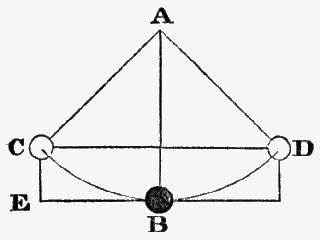
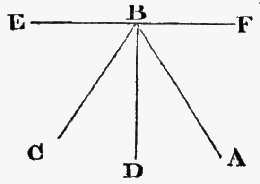
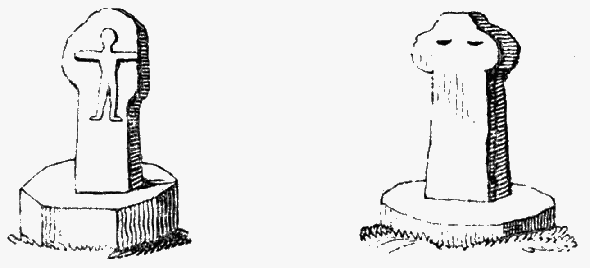
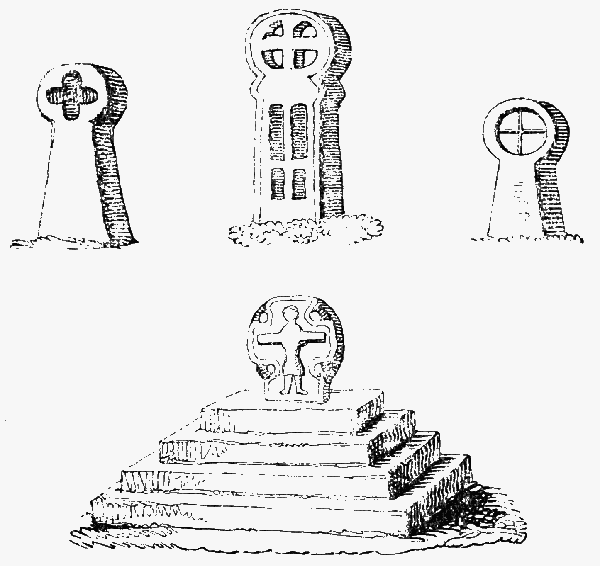
Referred to by figures in the text.
Note 1, p.
4.--
The Horologe of Flora.
The Horologe of Flora is alluded to by Pliny with his usual felicity
of thought and expression. “Dedi tibi herbas horarum indices; et ut ne
sole quidem oculos tuos a terra avoces, heliotropium ac lupinum
circumaguntur cum illo. Cur etiam altius spectas, ipsumque cœlum
scrutatis? Habes ante pedes tuos ecce Vergilias.”--Hist. Nat. lib.
xviii. c. 27.
Linnæus enumerates forty-six flowers which possess this kind of
sensibility. The following are a few of them, with their respective
hours of rising and setting, as the Swedish naturalist terms them. He
divides them into meteoric flowers, which less accurately observe
the hour of unfolding, but are expanded sooner or later, according to
the cloudiness, moisture, or pressure of the atmosphere.
2nd. Tropical flowers, which open in the morning, and close before
evening every day; but the hour of the expanding becomes earlier or
later, as the length of the day increases or decreases.
3rd. Equinoctial flowers, which serve for the construction of
Flora’s dial, since they open at a certain and exact hour of the day,
and for the most part close at another determinate hour: for instance,
the Leontodon Taraxacum, dandelion, opens at 5-6, closes at 8-9;
Hieracium Pilosella, mouse-ear hawkweed, opens at 8, closes at 2;
Tragopogon pratensis, yellow goat’s-beard, opens at sunrise, and
shuts at noon with such regularity, that the husbandman who adopts it
as the signal of dinner-time need not fear to have his pudding too
much or too little boiled; Sonchus lævis, smooth sow-thistle, opens
at 5, closes at 11-12; Lactuca sativa, cultivated lettuce, opens at
7, closes at 10; Tragopogon luteus, yellow goat’s-beard, opens at
3-5, closes at 9-10; Lapsana, nipplewort, opens at 5-6, closes at
10-11;
Nymphæaalba, white water-lily, opens at 7, closes at 5; Papaver nudicaule,
naked poppy, opens at 5, closes at 7; Hemerocallis fulva, tawny
day-lily, opens at 5, closes at 7-8; Convolvulus, opens at 5-6;
Malva, mallow, opens at 9-10, closes at l; Arenaria purpurea,
purple sandwort, opens at 9-10, closes at 2-3; Anagallis, pimpernel,
opens at 7-8; Portulaca hortensis, garden purslain, opens at 9-10,
closes at 11-12; Dianthus prolifer, proliferous pink, opens at 8,
closes at 1; Cichoreum, succory, opens at 4-5; Hypocharis, opens
at 6-7, closes at 4-5; Crepis, opens at 4-5, closes at 10-11;
Picris, opens at 4-5, closes at 12; Calendula Africana, opens at
7, closes at 3-4, &c.
“Thus in each flower and simple bell,
That in our path betrodden lie,
Are sweet remembrancers who tell
How fast the winged moments fly.”
In like manner may be formed a calendar of Flora: thus, if we
consider the time of putting forth leaves, the honeysuckle protrudes
them in the month of January; the gooseberry, currant and elder,
in the end of February, or beginning of April; the oak and ash in
the beginning, or towards the middle of May, &c.
Note 2, p.
32.--
Gravity and centrifugal force.
It may, perhaps, be asked how this decrease of weight could have been
ascertained; since, if the body under examination decreased in weight,
the weight which was opposed to it in the opposite scale must also
have diminished in the same proportion; for instance, that if the lump
of lead lost two pounds, the body which served to balance it must also
have lost the same weight, and therefore that the different force of
gravity could not be detected by such means. It is undoubtedly true
that the experiment in question could not have been performed with an
ordinary pair of scales, but by using a spiral spring it was easy to
compare the force of the lead’s gravity at the surface of the earth,
and at four miles high, by the relative degree of compression which it
sustained in those different situations. We may take this opportunity
of observing, that as the force of gravity varies directly as the
mass, or quantity of matter, a body weighing a pound on our earth
would, if transferred to the sun, weigh 27-3/4 pounds; if to Jupiter,
3-1/10 pounds; if to Saturn, 1-1/9; but, if to the moon, more than three
ounces.
With respect to the effect of the centrifugal force as alluded to in
the text, it may be here observed, that it has been found by
calculation that, at the equator, the diminution of gravity occasioned
by the centrifugal force arising from the rotation of the earth,
amounts to about the 289th part. But since this number is the square
of 17, it follows, that, if our globe turned more than 17 times faster
about her axis, or performed the diurnal revolution within the space
of 84 minutes, the centrifugal force would predominate over the powers
of gravitation, and all the fluid and loose matters would, near the
equinoctial boundary, have been projected from the surface. On such a
supposition the waters of the ocean must have been drained off, and an
impassable zone of sterility interposed between the opposite
hemispheres. By a similar calculation, combined with that decreasing
force of gravity at great distances from the centre, it may be
inferred, that the altitude of our atmosphere could never exceed
26,000 miles. Beyond this limit, the equatorial portion of air would
have been shot into indefinite space. If it were possible to fire off
a cannon ball with a velocity of five miles in a second, and the
resistance of the air could be taken away, it would for ever wheel
round the earth, instead of falling upon it; and supposing the
velocity to reach the rate of seven miles in a second, the ball would
fly off from the earth, and be never heard of more.
Note 3, p.
35.--
Velocity of light.
It is scarcely possible so to strain the imagination as to conceive
the velocity with which light travels. “What mere assertion will make
any man believe,” asks Sir W. Herschel, “that in one second of time,
in one beat of the pendulum of a clock, a ray of light travels over
192,000 miles, and would therefore perform the tour of the world in
about the same time that it requires to wink with our eyelids, and in
much less than a swift runner occupies in taking a single stride?”
Were a cannon ball shot directly towards the sun, and it were to
maintain its full speed, it would be twenty years in reaching it, and
yet light travels through this space in seven or eight minutes.
Note 4, p.
36.--
Velocity of falling bodies.
In order to perform this experiment with the highest degree of
accuracy, a body of considerable specific gravity should be selected,
such as lead or iron; for a common stone experiences a considerable
retardation in falling, from the action of the air. Where the arrival
of the body at the bottom of the cavern to be measured cannot be seen,
we must make allowance in our calculation for the known velocity of
sound; thus, suppose a body were ascertained to fall in five seconds.
As a heavy body near the earth’s surface falls about 16-1/12 feet in
one second of time, or for this purpose 16 feet will be sufficiently
exact; and as sound travels at the rate of 1142 feet per second,
multiply together 1142, 16, and 5, which will give 91360, and to four
times this product, or 365440, add the square of 1142, which is
1304164, and the sum will be 1669604; then if from the square root of
the last number = 1292 the number 1142 be subtracted, the remainder
150 divided by 32 will give 4.69 for the number of seconds which
elapsed during the fall of the body; if this remainder be subtracted
from 5, the number of seconds during which the body was falling and
the sound returning, we shall have 0.31 for the time which the sound
alone employed before it reached the ear; and this number multiplied
by 1142, will give for product 354 feet equal the depth of the well.
This rule, which, it must be allowed, is rather complex, is founded on
the property of falling bodies, which are accelerated in the ratio of
the times, so that the spaces passed over increase in the square of
the times.
The following is a more simple but less accurate rule. Multiply 1142
by 5, which gives 5710; then multiply also 16 by 5, which gives 80, to
which add 1142, this gives 1222, by which sum divide the first product
5710, and the quotient 4.68 will be the time of descent, nearly the
same as before. This taken from 5, leaves 0.32 for the time of the
ascent; which, multiplied by 1142, gives 365 for the depth, differing
but little from the former more exact number.
Note 5, p.
38.--
Hydromancy.
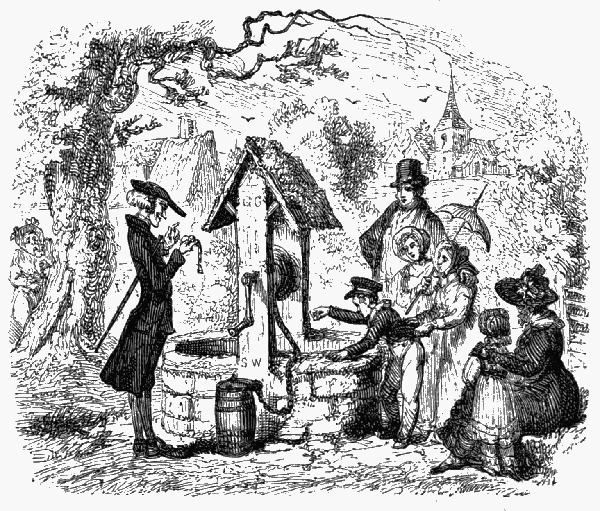
This superstition still prevails in many parts of England, especially
in Cornwall, where the peasants on certain days of the year assemble
at the springs, or holy wells, and, in
the manner stated in the text, proceed to settle such doubts and
enquiries as will not let the idle and anxious rest. Here, therefore,
they come, and, instead of allaying, deservedly feed their uneasiness;
the supposed responses serving equally to increase the gloom of the
low-spirited, the suspicions of the jealous, and the passion of the
enamoured. The superstition, however, is sanctioned by the highest
antiquity. The Castalian fountain, and many others among the Grecians,
were supposed to be of a prophetic nature. By dipping a fair mirror
into a well, the Patræans of Greece received, as they supposed, some
notice of ensuing sickness or health from the various figures
portrayed upon the surface. In Laconia they cast into a pool, sacred
to Juno, cakes of bread-corn; if they sank, good was portended; if
they swam, something dreadful was to ensue. Sometimes they threw three
stones into the water, and formed their conclusions from the several
turns they made in sinking. “From the several waves and eddies which
the sea, river, or other water exhibited,” says Dr. Borlase, “when put
into agitation after a ritual manner, the ancients pretended to
foretell with great certainty the event of battles; a way of divining
recorded by Plutarch in his life of Cæsar, and still usual among the
vulgar in Cornwall; who go to some noted well, at particular times of
the year, and there observe the bubbles that rise, and the aptness of
the water to be troubled, or to remain pure, on their throwing in pins
or pebbles, and thence conjecture what shall or shall not befall them.
The Druids also, as we have great reason to think, pretended to
predict future events, not only from holy wells and running streams,
but from the rain and snow water, which, when settled, and afterwards
stirred, either by oak-leaf or branch, or magic wand, might exhibit
appearances of great information to the quick-sighted Druid, or seem
so to do to the credulous enquirer, when the priest was at full
liberty to represent the appearances as he thought most for his
purpose.”--Borlase’s Antiquities of Cornwall, p. 140.
In the islands of Scilly there is, or was some years since, a custom
of propitiating fortune by certain ceremonies of this kind. An old
islander regretted to a friend of the author the want of care with
which such ceremonies had of late been conducted, and observed, as the
consequence, that “they had no luck at all in the islands; not a
wreck had taken place for many months.”
Note 6, p.
42.--
Coins and medals.
The Latin word moneta, for money, is probably more modern than
pecunia, and is said to be derived from moneo, to advise or mark,
that is, to show by some mark the weight and fineness of the metal of
which coins were composed. Thus, according to Isidorus, “Moneta ita
appellatur, quia monet nè qua fraus in pondere vel metallo fiat.” The
origin of money seems to have been coeval with the first regulations
of civil society, or, at least, it is too remote to be traced by any
authentic history. Barter, that is the exchange of one commodity for
another, was the ordinary mode of traffic in the earlier periods of
the world; a practice which must soon have been discovered extremely
inconvenient, and inadequate to the purposes of commerce; and hence
the invention of a common measure, or standard, according to which all
other things should be estimated. Writers very generally agree in
believing that the metals were first used for such a purpose, as being
almost the only substances whose goodness, and as it were integrity,
were not injured by partition; and which admitted of being melted, and
returned again into a mass of any size or weight. At first, it is
probable that each person cut his metal into pieces of different sizes
and forms, according to the quantity to be given for any merchandize,
or according to the demand of the seller, or the quantity stipulated
between them; to this end they went to market, laden with metal, in
proportion to the purchase to be made, and furnished with instruments
for apportioning it, and with scales for dealing it out, according as
occasion required. By degrees it must have been found commodious to
have pieces ready weighed; and Mr. Pinkerton observes, that such were
prepared without any stated form or impression, but merely regulated
to a certain weight; for weight was the grand standard of ancient
coinage, so that all large sums were paid in weight, even down to the
Saxon period of England. As in Greece the first estimation of money
was merely by weight, so was it in Rome. Silver was the metal first
used in Grecian coinage, but copper in the Roman; the former metal
having been long known to the Romans. The first valuation of Roman
money was by the libra gravis æris, or pound of heavy brass: and
when by the progress of their conquests they obtained silver and gold,
these were regulated
in the same manner. Let us proceed one step farther in the history of
coins; it is easy to imagine that the growing commerce of money being
disturbed with frauds, both in the weight and the material, the
interposition of public authority became necessary, and that hence
arose the first stamps or impressions of money; to which succeeded the
names of the moneyers, and at length the effigy of the prince, the
date, legend, and other precautions to prevent the alteration of the
species; and thus were coins completed. Gold and silver, in their pure
or unmixed state, are too flexible to make coins sufficiently firm for
general use; and hence the necessity of mixing with them a certain
proportion of some harder metal, and this mixture is called the
alloy. The quality of this alloy has been always considered of great
importance with respect to the durability of coins. The most common
metal used for this purpose is copper; and sometimes, for gold, a
mixture of silver and copper. In all well-regulated governments, there
has been a standard fixed by law; that is, a certain proportion
between the quantity of pure metal and its alloy. In England the
standard for gold is 11/12, that is eleven parts of pure metal, and
one part of alloy. The standard for silver is 37/40, a proportion
which is said to have been fixed in the reign of Richard I. by certain
persons from the eastern parts of Germany, called Easterlings; and
hence the word Sterling, which was afterwards the name given to the
silver penny, and which is now applied to all lawful money of Great
Britain.
Penny is derived by Camden from pecunia, but others suppose that
the word is formed from pendo to weigh, and the word has been
sometimes written, according to this origin, pending. The ancient
English penny, or penig, or pening, was the first silver coin struck
in England, and the only one current amongst our Saxon ancestors.
Until the time of Edward I. the penny was struck with a cross so
deeply indented in it that it might be easily broken, and parted into
two pieces, thence called half-pennies, or into four, called
four-things, or farthings; but that prince coined it without
indenture; in lieu of which he first struck round half-pence and
farthings.
By the term MEDAL, we understand a piece of metal, in the form of a
coin, destined to preserve to posterity the portrait of some great
man, or the memory of some illustrious
action. They are distinguished by their different sizes; those of the larger
size, or volume, are called medallions. Medallets is a name given
by Pinkerton to those small pieces, or missilia, scattered among the
people on solemn occasions; those struck for the slaves in the
Saturnalia, private counters for gaming, tickets for baths and feasts,
tokens in copper and lead, and the like. Medallions were certainly
never intended to become current coin, as some medals probably were;
they were struck purely to serve as public monuments, or to be
presented by the emperor to his friends, and by the mint-makers to the
emperor, as specimens of fine workmanship. They were struck upon the
commencement of the reign of a new emperor, and other solemn
occasions; and frequently, especially the Greek medallions, as
monuments of gratitude, or of flattery. Sometimes they were trial or
pattern pieces, testimonia probatæ monetæ; and such abound after the
reign of Maximilian, with the “Tres monetæ” on the reverse. It is
observed, that all the Roman pieces in gold, exceeding the denarius
aureus; all in silver, superior to the denarius; and all in brass,
superior to the sestertius, or what the medallist terms large brass,
are comprehended under the description of medallions. Mr. Pinkerton,
however, thinks that the gold medallions, weighing two, three, or four
aurei only, passed in currency according to their size. Medallions
from the time of Julius to that of Adrian, are very uncommon, and of
very high price; from Adrian to the close of the western empire they
are, generally speaking, less rare. The types of the Roman medallions
are often repeated upon common coin; hence they appear of less
importance than the Greek; impressions of which are frequently most
uncommon, and nowhere else to be found. Many Roman medallions have
S.C., as being struck by order of the senate; those without these
initials, were struck by order of the emperor. Of Augustus, a noble
medallion was found in Herculaneum. There are medallions of Augustus
and Tiberius, struck in Spain; and one of Livia, at Patræ in Achaia.
One in brass, of Antony and Cleopatra; reverse, two figures in a car,
drawn by sea-horses. Of Tiberius there are many; and also of Claudius,
Agrippina, Nero, Galba, Vespasian, and Domitian, &c. The Greek
medallions of Roman emperors are far more numerous than the Roman;
with a few exceptions, however, all medallions are rare and of
princely
purchase. Even in the richest cabinet, twenty or thirty specimens are esteemed a
respectable proportion.
The parts of a medal are the two sides, one whereof is called the
face, head, or obverse; the other the reverse. On each side is
the area, or field; the rim, or border; and the exergum,
which is beneath the ground, whereon the figures represented are
placed. On the two sides are distinguished the type, and the
inscription, or legend. The type, or device, is the figure
represented; the legend is the writing, especially that around the
medal; though in the Greek medals the inscription is frequently on the
area. What we find in the exergum is, generally, no more than some
initial letters, whose meaning we are usually unacquainted with;
though, sometimes, they contain words that may be accounted an
inscription.
The exergum sometimes contains the date of the coin, expressing in
what consulship of the emperor it was struck, as Cos. III. upon the
reverse of an Antoninus. Sometimes it signifies the place where it was
struck, and to which the coin properly belonged, as S. M. AL. for
Signata Moneta Alexandriœ, upon the reverse of a Licinius.
Sometimes the name of a province, the reduction of which the medal is
designed to celebrate; as Judæa on the reverse of a Vespasian. Medals
usually have their figures in higher relief than coins.
We have stated that medals are of great importance to the study of
history. They, indeed, furnish the principal proof of historic truth,
as their evidence reaches to the most remote ages, as well as to the
most remote countries. Vaillant, in his learned history of the Syrian
kings, printed at Paris, 1681, first fixed the dates, and arranged the
order of events in ancient historians, by means of these infallible
vouchers. Thus he was enabled to ascertain the chronology and progress
of events of three of the most important kingdoms of the ancient
world; viz. those of Egypt, of Syria, and of Parthia. The study of the
Roman medals has, in this respect, an advantage over that of Greek
coins, since they serve not only to illustrate the chronology of
reigns, but to aid us in the interpretation of particular events. To
this purpose, besides the portrait of the prince, and date of his
consulship, or of his tribunitian power, we have a representation, or
poetical symbol, of some grand event on the reverse. In a word, the
series of Roman coins presents
the very best suite of documents relating to the Roman History. In
addition to its historical importance, the medal is frequently a
useful guide to geography, natural history, architecture, ancient
monuments, busts, statues, ceremonies, and the like. See Addison’s
Dialogues on the Usefulness of Ancient Medals. On this subject,
also, Pinkerton, in his valuable work on medals, has some interesting
remarks; he says that, to a man of poetical imagination, the Roman
coins must prove an ample source of intellectual delight, by means of
the fine personifications and symbols which are to be found on their
reverse. Happiness has sometimes the caduceus, or wand of Mercury,
which Cicero tells us was thought to procure the gratification of
every wish. In a gold coin of Severus, she has heads of poppy to
express that our prime bliss lies in oblivion of misfortune. Hope is
represented as a sprightly damsel, walking quickly and looking
straightforward. With her left hand she holds up her garments, that
they may not hinder the rapidity of her pace; while, in her right
hand, she holds forth the bud of a flower, an emblem infinitely more
beautiful than the trite one of an anchor, which is the symbol of
Patience, not of Hope. Abundance is imaged as a sedate matron, with
a cornucopiæ in her hands, of which she scatters the fruits over the
ground: but does not hold it up, and keep its contents to herself, as
many poets and painters have represented her. Security stands
leaning on a pillar, indicative of her being free from all designs and
pursuits; and the posture itself corresponds to her name.
Coins also present us with countries and rivers admirably personified.
On the reverse of a colonial coin, rude in execution, of Augustus and
Agrippa, inscribed IMP. and DIVI. F., the conquest of Egypt is
represented by the apposite metaphor of the crocodile, an animal
almost peculiar to that country, and at that period esteemed
altogether so, which is chained to a palm tree, at once a native of
the country, and symbolic of victory. Moreover, a cabinet of medals,
of which Rubens is said to have possessed a very magnificent one, may
be considered as forming the classic erudition of a painter. We may
add, that almost all the uses which connect the science of medals with
painting, render it also subservient to the art of the sculptor, who
cannot less than profit by the study of the Greek coins in particular.
The connexion of the study of ancient coins
with architecture, consists in the views of many of the ancient edifices,
which are found in perfect preservation on medals. Froelich observes,
that the coins of Tarsus are very remarkable for a kind of perspective
in the figures. On others are found triumphal arches, temples,
fountains, aqueducts, amphitheatres, circuses, palaces, columns,
obelisks, baths, sea-ports, pharoses, and the like.
The study of medals affords such a variety of amusement and of
instruction, that we may naturally suppose it to be nearly as ancient
as medals themselves; and yet ancient writers do not furnish us with a
single hint of collections of this kind. In the days of Greece, a
collection of such coins as then existed would not be regarded as an
acquisition of any great value, because it must have consisted only of
those that were struck by the innumerable little states which then
used the Greek characters and language, and of course it would be
considered as a kind of domestic coinage, precluded from extension by
the narrow limits of the intercourse that subsisted between different
provinces and countries. As soon as any communication was opened
between the Romans and the Greeks, the Grecian coins were imitated by
the Roman workmen, and preserved in the cabinets of their senators
among the choicest treasures. In a more advanced period of the Roman
empire, individuals must have formed collections of Roman coins; for
we find that a complete series of silver was lately found in our
island, containing inclusively all the emperors down to Carausius.
From the decline of the Roman empire, most branches of science were
enveloped in darkness, till the revival of letters towards the end of
the fifteenth century. When literature began to be cultivated in
Italy, the study of medals, connected with that of ancient erudition,
began to engage attention. Accordingly Petrarch, who in modern times
was amongst the first persons in Europe that aspired to the celebrity
of learning and genius, was likewise the first to revive the study of
medals. This eminent man, having been desired by the Emperor Charles
V. to compose a book that should contain a history of the coins of
illustrious men, and to place him in the list, is said to have
returned for answer, that he would comply with his desire, whenever
the Emperor’s future life and actions deserved it. Availing himself of
this circumstance, he sent that monarch a collection of gold and
silver coins of celebrated men.
“Behold!” said he, “to what men you have succeeded! Behold whom you should
imitate and admire! to whose very form and image you should compose
your talents! The invaluable present I should have given to no one but
yourself; it was due to you alone. I can only know or describe the
deeds of these great men: your supreme office enables you to imitate
them.” In the next age, Alphonso, king of Arragon, caused all the
ancient coins that could be discovered throughout the provinces of
Italy to be collected, which he placed in an ivory cabinet, and always
carried about with him, that he might be excited to great actions by
the presence, as it were, of so many illustrious men in their images.
To those who are desirous of gaining information upon this interesting
branch of antiquarian research, we strongly recommend Mr. Pinkerton’s
Essay on Medals.
Having been led to offer these observations on ancient medals, we may,
perhaps, be allowed to make one other digression on a subject
naturally suggested by a visit to the vicarage of our reverend
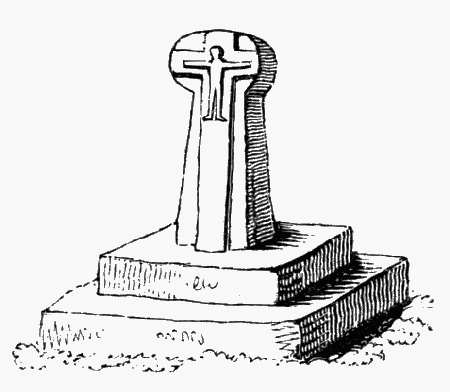
antiquary. The reader has been told, that “around his house he had
arranged several precious relics, amongst which was an ancient cross,
raised upon a platform on three steps.”
There is much obscurity with regard to the origin and uses of these
stone crosses. We are, however, not disposed to enter into a
discussion of such difficulty; but the reader may be gratified in
having presented to him, in one view, a collection of such crosses as
still exist in various parts of Cornwall.
Note 7, p.
49.--
Bodies revolve on the shorter axis.
Upon this subject, the reader is requested to turn to page 138, where
it is stated that a body will permanently rotate only on its shortest
axis. The philosophy of the fact is simply this--while a body revolves
on its axis, the component particles of its mass move in circles, the
centres of which are placed in the axis; a centrifugal force therefore
is generated, which is resisted by the cohesion of the parts of the
mass, and this tendency of each particle to fly off is expended in
exciting a pressure upon the axis; and it is this strain which
produces the effect in question, the axis of no pressure being alone
the permanent axis.
Vis Inertiæ, p. 59.--The criticism of the vicar upon this subject is
scientifically judicious; but the literary reader who has justly
appreciated his character, may be inclined to ask how it could have
happened that he should have overlooked the classical authority by
which the expression is countenanced; we cannot answer the question,
but we will supply the deficiency. The connecting two ideas, which at
first sight appear opposed to each other, constituted a figure of speech
much used both by the Greeks and Romans. Euripides delighted in it,
which was a sufficient reason for Aristophanes to satirise it. Horace
has given us several examples of it, as “Insaniens
sapientia”--“Strenua inertia.”
Note 8, p.
62.--
The mechanical powers.
Mechanical powers are simple arrangements by which we gain power at
the expense of time; thus, if a certain weight can be raised to a
certain height by unassisted strength, and the same thing is
afterwards done with one tenth part of the exertion, through the use
of a mechanic power, it will be found to occupy ten times as much
time. In many cases, however, loss of time is not to be put in
competition with the ability to do a thing; and since the advantages
which the mechanical powers afford to man, by enabling him to perform
feats which, without their assistance, would have been for ever beyond
his reach, are incalculably great, the waste of time is overlooked,
and is much more than balanced in the general result. It is true, that
if there are several small weights, manageable by human strength, to
be raised to a certain height, it may be full as convenient to elevate
them one by one, as to take the advantage of the mechanical powers in
raising them all at once; because the same time will be necessary in
both cases: but suppose we should have an enormous block of stone, or
a great tree, to raise; bodies of this description cannot be separated
into parts proportionable to the human strength without immense
labour, nor, perhaps, without rendering them unfit for those purposes
to which they are to be applied; hence then the great importance of
the mechanical powers, by the use of which a man is able to manage
with ease a weight many times greater than himself.
To understand the principle of a mechanical power, we must revert to
the doctrine of momentum. It will be remembered, that a small ball,
weighing only two pounds, and moving at the rate of 500 feet in a
second, will produce as much effect as a cannon ball of ten pounds in
weight, provided it only moved at the rate of 100 feet in the same
time; in like manner a ball weighing one pound may be made to balance
another of five pounds, by placing it five times farther from the
centre of motion; for in such a case,
for every inch of space through which the large ball passes, the small one
will traverse five inches, and will thus generate five times the
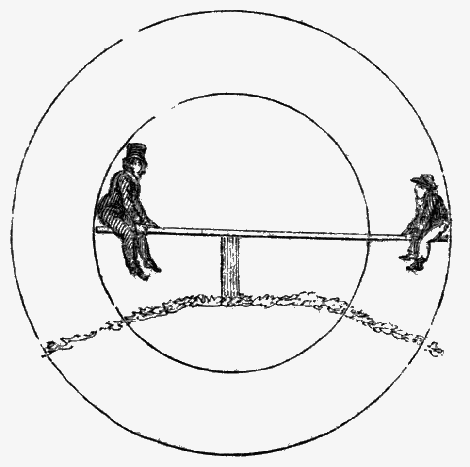
momentum. This may be rendered still more evident by turning to page
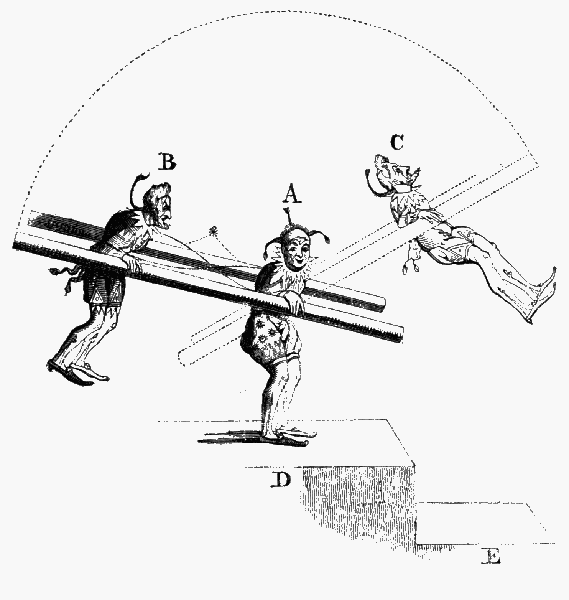
161, and note thereon, where the see-saw is described, which, in
fact, is a true mechanical power. It will be at once evident, from an
inspection of the figure, that the lesser boy will pass over a much
greater space, in equal time, than the greater boy, and thus generate
more momentum, which compensates for his defect in weight, and renders
him a balance for his heavier companion.--See note 23.
Note 9, p.
76.--
Centre of gravity.
Those who have been in the habit of inspecting the works of the
statuary, must frequently have detected the art which he has displayed
in imparting stability to his figures, by lowering their centre of
gravity. The bronze figure of Achilles, in Hyde Park, affords a very
striking illustration of such ingenuity; it is evident, from the
position and height of the figure, that, had not a mass of matter been
added to its base, its stability would have been extremely precarious,
since the slightest movement might have thrown its line of direction
beyond the base; but the addition at the base renders such an accident
impossible, by lowering its centre of gravity. Other examples of
similar contrivance are presented in several celebrated statues,
wherein stability is ensured by the judicious distribution of the
draperies. In the celebrated statue of Peter at St. Petersburgh, the
equilibrium of the mass is thus sustained by the introduction of a
serpent twining upwards to his horse’s tail. The effect, however, is
so unfortunate as to have given occasion for a wit to remark, “It is a
very fine horse, but what a pity that he should have worms!” Nor have
our celebrated painters overlooked a principle, the neglect of which
would have withheld from the most symmetrical figures the charms of
beautiful proportion.
Note 10, p.
93.--
The Indian blow-pipe.
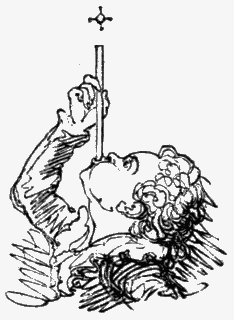
“When a native of Macoushi goes in quest of feathered game, or other
birds, he seldom carries his bow and arrows. It is the blow-pipe he
then uses. This extraordinary tube of death is, perhaps, one of the
greatest natural curiosities
in Guiana. It is not found in the country of Macoushi. Those Indians tell
you that it grows to the south-west of them, in the wilds which extend
betwixt them and the Rio Negro. The reed must grow to an amazing
length, as the part the Indians use is from ten to eleven feet long,
and no tapering can be perceived in it, one end being as thick as the
other. It is of a bright yellow colour, perfectly smooth both inside
and out. It grows hollow; nor is there the least appearance of a knot
or joint throughout the whole extent. The natives call it ourah.
This, of itself, is too slender to answer the end of a blow-pipe; but
there is a species of palma, larger and stronger, and common in
Guiana, and this the Indians make use of as a case, in which they put
the ourah. It is brown, susceptible of a fine polish, and appears as
if it had joints five or six inches from each other. It is called
samourah, and the pulp inside is easily extracted, by steeping it
for a few days in water. Thus the ourah and samourah, one within the
other, form the blow-pipe of Guiana. The end which is applied to the
mouth is tied round with a small silk-grass cord, to prevent its
splitting; and the other end, which is apt to strike against the
ground, is secured by the seed of the acuero fruit, cut horizontally
through the middle, with a hole made in the end, through which is put
the extremity of the blow-pipe. It is fastened on with string on the
outside, and the inside is filled up with wild bees-wax. The arrow is
from nine to ten inches long. It is made out of the leaf of a species
of palm-tree, called coucourite, hard and brittle, and pointed as
sharp as a needle. About an inch of the pointed end is poisoned with
the wourali. The other end is burnt, to make it still harder, and
wild cotton is put round it for about an inch and a half. It requires
considerable practice to put on this cotton well. It must just be
large enough to fit the hollow of the tube, and taper off to nothing
downwards. They tie it on with a thread of the silk-grass to prevent
its slipping off the arrow.”
“The Indians have shown ingenuity in making a quiver to hold the
arrows. It will contain from five to six hundred...
“...With a quiver of poisoned arrows slung over his shoulder, and with his
blow-pipe in his hand, in the same position as a soldier carries his
musket, see the Macoushi Indian advancing
towards the forest in quest of powises, maroudis, waracabas, and other
feathered game.
“These generally sit high up in the tall and tufted trees, but still
are not out of the Indian’s reach; for this blow-pipe, at its greatest
elevation, will send an arrow 300 feet. Silent as midnight he steals
under them, and so cautiously does he tread the ground, that the
fallen leaves rustle not beneath his feet. His ears are open to the
least sound, while his eye, keen as that of the lynx, is employed in
finding out the game in the thickest shade. Often he imitates their
cry, and decoys them from tree to tree, till they are within range of
his tube. Then, taking a poisoned arrow from his quiver, he puts it in
the blow-pipe, and collects his breath for the fatal puff. About two
feet from the end through which he blows, there are fastened two teeth
of the acouri, and these serve him for a sight. Silent and swift the
arrow flies, and seldom fails to pierce the object at which it is
sent. Sometimes the wounded bird remains in the same tree where it was
shot, and in three minutes falls down at the Indian’s feet. Should he
take wing, his flight is of short duration; and the Indian, following
the direction he has gone, is sure to find him dead. It is natural to
imagine that, when a slight wound only is inflicted, the game will
make its escape. Far otherwise; the wourali poison almost
instantaneously mixes with blood or water, so that if you wet your
finger, and dash it along the poisoned arrow in the quickest manner
possible, you are sure to carry off some of the poison. Though three
minutes generally elapse before the convulsions come on in the wounded
bird, still a stupor evidently takes place sooner, and this stupor
manifests itself by an apparent unwillingness in the bird to move.” ...
“The Indian, on his return home, carefully suspends his blow-pipe from
the top of his spiral roof; seldom placing it in an oblique position,
lest it should receive a cast.”--Waterton’s Wanderings in South
America, p. 58.
Note 11, p.
96.--
Pendulum and spring.
A clock is nothing more than a piece of machinery to maintain the
action of the pendulum, and at the same time to count and register the
number of its oscillations; and by that peculiar property, that one
vibration commences
exactly where the last terminates, no part of time is lost or gained in the
juxtaposition of the units so counted.
If some extraneous force were not applied, in a clock or watch, to
maintain or perpetuate the natural vibrations of a pendulum, or
oscillations of a balance, they would soon come to rest, by reason of
friction in the mechanism, and the resistance opposed by the air to
the parts in motion. This force, in the larger clocks, is usually a
suspended weight; but, in the portable clock and watch, it is a spring
coiled in a metallic box, that actuates the wheel-work by gradually
unbending itself.
In the former of these cases, the weight is suspended by a cord or
chain that is coiled round a cylinder when wound up, which cylinder
being of uniform diameter throughout its length, is acted on by the
cord, when fast at the interior end, by a similar force in every
situation; and, therefore, imparts through the train, connected with
its great wheel, invariable impulses to the escapement-wheel, at every
vibration of the pendulum; which pendulum receives therefrom such a
slight push, as is just sufficient to restore the momentum which it
loses from friction and the air’s resistance, and thus the uniform
motion of the pendulum is perpetuated. But when a spring is
substituted for a weight, it is clear that its agency cannot be
uniform, since, as the reader will learn by turning to page 101, it is
a general law that elastic bodies, in the recovery of their form,
after the removal of the compressing force, exert a greater power at
first than at last, so that the whole progress of restoration is a
retarded motion. It, therefore, became necessary to introduce some
mechanical contrivance which might equalize such motion. This
correction is effected by an apparatus termed a FUSEE, and is nothing
more than the application of the wheel and axle; it is that conical
barrel seen in most watches round which the chain coils in the act of
winding up. When the fusee is full of chain, or the watch is wound up,
the spring, through the medium of the chain, will act upon its upper
part, which being very near the centre will give the spring but little
power; but, as the spring uncoils and diminishes in strength, it will
act upon a larger part of the fusee, until at last it gets to the
bottom of it, and consequently, if the several increasing grooves upon
it are made to increase in the same proportion as the power of the
spring decreases, an equable force must be obtained.
Springs may be thus said to afford the means of packing up force, to
be used whenever it is required. Mr. Babbage observes that the half
minute which we daily devote to the winding up our watches is an
exertion by which we pack a quantity of force, which is gradually
expended during the ensuing twenty-four hours. Springs then will
enable us to avail ourselves of inconstant and variable forces which
must otherwise remain incapable of useful application, and the period
may arrive when force will thus become an article of traffic, and
machines be sent to the windmill to be wound up. The manner in which
force is constantly allowed to run to waste is quite extraordinary in
the present advanced state of science. We need only look at the
working of the treadmill. The public are little aware of the enormous
sums annually expended in towing vessels by steam from the Nore to the
port of London; were floating treadmills established, the labour of
those, upon whom punishment has been awarded, might be rendered
available to the most important interests; whereas, with the present
system, not only is this labour entirely lost, but is actually a
source of expense, for machines, with all the accompaniments of
engineers, are provided to counterbalance the force so uselessly
generated.
Note 12, p.
97.--
Elastic chairs and beds.
The elastic property of iron springs has been lately exemplified in a
very striking manner, by the invention of Pratt’s elastic chairs and
beds; which, instead of the usual stuffing of feathers, are filled
with iron wire!!! which is twisted into spiral form. Down itself
cannot be more gentle or springy; it yields to pressure, and yet never
becomes lumpy: beds thus constructed have the advantage of not heating
the body; and, above all, they never require to be shaken or “made.”
Had Vulcan fortunately made such a discovery before his ejectment from
Olympus, his wife, Venus, would surely never have treated him with
that contempt which mythologists have recorded of her; while her
priestesses, the housemaids, must, in gratitude, have been bound to
extend their protection to a benefactor, who could save them so much
daily labour. For particulars of this curious invention, the reader
may consult the Literary Gazette for March 17, 1827.
Note 13, p.
98.--
Duck and drake.
The phenomenon has been explained as depending upon the inertia of the
parts of matter, which renders a certain time necessary in order to
communicate to any body a sensible motion; so that when a body, moving
with considerable velocity, meets with another of much greater size,
it experiences almost as much resistance as if the latter were fixed.
Nothing is easier to be divided than water; yet, if the palm of the
hand be struck with some velocity against its surface, a considerable
degree of resistance, and even of pain, is experienced from it, as if
a solid body had been struck; nay, a musket ball, when fired against
water, is repelled and even flattened by it. In like manner, if we
load a musket with powder, and, instead of a ball, introduce a candle,
and fire it against a board, the latter will be pierced by the candle
end, as if by a ball. The cause of this phenomenon, no doubt, is, that
the rapid motion with which the candle end is impelled, does not allow
it time to be flattened, and therefore it acts as a hard body.
Note 14, p.
99.--
Vegetable elasticity.
Impatiens, or Touch me not, affords a good example. The
seed-vessel consists of one cell with five divisions; each of these,
when the seed is ripe, on being touched, suddenly folds itself into a
spiral form, leaps from the stalk, and disperses the seeds to a great
distance by its elasticity. The capsule of the geranium and the beard
of wild oats are twisted for a similar purpose. (Darwin’s Botanic
Garden.) The seed-vessel of Euphorbia is extremely elastic,
projecting the seeds with great force. An elastic pouch also serves to
scatter the seeds of the Oxalis.
Note 15, p.
125.--
A simple orrery.
A very instructive toy might be constructed by placing a taper in the
centre of a japanned waiter, to represent the sun, and fixing in a
watch glass an indian rubber ball, with the parallels of latitude and
meridians painted thereon, with the other characters of the globe.
During its revolution around the candle, in consequence of the
tendency of its centre of gravity to its lowest position, the diurnal
and annual motions, and also the parallelism of its axis, will be
represented, together with the concomitant phenomena.
Note 16, p.
130.--
Conic sections.
If a cone, or sugar-loaf, be cut through in certain directions, we
shall obtain figures which are termed conic sections; thus, if we
cut through the sugar-loaf in a direction parallel to its base, or
bottom, the outline or edge of the loaf where it is cut will be a
circle. If the cut is made so as to slant, and not be parallel to
the base of the loaf, the outline is an ellipse, provided the cut
goes quite through the sides of the loaf all round; but if it goes
slanting, and parallel to the line of the loaf’s side, the outline is
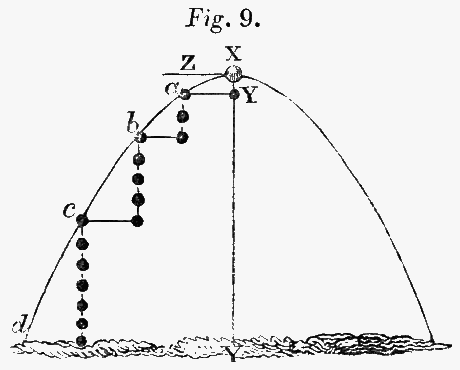
a parabola, a conic section, or curve, to which this note more
immediately relates. This curve is distinguished by characteristic
properties, every point of it bearing a certain fixed relation to a
certain point within it, as the circle does to its centre.
Note 17, p.
134.--
Earthquake of Lisbon.
During the dreadful earthquake of Lisbon, bands of wretches took
advantage of the general consternation to commit the most atrocious
acts of robbery and murder. In fact, a considerable part of the city
was destroyed by incendiaries, who, during the disaster, set fire to
the houses, that they might pillage them with greater impunity.
Note 18, p. 134.--
Geology applied to agriculture.
Soils consist of a mixture of different finely divided earthy matter,
with animal or vegetable substances in a state of decomposition. In
order, therefore, to form a just idea of their nature, it is necessary
to conceive different rocks decomposed, or ground into parts and
powder of different degrees of fineness; some of their soluble parts
dissolved by water, and that water adhering to the mass, and the whole
mixed with larger or smaller quantities of the remains of vegetables
and animals, in different stages of decay. Hence it will follow, that
certain rocks will give origin to particular soils; thus poor and
hungry soils, such as are produced from the decomposition of granite
and sandstone, remain very often for ages with only a thin covering of
vegetation; while soils from the decomposition of limestone, chalk,
and basalt, are often clothed by nature with the perennial grasses;
and afford, when ploughed up, a rich bed of vegetation for every
species of cultivated
plant. In adverting to this subject, Dr. Buckland, in his inaugural lecture,
very justly observes, that it furnishes an instance of relation
between the vegetable and mineral kingdoms, and of the adaptation of
one to the other, which always implies design in the surest manner;
for had not the surface of the earth been thus prepared for their
reception, where would have been the use of all that admirable system
of organization bestowed upon vegetables? And it is no small proof of
design in the arrangement of the materials that compose the surface of
our earth, that whereas the primitive and granitic rocks are least
calculated to afford a fertile soil, they are for the most part made
to constitute the mountain districts of the world, which, from their
elevation and irregularities, would otherwise be but ill adapted for
human habitation; whilst the lower and more temperate regions are
usually composed of derivative or secondary strata, in which the
compound nature of their ingredients qualifies them to be of the
greatest utility to mankind by their subserviency to the purposes of
luxuriant vegetation.
No doubt, then, can exist as to the important connexion between the
geological structure of a country, and its degree of fertility; but
the subject has not received the attention which it merits. And in the
hope that this note may meet the eye of some zealous geologist, the
author suggests the importance of commencing the enquiry in a
primitive district; for, as we advance from a primitive to an alluvial
district, the relations to which we have alluded become gradually less
distinct and apparent, and are ultimately lost in the confused
complication of the soil itself, and in that general obscurity which
necessarily envelopes every object in a state of decomposition: we
can, therefore, only hope to succeed in such an investigation, by a
patient and laborious examination of a primitive country, after which
we may be enabled to extend our enquiries with advantage through those
districts which are more completely covered with soil, and obscured by
luxuriant vegetation; as the eye, gazing upon a beautiful statue,
traces the outline of the limbs, and the swelling contour of its form,
through the flowing draperies which invest it.
Note 19, p.
135.--
Buckland’s researches.
The geological researches of Dr. Buckland have been long directed by a
desire to accumulate facts to prove that
there must have been an universal inundation of the earth; and, in his
inaugural lecture, he has presented us with a summary of such facts,
which, to use his own expression, whether considered collectively or
separately, present such a conformity of proofs, tending to establish
the universality of a recent inundation of the earth, as no
difficulties or objections that have hitherto arisen are in any way
sufficient to overrule.
In the year 1822, Dr. Buckland read a memoir before the Royal Society,
announcing the discovery of a singular cave at Kirkdale in Yorkshire,
containing an assemblage of fossil teeth and bones of the elephant,
rhinoceros, hippopotamus, bear, tiger, and hyæna, and sixteen other
animals; with a comparative view of five similar caverns in various
parts of England, and others on the continent. For this important
paper the society awarded to its author their Copley medal; and it
constitutes the basis of a later and much more extended work, entitled
“Reliquiæ Diluvianæ; or Observations on the Organic Remains contained
in Caves, Fissures, and Diluvial Gravel; and on other Geological
Phenomena, attesting the Action of an Universal Deluge. By the Rev. W.
Buckland, B.D. F.R.S. &c.”
Let us explore the interior of this cavern. It was not till the summer
of 1821, that the existence of any animal remains, or of the cavern
containing them, was suspected. At this time, in continuing the
operations of a large quarry, the workmen accidentally intersected the
mouth of a long hole, closed externally with rubbish, and overgrown
with grass and bushes. As this rubbish was removed before any
competent person had examined it, it is not certain whether it was
composed of diluvial gravel and rolled pebbles, or was simply the
debris that had fallen from the softer portions of the strata that lay
above it: the workman, however, who removed it, and some gentlemen who
saw it, assured Dr. Buckland that it was composed of gravel and sand.
In the interior of the cavern, our indefatigable geologist could not
find a single rolled pebble, nor has he ever seen one bone, or
fragment of bone, that bore the slightest mark of having been rolled
by the action of water.
The original entrance is said to have been very small, and, having
been filled up as above described, there could not have been any
admission of external air through it to the interior of the cavern.
Nearly 30 feet of its outer extremity
have now been removed, and the present entrance is a hole in the
perpendicular face of the quarry, about three feet high and five feet
broad, which it is only possible for a man to enter on his hands and
knees, and which expands and contracts itself irregularly from two to
seven feet in breadth, and two to fourteen feet in height. It is
unnecessary to enter into farther details; the reader, if he wishes
more minute information, may consult Dr. Buckland’s work.
On entering the cave, the first thing observed was a sediment of soft
mud or loam, covering entirely its whole bottom to the average depth
of about a foot, and concealing the subjacent rock, or actual floor of
the cavern. Not a particle of mud was found attached either to the
sides or roof; nor was there a trace of it adhering to the sides or
upper portions of the transverse fissures, or any thing to suggest the
idea that it had entered through them. The mud was covered by a
stalagmitic crust, which had been formed by the dripping of water
impregnated with calcareous matter, as is common in all the cavities
of limestone; but it is important to remark, that there was not any
alternation of mud with any repeated beds of stalagmite, but simply
a partial deposit of the latter on the floor beneath; so that the mud
was encased, like meat in a pie, with an upper and under crust. It was
chiefly in the lower part of the earthy sediment, and in the
calcareous matter beneath it, that the animal remains were found.
In the whole extent of the cave, only a very few large bones have been
discovered that are tolerably perfect; most of them are broken into
small angular fragments and chips, the greater part of which lay
separately in the mud, whilst others were wholly or partially invested
with stalagmite, and others again mixed with masses of still smaller
fragments. In some few places, where the mud was shallow, and the
heaps of teeth and bones considerable, parts of the latter were
elevated some inches above the surface of the mud and its calcareous
crust; and the upper ends of the bones thus projecting, like the legs
of pigeons through a pie crust, into the void space above, have become
thinly covered with calcareous drippings, whilst their lower
extremities have no such incrustation, and have simply adhering to
them the mud in which they have been imbedded.
The effect of the loam and stalagmite in preserving the
bones from decomposition, by protecting them from all access of atmospheric
air, has been very remarkable.
The workmen, in first discovering the bones at Kirkdale, supposed them
to have belonged to cattle that died by a murrain in this district a
few years ago, and they were for some time neglected, and thrown on
the roads with the common limestone; they were, at length, noticed by
Mr. Harrison, a medical gentleman in the neighbourhood, and have since
been collected and deposited in various private and public museums.
The teeth and bones which have been discovered in this cave appear to
have belonged to the hyæna, tiger, bear, wolf, fox,
weasel, elephant, rhinoceros, hippopotamus, horse, ox,
deer, hare, rabbit, water-rat, mouse, raven, pigeon,
lark, snipe, and a small species of duck.
The bottom of the cave, on first removing the mud, was found to be
strewed all over like a dog-kennel, from one end to the other, with
hundreds of teeth and bones, or rather broken and splintered fragments
of bones, of all the animals above enumerated; scarcely a single bone
has escaped fracture, with the exception of some of the more solid and
hard bones of the foot; on some of these bones marks may be traced,
which, on applying one to the other, appear exactly to fit the form of
the canine teeth of the hyæna that occur in the cave. The hyæna’s
bones have been broken, and apparently gnawed equally with those of
the other animals. Heaps of small splinters, and highly comminuted,
yet angular fragments of bone, mixed with teeth of all the varieties
of animals above enumerated, lay in the bottom of the den,
occasionally adhering together by calcareous cement. Not one skull is
to be found entire; and it is so rare to find a large bone of any kind
that has not been more or less broken, that there is no hope of
obtaining materials for the construction of a single limb, and still
less of an entire skeleton. The jaw-bones, also, even of the hyænas,
are broken to pieces like the rest.
It must already appear probable, from the facts above described,
particularly from the comminuted and gnawed condition of the bones,
that the cave at Kirkdale was, during a long succession of years,
inhabited as a den by hyænas, and that they dragged into its recesses
the other animals, whose remains are found indiscriminately mixed with
their own: an hypothesis which is certainly strengthened by Dr.
Buckland having found the excrement of the
animal in the same cave. Should it be asked why we do not find, at least, the
entire skeleton of the one or more hyænas that died last, and left no
survivors to devour them; we find a sufficient reply to this question,
in the circumstance of the probable destruction of the last
individuals by the waters of the deluge. On the rise of these, had
there been any hyænas in the den, they would have rushed out, and fled
for safety to the hills; and if absent, they could not by any
possibility have returned to it from the higher levels; that they were
extirpated by the catastrophe is obvious, from the discovery of their
bones in the diluvial gravel both of England and Germany.
The accumulation of these bones, then, appears to have been a process
of years, whilst all the animals in question were natives of this
country. The general dispersion of bones of the same animals through
the diluvial gravel of high latitudes, over a great part of the
northern hemisphere, shows that the period in which they inhabited
these regions was that immediately preceding the formation of this
gravel, and that they perished by the same waters which produced it.
M. Cuvier has, moreover, ascertained that the fossil elephant,
rhinoceros, hippopotamus, and hyæna, belong to species now unknown;
and as there is no evidence that they have at any time, subsequent to
the formation of the diluvium, existed in these regions, we may
conclude that the period at which the bones of these extinct species
were introduced into the cave at Kirkdale was before the deluge.
Thus the phenomena of this cave seem referable to a period immediately
antecedent to the general deluge, and in which the world was inhabited
by land animals, almost all bearing a generic, and many a specific
resemblance to those which now exist; but so completely has the
violence of that tremendous convulsion destroyed and remodelled the
form of the antediluvian surface, that it is only in caverns that have
been protected from its ravages, that we may hope to find undisturbed
evidence of events in the period immediately preceding it. The bones
already described, and the calcareous matter formed before the
introduction of the diluvial mud, are what Dr. Buckland considers to
be the products of the period in question. It was indeed probable,
before the discovery of this cave, from the abundance in which the
remains of similar species
occur in superficial gravel beds, which cannot be referred to any other than
a diluvial origin, that such animals were the antediluvian inhabitants
not only of this country, but generally of all those northern
latitudes in which their remains are found, (but the proof was
imperfect, as it was possible they might have been drifted or floated
hither by the waters from the warmer regions of the earth,) but the
facts developed in this charnel-house of the antediluvian forests of
Yorkshire demonstrate that there was a long succession of years, in
which the elephant, rhinoceros, and hippopotamus had been the prey of
the hyænas, which, like themselves, inhabited England in the period
immediately preceding the formation of the diluvial gravel. Having
thus far described the principal facts to be observed in the interior
of this cave, Dr. Buckland proceeds to point out the chronological
inferences that may be derived from the state of the bones, and of the
mud and stalagmite that accompany them, and to extract the following
detail of events that have been going on successively within this
curious cave:--
First, There appears to have been a period (and, if we may form an
estimate from the small quantity of stalagmite now found on the actual
floor of the cave, a very short one,) during which this aperture in
the rock existed in its present state, but was not tenanted by the
hyænas.
The second period was that during which the cave was inhabited by the
hyænas, and the stalactite and stalagmite were still forming.
The third period is that at which the mud was introduced and the
animals extirpated, viz. the period of the deluge. It has been already
stated, that there is not any alternation of this mud with beds of
bone or of stalagmite, such as would have occurred had it been
produced by land floods often repeated; once, and once only, it
appears to have been introduced; and we may consider its vehicle to
have been the turbid waters of the same inundation that produced
universally the diluvial gravel.
The fourth period is that during which the stalagmite was deposited
which invests the upper surface of the mud.
In concluding this note, we take the opportunity of recommending all
those who feel interested in the researches of geology, to read a work
lately published, entitled “The Wonders of Geology, by Gideon Mantell,
LL.D. F.R.S. &c.”
Note 20, p.
137.--
The rifle.
Rifle guns are those whose barrels, instead of being smooth on the
inside, like our common pieces, are formed with a number of spiral
channels, resembling screws; except only that the threads, or rifles,
are less deflected, making only one turn, or a little more, in the
whole length of the piece. This construction is employed for
correcting the irregularity in the flight of balls from smooth
barrels, by imparting to the balls a rotatory motion perpendicular to
the line of direction. The same effect has lately been accomplished by
an extremely simple and obvious contrivance, and which will, probably,
altogether supersede the necessity of rifling the barrel. It consists
in cutting a spiral groove in the bullet itself, which, when
discharged, is thus acted upon by the air, and the same rotatory
motion imparted to it as that produced by the furrows in the barrel.
But it is the rotatory motion which steadies the flight of the ball;
and by whichever method this is produced, the theory of its action
will be the same. It has been long and generally known, that when the
common bullet is discharged from a plane barrel, its flight is
extremely irregular and uncertain; it has, for instance, been found,
from the experiments of Mr. Robins, that, notwithstanding the piece
was firmly fixed, and fired with the same weight of powder, the ball
was sometimes deflected to the right, sometimes to the left, sometimes
above, and at others below the true line of direction. It has also
been observed, that the degree of deflection increases in a much
greater proportion than the distance of the object fired at. It is not
difficult to account for these irregularities; they, doubtless,
proceed from the impossibility of fitting a ball so accurately to any
plane piece, but that it will rub more against one side of the barrel
than another in its passage through it. Whatever side, therefore, of
the muzzle, the ball is last in contact with, on quitting the piece,
it will acquire a whirling motion towards that side, and will be found
to bend the line of its flight in the same direction, whether it be
upwards or downwards, to the right or left; or obliquely, partaking in
some degree of both; and, after quitting the barrel, this deflection,
though in the first instance but trifling and inconsiderable, is still
farther increased by the resistance of the air;
this being greatest on that side where the whirling motion conspires with
the progressive one, and least on that side where it is opposed to it.
Thus, if the ball, in its passage out, rubs against the left side of
the barrel, it will whirl towards that side; and as the right side of
the ball will, therefore, turn up against the air during its flight,
the resistance of the air will become greatest on the right side, and
the ball be forced away to the left, which was the direction it
whirled in. It happens, moreover, from various accidental
circumstances, that the axis of the ball’s rotation frequently changes
its position several times during the flight; so that the ball,
instead of bending its course uniformly in the same direction, often
describes a track variously contorted. From this view of the causes of
aberration in the flight of balls, it will be evident that the only
means of correcting it is by preventing the ball from rubbing more
against one side of the barrel than another in passing through it; and
by giving to the bullet a motion which will counteract every
accidental one, and preserve its direction, by making the resistance
of the air upon the forepart continue the same during its whole
flight; that is, by giving it a rotatory motion perpendicular to the
line of direction. The contrivance for this purpose is called
rifling, and consists, as we have before stated, in forming upon the
inside of the barrel a number of threads and furrows, either in a
straight or spiral direction, into which the ball is moulded; and
hence, when the gun is fired, the indented zone of the bullet follows
the sweep of the rifle, and thereby, besides its progressive motion,
acquires a considerable one round the axis of the barrel, which motion
will be continued to the bullet after its separation from the piece,
so that it is constantly made to whirl round an axis coincident with
the line of its flight. Many familiar examples of the utility and
effect of rifling might be here adduced. If the bricklayer, while
unroofing a house, be observed, he will be seen to give to the slates
which he throws down a whirling motion, at a certain angle, which
ensures their falling edgeways on the ground, and thus preserves them
from fracture.
In relation to the subject in the text, to which this note refers, may
be introduced a notice of the “Bommereng,” a missile used by the
natives of Australia, and thus described by Major Mitchell in his
“Journal of an expedition to the
Rivers Darling and Murray.” “The bommereng, a thin, curved missile, about
two feet four inches long, can be thrown by a skilful hand so as to
rise upon the wind with a rotatory motion, and in a crooked direction
towards any given point with great precision, and to return, after a
considerable flight, to within a yard or two of the thrower; or, by
striking the ground near him, to bound so as to hit at a great,
distance, “en ricochet” any object behind a tree. This singular
weapon probably originated in the utility of such a missile for the
purpose of killing ducks, where they are very numerous, as on the
interior rivers and lagoons, and where we accordingly find it much
more in use than on the sea coast, and better made, being often
covered with good carving.” This instrument may now be purchased in
most of the London toy-shops.
Note 21, p.
144.--
Centre of percussion.
If a stick be held at one of its extremities, and allowed to fall on
the edge of a table, the farther end will rebound, or the hand will
sustain a shock, unless it be struck exactly on the centre of
percussion, in which case the stick will fall as a dead weight. The
repetition of this simple experiment will readily convey to the young
philosopher an idea of the nature of what is termed the centre of
percussion.
Note 22, p.
150.--
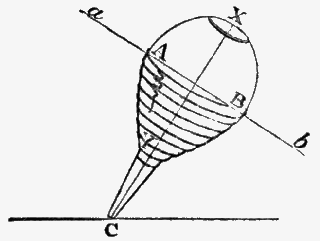
Spinning of the top.
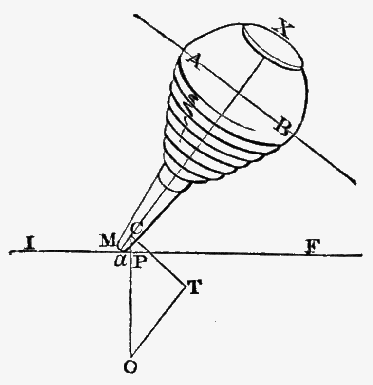
It has been stated in the text, that the gyrations of the top depend
exactly upon the same principle as that which produces the precession
of the equinoxes; viz. an unequal attractive force exerted upon the
revolving mass. In the one case, this is known to arise from the
action of the sun and moon on the excess of matter about the
equatorial regions of the earth; in the other, from the parts of the
top being unequally affected by gravity, while it is spinning in an
inclined or oblique position. To those philosophers who have
condescended to read the present work, if there be any such, and are
thereby induced to pursue the investigation of a subject which has
hitherto excited far too little attention, we beg to submit the
following remarks:--
If a top could be made to revolve on a point without friction, and in
a vacuum, in the case of its velocity being
infinite, it would continue to revolve for ever, in the same position, without
gyration. If the velocity were finite, it would for ever remain
unchanged in position, in the event of the centre of gravity being
directly over the point of rotation. In any other position (supposing
its velocity very great, although not infinite) there would arise a
continued uniform gyration; the line which passes through the point of
rotation, and the centre of gravity, always making the same angle with
the horizon, or describing the same circle round the zenith. But in
all artificial experiments the circumstances are very remarkably
changed; if, indeed, the centre of gravity happens to be situated
perpendicularly over the point of rotation, the top will continue
quite steady, or sleeping, as it is termed, till nearly the whole of
its velocity of rotation is expended. In any other position the top
begins to gyrate, but reclining at all times on the outside of its
physical point of gyration, the top is uniformly impelled inwards; and
this (when the velocity is considerable, and the point broad) acts
with a force sufficient for carrying the top towards its quiescent or
sleeping point; but when the velocity is much diminished, this power
becomes feeble, the gyrations increase in diameter, and the top
ultimately falls.
Note 23, p.
161.--
The mechanical powers.
The mechanical powers are all founded upon the principle that the
lengths of circles are in proportion to their diameters; for it is an
immediate consequence of this property of the circle, that if a rod of
iron, or beam of wood, be placed on a point or pivot, so that it may
move round its prop, the two ends will go through parts of circles,
each proportioned to that arm of the beam to which it belongs; the two
circles will be equal if the pivot is in the centre or middle point of
the beam; but if it is nearer one end than the other, say five times,
that end will pass through a circular space, or arc, five times
shorter than the circular space the other end goes through in the same
time. If, then, the end of the long beam goes through five times the
space, it must move with five times the swiftness of the short end,
since both move in the same time; and, therefore, any force applied to
the long end must overcome the resistance of five times that force
applied at the opposite end, since the two ends move in contrary
directions; hence
one pound placed at the long end would balance five placed at the short
end.
The beam we have been describing constitutes the first of the
mechanical powers, and is termed the LEVER. There are, besides, five
others, viz. the wheel and axle; the inclined plane; the screw;
the pulley; and the wedge; out of the whole, or a part of which,
it will be found that every mechanical engine or piece of machinery is
constructed.
The Lever being the simplest of all the mechanic powers, is in general
considered the first. It is an inflexible rod or bar of any kind, so
disposed as to turn on a pivot or prop, which is always called its
fulcrum. It has the weight or resistance to be overcome attached to
some one part of its length, and the power which is to overcome that
resistance applied to another; and, since the power, resistance,
and fulcrum admit of various positions with regard to each other, so
is the lever divided into three kinds or modifications, distinguished
as the first, second, and third kinds of lever. That portion of it
which is contained between the fulcrum and the power, is called the
acting part or arm of the lever; and that part which is between the
fulcrum and resistance, its resisting part or arm.
In the lever of the first kind, the fulcrum is placed between the
power and the resistance. A poker, in the act of stirring the fire,
well illustrates this subject; the bar is the fulcrum, the hand the
power, and the coals the resistance to be overcome. Another common
application of this kind of lever is the crow-bar, or hand-spike, used
for raising a large stone or weight. In all these cases power is
gained in proportion as the distance from the fulcrum to the power, or
part where the men apply their strength, is greater than the distance
from the fulcrum to that end under the stone or weight. A moment’s
reflection will show the rationale of this fact; for it is evident
that if both the arms of the lever be equal, that is to say, if the
fulcrum be midway between the power and weight, no advantage can be
gained by it, because they pass over equal spaces in the same time;
and, according to the fundamental principle already laid down, as
advantage or power is gained, time must be lost; but, since no time
is lost under such circumstances, there cannot be any power gained.
If, now, we suppose the fulcrum to be so removed towards the weight,
as to make the acting arm of the lever three times the length of the
resisting
arm, we shall obtain a lever which gains power in the proportion of three
to one, that is, a single pound weight applied at the upper end will
balance three pounds suspended at the other. A pair of scissors
consists of two levers of this kind, united in one common fulcrum;
thus the point at which the two levers are screwed together is the
fulcrum; the handles to which the power of the fingers is applied, are
the extremities of the acting part of the levers, and the cutting part
of the scissors are the resisting parts of the levers; the longer,
therefore, the handles, and the shorter the points of the scissors,
the more easily you cut with them. A person who has any hard substance
to cut, without any knowledge of the theory, diminishes as much as
possible the length of the resisting arms, or cutting part of the
scissors, by making use of that part of the instrument nearest the
screw or rivet. Snuffers are levers of a similar description; so are
most kind of pincers, the power of which consists in the resisting arm
being very short in comparison with the acting one.
In the lever of the second kind, the resistance or weight is between
the fulcrum and the power. Numberless instances of its application
daily present themselves to our notice; amongst which may be
enumerated the common cutting knife, used by last and patten makers,
one end of which is fixed to the work-bench by a swivel-hook. Two men
carrying a load between them, by one or more poles, as a sedan chair,
or as brewers carrying a cask of beer, in which case either the back
or front man may be considered as the fulcrum, and the other as the
power. Every door which turns upon its hinges is a lever of this kind;
the hinges may be considered as the fulcrum, or centre of motion; the
whole door is the weight to be moved, and the power is applied to that
side on which the handle is usually fixed. Nut-crackers, oars, rudders
of ships, likewise fall under the same division. The boat is the
weight to be moved, the water is the fulcrum, and the waterman at the
oar is the power. The masts of ships are also levers of the second
kind, for the bottom of the vessel is the fulcrum, the ship the
weight, and the wind acting against the sail is the moving power. In
this kind of lever the power or advantage is gained in proportion as
the distance of the power is greater than the distance of the weight
from the fulcrum; if, for instance, the weight hang at one inch from
the fulcrum, and the power acts at five inches from it, the power gained
is five to one; because, in such a case, the power passes over five
times as great a space as the weight. It is thus evident why there is
considerable difficulty in pushing open a heavy door, if the hand is
applied to the part next the hinges, although it may be opened with
the greatest ease in the usual method. In the third kind of lever, the
fulcrum is again at one of the extremities, the weight or resistance
at the other; and it is now the power which is applied between the
fulcrum and resistance. As in this case the weight is farther from the
centre of motion than the power, such a lever is never used, except in
cases of absolute necessity, as in the case of lifting up a ladder
perpendicularly, in order to place it against a wall. The man who
raises it cannot place his hands on the upper part of the ladder; the
power, therefore, is necessarily placed much nearer the fulcrum than
the weight; for the hands are the power, the ground the fulcrum, and
the upper part of the ladder the weight. The use of the common
fire-tongs is another example, but the circumstance that principally
gives this lever importance is, that the limbs of men and animals are
actuated by it; for the bones are the levers, while the joints are the
fulcra, and the muscles which give motion to the limbs, or produce the
power, are inserted and act close to the joints, while the action is
produced at the extremities; the consequence of such an arrangement
is, that although the muscles must necessarily exert an enormous
contractile force to produce great action at the extremities, yet a
celerity of motion ensues which could not be equally well provided for
in any other manner. We may adduce one example in illustration of this
fact. In lifting a weight with the hand, the lower part of the arm
becomes a lever of the third kind; the elbow is the fulcrum; the
muscles of the fleshy part of the arm the power; and as these are
nearer to the elbow than the hand, it is necessary that their power
should exceed the weight to be raised. The disadvantage, however, with
respect to power, is more than compensated by the convenience
resulting from this structure of the arm; and it is no doubt that
which is best adapted to enable it to perform its various functions.
From these observations it must appear, that although this arrangement
must be mentioned as a modification of the lever, it cannot, in
strictness, be called a mechanical power;
since its resisting arm is in all cases, except one, longer than the
acting arm, and in that one case is equal to it, on which account it
never can gain power, but in most instances must lose it.
The Wheel and Axle is the next mechanical power to be considered; it
must be well known to every reader who has seen a village well; for it
is by this power that the bucket is drawn up, although in such cases,
instead of a wheel attached to the axle, there is generally only a
crooked handle, which answers the purpose of winding the rope round
the axle, and thus raising the bucket, as may be seen in the engraving
at the head of our third chapter. It is evident, however, that this
crooked handle is equivalent to a wheel; for the handle describes a
circle as it revolves, while the straight piece which is united to the
axle corresponds with the spoke of a wheel. This power may be resolved
into a lever; in fact, what is it but a lever moving round an axle?
and always retaining the effect gained during every part of the
motion, by means of a rope wound round the butt end of the axle; the
spoke of the wheel being the long arm of the lever, and the half
diameter of the axle its short arm. The axle is not in itself a
mechanical power, for it is as impotent as a lever whose fulcrum is in
the centre; but add to it the wheel, and we have a power which will
increase in proportion as the circumference of the wheel exceeds that
of the axle. This arises from the velocity of the circumference being
so much greater than that of the axle, as it is farther from the
centre of motion; for the wheel describes a great circle in the same
space of time that the axle describes a small one; therefore the power
is increased in the same proportion as the circumference of the wheel
is greater than that of the axle. Those who have ever drawn a bucket
from a well by this machine, must have observed, that as the bucket
ascended nearer the top the difficulty increased: such an effect must
necessarily follow from the views we have just offered; for whenever
the rope coils more than once the length of the axle, the difference
between its circumference and that of the wheel is necessarily
diminished. To the principle of the wheel and axle may be referred the
capstan, windlass, and all those numerous kinds of cranes which are to
be seen at the different wharfs on the banks of the river Thames. It
is scarcely necessary to add that the force of the windmill
depends upon a similar power. The treadmill furnishes another
striking example. The wheel and axle is sometimes used to multiply
motion, instead of to gain power, as in the multiplying wheel of the
common jack, to which it is applied when the weight cannot
conveniently have a long line of descent; a heavy weight is in this
case made to act upon the axle, while the wheel, by its greatest
circumference, winds up a much longer quantity of line than the simple
descent of the weight could require, and thus the machine is made to
go much longer without winding than it otherwise would do.
The Pulley is a power of very extensive application. Every one must
have seen a pulley; it is a circular and flat piece of wood or metal,
with a string which runs in a groove round it. Where, however, this is
fixed, it cannot afford any power to raise a weight; for it is evident
that, in order to raise it, the power must be greater than the weight,
and that if the rope be pulled down one inch, the weight will only
ascend the same space; consequently, there cannot be any mechanical
advantage from the arrangement. This, however, is not the case where
the pulley is not fixed. Suppose one end of the rope be fastened to a
hook in the ceiling, and that to the moveable pulley on the rope a
cask be attached, is it not evident that the hand applied to the other
extremity of the rope will sustain it more easily than if it held the
cask suspended to a cord without a pulley? Experience shows that this
is the fact, and theory explains it by suggesting that the fixed hook
sustains half the weight, and that the hand, therefore, has only the
other half to sustain. The hook will also afford the same assistance
in raising the weight as in sustaining it; if the hand has but one
half the weight to sustain, it will also have only one half the weight
to raise; but observe, says Mrs. Marcet, that in raising the weight,
the velocity of the hand must be double that of the cask; for, in
order to raise the weight one inch, the hand must draw each of the
strings one inch; the whole string is therefore shortened two inches,
while the weight is raised only one. Pulleys then act on the same
principle as the lever, the deficiency of strength of the power being
compensated by its superior velocity. It will follow, from these
premises, that the greater the number of pulleys connected by a
string, the more easily the weight is raised, as the difficulty
is divided amongst the number of strings, or rather of parts into which
the string is divided by the pulleys. Several pulleys, thus connected,
form what is called a system, or tackle of pulleys. They may have been
seen suspended from cranes, to raise goods into warehouses, and in
ships to draw up the sails.
The Inclined Plane is a mechanic power which is seldom used in the
construction of machinery, but applies more particularly to the moving
or raising of loads upon slopes or hills, as in rolling a cask up or
down a sloping plank into or out of a cart or cellar, or drawing a
carriage up a sloping road or hill, all which operations are performed
with less exertion than would be required if the same load were lifted
perpendicularly. It is a power which cannot be resolved into that of
the lever: it is a distinct principle, and those writers who have
attempted to simplify the mechanical powers, have been obliged to
acknowledge the inclined plane is elementary. The method of estimating
the advantage gained by this mechanical power is very easy; for just
as much as the length of the plane exceeds its perpendicular height,
so much is the advantage gained; if, for instance, its length be three
times greater than its height, a weight could be drawn to its summit
with a third part of the strength required for lifting it up at the
end; but, in accordance with the principle so frequently alluded to,
such a power will be at the expense of time, for there will be three
times more space to pass over. The reason why horses are eased by
taking a zig-zag direction, in ascending or descending a steep hill,
will appear from the preceding account of the action of the inclined
plane, because in this way the effective length of the inclining
surface is increased while its height remains the same.
The Wedge is rather a compound, than a distinct mechanical power;
since it is composed of two inclined planes, and in action frequently
performs the functions of a lever. It is sometimes employed in raising
bodies; thus the largest ship may be raised to a small height by
driving a wedge below it; but its more common application is that of
dividing and cleaving bodies. As an elevator, it resembles exactly the
inclined plane; for the action is obviously the very same, whether the
wedge be pushed under the load, or the load be drawn under [sic] the
wedge. But when the wedge is drawn forward, the percussive tremor
excited
destroys, for an instant, the adhesion or friction at its sides, and
augments prodigiously the effect. From this principle chiefly is
derived the power of the wedge in rending wood and other substances.
It then acts besides as a lever, insinuating itself into the cleft as
fast as the parts are opened by the vibrating concussion. To bring the
action of the wedge, therefore, under a strict calculation, would be
extremely difficult, if not impossible. Its effects are chiefly
discovered by experience. All the various kinds of cutting tools, such
as axes, knives, chisels, saws, planes, and files, are only different
modifications of the wedge.
The Screw is a most efficient mechanic power, and is of great force
and general application. It is in reality nothing more than an
inclined plane formed round a cylinder, instead of being a continued
straight line. Its power is, therefore, estimated by taking its
circumference, and dividing this by the distance between any two of
its threads; for what is taking the circumference of a screw, but
another mode of measuring the length of the inclined plane which wraps
round it? and taking the distance between one thread and the next to
it, is but measuring the rise of that inclined plane in such length;
and from the properties of the inclined plane, it follows, that the
closer the threads of a screw are together in proportion to its
diameter, the greater will be the power gained by it.
Note 24, p.
165.--
The cycloid.
A cycloid is a peculiar curve line; and is described by any one
point of a circle as it rolls along a plane, and turns round its
centre; thus, for instance, the nail on the felly of a cart-wheel
traces a cycloid in the air as the wheel proceeds. This curve is
distinguished by some remarkable properties, the most important of
which is that mentioned in the text, viz. that any body moving in such
a curve, by its own weight, or swing, will pass through all distances
of it in exactly the same time; and it is for such a reason that
pendulums are made to swing in cycloids, in order that they may move
in equal times, whether they go through a long or a short part of the
same curve. Where the arc described is small, a portion of the circle
will be sufficiently accurate, because it will be seen that such an
arc will not deviate much from an equal portion of a cycloidal curve.
The cycloid is remarkable as being that path, with the
exception of the perpendicular, through which a body will move with
the greatest velocity; suppose, for example, a body is to descend from
any one point to any other, by means of some force acting on it,
together with its weight: a person unacquainted with mechanics would
say at once, that a straight line is the path it must take to effect
this in the shortest possible time, since that is the shortest of all
lines that can be drawn between two points. Undoubtedly it is the
shortest; notwithstanding which, however, the body would be longer in
traversing it, than in moving through a cycloid. If a body were to
move through a space of fifty or a hundred yards, by its weight and
some other force acting together, the way it must take to do this in
the shortest possible time is by moving in a cycloid. It is supposed
that birds which build in the rocks possess an instinctive knowledge
of this fact, and drop or fly down from height to height in this
course. There is certainly a general resemblance between the curved
path they describe on such occasions, and the cycloid, but it would be
difficult to establish the fact by experiment. Man, however, has
founded upon this principle some applications of great value in
practical mechanics. In Switzerland, and in several parts of Germany,
for example, slides have been constructed along the sides of
mountains, by which the timber felled near their summits is conducted
with extreme rapidity to the distant valleys.
Note 25, p.
171.--
Billiards.
This interesting game is of French origin (billiard, of bile, and
from the Latin, pila, a ball). It was hailed as a favourite
diversion at the court of Henry III. of France; and was thence
communicated to all the courts of modern Europe. To the novice it may
appear as a game of accidents and chances, but experience has enabled
us to determine the effects of the stroke given to a ball with
wonderful precision; and it is quite extraordinary to observe the
accuracy with which an accomplished player can effect his object, by
measuring with his eye the angle at which he should make the stroke,
the position of the ball with respect to the cushion, and the distance
of the point of the ball from its centre, at which it should be
struck. By such skilful management the ball may be made to take
directions which would, at first view, be regarded as contrary
to all the known laws of motion, such, for instance, as passing round an
object, such as a hat placed on the table, and to strike a ball behind
it into a pocket.
Upon this subject the reader should consult a work by M. Mingaud,
which has been translated and published by John Thurston, the
celebrated billiard-table maker of Catherine Street, Strand. We
understand that a still more complete work may be expected from the
same source.
Note 26, p.
172.--
Collision of bodies.
In investigating the effects produced upon bodies by collision, it is
necessary to distinguish between elastic and non-elastic substances,
since their motions after impact are governed by very different laws.
If two bodies, void of elasticity, move in one right line, either
the same or contrary ways, so that one body may strike directly
against another, let the sum of their motions before the stroke, if
they move the same way, and the difference of their motions, if
contrary ways, be divided into two such parts as are proportional to
the quantities of matter in the bodies, and each of those parts will
respectively exhibit the motion of each body after the stroke: for
example, if the quantities of matter in the bodies be as two to
one, and their motions before the stroke as five and four, then
the sum of their motions is nine, and the difference is one; and
therefore, when they move the same way, the motion of that body, which
is as two, will, after the stroke, be six, and the motion of the
other, three; but, if they move in contrary directions, the motion
of the greater body after the stroke will be two-thirds of one, and
of the lesser body one-third of one; for, since the bodies are void
of elasticity, they will not separate after the stroke, but move
together with one and the same velocity; and, consequently, their
motions will be proportional to their quantities of matter; and it
follows from the fact of action and reaction being equal, that no
motion is either lost or gained by the stroke when the bodies move the
same way; because, whatever motion one body imparts to the other, so
much must it lose of its own; and, consequently, the sum of their
motions before the stroke is neither increased nor diminished by the
stroke, but is so divided between the bodies, as that they may move
together with one common velocity; that is, it is divided between the
bodies in proportion to
their quantities of matter: but it is otherwise, where the bodies move in
opposite directions, or contrary ways, for then the smaller motion
will be destroyed by the stroke, as also an equal quantity of the
greater motion, because action and reaction are equal; and the bodies,
after the stroke, will move together equally swift, with the
difference only of their motions before the stroke; consequently,
that difference is, by means of the stroke, divided between them in
proportion to their quantities of matter.
The several particular cases, concerning the collision of bodies, may
be reduced to four general ones; viz.
1st. It may be, that one body only is in motion at the
time of the stroke.
2nd. They may both move one and the same way.
3rd. They may move in direct opposition to each other,
and that with equal quantities of motion.
4th. They may be carried with unequal motions in directions
contrary to each other.
As the bodies may be either equal or unequal, each of these four
general cases may be considered as consisting of two branches.
As to the first, if a body in motion strikes another equal body at
rest, they will, according to the proposition, move together each of
them with one half of the motion that the body had which was in motion
before the stroke; and since the quantity of motion in any body is as
the product arising from the multiplication of its quantity of matter
into its velocity, the common velocity of the two bodies will be but
one half of the velocity of the moving body before the stroke.
As to the second general case, where both the bodies are in motion
before the stroke, and move one and the same way. In order to find
their common velocity after impact, let the sum of their motions
before the stroke be divided by the sum of the bodies, and the
quotient will express the common velocity.
As to the third general case, where the bodies move in direct
opposition to each other, if they have equal quantities of motion,
they will upon the stroke lose all their motion, and continue at rest;
for, by the proposition, the bodies after impact will be carried with
the difference of their motions before the stroke; which difference,
in such a case, is nothing.
When two bodies meet with unequal quantities of motion, if the
difference of their motions be divided by the sum of the bodies, the
quotient will express their common velocity after the stroke; for, by
the proposition, the difference of their motions before the stroke is
equal to the sum of their motions after the stroke; consequently, that
difference divided by the sum of the bodies must give the velocity.
Such are the principal laws which govern the collision of bodies
devoid of elasticity. The motions of elastic bodies are determined by
different rules: for when they are perfectly elastic, the velocity
gained by the body struck, and the velocity lost by the striking body,
will be twice as great as if the bodies were perfectly inelastic. In
estimating, therefore, the motions of such bodies, we may first
consider what they would have been after impact, had they been
inelastic, and thence deduce the desired conclusion. See Helsham’s
Lectures, a work in which the subject appears to be very clearly
treated.
Note 27, p.
181.--
Druidical remains.
Karn-brêh hill rises a little to the south-west of Redruth in
Cornwall, to an elevation of 697 feet. Its principal interest is
derived from the speculations of the antiquary, Doctor Borlase, who
regarded it as having been once the grand centre of druidical worship;
and he asserts, in his Antiquities of Cornwall, that, at this very
time, the remains of those monuments which were peculiar to that
priesthood may be discovered, such as rock-basins, circles,
rock-idols, cromlechs, karns, caves, religious enclosures,
logan stones, a gorseddau, or place of elevation, whence the
druids pronounced their decrees, and the traces of a grove of oaks.
This is all very ingenious and imposing, and may be easily believed by
those who have either not visited the spot, or, having visited it, not
viewed the objects with geological eyes. There is no ground whatever
for considering the druidical monuments of Dr. Borlase as the works of
man: on the contrary, they are evidently the results of the operation
of time and the elements, the usual agents employed by Nature in the
decomposition of mountain masses: but the age of antiquarian illusion
is past; the light of geological science has dispelled the phantoms
created by the wizard Fancy, just as the rising sun dissolves
the mystic forms which the most common object assumes in twilight, when
viewed through the medium of credulity and superstition. The
“rock-basins” of antiquaries are rounded cavities on the surface of
rocks, and are occasionally as spheroidal internally as if they had
been actually formed by a turning-lathe. It was this artificial
appearance which first suggested the hypothesis concerning their
origin, and induced the antiquary to regard them as pools of
lustration. It may, however, be remarked, in the first place, that,
supposing them to have been the works of the druids, these priests
must have been indefatigable artists, for there is scarcely a block of
granite on which one or more of such pools are not visible, although
some are, undoubtedly, much more complete and imposing than others. We
shall introduce to the reader an account of these rock-basins in the
words of their great defender, and we think that he will be amused
with the ingenuity and confidence with which the antiquary dwells upon
every appearance, and bends the facts to suit his favourite theory.
“Since no author has mentioned, and attempted to explain these
monuments, let us see what light and assistance their shape and
structure, exposition, number, and place, considered together with the
customs and known rites of antiquity, may afford us in this untrodden
path. Of these basins there are two sorts; some have lips or channels
to them, others have none; and therefore, as those lips are manifestly
the works of design, not of accident, those that have so material a
difference must needs have been intended for a different use, and yet
both these sorts seem to be the works of the same people, for there is
a multitude of these basins which have no lips or outlets, as well as
those which have, to be seen on Karn-brêh hill, and elsewhere, on
contiguous rocks. Their shape is not uniform; some are quite
irregular, some oval, and some are exactly circular. Their openings do
not converge in the top as a jar or hogshead, but rather spread and
widen, as if to expose the hollow as much as possible to the skies.
Some have little falls into a larger basin, which receives their
tribute, and detains it, having no outlet. Other large ones intermixed
with little ones have passages from one to another, and, by successive
falls uniting, transmit what they receive into one common basin, which
has a drain to it, that serves itself and all the basins above it.”
“The lips do not all point in the same direction, some tending to the
south, some to the west, others to the north, and others again to the
intermediate points of the compass; by which it seems as if the
makers had been determined in this particular, not by any mystical
veneration for one region of the heavens more than another, but by the
shape and inclination of the rock, and for the most easy and
convenient outlet.” We must here beg the reader to pause. The above
remark is really too valuable to be suffered to pass without some
notice. And so the absence of all design and arrangement is adduced as
a proof of their artificial origin! What would Dr. Borlase have said,
had all these lips been found to point in the same direction? But to
proceed:
“The size of rock-basins is as different as their shape; they are
formed from six feet to a few inches in diameter. Many uses may
suggest themselves to the imaginations of the curious from the
description of these new, and hitherto scarce-mentioned monuments; in
order, therefore, to obviate some prepossessions, and prevent the mind
from resting so far on groundless suppositions as may make it more
difficult to embrace the truth, I shall first consider what, in all
probability, cannot have been the design of them.”
The doctor then proceeds to show that they could never have been
intended for evaporating salt; nor for pounding tin ore, nor for
receiving obelisks, or stone deities, nor for altars; and then
suggests that they could be no other than vessels most ingeniously
contrived for holding holy-water for the rites of washing and
purification. “If,” adds the learned antiquary, “fitness can decide
the use--and where history is deficient, it is all reason that it
should--we shall not long be at a loss. They are mostly placed above
the reach of cattle, frequently above the inspection of man; nay, the
stones which have these basins on them, do not touch the common
ground, but stand on other stones.--Wherefore? but that the water
might neither be really defiled by the former, nor incur the imaginary
impurity, which touching the ground, according to the druid opinion,
gave to every thing that was holy.” We do not know what ideas the
druids entertained with respect to the purity of water, but we have
seen water in some of these pools so impregnated with the excrement of
sea-birds, that we must
have been as thirsty as Tantalus, before we could have been induced to cool
our tongues with it.
“But,” adds Dr. Borlase, “there are some basins which have no lip or
channel; and, therefore, as they could not contribute any of their
water to the common store, they must have been appropriated to
another use; and since these are found in the same places with the
others above-mentioned which have outlets or mouths to them, they must
have been subservient to the same system of superstition, though in a
different method.”
“These basins are sometimes found near twenty feet high from the
common surface; and, therefore, being so withdrawn from vulgar eyes,
so elevated from the ground, which was supposed, as I said before, to
defile all, they had likely a proportionably greater degree of
reverence, and their waters accounted more holy, and more
efficacious.”
We shall not trouble the reader with any further quotations from this
learned antiquary, except in concluding the history, after the fashion
of melo-dramatists, with a splendid scene, in which, with the author’s
assistance, we shall bring all the performers on the stage, dressed in
appropriate costume, and surrounded by all the pomp of druidical
worship.
“From these basins,” says Dr. Borlase, “on solemn occasions the
officiating druid, standing on an eminence, sanctified the
congregation with a more than ordinarily precious lustration before he
expounded to them, or prayed for them, or gave forth his decisions.
This water he drank, or purified his hands in, before it touched any
other vessel, and was consequently accounted more sacred than the
other holy-water. To these more private basins, during the time of
libation, the priest might have recourse, and be at liberty to judge
by the quantity, colour, motion, and other appearances in the water,
of future events, of dubious cases, without danger of contradiction
from the people below. This water might serve to mix their mistletoe
withal, as a general antidote: for, doubtless, those who would not let
it touch the ground, would not mix this their divinity (the mistletoe)
with common water. Oak leaves, without which the druid rites did
scarce ever proceed, ritually gathered and infused, might make some
very medicinal or incantorial potion. Lastly, libations of water were
never to be made to their gods, but when they
consisted of this purest of all water, as what was immediately come
from the heavens, and partly therefore thither to be returned, before
it touched any other water or any other vessel whatsoever, placed on
the ground.”
“As logan, or rocking-stones, were some of the piæ fraudes of the
druids, the basins found on them might be used to promote the juggle;
by the motion of the stone the water might be so agitated, as to
delude the enquirer by a pretended miracle; might make the criminal
confess; satisfy the credulous; bring forth the gold of the rich; and
make the injured, rich as well as poor, acquiesce in what the druid
thought proper.”
Sorry are we to destroy a web which has been so ingeniously woven by
its author; but the interests of truth admit not of compromise. Dr.
Macculloch, in an interesting paper, published in the Transactions of
the Geological Society, on the decomposition of the granite tors of
Cornwall, has justly observed, that the true nature of these
rock-basins may be easily traced by inspecting the rocks themselves.
On examination, they will always be found to contain distinct grains
of quartz, and fragments of the other constituent parts of the
granite. A small force is sufficient to detach from the sides of these
cavities additional fragments, showing that a process of decomposition
is still going on under favourable circumstances. The principal of
these circumstances is the presence of water, or rather the alternate
action of air and water. If a drop of water can only make an effectual
lodgement on a surface of this granite, a small cavity is sure to be
sooner or later produced; this will insensibly enlarge as it becomes
capable of holding more water; and the sides, as they continue to
waste, will necessarily retain an even and rounded cavity, on account
of the uniform texture of the rock. This explanation is sufficiently
satisfactory: in addition to which, it may be stated, that these very
basins not unfrequently occur on the perpendicular sides of rocks, as
may be distinctly seen in the granite of Scilly, and in the gritstone
rocks in the park of the late Sir Joseph Banks, in the parish of
Ashover, in Derbyshire; a fact which at once excludes the idea of
their artificial origin.
The other grotesque and whimsical appearances of rocky masses, such as
rock idols, logan stones, &c. are to be explained by the
tendency which granite possesses of wearing
more rapidly on the angles and edges than on the sides; thus, then,
upon simple and philosophical principles, are such appearances to be
satisfactorily accounted for, and the phantasmagoria of Borlase
vanishes as the light penetrates the theatre so long dedicated to its
exhibition.
We shall conclude this note with a few observations upon the
celebrated logan, or logging, stone, near the Land’s End, Cornwall, of
which we present our readers with a faithful sketch.
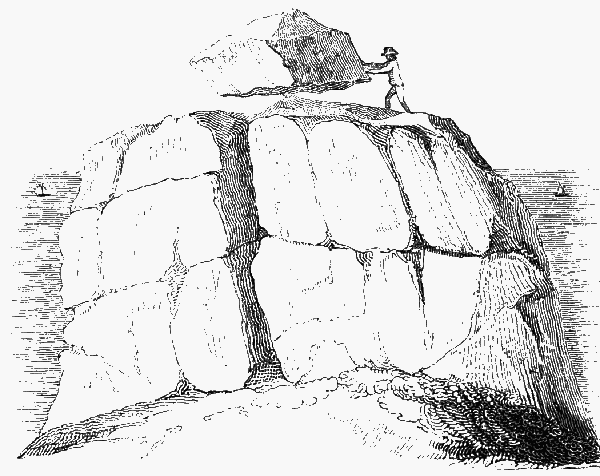
The foundation of this part of the coast is a stupendous group of
granite rocks, which rise in pyramidal clusters to a great altitude,
and overhang the sea. The celebrated logan stone here represented is
an immense block weighing above sixty tons. The surface in contact
with the under rock is of very small extent, and the whole mass is so
nicely balanced, that, notwithstanding its magnitude, the strength of
a single man applied to its under edge is sufficient to make it
oscillate. It is the nature of granite to disintegrate into rhomboidal
and tabular masses, which, by
the further operation of air and moisture, gradually lose their solid
angles, and approach the spheroidal form. The fact of the upper part
of the cliff being more exposed to atmospheric agency than the parts
beneath, will sufficiently explain why these rounded masses so
frequently rest on blocks which still preserve the tabular form; and
since such spheroidal blocks must obviously rest in that position in
which their lesser axes are perpendicular to the horizon, it is
equally evident that, whenever an adequate force is applied, they must
vibrate on their point of support.
Although we are thus led to deny the druidical origin of this stone,
for which so many zealous antiquaries have contended, still we by no
means intend to deny that the druids employed it as an engine of
superstition; it is possible that, having observed so curious a
property, they dexterously contrived to make it answer the purposes of
an ordeal, and, by regarding it as the touch-stone of truth,
acquitted or condemned the accused by its motions. Mason poetically
alludes to this supposed property in the following lines:--
“Behold yon huge
And unknown sphere of living adamant,
Which, poised by magic, rests its central weight
On yonder pointed rock; firm as it seems,
Such is its strange and virtuous property,
It moves obsequious to the gentlest touch
Of him whose heart is pure, but to a traitor,
Tho’ e’en a giant’s prowess nerved his arm,
It stands as fixed as Snowdon.”
Note 28, p.
186.--
Animal suction.
We are indebted to Sir Everard Home for a description of that peculiar
structure by which several species of animals are enabled to sustain
their bodies in opposition to the force of gravity. His first paper
upon this subject is published in the 106th volume of the
Philosophical Transactions, in which he says, he was not aware that
any animal, larger than the house-fly, was endowed by nature with such
a power, so as to admit of examination, until Sir Joseph Banks
mentioned that the lacerta gecko, a species of lizard, which is a
native of the island of Java, comes out of an evening from the roofs
of the houses, and walks down the smooth, hard, and polished chinam
walls, in search of the flies which settle upon them, and which are
its natural
food, and then runs up again to the roof of the house. Sir Joseph, while at
Batavia, amused himself with catching this animal, by standing close
to the wall, at some distance from the lizard, with a long flattened
pole, which being made suddenly to scrape the surface of the wall,
knocked the animal down. He presented Sir Everard with a specimen
weighing five ounces and three quarters, avoirdupois, which enabled
him to ascertain the peculiar mechanism by which the feet of this
animal can keep their hold of a smooth, hard, perpendicular wall, and
carry up so large a weight as that of its body.
The foot has five toes, at the end of each of which, except that of
the thumb, is a very sharp and much curved claw; on the under surface
of each toe are sixteen transverse slits, leading to so many cavities
or pockets, the depth of which is nearly equal to the length of the
slit that forms the orifice; they all open forward, and the external
edge of each opening is serrated, like the teeth of a small-toothed
comb. The cavities, or pockets, are lined with a cuticle, and the
serrated edges are also covered with it. The structure just described
is supplied with various muscles, whose action is to draw down the
claw, open the orifices of the pockets, and turn down the serrated
edges upon the surface on which the animal stands. Upon examining
attentively the under surface of the toes, when the pockets are
closed, Sir Everard Home was struck with their resemblance to the
surfaces of that portion of the Echineis remora, or sucking fish, by
which it attaches itself to the shark, or to the bottom of ships; and
it consequently suggested the probability of obtaining, from an
examination of this latter apparatus, much useful information which
might be applicable to the subject of the lizard, more especially as
the parts of which it is composed are so much larger, and therefore
more within the reach of anatomical examination.
The surface on the top of the head of this fish, fitted for adhesion,
is of an oval form, and bears a considerable proportion to the size of
the whole animal; it is surrounded by a broad, loose, movable edge,
capable of applying itself closely to the surface on which it is
placed; and it is evident that when the external edge is so applied,
and the cartilaginous plates are raised up, the interstices must
become so many vacua, and the serrated edge of each
plate will keep a sufficient hold of the substance on which it rests to
retain it in that position, assisted by the pressure of the
surrounding water, without a continuance of muscular exertion. It thus
appears that the adhesion of the sucking fish is produced by so many
vacua being formed through an apparatus worked by the voluntary
muscles of the animal, and the pressure of the surrounding water.
From the similarity of the mechanism of the under surface of the toes
of the lacerta gecko, there can be no doubt that the purpose to
which it is applied is the same: but as in the one case the adhesion
is to take place under water, and is to continue for longer periods,
the means are more simple; in the other, where the mechanism is to be
employed in air, under greater disadvantages with respect to gravity,
and is to last for very short periods, and then immediately afterwards
to be renewed, a more delicate structure of parts, a greater
proportional depth of cavities, and more complex muscular structure,
become necessary.
Having ascertained the principle on which an animal of so large a size
as the lacerta gecko is enabled to support itself in its progressive
motion against gravity, Sir E. Home felt himself more competent to
inquire into the mechanism by which the common fly is enabled, with so
much facility, to support itself in still more disadvantageous
situations. In the natural size the feet of the fly are so small, that
nothing can be determined respecting them; Keller was the first person
who made a drawing of the fly’s foot in a highly magnified state, in
which the concave surfaces are visible, and which, no doubt, like
those of the lizard above described, are employed to form vacua, which
enable the fly to move under such disadvantageous circumstances. Mr.
Bauer, who has so greatly distinguished himself in microscopic
researches, was judiciously enlisted into the service of Sir E. Home
upon this occasion; and he has shown that this principle, on which
progressive motion against gravity depends, is very extensively
employed by nature in the structure of the feet of insects; and Sir
Everard observes, that, now this structure is known, it can be readily
demonstrated by looking at the movement of the feet of any insect upon
the inside of a glass tumbler, through a common magnifying glass; the
different suckers are readily seen separately to be pulled off from
the surface of the glass, and reapplied to another part.
In consequence of the expedition to the polar regions, Sir E. Home was
enabled to obtain and examine the foot of the walrus, in which he
detected a resemblance in structure to that of the fly; and it is not
a little curious that two animals so different in size should have
feet so similar in their use. In the fly the parts require to be
magnified one hundred times to render the structure distinctly
visible; and in the walrus the parts are so large, as to require being
reduced four diameters, to bring them within the size of a quarto
page.
Nor is progressive motion, the only function in which Nature avails
herself of the pressure of the atmosphere for the accomplishment of
her purposes. The act of feeding is continually effected in this
manner. The operation of sucking is too familiar to require comment.
It may not, perhaps, be so generally known, that it is by the very
same process that bees reach the fine dust and juices of hollow
flowers, like the honeysuckle, and some species of foxglove, which are
too narrow to admit them. They fill up the mouth of the flower with
their bodies, and suck out the air, or at least a large portion of it,
by which the soft sides of the flower are made to collapse, and the
juice and dust are squeezed towards the insect, as completely as if
the hand had pressed it externally. It is by a similar process that
the oyster is enabled to close its shell so firmly; for, if a hole be
bored in it, it may be opened without the least difficulty.
Note 29, p.
191.--
Accidental discoveries.
Those who are not acquainted with the operations by which the mind is
enabled to arrive at truth, are too apt to attribute to accident that
which is the result of great intellectual labour and acuteness.
Observation, analogy, and experiment are the three great
stepping-stones by which the philosopher is enabled to ascend from
darkness to light: it is true that his foot may accidentally be placed
upon the first, but his own efforts are required to complete the
ascent. To the mass of mankind the preliminary step is obvious, and
they at once conclude that the succeeding ones are equally easy and
simple. In this view of the subject, it was by accident that Sir Isaac
Newton discovered the laws of gravitation, for his mind was directed
to the investigation by the accidental fall of an apple from its
tree;
it was by accident that Galileo discovered the isochronous movement of the
pendulum, for it was suggested by the vibration of a chandelier: but
how many persons might have witnessed the fall of an apple, or the
vibration of a chandelier, without arriving at similar truths? It has
been said that we are indebted for the important invention in the
steam-engine, termed hand gear, by which its valves or cocks are
worked by the machine itself, to an idle boy of the name of Humphrey
Potter, who, being employed to stop and open a valve, saw that he
could save himself the trouble of attending and watching it, by fixing
a plug upon a part of the machine which came to the place at the
proper times, in consequence of the general movement. If this anecdote
be true, what does it prove? That Humphrey Potter might be very idle,
but that he was, at the same time, very ingenious. It was a
contrivance, not the result of accident, but of acute observation and
successful experiment. Glass is said to have been discovered by
persons having accidentally kindled a fire on the sandy shore with
sea-weed, when the alkali from the ashes united with the silex of the
sand; and Pliny tells us that minium, or red lead, was first
recognised, in consequence of a fire that took place at the Piræus at
Athens, where some ceruse, which had been exposed to the fire, had
been found converted into a red substance. A thousand such accidents
might be related, were we not affording a sample rather than a
catalogue. We are endeavouring to combat a popular but mischievous
error; and we are happy at finding the same feeling expressed in a
work which, from its extensive circulation, must prove highly useful
in correcting it. “Very few discoveries,” says the author, “have been
made by chance and by ignorant persons; much fewer than is generally
supposed. They are generally made by persons of competent knowledge,
and who are in search of them. The improvement of the steam-engine by
Watt resulted from the most learned investigation of mathematical,
mechanical, and chemical truths. Arkwright devoted many years, five at
least, to his invention of spinning-jennies. The new process of
refining sugar, by which more money has been made in a shorter time,
and with less risk and trouble, than was perhaps ever gained by an
invention, was discovered by Mr. Howard, a most accomplished chemist,
and it was the fruit of a long course of experiments, in the progress
of which, known philosophical principles were constantly applied, and one
or two new principles ascertained.”--Library of Useful Knowledge.
Note 30, p.
193.--
Weight of the superincumbent ocean.
If we include the pressure of the atmosphere, a body at the depth of
100 feet would sustain that of 60 pounds on the square inch; while one
at 4,000 feet, a depth by no means considerable, it would be exposed
to a pressure of about 1,830 pounds. We need not, therefore, feel
surprised, that on the foundering of a ship at sea, though its timbers
part, not a spar floats to the surface; for if the hull has sunk to a
great depth, all that is porous is penetrated with water or greatly
compressed. Captain Scoresby states that when, by the entangling of
the line of the harpoon, a boat was carried down with the whale, it
required after it was recovered two boats to keep it at the surface.
Sir J. Herschel has recorded a melancholy anecdote, which may well be
adduced in farther illustration of our subject:--“After the invention
of the diving-bell, and its success in sub-aqueous processes, it was
considered highly desirable to devise some means of remaining for any
length of time under water, and rising at pleasure without any
assistance. Some years ago an ingenious individual proposed a project
by which this end was to be accomplished. It consisted in sinking the
hull of a ship made quite water-tight, with the decks and sides
strongly supported by shores, and the only entry secured by a stout
trap-door, in such a manner, that by disengaging from within the
weights employed to sink it, it might rise of itself to the surface.
To render the trial more satisfactory, the projector himself made the
first essay. It was agreed that he should sink in twenty fathoms
water, and rise again without assistance at the expiration of
twenty-four hours. Accordingly, making all secure, and provided with
the means of making signals to indicate his situation, this unhappy
victim of his own ingenuity entered and was sunk. No signal was made,
and the time appointed elapsed. The pressure of the water at so great
a depth had, no doubt, been completely under-estimated, and the sides
of the vessel being at once crushed in, the unfortunate projector
perished, before he could even make the signal concerted to indicate
his distress.”
Hence pecunia from pecus. Opes quasi Oves. See Note 6.
Note 32, p.
207.--
The cause of iridescence.
If a soap-bubble be blown up, and set under a glass, so that the
motion of the air may not affect it, as the water glides down the
sides and the top grows thinner, several colours will successively
appear at the top, and spread themselves from thence in rings down the
sides of the bubble, till they vanish in the same order in which they
appeared; at last a black spot appears at the top, and spreads till
the bubble bursts. Hence it follows that the colours of a body depend
in some degree upon the thickness and density of the particles that
compose it; and that, if the density be changed, the colour will
likewise be changed. That the production of colours depends upon the
nature of the surfaces upon which light falls, is beautifully
exemplified by the iridescence of mother of pearl; and which has been
satisfactorily shown to depend upon a singular peculiarity in the
structure of that substance. On its surface, which to the unassisted
eye, and even to the touch, appears to be finely polished, there are
innumerable little lines, or grooves, in some places as many as two
or three thousand in the space of an inch, which, lying parallel,
regularly follow each other in all their windings; by the edges of
which the rays of light are reflected, and the continual change of
colour arises from their continual bendings. Whatever doubts might
have existed upon the subject, some late experiments of Dr. Brewster
have dissipated them, by showing that the colours which play so
beautifully on the surface of mother of pearl, may be communicated by
pressure to sealing-wax and several other substances. The discovery of
this fact was in some measure accidental; he had stuck a piece of
mother of pearl on a cement made of rosin and bees-wax, and on
separating this cement he found that it had acquired the property of
exhibiting colours. Several persons who witnessed the effect,
concluded that it arose from the presence of a thin film of the mother
of pearl, which might have scaled off and adhered to the wax: but such
an explanation was at once refuted, by plunging the wax in acid, which
must have dissolved the mother of pearl, had any
been present; but the acid had no effect, and the colours of the impression
remained unimpaired. It is clear, then, that it is the grooves, as Dr.
Brewster conjectured, which occasion the iridescence in the mother of
pearl, as well as in the waxen impression. In consequence of this
curious discovery, Mr. Barton succeeded in producing the same
appearance on glass, and on different metals, by simply cutting
grooved lines on their surface. These lines are so fine that, without
a microscope, they are scarcely visible, and the glass and the metal
appear to retain their polish: yet they and the colours also may be
communicated by an impression, like those from the mother of pearl, to
the wax. In like manner the varying and delicate hues exhibited by the
wings of certain butterflies, arise from the action of light upon the
parallel and equidistant striæ upon their surfaces.
Note 33, p.
224.--
Vegetable barometers.
The following are a few of those plants which indicate changes in the
weather:--
Chickweed is an excellent barometer. When the flower expands fully,
we are not to expect rain for several hours; should it continue in
that state, no rain will disturb the summer’s day. When it half
conceals its miniature flower, the day is generally showery; but, if
it entirely shuts up, or veils the white flower with its green mantle,
let the traveller take the hint and put on his great-coat. The
different species of trefoil always contract their leaves at the
approach of a storm; so certainly does this take place, that these
plants have acquired the name of the husbandman’s barometer.
The tulip and several of the compound yellow flowers also close before
rain. There is, besides, a species of wood-sorrel, which doubles its
leaves before storms and tempests. The bauhinia, or mountain ebony,
cassia, and sensitive plants, observe the same habit.
Note 34, p.
225.--
Saint Swithin.
The popular adage of Forty days’ rain after St. Swithin, is a
tradition which seems to have derived its origin from the following
circumstance. Swithin, or Swithum, bishop of Winchester, who died in
868, desired that he might be
buried in the open church-yard, and not in the chancel of the minster, as was
usual with other bishops; and his request was complied with; but the
monks, on his being canonized, considering it disgraceful for the
saint to lie in a public cemetery, resolved to remove the body into
the choir, which was to have been done with solemn procession on the
15th of July. It rained, however, so violently for forty days together
at this season, that the design was abandoned. “Now, without entering
into the case of the bishop,” says Mr. Howard, in his work on the
Climate of London, “who was probably a man of sense, and wished to set
the example of a more wholesome, as well as a more humble, mode of
resigning the perishable clay to the destructive elements, I may
observe, that the fact of the hindrance of the ceremony by the cause
related is sufficiently authenticated by tradition; and the tradition
is so far valuable, as it proves that the summers in this southern
part of our island, were subject, a thousand years ago, to occasional
heavy rains, in the same way as at present.” Mr. Howard has shown, by
a table, that the notion commonly entertained on this subject, if put
strictly to the test of experience, at any one station, in this part
of the island, will be found fallacious; he, however, very justly
observes, that “the opinion of the people on subjects connected with
Natural History is commonly founded, in some degree, on fact or
experience;” and to do justice to the popular observation in question,
he states that, “in a majority of our summers, a showery period,
which, with some latitude as to time and local circumstances, may be
admitted to constitute daily rain for forty days, does come on about
the time indicated by this tradition; not that any long space before
is often so dry as to mark distinctly its commencement.”
Note 35, p.
230.--
The whale.
Did the whale know his own power, he would easily destroy all the
machinery which the art of man could devise for catching him; it would
be only necessary for him to swim on the surface in a straight line in
order to break the thickest rope; but the fish, on being struck by the
harpoon, obeys a natural instinct, which, in this instance, betrays
him to his death. Sir H. Davy, in his Salmonia, observes, that the
whale, not having an air-bladder, can
sink to the lowest depths of the ocean, and mistaking the harpoon for the
teeth of a sword-fish, or a shark, he instantly descends, this being
his manner of freeing himself from these enemies, who cannot bear the
pressure of a deep ocean; and from ascending and descending in small
space, he thus puts himself in the power of the whaler.--See Note 30.
Note 36, p.
235.--
Progressive motion in fishes:boats impelled by paddling, rowing, &c.
To render the subject to which this note refers farther intelligible,
we may show the means by which a fish moves forward in the water. The
accompanying diagram and demonstration are from Dr. Roget’s
Bridgewater Treatise.
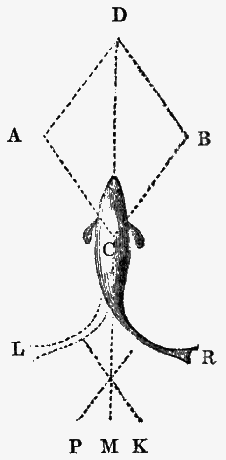
The tail is the principal instrument by which the progressive motion
is effected. Thus--suppose that the tail is inclined to the right; if,
in this situation, the muscles of the left side, tending to bring the
tail in a right line with the body, are suddenly thrown into action,
the resistance of the water, by reacting against the broad surface of
the tail in the direction P R, perpendicularly to that surface, will
cause the muscular action to give the whole body an impulse in that
direction; and the centre of gravity, C, will move onwards in the
direction C B, parallel to P R. This impulse is not destroyed by the
farther flexion of the tail towards the left side, because the
principal force exerted by the muscles has already been expended in
the motion from R to M, in bringing it to a straight line with the
body; and the force which carries it on to L is much weaker, and
therefore occasions a more feeble reaction. When the tail has arrived
at the position L, indicated by the dotted outline, a similar action
of the muscles on the right side will create a resistance and an
impulse in the direction of K L, and a motion of the whole body in the
same direction, C A. These impulses being repeated in quick
succession, the fish moves forward in the diagonal C D, intermediate
between the direction of the two forces.
Upon the same principle a boat is impelled by paddling; and the action
of the rudder of a ship in turning the vessel will be readily
understood. In this latter case, however, there is an additional
mechanical advantage; since the point round which the vessel turns, is
beyond the middle and towards the prow, and hence the force applied at
the extremity of the keel acts as by an arm of a lever.
Note 37, p.
236.--
Flight of birds.
In appreciating the mechanical means by which a bird is enabled to
direct its course, we must not omit to take into account the power it
possesses of changing the position of the centre of gravity of its
body, so that the reaction of the air may be modified with regard to
each wing.
Note 38, p.
236.--
Flight of insects.
The command possessed by insects in directing and changing their
course, seems more perfect even than that of birds. Many of them
travel on their wings to immense distances, and, considering their
comparative size, they generally move through the air with greater
velocity than that of birds. Bees have been known to fly great
distances from their hive, in search of food; and the silk-worm moth
has travelled more than a hundred miles in a very short space of time.
Many of our readers have, no doubt, noticed with surprise the apparent
facility with which gnats have accompanied them, although they may
have been advancing on horseback at a full gallop; and the author
during the last summer has been forcibly struck with the manner in
which flies and other insects have kept up with a railway carriage,
alternately flying in and out of the vehicles, as though they had been
at perfect rest. Some species possess a remarkable power of poising
themselves in the air, and hovering for a length of time over the same
spot, without falling or rising, advancing or retreating; the
Dragon-fly affords a striking example of this fact.
Note 39, p.
237.--
Obliquity of the wings of birds.
In consequence of the manner in which the wings are affixed to the
scapula, they give a stroke to the air in a direction both downwards
and backwards; so that while the former supports the bird, the latter
impels it forward. It is curious
to notice that the degree of this obliquity varies in different birds,
and is evidently adapted to their habits: thus, for instance, birds of
prey have a great obliquity of wing, which better enables them to
pursue their victims in a horizontal course; while those birds which
soar to a considerable elevation, in a nearly vertical direction, as
the Lark, have scarcely any obliquity of wing, but strike directly
downwards.
Note 40, p.
238.--
A mechanical proposition.
This fact may be demonstrated by converting the triangle into a
parallelogram, of which one of the sides of the triangle will become
its diagonal: the other two sides will, of course, represent two
forces equivalent to such diagonal, which, acting in opposition to it,
must produce a balance.
Note 41, p.
241.--
Kite messengers.
The curious experiments of Mr. Faraday upon the optical effects
produced by the revolutions of different wheels, might be exhibited by
arrangements adjusted as messengers.
Note 42, p.
246.--
Winds and storms.
The sea and land breezes which occur in the islands of the torrid
zone, very strikingly illustrate the position laid down in the text,
and afford a good explanation of the manner in which winds may be
occasioned by a change of temperature in the air. In these, during the
hottest part of the day, the wind sets in from all quarters, and
appears to be blowing towards the centre of the island, while in the
night it changes its direction, and blows from the centre of the land
towards the sea; for since the sun’s rays produce much more heat by
their reflection from land than they do from water, that portion of
air which is over the land will soon become heated, and will ascend; a
rarefaction and diminution of the quantity of air over the central
part of the land will be thus occasioned, which must be supplied from
the sides; but, as the land cools again during the night, that portion
of air which had been previously heaped up will begin to descend, and
by spreading and equalizing itself will produce a breeze blowing from
the centre.
The trade-winds, so called from the advantage which their certainty
affords to trading vessels, are another example of the same kind; they
are generally stated to blow from east to west over the equator, and
are occasioned by the rarefaction of the air by the sun’s heat, and
the motion of the earth from west to east. While writing the present
note, we have seen an essay upon the subject by Captain Basil Hall,
published in an appendix to Mr. Daniel’s admirable work on
Meteorology: the perusal of this paper has induced us to cancel what
we had written, and to refer the reader to the essay itself; for it is
quite impossible to do justice to the views it entertains, in the
limited space necessarily prescribed to us in this note.
On the coast of Guinea, the wind always sets in upon the land, blowing
westerly instead of easterly; this exception arises from the deserts
of Africa, which lie near the equator, and being a very sandy soil,
reflect a great degree of heat into the air above them, which being
thus rendered lighter than that which is over the sea, the wind
continually rushes in upon the land to restore the equilibrium.
Among the irregular winds, or those which are not constant, but
accidental, may be noticed the whirlwind, the harmattan, and the
sirocco. The first of these is occasioned by the meeting of two or
more currents of wind from opposite directions, and which can only be
occasioned by some temporary but violent disturbance of equilibrium.
The harmattan is met with on the western coast of Africa, and is
generally attended by great heat and fog; it appears to be occasioned
by a conflict between the heated sands of Africa, and the regular
direction of the trade-winds over that continent, and, by disturbing
their progress, it is frequently the forerunner of a hurricane in the
West Indies. The sirocco occurs in Egypt, the Mediterranean, and in
Greece, and is chiefly characterised by its unhealthy qualities. The
air, by passing over the heated sands of Egypt, becomes so dried and
rarefied as to be scarcely fit for respiration, and, being thus
prepared, it absorbs so much humidity on passing the Mediterranean as
to form a suffocating and oppressive kind of fog.
Mr. Daniel observes, that the currents of a heated room, in some
measure, exemplify the great currents of the atmosphere. If the door
be opened, the flame of a candle held to the upper part will show, by
its inclination, a current
flowing outwards; but, if held near the floor, it will be directed inwards. If
the door be closed suddenly from without, it moves with the in-coming
current, and against the out-going, and a condensation of air takes
place in the room; which is proved by the rattling of the windows, and
the bursting open of any door in the room, if slightly closed. If the
door close from within, it moves against the in-coming current, and
with the out-going, and a rarefaction of the air in the room takes
place; which is evidenced by the rattling of the windows, and the
bursting open of another door in the contrary direction.
Meteorology has been long considered the least perfect branch of
natural knowledge; so apparently capricious and irregular are its
phenomena, that philosophers had almost abandoned the idea of bringing
them under the operation of any general laws. Brighter lights are,
however, now dawning upon us. Mr. Whewell, in his Bridgewater
Treatise, has explained the manner in which the various currents of
the atmosphere maintain a necessary balance in the distribution of
heat and moisture around the globe, and has thus reduced to order and
design phenomena which have hitherto been regarded as unconnected and
fortuitous. Lieut.-Col. Reid, by his late happy investigation of the
law of storms, will, no doubt, lead us into a novel path of the most
important discoveries. He has satisfactorily proved, by a mass of
evidence derived from numerous logbooks, that storms obey fixed laws.
His attention was ardently directed to the subject by having been at
Barbadoes immediately after the great hurricane of 1831, which in the
short space of seven hours killed upwards of 1400 persons on that
island alone. The discoveries of Col. Reid may be thus briefly
stated.--That hurricanes are whirlwinds of great diameter, always
revolving according to an invariable law, viz. from right to left
(supposing yourself standing in the centre), or in the opposite way to
the hands of a watch, in the northern hemisphere, and in a contrary
direction in southern latitudes; at the same time they have a
progressive motion in a curved line, and as they advance their
diameters appear to enlarge and their violence to diminish; it has
been also found that in the centre of the vortex there is a lull, or
calm. Col. Reid observes that the simplest mode of illustrating the
subject is to cut out concentric circles, so as to represent
progressive whirlwinds, by moving which
over any tract, the veering of the wind will be easily understood. The
reader may form a more familiar idea by causing the water to circulate
in a basin, which will represent the violent circular motion of the
storm-wind, with a calm in the centre of the vortex. Suppose this to
be also moving onward at a rate of about seven miles an hour, and he
will have a correct notion of the subject. Since the storms expand in
size and diminish in force as they proceed towards the poles, and the
meridians at the same time approach each other, gales become huddled
together; and hence, apparently, the true cause of the very
complicated nature of the winds in our latitude. Observations would
also appear to render it probable that there exists an accordance of
the force of storms with the law of magnetic intensity; for example,
it is at its minimum at St. Helena, where storms never occur; on the
contrary, the lines of greatest intensity seem to correspond with the
latitudes of typhoons and hurricanes. To what important discoveries
may not the pursuit of this enquiry lead us?
The practical importance of the foregoing facts must be obvious: to
use the expression of Sir John Herschel, “they will teach seamen how
to steer their ships, and save thousands of lives.” They will thus
learn on which side to lay-to a ship in a storm, for, by watching the
veering of the wind, they will ascertain the direction in which it is
falling; if violent, and the changes sudden, the ship will probably be
near the centre of the vortex; whereas, if the wind blows a great
length of time from the same point, and the changes are gradual, it
may reasonably be supposed the ship is near the extremity of it. The
barometer also becomes a very important instrument upon these
occasions; the rapid rotatory motion of a column of the atmosphere
necessarily occasions its fall, and this fall is always greatest at
the centre of the storm. When it begins to rise, the centre has
passed, and when the wind has sufficiently abated to enable a ship to
make sail, she may then bear away with safety; but near the middle of
the hurricane, before the barometer begins to rise, all square-sails
must be dangerous.
Note 43, p.
250.--
Ancient archery.
We are reminded, upon this occasion, of part of a stanza in the
well-known ballad of Chevy Chace, where
an English archer aimed his arrow at Sir Hugh Montgomery:--
“The grey goose wing that was thereon,
In his hearte’s blood was wett.”
The more ancient ballad, however, reads swane-feathers. In the
“Geste of Robyn Hode,” among Mr. Garrick’s old plays, in the Museum,
the arrows of the outlaw and his companions are particularly
described:--
“With them they had an hundred bowes,
The strings were well ydight;
An hundred shefe of arrows good,
With hedes burnish’d full bryght;
And every arrowe an ell longe,
With peacocke well ydight,
And rocked they were with white silk,
It was a semely sight.”
And Chaucer, in the description of the squyer’s yeoman, says:--
“And he was clad in cote and hode of greene;
A sheafe of peacocke arrows bryght and shene,
Under his belt he bare full thriftely,
Well coude he dresse his tackle yemanly:
His arrowes drouped not with fethers lowe,
And in his hand he bare a mighty bowe.”
Prol. to Cant. Tales.
In order to show the dandyism displayed by the archers of former
times, it may be stated, that, in the wardrobe accounts of the 28 Edw.
I. p. 359, is a charge for verdigrise to stain the feathers of the
arrows green. A wardrobe account of the 4 Edw. II. furnishes an entry
for peacock arrows, “Pro duodecim flecchiis cum pennis de pavone,
emptis pro rege de 12 den.”
As this note has some connexion with the shuttlecock,[84] as well as
the arrow, we may take this opportunity of introducing a passage,
which was accidentally omitted in the text; it refers to the method of
playing this game at Turon, in Cochin China; and which is described by
a traveller
as follows:--“Instead of using a battledoor,[85] as is the custom in
England, the players stood seven or eight in a circle; and after
running a short race, and springing from the floor, they met the
descending shuttlecock with the sole of the foot, and drove it up
again with force high in the air. The game was kept up with much
animation, and seldom did the players miss their stroke, or give it a
wrong direction. The shuttlecock was made of a piece of dried skin
rolled round, and bound with strings. Into this skin were inserted
three feathers, spreading out at top, but so near to each other, where
they were stuck into the skin, as to pass through the holes, little
more than a quarter of an inch square, which were always made in the
centre of Cochin copper coins. We made one or two awkward attempts at
the game, not only to our own confusion, but much to the amusement of
the natives. It must, however, be remembered, that, amongst these
ingenious people, the feet assist, as auxiliaries to the hands, in the
exercise of many trades, particularly that of boat-building.”
Note 44, p.
270.--
Sound conveyed by solid bodies.
A beautiful experiment was lately instituted at Paris, to illustrate
this fact, by Biot. At the extremity of a cylindrical tube, upwards of
3000 feet in length, a ring of metal was placed, of the same diameter
as the aperture of the tube; and in the centre of this ring, in the
mouth of the tube, was suspended a clock-bell and hammer. The hammer
was made to strike the ring and the bell at the same instant, so that
the sound of the ring would be transmitted to the remote end of the
tube through the conducting power of the matter of the tube itself;
while the sound of the bell would be transmitted through the medium of
the air included within the tube. The ear being then placed at the
remote end of the tube, the sound of the ring, transmitted by the
metal of the tube, was first distinctly heard; and, after a short
interval had elapsed, the sound of the bell, transmitted by the air in
the tube, was heard. The result of several experiments was, that the
metal of the tube conducted the sound with about ten and a half times
the velocity with which it was conducted by the air; that is, at the
rate of about 11,865 feet per second.
Note 45, p.
288.--
Expressive music.
The biographer of Josquin des Prez, the celebrated musician, and
maestro di capella to Louis XII. King of France, relates an anecdote
which may be here told in connexion with the present subject. When
Josquin was first admitted into the service of the French monarch, he
had been promised a benefice by his Majesty; but this Prince, contrary
to his usual habits, for he was in general both just and liberal,
forgot the promise he had made; when Josquin, after suffering great
inconvenience from the shortness of his Majesty’s memory, ventured by
the following expedient to remind him publicly of his promise without
giving offence. He had been commanded to compose a motet for the
Chapel Royal, on which occasion he selected part of the 119th Psalm,
“Memor esto verbi tui servo tuo”--“Oh think of thy servant, as
concerning thy word,” which he set in so supplicating and exquisite a
manner, that it was universally admired, particularly by the King, who
was not only touched by the music, but felt the words so effectually,
that he soon afterwards granted his petition, by conferring on him the
promised preferment. For which act of justice and munificence,
Josquin, with equal felicity, composed as a hymn of gratitude another
part of the same Psalm,--“Bonitatem fecisti cum servo tuo,
Domine”--“Oh Lord, thou has dealt graciously with thy servant.”
Josquin, among musicians, was the giant of his time, and seems to have
arrived at universal monarchy and dominion over the affections and
passions of the musical part of mankind; indeed, his compositions were
as well known and as much practised throughout Europe at the beginning
of the sixteenth century, as those of Handel were in Europe sixty
years ago.
Note 46, p.
294.--
Imaginary forms.
The following case, quoted by Sir David Brewster, in his work on
“Natural Magic,” from the life of Peter Heaman, a Swede, who was
executed for piracy and murder at Leith in 1822, will afford a very
curious example of the influence of the imagination in creating
distinct forms out of an irregularly shaded surface. “One remarkable
thing was, one day as we mended a sail, it being a very thin one,
after laying it upon deck in folds, I took the tar-brush and tarred
it over in the places which I thought needed to be strengthened. But when
we hoisted it up, I was astonished to see that the tar I had put upon
it represented a gallows and a man under it without a head. The head
was lying beside him. He was complete, body, thighs, legs, arms, and
in every shape like a man. Now, I oftentimes made remarks upon it, and
repeated them to the others. I always said to them all, ‘You may
depend upon it that something will happen.’ I afterwards took down the
sail on a calm day, and sewed a piece of canvass over the figure to
cover it, for I could not bear to have it always before my eyes.”
The curious effect of chance resemblance was particularly remarked by
Leonardo da Vinci in the moss and stains on old stones. And, in our
own times, this faculty of the imagination has not unfrequently been
enlisted into the service of the fortune-teller for purposes of fraud
and imposition. The following story is related on credible testimony.
“A British officer, in expectation of promotion, and of being united
to a lady in marriage, sought a gipsy fortune-teller. The sorceress,
no doubt, had made herself well acquainted with these circumstances.
On entering the room, she ordered a large glass of spring-water, into
which she poured the white of a newly-laid egg. After shaking the
mixture for some time, she so far succeeded as to induce the credulous
observer to declare that he saw most distinctly the image of the ship
in which he was to hoist his flag, the church in which he was to be
married, and his bride going with him into the church.”--The Gipsies’
Advocate, by J. Crabb.
Note 47, p.
295.--
Fairy rings.
Dr. Wollaston, in a paper published in the Philosophical Transactions,
(1807, p. 133,) relates some interesting observations he made on the
progressive changes of these rings, and which satisfactorily explain
their origin. He observed, that some species of fungi were always to
be found at the exterior margin of the dark ring of grass if examined
at the proper season. The position of the fungi led him to believe,
that progressive increase from a central point was the probable mode
of formation of the ring; and he thought it likely that the soil which
had once contributed to the support of fungi, might be so exhausted as
to be rendered incapable of producing a second crop. The
defect of nutriment on one side would occasion the new roots to extend
themselves solely in the opposite direction, and would cause the
circle of fungi continually to proceed, by annual enlargement, from
the centre outwards. The luxuriance of the grass follows as a natural
consequence, as the soil of an interior circle is enriched by the
decayed roots of fungi of the succeeding year’s growth. During the
growth of fungi, they so entirely absorb all nutriment from the soil
beneath, that the herbage is often for a while destroyed, and a ring
appears bare of grass, surrounding the dark ring; but, after the fungi
have ceased to appear, the soil where they had grown becomes darker,
and the grass soon vegetates again with peculiar vigour. Dr. Wollaston
had many opportunities of remarking, that, when two circles interfere
with each other’s progress, they do not cross each other, but are
invariably obliterated between the points of contact. The exhaustion
occasioned by each obstructs the progress of the other, and both are
starved; a circumstance which affords a strong confirmation of the
above theory.
Note 48, p.
300.--
Resonance.
In order to comprehend the nature of reciprocated vibration, or
resonance, let the reader keep in his remembrance the analogy
between musical vibration, and the oscillation of the pendulum, as
explained at page 275. If he well understands the phenomena of the
latter, he will readily comprehend those of the former. Galileo
observed that a heavy pendulum might be put in motion by the least
breath of the mouth, provided the blasts were often repeated, and
made to keep time exactly with the vibrations of the pendulum: from
the same sympathetic communication of vibrations will two pendulum
clocks fixed to the same wall, or two watches lying upon the same
table, take the same rate of going, though they would not agree with
one another if placed in separate apartments. Mr. Ellicot indeed
observed that the pendulum of one clock was even able to stop that of
the other; and that the stopped pendulum, after a certain time, would
resume its vibrations, and in its turn stop the vibrations of the
other. We have here a correct explanation of the phenomena of
Resonance; for the undulations excited by a vibratory body are
themselves capable of putting in motion all bodies whose pulses are
coincident
with their own, and consequently with those of the primitive sounding body;
hence the vibrations of a string, when another, tuned in unison with
it, is made to vibrate.
Upon the same principle does the resonance, or reciprocated vibrations
of columns of air, depend. We are much indebted to Mr. Wheatstone for
our knowledge of this branch of acoustics; he has shown that, if a
tuning-fork or a bell be sounded before a tube inclosing a column of
air of the necessary length, the original sound will be augmented by
the rich resonance of that air; and that the sounds of tuning-forks,
if held before the cavity of the mouth, may be reciprocated most
intensely by adjusting the alterable volume of air contained within it
to the pitch of the instrument; by placing, for instance, the tongue,
&c. in the position for the nasal continuous sound of ng (in song),
and then altering the aperture of the lips, until the loudest sound
was obtained, he readily accomplished his object.
If two vibrating tuning-forks, differing in pitch, be held over a
closed tube, furnished with a moveable piston, either sound may be
made to predominate, by so altering the piston as to obtain the exact
column of air which will reciprocate the required sound. The same
result may be obtained by selecting two bottles (which may be tuned
with water) each corresponding to the sound of a different tuning
fork; on bringing both tuning-forks to the mouth of each bottle
alternately, that sound only will be heard, in each case, which is
reciprocated by the unisonant bottle; or, in other words, by that
bottle which contains a column of air susceptible of vibrating in
unison with the fork.
Among the Javanese instruments brought to England by the late Sir
Stamford Raffles, there is one called the gender, in which the
resonances of columns of air are employed to augment, we might almost
say to render audible, the sounds of vibrating metallic plates. Under
each of these plates is placed an upright bamboo, containing a column
of air of the proper length to reciprocate the lowest sound of such
plate. If the aperture of the bamboo be covered with pasteboard, and
its corresponding plate be struck, a number of acute sounds only
(depending on the more numerous subdivisions of the plate) will be
heard; but, on removing the pasteboard, an additional deep rich tone
is produced by the resonance of the column of air within the tube.
It is only by a knowledge of this principle that the
theory of the Guimbarde, or Jew’s harp, can be well understood.
Note 49, p.
300.--
The Jew’s harp.
The Memoires of Madame de Genlis first made known the astonishing
powers of a poor German soldier on the Jew’s harp. This musician was
in the service of Frederick the Great, and finding himself one night
on duty under the windows of the king, played the Jew’s harp with so
much skill, that Frederick, who was a great amateur of music, thought
he heard a distinct orchestra. Surprised on learning that such an
effect could be produced by a single man with two Jew’s harps, he
ordered him into his presence; the soldier refused, alleging that he
could only be relieved by his colonel; and that, if he obeyed, the
king would punish him the next day for having failed to do his duty.
Being presented the following morning to Frederick, he was heard with
admiration, and received his discharge and fifty dollars. This artist,
whose name Madame de Genlis does not mention, is called Koch; he has
not any knowledge of music, but owes his success entirely to a natural
taste. He has made his fortune by travelling about, and performing in
public and private; and is now living retired at Vienna, at the
advanced age of more than eighty years. He used two Jew’s harps at
once, in the same manner as the peasants of the Tyrol; and produced,
without doubt, the harmony of two notes struck at the same moment,
which was considered by the musically-curious as somewhat
extraordinary, when the limited powers of the instrument were
remembered. It was Koch’s custom to require that all the lights should
be extinguished, in order that the illusion produced by his playing
might be increased.
It was reserved, however, for Mr. Eulenstein to acquire a musical
reputation from the Jew’s harp. After ten years of close application
and study, this young artist has attained a perfect mastery over this
untractable instrument. In giving some account of the Jew’s harp,
considered as a medium for musical sounds, we shall only present the
result of his discoveries. This little instrument, taken singly, gives
whatever grave sound you may wish to produce, as a third, a fifth,
or an octave. If the grave tonic is not heard in the bass Jew’s
harp, it must be
attributed not to the defectiveness of the instrument, but to the
player. In examining this result, you cannot help remarking the order
and unity established by nature in harmonical bodies, which places
music in the rank of exact sciences. The Jew’s harp has three
different tones; the bass tones of the first octave bear some
resemblance to those of the flute and clarionet; those of the middle
and high to the vox humana of some organs; lastly, the harmonical
sounds are exactly like those of the harmonica. It is conceived that
this diversity of tones affords already a great variety in the
execution, which is always looked upon as being feeble and trifling,
on account of the smallness of the instrument. It was not thought
possible to derive much pleasure from any attempt which could be made
to conquer the difficulties of so limited an instrument; because, in
the extent of these octaves, there were a number of spaces which could
not be filled up by the talent of the player; besides, the most simple
modulation became impossible. Mr. Eulenstein has remedied that
inconvenience, by joining sixteen Jew’s harps, which he tunes by
placing smaller or greater quantities of sealing-wax at the extremity
of the tongue. Each harp then sounds one of the notes of the gamut,
diatonic or chromatic; and the performer can fill all the intervals,
and pass all the tones, by changing the harp. That these mutations may
not interrupt the measure, one harp must always be kept in advance, in
the same manner as a good reader advances the eye, not upon the word
which he pronounces, but upon that which follows.
Note 50, p.
316.--
Verbal telegraph.
This project has lately been revived; in a late number of the Revue
Encyclopédique there is a proposal to communicate verbal
intelligence, in a few moments, to vast distances; and this not by
symbols, as in the Telegraph, but in distinct articulate sounds
uttered by the human voice. The plan is said to have originated with
an Englishman, Mr. Dick, according to whose experiments the human
voice may be made intelligible at the distance of twenty-five or
thirty miles. It has been stated, in Note 44, that the celebrated Biot
had ascertained that sound travels more than ten times quicker when
transmitted by solid bodies, or through tubes, than when it passes
through the open air;
at the distance of more than half a mile the low voice of a man was
distinctly heard. Father Kircher relates in some of his works, that
the labourers employed in the subterranean aqueducts of Rome heard
each other at the distance of several miles. The note which follows
was published in the early edition of this work, before the subject
attracted any notice, or any railroad had been completed. It is
therefore reprinted without alteration.
Note 51, p.
316.--
Electrical telegraph.
It has often occurred to the author of these pages, during his
reveries, that the means of conveying intelligence with immense
rapidity may be hereafter invented by the Electrician.--Should a
system of railways be established throughout the country, it might
lead to some expedient by which such a desideratum could be
accomplished through the medium of electrical discharges. Upon this
subject we have accidentally fallen upon a curious notice in Arthur
Young’s Travels in France (vol. i. p. 65). “M. Lomond has made a very
curious discovery in electricity; you write two or three words on a
paper, he takes it with him into his room, and there turns a machine
inclosed in a cylindrical case, at the top of which is an electrometer
of pith balls; by means of a wire, a connexion is made with a similar
cylinder and electrometer in a distant apartment, and his wife, by
remarking the corresponding motions of the balls, writes down the
words they indicate; from which it appears that he has formed an
Alphabet of Motion. As the length of the conducting wire makes no
difference in the effect, a correspondence might be carried on at any
distance, as, for example, within or without a besieged town; or for
purposes much more interesting and useful. Whatever the uses may be,
the invention is beautiful.”
Note 52, p.
368.--
Carrier pigeons.
The carrier is a variety of the common domestic pigeon, and which,
from the superior attachment that it shows to its native place, is
employed in many countries as the most expeditious courier. The
letters are tied under its wing, it is let loose, and in a very short
space returns to the home it was brought from, with its advices. This
practice was much in vogue in the East; and at Scanderoon, till of
late
years, it was used on the arrival of a ship, to give the merchants at Aleppo
a more expeditious notice than could be done by any other means. In
our own country, these aerial messengers have been employed for a very
singular purpose, having been let loose at Tyburn at the moment the
fatal cart was drawn away, to notify to distant friends the departure
of the unhappy criminal.
In the East, the use of these birds seems to have been greatly
improved, by having, if we may use the expression, relays of them
ready to spread intelligence to all parts of the country; thus it is
stated by Ariosto (canto 15), that the governor of Damiata circulated
the news of the death of Orrilo. “As soon as the commandant of Damiata
heard that Orrilo was dead, he let loose a pigeon, under whose wing he
had tied a letter. This fled to Cairo, from whence a second was
despatched to another place, as is usual; so that, in a very few
hours, all Egypt was acquainted with the death of Orrilo.”
But the simple use of them was known in very early times. Anacreon
tells us (ode ix.) that he conveyed his billet-doux to Bathyllus by a
dove.
Taurosthenes also, by means of a pigeon he had decked with purple,
sent advice to his father, who lived in the isle of Ægina, of his
victory in the olympic games, on the very day he had obtained it.[86]
And, at the siege of Modena, Hirtius without, and Brutus within the
walls, kept, by the help of pigeons, a constant correspondence;
baffling every stratagem of the besieger, Antony, to intercept their
couriers. In the times of the crusades, there are many more instances
of these birds of peace being employed in the service of war:
Joinville relates one during the crusade of Saint Louis, and Tasso
another, during the siege of Jerusalem.--Pennant’s British Zoology.
The Dutch variety is the most valuable; a pair of the best kind being
worth from five to eight pounds. It is lighter than the English
pigeon, and flies nearly as fast again. It proceeds at the rate of 60
miles an hour, and has been known to complete a journey of 800 miles,
but this; it
is presumed, is not continuous, but assisted by occasional rest. The
bird learns but one lesson; it may carry from Antwerp to London, or to
any other place, but it will only pass between two such places. It
evidently travels by sight; when tossed, it circles, then rises in a
spiral, observes its route and darts off. It will not fly at night;
and, should the day be foggy, it is delayed, and sometimes lost.
Note 53, p.
371.--
Origin of popular ceremonies.
The soothsayers attributed many mystic properties to the coral; and it
was believed to be capable of giving protection against the influence
of Evil Eyes: it was even supposed that coral would drive away
devils and evil spirits; hence arose the custom of wearing amulets
composed of it around the neck, and of making crowns of it. Pliny and
Dioscorides are very loud in the praises of the medicinal properties
of this substance; and Paracelsus says that it should be worn round
the necks of infants, as an admirable preservative against fits,
sorcery, charms, and even against poison. It is a curious circumstance
that the same superstitious belief should exist among the negroes of
the West Indies, who affirm that the colour of coral is always
affected by the state of health of the wearer, it becoming paler in
disease. In Sicily it is also commonly worn as an amulet by persons of
all ranks; as a security against an evil eye, a small twisted piece,
somewhat resembling a horn, is worn at the watch-chain, under the name
of Buon Fortuna, and is occasionally pointed at those who are
supposed to entertain evil intention. His late Sicilian Majesty was
celebrated for his faith in, and frequent use of, the buon
fortuna.--But to return to the coral usually suspended around the
necks of children in our own country. In addition to the supposed
virtues of the coral, it may be remarked that silver bells are usually
attached to it, which are generally regarded as mere accompaniments to
amuse the child by their jingle; but the fact is, that they have a
different origin, having been designed to frighten away evil spirits.
For the same superstitious objects were bells introduced into our
churches as a species of charm against storms and thunder, and the
assaults of Satan.
In farther illustration of the truth, that a custom has frequently
survived the tradition of its origin, it may be here observed, that
the common practice of persons who are
unable to write, making their mark or cross, is derived from our Saxon
ancestors, who affixed the sign of the cross, as a signature to a
deed, whether they could write or not. Several charters still remain,
to which kings and persons of great eminence affix “Signum Crucis
manu propriá pro ignorantiá literarum.” Hence is derived the
expression of signing instead of subscribing a paper. In like
manner, the physician of the present day continues to prefix to his
prescriptions the letter R, which is generally supposed to mean
Recipe, but which, in truth, is a relict of the astrological symbol
of Jupiter, formerly used as a species of superstitious invocation.
Note 54, p.
379.--
Invention of the game of chess.
Alphesadi, an Arabian writer, quoted by Montucla in his Histoire des
Mathematiques, expressly mentions the invention of chess as of Indian
origin, and relates the following very curious Indian
tradition:--Ardschir, King of the Persians, having invented the game
of Tric-Trac, and being exceedingly vain of it, a certain Indian,
named Sessa, the son of Daher, invented the game of chess, and
presented his chess-board and chess-men to the king of the Indies. The
sovereign was so much pleased, that he desired Sessa to name his
reward, when this man made the apparently modest request, that he
should receive as a gift so much corn as could be estimated by
beginning with one grain, and doubling as many times as there were
squares upon the chess-board, viz. 64. The king felt displeased at
having his munificence thus slighted by a request so limited and so
unworthy to be a gift from royalty; but, as Sessa remained firm,
orders were given to the chief minister that he should be satisfied:
when, however, the visir had by calculation ascertained the enormous
quantity of corn which would be required, he waited upon the king, and
with some difficulty convinced him of the fact; upon which the king
sent for Sessa,--and said to him, that he admired his powers of
calculation even more than the ingenuity of the game which he had
presented to him, and, in respect to his promise as to the corn, he
was compelled to acknowledge himself to be insolvent.
Dr. Wallis, the friend of Sir Isaac Newton, and Savilian Professor of
Oxford, found that the quantity of corn would be such as to be capable
of forming a pyramid, the measurement
of which would be nine English miles in height, and nine similar miles
for each of the four sides of the base. After this, Montucla also
states some elaborate calculations made by himself, and proves,
amongst other remarkable facts, that the quantity of corn in question
would cover 162,000 square leagues to the depth of one foot, French
measure, which would be at least three times the extent of the surface
of France as it was about the year 1796, and which he estimates at
50,000 square leagues.
Note 55, p.
388.--
An arithmetical trick.
This problem is to be found in Hutton’s Recreations, and is stated as
follows:--
“A person having in one hand an even number of shillings, and in the
other an odd, to tell in which hand he has the even number.”
“Desire the person to multiply the number in the right hand by any
even number whatever, and that in the left by any odd number; then bid
him to add together the two products, and if the whole sum be odd, the
even number of shillings will be in the right hand, and the odd number
in the left; if the sum be even, the contrary will be the case. By a
similar process, a person having in one hand a piece of gold, and in
the other a piece of silver, we can tell in which hand he holds the
gold, and in which the silver. For this purpose, some value
represented by an even number, such as 8, must be assigned to the
gold, and a value represented by an odd number, such as 3, must be
assigned to the silver; after which the operation is exactly the same
as in the preceding example.
“To conceal the artifice better, it will be sufficient to ask whether
the sum of the two products can be halved without a remainder; for, in
that case, the total will be even, and in the contrary case odd.
“It will be readily seen that the pieces, instead of being in the two
hands of the same person, may be supposed to be in the hands of two
persons, one of whom has the even number, or piece of gold, and the
other the odd number, or piece of silver. The same operations may then
be performed in regard to these two persons, as are performed in
regard to the two hands of the same person, calling the one,
privately, the right, and the other the left.”
Note 56, p.
389.--
An algebraic problem.
It is by discovering the number of counters left on the board that
this trick is performed. By means of a table the problem may be
immediately solved; but as such a reference would be inconvenient,
and, indeed, destructive to the magic of the trick, a Latin verse is
substituted, which may be easily carried in the memory, and will be
found to answer all the purposes of a table. In order, however, that
the reader may become thoroughly acquainted with the machinery of the
trick, we shall explain it in the words of its author. The problem is
stated as follows: “Three things being privately distributed to three
persons, to guess that which each has got.”
Let the three things be a ring, a shilling, and a glove. Call the ring
A, the shilling E, and the glove I; and in your own mind distinguish
the persons by calling them first, second, and third. Then take
twenty-four counters, and give one of them to the first person, two to
the second, and three to the third. Place the remaining eighteen on
the table, and then retire, that the three persons may distribute
among themselves the three things proposed without your observing
them. When the distribution has been made, desire the person who has
the ring to take from the remaining eighteen counters as many as he
has already; the one who has the shilling to take twice as many as he
has already, and the person who has the glove to take four times as
many; according to the above supposition then, the first person has
taken one, the second four, and the third twelve; consequently, one
counter only remains on the table. When this is done, you may return,
and, by the number left, can discover what thing each person has
taken, by employing the following words:----
| 1 |
2 |
3 |
5 |
6 |
7 |
| Salve |
certa |
animæ |
semita |
vita |
quies. |
To make use of these words, you must recollect, that in all cases
there can remain only 1, 2, 3, 5, 6, or 7 counters, and never 4. It
must likewise be observed, that each syllable contains one of the
vowels, which we have made to represent the things proposed, and that
the first syllable of each word must be considered as representing the
first person, and the second syllable the second. This being
comprehended, if there remains only one counter, you must
employ the first word, or rather the two first syllables, sal-ve, the first
of which, that containing A, shows that the first person has the ring
represented by A; and the second syllable, that containing E, shows
that the second person has the shilling represented by E; from which
you may easily conclude that the third person has the glove. If two
counters should remain, you must take the second word cer-ta, the
first syllable of which, containing E, will show that the first person
has the shilling represented by E; and the second syllable, containing
A, will indicate that the second person has the ring represented by A.
In general, whatever number of counters remain, that word of the verse
which is pointed out by the same number must be employed.
Instead of the above Latin verse, the following French one might be
used:--
| 1 |
2 |
3 |
5 |
6 |
7 |
| Par fer |
César |
jadis |
devint |
si grand |
prince. |
In using the above line, it must be considered as consisting only of
six words.
This problem might be proposed in a manner somewhat different, and
might be applied to more than three persons. Those of our readers who
may be desirous of further information on the subject, must consult
Bachet in the 25th of his Problèmes plaisantes et délectables.
In order to get illustrations close to long descriptions and
discussions of them, a few long paragraphs have been divided in
two at logical places.
One obvious typographical error in punctuation was corrected.
All footnotes have been relocated at the ends of chapters.
Descriptive captions have been added by the transcribers for when the illustrations are not displayed, and are deemed by them to be in the public domain.