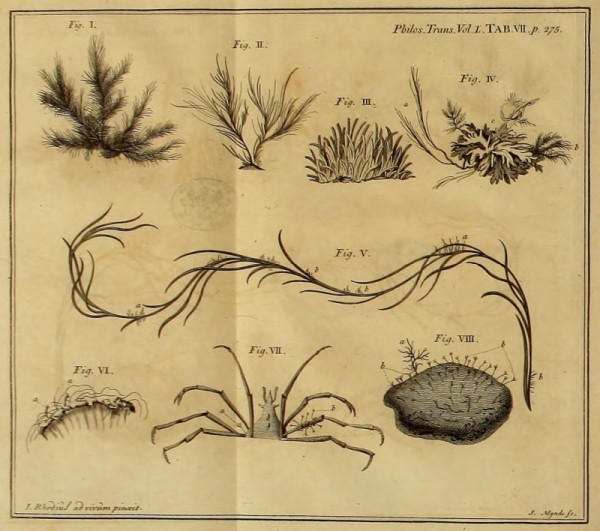
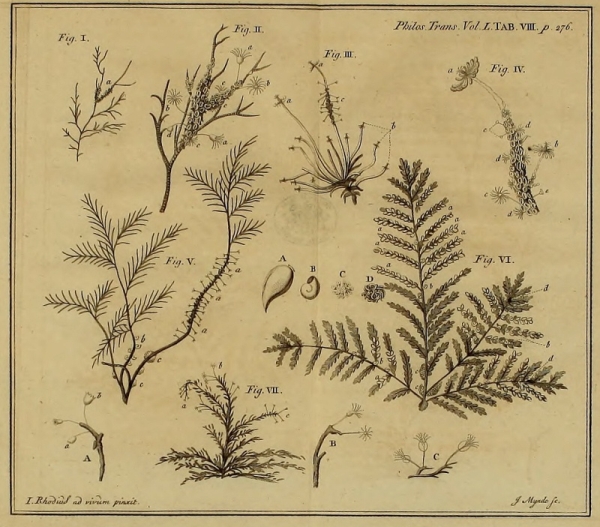
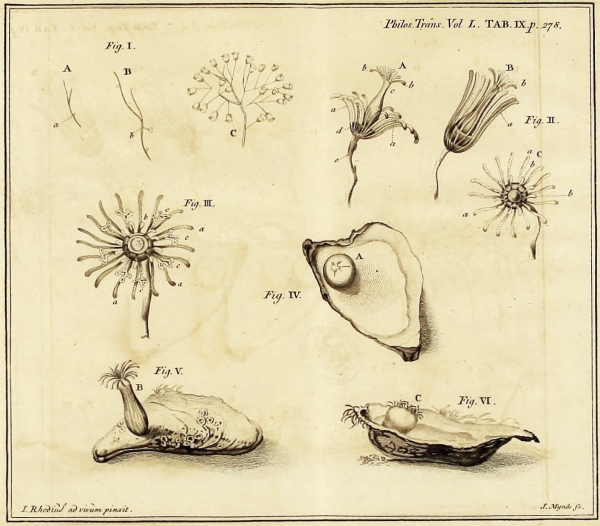
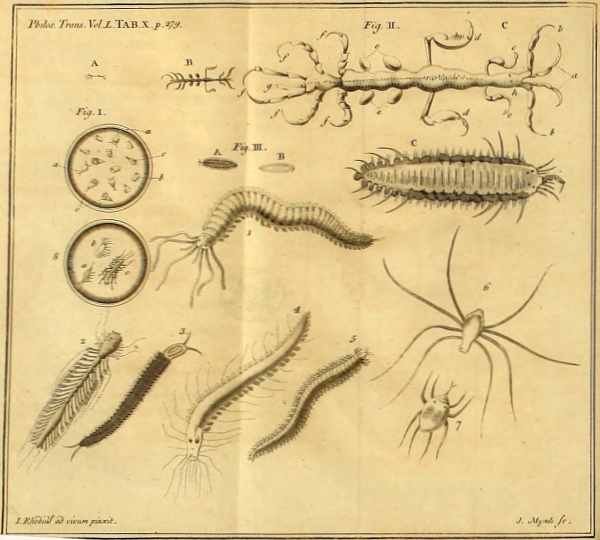
Philosophical transactions, Vol. L. Part I. For the year 1757. Giving some account of the present undertakings, studies, and labours, of the ingenious, in many considerable parts of the world.
Whole book · 61 sections
Transcriber's Note — PHILOSOPHICAL TRANSACTIONS, GIVING SOME ACCOUNT OF THE Present Undertakings, Studies, and Labours, OF THE INGENIOUS, IN MANY Considerable Parts of the WORLD.
Variable spelling and hyphenation have been retained. Minor punctuation inconsistencies have been silently repaired.
The Errata of the original edition have been corrected.
Other
changes made can be found at the end of the book.
PHILOSOPHICAL TRANSACTIONS,
GIVING SOME ACCOUNT OF THE
Present Undertakings, Studies, and Labours,
OF THE INGENIOUS,
IN MANY Considerable Parts of the WORLD.
VOL. L. Part I. For the Year 1757.
LONDON.
Printed for L. Davis and C. Reymers,
Printers to the Royal Society,
against Gray's-Inn Gate, in Holbourn.
M.DCC.LVIII.
THE CONTENTS TO Part I. Volume L.
I.
AN Account of the Earthquake felt in New England, and
the neighbouring Parts of America, on the 18th of November
1755. In a Letter to Tho. Birch, D.D. Secret. R.S. by Mr.
Professor Winthrop, of Cambridge in New England.
The strange Effects of some effervescent Mixtures; in a Letter
from Dr. James Mounsey, Physician of the Russian Army,
and F.R.S. to Mr. Henry Baker, F.R.S. Communicated by Mr. Baker.
Extract of a Letter of J. Wall, M.D. to the Rev.
Dr. Lyttelton, Dean of Exeter, and F.R.S. concerning the
good Effects of Malverne Waters in Worcestershire.
An Account of the Carlsbad Mineral Waters in
Bohemia: In a Letter to the Right Honourable the Earl of
Macclesfield, President of the R.S. by the Rev. Jeremiah
Milles, D.D. F.R.S.
An Instance of the Gut Ileum, cut thro' by a Knife,
successfully treated by Mr. Peter Travers, Surgeon, at
Lisbon. Communicated by John Huxham, M.D. F.R.S.
An Account of a Visitation of the leprous Persons in the
Isle of Guadaloupe: In a Letter to Mons. Damonville,
Counsellor and Assistant-Judge at Martinico, and in the
Office of King's Physician at Guadaloupe. By John Andrew
Peyssonel, M.D. F.R.S. Translated from the French.
An Account of the late Discoveries of Antiquities at
Herculaneum; in an Extract of a Letter from Camillo Paderni,
Keeper of the Herculanean Museum, and F.R.S. to Thomas
Hollis, Esq; dated Naples, Dec. 16, 1756.
An Account of some Trees discovered underground on the Shore
at Mount's-Bay in Cornwall: In a Letter from the Rev.
Mr. William Borlase, F.R.S. to the Rev. Dr. Lyttelton,
Dean of Exeter.
A brief Botanical and Medical History of the Solanum
Lethale, Bella-donna, or Deadly Nightshade, by Mr.
Richard Pulteney. Communicated by Mr. William Watson,
F.R.S.
An Account of the Effects of a Storm of Thunder and Lightning,
in the Parishes of Looe and Lanreath, in the County
of Cornwall, on the 27th Day of June 1756. Communicated
to the Rev. Jeremiah Milles, D.D. F.R.S. in two Letters, one
from the Rev. Mr. Dyer, Minister of Looe, and the
other from the Rev. Mr. Milles, Vicar of Duloe, in
Cornwall.
An Account of the Peat-pit near Newbury in
Berkshire; in an Extract of a Letter from John Collet, M.D.
to the Right Reverend Richard Lord Bishop of Ossory,
F.R.S.
An Account of the Alterations making in the Pantheon
at Rome: In an Extract of a Letter from Rome to
Thomas Hollis, Esq; Communicated by John Ward, LL.D. R.S.
Vice-Præs.
An Account of a new medicinal Well, lately discovered
near Moffat, in Annandale, in the County of
Dumfries. By Mr. John Walker, of Borgue-house
near Kirkudbright in Scotland.
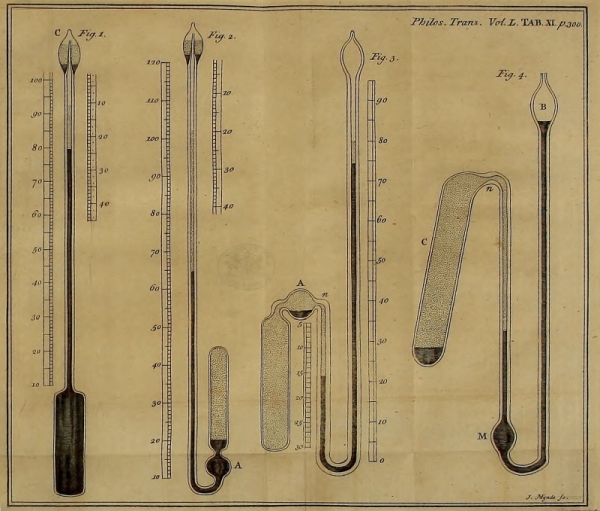
An Account of the State of the Thermometer at the Hague
on the 9th of January 1757. Extracted from a Letter of
Mr. Abraham Trembley, F.R.S. to Tho. Birch, D.D. Secret.
R.S.
An Account of the Temple of Serapis at Pozzuoli
in the Kingdom of Naples: In a Letter to John Ward,
LL.D. and R.S. Vice-Præs. by the Rev. John Nixon, M.A.
F.R.S.
Some Remarks on a Parthian Coin with a
Greek and Parthian Legend, never before published. In a
Letter from the Rev. John Swinton, M.A. of Christ-Church,
Oxon, F.R.S. to the Rev. Tho. Birch, D.D. Secret. R.S.
An Account of the Effects of Lightning upon the Steeple and
Church of Lestwithiel, Cornwall; in a Letter to the Right
Honourable the Earl of Macclesfield, President of the R.S. By
Mr. John Smeaton, F.R.S.
An Account of the Case of the late Right Honourable
Horace Lord Walpole; being a Sequel to his own Account
published in the Philosophical Transactions, Vol. xlvii.
p. 43 and 472.
An Account of the Impressions of Plants on the Slates of
Coals: In a Letter to the Right Honorable George Earl of
Macclesfield, President of the R.S. from Mr. Emanuel Mendes da
Costa, F.R.S.
A Catalogue of the Fifty Plants from Chelsea Garden,
presented to the Royal Society by the worshipful Company of
Apothecaries, for the Year 1756, pursuant to the Direction of
Sir Hans Sloane, Baronet, Med. Reg. & Soc. nuper Præses, by
John Wilmer, M.D. clariss. Societatis Pharmaceut. Lond. Socius,
Hort. Chels. Præfect. & Prælector Botan.
Remarks on the Opinion of Henry Eeles, Esq; concerning
the Ascent of Vapour, published in the Philosoph. Transact.
Vol. xlix. Part i. p. 124. By Erasmus
Darwin, M.D. Communicated by Mr. William Watson, F.R.S.
An Account of a new-discovered Species of the Snipe or
Tringa: In a Letter to the Rev. Tho. Birch, D.D. Secret.
R.S. from Mr. Geo. Edwards, Librarian of the College of
Physicians.
Remarks on Dr. Job Baster's Observationes de
Corallinis, &c. In a Letter to the Right Hon. George Earl
of Macclesfield, President of the R.S. from Mr. John Ellis,
F.R.S.
An Account of an extrordinary Shower of black Dust, that
fell in the Island of Zetland 20th October 1755. In a
Letter from Sir Andrew Mitchell, of Westshore, Bart.
to John Pringle, M.D. F.R.S.
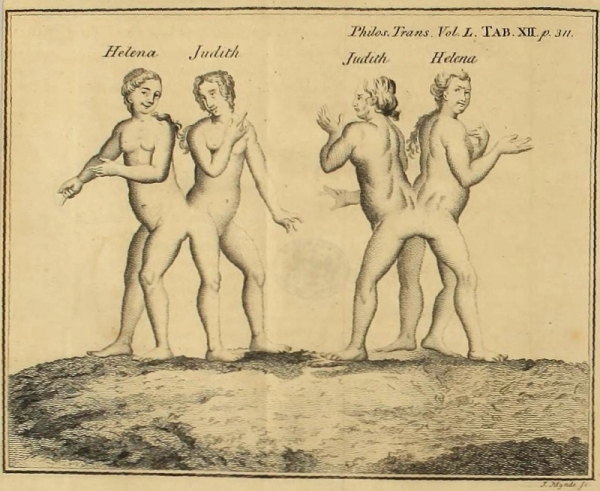
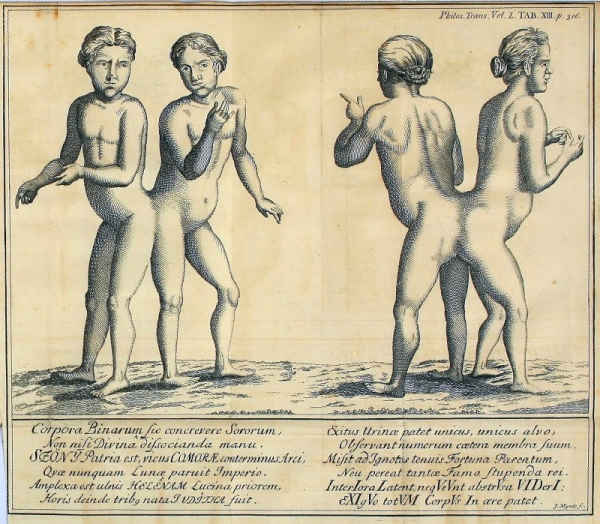
Observationes Anatomico-Medicæ de Monstro bicorporeo
Virgineo A. 1701. die 26 Oct. in Pannonia, infra
Comaromium, in Possessione Szony, quondam Quiritum
Bregetione, in lucem edito, atque A. 1723. die 23 Febr. Posonii
in Cœnobio Monialium S. Ursulæ morte functo ibidemque
sepulto. Authore Justo Johanne Torkos, M.D. Soc. Regalis
Socio.
Observations on the Origin and Use of the Lymphatic Vessels of
Animals: Being an Extract from the Gulstonian Lectures, read
in the Theatre of the College of Physicians of London, in
June 1755. By Mark Akenside, M.D. Fellow of the College of
Physicians, and of the Royal Society.
A Letter to the Right Honourable the Earl of Macclesfield,
President, the Council, and Fellows, of the Royal
Society, concerning the Variation of the Magnetic Needle; with a
Sett of Tables annexed, which exhibit the Result of upwards of Fifty
Thousand Observations, in Six periodic Reviews, from the Year 1700 to
the Year 1756, both inclusive; and are adapted to every Five Degrees
of Latitude and Longitude in the more frequented Oceans. By
William Mountaine and James Dodson, Fellows of the Royal
Society.
An Extract of the Register of the Parish of Great
Shefford, near Lamborne, in Berkshire, for Ten Years:
With Observations on the same: In a Letter to Tho. Birch, D.D.
Secret. R.S. from the Rev. Mr. Richard Foster, Rector of
Great Shefford.
A remarkable Case of an Aneurism, or Disease of the principal
Artery of the Thigh, occasioned by a Fall. To which is prefixed a
short Account of the Uncertainty of the distinguishing Symptoms of
this Disease. By Jos. Warner, F.R.S. and Surgeon to Guy's
Hospital.
Observatio Eclipsis Lunæ Die 27 Martii, Ann. 1755.
habita Ulissipone in Domo Patrum Congregationis Oratorii à Joanne
Chevalier ejusdem Congregationis Presbytero, Regiæ Londinensis
Societatis Socio, Regiæque Parisiensis Scientiarum Academiæ
correspondente.
Eclipsis Lunæ Die 4 Februarii, Ann. 1757.
habita Ulissipone à Joanne Chevalier Presbytero
Congregationis Oratorii, Regiæ Londinensis Societatis Socio,
Regiæque Scientiarum Parisiensis Acadaemiæ correspondente, et
a Theodoro de Almeida ejusdem Congregationis Presbytero, ac
Physicæ publico Professore
A remarkable Case of the Efficacy of the Bark in a
Mortification: In a Letter to William Watson, M.D. F.R.S.
from Mr. Richard Grindall, Surgeon to the London
Hospital.
A Letter to the Rev. Tho. Birch, D.D. Secret. R.S.
from John Pringle, M.D. F.R.S. inclosing Two Papers
communicated to him by Robert Whytt, M.D. F.R.S.
1. Some Observations on the lithontriptic Virtue of the
Carlsbad Waters, Lime-water, and Soap: In Letter to Dr. John
Pringle, F.R.S. from Dr. Robert Whytt, F.R.S. and Professor
of Medicine in the University of Edinburgh.
Observations on the Comet, that appeared in the Months of
September and October 1757, made at the Royal Observatory
by Ja. Bradley, D.D. Astronomer Royal, F.R.S. and Member of the
Royal Academy of Sciences at Paris.
The Resolution of a General Proposition for determining
the horary Alteration of the Position of the Terrestrial
Equator, from the Attraction of Sun and Moon: With some Remarks on
the Solutions given by other Authors to that difficult and important
Problem. By Mr. Tho. Simpson, F.R.S.
Remarks upon the Heat of the Air in July 1757, in
an Extract of a Letter from John Huxham, M.D. F.R.S. to
William Watson, M.D. F.R.S. dated at Plymouth 19th of the
same Month. With additional Remarks by Dr. Watson.
Remarks upon the Letter of Mr. John Ellis, F.R.S. to
Philip Carteret Webb, Esq; F.R.S. printed in the Philosophical
Transactions, Vol. xlix. Part ii. p. 806. By
Mr. Philip Miller, F.R.S.
A Letter to the Rev. Tho. Birch, D.D. Secr. R.S.
concerning the Number of the People of England; by the Rev.
Mr. Richard Forster, Rector of Great Shefford in
Berkshire.
A Letter to the Right Honourable the Earl of
Macclesfield, President of the Royal Society, from the
Rev. William Brakenridge, D.D. F.R.S. containing an Answer to
the Account of the Numbers and Increase of the People of England,
by the Rev. Mr. Forster.
PHILOSOPHICAL TRANSACTIONS. — I. An Account of the Earthquake felt in New England, and the neighbouring Parts of America, on the 18th of November 1755. In a Letter to Tho. Birch, D.D. Secret. R.S. by Mr. Professor Winthrop, of Cambridge in New England.
Reverend Sir,
Read Jan. 13,
1757.
I Beg leave to lay before you the best
account I am able to give of the great
earthquake, which shook New England, and the
neighbouring parts of America, on Tuesday the 18th
day of November 1755, about a quarter after four
in the morning. I deferred writing till this time, in
order to obtain the most distinct information of the
several particulars relating to it, both here and in the
other places where it was felt; and especially the
extent of it.
The night, in which this earthquake happened,
was perfectly calm and serene. In the evening there
was a fog over the marshes bordering on the river
Charles, which runs through this town: but this I
found intirely dissipated at the time of the earthquake,
the air being then quite clear, and the moon,
which wanted but 36h of the full, shining very
bright. The earthquake began with a roaring noise
in the N.W. like thunder at a distance; and this grew
fiercer, as the earthquake drew nearer; which was
almost a minute in coming to this place, as near as
I can collect from one of my neighbours, who was
then on the road in this town. He tells me, that,
as soon as he heard the noise, he stopt, knowing,
that it was an earthquake, and waiting for it; and
he reckoned he had stood still about 2', when the
noise seemed to overtake him, and the earth began
to tremble under him: but, as I doubted, whether it
were so long, I counted several numbers to him as
slowly as a clock beats seconds; and then he said,
he believed he could have counted half an hundred,
at that rate, before the noise and shake came up to
him. By his account, as well as that of others, the
first motion of the earth was what may be called a
pulse, or rather an undulation; and resembled (to
use his own comparison) that of a long rolling,
swelling sea; and the swell was so great, that he
was obliged to run and catch hold of something, to
prevent being thrown down. The tops of two trees
close by him, one of which is 25, the other 30 feet
high, he thinks waved at least ten feet (and I depend
on his judgment in this particular, because he judged
right of the height of the trees, as I found by actual
mensuration); and there were two of these great
wavings, succeeded by one, which was smaller. This
sort of motion, after having continued, as has been
conjectured, about a minute, abated a little; so that
I, who was just then waked, and, I suppose, most
others, imagined, that the height of the shock was
past. But instantly, without a moment's intermission,
the shock came on with redoubled noise and
violence; though the species of it was altered to a
tremor, or quick horizontal vibratory motion, with
sudden jerks and wrenches. The bed, on which I
lay, was now tossed from side to side; the whole
house was prodigiously agitated; the windows rattled,
the beams cracked, as if all would presently be
shaken to pieces. When this had continued about 2',
it began to abate, and gradually kept decreasing, as if
it would be soon over: however, before it had quite
ceased, there was a little revival of the trembling
and noise, though no-ways comparable to what had
been before: but this presently decreased, till all,
by degrees, became still and quiet. Thus ended
this great shock. It was followed by another about
an hour and a quarter after, viz. at 5h 29'. This,
though comparatively small, was very generally perceived,
both as to its noise and trembling, by those
who were awake. On the Saturday evening following,
viz. the 22d of November, at 27' after eight,
there was a third, more considerable than the second,
but not to be compared with the first. And on Friday
the 19th of December in the evening, exactly
at ten o' clock, there was a fourth shock, much
smaller than either of the former, though, like them,
preceded by the peculiar noise of an earthquake.
The whole lasted but a few seconds; but the jarring
was great enough to cause the window-shutters and
door of the room, in which I then was, to clatter.
The sky was perfectly clear, and there was a very
gentle and scarcely-perceptible gale at S.W. These
four are the only shocks, that I have been sensible of
from the 18th of November last to this date; tho'
more are said to have been felt in other parts of the
country to the northward of us.
As to the duration of the great shock, people
have differed widely, viz. from 1' to 6 or 7. Our
printed accounts have generally fixed it to about 2', or
3 at the most; but as these were only the uncertain
guesses of persons, who had no rule to guess by, no
dependence can be had on them. I am well satisfied,
that with us it continued 4', or rather 4' 1-half;
taking in the whole of the time, from the first agitation
of the earth till it was become perfectly quiet;
tho' the violence of the shock did not last above half
so long. This I am assured of, partly from the observations
of some gentlemen, who were up, and looked
on their watches, when it began and ended; one of
whom tells me it was 4', and another, that it was
near 5; and partly from my own observations, which
were as follow. The preceding noon I had adjusted
both my clock and watch to the apparent time, by
a meridian line; and the following noon I found,
that the watch had kept time exactly. Being awaked
by the earthquake, I lay till the violence of it seemed
to be over for the second time, the first abatement
happening just after I waked. Till then I forbore to
rise, because the agitation was so vehement, that I
concluded it would be difficult, if not impracticable,
to go from the bed to the chimney, without being
thrown down; and therefore thought it best not to
attempt it. The space of time, in which I lay
awake, I cannot think to be much, if any thing,
less than 2'. This was the conjecture I formed at
that time; though, it being but conjecture, I would
not lay very great stress upon it, were it not supported
by concurring observations. On the second abatement
I rose, and lighting a candle, looked on my
watch, and found it to be 15' after four. The
shock then was not quite over, but the windows
continued rattling for about a minute longer, as near
as I can remember; for the shock went off very
gradually. As soon as I had looked on the watch,
I went directly to the clock, which was in another
chamber, that I might see whether that agreed with
the watch, and found that it was stopt at 4h 11' 35''.
Its stopping, however, was not immediately owing to
the violence of the shock, though several clocks,
and watches too, at Boston, are said to have been
stopped by it, but to the following accident: Having
some time before used a pretty long glass tube, in a
particular experiment, I had shut it up in the clock-case
for security; and this tube, being overthrown
by the earthquake, lodged against the pendulum,
and stopt its motion. By this accident, the beginning
of the earthquake, I conceive, is determined
with all the exactness, that can be desired; for, so
far as I can learn, the first shake was violent enough
to overset so tall, slender a body, and standing in a
position so near a perpendicular, as that tube; and
it was impossible for the pendulum to make one
oscillation, after the tube had struck against it. But
I am not able to fix the end, nor consequently the
duration, with the same exactness: however, from
the time, when the clock stopt, to my looking on
the watch, it was about 3' 1-half; and the jarring
was not quite over till about a minute after this: so
that I think I speak within bounds, if I say, that this
shock with us lasted at least 4'. In other places, its
duration might possibly be different. I was careful
to note the time, when we had it, as exactly as I
could, in hopes, that, by comparing it with the like
accounts from distant places, we might be able to
judge, with a good degree of exactness, of the course
of this earthquake, the place of its origin, and the
velocity of its progress. But all the accounts of the
time, which I have yet seen, are so very lax, that
no just conclusions can be drawn from them, with
respect to either of these points. What I have been
able to collect with relation to them, I shall set
down presently.
Those, who suppose the duration much shorter, as
1' 1-half, or 2', urge, that a minute is a longer space
of time than most people are aware of; which is
very true: but it should also be considered, that if
we judge the length of any space of time by the
number of ideas, which pass through our minds in
that time; a very great fright,—a fright so great, as
to take intire possession of the mind for a time, and
shut out every idea except that of the present danger,
will make us judge the time to be much shorter than
it really is. And this, I make no doubt, was the
case with many; the surprise, into which they were
thrown, being such, as to keep out every idea, except
that, which happened to strike their minds with the
greatest force at the beginning. Thus, several perceived
no noise distinct from that, which was occasioned
by the crackling of their houses, and the disturbance
of the moveables in them; while others,
who were waked by the noise, and ran from one room
to another, have told me, that they felt nothing at
all of the shake. For this reason, the conjectures,
which persons in these circumstances made, as to the
duration of the shock, ought not to be put into
the balance with the actual observations made by
watches.
The course of this earthquake seems to have been
nearly from N.W. to S.E. My neighbour before-mentioned,
who was then abroad, and informed me,
that the noise began about the N.W. told me at the
same time, that it passed off towards the S.E. and
that he heard the noise in that quarter gradually
abating, as it became more distant, for about the
same space of time after the shock was over here, as
he heard it in the N.W. before the shock began
here. Other accounts, which I have since met with,
agree with this. Those, who were in such clear
open places, could make the best judgment in this
matter; for such, as were within doors, or surrounded
with buildings, might easily be misled by the
various reflections of the sound. I am induced to
give the greater credit to this information by what
I observed myself: for a key, which was thrown
from off a shelf in my house, was found at a place
on the floor, which bore very near N.W. of the
place, from which it fell; though the situation of it
before its fall was such, that it might have been
thrown in any direction, except towards the S.E.
An account, which we have lately received from
the West-Indies, agrees very well with the supposition,
that our earthquake proceeded south-eastward.
The account is, that 'on the 18th of November,
about two o'clock in the afternoon, the sea withdrew
from the harbour of St. Martin's, leaving the
vessels dry, and fish on the banks, where there
used to be three or four fathom water; and continued
out a considerable time; so that the people
retired to the high land, fearing the consequence
of its return; and when it came in, it arose six
feet higher than usual, so as to overflow the low
lands. There was no shock felt at the above time.'
As this extraordinary motion of the sea happened
about 9h after our great shock, it seems very likely
to have been occasioned by the same convulsion of
the earth. Now if this earthquake went off south-eastward
into the Atlantic, it must have passed considerably
to the eastward of St. Martin's; and, in
fact, it did not reach that island, there being no
shock felt there. The motion of the sea then was
owing to a great agitation raised at a considerable
distance in some part or other of the ocean, where
the earthquake passed, and from thence propagated
to that island. Nor is the length of time greater
than what seems to be necessary for this effect. The
earthquake itself, at the rate it moved with us, would
be some hours in going from hence to the distance
of St. Martin's: for sound would be about 2¼h in
moving to such a distance; and the progress of the
earthquake was slower than that of sound, as appears
from hence, that the roar of this earthquake arrived
here near a minute before the shake. The rest of
the 9h might well be spent in conveying the motion
excited in the water, from the place where it was
excited, to St. Martin's; for the waves raised thereby
could not move with near the velocity of sound.
It is worthy of remark, that, of the five great
earthquakes, which this country has felt since its settlement
by the English, two have gone nearly in the
same track as this last did. The first, which was on
June 2. 1638, 'came from the northward, and passed
southward.' By the description given of it, it was
very much like our late earthquake, only perhaps
not quite so violent. 'The noise and shakes of the
earthquake, October 29. 1727, seemed,' it is said,
'to come from the north-westward, and to go
off south-easterly; and so the houses seemed to
reel.' As to the great earthquakes of 1658 and
1662, we have no account of the courses, which
they went in. But, from the other three, it may
be reasonably conjectured, that the source of our
earthquakes, or the place in which they originate,
is in some part of Canada, or perhaps beyond it.
The extent of this earthquake seems to have
been greater than that of any of our former earthquakes.
This province of the Massachusetts-bay, or
rather the province of New Hampshire, about the
latitude of 43° north on the sea-coast, seems to have
been the center of it, or the place of its greatest
violence, and the shake to have been less considerable
each way from hence towards the S.W. and N.E.
By the accounts we have from the S.W. the shock
was less at New York than it was with us; and still
less at Philadelphia, which is farther towards the
S.W. By the best information I can procure, the
limit toward the S.W. was Chesopeak-bay in Maryland,
the shock having been felt on the eastern side
of that bay, and not on the western. For the other
limit toward the N.E. we are informed, that the
earthquake was felt at Annapolis Royal in Nova Scotia,
though in a much less degree than with us. It shook
off a few bricks from the tops of some chimnies, but
was not perceived by vessels on the water. And a
letter from Halifax says, 'The earthquake, which
happened in the W. extended itself to this place,
tho' scarcely perceivable here.' But it was not at all
felt by our army, which lay encamped at Seganecto,
about 100 miles N. from Halifax. Thus Halifax
seems to have been very near the N.E. limit. I am
not able to ascertain its eastern and western limits;
but it extended to all our back inland settlements;
and was perceived, though in a very small degree, by
our army at Lake George, distant from hence about
130 miles N. W. by W. But it was not felt at all
at the British fort of Oswego, situate on the south-eastern
shore of Lake Ontario, and distant from hence
about 230 miles W. by N. So great was the shock
in the Atlantic, 70 leagues to the E. of Cape Anne,
that the people on board a vessel there were suddenly
surprised, just at the time of our earthquake, supposing
they had run a-ground; till, on throwing over
the lead, they found they had more than 50 fathom
water. The extent of the earthquake E. and W.
from Halifax to Lake George was about 550 miles;
and its extent along the sea-coast, from N.E. to S.W.
at least 800 miles. But if the agitation of the water
at St. Martin's was occasioned by our earthquake
continued into the Atlantic, as was conjectured
above, its extent, in a direction toward the S. S. E.
must have been at last 1900 miles.
I shall now proceed to mention the principal
effects of this earthquake, for which I can find sufficient
vouchers; for many strange things have been
related, which, upon examination, appear to be
without foundation. Besides the throwing down of
glass, pewter, and other moveables in the houses,
many chimnies were levelled with the roofs of the
houses, and many more shattered, and thrown down
in part. Some were broken off several feet below
the top, and, by the suddenness and violence of the
jerks, canted horizontally an inch or two over, so
as to stand very dangerously. Some others were
twisted, or turned round in part. The roofs of some
houses were quite broken in by the fall of chimnies;
and the gable ends of some brick buildings thrown
down, and many more cracked. Throughout the
whole country, the stone fences were more or less
thrown down. The vane upon the public market-house
in Boston was thrown down; the wooden
spindle, which supported it, about five inches in diameter,
and which had stood the most violent gusts
of wind, being snapt off. A new vane, upon one
of the churches in Boston, was bent at its spindle
two or three points of the compass; and another at
Springfield, distant about 80 miles westerly from
Boston, was bent to a right angle. A distillers cistern,
made of plank, almost new, and very strong put
together, was burst to pieces by the agitation of the
liquor in it; which was thrown out with such force,
as to break down one whole side of the shed, that
defended the cistern from the weather; as also to
stave off a board or two from a fence at the distance
of eight or ten feet from it. In some parts of the
country, particularly at Pembroke and Scituate, about
25 miles S.E. from hence, there were several chasms
or openings made in the earth, from some of which
water has issued, and many cart-loads of a fine
whitish sort of sand. These are the principal effects
of this earthquake on the land, some of which argue
a very quick and violent motion of the earth. Tho'
the degree of violence was doubtless different in different
places, yet, that I might make some estimate
of it with us, I measured the greatest distance on the
ground, to which any of the bricks, which were
thrown off from the tops of my chimnies, had
reached, and found it to be 30 feet, and the height
from which they fell was 32 feet. Now since bodies
fall thro' 16 feet nearly in 1" of time; and the times,
in which they fall through other heights, are in the
subduplicate ratio of those heights; it follows, that
the velocity, wherewith those bricks were thrown
off, was that of above 21 feet in 1" of time: for
the subduplicate ratio of 32 to 16 is the same as the
simple ratio of 30 to a little more than 21. But
the velocity was less at less heights: for the key before
spoken of, as thrown from off a shelf in a
chamber in my house, was not thrown so far, in proportion
to the height thro' which it fell, as the bricks
were from the top of the chimnies; and in my lower
rooms nothing was thrown down, but a small bell
in the garret was made to ring by it. Hence it appears,
that our buildings were rocked with a kind
of angular motion, like that of a cradle; the upper
parts of them moving swifter, or thro' greater spaces
in the same time, than the lower; the natural consequence
of an undulatory motion of the earth.
But the agitation occasioned by this earthquake
was not confined to the land: it was very sensible
on the water, and even at considerable distances in
the ocean. The vessels in our harbours were so
shaken, that it seemed to those, who were in them,
as if they were beating on the bottom. Some, that
were in the bay, coming in from sea, thought
they had run upon rocks or sands. One very uncommon
effect of this concussion is related by several
of our seafaring men, that almost immediately
after the earthquake, large numbers of fish of different
sorts, both great and small, came up to the
surface of the water, some dead, and others dying.
The center of our former earthquakes, as well as
of this, seems to have been near the river Merrimac,
about the latitude of 43° north, and 40 miles north
from hence; many shocks having been felt in that
neighbourhood, which did not extend to this place.
The late Rev. Mr. Plant of Newbury, which is situated
at the mouth of that river, has given a very
particular journal, in Philos. Transact. Nº. 462. of
the shocks felt there from 1727 to 1741, few of
which were perceived here or at Boston. I remember
none after the memorable 29th October 1727,
beside that on 30th January 1728, about two in the
afternoon; and that on 5th September 1732, which,
by his account, did considerable damage at Montreal
in Canada, but it was very small at Boston. That
also on 6th February 1737, about a quarter past four
in the afternoon, which he calls a considerable shock,
was perceived at Boston; and so was that on 7th
December following, a little before 11 in the night.
From the conclusion of Mr. Plant's journal, till the
earthquake which is the subject of this letter, I know
of none, but that which happened on Sunday June 3,
1744, at a quarter after ten in the morning. The
roar of this was as loud as any I ever heard, but the
shake not so great. The day was very fair and hot,
with a little wind in the morning at W.S.W. which
in the afternoon came round to N.N.W. The season
preceding was hot and dry, there having been no
rain from 23d May. On the 1st June, at four in
the afternoon, Hauksbee's thermometer stood at 5,2;
on the 2d, at five in the afternoon, it was at 1, with
high wind at S.W.; on the 3d, at eight in the
morning, it was at 19,8; and at six 1-half in the
afternoon at 3,8. From the 1st June to the 2d, at
the hours just mentioned, the barometer had fallen
from 29,92 to 29,82; from which time it continued
rising till the 4th at eight in the morning, when it
was got up to 30,12; being, at the time of the earthquake,
at 29,94. The rest of the month the weather
was in general very hot, with many thunder-showers.
As the late Hon. Judge Dudley, who has given a
very just account of the great earthquake of 29 Oct.
1727, in Philos. Trans. Nº. 437, has inserted an account
of the weather in the preceding part of that
year; and as our last earthquake happened at the
same time of the year as that did, within 8 or 9 days
(regard being had to the difference between the Julian
and Gregorian styles); I hope it will not be disagreeable,
if I give an account of our weather the last
year: in doing which, I shall follow, as near as may
be, Mr. Dudley's method, setting down the particulars
in corresponding columns, that so a comparison
may more easily be made between these two years.
Weather in
1727, O. St.
1755, N. St.
January and February very moderate.
January, but especially February, very moderate.
Beginning of March, a
great deal of snow, and
some cold weather: afterwards,
pleasant, rain at
times, and once thunder
and lightning.
4th of March the greatest
storm of snow we had
all winter. The whole
month colder than February.
April, for the most part,
fair, pleasant. Plentiful
rain, beginning and end
of the month.
April, nothing very remarkable.
No hot weather.
Each of these four
months afforded more snow and rain, than the
common quantity, taken
at a medium for 7 years
together.
May, beginning, pleasant;
then a great deal of
rain; afterwards, cold and
very dry.
First 20 days of May,
dry; 14 to 18 inclusive,
uncommonly hot; latter
part, frequent thunder-showers.
The whole month drier
than the medium.
June, abundance of thunder and lightning.
June, ten thunder showers;
15 to 20 inclusive,
uncommonly cool. The
driest June since 1749.
July, very dry; a great deal of thunder and lightning.
July, seven thunder-showers,
and a little more rain than the medium.
August, exceeding hot
and dry. One plentiful
rain.
August, not very hot;
much drier than the medium.
September, till the middle,
very hot. More hot
weather than in any summer.
Middle, a violent
north-east storm, with a
great deal of rain.
September, variable;
10 to 14 inclusive, uncommonly
hot; several
other days uncommonly
cool. Upon the whole,
the summer rather cool
than hot. The hottest
weather was in the middle
of May. No great
rains; but rather more
than the medium.
October, a pretty deal
of cold weather.
23, a great deal of rain,
with the S. wind.
25, at night a hard frost.
26, Winterish weather,
and a little snow.
28, Cold. Wind N.W.
29, Cold. Little wind
at N.W. Evening quite
calm, and a clear sky.
October, a great deal
of cold weather. Thunder-showers
on the 13th
and 17th. Snow on the
20th, 25th, 29th, & 30th.
But the quantity of rain
and snow in the whole
month less than the medium.
November began with cold and wet, there falling, in the eleven first
days 3,404 inches of rain; and on the 11th in the morning there was
thunder and lightning with the rain; and at a quarter past two in the
afternoon, the barometer was at 29,46; which was lower than it had been
since the 15th of October. From thence, till the day of the earthquake,
my diary stands thus:
November 1755.
D. H.
Barom.
Hauksb. Therm.
Wind.
Weather.
Rain, &c.
12 7¾ M
29,78
63,7
W 1
Very fair. Somewhat foggy.
,003
2¾ E
82
51,7
W 1
Fair.
13 9 M
30,14
68
NW 2
Very fair.
6¼ E
21
56,8
NNW 1
Clear.
14 8½ M
42
69,4
0
Fair.
1½ E
45
59
NE 2
Very cloudy.
8¾ E
5
..
NE 1
Clear.
15 8½ M
4
74,6
0
Cloudy. Hazy. White frost.
4 E
32
60,5
E 1
Very fair.
16 0¼ M
27
70,8
0
Foggy.
2 E
28
59,9
N 1
Fair.
,013
9¼ E
32
..
N 1
Fair with clouds. Foggy.
17 8 M
3
70,1
N 1
Cover'd. Foggy.
1½ E
27
59
E 1
Very fair. Evenᵍ somewhᵗ foggy.
,001
18 4¼ M
17
74,1
0
Clear. A violent earthquake.
8 M
16
78
0
Very fair. Great white frost.
3¼ E
11
58,3
E 1
Very fair and hazy.
,017
10 E
08
69,1
0
Clear. Somewhat hazy.
From this time the barometer rose till the 20th,
when, at 8¼ M. it was up at 30,44, the sky covered,
wind N 2. Then it fell till the 23d at 6½ E, when
it was so low as 28,87; which was lower than it
had been since the 6th of February last. The afternoon
of the 22d, and night following, when we
had another shock, it was calm, and rained 1,205
inches. This leads me to observe, that though the
serenity, as well as calmness, of the air, is a circumstance
taken notice of in many earthquakes, both in
this and in other parts of the world; yet it does
not always obtain, at least in the smaller shocks,
and, so far as I have had opportunity to observe, the
calmness of the air has more constantly attended upon
earthquakes, than its clearness. The white frost on
the morning of the earthquake, which, when melted,
I found to be of the depth of 17/1000 of an inch, was
almost double of any white frost we have had for
seven years past, and about five or six times as great
as we commonly have. The barometer and thermometer
underwent no alteration at the time of the
earthquake: only, my barometer, which has an
open cistern of quicksilver, and stood in a chamber,
was so agitated, that part of the quicksilver was
dashed over the sides of the cistern, and scattered
upon the floor. This cistern was a cylindric cup,
whose sides were an inch higher than the surface of
the quicksilver.
I shall not pretend to make a comparison between
the weather of the two fore-mentioned years, nor
inquire how far Mr. Dudley's conjecture (Phil. Trans.
Nº. 437. p. 66.), as to the influence of the weather
in producing the earthquake of 1727, might be affected
by such a comparison. I choose to leave this
to you, Sir, and to the other gentlemen of the Royal
Society, who, I know, are much better able to make
a proper judgment in this matter; and beg leave to
subscribe, with the greatest respect to that illustrious
Society and yourself,
Reverend Sir, Your most obedient, and most humble Servant, John Winthrop.
Cambridge in New
England, 10 Jan.
1756.
II. The strange Effects of some effervescent Mixtures; in a Letter from Dr. James Mounsey, Physician of the Russian Army, and F.R.S. to Mr. Henry Baker, F.R.S. Communicated by Mr. Baker.
Moscow, Sept. 20th, 1756.
Read Jan. 20, 1757.
MR. Butler, a paper-stainer, trying to
make some discoveries for the better
fixing of colours, was put in great danger of his
life by the following experiments:
Having put into one gallipot a quarter of an ounce
of verdegris, and into another pot two leaves of false-gold
leaf, to each he poured about a spoonful of
aqua-fortis. They began immediately to ferment,
especially the gold-leaf. He was very assiduous in
stirring them, to make the solution perfect. Having
nothing else at hand, he did this with a pair of small
scissars, at arm's length, carefully turning away his
face, to prevent the fumes from entering his lungs.
He was called away, about other business, before he
had quite ended his process; and soon after washed
and shifted himself: but had scarce finished before
he felt a burning pain in the ring-finger of his right
hand, which he imputed to his having inadvertently
touched the aqua-fortis. This increased every moment,
and affected the whole hand with burning pain
and swelling, which very soon subsided; but then it
flew into the left hand, and, a few minutes afterwards,
into the insides of his legs, as if scalding water had
been thrown on them. His stockings being immediately
pulled off, there appeared a great many red
spots, as large as six-pences, something raised above
the skin, and all covered with very small blisters.
In about two hours after the accident, I first saw
him: he was very uneasy, complaining of pain, and
great anxiety, at the pit of the stomach, as if a burning
hot iron was laid on it: so he expressed himself.
His pulse was regular, but slower and weaker than
natural: he had a nausea, and complained of a very
coppery smell and taste. I ordered some alcaline
volatile medicines, and to drink small sack-whey.
He vomited once, and had four or five stools, and
then his stomach grew easy. But the scene soon
began again with lancing pain in the left eye. He
continued the same medicines, drank plentifully of
the whey, and was kept in a breathing sweat, by
which he found some ease at night: but whenever
the sweating lessened, the burning pains returned in
broad flakes, changing from one part of the body to
the other; sometimes with shootings in his eye, and
sometimes along the penis, but he had no heat of
urine. His pulse continued regular, but weak; and
in several places of his body such kind of spots struck
out as those on his legs.
Monday, the third day, in the morning, after
sleeping well, his pulse was somewhat raised, and he
continued easy till about eleven o' clock, when the
burning pains returned, shooting from place to place;
but always so superficial, that he could not distinguish
whether it was in or under the skin. Rubbing the
part affected with one's hand gave ease: but when
the sweating went off, and the burnings and shootings
became insufferable, I always put him into a
bath of hot water, with some wood ashes, kept
ready in the room; which gave him great relief.
This afternoon he felt violent burning pain in his
great toes, and sometimes in his left hand, with
shootings up to the shoulder. Once he cried out,
in great pain, that his shoulder was burst; for he
felt something fly out with a sort of explosion: but,
examining the part, I found nothing particular. He
observed, when the flaky burnings began, they were
as if they kindled from a point, and flashed like
lightning, as he termed it. He was very often tormented
with such pains on the pit of the stomach;
and this evening had shootings thro' the back, with
a pain in the belly. He complained of a strong sulphurous
smell, which, he said, was like to suffocate
him; tho' his breathing seemed easy, and his lungs
no way affected. In the night he was seized with
great pain about the heart, and cried out violently,
that his heart was on fire: but after taking a dose of
nervous medicines, and being put into the bath, he
was soon freed from this, and passed the rest of the
night tolerably well. At the time of such violent
attacks the pulse continued regular, but still slower
and softer than usual.
Tuesday. He complained most of his toes, and
now and then burning pains in the forehead.
Wednesday. This whole day it continued most
in the toes of the left foot; but in the evening the
pain on the stomach returned, which lanced to the
left side, with dartings inwardly. He became so uneasy
and restless, that I was obliged to add some opium
to the other medicines; which answered very well.
Thursday. The pains kept most in the toes of
the left foot.
Friday. Nothing particular, except his feeling,
with sharp pain, a spark (as he called it) fly out of
his right cheek, in the same way, he said, as that,
which burst on his shoulder, but much less. He
perceived no pain in that part before this; nor any
thing after, besides a soreness, which lasted for some
days. Hitherto he had been kept in a continual
sweat: his appetite was greater than his allowance,
his digestion good; and his rest indifferent. From
this time he was not attacked by any violent symptoms;
and could be quiet, tho' he did not sweat.
On Sunday he began to get out of bed; but was
often seized with glowing pains, suddenly affecting
different parts of the body; which seldom continued
an hour in one part, but shifted from place to place:
these he was troubled with, in a less degree, even
long after he went abroad.
By care and watchfulness the violence of the symptoms
were kept under; and, by the use of antidotes
for poisons of the nature of what he received this
from, the disease was overcome, and the patient
recovered his perfect health and strength.
III. Extract of a Letter of J. Wall, M. D. to the Rev. Dr. Lyttelton, Dean of Exeter, and F.R.S. concerning the good Effects of Malverne Waters in Worcestershire.
Worcester, Dec. 22. 1756.
SIR,
Read Jan. 20,
1757.
THE Malverne Water much deserves
encouragement, several very
extraordinary cures having been done by it lately. I
propose to make a collection of the principal, and
publish them, as an appendix to my little treatise.
Amongst other remarkable instances of their great
effects are the following, which have happened this
year. A poor woman, formerly a patient in our
infirmary for a fistulous ulcer in the hip, and another
in the groin, which penetrated the abdomen, has
received her cure there, tho' she was reduced to so
great a degree, as to be thought incurable, and sent
into the country on a milk-diet, &c. as the last
resource. The discharge from the sores was prodigiously
great, and so offensive, that she could
hardly be borne in a room. The water took off the
ill smell almost instantly; the discharge soon lessened,
and grew thick and well-conditioned; her hectic symptoms
went off in proportion; and, by continuing
the use of the water for five or six months, she is
cured.
A woman with a phagedenic ulcer in the cheek,
throat, and nose, from an ozæna in the hollow of
the cheek-bone, received great relief this year, in
five or six weeks time; the external ulcer, which
had almost destroyed the whole cheek, being healed
in that time, and the other parts much amended.
Her affairs would not permit her a longer continuance
at the well; but she continues the use of the
water at home, and finds great relief from it there.
I hope another season will complete the cure.
Mr. Parry, of Clent, had his skin cleared, and
perfectly healed, in five weeks; tho', when he came
to the well, he was covered with an elephantiasis;
for which he had tried most of the purging waters,
and sea-water, under the direction of Dr. Russell,
without effect. So bad was he, that he could not
move a limb but the skin cracked, and ouzed out a
filthy sanies; and he left the mark of his body every
night in his bed. The waters have also had another
very surprising effect on him: for they have
been his Helicon, and converted him into a poet;
he having written a poem on the occasion, which
he shewed to Lord Foley and Dr. Dalton.
I know a Lady, who, we had great reason to
fear, had an internal cancer, who has lately received
great advantage from the use of these waters, after
other things had been tried unsuccessfully.
I could send many more instances; but the compass
of a letter will not admit of it: and I should
be afraid of having tired you already, did I not
know, that it must give you pleasure to hear of its
extensive utility. I am, Sir,
Your most obliged humble Servant, J. Wall.
IV. An Account of the Carlsbad Mineral Waters in Bohemia: In a Letter to the Right Honourable the Earl of Macclesfield, President of the R. S. by the Rev. Jeremiah Milles, D.D. F.R.S.
My Lord,
Read Jan. 20,
1757.
MR. Watson having favoured the
Society with an Account of Dr.
Sprengsfeld's treatise on the Carlsbad waters, I have
taken the liberty to submit to your Lordship some
observations on the same subject, which I made
during my stay in that place; together with some
specimens of different sorts of incrustations, which
are formed by those waters.
Carlsbad is a small town, situated on the confines
of Bohemia, at the distance of 14 German, or 28
French, leagues west of Prague. It is remarkable for
its warm mineral springs, which are said to have
been accidentally discovered, in the year 1370, by the
Emperor Charles the IVth, as he was hunting; from
whom they received their present name of Carlsbad,
or Charles's bath. These waters soon growing into
repute, occasioned the building of a small neat town,
consisting chiefly of houses calculated for the accommodation
of the company, who frequent this place
in the summer time. There are two warm springs,
which rise in the middle of the town, very near each
other: and tho' they are supposed to be of the same
quality, yet, as one is much warmer, it is thought
likewise to be more efficacious than the other. The
former of these, called the Brudel, rises very near
the bed of the small river Tepel which runs thro'
the middle of the town, and is sometimes overflowed
by it. The water issues with great force from the
bottom of this spring, rising in a considerable body
to the height of six feet perpendicular; and would
force itself much higher, if it were confined within
a narrower compass. The spring is inclosed with
a square wall, within which are fixed three wooden
pipes, which convey the water from the bottom of
the spring into a reservoir; which distributes it into
a number of small troughs, communicating with the
several bathing-houses, which are built on both sides
of the river for the use of the patients. This spring
is so impetuous, that they are obliged to pave and
ramm the bed of the river, lest it should force itself
up in the channel: and I observed one place on the
river side, where it had burst thro' the rock; and
they had been obliged to confine it, by fastening
down a large stone on the orifice.
The water of this spring is so hot, that you
cannot bear your hand in it; and the inhabitants
make use of it for scalding their pigs and their
poultry.
The water, when put into a glass, has a bluish
cast, not unlike that of an opal: and tho' I could
not discover, that in 24 hours it had deposited the
least sediment, yet there was a thin whitish scum
collected on the surface; and I observed the same in
the baths, where it was much thicker; and was of
the colour, and almost of the consistence, of a wafer.
It has a salt taste when first taken from the water,
and is made use of by the inhabitants for cleaning
of teeth and scouring silver: it is called Baden
Flaum.
Tho' this water does not deposit any sediment,
yet it is remarkable for the speedy and strong incrustation
of all bodies, which are put into it. Little
plaister figures are sold here, on purpose to verify the
experiment; which, tho' perfectly white when put
into the spring, are, in eight-and-forty hours, entirely
covered with a yellow incrustation. The same
effect is observed on the pipes and channels, thro'
which the water is conveyed. If care were not taken
to clean them four or five times a year, they would
be intirely choaked up; and in some parts, where it
has not been necessary to clean them so often, I have
seen them covered with an incrustation two inches
thick. In surrounding and covering these wooden
pipes, they do not change the nature of the wood;
but it is observable, that they add great hardness and
solidity to it: so that it is affirmed a piece of deal will
last a hundred years in this water. The head spring
is cleared out once in 30 or 40 years, with a very
great expence: at which time they are obliged to
break off all the stony incrustation, which had been
made by the water since the last cleaning; and if
neglected would (as it has sometimes actually done)
choak the passages, and oblige the spring to find
vent in some other place. The incrustations formed
by these waters are of different kinds: that, which
is made in the troughs and pipes, thro' which the
water is conveyed after it comes above ground, is of
a light sandy nature, of a loose contexture, and a
bright yellow. It is used by the inhabitants as a
gentle corrosive for eating off proud flesh. There is
another of a darker colour, and a much harder nature,
which is found at the very mouth of the spring, where
it bursts out of the rock. There are other sorts taken
out of the subterraneous cavities of the spring at the
time it was cleaned. In what manner they are formed,
is not so easy to determine; unless there were an opportunity
of observing in what manner and direction
they lie within the spring. They seem to be an alabastrine
spar, and are beautifully marked with strait
veins of different colours, which may be supposed to
have received their tinge from the different colour of
the spring-water at the time when this sediment, or
rather scum, was formed upon it. They find pieces
of this kind most beautifully variegated; and some of
them large enough, by fineering to make tables:
these polish very well, and are not much inferior to
jasper in appearance. It is a part of the manufacture
of the place, to work this sort of stone into
snuff-boxes, cane-heads, and sleeve-buttons.
There is likewise another sort of incrustation different
from all these, which was found some years
ago, in digging for the foundations of the new parish-church,
which is about 300 yards distant from the
Brudel spring. They found there the same kind of
water; but it did not rise with so great force as in
the other spring: and they discovered in the cavities
large masses of a stony concretion, which were a
sort of pisolithi, most of them in a globular, but
some in an oval form, from the smallest size to the
bigness of a nutmeg; the former sort lying in masses,
the latter generally single and detached: they are
perfectly white, hard, and smooth, and appear to
consist of a great number of lamellæ formed round
a small nucleus. This sort of incrustation has been
found in no other place; but there are some of a
browner sort, and more irregular shapes, which are
taken out of the Brudel.
The medicinal virtues of these waters have been
treated of by German authors. They are
esteemed to be particularly efficacious in removing
obstructions, and in cases of the stone and gravel;
of which the treatise lately produced to the Society
contains many remarkable proofs. They are much
frequented in these and in other cases; so that they
have generally 200 persons in a season drinking the
waters. The season begins in May, and ends in
August. They drink them in the following method.
They begin with a purge; and assist its
operation with ten or twelve chocolate-cups of the
water, taken within five minutes of each other. The
day following they take the waters in the same quantity,
and at the same intervals, keeping themselves all
the time in a warm room; which, with the warmth
of the waters, occasions a most plentiful perspiration.
This is repeated for seven or eight days, increasing
daily two or three cups of the water, till they come
to drink 25 or 30 cups a day. The operation continues
from eight of the clock in the morning till
noon. Some bleed once in the middle of the course,
others not at all. After they have finished this course
of drinking, they bathe two days successively, continuing
in the bath half an hour, or longer, as their
strength permits them, or their case requires. This
is the whole course; which is repeated two or three
times, or oftener, as they find necessary. The whole
is concluded with a gentle purge, tho' the waters
themselves are of a laxative nature.
There is another spring in the town of the same
nature, but not so warm, as the Brudel: it is called
the Mill-spring, and is only tepid. Those of a warm
or weak constitution make use of this instead of the
other, both for drinking and bathing.
There are likewise several chalybeat springs in the
neighbourhood of Carlsbad; one at half a mile, and
the other at two leagues distance from the town.
Both of them seem to resemble the water of the
Pohun spring at Spa; but are not near so strong.
They do not use them medicinally on the spot; but
they are brought to Carlsbad, and sold, in order to
be drank with their wine. I am,
My Lord, With the greatest respect, Your Lordship's Most obedient humble Servant, Jeremiah Milles.
Grosvenor-street,
Jan. 19th, 1757.
V. An Essay towards ascertaining the specific Gravity of living Men. By Mr. John Robertson, F.R.S.
Read Jan. 27,
1757.
SOME time last autumn I had occasion
to draw up a few examples on
the use of a table of the specific gravities and weights
of some bodies. Among other things, that occurred
then to me, I thought it might be useful to know
the specific gravity of men. In order to make some
experiments on this subject, I got a cistern made, of
78 inches in length, 30 inches wide, and 30 inches
deep: it was constructed as near a parallelopiped as
the workman could, to prevent tedious operations in
computing the horizontal sections of the cistern by
the surface of the water. I then endeavoured to find
ten persons, such as I proposed to make the experiments
withal; namely, two of six feet high, two
of five feet ten inches, two of five feet eight inches,
two of five feet six inches, and two of five feet four
inches. One of each height I proposed should be a
fat man, and the other a lean one; but I could not
succeed in procuring such men; and, after waiting
till near the middle of October, I was obliged to put
up with such, as would submit themselves to the experiment
at that season of the year. They were all
labouring men, belonging to the ordinary of Portsmouth
yard, and, except one or two of them, who
were middling sized men, were for the most part
very thin and slim made persons. I had also provided
a sliding measure to take their heights, and
scales to weigh them in. Every thing being prepared,
each man stript himself in an adjoining room,
and put on a pair of trowsers for decency's sake: his
height was first taken, then his weight, and then he
immersed (fortified with a large dram of brandy).
A ruler, graduated to inches, and decimal parts of an
inch, was fixed to one end of the cistern, and the
height of the water noted before a man went in,
and to what height it rose when he ducked himself
under its surface; and of these several observations
is the following table composed.
Nº.
Heights.
Wt.
Ht. Water before immersed.
Ht. Water when immersed.
Water raised.
Solidity.
Weight Water.
Ft.
In.
Pds.
Inches.
Inches.
Inches.
Pounds.
1
6
02
161
19,30
21,20
1,90
2,573
160,8
2
5
10⅜
147
19,25
21,16
1,91
2,586
161,6
3
5
9½
156
19,21
21,06
1,85
2,505
156,6
4
5
6¾
140
19,17
21,21
2,04
2,763
172,6
5
5
5⅞
158
19,13
21,21
2,08
2,817
176,0
6
5
5½
158
19,09
21,26
2,17
2,939
183,7
7
5
4⅜
140
19,05
21,06
2,01
2,722
170,1
8
5
3⅛
132
19,01
20,86
1,85
2,505
156,6
9
5
4⅛
121
18,97
20,76
1,79
2,424
151,5
10
5
3¼
146
18,93
20,66
1,73
2,343
146,4
In making of these experiments, I remarked some
inconveniencies, which I did not at first advert to,
and which, at that time, I could not prevent. I intended,
that each man should have got gently into
the water, immersed himself all but his head, and so
have staid until the motion of the water had ceased;
then he was suddenly to have ducked his head under,
and have continued to a few seconds of time, until I
had noted the rise of the water; and, after his leaving
the cistern, another was not to go in until the
water was free from motion. Could these things
have been done, as I projected, I could have
recommended the foregoing table as sufficiently complete:
but I must observe, that beside the men's being
of different sizes from what I had desired, they were
in too much haste to be dismissed (with another dram
after dressing); so that the water was not quite still
when they got into the cistern: neither could I persuade
all of them to lay themselves down gently,
much less to keep their heads under water so long a
time as one second: so that, in most of the observations,
the surface of the water was far from being
quite so still, as to render the measures perfectly exact,
I being obliged to catch them, as it were, by
taking the mean height between the librations. Moreover,
the great area of the cistern was no inconsiderable
bar to the accuracy I expected. However,
as I do not recollect experiments of this kind any-where
recorded, these, perhaps, may give some satisfaction
to such persons, who may have the curiosity
to desire some knowlege on this subject. Were I to
make any more observations of this kind, I would
chuse an upright parallelopiped, not above 18 or 20
inches in the side of the square; into which the person
should let himself down by steps nailed to the
side: for in so small an area the motion of the water
would sooner subside; neither would the librations
be any thing near so large as on a smaller surface.
One of the reasons, that induced me to make
these experiments, was a desire of knowing what
quantity of fir or oak timber would be sufficient to
keep a man afloat in river or sea water, thinking
that most men were specifically heavier than river or
common fresh water; but the contrary appears from
these trials: for, excepting the first and last, every
man was lighter than his equal bulk of fresh water,
and much more so than his equal bulk of sea-water:
consequently, could persons, who fall into water,
have presence of mind enough to avoid the fright
usual on such accidents, many might be preserved
from drowning; and a piece of wood, not larger
than an oar, would buoy a man partly above water
so long as he had spirits to keep his hold. Some
things herein advanced will perhaps more readily appear
from the following relation.
The Lords of the Admiralty have appointed, for
the exercise of the scholars belonging to the royal
academy at Portsmouth, a small yacht; wherein,
during the summer months, those young gentlemen
are taught the practice of working a vessel at sea,
under the directions of one of the master-attendants,
assisted by eight or ten seamen. The last time this
yacht was out, which was about the beginning of
last October, one of the scholars was ordered to
heave the lead. The youth was about thirteen years
old, small of his age, and far from being fat; as he
was stepping on the gunnel, he fell over-board: the
sea was rough, and the yacht had great way; so that
he was presently at a considerable distance from the
vessel. The skiff was immediately let down; but
the painter not being fast, the rope run an end, and
the skiff went adrift. One of the seamen jumpt
over-board, got into the boat, brought her along-side
the vessel, took in another man, and then went
after the youth, whom they recovered, after he had
been in the water more than half an hour. The
young gentleman, relating the affair, said, that as he
could swim very little, and judging he should sink
if he strove against the waves, he turned on his
back, and committed himself to their mercy. He
kept himself perfectly calm; and observed, when a
wave was likely to break over him, to hold his
breath, and to spurt out the water forced into his
mouth. His hat, which happened to be tied by a
piece of string to one of his coat button-holes, he
often held up with his hand, as a signal where he
was. Just before the boat came up to him he began
to be faint, his eyes became dim, and he thought
himself on the verge of sinking. This youth, who, by
his prudence, saved himself from drowning, must,
at that time, have been specifically lighter than
water.
VI. An Instance of the Gut Ileum, cut thro' by a Knife, successfully treated by Mr. Peter Travers, Surgeon, at Lisbon. Communicated by John Huxham, M.D. F.R.S.
Lisbon, August 3d, 1756.
Read Jan. 27,
1757.
ANtonia Josée da Costa, one of the
King's messengers, was attacked
by two men, and, after receiving two blows on the
head, was stabbed with a knife in the right hypogastric
region, about three fingers breadth above
the os pubis; the external wound being larger, as
the knife was drawn obliquely towards the navel,
and might be an inch and half in length, the perforation
thro' the peritonæum about three quarters of
an inch; the intestine ileum hanging out about ten
or twelve inches, and quite pierced thro', the wound
in the gut being large enough to admit my fore finger.
After clearing the grumous blood with warm
water and Hungary water, the uninterrupted suture
was made on both perforations; then dilating the
common integuments of the belly, the intestine was
reduced, leaving the ends of the two threads at the
superficies of the wound; and the external incision
was sewed up by the interrupted suture, and common
dressings of lint and bandage applied. A clyster
was given him immediately after the above operation,
of oil of olives, the yolk of an egg, and warm
water.
4th. This day I found he had passed in the most
excruciating pains, attended with continual vomitings:
his fever very high, pulse full and irregular:
he was bled ten ounces this morning, and the like
quantity this evening. The clysters were continued
thrice a day, with a decoction of wormwood and
camomile instead of the warm water, and an anodyne
mixture of mint-water, liquid laudanum, and
sugar, to be taken occasionally; also three ounces of
syrup of rhubarb, with an ounce of the fresh-drawn
oil of sweet almonds, to be taken, a common spoonful
every two hours.
5th. The bleedings were continued twice this day,
three ounces each time, and the clysters were administered
as yesterday. His pulse and fever very
high; he vomited some excrements; and towards
night complained of a singultus.
6th. His bleedings and clysters were continued as
before. Finding his singultus and vomiting so very
troublesome, I ordered him Dr. Huxham's tincture
of the bark; which was taken, a tea-spoonful, six
times a day, in a little mint-water; which indeed
greatly relieved him: his singultus and vomiting became
less frequent.
7th. I found his skin moist, and pulse softened. I
remained with him about an hour, and found a
plentiful perspiration throughout the body; on which
I omitted his bleedings: the clysters were continued;
and towards night he had a proper discharge
by stool, very fœtid, and inspissated.
8th. I found, for the first time, he had slept last
night, and seemed much in spirits: the symptomatic
fever something lessened; and he had purged last
night, and this day, eight times.
9th. He had five stools; his neausea much abated;
and a gentle diaphoresis continued.
10th. The singultus ceased; his vomiting very
little; his pulse low, accelerated, and thread-like in
its stroke; his purging violent; and he greatly complained
of a most acute pain of the wounded parts.
A paper of the following absorbent powders was
given him every three hours in rice-water. Crabs-eyes
and red coral prepared, of each one drachm,
crude opium two grains: these were made for three
doses, and given as above.
11th. He slept well; less pain; pulse more equal;
his diarrhæa much the same.
12th. The threads, with which I had made the
suture of the intestine, came out of themselves: the
wound well-conditioned; fever very little; his diarrhæa
rather increased. He sent for me in the evening,
being much alarmed, as he thought some liquids
he had taken to have passed thro' the wounded
parts.
13th. Yesterday he complained of great pains in
his belly: the discharge from his wound was laudable
matter, and in good quantity.
14th. He rested well, and was seemingly well
beyond expectation. His diarrhæa still continuing
troublesome, he took the hartshorn decoction, with
an addition of diascordium.
15th. I cut off the threads of the external wound,
and continued dressings of digestive in the common
method.
16th. He grew visibly better each day after; and
on Sept. 7th I discharged him from any further attendance,
his wound being intirely healed over, and
he is in all respects very well, free from pain, or any
inconvenience from the wound. He was kept seven
and twenty days on chicken-broth, and never admitted
to use any solids during that time: afterwards
he was indulged with young chickens, &c.
VII. An Account of a Visitation of the leprous Persons in the Isle of Guadaloupe: In a Letter to Mons. Damonville, Counsellor and Assistant-Judge at Martinico, and in the Office of King's Physician at Guadaloupe. By John Andrew Peyssonel, M.D. F.R.S. Translated from the French. — Result of the Visitation .
SIR,
Read Feb. 3,
1757.
I Received the letter, which you honoured
me with, and the order for
visiting the persons afflicted with the leprosy. I was
sensible of the misfortune of being ordered upon that
commission: I say misfortune; for such you will
perhaps think it, when you have read this letter.
It is now about 25 or 30 years since a very particular
disease shewed itself in many persons in this
island Grande Terre. Its beginning is imperceptible:
there appear but a few livid-red spots upon the skins
of the white people, and of a yellowish red upon
the blacks. These spots in the beginning are not
accompanied with pain, or any other symptom; but
nothing can take them away. The disease increases
insensibly, and continues several years in shewing itself
more and more. These spots increase, and extend
indifferently over the skin of the whole body.
Sometimes they are a little prominent, but flat.
When the disease makes a progress, the upper part
of the nose swells, the nostrils are enlarged, the nose
becomes softened; tuberosities appear upon the
cheek-bones; the eyebrows are inflated; the ears
grow thick; the ends of the fingers, and even the
feet and toes, swell; the nails become scaly; the
joints of the feet and hands separate and mortify:
ulcers of a deep and of a dry nature are found in the
palms of the hands and soles of the feet, which
grow well, and return again. In short, when the
disease is in its last stage, the patient becomes frightful,
and falls to pieces. All these symptoms come
on by very slow degrees, one after another, and sometimes
require many years to shew themselves: the
patient is sensible of no sharp pain; but feels a kind
of numbness in his hands and feet. These people
perform their natural functions all the while, eating
and drinking as usual: and even when the mortification
has taken off the fingers and toes, the only ill
consequence, that attends, is the loss of those parts,
that drop off by the mortification; for the wound
heals of itself, without any application: but when it
comes to its last period, the poor sick persons are horribly
deformed, and truly worthy of compassion.
This shocking disease is observed to have several
other unhappy characters; as, 1st, that it is hereditary,
and that some families are more apt to be seized
with it than others: 2dly, that it is infectious, being
communicated per coitum, and also caught by keeping
company with those so diseased: 3dly, that it is
incurable, or at least that no remedy has yet been
found to cure it. They have in vain tried mercurials,
sudorifics, and every other regimen used in
venereal complaints, under a notion, that this leprosy
was the consequence of some venereal taint: but,
instead of being of service, these methods rather
served to destroy the patients; for, far from lessening
the disease, the antivenereal medicines unlocked the
distemper, the most dreadful symptoms appeared,
and all those so treated perished some years sooner
than the others, who did not take these medicines.
A very just fear of being infected with this cruel
distemper; the difficulty of examining infected persons
before the disease came to its state; the length
of time of its lying concealed, by the care of the
patients to keep it secret; the uncertainty of the
symptoms, which distinguish it in the beginning;
produced an extraordinary dread in all the inhabitants
of this island. They inspected one another, since virtue
and merit had no shelter from this cruel scourge.
They called this distemper the leprosy; and consequently
presented several memoirs to the generals and
intendants, laying before them all these facts above-mentioned;
their just apprehensions; the public
good; the trouble, that this distrust caused in this
colony; the complaints and hatred, that these accusations
occasioned among them; the laws made
formerly against such leprous persons, and their expulsion
from civil society. They required a general
visitation of all persons suspected of this distemper,
that such, as were found infected, might be removed
into particular hospitals, or into some separate
places.
These memorials were sent to court, which, giving
due attention to these just representations, issued orders
for the required visitations in the most convenient
manner, for the good of the public and of the
state.
In the mean time, the post of physician-botanist
become vacant in the island of Cayenne. The minister
was pleased to name me for it; and altho' this
island was much more fertile in philosophical discoveries
than all the others, he thought proper to
change my destination, and sent me to this isle
Guadaloupe; and did not forget the article of the
leprosy in my instructions.
When I arrived at Martinico in 1727, Monsieur
Blondel de Juvencourt, then intendant of the French
isles, communicated to me both the orders of the
court, and all the memoirs, that related to this
affair. A tax was then laid upon the Negroes of the
inhabitants of the Grande Terre, to raise a necessary
fund for this visitation, thus made at the expence of
the colony; and Mons. le Mercier Beausoleil was
chosen treasurer of this fund.
Being arrived at Guadaloupe, the Count de Moyencourt,
and Mons. Mesnier, ordinator and subdelegate
to this intendance, communicated to me the order
of the general and intendant. I began then to inform
myself of the necessary instructions for acquiting
myself of this dangerous commission, the disagreeable
consequences of which I easily foresaw. I
had so often heard of these leprous spots, that I
judged it necessary to know, whether what was said
was true: for I could not comprehend, that a disease,
which has so dreadful an end, and the symptoms
then so terrible, should continue ten or fifteen
years without any other appearance than these simple
spots; which, in themselves, had nothing very bad.
I demanded an inquest to be made, in order to satisfy
myself of this fact: several surgeons, as practitioners,
and several honest inhabitants, as observers, were accordingly
called together, who all proved the same
fact in this inquest; which you, Sir, may, and must,
have seen in the register of the subdelegation of this
island. I am, most sincerely,
SIR,
Your most humble and obedient Servant,
Peyssonel.
August 10. 1748.
1st, NONE of the patients, whom we visited, had
any fever; and they all declared, that they
found no inconvenience nor pain; but, on the contrary,
eat, drank, and slept well, performing every
natural function; which was proved by their plumpness,
which appeared even when the disease was
most confirmed.
2. The disease began to shew itself in the Negroes
by reddish spots, a little raised, upon the skin,
being a dry kind of tetter, neither branny nor scabbed,
and without any running, but of a livid-red, and
very ill-conditioned. The Negroes sometimes bring
these spots with them from their own country. The
spots are constantly found upon every person troubled
with this disease; and are in greater numbers, in proportion
as the disease grows more inveterate.
3. Among the whites the disease shews itself
at the beginning by spots of a livid violet colour,
without pain; which are followed by little watery
bladders, particularly upon the legs, which burst,
and leave small ulcers with pale edges, and different
in their natures from the common ulcers.
4. In proportion as the disease increased, the hands
and feet grew larger, without any signs of inflammation;
since neither redness, nor pain, nor any
oedematous appearance accompanied it; but it was
the very flesh, that increased in bulk. And this
growth of the hands and feet was not attended with
any sharp pain, but only a kind of numbness.
5. This bloated state of the hands and feet was
succeeded by white deep ulcers under the skin,
which became callous and insensible; and which
emitted only a clear serous matter like water, and
were but little painful. Afterwards the ends of the
fingers became dry, the nails became scaly, and, I
don't know how, they were eaten away; the ends
of the fingers dropt off; then the joints separated
without pain, and the wounds cicatrized of themselves,
without the least need of medicines. In the
increase of the distemper hardnesses and lumps were
formed in the flesh, the colour became tarnished,
the nose swelled, and the nostrils grew wide: at last
the nose softened like paste, the voice became hoarse,
the eyes round and brilliant, the forehead covered
with tetters and lumps, as well as the face; the eye-brows
became very large, the countenance was horrible,
the breath fœtid, the lips swelled, large tubercles
were formed under the tongue; the ears grew
thick and red, and hung down; and, such was the
insensibility of all the parts, that we run pins thro'
the hands of several, without their feeling any thing
of it. In short, we were assured, that these people
perished by degrees, falling into a mortification; and
the limbs dropt off of themselves, without any considerable
pain, continuing still to perform well their
natural functions.
6. These leprous people lived thus easy, if I may
be allowed the expression, for several years, even
fifteen or twenty; for the disease begins insensibly,
and shews itself but very slowly.
7. Antivenereal remedies, which were ordered for
almost every patient we saw, were of no service:
if they sometimes palliated some symptoms, they
very often hastened the progress of the disease: besides,
we never found the parts of generation at all
infected, nor any thing, that looked like the pox
about them.
8. Some of these people had indeed particular
symptoms. In some the hair fell off; which was
replaced by a finer kind: in others, worms were
found in their ulcers: want of sleep, or frightful
dreams, afflicted some; while others quite lost their
voice, or it became effeminate like that of eunuchs;
and others, we found, stunk extremely.
9. Almost all of them, being desirous of concealing
their disorders, endeavored to deceive us, by
alleging false excuses for the causes of their sores
and ulcers: the greater part of them pretended, that
the rats had eaten off their toes, and that burns had
caused their ulcers. These were the figures, that
every where presented to us.
10. We were confirmed in our opinions by experience,
supported by verbal process, that this was the
state of the diseased; that the distemper could neither
be the pox, nor the effect of an inveterate one:
that it had no symptom of that disease; but that it
had every character of what the ancients called leprosy,
elephantiasis, or such other names, as they
were pleased to give it. So that we do not hesitate
to pronounce, that those infected with this disease,
as we have described it, ought to be treated as leprous
persons, and subject to the ordinances, which his
majesty was pleased to issue against such persons.
11. Again, we are well assured, from our observations,
that the distemper is contagious, and hereditary;
and yet the contagion is not so active, nor
poisonous, as that of the plague, small-pox, nor even
as the ring-worm, itch, scald, and other cutaneous
disorders: for, if that were the case, the American
colonies would be utterly destroyed; and these persons
so infected, mixed as they are in every habitation,
would have already infected all the Negroes,
whom they come near.
12. We believe, that this contagion does not take
place but by long frequenting the company of the
infected, or by carnal knowlege. Besides, we have
observed, that even such long frequenting, or cohabiting
with them, are not always sufficient to communicate
the disease; because we have seen women
cohabit with their husbands, and husbands with their
wives, in the distemper, while one is sound, and the
other infected. We see families communicate and
live with leprous persons, and yet never be infected;
and thus, altho' experience, and the information of
the sick, prove the contagion, we are of opinion,
that there must be a particular disposition in people
to receive the poison of the leprosy.
13. As to what regards the distemper's being hereditary,
it is assuredly so. We have seen intire families
infected; and almost every child of a leprous
father or mother fall insensibly into the leprosy; and
yet, in several other families, we have seen some
children sound, and others tainted; the father has
died of the disease, and the children grew old without
any infection: so that, tho' it is certainly hereditary,
yet we believe it is of the same nature with
those in families troubled with the consumption,
gravel, and other hereditary distempers; which are
transmitted from father to son, without being so
very regular, as to affect every one of the family.
14. We could never find out any certain rule of
judging, at what age the disease shews itself first in
those, who were begotten by infected parents: but
we have, as far as we could, observed, with regard
to women or girls, that the symptoms begin with
the menses, and continue slightly till they have lain
in of one or two children: but that then more visible,
and indeed more cruel, symptoms appeared. As to
men, or infants, there is no rule to know it in them.
15. For the explanation of the causes, symptoms,
and what we think the most likely means of cure,
we refer to a particular dissertation. Let it suffice
here to observe, that we do not imagine, that the
air, water, or manner of living, can produce it; for we
have found as many sick in the low marshy places,
as in more airy saline places: and if many Negroes
were infected in the Grand Terre, where they drink
the foul waters of ponds and lakes, we see an equal
number ill in places, where they have fresh rivers and
running waters; but they may prove proper causes
for unlocking, and disposing persons to receive, the
disease.
16. We believe, and are persuaded, that the origin
of this disease among the Negroes comes from
Guinea: for almost all the Negroes from the country
told us they came from thence with these reddish
spots, the first and certain signs of the distemper
begun.
17. As to the infected Whites and Mulattoes of
this island, we were informed, that the disease was
not known among the Whites till about 25 or 30
years ago; when, out of charity, they received a
miserable object from the island of St. Christoper's,
whose name was Clement; who, about the year
1694, fled hither. It was the family of the Josselins,
called the Chaloupers, that protected him; which
family, as also that of the Poulins, we found infected
by communication with this sick man, as old Poulin
declared to us.
It is thought, that others were infected by communication
with the Negro women, especially in
the beginning, when the disease is much concealed,
at a time when they did not mistrust one another;
which is very probable, since we saw many
Mulatto children, born of female Negroes, infected
and leprous.
18. However this be, this distemper has had its
progress; and in this visitation, which we made, we
examined 256 suspected persons; that is, 89 Whites,
47 free Mulattoes, and 120 Negroes: among whom
we found 22 Whites, 6 Mulattoes, and 97 Negroes,
infected with the leprosy, amounting to 125. There
were six Whites and five Negroes more, whom we
could not visit, for reasons set forth in the verbal
process. The remaining persons, which were 131,
appeared to us very sound: not that we can answer
for the consequences, especially with respect to the
children, who are the offspring of leprous persons;
whether declared such by us, or dead before the visitation,
suspected of infection.
This is the opinion, declaration, and result of the
visitation made by us, the physicians and surgeon
appointed for that purpose. At Basseterre, the day
above-mentioned.
Peyssonel.
Lemoine.
Moulon.
A second visitation was made in October 1748.
VIII. An Account of the late Discoveries of Antiquities at Herculaneum; in an Extract of a Letter from Camillo Paderni, Keeper of the Herculanean Museum, and F.R.S. to Thomas Hollis, Esq; dated Naples, Dec. 16, 1756.
Read Feb. 10,
1757.
IT is probable, that the first volume
of antique paintings will be published
at Easter; in which there will be fifty copper-plates,
with observations by the academy lately established
here for illustrating the antiquities.
Two volumes of the ancient papyrus have been
unrolled. One treats of rhetoric, and the other is
upon music; and both are written by the same author,
Philodemus. Il Signor Canonico Mazzocchi,
a very learned gentleman of this city, is now translating
them from the Greek. There are two persons
constantly employed in unrolling other volumes.
In the month of April were found two fine busts
of women, the subjects unknown. Also a young
stag, of excellent workmanship, upon a base. The
height of it, from the feet to the top of the head,
is three palms and a half. Likewise its companion;
but broken in many pieces; which however I hope
to restore.
In May, a small young hog.
In October, a female statue, of middling workmanship.
Also a Silenus, a palm and three inches
high, standing upon a square base raised upon three
rows of steps, which are supported at the angles by
lions claws. He has a bald head, a long curled
beard, a hairy body, and naked feet. The drapery
about him is loose and flowing: the fore-finger of
each hand is extended, and all the rest are closed.
From his back arises a branch above the head, where
it divides into two, which, twisting their foliage
round it, fall and spread themselves below the shoulders,
on each of which a stand is placed to fix a
lamp. In the middle, betwixt the extremities of
these two small branches, is a bird resembling a parroquet.
The whole of this figure is in a very good
taste. All these things above-mentioned are of
bronze.
In November was discovered a beautiful marble
Terminus, of Greek workmanship, as big as the life.
It is drest in a chlamys; has a young countenance;
and the head is covered with a Grecian helmet.
Many other things have also been found, as lamps,
vases, and such-like, in bronze. And we have often
met with paintings. If any farther discoveries are
made, which are remarkable, you may depend on
being informed of them.
At present my time is much taken up, in a work
extremely difficult and tedious; which is this: When
the theatre was first discovered, there were found in
it, among other things, several horses in bronze,
larger than the life; but all of them bruised, and
broken into many pieces. From this sad condition
they are not yet restored. But his majesty having
expressed a particular desire to see that effected, if
possible, with regard to one of them, I resolved to
attempt it; and accordingly have set about it.
IX. An Account of some Trees discovered under-ground on the Shore at Mount's-Bay in Cornwall: In a Letter from the Rev. Mr. William Borlase, F.R.S. to the Rev. Dr. Lyttelton, Dean of Exeter.
Ludgvan, Jan 24. 1757.
Reverend Sir,
Read Feb. 10,
1757.
BEING an airing the other day
with Mrs. Borlase, on the sands below
my house, we perceived the sands betwixt the
Mount and Penzance much washed into pits, and
bare stony areas, like a broken causey. In one of
the latter, Mrs. B. as we passed by, thought she saw
the appearance of a tree; and, upon a review, I
found it to be the roots of a tree, branching off from
the trunk in all directions. We made as much haste
down to the same place in the afternoon as we could,
and with proper help to make a farther examination.
I measured and drew the remains; and about 30
feet to the west found the roots of another tree, but
without any trunk, tho' displayed in the same horizontal
manner as the first. Fifty feet farther to the
north we found the body of an oak, three feet in
diameter, reclining to the east. We dug about it,
and traced it six feet deep under the surface; but its
roots were still deeper than we could pursue them.
Within a few feet distance was the body of a willow,
one foot and a half in diameter, with the bark on;
and one piece of a large hazel-branch, with its bark
on. What the two first trees were, it was not easy
to distinguish, there being not a sufficiency remaining
of the first, and nothing but roots of the second,
both pierced with the teredo, or augur-worm. Round
these trees was sand, about ten inches deep, and then
the natural earth, in which these trees had formerly
flourished. It was a black marsh-earth, in which
the leaves of the juncus were intirely preserved from
putrefaction. These trees were 300 yards below
full-sea-mark; and, when the tide is in, have at
least 12 feet of water above them: and doubtless
there are the remains of other trees farther towards
the south, which the sea perpetually covers, and
have more than 30 feet water above them. But
these are sufficient to confirm the ancient tradition
of these parts, that St. Michael's mount, now half
a mile inclosed with the sea, when the tide is in,
stood formerly in a wood. That the wood consisted
of oak, very large, hazel and willow trees, is beyond
dispute. That there has been a subsidence of the
sea-shores hereabouts, is hinted in my letter to you,
p. 92; and the different levels and tendencies, which
we observed in the positions of the trees we found,
afford us some material inferences, as to the degree
and inequalities of such subsidences in general; as
the age, in which this subsidence happened (near 1000
years since at least) may convince us, that when
earthquakes happen, it is well for the country, that
they are attended with subsidences; for then the
ground settles, and the inflammable matter, which
occasioned the earthquake, has no longer room to
spread, unite, and recruit its forces, so as to create
frequent and subsequent earthquakes: whereas, where
there are earthquakes without proportionable subsidences,
there are caverns and ducts under-ground
remaining open and unchoaked, the same cause,
which occasioned the first, has room to revive and
renew its struggles, and to repeat its desolations or
terrors; which is most probably the case of Lisbon.
I am, Sir,
Your most affectionate and obliged humble Servant, Wm. Borlase.
X. Experiments on applying the Rev. Dr. Hales' s Method of distilling Salt-water to the Steam-Engine. By Keane Fitzgerald, Esq; F.R.S.
Read Feb. 17,
1757.
ON reading Dr. Hale's account of
purifying salt-water, by blowing
showers of air thro', it occurred to me, that something
of the kind might be applied with advantage
to the steam or fire-engine, by increasing the quantity
of steam, and consequently diminishing the
quantity of fuel otherwise necessary.
As the strength of steam raised from boiling water
is always in a fluctuating state, and, by the best
experiments hitherto made, has never been found
above ⅒ stronger, or weaker, than air; I was in
doubt, whether steam, produced by this method,
would be sufficiently strong for the purpose of the
steam-engine.
I made an experiment first on a small boiler,
about 12 inches diameter, made in the shape of those
commonly used in steam-engines, with a funnel at
the top, of about 1 inch diameter, for the steam to
pass thro'; the aperture of which was covered with
a thin plate, fixt at one end with a hinge, and a
small leaden weight to slide on the other, in the nature
of a steel-yard, to mark the strength or quantity
of the steam. A tin pipe made for this purpose,
with several small holes towards the end, passed
from a small pair of bellows, through the upper
part of the boiler, to within about an inch of the
bottom. The boiler was half filled with water,
which covered the holes in the pipe about six inches.
From the best observation I was capable of making
with this machine, by blowing air thro' the boiling
water, it produced about ⅙ more steam than was
produced by the same fire without blowing air
thro'.
I then applied a machine of this kind to the engine
at the York-buildings water-works, the boiler
of which is 15 feet diameter. This is a patent-boiler,
a section and plan of which is annexed. It
has a double concave, with a kind of door-way or
passage from one to the other, in order to let the
flame pass, as it were, thro' and round the water; by
which means there is no-where above nine inches of
water to be heated thro', tho' the boiler is so large;
and which, by three years experience, has been
found to require ¼ less fuel, than any other fire-engine
of equal bigness.
Philos. Trans. Vol. L.Tab. I p. 54.
J. Mynde sc.
I fixt a pipe of an inch and a half diameter to a
pair of double bellows three feet diameter; which
pipe reached about one foot under the surface of the
water in the boiler; to the end of which are fixed
horizontally two branches, each about eight feet
long, tapering from one inch diameter to about ¼
of an inch. These branches are bent in a circular
manner, as in the plan, to answer the form of the
concave, and are perforated with small holes about
four inches distant at the thickest part, and decreasing
gradually in distance, to within ¼ of an inch,
towards the small end. The reason of these branches
being made taper, and the distance between the holes
decreasing to the small end, was in order to give the
greater power to the air forced by the bellows to discharge
the water lodged in such a length of pipe;
and I observed by this method, that the water was
gradually forced thro' the holes to the end of each
branch, and seemed to throw an equal quantity of
air thro' the water.
The length of the pipe, to which the branches are
fixed horizontally, is about 18 feet to the nosle of the
bellows: notwithstanding which length, the steam,
that passed thro' the pipe into the bellows, was so hot
before the water boiled, as to force thro' the leather:
but this I easily remedied, by fixing a brass cock of
one inch and a half diameter to the pipe, which hindered
the steam from ascending, until the engine
was ready to work; and being opened, the air continually
keeps it cold until the engine has done
working; then the cock must be shut again.
The bellows is worked by means of a small lever,
and pullies applied to the great lever of the fire-engine,
which keeps a continual blast whilst the engine
works; the strength of which is increased or
diminished, by adding or taking off the weights on
the bellows.
The effect produced, according to the best observations
I could make, was, first, a very visible
alteration for the better in the working of the engine.
When the fire was stirred, as it must be every time
fuel is added, the steam generally became too fierce,
which occasioned great irregularity, and sometimes,
if not watched, great damage to the engine; and
when the fire abated, the stroke became immediately
much shorter, or stopped intirely, if fuel was not soon
added: whereas, by blowing air thus thro' the water,
it keeps, with any moderate care, an equal stroke
to its full length, from the beginning to the end;
and by that means discharges a considerably greater
quantity of water. A proof of which was very evident,
tho' I could not ascertain the exact quantity:
for the engine, before this improvement, supplied
but two main pipes at once, which conveyed the
water to the houses served by them; but since could
not take off the quantity of water thrown up, part
of which was obliged to be discharged into a third
main.
As to the quantity of fuel, that may be saved by
this method, it is not easy to determine from any
experiment on this engine, the boiler and fire-place
of which is made very different from all others, and
the quantity of fuel already thereby greatly lessened.
The fire-place, which may be said to be within the
boiler, and is but barely large enough to contain a
quantity of the roundest and strongest burning coals
sufficient to work the engine, cannot in this be made
less; and consequently will not admit such a saving
from this model, as from one properly constructed
for the purpose: a proof of which I made, by trying
some coals of a weaker kind, which were also
cheaper; but on trial were not strong enough to
work the engine, and had therefore been laid by.
These coals answered extremely well; and, as it was
a slower-burning coal, I found the consumption,
whilst they lasted, was between two and three bushels
less in every six hours, which is about the time the
engine works each day: and I am satisfied, if the
person, who attends the engine, would take the proper
care, more coals could still be saved. For at
several different times, when I had the coals exactly
measured, and marked the time, I constantly found,
that it required half a bushel in the hour less than
he generally used, and the engine threw up as much
water.
As this method of blowing air thro' boiling water,
in order to increase the quantity of steam for a fire-engine,
has, I believe, never before been attempted,
and produces already a very good effect, I am in
hopes it may be still further improved.
XI. Extract of a Letter of Mr. Abraham Trembley, F.R.S. to Tho. Birch, D.D. Secret. R.S. Translated from the French.
Hague, 1 Feb. 1757.
SIR,
Read Feb. 17,
1757.
I Wrote to you on the 26th of November
last, concerning the earthquake felt
some time before between the Rhine and the
Meuse. I have been since informed by Professor
Donati of Turin, that a slight shock had been perceived
there on the 13th of August 1756, at a quarter
after nine in the morning. It was likewise felt
in other parts of Piedmont. He has also communicated
to me an extract of a letter of a professor of
Genoa, one of his friends, of which the following
is a translation.
“On the 9th of November we felt here two
shocks of an earthquake; one at 20¾ hours, according
to the Italian way of reckoning; the other at
about 4½ hours at night. I did not perceive the
first, being then walking in the house; but I felt
the second. I was then laid down, and going to
sleep. The direction of the undulations was from
north to south, as far as I could judge.”
Mons. Donati took last summer, according to his
custom, a journey, in order to prosecute his researches
into natural history. He was accompanied by Dr.
Ascanius, Fellow of the Royal Society; who was
still in doubt about coral's being a composition of
animals. Mons. Donati carried him to the sea of
Provence. He ordered coral to be fished up in his
presence. He placed it in a large vessel full of water;
and carried this vessel on shore; where he soon convinced
Dr. Ascanius, by his own eyes, that coral is
a mass of animals of the polype-kind.
Mons. Donati has written to me, that he has thoroughly
satisfied himself by his last observations, that
the polypes are fixed to their cells; of which he had
before doubted. What he says afterwards of coral
appears to me to express with more truth and precision
what we ought to think of this kind of animals,
than any of the descriptions, which have been
given since the new discoveries have changed our
sentiments on that subject. Polype-beds, and the
cells, which they contain, are commonly spoken of
as being the work of polypes. They are compared
to the honeycomb made by bees. It is more exact
to say, that coral, and other coralline bodies, have
the same relation to the polypes united to them, that
there is between the shell of a snail and the snail
itself, or between the bones of an animal, and the
animal itself. Mons. Donati's words are as follow.
“I am now of opinion, that coral is nothing else
than a real animal, which has a very great number
of heads. I consider the polypes of coral only as
the heads of the animal. This animal has a bone
ramified in the shape of a shrub. This bone is
covered with a kind of flesh, which is the flesh
of the animal. My observations have discovered
to me several analogies between the animals of
kinds approaching to this. There are, for instance,
keratophyta, which do not differ from coral, except
in the bone or part, that forms the prop of the
animal. In the coral it is testaceous, and in the
keratophyta it is horny.”
The observations, which I have made upon some
kind of polype-beds, lead me to think, that what
are called polypes, in those bodies, which are observed
to come out of and return into the cells, are
more than the heads of the animal. I have seen
some, which had a bag, into which pass'd their
food, which I saw them swallow; and another bag,
into which passed the grossest part of that food, after
it was digested. This is the case, for instance, of the
plumed polypes, which I described at the end of the
third memoir, in the work published by me on one
kind of fresh-water polypes.
Mons. Donati has observed divers very curious
facts in the journey, which he made into the mountains.
He has, in particular, traced out an immense
bed of marine bodies. This bed crosses the highest
mountains, which separate Provence from Piedmont,
and loses itself in the plains of Piedmont.
He has likewise observed a mass of rock, which
forms the extremity of a pretty high mountain, the
foot of which is washed by the sea. This rock is
at a considerable height, intirely pierced by pholades,
that species of marine shell-fish so well known, which
digs cells into the stones. It appears from hence, that
this rock was some time covered by the sea. According
to Mons. Donati, the sea has insensibly retired
from the parts, which were washed by it;
and he thinks, that there must have been a very
considerable space of time between that and the
time, when this mountain, pierced by pholades, was
covered by the waters of the sea. He deduces his
opinion from the following fact. There is in this
rock, pretty near the surface of the sea, a natural
cavern fill'd with earth. In this earth have been
found ancient Roman sarcophagi and lamps. It follows
from hence, that even in the time of the Romans
this part of the rock, in which this cavern
is situated, was not under water. As there is but a
small distance between the cavern and the surface of
the water, it follows, that the water has sunk but very
little since the time of the Romans. If it has sunk
in the same proportion since the time, when it covered
the top of the rock, there is no doubt, but
that the time, when it was intirely covered by the
sea, must have been very distant. If the same manner
of reasoning be used, with respect to the bed of
marine bodies, mentioned above, which crosses the
mountains, that separate Provence from Piedmont,
we shall be obliged to presume, that the time, when
those mountains were under the waters of the sea,
was at a very great distance from the present.
Mons. Donati concludes from these facts, and the
consequences deduced from them, that the Mediterranean
sea is a very ancient, and not a modern one,
as Mons. de Buffon imagines.
Those, who explain all phænomena of marine
bodies found out of the sea, by an universal deluge,
do not admit the consequences drawn by Mons. Donati
from those marine bodies now under consideration.
It is plain, that most of the naturalists, who
have observed a great number of these marine bodies,
are not of opinion, that all those phænomena can be
explained by a universal deluge. Upon these subjects,
before we undertake to judge, it is proper to
be well informed of the nature of marine fossile bodies,
which are found in divers parts, and of their situation
and arrangement. It is necessary likewise to be acquainted
with the state of those, which are found
actually under the sea, and the revolutions, to which
they are subject, while they are covered by it. It is
still farther requisite to have an attention to the revolutions,
which have been and are constantly observed,
with respect to the sea-shores, which change their
situation in several parts, some advancing upon the
land, and others retiring. If all these different facts
be compared together, it will not be doubted, but
there are actually under the earth marine bodies
which are found there only in consequence of these
slow revolutions, and not of an universal deluge.
Perhaps this notion might be extended to the greatest
part of the marine fossile bodies, which are known
to us.
Mons. Donati informs me, that he would be glad
to present to the Royal Society an history of coral,
if he thought, that it would be agreeable to them.
XII. A brief Botanical and Medical History of the Solanum Lethale, Bella-donna, or Deadly Nightshade, by Mr. Richard Pultney. Communicated by Mr. William Watson, F.R.S. — Classical Distribution. — The Species . — The Description . — Place of Growth . — Its Poisonous Quality . — Medical History.
Read Feb. 17,
1757.
BELLA-DONNA is the name, which
the Italians, and particularly the Venetians,
apply to this plant; and Mr. Ray[1] observes,
that is so called because the Italian ladies
make a cosmetic from the juice, or distilled water,
which they use to make their complexion fair and
white. Others[2] suppose it derives its name from
its intoxicating quality. With us it is generally
known by the name of Deadly Nightshade, or Dwale,
tho' this last term is seldom used for it; and the old
French word Morelle, which Lobel applies to it,
seems to be quite forgotten amongst us.
The Deadly Nightshade was very soon discovered
by the revivers of botany after the restoration of
learning; and, agreeable to the fashion of those days,
it was greatly debated among commentators,
whether it was known, and by what name, to the
fathers of botany Theophrastus and Dioscorides.
Several of the writers of that time, as Dodenæus,
Guilandinus, Fuchsius, and Cordus, were of opinion,
that it was the Mandragora morion of Theophrastus;
and their sentiments were espoused by his learned
commentator Bodæus à Stapel[3], who moreover
supposes it the plant, which Dioscorides describes,
lib. iv. cap. 69. under the name of Στρύχνος μανικὸς.
On the other hand, Matthiolus[4] has taken great
pains to prove, that it is not the Mandragora of
Theophrastus; and both he and Ruellius[5] are
inclined to think, that the Bella-donna was not
known to either of the Grecian Fathers; who are
so short, vague, and immethodical, in their descriptions,
that it is very difficult, not to say impossible,
to apply them to particular species with justness and
precision.
Be this as it will, our restorers of botany agreed
in general to rank it with the Solana, or Nightshades;
and as most of them took it to be the Στρύχνος μανικός
of Dioscorides, so we find thereto the addition of some
epithet, expressive of its deleterious quality, in most of
their writings; such as lethale, somniferum, furiosum,
&c. Its general agreement with the plants of that
genus, and also the knowledge the world soon had of
its poisonous quality, when it is considered, that systematic
distributions, from the parts of fructification,
had not been thought of at that time: these, I say,
were sufficient reasons for referring it to the Nightshades.
By such names therefore is it found in most
of the old writers; till Clusius, who, observing perhaps,
that it differed in its parts of fructification from
the Solana, adopted the indigenous Italian name, as
a generical one, and called it Bella-donna. Cæsalpinus,
the first inventor of a botanic system, did not
separate it from the Nightshades. Morison and Ray,
the revivers of method almost an hundred years afterwards,
were aware of the difference; the former
having placed it in a chapter among the Solanis affines,
and the latter constituted a distinct genus of it,
tho' he retained the old name in his history of plants.
Tournefort adopted Clusius's name Bella-donna, and
was followed by all the systematic botanists, who
have since wrote; as Boerhaave, Rivini, Ruppius,
Knaut, Magnol, Ludwig, and Haller; until Linnæus,
conformable to the 229th rule of the Fundamenta
Botanica[6], rejected it, and very expressly
calls it Atropa[7]; in which he is followed by all
succeeding writers, who have chosen his method.
Cæsalpinus, Morison, Ray, Herman, and Boerhaave,
who range these plants according to the fruit,
place the Deadly Nightshade among the Herbæ Bacciferæ
in their respective systems.
Rivinus, Ludwig, and Christian Knaut, who adopt
the number and regularity of the petals in the corolla,
for their classical character, refer it to such as
have regular monopetalous flowers. Ruppius, whose
method is upon the same plan, brings it among the
irregular monopetalous ones.
Tournefort's method, which is established upon
the figure of the flower, takes it into the first class
among such plants as have campaniform or bell-shaped
flowers.
Dr. Van Royen, whose system is undoubtedly a
very elegant attempt towards the natural method in
botany, arranges it among such as he calls Oligantheræ;
namely, such plants as have the stamina equal
to, or fewer in number than, the segments of the
corolla.
Dr. Haller, whose method is upon the plan of a
natural one also, includes the Bella-donna among the
Isostemones, such plants as have the number of the
stamina equal to the segments of the corolla.
In the sexual system of Linnæus, at this time so
generally received, and so well established, it belongs
to the Pentandria monogynia, or such plants as have
five stamina and one style. The plants of this order
are arranged into five subdivisions. The Atropa
comes in among those, that have declinated stamina.
According to this method, we shall give its generical
characters from the last edition of Linnæus's Genera
Plantarum.
The most obvious and essential character of the
genus is the globose berry, and open calyx[8]. The
general character is as follows.
Atropa Linn. Gen. Plant. Ed. 5. Nº. 222.
The calyx is a gibbous permanent perianthium,
formed of a single leaf divided into five acute segments.
The corolla is formed of a single bell-shaped petal,
the tube of which is very short; the limb ventricose,
of an oval figure, and longer than the calyx. The
mouth is small, expanded, and divided into five pretty
equal segments.
The stamina are five subulated filaments proceeding
from the base of the flower, and are of the same
length: at the base they are connivent, and at the
top bent outwardly. The antheræ are thick and
assurgent.
The germen is of a semiovated figure: the style
is filiform, of the length of the stamina, and inclinated.
The stigma is capitated, transversely oblong,
and assurgent.
The fruit is a globose berry, standing in a large
cup, and containing three cells. The receptacle is
convex on both sides, and kidney-shaped.
The seeds are numerous, and kidney-shaped also.
1. Atropa caule herbaceo, foliis ovatis integris. Linn.
Spec. Plant. p. 181.
Bella-donna. Clus. Pan. p. 503. Bod à Stap. p. 586.
Cat. Gissen. 142. Raii Syn. ed. 3. p. 265. Vaillant.
Botan. Par. p. 20. Hall. Helv. 507. Dale
Pharmacol. 4° ed. p. 72. Wilson. Synop. p. 122.
Solanoc ongener flore campanulato vulgatius, latioribus
foliis. Hist. Oxon. III. p. 532. sect. 13.
tab. 3. fig. 4.
Solanum somniferum. Fuchs. 689. Icon. opt.
Solanum maniacum multis sive Bella-donna. J.B.
III. p. 611.
Large violet-flower'd Bella-donna, or Deadly Nightshade.
The first of the species here enumerated is the
plant in question. The second has been found growing
naturally in no other country than Spain. The
third was first discovered by Father Feuillée in Peru,
and is therefore only an inhabitant of the gardens
in this part of the world.
The root is perennial. It is pretty long, and divided
into many branches of a brown colour, succulent,
and of a disagreeable smell. The radical leaves
are frequently a foot long, and five inches broad, of
an oval acuminated figure, and not sinuated on the
edges. The stalk rises to three or four feet: it is
much divaricated and branched. The cauline leaves
stand alternately upon it, in shape like the radical,
of a dusky-green colour on the upper part, and a
paler green underneath, being a little hairy on both
sides. The flowers stand on single footstalks, in the
alæ of the leaves: they are large, of a campanulated
figure, and striated, of a dusky-purple colour within,
with a yellow variegated base; the outer surface
of the flower is of a greenish red. After the
flower succeeds a fine beautiful large berry, which is
black when ripe. For the rest, take in the generical
character.
Most of the old authors give us figures of this
plant, which, tho' they convey a general idea of it,
are yet scarce any of them exact. This fault in general
runs thro' all, that I have had an opportunity
of examining; namely, that the flowers and fruit
are represented by much too large in proportion to
the leaves. Morison's is perhaps one of the best
among the old figures: it is, upon the whole, tolerable,
but not accurate on account of the before-mentioned
objection. Petiver's does by no means
represent the plant justly, in that the alæ of the
leaves are not properly filled up. The most accurate
figure of all, that I have seen, is Mr. Miller's, in his
plates adapted to the Gardeners Dictionary, which is
undoubtedly taken from nature itself.
The Deadly Nightshade is found in many parts of
Europe, especially in England and in Austria; and
yet in our own country it is happily not very plentiful,
inasmuch as our botanical writers usually reckon
it among the more rare plants, and specify particularly
the places where they have observed it.
Here in England it is chiefly found in uncultivated
places: in church-yards, about old walls, among
rubbish in shady places, about dunghills, in lanes,
and sometimes about woods and hedges. It begins
to flower in June, and maintains a succession of
flowers for two months. The berries are ripe in
September and October.
It is of great importance, that the knowlege of
poisonous plants should be extended as much as possible,
that they may the better be avoided, and their
fatal effects thro' mistake be guarded against: there
can therefore be no impropriety in enumerating particularly
some of those places, where our English
botanists have observed it. Mr. Ray mentions its
being found in the church-yard and lanes about Fulburn
in Cambridgeshire, Sutton-Colefield in Warwickshire:
in the Downs: at Cuckstone, near Rochester
in Kent, all the yards and backsides are
over-run with it. Ray. Syn. Upon Clifton-hill, near
Nottingham; also in a quarry near the cold-bath at
Mansfield. Catal. Notting. In Currenwood-kins,
near Burton in Kendal, and other places in Westmorland.
Wilson's Syn. Dr. Wilmer found it amoung
the bogs going down to Dorking in Surrey, plentifully.
In Preston church-yard, near Feversham in
Kent. Mr. Watson found it by the wood-side, under
the park-wall, between Temsford-mills and
Welwyn, Hertfordshire; and near the road between
Rochester and Maidstone. Mr. Blackstone found it
in a shady gravel-pit near the old park-wood at
Harefield, and in the gardens at More-park near
Rickmansworth, plentifully. Specim. Botan. About
Rochester and Chatham, where it grows in the joints
of old walls, and in most of the unfrequented lanes:
also in Woodstock-park in Oxforshire, and Up-park
in Hampshire. I have observed it four or five years
since on the edge of Charley-forest: about Grace-Dieu,
Leicestershire. It grows about North Luffenham
in Rutland.
There have been many fatal instances of the narcotic
and deleterious effects of the berries of this
plant. They are upon record in almost all botanical,
and many medical authors. Children have unhappily
been the principal sufferers this way, being tempted
to eat by the enticing aspect of the berries, or by
mistaking them for some other fruit. The berries,
however, are not the only part of the plant, which
partake of this intoxicating and poisonous property:
the whole plant is endued with it, and that in no
small degree.
If the Bella-donna is allowed to be the Στρύχνος μανικὸς
of Dioscorides[9], this quality of it was
not unknown to that writer. It was very soon known
to the first writers in the medical and botanic way
after the restoration of letters; and they have not
failed to inform us of it.
Tragus and Fuchsius, who wrote about the middle
of the sixteenth century, both relate instances of the
poisonous effects of these berries: the former, of a
man, who went mad after having eaten of them;
the latter, of two children, who perished by the same
means[10].
Lobel[11] tells us, that the berries of this plant
are present death; and informs us of some youths,
who, after eating them, became stupified, and died
as from an over-dose of opium.
Matthiolus[12] relates, from his own knowlege,
of some children poisoned by the same means.
Among all the instances of the intoxicating nature
of this plant, there is none more memorable than
that mentioned by the Scotch historian Buchanan[13],
of the destruction of the army of Sweno; which
is quoted by almost all authors, who have wrote
upon this plant. It is there said, that the Scots
mixed a quantity of the juice of these berries with
the drink, which, by their truce, they were to supply
the Danes with; which so intoxicated them,
that the Scots killed the greatest part of them while
they were asleep. How far this anecdote is to be
depended upon, or whether other concurrent circumstances
ought not to be taken into the account,
I cannot determine.
Our own herbalist Gerard[14] mentions the case
of three boys in the Isle of Ely, who, having eaten
of these berries, two of them died in less than eight
hours; but the third, by drinking plentifully of
honey and water, and vomiting after it, recovered.
Bodæus à Stapel, in his comment upon Theophrastus[15],
tells us of two youths, that eat two
or three of these berries, which they got in the Leyden
garden, mistaking them for black currants: one
of them perished, and the other recovered with great
difficulty.
Simon Pauli relates two or three examples to the
same effect[16]. Wepfer gives us a circumstantial
account of a child about ten years old, who was
thrown into a great variety of convulsive symptoms
after eating of this fruit: but proper care being taken
by vomiting, and afterwards giving alexipharmics and
anti-epileptic medicines, he recovered[17].
M. Boulduc[18] laid before the Royal Academy
of Sciences at Paris, the case of some children, who,
upon eating these berries, were seized with a violent
fever, palpitations of the heart, convulsions, and
lost their senses. One of them, a little boy of four
years old, died the next morning.
Boerhaave has instances to the same effect[19]:
and it was the misfortune of Dr. Abraham Munting,
a noted botanist and professor of physic in the university
of Groningen, to have his own daughter
poisoned with the berries of the Bella-donna.
It would be almost endless to recite all the instances
to be met with upon this head. The German
Ephemerides, the Commercium Literarium, and
other periodical works, furnish us with farther proofs
of the deadly quality of the Bella-donna; and they
are unhappily corroborated by more recent instances
in modern authors. The Gentleman's Magazine[20],
Mr. Miller in his Gardeners Dictionary, and Dr.
Hill in his British Herbal[21], exhibit to us several
melancholy cases of this kind.
The effects of this plant have been so extraordinary,
that several distinct treatises have been published
professedly upon it. The most remarkable of
these is that of J.M. Faber's, printed at Augsburg
in 1677, under the following title; Strychnomania
explicans Strychni manici antiquorum, vel Solani furiosi
recentiorum historiam. In this tract the author
has collected a number of cases from various hands,
concerning the poisonous quality of the plant in question.
In the year 1714. C. Sicelius published a
treatise upon this plant, under the title of Diatribe
de Bella-donna. Jenæ. 8vo.
Who it was, that was bold enough to venture first
upon the internal use of this plant as a medicine, I
cannot say; chance very probably led to it, as in
many other cases. In the mean time, there is reason
to believe, that it is not altogether a modern practice.
One would be led to think, by the accounts given us
in Matthiolus and Bodæus, that in their days its
operation was very well known; and that they knew
how to dose it very exactly, since they give us an
account of tricks being played with it, by infusing
the quantity of a scruple of the root in wine, and
intoxicating people therewith. The former of these
authors relates, that the distilled water from this
plant, in a dose of about two or three spoonfuls, was
exhibited by some people in inflammations of the viscera;
and, he observes, with good success. Parkinson
seems to have transcribed this account, respecting
this use of it; but neither of them speak of it from
their own knowlege. It may be questioned, however,
whether this could act otherwise than as mere
water; since the principles with which this plant is
endued, do not seem capable (if one may judge from
its sensible qualities and effects upon those who have
taken it) of rising in a still.
Mr. Ray[22], from the German Ephemerides,
an. 13. obs. 64. presents us with the relation of a
shepherd in Denmark, who administered an infusion
of the berries in wine in the dysentery, which was
there very common, and very obstinate; adding,
that it was attended with great success, not only restraining
the flux, but carrying off the disorder by
sweat. Mr. Ray observes further, that, correspondent
with this practice, Conrade Gesner actually prepared
a syrop from the berries, and gave it in dysenteric
cases with great success. This account is found in
Gesner's Epistles, and is quoted also by Dr. Haller[23],
when treating of this plant. Possibly its efficacy
in these cases may be accounted for, from considering
it merely in the quality of an opiate; and
therefore it cannot be adviseable to use it, when safer
medicines are always at hand.
Its external use seems to be of as long a date as
its internal; and it was on account of its cooling
and repellent quality, that it came into credit as a
fucus among the Italian ladies. Matthiolus recommends
it in the erysipelas, the shingles, and other
inflammatory disorders of the skin. The leaves,
applied in the form of a cataplasm, are much celebrated
by many writers, as of great use in resolving
tumors, particularly of the breast, and even such as
are of a schirrous and cancerous nature. Many of
the old authors[24] mention this application of it,
among other of the cooling and narcotic herbs; such
as the common nightshade, henbane, hounds-tongue,
&c. which it was usual to apply on such occasions.
Mr. Ray informs us, that Mr. Percival Willughby
experienced its efficacy repeatedly, in discussing hardnesses
and cancerous tumors in the breast.
Its relaxing quality is very surprising, as appears
by that memorable case related by the last-mentioned
author, of a lady's applying a leaf of it to a
little ulcer, suspected to be of the cancerous kind, a
little below her eye, which rendered the pupil so
paralytic, that it lost all its motion for some time
afterwards: and that this event was really owing to
that application, appears from the experiment's being
repeated with the same effect three times.
The German physicians have gone much further:
they have even ventured to give it inwardly in cancerous
cases. Dr. Haller, when treating of the quality
of this plant, refers to Junker, and others of the
modern physicians, as recommending the decoction
of it with caution, that it be not given in such quantity
as to cause sleep. So long since as the year
1739. there was a thesis published at Hall, by Michael
Albert, in which the Bella-donna is proposed
as a specific in cancerous cases. What other physicians
patronize this use of it, I cannot say, having
but little opportunity of consulting those academic
pieces, which are of such eminent use in compilations
of this kind. Thus much is certain, that its use, in
such cases, rather gains ground; and the case, published
in the French Bibliotheque[25], printed at
the Hague, of an ulcerated cancer being radically
cured by an infusion of the leaves of this plant in
water, deserves particular attention, on account of its
being so well attested. The case is extracted from
an inaugural thesis of Professor Lambergen's, who
was the physician concerned[26]. The event was
so singularly happy and successful in this instance,
that we hope it will need no apology, if we give a
particular detail of it.
The person afflicted with this miserable disease
was a widow of 34 years of age, and mother of
four children. She had but weak nerves, and had
been subject to inflammatory disorders. She informed
M. Lambergen, upon examining her, that she had
had a quinzy six times, which had twice ended in
suppuration: that eight years before her right breast
had suppurated, and discharged much matter: that
two years after it suppurated again; and that at the
end of another year both breasts underwent the same
fate; since when the right had remained schirrous,
but was without pain, except when she handled it.
She had suckled her youngest child about six months,
when she was seized with a fever; and the left breast
(with which only she could suckle since the other
had suppurated) soon swelled, inflamed greatly, was
very painful, and soon became almost as large as a
child's head. Dr. Lambergen being called in, ordered
copious bleeding, and that the child should
suck as little as possible. She took some medicines,
and soon recovered.
A year passed after this without any bad accident;
when the lunar evacuations, which she had had from
her 18th year, beginning to diminish, she felt a
pricking pain in her left breast, and her right began
to swell. Upon a fright, she had a fall, which accident
increased both the pain and swelling; and
she had recourse again to Dr. Lambergen.
He found the tumors in her right breast much
enlarged, and so connected together, as to feel like
one large one only. On the upper part of the breast,
upon the pectoral muscle, it felt rugged, unequal,
and almost as hard as a stone. The patient complained
of a constant itching in the part, and at
times a pungent pain, which seemed to shoot from
the armpit, and end in the tumor. Under this armpit
the glands were hard and schirrous; and the left
breast was not exempt from the like indurations. A
vein or two on the right breast was a little enlarged,
otherwise no alteration. It was no hotter than common;
nor had it undergone any change of colour.
To mitigate the pain of the schirrous, Dr. Lambergen
ordered the following plaister:
℞ Ung. Diapomphol. ℥ ij. Amalgam, merc. et
Plumb. ȝ iij. Sperm. Cet. ȝ j. M.
With this external application he prescribed likewise
the following powders, to be taken night and morning,
and gave directions relating to the non-naturals.
℞ Coral. rub. Antimon. Diaphoret. illot. Sper.
Ceti a ȝ ij. Laud. gr. vj. M. for 12 doses.
Under this method the pain remitted, but the tumor
inlarged, and a little rising was observed on the
upper part of it; and towards the nipple, where
there was the least hardness, a small spot was perceived,
which, at the next return of the catamenia,
inflamed, and became the seat of the most excruciating
pain. Dr. Lambergen, during this period, in
the room of the powders, substituted emmenagogic
pills, and ordered the pediluvium. She lost ten
ounces of blood from the foot: and by these means
the swelling of the breast diminished, and the patient
suffered very little for some days. This truce,
however, was but temporary: the rising on the upper
part of the tumor began to inflame, itched intolerably,
the pain returned, was almost perpetual, and
insupportably pungent.
In this dreadful state was the patient, when Dr.
Lambergen desired the late Dr. du Bois, Dr. Winter,
physician to the house of Orange and professor at
Leyden, together with Dr. Van Arum of Leewarden,
physician in ordinary to the Princess dowager, to
visit her. These gentlemen examined her many times,
and unanimously agreed, that it was now no less than
a confirmed cancer. It was Professor Winter, who
acquainted Dr. Lambergen, that he had heard M.
Degner, a celebrated physician at Nimeguen, speak
of the Bella-donna, as a sovereign remedy against
inveterate schirri; adding, nevertheless, that he had
never tried it himself.
In such a case as this, where death seemed inevitable,
a dangerous remedy is to be preferred to none
at all. Dr. Lambergen therefore determined to try
it upon his patient; but, knowing the character,
which the plant bore, he resolved to try the effects
of it upon himself first. To this end, he poured ten
tea-cups of water upon a scruple of the leaves, which
had been gathered and dried three years: he let it
stand all night lukewarm. Of this infusion he took
half a tea-cup full, being the twentieth part of the
whole, in the morning fasting; but perceived no
effect from it. This determined him the next morning
to double the dose; which produced a slight vertigo,
and for an hour or two an uncommon dryness
in his mouth. Being thus prepared, as he knew his
patient had but a weak nervous system, he determined
to begin with caution.
It was the 14th day of January 1745, that she
took the first dose, being one tea-cup full. It had
the same effect upon her, as it had had on her physician;
and moreover rendered her pulse weaker and
quicker than usual. For seven mornings successively
she took the same dose, which, in general, produced
the same effect. At the same time the plaster was
renewed, with the addition of a few grains of opium.
Under this method her pain was mitigated; but,
before the latter end of the week, returned again
more frequently, and more acute; so that she was
reduced to a most deplorable condition. The rising
on the upper part of the breast became livid; the
place near the nipple before-mentioned inflamed,
and was very painful; and two little pointed
risings were observed upon it, together with a slight
fissure or opening. As the menstrual period was
approaching, the infusion and the powders were
omitted, and the pediluvium substituted. A mixture
with crabs-eyes, spt. nitri. d. and syr. e mecon.
relieved the patient from some spasmodic complaints
she had at this time, and the menses returned more
copiously than ever. The 27th she took something
more than a tea-cup of the infusion, being the first
dose of the second scruple: her body was soluble;
her breast less swelled, but the pain returned very
acute, and seemed to terminate in the little callous
eminence on the upper part of the breast, which
now likewise became more pointed. The 28th she
took the same quantity of the infusion. The two
little pointed places near the nipple were now become
two little holes, but had not discharged any
matter. The other sore on the upper part of the
breast was more livid still, and more painful, and
had risen into two little whitish points. The powders
were omitted this night, as they had been now
and then at other times. The 29th, very little sleep
the foregoing night, great pain from the upper sore,
the holes near the nipple were become larger, and
had run a yellowish matter. The same dose of the
infusion as before. At night she had most acute
pain from the upper sore. The 30th both sores
were nearly in the same state. All remedies were
this day laid aside, except the infusion; of which
she took a cup-full and an half; but her mouth soon
became so dry, that she could scarcely swallow a little
tea; and the vertigo was so violent, that she staggered:
her sight was so weakened, that she could
scarcely read. Notwithstanding this, she had no
anxiety, nor nausea, nor pain; but her appetite was
less, and her pulse quicker. The 31st all the last-mentioned
symptoms continued the same: the two
pointed eminences on the upper part of the breast
were become two little holes likewise, and had discharged
a few drops of good matter.
The 1st of February the upper sore had discharged
but little matter, and that thinner than before. That
near the nipple was become more livid, and the two
holes were larger; but there had been no discharge
for several days. The pulse and appetite were good,
sleep natural, the body open. The pain, indeed,
was continual, but less acute. The 2d, little alteration.
The sores discharged but little. From this
time they were dressed twice in a day with Nutritum,
and over all the Emp. Saturnin. The pain was not
so violent, but was felt in another place, which began
to swell. From the 6th to the 18th better and
worse: the pain more or less acute; and the catamenia
passed without any bad effects. At the end
of this month the schirrus all over the breast was
much softened, and sensibly diminished. This was
the opinion of Dr. du Bois and Dr. Winter, as well
as of Dr. Lambergen.
The 1st of March an inflammation arose on the
sole of the right foot, and extended up the leg about
four fingers above the heel. It ended in two great
blisters, as if from a burn, which were embrocated
with wine and oil, and nothing bad followed. To
the 22d, the patient was better and worse. The
menstrual period did not pass without some disturbance.
The 26th she began with the infusion of the
tenth scruple, and every thing went on for the better
to the end of the month.
From the 1st of April to the 6th the ulcers were
firm and dry; but the pain in the breast increased.
Several blisters arose on the foot, along the leg, and
even upon the thigh, on the left side. One upon
the sole of the left foot, for 24 hours discharged an
incredible quantity of thick whitish lymph. The
pain from these blisters was beyond all she had felt
before. It continued the 7th, 8th, and 9th; and new
blisters arose on the thigh. The excoriated parts
were all dressed with spirit of wine. During the
disturbances from these new complaints, the breast
was likewise painful, and swelled, tho' the ulcer near
the nipple was dry, and the other discharged little
or nothing. The 10th she had less pain both in her
foot and in her breast. The upper sore was closed;
the foot discharged less. From the 11th to the 15th,
notwithstanding the weather was very cold, her pain
still lessened. The ulcer remained firm, and the
whole breast was softened: her foot mended; and
all went on for the better till the 18th, when the
ulcer on the upper part of the breast opened again in
three places, and discharged a thick yellowish matter.
The nipple of the left breast also became inflamed,
and surrounded with pimples, which discharged a
little lymph. In the mean time the cancerous breast
was more painful than on the preceding days. The
19th the pain less, tho' continual. Some discharge
from the foot still; but the ulcers on the thigh were
healed, and another blister arose. The 20th the
upper sore on the breast closed again; but that near
the nipple seemed to threaten another opening, and
in fact it did, on the 24th, in three places. On the
20th the catamenia returned very copiously, and superseded
the use of the pediluvium. The 25th she
began with the infusion of the fourteenth scruple of
the Bella-donna, which, it is to be observed, was
scarcely ever omitted. The 26th a blister arose at
the end of the fore-finger on the left hand, was very
painful, and discharged a great quantity of serous
matter. The next day both ulcers on the breast discharged
a small quantity of lymph; otherwise the
breast was less painful.
From the 28th of April to the 7th of May every
thing went on for the better: the cancerous breast
was almost without pain. The ulcers ran very little,
but the excoriation and pain were much worse from
the nipple of the left breast, which also discharged a
great quantity of lymph. The 8th the upper ulcer
on the right breast closed; but the other opened
again. From the 8th to the 16th no change for the
worse: on the contrary, the left breast was well;
the right less painful, and discharged but very little.
From the 18th to the 22d the menstrual period: all
things on the mending hand; the ulcer healed, and
the patient had little or no pain: but, from the 23d
to the 27th, the pain returned something worse, and
there was some discharge from the breast.
The Nutritum was now discontinued, as too
emollient. The 27th the infusion from the eighteenth
scruple of the Bella-donna was begun with.
From the 28th of May to the 12th of June the
breast still painful: in the mean time, however, the
ulcers remained firm and dry. The tumor and schirrosity
of the breast diminished in such a manner, that,
excepting its being a little bigger than the other, it
had intirely resumed its natural form and colour. No
indurations in the left breast, nor of the glands in
the right armpit.
The 13th of June she took a journey, was absent
some weeks, and returned in perfect health. Dr.
Lambergen advised her, but in vain, to continue the
infusion. Nevertheless, she was obliged now and then,
when she felt pain, to have recourse to it, and was
always relieved by it: and in the course of another
year the remains of the schirrus were totally wasted.
It is now (1754) eight years since, and she has
had no relapse, no pain, no hardness in her breast;
has married a second husband, by whom she has
had a child, which she suckled. What more can
be requisite to ascertain a cure?
Thus we have given a detail of this memorable
case; wherein we see, that six drachms of one of the
most poisonous vegetables that the world produces
actually cured a woman, whom the most able physicians
had given up as incurable; and who must
otherwise have finished her miserable days in the
most deplorable sufferings.
It must not be omitted, that notwithstanding the
daily use this woman made of the Bella-donna, she
was not accustomed to it in the manner as people are
who take opium. Dr. Lambergen always prepared
the infusion himself, and never had occasion to make
it stronger than at the first, as the patient always
found the like effects from the same dose.
So singular and happy an event, as attended Dr.
Lambergen's administration of this plant, certainly
merits the attention of the medical profession; and
surely, one may add, entitles the medicine to future
trials. And as the authenticity of the case will not
be disputed, it is therefore greatly to be wished, that
those gentlemen, who belong to the public hospitals,
and others that have frequent opportunities of attending
patients labouring under this deplorable disease,
would give it a further trial. A cancer, even in its
latent, but much more in an ulcerated state, is allowedly
one of the most terrible and formidable
disorders to which human nature is liable; and hath
long been ranged, very justly, among the opprobria
medicorum, instances of a radical cure being rarely
met with: indeed, one of the first physicians[27] of
our age tells us, that it is not known to have been
cured at all, but by a total extirpation of the part;
and all, who are conversant in physic and surgery,
know very well, that that operation is frequently no
security against its return.
I have here endeavoured, in as concise a manner
as might be, to exhibit the history of this extraordinary
plant. The being able barely to know and distinguish
one plant from another, however praise-worthy
in itself, ought not to be the only view of
our botanical researches: we should do more, and
endeavour to investigate, in the most attentive manner,
the properties of vegetable productions, in order
to accomodate them to the various exigencies of human
life.
Several classes of vegetables, from their merely
herbaceous taste, and, as far as we can conjecture,
from their other sensible qualities, seem to be formed
by the great Author of nature principally for the
nourishment of animals: but those plants, which
are endued with principles so highly active, as, when
taken in small quantities, to be able to put an end
to animal life; such deserve to be more minutely
inquired into, as under certain circumstances these
principles, properly directed, may conduce to great
and good ends. We should endeavour, therefore,
diligently to inform ourselves, in what quantities, and
under what circumstances, the poison ends, and where
the medicine begins. In this respect we have certainly
a notable instance in the history before us in Professor
Lambergen; whose industry, more especially as it
was attended with success, merits our greatest acknowlegements;
inasmuch as he has informed us,
with no small degree of accuracy and precision, that
the plant under consideration, which is well known
to be of a highly deleterious nature, and that even
in a small quantity, may be so managed, as to be
productive of good effects, not to be found possibly
by any other means.
Some of the most efficacious medicines are such,
as, being posssessed of highly active principles, do
greatly disturb the animal œconomy in their operation:
nevertheless, however rough the modus operandi
of any medicine be, if its efficacy by repeated
trials be approved and confirmed, this is so far from
proving a discouragement to its use, that we ought
to regard the discovery of such a one as a valuable
acquisition to the province of physic, especially if
it is applicable in desperate and obstinate cases. The
Bella-donna, on the contrary, supposing future trials
should prove it as happily successful as Professor
Lambergen has experienced it, is a medicine of a
different kind; inasmuch as its operation is mild,
when compared with that, which attends the exhibition
of many others: we should therefore have
double reason to rejoice at the discovery.
XIII. An Account of some of the Antiquities discovered at Herculaneum, &c. In a Letter to Thomas Birch, D.D. Secret. R.S. By John Nixon, A.M. F.R.S. — I. — II. — III. — IV. — V. — VI. — VII. — VIII. — IX. — I. — II.
Reverend Sir,
Read Feb. 24,
1757.
THE subject of this letter are some
cursory observations made by me
last spring, upon viewing the curiosities found at
Herculaneum, and the places adjacent. I deferred
putting them into any order, till I came to town, and
had seen, by perusing the Transactions of the Royal
Society, whether some abler hand had not already
prevented me, and made any further communication
needless: but as I now find, that no notice has been
hitherto taken of several particulars, which, in my
humble opinion, deserved it, as tending to throw
new light upon antiquity; I beg leave to trouble you
with my thoughts upon them.
I shall begin with the museum in the King of the
Two Sicilies' palace at Portici; wherein, amongst a
great number of other ancient and valuable remains,
are these that follow, viz.
Several tali lusorii. The tali are supposed to
have been known to the Greeks[28] by the name of
Ἀϛράγαλοι as early as the Trojan war. But as the
monuments before us are undoubtedly Roman, I
shall confine my remarks upon them to the usages
received among that people; and being guided partly
by what appears upon the face of these antiquities,
and partly by what the Latin classics have delivered
in general upon this subject, beg leave to observe, in
the first place, that the tali had each of them but
four sides, two broader, and the other two more narrow,
on which they would ordinarily rest; as the
rounding of their ends did not easily permit them to
stand upon those parts. However, the possibility of
such a position (tho' it did not occur to me to make
the experiment with these pieces) may be deduced
from a passage in Tully[29].
Further, with regard to the manner of distinguishing
the several sides of the tali, some learned[30] writers
speak of it according to ideas taken from the fashion
of marking the modern dice, and (I may add) the
ancient tesseræ likewise: but, as I did not observe
the traces of any engraving, painting, &c. upon the
pieces under consideration, it seems to me more probable,
what others assert[31], that this distinction
was effected by the different configuration of the sides
themselves, and not by any numbers marked upon
them. And concerning this notation, the common
opinion is, that the appearances expressing one and
six, as also those representing three and four, were
opposed to each other respectively.
But leaving these (however probable) conjectures,
we can with certainty determine the number of the
tali used in this game to have been four; and likewise,
that among the various chances resulting from
them, the most fortunate one was that, wherein each
of the sides exhibited a different aspect. The former
of these circumstances we learn from Tully[32], as
we do the latter from Martial, who, in a distich sent
with a present of a set of tali to a friend, says,
It may further be collected from Horace, that the
throw above described had the appellation of Venus:
for when he intimates, that the president of the feast
was elected by the tali[34], he must be supposed to
mean the most favourable chance upon them. But
he[35] elsewhere gives us to understand, that the
chance, which determined that election, was called
Venus.
Propertius is somewhat more explicite in assigning
the title of this throw, as above; and at the same
time informs us further, that the contrary (and consequently
most unlucky) one was termed canes.
Now it seems to be agreed among the antiquaries,
[37]that canis on the tali was unity: and indeed
this opinion is countenanced by Persius[38], who
contrasts canicula with senio. If this be admitted,
then the canes of Propertius must have been the
chance, wherein all (or at least the greater number
of) the tali came up (as we should express it) aces.
There have been several other conjectures proposed
by learned writers upon this subject, which I choose
to omit, for want of proper authorities from the
classics to ascertain them. This is likewise the case
with regard to the rules observed by the ancient Romans
at this diversion. It is not at all improbable,
that as we have several species of games upon the same
set of dice, cards, &c. so they might have the same
variety on the tali: and if there were any laws
established by custom for the regulation of this game
in public, yet private parties might be at liberty to
innovate at pleasure, and agree upon whatever terms
of play were most agreeable to their inclinations or
circumstances. In this light (according to [39]Erasmus)
we are to consider the account, which Augustus
gives of himself and his friends, in an epistle
to Tiberius[40]: Inter cænam lusimus γεροντικῶς
heri et hodie: talis enim jactatis, ut quisque canem
aut senionem miserat, in singulos talos singulos denarios
conferebat, quos tollebat universos, qui Venerem
jecerat. And it is obvious to remark, that (upon
this hypothesis) the critics, perhaps, need not have
been so much embarassed (as we find they have been)
in endeavouring to reconcile this passage of Suetonius
with that other of Persius[41] produced above.
I shall conclude with noting, that in order to prevent
any fraud or slight of hand in managing the
tali, it was usual to put them into a box[42], and,
after shaking them together, to throw them out
upon a table. Thus Martial introduces one of these
turriculæ, as recommending its own usefulness for
the purpose above-mentioned:
However, this caution does not seem to have been so
universally observed, but that sometimes, viz. when
the party consisted of ladies, it was (I presume, for
a reason greatly to their honour) superseded. Thus,
in one of the first paintings found at Herculaneum,
and now in the royal apartments at Portici, we see
a young female figure exhibited, as playing at this
game, with one or more of the tali lying upon the
back part of her hand, while the rest appear as
having fallen off from thence towards the floor.
A rule with four joints, each of which contained
about 5 inches 9-tenths of our measure. I think
there was another in two parts, which answered to
the same proportion.
A weight, inscribed on one side EME, and on
the other HABEBIS.
A small bolla d'oro, which (after that in the late
Dr. Middleton's collection, and another preserved at
Rome) is the third known to be extant in Europe.
As this ornament was worn by so great a number of
young persons at Rome, and made of gold, which is
so capable of resisting the injuries of the weather,
moisture, &c. one cannot but wonder at the extreme
scarcity of these monuments in the cabinets of the
curious. The most probable way of accounting for
this (according to [44]Dr. Middleton) is, that the
value of the materials, of which these bullæ were
made, induced the poor labourers, as soon as they
had found one, to sell it to the first goldsmith they
met with for its real value (however small it might
be), by weight.
A little figure like a Faunus, excepting that about
the head it had something of the character of the
minotaur, viz. large curls upon the forehead, and
several muscular protuberances, or tori, under the
throat.
A figure in relievo of a man sitting with a bowl
in his hand, which has been thought a Socrates.
And indeed the features of the face bear a striking
resemblance to those of that sage expressed in ancient
monuments; as the bowl might properly refer to the
well-known circumstance of his death. But the
other insignia are not so suitable to the character of
the subject, as one could wish: for he holds, partly
in his hand, and partly under his arm, a short staff
full of knots, and curved at the end like a shepherd's
crook, such as we find borne by satyrs in some Bacchanalian
pieces: and the skin of a beast appears
hanging from the seat of his chair.
An antique painting of a muse with a capsula
near her containing some volumes, from which
hang labels showing the titles of the works. The
same representation appears in another painting kept
in a different part of the palace. Signor Paderni
observed to me, that these remains would help the
curious to form a more certain idea of the manner
in which the ancients affixed titles to their volumes,
than they have hitherto been able to obtain. The
most complete description, that I can recollect, of
an ancient book, with its appurtenances and decorations,
is that of Martial addressed to one of his own.
Faustini fugis in sinum? Sapisti.
Cedro nunc licet ambules perunctus,
Et frontis gemino decens honore
Pictis luxurieris umbilicis:
Et te purpura delicata velet,
Et cocco rubeat superbus index. L. iii. ep. 2.
The superbus index in the last verse, curiously illuminated
with scarlet, was undoubtedly the title of
the book; but to what part of it it was annexed has
hitherto been difficult to ascertain: for as (according
to the paintings under consideration) it was inscribed
on a detached piece of paper or parchment, it must
soon have been lost from the book; especialty if the
latter had suffered by damps, or any other injuries
similar to those, that have affected the volumes found
in Herculaneum, of which not only the title, but
even the ends of the umbilici, tho' consisting of more solid materials,
as horn, ivory, &c. are intirely destroyed:
so that no light could be had from the original antiquities
with relation to this point. The only means,
whereby the connoisseurs could form any conjectures
in this case, must have been, I presume, from the
fashion of books among the ancients, viz. their
being long scrolls rolled round upon a stick with ornaments
at each end, as described in the epigram
produced above. This form required, that the books
should be laid at their length upon the shelves, where
they were deposited with either their side, or one of
their ends, appearing outwardly. Now of these two
positions the latter, which exposed the extremity of the umbilicus to
view, might be thought (all circumstances duly considered)
the most convenient. To this part therefore
it might with probability be conjectured, that
the index or title was fastened; but the paintings
mentioned above plainly demonstrate, that it actually
was so.
Mons. Dacier says[45], that the titles of books
were anciently inscribed upon the leathern covers,
wherein they were wrapt, and which, by the means
of thongs fastened to them, kept the volumes close
and compact together. If that learned gentleman
had supported this fact by proper evidences, then it
must have been concluded, upon the joint authority
of such evidences, and of the antiquities under consideration,
that the practice of the ancients was, besides
the title on the sides of the volume, to affix
another on a label at one of its extremities. And
indeed this additional notation (whatever we determine
concerning its usefulness, while the books lay
on a shelf in a library) must have been very necessary,
when such books stood upright in a capsula (like
those in the painting before us), where no part of
them, but one end alone, could possibly be seen.
Some pieces of fine paper, coloured red on one
side, and black on the other, found upon the breast
of a skeleton. Signor Paderni told me, that they
had been viewed with great admiration by such of
the virtuosi, as he had shewn them to; and that their
admiration proceeded from those fragments appearing
not to be of the charta papyracea, but of that of
silk, cotton, or linen. And indeed, if they should
prove to have been made of any of the materials last
mentioned, it would contradict the generally received
opinion (according to [46]Montfaucon), that paper
of silk or cotton, denoted by the common appellation
of charta bombycina, was first found out in the 9th
century; as that composed of linen rags (ex linteolis
contritis et aquâ maceratis, as Pancirollus[47] expresses
it) was about the 12th; and that the former
supplied the place of the charta papyracea in the
east, as the latter superseded the use of it in the
western parts of the world.
A flat piece of white glass, taken off from towards
the extremity of the sheet, as appears from
the curvature and protuberant thickness of one of its
sides above the other parts. I have several observations
by me, with regard to this fragment, which I
have not yet had leisure to digest. I shall therefore
proceed to the other parts of this collection.
To enter into a detail of the paintings found at
Herculaneum, and deposited in a different part of
the palace at Portici, would be tedious, as their
number, when I saw them, exceeded 800; and it
would be superfluous, as the principal of them will
soon make their appearance in the world by prints
taken from them, and executed in a manner, which
(as far as I could judge by the specimens shewn me)
will in no-wise discredit the originals, I shall therefore
only mention two of them, viz.
Theseus with the Minotaur dead, and lying on
his back at his feet, while several Athenian youths
are embracing the knees, and kissing the hand, of
their deliverer. We may observe, that the fabulous
being above-mentioned appears in this piece with the
intire body of a man, and only the head of a bull,
which agrees with the manner, in which he is represented
in an antique sardonyx of Greek sculpture in
the cabinet at Vienna, and in most of the works of
the ancient artists. Tho' I have by me the copy of
an antique gem, wherein the Minotaur is exhibited
as standing in the center of the famous labyrinth,
and having below the body of a bull as far as to the
waist, and from thence upwards an human form:
which representation is further countenanced by Ovid,
who describes that monster, as
Semibovemque virum, semivirumque bovem.
Art. Am. L. ii. v. 12.
Chiron and Achilles. The latter of these is standing,
and has a plectrum in his right hand: the former
seems to embrace his noble pupil with his left arm,
and with his right hand to strike the lyre, as teaching
him to play upon that instrument. But the
most remarkable circumstance in the figure of Chiron
is his reposing his hinder parts on his left haunch
upon the ground. Yet this attitude, as well as the
other particulars mentioned above, is expressed in an
antique gem, of which I have seen a copy at Rome.
I shall conclude this paper with an account of the
statues, which stand in several rooms adjoining to
the unfinished part of the palace, and were found
(as to the far greater number) at or near Herculaneum.
In the First Room.
An equestrian marble statue of M. Nonius Balbus
the elder, which is intended to be placed in a large
entrance on the east side of the palace, to answer to
that of his son, which is already set up on the other
side, facing the bay of Naples.
In the Second.
Nero and Germanicus, considerably larger than
the life, but squeezed somewhat flat by the weight
of the lava, or other ruins, with which they were
once overwhelmed.
A man in a sacrificing habit.
Two others in the toga, and two women in the
palla.
All these are of bronze.
Statues of marble deposited here are the following,
viz.
At the entrance, a matron larger than nature, with
strong expression in her face.
Two colossal trunks in a sitting posture.
Three statues of one of the Agrippina's.
A Roman matron, or empress, with remains of
red painting on the extremities of her palla.
Three other matrons.
In the Third Room.
Bacchus. A muse. A fragment of a statue in
the pallium. A fine statua togata with the head
veiled, larger than the life.
Another very remarkable figure, whose face resembles
in beauty that commonly attributed to Venus,
tho' the dress and other insignia plainly indicate
a Pallas: for her head is covered with an helmet,
below which her hair falls down long and dishevelled.
Her left arm is enveloped with her ægis, which is
large and expanded, so as to form a kind of mantle.
Her garments are thin, and fit close to her body in
strait plaits. She is in a posture of running, or
striding, with her feet at a considerable distance from
each other, and her arms extended different ways;
an attitude strongly marking the utmost eagerness
and haste.
Next appears a Vertumnus. A fine figure of a
philosopher. Volumnia and Veturius. A lady with
a thin stola. A Venus. A boy of exquisite workmanship.
A small statua togata.
In another part is a Faun of bronze, reclined, with
his right hand lifted up, and his leg extended. This
figure (as we were informed) was found accompanied
with seven others of the same metal, which
now stand in another chamber, viz. two young
men in a running a posture; four females somewhat
resembling vestals in their habit, excepting that all
their heads were uncovered, and those of two of
them were adorned with vittæ, or filets. Lastly, a
young man of a small size, cloathed, with his arms
somewhat extended.
There remains but one more figure to be taken
notice of in this collection, viz. that of Serapis,
with Cerberus at his right hand. Ancient writers[48]
enable us to account for this appearance, by informing
us, that Serapis (besides his other characters of
Æsculapius, Sol, Osiris, and Jupiter) was accounted
the same as Dis Pater, or Pluto. Upon this hypothesis
none can doubt of the propriety of Cerberus's
attending upon this deity in the figure before us, as
well as in three others given us by Montfaucon[49].
If we desire to enter into the mystical reason of
this representation, we may learn it from Porphyry,
viz. that Serapis[50], being the same as Pluto, had
dominion over the evil dæmons; and that those beings
were figured by a dog with three heads; meaning
the dæmon subsisting in the three elements of
water, earth, and air.
Give me leave to add further, that I find, by my
journal, that upon viewing this figure, I took notice
of a dissimilitude in the heads of it: but as it did
not then occur to me, that they were ever expressed
in any other form than the canine, I did not examine
minutely into the difference: but, upon recollection,
I am now inclined to think, that that monster
might have the heads of three several animals in this
piece, as he has in another, given us by [51]Montfaucon:
which mode of exhibiting him was (according
to that learned [52]antiquary) invented by
the Egyptians; a circumstance not to be wondered
at in a people, whose imagination teemed so plentifully
with monstrous ideas of all kinds, as theirs is
known to have done.
To the same original we may refer the serpent
twisting round Cerberus in this monument; as we
see two of the same species encircling his heads and
body in that mentioned above[53]. As I know no
particular relation, that the serpent bears to Serapis,
considered as Pluto, I can regard it here only as a
sacred symbol in the theology of the ancient Egyptians;
and, as such, properly attributed to an attendant
of one of their chief divinities.
I shall trouble you but with one more observation
upon this article, viz. that (if I may trust my memory
for a particular omitted in my notes) this is the statue,
which being the principal one found in an ancient
magnificent building discovered about seven years ago
at [54]Pozzuoli (in conjunction with other circumstances)
occasioned it to be called The Temple of
Serapis. As this place seemed greatly to merit the
attention of the curious in antiquity, we procured a
plan of it, drawn by a native, who has free access
to it and (if I thought it would be acceptable to
that learned Society, of which I have the honour to
be a member) the said plan should wait upon them,
accompanied with some observations upon it by,
SIR,
Your most obedient, humble Servant John Nixon.
London. Feb. 24.
1757.
P.S. A long room is designed to be fitted up in the
King's palace at Portici, for the reception of all
the antiquities found at Herculaneum, &c. This
apartment will be lighted by thirteen windows
on the side towards the Cortile, and adorned with
forty columns, partly of verde antique, partly of
alabaster with brownish veins, and other beautiful
marbles, found in divers parts of the King's dominions.
Between every two of these columns
will be placed a group, statue, or bust. The
compartments in the walls will contain the ancient
paintings. The other curiosities are to be
deposited in cases made for that purpose; and the
pavement will consist intirely of the finest pieces
of Mosaic work, that have been found in Herculaneum,
or any places within the Neapolitan
state.
XIV. An Account of the Effects of a Storm of Thunder and Lightning, in the Parishes of Looe and Lanreath, in the County of Cornwall, on the 27th Day of June, 1756. Communicated to the Rev. Jeremiah Milles, D.D. F.R.S. in two Letters, one from the Rev. Mr. Dyer, Minister of Looe, and the other from the Rev. Mr. Milles, Vicar of Duloe, in Cornwall. — A Letter from the Rev. Mr. Milles on the same Subject .
Read Feb. 24,
1757.
ON Sunday the 27th of June last it
grew on a sudden as dark as a
winter evening: soon after, the lightning began to
flash, and the thunder to roar. The claps were near,
and extremely loud; and the lightning was more
like darting flames of fire, than flames of enkindled
vapour. Happily no damage was done to the town
of Looe, which lies very low; but at Bucklawren, a
village situated on the top of a hill, about two miles
from hence, a farm-house was shattered in a most
surprising manner. The house fronts the south.
The windows of the hall and parlour, and of the
chambers over them, which are in the front of the
house, are sashed. The dairy window is the only
one on the west side of the house. The chimnies
are on the north side; and at the south-west corner
there is a row of old elms on a line with the front,
the nearest of which is ten feet distant from the
house. The lightning seems to have had a direction
from the south-west to the north-east. It first struck
the bevilled roof of the south-west corner, near the
eaves of the house; made a large breach, and tore up
the floor of the garret, near the place where it entered,
and descended by the west wall, in oblique
lines, into the chamber over the parlour; but not
having sufficient vent that way, it darted in a line
from S.W. to N.E. against the north wall of the
garret, where meeting with resistance, it broke down
the floor near the north wall many feet wide, and carrying
the ceiling of the parlour-chamber before it, ran
down by the wall of that room in direct lines. Where
it descended on the west and north walls it made large
and deep furrows in the plaister, and even tore out
the stones and mortar. A large splinter was struck
off from the bed-post contiguous to the north wall,
and the bed was set on fire. The chimney-piece
was broken into many parts; the window-frame was
moved out of the wall, every pane of glass was
broken, the under sash was torn in pieces, and a
large piece of the chimney-board was thrown out of
the window against an opposite garden wall, about
20 feet from the house. As the lightning shot thro'
the window, it found a small cavity between the
wall and the slating with which the wall is covered,
where it burst off the slates as far as it continued in
a direct line downward, and threw them at a great
distance from the house. Notwithstanding this
dreadful havock, the force of the lightning was not
spent; the window gave it not a sufficient discharge.
From the chamber over the parlour, it descended by
the north wall to the room under it, which is wainscotted,
tore off the cornice the whole breadth of
the room, and some mouldings from the wainscot;
broke the glasses and Delft ware in the beauffet;
shivered the shelves of a bottle-room; and, ripping
off a small stock-lock from the door, burst it open,
and made its way chiefly thro' the window, the frame
of which was moved from the wall, and the glass
shattered to pieces. Near the bottle-room there was
a hole struck in the partition-wainscotting, which
divides the parlour from the hall, about eight inches
long and an inch broad: through this crevice the
lightning entered the hall, which serves at present
for a kitchen, and meeting with some pewter in its
way, it flung it from the shelf about the room;
threw down a large iron bar, that stood in a corner
and which seemed to have a trembling and desultory
motion; carried the tongs into the chimney, and
threw a tea-kettle, that stood there, into the middle
of the floor; moved a large brass pot out of its
place, which was under a table; and then darted
thro' the windows, carrying away a pane of glass
intire out of the upper sash to the distance of many
feet. The mistress of the house and her son were
sitting at this window. They were the only persons
in the house, and providentially received no hurt.
Some part of the lightning found a way between the
door and door-case of the hall. The door is pannelled:
and the lightning, in passing thro', penetrated
into a close mortise, and split off a large splinter
from the outside of the door, close to the tenon. In
its course it left a smoaky tinge on the wall and timber,
like that of fired gunpowder. A sulphureous
smell remained in the house many hours. Another
(or probably a part of the same) flash of lightning
struck the dairy window, melted the lead, and burnt
the glass where it penetrated, and set the window-frame
on fire. From thence it darted in a line from
S.W. to N.E. downward, made a large hole in a
plaistered partition near the floor into the barn, shattered
a large paving rag-stone in pieces, and tearing
up the ground, I suppose, sunk into the earth. The
elms were affected with the lightning, particularly
that nearest the house, from the top of which to the
root appeared large furrows in the moss, which grew
on the bark, in some places in an irregular spiral,
but for the most part in a perpendicular line; and
from the root of it the ground was torn up in furrows,
as if done with a plough-share, about six feet
long, the furrows gradually lessening according to their
distance from the tree. All this was done instantaneously.
How amazingly swift, subtle, and powerful
is the force of lightning! I am,
Reverend Sir, Your most obedient Servant, James Dyer.
ABOUT four of the clock on Sunday afternoon,
the same day that the lightning struck the farm-house
at Bucklawren, it fell upon another house
called Pelyne, in the parish of Lanreath, about six
miles distant. The house fronts the east. The
chimney, which is at the north end, is cracked, and
opened about two or three inches wide, from the top
to the roof, where it entered the slating thro' a small
hole on the eastern side; forced its way thro' the
upper chamber, where it melted an old copper
skillet, a pair of sheepshears, and some odd brass
buckles and candlesticks that lay on the wall; consumed
the laths adjoining, and then made its way
thro' a small crevice in the upper part of the window.
Another and more severe part of the same lightning
descended the chimney; struck two women down
who were sitting on each side of it, without any
further hurt; overturned a long table, that was
placed before the window in the ground room, upon
two men, who were sitting on the inside, with their
backs towards the window. One of these men was
miserably burnt in his right arm. The lightning seems
to have struck him a little above the elbow, making a
small orifice about the bigness of a pea; the burn from
thence to the shoulder is near an inch deep. His
right thigh was likewise burnt on the inside, and the
outside of his right leg, from a little below the knee,
quite over the ancle to his toes. Both knees were burnt
across slightly, and his left thigh. His shirt-sleeve,
and the upper part of his waistcoat, were reduced to
tinder: the buckles in his shoes were melted in different
parts, and in different directions. He has not
been able to use his arm since; and is under the care
of a surgeon, who has reduced the wound to a hand's
breadth, which was in the beginning advancing fast
towards a mortification. The other man was but
slightly wounded. The lightning afterwards found
its way thro' the window in three different places;
melted the glass, leaving a smutty tinge, like that of
fired gunpowder. A boy, about ten years old, son
to the under-tenant, was also struck down, as he was
standing at the door, but not hurt. The father and
his daughter felt no ill effects; but saw the lightning
roll on the floor, and thought the room was on fire.
XV. An Account of the Peat-pit near Newbury in Berkshire; in an Extract of a Letter from John Collet, M.D. to the Right Reverend Richard Lord Bishop of Ossory, F.R.S.
Newbury, Decemb. 2, 1756.
My Lord,
Read Feb. 24,
1757.
NOW I am mentioning the peat,
I beg leave to assure your Lordship,
that tho' some persons have asserted, that after
the peat has been cut out, it grows again after some
years; yet this is not true of the peat found here,
none of the peat-pits, which were formerly dug out,
and have lately been opened again, affording the least
reason to justify such an opinion; but, on the contrary,
the marks of the long spade (with which they
cut out the peat) are still plainly visible all along the
sides of the pits, quite down to the bottom; and are
now as fresh as if made but yesterday, tho' cut above
fifty years ago: which shews also, that our peat is
of too firm a texture to be pressed together, and to
give way, so as to fill again the empty pits: which
perhaps may be the case in some of the mosses,
where the pits are found after some years to be
filled up again.
The town of Newbury lies north and south, in
the shape of a Y, cross a valley; which valley runs
east and west, and is here about a mile broad, the
river Kennet running along the middle of it. The
peat is found in the middle of this valley, on each
side of the river, extending in all from between a
quarter of a mile to about half a mile in breadth
and in length, along the valley, about nine miles
westward, and about seven eastward; and I believe
much further tho' not yet discovered, and perhaps
with some intermissions.
The ground it is found in is meadow land; and
consists chiefly of a whitish kind of earth: under
this lies what they call clob, being a peat-earth,
compounded of clay, of a small quantity of earth,
and some true peat: it is from four to eighteen inches
thick; and where the earth above it is but thin, it
is sometimes full of the roots of plants, that grow
on the surface of the ground: and if the meadow
also be moorish, the sedge and flags will shoot their
roots quite thro' it into the true peat, which lies directly
under this clob.
The top of the true peat is found at various depths,
from one foot to eight feet below the surface of the
ground; and the depth or thickness of this peat is
also very different, from one foot to eight or nine
feet, the ground below it being very uneven, and
generally a gravel. My friend Mr. Osgood has dug
two feet into this gravel, to see if any peat lay below
it, but could not find any.
The truest and best peat has very little (if any)
earth in it; but is a composition of wood, branches,
twigs, leaves, and roots of trees, with grass, straw,
plants, and weeds; and lying continually in water
makes it soft and easy to be cut thro' with a sharp
peat-spade. The colour is of a blackish brown;
and if it be chewed between the teeth it is soft, and
has no gritty matter in it, which the clob has. It is
indeed of a different consistence in different places,
some being softer, and some firmer and harder;
which may perhaps arise from the different sorts of
trees it is composed of.
To get at the peat, they first dig up the surface of
the ground till they come to the clob, throwing the
earth into the empty pits, from which they have
already cut out the peat: they then dig up the clob,
and either sell it to the poor for firing, or lay it in heaps,
to burn to ashes, to be sold to the farmers. Then they
cut out the true peat, with a peculiar kind of spade,
in long pieces, vulgarly called long squares, about
three inches and a half broad every way, and four
feet long, if the thickness of the peat will allow that
length: and as they cut it out in long pieces, they
lay them in a regular order carefully, in rows upon
the ground, to be dried by the sun and wind. If
the peat be thick, when they have cut one length of
the spade for some distance, they return again, and
cut down another length of it (or four feet), and so
on, till they reach the gravelly bottom, if they can
sufficiently drain it of the water, which continually
comes in, tho' proper persons are employed to pump
out as much of the water as they can all the time.
As the peat dries, and is turned by persons appointed
for that purpose, to dry it the better, it breaks into
smaller lengths, and then it serves not only the poor;
but many other persons, for firing, and gives a good
heat. It is sold for about ten shillings a waggon-load,
delivered at their houses in the town. The
ashes also prove very good manure for both grass
and arable land; and the farmers give from four
pence to six pence a bushel for them, which renders
this firing very cheap.
Great numbers of trees are plainly visible in the
true peat, lying irregularly one upon another; and
sometimes even cart-loads of them have been taken
out, and dried for firing: but the nearer these trees
lie to the surface of the ground, the less sound is
the wood: and sometimes the small twigs, which
lie at the bottom, are so firm, as not to be easily cut
thro' with the usual peat-spade. These trees are generally
oaks, alders, willows, and firs, besides some
others not easily to be known. The small roots are
generally perished; but yet have sufficient signs to
shew, that the trees were torn up by the roots, and
were not cut down, there being no sign of the ax or
saw; which, had they been felled, would have been
plainly visible.
No acorns are found in the peat, tho' many cones
of the fir-tree are, and also a great number of nut-shells.
They are all of a darkish colour; and the
nuts are hollow within, and some of them have a
hole at the broad end.
A great many horns, heads, and bones of several
kinds of deer, the horns of the antelope, the heads
and tusks of boars, the heads of beavers, &c. are also
found in it: and I have been told, that some human
bones have been found; but I never saw any of these
myself, tho' I have of all the others.
But I am assured, that all these things are generally
found at the bottom of the peat, or very near
it. And indeed, it is always very proper to be well
and faithfully informed of the exact depth and place,
where any thing of these kinds is found; whether it
is in the earth above the peat, or in the clob; or in
the true peat, or at the bottom of it; which will
greatly assist us in forming a just judgment of the
real antiquity of the things that are found, or at least
of the time they have lain there. Besides this, as
they formerly used to cut out the peat in large plots
here and there, leaving spaces full of peat between
those pits (whereas now they draw off the greatest
part of the water by pumps, and so clear out all the
peat regularly as they go on); so it must be carefully
observed, whether whatsoever is found here be dug
out of these old peat-pits, or not; for axes, and
other things, may have been formerly dropt into
these pits, before they were filled up again with
earth, and may now be dug out of them again. My
father has now in his possession an iron hatchet, not
greatly differing from the modern form, which was
found lying flat at the very bottom of the peat: it
was covered with a rust near half an inch thick, and
the handle was to it, which seemed to be of beech-wood,
but was so soft, that it broke in bringing it up:
but as the person is dead, who found it, I can't say
whether it lay in an old peat-pit, or no.
Mr. Osgood found, some years ago, an urn, of a
light brown colour, and large enough to hold above
a gallon, in the true peat about eight or ten feet
from the river, near a mile and a half west of this
town, in Speen-moor. It lay about four feet below
the level of the ground, and about one foot within
the peat; and over it was raised an artificial hill, about
eight feet higher than the neighbouring ground; and
as the whole hill consisted of both peat and meadow-ground
intermixed together, it plainly appeared, that
the peat was older than the urn; and that the persons,
who raised the hill, must first have dug a large hole
in the peat, to bury the urn there, and so formed
the hill of the peat and meadow-ground mixed together.
Round the hill, where the urn lay, they had
made also many half-circular ridges, with trenches between
them, one beyond another, in this manner:
Where a is the river, and c the hill; and the half
circles shew some of the ridges, the number of
which Mr. Osgood has now forgot. The urn was
broke by the peat-spade, and it came up only in
small pieces, so that nothing was found in it; and
no body happened to be there at that time but the
peat-cutters.
No coins of any sort have been found in the peat.
But there may, perhaps, be a variety of things at
the bottom of it: but as the peat is always full of
water, which is never quite drained off, so it is not
an easy matter to examine the bottom.
I beg leave to assure you, my Lord, that I am,
with great respect and esteem,
Your Lordship's most obliged, and obedient humble Servant, John Collet.
XVI. An Account of the Alterations making in the Pantheon at Rome: In an Extract of a Letter from Rome to Thomas Hollis, Esq; Communicated by John Ward, LL.D. R.S. Vice-Præs.
Read Mar. 3,
1757.
A Project was lately laid before the
government by Paolo Posi, an
architect, for modernizing the inside of the Pantheon,
and unfortunately approved. In consequence of
which, the dome has been already cleaned, and
rough cast; and the remainder of the lead taken
away, which served as a lining to the silver work,
that originally covered it. The vestiges of the cornices,
and other ornaments of the silver work, were
still discernible in the lead, which was fastened by
very large iron nails. All this was effected by a
moveable scaffold, that was fixed to the bronze cornice
of the open circle above, whereby the temple is
illuminated, and descended to the cornice of the Attic
order, being as curious in the contrivance, as detestable
for the purposes intended by it. It is true, we
could not before see the dome in its pristine glory;
but we had the satisfaction of viewing the traces and
remains of what it had been. Nor could the adepts
in architecture sufficiently admire the skill and sagacity
of the builder, who, composing it of a number
of small arches, which together formed a kind of
net-work, and filling up the intervals between with
pumice-stones and mortar, gave it that strength and
lightness, whereby it has probably stood so many
ages.
The evil would be comparatively small, had the
project extended no farther, than what has been related;
but they are now busy in removing the Attic
order, to make room for a new invention, suitable
to the trifling taste, which at this day prevails. And
not content with that, they think of taking away the
ancient pavement; and, what is still worse, its peculiar
beauty, the open circle at the top, to place a
lanthorn instead of it, as is usual in modern cupola's.
You had the good fortune, Sir, to view this remarkable
temple, in that state, wherein it was left by the
ancient barbarians: but those, who see it hereafter,
will find it in a much more deplorable condition,
stripped of its precious marbles and ornaments; and
so disguised by modern alterations, that the noble
form given it by Agrippa will be no longer
distinguishable.
It is said Il Signor J.B. Piranesi, the architect,
who published the antiquities of Rome, and divers
ingenious works of that kind, has taken accurate
plans of the Attic order, and every other particular
relating to it. These he proposes to engrave and
publish, with exact explanations annexed to them;
together with a plan of the whole, as he believes it
appeared in its original splendor and perfection; that
posterity may not be deprived of informations, which
are of so great benefit and importance to all lovers
of architecture. It is also said, that the engineer
[carpenter], who invented the scaffolding, has made
an exact model of it for him; which he intends to
publish as a part of the work before-mentioned.
XVII. An Account of a new medicinal Well, lately discovered near Moffat, in Annandale, in the County of Dumfries. By Mr. John Walker, of Borgue-House, near Kirkudbright, in Scotland.
Read Feb. 10, &
Mar. 3, 1757.
THIS mineral spring was found
out by one Mr Williamson, a
few years ago, when he was overseeing a mine,
which was at that time carrying on in its neighbourhood.
It is situate about four miles distant from
Moffat, in the bottom of a deep scar, which is on
the west side of a large mountain called Hartfell,
from which it has acquired the name of Hartfell-spaw.
This scar is a part of the mountain, thro'
which a small stream of water has worn its way to
a considerable depth; by which it has laid open,
and exposed to view, the strata of the earth on each
side: and in the bottom of this scar, and near to
the brink of this small brook, the mineral water
springs up.
When I saw it, it consisted of two springs, which
were very well ordered by Mr. Williamson, so as to
run from two wooden spouts, immediately at their
rise out of the earth; which indeed must be of very
great advantage to all mineral waters; and I am persuaded
there are many, whose medical qualities are
greatly impaired by falling into reservoirs, and continuing
in them for some time after they spring from
the earth. The one of these springs was situate about
ten or twelve yards farther up the brook than the
other; and they were then distinguished by the
names of the upper and lower spring: but I have
been since informed, that their situation is now altered.
Each of these springs did at that time run
nearly the same quantity of water, which, as I
thought, was above an English quart in a minute,
and that during a season of very dry weather.
As there are many instances of mineral waters
springing out of the earth very near each other,
which at the same time are impregnated with very
different principles; it therefore seemed not at all
improbable, that as these waters did appear to run,
for some part of their course, in different channels,
they might in some respects be different from
each other. And this suspicion I found not to be
altogether groundless with regard to these springs,
as will be shewn afterwards. For which reason it
may be observed, that the following trials were all
made upon the water of the upper fountain, except
where the other is particularly mentioned; and also
that they were made within 24 hours after the water
was taken from the spring, being carried to Moffat
in bottles carefully sealed.
According to what may be inferred from the following
experiments, it may be premised, that this
water appears to contain in it a large proportion of
iron, but in two different forms; and an aluminous
salt, which is conjoined with a terrestrial principle.
As the contents of several mineral waters have been
the cause of many different opinions, and of great
disputes among physicians and chymists; as the inquiry
I made into the principles of these waters,
which I am now considering, was not performed
with that nicety and exactness I could have wished;
and as I am persuaded, that to dogmatize in any
branch of philosophy can never tend to its advancement;
I shall not therefore pretend to determine
with certainty in any part of this subject, where the
contrary opinion can be admitted with the least degree
of probability. These trials are indeed but few
and imperfect, and are no-way sufficient to form an
exact account of this mineral water; yet I believe
they may afford some conclusions, which may be
serviceable in compiling a more compleat history of
it. They render it pretty evident, that the above-mentioned
principles are contained in these waters:
and tho' I will not pretend absolutely to exclude all
others, yet I must say, that, by what inquiry I made,
I could not observe them to be in the least impregnated
with any other kind of mineral substance.
After a good deal of observation upon the water
of this Spaw; and after many fruitless attempts,
which I have at different times made upon several
other waters of the chalybeat kind in Scotland, in
quest of the volatile spirit, which has been commonly
attributed to them; I must own, that I have been
induced to think, that there is no such thing exists in
these waters at all. What has been generally called
the spirit of steel waters, seems to me to be very unintelligible;
altho' the existence of it in these waters
has been asserted by all the writers on this subject,
which I have yet had occasion to see. The spirit
of a mixed body is commonly taken to be a subtile,
penetrating, light, and volatile substance, more
susceptible of motion than any other of its parts,
and most easily separable from them by avolation.
But that any chalybeat water contains such a substance,
I think has never been made evident, unless
where the water has been found to be impregnated
with some other mineral principles. Some steel
waters, I believe, contain a large proportion of air,
whose elasticity may occasion it to break forth with
an explosive force; some others there are, which
contain a volatile and sulphureous halitus; and to
one or other of these two causes, or to some other
mineral principle, I think most of the phænomena
may be referred, which have been attributed to a
ferrugineous or vitriolic volatile spirit.
As the first thing observable in a mineral water is
its outward form, we must therefore take notice,
that the water of this Spaw equals the clearest spring-water
in transparency; and is likewise as free of any
colour or odour: yet its taste is very strong, and
may be discerned to be compounded of a sweet,
subacid, and astringent taste. Its sweetness and acidity
appear sensibly to arise from alum; and its high
styptic and astringent taste does as evidently proceed
from that mineral salt, joined with some earthy or
ferrugineous parts. I must likewise observe, that when
I first compared the taste of these two springs, I could
plainly discern, that the water of the lower spring
was more acid, and less astringent, than that of the
upper one; and, on the contrary, the water of the
upper spring seemed more astringent, and less acid.
This induced me to think, that the mineral parts,
which caused the acid and astringent tastes, were
mixed in the waters of these two springs in different
proportions. And what I observed of them afterwards
still confirmed this conjecture.
But, in order to give some evidence for the existence
of the above-mentioned minerals in the waters
of these springs, we shall consider them separately,
by relating the experiments, which seemed to indicate,
that they are contained in these waters in a very
considerable proportion, and by offering some conclusions,
which may be reasonably drawn from them.
And as the first trials were made in quest of iron,
it may perhaps be most proper to consider it in the
first place.
Experiment 1. Some pieces of galls being added
to equal quantities of the water of the two springs, an
exceeding deep and bright blue colour was immediately
produced in the water of the upper spring,
which in a little time turned to a perfect black. The
water of the lower spring, tho' indeed it was turned
of the same colour, yet was not of so deep a shade,
but was somewhat lighter than the former. The
tincture of galls caused the same appearances.
2. A tincture of balaustine-flowers produced the
above blue colours in both waters.
3. A quantity of the water being thoroughly
tinged with galls, was allowed to stand 24 hours:
being then filtrated thro' brown paper, the water,
tho' almost quite colourless, would not again receive
any tincture with galls.
4. After elixation the water became of a turbid
yellow colour with ochre, and afforded very little
tincture with galls.
5. A solution of sal Martis, chemically prepared,
being mixed with galls, immediately turned of a
bright dark blue colour, exactly similar to that produced
in the water.
6. A solution of common and rock alum was no-ways
changed in its colour with galls.
7. A solution of sal Martis and alum being mixed
in equal quantities, the mixture was turned of a
bright blue colour with galls; yet not of so deep a
hue, but of a more diluted colour than the solution
of sal Martis, without alum.
From these experiments we must first of all observe,
that the colour, which these waters afford with
galls and pomegranate-flowers, is very uncommon.
The more iron, that any mineral water contains, it
will afford the deeper colour with such astringents:
but tho' I have tried this experiment upon a great
many of the ferrugineous waters in Scotland, and also
upon the waters of some of the foreign Spaws, I never
observed one, that afforded so deep a colour as this,
which we now consider. Some of the weakest of
them gives only a red or faint purple tincture, and
the strongest only a deep purple: but I never saw or
heard of any chalybeat water, but this, either in
Scotland or elsewhere, that afforded an intense black
and inky colour with galls. From which, I think
we may venture to conclude, that the water of this
Spaw contains a far larger proportion of iron than
most, or perhaps than any, other chalybeat water
hitherto discovered: and for this reason, I dare say,
it will likewise be so much the more preferable to
most others in medicinal virtues; which has indeed
already appeared by many surprising cures it has
performed, and which, I am persuaded, will more
fully appear, when its medicinal effects shall be
better known.
There must needs be a very great quantity of iron
in this water, when it yields as deep a colour with
galls as a strong solution of sal Martis. I was indeed
at first apprehensive, that this perhaps might not be
owing so much to a large and uncommon proportion
of chalybeat parts, as to the commixture of alum,
which I judged to be in the water. But we see the
contrary appears by these trials: for alum of itself
affords no tincture with astringents, and, instead of
rendering a solution of sal Martis with galls of a more
intense colour, rather makes it lighter and more diluted.
We see here, that the ferrugineous matter is intirely
separated from the water by an infusion of galls.
The like also happens by elixation; after which it is
almost deprived of its tinging quality. Yet other
chalybeat waters lose this quality by much less degree
of heat.
As there is an ochrous earth separated from all
steel waters, when exposed to the air, which subsides
to the bottom, and a metalline scum or cremor, which
swim on their surface; we shall next consider the
appearances, which they make in this water.
Exp. 8. A solution of saccharum Saturni being
dropt into common spring-water, left the upper parts
of the water clear and colourless, but formed a lactescency
towards the bottom. The same solution
being added to the mineral water, soon turned it of
a turbid yellow colour, which afterwards subsided,
and formed a deep yellow cloud in the bottom of
the glass; and below this yellow sediment there adhered
to the bottom of the glass a whitish substance,
which I took to be the metalline parts of the saccharum
Saturni separated from the purer parts of the
salt, which were still suspended in the water, and
which made it of a muddy whitish colour.
9. Forty drops of oleum tartari per deliquium being
added to an ounce of the water, made it of an uniform
light yellow colour; but in an hour afterwards
there were many small yellow terrene nubeculæ
formed in it. These the next day were more conspicuous,
being thoroughly separated from the water,
and precipitated to the bottom, leaving the water
quite clear, as it was before the mixture. A small
quantity of this limpid water being taken, it would
afford no tincture with galls. It was then all poured
off, except so much in the bottom of the glass as
contained the above-mentioned clouds: to this there
were some galls added, which in half an hour turned
these clouds from a light yellow to a deep red colour,
but did not change the colour of the water, in which
they swam.
10. Immediately after the affusion of ol. tart. p.d.
to the water, galls were added to the mixture, which
tinged it of a deep and bright red colour. After
standing for some time, there were red clouds precipitated
to the bottom, and the water continued of
a dusky opake red colour.
11. There is a small brook, formerly mentioned,
which runs near by these springs; into which the
water, that flows from them, is discharged. I observed
the stones and channel of this brook all tinged
with ochre of a deep yellow colour, so far up as the
water of these springs flowed into it; but the channel,
which the mineral water ran over before it was
mixed with the water of the brook, was very little
or nothing discoloured with ochre. As I conjectured
what this was owing to, I afterwards took two equal
quantities of the mineral water, into one of which I
put an equal quantity of common water. In two
hours the mixture became less transparent, and appeared
yellowish, while the simple mineral water
retained its clearness. Next day there was much ochre
separated from the mixture, which subsided to the
bottom of the glass: but the unmixed mineral water
remained still clear and colourless, as at first.
All chalybeat waters separate their ochrous parts,
when exposed some time to the air; but this separation
is made sooner by the commixture of several
kinds of salts. Thus we see the ochre in this water
is immediately separated and precipitated by the solution
of saccharum Saturni.
The oil of tartar causes a precipitation of these
ferrugineous parts in the same manner. Which parts
must be the sole cause, that the water receives a tincture
from galls; since, after they are precipitate, it
loses that quality, which they notwithstanding retain
even after they are separated from the water. This
precipitation of the ochrous parts of the water were
the only visible effects that I could perceive to follow
from the affusion of the ol. tart. p.d. I remember
indeed, when I was at Moffat, I saw the manuscript
of Dr. Horsburgh's experiments upon this mineral
water; which appeared to be very accurate; and
which I understand are since printed, in a volume
lately published by the Philosophical Society at Edinburgh.
Amongst these I observed one, which I
thought so very remarkable, that I particularly adverted
to it. It was the effects of the affusion of ol.
tart. p.d. to the water, producing in it clouds, or
a coagulation of a green or grass-green colour. I
think these were the words; and I own I was something
surprised at them. A solution of vitriolum
Martis, mixed with this alkaline oil, does indeed
produce a green coagulum: but I could scarcely
think, that this, or any other chalybeat water, contained
so large a proportion of that vitriol, as to be
sufficient to produce these effects, when I considered,
that so many writers, which I had seen, upon this
subject, have all failed in their attempts of extracting
a conspicuous martial vitriol from such mineral waters.
I had tried this experiment upon four or five
chalybeat springs in Scotland, and likewise upon the
Spa and Pyrmont waters, which had been well preserved;
but there never resulted any such effects from
the mixture of these with oil of tartar, as are related
in the above experiment. All the alteration it produced
in these waters was the precipitation of an
ochrous earth, but without the least appearance of
any green colour. As I looked upon this as a leading
experiment in the history of vitriolic waters; as
I had often tried it, and as often seen the green coagulum
produced with the solution of the factitious
vitriol, and never could observe it produced in any
of the above water; I began to suspect, that these
waters were either not possessed of a vitriolic salt at
all, or else, that it was in some respects very different
from the factitious vitriol. For these reasons, Dr. Horsburgh's
experiment appeared very extraordinary; tho'
at the same time I was greatly pleased, that I should
have the opportunity of repeating it, and of observing
those phænomena in this ferrugineous water, which
I had sought for in vain in several others. But when
I came to make the trial, I was yet more surprised,
when I found it misgive, and that the ol. tart. p.d.
produced no green colour or coagulum in this mineral
water, nor caused any other alteration in it, than
the separation of a large quantity of ochrous earth
of a yellow colour, exactly the same with what I had
observed in the other steel waters. This failure
made me immediately conclude, that I had somehow
or other committed an error in the experiment:
and tho' I was pretty sure, that the mineral water,
which I had used in it, was quite fresh, yet I could
not be so positive as to the oil of tartar, which I
suspected to have been long kept. Yet that this
could have been the cause of my being so unsuccessful,
I could scarcely believe, tho' indeed I could assign
no other. I was sorry, that I had not afterwards an
opportunity of repeating this experiment with more
accuracy, from which I might have expected to reap
more success, as it is perhaps one of the most consequence,
that can be performed on this mineral water,
as it is capable of demonstrating the existence of a
substantial vitriolum Martis in it; which is more
than has been hitherto done, or perhaps ever will be
done, concerning any one of the vast number of
chalybeat waters, which have been yet discovered.
When galls are added to the water, at the same
time with oil of tartar, instead of its deep blue colour,
it affords only a red tincture.
It appears from the 11th experiment, that an addition
of common water causes the mineral water to
precipitate its ochre; and the reason of this is obvious:
for if these ochrous parts be altogether terrene,
as they appear to be, and exist in the water unconnected
with any other principle, then it must happen,
that as these parts are uniformly diffused thro'
the water, in which they are suspended as in a menstruum;
by the addition of common water, this
menstruum being diluted, the cohesion of these terrene
parts must be thereby weakened, and their contact
destroyed; so that their menstrual equilibrium
being thus taken off, they can be no longer supported
in the fluid, but must be precipitated by the force of
their own gravity.
Exp. 12. When the water was exposed for some
days to the air, there was a cremor separated from
it of a shining chalybeat colour. This, like other
kinds of cremor, takes a considerable time to compleat
its intire separation from the fluid, out of which
it is expelled: for when it was despumated, a new
cremor always succeeded, until the whole quantity,
which the water contained, was exhausted.
13. When this cremor first appeared on the water,
it was of a faint blueish colour; but as it increased,
it changed into a deeper and more bright
shining blue: and, after longer standing, it became
blotched with various colours, as red, orange, yellow,
green, blue, purple, and violet.
14. A quantity of the water being put in a
gentle heat, this cremor was quickly separated from
it, and appeared on the surface of the water. A
like quantity of the water, with its cremor already upon
its surface, was put over a gentle heat, which by
degrees broke the cremor into very small parts; but
whether they did evaporate, or precipitate in the water,
I could not be certain. But, by other trials,
this cremor was found to have a great degree of
fixity, bearing a considerable heat without avolation;
yet not without the appearance of some of its parts
flying off, altho' most of them were fixed; because
what remained lost its fine colours, and was changed
into a shining chalybeat colour.
15. The water of the lower spring afforded a
much less quantity of the cremor, than the water of
the upper spring. It took also a longer time to separate,
was of a blueish colour, and had not the
vivid colours, which the water of the upper spring
shewed.
16. When ol. tart. p.d. and spirit of sal ammoniac
were added to the water, it did not separate its
cremor.
This cremor, which is separated from the water,
is the same with that, which appears on the surface of
a solution of vitriolum Martis, when exposed for
some time to the air; and an infusion of iron in
common water also emits a cremor of the same kind.
I remember, as I was once carefully observing a large
glass full of chalybeat water, which contained much
of this cremor; soon after it was exposed to the air,
I observed a tenuious blueish vapour rising in the
parts of the water next the surface, which very much
diminished its transparency; and by degrees this vapour
was emitted by the lowest parts of the water:
but as the cremor increased on its surface, the water
became gradually deprived of the blueish tincture,
which it received from this halituous body; which
was apparently nothing else but the parts of the cremor
separating from the water, and ascending upwards.
From whence we may conclude, that this
cremor consists of the very finest part of iron attenuated
to the highest degree.
It has been the opinion of most naturalists, that
these kind of mineral waters do abound in sulphureous
parts. This they have conjectured from the
foetor, that often attends them. But in what quantity
or form these parts exist in the fluid, or by what
means they can be rendered conspicuous, has not as
yet been sufficiently determined. Yet, I think, we
may suspect some of the parts of this cremor to be
sulphureous. They are volatile, and, being heated,
do fly off from the pure metalline parts, which being
more fixed, are thereby left destitute of those vivid
colours, which they enjoyed from the sulphureous
parts. These are evident marks of sulphur, and are
altogether analogous to some other appearances of
that mineral. Another observation tending to support
this is the want of those vivid colours in the
cremor, which appears on an infusion of iron; the
reason of which seems to be the loss of the sulphureous
parts of the chalybeat minerals by avolation,
during the operations of the fire, which they undergo
in refining.
It appears from the fifteenth experiment, that the
water of these two springs contains a very different
proportion of this cremor: and from the last,
that it is precipitated along with the ochrous parts,
which happens upon the affusion of these alkaline
liquors.
The next trials were in quest of alum.
Exp. 17. A quantity of the water being kept for
some time in a boiling heat, and after it was cool
being filtred quite clear from its ochrous matter, it
still retained a subacid and aluminous taste in a very
strong degree.
18. To an ounce of common spring-water there
was added two gutts of fresh sweet milk. This
mixture being shaken, the milk mixed intimately
with the water, without any kind of coagulation.
19. The same experiment being made with the
mineral water, the milk, upon its affusion, was so
curdled, or separated into clouds, that the greatest
shaking could not mix or incorporate it with the
water.
20. This experiment being also made with a weak
solution of alum in spring-water, its effects upon the
milk were not in the least different from those of the
mineral water.
21. And the same trial being again repeated with
the water, when boiled and filtred from its ochrous
parts, the milk was in the same manner coagulated
as before elixation.
22. One part of sweet milk being added to four
parts of the mineral water, the milk subsided, and
formed a cloud in the bottom of the glass, leaving
the upper parts of the water clear. This mixture
being heartily shaken, the milk mixed so well with
the water, that it appeared to be but a very little
curdled.
23. When a larger quantity of milk was added
to a smaller quantity of water, and even when equal
parts of the milk and mineral water were mixed
and shaken together, there could be no curdling or
coagulation observed.
24. An equal quantity of the water and milk being
boiled together, the greatest part of the milk
was coagulated into a thick white curd; and the remainder,
with the mineral water, turned of a pure
white milky colour, which drank like whey, and
was very agreeable.
25. Eight gutts of sweet milk being added to four
ounces of the water, and the mixture boiled, part
of the milk was thereby curdled, and swam upon
the top of the water. The ochrous parts of the
water were likewise separated, and falling to the bottom,
their colour did not appear of a clear yellow,
as usual, but was something milky.
All these experiments strongly indicate the existence
of alum in this water. It retains its aluminous
taste, and coagulates milk, after the chalybeat parts
are almost all expelled by elixation. The coagulation
of the milk demonstrates an acidity in the water,
and the other appearances shew that acidity to be
owing to an aluminous salt.
It appears, that the milk requires a large quantity
of the water, to make a sensible coagulation in it:
for, in the 22d experiment, one part of the milk being
added to four parts of the mineral water, the
coagulation was scarcely discernible: and in the 23d,
when an equal or larger quantity of milk was added
to the water, the coagulation was not at all observable.
I have heard it confidently averred, that this mineral
water did not at all curdle milk; which, I suppose,
has been thro' a mistake in the experiment, in adding
too large a proportion of milk to the water:
for in this way the coagulation cannot be observed.
I imagined, that when the water was boiled with
milk, the mixture would have become of a muddy
yellow colour, by the separation of the ochre: but
it did not even appear, that the ochre was at all separated
from the mixture, as it is from the water
when boiled by itself. On the contrary, not only
the coagulum, but also the liquor, was of a pure
white colour, and of a pleasant taste: and this
makes me think it worth the inquiring into, whether
or not the water does retain its medical qualities after
it is prepared in this manner with milk? For, if it
does, such a preparation might certainly be very serviceable
in many cases.
These experiments, which we next relate, do not
only ascertain the existence of alum in the water
with greater certainty, but also, that there is a particular
kind of earth conjoined with this salt.
Exp. 26. An English quart of the water being
kept boiling for a quarter of an hour, it turned thick,
muddy, and yellow, by the separation of its ochrous
parts; and, being set to cool in a clean bowl, the
next day all the ochre was subsided to the bottom,
from which the water was carefully filtred: whereby
it became almost as clear and limpid as before
the elixation, retaining a sharp aluminous taste, but
was deprived of the strong ferrugineous taste, which
it had at first. This water was again boiled; by
which means it was again turned a little yellow, by
the separation of some more ochre. It was therefore
again filtred, and rendered clear, and its aluminous
taste was stronger than before. After this filtration,
the water was evaporated in a sand-heat to
about a sixteenth part of the original quantity, and
then it tasted like a strong solution of alum joined
with a small degree of a chalybeat taste. And this
being totally evaporated in a glass, there adhered upon
its sides a pure white salt; and a larger quantity of
the same salt remained in the bottom of the glass,
which was not so white, but more impure than the
former, and of a brown colour.
27. This salt, thus procured from the water, being
mixed with distilled vinegar and spirit of vitriol,
there was not the least effervescence produced.
28. Some of the brown-coloured salt being put
upon a red-hot iron, it did neither sparkle nor decrepitate;
but was turned into a blackish cineritious substance,
which in a short time became a white calx.
And tho' some of the salt was put upon the iron
finely powdered, yet it concreted, and run together
in a cinder, whose cohesion was afterwards destroyed
when calcined by a further degree of heat.
29. As I was accidentally deprived of the opportunity
of obtaining crystals of this salt, which
would have been the best means of knowing to what
species it was to be referred; I dissolved the whole
mass in a small quantity of spring-water, and, by
filtrating this solution, I obtained a large proportion
of fine earth of a brown colour.
30. This solution of the salt afforded a deep blue
tincture with galls.
31. The same solution, being mixed with syrup
of violets, became of a reddish colour.
32. Saccharum Saturni being added to the solution,
precipitated a thick lactescent cloud.
33. Ol. tart. p.d. being also added to this solution,
it caused no visible effervescence, yet raised some
bubbles of air, and caused a coagulation of many
small brown terrene nubeculæ in the water; which,
after standing some time, subsided to the bottom, and
left the water clear.
These experiments do plainly evince, that this
water contains an aluminous salt, conjoined with a
fine terrene substance, which is probably a part of the
matrix, from whence the salt has been formed.
This salt gives no signs of any alkaline principle;
but, on the contrary, of an acidity, as its solution
reddens with syrup of violets.
With this salt there are also intimately conjoined
some very subtile chalybeat parts, which are not separable
from it by elixation or evaporation.
Alum is distinguishable from all other mineral
salts, by liquifying and bubbling upon a red-hot iron,
and turning into a white calx. But this could not
be well expected from this aluminous salt, which we
had extracted from the water, because it was extremely
foul, by being combined with so large a
proportion of earth; which earthy parts were the
occasion of turning the salt of a blackish colour upon
the iron. However, we see it turns white by a further
degree of heat. But if the salt had been dissolved,
filtrated, and crystallized, till it had been purified
and freed from this terrene matter, it would
then certainly have had the same appearance upon
the red-hot iron, as a pure aluminous salt. Again,
as it is peculiar to an aluminous salt to liquify in
some degree with fire, so we see, that this was evidently
the case of this salt. Its eliquation indeed
could not be so remarkable, as in pure alum, because
of its being mixed with so much earth; but
that it did liquify in some degree is plain, because
the whole mass of salt and earth, even when reduced
to a powder, ran all together like a cinder.
The experiment upon the solution of this salt with
ol. tart. p.d. is also a further proof of what we have
already asserted: for tho' there was no visible effervescence,
yet the bubbles of air shew, that there was
an intestine conflict of the oil with the acid principle
in the solution; which being absorbed by the alkali,
the earth was precipitated, to which it formerly adhered.
The two next experiments were made in order to
discover, whether an acid or alkaline principle prevailed
in the water.
Exp. 34. Forty gutts of the syrup of violets being
added to an ounce of the water, the mixture became
of a bright sea-green colour.
35. A quantity of water being kept boiling
for five minutes, and afterwards allowed to stand till
it became clear, was carefully filtrated from its
ochrous sediment: after which, upon its mixture
with syrup of violets, it turned of a faint reddish
colour.
From these experiments we infer, that this mineral
water contains both an alkaline and an acid principle;
the former consisting of the ochrous and ferrugineous
parts, which are separated from the water
by elixation; and the latter of the aluminous salt,
which remains in the water after elixation.
The following trials were made in order to know
what effects are produced in the water by being exposed
to the air; and in what respects the waters of
the two springs differed from each other.
Exp. 37. An English quart of the water of each
of the springs being fully exposed to the air in two
China bowls, the next day that of the under spring
was neither altered in its taste, colour, or transparency,
nor in any other shape whatever; but that of the
upper spring appeared of a yellowish colour, altho'
it was clear and transparent as the other.
On the second day the taste of the waters scarcely
appeared to be any way diminished. No sensible
change could be observed in the lower water; but
the upper water was become more yellow than it was
the day before, yet without any loss of its transparency.
They both tinged of a deep blue colour
with galls; which tinctures appeared equally deep
and strong, as they did before the waters were exposed
to the air.
The third day the lower water appeared clear and
colourless as before, only its surface was covered with
a few small spots of cremor. The upper water appeared
more yellowish than formerly, and its surface
was almost wholly covered over with the cremor.
They both afforded a tincture with galls, which was
not sensibly different from what they gave before
their exposure.
On the fourteenth day the water of the under
well had precipitated a yellow ochrous sediment, but
the other water a more considerable quantity. A
large quantity of cremor continued also to swim upon
the surface of the upper water, but there was very
little separated from the water of the under well.
Both waters being now tried with galls, instead of
the deep blue colour, which they did formerly exhibit,
they now became only of a deep purple
colour.
On the twentieth day the visible appearance of
both waters was the same as when last observed.
On the thirty-eighth day they both afforded as
deep a purple colour with galls, as they did three
weeks before; and during that time also they had
not precipitated any more of their ochrous parts, nor
suffered any other sensible alteration.
The water of the upper well being filtrated from
all the ferrugineous matter, which it had separated
during these thirty-eight days, was rendered almost
as limpid and clear as when newly taken from the
well: but, being boiled for some time, it became of
a turbid yellow colour; and being allowed to stand,
it again precipitated abundance of an ochrous sediment;
and being filtrated, and mixed with galls, it
received a faint purple colour of a blueish hue.
38. A bottle of the water of each of these springs,
being carefully sealed, carried to Moffat, and kept
for two months, suffered not the least alteration
during that time, but was as fresh as when immediately
taken from the fountain. And I am informed,
that after it is carried to Edinburgh, and to places at
a greater distance, it will keep a much longer time
without being any way spoiled.
I believe it will appear from these observations,
that this mineral water continues longer intire, and
particularly that it retains the quality of tinging with
galls longer, than most others of the chalybeat kind:
at least, of a great number, which I have seen described,
I do not remember one, that retains it near
so long, when exposed to the open air. Many of
them lose this quality intirely in a few hours; and it
is greatly impaired in the same time, even in those
which retain it longest. But this water, we see, remains
exposed to the open air for days, without
almost any alteration. This may perhaps be owing
either to the larger proportion of ferrugineous parts,
with which it is impregnated; to their being attenuated
to a greater degree; or to their more perfect
commixture with the water, by means of the aluminous
salt. The longer time, that any mineral water
does remain intire, without any separation of its mineral
parts; or the longer it retains the same form, which
it has when newly taken from the spring; the more
perfect is the commixture of these parts with their
fluid vehicle: and I believe, upon that account, will be
more effectual for medicinal uses: for which reason,
I suppose, these waters may prove a more beneficial
medicine, than any others of the ferrugineous kind,
whose mineral contents are not so intimately commixed
with the aqueous fluid.
As these waters are so long in separating their mineral
contents, they appear particularly well adapted
for being transported to distant places: for by this
quality they are fitted to undergo a long carriage, and
to be kept a considerable time, without any diminution
of their medicinal virtues. It must also be noticed,
that the water of the under well is by much
the best of the two for carriage, or for being long
kept, as it is longer in separating its mineral contents
than the upper one.
From these experiments it is evident, that there
is a considerable difference betwixt the waters of the
two springs. The upper one contains a much larger
quantity of ochrous earth, and metalline cremor,
than the under one; which is the reason, why it
yields a deeper colour with galls, as may be observed
in the first experiment. I suspected, on the other
hand, that the under water contained a greater proportion
of alum, than the water of the upper spring;
but this I cannot affirm, as I find I had neglected to
make the experiment, which would have determined
whether it be so or not. Tho' the mineral contents
of these two waters be similar, yet, if they be thus
mixed in them in different proportions, this must
certainly create a difference between them, which
deserves to be attended to, as it may be sufficient to
disallow of their being used promiscuously, since their
medicinal effects may be thereby different.
But now, to sum up the evidence, which these
experiments, taken all together, do afford, concerning
the mineral ingredients of this Spaw; I think
they determine, with some degree of certainty, that
it contains two different principles of iron, both of
which are fixed. The one, which is the ochrous
earth, is a true minera ferri, and, altho' it be a crude
mineral, exists in the water in a very fine and subtile
form; the other, which is the cremor or pellicle,
whose parts are also extremely attenuated in the water,
appears to be iron, not in its mineral, but in its
metalline form, and, when thrown up upon the surface
of the water, shews itself like an extreme thin
lamina of that metal. There seems also to be some
small proportion of sulphur joined with the metalline
cremor. The other mineral ingredient, which enters
into the composition of this Spaw, is a considerable
proportion of an aluminous salt, which is conjoined
with a small quantity of a light brown-coloured
earth (probably a part of the matrix whence the salt
is formed), and still more intimately connected with
some of the chalybeat parts of the water, which are
not separable from it either by elixation or evaporation.
Whether these be saline or terrestrial, I cannot
determine.
Having thus endeavoured to discover, by some
plain and simple experiments, the mineral principles,
with which this medicinal water is impregnated; I
shall now only add some observations, with respect
to the origin of steel waters, and particularly of this
Spaw, whose origin, I think, is thereby discovered
and ascertained in a very obvious manner.
Among several things, that are still deficient in the
history of mineral waters; an exact knowlege of their
origin seems to be the chief; that is, from what
fossils, and in what manner, these waters do acquire
the mineral substances, with which they are impregnated.
As this happens in the bowels of the earth,
and is therefore far removed from our view, it is
not surprising, that there has been so little discovered
concerning it; tho' indeed there have been many elaborate
hypotheses framed in order to account for it.
The writers on mineral waters have been of very
different and opposite opinions concerning their origin.
They have disagreed widely amongst themselves;
and I very much suspect, that the accounts,
which most of them give of this matter, are not
agreeable to truth: particularly with respect to
chalybeat waters, I have seen none, who have given
a satisfactory account of their origin. They have all
agreed, that iron, or the vitriol of that metal, does
exist in mineral waters; but they have never yet
agreed, how they came to exist in them, or in what
manner mineral waters come to be imbued with these
fossils.
Some of the more ancient writers cannot comprehend,
how simple water should be intimately impregnated
with so many different kinds of minerals,
except by the means of some powerful agent. And
as they thought nothing more proper for communicating
and mixing mineral substances with water,
than violent heat, they therefore termed all mineral
waters, of whatever kind, by the name of thermæ.
They saw some spring from the earth extremely hot,
others moderately hot, others tepid, others excessively
cold: they concluded from this, that all such various
degrees of heat in these waters were owing either to
the different degree of subterranean fire, which they
had undergone; or else to the great distance, which
some of them had run in the earth, after they had
been sufficiently heated. They therefore maintained,
that those waters particularly termed acidulæ (the
greatest part of which are impregnated with iron),
or those, which, tho' intensely cold, contained a
large proportion of mineral matter, had in some
part of the earth been impregnated with it, by means
of an intense heat, which they had been gradually
deprived of by a long passage thro' the colder parts
of the earth.
Some naturalists again, of a later date, having exploded
the former notion as chimerical, have thought,
that a vapour rising from vitriolic minerals, and
mixed with the neighbouring streams of water in
the bowels of the earth, has imbued them with some
of the parts, and with the properties, of vitriol.
Others are of opinion, that the exhalations of vitriolic
minerals, passing thro' the cavities of the earth,
are there condensed by the subterraneous cold into a
limpid fluid, containing the very finest parts of that
mineral salt: which fluid, mixing with the præterlabent
streams of water, and issuing out of the earth
with them, produce those mineral springs called
vitriolic.
The last opinion I shall mention on this subject,
and which indeed appears the most plausible, is of
those, who think, that the iron is corroded and dissolved
in these waters by means of an acid: for, as
they imagine simple water incapable of doing this,
they suppose, that it is first imbued with an acid in
the bowels of the earth; and then, by the corrosion
of the chalybeat minerals, thro' which it runs, it
comes to be impregnated with them. I once received
this opinion, as the most probable I could
then observe, concerning the origin of these springs:
yet not as being satisfactory; for there are many objections
against it, which it is difficult either to elude
or to answer.
The supposition of an acidity in ferrugineous waters,
I thought but ill confirmed, because, upon trial,
they discover no vestiges of it, but rather appear to
be alkaline. Besides, in considering the causes of
mineral waters, it seems more probable, that whatever
minerals they contain, they must be such, as can
be received or extracted by common water in its
passage thro' the earth, by solution, abrasion, or the
like simple operations; and in this way alone I
think we may come to account not only for the
commixtion of the saline and terrene minerals, which
are found in medical waters, but likewise of those,
that are metalline or sulphureous; for which simple
water, at first sight, may perhaps seem to be an insufficient
solvent.
It was this notion, that first induced me to make trial
upon various mineral and metallic bodies, in order to
know how far they could communicate their virtues
to common water by infusion. I thought this might
throw some light upon the origin of mineral waters;
yet, tho' I made a great many experiments of this
sort, and particularly upon several kinds of native
chalybeat minerals, I was as little satisfied concerning
their origin as before. I at length, however,
met, by accident, with what I had inquired after
with so little success.
As I happened to be at a gentleman's house near
Edinburgh, in whose estate there was a great deal of
coal, and who was at that time working a level
or adit, in order to drain off the water, I observed,
that the current of water, which flowed from this
level, separated a great quantity of ochre, and, emptying
itself into a river soon after it came from the
entry of the level, tinged all the stones and the channel
of the river, for a good way, of an ochrous
colour. The taste of this water was exactly like
that of a common steel Spaw; and it afforded a
purple colour with galls[55]. As I knew, that this
water flowed off a great body of coal, I often infused
that fossil, taken from the pits near this level, in
common water; but the infusions never yielded any
tincture with galls. I tried in the same way another
mineral, that the miners call blaes; which is a cliffery
stratum of a blueish colour, that often lies both
above and below the coal: also another fossil of a
brown colour, which is very ponderous, and is called
by the miners dogger; a thin seam of which often
lies in the midst of the coal. However, neither of
these would afford an infusion, that would tinge with
galls. At last I got another mineral out of these coal-pits,
which is sometimes found amongst the coal, but
is not so frequent as any of the former; and this fully
answered my expectation. It is found either in round
or broad pieces, is exceeding ponderous, and of a
shining yellow colour, and is called by the miners
brass lumps. When I infused this mineral for a short
time in common water, it communicated to it all
the properties of a steel Spaw; its taste was exactly
the same; and it received a tincture from galls, which
was of a more diluted or intense purple, according
to the proportion of the mineral added to the water,
or to the time of the infusion. This simple experiment
does therefore clearly discover to us the origin
of steel waters, and the manner, in which they are
impregnated with their mineral contents in the bowels
of the earth.
This observation, which I had made concerning
the origin of steel waters, led me, when I first visited
Hartfell-Spaw, to inquire into the adjacent fossils:
which was the more easily done, as the strata of the
earth about the well, for a considerable depth, are
exposed to view. After some search among these, I
found a stratum of cliffery rock, about three or four
feet thick, of a grey colour, and, I think, about
twenty paces from the spring. In some of the hollow
places of this rock, where the rain and wind
did not reach, I observed a white saline efflorescence
on its surface, which when I had taken off and
tasted, I concluded, from its styptic and chalybeat
taste, that it was a native vitriolum Martis, notwithstanding
its white colour; but I found it, upon
trial, to be alum, having some fine attenuated parts
of iron conjoined with it, and the same salt with that
contained in the Spaw water.
Having taken some pieces of this rock, which
were quite free from the saline effervescence, and infused
them in common spring-water for some hours,
this water did thereby acquire the true taste of the
Hartfell-Spaw. It likewise in the same manner received
a deep blue tincture with galls, and contained
all the other qualities of that mineral water,
without the least difference, that I could observe:
which, I think, ascertains the true origin of this
mineral spring in the most obvious and undeniable
manner.
I am persuaded, that this plain and easy method
of investigating the origin of mineral springs is not
only superior to the most learned discussions and
elaborate theories, but will be found to be the surest,
yea, the only way of extending and compleating our
knowlege concerning them. As I have not yet had
the opportunity of making the experiments, which
I designed, upon the two fossils, that we find to be
the cause of the above mineral waters, and which
will be necessary to elucidate and compleat these
observations, which we have made concerning their
origin; I shall now only add one thing, and recommend
it to the observation of others: “Whether or
not, from such a knowlege of the origin of mineral
waters, we may not acquire artificial ones of as
great, or perhaps of greater, medicinal use, than
those, which are naturally produced?”
XVIII. An Account of the State of the Thermometer at the Hague on the 9th of January 1757. Extracted from a Letter of Mr. Abraham Trembley, F.R.S to Tho. Birch, D.D. Secret. R.S.
Hague, Febr. 15. 1757.
Read Mar. 3,
1757.
I Carefully observed the thermometer
during the cold days, which we have
had this winter. I made use of the same thermometer,
with which I made my observations in 1740,
and for that purpose fixed it in the same place, where
it was that year, viz. in a window directly exposed
to the north, and open to a large square. In 1740
I saw Fahrenheit's thermometer at two degrees below
0. This year, on the 9th day of January in
the morning, it was at three degrees above 0; that
is, only five degrees higher than in 1740.
XIX. Experimental Examination of Platina. By William Lewis, M.B. F.R.S. — PAPER V. — Experiments of the Mixture of Platina and Gold.
Read Mar. 17,
1757.
THE account of this extraordinary
mineral, formerly read to this illustrious
Society, and honoured with their approbation,
being since published in the Philosophical Transactions,
renders any recapitulation of the discoveries
hitherto made unnecessary.
The near and remarkable relation betwixt platina
and gold, not only in point of gravity, but in many
less obvious properties, hitherto supposed to belong
to gold alone; and their as manifest disagreement in
others, particularly colour, ductility, and fusibility;
induced me to examine, what effects they might have
in combination with one another in different proportions;
and whether there is reason to credit the report
of great frauds having been committed by mixing
them together; how far such abuses are practicable;
and, what is of more importance, the means by
which they are discoverable.
Experiment I.
1. Twelve carats[56] of fine gold, and the same
quantity of the purer grains of platina, were urged
in a blast-furnace, for near an hour, with a fire so
strong, that a slip of Windsor brick, with which the
crucible was covered, tho' defended by a thin coating
of pure white clay, had begun to melt. Upon breaking
the vessel, the metal was found in one smooth
lump or bead; which, after being nealed by the
flame of a lamp, and boiled in alum-water, appeared,
both in the mass, and upon the touchstone, of a
pale bell-metal colour, without any resemblance to
gold. It bore several strokes, and stretched considerably
under the hammer, before it begun to crack
about the edges. On viewing the fracture with a
magnifying glass, the gold and platina appeared unequally
mixed; and several small particles of the latter
were seen distinct: nor was the mixture intirely
uniform after it had again and again been returned to
the fire, and suffered many hours of strong fusion.
2. Eighteen carats of gold and six of platina
(= 3:1) were melted together as the foregoing, in
an intense fire continued about an hour. The bead,
nealed and boiled, was less pale-coloured than the
former, but had nothing of the colour of gold. It
forged tolerably well, like coarse gold. To the
naked eye it appeared uniform; but a good magnifier
discovered in this, as well as in the other, some
inequality of mixture, not withstanding the fusion
was two or three times repeated, with the strongest
degrees of heat we were capable of exciting by large
bellows.
3. Twenty carats of gold and four of platina
(= 5:1) were kept in strong fusion for above an
hour and a half. These united into an equal mass,
in which no granule of platina, or dissimilarity of
parts, could be distinguished. The colour was still
so dull and pale, that the compound could scarcely
be judged by the eye to contain any gold. It hammered
well into a pretty thin plate; but we could
not draw it into wire of any considerable fineness.
4. Twenty-two carats of gold were melted in the
same manner with two of platina (= 11:1) the
same that standard gold contains of alloy. The
mixture was uniform, of a tolerable golden colour,
but easily distinguishable from that of standard gold
by a dingy bell-metal cast. It worked well, was
forged into a thin plate without cracking, and drawn
into moderately fine wire.
5. Twenty-two carats and a half of gold, and
one and a half of platina (= 15:1), melted into an
uniform mass, which, after the usual nealing and
boiling, proved somewhat tougher than the preceding,
and of a better colour.
6. Twenty-three carats of gold were melted with
one of platina; which is nearly half the proportion,
that standard gold contains of alloy. The compound
worked extremely well, but was distinguishable from
gold by a manifest dinginess, which it retained after
repeated forgings, fusions, nealings, and boilings.
7. Twenty-three carats and one-fourth of gold,
and three-fourths of a carat of platina (= 31:1),
formed an equal mixture, very malleable, ductile
like the three foregoing whilst hot as well as cold,
but not intirely free from their peculiar dingy colour.
8. A mixture of twenty-three carats and a half
of gold, with half a carat of platina (= 47:1), was
very soft and flexible, of a good colour, without any
thing of the disagreeable cast, by which all the foregoing
compositions were readily distinguishable, in
the mass as well as on the touchstone, from fine or
standard gold.
9. A mixture of twenty-three carats and three-fourths
of gold, with one-fourth of a carat of platina
(= 95:1), could not be distinguished by the eye or
hammer from the fine gold itself.
In all these processes, even where the proportion
of platina was small, the fusion was performed by a
vehement fire, that the mineral might be the more
intimately dissolved, and equally diffused thro' the
gold. The necessity of this precaution appeared from
an experiment formerly related; in which one of
platina having been melted with four of gold, the
button appeared not much paler than standard gold
with silver alloy. On a second fusion it lost its yellow
colour, which had at first been only external,
from an imperfect mixture, great part of the platina
being concealed in the internal part of the mass, and
covered as it were by a golden coat.
The crucibles were rubbed on the inside with
chalk, to prevent any particles of the metal from
lodging in their cavities. A little borax was employed
in each as a flux; with the addition of nitre,
by which the colour of gold is somewhat heightened.
On remelting some of the mixtures with sundry other
additions, powdered charcoal seemed to improve the
colour most.
Experiment II.
The preceding compositions, after being gently
hammered and boiled, were weighed hydrostatically
with great care, by a very tender balance, in distilled
water, wherein the gravity of standard gold turned
out 17.788.
All the mixtures proved heavier than standard
gold. Their gravities were nearer to the medium
of the gravities of the ingredients, than those of the
compositions of platina with any of the other metals
formerly given an account of; none falling considerably
short of the mean gravity, and some rather exceeding
it.
Gravity.
By Experiment.
By Calculation.
Difference.
Platina
17.000
Platina 1
Gold 1
18.140
18.142
0. 02
} Diminution.
Platina 1
Gold 3
18.613
18.714
0.101
Platina 1
Gold 5
18.812
18.904
0.092
Platina 1
Gold 11
18.835
19.094
0.259
Platina 1
Gold 15
18.918
19.142
0.224
Platina 1
Gold 23
19.089
19.189
0.100
Platina 1
Gold 31
19.128
19.213
0.085
Platina 1
Gold 47
19.262
19.237
0.025
} Increase.
Platina 1
Gold 95
19.273
19.261
0.012
Gold
19.285
Experiment III.
As a mixture of platina with an equal quantity of
gold has been reported to be specifically heavier than
gold itself, but turned out otherwise in the above
experiments; some further trials were made on that
head.
1. Instead of the crude mineral, whose gravity is
but 17, we took platina, that had been cupelled with
lead, one of the neatest of the buttons formerly mentioned,
which, tho' retaining a portion of the lead,
was nearly as ponderous as fine gold, viz. 19.240.
This was melted with equal its weight of the gold,
in a strong fire, and continued in fusion for about an
hour: the mass proved spongy, and very light. We
remelted it several times with vehement degrees of
fire, suffering it to cool leisurely in the crucible,
and, in order to separate as much as possible of the
lead, to which its sponginess seemed owing, boiled
it in aqua-fortis, and repeatedly injected corrosive
sublimate upon it during fusion: the mass, nevertheless,
still turned out cavernulous and brittle, and specifically
lighter than either the gold or platina by
themselves.
2. I likewise endeavoured to combine platina with
small proportions of gold. By vehemence of fire, it
was made to unite, tho' not perfectly, with half its
weight and less: but the mixtures were extremely
spongy and brittle; in specific gravity one scarce 16,
another less than 15.
3. As a cast metalline body from the Spanish
West Indies, of which some account will be given
hereafter, appears to have been confounded with the
mineral platina, this also was melted with an equal
quantity of gold. They united with great ease, by a
moderate fire, into an uniform compound, tolerably
compact, but whose specific gravity was only 16½;
which is nearly the mean gravity of the two ingredients.
Experiment IV.
As a small portion of copper somewhat heightens
the colour of pale gold, platina was melted with
eight times its weight of standard gold made with
copper alloy. The fusion was performed, as in the
preceding experiments, in a close crucible, with a
strong fire, but without any flux, and continued for
about an hour. The metal appeared covered with a
black scurf, and had lost about ⅟200. It was much
duller coloured, harder to the hammer, and cracked
sooner about the edges, than mixtures of fine gold
with a larger quantity of platina. By repeated fusion,
and frequent nealing, it became a little softer
and tougher, so as to be drawn into pretty fine wire;
but the colour was still exceeding dull, more resembling
that of bad copper than of gold.
The specific gravity of this compound was 17.915;
a little less than the medium of the three ingredients
unmixed, and a little greater than the mean gravity
resulting from the platina by itself, and the copper
and gold mixed; for copper, in the standard proportion,
appears to diminish the gravity of gold
more than it ought to do according to calculation.
From the foregoing experiments it appears, that
platina is miscible with gold, in certain proportions,
without injuring either its colour or ductility, or occasioning
any considerable alteration in the gravity:
experiments related in former papers have shewn, that
it stands aqua-fortis, and the other trials by which
the purity of gold is estimated. It is to be hoped,
that the abuses manifestly practicable by this mineral
have hitherto been but rarely made use of. To guard
against them is the object of this paper; to detect
them, of the next.
XX. Experimental Examination of Platina. By William Lewis, M.B. F.R.S. — PAPER VI. Experiments of distinguishing and purifying Gold mixed with Platina. — 1. By Amalgamation with Mercury. — 2. By Precipitation with Alkalies. — 3. By inflammable Liquors. — 4. By metallic Solutions. — Remarks .
Read Mar. 31,
1757.
IN an experiment related in the fourth
paper, an amalgam of one part of
platina and two of gold with a suitable quantity of
mercury, having been triturated with water for a
considerable time, and occasionally washed over, the
platina was gradually thrown out, and the gold retained
by the quicksilver.
Repetitions of this experiment have shewn, that
tho' the separation succeeds in some cases, it does not
perfectly in all: that if there is any particle of the
platina imperfectly dissolved in the gold (which will
generally be the case, unless the quantity of gold is
three or four times greater than that of the platina),
this part will be retained, after long trituration, undissolved
by the mercury, uncomminuted by the
pestle, and too ponderous to be washed off in its
gross form. A variety of mixtures of platina and
gold were treated in the manner above described;
and the gold, recovered from the amalgams, submitted
to further examinations. Where the proportion
of platina was large, the microscope almost always
discovered still some granules of it on the fracture of
the ingot: where the proportion was small, the
recovered gold was frequently, but not constantly,
found to be pure.
From these experiments it appears, that mercury
has a greater affinity with gold than platina, and that
platina is capable of being totally separated by elutriation;
but that the process is too vague and undetermined
to be applicable in the way of assay, as we
have no mark of the precise time for discontinuing
it, and as we can never be certain, without making
another assay, whether the whole of the platina is
separated or not. As a preparatory examination,
where the quantities of platina and gold to be separated
are large, it is nevertheless of good use, as
greatest part of the platina may by this means be
washed over with little trouble, and the gold brought
into a less compass, so as to be commodiously submitted
to a perfect purification by the means hereafter
pointed out. This process has a similar effect
on platina and gold to that of stamping and washing
on metallic ores; which could not be reduced into
pure metal in the furnace to advantage, without the
previous separation of great part of the earthy and
stony matter by water.
Gold is precipitated totally by fixed alkaline salts,
but platina only in part. When solutions of the two
metals are mixed together, so much of the platina
remains suspended, after saturation with the alkali,
as to be readily distinguishable by the yellow colour,
which it communicates to the liquor. It has been
objected, that tho' the platina was discoverable, when
thus mingled superficially with the gold, it may nevertheless,
when combined more intimately by fusion,
elude this method of trial.
1. Mixtures of gold with small proportions of
platina were therefore kept in fusion, by a very
strong fire, for several hours, and afterwards dissolved
in aqua-regis. The solutions being diluted with
water, and a pure fixed alkaline salt gradually added,
so long as any effervescence of precipitation ensued,
the liquors remained manifestly coloured, tho' apparently
paler than when the two metals had been
dissolved by themselves.
2. A more convincing proof, that part of the
platina remains suspended, after the precipitation of
the gold, was obtained, by putting into the filtered
liquors some plates of pure tin, which presently
contracted an olive hue, and threw down a large
quantity of a brownish precipitate, as from the common
solutions of the crude mineral. It was observable,
that the tin plates were often sensibly acted on,
even whilst the liquor was overcharged with alkali.
3. It has been further suggested, and with great
appearance of probability, that as a part of platina is
precipitated as well as gold by alkaline salts, if only
this part be mixed with gold, it will be thrown down
by them again upon dissolving the compound. To
determine this point, a precipitate of platina made
by fixed alkali was melted with thrice its weight of
fine gold, and kept in strong fusion for above an
hour: they united more easily than gold does with
so large a proportion of the crude mineral, and
formed a smooth neat bead, which hammered well
into a pretty thin plate before it cracked, and appeared
internally uniform and equal. This compound
being dissolved in aqua-regia, and a fixed alkaline
salt added by degrees till the acid was more
than saturated, the liquor became indeed pale; but
tin plates put into it quickly discovered, that it held
a very considerable quantity of platina. It appears
therefore a constant property of this mineral to remain
partially dissolved in the neutralised liquor;
and that minute proportions of it, mixed with gold,
are by this means distinguishable.
4. Many other experiments were made of the
precipitations and precipitates of gold and platina, by
alkalies both of the fixed and volatile kind. The most
remarkable effects were, that volatile alkalies, added
to both solutions in quantity just sufficient to saturate
the acid, precipitated gold intirely, but platina only
in part, so much of it remaining suspended as to give
the same colour to the liquor as when fixed alkalies
were made use of: that, on adding a larger quantity of
the spirit after the precipitation of the gold, the liquor
became yellow, a part of the metal being taken up
again; and that the platina was more copiously redissolved,
the liquor becoming of a deep brownish
red: that the washed precipitates of both metals,
whether made by volatile or fixed alkalies, proved
soluble, by moderate digestion, in spirit of salt;
those of platina much more difficultly and sparingly
than those of gold.
1. Inflammable spirits, which revive gold from its
solutions in form of yellow films, have no such effect
on solutions of platina. This experiment affords not
only a criterion for distinguishing with certainty whether
gold has been debased by platina, but likewise an
infallible means of recovering it perfectly pure from
any admixture of that mineral. If the compound
be dissolved in aqua-regis, the solution mingled with
twice its quantity or more of the spirit, and the mixture
suffered to stand for some days in a glass slightly
covered; the whole of the gold arises to the surface,
leaving the whole of the platina dissolved. The
golden pellicles may be collected, by pouring the
matter into a filter just large enough to contain it.
The dissolved platina passes thro', leaving the gold
upon the paper, which is to be washed with fresh
parcels of water till the liquor runs colourless. The
paper is then to be carefully squeezed together, and
burnt in a crucible previously lined with vitrefied
borax: when fully sunk down, a little fresh borax is
to be injected, and the fire raised to melt the gold.
The use of lining the crucible with borax is to prevent
any moleculæ of the gold from lodging in its
cavities.—This process is attended with one inconvenience,
the slowness of the separation of the gold from
the solution: this may be in some measure expedited
by employing a spirit, which has been distilled from
vegetables, that give over an essential oil.
2. As essential oils take up gold from aqua-regis,
and keep it dissolved for a time upon the surface of
the acid; a pure colourless oil, that of rosemary, was
poured into about half its quantity of a solution of
platina, the mixture well shaken, and suffered to rest:
the oil quickly arose, without taking up any thing
from the platina, or receiving any colour: the acid
liquor underneath remained coloured as at first.
Compositions of platina and gold being dissolved in
aqua-regis, and treated in the same manner, the whole
of the gold was imbibed by the oil, and the whole
of the platina remained dissolved in the acid. The
oil, loaded with the gold, appeared of a fine yellow
colour, and, on standing for a few hours, threw off
great part of its contents, in bright yellow films, to
the sides of the glass. Sundry other distilled oils
were made trial of, with the same event. The gold
is easily recovered, by setting the oil on fire; and,
when thoroughly burnt out, melting the residuum
with borax, as in the preceding experiment. After
the separation of the oil employed at first, it may
be proper, for the greater security, to add a little
more; which, if any part of the gold should happen
to have been left in the liquor, will effectually
take it up.
3. The experiment was repeated likewise with
the subtile fluid, prepared from vinous spirits with
the vitriolic acid, called by the chemists æther. The
separation succeeded in the same manner as before;
the æther receiving nothing from pure platina, but
instantly taking up the gold from a mixture of the
two. It is observable, that the gold imbibed by this
fluid is kept permanently dissolved by it; without
separating or reviving, as it does from the common
essential oils and vinous spirits.
4. The liquors remaining in these experiments,
after the extraction of the gold, appear on all trials
the same with the common solutions of platina;
and readily betray their being impregnated with that
mineral by their colour, by the precipitation with
tin, by their yielding a sparkling red precipitate with
volatile spirits, &c. A far more minute proportion
of platina, mixed with gold, is more distinguishable
by these processes, than by those with alkaline salts
above-mentioned; these exhibiting the whole of the
platina dissolved by itself, those only a part of it.
All the metals, which precipitate gold from aqua-regia,
have been already shewn to precipitate platina
also. As gold is thrown down by some metallic solutions,
as well as by the metals in substance, particularly
those of mercury and iron, it remains to
apply these liquors as precipitants for platina.
1. A saturated solution of mercury in aqua-fortis,
which readily and totally threw down gold in its metallic
form, being added to a solution of platina, the
liquor became immediately turbid, and, on standing
for a little time, nearly the whole of the platina fell
to the bottom. A solution of mercury in the marine
acid, or of corrosive sublimate, likewise precipitated
platina, but less perfectly, and with this difference,
that the former precipitate was of a greyish
brown colour, the latter of a sparkling red.
2. Solutions of iron in the vitriolic acid, or of
common green vitriol in water, which totally throw
down gold, happily made no change in solutions of
platina. Compositions of platina and gold being dissolved
in aqua-regis, the solutions diluted with about
twice their quantity of water, and a filtered solution
of the vitriol gradually added; the mixtures instantly
grew turbid, and, on standing, deposited the gold in
form of a purplish grey calx, the whole of the platina
remaining dissolved. It appeared, on numerous repetitions
of this experiment, that no part of the
platina was precipitated along with the gold, nor any
of the gold kept suspended with the platina. Where
the quantity of the mixt to be assayed was very
small, the precipitation was usually performed in a
filter, that the gold, which separates in very minute
moleculæ, some of which might possibly remain unobserved
in the bottom of a glass, might be detained
on the paper. The colourless sorts of filtering-paper
are preferable for this use to the coloured; as these
last may be impregnated with astringent matter,
which would extricate some of the ferrugineous part
of the vitriol. The vitriol was dissolved in about
six times its quantity of water, and a few drops of
oil of vitriol added, to prevent the separation of any
of its iron in the filter. This solution was put into
the filter first, the solution of gold and platina immediately
poured into it, the whole stirred together
with a clean glass rod, and such part of the liquor,
as had run thro' before they had been duly mixed,
poured back to the rest. The gold remaining in the
filter was washed with fresh parcels of water, the
paper cautiously rolled up, and burnt in a crucible,
as mentioned in a former experiment.
3. Solutions of the vitriol, recommended by Kunckel
and others for precipitating gold of an uncommonly
high colour, made no change in the solutions
either of gold or platina. The bluish green did indeed
precipitate the gold; not as blue vitriols, but
by virtue of the ferrugineous matter, of which these
kinds largely participate. White vitriol was likewise
made trial of, but without producing any sensible
effect in either solution.
4. The experiments with green vitriol were repeated
on the solutions of platina and gold made in
spirit of salt. The event was the same as with those
made in aqua-regis; the gold being constantly precipitated,
and the platina remaining dissolved.
It may be proper to observe, that by the processes
here pointed out, the gold is purified from other
metallic admixtures at the same time that it is separated
from platina; the inflammable spirits reviving,
essential oils and æther imbibing, and green vitriol
precipitating, gold alone. Care should be had, that
the piece of the mixt, taken for examination, be
totally dissolved before any trials are made with the
solution; the menstruum not acting with equal facility
on the two metals, but dissolving the gold
more readily than the platina. Where the acid has
been dilute, and only a gentle heat applied, great
part of the gold has appeared to be taken up before
the platina was considerably acted on. Where the
filter, with the gold in it, is burnt in the crucible,
borax is the most commodious flux: but as this salt
gives a sensible paleness to gold, a little nitre may be
injected, after the metal has come into fusion, to
restore its colour. If the nitre was added at first,
whilst the gold continues subtilely divided, some particles
of the metal would be dissipated during the
deflagration, which that salt produces with the coaly
remains of the paper.
As the foregoing experiments exhibit platina and
gold dissolved in a mineral fluid, which by simple
mechanic agitation rejects the one and retains the
other, and which discovers this different appetite of
union so much the more remarkably, as the two
metals have been the more intimately combined:—as
they further exhibit platina dissolved in liquors incapable
of holding gold suspended,—gold dissolved
in liquors incapable of holding platina suspended,—gold
totally precipitated by substances, which precipitate
no particle of platina,—and gold, when mixed
per minima with platina, perfectly recovered from it
by these means, without increase as well as without
diminution:—it follows, that platina is not, as some
believe, gold naturally debased by the admixture of
some other metallic body, but a metal of a peculiar
kind, essentially different from all the others. Before
the discriminating characters of platina were
discovered, such a notion was highly plausible, and
direct experiment seemed to confirm it: a portion of
the platina might be separated in the process; a quantity
of gold mixed with the remainder, in order to
collect the gold supposed to be contained in it; the
mixture submitted to operations, which gold alone
was supposed capable of withstanding; and the augmentation,
which the noble metal still retained, held
to be true gold gained from the platina.
The methods of trial above related will, it is presumed,
be sufficient to undeceive those, who may
have been imposed upon by such appearances, and
betrayed into the practice of unintended frauds: to
convince them, that all they have gained from platina,
after the most laborious attempts to divest it of
its imaginary coat, is no other than platina still:
and, which is of more extensive utility, to distinguish
all the abuses, that may be made with this metal,
and restore the gold, so debased, to its original purity
and value.
XXI. An Account of the Temple of Serapis at Pozzuoli in the Kingdom of Naples: In a Letter to John Ward, LL.D. and R.S. Vice-Præs. by the Rev. John Nixon, M.A. F.R.S.
SIR,
Read Mar. 17.
1757.
BEFORE we enter upon a more
particular consideration of this noble
piece of antiquity, it may not be improper to
premise the general account (and indeed the only
one I have met with yet published), which is given
of it by Mess. Cochin and Bellicard, in a little[57]
treatise printed at Paris in 1755. These gentlemen
acquaint us, that in 1749 there were only three
pillars of this building visible, and that they were
buried half way within the ground: but that soon
after, workmen being employed by order of the
King of the Two Sicilies to dig at the place, they
came to the pedestals of those pillars: and at length
discovered the building to have been a temple, which
(as it was judged by the principal[58] idol found there,
and some other circumstances) was dedicated to Serapis.
They tell us further, that many statues and
vases of excellent workmanship had been taken out
of the ruins; and that the whole temple was extremely
magnificent, being built, or cased throughout,
with marble, even to the parts appropriated to
the meanest offices.
This account, tho' short, is yet sufficient to excite
in the curious a desire to be more fully informed,
both as to the ancient and modern state of this place.
To gratify in some measure that desire is the purpose
of the present letter.
In order to form any conjecture concerning
the antiquity of the building before us, we must
know, that the worship of Serapis, to whom it is
supposed to have been consecrated, was not introduced
at Rome till towards the end of the republic;
and then tolerated in the suburbs only[59]. However,
at length he was allowed to have temples
erected to him within the precincts of the city;
chiefly by the authority of Vespasian, who was
thought to have restored a blind man[60] to his sight
at Alexandria by the aid and direction of this deity.
And upon this account he continued to be held in
high veneration by Titus and Domitian, the sons of
that Emperor, as appears by their [61]stamping his
image on the reverse of their coins. Now as it is
reasonable to suppose, that the other cities of Italy
followed the example of the metropolis in this instance,
as we find, they did in others of a
similar nature; we may with some probability place
the foundation of this temple at Pozzuoli somewhere
within the period assigned above.
As for the particular state of this building, it is
situated on the west side of the town, near to, and
upon a level with, the beach (SeeTab. II.). Its
grand entrance is towards the south, and seems to
have been a vestibule supported by four columns.
This introduces you into a spacious portico, or corridor[62],
which was designed to defend such as
assembled here to worship from the injuries of the
weather; as also to afford a commodious passage
into a range of rooms of different dimensions, disposed
on all the four sides of the court.
These chambers seem designed for preparing the
sacrifices, lodging the priests, and keeping their vestments;
as also the fuel, stores, and other things requisite
for the service of the temple: not to omit
the convenience of purifying both the priests and the
worshippers by bathing or washing. This last destination
is countenanced, with regard to the chamber
on the north-west and that on the north-east corner,
by the row of stone seats, which still remains on
each of the sides of the former. These seats have a
gutter, or channel running along at the foot of them
on the floor; and are likewise perforated with holes of
a proper size, with funnels passing from them below.
On these benches probably the persons to be purified
placed themselves, that the water might be let out
upon them from pipes; or administred in vases or
ewers by the attendants, and afterwards be carried
off by the passages mentioned above[63].
Philos. Trans Vol. L.Tab. II. p. 168.
A. Ancient grand Entrance.
B.B.B.B. Portico or Corridor.
C. Atrium.
D. Temple properly so call'd.
E. Altar with it's Drain.
F. Sacrarium.
G.G. Two large Chambers for washing &c.
H. Modern Entrance over Ruins. This seems
to have been formerly such a Chamber, as is
express'd in the Drawing at (L)
A Scale of Feet.
Nor can a provision for washing or bathing in this
temple seem strange to any one, who reflects, how
high a rank this mode of purification held among
the religious ceremonies of almost all nations of the
world. As for the Romans, with whom we are principally
concerned in the present inquiry, the subsistence
of this usage among them might be abundantly shewn
by the testimonies of their writers; and also by the
accommodations provided for it in other buildings of
the same character with that before us. Some of
these still remain within the neighbourhood of Pozzuolo,
viz. the magnificent temple near the lake of
Avernus ascribed to Apollo, which has an apartment
adjoining to it indisputably intended for the purpose
intimated above. For it is furnished with several
stone cisterns, whose inward dimensions are proportioned
to the ordinary size of an human body; and
near them is a spring, out of which the water was
taken up, and poured into a bason hollowed out in
the side of the wall: from thence it ran along in a
groove or channel cut in the ends of the cisterns, to
be let out upon the persons bathing in them, according
to their pleasure, or as occasion should require.
So likewise in the temple of Venus (as it is commonly
called) near Baiæ, there is a large chamber
containing several stone seats for washing, with little
cells contiguous to it for undressing before, and
anointing the body and dressing afterwards.
I have but one more particular to add concerning
the apartment in the north-west angle of the temple,
viz. that, when it was cleared of its rubbish, there was
found in a niche in one of its sides a male and female
figure naked, and in the most flagrant act of natural
lewdness. It is now (as we were informed) in a
private room in the palace at Portici, nor can be seen
without the King's special permission. In the same
place, probably, may stand the statue of a satyr in
an unnatural action with a goat, which was found at
Herculaneum, and is, they say, of exquisite sculpture,
but concealed in the palace above-mentioned
with the same strict care as the former.
Having thus viewed the several chambers in the
exterior parts of the building, it is requisite (in order
to a regular prosecution of our design) to return to
the grand entrance. And here, passing thro' the
corridor above described, we come to a square court
or atrium paved with large slabs of white marble
streaked with blue or greyish veins. At the distance
of 25 feet further, in the center of the said court,
stood the temple properly so called, containing a
circular area of 54 feet diameter, and elevated above
the level of the pavement, so as to admit an ascent
to it of five steps[64], in four different parts answering
to the four sides of the corridor. This area is
surrounded with sixteen pedestals, on which formerly
were columns to support a rotundo or dome. Against
each of these columns, on the outside, there seems
to have been placed a statue, and, in the intermediate
spaces, vases for incense, or lavers for washing,
upon low stands on the floor. In the middle of the
temple was erected the grand altar, the traces of
which still remain, with a sink or drain near it to
receive and carry off the blood of the victims, &c.
Northward of the temple, and at the distance
of 25 feet, being the same space, that was between
it and the corridor at the entrance, was once
another stately vestibule or pavilion, supported by
four columns four feet and an half in diameter, and
of the Corinthian order, as appears by three of them,
which still subsist standing in a line with the outer
face of the corridor. This pavilion (if we may
judge by analogy from what we find in other temples)
led to an inner recess or sacrarium terminating,
probably, in the segment of a circle: but of this
we had no certain proof, as the rubbish was not yet
removed from this part of the building.
I beg leave further to mention a remarkable appearance
in some of the columns of this temple, viz.
that that part of them, which was lowermost, as
well as that, which was nearest the capitals, is well
preserved and pretty entire; while part of the intermediate
space for two or three feet together is discoloured,
as if it had suffered by burning; and also
excavated in such a manner[65], as to contain multitudes
of little shell-fish, which appear, like the pholades
in some stones, almost totally inclosed within
their cells, so as not to be got out without breaking.
I know no way to account for this so probable; as
by supposing, that the lower parts of these columns
were secured by the mass of rubbish, that inclosed
them, as the uppermost were by their elevated situation,
from being perforated either by the corrosive
quality of the sea, which (according to tradition)
formerly covered the site of this temple; or by the
animalcula, which are bred in that element; while
the middle parts standing in the water were (perhaps
for ages) exposed to the injuries mentioned
above. I had no opportunity of taking the height
of the uppermost line, where the above-mentioned
alteration in the columns ended, from the level of
the sea in the bay; which would have shewn how
high the water must have risen formerly above its present
mark, to produce the effect ascribed to it on this
hypothesis. But, however that may be, the nature
of the situation of this place[66] being considered,
the innovation supposed to have happened in it will
not, I presume, be thought improbable; especially
in a country so plentifully stored with combustible
matter in its interior parts, and consequently so liable
to changes in its outward form, as this is, and has
been for many ages. For an extraordinary instance
of this we need go but a little way from this place,
viz. to Il Monte Nuovo, a hill about four miles in
compass, which in 1538 was cast up in one night's
time by an eruption, whereby the greatest part of
the Lucrine lake was filled up, and the town of
Tripergola, with a church, convent, hospital, and
other buildings, intirely buried.
I shall conclude with acquainting you, that at the
corner of the court of this temple, near the present
entrance, there lie some large bases of marble, which
(as we were informed) were taken out of the sea at
about a mile's distance from Pozzuolo, and are inscribed
DVSARI SACRUM. What was the original
situation of these monuments, it may not be
possible now to ascertain. As for DVSARES mentioned
in the inscription upon them, G. Vossius[67]
(upon the authority of Tertullian, and Stephanus
Byzantius) makes him to have been an Arabian deity,
the same as Bacchus or Sol according to the Roman
theology. That learned man is likewise inclined to
think, that the name DVSARES is compounded of
two Hebrew words; one of which signifies joy, and
the other, the earth, i. e. mortals, who inhabit it.
This etymology properly expresses the genial effects
of the sun, which makes glad the heart of man by
ripening the fruits of the earth, especially the grape:
Whence Virgil calls wine,
Munera lætitiamque Dei. Æn. i. v. 640.
and stiles Bacchus the fabled inventer of it,
——Bacchus lætitiæ dator. Ib. v. 738.
I am,
SIR, With the greatest respect,
Your most obedient humble Servant,
J. Nixon.
London,
March 14. 1757.
XXII. Some Remarks on a Parthian Coin with a Greek and Parthian Legend, never before published. In a Letter from the Rev. John Swinton, M.A. of Christ-Church, Oxon. F.R.S. to the Rev. Thomas Birch, D.D. Secret. R. S.
Reverend Sir,
Read Mar. 24,
1757.
AS we know little of the reigns of
the latter Parthian kings, and less
still of their coins; an attempt to strike out even the
least new light on either of those heads will not, I persuade
myself, prove unacceptable to the Royal Society.
In this persuasion, I do myself the honour to send
you a few conjectures upon another brass Parthian
medal, in my possession, as remarkable, on account
of the double legend it contains, as the former, which
I endeavoured a little to illustrate about a year ago.
This medal, which certainly merits the attention of
the curious, is in very good conservation, and approaches
near the size of those of the middle Roman
brass. It exhibits the head, or effigies, of a Parthian
king, with a beard, diadem, and hair formed into
such curls as I never yet observed upon any antient
coins. Under the effigies, the Greek letters
ΒΑϹΙΛΕωΝ ΜΕΓΑϹ ΜΟ⦙⦙⦙, which demonstrate
the piece to be Parthian, appear; and, on the reverse,
a Victory, done something after the Roman manner,
tho' the workmanship is pretty rude, presents itself
to our view, together with a legend in a language
and character at this time unknown. The legend
consists of ten complete elements, placed behind the
Victory above-mentioned; besides which there is one
in the field of the medal, being probably the initial letter
of the name of the city where the coin was struck.
The metal, tho' termed by me brass, discovers something
of a composition similar to that of his Grace
the Duke of Devonshire's medal of Vologeses III. as
described by [68]Sig. Haym. This coin, of which
I herewith transmit you a draught most accurately
taken (SeeTab. IV.Fig. 1.), having not yet, as I
apprehend, been published; you will permit me now
to offer a few cursory remarks upon it, drawn up in
the shortest and most concise manner possible.
1. The Greek legend, had all of it appeared,
would, undoubtedly have been either ΒΑϹΙΛΕωΝ ΜΕΓΑϹ ΜΟΝΝΗϹΗϹ, or ΒΑϹΙΛΕΥϹ ΒΑϹΙΛΕωΝ ΜΕΓΑϹ ΜΟΝΝΗϹΗϹ; of which I should chuse
the former, notwithstanding it is such Parthian Greek,
as the round of the medal seems not to have been
capable of containing the latter. It will be, at first
sight, observed, that this legend is different from
those of the Parthian coins hitherto described; which
are exhibited in the [69]genitive, not the nominative,
case. The last two letters MO leave no room to
doubt, tho' the O is not so extremely well preserved,
that the piece was struck when Monneses sat upon the
Parthian throne. It is true, indeed, the first element
of the prince's name is not so apparently a Mu; tho'
it resembles that letter, even as preserved on this
very medal, much more than any other of the
Greek alphabet. It is however totally unlike the
Alpha near it, as well as all the other forms of
that element to be met with in Montfaucon[70],
and bears not the least resemblance to Beta[71],
particularly the Beta which ought to have been
impressed on this piece; as most evidently appears
from a particle of that letter, visible in its proper
place. From whence we may infer, that the character
I am considering must be Mu; as Alpha,
Beta, and Mu, were the only initial letters, according
to Dr. Vaillant[72], of the names of the Parthian
kings reigning after the introduction of the Omega
of the minuscular form, as it here occurs, upon the
Parthian coins. But Monneses was the only one
of those princes whose name began with My, and
consequently the two last Greek elements on this
medal are part of his name. The metal and size
of this piece, as none belonging to the other Parthian
monarchs seem to have been yet met with
of the same form, which exactly agree with those
of Monneses's[73] coin published by Dr. Vaillant, may
likewise be urged, as an additional argument of no
small weight, in support of my opinion.
Philos. Trans. Vol. L.Tab. IV. p. 176.
Fig. 1.
Num. Parth. apud Jeannem Swinton, A. M.
Oxoniens. R. S. S.
Fig. 2. p. 202.
Scale of feet, 20-1 Inch
J. Mynde sc.
2. That the Greek and unknown legends on this
medal are either of the same or a similar import,
will be acknowleged by all versed in this kind of
literature extremely probable. The Greek and Phœnician
legends on the same [74]coins of Tyre and
Sidon, as I have, upon examination, found, and shall
hereafter more fully evince, clearly correspond. The
Latin and Punic legends on Juba's medals, as has
been by me formerly proved[75], very well agree.
The sense[76] I have assigned the legend in unknown
characters, exhibited by the reverse of my former Parthian
coin, with, I flatter myself, some appearance
of truth, sufficiently answers to the Greek one preserved
by other medals of the same prince. We
may therefore be permitted to suppose, that both
the legends handed down to us by the coin before
me related to Monneses, and conveyed the same, or
at least extremely similar, ideas to the Parthians and
the Greeks. Nothing can be more consonant to
reason, tho' we must not directly assume this as a
postulate, than such a supposition.
3. This notion will likewise receive a farther accession
of strength from the characters of which the
unknown legend is composed. The first of them
so nearly approaches one of the forms of the Palmyrene Pe,
as it appears in [77]Mr. Dawkins's alphabet,
that we may without scruple ascribe to it the
power of that letter. The second is so like the Palmyrene
and the Chaldee Daleth[78], that it ought
indubitably to pass for that element. The third differs
something, tho' not greatly[79], from one of
the forms of the Palmyrene He. The fifth, which
likewise occupies the eighth place, is by no means
remote from the figures of the [80]Palmyrene and
Chaldee Nun. The sixth occurred in the third place
before. With regard to the seventh, it seems to me
pretty strongly to resemble some forms of the Palmyrene
Mem[81], and even exactly to answer to
that of the same letter in [82]one of the Palmyrene
inscriptions preserved amongst those celebrated remains
of antiquity commonly, tho' perhaps improperly,
stiled The Ruins ofPersepolis. The ninth is the
He touched upon before. The tenth, which also succeeded
the third, if the powers of the other elements
have been rightly determined, must be Schin. Nor
does this character, if we view it in a certain position,
appear very remote from a rude form of that
letter. This legend then, according to what is here
advanced, as it now remains, consists of the words——PADESHANE
MONESH, PADESHAN
EMONESH, or [83]PADESHAN AMONESH, that
is, MONESH, or AMONESH,——OF KINGS;
the word PADISHAH, or rather PADESHAH, as
it seems to have been written and pronounced by the [84]ancient
Persians, in the Pehlawian, Pehelawian,
or Bastanian, that is, the old Persic, tongue, denoting [85]King.
That NI, or NE, was sometimes a
masculine plural termination in the antient Persic,
seems to appear from the word, or rather words,
, BIR. ZEIVESHNI, LONGÆVI,
which occurs in Dr. Hyde[86]. And that
the vowels A and E were sometimes prefixed to the
Persian proper names, in the remoter periods of time,
is abundantly manifest, from the words SFITAMAN,
ESFINTAMAN, or ESPINTAMAN, the [87]name
of either the father or one of the ancestors
of Zerâtusht; XERXES, [88]AXERXES,
or AXERSES, and others of the same kind, that
might, with equal facility, be produced. Whether
therefore we read this legend——PADESHANE
MONESH, PADESHAN EMONESH, or PADESHAN
AMONESH, we cannot greatly err.
As the coin was not so perfectly struck, part of
the Greek legend is thereby apparently lost; from
whence, and the evident want of a word there, we
may conclude, that the Parthian legend, for Parthian
by the explication here laid down it appears to be,
on the correspondent part of the reverse, must have
met with the same fate. What that Parthian term
was, I cannot take upon me to say; but the whole
legend was probably something like THE GREAT
KING MONNESES, MONNESES THE KING
OF KINGS, or MONNESES[89] THE GREAT
KING OF KINGS; all which titles are intirely
consonant to those assumed by the Parthian kings[90],
and transmitted down to us on their other coins.
The Persian, or Parthian, termination of the proper
name MONNESES, and others that occur, was
ESH. This may be inferred from the legend now before
me, in conjunction with Scripture[91], and has
been remarked by some good authors[92]. That
the Greeks also expressed the Schin by their Sigma,
and superadded another termination to such words,
is sufficiently manifest from the Persian, or Parthian
Arshak[93], which was converted into Arsaces
by the Greek writers. I must farther observe, that,
according to Herodotus[94], the antient letters of the
Persians were those used by the Assyrians; which I
take to have been the same with the elements that
prevailed amongst the Syrians, and formed the alphabet
of the Palmyrenes. Nay, we may collect from [95]Epiphanius,
that a considerable part of the Persians
used the Palmyrene characters as late as the decline
of the fourth century after Christ. All which
being maturely weighed, I cannot forbear thinking the
interpretation of the Parthian legend here laid down
in a good degree probable. I am far however from
insisting upon the truth of it. I shall only beg to be
indulged the liberty of proposing it to the consideration
of our most illustrious Society, and leave the
fate of it intirely to the decision of so very eminent
a part of the learned world.
4. But however my explication of the Parthian
legend may be received, I believe it will scarce be
denied, that the coin was struck in the reign of
Monneses, one of the Parthian kings; this point
having been so clearly evinced, by the reasons above
alledged. It may not be improper here to remark,
that the republic of letters has been obliged with the
publication of two of this prince's medals; the first
of which was [96]coined in the year of the Parthian
æra 422, and the other in 425[97]. Neither of them
however exhibits the Victory impressed on the reverse
of mine. That symbol, adopted by the Parthians
in imitation of the Roman manner, must undoubtedly
have alluded to some victory, or at least some
remarkable advantage, gained by the Parthian forces
over the Romans, a little before the piece was struck.
What that advantage was, when and where obtained,
and whether history conspires with the medal, in
order to settle this point, I am next to inquire.
5. Monneses, if Dr. Vaillant[98] may be credited,
ascended the Parthian throne in the year of the
Arsacidæ 422, nearly coincident with the 166th of
Christ, when M. Aurelius and L. Verus presided
over the Roman world. But so far were the Parthians
at that time from gaining any victories over
the Romans, that they were every where worsted
by them, and put to the rout. A Roman army,
under the command of Avidius Cassius, had penetrated
into Mesopotamia and Assyria, ravaged those
provinces, laid Seleucia in ashes, taken Ctesiphon,
and levelled the royal palace there with the ground,
according to Dio[99], the preceding year. Nay,
it appears both from [100]Capitolinus and the Roman[101]
coins, that M. Aurelius and L. Verus triumphed
over the Parthians, the very year after Monneses,
as [102]Dr. Vaillant will have it, came to the
crown. All which that celebrated antiquary acknowleges
to be true; and adds, that Monneses
concluded an infamous peace with the Romans,
ceding to them the whole province of Mesopotamia,
for which he was soon after deposed by
his subjects. Here then we can discover not the
faintest traces of a reason for the appearance of a Victory
upon the medals of this prince. Nor does any
thing like a reason for such an appearance, in antient
history, occur, before the 950th year of Rome, corresponding
with the 197th of Christ; when the
Parthians, animated by the civil dissentions, which
reigned amongst the Romans, Albinus and Severus
then fiercely contending for the empire, entered
Mesopotamia with a powerful army[103], and reduced
to their obedience most of the cities of that
province. Now if, with F. Corsini[104], we admit
the commencement of the Parthian æra to have
happened in the 525th year of Rome; the 425th or
426th year of the former and the 950th of the latter
of those æra's, wherein the Parthians undertook the
Mesopotamian expedition, will nearly coincide. But it
may be proved from a medal of Monneses, described
by the [105]Marquis Scipio Maffei, in opposition to
[106]Dr. Vaillant, that this prince was not dethroned
in the year of the Arsacidæ 423, but had two years
afterwards the management and direction of the
Parthian affairs: wherefore, notwithstanding what
has been advanced to the contrary by that antiquary,
he might still have sat one or two years longer upon
the Parthian throne. This may likewise be inferred
from Dio, who mentions Vologeses as presiding over
the Parthians, not in 198, but in 199, about two
years after their irruption into Mesopotamia. All
which being with proper attention considered, it will
appear extremely probable, that the medal I have
been endeavouring to explain was coined either in
the 425th or 426th year of the Parthian æra, that is,
the 197th of Christ; that the authority of [107]Arrian,
[108]Justin, and [109]Athenæus, on which
F. Corsini principally sounds his notion, may be intirely
depended upon; and, in fine, that the arguments
he makes use of on this occasion, to
[110]evince the truth of his scheme, however they may
be opposed by F. Frœlich, and the medal before me
mutually strengthen and support one another.
6. I must not forget to remark, that F. Corsini
thinks, without a proper foundation, that the piece
of Monneses published by Dr. Vaillant may be
considered either as a Parthian or [111]an Armenian coin.
This, I say, he takes, without a proper foundation,
to be the case. For the medals of the Armenian
kings, such as that he has obliged the learned world
with a draught of, and a most excellent dissertation
upon, discover a taste far different from that which
is exhibited by Dr. Vaillant's coin. The air of the
face, the curls into which the hair is formed, and in
fine every thing else visible upon the former, except
the symbols on the reverses, bear little resemblance to
what is presented to our view by the latter. As for the
titles, impressed on these medals, they are far from
being of the same kind; the Armenian princes in
this particular approaching nearer the successors of
Seleucus[112], and contenting themselves with more
plain and simple titles than that lofty one affected by
Monneses, according to Dr. Vaillant, in common
with the other Parthian kings. To which I may
add, that my coin sets this point beyond dispute, by
the Parthian characters it has so apparently preserved;
all the Armenian medals I have hitherto met with,
about three or four in number, as well as that
of Baron Stosch[113], which F. Corsini has so
learnedly explained, having only Greek legends upon
them. What therefore he has advanced, on this
head, must be considered as not altogether so consonant
to truth; especially, as he seems to have offered
nothing of any great weight in support of his
opinion.
7. Before I dismiss the present subject, I must beg
leave to take notice of the Parthian character on the
field of my medal, which is not very unlike the
Chaldee[114] or Palmyrene Aleph, tho' of something
a more complex form. Should this be allowed,
that character may be considered as the initial letter
of ARSACIA, the name of a city subject to the
Parthians, placed by [115]Ptolemy in Media; where,
according to [116]Dr. Vaillant, many of the Parthian
medals were coined. That city is however believed
by some to have been seated on the spot occupied
at this time by Casbin, or rather Kazwîn[117], one
of the principal towns of the Belâd Al Jebâl, or
mountainous part of the Persian Irâk; for a particular
account of which place, the curious may
have recourse to Golius, and the eastern geographers.
As I have already far exceeded the limits proposed
to myself, when I began this letter, I shall not now
touch upon any other observations relative to the
medal before me, which is the only one I have hitherto
met with carrying a Greek and a Parthian
legend upon it; but only assure you that I am, with
the most perfect regard,
SIR, Your most obliged and most obedient Servant, John Swinton.
Christ-Church Oxon. Nov 29th, 1756.
XXIII. An Account of a Red Coral from the East-Indies, of a very singular Kind: In a letter from Mr. John Ellis, F.R.S. to Mr. Peter Collinson, F.R.S.
Dear Sir,
Read Mar. 24,
1757.
I Promised you, in my letter of the
7th of February 1754, published in
our Transactions, Vol. xlviii. p. 507. that I would,
when I had an opportunity, endeavour to illustrate
the tubular structure of the common red coral of the
Mediterranean sea, and of some of the keratophyta;
which two kinds, tho' evidently of as different natures
as stone and horn, yet are, from late observation,
found to be fashioned, or raised up into those
beautiful forms, by animals of the same class.
This I shall attempt to do, by comparing them
with bodies of a similar kind, but of a less compact
texture: for which reason I formerly referred you,
in the above-mentioned letter, to a figure, which I
have given of the herring-bone-coralline with its
animals alive in it, Phil. Trans. Vol. xlviii. Tab.
XVII. Fig. E, F, G, to shew you the nature of the
tubular structure of the keratophyta.
Philos. Trans. Vol. L.Tab. III. p. 189.
J. Mynde
A.A piece of pithy knobbit and Coral from the Spice
Islands in the East Indies which appears to be
form'd by animals of the Polype kind, contrary to
the receiv'd opinion of these bodies being vegetables;
the vermicular tubes, of which it is compos'd, being
no more than the cases or coverings of the bodies
of these Insects.
B.The radiated holes on the yellow mealy surface,
through which these insects extend their arms or
claws, as in the common red coral.
CC.Small Branches almost cover'd by a further addition
of tubes, that have risen all round and increas'd
the bulk of the Stem, continuing themselves along it
to extend the ramifications; by this means they involve
the former side branches into their own stem,
differing intirely from the laws of vegetation.
D.A piece of ye. knobby joints magnified to shew their
reticular texture like that of spongy orange wth tubes.
d.The same in its natural size.
E.A piece of ye. blood red tubes which is harden'd into
a shelly or stony substance with some appearance
of reticulations, taken from ye. space between ye. knobs.
e.The same in its natural size.
F.F.Small holes in ye. branches of ye. polypes.
G.A mass of the stem not so highly magnified
shewing ye. tubes passing from stony to spongy.
g.The same in its natural Size.
H.The transverse section of the base shewing the
holes in the ends of the tubes.
I.One of the radiated cells magnified, this is guarded
by 8 pointed valves, which close inward, when
K.the Polype draws in his head (which is figur'd atK)
and opens outward when it extends it.
I now lay before you a piece of red coral (SeeTab. III.Fig. A.) from the East Indies of a very
singular kind, which I received from your friend
Abraham Hume, Esq. The stem and branches of
this appear evidently to the naked eye to consist of a
combination of vermicular tubes closely connected
together: and, if we trace these little tubes to their
starry openings on the surface, Fig. B. we shall
plainly discover them to be the red testaceous coverings
of certain marine polypes, which have raised
themselves thus upright, and disposed themselves into
this remarkable vegetable form.
In order to form some idea, how these masses are
increased and extended to the sizes we often meet
with them, and where the same regularity of shape
is preferred in the large, that we find in the small;
we think it more than probable to suppose, that the
species of polypes, that compose this coral, breed
as we find all other polypes do: and this appears
more evident to me, from what I have already discovered
in many kinds of corallines (See Plate 38.
of my Essay on Corallines), where the young polypes
in some species are produced in the egg state, while
others fall in great numbers from their matrices,
completely formed, down to the roots of their parent
corallines, either to begin a new race of the same
species near them, or to increase the trunk, and extend
the ramifications, of the plant-like figure which
they just descended from.
From observing this method in nature, we shall
the easier account for the progress of those generations
of young testaceous polypes of this coral; which
appear to us succeeding each other, and raising themselves
up from the root or base, passing along the
stem and branches, and covering the whole anew
with their shelly cases: and in this their passage upwards
we may observe, in the specimen before us,
how they have involved and incrusted the small
lateral branches of the former generation, so as almost
to hide their appearance. From hence we may
trace them extending themselves to the extremities of
the upper branches, and there forming a new series
of slender twigs, proportionable to those which they
had just covered, still keeping order and exact symmetry
in the whole structure.
The distinguishing character of this red coral,
after we have considered its fistulous texture, is the
knotty joints, of which it is composed: these appear
more distinct, and are placed at a greater distance, in
the smaller branches than the large; and, as we descend
to the trunk, the traces of these inequalities
but just appear.
From these protuberances, or knots, the lateral
branches take their rise; and as these and the leading
branches grow up together, they frequently inosculate
at these joints, forming a kind of network,
like what we observe in many of those species of
keratophyta, which are called sea-fans.
The surface of this coral, when recent, is covered
with a mealy friable matter, of a yellow colour, not
unlike that of the true red coral, but much fuller of
little raised starry cells. The figure of these cells is
owing to the radiated position of the claws of the
polypes.
Upon removing this friable matter, we observe,
that the polypes of these cells have had a communication
with a small hole or opening into one of the
tubes, that lie immediately under it.
This frequent intervention of the openings of the
small tubes, or their ramifications, between the sides
of the larger ones, makes the latter appear more irregular,
and not so parallel, as in the true red coral;
where we find fewer stars; and, where those occur,
we may observe it always alters the direction of the
tubes.
I must further remark to you, that many of the
tubes of this coral appear, thro' a magnifying glass,
full of small holes, like those I have described in the
keratophyton (Plate 26. Fig. G. p. 62. of my Essay
on Corallines); and these holes will appear more distinctly
to you, when you examine the half tubes,
or broken irregular ones, on the stem and great
branches of this coral.
Further, if you compare the transverse section, at
the base of this coral, with a section of a common
Rattan cane, they will both appear full of holes in
the same regular order, and of nearly the same diameter:
whereas the tubes, on the surface of the
stem of this coral, look as irregular as so many holes
pierced or eaten out by worms.
I hope by this time our ingenious botanical friends,
whom we could not persuade to part with these beautiful
sea-productions from the vegetable kingdom,
are thoroughly convinced, that this mealy, friable,
or calcarious covering, full of starry cells, which we
are sure to find covering all the recent red corals and
keratophyta, is not a mere blight of insects, common
to the sea vegetables as well as land ones, which
they have formerly insisted on; but that they will
consider this covering, for the future, as proper and
necessary for the well-being of these little animals,
as they do at present hair and wool for beasts, feathers
and down for birds, and scales and slime for
fishes.
This red coral is mentioned by Rumphius, in his
Herbarium Amboinense, Vol. vi. Tab. 85. p. 264,
but, as the figure he has given, is not sufficient to demonstrate
its tubular texture and animal structure, I
have had it more accurately drawn; and those parts
in particular magnified, which may tend to illustrate
the foregoing description. He mentions, that it is in
great esteem with them, on account of its beautiful
figure; but would be much more so, if it was not
for the great difficulty they find in preserving the
smallest twigs from falling off; which is the reason,
I suppose, that the specimen is not more complete.
Lastly, he tells us, that it is used by the inhabitants
of the Spice-islands as a principal ingredient in
their medicines to expel poison: as also, that they
have it in great esteem on account of its excellent
diuretic quality.
Upon examining this coral in the microscope, I
observed, that the outside tubes of the stem were
chiefly stony, but that the inward parts were composed
of as many divisions of spongy tubes, as there
were of stony ones.
This I find arises from the smaller ramifications,
which being spongy at the knobs, and stony in the
spaces between them, are inclosed and united together
into one common mass during the growth
of this coral; so that both the soft and hard parts
together make up the inside of its trunk or stem.
When we examine minutely the two parts, that
compose the branches, we find, that the knobs consist
of little sponge-like tubes interwoven together,
as they appear magnified at Fig.D; and the shank
or part between the knobs is composed of stony
tubes, that are more erect (See the piece magnified
atE): these tubes appear to be branched from the
lateral holes at FF. The Fig. E likewise shews the
appearance of the tubes on the surface of the main
stem.
The radiated openings in the little wart-like figures
on the surface of the branches are guarded by eight
pointed valves, as magnified at Fig.I.: these inclose
the heads of the polype, one of which is figured at K.
The stem of this specimen is so intirely divested of
its yellow mealy covering, that we may easily trace
the manner in which the animals, that compose it,
have carried up their stony tubular cells, which lie
side by side along the surface. These tubes have
still some marks of sponginess at particular distances,
which, as they come to join together, form those
irregular cross-lines, that surround the stem in several
places. See Fig.A.
In other specimens I have observed the principal
stems covered over with calcarious tubes, such as
I have described in the Essay on Corallines, &c.
in that species of keratophyton called Venus's Fan.
Plate 26.
The sponginess of the knobby joints occasions
that excessive brittleness in the lesser branches;
which accounts for the difficulty, which Rumphius
mentions, of getting good specimens of this beautiful
coral.
I have lately seen a white pipy and stony coral
with spongy knobs, which is only a different species
of this genus, in the very curious cabinets of our
friends Dr. John Fothergill, M. D. and Mr. Isaac
Romilly, F.R.S. specimens of which they have
both lately received from the East Indies. The
examining of these has given me an opportunity to
be more particular in the description of this coral;
which seems to point out to us the great affinity
there is between corals, keratophyta, and sponges.
I am,
Dear Sir, Your most affectionate humble Servant, John Ellis.
Laurence Lane,
Mar. 24, 1757.
XXIV. An Account of the Effects of a Storm at Wigton in Cumberland. Communicated by Mr. Philip Miller, F.R.S.
To the Rev. Tho. Birch, D. D. Secr. R. S.
SIR,
Read Mar. 31,
1757.
I Received the inclosed letter by the
post, giving an account of the storm,
which happened lately in the north. If the Royal
Society have not already been informed of the effects
of it, and you think the contents of it worthy their
notice; I beg you will be so good as to communicate
it to them. The facts therein mentioned have
been confirmed to me by a person of skill and integrity.
Mr. Thomlinson's conjecture of the cause
of the leaves of trees appearing scorched after the
storm, I believe to be true; having two or three
times myself observed the same in Sussex, at a considerable
distance from the sea; when all the hedges,
trees, and woods, on the side toward the sea, have
had their leaves scorched, as if fire had passed over
them; and their opposite sides from the sea have
continued in full verdure; which frequently happens
in storms from the south-west: and, upon tasting
their leaves, I have found them as salt, as if they had
been steeped in brine. I am,
SIR,
Your most obedient humble Servant, Philip Miller.
Chelsea, Nov. 23.
1756.
To Mr. Philip Miller.
Wigton, Nov. 15. 1756.
SIR,
ON the 6th of last month, at night, happened a
most violent hurricane, such an one, perhaps,
as has not been known in these parts in any one's
memory. It lasted four hours at least, from about
eleven till three. The damage it has done is very
deplorable. The corn has sufferd prodigiously. Stacks
of hay and corn have been intirely swept away:
houses unroofed, and in several places driven down
by its fury: trees without number torn up by the
roots; others snapt off by the middles, and their
fragments scattered over the adjoining fields. Some
were twisted almost round, or split down to the very
ground; and, in short, left in such a shattered,
mangled condition, as scarce any description can give
you an adequate idea of.
The change in the face of the country was very
surprising in one single night: for, to complete the
dismally-desolate scene, the several tribes of vegetables
(in all their verdure the day before), as if
blasted with æthereal fire, hung down their drooping
heads. Every herb, every plant, every flower, had
its leaves withered, shrivelled up, and turned black.
The leaves upon the trees, especially on the weather
side, fared in the same manner. The evergreens
alone seem to have escaped. The grass also, in a
few days time, recovered itself in a great measure.
I agreed at first with the generality of people in
their opinion, that lightning had done all this mischief:
but upon recollecting, that there had not
been much seen any where, in many places none at
all, but that the effect was general[118], as far as
ever the wind had reached; I began to think, that
some other cause might probably be assigned. Accordingly,
I set myself immediately to examining
the dew or rain, which had fallen on the grass, windows,
&c. in hopes of being enabled, by its taste,
to form some better judgment of the sulphureous or
nitrous particles (or of whatever other quality they
were), with which the air was so strongly impregnated
that night, as to produce such strange effects. Nor was
I deceived in my expectations: for, upon tasting it,
I found it as brackish as any sea-water. The several
vegetables also, which I tasted, were all salt, more
or less, and continued so for five or six days after;
the saline particles not being then washed off; from
the corn and windows in particular; the latter of
which, when the moisture on the outside was exhaled
next day, sparkled and appeared exceeding
brilliant in the sunshine. This saltness, I conceive,
has done the principal damage: for common salt
dissolved in water, I find, upon experiment on some
fresh vegetables (when sprinkled two or three times
upon them) has the very same effect, except that it
does not turn them quite so black: but particles of
a sulphureous, or [119]other quality, may have been
mixed with it. That this salt water had been
brought from the sea[120], every body, I think, will
allow; but the manner how[121], is not so easy to
conceive.
This freedom, Sir, perhaps may want an apology:
but, as a gentleman[122] of the Society you have the
honour to be a member of, did not think something
of the like nature either unworthy of his own notice,
or that of the world; and as the hurricane principally
affected these parts of nature, in the knowledge
of which you have so eminently distinguished yourself;
I flattered myself you would excuse the trouble
I should give you in a perusal of an account of this
very strange, tho' hitherto unnoticed, phenomenon.
I am, Sir, with the greatest respect and esteem,
Your most humble Servant, Thomas Thomlinson.
XXV. An Account of the Effects of Lightning upon the Steeple and Church of Lestwithiel, Cornwall; in a Letter to the Right Honourable the Earl of Macclesfield, President of the R.S. By Mr. John Smeaton, F.R.S.
Read April 21,
1757.
JAnuary 25. 1757. about five o'clock
in the evening, returning home from
the Edystone works near Plymouth, I observed four
flashes of lightning, within the space of six or seven
minutes, towards the west; but heard no noise of
thunder[123]. A few days after, I was informed, that
the same evening the lightning had shattered the
church of Lestwithiel in a very surprising manner.
The 1st of March I was at Lestwithiel: they
had then begun to repair the damages; but had not
made such a such progress, but that the principal
effects were equally observable as at first. I observed,
and was informed, as follows:
At the time before-mentioned, the inhabitants
were alarmed by a violent flash of lightning, accompanied
with thunder so sudden, loud, and dreadful,
that every one thought the house he was in was falling
upon him; almost every one being within doors,
on account of a violent shower of rain, which preceded
the lightning: so that no body saw or heard
any thing of the mischief done to the church, till it
was observed accidentally after the shower.
The steeple is carried up, plain and square, to
about 49 feet, with a kind of slate-stone, rough-casted
on the outside; upon which is formed a very
elegant octogon Gothic lanthorn about 9 feet high,
and thereon a stone spire about 52 feet height, with
a spindle and vane rising about 3 feet above the stone:
so that the whole together was about 113 feet. Each
face of the lanthorn finishes above with a sort of a
Gothic pediment, with a little pinacle upon each,
separated from the body of the spire.
I will not affirm, that the lightning entered in at
the spindle or vane at top; but will suppose it, for
the sake of methodizing the facts. The vane was
of plate copper, which being turned round, and
rivetted, made a socket to turn upon. The spindle
did not reach thro' the socket, but the weight of
the vane rested upon the top of the spindle, the top
of the socket being closed. About the vane were
many acute angles, and some almost sharp; but I did
not observe any pointing directly upward. The vane
was much bruised, which might be occasioned by
the fall; but the socket was rent open, as if it had
been burnt by gunpowder; and in such a manner,
as I cannot conceive could be occasioned by the fall.
Under the spindle, that carried the vane, was a bar
of much the same size and length[124], that passed
thro' the center of several of the uppermost stones
successively, in order to unite them the more firmly
together, and was run in with lead: all which surrounding
stones were broke off, except one, which,
together with the bar, fell down within the tower.
The shell of the spire, as far down as 35 feet from
the top, was no more than 7 inches thick, and the
courses about the same height: so that scarce any
one stone in the spire could weigh more than 30 or
40 pounds; but they were joined together at the ends,
with mortoise and tenon, in a curious manner.
Above 20 feet of the upper part was intirely thrown
down, and dispersed in all directions; and, as I was
informed, some pieces were found at the distance of
200 yards. A great many stones fell upon the roof
of the church; and several made their way thro'
both roof and cieling down into the church, breaking
the pews, and whatever they fell upon. Six feet
still lower the spire was separated; the westermost
half being thrown down; the eastern half was left
standing, but disjointed, and in so critical a posture,
that it seemed ready to fall every moment: so that
this was ordered to be taken down immediately; and
likewise to 6 feet below, the work being found remarkably
shattered. In this condition it was when
I saw it. The whole of the spire I found much
cracked and damaged, but the remainder of the 7
inch shell so greatly, that there seemed scarcely a
whole joint.
The pediments over every face of the lanthorn
were damaged more or less; but the whole ashlering
of that to the N.W. was torn off from the inner
wall, to which it was connected. At first sight this
might seem to be done by the falling of the stones
from above; but I was convinced to the contrary, by
observing, that several of the pediments were damaged,
and even stones struck out, where the little
pinacles above them were left standing.
About the top of the lanthorn is a bell for the
clock to strike on: it is hung upon a cross-bar, with
gudgeons at each end; the whole being suspended
to a beam laid across the tower. The cross-bar was
so bent, that the clock-hammer would not touch the
bell by above 2 inches. This could not be done by
the falling of stones, because the beam would defend
the bell from receiving any stroke in the direction to
which the cross-bar was bent. As to the wire, that
drew the hammer, as I was informed, not one bit
of it could be found.
The bells (four in number) for ringing hung in
the square part of the tower, below the lanthorn, two
above and two below: the wheels of every one were
broke to pieces, and one of the iron straps, by
which they are fastened to the yoke, unhooked;
and, as appeared to me, could not be replaced
without great force, or unloosing. Whether these
accidents were occasioned by the lightning, or the
falling stones, I leave undetermined.
In the floor under the bells was placed the clock,
cased up with slight boards. The verge, that carries
the pallets, was bent downwards, as if a ten pound
weight had fallen ten feet high right upon it. The
crutch, that lays hold of the pendulum, looked as if
it had been cut off by a blunt tool, and heated by
the blow, till it was coloured blue, at the place where
it was cut. It turned at a right angle, and might
be about 4/10 of an inch broad by 2/10 thick. As to the
pendulum, which hung pretty near the wall, the
upper part of the rod was struck with such violence
against the wall, that a smart impression thereof was
made in the plaister: and near the upper part of the
impression appeared a circular shady ring, of a blackish
colour, something like as if a pistol had been discharged
of powder, and the muzzle held near the
wall. The casing of boards round the clock remained
unhurt.
In this story, on the north and south side, are two
narrow windows or air-loops; against the upper part
of which, on the outside, were fixed the timber
dials belonging to the clock, both which were blown
off, and broke to pieces, possibly by the fall: and
not only that, but part of the stone jambs were
broke out also, near to where the rod passed, that
carried the hands. In this story also was a sort of
window or air-loop on the east side, that had communicated
with the church, but was stopped up
with lath and plaister: also several putlock-holes for
the scaffolding, which had gone thro' the wall into
the church, but were stopped up with stone, and
plaistered over: all these were forced out into the
church, and the plaister torn from the wall.
The ground-story of the tower or bellfrey is expressed
in the plan (SeeTab. IV.Fig. 2.). The
south entrance A and north B were shut with
wooden doors. The upper part of the eastern C,
that communicated with the church, was made up
with lath and plaister; and before it, in the church,
are the seats D, raised one higher than another; so
that the floor of the seats next the wall was half up
the door-way; consequently the vacuity under the
seats lay open to the bellfrey.
About the middle of the westermost side, at a,
one of the paving-stones, about 1 foot square, and
1½ inch thick, was thrown up, and a hole pierced
into the wall, rather below the level of the pavement,
into which one might put three fingers. On the
opposite side, the south-west angle of the middle
buttress at b had a stone taken out even with the
ground, and a hole continued in to the buttress; so
that there is great appearance of its reaching thro'
both wall and buttress, which together is 8 feet;
but the hole was too rugged and crooked to put any
thing thro'. Besides this hole, this wall was pierced
in several places, and the plaister thrown off both
within and without. One place within, about 4 feet
above the floor, right over c, was a hole of about 14
inches square pierced 6 inches in the wall; and so
near square, that I inquired, whether it had not been
made by art; but was assured of the contrary.
The north and south doors of the tower were both
blown out, and broke in many pieces. Many of the
arch-stones over both doors were disjointed and displaced:
two of the stones making the jamb of the
south door at g were forced quite out, and one of
them broke.
The vaulting of the east door-way C was plaistered
underneath: the plaister was sprung from the stone
in 30 or 40 places, like as if a small bar of iron had
been drove from above thro' the joints of the stone,
and thereby forced off the plaister with its end. The
lath and plaister partition, which stopped up the
upper part of this door-way, was forced into the
church, and the wainscotting making the back of
the last seat was torn from the wall from end to end.
Some part of the vapour seems to have made its way
thro' the cavity under the seats; for most of the
boards composing the rise of the steps from seat to
seat were blown out forwards; and several panels
of wainscot at each end of the seats, at d and e, were
forced out, and broke. Hence the vapour seems to
have divided itself into three branches; one moving
directly forward to the east window G, being 13 feet
wide, and about 20 feet high, consisting of five
principal lights divided by stone mullions: two of
the lights were in a manner wholly destroyed, and
several large holes in those remaining; the glass
and lead being carried outward, like as if an harlequin
had leaped thro' the window. The north window
E, fronting the broken panels at d, was very
much shattered: but the south window F had scarce
a whole pane left.
It is farther to be noted, that almost all the lights
in the church, tho' not broke, were bagged outward;
but those parts remaining intire in the window
D most remarkably so.
N.B. It was said in the London papers, that the
organ was intirely spoilt: it is certain there is not,
nor ever was, any organ in this church.
XXVI. An Account of the Case of the late Right Honourable Horace Lord Walpole; being a Sequel to his own Account published in the Philosophical Transactions, Vol. xlvii. p. 43. and 472 . — I. — II. — III.
Copy of a Letter from John Pringle, M.D. F.R.S.
to Dr. Robert Whytt, Professor of Medicine in the
University of Edinburgh, and F.R.S. relating to
the Case of the Right Honourable Lord Walpole;
with Dr. Whytt's Answer. Communicated by Dr.
Pringle.
London, 22 Feb, 1757.
SIR,
Read April 21,
1757.
I Imagined, that upon hearing of Lord
Walpole's death, you would be desirous
to know the state of his Lordship's health
from the time he published his own case; whether
he continued the use of his medicines to the last;
what distemper he died of; and, if his body was
opened, what was the condition of his bladder and
kidneys. I informed myself, as well as I could, of
all these particulars; and I hope I shall be able to
give you some satisfactory account of most of them.
Last year, in the month of March, about ten
months before his Lordship's death, I happened to
meet him at a friend's house, where he dined, and
never saw any man of his age with a more healthful
appearance. He was then in his 78th year. He ate
with an appetite, and of a variety of dishes; drank
some Madeira, and was very chearful the whole
time. His Lordship then told me, that he had
enjoyed perfect health since he sent his case to the
Royal Society; that he thought it probable there
was still a stone in his bladder, but so diminished,
or smoothed, as to give him no uneasiness; that he
did not think it safe to go about the streets of London
in a coach, but that he went every where in a chair;
and that, in the country, he could travel 40 miles a
day in his post-chaise, without fatigue, or feeling any
of his old pains upon the motion. That he continued
to drink, for a constancy, three pints of oystershell
lime-water daily; and to take, as often, from
half an ounce to a whole ounce of soap, by way of
lenitive. All these circumstances I am sure of, because
I noted them down when I came home.
From this time to the beginning of winter, Lord
Walpole (as Mr. Graham, his apothecary, informed
me) continued in the same state of health; but some
time after coming to town, his Lordship was seized
with a lingering feverish disorder, very much affecting
his spirits, but intirely unconnected with the stone.
Dr. Shaw, who attended his Lordship for about a
fortnight before his death, told me, that there had
never been any stoppage of water, or passing of
bloody urine, or any pain about his bladder or kidneys,
during his last illness; but that he now and
then felt some irritation in making water, a symptom
too inconsiderable to require any other medicine than
the continuation of his lime-water; which, in smaller
quantity, he drank till within two or three days of
his end.
Mr. Ranby and Mr. Hawkins, surgeons, with
Mr. Graham, were present at the opening of the
body; and from the two last I received the account
of the dissection.
The coats of the bladder appeared to be a little
thicker than natural, but were otherwise sound. The
glandula prostata was of a large size, but not distempered.
They found three calculi, two lying loose in
the bladder, and the other, a very small one, sticking
in the passage, at that part, which is surrounded by
the prostate gland. Mr. Graham favoured me with a
sight of them all. The two first were very much
alike, being of the shape and size of the kernel of a
Spanish nut; only the sides were irregularly flattened,
but without forming any sharp angle. The surface
of each was every where smooth, except where there
had been a separation of some small scales, not so thick
as one's nail; and the largest exfoliation from one of
these stones appeared to have been nearly about the
breadth of the nail of my little finger. The polish
otherwise, as well as the colour of both, might be
compared to a boy's marble. One of these calculi
weighed 21 grains, the other 22 grains: they were
heavy for that bulk, and seemingly of a hard substance.
The smallest stone having been put up with
some others of the same size, taken out of the gall-bladder,
Mr. Graham could not be positive which
of them it was; and therefore I can only say, that
what he thought most likely to be so, was about
the size and shape of the seed of an apple, with the
point broken off, and the edge ragged. This, as I
observed, was found in the passage, seemed to be
coming away, and probably had occasioned that irritation
the patient had now and then felt during his
last illness. It weighed only about a grain.
No parts could have a sounder appearance than
both the ureters and kidneys. The first were not
dilated; nor did the last contain any stone, mucus, or
gravel: the pelvis in each was of a natural size.
The rest of the abdominal viscera were in the same
healthful state, except the gall-bladder, which was
full of stones. The largest was about the size of a
small chesnut, but rounder. The surface was smooth,
particularly at one part, where it seemed to have
rubbed upon a lesser calculus, of the shape of one of
the vertebræ of a small animal, without the processes.
This last had a hollow on each side corresponding to
the convexity of the large stone; and these cavities
being finely polished, it seemed as if sometimes one
side, sometimes the other, of the small stone had been
turned to the great one, and had been shaped in that
manner by the attrition. The largest calculus weighed
one drachm two scruples and two grains; the small
one but nine grains: they both sunk in water; and
felt specifically heavier than any stones I have ever seen
taken out of the gall-bladder. Besides these two, there
were several very small calculi of irregular shapes, and
of rough surfaces, which all together did not weigh
above five grains. Mr. Graham, who had attended
his Lordship for about 40 years, assured me, that he
never had any symptom that indicated a stoppage of
the bile, or the passage of a stone from the gall-bladder
into the intestines.
Neither the head nor breast were opened.
These are all the materials, I can furnish you with,
relating to this case. If you desire to be more particularly
informed of any of these circumstances, let
me know, and I will endeavour to procure you all
the lights I can. In the mean while, I should be
glad to have your remarks upon what I have now sent
you; and since you have been so long in the train of
thinking, with more than usual attention, on this
subject, I presume it would be very agreeable to the
gentlemen of the Royal Society to have a paper from
you on this occasion; and the rather, as his Lordship
began his course of soap and lime-water, upon hearing
of your success by that method of cure. I am,
SIR, &c. John Pringle.
Some Observations on the Case of the late Right Honourable
Lord Walpole, of Woolterton: In a Letter
to Dr. John Pringle, F.R.S. By Robert
Whytt, M.D. F.R.S.
Edinburgh, March 16. 1757.
SIR,
Read April 21, 1757.
PHysicians have not, perhaps, differed
more widely in any thing, than
in their opinions of the medicines lately proposed for
the cure of the stone. While some imagined, that
Mrs. Stephens's medicines, or soap and lime-water,
were in most cases to accomplish a dissolution of the
stone; others have been positive, that nothing of this
kind was to be expected from them: nay, they have
condemned these medicines, when used in large
quantities, and long persisted in, as hurtful to the
stomach, guts, and urinary passages; and have ascribed
the remarkable ease, which they almost always
give to calculous patients, to their depositing a
calcarious powder upon the surface of the stone, by
which it is rendered less hurtful to the bladder. And
this opinion seems to have been not a little strengthened,
by the great quantity of white sediment observed
in the urine of those patients, who have used
soap and lime-water in considerable quantities. Now,
as I am of opinion, that most of these objections
and doubts, concerning the effects of soap and lime-water
in the cure of the stone, may be cleared by a
candid consideration of Lord Walpole's case, I shall
trouble you with a few remarks, which have occurred
to me, in comparing it with the appearances
found in his Lordship's body after death, of which
you were so obliging as to send me a particular account.
1. Whatever doubts may have been entertained
concerning the cause of Lord Walpole's complaints,
yet it now appears evidently beyond dispute, that
they must have been owing, not to a scorbutic corrosive
humour in his bladder, as was imagined by
some[125], but to stones lodged in it. These stones
may possibly have lain there since 1734; for from
that time to spring 1747, his Lordship was free of
any gravelish complaints, only passing some red sand
at times. But at what time soever they may have
first arrived in the bladder, in 1747 and 1748 they
seem to have acquired such a bulk, or were become
so rough or pointed in their surface, as to occasion
great pain, frequent provocations to urine, and sometimes
bloody urine; especially after any considerable
motion. These complaints, however, were soon relieved,
by swallowing daily an ounce of Alicant
soap, and three English pints of lime-water made
with calcined oyster-shells; and from 1748 to 1757
his Lordship was kept almost intirely free from any
return of them, except for some months of 1750
and 1751, during which he took only one-third
part of the quantity of soap and lime-water above-mentioned[126].
2. It is highly probable, nay, I think, altogether
certain, that the soap and lime-water not only relieved
Lord Walpole of the painful symptoms occasioned
by the stones in his bladder, but also prevented
their increase.
If these stones came into the bladder in 1734,
they must, in so many years as his Lordship lived
after this, have acquired a very great bulk: nay, if we
suppose them not to have been lodged in the bladder
above a year before they began to occasion frequent
inclination to make urine, with pain, and sometimes
sudden stoppages of urine; yet, from 1746 to 1757,
they ought to have grown to a much larger size
than that of the kernel of a Spanish nut[127]. 'Tis
true, the stone may increase faster in some patients,
and slower in others; but stones, after remaining a
dozen or more years in the bladder, generally weigh
several ounces. Some years since l saw a stone, weighing
near six ounces, taken from a boy of no more
than 14 years of age.
3. Lord Walpole's case not only shews the power
of soap and lime-water to relieve the painful symptoms,
and prevent the increase, of the stone in the
bladder, but also makes it probable, that these medicines
do communicate to the urine a power of dissolving
the stone.
In the beginning of 1749 his Lordship voided
with his urine a calculous substance of a flat shape,
about the bigness of a silver penny, and covered with
a soft white mucus[128]; and upon the surfaces of the
stones found in his bladder there were some inequalities,
which seemed to have been made by the separation
of thin lamellæ or scales. Further, the small
stone found in the beginning of the urethra must
have been in a dissolving state, and considerably
lessened in the bulk: for, if it had lain long in the
bladder, and never been larger, it ought to have
been voided thro' the urethra with the urine; and it
could not have arrived lately in the bladder, since
Lord Walpole had not had, for several years before
his death, any nephritic pains, or symptoms of stones
passing from the kidnies; and since it is not likely,
that a stone of the size and shape of the seed of an
apple[129] would pass thro' the ureters without being
felt. Now if this small stone, found in the urethra, was
partly dissolved by the virtue of the soap and lime-water;
it will appear at least probable, that the two
larger stones in the bladder were so likewise. But
altho' Lord Watpole's calculous concretions had remained
undiminished, and without any symptoms of
dissolution; it would not therefore follow, that soap
and lime-water cannot dissolve the stone in other patients,
where the concretion may be of a less firm
texture.
The Revd. Dr. Richard Newcome, now Lord Bishop
of Llandaff, while drinking two English quarts
of lime-water daily, for the cure of the stone in his
bladder, poured his urine every morning and evening
upon a piece of human calculus weighing 31 grains;
by which, in the space of four months, it was reduced
to three pieces, weighing in all only six grains.
Upon one of these pieces, weighing 2.31 grains, he
caused to be daily poured, for two months, the fresh
urine of a person, who drank no lime-water; at the
end of which time the piece of calculus was found
to weigh 2.56 grains, having increased in weight a
quarter of a grain. This same piece being afterwards
steeped in the bishop's urine (who continued to drink
lime-water as above), from June 24th to July 9th,
was in these few days quite crumbled into powder.
Since this experiment shews, beyond dispute, that
lime-water, unassisted by soap, can communicate to
the urine a power of dissolving the stone out of the
body, it can scarcely be doubted, that it must have
the like effect on it, when lodged in the bladder.
And that the dissolution of the stone in the bladder
has been completed by soap alone, appeared evidently
in the case of the Rev. Mr. Matthew Simson, Minister
of Pancaitland near Edinburgh; an account of
which will soon be made public[130] by Dr. Austin,
who opened his body after death. Mr. Simson had,
from 1730, been afflicted in a less or greater degree
with the symptoms of a stone in the bladder;
and in November 1735 was sounded by Dr. Drummond
of Perth, and Mr. Balderston, surgeon in this
city, by whom a stone was not only plainly felt, but
also by the patient himself. In February 1737 he
began to take soap; and after 1743 never had any
gravelish symptoms. He died in May 1756; and,
when his bladder was looked into, there was neither
stone nor gravel found in it.
4. It appears from Lord Walpole's case, that soap
and lime-water, even when taken in large quantities,
proceed very slowly in dissolving the stone.
From July 1748, to the beginning of 1757, his
Lordship drank three English pints of lime-water,
and swallow'd for the most part an ounce of soap,
daily; except from April 1750 to June 1751, during
which time he took only one pint of lime-water,
and one-third part of an ounce of soap, daily. However
speedily soap and lime-water may dissolve the
greatest part of urinary stones out of the body, yet
being mixed with the aliment and humours of the
stomach and guts, and afterwards with the whole
mass of blood, it is impossible but their force must
be greatly impaired before they arrive with the urine
at the bladder. When, therefore, urinary stones are
of an uncommon hard texture, we are perhaps
scarcely to expect any sensible dissolution of them
by the use of soap and lime-water: but when they
are of a softer kind, there is no reason to doubt, that
these medicines will in time dissolve them; and this
will happen sooner or later, in proportion to the
hardness of the stone, to the quantity of the medicines
swallowed by the patient, and the exact regimen
he observes, as to diet[131].
But however slowly soap and lime-water may proceed
in dissolving the stone, yet they generally give
speedy relief to the patient. Lord Walpole did not
take these medicines in the full quantity till the end
of July 1748; and, in a few months after, he was
not only greatly relieved of all his complaints, but
in December was able to ride an hundred miles in his
coach, without finding any uneasiness, altho' the two
last days of the journey the horses went at a full
trot[132]. In winter 1750, and spring 1751, when
his Lordship swallowed only one third part of the
soap and lime-water, which he had been in use to
take, his pains and frequent inclination to make urine
returned in a good degree[133]; but, after taking the
medicines in the full quantity, he soon became as
easy as before[134].
It would seem, while Lord Walpole used only one
pint of lime-water and one third of an ounce of
soap daily, that the petrifying quality of his urine
was not intirely destroyed, and that the stony particles
newly formed on the surface of the calculi occasioned,
by their roughness, the return of his painful
symptoms. However, when he had recourse to
the medicines in a larger quantity, the petrescent
quality of his urine was not only destroyed, but this
fluid seems to have acquired a power of dissolving
the rough stony particles deposited on the surface of
the calculi; and in this way soon removed the pain,
bloody urine, and frequent desire to make water,
upon using any considerable exercise.
Soap and lime-water not only relieve the painful
symptoms occasioned by the stone, by wearing off
its sharp points, and rougher parts, which used to
irritate the tender membrane, which lines the bladder;
but, when this membrane has been wounded or
lacerated by the stone, there is nothing, that will heal
it more speedily than lime-water; which the ingenious
Dr. Langrish has found to be remarkable also for
its effects in curing the bladders of dogs, after being
fretted with soap-lees[135].
The power of soap and lime-water to alleviate
the painful symptoms attending the stone is so great,
that, as far as I remember, I have only met with one
patient, who did not find himself considerably relieved
by them. But it is to be observed, that this
patient neither took them in full quantity, nor persisted
in their use for a long enough time: and,
when he was afterwards cut, the stone taken out of his
bladder was almost as thick set with sharp prickles,
as the back of an hedgehog: so that, in this case, no
remarkable ease could be procured to the patient by
the medicines, until they had quite dissolved these
sharp points, and rendered the surface of the stone
smooth and equal; which was not to be done but
after a very long time, especially as the stone was of
a pretty hard texture.
It may be proper to take notice, that when, along
with the stone, there is any ulceration in the bladder,
soap does mischief, and lime-water often fails of
giving any considerable relief. However, even in this
case it is perhaps one of the best remedies we know.
5. Soap and lime-water, taken in large quantities,
and persisted in for many years together, appear to
be innocent, and no way injurious to health.
Lord Walpole, who used these medicines for upwards of
eight years, was not only relieved of the
painful symptoms of the stone, but had his health
improved by them in other respects[136]. His appetite,
healthful look, and a degree of spirits uncommon
at his age, continued till the end of 1756,
when his last illness begin to attack him. And
as his health did not appear to be any way injured by
these medicines, so, where his body was opened after
death, his kidneys and ureters were observed to be
quite sound and natural, as was likewise his bladder;
only its coats appeared a little thicker than usual,
owing probably to the long-continued friction of the
stones upon it. Neither the kidneys, ureters, nor
bladder, were loaded or crusted with any calcarious
matter; an effect most unjustly ascribed to soap and
lime-water, since in the urinary passages, to which
the air has no access, they cannot deposite their calcarious
part[137]; and since the white stuff observable
in the urine of such patients, as take these medicines
in large quantities, is only the usual sediment
of the urine changed in its nature and colour,
with, perhaps, some of the dissolved particles of the
stone[138].
As the urinary passages were no-way injured, so
neither were the stomach, guts, and other viscera of
the lower belly. These had all a healthful appearance,
except the gall-bladder, which was almost full
of biliary concretions: nor is it surprising, that soap
and lime-water, which prevent the growth of urinary
calculi, should have no effect on biliary stones, since,
altho' these medicines dissolve the former out of the
body, yet they do not make the smallest impression
on the latter.
I presume it will be needless to take notice, that
the lingering nervous fever, of which Lord Walpole
died, cannot, with any colour of reason, be ascribed
to the large use of soap and lime-water; since, if they
could have produced such an effect, they must have
done it in much less time than eight years and an
half.
It may not be amiss to observe, that altho' soap
and lime-water, taken in large quantities, are no-way
injurious to health, yet in some cases they may
become improper, on account of the particular state
of the patient. Thus, in a scorbutic or putrid disposition
of the humours, soap at least ought to be
totally omitted; and such patients, who are much
troubled with the hæmorrhoids, ought to be sparing
in its use, as the alkaline salt, with which it abounds,
will scarcely fail to exasperate their pain. Where the
patient is naturally very costive, less lime-water and
more soap ought to be used; and, on the contrary,
where the body is too loose, little or no soap is to be
taken, but the cure is to be trusted to lime-water
alone; which, in this case, ought to be drank to the
quantity of two English quarts a day.
As the foregoing observations will, I am afraid, appear
more tedious than important, I shall only add,
that I am, with great esteem,
SIR,
Your most obedient humble Servant, Robert Whytt.
Dr. Pringle's Paper read after Dr. Whytt's Letter.
Read April 21,
1757.
DR. Pringle begs leave to inform the
Society, that having read the copy
of his letter, within these few days, to Dr. Shaw,
Mr. Hawkins, and Mr. Graham, those gentlemen
found his account agreeable to their several observations;
only Mr. Graham took notice, that, of late
years, Lord Walpole, in his journies to Norfolk, had
twice voided some blood with his urine, but with
little uneasiness; and that at other times had passed
some sand and stony particles (tho' never larger than
the head of a small pin), attended with frettings of
the parts, scarce painful. But Mr. Graham was not
sure, whether these accidents were prior or subsequent
to the sequel of the case, communicated to the Society
by his Lordship.
Dr. Pringle thinks it may be likewise proper to acquaint
the Society with another circumstance in Lord
Walpole's case, which he had both from Dr. Shaw
and Mr. Graham, viz. that after using the soap and
lime-water for some time, his Lordship was freed
from a very obstinate dry and scurfy eruption, which
had resisted several other medicines. But as there
were no marks of a putrid scurvy (that species expressly
alluded to towards the end of Dr. Whytt's
letter) the Society will easily understand, how the
lithontriptic medicines may be prejudicial to one
troubled with the true putrid scurvy (such as is most
incident to sailors) and yet not be improper for those,
that are subject to the scurfy eruptions, which are
commonly, tho' erroneously, called scorbutic.
Pall-Mall, 20 April,
1757.
XXVII. An Account of the Virtues of Soap in dissolving the Stone, in the Case of the Rev. Mr. Matthew Simson. Communicated by John Pringle, M.D. F.R.S.
To the Rev. Tho. Birch, D.D. F.R.S.
SIR,
Read April 28,
1757.
A Few days ago I received from
Dr. Austin, physician at Edinburgh,
the case of the Rev. Mr. Simson, drawn up
by himself, in the form of a letter to Dr. Austin;
and which you may remember was alluded to by
Dr. Whytt, in the paper read at the last meeting of
the Society.
As I am at liberty to communicate this account to
others, I thought it would not be unacceptable to the
gentlemen of the Society, to have another well-attested
instance laid before them of the virtues of
soap in dissolving the stone, or, at least, in removing
all those painful symptoms, which usually accompany
that distemper.
To the patient's own narration I have subjoined
an extract from Dr. Austin's letter to me, containing
the sequel of the case from the date of Mr. Simson's
letter to his death; with an account of the
state of his bladder, as it appeared to Dr. Austin
upon dissection. I am,
SIR,
Your most obedient humble Servant, John Pringle.
Pall-Mall, 27 April,
1757.
A Letter from the Rev. Mr. Simson, Minister at
Pencaitland, to Dr. Adam Austin, Physician in
Edinburgh.
Dear Sir,
Read April 28,
1757.
ACcording to your desire, I send you
the history of my case; which is
as follows:
I was of an healthy constitution till the year 1730,
when I was seized with a frequent inclination to
make water, without any previous pain in the kidneys
or ureters. This symptom continued till the
year 1733, without giving me much uneasiness.
In June 1733, as I was riding from Edinburgh to
my own house at Pencaitland, I was seized with a
great difficulty and pain in making water, which
went off when I got home.
In the month of July, having again got on horseback,
I was seized with the same complaint, but
more violent; for then some drops of blood came
away. From this time, if I rode eight or ten miles,
I passed some blood, but without pain.
In September I made a journey of 60 miles on
horseback; but every two miles was obliged to dismount,
and made some bloody water.
I continued much in the same way all the year
1734, as the preceding; only had one additional
complaint, of a pain in the glans after making
water, and likewise in the neck of the bladder. The
only thing I did for it was, to drink plentifully of
warm milk and water; and gave over riding, on account
of the bloody urine.
In the month of August I was sounded by my
nephew, Dr. Simson, professor of medicine in the
university of St. Andrew's; but he found no stone,
which he attributed to a wrong posture I was in,
when he sounded me.
During the winter, if I walked more than usual,
I was sure to have a return of the bloody urine and
strangury.
In November 1735, I was sounded by Mr. Balderstone,
surgeon, in Edinburgh, a gentleman very
expert in that operation, and likewise by Dr. Drummond
of Perthshire. They both distinctly felt a
stone: and I myself took hold of the catheter, when
it was in my bladder, and felt the stone as distinctly,
as if it had been in my hand.
About Christmas I was seized with a pain along
the left ureter, and violent vomitings; but, upon
using a turpentine clyster and opiates, it went off.
During the year 1736, I continued much the
same as the preceding year, always drinking great
plenty of milk and water; which gave me great
relief, as to the bloody urine.
I was advised by my nephew, Dr. Simson, to go
to London, and be cut by Mr. Cheselden; the rest of
my friends advising me to be cut by Mr. Smith, a
lithotomist at Perth. However, I deferred the operation,
and continued much the same all the year 1737,
having severe fits now and then.
In the year 1738 Sir Alexander Gibson, of Addiston,
informed me, that he had been in my condition,
had passed several small stones, and had found
incredible service from the use of soap pills: for,
from not being able to get out of bed, in the space
of two months after using the soap he was able to go
a hunting. However, for some time I was afraid to
try the soap, not knowing what effects it might have
on a confirmed stone; Sir Alexander Gibson's case
being only that of small stones. But the Rev. Mr.
Lundie, of Salton, by experiments convinced me of
the efficacy of soap in dissolving a confirmed stone
out of the bladder; for the stone gradually grew
smoother and smoother, and at last was quite dissolved.
On the 12th of February 1739, I first began the
use of the soap, and in the beginning took only a
drachm in the 24 hours. The first week it made
me a little qualmish: however, I gradually increased
the dose; so that in six weeks I took six drachms a
day, without its disagreeing in the least with me. I
made it up into pills, and washed them down with
a draught of warm milk and water.
From the time I began to use the soap, my gravelish
symptoms gradually abated; but, upon walking
two or three miles, I made bloody urine. However,
that symptom gradually abated; and in the
year 1743 all the symptoms of a stone quite vanished,
insomuch that I could walk, ride, or go in a machine,
as well as ever.
From February 1739, to July 1743, I took every
day five or six drachms of soap: but after that time I
diminished the dose to half an ounce; and never
after had any return of a gravelish symptom, tho' I
still imagine the stone is not intirely dissolved; for
after sitting some time, I find as it were something
come to the neck of the bladder, but which gives
me no uneasiness.
This, Sir, according to the best of my memory,
is my case: and if it can be of any benefit to you,
in the cure of this painful disease, it will give great
pleasure to,
Dear Sir,
Your most obedient Servant, Matthew Simson.
Nov. 20th, 1749.
The Extract from Dr. Austin's Letter to Dr. Pringle.
Read April 28,
1757.
THE Rev. Mr. Simson's letter to me
as written in the year 1749; about
which time he told me, that he had ridden 40 miles
in a day, without any bad symptom ensuing.
In the year 1752 he broke his thigh-bone at the
neck; by a fall from his horse, and continued for six
weeks in great pain; but after that time he grew easier,
and was able to put his foot to the ground. One
day, as his servant was helping him to walk across
the room, he let him fall; upon which Mr. Simson
felt a severe pain: the broken leg became then evidently
shorter than the other; and by that misfortune
he was confined to his bed for near two years.
However, about six months before he died, he was
so well recovered, as to be able to go to church, and
to perform divine service.
About the beginning of May 1756, Mr. Simson
was seized with a diarrhæa, which resisted all medicine,
and carried him off in the 83d year of his age.
From the date of his letter to his death he had never
discontinued the use of the soap (except during the time
of his last illness), tho' he had not been troubled with
any painful symptom of a stone since the year 1743.
I obtained leave of his friends to open the body,
but found no stone or gravel in the bladder; that
part appearing to be, in every respect, in a natural
state, except at the neck, where the coats seemed to
be schirrous, and were about a quarter of an inch
thick.
It is probable, that the stone had been of a softer
texture, and more easily dissolved, than ordinary;
otherwise five or six drachms of soap taken daily, even
for so long a time, could not have dissolved it intirely;
for many have used that medicine in much larger
doses, and at the same time have drank lime-water
plentifully, without obtaining such effects; tho' all
their painful symptoms were removed by that course,
as Dr. Whytt has shewn in his treatise on this subject.
I shall only add, that Mr. Simson's son, who is
now minister at Fala, was present at the opening of
the body, and can attest, that there was no stone
found in the bladder.
Adam Austin.
Edinburgh,
15 April 1757.
A Letter from Dr. Adam Drummond to Dr. Adam
Austin, relating to the Rev. Mr. Matthew Simson's
Case. Communicated by J. Pringle, M.D. F.R.S.
Read June 23,
1757.
I Have yours; and was present when
Mr. Balderstone sounded Mr. Simson;
and both of us perceived, very distinctly, a large
stone: and Mr. Simson himself felt it; which we
were the more sollicitous he should do, as he was
sounded before by Dr. Simson, who had declared
there was no stone. But the particular magnitude of
it we could not well determine at the end of a long
catheter; tho' I remember Mr. Balderstone, who was
well versed in that business, conjectured it to be
pretty large. He was sounded only once by us, as
the urethra was a little hurt by turning the catheter.
There is only one circumstance in the case, which Mr.
Simson seems to have omitted; that, from the first
symptoms of the stone, he passed a great deal of
mucus mixed with pus, as well as blood; and great
quantities of gritty red sand, all in single grains, never
any concreted into small stones. I take the
more notice of this, as I do not remember, that, after
he used the soap, he ever passed any sand, but a
good deal of mucus, in which the soap was discoverable
by its frothing. Could the gritty particles
of sand be again suspended in the urine, so as to become
invisible? or were they wrapt up in the soapy
liquid, so as to escape observation? I have seen several
stones of a soft consistence dissolved into mucilage
by soap: but the sand passed by Mr. Simson,
before he used the soap, seems to indicate his stone
of a harder nature, tho' indeed it felt obtuse at the
end of the catheter.
I shall rejoice, if many instances of this kind are
found afterwards: but this seems to be the only one
yet, of a stone in the bladder being dissolved by soap
alone. I am,
Dear Doctor,
Your most humble Servant, Adam Drummond.
Bandeeran, June 5.
1757.
XXVIII. An Account of the Impressions of Plants on the Slates of Coals: In a Letter to the Right Honourable George Earl of Macclesfield, President of the R.S. from Mr. Emanuel Mendes da Costa, F.R.S.
My Lord,
Read April 28,
1757.
I Have the honour to address this letter
to your Lordship, in order to be
communicated to the Royal Society, if your Lordship
deems it worthy the attention of that learned and
illustrious assembly.
The impressions of various kinds of plants are
frequently, I might say always, found in some of
the strata lying over coal; but more particularly in a
stratum of earthy slat, which, in my History of Fossils,
page 168. Species IV. I have synonymed Schistus
terrestris niger carbonarius, and which always lies
immediately upon the coal-stratum, not only in the
coal-pits of this kingdom, but of many other parts
of Europe, e.g. France, Saxony, Bohemia, Silesia,
&c.
Most of these impressions, my Lord, are of the
herbæ capillares et affines, the gramineous, and
the reed tribes: but, however, among them many
rare and beautiful impressions undoubtedly of vegetable
origin, and impressed by plants hitherto unknown
to botanists, are not unfrequently met with.
Besides these, my Lord, found over coal-pits, there
are likewise found in some parts of this kingdom,
as at Robinhood's-bay in Yorkshire, Coalbrookdale
in Shropshire, &c. many curious impressions of the
fern tribe in regular nodules of iron-stone; and, in the
latter place, not only impressions of plants, but even
the cones or iuli of some kinds of trees are met
with, very perfect and fair, and curiously imbedded
in masses of iron-stone.
Philos. Trans. Vol. L.Tab. V. p. 229.
J. Mynde sc.
The most part of the impressions of ferns, grasses,
&c. are easily recognizable, they so minutely tally
to the plants they represent. Others indeed, tho'
they do not exactly answer any known species, yet
have characters so distinctly expressed, that they are
easily arranged under their respective genera[139].
Therefore I shall not trouble your Lordship with any
further remarks on all such, but shall only touch on
those elegant and extraordinary impressions, probably
of unknown vegetables, above-mentioned: for
that they are the parts and impressions of vegetables,
I think clearly evinced, if we attentively and with
a philosophical mind consider them, and reflect on
the various circumstances, which attend them in the
places, where they now lie buried.
I have therefore the honour, my Lord, to exhibit
the drawings of seven such extraordinary impressions,
and the fossiles themselves, for your Lordship's and
this learned body's inspection (SeeTab. V.). The
impressions figured Nº. 1. is from Mr. Mytton's collieries
at Drilt, near Oswestry, in Shropshire; as are
also those figured Nº. 2, 4, and 7: they are found
sometimes two feet in length, and are generally
covered with a thin crust of coal. The specimina
Dr. Woodward exhibits, Catalogue B, pages 106, 107.
specimina q. 22. and q. 32. are analogous to this,
tho' not exactly the same. The Doctor's fossiles
were from Haigh in Lancashire; and he imagines
the impressions to be made by vegetables of the fir
kind. Volckman also, in his Silesia subterranea, tab.
22. fig. 2. figures a branch with a rhomboidal work
on it, and with three long narrow leaves, which
seems akin to this impression.
Nº. 2. seems of the reed tribe: the knobs placed
in rows, which are like the vesicles on the quercus
marina, and some other algæ, are very remarkable.
Woodward, Catalogue B. page 9. specimen a. 1. exhibits
an impression akin to this, which he imagines
to be of the fern kind.
Nº. 3. from a coal-pit in Yorkshire. I cannot
but think this impression is owing to somewhat of
the fir kind. Dr. Woodward, who exhibits such
a like impression, Catalogue B. p. 16. specimen a.
108. imagines the same: his words are, “The impression
is much like what might be made by the
branches of the common fir, after the leaves are
fallen or stript off.”
Nº. 4. seems to be of the same kind as Nº. 2.
Nº. 5. This extraordinary impression is from
Mostyn-colliery in Flintshire. It is a little obscured;
but, when attentively viewed, exhibits a reticular
impression, the meshes whereof are rhomboidal hollows,
and the sides of the rhombs, or the net-work,
are raised, or in relief.
Nº. 6. is from Newcastle. Volckman, ibid, part 3.
tab. 4. fig. 9. seems to be of this kind.
Nº. 7. The same author, Volckman, figures a
somewhat-like impression, ibid. fig. 5.
Only these seven extraordinary impressions I have
presumed, my Lord, to treat of at this present time;
but I have many more in my cabinet equally curious,
some few of which I here exhibit to the Society, without
taking any further notice of them: only I shall
add, that many extraordinary impressions occur in
Woodward's and other collections, and many are
iconed in authors, worthy the attention of the curious.
These impressions, my Lord, are not only met
with in small pieces; but large evident branches,
some feet in length, have been found. I have, in the
collieries of Derbyshire, frequently traced branches
with (what seemed to me) long narrow leaves proceeding
from them, and parts of other vegetables,
above a foot's length: but the hardness of the substance
they are immersed in renders it impossible to
get them out without breaking them to pieces[140].
As these remains of vegetables are very extraordinary,
I would recommend to the curious in botany
to take notice of them, as an Appendix Plantarum
adhuc incognitarum. For my part, I am so very
little skilled in botany, that I hardly presume to
offer my opinion; which is, that they are impressions
and parts of species of the firs and pines, of
the tithymals, the cereus's, and other arborescent
plants, and of large reeds; for some of the said
kind are embellished with ribbed, studded, and reticulated
works; e.g. the Hercules' club, or rubi facie
senticosa planta Lobelii, described by Dr. Grew, Museum
Reg. Soc. p. 221. the cerei, &c.
I further exhibit to the Society some few specimina
of iron-stones with cones or iuli imbedded in them.
These, my Lord, are from veins of ball iron-stone,
in the lands of Lord Gower, at Okenyate, a village
on the Roman road of Watling-street; and from the
iron-works at Coalbrookdale in Shropshire. The
cones are frequently met with in fragments, but
rarely so intire, and are never found but in the strata
of iron-stone. I have added to these a figured fossile
body, much like a cone, found sometimes in our
chalk-pits in England, but chiefly in the pits at
Cherry-Hinton in Cambridgeshire. Dr. Woodward,
Catalogue B. p. 22. specimen b. 72. calls them cones
seeming to be of the larix; and imagines they were
not come to ripeness or maturity. They certainly
have some resemblance to cones, tho' I much doubt
them to be so; but they most exactly resemble the
roots of the cyperus rotundus vulgaris of botanists.
I shall finish this paper, my Lord, by acquainting
your Lordship and the Society, that I firmly believe
these bodies to be of the vegetable origin, buried in
the strata of the earth at the time of the universal
deluge recorded by Moses. It is, I must confess,
with regret, that I find there are some, who reject
the burial of these bodies at that fatal catastrophe,
but substitute partial deluges to account for it. Did
those gentlemen consider, or maturely weigh, the
many remarkable and strong evidences of an universal
deluge, every-where obvious in the bowels of the
earth, they certainly would abandon their imaginary
system: for, my Lord, it is not only the immense
quantities of marine remains, dispersed in all terrestrial
strata, which are to be considered (that circumstance
alone might give some reasoning to their system
of partial deluges), but the following more weighty
circumstances are likewise to be added and flung into
the scale. 1º. The heavings, displacings, trappings,
and breaks of the metallic veins, and the loads of rubble,
met with at vast depths, and where no marine
remains were ever found; and such heavings, &c. are
not rare in metallic or mineral works: of which,
to give your Lordship an idea, I have presumed to
sketch the following plan of such a phænomenon.
These cross-loads are not unfrequent in the mines on North
Downs, near Redruth, in Cornwall. Wheal-Widden copper-work
there, in 1750, was about 60 fathoms deep. The load
was 20 feet over; and has many cross-loads two or three feet
over, which sometimes heave the metallic load from one to five
or six fathom. These cross-loads are generally filled with fragments
of stone, minerals and other rubble.
2º. If these effects proceed from local deluges,
recedings of the sea, gulphs atterrated, &c. we should
then indeed find marine remains: but how will that
account for the vast quantity of remains of terrestrial
vegetables and animals, equally met with, and in
like manner as the marine remains, in the bowels of
the earth? And, 3º. Were local or partial deluges
the cause, we should then find only the animals and
plants of the climates or places, where such deluges
have happened; whereas in these fossil remains it
is quite the contrary: the remains of those plants
and animals, we know, are of animals and plants,
the inhabitants of the most remote climes from those,
where they now lie buried; e.g. the rhinoceros-bones,
in the cave called Baumans-hole, in the Hartz
Forest in Germany; the strange bones in the Antra
Draconum in Hungary; the horns of the moose-deer,
and other prodigious horns, and elephants bones,
found in England, Ireland, Germany, Sibiria, and
even America, &c. of vegetables, parts of the arbor
tristis in France; bamboo's, or great Indian reeds,
frequent in England; with numbers of other such
examples. And of those remains even of the marine
shells, yet unknown to us, all appear exotic to the
climes where they now lie deposited; e.g. the cliffs at
Harwich in Essex abound with a species of buccinum
heterostrophum, and other shells, never yet discovered
in the adjacent waters. The ammonitæ of so many
species, and the innumerable variety of conchæ
anomiæ, with which this island abounds, are yet unknown
to be inhabitants of our seas, and appear exotic
to this climate. Therefore, my Lord, I reasonably
conclude partial or local deluges could never have
produced such effects. However, unprejudiced to
any opinion, if the learned, who favour the system
of partial deluges, will either confute these my assertions,
or give solid reasons for the facts alleged to
be producible by local deluges, atterrations, &c. I will
joyfully embrace the truth: but till then, my Lord,
I would recommend to those systematical gentlemen,
not to pervert that excellent maxim of the great
Lord Bacon, and, instead of Non fingendum neque
excogitandum, sed inveniendum quid natura faciat,
aut ferat, not to corrupt it into fingendum atque excogitandum,
non inveniendum quid natura faciat, aut
ferat.
I am, with great submission and respect,
My Lord,
Your Lordship's Most devoted, and most obliged, humble Servant, Emanuel Mendes da Costa.
London, 27 April,
1757.
XXIX. A Catalogue of the Fifty Plants from Chelsea Garden, presented to the Royal Society by the worshipful Company of Apothecaries, for the Year 1756, pursuant to the Direction of Sir Hans Sloane, Baronet, Med. Reg. & Soc. Reg. nuper Præses, by John Wilmer, M. D. clariss. Societatis Pharmaceut. Lond. Socius, Hort. Chels. Præfect. & Prælector Botan.
XXX. Remarks on the Opinion of Henry Eeles, Esq; concerning the Ascent of Vapour, published in the Philosoph. Transact. Vol. xlix. Part i. p. 124. By Erasmus Darwin, M.D. Communicated by Mr. William Watson, F.R.S. — LETTER I. — LETTER II.
To Mr. William Watson, F.R.S.
SIR,
THE inclosed papers were designed for the
perusal of the Royal Society; being an endeavour
to confute the opinion of Mr. Eeles about
the ascent of vapours, published in the last volume
of their Transactions. But the author, having no
electrical friend, whose sagacity he could confide in,
has at length prevailed upon himself to be so free to
send them to Mr. Watson; to whom the world is
so much indebted for the advancement of their
knowlege in electricity.
Whence, Sir, if you should think that these papers
have truth, the great Diana of real philosophers, to
patronize them, you will confer a favour upon me,
by laying them before that learned Body. If, on the
contrary, you should deem this confutation trifling
or futil, I hope you will be humane enough to suppress
them, and give me your objections; and by
that means lay a still greater obligation on one, who
has not the pleasure to be personally acquainted with
you. From,
SIR, Your very humble Servant, Erasmus Darwin, Physician at Litchfield, Staffordshire.
March 23. 1757.
To the very honourable and learned thePresidentandMembersof the Royal Society.
Gentlemen,
Read May 5,
1757.
THERE is ever such a charm attendant
upon novelty, that be it in
philosophy, medicine, or religion, the gazing world
are too often led to adore, what they ought only to
admire: whilst this vehemence of enthusiasm has
generally soon rendered that object contemptible, that
would otherwise have long laid claim to a more sober
esteem. This was once the fate of chemistry: the
vain and pompous boasts of her adepts brought the
whole art into disrespect; and I should be sorry, if
her sister electricity should share the same misfortunes.
It is hence the ingenious Mr. Eeles will excuse
me, for endeavouring to lay before you my opinion
on the ascent of vapours, tho' it by no means
coincides with that he is so strenuous to establish,
and plucks a plume from his idol goddess electricity.
The probability, supporting the hypothesis of Mr.
Eeles, according to his own expressions, rests on this:
“That every particle of vapour is endued with a
portion of electric fire; and that there is no other
sufficient cause assigned for their ascending.” (Phil.
Trans. vol. xlix. part. i. p. 134.). My design is therefore
first to attempt to shew, that another theory,
founded on principles better known, will sufficiently
explain the ascent of vapours: and then, that some
kinds of vapours are not endued with a more or less
than their natural share of electric æther.
The immense rarefaction of explosive bodies by
heat, depends either on the escape of air before condensed
in them, or on the expansion of the constituent
parts of those bodies. This distinction has not been
sufficiently considered by any one to my knowlege;
nor shall I at present amuse the Society upon this
head; it being enough for my present purpose to observe,
that they may be thus distinguished: where air
is emitted, it cannot be condensed again into the same
bulk by cold; but the expansion of heated parts of
bodies, as soon as that heat is withdrawn, ceases to
exist.
Nitre comes under the first of these classes: in detonation
it emits great quantities of air, not afterwards
condensible to the like space. This may be
seen by firing a few grains of gunpowder in an
unblown bladder, or in a vessel nearly full of water
with its mouth inverted. The same is true of all the
solid parts of animals and vegetables, when subjected
to fire; as appears from the experiments of that
learned philanthropist, Dr. Hales.
But of water the contrary is evident. In the steam-engine,
a jet of cold water, we find, instantly condenses
that immense rarefaction; which I apprehend could
not be, if it was constituted of escaped elastic air.
And altho' this steam must be acknowledged to put
on some properties of air; such as ventilating a fire;
or that a taper blown out by it, is capable of being
again lighted immediately, and that without a crackling
noise, which occurs when touched with water;
this does not in the least invalidate our opinion, tho'
it has certainly conduced very much to propagate the
former one: since from this way of reasoning, the
whole must be air, and we should have no water at
all in vapour.
From considering this power of expansion, which
the constituent parts of some bodies acquire by heat;
and withal, that some bodies have a greater affinity to
heat, that is, acquire it sooner and retain it longer than
others; which affinity appears from experiments, and
which, I apprehend, is in some ratio of their specific
gravities and their powers of refraction, reflexion, or
absorption of light; or at least in some ratio much
greater than that of their specific gravities alone. From
considering these, I say, many things, before utterly
inexplicable, became easily understood by me. Such
as, Why when bismuth and zinc are fused together,
and set to cool, the zinc, which is specifically heavier,
is found above the bismuth? Why the buff covering
of inflammatory blood, the skum of heated milk, the
sedative salt of borax, which are all specifically heavier
than the liquids in which they are formed, are
still formed at the surface of them? How benzoin,
sulphur, and even the ponderous body mercury, may
be raised into vapour, again to be condensed unaltered?
And, lastly, how water, whose parts appear from the
æolipile to be capable of immeasurable expansion,
should by heat alone become specifically lighter than
the common atmosphere, without having recourse to
a shell inclosing air, or other assistant machinery?
and when raised, I am persuaded we shall find, that
to support them floating, perhaps many days, in the
atmosphere, is not a knot so intricate, as to oblige us
to conjure up a new divinity to unravel it.
But before we proceed to this second part of our
task, it will be necessary previously to consider, first,
how small a degree of heat is required to detach
or raise the vapour of water from its parent-fluid.
In the coldest day, I might say the coldest night,
of winter, when the weather is not frosty or very
damp, wet linen or paper will become dry in the
course of a few hours. A greater degree of heat
must indeed cause a quicker evaporation. But I am
persuaded, that was it not for the pressure of the superincumbent
fluid, greatly less than that of boiling
water would instantly disperse the whole so heated
into vapour.
Secondly, That in the opinion of Sir Isaac Newton,
well illustrated by the late lamented Mr. Melvil, the
sun-beams appear only to communicate heat to bodies
by which they are refracted, reflected, or obstructed;
whence, by their impulse, a reaction or vibration is
caused in the parts of such impacted bodies.
This is supported by the experiment of approaching
some light body, or blowing smoke near
the focus of the largest glasses; and from observing,
that these do not ascend, it is evident the air is not
so much as warmed by the passage of those beams
thro' it, yet would instantly calcine or vitrify every
opake body in nature. And from this we may collect,
that transparent bodies are only heated at their
surfaces, and that perhaps in proportion to their
quantity of refraction: which will further give and
receive illustration from those very curious experiments,
of producing cold by the evaporation of liquors,
published by the learned Dr. Cullen, in the
late volume of Essays Physical and Literary, at Edinburgh.
In these experiments a spirit-thermometer
was immersed in spirit of wine, and being suddenly
retracted, was again exposed to the air; and as the
spirit of wine adhering to the glass evaporated, the
spirit contained within the thermometer was observed
to subside. Now as the difference of the refraction of
spirit of wine and glass is exceedingly minute, compared
with the difference of refraction of spirit of
wine and air; we may consider, in the above experiment,
the heat to be communicated to the thermometer
only at its surface: but here the adherent fluid
escapes as soon as heated; by which means the glass,
and its contents, are deprived of that constant addition
of heat, which other bodies perpetually enjoy
either from the sun-beams immediately, or from the
emanations of other contiguous warmer bodies; and
must thence, in a few minutes, become colder than
before.
The ingenious Mr. Eeles, I dare say, has already
foreseen the use I am going to make of this principle;
viz. “That the little spherules of vapour will thus,
by refracting the solar rays, acquire a constant
heat, tho' the surrounding atmosphere remain
cold.” And as from the minuteness of their diameters,
if they are allowed to be globules, they must
do this to a very great degree, I apprehend none of
those objections will take place against us, with which
Mr. Eeles has so sensibly confuted the former received
theories on this subject.
If we are asked, how clouds come to be supported
in the absence of the sun? It must be remembered,
that large masses of vapour must for a considerable
time retain much of the heat they have acquired in
the day; at the same time reflecting, how small a
quantity of heat was necessary to raise them; and
that doubtless even a less will be sufficient to support
them, as from the diminished pressure of the atmosphere
at a given height, a less power may be able to
continue them in their present state of rarefaction;
and, lastly, that clouds of particular shapes will be
sustained or elevated by the motion they acquire from
winds.
I should here have concluded this paper, perhaps
already too long; but upon revising it, I find, where
the affinity of some bodies with heat is mentioned,
that the deductions made from thence are not sufficiently
explained to be intelligible. First then, If
the power of expansion of any two bodies, by heat,
be in a greater proportion than their specific gravities,
then will there be a certain degree of heat, in which
their specific gravities will be equal; and another, in
which the gravity of that, which was lighter when
cold, will exceed the gravity of that, which was
heavier when cold. Hence zinc and bismuth alter
their specific gravities in fusion; some urine, and
many solutions of solids, grow turbid as they cool;
others alter their colours. Secondly, If (the power
of expansion by heat being equal) the power of retaining
heat be in a greater ratio than the specific
gravities; then, during the time of cooling after being
sufficiently heated, there will be an instant, when
the heavier body will become the lighter, and swim
upon the other. This seems the case in the buff covering
of inflamed blood, the skum of heated milk,
and the cristallization of some salts: for if these
effects were from the evaporation of the thinner
parts at the surface, they should happen during the
greatest evaporation, or when boiling; but, on the
contrary, they are all done in the greatest degree
when the liquor has for some time began to cool.
Lastly, If the quickness of acquiring heat be in a
greater proportion than their specific gravities (the
power of expansion being equal), then, during the
time of their acquiring heat, there will be an instant,
when the body, that was heavier when cold, will now
become the lighter. From one or more of which
principles, I apprehend, the volatility or fixity of all
minerals, and many other bodies, takes its origin.
It is no part of my design to account to you,
gentlemen, in what manner such an expansion of
the parts of bodies can be brought about by the
action of fire. Tho' perhaps a rotatory motion only
of each particle on its own center might be sufficient
to produce such a rarefaction; and the more so, if
such parts were any other figures than spheres, as
by the percussion of their angles they must result
further from each other. Nor is the existence of such
a rotatory motion without some probability, when we
observe the verticillary motion given to charcoal-dust
thrown on nitre in fusion, or the wonderful agitation
of the parts of burning phosphorus, or even of a
common red letter-wafer touched by the flame of a
candle. But as in this paper I have laboured (and
I hope not without success) to shew you, that some
properties of solar heat are sufficient to account for
the elevation and support of vapours; so in another
letter I propose nearly to demonstrate to you, that
the electric æther is far from having any share in the
production of this important phænomenon.
From,
Gentlemen,
Your very humble Servant, Erasmus Darwin.
Litchfield,
Mar. 20, 1757.
To the very honourable and learned thePresidentandMembersof the Royal Society.
Gentlemen,
Read May 5,
1757.
EVERY theoretical inquiry, whose
basis does not rest upon experiments,
is at once exploded in this well-thinking age; where
truth, under your patronage, has at length broke
thro' those clouds, with which superstition, policy,
or parade, had overwhelmed her. But experiments
themselves, gentlemen, are not exempted from fallacy.
A strong inventive faculty, a fine mechanic
hand, a clear unbiassed judgment, are at once required
for the contrivance, conduct, and application,
of experiments; and even where these are joined
(such is the condition of humanity!) error too frequently
intrudes herself, and spoils the work.
My very respectable antagonist, Mr. Eeles, to
whose ear, I am convinced, the voice of truth is
more agreeable than that of applause, will forgive
me the following critique on his performance; as
by that means, I am persuaded, the probability of
his notions will be intirely destroyed, and the foregoing
theory receive additional supports.
For this purpose our first endeavour will be to
shew the uncertainty of some of the most material
principles, that support his arguments; and afterwards,
the fallacy of the experiments he has given
us.
First then, in page 130. Mr. Eeles has asserted,
that the greatest possible rarefaction of water is when
it boils. I think it might be said, with equal propriety,
that the greatest rarefaction of solids was
when they began to melt: and this may indeed be
verbally true, if we chuse to alter the names of
bodies, when they undergo any alteration by fire;
so solids take the name of fluids, when they are in
fusion; and water the name of vapour, when it is
greatly rarefied in the steam-engine. Whence we
find this assertion seems to be founded on a confusion
in terms, and the fact far from being existent
in nature.
In page 133. the sphere of electrical activity is
said to be increased by heat. If by electrical activity
is here meant an increase of its repulsive power (the
thing, which seems to be wanted in Mr. Eeles's hypothesis),
I know no experiment to show it. If it
be meant, that it is capable of being attracted to a
greater distance; I conjecture it may, as the heat
will rarefy the ambient air, and we know the electric
æther is attracted at very great distances in vacuo;
but this cannot properly be called an increased activity
of electric fire.
We are afterwards told (page ib.) “that electric
fire will not mix with air:” whence, in the succeeding
section, it is argued, “That as each particle
of vapour, with its surrounding electric fluid, will
occupy a greater space than the same weight of
air, they will ascend.” In answer to this, it must
be observed, that there are some bodies, whose parts
are fine enough to penetrate the pores of other bodies,
without increasing their bulk; or to pass thro' them,
without apparently moving or disturbing them. A
certain proportion of alcohol of wine mixed with
water, and of copper and tin in fusion, are instances
of the first of these; the existence and passage of light
thro' air, and, I am persuaded, of electric fire, are
instances of the second.
To illustrate this, the following experiment was
instituted. A glass tube, open at one end, and with
a bulb at the other, had its bulb, and half way from
thence to the aperture of the tube, coated on the
inside with gilt paper. The tube was then inverted
in a glass of oil of turpentine, which was placed on
a cake of wax, and the tube kept in that perpendicular
situation by a silk line from the cieling of the
room. The bulb was then warmed, so that, when
it became cold, the turpentine rose about half-way
up the tube. A bent wire then being introduced,
thro' the oil into the air above, high electricity was
given. The oil did not appear at all to subside:
whence I conclude, the electric atmosphere flowing
round the wire and coating of the tube above the
oil, did not displace the air, but existed in its pores.
This experiment I formerly tried various ways, as
I had conceived, if the electric matter would displace
air, it might have been applied to answer the
end of steam in the steam-engine, and many other
great mechanical purposes. But as from the above
it appears, that the contrary is true, it is evident, that
electric matter surrounding particles of vapour must,
in fact, increase their specific gravity, and cannot
any-ways be imagined to facilitate their ascent.
I may add further, that if this be true, that it
pervades the pores of air, its specific levity cannot,
by any means I know, be compared with that of
air. Its particular attraction to some bodies, at
least to much the greater part of the terraqueous
globe, is abundantly greater than that of air to those
bodies: and hence its gravitation to the whole globe
would appear, at first view, to exceed that of air.
But the more I consider this, the more perplexing
and amazing it appears to me: and thence must
leave it to the investigation of my very ingenious
antagonist, or some other able philosopher.
I come now to the experiments, that are given us
to show all vapour to be electrifed. In these Mr.
Eeles seems to have been led into error, by not having
observed, that many bodies electrifed will retain that
electricity for some time, altho' in contact with conductors.
The Leyden phial may be touched three
or four times by a quick finger before the whole is
discharged. Almost all light dry animal or vegetable
substances, such as feathers and cork, do this in a
much greater degree: and in general I have observed,
the more slow any bodies are to acquire electricity,
the more avaritious they are to keep it.
Part of the plume of a feather, hanging to a green
line of silk about a foot long, which was suspended
from the midst of an horizontal line of the same,
about four yards in length, was electrified with a dry
wine-glass, according to the method of Mr. Eeles;
and, after being touched nine times with my finger,
at the intervals of two seconds of time, still manifested
signs of electricity, by being attracted at the
tenth approach of it.
A cork ball, on the same line and circumstances,
after being electrised, was touched at the intervals of
ten seconds repeatedly, for seven times, before it was
exhausted. The fumes of boiling water were conveyed
upon this ball after being electrised; and, after
a fumigation for thirty seconds, it shewed signs of
electricity, by being attracted to the approaching
finger; and, after thirty seconds more, without any
fumigation, it again obeyed the finger; and again,
after thirty more, but at less and less distances. The
same appearances occurred to me from the fumes of
resin. From whence I apprehend, that Mr. Eeles,
having dipped the electrised down of the juncus bombycinus
in vapour for perhaps half a minute (for no
time is mentioned), and finding it still retained its
electric attraction, was not aware, that this same had
happened, if he had by intervals touched it with his
finger, or any other known conductor of electricity.
As Mr. Eeles had here objected, that there was
no real opposition in the electric æther of glass, and
that from wax; the common experiment to shew this
was many times repeated with constant success; viz.
the cork ball, suspended as above, after being electrised
by the wine-glass, and repelled from it, was
strongly attracted by a rubbed stick of sealing-wax;
and vice versâ. In the same manner I observed the
electric æther from a black silk stocking (which was
held horizontally extended by the top and foot, and,
being rubbed in the midst with an iron poker, was
applied to the cork ball), to be similar to that of
glass, and opposite to that of wax. But the following
experiment appears to me to put this matter out
of all doubt, and to demonstrate, that this difference
is only a plus and minus of the same specific æther,
and not different qualities of it, as Mr. Eeles would
suppose.
A stick of dry sealing-wax was rubbed on the side
of a dry wine-glass, and a cork ball, suspended as in
the former experiments, played for some time between
them: but glass rubbed with glass, or wax with wax,
did not manifest any electric appearance. Whence
it would appear, that in rubbing glass and wax together,
the glass accumulated on its surface the identical
æther that the wax lost. Nor is this a digression
from my design: for if this opposition of the electricity
of glass and wax be established, it still contributes
to demonstrate the fallacy of Mr. Eeles's experiments.
But what alone would intirely destroy this electric
hypothesis, is, that from the experiments of Mr.
Franklin and others, the clouds are sometimes found
to be electrised plus, sometimes minus, and sometimes
manifest no signs of electricity at all. Whence to
say an accumulation of electric æther supports these
clouds, seems an assertion built upon a very unstable
foundation, whose whole superstructure may well
enough be termed an air-built castle, the baseless fabric
of a vision.
Add to this, that Mr. Eeles, in page 140. tells us,
that himself has passed thro' clouds resting on the
sides of mountains. Ought not those clouds to have
immediately discharged their electricity, and fallen?
And common experience may remind us, that any
cold bodies will condense vapour, whatever be their
electric properties. So mirrors, or the glass of windows,
in damp rooms, are most frequently found
covered with dew; which, of all other bodies, ought
most to be exempted from collecting vapours supported
by electricity, as they are the least capable to
attract or draw off that æther.
From all which, well examined, I am persuaded,
gentlemen, you will be induced to conclude, that
tho' clouds may sometimes possess an accumulation
of electricity, yet that this is only an accidental circumstance,
and not a constant one; and thence can
have no possible influence either in the elevation or
support of them. I am,
Gentlemen,
Your very humble Servant, Erasmus Darwin.
Litchfield,
March 23. 1757.
Philos. Trans. Vol. L.Tab. VI. p. 255.
The grey Coot-footed Tringa shot near Halifax in Yorkshire (January 1757) and Presented to me by Mr. Thomas
Belton Florist of Worley-clough in Yorkshire. Drawn from nature of the Figures of Life by Geo. Edwards in Feb.⁴ 1757.
XXXI. An Account of new-discovered Species of the Snipe or Tringa: In a Letter to the Rev. Tho. Birch, D.D. F.R.S. from Mr. George Edwards, Librarian of the College of Physicians .
SIR,
Read May 5,
1757.
I Take the liberty to lay before you
the figure and description of a new-discovered
species of the snipe or tringa kind, which was
lately shot at Sowerby-bridge in Yorkshire, and sent
to me by Mr. Florist of Worley-clough, near Hallifax
in the same county. If the account, that follows,
shall be thought by you deserving to be communicated
to the Royal Society, the real bird, which I have
preserved dry, shall be produced at the same time.
This bird is like in shape to most others of the
tringa or snipe kind. Its size is better shewn by the
figure lying before you (SeeTab. VI.), than by the
dried bird, which is much shrunk since the drawing
of it was made. I chuse, by way of distinction, to
name it the coot-footed tringa, as it differs from
other birds of that genus no otherwise, than in having
its toes webbed in the same particular manner as the
fulica, or our bald-coot. One of its feet is shewn
in the plate, magnified a little, to make it the better
understood, in what manner the webs or membranes
spreading on both sides of the toes are scalloped or
indented at each of the toe-joints. These scallopings
are finely pectinated on their outer edges, as the enlarged
figure expresses. The hinder toe is small, and
finely pectinated on the under side. The bill is black,
and channelled on both sides of the upper mandible;
in which channels the nostrils are placed near the forehead:
it is compressed somewhat like a duck's bill,
and ridged along its upper part, as a figure of the
head in the corner of the plate may shew. The
lower head, figured with it, is intended to shew the
bill (which is very narrow) of another species of
coot-footed tringa, brought from North America,
and described and figured in my Natural History of
Birds, &c. plate 46. The eyes are placed farther
backward from the bill than in many other sorts of
birds; in which the wisdom of Providence is remarkable:
for birds of this genus commonly feeding
in soft muddy ground on the banks of rivers or the
sea, have occasion to thrust their bills deep into the
shores, to extract worms and insects; and their eyes
would be in danger, were they placed more forward.
The fore part of the head, the neck, breast, belly,
thighs, covert-feathers withinside the wings and under
the tail, are white: the top and hinder part of
the head is black. The lower part of the neck behind,
and the back, are of a blueish ash or slate-colour,
with a mixture of blackish or dusky: the
upper sides of the wings and tail are of a blackish or
dusky colour: the tips of the covert of the wings
are white; the tips of the middlemost or shortest of
the quills are also white, and form white transverse
bars across the wings. Two or three of the middle
quills are wholly white, and all of them have their
inner webs white toward their bottoms. It hath
twelve feathers in the tail; the outermost of which,
on each side, is edged with white. The covert-feathers
on the rump, or upper side of the tail, are
dusky and white. The legs are bare of feathers
above the knees (as they are in most birds, who
wade in shallow waters), and of an ash-colour.
I believe no discovery of this bird has been made
till now: and it is very probable there are many
more species of birds in this island, that have hitherto
escaped the notice of curious inquirers. Mr. Ray,
in a book by him published, London, 1674. called,
A Collection of English Words, &c. with a Catalogue
of English Birds and Fishes, &c. after naming
the coot in his catalogue of birds, p. 92. says,
“Mr. Johnson of Brigna, near Grota-bridge in Yorkshire,
shewed me a bird of the coot kind, scallop-toed,
not much bigger than a black-bird.” As so
little is said by Mr. Ray, one can hardly determine
any thing concerning the bird he mentions: and 'tis
plain he thought this note scarce worth notice, as he
hath not preserved it in the Ornithology since by him
published. Nor can I believe it was the bird now
before us; for he says it was not much bigger than a
black-bird; which implies, that it was something
bigger. And, on reading his description of the black-bird,
I find he makes it to weigh four ounces; consequently
it is four times the weight of the bird above
described by me: for my obliging friend, Mr. Florist,
who sent me this bird, says in his letter, that, when
newly killed, it weighed one ounce. Therefore I
am inclined to think, that the bird Mr. Ray has so
slightly mentioned, is a bird not as yet fully discovered.
I am, Reverend Sir,
Your most humble Servant, Geo. Edwards.
College of Physicians, Lond.
May the 3d, 1757.
XXXII. Observationes de Corallinis, iisque insidentibus Polypis, aliisque Animalculis Marinis: Quas Regiæ Societati Londinensi offert Job Baster, Med. Doct. Acad. Cæsar. Reg. Societ. Lond. & Scient. Holland. Socius. — De Plantis Marinis generatim. — De Corallinis. — De Polypis Corallinis insidentibus. — De aliis Insectis Marinis. — TABULARUM EXPLICATIO. — Tabula Septima. — Tabula Octava. — Tabula Nona. — Tabula Decima.
Read May 19,
1757.
Domicilium meum mari propinquum[141]
occasionem præbet, in
nondum satis cognitam quorundam animalium, in
mare degentium, generationem et œconomiam inquirendi.
Quæ observavi Regiæ Societati temporis
successu offerre animus est; sed in hac prima dissertatione
tantum observationes quasdam de corallinis,
iisque insidentibus polypis, et aliis animalculis marinis,
exhibere in animum induxi.
Paucis abhinc annis, inter doctos viros dissensio
fuit, utrum corallia, corallinæ, et kerato-phyta veræ
essent plantæ, quæ crescunt, et vegetant, in quibus
insecta marina nidificant; an vero horum ipsorum
essent opus et fabrica. Multi et sagacissimi historiæ
naturalis scrutatores ultimam complexi sunt sententiam;
sed nemini contradicere studens, simpliciter tantum
et fideliter illa referam, quæ variis temporibus in
corallinis observavi, et quæ lectorem benevolum, ut
spero, convincent, corallinas non magis a polypis fabrefieri,
quam diversa fungorum genera ab illis fabricantur
animalculis, quibus, æstivo tempore, quasi
repleta inveniuntur.
Dura corallia, quæ recenter ex mari extracta, et in
rotundum animalculis obsita reperiebantur, primam
ansam dedere suspicandi, hæc ab illis esse fabrefacta.
Cum omnia juniora conchylia tenerrimæ et viscosæ
substantiæ reperiantur, ex analogia conclusum fuit,
parva et tenera animalcula, quæ coralliis insident,
æque hæc fabricare potuisse, ac illa durissimas suas
conchas et buccina. Sed in historia naturali non tuto
ex analogia licet concludere.
Verun quidem est, quod recens natum conchylium
tam tenerum est, quam parvus ille corallio insidens
polypus; sed tunc concha ejus vel buccinum
etiam erit tenerrimum, et quo magis in eo contentum
crescit animal, eo major, durior et firmior fit concha:
et interior conchæ superficies semper est lævissima
et glaberrima, ne tenerrimum animalculi corpus aliquo
modo lædi posset, ut in ostreis, mytulis, solenibus,
et quibuscunque conchis et buccinis, hoc videre
est.
Sed an hoc in coralliis invenitur? Nunquam polypi
in ipsa coralliorum substantiâ habitant, sed semper
intra hanc et circumdatam corticem. Cavitates, quas
in coralliis invenies, non glabræ aut læves sunt, sed
asperæ et acutæ. Parvus corallii ramulus nec tener
est nec mollis, sed æque durus habita magnitudinis
proportione ac maximum: nec minores illi insident
polypi quam ramis majoribus.
Cum vero hic, in Zelandia, necdum ulla dura corallia
recenter ex mare extracta explorare licuit, me
tantum ad corallinas determinare debui, ubique sere
prope littora reperiundas, et quibus simillimi, qui coralliis,
insident polypi.
Animadvertam tantum mihi videri, animalcula,
quæ summas coralliorum extremitates inhabitant, et
Nobilissimo Marsiglio flores visa sunt, ad genus etiam
polyporum referri debere, et in his extremitatibus
non nata esse, sed irrepsisse, dum illas vacuas et
domicilio aptas invenerint: eodem certe modo,
quo cancelli, quos Bernard l'hermite vocant Galli,
vacua irreptant buccina. Et hi cancelli, ut observant
piscatores, non casu aut temerarie id faciunt,
sed quasi ex consulto. Si sex vel septem cancelli vivi
prudenter ex suis buccinis extrahantur, et hæc inter
se permixta iis iterum exhibeantur, quisque cancellus
in proprium suum, nunquam in alterius buccinum
irrepit, et hoc ablatum undique quæritat, quod jucundum
visu est.
Necesse mihi fuit quasdam sed paucas corallinarum
et polyporum figuras addere: si vero quis plura
desideret, elaboratum opus sagacissimi Domini Ellis
adeat, in quo quamplurimas et accuratissimas corallinarum
et polyporum delineationes inveniet[142].
Plantæ marinæ a terrestribus in plurimis differunt,
nam hæ in raro aëre excrescentes, nutrimentum
suum radicum ope, in terra proserpentium, hauriunt:
du millæ plerumque nec radices nec folia habent,
sed ex trunco et ramis consistunt. Illa plantæ marinæ
pars, qua substantiæ, cui increscit, adhæret, radicis
nomen non meretur, nisi quatenus plantam uni
semper loco tenet adfixam: sed quod primarium
radicis munus est, nutrimentum ei non adfert: ipsa
planta per truncum et ramos ex medio, cui semper
immersa est, incrementum suum acquirit. Neque
maris sundus radicibus recipiendis aptus esset, nam
plerumque inconstans et volubile sabulum est, quod
continuo fluctuum motu de loco in locum dimovetur,
ita ut uno temporis momento radices nudæ, altero
sub arena forent sepultae.
Sed quamdiu vera vegetatio marinarum erit ignota,
non bene explicari poterit, quare corallia et kerato-phyta,
licet ab imo ad summum undique animalculorum
cellulis obsessa, læte tamen crescant, ut hoc
in plurimis, non tamen in omnibus, observare est.
Nam Nobilissimus Marsigli kerato-phyta invenit,
quæ nulla cortice, aut quæ uno loco cortice erant
obducta, altero non: et corticem hanc non nisi polyporum
cellulas fuisse clare ex ejus verbis patet[143].
At rogare mihi liceat, an vera vegetatio plantarum
terrestrium, quæ semper nobis ante oculos sunt, bene
cognita et perspecta sit? an quidem novimus, quæ
vera sit radicum functio, et quomodo hanc exerceant?
Nonne plurimæ inveniuntur plantæ, quæ paucissimis
instructæ radicibus in altum crescunt, maxime ergo
foliorum ope, quæ succos nutritios ex vaporibus in
aëre natantibus hauriunt, plantam alunt, et sic radicum
defectum supplent. Sed liceat mihi, accuratissimi
Bonneti verba adferre; “Plantæ, dicit hic sagacissimus
naturæ scrutator, semper sunt sugentes, et in
statu suctionis, interdiu radicum ope nutriuntur,
noctu foliorum[144]. Sed optandum est[145], quod arte
quadam exacte posset determinari, et tunc inter se
comparari hanc nutrimenti copiam, quam plantæ
radicum ope acquirunt, cum illâ, quæ folia adferunt.
Examen hoc forsan nos doceret, quod Aër
non minus quam Terra ad plantarum nutritionem
et incrementum contribuat.”
Si ergo medium tam rarum et tenue, ut aër (ut ex
Celi. Halæi et Boneti experimentis certum est) tantum
ad plantarum nutritionem adferat, mirum non
est, quod nunquam quiescens et quam maxime heterogenea
aqua maris plantas marinas, licet expansis
radicibus destitutas, ad tantam magnitudinem, altitudinem
et duritiem faciat excrescere. Sed nonne
similiter crescunt plurima fungorum genera? Quas
radices habent quercubus aliisque lignis increscentes
agarici? Quas phallus, elvela, et plura, quæ in Methodo
suo fungorum describit J. G. Gledisch.
Hæc de plantis marinis præmittere volui, ut evincam
corallinas, licet radicibus careant, crescere, vegetare,
et plantas esse posse, ut aliæ terrestres et fungi,
quæ similiter aut minimas habent radices, aut plane
iis destituuntur.
Cætera, quæ de vegetatione, floribus et seminibus
plantarum marinarim observavi, alio tempore indicabo.
Corallinæ omnes habent proprietates, quas in
genere de plantis marinis indicavimus: Sed præterea,
quod præcipuum est hujus dissertationis propositum,
omni fere corallinæ, si rami ejus ad justam magnitudinem
et firmitatem creverint, tam hyeme quam
ætate, animalcula insident, quæ a multitudine brachiorum,
et similitudine, quam cum polypis, in
aqua fossarum dulci, reperiundis, habent, etiam polypi
vocantur.
Si quis corallinæ plantam, eique insidentes polypos,
rite examinare studet, non incipiat parvam tenuis ramuli
partem in vitro concavo jacentem microscopio
inspicere; sed totam corallinæ plantam recenter ex
mare extractam in vitrum pellucidum, aqua marina
repletum, prudenter inserat: aut talem plantam orbi
porcellano concavo in fundo coloris profunde cærulei
imponat, et addita sufficiente aquæ marinæ pellucidæ
quantitate, ejus ramos prudenter expandat; tunc post
quadrantis horæ quietem, illos lente amplificante
intueatur, et sic distinctissime in hac unica planta
polypos diversi generis, et plerumque mira alia videbit
insecta; quæ microscopio dein ad libitum ulterius
examinari possunt.
Corallinæ, quæ [146]capillares et filamentosos habent
ramulos, aut quæ [147]juniores et tenuiores adhuc sunt, ut
Quae navibus post longum iter;
Aut quæ doliis istis coniformibus, quæ ad littora
vel fluminum majorum exitum in mare ad
nautarum securitatem ponuntur;
Aut januis emissariorum aquæ marinæ in his regionibus,
accreverint, raro vel nunquam habent polypos.
Sed si eadem corallinæ species jam ad sufficientem
magnitudinem et firmitatem, et præsertim supra ostrea,
saxa, silices, aliaque in fundo maris quiete jacentia
corpora, increverit, polypis scatet. Perspicaci
suo judicio decidat lector B.
An hoc efficitur, quia polyporum semen, ova, vel
nata progenies gravitate sua fundum petat?
Vel quia animalculis his perpetuus navium aut doliorum
motus obstet, ut hæc non satis tuta credant,
et ideo in fundo maris semper immota eligant corpora,
quibus ovula sua confidant?
Vel quia pix et colophonia, quibus naves, dolia, et
emissariorum januæ illuminuntur, corallinis, quæ illis
increscunt, noxiam vel polypis ingratam qualitatem
communicent? Hoc saltem semper obvenit, me
numquam tot polypos invenisse in corallinis, quas a
navibus, doliis aut emissariorum januis abraseram,
quam in illis, quæ ostreis, mytulis et silicibus in fundo
maris erant innatæ.
Hoc primum mihi argumentum est, corallinas a
polypis non formatas esse; nam tunc plantæ juniores
et minores æque suos haberent polypos, ac maximæ.
Secundum argumentum, quod polypi vel casu vel
instinctu quodam sese corallinis affigant, sed veram
plantæ partem non constituant, est, quod polypi non
omnes majoris plantæ ramos æqualiter obsident; hic
ramus vel hujus rami tantum pars polypis obsessa erit
quam plurimis, altera nullis. Corallinam habeo, [148]cujus
truncum plurimi inhabitant polypi, dum nullos
in ramulis poteram detegere, licet armato oculo. Et
sic algæ[149] vel quercui sic dictæ marinæ sæpius corallinæ
increscunt, in quibus nunquam polypos inveni.
Hoc fieri non deberet, si corallinæ polyporum essent
opus. Omnes corallinæ semper suos deberent habere,
et ramis suis æqualiter et proportionaliter insidentes
polypos; et nunquam sine his essent reperiundæ,
ut tamen sæpius sit. Cel. Jussieu[150] quasi mirabundus
dicit, se semel alcyonium et spongiam ramosam
sine polypis invenisse, licet recenter a rupe
essent abstractæ.
Tertium argumentum erit, quod fere semper una
eademque[151] corallinæ planta diversi generis alat polypis:
in una eademque[152] corallinæ tubulariæ planta
quinque diversas polyporum species inveni[153].
Liceat jam mihi rogare, quibusnam horum quinque
hæc corallina ortum suum debeat? Certe non
primæ aut secundæ, ut videtur, magnitudinis, nam
hi summis tantum insident corallinæ extremitatibus,
et microscopium clare ostendit locum, ubi corpus
polypi minus pellucidum et superficiei rudioris glabræ
huic corallinæ adhæret. Nec fabricavit corallinam
tertia species, quæ extrema corporis parte, quasi
caudâ, corallinæ est affixa: et minus adhuc quarta,
nam clare videre est, horum cellulas corallinæ circumdatas,
ut examen apum arboris ramum circumcludit:
et si hæ polyporum cellulæ non nimis densæ
sunt, ipsius corallinæ color translucet.
Si hæ quatuor polyporum species hanc corallinam
non fabricaverint, non fecit certe quinta.[154]Mirabilissima
et minima hæc animalcula ad genus polyporum
certe pertinent, et omnibus fere corallinis, algis, aliisque
plantis marinis incredibili sæpe insident copia.
Jucundissimum est videre, quomodo se expandunt,
et mox mira agilitate, capta prædâ, se subito contrahunt,
quod bis vel ter in minuto horæ repetunt.
Æque jam, ut in una eademque corallinæ planta
diversos invenis polypos, sic in diversis corallinæ speciebus
videbis similes et eosdem polypos:[155] quod
etiam illi obstat sententiæ corallinas polyporom esse
opus aut fabricam. Polypi dum operantur, ut cætera
animalia, instinctu innato operantur: ergo,
una eademque polyporum species semper easdem
fubricaret corallinas: sic semper similes et uniformes
apes faciunt favos, vespæ nidos, araneæ tela. Hic vero
contrarium eveniret; iidem polypi uno tempore hanc,
alio tempore illam fabricarent corallinam: quod rationi
contrarium est, et mihi quartum argumentum.
Sed hoc verum est, quod eadem polyporum species
non diversas corallinas, sed in diversis corallinis easdem
et uniformes semper sibi construant cellulas.
Quinto, si corallinæ a polypis essent fabrefactæ, nunquam
polypi et eorum cellulæ etiam vivis animalibus,
aliisque corporibus, essent adfixæ. Polypos inveni in
ostreorum[156] conchis, cancri[157] arachnoideæ pedibus,
animali[158], quod emissariorum januis et navibus quietis
sæpius adhæret et anus (aars-gat) vocatur, et aliis
plurimis, sine minimo corallinæ vestigio. Et animalia
illa, quæ piscatores nostri[159]klap-konten vocant, et
majorum polyporum species esse videntur, nunquam
teneris insident corallinis, sed semper hæc supra ostreorum
conchas et lapides inveni, et quamvis illorum
progressum ipse non viderim, tamen de loco in
locum sese transmovisse, expertus sum.
Sexto: Hæ corallinæ non solum polypis, sed cochleis,
buccinis[160] aliisque plurimis insectis marinis conveniunt,
ut illis ova vel progeniem confidant. Hoc
præcipue mensibus Februario et Martio videre est:
accepi tunc diversas corallinas diversis cochleis et
buccinis plenas, et sæpe inter hæc quosdam cancellos
ova sua jamjam excludentes. Mater cochlea ovula
sua supra vel juxta corallinas deposuit; pulli exclusi
contra has ascenderunt, ne illis innixi fluctuum motu
eluerentur, vel ut adversus hostes suos tuto se absconderent.
Quantum omnibus animalibus divina prospexerit
prudentia, animus nunquam satis assequi quacunque
industria potest. Deus, ut jam animadvertit Rex[161]
Psalmista, plantavit arbores cedros Libani, ubi aviculæ
nidificent, et abietes domicilia ciconiæ: Montes
excelsissimos rupicaprarum, petras murium montanorum
perfugium. Sic corallinæ domicilia et perfugium
sunt polypis aliisque minoribus insectis marinis.
Et præsertim hoc censeo, quia tempore hyemali, mensibus
Decembri et Januario, corallinarum ramos plurimis
vesiculis, operculo vel valvula tectis, obsessos
inveni: quare has vesiculas habeo pro ovis ab aliis
insectis his corallinis impositis.
Omnes, qui nunquam satis laudanda incomparabilis
Reaumurii scripta legerunt, sciunt, quam miris et
differentibus modis insecta quædam sua ova opponunt,
vel in [162]gyrum, vel in [163]lineam spiralem, vel [164]singula
ova a filis libere in aere pendentia, vel, ut
hic fere casus est, per [165]paria lignosæ substantiæ ramorum
imposita. Quam mira quam varia est etiam
ipsorum [166]ovorum figura! Culicum[167] autem ova,
quoad externam figuram, quam maxime his corallinæ
vesiculis similia sunt.
Omnia vero insectorum ova inter se et cum his
vesiculis in eo conveniunt, quod[168] operculum vel
valvulum habent eo in loco, ubi eruca vel vermis
exitum invenire debet; permittente quidem hac valvulâ
exitum extrorsum, omnem vero introitum aëris
vel aquæ prorsus negante. Sed præter hanc cum aliorum
insectorum ovis convenientiam, ipsæ vesiculæ mihi
vera ova videntur, quia recenter ex mare extractæ
erant perspicuæ, in spiritu frumenti vero statim fiebant
opacæ, albæ, cum puncto flavo[169]. Secundo,
quia hyeme plures vesiculæ in corallinis reperiuntur,
perpaucæ vero æstate; nam tum illorum pulli exclusi
sunt, et corallinæ cochleis parvis, forsan ex his ovis
progenitis, magis sunt obsessæ.
Nam hæ vesiculæ mihi ipsorum polyporum ova
esse non videntur, licet sæpius [170]polypos in illis invenire
contigit: et ideo crederem hos polypos in vesiculis
repertos, quoniam licet adulti tamen vesiculis
multo minores sint, post veri pulli exclusionem in
vacua illa ova irrepsisse; cum jam antea observavimus
cancellos in vacua irrepere buccina, et ipsos polypos
vacuis corallinæ tubulariæ summitatibus sese adfigere.
Sed quam maxime has vesiculas non polyporum, sed
aliorum animalculorum ova esse censeo, quia perspicacissimus
Reaumurius initio hyemis in oris Galliæ
provinciæ Pictaviensis (Poitou) ova cochlearum marinarum
invenerit, quæ quamvis his vesiculis paulum
majora, erant tamen simillima[171]. Licet corallinæ
speciosam habeant verisimilitudinem, ut quasi animalium
opus appareant, aliæ tamen sunt plantæ marinæ,
præsertim alcyonium digitatem molle, quas adhuc
magis a polypis fabrefactas diceres; sed si accuratione
indagine observantur, pro veris plantis erunt
agnoscendæ, ut in posterum, quando profusius agam
de plantis marinis, demonstrare spero. Alia vero
alcyonia, ut vesicaria marina Bauhini, &c. vera animalium
opera, namque eorum sunt ovaria. Plantæ
marinæ unicæ non sunt, quæ pro insectorum opere
sunt habitæ. Liceat mihi locum adferre ex notis, quas
Nobilissimus Lyonnet Theologiæ insectorum Doctiss.
el Rev. Lessers subjunxit: “Credendum non est, ut
quidam faciunt, si stagnantes aquas viridi et fibrosâ
membrana tectas videas, hanc insectorum texturam
esse. Est algæ species, quæ in his stagnis
crescit, et insectis est pro alimento.”[172]
Completam historiæ et oeconomiæ polyporum in
corallinis repertorum descriptionem dare nondum
suscipio, sed paucis enarrabo, quæ de illis observare
mihi licuit.
Auctores, qui aquæ dulcis polypos examinarunt,
quatuor eorum species enumerant: sed in aqua marina
major differentium specierum numerus est; plus
quam viginti diversos vidi polypos, quos ut plurimum
in laudatis figuris etiam delineavit accuratissimus
Ellis, et profecto adhuc plures sunt. Sed hic monendum,
quod cum aquæ dulcis polypi nudo oculo
facile queant conspici, plerique marini non nisi lente
aut microscopio possint examinari: et aqua marina,
in qua polypi vivunt, bis, vel ad minimum semel,
nucthemeri spatio, debet renovari, aut polypi moriantur.
Ad exemplum Di.Schaffer in duas species primo
polypos distinguam; in polypos, qui cellulas sibi construant,
et in polypos, qui corporis extremitate corallinis
aliisque corporibus extus sese affigant, vel in
cavitates naturales alcyoniorum, coralliorum, &c.
(de quibus in posterum) irrepant, ut cancelli in vacua
buccina. Polypi, qui in cellulis habitant, cæteris
plerumque sunt minores: horum cellulæ corallinæ[173]
truncum vel ramos circumdant, a quibus prudenti
manu sine corallinæ læsione satis facile possunt abradi:
et si hæ cellulæ non nimia sint copia, et corallina
contra solis splendorem inspiciatur, præsertim si color
vivide ruber, aureus aut subniger est, facile per
ipsas cellulas translucet.
Polyporum, qui sine cellulis in corporum quorundam
cavitatibus habitant, aut extrinsecus illis affixi
sunt, plurimæ sunt species. Apertis[174] corallinæ tubulariæ
ramis (nam in tali planta semper adsunt rami
vel tubi naturaliter[175] clausi, id est, integri, in quibus
nunquam polypus insidet) majorum polyporum species
sæpius supra sedet; quos a colore rubente polypos
vocabo coccineos, et præ cæteris observavi. In
detritis et apertis, ut modo dixi, corallinæ tubulariæ
ramulis, inserta sua cauda vel corporis parte posteriore,
polypus habitat, et ex hoc ramo facile et sæpe levi
quassatione delabitur, præsertim si ille jam per aliquot
dies servatus debilis, æger, aut mortuus sit[176].
Si vegetum talem polypum, corallinæ insidentem,
vehementius amplificante microscopio intueris, facile
differentiam vides inter scabram et quasi granulatam
polypi cutem, et lævissimam corallinæ corticem.
Hic polypus coccineus duplici brachiorum genere
est munitus, quod in aliis minoribus non vidi; et hæc
coloris sunt subalbidi. [177]Inferiora et longiora octodecim
vel viginti sunt, nam numerus sæpe variat, et
expansa patinam formant, in cujus medio[178] ipsum
polypi corpus coccineum est. Hoc corpus in duas
partes dividi potest. Inferiori placentam referenti perpendiculariter
alia pyriformis est infixa, quæ duodecim[179]
vel quatuordecim habet brachia, prioribus tenuiora
et breviora.
Hanc partem pyriformem polypus valde [180]extendere
potest, præsertim si prædam captans expansa claudit[181]
brachia; et rursus ita contrahere, ut quasi [182]globulus
inferiori et depressæ parti adhæreat. In extremo
hujus partis [183]os polypi esse videtur: sed ob partium
exilitatem non omnia satis distincta possunt videri, ut
in majoribus aquæ dulcis polypis; sed ex similitudine
partium hæc tuto licet concludere.
Si longiora brachia fortiori microscopio attente contemplaris,
cutem eorum valde asperam vides, ut est
piscium (quos Haijen vocant) vel ut superficies corii
granulati (chagrein-leer) forsitan ut minora animalcula,
quæ polyporum esca sunt, eo melius, ne elabantur,
retinere possint. Sed inter hujus speciei polypos
vidi umum cæteris[184] majorem, ex cujus corpore,
illo loco ubi pars superior inferiori et depressæ
inhæret, sex vel octo enascebantur[185] ramuli, in quorum
extremitatibus erant duo vel tres parvi globuli,
punctum coccineum in medio habentes. Huic polypo
bis in die novam dedi aquam, quam maxime de
ejus vita sollicitus, ea spe, ut hi globuli in juniores
excrescerent polypos, sed quamvis per mensem sic
vivum servaverim, nihil mutatum vidi, nisi quod
globuli paululum evaserint majores.
Quæ deinceps de polyporum generatione observavi,
non ita mihi satisfaciunt, ut illa pro certis et comprobatis
habeam: si vero hac æstate meliora adiscam,
Regiæ Societati indicabo.
Si noctu aqua maris, quæ littora nostra alluit, lapide
injecto vel baculo movetur, innumeras videre
est scintillas igneas, quæ nihil aliud sunt, quam minima
animalcula lucentia, non nisi fortiore microscopio
visibilia.
Ut hæc animalcula idoneâ colligas copiâ, sufficientem
aquæ quantitatem, in qua has scintillas observasti,
per chartam emporeticam filtrare facias, donec semiuncia
aut minus aquæ supra chartam restat: hujus
guttula, vitro concavo, penicilli vel pennæ ope, imposita,
fortiore microscopio examinetur, et celerimo
motu illa natare videbis. Tres diversas horum
observavi species, quas ad vivum delineatas exhibet
tabulæ X. fig. I.
Sed mare plura alit insecta, quibus hæc lucendi
facultas inest, et quorum in corallinis repertorum
quædam delineata sunt tab X. fig. 1, 2, 4, 5. sed
quoniam plures [186]auctores de his scripserunt, non
commemorabo.
Si corallinæ recenter ex mare extractæ major
planta, orbi porcellano concavo, et cujus fundus est
profundi coloris cærulei, cum sufficiente quantitate
aquæ marinæ pellucidissimæ et filtratæ, at ante jam
monui, imponatur, et ejus ramuli prudenter penna
expandentur, et lente oculari inspiciantur, silvam
saepius videre est, in qua plurima pascuntor animalia,
præter diversi generis polypes ramis infixos et brachia
extendentes: alia plura sunt, præsertim in infima
parte, si corallinæ supra ostrea creverint, quæ huc
et illuc cursitant, et forsitan sæpius hianti ostreo alimento
inserviunt. Sic vigesimo tertio Octobris 1756
ostreum accepi, cui magna [187]corallinæ planta erat
innata, in qua, præter tres diversas polyporum species,
sex differentia reperiebam insecta.
[188]Primum vermis
erat, cujus caput sex majoribus et duobus minoribus
cornubus erat instructum. [189]Alteram valde
parvum araneam longipedem (Gallis le Faucheur)
referebat, admodum lente se movens. Tertium vermis
erat, similis figuræ 3, sed in designando deperdebatur.
[190]Quartum, quintum et sextum non nisi fortiore
microscopio distincte erant visibilia. Horum
quod littera c nocatur, mirandæ erat structuræ.
Diversa sic ostrea et corallinas explorans, plura
talia admiranda insecta vidi, quorum delineationem
sistunt tabulae X. figuræ 2, 3, 4, 5, 7. Decimo sexto
ejusdem mensis Octobris, plures mihi sed valde parvæ
apportabantur corallinæ, quæ a dolio coniformi erant
abrasæ: in his licet sæpe et attente exploratis nullos
detegere poteram polypos, sed duo alia mirabilissima insecta.
Philos. Trans. Vol. L.Tab. VII. p. 275.
I. Rhosiud ad vivum pinxit.
J. Mynde sc.
Horum, quæ secunda figura tabulæ decimæ littera A
exhibet, erant millia, celerrimo motu vel repentia
vel natantia: sex suis pedibus postremis ramulum
arripiebant, ut erucarum, quas geometras appellant,
mos est, et mirum in modum prone et supine se
flectentes, de ramo in ramum saliebant quasi agilissimi.
Inter hæc erant pauca cæteris majora, quæ [191]naturali
et [192]aucta magnitudine delineare curavi. [193]Alterum
animal non minos mirum erat; sed horum omnium
cognitio multo melius delineationis inspectu, quam
ex valde prolixa descriptione peti potest.
Sed si omnia insecta marina, quæ in diversis corallinis
reperi, delineare vellem, infinitum opus susciperem;
nam eorum numerus et diversitas captum
nostrum superant.
Hæc ergo, ut spero, sufficient ad demonstrandum
corallinas non polyporum opus aut fabricam esse,
sed his et plurimis aliis insectis marinis domicilio et
perfugio aut alimento inservire.
Dabam ZirizϾ in Zelandia,
17 Martii 1757.
Fig. I. Exhibet corallinæ plantam, quæ corallina
muscosa, sive muscus marinus tenui capillo spermophorus
vocatur.
Fig. II. Corallina ramulis dichotomis teneris capillaribus
rubentibus.
Fig. III. Junior planta corallinæ tubulariæ laryngi
similis.
Fig. IV. Duæ species a, b, fig. I. et. II. et c eschara
papyracea utrinque cellulifera, uni basi adnatæ,
quod sæpius in doliis marinis coniformibius contigit.
Fig. V. Corallinæ rubræ ramulus, quem per aliquot
hebdomadas in aqua marina sæpius renovata servavi,
quo tempore parvi ramuli a, a, multum
creverunt, et alii b, b, pullulaverunt.
Fig. VI. Pars conchæ ostrei, in qua, præter filamenta
quædam viridia, duo polypi aa conspiciendi.
Fig. VII. Cancer arachnoideus, cui duæ polyporum
species insidebant. Singulus in a, et multi cellulas
habitantes in b.
Fig. VIII. Animal, quod aarsgat vocatur, et januis
emissasiorum veterioribus et navibus accrescit:
huic parva corallinæ planta erat innata, in qua
nullos detegere poteram polypos; plurimos vero
b.b. ipsi animali insidentes.
N.B. Caudas horum et præcedentis figuræ polyporum
nimis longas delineavit pictor, ut eo
melius in conspectum venirent.
Fig. I. Ramus corallinæ rubentis magnitudine naturali.
Fig. II. Idem microscopio visus, et tres polyporum
species in eo conspiciendæ.
a. b. Duæ diversæ species caudâ vel corporis parte
posteriore corallinæ affixæ.
c. Tertia species in cellulis habitans.
d. Polypus mortuus.
e. Polyporum cellulæ.
Fig. III. Planta corallinæ tubulariæ laryngi similis
magnitudine naturali.
Fig. IV. Hujus plantæ ramus maximus, microscopio
visus, in quo quinque diversos polypos inveni.
a. Prima et maxima species polypi, quem coccineum
voco, et tab. IX. fig. II. fortiore adhuc
microscopio visum exhibet.
b. Eadem sed minor species.
c. Tertia, quæ eadem ut hujus tabulæ fig. II. litt. b.
d. Quarta, quæ eadem ut hujus tabulæ fig. II. litt. c.
e. Quinta et minima polyporum species, maxime
aucta magnitudine adhuc delineata fig. 1. tab. IX.
f. Cellulæ, quas quarta species habitat.
Fig. V. Corallina erecta pennata denticulis alternis
caule appressis: in hac nulli erant polypi nisi in
cellulis circumcirca truncam affixis a a.
b. Cochleæ magnitudine auctæ in B.
c. Eschara millepora minima crustacea cellulis tubiformibus,
animalculis domicilio inserviens, et
magnitudinæ auctæ in C.
Fig. VI. Corallina abietis forma, quam mense Decembri
accepi: ejus rami vesiculis vel ovulis a, a,
per paria ordine quadam positis, erant obsessi.
A. Talis vesicula vel ovum microscopio visum.
b. Cochleæ, & c. Eschara minima, ut in præcedente
figura magnitudine aucta in B et C.
d.d. Dua corpuscula fusca, quæ microscopio visa
nidum vermium referunt in D.
Fig. VII. Corallina pennata et siliquata, ab ostreo
abstracta: in hac præter tres polyporum species
a A, b B. (quæ cædem ac in fig. II.) c C, sex alia
insecta reperire contigit, quæ delineata sunt in
tab. X. fig. 1, 6, 8.
Philos. Trans. Vol. L.Tab. VIII. p. 276.
I. Rhodius ad vivum pinxit.
J. Mynde sc.
Fig. I. Minimorum polyporum marinorum genus,
cum polypis ramosis (polypes à bouquet) aquæ
dulcis conveniens.
B. idem lente oculari, et in C fortiore visus microscopio.
Fig. II. Polypus coccineus, quem tabulæ secundæ
Fig. III. & IV. naturali et aucta magnitudine exhibent,
hic fortissimo microscopio visus.
A. hic polypus expansis brachiis, prædam expectans.
B. idem brachia contrahendo, prædam arripiens.
a. Brachia majora inferiora numero 16, 18, vel 20.
b. Brachia superiora breviora numero 12, 14, vel 16.
c. Corporis pars superior pyriformis, inferiori infixa.
d. Corporis pars inferior compressa.
e. Locus, ubi polypus corallinæ inhæret.
C. idem polypus a parte anteriore visus, cum corporis
partem superiorem pyriformem in globulum
contraxerat, quod in majoribus polypis
(vide infra fig. IV, V, VI.) magis visibile.
Fig. III. Similis polypus coccineus, cæteris major,
ex cujus corpore (ubi partes c et d conjunguntur)
octo ramuli enascebantur, qui in summitatibus
duos vel tres gerebant globulos, punctum rubrum
in medio habentes, et quos in polypos juniores
excreturos fore speraveram frustra.
a. Hujus polypi brachia longiora inferiora.
b. Brachia breviora superiora.
c. In medio corporis pyriformis os polypi esse videtur.
Fig. IV. Majus, ut videtur, genus polyporum, quos
klapkonten vocant, ostreorum conchis insidentium,
quorum hic, rudius attractum, brachia penitus in
corpus suum abscondit.
Fig. V. Idem polypus corpore extenso brachia expandens.
Fig. VI. Idem capta præda se contrahens.
Philos. Trans. Vol. L.Tab. IX. p. 278.
I. Rhodius ad vivum pinxit.
J. Mynde sc.
Philos. Trans. Vol. L.Tab. X. p. 279.
I. Rhodius ad vivum pinxit.
J. Mynde sc.
Fig. I. Tres species animalculorum lucentium in
guttula aquæ marinæ fortiore microscopio visorum.
Fig. II. Mirum animalculum in corallinis a doliis
marinis coniformibus abrasis repertum.
A. tales minores erant centeni.
B. decem vel duodecim erant hac magnitudine
naturali.
C. idem animal microscopio visum.
a. Antennæ.
b. Primum par pedum vel brachiorum.
c. Secundum par.
d. Tertium et maximum par.
e, e, e, e. Quatuor corpuscula oviformia, quæ animal
ut movebat natando.
f, f, f, f, f, f. Sex pedes posteriores, quibus simul
corallinæ ramum arripiens, quaquaversum se
flectore poterat.
g. Cauda in cujus extrema parte anus.
h. Oculi.
Fig. III. Aliud animal in iisdem corallinis repertum.
A. illud animal pronum.
B. supinum.
C. fortiore microscopio visum.
Fig. 1, 2, 3, 4, 5, 6, 7, 8. exhibent quasdam noctilucas,
et alia animalcula in diversis corallinis reperta,
ea magnitudine, qua tertia et quarta lens microscopii
à Dº. Cuff in Anglia fabrefacti illa ostendit.
Animalculum c, fig. 8. mirabilissimæ erant structuræ,
et plurima habebat membra.
XXXIII. Remarks on Dr. Job Baster's Observationes de Corallinis, &c. printed above, p. 258. In a Letter to the Right Honourable George Earl of Macclesfield, President of the R. S. from Mr. John Ellis, F.R.S.
My Lord,
Read June 9,
1757.
I Have read Dr. Job Baster's letter to
the Royal Society; wherein he endeavours
to prove, that corallines are not of an animal,
but a vegetable nature; and has brought many arguments
to support his system; which, to gentlemen
not well acquainted with the subject, may appear
plausible.
I could have wished the Doctor had read and
examined thoroughly what has been lately written
on the subject: I then should not have had occasion
to trouble your Lordship with the following remarks,
which I find necessary to support what I have already
advanced on that head.
His first argument is, That because he does not
find as many polypes in the corallines adhering to
ships, flood-gates, and buoys, as in deep water on
oysters, muscles, and rocks, therefore he concludes,
that corallines are not formed by polypes.
In answer to this, let us examine the pliable structure
of these bodies, and how wisely nature has defended
such tender substances with a tough thin
membranaceous covering, and we shall find, that the
sea is calm enough often near the surface to give
them time to grow, even in the strongest currents:
but, without doubt, they are more liable to be destroyed
in such agitated situations, than in the calm
depths of the sea.
His second argument is, That finding polypes are
not equally dispersed over the whole plant, how can
they form it? and gives us an example, Tab. VIII.fig. 5. of a coralline, that is incrusted with many
other corallines or polypes on the stem, but has none
on the branches.
Here we plainly see the mistake: the Doctor looks
for the tender part of the polype on the surface of
the coralline, considering it as a plant; and indeed,
if this was the case, he ought so to do; but he never
once takes notice of the internal hollow structure of
the stem, branches, and denticles of those bodies, to
inform us whether he found an animal in those parts
or no. This material point he seems not to have
thought on; which is really the true point in controversy
at present among gentlemen, who have not
examined these bodies recent in sea-water.
His third argument is, That almost always one
and the same coralline plant cherishes polypes of
different kinds; and refers us to Tab. VIII. fig. 2.
and 4.
In fig. 2. he gives us an elegant painting of a geniculated
red conserva for a coralline, surrounded, as
is very common, by many species of small corallines
and escharas. And in fig. 4. he gives us a drawing
of one of the tubular corallines, with the head of
the animal at the top of it; the stem of this is incrusted
with four different corallines and escharas,
like the conserva fig 2.; and then he asks, which
of these five polypes made the tubular coralline?
To give him some proof of the animal nature of
this coralline, let him consult Ray's Synopsis, ed. 3.
p. 34. n. 4. and there he will find one of his species,
called adianti aurei minimi facie planta marina,
taken notice of so long ago as the year 1713. by
Dr. Lloyd, as a zoophyte, from its stem or tube's
being full of a thick reddish liquor, rather resembling
blood than the juice of a plant; which, upon
pressing the stem, communicated with the little head
at top.
His fourth argument is, That as upon one and
the same coralline plant you shall find different kind
of polypes; so, in different species of coralline, the
same polypes; and, to confirm this, he quotes my
Essay on Corallines; where I have remarked, that
the polypes in the denticles of the setaceous or bristly
coralline, Nº. 16. appear to be like those, that are on
the lobster's horn coralline, Nº. 19. And to illustrate
this, he observes, that bees and wasps always build
their cells invariably the same; and that therefore
these two corallines should be the same.
But herein he takes this matter wrong: he has
considered, in all his observations, the heads of those
parts of the polype, in which are the mouths, arms,
or tentacula, which appear coming out of the cups,
denticles, and at the ends of the tubes of the corallines,
as so many whole and intire animals, without
every observing, that the body of the animal is contained
in the tubular part of the root, stem, and
branches; and that these differ from one another
widely both in size and shape, as he may plainly see
in the two corallines he has instanced: for the more
exact drawings of which, I shall refer him, viz. for
the setaceous or bristly coralline, to my Plate, Nº. 38.
the natural size of which is at fig. 4. and the magnified
one at fig. D: this he will observe to have a
small stem, and its branches disposed in a pinnated
form: and for the lobster's-horn coralline, I shall
refer him to Tab. xxii. of Vol. xlviii. of the Philosophical
Transactions; where, at Nº. 3. the natural
size is expressed, and at C the upper part of this
coralline is drawn in proportion to the bristly coralline
from the same magnifying glass; which shews
the stem to be much larger, and surrounded by its
branches growing in whorles at equal distances, not
unlike the equisetum, or horse-tail plant; and yet the
heads of this animal nearly resemble the other, only
a little larger. Further, his comparison to bees and
wasps, and their cells, is not conclusive: for these
ramified, hollow, and denticulated bodies, called corallines,
which we so frequently find dead on our
shores, are properly skins of certain marine polypes,
and not nests, as those constructed by these little
winged animals are. And yet we find as great a
regularity in the same species of these corallines, as
when we compare two oak trees to one another, or
two of Mr. Trembley's branched fresh-water polypes
to one another.
He then proceeds to his fifth argument, That if
corallines were formed by polypes, neither the polypes,
nor even their cells, would ever fix on living
animals, or any other bodies.
Here we may observe, that the consequence he
draws doth not follow; for corallines may be formed
or produced by certain species of polypes, and yet
polypes of another species may be found adhering to
other bodies, and even to animal bodies.
By his sixth argument he endeavours to prove,
That the vesicles, which are found in regular rows
on the sea-fir coralline in winter, Tab. VIII. fig. 6.
do not belong to it; and are no more than the eggs
of some sea insect deposited on it, of which there
may be a great variety.
But to convince him of his mistake, let him take
off one of the vesicles, and apply a large magnifier
to the place, and he will discover a hole, by which
this vesicle or ovary has had a communication thro' the
skin with the parent polype. For a further illustration
of the manner in which these vesiculated polypes
breed, let him consult the 38th Plate of my Essay,
where he will find several accurate figures (drawn by
Mr. Ehret from the life) of these vesicles, with the
spawn of the polypes coming out of them; some of
which spawn we evidently discovered to be young
polypes with their arms formed; and, as they fell
from the vesicle, extending themselves in the watch-glass
of sea-water.
In examining the drawings for his plates, I have
observed, that Tab. VII. fig. 2. is evidently a red conserva,
which he calls a coralline. We have no corallines,
but many conservas, of this form and bright
red colour on our coasts; and these shores, I believe,
are allowed to have similar marine productions with
those of Holland.
Tab. VII. fig. 5. he calls a branch of red coralline,
which he says he kept several weeks in sea-water,
and that often changed; during which time it
sprouted and grew very much. This experiment, I
am persuaded, is very true; because it is plainly a
vegetable, as appears from his own exact drawing of
it; and seems to be the fucus teres rubens minus in
longnum protensus of Ray's Synopsis, ed. 3. p. 91. N.
53. This is one of his principal arguments to prove
the vegetation of corallines.
Tab. VIII. fig. 1. he calls a branch of red coralline;
and at fig. 2. he has it magnified, where it appears
to be a geniculated red conserva, drawn and painted
with great exactness.
These arguments, my Lord, and these figures of
real vegetables, which the Doctor has given us for
corallines, shew, how much he is willing to support
the old opinion of the botanists: but I am satisfied
he will soon alter his opinion, when he observes the
remarkable difference of the texture of vegetable and
coralline bodies, when viewed in sea-water thro' a
good aquatic microscope. And to convince him
more fully, that corallines are an animal substance,
let him burn them, and he will perceive the same
pungent volatile alkaline smell, which he finds in
burning horn, hair, or oysters; whereas burnt fucus's
and conservas yield a smell not much unlike that of
common land vegetables. Even the stony corallines,
when their cretaceous covering has been dissolved in
vinegar, the membranous part, that remains of them,
put into the fire, yields the same animal smell with
other corallines.
Further, since I find the Doctor has promised the
Royal Society to continue his researches at the seaside,
the following hints may be of use to him.
And, first, he will find, that those he seems to
think naked polypes, which he found adhering to
corallines and other bodies, are really small corallines
and escharas, with their proper skins and cells; all
which I have particularly described already. I would
then recommend him to examine such corallines as
are taken out of the deepest water, which are found
adhering to shells and fucus's. He will find Mr. Cuff's
aquatic microscope, or one of that form, the most
commodious for observing these animals alive.
The most transparent ones he will find the best to
discover their gelatinous inside, which runs thro' the
stem and ramifications, and ends in the heads, where
the claws are. Some of the best kinds to observe
are as follows: The sea-oak coralline, the lily-flowering
coralline, the great tooth coralline, the
sea-thread coralline, and the branched tubular coralline.
Pieces of these should be cut off while they
are in the sea water, and placed in watch-glasses full
of the same: in these they should remain a while,
till they recover themselves; and when they are
placed on the stage of the microscope, the motion
of the internal part communicating with the heads
will be easily discovered.
If the Doctor will immerse some of these corallines,
when they are extended, in two thirds of spirit
of wine and one third of clear sea-water, it will
preserve them many years, as I have experienced.
He may then put the different sorts into distinct
phials, and view them at pleasure with a lens of
about one inch and half focus.
In fine, my Lord, opportunities so seldom offer at
the sea-side to make these experiments with accuracy;
and likewise to this, the strong lines of vegetation
that these bodies carry in their appearance, and your
Lordship will not be surprised, that there are so many
gentlemen, even of the Royal Society, that totally disbelieve
them to be animals.
Many there are in the Society, that are wavering
between both opinions. If then, my Lord, you
think, that any specimens which I have, or any
demonstrations tending to clear up this point, that
lie in my power, will be acceptable to your Lordship
and the Society, your Lordship may freely command
them, whenever you think proper, from
Your Lordship's
Much obliged and most obedient Servant,
John Ellis.
London,
June 9. 1757.
XXXIV. An Account of an extraordinary Operation performed in the Dock-Yard at Portsmouth: Drawn up by Mr. John Robertson, F.R.S.
Read May 26,
1757.
THE Royal William, a first rate
man of war, built about 40 years
ago, having, upon examination, been judged in so
good a state, as to be worthy of repairing for sea service,
was ordered into dock, and brought thither on
the 29th of June 1756. On these occasions it is
usual to lay across the middle line of the bottom of
the dock, at distances of about five feet from one
another, thick pieces of oak timber of about four
feet long; their upper surfaces lying in the same
plane, or so posited, that a line stretched from the
two extreme blocks will touch all the intermediate
ones; and on the middle of these blocks the keel of
the ship is to rest. On the said day the tide did not
rise so high as was expected; and there was not quite
depth enough of water to float the ship in, and set
her on the blocks, notwithstanding the assistance of
an empty lighter, which, being fixed to the stern,
lifted the ship at the end six inches: and as the
officers knew they should not have so much water
again before the next spring-tides, they were determined
to heave her in; which is a very common
operation in most dock-yards. Now it so happened,
thro' the great weight of the head and stern, that
the ship cambered very much; that is, her keel,
from being straight, was become much curved, the
two extremities hanging lower than the middle part
by many inches; and consequently the foremost
part of the keel, instead of sliding over the blocks,
forced all the foremost ones away, for above 60 feet;
whereby that part of the keel rested on the bottom
or floor of the dock, and the aftermost part rested
on such of the blocks, as had escaped the violence,
which had displaced the others. In this situation the
keel was very far from being strait; and so it was
resolved to lift by main force the head of the ship,
until the keel should be strait; and in that position
to support it by the blocks, which had been forced
away from their places.
For this purpose there were set up, under the
wales and other parts of the ship, to the length of
near 80 feet of the stem, as many shoars, as were
judged necessary; and also nine pair of bed-screws,
three pair under each bow, and three pair under the
knee of the head. At each shoar a workman was appointed,
to drive wedges between the heels of the
shoars and the parts of the dock whereon they rested;
whereby the shoars were raised end-wise, and consequently
the body of the ship lifted at the same time.
While this was doing, the 18 screws were also at
work: and between these efforts the fore part of the
ship was raised upwards of 19 inches, so much being
necessary to bring the fore part of the keel in a right
line with the hinder part.
In this service were employed about 270 men;
whereof about 144 worked at the screws, and the
others worked at the shoars with their mawls and
wedges; and the whole operation was performed in
about seven hours.
My curiosity leading me to inquire what was the
weight of the ship, in the condition she was at the
time of bringing her into the dock; for this purpose
I procured draughts of the elevation and section, and
of the plans at the line of floating, and at the parallel
sections of every foot distance down to the
keel. Then, by finding the mean area between every
two sections, I was thereby enabled to come at the
magnitude of a solid, that would nearly fill the trough
the ship made in the water; and, by increasing this
magnitude by that of the keel, and so much of the
stern-post and stem, as were under water, the cubic
feet of the fluid displaced by the ship were obtained,
being 54869; and consequently her weight was
3532091 pounds, or 1576 tons, 16 C. 2 qrs. 3 ℔.
These numbers were not altogether so easily come
at, as they would have been, had the ship swam on
an even keel, her draught of water before being 13
feet 2 inches, and abast 16 feet 6 inches. However,
the computation may be esteemed as correct as the
nature of the subject would admit; because I found
pretty near the same solidity by another method.
I got a block or model made, by a scale of a quarter
of an inch to a foot, of so much of the Royal
William's body, as was immerged, when she was
brought into dock; and this block I immersed in a
trough of sea-water, and found its weight in the
following manner.
The length of the trough was 46 inches, breadth
14 inches, and depth 8 inches: at each corner was
a graduated scale of inches, and pencil-lines drawn
round the inside of the trough at every inch. Sea-water
was poured into the trough to the height of 5
inches; and the trough was exactly levelled, by
means of the pencil-line, at 5 inches: then the
block being forced under the water's surface, the
fluid, when still, was risen to 6⅓ inches; consequently
the magnitude of the block was equal to a
parallelopipedon of 46 inches long, 14 inches broad,
and 1⅓ inches deep, or to 858⅔ cubic inches.
Now 858⅔ cubic inches are equal to 0.4969 cubic
feet.
And a cubic foot of sea-water weighs 64.373²
pounds avoirdupoize.
Then 64.373² × 0.4969 = 31.987 pounds.
So that by a quarter inch scale, a model similar to
the Royal William weighs near 32 ℔.
But a quarter inch scale is 1/48 of a foot scale.
And the model is to the ship as 1³ is to 48³, or
as 1 is to 110592.
Then 3537506 ℔. (= 110592 × 31.987), or 1579
tons, 4 C. 3 qrs. 14 ℔. is the weight sought.
The difference by the two methods amounts to
5415 ℔. or to 2 tons, 8 C. 1 qr. 11 ℔.
Some of the persons present at this experiment
read the height of the water at 6⅜ inches: the difference
between 6⅜ and 6⅓ inches is 1/24 of an inch;
a difference easily to be made by different persons in
an experiment of this kind. But observing, that the
computation made on 6⅜ inches amounted to near
50 tons more than on 6⅓ inches, I caused the trough
to be diminished in its depth to 6½ inches, had
one of the ends cut off, and a board fixed on the
open side, being desirous of making the experiment
with the trough standing on one end: and indeed,
in this situation, an error of ⅒ of an inch in the
height of the water makes a difference of about 16½
tons in the weight of the ship. Into this upright
trough water was poured to the height of 36 inches;
and the block being immerged, the water was raised
9⅓ inches: so that the block was equal in magnitude
to a parallelopipedon of 14 inches long, 6½
inches wide, and 9⅓ inches deep, or to 849⅓ cubic
inches: from whence I find the weight of the ship
to be 1562 tons, 1 C. 2 qrs. 16 ℔. And altho' I
take this number to be nearest the truth, yet it may
be observed, that it is no easy matter to come at accuracy
in this subject by any of the methods in common
use.
My next inquiry was, to find how much of this
weight was lifted, and how to proportion it among
the screws and mawl-men: but in this, less accuracy
must be expected than in the preceding inquiry; for
the exact number of men employed is not known;
neither can it be told, how many worked at the
screws, and how many with the mawls; and only
a guess can be made at the part lifted. However,
something may be gathered, which may, perhaps, be
worth the knowing.
Let the weight raised be taken at half the weight
of the ship; for 64 feet, the length of the keel
raised, is not far from half the whole length: add
to this the sally of the head, the weight of the
forecastle, the friction of the timber, and the resistance
of the parts bent by the cambering: beside, the
mawls worked at several shoars set up abast the said
64 feet.
Now the weight by the last experiment was
3499064 pounds: one half, or 1749532 ℔. I take
to be the weight raised between the screws and
mawls.
The distance between two contiguous threads of
each screw was 1⅓ inches; the length of the two
opposite levers was 12 feet 8 inches, or 152 inches,
and described a circumference of 477½ inches: each
screw was worked by 8 men: their force, reckoned
at 30 ℔. each, makes the power working on each
screw equal to 240 ℔.
Hence, from the known property, each screw could
raise 65485 ℔.
And the 18 screws raised 1178730 ℔.
Then there remained 570802 ℔. to be raised
among about 126 mawls:
Which gives 4530 ℔, or a little more than two
tons, to be raised by each man with his mawl and
wedges; which is considerably less than what I have
seen raised by way of experiment.
XXXV. Observations on an Evening, or rather Nocturnal, Solar Iris. By Mr. George Edwards, Librarian of the College of Physicians .
To the Reverend Dr. Birch.
SIR,
Read June 16,
1757.
ON Sunday evening the 5th of June
1757, being walking in the fields
near Islington, about half a mile north of the upper
reservoir or bason of the New River, I observed the
sun to sink beneath the visible horizon to the north-west,
it being very clear in that quarter, except some
thin clouds a little above the horizon, which were
painted of fine red and golden colours, as is usual
when the sun sets in a calm clear evening. But
about 20 minutes after sun-set, as near as I could
judge, it then being darkish, I was greatly surprised
to see an Iris in the dusky air, at a height greater
than is seen at any time in the rainbow. It was in
the contrary quarter of the heavens to the setting sun,
and fell on the smoke, mists, and evening vapours
arising from the city of London and its neighbourhood.
The arch seemed to be a full half circle,
tho' its lower parts fell some degrees short of the
horizon. It was very distinctly seen for about 15
minutes. Its colours the same as in the rainbow,
but fainter. The lower ends of the bow arose gradually
higher from the earth, as the sun declined
beneath the horizon, until the whole arch disappeared.
The center of the arch was above the horizon
at its first appearance. What most perplexed
me, was, to find the cause of this painted arch. I
could not believe, that it proceeded from the sun-beams
falling on rain; for there had been none that
afternoon; nor was there any sort of signs of rain
or rainy clouds to be seen; the wind being northerly,
and the air cool, and somewhat hazy in the quarter
where the bow appeared; which was not near so
bright as the rainbow appears to be in the day-time;
and I believe, that it would not have been visible at
all in the presence of the sun. I imagine it was
formed on the gross particles of the evening vapours,
mixed with those of the smoke arising from the
town; for had the sun-beams shot from beneath the
horizon on falling rain at a considerable height above
the earth, I believe the darkness would have rendered
the appearance of such a bow far brighter than it
appears to the sight in the presence of the sun: but
this night or evening arch being reflected, as I suppose,
from particles so minute as those of floating
vapours, gave but little light and colour to the sight,
and what would not have been visible, had the
sun been above the horizon. For the same reason,
the moon and stars are visible in the absence of the
sun, and, on the contrary, are unseen when the sun
is present: and if we light a candle, and set it in
the sun-beams, the flame is lost to our sight, tho' the
same candle will give us a considerable share of light
in the night. As I have never before seen or heard
of such an arch, I thought this account of it (imperfect
as it is) might not be disagreeable to the
Royal Society.
It could not be a lunar arch, the moon being then
many degrees below the horizon, and the arch in a
place, where it could not be affected by the moon's
rays. The consciousness of my inability to give a
proper account of such an uncommon appearance
could not deter me from the attempt.
I think I have said all that is necessary on this
subject; yet am ready to answer any question for
the farther illustrating of it. I am,
Reverend Sir,
Your most humble Servant,
Geo. Edwards.
College of Physicians, London,
June 6th, 1757.
XXXVI. The Effects of the Opuntia, or Prickly Pear, and of the Indigo Plant, in colouring the Juices of living Animals. Communicated by H. Baker, F.R.S.
June 23d, 1757.
Read June 23,
1757.
MR. Baker received a letter yesterday
from Dr. Alexander Garden, of
Charles Town in South Carolina, part of which he
hopes he shall be excused for laying before the Royal
Society.
The Doctor writes thus:——“As you desired, I
tried the effects of the prickly pear in colouring
the urine. A few days after your letter, I went
down to one of the islands, and gathered some of
the fruit, and gave four of the pears to a child of
three years of age, and six pears to one of five.
The next morning I examined the urine of both,
and it appeared of a very lively red colour, as if
tent-wine had been mixed with clear water. The
urine of the eldest was deeper coloured, and of a
darker look: the youngest (who always naturally
made clear urine) was of a more lively and beautiful
red. Next day I gave six pears to a Negroe
wench, who gave suck, and strictly forbad her
suckling her child for six or eight hours; and
then taking some of her milk in a tea-cup, and
setting it by for some hours, the cream had a reddish
lustre, tho' it was very faint.
I was led to this last experiment by an observation,
which I made on the milk of cows, who
had fed in an indigo-field; the indigo had not
only tinged their urine blue, but the cream of
the milk was of a most beautiful blue colour, and
had a radiated appearance from the centre (Is it
not hence probable, that the dye is the oily part
of the plant?). The milk underneath was clear
and white as usual.”
Dr. Garden wrote, a year ago, that the prickly
pear grows in great abundance about Carolina; and
also that the cochineal insects are found upon it;
but hitherto no attempts have been made to cure
them as the Spaniards do. In hope, that some rich
dye may be produced from the plant itself, Mr.
Baker proposed some experiments to Dr. Garden,
which he intends to prosecute this summer.
XXXVII. Account of an extraordinary Shower of black Dust, that fell in the Island of Zetland 20th October 1755 [194] . In a Letter from Sir Andrew Mitchell, of Westshore, Bart. to John Pringle, M.D. F.R.S.
Pall-Mall, June 9th, 1757.
SIR,
Read June 23,
1757.
IN compliance with your desire, I made
particular inquiry, whether at or about
the time the earthquake happened at Lisbon the 1st
of November 1755. any uncommon phænomena
were observed to appear in the islands of Orkney or
Zetland, as such had happened about that time in
other parts of Scotland. From Orkney I was informed,
that nothing particular had happened; only, that about
the time mentioned the tides were observed to be
much higher than ordinary. I received from Zetland
a letter, dated 28th May 1756. from Mr. William
Brown, Master of the grammar-school at Scalloway
in that country, a sensible and observing man;
wherein he writes verbatim as follows. “Blessed be
God, notwithstanding the great devastations, that
have been made in other parts of the world by
earthquakes, we have been intirely free from any
disaster of that nature: nor has any thing extraordinary
happened in this country since you left
it; only on Monday the 20th October last, betwixt
the hours of three and four in the afternoon,
the sky being very hazy, as it uses to be before a
storm of thunder and lightning, there fell a black
dust over all the country, tho' in greater quantities
in some places than in others. It was very much
like lampblack; but smelled strongly of sulphur.
People in the fields had their faces, hands, and
linen, blackened by it. It was followed by rain.——Some
people assign the cause of it to some extraordinary
eruption of Hecla. But I shall trouble
you no more about it, as no doubt some of
your friends have written to you of it some time
ago.”——
In June 1756. I returned to Zetland; and, upon
further inquiry, found what Mr. Brown had written
me was attested by Mr. Mitchell, parson of the
parish of Tengwall, and by several Gentlemen of
credit and reputation, who had seen and observed
the same phænomenon in different parts of the country
at the time above-mentioned.
Mr. Brown having omitted to mention, how the
wind did blow at the time the black dust was observed,
I made particular inquiry about that circumstance,
and found it was from the S.W. which does
not seem to favour the opinion, that the dust proceeded
from an eruption of mount Hecla, which lies
about N. W. from Zetland; unless it may be supposed,
that a north wind happening just before had
carried this dust to the southward, and the south-west
wind immediately following had brought it
back to the northward. But, in this case, would
not this black dust have been observed in Zetland at
its first travelling to the southward? Upon inquiry,
I did not hear it was.
Thus far I have obeyed your commands, which
I will always do with pleasure; and if you think it
worth while to lay this letter before the Royal Society,
I leave you at full liberty to do so, or not, as you think
proper: but what it contains may be relied on as
truth. I am, with great regard,
Dear Sir,
Your most obedient humble Servant,
And. Mitchell.
P.S. I may add, that the distance from mount
Hecla to Zetland is between 500 and 600
miles.
XXXVIII. A Description of some Thermometers for particular Uses. By the Right Honourable the Lord Charles Cavendish, V.P.R.S.
Read June 30,
1757.
THE thermometer (Tab. XI.fig. 1.)
is designed for shewing the greatest
degree of heat, which happens in any place during
the absence of the observer. It consists of a
cylinder of glass joined to a tube, and differs from
common thermometers only in having the top of the
stem drawn out into a capillary tube, which enters
into a glass ball C, joined on to the stem at the
place where it begins to be contracted. The cylinder,
and part of the tube, are filled with mercury;
the top of which shews the common degrees of heat
as usual. The upper part of the tube above the
mercury is filled with spirit of wine, and some of
the same liquor is left in the ball C, so as to fill it
almost up to the top of the capillary tube.
Now when the thermometer rises, the spirit of
wine will be driven out of the tube, and will fall
into the ball C. When the thermometer sinks again,
as the spirit cannot return back from the ball, the
top of the tube will remain empty, and the length
of the empty part will be proportional to the fall of
the thermometer. Therefore, by means of a proper
scale, the top of the spirit of wine will shew how
many degrees it has been higher than when observed;
which being added to the present height, will give
the greatest degree of heat it has been at.
Philos. Trans. Vol. L.Tab. XI. p. 300.
J. Mynde sc.
To fit this thermometer for a new observation, it
is necessary to fill the upper part of the tube with
spirits; which may be done, by inclining the instrument
till the spirits in the ball C cover the end of
the capillary tube. For if the cylinder is then heated,
by applying the hand to it, or by the flame of a
lamp held at some distance, till the spirits rise to the
top of the tube and run over into the ball C, and is
then suffered to cool in the same position, the tube
will remain full of spirits, and the thermometer will
be fitted for a new experiment.
The top of the capillary tube is made to stand
pretty near to one side of the ball, and also to the top
of it, that a less inclination of the instrument may
be sufficient to make the spirit of wine in the ball
cover the end of the tube.
The ball C is joined on as high as possible, so as
to hide no part of the tube, except that, where the
bore is contracted. By this means, the top of the
spirit of wine begins to appear before the thermometer
has sunk one degree.
It will be convenient to leave some mercury in
the ball C, which may be made to cover the end of
the capillary tube, by inclining the thermometer
more than what is necessary to make the spirit of
wine cover it. By this means some mercury may
be got back into the tube, in case any of it should
happen to be driven into the ball by the thermometer's
being exposed to too great a heat.
The scale of degrees at top, which shews the descent
of the thermometer from the highest point it
has arrived at, ought not, in strictness, to be the same
at all times of the year; for those degrees exceed
the common degrees of heat pointed out by the top
of the mercury, as much as the column of spirit of
wine expands, and therefore are greatest when that
column is so; that is to say, when the greatest heat
to which the instrument has been exposed is least.
A difference of 30 degrees of Fahrenheit's scale, in
the greatest rise of the thermometer, would require
the scale to be altered one sixtieth part: and the
error arising from making use of the same scale will
be about one sixth of a degree, if the thermometer
is observed when it has fallen ten degrees.
In the instrument here described, the bore of the
tube is about 0.027 inches; and one inch of it contains
two grains of mercury, and answers to about
ten degrees, the cylinder containing about 2280
grains. If a much shorter tube was made use of,
a considerable error might arise from too great a
quantity of spirits adhering to the sides of the tube,
in that part, which is filled with mercury; especially
when the thermometer rises fast. This makes it necessary
to employ a cylinder of a considerable bigness,
if it is desired to have the scale of degrees
pretty large.
If the weight of the mercury is thought inconvenient,
it may be avoided by the construction described
in fig. 2. where the bottom of the tube is
bent so as to point upwards, and is joined to a ball A,
which communicates with a cylinder placed above it.
In all other respects it is the same as the instrument
before described.
It is filled with spirit of wine and mercury; the
quantity of the latter being sufficient to fill the
whole tube and the ball A.
No part of the spirit, with which the cylinder is
filled, can get into the tube, as long as the instrument
is kept in an erect position, or even if it is carefully laid
down flat on a table. For tho' in this last case some
of the spirits may get into the ball A, it will rise to
that part of the ball, which is then uppermost, and
will not touch the orifice of the tube n; which was
the reason for adding this ball, which would be unnecessary,
if the instrument was kept constantly erect,
or nearly so. If the spirit should come to touch the
orifice of the tube n, it would work up between the
mercury and the glass; which would put the instrument
out of order.
The thermometer fig. 3. is designed for shewing
the greatest cold, which happens in any place during
the time the instrument is left in it. The tube is
bent into the shape of a syphon of unequal legs standing
parallel to one another, the bend being at the
bottom. The top of the shorter leg is bent to a
right angle, and immediately opens into a ball A,
which, by means of a short bent tube on the opposite
side, communicates with a cylinder standing
parallel to the legs of the syphon, and pointing
downwards. This cylinder contains the greatest
part of the fluid; and is added only to make the
thermometer more sensible than it would be, if the
ball A was made of a sufficient bigness to contain the
proper quantity of fluid. This instrument is filled
with spirit of wine, with the addition of as much
mercury as is sufficient to fill both legs of the
syphon, and about a fourth or fifth part of the
ball A.
The common degrees of heat are shown by the
top of the mercury in the longest leg, or by the top
of the spirit, in case any of it is left above the mercury.
When the mercury in the longest leg sinks by
cold, that in the shorter leg will rise, and will run
over into the ball A; from whence it cannot return
back when the thermometer rises again, as the surface
of the mercury in the ball is below the orifice
of the tube n. Therefore the upper part of the
shorter leg will be filled with a column of spirits of
a length proportional to the increase of heat; the
bottom of which, by means of a proper scale, will
show how much the thermometer has been lower
than it then is; which being subtracted from the
present height, will give the lowest point that it has
been at.
If no further contrivance was used, the mercury
would fall into the ball A in large drops; which
would make the instrument less accurate. For the
thermometer's beginning to rise immediately after a
drop is fallen, or just as it is going to fall (in which
case it will return back into the tube), will make a
difference of such part of a degree nearly as that drop
answers to. To prevent this inconvenience, the top
of the shorter leg, close to the ball, is contracted, by
being held in the flame of a lamp; and the passage
is further streightened by a solid thread of glass placed
within the tube, and extending from the bottom of
the shorter leg to the part near the ball A, where it
is most contracted. By this means, as soon as any
small portion of mercury is got beyond the end of
the thread of glass, it breaks off, and falls into the
ball in very small drops. This thread of glass is
fastened by the heat given to the tube in making the
bend next to the ball. In order to fill the shorter
leg with mercury, to fit the instrument for a new
experiment, it must be inclined till the mercury in
the ball covers the orifice of the tube n. The cylinder
being then heated, the mercury will be forced
into the shorter leg, and will run down the thread of
glass in drops, which will soon unite. By this means,
such a quantity of mercury must be got into the
shorter leg, as, upon the cooling of the instrument,
will be sufficient to drive all the spirit of wine into
the ball with a less degree of cold than what the
thermometer is likely to be exposed to.
The ball A must always have some mercury in it,
but never enough to fill it up to the orifice of the
tube n. It must therefore be made of such a size,
as to contain all the mercury, which can come into
it from the tube without being too full. If it should
happen to be made too small, so as to be too full in
cold weather, any part of the mercury may easily
be driven into the cylinder, and got back again into
the ball when wanted in warmer weather.
It will be better to leave a little of the spirit above
the mercury in the longest leg; in which case the
top of the spirit will shew the common degrees of
heat. For the filling the tube, so as to leave none,
is attended with some trouble; and more of it will
be apt to get up there, if the instrument should happen
to be held in an improper situation, or if it be
kept in too warm a place without filling the shorter
leg with mercury by the method above described.
If too great a quantity should get up, tho' it would
not affect the scale for the common degrees of heat,
it would however cause some error in the degrees on
the shorter leg; inasmuch as the expansion of that
portion of spirits, which has got up into the longer
leg, exceeds the expansion of the mercury, which
must supply its place. It may be got back at pleasure,
by exposing the thermometer to such a degree
of cold as will make the spirit get beyond the bend
of the syphon; for then it will run up along the
thread of glass in the shorter leg till it gets above
the mercury there. For this purpose the point of 0
degrees of Fahrenheit's scale should be near the bend;
by which means, any part of the spirit of wine may
be got beyond it by an artificial cold; and there will
be no danger of the whole getting beyond it by any
natural cold; in which case the air would get up
into the ball.
The scale of degrees on the shorter leg will, in
different seasons, be liable to an error of the same
kind as that, which was explained in the first-mentioned
thermometer; but in this it will be less considerable,
as the space between the two scales is filled
with mercury, whose expansion is about six times
less than that of spirit of wine.
In the thermometer, which I have, the bore of
the tube is about 0.054 inches; and one inch of it
contains eight grains of mercury, and answers to
seven degrees of Fahrenheit's scale. The drops of
mercury, which fall into the ball A, answer to
about one eighth of a degree.
If instruments of the nature of those above described,
were to be used for finding the temper of
the sea at great depths, some alteration would be
necessary in the construction of them, principally
upon account of the great pressure of the water;
the ill effect of which can, I believe, be prevented
no other way, than by leaving the tube open. For
if the thermometer was made strong enough to resist
the pressure without breaking, yet it would be impossible
to be sure, that the figure of the glass would
not thereby be altered, which should make the experiment
uncertain.
The instrument for finding the greatest heat might
be made just like that of fig. 1. only leaving the top
open. It is to be filled with mercury only, as is
also the lower part of the ball at top, but not near
so high as the end of the capillary tube. The upper
part of that ball, being left open, will in a great
measure be filled with the sea-water, which will be
forced into it by the pressure.
If this instrument (the tube being quite full of
mercury) is plunged into any part of the sea, where
the heat is greater than that of the air above, part of
the mercury will be driven out of the tube; and,
upon bringing it into a colder place, the sea-water or
air in the ball will enter into the tube, and will fill
the space left by the mercury.
As this thermometer does not show the common
degrees of heat, it must be placed in a vessel of
water with another thermometer, and the scale of
degrees at top will shew how much the heat it has
been exposed to is greater than that of the water in
the vessel.
The sea-water getting into the glass will corrode
the mercury, and thereby foul the glass; which
will make the experiment less exact: and therefore
it would be much more convenient, if the sea-water
could intirely be kept out; which probably may be
done by tying a bladder full of air to the neck of
the ball C, which will contract by the pressure of
the water, without letting any of it get in.
If this can be done, the instrument may be filled
with mercury and spirits, just like that at fig. 1. But
it would be more convenient to fill it with mercury
only: in which case it may be made with as small a
tube and ball as common mercurial thermometers:
or it may be filled with spirits only. The instrument
will thereby become much less bulky; which
will compensate the want of the common scale of
heat.
It is better to put but little mercury into the ball
at top, for fear of its getting into the capillary tube
by the motion of the instrument.
The thermometer for finding the greatest cold, if
applied to this purpose, must also be left open at top.
There is another inconvenience to be avoided; which
is, that the mercury in the ball A, by the tossing of
the instrument, might sometimes get into the shorter
leg of the syphon; which would spoil the experiment.
To prevent such an accident, the most convenient
construction, which occurs to me, is that of
fig. 4. which differs from fig. 3. in having the ball A
omitted; so that the mercury running out of the
shorter leg will fall to the bottom of the cylinder,
and will not be so liable to get back into the tube by
motion. The cylinder is made to stand not quite
parallel to the legs of the syphon, that the mercury
contained therein may more easily be brought to
touch the end of the tube, in order to fit the instrument
for a new experiment.
If, by means of a bladder, the sea-water can be
kept out of the glass, this instrument may be made
to shew the common degrees of heat; but even then,
in order to render it less bulky, it may be better to
supply the want of them as in the last instrument.
The longer leg of the syphon may in that case be
made as short as you please; only making the ball B
big enough to receive all the mercury, which may
be driven into it by heat.
If thermometers of this kind were to be sent up
into the air by means of a kite, they might be made
like those proposed for the sea; but it would not be
necessary to leave them open.
As it would be desirable to make them as small as
possible, they should be made so as not to shew the
common degrees of heat: and it would also, on
that account, be convenient to omit the thread of
glass placed within the shorter leg of the syphon in
fig. 3. and 4. This thread of glass is placed there
in order to make the mercury fall into the ball A.
fig. 3. or cylinder C. fig. 4. in smaller drops, and also
to facilitate the filling the shorter leg with mercury.
The latter purpose may be answered by having a ball
blown towards the bottom of the shorter leg, as
marked in fig. 4. at M: for as soon as the mercury
driven out of the cylinder by heat gets to that ball,
it will pass by the spirit of wine. The other purpose
may probably be answered by having the tube
contracted as much as possible at n.
In the foregoing instruments the tubes made use
of were of a large bore, as most of the errors in
them would increase by making use of smaller ones.
Possibly less ones might be used without much inconvenience.
The chief advantage will be, the
making these thermometers more sensible of the
changes of heat, than when large cylinders are used.
This will be of service when the greatest degree of
heat or cold continues but a short time.
It is better to use plain spirit of wine, than what
is tinged, which seems more apt to cause a foulness
in the tube, and thereby makes the surface of the
mercury less well defined. I am induced to believe
so, from observing, that the portion of spirits above
the mercury in the tube fig. 3. which at first was
strongly tinged with cochineal, in some months became
perfectly colourless, the tinging particles being
deposited in different parts of the tube, and causing
a foulness there. The colour of the spirits in the
cylinder does not appear to be altered.
The dark-shaded part in the several figures represents
mercury, the dotted part spirit of wine.
Philos. Trans. Vol. L.Tab. XII. p. 311.
J. Mynde sc.
XXXIX. Observationes Anatomico-Medicæ, de Monstro bicorporeo Virgineo A. 1701. die 26 Oct. in Pannonia, infra Comaromium, in Possessione Szony, quondam Quiritum Bregetione, in lucem edito, atque A. 1723. die 23 Febr. Posonii in Cœnobio Monialium S. Ursulæ morte functo ibidemque sepulto. Authore Justo Johanne Torkos, M.D. Soc. Regalis Socio.
I. PARTUS hic bicorporeus singulare
exemplum exhibet admirandarum
virium imaginationis maternæ in fœtum utero
contentum. Mater enim hujus bicorporis, primis
graviditatis suæ mensibus vel potius hebdomadis, attentius
contemplabatur canes coëuntes, arctius cohærentes,
et capitibus erga se invicem quodammodo
conversos, eosque sibi crebrius præfigurabat.
II. In partu, primum prodiit umbilicotenus Helenæ
corpus; post tres demum horas editi sunt ejus
pedes, cum adnexo corpore altero Judithæ. Helenæ
corporis statura erat altior et rectior, Judithæ brevior
et obliquior; et quamvis infra lumbos, a tergo, in
unum corpus concretæ fuissent, attamen vultu et corporibus,
semilateraliter, erga se fuerant conversæ, ut
commode sedere, lentoque gradu procedere et recedere
potuerint. Unus communi ipsis erat alvi exitus,
intra duas nates, seu Helenæ dextrum et Judithæ
sinistrum femur, situatus. Unam quoque habebant
vulvam, intra quatuor pedes reconitam, ut dum
erectis starent corporibus, ne vestigium ejus conspicuum
esset. Quoad duos istos excretionum meatus,
observatum est, quod, una excretionem alvi moliente,
altera quoque nisum egerendi senserit; in reddenda
vero urina, quælibet, diverso tempore, stimulos habuerit:
quamobrem altera ad urinæ missionem solicitata,
altera subinde recessum negavit. Unde in juventute,
utut alias semper semet tenerrime amarent et
amplexarentur, sæpius altercationes inter ipsas exortæ,
et alterutra aliam vel dorso injectam abripuit, vel
colluctando eo, quo vellet, protraxit.
III. Anno ætatis sexto, Judithæ paralysis totius
partis sinistræ; obtigit ex qua affectione, utut convaluisset,
per totam vitam suam debilior, tardior, et
stupidior perstitit; e contra Helena semper agilior,
docilior, et formosior suit.
IV. Prout diversa erant corpora, ita functionum
vitalium, animalium, et naturalium, magna in utroque
corpore, tam in sano quam ægroto statu, observata
est differentia. Et quamvis variolas et morbillos
uno eodemque tempore habuissent, reliqui tamen
morbi eis non erant communes. Cum Judith sæpius
convelleretur, Helena nec alterata nec debilitata
fuit. Helena erat pleuritica. Judith benigniore febre
laboravit: alterâ tussi, catarrho, colicâ afflictâ, altera
sana exstitit. Hinc etiam quælibet, pro suo diverso
statu, diversis medicamentis tractabatur: phlebotomia
autem semper in saniore et vegetiore celebrabatur.
V. Anno ætatis decimo sexto, menstrua comparuerunt,
quæ deinde per totam vitam, non tamen æquali
tempore, modo, et quantitate successere. Subinde
alterutra majores hinc sensit molestias; Judith
vero crebrius convellebatur, variisque hystericis
et pectoris affectionibus obnoxia fuit.
VI. Anno ætatis vicesimo secundo, seu A. C. 1723.
die 8 Febr. Judith fortiter convulsa est, postea comatosa,
usque ad mortem, quæ die 23 Febr. mane
contigit, perstitit. Intra hos dies Helena febricula
laboravit, eique accesserunt crebriores lipothymiæ,
quibus tandem ita debilitata est, ut integra quamvis
mente et loquela, subito, tribusque horæ minutis
prius quam Judith, in agonem inciderit: postea
vero ambæ, post brevem agonem, uno ferme momento
expiraverint.
VII. Corporibus post mortem dissectis, reperta
sunt in quolibet corpore viscera singula: In Helena
omnia sana; in Judithæ thorace vero cor nimis
magnum, fortissimo pericardio velatum, et pulmonum
dexter lobus putridus: Arteria aorta et vena cava ex
utroque corde descendentes, antequam arteriæ et
venæ iliacæ ex iisdem emergerent, inflexæ coadunabantur,
et unam arteriam aortam, unamque venam
cavam, e corde uno ad aliud procedentes seu reflexas,
præsentarunt. In abdomine utrinque viscera omnia
sana et integra. Quodlibet corpus suum habuit hepar,
splenem, pancreas, renes, vesicam, uterum cum ovariis,
tubis Fallopianis, et portione vaginæ, quæ utrinque
concurrentes unam communem vaginam efformarunt.
Partes genitalium externorum, præter commune
orificium vaginæ, cuilibet erant propriæ, velut
clitoris, nymphæ, orificium urethræ; alæ seu labia
utrinque ad perinæum concurrentia fossulam navicularem
densiorem constituerant. Ventriculus cum
intestinis, in utrâque, naturaliter erant situata; intestina
recta autem utrinque ad os sacrum reflexa et
coalita, unum satis amplum et communem canalem
constituerunt: os sacrum ad secundam divisionem
concretum erat, et unum corpus efformando, in
uno utrique ossi sacro communi, osse coccygis, terminabatur.
Ex prærecensitis, sicut causa diversitaris actionum
et functionum patet, ita etiam ex arteriarum aortarum,
et venarum cavarum, intestinorum quoque rectorum
et vaginarum uteri, compagine, coadunatione et harmonia,
apparet ratio conformitatis et disparitatis
morborum, synthanasiæ, communis nisus egerendæ
alvi, possibilis imprægnationis alterutrius, vel fors
utriusque virginis, uno eodemque coitu.
Hæc omnia conquisivi et retexui, partim e relationibus
fide dignis autoptarum; partim ex ephemeridibus
B. Caroli Raygeri, soceri mei, qui, dum viveret,
medicum cœnobii dicti ordinarium agebat; partim
ex libro cœnobiali, cui B. Vir formulas medicamentorum
inscripserat. Dab. Posonii die 3 Julii
1757.
Justus Joannes Torkos,
Eques Pannonius, Medic. Doct. et
Liberæ Regiæ Civitatis Posoniensis
Physicus ordinarius.
The interval between the reading of this paper before
the Royal Society and the present publication,
was occasioned by the long indisposition, and
afterwards death, of their late President Martin
Folkes, Esq; who having taken it to his house,
with a view of collecting and adding to it some
further particulars, it could not be found after his
decease. But Dr. Torkos, the writer, being again
applied to, immediately transmitted the copy of it
printed above: and, in order to supply in some
measure the want of what Mr. Folkes's extensive
reading and industry might have furnished the
public with, in relation to so very remarkable a
fact, the following accounts, printed and manuscript,
are subjoined as a supplement to the preceding
article.
Extract of a Letter of William Burnet, Esq; F.R.S.
eldest Son of Dr. Gilbert Burnet, Lord Bishop of
Salisbury, to Dr. (afterwards Sir) Hans Sloane,
dated at Leyden, May 9. 1708. N. S.[195]
“SIR,
I Send you inclosed the print of a wonderful
union of two twin sisters, who are at this
time to be seen at the Hague. I saw them, and
observed all, that I could think tended to explain
the appearance. They are Hungarians, as the
lines under the print will shew you. There is
there an exact enough description of their condition;
only I may add, that in fig. 1. the urinal
passage is between the two foremost thighs, as
they are in the print. The same is true of the
anus in the 2d figure, in such manner, that the
situation of these parts is the same to outward appearance
as naturally, with this difference, that
they are between two different bodies here, whereas
in the course of nature they are between the
two parts of the same body. It seems probable,
that their parts are distinct; but that the most
remote labia of each are outwardly visible, and
the two contiguous ones are within. There seems
to be no cheat in the thing; and the skin, where
they are joined, is perfectly smooth, without any
scar. They are now about six years old. They
speak French and High German. They are very
full of action, and talk one more than the other.
When one stoops to take up any thing, she carries
the other quite from the ground; and that one
of them often does, being stronger as well as more
lively than the other. They have not their feeling
common any where but in the place of their conjunction.
This is all I can say about it. If you
think it worth while, you will do me an honour
in giving the print, and the substance of this account,
to the Society; to which, tho' an unworthy
member, I would be proud to be capable of any
service.”
This letter was read to the Royal Society on the
12th of May 1708[196]; and the print mentioned in
it produced; which, being now become extremely
difficult to be met with, is thought proper to be engraved
again, and inserted here. SeeTab. XIII.
Soon after the date of Mr. Burnet's letter the
twin sisters were brought to England, and publicly
shewn in London, as appears from the following MS.
note in a copy of the print bound up by the writer
with Fortunius Licetus de Monstris[197], edit. Amstelod.
1665. 4to. in the possession of Thomas Wilbraham,
M.D. F.R.S. “Londini 14 Junii 1708.
has vidi gemellas (plus annis sex natas) quarum
forma et vivacitas elegantior et vegetior quam
pictura et descriptio.”
Philos. Trans. Vol. L.Tab. XIII. p. 316.
Corpora Binarum sic concrevere Sororum,
Non nisi Divina dissocianda manu.
SZÖNY Patria est, vicus COMORÆ co terminus Arci,
Qvæ nunquam Lunæ paruit Imperio.
Amplexa est ulnis HELENAM Lucina priorem,
Horis deinde tribus JUDITHA fuit.
Exitus Urinæ patet unicus, unicus alvo,
Observant numerum cætera membra suum.
Misit ad Ignotos tenuis Fortuna Parentum,
Neu pereat tantæ Fama stupenda rei.
InterIora Latent, neqVeVnt abstrVsa VIDerI:
eXIgVo totVM CorpVs In ære patet.
J. Mynde sc.
Another account of them by an eye-witness in
London is in a manuscript volume among those of
Sir Hans Sloane, Bart. in the British Museum, intituled,
A short History of human Prodigies and
monstrous Births, of Dwarfs, Sleepers, Giants, strong
Men, Hermaphrodites, numerous Births, and extreme
old Age, &c. The name of the writer was James
Paris du Plessis. In p. 39. under the Title Two
Sisters conjoined, he gives a drawing of them, and
the following description: “These two monstrous
girls were born at Szony in Hungary in the year
1701. They were born conjoined together at the
small of the back. I asked the father and mother,
if they could not be separated one from the other?
but they answered, No; because the urinary and
fœcal vessels and passages were so united, as to have
but one issue for the urine, and another for the excrements,
betwixt both. They were brisk, merry,
and well-bred: they could read, write, and sing very
prettily: they could speak three different languages,
as Hungarian or High Dutch, Low Dutch, and
French, and were learning English. They were
very handsome, very well shaped in all parts, and
beautiful faces. Helen was born three hours before
her sister Judith. When one stooped, she
lifted the other from the ground, and carried the
other upon her back; neither could they walk
side by side. They loved one another very tenderly.
Their clothes were fine and neat. They
had two bodies, four sleeves; and one petticoat
served to the bodies, and their shifts the same.
When one went forward, the other was forced
to go backward.”
A later and more particular account is contained
in p. 41, & seqq. of a book very seldom met with
in this country, being printed at Vienna in 1729.
intituled, Gerardi Cornelii Drieschii Historia magnæ
Legationis Cæsareæ, quam Caroli VI. auspiciis suscepit
Damianus Hugo Virmondtius, &c. The following
extract, tho' long, will not probably be thought
unentertaining.
“Sunt in comitatu Commaroniensi in terris illustrissimi
Zichii (pagus Hungaris Szony dicitur)
à parentibus colonis, quibus sua vita constat, dum
hæc scribo, anno 1701. vii calendas Novembreis
procreatæ in lucem duæ filiæ gemellæ, posticâ
parte, quâ spina dorsi definit, concretæ, sic ut altera
alteram sequi, quo se cunque vertat, cogatur:
cætera haud deformes aspectu, nisi concretio illa
corporum prodigium efficeret. Binæ singulis manus,
totidem pedes, et capita, necnon corpora:
suus membris omnibus usus; rationis multò etiam,
quod mirere, certior; ut, si sedentes solum videris,
neque sciveris, hic monstri notare nihil valeas.
Majori natu, quæ lucem citius aspexit tribus
horis, Helenæ, minori Judithæ nomen est. Hæc
ante annos circiter tres stupore apoplectico tacta
linguæ modicum ex eo ac bonæ mentis officium
impeditum habuit, simplicitatem quandam ingenii
modo ut redoleat. Illa animo semper integro atque
spiritu prædita eodem, pudicâ facie, non inconcinnis
motibus, intuentium in se oculos ad
misericordiam commovet, utpote quæ rationis
planè compos, sororis tenerrimè amans, nec status
ignara sui, duplicem miseriam tolerat, suam et
istius. Ductæ sunt olim infantes per varias regiones
ac provincias, Germaniam, Angliam, Galliam,
Italiam, Poloniam, Bataviam, Austriam, Moraviam,
Hungariam, à medico Hungarico nomine
Csuszio, qui easdem certâ pecuniâ ad tempus sibi
a parentibus concreditas et elocatas, bonâ eorundem
veniâ, paterno à solo âbduxit; unde trium
gentium linguis, Germanicâ, Gallicâ, Hungaricâ,
hodiedum etiam loquuntur; alias desuetudine
usuque interrupto, ætate præsertim nondum satis
confirmatâ, omnino dedidicere.
Dux Augustus Saxo Cizius inter purpuratos
LXXII patres à constantia religionis, timore erga
Deum et caritate in proximum notissimus, archiepiscopus
Strigoniensis, veritus, ne frequentes hæ
perignationes puellarum adhuc infantium innocentiæ
officerent, ac mores denique illarum, ut
fieri non raro assolet, planè depavarent, pacto
persolutoque pretio à medico redemit, et revocatas
domum ad suos virginibus à divâ Ursulâ nuncupatis
intra Posonium deinceps educandas commisit,
necessariis ad hoc sumptibus benignè subministratis.
Ingressæ non diu puerilem ætatem suerant, nonusque
illis annus agi cœptus currebat, quando harum
in disciplinam virginum tradebantur. Hic legere
primum ac scribere, ea, quæ ad fidem necessaria
sunt, mente atque animo comprehendere; operas
manuum exercere varias, acu præcipuè phrygionicâ
pingere, denticulatas affabre fimbrias conficere, et
cætera quæ sunt ejusdem generis, edoctæ fuerunt.
Vidi ego ex illarum operibus aliqua, quæ magistras
hâc in arte fecisse non pudeat. Receptæ autem
sunt sacrum hoc in collegium anno secul ix. die XII.
kalendas Aprilis, ibi XI mansionis, vitæ XIX jam
planè complerunt. Istuc divarum contubernium,
quod adhuc constanter incolunt, nunquam postea
deseruere. Addita illis e prudentioribus virago,
quæ indefinentur adsit, quo velint, ducat, actonibus
invigilet, de quibus respondere, ad aliosque
referre, si necessum fuerit, aliquando possit. Ex
hâc scire quæ cupiebam, remotis arbitris, nullo
negotio percepi. Crediderat namque, quod res
quoque erat, non curiositatis gratiâ, sed officii, ac
boni publici causâ ista à me rogari: quare alios
omnes secedere jussi, solus cum eadem remanens,
ut quæ, junioribus præsertim aliquot præsentibus,
accuratius explicare verecundia illam antea prohibuerat,
majori mecum libertate communicaret.
Partes, quas vel nominare pudor honestasque vetuit,
per quas potus ciborumque fæces et reliqua
corporis excrementa (sit verbo venia) ejicimus, non
illis his, quibus nobis, constitutæ locis. Illis quidem,
ubi nos eas habemus, occlusa sunt omnia;
at infernè, quâ parte concretio illa corporum incipit,
easdem obtinent utrique communes. Neque
tamen cum necessitas alterutram premit ad exonerandum,
exempli gratiâ, ventrem, altera se quoque
sentit tam inutili pondere gravatam, at satisfaciendum
necessario naturæ sit: sed jam huic, jam isti
istud imbecillitatis humanæ incommodum perferendum
est, sitque etiam, ut cum alvum purgat
altera, alteri meatus sit urinarius aperiendus. Muliebria,
quæ statis fœminas vicibus incommodant,
non uno ambabus tempore veniunt. Octidui
quandoque intervallo ac longiori disjuncta sunt.
Dum dormit hæc, sæpe vigilat illa, et in alterius
labore altera nonnunquam quiescit. Visa una potare
est, aut cibo corpus reficere, cum aliud alii
agebatur. Sedent, stant, ambulant, jacent semper
unà, nec sine incommodo. Non permittit conglutinatio
ista corporum, hæ uti actiones separentur.
Si colloquuntur, obtortis faciem collis obvertunt.
Suavia dant sibi, cum amant, et pugnis
impetunt, cum furunt. Donec suæ utrique vires
adhuc constabant, si sorte exortæ inter illas aliquando
discordiæ essent, hæc, quæ se læsam magis
credebat aut fortem, sublatam in humeros aliam
alio asportabat. Veruntamen ingenio miti magis ac
placido sunt quam incenso aut iracundo, et in communibus
malis communem fidem, commune robur
adhibent, immissam sibi à Deo miseriam fortitèr
sustinentes. Ante triennium in gravi secundò
genitæ morbo, de quo nonnulla superiùs facta est
mentio est, prior nata sacris omnibus munita ad
mortem quoque feliciter obeundam disposita ab
sacerdote fuit, quia medicorum pars potior credit
aliâ extinctâ aliam haud posse longùm amplius
superesse. Id quod probare ex hoc etiam laborant,
quod quoties male uni sit, quamvis altera non
eadem continuo ægrotatione teneatur, angustias
tamen animi certas, hebetationem sensuum, et
commotionem quandam viscerum in seipsa experiatur.
Equidem dubitandum minimè reor, quin
monstrosa hæc bina corpora duplici mente ac spiritu
regantur. Nam sive cor faciamus, sive cerebrum
statuamus animi sedem, ex utrolibet idem
nullo negotio evincitur. Adde tot actiones multiplices,
cogitationes rerum diversas, sensa animi varia,
quæ, ut aliud nihil sit, isthuc pariter nos docent.
Unum præcipue hic admirandum venit, quod
commemorare superius memoria excidit; post
prodigiosum videlicet hunc difficilemque partum
natos esse matri alios liberos, ex eodem patre procreatos,
sanos et valentes, corpore, specie ac forma
integros, qui monstri nihil admixtum habeant.”
XL. Observations on the Origin and Use of the Lymphatic Vessels of Animals: being an Extract from the Gulstonian Lectures, read in the Theatre of the College of Physicians of London, in June 1755. By Mark Akenside, M.D. Fellow of the College of Physicians, and of the Royal Society .
Read Nov. 30,
1757.
IT is proved, by a multitude of experiments,
that the lymphatics communicate
with the blood-vessels. They may be
distended by blowing air, or by injecting water or
mercury, into an artery: and the lymph, which
they carry, is frequently, in a morbid state, found
tinged with a mixture of the red globules or crassamentum
of the blood. Upon this foundation two
different theories have been raised, concerning the
connection of the lymphatics with the arteries.
Of these, we shall first consider that of the late
famous professor Boerhaave. He observed, that every
artery of the body is greater, in its diameter, than
any of its branches: and this observation being found
true, as far as our eye and the microscope can inform
us, he inferred, by analogy, that it held good even
thro' the most minute subdivisions of the arterial
system. But, says he, proportionable to the diameter
of the canal is the size of the particles moving thro'
it: therefore, if an ultimate capillary artery, admitting
only one red globule at once to pass thro' it, send
off lateral branches, these branches will be capable
of receiving such particles only as are smaller than a
red globule. But the particles next in magnitude
below the red globules are the yellow serous ones;
and the lateral vessel, thus receiving them, is a serous
artery, and the trunk of a second order of vessels.
In like manner, this trunk, being continued on thro'
many lessening branches, will at last grow so minute,
as to admit only one serous globule: its lateral
branches, therefore, will receive only such particles
as are smaller than the serous ones: but these are the
particles of the lymph; and this lateral branch is a
lymphatic artery, and the trunk of a third order of
vessels. Thus, in the red arteries are contained all
the circulated fluids of the body; in the serous arteries,
all except the red blood; in the lymphatics, all
except the red blood and serum: and this subordination
is, according to the same laws, continued down
thro' fluids more subtile than the lymph, to the
smallest vessel, which is propagated from the aorta.
Such was Boerhaave's doctrine concerning the vascular
system of animal bodies; like many of his
other notions, ingenious, plausible, and recommending
itself, at first sight, by an appearance of geometrical
and mechanical accuracy: but founded upon
insufficient data, and by no means to be reconciled
to appearances.
For, in the first place, should we admit his hypothesis,
it is certain, that the conical or converging
form of the aorta, and the change of direction in its
branches, must, in the distant blood-vessels, occasion
a great resistance to the moving blood, and a great
diminution of its velocity. Suppose that this resistance
be, in any capillary red artery, to the resistance
in the trunk of the aorta, as any larger assignable number
is to unit: the resistance, then, in a capillary serous
artery will, to that in the aorta, be as the square of
that number is to unit; in the capillary lymphatic,
as the cube; and so in progression: that is, the velocity
of the fluids, in the remoter series of vessels,
will be, physically, nothing. But we know, on the
contrary, that some very remote series of vessels have
their contents moved with a very considerable velocity;
particularly the vessels of the insensible perspiration:
and in anatomical injections, the liquor
thrown into an artery scarce returns more easily or
speedily by the corresponding vein, than by the most
subtile excretory ducts. Moreover, there are an infinite
number of observations of morbid cases, in
which the red blood itself has been evacuated thro'
some of the most remote series of vessels, merely
from an occasional temporary obstruction in one part,
or a præternatural laxity in another; and without
any lasting detriment to the structure and subordination
of the vessels; which yet, upon this hypothesis,
must have been utterly destroyed before such an irregularity
could have happened.
The other theory concerning the origin of the
lymphatics has been maintained by some very eminent
physiologists later than Boerhaave; and supposes,
that these vessels receive their lymph from the
blood-vessels, or from the excretories of the larger
glands, by the intermediation of only one small
vessel, which these authors term a lymphatic artery,
invisible in its natural state, nor yet rendered subject
to the senses by experiments. But to this it may be
answered, that the lymphatics are traced into many
parts of the body, and lost there; and therefore
most probably have their origin there, where no
large gland nor blood-vessel is to be found in their
neighbourhood: that it contradicts the whole analogy
of nature, to suppose the motion of an animal
fluid more discernible in the veins than in the arteries:
and, finally, that it seems rather an instance
of want of thought, and of being imposed upon
by words, to call the lymphatic vessels veins, because
they are furnished with valves; and then, because
they are called veins, to take for granted, that of
course they must be the continuation of arteries.
In attempting to investigate matters too subtile for
the cognizance of our senses, the only method, in
which we can reasonably proceed, is by inferring
from what we know in subjects of the same nature:
and our conclusion thus inferred, concerning the subject
sought, will be firmer and more unquestionable,
in proportion as it resembles the subject known. But
if the subjects be really of the same kind; if no
difference can be shewn between them, in any respect
material to the inquiry, in which we are engaged;
in this case our inference from analogy becomes the
very next thing to a physical certainty: and this I
apprehend to be true in relation to the problem before
us, concerning the origin of the lymphatic vessels.
Tho' in general we cannot, by experiments,
arrive at the extremities of those tubes, nor satisfy
ourselves, by inspection, in what manner they receive
their fluid; yet in a very considerable number of
them we can do both. There is a certain part of
the human body very abundantly provided with lymphatics;
in which part we can actually force injections
thro' those vessels into a cavity, where their
extremities open: and from this cavity, on the other
hand, we can at pleasure introduce a coloured liquor
into their extremities, and trace it from smaller into
wider canals; from capillary tubes, without valves,
into large lymphatic trunks copiously furnished with
them. We know likewise, that into this cavity are
continually exhaling an infinite number of watery
and mucous vessels, both arterial tubes and excretory
ducts: that these keep it moist with a perpetual vapour,
which the extremities of those lymphatics are,
in the mean time, perpetually imbibing. Does it
not seem strange, while these particulars are known
and acknowledged by all the world, that the great
authors of anatomy and physiology should never have
reasoned from them; but should run into complex
and obscure suppositions, in order to explain a process,
which they may at any time examine with their
own eyes? But perhaps this inadvertency may be
accounted for, if we recollect, that at the time when
these vessels, and the structure of this part, were discovered,
the lymph, and every thing belonging to it,
was utterly unknown; and that the vessels in question
were first seen and considered as performing
another and more remarkable office: which circumstance,
it should seem, has prevented succeeding authors
from being duly attentive to them in the capacity
of lymphatics. However this be, it is certain,
that the lymphatics of the mesentery, commonly
called the lacteals, differ from those of the other
parts in no one particular, save that occasionally they
carry chyle instead of lymph; or rather carry lymph
mixed, at stated times (that is, for two or three
hours after the creature has taken food) with an
emulsion of vegetable and animal substances, and
coloured white by that mixture. At other times,
(that is, during sixteen of eighteen hours out of the
twenty-four) they contain nothing but lymph; and
are, in every respect, mere lymphatic vessels, not to
be distinguished from those in any other part of the
body. Their structure is the same; the membrane
of which they are formed, their valves, the lymph
which they contain, the glands thro' which they
pass, their direction from smaller tubes to larger,
and from these to the blood, differ in nothing from
what we observe of the other lymphatics. Their
lymph, in the mean time, is without doubt or controversy
supplied from the cavity of the intestines;
being the watery moisture continually exhaled there
for the purposes of digestion, and for the preservation
of the alimentary canal, and as continually taken
up by the roots or extremities of these vessels, in
order to be carried back to the blood, after it has
performed its office in the bowels. Let it also be
remembered, that these vessels, in other places of the
body, are generally, when we trace them, lost in
muscular, tendinous, or membranous parts: and
then, I should presume, it may fairly, and with a
good degree of evidence, be concluded, that the
lymphatics of the body, in general, have their origin
among the little cavities of the cellular substance of
the muscles, among the mucous folliculi of the tendons,
or the membranous receptacles and ducts of
the larger glands: that their extremities or roots do,
from these cavities, imbibe the moisture exhaled
there from the ultimate arterial tubes, just as the
lacteals (the lymphatics of the mesentery) do on the
concave surface of the intestines: and that the minute
imbibing vessels, by gradually opening one into another,
form at length a lymphatic trunk, furnished
with valves to prevent the return of its fluid, and
tending uniformly, from the extremities and from
the viscera, to reconvey to the blood that lymph, or
that fine steam, with which they are kept in perpetual
moisture; a circumstance indispensibly necessary
to life and motion: while, at the same time,
the continual re-absorption of that moisture by the
lymphatics is no less necessary, in order to preserve
the blood properly fluid, and to prevent the putrefaction,
which would inevitably follow, if this animal
vapour were suffered to stagnate in the cavities where
it is discharged.
XLI. A Letter to the Right Honourable the Earl of Macclesfield, President, the Council, and Fellows, of the Royal Society, concerning the Variation of the Magnetic Needle; with a Sett of Tables annexed, which exhibit the Result of upwards of Fifty Thousand Observations, in Six periodic Reviews, from the year 1700 to the year 1756, both inclusive; and are adapted to every Five Degrees of Latitude and Longitude in the more frequented Oceans. By William Mountaine and James Dodson, Fellows of the Royal Society .
Dated London, Nov. 9th. 1757.
SIRS,
Read Nov. 10,
1757.
ON the 20th of March 1755, we
presented an address to this illustrious
Body, intituled, “An Attempt to point out,
in a concise manner, the Advantages which would
accrue from a periodic Review of the Variation of
the Magnetic Needle, throughout the known World;
requesting contributions thereto, by communicating
such observations concerning it, as had then
been lately made, or could be procured from correspondents
in foreign parts.”
This address was read at the same time, and afterwards
honoured with a place in the Transactions,
vol. xlviii. part ii. for 1754: which favour we now
acknowledge in the most grateful manner; and, pursuant
to our engagements, beg leave to lay before
you some account of the communications received,
with a specimen of the uses and applications which
we have been enabled to make of those, and other
assistances with which we have been indulged.
On application to the Honourable the Commissioners
of the Navy, we were obliged with an order
of free access to all their masters log-books and
journals.
The Directors of the Honourable East India
Company granted the like privilege.
The Honourable Committee of the Hudson's Bay
Company obliged us with sundry observations, made,
and tabulated, by their own Captains.
James Bradley, D. D. Regius Professor of Astronomy,
and F.R.S. favoured us with several observations
made at the Royal Observatory at Greenwich.
John Hyde, Esq; F.R.S. communicated a sett of
useful observations, extracted from two journals kept
on board the Triton and Britannia East Indiamen.
A correct journal kept on board the Delawar East
Indiaman was handed to us by a gentleman unknown.
Capt. George Snow furnished a considerable number
of observations, made with care and accuracy
by himself, in several successive voyages to, and from
Barbadoes and Virginia; together with several remarks
upon the subject: One, which we apprehend
to be material, we beg leave to insert, as it meets
with some confirmation by the tables annexed; viz.
“At Barbadoes the variation seems at a stand very
near; for in the road, 1752, I observed 5 degrees
east; and by Mr. Halley's draught, in the year
1701, 5½ degrees: in 1747, at Port Royal keys,
Jamaica, I observed the variation 7° 20' E.; and
on the coast of Carthagena the same week, off
the high land of Sancta Martha, 7° 45' E. nearly
south of Port Royal: Therefore these curves are
not much altered; and the curve at Jamaica is
nearly at a stand, as tho' tied; and the south part
of them, with the rest, dropping to the westward.”
Mr. Mungo Murray, author of a treatise on ship-building,
presented us with several observations taken
on board the Prince Edward and Chesterfield East
Indiamen, and his Majesty's ship the Neptune.
For all these favours we return our sincere thanks.
No observations made upon land have been received,
except Dr. Bradley's aforesaid; which has
frustrated our intentions of continuing the curves
from sea to sea.
By collecting, comparing, and adjusting, all these
materials, we have been enabled to construct variation-curves
upon Dr. Halley's mercator-chart, adapted
to the year 1756; which will soon be in readiness
to present to this Royal Society.
As a work of this kind requires much time, and
a multitude of observations, both by sea and land, to
render it more perfect and general; we hope the ingenious
in all nations will lend their assistance: By
this means every periodic review will be productive
of improvement.
From the first instant that we made this affair the
object of our more particular consideration, we have
attended to the mode of increase and decrease in the
variation: and as a considerable number of observations,
made at periodic times, and duly registered,
seem to be the most essential toward determining the
laws of its mutation, or proving its irregularity, we
have therefore formed a sett of tables, from actual observations
collected for the years 1710, 1720, 1730,
and 1744, the date of our last chart; which, together
with Dr. Halley's for the year 1700, and the present
chart now publishing, compleat six reviews: These
are tabulated, and shew the quantity of the variation,
at those several periods, to every 5 degrees of latitude
and longitude in the more frequented oceans; which
we hope will prove acceptable, as nothing of the like
kind has yet appeared, or can easily be obtained.
Our materials have been so deficient, that even in
the limits to which our tables are confined, we have
been obliged to leave blanks in some of the above
periods, for want of that concurrent testimony, on
which the numbers inserted are founded: but, considering
the difficulties unavoidably attending a work
of this sort, and the little assistance which we have
met with from private hands, we hope that this
Royal Society will not only excuse those vacancies,
but also those in the great tracts of sea, as well as
land, concerning which we are very unwillingly
obliged to be intirely silent.
Agreeable to our former address, we lay only
what appear to be facts before you, without attempting
to introduce any hypothesis for the solution
of these phænomena; some of which (being very
extraordinary) we recommend peculiarly to the notice
of those gentlemen, who may endeavour the investigation
of their causes.
Under the equator, in longitude 40° E. from London,
the highest variation during the whole 56 years
appears to be 17°¼ W. and the least 16°½ W.: and
in latitude 15° N. longitude 60° W. from London,
the variation has been constantly 5° E. but in other
places the case has been widely different; for in the
latitude 10° S. longitude 60° E. from London, the
variation has decreased from 17° W. to 7°¼ W., and
in latitude 10° S. longitude 5° W. from London, it
has increased from 2°¼ W. to 12°¾ W.; and in latitude
15° N. longitude 20° W. it has increased from
1° W. to 9° W.
But there is still a more extraordinary appearance
in the Indian seas: for instance, under the equator,
Longitude from London
Variation in
1700.
1756.
Degrees.
Degrees.
Degrees.
40 E
16¾ W
16¾ W
45 E
17¾ W
14½ W
50 E
17½ W
11¾ W
55 E
16½ W
8¾ W
60 E
15¼ W
6 W
65 E
13½ W
4½ W
70 E
11½ W
2¾ W
75 E
9¾ W
1 W
80 E
7¾ W
0¼ E
85 E
5½ W
1¼ E
90 E
4¼ W
1 E
95 E
3¼ W
0½ W
100 E
2½ W
1 W
Where the west variation in the longitude 40° E. is
the same in both the above years; and in 1700 the
west variation seemed to be regularly decreasing from
longitude 50° E. to the longitude 100° E.; but in
1756 we find the west variation decreasing so fast,
that we have east variation in the longitude 80°, 85°,
and 90° E; and yet, in the longitude 95° and 100° E.
we have west variation again.
Such are the irregularities, that experience hath
shewn us, in the variation of the magnetic needle;
which appear so considerable, that we cannot think
it wholly under the direction of one general and uniform
law; but rather conclude, with the learned and
judicious Dr. Gowen Knight, Fellow of this Society,
in the 87th prop. of his treatise upon attraction and
repulsion, That it is influenced by various and different
magnetic attractions, in all probability occasioned by
the heterogeneous compositions in the great magnet,
the Earth.
Notwithstanding all which, should the sagacity
of some eminent philosopher be able to exhibit rules,
whereby the quantity of the variation may be computed
for future times, yet then such a review, as
we have now made, will be necessary at a proper
interval, to prove the truth of them: and should no
such rules appear, then will a continued succession of
such reviews be necessary so long as commerce and
navigation subsist among us.
What we have now done is intirely for the public
service, the sale of the former chart never having
made good its expence; and we propose to continue
our endeavours for another review, at the proper
time, if we shall then be alive, and capable of the
task: but as the contrary may probably happen, we
beg leave to conclude with recommending such a
continuation, in the strongest manner, to such of the
members of this Royal Society, or others, who may,
at the proper intervals, have leisure and ability for
such a performance.
We are, with the greatest deference,
Your Lordship's,
And the Royal Society's, Most faithful and most obedient Servants, William Mountaine. James Dodson.
A TABLE, exhibiting the different Variations of
theMagnetic-Needlein the more frequented
Oceans, from the Year 1700 to the Year 1756.
Latitude.
Longitude, From London.
VARIATION.
Anno 1700.
Anno 1710.
Anno 1720.
Anno 1730.
Anno 1744.
Anno 1756.
Degrees.
Degrees.
Degrees.
Degrees.
Degrees.
Degrees.
Degrees.
Degrees.
0
0
4½ W
10¼ W
14¼ W
15¼ W
0
5 W
2¾ W
8¾ W
12 W
13¼ W
0
10 W
1½ W
3½ W
5½ W
7 W
10 W
11 W
0
15 W
0½ W
2 W
3½ W
5 W
7½ W
9 W
0
20 W
0¾ E
0½ W
1¾ W
3 W
5¼ W
6½ W
0
25 W
1½ E
0½ E
0½ W
1½ W
3 W
4 W
0
30 W
2½ E
2 E
1½ E
1 E
0¾ W
0½ W
0
35 W
3¼ E
3 E
2¾ E
2½ E
1½ E
1½ E
0
40 W
4¼ E
4¼ E
4 E
3¾ E
3½ E
3½ E
0
45 W
5½ E
5½ E
5¼ E
5 E
4¾ E
5 E
0
50 W
6¾ E
5¾ E
6 E
6½ E
0
5 E
6 W
12½ W
15¾ W
16½ W
0
10 E
7¾ W
14¼ W
17 W
17½ W
0
40 E
16¾ W
17 W
17¼ W
17 W
16½ W
16¾ W
0
45 E
17¾ W
17¼ W
16¾ W
16¼ W
15¾ W
14½ W
0
50 E
17½ W
16¾ W
16 W
15 W
14 W
11¾ W
0
55 E
16½ W
15¼ W
14 W
13 W
11½ W
8¾ W
0
60 E
15¼ W
13¾ W
12½ W
11 W
9 W
6 W
0
65 E
13½ W
11¾ W
10 W
8¼ W
6½ W
4½ W
0
70 E
11½ W
9¾ W
7¾ W
6 W
4 W
2¾ W
0
75 E
9¾ W
7¾ W
5¾ W
4 W
1¾ W
1 W
0
80 E
7¾ W
6 W
4¼ W
3 W
0¼ W
0¼ E
0
85 E
5½ W
4 W
2½ W
1½ W
0¼ E
1¼ E
0
90 E
4¼ W
3½ W
1½ W
0½ W
1¼ W
1 E
0
95 E
3¼ W
2¼ W
2 W
0½ W
0
100 E
2½ W
1 W
2½ W
1 W
5 N
0
4¾ W
10½ W
15 W
15¼ W
5 N
5 W
3¼ W
9 W
13 W
13 W
5 N
10 W
1¾ W
7½ W
10¾ W
11¼ W
5 N
15 W
0¾ W
2¼ W
3¾ W
5½ W
8½ W
9¼ W
5 N
20 W
0
1½ W
2½ W
3½ W
6 W
7¼ W
5 N
25 W
1 E
0
1 W
2 W
3¾ W
4½ W
5 N
30 W
1¾ E
1¼ E
0½ E
0¼ W
1½ W
1½ W
5 N
35 W
2½ E
2¼ E
1¾ E
1½ E
0½ E
0½ E
5 N
40 W
3½ E
3¼ E
3 E
2½ E
2¼ E
2¼ E
5 N
45 W
4½ E
4¼ E
4¼ E
4 E
3¾ E
4 E
5 N
50 W
5½ E
5½ E
5¼ E
5¼ E
5 E
5¼ E
5 N
55 W
6¾ E
6¼ E
6½ E
5 N
5 E
6¼ W
12¾ W
16¼ W
16½ W
5 N
10 E
7¾ W
14¼ W
17½ W
17½ W
5 N
45 E
16¾ W
16 W
15¼ W
14¾ W
14 W
13¾ W
5 N
50 E
16¾ W
15¾ W
14¾ W
13½ W
12¼ W
11 W
5 N
55 E
15½ W
14¼ W
13 W
12 W
10 W
8¼ W
5 N
60 E
14¼ W
12¾ W
11¼ W
10 W
8¼ W
6 W
5 N
65 E
12¾ W
11 W
9½ W
8 W
6 W
4½ W
5 N
70 E
10¾ W
9 W
7¼ W
5½ W
3¾ W
2¾ W
5 N
75 E
8¾ W
7 W
5¼ W
3¾ W
1¾ W
0¾ W
5 N
80 E
6½ W
5 W
3½ W
2½ W
0¼ W
0¼ E
5 N
85 E
4¾ W
3¾ W
2¾ W
1½ W
0¼ W
1¼ E
5 N
90 E
3¾ W
1¼ W
0½ E
5 N
95 E
2¾ W
2¼ W
0½ W
Latitude.
Longitude, From London.
VARIATION.
Anno 1700.
Anno 1710.
Anno 1720.
Anno 1730.
Anno 1744.
Anno 1756.
Degrees.
Degrees.
Degrees.
Degrees.
Degrees.
Degrees.
Degrees.
Degrees.
10 N
15 W
1¼ W
4½ W
6 W
9¼ W
10 W
10 N
20 W
0½ W
2 W
3¼ W
4½ W
7 W
8 W
10 N
25 W
0¼ E
0¾ W
1¾ W
2¾ W
4½ W
5½ W
10 N
30 W
1 E
0½ E
0
1 W
2¼ W
3 W
10 N
35 W
1¾ E
1¼ E
0¾ E
0¼ E
0½ W
1 W
10 N
40 W
2½ E
2¼ E
2 E
1¾ E
1¼ E
1 E
10 N
45 W
3½ E
3½ E
3¼ E
3 E
2¾ E
2½ E
10 N
50 W
4½ E
4½ E
4¼ E
4¼ E
4 E
4 E
10 N
55 W
5½ E
5½ E
5½ E
5¼ E
5¼ E
5½ E
10 N
60 W
6½ E
6½ E
6¾ E
10 N
50 E
16 W
15 W
14 W
12¾ W
11¼ W
10½ W
10 N
55 E
15 W
13½ W
12 W
11 W
9¼ W
8 W
10 N
60 E
13½ W
12 W
10½ W
9¼ W
7¾ W
6 W
10 N
65 E
12 W
10¾ W
9 W
7½ W
6 W
4½ W
10 N
70 E
10 W
8¾ W
6½ W
5 W
3¾ W
3 W
10 N
75 E
8 W
6½ W
5 W
3½ W
1¾ W
1 E
10 N
80 E
5¾ W
4½ W
3¼ W
2 W
0½ W
0¼ E
10 N
85 E
4½ W
3½ W
2¼ W
1¼ W
0
1 E
10 N
90 E
3½ W
1½ W
0½ E
10 N
95 E
2½ W
2¼ W
0½ W
15 N
20 W
1 W
2½ W
4 W
5½ W
7 W
9 W
15 N
25 W
0½ W
1½ W
2½ W
3½ W
4¾ W
6½ W
15 N
30 W
0¼ E
0¼ W
1 W
1¾ W
2¾ W
4½ W
15 N
35 W
1 E
0½ E
0
0½ W
1¼ W
2½ W
15 N
40 W
1½ E
1¾ E
1 E
0½ E
0
0½ W
15 N
45 W
2¼ E
2¼ E
2 E
1¾ E
1½ E
1 E
15 N
50 W
3¼ E
3¼ E
3¼ E
3 E
2¾ E
2½ E
15 N
55 W
4 E
4 E
4 E
4 E
4 E
3¾ E
15 N
60 W
5 E
5 E
5 E
5 E
5 E
5 E
15 N
65 W
6 E
5 E
6 E
6 E
15 N
70 W
7 E
5½ E
6¾ E
7 E
15 N
75 W
7¾ E
7 E
7¾ E
15 N
80 W
8¼ E
7 E
8 E
15 N
50 E
15½ W
14¼ W
13 W
11¾ W
10½ W
9¾ W
15 N
55 E
14¼ W
12¾ W
11½ W
10¾ W
8¾ W
7¾ W
15 N
60 E
13 W
11¾ W
10¼ W
9 W
7½ W
6 W
15 N
65 E
11½ W
10 W
8¾ W
7½ W
6 W
4½ W
15 N
70 E
9¾ W
8¼ W
6¾ W
5½ W
4 W
2¾ W
15 N
75 E
8 W
6½ W
5 W
3½ W
2¼ W
0¾ W
15 N
80 E
5¾ W
4½ W
3½ W
2½ W
1¼ W
0
15 N
85 E
4¼ W
3¼ W
2¼ W
1 W
0¼ W
0¾ W
15 N
90 E
3¼ W
2½ W
1¼ W
0¾ W
0½ W
15 N
95 E
2½ W
1½ W
2¼ W
0½ W
20 N
20 W
1½ W
3 W
4¼ W
5¼ W
7 W
10 W
20 N
25 W
1 W
2 W
2¾ W
3½ W
4¾ W
8 W
20 N
30 W
0½ W
1 W
1½ W
2¼ W
3¼ W
5¾ W
20 N
35 W
0¼ E
0¼ W
0¾ W
1½ W
2¼ W
4 W
20 N
40 W
0¾ E
¼ E
0
0½ W
1 W
2½ W
20 N
45 W
1½ E
1¼ E
1 E
¾ E
0¼ E
0¾ W
20 N
50 W
2 E
2 E
1¾ E
1½ E
1¼ E
0¾ E
20 N
55 W
2¾ E
2¾ E
2¾ E
2½ E
2½ E
2 E
20 N
60 W
3¾ E
3¾ E
3¾ E
3½ E
3½ E
3¼ E
20 N
65 W
4¾ E
4¼ E
4 E
20 N
70 W
5½ E
5 E
5 E
20 N
75 W
6¼ E
5¼ E
5¼ E
20 N
80 W
7 E
5¼ E
6 E
20 N
60 E
12¾ W
11¼ W
10 W
9 W
7½ W
6 W
20 N
65 E
11½ W
10 W
8½ W
7¼ W
6 W
4½ W
20 N
70 E
9¾ W
8½ W
7 W
5¾ W
4½ W
2¾ W
20 N
90 E
3½ W
2½ W
1½ W
1 W
0½ W
1 E
25 N
20 W
2 W
3¼ W
4 W
5¼ W
7 W
11 W
25 N
25 W
1¾ W
2¼ W
2¾ W
4 W
5¼ W
9½ W
25 N
30 W
1¼ W
1¾ W
2¼ W
3 W
4 W
7½ W
25 N
35 W
1 W
1½ W
2 W
2½ W
3 W
5½ W
25 N
40 W
0½ W
0¾ W
1 W
1½ W
2¼ W
3¾ W
25 N
45 W
0¼ E
0
0½ W
1 W
1½ W
2½ W
25 N
50 W
0¾ E
0½ E
0¼ E
0
0½ W
1 W
25 N
55 W
1¼ E
1 E
1 E
¾ E
0½ E
0
25 N
60 W
2 E
2 E
2 E
1½ E
1½ E
1¼ E
25 N
65 W
2¾ E
2¼ E
2¼ E
25 N
70 W
3½ E
3¼ E
2¾ E
25 N
75 W
4¼ E
3½ E
3 E
25 N
80 W
4¾ E
3½ E
3 E
25 N
60 E
12¾ W
11½ W
10¼ W
9 W
7½ W
6 W
25 N
65 E
11½ W
10¼ W
9 W
7½ W
6 W
4½ W
25 N
70 E
10 W
8¾ W
7½ W
6 W
4½ W
2¾ W
30 N
10 W
3½ W
11½ W
13¾ W
30 N
15 W
3¼ W
10¼ W
12¾ W
30 N
20 W
3 W
4¼ W
5½ W
6¾ W
8½ W
12 W
30 N
25 W
2¾ W
3½ W
4¼ W
5½ W
6¾ W
10¾ W
30 N
30 W
2½ W
3 W
3½ W
4¼ W
5¼ W
9 W
30 N
35 W
2¼ W
2¾ W
3¼ W
3¾ W
4¼ W
7 W
30 N
40 W
1¾ W
2 W
2½ W
3 W
3½ W
5¼ W
30 N
45 W
1¼ W
1½ W
2 W
2¼ W
2¾ W
4 W
30 N
50 W
0¾ W
1 W
1½ W
1¾ W
2¼ W
3 W
30 N
55 W
0¼ W
½ W
1 W
1¼ W
1½ W
2¼ W
30 N
60 W
0¼ E
0
¼ W
0½ W
1 W
1½ W
30 N
65 W
0¾ E
½ E
¼ E
0
¼ W
1 W
30 N
70 W
1½ E
1¼ E
1 E
¾ E
¼ E
½ W
30 N
75 W
2 E
1½ E
1¼ E
1 E
½ E
0
30 N
80 W
2¼ E
¾ E
0
35 N
10 W
4¼ W
9¾ W
12¼ W
14¾ W
35 N
15 W
4 W
9¼ W
11½ W
13¾ W
35 N
20 W
4 W
8¼ W
10¼ W
13 W
35 N
25 W
3¾ W
4¾ W
6 W
7½ W
9 W
12¼ W
35 N
30 W
3¾ W
4½ W
5½ W
6¾ W
8 W
10½ W
35 N
35 W
3¾ W
4¼ W
5¼ W
6 W
7 W
8¾ W
35 N
40 W
3¾ W
4 W
4½ W
5¼ W
6¼ W
7¼ W
35 N
45 W
3½ W
3¾ W
4¼ W
4¾ W
5½ W
6¼ W
35 N
50 W
3½ W
3¾ W
4 W
4¼ W
5 W
5½ W
35 N
55 W
3½ W
3¾ W
4 W
4¼ W
4¾ W
5 W
35 N
60 W
3¼ W
3¾ W
4 W
4¼ W
5 W
5¼ W
35 N
65 W
3 W
5¼ W
6 W
35 N
70 W
2½ W
5¾ W
6¾ W
35 N
75 W
2¼ W
6½ W
7 W
40 N
10 W
5 W
10¾ W
13¼ W
15 W
40 N
15 W
5¼ W
10½ W
12¾ W
14½ W
40 N
20 W
5¼ W
10 W
12¼ W
14¼ W
40 N
25 W
5½ W
9½ W
11¼ W
13½ W
40 N
30 W
5½ W
6¾ W
8 W
9 W
10¼ W
12¾ W
40 N
35 W
5¾ W
6½ W
7¼ W
8¼ W
9½ W
11¼ W
40 N
40 W
5¾ W
6¼ W
7¼ W
8 W
9 W
10 W
40 N
45 W
6 W
7½ W
8½ W
9½ W
40 N
50 W
6¼ W
7¼ W
8½ W
9½ W
40 N
55 W
6½ W
7¾ W
8¾ W
10 W
40 N
60 W
6¾ W
8 W
9¼ W
11 W
40 N
65 W
7 W
8½ W
10¼ W
12 W
40 N
70 W
7 W
9 W
11½ W
12¾ W
Latitude.
Longitude, From London.
VARIATION.
Anno 1700.
Anno 1710.
Anno 1720.
Anno 1730.
Anno 1744.
Anno 1756.
Degrees.
Degrees.
Degrees.
Degrees.
Degrees.
Degrees.
Degrees.
Degrees.
45 N
5 W
6 W
12½ W
15½ W
16½ W
45 N
10 W
6½ W
12¼ W
15 W
16½ W
45 N
15 W
6¾ W
11¾ W
14¾ W
16¼ W
45 N
20 W
7 W
11½ W
14½ W
16 W
45 N
25 W
7½ W
11½ W
14 W
16 W
45 N
30 W
8 W
11¾ W
13¾ W
15¾ W
45 N
35 W
8¾ W
11¾ W
13¼ W
15¼ W
45 N
40 W
9½ W
12 W
13 W
15 W
45 N
45 W
10½ W
12¾ W
13¼ W
15½ W
45 N
50 W
11½ W
13½ W
14 W
16 W
45 N
55 W
12½ W
14 W
15¼ W
17 W
45 N
60 W
13¾ W
14 W
16 W
18½ W
50 N
5 W
7½ W
17 W
19¼ W
50 N
10 W
7¾ W
17¼ W
19½ W
50 N
15 W
8½ W
17½ W
20 W
50 N
20 W
9 W
17½ W
20½ W
50 N
25 W
9¾ W
17¾ W
21 W
5 S
0
4¼ W
10 W
13¼ W
15 W
5 S
5 W
2½ W
8½ W
11¼ W
13 W
5 S
10 W
1 W
3 W
4¾ W
6½ W
9¼
10¾ W
5 S
15 W
0
1½ W
3 W
4½ W
6¾ W
8½ W
5 S
20 W
1¼ E
0¼ W
0¾ W
2¼ W
4 W
6 W
5 S
25 W
2¼ E
1¼ E
0¼ E
0¾ W
2 W
3 W
5 S
30 W
3¼ E
2¼ E
1¾ E
1 E
0¼ E
0
5 S
35 W
4¼ E
4 E
3½ E
3¼ E
2¾ E
2¾ E
5 S
5 E
6 W
12½ W
15 W
16 W
5 S
10 E
7½ W
14¼ W
16½ W
17 W
5 S
40 E
18 W
17¾ W
17¾ W
17½ W
17½ W
18 W
5 S
45 E
18½ W
18¼ W
18 W
17½ W
17 W
16 W
5 S
50 E
18½ W
17¾ W
17 W
16¼ W
15½ W
12¾ W
5 S
55 E
17½ W
16½ W
15½ W
14¾ W
13 W
9¼ W
5 S
60 E
16¼ W
14¾ W
13¼ W
12 W
10 W
6½ W
5 S
65 E
14¾ W
12¾ W
10¾ W
9 W
7 W
4½ W
5 S
70 E
13 W
11 W
9 W
6¾ W
4½ W
3 W
5 S
75 E
11 W
9 W
7 W
5 W
2¼ W
1 W
5 S
80 E
9 W
7 W
5 W
3 W
0¾ W
0
5 S
85 E
7 W
5½ W
3¾ W
2½ W
0½ W
0¾ E
5 S
90 E
5 W
4½ W
2¾ W
2 W
1¼ W
0¾ E
5 S
95 E
3¾ W
3½ W
1½ W
1½ W
2 W
0½ W
5 S
100 E
3 W
2½ W
1½ W
1 W
2¾ W
1½ W
10 S
0
3¾ W
9½ W
12½ W
14¼ W
10 S
5 W
2¼ W
4¼ W
6¼ W
8¼ W
10½ W
12¾ W
10 S
10 W
0¾ W
2¾ W
4¾ W
6½ W
8¼ W
10¼ W
10 S
15 W
½ E
1 W
2½ W
4 W
5¾ W
7¾ W
10 S
20 W
1¾ E
0½ E
0
1½ W
3 W
4¾ W
10 S
25 W
3 E
2½ E
1¾ E
0¾ E
0¾ W
2 W
10 S
30 W
4 E
3½ E
3 E
2½ E
1¾ E
1 E
10 S
35 W
5¼ E
5 E
4¾ E
4½ W
4 E
3½ E
10 S
5 E
5¾ W
12 W
14½ W
15¾ W
10 S
10 E
7½ W
14 W
16 W
16¾ W
10 S
15 E
9¼ W
15½ W
17¼ W
17¾ W
10 S
40 E
18¾ W
18¾ W
18¾ W
18¾ W
19 W
19¼ W
10 S
45 E
19½ W
19¼ W
19 W
18¾ W
18½ W
18 W
10 S
50 E
19½ W
19 W
18½ W
17¾ W
16¾ W
14¼ W
10 S
55 E
18½ W
17½ W
16½ W
15½ W
14½ W
10½ W
10 S
60 E
17 W
16 W
15 W
14 W
11¼ W
7¼ W
10 S
65 E
15¾ W
13¾ W
11¾ W
10 W
8 W
5 W
10 S
70 E
14½ W
12 W
10 W
8 W
5½ W
3½ W
10 S
75 E
12½ W
10¼ W
9 W
5¾ W
3½ W
2 W
10 S
80 E
10½ W
8 W
5½ W
4 W
1¾ W
1 W
10 S
85 E
8½ W
6¾ W
5 W
3¾ W
1½ W
0¼ W
10 S
90 E
6¾ W
5½ W
4¼ W
3 W
1¾ W
0¼ W
10 S
95 E
5 W
4½ W
4 W
3¼ W
2½ W
1 W
10 S
100 E
3¾ W
3½ W
3¼ W
3 W
2¾ W
2 W
10 S
105 E
2¾ W
2¾ W
2½ W
2½ W
3¼ W
2¾ W
10 S
110 E
2 W
3¾ W
3¼ W
15 S
0
3½ W
5½ W
7½ W
9½ W
11¾ W
14 W
15 S
5 W
1¾ W
3¾ W
5¾ W
7¾ W
9½ W
12 W
15 S
10 W
¼ W
2 W
3¾ W
5½ W
7½ W
9½ W
15 S
15 W
1¼ E
0¼ W
1¾ W
3¼ W
4¾ W
7 W
15 S
20 W
2½ E
1½ E
0¾ E
0½ W
1¾ W
4 W
15 S
25 W
3¾ E
3 E
2¼ E
1½ E
0½ E
1 W
15 S
30 W
5 E
4½ E
4 E
3½ E
3 E
2 E
15 S
35 W
6½ E
6¼ E
5¾ E
5½ E
5 E
4½ E
15 S
40 W
7¾ E
6¾ E
6½ E
15 S
5 E
5½ W
11½ W
13¾ W
15¼ W
15 S
10 E
7½ W
14 W
15½ W
16½ W
15 S
40 E
19¾ W
19¾ W
20 W
20 W
20 W
20 W
15 S
45 E
20½ W
20½ W
20¼ W
20¼ W
20 W
19½ W
15 S
50 E
20½ W
20 W
19½ W
18¾ W
18 W
16¼ W
15 S
55 E
19½ W
18½ W
17½ W
16½ W
15½ W
12½ W
15 S
60 E
18¼ W
17 W
16 W
14½ W
12½ W
9 W
15 S
65 E
17 W
15½ W
13½ W
12 W
9¾ W
6 W
15 S
70 E
15½ W
12¾ W
10¾ W
9 W
7¼ W
4¼ W
15 S
75 E
14 W
12 W
9¾ W
7½ W
5 W
3¼ W
15 S
80 E
12 W
10 W
8 W
6 W
3½ W
2½ W
15 S
85 E
10 W
8 W
6¼ W
4¾ W
2¾ W
2¼ W
15 S
90 E
8½ W
7¼ W
6 W
4½ W
3 W
2¼ W
15 S
95 E
6½ W
5¾ W
5 W
4¼ W
3¼ W
2¾ W
15 S
100 E
5 W
4¾ W
4½ W
4¼ W
3¾ W
3½ W
15 S
105 E
3½ W
3½ W
3¾ W
3¾ W
4¼ W
3¾ W
15 S
110 E
2½ W
4½ W
20 S
0
3¼ W
5¼ W
7¼ W
9 W
11 W
13½ W
20 S
5 W
1½ W
3¼ W
5 W
6¾ W
8¾ W
11¼ W
20 S
10 W
0½ E
1¼ W
3 W
4¾ W
6½ W
8¾ W
20 S
15 W
1¾ E
0½ E
0¾ W
2 W
3½ W
5¾ W
20 S
20 W
3 E
2¾ E
1½ E
0½ W
0½ W
3 W
20 S
25 W
4¾ E
4¼ E
3½ E
2¾ E
2 E
0
20 S
30 W
6 E
5½ E
5¼ E
4¾ E
4¼ E
2½ E
20 S
35 W
7¾ E
7½ E
7¼ E
6¾ E
6½ E
5 E
20 S
40 W
9¼ E
8 E
7½ E
20 S
5 E
5½ W
11 W
13¼ W
15 W
20 S
10 E
7½ W
13½ W
15 W
16¼ W
20 S
15 E
9½ W
15½ W
16½ W
17¾ W
20 S
35 E
19 W
19¼ W
19¾ W
20¼ W
20¾ W
22 W
20 S
40 E
20½ W
20¾ W
21¼ W
21½ W
21¾ W
22 W
20 S
45 E
21¼ W
21¼ W
21½ W
21½ W
21¾ W
21¼ W
20 S
50 E
21¼ W
21 W
20¾ W
20¼ W
19¾ W
18¾ W
20 S
55 E
20½ W
20 W
19¼ W
18½ W
17 W
15 W
20 S
60 E
19½ W
18¼ W
17 W
5¾ W
14½ W
11¼ W
20 S
65 E
18¼ W
17 W
15¾ W
14¼ W
12 W
8 W
20 S
70 E
16¾ W
15½ W
13½ W
12 W
10 W
6 W
20 S
75 E
15 W
13 W
10½ W
9 W
7¾ W
4¾ W
20 S
80 E
13½ W
11¾ W
9¾ W
8 W
6 W
4½ W
20 S
85 E
11½ W
10 W
8½ W
7 W
5 W
4¼ W
20 S
90 E
10 W
8¾ W
7½ W
6¼ W
4¾ W
4½ W
20 S
95 E
8 W
7¼ W
6½ W
5¾ W
4¾ W
4½ W
20 S
100 E
6½ W
6¼ W
6 W
5½ W
5 W
4¾ W
20 S
105 E
4¾ W
5 W
5 W
5 W
5 W
4¾ W
25 S
0
3 W
5 W
7 W
8¾ W
10½ W
12½ W
25 S
5 W
1 W
2¾ W
4½ W
6¼ W
8 W
10 W
25 S
10 W
1 E
0½ W
2¾ W
4 W
5½ W
7½ W
25 S
15 W
2½ E
1¼ W
0
1¼ W
2½ W
4½ W
25 S
20 W
4 E
3¼ E
2 E
1¼ E
0½ E
2¾ W
25 S
25 W
6 E
5¼ E
4½ E
3¾ E
3 E
1 E
25 S
30 W
7½ E
7 E
6½ E
6 E
5½ E
3½ E
25 S
35 W
9¼ E
7½ E
6 E
25 S
40 W
11 E
9 E
25 S
5 E
5¼ W
7 W
8¾ W
10½ W
12½ W
14½ W
25 S
10 E
7½ W
14½ W
16 W
25 S
15 E
9½ W
16¼ W
17¾ W
25 S
35 E
19½ W
20¼ W
20¾ W
21½ W
22¼ W
23½ W
25 S
40 E
21 W
21½ W
22 W
22½ W
23¼ W
23¾ W
25 S
45 E
22¼ W
22½ W
22¾ W
23 W
23¼ W
23 W
25 S
50 E
22½ W
22½ W
22¼ W
22¼ W
22 W
21 W
25 S
55 E
22 W
21½ W
21 W
20½ W
19¾ W
18 W
25 S
60 E
20¾ W
19¾ W
19 W
18¼ W
17 W
14¾ W
25 S
65 E
19¼ W
18¼ W
17¼ W
16¼ W
15 W
11¾ W
25 S
70 E
17¾ W
16¾ W
15¾ W
14½ W
13 W
9½ W
25 S
75 E
16¼ W
15 W
13¾ W
12½ W
11¼ W
8 W
25 S
80 E
14¾ W
13½ W
12¼ W
10¾ W
9¼ W
7½ W
25 S
85 E
13 W
11¾ W
10½ W
9¼ W
8 W
7¼ W
25 S
90 E
11¼ W
10¼ W
9¾ W
8¼ W
7¼ W
7 W
25 S
95 E
9½ W
9 W
8½ W
7¾ W
7 W
6½ W
25 S
100 E
7¾ W
7½ W
7¼ W
7 W
6¾ W
6 W
Latitude.
Longitude, From London.
VARIATION.
Anno 1700.
Anno 1710.
Anno 1720.
Anno 1730.
Anno 1744.
Anno 1756.
Degrees.
Degrees.
Degrees.
Degrees.
Degrees.
Degrees.
Degrees.
Degrees.
30 S
0
2¾ W
4¼ W
6 W
7¾ W
9½ W
11¾ W
30 S
5 W
0½ W
2 W
3½ W
5¼ W
7 W
9 W
30 S
10 W
1½ E
0
1½ W
3 W
4½ W
6¼ W
30 S
15 W
3¼ E
2¼ E
0¾ E
0¼ W
1½ W
3½ W
30 S
20 W
5 E
4¾ E
3¾ E
2¾ E
1½ E
0½ W
30 S
25 W
7¼ E
6½ E
5¾ E
5 E
4 E
2 E
30 S
30 W
9 E
6½ E
4½ E
30 S
35 W
11 E
8½ E
7¼ E
30 S
5 E
5 W
7 W
8¾ W
10¼ W
11¾ W
13¾ W
30 S
10 E
7¼ W
9¼ W
11¼ W
12¾ W
14 W
15½ W
30 S
15 E
9½ W
16 W
17½ W
30 S
30 E
17½ W
18½ W
19½ W
20½ W
21¾ W
23¼ W
30 S
35 E
20¼ W
21 W
21¾ W
22½ W
23½ W
24¾ W
30 S
40 E
21¾ W
22½ W
23¼ W
24 W
24¾ W
25¼ W
30 S
45 E
23 W
23½ W
24 W
24½ W
25¼ W
24½ W
30 S
50 E
23½ W
23¾ W
24 W
24¼ W
24½ W
23¼ W
30 S
55 E
23 W
23 W
23 W
22¾ W
22½ W
21 W
30 S
60 E
21¾ W
21½ W
21 W
20½ W
20 W
18 W
30 S
65 E
20¼ W
19½ W
19 W
18½ W
17¾ W
15 W
30 S
70 E
18¾ W
18 W
17¼ W
16½ W
15½ W
13 W
30 S
75 E
17¼ W
16½ W
15¾ W
14¾ W
13¾ W
11½ W
30 S
80 E
15¾ W
15 W
14 W
13 W
12 W
10¾ W
30 S
85 E
14 W
13¼ W
12½ W
11½ W
10½ W
10¼ W
30 S
90 E
12½ W
11¾ W
11 W
10¼ W
9½ W
9½ W
30 S
95 E
10½ W
10 W
9½ W
9¾ W
8¾ W
9 W
30 S
100 E
8¾ W
8¼ W
35 S
0
2½ W
4 W
5½ W
7 W
8½ W
10½ W
35 S
5 W
0
1 W
2½ W
4 W
5¾ W
7¾ W
35 S
10 W
2¼ E
1½ E
0½ W
1¾ W
3¼ W
5 W
35 S
15 W
4¼ E
0¼ W
2¼ W
35 S
20 W
6¾ E
2½ E
0½ E
35 S
25 W
8¾ E
5 E
3 E
35 S
30 W
10¾ E
7¼ E
5¾ E
35 S
35 W
12¾ E
9¼ E
8¼ E
35 S
5 E
5 W
6½ W
8 W
9½ W
11 W
13 W
35 S
10 E
7¼ W
8½ W
10¼ W
11¾ W
13½ W
15¼ W
35 S
15 E
9¾ W
11¼ W
12¾ W
14¼ W
15½ W
17½ W
35 S
20 E
12½ W
14 W
15½ W
17 W
18½ W
19¾ W
35 S
25 E
15¼ W
16½ W
18 W
19¼ W
20¾ W
22½ W
35 S
30 E
18¼ W
19½ W
20½ W
21½ W
22¾ W
24¼ W
35 S
35 E
21 W
22 W
22¾ W
23½ W
24½ W
26 W
35 S
40 E
22¾ W
23½ W
24¼ W
25 W
26 W
26¾ W
35 S
45 E
24¼ W
25 W
25 W
26 W
27 W
26 W
35 S
50 E
24¾ W
25¼ W
25¾ W
26 W
26½ W
24¾ W
35 S
55 E
24¼ W
24½ W
24½ W
24¾ W
25 W
23 W
35 S
60 E
23 W
23 W
23 W
22¾ W
22¾ W
21 W
35 S
65 E
21½ W
21¼ W
21 W
20¾ W
20¼ W
18¾ W
35 S
70 E
19¾ W
19¾ W
18¾ W
18¼ W
17¾ W
16¾ W
35 S
75 E
18¼ W
17¾ W
17¼ W
17½ W
16 W
15¼ W
35 S
80 E
16¾ W
16¼ W
15¾ W
15 W
14¼ W
14¼ W
35 S
85 E
15 W
14½ W
14 W
13½ W
13 W
13½ W
35 S
90 E
13½ W
13 W
12¾ W
12½ W
12 W
12¾ W
35 S
95 E
11½ W
11½ W
11¼ W
11 W
10¾ W
40 S
0
2 W
3½ W
5 W
6½ W
7¾ W
9¼ W
40 S
5 W
0¾ E
0½ W
2 W
3½ W
5 W
6¾ W
40 S
10 W
3¼ E
2½ W
4¼ W
40 S
15 W
5½ E
0½ E
1½ W
40 S
20 W
8 E
3¼ E
1¼ E
40 S
25 W
10½ E
5½ E
4 E
40 S
30 W
12½ E
8 E
6½ E
40 S
5 E
4½ W
6 W
7½ W
9 W
10¼ W
12 W
40 S
10 E
7¼ W
8½ W
10 W
11½ W
12¾ W
14½ W
40 S
15 E
9¾ W
11¼ W
12¾ W
14 W
15½ W
17¼ W
40 S
20 E
12¾ W
14¼ W
15½ W
17 W
18½ W
20 W
40 S
25 E
16 W
17¼ W
18½ W
19¾ W
21¼ W
22¾ W
40 S
30 E
19 W
20 W
21¼ W
22¼ W
23½ W
25¼ W
40 S
35 E
21¾ W
22¾ W
23½ W
24½ W
25½ W
27 W
40 S
40 E
23¾ W
24½ W
25 W
26 W
27 W
28½ W
40 S
45 E
25¼ W
26 W
26¾ W
27½ W
28¼ W
27¼ W
40 S
50 E
26 W
26½ W
27 W
27½ W
28¼ W
26 W
40 S
55 E
25¼ W
25½ W
25¾ W
26 W
26½ W
24½ W
40 S
60 E
24 W
24 W
24 W
24¼ W
24¼ W
22¾ W
40 S
65 E
22½ W
22½ W
22¼ W
22¼ W
22 W
20¾ W
40 S
70 E
20¾ W
20½ W
20¼ W
20 W
19½ W
19½ W
40 S
75 E
19¼ W
18¾ W
18¼ W
17¾ W
17¼ W
18¼ W
40 S
80 E
17½ W
17 W
16½ W
16 W
15½ W
17¼ W
Variationof the Magnetic-Needle, from the Islands
of Orkney to Hudson's Straits, for the Year 1757.
West Longitude From London.
Degrees of North Latitude.
56
57
58
59
60
61
62
63
Degrees.
Degrees of West Variation.
4
18
18
19
19
10
19
19
20
20
21
27
24
24
25
25
45
29
29
30
31
55
65
39
40
41
Variationin Hudson's-Bay and Straits, for the
Year 1757.
West Longitude From London.
Degrees of North Latitude.
52
55
56
57
58
59
60
61
62
63
Degrees.
Degrees of West Variation.
65
39
40
41
71
41
41
79
43
81
38
39
40
83
18
20
39
40
86
35
37
92
17
17
94
17
18
95
18
We have been informed, that in Hudson's-Bay, there has been
very little alteration in the variation of the compass during the
twenty years last past.
XLII. An Account of some extraordinary Tumors upon the Head of a labouring Man, now in St. Bartholomew's Hospital. By James Parsons, M.D. F.R.S.
Read Nov. 10,
1757.
THIS poor man, whose name is
John Tomlinson, gives this account
of himself: That he was born at or near
Rotherham in Yorkshire, and is now about 25 years
of age: that when he was a boy of four or five
years old, at play with other children, he received a
blow from one of them upon the top of his head;
and believes that hurt, he then received, was the
beginning of the appearances, that are represented
before you. SeeTab. XIV. The tumor upon the
top of his head, however, grew first, and, after
having spread all over the vertex, extended gradually
downwards over his right shoulder, and forwards
over the os frontis, on the same side, till it stretched
downwards into a lax flabby substance all over the
right side of his face and shoulder: then the upper
of the three anterior tumors arose from the large one;
the middle one from the ala nasi, pulling it down
by its weight, as you see it in Figure 1.[198]; and the
lower one was pendulous from the inside of the great
tumor by a narrow neck. These are the appearances
which present themselves at first sight; but those
under the great tumor are no less extraordinary; for,
upon lifting up the great tumor, and looking up
under it, his right eye comes in sight, with which
he sees very well, and the eye is clear and sound;
but the under lid is pulled down, and stretched to
six or seven inches long, to which a tumor hung
also, as large as that anterior one at the chin, the
lowest of the three; besides several flaps and rugæ
of skin, and smaller tumors.
Philos. Trans. Vol. L.Tab. XIV. p. 350.
I. Parsons MD. ad viv. del.
J. Mynde sc.
The hairy scalp is so stretched by the vertical tumor,
that the hairs are driven asunder; so that the
tumor is in some places bald, and the whole is rugged
and uneven. At its basis, all round, till we come
to the extended part that goes away to the right
shoulder, a bony edge may be distinctly felt, as if the
skull was depressed at the top: and yet I cannot but
believe, that there is no depression of the arch of the
inner table, because the man was from his childhood
ever very healthy; being never troubled with those
symptoms, which usually attend a depression of the
cranium. From this seeming edge the os frontis
shoots out a great way over the ossa nasi, perhaps to
two or three inches beyond the frontal sinus's; and
is the basis, from which the great pendulous tumor
hangs downwards and forwards.
From the root of the nose, under the upper of the
three smaller tumors, arises a large trunk of a vein,
which ramifies up to the vertical tumor, and to the
right over the upper part of the great pendulous one:
these are very conspicuous, and serve to bring back
the residual blood from the tumors: nor is it unlikely
that the arteries bear a proportion with these veins in
their size, in order to supply the tumors with the
matter, which has given them their great increase;
but these, lying concealed, cannot be spoken to with
any certainty.
If we compare this growth of the frontal bone
with that of other exostoses, I believe there may this
difference be rationally observed; that other exostoses
are generally attended with ulcerous tumors,
which are for the most part cancerous; and these
may commence at any age. I have now drawings,
taken from the right hand of a man of 50, which
represent risings of the radius and ulna, with the fingers,
to a most frightful degree; and these begun
but six years before, and are attended with foul running
ulcers; and now the bones of the arm and
hand, on the left side, are beginning to have the same
appearances: whereas the frontal bone of the present
subject appears sound, as far as we are able to judge
by examination: nor does there appear the least disposition
to ulceration in any part of it. When this
is the case, the growth generally begins while the
subjects are young; upon which we shall be more
particular a little further on. His sensation upon
every part of these tumors, is exactly like that of
every other part of his skin, having not the least
uneasiness upon being handled. This poor man
worked at day-labour in the fields till some months
before he came to town.
Perhaps it may not be improper to lay down the
dimensions of these tumors, as the case is so extraordinary;
for the size of them is almost incredible:
but I made my drawing in the presence of several
of the gentlemen of that hospital, who allowed it to
be very exact, and precise in the expression of the
parts, as well as in the dimensions. The vertical
tumor is about seven inches diameter at the basis,
where the bony edge is felt, mentioned before, and
about four inches high from that edge. From that
edge, or the basis of the vertical tumor, to the bottom
of the great tumor, is ten inches; so that the
length of both, from the vertex to the end of the
great one, is about 14 inches: and upon viewing it,
when he turns his side towards you, the whole mass
is eight or nine inches over all the way; hard at top,
and flabby downwards, hanging in kinds of plaits.
From the eye to the opposite outline of the great
tumor is six inches; and lower down, from the left
corner of his mouth to the opposite outline of the same
tumor, eight inches. The upper small tumor, over
the nose, is one inch three quarters long by one inch
and a half; the middle tumor is two inches long from
the ala nasi, to which it hangs, and of the same
breadth; and the lowest tumor, shaped like a goose's
egg, is four inches and a half long by near three
inches over.
This man is under the care of Mr. Crane, an eminent
surgeon of St. Bartholomew's Hospital, who has
just now taken off the lowest of these three anterior
tumors, and also the tumor mentioned, which hung
underneath to the under lid of his right eye. He intends
proceeding to take off that at the ala nasi next,
and so on till he takes away all the smaller tumors
first: afterwards the larger will be considered. The
substance of those cut off was intirely fat; nor was
there the least speck of blood in the lowest of the
three smaller tumors; but there was an hæmorrhage
from a vessel divided in taking off that hanging to
the right eye-lid; which soon yielded to the methods
he made use of, and went on successfully till quite
healed.
It is pity no one of the people of condition in the
country, where this poor man lived, took notice of
him while he was a lad; because, when the vertical
tumor begun, or even after it had made some progress,
if he had been sent up to any of our hospitals,
there would have been no difficulty in curing him.
This leads me to some precautions, which, I hope,
will render my account of the case of some use, considered
in a physiological light; which was my intention
in thus laying it before this learned Society.
There is a great deal of difference between injuries
received in young subjects and in adults. In the
latter, the consequences are not apt to be of so dangerous
a nature as in the former (except indeed where
there happen violent fractures or wounds, which immediately
dispatch the person, young or old); because,
in such as are so far advanced in years, as
that the parts have done growing, or, in other words,
are incapable of carrying the person to any larger
size, preserving the natural proportion, a tumor arising
from a blow on the head would be merely local,
without extending to any neighbouring parts in so
extraordinary a manner: but in children, as in the
case before you, a tumor may increase every moment
from a blow, and spread itself to the neighbouring
parts, to the ruin of the child, unless timely care be
taken to prevent it; because in such young subjects
the parts are continually growing, the vessels enlarging
in their diameters, and carrying more and
more nutrition to every point, in proportion to the
nature of each individual organ, always preserving
such an equilibrium, in the distribution of the nutritive
juices, as is proper to secure the due proportion
of every part as it increases: but when a tumor arises
from a blow in such a growing subject, if no wound
is made, nor suppuration brought on in the tumor,
then the parts of the tumor being only weakened,
the equilibrium is destroyed, a greater flux of juices
than ordinary is carried to it, the due resistance being
impaired, and a luxuriancy of growth is produced in
the place of the injury, which greatly exceeds that
of the rest of the body; and will most certainly continue
in the same manner, during the growth of the
subject, when once thus begun. In the present subject,
this luxuriancy was communicated even to the veins,
which are apparent and large, and which were before,
in their natural state, scarce visible; and not only to
these, but to the very bones of the forehead: and as
to the integuments and membranes of the body,
their great distensibility is well known to every one.
I have seen an ovarium so distended by water, and
thickened as it grew, that it had substance enough
to bear being dressed by a tanner, and contained nine
gallons, which I saw poured into it after it was dressed.
And does not every corpulent person shew the same
power of distension in the membranes and integuments
of the body, as well as wens of all kinds upon
the surface?
I thought so extraordinary a case well worth the
notice of the learned members of this Society in itself;
and the more so, as these few hints fall naturally
from it, to render its publication useful. We
are taught by this, how necessary it is for all such as
have the management of youth under their care, to
have an early regard to every accident that may befall
children; for many times injuries of this kind have
been thought very trivial, which, being overlooked
and neglected too long, have been followed by very
direful circumstances. I have known about a young gentleman
to have great hard swellings about his head,
and become epileptic, losing his senses as he advanced
in years, from a blow with the back of a book given
him by a master. I am, with due respect,
The Society's
Most obedient Servant, James Parsons.
Sept. 18. 1757.
XLIII. An Extract of the Register of the Parish of Great Shefford, near Lamborne, in Berkshire, for Ten Years: With Observations on the same: In a Letter to Tho. Birch, D. D. Secret. R. S. from the Rev. Mr. Richard Forster, Rector of Great Shefford.
Great Shefford, near Lamborne,
Berks, July 8. 1757.
Rev. Sir,
Read Nov. 17,
1757.
WHEN I settled in the country,
abundant leisure enabled me to
keep an exact parish-register. I have now finished
ten years, I trust, with sufficient care, having examined
every thing accurately myself. The sight of
three letters, lately published in the Transactions,
upon the subject of political arithmetic, put me upon
overlooking and methodizing my own account;
which I here send you, to make what use you think
proper of it.
From Lady-day 1747. to Dº. 1757.
Baptized-
{ Males
73 }
———
148
{ Females
75 }
Buried-
{ Males
44 }
———
83
{ Females
39 }
Increase-
65
Buried
Under
2 years of age
——
25
Between
2 & 5
——
4
5 - 10
——
3
10 - 20
——
4
20 - 30
——
5
30 - 40
——
9
40 - 50
——
4
50 - 60
——
4
60 - 70
——
9
70 - 80
——
11
80 - 87
——
5
83
And but one alive above 87, who is 91.
The Number of People 425.
The Number of Houses 90.
The Number of Acres 2245. whereof ⅙ is waste.
I do not offer such trifling numbers as these, as a
fit subject to build a canon of life upon; but only
as they may furnish us with a few particulars, which
may throw some small light upon a subject hitherto very
little cultivated: and as what has been advanced this
way has been always taken from great cities, a little
from the country perhaps may not be disagreeable.
The first observable in my numbers is, that the
two infancies of human life are exactly equal; i. e.
as many die above 60 as under 2 years of age; and
that these two periods of life are by much the most
sickly, five eighths of the whole, nearly, dying in
these two stages, which renders the intermediate
numbers very small.
This will give us some reason to suspect, that
capital cities are very improper to estimate the probabilities
of life from. The continual flux of people from
the circumjacent country, to seek for employment,
makes the decrements of life seem much larger than
they really are. London is very remarkable upon
this account; and Breslaw must receive pretty large
accessions, as a very considerable manufacture is carried
on there.
The second thing I would observe from my table
is, that it confirms what Dr. Brackenridge observes of
the Isle of Wight; viz. that the births are to the
burials as 2 to 1 almost; ours being as 15 to 8 nearly.
Now if this is the case of all the country places in
England, it will give us a strong presumption, that
the increase of mankind is much quicker than Dr.
Derham's proportion of 1 to 12; especially if we
consider,
Thirdly, That of the living not 1 in 50 dies
yearly; and this in a village not very healthy. We
are situated upon the celebrated Lamborne stream,
which dries up generally in August, and leaves a stagnated
water, and stinking mud, at a critical season of
the year, which bring on a putrid fever, and make
our place sometimes very sickly. In the year 1751
we buried 17, and in 1756. 11: and therefore we
may presume, that in the healthiest parts of the nation,
the proportion is still greater, perhaps not one
in 60. In order to clear up this, it were to be wished,
that the actual number of the people was known,
where-ever the bills of mortality are exhibited. All
reasoning without this preliminary is really not much
better than groping in the dark.
A fourth thing observable from my numbers is,
that the quantity of people allotted to a house is too
big in all former calculations: for if we divide 425,
the number of people, by 90, the number of houses,
it gives but 4.72, which is not quite 4¾ to a house;
and therefore 5 to a house, I believe, is as much as
ought to be allowed, taking the nation all together.
Now if the number of houses, taken in Queen Anne's
time, be any thing near the right, with one fourth
more allowed for cottages, according to Dr. Brackenridge's
computation, we shall make the people in
England, allowing 5 to a house, to be only 4,556,550.
which appears, at first sight, to be too small a number.
However, of Shefford I would beg leave to observe,
(and it is far from being the poorest of villages) that
more than two thirds of all the houses are downright
cottages, and must be excluded, one as much as another,
from any proposed assessment. Upon this
foundation we must grant, that at least half the
houses in England, take towns and all together, must
be cottages, and plead an exemption from taxation
all alike. And thus the number of houses will be
1,458,096. which, multiplied by 5, will give us the
number of people, 7,290,480. If to this we add
the proposed increase, 789,558. we shall have
8,080,038 for the number of people now alive in
England.
The fifth and last thing I would observe from my
numbers is, that we may hence guess at the number
of people in the whole kingdom: for if 1871, the
good acres in Shefford, demand 425 persons for their
cultivation, then will 25,300,000 good acres in
England require 5,704,168 for the cultivation of the
land only. Now supposing one third part of the
people only to live in towns, above what is necessary
for the cultivation of the land belonging to such
towns, then we must add 2,852,084 to the above
sum, which gives us 8,556,252 for the number of
people in England. It may probably here be said,
that this is but little better than reckoning at random.
Indeed I allow it is so. But then I must beg leave to
observe, that it has full as good a foundation to stand
upon, as any calculation, that I have seen hitherto
advanced. It has one datum, viz. a certain number
of persons to a certain number of acres. It ought
to be noted at the same time, that we are an inland
place, have no sort of manufacture carried on, and
consequently no accession of strangers.
If we examine the calculation arising from the
consumption of wheat, we shall see some reason to
suspect, that the number of inhabitants in England
is not short of eight millions. I am persuaded I
do not exaggerate, when I affirm, that three fourths
of the people north of Trent, and in Wales, do not
eat wheat: and as this is near a third part of England,
it will follow, that one fourth of the whole is
left out of the calculation, and that we must add
near two millions to it to make it complete.
Again, I compute, that in my parish there are
killed annually 160 fat hogs, viz. above one to three
persons; and that this humour of pig-killing prevails
over half of England at least, and is in some
measure indulged in all parts. Now we will suppose,
that there are but six millions of people in the nation,
and that what is killed in the northern half
makes up for what is deficient by reason of towns in
the southern half; we must from hence conclude,
that a million of fat hogs are killed in England every
year. Now one hog with another takes two quarters
of corn, sometimes barley, sometimes pease: if we
put half barley, we shall be under the truth. And
here we shall have a million quarters of barley, not
only to balance the exportation of wheat, but also to
be equivalent to, as much bread-corn as will maintain
a full million of people.
Farther, it is well known, that the greatest part of
the corn-trade is, of late years, got into the hands of
millers: and it has been whispered about for a considerable
time, and, I think, now the millers do not
deny it, that some whiting is carried to all the great mills.
The excuse alleged for it is, that it makes the flour
wet, and consequently bake, the better. I am rather
inclined to be of opinion, that it is to give a colour
to something that wants colour. And indeed, who-ever
tastes the common bakers bread against a piece
of genuine wheat-bread, will have some reason to
suspect, that all is not gold, that glitters. Every body
knows, that the millers buy large quantities of barley
and pease, they say, to fat hogs: but then they have
pollard, middlings, &c. to fat them with; and so
may possibly mix the barley and pease with wheat to
grind. But as this is all surmise, I would have no
more weight laid upon it than it deserves.
The next article is of the same nature; I mean,
something of a mystery in trade; and therefore to be
touched very gently. What I would hint is, that it
is the opinion of many very intelligent persons, that
a good deal of malt is made, which does not pay the
excise. I do not pretend to ascertain the quantity:
perhaps one eighth may not be an extravagant supposition.
And if this be the case, we shall find as
much barley, as will weigh against bread for half a
million of people.
But here, in all probability, you will object, that
if all these articles be admitted, we shall make the
number of people near eleven millions; which is
undoubtedly too much. I am ready to grant it. And
here, if I might take the liberty to speak my mind,
I think, that the allowance of one quarter of wheat
to three persons is too scanty, and must quite starve
the poor, whose chief provision is bread: and therefore,
two persons to a quarter may be pretty near the
truth. And then the numbers will stand thus:
Such as eat wheat, by supposition
4,500,000
In the North, and in Wales
1,500,000
Against the fatting article
1,000,000
Against the two last articles
1,000,000
8,000,000
I cannot conclude this long scroll without recommending
it strongly to the members of the Royal
Society, who have many of them seats in parliament,
and most of them interest in those that have, to get
an Act passed for perfecting registers. The trouble
is trifling; the expence nothing. It would be of
great service likewise to number the people: and
this might be done with great ease. I was not three
hours in finishing mine on foot; tho' it is, perhaps,
as extensive, for the number of people, as most in
England, being near five miles in length. I am,
Reverend Sir,
Your affectionate Brother,
and very humble Servant, Richard Forster, Rector.
XLIV. A remarkable Case of an Aneurism, or Disease of the principal Artery of the Thigh, occasioned by a Fall. To which is prefixed a short Account of the Uncertainty of the distinguishing Symptoms of this Disease. By Jos. Warner, F.R.S. and Surgeon to Guy's Hospital.
Read Nov. 17,
1757.
WHEN the coats of an artery become
by any means præternaturally
distended, when they become wounded, or
when they become ruptured in such a manner as to
discharge and deposit their former contents under
the neighbouring integuments, under the aponeurosis,
or tendinous expansion of a neighbouring muscle,
or still more deeply under the muscles themselves;
the natural consequence attending this accident will
sooner or later be a degree of elevation, or tumor:
which species of tumor is known by the term
aneurism.
If a true aneurism happens, that is, a swelling
arising from a general weakness of the coats of an
arterial vessel, or from a wound or rupture of some
of its coats, it may be often distinguished from a
tumor proceeding from any other cause by a degree of
pulsation, supposing the situation of the injured
vessel be superficial; as may be evinced in recent
aneurisms of the humeral artery, which sometimes
happen from bleeding near the bending of the elbow-joint;
as well as in aneurisms of the inferior part
of the radical artery, of the ulnary artery, or of the
anterior artery of the leg called tibialis antica; and
as may be observed to be sometimes the case too in
those arteries, whose situations are not superficial; to
wit, in aneurisms of the aorta ascendens, the curvature
of the aorta, and of the carotides.
The symptom of pulsation in tumors, which take
their rise from a partial wound, or from a general
weakness, and subsequent dilatation of the coats of
an artery, is not confined to this species of aneurism,
but is frequently attendant upon false aneurisms
(that is, such tumors, as are occasioned by extravasated
arterial blood), supposing the disease to be a
recent one of either of the preceding vessels, or of
any other arterial vessel not deeply situated: and
this symptom of pulsation in false aneurisms will
sometimes be accompanied with a discoloration, or
variegated appearance, of the integuments dependent
upon the insinuation of the blood underneath them.
But if the extravasation be confined under an aponeurosis,
or if the disease has been of so long standing,
as to admit of the thinner parts of the extravasated
blood being absorbed, or by any other means
dispersed, and the fibrous parts, which are left behind,
should be accumulated in considerable quantities, and
acquire so compact and solid an appearance, as to resemble
brown macerated leather in their colour and
texture, which I have always observed to be the case
in old diseases of this kind; under these circumstances,
the original symptoms of pulsation on the swelling,
and a discoloration of the integuments, for the most
part become imperceptible: for which reasons the
true nature of the disease must be attended with a
degree of uncertainty.
It must be acknowleged by all those, whose experience
has given them opportunities of examining
into these diseases, that the symptoms of a pulsation,
and a discoloration of the teguments from extravasated
blood, are not only very often wanting in old
aneurisms, but in the most recent ones: which
proves the non-existence of these symptoms to be no
certain characteristics of tumors not being aneurismal:
and the reason why this often happens may be readily
explained, and conceived of, from demonstrating the
very deep or low situation of many arteries, that are
known to be liable to these injuries; such as the
femoral arteries, the arteriæ tibiales posticæ, the arteriæ
peroneæ, and some others.
Notwithstanding I have treated of pulsation on
tumors, and a discoloration of the integuments or
coverings of the part, when they do exist, as being
the truest marks of aneurisms; yet it must not be
inferred from what has hitherto been advanced,
that the appearances of these symptoms are unexceptionable
rules of tumors being aneurismal; seeing it
does happen, that mere imposthumations, or collections
of matter, arising from external as well as from
internal causes, are sometimes so immediately situated
upon the heart itself, and at other times upon some
of its principal arteries, as to partake in the most
regular manner of their contraction and dilatation
(systole and diastole).
Some years ago I saw an instance of a boy, about
13 years of age, who had his breast-bone much
broken by a fall. On this account he was admitted
into Guy's Hospital; but not till a fortnight after the
accident happened.
Upon examination, there appeared an evident separation
of the broken parts of the bone, which were
removed at a considerable distance from each other:
the intermediate space was occupied by a tumor of
a considerable size: the integuments were of their
natural complexion: the tumor had as regular a
contraction and dilatation as the heart itself, or the
aorta could be supposed to have.
Upon pressure, the tumor receded; upon a removal
of the pressure, the tumor immediately resumed
its former size and shape. All these are the
distinguishing signs of a true recent aneurism. The
situation and symptoms of this swelling were judged
sufficient reasons for considering the nature of the
disease as uncertain; on which account it was left to
take its own course. The event was, the tumor
burst in three weeks after his admittance, discharged
a considerable quantity of matter, and the patient
did well.
From what has been above advanced it is plain,
if these arguments can be supported by facts, that
the laying down such rules for infallibly distinguishing
aneurismal tumors from tumors proceeding from
very different causes, must be a matter of the greatest
difficulty: and, as a further proof of their uncertainty,
I take the liberty of offering the following
short history of a remarkable case, which has lately
occurred in my own experience.
In the month of December 1756. John Yates,
aged 35 years, received an hurt upon and about his
knee, by falling upon the ground from a man's
back. The accident was immediately followed with
a considerable degree of lameness and pain; which
upon standing or walking were greatly increased.
He continued in much the same state for about
six weeks after the accident. At the end of this
time, the calf or the leg was attacked with an œdematous
or doughy swelling; which, in a fortnight,
became so painful, as to disable him from walking.
The tumor continued to increase for about eight
weeks; and at length extended itself so far upwards,
as to affect the greatest part of the thigh, the whole
of which was attended with excessive pain, but
more particularly so about the knee.
N. B. So far I relate from the patient's own account.
On the 28th of April 1757. he was admitted into
Guy's Hospital under my care.
Upon examination, the thigh appeared enlarged
to a very great size. The tumor was uniform, and
extended from the inside of the knee to within a
very small space of the groin. The integuments
were in every part of their natural colour.
Upon pressing the tumor on the inside, it appeared
soft, and there was a very evident fluctuation to be
felt on its internal and lateral part; but there was
not the least appearance of pulsation.
The tumor, on its superior and posterior parts,
was of a stony hardness.
The leg, which, according to the patient's account,
had some time ago been much swelled, did not now
appear to be at all so.
He was continually in great pain, and had been for
some time incapable of getting any sleep. His appetite
was bad. He was a good deal emaciated. He
had a constant slow fever, which arose about five
weeks before his admission into the hospital. He
appeared pale and sallow in his complexion.
From the time of his being placed under my care
to the end of ten days, there was no alteration in
the swelling, or in the symptoms attending it.
In expectation therefore of affording him that relief,
which could by no other means be procured, I
judged it adviseable to make an opening into the tumor;
which I did by incision into the most prominent
and fluctuating part; upon which there immediately
gushed out a large stream of thin florid blood,
and at this instant discovered to me the true state of
that disease; which, till now, could not be ascertained
by any peculiar symptom distinguishable by
the touch, or perceptible to the eye.
Seeing this, I immediately filled up the wound
with lint and tow; and then proceeded, in as expeditious
a manner as possible, to apply a tight bandage
upon the thigh, near to the groin; and, lest
this might accidentally break, I applied a second ligature
below the first, and proceeded to amputate
the limb upon the spot.
During the operation the man fainted, but soon
recovered from this deliquium; and, without any
bad symptoms, gradually recovered his rest, appetite,
and strength, and is now in perfect health.
Upon a dissection of the thigh and leg, I discovered
the following appearances:
A great part of the fleshy portions of two of the
extensor muscles of the leg, to wit, the vastus internus,
and crureus, were destroyed, with the subjacent
periosteum.
Four of the muscles, whose uses are to bend the
leg, and which compose the internal and external
hamstrings; to wit, gracilis, semitendinosus, semimembranosus,
and biceps tibiæ, together with that
adductor and flexor muscle of the leg called sartorius,
were removed at a considerable distance from the
thigh-bone on its inferior part, and from the tibia
and fibula on their superior parts; by which means a
large bed or cavity was formed for containing the
extravasation, which consisted partly of a fluid, and
partly of a coagulated blood; but by far the greatest
part of the coagulum had acquired so firm and
fibrous a consistence and appearance, as nearly to resemble
brown macerated leather in its colour and
texture. The neighbouring muscles appeared livid
and lacerated.
The os femoris was become carious on its inferior
and posterior parts; and, at about an inch distance
above the condyle of that bone internally, there arose
a considerable exostosis.
The capsular ligament of the knee-joint was become
much thickened, and contained about two
ounces of a viscid yellow synovia.
The femoral artery, on its inferior part, just above
its division into tibialis antica and postica, was diseased;
which disease extended four inches upwards.
The coats of the artery were considerably thickened,
and lacerated longitudinally.
The smallest diameter of the diseased part of the
artery was two inches and one quarter: the largest
diameter of the diseased part of the artery was two
inches and one half.
Hatton-Garden,
Nov. 17. 1757.
XLV. Farther Experiments for increasing the Quantity of Steam in a Fire-Engine. By Keane Fitz-Gerald, Esq; F.R.S.
Read Nov. 24,
1757.
I Gave a former account to the Royal
Society of some experiments made
for increasing the quantity of steam in a fire-engine,
by blowing air thro' boiling water[199]. The effects
then evidently produced left me, and I believe many
others, who came to view the experiments, no room
to doubt the seeming cause. In which error I should
probably have still remained, had not farther experiments
demonstrated the mistake.
Whatever apology I ought to make this learned
Society, for having given in that account prematurely,
I believe their great regard to truth, which has
always been the basis of their researches for the improvement
of natural knowlege, will require none
for this. I shall therefore, as briefly as I can, relate
the further experiments, that were made, which evidently
demonstrate the error of the former; and
from which some phænomena have occurred, perhaps
hitherto unknown.
In order to try what difference the air passing thro'
a thinner body of water might occasion, I brought
the horizontal pipe, which (as mentioned in the
former account) was placed 12 inches under the
surface of the water, to within six inches; and
found, on setting the engine to work, that the
leaden pipe, for the conveyance of air from the bellows
into the boiler, became much hotter than I had
perceived it before; which could not happen, if a
constant cool air had passed thro': and on shutting the
cock, which was fixed in the leaden pipe to hinder
the steam from ascending into the bellows before the
engine should be set to work, tho' no air could then
possibly pass thro', yet the bellows still continued to
move with the same regularity as before; which, on
examination, was found defective on the inside, where
the middle board, that divides the two bodies, was
warped and cracked in several places, thro' which
the air passed very regularly from one body to the
other at each stroke, instead of passing thro' the pipe
into the boiler, as imagined. By this, the cause of
deception was evident; which I was still in hopes
of remedying, by having a new pair of bellows
made, somewhat larger, and much stronger. When
this was fixed, and the engine worked a few strokes,
I was surprised to find the bellows did not come
down, but remained fully charged with air, tho' it
had 400 lb. weight upon it; and that, on increasing
the weight gradually to 1400 lb. which was as much
as the bellows could support, the air was not forced
thro'.
I also made several experiments, by lowering the
horizontal pipe two feet under the surface of the
water, and raising it at different times to within four
inches of the surface, and could not at any depth
force the air thro', whilst the engine worked; but on
opening the steam-pipe, which is a pipe for letting
the steam pass from the boiler whenever the engine
stops, the bellows could then readily force the air
thro', tho' the water boiled ever so strong, and seemingly
made a surprising increase of steam.
I had the leaden pipe to convey the air from the
bellows, which was first put thro' the top into the
boiler, carried on the outside, and passed horizontally
into it, about the height the water generally stands,
that by opening a cock, fixed for the purpose close to
the boiler, I could readily discharge all the steam
lodged in the pipe; and by shutting the cock, and
making small holes at three or four inches distance,
I could almost find the point, where the air and
steam met in opposition, cool air being strongly expelled
thro' one, and hot steam thro' the other.
It was also perceptible, that the air was impelled
somewhat, tho' not considerably, more forward by
the addition of each hundred weight on the bellows:
That the deeper the horizontal pipe was placed
in the water, the less resistance was made by the
steam:
That in proportion as the heat of the steam was
increased, by making the water boil more strongly,
the resistance to the pressure of the air by the weight
on the bellows became greater.
It is a very doubtful matter, whether air forced
thro' boiling water would have answered the purpose
intended: but I believe it was never imagined, that
air could not be readily forced thro', until proved by
the foregoing experiments. The attempt, tho' it has
failed demonstrably in that point, has produced the
same effect from another cause, as to saving coals,
and throwing up more water. For, by the constant
care, that was taken during the time of making these
experiments, to measure the coals, to admit only a
proper quantity of fuel to be laid on, and also to
mark the time exactly it took in burning; the engine
then did, and still continues to require eight
bushels of coals less, in every 24 hours work, than
it did before; and also, from the regularity of its
stroke, to throw up more water; the same care being
required from the engineer, who can have no
pretence for consuming more coals now, than appeared
sufficient during the time the experiments
were making.
Tho' some of the properties of steam are well
known; yet the degrees of expansion it is capable
of; whether air be mixed with, or necessary to, its
formation; as also how far its power of resistance
may reach; are probably not yet known, to a proper
degree of exactness. Niewentit fixes the expansion
of a cubical inch of water, converted into steam, at
13365, Dr. Desaguliers at 14000, and Mr. Payne
at 4000 times. The great scope in this subject
from a plenum to a vacuum, if I may be allowed the
expression, as also the very useful purposes, to which
it has already been, and possibly may be still further
applied, will, I hope, be an inducement to those,
who are much better qualified, to proceed in so
useful an inquiry.
XLVI. Observatio Eclipsis Lunæ Die 27 Martii, Ann. 1755. habita Ulissipone in Domo Patrum Congregationis Oratorii à Joanne Chevalier ejusdem Congregationis Presbytero, Regiæ Londinensis Societatis Socio, Regiæque Parisiensis Scientiarum Academiæ correspondente .
Tubo optico 8 pedum peracta est observatio cœlo
sereno, claroque.
Read Dec. 8,
1757.
Immersiones.
Hora postmeridiana temporis veri.
h
'
"
Initium penumb rædubium
10
29
50
Initium eclipsis dubium
10
33
35
Certe jam incæperat
10
34
05
Umbra ad mare humorum
10
44
00
Umbra ad Grimaldum
10
44
53
Grimaldus totus in umbra
10
47
58
Mare humorum totum in umbra
10
51
14
Thico incipit mergi
10
53
29
Thico totus mergitur
10
55
14
Umbra ad Reinholdum
11
08
04
Umbram ingreditur Copernicus
11
19
22
Umbra ad mare nectaris
11
24
52
Totum in umbra
11
33
50
Umbra ad mare tranquillitatis
11
35
24
Promontorium acutum in umbra
11
45
46
Emersiones.
h
'
"
Incipit emergere ab umbra Copernicus
12
04
38
Totus Copernicus extra umbram
12
07
40
Incipit egredi Grimaldus
12
09
38
Totus Grimaldus extra umbram
12
12
38
Incipit emergere mare fœcunditatis
12
31
37
Emergit mare humorum
12
36
11
Incipit emergere Capuanus
12
39
40
Egreditur Schicardus
12
48
30
Emergit Thico
12
51
40
Totum mare nectaris egreditur
12
58
09
Finis eclipsis
13
13
02
Finis penumbræ dubius
13
16
50
XLVII. Eclipsis Lunæ Die 4ᵃ Februarii, Ann. 1757. habita Ulissipone à Joanne Chevalier Presbytero Congregationis Oratorii, Regiæ Londinensis Societatis Socio, Regiæque Scientiarum Parisiensis Academiæ correspondente, et a Theodoro de Almeida ejusdem Congregationis Presbytero, ac Physicæ publico Professore .
Read Dec. 8.
1757.
HANC observationem peregi tubo
optico novem pedes longo, cujus
lens ocularis focum habebat ad 4 pollices, et lineam
unam: adhibui preterea vitrum planum cæruleum,
quod oculum inter et ocularem lentem interponebam,
ut ingressum macularum in umbram observarem
juxta ea quæ in observatione eclipsis lunæ ann. 1755.
invenit clarissimus vir Josephus Soares de Barros ex
regia Berolinensi academia. Primum igitur vitro
cæruleo adhibito observabam ingressum maculæ in
umbram, et tempore notato iterum solo tubo optico
ingressum ejusdem maculæ in umbram observabam,
et differentiam utriusque ingressûs notabam.
Initio eclipsis cœlum serenum ac clarum fuit,
postea nubilum, et post maximam obscurationem
vapores horizontis et claritas incipientis diei observationem
peragere impediere.
Manè.
H.
M.
S.
Initium penumbræ
4
52
49
Initium dubium eclipsis
4
55
29
Certo jam incæperat
4
57
30
Umbra ad Aristarchum observata vitro
cæruleo plano
5
00
19
Solo tubo optico adhibito
5
00
50
Keplerus umbram ingreditur observatus
tubo, et vitro cæruleo plano
5
13
20
Observatus solo tubo optico
5
14
00
Plato umbram ingreditur observatus
tubo, et vitro cæruleo
5
15
2
—— Solo tubo
5
15
40
Umbra ad Eudoxum
5
17
18
Mare serenitatis incipit mergi
5
30
10
Copernicus observatus tubo et vitro
cæruleo umbram ingreditur
ANNO 1757 telescopio Gregoriano 7 pedum nocte serenâ, nullâque lunari
luce illustratâ, observavi immersionem totalem primi satellitis die 21
Martii tempore vero postmeridiano
11h
13'
1"
Die vero 22 Martii tempore vero, et antemeridiano, observavi
immersionem totalem tertii satellitis
0h
13'
32"
XLVIII. Observationes Eclipsium Satellitum Jovis Ulissipone habitæ à Joanne Chevalier, Presbytero Congregationis Oratorii, Regiæque Londinensis Societatis Socio, Anno 1757 .
Read Dec. 8, 1757.
TElescopio Gregoriano 7 pedum observavi emersionem primi satellitis die
7 Junii cum cœlum serenum ac clarum esset, hora postmeridiana temporis veri
10h
29'
12"
Die 8 Junii eodem telescopio observavi emersionem secundi satellitis
hora postmeridiana
8h
32'
48"
cœlum aliquantum nubilum erat.
Eadem die observavi emersionem tertii satellitis hora postmeridiana
9h
36'
25"
cœlo claro.
Die 15 Junii cœlo claro observavi emersionem secundi satellitis hora
postmeridiana
11h
6'
15"
Sequenti die 16 Junii observavi immersionem tertii satellitis hora
matutina temporis veri
0h
0'
29"
XLIX. A remarkable Case of the Efficacy of the Bark in a Mortification. In a Letter to William Watson, M.D. F.R.S. from Mr. Richard Grindall, Surgeon to the London Hospital .
Austin-Friars, Dec. 7th, 1757.
SIR,
Read Dec. 8,
1757.
THE following case being very singular
has induced me to lay it
before the Royal Society, and beg the favour to do
it through your means. Although numerous instances
are related in the records of medicine, of the great
danger in interrupting nature in her operations, there
is not one (so far as I know), in which more violent
and extraordinary effects have been produced, than
in the following.
It may happen also, that this instance may be of
service in ascertaining the virtue of the medicine in
intermittents, when in the hands of men of judgment.
On the 28th of June 1757. Mary Alexander, aged
31 years, of the parish of Whitechapel, was brought
into the London hospital, having a mortification in
both hands, which reached about an inch and half
above the wrists. All her toes, and about an inch of
one foot beyond the last joint, were mortified; her
nose was also intirely destroyed by a mortification;
and all these happened at the same time. Upon inquiry
into the cause of this misfortune, I found, that
on Monday the 30th of May she was seized with a
quotidian ague, which usually began about three of the
clock in the afternoon, and lasted near two hours;
which was succeeded by a hot fit, and then a violent
sweat. And in this manner she was afflicted for seven
days without any material alteration; when, being
informed by a neighbour, of a person, who had an
infallible remedy for the cure of an ague, she applied
to him. He brought her two phials, containing about
an ounce and half each, of a pale yellowish liquor;
one of which he directed her to take directly, promising,
that she should have no return of the fit of
consequence; and that, if she had any small return,
the second bottle should cure her effectually. In
consequence of which, she took one dose, which was
at the time the cold fit had been on about a quarter
of an hour: she had no sooner swallowed it, but, as
she says, her stomach was on fire, and felt as if she
had swallowed the strongest dram possible. The cold
fit left her instantly; but she was immediately seized
with so violent a fever, as to make her burn, and be
extremely thirsty, all the following night; much
more so than ever she had been before, till the next
morning, when a sweat a little relieved her from the
violent heat. When she rose in the morning, she
was much troubled with a great itching in the hands,
feet, and nose; and soon after all those parts began
to feel numbed, or, as she describes it, as if her
hands and feet were asleep; which she took but little
notice of, till the evening of that day, when she
found the nails of both hands and feet were turning
black, and, at the same time feeling great pain in
both, as also in her nose, and that they appeared of
a darkish red colour, like the skin in cold weather.
Upon which, at nine o'clock that night she sent for
an apothecary, from whom, I have since been informed,
the person before mentioned had bought the
medicine, which he gave her. The apothecary was
not at home; his journeyman went, and finding the
woman had a difficulty of breathing, ordered her a mixture
with sperma ceti and ammoniacum to be taken
occasionally. The apothecary did not see her himself
till the 16th of June, when finding her in a very bad
condition, that her hands, and feet, and nose, were
intirely black, and had many vesicles or small bladders
upon them, filled with a blackish bloody water; he
opened them, and let out the fluid, and dressed them
with yellow basilicon; and in this manner continued
treating her till the 20th of the same month, when,
finding no material alteration for the better, he ordered
her a brownish mixture, of which she was to
take four spoonfuls every four hours; which, he informed
me, was a decoction of the bark; and says,
on taking this, she was better, as the mortification
seemed inclined to stop. But as it was a bad case, he
advised the woman to be carried to an hospital: and
in this condition was she brought in, when she was
immediately put into a course of the bark, taking a
drachm of the powder every four hours; and in 48
hours taking it there was a perfect separation of all
the mortified parts. She was then ordered to take
it only three times in 24 hours; and pursuing this method
for eight days, there was a very good digestion
from the parts above the mortification.
The mortified part became now so offensive, that
the poor woman pressed me much to take off her
hands, assuring me she would go through the operations
with good courage, being very desirous to live,
though in this miserable condition.
On the 12th of July I took off both her hands: I
had very little more to do, than saw the bones, nature
having stopped the bleeding, when she stopped
the mortification. In a day or two after, I took
off all the toes from both feet, and now discontinued
the bark, the parts appearing in a healthy
and healing condition; which went on so for five
weeks, when, on a sudden, the parts began to look
livid, her stomach failed her, and she was feverish;
but, upon taking an ounce of the bark, in 36 hours
her sores began again to look well. She was not
suffered to leave off the bark so soon this time, but
continued taking it twice a day for a month. She
is now almost well: that part of her face, from
whence the nose mortified, was healed in seven weeks;
the stumps of both arms are intirely healed; and
both feet are well, only waiting for one piece of bone
scaling off, which I believe will be in a very short
time; and she is now in good health.
The person, who gave her this medicine, is a Barber
and Peruke-maker at Bow. I applied to him
several times, to inform me what it was he had given
her. The affair was talked of so much in his neighbourhood,
and the man threatned by the woman's
husband, that for a long time I could not get him to
tell me, till I told him, I had been informed where
he bought the medicines; and the time of the day, that
he had them, corresponding with the time of his giving
them to the woman, and that I knew it was tincture
of myrrh, he at last told me, that he had frequently
given the above quantity of an ounce and half
of it in an ague; that it had never done any harm;
and hardly ever failed to cure. Upon which information,
I carried some tincture of myrrh to the woman,
who tasted it, and is well assured it is the same
liquor the barber gave her in her ague-fit.
I am, with respect,
Your obliged and obedient Servant.
Richard Grindall.
L. A Letter to the Rev. Tho. Birch, D.D. Secret. R.S. from John Pringle, M.D. F.R.S. inclosing Two Papers communicated to him by Robert Whytt, M.D. F.R.S. — Some Observations on the lithontriptic Virtue of the Carlsbad Waters, Lime-water, and Soap: In a Letter to Dr. John Pringle, F.R.S. from Dr. Robert Whytt, F.R.S. and Professor of Medicine in the University of Edinburgh. — An Instance of the Electrical Virtue in the Cure of a Palsy. By Mr. Patrick Brydone. — Extract of a Letter from Dr. Whytt to Dr. Pringle, relating to this Account: Dated Edinburgh, 1 Dec. 1757 .
Pallmall-Court, St. James's,
Dec. 10. 1757.
SIR,
Read Dec. 15,
1757.
ABOUT three weeks ago I put into
your hands an extract of a letter,
I had then received from Dr. Whytt, containing
a postscript to his Observations on Lord Walpole's
Case; and slightly mentioning some doubts he had
then about the justness of Dr. Springsfeld's experiments
with lime-water, from some trials he himself
had made, upon reading that gentleman's curious
treatise on the extraordinary lithontriptic quality of
the waters at Carlsbad in Bohemia. Within these
few Days, Dr. Whytt having favoured me with a full
account of those experiments, I have herewith sent
you his paper, in order, if you please, to lay it before
the Society; which the author desires may be
done, in case these observations should be judged
useful.
The other paper inclosed was sent me by the same
hand, to be likewise presented to the Society, as a
well-attested instance of the electrical power in the
cure of a palsy. To the other testimonies I have
subjoined what Dr. Whytt says in his letter to me,
by way of strengthening the evidence. I shall only
add, that since Mr. Brydone, the author of this account,
has omitted telling how long the patient has
continued in perfect health since the operation, it
appears she must have been well for some months
before the date of his paper; because, before the end
of last summer, Dr. Whytt transmitted the same
case to me, which I then returned, in order to have
it drawn up in a fuller manner, and with other
vouchers besides the gentleman, who performed the
cure. The Doctor has been so good as to comply
with my request, having procured a more ample account
of the circumstances from Mr. Brydone, and
the attestation of two ministers, besides that of the
patient herself.[200] My difficulties being thus removed,
I believe I may now with freedom offer this
very curious case to the attention of the Society.
I am,
SIR,
Your most obedient humble Servant,
John Pringle.
Postscript to Dr. Whytt's Observations on Lord
Walpole's Case[201].
Read Dec. 8,
1757.
“ I Do not know, if it be worth while
to observe, that lately, in making
some experiments with different calculi, there was
one almost as white as chalk, but of a less hard
substance than the others; and which was not
in the least degree dissolved or softned by being
infused 20 days in oystershell lime-water, but
yielded somewhat to a solution of Spanish soap
in common water.
From this experiment one may conclude, that
it is better to prescribe both soap and lime-water
for the stone, than any one of them alone; and
that if one of these remedies has failed of giving
relief, the other ought to be tried: for as the
above white calculus, which yielded a little to the
solution of soap, resisted lime-water; so there may
perhaps be others, that are readily dissolved by
lime-water, but little affected by soap.
Dr. Springsfeld's experiments with lime-water
are somehow not just; for in several calculi I
have found the dissolving power of oystershell
lime-water above eight times greater than he
makes it.”
SIR,
Read Dec. 15,
1757.
FROM the experiments related in Dr.
Springsfeld's Commentatio de prærogativa
thermarum Carolinarum, &c. which you were
so good as to send me some time ago, it appears,
that these waters are not only possessed of a very extraordinary
power of dissolving the stone, but that
in this respect they greatly exceed lime-water.
(A) Thus, Dr. Springsfeld having infused, for 14
Days, in a heat of 96 degrees of Fahrenheit's scale,
three pieces of the same calculus, each weighing 30
grains, in eggshell lime-water, the Carlsbad water,
and in the urine of one who daily drank this last
water, renewing these several menstruums every day,
he found, on the 15th day, that the calculus in the
lime-water had lost 1 grain, the calculus in the Carlsbad
water 6 grains, and that in urine 5 grains.
(B) Again, having divided another calculus into
four parts, each of which was reduced to 80 grains,
he put the first in oystershell lime-water, the second
in Carlsbad water, and the third in the urine of a
person who drank this water. After 20 days, during
which time the menstruums were renewed every
day, and kept in a heat of 96 degrees, the dried
calculi had lost of their weight as follows: the first 3
grains, the second 18 grains, and the third 14 grains.
Altho' I make no doubt that Dr. Springsfeld, who
appears to be a man of candour, as well as learning,
has faithfully related the event of the experiments,
which he made; yet either the lime-water he used
must have been very weak, or some other mistake
must have happened in his experiments: for in all
the numerous trials I made, about 15 years ago, of
lime-water, as a solvent for the stone, I always found
its dissolving power much greater, than it appears in
Dr. Springsfeld's experiments. And as in these trials
different urinary stones were used, it can scarcely be
imagined, that it was owing to the peculiar hardness
of Dr. Springfeld's calculi, that the lime-water
made so little impression on them. However, to be
still further satisfied of this matter, I made the following
experiments.
1. I put a piece of a very hard calculus, which
I shall call x, weighing 80 grains, in oystershell
lime-water, renewing the lime-water every day, and
keeping it in a heat between 90 and 106 degrees of
Fahrenheit's scale. After 20 days, I took out the
calculus; and having set it by for some days, till it
was become quite dry, I brushed away all the rotten
part of it, which was reduced to a kind of chalky
powder, and found that the undissolved part of it
weighed 57 grains.
2. At the same time a piece of another calculus,
z, weighing 15 grains, was, after a like infusion of
20 days in oystershell lime-water, reduced to 10
grains.
3. I put a piece of z, weighing 14 grains, in a
solution of half an ounce of the internal part of
Spanish soap in nine ounces of water, and every
third day renewed the solution, which was kept in
a heat of about 60 degrees. After 14 days, I found
the undissolved part not to exceed 11 grains.
4. A piece of a white chalky calculus, y, weighing
30 grains, had near 4 grains of its substance
dissolved, by being 14 days infused as above in a solution
of soap.
From Nº. 1. above, compared with Dr. Springsfeld's
Exper. (B), it appears, that the dissolving power
of oystershell lime-water is to that of the Carlsbad
water as 23 to 18, supposing the calculi used in these
experiments to have been equally easy to dissolve.
Nº. 3. compared with Dr. Springsfeld's Exper. (A),
shews, that the dissolving power of a solution of the
inner part of Spanish soap, in a heat of 60 degrees,
is to that of the Carlsbad water, in a heat of 96 degrees,
as 15 to 14.
From Nº. 4. compared with (A), the dissolving
power of soap is to that of the Carlsbad water only as
4 to 6; but it is probable, that had the solution of
soap been kept in a heat of 96 degrees, its dissolving
power would, even in this experiment, have nearly
equalled that of the Carlsbad water. It may, perhaps,
be worth while to observe, that a piece of the
white chalky calculus of Nº 4. was not in the smallest
degree dissolved by lying in lime-water 20 days.
5. In Exper. 19. of my Essay on the Virtue of
Lime-water, a piece of a calculus, b, weighing 31
grains, lost 7 grains by being infused 36 hours, in a
heat of above 100 degrees, in very strong oistershell
lime-water. And in the same water, of a moderate
strength, another piece of b lost, in the same
time, 5 grains.
In this last experiment, the lithontriptic virtue of
lime-water appears to be stronger than in Nº. 1. and
2. above; and greatly exceeds that of the Carlsbad
water in Dr. Springsfeld's Exper. (A) and (B).
But altho', from what has been said, it appears
not only that lime-water, but also a solution of soap,
dissolves the stone in close vessels as fast, nay faster,
than the thermæ Carolinæ; yet these last waters,
when the calculi were so placed in open vessels, that
the water from the fountain might constantly flow
along them, effected a much quicker dissolution than
lime-water, or even soap-lye, or indeed any known
menstruum, except, perhaps, strong spirit of nitre:
for, in the first experiment made by Dr. Springsfeld,
a calculus of two ounces and a half was, in this
manner, quite dissolved in six days. From this experiment,
compared with that of Dr. Springsfeld
mentioned above (B), it will be found, upon calculation,
that the dissolving power of the Carlsbad
water, when it is allowed to flow constantly from
the fountain along the stone, is nearly 39 times
greater than when it is only poured fresh on the calculus
once a day[202]. What may have been the reason
of this surprising difference of the lithontriptic
power of the Carlsbad water in these different circumstances,
I will not pretend to say. I think it
can scarcely be accounted for from the gentle motion
of the water along the surface of the calculus. Was
it then owing to some very volatile active part, which
the water quickly loses, after being taken from the
fountain?
But how great soever the dissolving power of the
Carlsbad waters may be, when they issue from the
bowels of the earth, yet that they do not communicate
a much greater dissolving power to the urine,
than lime-water, will appear from comparing the
two following experiments.
In Dr. Springsfeld's Exper. (A) above, the urine of
a person, who drank the Carlsbad waters, reduced,
in 14 days, a piece of calculus, weighing 30 grains,
to 25 grains. And in an experiment made by Dr.
Newcome, now Lord Bishop of Llandaff, who
drank four English pints of oystershell lime-water
daily, his Lordship's urine reduced, in four months,
a piece of calculus, weighing 31 grains, to three
small bits, weighing in all 6 grains[203]. Whence it
follows, that the dissolving power of his Lordship's
urine must have been to the dissolving power of the
urine of the person who drank the Carlsbad waters
nearly as 35 to 65[204]. But if we consider, that the
calculus infused in the urine of the person who drank
the Carlsbad waters was kept always in a heat of 96
degrees, while in Dr. Newcome's experiment, which
was made during part of the autumn and winter,
no artificial heat was used, it will appear probable,
that the dissolving power of his Lordship's urine was
little inferior to that of the person who drank the
Carlsbad waters; for lime-water, in a heat of 96
degrees, dissolves the calculus at least twice as fast,
as in the common heat of the air in winter. Further,
if it be attended to, that the quantity of Carlsbad
waters drank every day before dinner is from six to
eight lib. while his Lordship only drank four lib.
of lime-water in 24 hours, it will follow, that
whatever the different dissolving powers of the lime-water
and Carlsbad waters may be out of the body,
yet the former seems, in proportion to the quantity
drank, to communicate at least an equal dissolving
power to the urine.
But without presuming to decide certainly, as to
the comparative virtue of the Carlsbad waters and
lime-water, I shall conclude with observing, that
tho' the Carlsbad waters are less disagreeable to the
taste, and may be drank in larger quantity, than
lime-water, yet this last may be drank equally
good in all places, and at all seasons of the year;
which is not the case with the Carlsbad waters.
November 30. 1757.
Read Dec. 15,
1757.
ELizabeth Foster, aged 33, in poor circumstances,
unmarried, about 15 years
ago was seized with a violent nervous fever, accompanied
with an asthma, and was so ill, that her life
was despaired of. She recovered however from the
violence of her distemper, but the sad effects of it remained.
For, from this time, she continued in a
weakly uncertain state of health till the month of
July, 1755, when she was again taken ill of the
same kind of fever; and after it went off she was troubled
with worse nervous symptoms than ever, ending
at last in a paralytic disorder, which sometimes affected
the arm, sometimes the leg, of the left side; in such
a manner as that these parts, tho' deprived of all motion
for the time, yet still retained their sensibility.
In this condition she remained till the spring 1756,
when unexpectedly she grew much better; but not
so far as to get quite rid of her paralytic complaints;
which, in cold weather, seldom failed to manifest
themselves by a numbness, trembling, sensation of
cold, and a loss of motion in the left side.
This paralytic tendency made her apprehensive of
a more violent attack; which accordingly soon happened:
for, about the end of August, in the same
year, her symptoms gradually increased, and in a very
short time she lost all motion and sensation in her left
side. In this state she continued throughout last winter
with the addition of some new complaints; for
now her head shook constantly; her tongue faltered
so much, when she attempted to speak, that
she could not articulate a word; her left eye grew
so dim, that she could not distinguish colours with
it; and she was often seized with such an universal
coldness and insensibility, that those who saw
her at such times scarce knew whether she was dead
or alive.
Whilst the woman was in this miserable condition,
observing that she had some intermissions, during
which she could converse and use her right leg and
arm, in one of those intervals I proposed trying to relieve
her by the power of electricity. With this view,
I got her supported in such a manner as to receive the
shocks standing, holding the phial in her right hand,
whilst the left was made to touch the gun-barrel.
After receiving several very severe shocks, she found
herself in better spirits than usual; said she felt a heat,
and a prickling pain in her left thigh and leg, which
gradually spread over all that side; and after undergoing
the operation for a few minutes longer, she
cried out, with great joy, that she felt her foot on
the ground.
The electrical machine producing such extraordinary
effects, the action was continued; and that day
the woman patiently submitted to receive above 200
shocks from it. The consequence was, that the shaking
of her head gradually decreased, till it intirely
ceased; that she was able at last to stand without any
support; and on leaving the room quite forgot one of
her crutches, and walked to the kitchin with very
little assistance from the other. That night she continued
to be well and slept better than she had done
for several months before, only about midnight she
was seized with a faintishness, and took notice of a
strong sulphureous taste in her mouth; but both faintness
and that taste went off, upon drinking a little water.
Next day, being electrised as before, her strength
sensibly increased during the operation, and when
that was over she walked easily with a stick, and could
lift several pounds weight with her left hand, which
had been so long paralytic before. The experiment
was repeated on the third day; by which time she
had received in all upwards of 600 severe shocks.
She then telling us that she had as much power in
the side that had been affected as in the other, we
believed it unnecessary to proceed farther as the electricity
had already, to all appearance produced a compleat
cure. And indeed the patient continued to be
well till the Sunday following, viz. about three days
after the last operation; but upon going that day to
church, she probably catched cold; for on Monday
she complained of a numbness in her left hand
and foot; but, upon being again electrised, every
symptom vanished, and she has been perfectly well
ever since.
Coldingham, Nov. 1757.
Patrick Brydone.
That the above is a true and exact account of my
case, and of the late wonderful cure wrought on me,
is attested by
Elizabeth Foster.
I was eye witness to the electrical experiments made
by my son on Elizabeth Foster, and saw with pleasure
their happy effects. By the blessing of God accompanying
them, from a weak, miserable, and at
sometimes almost an insensible state, she was, in a
very short time, restored to health and strength; of
which the above is in every respect a true account.
Robert Brydone,
Minister of Coldingham.
SOME days ago I had transmitted to me Mr. Brydone's
account (inclosed) of the success of the electrical
shocks in a paralytic patient, attested by the patient
herself, and by Mr. Brydone's father, who is
minister at Coldingham, in the shire of Berwick. At
the same time I had a letter from the Reverend Mr.
Allan, Minister of Eymouth (in the neighbourhood),
informing me, that he had examined the patient particularly,
and found Mr. Brydone's account to be perfectly
true. He further informs me, that he never
observed the electrical shock so strong from any machine,
as from Mr. Brydone's. It seems, that gentleman
has not only applied himself to the study of
natural philosophy, but also of medicine.
Robert Whytt.
LI. An Account of some fossile Fruits, and other Bodies, found in the Island of Shepey. By James Parsons, M.D. F.R.S. — Testaceous and Crustaceous Animals . — Wood . — Bones of Animals . — Teeth and Palates of Fishes and other Animals . — Parts of Vegetables . — Seeds and Fruits .
To the Right Honourable theEarlofMacclesfield,
President of the Royal Society.
Sept. 25, 1757.
My Lord,
Read Dec. 15,
1757.
BEING ever desirous to promote the
business of this learned Society, I
could not lose the opportunity that presented, of laying
before you an account, and drawings (SeeTab.
XV.&XVI.), of a most curious parcel of fossil
fruits, and some other bodies, sent me from Shepey-Island,
by my ingenious friend Mr. Jacob, of Faversham,
Surgeon, and Fellow of the Antiquary Society.
I do not remember, that fossil seeds, or fruits, are
recorded in our Transactions, tho' many of other kinds
have places in them; nor indeed that the memoirs
of other academies have made mention of any such
fruits; and therefore, as these are chiefly pyritical,
and consequently liable to fall to pieces, I thought it
necessary to make drawings of them while in a sound
state, in order for engraving, if the Society shall think
fit; lest their being so subject to moulder away might
put it out of my power to preserve their forms. However,
I have great hopes I shall be able to preserve the
greater part of them intire till they are shewed to the
Society.
In describing these bodies, we shall be obliged to
make the best conjectures we can of some of them
only; for several are sufficiently obvious to every naturalist,
and easily known by comparing them to such
recent fruits, as are frequent enough among us. Some
of them are absolutely exotics; and indeed they are
all rare and curious, and, in my humble opinion, well
worth the notice of the Royal Society.
Doctor Woodward's catalogue[205], which is so ample
and full of all kinds of fossil bodies, has only a very
few fruits; and these are only some hazle nuts found
in different places, a few pine-cones, and laryxes; and
one fruit, which was taken for an unripe nutmeg.
In this collection before us they are all very different,
and such as have not been seen before.
It will not be amiss, in this place, to give a short
detail of such bodies as are capable of either being
petrified themselves, or of leaving their impressions
in stony matter. By being petrified, is meant being impregnated
with stony, pyritical, or any other metalline
or sparry matter; for there are inumerable specimens,
wherein all these are apparent.
The shelly matter of these is of so compact and dry
a nature, that they will endure for ages: and if in a
soil or bed where moisture has access, they will receive
stony matter into their pores, and become ponderous
in proportion to the quantity imbibed. If in a dry
place, they will remain fair and sharp, suffering very
little change by any length of time; whilst the flesh
of these, being subject to putrifaction, is soon destroyed;
and yet, according to circumstances that happen,
some of these may be replaced in due form by stony
particles. I have a gryphites, with the form of the
fish in its place, as is the case in several of the oyster
kinds. This may be occasioned by the shells being
close, or nearly so, and stony matter gradually insinuating
into their cavity, so as to fill up the whole.
The kinds of wood found fossil are very different:
some are of a firmer texture than others: and this too
is according to the places wherein they are deposited.
Some I have seen so highly impregnated with a fine
stony and pyritical matter, as to bear a polish like a
pebble; some, tho' quite reduced to stone, yet preserving
the fibrous appearance of the original state;
and some which is found in boggy bottoms, being not
at all changed, except in color: this is called bog oak,
or bog deal, well known to country people in many
places of these three kingdoms, who light themselves
about their business with slips of this wood, cut on
purpose instead of candles, as it burns with a clear and
durable flame. It is remarkable, that altho' oak or
fir shall lie ages immersed in water under ground, it
shall not putrify; but acquire such sulphureous particles
by lying in steep, in the bog-water, as to qualify
it for this use. Other wood, deposited in marly
ground, is found incrusted over, trunk and branches,
with a white crust; the wood remaining intire within.
At other times, wood thus incrusted shall be eroded by
the matter which covers it, having something acrimonious
in its substance. We may add to these, clusters
of the twigs of shrubs, and small wood, which
we find flakes of, incrusted with sparry or calcarious
matter, in many places; parts of which are totally
changed into that matter, whilst others are only inveloped
with it.
We see, by every day's experience, that the human
skeleton moulders to dust in a very few years, when
buried in mould: so it does even in vaults, where
the coffins are kept dry. In the first case, the moisture
and salts of the earth divide and dissolve the texture
of the bones; in the latter, those of the air,
which gradually insinuate themselves into them, and
at length destroy them. How long a skeleton whose
bones are well dried and prepared, being totally deprived
of its medullary substance, will last, as we now
order them for anatomical purposes, we cannot say:
but it may be reasonably conjectured, that they will
undergo the fate of the softer kinds of wood, such
as beech, which grows rotten in no great number of
years; because their internal substance is spungy and
cellular, and their crust is very thin, except about the
middle of the bones of the arm and thigh, I mean the
humerus and fœmur. The same destruction would
happen, if bodies were deposited in a sandy soil; because
water finds its way either by dripping downwards,
or by springs underneath. But human skeletons have
been found intire within a rock, where neither moisture
nor air could get at them. Mr. Minors, an eminent
Surgeon and Anatomist of the Middlesex-hospital,
when he was in the Army, at Gibraltar, saw an
intire skeleton, standing upright, in a dry rock, part
of which had been blown up with gunpowder, in carrying
on some works in the fortifications, which left
the skeleton quite exposed. Indeed, the bones of
Elephants have been found in Shepey-Island, but
much destroyed, several of which I have in my Collection;
an account of which we have in the last volume
but one[206] of our Transactions; their size and
substance being so considerable, as to resist for a long
time that decay which those of the human could not
withstand. To these we may add the horns of large
animals, as the elk, and others, which have been
found in bogs, preserved as the bog-oak, &c. mentioned.
These are of so hard and firm a texture, as to suffer
no great change, wheresoever found; for we see,
that no erosion appears in them, their enamel and its
polish being intirely preserved; yet sometimes their
roots will be found changed, especially in the yellow
ones, having no enamel to guard them in their roots.
The leaves of plants, whose fibres are firm and dry,
will endure for a long time; but those of a succulent
nature never can, as they putrify very soon. We see
the leaves of ferns of several kinds, polypodium,
tricomanes, and other capillary plants, with nodules
of stone formed about them; flags, reeds, rushes,
equisetum, and many such, of a firm texture, are found
in slate and stone; and even the iuli of trees are said
to have been found fossil as well as their leaves.
All seeds and the stones of fruits, having a firm
texture, are also capable of being strongly impregnated
with stony and pyritical matter; and I make no
doubt but that the smaller seeds, if carefully looked
for, might be found fossil, as well as these before
you; such, I mean, as have a firmness in the covering;
but being small, and mixt with the dirt, sand,
and the like, probably is the reason of their being overlooked.
Fruits of various kinds are found petrified;
but this is only in their green state, when they are
hard enough to endure till they are impregnated
with stony or mineral particles. The rudiments of
fruits, when once well formed, and a little advanced,
are firm and acid: and the more remote they are
from maturity, the more secure from putrifaction;
and their acid juice is no small help to their preservation
from growing soon rotten. But indeed, when
the fruit advances in growth, the texture grows gradually
more lax; the acid juices are now beginning
to be replaced by saccharine or others more soft; the
fibres are driven farther asunder, and they now arrive at
their most ripe state: and the utmost maturity of fruits
is the next step to putrifaction. Hence they are destroyed
before stony or other particles can have time
enough to impregnate them: and this is exactly the
case with the flesh of animals of every kind. The
husks and hard calyces of fruits, as well as their stones,
are also susceptible of petrifaction.
If these fruits, which I have the honour to lay before
you, are antediluvian, one would be apt to imagine
they, in some measure, point out, with Dr. Woodward,
the time of year in which the deluge began;
which he thinks was in May: and yet this very opinion
is liable to some objections; because altho' fruits capable
of being petrified, from their green state, may
be pretty well formed in May here, as well as in the
same latitude elsewhere, in favour of this opinion;
yet there are the stones of fruits, found fossil, so perfect,
as to make one imagine they were very ripe,
when deposited in the places where they are discovered;
which would induce one to think the deluge
happened nearer Autumn, unless we could think them
the productions of more southern latitudes, where perhaps
their fruits are brought to perfection before ours
are well formed.
What follows is a catalogue of these fossil fruits
&c. before you: and I should be glad, if any of the
gentlemen would take the trouble of examining
them, in order to assist in our conjectures about such
of them, as appear doubtful: but first beg leave to
insert the following remark:
I cannot omit an observation of Doctor Mason,
Woodwardian professor, in this place; which is well
worth notice, and indeed which I never attended to.
It regards the impressions of fishes upon slate. Now
there are several kinds of slate, which have such impressions
upon them: in some there remains only the
bare impression, without any part of the fish; in others
the scales only, but retaining the intire form of the
animal; and in others no part adheres to the slate,
but the skeleton, or part of it, most commonly the
spine. He says that he always observed, that the
bones are never seen but upon the grey or blue slate,
or their impressions; and that the scales or skin are to
be found only upon the black stone or slate; which
makes him conjecture, that something erosive in the
grey slate destroys every part but the bony system; but
that the black, being of a more soft and unctuous nature,
preserves the scales, and often the very skin. This,
however, must be referred to further observation.
Fig. 1, 3.
These two bodies seem to be figs, petrified
when hard and green; being, as I have just
observed, then capable of receiving the pyritical
particles, with which they are manifestly
impregnated. One is more perfect in
its form than the other; and they are now
shooting their salts, and will soon fall to
pieces.
Fig. 2. appears to be a Myrobalan, distinguished
from the other species of that name by its
round figure; and is called the belleric
Myrobalan. It is nearly destroyed by the
pyritical matter, and will not long remain
whole.
Fig. 4. seems to be a species of Phaseolus, one of
those especially distinguished by the fruits.
Fructibus splendentibus nigris.
Fig. 5. Another Phaseolus.
Fig. 7. Another. See Fig. 4.
Fig. 8. Semen Cucurbitæ, a large species of American
gourd.
Fig. 9. Coffee-berries.
Fig. 10, 11. Two species of Beans, very apparent.
Fig. 12. Unknown. This, however, appears to be
a fruit, with the calyx running up, and embracing
it, in its hard green state; being
somewhat compressed on the upper part, as
it lay confined in the earth.
Fig. 13. An Staphilodendri species? The learned and
reverend Dr. Hales gave me, some years ago,
a handful of the recent fruits, one or two
of which are sent with this fossil one, for
your consideration. He had them from Bengal,
and called them, in the Indian name,
Neermelis; and said the natives used them
to fine down liquors.
Fig. 14. A compressed pod of the Arachidna, or
Underground-Pea. The full-grown pods are
much larger, but of various sizes, as are
other kinds. This, however, seems to have
been, when deposited where it was found,
not so far advanced. It has the reticulated
surface, the apex on one side, and every
other character of that fruit or seed-pod,
but somewhat compressed.
Fig. 15. is evidently an Acorn. We have of this
species here, and in America also.
Fig. 16. An exotic fruit, like a small melon; but
uncertain. It is somewhat deformed by compression.
Fig. 17. This I took at first for a fruit; but now I
rather believe it a Fungoides of a very pretty
kind.
Fig. 18. An Anguria? I take it for a seed of a
species of water-melon.
Fig. 19. seems a small plumb-stone.
Fig. 20. Unknown. The calyx seems to run up
and embrace this fruit towards the apex.
Fig. 21. Unknown. This resembles an American
seed, which I have in my collection, but do
not know its name. Its apex is inclining to
one side; and it appears to have had a strong
pedicle.
Fig. 1. An Euonymi species? If this be an Euonymus,
it is not so far advanced as to form the
seeds: and is therefore to be considered only in
its progress from the flower towards seeding:
which is the case in several of these, whose
calyces appear still upon them, and hinder
us from absolutely determining what they are.
Fig. 2. A berry of the Sapindus, or Soap-tree, of
America, being not at all deformed, only
having a little lump of pyrites upon it: but
there is another quite free.
Fig. 3. Huræ Germen. This is undoubtedly the
young Sand-box, or fruit of the Hura, so well
known for its beautiful form to the curious,
who collect specimens of natural history;
and seems to shew the time of the deluge.
Fig. 4. This, I think, is certainly the stone of an
eastern Mango; such as comes over to us
pickled, and, the stone being opened on one
side, is generally stuffed with spices.
Fig. 5. Euonymi latifolii species. This is a large
species of Euonymus, perhaps of Clusius.
Fig. 6. This body seems to be a Milleped, or Wood-louse.
It is turned round, the two extremities
meeting; which is the attitude assumed
by these animals, upon being in any-wise
obstructed in their passage, or handled.
Fig. 7. A small long Bean, like our horse-bean;
but longer than any we have in England.
Fig. 8. Unknown to me.
Fig. 9. A species of Horse-chesnut from America.
Fig. 10. The external husk of the fruit of the Sapindus,
or Soap-tree.
Fig. 11. I cannot determine whether this be an
Olive, or the yellow Myrobalan; but believe
it the Myrobalan.
Fig. 12. A Palmæ species? It seems a small Palma-coco.
Fig. 13, 14. unknown, as well as fig. 15.
Fig. 16. Unknown. The reason of the four last being
not to be distinguished is, that they seem
to be the buds of their several species, before
they were perfectly formed. So that while
some of the antediluvian productions are mature,
others appear to be premature; and
consequently one would be inclined to think
them the inhabitants of places of different
latitudes.
Fig. 17. A species of foreign Walnut, injured and
compressed.
Fig. 18. A Plumb-stone.
Fig. 19. The claw of an American Crab; which,
being on the opposite side of the mass containing
the body, could not come in view
with it at the same time.
Fig. 20. The body of the crab, with other parts,
appearing thro' the stony matter that invelopes
it, which appears to be an induration
of yellow clay.
Fig. 21. seems a long American Phaseolus. Part of
the petrified husk is upon it.
Fig. 22. An American Echinite of the flat kind,
much resembling that species which Rumphius
calls Echinus sulcatus primus.
Fig. 23. Arista cujusdam Graminis. This body has
all the characteristics of an ear of corn, or
some species of grass, of which there are
many.
This has been taken for a spine of an Echinus:
but, as we are to consider its nearest
resemblance to whatsoever body, we must
conclude it as we have said. I never saw
any spine in the least like it; but an ear of
corn, ripe and dry, is as susceptible of being
petrified, as a crustaceous animal, in
every respect. Indeed the spiculæ of the
ear, each arising from the grain, being very
slender, are of course destroyed during the
petrifaction; but the form of the ear is actually
preserved, as much as the nature and
circumstances of the thing will allow.
Fig. a. A manifest species of Pediculus Marinus
crumped up.
b. A Seed-vessel, given me by Mr. Da Costa,
found in a clay-pit in Staffordshire.
c. Cocculus Indicus.
LII. Observations upon the Comet that appeared in the Months of September and October 1757, made at the Royal Observatory by Ja. Bradley, D.D. Astronomer Royal, F.R.S. and Member of the Royal Academy of Sciences at Paris.
Read Dec. 22,
1757.
I Deferred to give an account of my
observations upon the Comet that
hath lately appeared, till I could settle the places of
the stars with which it had been compared; several
of them not being inserted in the British catalogue,
and those which are, requiring some small corrections,
which I have since made from my own observations.
When I first discovered this Comet, it appeared
to the naked eye like a dull star of the 5th or 6th
magnitude; but viewing it thro' a seven-foot Telescope,
I could perceive a small Nucleus (surrounded,
as usual, with a nebulous atmosphere), and a short
tail extended in a direction opposite to the sun.
Some small stars then appearing in the field of
the telescope with the Comet, I measured its distance
from them with a Micrometer; and on September
12d at 16h 2' mean time, I found it to be 1°
13' 5" distant from a small star, whose right ascension
was afterwards found to be 89° 49' 40" and declination
36° 11' 30" north: and near the same time
the Comet was observed to be 43' 10" from another
star, whose right ascension was 90° 20' 0" and declination
35° 12' 0" north.
Hence I collected, that the Comet's right ascension
was 89° 29' 10" and its declination 35° 0' 20"
north.
September 13d 12h 37' mean time (which is likewise
made use of in the following observations), the
Comet had the same right ascension with a small star,
whose right ascension was 93° 5' 30" and declination
34° 36' 40" north; and it was about two minutes
more northerly than the star. Hence the Comet's
right ascension was 93° 5' 30" and its declination 34°
38' 40" north.
September 14d 14h 0' the Comet preceded θ Geminorum
1° 31' 35" in right ascension, and was 11'
35" more southerly. The apparent right ascension
of θ Geminorum was then 99° 11' 40" and its declination
34° 13' 25" north. Hence the right ascension
of the Comet was 97° 40' 5" and its declination
34° 1' 50" north.
Sept. 17d 13h 0' a small star (whose right ascension
was 109° 55' 20" and declination 31° 27' 40") preceded
the Comet 47' 10" in right ascension, and was
12' 30" more northerly. Hence the Comet's right
ascension was 110° 42' 40" and its declination 31°
15' 10" north.
Sept. 19d 15h 17' a star (whose right ascension
was 118° 29' 40" and declination 28° 9' 45") preceded
the Comet 1° 14' 0" in right ascension, and
was more southerly 15' 45". Hence the Comet's
right ascension was 119° 43' 40" and declination 28°
25' 30" north.
Sept. 23d 15h 57' a star (whose right ascension
was 134° 55' 45" and declination 22° 15' 55" north)
preceded the Comet 12' 30" in right ascension, and
was 29' 0" more northerly. Hence the Comet's right
ascension was 135° 8' 15" and its declination 21° 46'
55" north.
Sept. 24d 15h 21' the Comet had the same declination
with a small star that preceded it 10' 15" in
right ascension. This star's right ascension was afterwards
found to be 138° 13' 45" and its declination
20° 5' 20". Hence the Comet's right ascension was
138° 24' 0" and its declination 20° 5' 20" north.
Sept. 28d 16h 22' the Comet followed Regulus
1° 7' 12" in right ascension, and was 14' 45" more
northerly. The right ascension of Regulus being
then 148° 51' 13" and its declination 13° 8' 35"
north; the Comet's right ascension was 149° 58' 25"
and its declination 13° 23' 20" north.
Sept. 30d 16h 24' ρ Leonis (whose right ascension
was 155° 0' 10" and declination 10° 32' 53" north)
followed the Comet 18' 45" in right ascension, and
was 7' 53" more northerly. Hence the Comet's right
ascension was 154° 41' 25" and its declination 10°
25' 0" north.
October 2d 16h 48' the 37th star Sextantis. Hevel.
in the British Catalogue (whose right ascension was
158° 21' 25" and declination 7° 38' 40" north) preceded
the Comet 32' 50" in right ascension, and was
3' 20" more southerly. Hence the Comet's right
ascension was 158° 54' 15" and its declination 7°
42' 0" north.
October 3d 16h 45' c Leonis (whose right ascension
was 162° 2' 15' and declination 7° 24' 0" north)
followed the Comet 1° 12' 55" in right ascension, and
was 56' 40" more northerly. Hence the Comet's
right ascension was 160° 49' 20" and its declination
6° 27' 20" north.
October 4d 17h 0' d Leonis (whose right ascension
was 162° 0' 15" and declination 4° 54' 57" north)
preceded the Comet 40' 15" in right ascension, and
was more southerly 20' 53". Hence the Comet's
right ascension was 162° 40' 30" and its declination
5° 15' 50" north.
October 7d 16h 54' the 79th Leonis in the British
Catalogue (whose right ascension was 167° 53' 37"
and declination 2° 44' 15" north) followed the Comet
13' 0" in right ascension, and was more northerly 38'
35". Hence the Comet's right ascension was 167°
40' 37" and its declination 2° 5' 40" north.
October 8d 16h 53' the Comet preceded v Leonis
1° 53' 30" in right ascension, and was 37' 20" more
northerly. The right ascension of this star was 171°
7' 45" and its declination 0° 30' 55" north; therefore
the Comet's right ascension was 169° 14' 15" and its
declination 1° 8' 15" north.
October 11d 16h 52' the Comet followed v Leonis
2° 33' 30" in right ascension, and appeared 1° 55' 5"
more southerly; but it being near the horizon, the
difference of right ascension must have been contracted
by refraction about 1' 5", and the difference
of declination about 1' 30": so that the corrected
right ascension of the Comet was 173° 42' 20" and
its declination 1° 25' 40" south.
Immediately after this observation a fog arose,
which prevented me from repeating it; and several
mornings following proving hazy or cloudy, I could
not see the Comet again till October 18th, about an
hour and a quarter before sun-rising; when the twilight
being strong, and the Comet low, it appeared
very faint. However, I was unwilling to omit the
opportunity of determining its place, as near as I could,
by a single observation, in the following manner.
At 6h 59' 54" ½ sidereal time, I observed the
passage of the Comet over the perpendicular wire of
my equatorial Sector; then leaving the instrument
in the same position till the next evening, I observed,
that at 22h 8' 15" sidereal time, the 17th star of
Eridanus in the British Catalogue passed over the
same wire (or horary circle) 9' 30" more southerly
than the Comet. And at 23h 45' 36" sidereal time
the star marked b in Eridanus passed, 19' 55" more
northerly than the Comet.
I found that the situation of my instrument was
not sensibly altered between the 18th and 19th of
October; for the transits and the difference of declination
of the same stars being observed with it
again on the 19th of October, they agreed very well
with those that were taken the preceding night. It
may therefore be supposed, that the position of the
instrument continued the same likewise during the
time of the foregoing observations.
The right ascension of the 17th star of Eridanus
being 49° 39' 10" and its declination 5° 55' 25" south;
and the right ascension of b of Eridanus being 73°
59' 15" and its declination 5° 25' 10" south; I collected,
that when the Comet passed the wire (or horary
circle) which was October 17d 17h 12' mean
time, its right ascension was 182° 34' 0" and its declination
5° 45' 35" south.
The last time that I saw the Comet was on the
19th of October in the morning; but it then appeared
so faint, that I could not observe its place.
Its elongation from the sun was then but about 20
degrees; and from that day to the present it hath
always been less; which is the principal reason why
it was invisible to us at the time when it was in its
perihelion, and hath remained so ever since. The
elongation will indeed soon become greater, and yet
it is probable that we shall not be able to see the
Comet again; because its real distance from the sun
will be greater than it was when I first saw it, and it
will be also four times further from us than it was
at that time.
The Comet kept nearly at the same distance from
the earth for ten or twelve days together after I first
saw it; but its brightness gradually increased then,
because it was going nearer to the sun. Afterwards,
when its distance from the earth increased, altho' it
continued to approach the sun, yet its lustre never
much exceeded that of stars of the second magnitude,
and the tail was scarce to be discerned by the
naked eye.
All the forementioned observations were made with
a Micrometer in a seven-foot Tube, excepting those
of the 3d, 11th, and 17th days of October, which
were taken with a curious Sector constructed for such
purposes by the late ingenious Mr. George Graham;
of which Dr. Smith has given a very exact description
in his third book of Optics.
Supposing the Trajectory of this Comet to be parabolic,
I collected from the foregoing observations,
that its motion round the sun is direct, and that it
was in its perihelion October the 21st, at 7h 55' mean
(or equated) time at Greenwich. That the inclination
of the plane of its Trajectory to the ecliptic is
12° 50' 20"; the place of the descending Node ♉ 4°
12' 50"; the place of the Perihelion ♄ 2° 58' 0";
the distance of the Perihelion from the descending
Node 88° 45' 10"; the Logarithm of the Perihelion
distance 9.528328; the Logarithm of the diurnal
motion 0.667636.
From these Elements (which are adapted to Dr.
Halley's general Table for the Motion of Comets in
parabolic Orbits), I computed the places of this Comet
for the respective times of the foregoing observations,
as in the following table; which contains
likewise the longitudes and latitudes deduced from
the observed right ascensions and declinations, and
also the differences between the computed and observed
places. These differences (no-where exceeding
40") shew, that the elements here set down will
be sufficient to enable future astronomers to distinguish
this Comet upon another return; but as they
do not correspond with the elements of the orbit of
any other Comet hitherto taken notice of, we cannot
determine at present the period thereof.
Greenwich, 1757. Mean Time.
Comet. Long. Observ.
Latit. Observ.
Long. Comp.
Latit. Comput.
Diff. Long.
Diff. Latit.
d.
h.
'
S.
°
'
"
°
'
"
S.
°
'
"
°
'
"
"
"
Sept.
12
16
2
♊
29
34
13
11
32
16
No.
♊
29
34
11
11
32
20
No.
-2
+4
13
12
37
♋
2
35
34
11
12
13
♋
2
35
47
11
12
11
+13
-2
14
14
0
6
27
45
10
44
3
6
27
42
10
43
43
-3
-20
17
13
0
17
49
40
9
3
31
17
50
16
9
3
11
+36
-20
19
15
17
26
6
8
7
36
49
26
5
50
7
36
30
-18
-19
23
15
57
♌
11
19
18
4
33
38
♌
11
19
4
4
33
32
-14
-6
24
15
21
14
44
19
3
49
37
14
44
3
3
49
39
-16
+2
28
16
22
27
23
43
1
3
44
No.
27
23
32
1
3
52
No.
-11
+8
30
16
24
♍
2
45
43
0
5
30
So.
♍
2
45
39
0
5
17
So.
-4
-13
Octob.
2
16
48
7
37
43
1
5
50
7
37
42
1
5
32
-1
-18
3
16
45
9
51
36
1
32
22
9
51
29
1
31
55
-7
-27
4
17
0
12
1
4
1
56
42
12
0
25
1
56
23
-39
-19
7
16
54
17
51
3
2
56
48
17
51
6
2
56
24
+3
-24
8
16
53
19
39
45
3
13
7
19
39
33
3
12
28
-12
-39
11
16
52
24
47
22
3
48
49
24
47
47
3
49
29
+25
+40
17
17
12
♎
4
38
58
4
15
42
So.
♎
4
38
36
4
15
2
So.
-22
-40
LIII. The Resolution of a General Proposition for Determining the horary Alteration of the Position of the Terrestrial Equator, from the Attraction of the Sun and Moon: With some Remarks on the Solutions given by other Authors to that difficult and important Problem. By Mr. Tho. Simpson, F.R.S. — General Proposition.
Read Dec. 22,
1757.
SINCE the time, that that excellent
Astronomer, my much honoured
friend Dr. Bradley, published his observations and
discoveries concerning the inequalities of the precession
of the equinox, and of the obliquity of the ecliptic,
depending on the position of the lunar nodes, mathematicians,
in different parts of Europe, have set
themselves diligently to compute, from physical principles,
the effects produced by the sun and moon, in
the position of the terrestrial equator; and to examine
whether these effects do really correspond with the
observations.
Two papers on this subject have already appeared
in the Philosophical Transactions; in which the authors
have shewn evident marks of skill and penetration.
There is, nevertheless, one part of the subject,
that seems to have been passed over without a due degree
of attention, as well by both those gentlemen,
as by Sir Isaac Newton himself.
This part, which, upon account of physical difficulties,
is indeed somewhat slippery and perplexing,
I shall make the principal subject of this essay.
Supposing an homogeneous sphere OABCD (Fig. 1.)
revolving uniformly about its centre, to be acted on at
the extremity A of the radius OA, in a direction AL
perpendicular to the plane of the equator ABCD, and
parallel to the axis of rotation Pp, by a given force,
tending to generate a new motion of rotation at right
angles to the former; It is proposed to determine the
change, that will arise in the direction of the rotation
in consequence of the said force.
Fig. 1.
Let F denote the given force, whereby the motion
about the axis Pp is disturbed, supposing f to represent
the centrifugal force of a small particle of matter
in the circumference of the equator, arising from the
sphere's rotation; and let the whole number of such
particles, or the content of the sphere, be denoted
by c: let also the momentum of rotation of the
whole sphere, or of all the particles, be supposed,
in proportion to the momentum of an equal number
of particles, revolving at the distance OA of the
remotest point A, as n is to unity.
It is well known, that the centripetal force, whereby
any body is made to revolve in the circumference
of a circle, is such, as is sufficient to generate all the
motion in the body, in a time equal to that, wherein
the body describes an arch of the circumference,
equal in length to the radius. Therefore, if we here
take the arch AR = OA, and assume m to express
the time, in which that arch would be uniformly
described by the point A, the motion of a particle
of matter at A (whose central force is represented
by f) will be equal to that, which might be uniformly
generated by the force f, in the time m; and the motion
of as many particles (revolving, all, at the same
distance) as are expressed by cn (which, by hypothesis,
is equal to the momentum of the whole body),
will, consequently, be equal to the momentum, that
might be generated by the force f × cn, in the same
time m. Whence it appears, that the momentum of
the whole body about its axe Pp is in proportion to
the momentum generated in a given particle of time
m', by the given force F in the direction AL, as
ncf × m is to F × m', or, as unity to
F/ncf × m'/m
(because
the quantities of motion produced by unequal
forces, in unequal times, are in the ratio of the forces
and of the times, conjunctly). Let, therefore, AL be
taken in proportion to AM, as
F/ncf × m'/m
is to unity
(supposing AM to be a tangent to the circle ABCD
in A), and let the parallelogram AMNL be compleated;
drawing also the diagonal AN; then, by
the composition of forces, the angle NAM (whose
tangent, to the radius OA, is expressed by OA ×
F/ncf × m'/m)
will be the change of the direction of the
rotation, at the end of the aforesaid time (m'). But,
this angle being exceeding small, the tangent may be
taken to represent the measure of the angle itself;
and, if Z be assumed to represent the arch described
by A, in the same time (m') about the center O, we
shall also have m'/m = Z/AR = Z/AO, and consequently
OA × F/ncf × m/m' = Z × F/ncf.
From whence it appears,
that the angle expressing the change of the direction
of the rotation, during any small particle of time,
will be in proportion to the angle described about
the axe of rotation in the same time, as F/ncf is to
unity. Q.E.I.
Altho', in the preceding proposition, the body is
supposed to be a perfect sphere, the solution, nevertheless,
holds equally true in every other species of
figures, as is manifest from the investigation. It is
true, indeed, that the value of n will not be the
same in these cases, even supposing those of c, f
and F to remain unchanged; except in the spheroid
only, where, as well as in the sphere, n will
be = ⅖; the momentum of any spheroid about its
axis being 2-5ths of the momentum of an equal
quantity of matter placed in the circumference of
the equator, as is very easy to demonstrate.
But to shew now the use and application of the
general proportion here derived, in determining the
regress of the equinoctial points of the terrestrial
spheroid, let AEaF (Fig. 2.) be the equator, and
Pp the axis of the spheroid: also let HECF represent
the plane of the ecliptic, S the place of the sun,
and HAPNH the plane of the sun's declination,
making right-angles with the plane of the equator
AEaF: then, if AK be supposed parallel, and
OKM perpendicular, to OS, and there be assumed
T and t to express the respective times of the annual
and diurnal revolutions of the earth, it will appear
(from the Principia, B. III. prop. xxv.) that the
force, with which a particle of matter at A tends
to recede from the line OM in consequence of the
sun's attraction, will be expressed by 3tt/TT × AK/OA × f;
f denoting the centrifugal force of the same particle,
arising from the diurnal rotation. Hence, by the
resolution of forces, 3tt/TT × AK/OA × OK/OA × f will be the
effect of that particle, in a direction perpendicular to
OA, to turn the earth about its center O.
Fig. 2.
But it is demonstrated by Sir Isaac Newton, and
by other authors, that the force of all the particles,
or of all the matter in the whole spheroid AP ap, to
turn it about its center, is equal to ⅕th of the force
of a quantity of matter, placed at A, equal to the
excess of the matter in the whole spheroid above
that in the inscribed sphere, whose axis is Pp. Now
this excess (assuming the ratio of π to 1, to express
that of the area of a circle to the square of the radius)
will be truly represented by
4π/3 × OP × (OA² - OP²);
and, consequently, the force of all the matter in the
whole earth, by
3tt/TT
× AK/OA ×
OK/OA
× 4π/15
× OP × (OA²- OP²).
Let, therefore, this quantity be now substituted for
F, in the general formula F/ncf, writing, at the same
time, 4π/3 × OA² × OP, and ⅖, in the place of their
equals c and n; by which means we have (here)
F/ncf
= 3tt/2TT
× OA² - OP²/OA²
× AK × OK/OA².
Put the given quantity
3tt/2TT
× OA² - OP²/OA²
= k;
and let the angle
EAe represent the horary alteration of the position
of the terrestrial equator, arising from the force F
(here determined), and let the arch Ee be the regress
of the equinoctial point E, corresponding thereto:
then, in the triangle EAe (considered as spherical)
it will be sin. e∶ sin. AE (∷ sin. EAe∶ sin. Ee)
∷ EAe ∶ Ee
(= sin. AE x EAe/sin. E)
= k
× sin. AE/sin. E
× AK × OK/OA²
= k
× sin. AE × cos. AH × sin. AH/sin. E.
But in
the triangle EHA, right-angled at A (where HA is
supposed to represent the sun's declination, AE his
right ascension, and HE his distance from the equinoctial
point E[207]) we have (per spherics)
sin. AE
∶
1 (rad.)
∷
co-t. E
∶
co-t. AH,
(sin. AH)²
∶
(sin. EH)²
∷
(sin. E)²
∶
1² (rad.²)
From whence we get, sin. AE × co-t. AH × (sin. AH)²
= (sin. EH)² × co-t. E × (sin. E)². But co-t. AH ×
sin. AH = co-s. AH × 1 (rad.), and co-t. E × sin. E
= co-s. E × 1 (rad.): therefore sin. AE × co-s. AH
× sin. AH = (sin. EH)² × co-s. E × sin. E; and, consequently,
k
× sin. AE × co-s. AH × sin. AH/sin. E
= k × co-s. E × sin. EH² (= Ee).
Let, now, the sun's longitude EH be denoted by
Z (considered as a flowing quantity); then, (sin. Z)²
being = ½-½ co-s. 2 Z, we shall have k × co-s. E ×
(sin. EH)² = ½k × co-s. E × (1-co-s. 2 Z). But the
angle described about the axe of rotation Pp, in the
time that the sun's longitude is augmented by the particle
Ż, will be = T/t × Ż.
Therefore (by the general
proposition) we have, as 1∶ ½k × co-s. E × (1-co-s. 2 Z)
∷ T/t × Ż∶ ½k × T/t × co-s. E × Ż-Ż co-s. 2 Z,
the true regress of the equinoctial point E, during
that time: whose fluent, ½k × T/t × co-s. E ×
(Z- ½ sin. 2 Z), will consequently be the total regress of
the point E, in the time that the sun, by his apparent
motion, describes the arch HE or Z; which, on the
sun's arrival at the solstice, becomes barely = ½k ×
T/t × co-s. E × an arch of 90°∶ the quadruple whereof,
or ½k × T/t
× co-s. E × 360° (= 3t/4T
× OA²-OP²/OA²
× co-s. E × 360°) is therefore the whole annual precession
of the equinox caused by the sun. This,
in numbers (taking OP/OA = 229/230 )
comes out 3/4 × 366¼ ×
2/230½ × 0.917176 × 360° = 21´´ 6´´´.
The very ingenious M. Silvabelle, in his essay on
this subject, inserted in the 48th volume of the Philosophical
Transactions, makes the quantity of the annual
precession of the equinox, caused by the sun, to
be the half, only, of what is here determined. But
this gentleman appears to have fallen into a twofold
mistake. First, in finding the momenta of rotation
of the terrestrial spheroid, and of a very slender ring,
at the equator thereof; which momenta he refers
to an axis perpendicular to the plane of the sun's
declination, instead of the proper axe of rotation,
standing at right angles to the plane of the equator.
The difference, indeed, arising from thence, with
respect to the spheroid (by reason of its near approach
to a sphere) will be inconsiderable; but, in the ring,
the case will be quite otherwise; the equinoctial
points thereof being made to recede just twice as fast
as they ought to do. This may seem the more
strange, if regard be had to the conclusions, relating
to the nodes of a satellite, derived from this very
assumption. But, that these conclusions are true, is
owing to a second, or subsequent mistake, at Art.
27; where the measure of the sun's force is taken
the half, only, of the true value; by means whereof
the motion of the equinoctial points of the ring is
reduced to its proper quantity, and the motion of
the equinoctial points of the terrestrial spheroid, to
the half of what it ought to be.
That expert geometrician M. Cha. Walmsley, in
his Essay on the Precession of the Equinox, printed
in the last volume of the Philosophical Transactions,
has judiciously avoided all mistakes of this last kind,
respecting the sun's force, by pursuing the method,
pointed out by Sir Isaac Newton; but, in determining
the effect of that force, has fallen into others,
not less considerable than those above adverted to.
In his third Lemma, the momentum of the whole
Earth, about its diameter, is computed on a supposition,
that the momentum or force of each particle is
proportional to its distance from the axis of motion,
or barely as the quantity of motion in such particle,
considered abstractedly. No regard is, therefore, had
to the lengths of the unequal levers, whereby the particles
are supposed to receive and communicate their
motion: which, without doubt, ought to have been
included in the consideration.
In his first proposition, he determines, in a very
ingenious and concise manner, the true annual motion
of the nodes of a ring (or of a single satellite) at the
earth's equator, revolving with the earth itself, about
its center, in the time of one siderial day. This motion
he finds to be = 3co-s. 23° 29´/4 rad. × 1/366¼ × 360°. Then,
in order to infer from thence, the motion of the equinoctial
points of the earth itself, he, first, diminishes
that quantity, in the ratio of 2 to 5: Because (as is
demonstrated by Sir Isaac Newton in his 2d Lemma)
the whole force of all the particles situated without the
surface of a sphere, inscribed in the spheroid, to turn
the body about its center, will be only 2-5ths of the
force of an equal number of particles uniformly disposed
round the whole circumference of the equator,
in the fashion of a ring. The quantity (3co-s. 23° 29´/4 rad.
× ⅖ × 1/366¼ × 360°) thus arising, will, therefore, express
the true motion of the equinoctial points of a
ring, equal in quantity of matter to the excess of the
whole earth above the inscribed sphere, when the force
whereby the ring tends to turn about its diameter is
supposed equal to the force whereby the earth itself
tends to turn about the same diameter, in consequence
of the sun's attraction. Thus far our author agrees
with Sir Isaac Newton; but, in deriving from hence
the motion of the equinoctial points of the earth itself,
he differs from him; and, in the corollary to his third
Lemma, assigns the reasons, why he thinks Sir Isaac
Newton, in this particular, has wandered a little from
the truth. Instead of diminishing the quantity above
exhibited (as Sir Isaac has done) in the ratio of all the
motion in the ring to the motion in the whole earth,
he diminishes it in the ratio of the motion of all the
matter above the surface of the inscribed sphere to the
motion of the whole earth: which matter, tho' equal
to that of the ring, has nevertheless a different momentum,
arising from the different situation of the
particles in respect to the axis of motion.
But since the aforesaid quantity, from whence the
motion of the earth's equinox is derived, as well by
this gentleman, as by Sir Isaac Newton, expresses truly
the annual regress of the equinoctial points of the
ring (and not of the hollow figure formed by the
said matter, which is greater, in the ratio of 5 to 4)
it seems, at least, as reasonable to suppose, that
the said quantity, to obtain from thence the true
regress of the equinoctial points of the earth, ought
to be diminished in the former of the two ratios
above specified, as that it should be diminished in the
latter. But, indeed, both these ways are defective,
even supposing the momenta to have been truly
computed; the ratio, that ought to be used here,
being that of the momenta of the ring and earth
about the proper axe of rotation of the two figures,
standing at right-angles to the plane of the ring and of
the equator. Now this ratio, by a very easy computation,
is found to be as 230²-229² to ⅖ of 230²;
whence the quantity sought comes out = 3co-s. 23° 29´/4 rad.
× 1/366¼ × 230²-229²/230² × 360° = 21´´ 6´´´: which is the
same that we before found it to be, and the double
of what this author makes it.
What has been said hitherto, relates to that part
of the motion only, arising from the force of the sun.
It will be but justice to observe here, that the effect of
the moon, and the inequalities depending on the
position of her nodes, are truly assigned by both the
gentlemen above-named; the ratio of the diameters of
the earth, and the density of the moon being so assumed,
as to give the maxima of those inequalities,
such as the observations require: in consequence
whereof, and from the law of the increase and decrease
(which is rightly determined by theory, tho' the
absolute quantity is not) a true solution, in every other
circumstance, is obtained.
The freedom, with which I have expressed myself,
and the liberty I have here taken, to animadvert
on the works of men, who, in many places, have
given incontestible proofs of skill and genius, may,
I fear, stand in need of some apology. 'Tis possible
I may be thought too peremptory. Indeed, I might
have delivered my sentiments with more caution and
address: but, had not I imagined myself quite clear
in what has been advanced, from a multitude of concurrent
reasons, I should have thought it too great
a presumption to have said any thing at all here, on
this subject. The great regard I have for this Society,
of which I have the honour to be a member,
will, I hope, be considered as the motive for my
having attempted to rectify some oversights, that
have occurred in the works of this learned body.
LIV. Remarks upon the Heat of the Air in July 1757. in an Extract of a Letter from John Huxham, M.D. F.R.S. to William Watson, M.D. F.R.S. dated at Plymouth 19th of that Month. With additional Remarks by Dr. Watson.
Read Dec. 22,
1757.
“FROM the beginning of June last
we have had a very dry season,
generally very warm, and sometimes excessively
hot. From the 7th to the 14th of this month
the heat was violent; greater, indeed, than has
been known here in the memory of man. I
have talked with several persons, who have lived
a considerable time in Jamaica, Gibraltar, and
Minorca; and they severally assert, that they never
felt such intense heat in any of those places.
Upon the 11th, 12th, and 13th of this month,
Fahrenheit's thermometer, in the shade, about
three o'clock in the afternoon, was at 87; nay,
upon the 12th it was even above 88.
Abundance of people have suffered very severely
from these excessive heats: putrid, bilious, petechial,
nervous fevers, are exceedingly common
every-where. Dysenteries, hæmorrhages, most
profuse sweats, affect not only those in fevers, but
a vast many others. The days and nights were
so intolerably hot, that little or no sleep was to
be gotten day or night. The wind we had, like
the Campsin, actually blew hot, tho' strong.
Upon the 15th, about seven at night, at Falmouth,
Penryn, Truro, and thereabouts, a pretty
smart shock of an earthquake was felt, attended
with a hollow rumbling noise, throwing down
pewter, china-ware, and such-like. The tinners
felt it eighty fathom under ground. No great
damage however was done. The day before we
had, about eleven o'clock before noon, a most
violent hurricane, which lasted five or six minutes,
attended with a heavy shower.”
Thus far Dr. Huxham.
The heat of the air at London, during the period
above-mentioned, was much greater than has been
usually observed in these high latitudes; tho' it was
never quite so severe here as at Plymouth. The following
table exhibits the degrees of the heat, taken
here upon the respective days, about four o'clock in
the afternoon, by a Fahrenheit's thermometer. The
instrument was placed in the shade; and the accuracy
of the observer, who favoured me with his minutes,
is not to be questioned.
1757. July
5
― ―
75
6
― ―
78
7
― ―
75½
8
― ―
78
10
― ―
80¼
11
― ―
83¼
12
― ―
80¼
13
― ―
80
14
― ―
85
15
― ―
81
16
― ―
73
From hence it appears, that the air at London
was, upon several days, hotter than it had been observed
at Madeira for ten years together: for, by
Dr. Thomas Heberden's observations, mentioned in
the Philosophical Transactions, the heat of the air at
Madeira, during that period, was never but once
at 80.
William Watson.
LV. Remarks upon the Letter of Mr. John Ellis, F.R.S. to Philip Carteret Webb, Esq; F.R.S. printed in the Philosophical Transactions, Vol. xlix. Part ii. p. 806. By Mr. Philip Miller, F.R.S.
Read Dec. 15,
1757.
THE paper of mine, which was
read before the Royal Society on
the 8th of May 1755, and afterward printed in the
xlixth volume of the Philosophical Transactions[208],
was written at the request of Mr. Watson; who informed
me, that a letter from the Abbé Mazeas to the
reverend Dr. Hales had been communicated to the
Royal Society, in which it was mentioned, that the
Abbé Sauvages had made a discovery of the juice of
the Carolina Toxicodendron staining linen of a permanent
black. But Mr. Watson said, that the letter,
he thought, required a careful perusal before it was
printed; and he wished I would confirm it. I told
him, if the letter was put into my hands, I would
look it over, and deliver my opinion of it.
Accordingly Dr. Birch delivered the letter to me;
and, upon reading it, I found, that tho' this might
be a discovery to those two gentlemen; yet, as it had
been mentioned in several printed books long before,
I thought it might not be for the reputation of the
Royal Society to have it printed as such in their
Transactions.
This was my motive for writing that paper: in
which I have not endeavoured to depreciate the discovery
of the Abbé Sauvages, but have only mentioned
what had occurred to me in those books of
botany, where that shrub is taken notice of. And
as the knowlege of it, and the method of collecting
the varnish, might be of service to the inhabitants of
the British colonies in America, I took the liberty of
adding the account given of it by Dr. Kœmpfer.
Mr. Ellis, in his letter to Mr. Webb, asserts, that
the American Toxicodendron is not the same with
Kœmpfer's Arbor vernicifera legitima. This assertion
of his makes it necessary to lay before the
Society the authorities, upon which I have grounded
my belief, that they are the same. But it may not
be amiss first to take notice, that the shrub mentioned
by the Abbé Sauvages is the same with that,
which the gardeners about London call the Poison-ash.
The title of it, mentioned by the Abbé Sauvages,
was given by myself to that shrub, in a catalogue
of trees and shrubs, which was printed in the
year 1730; before which it had no generical title
applied to it. And about the same time I sent several
of the plants to Paris and Holland with that title,
which I had raised a few years before from seeds,
which were sent by Mr. Catesby from Carolina.
And altho' this shrub had not been reduced to any
genus before, yet it had been some years growing in
the gardens of the Bishop of London at Fulham, at
Mr. Reynardson's at Hillenden, Mr. Darby's at Hoxton,
and in the Chelsea garden, which were raised
from seeds sent by Mr. Banister from Virginia; two
of which were growing at Chelsea in the year 1722,
when the care of that Garden was intrusted to me.
The first intimation I had of the American shrub
being the same with Dr. Kœmpfer's true varnish-tree,
was from the late Dr. William Sherard, in the year
1726, when that gentleman desired me to bring him
a specimen of the American Toxicodendron from the
Chelsea garden; which I accordingly did: and then
the Doctor, and Dr. Dillenius, compared it with a
dried specimen in the collection of the former, which
was gathered in Japan, and which, if I remember
right, he told me he received from Dr. Kœmpfer
some years before. It appeared to those two gentlemen,
that they were the same; and their skill in the
science of botany was never doubted.
About a year after this, I carried a specimen of
the American Toxicodendron to an annual meeting
of some botanists at Sir Hans Sloane's in Bloomsbury;
where there were present Mr. Dale of Braintree, Mr.
Joseph Miller, Mr. Rand, and some others; which
was then compared with Dr. Kœmpfer's specimen,
whose collection Sir Hans Sloane had purchased: and
it was the opinion of every one present, that they
were the same. Nor has any one doubted of their
being so, who has compared the American shrub
with Kœmpfer's figure and description of his true
varnish-tree, but Mr. Ellis.
And now give me leave to examine his reasons for
differing in opinion from every late botanist, who
has mentioned this shrub.
He says, that the midrib, which supports the lobe
leaves, is quite smooth in the poison-ash, as is also
the under side of the leaves; whereas Dr. Kœmpfer,
in his description of the midrib of the true varnish-tree,
calls it læviter lanuginoso; and in his description
of the lobes or pinnæ he says, they are basi inequaliter
rotunda; whereas those of the poison-ash
come to a point at their footstalks nearly equal to
that at the top. These characters, Mr. Ellis thinks,
are sufficient to prove, that they are different plants:
and he blames Dr. Dillenius for having omitted these
necessary characters in his description of it; and
supposes this must have misled the accurate Linnæus,
who quotes his synonyma.
But as Dr. Linnæus is possessed of Kœmpfer's
book, he would little have deserved the appellation
of accurate in this particular, had he not consulted
the original, but trusted to a copy. But this I know
he has done, and is as well assured, that the plants
in question are the same, as Mr. Ellis can be of the
contrary.
But here I must observe, that the branch, from
which Dr. Kœmpfer's figure is taken, is produced
from the lower part of a stem, which seems to have
been cut down, and not from a flowering branch;
and it is not improbable, that his description may
have been taken from the same branch: and if this
be the case, it is easy to account for the minute differences
mentioned by Mr. Ellis; for it would not be
difficult to produce instances of hundreds of different
trees and shrubs, whose lower and upper branches
differ much more in the particulars mentioned by
Mr. Ellis, than the figure and description given by
Kœmpfer do from the American Toxicodendron.
I will only mention two of the most obvious: the
first is the white poplar, whose shoots from the lower
part of the stem, and the suckers from the root, are
garnished with leaves very different in form and size
from those on the upper branches, and are covered
on both sides in the spring with a woolly down.
The next is the willow with smooth leaves, which, if
a standard, and the head lopped off, as is usual, the
young shoots are garnished with leaves much broader,
and of different forms from those on the older
branches; and these have frequently a hairy down
on their under surface, which does not appear on
those of the older. So that a person unacquainted
with these differences in the same tree would suppose
they were different. And the American Toxicodendron
has varied in these particulars much more, in
different seasons, than what Mr. Ellis has mentioned.
Mr. Ellis next says, that the Toxicodendron mentioned
by Mr. Catesby, in his Natural History of Carolina,
is not the same with that, which is now called
by the gardeners poison-ash: but I am very positive
of the contrary; for most of the plants in the nursery-gardens
about London were first raised from the seeds,
which were sent by Mr. Catesby from Carolina;
part of which were sent to the late Dr. Sherard, as
is mentioned by him in the Philosophical Transactions,
Nº. 367; and another part came to my
hands, from which I raised a great many of the
plants, which were distributed, and some of them
are now growing in the Chelsea garden.
And that this shrub grows naturally in Carolina,
I can have no doubt, having received the seeds of it
two or three times from the late Dr. Dale, who gathered
them in the woods of that country.
In my paper above-mentioned I likewise observed,
that the seeds, which were sent to the Royal Society
by Father D'Incarville, for those of the true varnish-tree,
did not prove to be so; but the plants, which
were raised from them, were taken to be referred to
the spurious varnish-tree of Kœmpfer; which I believed
to be the same, and own, that it is yet my
opinion, notwithstanding what Mr. Ellis has said to
the contrary: for the number of lobes or pinnæ on
each leaf, with their manner of arrangement on the
midrib, are the same. And here we must observe,
that the figure of this given by Kœmpfer is from a
flowering branch; and every gardener or botanist
must know, that the leaves, which are situated immediately
below the flowers of most winged-leaved
plants, have fewer lobes or pinnæ, than those on the
lower branches: therefore I must suppose it to be the
case in this plant; and from thence, with some other
observations which I made on the seeds, I have asserted
it to be the wild or spurious varnish-tree of
Kœmpfer. But Mr. Ellis is of a contrary opinion,
because the base of the lobes of those plants, which
were raised from Father D'Incarville's seeds, are
rounded and indented like two ears. In Dr. Kœmpfer's
figure and description of the fasi-no-ki, the
leaves are intire, and come to a point at their base.
Here I think Mr. Ellis is a little too hasty in giving
his opinion, as he has not seen this plant in the state,
that the branch was, from which Kœmpfer's figure
was taken. For as there are often such apparent
differences between the leaves on the lower branches
of trees, and those which are at their extremities, as
that in the descriptive titles of the species Dr. Linnæus
frequently uses them to distinguish one from
another; so in making the same allowance for the
plant in question, I cannot help thinking that I am
in the right, and must abide by my opinion, till the
plants, which have been raised from Father D'Incarville's
seeds, have flowered, to convince me of
the contrary.
However, I cannot help observing, that Mr. Ellis
has given a title to this shrub before he had seen any
of the characters, which are necessary to determine
the genus. And I have pretty good reason to believe
it should not be joined to the Rhus; for the three
seeds, which I received from the Royal Society,
were shaped like a wedge, being thicker on one
edge than the other, and not unlike those of the
beech-tree, as I noted in my catalogue when I sowed
them; and, by their structure, seemed as if the
three seeds had been inclosed in the same capsule.
If it proves so, this will by no means agree with
the characters of Rhus; especially if the male flowers
should grow upon different plants from the fruit,
which is what I suspect. Nor can I agree with Dr.
Linnæus in this particular of joining all the species of
Toxicodendron to the genus of Rhus, many of
which have their male flowers growing upon different
plants from the fruit; and therefore would
more properly come into his twenty-second class of
Dioecia, than his fifth of Pentandria, into which he
ranges the Rhus. At the bottom of the characters
of that genus he has added a note, to shew the
varnish-tree is so.
But as there are several other species which agree
in this essential character of distinction; so, according
to the Linnæan system, they should be separated
from the Rhus, with another generical title.
Mr. Ellis observes, upon the poetical description,
which he lays Kœmpfer has given of the leaves of the
wild varnish-tree turning red in the autumn, that he
had not found it to be the case of the tree growing in
the stove at Busbridge. How it appeared in that situation,
I know not; but the leaves of all those, which
are growing in the Chelsea garden, and stand in the
open air, do constantly change to a purple colour in
the autumn, before they fall off from the shrub:
but those of the true varnish-tree are much more remarkable
for the deepness of their colour.
Mr. Ellis says, he had received a letter from Dr.
Sibthorp, professor of botany at Oxford, in which
the Doctor informs him, that there is no specimen
of the true varnish-tree in the Sherardian collection
at Oxford; but that there is one of fasi-no-ki, or
spurious varnish-tree of Kœmpfer. How the Doctor
could write so, I cannot conceive; for I am very sure
there was no specimen of the latter in that collection
while it remained in London, having myself often
viewed that part of it: and sure I am, Dr. Dillenius
never added that synonym to the former: and I do
believe the latter was no other way known in Europe,
than by Kœmpfer's figure and description of it, excepting
that specimen of Kœmpfer's now in the British
Museum.
But, to confirm what I have before said, of Dr.
Sherard's having a specimen of the true varnish-tree,
I beg leave to quote what Dr. Dillenius has written
in the Hortus Elthamensis; where, after having described
the American Toxicodendron, he says, Ceterum
historiam verniciferæ arboris Japoniæ, diligenter
et accurate more suo exsequutus est laudatus
Kœmpferius, cujus et descriptio et figura, quin et
planta sicca, quæ in Japonia lecta servatur in phytophylacio
Sherardino, nostræ huic speciei examussim
quadrat: id tantum, sexus nempe differentia, prætervisa
fuit auctori: quoniam autem ille liber non in
omnium his in locis, multo minus in America, manibus
versatur, non alienum videtur, si qui, quorum
interest, hæc legerint, ut norint, quæ ille de collectione
& preparatione vernicis illius habet, hoc loco
transcribere. Then he goes on transcribing from
Kœmpfer the manner, in which it is collected.
After this, I find Mr. Ellis is inclinable to think,
that the poison-ash, as it is called by the gardeners,
is the same with the fasi-no-ki, or spurious varnish-tree
of Kœmpfer. The difference between these
shrubs does not consist in small and minute particulars,
but the most obvious striking marks of distinction
appear at first sight; for the poison-ash has rarely
more than three or four pair of lobes to each leaf,
terminated by an odd one: in which particular it
agrees with the true varnish-tree of Kœmpfer;
whereas in the figure, which Kœmpfer has given of
the spurious varnish-tree, the leaves have seven or
eight pair of lobes terminated by an odd one: and
this figure, as I before observed, is drawn from a
flowering branch. Every one, who is the least acquainted
with these things, knows, that the leaves
immediately below the flowers are considerably less
than those on the lower part of the branches: therefore
this is a more essential note of distinction than
those mentioned by Mr. Ellis.
I must also observe, that Mr. Ellis would suggest,
that I supposed these two shrubs were only varieties
of each other produced by culture: whereas it must
appear to every one, who reads my paper, that my
intention in mentioning the spurious varnish-tree
was to shew it was different from Kœmpfer's true
varnish-tree, altho' Kœmpfer supposes otherwise.
For the satisfaction of the curious, I have added
a leaf of each shrub, which are now growing in
the Chelsea garden, that if any person has the curiosity,
they may compare them with Kœmpfer's.
In my paper I took notice, that one of the best
kinds of varnish was collected from the Anacardium
in Japan; and recommended it to the inhabitants of
the British islands in America, to make trial of the
occidental Anacardium, or Cashew-nut tree, which
abounds in those islands. This has occasioned Mr.
Ellis to take great pains to shew, that the eastern
and western Anacardium were different trees: a fact,
which was well known to every botanist before; and
of which I could not be ignorant, having been possessed
of both sorts near thirty years. But as I was
assured, from many repeated experiments, that the
milky juice, with which every part of the Cashew-tree
abounds, would stain linen with as permanent a
black as that of the oriental Anacardium; so I just
hinted, that it was worth the trial. Nor was my
hint grounded on those experiments only, but on
the informations I had received from persons of the
best credit, who had resided long in the American
islands, that people are very careful to keep their
linen at a distance from those trees, well knowing,
that if a drop of the juice fell upon it, they could
never wash out the stain.
But Mr. Ellis, in order to prove that this tree has
no such quality of staining, says, he has made some
experiments on the caustic oil, with which the shell
or cover of the Cashew-nut abounds; and that he
found it was not endued with any staining quality.
But surely those experiments cannot be mentioned to
prove, that the milky juice of the tree has not this
property: and Sir Hans Sloane, in his History of
Jamaica, says, that the inhabitants of Jamaica stain
their cottons with the bark of the Cashew-tree.
I shall not intrude farther on the patience of the
gentlemen, who may be present when this paper is
read; but humbly crave their pardon for detaining
them so long: nor should I have given them this
trouble, had not I thought my reputation concerned
on the occasion.
LVI. An Answer to the preceding Remarks. By Mr. John Ellis, F.R.S.
Read Jan. 19,
1758.
MY letter to Mr. Webb, which is
printed in the second part of the
xlixth volume of the Philosophical Transactions[209],
was intended to shew this Honourable Society, that
Mr. Miller, in his reply to the Abbé Mazeas's letter,
had brought no proofs to lessen the discovery, which
he tells us the Abbé Sauvages had made, in attempting
to improve the art of painting or staining linens
and cottons of a fine durable black colour, by making
use of the juice of the Carolina pennated Toxicodendron,
instead of the common method of staining
black with gauls and a preparation of iron; which, he
says, always turns to a rusty colour when washed.
Mr. Miller, instead of producing the proper proofs,
to shew that this method of staining cottons and
linens of a black colour was known before, or quoteing
the authors in which he says it is mentioned,
contents himself with telling the Society, that this
American Toxicodendron is the same plant with the
true varnish-tree of Japan; and that callicuts are
painted with the juice of this shrub.
In my letter to Mr. Webb, I have endeavoured to
shew, that notwithstanding the authority of Dr. Dillenius,
and the authors that have followed him, it
does not appear, from Dr. Kœmpfer's description of
this Japan plant, that it can be the same with our
American one.
The design, then, of this paper, is to lay before
this Society some further reasons, why these plants
cannot be the same; and that even if they were the
same, Mr. Miller has produced no authority to shew,
that this juice was ever made use of for this purpose
abroad; with some remarks on his reply to my letter,
in which he obliges me to be more particular
than I intended, in explaining some errors, which I
find he has run into.
In my letter to Mr. Webb, I have pointed out the
exact description, which Kœmpfer has given us of
the leaves of this plant, shewing how much they
differ from our American one: but now I shall
mention some observations that escaped me before,
and which, I think, will give us a clearer proof of
this matter.
Kœmpfer, then, informs us, that this Japan varnish-tree,
or Sitz-dsju, is a tree, not a shrub: and
this author (it is well known) is remarkably exact
in the description of his Japan plants, making the
necessary distinctions between a shrub, an arborescent
shrub, and a tree. He then goes on to explain the
manner of its growth; and tells us, that it grows with
long sappy shoots, very luxuriantly, to the height of
a sallow or willow-tree, which we may reasonably
allow to be from 20 to 30 feet: whereas this Carolina
pennated Toxicodendron, as Mr. Miller tells us
in his Dictionary, 6th edit. in folio, is a shrub, and
seldom rises above five feet high with us: and many
people, who have been in North America, agree,
that it is but a slow grower there, and is one of the
shrubby underwoods of that country: so that, allowing
it to grow even double the height it does
here, it is still but a shrub, in companion with the
other.
Further, while Dr. Dillenius was warm with this
supposed discovery, of our having got the true Japan
varnish-tree in America, attempts were made there,
by intelligent persons under his direction, to procure
this varnish after the manner of Kœmpfer; but
without success, as I am assured by persons of that
country now here, with whom the Doctor corresponded.
Let us now consult the growth of the Carolina
and Virginia Sumachs, or Rhus's, in our nursery-gardens,
and compare them with this little shrubby
Toxicodendron, and we shall find, that even in this
cold climate nature keeps her regular proportionable
pace in the growth of vegetables of the same country.
Let us observe the growth of some of these
Rhus's, and we shall find that great luxuriancy of
the shoots, which Kœmpfer so justly describes in his
varnish-tree. One of these American ones even seems
to promise the same height as the Japan Rhus;
whereas this little shrubby Toxicodendron still preserves
the same dwarfish slow-growing habit, that it
has in its native country.
This leads me, in the next place, to shew, that
these two plants must be of different genus's; the
one a Rhus, and the other a Toxicodendron: and
if so, according to Mr. Miller, they ought to be
properly distinguished, and not ranked together, as
Dr. Linnæus has done.
In order to prove this, let us then examine Kœmpfer's
description of the parts of the flower, and see
whether it does not answer exactly to the genus of
Rhus; and whether the flowers are not male and
female in themselves, that is, hermaphrodites, on
the same tree. The original of Kœmpfer is as follows,
p. 791 of his Amœnitates: “Flosculos continent
pumilos, et citra coriandri seminis magnitudinem
radiantes, in luteum herbaceos, pentapetalos,
petalis carnosis nonnihil oblongis et repandis,
staminibus ad petalorum interstitia singulis,
apicatis, brevissimis, stylo perbrevi tricipite, floris
turbini insidente; fructus flosculum excipit gibbosus
utcunque in rhomboides figuram compressus.”
Whereas Dr. Dillenius, and the authors
that have copied after him, say, that his Toxicodendron
has the male blossoms on one plant, and the
female on the other; from whence it must evidently
be another genus.
It appears, however, that Dr. Dillenius was not
altogether ignorant of this difference of genus in
these two plants; but, rather than his Toxicodendron,
which he had made agree exactly in the leaves,
should not agree in the fructification, he makes the
accurate Kœmpfer guilty of an unpardonable oversight,
in not taking notice of the difference of the
sexes of this varnish-tree in different plants: whereas
we have just now shewn, that nothing can be more
minutely and judiciously described, than he has done
both the male and female parts of the blossom,
which change into the fruit on the same plant.
The original of Dr. Dillenius's remarks on Dr.
Kœmpfer's specimen runs thus: “Planta sicca, quæ
in Japonia lecta, servatur in phytophylacio Sherardino,
nostræ huic specie examussim quadrat, id
tantum sexus nempe differentia prætervisa fuit auctori.”
Hence we find how this error came to
spread, and this false synonym to be adopted by the
botanic writers, who copied after Dillenius.
This shews us what little dependance we can have
upon the result of that meeting, which Mr. Miller
mentions he had with his botanic friends; where,
from the similitude of leaves only, without the parts
of fructification, they determined these two plants,
so different in their growth, to be one and the same
plant.
Mr. Miller remarks very justly, that the leaves of
the same tree often vary much in shape, such as
those of the poplar, sallow, &c.
But in answer to this, we may reasonably suppose,
that Dr. Kœmpfer, who was on the spot, would not
choose for his specimens leaves of the most uncommon
sorts that were on the tree, and neglect the
most common. This would be carrying the supposition
farther than can be allowed, unless we suppose
this author had not the understanding even of
a common gardener; for otherwise, I am persuaded,
Sir Hans Sloane would not have thought his specimens
worth purchasing.
For another synonym to the true Japan varnish-tree,
as also to Dillenius's pennated Toxicodendron
with rhomboidal fruit, Mr. Miller brings in (in his
answer to the Abbé Mazeas's letter) the Bahama
Toxicodendron foliis alatis fructu purpureo pyriformi
sparso of Catesby's Nat. Hist. vol. i. p. 40. so that he
would have all these three different plants one and the
same; and, in his reply to my letter, he still insists on
it, that these two Toxicodendrons are the same. But
here I must beg the favour of this Honourable Society,
when they come more attentively to consider
this matter, to compare his answer to the Abbé Mazeas's
letter, and his reply to me, in this particular
part.
I shall only at present take notice, that Catesby
says, this Toxicodendron, with the pear-shaped fruit,
grows usually on rocks in Providence, Ilathera, and
other of the Bahama islands; and does not mention,
that he ever saw it in Carolina. I cannot find it described
by any author as growing in Carolina, or in
any other part of the continent of North America:
nor do I believe that there is a plant of it now growing
in England, or that it is even the same genus
with Dillenius's rhomboidal-fruited one, from the
different structure both of its leaves as well as fruit.
In looking over Dr. Linnæus's Hortus Cliffortianus,
I find he gives this Bahama Toxicodendron of Catesby
as a synonym to his Elemifera foliis pinnatis,
p. 486.
I now come to that part of Mr. Miller's reply, relating
to the China varnish-tree, that was raised from
seeds sent to the Royal Society by Father D'Incarville;
where he still insists on it, that this is the
same with the spurious varnish-tree of Kœmpfer. His
reasons are, that notwithstanding the indentation and
roundness of the bottom of the lobe-leaves of the
China varnish-tree, and tho' the lobe-leaves of the
spurious Japan varnish-tree come to a point at the
base, and are no-way indented, but quite even on
the edges; yet he says, because they have an equal
number of pinnæ, or lobe-leaves, on the whole leaf
of each tree, they must be the same.
Philos. Trans. Vol. L.Tab. XVII. p. 447.
Rhus sinense foliis alates foliolis oblongis
Acuminatis ad basin sultrotundis et dentatis.
J. Mynde delin et sc.
Ex Horto Betanice Philippe Carter. & Webb. Armig.
In answer to this, I say their lobe-leaves are not
equal; for I have examined both the specimens and
drawings of Dr. Kœmpfer's spurious varnish-tree, and
I don't find that the number of the pinnæ exceed seven
on a side: whereas I have a small specimen of a leaf
by me, that was taken from the top of one of D'Incarville's
China varnish-trees, which is above eight
feet high, and stands in an open exposure; and this
leaf, tho' but a foot long, has 12 lobe-leaves, on a side,
and each lobe indented at the base[210]. At the same
time I observed, that the leaves of the young shoots
of another tree were a yard long, as they were this
summer at the garden of the British Museum. Another
thing is remarkable in the leaves of this China
varnish-tree; and that is, the lobes of the leaves, as
they approach to the end, grow smaller and smaller;
whereas in the spurious Japan varnish-tree they are
rather, if there is any difference, larger towards the
end.
I shall make this further remark, that tho' these
indentations on the lobe-leaves may vary in number
in this China varnish-tree; yet, as I observed before,
since they are continued on even in the smaller leaves
at the top of the branches of a tree eight feet high
in the open ground, it appears to me, that this specific
character, besides the form and insertion of the
lobe-leaves, will ever distinguish it as a different
species from the Fasi-no-ki, or spurious varnish-tree
of Kœmpfer.
Mr. Miller now goes on to tell us, he is confirmed
in his belief of their being the same, by making
some observations on the seeds of this China varnish-tree;
and therefore asserts, that they are the same.
It is natural to suppose he compared them with the
accurate drawings of the seeds of Kœmpfer's Fasi-no-ki,
p. 794. that being the only place where the seeds
of it are described.
In the very next paragraph Mr. Miller seems to
forget, that from his own observations on the seeds
of the China varnish-tree, he has asserted it to be
the Fasi-no-ki of Kœmpfer; but now he finds, in
his memorandums, that those seeds were wedge-shaped,
and like the seeds of the beech-tree; and
that all the three seeds he received seemed to be inclosed
in one capsule: so that now he is at a loss
what to call it; and at the same time says I have
been too hasty in calling it a Rhus.
Mr. Miller goes on, and allows this China varnish-tree
changes to a purple in the autumn; but not so
deep as the true varnish-tree. I suppose he means,
by this true varnish-tree, the Carolina pennated Toxicodendron;
for Kœmpfer has not told us what colour
the true varnish-tree of Japan changes to in
autumn.
But this is no certain proof on either side of the
question, only a corroborating circumstance of the
species of a tree: nor should I have mentioned it,
but for the manner in which Kœmpfer, with an
imagination truly poetical, describes the autumnal
beauty of his Fasi-no-ki, or spurious varnish-tree.
“Rubore suo autumnati quâ viridantes sylvas suaviter
interpolat, intuentium oculos e longinquo in
se convertit.” Even this description would make
one suspect it is not the same with the China varnish-tree,
which, I am informed, did not turn purplish in
the garden of the British Museum till the first frost
came on: whereas it is well known, that some of
the Rhus's and Toxicodendrons, particularly the Carolina
pennated one, change to a fine scarlet colour
in the beginning of a dry autumn, even before any
frost appears.
Mr. Miller seems surprised, how I should think,
that the Carolina pennated Toxicodendron, or poison-ash
is like the Fasi-no-ki of Kœmpfer. I must here
acknowledge, at this time, not having seen Doctor
Kœmpfer's specimen, I imagined, from the shape of
the lobe-leaves (as he has described them) and from
the remarkable scarlet colour of both these trees in
autumn, that Mr. Miller might be right in what he
has advanced; for it was from his authority I took it,
depending on the information he gives us in his Dictionary,
fol. edit. 6. under the article Toxicodendron,
where he takes some pains to assure us, that they
are the very same plants.
In the next paragraph I find Mr. Miller has intirely
mistaken the meaning of one part of my letter
to Mr. Webb; which I must recommend to him
to read again, and he will find it exactly agrees with
his own sentiments. There he will find my opinion
is, that notwithstanding the change of soil and situation,
this Sitz-dsju, or true varnish-tree, and the Fasi-no-ki,
or spurious varnish-tree of Kœmpfer, are distinct
species of Rhus or Toxicodendron, and will
ever remain so.
Mr. Miller now desires me, since I have seen Dr.
Kœmpfer's specimens in the British Museum, to declare,
whether I think I am mistaken.
In answer to this, and to satisfy Mr. Miller as
well as myself, I have been very lately at the Museum,
and have looked very carefully over Dr. Kœmpfer's
specimens, and do sincerely think, as did other
judges at the same time, that the Sitz-dsju is not
the same with the Carolina pennated Toxicodendron,
nor the Fasi-no-ki the same with Father D'Incarville's
China varnish-tree.
Mr. Miller informs us, that one of the best kinds of
varnishes is collected from the Anacardium in Japan.
In answer to this, I must beg leave to shew the
Society, that Dr. Kœmpfer does not so much as
mention, that this Anacardium grows in Japan; but
that the varnish, which is collected from it, is brought
to them from Siam: and I believe it will appear
plainly, from what follows, that there is not a plant
of this kind in the kingdom of Japan; for Siam and
Cambodia, especially the parts of those kingdoms,
where Kœmpfer informs us this Anacardium[211] grows,
lie in the latitudes of from 10 to 15 degrees north,
which must be full as hot as our West Indies: so
that it is not probable, that it would bear the cold
of the winters in Japan; for Japan lies from the latitudes
of 33 to above 40 degrees north, which is
about the same parallel with our North American
colonies.
I shall now beg leave to lay before the Society
that passage of Dr. Kœmpfer, which relates to this
dispute, together with my translation of it, that it
may be compared with Mr. Miller's translation, which
he gives us in his reply to the Abbé Mazeas's letter,
Philosoph. Trans. vol. xlix. p. 164. 2d paragraph.
Dr. Kœmpfer, in his Amœnitates, p. 793. speaking
of the true varnish-tree, says, “Colitur frequens
in provinciis Tsi-kocko et Figo, in quibus inserti
agris scapi radices agunt et caudices edunt post
triennium vernicem suppeditantes. Optima regionis,
quin totius mundi, vernix perhibetur circa
urbem Jassino colligi. Vernicem ceres Japonica
largitur oppido nobilem et pretiosissimam, sed admodum
parcam; nec pro operibus, quæ regio
construit, sufficeret, nisi prius cum, Nam Rak, i. e.
vernice ignobiliore ex Siamo invecta, pro basi illinerentur.
Siamensis vernix promitur in provincia
Corsama, et regno Cambodiæ ex arbore Anacardo,
incolis Tong Rak, i. e. Arbor Rak dicta, cujus
fructus officinis nostris Anacardium dictus Luk
Rak, liquor Nam Rak appellatur. Perforatus
truncus immisso tubulo, tantâ copiâ fundit liquorem
ut Sinæ, Tunquino et Japoniæ pro deliniendis
utensilibus sufficiat, quin jam Bataviam et alia Indiæ
loca vasis ligneis inclusa appellit.”
Which, translated into English, appears to me to
be thus:
'This varnish-tree is often cultivated in the provinces
of Tsi-kocko and Figo: there they plant
the cuttings or truncheons in the fields, which take
root, and send forth vigorous shoots, which in
three years time yield this varnish.
'The best varnish of the kingdom, nay, of the
whole world, is said to be collected about the city
of Jassino. The produce in Japan of this most
noble and very precious varnish, is so very little,
that there would not be sufficient for the wares
made in the kingdom, if they did not first lay on
a ground with an ordinary kind of varnish, which
they call Nam Rak, and is brought to them from
Siam.
'This Siam varnish is collected in the province of
Corsama, and in the kingdom of Cambodia, from
the tree Anacardus, called by the inhabitants Tong
or Tree-Rak; the fruit of which is called in our
shops Anacardium, or Luk Rak, and the liquor is
called Nam Rak.
'To collect this liquor, they bore a hole in the
trunk, and put in a tube. By this method they
get as much of it as is sufficient not only to varnish
all the utensils of China, Tonquin, and Japan, but
it is even exported in close wooden vessels to Batavia,
and other parts of India.'
The original of Kœmpfer, p. 794. speaking of the
true Japan varnish, is as follows: “Prostat non sincera
modo, sed et colorata, vel cinnabari nativa
Sinensi, vel terra rubra (quam Batavi antea, nunc
Sineses advehunt) vel atramenti popularis materiâ.”
Which I apprehend may be read thus in English:
'This varnish is not only sold quite pure, but
likewise coloured, and that with Chinese native
cinnabar, and a kind of red earth, which the
Dutch formerly, but now the Chinese, bring them;
and also with the materials that they make their
common (or Japan) ink of.'
Mr. Miller translates it thus (See p. 164. vol. xlix.
Phil. Transact.): 'This varnish is used without mixture
to stain black: but the Chinese mix native
cinnabar, or a red kind of earth, with it, to make
a different colour.'
Here we may observe, that Mr. Miller uses the
words staining black; which is not the sense of the
author, who, by mentioning the materials of Japan
ink, shews, that even in varnishing black it was necessary
to use this black mixture.
Further, Mr. Miller says, that the Chinese mix
these colouring ingredients with this varnish: but
the original plainly says, that the Chinese import
them, and the Japanese mix them with their varnish
for sale.
And in a former part of this letter, p. 162. vol.
xlix. Phil. Trans. he says, speaking of this true varnish-tree,
that callicuts are painted with the juice of
this shrub. But this bare assertion of his, without
producing a proper authority, I am persuaded this
Honourable Society will never admit as a matter of
proof to invalidate the discovery of the Abbé Sauvages.
In looking over one of the numbers of Mr. Miller's
Dictionary, under the title of Anacardium, I
find he quotes a passage from Dr. Grew, which Sir
Hans Sloane has placed among his observations on
the Cashew-tree, Hist. Jam. vol. ii. p. 127. which is,
that cottons are stained with lime, and the oil, or
mellaginous succus, called Mel Anacardium (but for
the account of this Mel Anacardium I shall refer to
Parkinson's Theat. p. 1568); and Mr. Miller seems
to think it difficult to know which of the Anacardiums
is here meant.
One would be apt think, from this passage, and
another that follows a little after in the same page of the
Hist. of Jamaica, relating to the black dye of the mellago
of this nut, that Sir Hans, at the time his history
was published, thought them, as Caspar Bauhin did,
of the same genus, but different species; and therefore
he has mixt the observations on both together.
For, immediately after mentioning the staining of
cottons with this mellaginous succus, Sir Hans says,
that the gum is, in faculties and colour, like gum-arabic;
and that it is given internally in female obstructions;
and that the juice stains linen, which will
not wash out suddenly: but he says it is false, that
they remain till they flower next year, as Du Tertre
asserts.
Sir Hans further quotes, from an anonymous Brasilian
author, that the apples stain linen; and that
the gum is good to paint and write; and the bark
dyes yarn and vessels serving for pots.
And in another place he quotes De Laet, who
compiled a general history of America, and who
likewise takes his quotation from an old Brasilian
author, treating of the trees of Brasil, That the gum
of the Acajou is used by painters; the bark is used to
dye cotton-yarn and earthen ware. Here I must remark,
tho' foreign to our present purpose, that in the
original of Laet, what relates to the earthen ware
runs thus: “Et a faire de vaisseaux de terre.” So
that I believe it will appear more probable, that the
bark of these trees was used rather to burn earthen
ware vessels, than to dye them, as we find these
earthen vessels were used to boil their victuals in.
These two quotations from Sir Hans Sloane confirm
the former, with regard to the use of the gum;
that is, its being fit, like gum-arabic, to be used for
water-colours, and to make ink; and that it is the
juice of the apple that stains, but this we find is not
durable.
Mr. Miller has now only the bark of the Cashew-tree
left to support his argument. This the above-mentioned
Brasilian writers say, that the native Indians
of Brasil used to dye their cotton-yarn with;
but of what colour no mention is made. And whether
this bark is used to give strength to this yarn,
as we dye and tan our fishing-nets with oak-bark, or
for ornament, is uncertain; for a great deal of this
yarn was used in the making their net-hammocks,
as well as their coarse garments.
Mr. Miller then introduces Sir Hans Sloane, in
opposition to Dr. Browne, whose History of Jamaica
I had quoted, to prove that the juice of the Acajou
was of the same nature and properties with that of
the gum-arabic, and consequently not fit for varnish:
whereas it plainly appears from the foregoing quotations,
taken from Sir Hans Sloane, that Dr. Browne
is right, and agrees exactly in opinion with him.
He then makes Sir Hans say, that the inhabitants
of Jamaica stain their cottons with the bark of the
Cashew-nut tree. By this, one would naturally conclude,
that Mr. Miller has been endeavouring to
prove, in opposition to the Abbé Mazeas's letter,
that the art of painting or staining cottons of a fine
deep black colour, equal to that discovered by the
Abbé Sauvages, as described in his experiments on
the Carolina Toxicodendron, was practised by the
English forty or fifty years ago in Jamaica.
If this was the case, it is something surprising,
that, notwithstanding our great intercourse with that
island, the callico-printers of England never got intelligence
of this valuable secret.
Further, if Mr. Miller will consult Piso and Margrave,
writers of the best authority on the Brasilian
plants, he will find their accounts of the Acajou
exactly correspond with that delivered by Dr. Browne,
in his History of Jamaica, as well as Sir Hans Sloane's:
for they say, that the juice of this tree is equal in
virtue, and mechanical uses, to the best gum-arabic.
And if he still doubts, I shall lastly recommend him
to go to the British Museum, and there he may see
a most elegant specimen of the Cashew-gum, which
will put this matter quite out of all doubt.
I shall now leave the decision of this controversy,
which Mr. Miller has obliged me so fully to explain
in my own vindication, to the candour and impartiality
of this Honourable Society.
P.S. Since the foregoing paper was read, Professor
Sibthorp was so kind to deliver me an
exact drawing of the Fasi-no-ki in the Sherardian
collection at Oxford, taken by the Rev.
Mr. William Borlase, F.R.S. the title and
synonym of which are both in the Hand-writing
of Dr. Dillenius, as the Professor assures
me. See Tab. XVIII.
Philos. Trans. Vol. L.Tab.XVIII.
p. 456.
Fasi-noki
Foccicodendron foliis alatis fructu Rhomboide H. Elth. from Japan.
In Horto situ Shorards Oxon.
W. Borlase delin.
J.M.Sc.
LVII. A Letter to the Rev. Thomas Birch, D. D. Secr. R.S. concerning the Number of the People of England; by the Rev. Mr. Richard Forster, Rector of Great Shefford in Berkshire.
Shefford, Nov. 9. 1757.
Revd Sir,
Read Dec. 22,
1757.
Since I did myself the honour of
writing to you in July[212], my bookseller
has sent me part ii. of vol. xlix. of the Transactions;
in which[213] I find another medium advanced
to determine the amount of the people in England:
and this is the number of houses, which pay the
window-tax, and which “amount to about 690,000,
besides cottages, that pay nothing.” To this is
added, that “tho' the number of cottages be not accurately
known, it appears from the accounts given
in, that they cannot amount to above 200,000.”
Here I cannot but express my concern, that this
very ingenious gentleman has not been a little more
explicit, by informing us, what these accounts are,
upon which he builds so positive a conclusion. The
law requires no such accounts to be delivered in; and
parish-officers cannot be accused of works of supererogation:
besides (which is more to the purpose) I am
very certain no such accounts have been given in from
this part of the world. On the other hand, in all
parts of England, which I have seen (and that is,
I think, almost the whole) the number of cottages
greatly exceeds that of all other houses, except in
the middle of towns, and some villages about London.
This is agreeable to the general interpretation of
that sentence passed upon our original parent, that he
should eat bread by the sweat of his brows; which is,
that the majority of his descendents should be poor
labouring people. This I do not mention with design
to defend the interpretation, but only to shew
the general sense of mankind.
As my notion of the matter differs so widely from
that of this worthy gentleman, I did every thing in
my power to check any mistake, which might arise
from a fondness of one's own opinion; and which,
I hope, will vindicate me in the eye of every candid
inquirer. In a word, I set myself to count all the
houses in several contiguous parishes; and then examined
how many of them paid the window-tax, or
duty upon houses. And here I must observe, that
if there be any small mistake, it can hardly be supposed
to be in favour of my own scheme; because I
had the whole number of houses, by counting as I
rode along; and some might possibly be missed, tho'
of this I took the utmost care: whereas the number
of those, that pay the window-tax, I had from the
collectors rolls.
The following table is the fruit of my labours:
Great Shefford
―
90
―
17
Little Shefford
―
12
―
3
Welford
―
162
―
62
Chaddleworth
―
62
―
20
Bright-Walton
―
72
―
21
Catmore
―
10
―
1
Farmborough
―
34
―
5
Fawley
―
47
―
7
East Garston
―
99
―
41
588
―
177
Here we see, that out of 588 houses only 177
pay the window-tax. Now if we say with the philopher
ex pede Herculem, and suppose, that 200,000
taxable houses stand in the country, we shall have
the following proportion, 177: 588∷ 200,000:
664406, for the whole number of houses that stand
in the country, commonly so called.
Again, Lamborn parish, in which is a market-town,
contains 445 houses, of which 229 pay the
window-tax. Now if we suppose, in like manner,
200,000 taxable houses to stand in country towns (I
mean of the middling and inferior classes), we must
then say 229: 445∷ 200,000: 388646, the whole
number of houses, that stand in country towns.
The remaining 290,000 houses must be placed in
cities and flourishing towns; and must have Dr.
Brakenridge's proportion assigned them; for without
all doubt he had some reason for pitching upon such
numbers; and as they could not be taken from
country towns or villages, must be assumed from the
present state of some flourishing place. Upon this
supposition, we must say 690,000: 200,000:: 290,000
: 84,058. for the number of cottages in great towns;
which, if added to the houses that pay, makes the
whole number in large towns to be 374,058. These
three sums added together make the total amount of
houses in the nation to be
664,406
388,646
374,058
1,427,110
The two former of these numbers should be multiplied
by 5, and the latter by 6. The reason of
this difference is the great quantity of servants kept
in large towns.
1,053,052
×
5
=
5,265,260
374,058
×
6
=
2,244,348
7,509,608
By this way of proceeding it appears, that the whole
number of people now alive in England is
somewhat more than seven millions and an half. I
would not be understood, as if I meant to recommend
this as exact; tho' I am in hopes, that, upon trial,
it will be found nearer the truth, than any thing hitherto
advanced. Neither will I lay any stress upon
its approaching so near to the numbers advanced in my
former letter; being sensible, that all the methods I
have hitherto tried are liable to very great objections.
Where certainty may be arrived at by a little industry,
all hypothesis should be despised and rejected.
The militia act levies 32,000 men upon the whole
kingdom; and in the west riding of Yorkshire 1 in
45, if my intelligence is right, completed their
quota. Now if this proportion be applied to the
whole nation, 32,000 × 45 will give 1,440,000 for
the number of ballotters; and this multiplied by 5
(which, considering the number of persons excepted,
must be under the truth) will amount to 7,200,000
for the total of our people. But I dare not build
any thing upon this computation, as many parts of
the nation may have heavier quota's laid upon them
than the west riding.
Whether the kingdom is really in a declining or
increasing state, is, in like manner, a problem not to
be solved, I think, by mere calculation. If there
happens but a small mistake in the principles, what is
built thereupon will be extremely wide of the truth.
If one might take the liberty to guess by appearances,
I should think we are greatly increased within
these forty years, or since the accession of the present
Royal Family. This conjecture I found upon
the great facility, with which the government raises
men, compared to the violent methods made use
of in King William's and Queen Anne's time. Indeed
I am sensible, that when the great ease, with
which the government raises money, and the low
interest it pays, have been urged in the House of
Commons, as evident proofs of a flourishing trade,
and plenty of cash, it has constantly been answered
by a gentleman, who understands these matters better
than any body else, that they are rather proofs of a
want of trade, and that people do not know what
to do with their money. In the same manner it may
be answered, that the great facility, with which the
government raises soldiers, is not owing so much to
the great plenty of men, as to the want of employment:
which it is possible may really be the case.
But where certainty may be had, it is trifling to
talk of appearances and conjectures. For a century
now past, the English way of philosophising (and
all the rest of the world is come into it) is not to sit
down in one's study, and form an hypothesis, and
then strive to wrest all nature to it; but to look
abroad into the world, and see how nature works;
and then to build upon certain matter of fact. In
compliance with this noble method, I have done all
in my power: I have examined the registers of several
neighbouring parishes, and send you the substance
of three of the most perfect ones. Indeed,
I could have added several others; but as they seem
to have been now and then neglected, I did not care
to trust to them. However, this I can safely deduce
from them; viz. that what I have here sent
will be a proper standard for these parts: and if other
gentlemen would take the like pains (and it is next
to nothing) in four or five parishes in each county,
and in every great town, we might perceive, by one
cast of the eye, whether our people are in an ebbing
or flowing state. I have not set down the burials,
as that would but have embarrassed the table; and the
increase will appear very well without them. However,
upon an average of all the parishes I have examined,
the proportion of the burials to the baptisms
is as 83 to 149,4.
Lambourn.
Welford.
Shefford.
Total.
From
1614 to 1623
inclus.
327
67
69
463
1624 to 1633
―
401
62
64
527
1634 to 1643
―
391
119
86
596
1662 to 1671
―
441
146
93
680
1672 to 1681
―
380
132
108
620
1682 to 1691
―
451
201
112
764
1692 to 1701
―
366
134
88
588
1702 to 1711
―
387
137
84
608
1712 to 1721
―
422
171
97
690
1722 to 1731
―
483
156
106
745
1732 to 1741
―
578
205
128
911
1742 to 1751
―
566
253
137
956
1752 to 1756
―
349
120
64
533
This table stands in need of no remarks: it speaks
loud enough of itself, that our people increase in a
very rapid manner. All I shall take the liberty of
observing from it is, that all the registers I have
looked over seem to resent the wretched policy of
King Charles II. who submitted himself and kingdom
too much to a powerful neighbour: and that
our civil war had no effect upon our numbers, in
comparison to our foreign wars.
I trust, that the very ingenious author of the politico-arithmetical
letters, I have all along had my eye
upon, will take no offence, if I recommend an article
or two advanced by him to be reconsidered; which,
if pursued, might perhaps induce some small errors
in government.
The first is, That all ways to increase our people
would be for the public welfare, even the naturalizeing
of foreigners: whereas, if I remember right, all
political writers lay it down as a maxim, that numbers
of people without employment are a burden
and disease to the body politic; and where there is
full employment, there the people multiply of course.
So that we should not measure the happiness of the
nation by the number of mouths, but by the number
of hands. Nay, if we were to import a quantity of
foreigners we must immediately re-export them, as
we actually did in the case of the Palatines and Saltzburghers.
Indeed, I cannot deny, but that if the
new-comers were to bring new trades with them,
they would be welcome: tho' I apprehend it is not
an easy matter to find out many new manufactures.
I can at present think of nothing but the cambrick
business; and that, with a little encouragement, might
be established in either Scotland or Ireland, without
the importation of strangers.
The next thing I propose to be ruminated is the
assertion, That our commerce at sea is one cause of
the decay of our fencible men: which sounds in my
ear like saying, that if we had less trade, we should
have more people. And if this is the purport of it,
I am afraid it is a paradox, literally so called.
That emigrations to our colonies do lessen our
numbers in appearance, is beyond dispute: but then
it is only in appearance: for if employment begets
people, the filling our plantations must increase us
beyond imagination, it having been made out, if I
misremember not, that every man rightly occupied
in America finds employment for three persons in
Old England. But then care should be taken, that
the planters were generally employed in raising rough
materials; and that every thing imported there were
manufactured by ourselves; because, if we settle
colonies, and then supply them with East-India stuffs
and foreign linens, it is neither better nor worse than
being at a vast expence to maintain other people's
poor.
I cannot conclude without begging leave to observe,
that this gentleman's doctrine is, from beginning
to end, to say the best of it, ill timed. We
are contending with our hereditary enemy, the most
powerful prince in the world, not for superiority,
but for independence, pro aris et focis. And, at
such a time as this, to be told, that we are but little
better than half peopled, and the few we have
dwindling away every day, is indeed very discourageing:
whereas, on the contrary, I do not balance one
moment to declare it, as my fixt persuasion, that we
can spare 100,000 brisk young fellows, and still be
the most populous flourishing nation in Europe.
I am,
Reverend Sir,
Your affectionate Brother, and very humble Servant, Richard Forster.
LVIII. A Letter to the Right Honourable the Earl of Macclesfield, President of the Royal Society, from the Rev. William Brakenridge, D.D. F.R.S. containing an Answer to the Account of the Numbers and Increase of the People of England, by the Rev. Mr. Forster. — FOOTNOTES: — Corrections
My Lord,
Read Mar. 16,
1758.
As I endeavoured, at a former meeting
of the Society, to answer ex-tempore
some objections offered by a Gentleman in
the country, to what I have wrote concerning the
number of people in England; I now presume to send
you what I said then in writing, with some farther
reflections. And this subject I never intended to
have meddled with any more; but as I seem to be
called upon, to defend what I have formerly wrote,
I hope I shall be excused if I briefly attempt it. Your
Lordship, I know, and our illustrious Body only
desire a fair representation of facts, which is the
ground of all philosophical inquiries; and therefore
I shall endeavour to do this, as far as I can, without
regarding any hypothesis.
My design, when I first entered on this subject,
was to discover whether our people were in an increasing
or decreasing state, with regard to their numbers;
which I thought of great importance to be known,
because of its influence on the affairs of Government,
in determining our strength, in settling of taxes, and
directing us in the œconomy and imployment of our
people. Now, in order to proceed in this inquiry,
it was evident to me, that if the number of houses
were exactly known, the number of people would
be nearly ascertained. And therefore I attended to
this, to find out the number of houses, as the only
thing that could with any certainty help us to judge
of this matter. And accordingly, being resolved to
depend only upon the most sure, and general observations,
I applied to a public office, where I thought
I might possibly get at their number. And I there
found, that from the last survey that was made, since
the year 1750, there were 690,700 houses in England
and Wales that paid the window-tax, and the
two-shilling duty on houses; besides cottages that paid
nothing. By cottages are understood those who neither
pay to church or poor, and are, by act of parliament
in 1747, in consideration of the poverty of
the people, declared to be exempted both from the
tax and the two-shillings duty, and they only remain
not accurately known, to ascertain the whole number
of houses. However, they are so far known, that
from all the accounts that are hitherto given in, they
do not appear to be so many as 300,000; and from
what I myself have seen, in the books of that office,
I should think they were not much above 200,000;
for in some places, that I was perfectly acquainted
with, I found many of the day labourers rated to the
two-shillings duty, and there did not appear to be
one house in ten omitted. And therefore, if there
are not 300,000 cottages, as seems plain to me, there
cannot be a million of houses in the whole in England
and Wales; and the rated houses are to the cottages
more than two to one; of both which, according to
the returns made, there is now about one in seventeen
or 58,800 empty throughout the kingdom. But
if we were to allow, that there are a million of houses
in the whole; which is more than the Gentlemen in
the above mentioned office believe, and then deduct
those that are empty, there could not be above 941,200
inhabited houses; and consequently supposing six to
a house, about 5,647,200 people, or near about five
millions and an half; which at the utmost, is what
I insist on to be the real number.
But now the Gentleman, who objects to my calculations,
thinks, that I have made the number of houses
too few, and that in the whole there are above
1,400,000 houses, of which he imagines there are
more than 700,000 cottages; for he supposes them to
be more than the rated houses; and from thence he
infers, that there are about seven millions and an half of
people, in England and Wales; which I wish, with all
my heart, was the true number: But I am so far from
thinking that I have under-rated them, that I suspect
I have rather made them more than they are. However,
this controversy will soon be determined, there
being now orders given, as I am informed, to all the
Officers concerned in the window-tax, to make an
exact return of all the cottages, as well as the rated
houses, in each of their several districts. In the
mean time, the Gentleman and I differ in this, that
he supposes above 400,000 cottages more than I
can possibly imagine.
Let us now see upon what grounds, and by what
method of reasoning he determines his numbers.
He makes a division of the 690,000 taxed houses into
three classes, placing 200,000 of them in the open
country and villages, and 200,000 in the market and
inferior towns, and the next, viz. 290,000, in the
cities and great towns; for, which division he has
nothing to direct him; no proof, nor even probability.
And as it is a mere arbitrary supposition, all reasoning
and calculations founded upon it are nothing to the
purpose, and the number of houses or people comptued
from thence must be false or uncertain. But
yet, upon this supposition, as if it was absolutely
certain, he goes on to compute the houses and people
in each division.
As to the first, he says he has counted all the
houses in nine contiguous parishes in Berkshire, in
which, he has found the whole number to be 588,
and those charged to the duty to be only 177;
and therefore the cottages are to the rated houses
as 411 to 177, or above, two to one. And from
this he assumes, that the whole number of houses
thro' the villages and open country in England will
be to the cottages nearly in the same proportion.
But here I am surprised, that he should reason in so
loose and an inaccurate a manner. For, as there may
be 7000 parishes in the villages and open country, to
infer from the numbers in nine of them that are contiguous,
and that all of them together do not make
a very large parish, many being much larger as to
the number of houses, and where there may be particular
circumstances; I say, to infer from them what
the proportion will be in all parishes, in the villages
and open country, is the same way of reasoning as to
say, because the poor in one parish are in such a proportion,
therefore they are so in 1000 parishes, or
thro' four or five counties: whereas it is plain, that
the proportion differs almost in every parish, and in
every county; and the sum of all must be added together,
before we can know what the real proportion
is. And nothing can be inferred from the circumstances
of a few parishes, or even of a County,
what the proportion will be in the whole. And yet,
from such precarious and vague reasoning he presumes
to compute, that there are above 460,000
cottages in the villages and open country; having
assumed, without any hesitation, that there are
200,000 rated houses in that extent. Such reasoning
is unusual in philosophical inquiries.
In like manner the Gentleman reasons very inaccurately
about his second division, containing the lesser
market and country towns, having supposed in
them 200,000 taxed houses: For from one instance
of the market town of Langborne, having found the
whole number of houses to be to the cottages as 445
to 229, or the rated homes to the cottages as 216 to
229, he supposes the like proportion in all the market
towns. That is, tho' there be perhaps above
300 market towns in England, he supposes each of
them has the same proportion of the poor in it as the
single town of Langborne; which is unreasonable to
imagine. For every one of them may have a different
proportion, according to the various circumstances
of their trade and situation. But yet from this
strange and uncertain way of reasoning, without any
induction, and from one instance among 300 cases
at least, he concludes by proportion, that there are
388,646 houses in the country market towns, of
which there are 188,646 cottages, besides those in
the cities and great towns.
In the next place, as to his third class, the cities
and great towns, he allows, that my proportion may
be among them, viz. that the rated houses are to the
cottages as 690,000 to 200,000, or 69 to 20: For
he thinks, that it cannot be any-where but in the most
flourishing places. And therefore, as he has arbitrarily
placed 260,000 taxed houses in them, he computes
that they must contain 84,058 cottages. But
he has given no proof, that my proportion is only in
the most flourishing places, besides these few instances
that he has produced; which are nothing to form
any general conclusion upon. For if we were to be
directed by a few cases, we might think that there
were much fewer cottages than I have allowed.
There are some parishes, in which there are none at
all. In the great parishes of St. James's and St George's
Westminster, in which there are about 7000 houses,
there are none: in the country parish of Chiselherst in
Kent, where there are above 100 houses, there are but
three: and in many parishes there is not one in 20.
So that from particular instances, there is nothing
to be concluded. But in all Middlesex, London,
Westminster, and Southwark included, in which the
poor are as numerous as in most places in the kingdom,
because of the numbers of labouring people that
flock hither for imployment, there is nearly the same
proportion that I have assigned. For from a late survey
in that district, as I am informed, there are
87,614 houses in the whole, and of these 19,324
cottages, and 4810 empty. Which indeed shews,
that we are not so populous, in and near the metropolis,
as is commonly supposed, and much less than
I had calculated in my first letter: For from this account,
if it be true, there are not above 530,000 people
in that compass; of which, within the bills of mortality,
there die about 25,000 yearly; that is, not
less than one in 20.
As to what the Gentleman mentions concerning
the militia, he seems to be much mistaken. For if
the proportion be as he says, that one in 45 is levied,
this directly proves the number of people in England
and Wales to be about five millions and an half, according
to my calculation; because the electors or
balloters are the fencible men, or those able to carry
arms. And if the whole levy be 32,000, then 45
multiplied by 32,000 will give 1,440,000 for all the
fencible men in England. But Dr. Halley has clearly
shewn, that the fencible men are one quarter of the
whole people, children included; and therefore, four
times 1,440,000, or 5,760,000, will be the whole
number of the people; which is nearly what I have
made them.
And thus, having seen how he has established his
numbers in opposition to me, let us now, in the next
place, consider what he has said with regard to the
increase of our people. He says, whether the kingdom
is really in a declining or increasing state, is a
problem not to be solved by calculation: And yet he
himself can guess by appearances, that it has greatly
increased within these 40 years. But, by his good
leave I must tell him, that it is a problem in political
arithmetic to be solved from some data, as
well as others. If the number of people be nearly
found, and the general proportion of births to burials,
at an average, thro' the kingdom be known, with
the annual losses of our fencible men, at a moderate
computation; from these data, I say, any one,
who understands numbers, will easily determine
whether we are increasing or decreasing. And accordingly,
I have shewn, that the annual increment
of our fencible men is not much above 8000, which
number is consumed by our annual losses; and therefore
we are not in an increasing state. For the whole
number of people must always be in proportion to
the fencible men; so that, if there is no increase of
them, there can be none upon the whole.
It is true, I am the first who ventured upon a solution
of this question; but when I consider what I
have done, I cannot see but that the principles upon
which I reasoned are right. The data are, I think,
exact enough to discover our state. And Dr. Halley's
rule to compute the fencible men, where our losses
are to be reckoned, is undoubtedly true. So that if
there is any difficulty, it is in fixing the general proportion
between births and burials, thro' the kingdom,
viz. 112 to 100; which I have taken from Dr. Derham,
who had collected many observations; being
a greater proportion than Sir William Petty allowed.
And which if it is thought too small, it is to be considered,
that within the bills of mortality the births
are much under the burials as 4 to 5; and in some
of the great towns there are fewer births than burials,
and in others they are nearly equal; so that these
reduce the proportion that arises from the villages and
open country.
But if we were to make a calculation from the births
and burials, only in the villages and open country;
which Dr. Derham has found to be at an average as
117 to 100, or nearly as 7 to 6; and suppose this to
obtain all over Britain and Ireland, in the towns as
well as the country, which is surely more than the
truth; we shall then find, that the annual increment
cannot be more than 9000 fencible men; which corroborates
my former estimate. For, to compute it by
the principles I have formerly endeavoured to establish;
let the number of our people in Britain and Ireland be
eight millions and an half, that is, five and an half in
England and three millions in Scotland and Ireland;
because some Irish Gentlemen have assured me, from
some facts, that there is half a million more in their
country than I formerly allowed; for I did not pretend
to calculate them; and then the annual number
of the dead, in Britain and Ireland, being one in 40,
will be about 212,500; which will be to the births
as, 100 to 117: And therefore the births must be
248,625, and the increase 36,125; of which the
fourth part is about 9000 for the fencible men, which
I am persuaded is more than the real number.
Now let any one compute our losses in the moderate
way that I have done, and he will easily see, that
they cannot be less than this number; and consequently
we are far from increasing. And indeed it is
evident from the number of empty houses thro' the
kingdom, mentioned above, viz. one in seventeen,
or 58,000, and one in twelve of those that are taxed
within the bills of mortality. For it is impossible, if
we were increasing, that there could be so many empty;
And therefore the appearance of so much building is
only the effect of our luxury, requiring larger, more
convenient, and more elegant houses, and not caused
by our increase.
However, the Gentleman objects to all this, and
says, that he has examined the Registers of some
neighbouring parishes, and particularly of three that
are perfect; and he finds, that the burials are to the
baptisms as 83 to 149; which may possibly be the
case, as I myself have known it in one parish in the
Isle of Wight, where the place is healthy, and people
generally marry. But does he imagine that this proportion
is general all over England? If so, we should
increase in a rapid manner indeed! for then we should
double our people in 35 years, if it were not for
our losses; which no reasonable man will venture
to say. He does not reflect, that in many country
places, from their bad situation, there is very little
increase, and in some towns none at all, and in others
a decrease, continually supplied from the neighbouring
country. Within the bills of mortality there are annually
5000 burials more than the births; and consequently,
to maintain our numbers here, there must
be a yearly supply of 5000; which destroys the whole
increase of six or seven counties. And Dr. Derham
found, from the accounts he had of country parishes,
that in general among them the proportion of births
to burials was not greater than 117 to 100, as we mentioned
above; so that nothing can be concluded from
particular healthy places. The question is, what is
the result upon the whole thro' the kingdom? what
is the general proportion of the births to burials,
from which the increase is to be estimated? and
which Sir William Petty says is 111 to 100, and
Dr. Derham as 112 to 100. See if he can disprove
these numbers by putting together all the different
accounts from every corner, among the towns as
well as the country; and if he cannot, to argue only
from a few instances is nothing to the purpose; for
where there is a multitude of different cases,
they must all be considered, to arrive at the general
truth. But even in the particulars he mentions, he
has not completed his argument; for, to make it
conclusive, he should have shewn, that, within these
last forty years, the time, he thinks, of our great increase,
in those parishes the number of houses or
people were increased, in proportion almost as the
births were above the burials, as 149 to 83: and if
that cannot be made to appear, it is plain, that, for
all he has said, the annual increase may be constantly
consumed by our losses.
And now the worthy Gentleman having endeavoured
to shew, from the case of a few parishes in
the country, that we are in an increasing state, he
proceeds to give me his serious advice in two particulars:
First, That I would reconsider a proposition advanced
by me, That all reasonable ways of increasing
our people, even to the naturalizing of foreigners,
would be for the public welfare. In answer to which
kind admonition I must say, that I have often considered
the thing, as far as I can; and I think this may
be easily shewn against any political writer. That it is
the interest of a government, when they have powerful
and dangerous neighbours, to increase their people
by all reasonable means, even to the inviting of
foreigners, so far as the natural produce of the
country can sustain them; and that it is the fault
or weakness of an administration not to be able to
employ them. And in Britain, where they can have
the assistance of the produce of so many large and
fruitful countries of their own in America, I will
venture to say, that it is an error in their policy, not
to endeavour to increase their people; by which they
might be more formidable, and perhaps stronger than
their grand Enemy. The present King of Prussia has
shewn the utility of this within his dominions; by
which he has been enabled to make such a figure in
Europe.
The second thing he admonishes me to reconsider
is, That I have supposed our commerce to be
one cause of the loss of our fencible men. And
who in the world doubts of it, but himself! Do shipwrecks,
the disasters and inclemency of the sea, the
scurvy, &c. beget people? But he will say, without
these we could not have trade, which employs great
numbers of our people; and therefore, what we
lose, we may gain another way. And just so he may
say of our wars, that occasion the destruction of so
many of our people, that they are no loss to us;
for we gain by them in their consequences, in securing
of our liberties and property, and by which
our trade is preserved and promoted. But notwithstanding
this, can it be said, that war does not diminish
our fencible men! The truth is, trade increases
riches, and gives more of the conveniences of life,
and brings luxury along with it; but it does not necessarily
breed people: For we see in those countries
where they have little trade, the people increase
much faster than they do with us, as appears from
the Bills of mortality in Prussia; where the general
proportion of the births to the burials is greater than
it is here, viz. 4 to 3; and by which the people
might double in 84 years, if it were not for their
losses. (Vid. Phil. Trans. vol. xxxvi.) Which great
increase, by the way, easily accounts for those vast
swarms of people that came from thence and the
adjacent countries in former ages, and over run all
Europe. And therefore it is not so terrible a paradox,
as he imagines, that possibly where there is
much less trade the people may increase faster; for
luxury and other vices, that come with trade, do
not promote an increase.
And now, as he has been so good as to give me
his advice, I will return the favour, and desire him
to reconsider the method of reasoning by induction;
which may possibly help him to escape some paralogisms,
in arguing upon these subjects. And I
would likewise recommend it to him to inquire diligently,
whether the number of our houses in England
be increased these last sixty years; which, according
to his reasoning, ought at least to be doubled:
For if there is no increase of the houses, there
can be none of the people.
To conclude: He adds, that my doctrine, from
beginning to end, to say the best of it, is ill-timed,
when we are contending with our hereditary enemy,
pro aris & focis. But here his zeal hurries him on,
that he does not look to the dates of my Letters.
For the first three were read before the Society, and
ordered to be printed, long before the war was proclaimed;
and as for the last, it is only a supplement
to the rest; in which I have shewn, that France, by
the bad œconomy of her people, is not in an increasing
state; which, I think, is a comfortable
hearing. But supposing they had been all printed
during the war: What then? Is a fact to be concealed
that, if discovered, may be useful to prevent
errors in government, and rectify our notions of the
œconomy of our people? What advantage can our
enemies make of such a discovery? Will it encourage
them to imagine that we shall be easier subdued,
when they know, by the most moderate computation,
we have at least two millions of fencible men in
our British islands. Enough, surely, to resist them in
all their attempts! But I doubt we are not so deficient
in our numbers as in public virtue, without
which the greatest multitude may be easily overcome.
And thus, my Lord, I have endeavoured to answer
what this Gentleman has wrote in his second
Letter; for I pass over the first, as it does not seem
to contain any more in opposition to me, than what
I have here considered. And upon the whole I
cannot see, that he has said any thing to invalidate
what I have formerly advanced. If I could discover
it, I should be very ready to acknowlege my error.
I am sensible I have made this reply too long; but
I trust your usual benevolence to all our worthy
Members will excuse me, who shall always esteem
it an honour to be,
My Lord,
Your Lordship's Most obedient and faithful Servant, Wm. Brakenridge.
Sion-College,
March 16. 1758.
End of Part I. Vol. L.
[1] Nom. Etymol. ad Calcem. Cat. Cant. p. 43. item Hist.
Plant. p. 680.
[2] Bella-donna dicitur quod imaginationes non injucundas efficiat,
vel ut honeste satis Plinius, quod lusum generet. Bod. Comment.
in Theophr. p. 586 quod in somnis pulchras ostendat virgines
feminasque. Ibid. p. 1078.
[29]Ut enim——si hoc fingamus, esse quasi finem——ita jacere
talum, ut rectus assistat; qui ita talus erit jactus, ut cadat rectus——Cic.
de Fin. L. 3. §. 16. Ed. Verb.
[30] Vid. Dacier not. on Hor. L. ii. Od. 7, v. 25, &c.
[31] Τὸ δέ σχῆμα τοῦ κατά τὸν Ἀϛράγαλον Πτώματος Ἀριθμοῦ Δόξαν εἶχεν. Jul. Pollux. L. ix. c. 7.
[32]Quatuor tali jacti casu venereum efficiunt. Cic. de Div. L. i.
§. 13. Ed. Verb.
[34]Nec regna vini sortiere talis. L. i. od. 4. v. 18.
[35]Quem Venus artbitrum dicet bibendi? L. ii. od. 7. v. 25.
Some think, that this cast was also named basilicus from the usage
here mentioned. Sanad. in Loc.
[48]Deum ipsum (Serapidem) multi Æsculapium—quidam
Osirim—plerique Jovem—plurimi Ditem patrem insignibus, quæ
in ipso manifesta, aut per ambages, conjectant. Tac. His. L. iv.
Εἷς Ζεὺς, εἷς Ἀΐδης, εἷς Ἥλιος ἐστὶ Σάραπις, Oraculum Apollinis
apud M.A. Caus. Museum Rom. vol. ii. § 6. tab. 13.
[54] Vid. Observations sur les Antiquités d'Herculaneum, &c.
par Mess. Cochin & Bellicard, p. 83, Paris 1755.
[55] Within two miles of this place there is a steel Spaw of good
repute for the performance of several extraordinary cures, which
gives the same tincture with galls, and appears in every respect to
be the same with the water, that flows from this level.
[56] The proportions were adjusted according to the carat weights,
as it is by these, that the fineness of gold is usually expressed: A
carat is the twenty-fourth part of the whole compound: thus gold
of so many carats is a composition, of which so many twenty-fourths
are fine gold, and the rest an inferior metal.
[57] Observations sur les Antiquités d'Herculaneum, &c. p. 82
[58] For a more particular account of this statue, now in the
palace at Portici, I beg leave to refer you to a paper of mine read
before the Royal Society on Feb. 24, last.
[61] For authorities, see Middleton's Germana Antiq. Mon.
p. 152.
[62] Pliny (L. ix. ep. 39.) acquainting his architect with his
purpose to repair a temple of Ceres, which was upon his estate,
says, Nullum in proximo suffugium aut imbris, aut solis. Videor
ergo munifice simul religioseque facturum, si ædi, quam pulcherrimam
exstruxero, addidero porticus: illam ad usum deæ, has ad hominum.
That these portico's commonly inclosed the whole site of the ancient
temples, as in this at Pozzuoli, seems implied in what follows:
Quantum ad porticus, nihil interim occurrit, quod videatur
esse istinc repetendum: nisi tamen, ut formam secundum rationem loci
scribas; neque enim possunt circumdari templo: nam solum templi hinc
flumine—hinc viâ cingitur.
[63] Mess. Cochin and Bellicard seem to think this room was intended
for another purpose, by their calling the funnels under the
holes in the seats of it, conduits des fosses d'aisance. Which of the
two hypothesis's is to be preferred, I submit to the judgment of the
learned; or rather, whether both of them may not be admitted,
as in no-wise incompatible the one with the other.
[64] Vitruvius Lib. iii. cap. 3. Gradus in fronte ita constituendi
sunt, uti sint semper impares: namque cum dextro pede primus
gradus ascendatur, item in templo primus erit ponendus.
[65] The learned Abbate de Venuti, F.R.S. and Antiquary to
the Pope at Rome, has lately by letter favoured me with an ingenious
account of this phænomenon; tho' he mentions the granite
columns only as affected by it. Cùm columnæ, quæ circumibant
templum, excavarentur e terrâ, quâ erant partim abrutæ——minutissimæ
conchæ, quæ ex testaceorum genere sunt, atque in saxorum
rimulis prope mare reperiuntur, ideoque a vulgo Trutti di Mare appellatæ,
columnas hasce (i. e. Thebaicas) quam sæpissimè perforaverant,
sese componentes, veluti apes in alveari, cùm essent sejunctæ integumentis
ex ipso lapide subtilissimis.—
[67] Nec alius a Διονύσω sive sole est Δυσάρης, sive Δουσάρης, vel
Δευσάρης. Quæ vox (ut suspicor) conflata ex דוץDutz
et ארץAretz.
Quorum prius (gaudium) alterum notat (terram) ut notat
lætitiam terræ, sive mortalium. Nam Liber sive sol lætitiâ implet
mortales, maturando fruges, et uvas, unde de vino sic Maro,
Munera lætitiamque Dei. Æn. i.
Dusarem verò esse Arabum numen indicat locus ille Tertulliani in
Apolog. c. 24. “Unicuique etiam provinciæ et civitati suus deus
est. Ut Syriæ Astartes; ut Arabiæ Disares.”
Etiam apud Stephanum sive Hermolaum Byzantium—Δυσάρη—σκόπελος ϗ κορυφὴ ὑψηλοτάτη Αραβίας.
Ἒιρηται δὲ ἀπό τοῦ Δυσάρου.
Θεὸς δὲ οὗτος παρὰ Ἂραψι ϗ Δαχαρηνοῖς τιμώμενος——Vossius
de Idololat. L. ii. c. 8.
[68] Nicol. Haym Roman. Del. Tesor. Britan. Vol. ii. p. 36, 37.
In Londra, 1720.
[69] J. Foy Vaill. in Arsacid. Imper. Parisiis, 1728. Numism.
Antiqu. Collect. a Thom. Pembroch. et Montis Gomer. Com. P. 2.
T. 76. Nicol. Haym Roman. ubi sup. p. 30-38.
[70] Montfauc. Palæograph. Græc. p. 123, 124, 125. Parisiis,
1708.
[74] Montfauc. ubi sup. p. 118, 119. Hadrian. Reland. Palæstin.
Illustrat. Tom. ii. p. 1014, 1015, 1055. Trajecti Batavorum,
1714. I have a Latin dissertation in the press here, almost
printed off, containing an explication of a considerable number of
coins of Tyre and Sidon, with Phœnician legends upon them.
[75]De Num. quibusd. Sam. et Phœn. &c. Dissert. p. 53-56.
Oxon. 1750.
[82] Chard. Voyages en Perse, &c. Tom. iii. p. 119. A Amsterdam
1711. Philosoph. Transact. Vol. xlix. p. *597, *598.
[83] That the plural termination of PADESHAH, or SHAH,
which, according to Khojah Asdhalo'ddîn, denoted originally the
same thing, was AN, or perhaps ANE, in the days of Ammianus
Marcellinus, there is good reason to believe; the word SAANSAA,
KING OF KINGS, having been then used by the Persians, and
handed down to us by that author. The term ΣΑΑ, SAA, equivalent
to the Persic SHAH, KING, likewise occurs in Agathias,
a writer of the sixth century. Should my explication of the Parthian
legend of the coin before me meet with the approbation of
the learned, it will perhaps be granted me, that the plural of
PADESHAH, or PADESHA, amongst the Parthians was PADESHAN,
if not PADESHANE, in the second century after
Christ. Hyd. Hist. Rel. Vet. Pers. p. 416. Khojah Asdhalo'ddîn,
D'Herbel. Biblioth. Orient. p. 767. Hadr. Reland. Dissert. viii. de
Vet. Ling. Pers. p. 221, 222. Ammian. Marcellin. Lib. xix. cap. 2.
Agath. Lib. iv. p. 135, 136. Parisiis, 1660. Ezech. Spanhem. De
Præstant. et Us. Numism. Antiquor. Tom. i. p. 463-466. Lond.
1706.
[84] Hyd. Hist. Rel. Vet. Pers. p. 79. Oxon. 1700.
[85] D'Herbel. Biblioth. Orient. p. 699, 767. Hyd. ubi sup.
Hadr. Reland. Dissert. viii. de Vet. Ling. Pers. p. 147. Trajecti ad
Rhenum, 1707.
[102] J. Foy Vaill. ubi sup. & in Arsacid. Imper. p. 338.
[103] Dio, Lib. lxxv. p. 853. J. Foy Vaill. in Arsacid. Imper.
p. 356. & in Can. Chronologic. p. 42. Ludovic. Du Four de Longuerüe,
Ab. S. Joan. de Jardo ad Melod. et Sept. Font. in Therasc.
Annal. Arsacidar. p. 51. Argentorati, 1732. Erasm. Froelich, S. J. S.
in Dub. de Minnisar. Aliorumque Armen. Reg. Num. et Arsecidar,
Epoch. nuper vulgat. p. 66. Viennæ Austriæ, 1754.
[104] Edv. Corsin. Cl. Reg. Scholar. Piar. in Acad. Pisan. Humanior.
Litterar. Profess. De Minnisar. Aliorumq; Armen. Reg.
Num. et Arsacid. Epoch. Dissertat. p. 13-29. Liburni, 1754.
[117] Hamdalla Ism. Abu'lfed. Mohammed Al Firauzabad.
Nassîr Al Tûsi, Ulugh Beik, &c. Golii not. ad Alfragan. p. 200-204.
[118] Upon inquiry, I find, that no such thing was taken notice of
in Northumberland; so it probably has not extended any further
to the eastward, than the skirts of our own county.
[119] In an adjoining bleach-yard, a piece of cloth, which had
been left out all night, was turned yellow; and was not without
some difficulty washed out again. Some also, which was spread out
the next day, contracted the same colour.
[120] The wind was westerly, and consequently would sweep the
Irish sea.
[121] No rain, or however very little, during the hurricane.
[139] The celebrated Dr. Scheuchzer has arranged the fossile
plants botanically, by Tournefort's system, in his folio work, intituled,
Herbarium Diluvianum; and Dr. Woodward's fossile plants,
Catalogue B, he informs us, were botanically considered and arranged
by those famous botanists Dr. Plukenet, and Mess. Doody,
Buddle, and Stonestreet.
[140] Woodward, Catalogue B. p. 104. specimen q. 1. was of
6 1-half feet in length; and Catalogue D. p. 60. specimen h. 38.
was a yard long; et alibi passim. In the collieries at Swanvich in
Derbyshire, in 1752. a plant of the cane kind was found 14 feet
long: it ended in a point at one end, and at the root in a large
knob, and in the middle measured nine inches about.
[141] Zirizææ, quæ, in insula Scaldiæ, secundum Zelandiæ oppidum
est.
[142] Dominus Ellis, anno 1755. Lond. in 8º edidit Essay on the
Natural History of Corals, &c. quem librum Gallice versum in 4º
recudit P. de Hond Hagæ Comitum, sub titulo Essay sur l'Histoire
Naturelle des Corallines, &c. par J. Ellis, 1756.
[143] Il y a une sorte de Lithophyte, qui veritablement est curieuse,
et bien extraordinaire: elle n'a point d'ecorce continuée, mais bien
quelques fragmens, par ci par la interrompus d'un glu, qui fleurit
dans l'eau. Hist. de la Mer. pag. 89. fig. 101. 179, 1.
[144] Bonnet sur l'usage des Feuilles, pag. xviii. & 286.
[155] Sic Clar. Ellis eosdem etiam polypos invenit in corallina astaci
cornicularum æmula Nº. 14. et in corallina setacea instar arundinis
geniculara Nº. 16.
[176] Idem observat Cel. Jussiæus, licet corillinas a polypis tamen
fabrifatas autumat. Vide Mem. de l'Acad. 1742. et figuram inspice,
quomodo corporis extremitate corallinæ insident.
[197] In this treatise, L. 2. p. 80. is the following passage: In pago
Rorbachio non procul Heydelbergâ, Paræi etiam relatu, gemini utriusque
sexûs obversis tergoribus annexis orti sunt.
[198] The two figures shew a fore and back view of this subject.
[200] After this paper was read at the Society, Dr. Pringle having
acquainted Dr. Whytt, that Mr. Patrick Brydone had omitted, in
his account, the name of the parish, where the woman lived, the
time when she was cured, and also that he had not fully dated his
paper; Dr. Whytt some time after wrote to Dr. Pringle, that having
desired Mr. Brydone to furnish him with these particulars, he had
received for answer, “That the woman, on whom the cure was
performed, had lived all her life in the parish of Coldinghame,
and for the last twelve years in that town: That her father had
died of the palsy seven years ago, after having been subject to
that distemper for several years: That the cure was performed
in his father's house at Coldinghame, on the 4th, 5th, 6th,
and 11th of days of April 1757. a circumstance he had noted
down: That as to the date of his paper, presented to the Royal
Society, he only recollects it was written some day in the beginning
of November last; but as the woman still continued
well, he hoped the precise day of the month was no material
omission.” This letter to Dr. Whytt is dated, Coldinghame,
January 9th, 1758.
[207] No error arises from considering the triangles E A e and
AEH, as being formed on the surface of a sphere, tho' the earth
itself is not accurately such. The angle (E A a) representing the
effect of the solar force, is properly referred to the surface of a
sphere; therefore (after the measure thereof is truly determined)
the figure AP ap is itself taken as a sphere, in order to avoid
the trouble of introducing a new scheme.
that the Chinese import them, and the Japanese mix them with varnish
for sale.
that the Chinese import them, and the Japanese mix them with their varnish
for sale.
The missing word “their” was added according to page 220 of this edition:
PHILOSOPHICAL TRANSACTIONS: GIVING SOME ACCOUNT OF THE Present Undertakings, Studies, and Labours,
OF THE INGENIOUS IN MANY Considerable Parts of the WORLD,
by C. C. DÜRR, Printer of the University, 1771
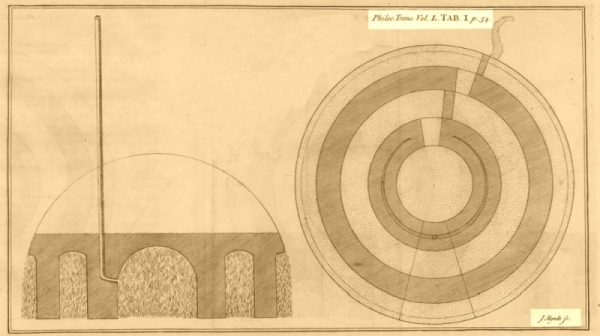
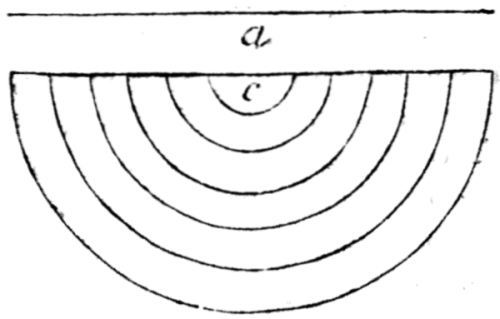
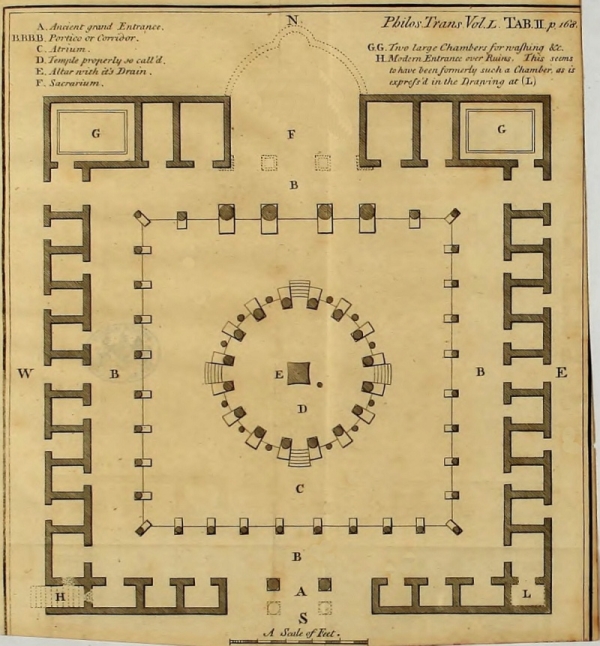
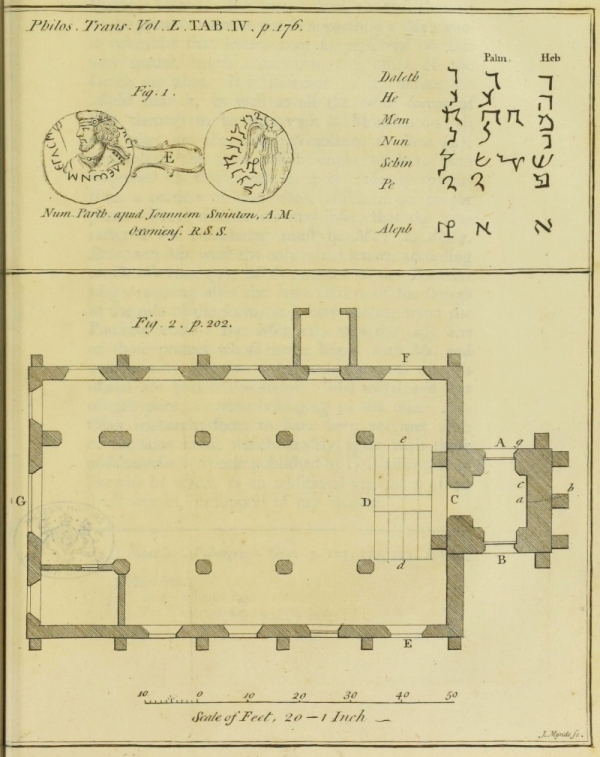
 , BIR. ZEIVESHNI, LONGÆVI,
which occurs in Dr. Hyde