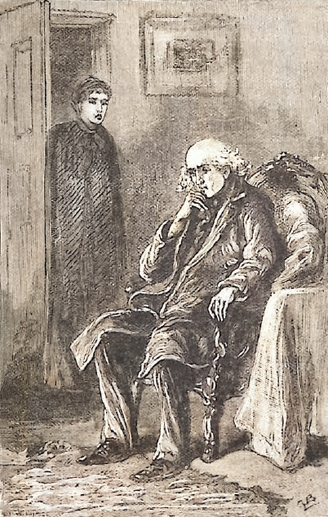
A SAD STORY.
IT was true that Sister Kathleen had been out of health, and had left
the hospital for a while. But she was better, and, although the porter
had not chosen to tell Phil so, she was expected to return to the
hospital on the following day. A hearty welcome awaited her there, for
she had been missed alike by doctors, nurses, and patients.
As she was resting in her own room, word was brought to Sister Kathleen
that Miss Austen had called at the hospital that morning, and, learning
that she was expected in the afternoon, had decided to come again
later, being very anxious to see her. The Sister was pleased to hear
this, for she hoped Miss Austen might bring her news of little Phil,
concerning whom she had many uneasy thoughts.
The porter did not think it necessary to inform Sister Kathleen that a
little crippled boy had come to the hospital on the previous day and
asked to see her. He was only some miserable little beggar, who had no
right to exist, according to the porter's ideas, and certainly should
not be allowed to trouble so important a person as Sister Kathleen.
The Sister was taking her tea when Miss Austen arrived. In spite of
her training to self-control, she started as her visitor entered, so
changed was Lizzie Austen. She had formerly looked pale and melancholy,
but now there was a brilliant flush in her cheeks, which yet were
thin and wasted, the cheek-bones showing their hard outlines beneath
the crimson glow. A fire seemed to burn in her eyes, which looked
unnaturally large, with dark, hollow circles beneath. Sister Kathleen
felt a momentary sense of alarm as she met their wild, troubled gaze.
"How do you do, Miss Austen? I am glad to see you again," she said
almost mechanically, in her usual kind manner, as she took her
visitor's hand. Even through the glove, the burning heat of the hand
made itself felt.
Miss Austen's whole appearance was changed. Her hair was tumbled, her
bonnet awry, as though she had attired herself in careless haste. She
cut short the Sister's words of greeting with the eager question,—
"Where is little Phil? Oh, tell me, where is he?"
"I cannot tell you; I do not know," said Sister Kathleen.
"Not know! Oh, you 'must' know!" was the impatient reply. "You have
seen him since he left the hospital?"
"Unhappily, I have not," said Sister Kathleen. "Within a week of his
leaving us, I sought him at the address his mother gave, but the woman
and child had left the house, and no one could tell me where they had
gone."
A wild cry broke from Lizzie Austen.
"Oh!" she cried, wringing her hands and raising her eyes as if in
despairing protest to One above. "God have mercy on me! My punishment
is greater than I can bear!"
Sister Kathleen looked at her in wonder and fear. Had trouble disturbed
the balance of her mind? Was this strange excitement about little Phil
a form of madness?
"Do not speak so," said the Sister, taking her by the arm and leading
her to a chair; "you do not know what you are saying. You are
overexcited. Sit down and rest. You have been ill, I fear?"
"Yes, I have been ill," said Lizzie, sinking down with an air of
exhaustion, and putting her hand to her head as if to still its
throbbing; "I have been very ill. They thought I should die, but I knew
the rest of death was not yet for me. I cannot die till I have suffered
the full penalty of my sin, or till I have made atonement—oh, that that
were possible! You think I am talking wildly, but if you knew what a
wicked wretch I am, you would spurn me from your presence."
"That I am sure I should not," said Sister Kathleen, anxious to soothe
her. "But now tell me about your illness. What was it?"
"Oh, it was all the mind, the mind!" cried Lizzie. "The doctor said
so at last. I could not rest; I could not forget. I used to hear
little Phil crying and reproaching me every hour of the day and night.
Sometimes I fancied that I had him in my arms, and then Moll Dutton
would come and take him from me, and I cried and struggled, but I could
not get him again. Oh, it was terrible what I endured! Even now I hear
Phil's voice at times. I have been wandering through the streets all
day looking for him, but in vain."
"You should not have done so," said Sister Kathleen, distressed by the
conviction that here indeed was a mind trembling on the borders of
insanity. "How could your friends let you come to London alone?"
"No one knew," said Lizzie; "I came away without saying a word to
father. I could not rest at home. They will think that the fever
returned, and I wandered away without knowing what I was doing. I did
so once when I was ill. I wanted to find Phil, and I got up and went
out. But some one saw me in the field and brought me back. I was ill
for weeks after that."
"But how anxious your father will be when he misses you!" said Sister
Kathleen. "Have you thought of that?"
"Yes," said Lizzie, "but I cannot go back till I have learned something
about Phil. Oh, do help me, do help me to find him!"
"I will certainly give you all the help in my power," said Sister
Kathleen. "But, dear Miss Austen, why are you so troubled about little
Phil? Have you heard anything of him since he left the hospital?"
"No, oh no! That is the misery of it!" exclaimed Lizzie excitedly.
She paused and looked at Sister Kathleen, as if hesitating whether
she should explain her words. The tender pity of the Sister's glance
decided her, for she suddenly rose, and, throwing herself on her knees
beside the other, said, in broken, tremulous accents, "Oh, you are a
good woman! You will be merciful. I will tell you all; I must speak to
some one, or I shall go mad."
"Yes, tell me all your trouble," said Sister Kathleen gently. "Whatever
it may be, I am sure that you have suffered greatly."
"Suffered! Oh, verily! You wonder why I am so troubled about little
Phil. Listen—I am Phil's mother."
"Phil's mother!" exclaimed the Sister incredulously, believing for the
moment that this was a delusion of the poor overwrought brain. "You
Phil's mother! It is impossible. Moll Dutton is his mother."
"She pretends to be, but she is not really his mother. Phil is my
child. He was born in Paris six years ago."
"You astonish me," said Sister Kathleen. "How can it be? You are not
married?"
"No," said Lizzie, in a low, bitter tone, whilst a painful flush
suffused her neck and brow; "but I once thought that I was. I will try
to tell you my sad story.
"It is about eight years, though it seems to me as if a whole lifetime
lay between, since I left home to spend some months in London. My life
had been a happy one till then. I was the only child in my home, and
my parents loved me far, far more than I deserved. Alas, like too many
girls, I did not know when I was happy! I grew weary of country life.
I longed to see London, and persuaded my parents, sorely against their
will, to let me go for a while to a cousin of my father who was a
milliner in the West End. Oh that I had never left my peaceful, happy
home! But it is worse than vain to think of that now.
"I came to London, and the fascinations of town life took hold upon me.
My cousin made much of me, and encouraged my vanity. She used to tell
me that my face was so pretty, it set off any bonnet I might put on for
the customers to see. The people with whom I associated were gay and
unprincipled, and I fell completely under their influence. Yet I knew
better. I knew that there was a life beyond this. I had been taught to
fear the God to whom I must one day give an account of my actions, but
I put from me the thought of God.
"My heart grew cold towards my parents. I no longer cared to go home.
Since those days, I have often wept to think how my indifference must
have wounded my mother's heart. But I must hasten to the bitter end of
my story.
"In my cousin's business I made the acquaintance of a Frenchman, the
traveller for a Paris house. He was a man of thirty, handsome, dark,
with polished manners and a gallant bearing, that fascinated my poor
foolish girl's heart. His manner told me that he admired me, and soon
a warmer feeling than admiration was expressed by his words and looks.
He came to my cousin's shop far more frequently than business required,
and I was proud to think that I was the attraction that drew him there.
I believed that he loved me, and my love went forth to meet his.
"But he spoke no word of marriage for some time. Not till my cousin's
sudden death had thrown me into perplexity with regard to my future did
he ask me to marry him, but then he urged me to take the step without
delay. When I mentioned my parents, and the necessity of gaining their
consent, he persuaded me to seal my fate without consulting them. They
would be prejudiced against a foreigner, he said, and would certainly
oppose our marriage. But if I took the matter into my own hands, and
got married, they would soon forgive me for so doing. How could I
listen to such persuasions you will ask? Ah, how indeed! I am amazed
now to think how weak and foolish I was. Oh, is there greater misery
than to look back on the fatal steps so blindly taken, that have made
your life a wreck, full of remorse and despair? But I loved that man
with a love that knew no shadow of distrust.
"We were married at a registry office one gloomy, foggy day. He did
not wish a religious service, nor did I, for deep in my heart I felt
that it would be a mockery to ask God's blessing on our union. Yet the
prospect before me seemed bright. My husband was well to do. We settled
in expensive lodgings, not far from my former place of business. By
his desire, I allowed my parents to suppose that I was still engaged
in this business, and their letters were sent to me there. I was very
unhappy at thus deceiving them; indeed, from the first there was no
real happiness in my married life.
"A few weeks after my marriage, my father, who rarely left home, gave
himself the trouble of coming to London in order to see me and assure
himself that I was well. The remembrance of that day stings me with
shame even now, for by my husband's orders, I still hid from him the
truth, and had to invent falsehood after falsehood to account for my
being at liberty to accompany him about town. I longed yet dreaded to
make confession, for I feared that he would never forgive me.
"Already my husband was growing indifferent to me, and soon every sign
of the gallant lover had vanished. He was often absent for weeks in
Paris, and when left alone, I was sad enough. At last, a time came
when he stayed away so long that I wrote imploring him to return, for,
weak and depressed, I could not bear the loneliness longer. He wrote
in reply, saying that he did not intend to return to London. He had
obtained a fresh business appointment in Paris, and should reside there
for the future. I was at liberty to make what plans I liked for my
future. He enclosed a sum of money for my immediate necessities, and
advised me to return, after a while, to the business in which I had
been formerly engaged.
"The letter came to me like a cruel blow. It bewildered me utterly. I
could not understand it. Surely, if he were going to live in Paris,
I must live there too. Was I not his wife? What could he mean by
advising me to return to business? As I pondered his strange words,
my bewilderment increased. I could not rest without an explanation,
nor would I be content with a written one. Though I shrank from the
wearisome journey, I resolved to go to my husband without delay.
Excitement gave me strength for what I had to do. Within twenty-four
hours of my receiving his letter, I was in Paris.
"Never can I forget how my husband received me when I arrived at the
house where he was living. My husband, I say, but he met me with the
astounding news that he was not my husband. A marriage contracted
by English law in London meant nothing in Paris, he said. He was
sorry for me, but his parents would never consent to his marrying an
Englishwoman. I had no legal claim upon him, and we must separate.
"I was confounded; I could not believe that his words were true. But
in vain I declared that I was his lawful wife, and pointed to the ring
upon my finger in attestation of the fact. In vain I sobbed and pleaded
with him to have mercy on me. He was not to be moved to acknowledge me
as his wife. With cold, hard cruelty, he made me aware of my deplorable
position, and then required that I would quit the house in which I had
no right to be sheltered. Heart-broken, I left him, and went out alone
into the streets of Paris.
"I cannot dwell upon the misery of the days that followed. Alone and
friendless in Paris, knowing little of the language, I felt utterly
forsaken. A kind-hearted Frenchwoman, to whom I was led to confide my
sad story, advised me to seek advice at the British Embassy. I went
there, but, though kindly received, could find no redress. They told
me that my experience was a common one. The man I had believed to be
my husband had spoken the truth. By the cruel French law, I was not
his wife, and had no right to call myself so. He was at liberty to
repudiate me.
"I went back to my lodgings feeling crushed and hopeless. On the
following day, my child was born. I made no second effort to move the
heart of the man who had so wronged me. As soon as I was able, I left
Paris without seeing him again.
"Dark and hopeless the future looked to me, when with my helpless babe
I arrived in London. I felt little love for my child then. I thought
only of how I could find some one to take charge of him, and thus set
me free to seek employment. I took a lodging in a poor neighbourhood,
for my funds were getting low, and thus I met with Moll Dutton. I had
known her before. She used to come to my cousin's to buy cast-off
clothing. Her appearance was more respectable than it now is, yet I
suspected that she was a bad, unprincipled woman. Somehow she beguiled
me into telling her my story, and when she offered to nurse the child
for me, I scarcely hesitated ere I gave him into her care. He was a
sickly little creature, and—God forgive me!—I hoped he would not live,
for I felt my child to be a burden from which I longed to be free.
"With a view to inquiring whether they had an opening for me, I went to
the house of business formerly conducted by my cousin. There I found
a telegram which had been awaiting me for a couple of days, as no one
knew where I was. My mother was very ill, it said, and I must return
home at once if I would see her alive. I had written to my father
before leaving London, to tell him that I was going to Paris, but since
then I had let him know nothing of my movements. I led him to believe
that I had gone to Paris to make purchases and study the fashions.
"As soon as I recovered from the shock of this sad news, I telegraphed
to say that I would come home without delay. Leaving my babe in Moll
Dutton's care, I started by the next train, and at nightfall reached
my home. Oh, the bitterness of that return! I had thought that I would
throw myself at my father's feet and confess all as soon as I crossed
the threshold. But when he met me with tenderest greeting, and gently
told me that my mother was dying, my words were stayed. I stood by my
mother's bed. She could not speak, but she knew me, and smiled on me
ere she passed away. As I watched her die, it gave me inexpressible
anguish to think how I had deceived her. If only I could have died too!
"Whilst her still form lay within the house, and on the day when we
committed it to the ground, I kept my secret locked within my breast.
My father saw how wretched I was, but he imagined that it was natural
grief for my mother's death which bowed me so low. He mourned her loss
deeply, and when he implored me never to leave him again, I had not the
heart to say that I must do so. Every one took it for granted that I
should now settle down at home; and I wished that I were free to do so,
for I had seen enough of London now.
"I returned to London at the end of a week, but I promised my father
that I would soon come back to him.
"I went at once to Moll Dutton.
"Can you understand the temptation it was to me, when she offered to
take the child off my hands and bring him up as her own, if I would
pay her down a certain sum of money? No! You cannot understand it, but
to me her proposal seemed to offer such relief. I dreaded my father's
anger if he should learn how I had deceived him. I knew how keenly he
would feel the disgrace of my false marriage, and I shrank from the
shame that would be mine if our neighbours at Danesbury knew that I
was a mother, yet had no legal right to the name of wife. So I caught
at Moll's suggestion. I had little difficulty in raising the sum she
mentioned, for my mother had left me money, but I had to tell more lies
to my father to account for my wishing to realize it so quickly.
"With hard, selfish haste the compact was sealed. I made over my child
to Moll Dutton, to be from henceforth her child, with whom I would
never interest myself more.
"But when I thus gave him up, the instincts of a mother asserted
themselves, in spite of my selfish will, and my heart was torn with
pain. Moll took care not to let me see my child again. I paid her the
whole sum agreed upon, and she went off with the child, I knew not
whither.
"But now I was to learn at what a cost I had purchased my liberty.
"I went home to my father, and tried to be a dutiful daughter, but from
that day I knew no peace. The maternal affections Nature had implanted
in me were not to be stifled. Day and night my heart cried out for my
babe. It was torture to me to know that somewhere in London he was
living, bereft of my love and tenderness. This secret sorrow was almost
more than my mind could bear. I saw that the neighbours looked on me
with wonder, and deemed my ways strange; I knew that my father was
distressed by my constant melancholy, but in vain I tried to overcome
it. The misery I had brought upon myself seemed greater than I could
endure.
"As often as I had an excuse for so doing, I came to London for a
day. And as I walked along the streets, I found myself looking about
for my child, forgetting that if I met him he would be changed past
recognition.
"At last, when some years had passed, and time had failed to reconcile
me to my sorrow, I began to make determined efforts to trace Moll
Dutton. By a strange chance, I discovered where she was living. I went
to the house one day when she was out, and found my boy, grown into the
little Phil you know. I saw, alas! that he was sadly neglected. Ah,
what I suffered as I held him in my arms! I could not take him away,
even if Moll would have given him up. It seemed impossible to escape
from the meshes of evil I had woven about my life.
"When Moll came back and found me with him, she was very angry, and
told me I had broken my word, for I had promised never to interfere
with him.
"I pacified her with a gift of money, and she promised to treat
the child more kindly, and to let me know if he were ill or wanted
anything. I had little hope that the promise would be kept, though I
could see that Moll was very anxious to retain the child.
"I did not know till afterwards how wickedly she made gain of him,
keeping him ragged and ill-fed in order that his appearance might
attract pity and bring her money. After this visit to little Phil, I
was more wretched than before, for I knew that to spare myself pain,
I had doomed my child to a life of suffering. Again Moll Dutton moved
away, and I lost all knowledge of her.
"I heard no more of my little Phil until last November, when, to my
surprise, one day I received a letter from Moll Dutton telling me that
Phil was ill, and asking me if I would not send her some money to
meet the expenses of his illness. Instead of sending money, I went to
London that very day, and found my way to the address from which Moll
had written. Her letter was a ruse to get money, and by answering it
in person, I defeated her purpose. She was forced to own that Phil was
not with her, and I drew from her the truth that he had met with an
accident and was lying in this hospital.
"I could not resist the hungry longing I had to see my child again.
I came here, and to my joy he had not forgotten me, but welcomed me
gladly, calling me by the name I had taught him was mine—'Aunt Lizzie.'
But you know the rest—you know now why I was so unhappy at the thought
of Phil's going back to his miserable life with Moll Dutton."
"Yes, I know now," said Sister Kathleen gently; "I understand many
things that puzzled me at the time. Oh, what you must have suffered
under this concealment! With all my heart I pity you."