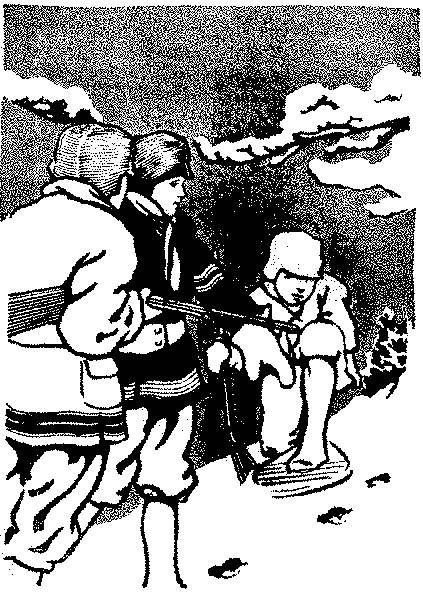
“What in the dickens can it all mean?” exclaimed Ethan Allen.
“I’m all up in the air about it,” admitted Lub, helplessly.
“I heard several shots from guns!” declared X-Ray Tyson, positively enough.
“Yes, we all did,” affirmed Phil; “and there was a howl in the bargain that sounded to me like that of a dog.”
“Whew! I bet you one of their animals has gone mad, and had to be shot!” burst out Lub, in still further excitement.
“What, at this season of the year?” cried X-Ray; “I thought curs only went mad in the heat of summer, and that was why they called a part of August the dog days.”
“That isn’t a fact, is it, Phil?” appealed Lub.
“They used to think so,” came the reply, “but of late it’s been learned that the heat has little if anything to do with a dog going mad. Because they always run with their tongues hanging out people had an idea the heat affected them. On the contrary the very sight of water causes a mad dog to go into spasms. It’s just a terrible disease, and in cities is said to be more frequent in winter than in summer.”
“The racket has died out now,” remarked X-Ray, partly to change the subject, and hide the little confusion he felt at displaying his ignorance in his little dispute with Lub.
“And I guess the dog has been killed,” Ethan went on to remark; “but it took a whole lot of gunning to do the job, seemed like. They must have been pretty badly rattled, those New York City sportsmen who are up here to run the country about as they see fit.”
“I’d like to have seen the affair,” observed X-Ray Tyson, meditatively, as if he might be trying to draw a mental picture of what must have been an exciting episode; for a mad dog in camp is likely to create considerable of a wild stampede.
“Excuse me from that sort of fun,” Lub protested; “I’m too fond of dogs to want to watch one running around, frothing at the mouth, and having to be executed.”
“Shot down like a dog, you mean,” interposed Ethan; “and I wouldn’t be much surprised if that old saying originated in a mad dog scare.”
All seemed quiet and serene once more over in the direction of the other camp. Whatever the cause of all that shooting and shouting may have been, it had become a thing of the past, apparently.
“Well, it isn’t any of our funeral,” X-Ray remarked, with a queer shrug of his shoulders; “and so I guess we’d better forget all about it.”
Lub noticed that Phil did not seem to agree with the last speaker. He had a serious expression on his face that told of some idea forming in his brain.
“Perhaps it wasn’t a mad dog scare after all,” Phil suggested.
“But what else could it have been?” asked Ethan.
“Those sort of sportsmen always fetch lots of liquor along with them into the woods,” asserted Phil; “and it might be one of them had a fit of delirium tremens, so that he even tried to shoot up the camp, and had to be restrained.”
“Well, now, there might be something in that,” admitted X-Ray, nodding his head reflectively. “And p’raps right now they’ve got a badly wounded man over there, with no doctor inside of a hundred miles.”
“I was thinking of that,” ventured Phil; and something in his tone and manner caused Ethan to instantly leap to a conclusion.
“Were you figuring on going over that way, Phil?” he demanded, “and offering to help that tough crowd if they needed any assistance, you knowing so much about looking after gunshot hurts that we often threatened to call you Doctor Bradley?”
“Yes, I was considering doing that,” Phil said, smiling, “though there might be no necessity for our entering the camp, if we seemed to find it all serene.”
“I take note of the fact,” continued Ethan, “that you use the plural pronoun ‘we,’ Phil, which would indicate that you meant to have one of us go along. I’d like to speak for that privilege, if it’s all the same to you.”
“Shucks! you beat me out in saying that, hang the luck, Ethan,” grumbled X-Ray Tyson, who was not often caught napping, and therefore felt additionally sore in connection with this instance.
“Yes, if we think it a wise thing to do, you might as well help me out, Ethan,” Phil told him; at which the Allen boy grinned happily, and could not keep from casting a side look full of triumph toward X-Ray.
“I don’t see that it could do any harm,” Lub advanced in his ponderous way, “if you scouted in that direction. You wouldn’t have to brush in on them unless you saw signs that they were all mixed up, and in need of the right kind of help. And like as not you’d easily enough be able to find out what all the row was about, so as to tell us stay-at-homes.”
“Come on, let’s go, Phil?”
Somehow the idea seemed to appeal more and more to Ethan as he thought it over. The other camp was only a couple of miles, more or less, away, and on their snow-shoes they could make it in what the boys would call “double-quick” order.
Phil looked up at the sky. It was only a part of his customary caution, and not that he really expected there would be any signs of trouble in that quarter.
“All right, then, Ethan; get your gun and your snow-shoes. We’ll take that scout and see if we can find out anything worth while.”
“I hope both of you keep your eyes smartly about you while you’re passing along through the woods,” urged Lub. “A mad dog is a terrible thing to run across; and for all we know the beast might have got away.”
“Ten to one, Phil,” sang out Ethan, with a carefree laugh, “poor old timid Lub here will spend every minute of the time we’re away sitting on a log by the fire with his gun on his lap, and ready to whack away at any suspicious four-legged beast that shows up.”
“Well, can you blame me?” demanded the stout boy; “I read about a fellow who was bitten by a mad dog, and it’s haunted me ever since. I guess I’d rather be taken prisoner by hostile Indians, and burned at the stake, than bitten by a dog suffering with the rabies.”
He stepped over and securing his gun found a comfortable spot on the log near the fire. Here he drew the small waif close to his left side, and looked as though he meant to stay there in that one position as long as two of the guardians of the shack were absent on their risky errand.
Phil only loitered a couple of minutes to snatch up his camera. There could be no telling when he might run across a chance to make use of this. It is like a gun in that respect, for you often see the most marvelous pictures when you have unfortunately left the camera at home.
They started off with the best wishes of those left behind.
“Course you’ve thought to put your little medicine-case in your pocket, Phil?” sang out Lub; “it came in mighty handy down on the Coast, when we found that young bayman doubled up with pain, after eating some canned stuff that gave him a little touch of ptomaine poisoning; yes I can see it bulging out on the left side of your coat. Well, so-long; and hurry back, because the night isn’t so far away, and supper will be cooking, you know.”
The two boys made a bee-line for the other camp. Both of them remembered its location, from having taken note of the column of smoke so often. Ethan was doing better work with his snow-shoes right along now, for there is nothing that serves one so well in this respect as practice.
They had covered the first mile with ease.
“Must be all of half way there, Phil?” suggested Ethan.
“Yes.”
“And do we keep straight on as we’re going now, or make a little detour so as to come on the camp from the other side?” continued Ethan.
Phil smiled.
“I see you’re up to all the little dodges of the profession, Ethan,” he chuckled, “and are bound to make an A Number One tracker yet. Yes, we might as well begin to circle some from here on, always keeping in mind the point we’re aiming to reach.”
“No trouble at all about locating the camp, Phil, as long as they continue to burn that half-green wood.”
“It does send up a pile of black smoke for a fact,” admitted Phil, looking in the direction his chum was pointing; “and we’ll keep an eye on it as we go.”
Of course as they made progress through the bush the boys did not neglect to observe everything around them. Lub’s solemn warning may not have made much of an impression on their minds, but habit proved strong, with Phil at least, and it was his custom to be on the alert.
“We’re getting in close now,” whispered Ethan; “I thought I heard a cough, then.”
“That’s right, and I can see the fire beyond that thick bunch of pines,” was what the other replied, in the same low tone.
Still advancing cautiously they gradually reached a spot where they were able to look in on the rival camp. The fire was burning, but things seemed to be rather quiet. At least the two scouts failed to discover any furious rushing to and fro that would indicate excitement and alarm.
“Looks peaceful enough, Phil, doesn’t it?” whispered Ethan, in rather a disappointed fashion, that would indicate he had felt hopeful the services of his chum might be needed, and that they could thus heap coals of fire on the head of the boastful and vindictive Mr. James Bodman, millionaire sportsman.
“There’s one of the guides near the fire,” remarked Phil.
“Yes, and he seems to be rather upset over something,” pursued Ethan; “notice how he keeps on looking to the right and to the left. See him start to hold up his hands then, will you? What in the wide world can have been going on over here?”
“Seems like a mystery,” admitted Phil, still staring at the vicinity of the camp fire where only that one guide was visible.
“Where d’ye suppose the others all are?” ventured Ethan, keeping his voice down to the lowest possible pitch, although there did not seem to be any reason for such caution.
“I suppose in those two shacks we see,” came the hesitating answer; and then the other heard Phil give a little gasp.
“You’ve discovered something; what is it?” Ethan asked, eagerly.
“They did shoot a dog, it seems, Ethan!”
“How do you know?” continued the other, craning his neck to look.
“You can see it lying there over by the woodpile,” Phil told him.
“Great Cæsar! so it is, and with his feet up in the air. It’s a dead dog, Phil; no fooling about that.”
“Yes, and has been shot, but who did it we don’t know yet, Ethan.”
“Whew! I wonder if he bit that ugly red-faced sportsman you told us about, Phil? I don’t wish my worst enemy to meet with such a fate, it would seem as if it might be a judgment on that bully and railroad wrecker if he did get a good scare.”
“Queer where the rest of the party are?” continued Phil; “let’s creep along this way a bit. We may get to a place where we can glimpse them.”
“There may have been another dog that got away, and the rest are hunting for him in the bush right now?” suggested Ethan; but the supposition could not have struck Phil very strongly for he made no comment.
They made their way along as silently as they could. The soughing of the wind through the tops of the pines and the larches and the firs deadened any little scratching sound their snow-shoes may have made as they moved onward.
It was while they were making this change of base that suddenly without the slightest warning Phil laid his hand on the arm of his companion, and at the same time drew him down behind some bushes.
When the startled Ethan turned his eyes upon Phil he saw that the other had a finger pressed upon his lips. This indicated additional caution. It also meant that silence was desirable for some reason or other, which of course Ethan could not immediately fathom.
Then he saw Phil gradually raise his head. He was looking carefully over the tops of the bushes at something. Ethan, quivering with suspense, could hardly restrain his natural impulse to follow suit; and fortunately for his peace of mind Phil just then made a gesture with his hand as though inviting him to join him.
As Ethan did so he saw his chum extend his hand with a pointed finger. Looking on a line with this latter digit he made a discovery.
Something was moving near by. In place of a giant tree that had succumbed to the tempest many years previously, there had grown up a bunch of suckers, and some five of these offshoots had become quite good-sized trunks. They were arranged very much like the fingers and thumb of a partly-closed hand, so that there was a cup which the five protecting trunks surrounded.
It was just a natural hiding place, and apparently some one was even then occupying the cup; for as Ethan looked he saw a head projected, and held there for a dozen seconds, to be withdrawn, and then almost immediately come into view again.
Whoever the party might be he evidently had his whole attention taken up with watching the camp, as though it might hold something that had an important bearing on his condition of happiness and peace of mind.
“He’s spying on the camp, Phil!” whispered Ethan, in the other’s ear.
“Looks like it,” murmured Phil.
“Can it be your fire-eater of a Baylay, then?” was the next thing Ethan suggested.
“Hardly,” replied Phil. “This man is afraid; his every action tells that he’s been in a big panic lately, and hasn’t recovered.”
“Go on, Phil?” urged the other, eager to know what next his chum would say.
“I think I know who he must be, Ethan.”
“Good. Tell me then, Phil.”
“Now watch again when he pokes out and take notice of what sort of a thing he’s got on his head.”
“There he comes once more, and he certainly does act like a man who’s afraid. But what’s this I see? Makes me think of the chef in a hotel; for he’s wearing a white cap without a peak!”
“Well, that’s just what he is, the chef these railroad magnates have fetched up with them to give them the best of meals while in camp,” whispered Phil.
“But whatever can he be doing hiding that way, and acting as if he was in mortal fear of his life? If you’ve got an idea please tell me, Phil.”