ON THE
March to Constantinople.
AN AMERICAN INVENTOR THE ALLY OF THE MUSCOVITE.
Peter the Great may justly be credited with having been the greatest civilizer
of his race. To him is due the credit of nationalizing his country and inaugurating
vast industries, through the medium of the Ship. So far in advance
of his time was he that his startling innovations and wonderful discounting
of the arts of diplomacy must have endangered his head had he not been
fortunate enough to have been born a despot.
Peter’s last will and testament outlined the policy to be pursued by his
successors, looking to the aggrandizement of Russia, and startling though its
terms are in their selfishness, they are so thoroughly diplomatic that his successors
have religiously lived up to their full meaning.
And so it comes to pass that the ever-advancing and constantly-tightening
grasp of Russia on adjacent territory is alarming the Governments of the
Old World and may, indeed, in the near future, somewhat concern ourselves.
The Canadian Government is now urging Great Britain to erect defences on
the Pacific Coast, for the reason that Russia, in pursuance of her peculiar
policy, is enlarging her works and arsenal at Vladivostock, opposite British
Columbia; and the initiative has already been taken by Great Britain in the
erection of batteries in the neighborhood of Esquimault.
As early as last May the St. Petersburgh correspondent of the New York
Tribune contributed the following report of the progress of the Grand Trunk
Railway through Central Southern Siberia to the Pacific Ocean and China:
“SIGNS OF RUSSIAN PROGRESS.
“The completion of the Trans-Caspian Railway to Samarcand marks
another stage in the Russian occupation of Asia. That city was the objective
point of the earlier campaigns from Orenburg and the sea of Aral,
which ended in the conquest of Khiva and Kokan and the establishment of
Tashkend as the military headquarters, with railway connections northward.
Bokhara was reduced to the condition of a protected province and Samarcand
was virtually converted into a Russian centre of trade on the border of China.
An interval of twelve years has elapsed, during which Samarcand, already
within easy reach from Tashkend, has been gradually approached from the
Caspian Sea. The Trans-Caspian Railway is now in operation from Michailovsk
to Samarcand, a distance of 885 miles, by way of Askabad, Merv and
Bokhara. This narrow-gauge system, built at a cost of $21,000,000, gives
Russia control of the commerce of Turkestan and completes the circuit of
conquest on the borders of China, Afghanistan and Persia. In future military
operations in Central Asia this railway, with the northern line running from
Tashkend, will be a most useful base of transportation and supplies. Meanwhile,
it binds together a straggling series of conquests separated by broad
reaches of desert. It is already rumored in St. Petersburg that the Czar intends
to visit during the summer the great Empire in Central Asia which the
valor of his soldiers and the skill of his engineers have created. An imperial
journey to Merv, Bokhara and Samarcand will illustrate the wonderful progress
made by the Russians during the last twenty years in overrunning
Asia.
“The Russian engineer who has completed the Trans-Caspian system is
now to undertake a new and colossal undertaking. This is the trunk line
through Central and Southern Siberia to the Pacific Ocean. Surveys have
already been made for a railway from Tomsk to Irkutsk, and this line when
finished is to be extended to Vladivostock, on the coast. As the Trans-Caspian
now makes a close approach to Western China, the Siberian will complete
the circuit of the Celestial Empire on its northern border. If the consent
of the Chinese Government can be obtained, branches will be built from
Irkutsk to Pekin, Shanghai, and other centres of population. Within five
years it is expected that this gigantic enterprise will be accomplished and St.
Petersburgh brought into direct communication with Vladivostock. The
journey from the capital to the Pacific can then be made in a fortnight; and
if Chinese markets can be opened to Russian traders, a marvelous change in
the conditions of Asian commerce and intercourse will be effected.”
And only a few weeks ago the same journal printed the following, as a
sequel to the above:
“The announcement that Russia’s Central Asia railroad system is to be
greatly extended was to be expected. At present it reaches to Samarkand
and already more than pays working expenses. Every branch or further extension
of the main line will, of course, add materially to its traffic and its
profits. It is now proposed to build a branch from the main line at Chardjui,
on the Oxus, to Chamiab, and also to continue the main line onward
from Samarcand to Tashkend. The latter would cross the Jaxartes; and
thus the road would give direct communication with both the great rivers
that flow into the Aral Sea, just at the head of navigation on them, and
would connect the commerce of the Aral with that of the Caspian. Just beyond
Tashkend begins a series of steppes adjoining those of Siberia, whither
Russian colonists are flocking. The road thus promises to be of equal
importance to commerce and to military strategy.”
THE FIRST STEP.
The occupation of Asia, so long determined on by Russia, was a problem
most difficult of solution. Many years were spent in devising ways and
means to navigate the Aral Sea—the first thought being to transport machinery
and material for the construction of steamers over the mountains—a project
which was at length abandoned as impracticable.
But a solution was at hand. In the year 1860 a novel system for the
construction of vessels was introduced in Great Britain by an American,
through whose efforts a Company was formed and an extensive factory established
at Liverpool. This Company, on proof of the value of its system of
construction, secured a contract with the British Government to construct a
number of steamers for the East India Company of Bengal—Moorshedaba.
As an evidence of the financial solidity of this company, and the class
of men who invested their capital in that concern, it may be mentioned that
Sir Charles Manby, the great English civil engineer, was President, while
such men as Sir Robert Stephenson, President of the Institution of Civil
Engineers, and John Hamilton, also well-known as an eminent engineer,
were members and stockholders. The entire capital and membership of the
Company belonged in London—Liverpool simply being selected as a factory
site.
The steamers under course of construction by this Company were
150 and 200 feet long, built on the new system of
CORRUGATED GALVANIZED IRON,
three-sixteenths of an inch in thickness. By this system the weight of hull
of a vessel was reduced one-third and the draft reduced in proportion, while
the strength was increased two-fold by means of the corrugations covering
the entire outer surface of the hull, which corrugations take the place of
frames or timbers, thus increasing the interior capacity of a boat of given
draft while vastly increasing her strength. The great utility and superior
qualities of this mode of construction was fully demonstrated by the building
of several supply boats for the British Navy, as well as military wagons for
the Army, and other constructions on the same principle for miscellaneous
purposes. The steamers built by this company were so constructed that they
could be
DISJOINTED AND TRANSPORTED IN SECTIONS,
being so arranged that they could be set up and taken apart with the utmost
celerity, and without the aid of more than passable shipbuilding or mechanical
knowledge. This unique and valuable system of ship construction was
invented by Joseph Francis, an American born, and justly celebrated as
founder of the United States Life-Saving Service, for which, at a late day, he
received the
THANKS OF CONGRESS AND IS TO RECEIVE A GOLD MEDAL.
Information of this system of construction reached Russia after its value
had been proved by the American, English, French, Austrian and German
Governments, and Mr. Francis was invited to visit that country, where he
was received by the Emperor.
In 1860, Admiral Boutakoff, of the Imperial Russian Navy, was ordered
by the Emperor to proceed to Liverpool and examine the system of construction,
with a view to its applicability to service on the Aral Sea,
in Asia, and report as to its utility. From documents placed in possession of
the writer, he is enabled to present a copy of the Admiral’s Report, as follows:
“Liverpool, 15th November, 1860.
“Honored Sir: I have sent to the Scientific Committee of the
Marine Ministry, with my reports of the 15th and 17th of October, for publication
in a marine journal, a short article concerning the corrugated iron
steamers. In addition to information therein contained, I would state that it
is my conviction that for our rivers, which are from year to year getting more
shallow, there cannot be built a more suitable steamer than the above. In
the discharge of my duty, I communicate to you the result of the trials which
have been made at the Liverpool factory.
“The corrugation of sheets of iron is effected, as may be known to you,
crosswise and not lengthwise, and the sheets of the hull are riveted together
by lapping one upon the other, corrugation upon corrugation, and a double
row of rivets put in.
“It was important to ascertain the relative strength of the riveted lap to
a whole sheet before proceeding with the construction of the steamers. For
that purpose we placed upon two blocks a riveted sheet a a (as marked in
the diagram accompanying this), three feet ten inches in length by two feet
six inches wide and three-sixteenths of an inch thick. We then began by
laying on it, directly over the line of the rivets, zinc slabs, b b, each weighing
thirty-one pounds English.
“The sheet broke at one row of rivets after having placed upon it 188
slabs, or 160 poods of fourteen pounds each (nearly three tons); after this
test a whole sheet of the same measure was placed upon the blocks, and it
bent after 199 slabs or 170 poods, (over three tons) had been placed upon it.
“Finally we took a plain sheet of iron the same measure, not corrugated,
and it bent and fell from the blocks after ten slabs had been placed
upon it. I believe that such results settle the question in regard to the
local strength which corrugation imparts to iron and its adaptation in the
construction of vessels.
“With sincere regard,
(Signed.)“ALEXANDER BOUTAKOFF.
“To Admiral Arkass.”
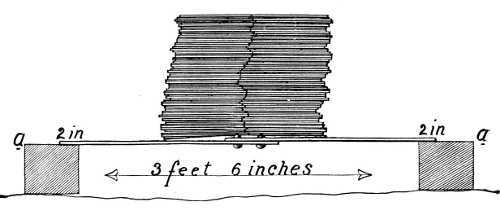
TEST OF CORRUGATED IRON LAP MADE IN LIVERPOOL BY
ADMIRAL BOUTAKOFF, R. I. N.
On a call from the Russian Government, the inventor submitted photographs
and drawings of the steamers constructed by the Liverpool Company,
addressed, according to instructions, to the Grand Duke Constantine.
After some little necessary correspondence, shorn of all diplomatic red
tape, a contract was entered into between the Imperial Government and
Mr. Francis, for the construction of a fleet of light-draft steamers, to be
pushed to completion rapidly as possible. The result was that, ere the year
1862 had passed, steamers, fully engined, and ready for service, were erected
at the Liverpool factory, and taken apart again for shipment. These vessels
were 150 to 200 feet in length, built on similar lines to vessels already constructed
by the Company. When the steamers had been put together,
tested and again set up at the factory, they were boxed for shipment, in sections,
both hulls, floating dock and machinery, when they were ready for
THE STRANGEST ROUTE EVER TRAVERSED BY SHIP.
From Liverpool they went first to St. Petersburgh—thence to Moscow—on
to Nijni Novgorod—across the Volga—over the Ural Mountains—to the
Aral Sea, in Asia—where they were at length unboxed, the sections once
again put together and, lo, a
PROUD FLOTILLA GRACED THE ARAL,
upreared as if by magic hands. This was the initiative in Russia’s grandest
Dream of Empire. These vessels had crossed the Aral barrier, and swooped
down like things of life on the insulated sea, the inhabitants of whose
shores fondly dreamed they dwelt secure in Nature’s fastness. Impossible
would it have been to transport vessels in their entirety over the rugged
heights, and deadly impracticable would it have been to attempt their
construction on the Aral seaboard, in full view of an alert and suspicious
people.
Here it may be well to introduce three letters, the originals of which are
in possession of the writer, and which are fully corroborative of the preceding
statements.
“To His Imperial Highness the Grand Duke Constantine:
“I beg leave to present to Your Imperial Highness lithographs of the
two corrugated galvanized iron steamers, built at Liverpool for the Syr
Dariah River, under the supervision of Captain A. Boutakoff, of the Russian
Imperial Navy.
“The two steamers, together with one barge and a lifting dock, are
finished, ready for shipment. Captain Boutakoff left Liverpool March
25 (13th).
“Your Imperial Highness’ humble servant,
(Signed.)“JOSEPH FRANCIS.”
| “Marine Ministry of the Shipbuilding Dep’t. |
} |
| March 31, 1861—No. 189. |
“To Mr. Joseph Francis:
“The letter which you addressed to His Imperial Highness the Grand
Duke, General Admiral, on the 25th March, with which you presented to His
Imperial Highness two drawings of corrugated iron steamers, has been sent
to this committee, with a resolution from the Ministry of Marine, stating that
His Imperial Highness desired his thanks to you. The committee has the
honor to inform you thereof.
“Manager, Bellarmsky“THE PRESIDENT.
(Signed.)“Major-General CHERNOFSKY.”
(Letter from Admiral Boutakoff to Mr. Francis.)
“Fort No. 1, Syr Dariah, July 2, 1862.
“Dear Mr. Francis—The new steamers of my flotilla, built at your
works at Liverpool, are not yet launched, but I hope to accomplish it in
about a month. The boilers, on account of the great difficulty of transporting
them across the Desert, will not arrive before the middle of August, so
that I shall not have sufficient time to employ the new steamers this year,
but will give them a trial upon the Syr Dariah. The parts of the pontoon
dock will be here about the end of August, giving us time to put them together
next winter.
“With a hearty shake hands, and my sincere sympathies with your
northern countrymen, of whose victories I congratulate you.
“I remain, yours most truly,
(Signed.)“A. BOUTAKOFF.”
On the launching of the steamers, the Emperor congratulated Mr.
Francis on the success of the invention by which the first obstacle that
barred the way to the conquest of a vast territory was removed, opening an
avenue to increased Empire.
After the survey of the Aral, only rendered possible by the construction
of these vessels, fortifications were constructed on the shores of
that sea, and the long-deferred conquest of that section of Asia was, to all intents
and purposes, accomplished.
In order to still further emphasize his gratitude, the Emperor caused
Mr. Francis to be created a Knight of the Royal Order of Saint Stanislaus,
one of the richest decorations in the gift of royalty. Following is a copy
of the parchment:
“We, by the grace of God, Alexander the Second, Emperor and Autocrat of
all the Russians, Czar of Poland, Grand Duke of Finland, etc.,
etc., etc.
“To Joseph Francis, Citizen of the United States of North America:
“The Ministry of Marine having testified to your particular services, we
have graciously been pleased to nominate you a Knight of our Imperial and
Royal Order of Saint Stanislaus by an Ukaz of 7th November, 1860, given to
our Chapter of Orders, to the end that they do sign and seal this Diploma in
witness thereof, and forward to you the insignia of the Order.
“St. Petersburg, this 10th day of November, 1860.
| [SEAL.] |
The Vice-President, |
Count Borch. |
| Lieut.-General, |
L’Ecesujsecetz. |
| Grand Master of Ceremonies, |
Rhitrovo. |
| Member, |
Ku, uyey5Eyuivel., |
No. 5,756.”
Shortly after the securing of his patents in Russia Mr. Francis disposed
of a portion of his corrugated system patent to Baron Rumin, Chamberlain
to the Emperor, covering Moscow and the Rivers Volga and Don.
After the contract was drawn, a request was made on the part of the
Baron to include the Caspian Sea, and to which no objection was made, as
little value was placed on the Caspian at that time, on account of its shallow
water and isolated position, no one supposing that a
RAILWAY WOULD EVER CROSS THE JAXARTES
and join both the great rivers that flow into the Aral Sea, connecting commerce
with the Aral and Caspian, as well as China, and so onward to the
Pacific Coast.
A factory was eventually established by Baron Rumin, on the Banks of
the Volga, for the construction of steamers, and practical workmen were
sent to this factory from the establishment of Mr. Francis, at Greenpoint,
Brooklyn, New York.
This brief account of Russia’s struggle for supremacy among the
family of nations, so intimately interwoven with the history of one of
America’s foremost inventors in the life-saving field, is another instance of
the Providence that rules the destinies of the world, through the lives of
unassuming and patient workers.
From experiment came invention. The Life-Car, in this instance the
outcome of extended experiment on the part of Joseph Francis, proved the
value of the corrugating system, the fame of which, within a few years, spread
all over the world. The Life-Car, the first construction under the corrugated
system, was merely the germ of the widespread uses to which the system
was and is applicable, as has been shown. Steamships, floating docks, pontoon
bridges, military wagons and railway cars are only a few among the many constructions
to which the Francis system of corrugated iron was applied by him
and those to whom he sold the right to manufacture. The Life-Car, then,
was the suggestion that led to the construction of the portable, strong, light-draft
ship, which proved the most powerful implement, in Russia’s hands, of
working out the vastest scheme of empire ever conceived in the brain of man.
Mr. Francis, successful in all his inventions, has been honored beyond
most men by foreign potentates, and now is about to receive what he
holds to be the crowning honor, the bestowal of the gold medal awarded
him by two Congresses, with the double thanks of this chosen body of
representatives of the people.