I must hurry rapidly over a part of my history, on which I
should rejoice to linger, if I could invoke the living spirit of
departed time. But the beautiful associations which
animated it once, and which alone could animate its memory, are
now extinguished within me. When I seek them—that
influence which ruled so mightily over my joys and
sorrows—my mingled destiny,—I strike in vain against
a rock, that gives out a living stream no longer; the divinity is
fled. O how changed is the aspect of those days of
old! My intention was now to act an heroic character; but
it was badly studied, and I a novice on the stage, was forgetting
my part while fascinated by a pair of blue eyes. In the
intoxication of the scene, the parents seem eager to close the
bargain, and the farce ends in a common mockery. And this
is all! So stale, so unprofitable, and so melancholy are
the revisitings of what beat once so nobly and proudly in my
bosom. Mina! as I wept when I lost thee, even now I weep to
have lost thee within me. Am I become so
old! Pitiful intellect of man! Oh, for a pulse-beat
of those days, a moment of that consciousness,—but
no! I am a solitary wave in the dark and desolate sea: and
the sparkling glass I drank was drugged with misery.
I had previously sent Bendel with bags of gold to fit out a
dwelling suitable for me in the town. He had scattered
about a great deal of money, and talked mysteriously of the
illustrious stranger whom he had the honour to serve (for I did
not choose to be named), and this filled the good people with
strange notions. As soon as the house was ready for me,
Bendel returned to convey me thither. We started
immediately.
About an hour’s distance from the place, on a sunny
plain, a great number of persons in gala dresses arrested our
progress. The coach stopped: music, bell-ringing, and
cannonading were heard; a loud acclamation rent the air, and a
chorus of singularly beautiful maidens in white robes appeared at
the door of the carriage, one of whom, surpassing the rest as the
sun surpasses in brightness the stars of evening, stepped
forward, and with graceful and modest blushes knelt before me,
and presented to me on a silken cushion a wreath of laurel, olive, and rose branches, garlanded together, while she
uttered some words, which I understood not, of majesty, awe, and
love, whose soft and silver tones enchanted my ear and my bosom:
it seemed to me as if the heavenly apparition had once glided
before me in other days. The chorus began, and sang the
praise of a good monarch, and the happiness of his people.
And this happened, my friend, in the bright sunshine: she
continued to kneel some two steps before me, and I, shadowless,
dared not spring over the gulf, that I might fall on my knees in
her angelic presence. What would I not have given in that
moment for a shadow! I was obliged to conceal my shame, my
anguish, my despair, by sinking back into the carriage.
Bendel relieved me from my embarrassment: he leaped out from the
other side—I called him back—and gave him out of my
little casket, which lay close at hand, a rich diamond crown
which was intended to adorn the lovely Fanny. He moved
forward, and spoke in his master’s name, “who neither
could,” he said, “nor would accept such flattering
marks of honour; there must have been some error, though he could
not but thank the worthy townspeople for their expressions of
kindness.” He then took the
garland of flowers from its place, and put there instead of it
the crown of diamonds. His hand assisted the beautiful
maiden to rise, and with a look of dignity he sent away the
clergy, magistrates and deputies. Nobody was allowed a
farther audience. He bade the crowd retire, and make room
for the horses, and flung himself into the carriage, and off we
went in a rapid gallop to the town, through the arches of flowers
and laurels which had been erected. The cannon continued to
thunder—the coach at last reached my abode. I turned
hastily through the door, dividing the assembly who had gathered
together to see me. The mob cried, “God bless
him!” under my window; and I ordered double ducats to be
scattered among them. At night the town was spontaneously
illuminated.
And I knew not yet what all this meant, nor who I was imagined
to be. I sent out Rascal to get information. He
discovered that the people believed they had certain information
that the good king of Prussia was travelling through the country,
under the title of count;—that my adjutant had been
recognized, and had discovered both himself and me;—in a
word, that infinite joy had been felt at the certainty of having
me among them. They had ascertained,
indeed, that as I wished to preserve the strictest
incognito, it had been wrong to draw up the veil so
intrudingly;—but as I had expressed my displeasure with so
much graciousness and kindness, surely my generous heart could
forgive them.
It was so excellent a joke for my scoundrel servant, that he
did as much as possible by his sharp remonstrances to confirm the
good people in their opinions. He gave me a most amusing
account of his proceedings; and as he saw it animated me, he
thought to add to my enjoyment by a display of his own knavish
tricks. Shall I confess it? I was not a little
flattered by even the illusion of being mistaken for the head of
the kingdom.
I ordered a feast to be provided on the following evening,
under the trees which overshadowed the expanse in front of my
house, and the whole town to be invited. The mysterious
virtue of my purse, the exertions of Bendel, and the dexterous
contrivances of Rascal, succeeded in doing wonders in the
trifling space of time. It is really astonishing how richly
and beautifully everything was arranged in so short a
period. Such pomp and superfluity were exhibited there, and
the richly-fanciful illuminations were so admirably managed, that
I felt quite at ease; I had nothing to find fault with,
and I could not but praise the diligence of my servants.
Evening darkness came on; the guests appeared, and were
introduced to me. The word “majesty” was no
more whispered; but I often heard, uttered in deep awe and
humility, “the Count.” What could I do?
The word count satisfied me, and from that moment I was Count
Peter. But in the midst of the festive crowd I sought but
one; at last she appeared; she was the crown, and she wore
it. She followed her parents modestly, and seemed not to
know that she was the loveliest of the assemblage. The
forest-master, his wife, and daughter were introduced. I
said much that was agreeable and obliging to the old people; but
I stood before their daughter like a checked boy, and could not
utter a single word. At last I stammered forth a request
that she would honour the festival by undertaking that office
whose badge she bore. With a touching look she begged
blushingly that I would excuse her; but more abashed before her
than she herself, I, as her first subject, offered her my humble
tribute; and my glance served as a command to all the guests,
each of whom seemed anxious to meet it. Over this
joyful festivity presided majesty, innocence, and grace allied
with beauty. Mina’s happy parents believed that out
of respect for them, their child had been elevated to these
unexpected honours, and I was in an unspeakable transport of
joy. I ordered every thing that was left of the jewels,
pearls, and precious stones which I had purchased with my
perplexing piles of wealth, to be placed in two covered dishes,
and distributed in the name of the queen among her playfellows
and the ladies present; and I ordered gold to be thrown over the
border fence among the joyous crowds. On the following
morning, Bendel communicated to me, in confidence, that the
suspicions he had formed against Rascal’s integrity were
fully confirmed; he had yesterday purloined several bags of
gold. “Let us not envy,” I replied, “the
poor devil this trifling booty; I scatter my money about
profusely, why not to him? Yesterday, he and everybody else
served me nobly, and arranged a delightful
festivity.” Nothing further was said about it; Rascal
continued to be my head-servant, and Bendel my friend and
confidant. He had imagined my wealth to be inexhaustible,
and he cared not to inquire into its source. Entering into
my feelings, he assisted me to find out constant
occasions to display my wealth, and to spend it. Of the
unknown, pale, sneaking fellow, he only knew that without him I
could not get released from the curse which bound me, and that I
dreaded the man on whom my only hope reposed. Besides, I
was now convinced he could discover me anywhere, while I could
find him nowhere; so that I determined to abandon a fruitless
inquiry, and to await the promised day.
The magnificence of the festival, and my condescension there,
confirmed the obstinately-credulous inhabitants in their first
opinion of my dignity. It appeared very soon,
notwithstanding, in the newspapers, that the reported journey of
the king was wholly without foundation. But I had been a
king, and a king I was unfortunately compelled to remain; and
certainly I was one of the richest and kingliest who had ever
appeared. But what king could I be? The world has
never had cause to complain of any scarcity of monarchs, at least
in our days; and the good people, who had never seen one with
their own eyes, first fixed on one, and then, equally happily, on
another; but Count Peter continued to be my name.
There once appeared among the visitors to the baths, a
merchant who had made himself a bankrupt in
order to get rich, and he enjoyed the general esteem; he was
accompanied by a broad, palish shadow. He wished
ostentatiously to display the wealth he had acquired, and he
determined to be my rival. I applied to my bag. I
drove on the poor devil at such a rate, that in order to save
himself he was obliged to become a bankrupt a second time.
Thus I got rid of him; and by similar means I created in this
neighbourhood many an idler and a vagabond.
Though I thus lived in apparent kingly pomp and prodigality,
my habits at home were simple and unpretending. With
thoughtful foresight, I had made it a rule that no one except
Bendel, should on any pretence enter the chamber which I
occupied. As long as the sun shone I remained there locked
in. People said, “the count is engaged in his
cabinet.” The crowds of couriers were kept in
communication by these occupations, for I dispatched and received
them on the most trifling business. At evening, alone, I
received company under the trees, or in my saloon, which was
skilfully and magnificently lighted, according to Bendel’s
arrangement. Whenever I went out Bendel watched round me
with Argus’ eyes; my steps were always tending to the
forester’s garden, and that only
for the sake of her; the inmost spirit of my existence was
my love.
My good Chamisso, I will hope you have not forgotten what love
is! I leave much to your filling up. Mina was indeed
a love-worthy, good, and gentle girl; I had obtained full
possession of her thoughts; and in her modesty she could not
imagine how she had become worthy of my regard, and that I dwelt
only upon her; but she returned love for love, in the full
youthful energy of an innocent heart. She loved like a
woman; all self-sacrificing, self-forgetting, and living only in
him who was her life, careless even though she should perish: in
a word, she truly loved.
But I—oh, what frightful moments!—frightful! yet
worthy to be recalled. How often did I weep in
Bendel’s bosom, after I recovered from the first inebriety
of rapture! how severely did I condemn myself, that I, a
shadowless being, should seal, with wily selfishness, the
perdition of an angel, whose pure soul I had attached to me by
lies and theft! Now I determined to unveil myself to her;
now, with solemn oaths, I resolved to tear myself from her, and
to fly; then again I broke out into tears, and arranged with
Bendel for visiting her in the forest-garden again in the
evening.
Sometimes I allowed myself to be flattered with the
hopes of the now nearly approaching visit of the unknown,
mysterious old man; and wept anew when I recollected that I had
sought him in vain. I had reckoned the day when I was again
to expect to see that awful being. He had said a year and a
day; and I relied on his word.
Mina’s parents were good, worthy old people, loving
their only child most tenderly; the whole affair had taken them
by surprise, and, as matters stood, they knew not how to
act. They could never have dreamed that Count Peter should
think of their child; but it was clear he loved her passionately,
and was loved in return. The mother, indeed, was vain
enough to think of the possibility of such an alliance, and to
prepare for its accomplishment; but the calm good sense of the
old man never gave such an ambitious hope a moment’s
consideration. But they were both convinced of the purity
of my love, and could do nothing but pray for their child.
A letter is now in my hand which I received about this time
from Mina. This is her very character. I will copy it
for you.
“I know I am a weak, silly girl; for I have
taught myself to believe my beloved would not give me pain,
and this because I deeply, dearly love him. Alas! thou art
so kind, so unutterably kind! but do not delude me. For me
make no sacrifice—wish to make no sacrifice.
Heaven! I could hate myself if I caused thee to do
so. No, thou hast made me infinitely happy; thou hast
taught me to love thee. But go in peace! my destiny tells
me Count Peter is not mine, but the whole world’s; and then
I shall feel proudly as I hear: ‘That it was he—and
he again—that he had done this—that he has been
adored here, and deified there.’ When I think of
this, I could reproach thee for forgetting thy high destinies in
a simple maiden. Go in peace, or the thought will make me
miserable—me, alas! who am so happy, so blessed through
thee. And have not I entwined in thy existence an
olive-branch and a rose-bud, as in the garland which I dared to
present thee? Think of thyself, my beloved one; fear not to
leave me, I should die so blessed—so unutterably blessed,
through thee.”
You may well imagine how these words thrilled through my
bosom. I told her I was not that which I was supposed to
be; I was only a wealthy, but an infinitely-wretched man.
There was, I said, a curse upon me, which should be the only
secret between her and me; for I had not
yet lost the hope of being delivered from it. This was the
poison of my existence: That I could have swept her away with me
into the abyss; her, the sole light, the sole bliss, the sole
spirit of my life. Then she wept again that I was so
unhappy. She was so amiable, so full of love! How
blessed had she felt to have offered herself up in order to spare
me a single tear!
But she was far from rightly understanding my words: she
sometimes fancied I was a prince pursued by a cruel proscription;
a high and devoted chief, whom her imagination loved to
depicture, and to give to her beloved one all the bright hues of
heroism.
Once I said to her, “Mina, on the last day of the coming
month, my doom may change and be decided; if that should not
happen I must die, for I cannot make thee miserable.”
She wept, and her head sunk upon my bosom. “If thy
doom should change, let me but know thou art happy; I have no
claim upon thee—but shouldst thou become miserable, bind me
to thy misery, I will help thee to bear it.”
“Beloved maiden! withdraw—withdraw the rash, the
foolish word which has escaped thy lips. Dost thou know
what is my misery? dost thou know what is my curse? That
thy beloved—what he? Dost thou see me shuddering
convulsively before thee, and concealing from
thee—” She sunk sobbing at my feet, and renewed
her declaration with a solemn vow.
I declared to the now approaching forest-master, my
determination to ask the hand of his daughter for the first day
of the coming month. I fixed that period, because in the
meanwhile many an event might occur which would have great
influence on my fortunes. My love for his daughter could
not but be unchangeable.
The good old man started back, as it were, while the words
escaped from Count Peter’s lips. He fell upon my
neck, and then blushed that he had so far forgotten
himself. Then he began to doubt, to ponder, to inquire; he
spoke of dowry, of security for the future for his beloved
child. I thanked him for reminding me of it. I told
him I wished to settle and live a life free from anxiety, in a
neighbourhood where I appeared to be beloved. I ordered him
to buy, in the name of his daughter, the finest estates that were
offered, and refer to me for the payment. A father would
surely best serve the lover of his child. This gave him
trouble enough, for some stranger or other always forestalled
him: but he bought for only the amount of about a
million florins.
The truth is, this was a sort of innocent trick to get rid of
him, which I had already once done before: for I must own he was
rather tedious. The good mother, on the contrary, was
somewhat deaf, and not, like him, always jealous of the honour of
entertaining the noble Count.
The mother pressed forward. The happy people crowded
around me, entreating me to lengthen the evening among
them. I dared not linger a moment: the moon was rising
above the twilight of evening: my time was come.
Next evening I returned again to the forest-garden. I
had thrown my broad mantle over my shoulders, my hat was slouched
over my eyes. I advanced towards Mina; as she lifted up her
eyes and looked at me, an involuntary shudder came over
her. The frightful night in which I had shown myself
shadowless in the moonlight, returned in all its brightness to my
mind. It was indeed she! Had she, too, recognized
me? She was silent and full of thought. I felt the
oppression of a nightmare on my breast. I rose from my
seat; she threw herself speechless on my bosom. I left
her.
But now I often found her in tears; my soul grew darker
and darker, while her parents seemed to revel in undisturbed
joy. The day so big with fate rolled onwards, heavy and
dark, like a thunder-cloud. Its eve had arrived, I could
scarcely breathe. I had been foresighted enough to fill
some chests with gold. I waited for midnight:—it
tolled.
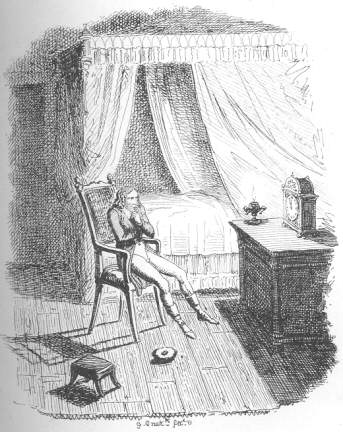
And there I sat, my eyes directed to the hand of the clock;
the seconds, the minutes, as they tinkled, entered me like a
dagger. I rose up at every sound I heard. The day
began to dawn; the leaden hours crowded one on another; it was
morning—evening—night. The hands of the
timepiece moved slowly on, and hope was departing. It
struck eleven, and nothing appeared. The last minutes of
the last hour vanished—still nothing appeared; the first
stroke—the last stroke of twelve sounded. I
sank hopeless on my couch in ceaseless tears.
To-morrow—shadowless for ever!—to-morrow I should
solicit the hand of my beloved. Towards morning a heavy
sleep closed my eyes.