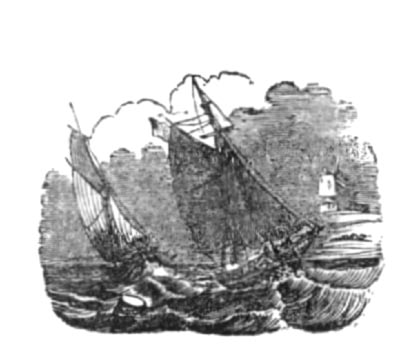
Not long after this another expedition sailed from Cuba, under the
command of Cordova, to make further discoveries on the new continent.
The first land they saw proved to be the eastern cape of that large
peninsula which you see in the map projecting into the gulf of Mexico,
and which still retains its original name of Yucatan.
As they approached the shore, five canoes came off full of people
decently clad in cotton garments; this excited the wonder of the
Spaniards, who had found every other part they had yet visited,
possessed by naked savages.
Cordova endeavoured to gain their good-will by presents, but perceived
they were preparing to attack him; and, as his water began to fail, he
sailed further along the coast in hopes of procuring a supply, but not a
single river did he find all along that coast till he came to Potonchon,
in the bay of Campeachy, which is on the western side of the peninsula.
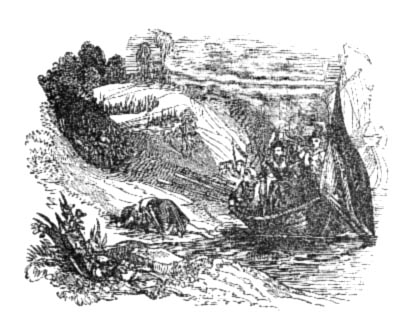
Here Cordova landed all his troops, in order to protect the sailors
while filling their casks; but, notwithstanding, the natives rushed down
upon them with such fury and in such numbers, that forty-seven of the
Spaniards were killed upon the spot, and one man only of the whole body
escaped unhurt.
Cordova, though wounded in twelve places, led off his wounded men with
great presence of mind and fortitude, and with much difficulty they
reached their ships, and hastened back to Cuba. Cordova died of his
wounds soon after his arrival.
Notwithstanding the ill success of this expedition, another was shortly
after fitted out under the command of Grijalva, a young man of known
merit and courage. He directed his course to the bay of Campeachy, to
the part from which Cordova had returned, and as they advanced they saw
many villages scattered along the coast, in which they could distinguish
houses of stone that appeared white and lofty at a distance.
In the warmth of their admiration, they fancied these to be cities,
adorned with towers and pinnacles; and one of the soldiers happening to
remark that this country resembled Spain in appearance, Grijalva, with
universal applause, called it New Spain; the name which still
distinguishes this extensive and opulent province of the Spanish
dominions.
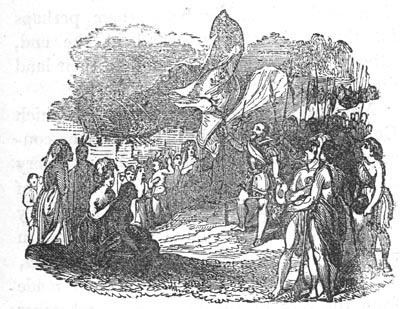
They landed to the west of Tabasco, where they were received with the
respect due to superior beings; the people perfumed them as they landed
with incense of gum copal, and presented to them offerings of the
choicest delicacies of their country.
They were extremely fond of trading with their new visitants, and in six
days, the Spaniards obtained ornaments of gold, and of curious
workmanship, to the amount of fifteen thousand pesoes, an immense sum,
in exchange for European toys of small price.
They learned from the natives that they were the subjects of a great
monarch, whose dominions extended over that and many other provinces.
Grijalva now returned with a full account of the important discoveries
he had made, and with all the treasure he had acquired by trafficking
with the natives.
The favourable account of New Spain brought by Grijalva, determined
Velasquez, the governor of Cuba, seriously to undertake the conquest of
that country, but as he did not wish to take the command himself, he
endeavoured to find a person who would act under his directions.
After much deliberation he fixed upon Fernando Cortez, a man of restless
and ardent spirit, on whom he had conferred many benefits; but these
Cortez soon forgot, and was no sooner invested with the command than he
threw off the authority of Velasquez altogether.
The greatest force that could be collected for the conquest of a great
empire, amounted to no more than five hundred and eight men, only
thirteen of whom were armed with muskets; thirty-two were cross-bowmen,
and the rest had swords and spears; they had only sixteen horses, and
ten small field-pieces.
With such a slender and ill provided force did Cortez set sail to make
war upon a monarch whose dominions were more extensive than all the
kingdoms subject to the Spanish crown.
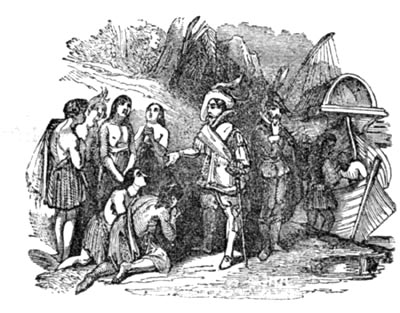
On his voyage Cortez first landed on the island of Cozumel, where he
redeemed from slavery Jerome de Aguilar, a Spaniard, who had been eight
years a prisoner among the Indians, and having learned the Yucatan
language (which is spoken in all those parts), proved afterwards
extremely useful as an interpreter.
He then proceeded to the river of Tabasco, where the disposition of the
natives proved very hostile, and they showed the most determined
resistance; but the noise of the artillery, the appearances of the
floating fortresses which brought the Spaniards over the ocean, and the
horses on which they fought, all new objects to the natives, inspired
them with astonishment mingled with terror; they regarded the Spaniards
as gods, and sent them supplies of provisions, with a present of some
gold and twenty female slaves.
Cortez here learned that the native sovereign, who was called Montezuma,
reigned over an extensive empire, and that thirty vassals, called
caziques, obeyed him; that his riches were immense, and his power
absolute. No more was necessary to inflame the ambition of Cortez, and
the avarice of his followers.
He then proceeded along the coast till he came to St. Juan de Ulua,
where, having laid the foundation of Vera Cruz, he caused himself to be
elected Captain-general of the new colony.
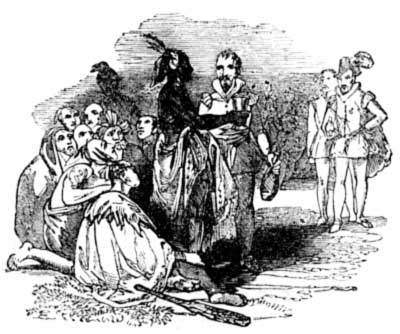
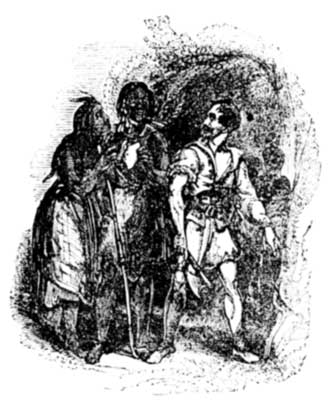
Here he was visited by two native caziques, whose names were Teutile and
Pilpatoe, who entered his camp with a numerous retinue, and informed
him that they were persons entrusted with the government of that
province by a great monarch, whom they called Montezuma, and that they
were sent to inquire what his intentions were in visiting their coast,
and to offer him what assistance he might need.
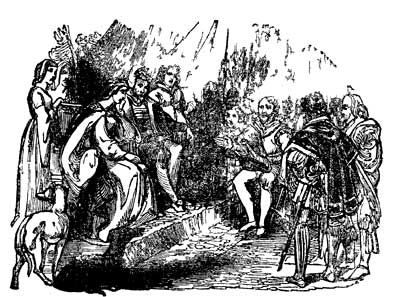
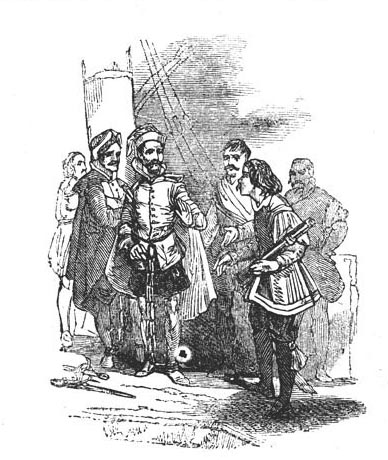
Cortez received them with much formal ceremony, and informed them that
he came from Don Carlos of Austria, the greatest monarch of all the
east, with propositions of such moment, that he could impart them to
none but the emperor himself; and requested them to conduct him, without
loss of time, into the presence of their master.
Messengers were immediately despatched to Montezuma, with a full account
of everything that had passed.
The Mexican monarch, in order to obtain early information, had couriers
posted along the road, and the intelligence was conveyed by a very
curious contrivance called picture writing, persons being employed to
represent, in a series of pictures, everything that passed, which was
the Mexican mode of writing: Teutile and Pilpatoe were employed to
deliver the answer of their master, but as they knew how repugnant it
was to the wishes and schemes of the Spanish commander, they would not
make it known till they had first endeavoured to soothe and pacify him.
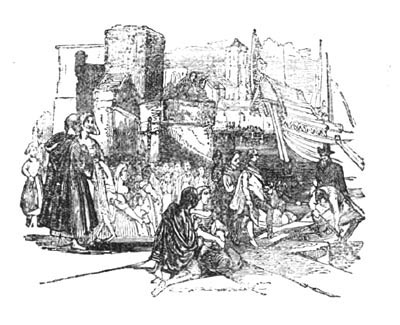
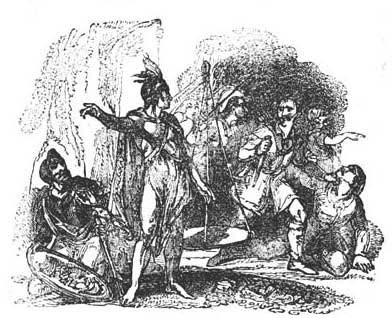
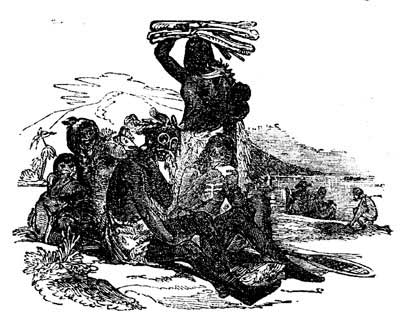
For this purpose they introduced a train of a hundred Indians loaded
with presents sent to him by Montezuma.
The magnificence of these far exceeded any idea which the Spaniards had
formed of his wealth.
They were placed on mats spread on the ground, in such order as showed
them to the greatest advantage. Cortez and his officers viewed with
admiration the various manufactures of the country. Cotton stuffs so
fine as to resemble silk. Pictures of animals, trees, and other natural
objects, formed with feathers of different colours, disposed with such
skill and elegance, as to resemble, in truth and beauty of imitation,
the finest paintings. But what chiefly attracted their eyes were two
large plates of circular form; one of massive gold, representing the
sun, the other of silver, an emblem of the moon. These were accompanied
with bracelets, collars, rings, and other trinkets of gold, and with
several boxes filled with pearls, precious stones, and grains of gold
unwrought, as they had been found in the mines or rivers.
Cortez received all these with an appearance of profound respect for the
monarch by whom they were bestowed; but when the Mexican informed him
that their master would not give his consent that foreign troops should
approach nearer to his capital, or even allow them to continue longer in
his dominions, the Spanish general declared that he must insist on his
first demand, as he could not, without dishonour, return to his own
country until he was admitted into the presence of the princes whom he
was appointed by his sovereign to visit.
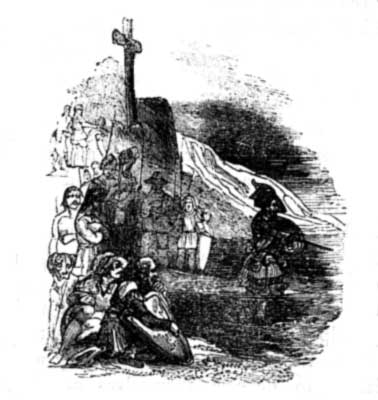
He first caused all his vessels to be burnt, in order to cut off the
possibility of retreat, and to show his soldiers that they must either
conquer or perish. He then penetrated into the interior of the country,
drew to his camp several caziques, hostile to Montezuma, and induced
these native princes to assist him.
After surmounting every obstacle he arrived with his army in sight of
the immense lake on which was built the city of Mexico, the capital of
the empire.
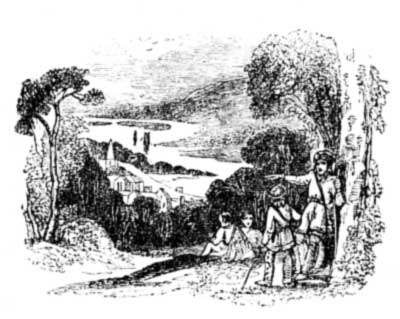
In descending from the mountains of Chalco, the vast plain of Mexico
opened gradually to their view, displaying a prospect the most striking
and beautiful: fertile and cultivated fields, stretched out further than
the eye could reach, a lake resembling the sea in extent, encompassed
with large towns, and the capital city rising upon an island, adorned
with temples and turrets.
Many messengers arrived one after another from Montezuma, one day
permitting them to advance, on the next requiring them to retire, as his
hopes or fears alternately prevailed, and so wonderful was his
infatuation that Cortez was almost at the gates of the capital before
the monarch had determined whether to receive him as a friend or oppose
him as an enemy, but as no signs of hostility appeared, the Spaniards
continued their march along the causeway which led to Mexico through the
lake with great circumspection, though without seeming to suspect the
prince whom they were about to visit.
When they drew near the city, about a thousand persons who appeared to
be of distinction, came out to meet them, adorned with plumes and clad
in mantles of fine cotton.
Each of these as they passed Cortez, saluted him according to the mode
of their country; they announced the approach of Montezuma himself, and
soon his harbingers came in sight.
There appeared first two hundred persons in uniform dresses, with large
plumes of feathers, marching two and two in deep silence, barefooted,
with their eyes fixed on the ground.
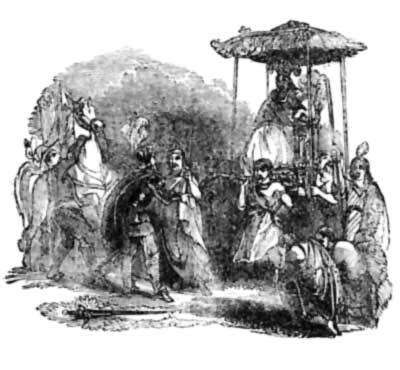
Then followed a company of higher rank, in their most shewy apparel. In
the midst of these was Montezuma, in a chair or litter, richly
ornamented with gold and feathers of various colours. Four of his
principal favourites carried him on their shoulders; others supported a
canopy of curious workmanship over his head: before him marched three
officers with rods of gold in their hands, which they lifted on high at
certain intervals.
At that signal all the people bowed their heads and hid their faces, as
unworthy to look on so great a monarch.
When he drew near, Cortez dismounted advancing towards him in
respectful posture; at the same time Montezuma alighted from his chair,
and leaning on the arm of two of his nearest relations, approached him
with a slow and stately pace, his attendants covering the way with
cotton cloths, that he might not touch the ground.
Cortez accosted him with profound reverence, after the European fashion.
He returned the salutation, according to the mode of his country, by
touching the earth with his hand and then kissing it.
This condescension, in so proud a monarch, made all his subjects believe
that the Spaniards were something more than human.
Montezuma conducted Cortez to the quarters which he had ordered for his
reception, and immediately took his leave, with a politeness not
unworthy of a court more refined.
"You are now," said he, "with your brothers, in your own house: refresh
yourselves after your fatigue, and be happy until I return."
The place allotted for the Spaniards was a magnificent palace built by
the father of Montezuma. It was surrounded by a stone wall with towers,
and its apartments and courts were so large as to accommodate both the
Spaniards and their Indian allies.
The first care of Cortez was to take precautions for his security, by
planting artillery so as to command the different avenues which led to
it, and posting sentinels at proper stations, with orders to observe the
greatest vigilance.
In the evening Montezuma returned to visit his guests, with the same
pomp as in their first interview, and brought presents of great value
not only to Cortez and his officers, but even to the private men. A long
conference ensued, in which Cortez, in his usual style, magnified the
power and dignity of his sovereign.
Next morning Cortez and some of his principal attendants were admitted
to a public audience of the emperor; the three following days were
employed in viewing the city, the appearance of which was so far
superior to any place the Spaniards had beheld in America, and yet so
little resembling the structure of an European city, that it filled them
with surprise and admiration.
Mexico, or Tenuchtitlan, as it was anciently called, is situated on some
small islands, near one side of a large lake, which is ninety miles in
circumference. The access to the city was by artificial causeways or
streets, formed of stones and earth, about thirty feet in breadth. These
causeways were of considerable length: that on the west extended a mile
and a half; that on the north-west three miles, and that towards the
south six miles. On the east, the city could only be approached by
canoes.
Not only the temples of their Gods, but the palaces belonging to the
monarch, and to persons of distinction, were of such dimensions that
they might be termed magnificent.
But, however the Spaniards might be amused or astonished at these
objects, they felt the utmost anxiety with respect to their situation.
They had been allowed to penetrate into the heart of a powerful
kingdom, and were now lodged in its capital without having once met with
open opposition from its monarch; but they had pushed forward into a
situation where it was difficult to continue, and from which it was
impossible to retire without disgrace and ruin.
They could not, however, doubt of the hostility of the Mexicans, more
especially as, on his march, Cortez received advice from Vera Cruz,
where he had left a garrison, that a Mexican general had marched to
attack the rebels whom the Spaniards had encouraged to revolt against
Montezuma, and that the commander of the garrison had marched out with
some of his troops to support the rebels, that an engagement had ensued,
in which, though the Spaniards were victorious, the Spanish general with
seven of his men, had been mortally wounded, his horse killed, and one
Spaniard taken alive, and that the head of his unfortunate captive had
been sent to Mexico, after being carried in triumph to different cities
in order to convince the people that their invaders were not immortal.
In this trying situation, he fixed upon a plan no less extraordinary
than daring; he determined to seize Montezuma in his palace and to carry
him a prisoner to the Spanish quarters. This he immediately proposed to
his officers, who, as it was the only resource in which there appeared
any safety, warmly approved of it, and it was agreed instantly to make
the attempt.
At his usual hour of visiting Montezuma, Cortez went to the palace,
accompanied by five of his principal officers, and as many trusty
soldiers; thirty chosen men followed, not in regular order, but
sauntering at some distance, as if they had no object but curiosity: the
remainder of his troops continued under arms, ready to sally out on the
first alarm.
Cortez and his attendants were admitted without suspicion, the Mexicans
retiring, as usual, out of respect.
He now addressed the monarch in a tone very different from that which he
had employed on former occasions, and a conversation ensued, very much
resembling that between the wolf and the lamb, in the fable, which you
no doubt remember.
Cortez bitterly reproached him as the author of the violent assault made
by the Mexican general upon the Spaniards, and with having caused the
death of some of his companions.
Montezuma, with great earnestness, asserted his innocence, but Cortez
affected not to believe him, and proposed that, as a proof of his
sincerity, he should remove from his own palace, and take up his
residence in the Spanish quarters.
The first mention of so strange a proposal almost bereaved Montezuma of
speech; at length he haughtily answered "That persons of his rank were
not accustomed voluntarily to give themselves up as prisoners, and were
he mean enough to do so, his subjects would not permit such an affront
to be offered to their sovereign."
Cortez now endeavoured to soothe, and then to intimidate him, and in
this way the altercation continued three hours, when Velasquez de Leon,
an impetuous young man exclaimed, "Why waste more time in vain? Let us
seize him instantly, or stab him to the heart." The threatening voice
and fierce gesture with which these words were uttered, struck Montezuma
with a sense of his danger, and abandoning himself to his fate, he
complied with their request: his officers were called, he communicated
to them his resolution. Though astonished and affected, they presumed
not to question the will of their master, but carried him in silent
pomp, all bathed in tears, to the Spanish quarters.
Cortez at first pretended to treat Montezuma with great respect, but
soon took care to let him know that he was entirely in his power. Being
thus master of the person of the monarch, he demanded that the Mexican
general who had attacked the Spaniards, his son, and five of the
principal officers who served under him, should be brought prisoners to
Mexico, and delivered into his hands.
As Cortez wished that the shedding the blood of a Spaniard should
appear the most heinous crime that could be committed, he then ordered
these brave men, who had only acted as became loyal subjects in opposing
the invaders of their country, to be burnt alive, before the gates of
the imperial palace.
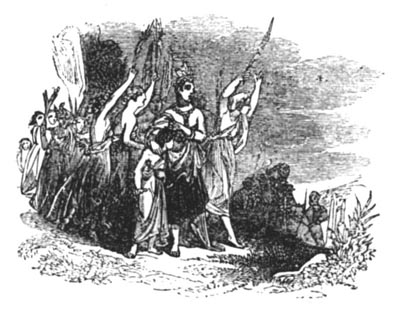
The unhappy victims were led forth, and laid on a pile composed of the
weapons collected in the royal magazine for the public defence.
During this cruel execution, Cortez entered the apartments of Montezuma,
and caused him to be loaded with irons, in order to force him to
acknowledge himself a vassal of the king of Spain. The unhappy prince
yielded, and was restored to a semblance of liberty on presenting the
fierce conqueror with six hundred thousand marks of pure gold, and a
prodigious quantity of precious stones.
The Mexicans driven to desperation, all at once flew to arms, and made
so sudden and violent an attack that all the valour and skill of Cortez
was scarcely sufficient to repel them.
The Spaniards now found themselves enclosed in a hostile city, the
whole population of which was exasperated to the highest pitch against
them, and without some extraordinary exertion they were inevitably
undone. Cortez therefore made a desperate sally, but after exerting his
utmost efforts for a whole day, was obliged to retreat to his quarters
with the loss of twelve men killed, and upwards of sixty wounded; Cortez
himself was wounded in the hand.
The Spanish general now betook himself to the only resource which was
left, namely, to try what effect the interposition of Montezuma would
have to soothe and overawe his subjects.
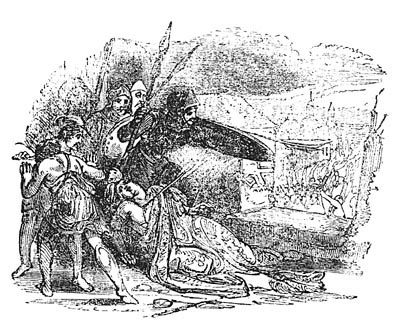
When the Mexicans approached next morning to renew the assault, that
unfortunate prince, who was now reduced to the sad necessity of becoming
the instrument of his own disgrace, and of the slavery of his people,
advanced to the battlements in his royal robes, and with all the pomp in
which he used to appear on solemn occasions. At the sight of their
sovereign, whom they had long been accustomed to reverence almost as a
god, the Mexicans instantly forebore their hostilities; and many
prostrated themselves on the ground; but when he addressed them in
favour of the Spaniards, and made use of all the arguments he could
think of to mitigate their rage, they testified their resentment with
loud murmurings, and at length broke forth with such fury, that before
the soldiers appointed to guard Montezuma had time to cover him with
their shields, he was wounded with two arrows and a blow on the temple
with a stone struck him to the ground.
On seeing him fall, the Mexicans instantly fled with the utmost
precipitation, and Montezuma was conveyed to his apartments, whither
Cortez followed in order to console him; but as the unhappy monarch now
perceived that he was become an object of contempt even to his own
subjects, his haughty spirit revived, and scorning to prolong his life
after this last humiliation, he tore the bandages from his wounds, in a
transport of rage, and refusing to take any nourishment, he soon ended
his wretched days; refusing with disdain all the solicitations of the
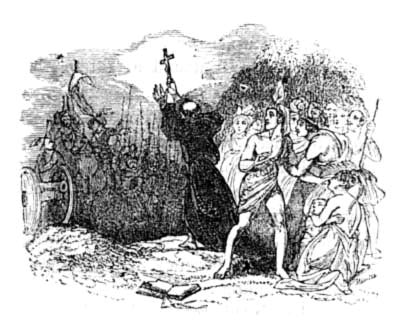
Spaniards to embrace the Christian faith.
The Mexicans having chosen his son Guatimozin emperor, attacked the head
quarters of Cortez with the utmost fury, and, in spite of the advantages
of fire-arms, forced the Spaniards to retire, which alone saved them
from destruction. Their rear guard was cut to pieces, and suffered
severely during the retreat, which lasted six days.
The Spaniards, however, having received fresh troops from Spain,
defeated the Mexicans, and took Guatimozin prisoner, and in the end
succeeded in totally subjugating this vast empire.
Guatimozin, before he was taken prisoner, being aware of his impending
fate, had ordered all his treasures to be thrown into the lake, and he
was now put to the torture, on suspicion of having concealed his
treasure. This was done by laying him on burning coals; but he bore
whatever the cruelty of his tormentors could inflict, with the
invincible fortitude of an American warrior. One of his chief
favourites, his fellow sufferer, being overcome by the violence of the
anguish, turned a dejected eye towards his master, which seemed to
implore his permission to reveal all he knew. But the high spirited
prince darted on him a look of authority mingled with scorn, and checked
his weakness by asking, "Am I reposing on a bed of flowers?"
Overawed by the reproach, he persevered in dutiful silence and expired.
Cortes, utterly regardless of what crimes and cruelties he committed,
added largely to the Spanish territory and revenue. But Spain was always
ungrateful. Pizarro was murdered; Columbus died of a broken heart, and
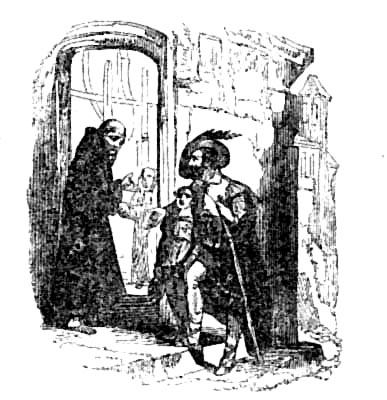
Balboa the death of a felon; so what could Cortez expect? He fell into
neglect and poverty when his work was done. One day he forced his way
through the crowd that had collected about the carriage of the
sovereign, mounted the door-step, and looked in. Astonished at so gross
a breach of etiquette, the monarch demanded to know who he was? "I am a
man," replied Cortez, "who has given you more provinces than your
ancestors left you cities!"