“I love all waste
And solitary places; where we taste
The pleasure of believing what we see
Is boundless, as we wish our souls to be;
And such was this wide ocean, and this shore
More barren than its billows.”
Shelley
The surface of the ocean is unruffled. Only the heaving of its great
body suggests the power beneath. But when it confronts the desert
cliffs, backed by the world-weight of the Andes, the force which has
been gathering all the way from Australia, so mighty that it can be
compared to nothing but itself, snarls into uncontrolled fury,
rebellious, but acknowledging the limit of its power.
The “Peaceful Ocean” lies next to a land of geological unrest; the coast
rising, subterranean torment breaking out in earthquakes, hurling cliffs
into the sea. Even the busy modern port of Callao partakes of the
mystery of this elemental land. The white ships anchored in the clear
water of its harbor gradually turn dull brown. Might it be the crater of
an extinct volcano?
No wonder the people on such a shore build bamboo cages plastered with
refuse and mud to live in, temporary for them as the present stage is
transient in the history of the land on which they live. Their
object-lessons are warring natural forces. No wonder they are brutal,
slinging cattle on board steamers by the horns, casting a stone between
the eyes of a bullock to make him turn around. Even their little
children play at bull-fights with horns of defunct cattle. The soil of
this “sea-gnawn” shore affords not one necessity for human existence,
not even a drop of water. There are no real harbors, only niches in the
jagged coast. But few lighthouses indicate danger, and the desert is
chilled by winds from the Antarctic pole.
Far out, a low cloud is skimming the surface of the gray water,
advancing in waves of blackness. From one end a shower falls; at the
other, a column rises from the water to meet the on-rushing mass, “a
great oval, rolling forwards over the sea.” It comes nearer and nearer,
till the shore shimmers as through heat waves. The quiet is complete
except for the noise of millions of laboring wings.
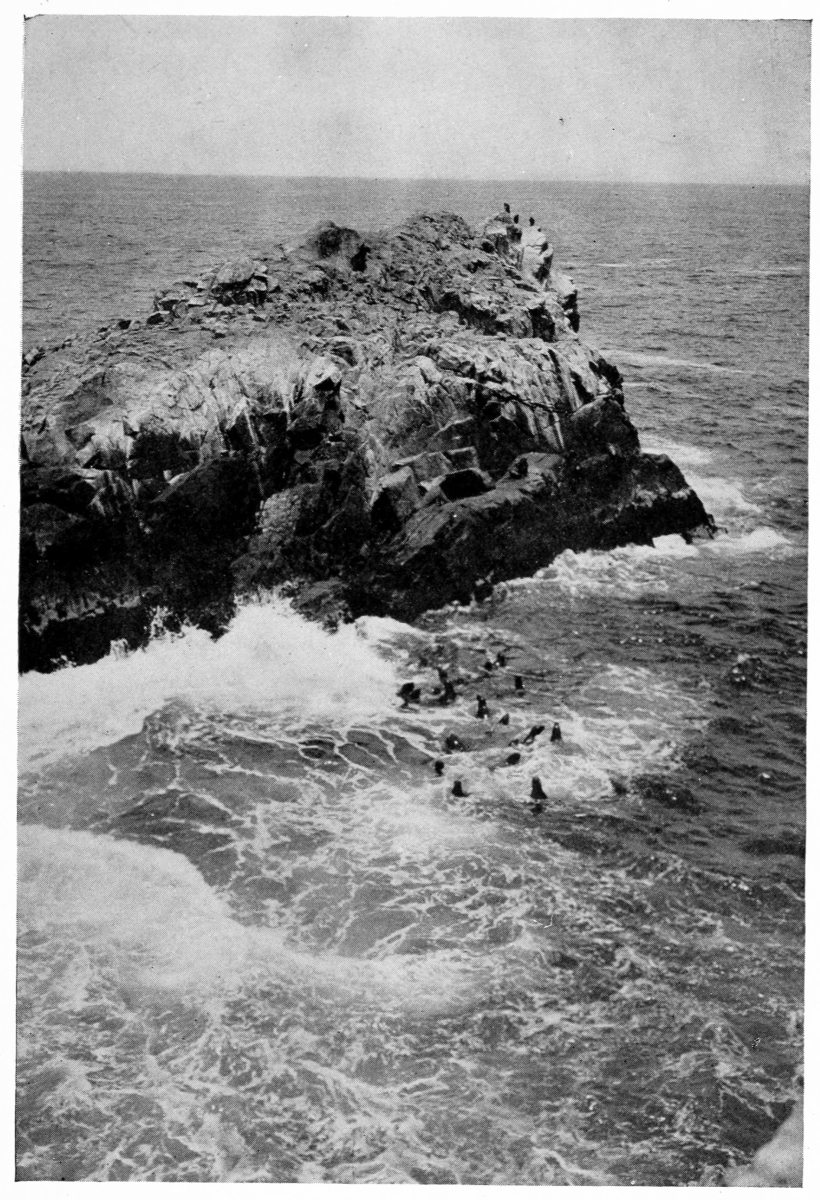
SEALS OF THE PALOMINOS ISLANDS.
A cloud of birds! Now they fall to the water with close-clapped wings,
hundreds at a time, each a tiny splashing fountain. Their hunger is
insatiable, but not because food is lacking, for the swarms of pilchards
beneath the waves are vaster than the armies of birds which pursue them.
Ancient Indian races enriched their irrigated fields with these little
fish. A curious, tawny jewel is found upon this shore, known as “fishes’
eyes.” Might they be fossilized eyes of those fertilizer-fishes?
The appearance of this coast could not have been different in
antediluvian days, with the screeching birds and the mammoth terrapin
off-shore, those associates of the dodo.
The birds fly out at sunrise and spend the day in fishing, resting upon
the waves when they are tired, and at sunset return to their giant stone
islands for the night. Alone, the call of a sea-bird would be lost in
the fury of the meeting of cliff and sea. But as a mass of white gulls
can assume blackness by mere quantity, so their mingled voices can take
on an overwhelming poignancy of sound. Louder than the crash of
breakers, louder than the barking and snorting of the bald, fat seals
loping over them in droves, surges the great cry of the birds, as, in a
shower of wild calls diverse as themselves, they settle upon the rocks:
pelicans, cormorants, mollyhawks, gannets, sea-mews, gulls, osprey,
occasional tropical flamingoes lost among ice-birds and stormy petrels,
wild ducks, Inca terns, and the weird, amphibious “bird-child,” which
tries to stand erect, fluttering its cartilaginous wings, braced by its
indistinguishable tail. All the birds of the ocean gather here, from
sandpeeps to albatrosses, a surfeit of life to accentuate the barrenness
of the shore. They are multiplying every year their already limitless
myriads, useless to man as the savages of the interior, without
commercial value now of any kind, yet not annihilated on that account.
It is said that all are souls of sailors lost at sea. In each stormy
petrel a lost apprentice lives again, in each pelican a boatswain, in
each mollyhawk a chief officer, in each albatross a sturdy old captain.
One is tempted to write of the romance of the sea-birds of Peru, if
romance has in it any of the fascination of waste on a large scale, for
like barrenness, waste must be on a large scale to be picturesque. Where
is the impertinence of it so overwhelming as in nature—her spendthrift
production of unused powers, and the daring of her destruction?
A German scientist, investigating the guano interests, reported eleven
million birds on one of the Chincha Islands, for these are the guano
birds, and these wild, craggy islands the Guano Islands, a jewel-casket
of Peru, which now abandoned, emptied of its contents, stands wide open,
staring vacant in the sunlight, that its owners may not forget its
former fullness.
Under the stimulus of pure guano a plant will spring to mammoth
dimensions, lavishing blossoms and fruit. Ancient races, even the
foreign Incas, realized its magical endowments and made laws governing
its use. But land enriched by guano into immense fertility lapses after
a while, barer than before.
A few sailing ships, hoping to glean poor remnants of this accumulation
of the centuries, still huddle as close as possible to the black rocks,
which, because of the quantity of that very fertilizer which has
distinguished them, are made repellent to life of any kind. In this
laboratory of the strongest fertilizer, there is not the slightest trace
of vegetation—Peru in paradox.
The sunset blazes through the fissures and shoots shafts of opalescent
light under the great stone bridges toward the mountainside of the
candelabrum, veiled in a hazy shimmer. Defiantly gorgeous it is, all but
the young moon which nestles among rushing scarlet and black clouds.
A giant candelabrum, at least four hundred feet long, is hollowed deep
in the rock of the sheer volcanic headland above the sea. Its trenches
do not fill with drifting sand, though the natives of Pisco make
periodic pilgrimages across the bay, just to be sure. Some think it is a
sign of royalty, a flaunt of the Incas, or the boundary-mark of a
conquered kingdom. Some say it was a warning made by the Spaniards after
Pisco was sacked by English freebooters in the seventeenth century, for
though now over a mile inland, it was then a coast town. Such is the
equilibrium of the Peruvian coast! Others call it “the three crosses,”
the life-penance many years ago of a Franciscan friar named Guatemala.
But a symbol does not for mere inquiry give up the secret of its hidden
mystery. Doubtless the origin and purpose of the Candelabrum of Pisco
will never be known.
A few small, square, purple shadows mark a town, put down at random in
the desert beside the sea. Some houses are made of the ribs and jaws of
whales. A conspicuous white building, a little removed, is for sufferers
with bubonic plague. Crosses surmount hummocks round about the town.
People are making pilgrimages to and fro. And over all, white-headed
vultures are wheeling. They spread their wings and cry in the silence.
Dust covers the little city, clustering about a market-place of sand. A
fountain without water mutely occupies its center. Lamp-posts without
lamps surround it, and the mud houses are without windows. The cathedral
towers have no bells. Strange plaster figures are sculptured upon the
façade, and infants with hands put on backwards hold up the portico.
Beyond the door with a two-inch keyhole are Virgins in pink silk and
gold tinsel, saints with rows of parallel ribs, angels with gauze wings,
towering altars of gingerbread work, artificial flowers, and
silver-paper fringe.
Glossy-haired women, their black mantas (head-shawls) thrown back,
drag stiff skirts through the dirty sand. Half-naked children gnaw at
the inside of long bean-pods. Mangy dogs with dusty skin and a sparse
sprinkling of yellow hair slink into the shadows. Black goats and their
attenuated kids search about in the sand for something to eat. Men and
women file out of black interiors, carrying gourds full of brilliant
edibles. Meal braizes over a low fire on the sand; a woman crouching
over it whips the flame with the end of her long hair. From time to
time, to make a brighter blaze, she picks up pieces of wood with her
strong toes. Near by struts a blue-eyed bird. It is a huerequeque, the
household scavenger. Bits of cloth hang about his tall knees. The woman
explains that they are trousers intended to keep him warm. She is sorry
I could not have come a few days later, for she is about to make him
some new ones for summer, of lighter quality, with lace edges.
The market is held in the bed of a “river,” no less dry than the
surrounding desert. Old women behind piles of tropical fruits,
guayabas, pacays, ciruelas, gossip to a whir of small mandolins.
Heavy-browed men in flapping sombreros drink thick liquids and purchase
pats of red and yellow picante (a highly seasoned dish). Groups of
pack-horses with silver bridles are tied round about the market.
But surprises are lurking in these coast towns. Behind heavy, unexpected
doors, the single affluent family of the town receives in a peacock-blue
salon. There is a lady in brown, with trimmings of blue velvet and
cotton lace, and a perpendicular yellow hat. Another is in purple
velvet, with swan’s-down hat and photograph brooch of her sister. A
third, wearing green velvet, a salmon colored hat with red roses, and
holding a pink silk handkerchief embroidered in lavender, sits purring
beside her red-faced German fiancé. The carpet is red, the furniture
covered with brown brocade; there are statues of carved alabaster with
gilt edges and pink cuspidors. Gold mirrors, chromos of Venetian court
life, and pasteboard calendars of bygone years hang upon the walls. The
Spanish tiles of long ago are painted over.
Farther up the street a door may open upon a wilderness of vicuña rugs
as tawny as a lion and softer than moleskin. Shawls of tan-colored wool,
silkier than Liberty fabrics, lie about. One is not surprised that
vicuña wool was reserved for royal use in Inca days, nor that blankets
of it were sent by the conquerors as offerings to Philip II. There are
little foot-warmers made of vicuña fur and chinchilla skins, wiry
penguin skins and a deafening noise of singing birds in cages. A
black-eyed girl with hair like tarred rope stands making cazuela (a
thick soup) and paring guavas. She claps her hands, and many doves fly
in to peck the crumbs from her lips.
A certain herb lives for years underground in the desert; it feels no
necessity for a leaf-existence. Yet if the parched roots are reached by
water, they expand toward the sun in lovely bloom.
Up from the shore stretches the bare immensity of desert, ending in one
tremulous horizon with the ocean, and with the wilderness of mountains
against the pulsating sky at the other. It is the Land of Light. All
sensation of color is lost in this great sensation of light, an ardent
light “shining through things, not on them.” Even the clouds expire from
excess of light. It reduces all colors to mere hot vibration. The
translucent mountains swim in a sea of light, reflecting from it as from
wide stretches of water. Though sensation of color is lost in light,
their huge forms are distinct in the radiant atmosphere, but unreal as
if half-veiled.—One attribute of mirage is absolute clearness of
outline.—Insignificant details emerge, but they rouse admiration only
because of the light investing them.
The whole wide desert culminates in illusion and mystery of distant
outlines. Everything floats in it, as it sweeps over from the opalescent
mountains. A cross in the midst of the shelly sand, “protruding through
thin layers of mirage,” marks the spot where a greatly feared bandit was
killed. Skulls are heaped beneath it, with matches and half-burned
candles.
Water being denied, the desert is soaked with sun. It is the Land of
Heat. No plant grows in the scorching soil, no animal can endure it. No
bird, no insect flies through the burning atmosphere. Each object
shimmers until it seems but the reflection of itself. Fire descends from
the burnished sky and vibrates in the air and scalds the sand. Yet
concentrating a tropical sun, this hot solitude lies between the cold
ocean and the mountains, a region of ice.
This desert is the abode of weird phenomena. Sometimes a globe of fire
springs to the size of the sun, illuminating the sky for a quarter of
an hour; then it dissipates into an infinitude of stars, which wriggle
off into bright little tails and disappear.
A slowly moving company, muffled to the eyes, with heads done up like
Tuaregs of the Sahara, mincing across the desert on donkeys, suddenly
see themselves swinging along over their own heads, as if magnified by a
gigantic mirror in the sky. The clouds give back strange pictures of
one’s self enlarged and surrounded by a halo or a circular iris,
summoning a saint or revealing a fairy. This quality is inherent in
Peru, making ordinary moments ornamental.
Near Casma is a hill called “Dreadful,” whose continuous sandslides when
the heat is greatest give off a sound of mystery, suggesting heat, like
the roar of a distant volcano.
No matter how much the political status of Peru may change from century
to century, it remains always the lair of earthquakes. Mines of gold and
silver, islands of guano, deserts of nitrate, may be in turn discovered,
exploited, exhausted. Earthquakes destroy those who have been enriched
as those who have lived beside them in want. Even now earthquakes are
almost daily recurrent along the coast. In laying your ear to the ground
you can hear subterranean rumblings. Only in the frequency of slight
shocks do people feel secure; otherwise they know the underground world
is hoarding strength for a fury of destruction. As a traveler of the old
time expressed it: “The inhabitants are subject to being buried in the
ruins of their own houses at any time.”
The Indians say that when God rises from His throne to review the human
race, each step as He progresses is an earthquake. As soon as they feel
the pressure of His foot upon the earth, they rush from their huts to
show themselves to Him. When the rumbling becomes loud enough to be
noticeable, dogs howl, beasts of burden stop and spread their legs to
secure themselves from falling, people rush to doorways, and churches
are emptied in an instant. Reddish mists steam from the sea, bad odors
from the earth; distant thunder—complete wind-stillness. The clouds of
sea-birds rise from the earth and fly high, watching an agony in which
they have no part. Then a frightful crash, rocks are torn asunder,
great masses fall off as islands into the sea, which is still. But soon
it turns black, boiling with a smell of sulphur, and many dead fish
float about.
Omnipresent, the earthquake is a mystery which no laws can govern,
beyond man’s comprehension or control. One never gets accustomed to it.
Horror at a first shock only increases with further experience.
Earthquake is linked with freaks of nature; it lifts up a ridge across
the bed of a stream; it alters the face of the earth so that lawsuits
spring up over changed boundaries. It vitiates the soil. Blooming fields
wither, crops are lost, and cattle die from eating the scorched grass.
The fiery core of earth is nearer the cooled surface than we imagine.
But here at least there are no “torments from heaven.” In Peru it is
said that lightning is worse than earthquake, emanating as it does from
God’s own realm.
Even the climate of the coast partakes of mystery. The clouds hurrying
from the Atlantic have drenched a whole continent of jungle in tropical
downpour, and before they reach the desert, their last drop of moisture
has been wrested from them as snow—drained dry by the Andes. The
tropical sun heats, and the Antarctic current bringing its icy winds,
cools. Sometimes one predominates, sometimes the other. For the red-hot
desert can also be cold! The low-hanging garuas, the ocean mists of
half a year, chill the desert and cling to the base of the mountains,
fading lighter and lighter up and away from the black rocks where white
surf is breaking. Such are the facts of the case, but it has been
thought that the original god, Con, was responsible, for once in anger
he deprived this desert coast of rain.
The desert is majestically empty, a great “vision of nothing without
perspective.” Yet its mere emptiness suggests breadth, backward and
forward, up and down, both in time and space. An unheard silence lies
between the empty horizons, perfect except for the “great, faint sound
of breakers,” the tumble of an unused ocean of water, which destroys
without moistening the desert shores.
It seems lifeless. Harmless and peaceful at least, it presents nothing
to be destroyed by sun-blight. It remains, as it apparently always has
been, the realm of death—though even death presupposes life before it.
But disturb the desert, and a thousand forces spring into action,
furiously attacking the intruder. The heat of the sun assumes a ghoulish
love of destruction, and at night the stars look down upon a creature
shivering with fever, reeking with wet in this desert place. Possessing
all fruitful ingredients within and kindly elements without, the desert
sleeps. It needs only one thing to burst into life.
A mysterious river springs forth full-grown. From what glacier or clear,
icy fountain up on the frozen puna may it not have issued? And then,
after a mysterious incubation, it returns to sparkle here in the light,
and in the leaves and flowers which the dampened earth is ready to
produce.
There are traditions that sometimes a vagrant shower escapes from the
magnetism of the mountain-tops. The flowers waiting just beneath the
surface spring up like bloom over the June earth. The water was a shower
of bluebells! A fugitive vegetation greedily spreads, quickly as it
disappears with the passing of the water. In some places cotton grows
to the height of a horse’s head, a luxuriant crop, too unexpected for
harvest. This brilliant life lasts a week, perhaps more, and then
lapses. Where do the slumbering flowers conceal themselves? Where,
indeed, does the pansy get its coloring matter?
The desert of Peru is varied: toward the south the coast is strewn with
borax, white upon the cliffs; toward the north petroleum gushes from
beneath it. Upon the red plains of Huacho are the salt lakes of Pampa
Pelada, reflecting the sun in a thousand colors. “White dust-whirlpools
dance on its white floor.” Its banks are scattered with the bones of
animals which have come there for salt, and its perpendicular cliffs are
haunted by flesh-eating birds. There, gnarled gray shrubs “loom as if
carved out of clay.” Beyond, the desert is coated with nitrate; yet here
it seems but pulverized bones, beneath acres of white skeletons bleached
by a thousand years—gaunt testimony to its desertdom since prehistoric
Indian races struggled to make it blossom.
In the Pampa of Islay the desert takes on a terra-cotta hue. Whirlwinds
progress from hollow to hollow. Above the purple mountains, shading away
from the red desert, bright blue peaks are snow-covered to set them off
from the sky. Fog shadows drop darkness here and there over their
barrenness. Even the mist has a poetry of contrast.
Across the plain a constant ocean wind sweeps fine white beach-sand
along with waves of color, no less real because impalpable. Its
pilgrimage of a thousand years toward the mountains is uninterrupted,
for the wind blows always from the southwest. It causes the rippled
waves of sand which it brings along to assume in traveling a crescent
shape—the wandering médanos.
Sometimes larger dunes overtake smaller ones, which, so absorbed, become
firmer in shape as they journey toward the mountains. Should two
collide, they are shivered, then blend in a new crescent, usually to
separate again.
Growing from a network of roots within the moving dune, the snowy heads
of a small plant maintain themselves just above the sand as it drifts
over the hard plateau.
The médanos are scattered as thickly as the crescent shadows of some
vast eclipse, a labyrinth of nature. They are as mysterious as
“mushrooms growing in rings, marsh-fires which cannot warm, or the
shrinking of the sensitive plant.”
The sand drops constantly over the acute crest. From all about come soft
sounds, an overwhelming minor music, almost inaudible. Were you in a
forest, you might think it was the soughing of the wind through the
branches or the shuffle of locusts devouring a tree.
These playthings of the wind have been called symbols of the Moon in the
land of the Sun, since nothing in Inca days could dissociate itself from
either; a crescent Moon humbled by the Sun’s anger, allowed to possess
her former fullness but a day at a time, doomed to be obliterated over
and over again.
The worth of anything consists in the fact that through it can be seen
something more beautiful than itself, something to which it forms the
setting. Words are mere points of departure. What limitless excursions
can even one word suggest, into countries more wonderful
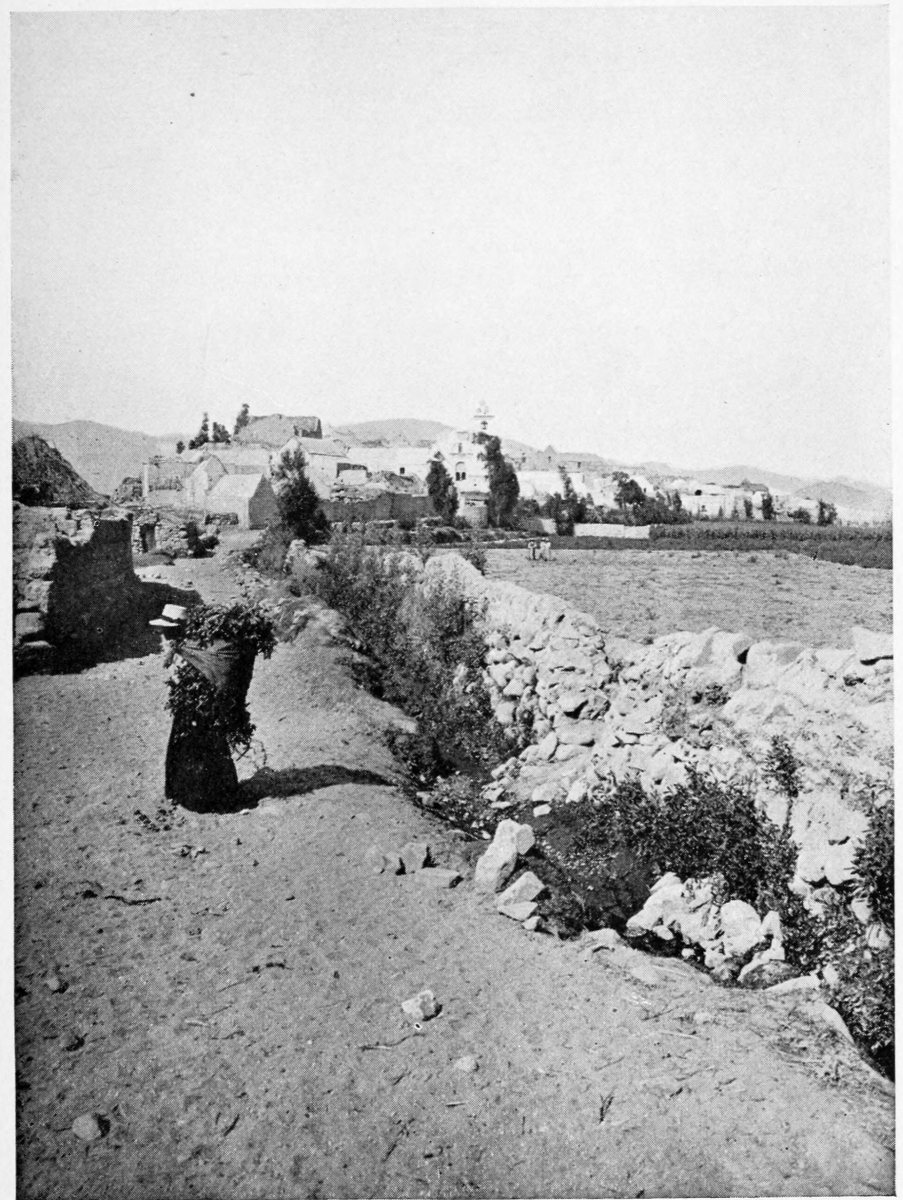
SACHACHA, A TYPICAL VILLAGE OF PERU.
than any created by a remote if consummate artist! And what an intimate
happiness is found there, which no one else has felt nor could describe
if he had!
Wherever rivers descend from the mountains, green garlands are slung
across the desert. No wonder the river was a god to the desert-dweller,
bringing with it meadows and gardens. Where only dust has been, acres of
cotton, bright-green sugar-fields, and dark orchards lie between mud
walls and willow-shaded lanes. Herds graze upon alfalfa steaming in the
sun. The yellow plaster terraces and balconies of haciendas among
their banana groves are shaded by cascades of glowing bougainvillea. But
wherever water is, fever follows. Disease clings to the green spaces.
Even sickness cannot abide in the desert alone.
Huge, pyramid-like mud structures spring crumbling from the soil whose
modified form they seem to be, temples and palaces of former days, each
with its legend. The ruins are inhabited by weird iguanas and “haunted
by those birds of ill omen that only nest in ruins.” Mounds of
treasure, too, linger along the desert, and fragments of the paved road
of the Incas.
A gold bell was once buried in Tambo de Mora. Older people have heard it
tolling on quiet nights. Some say it rings from the top of a hill, some,
from beneath the ground. To be sure, bells were not known to ancient
Peruvians, yet a company was properly financed to hunt for this bell of
gold.
Submerged or enchanted cities exist on every hand. A mystic race of
dwarfs live in the Andes. They guard a vault of buried treasure. An
Indian who declared he had seen it became so terrified at the extent of
the riches that he fled, not forgetting to mark his path. Yet frequently
as he had followed the trail to the very spot, he could never again find
the cavern of glittering jewels: it had sunk completely out of
sight—“You can see for yourself, Señorita, that it has, if I take you
there!”
Legends of prehistoric days take on the garb of myth, when giants came
over the sea to Peru long before the memory of man. Wishing to provide
themselves with water in the desert, they excavated enormously deep
wells, still undeniable evidence of their dominion. Moreover, their
bones of incredible size have been found. Garcilasso says a piece of one
hollow tooth weighs more than half a pound. Their footprints have been
traced as far as Patagonia. For their sin they were destroyed by a rain
of fire.
Maui, too,—the Polynesian god who caught the sun with cords of cocoanut
fiber, who lifted the sky and smoothed its arched surface with his stone
adze, who made the earth habitable for man and then created him, and who
now divides his time between fishing for islands with a hook which is
called the Plume of Beauty, and resting in the form of a small day-fly
upon the under side of a flower,—Maui, who belongs to the length and
breadth of the Pacific, once visited Peru.
Upon this coast lived aborigines with flat noses, fishing from boats of
inflated sealskins, and sleeping pell-mell in sealskin huts on heaps of
seaweed, “tall, cannibalistic fishermen ... who used bone utensils, made
primitive pottery, nets, and fabrics of osier.”
Here lived the contemporaries of the Incas, Yuncas they were called,
“dwellers in the hot lowlands,” distinct from those of the highlands,
with their hideous thoughts painted on earthenware jars, and their hazy
conception of a single god, their pragmatic worship of him by means of
anything which he had made for their support and comfort, and their
sacrifice to him of his greatest gift, human beings.
Fancy is free to play along geologic or human history. Bones of
mastodons as well as sea-bottom shells are found in the desert. Vanished
races have embellished it in passing. Man has but added to the mystery
of nature. Yet after such lapses of time the two are mingled
indistinguishably.
There was once a mine of gold in Peru. Later it became a copper mine,
and now they sell the water that collects in the bottom.
The Incas found a rainless desert intersected by fruitful valleys as
to-day, each independent, with its own gods, its own king, its own
manners and customs, even its own diseases! Each valley chieftain lived
upon a platform among the fields, but his villagers lived in the desert,
not to encroach upon land capable of cultivation. These Yuncas excelled
in the arts of weaving, fashioning metals, and in making pottery.
In the name of the Sun the Incas descended from regions of snow to
conquer the desert-dweller, with lofty disregard of the fact that the
benign source of all blessings among the high table-lands was the
scourge of the lowlands, where water-gods were worshipped. These
religious wars changed the face of the country. Valleys were connected
by a great highway. Sun temples and convents for the Virgins of the Sun
supplanted the shrine of each valley’s chief god. Only one remained
inviolate on the whole coast, that of the awful, intangible Pachacamac,
who, being a fish-god in his great red temple by the sea, was not an
idol, but the Invisible, Unknown, Omnipotent God, who had existed before
either the sea or the sun; Pachacamac, he who formed the world out of
nothing, the Creator whose image they dared not conceive. His name was
mentioned with shrugging of shoulders and lifting up of hands, and he
was served with fasting. Unlike Sun-ritual, his cult was a personal one,
the inner worship of a people who paid tribute to golden fishes. The
Maker of all Things had been conceived by those ancient peoples who,
Balboa says, came from the north on a fleet of rafts, when the mountains
had the climate of the valleys, and the whole actual coast was under the
ocean.
The aura of the Unknown God invested the fish-idol, and the temple was
held in such awe that it was not only spared by the Incas, but they even
made pilgrimages to the shrine. Shy in the thought of offending the
Maker of the World, Inca Yupanqui allowed his golden seaside temple to
remain, but erected a temple to the Sun a little above its level. To
honor the conqueror, the priests of Pachacamac “appointed a solemn
fishing of many thousand Indians, who went to sea in their vessels of
reeds.”
Though the fish-idols were ejected, and a convent for the Virgins of the
Sun was founded, worship of Pachacamac went on as before. The Incas
joined in it, identifying him with Uiracocha of the mountains, but they
extorted Sun adoration as well, a fair barter of faith.
Then the priests of the Sun made an idol of Pachacamac, and so it
presided until, drenched with sacrificial blood, it was chopped to
pieces by Hernando Pizarro and twenty soldiers in January, 1533. A
terrible earthquake followed, which Pizarro called the devil’s rage, and
triumphant he planted a cross above the looted temple. Pizarro gave the
golden nails to his pilot, as a reward for his entire venture. But much
of the temple’s treasure is said to be concealed underground,
undiscovered to this day.
The temple pile glows against the blue sea in the midst of shimmering
sand. Pachacamac lies in its magnificent ruin surrounded by acres of
skeletons. For more than two thousand years it was the most famous
burial place of the coast. Even mummies were brought from great
distances to lie in the sacred ground.
Layers upon layers of succeeding generations have all yielded their
excavated secrets, each throwing light on others. Time and
treasure-seekers have laid bare the most recent. Histories of great
peoples told by their graves!
I stood upon the summit of the broad mound, the temple to Inti, the Sun,
built by the Incas above that of Pachacamac, the fish-god. Its crumbling
walls, with traces of their brilliant coloring, ended abruptly in
mid-air. The headless skeletons of forty-six young girls had recently
been found upon the terrace where I stood, the braided cords hanging
loosely about their skeleton necks.
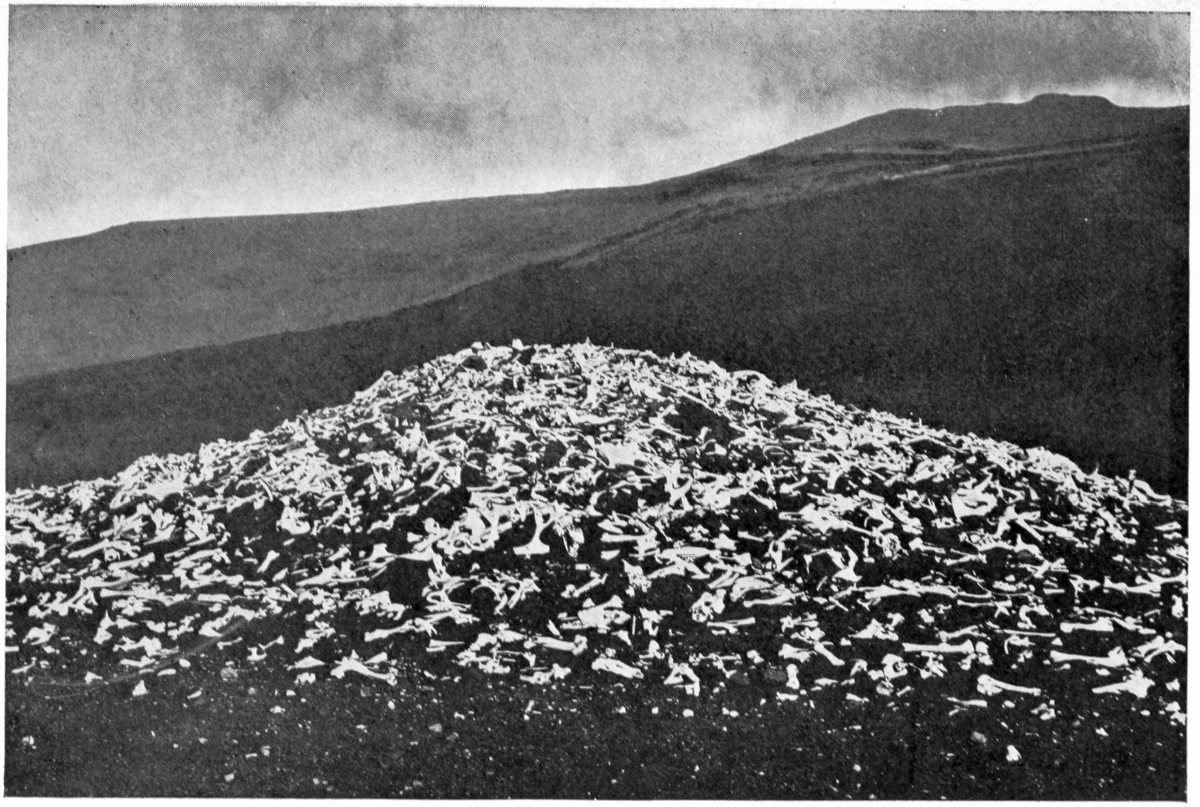
PAMPA DE LOS HUESOS—THE FIELD OF BONES.
Far below stretched the vast field of the dead. I looked out over a
desert of round white skulls, with eye-cavities staring at the
sun—Sun-worship continued in death. Little flurries of dust rose here
and there, as men with shovels turned over the sand, hoping for
treasure. Gallinazos, hideous vultures of the desert, paced up and
down. Below the convent of the Virgins of the Sun, whose niches only
remain, was a small blue lagoon under palm trees. On its reed-edges a
white heron tilted about—a curious, gnarled creature, giving an
impression of majestic grace.
Between me and the sand-hills rolling up to the Andes lay the silent
courts, the great, roofless houses of the city of the dead caving in
over its streets of sand. The desert-river separated this sepulchral
spot from the valley of Lurin, where cotton-fields and yellowish
expanses of sugar-cane were divided by willow hedgerows, with glimpses
of water beneath tall mud gateways. The breeze was as sweet as
heliotrope hedges could make it and filled with tinkling bird notes.
On the other side was the whole reach of the sparkling Pacific, with
its far-off sound of breakers. There is a tradition that the two rocky
islands are a goddess, Cavillaca, who cast herself and her child into
the sea a thousand years ago. But scientists assure us that the islands
were torn away by an earthquake since Spanish occupation. The Incas,
they say, had a temple on the islands, then a promontory.
He has not beheld the quintessence of all human suffering who has not
seen the face of a hunchback child-mummy. Upon such bodies, doubled up
and tied securely into the smallest possible space, whose varnished skin
is stretched over their unbending bones, even the tattoo marks still
show in designs of their owners’ choosing. They are clothed in
finely-woven garments, with sandals, pouches, shell and bead ornaments,
embroidered bands, and hair not yet unbraided. Sometimes brilliant eyes
stare from empty sockets in the withered mummy-faces, eyes of
prehistoric cuttlefish, a symbol of fish worship. In some of the skulls
are dents made by blunted points of stone weapons.
One mummy sits in the attitude of a toper about to drink, with a monkey
on his shoulder—for pets of the dead man accompanied him on his
journey, his dog or parrot sometimes mummified at his feet. The men have
their slings and fish nets, the women their spindles, needles of cactus
thorns, and every implement of household use, the children their
earthenware dolls. All have their little gods and talismans. There are
pots of provisions, too, with lids to keep out the thin finger of time,
jugs of chicha (a beverage distilled from maize), and ears of corn in
nets from which they have never been removed since they were put in by
hands turned to dust a thousand years ago.
From the grave of an apparently great official with his treasure-jars,
was taken only the mummy of a puma, yellow feathers on its head, a gold
plate in its mouth, gold and silver bangles on its legs. It had a
necklace of emeralds from the north, and its tail was full of golden
feathers from the mystic jungle beyond the mountains.
Recently X-rays have been applied to mummy-bundles, which show other
skeletons within as well as the one who had died, skeletons of those
who, when those winding-sheets were adjusted, were still alive. Gruesome
sacrifice!
Pachacamac has furnished museums all over the world and is still one of
the most inexhaustible of mummy supplies.
My horse descended carefully to this field of the dead. He picked his
way across stepping-stones on which pilgrims approached the lower court
of the temple where their year of penance before entering was to be
spent. A step, and there was the sound of crunching human bones. Sand
filled the skull cavities. They shattered like fragile glass as the
horse’s hoofs clattered across them toward the ruined city. The sand was
pulverized bones. Bits of cloth and pottery attracted the collector’s
eye, or a deformed or trephined skull.
The city walls are twenty feet thick. Their ends and their beginnings
are lost in sand. Marks of fire show here and there, and traces of
forgotten industries. Flights of stairs lead down from the tops of
walls, over which was the only entrance. The roofs were made of reeds
to let through necessary air and light; none were needed against rain.
Swallows, “dovelets of Santa Rosa,” flew over from the green valley of
Lurin. Bats and little owls, always in pairs, inhabited the ruins, and
lizards basked in the blinding light and enjoyed the quiet. Under the
cactus lying loose upon the ground there is sometimes a small black
spider whose bite takes months to cure. Its inhabitants emphasize still
further the uninhabitability of this scorching desert.
One other center of power confronted the Incas in the coast valleys, the
city of Chanchan, belonging to the Chimus.
In the kingdom of the Grand Chimu, Si, the Moon, was worshipped. It
appeared both by day and by night, which the sun was not able to do. The
Moon raised the tides; did such power not demand sacrifice? On special
occasions the Chimus offered to it small children wrapped in brilliant
cloths.
The ocean was the medium through which their Moon-god chose to
demonstrate its power. As it nourished them with its fish, scattered by
the fish-god Pachacamac through its waves, they strewed white meal upon
its surface as a form of worship; incidentally to attract a large catch
of fish. Ni, the Ocean, symbolized water, the greatest need of a desert
land. It was also their only means of communication between the desert
valleys, as they plied up and down upon the “silent highway” to collect
tribute. Their boats were made of reeds tied together, and they sat upon
them as on “horseback, cutting the waves of the sea, and rowing with
small reeds on either side,” as Father Acosta explains. Sometimes they
had square sails of grass. One may see these boats of bulrushes upon the
shore, for they are still in use, their long, curved beaks leaning
against each other like stacks of mammoths’ tusks.
The water cult of the Chimu included worship of fountains, flowing
streams, and of their goddess, “She of the Emerald Skirts.” The worst
criminal was a water thief, he who turned the stream aside from his
neighbor’s field; and the Grand Chimu was overcome at last only because
the Inca was able to cut off his water supply. Mild Tupac Inca Yupanqui,
who ruled the mountains as the Grand Chimu controlled the coast,
preferred victory without bloodshed, since his were religious wars to
spread the worship of the Sun.
Sun-worshippers and Moon-worshippers, living side by side, struggled in
mortal conflict, but the Sun-worshippers prevailed; and when, after a
few generations, the Spaniards, eager for bloodshed, came to conquer the
Sun-worshippers in the name of Christianity, the great city of the
worshippers of Moon and Sea was gone. They could glut their desire only
on hidden treasure in sepulchral mounds.
Mochica, the language of the Chimus, was so difficult that no grown
person could learn it. Here and there it was spoken as late as the
seventeenth century, and to-day near Eten, “where the sun halted at his
rising,” there are elements of it left in a curious dialect, spoken by a
little community of Indians whom no one can understand. They braid
Panama hats of finest straw. Their huts are almost without furniture,
they wear no shoes, and dress always in mourning; but they wear flowers
in their hair.
An Augustinian prior, Calancha, collected traditions of Chanchan, that
great city of the Chimus which covered twenty square miles. He tells of
the processions to the Moon temple, when the Grand Chimu, wearing the
jeweled diadem, in robes of feather-mosaic as fine as warp and woof, was
carried in his litter by courtiers, surrounded by musicians, minstrels,
priests, and warriors with lances and long waving plumes.
The mounds scattered in fragments through the desert were terraced
pyramids in those days, the walls upholding them brilliantly painted and
richly embossed. Traces can still be seen of their paintings of wild
birds and animals, and step-patterns like the pyramids themselves. Vines
of the passion-flower drooped their fruit over the garden walls upon the
terraces, for water ran to the very top. Even the avenues of trees had
individual nourishment from the distant mountains through a lofty
aqueduct, the most amazing accomplishment of an amazing people. In the
labyrinth below worked the designers, dyers, potters, weavers, and the
gold-and silver-smiths, expressing the florid taste of the Chimus.
These sea-worshippers, fish-worshippers, made fish-gods of gold. In
Chanchan their small fish-god has been found, worth three million
dollars. With it were gold bowls, little figures of fish, lizards,
serpents, and birds, neck and arm bands, scepters and diadems, and
emeralds from the north. The larger fish-god is yet to be discovered.
Manuscripts describe conscientious attempts to unearth it.
The race has vanished; vast Chanchan is gone. We are not even sure what
this great people called themselves. Their gold and silver ornaments
have long ago been melted into European coin. Traditions of their wealth
and magnificence came only through their conquerors, who themselves had
no written language. Were we to believe only Inca tradition, all the
Yuncas of the coast were savages, given up to unnatural sin. Fortunately
there are vestiges of their pyramids and labyrinthine interiors of their
temples and palaces, bits of their pottery, and patterns of their
cotton fabrics. There are, too, fragments of their marvelous irrigation
system, a dumb reminder to Peru that present needs were once supplied by
the intelligence and industry of an Indian civilization.
A bush with many-colored clusters of flowers joined together like a
bunch of grapes grows not far from the site of Chanchan. It is said that
each flower has a different shape as well as a different color. The name
of the bush is the “Flower of Paradise.”
A towering, scoop-topped wagon, fruit-filled, dragged by nine mules,
lurched through the desert. Far in the distance, on the first low
swelling of the mighty chain of the Andes, there was a faint dark line
whence it came.
The driver of the wagon handed me a small branch of a chirimoya tree.
The three narrow, fleshy lobes of the chirimoya flower lie close
together among the pale green foliage and send forth a perfume as
poignant, though faint, as if there were rain-drops for conductors. The
aromatic, gently acid flesh of its fruit lies in rays, the exquisite
scent of the flower tasted in the fruit. Warmed by the sun on its
journey from the valley oasis, the whole freshness of the desert was
condensed in this single flavor, like the crystallization of a perfect
moment. Strange imaginings sprang from tasting it.
A gallop across the desert is a good prelude to anywhere, especially if
one has silver bridle and stirrups and a long lariat with silver knobs.
The muleteers sat upon high black saddles of alpaca hair. The colors of
their mufflers must have been brilliant underneath the dust. Their
trappings were embroidered in red with a red-worsted fringe,
Inca-fashion, over the mules’ temples. Our little unshod ponies picked
their way between the stones, up hill and down, over the roadless road
to Pica.
The desert of Tarapacá, now belonging to Chile, is called the Plain of
the Eagle. A fit arena for gaunt battles in former days, a road across
it is now distinguishable by the bones of beasts of burden which have
dropped on their way.
There are valleys of nitrate to explore, hills of nitrate to be climbed,
plains of nitrate to gallop across, and the only break is one windswept
tamarugo tree. Does it exist upon the morning mist which the sun
disperses? Or does its tough life go on underground, like some uncouth
monster in the depth of the sea? Or does its tap-root bore down into a
deeply buried flow of water? Every one believes that there is a
honeycomb of tunnels from water-giving strata in the mountain-sides, far
antedating the days when Uiracocha went to Tarapacá.
No convulsion of nature is unknown to this pitiless land. Volcanic bombs
lie about, and fantastic heaps of lava from molten mountains mingle with
corals from the sea-bottom. Streams come to the surface, ripple for a
short distance, and disappear. Their water tastes of sulphate of soda.
Sometimes it springs suddenly from a cave, suggesting a system of
underground rivers. Sometimes it is brought by water-works of
prehistoric days, whose exact position is not known, making life
possible for their would-be destroyers. Whether freaks of nature or
remnants of the vast system of irrigation, importance enough has been
given to the underground waterways of Peru to bring a scientist from the
United States to chart them all.
Curious symbols and conventionalized llamas are cut into the hills of
pink trachite and black slate rock whose strata have been jostled and
overturned by earthquake. Pictures of serpents, foxes, and birds endure
through ages of merciless sun. Were they the work of a megalithic people
of a megalithic age, when cyclopean stones were transported to build
cyclopean edifices, and gigantic ant-eaters and other jungle-dwellers
swarmed in this desert of Tarapacá? Their irrefutable bones are found
here, but so are shells of the sea-bottom and water-worn stones of green
jasper with red spots. Moreover, the nitrate is filled with the
petrified eggs and bones, even the feathers of sea-birds, suggesting
that the nitrate was originally guano. Why should it not be true? For
this desert was once beside the sea, as it was once beneath the sea.
But the law of compensation works even here. It has always been common
opinion that the desert of Tarapacá shelters fabulous riches. Lured by
the glisten of a fallen meteor, men have squandered their fortunes and
risked their lives searching for gold, while they trod the nitrate under
foot.
The large dark cave was gently steaming. The water filling it gurgled
out from sunless twilight, hot from the hold of the earth, cool as it
spread over the desert valley from the mouth of the cave. A brown man
and his little daughter, lying in it, were being waved to and fro by the
water as it issued, just their heads visible. Saturating the bamboo
tangle, it left a wake of gardens, orange and guava trees, citrons,
figs, and slender paltas, tall chirimoyas and pacays, grown to
fruit-bearing size in six months. Trees of the jungle bathing in
incandescent desert light! There were thick mimosas, geranium trees, and
darts of poinsettia, grape-vines a foot across at the root, and spikes
of heavy-smelling tuberoses. Jasmine trailed on the trellis above my
head, and bougainvillea made a roof of purple flowers.
The slope of the sand-hills was crossed in the foreground by shadows of
orange groves, “indefinitely elongated.” Domestic constellations glowed
in their black foliage. Men in ponchos whirled up on mule-back,
unbuckled their three-inch spurs, and flapped their saddles down. This
time the mirage was real.
Old Dorothea came down from her bright green veranda, where the sunshine
glistened from a humming-bird’s wings as it hovered above a passion
flower, a whirl of black fringe with yellow deeps, the favored blossom
which the Incas carried in their hands as a sign of greatness. She held
a dove in the crotch of her arm and offered me a bunch of narcissus and
white fleurs-de-lis, unthinkably sweet. She was dressed in yellow ocher
and an old straw hat which she removed on being introduced to ladies.
Her little earless dancing dog did a cueca (native dance) for us,
while she clapped queer aboriginal time, and the gold hands danced in
her ears.
Birds sang in the thorn hedgerows, and frogs croaked in the warm pool,
frogs which die in cold water.
Dorothea said that some day the desert will again be covered with
forests and gardens, as it was before it became a desert.
In a cloud of dust made luminous by the sun, a drove of llamas galloped
down over the desert hillside to drink, soft eyes wonderingly looking
out from tall fuzzy heads, legs bungling with heavy wool. An old Indian
woman in Panama hat and brilliant blankets followed slowly, puffing at a
pipe.
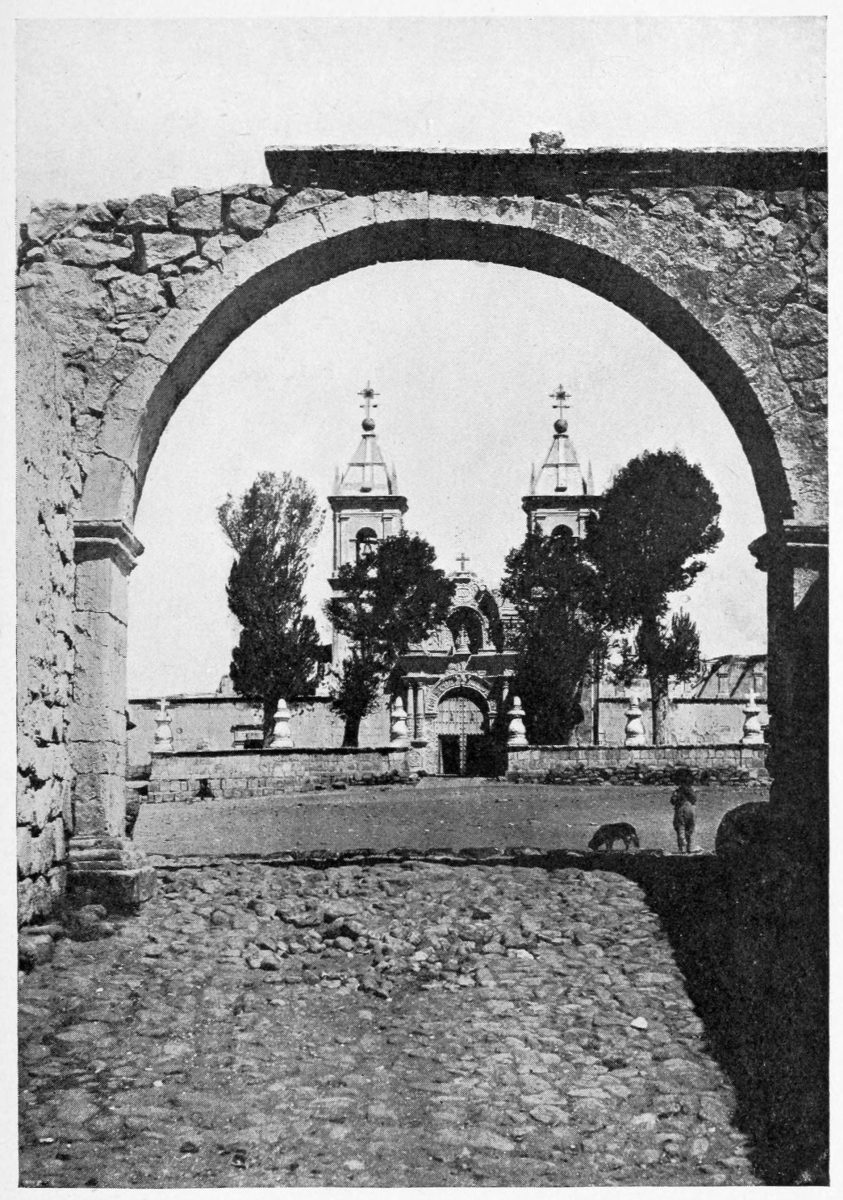
A CHARACTERISTIC PERUVIAN CHURCH
This pool in a shadowed vale of the western Andes, a shady,
sweet-smelling spot, lost in an immensity of desert, is a little
solitude in the midst of a great solitude, hospitable by sweet contrast.
It takes very little water to make a perfect pool for a tiny fish, where
it will find its world and paradise all in one, with never an intimation
of the dry bank.
A large butterfly poised gently on the water’s surface. It was sunset
time, the butterflies’ drinking hour. A copper bell tolled slowly. The
reverberation pierced far into the silence and was “prolonged by the
whole surrounding desert.” A boy perched on an overhanging rock was
playing a flute. The frail sounds echoed through the quiet air,
“hesitating within a silence almost too large.” What can give such an
impression of space as a flute? Or, in ceasing, leave such utter
stillness? A gorgeous peacock preened itself against the crimson
bougainvillea in the sunset, then folded its fan for the night.
It is curious how the atmosphere of a dream cannot be conveyed in words.
Sitting beneath the mango tree by a lily-edged brook, I watched the low
bonfire roasting desert quail and smelled the scent of heliotrope
hedges, while I listened to an old man’s plaintive song, mingling with a
quiet desert waterfall. A wild youth with a bullet gash across one cheek
told me of reckless escapades in the valleys above. He twisted off
oranges with a stick of bamboo and dropped them into my lap, as the
moon, poised on the crest of the mauve-colored Andes like a discus
thrown by a mighty arm from beyond, disengaged herself and traveled
upward. Moonlight, he said, is brighter in the mountain defiles. The
moon sometimes drops a rainbow up there, a faint, round, dream rainbow,
made of thin far-diluted sunlight. Pushed by a little breeze, it divides
the cloud and disappears.
He pointed out the false Cross preceding the true Cross, preparing its
way into the sky.
“Some violets have got in here,” he said suddenly, tweaking one out by
the roots. Intrusive violets!
A man with spurs passed picante and young kid and trays of fruit,
their crevices filled with flowers.
Was not Amiel right when he said that “Un paysage est un état d’âme?”
It was an “ambrosial night,” in a place to attach affection, except that
affection is not for places, either actually or in retrospect. One
heart-beat faster, and the nitrate desert has fairy illusions. Why is it
that merely seeing foreign sights leaves only craving, while a whiff of
feeling in a distant, lonely spot fills one with the meaning and the
mystery of everything and brings tears to the eyes of memory? The purple
of the bare mountains is significant in the afterglow. Dripping water is
significant. The moon sheds a different light. The heat of the desert
sand just below the surface becomes suggestive. The air is filled with
indefinable odors never perceived elsewhere, and the sight of a
sand-colored bird explains all the secrets of the universe.
The beauty which alone would have woven a spell about the place merely
lapsed into a background. In itself the voice was not faultless, nor the
moon different from other windless, immaculate nights; but the air was
sweeter, and the guavas were at the season’s climax, their one day of
perfection. They tell you that if you eat guavas in Pica, you become
either ill or enchanted; in either case you cannot leave.
He must have been talking for a long time. It was as if his voice had
been beneath my range of sound, or too soft—though I heard well enough.
All at once I began to understand.
“Perhaps you have heard of the bush which grows in Patagonia. It is
covered with pale yellow flowers. When a match is placed beneath it, the
bush blazes forth and is reduced to immediate ashes, all its strength
exhausted in a single dazzling effort. It is called escandalosa.
“Had you let me know two weeks ago that you would come, I would have put
a bit of nitrate on the roots of my rose-tree, and it would have
blossomed viciously for you!”
“Yes,” I said, “but afterwards?”
“Oh, to be sure. Then it would have died.”
An owl screamed from the top of a ciruela tree, a little
owl-of-the-desert, just a few inches high.
Pica, the Flower of the Sand! With what golden words borrowed from
Hindoo poets might not its charm be told? By what enchantment its suave
breezes be recalled? Everybody knows it is a magic spot. Its quiet
existence is a sort of self-expression of inmost thoughts without
technique.
Doctor Stübel, the earthquake specialist, says Pica is an eruption
center.
While the mysticism of the Middle Ages was expanding in delicate spires
of Gothic architecture, the Inca’s empire was exposing its heart of gold
to the blaze of a tropical sun. Their only similarity is that a shadowy
veil, half history, half legend, floats between us and them both. But
the gold shines through, and the veil cannot conceal its brilliancy.
Once upon a time there was a garden of pleasure where flowers of gold
opened from silver stalks, some full blown, others in close golden bud.
Upon the walls crept strange insects and snails, so perfectly
counterfeited in gold “that they wanted nothing but motion.” Even the
trees and the paths were of gold. Birds of gold perched upon golden
boughs, their heads thrown back in silent song, and upon silver leaves
gold butterflies poised in the sunlight upon their little golden feet.
Humming-birds of gold sipped imaginary honey from long, golden
flower-bells. The old chronicler, Cieza de Leon, says that one garden
“was artificially sown with golden maize, the stalks, as well as the
leaves and cobs being of that metal; ... they were so well planted that
even in a high wind they were not torn up; and besides all this they had
more than twenty golden sheep with their lambs, and the shepherds with
their slings and hooks to watch them, all made of the same metal.” Near
by were vast heaps of gold and silver, waiting to be wrought into
wonderful shapes.
The Inca ate within gold-lined walls, sitting “commonly on a stool of
massive gold set on a large, square plate of gold which served for a
pedestal.” He ate from gold dishes rare viands from distant provinces,
prepared in gold pots and kettles in a kitchen supplied with piles of
golden fagots! He bathed in cisterns of gold in water conducted through
golden pipes from distant springs. Francisco Lopez says: “Nay, there
was nothing in all that empire (the most flourishing of the whole world)
whereof there was not a counterfeit in pure gold.”
As hunger could not be satisfied with gold, it was valued only for its
shining beauty, esteemed by the Incas’ subjects only as a symbol of the
Sun, those “tears which the Sun has wept.” They naturally belonged to
him. His worshippers even cast them into lakes, mirrors in which he
looks upon his own reflected glory, and “sinks at last still gazing on
it.”
The greatest of all Sun-Temples was Coricancha—the Ingot of Gold—where
every implement in use, even to spades and rakes of the garden, was made
of gold.
Huayna Ccapac had learned from the god Uiracocha that a superior people
would conquer the Incas and introduce a new religion. They would come
after the reign of twelve kings; and “In me,” he said, “the number of
twelve kings is completed.”
Oracles had predicted their coming. And what was more significant, the
great oracle of Rimac, “notwithstanding its former readiness of speech,
was become silent!” Omens had foreshadowed them. A brilliant comet
“struck Atahualpa with such a dump of melancholy in his spirits that he
remained almost insensible.” A royal eagle pursued by hawks fell into
the market-place of Cuzco and died. Great earthquakes shattered the
shore, and tides did not keep their usual course. A thunderbolt fell in
the Inca’s own palace. Strange apparitions faltered in the air, terrible
to behold. The Moon, mother of Incas, had three halos; the first
blood-red, the second blackish, inclining to green, the third like mist
or smoke.
Atahualpa’s atrocities had come to pass. For the first time civil war
had decimated the empire of the Lover of the Poor, the Deliverer of the
Oppressed. Such conduct had earned its reward. Was it not to be expected
that the dawn-heroes of fair complexion, absent for a season, should
reappear? Their vengeance was commissioned by the Light-god.
What greater dramatic climax ever focused? What authority was ever more
solidly founded? What identity of hero-gods more tangibly proven? A
first appearance which further facts continued to corroborate.
Lured by rumors of a descendant of the Sun in a city of gold, the first
lean, poor adventurer, worn with uncertainty and suffering, stepped upon
the shore of Peru. Pedro de Candia was his name, who, having burned ten
cities, had dedicated in expiation ten lamps to the Virgin. His “coat of
mail reached to his knees, his helmet of the best and bravest sort, his
sword girt by his side. He took a target of steel in his left hand, and
in his right a wooden cross a yard and a half long,” advancing toward
the Indians. Two fierce jaguars, “beholding the cross,” fawned upon him
and cast themselves at his feet. Taking courage at the sight, he laid it
upon their backs and dared to stroke their heads. By virtue of that
symbol a miracle had happened. Pedro de Candia and the Indians were
equally dumbfounded.
They followed him to the temples and palaces furnished and plated with
gold and silver, all awed to silence, he at such magnificence in an
undiscovered country, they at the sight of the tall, fair man, whose
long beard hung down over his iron dress; all were convinced by this
first encounter, the Indians of the divinity of the Spaniards, the
Spaniards of God’s patronage. “Being abundantly satisfied with what he
had seen, he returned with all joy imaginable to his companions, taking
much larger steps back than his gravity allowed him in his march toward
the people.”
Eye-witnesses have described the Spaniards’ first glimpse of Atahualpa,
the red fringe shining on his forehead, when Hernando de Soto, the most
daring of all Pizarro’s followers, caracoled upon his miraculous beast
into the very lap of the dignified monarch. They feasted and drank
chicha from goblets of gold which young girls presented to them,
sitting upon seats of gold like the emperor’s own. Two historians were
present “who with their quipus (knots) made certain ciphers describing
... all the passages of that audience.”
In Cajamarca, the Country of Frost, Atahualpa returned the visit. He
came in full regalia, facing the pomp of a gorgeous sunset, and the
Spaniards, “brandishing their pennants toward the flaring west, saluted
with a great shout the Setting of the Sun!”
First came multitudes of people clearing the way of stones and sweeping
the road, then singers and dancers in three divisions, many richly
dressed courtiers, and the guards, divided into four squadrons of eight
thousand men, one before, one on each side of the Inca, and one in the
rear. High on the shoulders of distinguished chiefs he rode upon a
golden litter lined with brilliant feathers. His proud head, too large
for his body, was encircled by the red fringe hanging above his wild and
bloodshot eyes. Atahualpa, that courageous fiend who bragged that no
bird flew in the air, no leaf fluttered on a tree without his
permission, who though ransomed with a roomful of gold was taken
prisoner in the midst of his own army by a handful of insolent
adventurers, baptized in the Christian faith “Don Juan,” bound to a
post, and throttled like a common criminal! Pizarro put himself into
mourning.
The legend which had lured the Spaniards was proven true: that the land
of a powerful king lay toward the south, where immeasurable treasure
was amassed. It took a month to melt up the gold plaques and plates,
brackets and moldings, statues of men, animals and plants, drinking and
eating utensils, jars and jewelry of all sorts that filled Atahualpa’s
room of ransom.
A huge quantity of gold, carried by eleven thousand llamas and intended
for the ransom, never arrived. It is said to lie buried near Jauja, and
is only one of the countless masses of hidden treasure, both along the
coast and in the mountains, even into Ecuador. The Spanish messengers
who were carried in hammocks to inspect that caravan on its journey
toward Cajamarca were almost blinded by a mountain seeming to shine from
base to crest with gold. The eleven thousand llamas had laid themselves
down to rest.
So they had come at last, the very image of the god himself, strange
little Uiracochas in beards and ruffs; worthy of worship indeed, for
they let loose thunder and lightning, the proper arms of the Sun, from
instruments held in their hands, and rode about on amazing beasts. (The
Indians’ fear of horses persisting to this day, they are used only as
infantry.) Were the Uiracochas insensible of hunger and thirst; did they
need sleep after toil and repose after labor? Were they made of flesh
and bones, or had they incorruptible bodies like those of the Sun and
the Moon?
So the grisly conquerors came, half heroes, half wild beasts, who did
not grow exhausted by fighting, nor discouraged by wounds and the
horrors of mountain-sickness.
So they came, these few poor adventurers who fell upon a roomful of gold
given them by a people in ransom for the sovereign-deity whom this
handful of men had imprisoned. Miracles in their favor seemed to spring
up at each step; and madly stimulated, the peaks of the cordillera
blazing above them, their imaginations limitless, they strode through
the empire in the guise of gods and scraped the sacred gold from the
City of the Sun. They ripped the plate from the walls of its temples.
They destroyed the idols. It is said that the Jesuits
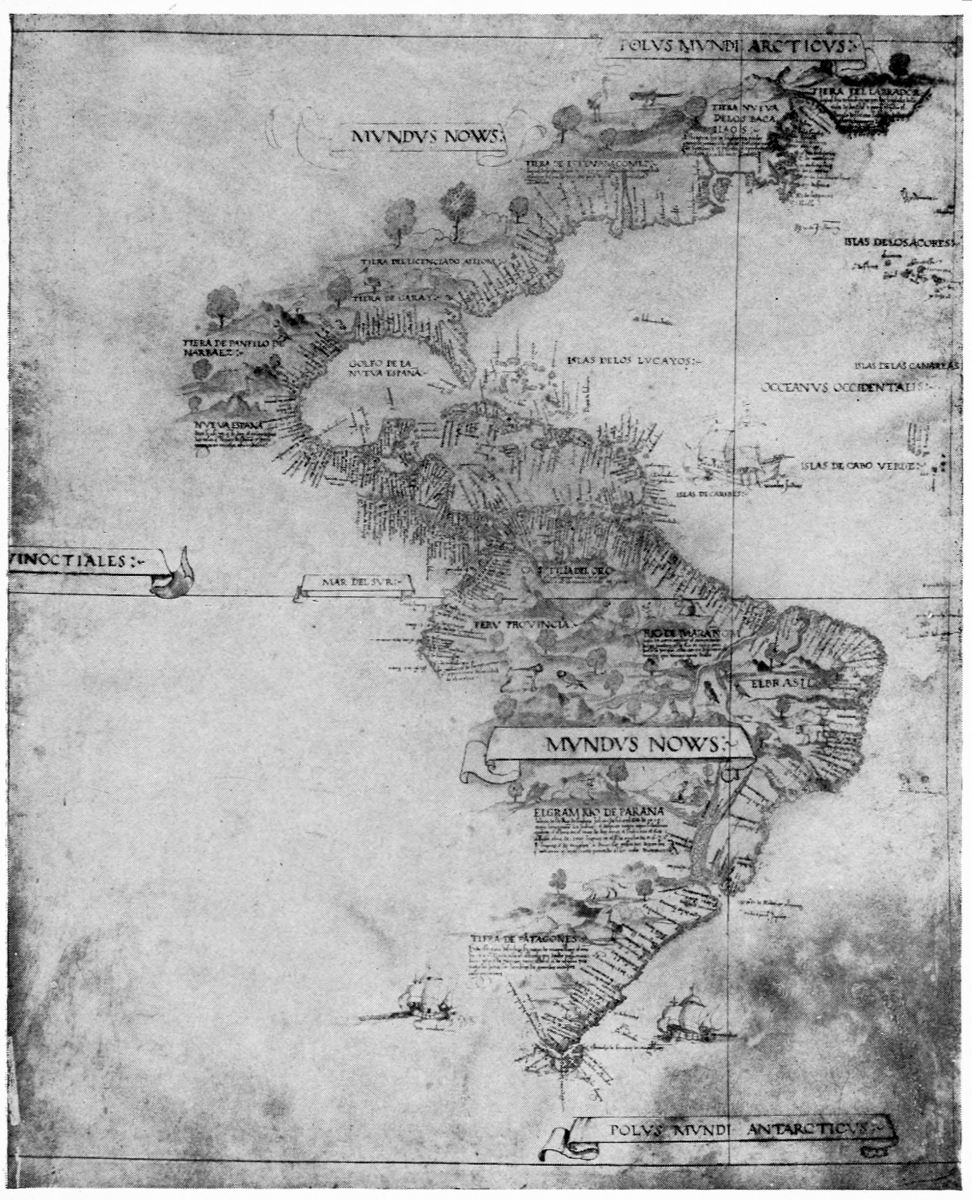
WOLFENBÜTTEL-SPANISH MAP, CIRCA 1529.
Courtesy of Dr. E. L. Stevenson.
One of the first maps to show Pizarro’s discoveries along the Peruvian
coast.
had to employ thirty persons for three days to break up a single carved
stone huaco (idol). They dug up the treasures buried with the dead and
pillaged the towns, and they brought back to greedy European sovereigns
news of a land of gold. Having, as it seemed to them, found infinitely,
they hoped infinitely and infinitely dared.
The glittering career of the Indies had begun. No empire was ever won in
so grandiose a way; no empire ever so monstrously destroyed.
Picturesque are the figures of the two great conquerors, Francisco
Pizarro and Diego de Almagro, lean and tireless soldiers, “either of
whom, single, could break through a body of a hundred Indians,” who
amassed a fortune, the greatest that had been known in many ages, wasted
it in wars with each other, and died so poor that they were “buried of
mere charity.”
They dressed in the costume of their youth. The marquis “never wore
other than a jerkin of black cloth with skirts down to his ankles, with
a short waist a little below his breast. His shoes were made of a white
cordivant, his hat white, with sword and dagger after the old fashion.
Sometimes upon high days, at the instance and request of his servants,
he wore a cassock lined with martins’ furs which had been sent him from
Spain,” but his coat of mail was underneath, as appropriate to his body
as its steely sheath to his heart. Illiterate, greedy, fearless, and
proud, wading through blood to establish the Christian faith, he was
murdered at last; and as he fell, traced in his own blood a cross upon
the stone floor, kissed it, and died.
Then there was the able monster, Carvajal, who went about accompanied by
three or four negroes to strangle people. He jeered as they did so,
“showing himself very pleasant and facetious at that unseasonable time.”
He left behind him a wake of spiked heads of “traitors” to the king. He
wore a Moorish burnous and hens’ feathers twined together in the form of
a cross on his hat, bought masses with emeralds for his soul’s repose,
and at the age of eighty-four went to his execution in a basket, saying
his prayers in Latin. “Being come to the place of execution, the people
crowded so to see him that the hangman had not room to do his duty. And
thereupon he called to them and said: ‘Gentlemen, pray give the officer
room to do justice.’”
“Gold,” said Columbus, “constitutes treasure, and he who possesses it
has all he needs in this world, as also the means of rescuing souls from
purgatory and restoring them to the enjoyment of paradise.” Raleigh
remarked that: “Where there is store of gold, it is needless to remember
other commodities for trade.”
Gold—the evil spell overshadowing Peru, pouring out her immeasurable
riches to impoverish Spain. Gold—the most incorruptible of all metals,
itself the cause of most corruption!
Peru has always been cursed by wealth. The gold of the Incas was the
cause of their destruction, the wealth of the Spanish conquerors,
theirs; it brought about wars among themselves and ravages of foreign
pirates upon the sea. When the era of precious metals seemed to wane,
islands of guano were discovered, apparently an endless source of
wealth. But it was greedily exhausted by foreigners. Then came the
discovery of nitrate fields, where fortunes are merely scraped off the
top of the ground. But that particular territory has been annexed by a
prosperous neighbor.
One wonders what undiscovered wealth may still be threatening this
lavish country.
The days when fleets of treasure sailed from the distant cordilleras of
the Spanish Main had begun. The tall, enchanted galleons of Lima spread
sail, with their
“Escutcheoned pavisades, emblazoned poops,
Banners and painted shields and close-fights hung
With scarlet broideries. Every polished gun
Grinned through the jaws of some heraldic beast,
Gilded and carven and gleaming with all hues.”
At first the argosies bore off the ransom of Atahualpa, the golden
ornaments belonging to the Sun.
Albrecht Dürer, in his Tagebuch, wrote of having seen a boatload of such
booty from the Indies. “And, moreover, have I seen the things which were
brought from the new golden land to the king—an entire sun of gold, a
full fathom wide, likewise a silver moon of the same size, also two
rooms full of armor, all manner of weapons, harness, war-trappings, and
strange accoutrements, curious raiment, bed-draperies and many kinds of
wondrous things for divers uses, fairer to behold than marvels. They are
all so precious that they are held to be worth a hundred thousand
gulden.
“Nor have I in all the days of my life seen aught that did so fill me
with delight. For I saw there fine-wrought things of cunning design, and
marveled at the subtle skill of men in far countries. Nor know I how to
tell of all the things which I saw there.”
Loot of golden treasure gave way to mountains of silver, which poured
forth their wealth in such profusion that it staggers even oriental
imagination. Loading at Arica, ships brought silver direct from the
mines of Potosí. Then there was plunder of Peruvian churches, jeweled
chalices, and gold shrines. There were emeralds from the north—a land
where they were sacred, small emeralds being sacrificed to larger ones.
These glittering cargoes were carried home to Seville, the “Queen of
the Ocean.” Its wonderful Casa de Contratación dealt with the wealth of
the Indies and, to quote Alonzo Morgado, “the riches which flowed into
its offices would have been sufficient to pave the streets of Seville
with gold and silver slabs.”
Like most stories of Peru, the gold and silver it exported seem mere
extravaganza. Contemporary accounts, mostly in cipher, may be quoted.
In 1538, G. Loveday wrote to Lord Lisle: “Spanish ships have returned
from Peru so laden that the emperor’s part amounts to two million
ducats.... The emperor has borrowed the whole from the owners.” Being
“occasionally pinched for money,” he found it most convenient to seize
the ships laden with private treasure from his “Indyac of Perrow.”
In July, 1555, the Venetian ambassador in England wrote to the Doge and
Senate of a fleet of caravels, “all very richly freighted according to
the usual parlance of these Spaniards, who invariably reckon by
millions.”
Federico Badoer Venetian ambassador with the emperor, wrote (1556) that
the king would obtain so considerable a sum of money that he would be
able to defend himself not only against the Pope but also against France
and any other power, if necessary. By this time Peru was raining gold
and silver.
Father Acosta returned to Spain with the fleet of 1587. In his boat were
twelve chests of gold, each weighing a hundred pounds; eleven million
pieces of silver, and two chests of emeralds, each weighing one hundred
pounds. “The reason why there is so great an abundance of metals at the
Indies,” he wrote, “is the will of the Creator, who hath imparted His
gifts as it pleased Him.”
Von Tschudi says that in the first twenty-five years the Spaniards got
four hundred millions of ducats of gold and silver, which was, however,
only a small part of the vast amount buried or thrown into the mountain
lakes whose deep waters concealed it in underground caves. “The Indians,
taking a handful of grain from a whole measure, said: ‘Thus much the
Christians have gained and the remainder is lodged where neither we nor
any one else is able to assign.’”
Humboldt says that from the discovery of Peru until 1800, the Old World
received £516,471,344 worth of treasure from the New World. No wonder
Europe felt that gold lay about in this land of gold, and that it was
only necessary to go and pick it up. No wonder Europe still has an idea
of America little changed through four hundred years. And yet only one
fifth of the treasure of mines and grave-mounds was supposed to be sent
to Spain, whose galleons came to the far-away West Indies to receive it.
It was not long before pirates descended upon Peru. Brittany was the
first to fit out fleets for the Indies “on pretense of carrying
merchandise thither,” in fact, to molest vessels coming from Peru.
Next, English buccaneers intercepted the Spanish vessels, slow-sailing
under weight of gold.
“With the fruit of Aladdin’s garden clustering thick in her hold,
With rubies a-wash in her scuppers, and her bilge a-blaze with gold,
A world in arms behind her to sever her heart from home,
The Golden Hynde drove onward, over the glittering foam.”
Sir Francis Drake, with sixty armed ships, looted the Pacific in the
Golden Hynde. His ballast was silver, his cargo gold and emeralds. He
dined alone with music.
In 1578 he took from the Spanish galleon Cacafuego “twenty tons of
silver bullion, thirteen chests of silver coins, a hundred-weight of
gold, gold nuggets in indefinite quantity, a great store of pearls,
emeralds, and diamonds, ... and many, many other things.” Only Queen
Elizabeth and Drake knew the exact amount that was taken.
For three centuries pirates and freebooters harried the treasure-fleets
of Spain. Toward the end of the seventeenth century, the English
Calendar of State Papers compassionately remarks that foreign gluttony
“keeps the poor Spaniards in arms all along the coast of Peru and puts
them into strange apprehension, all mankind seeming to conspire the
murdering and destroying them as common enemies, not because they do
worse, but have more than ordinary.”
Much of the twice-looted treasure never reached Europe, for, following
the example of
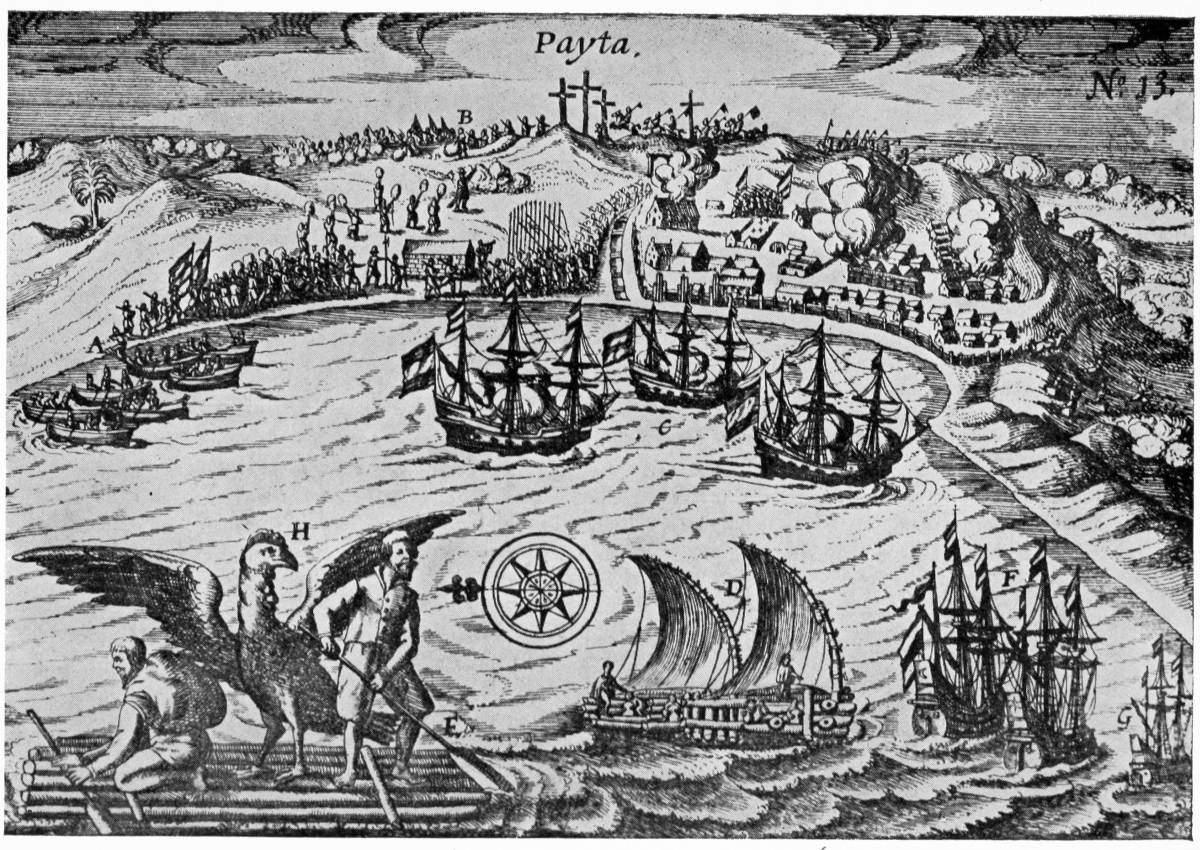
A VIEW OF PAITA FROM THE MIROIR OOST & WEST INDICAL,
1621.
the Indians, the sea-rovers buried large amounts of gorgeous plunder in
the mysterious islands of the Pacific. Even to this day, syndicates with
steam-dredges and suction-pumps are following up the faded charts on
which are indicated the spots where piles of doubloons and ducats and
pieces-of-eight are stowed away.
Here lay Lima under a tropical sun, sparkling with treasure, a
wilderness of rich carvings and paintings, whose piles of gold and
silver shone through the thick perfume of exotic blossoms. Long
caravans, loaded with the wealth of the provinces as well as the produce
of sales in the remote interior, filed into Lima, where countless
gold-and silver-smiths were awaiting their arrival. Weavers of silks,
velvets, and brocades, embroiderers, leather and metal workers,
sculptors, artists, makers of glass and porcelain bells—all the most
skilled workmen flocked to the capital of New Andalusia, the continent’s
center, for there they found no lack of rich materials. Their fancy
might fashion uncontrolled, with assurance of eager purchasers.
In Lima voyages of discovery to the Isles of Solomon were planned. From
Lima pilgrimages were made in search of El Dorado, that luxurious ruler
who bathed himself in sweet-smelling gums and then rolled in gold dust.
There is no more romantic chapter in the history of Peru than these
pilgrimages in search of El Dorado. Southey says they cost Spain more
than all the treasure received from her South American possessions.
In Lima lived the viceroys who ruled all of South America from Guayaquil
to Buenos Aires, “as by the divine right of kings.” The viceroy was
served only by titled Spaniards. He was drawn about by six horses, with
sounding of trumpets, and a personal guard of two hundred Spaniards,
“for the safety of his person and to support the dignity of his office.”
The royal seal, his insignia, rode under a royal flag upon a horse
saddled with black velvet and a gold tissue foot-cloth, and was received
with deep bows. The viceroy was allowed three thousand pesos to go to
Callao, five miles away, and sixty thousand ducats a year for personal
expenses.
Greeted with a jewel sent to meet him half-way, the viceroy reaches the
bay of Callao. Throughout Lima, the City of the Kings,—founded “with
God, for God, and in His name,"—the streets are hung with rugs and
tapestry and adorned with green boughs and triumphal arches. (On the
arrival of the Duque de la Plata, in 1682, eighty million piasters
were spent to pave the streets with bars of silver.)
“First comes a host of Indian warriors in feather pomp. The city militia
with pikes and weapons glittering, the stocks of their guns embossed
with gold, the noble guard on horseback, ... university professors in
brilliant gowns, the royal council and officials, the magistracy in
crimson velvet lined with brocade of the same color ... the chamber of
accounts, the audience on horses with trappings, the scepter-carrier,
heralds in armor with uncovered heads, the master of the horse with
drawn sword, accompanied by four servants in livery, pages with the
captain of the watch, and lastly, on a throne of red velvet whose silver
staffs are carried by the members of the corporation, while the
alcaldes hold the cords, all in velvet caps and gowns of incarnation
color, rides the viceroy under the royal banner and a canopy of cloth
of gold. Officers of the royal household, the royal guard in full armor
with spear and shield, bring up the rear on horseback.”
The procession moves between companies of halberdiers in a blaze of
trumpets, bells, and drums, under showers of flowers thrown from carved
balconies.
“When they reach the plaza the whole company faces the cathedral and is
received by the archbishop and by the superiors of the religious orders;
trumpets cease, knights dismount, and the multitude sings a Te Deum.
“The procession again mounts and accompanies the viceroy to the palace
gates.”
“Five days of bull-fights follow, and prizes are bestowed upon those who
make the most ingenious compositions in praise of the viceroy. The
rector of the university prepares a poetical contest, at which the
viceroy presides, seated upon the rectoral chair, which for this
occasion glitters with the magnificence of an Eastern throne. The
nunneries entertain him with music and present him with curiosities.”
The churches of Lima were hung with velvet and tapestry, with fringes
of gold and silver and plates of gold hung in design, so that the walls
were nowhere to be seen. Spanish and Flemish paintings surrounded altars
of wrought silver. The sacred vessels were of gold, covered with pearls
and precious stones. Santo Domingo, the oldest of the brotherhood,
possessed a set of thirty candelabra of massive silver, man-high, placed
in a double row along the nave of the church. The cloister contained a
famous orange garden with wrought-iron waterways and life-sized
paintings of Dominicus. In its center was a fountain, whose delicious
drip belied its hidden presence under feathery vines. Indeed, why should
the church not claim vast riches? One sixth of the population was in the
monasteries, and those who were not of the number bought the dress of a
religious order in which to be buried. The whole city took part in the
sacred feast days, as many in the procession as looking on: legions of
monks and thousands of nuns, priests, orders, religious societies, and
brotherhoods with their standards, holy pictures, silver crosses,
scepters, and biers.
But what was happening to the silent people among the mountain-tops who
had stripped the Sun Temples of their offerings to enrich the
adventurers from the Isles of Pearls?
Their irrigating canals had been destroyed, the roads and the whole
system of government broken up, the people killed in chronic fighting or
by hardship in distant campaigns. Ten thousand of the fifteen thousand
in Almagro’s Chilean army had died of cold in the mountains, or of heat
and thirst in the desert. The people were starved, villages at a time,
by the destruction of their crops. Moreover, the villages were given as
fiefs to the Spaniards, who received all the tribute. Many were
exhausted by dragging heavy artillery over the precipitous mountains.
Garcilasso describes the immense beams that crushed the Indians
staggering beneath their weight, who were relieved, only on account of
necessity, at every two hundred paces. When Gonzalo Pizarro in coat of
mail covered with cloth of gold made his triumphal entry as governor
into the City of the Kings, the twenty-two pieces of cannon which
saluted as the procession advanced through the streets, were carried on
the shoulders of six thousand Indians. All these Indians were well
trained in morality and sound doctrine by the clergy of Spain.
And worst of all, deep within the mountains of Peru, hollowed by the
gold and silver which they had removed to enrich a country of whose
existence they would never be aware in any other way, the Indians were
dying, thousands at a time. Skeletons concealed in old mines are now
found, covered with fibers of silver melted by subterranean fires just
beneath the cold desert. Mines now abandoned can be traced by piles of
human bones.
A pair of bright green arms, petitioning, stretched forth from the body
which has disappeared, were discovered in the bottom of an ancient
copper mine. The copper water had filtered through and covered them with
a green sheen. Every finger is tense with supplication, every fiber as
in the moment of death; not an eager tendon or nerve quivering to the
surface failed of preservation. All are petrified in a bronze of
nature’s molding.
Stories are still told that the Spaniards drove ten thousand Indians at
once to work in a Peruvian mine. When their strength was exhausted or
they died from lack of food, the Spaniards drove up ten thousand
more—an extravaganza of destruction matched only by the scale of
nature’s waste. It must be said, however, that cruelty to the Indians
was due not to Spanish law, but to the abuse of it.
“In twenty-five years more than eight million Indians were worked to
death in the mines of Peru.”
“In a century, nine tenths of the people had been destroyed by overwork
and cruelty.”
No wonder Spain was able to equip an Armada!
Against such a dark background flamed the lurid Inquisition.
The working out of the encomienda, or system of slavery, and the
mita, or forced work in the mines, was more horrible than the
tortures going on in Lima only because of the scale on which the
destruction took place. In 1570 the Blessing of the Inquisition had been
conferred upon Peru by Philip II. “At first heresy, then blasphemy,
sorcery, polygamy, insulting servants, opposition to jurisdiction, were
punished by whipping, banishment, prison, and death by fire. In all
cases the goods were confiscated.” The disgrace of an executed man did
not end even with his death. “The sons and daughters and grandchildren
of the male line lost their rights of citizenship. They might not carry
gold, silver, pearls, costly stones, corals, silk, velvet, or fine
cloth. They might not ride on horses, carry weapons, or use any of the
things of which they were unworthy.”
One star-spangled night, a man looking at the sky remarked that the
multitude of stars was superfluous, thus assuming that God had erred in
creation, which was heretical blasphemy. Juan de Arianza appeared in the
auto of 1631 because, when reading the Scriptures, he exclaimed: “Ea!
There is nothing but living and dying!” which sounded ill to those who
heard it. One man bragged that he had a horse that could go sixty
leagues in one day: for that he had two hundred strokes of the lash.
Another had said he knew an herb which made wives invisible before their
husbands: he received five years’ imprisonment. A young priest said he
had seen the little Saviour in his dreams: his punishment was two
hundred lashes and five years’ work in the galleys. Another, who wished
to found a new sect, had called the Indians the children of Israel and
had declared that priests should marry, that there should be no
confessional, and that the Bishop of Lima ought to be Pope. He thought
the Bible ought to be translated into the language of the people and
that he was holy as Gabriel and patient as Job. This unfortunate was
burned alive; the proceedings of the suit against him filled three
thousand pages.
Throughout the seventeenth century Peru was filled with mystic
impostors, like the far-famed Angela Carranza, most of whom were dealt
with by autos de fe. The use of coca was considered a part of this
sorcery and was punished severely.
The confession of a real or an accused crime was drawn out by torture
and compelled by a repetition of the torture. From the final judgment
there was no appeal. All was enacted under seal of deepest secrecy. The
torture chamber was somewhat removed, so that the screams of the victims
could not be heard in the street.
Three kinds of torture were used in Lima. There was the compound pulley.
A man’s hands were bound to his back, and he was raised by a pulley to
the ceiling by his hands; heavy iron weights were attached to his feet.
Sometimes, instead of this, the victim was strapped on a table, an iron
collar about his neck, and stretched in both directions without risk of
choking; but every bone in his body was dislocated. The second method
was smothering. The man’s hands and feet were tied above a bench, and on
his upper arms, thighs, and calves, lacing machines were adjusted. Then
a funnel was put in his mouth and water was slowly poured in. The third
method was the worst of all. The feet were made fast, the soles were
covered with fat, then live coals were brought gradually nearer and
nearer—a process of roasting. When the pain was keenest, a board was
shoved between coals and feet, and the sinner was asked if he would now
confess his crime.
By a bull of Paul III torture could not last over an hour. After that
the victim usually had convulsions or lost his mind. A doctor came,
whenever such was the case, to authorize further torture.
Thumbscrews were still used in 1813.
Dr. Lea says punishments in Lima were inflicted with greater rigor than
in Spain. If it were lashing, the penitents, without distinction as to
sex, were marched in procession through the streets, naked from the
waist up, with inscriptions denoting their offenses, while the
executioner plied the lash. The mob stoned them as an act of especial
piety.
The Inquisition had command of the press. The tribunal of Inquisitors,
judging all, were judged by none and wielded absolute power. The Holy
Tribunal did not wish to shed blood, so the accused were either
strangled or burned. The death-warrant began with the words Christi
nomine invocato, and officials of the law were asked to treat the
condemned with pity and moderation.
The auto de fe, the Act of Faith, was intended as a demonstration of
authority, a representation of the day of judgment, and it was the
highest exhibition of piety.
Following is a description of an auto de fe in Lima, on the sixteenth
of November, 1625, quoted from Middendorf.
A procession went at daybreak on horseback through the city, with
trumpets, fifes, and drums, to announce the execution. A platform was
built on the plaza, forty ells high, and a stadium was erected for eight
thousand people. “Between eight and nine in the morning the sinners were
called for. A cross covered with black crape belonging to the cathedral
was carried before them by four priests, all singing miserere in a
wailing tone. Each penitent walked between two soldiers and other
honorable persons. Silver boxes at the rear contained the judgments.
“The viceroy came out of his palace accompanied by a guard of honor,
musketeers, and two trumpeters. Doctors, lawyers, and university
professors preceded the monks and the priests, standard bearers in coats
of mail with clubs, the captain of the watch, and judges, the oldest of
whom walked by the viceroy, cavalry, generals, and pages. The
Inquisitors had hats on top of their caps, worn only at that time,
decorated with the insignia of the Pope’s legates. The militia had
formed in line, and at the appearance of the black and gold banner of
the Inquisition they lowered their flags in salute. An altar was raised,
a chair for the viceroy and the high officials.
“The eldest one rose and addressed the viceroy. ‘Your Excellency swears
and promises upon his faith and word as a true Catholic Viceroy
appointed by His Catholic Highness, to defend with all his might the
Catholic faith, which the Holy Apostolic Church in Rome recognizes, to
further its well being and growth, to follow up the heretics and
dissenters and enemies, to give necessary help and aid to the Holy
Tribunal of the Inquisition and its servants, so that the heretics and
disturbers of our Christian religion shall be taken and punished
according to the law of the Holy Church, without your Excellency making
any exception in favor of anybody no matter what his station in life
be.’
“The viceroy replied: ‘I swear it and promise by my faith and word.’
“‘If your Excellency does so, as we expect from your piety and
Christianity you will, the Lord God will bless all the works undertaken
by your Excellency in His holy service and will give you health and long
life as this kingdom and the service of His Majesty needs.’
“A mass was read for the viceroy, and a priest extolled from the chancel
the glory which comes to religion through the sacrifice of heretics.
After the sermon, all pledged themselves to tell any act contrary to
religion which they knew of, and not to give protection to any heretic
who was under the ban of the church.
“The denunciation was read as soon as the culprit was named, led up out
of his secret cell and put into a cage from which he had to hear his
final judgment. He was dressed in the San Benito, in itself a lasting
shame. It reached to the knees of the sinner and had his portrait
painted upon it surrounded by flames, devils, and dragons. On his head
he wore a bag-like, high and pointed cap, on which were devils’ faces in
flames. Gags were ready in case blasphemers should break out against the
judges.”
The burning is said to have taken place where the bull-ring now is.
In 1746 the city of Lima,—the gorgeous City of the Kings,—at the
climax of its luxury, was utterly destroyed. Seventy-four churches,
fourteen monasteries with their paintings, lamps of gold, vessels of
silver, precious stones, tapestries, and mirrors, their beautiful
fountains, arches, cloisters, and stairways in rare designs, were laid
waste. The building material was as rich as the work upon it; as a
contemporary traveler expressed it: “If it did not exceed in beauty, it
at least equaled anything in the world.” In four minutes there was
complete desolation. Out of the whole city only twenty buildings
remained standing. Bridges broke, palaces fell, the sick in the
hospitals were buried alive; nuns in their cloisters, monks in their
cells, were suffocated in clouds of sulphurous dust. Churches collapsed,
crushing those who were praying within. Even the Holy Inquisition was
obliged to suspend torture for the time being.
The earth was like an animal shaking the dust from its back. It swept
forward in great waves; walls were reeds on its shores, bending to the
tempest. Between the waves, clouds of poisonous dust rose from the
chasms.
Clocks stopped. Bells in the towers clashed with limp bell ropes, till
towers following in turn stifled the din under smoking débris.
Everything was reversed; that which stood still was set in violent
motion, and moving things were brought to rest. Shrieks for help and
agonized prayers mingled, until they, too, ceased.
The sea retreated half a league from Callao, gathered strength from
unknown, hidden places, and with a cosmic roar rushed over the entire
city, engulfing it and carrying all the ships of the harbor across its
walls and towers to be stranded in inland gardens. All of its five
thousand inhabitants perished in the deluge, and there was nothing left
to give the least idea of what Callao had been.
“To be preserved from its fury could only be attributed to a particular
and extraordinary help of Providence.” Yet thousands in Lima who had
escaped destruction or death from fright died of fevers which came
after. Those who remained were occupied with burying the dead in
trenches. Famine as well as fever followed, for the grain magazines of
Callao had been buried under water, ovens had fallen in, aqueducts
bringing water for turning the mills had been destroyed.
Nor was this all. Loath to give up its fiendish hold, not yet glutted
with destruction, the underground fury visited the helpless ruins it had
created with five hundred and sixty-eight earthquakes during the next
year!
Processions of priests barefoot, with crowns of thorns on their heads,
cords about their necks, and heavy chains on their ankles, taught the
people that the destruction was of God, the roaring of the subterranean
powers a warning against luxury. The prior of one society went about
covered with ashes; a heavy bridle cut his mouth, iron nails fastened
his eyelids, his back was bare. “This is the punishment that God in
heaven executes,” said a lay brother, walking behind him, as he let fall
an iron lash so heavily that the blood spurted.
The bones of Santo Toribio and Santa Rosa were carried about; the
viceroy and great persons followed in mourning, with ropes about their
necks. Distinguished ladies, barefoot, their hair shaved, walked in
coarse clothes. The dense stillness was broken by a monk’s voice: “Holy
God, Holy God, be merciful to us.”
The valley of the Rimac, where glisten the towers of Lima, is only one
of the river-ways which cross the desert. The river of the ancient
oracle Rimac, “he who speaks,” has given its name in perverted form to
Lima—the Spanish city. The temple of the speaker was in ruins long
before Spanish days.
Like other streams of the west coast, the great river Rimac has run
through the gamut of all zones. Hurrying down from the cordillera, it
spreads fertility far and wide over the dry shore-valley. As far away as
Chorillos, “little water jets,” the water of the Rimac filters through,
led astray for irrigation. But its own journey to the sea is vain. The
mountain water is so precious to the desert that by the time the stream
has reached the shore, it has not force enough left to make an outlet
across the beach into the ocean.
Irrigating ditches and crumbling mud walls divide gardens and vineyards
and orchards of wind-blown olive trees. Ruins of mud accumulate dust.
Luxuriant nasturtiums drape every dusty bank. Vestiges of fortresses,
temples, and grave-mounds of the three ancient cities of the Rimac
valley still terrify owners of the sugar-fields, for the inhabitants of
the sepulchers sometimes return at night to sit beneath the grape-arbors
and listen to the murmur of irrigation streams which they made.
Cajamarquilla, Armatambo, and Huadca were the names of these cities, and
the whirlwind was their most distinguished god. His white-robed priests
ate neither salt nor pepper, and tore out the hearts of men and of
animals to offer them to the gods on the platforms of temples.
Sometimes, too, the Huguenot hermit who lived near the site of Huadca
and who was burned by the Inquisition returns to his little caves at
nightfall.
Lima is in the tropics. Its fruits and flowers are those of the tropics.
Yet it is neither hot nor cold. There is no rain and not too much sun, a
pleasant monotony interrupted only by earthquakes. An umbrella merchant
once tried to set up business in Lima. His act brought forth an article
in a local paper on rain, and how on one occasion when it came suddenly
people had to get out of bed to find secure places. Editorials on
umbrellas followed.
No, there is little to fear from changes of weather, not even thunder
and lightning. There is an endless summer, with streets under a
continuous awning; yet, after all, only a summer. The rainless desert is
soaked in mist all winter long. It falls suddenly like a veil over the
bare mountains and drenches the sunlight. A glimpse through it shows a
faint sheen, sharp cliffs hazy with hues of light-green velvet, enameled
on closer inspection with multitudes of differing flowers. Amancaes
spring up dew-laden, those queer, greenish-yellow lilies hanging on
smooth, leafless stems, giving their name to whole valleys which they
fill. One such lies beyond the gardens of the Barefoot Friars. A
favorite retreat for Limaneans, it is called the National Garden. But
scorpions lie under the stones.
“A suggestive kind of picture used to hang in many a mediaeval church.
It was painted on both sides of a board. On one side were a pair of
lovers walking hand in hand in a meadow gay with spring. Flowers
blossomed about their feet; birds sang in the trees above their heads.
“On the reverse was the grim figure of Death, hour-glass and scythe in
hand. The thing, pendent from a single cord, hung free in a draughty
place, and the air twisted it about hither and thither, so that one side
and the other was seen in swift interchange.”
The Alameda, flanked with Norfolk Island pines and marble benches, had
in other days rows upon rows of orange trees, stone fountains, and
basins as well. At five in the afternoon gilded carriages streamed from
palace gardens, driving about so that their fair occupants could greet
their friends. Four thousand brocade-lined, gold-trimmed carriages and
innumerable chaises shimmered through the heavy odor of orange blossoms.
A traveler of the seventeenth century has described the lady of Lima,
clad not in linen, but in the most expensive lace of Flanders, slipped
over an underdress of cloth of gold.
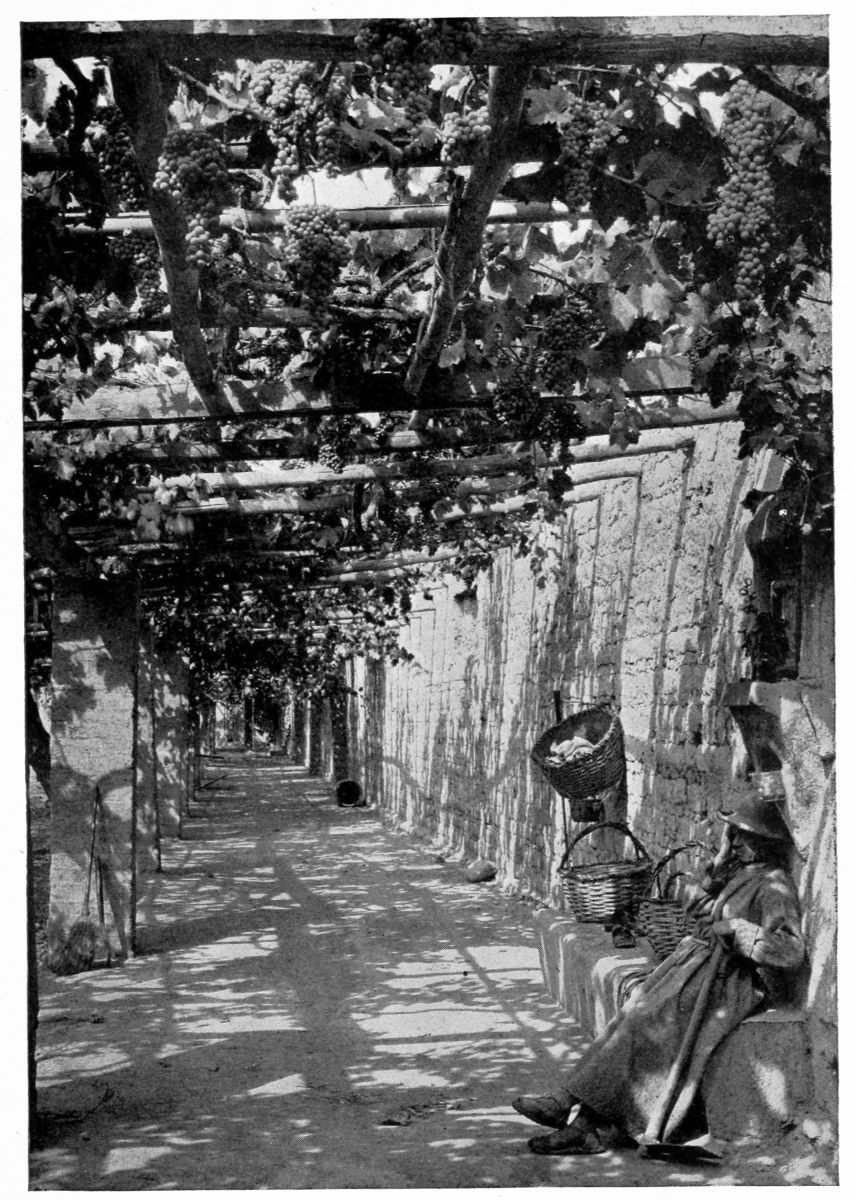
GRAPES RAISED BY THE BAREFOOT FRIARS, (LOS DESCALZOS),
LIMA.
She glittered with jewels from head to foot, her shoes were fastened
with diamond buckles, aigrettes of diamonds were in her hair—“a
splendor still the more astonishing as it is so very common,” he said.
Nay, she even scattered perfume through her nosegays. On great fête days
she tiptoed to church, enveloped all but one eye in a silk-lace shawl.
Beneath it glinted a flower-embroidered dress of rarest stuff,
fluttering a multitude of ribbons; under a petticoat of heavy brocade,
miniature golden feet peeped out, or slippers of peach-colored velvet.
The lady of Lima was famed for her wit, entrancing the visitor as she
sipped her Paraguay tea from a silver-mounted gourd.
Little is left of former splendor. The statues, the five rows of orange
trees, the sweet smells are gone. At the end of the long Alameda,
bordered with wind-blown trees and wrecks of marble benches, is a
fountain under palms and Norfolk Island pines. Across a shady space and
above a high, yellow plaster wall, is the monastery tower, where hangs a
clear-toned bell. Rugged hills rise abruptly. This is the home of the
Barefoot Friars. A labyrinth of paths leads to their orchards and
gardens and cells. Going every morning in pairs to the markets to beg
for food, they own nothing. They live entirely on alms.
Just before two o’clock each day, the lame, halt, and blind begin to
gather from all the town wards, each carrying a receptacle. One poor
woman with three or four babies seats herself upon the plaster shelf
skirting the wall, setting down her pottery jar by the brook to wait.
The bell strikes two long, clear tones. The whole space is filled. The
great monastery gate is flung open, and two brown-clad monks, sleeves
rolled up, bring out between them a steaming copper cauldron. The
famished multitude fall to their knees, many with difficulty, and a
prayer is intoned.
Then the procession begins: men, women, and children in various stages
of decrepitude. Beggars with old tin cans totter forward as to the Mecca
of a long, hard journey. Decent-looking women, very haughty, conceal
their pails under black mantas. Each receives two ladlefuls of meat,
soup, and vegetables. The kettle is filled again and refilled, till all
are served. After the little groups of people have finished their
cazuela, the heavy door clashes together.
Beyond the turn of the wall, far down the avenue of palms, the Mendicant
Friars emerge, four by four, and swing off across country for their
daily walk.
Lima is the city of bells. Exuberant wedding carols blend their metallic
jingle with three solemn peals for the dying. Hoarse, ill-cast bells
mingle with bells whose tones drip like honey upon the monks beneath,
who, with cowls thrown back, are pruning monastery gardens, bringing
water to the fig-tree from the fountain. Bells are pitched high and
bells are pitched low. Bells struck from without shake off the clear
ring circling their edges. There are notes with a dry sonority like the
clash of bones. Sharp bells nag the persistent sinner. Soft, sweet bells
lure him to prayer. Quick strokes near at hand only half conceal those
distant thuds, as if the tone had been struck from the atmosphere,
giving “a solemn, religious shimmer to the day.”
Though they are more used than those elsewhere, the bells of Lima, it is
said, never grow old.
The tones are of every quality, from the tinkle of little convent bells
calling the sisters to midnight prayer, to the great bell of the
Jesuits, whose “clash, throb, and long swoon of sound” strikes your
chest. Silver and gold in this bell cling to the clear, deep notes
struck from it and pulsate more than half a minute in the tone, which
carries far out over city roofs to sugar-fields and vineyards. The left
tower of San Pedro was built about this bell in 1666 and it cannot be
removed.
San Pedro has three portals on the façade, only allowed for a cathedral.
The story goes that when it was building, permission was asked from Rome
for a portal, which was given of course without delay. When the church
with its three bronze-knobbed doors was finished, the Vatican was
outraged.
“What,” word was sent, “you ask for one door and make three?”
“For two doors one has not to have permission,” came the reply, “only
for three. We would have had two, anyway; it was for the extra one we
needed to ask.”
The church was finished and consecrated. What could be done?
Monastery bells waken the monks at five o’clock, masses follow every
half-hour throughout the morning. Burials are tolled very early by two
large, discordant bells, struck simultaneously, “a roaring, sinister,
mournful peal.” At noon a great caroling honors the Holy One to whom the
next day is dedicated. After sunset three slow peals boom from all
churches. Old people stand, men take off their hats. At eight sounds the
prayer to the dead, at nine, nine peals from every bell in the city are
an invitation to pray for those who die to-night. This is the time when
the bell in the left tower of San Pedro rings. The left tower of the
cathedral is the home of many owls, which come out at night to cry above
the houses where the sick are lying to warn them of approaching death.
Because innocent voices are intercessors most pleasing to God, Indian
mothers in the mountains prod the poor little savage babies, flopping
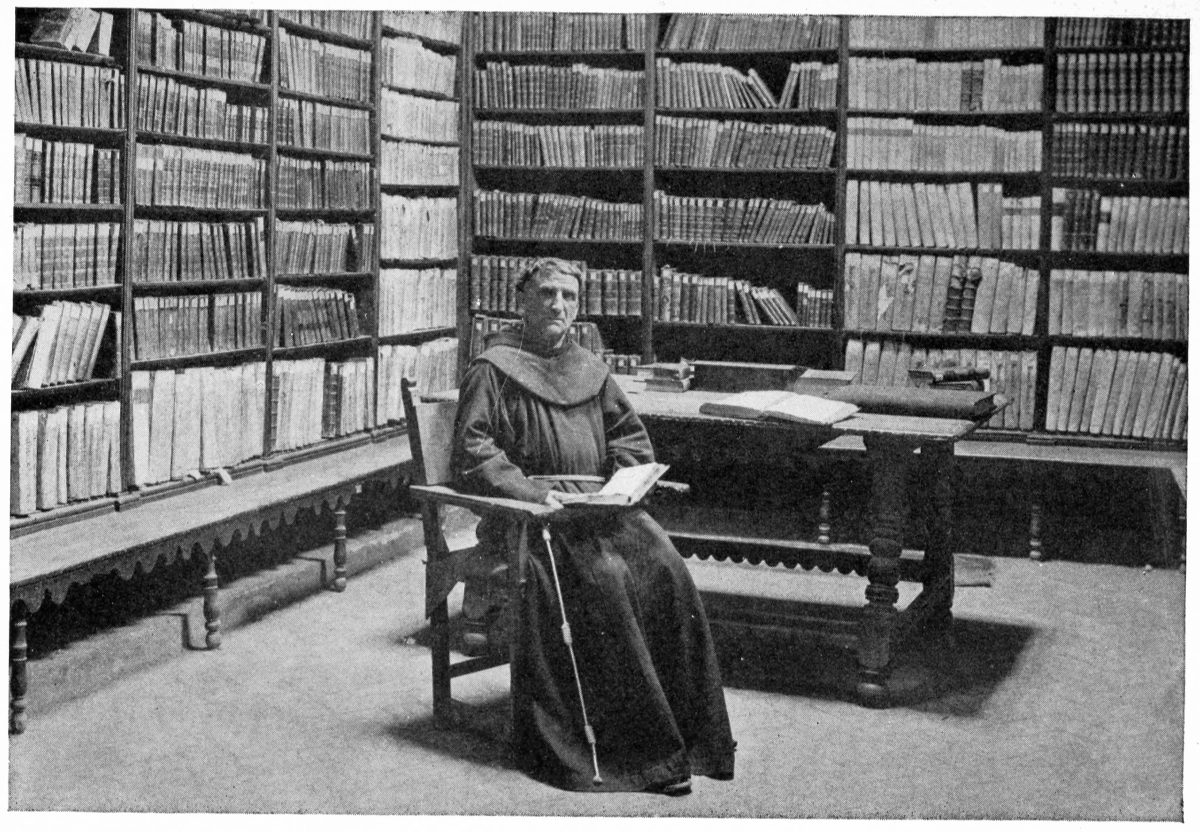
A FRANCISCAN FRIAR AT HOME, LIMA.
on their backs, with long, pointed, rat-tail silver spoons, so that they
wail intermittently.
In Lima the voice of the bells is lifted to avert catastrophes and to
beg for mercy in times of earthquake. When the bells cease, the
importance of silence is assumed instantly, as with the dropping of the
wind.
A little jungle of cypress, magnolia, jasmine, pomegranate, and fig
clusters about a fountain which one hears rather than sees. Contralto
bird-notes seem to come from far away, like “the melodious songs of
birds with yellow combs in the blessed land of Aztlan.”
The garden is overgrown with passion-flowers, concealing within their
petals the sacred heart and nails, even the crown of thorns.
Night-blooming cereus hangs darkly above the ground-glass bells of the
floriponda, so ineffably sweet after sundown. Its leaves are narcotic.
(In Lima one is often given a nosegay of jasmine done up in a floriponda
flower.)
I sat waiting on a bench in the cloister garden. Missionary priests were
showing maps to little, fluted nuns. Others in black robes and furry
hats paced up and down the cloister, fondling small missals and stopping
around the corner to gaze at me through the wrought-iron grill.
Mediaeval life in full swing, complete from a glance of the eye to the
jaunty stick cocked under the Don Juan cloak!
One of the priests carried two phosphorescent beetles in a piece of
sugar-cane.
In this convent young girls are taught that a “wife should be loving and
faithful, tolerating the defects of her husband, trying to make herself
esteemed by him, to soften for him the sorrows of life, cultivating
abnegation, evenness of disposition, tolerance, and sweetness. She ought
never to think that the faults of her husband could excuse her own.”
Very different was the Dominican convent of Santa Rosa.
An illuminated manuscript hung at the portal, an absolution for those
who worship here, sent by the Pope several hundred years ago. The recess
in the wall was paved with cobblestones. Antique paintings of saints
hung frameless above. Beside the huge doorway, heavily barred, was a
turnstile in the wall, with solid partitions between the shelves to
prevent a glimpse within. The staring word Paciencia was written above
it. Utter silence!
Rosa Mercédes and I tiptoed through a narrow doorway, under the word
Modestia. We sat on a bench in front of a wooden grill with hexagonal
openings. A vague, distinctive smell drifted through it. On the other
end of the bench a woman was softly sobbing. We waited half an hour or
more.
The week before, the birthday of Santa Rosa had been celebrated in the
cloister where she lived. The week after was now being celebrated here,
where she died. As I listened, there was an explosion of fire-crackers
within.
Beyond a wide space on the other side of the grill was a fine wire
netting, so heavy that only a shade, a brush of a veil, a suggestion of
a smile could penetrate. A soft sound came through the blackness, and a
voice unthinkably sweet said: “Buenos días, Rosa mía.” It was the
Sister Margarita, who had been thirty years behind those bars without a
glimpse of friends, buried to the evils of the world, consecrated to
Santa Rosa.
The voice began to speak.
“Our glorious Rosa! Let me tell you that when she was only three years
old the lid of a heavy chest fell upon her thumb. She looked up at her
mother and smiled. She concealed stinging herbs in her gloves, and when
visitors came, she rubbed pepper into her eyes, so that she could
neither see them nor think of what they were saying. Rosa santísima!
“When she sang to her garden the canticle: ‘O all ye green things of the
earth, bless ye the Lord,’ the trees clapped their leaves together, and
even the vegetables lifted up murmurs of praise. She invented hymns to
the Virgin and sang them antiphonally with a bird, though she was often
surprised at being able to understand the speech of unbaptized beings.
One day in the garden a black and white butterfly hovered above her.
Thenceforth she understood that it was decreed that she should enter the
order of Saint Dominicus. Her life from that time on was a series of
acts of self-mortification. Rosa inocentísima!
“She divided her day into twelve hours of prayer, ten hours of millinery
work, and two hours of sleep. She was constantly aware of the presence
of the angels. Rosa purísima!
“At sixteen she entered the sisterhood. She prayed to a picture of
Christ until it broke into a sweat. She prepared clothing for the infant
Jesus by prayer—fifty litanies, nine hundred rosaries, and five days of
fasting made him a little garment; and for toys, she said: ‘I give my
tears, my sighs, my heart, and soul.’
“She wore a belt lined with nails, which she locked about her, and threw
the key down a well. Half the nail belt is in the Santuario of Santa
Rosa, where the well was. It went dry on the day of her death.
“She died here in ecstasy on this very spot at the age of thirty. Rosa
gloriosísima!”
I spoke with the voice. I asked about Santa Rosa’s shrine with its
thousands of little silver ex-votos in Santo Domingo.
“Yes, that is where she lies buried, except once a year on the thirtieth
of August, when she journeys to the cathedral and back.
“The daughter of a viceroy once climbed out of a palace window at night
to take the veil of Santa Rosa.
“When the Pope was deliberating her canonization, he was overwhelmed by
a rain of roses; when it was finally celebrated, the streets of Lima
were paved with silver bars.
“In 1720, when they dug to build her convent, a strong odor of roses
emanated from the ground.
“We keep her roses blooming throughout the year; they grow from the same
roots as those she cared for; the rest of the time we spend in
embroidery and prayer.”
Such a wonderful voice!
The Sister Margarita pressed a parchment-covered book close against the
netting.
“Here is a true life of Santa Rosa. It has never left this monastery.
When you read it, you will understand why I have devoted my life to God
through the mediation of our glorious Saint, our Patron, our Rosa de
Lima.... She stood upon these stones in the courtyard where I now stand.
Can you see why a stone has not been changed?... There is no word in
this book which is not true. I know it by heart. I will give it to
you....
“Es católica?” The voice was suddenly directed toward Rosa Mercédes.
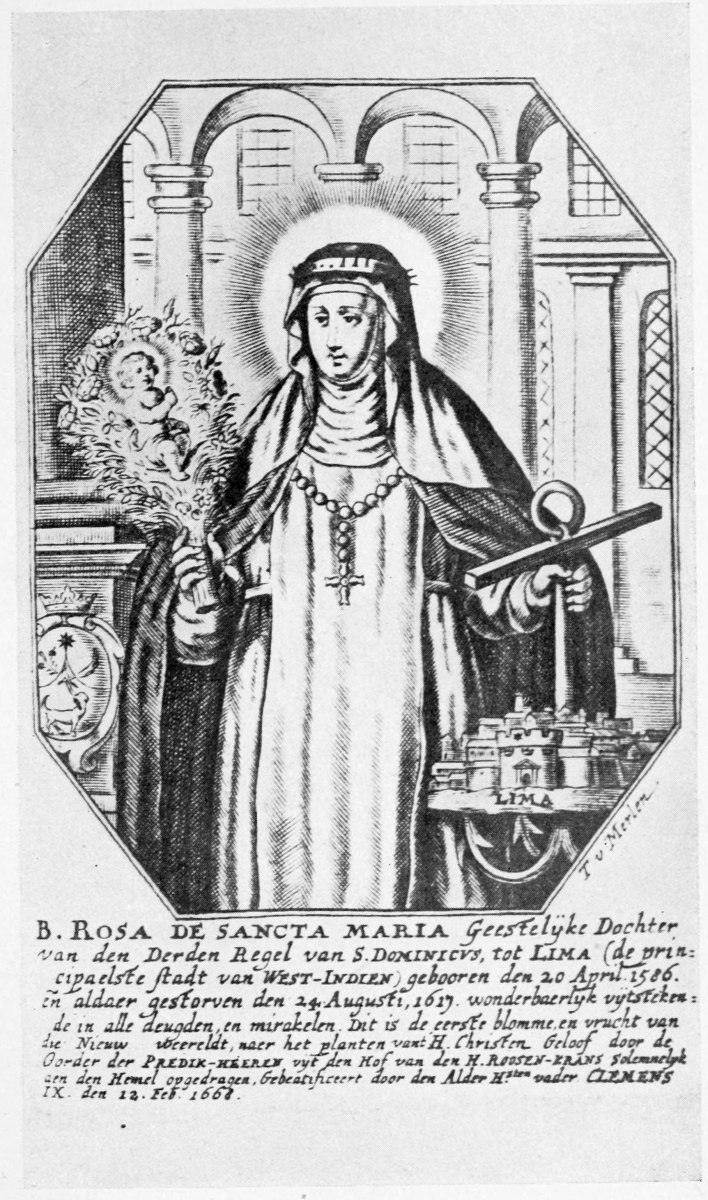
SANTA ROSA DE LIMA, FROM HET WONDER LEVEN VAN DE H.
ROSA, BRUSSEL, 1668.
“No, protestante.”
“Oh!...”
Her voice ran down the gamut of the scale.
“You will not then believe my book?” The voice addressed me.
I replied that I should value the book more than any one else to whom
she could have given it.
“Ah,” she sighed, “then that is why I wanted to give it to you.”
A little pause.
“Good-by-ie,” she said. A glint beyond the netting.
“Good-by-ie, mía amíga,” and Rosa Mercédes and I stood alone outside.
Following is a Salutation to Santa Rosa preceding her novena, published
in Lima in 1902:
“God keep thee, O admirable virgin and patron of ours, Rose of Saint
Mary!
“God save thee, joy of the world, glory of the city, star of Lima, crown
of the fatherland, most rich gold of Peru, treasure of the Indies!
“God save thee, flower of the church, rose of humility, white lily of
purity, olive of peace, fire of charity, most precious pearl, most
beautiful dove!
“We salute thee, O most loved spouse of the Heart of Jesus! Much
cherished daughter of most Holy Mary, living image of thy mistress
Catherine.
“We praise thee, O example of penitence! Chosen from thousands, patron
of a new world.
“We bless thee, O Most Fragrant Rose, Most Precious Rose, Most Innocent
Rose, Most Pure Rose, Most Illustrious Rose, Most Holy Rose, Most
Glorious Rose!
“Rosa fragrantísima, Rosa inocentísima, Rosa purísima, Rosa
ilustrísima, Rosa santísima, Rosa gloriosísima!”
They sat about the dinner table—a delightful, stammering, scientific
gentleman, who advised my carrying home some live camarones
(crayfish); a young English curate, here to sketch all the caterpillars
of all the butterflies he could find, and their cocoons; the grandson of
a former president of Peru, who spoke of his grandfather’s battles; and
a cousin of the actual president, who told tales of ostrich-hunting in
the pampas of Argentina, a cosmopolitan club man, whose chief interests
in Lima were cricket and polo. There was a man who was collecting
everything from pearls to reduced heads and whose gold watch-fob was a
Peruvian tongue-weight for the dead. A Chilean lady with the grace of an
older generation spoke of the islands of Juan Fernandez and their
prehistoric monuments, which have a nose and chin, face the sun, and
are too big to enter the British Museum. That led toward the
archeologist.
We were eating cuculis—desert doves—and alligator-pear salad, while
we listened to stories of pre-Inca civilizations from the man who has
done most to unravel their mysteries. In Peru the alligator-pear is
called palta, a shiny, dark-green, leather-covered shell concealing
its soft, nutty flesh. It hangs at the end of a fine twig, which is
dragged down by its weight. A stiff mayonnaise so disguises the palta
that it is almost impossible to tell where fruit ends and sauce begins.
A lady of mixed races wore twice about her neck a heavily-carved chain,
on her breast the large cross at its end. She spoke of a friend who had
searched for years until he should find a gift exactly suited to her; at
last he beheld this chain about the neck of a pope of the Greek church.
The pope parted with it reluctantly, for in a cavity in the back of the
cross he kept his sacred relics.
She twirled the great cross between her fingers.
“Très chic, n’est-ce pas?” she said. “And you see,” touching the clasp
to loosen a little lid, “it’s just the size for a powder-puff!”
A folk-lore-specialist-explorer was discussing swinging bridges in the
Andes with a lady whose husband had left her in Lima while he took a
distant journey in the interior to make a census of savage tribes.
“What have you been doing to-day?” she asked.
“Bless my soul, I don’t remember,” he replied. “Oh, yes! buying slaves
in the jungle.”
Two young English people at the remote end of the table had just arrived
in Lima from a honeymoon adventure up the Amazon. They had sailed as far
as Iquitos; then they had paddled, they had ridden mule-back, they had
tramped over the mountains, and, fording streams to their waists, had
lain down in their wet clothes to sleep in the cold wind. We all
inquired about fever.
“Oh, yes,” said the red-cheeked little lady, “my husband got the fever
one day in Iquitos; it turned his eyes red and his face blue, and the
whole house shook with his chills.”
He seemed to like to talk about their adventures. They had been paddling
all one day, he said, and were paddling still, as night settled down
upon the Amazon. Suddenly there was a whirring sound like a great
cataract.
“Paddle for your life,” shrieked the guide, and swinging the canoe
about, they fled down-stream.
The whirlpool! Its encounter the greatest calamity that can befall a
traveler upon the Amazon! No craft, however strong, once caught by the
outermost edge of a whirlpool, can escape. Whether it is caused by a
sudden squall brushing through the forest or a piece of the bank falling
in, is not known. It is certain only that a whirlpool never occurs twice
in the same place.
“Death in that region,” he went on, “is commoner than life. There is a
horrible beast which the natives call a flying snake, with a blue head
and a long prong upon it. It flies sting foremost. You are sauntering
from your hammock to your cabin door. The thing flies against you, and
presto! you fall with the poison of his contact, and another grave must
be dug on the sposhy banks of the Amazon.
“In Iquitos a woman bears a friend a grudge. She pays the police a small
sum, and the next time her friend emerges, she is bound by the guardian
of the peace, beaten until she falls, and is carried home to die.
Prisoners there are allowed to order their own meals,” he added.
Then came stewed guavas, served with whirls of white of egg and pink and
white pellets.
Nearly everybody makes collections in Lima. In the ancient house of a
marquis, with its court fountain, bougainvillea, and tall Norfolk Island
pine, were benches of ebony with lower rounds worn into hollows by the
feet of nuns; embroidered muslin stoles; queer manuscripts;
tortoise-shell combs tall enough to be filled in with flowers; silver
porringers; and a point lace parasol with a carved ivory handle—all
relics of vice-regal days.
One room was musty as seventeen mummies could make it. Fifteen soles,
they told us, was the price of a mummy. There were ancient, inlaid
chests filled with cases of butterflies from beyond the mountains, huge
snake-skins, overgrown orioles’ nests, necklaces of mummies’ teeth, and
carved cases of huacos dug from Yunca grave-mounds—the pottery of
mummies. Partly filled with water and rocked back and forth, the quaint
things gave forth the same little half-whistle, half-sigh which notified
their owners a thousand years ago that the precious water was being
stolen. A soft bubbling, somewhere within the clay form, was supposed to
imitate the voice of the animal painted on the outside. The liquids were
meant to refresh a thirsty mummy on his death journey. He still holds
his aching head. But the varnished lips were never parted, and the
gurgling liquid of smoky flavor has never been sipped.
These jars were the ephemeral tablets on which a whole people chose to
leave records of itself. The work of their hands can be held in ours. We
can look into the staring Indian faces or upon the weird animals which
pleased them, shining under a glaze which is the forgotten
accomplishment of those remote tribes.
There are finely drawn portraits of the dead man’s friends, whom he may
have wished as fellow pilgrims, heads of men and women singing or
smiling, some distorted with pain. The human face twisted to the same
lines then as now.
Wonderful fish glide among aquatic plants, the fox enamored of the moon
languishes along her thin crescent. “The sneaking cat, the sleepy
pelican, the supercilious, impudent parrot,” in softest yellow, white,
red-brown, or black, glance all the iris shades under a purple glaze.
It was not enough to paint the manners and customs of the people, the
fauna and flora of their country; they chose also to represent what they
thought and believed as well as the adjustment of their sandals. We can
peer into their monstrous, often loathsome, mythology and into their
intangible land of fancy. Cats fight with griffins. A lizard with the
face of an owl wears a jacket and bracelets. A chieftain in full regalia
has a girdle ending in a fringe of almond-eyed, many-footed scorpions,
each with a different number of feet. With snakes’ heads as earrings, a
warrior with canine teeth smaller than the snail with forked tongue
beside him is fishing for an octopus with a snake-line, whose head, as
bait, has caught a man. Crab-hands grasp from ears at a fleeing figure
with a snake-like body, numerous feet intermingle with a human leg, two
arms with nippers, and a fantastic head with waving antennae. A cactus
forms the background.
The sun looks forth from the heart of a starfish. A fanciful eye, all
alone, with unknown appendages and impossible proboscis, glitters under
its dark, lustrous sheen. A ghastly face with wings presides at a dance
of stags. And here is a vessel completely covered by a pair of
elaborated nippers! In it are placed some passion-flowers, a whirl of
purple and black.
Every uncanny suggestion in an animal is worked out to complete
development. We may do the Yuncas the honor to call it allegorical. It
recalls the Mexican legend that “the present order of things will be
swept away, perhaps by hideous beings with the faces of serpents, who
walk with one foot, whose heads are in their breasts, whose huge hands
serve as sunshades, and who can fold themselves in their immense ears.”
It is primarily this portrait pottery which proves the great antiquity
of races in Peru. And the deeper one digs, the finer the designs.
Sitting on the ebony bench with the skin of a jaguar across its back, we
ate dulces (sweets) made of eggs, and drank tea out of ancient
porcelain against a background of embroidered Spanish shawls. A yellow
bird, a cheireoque, who knows everything, sat upon a perch but did not
sing.
Ricardo Palma, Peru’s delightful littérateur, has collected the
national library since its destruction by Chilean soldiers in the late
war. Storekeepers in those days wrapped up their goods in pages of
“fathers of the church.” The Chileans destroyed the annals of the
Inquisition. They also killed the golden oriole which had sung in the
trenches early one morning before the battle had begun.
The distinguished writer of Peruvian traditions sat in his long gown,
reading parchment tomes of bygone centuries, his silk cap pulled down to
his eyes. I sat near him at a table surrounded by books under a
far-away skylight. There happened to be open a volume of historical
sketches of Limaneans done in color by Pancho Fierro: a man dressed for
the gallows riding beneath balconies of interested ladies; monks and
nuns in every garb; Indian dances with whirls of color; the Lord Mayor’s
procession with his big mace of silver, and black servants in green
velvet holding a red umbrella over his head; every known variety of
eatable-seller; women with bright green trousers, whose veils covered
them all but one eye, and uniforms of every profession and occupation.
About the time when the Puritans were landing in Massachusetts Bay, a
law was passed prohibiting ladies of Lima from covering the face. The
animals of the coachman in whose carriage rode ladies violating this law
would be confiscated, and any man who spoke to such a lady must pay a
hundred pesos. But enforcement of the law was too difficult, and the
custom of the veil persisted until a few years since.
Don Ricardo turned and put into my hands a book of his own. The sun
streamed through the distant skylight. I began to read: “Odoray is the
most beautiful blossom of the flower garden of America, a white lily
scented with the breath of seraphim. Her soul is an aeolian harp which
the sentiment of love causes to vibrate, and the sounds which it exhales
are soft as the complaint of a lark.
“Odoray is fifteen years old, and her heart cannot leave off throbbing
before the image of the beloved of her soul. Fifteen and not
love—impossible! At that age love is for the soul what the ray of
spring sun is to the meadows. Her lips have the red of the coral, the
aroma of the violet. They are a scarlet line above the velvet of a
marguerite.
“The faint tint of innocence and modesty colors her face as twilight the
snow of our cordillera. The locks of hair which fall in graceful
disorder over the ermine of her shoulders, imitate the gold filaments
which the Father of the Incas scattered through space on a spring
morning.
“Her voice is loving and feeling as the echo of the quena (flute). Her
smile has all the charm of the wife in the Song of Solomon, all the
modesty of prayer. Svelte as the sugar-cane of our valleys, if the
place where it has passed can be recognized, it is not on account of the
trace which its short plant leaves in the sand, but by the perfume of
angelic purity which lingers behind.
“It is an afternoon of April, 1534. Twilight sheds its undivided gleam
above the plains. The sun taking off its crown of topazes is about to
retire on the bed of foam to which the ocean entices it. Creation is at
this instant a lyre letting fall soft sounds. The desirous breeze that
passes giving a kiss to the jasmine, the petal that falls jostled by the
wings of the painted humming-bird, the turpial that sings a song of
agony in the aspen foliage, the sun that sets, firing the horizon ...
all is beautiful. The last hours of the afternoon and all things elevate
the created toward the Creator.
“To hear in the distance the soft murmur of the brook slipping along, to
feel that our temples are brushed by the zephyr filled with the perfume
which is exhaled by the flower of the lemon-tree and the rushy ground,
and in the midst of this concert of nature” ... such is the imagery of
the literature of Peru.
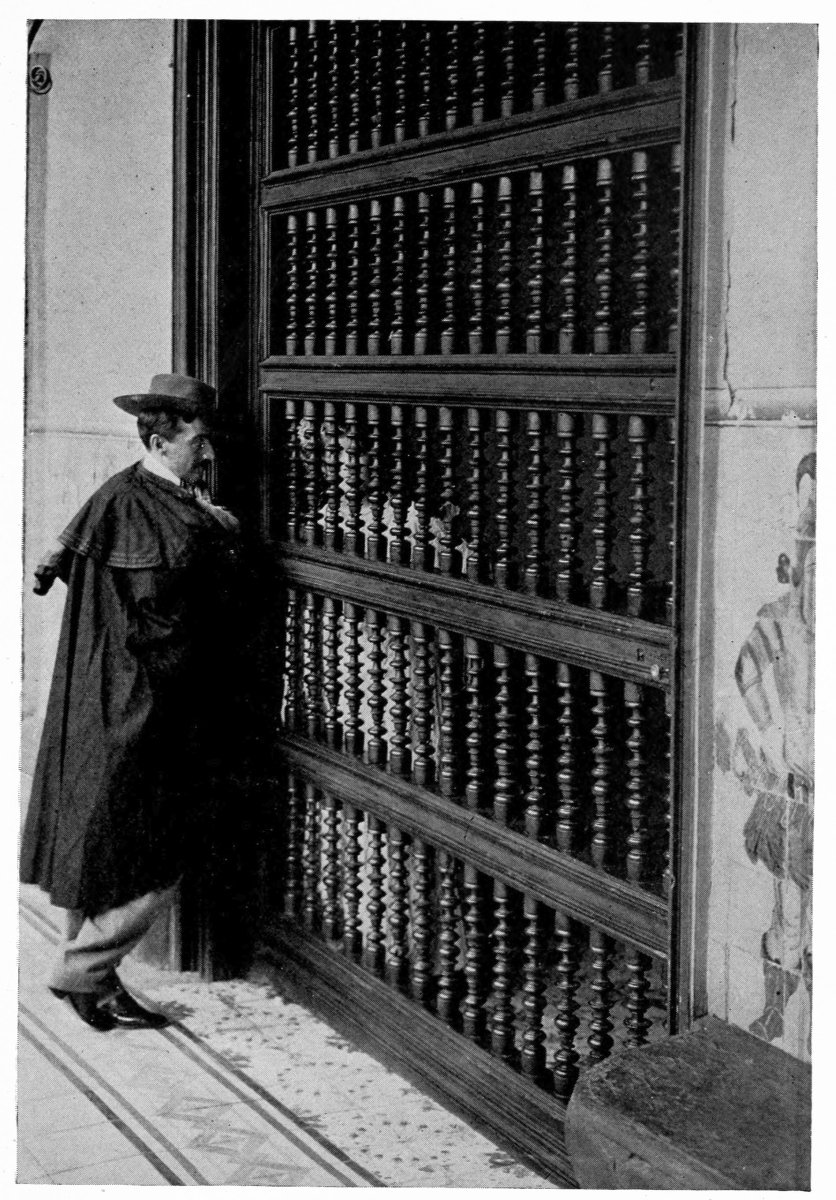
A GLIMPSE OF OLD-FASHIONED LIMA.
A woman in lilac called Dolores, a pretty woman with a vapid face, was
absent-mindedly turning a green glass globe between her fingers and
selling guavas. Young soldiers whose swords trailed along the pavement
were eating the guavas.
We got out of the carriage and rattled at a door until a keeper with
jangling keys came to open it. The walls were spiked and covered with
broken glass. The door banged together behind us.
A thin, delicately featured man in a black silk cap and stock came
forward in welcome. “The composer of Ollanta, the national opera,”
some one introduced. He led us toward a bare room scattered with
manuscript music as fine as copper-plate. I looked at the iron bars
across the windows. Over the piano hung three dusty laurel wreaths, the
people’s tribute to a genius they could not understand. After a three
weeks’ presentation by an uncomprehending Italian troupe, Lima demanded
Mignon, and the manuscript opera was returned to the upper,
right-hand drawer from which its composer now drew it.
“I am transcribing the melodies of the Indians of the highlands, some of
them survivals of Inca days,” he explained.
He played the weird, syncopated music of the Andes, bringing the
indefinable “shiver of unknown rhythm,” the wheedling love-songs and the
sad yaravís which suggested those deep valleys lost among the
mountain-tops.
“You know the yaraví of the Indians? It is a peculiar music, a
melancholy idyl reflecting the somber Indian character—a music of
extremes, for no other is so dismal and so sweet. It wails in a minor
key through strange Quichua words, the language of the Indians.
“Many of these melodies I have used unchanged. Nothing so speaks to the
spirit as they.... A secret music like that of falling water—one cannot
hear it without thinking of the riddle of the world. It has a full,
pent-up significance, as when a bird puts all the fervor of its song
into pianissimo. It moves like the music of birds, and like it does not
admit of criticism.”
I asked if the Indians sang unaccompanied.
“There is sometimes a reed-flute accompaniment,” he said, “as simple as
the song. The flute is called a quena. Then, too, they play upon a
pipe-of-Pan, supposed to have persisted since Inca days. But melody
suggests to them things far lovelier than they can conceive by words.
What they wish to say is made intelligible by the sadness or
cheerfulness of the tune.”
There is a legend that a priest in early Spanish days loved a beautiful
Indian girl who died. In desolation he mourned for years, until he dug
up her skeleton and made a flute out of the big leg-bone. Then upon it
he played weird, sad tunes and was comforted. This is the origin of the
human-bone flute so widely used.
“Have you ever heard of the ‘Jug of Mourning?’” he suddenly asked.
“Sometimes at evening the Indians play on flutes inserted in a large
earthenware jar to make their tragic tones more resonant, and, sitting
grouped around it at a little distance, they cry aloud and shed tears
for the downfall of the race. The Indians’ misfortune is infinite
indeed, but a misfortune terribly uniform; and so is their music. Yes,
even their suffering is consistently monotonous.”
I asked about the libretto of Ollanta.
“It is the only one of the great dramas dealing with exploits of kings,
acted before the Inca by young nobles, still told by the people. Ollanta
was a provincial governor who dared to love a daughter of the Sun and
was commanded not to raise his eyes.”
“Have you had anything published?” I ventured.
“This,” he said, handing me an Elégie bearing a Paris publisher’s
mark.
“Could I find it?”
“Oh, no. It was out of print long ago.... Now I am working at
Atahualpa, an opera. I consider it by far my greatest work; let me
show you,” and he took some loose leaves from a portfolio.
He began to play again. His whole body swayed to the spectacular rhythm.
There are occasions when rhythm is music, when melody is a refinement
hardly necessary. Everything in nature keeps time to such a rhythm.
Nothing can be indifferent. It turns a whole landscape theatrical. We
were whirled up into the midst of the frenzied feather-dance, and beyond
into a lofty sky where condors scarce can breathe. In the distance
glittered the ice-cold puna cities. There is nothing I could not do if
that thrilling moment could have been indefinitely prolonged!
“But you are interested in seeing the boys at work, I feel sure,” he
broke in.
The composer of Ollanta—sub-manager of a school of correction!
“The boys are either bad or abandoned by their families at an early age.
They are brought here and taught trades. They do all the work of the
school.
“Here is their swimming pool and their dormitory. In their schoolroom
you will see object-lessons upon the walls, pictures of what will befall
them if they are bad.
“The worst thing they can do is to run away. They are put into prison
when they return—here,” and he unlocked a big door. There were four
little doors on each side of a dark room. Those on the right opened into
closets two feet wide and six long, with bars overhead, all painted
black, “to keep them from writing on the walls,” he explained. When the
padlock was removed, the cubby-holes on the left were opened; two feet
square, black.
“Here they must stand.”
I gasped.
“Oh, yes.”
“How long do you keep them in such a place? Surely not over night?”
“Not more than eight days.”
“And in the other side?”
“Not over ninety days in there.”
“Is any one in here now?”
“Yes, two,” he said.
Certainly nowhere in Peru are contrasts more marked than in Lima of
to-day, with its splendidly carved balconies of former times, its
scavenger birds, and mud roofs strewn with ashes; its dim, candle-lit,
incense-filled churches with their leper windows, and its international
horse-racing; its collections of ancient, battered, gold idols, silver
llamas, dishes and spoons, and its aeroplane called The Inca!
Lima is a city where bull-fights are not only an amusement of the
people, but of the finest and best intellects which the country has
produced as well. Bull-fighters with queues, gold and silver embroidery,
lace fronts, and red silk stockings are seen in the streets. Formerly
the archbishop, religious orders, and monks all came to the bull-fights.
The viceroy, shouting “Long live the King,” threw a golden key into the
bull cage, and the fight under most august patronage began.
The market of Lima is a picturesque place: Chilean peppers (aji),
orange and red, pats of goat’s-milk cheese in palm leaves, unsalted
butter in green corn husks, piles of ripe olives of various maroon hues,
strawberries in hand-woven baskets. Fighting cocks glisten in the
intense sunlight. Ladies in mantillas float by, closely followed by boy
servants, their arms full of bundles. Here and there Franciscans with
“sandaled feet and clattering crucifixes” are amassing tribute. There
are said to be about six thousand ecclesiastics now in the city.
Lima—with its botanical gardens, condors and llamas in cages, long
allées of royal palms, and its cement tennis courts where English
people are drinking tea; its venerable university, the oldest in
America, and its aimless daily driving around and around the Paséo
Colón; its proverbial milk-women in hand-woven shawls among shining cans
perched high on ponies, and its craze for art-nouveau; its treasuring
of Pizarro’s bony remnant (which a guide explains is “completamente
momificato”) and its earthquake-rooms of solid masonry! Lima—where one
discusses at some time or another everything from men-of-war to
tapir-skin muffs! Lima—with its mediaeval festivals, when priests’
chanting fills the streets, incense rises, blossoms fall, and candles
twinkle in a ray of sunlight! As the old saying goes: “It were possible
to die of hunger in Lima, but not to leave it.”