This was one of the regiments that made Cheatham's
Division, and Smith's-Vaughan's and Gordon's Brigades so
famous in the Army of Tennessee. It was organized and
mustered into service on the third day of June, 1861, in
answer to a call of Governor Isham G. Harris for seventy-five
thousand volunteers. At that time it was the seventh
infantry regiment organized in West Tennessee and the
thirteenth in the State. It was made up of the "flower of
the South" young men, most of whom were fresh from
the best institutions of learning—aspiring, hopeful and
ambitious—sons of men of education, wealth and influence—the
very best material for volunteer service. It
was composed of ten full companies—five from Fayette
county, one from Shelby, one from Dyer, one from McNairy,
one from Gibson, and one from Henderson, and
were as follow:
Company A, Fayette Rifles, Captain William Burton of
Somerville, Tenn.
Company B, Macon Grays, Captain J. L. Granberry,
Macon, Tenn.
Company C, Secession Guards, organized at Germantown,
Tenn., and composed of Mississippians and Tennesseeans,
Captain John H. Morgan, Horn Lake, Miss.
Company D, Yorkville Rifles, Captain John Wilkins,
Yorkville, Tenn.
Company E, Dixie Rifles, organized at Moscow, Tenn.,
and composed of Tennesseeans and Mississippians, Captain
A. J. Vaughan, Marshall county, Miss.
Company F, Wright Boys, Captain Jno. V. Wright,
Purdy, McNairy county, Tenn.
Company G, Gaines Invincibles, Captain W. E. Winfield,
LaGrange, Tenn.
Company H, Yancey Rifles, Captain Robert W. Pittman,
Hickory Withe, Tenn.
Company I, Forked Deer Volunteers, Captain G. S. Ross,
Forked Deer, Tenn.
Company K, Dyer Grays, Captain S. R. Latta, Dyersburg,
Tenn.
On the following day, the 4th of June, the election of field
officers was held, and resulted in the election of Captain Jno.
V. Wright of Company F as Colonel, Captain A. J. Vaughan
of Company E as Lieutenant-Colonel, and Captain W. E.
Winfield of Company G as Major.
The regiment was ordered at once by way of Memphis
to Randolph, on the Mississippi river, when the organization
was completed by the appointment of Lieutenant W.
E. Morgan, Company C, Adjutant; Dr. J. A. Forbes, Company
E, Surgeon; Dr. B. F. Dickerson, Company I, Assistant
Surgeon; W. E. Dyer, Company G, Commissary;
L. B. Cabler, Company A, Regimental Quartermaster; Peter
Cole, Company H, Sergeant-Major; and W. D. F. Hafford,
Chaplain.
The regiment remained at Randolph engaged in drilling,
camp duty, etc., until July 26th, when it was ordered to
New Madrid, Mo., and placed in a brigade under command
of Colonel J. P. McCown, who, under orders from General
Gid. J. Pillow, was about to make a campaign into South-west
Missouri to prevent reinforcements being sent to the
Federal General Lyons, then operating in that section.
On the 18th of August, 1861, the troops were moved in
the direction of Benton, Mo., where the Thirteenth Regiment
arrived on the 19th. This was the first campaign or
march of the regiment, and though in the middle of summer
during a severe drouth, under a burning sun and over
roads shoe deep in sand and dust, it was cheerfully performed,
and showed an endurance and fortitude rarely witnessed
in new troops. The object of the campaign being
accomplished, the command returned to New Madrid on
Sept. 2, and on the following day the regiment was ordered
to Hickman, Ky., where it was placed in Cheatham's Brigade.
At Hickman, on Sept. 4, 1861, the regiment for the
first time caught a glimpse of the "boys in blue" and saw
the first "burning of gunpowder," which was an artillery
duel between the Federal gunboats and the Confederate
land batteries; but it was at long range, no damage was
done, and the gunboats were soon withdrawn up the river.
About this time General Leonidas Polk, commanding
the Mississippi Department, determined to occupy Columbus,
Ky., and ordered General B. F. Cheatham to proceed at
once to that point, where the Thirteenth Regiment arrived
Sept. 6, 1861, and was among the first, if not the first, to
occupy that important position. Nothing but camp duty,
throwing up heavy fortifications and hard and constant
drilling occurred in the regiment until Nov. 7, when it was
reported that the enemy in heavy force was advancing on
Columbus on both sides of the river. The long roll was
sounded and every regiment reported at once and fell into
line on its parade ground. All were excited and anxious to
meet the enemy. Soon it was ascertained that a heavy
force had disembarked from their gunboats above and were
moving down to a point near Belmont, on the opposite side
of the river.
The Thirteenth Regiment, under command of Colonel
John V. Wright, having been supplied with ammunition,
was ordered at once to cross the river and take position on
the extreme left of our line of battle near Watson's Battery.
Never was a regiment more anxious or more willing
to face an enemy. It was the maiden fight of the regiment
and every man felt that he was "on his mettle." Though
our position was an unfortunate one—in an open field, the
enemy being under cover of thick woods—this regiment
met the advance with the steadiness of veterans and held
its position and fought while comrades fell on every side
until the last round of ammunition was exhausted, and the
order given to fall back to the river. By the time the regiment
reached the river reinforcements had crossed from
Columbus which engaged the enemy and checked his further
advance. The Thirteenth, obtaining a fresh supply of
ammunition, rallied and again advanced gallantly to the
contest, which had become fierce and obstinate. In a short
time the Federals were driven from their position and fled
to their gunboats, hotly pursued by the Confederates. At
their gunboats, such was their haste, confusion and disorder
that they did not attempt to return the fire. The Federal
loss here, as in previous engagements, was heavy.
The loss of the Thirteenth Regiment was heavy; out of
one hundred and fourteen killed and wounded, thirty-four
were killed on the field, among them the very best men of
Tennessee. Their names should never be forgotten, and
are as follow:
Company A—A. Middlemus, First Sergeant; A. J. McCully;
Mike McCully; Matthew Rhea, First Lieutenant
commanding.
Company B—F. M. Stockinger; W. H. Burnett, Second
Corporal.
Company C—Arthur R. Pittman; J. W. Rogers; Robt.
F. Dukes, Lieutenant; J. P. Farrow; J. W. Harris.
Company D—W. H. Parks; W. H. Polk; Jno. H. Shaw;
Albert G. Zaracer; B. M. Dozier.
Company E—S. J. Roberson; Geo. R. Tiller; E. Wales
Newby.
Company F—H. H. Barnett; E. H. Hill; John A. Jones,
Sr.; C. H. Middleton.
Company G—P. N. D. Bennett; Jno. Mayo; Jno. C. Penn.
Company H—George Hall; Wm. J. Dunlap.
Company I—C. C. Cawhon; L. F. Hamlet; John G.
Nesbit; H. H. Waggoner; James Hamlet.
Company K—Y. W. Hall; K. A. Parrish; Jas. L. Smith.
J. P. Farrow and Wm. J. Dunlap were the first men in
the regiment who yielded their young lives in battle to
the Confederate cause, and were killed by the first volley
of the enemy's fire.
Early in action Colonel John V. Wright was painfully
injured in the knee by the fall of his horse which was shot
under him. I, who then took command of the regiment,
had two horses shot under me: the first at the very commencement
of the engagement; the second (which had been
cut out of Watson's Battery after its men had been driven
from their guns) was shot just as I reached the river bank.
Never did men display more heroic courage and deport
themselves in a more soldierlike manner, and while it is
impossible in this brief sketch to refer to all the acts of
devotion and fidelity to the Southern cause performed by
the officers and men of this regiment, Lieutenant Matthew
Rhea certainly deserves special mention. As soon as the
regiment took position in line of battle, in command of his
company (A) he was sent to the extreme left of our line
with instruction to extend his line to the river, which he
did. By some means the enemy got in between him and
the regiment, thus cutting him off. Though surrounded
he continued to fight, and rather than surrender his sword,
which had been worthily worn by his grandfather, he fell
at the hands of the enemy. A braver, truer or more faithful
officer never fought for any cause.
About this time, if not on the very day of the battle of
Belmont, Colonel John V. Wright was elected to the Confederate
Congress, and resigned his position as Colonel of
the regiment. No man ever stood higher in the estimation
of his soldiers or was more beloved by them.
Upon the resignation of Colonel Wright I was unanimously
elected Colonel of the regiment. I was a disciplinarian
while on duty of the strictest school, which for
the first months of the war made me very unpopular with
volunteer soldiers, but only one fight was necessary to satisfy
them that an undisciplined army was nothing more
than an armed mob. Adjutant W. E. Morgan was now
elected Lieutenant-Colonel, and Lieutenant Richard M.
Harwell of Company E was appointed Adjutant.
After the battle of Belmont and while at Columbus, Ky.,
the measles broke out in the regiment, and it was a matter
of surprise that there should be so many grown men who
had never had the measles. So many were down at one
time that there were scarcely enough well ones to wait on
the sick, and many died.
Early in the spring it became necessary to move our lines
further south, and Columbus was evacuated March 12, 1862.
The Thirteenth was ordered to Union City, and four days
later to Corinth, Miss., where it arrived March 19, 1862.
Before leaving Columbus, however, there had been some
changes made in the command. General B. F. Cheatham
had been promoted to a division commander, and the Thirteenth
was assigned to Colonel R. M. Russell's Brigade,
General Chas. Clark's Division. In this brigade and division
the regiment remained until after the battle of Shiloh.
About this time the enemy was known to be landing
and concentrating a large force at Pittsburg Landing, on
the Tennessee river. It was determined by Gen. Albert
Sidney Johnston, who had been placed in command, to
give battle; so on the 3rd of April, 1862, the regiment,
with the whole army, was moved toward the point of
attack, but heavy rains and bad roads prevented forming
line of battle until the evening of the 5th of April. That
night a council of war was held, and though some officers
were opposed, an attack was determined upon.
On the morning of the 6th, just as the sun in all its splendor
was rising above the horizon, and while in the second
line of battle, General Clark rode up to us and stated that
Marks' Louisiana Regiment had been repulsed, and asked,
"Can you take that battery yonder, which is annoying our
troops so much?" Having such unlimited confidence in
the Thirteenth, I replied, "We can take it." Whereupon
the regiment was moved by the right flank, under cover of
a hill, until in proper position, and then fronted the battery
and advanced rapidly up the hill. All was well until the
crest of the hill was reached, when the enemy opened fire
with canister, grape and musketry, which was so severe
that it literally tore the regiment in two. But, though, for
a moment checked, nothing daunted, our officers and men
gallantly stood their ground, and poured into the ranks of
the enemy such deadly volleys as to cause them to waver,
and then with the "rebel yell" rushed so impetuously upon
them that they could no longer stand, precipitately fleeing
and leaving battery and dead and wounded on the field.
This was indeed a brilliant charge, and only equaled on
that battlefield by the charge made shortly afterward by
that magnificent regiment, the Fourth Tennessee. But the
loss to the regiment was terrible; some of Tennessee's best
blood was shed here, and many a noble spirit sank to rise
no more.
The balance of the day the regiment, though not actively
engaged, was for the most time under heavy fire in changing
and shifting positions and in supporting and relieving
other troops. It was present and assisted in capturing Gen.
Lew Wallace[1] and his brigade late in the evening on the
bank of the Tennessee river, to which point we had driven
the enemy. Here, because of the steep bluff, the gunboats
could not reach us, and a rain of iron and lead passed over
our heads until late in the night. Under orders the regiment
retired from the river bank and bivouaced for the
night in the enemy's camp, rich with quartermaster's stores,
commissary supplies and sutlers' goods.
Every officer and soldier of the regiment sank to sleep
serenaded by the guns from the river, and supposed that
the battle was won and the victory ours. But how sadly
disappointed next morning, when it was known that Buell
had arrived and crossed the river that night with his whole
army, and was drawn up in line with fresh troops to renew
the contest. Though not anticipating such a state of affairs,
the regiment was formed by early dawn and moved forward
to meet the enemy as proudly and defiantly as on the day
before. But their batteries, within easy range and supported
by columns of infantry, opened such a terrible fire of grape
and canister that we were forced to retire and seek shelter
beyond the next ridge. By this time the whole Confederate
forces were hotly engaged, and from right to left was
one continuous roar of artillery and musketry. The struggle
was terrific, and closer and harder fighting was never
done on any battlefield; and though the enemy were held
at bay from early dawn till nearly noon, it was apparent
that the unequal contest could not be much longer maintained.
So the Confederate forces were gradually withdrawn,
and the army returned to its old camp grounds at
Corinth, Miss. No attempt was made by the enemy to follow.
The first day's fight of this battle was the grandest
of the war—less friction, more concert of action, more thorough
co-operation and better generalship displayed—everything
moved with clock-like precision—a master mind
directed the whole until General A. S. Johnston fell.
Throughout the two days' fight every officer and man of
the Thirteenth did his whole duty, as shown by the heavy
loss in killed and wounded. We lost one hundred and
twelve men killed and wounded, and of this number forty-two
fell dead on the bloody field, thus sealing their devotion
with their lives to the cause they believed right. Their
names deserve to be remembered by their countrymen, and
are as follow:
Robert Thompson, B. F. Eaton, H. B. Hunt, R. Harrison,
J. M. Moore, James Moore, N. Matthews, R. M.
Thompson and Lieut. C. H. Whitmore of Company A; J.
G. Babbett, Lieut. S. B. Dugan and Henry Walker of Company
B; W. B. Dukes, C. P. Graham, H. J. Hutchinson,
Thos. Rainey (color bearer) and W. L. Stokes of Company
C; Second Lieut. W. F. Cowan, First Lieut. J. W. Cunningham,
R. D. Eaton and Capt. John A. Wilkins of Company
D; D. C. Arnett, D. C. Bull, J. C. Black and M. C. Grisson
of Company E; M. Donelly, J. N. Guthrie, Jno. Morgan,
William Saunders, J. D. Springer and B. Thomas of
Company F; M. M. McKinstry, J. H. Brown and J. O.
Winfield of Company G; E. O. Chambers, S. O. Cole, D.
R. Royster and Carr Young of Company H; Jno. Mitchell,
Lewis Roberson, J. N. Vandyke and G. W. Borger of Company
I; Carroll Chitwood of Company K.
From the opening to the close of this engagement I was
most ably and efficiently assisted in the management and
direction of the regiment by Lieut.-Col. W. E. Morgan,
Adjutant R. M. Harwell, and Major W. E. Winfield. Adjutant
Harwell was painfully wounded in the first engagement
but remained at his post of duty until the close of the
struggle. Lieut.-Colonel Morgan and Major Winfield had
their horses shot, and I had two horses shot under me and
was struck by a spent ball that did no serious harm.
While at Corinth, the period for which the regiment
had enlisted having expired, it re-enlisted for the war and
reorganized. Company A, from some disaffection or dissatisfaction,
refused to reorganize, and was consolidated
with Company D, and the deficiency supplied by the admission
of Company L, Zollicoffer's Avengers, Captain
C. B. Jones, of LaGrange, Tenn. On the 28th of April,
1862, the reorganization was perfected by the election of
the following officers: I was unanimously re-elected Colonel;
W. E. Morgan unanimously re-elected Lieutenant-Colonel;
Sergeant-Major P. H. Cole elected Major; Lieut.
R. M. Harwell re-elected Adjutant. Many changes were
made in line officers, but the writer has no data from which
to supply them. While at Corinth the regiment, from the
use of bad and unhealthy water, suffered very much with
sickness, and many were furloughed on sick leave to recuperate
for the summer campaign.
The enemy in the meantime having recovered from the
severe blow received at Shiloh commenced to advance on
Corinth by gradual approaches, and by the latter part of
May was in the vicinity of that place. The regiment was
daily engaged in heavy skirmishes, and sometimes in sharp
engagements but with small losses. On May 13, 1862, Corinth
was evacuated, and the Thirteenth fell back by way of
Baldwin to Tupelo, Miss. Here, with good water, the health
of the regiment improved rapidly, and with strict discipline
and constant drilling we soon became one of the crack
regiments in that army.
About this time General Charles Clark, commanding the
division, was assigned to another department, and his division
broken up and assigned to other commands. The Thirteenth
was assigned to Cheatham's Division and General
Preston Smith's Brigade, which, on July 10, 1862, was
ordered to report to General E. Kirby Smith at Knoxville,
Tenn., who was about to make a campaign into Kentucky.
Everything being ready the Thirteenth, with the forces
under General Smith, moved on the 13th day of August
into Kentucky by way of Wilson Gap, and on the 18th of
August arrived at Cumberland Gap after a weary and toilsome
march of five days. From this point by way of Manchester
the forces were moved in the direction of Richmond,
Ky. The enemy was watching the movement, and had
sent forward General Bull Nelson with a large force of
infantry, artillery and cavalry to check our advance. A
battle was now imminent.
Early on the morning of August 30 the army was put in
motion, and by 8 o'clock while marching up the road a
shell from the enemy's battery not far off came whizzing
over the head of our advancing column and exploded high
in the air. The Thirteenth with the other regiments of
the brigade immediately deployed in line of battle on the
right of the road, when Allen's sharpshooters under command
of Lieut. Creighton were sent forward and deployed
as skirmishers, with instructions to feel the enemy and
develop their position. This being done the regiment with
the brigade was ordered to advance, and in a short time a
most terrific fire was opened by both sides from one end of
the line to the other. The enemy occupied a strong position
and stubbornly held their ground, but onward the Confederates
continued to march, when, with a charge and a yell
in front and a volley on their flank, which General Smith
with the One Hundred and Fifty-fourth Sr. had succeeded
in reaching, the enemy precipitately fled, hotly pursued and
pressed by the Confederates. The enemy lay thick upon
the field, and their loss was heavy. The Thirteenth's loss
was also heavy in officers and men, and among them some
of Tennessee's best and bravest soldiers.
It was in this first engagement that Lieutenant Edward
Lanier of Company G was killed, a young, brilliant and
gallant officer who, had he lived, would either as citizen
or soldier have inscribed his name high up on the roll of
fame. Gifted by nature, young, aspiring and ambitious it
seemed hard that he should have been stricken down at the
very threshold of his manhood. A truer soldier never shed
his blood on his country's altar. Here, too, General Pat
Cleburne was wounded in the mouth, and had to retire
from the field, whereupon the command of the division
devolved upon Brigadier-General Preston Smith, and that
of the brigade on me, and that of the regiment on Lieutenant-Colonel
W. E. Morgan.
The enemy after retiring a couple of miles made a second
stand, but so impetuous was the second attack that
after a short engagement they broke in disorder and confusion,
and did not halt until at or near Richmond, where
for the last time they made a stand, and it was here that
they were completely routed and demoralized.
This was the most complete victory gained during the
war in which the Thirteenth participated. Nothing escaped.
All the enemy's artillery, their artillery horses, their transportation,
quartermaster and commissary supplies, together
with all their camp equipage fell into the hands of the Confederates.
In this engagement our forces captured and
paroled more officers and men than General E. Kirby Smith
had in his command. The Thirteenth did its whole duty,
as attested by the killed on that battlefield as follow: R.
A. Donalson, W. L. Fullerton, S. G. Lawrence, Company
A; T. F. Gaither, Company B; W. L. Rhodes, Company
C; Jas. J. Lawrence, W. H. Minter, Company D; T. M.
Ballard, Company E; H. L. Winningham, Company F;
Lieutenant Edward Lanier, Edward Dicks, Company G;
Wm. Claiburn, R. H. Crouch, Company H; John Reed, R.
R. Stone, B. F. Holtom, Company I; John H. Gates, B.
G. Sims, H. A. Gray, J. S. Jenkins, M. R. Winfield, B. W.
Wilkerson, Company L.
In this battle I received from the hands of a captain of
an Indiana company a beautiful and highly ornamented
sword, which had been presented to him by the citizens of
his town when he started to the war. After the first attack
the Federal captain was retreating with his company when
he was shot in the leg. Unable to proceed further a private
of the Thirteenth ran up to him and ordered the surrender
of his sword. This he refused to do, saying that
he would surrender it to an officer, but never to a private.
This so enraged the private that he was in the very act of
shooting him when I rode up and ordered him not to shoot
a prisoner, whereupon the officer extended to me his sword,
and thanked me for saving his life. I wore this sword a
long time, but while on leave of absence left it in charge
of a young Confederate officer who, being insulted by a
negro, broke it over his head.
After the battle of Richmond the Thirteenth with the
brigade marched to Lexington, Ky.; thence to Cynthiana,
thence to Covington, thence to Frankfort, and joined Gen.
Bragg's army just before the battle of Perryville, where it
rejoined Cheatham's Division.
The next engagement was the battle of Perryville, which
was fought on October 8, 1862. In this battle the Thirteenth
with the brigade was not actively engaged, but was
held in reserve, and with the brigade acted as rear guard
to the army on its march out of Kentucky.
Our march into Kentucky was an ovation. We were the
first infantry troops to enter that part of the State, and as
soon as we crossed the mountains and struck the Blue
Grass region, the demonstration of sympathy for the South
and the hearty welcome extended us filled every heart with
profound gratitude. Citizens all along our line of march
received us with open arms, and showed us every hospitality.
When we halted for the night, droves of fattest
cattle, herds of the fattest sheep, and wagonloads of corn
and hay, were driven to our camp. Even the women—God
bless them—brought to our soldiers the delicacies of
the table and garden. We thought that Kentucky was
ours, and that no Federal force would invade her beautiful
territory; but, alas! how soon the scene shifted.
The retreat out of Kentucky was one of greater trial
and hardship than any march made during the war. Over
a rough and barren country, without shoes and thinly clad,
with scarcely anything to eat, the suffering was great, yet
it was borne with fortitude and without a murmur.
The regiment, with the army, reached Knoxville on October
24, 1862. From Knoxville the Thirteenth was moved
by rail to Tullahoma, where it received a fresh supply of
clothing, blankets, shoes, etc., which was so much needed.
After a few weeks' rest we were marched to Murfreesboro,
where we arrived the latter part of November, 1862. It was
here that smallpox broke out in the regiment, and it was
detached from the brigade, but by strict quarantine and
vaccination it was soon checked—not, however, without
the loss of some good soldiers.
Early on the morning of December 30, 1862, we commenced
that hard-fought and stubbornly-contested battle
of Murfreesboro, or Stone River. It was a most terrific
contest—one that brought forth those shining and brilliant
qualities of the Southern volunteer which made him
so renowned in the Mexican and other wars. In the absence
of Brigadier-General Preston Smith, I was in command
of the brigade and Lieutenant-Col. W. E. Morgan in
command of the regiment. In this fight the Thirteenth,
as in every other from Belmont to Murfreesboro, took an
active part, and did its whole duty and gathered fresh laurels.
It was the most satisfactory fight, both to the officers
and men, that was made by the regiment during the war.
With the exception of a slight check in the morning, it
drove the enemy from every position from early dawn till
late in the evening; and though every inch of ground was
fiercely contested, the regiment never faltered, but onward
like an avalanche it swept everything before it. I had two
horses shot under me, and the horse of every field and staff
officer of the regiment was killed.
In this engagement I witnessed an exhibition of discipline
and coolness that I never saw on any other battlefield.
We had in our front and opposed to us a brigade of
United States Regulars; they were formed in two lines of
battle some distance apart. Firing as we advanced, their
first line waited until we got within easy range and then
coolly delivered their fire; without waiting to reload they
faced to the rear and double-quicked through their second
line and reformed in line of battle. The second line then
awaited our approach, and though their men were falling
fast around them, they coolly delivered their fire and retired
through the first line and reformed in line of battle; and
thus they continued to fire and fall back until they were
driven across a large field. Their lines were plainly marked
by their dead, who lay thick upon the ground.
These were Americans fighting Americans—the one,
the trained soldier, who fought because he was ordered to
do so, and because of the old flag and that Union which
he believed ought to be eternal; the other, the Southern
volunteer, who fought because he believed that his home
and fireside were invaded and that his constitutional rights
were trampled upon. Both exhibited a courage which commands
the world's admiration.
In this battle a battery of four beautiful Napoleon guns
was captured from the Federals. Four divisions of our
army claimed to have participated in the capture, and each
division laid claims to the battery. A conference of the
officers of the divisions was called, and after a full discussion
and careful consideration of the claims of each division,
it was decided that one of the guns should be given to
each division, and that upon it should be inscribed the name
of the most gallant and meritorious soldier who fell on that
battlefield. One of the guns was given to Cheatham's Division
and assigned to Preston Smith's Brigade. At that
time I was Colonel of the Thirteenth Tennessee Regiment
and W. E. Morgan Lieutenant-Colonel; but in the absence
of Gen. Preston Smith I commanded the brigade and Lieutenant-Colonel
Morgan the regiment. He fell in the first
day's fight, and by unanimous consent his name was inscribed
upon the gun, and read as follows: "Lieutenant-Colonel
W. E. Morgan, Thirteenth Tennessee Regiment,
Pres. Smith's Brigade, Cheatham's Division, Polk's Corps."
This gun was assigned to Scott's Battery, and at the battle
of Chickamauga it was skillfully handled and did effective
work in checking the advance of the Federals; but when
Gen. Grant attacked our lines at Missionary Ridge, it was
recaptured by the Federal forces, and today it stands a
silent sentinel in the beautiful "Park of Gettysburg." Captured
and recaptured on two famous battlefields, it stands
there a proof of the heroism of both sides; it stands there
as ready to do service for the stars and stripes as it once
did for that other flag which lived its brief life always in
the storm of battle, and which, without dishonor, was laid
aside and folded forever, with no other stain upon its fold
than that of heroes' blood shed to give it life.
Here it was that Lieutenant-Colonel W. E. Morgan, the
pride of the regiment and the hero of so many brilliant
achievements, fell mortally wounded; he fought his way
up from Lieutenant of his company (C) to Lieutenant-Colonel
of the regiment, and no promotion was ever more deserved.
Major P. H. Cole also fell in this battle; he, too,
deserves the gratitude of his countrymen for the faithful
discharge of his duty. It was here, too, that Private W.
A. Abernathy was killed; though a mere youth he was
endowed with all of those sterling qualities which make
heroes; he was every inch a soldier; whether on the march,
in the camp, or on the field of battle, he was the life and
pride of his comrades; though offered promotion he always
refused, saying he preferred fighting in the ranks. Here,
too, J. A. Stone, though severely wounded, bound up his
wounds and returned to his company, remaining with it
and leading every charge during the day.
Upon the fall of Lieutenant-Colonel W. E. Morgan and
Major P. H. Cole, R. F. Lanier, senior Captain, the bravest
of the brave, took command of the regiment and led it
throughout the remainder of the fight with skill and judgment,
and made for himself a character for dash and daring
that followed him throughout the war; no man in the army
of Tennessee was more devoted to the Southern cause.
The regiment went into this battle with two hundred
and twenty-six officers and men, and lost in killed and
wounded one hundred and ten. Twenty-eight were killed
and their names should be ever remembered with affection.
They are:
J. C. Kelly, Company A; G. H. Adams, Logan McKinstry,
W. B. Reed, W. R. Carter, J. C. Tharp, E. M.
Waller, Company B; Boggan Cash, Wayne Holman, Lieutenant-Colonel
W. E. Morgan, Captain John H. Morgan,
Palmer P. Tuggle, Company C; W. A. Abernathy, William
Greene, Company E; M. N. Burns, Company F; J.
W. Jones, Otey Gloster, W. H. Simmons, Company G;
Maj. P. H. Cole, T. J. Forgey, S. D. Aikin, Company H;
J. McLaughlin, D. R. Tillman, J. H. McLaughlin, Company
I; James F. Dukes, Carter E. Skipwith, Company K;
R. J. Bailey, Company L. Boggan Cash was the only one
whose fate was not absolutely known. He was in every
charge of his company and could not have been wounded
or captured, as none of the ground fought over was reoccupied by the enemy. He was a brave and true soldier and always at his post of duty.
On the night of the first day's fight General Preston
Smith returned to the brigade and assumed command, and
I returned to the regiment. In the second day's fight the
regiment was not actively engaged and lost no men. On
the night of January 2, 1863, the regiment with the brigade
was withdrawn toward Murfreesboro, and the retreat to
Shelbyville commenced, which point the regiment reached
the next day and went into camp. The enemy did not
attempt to follow.
At Shelbyville the Thirteenth and One Hundred and
Fifty-fourth Sr. Regiments, having become so reduced in
numbers, were consolidated. I was retained as Colonel.
Captain R. W. Pittman of the Thirteenth, who had been
promoted to Lieutenant-Colonel, was retained with same
rank, and Major John W. Dawson of the One Hundred
and Fifty-fourth Sr. as Major. Though consolidated, neither
regiment ever lost its identity, and each was known to
the close of the war by its original regimental appellation.
From Belmont to Murfreesboro they had fought side by side
on every battlefield. In daylight or in darkness, in victory
or in defeat, they had stood shoulder to shoulder. Each
knew the worth and value of the other and both had but
one purpose in view—and that purpose, even to the extent
of their lives, was to maintain the honor of Tennessee and
uphold the Confederacy. From this time to the close of
the war the history of the two regiments was one common
history. The glory of the one was the pride of the other,
and neither ever lost hope until the Confederate banner
went down forever.
From Shelbyville the army fell back across the Cumberland
mountains, thus occupying the same position it did
twelve months previous, and before it started into Kentucky.
Tennesseeans for the second time saw their section
abandoned, yet true to the Southern cause, cheerfully followed
the fortunes of the Confederate flag.
The next important event in the history of the regiment
was the hard-fought battle of Chickamauga, on September
19 and 20, 1863. It was the first battle after the two regiments
had been consolidated that they had fought, and each
sustained its former record and gathered fresh laurels. After
two days of grand and magnificent fighting the enemy
was completely routed and victory perched on the Confederate
banner; but, alas! its fruits were lost by the tardy
movements of the army in following up the victory. It is
not for the writer to say who was at fault, but it was apparent
to all that some one was to blame.
The loss in killed and wounded on both sides was exceedingly
heavy, and the Thirteenth lost some of its best officers
and bravest men. It was here, on the night of the first
day's fight (Sept. 19, 1863), that General Preston Smith
fell. The circumstances of his death are worthy of record
here.
After heavy fighting all day, Cheatham's Division was
formed in the second line of battle, and Preston Smith's
Brigade was ordered to keep within five hundred paces of
Deshler's Texas Brigade of the first line. The two lines
were ordered forward with instructions to march directly
to the front; but Deshler's Brigade, on account of obstructions
and the irregularity of the ground, instead of marching
directly to the front, obliqued to the left and passed
unnoticed an isolated regiment which proved to be the
Seventy-seventh Pennsylvania, which had in some unaccountable
manner become separated from the Federal army.
Smith's Brigade, marching directly to the front, was approaching
too near the first line, when Gen. Smith, thinking
it was getting too close, as he supposed, to Deshler's Brigade,
ordered a halt and rode forward with his volunteer
aid, Captain King of Georgia, to see why, as he thought,
Deshler's Brigade had halted. Riding up to the Federal
regiment he was discovered to be a Confederate officer and
was fired upon and instantly killed, as was Captain King.
It was now becoming dark, and I being on the right, and
also supposing that Deshler's Brigade had halted, I rode
forward with Captain John Donaldson at my side to inquire
the cause. When within thirty or forty yards of the regiment
a Federal soldier jumped up from under a bush, advanced
to me, supposing me to be a Federal officer, and
inquired, "Where is the enemy?" Discovering his mistake,
he jerked up his gun and without taking aim, fired.
The load passed just in front of my breast into the body
of Captain Donaldson, who fell a corpse. I ordered the
Federal to be fired upon, which was done by the Twelfth
Tennessee. In shooting at the Federal soldier their balls
ranged into the ranks of the Federal regiment, when they
called out, "Don't shoot! don't shoot! we surrender!"
Whereupon I rode forward and ordered the regiment to
ground arms and surrender their flag, which I received
from the color-bearer, and turned over the regiment of prisoners
to Captain Carthall of the Twelfth, who marched
them to the rear. Thus fell General Preston Smith and
his faithful aid Captain King, and Inspector-General Donaldson.
I now took command of the Brigade and a short
time after was promoted to Brigadier-General.
After the battle of Chickamauga, Cheatham's Division
was the first to move and to advance toward Chattanooga,
to which point the enemy had retreated, and the Thirteenth
was among the first to drive in the enemy's pickets from
Missionary Ridge. In doing so, however, Company C of
the regiment lost one of her truest and most faithful officers,
Lieutenant Henry Brooks, who fell at the head of his
command in the full discharge of his duty, admired and
loved by his comrades and superior officers.
The next move of the regiment was in the direction of
Knoxville to reinforce General Longstreet, but on arriving
at Sweetwater news was received of his repulse, and the
regiment returned to the old division on Missionary Ridge.
It was now known that the Federals were strongly fortified
in Chattanooga, had been heavily reinforced, and were
preparing for an advance on the Confederates occupying
Missionary Ridge and Lookout Mountain. On November
25, about noon, the Federals advanced in overwhelming
numbers, and like an avalanche swept the Confederate lines
from Missionary Ridge, though the One Hundred and Fifty-fourth
and Thirteenth kept the Federals back in their
front until flanked on their left. At this time these two
regiments did some of the grandest and most heroic fighting
they had done during the war, and though forced to
fall back, they contested every inch of ground with that
heroism which had characterized them on every battlefield.
Night coming on, the Confederates crossed Chickamauga
Creek and retired to Dalton, Ga., where our army went
into winter quarters.
At Dalton General Braxton Bragg was relieved of command
and General Joseph E. Johnston appointed to the
command of the army. His appointment was joyfully received
by the whole army. Its morale commenced at once
to improve, and by early spring it was in splendid fighting
condition.
Early in May, 1864, the enemy 100,000 strong made an
advance, and it was supposed from the overwhelming numbers
of Sherman's army that he would give battle in front
of Dalton, but after trying two or more days to dislodge
the Confederates, he commenced his flank movement under
cover of Rocky Face Ridge. This forced the withdrawal
of the Confederates from Dalton to Resaca. The Thirteenth
and One Hundred and Fifty-fourth were the first to arrive
at Resaca, where they found General Canty's Division skirmishing
with the enemy. The enemy was held in check
until sufficient reinforcements arrived to drive Sherman
back through Black Snake Gap. It was here that the writer,
standing by the side of General Johnston (who was intently
watching the skirmish line), heard him say that never in
his life had he seen skirmishers behave better, or handled
with more skill, and turning to the writer, asked: "Do
you know to what command they belong and who is their
commander?" The writer replied that they were commanded
by Lieutenant-Colonel John W. Dawson and belonged
to the Thirteenth and One Hundred and Fifty-fourth
Tennessee Regiments, Vaughan's Brigade, Cheatham's Division.
From Resaca the regiment fell back to Adairsville, where
it had a sharp engagement and inflicted a heavy loss upon
the enemy. Thence to Cassville, where everything indicated
a pitched battle, and never was the regiment, in fact, the
whole army, in better condition. Its morale had improved
every day since Johnston assumed command, and it was confidently
believed by both officers and men that whenever
battle was given, victory was certain. But from some cause
battle was not given. It was here that the Thirteenth and
One Hundred and Fifty-fourth Regiments had the highest
compliment paid them during the war. After the line of
battle was formed and every brigade and division in position,
General Cheatham was ordered by General Johnston
to furnish the best regiment in his division to bring on the
engagement. The Thirteenth and One Hundred and Fifty-fourth
were furnished.
The next hard fighting done by the regiment was at New
Hope Church and Lost Mountain, then on the Kennesaw
line at what was known as "dead angle." It was here that
Hooker, with that splendid fighting corps of his, made the
attack and was so signally repulsed. In column seven lines
deep, with not a cap on the guns of the first two lines, he
attempted to storm our position. Never did men march
into the very jaws of death with a firmer tread and with
more determination than did the Federals to this attack.
But they met intrenched infantry, and the concentrated fire
of musketry, canister, grapeshot and shell mowed them
down at every step. Yet they still struggled forward, but
every Confederate stood at his post, and in a short time it
was more than mortals could stand and they broke and fled,
leaving eight hundred of their dead. The Thirteenth and
One Hundred and Fifty-fourth were in the angle, supported
on the right and left by the veterans of the Army of Tennessee.
While occupying this point the writer received orders
from headquarters that the safety of the army depended
upon holding this position, and that it must be held if it
required the sacrifice of every man in the regiments. This
order was communicated to the men and their unanimous
response was that "we will stay here." A few days after
this the army fell back and took position twelve miles below
Marietta, Ga., at Vining station on the railroad to Atlanta.
It was at this point, on the fourth day of July, 1864, while
the regiment and brigade were resting in the trenches behind
a battery that the writer lost a leg by the explosion of
a shell from the enemy's battery, which released him from
field service during the remainder of the war. Hence I had
no personal knowledge of the movements of my old command
after this date.
In a short time after this, Colonel George W. Gordon, of
the Eleventh Tennessee, was promoted to Brigadier-General
and took command of the brigade. The Thirteenth and
One Hundred and Fifty-fourth Regiments were under his
command at the crossing of Chattahoochee, at Peach Tree
Creek, with Hardee on the twenty-second of July, in the
defenses of Atlanta, at Jonesboro, at the capture of Dalton,
at Spring Hill, at the bloody battle of Franklin, in front of
Nashville, in the retreat out of Tennessee, and at Bentonville,
N. C., the last battle of the war. From Belmont, Mo.,
the first engagement, to Bentonville, N. C., the last, this
regiment shed luster upon the soldiery of Tennessee, and
well merited the compliment of General Joseph E. Johnston
when he said: "They were unsurpassed by the Old Guard
of Napoleon, or the army that Wellington marched out of
Spain into France."
When the great soldier and leader, Joseph E. Johnston,
surrendered the remnant of the Army of Tennessee, on
April 26, 1865, there were left of the gallant old Thirteenth
less than fifty officers and men. More than twelve hundred
men had once mustered in its ranks. Throughout
the four years they had fallen in battle, been stricken in
camp, died on the march, and sometimes, alas! in prison.
Faithful always, only a handful were left when the curtain
was rung down on the awful drama. I was not there to
see the old flag furled, the guns grounded, and the swords
handed over; but I know that the same heroism, fortitude
and love were with the remnant, as had been with those
who four years before had marched away from home at the
call of country and of duty.
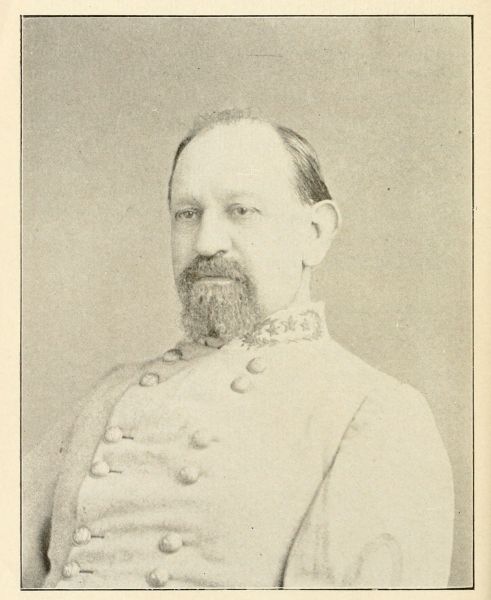
GENERAL A. J. VAUGHAN. 1885.