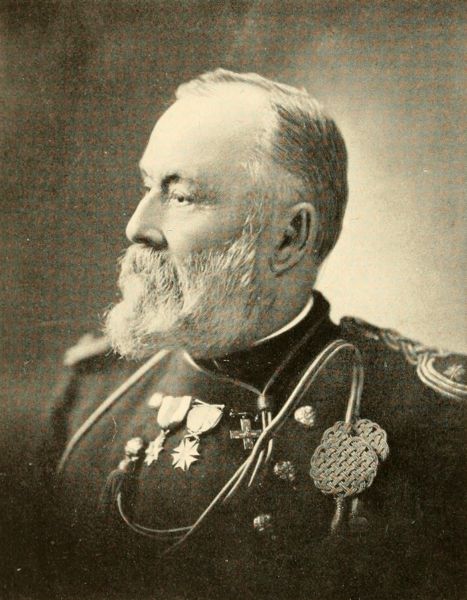
Besides the usual abbreviations of States and months,
and those commonly used for dispatch in writing and
economy of space, the following are made use of in this
work:—
| Adjt. |
Adjutant |
| A. G. |
Adjutant General |
| A. A. G. |
Assistant Adjutant General |
| Brig.-Gen. |
Brigadier General |
| Capt. |
Captain |
| Col. |
Colonel |
| Corp. |
Corporal |
| d. |
Died |
| Div. |
Division |
| Lieut. |
Lieutenant |
| Lieut. Col. |
Lieutenant Colonel |
| Lieut. Gen. |
Lieutenant General |
| Maj. Gen. |
Major General |
| Priv. |
Private |
| Q. M. D. |
Quartermaster's Department |
| Regt. |
Regiment |
| res. |
Resides |
| R. Q. M. |
Regimental Quartermaster |
| Sergt. |
Sergeant |
| U. S. C. I. |
United States Colored Infantry |
| U. S. C. T. |
United States Colored Troops |
| wid. |
Widow |
CIVIL WAR DIARY[1]
AND
PERSONAL RECOLLECTIONS
1864
———
In Winter Quarters,
Near Brandy Station, Va.,
Friday, Jan. 1, 1864.
Although attached to Company B, Tenth Regiment
Vermont Volunteer Infantry, (Capt. Edwin
Dillingham's of Waterbury, Vt.), Lieut. Ezra Stetson
commanding, I am Second Lieutenant of Company
D (Capt. Samuel Darrah's of Burlington, Vt.) of
the same regiment, having been promoted from First
Sergeant of Company B last spring.
All are wishing me a "Happy New Year"! God
grant that I may have one. I was awakened long
before daylight by the band serenading the birth of
the New Year. Lieut. G. W. Burnell took his
departure early this morning for Washington, D. C.;
he has been promoted Captain of U. S. Colored
Troops and is about to take up other duties in Baltimore,
Md. It was quite pleasant early in the day
but it is very muddy under foot; had a grand New
Year's dinner. There has been a very cold wind
this afternoon. This evening it is clear and intensely
cold. Will Clark has made me a short call; am feeling
very well but studying hard.
Saturday, Jan. 2, 1864.
Another day of the new year has passed but a
very busy one for me. It has been very cold all day.
This afternoon I have been papering my hut so our
quarters are quite comfortable now. The band has
been out this evening and played some very pretty
pieces, and I am thankful for it relieves the monotony
of dull camp life. This evening Lieut. D. G.
Hill and Captain Goodrich, the brigade Quartermaster,
called; they were in fine spirits. It is bitter cold,
but no wind as last night; have received no letters
which of course is provoking.
Sunday, Jan. 3, 1864.
Quite a comfortable day; no snow yet, but it looks
likely to storm in a day or two; wrote to Pert[2], and
had our usual inspection this forenoon. Since dinner,
I have read "Washington's Farewell Address", and
the "Declaration of Independence". This evening
quite a number of recruits arrived for the regiment,
but none for Company B. Capt. J. A. Salisbury has
been in to call on Lieut. Stetson, and broken my
camp chair. This is still more provoking than not
to get a letter from home for chairs are not plentiful
here. He is a big man.
Monday, Jan. 4, 1864.
It has snowed nearly all day, but not very hard.
To-night there is about two inches on the ground
and it is still snowing. Lieut. Stetson started for
Vermont this morning on the 9:30 train, and Capt.
H. R. Steele arrived from there this evening. I am told
to-night that Colonel Embic of the One Hundred and
Sixth New York Infantry has been reinstated. We
have formed a quiz school to-night, the members
being Dr. Almon Clark, Lieuts. E. P. Farr and C. G.
Newton and Chaplain E. M. Haynes. We are to
meet every night and ask questions on geography,
history, etc. I think it a grand idea. I suspect they
think me fresh from school, though, and want me
to do most of the quizzing, the same as in the class
of about seventy-five enlisted men in tactics and
English branches which recites to me daily now,
fitting for examination for commission in colored
troops.
Tuesday, Jan. 5. 1864.
It has been a beautiful day, but the wind is blowing
very chilly to-night; drew clothing for the Company
this afternoon; had a very good dress parade considering
the quantity of snow and mud under foot.
Our school met this evening but we didn't accomplish
much. Capt. E. B. Frost, and Dr. W. A. Child and
wife dined with us to-day; had a nice time. Herbert
George, the band master, has been in this evening
relating his experiences during his leave in Vermont.
It almost makes me homesick: have got to go on
picket early in the morning beyond Culpeper, Va.
Wednesday, Jan. 6, 1864.
Chilly and cloudy but the weather is moderating
very fast; got cheated out of my breakfast this
morning on account of going on picket; formed line
at 7.45 and so remained till nearly 10 a. m. when the
officer of the day came and started us for the picket
line; got on the wrong road and did not find the
line until 3 p. m. It has been quite pleasant all day,
but looks likely to storm before morning. No mail
to-day.
Thursday, Jan. 7, 1864.
Quite cold and disagreeable; got up about 10 a. m.
feeling as well as could be expected after a hard
day's march. The men had been to breakfast and
were in fine spirits; were relating their experiences
in the late engagement at Locust Grove. Banty—a
little, jolly, duck-legged Frenchman—started for camp
this forenoon for more rations and the mail, but
after he had been gone about a half hour a man from
Company E. came from camp with both. The
weather has moderated and it is snowing this
evening.
Friday, Jan. 8. 1864.
It cleared during the night and this morning it was
sharp and cold. As I awoke the sun was peeping
brilliantly up behind the eastern hills and all nature
was beautiful. About two inches of snow fell in the
night which added to the beauty of the sunrise.
Three deserters stole into our lines from the enemy
in the night. They report that many more want
to get away; read two letters to-night one from home
and one from Hen.
Saturday, Jan. 9, 1864.
Still the weather continues fine. There is not a
cloud to be seen or a breath of air stirring, and yet
it is quite a sharp morning. The Company got another
mail this forenoon but there was nothing for
me; was relieved from picket this afternoon about one
o'clock: arrived in camp about four p. m.; found
plenty of Company work to keep me busy all tomorrow.
Lieut. C. G. Newton started for Vermont
this morning; have been studying tactics this evening;
got my books from home I sent for last week.
Sunday, Jan. 10, 1864.
A beautiful morning. Dan Bancroft came in to
see me this forenoon, a private in the Vermont Cavalry;
had inspection at 11 a. m. and dress parade this
evening. Quite a number of recruits came this
evening, but only one for Company B. Col. A. B.
Jewett and Lieut.-Colonel W. W. Henry also returned
from Vermont to-night. The band has been
serenading Colonel Jewett. It is cold and frosty
with a little snow still on the ground.
Monday, Jan. 11, 1864.
Another fine day; have been very busy attending
to Company matters; also received many calls—in
fact it has taken me a goodly part of the day to entertain
visitors. Capt. Samuel Darrah, Herbert George
of the band and Lieut. W. R. Hoyt have just gone
and now comes Lieut. E. P. Farr, and it's after 10
o'clock; haven't studied a bit to-day, yet, but I shall
make up for lost time before I sleep.
Tuesday, Jan. 12, 1864.
Retired at 2 a. m. last night; learned by heart before
retiring fifty pages in tactics; got up at 9 a. m.
and went at it again; have conquered fifty pages more
to-day and recited them to Lieut. Farr: had them
fairly well learned before; only review; weather warm
and comfortable; had a dress parade at 5 p. m.
This evening twenty recruits armed and equipped
arrived from Vermont for Company B; got some
newspapers from cousin Abby Burnham to-night.
Wednesday, Jan. 13, 1864.
It has been very muddy and dull in camp to-day;
weather dark and gloomy: no dress parade; have
written to Pert; also received a letter from J. R.
Seaver, containing a plan of the hospitals being built
at Montpelier, now nearly completed. Lieut. Farr
has been in this evening and we have been studying
tactics together; guess he takes advantage of my being
better posted than he, having been a cadet at Norwich
University, Norwich, Vermont, where I was well
drilled, and can explain things better. I wish they
didn't consider me the best drill in the regiment; it
makes me lots of extra work and takes much time.
But I must be obliging—not mean and selfish.
Thursday, Jan. 14, 1864.
The weather still continues to be warm and pleasant;
no wind and not a cloud in sight; have received
two letters from Vermont to-night—one from home
and another from one of my old scholars in Chelsea.
The teachers who succeeded me in my school there
had very poor success both last summer and this
winter. When the teacher announced to the school
this winter one morning that I had died of typhoid
fever at Rockville, Md., it having been so reported, the
children refused to be reconciled and grieved so they
had to be dismissed, the same thing occurring the
next morning. Poor things! I never think of it but
what my eyes—well, my throat gets lumpy and my
lips quiver. I had no idea they were so devoted. It
seems as though they would follow me in memory
throughout eternity. Still, as their teacher I was
strict and firm, but always just, and never struck one
of the flock of sixty during either winter with them.
Will I ever make such devoted friends again? Alas!
it's only a memory now but will ever be a sacred one.
May the recollection be as blissful to them as it will
be to me throughout the everlasting ages of time.
Nothing has occurred to-day worthy of note; have had
my cabin full all day. Lieuts. W. R. Hoyt and E. P.
Farr have been in this evening.
Friday, Jan. 15, 1864.
It is by far the finest day we have had this year,
but very muddy. A part of the regiment has gone
on picket to remain three days. It is reported in
camp that one entire regiment of "Johnnies" came
over from Cedar Mountain this morning and gave
itself up. They were miserably clad, a large majority
having no shoes at all; they started for Washington
this evening. It's a beautiful moonlight night.
Saturday, Jan. 16, 1864.
Another warm summer day; have been at work on
clothing rolls, also laying down sidewalk in front of
my quarters. One of our new recruits has gone to the
hospital to-day sick with lung fever. General W. H.
Morris has returned from his home near N. Y. city
with his sister and a lady friend. This evening he
rode through the camp and was cheered by the men.
The bands are serenading him to-night, his headquarters
being just about a hundred yards in rear of
my hut. It is bright moonlight.
Sunday, Jan. 17, 1864.
It has been a cold and disagreeable day; had Company
inspection this forenoon; have written home
to-night; received a letter from Carl Wilson and one
from Pert; wind blew hard this forenoon, but it is
calm to-night; band played this evening. Five more
recruits arrived this afternoon for Company B. It's
cloudy and looks like rain.
Monday, Jan. 18, 1864.
It has rained hard all day, but is not very cold.
The mud is very deep. It's rumored that Governor
Smith and Mr. Baxter are to be here to-morrow;
have been studying hard all day only when engaged
in Company duty; cooler this evening; snows a little;
pickets have just come in wet and tired. Lieut. E. P.
Farr has not been in this evening to look up tactics.
Tuesday, Jan. 19, 1864.
The wind has been blowing furiously all day from
the northwest; has rained very little; commencing to
freeze this evening; have been looking over ordnance
returns this afternoon; no time to study to-day.
Lieut. Ezra Stetson is expected to-morrow, also Governor
Smith, as he didn't come to-night. Lieut. D.
G. Hill has been in this evening; wind blows a gale.
Wednesday, Jan. 20, 1864.
Quite a fine moon to-night—a little cloudy but no
wind; froze quite hard last night; have had so much
company all day it has been impossible to do anything
but visit; band is serenading General W. H. Morris;
are proud of our band, it being one of best regimental
bands in the army. Lieut. Stetson has not come tonight;
got no letter from home, but received a good
one from Carl Wilson. To-night they have the
Universalist festival at Barre, Vt.; would like to be
there, but my festival will be with tactics.
Thursday, Jan. 21, 1864.
It was quite frosty this morning, but pleasant and
has remained so all day; had regimental monthly inspection
this forenoon. Company B got the credit of
having the best street in the brigade. I am proud of
my old Company; it always tries to please me.
Nate Harrington and Orry Blanchard of the First
Vermont Brigade have been to see me to-day. Lieut.
Ezra Stetson has not come to-night, his time being up
last Tuesday; no letter from home yet; beautiful moonlight
night, but quite cool.
Friday, Jan. 22, 1864.
As pleasant a morning as I ever saw. Lieut. D. G.
Hill started for Vermont this forenoon; have made
out the final statements of Corporals C. W. Beal, C.
B. Lee and Private A. S. Parkhurst, but Lee is
dangerously ill in the hospital and not able to receive
his discharge papers. Private J. W. Sawyer, a recruit
in B Company has been in hospital but is gaining
fast; received a letter from home this evening.
Lieut. Ezra Stetson has not come yet; fear he will
find trouble when he does come.
Saturday, Jan. 23, 1864.
It has been a beautiful day with a light southern
breeze; have not had a moment's time to myself all
day someone being here all the time. It's provoking
for I want to study so much. Beal and Parkhurst
started for home to-day, Barre, Vt. Lieut. Ezra
Stetson has not come yet. Major C. G. Chandler
received a letter from Capt. E. Dillingham to-night,
who is a prisoner of war at Richmond, Va. Private
George G. Brown was detailed this evening in the
Company mess house.
Sunday, Jan. 24, 1864.
The day has been fair; started for picket at 9 a.m.;
relieved the One Hundred and Sixth New York
Infantry about noon; made my headquarters at Mr.
Bowen's, an old man about seventy-five years old;
has a son who lives with him, a miller, which accounts
for his not being drafted into the Confederate army.
A "yaller girl", as we call them, keeps house for him.
All's quiet on the picket line. It's a lovely night.
Monday, Jan. 25, 1864.
Still another fine night; have been reading the
newspaper to the old gentleman, etc. Ain't I a good
Yankee? One Johnny, a deserter, came into our
lines last night; reports that an entire brigade of
the enemy whose time has expired is fighting its
way into our lines. Perhaps this may be true but I
can't vouch for it. I take it with a grain of salt. It
is evident, though, that a great number are deserting
to our lines; have finished my Company clerk book
to-day. The moon is shining brightly.
Tuesday, Jan. 26, 1864.
It has been a lovely day. Some of the time it's
been really uncomfortable, the sun has been so warm.
About 1 a. m. last night when making the rounds
considerable firing was heard towards the right of
the line. It was probably deserters trying to come
into our lines. Sergeant Daniel Foster came to
the picket line this afternoon to get some money
to send Corporal C. B. Lee's remains to Vermont
who died last evening. Banty has come with some
rations. Lieut. Ezra Stetson arrived in camp Sunday
evening.
Wednesday, Jan. 27, 1864.
It has been a delightful day; expect to be relieved
this afternoon. Two deserters came into our lines
this morning; they report Lee's army in a miserable
condition—no rations or clothing, and the citizens
nearly starving. They say that "Secession is playing
out." The Thirty-eighth Pennsylvania Infantry relieved
us about noon; arrived in camp about 5 p. m.
The roads are in splendid condition, as good as I
ever saw them in Virginia at this time of year. If
the weather was fine all the time picket guard would
be more desirable than so much camp duty.
Thursday, Jan. 28, 1864.
A fine morning. Most of the companies have
been fixing their streets; have been at work all day
on Lieut. Ezra Stetson's ordnance returns, and have
not got them done yet; will try and finish them in
the morning. The regiment got no mail to-night.
Corporal C. B. Lee's remains were sent home Tuesday;
had a dress parade to-night in which the recruits
took part. Those of Company B never had a gun in
their hands till this morning.
Friday, Jan. 29, 1864.
It has been really uncomfortable all day, it's been
so warm. Lieut G. E. Davis started for Vermont
this forenoon; have completed the ordnance return
but it's not mailed yet. Most of the officers have
been playing ball this afternoon. The non-commissioned
officers have given us a challenge to play for
the oysters to-morrow, and the Colonel has accepted
it; received a letter from brother Roy and wife and
one from home; have been reading army regulations,
etc. Colonel A. B. Jewett has refused to approve
Lieut. E. P. Farr's application.
Saturday, Jan. 30, 1864.
A cloudy, chilly day, but not much rain. One
game of ball came off this afternoon in which the commissioned
officers won. Two more games are to be
played Monday if a good day. It's a cloudy, dark,
gloomy evening in camp; haven't studied much to-day,
but read army regulations some. Dr. W. A. Child and
Lieuts. H. H. Dewey and E. P. Farr have been in
this evening.
Sunday, Jan. 31, 1864.
The wind has been whistling around the cabin all
day. It's been misty, but we've had little rain;
have been to church and written home. We have a
goodly sized log chapel covered with the fly of the
new hospital tent. Mrs. W. A. Child was present
and sang, a rich treat, for it has been a long time
since I've heard a lady's voice at church. Sergeant
J. M. Read has been in this evening.
Monday, Feb. 1, 1864.
A dull and miserable day, but no rain; have been
studying very hard in the second volume of tactics.
No one has been in this evening save Lieut. George
P. Welch who has notified me I am detailed for
picket to-morrow. It is not my turn and is a great
disappointment as I have laid my plans to accomplish
a good week's work, and had this not happened, I
could have sent in my application next week to
appear before General Silas Casey's board in Washington
for examination for a commission in colored
troops. I want to be a field officer and won't accept
anything else.
Tuesday, Feb. 2, 1864.
A cloudy morning. The sick have gone to the
general hospital to-day which indicates a general
move; started for picket at 9 a. m.; fine marching;
arrived on the line about 12 noon; heavy wind all
afternoon; am in command of Company G on picket;
have had a thunderstorm this evening. All's quiet
on the picket line to-night.
Wednesday, Feb. 3, 1864.
High wind, cloudy but no rain all day; have moved
my tent down by the men's, so am quite comfortable
to-night. The officer of the day came along about
4 a. m.; all was quiet along the line during the night.
The countersign is "Mexico." My rations are
getting very short.
Thursday, Feb. 4, 1864.
A fine morning, Captain Samuel Darrah has been
down; have sent to camp for the mail and more
rations; quite a comfortable day. All's been quiet
through the day, but to-night there's been some firing
both sides of my post along the line; mail has come
but no letter for me. The countersign is "Vera
Cruz." It's a beautiful night.
Friday, Feb. 5, 1864.
It has been very much like a beautiful spring
morning in Vermont. I wish that I were there to
take a walk on the snow crust, but this at present
cannot be; were relieved from picket about 1 p. m.
by the One Hundred and Twenty-second Ohio Infantry.
It is quite cloudy this evening and bids fair
for a stormy day to-morrow; received a good letter
from home this evening, and have reviewed part
fourth in the second volume of tactics.
Saturday, Feb. 6, 1864.
I was awoke at 5 a. m. by the long roll; was soon
directed to report to Col. A. B. Jewett's headquarters
and ordered to break camp and march for the Rapidan,
which is no pleasant thing to do at this season;
were ordered to march at 7 a. m. but didn't till near
4 p. m.; marched to the picket line and bivouacked;
has rained some all day but not hard; considerable
firing towards night at Jacob's ford.
Sunday, Feb. 7, 1864.
Resumed our march at daylight; halted about two
miles from the river and remained through the day.
The Johnnies were on this very ground yesterday
in large numbers, but were repulsed by the First
Corps and fled across the river; no fighting to-day;
got orders about sundown to return to camp which
we did without a halt. On arrival there we found
there had been a great scare from Mosby but it
amounted to nothing; wonder if he thinks guerrilla
warfare manly? Some people are born gorillas,
though, and have no more conception of honor. I'd
go and drown myself before I'd practice that kind
of warfare!
Monday, Feb. 8, 1864.
Chilly and cloudy; don't feel very well to-day,
nor does anyone else; all stiff and lame; don't wonder
at it for we had to march through mud and water
ankle deep or more last night from the Rapidan without
a rest. The regiments were completely disorganized;
officers and men all got lost from their
commands and both struggled and straggled into
camp as best they could. It was a mob and a disgrace
to the Third Corps.
Tuesday, Feb. 9, 1864.
A chilly south wind has been blowing all day, and
it looks likely to snow before night; hope it will for
if it does not, I fear we will have to make another
Rapidan campaign which I am not at all anxious for. I
have been over to Lieutenant Thompson's quarters
studying to-day, as I have been so annoyed in my
own quarters that I could not possibly study; am
with Lieut. Ezra Stetson; got a paper from Pert
to-night and a New Year's Address.
Wednesday, Feb. 10, 1864.
The weather has been fine but rather cold with
a chilly northeast wind; had a good brigade drill this
afternoon. Col. A. B. Jewett had an officers' school
this evening in the chapel which is very essential to
us all. Lieut. Ezra. Stetson has commenced to build
an addition to our hut, as he is expecting to have his
wife come out and remain with him the rest of the
winter.
Thursday, Feb. 11, 1864.
The weather has been clear and pleasant, but intensely
cold for this latitude. Lieutenant C. F. Nye
returned from Vermont this evening looking as
rotund and hearty as ever; received a letter from
home; all well; have got to start for a three-days'
tour of picket to-morrow. Capt. H. R. Steele is
officer of the day; wind blowing furiously to-night.
Friday, Feb. 12, 1864.
Clear and cold but no wind; started for picket at
9 a. m.; arrived on the line at 1 p. m. A part of
our detail having through mistake to go to Pony
Mountain, has returned this evening, and consequently
I have had to move my headquarters up the
line; am near Mrs. Battles, historic because of Union
officers' escapades there. The house being between
the lines the women connived in trying to get them
captured; countersign is "Perth."
Saturday, Feb. 13, 1864.
Clear and warm with no wind, and by far the
finest day of the month yet. Captain H. R. Steele
came along this morning and took a part of Companies
B and G for the reserve thus leaving me in
charge of only five posts; wonder what he's afraid
of? Have received our mail, but none for me.
All's quiet on the line to-night; countersign
"Bristeau."
Sunday, Feb. 14, 1864.
Clear and chilly but very little wind; fields and
woods in front of the line to-day all on fire. A
squadron of Cavalry has been out on a scout to-day
and captured Billy Scott and two or three of his
comrades. He is a noted guerilla. It is also reported
that our cavalry ran onto the enemy in force.
We are ordered to be on the alert this evening; no
countersign.
Monday, Feb. 15, 1864.
A chilly, cloudy morning but no wind; probably
will snow before night. At 10 p. m. was ordered by
Capt. H. R. Steele to take my command up to the
reserve as soon as possible as the Johnnies were
advancing in eight (whew!) different lines: think the
man who reports this must be troubled with C. W.
(commissary whiskey); arrived in camp at 4 p. m.;
snowed all the afternoon. But what's become of the
eight lines of C. W.?
Tuesday, Feb. 16, 1864.
Cloudy with a furious wind—in fact one of the
most terrific gales of the winter—so piercing it's
impossible to keep warm in our huts; have called
on Mrs. G. E. Davis and Mrs. Ezra Stetson. All
hands have been to prayer meeting this evening but
me, and I have been studying; am stopping with
Captain Samuel Darrah now; wind still high.
Wednesday, Feb. 17, 1864.
Clear and intensely cold, with high wind; have
been studying in Dr. Almon Clark's quarters to-day;
had a mock court-martial this evening at the chapel
to entertain the ladies; sat up with Lieut. C. G.
Newton till 1 a. m. Lieut. H. H. Dewey left for
home this morning; no wind to-night, but very cold.
Thursday, Feb. 18, 1864.
Very cold but less wind than yesterday; had our
monthly inspection this forenoon at ten o'clock;
received no letter from home to-night. Dr. W. A.
Child and wife have called this evening. He is a
very bright, polished gentleman, but I am afraid of
him; probably because he is older than I am; have
been studying at Dr. Almon Clark's again to-day;
wind abated but cold to-night.
Friday, Feb. 19, 1864.
Cold as ever but no wind to mention. Lieut E. P.
Farr left for Vermont this morning; spent three
hours this afternoon in the chapel with a class of
non-commissioned officers who desire commissions
in colored troops, and have requested me to hear
them recite in tactics, etc., daily, before going before
a board for examination in Washington, D. C.
Received a letter from home; all well there. Carl
Wilson is about entering a drug store in Montpelier,
Vt.
Saturday, Feb. 20, 1864.
A very pleasant day but not warm. The men have
been playing ball this afternoon; very dull otherwise;
paymaster has come; have been very busy having
men sign pay rolls. There is a detail for picket tomorrow,
but I am not going.
Sunday, Feb. 21, 1864.
Cloudy, but no wind, threatening rain before
night; regiment left for picket at 9 a. m.; very quiet
in camp; religious services were held in the chapel
at 4 p. m. by Rev. Mr. Parker of Waterbury, Vt. and
a prayer service this evening, but I have not attended
either. All's quiet.
Monday, Feb. 22, 1864.
Cloudy and warm. The Second Brigade was out
drilling this forenoon as well as a battery; very busy
this afternoon; paymaster paying off the regiment;
rained a little this evening; got a paper from Vermont
but don't know who sent it. There is a ball
at First Corps headquarters to-night.
Tuesday, Feb. 23, 1864.
A very pleasant day, but lonely in camp; dancing
in the chapel this evening; moon shining brightly,
and not a breath of air stirring, but for all this I
can't study; no letters from home; all's quiet as
midnight save the music in the chapel.
Wednesday, Feb. 24, 1864.
Pleasant day with northwest wind. Col. A. B.
Jewett and a select party have gone to Pony Mountain;
picket guard came in about 4 p. m. First Corps
had a review to-day, as well as the Second Corps; no
letters from home; fine evening.
Thursday, Feb. 25, 1864.
Pleasant but windy. General French reviewed our
division to-day—the Third of the Third Corps;
muster and payrolls have come; after review spent
three hours with my class at the chapel; reported
the ladies will have to leave camp next week; hope
it isn't so.
Friday, Feb. 26, 1864.
Cloudy, high north wind but fair; air full of dust
all day; had brigade drill this afternoon; dance in
chapel this evening; General W. H. Morris present:
Governor Smith has arrived in the army.
Saturday, Feb. 27, 1864.
Pleasant but chilly. The Sixth Corps is on the
move this morning for Madison Court House—probably
a reconnoissance. Governor Smith arrived
in camp this forenoon. I started for picket about
4 p. m. to relieve the First Division of our Corps
which is to accompany the Sixth Corps to Madison
Court House; arrived on picket line at 2 a. m. Feb. 28.
Sunday, Feb. 28, 1864.
Did not get up till 9 a. m.; night march very
fatiguing; not feeling well; cloudy and threatening
rain. Captain P. D. Blodgett visited the line this
morning; several Johnnies came into our lines this
forenoon; everything quiet this evening.
Monday, Feb. 29, 1864.
Am feeling better this morning; weather gloomy;
chilly south wind; considerable cannonading to-day
towards Madison Court House; reported General
Kilpatrick has captured a portion of Lee's picket line
and penetrated to Orange Court House; pickets
ordered to be vigilant, etc.
Tuesday, March 1, 1864.
Commenced hailing about midnight and has continued
to alternate with it and rain all day; trees and
shubbery ice-covered and the day has been dismal;
not as much cannonading as yesterday; relieved from
picket about 6 p. m. by the Third Brigade; marched
to camp on the pike.
Wednesday, March 2, 1864.
Cleared during the night; ground covered with
snow; weather fine; have been making out Lieut.
Ezra Stetson's muster rolls; not with my class this
afternoon; have nearly completed the second volume
of tactics; no mail to-night.
Thursday, March 3, 1864.
The weather continues pleasant. Mrs. C. G.
Chandler started for Vermont this morning. Mrs.
Lieutenant-Colonel W. W. Henry arrived in camp
this evening. Dr. Almon Clark has also arrived from
Vermont. The Sixth Corps passed our camp this
evening on its return from Madison Court House.
General Kilpatrick has made a junction, it is said,
with General B. F. Butler; camp very lonely to-night.
Friday, March 4, 1864.
Weather calm and fine; no mud; pickets came in
this afternoon; making muster and pay rolls; dance
in chapel this evening; got a letter from Pert;
has finished her school and all well at home. Lieutenant
Thompson arrived in camp this morning.
Saturday, March 5, 1864.
Weather continues fine; completed B Company's
muster and pay rolls this forenoon; Sutler George
Skiff gave a ball in the chapel this evening; distinguished
guests present; fine time. Dr. Child and
wife called this evening, also Mrs. Hunt and Morse;
no mail.
Sunday, March 6, 1864.
A beautiful day, no wind and quite warm. General
W. H. Morris has had lady visitors from New
York City. Our band has been playing for him.
There were services to-day in the chapel; several
ladies were present; good dress parade this evening;
cheering news from Kilpatrick's cavalry.
Monday, March 7, 1864.
Very pleasant but colder than yesterday; have been
hard at work all day with some men decorating the
chapel with evergreens, etc.; got some help from
the ladies; reception and dancing this evening. General
J. B. Carr and lady were present and other
distinguished guests. Captain Samuel Darrah was
floor manager. Captain E. B. Frost looked after the
supper; brilliant party.
Tuesday, March 8, 1864.
It has been raining quite hard all day. The
entertainment did not close last night till 2 a. m. to-day;
have been returning the things borrowed for
the hall last night; am feeling dull; no drill to-day;
expect to be reviewed by General French to-morrow.
Wednesday, March 9, 1864.
The weather has been very pleasant, but it's been
a long weary day; have been at work on Company
B clothing rolls, etc.; no recitation to-day. The
Second Brigade has been having a review and drill
this afternoon. The Third Corps review has been
postponed till to-morrow, but I expected to go on
picket; got a speech from Congressman Woodbridge;
wonder what's come over him to be so civil; he's
Meader's (my student roommate) law partner, but he
was barely civil to me when I saw him in Vermont.
Thursday, March 10, 1864.
A lovely morning with a gentle south breeze;
formed line at 9 a. m. for picket. Captain H. R.
Steele in command of the detail from our brigade;
commenced raining about 11 a. m. and continued
all day. Our regiment is on the reserve. Lieutenant-Colonel
Egbert of the Third Brigade, a fine man,
is officer of the day.
Friday, March 11, 1864.
It has rained hard all day. Lieut. J. S.
Thompson and I have charge of the post on the
pike. It is not a desirable one to be on, as the cavalry
reserve is directly in front and they are continually
passing and repassing, and the orders are very strict
about passing anyone in or out of the lines. Colonel
Ball is officer of the day and a good fellow.
Saturday, March 12, 1864.
It cleared during the night and it's fine this
morning. I was on duty the last part of the night,
but passed no one; wind blew furiously all day. A
large party of citizens came through the lines destitute
of nearly everything. A Colonel from the
Third Brigade is officer of the day, and a strange
fellow.
Sunday, March 13, 1864.
This is truly a fine day. A squadron of cavalry
passed on the pike this morning to extend the cavalry
picket line to Madison Court House; was
relieved this afternoon by the Sixth Maryland Infantry;
Major C. G. Chandler is officer of the day; arrived
in camp about 5 p. m.; found Lieuts. Kingsley and Hill
had returned from Vermont.
Monday, March 14, 1864.
Beautiful day. Most of the officers met at the
hall this forenoon to make arrangements for another
ball this evening; am on the committee to decorate
the hall; have worked very hard all day, but am well
repaid as all seem to be pleased with what I have
done. Pretty decorations always add to the pleasure
of all such gatherings. A large party was present.
Tuesday, March 15, 1864.
Cold but pleasant; no wind; four hours' drill to-day,
but I was excused being so busy at the chapel.
I forgot to mention that Captain J. A. Sheldon
returned from Vermont last night where he has been
on recruiting service since November. The Third
Corps is to be reviewed to-morrow by Major-General
French.
Wednesday, March 16, 1864.
Very cloudy and a high gale all day; formed line
for review at 9 a. m.; moved a half mile out of camp,
stacked arms, remained two hours and then started
for the parade ground about a half mile away on
John Minor Bott's farm; review passed off pleasantly,
but it was very cold. The Corps made a fine
appearance; wonder what Vermont people would
think to see such a review; guess their eyes would
pop plum out of their head.
Thursday, March 17, 1864.
The weather still continues boisterous. Hon.
Portus Baxter's son arrived in camp last evening with
several other Vermont gentlemen. They gave an
entertainment at the Colonel's mess house this evening
for the officers of the Tenth. I did not attend.
Lieutenant E. P. Farr returned from Vermont this
evening; received a letter from home.
Friday, March 18, 1864.
Am not feeling well; took cold on review yesterday.
The wind is blowing furiously, the air is full
of dust, and it is a disgusting time. A party has
gone to Pony Mountain. The long roll was beat and
the regiment was hastily formed in line about 7 p. m.
and so remained until 9 p. m. when it broke ranks.
It was a scare. Such is army life in time of war.
Saturday, March 19, 1864.
The weather was truly fine this morning at sunrise,
but about noon the wind blew a gale. Captain
Samuel Darrah's Co. D of which I am second
lieutenant challenged the regiment to play a game of
ball for $50—or rather Captain Samuel Darrah did—which
it accepted but lost the game. The regiment
goes on picket to-morrow, but I don't expect to go.
It looks like rain.
Sunday, March 20, 1864.
Clear and fine but rather cold. General W. H.
Morris inspected the regiment this morning. A
picket guard of two hundred and fifty men and eight
officers left this morning. Captain J. A. Sheldon
commanded the brigade detail. Services were held
in the chapel at 4 p. m. Rev. Mr. Barnard of
Williamstown, Vt. preached; weather cold.
Monday, March 21, 1864.
The weather continues fine but cold. General W.
H. Morris inspected and reviewed the brigade. Preparations
are being made for an army review; have
been working on B Company's clothing rolls.
Captain Samuel Darrah has gone over to division
headquarters this evening. Captain Leonard, (Brigade
Adjutant General), and Lieut. J. A. Hicks, A.
D. C., have called. It's a beautiful evening.
Tuesday, March 22, 1864.
The wind has blown furiously from the southeast
all day. It's by far the most disagreeable day of the
winter; commenced snowing about 5 p. m. and now
at 11 p. m. there is eight inches on a level. My application
to go before General Silas Casey's board for
examination for a field office in colored troops has
not been returned yet; shall put in another to-morrow.
Wednesday, March 23, 1864.
Weather fine but very chilly. About eight inches
of snow fell last night. Major C. G. Chandler
is division officer of the day. A review of the
army is expected in the course of two or three
days. The army is anxiously waiting to see General
U. S. Grant; sent in another application to go
before General Silas Casey's board this evening; the
pickets returned to-night.
Thursday, March 24, 1864.
Weather fine; some snow on the ground yet.
Messrs. Smith and Farra arrived this evening from
St. Albans, Vt. The regiment remained in line nearly
all day in anticipation of General Grant's visit to the
Army of the Potomac. A special train which he was
probably on passed about 2 p. m. But what was the
use of keeping troops under arms in line all day?
It looks like C. W. again, or schoolboy management
of which there is too much; got a letter from home
to-night.
Friday, March 25, 1864.
Chilly wind from the southeast; very cloudy; looks
like rain; Company drill from 10 to 11 a. m. Our
Third Division of the Third Corps has been permanently
transferred as Third Division of the Sixth
Corps, Brigadier-General Prince assuming command
of the division. General French is ordered to
Washington, D. C. Our regiment was a favorite
with him, and the officers met in the chapel this
evening to pass resolutions of regret, although we are
glad to go to the gallant Sixth Corps if ours must
be broken up.
Saturday, March 26, 1864.
It's a fine day; no wind; dull in camp; only ball
playing for amusement which isn't half as exciting
as being shot at by a Johnny. Our visitors from Vermont
returned to St. Albans, Vt. this morning;
services were held in the chapel this evening by Rev.
Mr. Roberts of Williamstown, Vt.; weather fine.
Sunday, March 27, 1864.
It has been a beautiful day, warm and comfortable;
snow all gone; wrote home, also to Captain G. W.
Burnell; have not heard from my application yet.
Chaplain E. M. Haynes preached a good sermon in
the chapel this afternoon; good dress parade tonight;
cloudy.
Monday, March 28, 1864.
It has been quite warm all day. The ladies started
for home this morning but missed the train. We had
a brigade review this forenoon, the first since we
joined the Sixth Corps, and brigade dress parade in
the evening which General Mead witnessed; picket
in the morning.
Tuesday, March 29, 1864.
An order came last night for us to move camp tomorrow.
We hope it may be countermanded. The
ladies started for Vermont this morning. Colonel
A. B. Jewett went with them as far as Washington.
A part of the regiment started for picket at 9 a. m.;
has rained hard since 11 a. m.
Wednesday, March 30, 1864.
It rained hard all night; didn't sleep a wink; got
very wet; men in good spirits and everything working
well in spite of the rain; have seen no officer of the
day. Lieut. George P. Welch came down to see me
this evening; very dark; camp quiet; looks like another
storm before morning.
Thursday, March 31, 1864.
Weather quite agreeable to-day. The Lieutenant-Colonel
of the One Hundred and Tenth Ohio Infantry
is officer of the day, a very pleasant, agreeable man;
think I should like him. The Third Division of our
Corps has exchanged camp with our old First
Division; have very poor quarters.
Friday, April 1, 1864.
A disappointing day; weather quite fine this morning;
commenced raining about noon and has continued
all day; was relieved from picket about 1 p. m. by
the One Hundred and Thirty-eighth Pennsylvania
Infantry; marched to the bridge the other side of
Culpeper and waited for the officer of the day, but
soon found to our disgust that he had gone to camp.
He's no soldier! ought to be court-martialed!
Saturday, April 2, 1864.
Arrived in camp about dark last night and found
the regiment in a mud hole without quarters fit to
live in. How white men could be content to erect
such winter quarters is beyond comprehension. Even
the Johnnies do better. These quarters are the worst
ever seen, besides being dirty. All are indignant and
aggrieved at such ill treatment. It has rained or snowed
hard all day to add to our discomfort; received a
letter from C. B. Wilson and answered it; am disgusted
about not being ordered before the Casey
board for examination; fear I waited too long before
making my application; probably have all the officers
they want.
Sunday, April 3, 1864.
It has rained nearly all day; mud very deep in
camp: more stormy weather the past two weeks than
all winter before; most of the officers are building
new cabins, the huts occupied by the previous regiment
being uninhabitable. It's a dark and dismal
camp, and very depressing.
Monday, April 4, 1864.
It has been a terrible day. The wind has blown a
gale, it has snowed or rained incessantly all day, and
we miss our old cabins greatly near Brandy Station.
I have kept fairly comfortable, though. Such, however,
is a soldier's life in the Army of the Potomac.
It's a cold blustering evening without and were I not
so busy studying I should be depressed and discontented.
Tuesday, April 5, 1864.
The storm still continues, raged all night, and it
was a tedious one; no order for Washington yet; alas!
I fear I am doomed to disappointment all my life. Ah,
well, so might it be, if it's God's will. Dick Moon
arrived to-night direct from Vermont. I am glad to
see him about again. It has ceased storming but the
wind is still high.
Wednesday, April 6, 1864.
Cloudy and windy this morning, but it cleared up
about noon; fine evening, too, but no moon; have been
over to the theatre, but hardly got paid for my trouble
except for the novelty of seeing a theatre built of
logs. It is as big as a city theatre, is of fine rustic
work and a curiosity. It was built by the Engineers
and is handsome. Of course in a big army like this
there is plenty of fair theatrical talent and some excellent.
The band came out this evening and played
a few pieces, the first with their new instruments;
am at work on Company B clothing rolls; will finish
in about two days.
Thursday, April 7, 1864.
Muddy under foot, but sunshiny and warm;
received a letter from home; all well there; have not
been very busy to-day; men working hard building
cabins in the new camp four or five hundred yards
away; will probably complete it in season to break
camp in when the spring campaign opens. It's a
handsome camp, every cabin being exactly alike,
commodious and is symmetrically laid out, the handsomest
I ever saw. But the Tenth Vermont leads the
army in such a way and is the pride of general officers
from army headquarters down; it is just the same
in drill, parade, forced marching, fighting or any place
it is put. The men have great esprit de corps, and
strive not to be outdone by any other regiment in
anything. Were it not that the men's minds are
kept occupied, I should doubt the expediency of
putting so much work into a new camp so late in the
season, but they seem to enjoy it, so it's all right;
it keeps them healthy and hard, too; besides, they
will be in splendid shape for the campaign close at
hand; there's no moon to-night but it's beautiful starlight;
bands are serenading at division headquarters.
In the stillness of the night the distance softens the
splendid music and makes it enchanting. I sit outside
alone in deep thought and dream over it. War
is such a strange companion!
Friday, April 8, 1864.
Weather warm and pleasant the fore part of the
day, but towards night it hazed up; probably will rain
to-morrow; had a long and tiresome brigade drill
this afternoon that disgusted everybody, and I think
a useless one; received my order from the Secretary
of War to report to General Silas Casey's board;
shall not go till Tuesday.
Saturday, April 9, 1864.
My predictions are fully realized, it has rained
torrents all day; haven't done a thing but mope over
the fire; so muddy outside it's almost impossible to
get round even if it didn't rain so; have sent in an
application for three days' leave to go to Washington
for examination; very busy reviewing tactics; no
letters.
Sunday, April 10, 1864.
Storm has ceased, but it's muddy and windy; part
of the regiment started for picket this morning.
Lieut. Ezra Stetson has gone so I will be alone; have
been studying all day; Sergeant J. M. Reed called
this evening, also Dick who will stay all night, his
quarters being crowded; rather dull in camp all
day.
Monday, April 11, 1864.
Rested finely last night; weather fair; had a three
hours' brigade drill this afternoon; proved more of
a march than a drill; regiment very small owing to
so many being on detached service, and on other
details; men busy, too, on their log cabins in the new
camp. Dick is with me to-night; think he prefers
being where he isn't so much crowded as in his own
quarters.
Tuesday, April 12, 1864.
Weather comfortable and warm, but few clouds
and very little wind. If the weather still continues
fine a few days longer the army will make an advance
without doubt; have been talking with our sutler's
clerk, Huntington, who was a lieutenant in the rebel
army thirteen months, but being a Vermonter, on the
death of his wife and child who were living in the
south, he deserted to our army.
Wednesday, April 13, 1864.
Warm and comfortable; mud drying up finely;
application to go to Washington to report to General
Silas Casey returned this forenoon, disapproved; had
a brigade drill this afternoon, a better one than usual;
men busy on their cabins; wish they were done as
their present ones are very filthy; a beautiful moonlight
night.
Thursday, April 14, 1864.
Weather fine, no wind or clouds and but little mud;
had our regimental monthly inspection at 10 a. m.;
have written to Major Fostor, Chief of Bureau for
the Organization of U. S. C. T. in regard to appearing
before the Casey board for examination; no letter
from home to-night; several callers this evening.
Friday, April 15, 1864.
Weather fine this forenoon but began to cloud up
towards night. Major Harper has paid off the regiment
to-day. The sutler is also selling off his stock of
goods, as to-morrow is the time appointed for all
sutlers to leave the army; looks like a move in a
few days; am detailed for picket to-morrow; no
letter from home to-night, am sorry to say.
Saturday, April 16, 1864.
Corps review was ordered for to-day, but it is raining,
so very likely it will be postponed; started for
picket about 9 a. m. with Col. W. W. Henry as Officer
of the Day, so we will fare well; rained all forenoon;
cleared about 1 p. m.; fair since. The Tenth Vermont
has the right of the line.
Sunday, April 17, 1864.
Weather fine and warm, but some windy with
clouds; all quiet along the line to-day; have very poor
quarters; has been very quiet in front; it's doubtless
the calm which precedes the storm; have little doubt
but what the army will move within the next week;
beautiful, moonlight, calm evening; it seems ominous.
Monday, April 18, 1864.
It has been very comfortable on picket to-day without
any fire. The officer of the day has been
at my post to-day for the first time. Generals Grant,
Meade and Sedgwick, are reviewing the Sixth Corps
to-day; regret not being present. One of the bough
houses caught fire this evening and burned up;
otherwise all's quiet.
Tuesday, April 19, 1864.
The weather is getting uncomfortably warm; no
need of fire any more on picket. A skirmish occurred
last night about fifteen miles out on the pike. One
or two of the enemy were killed and as many wounded.
One of our men was wounded in the foot. A detachment
of our cavalry came in this morning with some
prisoners.
Wednesday, April 20, 1864.
Not very pleasant to-day; brigade drill this forenoon;
regiment so busy putting up quarters it is
excused from all other duties; officers of Tenth
Vermont all ordered out to witness the new movements
in tactics at brigade drill. My leave has come
back approved, but shan't go to Washington till Sunday;
clear moonlight night.
Thursday, April 21, 1864.
A truly beautiful day, warm and pleasant with no
wind at all; regiment moved to a new camp this
morning; most of the line officers remain here yet.
The three left Companies, B, G and K contested for the
medal Major C. G. Chandler proposed giving last winter,
and B, my old Company and the one I have been
with all winter, won it. Of course it would! It
always honors itself and me; got a letter from home
to-night.
Friday, April 22, 1864.
Weather pleasant and agreeable this morning, but
towards night it began to haze up and now it is
sprinkling. A part of the regiment went on picket
this morning. Major Chandler is officer of the day;
had a dress parade to-night. Lieut. J. A. Hicks is
relieved from General W. H. Morris' staff. Most of
the line officers have moved over to the new camp.
Saturday, April 23, 1864.
It cleared during the night; quite fair this morning,
but by noon the wind blew a gale, and the air was
loaded with dust and smoke, but the sun was shining;
shall start for Washington in the morning; have
written Dr. Jones to-night. It's lonely and I'm
feeling depressed.
Sunday, April 24, 1864.
It's been a beautiful day; left camp at 6 o'clock
this morning and reached Brandy Station at 9 a. m.
One would hardly think it was Sunday by the stir
about camp and our base of supplies, but war knows
no Sunday; arrived in Washington at 4 p. m. and
went to the National Hotel. War rumors load the
very air here.
Monday, April 25, 1864.
It has been a pleasant spring day; reported to General
Silas Casey this morning: will be examined tomorrow;
sat at Bradey's this afternoon for pictures.
The streets are thronged with moving bodies of
troops. General Burnside's Corps passed through
the city this afternoon. President Lincoln reviewed
it from the balcony over the ladies' entrance of Willard's
Hotel on Fourteenth street. This is my first
sight of President Lincoln and probably as good as
I shall ever have. I was just across the street opposite
on the curb and not crowded. He looked pale,
very sad and greatly careworn. It depressed me to
look at him. The remembrance will ever be vivid.
Burnside's Corps has encamped near Alexandria for
the night; saw Othello played at Grover's Theatre tonight
(now the New National).
Tuesday, April 26, 1864.
Fine day. Several regiments have passed up Pennsylvania
Avenue during the day; have been before
the board; am very much pleased with its appearance
with the exception of General Silas Casey who is too
old and childish for such business. To my surprise
I was asked what position I wanted, and I replied
a field office; was told the supply was more than the
demand and as officers were absorbed in the same order
as passed by the board I would never be called on.
I replied that I should never accept anything but a
field office; was passed for a first class Captaincy,
there being three grades, First, Second and Third
class; saw Edwin Forrest play Mattamora tonight at
Ford's Theatre. It was fine.
Wednesday, April 27, 1864.
Pleasant but some wind; started for the front on
the 9 a. m. train; passed General Burnside's Corps
south of Alexandria en route towards Ft. Albany;
arrived in camp about sundown; found everything as
I left it; am with my own Company (D) now, Lieut.
J. A. Hicks having returned to Company B, which is
his own company.
Thursday, April 28, 1864.
A part of the regiment went on picket this morning;
am officer of the day. I forgot to mention that
on my return I was surprised to find that Col. A. B.
Jewett had resigned and that his resignation had been
accepted; received a letter from Capt. Albert F. Dodge
and one from home tonight; have been very busy
making out muster and pay rolls all day.
Friday, April 29, 1864.
It has been warm and pleasant; nothing going on
in camp; men seem to be enjoying themselves playing
ball; completed Company D muster and pay rolls.
Lieut. G. P. Welch relieved me this morning as officer
of the day. Capt. E. B. Frost is now acting
Major; very dull in camp tonight. Colonel W. W.
Henry is division officer of the day.
Saturday, April 30, 1864.
Weather uncomfortably warm this forenoon but
cooler since. Major C. G. Chandler mustered the
regiment this forenoon; no drill this afternoon. General
Burnside's Corps has relieved the Fifth Corps
which has been doing duty on the railroad. The
Third Division has moved in on our left; all's quiet
tonight.
Sunday, May 1, 1864.
Weather fine and pleasant. Major C. G. Chandler
made a thorough inspection of the regiment this
morning. Lieutenant Clark from the sharpshooters
called on me this afternoon; pickets came in about 4
o'clock. Chaplain E. M. Haynes preached a good
sermon today; have written to J. R. Seaver.
Monday, May 2, 1864.
Still another fine day, and yet the army remains
idle. The query generally is, "when will the army
move, and where?" I guess we will wish it hadn't
when it does move. General U. S. Grant seems to
keep his own counsel, like the silent man he is. It is
well. A furious wind-storm occurred about 5 o'clock
p. m. but did not disturb us much.
Tuesday, May 3, 1864.
Pleasant in the forenoon, but a gale this afternoon;
had brigade drill two hours this afternoon. At last
our query for the past two weeks has been answered.
A part of the army moved to-day, and no doubt we
shall go to-morrow; received orders at 6 o'clock p. m.
to march at 4 o'clock a. m. to-morrow. All is confusion
in camp.
Wednesday, May 4, 1864.
We were aroused this morning at 3 o'clock, formed
line at daylight, and took up our line of march for
Germania Ford about sunrise. The whole army is
evidently on the move. It looks more like business
than ever before; arrived at the ford about 6 o'clock
p. m.; found that our cavalry crossed here last night
without opposition; are encamped on the south side
of the river not over fifty yards from it.
Thursday, May 5, 1864.
Pleasant and warm; remained at the fort until about
8 o'clock a. m. waiting for General Burnside's forces
to relieve us, and then marched about two miles up
the plank road and formed line of battle in a piece
of woods to the right of the road; remained here until
noon when Burnside's corps again came up and
occupied our line when we pushed on to the front
passing many corralled and moving army trains, and
through the outskirts of the field hospital near the
right of our army's infantry line of battle until we
struck the Orange turnpike when we turned to the
right and followed it some distance until near enough
the enemy to draw the fire of its artillery when seemingly
the air was full of solid shot and exploding
shells as far each side the pike as could be seen. The
road here ran in a straight line ahead of us almost as
far as the eye could reach bordered on either side with
a dense forest and underbrush which was also being
shelled in places. Shortly after, when within shelling
distance, the enemy fired a solid shot straight along
the pike which tore screeching through the air just a
little above the heads of the men in column in our
regiment till it struck the pike about midway the
regiment, providentially where the men had split and
were marching on either side of the road, when it
viciously rebounded along the pike lengthwise the
column to the great consternation of the men all
along the extended column in our own and other regiments.
This situation was most trying for every
moment I dreaded the effect of a better directed shot
which would go destructively through our long
column lengthwise and do untold damage.
Soon, however, we turned to the left or southerly
into the woods and formed line of battle almost as
soon as there was room after leaving the road with
the enemy close in our front with a field piece of
artillery hardly a hundred yards away through the
brush which kept each from seeing the other. Before
Captain H. R. Steele had hardly finished dressing
his company after forming line a shell from this
gun exploded in the ranks of Company K, killing a
private and wounding others. The shell had burst
actually inside the man completely disemboweling
and throwing him high in the air in a rapidly whirling
motion above our heads with arms and legs extended
until his body fell heavily to the ground with a sickening
thud.
I was in the line of file closers hardly two paces
away and just behind the man killed. We were
covered with blood, fine pieces of flesh, entrails, etc.,
which makes me cringe and shudder whenever I
think of it. The concussion badly stunned me. I
was whirled about in the air like a feather, thrown
to the ground on my hands and knees—or at least
was in that position with my head from the enemy
when I became fully conscious—face cut with flying
gravel or something else, eyes, mouth and ears filled
with dirt, and was feeling nauseated from the shake-up.
Most of the others affected went to the hospital,
and I wanted to but didn't give up. I feared being
accused of trying to get out of a fight.
The Division Commander and staff were about three
hundred yards more or less, behind us in direct line
with this gun that was shelling us. Another shell
from it which went screeching close over us—for we
immediately after the first shot lay flat on the ground—disemboweled
Captain G. B. Damon's horse of the
Tenth Vermont on the Division staff, on which he
was mounted, and killed two others. This party
could be seen from where I was in line plainly. I
was surprised at the quickness with which Company
K got into line again after being so disrupted by the
exploding shell in its ranks.
Friday, May 6, 1864.
We slept on our arms last night. Report says that
we forced the enemy's right flank back about three
miles yesterday besides capturing a goodly number
of prisoners, but I doubt it. It is also rumored that
the Vermont Brigade of our Corps was badly cut up
yesterday afternoon, but I hope it's not true; it was
hotly engaged, though, on our left. We were led
further off into the woods this forenoon to form another
line of battle evidently, but General Seymour
who was in charge seemed to be dazed, and while
poking around alone in front of and too far away
from his command without a skirmish line in his
front, was taken prisoner.[3] A part of our brigade
was finally detached and taken north of and just to
the right of the Orange turnpike including our regiment
where we formed line behind some natural
breastworks with the enemy's earthworks about fifty
yards more or less in our front across a pretty, level,
green field, in the edge of the woods; this work of theirs
was in front, I am told, of the enemy's main line. We
were shelled more or less at times through the day
until about mid-afternoon when we were let alone.
Later in the day all at once hearing heavy firing on
the right flank of our army not far away, Colonel W.
W. Henry excitedly called us to attention, faced us
to the right and then turning the head of the column
directly to the rear we ran with all speed possible—there
was no double quick about it—for a mile or
more into the woods in rear of where the heavy firing
on our right was, stumbling over logs, ditches, brush,
etc., till our faces, hands and shins smarted from
bruises and scratches, when we were halted all out
of breath, faced to the left and ordered to give the
charging war cry which, being a good deal wrought
up, not knowing what had happened but that a disaster
had occurred to our forces as panic-stricken men
were hastening to the rear from our defeated right
through our lines, and not knowing our own position
relatively speaking to any other of our forces, or but
what we would be pounced upon any moment, for we
had but a small part of our brigade even, with us, so
far as I could see in the woods, and annihilated, we,
together with the One Hundred and Sixth New York
Volunteer Infantry and Fourteenth New Jersey repeatedly
gave the war cry as we had never given it
before or did give it again afterwards. It reverberated
again and again in the forest until the echo
died away in the gloaming as softly as a fond mother's
lullaby, and it pleased me at the time to think that
perhaps it was God's offering through us and the
medium of nature, or His lullaby to the thousands of
wounded and dying heroes both of the blue and the
grey within hearing, for the softly dying echoes certainly
were soothing and restful in the quiet twilight
even to me. This war cry had the effect not only to
stop the enemy's firing but its advance, thinking probably
it was a counter-assault to meet theirs, and it
saved many a poor fellow from being captured, as
the enemy ceased its aggressive tactics in order to
reform and be prepared to meet our anticipated assault.
General Jubal A. Early's Division of three brigades
had stolen round in rear of General Shaler's veteran
brigade of the First Division and the Second Brigade
(formerly General Seymour's) of green men of the
Third Division, Sixth Corps, which were on the right
of our army in the order mentioned, attacked vigorously
both in rear and front, threw Shaler's veterans
into disorder as well later as the Second Brigade, captured
Shaler and created temporary confusion among
the trains and hospital corps nearby. Seemingly it
was the result of bad generalship by someone on our
side. If I had been a General in command there, I'll
bet the Johnnies wouldn't have got away with me!
It was evidently lack of alertness, and the Johnny fellow
got the best of it because the most alert.
Generals Meade and Sedgwick probably returning
from an investigation of that part of the battlefield
after the fight just after dark near our regiment
where I was, inquired what troops were there and on
being told it was the Tenth Vermont at that particular
point Sedgwick said to Meade, "We are safe enough
with that regiment!" as though they doubted the security
of their surroundings.
Saturday, May 7, 1864.
Weather very warm, but suited to the work we have
got to do. We fell back about a half mile last night,
just after Generals Meade and Sedgwick passed our
regiment, to some breastworks in which we lay on our
arms all night. This morning we were moved to a
stronger position on a ridge just to the left of the position
we occupied last night, and threw up very strong
breastworks, several brass cannon having been placed
along the ridge before our arrival. We have remained
as support to this artillery all day, but it
hasn't been used. The enemy made an attempt to
carry the works to our left on the pike early this
morning but were repulsed in less than five minutes
with a loss of two hundred. We have remained on
the defensive all day. The Second Corps repulsed the
enemy just at dark, as it was trying to carry their
works.
Our regiment has not been engaged to-day, but the
suspense has been wearing. The rebel yell when they
have made their various assaults at other places on
the line to our left, and the ominous bull-dog-like
silence along our lines till the roar of musketry commenced
when the enemy got in range, made one at
the time almost breathless and his heart to stand still
on any part of the line. It is awful! But the rebel
yell makes one clinch his teeth and determine that it
shall be victory for us or death before we will give up
our works. But I don't like war and wish it was well
over. This is the real thing, though! Grant don't
play fight.
Our casualties in the Wilderness including the
Ninth Corps were 10,220 wounded, 2,902 missing, and
2,265 killed, making a total of 15,387. The Confederate
loss was 6,000 wounded, 3,400 missing, and
2,000 killed, making a total of 11,400. The Tenth
Vermont lost nine wounded and three killed.
Sunday, May 8, 1864.
It has been very warm and sultry. Our forces
commenced a flank movement last night. We withdrew
from the enemy's front about 10 o'clock p. m.
and marched, via the Chancellorsville turnpike—where
we passed many trains, our wounded and
Burnside's Corps—through the old battlefield of
Chancellorsville of a year ago, as far as Piney Branch
Church, when we left the pike at Alsop's house, and
after marching southerly some time on the Todd's
Tavern road formed line of battle near Alsop's farm
about 3 o'clock p. m., our Division being on the right
of the Sixth Corps. We advanced across the Ny
river—a mere creek—but meeting with a sharp artillery
fire from a rebel battery on the opposite ridge
to us skirting the valley, we were ordered to halt.
This was about three miles north of Spottsylvania
Court House and is called the Battle of Alsop's Farm.
Our regiment lost sixteen men here. Generals Robinson
and Griffin's Divisions of the Fifth Corps took
two thousand prisoners and lost about one thousand.
We continued to change position from one point
to another till just after passing Spottsylvania when
just before dark we found the enemy in our front in
force. It had felled trees across the road which delayed
us considerably, but our artillery soon opened
the way for us. We proceeded about two miles and
found the enemy strongly intrenched across an open
slightly rising field from us in the edge of the woods
which was fiercely charged by us but without effect
except to be repulsed with the field covered largely
with our killed and badly wounded. General Meade
was in rear of our regiment which formed a rear line
in our assaulting column, superintending the assault,
and when jocularly reminded by a wag that he
(Meade) was in a dangerous place, he graciously
replied: "It's safe enough behind a Vermont regiment
anywhere!" Which was a clever thing to say
to the men and they appreciated it. We threw up
breastworks after the assault, uncomfortably close to
the enemy and are well fortified, but not in as naturally
a strong position as the enemy. Assaulting in
the dark is unsatisfactory and very demoralizing. It
ought not to be done when it can be avoided, one is
so apt to shoot his own men and straggle into the
enemy's lines and be captured; it's very trying and
nerve-taxing. It has been a strenuous day.
Monday, May 9, 1864.
Our army's line is about five miles long this morning
and runs northwest by southeast. General Hancock
occupies the right followed by General Warren,
Generals Sedgwick and Burnside in the order mentioned.
Our batteries have been shelling the enemy
fiercely all day and this evening, but the heaviest
fighting seems to be on our left. Our regiment was
terribly shelled when supporting batteries which has
been all day. We were ordered to lie flat on the
ground in one instant and there's no doubt but what
we did for the ground was a dead level and the shells
whistled and shrieked very thickly and closely over
us. It was terribly nerve-trying. The Johnnies
didn't want to see us bad enough though, to come
over and call. We could see many dead between the
lines in our front a little to the left of where we
supported a battery this morning, of both armies,
as a result of the assault last night. It is a shocking
sight, but such is war.
Tuesday, May 10, 1864.
Warm and sultry. The stench from the dead between
the lines is terrible. There has been hard
fighting on our right all day. As for the Tenth Vermont
it has been supporting a battery most of the
time. According to rumor we have captured a large
number of prisoners and several pieces of artillery.
About 6 o'clock p. m. our batteries opened a tremendous
fire on the enemy's works, and kept it up for
two hours, but with what result I do not know, except
that the guns in our front were silenced. It was
a fine artillery duel and the roar appalling even to a
practiced ear. We are getting the best of Lee in this
battle but it's stubborn fighting on both sides.
The accuracy with which our gunners fire is wonderful.
I have seen one piece of the enemy's artillery
opposite me turned completely over backwards carriage
and all, by a solid shot from one of our guns
in front of our regiment; it evidently hit the enemy's
cannon square in the muzzle. It is awe-inspiring to
see the regularity, the determined set look and precision
with which our begrimed artillerymen stick to
their work; shot and shell screeching close by don't
seem to disturb them. I was spellbound and speechless
with awe and admiration for their splendid pluck
and nerve for some time, at first. No words can
picture such a scene. I'd rather be a "doughboy"[4]
though—anything but an artilleryman, for I hate
shells and solid shot. I think I can face anything in
a charge without flinching after this splendid exhibition
of nerve.
Our regiment relieved the One Hundred and Fifty-first
Ohio Volunteer Infantry on the skirmish line
to-night. I am on lookout in a grave-like hole about
the length of a man some two feet deep on top of a
hillock with cut bushes stuck all about as a mask in
the soft dirt thrown from the hole. The cheerfully
suggestive grave-like hole is wide enough for two,
and I have Corporal Shedd with me. Even such a
place is fine under the circumstances for there is a
constant whizzing of bullets and shrieking shells over
my abode. We are not more than fifty yards from
our main line so close are the two armies at this point.
We have to relieve each other at night stealthily under
the cover of darkness.
Wednesday, May 11, 1864.
Very sultry until about 5 o'clock p. m. when the
heavens became shrouded with dark and threatening
clouds and a terrific thunder-storm followed, which
continued till about dark, when our whippoorwill
again dolefully sang out "Whip-em-well! Whip-em-well!"
as our men are pleased to interpret it. A
whippoorwill has appeared midway between the lines
every evening since we left winter camp, with its
solemn song, until the men regard it as a good omen.
It don't seem to occur to them that the enemy may
regard it the same way, as meant for them to whip
us.
There has been a furious cannonading kept up by
our side all day. The enemy has made three or
four fruitless attempts to plant batteries, and return
the fire in our front, but without success; has been
hard fighting on our left all day by the rest of the
Sixth Corps and General Hancock's men; was relieved
from my pit by Lieut. G. E. Davis. I ache
all over from having been in the hole twenty-four
hours in the same position. It wasn't safe to stand
up nor did I try it, as it would draw the sharpshooter's
fire up the trees, etc. One could only occasionally
raise his head high enough to peek under the bushes,
during lulls in firing, which masked our position as
the place was almost continually under fire. It is
close by on the ground occupied by our regiment and
in its front that General Sedgwick, our Corps Commander,
was killed by a sharpshooter when locating
a battery, and where General W. H. Morris, our
Brigade Commander was wounded when changing
the position of two regiments which makes us doubly
cautious. It's a dangerous point being high and
furthest advanced of any part of the line. The
stench from the dead is sickening and terrible.
Thursday, May 12, 1864.
Rained all night and incessantly till 10 o'clock a.
m. There has been desperate fighting by the Sixth
and Second Corps on our left all day at the "Bloody
Angle" where they have held the enemy back as well
as tried to take its works, but with great loss of life.
This will evidently go down as one of the most bloody
and desperate battles of the war. The Tenth Vermont
was relieved by some of the Fifth Corps about
3 o'clock p. m., our Division having been ordered
further to the left adjoining the "Bloody Angle" or
"Slaughter Pen." Just after we had stacked arms
under the brow of a slight ridge next the bloody
angle, Captain H. R. Steele wandered a little distance
in front and almost immediately returned hopping
along holding up his foot saying he was shot. I
ordered some of the men to take him to the hospital.
I am now in command of Company K. The men
seem pleased, and I'm sure I am for I like the Company.
The men seem sensible, and I know them to
be reliable good fighters. I am not sure but what
they will win my esteem from Company B, but I
never have been fickle; there's room in my heart for
all the men of the gallant old Tenth Vermont. They
have faith in me and it's mutual. They will never
be turned down by me. We are to bivouac on our
arms in a dense growth of pine forest with the
enemy immediately a short distance in front. Surely
this fierce struggle of giant armies can't last more
than a day more. Either one or the other will have
to yield, and as we have had the best of it here thus
far, it will be Lee.
It is wet and depressing for the "Slaughter Pen"
will be our portion next without Lee withdraws to-night
which God grant he may do if it is His will. The
thought that we may have to assault into the jaws
of death at the bloody angle in the gray of the morning
is appalling for I am told there are thousands of
dead and uncared for wounded on the field between
the lines, and in the rebel works the dead and
wounded lay in piles, the wounded bound in by the
dead several deep. The rattle and roar of musketry
and artillery is dreadful as I write and may continue
all night. I am about to lie down perhaps for my
last sleep, but I'm too exhausted to have the thought
keep me awake for seldom has sleep, sweet sleep, been
more welcome. But I have never thought I should
be killed in battle. It's delightful to have perfect
faith—the faith of a child in such a way. It helps one
to go into battle, although I dread being wounded, it
shocks the system so. I never go into a fight or take
a railroad journey, though, without feeling reconciled
to yield up my spirit to Him who gave it if it is His
will. This gives one calmness and reconciliation unspeakable.
God be praised for giving me such peace.
This is my prayer.
Friday, May 13, 1864.
My prayer for Lee's withdrawal last night was
granted. Our Division moved to the "Bloody Angle"
this morning; it virtually joined our regiment's left
last night. The enemy abandoned the angle during
the night after three days' desperate fighting. No
pen can fully describe the appearance of the battlefield—and
yet our wounded and dead have been cared
for, and some of the enemy's, by us and such are
mostly out of view. The sight of the enemy's dead
is something dreadful. There are three dead lines of
battle a half mile more or less in length—men killed
in every conceivable manner. The wounded are fairly
bound in by the dead. Lee abandoned his works
leaving most of his wounded, and all his dead in our
hands unburied. Several pieces of artillery were
taken. Prisoners say that General Lee fought in person
as it meant the loss of his army if his line was
broken here, as well as Richmond.
No wonder from its present appearance this place
has been christened the "Bloody Angle" and the
"Slaughter Pen." For several hundred yards—fully
a half mile or more—in the edge of the heavy oak
forest of immense trees skirting an open field, the
enemy's works are faultlessly strong of large oak
logs and dirt shoulder high with traverses fifty feet
back every sixty feet or so. This breastwork is filled
with dead and wounded where they fell, several deep
nearly to the top in front, extending for forty feet
more or less back gradually sloping from front to rear,
to one deep before the ground can be seen. The dead
as a whole as they lie in their works are like an immense
wedge with its head towards the works. Think
of such a mass of dead! hundreds and hundreds piled
top of each other! At the usual distance in rear of
these breastworks—about ninety feet—are two more
complete dead lines of battle about one hundred feet
apart the dead bodies lying where the men fell in
line of battle shot dead in their tracks. The lines are
perfectly defined by dead men so close they touch each
other. Many of the bodies have turned black, the
stench is terrible, and the sight shocking beyond
description. I saw several wounded men in the
breastworks buried under their dead, just move a hand
a little as it stuck up through the interstices above the
dead bodies that buried the live ones otherwise completely
from sight. Imagine such a sight if one can!
It is indescribable! It was sickening, distressing and
shocking to look upon! But, above all, think if one
can of the feelings of the brave men who, regiment
after regiment, were marched up in line of battle time
and again for several days to fight with such a sight
confronting them! Could anything in Hades be any
worse? Only the misery I imagine, of an uneasy
conscience at some great wrong done an innocent
person could exceed it. It seems like a horrible nightmare!
Such intrepidity is worthy of a better cause.
Was there ever before such a shocking battlefield?
Will the historian ever correctly record it? No pen
can do it. The sight of such a horror only can
fully portray it.
The First and Second Divisions of the Sixth Corps
and Hancock's men have done most of the fighting today
at the "Bloody Angle." The Sixth Corps has
lost eight hundred and forty wounded and two hundred
and fifty killed. The loss of our army at Spottsylvania
Court House has been five thousand two
hundred and thirty-three of which number nine hundred
have been killed. Our Division has lost in this
fight to-day twenty-three killed and one hundred and
twenty-three wounded. I examined this forenoon an
oak tree fully eighteen inches in diameter felled by
being cut off by minie bullets at the apex of the
"Bloody Angle" occupied by the enemy. I could
hardly believe my eyes, but there stood the stump and
the felled tree with the wood for two feet or more
all eaten away by bullets.[5]
Saturday, May 14, 1864.
We were aroused several times during the night
by sharp firing on the skirmish line. About daylight
we received an order to move further to the left, and
soon found ourselves on the extreme flank of the old
line of battle. Soon after we left our old position,
the skirmish line that had caused us so much trouble
during the night was captured. We found on examination
that Lee's army fell back during the night
still further. We moved about two miles towards
Spottsylvania Court House, charged across the valley
and Ny river, and took possession of the heights
where Lee's headquarters were this morning relieving
the First Division of our Corps which had been hotly
engaged. Thus we virtually part with the stage
on which was fought one of the greatest battles of
modern times if not in history, and no one regrets it;
it seems like a horrible dream. But how about the
uneasy souls—the remorse of those who are responsible
for this war in the hereafter? What does it all
mean, anyway? Is man irresponsible? Should he
not have a care? Verily!
Sunday, May 15, 1864.
Cloudy, with a bracing air; have thrown up a line of
rifle pits along our front. The army is quiet to-day;
very little cannonading heard. Divine services were
held in nearly every regiment in the Brigade; wrote to
Pert this forenoon. The Sixth Corps is encamped on
as beautiful a plantation as I ever saw. It seems a
pity to spoil such finely laid out grounds, but such is
war. The whole Division got ready to move about 6
o'clock a. m. but as the enemy remained quiet we did.
There's no picket firing to-night. I'm so tired and
lousy I do wish we could stay somewhere long enough
to wash and boil our underclothing. However, the
general officers are as lousy as the rest of us for lice
in war times know no caste. I saw a General lousing
to-day. I hope this won't shock anyone when they
read it after I have passed along. It's a part of the
history of the civil war though, and should be
recorded.
Monday, May 16, 1864.
It was sultry and warm until 4 o'clock p. m. when
relief came through a fierce thunder-storm; no fighting;
remained quietly in camp all day; much appreciated
mail came to-night; got two letters from Pert,
one from Abby and one from Dr. J. H. Jones. I
know not how long we shall remain in this position,
but God grant that this suspense will soon be ended.
I dread another such battle as that of last week and
hope we may avoid one for a while, anyway.
Tuesday, May 17, 1864.
Cloudy with wind; regiment has been on the skirmish
line; have advanced about a mile by swinging our
left round nearly parallel with our present line of
battle; met with no opposition; enemy seems to be
in the valley between the two flanks of our army; no
news to-day; army very quiet; can't continue long,
as Grant seems to be cautiously working round both
flanks of the enemy; things look suspicious to-night;
mistrust something's afoot.
Wednesday, May 18, 1864.
We were ordered to withdraw our line this morning
at 3 o'clock which we did without difficulty; found
our Corps had gone to the extreme right of the
line to reinforce the Second Corps, quite a little brush
having occurred between it and the enemy this morning
which was repulsed and driven back into the
valley; occupy the same ground we did yesterday;
have orders to march in the morning at daylight; another
mail came this evening; all's quiet. Perly
Farrer was killed to-day on the skirmish line. He
was a good boy, a member of my old Company B,
of which I am so proud and fond. His remains
will be numbered with the unknown dead, as it will
be impossible to send them north now. He was a
brave man and died manfully doing his whole duty.
We can't even reach his body now.
Thursday, May 19, 1864.
We were ready according to orders to march early
this morning. General Burnside moved his Corps to
the left of us during the night. We all moved about
a mile and a half to the left and threw up a new
line of entrenchments: enemy about twelve hundred
yards in our front; weather fine; small shower about 5
o'clock p. m. cooled the air greatly; enemy quiet in
our front, but heard heavy guns about dark on the
extreme left; don't know the cause or result.
Friday, May 20, 1864.
Weather very warm and sultry; showery towards
night; enemy in front all day; neither side seem ready
for another fight at present; no picket firing to-day
to mention. General Meade rode along the line and
seemed much pleased with our breastworks; said if
we could hold them eight days we should be all right;
don't know what he meant by this; mail to-day; all's
quiet.
Saturday, May 21, 1864.
Very warm and sultry until about 5 o'clock p. m.
when quite a hard thunder-storm come up and cooled
off the air; remained in our breastworks until about 4
o'clock p. m. when the first line was abandoned for
the second where we remained about an hour when
all withdrew. Our Division was in rear and had not
gone more than twenty-five rods from our works when
the rebs charged on our picket line but without effect
in our front, except to make us double quick
back and reoccupy our intrenchments where we remained
about two hours then quietly withdrew and
marched all night. It's been a worrying day. Since
the fourteenth we've done nothing but march and
countermarch and change about.
Sunday, May 22, 1864.
The enemy appeared on our right flank about 3
o'clock a. m. evidently with the intention of cutting
us off from the rest of the army, but didn't succeed.
It has been very warm all day, and by far the most
difficult marching we have had during the campaign;
encamped near Bowling Green. General Hancock is
reported ten miles ahead of us; no fighting to-day.
Monday, May 23, 1864.
We were ordered to be in readiness to march at 4
o'clock this morning, but did not start till near 9
o'clock a. m.; marched until about 11 o'clock a. m.,
and encamped about three miles from the North Anna
river; heavy artillery firing heard in the direction of
the river; have not heard the result; very warm all
day, but the men bear the heat grandly. General
Longstreet's Corps is only about three miles ahead
of us from which it would seem we are chasing him—anyway,
have captured many of his stragglers. It's
intensely hot.
Tuesday, May 24, 1864.
The weather continues very warm, but thanks to
the citizens along our line of march for their ice
houses we are doing very well by helping ourselves to
such needed comforts as happen to be in sight. Probably
they would rather the Johnnies should have them,
but they are on their last legs—they are playing out.
We broke camp this morning about 6 o'clock a. m.;
arriving at the North Anna river about 10 o'clock a. m.;
found the Fifth Corps had crossed last night after
a hard artillery duel which was what we heard. We
crossed the river at Jericho Mills and laid on the
south side of the river until 6 o'clock p. m., and then
moved to the left to reinforce General Russell; saw
General U. S. Grant to-day for the first time, at his
mess table under a tent fly; was in his shirtsleeves;
good view. The men enjoyed the bathing this afternoon
greatly. The whole army seemingly has been
in swimming. At any rate I never saw so many in
bathing at once before or those who seemed to enjoy
it more. It was a sight to be remembered. We
marched towards the South Anna river till 8 o'clock
p. m. when we ran into the enemy's pickets, fell back
a little, camped and threw up breastworks.
Wednesday, May 25, 1864.
It has been a very warm day, but we have not had
to march much; laid on our arms in line of battle last
night behind our works at Quarles' Mills; no skirmishing
in front till this morning. A portion of the
Sixth Corps passed by us to the left and ran into the
enemy a few rods beyond. Our brigade started about
10 o'clock a. m. and marched to Noles Station as did
the First Division of our Corps. We burned the
depot, destroyed the Virginia Central Railroad for
about seven miles, and returned to the train; remained
there about an hour, changed position to the left about
two miles and camped for the night.
Thursday, May 26, 1864.
We were ordered on picket last night; no appearance
of any enemy in our front; men enjoying the
novelty of foraging greatly; rained hard about an
hour this morning and has been cloudy and gloomy
all day; has been quiet most of the time along the
line, too; not much going on save the countermarching
of troops; possibly General Grant is covering another
flank movement; enemy seem to be in force on the
south side of Little river.
Friday, May 27, 1864.
As I expected the army has commenced another
flank movement to the left. We were ordered to hold
the line until 11 o'clock then withdraw quietly and
overtake the balance of the army. Goodness! I
wonder if we are always to be rear guard? It's worrying,
besides, we have to march so rapidly, such duty
should be passed round. We crossed the North Anna
about three miles below Noles Station. It has been
terrible marching the roads are so blocked with army
supply wagons or trains—however we have made a
thirty-mile march and find ourselves near the ford at
Hanover Court House. The men stood the march
well for we are on the road to Richmond. Goodness!
but I'm tired.
Saturday, May 28, 1864.
I wrote hastily yesterday, as we were ordered to
move about the time I commenced; rested well last
night; marched at 7 o'clock a. m.; arrived at the
Pawmunky river about noon and crossed at Nelson's
Ferry on a pontoon bridge without difficulty as our
cavalry held the place; did not advance far south of
the river before we ran into the enemy and captured
two pieces of artillery; have been building breastworks
this evening; are camped on Dr. Pollard's
plantation, a lovely place, but much neglected owing
to the war. Slight shower just at dark.
Sunday, May 29, 1864.
Weather quite cool and comfortable; no fighting today;
only twenty miles from Richmond—Hurrah!
The negroes were much frightened when they saw the
Yankee army approach, but have become very much
tamed in twenty-four hours; said the Johnnies told
them we had horns, would cut off their arms, etc.
Poor things! they were actually frightened, and
showed it by their bulging eyes, looks and manner. It
was comical! General Russell has gone on a reconnoissance
to Hanover Court House. It's rumored
that General R. E. Lee is dead, but I believe it's a
fake.
Monday, May 30, 1864.
Very sultry with intense heat; has not rained today
as usual. We were ordered to move from Dr.
Pollard's in a westerly course to the right about daylight;
have been changing positions all day, and yet
we have been cautiously advancing on Richmond; are
now within twelve miles of the Confederate capital
with the rebel army in our immediate front. In order
to get here we crossed Crump's Creek towards Hanover
Court House. When nearing Atler's Station
about noon we were ordered back to support the Second
Corps which was engaging the enemy near
Totopotomy Creek. We marched in a sweltering and
almost exhausted condition to the Hanover turnpike
which we had left in the morning but soon again left
it cutting cross-lots through a swamp and heavy oak
forest where a road was being cut for artillery, and
soon went into line of battle on the left of General
Birney's Division about mid-afternoon. We were ordered
to charge but the order was countermanded.
The lines here ran about north and south. The
enemy's picket line kept up a sharp fusilade all night,
as a bluff to enable its force here to withdraw in order
to form another line called the Totopotomy, so as to
cover several roads leading to Richmond including the
Shady Grove Church road at Hantley's Corners, and
the Walnut Grove Church road as well as the Mechanicsville
turnpike, etc. Our line was changed to
meet the enemy's, but we made no assault. The
enemy was evidently greatly worried as it kept up
a heavy artillery fire and made one or two fruitless
assaults. Did they but know our strength they
would know better than to charge our works; but
they are plucky fellows.
Tuesday, May 31, 1864.
As beautiful a morning as I ever saw; men are
feeling better since they drew rations; had been without
two days; heavy skirmishing in front. Our artillery
shelled the enemy out of its first line of works
about noon. We moved up and occupied them without
difficulty; enemy has made several useless attempts
to shell us but have done no harm. Our own
batteries have been shelling the enemy over us, but
have wounded more of our men than the enemy. The
Tenth Vermont is on the skirmish line to-night. Today's
experience when our batteries threw shells over
us at the enemy and hurt so many of our men was
the most exasperating of the campaign. Such stupidity
ought to be punished, as the artillerymen could
plainly see that their shells were exploding close over
us and several hundred yards short of the enemy.
Wednesday, June 1, 1864.
It has been a terribly warm day. The enemy being
too well posted at Totopotomy to attack, Grant concluded
to move to Cold Harbor about fifteen miles
away, last night. General Sheridan had taken it yesterday
afternoon but being hard pressed by the
enemy's Infantry he had started to leave when he was
ordered by General Meade not to do so. The Sixth
Corps in accordance with this plan started for that
point at about 2 o'clock this morning over a narrow
road leading a part of the way through swamps which
are the source of the Totopotomy and Matadequin
rivers, arriving at Cold Harbor which was being held
by General Custer's Cavalry, at about 2 o'clock this
afternoon. Characteristic of Custer when in a hot
place, his band was playing Hail Columbia while his
men were fighting like Trojans to hold their ground.
He had had a goodly number killed and wounded who
lay on the field uncared for because all his men were
absolutely required for fighting in order to hold the
place. Soon the dry grass and underbrush took
fire and the helpless wounded were roasted to death,
their charred remains being found afterwards. It
was a sad sight for any one, and especially a thoughtful
person.
Our line of battle consists of the Sixth and
Eighteenth Corps, Major General W. F. Smith commanding
the latter of about ten thousand men just
from Bermuda Hundred being on the right of the
line. Our Corps with its Third, First and Second Divisions
in the order named from right to left was on
the left of the line. The Third Division, Sixth Corps
went into line about 3 o'clock p. m. just west of an
old tavern at Cold Harbor Cross Roads or Old Cold
Harbor, from which tavern the place probably took its
name, owing to its custom of entertaining especially at
an early day when its grounds were allowed for camping
purposes to travelers and they cared mostly for
themselves.
Our part of the line was in an open field behind
a narrow strip of woods with the enemy's breastworks
just beyond about a mile more or less away in our
front. We were formed by regiments four lines
deep. Our regiment was on the skirmish line all
night on Totopotomy Creek, but was relieved about
daylight and after a hot dusty march joined our Division
in the foregoing position just in season for
the assault at about 6 o'clock p. m., our brigade being
on the left of our Division. We were all worn
out from being on the skirmish line all night followed
by a rapid but all-day march, so near asleep at times
en route as to frequently actually unconsciously march
into scrub trees by the wayside or anything else in
the line of march before awaking. It was simply impossible
to keep awake as overtaxed nature had
reached its limit.
We were ordered to guide left on the First Division
of the Sixth Corps in the assault, but owing to some
misunderstanding at first there was some delay, but
our brigade soon got in motion and advanced rapidly
in unbroken lines soon all alone on its right, until
broken by the woods, leaving the troops on our right
far in the rear, which caused us to oblique to the
right when, before we were half-way through the
woods and swamp which were wider in our front than
to our left, our brigade had deployed so we had only
one line of battle where I was with no support on my
right whatever which, owing to an enfilading fire from
the enemy in that direction, greatly handicapped the
right of the line here. This caused quite a sharp
angle in the Union line of battle at this point, and
when we were afterwards drawn back a little to connect
with our right it brought our line of works here
closer the enemy's than at any other point. The fact
is we had no support either in rear or to our right
and were in a precarious situation until drawn back
in continuous line of battle with the rest of the assaulting
line.
It was a determined charge though, through the
woods and swamp. It was my first experience as
Company Commander in an assault, and it did seem
queer to step in front of my men to lead them, one
of if not the youngest among them. But I was on
my mettle and had I known a solid shot would have
cut me in part the next second, pride would have kept
me up to the rack, for the Company Commanders of
the Tenth Vermont did not follow but led their men
in battle ever after the first one at Locust Grove and
some did there. The men of Company K are splendid
fighters, and I am proud of them. If there was
a man who shirked I didn't see him. They followed
me splendidly, have gained my respect and esteem,
and I shall hate to give up the Company when the
time comes to do so.
A part of our Division together with General
Emery Upton's Brigade of our Corps, quite largely
went over the enemy's works in the assault to-night,
but could not hold them because not supported on
either flank. It was a plucky fight. Our opponents
were Generals Hoke, Kershaw, Pickett and Field's
Divisions. General Clingman's Brigade was on the
right of Hoke's Division, and was badly broken up
in the assault, as well as the Brigade on either side
of his, one of which belonged to Kershaw's Division.
Our regiment captured the Fifty-first North Carolina
Infantry, the commanding officer of which surrendered
his sword to Captain E. B. Frost of Company
A, acting Major. Our Division and Upton's
Brigade captured five hundred prisoners, most of whom
were probably taken by our regiment. Such as were
taken by it were sent to the rear, without guard, but
were again picked up en route so we got no credit
for them. We could not spare men to send them under
guard for we had more than we could do to hold
the works after taking them.
The loss in the Sixth Corps was twelve hundred,
of which over eight hundred were from our Division.
The splendid work of the Third Division here put it
in full fellowship with the rest of the Sixth Corps.
We had proved our mettle grandly even if a shorter
time in service than the Second and Third Divisions.
The loss from our Brigade was twenty-one officers,
seven of whom were killed, ten wounded and four
were taken prisoners; one hundred enlisted men were
also killed and two hundred and seventy-five wounded.
Our regiment lost nineteen killed and sixty-two
wounded, and Company K, one killed and four
wounded. Lieutenant Colonel Townsend of the One
Hundred and Sixth New York, Lieutenants Ezra
Stetson of Company B, and C. G. Newton of Company
G, Tenth Vermont, were killed; Colonel W. W.
Henry and Lieutenant William White of the Tenth
Vermont, Colonel W. S. Truex of the Fourteenth New
Jersey, commanding First Brigade, Colonel Schall of
the Eighty-seventh Pennsylvania were wounded, and
Major McDonald of the One Hundred and Sixth New
York and Lieutenant J. S. Thompson of Company A,
Tenth Vermont were taken prisoners and two other
officers.
Thursday, June 2, 1864.
Oh, dear, another shocking battle on hand! But
we can lick them! I dread it, though! We laid
on our arms in line of battle last night; heavy skirmishing
continued in our front all night; built rifle pits
this morning; men very tired; ordered to assault this
evening at 4 o'clock, but it rained and the order was
countermanded until morning thus prolonging the
agony; drew rations for the Company to-night; am
getting very tired of this campaign and shall be glad
when it's over, but I suppose it will last a month
longer. The enemy is doing its utmost to gain a victory,
but God grant that we may be the victors if it is
His will.
Friday, June 3, 1864.
It still continues to rain a little, but for all this the
Second, Sixth and Eighteenth Corps in the order
mentioned from right to left, were ordered to charge
at 4 o'clock a. m. and not to fire a shot until we got
on to the enemy's works, but the charge was not a
success. We never even reached the enemy's works.
The attack commenced on the right and ran along the
line until it reached the left. We advanced under a
murderous fire in our front from the enemy's artillery,
sharpshooters and when in range of its main line
of battle and were simply slaughtered. We have lost
to-day over 4,000 in killed and wounded. The total
casualties June first and third have been 12,000, of
which about 10,000 have been killed and wounded.
The number killed in the Tenth Vermont since Tuesday
is twenty-two and one hundred and twenty-nine
wounded; and in Company K to-day one killed and
five wounded. Two killed and nine wounded in two
days greatly weakens my command. Captains Lucius
T. Hunt and Pearl D. Blodgett were wounded, and
Captain E. B. Frost was shot through the head and
killed after the assault, by a sharpshooter. The
Tenth Vermont lost sixty-two to-day in killed and
wounded. We are now intrenching and ordered to
act on the defensive. The men of Company K are
cool, splendid fighters.
As I sat on the ground this morning with my back
against a sapling in the woods, a sharpshooter planked
a bullet in the ground about an inch from the calf of
my right leg which covered me with flying dirt. He
could see my blue pants through the green foliage.
I moved. Colonel Schall who was wounded in the
arm in the assault on June first and carried it in a
sling in the fight to-day, was again wounded in the
same arm. He is not a man to take advantage of a
wound not totally disabling him to get out of a fight,
evidently.
Saturday, June 4, 1864.
The enemy made two unsuccessful assaults last
night. Reinforcements are arriving rapidly. The
rain yesterday and this afternoon has greatly cooled
the air. There has been considerable cannonading
on both sides and heavy skirmishing all day. The
lines of battle in our immediate front are only about
eight hundred yards apart and the skirmish lines are
very near each other. The One Hundred and Sixth
New York Volunteer Infantry, our favorite fighting
companion as a regiment, are digging another line of
rifle pits in our front for the pickets. I got a letter
from Captain H. R. Steele this afternoon. General
Grant issued an order to-day for the army to act on
the defensive. Good!
Sunday, June 5, 1864.
It rained nearly all the forenoon, but the skirmishers
didn't seem to mind it, but kept on fighting.
It was cloudy and sultry all this afternoon, but there
was no rain. The enemy tried to assault about dark
last night, but gave it up as our artillery had an enfilading
fire on them. There was a very heavy rolling
musketry fire on our distant right about midnight,
but I don't know the reason of it. The enemy tried
to carry our left flank about dark by storm, but failed.
The roll of artillery and musketry fire was appalling
for about a half hour, and the slaughter must have
been great. Golly! this is stubborn fighting again!
I'm proud of both armies. I wonder what the Johnnies
think of us as fighters now? I'm sure they fight
hard enough for me.
Monday, June 6, 1864.
To-day has been sweltering hot. We lay in our
works until about dark when a part of our regiment
was ordered for picket. I am not detailed this time.
Lieutenants Merritt Barber and George E. Davis,
Tenth Vermont, reported for duty this afternoon.
Lieutenant-Colonel W. W. Henry's commission as
Colonel Tenth Vermont came, also Major C. G.
Chandler's as Lieutenant-Colonel. Captain Samuel
Darrah was shot through the head this afternoon by
a sharpshooter while sitting by his Company, and died
at 2 o'clock p. m. His remains will be sent to Vermont.
He was my captain and I am very sorry for
his untimely end. He was a brave little fellow,
jolly, clever and kind, always full of life and will
be greatly missed. A flag of truce was sent out in
front of our division to-day; don't know what it
was for; has been quiet all day; men all burrowed
under bomb-proof covers. We sunk big square holes
in the ground about two feet deep large enough to
hold about eight or more men, and roofed them with
logs, brush and dirt, but it's very warm to have to live
so. It's fine, though, when bombs are bursting which
they often do.
Tuesday, June 7, 1864.
It has been very quiet along the lines all day; both
sides seem to be tired of sharpshooting. Another
flag of truce was sent out to-day, I think to get permission
to bury our dead between the lines of which
there are many plainly to be seen and they are commencing
to smell bad; am told Major Crandall of
the Sixth Vermont, just to the right of us, was shot
to-day by a sharpshooter. He was a popular student
once at Barre Academy, Vermont. Captain Edwin
Dillingham reported for duty to-day; has been prisoner
of war at Richmond since the battle of Locust
Grove, Va. last fall; never saw him looking better;
is a handsome man, anyway, and a gentleman. Our
army seems to be lying idle now, except the heavy
artillery which is building forts in our rear; occasionally
hear the report of siege guns to our left—or
we suppose them to be siege guns.
Wednesday, June 8, 1864.
Still we remain in the same position. Both armies
seem to be preparing for defense operations. I have
no doubt but what Grant intends to hold this line,
but I think it far from his intentions to attack the rebs
here again. Probably he will soon move round Lee's
left flank and then perhaps build another chain of
forts; really hope he will manage in some way to get
round so much assaulting; enemy threw a few shells
just at dark which all went over us; no change to-night.
Thursday, June 9, 1864.
Very warm all day; sharpshooters keep pecking
away at us but don't accomplish much. Occasionally
a shell has been thrown by each side all day; enemy
seems to throw shells oftener at night; shall be glad
when we are out of range of the enemy's sharpshooters
for one. It's not comfortable to be shot at
every time one shows himself in daylight; have been
writing letters to-day, one to Pert and another to
Susan Wheeler; enemy shelling quite lively to-night,
but shells all go over us and explode far in our rear
among the camp-followers and hospitals where it is
said to be more dangerous than here at the front,
they suffer greatly from shells there.
Friday, June 10, 1864.
Oh, dear! Another day finds us in the same old position.
I wonder if this awful war will ever find an end?
It looks worse to me than ever. Here we are within
ten miles of Richmond, and I can't see any prospect
of our ever getting nearer to it without sacrificing half
our noble army, and this in my opinion won't pay.
But I fear I am getting faint-hearted! I must have
more faith in our Generals. Indeed, I think I have
faith in them, but they can't do what they want
without they have the men to do it with.
Saturday, June 11, 1864.
Goodness! We traveled all night and haven't got
out of sight of our old position. Did ever anyone
see such stupidity? I'm getting more fault-finding
than an old maid, but loss of sleep and shattered
nerves from being overtaxed in every way will account
for it. Nature will collapse when continually
over-taxed. I'm all out of patience, but it will do no
good to mutter, so I'll stop. We relieved a portion
of the Second Corps to-day; don't know where they
are going; probably some strategic movement afoot;
was sent out on picket about noon. It's not a very
agreeable job to relieve the skirmish line in daylight
when the enemy is so near, yet we did it; heavy
cannonading to-night.
Sunday, June 12, 1864.
Relieved the skirmish line yesterday without great
difficulty; all quiet through the night; not a gun fired
to-day thus far in front of us; can hear the rebs talk
and sing quite plain in our immediate front; was
informed this afternoon the army would move to-night
at 7 o'clock; dread leaving the skirmish line,
but I suppose we can do it; very quiet this evening;
bands playing and big guns booming; wonder if it
isn't a bluff? The moon is shining brightly.
Monday, June 13, 1864.
The effective force of our regiment now is twelve
officers and three hundred and fifty-two enlisted men.
We left Vermont with a thousand enlisted men or
more. I wrote hastily last evening, being crowded
for time. I left the skirmish line in the dark without
difficulty, but it was very nerve-trying. My post was
in second growth hard timber, and the enemy could
be plainly heard creeping up close—very close, within
a few feet, to see if we had gone after dark. When
one's alone in the dark under such circumstances
and he don't know but what all his comrades are
miles away on the march except his part of the skirmish
line, such conditions are disconcerting, for pickets
are sometimes sacrificed when an army moves. The
enemy mistrusting our designs followed us up closely—so
close we had to run with hair on end to get
away without drawing their fire for if we did it
meant perhaps that we would be abandoned to our fate
by the assembled picket a goodly distance off awaiting
us. But O, what a relief it was when we joined
the reserve! We were on the extreme left and the
last to leave the enemy's front as our position protected
our army in its flank movement. It was the
most trying similar position I have ever been in up
to this time during the war. We traveled like racehorses
all night and to-day, and I, at least, was frequently
so near asleep while marching in the heat of
the day, as to unconsciously walk right up against
any object in my path which would of course arouse
me; marched about twenty miles, but I should think
it was forty—indeed, forty is what we called it at the
time—via Charles City Court House and bivouaced
at Jones bridge on the Chickahominy. I don't think
I was ever so tired in my life as to-night; don't think
I could march much further; got a daily paper to-day
for the first time since we left our winter quarters.
We were the rear of the army last night, and it was
a trial to wait after leaving the skirmish line till all
the men of the Division assembled before taking up
our line of march. I got testy several times in the
night walking into scrub trees by the wayside half
asleep. We laughed at each other for doing it,
though, for we have our fun even under the most
trying circumstances.
Tuesday, June 14, 1864.
Very cool and comfortable for this season; marched
about six miles this morning and went into camp;
have remained here all day and possibly shall tonight;
hope to at any rate for I am very tired and
need rest; was ordered back to take command of
Company D this morning; am not much sorry for
the change for it's my Company. We are only a
short distance from the James river; can hear the
steamboats whistle plainly. It does seem so good
not to hear musketry and picket firing, but from force
of habit I hear both in my sleep nights. Our army
excepting the First and Third Divisions of our Corps
crossed the river here to-day on a pontoon bridge. It
took one hundred pontoons to construct the bridge
which is held in place by large vessels at anchor above
and below the bridge, especially during the ebb and
flow of the tide which is about four feet. For the
last ten miles before reaching here we passed through
a fine country and community with fine old plantations
and houses surrounded with lovely flowers and
beautifully embowered.
Wednesday, June 15, 1864.
Weather quite warm all day; about 9 o'clock a.
m. changed positions to the left; remained till night,
and then moved still further to the left and finally
camped for the night. A part of the regiment has
gone on picket. I am not going; no news to-day. I
have been thinking quite seriously that I will go
home this winter and fit myself for a profession—not
that I am getting tired of military life but think it
for my interests in the long run; am undecided what
I will do. I don't believe I shall be a quitter,
though, for I am not weak that way. No patriot
resigns in the face of the enemy when his country
needs his services.
Thursday, June 16, 1864.
About 5 o'clock a. m. a small force including our
regiment, moved down within about three quarters of
a mile of the James river, formed line of battle and
threw up rifle pits; remained here until about 4
o'clock p. m. when we were relieved by General
Burnside's Division of colored troops. We then
marched down to the river and took transports for
Point of Rocks; the Tenth Vermont was favored by
going on the dispatch boat; had plenty of room and
a fine time. The quiet moonlight night and cool
river breeze were delightfully enchanting after such
war experiences as we had passed through. It
seemed heavenly! I withdrew to a lonely corner
by myself and gave myself up to reflection and feelings
of thankfulness; has been hot all day. It is
reported that General W. F. Smith has taken the
outer works of Petersburg, Va., captured sixteen
pieces of artillery and twenty-five hundred prisoners.
I hardly believe it. I know what such fighting
means too well. Such victories don't grow on
bushes to be plucked by every one passing.
Friday, June 17, 1864.
We arrived at Point of Rocks at 1 o'clock a. m.,
marched about three miles, got coffee and joined
our brigade in General B. F. Butler's breastworks
at the front; have been idle all day. About dark
our skirmish line was driven in, and our regiment was
sent out to support the line until reestablished, but as
they could not succeed in this we withdrew and went
back to camp. We expected to have to assault the
enemy's formidable fortifications, and were greatly
relieved when we were withdrawn. General H. G.
Wright opposed General Butler in an assault on the
enemy's works here and won his point, it is said.
Saturday, June 18, 1864.
The number of prisoners captured yesterday by
General Smith was only about five hundred, not twenty-five
hundred as reported. The works were carried
by storm by colored troops, but they couldn't have
taken them if the forts had been fully garrisoned,
by veterans instead of citizens. We have remained
behind our works all day; brisk skirmishing in front,
and cannonading towards Petersburg; gunboats have
thrown a few shells into the enemy's lines. I got
letters from home to-night; all well there.
Sunday, June 19, 1864.
It was warm and sultry in the middle of the day.
We remained in our works till about 5 o'clock p. m.
when on being relieved by General W. F. Smith's
command, we at once started for Petersburg about
eight miles away to rejoin the Army of the Potomac,
crossing the Appomattox river on the pontoon bridge,
and arriving at the outer works about 8 o'clock p.
m. where we bivouaced. Generals Grant and Butler
rode along the lines together at Bermuda Hundred
this afternoon. It was my first sight of Butler;
queer-looking man; his beauty won't kill him.
Monday, June 20, 1864.
Have just returned from the heights. The City
of Petersburg looks lovely at a distance, but our guns
command it and can at any time lay it in ruins. The
enemy occupy the heights on the other side of the
Appomattox river. Siege guns are shelling back
and forth, but it's no such fighting as we have seen
since we broke winter quarters. We have remained in
the woods all day, it's been so warm. Orry Blanchard
called to-night; am detailed for fatigue—probably to
work a detail on fortifications.
Tuesday, June 21, 1864.
I worked a fatigue party on a fort all night arriving
in camp about 5 o'clock a. m. tired and hungry;
slept until about 6 o'clock p. m. when we were ordered
to march. We moved out on the Jerusalem plank road
to where our cavalry were skirmishing on the ground
to the left of our army which we were expected to
occupy, and halted about 9 o'clock p. m. Although it
was dark we threw out a skirmish line, forced the
enemy back, captured several prisoners, camped and
commenced to throw up breastworks having joined
our line with the Second Corps on our right. The
First, Second and Third Divisions, Sixth Corps, in the
order mentioned from the right now form the left of
our army. General Grant is simply extending his line
to the left. Colonel W. W. Henry took command of
the regiment last night. I have received a letter from
Lieutenant G. E. Davis at Annapolis; is doing well.
The One Hundred and Sixth New York captured a
Johnny to-night under singular circumstances but
I've not room to relate them.
Wednesday, June 22, 1864.
It's very warm and dry and the dust is intolerable
it's so sandy. We remained in our rifle pits until
about 9 o'clock a. m. when we advanced and finding
the enemy gone occupied their works till about 3
o'clock p. m. when we threw up another line of pits,
and were then ordered to fall back to our line of last
night, but finally charged through the brush about
two miles and captured another line of works without
resistance. There has been considerable confusion
to-day. While on the skirmish line the Eighty-seventh
Pennsylvania of our brigade came near being
captured from the fact that for some unaccountable
reason the picket line next on one of its flanks was
withdrawn unknown to Colonel Schall, when the
enemy crept through the opening and captured about
a dozen men, but seeing what was the matter, Colonel
Schall, a splendid officer, took such action as was necessary
and saved his regiment. In another instance
the First Division of our Corps, which had moved
more slowly than ours and not as wished, found itself
and its skirmish line partly a goodly distance behind
our division. It was amusing to say the least,
at any rate to us. We finally got things straightened
out with the Second Division on our left but considerably
in rear with its left refused to protect its
flank. The first Division occupied a similar position
on our right but a goodly distance in our rear.
Thursday, June 23, 1864.
This has been the warmest day yet this summer,
and no sign of rain. We remained in line all day
without intrenching when the enemy began to make
quite a demonstration on our left. We threw up
rifle pits but our division was so far in advance of
the other two of our Corps, the rebs had a cross fire
on us. Our skirmishers have been on the Weldon
railroad most of the day until finally the First Division
of our Corps began to destroy the track. It had
only just begun when the force sent from the Vermont
Brigade and the Eighty-seventh Pennsylvania
of our brigade to protect it, were attacked, surrounded
and about five hundred, including four officers and
seventy-nine enlisted men from the Eighty-seventh,
were either killed or taken prisoners. The Eighty-seventh
had twenty-six killed and wounded. After
this we all retired to the line occupied by us on the
21st of June.
Friday, June 24, 1864.
Intensely warm and still; no prospect of rain; remained
in our rear line of works until about 9 o'clock
a. m. when we received orders to move out by the left
flank into our first line of works. Our skirmish line
has been driven in once and probably five hundred
were taken prisoners by the enemy. This is rather
discouraging but we must expect to meet with some
reverses. Rebel prisoners have been sent in to-day;
they speak hopefully of their cause, but I have no
doubt but what the Union cause will triumph.
Saturday, June 25, 1864.
Still we are behind our works sweltering in the
sun. The only way we can possibly keep comfortable
is to stick up brush which gives us a little shade;
enemy made no attack last night as expected on our
left. The Second Corps was attacked during the
night, the enemy gaining some advantage, but our
troops rallied and regained what they had lost. It's
quite comfortable this evening; the bands are all
playing, and seem determined to help us pass the
time as pleasantly as possible in spite of our uncomfortable
surroundings. But if we are uncomfortable
what condition must the enemy be in? It's a poor
soldier who never thinks of such things.
Sunday, June 26, 1864.
Another Sabbath morning has dawned, and finds
us in the same uncomfortable position as yesterday,
yet I will not complain of the intense heat as long
as we can remain quiet. We get plenty of lemons
and ice from the Sanitary Commission which alleviates
our discomforts considerably. The enemy still
permits us to remain quiet, but are less lenient to
those on our right, as fighting was kept up all night.
Burnside was attacked but held his own.
Monday, June 27, 1864.
There was considerable thunder during the night,
but no rain here, yet it has been cooler to-day than
yesterday. We have a few lemons left. Captain
Edwin Dillingham's commission as Major came this
forenoon; regiment goes on picket to-night; slight
shower with thunder about 4 o'clock p. m. and it's
cooler.
Tuesday, June 28, 1864.
We relieved the Fourteenth New Jersey from
picket; all quiet through the night; made my headquarters
with the reserve in an orchard where we
got plenty of green apples, etc.; was relieved by the
One Hundred and Sixth New York after dark. On
returning from picket was happily surprised to find
that preparations had been made to go into camp,
and that the men of my Company had a tent all up
for me. The Company (D) generally looks after
me very nicely. This Company, too, is a splendid
fighting one with me, anyway; but, as we have been
in tight places, I guess K Company has won my admiration
as a valiant one over all others, except Company
B, which will follow me anywhere I lead, as
it did over the fence at Locust Grove, Va. in a plucky
charge for which we never got credit. It was only
bandbox soldiers who were seen that day and mentioned
in orders.
Wednesday, June 29, 1864.
Very warm and dry again this morning. General
H. G. Wright, our corps commander, had an inspection
and review at 7 o'clock this morning. It seemed
so strange to be called out again for parade I hardly
knew how to act. But what seems strange is that
they should commence this thing when the men are
all tired out. They need a day's rest more than anything
else. I do wish they would consider the welfare
of the men more. Well, here we are again! have
marched all afternoon and turned up at Reames Station
on the Weldon railroad; didn't know but what
we were marching round to go into the back door of
Petersburg or Richmond. I'm half dead with
fatigue.
Thursday, June 30, 1864.
Quite warm, but a fairly cool breeze. The First and
Second Divisions of our Corps worked all night destroying
the railroad and are at it now, our forces
having burnt the depot; have made thorough work of
it; think it must have been quite a business place here
once, but it is now a mass of ruins. Our division
has been building breastworks; had just got them
nicely completed when we were ordered back late in
the day to our old position as we supposed, but 9
o'clock p. m. finds us in camp for the night two miles
from there.
Friday, July 1, 1864.
Well, here it is the first day of July! Who would
think it? We have been fighting two months, and
the time (July 4th), set by thousands for the downfall
of the Confederate capital is close at hand, yet
it cannot be taken by that time. Still I have no doubt
there are thousands at the North who are expecting
to hear of its capture, and perhaps many who are foolish
enough to believe that it will surely fall on July
4th. I have no doubt but what it will fall before
another summer, but it will take time and hard fighting,
and many a poor fellow on both sides will bite
the dust first; wonder if all think of this? Many
never think of anything till it happens, they are too
selfish; remained all day in the position we took up
last night, but just at night we moved a quarter of
a mile to the front and formed line of battle.
Saturday, July 2, 1864.
This morning we started about 7 o'clock for camp
and arrived about 10 o'clock a. m.; have had directions
to fix up quarters as there is a prospect of
remaining in camp several days; are obeying orders
of course, but I suspect we shall move before three
days; very warm day—sweltering.
Sunday, July 3, 1864.
We have made arrangements so that we are quite
comfortable in spite of the intense heat; has been
very quiet in camp all day. All are anticipating a
good time to-morrow if General Grant don't conclude
to have us fight, and I don't think he will, for I don't
believe he considers it of any use to attack the enemy,
so long as he can oblige it to come out and fight him.
Lieutenant G. E. Davis came to-day. Lieutenant H.
W. Kingsley called to-night.
Monday, July 4, 1864.
Again another Fourth of July has come and, not
as usual for the past three years, all is quiet. Who
could have anticipated it with such conditions? It's
very warm and dusty. Lieutenant Hill and I have
been down to the Division hospital to see Lieutenant
H. W. Kingsley. It has been the quietest time in
camp to-day we have had in two months; have enjoyed
it greatly. Colonel Henry Powell—a good
soldier—formerly First Sergeant of Company F,
Tenth Vermont, but promoted Colonel of U. S. C. T.[6]
called to-day. I don't think he has a very exalted
opinion of colored troops and he may be right; he's
a man of good sense and judgment.
Tuesday, July 5, 1864.
Quite comfortable all day. Lieut. G. E. Davis has
completed the Muster and Pay rolls, but I've not felt
very well and have been abed all day. Captain G. W.
Burnell, formerly Second Lieutenant, Tenth Vermont,
has been with us to-day; he's about the same old chap,
but I don't think he has a very high opinion of colored
troops, either. It's reported the enemy is making a
raid into Maryland with General Jubal A. Early in
command. I have been expecting this. They will
doubtless make us much trouble, but they can't checkmate
Grant in that way; he has too many men. He
won't budge from here—never—until he takes Petersburg
which means Richmond, too. Up to this time
our First Brigade has lost in killed, wounded, etc.,
over eight hundred men since we broke winter camp.
Wednesday, July 6, 1864.
Our Division was ordered to move to City Point at
daylight to take transports for Baltimore, Md., and
thence by rail to Harper's Ferry, Md., or vicinity. I
said we'd move shortly when ordered to fix camp on
the second of July. We arrived at City Point about
3 o'clock p. m. after a hot dusty march and much
suffering, and sailed about 4 o'clock p. m. It's quick
work to load a boat in an hour, but Grant was there.
The contrast from marching through sand ankle deep
as dry as an ash heap with the air so thick with dust
one a few steps away is invisible, and being on the
cool river is a great transformation we much appreciate—Hallelujah!
Thursday, July 7, 1864.
I was told last night that we should reach Fortress
Monroe at daylight, and I was up to see it, but we
passed it about midnight. We are evidently greatly
needed to head off a raid in Maryland. I saw the sun
rise on the water this morning. It has been quite
warm all day although on the water with the boat
making good time. We arrived at Baltimore at 4
o'clock p. m. but have not been allowed to leave the
boat yet.
Friday, July 8, 1864.
Two boat-loads of our Division landed last night at
11 o'clock. We took the cars at once for Frederick,
Md., and arrived there at 10 o'clock a. m. to-day, finding
the city nearly deserted by its inhabitants, and
only a small force of hundred days' men, etc., to defend
it having skirmished yesterday with the enemy's
advanced guard and kept it from entering the town.
The place is full of rumors, but it's impossible to get
any reliable information. We were followed this afternoon
by more of our Division, and all have been
kept busy by General Lew Wallace who is in command,
marching about the city, forming lines of battle
to the north of it, etc., presumably to try and deceive
the enemy as to our strength.
There were in Frederick on our arrival here together
with such troops as have arrived since, not including
our Division, twenty-five hundred green
troops under Brigadier-General E. B. Tyler, which
have never been under fire to any extent, as follows:
Five companies of the First Regiment Maryland
Home Brigade, Captain Chas. J. Brown commanding;
the Third Regiment Maryland Home Brigade, Colonel
Chas. Gilpin commanding; the Eleventh Regiment
Maryland Infantry, Colonel Wm. T. Landstreet commanding;
three companies of the One Hundred and
Forty-fourth Regiment Ohio National Guard, Colonel
Allison L. Brown commanding; seven companies of
the One Hundred and Forty-ninth Regiment Ohio National
Guard, Colonel A. L. Brown commanding; and
Captain F. W. Alexander's Baltimore (Md.) Battery
of six three-inch guns; Lieut. Colonel David R.
Clendenin's squadron of Mounted Infantry from the
Eighth Illinois National Guard; a detachment of
mounted infantry—probably two companies—from the
One Hundred and Fifty-ninth Ohio National Guard,
Captains E. H. Lieb and H. S. Allen commanding,
respectively; the Loudoun (Va.) Rangers, and a detachment
of mixed cavalry, Major Charles A. Wells
commanding. The Eleventh Maryland and all the
Ohio troops are hundred days' men.
The Third Division, Major General James B.
Ricketts commanding, of the Sixth Corps, consists of
two brigades and now has here nine of its twelve regiments
or a force of three thousand three hundred and
fifty men as follows: The First Brigade is commanded
by Colonel W. S. Truex of the Fourteenth
Regiment New Jersey Infantry, and is composed of
the One Hundred and Sixth Regiment New York
Volunteer Infantry, Captain E. M. Paine commanding;
the Tenth Regiment Vermont Volunteer Infantry,
Colonel W. W. Henry commanding; the One
Hundred and Fifty-first Regiment New York Volunteer
Infantry, Colonel William Emerson commanding;
the Eighty-seventh Regiment Pennsylvania Volunteer
Infantry, Lieutenant-Colonel J. A. Stahel commanding,
and the Fourteenth Regiment New Jersey
Infantry, Lieutenant-Colonel C. K. Hall commanding.
The Second Brigade, Colonel Matthews R. McClennan
commanding is composed of the Ninth Regiment
New York Heavy Artillery, Colonel Wm. H. Seward,
Jr. commanding; the One Hundred and Twenty-sixth
Regiment Ohio National Guard, Lieutenant-Colonel
Aaron W. Ebright commanding; the One Hundred
and Tenth Regiment Ohio National Guard, Lieutenant-Colonel
Otho H. Binkley commanding; the One
Hundred and Thirty-eighth Regiment Pennsylvania
Infantry, Major Lewis A. May commanding; and a
detachment of the One Hundred and Twenty-second
Ohio Infantry commanded by Lieutenant C. J. Gibson.
The Sixth Regiment Maryland Infantry, Sixty-second
Regiment Pennsylvania Infantry and most of the
One Hundred and Twenty-second Regiment of Ohio
National Guard of the Second Brigade have not yet
arrived.
With the Georgetown or Washington and Baltimore
turnpikes both passing through Frederick, it is
easy to see why this is an important point as viewed
from a military standpoint. The latter runs in a
westerly direction from Baltimore, crosses the
Monocacy river over a stone bridge about three miles
from, and on through, Frederick centrally, and thence
on to Harper's Ferry, Frederick being about thirty-five
miles from Baltimore. The Georgetown turnpike
runs northwesterly crossing the Monocacy river
on a covered wooden bridge at Frederick Junction,
about three miles from Frederick, on through the city
which is also about thirty-five miles from Washington,
and thence northwesterly to Sharpsburg, the two pikes
crossing each other centrally in Frederick at right
angles. The Georgetown wooden and railroad steel
bridges across the Monocacy at Frederick Junction
are about one-fourth of a mile apart, and the distance
between the Georgetown pike wooden bridge
and Baltimore turnpike stone bridge is about three
miles with Crum's Ford about midway between. There
are also several fords within two miles or so below the
Georgetown pike wooden bridge where it crosses the
Monocacy at Frederick Junction.
Saturday, July 9, 1864.
We left Frederick under the cover of darkness last
night, and after marching a round-about way which
took nearly all night, brought up at Frederick Junction,
about three miles away on the Baltimore and
Ohio railroad, where on a ridge of hills skirting the
Monocacy river probably on an average eighty feet
high more or less across and on the east side of
the river opposite the junction the railroad steel and
Georgetown turnpike covered wooden bridges, the latter
of which we burnt early in the day to keep the
enemy from crossing—we formed line of battle in a
naturally strong position about 7 o'clock a. m. probably
about three miles long. The river was virtually crescent-shaped
opposite the Third Division with the concave
side towards Frederick, but a little way above
the railroad bridge ran northwesterly for fully six
miles or more, it being about three miles distant from
the Baltimore pike stone bridge northeasterly from
Frederick, and the same distance southeasterly to the
Georgetown pike wooden bridge. A skirmish line of two
hundred and seventy-five enlisted men and three officers
was established as soon as practicable under the
command of Maj. C. G. Chandler. It was also crescent-shaped
with the convex side also towards Frederick
with its flanks resting practically on the river. Captain
C. J. Brown and two hundred enlisted men were from
General E. B. Tyler's command, and Major C. G.
Chandler, First Lieut. G. E. Davis and seventy-five
enlisted men were from General J. B. Rickett's Third
Division of the Sixth Corps, the latter officers,—Davis
and Chandler,—being from the Tenth Vermont.
Here we waited for the enemy to approach. We didn't
have long to wait for soon the whole country across
the Monocacy was alive with Johnnies who attacked
us with overwhelming numbers about 8 o'clock a. m.
and kept it up till about 5 o'clock p. m.
It was a brilliant little fight on our part, although
when we formed line we were much depressed for we
knew we were greatly outnumbered. General E. B.
Tyler guarded the Baltimore pike stone bridge with a
goodly portion of his command, and Crum's Ford with
three companies of Colonel Gilpin's regiment of the
Potomac Home Brigade. At first three pieces of Captain
Alexander's Battery were given General Ricketts
who protected the railroad bridge and Georgetown
pike, and three pieces were given General Tyler but
later only one piece. The left of our main line was
refused or bent back just north of the Thomas house,
Colonel Clendenin's squadron of cavalry being far to
our left. Our infantry left ran along the Georgetown
turnpike which led to the wooden bridge
burnt early in the morning to keep the enemy from
crossing. The pike runs as a whole from the river
about southeast forming an obtuse angle with it, and
it was along it which runs through a slight cut here,
which formed an excellent natural breastwork, Company
D of Burlington, Vt., and two other companies
of the Tenth Vermont were stretched out fully a quarter
of a mile or more under Major E. Dillingham of
our regiment his right being near the junction of the
Georgetown pike and the Urbana road. It was little
more than an attenuated skirmish line but nevertheless
the main line of battle. The command of Company
D fell to me as Lieut. G. E. Davis was on the skirmish
line. It was an anxious time for having little faith
in our cavalry I feared a cavalry charge from the
enemy down the pike to my left, as a sharp cavalry
skirmish had occurred here when this part of the field
had been first occupied by our forces in the morning
before my arrival. The skirmishers in my front were
very busy, too, exchanging shots with the enemy's
skirmishers till the first assault by the enemy in the
afternoon about 2 o'clock on the east side of the river
which was a brilliant one. The enemy in strong force
had forded the river a goodly distance south of us, left
its horses out of sight and appeared from the edge of
the woods on top of a high hill bordering the river
about three-quarters of a mile away to the south in
solid lines which moved in double time down the long
green sloping open field in perfect order all the while
shouting their ominous defiant battle cry. It was General
McCausland's Brigade of dismounted cavalry in
two lines; and let me say right here that if this was
an average sized brigade in Early's army then half the
truth as to its numbers has not been told. I could see
this assaulting column being nearest to it probably,
better than any other officer on the field, and know
whereof I write.
The long swaying lines of grey in perfect cadence
with glistening guns and brasses, and above all the
proudly borne but to us hated banner of the Confederacy
with its stars and bars, was a spectacle rarely
surpassed in the bright sunlight of a perfect summer
day. I for one looked on the scene with mingled
feelings of bitterness, dread and awe, for they were
so far away there was nothing else to do. As soon as
they first appeared on the hill all firing largely ceased
in my front on the skirmish lines and everything was
as hushed later save the indistinct distant battle cry
of the enemy as on a Sabbath day even the men looking
at the spectacle in silent awe for apparently the
enemy which greatly outnumbered us, was making directly
for our part of the line. On, on, they came
down the long slope, through a wide little valley out of
sight every moment seeming an age until finally they
appeared about a half mile away still in excellent order
when they slightly changed direction to their left
along the hills near the river which greatly relieved
my anxiety inasmuch as we wouldn't have to
bear the brunt of the attack; but a suspicion of being
cut off from the rest of the line and captured, which I
feared a little later, made the situation still more trying.
On they came, swaying first one way and then
another, keeping us in breathless suspense, but determined
to hold our ground as long as possible when
the shock of battle should come. Finally as they got
near enough to be shelled our artillery opened on them
to our right and then the infantry supporting it when
the enemy's lines wavered and broke and they were
temporarily repulsed until reinforced.[7] I was then
ordered with Company D about a half mile more or
less to my right nearer the left centre of our line from
the railroad to support with others four or more guns
of Alexander's battery, in a sharp artillery duel with
the enemy across the Monocacy in which First Lieutenant
C. E. Evans, an unassuming, quiet officer, but good
fighter, took an active part and did excellent work,
together with Second Lieutenant P. Leary—now Brigadier-General
U. S. A., retired—of that battery. It
was here, too, that I was painfully wounded by an
exploding shell from the enemy on the tip of the right
hip bone. It was so bad that Major J. A. Salsbury of
my regiment advised me to go to Colonel Henry for
permission to go to the rear as it was well known that
soon the Union forces would have to hastily retreat as
the enemy had crossed the Monocacy river on both
flanks and were fast surrounding our intrepid little
force with overwhelming numbers, which, when the
order came to retreat meant a rapid one and Salsbury,
an elderly man, did not think me in condition to keep
from being captured.
Knowing that every one who possibly could should
remain on the fighting line in such a vital emergency
as the possible loss of the National Capital, and especially
an officer, for the effect such an example
would have on the men, and being the only officer
with and in command of my Company, I declined to
ask for such permission. Major Salsbury rather emphatically
in effect replied: "If you don't go and ask
Colonel Henry for permission to go to the rear, I shall
go myself!" and he did. Before he returned, the
whole limb having been numbed by the shock produced
by the shell, the reaction had caused excruciating pain,
especially at the sensitive point where the glancing
butt end of a shell in full flight had mangled the flesh
and turned it black and blue for several inches
around.[8] It was the sensitive end of the hip bone,
however, which afterwards affected the whole limb
producing with age numbness especially in the toes
and heel of the foot and of the whole limb when on
horseback scouting for Indians after the Civil War,
which disability was one of the principal causes of
my retirement from active service in the regular army
in 1885, that was most affected. Lying on the ground
with blanched face and clenched teeth to keep from
crying out with pain, which pride prevented, Major
Salsbury returned, and to my amusement, even in such
circumstances, jerkily took the position of a soldier,
saluted his junior officer, then a Second Lieutenant,
who was still lying on the ground in great distress,
in the most respectful and dignified way saying, disappointedly,
sympathetically and snappishly, for
obvious reasons, with an anxious look: "Colonel Henry
has denied my request!" or to that effect.
While these events were transpiring, First Lieutenant
G. E. Davis, of Company D, Tenth Vermont, who
after Captain Samuel Darrah of that Company—a
most intrepid fighter,—was killed at Cold Harbor, had
commanded Company D, but was now in command
of the skirmish line on the opposite or west side of
the Monocacy River where he so ably directed, fought
and finally withdrew it with so much dash,—he and
some of his men sensationally escaping by running
along the ties under fire across the open railroad
bridge forty feet above the water, Private Thomas
O'Brien of Company D, Tenth Vermont, falling
through the bridge into the river and escaping,—as
to attract the attention of General Lew Wallace, and
thereby won lasting fame and was also awarded a
Medal of Honor later on. For some reason Major C.
G. Chandler had left his command, when it fell to
Captain C. J. Brown, the next in rank, who, being inexperienced,
and the skirmishers in a hot place and
hard pressed, sensibly relinquished his command to
Lieutenant Davis who had had more experience, and
thus had enviable fame and valor most dramatically
forced upon him, although he was grandly equal to
the emergency.
Within a very short time after I was wounded the
valiant little command was in places virtually cutting
its way through the enemy's lines, which almost completely
enveloped it, in full retreat. It was during this
time that one of the color guard, Corporal Alexander
Scott, a brave and efficient soldier of the same Company
(D, of Burlington), who was retreating near me
under a hot fusilade of shot and shell, saved the regimental
colors from capture for which he deservedly
afterwards, partly on my recommendation, received a
Medal of Honor. But I did not take to being captured
as some who were even able-bodied did, and hobbled
away. Feeling piqued, however, because not allowed
to go sooner to the rear from the battlefield in my
maimed condition—although I would not have gone
anyway, but wanted permission because I thought I
deserved it, as up to that time I had never asked to
do so in any battle—still I made no complaint to anyone
afterwards, but stubbornly, grieved and in constant
pain, marched with my command all night and
the following day to the Relay House, near Baltimore,
bathing the wound occasionally en route with cool
water from a friendly well or running stream as I
passed, which was a great relief. But my feelings
were greatly wounded at the lack of consideration received,
as I thought, from Colonel Henry. As my
pride got the best of my judgment I have suffered in
consequence ever since. Had I ridden instead of
marched, it would have at least saved a game leg and
hip of undue strain and possibly from disappointing
results afterwards, for had I been in active service at
the breaking out of the Spanish-American war, as I
would have been but for this wound, it goes without
saying that I would then have been given high rank
with others of my rank at that time and in the end
retired from active service with the rank any way of
Major-General.
Owing to a greatly superior force we were obliged
to fall back in disorder having eleven officers and five
hundred and forty enlisted men captured and leaving
most of our wounded and dead on the field.
For some unaccountable reason the three regiments
of the Second Brigade mentioned in this diary yesterday
as not having arrived were detained at Monrovia,
Md., a station on the Baltimore and Ohio railroad
about eight miles east of Monocacy and were not in the
fight. If they had been, I believe we could have stood
the enemy off even longer than we did, and Early
might not think of appearing before Washington—though
this is doubtful—which he may now do. I
cannot understand though, why veteran troops should
have been kept in reserve if such was the case in such
a contingency—the capital of the nation being in
jeopardy—instead of hundred days' men or in fact any
force whatever. It seems to me that in case they were
not kept in reserve purposely by competent authority,
someone should be courtmartialed and punished, let it
fall where it may, and that General Lew Wallace
should insist upon it in justice to himself and to the
gallant men who so valiantly fought of the Third Division
as to hold an enemy so greatly outnumbering us
at bay for almost an entire day.[9]
If General Lee knew the facts in the premises it
would not redound to General Early's military valor,
genius or judgment so far as his conduct of this battle
is concerned, any way. He ought to have driven
us from the field at once, and would with his usual
dash. Had he done so, he might capture Washington
and may now if other troops haven't been sent
from the Army of the Potomac, but I'm sure they
have. The enemy is estimated at 20,000 strong. At
any rate it is many times our size as I could see it
from a hilltop where I was during a part of the battle.
We are falling back over the pike to the Relay
House.
General Early says in his "Memoirs" in regard to
this fight: "McCausland, crossing the river with his
brigade, dismounted his men and advanced rapidly
against the enemy's left flank, which he threw into
confusion, but he was then gradually forced back.
McCausland's movement, which was brilliantly executed,
solved the problem for me, and orders were
sent to Breckenridge to move up rapidly with Gordon's
Division to McCausland's assistance, and, striking
the enemy's left, drive him from the position commanding
the crossings in Ramseur's front, so that the
latter might cross. The Division crossed under the
personal superintendence of General Breckenridge,
and, while Ramseur skirmished with the enemy in
front,"—which didn't deceive us at all—"the attack
was made by Gordon in gallant style, and with the aid
of several pieces of King's artillery, which had been
crossed over, and Nelson's artillery from the opposite
side, he threw the enemy into great confusion and
forced him from his position, Ramseur immediately
crossed on the railroad bridge and pursued the enemy's
flying forces; and Rhodes crossed on the left and
joined in the pursuit. Between six hundred and seven
hundred unwounded prisoners fell into their hands,
and the enemy's loss in killed and wounded was very
heavy. Our loss in killed and wounded was about
seven hundred. The action closed about sunset."
According to General Grant's "Memoirs," Early's
command at this time consisted of four divisions or
twenty brigades, composed of the very sinew or hardened
veterans made so from the constant fighting of
sixty-five depleted regiments of infantry, three
brigades of cavalry and three battalions of artillery
since the commencement of the war. It must be taken
into consideration, too, that the corps, divisions and
brigades of the Confederate army were just as big
again when its army was reorganized in 1863, as ours.
The foregoing does not include the brigades of infantry
composing Breckenridge's division as its composition
is unknown to me, but all of which confronted
us on some part of the field together with the other
foregoing mentioned organizations. At one time we
were fighting in our two fronts to our left center,
facing southerly and westerly, forty-five infantry regiments
and more, McCausland's brigade of dismounted
cavalry, and several pieces if not all of Nelson's and
King's artillery either on one side of the river or the
other; fourteen of which infantry regiments were with
Ramseur on our west front across the river and thirty-one
with Gordon in our south front near the Thomas
house on the east side of the river behind which a line
of McCausland's dismounted cavalry was formed by
Gordon, after it was defeated in its first assault.
Although General Early admits that it took until
about sunset to fairly dispose of us, it being
then mid-summer when the days are about the longest
of the year, what he says as a whole, in some respects
is misleading. He did not at once rout us as soon
as Gordon's assault commenced at about 3 o'clock
p. m. as even with the help of McCausland's brigade
and Nelson's and King's artillery he was repulsed,
when he says himself he asked twice that another
brigade be sent him from the west side of the river
and even then after getting it he was held in check
some time when, General Rhodes having forced a
crossing on our right at or near the Baltimore pike,
and having to weaken our line at the railroad bridge
to reinforce our line in front of Gordon, we were so
weak that a retreat was ordered, being fast surrounded,
but we didn't give up until told to. The Ninth Regiment
of New York Heavy Artillery, one Hundred
and Sixth, One Hundred and Tenth, One Hundred
and Twenty-sixth and One Hundred and Fifty-first
Regiments of New York Infantry, and the Fourteenth
New Jersey not being fortunate as was the Tenth
Vermont in finding natural breastworks in their front
at first, their casualties were larger than in the other
regiments or at least than in the Tenth Vermont. General
Tyler's command lost one officer and fourteen enlisted
men killed, four officers and seventy-nine enlisted
men wounded, seven officers and one hundred
and sixteen enlisted men were captured or missing,
making a total of two hundred and twenty-one casualties
all told in that command. Early levied a contribution
of $200,000 on Frederick, burnt Governor
Bradford's suburban residence, Postmaster-General
Blair's home at Silver Springs, in the suburbs of
Washington, D. C., and later Chambersburg and Williamsport,
as well as other small places which did not
pay tribute in money.
General Gordon, when speaking of this fight to a
survivor on the Union side afterwards, stated that it
was one of the hardest fights he saw during the war
and he was in many, many of them. A division of
his command and McCausland's brigade confronted
six or more regiments of the Third Division, including
the Tenth Vermont, and still the enemy here had
to be reinforced. Let us hope that Time, our kindliest
and truest friend in all things but One, will yet place
the brilliant little Battle of the Monocacy in history
before the world as it belongs.
General Grant in his "Personal Memoirs" makes
this interesting reference to Monocacy: "The force
under General Wallace was small in numbers to move
against Early. The situation in Washington was precarious.
Wallace moved with commendable promptitude
and met the enemy at Monocacy. He could
hardly have expected to gain a victory, but hoped
to cripple and delay the enemy until Washington could
be put in a state of preparation to meet Early. With
Rickett's Division at Monocacy on time, Wallace succeeded
in stopping Early for the day on which the
battle took place.
"The next morning Early started on his march to
the capital of the Nation, arriving before it on the
11th. Learning of the gravity of the situation, I ordered
Meade to send the other two Divisions of the
Sixth Corps to Washington for the relief of the city.
The latter reached there the very day that Early arrived
before it. The Nineteenth Corps, under General
Emory, arrived in Washington from Fort Monroe
about the same time.
"Early made his reconnoissance with the view of
attacking the city on the 12th, but the next morning
he found intrenchments fully manned. He commenced
to retreat, with the Sixth Corps following.
There is no telling how much this result was contributed
to by General Lew Wallace's leading at
Monocacy what might well have been considered almost
a forlorn hope. If Early had been but one day
sooner, he might have entered the capital before the
arrival of the forces I had sent there.
"Whether the delay caused by the battle amounted
to a day or not, General Wallace contributed on this
occasion a greater benefit to the cause than often falls
to the lot of a commander of an equal force to render
by means of a victory."
One would get the impression from the foregoing,
that the whole of Rickett's Division was engaged at
Monocacy. It was not. Two and a half regiments
or more, I was credibly informed at the time and have
been since, was in a train of cars eight miles to the
rear as before stated. The reason for this, it was said,
was because the engineer refused to go with the train
any nearer the front; but, if so, why not have marched,
or better still, have compelled the engineer at the point
of a bayonet and loaded gun to have taken the train
to the front? Surely the commanding officer of
that force could not have been a model soldier or
man of force, and much less an ardent, devoted
patriot, in this instance.
According to Dr. E. M. Haynes' History of the
Tenth Vermont, the Union loss in killed, wounded
and missing in this fight was 1,294, of which 1,072
were of Rickett's Third Division of the Sixth Corps.
There were eleven officers and five hundred and forty-nine
enlisted men taken prisoners, thirty-five officers
and five hundred and seventy-five enlisted men
wounded and ten officers and one hundred and thirteen
enlisted men killed. Early mentions the killed
and wounded of his command in his official report
as "about" seven hundred, which was about the same
as ours, showing when the strength of the two commands
is taken into consideration, about three to one,
how desperately our force contested every inch of
ground at Monocacy in this fight. The Third Division
lost fully one-fourth or more of its men engaged.
General Ricketts, one of the best fighting
generals in the army and much beloved by his men,
commanded the Third Division, Sixth Corps and was
second in command to General Wallace of all the
forces there.
The Battle of the Monocacy for obvious reasons,
was one of the most stubbornly contested fights and
the most important in its result of any I was in during
the war. It is remarkable when it is taken into
consideration that the Union force of about 5,850
men—of whom about 2,500 had never fired a gun
in real battle—and seven pieces of artillery, with no
trains or reserve ammunition of any kind, not even
a newspaper reporter, so suddenly by reason of Early's
invasion had everything come about, could fight
from 8 o'clock a. m. to 5 o'clock p. m., a force of from
15,000 to 20,000 of Lee's veterans, and about forty
pieces of field artillery with plenty of ammunition,
under such a dashing, strategic commander as General
Early. But through the grace of God, it is
thought he was over-cautious in this fight; he had
lost his accustomed dash. It will ever be a disputed
point, however, exactly how many men Early had,
as twenty-five years after the battle General Lomax
who was in it under Early, informed me that many
of Early's organizations had been so reduced from
constant fighting in the summer's campaign, that even
regiments with but few men left were commanded
by non-commissioned officers who made no morning
reports and that the exact strength of Early's force
was unknown. Lomax placed it under 13,000 all
told, but I think it was more.
Great credit is due General Wallace for his excellent
judgment in his selection of a battlefield, as but
for that to have fought against such odds, whatever
it was, would have been folly outside the strong fortifications
of Washington; but Baltimore had to be
protected, too, which necessitated the Battle of the
Monocacy. Wallace should have been commended in
orders and thanked by Congress for his splendid
judgment and pluck to confront such an overwhelming
force as well as for the indirect benefits which
resulted from his having had the intrepidity to undertake,
from a purely military viewpoint, as Grant
says "almost a forlorn hope"; but instead of this he
was ignominiously treated by General Halleck because
Wallace's command had not accomplished an
impossibility, it is presumed, by defeating Early. It
should be vigorously resented in history by every
honest, fairminded man who is an advocate of fair
play, and especially by the surviving members of that
intrepid little army, discredited by General Halleck
by his treatment of Wallace, the stubbornness of
which army, according to General Gordon's official
report of the fight, caused the waters of the Monocacy
to run red with the mingled blood of the blue and
the gray on that memorable day when it fought not
only to save the National Capital, but to prevent the
disastrous moral and other effects its loss would
have produced, and the comfort it would have given
to northern copperheads, allies of the Confederacy,
and especially to the enemy wherever found. If
Washington had fallen into the hands of the enemy,
even though only temporarily, at this time, it would
of course have been sacked and its public buildings
destroyed; Grant's plan of campaign, even if it hadn't
put an end to his military career, might have been
changed, the Confederacy might possibly have been
recognized by foreign powers—for it is no small matter
for an enemy to occupy a belligerent's capital—and
the war might have been somewhat prolonged,
if nothing more.
The ovation given that part of Rickett's Division
of the famous historic fighting Sixth Corps, which
bore the brunt of the Monocacy infantry fighting, as
it marched up Pennsylvania Avenue a few days later,
and especially the bullet, shell, weather-beaten and
battle-torn flags of the Tenth Vermont, as they appeared
along the line of march, is a proud and pleasant
memory never to be forgotten. It was the event
of the day, no other regiment within hearing, receiving
such a continuous and noisy reception. It will go
with the men of that most excellent regiment throughout
eternity; it was a proud day. The regiment had
been one of the most valiant of some nine or more in
the Monocacy fight to save the capital; it was known
in Washington and it was pleasant to feel the city
understood and appreciated it. It has never been
thought, though, by the survivors of the command
who fought in the Monocacy battle that the general
public did appreciate, or has since appreciated it, as a
defeat is generally looked upon as a disaster and with
discredit; but indirectly in this case it was a great
victory, one of the most important of the war for
obvious reasons aside from having saved the National
Capital, as without the delay of a day or more,
caused by this fight. Early certainly would have found
no veteran troops to defend the city, for even as it
was some of them had to double quick through the
city—a fact not before given in history it is believed—into
line of battle just north of it at Fort Stevens
from the transports which had brought them from in
front of Petersburg to fight Early whose appearance
before the city they were just in season to confront
with hardly a moment to spare. Says Hon. L. E.
Chittenden, Registrar of the Treasury in his "Recollections
of President Lincoln and his Administration":
"The importance of a battle is determined by its
ultimate consequences rather than its immediate results.
If that fought on the Monocacy did delay
General Early so as to save the capital from his assault
and probable capture, it was one of the decisive
battles of the world."[10] Thus we have the matter
summed up here in barely two sentences for it did delay
Early just enough to save the capital.
This was forty years ago this 9th day of July, 1904,
when many of the survivors, including myself, have
been celebrating the anniversary of the Monocacy
fight at Frederick, Md., and on the battlefield; and
even now old department clerks who largely formed
the Home Guard in 1864, and were in the trenches in
front of Washington when Early approached the city,
mention with wonder the apparent indifference and
yet alertness with which the veteran Sixth Corps
skirmish line double quicked from in front of the
works to meet and repulse Early's advance. They
did it in a matter of fact way, it seemed to the clerks,
as though going to the drill ground in time of peace
for manoeuvres. Those were days though, when we
fought with clenched teeth, and learned to smother
our emotions. We had no time to growl over rations,
as in the Spanish-American War, in more recent
times, and did not murmur if at times we got but a
hard tack a day and nothing else and most of the men
not even that, as at Mine Run, and many other places.
We were in the field to preserve the Union and to
eliminate the National parasite of human slavery,
and constant fighting had taught every man who from
conscientious motives could always be found when
well, on the fighting line and nowhere else, exactly
what to do under most circumstances; and hence, they
were generally cool having thoroughly learned the
science of war.
Sunday, July 10, 1864.
Oh! I'm so tired and used up I can hardly write;
have been marching all day on the pike, and my feet
are badly blistered, besides being so lame, sore and
stiff from my wound I can hardly move without
groaning and crying out with pain after being still
a little while. We arrived at Ellicott's Mills, Md.,
about 4 o'clock p. m. where we remained about two
hours and took the cars for the Relay House. The
Sixty-seventh Pennsylvania is with us. The balance
of the division is yet at the mills. Stragglers still
continue to pour in. Our regiment was never before
in such disorder, i. e. so many stragglers. The tension
was so great though, having held the enemy all
day with such an attenuated line, that when it did
collapse, being nearly surrounded, it was every man
for himself in order to keep from being captured.
The stragglers report the enemy's cavalry close after
them all along the retreat in order to pick up prisoners.
We arrived at the Relay House at sundown with
only about ninety men. But the regiment fought
valiantly yesterday up to the last moment when we
were obliged to fall back in disorder or be made prisoners
of war, and anybody could have played checkers
on my coat-tail, I know, if they could have kept
up, for Libby Prison had terrors for me, and I have
always looked upon it as being a disgrace to be taken
prisoner by the enemy; but in this I am wrong—still
it would hurt my pride to be captured. We found
no troops but a regiment of hundred days' men here,
and they were greatly frightened. We are camped
a short distance in rear of the hotel on a side hill in
the woods.
Monday, July 11, 1864.
We shall probably remain here several days and
rest; am stiff and do not feel like moving on account
of my bruise which is all black and sore and my hip
is stiff. It's reported the enemy is close by Baltimore.
The greatest excitement prevails accordingly, among
citizens, and for fear communication will be cut with
Washington. We can hear everything except reliable
news. I've arrived at that stage where nothing
excites me, I've been through so much in the last
seventy days.
Tuesday, July 12, 1864.
Still the Tenth and Sixty-seventh regiments are allowed
to remain undisturbed by the enemy while it is
having things pretty much its own way in the vicinity
of Baltimore and Washington. It's reported this
evening Gilmore's rebel cavalry have burned the Gunpowder
Bridge, destroyed a railroad train, robbed the
passengers, etc. The greatest consternation prevails
throughout the country, as the enemy is reported to
be only three miles from the National Capital. We
wait anxiously for the next news.
Wednesday, July 13, 1864.
Good! I have been looking for it! The First and
Second Divisions of the Sixth Corps arrived in Washington
last night just in season by double quicking
through the city from the boats to drive the enemy
from the fortifications; can hear heavy guns in that
direction this morning; don't know what the difficulty
is but if the rest of our Corps is there the Johnnies
will never take the capital, and we are all right.
Hurrah! I am on picket to-day at Mr. Donaldson's,
a wealthy Union man who has a lovely home and family.
This is an aristocratic neighborhood, and people
embarrass me with their courteous attentions. I
would much rather be left to myself, for I'm tired
and haven't anything with me but the clothes worn
through so many battles, besmeared, ragged, riddled
with bullets and torn by exploding shells; so I am not
dressed to appear at table with conventional people;
but still they insist upon it, and what plagues me more
make a lion of me. Oh dear! I'd rather make an
assault on such a place as the "Bloody Angle" at
Spottsylvania! The young ladies are awfully pretty,
so nice and attentive, too, that I feel overwhelmed.
I'm not sensible enough, though, not to wish myself
somewhere else, for I'm dirty and unpresentable. It's
truly a sunny spot in a soldier's life, though, to run
across such families occasionally when presentable.
General Tyler has come in to-night; all's quiet.
Thursday, July 14, 1864.
Major Dillingham, with a detachment of the Eighty-seventh
Pennsylvania, went through on the train tonight
to Washington to open the railroad. There is
no truth in the report that the road was torn up.
We took the cars at the Relay House at 11 o'clock
a. m. and arrived in Washington at 3 o'clock p. m.
The excitement has mostly subsided in the city. The
rest of our Corps is reported at Poolesville, Md. We
stay in Washington to-night.
Friday, July 15, 1864.
Remained in camp until 8 o'clock a. m. and then
marched up Pennsylvania Avenue by the Treasury,
White House and War Department, amidst a continuous
ovation for fully three miles. Great respect was
shown our Division, as it was known that it was its
stubborn fighting at Monocacy that had saved Washington,
and the sidewalks, windows, balconies, housetops,
etc., were thronged with enthusiastic people. The
business-like appearance of our regiment, its proud
bearing, fine cadence and marching, its weather-beaten,
tattered old battle flags all in strings from shot
and shell, as well as the men's clothes, its splendid
band, together with the evergreen sprig proudly worn
by some of us, which always gains us recognition,
captured the crowd, and the heartiness of our deserved
ovation over all other regiments in line was
very noticeable. It was a proud day for the plucky
Tenth Vermont, never to be forgotten—even prouder
than when showered with flowers on our return home
at Burlington a year later—for we were the feature
of the parade—real live heroic Green Mountain Boys,
as true and valiant as was ever Ethan Allen. We
had a right to be proud, for hadn't we proved to the
world many times what Meade said to us at Spottsylvania
and Sedgwick at the Wilderness, when some
wag said to Meade at Spottsylvania when in rear
of our regiment, as the lines were being hastily formed
for assault on the enemy a stone's throw away, that
he was in a dangerous place, and he replied, "I'm
safe enough behind a Vermont regiment, anywhere?"
We marched via Georgetown and Tennallytown to
within a few miles of Offutt's crossroads and bivouacked.
It is rumored that we are to join our corps
at Poolesville. Probably we shall have to chase the
enemy down the Shenandoah Valley again. As the
Sixth Corps is the best marching, fighting and most
reliable one in the army, I reckon Grant and Meade
knew what they were about when they concluded to
send it after Early. Now, if they will only send us
Sheridan, we will lick the whole rebel army if they
will set it on to us in detail, and finish up the war.[11]
Saturday, July 16, 1864.
Arrived at the crossroads about dark and camped
for the night. Lieut. Merritt Barber and I went on
a scout for some supper, but couldn't find much, as
the rebels have taken everything in the country. The
men are very tired; arrived at the Potomac about
dark and waded the river two miles below Edward's
Ferry at Young's Island; are in camp for the night
on the Leesburg pike just on the south side of Goose
Creek. The rest of the Sixth Corps is at Leesburg.
Sunday, July 17, 1864.
Oh, such a horrid night's rest! Being near the
mountains it was cold with a heavy dew, and I had
nothing but a rubber poncho for cover, and am not
feeling very well in consequence of being so chilled
after marching all day in the hot sun. We marched
at 7 o'clock and arrived at Leesburg at 8 o'clock
a. m., where we rested an hour. We found Col. Stephen
Thomas here with the Eighth Vermont Infantry,
now of the Nineteenth Corps. The balance of our Corps
was about two miles ahead, and we overtook it at 6
o'clock p. m. and are camped in a shady grove for
the night. General H. G. Wright of our Corps is in
command of this army now, which numbers about
25,000 men. It is composed of the Sixth Corps, two
Divisions of the Nineteenth Corps under General
Emery, and General George Crook's Eighth Corps of
about 7,000 men, which has operated largely in West
Virginia and the Shenandoah Valley.
Monday, July 18, 1864.
Marched at 4 o'clock a. m., passed through Snickersville
on a narrow stony road, and arrived at Snicker's
Gap about noon. We went through the gap, but
on arriving at the Shenandoah river at Island Ford
about 6 o'clock p. m. found that some of Crook's
force had crossed and was skirmishing; did not fight
very well; fell back to the river in a stampede, plunged
in and some were drowned; probably green troops.
Mosby's guerillas have been in our rear all day and
robbed some of our stragglers. The artillery shelling
this evening made us feel uncomfortable, as the shells
landed right among us.
Tuesday, July 19, 1864.
The enemy did not press us further than the river
last night, nor have they made an advance to-day,
yet they remain in our front. They are busy caring
for their wounded. Both sides are within shelling distance;
have remained in our works all day which we
built last night.
Wednesday, July 20, 1864.
We shelled the enemy about 3 o'clock a. m. It
left our front during the night. We crossed the river
about noon to-day, marched about four miles and
halted in a hard thunder shower. We fell in soon
and the Sixth and Nineteenth Corps started on our
back track, supposedly for Petersburg via Washington.
General Crook's Corps followed Early on up
the Shenandoah Valley.
Thursday, July 21, 1864.
Marched hard all night and daylight found us nearly
through the gap; have marched hard—fairly raced—all
day; brought up on the east side of Goose Creek
again, where we are in camp for the night tired and
worn out. We marched through Leesburg with stars
and stripes waving and bands playing national airs,
something unusual for us to do without it's a large
place. Rumor says that our rear guard burned the
place, but I don't believe it, although it has the reputation
of being strongly rebel—a regular hotbed.
Friday, July 22, 1864.
The Tenth Vermont has been train guard to-day;
marched reasonably; are in camp east of Difficult
Creek for the night. Yesterday a boy soldier was
shot down in cold blood by a guerilla within sight of
the ambulance corps; only heard of it to-day.
Saturday, July 23, 1864.
I was awakened at 4 o'clock and told the Corps
would march at 4.30 o'clock p. m., but it didn't till
much later. We are train guard again to-day; crossed
the Chain Bridge at 3 o'clock p. m. and camped just
below Tennallytown on the Georgetown pike. Major
Harper is paying off some of the troops. Probably
we shall be paid before we go to Petersburg, but
rumors are such we may not go. Early has driven
Crook back to Martinsburg with loss.
Sunday, July 24, 1864.
Have been in camp resting all day. Adjutant
Lyman is fixing up the pay rolls. I can't find my
valise; guess it's lost. We had inspection at 10 a. m.;
cloudy; looks like rain.
Monday, July 25, 1864.
Got supper in town last night. It began to rain
about 10 o'clock p. m. and continued to hard all
night. I stayed at the National Hotel; went to camp
early this morning; regiment paid last night; went
to town again and bought clothes; went to the Canterbury
Theatre in the evening; stayed at the National
Hotel again. There's no sign of a move to-night.
Tuesday, July 26, 1864.
I was aroused early this morning by Major Dillingham,
who said the army had moved at daylight.
I engaged a hack and went up to camp, but found
everything as we left it. We marched at 9 o'clock
a. m. for Rockville; passed through the town just
before dark and camped for the night about two miles
out on the Rockville road. I have called on the Henning,
Higgins and Dr. Stonestreet families; enjoyed
the visits greatly. These families were very kind to
me in the winter of 1862-63 when ill with typhoid
fever; splendid people. General Crook's back on the
Maryland side of the Potomac again and Early's
forces are raiding the country again, too.
Wednesday, July 27, 1864.
Marched about 5 o'clock a. m.; took a crossroad
and went to the Rockville and Alexandria pike; hard
march; camped at Hyattstown; are headed for Frederick
Junction on the Monocacy River, where we had
our fight July 9, 1864.
Thursday, July 28, 1864.
Very dry; no prospect of rain; wish we might have
some; marched at 6 o'clock a. m. for Frederick Junction;
band played as we passed through Urbana; arrived
at the Junction at 1 o'clock p. m.; remained
about two hours and marched for Jefferson City; arrived
there at 11 o'clock p. m. and camped.
Friday, July 29, 1864.
Marched at 7 o'clock a. m. for Harper's Ferry;
passed through the town about noon and camped on
the Winchester pike about two miles to the south;
warm and sultry; am not well to-night; hope to get
a day's rest here; all's quiet, except rumors of Early's
raiders.
Saturday, July 30, 1864.
Oh, it's been so warm! I do wish we could have
some rain, it would be so refreshing! We remained
in camp until 3 o'clock p. m., when it was reported
the enemy was passing through South Mountain, and
of course we had to "get." Our brigade is train
guard; got a large mail to-night. My commission
came as First Lieutenant of Company E, Tenth Vermont,
but I cannot get mustered, as Captain Smith,
our mustering officer, is in Washington.
Sunday, July 31, 1864.
Remained on Bolivar Heights last night; regiment
went on picket about 10 o'clock p. m.; train mostly
crossed the river last night, but did not all move till
near noon to-day; heat intense, but haven't marched
hard. The train, as anticipated, did not go further
than Sandy Hook, as the mules were completely
fagged out, so our brigade was ordered to join the
Corps which is at Frederick; camped at Jefferson
City. We were startled yesterday afternoon when
half-way up the mountain, by the explosion of a magazine
filled with ammunition. The report was alarming
and was followed by a shower of stones, gravel, sticks,
pieces of shell and dirt which was very demoralizing,
besides, we didn't know what to make of it at first.
It gave us quite a scare; suspected a mine at first.
Many men have had sunstrokes and died to-day.
Monday, Aug. 1, 1864.
Marched for Frederick at 5 o'clock a. m.; dusty
and hot; arrived at 9 o'clock a. m.; camped in a
shady grove; Chambersburg reported burnt by the
enemy because it couldn't or wouldn't meet a levy
by McCausland of $500,000 in currency; also that
Grant has blown up a sixteen-gun battery and taken
one complete line of works; have been mustered today;
took command of Company E as First Lieutenant
of that Company.
Tuesday, Aug. 2, 1864.
Have remained in camp; rest much appreciated;
have written Dr. Almon Clark. It's reported to-night
that Grant fell back again to-day to his old position;
also reported that forty families here in Frederick
who sympathize with the rebels are to leave for the
South in the morning; don't believe it; can hear all
sorts of improbable things when so much excitement
prevails.
Wednesday, Aug. 3, 1864.
Received orders to march at 5 o'clock a. m., but
as we were train guard we did not move till 7 o'clock
a. m.; camped at 1 o'clock p. m. near Buckeystown
at Monocacy Mill on the Monocacy river; bathed in
the river; all's quiet to-night.
Thursday, Aug 4, 1864.
Remained in camp all day; services were held today
over the remains of the First Division Inspector;
various rumors about moving.
Friday, Aug. 5, 1864.
Received marching orders at 4 o'clock a. m. to be
ready to move at 5 o'clock, and thus it has been all
day, but night finds us still in the same camp. It's
rumored our pickets were driven in last night at Harper's
Ferry. I have pitched my tent and made arrangements
to stay all night, which is the only indication
of a move; generally move when I do this.
Saturday, Aug. 6, 1864.
As I expected, I hadn't more than nicely gotten
asleep when the bugle sounded the assembly, and in
less than thirty minutes we were on the march for
Frederick Junction; arrived there about midnight;
got orders to make ourselves comfortable for two
hours, and then take the cars for Harper's Ferry,
but did not start until about noon; saw Grant at the
Junction; looks like fighting ahead; is probably arranging
the campaign in his car with others.
Sunday, Aug. 7, 1864.
This morning found us in line about two miles
outside of Harper's Ferry, but no signs of an enemy
in our immediate front; has been quite warm all day;
have written Pert and Will Clark; most of the regiments
have had dress parade, but Colonel Henry can't
see it quite yet that way. It is rumored that General
Sheridan is to command this army—good!
Monday, Aug. 8, 1864.
All quiet in camp to-day. Lieut. D. G. Hill and
Sergt. J. M. Read's commissions came this afternoon.
Lieut. Hill has been mustered; haven't done much but
read Harper's Weekly and visit; baggage came up
this evening; warm and sultry; rumors of a move to-night;
men have been enjoying themselves to-day.
Tuesday, Aug. 9, 1864.
Am making out muster and pay rolls; got a letter
from J. R. Seaver and another from Aunt Nancy
Merrill of Chelsea, Vt. Lieut. J. M. Read reported
to his Company for duty this afternoon. Captain
L. D. Thompson and Lieut. G. E. Davis have gone on
picket this evening; good news from Sherman and
the Gulf Department to-night; rumors of a move this
evening.
Wednesday, Aug. 10, 1864.
Marched this morning at 5 o'clock about fifteen
miles to Charlestown, West Virginia, and camped
about three miles from Berryville at Clifton; very
warm; many fell out from sunstroke and heat; rained
this evening; no signs of the enemy.
Thursday, Aug. 11, 1864.
Marched at 6 o'clock a. m. Our regiment has been
train guard; cavalry has had warm work in the locality
of Winchester, Va., as considerable cannonading
has been heard in that vicinity. We are camped
on the same ground the rebs were on last night;
should judge we were making for Manassas Gap by
the course we are taking; made an easy march to-day.
Friday, Aug. 12, 1864.
Another day still finds us marching in dust and
under a scorching sun. The heat has indeed been
intense. Many a poor soldier has fallen out on the
way from exhaustion and sunstroke. We have passed
through Newtown and Middletown, both of which
were nearly deserted, and those left are bitter secessionists.
We have been chasing the enemy, which
accounts for our marching so hard; its rear guard
left Newtown as we entered it. We camped for dinner
here and to wait for stragglers to catch up.
An amusing thing occurred here. Three young officers,
Lieutenants D. G. Hill, G. P. Welch and myself,
went to the only hotel to get dinner, but found the
front door locked and the blinds all drawn. The back
yard and garden containing vegetables, fruit trees,
flowers, etc., in luxuriance, was inclosed by a high
brick wall about eight feet high with an entrance on
a side street. A matronly-looking attendant unlocked
the door at our request, and admitted us to the garden
and back door of the hotel, which stood open to
the kitchen, which we entered, the attendant remaining
within hearing. Here we found the landlady, who
declared in an assumed, distressed manner that she
had nothing in the house to eat, the enemy having
taken everything she had, at the same time relating a
tale of woe which I presumed might be partially true,
if not wholly so. Soon, however, after parleying, she
produced a plate of fine hot tea biscuit, nervously
forcing them into our very faces, saying, "Have biscuit!
have biscuit!" which, rest assured, we did.
After this I started to leave. The colored woman
who had admitted us, having heard all that was said,
hid by the corner of the house en route to the garden
entrance, and when I passed shyly told me that a
table in the parlor where the curtains were down, was
loaded down with a steaming hot dinner with the
best the house afforded, prepared for a party of rebel
officers who had fled about when it was ready because
of the approach of our army. I returned to the
kitchen bound to have that dinner just because it had
been prepared for rebel officers and told the landlady
what I had discovered, and that we must have that
dinner, but were willing to pay her for it. Seeing
she was outmanoeuvered and that her duplicity was
discovered, she looked scared and laughing nervously
led the way to the parlor, where we found the table
actually groaning with steaming viands as though
prepared for and awaiting us. She graciously bade
us be seated, presided at the table with dignity and
grace as though nothing had happened, and we met
her with equal suavity, laughter and dignity as though
she was the greatest lady living, she admitting when
through, that she had had a "real good time." We
paid for the dinner and parted good friends.[12]
Saturday, Aug. 13, 1864.
Well, were it natural for me to be despondent, I
should say that things looked rather gloomy for our
cause. I do not doubt but what General Grant is
doing all in his power to prosecute the war. Apparently,
however, there is little doubt but what there are
those under him who fail to perform their whole duty.
If there were only more fighting generals and fewer
get-along-easy fellows, what a splendid thing it would
be for the country. But Grant will weed 'em out in
time—see if he don't! We arrived at Cedar Creek
and went about a mile when we again found Early
in our front; have remained here all day.
Sunday, Aug 14, 1864.
Have remained idle all day; enemy occupy the other
side of Strasburg. Our pickets are just this side of
town; very warm and sultry; are in the shade. Captain
Merritt Barber and Lieut. J. M. Read have gone
on picket; no skirmishing to-day; rations and mail
expected to-night.
Monday, Aug. 15, 1864.
Have remained quietly in camp to-day; skirmishing
and artillery firing along the line this afternoon;
warm, but cooler than yesterday; army moved back
across Cedar Creek about 9 o'clock a. m. to our old
position; wagons have come, but have got to make
three days' rations last four, as Mosby captured some
of our train; all's quiet to-night.
Tuesday, Aug. 16, 1864.
Such trifling! I'm tired of it! Must be we are
waiting for something—aren't ready. I am glad to lay
quiet, but such suspense keeps us from resting. We
can't depend on quiet. It's rumored we are to fall
back this evening. Quite a game of chess seems to
be going on between the armies.[13] It has been very
dull since we left Harper's Ferry. We have done
nothing but march without mail and time drags; are
nearly out of rations.
Wednesday, Aug. 17, 1864.
We were ordered to commence our retrograde movement
at 8.30 o'clock, but didn't till about 10 o'clock
a. m. As usual our division goes as train guard.
We passed through Middletown about midnight;
didn't stop to do much foraging; arrived at Newtown
about 2 o'clock a. m., and passing through, the men
nearly stripping the place of everything; got breakfast
at Winchester and stopped near Clifton farm. Foraging
is allowed, owing to the levies made for money
on places by the enemy, which if not paid have been
burnt, in Maryland and Pennsylvania, such as Williamsport,
Chambersburg, etc. It is desired, too, to
strip the Shenandoah Valley of all supplies in order
to keep the enemy out of it.
Thursday, Aug. 18, 1864.
The enemy followed us and overtook our rear
guard at Winchester where Generals Torbert and Wilson
and the New Jersey brigade of the Sixth Corps
had a sharp little fight last night losing it's said, one
hundred and eighty in killed, wounded and prisoners.
We were aroused to form line of battle this morning
at 4 o'clock. We got breakfast and marched about
6 o'clock a. m. It rained constantly all forenoon and
was lowering this afternoon; dined at Clifton farm;
marched to Charlestown and bivouacked at 9 o'clock
p. m. We have got to make three days' rations last
five.
Friday, Aug. 19, 1864.
Arose at a late hour this morning, but not in the
best of spirits; have been in camp all day; haven't
made preparations to stay long; don't now-a-days;
can't tell what we are to do; rained early, but broke
away by noon; have been quite indisposed since 3
o'clock p. m.; fear I'm going to be ill; got a letter from
Pert this evening; first mail received in a week; all's
quiet on the line to-night.
Saturday, Aug. 20, 1864.
Arose early this morning and am feeling better;
over-tired yesterday from hard marching and fatigue,
I reckon, was all; took an early breakfast and soon
learned my baggage was close at hand; put up my tent
and got ready for work to-morrow provided we stay
here; put in a requisition for clothing. Lieut. C.
H. Reynolds, R. Q. M. has come from City Point;
have written to Dr. J. H. Jones this evening; all's
quiet.
Sunday, Aug. 21, 1864.
Well, a soldier's life is a strange one to lead! I
got up about 8 o'clock a. m. received an order for
inspection at 9 o'clock a. m. got nearly ready when
it commenced raining and inspection was delayed.
Then before we had inspection about 10 o'clock a.
m. a lively fusilade commenced on the pike in our
front with the skirmishers; looks to me like a surprise;
everybody acts so, too; have been hustling all
day to throw up rifle pits and to-night finds us in
line behind a formidable breastwork; skirmishing
still continues briskly. The Vermont brigade reestablished
the skirmish line. Our brigade has lost
two men killed and eleven wounded.
Monday, Aug. 22, 1864.
Am not feeling well; marched nearly all night;
arrived at Halltown heights at daylight; went into
our old position; am now on picket on the right of
our line; enemy followed us up and skirmished with
our rear guard "right smart" all day. About 11
o'clock a. m. the First Division was sent out on the
pike; rumored it's driven the enemy back; hard thunderstorm
from 3 o'clock to 4 o'clock p. m.; quite cool
this evening.
Tuesday, Aug. 23, 1864.
It was chilly and foggy this morning, but it cleared
about 9 o'clock a. m. Skirmishing still continues on
the pike and on the left of the line. It's rumored
the Nineteenth Corps charged the enemy this morning
driving it back in confusion. The Tenth Vermont
moved to the right this forenoon giving room for
a battery on our left. Our forces have thrown up
breastworks, but I don't anticipate any attack.
Wednesday, Aug. 24, 1864.
This is my twenty-second birthday; enemy still in
front; skirmishing still on the left; don't think it
amounts to much; heavy cannonading in front of the
Nineteenth Corps from 2 o'clock to 3 o'clock p. m.
Dr. Almon Clark and Lieutenant E. P. Farr returned
to the regiment to-day. I have been busy on clothing
rolls and Company books and wrote to James Burnham
this evening; not feeling well to-day; very warm;
all's quiet.
Thursday, Aug. 25, 1864.
Well, another birthday has passed and with it
another year has gone, and one of great military
experience, and I trust it has been profitably spent;
very warm till about 3 o'clock p. m. when it showered;
had monthly inspection at 4 o'clock p. m. General
Wilson's division of cavalry started this morning
on a reconnoissance towards Martinsburg; heard heavy
cannonading about 3 o'clock p. m.; can't learn any
particulars.
Friday, Aug. 26, 1864.
As usual we were ordered to be under arms at
4 o'clock a. m. but the enemy has not yet appeared
on our right, nor do I think they will; have had charge
of a fatigue party nearly all day policing in front of
the rifle pits. Captain L. T. Hunt of Company H
returned to the regiment this afternoon looking well;
has been absent wounded. Captains C. D. Bogue
and A. W. Chilton's commissions came by to-day's
mail; no skirmishing all day.
Saturday, Aug. 27, 1864.
Were under arms again early this morning. Colonel
Foster visited the Tenth this forenoon; is truly
a fine-looking man. I have been very busy making
out final statements. The heavy musketry heard
yesterday on our left about 3 o'clock p. m. was
occasioned by the enemy's making a charge on the
Nineteenth Corps. The Johnnies were repulsed with
considerable loss. Rumor says we captured one entire
regiment and two stand of colors, etc. It's
child's play, though, compared to the fighting from
the Rapidan to the James. I don't believe there will
be any more such fighting; it's more than human
beings can stand without one side or the other collapsing.
As I look back upon it, I marvel.
Sunday, Aug. 28, 1864.
Received marching orders for to-morrow morning
at 10 o'clock last evening. We were up at 3 o'clock
a. m. and ready to march at daylight, but did not
until near 8 o'clock. The Nineteenth Corps marched
on our left in three different columns and the Sixth
Corps moved on the right in the same order. We
took dinner about two miles from Charlestown, and
marched again about 1 o'clock p. m.; went through
Charlestown about 3 o'clock p. m., with the bands
playing "Old John Brown" to the accompanying
chorus of the entire column. It was grand! We
camped on our old ground just outside the city; no
signs of any enemy yet.[14]
Monday, Aug. 29, 1864.
A cool comfortable day; laid out Company streets
this forenoon and everything looks as though we were
to remain in camp several days. Torbet's cavalry has
been engaged all day, but was driven back about
4 o'clock when our Division was sent out to support
it. The enemy fell back as soon as they discovered
our infantry. We followed the rebs about five miles,
returned about half way to camp, and bivouacked.
There's good news from Grant's army to-night. We
await anxiously for the returns from the Chicago
convention.
Tuesday, Aug. 30, 1864.
We were under arms at 3 o'clock a. m., but no signs
of an enemy. It's a beautiful cool morning. Some
think Early has gone to reinforce Lee; guess not;
at any rate, an enemy is in front. The Third Division
hasn't moved back to its original position as
anticipated last night. Time hangs heavily and were
it not for the bands I should be almost homesick;
got a mail but no news from home.
Wednesday, Aug. 31, 1864.
Pleasant and warm; got our muster and pay rolls
this morning; completed two; not much skirmishing
to-day; paper states that probably General McClellan
will be the Democratic nominee for president; got
a mail but no letter for me.
Thursday, Sept. 1, 1864.
This is the anniversary of our muster into the
U. S. service at Brattleboro, Vt., 1862. Thus far,
as a regiment, we have been prospered. God grant
that we may continue to be, and that as many as is
consistent with His will, may be allowed to pass one
more year if necessary in the service, and then be
returned home happy, feeling that we have endeavored
to do our duty as soldiers faithfully to our country
and our God; have completed two more rolls; shall
try and finish the other in the morning; all's quiet in
front.
Friday, Sept. 2, 1864.
Cloudy and cool; think it will rain in a day or so;
have completed my roll. Lieutenant George P.
Welch returned from Vermont this afternoon; has
been absent sick since we left City Point. We moved
back to our old camp at 5 o'clock p. m.; arrived
about dark; shall probably stay here several days;
are laying out camp.
Saturday, Sept. 3, 1864.
Got an order at 10 o'clock last night to be in readiness
to move at 4 o'clock a. m.; didn't start until
about 6.30 o'clock a. m.; marched up the valley towards
Clifton Farm; did not rest until about three miles
of it, and probably shouldn't then had we not run
onto the enemy and had a brush; don't know the
result; heard to-day Atlanta had fallen. It's glorious
news! I was detailed for picket to-night. It looks
like rain.
Sunday, Sept. 4, 1864.
Got our line established about 10 o'clock last night;
rained hard; got very wet; day has passed quietly;
moved our skirmish line about fifty yards to the front
this forenoon. The enemy appeared on the left of
our division about dark and commenced skirmishing,
but all's quiet at 9 o'clock p. m. Dr. Clark has been
down to see us this afternoon. He's always welcome.
It's cloudy and cool; will probably rain before morning.
Monday, Sept. 5, 1864.
Was aroused this morning at 4 o'clock by the Vermont
brigade. It moved round on to our right in the
night and built works to protect our right flank;
rained hard last night; got very wet; was relieved
from picket by the Fourteenth New Jersey; no skirmishing
to-day. The enemy has evidently fallen back
to Winchester. It's quite cloudy.
Tuesday, Sept. 6, 1864.
O, such a terrible day! Rain, wind, sleet and
everything to make it gloomy. The Vermont troops
have voted to-day as directed by the Governor. My
Company (E) cast seven votes for the Republican
candidate. The other men didn't know who the
Democratic candidate was and so didn't vote. Nothing
has disgusted me so since I left Vermont. I'm
sadly disappointed politically, in my Company, but the
men are good fighters and I like them. They seem
devoted to me. It is disappointing, though, to have
to send such a report to Vermont! It's mortifying!
But I mustn't let the men know how I feel for it
can't be helped now. It makes me feel queer, though,
for my Republicanism is as staunch as the granite
hill (the Barre granite quarries) on which I was
born. I am dazed at the result of the vote in Company
E! I guess I'm in the wrong pew politically;
very few democrats in Barre.
Wednesday, Sept. 7, 1864.
Was happily surprised to find it pleasant this morning;
has turned out the finest day of the fall. Lieutenant
H. W. Kingsley came up with the day's
rations; ate supper with us. The moonlight, band
music and charm of the night has killed the monotony.
Thursday, Sept. 8, 1864.
Such freaky weather; cool and rainy nearly all
day. Chaplain Roberts of the Sixth Vermont, has
called this afternoon. He's a fine man. I have been
reading East Lynne. It's very dull in camp. I've
written to Aunt Thompson this evening. The papers
state the North is jubilant over our recent victories,
and well they may be.
Friday, Sept. 9, 1864.
A fair day. Lieutenant H. W. Kingsley ate supper
with us. He brought up three days' rations. Pert
writes she is having a fine time in East Boylston,
Mass. teaching. She sent me a letter from Cousin
Byron Bradley. Cousin Abby Pierce is coming East
this fall. I have finished reading East Lynne; it's
a fine story.
Saturday, Sept. 10, 1864.
It's a cool day. Company and battalion drill was
ordered this afternoon but we didn't drill as the
Major is on picket. Lieutenant G. E. Davis came
out of the Division hospital this afternoon. He's
had a boil. I have made my election returns. It's
very pleasant this evening in camp, but dull. I have
written Pert.
Sunday, Sept. 11, 1864.
A very quiet dull day; am looking for news from
the Army of the Potomac; nothing has occurred since
we left; those armies watch each other, while we do
what little fighting there is done. So much constant
chasing of the enemy night and day, frequent brushes,
laying on our arms from 3 o'clock till daylight, etc.,
is very wearing and I shall be glad when Early is
licked, as he surely will be for Sheridan fights like
a tornado—he does things. He's getting a good
ready, and we'll be heard from soon. Ta, ta, Early!
Run back to Petersburg! The peace party seems
to be dissatisfied with McClellan. In my opinion
his stock's below par, at the same time if his party
nominate a new man it will be the best thing that
can happen for us; wonder if most of Company E
don't sympathize with the peace party? Hope my
men are not fickle politically—like Jacob's coat of
many colors. It takes a strong man in these times,
though, to stand up to the rack when there isn't
much in it but ammunition, and it's grimly give and
take with no white feather mix, and neither army will
give up. Wonder if we won't be abused for all
this bye and bye by other than copperheads?
Monday, Sept. 12, 1864.
We are having a nice long time in camp, but will
probably make up for it when Grant and Sheridan
get this little army fixed to suit them. I have been
in fights thus far with Companies B, D, and K, having
commanded the two latter in a number of hot places,
and now I am First Lieutenant Commanding Company
E. I don't stay with a Company long enough
to learn all the men's names, but they impress me
with the idea that they are not dissatisfied with me
even if I only know them by sight. Company
B is from Barre, Montpelier and Waterbury. D
from Burlington, E from Bennington, and K from
Derby Line, and the men are splendid fighters, at
any rate with me. I don't try to drive them into a
fight but am lucky to keep up with the intrepid
leaders and most of the rest follow. Except the
bravest of them, the others are not apt to go where
their Commander won't, and I get better work out
of them by keeping ahead of them if I only can.
Some of them are so dauntlessly courageous they
inspire me.
Tuesday, Sept. 13, 1864.
Well, the papers begin to speak encouragingly,
and reinforcements are rapidly being sent Grant and
Thomas. We have got but few yet, but rumor says
that six hundred left Vermont on the seventh of September
for our regiment. It's cloudy and there's
a chilly south wind. It threatens rain. McClellan's
party is demanding a new candidate. Well, let it have
one, it will be all the better for Mr. Lincoln. All's
quiet to-night.
Wednesday, Sept. 14, 1864.
Rather a gloomy day. It rained hard from 9
o'clock a. m. until about noon. Lieutenants Davis,
Welch and Wheeler have gone on picket with a hundred
men from our regiment. There was Company
drill this afternoon. It rained so this forenoon that
battalion drill was suspended; rained hard this evening,
too. Election returns from Maine this evening
show that State to be strongly Republican.
Thursday, Sept. 15, 1864.
It was fair until 5 o'clock p. m. when it sprinkled
slightly and prevented dress parade. We had battalion
drill this forenoon and Company drill this afternoon.
The Commissary came up this forenoon, too,
with rations. We have received a large mail. All
well at home. The Second Division of the Sixth
Corps and a brigade of cavalry made a reconnoissance
to-day toward Opequan Creek where the Vermont
Brigade skirmishers located the enemy just
beyond Opequan Creek with its line facing east, its
right flank resting on the Berryville pike and its left
on the Martinsburg pike with Winchester in its rear.
Our armies are about six miles apart.
Friday, Sept. 16, 1864.
It's a delightful evening; has been pleasant all day.
There was battalion and company drill this forenoon
and afternoon respectively. Extracts from the Richmond
Examiner and other Southern journals state
that Lee's army about Richmond is in terrible condition,
is living on half rations, clothes worn out and
no prospect of getting more. It has got so they have
to use negroes to transport supplies, etc. I wouldn't
blame that army for changing its politics or anything
else to get out of the scrape it's in.
Saturday, Sept. 17, 1864.
Warm and pleasant: gentle south breeze; looks like
a southern storm. General Grant came to-day, but
has gone. It looks like a move. Fifty men from our
regiment went on picket this afternoon. We have
been moving camp, another indication of a move.
Let it come. Orry Blanchard and Nate Harrington
have been over this evening.
Sunday, Sept. 18, 1864.
It's cloudy with a gentle south breeze. We had
company inspection at 9 o'clock this forenoon and
monthly at 4 o'clock this afternoon. The supply train
came at 8 o'clock a. m. with four days' rations. We
got orders at 3 o'clock p. m. to strike tents which we
did, and march at once, but the order was countermanded.
We shall probably move early in the morning.
There's a high south wind this evening, but it
doesn't look like rain. Sheridan's army now consists
of three infantry corps, three divisions of cavalry and
the usual complement of artillery, in all about 30,000
men, as follows; The Sixth Corps, Major General H.
G. Wright, U. S. V. commanding; the Eighth Corps,
Major-General George Crook, U. S. V. commanding;
the Nineteenth Corps, Brevet Major-General W. H.
Emery commanding; Brevet Major-General A. T. A.
Torbert, U. S. V., Chief of Cavalry; the First Division
of Cavalry, Brigadier-General Wesley Merritt,
U. S. V. commanding; the Second Division of Cavalry,
Brigadier-General W. W. Averell, U. S. A.
commanding; and of the Third Division of Cavalry,
Brigadier-General James H. Wilson, U. S. V. commanding.
Lieutenant-General Jubal A. Early commands
the Confederate army with about the same
force.
Monday, Sept. 19, 1864.
We received orders at 10 o'clock last night to march
at 2 o'clock this morning which we did. Daylight
brought us up near Opequan Creek on the Winchester-Berryville
pike. Wilson's Cavalry had charged
and carried the enemy's picket line and earthworks
protecting the pike near both the East and West entrance
of the gorge through which this road runs,
taken a goodly number of prisoners, and it looked like
business again. A large number of troops moved in
two or more columns across the Opequan for about
a mile and then up the narrow winding pike in one
column through a little valley or gorge, known as the
Berryville canyon to us, but as Ash Hollow locally,
with second growth or scrub oak and ash trees and
underbrush coming close down its scraggy abrupt
banks two hundred feet high more or less in places
after crossing Abraham Creek, to the road and rivulet
winding along the gorge for nearly three miles—the
source of which stream is wrongly given on all
maps pertaining to this battle—on past General Sheridan
near the west end of the canyon towards Winchester
sitting on his horse a little off the road to the
right in the open field on slightly ascending ground
watching the column our brigade was in which, owing
to its plucky fight under great disadvantages at the
Battle of the Monocacy which largely saved the city
of Washington barely nine weeks before, he had selected
for the most important point in his line of battle
at the head of the gorge on the pike to Winchester
with our valiant regiment and the Fourteenth New
Jersey planted across it even the colors of each which
were in the centre of the regiments, being in the center
of the pike and the rest of the army ordered
to guide on us. Surely this was the place of honor
in the battle that day for the Sixth Corps followed the
pike in all the assaults of the day which was quite
crooked including the first one until the enemy was
driven completely routed through the city of Winchester
when night put an end to the fighting
Sheridan restlessly urged the men across a small
ravine opposite where he sat, his eyes wandering occasionally
everywhere over the large open space which
gradually rose to the vast comparatively level but
slightly rolling battlefield in our front, as the men
looked curiously at him so near I could touch him as
we marched, little dreaming that three years after I
should be honored for my work that day, which he
saw, by being a member of his staff, or that he would
be instrumental in saving my life when ill with malignant
yellow fever and threatened with fatal black
vomit in New Orleans, La. in 1867, by sending his
cook, a faithful old colored woman, who was an expert
nurse of yellow fever patients, to care for me.
It was the nearest we had ever been to him, and as our
regiment passed slowly by fours, the line being congested
ahead, the men took a good look at him for
he was already famous and every soldier's ideal hero;
and as they did so they unconsciously slackened their
sauntering pace a little which was what caused Sheridan
to urge them on.
No. 1.
Where Sheridan's army crossed Opequan Creek, Va., Sept. 19, 1864; steel bridge built 1907;
view of Winchester-Berryville pike looking west towards Wood's Mill and Winchester, taken from
the spring June 29, 1908.
We were on the eve of the most brilliant spectacular
battle of the war, at any rate that I had seen, and my
ideal genius developed by the great Civil War—Sheridan
was to lead us; and the valor of the renowned
Sixth Corps, his pet of all the splendid corps of as
grand and valiant an army as ever existed—the Army
of the Potomac—was about being placed by him at the
most important point in line of battle ready to do and
die for him, the Vermont troops or "Green Mountain
Boys," as we were called through every city we passed,
and especially our regiment being one of two to
occupy the keystone position or place of honor on the
famous historic Berryville and Winchester pike in the
great assaulting line on a battlefield slightly rolling
but level in places as a house floor when once fairly
on it, to take another stitch out of rebellion, and to
help immortalize our hero, and we did both. Aye!
we shall glorify Sheridan continually as a military
genius, even as he has honored us as his ideal soldiers
and fighters heretofore, now and probably will evermore,
the grand old Sixth Army Corps which fights
everything everywhere, and rarely gives up fighting
till called off, but, alas! which will soon only be a
hallowed, glorified memory; and—still—I like to think
of it in reflective moments as in a celebrated painting
of a bivouacked army at night asleep watched over
by an army of hovering angels in midair; that it as
a hallowed spiritual body finally at peace in a heavenly
paradise, will go marching on throughout the boundless
everlasting realms of eternity ever to hover approvingly
when occasion shall require over other mortal
armies of dauntless valor and constancy such as it
has been in the great Civil War—one of God's instruments
for the betterment of humanity and civil liberty—the
most admired, honored, trusted and beloved by
military geniuses of its period.
No. 2.
Straight view of about 800 yards of the pike looking easterly towards Opequan Creek from the
top of the divide about midway to the enemy's line of battle in the ravine, from where Sheridan
formed line of battle. The narrow belt of timber has been cut away behind which we formed.
After passing Sheridan about two hundred yards we
arrived at the height of the land westerly from Opequan
Creek where the Sixth and Nineteenth Corps
were finally formed in lines of battle running about
North and South behind a narrow belt of timber, except
a little in front of the reserve, facing nearly west
toward Winchester about two miles away. The formation
of the ground at this point occupied by the Tenth
Vermont and Second Brigade was unusually peculiar.[15]
The turnpike from this place virtually runs along the
divide westerly towards Winchester between the nameless
Creek we came up after crossing the Opequan
and Abraham Creek, now on our right and north and
the latter on our left to the south for a goodly distance
the reason for which is obvious as in all such cases
where streams have abrupt banks, while at the point
where we debouched from the gulch we came up and
formed line of battle was another little divide running
north and south the east slope of which is partially
an easterly watershed for Opequan Creek, and the
west slope for the ravine or nameless rivulet running
south about two hundred and fifty yards in front of
where we first formed line of battle in which was the
enemy's infantry in strong force—probably two divisions
or more—in front of our Third Division but not
shown on any map of this battlefield I have ever seen,
not even the official government one used in Haynes'
"History of the Tenth Vermont Volunteer Infantry."
(See No. 3, 6, 7 and 8 illustrations). It is the ravine
through which the little short rivulet runs shown on
said map just in front of our "First position" running
southerly into a tributary of Abraham Creek. I am
emphatic in this statement as having been on the
battlefield twice since the fight occurred within a year
(1908) for the purpose of trying to correct false history
and maps, I know whereof I write. I desire
to impress this on all historians for I know of no one
living who, owing to my elevated advanced position
on the battlefield knows more of it. These two small
divides before mentioned meet each other at right
angles forming a letter T. The pike crosses the horizontal
part of the T on leaving the gulch we came up
from the Opequan in, and virtually runs along the first
mentioned divide slightly to the left of all rivulet
sources running southerly, forming the perpendicular
part of the T towards Winchester.
No. 3.
Sheridan's Sept. 19, 1864, Winchester, Va. battle-field looking southerly from the hill just
north of the pike running along the east side of the ravine occupied by the enemy's infantry. The
sunk pike borders the edge of the wood from left to right. The foreground was assaulted over
by the Tenth Vermont. The distant open field through the gap in the trees was charged over by
the Vermont Brigade and Second Division, Sixth Corps.
About a half mile to the right or north of the pike
and about two hundred and fifty yards in front of
our line of battle before advancing, a little to my
right, the rivulet before mentioned, where the enemy
was, heads, running in a partial semicircle the slightly
convex side towards the right half of the Tenth Vermont
and the concave side caused by a bend in the
rivulet virtually at its source was largely in front
of the Second brigade; (See No. 8 illustration) the
stream runs southerly and drops rapidly after crossing
the pike thus forming a gulch similar to the one we
came up from the Opequan in, but apparently deeper
and narrower near the left front of the Second Division.
This sudden drop to the left of the turnpike
made the divide here running north and south quite
decided being fully ninety feet high or more which
will probably partly account for the enemy's mostly
being to the right of the pike there being no protection
immediately west from the divide running North
and South. In my front on the right of the pike
this divide was about fifty feet high running out
rapidly on to almost level ground in front of the
right of the Second Brigade of our division to my
right,[16] which made its position untenable as the
ground was swept by both the enemy's artillery and
infantry.
No. 4.
Sheridan's Winchester, Va. battle-field looking northerly from near the pike showing the height
of the divide running east and west: also the infantry and artillery swept flat ground in front of
the Tenth Vermont and Second Brigade, Third Division, Sixth Corps; also the open distant ground
over which the Nineteenth Corps charged with virtually no enemy's infantry in its front, but a
little artillery in its distant front. Its unbroken advance over the open distant field was a beautiful
sight. Numbers 3 and 4 illustrations show the ground over which our entire infantry line of
battle swept in the first assault. The Nineteenth Corps was beyond the first timber on the ravine
running centrally across the picture its left resting about on the extreme right of the ravine.
Russell assaulted largely over the foreground in No. 4.
The formation in front of the Nineteenth Corps
which was our infantry right in the noon or first
assault of the day was entirely different. (See Nos.
4 and 5 illustrations). Its whole front after about
three hundred yards down a gentle slope was broad
and comparatively level with slight breaks several
hundred yards across, but not probably impassable
for infantry at any point, where three or more small
rivulets apparently headed with banks so undefined and
flat as to give no defensive protection in a military
sense so the enemy had no men or infantry there so
far as I could see, but did have at least a small showing
of artillery which I could see far across the
breaks. These rivulets run northerly probably into
the rivulet we came up from the Opequan or the Red
Bud, but I do not know this. They help to form
a morass it is said, probably about a mile more or
less from where I was about fifty feet wide in front
of where Crook's Corps was later in the day and it was
probably here that Colonel R. B. Hayes (Nineteenth
President, U. S. A.) later in the day, at the head of
his brigade plunged in on his horse which at once
mired when he dismounted and waded across alone
under fire followed as soon as he waved his hat to
them to join him, by about forty of his men to try
and capture a battery which, led by him, they did
after a hand-to-hand fight with the gunners, the
enemy having deemed the battery so secure that no
infantry support had been placed near it,[17] which indicates
that in this assault the bulk of the enemy's
infantry force confronting our infantry was at first
largely in front of our division on the pike. The
trees in number 4 illustration along the breaks in 1864
were not there then. The open foreground is the
divide running east and west in this illustration so
it can be easily seen why the Nineteenth Corps had
no considerable fighting to do here.
The left of the enemy's line of infantry in the ravine
in my front, so far as I could see, ended about nine
hundred yards to my right at the head of the ravine
as there was no cover further north except beyond
the divide running east and west a good distance
away to the north in front of the Nineteenth Corps,
and its line was bent to conform to the ravine's direction
in my right front; (See No. 8 illustration) the
head of the rivulet had quite flat banks the convex
side of the creek and its near and most abrupt bank
being toward us in my front, but the reverse at the
head of the ravine. This was the point in the enemy's
line where the gap in our lines occurred mentioned
further on which owing to the flat artillery and musketry-swept
ground was untenable for the Second
Brigade or any force except large enough to drive
the enemy's infantry from its cover as was Russell's.
(See Nos. 4 and 5 illustrations). If the historian
hereafter accuses the Third Division of breaking in
this assault, it will be but fair to state extenuating
circumstances, for a portion of the First Brigade
was similarly situated and we got no direct effective
flank help from our critics on either flank during the
fight. The pike from our line of battle ran in an
air line about nine hundred yards directly towards
Winchester (See Nos. 2 and 9 illustrations) and was
practically level except where it crossed the divide
and little rivulet near my front where in the ravine
the enemy had such a strong force in front of us
about a regiment of which moved there across the
pike from in front of the left of our First Brigade,
(See No. 6 illustration) the Second Division having
nothing in its immediate front in the ravine and the
Vermont Brigade only a weak force in its distant
left front beyond, but what a regiment could probably
have easily handled and probably less than that did;
but, nevertheless, that part of the Second Division
next to us obliqued to the left to attack it which was
what caused that Division to pull away from the
Third Division's left at the same time the Nineteenth
Corps pulled away from our right causing wide gaps—as
the position which should have been occupied
by the Second Brigade was vacant, too—thus leaving
our brigade and especially our regiment, alone at a
critical time when the gallant General Russell with
his magnificent Division so grandly marched in and
filled the gap on my right and lost his life in the
act. (See No. 5 illustration). Our colors were on
the pike thus bringing the right half of our regiment
to the north or right side of it on open ground (See
Nos. 3 and 5 illustrations) and leaving only about
three regiments of our Division to the left of it on the
wooded side hill (as shown in Nos. 3 and 7 illustrations)
soon sloping abruptly towards the ravine in
front which gave all our troops to the left of our
colors on the pike some welcome cover but the right
of our regiment and the Second Brigade, none. (See
Nos. 3, 4, 5 and 6 illustrations).
No. 5.
Sheridan's Sept. 19, 1864, Winchester, Va. battle-field looking westerly showing the source of
the ravine in which was the enemy's infantry in front of the right of the Tenth Vermont and the
Second Brigade, Third Division, Sixth Corps. The enemy's artillery was on the further side of
the smooth mid-ground to the left beyond the corn-field and ravine; also on the left mid-ground
not shown in the illustration. It was opposite the barn, pool and trees on the right where the
Second Brigade collapsed but 200 yards before reaching where they now are. Who wonders! Still
the Tenth Vermont didn't collapse, nor did it when it advanced over the ground where the corn-field
now is in the illustration. We preferred death instead, many of whom accepted it, including
Gen. Russell, Majors Dillingham, Vredenburg, and Lieut. Hill. Russell's command assaulted over
the ground where the barn, pool and trees now are.
The distance locally from where we crossed the
Opequan to Winchester is called five miles; and to
where we formed line of battle three miles, and from
thence to Winchester two miles. The local distance
from Winchester to Stephenson's Station by the railroad
is six miles and to Summit Station twelve miles.
There is no map in existence known to me giving the
correct position of the enemy's infantry in the ravine
in front of the Third Division, Sixth Corps; it is
placed nearly a half mile too far back or west, and
nearer where the second assault of the day was. The
illustrations which of course must be correct herein
place the enemy right in front of the Third Division
and I can make oath to it, in the first assault when I
was twice wounded. But I will now return a little
and endeavor to describe this brilliant battle.
No. 6.
View of the ravine occupied by the enemy's infantry looking north from the pike where it
crosses the ravine. Maj. Abbott was twice wounded at the top of the hill looking under the long
limb of the first tree where the horizon shows so plainly. On the brow of the hill was a line of
rebel rail breast-works. The ravine was alive with the enemy, to its head confronted by the Third
Division, Sixth Corps. The enemy's artillery stationed on higher ground in rear of its infantry,
firing over it together with its rapid firing literally swept, singed and scalped, the flat ground
over which we charged; it was practically untenable. The continuation of this ravine south is
shown in No. 7 illustration.
We were drawn up as before stated, in two lines
of battle at the west entrance of the canyon facing
west on an open field about midway between Abraham
Creek on the south and Red Bud Creek on the
north just in rear of a long narrow strip of woods
which served as a great curtain to a grand, broad,
slightly rolling plain several miles in extent in every
direction in our front, which was to be the stage that
day with the city of Winchester in the background,
of one of the most dashing, picturesque battles
probably ever fought in ancient or modern times at
first with beautiful, silent nature about the only witness.
The Third Division, Sixth Corps, was in the
left and most important center of the line in two
lines, the Tenth Vermont on the Berryville-Winchester
pike, the most important, dangerous and stubbornly
contested point in the whole line; the Nineteenth
Corps was on our right in two lines; the intrepid
Second Division, Sixth Corps in which was the gallant
First Vermont Brigade, was on our left, one of
the easiest places in the line; General Russell's valiant
First Division, Sixth Corps, as reserve was stationed
en masse a short distance in rear of where
the right flank of the Third Division, Sixth Corps,
and the left flank of the Nineteenth Corps joined,
which was within a short distance and in plain sight
of where I was, and our three Divisions of dashing,
picturesque cavalry—including Wilson on our left
along Abraham Creek running south of Winchester
and Senseny Road, and Merritt and Averill on our
right along the railroad and the Martinsburg pike—was
massed on either flank for assault at the right
moment on the enemy's flanks or as occasion might
demand, while Crook's Eighth Corps was about a
quarter of a mile en masse about in rear of the right
flank of the Nineteenth Corps.
At noon in the midst of a perfect bedlam caused by
the roar of artillery, shrieking, bursting, hurtling
shells, and the voices of many officers pitched high
so as to be heard above the din, giving orders, the
assault was made through the thin strip of timber in
our front toward Winchester when we briefly halted
and laid on the ground, and then across an open field
beyond the woods in all about two hundred and fifty
yards where I was, midst a perfect storm of solid shot
and shell, rattling musketry on my right and front,
and whizzing minie balls without being able to fire
a rifle at first so well was the enemy in my front protected
by the lay of the ground and its rail breast-works.
We persistently advanced, though, but it
took a great deal of nerve and will power to do it in
an open field without the slightest cover, all the time
midst a perfect storm of iron and leaden hail and the
cries of the wounded and dying which were disconcerting,
until we drove the enemy back pell mell from
its works in my front in the utmost confusion—yes,
in a perfect stampede for they were old soldiers and
knew when they were whipped, and when it was
necessary to run with all their might to save themselves
from slaughter and ignominious capture.
(See Nos. 3 foreground and Nos. 5 and 6 illustrations).
No. 7.
Ravine looking southerly from where the pike crosses it in front of most of the First Brigade,
Third Division, and the right of the Second Division, Sixth Corps, mentioned by Col. A. F. Walker.
Only about a regiment of the enemy was here which crossed the pike to the front of the right of
the Tenth Vermont, early.
The Tenth Vermont, Fourteenth New Jersey and
the rest of our brigade as usual, not only proudly led
the Division at first by a good deal in the advance
through the woods but in this instance the whole army.
It was therefore not only the most aggressive and
conspicuous part of—being on high ground where I
could see our line of battle each way—but the most
important point in the line; was first seen when
through the wood and the most dreaded by the enemy
being on the pike, and in consequence its artillery
fire within reach was concentrated on us, and it was
a hot place. But soon, after recovering from the
collapse of the Second Brigade on my right which
wholly disappeared and nothing more was seen of it
by me, with the valor of the old-time "Green Mountain
Boys" on we went undaunted until, after we
had advanced about seventy-five yards beyond the
woods now extinct behind which we had formed in
the open field where I was, being then on a high point
where I could see the whole battlefield, I glanced to
my right and left and was appalled to see that the
troops on both flanks of my Brigade were obliquing
rapidly away from us, the whole Nineteenth Corps
in perfect lines of battle by an oblique movement to
the right having pulled away from the right of our
Division until there was a gap big enough including
that made by the Second Brigade, to more than admit
a Brigade line of battle although it is said that Corps
had been directed to guide on our Division and that a
similar state of affairs existed on our left flank where
the Vermont brigade was.[18] (See No. 3 through opening
in woods showing No. 7; also see No. 5 where I
was in the foreground). With a feeling of dismay
I slackened my pace and nearly halted for I saw that
through the gap in the very center and most vital point
in our line on my right towards the Nineteenth Corps
opposite which point was a strong force of the
enemy's infantry awaiting us behind its works on the
near edge of a little valley which protected it from
our fire until right on it, it would throw its force so
situated opposite the gap on our right and left flanks
caused by the gap and have us completely at its mercy;
but glancing almost immediately again to my right
and rear, hearing loud military commands there, my
spirits rose as I saw the gallant Russell leading his
splendid Division en masse through the opening in the
timber in his front, magnificently forward as though
at drill to fill the gap. The appearance of his column
greatly relieved us, as it drew the concentrated artillery
fire from our column by the enemy largely to his.
The whole battle scene at this moment at this point
was one of appalling grandeur, one which no beholders
could ever forget, provided they could keep their nerve
well enough to preserve their presence of mind sufficiently
to take in the situation midst the screeching
shells and appalling musketry fire. The splendid appearance
of General Russell's Division elicited a cry
of admiration from all who saw it. It was the supreme
moment or turning point in the great tide of
battle, and as Russell's men rapidly deployed latterly
under a galling fire on the march either way in perfect
order enough to fill the gap, it was magnificent—beyond
description—the grandest, best and most welcome
sight I ever saw in a tight place in battle, and
so inspired me—seeing the danger of a flank movement
had passed—I again pushed forward to be in
front and was there when the intrepid General Russell,
one of the best fighters in the army, was twice
shot and soon died a short distance to my right rear
just about the time I was also twice hit; (see Nos. 5
and 6 illustrations) but when the enemy in my front
and all along the little valley caught sight of our reserve
coming at them so majestically and in such solid
phalanx and splendid order, it seemed to me the rebs
couldn't run fast enough apparently to get away. It
was the most sudden transformation on a battlefield
I ever saw, as well as the most perfect stampede and
rout; and it was the enemy's last volley when it saw
our reserve coming at them so determinedly that put
a stop to my fighting for several months; and but for
our reserve coming on the field just as it did I would
have been worse riddled than I was by the enemy and
killed even lying on the ground wounded, as I was
wholly exposed where I lay close on their works not
a rod away, the ground sloping towards them.
General Sheridan's plan of battle was perfect and
I shall never cease to admire him as the greatest military
genius I have ever seen on a battlefield, for by
this and his pluck and dash, I see the secret of his great
successes. The plan of battle was fully developed by
the time I fell twice badly wounded—at first I supposed
mortally—only a few feet in front of the enemy's
works, and as I arose partially recovered from the
shock of being twice hit, quivering and bleeding profusely,
one of the first things my eye caught was
Sheridan all alone without a staff officer or even an
orderly near him, about forty yards in my rear, sitting
his splendid thoroughbred horse like a centaur looking—all
animation his very pose suggesting it—intently
through his field glass toward the fleeing routed
enemy and later after the third and last assault of the
day all in a jumble with our undaunted dashing cavalry
in perfect order sweeping across the great comparatively
level plain bordering Winchester, like a tornado,
with banners, arms, brasses, etc., brightly gleaming in
the blazing autumn sunlight—a battle scene, as badly
as I was wounded, the forepart of which held me entranced.
As I again soon turned after the first assault,
Sheridan put spurs to his horse and off he
dashed all animation to another part of the field to
reform his line and so on, going finally like the wind
into the very midst of the great congested jumble, the
enemy trying like a frightened flock of sheep to force
itself through the streets of Winchester all at one
time, the men literally piling themselves at the main
street entrances on top of each other in order to do so.
No battle scene will remain photographed so vividly
on my memory as the first part of this for I could
see nearly the whole field from where I long remained.
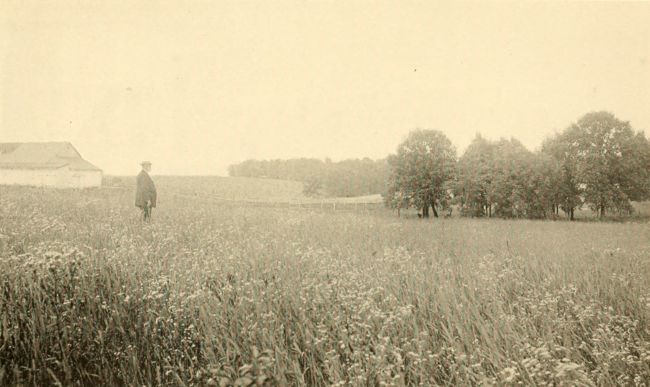
No. 8.
View from near the head of the ravine occupied by the enemy's infantry looking southerly
towards the pike running along the edge of the distant forest. This is now (1908) a fine farm:
its building on the left and those dimly seen in the edge of the distant wood along which the
sunken pike runs have been built since the Civil War. Observe the perfect cover next to the pike
for the enemy; it was here the Tenth Vermont assaulted, and the Second Brigade, this side as
far north as the figure (Maj. Abbott), while the enemy's infantry behind rail breast-works and its
artillery several hundred yards in rear to the right on higher ground swept the flat open field over
which we charged in their front. It was almost a forlorn hope. Who would wish to criticise
troops unfairly under such circumstances? The divide running east and west was about a hundred
yards to Maj. Abbott's right. On its opposite or north side the Nineteenth Corps charged.
The fatal wounding in my sight near enough to hear
his cry of anguish of my old Captain—Major Dillingham—and
the killing of Major Vredenburg of the
Fourteenth New Jersey from his horse by having his
heart torn out, and others; General Russell's brilliant
debouch with his dauntless division marching proudly
on the battlefield en masse with all its enchanting
glitter and precision to take a hand at the sacrifice of
his life—unfortunate, gallant, dashing Russell—Merritt,
Averill and Custer's brilliant spirited final charges
on the fleeing enemy, its disorder and worst possible
rout all beggar description, our retreat at the battle of
Monocacy, July 9, 1864, being one of order and dignity
comparatively speaking. I felt revenged for my
wound and at having to run so in retreat at the
Monocacy, and for my two wounds that day even if
I did totteringly tarry, maimed and speechless with
paralyzed tongue, chin and blanched face to look at
such a brilliant battle scene until I became so faint
from loss of blood, shock and partial reaction, I could
hardly go steadily and finally did accept help, having
declined at first, from two faithful men of my Company
who, when I fell instead of stampeding stayed
by me in one of the hottest places I have ever been
in on a battlefield, one of whom was Corporal Joel
Walker of Pownal, Vt. My first wound was from
the butt end of an exploding shell in the breast which
maimed and knocked me down and simultaneously as
I fell a minie ball fired but a rod away in my front
just grazed my forehead, torn through my upper lip
crushing both jaws and carrying away eleven teeth,
the most painless dentistry I ever had done; but, Oh!
the shock it gave my system and the misery I suffered
that night!
As I entered the long broad avenue running between
the great tents at the field hospital later in the
day where there were hundreds of wounded, dead and
dying, Dillingham, Hill and others of my regiment,
among the number, Dr. J. C. Rutherford, one of my
regimental surgeons, seeing me with a man on either
side—for here in sight of others I wouldn't let them
support me—close to and keenly watching my unsteady
carriage, came running, hastily examined my wounds,
bade me sit on the ground, ran for his instrument case,
placed my head upturned between his knees, sewed in
place a triangular piece of flesh extending from the
right corner of my nose down hanging at the lower
right corner by a slight shred of flesh, which I had
held in place from the battlefield with my fingers, and
that job for the time being was done; but oh! my
aching head, jaws and chest, as well as the extreme
feeling of lassitude for the balance of the day. My
face was like a puff ball, so quickly had it swollen, my
chest at the point of the wishbone—so to speak—was
mangled black and blue and resembled a pounded piece
of steak ready to be cooked, and I was so nauseated,
lame and sore all over, I dreaded to move. I guess
the rebs came pretty near winging me—but Glory!
Early was licked. To add to my feeling of depression,
I was told Major Dillingham was mortally wounded
and that he would soon pass away. He had been a
good friend, a brave man, faultlessly courageous, was
an elegant gentleman and good fellow, and was much
beloved. A solid shot severed a leg going through
the woods; his cry of anguish was distressing, and I
shrink from thinking of it whenever it comes into my
mind.
I fell just in front of the enemy's hastily thrown up
breastworks of fence rails in the vanguard after advancing
under a murderous fire about a hundred yards
or more, in the open field after passing through the
woods. I saw no other line officer with his men
anywhere in my vicinity so far in front, and there was
no other officer there in the open field except Adjutant
Wyllys Lyman who was lauded for it, but I,
being a boy, got nothing but my two wounds as compliments
for my steadfastness, and they will stay with
me through life. I wonder if when across the Great
River and in another world I will be remembered any
better for my faithfulness when so many others failed
at such an important moment?[19]
I found the men of Company E good fighters, Corporal
Walker and another big man of my Company
whose name I can't recall, being so short a time with
the Company—but believe it was one of the Brownells,
also of Pownal, Vt.—who helped me occasionally going
to the ambulance as I felt faint and weak, were
brave fellows. They followed me closely all through
the assault as though they expected me to be
hit, fighting like heroes as they were at the
same time, and when I fell wounded they dropped
close by me, Corporal Walker, a giant, coolly saying:
"Don't get up Lieutenant, they'll riddle you if you do!"
but I thought they already had. However, the
nervous shock of both wounds was too great to think
of rising at once, and almost immediately the rebs
were running for dear life all branches of the service
mixed together in confusion—a perfect jumble. We
had licked them in a square stand up open field fight
of their own choice—and a very poor one, too, for
them in case of defeat, as it proved—and it was clean
cut, the worst stampede and rout I ever saw.
Sheridan was as brave as a lion, and unlike some
commanders who hunt cover when their commands
are fighting, went seemingly fearlessly anywhere he
wanted to in order to see what was going on and what
if any part of the line needed reinforcing. As before
stated, my position on the battlefield was sufficiently
high to see nearly all of it. It being a beautiful sunny
Fall day with a clear atmosphere, it was the most
spectacular, and before the Infantry broke, the most
beautiful battlefield sight seen, and better yet, the most
snappy, brilliant fighting witnessed during the war.
Sheridan hovered near the centre in the neighborhood
of the high ground where I was twice wounded, and
dashed back and forth the line on horseback like a
restless lion, an ideally alert fighter, almost as unmindful
of shot and shell as though both deaf and
blind. It was here that I formed my opinion that he
was not only the ideal fighter, but the second, if not
the greatest military genius developed by the Civil
War, and I have never changed my opinion. Honest,
alert, aggressive, dashing and brave with splendid
judgment, his equal will be hard to find, and probably
rarely surpassed. He was generally conceded a brilliant
cavalry fighter, but if the world has ever produced
a better planned, executed, dashing, brilliant, spectacular,
snappy battle or commander than he and this
Battle of Winchester, where the different branches of
the service were combined, take it from first to last
during the day, it would be interesting to know on
what occasion. It was so unlike any battle ever seen
by me that all others sink into insignificance as dull
affairs. Language or words even with the most gifted
talkers or writers can never describe this battle; no
pen picture, or ever so gifted talker can do it justice;
it would have to be seen by an expert to be fully appreciated.
Ever afterwards the Sixth Corps of all
others was Sheridan's favorite. Said he later: "Give
me the Sixth Corps and I will charge anywhere."
Among the most admirable pictures of the fight—barring
the orderly, majestic advance to battle of the
whole army in unbroken lines—except after a little
our division being unmercifully shelled from the start
on the pike it could not withstand it, nor could any
other have done so—as a whole after through the wood
resembling an immense gracefully waving blue ribbon
along the surface of the ground, caused by that enchantingly
swinging, billowy motion characteristic of
regulars when marching in large bodies, its fluttering
banners, glittering arms, equipments and its blue uniforms
looking prettier than ever in the bright September
sunlight under a bright blue sky specked with
fleecy white clouds making a picture beautiful with
perfect harmony of color,—was the beauty, grandeur
and majesty of both Russell and Custer's splendid debouch
on the battlefield with their valiant, intrepid
commands, the former's proudly and majestically en
masse in perfect order and cadence, line and bearing,
coolly confident as though at parade, and the latter's
also in perfect lines and order, as well as dashing,
intrepid, spirited and assured bearing even the horses
as though vieing with each other in speed to run down
the unfortunate enemy, entering into the spirit of the
occasion and sweeping rapidly like an avalanche down
on the demoralized, fleeing and awe-stricken enemy
with the fury and apparently almost certain destruction
of a tornado. These were pictures comprising
awe, beauty, power, grandeur, order and disorder,
dash, magnificence, valor, terror, confusion, inspiration
and majesty to such an extent as to defy the pen
picture of any writer however gifted. This battle
was different from any other I ever saw. It was
Sheridan's way of doing things—a revelation in warfare.
So far as this first assault is concerned it can be
summed up quite briefly. The only considerable
amount of the enemy's infantry in the immediate
front of the Union infantry line of battle was in the
ravine in front of our division, and it was about
two hundred and fifty yards away from where we
formed line behind the woods; it was a very strong
force. If the troops to our right and left instead of
instinctively obliquing away from us veteran like to an
easier place in their right and left fronts respectively,
had guided on our division as it is claimed they were
directed to do, they would have had an enfilading fire
on the enemy on our front, the same as General Russell's
division would have had when it filled the gap
to my right which the enemy knew would make their
position untenable and so instantaneously retreated in
a rout when it saw him coming dangerously near, his
right flank overlapping their left. When Russell's
movement was executed the Nineteenth Corps' lines
of battle hadn't even broken. There was no considerable
number of the enemy before it within striking
distance so far as I could see, and therefore nothing
to break its lines so far as the enemy was concerned
until it reached the breaks in its front.
The Vermont Brigade could have easily advanced
at any time of the assault or any other part of the
Second Division, as there was nothing to speak of—as
virtually acknowledged by Colonel Aldace F.
Walker of that brigade in his "History of the Vermont
Brigade in the Shenandoah Valley, 1864"—in its
immediate front except about a regiment of the enemy
which crossed the pike from his right and the left of
our Brigade to my front.[20] (See No. 7 illustration).
Had the Vermont Brigade borne to its right instead
of its left it would have done much more effective
service, as it would have been on high ground overlooking
the enemy in my front when out of the ravine.
In this instance the credit given this excellent brigade
in at least one Civil War history is erroneous, without
the Third Division was expected to whip at once and
alone a considerable part of the infantry and artillery
of Early's army in its immediate front, no small part
of which was in our regimental front and its immediate
right. In proof that there was no considerable
rebel force in front of the Second Division to the
left of the pike until Early's second stand, the reader
is invited to examine the official War Department
map of this battle and note the fact;
but aside from this I know there was none. What,
therefore, was to prevent the Second Division
or Vermont Brigade from advancing? Unlike our
front, where the strip of timber was narrow, with
the enemy strongly posted just beyond, the scrub or
second growth oak, etc., in front of a part of the
Second Division next to us, extended from the top
of the ridge or divide which ran several hundred
yards southerly, down to the bottom of the ravine a
hundred yards more or less, which covered here the
Second Division's advance and the cleared ground
beyond, after emerging from the wooded side hill and
ravine towards Winchester, contained no force of the
enemy, as there was no immediate protection for it,
sufficient to prevent its or even the Vermont Brigade's
advancing, or the enemy would have done so.
(See Nos. 3, 7 and 8 illustrations.) I mention this
here because I know the facts in the premises, and
because this Division is complimented—unfortunately,
but probably unwittingly so—in one or more histories
for advancing, in unpleasant contrast to our
Division, which was up against the real thing, and
its advancing depended largely on the help or enfilading
fire along our front, we had a right to expect
from the troops which should have guided on us from
both flanks, but which we never got, as they pulled
away from us. It was useless to try to take such a
place as confronted the right of our regiment and
Division by assaulting from its immediate front (see
Nos. 5 and 6 illustrations), as the enemy had to be
flanked out of its position, which is what Russell's
men would have done on the rebel left in case the
enemy hadn't seen them in season to get away and
thereby saved many casualties on both sides, and probably
largely there the enemy's capture.
There were none of the Second Brigade of our
Division on my right after advancing through the
woods, nor had there been up to the time General
Russell's command filled the gap occasioned by the
Second Brigade's absence, together with the space
caused by the Nineteenth Corps obliquing to its right.
It being level, shell and bullet swept, it was untenable
until a force came large enough to drive the
enemy's infantry from cover, as Russell did. (See
No. 5 illustration). I was the only officer except
Adjutant Wyllys Lyman, who is deceased, so far
ahead at that time on my part of the battlefield, and
I can make affidavit to this statement. We and a
goodly number of scattering men who generally led
in most assaults were within a rod of the enemy's
strongest manned works, which no map in existence
shows that I have seen, where I was twice almost
instantaneously wounded when the enemy ran as it
saw General Russell's Division coming, as though
their lives depended upon it, and I know whereof I
am writing.
General Sheridan made no mistake when he selected
the First Brigade for the centre and most important
point of his line of battle, nor was it a mistake
to place our regiment and the Fourteenth New Jersey—with
direction for the rest of the army to guide
on our Division in the first assault, for the road was
practically straight—squarely across the pike, with
their colors on it, with such men as Corporals Alexander
Scott, F. H. Hoadley, Tenth Vermont, and
other of the color guard like them, to keep them there,
for such men would go wherever told to, if into the
very jaws of death. The leaving off from the official
map of this battle of the enemy's infantry in the
ravine in front of the Third Division (see Nos. 6 and
8 illustrations), is a great injustice to our regiment,
which never wholly fell back, but the usual per cent.
of men under such circumstances stubbornly pressed
forward under the most trying circumstances at any
rate where I was. The leaving off of the enemy's
infantry in my front, where it was strongest, is misleading
and is doubtless what has caused so many
wrong descriptions of this fight. No one can give a
correct description of it where I was except at that
point during the fight. The enemy contested this
point more stubbornly than any other during the day
and it was here the most intrepid of our men assaulted;
it was the doorway to the great battlefield,
and if the enemy couldn't hold this point it couldn't
hope to any other, and didn't. Although our division
was smaller than either of the other divisions of our
Corps, its loss was much heavier. General Grant had
one hundred shotted guns fired on his lines in front
of Petersburg in honor of this day's victory by Sheridan.
A citizen of Winchester told me that one of the
saddest things he saw during the day was a horse
going through the streets of the city with two badly
wounded and one dead Confederate soldiers on it—probably
chums—the latter thrown over the horse's
back with his head and arms hanging on one side
and his feet on the other; but war is a cruel teacher
and produces the most shocking sights imaginable.
It is not pleasant to record and much less dwell on
them.
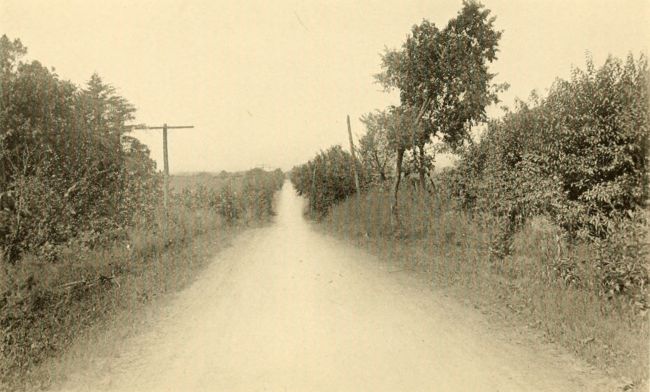
No. 9.
Straight view of about a half mile of the pike looking westerly towards Winchester, Va.,
from the divide on Sheridan's battle-field, Sept. 19, 1864. Observe the cut through the divide
for the road.
The following pertaining to Sheridan's battle of
Winchester has been discovered since writing the
foregoing. It will be answered in detail. Says Col.
Aldace F. Walker in his "History of the Vermont
Brigade in the Shenandoah Valley, 1864," pp. 91-100:
"Our movement commenced at 3 o'clock Monday
morning, September 19th, Getty's Division having the
advance, the Vermont Brigade being the last in the
Division. Striking directly across the country, at
first in the darkness, we presently reached the main
road from Berryville to Winchester, and moved down
it to the crossing of the Opequan. This stream is
considerably below the level of the adjoining country,
and the road on its further side keeps the low level
of the stream for a mile or more, winding through a
long, tortuous wooded ravine, our unobstructed passage
whereof was for the time a mystery. It seems
that Wilson's Division of cavalry had already cleared
the way and was then holding desperately a position
that it had gained with considerable loss, but which
proved a most admirable one in which to deploy our
line of battle.
"As we filed out of the ravine which toward the last
was lined with wounded cavalrymen, we found Sheridan,
his headquarters fixed on a conspicuous elevation,
personally superintending from the commencement
the operations of the day. It was to be our
first battle under his command, as well as his first
independent battle; the troops were hitherto destitute
of all enthusiasm for him; fortunately, however, no
impression save a favorable one had as yet been received,
it being universally conceded that he had so
far handled his army handsomely. And it was with
great satisfaction that we found him in this early twilight
at the very front, and under the fire of the enemy,
carefully attending to details which we had been accustomed
to see more celebrated commanders entrust
to their staff.
"Our Division promptly relieved the cavalry and
formed its line facing west, the Third Brigade which
was in advance going to what was to be the extreme
left of the infantry line, resting on Abraham Creek;
the First Brigade following, took up its position on
the right of the Third, and our own Brigade filled the
remaining distance between the First and the road
on which we had reached the battlefield. It had been
intended to place us in two lines, but the unexpected
extent of the ground we had to cover forbade
that formation. We were just on the hither edge of
a narrow fringe of wood that concealed us from
the enemy; the Sixth Vermont was thrown forward
as a skirmish line perhaps one hundred yards to the
further side of the little forest, and at once engaged
the enemy's skirmishers."
About three regiments, I believe, of the First Brigade,
Third Division, Sixth Corps, were to the left
or south of the road, so the Vermont Brigade didn't
reach to the pike.
"Near us in the road at our right was a rebel field
work, taken by Wilson in the night. The hill on
which it was situated commanded the country in both
directions, and it was already occupied by a battery
engaged in feeling the enemy, which was answered
vigorously, many of the rebel shell plunging over
into the troops as they successively came up the road.
"Our Division thus formed in a single line was the
only Division on the south or left of the road. The
Third Division, Ricketts', followed us and prolonged
the line across and on the north of the road, placing
its two Brigades in two lines. The First Division,
Russell's, came next, and was drawn up behind the
Third as a third line or reserve, also somewhat overlapping
the right of our Brigade."
About three regiments or more of the Third Division,
Sixth Corps, I believe, were south of the road,
on the right of the Second Division. When General
Russell's Division charged it was about two hundred
yards to the right of the Tenth Vermont, or about
seven hundred yards or more to the right of Col.
Walker's brigade.
"Then to our surprise no more troops appeared,
and our Corps was alone confronting the enemy.
There were two or three anxious hours, but Early
was engaged in hurrying up his detachment from
Bunker Hill, which this delay gave him ample time to
do, and made no assault. It was said that the Nineteenth
Corps, being ordered to follow the Sixth, had
filed into the road behind our wagon train, instead of
keeping closed up on our column. It is certain that
with this loss of time, from whatever reason it occurred,
we lost the opportunity of attacking the enemy
in detail, and gave him time to prepare for our reception.
It was noon before the Nineteenth Corps had
reached its place and was formed in three or four lines
on the right of the Sixth."
The Nineteenth Corps was formed in two lines on
the right of the Sixth.
"Our men during the forenoon had been resting,
sitting or lying on the ground. When at last the
disposition was completed and the signal gun was fired,
they sprang to the ranks, and the line advanced.
Particular instructions had been received to the effect
that the road was to give the direction of attack, and
that the guiding regiment was to be the left regiment
of the Third Division, just across the road from our
right."
The guiding regiments were the Tenth Vermont
and Fourteenth New Jersey, on the right of the First
Brigade, about the center of the Third Division.
"In passing through the bit of trees in our front,
which was filled with underbrush, our line was necessarily
thrown somewhat into confusion. When we
emerged from the wood and the ground over which
we must make our attack was developed, the prospect
was appalling. The hill gradually sloped away
before us, for a quarter of a mile, to a long ravine,
irregular in its course, but its windings extending
either way as far as we could see. The ascent beyond
it was in most places sharp, and the enemy held its
crest in force, perfectly commanding with musketry
and artillery the long slope down which we must pass,
though the acclivity on the further side of the hollow
was so steep as to actually present a cover from their
fire—if it could once be reached.
"When this fearful prospect opened the line involuntarily
halted, and the men threw themselves on
the ground as was their wont when under fire. Our
own Brigade was properly waiting for the movement
of the guiding regiment which lay across the road
a little to our rear, and which could not be prevailed
upon to stir. To add to the peril of the situation,
the road, instead of continuing straight on, as seems
to have been expected, here made a bend to the left
so that our original orders could not be obeyed without
an amount of obliquing that would have resulted
in demoralization; from this cause our own Brigade
was soon afterwards thrown into temporary confusion,
and the Third Division was presently so disorganized
as to be unable to resist a counter-charge made against
it by the enemy."
The whole line in front of the enemy's infantry in
the ravine in front of the Third Division halted after
through the narrow belt of timber behind which we
had formed, as the trees, brush and terrible shelling
had broken the lines and the advanced men where
I was laid down to avoid the storm of shells which
filled the air till the men got together, which they
soon largely did. It was here found the Second Brigade
on my right had excusably gone to pieces, the
ground in its front being untenable, which caused
some delay; but soon we advanced alone without that
Brigade, as did the Nineteenth Corps. This was why
the Tenth Vermont or guiding regiment, at this time
where I was, didn't move forward sooner. The bend
to the left in the road is largely a myth. The line
of battle wasn't formed at right angles with it which,
as the line advanced led to some confusion, as our
colors had to be kept on the pike. There was no
counter charge in front of where I was in the Tenth
Vermont or disorganization, except in the Second Brigade,
but what was soon remedied. The enemy could
do more effective work by remaining in cover with
little loss, which it did.
"At length the commander of the Brigade at our
right crossed to our side of the road and urged us
to set his men the example. Col. Warner took the
responsibility, brought the Brigade to its feet, corrected
the alignment, and gave the command to advance,
which was promptly obeyed. The Third Division
followed and the line was again in motion.
But our point of direction was lost, for we were
in advance of our guides, and when it was seen that
owing to a curve in the ravine before us the cover
on its further side could be reached much sooner by
obliquing sharply to the left, we took that direction
almost by common consent, and left the road-side."
Why shouldn't Col. Warner with virtually no enemy
in his immediate front be able to set an example
of advancing his line when the Third Division was up
against the real thing, it being confronted with overwhelming
numbers of the enemy's infantry in the
ravine and artillery back of it in our immediate front
pretty much all that confronted the army in that midday
assault? The situation in front of our lines is
fully explained in this work elsewhere, and an alleged
"bend" in the road or a "curve" in the ravine will not
suffice to excuse the troops on our immediate left for
not at once helping to flank the enemy's infantry from
in front of us in the ravine, at once when on high
ground across the ravine instead of running off on the
field on a comparatively useless easy task and then
have to come back. Where was there any infantry of
any amount except in the ravine in front of the Third
Division? Why not give the Third Division its due?
The killed and wounded tell the story. Didn't our
Division have about as many killed and wounded as
both the First and Second Divisions together, although
smaller than either? No fair-minded soldier or person
can study the illustrations even, in this work, and
fail to see the facts.
"Our whole Brigade, every man at the top of his
speed, making for the coveted protection of the hill
beyond us, plunged pell mell into the hollow. The
troops at our right and left were lost sight of. The
ravine was of some considerable width and its bottom
was marshy, being the head waters of a little branch
of Abraham Creek. The steep slope on its further
side was covered with evergreens six or eight feet
high. To our intense consternation, as we reached its
swampy bottom, we saw at our right, at short pistol
range, at least a full regiment of the enemy drawn up
in line near the point where the road crosses the hollow,
in anticipation of our taking precisely the course
we did, and firing coolly, as rapidly as they could
load, directly along our line, thus enfilading us completely.
Its position is indicated on the plan. The
slaughter was for a few moments murderous. We
could not retreat, for we should again enter the fire
that had been mowing us down in the charge, now cut
off by the hill before us. We therefore floundered on,
our coherence entirely lost, entered the clusters of
evergreens through which the cruel bullets whistled
fearfully, and at last, a confused mass at best, those
of us who escaped unhurt reached comparative safety
under the very crest of the hill, and high above the
deadly hollow."
The probabilities are that old soldier-like seeing
or suspecting the true situation, the men intuitively
or purposely obliqued away to an easier place of attack;
at any rate they did it. Yes, the rebel regiment which
was seen in the ravine was in front of the left of our
brigade, but crossed to the north side of the pike to
my front early in the fight leaving no rebel force in
the ravine south of the pike in front of the Second
Division on the left of ours.
"We now opened fire for the first time during the
day, in the direction of the regiment or brigade that
had so frightfully thinned our ranks, but they were almost
out of reach from us, as well as we from them.
At this moment, however, the Third Division approached
them and they filed away."
It is difficult to conceive why if the enemy could
fire at the union forces here they could not return the
compliment, at any rate to one who has so recently
studied the ground. It was a good thing the Third
Division was 'round to drive the rebs away, otherwise
they might have more "frightfully thinned" Col.
Walker's ranks. It would be interesting to know exactly
how many men Col. Walker lost here.
"When this was discovered, and after gaining
breath, our own advance was resumed, but with little
pretense at order. Emerging upon the plain before
us at the summit of the hill we had climbed, we again
turned obliquely towards the road and charged upon a
long breastwork filled with rebels, in our immediate
front. The retreat of their comrades from the ravine
apparently demoralized them; many fled, many more
were captured; in fact as we clambered over the
parapet it seemed as if the prisoners who then surrendered
exceeded in number our entire Brigade."
I saw this movement when the men advanced seemingly
to me in an undeployed skirmish line over the
open flat ground beyond the ravine not shown in No.
7 illustration, but further to the right. It was a weak
force and could not have met any determined resistance
from any considerable body; indeed there was
but a small force of the enemy's infantry on that part
of the field.
"But we did not stop to count them or to care for
them. The principal position of the enemy in this portion
of the field had now been gained, and we rushed
onward toward the distant spires of Winchester, with
shouts and cheers, now thoroughly excited by our unexpected
success. A battery of the enemy was
before us, but it limbered up and retired as we advanced.
Several times it turned, fired a round of
canister, and resumed its flight. At our left the other
Brigades of our Division were seen moving on in our
support. At our right an unfortunate ridge now
rose, parallel with our line of advance, along the top
of which ran the road so often referred to, and
which hid our friends from view; we could only hope
that they were equally successful, and push wildly
forward. A point was reached probably three-fourths
of a mile beyond the entrenchments where we had
captured the prisoners, when luckily a ditch running
across our path suggested cover and a pause. This
ditch was reached only by the colors of the Fifth,
with perhaps two hundred men from the various regiments.
Exhausted with running, they opened fire
as vigorously as they could, but a line of rebels was
seen gradually collecting in their front, as the fugitives
were rallied, and the position held by our troops
was presently dangerously threatened. And now to
their dismay, the Brigade on the higher ground to
their left saw reason for retiring and called for them
to follow. What it could mean they did not know,
but it seemed prudent to withdraw, if only for the
purpose of keeping up the connection. An officer
sent to investigate soon reported that at least a Division
of the enemy were far behind their right in an
orchard, which they supposed had been carried by the
Third Division. Orders were given therefore to fall
back to the line of the army, following the low ground
on the left, thus keeping under cover of the hill at
the right, the enemy meantime being absorbed in their
movement against Ricketts; and thus the detachment
successfully escaped from its dangerous position and
re-formed with the balance of the Brigade near the
works we had carried, being as before on the right
of the other Brigades of our Division, connecting with
and at first even in front of the support which was
put in to meet the emergency."
Having watched this whole proceeding, which Sheridan
saw, too, through his field glass just behind me,
after I was wounded and the enemy from the ravine
in my front and its artillery were in full retreat, it
reads absurdly. The action of the enemy in Col.
Walker's front largely depended on that of the enemy
in ours, which had been routed and was in full pell mell
retreat when Col. Walker's men were advancing in
small irregular groups away from the before-mentioned
ravine (see No. 7 illustration) they were so
seemingly anxious to leave. As a matter of fact if
they had swung to the right in and on the high ground
west of the ravine, together with the left of our
brigade, they would have done much more effective
service. The retreating battery mentioned—and
others further north not mentioned—retreated because
its infantry in the ravine in my front was routed.
As a matter of fact these Second Division men were
operating comparatively uselessly far on the enemy's
rear right flank and were in a dangerous situation as
soon as the bulk of the enemy's infantry in my front
should reach that neighborhood. I saw this, as did
Sheridan, and it was one thing that caused him to put
spurs to his horse and dash away to send a staff officer
to recall these forces. The five succeeding quoted
paragraphs are disingenuously conceived and misleading.
They are worse than worthless for historical
purposes because mischievous. The Vermont Brigade
was too grand a body of men to be mortified by
exaggerations and overdrawn situations. The truth
is glorious enough, and to write on such a basis is
dignified and fair.
"We afterwards learned that a break had taken
place on the right which for a time seemed likely
to result in complete disaster. The report in our Corps
was, that the Nineteenth, advancing through a long
stretch of forest and at first successful, had afterwards
been repulsed, and fled in disorder, many of
the fugitives even going back to the Creek, and that
our Third Division had been checked soon after we
lost sight of it, presently becoming more or less involved
in the flight of the Nineteenth Corps. On the
other hand Gen. Emory, commanding the Nineteenth
Corps, in a letter published in the World, which was
fortified with affidavits, insisted that the break began
at the right of our Third Division, which led to the
turning of his left and the consequent retiring of his
Corps. The official reports disagree as much as the
letters of the correspondents, who of course reflected
the opinions of the several headquarters to which they
were attached, and who created considerable ill-feeling
by the discrepancies in their accounts, and by their
insinuations; the truth is probably between the claims
of both, and the real cause of the enemy's temporary
success seems to have been the unfortunate bend in
the road above mentioned, which interfered with and
destroyed the symmetry of our first advance. Our
Third Division obliqued to the left as it moved against
the enemy, following the order to guide on the road,
(there were few or no fences in that vicinity) and so
left an interval between its right and the Nineteenth
Corps, which appears to have gone in impetuously
and with little order; the enemy presently made a
counter-charge, and, luckily for them, struck the gap
with a heavy force, crumbling off the troops on either
side of it, and causing the troops on each side of the
interval to think that the others had let the enemy
through. The front line of the Nineteenth Corps
was almost entirely disorganized, and was replaced by
the second line, while only the right of our Third
Division was broken up, its left with our own Division
merely retiring a short distance under orders, as was
necessary in order to keep a continuous front."
This is widely erroneous; Emery's left was somewhat
broken at first by the terrific shelling from our
front, but it was only in the edge of the shell storm
at first when going through the wood. His alleged
collapse virtually of the right of our Third Division,
or Second Brigade, going through the narrow belt of
timber behind which we formed, is correct as before
stated, for it was immediately on my right, and I
know it; it was largely what we halted and laid down
for after getting through the timber. We feared
being flanked; but the delay was short, for I almost
immediately moved forward with my men and others
alone over that flat, unsheltered ground, then being
unmercifully swept by artillery and musketry till it
was virtually untenable. The Nineteenth Corps instead
of obliquing to the left towards us to shorten
the interval and help us, intuitively obliqued the other
way; but fortunately there was no road or bend in
it to blame it to. In my opinion it was as clear a
case of shirk as to the left of the Third Division, or
a desire to find an easier point to attack. Emery's
corps didn't retire that I know of, and our brigade
I know didn't. The marching of his troops in two
long lines was one of the spectacular sights of the day;
it was a beautiful feature. It assaulted to the north
of the slight divide running east and west, where I
saw no infantry nor artillery except a little of the
latter far across the breaks. The enfilading infantry
and artillery fire from our front at first was about all
Emery had to fear, but his Corps soon obliqued away
from it. There was no counter charge by the enemy
in my front or to either side, and in this I am emphatic,
as well as in the fact that general officers were
not where they could see as well as I. There has
been more fiction written about this fight than
any I was ever in.
"At the critical moment General Wright, who was
for the day in command of the Sixth and Nineteenth
Corps, though (as he says) 'it was too early in the
battle to choose to put in the reserves, still, seeing
that the fate of the day depended on the employment
of this force,' promptly ordered in the First
Division with two batteries; it marched gallantly
down, with its full Division front, to the very face
of the enemy, relieving the Third Division, which, reforming,
presently took up its position still further
to the right, where the interval had before been left.
Sheridan held back General Upton's Brigade of the
First Division until it could strike the flank of the
charging column of the rebels, when it made the most
remarkable and successful charge of the day, completely
breaking up the rebel assault, and permitting
our shattered line again to knit itself into coherence.
General Upton was there wounded and the brave unostentatious
Russell, the idol of the Division he commanded,
was shot dead, while personally employed
restoring the broken line.
"The two hours following were spent in re-arranging
the troops, issuing ammunition, and making dispositions
for another advance." * * *
General Russell's Division started to march on the
field en masse and deployed en route; it was one of
the grandest sights of the day or entire war. I never
saw such splendid discipline under fire in a large
body of men. It didn't relieve our brigade in the
sense taken above, but did in partially drawing the
enemy's musketry and artillery fire from us, which
was appalling and effective. Our Brigade didn't reform.
I was close on the enemy's rail breastworks
in the ravine with my men leading the assault. There
was no chance to reform: it was give and take. Russell's
men didn't even get the opportunity of getting
near enough the rebels to get satisfaction, for they
ran when my men and I were within a rod of their
works directly in front. There was no considerable
bend in the road or anything else that obliqued my
men either way to any great extent. The enemy ran
before Russell was within effective striking or flanking
distance. The enemy didn't charge. If General Upton
assaulted its flank it wasn't here. I am emphatic in
this, for not twenty seconds after I was twice almost
simultaneously wounded during the enemy's last volley,
it was running for dear life and Sheridan thirty seconds
later was on his horse on the high ground close
in my rear looking through his field glass to see where
the enemy was going to make a second stand, and at
other things evidently displeasing to him on his left,
where Colonel Walker and the Second Division
were. The whole field of active fighting could be
seen from here. Five of the battlefield views herein
were taken from this point. Colonel Walker is
such a graceful, fluent writer it is a pity he couldn't
know the whole facts about the battles the Vermont
troops were in. His works would doubtless then be
charmingly interesting and entertaining.
As several eminent persons, mistakenly as I think,
in recent years, in a moment of weakness and gush
have classed General R. E. Lee as one of the greatest
of modern field marshals, and as the battles of Opequan
Creek or Winchester, Va., Sept. 19, 1864, and
Gettysburg, Pa., July 1-3, 1863, both of which I have
carefully studied, furnish an excellent opportunity for
a few pertinent questions as to the ability of Generals
Grant, Sheridan and Lee to plan and manage successfully
great battles, I cannot refrain from taking
up the matter at this point, and I defy any honest
man of expert judgment to successfully controvert
my stand.
It might as well be said of Sheridan or of Grant,
as it has already been of Lee by partial and incompetent
judges, that either of the former were the
equal of Marlborough or Wellington, and far more
truthfully so than of Lee. Had the fortunes of war
placed Sheridan in command of the Army of the
Potomac at any period of the Civil War, there is no
doubt but what that war would have developed in
him a field marshal exceeding in dash, ability and
brilliancy any military genius of either ancient or
modern times. He was a born soldier, unspoilt by
training, success or anything else, and was blessed
with splendid common sense. He was a genius, for,
says a popular poet:
"There is no balking Genius. Only death
Can silence it or hinder. While there's breath
Or sense of feeling, it will spurn the sod,
And lift itself to glory, and to God.
The acorn sprouted—weeds nor flowers can choke
The certain growth of th' upreaching oak."
One secret of Sheridan's success lay largely in his
ability to so plan a battle as to fight his whole command
effectively all at once, and in such a way that
with his dash and unexpected coup de main, the enemy
was usually whipped before the fight was fairly commenced.
With Sheridan in command during the Civil
War, President Lincoln would never have had to
urge action on the part of the Army of the Potomac
as with McClellan and others, except Grant, when
ready to fight, nor would it have been fought in detail,
which was invariably a fatal fault with both
armies, for Sheridan didn't fight that way; there were
no unfought reserves in his army. When he struck
it was with so much method, dash, determination and
judgment it brought brilliant results, such as astonished
even his own army, which always expected victory,
as well as the enemy and every one else; and
in consequence he could accomplish more with fewer
men than any other General in the army; not only
because he used his force to the best advantage by
fighting it all at once, but because his personal magnetism,
or hypnotism, enthused the men and gave
them confidence, which is a great thing in battle;
besides, they had implicit faith in his ability, splendid
judgment and quick perception on the battlefield,
which are indispensable gifts in a great General; and
when combined with an alert, active temperament such
as his, it was grand. He was a great field marshal.
This is proven from the fact that anything he undertook
in the Civil War was not only well done if
decently supported, but he proved himself grandly
equal to any occasion on the field of battle, wherever
the fortunes of war placed him—not tamely so, but
brilliantly; he electrified his men as well as the world
by his splendid dash, pluck and surprisingly overwhelming
victories. A slight reverse not only left
him undaunted but, like a raging lion, it seemed to
arouse his wonderful gifts and raise him to such sublime
heights it awed one; so that the moment the eye
of his command caught a vision of him at any distance
on the battlefield, his very pose and action was such
it electrified and imbued his men with the same spirit
of conquer or die that dominated him, and no enemy
could or ever did stand for any length of time before
his intrepid command.
Who but Sheridan, as at Cedar Creek, Va., Oct. 19,
1864, just a month to a day after his splendid victory
at Opequan Creek, Sept. 19, 1864, or Winchester, Va.,
as now more properly known, could have rallied a defeated
and routed army en route to the front and after
and so enthused it in the act, simply by dashing, alert
and crafty through its broken ranks after a twenty
mile race with time from Winchester, with flashing
eyes, bared head and waving hat, on a spirited foaming
horse, shouting to his men: "Get back into line,
men! Get into line, quick! We can lick 'em! We
can lick h——l out of 'em yet!" and do it almost at
once, even as brilliantly so as at Winchester a month
previous? How often are such things done? Such
a man outclasses all others in military history, not
excepting Wellington or Marlborough, for such a man
as Sheridan is without a peer as a field marshal in
the annals of warfare; and had he been found sooner
and given greater responsibilities he would not only
have surely proved it, but would have more fully
electrified the world than he did and have been its idol
as a military genius and hero for all time.
He or Grant would never have used such woefully
poor judgment as to have assaulted an army equally
as valiant, splendidly posted, fully as large, if not
larger than their own, across an open, level space
without cover quite a mile in extent, as Lee did at
Gettysburg on July 3, 1864. If that act showed ability,
good judgment, or a military genius, then I am
lacking in mature sound judgment, and my lifetime
of military training, including my three years and
threescore battles or more in the Civil War and in
Indian wars, has been in vain. This would be equally
true even though the armies had been equal in numbers.
General Longstreet's suggestion to Lee to place
his army on General Meade's flank between him and
Washington would have been a splendid substitute
for Pickett's forlorn charge.[21] It was abler and just
what Grant did with Lee hardly a year later, successfully
and repeatedly and forced Lee back to Richmond
and Petersburg, as the world now knows, which
indicates superior generalship both on Grant's part
as well as Longstreet's.
Would either Grant or Sheridan have lost their
cavalry for several days, as Lee did, when on such
a campaign in an enemy's country or anywhere else?[22]
Would either, with three such splendid cavalry divisions
as Meade, not have used a part of one division
if necessary to have patrolled barely seventy-five miles
between York, Pa., or the Susquehanna, and the Potomac
river, in order to detect any movement by the
enemy on Washington? Would this have made the
Union Commander, whoever he might have been,
timid about moving to any point where battle was
offered, fearing a fake attack by Lee in order to
cover a movement on Washington or Baltimore? One
brigade would have established a line of patrol posts
less than a quarter of a mile apart of six men each,
which would have detected at once any movement
south by Lee, or if preferred, posts one-eighth of a
mile apart of three men each.
Would Grant or Sheridan have remained so near
a great battle as at Gettysburg, July 1, 1864, and not
have furnished an opportunity for another soul-stirring
poem like "Sheridan's Ride"? When they were
informed that the enemy had attacked their forces
barely three hours' ride away, would they have loitered
a whole day away like dullards, as both army
commanders did at Gettysburg?[23] Aye! either would
have made the ride in two hours or even less, and
even though their steeds were as black as night, on
their arrival at Gettysburg they would have been as
white as snow or as foam could have made them;
and, still better, they would not only have known, too,
through their cavalry, spies, etc., for we were at home
among friends, where Lee's army corps were, but
when each broke camp to concentrate at Gettysburg,
and their own corps close by them would have been
there in season to have met the enemy in at least equal
numbers, instead of being outnumbered all day July
1, two to one, as was the case.[24] If necessary, too,
as at Opequan Creek, Sept. 19, 1864, the different
corps would have marched at 2 o'clock instead of 8
o'clock A. M. or even earlier if thought necessary.
Was there any excuse for the Confederates not
driving the Union forces from the field in a rout on
July first? They would have done so, too, except
that their forces were fought in detail, its reserves
not even being brought into action when needed.[25]
Did Ewell take the best advantage of his opportunities?
The enemy outnumbered us quite two to one the
first day from first to last after the battle commenced,
but still at the first dash of two brigades of our Infantry—Wadsworth's
Division—against two brigades
of the enemy, when Reynolds was killed, we placed
hors de combat over half of each of their brigades
and captured Archer, a brigade commander; and still
the enemy had two brigades in immediate reserve as
support, but they were not used.[26] This is what I
call fighting an army in detail, a total waste of material.
In case Sheridan hadn't thrown his support
or reserve—Russell's division—into the fight at the
right moment at Winchester, Va., Sept. 19, 1864, his
results would have been equally as ignominious as
his victory was brilliant, because he did use his reserve
correctly on that occasion; and so it would have
been with the enemy at Gettysburg had it used its
reserve. It would probably have captured many of
our men and driven the balance of them from the
field in a rout, as Sheridan did Early at Winchester,
Sept. 19, 1864; there was nothing to prevent it.
Does Lee deserve being classed among the greatest
field marshals of modern times for such field marshalship
as was displayed at the first day's fighting
at Gettysburg? But, says the incompetent critic who
forms his conclusions from gush, policy, favoritism,
sentiment, or weakly otherwise, instead of for the
sake of truth and correct history, Lee wasn't there!
Aye! but wasn't it an alert Commander's—a genius's—business
to have been there? What was he in
Pennsylvania for or selected and paid for handling
such an important matter to the Confederacy for?
Who gave the order to concentrate for battle at Gettysburg
but he?[27] Does not every experienced soldier
know that under such circumstances no one can
tell exactly at what moment a battle will commence?
And would not an alert, sagacious commander have
made a forced night ride in order to have been with
the first of his forces on the field? Lee knew he was
going to fight if the enemy would fight him, but Meade
didn't; hence Lee knew exactly what to do.[28] A great
field marshal would have been more alert—on hand—it
seems to me.
Lee commanded in person the second day at Gettysburg,
and not only failed to attack early in the morning,
when he should, but, as usual, when he did,
fought his army in detail using Longstreet's corps
largely against two of our corps in turn which, being
overwhelmed by numbers, and Meade failing to reinforce
them, as he should or not have sent them where
he did, they were of course forced back to their proper
positions onto the correct line of battle beyond
which they should never have been advanced, and
with a sagacious, alert, competent commander would
not have been except the whole army advanced together
in a general assault which it should have done
anyway after Wright's brigade was repulsed.[29]
From first to last in the battle of Gettysburg, I
fail to see anything to commend on the enemy's part
in any of its generals except in Longstreet; nor on
the Union side so far as Meade was concerned, but
do in many others, and especially Buford, Reynolds,
Doubleday and Howard, each of whom in turn successively
commanded our forces in the order mentioned
without being routed, against great odds under exceedingly
trying circumstances owing to Meade's
failure apparently, to fully grasp the situation fourteen
miles away. It shows what splendid fighters
Buford, Reynolds, Doubleday and Howard's men
were to stand off double their number for an entire
day, with what help they got from Schurz's men.
That Lee did not grasp the situation is evident or
else he would have assaulted our lines early on the
morning of July second before Meade's forces arrived
on the field. It is said he did give the order to do
so, but if he had been a great military genius wouldn't
he have seen that it was done? Instead of this owing
largely probably, to Meade's lack of alertness
and enterprise, Lee from lack of sagacity became apparently
dizzy and unbalanced, as was most of his
command, because of his apparently misunderstood
partial successes, of the first and second days' fights,
and was so criminally lacking in good judgment on
the third day as to be led into the mistake of ordering
Pickett's charge which, for obvious reasons, could only
result in calamity to the Southern cause.[30] This
even an amateur soldier of ordinary judgment should
have been able to have foreseen.
My sympathy in a military and every other sense so
far as the enemy is concerned, goes out to Longstreet
sitting on the fence with bowed head, a picture of
despair and blasted hopes probably not only on account
of a useless slaughter of his brave men which
he foresaw, but because of a loss of faith in the ability
of his chief and in consequence the loss eventually
of the cause of the Confederacy; and what thoughtful
military man of experience can't see what else for
scapegoats are always found for such occasions on
which to try and lay the blame. But it won't do with
ripe scientific military men nor would it with Lee
were he living, for when too late he doubtless saw his
mistake, as he acknowledged like the man he always
was to his veterans, when returning from the slaughter
after the assault that the calamity of defeat was all
his fault.[31] How pathetic!
Longstreet's heart was doubtless breaking when
Pickett seemingly too thoughtless to comprehend the
situation rode up to Longstreet and then "gaily" to
his command in the midst of the artillery fire preceding
the assault, and asked if he should commence the
charge.[32] Longstreet's heart and tongue were doubtless
as good as paralyzed or at any rate refused to
perform their function, and he answered with a sad
and silent nod.
How any military student of age and extended experience
in warfare—for few others are expert judges—who
ever studied the country north of the Potomac
river, field and battle of Gettysburg or Antietam,
can class Lee with Marlborough and Wellington,
it is difficult to understand; and Lee's mistakes
here were by no means his only. He never found his
superior, though, on the battlefield until he met Grant
when, for the first time, he found a genius who didn't
know what it was to retreat before the Army
of Northern Virginia, nor did Lee ever advance
again but to be checkmated. Prior to that
the Army of the Potomac had taken care of itself
single-handed—so to speak—as it would have done
anywhere after 1862, if placed in line and told to
fight, if let alone: it would have carried any man at
its head through to victory, as it did Meade at Gettysburg,
and especially in such a place as that when so
much depended upon it.
It was the intrepid men with the guns, many of
whom were more competent in battle than some of
their officers, who largely won the battles, and not unfrequently
because of greater physical endurance and
undaunted courage led in the hottest places by scores
in all assaults, for otherwise but few battles would
have been won. To be in such company was an inspiration
for such men knew no fear and they were
not reckless either, but coolly alert in taking every
advantage of surroundings and conditions, as well
as of the enemy. Such needed no officer to lead
them, but they would be devoted to one who had the
pluck to go with them, and fortunate was he who was
strong enough to put fear behind him and do it. It
is more elevating morally to be born with such a gift
than rich.
Anyone who has read Lincoln's telegrams and letters
to Meade imploring him not to let Lee escape
across the Potomac after Pickett's suicidal charge
which is only exceeded in American War history in
lack of ability by Abercrombie's maladministration of
his Ticonderoga campaign in the Colonial war in 1758.
cannot possibly think Grant or Sheridan would have
showed so little military genius; and it is a disappointment
to one in mature years who fought continually
under Meade in youth about two years to find that he
was so lacking in sagacity and military enterprise as
to not take advantage of his great opportunities. He
was all right when a subordinate, but out of place as
chief.
It was largely lack of ability on the part of commanders
of the Army of the Potomac as military men
until Lee met Grant, which in contrast makes Lee appear
to some unread in civil war history so much
more brilliant than he really was as a military man.
It was very generally supposed during the war it was
interference from Washington that caused a lack of
success on the part of the Army of the Potomac, but
official correspondence between Lincoln and others
at Washington with the different commanders of the
Army of the Potomac published since the Civil War
shows that it was largely due to their downright ignorance
of how to conduct a campaign until Grant
took command, which rendered it absolutely necessary
to interfere. To a man of long expert military
training some of the questions asked by commanders
of Lincoln and others, are astonishing. They not
only show a lack of judgment, self reliance and ability,
but in some cases utter incompetency; and when such
didn't asked to be relieved from force of circumstances,
they had to be. In most cases it was disingenuously
claimed by the incumbent that they were
handicapped by the Washington authorities, which is
probably what largely created the false impression
that they were much imposed upon. The government
doubtless considerately thought it could not afford
to let the truth be known for obvious reasons,
and besides it was doubtless thought such men might
be efficient in a less responsible position in cases of
emergency and their usefulness would be impaired
if the real facts were made known; hence the position
of Lincoln and others near to him in Washington
in such a respect was not only a noble self sacrifice,
but must have been even more trying than at any
time or even now generally known. Under such circumstances
any ordinary commander of the Confederate
Army would appear to good advantage as Lee
did, which, to any but one who is expert, is misleading.
He had military talent but it even was never
fully developed. His was not Genius:
"Genius spreads its wings
And soars beyond itself, or selfish things.
Talent has need of stepping-stones; some cross,
Some cheated purpose, some great pain or loss,
Must lay the groundwork, and arouse ambition,
Before it labors onward to fruition."
But Lee never in war arose to such sublime heights
if indeed ever in a military sense.
Even Longstreet's Chief of Artillery, General Alexander,
a man of splendid sense and judgment, in his
"Military Memoirs of a Confederate," holds that the
real crisis of the War did not occur until Grant's
movement against Petersburg, which is correct, and
that his strategy in that campaign was well planned
and successfully executed. He acknowledges that
Grant completely outmanoeuvered Lee for the last
three days during the Petersburg movement, thus saving
his army from attack by the combined forces of
Lee and Beauregard, which is also correct. Imagine
Lee's disappointment when he found out what had
been going on after Grant had crossed the James
river! It completely checkmated him, even his last
kick—Early's Shenandoah Valley campaign—proving
worse than a failure it so weakened Lee's army.
Think you Lee then thought himself a greater field
marshal than Grant? Or after being continually
flanked by him from the Rapidan to Petersburg and
later to Appomattox where his surrender occurred?
In bringing up this matter at this opportune time
when contrasts can be sharply and tellingly drawn as
at Winchester and Gettysburg, my purpose has not
been to disparage anyone unfairly, but to get at the
truth as I see it for the sake of true history. So long
a time has elapsed since the war that I look upon it
and its actors dispassionately, and I can award praise
or censure on either side whenever deserved with
calmness and impartiality. Therefore if, as a veteran,
I have advanced any new ideas on a subject
necessarily somewhat perplexing to the general public,
at any period, my object in treating it will have
been accomplished.
Possibly there may be some excuse for such as did
not fight in the Army of the Potomac three years
and have not read the latest history on the Civil War
and made it a study, erring in their estimates of the
leaders in that conflict. I always, even during the
war, thought the South had abler men to command
its army of Northern Virginia even in that army than
Lee, but none more lovely in disposition and character.
He was a good man and good but not a great
general; and, much less, in the same class with Marlborough,
Wellington, and others of modern wars, or
Grant, Sheridan, and others of the Civil War, which
facts prove. Any man who is a military expert
familiar with the subject both from participation, history
and study, if of good judgment and honest, will
readily concede this. Lee's distinguished lineage has
nothing to do with his military history. He should
be judged on his own merits in such a way, but his
antecedents and charming personal character seemingly
makes it difficult for most writers to place him
in a military sense where he belongs. In my opinion,
all things being equal, he was no match for Grant.
Tuesday, Sept. 20, 1864.
My wounds were very painful during the night,
my lips and face are terribly swollen and my jaws are
in shocking condition, but I'm thankful it is no worse.
My side and chest are very lame, but I hope it is
nothing more serious than a bruise or contusion.
Lieut. Hill has had his leg amputated, but I don't
think he can live, the stump is so short—poor, brave,
gallant, natty Hill with the most of life before him.
Sheridan's loss was 5018 of which 4300 were killed
and wounded. Early's loss was about the same.
About 850 of his wounded fell into our hands. Our
division lost 600 in killed and wounded and seventeen
are missing, more than both of the other two divisions
of our corps together. Our regiment lost twelve
killed and forty-six wounded. Sheridan captured
two thousand prisoners, five pieces of artillery and
nine battle flags. Generals Rhodes and Godwin of
Kershaw's Division were killed, and General York
lost an arm. I saw Major Dillingham at a distance
as he lay stricken, when I entered the hospital
grounds yesterday. He was no shirk in battle but
valiant. We feel like sparing him least of any, and
had not looked for it, therefore it is a great shock.
Only a moment before the order to advance he was
talking with several officers near me and was in the
best of spirits which, it occurred to me at the time,
greatly contrasted with my feeling for I never dreaded
more to go into battle. I was greatly but silently
depressed.
Wednesday, Sept. 21, 1864.
I was moved up to Winchester yesterday with the
rest of the wounded. The city is one vast hospital—in
fact nearly every house is used to accommodate
the wounded, and it was a smart place of about four
thousand before the war, but now is one of about ten
thousand, owing to this battle. Most of the wounded
officers were left at Taylor's Hotel. The surgeons
are very busy amputating limbs. It is said that there
are over 1300 wounded in this hotel. My wounds
are doing well considering but are very painful. Oh,
what a horrible sight! I have seen piles of arms and
legs today at the hospital thrown from the windows
of operating rooms as big as haycocks. It's a shocking
sight! So many lying about dead, too! It is
rumored that we have again given Early battle and
completely routed his forces capturing a large number
of prisoners, but this needs confirmation.
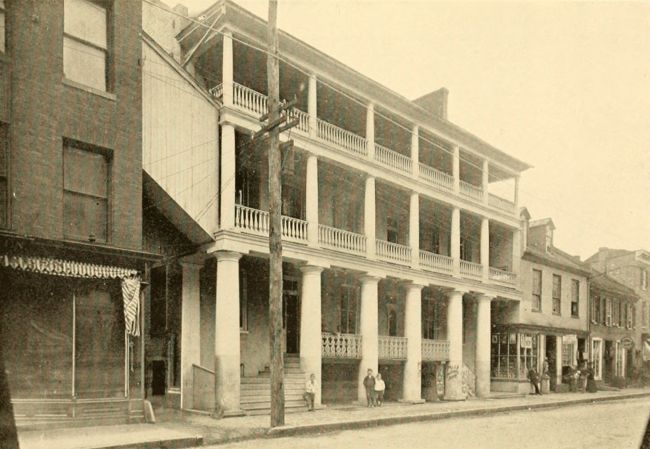
No. 10.
Taylor Hotel, Winchester, Va., used during the Civil War by the Union and Confederate
armies as Headquarters and Hospital, 1861-65. Said to have sheltered 1,300 wounded of both
armies after Sheridan's battle of Winchester, Sept. 19, 1864; it was here Lieut. D. G. Hill, Tenth
Vermont Volunteer Infantry, died. It is now (1908) vacant.
Thursday, Sept. 22, 1864.
Through the kindness of Chaplain Haynes who has
been indefatigable in looking after the wounded, I
have today engaged board in a private family, a
Quaker lady—Mrs. Wright—the mother of the celebrated
Rebekah Wright, who sent Sheridan information
of the enemy before the battle Sept. 19, by a
colored man in a piece of tinfoil hid in his mouth,
that Kershaw's division and twelve pieces of artillery
had returned to Lee, and that the enemy wasn't as
strong as supposed. She has a schoolroom at home
here, is a teacher, and very solicitous for our wounded—a
modest, sensible, interesting lady. They are very
nice people, and exceedingly kind. My wound is
healing rapidly, and the swelling has disappeared fast
within the last twenty-four hours, but I can't speak
or eat, taking gruel through a tube only, and my jaws
are paining me. Lieut. Hill is doing well, and may
get well, but the test will come in a day or so. It's
rumored that we've again whipped the enemy but I
doubt it; weather fine. My wounds are very stiff
this evening.
Friday, Sept. 23, 1864.
Well, I must confess that a good soft pillow is more
comfortable for one to rest a sore head on than an
oak log; rested very well last night considering the
condition of my mouth. Mrs. Wright is very kind.
I wish Lieut. Hill could be moved up here. A long
army train loaded with wounded started for Harper's
Ferry early this morning, also about 1500 prisoners.
Captain Goodrich and Lieut. H. W. Kingsley of the
Brigade staff called to see me to-day. My wound is
improving. I went with Rebeckah Wright and another
young Union lady—very pretty—to see Lieut.
D. G. Hill this forenoon. He is very gallant to
ladies, always, and seemed cheerful, but I think the
poor fellow assumes it. He is a patient sufferer. I
have to be for I can't utter a word; am termed the
interesting patient by the ladies, and get lots of sympathy.
Saturday, Sept. 24, 1864.
I am expecting to go to Harper's Ferry; reported
to the Surgeon in charge this morning as directed,
but the train hasn't come from the front yet, therefore
I shan't probably get off today. My wound has been
very painful this afternoon—in fact more painful
than it's ever been yet. The Eighty-seventh Pennsylvania
went through the city this afternoon en route
for home. Well, let them go, they are deserving of
such joy! It's a good regiment. My wound has
gotten very sore and painful and don't give me a moment's
peace. My system is beginning to feel the
strain, too, and my tongue seems paralyzed yet. I
can't utter a word. At any rate I'm not noisy company
for anyone—not even the ladies here who are
very sympathetic.
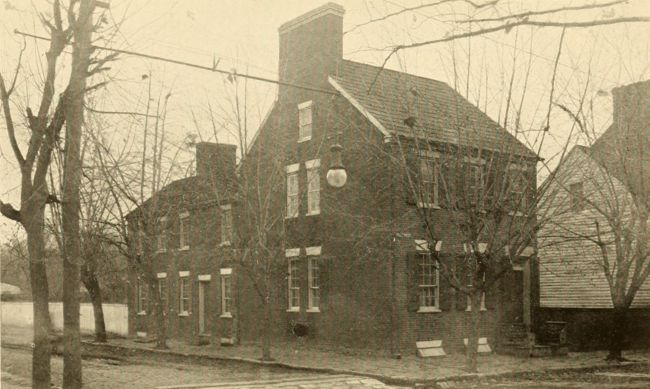
No. 11.
Cannon ball house, Winchester, Va.; see solid shot embedded in the brick wall, under the two
lower end windows, during the Civil War.
Sunday, Sept. 25, 1864.
I did not sleep much last night my wounds were so
very painful. I removed some of the old fractures or
splinters of the teeth and jaws that were left, about 3
o'clock a. m. with my fingers, and after that my face
was easier and I rested some. I started in a private
wagon from Winchester at 11 o'clock a. m. for Harper's
Ferry, and at dark was still on the road near
Charlestown very tired; had no scares from guerrillas;
am beginning to feel weak, having eaten nothing
solid since I was wounded, but I was pretty vigorous.
The shock to my system has been greater than I was
aware of, now that the excitement is over.
Monday, Sept. 26, 1864.
Tonight finds me in the hotel at Harper's Ferry
waiting for my leave of absence which I expect tomorrow;
arrived last night at 10 o'clock tired and
lame, but not discouraged although my mouth was
sore and painful. The swelling has largely gone, and
I can eat a little quite comfortably if the food is soft,
but I couldn't if I wasn't nearly famished. Major
Goddard—our paymaster—paid me today. I expected
to have to go to Washington.
Tuesday, Sept. 27, 1864.
O, what a delightful morning! And the scenery
here about Harper's Ferry is so grand that it makes it
all the more enjoyable. Of course, I awoke in fine
spirits for how could I help it? I thought I was to
start for home at 1 o'clock p. m. but on going to the
hospital, I found that my leave had not been sent over
for approval therefore I can't go until tomorrow.
The wagon train has started for the front again. I
am sure I shall start for Vermont tomorrow. Sometimes
I almost think it would be a good thing if some
of the Adjutants General could be wounded, too, perhaps
they would see to it then that wounded men's
applications for leave to go home were not delayed.
Wednesday, Sept. 28, 1864.
It has been an anxious morning for me; went over
to Sandy Hook and waited until 11 o'clock a. m.
when the clerk handed me my leave, and I must say,
I felt like a new man. I hurried back to Harper's
Ferry and found Mr. Hicks there in search of his
brother Lieut. John Hicks of my regiment, who was
wounded in the thigh at Fisher's Hill. I waited until
4 o'clock p. m. and took the cars for Baltimore,
but the train was delayed and it did not arrive there
till 2 o'clock a. m. Sept. 29.
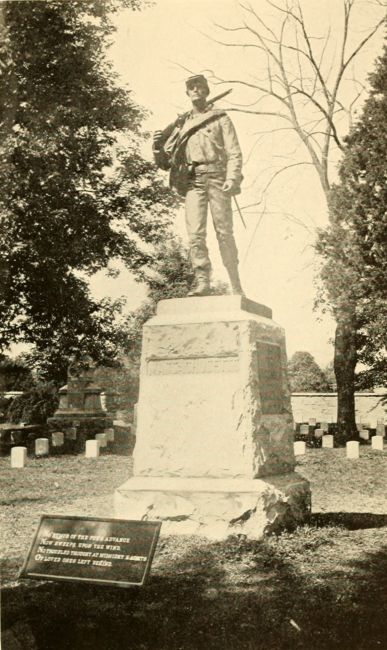
No. 12.
An ideally artistic and realistic bronze statue of a young
Union soldier in campaign costume, erected by Massachusetts in
the National Cemetery at Winchester, Va., to its patriot dead
there. This cemetery is one of the prettiest and best kept outside
of Washington, D. C.
Thursday, Sept. 29, 1864.
Stopped at the Eutaw House last night; arose at 6
o'clock a. m. from necessity and went shopping;
got breakfast at 8.30 o'clock a. m. and took the cars
for New York City; arrived at the Astor House, New
York, about 8 o'clock p. m.; looks like rain; city
much excited; good news from Grant.
Friday, Sept. 30, 1864.
I intended to have taken the 7 o'clock a. m. train,
but overslept; left on the 10.30 o'clock a. m. train
up the Hudson river. The scenery is the most beautiful
I have ever seen; arrived at Albany about sundown;
changed cars at Troy for Rutland; arrived
there at 9 o'clock p. m. Ed. Russell has been with
me today.
Saturday, Oct. 1, 1864.
Stayed in Rutland last night; took the 4 o'clock a.
m. train for Burlington, but to my disgust found it
to be a freight; arrived at Burlington at noon; took
the 1 o'clock p. m. train for Montpelier; arrived there
at 4 o'clock p. m.; stopped at Burnham's Hotel;
found Carl Wilson; hasn't changed much in three
years nor Montpelier; think a boil is coming on my
ankle; am half sick.
Sunday, Oct. 2, 1864.
Am in good old Vermont at last, if I have got a
boil coming. Major Dillingham's remains arrived
in Waterbury last night, and the funeral services
have been today, but it has rained hard all day. I
am not able to be out. Carl Wilson and Frank
French called to see me today. My boil is very painful;
have not been out of the house; would like to
have gone to Major Dillingham's funeral but can't
get about till my boil breaks on my ankle. I'm ill,
too.
Monday, Oct. 3, 1864.
Cloudy and foggy; have taken cold in my face;
ankle worse today, too; have not been outdoors.
Orry Blanchard has been in to see me; saw Mr. Walters
in the barroom, also Mr. Hanson, but did not know
the former. Sergeant Hogle has called. My wound
is paining me more than usual tonight; jaws in bad
condition; hope the fractures will heal all right. I
thought the Johnnies had shot my whole chin off at
first; it was paralyzed a long time, and don't feel
right yet; it must be the jaw.
Tuesday, Oct. 4, 1864.
Cloudy and gloomy; have been up to Carl's drug
store, but found it rather difficult walking; am not
feeling very well; went up to Carl's again this afternoon
for pills; remained on the bed all afternoon;
didn't go down to tea; Carl Wilson called this afternoon;
wound pains me very badly tonight.
Wednesday, Oct. 5, 1864.
Somewhat better. Mrs. George Watson called to
see me yesterday evening, but I was unable to receive
lady callers, although I did not know it was her;
went up to the office this afternoon; found Jo Watson
and took a stroll up to the State House; getting it
ready for the Legislature; am going to Williamstown
in the morning.
Thursday, Oct. 6, 1864.
Am feeling very much better this morning; very
foggy till about 9 o'clock a. m. when the sun came
out brightly; got a team about 10 o'clock a. m. and
Jo Watson took me to James Burnham's place in Williamstown;
arrived at Barre about noon; called at
Mrs. David Mower's; no one there but Hattie Glover;
did not get out; arrived at James' at 3 o'clock p. m.;
all well; took them by surprise.
Friday, Oct. 7, 1864.
Well, it seems good to get out in the country
among relatives, where it's quiet; my wound is worse
than I thought it would be. My teeth and jaws are
feeling very badly and my lip looks irritated. Ezra
and Ro Benedict have been up to see me today. Ro
has got some beautiful little children. James has
gone to Bradford to the fair.
Saturday, Oct. 8, 1864.
Rained all forenoon; gloomy day, but have passed
the time pleasantly; am reading Aurora Floyd, but
like East Lynne, better; pleasant but showery. James
commenced reading East Lynne this evening; mouth
gaining rapidly.
Sunday, Oct. 9, 1864.
Gloomy morning; am feeling better. Ryland Seaver
has been down to see me this morning. Andrew
Burnham and wife also called this afternoon; think
they are looking a little worn; marriage without
means is evidently not a bed of roses even for vigorous
people on a country hillside farm. Rodney
Seaver has also been in to see me, too; has married
since I've been in the army. He is another good
man, but Ryle and I have always been firm friends
and always shall be. The three Seaver brothers are
straight, reliable, splendid men.
Monday, Oct. 10, 1864.
A cold night for the season; froze quite hard; snow
on the ground this morning; don't seem much like
Virginia climate; weather much moderated tonight;
looks like southern storm. Alma Seaver has been in
to see me this afternoon. My mouth wound is nearly
healed externally, but it is very stiff, awkward and
clumsy; don't feel right—the jaws ache; cooler tonight.
Tuesday, Oct. 11, 1864.
Northwest wind; fair, comfortable day. James
has gone to John Pane's auction; have been down to
Washington village this evening with Jim; called to
see his eldest sister—Mrs. Pepper; finished reading
Aurora Floyd this afternoon; expect Pert this evening;
beautiful night; not much thrilling diary data
out here on this peaceful hillside Vermont farm.
Wednesday, Oct. 12, 1864.
Rather a gloomy morning; stormed till about 9
o'clock a. m. then cleared off, but snowed this afternoon;
wrote Dr. Clark. Pert didn't come; very dull.
Thursday, Oct. 13, 1864.
Snowed all day; seems quiet after such an exciting
life in the army. Mr. Lyman Drury brought
Pert down this evening. Byron Bradley writes that
Uncle Pierce and Cousin Abby are somewhere in the
East. My face wound troubles me tonight and I
guess always will by spells.
Friday, Oct. 14, 1864.
Well, I wonder if winter's come! It has rained
and snowed all day; face badly swollen today, but
my jaws don't ache much for which I'm thankful;
shall go down to Aunt Polly Howe's to-morrow if it
don't storm. It's snowing tonight.
Saturday, Oct. 15, 1864.
It snowed nearly all the forenoon. In the afternoon
it was quite comfortable; thawed considerable,
but night still finds the ground covered with snow.
My teeth and jaws have troubled me constantly, but
I feel more comfortable this evening; shall go down
to Aunt Howe's in the morning. Oh, dear! I shall
be glad when I get so that I can feel like other folks.
It is still thawing this evening.
Sunday, Oct. 16, 1864.
Ryland came down to see me early this morning.
Fernando Thompson brought me some letters; got
one from Dr. J. H. Jones; friends in Chelsea all well;
am at Uncle Howe's to-night; Jim brought us down
this forenoon; no one home but Uncle Howe; no
change in Williamstown; terribly quiet.
Monday, Oct. 17, 1864.
Went over to see Cousin George Simons last evening,
who is in poor health, as well as Cousin Martha.
Aunt Sarah is usually well; weather fair. Aunt
Polly Howe seems depressed; expect she's anxious
about me; arrived at Mr. David Mower's this evening;
came down in Mr. Snow's crowded stage very
uncomfortably.
Tuesday, Oct. 18, 1864.
Cloudy with wind; have been to Montpelier with
Mrs. David Mower and Cousin Pert; had a good time;
dined with the Watsons; visited several Tenth Vermont
men in the afternoon at the hospital; got my
dress coat and overcoat at Woolson's; got home about
dark; rather cold tonight.
Wednesday, Oct. 19, 1864.
Cloudy, dismal day; took Cousin Pert and Hattie
Glover out to Cousin David Smith's in the afternoon,
and visited at Ann Martin's in the evening; returned
to David's for the night; very dark with blinding rain
and snow, but got home safe; have enjoyed the day.
Thursday, Oct. 20, 1864.
Weather cloudy and gloomy; started about 9 o'clock
a. m. to take Hattie Glover home, then took Pert to
call on Phineas Thompson's family, and then in the
afternoon we went to John Wilson's. It's always a
pleasure to see Mr. and Mrs. Wilson though a sad
duty since Em and the other children died. Pert and
I called on Helen Thompson, and I in the evening on
Mrs. Oromal Dodge. Coming home our wheel set
over which we had quite a frolic, but we arrived safely.
Friday, Oct. 21, 1864.
It has seemed a long day; have been in the village
all day; called on Charley French; wound fairly easy
today. Pert, Hattie Glover and I went up to the
Academy Lyceum this evening; students much younger
than before the war; probably older boys in the
army; dark and gloomy to-night.
Saturday, Oct. 22, 1864.
Quite a fine day. James Burnham came down
after Pert this morning. Cousin Hattie Burnham is
ill with diphtheria. I called on Mr. and Mrs. Bliss
this forenoon; am to stay at Nate Harrington's tonight.
Carl Wilson came up from Montpelier about
8 o'clock p. m. Several of the girls came in in the
evening and we had a pleasant time.
Sunday, Oct. 23, 1864.
Went with Carl up to his father's this morning;
intended to go to church this afternoon, but didn't
get dinner in season; had a good visit with Mr. and
Mrs. John Wilson. Herbert and Laura Leonard, old
schoolmates, called; have grown greatly; was glad to
see them. Carl and I stopped at David Mower's in
the afternoon.
Monday, Oct. 24, 1864.
Pert, Hattie Glover and I started for Montpelier
en route for Burlington this morning at 6 o'clock in
a crowded stage. They were on a frolic; had a half
dozen bandboxes in the front hall they pretended had
got to go, because they knew I objected to traveling
with such. We had some backwoods passengers
which amused the girls greatly; arrived in Montpelier
at 9 o'clock a. m.; shopped some and took the
11 o'clock a. m. train for Burlington. Fred Johonnott
met us at the depot, who is engaged to Hattie,
and took us to the Stanton House; saw Hidden Hand
played at the theatre in the evening.
Tuesday, Oct. 25, 1864.
Went to see Dr. Thayer about getting my leave
extended about 10 o'clock a. m.; found him at his
house but cranky; would not, to my surprise, give me
a certificate for extension of leave. My wound is
not yet fully healed, the stitches are still in, it's sensitive,
inflamed and sore, can't eat solid food, am not
fit to go to the front, and I'm no malingerer either.
It would teach Dr. Thayer something to get in a hot
fight and be wounded. I never did like bandbox
doctors, anyway! I'm afraid the board of surgeons
at Annapolis, Md. will discharge me for they are
practical men. I'm disgusted with Thayer! All I
need is a reasonable time for my wound to mend. A
man with a part of his head shot away can't be expected
to be fit for duty a month after. If I shirked
battle, I suppose Thayer would extend my sick leave!
That's the way such things usually go! Merit don't
count though, with testy doctors if approached too
soon after breakfast. If I were a toady in manner or
reality, I suppose I could get anything, but I'm only
a plain, presentable, unassuming country lad while
Thayer impresses me as an aristocrat. Ed. Russell
has taken me to ride about Burlington, a very pretty
little city; took the noon train for Montpelier; shall
go up and call professionally on Dr. James in the
morning; he'll give me a certificate.
Wednesday, Oct. 26, 1864.
This has been the first pleasant day I've seen in
Vermont since I came home; met Captain P. D. Blodget
on the street; was glad to see him for he is a nice,
fair man. His wounded arm is looking very badly;
do not think he will ever return to the regiment again.
I went up to the hospital with him and he gave me an
introduction to Dr. James who examined my wounds
and gave me a certificate for thirty days extension of
sick leave; have been up to the State House this evening
to hear Mrs. Chester read.
Thursday, Oct. 27, 1864.
It's not quite as pleasant this morning as yesterday;
had Dr. Forbush operate on my game jaws, teeth, etc.,
this forenoon; took ether and I must say that I have
no desire to ever take any more. The doctor tells me
my upper jaw is very badly injured. I suspected it
but hoped it might be the crushed teeth which gave
me so much pain; have been sick all the forenoon from
the effects of the ether. When I came out from under
its influence I was crying like a great booby, for
just at that time I was living over my illness of typhoid
fever when I was reported dead at Rockville,
Md. in the winter of 1862-63, and I thought I was
all alone among strangers. It was more real, though,
as I was delirious at Rockville, and don't recall any
such genuine anguish as I was experiencing when I
awoke from the effects of ether. To awake from such
hallucinations to the realities of life comparatively
well was a remarkable experience; it dazed me for a
moment on coming back to the world, but I rallied
soon on looking at the doctor and Pert and saw them
relievedly smiling at my surprised look and manner.
I went to a band concert tonight, and stayed with Carl
Wilson.
Friday, Oct. 28, 1864.
I did not get up till 10 o'clock a. m.; am feeling
some better this morning; rained hard all day. Roger
Bixby brought me up to Barre this afternoon. The
Smith band came up to give a concert but as it rained
so hard it postponed it till next week.
Saturday, Oct. 29, 1864.
Fair day. The Smith band came up and gave a
serenade this forenoon; have had a pleasant time at
Mr. West's. News came today that Captain L. D.
Thompson of Waterbury was decapitated by a solid
shot in battle at Cedar Creek, Va., and that Adjutant
Wyllys Lyman, Captain C. F. Nye, Lieuts. G. E.
Davis, G. P. Welch, A. W. Fuller and B. B. Clark
were also wounded there. We have had seven officers
killed, twelve wounded and two captured since
the first of June, making twenty-one in all, the regiment's
full quota not including non-combatants, were
they all present which is never the case, being thirty-four.
Who will say we haven't stood up to the rack?
I guess they intend to kill us all off—men and all! I
may not have included all the casualties among the
officers in the foregoing. Poor Dillingham, Stetson
and Thompson! They were my original officers in
Company B—all gone—killed in battle. They were
good fellows—intrepid and valiant to a fault. Lieut.
Stetson was a considerate, kindly friend, and a man
who was fair and manly, and never took a mean, unfair
advantage of anyone so far as I know; he won
my esteem. I became fond of Captain Thompson; he
grew on me constantly until we were good friends,
and the manner of his unfortunate death shocks me.
Poor fellow! I sincerely regret his tragic end; he
was brave, always genial, obliging and friendly.
They grew to like, respect and esteem me, and I have
lost three staunch friends—probably among the best
in the regiment with the officers. They have all been
martyrs to the cause of the Union. May their souls
go marching on and finally welcome mine in eternity!
Sunday, Oct. 30, 1864.
A beautiful day; have been to church twice. Mr.
Bliss preached two excellent sermons. He always
preaches well; is a remarkably gifted, brainy, interesting
speaker from the pulpit. Dr. Carpenter's funeral
was this afternoon from the Congregational Church.
Mr. Beckley's funeral services were attended this afternoon
from the M. E. Church; beautiful evening;
have been up to the cemetery with Mr. and Mrs.
Mower.
Monday, Oct. 31, 1864.
Stormed this forenoon; went up to see Nate and
Ardelia Harrington and remained all night; called on
Mrs. Patterson and Mr. Hiram Blanchard's family.
Captain L. D. Thompson's remains arrived at Waterbury
this evening; funeral tomorrow; cold tonight;
army news good this evening.
Tuesday, Nov. 1, 1864.
Mrs. Charles Scott, Ardelia Harrington and Cousin
Pert have gone to Montpelier. I came by stage to
Chelsea and am with Dr. J. H. Jones tonight; left So.
Barre at 11.30 o'clock a. m.; rode to Tunbridge
with the doctor to visit a young lady ill with typhoid
fever this evening.
Wednesday, Nov. 2, 1864.
Cool and pleasant this morning. Dr. Jones has
gone to Tunbridge; have spent the day with Dr.
Bagley's family; shall remain here over night; called
on Mrs. Hayward and her daughter, Susan, this evening.
Thursday, Nov. 3, 1864.
It's a lovely morning; went to Tunbridge with Dr.
Jones; fine evening; am to stay at Mr. Isaac Merrill's
tonight.
Friday, Nov. 4, 1864.
Has rained hard all day. Ike's a little off on the
war; went to the village about 4 o'clock p. m.; called
on Mrs. Lyman Hinkley, am at Mrs. Hayward's tonight.
Saturday, Nov. 5, 1864.
Have been to see Jo Watson to-day; weather cold
and blustering all day; am with Dr. J. H. Jones tonight;
he's visiting a patient; am alone.
Sunday, Nov. 6, 1864.
Left Chelsea at 10 o'clock a. m. for Barre; Jo
Watson brought me over; attended church this afternoon,
heard an excellent sermon by Rev. F. S.
Bliss; called on Mrs. Oromal Dodge this evening.
Monday, Nov. 7, 1864.
Took the 7 o'clock a. m. stage for Montpelier, and
thence by 11 o'clock a. m. train to Vergennes to see
Levi Meader, my old roommate at Barre Academy,
Mr. F. E. Woodbridge's law partner; am not impressed
with the cordiality of Mr. Woodbridge; met
him on the train en route.
Tuesday, Nov. 8, 1864.
It has rained all day. Well, this is a great day in
the States! Probably more depends on what it brings
forth than any since Washington's time. As for myself,
though, I have no fear but what all will come
out right; am still in Vergennes, and have voted for
Abraham Lincoln—my first vote. The city's vote is
as follows:
Good! This is as it should be.
Wednesday, Nov. 9, 1864.
Was shown the city by Meader today. Hon. F. E.
Woodbridge, who is a representative in Congress, returned
home from Washington last night. He is
Meader's law partner; was introduced this morning;
took the train for Williston, Vt. at 11 o'clock a. m.
but being express didn't stop; arrived in Montpelier
at 4 o'clock p. m.; shall stay here tonight; went to
the theatre this evening.
Thursday, Nov. 10, 1864.
A gloomy, lonely day; visited the State House this
afternoon; if in condition would like to return to the
front; am at Burnham's Hotel; have been to the
theatre; fine evening.
Friday, Nov. 11, 1864.
Fair day; arrived in Barre by 7 o'clock p. m. stage;
took my first degree in masonry to-night. Webber
Tilden did the work.
Saturday, Nov. 12, 1864.
A cold bleak day; went up to James Burnham's with
Fanny West this forenoon; took her and Cousin Pert
and called on the Calefs and Alma Watson at Washington;
returned to and stayed at James'; Ryle Seaver
was there; had company in the evening.
Sunday, Nov. 13, 1864.
Snowed this morning; there's about three inches
of snow on the ground tonight; left James Burnham's
at 9 o'clock a. m. in a snowstorm; arrived at
Barre just in season for William Old's funeral; have
attended the funeral this afternoon at the Universalist
Church of Lester Tilden. Captain Albert Dodge
called this afternoon; has stopped snowing.
Monday, Nov. 14, 1864.
The Academy examinations commenced today; attended
morning prayers. Mr. J. S. Spaulding looks
and is the same as ever; nice old gentleman; called
at the Curriers this evening; were glad to see me;
clever old people; attended the examination of a
class of youngsters in geography at the Academy.
Tuesday, Nov. 15, 1864.
Attended the examination at the Academy of classes
in mathematics to include geometry; nothing very
exciting going on.
Wednesday, Nov. 16, 1864.
Have passed a pleasant day; met James Abbott of
Williamstown, Vt., this afternoon at the Academy;
fine looking and a fine fellow, too; closing exercises
come off at the Academy this evening. Carl Wilson
and Frank French called tonight.
Thursday, Nov. 17, 1864.
Am in Montpelier tonight. Mr. and Mrs. David
Mower and Cousin Pert are here, too; have been to
the dentist's to have an impression taken for my new
teeth; am to have them in the morning; went to the
theatre tonight with George and Mrs. Watson; saw
the good play of East Lynne; shall stay with them tonight;
very cold and much snow; am getting worn-out
with so much visiting.
Friday, Nov. 18, 1864.
Have had some photographs taken; went up to the
State House this forenoon, and afternoon; had a
torchlight parade this evening; village illuminated;
speeches by Governors Holbrook, Dillingham, etc.
General Stannard present; didn't get my teeth.
Saturday, Nov. 19, 1864.
Cold with chilly north wind; stayed at Burnham's
Hotel last night; hotel overcrowded; had to room with
Mr. Orcutt of Roxbury; Captain Albert Dodge and
wife and Louise Dodge in town; went to the depot
with Mr. Orcutt; expect a visit from him in camp this
winter; went up to the hospital with some ladies; arrived
in Barre at 7 o'clock p. m.; took two degrees in
masonry; am a Master Mason.
Sunday, Nov. 20, 1864.
Went to church this forenoon. Lester Hanson read
a sermon, Mr. Bliss being in Woodstock, Vt.; went to
Henry Burnham's funeral, a victim of the Civil War,
in the afternoon at Williamstown; am at Uncle Howe's
tonight; have called on Aunt Sarah Simons; weather
threatening.
Monday, Nov. 21, 1864.
Not very cold; about two inches of snow on the
ground this morning; went with Cousin Pert to Cousin
David Smith's this forenoon, and then to Barre,
arriving at Mr. David Mower's at 4 o'clock p. m.;
raining hard to-night; have been to a Masonic meeting;
saw Mr. Jones initiated.
Tuesday, Nov. 22, 1864.
Northwest wind, cold and cloudy, with snow to-night;
went up to the old homestead this afternoon;
called at Mr. Elijah Wheeler's, also at his sister
Susan's; am at Jim Burnham's to-night with Ryle
Seaver; shall both stay here. Aunt Thompson has
gone over to Cousin David Smith's.
Wednesday, Nov. 23, 1864.
Pleasant and not very cold; started for Cousin
David's at 9 o'clock a. m.; called at Mr. Flint's, at
Rodney Seaver's and on Cousin Aurora Benedict;
found Cousin Abby Howe at Ro's, too; took Thanksgiving
dinner with Cousin Lois and David Smith's
family, and went to Barre. Hattie Burnham is ill
with diphtheria.
Thursday, Nov. 24, 1864.
Started for the front this morning at 6 o'clock, or
rather for Annapolis, Md. Cousin Pert went as far
as Bellows Falls with me; arrived at Springfield, Mass.
at 8 o'clock, p. m., at N. Y. City about midnight, and
daylight found me between Philadelphia and Baltimore.
Friday, Nov. 25, 1864.
Arrived at Baltimore about 9 o'clock a. m.; remained
at the Eutaw House until 4.40 o'clock p. m.;
arrived at Annapolis at about 8 o'clock p. m.; reported
to the surgeon in charge at once who ordered me
to report to the Board of Examiners tomorrow morning;
am in a room with two other officers.
Saturday, Nov. 26, 1864.
Reported at the Examiners' room at 9.30 o'clock a.
m.; was ordered to report at 9.30 o'clock a. m. Monday;
have been up town today; very dilapidated looking
place and dull; hardly know what to do with myself.
Three more officers have been assigned to my
room tonight. There are quite a number of officers
here from my Division.
Sunday, Nov. 27, 1864.
Warm and pleasant; nothing doing; have been
lounging about and resting up; saw guard mounting
this morning at the Marine Barracks and also at the
post; hope I shan't have to remain here long, it's so
dull; shall go to the front in the morning if they will
let me.
Monday, Nov. 28, 1864.
Well, this has been an interesting day, a great surprise;
have been treated with great consideration—like
a prince—by the board, and I never saw one of
them before, nor had they ever heard of me that I
know of. They made my mouth wound of so much
interest it embarrassed me; I felt as though I was
being lionized. The board is composed of a General
and several other elderly medical officers of rank and
age, and they have the consideration and tact—unlike
Dr. Thayer—to treat any wounded officer and
especially one who fought with Sheridan at Winchester,
with distinguished respect. The first one who
looked at my wound expressed great surprise at my
"unusually interesting mouth wound," as he termed
it, and called for the doctors in the adjoining rooms
to come and see one of the most interesting of the
many wounds that had come before the board.[33]
They all came, each in turn examining it, expressing
great wonder, and asked many questions, indignantly
inquiring why the Vermont doctors had sent me back
to the front with jaws in a condition such as to render
it impossible for me to chew solid food when it was
known that hard bread and meats were the principal
articles of food for troops in the field and with the
stitches still in my lip and it not solidly healed. In
reply I gave them my experience with Dr. Thayer of
Burlington, Vt., and said I had not gone to the hospital
several times during the war because of my pride
and fear of inconsiderate treatment, although I had
ought to have gone twice before when wounded, but
feared I might be criticised if I did. They continued
to examine the wound for some time expressing astonishment
that it should have healed as much as it
had so soon and would leave so little trace or scar
externally in the end as it would, and highly complimented
Dr. Rutherford who attended me. They
finally drew aside for consultation, and when the
examiner who had charge of the case returned and
said that I could have my choice, take my discharge
or return to the front, I was delighted, and chose the
latter. He seemed surprised, and after hesitating a
little looking steadily at me, said I had better consider
the matter well; but I told him I had, that I
could soak my hard bread in water, fry it with salt
pork which would make it both soft and nutritious,
and that I could get along. Seeing that I really
wanted to return, he let me go. I received my discharge
from the hospital this afternoon, have got my
transportation, and shall leave to-morrow at 2 o'clock
p. m. Captain Mattison, a fine little fellow, left this
afternoon. We are all in good spirits to-night. But
the Annapolis board of surgeons were clever gentlemen.
Their sympathy and consideration was unusual.
Tuesday, Nov. 29, 1864.
Left Annapolis for Baltimore on the 1 o'clock p.
m. train; waited at Annapolis Junction an hour and
arrived in Baltimore about dark; am at the Eutaw
House to-night; no one here I know; very dull; shall
start for the front to-morrow.
Wednesday, Nov. 30, 1864.
Took the 9 o'clock a. m. train for the west; lots of
passengers going to the front; found a freight train
off the track at Ellicott Mills, Md.; was about two
hours late at Harper's Ferry where I stop over night;
shall take the first train to the front in the morning;
no news; very dull here.
Thursday, Dec. 1, 1864.
Well, I am a nine months' man! Good (?) I went
into General Stevenson's headquarters and found the
Tenth Vermont was at Petersburg. He ordered me
to report to Col. Hunter commanding Camp Distribution
at Harper's Ferry; was ordered to take command
of the Twentieth Company, Sixth Corps—about
200 men; have got to receipt for clothing, camp
equipage, etc.; don't like it, but have to obey orders.
The camp is on a barren, bleak side hill long used for
such a purpose, and it is cold, windy and dirty with a
great deal of dust. I don't like the prospect.
Friday, Dec. 2, 1864.
Cold and windy; no quarters or accommodations of
any kind; have been down to General Stevenson's to
get relieved, but he won't listen to it; went later to
Colonel Hunter to get permission to go down town to
sleep, but he won't let me go; am to stay with the
Quartermaster to-night; have drawn fifty-four shelter
tents for the men who are out of everything are
blue at having to stay here, and everything's depressing.
I am glad they are good men; wish I was
out of this.
Saturday, Dec. 3, 1864.
Cold as ever; got an old rotten, dirty wall tent and
put it up; took the men's receipts for shelter tents;
fingers very cold and numb from writing; camp dirty;
men complaining because they have no clothes;
quartermaster ordered to his regiment; no one to issue
clothing. Oh, dear! When will I get out of this?
I'm disgusted with the management here. General
Stevenson wants to put me on his staff as Depot
Quartermaster at Harper's Ferry; sent for me and
urged me to accept; told him I preferred a fighting
position to the end of the war with my regiment at
the front; think he was vexed with me, but I can't
help it. I'm no shirk from battle if I have been four
times wounded! I'm no quitter! besides I don't want
to be filled with remorse in years to come that I
shirked the front when needed. I propose to be able
to look any man in the eye without flinching on that
score.
Sunday, Dec. 4, 1864.
Weather more comfortable this morning; more convalescents,
etc., reporting in small squads; am feeling
some better, but do want to go to my regiment: men
complaining, but I can't help it, there's no quartermaster;
am busy with clothing rolls; looks like storm
to-night.
Monday, Dec. 5, 1864.
Cold northeast wind; am told by the Commanding
Officer I shall probably get an order to go to Washington
to-night; am hurrying to finish my clothing
rolls; twenty men reported to-night for the Ninth
N. Y. Infantry; don't believe I shall get an order to
move after all to-night. Well I suppose this is all
necessary to make a soldier!
Tuesday, Dec. 6, 1864.
Laid out Company streets and had the men police;
got a man to build me a chimney; don't smoke; am feeling
better; men in better spirits, but anxious to go to
their regiments; have had forty men turned over to
my command without tents, overcoats or blankets;
had an interesting, good man report belonging to the
Fourth N. J. Infantry, who can help me, and I like
him; don't like being commanding officer and everything
else, though; too much to do to look after a
regiment of men without even a clerk. But they
are good, and seem to like to be with me, for they
are all the time wanting to do something for me—probably
because I try to make them comfortable.
Wednesday, Dec. 7, 1864.
Pleasant and warm in the morning, but the wind
began to blow about noon, and to-night it's quite uncomfortable.
My clerk has quite an interesting history,
and I like him the more I see of him; got an
order about 3 o'clock p. m. to get my men in readiness
for the cars for Washington; left about 9
o'clock p. m. in a rainstorm.
Thursday, Dec. 8, 1864.
Arrived at Washington Junction at daylight; were
delayed by freight trains till 8 o'clock a. m.; arrived
in Washington about 10 o'clock a. m. A man got
shot in the foot; got breakfast at the Soldiers Rest;
am in charge of the guard. Colonel Hunter and the
Adjutant are up town looking for General Wright;
am to stay in town to-night.
Friday, Dec. 9, 1864.
Stopped at the National Hotel last night; looks
like snow this morning; got my pay this forenoon;
returned to the Soldiers Rest about noon; men in
good spirits. Colonel Hunter was relieved this morning
by Major Jones; men started for the front this
afternoon at 4 o'clock; hated to lose them. I leave
on the government boat to-morrow for City Point.
Saturday, Dec. 10, 1864.
Stayed at the Kirkwood last night; roomed with
Captain Briggs of the One Hundred and Sixth N. Y.
Infantry, but he was out all night; went to the German
Opera at Grover's Theater last evening; about
four inches of snow on the ground this morning;
sailed with Captain Briggs for City Point at 3 o'clock
p. m.; dull, and cold wind down the river.
Sunday, Dec. 11, 1864.
Arrived at Fortress Monroe at 7 o'clock a. m.;
grand old place; never saw so much shipping at one
time before; left for City Point at 9 o'clock a. m.
arriving about 3 o'clock p. m.; stayed with Lieut. S.
H. Lewis, Jr. till 5 o'clock p. m.; arrived at brigade
headquarters about 8 o'clock p. m.; shall stay with
Lieut. H. W. Kingsley to-night.
Monday, Dec. 12, 1864.
Very cold all day; remained with Kingsley until
about 11 o'clock a. m. and then went over to the
regiment some distance away; found the men
stationed at Ft. Dushane doing garrison duty. Colonel
W. W. Henry has sent in his resignation; sorry
to lose him; has been the most popular field officer we
have ever had, all and all. Major L. T. Hunt has
gone for good. Colonel C. G. Chandler has been
courtmartialed; will probably go home; shall stay with
Dr. Almon Clark; quarters in a house near the fort;
men are without quarters; have never seen the regiment
so uncomfortably fixed.
Tuesday, Dec. 13, 1864.
Not quite so cold. Captain A. W. Chilton and
Lieut. Wheeler came off picket this morning; no
orders to put up quarters; wonder if some of the
officers are not getting faint-hearted and getting out
of it; no one can accuse me of it after declining my
discharge at Annapolis and General Stevenson's offer.
I find the army in poor spirits; needs rest, at any rate
Sheridan's Shenandoah Valley part of it; give it rest
and it will be all right for another campaign. These
enormous earthworks in our front seem to give everybody
the nightmare, but I anticipate a weakly manned
part of the line will be found, easily broken, and then,
as the enemy is disheartened, goodbye, Johnny! The
next campaign will be virtually the last.
Wednesday, Dec. 14, 1864.
Has been quite warm and comfortable all day; dull
in camp, and no news from Generals Sherman or
Thomas; got an order to fix up quarters this morning
which will do the men good as it will occupy
their minds; are getting out timber now; shall be
glad when my hut is fixed; am tired of changing
about so much; wrote to Jim Burnham this evening;
expected to go on duty this morning.
Thursday, Dec. 15, 1864.
Very warm and comfortable all day; am on duty
in the fort; have a guard of one Sergeant, three Corporals
and thirty-six men; duty easy; rumors from
General Thomas this evening but nothing reliable;
got a letter from Cousin Pert to-day; no news from
Oakdale, Mass.; was very sorry to learn of G. B.
Putnam's death.
Friday, Dec. 16, 1864.
Warm and pleasant; trains busy drawing hut timber;
was relieved from guard by the One Hundred
and Thirty-eighth Pennsylvania Infantry; am not
feeling well; received a letter from David Mower
and have answered it; all well in Vermont; Captain
H. H. Dewey and Lieutenant Daniel Foster, Tenth
Vermont, reported for duty this morning from City
Point; have been ill in hospital there; had an undress
parade this evening; good news from Thomas.
Lieutenant Alexander Wilkey starts for home in the
morning.
Saturday, Dec. 17, 1864.
Fair, comfortable day; men busy putting up quarters;
shall commence my hut when the men finish
theirs; good news from Generals Sherman and Thomas
this evening; have written Dr. J. H. Jones this evening;
southeast storm brewing; cannonading towards
Petersburg to-night; nothing unusual.
Sunday, Dec. 18, 1864.
Quite comfortable all day. Colonel W. W. Henry's
resignation came back last night accepted; will leave
at 7.40 o'clock a. m. to-morrow; officers gave him a
farewell supper to-night. Captain G. B. Damon comes
back to the regiment to-night from the division staff.
I have been recommended for the Captaincy of Company
G overslaughing several other officers, provided
he is made Major; all's quiet.
Monday, Dec. 19, 1864.
Colonel W. W. Henry started for Vermont this
morning; most of the officers of the regiment went to
the cars to see him off; commenced raining about
8 o'clock a. m.; didn't rain long; men very busy on
their cabins; got a Washington Chronicle to-night;
good news from Generals Sherman and Thomas, the
latter having captured fifty eight guns and five
thousand prisoners.
Tuesday, Dec. 20, 1864.
It's rumored we are to move camp in a day or two;
wish they would allow us to stay here; had monthly
inspection at 3 o'clock p. m.; men in good condition
considering. Captain Day was our inspecting officer.
Captain G. E. Davis has gone to City Point; returned
at 9 o'clock p. m.; got me two wool blankets; rumored
in camp Jeff Davis is dead; don't believe it.
Wednesday, Dec. 21, 1864.
Rained hard most of the day from 7 o'clock a. m.;
have suspended work on the huts; expect to move
in a few days; very muddy in camp; clear, cold north
wind and freezing at 9 o'clock p. m.; news still good
from Sherman and Thomas.
Thursday, Dec. 22, 1864.
Cold and windy; froze about four inches last night.
Captain Bartruff has been over to call on us; says
that we will have to move over with the rest of the
brigade to-morrow, but why were we told to build
quarters here? Pretty rough, but we shall have to
stand it! Glorious news from General Thomas to-night;
has captured sixty-one pieces of artillery and
nine thousand prisoners. We move at 9 o'clock a.
m. to-morrow.
Friday, Dec. 23, 1864.
Moved at 8 o'clock a. m.; weather freezing cold;
only seven teams at work with us; regiment excused
from brigade dress parade this evening. It's very cold
to-night; shall sleep on Captain G. E. Davis's floor;
men are without quarters; should think they would
freeze. It's rumored Savannah is captured; doubt
it.
Saturday, Dec. 24, 1864.
Very cold, but more comfortable than yesterday;
commenced putting up my cabin this morning; not
quite up to-night; regimental dress parade this evening.
General Butler's fleet is off Wilmington;
Savannah, Ga. reported captured through rebel
sources; have written to David Mower, and to Washington
for my valise; weather moderating; all's quiet
in front.
Sunday, Dec. 25, 1864.
Rained all night; very muddy; working hard to
finish my house by to-morrow night; had 10.30 o'clock
a. m. Company inspection; various rumors about
General Sherman; news good from General Thomas;
good regimental dress parade this evening.
Monday, Dec. 26, 1864.
Received official information from General Sherman
this morning that he had taken Savannah, Ga.
with thirty-three thousand bales of cotton, one hundred
and fifty heavy guns, and eight hundred prisoners;
one hundred shotted guns fired in honor of it
here; Thomas reports seventeen thousand prisoners,
eighty-one guns, etc., taken from General Hood; no
news from the Shenandoah Valley; rumored in camp
that the Eighth Corps is at Dutch Gap; hut covered
and banked up; regimental dress parade to-night; mud
drying up; reckon the Confederacy is crumbling
rapidly.
Tuesday, Dec. 27, 1864.
Quite decent under foot; hut about done; shall
move into it to-morrow night. Captain Merritt
Barber has been over and turned over Company
E property to me; good brigade dress parade
this evening; had a call from Lieut. Pierce of the
Second Division to-night; have written Levi Meader
this evening; am to be brigade officer of the guard
to-morrow.
Wednesday, Dec. 28, 1864.
Mounted brigade guard at 8.30 o'clock a. m. as
officer of the guard; northeast chilly wind; brigade
dress parade this evening; Tenth Vermont worked
on breastworks this forenoon; finished my cabin to-day;
wrote brother Charles this evening; received a
letter and diary for 1865 from Cousin Pert; weather
very rough to-night.
Thursday, Dec. 29, 1864.
Weather has moderated since morning; quite
muddy; had two hours battalion drill; think it a big
thing on ice. In my opinion we would look better in
the house, and I am sure we should feel better; got
a letter from Dr. J. H. Jones to-night. He was married
Nov. 8, 1864; received our muster and pay rolls to-day;
have commenced a part of two; hard cold north
wind to-night. Sergeant Charles of the One Hundred
and Fifty-first New York is here to-night.
Friday, Dec. 30, 1864.
Worked all day on muster and pay rolls; mild
south wind; storm brewing. Captain G. E. Davis
drilled the battalion this afternoon in the manual of
arms; muddy brigade dress parade this evening;
hardly a gun to be heard on picket to-night; no letters
or news; retired at 11 o'clock p. m. tired.
Saturday, Dec. 31, 1864.
Well, here I am again in winter quarters, but how
different from twelve months ago. I confess, though,
that my prayer has been answered, the year having
been passed as happily by me as could have been
expected under the circumstances. I have been called
upon to pass through a great many ordeals but with
God's grace have come out alive. I shudder when
I think how many have been killed out of our little
band, yet I am spared perhaps for some good purpose;
I hope so, anyway.[34] I'm about to commence
another year. I feel sad to bid the old one farewell.
It has been a strenuous, eventful and historic one.
May the next end the war, if it is God's will.