DIVISION II. The Period of the Zend-Avesta. — CHAPTER V. THE ZEND-AVESTA. — DIVISIONS. — AGE OF THE ZEND-AVESTA. — MANUSCRIPTS. — ZARATHUŚTRA. — THE EARLY PĀRSĪS. — THE MODERN PĀRSĪS. — CHAPTER VI. THE TEACHINGS OF THE ZEND-AVESTA. — THE GĀTHAS. — THE WAIL OF THE KINE. — THE LAST GĀTHA. — THE MARRIAGE SONG. — THE YASNA. — COMMENCEMENT OF THE SACRIFICE. — COMMENTARY ON THE FORMULAS. — THE YASNA HAPTANG-HĀITA. — THE SRAŌSHA YAŚT. — THE YASNA CONCLUDING. — CHAPTER VII. TEACHINGS OF THE ZEND-AVESTA, CONCLUDED. — FARGARD II. — THE VARA OF YIMA. — THE LAWS OF PURIFICATION. — DISPOSITION OF THE DEAD. — PUNISHMENTS. — THE PLACE OF REWARD. — THE VISPARAD. — TEACHING OF THE MODERN PĀRSĪS.
109
DERIVATION AND LANGUAGE—DIVISIONS—AGE OF THE
ZEND-AVESTA—MANUSCRIPTS—ZARATHUŚTRA—THE
EARLY PĀRSĪS—THE MODERN PĀRSĪS.
We use the ordinary form of the word, Zend-Avesta,
for though some Orientalists claim
that it should be called the Avesta-Zend, it is an
open question whether this is the original and only
correct term. According to the Pārsīs, Avesta means
the sacred text, and Zend its Pahlavī translation, but
in the Pahlavī translations themselves, the original
work is called the Avesta-Zend, although there is no
reason given for this course. Neither the word Avesta
nor Zend occurs in the original Zend texts. The word
Avesta, however, seems to be the Sanskṛit avastha,
meaning “authorized text,” while Max Müller[145] claims
that the name Zend was originally a corruption of the
Sanskṛit word Khandas, or “metrical language,” which
110is a name given by the Brāhmans to the hymns of
the Veda. The word Zend, or Zand, is also used to
designate the language[146] in which the greater part of
the Avesta is written.
In relation to its antiquity, the Zend ranks next to
the Sanskṛit, and such authorities as Westergaard and
Spiegel, while differing upon many points, agree in
considering the Veda the safest key to an understanding
of the Avesta. Many of the gods which are
unknown to any of the Indo-European nations are
worshipped under the same name in Sanskṛit and in
Zend, and indeed many of the gods of the Zoroastrians
seem to be mere reflections of the more primitive gods
of the Veda, but at times the tendency to monotheism
in the Zoroastrian religions would appear to be a solemn
protest against the worship of all the powers of
nature which is found in the Veda. Although there
is much kinship between the two tongues, and many
striking similarities between the gods of the two mythologies,
it does not necessarily prove that portions
of the Zend-Avesta were borrowed from the Veda. It
does prove, however, that the two works proceeded
from a common source of Āryan tradition, and it also
proves that the Sanskṛit and the Zend continued to
live side by side long after they were separated from
the common stock of the Indo-European tongues.
There are decided differences between the themes
of the Veda and the Avesta, but the link which binds
them to a common source is never broken. Some Orientalists
claim that there was a schism between the two
111and that the differences are the result of a religious
revolution, while others argue that there was only a
long and slow movement which led, by insensible degrees,
the vague dualism of the Indo-Īrānians onward
to the sharply defined dualism of the Magi. It has
been clearly shown that the mythologies of Europe
and Asia have a common origin in the idolatry found
the valley of the Euphrates; so also the Veda and the
Zend-Avesta are two great literary productions flowing
from the same fountain head, which is found in the
Indo-Īrānian period.
The Zend-Avesta, or sacred books of the Pārsīs, is
really a collection of various fragments. The first
part, which may be called the Avesta proper, contains
the Vendīdad, the Visparad and the Yasna. The
Vendīdad is a compilation of religious lore and mythological
tales, the Visparad is a collection of litanies
for the sacrifice, while the Yasna, too, is composed of
litanies, but it also contains five hymns or Gāthas
written in a different dialect, which is older than the
language of the greater part of the Avesta.
These three books are found in manuscripts in two
different forms. Sometimes either of them is found
alone or accompanied by a Pahlavī translation, or the
three are mingled together according to the requirements
of the liturgy.
The second portion of this work is generally known
as the Khorda-Avesta, and is composed of short prayers,
which are recited not only by the priests but by all
the faithful, at certain moments of the day, month or
112year, and in the presence of the different elements.
It is also customary to include in the Khorda or
small Avesta, the Yaśts or hymns of praise to the
several Izads or Yazatas.
The sacredness of the Avesta is to a certain extent
reflected upon a work called the Bundehesh,
which was written in Pahlavī, or mediæval Persian,
during the Sassanian age. According to the Pārsī
traditions the bulk of Zoroastrian literature was formerly
much greater than now. It is claimed that
the Vendīdad is the only survivor of the twenty-one
Nosks or books which formed the primitive Avesta
revealed by Ormazd to Zoroaster, and also that the
eighteen Yaśts were originally thirty in number,
there having been one for each of the Izads who preside
over the thirty days of the month. The classic
authors agree with the Pārsīs in the statement that
the early books of the Zend-Avesta were much more
extensive than at present, the sacred literature of
the Zoroastrians having suffered heavy losses in consequence
of the ravages of the Persian empire by
Greeks and Arabians. It appears from the third
book of the Dīnkard that at the time of Alexander’s
invasion there were only two complete copies of the
sacred books, one of which was traced upon skins
in golden letters and deposited in the royal archives
at Persepolis, where it was burned by Alexander[147]
while the other having been placed in another treasury
fell into the hands of the Greeks, and was translated
into their language. The Arḍā-Vīrāf-nāmak
mentions only one copy of the Avesta, which was deposited
113in the archives at Persepolis and burned by
Alexander; it also mentions the fact that he killed
many of the priests and nobles. Both of these accounts
were written, it is true, long after the events
they describe, so they merely represent the tradition
which had been handed down from one generation to
the next, but as they were written before the Arabian
conquest[148] they cannot have confounded the ravages
of Alexander with those of the Mohammedans, and
their accounts are freely confirmed by classic writers.[149]
There is no data by which the age of the Zend-Avesta
may be definitely determined. It is certain,
however, that as the Zend is later than the Sanskṛit,
so also the Avesta is later than the Vedas. It is also
certain that this work is not the product of any one
generation, as several centuries have intervened between
the dates of the earliest and latest portions.
The Gāthas which form the earliest portion of the
work, are writtenwritten in the old Āryan metre, but the
favorite deities of the Hindūs are absent from the
Gāthas, although they reappear in various forms in
the later portions of the Avesta. It is evident that
the migrating tribes, in consequence of their separation
from their brethren in Īrān, soon became estranged
from them, and their most favored gods fell
slowly into neglect or disfavor. Considerable time
114must have been required for the accomplishment of so
great a change. The oldest portions of the Avesta may
therefore fall a few centuries this side of the hymns
of the Ṛig-veda, while the oldest portions of the later
Avesta may be placed at a period somewhat later than
Darius.[150] We have a right to suppose that the hymns
and other portions of the Avesta which were then in
existence were gathered together and committed to
writing about the time of Darius, and according to
Dr. Oppert’s rendering of the Behistun inscription,
the Persian king says: “By the grace of Ormazd, I
have made the writings for others in the Āryan language,
which was not done before; and the text of
the law and the collection.... I made and wrote,
and I sent abroad; then the old writings among all
countries I restored for the sake of the people.”[151]
Thus Darius claims to have restored the writings that
had been destroyed or injured by the Magian revolt,
but the word Avesta had not yet become a technical
term;[152] it was the care of Darius that gave it a fixed
and restricted sense. Five centuries afterwards, during
the Sassanian period, these books were again
gathered, either from scattered manuscripts or from
oral traditions, and the later Avesta took a definite
form in the hands of Adarbad under King Shapur II,[153]
who, like another Diocletian, aimed at the extirpation
of the Christian faith. Mazdeism having been
shaken by the Manichean heresy, a definite form was
115thus given to the religious code of Īrān, and it was
then promulgated as the sacred law of the nation.
We may conclude, therefore, that even the most
modern portions of the Avesta cannot belong to a
later date than the fourth century of the Christian era.
As the Pārsīs are the ruins of a people, so also
their sacred books represent the ruins of a religion.
There has been no other great belief in the world
that left such poor monuments of its fallen splendor.
Yet great is the value of the Avesta, and the belief
of the few surviving Pārsīs, in the eyes of the historian,
as they present to us the last reflex of the ideas
which prevailed in Īrān during the five centuries
which preceded and the seven which followed the
birth of Christ. By the help of the Pārsī religion
and the Avesta, we are enabled to go back to that
momentous period in the history of literature which
saw the blending of the Āryan mind with the Semitic,
and thus opened the second stage of Āryan thought.[154]
The recovery of the manuscripts of the Zend-Avesta,
and the translation of them proved to be a herculean
task for Orientalists, and more than one valuable life
has been given largely to this work. For an hundred
years this great problem has cost tireless effort, for its
solution demanded as much pioneer work as the deciphering
of the cuneiform inscriptions of the ancient
kings.
We are largely indebted to Anquetil Duperron, the
young Frenchman who was so fearless in his enthusiasm
116that he enlisted[155] as a private soldier in order to
secure a passage to India, and spent six years in that
country collecting the manuscripts of the Avesta, and
in trying to obtain from the Dastūrs a knowledge of
their contents. But his was pioneer work, and his
translation of the Avesta, which was made with the assistance
of Dastūr Dārāb, was by no means trustworthy;
it was in fact a French translation of a Persian
rendering which had itself been made from a
Pahlavī version of the Zend original.[156]
Afterward Dr. Rask went to Bombay in the interests
of the Danish government and after collecting many
valuable manuscripts, wrote his essay “On the Age and
Genuineness of the Zend Language.”
About the middle of the present century, Westergaard,
who is also a Dane, and one of the most accomplished
Zend scholars of Europe, published an edition
of the sacred books of the Zoroastrians.
Burnouf, Spiegel and Bopp were also enthusiasticenthusiastic
students of these books of the Magian literature, and
after a time Dr. Haug, a young and enthusiastic German,
was appointed to a professorship of Sanskṛit in
the Poona College; while here he availed himself of
his opportunity to make a thorough study of the literature
of the Pārsīs. He contributed a valuable collection
of “Essays” on the subject.
There are at present five editions, more or less
complete, of the Zend-Avesta. The first was lithographed
and published[157] under Burnouf’s direction in
Paris, and the second was transcribed into Roman
characters and published[158] at Leipsic by Prof Brockhaus.
117The third edition was presented in Zend characters,
and was prepared[159] by Prof. Spiegel, and the
fourth was published at Copenhagen,[160] by Westergaard;
there are also one or two editions of the Zend-Avesta
published in India with Gujerātī translations, which are
sometimes quoted by native scholars.
The Yasna, being that portion of the Zend-Avesta
containing the Gāthas, which are supposed to be the
original hymns of Zoroaster, is the oldest and most
important part of the Magian literature. Early in the
present century,[161] Dr. Rask succeeded in bringing to
Europe a celebrated manuscript of the Yasna with
Pahlavī translation which is now in the University
Library of Copenhagen,[162] and this is the only document
of the kind upon the continent of Europe.
Another priceless manuscript has for centuries been
hereditary property in the family of a High Priest of
the Pārsīs,[163] who has now presented it to the University
at Oxford, and through the courtesy of Prof. F.
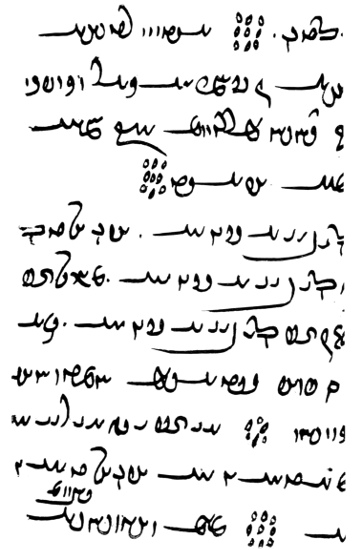
Max Müller we are enabled to give our readers a fac
simile representation[164] of this famous Yasna manuscript
which constitutes one of the fundamental documents of
Zend philology. It contains nearly eight hundred
pages,[165] and was written by Mihirāpān Kaī-Khūsrō, the
same copyist who transcribed the Copenhagen manuscript,
but it is from a different original.
118
Zarathuśtra or Zoroaster[166] is supposed to have been
the prophet of Īrān, and the author of the earliest
hymns or Gāthas, but the fact that the composition
of the books of the Zend-Avesta, extended over a
period of several centuries, precludes the possibility of
their authorship by any one individual. There is no
historic record of the birth, the life or the death of
Zarathuśtra, and this fact, together with the vast
amount of myth and legend which has grown up
around his name, has led some Orientalists to question
whether or not such a man ever lived at all.
Firdusī teaches in a mythical way that he belonged
to the time of Darius. Hyde, Prideaux and several
others claim that Zarathuśtra was the same as the
Persian Zerdūsht, the great patriarch of the Magi,
who lived between the beginning of the reign of
Cyrus and the end of that of Darius Hystaspes, while
others still claim that the prophet of Īrān belonged to
an earlier date.[167] It seems probable that he was a veritable
personage, who, although not necessarily the
author of any considerable portion of the Zend-Avesta,
may have led the departure in this direction from the
mythology of the Vedas, toward the simpler forms of
Mazdeism, but whether he lived and first taught
119among the mountains of Media, or in the land of
Baktriana, is an open question.
Indeed, the controversy which prevails among scholars
upon the exegesis of the Zend-Avesta is one of
unusual severity, and while the storm seems to center
upon the value of the Asiatic translations, there are
other questions which are involved; the personality of
Zarathuśtra[168] is not only questioned, but even amongst
those who admit that he was an historical personage,
the field of his early labors, the exact time to which
he belonged, and many other points are subjects of
spirited discussion.
In the Gāthas, or earlier hymns, Zarathuśtra appears
as a toiling prophet, and his sphere does not
seem to have been greatly restricted. The objects of
his concern were provinces as well as villages, and the
masses as well as individuals. His circle was largely
composed of the reigning prince and prominent chieftains—and
these, together with a priesthood comparatively
pure, were the greater part of his public. The
king, the people, and the peers were all portions of it.
It is claimed that Zarathuśtra had three sons, and
these were respectively the fathers and chiefs of the
three classes, priests, warriors and herdsmen; they
played little part, however, in the Mazdean system, and
are possibly only three subdivisions of Zarathuśtra, who
was “the first priest, the first warrior and the first
husbandman.”
But when the student leaves the Gāthas and turns
to the Yaśts or the Vendīdad, he goes from ground
120which is apparently historic into a land of fable. He
leaves behind him the toiling prophet, who is apparently
real, and meets the Zarathuśtra of these latter
productions in the form of a fantastic demi-god. He
is no longer described as one who brings new truth
and drives away error, but as one who overthrows demons—the
valiant smiter of fiends, like Tiśtrya and
Vāyu. He smites them chiefly, it is true, with spiritual
weapons, but he also repels the assaults of Ahriman
with the stones which AhūraAhūra gave him—stones
which are as large as a house[169]—missiles like those
that were hurled at their foes by Indra, by Agni
and by Thor. These are “the flames wherewith, as
with a stone,[170] the storm-god smites the fiend.” A
singular incident of Zarathuśtra’s birth, according to
Pliny, and later Pārsī tradition, is that he alone of
all mortals laughed while being born. This tradition
would indicate that his nativity was in the region
which was the birthplace of the Vedic Marūts—those
storm genii which are “born of the laughter of the
lightnings.”
Zarathuśtra is not the only lawgiver and prophet
which the Avesta recognizes. Gayo Maratan, Yima
and even the bird Karśipta,[171] appear under different
names, forms and functions, as god-like champions in
the struggle for light, and they knew the law as well
121as Zarathuśtra. Many of the features of Zarathuśtra
point to a god, but the mythology has probably grown
up around a man, and the existing mythic elements
have been woven into a halo to surround a human
face. There has been much of individual genius in
the formation of Mazdeism, but the system as a whole
was probably produced by the elaboration of successive
generations of the priesthood.
It is evident to the historian that the Zend-Avesta
should be carefully studied by all who value the records
of the human race, but its influence for good or
evil cannot be determined without understanding something
of the character and habits of the people to
whom it peculiarly belonged. There have been periods
in the world’s history when the religion of the Pārsīs
threatened to dominate over all others. If Persia had
won the battles of Marathon and Salamis, and thus
succeeded in the final conquest of Greece, the worship
of Ormazd might have become the religion of the
whole civilized world. Persia already ruled over the
Assyrian and Babylonian empires; the Jews were under
her power, and the sacred monuments of Egypt had
been mutilated by the Persian soldiery.
Again, during the Sassanian dynasty, the national
faith had revived to such an extent that Shapur II
gathered the sacred books and issued their code of law
to the people, while the sufferings of the persecuted
Christians in the east were as terrible as they had ever
been in the west—Rome herself being rivaled in the
work of cruelty. But the power of Persia was broken
122by the Mohammedan conquest, and the war-cry of the
Moslem was the herald of defeated tyranny; hence it
is that Mazdeism, although once the fear of the world,
has for a thousand years had but little interest except
for the historian. It was once the state religion of a
powerful empire, but it was virtually driven away from
its native soil by the sons of the desert, and the star
and crescent waved in triumph above its broken altars.
Deprived of political influence, and without even the
prestige of an enlightened priesthood, many of its
votaries became exiles in a foreign land, while the few
that remained on Persian soil almost disappeared under
the iron hand of Mohammedan rule. In less than a
century after their defeat, nearly all the conquered
people who remained upon their native soil were
brought over to the faith of their new rulers, either by
persecution or policy, or by the attractive power of a
simpler creed, while those who clung to the faith of
their fathers sought a new home in the land of the
Hindūs, and found a refuge on the western coast of
India and the peninsula of Gujarāt. Here they could
worship their old gods, repeat their old prayers, and
perform their old rites; and here they still live, and
thrive to a certain extent, while their co-religionists in
Persia are daily becoming fewer in numbers.[172]
The Pārsīs of the old school used mats for seats,
and ate with their fingers from platters, but these
and similar practices were cleanly and refined when
compared to some of their revolting and loathsome
ceremonies. Anthon says, “If the religion of Zoroaster
was originally pure and sublime, it speedily degenerated
and allied itself to many very gross and
123hideous forms of superstition; if we were to judge of
its tendency by the practice of its votaries, we should
be led to think of it more harshly than it may have
deserved. The court manners were equally marked by
luxury and cruelty—by luxury refined until it had
killed all natural enjoyment, and by cruelty carried
to the most loathsome excess that perverted ingenuity
could suggest. It is above all the barbarity of the
women that fills the Persian chronicles with their most
horrible stories, and we learn from the same sources
the dreadful depravity of their character, and the vast
extent of their influence.”[173] It is a well known fact in
the world’s history that the influence of an unprincipled
woman is much stronger over a man who
yields to her power than is the influence of kindness
and truth to win him to higher associations, and therefore
we find that at a certain period, the men of
Persia, cramped by the rigid power of ceremonials,
and surrounded by the ministers to their artificial
wants, became the slaves of their priests and concubines.
It is probably true that even after the people
had lost much of the original purity and simplicity of
their manners, the noble youth of Persia were still
educated in the severe discipline of their ancestors,
which is represented as nearly resembling that of the
Spartan, but gradually the ancient discipline became
either wholly obsolete or degenerated into empty forms.
The religion of the Pārsīs is sometimes called Dualism,
on account of its main tenet; it is called Mazdeism,
124because Ahūra Mazda is its supreme god; it is
called Magism, because its priesthood are the Magi;
it is called Zoroastrianism, as representing the doctrines
of its supposed founder, and it is also called Fire
Worship, because fire has for centuries apparently received
the adoration[174] of the people.
At present the number of the Pārsīs in western
India is estimated at about one hundred thousand,
while Yezd and Kermān together can claim only about
fifty-five thousand. Hence, while the colonies upon
the soil of India have retained their strength much
better than the others, the grand total is very small,
being only about one-tenth of one per cent. of the
population of the world. They are still known as
Fire-Worshippers, although they protest against the
name, as indicating that they are mere idolators. It
is doubtless true that at one time fire itself was worshipped,
and Atar, the fire-god, held high rank among
the Zoroastrians. The primitive Āryan hearth, upon
which the sacred element blazed, was also an object
of adoration, and the Pārsīs still admit that in their
youth they are taught to face some luminous object
while worshipping God, although they claim that they
look upon fire as merely an emblem of divine power.
There is certainly the existence of a strong national
instinct—an indescribable one—which is felt by every
125Pārsī in regard to both light and fire. They are the
only Eastern people who abstain entirely from smoking,
and they will not even blow out a candle unless compelled
to do so.
The modern Pārsīs believe in monotheism, and
use a table, as well as knives and forks at their
meals. Their prayers are recited in the old Zend
language, although neither he who repeats, nor they
who listen can understand a word that is said. Every
one goes to the fire temple when he chooses and recites
his prayers himself, or pays the priest to recite
them for him. Among the whole body of priests,
there are perhaps not more than twenty who can lay
any claim to a knowledge of the Zend-Avesta, and
even these have only learned the meaning of the
words they are taught, without knowing the language
either philosophically or grammatically.
The modern Pārsīs are monogamists, and hence
the manifold evils of the harem are abolished from
among the people. They do not eat anything which
is prepared by a cook belonging to another creed.
They also object to beef and pork. Their priesthood
is hereditary. None but the son of a priest can
take the orders, and it is not obligatory upon him
to do so. The high priest is called Dastūr, while
the others are called Mobed. They are greatly attached
to their religion on account of its former
glory, and it is felt that the relinquishment of it
would be the giving up of all that was most sacred
and precious to their forefathers. Still they have, in
many essential points, unconsciously approached the
doctrines of Christianity, and if they could but read
126the Zend-Avesta they would find that their faith is
no longer the faith of the Yasna or the Vendīdad.[175]
As historical relics these works will always be of
value, but as the oracles of faith they lack the
vitality of principle necessary for the building of
human character.
127
THE GĀTHAS—THE WAIL OF THE KINE—THE LAST
GĀTHA—THE MARRIAGE SONG—THE YASNA—COMMENTARY
ON THE FORMULAS—THE YASNA HAPTANG-HĀITI—THE
SROSH YAŚT—THE YASNA CONCLUDING.
The teachings of the Zend-Avesta have been partially
treated in the chapter devoted to Persian
mythology, but other features of the work seem to
demand attention here. Briefly presented, the present
world is two-fold, being the work of two hostile
beings—Ahūra-Mazda, the good principle, and Angra
Mainyu, or Ahriman, the evil principle. All that is
good in the present state of things comes from the
former, and all that is evil from the latter. The
history of the world is the history of the conflict
between these two powers, as Angra Mainyu invaded
the world of Ahūra Mazda, and marred its beauty
and truth. Man is active in the conflict, his duty
being revealed to him in the law which was given
by Ahūra Mazda to Zarathuśtra.
Although of later date, it is evident that the religion
of the Pārsīs is derived from the same source
as that of the Hindūs—derived from the faith of the
Āryan forefathers of the Hindūs and the Īrānians.
128We therefore find two strata in the mythology which
is under discussion; the one comprises all the gods
and myths which were already in existence during
the Indo-Īrānian period, and the other comprises the
gods and myths which were only developed after the
separation of the two mythologies.
There are two principal points in the Indo-Īrānian
religion. First, that there is a law in nature; and
second, that there is also war in nature. There is
law in nature, because day returns with its golden
splendor and night with its eloquent mystery; seed-time
and harvest, the planting and the fruiting,
succeed each other with unfailing regularity. There
is war in nature, because it contains powers that
work for evil, as well as those that work for good.
Hence the unceasing struggle goes on, and it is
never more apparent to the human eye than in a
storm, where a fiend seems to bear away the waters
which the earth so sadly needs, and fights with the
god who at last brings them to the thirsting plants.
Amidst all the various myths of the Indo-Īrānian
system there is a monotheism and an unconscious
dualism. But both of these disappeared in the further
development of Hindū mythology. Mazdeism,
however, lost neither of these two ideas; it clung
strongly to them both.
Hence we have the Ahūra-Mazda, “the lord of
high knowledge,” “the all-embracing sky.” He was
the Varuṇa of the Hindūs, but this name was lost
in Īrān, or remained only as the name of a mythical
region—the Varena, which was the scene of a mythical
fight between a storm-fiend and a storm-god.
129Ahūra, the heaven-god, is white, and his body is
the fairest and greatest of bodies. He is wedded to
the rivers, and the sun is his eye, while the lightnings
are his children, and he wears the heavens as
a star-spangled garment.
In the time of Herodotus, the Persians, while invoking
Ahūra-Mazda as the creator of heaven and
earth, still called the whole vault of the sky the
supreme god. This deity slowly brought everything
under his sway, and the other gods finally became,
not only his subjects, but also his creatures.
While the single elements of Mazdeism do not differ
essentially from those of the Vedic and the Indo-European
mythology generally, still the grouping of
these elements in a new order presents them in a new
form. Thus we find that in Mazdeism everything is
referred either to Ahūra Mazda or to Angra Mainyu
as its source, and hence the world is divided into two
parts, in each of which a strong unity prevails, representing
the dualism of this system. Ahūra is all light,
truth, goodness and knowledge, while Angra Mainyu,
or Ahriman, is all darkness, falsehood, wickedness and
ignorance.
Man, according to his deeds, belongs to Ormazd or
to Ahriman. He belongs to Ormazd if he sacrifices to
him, and helps him by good thoughts, words and
deeds; if he enlarges his dominion and makes the
realm of Ahriman smaller by destroying his creatures;
while the man who is a friend of Ahriman and represents
evil thoughts and evil deeds, who slays the creatures
of Ormazd, is classed as a demon. Even animals
are classified as belonging to one spirit or the other,
130in accordance with the idea that they had been incarnations
of either the god or the fiend.
Killing the Ahriman creatures is killing Ahriman
himself, and many sins can thus be atoned for, while
killing Ormazdean animals is an abomination like the
killing of the god. The struggle between the good
and evil, however, is limited, for the world is not to
last forever, and Ahriman will be defeated at last.
There had been an old myth that the world would
end in a fearful winter like that of the Eddic Fimbul,
which would be succeeded by an eternal spring, but as
a storm is the ordinary symbol of strife, the view
which finally obtained in their mythology, is the prediction
that the world will finally end in a battle of
the elements.
The Pārsīs came at last to a pure monotheism, and
to a certain extent this change may have been influenced
by the creed of the Moslem that “there is
one God, and Mohammed is his prophet,” but the
difference in sentiment cannot be ascribed to any one
generation, for it is really deeper and wider than the
movement which, in earlier times, brought the Magi
from an imperfect form of dualism to one which was
much more decided in its presentations.[176]
The five Gāthas which have been attributed to
Zarathuśtra are doubtless the earliest portions of the
Zend-Avesta. They comprise seventeen sections of poetical
matter, equal in extent to twenty-five or thirty
hymns of the Ṛig-veda. They are composed in the
131ancient Āryan metre, and ascribe supreme power to
Ahūra Mazda, who is opposed constantly by the spirit
of evil.
In these early songs, the kine, as the representative
of the people, laments the burden which is laid upon
Īrānian life. The effort to win their bread by honest
labor is opposed, although not entirely frustrated, by
the Deva-worshipping tribes, who still struggle with the
Zarathuśtrians for the control of the territory. The
kine, therefore, lifts her wail to Ahūra, who responds
by the appointment of Zarathuśtra as the being who is
entrusted with her redemption; and he, accepting his
commission, begins his labors. We then have a series
of lamentations and praises addressed by Zarathuśtra
and his immediate associates to Ahūra; also exhortations
which are addressed to the people.
These hymns were composed amidst an agricultural
people, many of whom were also herdsmen. Their
land and their cattle being their most valuable property,
the raids of the Deva-worshippers were looked
upon as most terrible visitations. In the course of
these invasions, we have also intimations of an organized
effort on the part of the foe to overwhelm the
Zarathuśtrians, and it appears that at times they very
nearly accomplished their object, sanguinary conflicts
being repeatedly alluded to. It may be inferred by
the prevalence of the thankful tone in the Gāthas,
that the Zarathuśtrians were not conquered during the
Gāthic period, although at the time that the last
hymns of the series were written, the struggle was by
no means over.
There is an historical tone in the Gāthas, which
132should be carefully observed. Their doctrines and exhortations
concern an actual religious movement,
which was taking place at the time of their composition,
and that movement was apparently pure and earnest.
Their tone is always serious, and nearly all the
myths are dropped; even the old Āryan gods, who reappear
in the later Avesta, being ignored with a single
exception.
In the first Gātha, the soul of the kine, as representing
the herds of the Īrānian people, raises her
voice in lamentation. She asks why and for whom
she was made, since afflictions compass her and her
life is constantly threatened by the incursions of predatory
tribes. She also beseeches the Bountiful Immortals
to instruct her as to the benefits of agriculture,
and confirm her protectors in the science, as the only
remedy for her sufferings.
“Unto you, O Ahūra and Asha, the soul of the kine cried aloud,
‘For whom did ye create me?
And for whom did ye fashion me?
On me comes the assault of wrath and of violent power;
The blow of desolation and thievish might.
None other pasture given have I than you;
Therefore do ye teach me good tillage
For the fields, mine only hope of welfare.’”
Ahūra speaks:
“Upon this the Creator of the kine asked of Righteousness,
133‘How was thy guardian for the kine appointed by thee,
When having power over all her fate ye made her?
In what manner did ye secure for her, together with pasture
A cattle-chief who was both skilled and energetic?
Whom did ye select as her life’s master
Who might hurl back the fury of the wicked?’”
Asha answers:
To him the Divine Righteousness answered:
“Great was our perplexity;
A chieftain who was capable of smiting back their fury
And who was himself without hate
Was not to be obtained by us.”
Zarathuśtra intercedes:
“The Great Creator is himself most mindful
Of the uttered indications which have been fulfilled beforehand
In the deeds of demon gods.
The Ahūra is the discerning arbiter;
So shall it be to us as he shall will.
Therefore it is that we both,
My soul and the soul of the mother kine,
Are working our supplications for the two worlds
To Ahūra, and he will answer,
‘Not for the righteous—
Not for the thrifty tiller of the earth,
Shall there be destruction together with the wicked?’”
134Ahūra speaks:
Upon this the Lord spake thus:
“Not in this manner is a spiritual master found;
Therefore thee have I named
For such a head to the tiller of the ground.
... This man is found
Who alone has hearkened to our enunciations:
Zarathuśtra Spitama
I will give him the good abode
And authoritative place.”
Voice of the Kine:
Upon this the soul of the kine lamented:
“Woe is upon me
Since I have obtained for myself in my wounding
A lord who is powerless to effect his wish,
The voice of a feeble and pusillanimous man;
Whereas I desire one who is lord over his will,
And able as one of royal state,—
Who is able to accomplish what he desires to effect.”
Zarathuśtra:
“Do ye, O Ahūra, and thou, O Righteousness,
Grant gladness unto these:
Bestow upon them the peaceful amenities of home
And quiet happiness....
Do ye now therefore assign unto us your aid in abundance
For our great cause.
May we be partakers of the bountiful grace of these your equals,
Your counsellors and servants.”
135Zarathuśtra, having entered upon the duties of his
office, composes a liturgy for the benefit of his colleagues,
which is given in the second hymn. The
doctrine of dualism is next taught. The progress and
struggles of the cause are presented. There is a song
of thankfulness offered in gratitude for improved
fortunes.
In the third Gātha, salvation is announced as universal
for believers, and also contains the reflections
of Zarathuśtra upon the sublimity and bountifulness
of Ahūra. There are also personal hopes and appeals.
While the matter of this hymn is homogeneous
with that of the other Gāthas, it bears some evidence
of having been composed in the latter portion of
Zarathuśtra’s life. The subject is a marriage song of
a political and religious character. The freshness and
vigor of the style may indicate Zarathuśtrian influence,
if not authorship. The marriage festival of the
prophet’s daughter must have been a semi-political
occasion, and the author would naturally express himself
in reference to the struggle which was still going
on.
“That best prayer has been answered,
The prayer of Zarathuśtra Spitama
That Ahūra Mazda
Might grant him those boons
Which flow from the Good Order;
Even a life that is prospered for eternal duration;
And also those who deceived him;
136May he also grant him,
As the good faith’s disciples in word and in deed.”
The master of the feast then speaks as follows:
“And him will they give thee,
Oh Pouroukista,
Young as thou art of the daughters of Zarathuśtra,
Him will they give thee
As a help in the true service Asha and Mazda,
As a chief and a guardian.
Counsel well then together,
And act in just action.”
The bride answers:
“I will love him,
Since from my father he gained me.
For the master and toilers,
And for the lord-kinsman,
He, the Good Mind’s bright blessing.
The pure to the pure ones.
And to me be the insight which I gain from his counsel.
Mazda grant it for good conscience forever.”
Priestly master of the feast:
“Monitions for the marrying,
I speak to you, maidens,
And heed ye my saying:
By these laws of the faith which I utter
Obtain ye the life of the good mind
On earth and in heaven.
137And to you, bride and bridegroom,
Let each one the other in righteousness cherish,
Thus alone unto each shall the home life be happy.
Thus real are these things, ye men and ye women
From the lie-demon protecting
A guard o’er my faithful
And so I grant progress and goodness
And the hate of the lie with the hate of her bondsmen
I would expel from the body—
Where is then the righteous lord that will smite them from life
And beguile them of license?
Mazda! there is the power which will banish and conquer.”
[177]
The word Yasna means worship including sacrifice.
This was the principal liturgy of the Zarathuśtrians,
in which confession, invocation, prayer, exhortation
and praise are all combined. The Gāthas are sung
in the middle of it and in the Vendīdad Sadah; the
Visparad is interpolated within it. Like other compositions
of its kind, it is largely made up of the
fragments of different ages and modes of composition.
We have no reason to suppose that the Yasna existed
in its present form in the earlier periods of Zarathuśtranism,
but the fragments of which it is composed,
may, some of them, reach back to that era, and
even its present arrangement is comparatively early in
138the history of Mazdean literature. The following extracts
have been chosen as representing the finest
specimens of poetic fervor to be found in the Yasna:
“I will announce and I will complete my Yasna to Ahūra Mazda,
The radiant and glorious, the greatest and best,
The one whose body is the most perfect,
Who has fashioned us,
And who has nourished and protected us,
Who is the most bounteous spirit....
“I will announce and I will complete my Yasna to the Good Mind,
And to Righteousness the best,
To the Universal Weal and Immortality,
To the body of the Kine and to the Kine’s soul,
And to the fire of Ahūra Mazda,
Who, more than all the Bountiful Immortals
Has made the effort for our success....
“I will announce and I will complete my Yasna to Mithra of the wide pastures,
Of the thousand ears, and of the myriad eyes
The Izad of the spoken name.
[178]
“I celebrate and complete my Yasna to the Fravishas
[179] of the saints,
And to those women who have many sons,
139And to a prosperous home life
Which continues without reverse throughout the year,
And to that might which strikes victoriously....
“I announce and complete my Yasna to the Māhya,
The monthly festivals, lords of the ritual order,
To the new and the later moon, and to the full moon which scatters night....
“I announce and complete my Yasna to the yearly feasts....
Yea, I celebrate and complete my Yasna
To the seasons, lords of the ritual order....
“I announce and complete my Yasna
To all those who are the thirty and three,
[180]Lords of the ritual order....
“To Ahūra and to Mithra, to the star Tiśtrya,
The resplendent and glorious,
To the moon and the resplendent sun,
Him of the rapid steeds, the eye of Ahūra Mazda.”
The sacrifice is long continued, and the gods are
again approached with interminable ritual, and the
naming of the objects of propitiation; the offerings
are then made to each of the gods, the fire of
earth receiving especial attention, as well as the stars
of heaven and all the Bountiful Immortals.
At each presentation of the offering by the priest,
the object of propitiation is named. There are invocations
140and dedications almost without number, Zarathuśtra
being also mentioned as an object of worship.
“And we worship Zarathuśtra Spitama in our sacrifice,
The holy lord of the ritual order,
And we worship every Izad as we worship him;
And we worship also the Fravisha of Zarathuśtra Spitama, the saint.
And we worship the utterances of Zarathuśtra and his religion,
His faith and his love.
And we worship the former religions of the world devoted to Righteousness,
Which were instituted at the creation,
The holy religion of Ahūra Mazda,
The resplendent and glorious....
And we worship the milk offering and the libation,
The two which cause the waters to flow forth,
And we worship all waters and all plants,
And all good men and all good women.”
[181]
This commentary is written in the Zend language,
and is valuable as a specimen of early exegesis. Zarathuśtra
is here represented as holding a conversation
with Ahūra Mazda, and in reply to his questions
Ahūra says: “Whoever in this world of mine shall
mentally recall a portion of the Ahuna-vairya (formulas),
and having thus recalled it, shall undertone it,
and then utter it aloud; whoever shall worship thus,
141then even with threefold safety and speed I will
bring his soul over the bridge of Kinvaḍ (Chinvat).
I who am Ahūra Mazda will help him to pass over
it to heaven, the best life, and to the lights of heaven.”
“And whoever, O Zarathuśtra, while undertoning
the parts of the Ahuna-vairya, takes aught therefrom,
I who am Ahūra Mazda will draw his soul off from
the better world; yea, so far will I withdraw it as
the earth is large and wide.
“And this word is the most emphatic of the words
which have ever been pronounced, or which are now
spoken, or which shall be spoken in the future, for
this utterance is of such a nature that if all the living
world should learn it, and learning, hold fast by
it, they would be redeemed from their mortality.”[182]
This Yasna of the “Seven Chapters” appears to
rank next in antiquity to the Gāthas, but the tone
is considerably changed, although the dialect remains
the same. We have here a stronger personification
of the Bountiful Immortals, while fire is still worshipped;
also the earth and grass. We find here praise
to Ahūra and the Immortals, to fire, to the creation, to
the earth and to sacred waters. The sacrifice to the
“Soul of the Kine” is also given, and the sacrifices to
both earth and heaven, to the stormy wind that
Mazda made, also to the peaks of the beautiful
mountain.
“And we worship the Good Mind and the spirits
of the saints. And we sacrifice to the fish of fifty-five
142fins, and to the Unicorn which stands in Vourūkasha,
and to the sea where he stands, and to the
Haoma, golden flowered, growing on the heights.
We sacrifice to Haoma, that driveth death afar, and
to the flood streams of the waters, and to the great
flight of the birds, and to the approach of the Fire-priests
as they approach us from afar,[183] and seek to
gain the provinces and spread the ritual law.”[184]
The Yasna also includes several Yaśts, or hymns of
praise, some of which contain poetry as well as
praise. As Sraosha is the only divinity of the later
groups mentioned in the first four Gāthas, the Yaśt
which is dedicated to him appears to rank in antiquity
next to those fragments which are found in the
Gāthic dialect. The name of Sraosha appears still to
retain its meaning as the abstract quality of obedience
although it is personified.
“Propitiation be to Sraosha, Obedience the blessed, the Mighty,
The incarnate mind of reason,
Whose body is the Mithra,—
Him of the daring spear devoted to the Lord
For his worship, homage, propitiation and praise.
“We worship Sraosha, the blessed, the stately,
Him who smites with the blow of victory,
For his splendor and his glory,
For his might and the blow which smites with victory.
143“I will worship him with the Yasna of the Izads.
And we worship all the words of Zarathuśtra
And all the deeds well done for him...
“We worship Sraosha, the blessed,
Whom four racers draw in harness,
White and shining, beautiful and powerful
Quick to learn and fleet,
Obeying before speech,
Heeding orders from the mind,
With their hoofs of horn, gold-covered,
Fleeter than our horses, swifter than the winds;
More rapid than the rain-drops as they fall,
Yea, fleeter than the clouds or well-winged birds,
Or the well-shot arrow as it flies
Which overtake not these swift ones
As they fly after them pursuing,
But which are never overtaken when they flee,
Which plunge away from all the weapons
And draw Sraosha with them,
The good Sraosha and the blessed.
“We worship Obedience, the blessed,
Who, though so lofty and so high, yea, so stately,
Yet stoops to Mazda’s creatures, even to the girdle....
For his splendor and his glory,
For his might which smites to victory.
I will worship him with the Yasna of the Izads,
And may he come to aid us,
He who smites with victory.
Obedience the blessed.”
[185]
144
This Yasna, having been composed long after the
supposed time of Zarathuśtra, can hardly be genuine
in its present shape. It may, however, be an elaboration
of an earlier document.
“Frashaośtra the holy, asked the saintly Zarathuśtra,
‘What is, in very truth, the memorized recital
of the rites? What is the completed delivery of the
Gāthas?’”
“Zarathuśtra said, ‘We worship Ahūra Mazda with
our sacrifice as the holy lord of the ritual order, and
we sacrifice to Zarathuśtra likewise as the holy lord of
the ritual order, and we sacrifice to the Fravisha of
Zarathuśtra, the saint.
‘And we sacrifice to the Bountiful Immortals, the
guardians of the saints, and we sacrifice to all the
good, heroic and bounteous Fravishas of the saints....
And we worship all the five Gāthas, the holy
ones and the entire Yasna, and the sounding of its
chants.
‘And we sacrifice to all the springs of water and
to the water streams as well, and to growing plants
and forest trees, and to the entire land and heaven,
and to all the stars, and to the moon and sun, even
to all the lights without beginning....
‘We sacrifice to the active man and to the man of
good intent, for the hindrance of darkness, of wasting
of the strength and life, and to health and
healing.
‘We sacrifice to the Yasna’s ending words, and to
them which end the Gāthas, and we sacrifice to the
145bounteous hymns themselves, which rule in the ritual
course, the holy ones....
‘And we sacrifice to the souls of the dead which
are the Fravishas of the saints, and we sacrifice to
that lofty Lord who is Ahūra Mazda himself.’”
146
THE VENDĪDAD—FARGARD II—THE VARA OF YIMA—THE
LAWS OF PURIFICATION—DISPOSITION OF THE
DEAD—PUNISHMENTS—THE PLACE OF REWARD—THE
VISPARAD—TEACHING OF THE MODERN PĀRSĪS.
This portion of the Zend-Avesta is also a collection
of fragments, although the Pārsī tradition
claims that it has been preserved entire. The Vendīdad
has often been called the book of the laws of the
Pārsīs, but the greater portion of the rules here given
pertain to the laws of purification. The first two
chapters deal largely with mythical matter, and are
remnants of an old epic and cosmogonic literature—the
first dealing with the creation of Ahūra and the
marring of his work by the evil principle, and the
second treating of Yima as the founder of civilization.
Three chapters of a mythical nature about the origin
of medicine are placed at the end of the book, and
the nineteenth Fargard or section treats of the revelation
of the law by Ahūra to Zarathuśtra. The other
seventeen chapters deal largely with observances and
ceremonies, although mythical fragments are occasionally
met with, which have more or less connection
with the text, many of them, perhaps, being interpolations
of a later date. About eight chapters[186] are
147devoted to the impurity of the dead and the method
of dispelling it; this subject is also treated in other
Fargards, while two long sections are devoted to the
care of the dog, the food which is due him and the
penalties for offenses against him.[187] The apparent lack
of order is, perhaps, largely due to the form of expression
which was adopted by the first composers of
the Vendīdād. The law is revealed by Ahūra in a
series of answers, which are given in reply to the questions
of Zarathuśtra, and as these queries are not of
a general character, but refer to details, the matter is
presented in fragments, each of which (consisting of
a question with its answer) appears as an independent
passage.
This is the most poetical chapter in the work, and
is devoted to Yima. Ahūra here proposes that Yima,
the son of Vīvanghat, shall receive the law from him
and carry it to men. Yima, however, refuses to do
so, whereupon Ahūra gives him a commission, bidding
him to keep his creatures and make them prosper.
Yima, therefore, makes the creatures of Ahūra to
thrive and increase, keeps death and disease away from
them, and three times enlarges the earth, which had
become too small for its inhabitants. On the approach
of a dreadful winter, which was to destroy every living
thing, Yima, being advised by Ahūra, built a Vara
to preserve the seed of all animal and vegetable life,life,
and there the blessed still live happily under his rule.
148The world, after lasting a long year of twelve millenniums,
was to end in a dire winter, to be followed
by an everlasting spring, when men, being sent back
to earth from the heavens, should enjoy upon the
earth the same happiness which they had found after
death in the realms of Yima. But when a more definite
form was taken by the Mazdean cosmology the
world was made to end by fire, and therefore the Vara
of Yima, instead of remaining the paradise from which
the inhabitants of earth return, came to be a comparatively
modern representative of Noah’s Ark. In the
Vedas, Yama is the first man, the first priest and
“the first of all who died”; he brought worship here
below, as well as life, and “first he stretched out the
thread of sacrifice.”
Yima had at first the same right as his Hindū
prototype to the title of a founder of religion, but he
lost it, as in the course of the development of Mazdeism,
Zarathuśtra became the law-giver. Zarathuśtra
asked of Ahūra Mazda:
“Who was the first mortal before myself, Zarathuśtra,
With whom thou, Ahūra Mazda, did’st converse?
To whom did’st thou teach the law of Ahūra?”
Ahūra answered:
“The fair Yima, the great shepherd,
O holy Zarathuśtra!
He was the first mortal before thee
With whom I, Ahūra Mazda, did converse—
Whom I taught the law of Ahūra—
The law of Zarathuśtra.
149“Unto him, O Zarathuśtra,
I, Ahūra Mazda, spake, saying:
‘Fair Yima, son of Vīvanghat,
Be thou the bearer of my law,’
But the fair Yima replied,
‘I was not born, I was not taught
To be the preacher and the bearer of thy law.’
Then I, Ahūra Mazda, said thus unto him:
‘Since thou wantest not to be my preacher
And the bearer of my law,
Then make thou my worlds to thrive—
Make my worlds increase;
Undertake thou to nourish, to rule
And to watch over my world.’
And the fair Yima replied unto me:
‘Yes, I will make thy worlds thrive—
I will make thy worlds increase—
Yes, I will nourish and rule
And watch over thy world.’
Then I, Ahūra Mazda,
Brought the implements unto him,
A golden ring and a poniard
Behold here Yima bears the royal sway.”
Thus, under the sway of Yima, three hundred winters passed away,
And the earth was replenished with flocks and herds,
With men, and dogs and birds, and with red blazing fires,
150‘Till there was no more room for flocks and herds and men.
Then Yima stepped forward toward the luminous space
To meet the sun, and he pressed the earth with the golden ring
And bored it with the poniard, saying, thus:
“O Spenta Ārmaiti,
[189] kindly open asunder, and stretch thyself afar
To bear flocks and herds and men.”
And Yima made the earth grow larger by one-third
than it was before, and there came flocks and herds
and men, at his will, as many as he wished.
Ahūra Mazda then called a council of the gods,
and here he spake to Yima saying, “Upon the material
151earth the fatal winters are going to fall that
shall make the snow-flakes thick and deep on the
peaks of the highest mountains, and all the beasts
shall perish that live in the wilderness, and those
that live on the mountains, and those that live in
the bosom of the vale. Therefore make thee a Vara,
long as a riding-ground on every side of the square,
to be an abode for men and a fold for flocks.
There thou shalt make the waters flow, there thou
shalt settle birds by the evergreen banks that bear
the never-failing food. There shalt thou establish
dwelling places and bring the greatest, the best and
the finest of the earth, both men and women; thou
shalt bring the animals, and the seeds of the trees,
two of every kind to be kept there, so long as men
shall stay in the Vara.”
And Yima made a Vara, and brought into it all
the varieties of cattle and of plants, and the men in
the Vara which Yima made, live the happiest life,[190]
and he who brought the law of Ahūra into the Vara
was the bird Karśipta. And Yima sealed up the Vara
with the golden ring, and he made a door and a
window which was self-shining within. And Ahūra
Mazda said “There the stars, the moon and the sun,
only once a year seem to rise and set, and the year
seems only a day.”
The larger portion of the Vendīdad is devoted to a
description, with numberless repetitions, of the Mazdean
152laws of purification and the long ceremonies pertaining
to them. Impurity or uncleanness may be described
as the condition of a person or thing that is possessed
of a demon, and the process of purification is for the
purpose of expelling the evil presence. Death is the
triumph of the demon, and therefore it is the principal
cause of uncleanness; when a man dies, as soon as the
soul has left the body, the Drūj Nasu, or Corpse-Drūj,
comes from the regions of hell, and falls upon
the body, and whoever thereafter touches the corpse is
not only unclean himself, but every one whom he
touches is also unclean.
The Drūj is expelled from the dead by the Sag-dīd,
or “the look of the dog;” “a four-eyed dog,” or
“a white one with yellow ears,” must be brought
near the body, and made to look upon the dead, and
as soon as he has done so the Drūj hastens back to
hell.[191] The Drūj is expelled from the living by a process
which is too revolting for description. The ceremonies
are accompanied by the constant repetition of
spells like the following: “Perish, O fiendish Drūj!
Perish, O brood of the fiend! Rush away, O Drūj!
Perish away to the regions of the north, never more
to give unto death the living world.”
The feeling out of which these ceremonies grew
was not original with Mazdeism; the Hindū also considered
himself in danger while burning the corpse,
153and he cried aloud, “Away, go away, O Death!
injure not our sons and our men.”[192]
The Pārsīs, not being able to find a four-eyed dog,
interpreted the law to mean a dog with two spots
above the eyes, while in practice they are still less
particular, and the Sag-dīd may be performed by a
house-dog, or by a dog four months old. As birds of
prey are fiend-smiters as well as the dog, the devotee
may claim their services when there is no dog at
hand. The four-eyed dog, which the ceremony originally
called for, is doubtless a reproduction of “the
four-eyed dogs of the tawny breed of Saramā,” belonging
to Yama,[193] which guard the realms of death in
Hindū mythology. The identity of the four-eyed dog
of the Pārsīs with the dogs of Yama is confirmed by
the tradition that the yellow-eared dog watches at the
head of the Chinvat bridge, and, as the souls of the
faithful pass over, he barks to drive away the fiend
who would drag them down to hell. Wherever a corpse
is carried, death walks beside it all the way, from the
house to the last resting-place, and the fatal presence
constantly threatens the living who are near the path-way.
As the centre of contagion is in the corpse, it must
be disposed of in such a way that death may not be
spread abroad. The old Indo-European customs have
in this respect been completely changed by Mazdeism.
The corpse was formerly either burned or buried; both
of these customs, however, are held to be sacreligious
154in the Avesta. The elements, fire, earth, and water, are
holy, and even during the Indo-Īrānian period they
were already so considered, being represented in the
Vedas as objects of worship. But this did not prevent
the Hindūs from burning their dead, and the dead man
was really considered as a traveler to the other world,
while the kindly fire was supposed to carry him on
flashing pinions to his heavenly abode. The funeral
fire, like that of the sacrifice, was the god that goes
from earth to heaven, the mediator most friendly to
man.
In Persia, however, it remained more distant from
him and represented the purest offspring of the good
spirit; therefore no uncleanness could be allowed to
enter it. Its only function appears to be the repelling
of the fiends by its blaze. In every place where the
Pārsīs are settled, an everlasting fire is still kept,
which is always fed by perfumes and costly woods, and
wherever its flames are carried by the wind, it kills
thousand of fiends. No degradation must be inflicted
upon this sacred element, even blowing it with the
human breath is a crime, because the outgoing breath
is unclean; burning the dead is therefore the most
criminal act; in the time of Strabo[194] it was a capital
crime, and the Avesta places it in the list of sins for
which there is no atonement.
Water was looked upon in the same light, and throwing
dead matter into it was as unpardonable as to
pollute the sacred flame with its presence. The Magi
are said to have overthrown a king for having built
bath-houses, and the Jews were forbidden to practice
155their ablutions; in some cases the sick were even forbidden
to drink it, unless it was decided that death
would be caused by longer abstinence. The earth was
equally holy, for in her bosom there dwelt Spenta
Ārmaiti, the goddess of the earth, and to defile her
sacred dwelling by burying the dead was also a deed for
which there was no atonement.
In earlier times the Persians practiced burial even
after burning had been forbidden. Cambyses aroused
the national indignation by cremating the body of
Amasis, and years later the Persians were still burying
their dead. Afterward, however, when the Mazdean
law became dominant, the worship of the earth was included,
although it was sometime before it was considered
as sacred as fire and water. In later times the
Persians builded Dakhmas, or “Towers of Silence” for
the bodies of their dead; these towers were about
twenty feet high, and they enclosed an annular stone
pavement on which the bodies were placed. These
towers were usually built on the summit of a mountain
far from the haunts of men. A barren cliff was chosen,
free from trees or water, and the tower was even
separated from the earth herself, for it was isolated by
a layer of stones and bricks, while it was claimed that
a golden thread ran between the tower and the earth.
Here, afar from the world of men, the dead were left
to lie “beholding the sun.” The Avesta and commentary
are especially emphatic upon this point, for
“it is as if the dead man’s life were thus prolonged,
since he can still behold the sun.”
156
The penalties for the violation of the Persian law
were very severe, and human life was considered of
very little value, capital punishment being inflicted
even for the killing of a dog. Their laws were far
more barbarous than those of England in Sir William
Blackstone’s time, when one hundred and sixty offenses[195]
were declared by act of Parliament to be worthy
of instant death;[196] and death was the most humane of
the Persian punishments, when it was promptly inflicted,
for their methods were too terrible for description.
Two hundred stripes were awarded if one
tilled land in which a corpse had been buried within
a year, or if the mother of a very young child
drank water. Four hundred stripes were the penalty
if one covered with a cloth a dead man’s feet, and eight
hundred if he covered the whole body. The penalty
for killing a puppy was five hundred stripes, six hundred
for killing a stray dog, eight hundred for a shepherd’s
dog, and ten thousand stripes for killing a water-dog.[197]
In the old Āryan legislation there were many crimes
which were considered more criminal than murder, and
Persians who defiled the earth were not more severely
punished than were the Greeks who defiled the ground
of Delos, nor would the Athenians, who put Atarbes
157to death, have wondered at the awful punishment inflicted
for the killing of the Persian water-dog. There
are but few laws in the Vendīdad, however absurd,
that may not find a counterpart in the legislation of
the Greeks or Latins.
Every crime, according to the Persian law, makes the
guilty man[198] liable to two penalties, one here on earth
and another in the next world, but in ancient Persia,
as in modern legislation, there was a money value
attached to many crimes, and the rich criminal escaped
by paying his fine, so far as this present world
was concerned. In the next, however, his money is of
no value to him; when he comes to the head of Chinvat
bridge, his conscience becomes a maiden, either
of divine beauty, or of fiendish deformity, according
to his merits. The bridge itself, which reaches over
the awful chasm of hell to the heavenly shore on the
other side, widens, if he be a good man, to the width
of nine javelins; but for the souls of the wicked it
narrows to a thread and they fall down into hell.
“O, Maker of the material world! where are the
rewards given? where does the rewarding take place?”
Ahūra Mazda answered: “When the man is dead,
when his time is over, then the hellish evil-doing
158Daevas assail him; and when the third night is gone—when
the dawn appears and brightens up, and makes
Mithra, the god with the beautiful weapons, reach the
all-happy mountains, and the sun is rising. Then the
fiend carries off in bonds[199] the souls of the wicked, who
live in sin. The soul enters the way made by Time,
and open both to the wicked and the righteous. At
the head of the Chinvat bridge, the holy bridge made
by Mazda, they ask for the reward for the goods
which they have given away here below. Then comes
the well-shapen, strong and noble maiden, with the
dogs (that keep the Chinvat bridge) at her side—she
is graceful and of high understanding.
“She“She makes the soul of the righteous one to go up
above the Hara-berezaita; above the Chinvat bridge she
places it in the presence of the heavenly gods themselves;
Vohu-manō from his golden seat exclaims,
‘How hast thou come to us, thou holy one, from
that decaying world into this undecaying one? Gladly
pass the souls of the righteous to the golden seat of
Ahūra Mazda—to the abode of all the other holy
beings.”[200]
The word Visparad means “all the chiefs,” referring
to “the lords of the ritual,” therefore the various
chapters are merely used in the course of the sacrifice.
The following extracts will give the reader a
definite idea concerning the literary merit of this portion
of the Zend-Avesta:
159In this Zaothra, with this Baresman,
I desire to approach the lords of the ritual
Which are spiritual with my praise;
And I desire to approach the earthly lords as well.
And I desire to approach the lords of the water with my praise
And the lords of the land;
And I desire to approach with my praise,
Those chiefs which strike the wing,
And those that wander wild at large,
And those of the cloven hoof, who are chiefs of the ritual.
And in this Zaothra with this Baresman,
I desire to approach thee, Zarathuśtra Spitama,...
I desire to approach the man who recites the ritual rites
Who is maintaining thus the thought, well thought,
And the word well spoken, and the deed well done.
I desire to approach the seasons with my praise
The holy lords of the ritual order,....
And I desire to approach those mountains with my praise,
* * * * * * * * * *
Which shine with holiness, abundantly glorious,
And Mithra of the wide pastures,
And I desire to approach the question,
Asked of Ahūra, and the lore of the lord—
And the farm-house of the man possessed of pastures,
And the pasture produced for the kine of blessed gift,
And the holy cattle-breeding man.
160And we worship the fire here, Ahūra Mazda’s son,
And the Izads, having the seed of fire in them;
And we worship the Fravishas of the saints
And we worship Sraosha who smites to victory
And the holy man, and the entire creation of the clean.
* * * * * * * * * *
And we sacrifice to the fields and the waters...
We take up our homage to the good waters,
And to the fertile fruit-trees,
And the Fravishas of the saints, and to the kine.
And we sacrifice to that listening, that hears our prayers,
And to that mercy, and to the hearing of our homage,
And to that mercy shown in response to our praise,
And we sacrifice to that good praise which is without hypocrisy.
And which has no malice as its end.
* * * * * * * * * *
With this chant fully chanted,
And which is for the Bountiful Immortals
And by means of these ceremonial actions,
We desire to utter our supplications for the kine.
It is that chant which the saint has recognized
As good and fruitful of blessed gifts,
And which the sinner does not know.
May we never reach that misfortune
That the sinner may outstrip us in our chanting.
Nor in the matter of the plan thought out,
Or in words delivered, or ceremonies done,
Nor yet in any offering whatever, when he approaches us for harm.
[201]
161
This résumé of the ancient books will be closed by
a brief explanation of their faith in Dualism, as given
by some learned Indian Pārsīs of Bombay to Sir M.
Monier-Williams during his stay in India. In speaking
of the Dualism of Zoroaster, as understood in modern
times, Prof. Williams says:
“The explanation given to me was that Zoroaster,
although a believer in one Supreme Being, and a
teacher of Monotheism, set himself to account for the
existence of evil, which could not have its source in
an all-wise Creator.
He therefore taught that two opposite—but not opposing,
forces, which he calls ‘twins,’ were inherent
in the nature of the Supreme Being, called by him
Ahūra Mazda (or in Persian Ormazd), and emanated
from that Being, just as in Hindūism, Vishṇu and
Śiva emanate from the Supreme Brahmā. These two
forces were set in motion by Ahūra Mazda, as his appointed
mode of maintaining the continuity of the
Universe.
The one was constructive, the other destructive.
One created and composed. The other disintegrated
and decomposed, but only to co-operate with the creative
principle by providing fresh material for the work
of re-composition.
Hence there could be no new life without death,
no existence without non-existence.
Hence, also, according to Zoroaster, there was originally
no really antagonistic force of evil opposed to good.
The creative energy was called Ahūra Mazda’s beneficent
spirit (Spento-Mainyus), and the destructive
162force was called his maleficent spirit (Angro-Mainyus,
afterwards corrupted into Ahriman), but only because
the idea of evil is connected with dissolution.
The two spirits were merely antagonistic in name.
They were in reality co-operative and mutually
helpful.
They were essential to the alternating processes of
construction and dissolution, through which the cosmical
being was perpetuated.
The only real antagonism was that alternately
brought about by the free agent, man, who could hasten
the work of destruction, or retard the work of
construction by his own acts.
It is therefore held, that the so-called dualistic doctrines
of Zoroaster were compatible with the absolute
unity of the one God (symbolized especially by fire).
Ultimately, however, Zoroastrianism crystallized into
a hard and uncompromising dualism. That is to say,
in process of time, Spento-Mainyus became merely another
name for Ahūra Mazda, as the eternal principle
of good, while Angro-Mainyus or Ahriman became
altogether dissociated from Ahūra Mazda, and converted
into an eternal principle of evil.
These two principles are believed to be the sources
of two opposite creations which were incessantly at
war.
On the one side is a celestial hierarchy, at the head
of which is Ormazd; on the other side, a demoniacal,
at the head of which is Ahriman. They are opposed
to each other as light to darkness—as falsehood to
truth.
The whole energy of a religious Indian Pārsī is
163concentrated on the endeavor to make himself—so to
speak—demon-proof, and this can only be accomplished
by absolute purity (in thought, word and
deed), symbolized by whiteness. He is ever on his
guard against bodily defilement, and never goes out to
his daily occupation, without first putting on a sacred
white shirt and a sacred white girdle. Even the most
highly educated and Anglicized Pārsīs are most rigorous
observers of this custom, though it is probable
that their real creed has little in common with the old
and superstitious belief in demons and evil spirits,
but rather consists in a kind of cold and monotheistic
pantheism.
How far Zoroastrian dualism had affected the religion
of the Babylonians at the time of the Jewish captivity
is doubtful, but that the Hebrew prophets of
those days had to contend with dualistic ideas seems
probable from these words: ‘I am the Lord, and there
is none else. I form the light and create darkness; I
make peace and create evil. I the Lord do all these
things.’[202] The New Testament, on the other hand,
might be thought by a superficial reader to lend some
support to dualistic doctrines.... I need scarcely
point out, however, that the Bible account of the origin,
nature, and destiny of Satan and his angels differs,
toto cælo from the Zoroastrian description of Ahriman
and his host. Nor need I add that the various
monistic, pantheistic, and dualistic theories, briefly
alluded to in this paper, are utterly at variance with
the Christian doctrine of a Personal, Eternal and Infinite
Being, existing and working outside man, and
164outside the material universe, which He has Himself
created, and controlling both, and in the case of human
beings, working not only outside man, but in
and through him.”[203]
DIVISION IV. The Period Succeeding the Mohammedan Conquest. — CHAPTER IX. THE ANWĀR-I-SUHALI. — THE BEES AND THEIR HABITS. — THE TWO PIGEONS. — THE BLIND MAN AND HIS WHIP. — AMICABLE INSTRUCTION. [230] — THE PIGEONS AND THE RAT. — THE ANTELOPE AND THE CROW. — THE BRĀHMAN AND THE ICHNEUMON. — THE ELEPHANT AND THE JACKAL. — GEMS FROM THE HITOPADEŚA. — CHAPTER X. PERSIAN POETRY. — THE SHĀH NĀMAH. — FIRDUSĪ. — INVECTIVE. — MŪHTESHIM. — DEATH OF FIRDUSĪ. — THE POEM. — CHAPTER XI. STORY OF THE SHĀH NĀMAH. — THE SĪMŪRGH’S NEST. — THE FATHER’S DREAM. — RŪDABEH. — THE MARRIAGE. — RUSTEM. — THE TŪRĀNIAN INVASION. — THE WHITE DEMON. — CHAPTER XII. THE HEFT-KHĀN, OR SEVEN LABORS OF RUSTEM. — ESCAPE FROM THE DESERT. — THE DRAGON SLAIN. — THE ENCHANTRESS. — VICTORY OVER DEMONS. — THE MARRIAGE OF RUSTEM. — SOHRĀB. — CHAPTER XIII. ISFENDIYĀR. — THE HEFT-KHĀN, OR SEVEN LABORS OF ISFENDIYĀR, — THE BRAZEN FORTRESS. — THE CONFLICT WITH RUSTEM. — THE FALL OF THE WARRIORS. — CHAPTER XIV. SECOND PERIOD. — ANWĀRI. — NIZĀMĪ. — LAILĪ AND MAJNŪN. — A FRIEND. — THE WEDDING. — THE MEETING IN THE DESERT. — DEATH OF THE LOVERS. — THE VISION OF ZYD. — CHAPTER XV. THIRD PERIOD. — JALAL-UDDIN RŪMI. [266] — THE FAIREST LAND. — SĀ’DĪ. — THE WORKS OF SĀ’DĪ. — THE BŪSTĀN. — THE PEARL. — KINDNESS TO THE UNWORTHY. — SILENCE THE SAFETY OF IGNORANCE. — DARIUS AND HIS HORSE-KEEPER. — STORIES FROM THE GŪLISTĀN. — THE WISE WRESTLER. — DANGERS OF PROSPERITY. — BORES. — CHAPTER XVI. LATER PERIODS. — HĀFIZ. — SHĪRĀZ. — THE FEAST OF SPRING. — MY BIRD. — FIFTH PERIOD. — JĀMI. — THE WORKS OF JĀMI. — RECEPTION. — THE SIXTH PERIOD. — THE SEVENTH PERIOD. — CHAPTER XVII. MEHER AND MŪSHTERI. — THE TWO COMRADES. — THE SEPARATION. — THE QUEEN. — THE DEPARTURE. — THE ANNOUNCEMENT. — CHAPTER XVIII. MEHER AND MŪSHTERI—CONTINUED. — THE DESERT. — A SHIPWRECK. — THE RESCUE. — THE CAPTURE. — CHAPTER XIX. MEHER AND MŪSHTERI—CONTINUED. — ROYAL INTERVIEWS. — THE CONFLICT. — A GARDEN SCENE. — AFTERWARDS. — THE DECISION. — CHAPTER XX. MEHER AND MŪSHTERI—CONTINUED. — ARREST AND TRIAL. — ROYAL FAVOR. — THE SENTENCE. — CHAPTER XXI. MEHER AND MŪSHTERI—CONCLUDED. — ROYAL CAVALCADE. — THE MESSENGER. — THE RECEPTION. — CHAPTER XXII. CONCLUSION. — PRIESTLY RULE. — RUSSIAN OPPRESSION.
189
HISTORY OF THE WORK—PREFACE—THE BEES AND
THEIR HABITS—THE TWO PIGEONS—THE BLIND
MAN AND HIS WHIP—AMICABLE INSTRUCTION—THE
PIGEONS AND THE RAT—THE ANTELOPE AND THE
CROW—THE ELEPHANT AND THE JACKAL—GEMS
FROM THE HITOPADEŚA.
There were two collections of early fables in Sanskṛit
literature, called the Panćatantra and the
Hitopadeśa, and during the reign of the Sassanian kings
a quaint old book containing these stories was brought
to the Persian court and translated into the Pahlavī
tongue. This was a notable event in the history of
Āryan literature, and since that time[225] this rare collection
of simple stories has passed through more mutations
than has the Roman Empire; it is now extant,
under various names, in more than twenty languages,
190the Persian version being known as the Anwār-i-Suhali,
or “The Lights of Canopus.”[226] It is recorded that King
Nūshirvan commissioned an officer of state to procure
a translation of this work, and, being obtained after
years of difficulty, it was deposited in the cabinet of
the king’s most precious treasures, and was regarded
as a model of wisdom and didactic philosophy. But
at the time of the Arabian conquest, this work, with
many others, was destroyed by the vandals of the
desert. More than a hundred years later the book was
discovered and translated into Arabic by Almokaffa,[227]
it then passed through the hands of several Arabic
poets, and was afterward retranslated into Persian,
first into verse, by Rudāki in the tenth century, and
into prose in the twelfth century by Nasrāllah. As
early as the eleventh century the Arabic work of
Almokaffa was translated into Greek by Simeon, and
then passed into the Italian. Again the Arabic text
was translated into Hebrew by Rabbi Joel, and this
Hebrew version became the principal source of the
European books of fable. Before the end of the
fifteenth century, John of Capua had published a
Latin version, and a more elegant Persian rendering
was made in the beginning of the fifteenth century
by Husain Va’iz. A Turkish translation had been
made early in the tenth century, but there was no
Hindūstānī version until much later. The number of
translations indicated the extreme popularity of the
191work in Europe, and in the sixteenth century it was
read in German, Italian, Spanish and French. The
English has not so many versions, although both Sir
William Jones and Prof. Max Müller have translated
the Hitapodeśa, and Prof. Eastwick has given us a
faithful reproduction of Husain Va’iz’s work, the Anwār-i-Suhali.
The Persian version is the book which candidates
for the position of interpreter are required to read
after the Gūlistān, as the great number of words and
the variety of its style make it the best book in the
language to be studied by one who wishes to make
rapid progress in Persian. In the present century
Major Stewart, professor of Persian at the East India
College at Haileyburg, published a translation of the
seventh book of this work, and dedicated it to the
civil and military employés of the East India Company.
The repetition of metaphor and highly florid
style of composition is often offensive to the English
reader, but these very characteristics form its greatest
attraction in the eye of Persian litterateurs, and
many stories are delightful to them which are wearisome
or repulsive to the simpler taste of the western
student. In this fanciful work kings are represented
as sitting on thrones as stable as the firmament, while
they touch the stars with their foreheads, and have
all other kings to serve them. Royalty is always just,
wise, valiant and most beneficent—ministers are invariably
gifted with intellects which are an ornament to
the world, and they can solve all problems with a
single thought. Mountains rival the planets in their
height, and all gardens are fair as dreams of paradise,
192while the heroes conquer animals so furious that
even their appearance frightens the constellations out
of the heavens. These absurdities are so prominent
that they tempt the student to turn away in disgust,
but those who patiently peruse the book will discover
many beautiful thoughts, many striking and practical
ideas, which are forcibly and often beautifully expressed.
The preface is similar to that of many other Persian
works, being composed very largely of a eulogy
upon Mohammed, and especially upon the royal dignitary
to whom the work is dedicated.
A brief extract from this literary curiosity will
give the reader an example of the fulsome praise
which Persian authors thought best to bestow upon
the kings or court officials who encouraged their pursuits.
“And he is the great Amīr, the place where all
excellences and high qualities centre, through the sublimity
of his spirit, ... who, without compliment,
is the star Canopus shining from the right
hand of Yaman, and a sun diffusing radiance, from
the dawning place of affection and fidelity.
Where Canopus falls thy ray, and where
Thou risest, fortune’s marks are surely there.
“With“With a view to the universal diffusion of what is
advantageous to mankind, and the multiplying of what
is beneficial to the high and low, he condescended to
favor me with an intimation of his high will, that this
humble individual, devoid of ability, and this insignificant
person of small capital, should be bold enough to
193clothe the said book in a new dress, and bestow fresh
ornament upon the beauty of its tales of esoteric meaning,
which were veiled and concealed by the curtain of
obscure words and difficult expressions, by presenting
on the stages of lucid style and the chambers of becoming
metaphors after a fashion that the eye of every
examiner, without a glance of penetration, may enjoy
a share of the loveliness of these beauties, of the ornamented
bridal chamber of narrative, and the heart of
every wise person, without the trouble of imagining,
may obtain the fruition of union with those delicately
reared ones of the closet of the mind.”[228]
A preface of this kind is surely calculated to deter
the student from seeking further for the beauties of
this peculiar work, but when divested of the cumbersome
verbiage these stories will be found both quaint
and pleasing. A few of the best of them are here
given in simple phrase:
There stood in the garden an old tree, whose leaves
had fallen, and there was no vitality with which to replace
them. The hatchet of the peasant Time had
mutilated its limbs, and the saw of the carpenter Fortune
had sharpened its teeth in making shreds of its
warp and woof. The centre of the tree had become
hollow, and a busy swarm of bees had made it their
fortress. When the king heard the buzzing of the little
workers, he inquired of his sage why these little insects
gathered in the tree, and at whose command they
resorted to the meadow. Then the minister replied:
194“O, fortunate prince, they are a tribe doing much
good and little harm. They have a queen larger in
bulk than themselves, and have placed their heads on
the line of obedience to her majesty; she is seated
upon a square throne of wax, and she has appointed
to their several offices her vizier and chamberlain, her
porter and guard, her spy and deputy. The ingenuity
of her attendants is such that each one prepares hexagonal
chambers of wax, having no inequality in their
partitions, and the best geometricians would be unable
to do such work without instruments. When this
work approaches completion they come forth from their
abode at the queen’s command, and a noble bee explains
to them that they must not exchange their
cleanliness for grossness, nor pollute their purity by
evil associations. They therefore sit only beside the
fair lily or fragrant rose, in order to draw therefrom
the purest honey. When they come to the home the
warders try them by smelling, and if they have kept
their sacred trust and avoided all impure associations,
permission is given them to re-enter the immaculate
chambers of white wax. But there are many blossoms
which, though beautiful to the eye, will poison
those who touch them, and the foolish bee who is
attracted by their deceitful loveliness is also polluted
by their fatal breath; when he comes to the portals
of the hive the quick scent of the warders detect the
fact if he has been polluted by evil surroundings, and
the offender is quickly punished by decapitation. If,
however, the warders should be negligent enough to
allow the culprit to enter, and the queen of this spotless
palace should detect the offensive taint, both the
195culprit and the careless warders will be conducted to
the place of punishment and the warders will be executed
first. It is recorded that Jamshid, ‘Emperor of
the World,’ borrowed from these wise disciplinarians the
regulations respecting warders and guards, the appointment
of chamberlains and door-keepers, and also the
arrangement of thrones and regal cushions, which, in
the course of time, perfected our customs.”
Upon hearing this wonderful illustration of the effects
of bad company upon the unfortunate bee, and learning
that every man carries with him a portion of the
vileness of his evil companions, the king exclaimed:
“I have been convinced to-day that the society of some
persons is more hurtful than the poison of a viper,
and the association with them more dangerous than a
position which involves the peril of one’s life, and I
reason therefrom that it may be better to live in seclusion.”
But the sage replied: “Great leaders have
preferred the companionship of the good and true, but
when a sincere friend is not to be found, then indeed
solitude is better than society.”
There were two faithful pigeons who at one time
consorted together in one nest, with their loyal hearts
undisturbed by treachery, and free from misfortune.
One was named Bāzindah (playful), and the other was
called Nawāzindah (caressing), while every morning and
evening their voices were mingled in the soft notes of
love. But some were envious of the happy pair, and
evil counsellors attempted to “sever love, and friend
from friend divide.”
196An anxious desire for travel was carefully instilled
into the ambitious heart of Bāzindah, and he said to
his loving mate, “How long shall we continue in one
nest, and spend our time in one abode? I feel a desire
to wander through different parts of the world,
for, in a few days of travel, many marvelous things
are seen, and many experiences are gained. There is
no honor awarded until the sword comes forth from
the scabbard upon the field of the brave; the sky is
ever journeying, and it is the highest of all things,
while the earth which is ever still is always trampled
down, and kicked by all things, both high and low:
‘View the earth’s sphere and the revolving skies,
This sinks by rest, and those by motion rise;
Travel, man’s tutor is, and glory’s gate,
On travel, treasure and instruction wait,
From place to place had trees the power to move,
No saw nor ax could wrong the stately grove.’”
To this his gentle mate replied, “My beloved, when
thou removest thy heart from the society of thine
own, thou dost sever the cord of unity; thou mayest
unite with new comrades, but never wilt thou find
them so loyal, as those which long years of trial have
shown to be true. Remember the precept of the wise
man, and
‘Do not an old and well tried friend forego
For new allies, for this will end in woe,’
Thou mayest transgress, and what impression will my
word have upon thee then? Remember that
‘He shall his foeman’s fondest wish fulfill,
Who to well wishing friends bends not his will.’”
197Bāzindah, however tore his heart away from his
loving mate, and set forth upon the wing, exulting in
his liberty and freedom from her gentle admonitions.
With great curiosity, and perfect pleasure, he traveled
for a while through the blue air, and passed over
the bright hills and gardens of roses and lilies. After
a time he came to a mountain, and at its feet lay a
beautiful meadow; its green surface was delightful as
the gardens of heaven, and the northern breeze swept
down from the cool hills, laden with the perfume of a
thousand flowers.
“There countless roses their pavilions kept,
The grass moved wakeful, while the waters slept,
The roses painted with a thousand hues,
Their heavenly fragrance each a league diffuse.”
The setting sun was bathing the hills with its
glory when the weary pigeon reached the lovely spot,
and he nestled gratefully down amidst the green grass
and fragrant flowers to spend the night in peace and
happiness; with his head tucked under his wing, he
did not see that a shadow had darkened the fair
sunset; he did not see that its glory was shaded by
an angry storm-cloud. But soon the restless wind
was tossing the canopy of clouds into the high court
of the air, and Bāzindah’s heart was quaking with
terror as the fiery lightnings flashed around him, consuming
the hearts of the tulips beside him; the pitiless
hail dashed the bright narcissus to the earth,
while the thunderbolts seemed to tear the very heart
of the mountain.
198“In pieces was the mountain’s breast, by the lightning’s arrows riven,
And earth to its foundations shook, at the fearful voice of heaven.”
Bāzindah had no shelter from the storm—no refuge
from the pitiless hail and searching wind; in vain he
tried to hide beneath some friendly branch or amidst
the leaves and grass, still the cruel hail pelted him
like some remorseless foe, and the cold rain still
poured upon him.
“Night! gloomy night!—Heaven’s awful voice—
What tempest shower so fierce as this?
What care the gay in banquet halls?
Our perils do not mar their bliss.”
In terror and peril, the traveler passed the night
thinking of the home-nest, and the gentle mate who
would so gladly shield him from the storm with her
own pinions, and who was even now grieving her life
away in loneliness, because he came not.
But whatever feelings of penitence may have been
cherished during the perils of the night, were quickly
dissipated by the beauty of the morning light.
“From the east then drew the sun,
His golden poniard bright,
And through the earth’s dark regions
Spread a flood of yellow light.”
Bāzindah again arose upon his faithful wings, and
pursued his journey; but a royal white falcon was
abroad looking for prey,—a falcon which descends upon
the head of its quarry, swifter than the rays of the
199sun, and when soaring on high he reaches heaven
quicker than the sight of man.
“Attacking now, it left the thunderbolt behind,
And soared more swiftly than the chilling wind.”
For the pitiless bird had marked the pigeon for his
prey, and the victim’s heart began to flutter, while his
wings, paralyzed with fear, seemed to lose all power of
motion.
“When on the dove the rapid falcon swoops,
The helpless quarry unresisting droops.”
In that moment of helpless terror, Bāzindah
thought again of his faithful mate, and quickly resolved
that could he but escape this deadly peril, he
would be content at home in her downy nest. He was
already beneath the claw of the falcon, when the
flashing eye of an eagle fell upon them,—an eagle
whose talons were so sharp that the sign of Aquila
was not safe in the nest of the sky, and who, when
hungry, carried off from the meadows of heaven the
signs of Aries and Capricorn.
“Aries itself, through fear of him
Would gaze not on the sky,
Save that Bāhram,
[229] the blood drinker
Each day stood watchful by.”
This fearful bird was on the wing searching for food,
and seeing the falcon and the pigeon, he said to himself,
“Although this pigeon is only a mouthful, nevertheless
one may break one’s fast upon it,” and quickly he dashed
at the falcon:
200“The feathered rivals then to fight began,
The quarry, dodging, from between them ran.”
While the fight went fiercely on, Bāzindah threw himself
under a stone, and crowded himself into a hole
hardly large enough for a sparrow, and here he passed
the day and another night, quivering with terror and
distress. But the morning light again illumined the
mountain peaks, for the white-pinioned dove of the
dawn began to fly from the nest of heaven, and the
black raven of night went to his rest like the Sīmūrgh,
behind the shades of the distant mountains. Bāzindah
began to flutter his weary wings, and look hungrily
around him, when he gladly spied another pigeon, with
a little grain scattered before him. Rejoicing to see
one of his own species, he fluttered eagerly to the grain,
but alas! his foot was caught in a snare.
“Satan’s the net, the world’s the grain,
Our lusts the enticements are,
Our hearts, the fowl which greediness
Soon lures within the snare.”
With bitter reproaches upon the captive pigeon who
had thus lured him to destruction, he trembled and
struggled, until he broke the decayed net, and turned
his tired face toward the home-nest, and flew as rapidly
as his forlorn condition would permit. Fearing to attempt
again to satisfy his hunger, he was nevertheless
compelled to rest, at last, on a wall near a field of corn.
A thoughtless boy sent an arrow toward him, and
wounded he fell, but he lay so quietly that the young
hunter failed to find his game, and at last, weak and
wounded, hungry and discouraged, he fluttered by
201short flights homeward. Nawāzindah heard the flutter
of his wings, and flew joyously out to meet him saying:
“’Tis I whose eyes expand, my love to find—
How shall I thank thee—thou so true and kind.”
But when she had caressed him, she saw that he was
weak and thin, and she exclaimed, “Oh, beloved, where
hast thou been?”
Bāzindah replied:
“Ask me not what woes, my love,—
What pangs have been my lot,
All the grief that parting brings,
I’ve tasted—ask me not.
For travel’s conflict I’ll not lust again,
With home and friends perpetual pleasures
reign.reign.
The truth of the matter is, that I have had much
experience, and as long as I live, I will not make
another journey, nor go forth until compelled from the
corner of our nest.” Then the gentle wife flew out and
brought him the daintiest food she could find, and tenderly
she caressed the wounded wing with her loving
bill, and no thought of reproaches entered her grateful
heart. Gently she nursed him back to health and
strength, and together they cooed and nestled in their
quiet home.
A sage, who was discoursing to a king upon lessons
of wisdom and morality, gave him the following illustration
of an important principle: “Once upon a time
a blind man and his friend were making a journey together,
202and they halted in a wild place for the night;
the morning found them cold and little rested, for the
weather had suddenly grown severe. In searching for
his whip the blind man picked up a frozen snake,
which he found smoother and more nicely polished
than his whip, and greatly pleased he mounted his
horse, forgetting the faithful old whip which he had
lost. His friend, however, could see, and when he beheld
the snake in the hand of the blind man, he cried
out: ‘Oh, my friend! what thou takest for a whip is a
poisonous snake, fling it away before it makes a wound
upon thy hand.’ But the blind man fancied that his
friend was jealous of his great success in finding so
beautiful a whip, and he answered: ‘Oh, friend! it is
owing to my good luck, that I have found a better
one, and I am not going to be wheedled out of my
good fortune by idle tales.’ His friend continued to
plead, but the man was obstinate and conceited, as
well as blind, and he became angry and frowned upon
his faithful friend, while he clung closely to what he
believed to be a beautiful thing. After a time the
sun rose higher in the heavens, and the air grew
more balmy, the snake was also comforted by the
warmth of the blind man’s body, and recovering from
her torpor, she turned backward, and bit the poor fool
who had, clung to her because he fancied she was
beautiful; he died of the venom given in the wound.”
Then said the sage, “I have adduced this story that
thou mayst not be deceived by appearances or fascinated
with outward charms, which are as deceitful as the
beauties of a snake. Be not attracted by the softness
and delicacy of flattery and hypocrisy, for their poison
203is deadly and their wound is fatal; it is far better
to listen to the admonitions of a faithful friend, even
though his advice may not always be agreeable, than
to be led into the snare of the flatterer, by the poison
of her honeyed words.
‘Think not sweet sherbert from the world to drink,
Honey with poison is mingled there,
That which thou, fondly, dost sweet honey think,
Is but the deadly potion of despair.’“
It is said that there lived a wise and virtuous
prince, who was greatly afflicted with the conduct of
his sons. The young princes “knew no books and
were continually working in evil ways,” therefore the
rāja asked himself, “Of what use is it that a son
should be born who has neither learning nor virtue?
Of what use is a blind eye except to give pain? Of
a child unborn, dead or ignorant, the two first are
preferable, since they make us unhappy but once, and
the last by continual degrees. A numerous family under
such circumstances is poison, as is a young wife to
an old man.”
Considering these things, the king gave orders for a
council of learned men to be called, in order that
they might study the solution of his problem, and
devise, if possible, some method by which his sons
might be taught the lessons of morality and wisdom.
Among the wise men who were thus called together,
there was a great philosopher named Vishnu-sārman[231]
who understood the principles of ethics. He
204declared that as these young princes were born of
good family there was still a hope of their reformation,
and he offered to give them the necessary instruction.
His proposition was gladly accepted by the anxious
father, and soon the class was called together on the
roof of the palace to receive the instruction of the
sage. The teacher decided to interest his listeners,
and also to convey the lessons of morality by repeating
fables. Therefore, with many wise admonitions,
and carefully pointing the moral of each lesson, he
told them the following stories:
Near the Godāvarī river there stood a large Salmali
tree, on which the birds found their nightly rest.
One morning, when the darkness had just departed,
leaving the moon—friend of the night flowers—still in
his mansion, a raven who sat in the tree saw a
fowler approaching like the genius of death, and he
said to himself, “This morning an enemy appears,
and I know not what poisonous fruit is ripening.”
The fowler went on, however, fixing his net and
scattering grains of rice. Soon a flock of pigeons, led
by their prince Ćitāgriva, or painted neck, came flying
that way. They saw the rice and were eagerly descending,
when the leader counseled caution, for he
feared a snare; but led away by their appetites, they
all flew downward upon the rice, being followed, even
by the leader, who was unwilling to desert the flock.
In a moment more they were snared. But although
covetousness had brought them into trouble, the leader
205counseled that a wise unity of action might even yet
deliver them from it. He ordered that they should
all fly together, and doing so, they raised the net and
carried it along with them. They were followed by
the fowler, who expected to see them soon fall into
his power.
In a wood near by dwelt a rat, who was a friend
of Ćitāgriva’s, and to him they directed their flight,
coming down near his hole. The prisoned birds then
besought him to gnaw the strings that held them.
The rat replied that “to abandon our own is not the
conduct of moralists. Let a man for the sake of relieving
his distresses preserve his wealth; by his
wealth let him preserve his wife, and by both wife
and riches let him preserve himself.” “I am but
weak,” said he, “and my teeth are small, but as long
as they remain unbroken will I continue to cut thy
strings.” And gnawing diligentlydiligently away, he severed
their bonds and received them as guests.
Thus the sage taught the princes that “covetousness
leads to lust, to anger, to fraud and illusion.”
He taught also that the union, even of the small
and the weak, is beneficial, and also that the humble
friend who stands by us faithfully, in the hour of adversity,
is of more value than the flatterers, who are
watching for our prosperity, in order that they may
absorb our gain.
In the country of Magādha there was a forest, in
which an antelope and crow had long dwelt in friendship.
The antelope was fat, and his flesh was greatly
206desired by a jackal, who sought to obtain it by gaining
his confidence. Going to him, therefore, she
pleaded for his friendship, saying, “I am friendless
and alone like a dead creature, but having gained thy
friendship I shall live again, and I will ever be thy
servant,” and saying this, she slipped into his home
under the branches of a tree, where dwelt the friendly
crow. Then the crow inquired of the antelope, “Who
is this comrade of thine?” And the antelope replied,
“It is a jackal who is my chosen friend.” “O my
beloved,” said the crow, “it is not right to place thy
confidence with too much celerity.” But in vain the
faithful bird pleaded with the infatuated antelope, who
still listened eagerly to the flatteries of the jackal,
until the aggrieved and disgusted friend flew away
to another part of the wood.
“My beloved antelope,” said the jackal one day in
her softest and sweetest tones, “at one side of the
wood is a field of corn, I will take thee there.” The
antelope found the corn rich and tender, and going
there he fed freely. The owner of the corn perceived
his loss as the wily jackal had anticipated, and he
spread a strong net there, wherein the antelope was
captured. The jackal crept softly near, saying to herself,
“It has befallen as I wished, and soon I shall satisfy
my appetite on his tender flesh.” As soon as the
antelope perceived his false friend he was glad, for he
anticipated deliverance by the gnawing of his bonds.
The jackal examined the net, and congratulating herself
that it was strong, she said, “Oh, my beloved, I
cannot do it to-day, but to-morrow I will come and
deliver thee,” and going away, a short distance she
207awaited for him to die in order that she might regale
herself upon his flesh. The crow, however, in flying over
the wood, saw the condition of his imprudent friend,
and hastened to his side. “This,” said the antelope
“is the consequence of rejecting friendly counsel. The
man who listens not to the words of affectionate friends,
will give joy in the moment of distress to his enemies.”
“Where is the jackal?” inquired the crow. “She
is near by,” answered the antelope, “waiting to feed
upon my flesh.” “This I predicted,” said the crow.
“I escape such calamities because I place no such
trust; the wise are continually in dread of wicked associations.
A pretended friend who flatters thee should
be shunned as a dish of milk with poison at its brim.
Contract no friendship with flatterers; at first they fall
at your feet in their anxiety to drink your blood; they
hum strange tunes in your ears with soft murmurs,
and, having found an opening, they will ruin you without
remorse.”
The faithful crow watched until he saw the farmer
approaching, then he said to the antelope, “Feign to be
dead and remain motionless until thou hearest me make
a noise, then run swiftly away.”
The owner of the corn, with his eyes flooded with
joy, saw the antelope who pretended to be dead, so he
took away the snare, and was busily engaged in taking
care of his net, when the crow cried out, and the antelope
hearing the signal, bounded to his feet and ran
away with great speed. The disappointed farmer threw
a club after him, and struck the deceitful jackal, who
was hidden in a bush, for thus it is written: “In
208three years, in three months, in three days, the fruit of
great vices may be reaped, even in this world.”
There was a Brāhman named Modeva, who lived
alone with his wife and their infant daughter. One
day the mother went away to perform her ablutions and
acts of adoration. She therefore left the child in the
father’s care. Soon after the mother left home a great
rāja sent for the Brāhman to perform a religious ceremony
called the Srāddha, or offerings to the ghosts of
his ancestors. It is customary upon these occasions to
bestow rich presents upon the officiating Brāhman or
priest, and this was an opportunity that ought not to
be lost. Knowing that if he did not go promptly another
would be called in his place, he committed the
care of his child to a faithful ichneumon, which he
had long cherished, and having done so, he hastened
away to obey the call of the rāja. Soon after he went
away a terrible serpent crawled into the little home and
approached the child. He was attacked, however, by
the faithful ichneumon, who killed him and cut him in
pieces; then seeing his master returning the animal ran
to meet him, even while his mouth and paws were still
wet with the blood of the serpent. Seeing him thus,
the Brāhman promptly decided that he had killed the
child, and in his rage he slew the ichneumon. Then
going to his house he found the babe sleeping peacefully
with the mangled body of the snake beside it.
Then, indeed, he knew that, in his haste and unreasonable
anger, he had slain the faithful protector of his
child. Therefore, he who knows not the first principle,
209and the first cause, and who is in subjection to his
wrath, is tormented like a fool. Let not a man perform
an act hastily. Want of circumspection is a great
cause of danger.
In a forest there lived an elephant in quietness
and in peace, but there were hungry jackals around
him who thirsted for his blood. They conferred
among themselves, and decided to accomplish by stratagem
that which they could not hope to effect by
force. Then a wily old jackal approached the elephant,
and saluting him most humbly he thus addressed
him, “Royal sir, wilt thou grant me an interview?”
“Who art thou,” said the elephant, “and
why dost thou come hither?” “I am a jackal,” he
replied, “and my name is Little and Wise. I am
sent into thine august presence by the assembled inhabitants
of these woods. Since this vast forest ought
not to be compelled to exist without a king, it is
therefore determined to perform the ceremony of washing
thee, and thus installing thee as the sovereign of
the forest. It is said that he who is eminent in birth,
in virtue and justice—he who is perfect in words, is fit
to be the ruler of the world. Therefore, we salute
thee as our king. Now I beseech thee to come quickly,
lest the fortunate time for thine inauguration should
slip away.” So saying he walked hastily away, and
the conceited elephant elated with the hope of royalty,
followed the jackal until he came into a little pool,
wherein his immense weight caused him to slowly
sink in the mud at the bottom.
210“Friend Jackal,” said he “what can be done for
me? I have fallen into the mire so deeply that I
cannot rise out of it.” Thereupon the jackal laughed
loudly and rushed away to find those who were to
feast with him upon the flesh of the elephant.
Then said the elephant sadly, “Such is the fruit
of my confidence in your deceitful speeches. It is,
indeed, true that if thou enjoyest the company of the
good, then wilt thou thyself be happy and virtuous,
but if thou fallest into the company of the wicked,
then thou wilt fall indeed.”
So saying he resigned himself to his fate, and soon
became the food of his flatterers. It is safe to contract
no friendship—not even acquaintance with the
deceitful, for the hypocrite resembles a coal, which
when hot burneth the hand, and when cold blackens
it.
As there are many gems in this quaint old volume
of fables which are well worthy of preservation, the
best of them are here presented:
1. “Always avoid flatterers and hypocrites; their
tongues claim to be covered with honey, while their
hearts are filled with poison, and a desire to suck the
blood of their victim.”
2. “The learned man may fix his thoughts on
science and wealth, as if he were never to grow old or
to die; but when death seizes him by the locks he
must practice virtue.”
3. “Knowledge produces mildness of speech; mildness
of speech a good character; a good character
211wealth, and wealth, if virtuous actions attend it, produces
happiness.”
4. “Among all possessions, knowledge appears
eminent; the wise call it supreme riches, because it
never can be lost, has no price, and can at no time
be destroyed.”
5. “Knowledge acquired by a man of low degree
places him on a level with the prince, as a small
river at last attains the ocean, and his fortune is
then exalted.”
6. “The science of arms and the science of books
are both causes of celebrity, but the first is ridiculous
in an old man, and the second is in all ages
respectable.”
7. “Learning dissipates many doubts, causes
things otherwise invisible to be seen, and is the eye
of every one that is not absolutely blind.”
8. “Knowledge forgotten is poison, food is poison
to him who cannot digest it; a numerous family is
poison to the indigent, and a young wife is poison
to an old mate.”
9. “Life, action, property, knowledge, and death,
these five were formed for all.”
10. “The potter forms what he pleases with
moulded clay, so a man accomplishes his own works.”
11. “Prosperity is acquired by exertion, and there
is no fruit for him who doth not exert himself; the
fawns go not into the mouth of a sleeping lion.”
12. “Knowledge is destroyed by associating with
the base, with equals equality is gained, and with the
distinguished, distinction.”
13. “Virtues to those who know their value are
212virtues, but even these, when they come in the way
of the vicious, are vices; as rivers of sweet water are
excellent, but when they reach the sea are not fit to
be tasted.”
14. “He who restrains his appetite, a dutiful son,
a prudent and good wife, and he who acts considerately,
give birth to no misfortune.”
15. “In perils we prove a friend; in battle a
hero; in contracted fortunes a wise man, and in
calamity our kinsmen.”
16. “Thus may the character of treacherous persons
be described; at first they fall at your feet, and
then drink your blood; thus the false friends and
black gnats practice alike every mode of treachery.”
17. “Make no league with an avowed enemy, or
with a flatterer. Water, though well warmed, would
quench, nevertheless, the fire that warmed it.”
18. “If the friendship of the good be interrupted
their minds admit of no long change; as when the
stalks of the lotus are broken, the filaments within
them are more visibly connected.”
19. “Charity, forbearance, participation in pains
and pleasures, goodness of heart, and truth; these are
the sciences of friendship.”
20. “Goodness and truth are discerned by a man’s
discourse, but cowardice and a variable mind are easily
discerned by his conduct.”
21. “It is one thing to hear the words of a friend
whose heart is pure as water, and another to hear the
words of a base dissembler.”
22. “A wise man walks slowly and circumspectly,
213and lives in one place, nor having seen another station
should he desert his former abode.”
23. “It is easy for all men to display learning
in instructing others, but it is the part of one endued
with a great mind to form himself by the rules of
justice.”
24. “As those who have caught cold, take no
pleasure in moonshine, or those who have fever, in the
heat of the sun, so the mind of a woman delights
not a husband where there is great disparity of years.”
25. “It is better to pull up by the roots a loose
tooth, and a wicked counsellor.”
26. “He is a friend whom favors have not purchased,
and he is a man who is not subdued by his
senses.”
27. “The seed of good advice must be cherished
with extreme care, it must not be broken ever so little,
if it be, it will not grow.”
28. “A hundred good words are lost upon the
wicked; a hundred wise words are lost upon a fool;
a hundred good precepts are lost upon the obstinate,
and a hundred sciences upon those who never reflect.”
29. “A serpent drinking milk only increases his
venom, thus a fool being admonished is provoked, but
not benefitted. A sensible man may be admonished,
but not a fool.”
30. “He who knows not his own weakness must
be routed by flatterers and enemies.”
31. “A great man becomes little, and his virtue
is diminished by associating with an unprincipled person.”
214
SEVEN ERAS—THE FIRST PERIOD—THE HOMER OF ĪRĀN—THE
SHĀH NĀMAH—HISTORY OF THE PERSIAN EPIC—FIRDUSĪ—INVECTIVE—MŪTESHIM—THE
SHĀH’S REPENTANCE—DEATH OF FIRDUSĪ—THE POEM.
The history of Persian poetry may be divided into
seven distinct periods of from one to two centuries
each.
The first period reaches from the beginning of the
tenth century to the close of the eleventh, and it may
be said to represent the national poetry in its original
purity. Previous to this time, there had been fragments
of verse, which had been composed by Bāhram Gor, a
Sassanian king, and a few other authors, but this early
literature had perished at the hands of the Moslem invaders.
The conquerors not only destroyed, as far as
possible, the literature of Īrān, but even discarded the
language, using Arabic in all official documents. The
vitality of the Persian tongue, however, was so great
that the patriotic people finally founded another national
literature, under the patronage of the Samanian kings.
To this period belonged, Rūdāki, who has been
called “The father of Persian poetry,” and who was
said to be the author of one hundred volumes of verse,
besides his metrical version of the work which has been
215discussed in the previous chapter under the Persian
name of Anwār-i-Suhali. To this period also belonged
Omar Khayyām, who was a mathematician as well as a
poet. His beautiful quatrains are a great improvement
upon the rubā’ī of Abu Sa’īd, who was his predecessor
in this peculiar style of verse, and his rhapsodies upon
love and wine resemble those of Hāfiz.
The position of “King of Poets,” which was established
by Mahmūd the Ghaznevide, is still maintained
at the court of Persia, as well as in England, where
Tennyson so long filled the office of Poet Laureate.
Firdusī was the great literary light of the first period
of Persian poetry, indeed he was the Homer of Īrān,
and his great epic will always command the first position
among the poetical productions of his native land.
During the reigns of the Sassanian and Ashkanian
princes over Persia, extensive researches were made to
collect the most authentic materials[232] for a general
history of that country. This work having been accomplished
during the reign of Yezdejird, that monarch
called upon the priests of the Fire worship to write
out the annals of Persia from the reign of Keiūmers
down to the end of that of Khosru Parviz. Their
work was completed, but this and other valuable
manuscripts were carried away with the spoil of the
216conquerors after the great victory of Saad Vekas over
Yezdejird.[233] It was brought before Omar, and he sent
it, with other portions of the spoils to the king of
Abyssinia, who had several copies made, and distributed
them among his friends in different portions of
the East. In this way the valuable work was preserved,
and in the course of years reached Khorasān.
In the ninth century[234] the Persian king, Yakub bin
Leith called a council of the most learned Fire-worshippers,
and with their assistance selected the best
materials for continuing the history of Persia down to
the final defeat of Yezdejird, and they also added to
it the ancient history by Danishber Dehkan, which in
the meantime had been translated into modern Persian.
When Shāh Mahmūd Sabuktugīn came to the
throne, he conceived the idea of having the history of
Persia versified in such a form that it would be appreciated
by his poetry-loving people, and after many
tests of the poetic ability of his literary subjects, he
finally confided the works to the hands of
This celebrated poet, whose true name was Abul
Kāsin,[235] was a native of Tus, a city of Khorasān, and
many happy hours of his boyhood were spent on the
banks of the beautiful river that swept along its
course near his home. But the rebellious waters occasionally
flooded their banks, leaving ruin in their
217path, and the dream of the young poet’s life was the
hope that some day he might command the means to
build a suitable bridge over this turbulent stream, and
also to confine its rising waters within banks of solid
masonry. When, therefore, he received the royal commission
to write the long Persian epic, he felt that
this great public improvement was within his reach,
and he gladly undertook the task. After several samples
of his poem had been presented to the Shāh, the
prime minister was ordered to pay the poet a thousand
drachms of gold for every thousand couplets
which he produced until the work was completed.
A magnificent residence was erected for Firdusī
near the palace of the king, and the best painters of
the age were employed to cover the walls with the
portraits of kings and heroes, with paintings of battles
and sieges, with the most imposing military scenes,
and everything that could excite the martial valor and
fire the imagination of the writer.
The only member of the court with whom the poet
was not upon friendly terms was the conceited prime
minister, who expected, and generally received, almost
as much adulation from the court poets as the king
himself. Firdusī refused to render him this servile
homage, and not only so, but finally ignored him to
such an extent that he would not go to his house to
receive the payment of gold coin which became due
upon the completion of each thousand couplets. The
only reason he gave for this was that he preferred to
receive the whole amount at once, and thereby be
enabled to carry out his favorite project and build a
bridge in his native city.
218All of these little exhibitions of animosity on the
part of the poet combined to make him offensive to
the vizier, and gave opportunities to other envious
courtiers to cultivate the favor of the prime minister
by flatteries of himself, and curses upon the head of
Firdusī.
At the end of thirty years of hard work the Shāh
Nāmah was completed, consisting of sixty thousand
couplets. The vizier then revenged himself upon the
poet by misrepresenting the condition of the treasury
to the king, and, urging upon him the absurdity of
paying such an enormous price for a poem, he finally
induced him to send to the poet sixty thousand
drachms of silver instead of the gold which he had
promised.
Firdusī was coming out of his bath when the bags
of silver arrived from the treasury, and learning the
value of their contents he contemptuously gave them
away, giving recklessly, and without judgment, until
the sum was exhausted.
This insult to the Shāh was duly reported and exaggerated
by the prime minister, and while the monarch
was furious with rage, the poet, at the suggestion of
the vizier, was condemned to be trampled to death by
elephants. His apartments, however, being close to the
royal residence, he took advantage of that fact and
threw himself at the king’s feet, suing for pardon, and
this was granted upon the condition of his immediate
departure from the city. Sick at heart, and burning
with indignation, he sought the apartment of the
king’s favorite attendant, Ayaz, who had always been
a faithful friend to the bard. To him Firdusī related
219his story, and from him received the fullest sympathy.
Here he wrote a bitter poetic invective against the
Shāh, and having sealed it up, requested Ayaz to
deliver it to him after the poet’s departure, and also
to choose the time for doing so when some defeat had
rendered the Shāh more low-spirited than usual.
“In Mahmūd shall we hope to find
One virtue to redeem his mind?
A mind no generous transports fill,
To truth, to faith, to justice chill.
“Son of a slave. His diadem
In vain may glow with many a gem.
Exalted high in power and place,
Outbursts the meanness of his race.
“Place thou within the spicy nest,
Where the bright phœnix loves to rest
A raven’s egg—and mark it well,
When the vile bird has chipped its shell,
Though fed with grains from trees that grow
Where Salesbel’s
[236] sweetest waters flow—
Though airs from Gabriel’s wings may rise
To fan the cradle where he lies;
Though long these patient cares endure,
It proves at last a bird impure.
“A viper nurtured in a bed
Where roses all their beauties spread,
Though nourished with the drops alone
Of waves that spring from Allah’s throne,
220Is still a poisonous reptile found,
And with its venom taints the ground.
“This truth our holy prophet sung—
All things return from whence they sprung.
Pass near the merchant’s fragrant wares,
Thy robe the scent of amber bears;
Go where the smith his trade pursues,
Thy mantle’s folds have dusky hues.
“Let not those deeds thy mind amaze
A mean and worthless man displays.
An Ethiop’s skin becomes not white,
Thou canst not change the clouds of night.
What poet shall attempt to sing
The praises of a vicious king?
“Hadst thou, degenerate prince, but shown
One single virtue as thy own,
Had honor, faith, adorned thy brow,
My fortunes had not sunk as now;
But thou hadst gloried in my fame,
And built thyself a deathless name.
“Oh Mahmūd, though thou fear’st me not,
Heaven’s vengeance will not be forgot.
Shrink, tyrant, from my words of fire,
And tremble at a poet’s ire.”
The indignant and unfortunate bard escaped from
Ghizni by night, on foot and alone, for his friends
dared not incur the enmity of the king by rendering
him any assistance. Ayaz alone had the generous
courage to brave the Shāh’s displeasure by aiding
the refugee. He sent a trusty slave after him, who
221soon overtook him, and giving him the horse and a
sum of money and other little comforts for his journey,
besought him in the name of Ayaz to hasten
out of the territory of Shāh Mahmūd if he valued
his life.
In the meantime reports of the vizier’s animosity
and of the sultan’s cowardice were spread all over the
country, exciting universal detestation of the king and
his minister. The accounts of the poet’s misfortunes
and the king’s injustice reached Mūhteshim, the prince
of Kohistan, about the time the fugitive approached his
seat of government. This prince was the dear friend
of Shāh Mahmūd, and bound to him by ties of gratitude
for countless favors, but he hesitated not to show
his respect for genius, and he sent a deputation of
learned and distinguished men to meet Firdusī and
invite him to the royal presence. In the midst of this
flattering and honorable reception Mūhteshim learned
that the offended poet intended to publish a satirical
work, holding up to the detestation of the world the
treachery of Mahmūd, and he endeavored to dissuade
him from this act of revenge, which he considered unworthy
of the greatest literary genius of the age. The
poet afterward sent him an hundred indignant couplets,
that the prince might destroy them himself. Firdusī
stated in a letter sent with the lines that, although he
dreaded not the anger of Mahmūd, still, out of grateful
friendship for the generous Mūhteshim, he gave up the
cutting rebuke. The closing paragraph states that—
“On thy account, most amiable prince, do I now consent
222to transfer my just revenge from this vain world
to a higher court.”
Mūhteshim presented Firdusī with a goodly sum of
money and forwarded him on his journey, fearful lest
the sultan’s rage or the vizier’s malice might overtake
and ruin him.
This proved to be a wise precaution, for the king
had discovered a sarcastic epigram which Firdusī had
written on the wall of the great mosque the night of
his departure, and on the next day Ayaz delivered to
the furious monarch the insulting letter which the poet
had left with him for that purpose, and a large reward
was offered for the apprehension of the fugitive.
At length, however, the sultan received a long letter
from his friend Mūhteshim, who related his meeting
with Firdusī, now, in his old age, a penniless wanderer,
after having devoted the best years of his life in
the constant exercise of his great talents for the execution
of his king’s wishes, and gently reproached the
Shāh for allowing himself to be imposed upon by the
evil advice of malicious courtiers; he also informed
him of the forgiving spirit the poet had manifested in
destroying his own brilliant satire which was composed
at the monarch’s expense, and closed the letter by
quoting the couplet which Firdusī had used in the
letter to himself.
The complaints from his subjects also began to come
to the royal ears, and all of this, together with the
reproaches of his own conscience, produced in his mind
a strange combination of grief and rage, of indignation
and regret. He disgraced the malicious vizier,
and fined him sixty thousand drachms of gold, the
223same amount which he had prevented him from paying
to Firdusī, and deeply regretted his own injustice
to the gifted bard; but still, he could not forgive the
cutting satire of the letter which had been brought
him by Ayaz, in which the poet had taunted him with
his low birth as being one of the causes of his cowardice
and meanness.
Firdusī was protected by the Arabian government,
and after some years returned and lived with his family
at Tus, but he was old, grieved and broken down,
and at last he died in his quiet home, at the age of
eighty-three. In the meantime Shāh Mahmūd, hearing
of his return to Tus, and anxious to render justice,
though tardily, to the man he had wronged, sent
an envoy with sixty thousand drachms of gold, together
with quantities of silks, brocades, velvets, and
other costly presents, to Firdusī as a peace offering.
But as the royal train of loaded camels entered one
gate of the city a mournful procession went out of
another, and followed the dead poet to the place of
his burial.
The Shāh’s ambassadors offered the presents intended
for Firdusī to his only daughter, but she possessed
her father’s spirit, and haughtily dismissed the
courtiers, rejecting their gifts with proud disdain.
The Shāh, wishing to make some offering to the
memory of the departed poet, ordered the sum which
had been intended for him to be expended in erecting
a caravansera and bridge in Tus, in accordance with
Firdusī’s life-long ambition. These monuments of the
224poet’s fame and of the king’s tardy justice existed for
many years, until destroyed by an invading army of
Ousbegs under Obeid Khan.
This great epic, which was written under royal
favor, though its author afterward suffered from royal
scorn, is a valuable Persian classic. In the Persian
tongue it exists only in manuscript form, and its text
was corrupted by ignorant transcribers to such an
extent that it excited the indignation of the sultan
(a grandson of Timur, who reigned in the fifteenth
century), and he collected a vast number of copies
of the work; from these he had a transcript made,
which was, perhaps, tolerably correct.
But since that time copies have been so greatly
multiplied and their contents differ so widely, that it
is only by a careful collation and comparison of manuscripts
that scholars can hope to arrive at a reasonable
degree of correctness. These manuscripts are finely
executed and highly ornamental, having the frontispiece
and titles beautifully illuminated and sprinkled
with gold; the volumes are often profusely illustrated
by colored drawings of exquisite finish. They cost
about one hundred guineas, or about five hundred and
twenty-five dollars each. But although these manuscripts
can only be multiplied at such great expense,
the original work has lived through eight centuries, and
is still the most popular epic in the Persian tongue.
The author of the Shāh Nāmah[237] has often been
225called the Homer of the East, Firdusī occupying the
same position in relation to other Persian poets that
Homer has so long held in the West. Like Homer,
too, he describes a rude age, where muscular strength
and animal courage were chiefly valued. The correspondence
is very striking between the old heroic times
which were described by Firdusī and Homer, and the
pictures which are sometimes given us of the age of
European chivalry. It is well known that the Moors
carried into Spain the poetry and romance of Arabia
and Persia, and some of our best fiction is supposed
to be derived from that source.
Although Firdusī wrote in the beginning of the
eleventh century, it was not until the twelfth that
the romances of chivalry began to amuse the Western
world. The “Orlando Innamorato,” a poem by Bayardo,
which was afterward improved and paraphrased
by Berni, gave life and character to a great number
of the stories of chivalry. In a similar way the Shāh
Nāmah was largely indebted to the Būstān-Nāmah,
which comprised the chronicles, histories, and traditions
of the Persians, collected under the patronage of
Yezdjird, the last king of the Sassanian race. Like
the beautiful Rāmāyana and the martial Mahā-bhārata
of the Hindūs, the Shāh Nāmah claims to be a history
in rhyme. It is supposed to comprise the annals
and achievements of the ancient kings of Persia from
Kaiūmers[238] down to the Saracenic invasion and conquest
226of that empire,[239] an estimated period of more
than three thousand six hundred years. But this bold
lyric can lay but little more claim to historic accuracy
than can the Hindū epics whose gorgeous colorings
mock the very name of history. The Shāh Nāmah,
like the other Oriental poems, abounds in adventures
of the wildest description, in fabulous feats of strength
and valor, and the heroines of the Persian bard are as
intrepid and beautiful as the maidens who conquered
the heroes of Western poetry.
The legends of all nations are rich with terrible
dragons, which are vanquished by unconquerable
knights. Even England has her St. George, and other
countries boast of cavaliers who were equally valiant.
The hero of the Shāh Nāmah is Rustem, the
Persian Hercules, and the strong similarity between
the myths pertaining to them is another argument in
favor of the common origin of various mythologies.[240]
The labors of Rustem, however, were only seven,
while those of Hercules were twelve. In the Shāh
Nāmah, Isfendiyār has his seven labors as well as
Rustem, and both succeeded in the overthrow of devouring
monsters, and the destruction of talismans and
works of enchantment. Isfendiyār is always accompanied,
however, by a troop of horsemen, while Rustem
performs his exploits alone, being mounted upon his
magnificent horse Rakush. This splendid animal will
often remind the reader of the horses of Indra, the
Hindū “Lord of the Thunderbolt,” or Jove with his
“steeds of light,”
“Adorned with manes of gold, and heavenly bright.”
227Indeed, the boldest heroes of all people rode to battle
upon gallant chargers like those of Rhesus, which
were “swift as the wind, and white as winter snow.”
The splendid picture of the Northern god would
have lost its force without the presence of the fleet-footed
Sleipnir, and Neptune were scarcely the king
of ocean without his celestial steeds,
“Fed with ambrosial herbage from his hand,
And their fetlocks linked with golden band.”
Achilles, too, drew the reins over
“Xanthus and Balius, of immortal breed,
Sprung from the wind, and like the wind in speed.
* * * * * * * *
From their high manes they shake the dust, and bear
The kindling chariot through the parted war.”
Būddha is represented, too, as deserting his wife
and child, riding upon his coal-black steed, Kanthāka,
which was said to be thirty feet in length, and able
to clear the high gates of the palace, or the broad
rivers that flowed across his pathway, at a single
bound.
The Persian poem, like the colossal epics of India,
is of such interminable length that the readers of
modern times would not be willing to scan the many
pages of endless description and hyperbole. We therefore
give, in simple phrase, the best incidents of this
heroic legend.
228
SĀM SUWĀR—THE SĪMŪRGH’S NEST—THE FATHER’S
DREAM—RŪDABEH—THE MARRIAGE—RUSTEM—THE
TŪRĀNIAN INVASION—THE WHITE DEMON.
In the golden age of Persian chivalry there lived a
famous warrior by the name of Sām Suwār. He
was the son of the great chieftain Narimān, and he
was the commander-in-chief of the Persian armies, and
not only a valiant hero upon the battlefield, but more
than once he had warred against the allied hosts of
demons, and come off victorious. He had conquered
the furious monster Soham, which was of the color
and nature of fire, and, bringing it beneath the obedient
rein, he made it his war horse in all his later
battles with the demons.
Suwār had an heir born to him, and knowing that
a son would inherit his own power and fame, his
heart was filled with exultation. But when the child
was placed in his arms, this dark-haired Persian warrior
was appalled, for the babe, otherwise perfect, had
a head of silvery white hair.
“His hair was white as a goose’s wing,
His cheek was like the rose of spring,
His form was straight as a cypress tree,
But when the sire was brought to see
229That child with hair so silvery white,
His heart revolted at the sight.”
[241]
The gentle mother gave the child the name of
Zāl, but the superstitious people began to whisper
that this white-haired child was an evil omen to the
house of Suwār. Surely it could bring only calamity
into the family. It must be that in some way the
child belonged to the demon race, or,
“If not a demon, he, at least,
Appears a parti-colored beast.”
The father bore the sneers and reproaches of the
people for a time, and then resolved to abandon the
boy upon the mountain crags to be destroyed by
beasts of prey. In vain the faithful mother pleaded
to be allowed to retain her babe; in vain she promised
to keep him in seclusion so sacred that the sight of
him should never again offend the father’s eye; her
child was torn from her arms, and carried to a distant
mountain in the depths of the night, and there deserted
by the cruel and superstitious father.
An inaccessible cliff of the Alborz mountains is said
to be the home of the Sīmūrgh,[242] a mammoth bird with
golden plumage, who carries elephants to her nest for
her birdlings to feed upon. Far beyond the reach of
man, this wondrous nest is hidden amidst the white
cliffs, which are threaded thickly with veins of golden
quartz, while around the base of the structure
230there gleam the stones of fire—the amethyst, the
topaz and ruby, and in the rocks not far away the
sunset fires have left their glow in the heart of the
opal. The bird of golden plumage loves these precious
stones, for they flash back the fire of her eye,
and seem to warm her heart with their gleaming
beauty. The night was dark, for even the stars were
hidden behind the floating clouds that told of a coming
storm, then
“A voice not earthly thus addressed
The Sīmūrgh in her mountain nest—
To thee this mortal I resign,
Protected by the power divine.
Let him thy fostering kindness share,
Nourish him with maternal care;
For, from his loins in time will spring
The champion of the world, and bring
Honor on earth, and make thy name
The heir of everlasting fame.”
The bird listened to the voice, and peering down
between the mountain crags and rocky cliffs, she saw
a man with coward heart leaving a tender babe upon
one of the foot-hills. Her mother-heart beat faster
while she waited a moment listening to the coming
storm, and then the strong wings moved upward
through the darkness, and circling round in stately
flight, she swept nearer and nearer to the desolate
babe. Down she came at last, and the little one
looked up with wondering eyes upon the great mass of
plumage that seemed to have been borne to him upon
the wings of the coming storm, and the boy smiled
231and reached out his baby hands toward his new-found
friend. The tender mother-bird fastened her talons
carefully in his little dress, and floated away past
mountain stream and rocky crags, beyond the foothills
and the higher peaks, until she reached the wondrous
nest hidden amidst the stones of fire. A sweet,
familiar note caused the nestlings to cling more closely
together, and here, in the newly made space, the banished
child was laid, and his shelter from the cruel
storm that night was the golden feathers of the
Sīmūrgh.
When the sunlight touched the white cliffs and
lighted up the fires in ruby and opal, the great bird
was awakened by a strange cry beneath her wing, and
she remembered the human nestling within her habitation.
Then, like the sacred bird of Jove, she rises
from her nest, and
“Wide as appears some palace gate displayed,
So broad the pinions stretched their ample shade,
As stooping dexter with resounding wings,
The imperial bird descends in airy rings.”
[243]
Not as a guide to the tent of Achilles does the
Sīmūrgh wheel her lofty flight, but to find food for
the helpless babe within her walls. With dainty bits
within her bill she comes again to her mountain
home, and the stranger babe is fed before her own
young have broken their fast. The Sīmūrgh’s nestlings
learned from the mother-bird the lessons of
mercy and love, and soon on tender wing they too
brought dainties to the banished child, and year after
232year he lived in the Sīmūrgh’s home, or played amidst
the rough jewels in the crags around her nest.
The years went by with muffled feet, bringing no
balm to the heart of the bereaved mother. The cruel
way in which her child had been torn from her arms
by the unnatural father, to suffer a still more cruel
fate, had left a wound in her heart that her husband’s
later kindness had no power to heal. The father, too,
was ashamed of his own brutality, but too cowardly to
confess his fault, no word of repentance had ever
passed his lips. The only sign of remorse was seen
upon his head, for the dark locks of the Persian chieftain
had grown as silvery white as the hair of the
banished child. His sleep was disturbed, and he was
haunted night after night by strange and troubled
dreams. One night there flashed before his vision a
gallant youth of martial bearing, who rode at the head
of a troop of horsemen, with banners flying before
him, and coming into the warrior’s presence, he cried:
“Unfeeling mortal, hast thou from thine eyes
Washed out all sense of shame? Dost thou believe
That to have silvery tresses is a crime?
See thine own head is covered with white hair,
And were not both spontaneous gifts from heaven?”
Suwār awoke with a scream and called the astrologers
around him. They declared that the boy was
still alive, and in the early morning the father went
to the lonely mountain, and climbing into its cliffs as
far as possible, he bemoaned his child and prayed
233for his return. His cry went up to the wondrous nest
amidst the stones of fire, and the Sīmūrgh shook her
golden plumage as she looked lovingly down upon the
white-haired child that played with unpolished gems
upon the cliffs beneath her.
Rising from her nest, she nestled down beside him,
and while he stroked her feathers, she caressed him
with her beak, and said: “I have fed and protected
thee, but now the Persian warrior has come for his
boy, and I must give thee up.” The child wept and
flung his arms around the soft neck of his foster
mother, but the Sīmūrgh told him it were better so,
and taking from her wing one golden plume, she
gave it to him with the promise that she would not
desert him. “Take this,” said she, “and when thou
art in danger put the feather upon the fire, and I
will instantly come to thine aid.”
Then the Sīmūrgh took the boy carefully in her
talons and in graceful circles she slowly swept down
toward the wondering father. “Receive thy son,” said
the wondrous bird. “He is worthy of a throne and
diadem.” Then the repentant father gladly caught his
rescued boy in his arms, and bore him exultingly
homeward, where he placed him in the glad arms of
his mother, who wept tears of joy over the white-haired
child. The beautiful plume was laid carefully
away as one of the treasures of the household, to be
used by the boy only in times of greatest need.
When the Persian king Minūchir heard the story,
he sent to Suwār a splendid troop of horsemen, led
by the heir to the throne, and they conveyed the
234royal congratulations to the warrior and his son, and
escorted them into the royal presence. Here
“Zāl humbly kissed the earth before the king,
And from the hands of Minūchir received
A golden mace and helmet. Then those who knew
The stars and planetary signs were told
To calculate the stripling’s destiny;
And all proclaimed him of exalted fortune,
That he would be prodigious in his might,
Outshining every warrior of the age.“
The delighted king then presented the boy with
Arabian horses and gorgeous armor, with gold and rich
garments, and appointed the father to be the ruler of
Kabūl, Zabūl, and Ind. Zāl accompanied his father
upon the return homeward, and then he was placed
under the care of renowned instructors at Zabūlistān.
While the Persian youth was reaching the age of
manhood, in the delightful pursuits of art and science,
he was also occasionally intrusted with the care of the
province during the father’s absence. Kabūl, one of
the provinces which the Persian king had assigned to
Suwār, had been ruled over by a chieftain named
Mihrāb, who was descended from Zohāk, and this
chieftain still retained a subordinate position in the
government by paying an annual tribute to Suwār.
Mihrāb had a beautiful daughter named Rūdabeh,
and although she was kept in the most careful seclusion,
still the fame of her great loveliness was spread
among the neighboring princes.
235“If thou wouldst make her charms appear,
Think of the sun so bright and clear,
And brighter far with softer light,
The maiden strikes the dazzled sight.
Think of her skin, with what compare?
Ivory was never half so fair!
Her stature like the sabin tree,
Her eyes! so full of witchery,
Glow like the Nigris
[244] tenderly,
Her arching brows their magic fling,
Dark as the raven’s glossy wing.
Soft o’er her blooming cheek is spread
The rich pomegranate’s vivid red;
Her musky ringlets unconfined
In clustering meshes roll behind.
Possessed of every sportive wile,
’Tis heaven, ’tis bliss, to see her smile.”
Zāl was not insensible to the charms he had heard
so vividly described, but he remembered that Mihrāb
was descended from Zohāk, the Serpent King,[245] and he
knew that if he made any advances toward the fair
daughter of the fatal line he should provoke the rage
236of his father, and also of the Persian monarch Minūchir.
Mihrāb had occasion to communicate with Zāl, and
on his return homeward his wife, Sindokht, inquired
after the white-haired youth, asking what he was like
in form and feature, and what account he gave of
his stay with the Sīmūrgh.
Mihrāb described his host in the warmest terms of
admiration, telling of his valor, his accomplishments,
and his manly beauty, his only defect being the
strange crown of silvery hair.
The beautiful princess was present, and, with her
dark eyes fixed upon her father’s face, she drank in
every word of his eulogy, and her heart warmed
toward the stranger. When she retired to her own
apartments, she confided to her maid the fact that
she was deeply impressed with the description she had
heard, and a few days later she declared to the attendant
that she was deeply in love with the stranger,
and besought the maid’s assistance.
The servant was startled and frightened by this confession,
and remonstrated with her beautiful mistress
upon the absurdity of her position:
“What, hast thou lost all sense of shame,
All value for thy honored name!
That thou in loveliness supreme,
Of every tongue the constant theme,
Should choose, and on another’s word,
The nursling of a mountain bird!
A being never seen before,
Which human mother never bore!
237And can the hoary locks of age
A youthful heart like thine engage?“
But her remonstrance was in vain, the willful Persian
beauty had set her heart upon a man whom
she had never seen,[246] and she quietly answered:
“My attachment is fixed, my election is made,
And when hearts are enchained ’tis vain to upbraid.
Neither Kizar nor Faghfūr I wish to behold,
Nor the monarch of Persia with jewels and gold;
All, all I despise, save the choice of my heart,
And from his beloved image I never can part.”
When the attendants learned that the princess
was so deeply in earnest they loyally entered into
her feelings far enough to aid her in every possible
way in bringing about a meeting with the man she
loved.
It was springtime in the beautiful vales of Persia,
and the earth was rich with many colored flowers,
238while the breath of hyacinths and lilies of the valley
floated upon the air. The glittering pheasant moved
through the undergrowth, and the bulbul sang his love
song in the lofty trees.
A party of maidens strayed near the tent of Zāl in
their earnest quest for the most beautiful roses to be
found in that sunny vale. Already their baskets were
laden with fragrance, but still they lingered, until the
prince asked his attendants why these girls presumed
to invade his territory. He was told that the damsels
were sent by the beautiful princess of Kabūlistān
from the palace of Mihrāb to gather roses for her
boudoir. His eyes brightened, and calling a servant
to bear his bow and arrows, he rose carelessly and started
for a ramble along the winding river. He was not far
from the maidens, when he sent an arrow through a
beautiful bird sailing above them. The bird fell at
their very feet, and his servant was sent to bring it.
When he approached them they inquired who this
skillful archer was. He answered, “Know you not
that this is Zāl, the greatest warrior ever known.”
The maidens then told him that they belonged to a
beautiful princess, the star in the palace at Mihrāb, and
cautiously inquired why, as these young people were of
equal rank, a marriage might not be arranged between
them. The servant reported the question to his
master, and was sent back with royal presents for
Rūdabeh.
“They who to gather roses came—went back
With precious gems and honorary robes,
And two bright finger-rings were secretly
Sent to the princess.”
239The maids returned exultant, but still the way was
full of peril, and political difficulties seemed to forbid
even an interview between the lovers. There was,
however, a beautiful summer retreat seldom visited in
the absence of the Persian king, which was luxuriously
furnished and adorned with paintings of Persia’s most
illustrious chieftains. It stood midway between the
two territories, and to this resort the princess and her
maids retired while on a pleasure excursion, and Zāl
was duly invited by the attendants to visit them as
soon as the stars came out.
The shadows of evening had fallen upon the rose
gardens, and the air was heavy with their fragrance,
when the young warrior cautiously approached the balcony
from which he heard a sweet voice singing. Soon
the low musical tones of a manly voice were borne
upon the breeze as he softly chanted—
“How often have I hoped that heaven
Would in some secret place display
Thy charms to me, and thou hast given
My heart the wish of many a day.”
And soon the singer stood by the woman he sought.
They passed hand in hand within the gorgeous chambers,
where the porphyry pillars upheld the rich fretwork
of gold in the roof, and the vast illuminated
halls were silent and bright, save the gentle music of
the waters that were rippling from many a jasper
fountain. The royal abode was glowing with softly
colored lights, which reflected the rare beauty of painting
and statuary, but Zāl could scarcely see what
art had done, for his eyes and thoughts were
240absorbed with the witching radiance of his love.
Long they remained rapt in admiration of each
other. At length the warrior rose and exclaimed:
“It becomes us not to be forgetful of the path of
prudence. How will my father rave with anger when
he hears of this adventure? How will King Minūchir
indignantly reproach me for this dream?—this
waking dream of rapture! But I call high heaven
to witness that whoever may oppose my sacred vows,
still I am thine, affianced thine, forever.”
And Rūdabeh answered,
“Thou hast won my heart, and kings
may sue in vain; thou art alone my warrior and my
love.”
Then Zāl, with fond adieus, softly descended
from the balcony and hastened to his tent.
The loyal son wrote a letter to his father, frankly telling
him the story of his love, and asking his sympathy
and co-operation. To his great joy, these were promptly
accorded, and he wrote an exultant letter to the princess,
informing her of the fact. But the girl was detected by
the queen in carrying messages and presents to the
princess, and the queen approached her daughter, who
frankly told the story, and it was thus communicated
to Mihrāb, whose rage knew no bounds. The infuriated
king drew his sword, and would have rushed to his
daughter’s room and slain her upon the spot, if his
wife had not thrown herself at his feet and pleaded that
time at least might be given her.
The daughter was then summoned to her father’s
presence, but she disdained to come as a culprit or
a suppliant, therefore she fearlessly appeared in the
royal presence, and proudly told him of the valor of
her betrothed. She retired from his presence without
241harm, but when Minūchir, king of Persia, was apprised
of the loves of Zāl and Rūdabeh, another storm
broke over the heads of the royal lovers, for he anticipated
only the ruin of his kingdom if so valiant
a warrior as Zāl joined his fortunes with a member
of the house of the Serpent King.
When Suwār returned, however, from his successful
expedition against the demons, he ingeniously pleaded
his son’s cause before the king:
“I am thy servant, and twice sixty years
Have seen my prowess. Mounted on my steed,
Wielding my battle-ax, o’erthrowing heroes,
Who equals Suwār the warrior? I destroyed
The mighty monster
[247] whose devouring jaws
Unpeopled half the land, and spread dismay
From town to town. The world was full of horror;
No bird was seen in air, no beast of prey
In plain or forest: from the stream he drew
The crocodile: the eagle from the sky.
Armed for the strife, I saw him towering rise
Huge as a mountain, with his hideous hair
Dragging upon the ground: his long black tongue
Shut up the path; his eyes two lakes of blood.
Forward I sprang, and in a moment drove
A diamond-pointed arrow through his tongue,
Fixing him to the ground. Another went
Down his deep throat, and dreadfully he writhed
And deluged all around with blood and poison.
There lay the monster dead, and soon the world
Regained its peace and comfort. Now I’m old,
242The vigor of my youth is past and gone,
And it becomes me to resign my station
To Zāl, my gallant son.”
But while approving cordially of the work already
done, he gave the warrior a new commission, which
was no less than the destruction of Kabūl by fire and
sword, especially the house of Mihrāb, and declared that
the ruler of the serpent-race and all of his adherents
were to be put to death. In vain the horror-stricken
warrior pleaded the cause of mercy, the king’s vindictive
intentions were well known, and the greatest consternation
reigned at Kabūl, especially in the family of
Mihrāb.
Mihrāb himself a tyrant, and consequently a coward,
could see no way of avoiding the king’s wrath except
by putting his wife and daughter to death.
At last in his desperation, Suwār sent an earnest
letter to the king, and sent it by the hand of Zāl,
who thus obtained permission to plead his own cause.
The king finally consulted the astrologers, who informed
him that the marriage was most propitious,
and from it would be born a hero of matchless
strength and valor—the champion of Persia. So at
last the faithful lover bore back to Rūdabeh the joyous
tidings that the greatest obstacle was removed,
after which it was an easy matter to pacify Mihrāb,
and the approbation of all parties was finally secured.
The marriage was celebrated at the beautiful royal
retreat where the lovers first met, and it was a scene
of unequaled magnificence. There were splendid horses
243with gold and silver housings, and multitudes of richly
attired damsels bearing golden trays of jewels and perfumes.
There were camels laden with the richest brocades
and velvets of the East; there were Indian swords
and elephants; there were bowers of roses and orange
blossoms, and garlands of fragrant lilies, and finally
there was a golden crown and throne. Having consented
to the union, the Persian king taxed the treasury to
the utmost to make it the grandest wedding in the
land.
After several days had been devoted to the festivities,
the newly married pair settled down amid the
roses and fruits of their vine-wreathed home. From
the white crown of a distant mountain down to the
river that flowed by their garden temples, the very air
seemed tinted with a golden haze, while every breeze was
laden with rich perfume.
The time passed blithely and rapidly to the young
chieftain and his beautiful wife; but one night there
was darkness in the garden temples, and gloom in the
thickets of roses where the night-bird trilled his sorrowful
song to the drooping flowers. There was darkness
upon the inner room, for the shadow of death
was falling upon court and hall—the fair young wife
lay in terrible peril, from which there seemed to be no
rescue. The court physicians held council in the adjoining
room, while the agonized husband bent over
his suffering wife.
At last he bethought him of the Sīmūrgh’s plume,
and, hastily unlocking the casket, the golden feather
was laid upon the fire. His heart stood still while he
waited and listened, and lo, there came the rushing
244sound of a tempest, as the wing of the Sīmūrgh gleamed
through the darkness, and she stood beside her foster
child. Zāl’s eyes lighted up with hope and gladness
as he threw his arms around her soft golden neck, and
leaned upon the gorgeous plumage. Then she bent
her head caressingly toward his face and whispered a
few directions into his ear. Immediately her command
was obeyed and the court physicians were interrupted
in their solemn conclave, for the cry of a newly-born
babe was wafted to their ears, and the young wife
was shedding happy tears in the arms of her joyous
husband.
The boy who was born that night was a herculean
babe, and he became the champion of Persia.[248] As
the years went by his marvelous strength became the
wonder of the nation, and the especial pride of his
father and the old chieftain Suwār.
“In beauty of form and vigor of limb,
No mortal was ever equal to him.”
Before Rustem reached the age of manhood the king
of Persia died, and the kingdom fell into the hands
of weaker princes. The Tartar chieftain, Afrāsiyāb,
245improved the opportunity which he long had sought,
of making an invasion upon the rich provinces of Persia,
and collecting an immense army he marched to the
front, under the pretext of avenging old wrongs.
“Afrāsiyāb a mighty army raised,
And passing plain and river, mountain high,
And desert wild, filled all the Persian realm
With consternation and universal dread.”
The Persian hosts were in confusion, for the Tartar
chief was continually threatening the border. The
people looked to Zāl as their natural preserver, but
Zāl decided to place his boy at the head of the army,
for although very young, Rustem had been carefully
trained in warlike exercises, and the long line of warrior
blood from whence he came, thrilled his veins
with martial valor.
All the horses of the imperial stables were brought
forth, that the young commander might take from
them a steed to bear him through the campaign. But
Rustem was not content to choose from these, for his
eye fell upon a wild horse of wondrous strength and
beauty which was the offspring of a demon. After a
fearful struggle the magnificent animal was conquered,
and placed beneath saddle and rein, when the young
warrior rode into the conflict.
Mihrāb, the ruler of Kabūl, was the leader of one
wing of the Persian army, and Gustāhem of the other,
while Rustem led the front, and the glorious banner
of Kāvah[249] was flung to the breeze. The Tūrānian
246king rode in black armor at the head of his dark legions,
while his ablest generals led the wings and protected
the rear of his vast army.
There was one terrific onslaught in which it seemed
as if heaven and earth had closed in deadly conflict.
The clattering of hoofs, the shrill roar of the trumpets
and the rattle of brazen drums were mingled
with the cries of dying men, while the glittering spear
hastened to the deadly work, and the Tartar king
believed that the imperial crown of Persia was just
within his reach.
When the tide of battle ebbed for a moment, Rustem
shouted to his father that he intended to engage
the hostile monarch in single combat, but Zāl endeavored
to dissuade him from so hopeless a task.
“My son, be wise and peril not thyself;
Black is his banner, and his cuirass black—
His limbs are cased in iron—on his head
He wears an iron helm—and high before him
Floats the black ensign; equal in his might
To ten strong men....
Then beware of him.
Rustem replied: ’Be not alarmed for me—
My heart, my arm, my dagger, are my castle.”
He bravely urged his splendid horse toward the
foe, and the warriors closed in a long and doubtful
struggle. At last, however, Rustem caught him by the
belt and dragged him from his horse. He intended to
drive his captive thus to the Persian king, but the belt
gave way and the Tartar fell upon the ground, and
was quickly borne off by his own warriors, but not
247before Rustem had snatched off the monarch’s crown,
which he carried away as a trophy with the broken
girdle.
The fight now became general again, and the earth
shook with the trampling of the steeds; the drums
rattled; loud clamors from the troops echoed around,
and by the mailed hands of contending warriors many
a life was sacrificed. With his huge mace, cow-headed,
Rustem flooded the ground with the crimson blood of
his foes, and wherever seen he was impatiently urging
forward his fiery horse. Severed heads fell like the
withered leaves in autumn when he brandished his
sword, horseman and steed falling together. On that
dreadful day, with sword and dagger, battle-ax and
noose,[250] he cut and tore, and broke and bound the
brave, slaying and making captive. The Tartar hordes
fled in dismay, and their black banner trailed upon
the earth until captured by the Persian troops.
Day after day the conquered legions pursued their
noiseless retreat, for neither drum nor trumpet told
their foes which way they took. The Persian host,
burdened with a multitude of prisoners, fell slowly
back to the capital, where Rustem was received with
the wildest demonstrations of joy. Soon there came
from Tūrān a messenger bearing proposals of peace.
To this the Persian king replied that the war had not
been of his seeking, but he would accept the overtures
of peace upon condition that Afrāsiyāb take his
solemn oath never to cross the boundary line formed
by the river Jihun, or disturb the Persian throne
248again. Peace was accordingly concluded, and the highest
honors were conferred upon Rustem and Zāl. Rustem
was appointed captain general of the armies, under
the title of the “champion of the world.” He was
also given a golden crown, and the privilege was
granted him of giving audience while seated upon a
golden throne.
After many years a new king, Kai-kaus,[251] ascended
the Persian throne. Lacking the wisdom of his father,
he sought the fascinations of the wine cup, and while
under this influence he astonished and mortified his
people by his intense self-admiration and pride. One
day, when he was half-crazed with his favorite beverage,
a demon, disguised as a musician, waited upon
him and sang a song extolling the beauties of Mazinderān:
“And thus he warbled to the king,
Mazinderān is the bower of spring,
My native home; the balmy air
Diffuses health and fragrance there.
So tempered is the genial glow
Nor heat, nor cold, we ever know;
Tulips and hyacinths abound
On every lawn; and all around
Blooms like a garden in its prime,
Fostered by that delicious clime.
The bulbul sits on every spray,
And pours his soft melodious lay;
249Each rural spot its sweets discloses,
Each streamlet is the dew of roses.
And mark me, that untraveled man
Who never saw Mazinderān
And all the charms its powers possess,
Has never tasted happiness.”
No sooner had the king heard the minstrel’s lay
concerning the unknown land than he began to foster
the desire for conquest, and he declared to his warriors
that the glory of his reign should exceed that of his
most illustrious predecessors. The warriors, more cautious,
protested against their monarch’smonarch’s insane idea of
making war upon the demons, and Zāl was chosen as
the most influential of their number to bear their protests
to the king. But the conceited king announced
that he was superior in might and influence to any of
his predecessors—that he had a bolder heart, a larger
army, and a fuller treasury than any of them. He
haughtily announced that he needed neither Zāl nor
Rustem, that they might stay at home and care for the
kingdom, while he himself conducted the campaign in
person. The keys of the treasury and the jewel chamber
were left in the hands of Milād, with instructions
to act under the advice of Zāl and Rustem. Then the
great army was put in motion, while at its head rode
the conceited king, with his magnificent retinue of
richly caparisoned horses and camels.
When the columns came near to MazinderānMazinderān, the
king ordered his favorite general, Gīw, to select two
thousand of his bravest men, the boldest wielders of
the battle-ax, and proceed rapidly toward the city. In
accordance with the king’s command, this was a vandal
250march, marked by fire, sword, and the pitiless murder
even of women and children.
While the terrible work of slaughter and destruction
was going on under the hands of his chosen men,
the Persian king was encamped in splendid state on a
plain near the city, indulging in the wildest dreams of
complete victory, and intending to follow his advance
guard with the main body of his army the next day.
But when the insulted king of Mazinderān saw this
ruthless invasion of his beautiful realm, he called the
White Demon[252] to his aid, and that night the dark
storm-clouds rolled over the Persian host, and pitiless
hailstones fell upon the panic-stricken army. The
morning light found the troops dismayed and scattered,
while many of them were killed outright, and
the conceited king with his leading warriors were
smitten with blindness.
There were selected from the demon army twelve
thousand chosen warriors to hold in custody the Īrānian
captives, which were easily taken, together with
the treasures and horses of Kai-kaus. Arzaṉg, one of
the demon leaders, having taken possession of the
wealth, the crown, and jewels of the audacious invaders,
escorted the captive king and his troops to Mazinderān,
where they were placed in the custody of the
guards.
The blind king, however, succeeded in sending information
concerning his condition to Zāl, and that
251warrior, though furious over the conduct of the royal
imbecile, was still loyal enough to attempt his rescue,
and turning to Rustem, he said, “The sword must be
unsheathed since Kai-kaus is bound a captive in the
dragon’s den. Rakush must be saddled for the field,
and thou must bear the weight of this campaign.”
Rustem replied that it was a long journey to Mazinderān,
and the king was six months upon the road.
But Zāl replied that there were two roads, one of them
being very short, but filled with dangers, lions and
demons haunting the pathway. Still, if he could overcome
these foes, he might reach the capital city of
demon-land in seven days.
The gallant warrior promptly chose the shorter road,
saying:
“It is not wise, they say,
With willing feet to track the way
To hell: Though only men who’ve lost
All love of life by misery crossed,
Would rush into the tiger’s lair,
And die, poor reckless victims there;
I gird my loins whate’er may be,
And work and wait for victory.”
He then donned his armor and walked toward the
richly caparisoned Rakush, who stood impatiently waiting
for his master. The young warrior took his beautiful
mother in his arms and kissed her tenderly, then
mounting his gallant steed he rode away into the unknown
dangers of his perilous campaign.
252
A LION SLAIN BY RAKUSH—ESCAPE FROM THE DESERT—THE
DRAGON SLAIN—THE ENCHANTRESS—CAPTURE
OF AULĀD—VICTORY OVER DEMONS—SEVENTH
LABOR, THE WHITE DEMON SLAIN—THE MARRIAGE
OF RUSTEM—SOHRĀB.
With only his faithful horse for company, the
young chieftain set out upon his perilous attempt
to rescue the infatuated monarch from the foe
in whose hands he was so justly suffering. The generous
steed pushed rapidly forward, making two days
journey in one, and after a time they entered a gloomy
forest, which was filled with herds of gor.[253] Oppressed
with hunger, Rustem saw not the dangers of
the chase, and at last captured one of the animals,
which was quickly slain.
A fire was built, and a portion of the meat was
roasted upon the point of his spear, while Rakush
grazed near his master. His hunger appeased, the
young warrior lay down upon the wild herbage with
his faithful sword under his head, and fell asleep. The
odor of the gor’s flesh had attracted another enemy,
and a pair of fiery eyeballs moved stealthily around the
253dying fire. The watchful horse scented the foe and
stepped a little closer to his unconscious master. Here
he waited for the attack, and soon a huge lion
bounded from the underbrush, and would have struck
the sleeping man, but he was received with a terrific
and well-aimed kick that sent the astonished assailant
back into the bushes from whence he came, and before
he had time to recover from his amazement the furious
horse was upon him, and was still stamping, in
his rage, the now lifeless carcass when Rustem awoke.
“Ah Rakush,
[254] why so thoughtless grown,
To fight a lion thus alone?
For had it been thy fate to bleed,
And not thy foe, Oh gallant steed!
How could thy master have conveyed
His helm, and battle-ax, and blade?”
Then Rustem again composed himself to sleep, and
rested until the morning light tinted the distant
mountain peaks with rose and amber, then rising, he
saddled his faithful horse, and pursued his perilous
journey.
254
The morning hours passed quickly to both man
and horse, but when the noontide sun poured its heat
upon the heads of the travelers it found them in a
desert, where the burning sand seemed to possess the
elements of fire. Horse and rider were tortured with
the most maddening thirst. At last, unable to endure
it longer, Rustem alighted and vainly wandered around
in search of relief until his eye fell upon a desolate
sheep, which he followed, and came to a fountain of
water. He afterward killed a gor, and lighting a fire
he again roasted the savory flesh and satisfied his
hunger. By this time the shades of night were coming
on, and he gladly sought for a resting place in
the desert, while Rakush fed upon the stunted herbage
around him. Before lying down, however, he
gave his horse a parting injunction:
“Beware, my steed, of future strife,
Again thou must not risk thy life;
But should an enemy appear,
Ring loud thy warning in my ear.”
The bright constellations in the tropical sky pointed
to the hour of midnight, when the horse was again
startled. A colossal dragon-serpent eighty yards in
length moved slowly toward them. It was the terror
of the desert, and neither elephant, lion, nor demon
dared to venture near its lair. Rakush stepped nearer
to his unconscious master and neighed loudly, but the
noise so startled the dragon that when Rustem awoke
and looked around he could see nothing, and lying
255down he went to sleep again. The darkness became
thicker and more impenetrable, but in its midst the
watchful horse again saw the gleaming of the snaky
eyes, and again he roused his master, who rose up in
alarm but tried in vain to penetrate the darkness
around him. Then annoyed by these apparently
needless alarms, he spoke sharply to Rakush:
“Why thus again disturb my rest,
When sleep had softly soothed my breast?
I told thee if thou chanced to see
Another dangerous enemy
To sound the alarm; but not to keep
Depriving me of needful sleep.”
Rustem again went to sleep, while the tireless
watcher stood undaunted by his side, even though
grieved and wounded by unjust reproaches. The
dragon appeared, and the faithful horse tore up the
earth with his feet in trying to arouse his master.
Rustem again awoke, and sprang angrily to his feet,
but in that moment he caught a gleam of the snaky
eyes of the foe, then quickly he drew his sword and
closed in strife with the huge monster. Dreadful was
the shock, and perilous to Rustem; but when Rakush
saw that the contest was doubtful, with his keen
teeth he furiously bit and tore away the dragon’s
scaly hide, when quick as thought the champion severed
the ghastly head, and deluged all the plain with
horrid blood.
When Rustem again resumed the saddle, his way
lay through a land of enchantment. The feathered
256palm trees along his way whispered to the listening
gods, and the softly breathing pīpal boughs told to
the south wind the story of their lives. Citrons and
rose-apples lay in rich profusion upon the ground, and
the broad bananas flaunted their silken flags around
the ripening fruit. A crystal stream flowed along
between verdant banks of luxurious foliage, and the
bulbuls chanted in the depths of the wood. And lo,
in this beautiful wilderness was a daintily spread table
awaiting the hungry traveler, where the richest tropical
fruits lay beside a roast of venison, and the cups
were filled with purple wine, while the sweet voice of
an invisible singer was borne upon his ear. As he
alighted and approached the table, the voice of the
singer came nearer, and soon there stood revealed
upon the other side of the tempting table, a woman
of peerless beauty.
Her complexion was like shell-tinted ivory, and
her dark, love-lighted eyes were curtained with long,
sweeping lashes. Her cheeks were tinted with rose
color, like the pearly tints of morning, and her beautiful
figure was scarcely concealed by the misty Oriental
robes that she wore. Rustem gazed upon her rich
beauty in a dazed and helpless way, while she came
nearer, and nearer—singing as she came, and holding
out her little hands to him. At last she stood almost
within his arms, and turning her beautiful face up
towards his, she chanted a low love song, pleading
with the warrior for a place in his heart. A moment—one
perilous moment—he wavered, and nearly became
her victim, but his conscience and his manliness
came to his rescue. “Away,” he cried, “thou
257beautiful sorceress,” and as he drew his sword the figure
vanished, and the low, mocking laugh of a fiend
was heard in the distance. Gone the dainty table
with its tempting viands and poisoned wine—gone
the beautiful enchantress—and the brave warrior was
again the victor.
CAPTURE OF AULĀD.
Then, proceeding on his way, he approached a region
destitute of light, a void of utter darkness. Neither
moon nor star shone through the gloom; no
choice of path remained. Therefore throwing loose the
rein, he gave Rakush liberty to travel on unguided.
At length the darkness was dispersed, the earth became
a scene of light, and the soil was covered with
waving grain. There Rustem paused, and dismounting
from his steed, he laid himself down and slept,
with his shield beneath his head and his sword before
him.
While he slept his faithful horse grazed upon the
growing corn, and the keeper of the grounds came
and saw, and, hastening away, told his master, Aulād,
that a black demon and his horse were destroying the
growing grain. Then Aulād hastily gathered his troops
to take the warrior prisoner, but their leader was
killed by Rustem, and great numbers of his men were
scattered lifeless over the plain. Aulād himself was
taken prisoner, for the warrior needed a guide, and
thus he spoke to his captive:
“If thou wilt speak the truth, and faithfully point
out to me the caves of the White Demon and his warrior
chiefs, where Kai-kaus is prisoned, thy reward
258shall be the kingdom of Mazinderān, for I myself will
place thee on that throne. But if thou play’st me
false, thy worthless blood shall answer for the foul deception.”
“Stay! Be not wroth,” Aulād at once replied. “Thy
wish shall be fulfilled, and thou shalt know where
Kai-kaus is prisoned, and also where the White Demon
reigns. Between two dark and lofty mountains, in
two hundred caves, immeasurably deep, his people
dwell. Twelve hundred demons keep the watch by
night upon the mountain’s brow, and like a reed the
hills tremble whenever the White Demon moves. But
dangerous is the way. A stormy desert lies full before
thee, which the nimble deer has never passed. Then
a broad stream two farsangs wide obstructs thy path,
whose banks are covered with a host of warrior demons
guarding the passage to Mazinderān. Canst thou
o’ercome such fearful obstacles as these?” The champion
simply said, “Show me but the way.”
Aulād proceeded, Rustem following fast, mounted
upon Rakush. Neither night nor day they rested—on
they went until they reached the fatal field where
Kai-kaus was overcome. At the midnight hour a
piercing clamor echoed through the woodland, and
blazing fires were seen, while numerous lamps gleamed
brightly on every side. Rustem inquired what this
might be. “It is Mazinderān,” Aulād rejoined, “and
the White Demon’s chiefs are gathered there.” Then
Rustem bound to a tree his obedient guide—to keep
him safe—and, to recruit his strength, laid down
awhile and soundly slept. When morning dawned he
rose, and mounting Rakush put his helmet on. The
259tiger skin[255] defended his broad chest, and sallying forth
he sought the Demon chief, Arzaṉg, and summoned
him to battle with such a call that stream and mountain
shook. Arzaṉg sprang up on hearing a human
voice, and from his tent hastily issued. The champion
met him, and tearing off the gory head, he cast it far
into the ranks of the shuddering demons, who fell
back and fled, lest they should likewise feel that
dreadful punishment.
The principal chieftain of the White Demon having
met this fearful death at the hands of the Persian
warrior, he released Aulād from his bonds, and commanded
the guide to show him the way to the place
where Kai-kaus was confined. Entering Mazinderān
by night, the guide led the way to Kai-kaus and his
fellow captives, the blind and helpless warriors. Great
rejoicing heralded his arrival, for the prisoners looked
to Rustem for a deliverance from their sorrows. The
blind king told the Persian hero where to find the
stronghold of the demons, away in the caverns of the
Seven Mountains, where, within a deep and horrible
recess, lived the White Demon.
“Conquer him, destroy that fell magician, and restore
260to sight thy suffering king and all his warrior
train. The wise in cures declare that the warm blood
from the White Demon’s heart dropped in the eye
cures all blindness. It is then my hope that thou wilt
slay the fiend, and save us from the misery of darkness
without end.”
Rustem therefore hurried on toward the enchanted
heights of the Heft-khān, or Seven Mountains. He
found every cave guarded by companies of demons,
and, consulting with his guide, he determined to make
the attack at noonday, when the demons were overpowered
by the heat, and were accustomed to sleep.
He therefore waited the auspicious hour, and binding
Aulād again to a tree, he drew his sword and rushed
into the horde of demons, slaying first the few sentinels
who were awake, and then rapidly destroying the
slumbering fiends. When one awoke he received his
death blow so suddenly that he had no time to give
the alarm. The mountain ravines received the slaughtered
demons, and the few that escaped fled screaming
into the deepest caves, and left the Persian victorious
upon his chosen field.
SEVENTH LABOR—THE WHITE DEMON SLAIN.
In this preliminary carnage Rustem had discovered
the stronghold of the White Demon, and he determined
to give battle to this king of fiends. Advancing
to the cavern, he looked down, down into its gloomy
recesses—dismal as hell itself—but not one of the sorcerers
could be seen. Awhile he stood and waited,
holding his faithful falchion in his grasp, until there
slowly came in sight a mountain form, with flaming
261eyes, and covered over with long white hair. The
colossal shape filled the mouth of the huge cavern as
forth he came, bearing a great stone in one mammoth
hand. His fiery breath came quickly, and his eyes
flashed with ire, as he haughtily asked:
“Art thou so tired of life that reckless thus
Thou dost invade the precincts of demons?
Tell me thy name, that I may not destroy
A nameless thing.”
The warrior then replied, “My name is Rustem,
sent by Zāl, my father, who was descended from Sām
Suwār, to be revenged on thee; the king of Persia
being now a prisoner at Mazinderān.”
When the demon heard the name of Suwār he
cringed with fear. Then springing forward he hurled
the huge stone against his adversary who fell back,
and thus avoided the fearful blow.
The demon frowned more darkly, and Rustem wielding
high his sword, severed one dreadful limb. Then
they grappled in a death struggle, and the mountain
trembled beneath the shock. The flesh of both was torn,
and the streaming blood crimsoned the earth. As the
fearful strife went on, Rustem said in his heart, “If I
survive this dreadful day I am surely immortal,” and
the White Demon muttered to himself, “I now despair
of life—sweet life—nevermore shall I be welcomed
at Mazinderān.”
And still they struggled on, while sweat and blood
were mingled at every strain of muscle, until Rustem,
gathering all his power for one last effort, raised up
the gasping demon in his arms and threw him over
262the face of the cliff into a yawning chasm below.
The monster fell, and the life-blood oozed from the
crushed and mangled form. Then rushing down the
steep incline, beside the mountain, he tore out the heart
of the conquered demon, and releasing his fettered
guide he hastened away to restore the sight of the king
and his helpless warriors.
“The Champion brought the demon’s heart
And squeezed the blood from every part,
Which, dropped upon the injured sight,
Made all things visible and bright.”
The restored monarch immediately returned to his
throne, and the return march of his warriors was a
triumphal one; but Rustem stayed until he conquered
the whole demon host, and placed Aulād upon
the throne of Mazinderān, according to the promise he
had made. Then he returned to receive the highest
honors the Persian king could lavish upon him.
Weary at last of the luxuries and honors pertaining
to the court, Rustem set out upon a hunting expedition.
Mounted upon his splendid steed he soon
passed the confines of the Persian domain and reached
the beautiful wilds of Tūrān; here the herds of onager
roamed at will from the sullen grandeur of the
uplands to the fairer vales below them. He urged the
gallant Rakush on through wood and glen, while the
swift-footed gor dashed through the thickets or sported
over the plain; his quivering darts were often sent
through the glossy skin of the dangerous game, and
263when he wearied of the sport the hunter sought the
shade of a thicket, and far above his head the palm
trees waved their plumes, while doves and sunbirds
fluttered through their swinging crowns. A little
stream near by, flashed in the sunbeams and rippled
away midst the flowers. The gallant horse was allowed
to graze while the master slept, and tempted by the
rich herbage he wandered away from the sleeper. A
band of Tartar horsemen saw his perfect form and
marked his splendid chest and well-poised head. Slowly
they approached and quickly flung a noose over the
noble head, then coming near to make the capture
sure the animal charged upon his foes, and two of
them bit the dust beneath his steel-clad hoofs.
The others had grown more cautious, and another
noose was thrown. Then another horseman ventured
near, only to be torn in pieces by the quick feet of
the horse. Another was thrown, and this time no approach
was made, but with long lines on either side
the victim was led between the Tartar chiefs until
they reached their own encampment.
Rustem awoke and called his steed, but no answering
neigh rang out the glad reply. Long he searched,
but searched in vain. He knew that Rakush had not
willingly strayed away, and indignantly he traced
his steps to Samenegān, the capital of Tūrān, for the
broad track of his horse led that way.
As he approached the shining turrets of the city he
met the king with all his court, anxious to do honor
to the distinguished guest. But Rustem haughtily refused
the proffered friendship until his horse should
be restored.
264“Ive traced his footsteps to your royal town.
Here must he be, protected by your crown.
But if retained—if not from fetters freed,
My vengeance shall o’ertake the felon deed.”
“My honored guest,” the wondering king replied,
“Shall Rustem’s wants or wishes be denied?
If still within the limits of my reign,
The well-known courser shall be thine again.
For Rakush never can remain concealed
No more than Rustem on the battle-field.”
Then again he urged his royal hospitality upon the
Persian hero, as he sent out men to look for the horse.
Pacified with the royal promise of restoration, Rustem
accepted the hospitality of the king. Soon
“The ready herald by the king’s command,
Convened the chiefs and warriors of the land,
And soon the banquet social glee restored,
And china wine cups glittered on the board;
And cheerful song, and music’s matchless power,
And sparkling wine beguiled the festive hour.”
When the royal banquet was over a magnificent
couch was prepared for the great chieftain, and in the
perfumed bed the weary traveler slept soundly. One
watch of the night had already passed when Rustem
was awakened by a light in his room, and there before
his astonished eyes stood the peerless daughter of the
Tartar king in all her wondrous beauty. She stood
with frightened look, the rich color flushing her olive
cheeks, her dark eyes beaming beneath the splendid
lashes, and her mouth, flower-soft and sensitive, seemed
moulded for an expectant kiss. Her black ringlets were
265snares[256] for a warrior’s heart. Her graceful hands were
perfectly formed and stained with henna upon the
dainty palms. But she was fully robed, and she, the
daughter of the king, had not come alone into the
room of this stranger guest—her faithful maid stood
beside her, and bore the taper from which a soft
radiance filled all the room.
The astonished warrior asked what stranger this,
and why she had broken upon his rest. “What is
thy name?” he said. “Fair vision, speak!” Then
from the mouth of rose and pearl there fell the
accents of sweetest music:
“No curious eye has yet these features seen,
My voice unheard beyond the sacred screen.
But often have I listened with amaze
To thy great deeds, enamoured of thy praise.
How oft from every tongue Ive heard the strain,
And thought of thee, and sighed, and sighed in vain.
The ravenous eagle hovering o’er his prey,
Starts at thy gleaming sword and flies away!
Thou art the slayer of the demon brood
And the fierce monsters of the echoing wood.
Enchanted with the stories of thy fame,
My fluttering heart responded to thy name.
Oh, claim my hand, and grant my soul’s desire,
Ask me in marriage of my royal sire!”
266Not a word was lost upon Rustem, whose heart
beat out a glad response to her plea, and before
another day had passed his suit had been duly presented
to the king.
“Oerjoyed the king the honoring suit approves,
Oerjoyed to bless the doting child he loves,
And happier still in showering smiles around,
To be allied to warrior so renowned.”
The nuptials were not long delayed, and the marriage
bower were crowned with roses and decked with
white lilies, while the royal abode was flooded with
music and light. It seemed to Rustem that all the
world, like some vast tidal wave, had rolled away and
left him on a golden shore—alone with his beloved.
Not long could the Persian warrior remain with his
Tartar bride, for his king claimed his allegiance, and
summoned him to lead important campaigns. Before
their son was born he was called away, but he left a
radiant bracelet set with rare and peculiar gems as a
heritage for his child, and mounted upon his faithful
Rakush he was borne away to the field of conflict.
The wife Tamīneh was later blessed with a wondrous
boy—the image of his noble sire. But when
the father’s fond inquiry came, the coward-heart of
the mother betrayed her into falsehood. Fearing that
the boy might be taken away and educated at the
Persian court, and thus alienated from his Tartar
blood, she sent her husband word that it was a
daughter that had been born unto them, and the fact
267was carefully hidden from the father that he had a
son. So little were daughters prized in the East, that
he never asked to see the child, and the boy came to
manhood with very little knowledge of his father.
Sohrāb bore the splendid physique of his noble race;
as a hunter or wrestler he had no equal in all the
realms of Tūrān. The Tartar king placed him at the
head of his armies, and mounted on his splendid
horse—the son of Rakush—the gallant youth took his
place at the head of the glittering host.
“His grandsire pleased beheld the warrior train
Successive throng and darken all the plain.
And bounteously his treasures he supplied,
Camels and steeds and gold. In martial pride
Sohrāb was seen—a Grecian helmet graced
His brow—and costliest mail his limbs embraced.
The insidious king sees well, the tempting hour
Favoring his arms against the Persian power,
But treacherous, first his martial chiefs he prest
To keep the secret fast within their breast;
For this bold youth shall not his father know,
Each must confront the other as his foe.
Unknown, the youth shall Rustem’s force withstand,
And soon o’erwhelm the bulwark of the land.
Rustem removed, the Persian throne is ours,
An easy conquest to confederate powers.”
By the careful intrigues of the king, the Tartar
host was soon arrayed against Persia, and all unknown
to each, the father and son were drawn up in battle
array against each other. When the eye of Rustem
fell upon the magnificent figure of the young Tartar
268prince, he was astonished at his martial bearing, for
he seemed to wear the manly form of his own race.
He marked the strong shoulders, so much resembling
Zāl, and knew that this strong warrior knight sat his
splendid horse like Rustem’s self. He thought:
“He cannot be my son unknown to me;
Reason forbids the thought—it cannot be.
At Samenegān, where once affection smiled,
To me Tahmīneh bore her only child.
That was a daughter.”
Then the trumpets clang announced the attack of
the invader, as the Tartar horde sprang into the
fight. The troops of horse and foot were blended in
the wild disorder of Oriental battle, and the very
earth seemed to shake beneath the shock, while the
dust driven in dark eddies whirled high in air, obscuring
the very face of heaven.
The bright steel armor glittered over all the plain,
but alas, it covered the forms of fallen heroes as
often as it shielded the daring hearts of living riders.
The light flashed from the gold emblazoned shields
as the glittering spears struck the bright surface,
until it seemed as if the clouds were pouring showers
of sparkling amber upon the plain.
Thus the tide of battle ebbed and flowed, while
thousands were falling on either side, until the shades
of night came down upon the fearful scene. Then a
council of the chiefs on either side was called, and
it was decreed that the next day the question of
victory should be decided by single combat between
the leaders of the forces. Thus was Rustem
269brought into close conflict with his only child.
Father and son, unknown to each other, struggled
in awful strife, while the treacherous Tartar chiefs
looked gladly on, glorying in the thought that they
would be rid of either a dangerous foe or a still
more dangerous rival—possibly both. The younger
blood and stronger sinews of Sohrāb won the first victories,
but Rustem sprang again upon him and inflicted
a fatal blow. As Sohrāb fell he felt that his
wound was fatal, and he cried out, “I came here
hoping to find my father, but have found only death
instead.” “Who is thy father?” demanded the Persian
champion. “My father is Rustem, and my
mother is the daughter of the King of Samenegān.”
The words went through the father’s heart like a
poisoned spear, and he fell almost unconscious beside
his murdered boy. “Ungird my mail,” faltered the
dying warrior, “and behold the bracelet my mother
bound upon my arm. An instinct was ever at my
heart that thou wert Rustem, but the Tartar chiefs
ever and always told me nay—that thou wast not in
the fight—that only thy servant led thy troops.”
The sight of the amulet was a fearful blow to
Rustem, for it proved at once the identity of his
murdered son, and the falsehood of his treacherous
wife.
“Prostrate he falls. ‘By my unnatural hand
My son, my son is slain—and from the land
Uprooted.’ Frantic in the dust, his hair
He rends in agony and deep despair.
The western sun had disappeared in gloom,
And still the Champion wept his cruel doom.
270His wondering legions marked the long delay,
And seeing Rakush riderless astray,
The rumor quick to Persia’s monarch sped,
And there described the mighty Rustem dead.
The king’s chosen men were sent to find the warrior,
whether he be slain or wounded. They found him
in his terrible grief, and the war-spirit seemed dead in
his bosom.
“Go,” said he, “to the Tartar chiefs, and say to
them, ‘No more shall war between us stain the earth
with blood.’” A moment more, and the young warrior
was dead, and on a Persian bier his lifeless form was
laid, while Rustem, sick of martial pomp and show,
ordered the gorgeous pageantry of war to be consigned
to the flames,[257] for all the warrior’s pride lay in dust
and ashes as he followed the bier to the imperial resting
place which was provided for Sohrāb. But to the
mother was carried the most fearful blow, when the
Tartar chiefs led back the splendid steed all riderless,
and laid at her feet the coat of mail her son had
worn, while they told the story of his fall beneath his
father’s hand. What a terrible penalty her falsehood
had brought upon her head and heart!
“Distracted, wild, she sprang from place to place,
With frenzied hands deformed her beauteous face.
The strong emotion choked her panting breath,
Her veins seemed withered by the cold of death.
Then gazing up, distraught, she wept again,
And frantic, seeing midst her pitying train
271The favorite steed—now more than ever dear—
The hoofs she kissed and bathed with many a tear;
Clasping the mail Sohrāb in battle wore,
With burning lips she kissed it o’er and o’er.
His martial robes she in her arms comprest,
And like an infant strained them to her breast.
Day after day, night after night, she gave way to
her helpless grief. Unceasingly she raved and wept
by turns for one long year, then nature gave way,
and she found rest in the arms of Death—“the great
Consoler.”
272
THE HEFT-KHĀN OF ISFENDIYĀR—THE BRAZEN FORTRESS—THE
CONFLICT WITH RUSTEM—THE FALL OF
THE WARRIORS.
“Rustem had seven great labors—wondrous power
Nerved his strong arm in danger’s needful hour.
And now Firdusī’s legend strains declare
The seven great labors of Isfendiyār.”
When the old Persian king, Kai-Khosrou, abdicated
in favor of his successor, he gave to Rustem the dominions
of Zabūl, and Kabūl and Nimruz, and in
course of time Gushtāsp,[258] the Constantine of the Fire-worshippers,
came to the throne of Persia. This
monarch had two sons. One of them was Bashūtān,
and the other was Isfendiyār, a knight whose valor
was only second to that of Rustem. He had led his
father’s armies in many a long campaign—had invaded
Hindūstān and Arabia, and several other countries,
and had, to a greater or less extent, established the
religion of the Fire-worshippers in them all. But Arjasp,
a demon king, had invaded the Persian empire,
and carried captive two daughters of Gushtāsp. The
273fair prisoners were confined in a brazen fortress on
the top of an almost inaccessible mountain, which was
also the palace home of Arjasp, and he required the
most servile labor from the Persian maidens.
were therefore undertaken in order to conquer Arjasp,
and restore the sisters of the warrior. Like Rustem,
he chose the shortest and most perilous passage to
the stronghold of the enemy, and in the first stage
of his journey he slew two monstrous wolves who disputed
his advance. In the second stage he conquered
an immense lion and his ferocious mate. In the third
he slew a dragon, whose roar made the very mountains
tremble with fear, while the poisonous foam
dropped from his hideous jaws. Upon the fourth day
he withstood the wiles of a beauteous woman, who
appealed to him most piteously to rescue her from
the power of a demon, whom she claimed had stolen
her from her home and friends. She expressed the
strongest admiration for Isfendiyār, and pleaded with
him
“To free me from his loathed embrace,
And bear me to a fitter place,
Where in thy circling arms more softly pressed,
I may at last be truly loved and blest.”
Isfendiyār called the beautiful tempter to him, and
she came beaming with smiles, and dropping words
of sweetest flattery from her crimson lips. Then he
threw his noose around her, and writhing in the bonds
she could not break, the enchantress became first a
cat, then a wolf, and at last appeared in her true
274character of a black demon, with flames issuing from
her mouth, whereupon she was slain by Isfendiyār.
On the fifth day he had the misfortune to offend
a Sīmūrgh, who attacked him intending to bear him
away to her mountain nest, but he succeeded in slaying
the angry bird with his trenchant sword.
The sixth labor consisted in bringing his troops
safely through a furious storm of wind and snow,
when all the earth was covered with whiteness, while
“keenly blew the blast and pinching was the cold.”
But the seventh trial of his fortitude was found in
the passage of a desert waste, of which it was said
“Along these plains of burning sand
No bird can move, nor ant, nor fly,
No water slakes the fiery land,
Intensely glows the flaming sky.
No tiger fierce, or lion ever
Could breathe that pestilential air,
Even the unsparing vulture never
Ventures on blood-stained pinions there.”
But a rain had fallen and partially cooled the
scorched earth, so that this danger was safely passed.
When the darkness of night had fallen upon the
landscape, Isfendiyār and a few chosen men advanced
rapidly and carefully up the long, precipitous path,
and examined the bulwarks of the brazen fortress
that crowned the summit of the cliff. They found
its iron bulwarks and brazen gates impregnable on
every side, and returned to the command discouraged
and dismayed. It had been a difficult undertaking,
275and they came into camp just as the tints of morning
were lighting up the eastern sky.
It was indeed useless to attempt to storm this metallic
fort, where neither sword nor spear nor battle-ax
could be wielded to advantage, therefore Isfendiyār
collected a hundred camels, and loaded a few of them
with embroidered cloths, and others with pearls and
precious jewels, while upon each of the others two
chests were placed, and one warrior was hidden in
each chest.[259] Other warriors were disguised as camel
drivers and servants, so that altogether this caravan,
which carried apparently only merchandise, was quite
a warlike host.
Then Isfendiyār arranged with his brother to lead
the rest of the troops to the attack as soon as he saw
signal fires upon the summit, and set out with his
caravan of merchandise for the fortress. He was received
as a Persian merchant bringing valuable goods,
and the avaricious demons exulted in the thought that
a rich caravan had unsuspiciously fallen into their
very hands. Isfendiyār carried rich presents to the
king, and besought permission to sell Persian goods to
his subjects. The liberality of the newcomer won the
heart of the king, and the rich Persian wines that
he brought proved especially attractive. Soon the
king and his court, and also his leading warriors,
were helpless under its influence. Then the signal
fires were lighted, and the warriors were released from
the chests, while the brazen gates were opened to
276admit the invaders. Soon the Persian banner floated
from the walls, for the demon king and his leading
warriors were slain, and the sisters of Isfendiyār were
rejoicing in the arms of their brother. The conqueror
issued a proclamation offering pardon to all
who would swear allegiance to the Persian king, then
with his camels laden with the richest treasures of
Arjasp he returned in triumph to his native city.
The royal banners were flung to the breeze when the
prince returned with his recovered sisters and heavy
spoils. A great banquet was given, and the wine
flowed freely. Isfendiyār was placed in a golden chair
to receive the adulations of the multitude, while he
gave them the thrilling story of his great Heft-khān
and the capture of the demon fortress.
Partially crazed by prosperity, and also instigated
by jealousy against his own son, Gushtāsp demanded
of Isfendiyār that he should lead a campaign against
the provinces over which Rustem reigned, and either
slay that chieftain or bring him in irons to the Persian
king. In vain the son pleaded the loyalty and
nobility of the warrior, the father answered that by
the foolishness of his predecessor nearly half of Persia
had been given into Rustem’s hands, and he demanded
a restitution of the territory, and the captivity of
their ruler. “Take with thee,” said the king, “my
whole army and all my treasure. What wouldst thou
have more? He who has conquered the terrific obstacles
of the Heft-khān, and has slain Arjasp, and
subdued his kingdom, can have no cause to fear any
277other chief.” Isfendiyār replied that he was not
prompted to decline the campaign from cowardice,
but that Rustem had been the monitor and friend of
their ancestors, enriched their minds and taught them
to be brave, and he was ever faithful to their cause.
“Besides,” said he, “thou wert the honored guest of
Rustem two long years; and at Sistan enjoyed his hospitality
and friendship—his festive social board; and
canst thou now, forgetting that delightful intercourse,
become his bitterest foe?”
Gushtāsp replied: “’Tis true he may have served
my ancestors, but what is that to me? His spirit is
proud, and he refused to yield me needful aid when
danger pressed; that is enough, and thou canst not
divert me from my settled purpose.” Kitabūn, the
mother of Isfendiyār, begged him to disobey the king
rather than to undertake so dangerous and dishonorable
a campaign. She claimed that curses must fall
upon the throne, and ruin seize the country which
returned evil for good and spurned its benefactor, and
pleaded with him to restrain his steps, and engage not
in a war which could do him no honor.
But Isfendiyār replied that his word was pledged to
his royal father, and taking a tender leave of his
mother and bidding the king a formal farewell, he
placed himself at the head of the Persian host, and
set out upon the campaign in which he had so little
heart. When he arrived in Rustem’s province, that
chieftain rode out to welcome him, and cordially invited
him to accept their hospitality. Isfendiyār was
obliged to refuse the kindly offer and explain the unpleasant
nature of his mission, whereupon Rustem
278promptly declined to be bound and carried in fetters
to the Persian king. In order to save unnecessary
bloodshed, it was decided to settle the matter by
single combat, and the next morning Rustem rode
out to meet his unwilling foe, and both were clad in
shining mail.
Rustem sat uponupon Rakush, while Isfendiyār rode a
night-black charger, swift as the driving cloud, and in
his stride he scattered the desert stones as if a hail-storm
reveled around his master’s head. The chieftains
closed in the long and useless fight, while many
javelins whizzed upon the air, and helm and mail were
bruised. Spear fractured spear, and then with gleaming
swords the strife went on until they too snapped
short. The battle-ax was next wielded in furious wrath;
each bending forward struck the bewildering blows—each
tried in vain to hurl the other from his fiery
horse. Wearied at length, they stood apart to breathe,
their chargers covered with foam and blood, and the
strong armor of steed and rider both were rent. So
severely was Rakush wounded that Rustem dismounted
and impelled his arrows from the ground, while the
gallant horse pursued his way painfully homeward.
When Zūara saw the noble animal riderless crossing
the plain he gasped for breath, and in an agony of
grief he hastened to the fatal spot, where he found
his gallant brother fighting still, even while the blood
was flowing copiously from every wound. Isfendiyār
had escaped with fewer wounds, and Zūara placed
Rustem upon his own steed and offered himself as a
substitute; but Rustem refused, saying that to-morrow
he would continue the fight.
279Isfendiyār retired sadly to his tent and wrote a letter
to his father, saying: “Thy commands must be
obeyed, and Heaven only knows what may befall to-morrow.”
When Rustem arrived at his court Zāl discovered
that he, as well as his gallant steed, was
terribly wounded. The old chieftain carefully dressed
the wounds of his son, and Rustem said to his father:
“I never met with any foe, be he warrior or demon,
with such amazing strength and bravery as this. He
seems to have a brazen body, for my arrows, which I
can drive through an anvil, cannot penetrate his chest.
If I had applied the strength which I have exerted to
a mountain it would have been moved from its base,
but he sat firmly in his saddle and scorned my efforts.”
“Let us not despair,” replied the father. “Did
not the Sīmūrgh promise her assistance in the time of
greatest need.” So saying, Zāl took the precious feather,
which had been only slightly burned before, and going
out upon the cliff he burned it in a censer. The
darkness grew deeper for a moment, and then there
was the rush of mighty wings, as the mountain bird
circled slowly down out of the darkness and stood in
her rich and massive beauty beside her foster child,
now an old and retired warrior. Zāl’s eye lighted up
with hope and love as he gently laid his hand upon
her golden plumage and told her of his sad affliction.
The faithful Rakush stood near by with drooping
head and bleeding form, and he first caught the eye
of the loving mother-bird. Going to him she pulled
out the cruel arrows with her beak, and gently passed
the feathers of her wing over the wounds; they quickly
healed, and the old war horse raised his gallant head
280and stamped his feet impatiently as if he longed again
to hear the trumpet call to battle. The Sīmūrgh then
went to Rustem and soothed him with the gentle caresses
of her head and beak, and drawing forth the
hidden darts from his body she sucked the poisoned
blood from out the gaping wounds, and then they
closed and healed; so the champion was soon restored
to life and strength. Being thus invigorated under
her magic care, he sought her aid in the battle of the
coming day. But the bird replied: “There never
appeared a more brave and perfect hero than Isfendiyār,
for in his Heft-khān he succeeded in killing a
Sīmūrgh, and the further thou art removed from his
invincible arrow the greater will be thy safety.”
But Zāl interposed, saying: “If Rustem retires
from the contest his family will be enslaved—we shall
be in bondage and affliction.” Then she told Rustem
to mount Rakush and follow her. He obeyed, and she
led him far away across a broad river, and on the
other side she came to a low marsh filled with reeds,
where the moonlight flashed on the white wings of the
pelicans and the night bird sang his lowest notes to
the pale and drooping lilies. Then from the stems
that bloom on the banks of Īrān’s rivers she chose
the Kazū[260] tree, and directed Rustem to take from it
a straight shaft and form it into an arrow and shoot
it into the eye of his enemy. “The arrow,” said she,
“will make him blind, and I would that it were only
so, for he who spills the blood of Isfendiyār will never
again in life be free from calamity.” Then she escorted
281Rustem, who carried the charmed arrow, back
to his tent, and caressing his face with her beak and
soft feathers she spread her golden pinions and soared
away into darkness.
Isfendiyār was amazed to see Rustem bearing gallantly
down upon him, clad in full armor, and riding
the self-same steed that seemed wounded to the death
the day before. “How is this?” he cried.
“But thy father Zāl is a sorcerer,
And he by charm and spell
Has cured all the wounds of the warrior,
And now he is safe and well.
For the wounds I gave could never be
Closed up except by sorcery.”
Rustem replied, “If a thousand arrows were shot
at me they would fail to kill, and in the end thou
wilt fall at my hands. Therefore come at once and
be my guest, and I swear by the Zend-Avesta that I
will go with thee, but unfettered, to thy father.”
“That is not enough,” returned Isfendiyār.
“Thou must be fettered, I will not disobey the commands
of the king,” and he seized his bow to commence
the combat. Rustem did the same, and as he
placed the Sīmūrgh’s arrow in the bowstring, he exclaimed,
“I have wished for a reconciliation, and I
would now give all my treasures and wealth to go
with you to Īrān and avoid this conflict, but my offers
are disdained, for you are determined to consign
me to bondage and disgrace.”
282An arrow from Isfendiyār came quickly against his
armor, but by turning himself he eluded its point,
and in return he quickly lodged the Sīmūrgh’s arrow
in the eyes of his antagonist.
“And darkness overspread his sight,
The world to him was hid in night,
The bow dropped from his slackened hand,
And down he sunk upon the ground.”
Bāhman, the son of Isfendiyār, seeing his father
fall, uttered loud lamentations, and all the Persian
troops drew near in sorrow and mourning. The
stricken man was carried to his tent, and the next
day both Zāl and Rustem came to offer their sympathy
and condolence.
The wounded prince replied, “I do not ascribe
my misfortunes to thee; fate would have it so, and
thus it is. But I consign my son Bāhman to thy
care and guardianship; instruct him in the science
of government, the custom of kings, and the rules of
the warrior, for thou art perfect in all things.” Rustem
readily promised, saying that it should be his
duty to see that the young prince was firmly seated
upon the throne of his fathers.
Then Isfendiyār sent a message to his father, and
with a few tender, loving words for his mother, he
lay back and died. Then Rustem returned home, carrying
with him as a sacred trust the son of the slain
prince, who was carefully instructed in all the arts of
war and the accomplishments of peace, and finally
placed upon the throne that should have been his
father’s.
283But the blood of the gallant Isfendiyār carried
with it a curse, as the Sīmūrgh had said, and Rustem
himself fell a victim to the treachery of his half-brother.
He and his gallant horse fell together in a
pit which had been prepared for them while on a
hunting excursion, and although Rakush bounded gallantly
out of the first, it was only to fall into another,
and they struggled on, until mounting up the
edge of the seventh pit, and covered with deep wounds,
both horse and rider lay exhausted. With one supreme
effort, Rustem sent an arrow through the man
who had betrayed him, and then Persia’s gallant son
was dead, and not a kingly follower remained. Zūara
and other followers had fallen and perished in other
pits dug by the traitor king and traitor brother. All
were lost save one, who escaped and carried the sad
tidings to Sistan, where Zāl in agony tore his white
hair and cried, “Why did I not die for him, why
was I not present fighting by his side?” And never
again did the land of Īrān bear a chieftain like the
gallant Rustem slain.
284
ANWĀRI—NIZĀMĪ—LAILĪ AND MAJNŪN—A FRIEND—THE
WEDDING—DELIVERANCE—THE MEETING IN
THE DESERT—DEATH OF THE LOVERS—THE VISION
OF ZYD.
The second period of Persian poetry reaches from
the beginning to the end of the twelfth century,
and it may be termed the panegyric age, from the fact
that the poets of this period, nearly all of them, devoted
their talents indiscriminately to the laudation
of the princes of their times. But we find also in
this age, the beginning of the mystic school which
was so fully developed in the thirteenth century. It
was during this period that Amig of Bukhara composed
the Egyptian story of Yūsuf and Zulaikhā,
which was the original of many poetic versions. A
few good satires also belong to the twelfth century,
but the greatest panegyric poet of this period was
There is but little known of this Poet Laureate
of Persia; he appears to have been born, however, in
the twelfth century at Bedeneh, a village in Khorasān.
He was a poor student in the town of Tus, and
near the college grounds one day, he happened to
see the grand equipage of the Sultan, and observing
285that one member of his suite was mounted upon a
more magnificent horse, and was more gorgeously
equipped than the others, he inquired who he was.
On being told that he was the court poet, the ambitious
student aspired to the same position, and that
very night he prepared a poem in praise of the Sultan,
which was presented at court the next day. The
royal vanity was so greatly pleased by this offering,
that the young poet was offered a position at court,
which he promptly accepted. He attended the Sultan
in all of his warlike expeditions until his death.[261]
He wrote a few long poems, and also some simple
lyrics that were worthy of preservation, but perhaps
the best of these productions was “The Tears of
Khorasān.” Khorasān was overrun by a barbarous
tribe of Turkomans, who committed every species of
cruelty, and this poem was a plea to the Prince of
Samarcānd for relief. The following extract, which is
the opening stanza of his petition, will give a sufficient
idea of his style:
“Waft, gentle gale, Oh, waft to Samarcānd,
When next thou visitest that blissful land,
The plaint of Khorosānia plunged in woe
Bear to Tūrānia’s king our piteous scroll
Whose opening breathes forth all the anguished soul
And this denotes whate’er the tortured know.”
The greatest poet of this period, however, was Nizāmī,[262]
whose pathetic love songs are the best productions
286of the kind in the Persian tongue. He lived the
greater part of his life at Ganja, and is therefore
known as Nizāmī of Ganja. His first important work
was called “The Storehouse of Mysteries.” This was
followed by the beautiful poem of “Koshrū and
Shirīn,” the theme of which was taken from ancient
Persian history. In the latter part of the twelfth
century he wrote his Diwan, a collection which was
said to contain twenty thousand verses, but few of
these, however, have come down to our own times.
Soon afterward the great poet wrote his famous love
story entitled “Lailī and Majnūn,” which was followed
by his Book of Alexander, an epic which was
devoted to the glory of the Greek conqueror. His
last work was the “Seven Fair Faces,” and this was
presented in the form of romantic fiction, and consisted
merely of seven stories which were told to
amuse the king by the seven wives of Bāhram Gor.
These five works are known as the “Five Treasures
of Nizāmī.” His eulogies were sung by the greatest
Persian poets who lived after him.
It was of him that Sa’di wrote: “Gone is Nizāmī,
our exquisite pearl, which Heaven in its kindness,
formed of the purest dew, as the gem of the world.”
His most popular work, and one of the best of the
Persian classics, is the poem of Lailī and Majnūn,
which, for tenderness, purity and pathos, has been seldom
equaled. We give here a short prose version of the
legend:
Every nation has its favorite romance of love and
chivalry. France and Italy have their Abelard and
287Eloisa, their Petrarch and Laura, while Arabia and
Persia have their Lailī and Majnūn, the record of
whose sorrows is constantly referred to throughout the
East as an example of the most devoted affection.
This story, which has been versified by several Persian
authors, is of Arabian origin, and hence it bears the
impress of Arabic thought.
The poem contains the mystic lights and shadows
of Bedawīn life—the fervid loves and passionate yearnings,
the hopeless grief and stoical endurance, which
belong to the sons of the desert.
Majnūn was the son of a haughty chief, while Lailī
belonged to an humble Arab tribe, but her father carried
in his veins the pride of his desert race, and the
bitter hatreds of the Moslems. Lailī is described as
being very beautiful, with the crimson of her cheek
flashing through the dark olive shades of her face, and
her heavy ringlets, “black as night,” hanging in graceful
profusion around her shapely neck.
“When ringlets of a thousand curls
And ruby lips and teeth of pearls,
And dark eyes flashing quick and bright,
Like lightning on the brow of night—
When charms like these their power display
And steal the wildered heart away—
Can man, dissembling, coldly seem
Unmoved as by an idle dream?
Kais
[263] saw her beauty, and her grace
The soft expression of her face;
288And as he gazed and gazed again
Distraction stung his burning brain;
No rest he found by day or night—
She was forever in his sight.”
But the wandering tribe to which the girl belonged
folded their tents and slipped away to the solitudes
of the mountains. They had left no trace of their
going—no hint of where they might be found, and the
luckless maid found herself far from her lover with no
possible means of communicating with him, while the
frantic boy was wandering through the wilds in the
almost hopeless search for his love.
“He sought her in rosy bower and silent glade,
Where the palm trees flung refreshing shade;
Through grove and frowning glen he lonely strayed,
And with his griefs the rocks were vocal made.”
[264]
Alarmed by the condition of his son, the old chieftain
gathered his men for an organized search, and at
last they found the mountain stronghold of the tribe
they sought.
They were challenged by a stern voice beyond the
rocky barriers, which demanded:
“Come ye hither as friends or foes?
Whatever may your errand be,
That errand must be told to me;
For none, unless a sanctioned friend,
Can pass the line that I defend.”
This challenge touched the chieftain’s pride, and he
haughtily responded that he came in friendship, to
289propose the marriage of his son to the Arab maiden to
whom he had taken a silly fancy.
“With shame,
Possess’d of power, and wealth, and fame,
I to his silly humor bend,
And humbly seek his fate to blend
With one inferior. Need I tell
My own high lineage known so well?
If sympathy my heart incline,
Or vengeance, still the means are mine.
Treasure and arms can amply bear
Me through the toils of desert war;
But thou’rt the merchant pedler chief,
And I the buyer; come, sell, be brief!
If thou art wise, accept advice;
Sell and receive a princely price!”
The haughty tone of the applicant was little calculated
to call forth a favorable response, and the
proud father replied:
“Madness is neither sin nor crime, we know,
But who’d be linked to madness or a foe?
Thy son is mad—his senses first restore;
In constant prayer the aid of heaven implore.
But while portentous gloom pervades his brain
Disturb me not with this vain suit again.
The jewel sense no purchaser can buy,
Nor treachery the place of sense supply.
Thou hast my reasons, and this parley o’er,
Keep them in mind and trouble me no more.”
The scorn of the father’s reply had been, if possible,
more bitter than the insulting demand, and Syd
290Omri turned indignantly to his followers and ordered
the homeward march. The desert fates were stern, and
“When Majnūn saw his hopes decay,
Their fairest blossoms fade away,
And friends and sire who might have been
Kind intercessors, rush between
Him and the only wish that shed
One ray of comfort round his head,
He beat his hands, his garments tore,
He cast his fetters on the floor
In broken fragments, and in wrath
Sought the dark wilderness’s path,
And there he wept and sobbed aloud,
Unnoticed by the gazing crowd.”
The kinsmen of Lailī brought to the encampment
the news that a youth, insane and wild, was haunting
the desert wastes below the mountain, and the fair
Lailī blushed when she heard the tidings, but dared
not venture forth to meet her maniac lover. The
Arab chief swore vengeance against the hapless youth,
and ordered his followers to slay him in the desert.
The father of Majnūn heard of the cruel decree and
sent his own followers into the wilderness to rescue
his son.... Again and again he was carried to his
father’s home, and as frequently he made his escape,
always wandering, with unerring instinct, near to his
beloved.
“Lailī in beauty, softness, grace,
Surpassed the loveliest of her race.
The killing witchery that lies
In her soft, black, delicious eyes—
291Her lashes speak a thousand blisses
Her lips of ruby ask for kisses;
Her cheeks, so beautiful and bright,
Have caught the moon’s refulgent light;
Her form the Cypress tree expresses,
And full and plump, invites caresses.
With all these charms, the heart to win,
There was a ceaseless grief within,—
Yet none beheld her grief, or heard,
She droop’d like broken-winged bird.
Her secret thoughts, her love concealing,
But softly to the terrace stealing
From morn to eve, she gazed around
In hopes her Majnūn might be found.”
An oasis with its cooling streams was near the
rocky fortress of the Bedawīn encampment, and here
the tall palms seemed to lean against the sky, while
the doves cooed in the thickets of foliage. Here the
gentle Lailī came day after day, hoping that her lover
might venture near. She gathered the lilies that
bloomed around her feet, as she wandered through the
fragrant grove, but her dark eyes were heavy with
unshed tears, when she reclined beneath a mournful
cypress tree and softly chanted her song of faithfulness:
“Oh, faithful friend and lover true,
Still distant from thy Lailī’s view;
Still absent, still beyond her power,
To bring thee to her fragrant bower;
Oh noble youth! still thou art mine,
And Lailī, Lailī still is thine.”
292As she pensively sat one day beneath the cypress
tree, a youth of kingly mien passed that way. His
eyes rested a moment upon her crimson lips, and the
flowing tresses which were dark as the plume of a
raven’s wing—he saw too the full form with its
shapely curves and the beaming softness of the dark
eyes, with their heavy lashes. Ibn Salām was the
honored name of this young prince, who with his
suite had sought for a moment the cooling shades of
the palm-tree grove, and he it was who hastened to
her father with a plea for his daughter’s hand. Dazzled
by the gold and position of the suitor, the father
of Lailī gave a cordial consent to the proposed union.
The chief of the domain where Majnūn wandered in
his pitiful loneliness, looked with compassion upon
him, for one day, while in pursuit of a bounding deer,
he saw the wasted frame and wild look of the despairing
lover. Dismounting from his splendid steed,
Noufal, the Arab chief, came kindly to him and listened
to the story so constantly told of love and suffering.
With kindly words the chieftain soothed
the restless spirit, and gently drawing the tortured
mind away from its painful thought he offered nourishment
to the sinking body. A change for the better
came over him, and he took the proffered cup
and drank, although he drank to Lailī’s name. Refreshed
by Noufal’s kindly ministry and drawn by
gentle urging, Majnūn went with his new friend to
his home, and there received the best of care and
hopeful cheer.
293“An altered man, his mind at rest,
In customary robes he dressed;
A turban shades his forehead pale,
No more is heard the lover’s wail,
His dungeon gloom exchanged for day,
His cheeks a rosy tint display;
He revels midst the garden sweets,
And still his lip the goblet meets;
But so intense his constant flame
Each cup is quaffed in Lailī’s name.”
The generous NoufalNoufal was not content with the
change so nearly wrought, but he gathered his bravest
men in battle array, and marched at their head to the
mountain fortress of the Bedawīn encampment. The
troops of Arabian horsemen were halted and sword
and helmet glittered in the sun, while Noufal sent his
messenger forward with a demand for the hand of the
coveted bride. His request was haughtily refused, and
when the messenger was again sent forward with a
threat of revenge if his wishes were not complied
with, his power and vengeance were alike defied.
Then the word of command rang along the glittering
lines. There was a rattling of helmets and spears, a
twanging of the bowstring and a gallant charge was
made upon the foe that was so well entrenched in the
mountain fastnesses. Amidst the clangor of brazen
drums and trumpets, the fearful fight went on and
“Arrows, like birds, on either foeman stood,
Drinking with open beak the vital flood;
The shining daggers in the battle’s heat
Rolled many a head beneath the horse’s feet;
294And lightnings hurled by death’s unsparing hand
Spread consternation through the weeping land.”
There was no pause in the sound of the trumpets,
no stay in the wild flight of the arrows, as the dreadful
work went on, and the dripping swords were
bathed with the crimson tide of shame.
The shades of night came down ere the fate of
the battle was decided, but the assaulting party had
suffered most, and in another hour of conflict the
friends of Majnūn had been undone. With the coming
of the morning light the assault was renewed, and
the desert rang again with the sounds of war; all
along the long line glittered the sword and buckler,
the helmet and spear; swords clashed and the desert
sands were wet again with the blood of the fallen. At
last the tribe of Lailī’s sire gave way, and Noufal won
the bitter fight, though many of his bravest men
lay bleeding on the burning sand.
“And now the elders of that tribe appear,
And thus implore the victor. Chieftain, hear!
The work of slaughter is complete;
Thou seest our power destroyed; allow
Us wretched suppliants at thy feet
To humbly ask for mercy now.
How many warriors press the plain?
Khanjer and spear have laid them low;
At peace, behold our kinsman slain,
For thou art now without a foe.
Then pardon what of wrong has been;
Let us retire unharmed—unstay’d—
295Far from this sanguinary scene,
And take thy prize—the Arab maid.”
The aged father came forth with dust and ashes
upon his hoary head, and admitted that his tribe was
fully conquered, and offered the life of his daughter
for a peace offering, while still refusing to allow her
to wed with a maniac.
“My daughter shall be brought at thy command;
The red flames may ascend from blazing brand
And slay their victim, crackling in the air,
And Lailī dutiously shall perish there.
Or, if thou’dst rather see the maiden bleed,
This thirsty sword shall do the dreadful deed;
Dissever at one blow that lovely head,
Her sinless blood by her own father shed!
In all things thou shalt find me faithful, true,
Thy slave I am—what would’st thou have me do?
But mark me; I am not to be beguiled;
I will not to a demon give my child;
I will not to a madman’s wild embrace
Consign the pride and honor of my race,
And wed her to contempt and foul disgrace.”
The chivalry of the desert disdained to tear the
child from her father’s arms, even though that father
was a conquered foe. The gallant Noufal, feeling that
he was himself defeated, and that in vain the blood
of his brave men had stained the desert sands, sadly
gave the order that the conquered tribe should be allowed
to retire unmolested from the well fought field.
“And thou and thine may quit the field.
Still armed with khanjer, sword and shield;
296Both horse and rider. Thus in vain
Blood has bedewed this thirsty plain.”
With a heavy heart the gallant chief pursued his
homeward way with Majnūn, reckless and desperate,
by his side. He tried again to calm the poignant
pangs of hopeless love, and to bless, with gentleness
and tender care, the wounded and despairing spirit.
“But vain his efforts; mountain, wood and plain
Soon heard the maniac’s piercing woes again;
Escaped from listening ear and watchful eye,
Lonely again, in desert wild to lie.”
In another part of the wild domain a cloud of dust
on the horizon of the desert tells of the coming of a
troop of horsemen, and soon a wearied and broken
column is seen beneath the clouds of sand which obscure
the blue of heaven. The women of the conquered
tribe, who had been placed in safer quarters,
come forth to meet the returning warriors. As the
trampling steeds come nearer they hear the leader’s
angry word, as he breathes his curses, loud and deep,
upon the victor in the fight, for he scarcely cares to
survive the blow while burning with the disgrace of
defeat. Poor Lailī listens sadly to the story of her
fate, but no hope of aid can enter her crushed and
broken heart. And still the story of her beauty is
borne on every gale, and the neighboring tribes are
wondering for whom her father is keeping the beauteous
gem.
At last, the lover comes with his magnificent offerings
of embroidered robes, and carpets worked with
297silk and gold; the rarest gems were brought to lay
at her feet, and a long line of camels, with their
tinkling bells, were laden with costly presents for the
bride of Ibn Salām.
Beautiful steeds were proudly stepping to the low
music of his march, for a long line of the purest
Arabian blood was coursing in their veins. But while
the nuptial pomp and nuptial rites engaged the chieftain’s
household, and every square was ringing with
the rattle of drums and the voice of pipe and cymbal,
the stricken bride was sitting sad and lone in her
retreat, mourning for her betrothed, and pleading that
she might be allowed to die rather than to wed the
man that she could never love. The joyous bridegroom
came with gorgeous litter and golden throne for the
chosen bride to occupy. He came in richest garb,
with happy smiles and costly jewels, into the presence
of his promised bride, but the Arabian maiden turned
with flashing eyes upon the intruder, and informed
him that the betrothal had been made by her father
without consulting her. She declared she would rather
die than become a wife unloving, for in her heart
she could find only hatred for the man who was willing
to claim her under circumstances so revolting, and
then with the air of a queen she ordered him to leave
her alone. When Ibn Salām heard her frenzied words,
he turned away from the indignant girl and poured
his woes into her father’s ear. The pitiful pleadings
of the girl were unheeded, and the fearful mockery of
marriage went on amidst the glare of trumpets and
sounding drum,—went on, with jewels and costly gifts
for the unwilling bride, and all the outward show of
298happiness and joy. But though Lailī’s plighted faith
to Majnūn seemed so sorely broken, she still cherished
his memory with tenderest thought, and
“Deep in her heart a thousand woes
Disturbed her days’ and nights’ repose
A serpent at its very core
Writhing and gnawing evermore;
And no relief—a prison room
Being now the lonely sufferer’s doom.”
Amidst all the heartaches of humanity the slow
movement of sun and stars still goes on, and the
bare horizon of the desert is illumined by the lamps
of heaven. Night with her coolness and dews, comes
down upon the burning sands with the restful touch
of peace. Her primeval fountains of light have gathered
for all time around the desert steppes, watching
their silent mysteries, and touching with glory the
far-away crowns of their palms.
Lailī sat in her prison tower, looking out upon the
peaceful beauty of the night, and its soft repose
crept into her troubled heart, bringing with it a message
of hope. For days and years she had lived within
that guarded tower, shut like a gem within its
stony bed, surrounded by the dragon watch which
her husband still supplied. But hark! there is an
unusual sound beneath her casement; there are flickering
lamps and wailing cries; confused voices are
bearing messages to and fro; there is a death-note in
the wild chant which is ringing out upon the night.
“Beneath her casement rings a wild lament,
Death-notes disturb the night; the air is rent
299With clamorous voices; every hope is fled,
He breathes no longer—Ibn Salām is dead!
The fever’s rage had nipp’d him in his bloom;
He sank unloved, unpitied, to the tomb.”
Lailī looked up to the face of the moon, and
thought of its chilling rays that fell upon the haggard
form of her desert love. She gazed upon the
flashing star that stood like a guardian above his
restless sleep, and then she turned to receive the messengers
who brought the formal tale that her jailor
now was dead. And must she mourn for the man
she loathed? Ah, yes; the Arab law must be obeyed,
and she must assume the garments of woe! It was
easy for her to weep,
“But all the burning tears she shed
Were for Majnūn, not the dead.’”
The days went by with weary feet, and the night
still looked upon a lonely heart, for the Arab law
maintained that years must pass before one breath of
freedom could be given to the woman in the rock-bound
tower. But Lailī arose one morn with a new
light in her dark eyes, and called her faithful Zyd,
the boy who had long served his gentle lady, and to
whom her word was the law supreme. To him she
said:
“To-day is not the day of hope,
Which only gives to fancy scope;
It is the day our hopes completing,
It is the lover’s day of meeting!
Rise up! the world is full of joy;
Rise up! and serve thy mistress, boy;
300Together, where the cypress grows,
Place the red tulip and the rose;
And let the long dissever’d meet—
Two lovers, in communion sweet.”
Then with her faithful attendant she went cautiously
forth, and together they threaded their way
over the desolate sand and through the grove of
palms; but she stayed not to gather the lilies blooming
around her feet—she waited not to catch the
breath of the roses, or to drink of the tiny stream,
whose life-giving waves had made this little oasis to
bloom like a garden in the midst of the desert. But
she hastened on her way, and the boy ran by her
side wondering why she sped so quickly through the
grove. On, beyond its cooling shade and over the
barren steepes, she pressed with unfaltering feet until
she saw the haggard form of her lover; then she
stepped gently to his side and laid her hand upon
his arm. “Ah! Majnūn, it is thy Lailī that has
come;” his mind awoke with one glad cry, for the
familiar voice with its caressing tones rang with the
notes of peace and joy through the darkened chambers
of his brain. For one glad moment he held
her in his arms, and then, overcome with emotion,
he fainted at her feet. She quickly knelt beside him,
and then
“His head which in the dust was laid
Upon her lap she drew, and dried
His tears with tender hand and pressed
Him close and closer to her breast;
301‘Be here thy home beloved, adored,
Revive, be blest;—oh! Lailī’s lord.’
At last he breathed, around he gazed,
As from her arms his head he raised—
‘Art thou,’ he faintly said, ‘a friend
Who takes me to her gentle breast—
Dost thou in truth so fondly bend
Thine eyes upon a wretch distressed?
Are these thy unveiled cheeks I see
Can bliss be yet in store for me?
I thought it all a dream, so oft
Such dreams come in my madness now.
Is this thy hand so fair and soft?
Is this in sooth my Lailī’s brow?
In sleep these transports I may share
But when I wake ’tis all despair!
Let me gaze on thee—e’en though it be
An empty shade alone I see;
How shall I bear what once I bore
When thou shalt vanish as before?’”
Then the beauteous vision rested within his arms,
with her dark ringlets flowing around her smooth
neck, and the sweet confession of her love beaming
in her tremulous eyes. He saw her chin of dimpled
sweetness, and the soft cheek with its crimson flush,
then her matchless voice came again to his ears with
its message of tenderness.
“To hope, dear wanderer, revive;
Lo Zemzems,
[265] cool and bright,
302Flow at thy feet—then drink and live
Seared heart! be glad for bounteous heaven
At length our recompense hath given,
Beloved one, tell me all thy will
And know thy Lailī faithful still.
Here in this desert, join our hands,
Our souls were joined long, long before;
And if our fate such doom demands,
Together wander evermore.
Oh Kais! never let us part,
What is the world to thee and me?
My universe is where thou art
And is not Lailī all to thee?”
The tempted lover listened, with his soul in his
longing eyes, but he knew that he could not make her
his wife according to the Arab law—they could not
be legally wedded, and his love for her was too pure
and unselfish to accept the sacrifice that she proposed
to make. To him, then, was given the hardest
task ever given into lover’s hands—that of saving the
woman that he worshipped from his own embrace.
After the years of suffering that had been his, could
he push the tempting cup from his thirsting lip?
Was the weakened frame strong enough to carry out
the dictates of his will? Nay, did God require such
a sacrifice after all these years of loyalty and truth?
Were they not already wedded in his pure sight?
Had she not always been his own in the eyes of
heaven? These questions surged through his throbbing
brain as he held the woman he loved in his close embrace.
One sweet taste of heaven, surely the Lord
303had given, in the desert of his wasted life—one moment
of bliss wherein he might taste the lips he had
hungered for, so long. But should he therefore outrage
his own conscience, and sacrifice the woman he
loved, for the temporary enjoyment of the present
life? His manhood and his conscience answered,
never. He clasped her closer to his aching heart—he
kissed again the tempting lips—his eyes lingered
with one long sad look upon the lovely face, and then
he slowly answered:
“How well, how fatally I love,
My madness and my misery prove;
All earthly hopes I could resign—
Nay, life itself, to call thee mine.
But shall I make thy spotless name—
That sacred spell—a word of shame?
Shall selfish Majnūn’s heart be blest
And Lailī prove the Arab’s jest?
The city’s gates though we may close
We cannot still our conscience’s throes.
No—we have met,—a moment’s bliss
Has dawned upon my gloom in vain
Life yields no more a joy like this,
And all to come can be but pain.
Thou, thou, adored! might be mine own
A thousand deaths let Majnūn die
Ere but a breath by slander blown
Should sully Lailī’s purity!
Go, then—and to thy tribe return,
Fly from my arms that clasp thee yet;
I feel my brain with frenzy burn—
Oh, joy, could I but thus forget!”
304With another kiss upon the silent lips—another
close embrace, the manly lover tore himself away to
another struggle between death and life; still warring
in the unequal strife with fate, he told to the desert
wind, his piteous tale:
“The fevered thoughts that on me prey
Death’s sea alone can sweep away.
I found the bird of Paradise
That long I sought with care;
Fate snatched it from my longing eyes—
I held—despair.
Wail, Lailī, wail our fortunes crossed,
Weep, Majnūn, weep—forever lost.”
Time passed by on leaden feet, for he no longer carried
in his hands the flowers of hope. No longer the
bare horizon of the desert was illumined with the mirage
of rivers and palms. Fate had done her worst, and
Death, the great consoler, waited near to place his
seal with the touch of peace upon the weary brow.
The flower of the desert lay again in the tower
where she had passed so many wasted years, and
feeling that her life was going out with the glory of
the setting sun, she called her mother to her side and
pleaded that when she was gone Majnūn might be
allowed to weep over her grave.
“Again it was the task of faithful Zyd,
Through far extending plain and forest wide,
To seek the man of woes, and tell
The fate of her, alas! he loved so well.
305With bleeding heart he found his lone abode,
Watering with tears the path he rode.
And beating his sad breast, Majnūn perceived
His friend approach, and asked him why he grieved?
‘Alas!’ he cried, ‘the hail has crushed my bowers,
A sudden storm has blighted all my flowers;
Thy cypress tree o’erthrown, the leaves are sear;
The moon has fallen from her lucid sphere;
Lailī is dead.’
His sad duty was done, and the bereaved lover lay
unconscious at his feet. With gentle ministry the
stricken man was roused from his swoon, and then he
started toward the loved one’s grave.
“Now he threads
The mazes of the shadowy wood, which spreads
Perpetual gloom, and now emerges where
No bower nor grove obstructs the fiery air;
Climbs the mountain’s brow, o’er hill and plain
Urged quicker onward by his burning brain,
Across the desert’s arid boundary hies
Zyd, like a shadow, following where he flies.
And when the tomb of Lailī meets his view,
Prostrate he falls, the ground his tears bedew;
‘Alas!’ he cries, ‘no more shall I behold
That angel face, that form of heavenly mould,
For thou hast quitted this contentious life,
This scene of endless treachery and strife;
And I, like thee, shall soon my fetters burst,
And quench, in draughts of heavenly love, my thirst.
There where angelic bliss can never cloy,
We soon shall meet in everlasting joy;
306The taper of our souls, more clear and bright,
Will then be lustrous with immortal light.’”
The troubled day was closing fast in night, and
though he received the kindly ministry of his friends,
only a few more weeks had passed away, when the
stricken lover was found with his head resting lovingly
upon her tomb, while upon his loyal brow there
rested the peaceful touch of death. His weary heart
had found rest at last, rest beyond the fevered dream
of life, with all its anxious hopes and fears. Reverent
hands opened Lailī’s tomb, and they laid the stilled
heart beside her own.
“One promise bound their faithful hearts—one bed
Of cold, cold earth united them when dead.
Severed in life, how cruel was their doom!
Ne’er to be joined but in the silent tomb!”
No heart more loyal was left behind than that of
the faithful page who so long had done the lady’s
bidding. He often pondered on the faith and devotion
of the lovers, and one night he slept alone beneath
the desert sky, when the canopy of heaven seemed to
roll away. A new morning seemed to dawn in glory
upon the waiting earth, and touch the distant mountain
peaks with crowns of light. Beneath the radiance
of its coming, the secrets of the earth, which had been
written in the roll-call of the ages, were read by the
waiting millions, for the age of recompense had come.
The desert sands gave way to vistas of golden fruit
and blooming roses; the white lilies gleamed amidst
the green verdure, and the almond blossoms waved in
307silvery sprays upon the passing breeze. The nightingale
sang in fadeless bowers, and the low, sweet voices
of the ring-doves were heard among the feathery plumes
of the palms. The desert voices gave way to the rich
melodies from harp and shell. The fronded palms
pressed upward, and a royal throne, with gems and
gold, stood beneath their protecting shade.
“Upon that throne, in blissful state,
The long divided lovers sate,
Resplendent with seraphic light,
They held a cup with diamonds bright.”
This cup was filled with the nectar of immortality,
and, quaffing its rich contents, they wandered away,
hand in hand, through the long aisles of unfading
flowers.
“The dreamer who this vision saw,
Demanded with becoming awe,
What sacred names the happy pair
In Irem-bowers were wont to bear.
A voice replied: ‘That sparkling moon
Is Lailī still—her friend Majnūn;
Deprived in your frail world of bliss,
They reap their great reward in this!’”
Zyd wakened from his wondrous dream, and, rejoicing,
told the story of his glad vision. The sons of
the desert took up the mystic theme, and still repeat
the promise that pure and loyal love can never fail
of its final reward.
“Saki! Nizāmī’s song is sung;
The Persian poet’s pearls are strung;
308Then fill again the goblet high!
Thou wouldst not ask the reveler why
Fill to the love that changes never!
Fill to the love that lives forever!
That purified by earthly woes,
At last with bliss seraphic glows.
309
GENGHIS KHĀN—JALAL-UDDIN RŪMI—SĀ’DĪ—WORKS OF
SĀ’DĪ—THE BŪSTĀN—THE PEARL—KINDNESS TO
THE UNWORTHY—SILENCE THE SAFETY OF IGNORANCE—DARIUS
AND HIS HORSE-KEEPER—STORIES
FROM THE GŪLISTĀN—THE WISE WRESTLER—DANGERS
OF PROSPERITY—BORES.
The third period of Persian poetry, which may be
called the mystic and moral age, is assigned to
the thirteenth century.
It was at this time that Genghis Khān, the Tartar
chief, swept like a mountain torrent over the East.
His first attack was upon the countries beyond the
Oxus, where the devotees of science had taken refuge
during the invasion of Persia by the Arabs. Bokhāra
and Samarcānd were then the homes of scholars and
the centres of civilization. Their colleges and libraries
were celebrated throughout the Orient, but during the
great Tartar invasion these cities were both destroyed,
being stormed and burned by the Tartar horde, while
more than two hundred thousand lives were sacrificed
to the cruelty of the invading host. Bagdad was also
devastated, the colleges destroyed and the most valuable
books in the libraries were thrown into the Tigris.
During these stormy times the courts of the descendants
of the Selucidæ were sought by scholars as
310places of refuge, some of their princes being literary
men. A prince of this dynasty, by the name of
Alladin Kaikūbad, became somewhat celebrated in the
world of letters, and during his reign Iconium became
the refuge of scholars from the Asiatic nations, who
felt that on the western frontiers of the continent
they were more secure from the attacks of the barbarians.
The brightest ornament of this court was the
mystic poet and philosopher,
His father was the founder of a college at Iconium
in Syria, but after his father’s death Jalal-uddin went
to Aleppo and Damascus to continue his studies, and
finally succeeded to the direction of the college. His
literary fame rests upon his Mesnevi, a work in six
volumes, which is a series of stories with moral maxims.
Some portions of this work may be compared to
the Hitapodeśa, while other parts appear to be an imitation
of the Book of Proverbs or Ecclesiastes. He
was, however, the author of several lyrics that are
worthy of preservation; of these the following is, perhaps,
the best:
“Tell me, gentle traveler, thou
Who hast wandered far and wide—
Seen the sweetest roses blow,
And the brightest rivers glide;
Say, of all thine eyes have seen,
Which the fairest land has been?”
311“Lady, shall I tell thee where
Nature seems most blest and fair,
Far above all climes beside?
’Tis where those we love abide,
And that little spot is best
Which the loved one’s foot hath pressed.
Though it be a fairy space,
Wide and spreading is the place;
Though ’twere but a barren mound,
’Twould become enchanted ground;
With thee, yon sandy waste would seem
The margin of Al-Cawthar’s stream;
And thou canst make a dungeon’s gloom
A bower where new-born roses bloom.”
The most important bard of this period was
Shaikh Sā’dī, as he is called, was born at Shīrāz,[267]
while his country was under Turkish rule. He was
educated at a college in Bagdad, where he lived until
he was sixty-four years of age, when he had obtained
an enviable reputation as a poet and orator. In later
years, when the Tartar Chief Halāku Khān had overrun
the adjacent territory and captured Bagdad, Sā’dī,
with many others, was obliged to flee. He visited
different parts of Europe, Africa, and even Asia as
far as India.
The poet was twice married, but his caustic criticisms
upon womankind would indicate that both of
these ventures were unfortunate; the last was especially
so. He had been living at Damascus, but becoming
312tired of the society that he found there, he wandered
into the desert of Palestine. Here he was captured
by the Crusaders, and forced to work in the mud
with the Jewish captives, upon the fortifications at
Tripoli. A chief belonging to Aleppo found him
there, and recognizing him, he paid ten pieces of silver
as the poet’s ransom, and carried him to his own
home in Aleppo. It appears that the chief had a
beautiful daughter, with a temper like a vixen; she
had a dower, however, of an hundred pieces of silver,
and by a little careful management of her temper and
an artful exhibition of her beauty she finally succeeded
in marrying Sā’dī. Of course his home was far from
being a paradise, and her beauty soon lost its charms
for her husband. Upon one occasion she tauntingly
asked him, “Are you not the fellow that my father
bought for ten pieces of silver?” “Yes,” retorted the
poet, “and he sold me to you for an hundred pieces.”
Sā’dī had a son and a daughter, who were the children
of his first wife; the son, to whom he was devotedly
attached, died in infancy, but the daughter
lived to become the wife of the celebrated poet Hāfiz.
Sā’dī closed his long life at Shīrāz, where it began,
having lived more than a hundred years.[268] He is honored
as a saint by the Mohammedans, and his tomb
called Sādiya, near Shīrāz, is visited by many pilgrims,
and is also a resort for European travelers.
This author was an accomplished linguist, and M.
De Tassy[269] claims that he was the first poet who
313wrote verse in the Hindūstānī dialect. He also wrote
freely in Arabic as well as Persian. His style is vigorous
and unusually simple for a Persian poet, but like
all the others, he sometimes indulges in fulsome flattery,
and florid description. His largest work is the
Diwān, which is a collection of lyric poetry, but it
is not so much admired as some of his smaller works.
Indeed his lyric poems do not possess the graceful
ease of Hāfiz’s songs, but they are full of pathos, and
like his other works, they show a fearless love of
truth, and a tone of pure morality. Although he
was the author of many works, the most popular
among European scholars are the Būstān, or Fruit
Garden, and the Gūlistān, or Rose Garden, both of
which are dedicated to the reigning king.
This is a work consisting of ten chapters of didactic
verse, and it teaches lessons of morality and prudence
in the form of poetic fable. It has been published
in Calcutta, Lahore and Cawnpore, as well
as in the capitals of Europe. It has been translated
into German, French, English and other tongues, always
retaining more or less of the popularity which
it still enjoys in its native idiom.
The following[270] are the best specimens of this peculiar
verse:
“From the cloud there descended a droplet of rain;
’Twas ashamed when it saw the expanse of the main,
314Saying, ‘Who may I be, where the sea has its run?
If the sea has existence, I, truly, have none!’
Since in its own eyes the drop humble appeared,
In its bosom, a shell with its life the drop reared;
The sky brought the work with success to a close,
And a famed royal pearl from the rain-drop arose.
Because it was humble it excellence gained;
Patiently waiting till success was obtained.”
“I have heard that a man some home sorrow endured,
For bees in his roof had their dwelling secured
He asked for a big butcher’s knife from his dame—
To demolish the nest of the bees was his aim.
His wife said, ‘Oh, do not effect your design!
For the poor bees, dispersed from their dwelling, will pine.’
The foolish man yielded and went his own way;
His wife, with their stings was assaulted one day.
The man from his shop to his dwelling returned,
At his wife’s stupid folly, with anger he burned.
The ignorant woman, from door, street and roof,
Was shouting complaints, while the man gave reproof!
‘Do not make your face sour in men’s presence, oh wife!
Deprive not, you said, the poor bees of their life!
On behalf of the bad, why beneficence show?
Forbear with the bad, and you make their sins grow.’
315When the ruin of men, by flattery you note
With a two-edged sword, cut the flatterer’s throat.”
“A good natured man who in tatters was dressed,
For a season in Egypt, strict silence professed.
Men of wisdom, from near and from far, at the sight,
Gathered round him like moths, seeking after the light.
One night he communed with himself in this way;
‘Beneath the tongue’s surface the man hidden lay;
If I carry my head for myself in this plan,
How can people discover in me a wise man?’
He spoke, and his friends, and his foes all could see,
That the greatest of blockheads in Egypt was he!
His admirers dispersed and his trade lost its note;
He journeyed and over a mosque’s arch he wrote:
‘Could I have myself in a looking-glass seen,
Not in ignorance would I have riven my screen.
So ugly, the veil from my features I drew,
For I thought that my face was most charming to view.’
Oh, sensible person! In silence serene
You have honor, and people unworthy, a screen.
If you’ve learning, you should not your dignity lose!
If you’re ignorant, tear not the curtain you use!
The beasts are all dumb, and man’s tongue is released;
A nonsensical talker is worse than a beast!
316A speaker should talk in a sensible strain;
If he can’t; like the brutes, he should silence maintain.”
I have heard that Darius of fortunate race
Got detached from his suite, on the day of the chase.
Before him came running a horse-tending lout;
The king from his quiver an arrow pulled out,—
In the desert ’tis well to show terror of foes,
For at home not a thorn will appear on the rose;
The terrified horse-keeper uttered a cry,
Saying:—“Do not destroy me! no foeman am I.
I am he who takes care of the steeds of the king;
In this meadow, with zeal to my duty I cling.”
The king’s startled heart found composure again;
He smiled and exclaimed:—“Oh most foolish of men!
Some fortunate angel has succored you here;
Else the string of my bow, I’d have brought to my ear.”
The guard of the pasturage smiled and replied:—
“Admonition from friends it becomes not to hide,
The arrangements are bad and the counsels unwise,
When the king can’t a friend from a foe recognize.
The condition of living in greatness is so,
That every dependant you have you should know.
You often have seen me when present at court,
And inquired about horses and pastures and sport,
And now that in love I have met you again,
Me you cannot distinguish from rancorous men.
As for me, I am able, oh name-bearing king!
Any horse out of one hundred thousand to bring.
317With wisdom and judgment as herdsman I serve;
Do you in like manner your own flock preserve!”
In that capital anarchy causes distress,
Where the plans of the king than the herdsman’s are less.
The Gūlistān is the best of Sā’dī’s works, and one
of the most popular of the Persian classics. It has
been translated into the dialects of India, as well as
the languages of Europe, and the Latin version of
Gentius has long been popular with European scholars.
It has acquired a greater popularity, both in the
East and the West, than any other work by the same
author, on account of the graceful style of its composition,
and the varied character of its contents. It
is a collection of short stories, each of which is intended
to illustrate some cardinal principle. There
are one hundred and eighty-eight of these sketches,
while the final chapter is devoted to “Rules for the
Conduct of Life.” Many of these rules, like the
Dhammapada of Būddha, appear to have been founded
upon the proverbs of Solomon. Of the sketches, the
following[271] are the best.
A celebrated athlete taught the art of wrestling to
Persian youths, and so great was his dexterity that
his pupils learned hundreds of different methods
whereby an antagonist could be thrown. Indeed, it
318was said that the teacher understood three hundred
and sixty capital sleights in this art, and every day
exhibited some new feat to his pupils. He had one
favorite pupil, whose fine proportions and manly
bearing were the admiration of the master, and he
taught him three hundred and fifty-nine of these
sleights. The young man became very proficient, and
at length very boastful. He gloried in his youth
and fine physical development, as well as his proficiency
in the art, and after a time he boasted,
even in the presence of the Sultan, that no one
was able to cope with him—that he merely allowed
his master to maintain a superiority over him in
deference to his years, and also in consideration of the
fact, that he had been his tutor.
The Sultan was disgusted with the conceit of the
young wrestler, and commanded him to make a trial
of his skill in the royal presence, choosing his former
tutor as his opponent. The ministers of state and
many officials of the court were in attendance, and
the young champion entered the field with all the
confidence and insolence of his nature—indeed it is
said that “he entered with a percussion that would
have removed a mountain of iron.” The old master
stood calmly awaiting the fiery youth, whose strength
he well knew far excelled his own, but when he came
up to him, the tutor made the attack with the sleight
the knowledge of which he had kept to himself.
The young boaster was taken at a disadvantage,
and was helpless in the hands of the master, who
took him up from the ground, and threw him over
his head, leaving him prostrate upon the earth.
319The wildest cheers of delight rang through the
assembled multitudes, and the Sultan commanded
that a rich reward be given to the tutor. The discomfited
youth complained to the royal donor that
his master had not gained the victory over him
through strength or skill, but had kept from him one
little feint in the art of wrestling, and by this
means had taken the advantage of him.
The master then observed, “I reserved it for an
occasion like this; the sages have taught us not to
put oneself so much in the power of a supposed
friend that, should he become an enemy, he may be
able to injure you.”
A certain king, who was dying without an heir to
the throne, directed in the royal will that, on the
morning after his death, the first person who came in
through the gates of the city should receive the crown
of royalty and the care of the kingdom. It happened
that the first man who came in, was in the
depths of poverty, and his life was a struggle with
hardship and suffering. The ministers of state, however,
placed the crown of royalty upon the head of
the astonished man, and he was delighted with the
wonderful change in his fortune. After a time, however,
the nobles of his court rebelled against his rule,
the surrounding kings formed hostile combinations
against him, and he learned that no position in life is
exempt from trials. His troops were thrown into
confusion, the peasantry sympathized with the leaders
of the revolt and he soon lost possession of the
disputed territories.
320In the midst of these political misfortunes and military
defeats, an old friend, who had been the companion
of the king in the days of his poverty, returned
from a long trip, and called to congratulate
him upon the radical change in his fortunes.
But the unfortunate monarch replied, “Oh, my
brother! this is not a time for congratulations, but
for condolence; when you last saw me I was anxious
only to obtain my bread, but now I have all the
cares of the world to encounter. There is, indeed, no
calamity greater than worldly prosperity; if therefore
you want riches, seek only for contentment, which is
inestimable wealth. If a rich man should throw money
into your lap, consider yourself under no obligations
to him, for the kindness of a humble and genuine
friend is better than the alms of the rich.”
A busy student complained to his teacher that his
time was constantly taken up by visitors. People,
whose time is of no value to them, do not consider that
any one else may value theirs; they therefore present
themselves continually and gossip of people or things,
merely to pass away the time and waste the golden
hours. “How can I be relieved of them?” pleaded
the pupil. His tutor replied, “To such of them as
are poor, lend money, and from those that are rich,
ask favors; then you may rest assured that they will
cease to trouble you. If a beggar were the leader of
the Mohammedan army, the infidels would flee to
China, through fear of his importunity.”
321
THE FOURTH PERIOD—LITERARY KINGS—HĀFIZ—PĪR-I-SEBZ—SHĪRĀZ—THE
FEAST OF SPRING—MY BIRD—FIFTH
PERIOD—JĀMI—THE WORKS OF JĀMI—RECEPTION—THE
SIXTH PERIOD—THE SEVENTH PERIOD.
The fourth period, which began at the close of the
thirteenth century and continued until the beginning
of the fifteenth, represents the highest development
of lyric poetry and rhetoric, although these were
stormy times in the political and literary world.
During this period Persia had many men of culture,
and, indeed, she boasted of one literary king.
Sultān Ahmed Ilkhāni, who reigned over Bagdad,
Azerbaijān, and some parts of Asia Minor, conducted
his court with great pomp and splendor. He was one
of the most accomplished men of the age, being an
artist and illuminator as well as a musical composer.
His beautiful calligraphy, in various languages, was
highly celebrated, and his poetical productions, in both
the Persian and Turkish tongues, were considered very
meritorious. His moral character, however, presented
a sad contrast to his intellectual attainments, and his
remorseless cruelty made him an object of detestation
to his subjects. He was entirely merciless when intoxicated
with opium, and on these occasions he would
322put people to death on the most trivial pretenses. His
conduct provoked the enmity of the influential families
of Bagdad, and at length the public sentiment against
him became so strong that letters were written by the
principal men, inviting Amir Timūr (Tamerlane) to the
conquest of their country, and pledging him their assistance.
The invitation was gladly accepted, and
when the hostile intentions of the conqueror became
known, the poetical Sultan sent him the following
message:
“Why should we bare our neck on the block of misfortune?
Why should we despond at every trifling attack of adversity?
Like the Sīmūrgh, let us pass over seas and mountains
And thus bring the earth and water under our wings.”
The sentiment was given in Persian verse, and
Timūr soon found a poet who could write a suitable
response, when the following answer was returned:
“Place thy neck on the block of adversity, and move not thy head.
Thou canst not consider trifling a most severe misfortune.
Like the Sīmūrgh, why shouldst thou attempt to climb the mountain, Qāf?
Rather like the little sparrow, gather in thy wings and feathers and retire.”
Soon afterward Timūr approached Bagdad,[272] and he
323not only captured that city and province, but he proved
to be the veritable scourge of the Orient. The country
had scarcely recovered from the ravages of Genghis
Khān when Timūr conquered the whole of ancient
Persia, and, flushed with success, he invaded India and
sacked Delhi, where he obtained the richest spoils of
his campaign. It was said that he erected towers of
human heads,[273] waded through streams of blood, and
marched over the ruins of burning cities, in order to
achieve his triumphs.
Such men are scarcely calculated to encourage the
science of letters, but it is claimed that he was friendly
to scholars, and it is certain that history was developed
during this period.
Not only history, but also poetry flourished under
the rule of the Mongol conqueror.[274] This was the
period which gave birth to the finest lyric poet of
Persia, and when the great Timūr conquered Fārs and
put Shah Mansūr to death, Hāfiz was in Shīrāz.
It was at this time that he was ordered into the
presence of the new ruler, and severely reproved for
writing such a line as the following:
“For the black mole on thy cheek, I would give the cities of Samarcānd and Bokhāra.”
Timūr sternly said to the poet, “I have taken
and destroyed, with the keen edge of my sword, the
greatest kingdoms of the earth, to add splendor and
population to the royal cities of my native land,—Samarcānd
324and Bokhāra; and yet you would dispose
of them both at once for the black mole on the
cheek of your beloved.”
Instead of being daunted by the sternness of the
reproof, Hāfiz calmly replied, “Yes, sire, and it is
by such acts of generosity that I am reduced, as you
see, to my present state of poverty.”
Timūr smiled, and bestowed upon him some splendid
marks of the royal favor.
The name of Hāfiz was a nom de plume, the
poet’s true name being Shemsuddin Muhammed; he
was born in Shīrāz early in the fourteenth century,
and it was here that he died at an advanced age.
He was a student from his childhood, but his especial
talent was the gift of song. His style is clear,
his imagery harmonious, and his work had a
certain fascination of its own to the poetry-loving
Persians, who are still charmed with the peculiar
accent of his musical rhythm, and the flights of his
vivid imagination. He was invited to make his home
with the reigning Sultan, but he preferred to live
in retirement, enjoying the society of friends and
scholars, to the splendor and insecurity of court life.
Hāfiz was also invited to the court of one of the
Indian princes, at a time when many poets of Persia
and Arabia found favor with a literary king, and
this courtesy he intended to accept, as the monarch
sent a liberal amount of money with the invitation
to present himself at the royal abode. The poet gave
a portion of the money to his creditors, and supplied
the needs of his sister’s children, before he
started out upon his journey. When he had crossed
325the Indus and traveled as far as Lahore, he met a
friend who was in great distress, having been robbed
by banditti, and to him he gave all his means
without considering his own needs. But fortunately
he soon met two Persian merchants, who were returning
from Hindūstān, and who proposed to pay his
expenses for the pleasure of his company. They
journeyed together to the Persian Gulf, and he even
went with them on board the ship that was to bear
them away, but before the anchor was weighed a
terrible storm arose, and the poet turned his back
upon his friends, and returned home.
Before leaving the shore, he sent on board the
ship an apology to his friends, and this was couched
in graceful verse, but it was to the effect that at
first the horrors of the sea seemed light in consideration
of the pearls which it contained, but the terror
of the storm had taught him that “the infliction
of one of its waves would not be compensated for
by an hundred-weight of gold.”
PĪR-I-SEBZ.
There is a legend connected with his youth which
is supposed to explain his wondrous gift of poesy.
Tradition claimed that the youth who should
pass forty successive nights at Pīr-i-sebz without
sleep, would become a great poet. Young Hāfiz
therefore made a vow, that he would fulfill the conditions
with the utmost exactness. For thirty-nine
days he went faithfully to his post, walking every
morning by the home of the girl he loved, and on
the fortieth morning she called him in, but he remembered
326his vow and the evening found him again
at the place of his lonely vigil.
The uneventful night passed slowly away, and the
gray dawn began to tint the distant mountain tops,
but no other light was visible save the gleam of the
morning star, when the watcher saw in the distance
a figure approaching him. It was a venerable man
wearing a green mantle,[275] and his white beard flowed
down upon his garments like a cascade of silver. He
bore in his hand a cup, filled with the nectar of immortality,
and the reverent youth bent low before the
genius of the mountain, and then drank eagerly of
the proffered cup; therefore he still lives in the
memory of man.
He was loyal to his native land, and the following
lines indicate his strong attachment to the city of his
birth.
“May every blessing be the lot
Of fair Shīrāz, earth’s loveliest spot.
Oh Heaven! bid Time its beauties spare,
Nor print his wasteful traces there.
Still be thou blest of him that gave
Thy stream, sweet Ruknabad, whose wave
Can every human ill assuage,
And life prolong to Khizer’s age.
And oh the gale that wings its way
Twixt Jaffrabad and Mosalay;
327How sweet a perfume does it bear!
How grateful is its amber air!
Ye who mysterious joys would taste,
Come to this sacred city—haste;
Its saints, its sages seek to know,
Whose breasts with heavenly rapture glow.
And say, sweet gale—for thou canst tell—
With lovely Lailī was it well,
When last you passed the maiden by,
Of wayward will and witching eye?
Why, Hāfiz, when you feared the day
That tore you from her arms away,
Oh why so thankless for the hours
You passed in Lailī’s lovely bowers?”
In his youth Hāfiz sang freely of love and wine,
and his verse upon these themes too often betrayed a
coarse sentiment, for it seems impossible for some bards
to appreciate the perfect purity of honest affection. Of
his love songs the following is the best:
“My breast is filled with roses,
My cup is crowned with wine,
And the veil her face discloses—
The maid I hail as mine.
The monarch, wheresoe’er he be,
Is but a slave compared to me.
Their glare no torches throwing,
Shall in our bower be found—
Her eyes, like moonbeams glowing,
Cast light enough around;
328And other odors I can spare
Who scent the perfume of her hair.
The honey-dew thy charm might borrow
Thy lip alone to me is sweet;
When thou art absent, faint with sorrow
I hide me in some lone retreat.
Why talk to me of power or fame?
What are those idle toys to me?
Why ask the praises of my name,
My joy, my triumph is in thee.
How blest am I! around me swelling
The notes of melody arise!
I hold the cup with wine excelling,
And gaze upon thy radiant eyes,
Oh Hāfiz—never waste thy hours
Without the cup, the lute, and love
For ’tis the sweetest time of flowers
And none these moments shall reprove.
The nightingales around thee sing
It is the joyous feast of spring.”
As Hāfiz grew older he became attached to the
Sufi[276] philosophy, and his poetry contained so many
figurative allusions that the Mussulmans called his productions
“the language of mystery,” others claim that
even his most sensual poems are figurative and should
be thus interpreted. Of his graver poems the following
is the best:
329
“My soul is as a sacred bird, the highest heaven its nest,
Fretting within its body-bars, it finds on earth its nest;
When rising from its dusty heap this bird of mine shall soar
’Twill find upon the lofty gate the nest it had before.
The Sidrah,
[277] shall receive my bird, when it has winged its way,
And on the Empyrean’s top, my falcon’s foot shall stay,
Over the ample field of earth is fortune’s shadow cast,
Where upon wings and pennons borne this bird of mine has past.
No spot in the two worlds it owns, above the sphere its goal,
Its body from the quarry is, from “No Place” is its soul.
’Tis only in the glorious world my bird its splendor shows,
The rosy bowers of Paradise its daily food bestows.
[278]
The poet’s life had been such that the clergy refused
to read the burial service over his body when he died,
his friends, however, obviated the difficulty by stratagem,
and it was decided that scattered couplets from
his odes should be placed in a bowl and drawn therefrom
by a child, the disposition of the body to be
330settled by the sense of the couplet thus drawn out.
The child took out the following distich:
“Withhold not your step from the bier of Hāfiz,
For, though sunk in sin, he goes to Paradise.”
And upon the strength of the evidence thus received
the body was given an honorable burial.
The fifth period of her literature, beginning with
the fourteenth century, and ending about the close of
the fifteenth, marks a stationary condition in the Persian
world of letters.
The sons and grandsons of Timūr, although at
variance in their political interests, vied with each
other in the encouragement of scholars, and for a time
the literary world retained its brilliancy. Astronomy
as well as history flourished at this period, and great
mathematicians were also in favor with royalty.
The most distinguished poet of this period was
Nuruddīn Abdurrahman, who very wisely chose the
briefer and more euphonious name of Jāmi. He was
a native of Jām, a small town near Herāt, the capital
of Khorasān, and it was from this circumstance that
he called himself Jāmi, which signifies a drinking
cup, as well as a native of Jām.
It is said that he began his career as a student of
science, and attained great proficiency in his chosen
field of investigation, but wishing to learn the mysteries
of the philosophy of the Sufis, he became a pupil
of the Shaikh al Islām Saaduddin, and remained
331with him until he became a master of the mystic doctrine.
On the death of the Shaikh, he succeeded to
his position, and filled it so well that kings and
princes came from distant lands to obtain his advice,
while his home was the resort of scholars, as well as
court officials.
He was not only the most celebrated poet of his
time, but, in the opinion of many, he was superior to
his predecessors, and being also a Doctor of the Musselman
law, he was honored by all the princes and
nobles of the age in which he lived.
He was the last great poet and mystic of Persia,
and he seemed to combine the moral tone of Sā’dī,
with the imagination of Jalal-uddin, the ease of
Hāfiz, and the pathos of Nizāmī.
He was a master of the Persian language and a
most prolific author; Shir Khān Lūdi, in his “Memoirs
of the Poets,” claims that he was the author of
ninety-nine different works, which continue to be admired
in all parts of Īrān and Hindūstān.
The enormous expense which has been incurred
in the illumination of fine transcripts of his manuscripts,
indicates the high position which his works
still occupy in the literature of the East.
A work entitled “Khorasān in Affliction” was
transcribed at Lahore for the Emperor of Hindūstān,
during the sixteenth century,[279] which represents an expenditure
of many thousand dollars. The calligraphy
is the work of a famous scribe, who, on account of his
beautiful penmanship, was called “The Pen of Gold.”
Sixteen eminent artists were engaged in the embellishment
332of this manuscript of one hundred and
thirty-four pages; five were employed upon the illuminations
and marginal arabesques; and five upon the
finely colored illustrations; there were three engaged
upon the hunting scenes and animals, while three
others painted the faces in the vignettes and margins.
The leaves of the book are of soft silken Kashmīrian
paper, tinted in the softest shades of various harmonious
colors. The broad margins are illuminated
with chaste designs painted with liquid gold, and no
two pages are alike. Some of these designs represent
mosaic work, others are in running patterns, and
many of them are delineations of field sports, where
the simple outlines of gold indicate, with marvelous
accuracy, the various forms of animal life. This was
placed in the library of Shāh Jehān,[280] with the emperor’s
autograph, as the gem of his collection, and
underneath it is a second autograph of another of the
royal descendants of Timūr.
This elaborate manuscript is not only indicative of
the great popularity of Jāmi, but it also shows the
liberal patronage which existed for all works of art
under the princes of the house of Timūr. The grave
of Jāmi is at Herāt, where he was laid[281] at the age
of eighty-one years, and this illustrious name completes
the list of the seven great poets of Persia who
have been called “The Persian Pleiades.”
Although this author was a voluminous writer, still
his most important works may be briefly summarized;
333there is a book on ethics and education containing
anecdotes and fables, written both in prose and verse,
after the manner adopted by Sā’-dī, and like the Gūlistān,
it is divided into eight chapters.
One of his books, entitled “Irshad” or “Instructions,”
was dedicated to a Turkish Sultan—Al Fāteh,
“The Conqueror.” “The Seven Thrones” is considered
by an eminent native critic[282] to combine the most
exquisite compositions in the Persian language, except
the “Five Poems” of the celebrated Nizāmī. The
seven gems which are thus alluded to bear the following
titles: (1) The Chain of Gold; (2) Selmān and
Absāl; (3) The Present of the Just; (4) The Rosary;
(5) The Loves of Lailī and Majnūn; (6) Yūsuf and
Zulaikhā; (7) The Book of Alexander the Great.
The character of Jāmi’s style may be represented
by the following extract from Yūsuf and Zulaikhā,
which is a description of the reception of a Persian
bride at an Egyptian court:
With a drum of gold the bright firmament beat
At morn the signal for night’s retreat.
The stars with the night at the coming of day
Broke up their assembly and passed away.
From that drum, gold-scattering, light was shed,
Like a peacock’s glorious plumes outspread.
In princely garb the Vizier arrayed,
Placed in her litter the moon-bright maid.
In the van, in the rear, on every side,
He ordered his soldiers about the bride,
334And golden umbrellas a soft shade threw
O’er the heads of Zulaikhā’s retinue.
The singer’s voices rang loud and high,
As the camels moved at the driver’s cry,
And the heaven above and below the ground
Echoed afar with the mingled sound.
Glad were the maids of Zulaikhā’s train
That their lady was free from sorrow and pain,
And the prince and people rejoiced that she
The idol and queen of his home should be.
The sixth period, beginning near the close of the
fifteenth century, and extending to about the commencement
of the seventeenth, marks a gradual decline
in poetry, although history and other literature still
attract much attention. The so-called poets of this
age are unworthy of notice, but a few good Persian
historians made their appearance.
India now began to vie with Persia in the production
of great historical works, under the government
of the Mongol emperors from Baber downwards. The
pantheistic doctrines of the Sufis were doubtless
brought into Persia from India, and both the Rāmāyaṇa
and the Mahā-bhārata were translated into Persian
by the order of Akbar. This monarch was the most
enlightened sovereign that ever reigned on the throne
of India. He was the patron, not only of learning
and art, but he also richly rewarded the calligraphers
and other artists that he employed to copy and illustrate
Persian manuscripts. This illustrious patron of
Persian literature was a descendant of Timūr, and
335therefore belonged to the race of Mongol emperors,
usually styled the “Great Moguls.” The history of
his own times was provided for by the appointment of
forty-four historians, ten of whom were on duty each
day to record every event as it occurred. By Akbar’s
order the “History of a Thousand Years” was composed,
several authors being engaged upon it, each one
having a certain number of years assigned to him. A
society for literary composition had thus been organized
in India about two hundred years before that of
Guthrie and Grey had been established in England.
The seventh period, beginning near the close of
the sixteenth century and continuing until about the
end of the eighteenth, shows a marked decline in
Persian literature. With Shāh Akbar[283] and Shāh Abbas,[284]
who occupied respectively the thrones of India
and of Persia, the brilliancy of Persian literature, and
especially of her poetry, entirely disappeared. During
this period no poet has arisen above mediocrity, and
no historian has appeared who could be compared
with his predecessors. The successors of Akbar, it is
true, left contributions to the history at their time,
and a valuable dictionary of the Persian language
was compiled from forty similar works, but in lieu of
poetry and history, letter-writing began to flourish in
both India and Persia. Elegant calligraphy was now
carried to an extreme, and a vast amount of time
and labor were expended upon private as well as official
letters. The state secretaries vied with each
336other in the production of elaborate credentials for
their ambassadors, and generally men of education
who were well read in the best Persian poets, and
able to recite their best passages, when occasion permitted,
were selected for ambassadors.
From the time of Nadīr Shāh up to the present,
Persia has suffered many revolutions, wars and famines,
and although they could not destroy the admiration
still bestowed upon their great poets, the genius
of the race appears to have become extinct. The
poetry of the eighteenth century is of little value,
and the dominant spirit of the nineteenth is pure
mysticism, as embodied in the doctrines of the Sufis.
Nations, as well as individuals, have their periods
of mental growth and decay, and when once fallen
they seldom rise again. History, however, has some
splendid exceptions to this rule, and Persia has had
three successive periods of intellectual prosperity,—three
times has the national spirit awakened as from
a torpor, and for a season it has gleamed like a star
in the Orient, but three times it has either died out,
or been crushed beneath the storm of conquest.
Elated with their success under the brilliant leadership
of Cyrus, a change which was almost fatal
took place in Persian character, between his reign
and that of Darius. Thus his own people proved
the truth of the warning words of Cyrus, to the
effect that “the effeminate clime produces effeminate
inhabitants, nor can the same soil produce excellent
fruits and men who are valiant in war.”[285] Under the
Sassanian kings, however, the national spirit revived,
337and the literature of Persia sprang to life, only to be
trampled beneath the foot of the Arabian invader.
Toward the close of the ninth century her world
of letters again revived and flourished in various
forms during the six periods which have been previously
discussed.
Henceforth she has a national literature, with its
own peculiar faults as well as beauties, even though
her best works belong to her past. No poetry has
ever been more peculiarly national than that of Persia,
for three centuries her lyre has been virtually
silent, and yet her people cherish with peculiar fondness
the memory of her poets. The finest odes of
Hāfiz and the most beautiful passages of her Shāh
Nāmah still live, even in the memory of her peasants;
and the sorrows of Lailī and Majnūn will be
chanted by Persian and Arab as long as the sons of
the desert are found amidst the roses of Īrān.
338
PERSIAN ROMANCE—THE TWO COMRADES—THE SEPARATION—THE
QUEEN—THE DEPARTURE—THE ANNOUNCEMENT.
Persian romance, as well as Persian poetry, is
burdened with florid description, and the redundancy
of style which is everywhere found in the
works of even their best authors makes them tedious
to the reader. In these books of Oriental romance,
it often happens that a new story is begun before
the first is finished, being introduced as a narrative
by one of the characters, and the second is in turn
interrupted by a third, when the author apparently
forgets to finish any one of his fables except the last.
Whole volumes are constructed in this way, legends
being repeated as often by a bird or an animal as
by men and women. Story-telling was esteemed a
great accomplishment in the East, and those who excelled
in the art were favorites at court as well as in
other grades of society. It sometimes happened that
a victim who had been selected for capital punishment,
either deservedly or otherwise, could save his
life if he could find an opportunity of telling a pleasing
tale to some official, who would bear the news
of his ability to the king. Royalty considered this
339an easy method of entertainment, and the members
of the harem as well as the princes of the courts
were often favored in this way. It sometimes happened
that a favorite of the king owed her position
in the affection of his majesty to the fact that she
could entertain him for hours together with pleasing
myths of her own composition.
In the life of Bāhram Gor, the poet prince, his
seven wives are represented as competing with each
other for the royal favor by weaving various romances
for his amusement. But amidst all the literary rubbish
which is thus formulated for the public eye, there is
an occasional gem which is well worthy of preservation.
One of these is an affecting story of fraternal
love which was written by Assar, an author of much
ability, although the Persian chronicles have preserved
but little concerning his life. The story of Meher and
Mūshteri is considered the masterpiece of Persian romance,
and as it is deservedly a favorite with the
literati of the East, we give a brief outline of the story,
which in the original fills a superb manuscript of four
hundred and thirty-four pages. It is transcribed in
beautiful Nastaalik characters, within lines of red,
blue, and gold, on paper which is richly powdered with
gold. The double title page is also richly ornamented,
and the heads of the chapters are illuminated in four
colors, while the text is illustrated with miniature
paintings.[286] The plot, the characters and the incidents
are of Persian origin; the author has chosen, however,
to tell the story in simpler form and briefer phrase
than any Persian writer would present it.
340
Far from the dangerous boundaries, which were repeatedly
crossed and recrossed by invading kings, stood
the beautiful city of Persepolis. Amidst the mountains
of Persia, the foundations of her palaces were
laid upon the solid rock, and the gray marble pillars
reached upward to hold cornice and roof above the
gilded galleries.
Within were tesselated floors, and fountains whose
silvery spray was perfumed with the costly odors of
the East.
The walls were hung with pictured annals of
earlier thrones, and draped with the richest tapestries
of Persian looms, while silver urns gleamed here and
there, bearing fragrant fires fed with costly sandal
wood, or the spicy rods from more distant lands.
Beside this marble city there flowed the river Pulwār.
Springing from the dark mountains in the distance,
it came down to water the gardens of kings;
the sunlight tinted its waves with gold, the blossoms
opened their velvet hearts upon its banks, and rich
odors were wafted from clusters of pink and purple.
The gray mountains stood like guardian kings
above the capital city, wearing crowns of snow and
the heavy forest grew around their feet.
Here were gathered the treasures of Persia, the
crown jewels, and the imperial regalia, besides other
wealth in goodly store; but the conquering troops of
Alexander marched upon the mountain city, her
store-houses were plundered, her palaces were destroyed,
and her people massacred by the ruthless invader.
341It was afterward rebuilt, and, under the name of
Iśtaker, it became the capital of Shapur, the Sassanian
king, who reigned with justice over his great
domain. He was blessed with a Vizīr, who was not
only wise and just, but also most loyal to his king;
there was no service that he would not gladly perform
and by his wisdom and discretion he was enabled to
greatly lighten the responsibilities of royalty.
For a long time neither the king nor his faithful
Vizīr were blessed with children, but after a time a
son was born to the royal house, and while the songs
of joy and shouts of congratulation were still ringing
through the land, a child was given to the
grand Vizīr.
The young heir of the Persian throne was named
Meher (the sun), while the son of the Vizīr was called
Mūshteri, or Jupiter. So intimate were the relations
between the monarch and his principal officer, that
the two beautiful children were brought up almost together;
they saw each other daily, even during their
early childhoodchildhood, and when it was time to educate
them they were taught by the same masters. They
learned to ride, to bear arms, and a little later in
life they entered upon the study of the sciences together.
A strong attachment sprung up between
them, and long before they reached the age of manhood,
they were united to each other by a bond as
strong as that of fraternal love; there was no feeling
of superiority on the one hand, no shade of envy on
the other, but hand in hand with each other, life
seemed one long dream of happiness.
There was one official, however, of the king’s house-hold,
342who looked with disfavor upon this growing intimacy,
for in time the young heir would wear the
crown of Persia, and then, unless their friendship
could be destroyed, the playmate of his childhood
would surely occupy the highest position within the
gift of the king. The politic father at last succeeded
in having his own son Behrām appointed as the
attendant of the prince, and the son, who was fully
in sympathy with his father’s evil designs, became a
spy upon the conduct of his master. The innocent
boys worked or played together in their happy friendship,
all unconscious of the schemes of their enemies;
but at last the father of Behrām succeeded in persuading
the tutor of the boys, that Mūshteri was not a
proper associate for the heir of the throne. The tutor
was a kind and benevolent man, but he was somewhat
advanced in years, and the testimony of Behrām was
so strong and so carefully prepared that he innocently
fell into the bold conspiracy, and when requested to
do so he informed the king that the son of the Grand
Vizīr was not a suitable companion for the prince.
The monarch was greatly excited by the advice of
the tutor, and the conspirators took good care that
other reports should be borne to his ears at the proper
time, so at last he sent for his faithful Vizīr and angrily
commanded him to remove his son at once, and
to see that no further communication took place between
the two youths.
The Vizīr took steps to enforce the unreasonable
decree, but he was sorely grieved, both by the evident
343cruelty of the command and the unusual severity of
the monarch, who for years had been, not only his
king, but also his warm personal friend. The tutor
was ordered to attend the prince in his own chambers,
but the unhappy boy was in no mood for study, and
the work that had given him pleasure when his friend
was by his side became so irksome that the old tutor
despaired of any success in his efforts.
Mūshteri bore up bravely for a time in his cruel
banishment, but at last he drooped beneath his long
suffering and fell seriously ill. He had a faithful attendant,
a boy named Bader, who volunteered to bring
to his master some tidings from his friend, and to this
end he bribed the tutor to allow him to visit him
while he was instructing the prince.
He thus obtained access to the apartments of Meher,
but Behrām, the ever watchful and envious attendant,
was constantly on the alert, and for a long time there
was no opportunity for Bader to communicate in any
way with the prince. At last, however, Meher succeeded
in writing to his friend, and confided the letter
to the care of Bader; an occasional correspondence
was thus carried on until Behrām obtained one of the
letters, which he hastened to lay before the king.
Finding that his express commands were being disobeyed,
the anger of the Shāh knew no bounds, and
sending for Mūshteri and his faithful attendant he
ordered them both to be executed in the royal presence.
Meher was also brought into the presence of his
indignant father, and after being bitterly reproached
for his love for his friend, the command was given
that he too should be executed. A thrill of horror
344ran through the suite of attendants when they heard
this inhuman decree, and Behzād, who was a nephew
of the king, threw himself at the feet of the monarch
and pleaded for mercy for the victims; his plea was
treated with scorn, and for a time it looked as if the
intercessor might share in the fate of the condemned.
But the brave boy was undaunted by the royal displeasure,
and continued to plead, even while he was
answered by threats, until at last the king consented
to pardon Mūshteri and Bader upon condition that
they leave the kingdom at once and forever, while the
punishment of the prince was commuted to imprisonment.
Still it was feared that the king might even
yet order the culprits beheaded, and Behzād hastily
supplied them with wardrobes, money and horses, advising
them to make all possible haste in leaving the
Shāh’s dominions.
The Vizīr was tenderly attached to the prince, and
knowing that he was imprisoned and constantly in the
power of a father whose whole nature had been changed
by evil associations, he grieved as much for him as
for his own banished boy; he grieved, too, over the
estrangement which bad influences had been able to
effect in the heart of his royal friend towards himself,
and being advanced in years, his health gradually
failed beneath the weight of care and suffering.
One day the news was brought to the palace that
the faithful Vizīr was dead, but so completely was the
king in the power of his evil counsellors that he
scarcely seemed to care for a loss which would have
caused him the greatest pain when his mind was in
a normal condition. The faithful Behzād was untiring
345in his efforts for the release of the prince, and
the king found also that the mother of the captive
was very far from approving of the course of her
husband, even though she said very little upon the
subject, and after a time he was released. Finding
himself again at liberty, the prince paid no attention
to his royal father, but he went where his heart told
him that he should find a warm welcome—to the
apartments of his mother.
The dark-eyed queen sat alone in her splendid
rooms, for she had sent her maids away. Around her
was all the beauty and luxury that art could furnish
or money could purchase; the ceilings of her apartments
were wrought in the richest mosaicsmosaics, and the
walls sparkled with designs which seemed to be traced
with diamonds.[287]
The rooms were draped with the richest portiéres
of Kermān, and the pure white centres were surrounded
with heavy borders, where the soft colors were
blended in floral design; behind those Persian hangings
were vases of silver and gold where burned the
costly gums from Thibet, filling the air with the fragrance
of incense.
The great windows opened into gardens where the
citrons and rose-apples kept their bright blossoms and
346gleaming fruits, and the broad leaved bananas waved
their silken flags in the sunlight. There were fountains
where jets of water, smooth and unbroken, gleamed
like silver in the sunshine, and in the marble basins
below them the birds dipped their wings in the cooling
wave, and the bulbul sang of mornings without clouds.
But amidst all the splendor which surrounded her,
the eyes of the queen were heavy with unshed tears;
there were no flowers in her dark hair, no jewels
upon her shapely neck, for her heart was with her
lonely boy in his prison cell, and all her womanhood
rebelled against the cruelty of the Shāh. He who
had been so kind, so just, so loving in his home, had
yielded himself so completely to the influence of his
evil advisers that his whole character seemed transformed.
He was no longer gentle, patient and loving,
even to his wife; he was selfish and irritable, being
possibly troubled with some pangs of conscience, although
he was a man of such intense egotism that he
usually looked upon his own conduct with the utmost
complacency.
A gentle knock disturbed the sad reverie of the
queen, and in a moment more her boy was in her
arms; in her splendid isolation she had not learned
of his release, and the welcome that she gave him
showed that he had not been mistaken in the unfailing
strength of mother-love. Long they remained together,
talking softly of the happy past and the future
with its threatening clouds; the boy dared not
stay within reach of the unreasonable father, who was
liable at any moment to throw him into prison, or
hasten him away to the executioner, and he was also
347anxious for the fate of the loyal friend who had suffered
banishment for his sake. He was determined
therefore to leave the Shāh’s dominions, and he had
come to his mother for her consent and her blessing.
It was a sad trial to the queen, but true love is
ever self-sacrificing, and she could not ask him to stay
in constant danger, preferring rather that he should
risk the unknown perils of a strange land.
Another difficulty, however, presented itself. Meher
had no money, his allowance having been cut off at
the beginning of the trouble with his father, and the
queen was no better supplied, for the women of the
East were not supposed to have judgment enough to
handle anything more than the very small amounts
required for the purchase of a few trinkets which
were comparatively worthless.
At length, however, the queen arose and went to
a casket of jewels, where rubies and amethysts reflected
their color in the light of diamonds whose
purity seemed to mock the sunlight. Taking up in
her shapely hands the glittering mass of stones, she
carried them to her son and begged him to take them
all; he refused to do so, saying that a very small portion
of these radiant gems would amply satisfy his
modest needs. The mother, however, pressed upon him
a goodly share of them, for they would be current in
any clime, and being small in bulk they were easily
carried. Hours were passed in this last interview, for
the mother felt that she might never look into his
loved face again, and she clung to him with a devotion
that would not be denied.
At last, however, he was compelled to bid her
348adieu, and make his preparations for departure; his
own magnificent Arabian steed was standing in the
royal stables, besides several other horses which were
rightfully his, though they were usually mounted by
his attendants. There were also among his friends,
three young men whose loyalty he knew that he could
depend upon, and to them he hastily communicated
his wishes; these Persian youths were not averse to
adventure, and an opportunity to see the great world
around them, in the company of the prince, was a
temptation which they could not resist.
Softly the night came over the Persian city, and
the moon swung high above the eastern peaks, as the
cool air floated down from the mountains and caught
the fragrant breath of the night-flowers in the valley.
There was the cautious tread of trained horses, for so
sensitive were the high-bred steeds that they caught
the spirit of their riders as the little cavalcade moved
slowly out of the massive gateway. The moonlight
touched the river with silver, and all the sleeping
land lay hushed in fragrance, while the prince and
his three faithful attendants rode slowly down beside
the stream and took the road leading to Hindūstān.
Thus they journeyed onward in easy stages until they
reached the seaside, where merchant-ships were trimming
their white sails for long voyages; here they
were compelled to sell their horses, and the prince
stood long beside his petted steed, stroking the
shapely head and arching neck, while the magnificent
animal pushed his face closely to that of his
349master, and received the caresses with sadness, as if
he too knew that a long separation was coming. The
dark eyes of Meher were heavy with tears as he
bade his faithful horse good bye, and stepped upon
the ship that was to bear him far away from his
home, and far away from the loving mother who wept
alone in her splendid apartments.
In the rich audience room of the Persian palace
the Shāh was seated upon the massive throne, and
robed in royal raiment; he was holding a council
with his high officials, when a messenger was announced
who bore news of the greatest importance
to the king. Then he learned that the heir of his
throne had deserted his domain, and was perhaps
even now beyond the reach of pursuit. The anger
of the monarch was so uncontrolled that his court
officials were paralyzed with fear, knowing that any
one of them who spoke an unfortunate word might
be hurried away to the executioner. But his rage
soon gave way to the most heart-rending grief, and
he demanded that he be carried at once to the apartments
of his wife. Half fainting and wholly helpless,
he was taken through the luxurious halls and
fragrant gardens to the rooms of the queen. Here
he was laid upon the soft couch, rich with its costly
cushions and embroidered hangings; the anger of the
indignant woman was softened by his evident suffering,
and she ministered gently to his needs, and listened
to his wailings for his only child. His pride
was broken and his vindictiveness conquered, for he
350could see only a cruel death for the unfortunate fugitive,
who knew so little how to care for himself among
the barbarous tribes whither he had doubtless gone.
For many hours he lay thus, and when he returned
the next day to the duties of his court, it
was only to be approached by the hypocritical Behrām,
who was ever on the watch for an opportunity
to promote his own interests at the expense of
others.
He came into the royal presence affecting the
greatest grief for the loss of his young master, and
pleaded with the Shāh for an expensive outfit, that
he might follow him and bring him back.
“Give me,” said he, “a caravan, in order that I
may pass for a merchant, and thus travel without
suspicion through the country, and I will find my
young master or lose my life in the attempt.”
“My ever faithful servant,” replied the king, “I
will give thee camels and money and goods and slaves,
and thou shalt follow him even to the far countries
beyond my realm; if he is alive thou wilt bring
him back, for I know that I can depend upon thy
loyalty to thy young master.”
Only a few days elapsed before a costly caravan
was equipped, and Behrām passed through the gates
of the city with a long line of camels laden with
rich merchandise, and twenty slaves to do his bidding.
He went exulting on his mission, for if he
found and returned the fugitive he was sure of a
rich reward, while if he failed he had wealth enough
in his caravan to enable him to live in affluence in
other lands far beyond the power of the Shāh.
351
THE EXILES—THE DESERT—A SHIPWRECK—THE RESCUE—THE CAPTURE.
Mūshteri and his solitary companion passed out
of the city by the light of the morning sun
on the day after their release, for except a few faithful
friends there were none who cared whither the
victims of the Shāh’s displeasure might go, as long
as they obeyed the royal edict.
The sorrowful exiles rode slowly onward, all unmindful
of the beauty of the morning, which was
gilding with glory the crowns of the palm-trees.
They were leaving behind them all that they held
most dear, and going forth into the world with no
provision for the future, save the little sum that the
generous Behzād had been able to provide.
Merely to gratify the unreasonable whim of a royal
autocrat, they were thus banished from home and
friends, and with hearts full of bitterness they scarcely
cared whither they went.
They had taken the road to Isfahān, but before
they reached the city they saw in the distance an old
gray castle which looked as if it had withstood the
storms of centuries, and with half a mind to test the
hospitality of the occupants, they reined their horses
352toward it. The castle gates were opened as if some
kindly eye had noted their coming, but a little band
of horsemen issued therefrom, and, fearing some unfriendly
act, the travelers turned away. Their caution
came too late, for in a moment more they were
attacked and overpowered by the banditti, and being
bound they were carried captive to the castle where
they had hoped for a kindly reception.
Here they were robbed of every article of value
upon their persons, and an order was issued for their
execution; but behind the Persian hangings of the
castle hall there were white hands moving nervously
amidst the rich colors of silken embroidery, and a
woman’s heart listened breathlessly to the cruel death
sentence.
Then the beautiful wife of the chief went to her
room, and sent a messenger into the council of the
banditti with an urgent summons for the presence of
her lord.
“How canst thou be so cruel?” she demanded
with flashing eyes, “hast thou not robbed these illfated
youths of every jewel upon their persons—nay
hast thou not even taken the most costly articles from
their wardrobes? Why shouldst thou add to thy
guilt the crime of murder?” Half ashamed of his
cruel decree, and wholly afraid of forfeiting the respect
of his wife, the chieftain promised to commute
their punishment, and hastily returning to the castle
hall he demanded that the captives be taken to the
desert and abandoned without food amidst its pitiless
sands.
353
And thus it happened that Mūshteri and his faithful
Bader found themselves alone and destitute in a
desert where no caravans might pass for many months—where
no palm-tree lifted its plumes in the distance,
to tell of the spring in the oasis beneath its feet.
The evening was cool and restful, even in the desert,
and the exiles slept, for their lives were spared, and
though their chance was small, it was surely better
than certain death.
But the sun arose as if in anger, and as it climbed
higher and higher the air became hot as that crimson
haze, by which the prostrate caravan is often buried
in the red desert, when the simoon is abroad on its
mission of death. They wandered hopelessly, looking
in vain for some sign of an oasis, until overpowered
by the intense heat, Mūshteri, still weak from recent
illness, fell upon the burning sand. Then Bader bent
above him, trying to shield him from the pitiless sun
as far as possible, by the shelter of his own body,
and thus they remained until night came down again
with its cooling shadows. They passed day after day
in terrible suffering, until all hope of relief had fled,
and they awaited the coming of death with hope
rather than fear.
The faithful Bader was no longer able to shield his
master with his own body, but lay helpless by his side,
when the sun again came forth from the chambers
of the east and began to beat upon them with apparently
redoubled fury; but the boy raised his head to
search once more the fiery horizon, and in the distance
he seemed to see the figure of a camel. He
354wondered if the delirium of death was cheating him
with a hope of deliverance, and he gazed until another
seemed to appear behind the first; then he
aroused Mūshteri by telling him of his great hope,
and together they watched what seemed to be the
slow coming of a caravan. After a time a long line
of camels could be seen moving patiently and wearily
over the heated sands, but they were not coming
directly toward the exiles, and unless they could
change their position considerably, the caravan must
pass them far to the southward. With an effort they
struggled to their feet, and Bader, who was still the
stronger, partially supported Mūshteri, while they
slowly and painfully traveled toward the line of the
caravan’s march. They could now see that the camels
were laden, apparently with goods, and it was
probably some merchant’s expedition returning from
a long journey.
They tried to call attention by waving their hands,
but their efforts remained unnoticed, and Mūshteri
sank once more with exhaustion. Bader could now
see no hope of deliverance, but the master insisted
that his attendant should push onward, leaving him
to be rescued when the caravan had been reached;
reluctantly he did so, and Mūshteri anxiously watched
his friend as he slowly approached the line of march,
trying with frantic gesture to attract their attention.
Would he succeed, or must they die within the very
sight of aid? At last the foremost camel turned his
head, and courage revived the efforts of the man who
was struggling toward him, while hope lighted the
heart of the faint watcher upon the desert sands; but
355the camel turned away again and with long swinging
step resumed his way to the southward—nay, he
seemed to lengthen and quicken his pace, while his
head pointed straight towards the horizon as if the
wide nostrils were drinking in the welcome smell of
water. A cloud had been gathering in the west, and
when it floated over the blazing sun the soft shades
of gray brought relief to the strained eye and a passing
shelter from the fierceness of the heat. It
seemed to give new life to Bader, and he struggled on
with renewed hope, passing slowly over the long
reaches of sand which were sometimes smooth as
the beaten beach, and again were heaped together in
long ridges like the drifted snow of a northern clime.
At last a driver turned his head, and fancied that
he saw a dark object upon the pathless tract; he
looked again, thinking there were signs of life, then
he called to his companion, and the two drivers gazed
until they were sure it was a man upon the desert
waste; a halt was called, and then the course of the
caravan was slightly changed, and the line bore down
toward Bader. He was sure it was coming, and the
reaction was so strong upon his exhausted frame that
he fainted before it reached him, but onward came
the great camels careening like ships on the sea of
sand, swinging forward with long elastic tread; noiselessly
they came, keeping the line so exactly that
they all seemed to step in the very tracks of the
leader. The exhausted man was taken up and a
gurglet of skin containing water was brought from
their stores, when the kindly leader sponged the face
and hands of the exile; a little of the precious water
356was forced down his throat and then nature caught
eagerly at the great restorative and he drank of the
life-giving fluid.
The owner of the caravan was Mohiār, a Persian
merchant, and he quickly ordered food for the sufferer;
out of the strange baskets, closely woven from
the fibers of the palm, they took dates and Syrian
pomegranates, wine in gurglets of skin, and meats
which were dried and smoked, but Bader, being unable
to eat or to speak, was placed in a cot suspended
by the side of a camel, and the caravan made
ready to depart.
They had traveled a little way before the agonized
man was enabled to tell them that his friend lay
dying on the desert sands; then the line was turned
again, and soon Mūshteri heard the tinkling bells
fastened to the brazen chains of the camels; soon he
saw their long slender necks and the scarlet fringe
upon the bridle across their foreheads; he saw them,
but in a dazed, indifferent way, as if it mattered
little to him whence they came or whither they went.
But in a moment more he was raised in strong arms,
and water, life-giving water, passed over his face and
was poured down his swollen throat. They were soon
able to taste of refreshing fruits, and then the caravan
moved on its course, carrying the exiles upon
restful cushions, while above them was stretched a
kindly shade. That night they rested beside a cool
spring and beneath the trees of an oasis; the generous
Mohiār ordered a stay of a few days at the feet
of the cooling palms that his own men, and especially
the weakened exiles, might become refreshed.
357They were then taken beyond the desert boundaries
and generously entertained at the city of their host.
Although in the care of hospitable friends they
were still in the dominions of the Shāh, and liable
at any moment to be apprehended and punished;
therefore as soon as they were strong enough their
host provided them with a little money, and with his
own horses carried them down to the shores of the
Caspian Sea, where a ship was standing in port, ready
to start on a trading voyage to other lands.
Fearful of losing this opportunity they had traveled
all the latter part of the night, and they stepped
upon the deck of the merchant-ship in the early
morning. After they had bidden their friends farewell,
Mūshteri turned thoughtfully toward the soft
green waves beyond him and said to his friend:
“Surely here is a welcome change from the desert
waste; the cooling breath of the water has a caressing
touch, and the morning light is strewing the
sea with opals.”
“Ah, yes!” replied Bader, “the sea hath no
perils like the desert heat,—better the cooling wave,
even though it wraps our dying limbs than the hot
breath of the simoon, and a terrible death amidst the
bleaching bones of perished caravans.”
Soon the order was given to raise the anchor, and
with a merry shout the sailors sprang to their task;
the ship drifted outward, slowly at first, and then as
her sails caught the welcome breeze she sped over the
waves like a thing of life.
358The exiles felt that they were at last beyond the
reach of the unreasonable monarch, beyond the reach
of the Persian banditti, and far from the torrents of
burning sand rolling before the desert winds, and
they looked into each other’s eyes with renewed hope
and gratitude. Day after day passed by in restful
calm, but the water itself was an ever-changing picture
to the loving eye of Mūshteri; the early morning
found him always on the deck watching the waves
and listening to the changing voices of the sea.
One night he sat alone at his favorite post, even
the faithful Bader had grown weary and gone to his
nightly rest, but Mūshteri was watching the evening
star, that seemed to lie cool and dim in the moving
water; the young moon was swinging high in the
heavens, while her faint light touched the waves with
silver and gleamed on the white wings of the night-birds.
But a quick wind caught the sail and a cloud
swept over the face of the moon, the sailors sprang
to their posts and orders were hastily given. A
storm was gathering in the eastern sky and soon the
sails were reefed and the good ship was placed in readiness
to ride out as best she could the coming peril.peril.
The Persian youth had no thought now of leaving
his post; if the sea had been beautiful in her peaceful
sleep, how much grander was the picture when
the storm-spirit swept her waves into a fury,—when
the wind smote the rigging like the edge of a hissing
spear and the breakers dashed angrily against the
hull. As the danger grew more imminent he went
below and aroused Bader, but even while they were
coming on the deck he perceived that the storm was
359increasing in fury and the gale was driving the helpless
ship before it.
They were at the mercy of the blast, and soon a
fearful shock told the story of the good ship’s doom:
she had struck a rocky coast and rapidly her timbers
parted. The two exiles were thrown together into
the water, but after a few minutes of struggling and
swimming, Mūshteri caught a floating beam and at last
succeeded in getting himself and Bader to this position
of temporary safety. The storm still raged, but
they clung to this their only hope of life, while the
greater part of the passengers and crew were drowned
around them.
At last the tempest had exhausted its fury; the
winds moaned over the angry billows and the sorrowing
sea-birds wept; the morning star gleamed behind
the passing clouds, but it looked upon a scene of desolation.
After striking the coast the ship had floated
back in fragments, while here and there a human
being clung to a portion of the wreck, but they were
now too far from the shore to be able to reach it,
and there was little hope that they would be seen and
rescued. All day they tossed upon the waves—all day
they looked anxiously for aid, but night came down
without hope, and another morning found them still at
the mercy of the waters. A beautiful land covered
with stately trees lay like a mirage in the distance,
but no friendly wave carried them to the shore.
The king of Derbend was hunting on the coast,
and the wild gor that he was pursuing ran close to
360the water’s edge, where he received the fatal arrow
before the king’s suite had overtaken the royal rider.
While the monarch waited the coming of his attendants
he rested beneath a tree and looked out upon
the waste of waters; there he saw fragments of the
wreck, and looking more closely he fancied there
were human beings beyond. When his suite came up
he ordered a boat to be manned, and soon the victims
of the storm were gathered upon his hospitable
shore; they were chilled, exhausted, and some of
them died even there beneath the friendly hands that
strove to bring the life-tide back.
Mūshteri and his friend were among the survivors
and they became the guests of the generous king,
who soon learned their story and took them to his
palace home not far from the shore.
Their way lay through the low lands, where the
tall bamboos bristled like spears in the battle ranks,
but afterward the road was shaded with green-plumed
dates and bel-trees, gorgeous with their crimson blossoms.
The palace itself was placed in gardens where
the blossoms hung in silvery sprays on the mango-trees,
and the many colored fountains played like
broken rainbows in marble basins. Within those
royal courts it was a maze of light and loveliness;
music from pipe and lute was borne through the cool
casement, and beautiful dancing girls seemed to float
through the soft measures. In the whirl of these
graceful motions one could see rings and pearls and
emeralds shining everywhere, while round the white
necks of the dancers hung necklaces of diamonds that
glowed like fire in the light of many lamps.
361Such was the scene that greeted the eyes of the
exiles when, after being provided with food and raiment,
they were ushered into the home of their
newly-found friend, and the air of rest and luxury
was most grateful to the exhausted travelers.
Long they tarried as the guests of their royal
host, but the heart of Mūshteri was never at rest;
he grieved for his lost friend, and not even the luxuries
of a court could in any way atone for his absence.
Grateful for the kindness of the king, he was
still wasting away in very grief for the companion of
his childhood; Bader sought in vain to cheer him, to
divert his thoughts with the luxury everywhere
around him, but Mūshteri was ever haunted by a conviction
that somewhere, at sometime, the happy companionship
would be renewed, and he seemed to live
only in this great hope.
Persian traders were sometimes found even in the
dominions of the king of Derbend, and when the
news came to the court that the heir of the Persian
throne had deserted his inheritance, Mūshteri determined
to either find his friend or lose his life in
the attempt.
No offer of the kindly king could tempt him to
remain longer in idle luxury, and, still accompanied
by the faithful Bader, he set out to cross the great
mountain range that seemed to separate him from the
rest of the world. Day after day they toiled over the
rugged heights, and night after night they slept beside
the sheltering rock; at last they had passed the
summit, but the descent on the other side was scarcely
less difficult and dangerous.
362After a time however, they reached the beautiful
valley lying at the foot of the range, and then it
seemed that their toil was abundantly rewarded, for
here were trees laden with fruit, and vines, which
were burdened with clusters of gold and purple.
Here were mango-trees and orange blossoms, while
the river that flowed beside them seemed fragrant with
the breath of her newly blown lilies.
Wearied with their long and tiresome journey, they
made their simple couch in the shade of a great tree,
and lay down to find refreshing slumber.
When the cool and malicious Behrām left the dominions
of the Persian king, not only supplied with
money but also in possession of a rich caravan, he
cared very little whether or not he ever found the
fugitive prince; but he determined to find a safe retreat
for himself, where he could enjoy his ill-gotten
gains, far from the hope of successful pursuit by the
agents of the Shāh. He therefore pursued his way
by a safe route and easy stages to a distant province.
His caravan encamped for the night a few miles
out of the city of Khārizm; the heavy loads of merchandise
were removed from the backs of the camels,
and food was taken from the baskets of palm leaves,
but finding the water of the river near them was
somewhat foul, Behrām sent two slaves nearer to the
fountain head of the stream for a supply. They
walked slowly toward the foot of the mountain, where
the stream gushed in a silvery torrent from the
rocks, and soon they were in the beautiful valley of
363fruits and flowers, where Mūshteri and his faithful
attendant had found repose. They gazed for a few
moments upon the lovely scene, and quickly decided
that if their master would consent to remove the
camp, this would be a more desirable locality, as
there was not only an abundance of pure water but
also a bountiful supply of fruits. As they were turning
however to go back, after having filled their
leathern gurglets with water, one of them saw two
men under a tree apparently asleep; fearing that they
might be in the vicinity of a powerful foe, they approached
cautiously to learn at least the nationality
of their new neighbors. The wearied sleepers remained
unconscious of their careful approach and after a time
they came nearer; they had already discovered the men
were Persians, and a closer scrutiny convinced them
that the faces which they looked upon were none
other than those of Mūshteri and Bader.
Hastening back to their master with this information,
their message was received with incredulity, but
nevertheless, Behrām made haste to go into the valley
with eight of his strongest slaves, while the others
remained with the camels and merchandise. When
he saw that Mūshteri and Bader were really lying before
him, his malignant eyes flashed with triumphant
malice, and quickly giving a whispered order, the
young exiles were partially bound, even before they
wakened.
Being aroused by the handling of their captors,
they found themselves utterly helpless in the power of
their most dreaded foe, but even in this condition
they scorned to ask for mercy which they knew would
364be denied them. Behrām ordered a slave to go back
to the old encampment with the message that the
camels and goods should be brought to the newly
chosen ground, and when the campfires were lighted,
the camels fed, and the wants of both master and
slaves provided for, the beautiful valley witnessed a
cruel scene.
365
THE FUGITIVES—ROYAL INTERVIEWS—THE CONFLICT—A GARDEN SCENE—AFTERWARDS—THE DECISION.
It was a ship belonging to a distant province
that carried the Persian prince beyond the reach
of the angry Shāh, and after a long trading voyage,
during which they battled with angry seas and perilous
rocks, they landed upon the friendly coast.
The commander was also a merchant, and he bore
the name of Sherf; he had become greatly attached
to the prince during the weeks they had spent
together, even though he knew not of his royal rank,
for Meher had given strict orders to his attendants
that no hint of his identity should be given; he was
known, therefore, simply as a Persian youth, who,
with his companions, had chosen to seek his fortune
in travel.
On his arrival in port the merchant sold his ship,
and fitting out a large caravan he made ready for the
journey to his native city. He warmly urged the
prince and his friends to join his party, and Meher
consented to do so, not only because of the greater
safety thus afforded, but also because he disliked to be
separated from his newly found friend.
The known wealth of the merchant caravan, however,
was a source of danger, as the country was
366infested with banditti, and they were only three days’
journey from the coast when a night attack was made
upon the encampment; the men were hastily awakened
by the guard; but in the confusion of the darkness
the well-planned assault proved only too successful, and
with one daring raid much valuable merchandise was
seized, and several men left in a wounded and dying
condition. Meher sprang to his horse, and calling to
his attendants to follow, he rode away in bold pursuit
of the banditti, who were only a few minutes ahead
of him; his horse was in good condition, and the rider
well trained, but the banditti knew every inch of the
ground which was new to their pursuers, and they
were thus enabled to pursue a circuitous path which,
for a time, baffled them.
After a long chase in the darkness, however, they
were overtaken, and a desperate struggle ensued.
Meher had been followed, not only by his own attendants,
but a few of the more daring among the servants
of Sherf had also answered to his call. The banditti
were armed only with arrows and spears, while the
prince and his attendants carried the best Persian fire-arms,
and the men of the caravan were also well
equipped, or would have been, but for the suddenness
of the attack.
The banditti were overpowered, for they had depended
largely upon the panic they caused for an opportunity
to make their escape in the darkness, and
their quivers were only partially filled with arrows.
The prince had been carefully trained in the use of
his weapons, and his quick and repeated firing brought
man after man to the ground, and though several of
367his own party had fallen, he soon had the robbers in
his power. He then demanded the stolen property,
which was surrendered; but not satisfied with this, he
determined that they should pay more dearly for their
baseness, and he required the stolen jewels which he
knew must be hidden upon their persons, and also
their finest horses. They protested that they had no
jewels, but the argument which demanded their treasures
or their lives was inexorable, and the pursuers
bore away more than double the wealth which had
been stolen. The morning dawned before they reached
the encampment, and then the prince divided the
booty among the servants of Sherf, who had bravely
followed him in the hour of peril. The wounded men
were carried to the camp, and they received a double
share of the spoils.
The owner of the caravan was more than grateful,
for he knew that he could never have recovered the
property but for the bravery of the gallant strangers.
His admiration for Meher knew no bounds, and
when order was again restored and the line of march
resumed, he declared that only one woman in the
world was worthy to be his wife, and that was the
beautiful princess Nahīd, the daughter of the king of
Khārizm.
Meher answered that his whole anxiety at present
was to find a dearly loved friend, and when that was
accomplished perhaps he might think of marriage.
On their arrival at the city, Sherf insisted that
Meher and his friends should take up their abode in
his own spacious home, and for the time being they
consented to do so.
368The next day the prince visited the public bath,
and his splendid physique won the admiration of all
beholders, greatly to the satisfaction of his friend.
The merchant, on his return from his long journey,
went to the court of King Keiwan, and laid costly
gifts at his feet, as was the custom on the completion
of a successful expedition. The king was anxious
to hear the adventures of the traveler, and listened
long to the story of his voyage and wonderful escapes.
The merchant was glad of an opportunity to thus
communicate with the king, and always loyal to Meher
he related at length the story of the night attack,
and the daring pursuit of the Persian youth, who succeeded
not only in restoring the property of his host,
but also in gaining from the banditti a rich reward
for the servants who so bravely responded to his call.
The king was greatly interested in the gallant
stranger, and he immediately sent a chamberlain to
request his presence at court.
Meher stepped with easy grace into the royal presence
and saluted with due courtesy, but there was no
fear in his manner, no awkwardness in the salute, and
the keen-eyed monarch saw at once that he was accustomed
to the presence of royalty, and suspected that
he carried noble blood in his veins.
He was most graciously received, and after a long
conversation the king presented him with a beautiful
horse; delighted with the gift, Meher sprang to the
saddle, and rode away like the prince that he was,
while the king looked admiringly on.
369The next morning he received another invitation
to visit the palace, and on this occasion he presented
a poem which he had written in honor of the king,
when the eloquence of his diction, the music of his
rhythm, and the historical knowledge betrayed by his
allusions to the past, made his production an object of
admiration to the literati of the court. It was customary
for those who were presented to make an offering
to royalty, and after apologizing for the humble
character of his gift, Meher ordered one of his attendants
to present to his majesty a little casket which he
carried in his hand. With a feeling of curiosity,
mingled with a desire to extend an especial favor, Keiwan
received the gift in his own hands, and upon opening
the casket he was astonished to find richer jewels
than any that gleamed in his own treasury. There was
one ruby in that little collection, which, on being placed
in water, radiated a light which colored the water like
the blood of the grape, and the diamonds flashed back
the green and purple fire of the emerald and amethyst
beside them.
Here was another factor in the problem which was
agitating the mind of Keiwan, for unless this youth
was of royal birth he must surely belong to some band
of robbers who had successfully raided a king’s treasury.
But with true Oriental reticence he forbore to
express his surprise, determined to wait until he could
solve the mystery without questions.
Again Meher was summoned to the court and challenged
to a game of drafts with a skillful opponent;
being successful in this, he was invited to a contest in
chess with the best player of the kingdom. The king
370looked on and saw his young friend checkmate the
veteran with six moves. Afterward the monarch sent
him a letter requiring an immediate reply at a time
when his secretary was known to be absent. The messenger
waited a few minutes, and then carried to his
royal master a letter which was a model in its literary
style as well as in its mechanical execution. Every
triumph of this kind raised the Persian youth more
highly in the estimation of the king, but he was not
yet satisfied, and after a time he was invited to a trial
of strength and agility; the contest took place in front
of the palace, while the queen and the princess Nahīd
looked upon the combatants from behind a screen.
Meher rode into the arena upon his white Arabian
steed, and never royal rider mounted a more magnificent
animal, or rode with more grace and ease; as the
horse circled proudly around the arena, his young
master shot his arrows through the distant target until
the quiver by his side was empty, then he threw the
javelin, and in a later contest with spears, he carried
off the prize.
Safely hidden behind her costly screen, the beautiful
princess watched the contest, and the victor won
not only the plaudits of the multitude, but also the
heart of Nahīd; the prince rode quietly away, but the
princess went to her rooms, with her cheeks flushed
and her heart beating with terror. Already offers had
been received from foreign courts for her hand, and
her father had hesitated only to find a more powerful
ally. Full well she knew that, according to the custom
of the East, she was liable to be bargained away
at any time, without even a question in relation to
371her own preference, for the Eastern woman is supposed
to give her affection wherever policy decides that
her hand shall go. At last she went to her faithful
nurse, and told the story of her love for the stranger,
told her how impossible it would be for her to love
any other than the gallant youth who now held her
heart in his hands, and declared that she would take
her own life if she were compelled to marry another.
The nurse was frightened by her strong emotion,
and hastened to the queen with the information; the
mother received the message with great agitation, and
soon afterward she sought the presence of the king.
Long and carefully the subject was considered, for
they were both favorably impressed with the stranger,
but an alliance of the royal house could not be lightly
made, and whatever might be the accomplishments
of Meher they were obliged to content themselves
with his own representations, for surely there could be
no good reason why a man of royal birth should deny
his parentage.
No decision was made, but it must be confessed
that Meher stood still nearer to their hearts on account
of the love which their only daughter bore him.
Although a confessed favorite at court, and living in
the enjoyment of luxury, the heart of the prince was
oppressed with grief and loneliness, for he constantly
mourned the absence of his friend, and the fearful
uncertainty which hung over his fate.
A messenger from the king of Samarcānd bore to
the court of Keiwan an offer for the hand of the
372princess, for the fame of her wondrous loveliness had
spread through all the neighboring kingdoms. The
ambassador came laden with the costliest jewels and
the richest brocades of the East as presents for the
bride, for there was no thought in the heart of King
Kāra Khān that his offer might be refused.
Keiwan had long considered the fading rose on the
cheek of his beloved daughter, and more than once he
had asked himself if her happiness was not worth as
much as an alliance with some neighboring monarch,
who was liable to betray his trust whenever it might
be considered profitable to do so.
There was a shade of superiority, too, in the manner
of the ambassador—an evident feeling that his master
was bestowing a high honor that stung the proud
spirit of King Keiwan, and he returned an unqualified
refusal to the proposition.
This decision was made in opposition to the advice
of the Grand Vizir, who dreaded to insult so powerful
a prince, but the king refused to reconsider his action,
and the ambassador went away in anger.
King Kāra Khān received the message of refusal,
first with incredulity, and afterwards with rage; having
never seen the girl, he cared nothing for her
personally, but his indignation knew no bounds when
he learned that his expressed wish had been disregarded.
As the Vizir had feared, the return of the disappointed
ambassador was promptly followed by a declaration
of war, and soon the Tartar horde was marching
directly upon Khārizm.
King Keiwan was almost overcome with dismay
373when the news of the invasion was brought to him,
for the Tartar chief was not a foe to be despised;
the court was in more or less confusion on account of
the suddenness of the attack, and in the midst of the
general terror, the nurse of Nahīd went to Meher and
told him the story of the great love that the princess
bore for him, and informed him that it was in deference
to this feeling that the king had refused to give
his daughter to the king of Samarcānd.
Feeling that he was the unfortunate cause of the
attack upon his royal friend, the prince went to the
king and offered to withstand the foe with five hundred
chosen men. Although the offer was refused,
being looked upon as a useless sacrifice, Meher and his
friends insisted that they should be allowed the privilege
of joining the army which marched out to
repulse the attack of the Tartars.
Soon the wild horde of mountaineers bore down
upon the Khārizmians, and it could be seen that the
attacking force greatly outnumbered them, but the
troops of Keiwan stood bravely at their post and sent
their death-dealing arrows into the ranks of the foe.
The Tartar chief clad in black armor was leading
his troops in person, and he looked a very fiend as his
bloody falchion made great vistas in the ranks that
opposed his progress. The heads of horsemen rolled
beneath his splendid charger, and it seemed that only
another Rustem could withstand the fury of his
attack. The black banners were spread upon the air,
and the wild music of gong and tymbalons cheered
his reckless hordes in their fatal work.
There was the clash of spears, the ringing of
374armor, and the shouts of the chieftains, mingled with
the trampling of horses and the cries of dying men;
still onward came the Tartar chief, cleaving his path
through the opposing forces, even while blade for
blade sprang up to meet him. The Khārizmians were
falling back before the irresistible fury of the onset,
and victory was surely perching upon the black
banner above the fatal field. Confusion already reigned
amidst the flying troops, when a warrior youth with a
broidered vestment rode out of the retreating ranks
and called upon the men to follow him.
It was a voice of imperial command, the order of a
man who rode fearlessly into the ranks of the foe, and
the troops of Keiwan quickly rallied, the officers
reformed their lines, and followed the new leader into
the very jaws of death.
Kāra Khān laughed mockingly as he saw the
stripling, who had turned the retreating lines, riding
towards him, but in another moment the boy was by
his side, and before he could draw his sword a quick
motion had thrown him from his horse; the cry went
through the Tartar ranks that the king was slain,
and, in the momentary panic caused by the false
alarm, he was captured by the dauntless youth, who
hurried him back within the Khārizmian lines.
Leaving his prisoner in the hands of his own
attendants the prince again turned his horse to
the front, and again he led the troops of Keiwan, this
time to an easy victory; the fate of the day being
turned by the capture of the Tartar king, the hordes
of the invader either fled from the field or surrendered
to the new leader.
375When the royal prisoner was brought before the
victorious king, the order was issued according to the
barbaric custom, that he should be beheaded; but
Meher interfered, with the plea that it were far better
to send him back to his own dominions pledged to
make an annual tribute to Keiwan. This would not
only increase the royal revenue, but it would hold the
Tartar host in subjection, and also preserve the peace;
whereas, upon the execution of their king his successor
would declare perpetual war against the Khārizmians.
After a time Meher succeeded in convincing the
king of the wisdom of a humane policy, and the captive
was allowed to depart in peace, having taken a
solemn pledge to send a rich tribute to the conqueror
every year on the anniversary of his attack.
Keiwan acknowledged that the victory had been secured
by Meher, and he was escorted back to the
palace by a portion of the royal guard, while the
honors bestowed upon the prince were second only to
those received by the king himself.
The enameled cupola of the palace, rich with its
arabesques of gold, was partially hidden by the boughs
of the tall trees that stood like sentries around it; at
their feet were fountains that poured their silvery
streams into marble tanks, where the gold-fish glided
through the waves, and white lotus blossoms rose
above them, filling all the air with their fragrant
breath. There were aloes with their spikes of silvery
blossoms, and pink oleander sprays were reflected back
376in the water of the lilied tanks. The bulbul sang in
the thickets of roses, and the sunbirds fluttered
through the taller trees, where their eggs of mottled
gray were safely hidden.
As the triumphant warriors returned to the palace
the low sun dappled the green with creeping shadows,
and rays of golden light tinted the trees with
splendor. The prince was exhausted with the strong
excitement of the last few days, and especially wearied
by the bitter conflict which he had just passed
through: the voices even of victory seemed to jar
upon his ears and he sought in the cool shades of the
garden the rest which he could not hope to find
within the palace walls. Here, upon a bank of verdure,
he laid his weary form, and soon fell asleep
amidst the flowers.
On the other side of the tall trees, the princess
Nahīd was walking with her nurse, and they were
talking in low tones of the great victory, the news of
which had reached even the apartments of the
women. The princess stood beneath an orange tree,
and the tints of rose were blushing through the soft
olive shades of her face, while the dark eyes were
beaming with a wondrous light, for she had heard the
name of her beloved in connection with the deeds of
valor upon that well fought field. Her love-lighted
eyes were curtained with long sweeping lashes, and
the mouth of rose and pearl was curved with a smile
divine, as they walked through the green aisles and
spoke in joyous whispers of this new triumph, which
could not fail to bring Meher nearer to the heart of
the king. Nahīd was walking slowly in advance of
377her attendant when she came to a little opening in
the trees, and there upon the bank lay the man she
loved, still held in the restful arms of sleep. She
checked the exclamation of surprise that sprang to her
lips, and, cautiously advancing, she bent above the
silent figure and looked long and lovingly upon the
face she knew so well.well.
The sleeping prince felt her presence, and through
his mind there passed a vision of loveliness; he
dreamed that a beautiful woman bent above his couch
holding a pomegranate blossom—the flower of faith.
Upon her dark hair there rested a little cap sewn
thick with beaded pearls, and something whispered in
his dream that this was the princess who had scorned
a Tartar king for his sake.
And still the prince dreamed on, and still the
bright face bent above him, all unheeding the frantic
gestures of the attendant who would call the imprudent
Nahīd away. But the bulbul in the rose-tree
had bolder grown, and his voice rose higher in a joyous
song,—the sleeping prince awoke, and lo! the
vision of his dream was bending o’er him; with one
quick movement, all unheeding Eastern law, he caught
her in his arms, and, as she lay blushing and trembling
there, he told her the sweet old story, which is ever
new to the listening heart.
In vain the attendant pleaded that he had no right
to even look upon her unveiled face—in vain she
warned them that if this meeting came to the ears of
the king, the life of Meher must pay the penalty of
the forbidden kiss; long he held her there in his
warm embrace, and then a Huma bird floated slowly
378above them and the attendant thought that a future
king and his queen were before her; for never doth
this bird of happy omen fly around a human head
but it will sometime wear a crown. The sun had
rolled away behind the crimson curtains of the west
before the princess stole to her room, but not to
sleep, for if a treacherous eye had seen her with
Meher, she might be called with the dawn to witness
his execution.
The prince went to his chambers with his heart
filled with conflicting emotions; on the one hand was
the beautiful princess, who had confided her love to
him, and on the other was the humiliating knowledge
that he had betrayed the trust of his royal friend,
the king, who had taken an unknown youth into his
heart and home. Full well he knew that he had no
right to even look into the unveiled face of the
princess, no right to touch the soft hands which were
henna stained upon the palms, and yet he had violated
the most sacred law of hospitality by holding
her in his arms—nay, he had even pressed her crimson
lips with his own; in that hour of strong self-condemnation
he did not dread the righteous anger of
the king, he felt rather, that it devolved upon him
to go into the court, and make a full confession of
his base act and bravely receive the deserved punishment.
Another bitter thought added not a little to his
self-reproach, for was he not also a traitor to the
sacred trust of friendship? His chosen friend was in
379constant peril, he knew not where, and he was living
in ease and luxury without trying to find him; he
thought he could go to the king, and, by proving his
royal birth and his claim to the Persian throne, he
could hopefully ask for the hand of the princess, but
this would be a virtual desertion of the cause of his
friend, and he could not consent to thus sacrifice the
sacred claims of fraternal love for his own pleasure
and happiness. Long he tossed upon his sleepless
couch and still the matter was far from settled; at
last he fell into a feverish slumber which was haunted
by a fair face, with dark, loving eyes, but there were
also visions of a loyal friend who was suffering on account
of his unyielding devotion to the prince—even
the vindictive face of Behrām passed before his
mind, and the morning found him still weary and
disturbed. He decided, however, to pursue his search
for Mūshteri, even at the risk of losing Nahīd, for
was not this his first and most sacred obligation?
Having resolved to follow what seemed the path
of duty, at whatever cost, his tempest-torn heart was
at rest. Surely the sacrifice and renunciation were
better than the gratification of self-love, and when
he had found his friend he would present to the
king a formal request for the hand of Nahīd. While
yet he pondered, a messenger was announced from
the king with an order for his immediate presence in
the council chamber of the palace.
The imperative nature of the summons bore with
it an air of danger; it was not the kindly invitation
380which he had been wont to receive, or at least the
messenger did not deliver it as such, and the scene
in the garden with all its possible consequences,
flashed before the mind of the prince. He dismissed
the chamberlain with the reply that the call would be
promptly obeyed, and then sat down to collect his
thoughts in order to be prepared for whatever ordeal
might await him.
He could not avoid the conviction that he must
now pay the penalty for his betrayal of the king’s
trust, and he thought of the broken-hearted mother
who was grieving her life away over the uncertain
fate of her child; he had no hope that he could even
send her a message, for Oriental monarchs were not
in the habit of granting such privileges to men who
were condemned to execution.
But he had little time for sad reflections, and soon
he was on his way to obey the imperial summons.
He was ushered into the royal presence and was
received with the usual courtesies, but the king
ordered the Vizir to leave the room, and then Meher
knew that he should soon learn his fate.
The monarch slowly recounted the principal incidents
of their acquaintance, and after giving an account
of the battle and the victory which Meher had
snatched from the very hands of defeat, he said: “I
have consulted with my principal counselors, and we
have decided that the only suitable reward which we
can confer upon the unknown Persian youth is to give
him the Princess Nahīd in marriage.”
Meher fell upon his knees in an ecstacy of gratitude,
and it was some time before he could even
381thank the king for his great kindness; but he could
not prove himself further unworthy of this great trust,
and after expressing, as best he could, his appreciation
of the priceless gift, he proceeded with true manliness,
to tell his whole story to King Keiwan. He
told of his parentage, his claims to the crown of Persia,
his unchanging friendship with Mūshteri, who
was exiled for his sake, of his determination to find
his friend, and his great appreciation of the kindness
of his royal host.
Nothing was hidden in this manly confession; the
scene in the garden was given with unfaltering truthfulness,
even while the narrator watched the dark
frown that was gathering upon the brow of Keiwan.
The angry king listened in dismay, though he could
but admire the moral courage of the prince, who,
when he had finished, threw himself upon the clemency
of Keiwan.
There was a silence that seemed to bode little
good to Meher, and then the king said: “I have
seen how thou could’st forgive, even a foe; I have
seen thee plead for Kāra Khān, who would gladly
have taken thy life, if it were in his power; a king
cannot afford to be less magnanimous than thyself—arise
and receive my forgiveness. But the grateful
prince remained at his feet and there expressed his
devout thankfulness.
In this long and candid interview he also told
Keiwan that while he held in his heart a great love
for the beautiful princess, and nothing in life could
give him greater joy than to call her his own, still he
dared not give up, even for her sake, his search for
382the friend of his childhood, who might even now be
in jeopardy on account of his loyalty. Again he braved
the royal displeasure, by seeming to undervalue the
priceless gift, even while his own heart cried out for
his love. Again that ominous frown passed over the
brow of the king, and his words were followed by a
silence so profound that he could hear his own heart-beats.
After a time the king spoke, but only to chide
him for his ill-chosen friendship, only to tell him that
his hope was useless, and to urge him to give up the
fruitless search.
Meher replied that it was impossible—that he could
not be happy in heaven itself, if he had betrayed the
trust of his friend, and whatever might be the cost,
he must either find him or give his life to the unavailing
search; he was then dismissed from the king’s
presence, and went away feeling that although he was
under the royal displeasure, he must still be true to
himself.
383
THE CAPTIVES—ARREST AND TRIAL—ROYAL FAVOR—THE SENTENCE.
A caravan which was approaching Khārizm
was observed to have in custody two prisoners,
who had evidently been cruelly beaten. The report
was carried to the city, and the king’s officers were sent
out to investigate the circumstances. They questioned
the owner of the caravan in relation to the matter, and
he informed them that these men were his slaves, who
had escaped from his service and carried off with them
large quantities of stolen goods; he had pursued them
many days and at great expense, had finally captured
them, but had succeeded in obtaining only a small
portion of his merchandise, the rest having been sold
and the proceeds expended in riotous living.
The man was evidently a Persian, and the captives
seemed to be Persian also, therefore the story seemed
probable, and the officers returned to the king with
the statement that the matter had been fully investigated,
and that the master of the caravan had evidently
good reasons for whatever severity might have
been used, and thus the matter was allowed to rest,
while the strangers encamped in security just outside
the city limits. A close guard was kept over the
384prisoners, and they were constantly told that if they
varied from this story, in case they were questioned,
that their lives should pay the forfeit of their imprudence.
In view of the dreadful beating they had
already received, they had good reason to believe that
they would not only be murdered, but that, too, in the
most barbarous manner, in case of exposure; Mūshteri
decided to tell the truth if he were questioned,
whatever the result might be, but there was little
prospect that such an opportunity might present itself,
for they were not only closely guarded, but the indolent
officers of the crown were glad to have the matter
so easily disposed of.
After a few days of rest, therefore, in the suburbs,
Behrām gave the order to proceed, and the men under
his command slowly packed the camp utensils, and the
caravan made its way into the city, where some of the
merchant’s goods were offered for sale. The rich Persian
stuffs brought high prices, and the burdens of the
pack animals were not only lightened but the master
was rapidly changing his wealth into a more portable
form. One of the attendants of Meher was attracted
by the sale, for with his longing for home was mingled
a desire to obtain some of the goods which had a familiar
look in their fabric. He was merely looking on,
however, at a short distance, for the crowd around the
caravan was not easy to penetrate, and he wondered in
an indolent way what portion of Persia thethe new comers
were from, when he was startled by the sound of a
familiar voice; the indifference in his manner quickly
vanished, and he listened eagerly until he heard it
again, for he could not at first recall the tone that
385seemed so strangely familiar. He pressed anxiously
nearer, and at last caught sight of the face of Behrām,
who was so deeply engaged in the sale of his goods
that he did not notice an eager look upon the face of
one of the bystanders, and the man hurried away to
carry the news to Meher. Feeling that he had possibly
found a clue to the whereabouts of his friend, the
prince applied for an interview with the king; but
his cordial relations with royalty had been greatly interrupted
by what the monarch chose to consider his
indifference to the princess, and he refused to see him,
sending out a message to the effect that he was too
busy to be interrupted.
The prince sent his friend back to watch, unobserved,
the movements of the caravan, and also to see
if possibly he might not have been mistaken in the
identity of Behrām. This was all he could do at
present, and he realized that even if it should prove
to be his old attendant his discovery might not lead
to any information concerning Mūshteri. The man
returned, however, to Meher with the information
that it was surely Behrām, and he carried two captives,
but they were so closely guarded that it was impossible
to see who they were. In an agony of suspense
the prince again applied for an audience with
the king, but only to meet with a second refusal. In
the morning he learned that, having sold all the goods
which he wished at present to dispose of, Behrām was
preparing to leave the city.
Meher would have been willing to follow and attack
him with the aid only of his own attendants, but he
386knew that in case of an attack Behrām’s first act would
be to slay his captives, whoever they might be; he therefore
wrote a most piteous appeal to the king, saying
that he knew the owner of the caravan to be a man
of basest purpose, and beseeching that he might at
least be arrested and more thoroughly examined.
Keiwan at last consented to this plan, but the caravan
was already two days’ journey from the city. The
king’s officers overtook them, and brought them back
to appear before the tribunal in the council hall. Meher
had succeeded in obtaining an audience with the
king, who treated him with great formality. He consented,
however, that the prince should be present at
the forthcoming examination of the prisoners, and he
chose to do so without being himself observed.
Behrām and his slaves were brought into the hall
and the prisoners were also compelled to appear, all
the excuses of Behrām having been unavailing with
the officers, who had strict orders from Keiwan. Meher
looked closely and anxiously at them from behind
his screen, but they had been so completely changed
by the barbarous treatment to which they had been
subjected that he could not recognize them. Feeling
grievously disappointed, he lost to a great extent his
interest in the trial, for he cared little to have Behrām
punished merely as a matter of revenge.
The owner of the caravan was first plied with questions,
and he told with great freedom the story which
he had first given to the king’s officers. He declared
that both of his prisoners were his former slaves, and
one of them being his treasurer had been intrusted
with large sums of money; he had betrayed his trust,
387however, and with his companion had stolen a vast
amount of money and jewels, taking them to a foreign
land. The owner had pursued them at great
expense of both time and money, and now having secured
them he was taking them back to deliver them
up to the proper officers. He then called his slaves to
swear to the truth of his story, which they promptly
did.
As the story proceeded, Meher was stirred with indignation,
and with great difficulty succeeded in keeping
his place behind the screen. He contented himself,
however, with writing out questions to be asked
the prisoner, and sending them by his attendant to the
proper officer.
In this way he soon had the traitor involved in a
mass of hopeless contradictions and lost in wonder at
the ingenuity of a stranger who seemed to understand
his entire history.
At last one of the captives was brought forward to
testify in his own behalf, and Mūshteri took the stand.
His head had been shaved and his face painted; his
clothing was in fragments, and he was so weakened by
the brutalities to which he had been subjected that he
could hardly stand. His own mother would not have
recognized him when he was led forward, but when
the first question was put to him and he began to reply,
the tones of his voice carried his identity to
Meher, and, unable to conceal his emotions, the prince
came quickly forward and caught him in his arms.
The captive gave one glad cry of recognition, and then
fainted at the feet of his friend. Keiwan was melted
to tears by this scene of fraternal devotion, and,
388quickly giving an order to have Behrām placed in
irons, he called for restoratives to be applied to the
victim of his cruelty. The face of Mūshteri was
bathed in rose water, and when he revived he was
driven with Bader to the apartments of the prince.
Their wounds were carefully dressed, and the most
delicate food placed before them; wardrobes were provided,
and every luxury that art could devise or money
could purchase, was placed at their disposal.
Long hours were spent in recounting to each other
the history of the past, before Meher could consent to
leave his friend, even to visit the palace.
When Meher again applied for an interview with
the king, his request was not refused, for Keiwan could
but honor the loyalty of a man who had so persistently
followed his friend, and at last rescued him from
the hands of a man who would soon have murdered
him in the most barbarous manner but for the timely
intercession of the prince.
After enjoying the cordial reception which the king
vouchsafed to him, Meher said: “I have a right to
speak to thee now, for no other duty intervenes. I
come before thee as the heir of the Persian throne,
and come to ask the hand of the beautiful princess in
marriage. Having discharged the most sacred duties of
friendship, I ask thee to give me also the blessings of
love.”
The king replied that the man who could be so
loyal in his friendship could not be unworthy the
hand of even the princess Nahīd, and their betrothal
was formally sealed.
389A message was sent to the apartments of Nahīd to
inform the happy princess of her betrothal to the man
she loved, and thus it happened that in an Eastern
court a woman’s heart was given with her hand. She
was not allowed to see her lover, even the stolen interview
in the garden being looked upon as criminal;
but she told the story to the bulbul in the rose-tree,
and the bulbul sang a sweet new tune as he looked down
into the sheltered nest where three blue eggs were
waiting the touch of life.
The princess told her story to the lotus blossoms,
and they breathed a sweeter fragrance; she told the
pomegranate tree that had witnessed their first betrothal,
and the rich flowers grew more vivid and
seemed to tremble with a new happiness; the sunbirds
flew more joyously through the branches of the trees,
and even the skies were of rose and pearl.
There came a day when Behrām was brought forth
from his dark cell to receive his sentence, and there
beside the throne stood Meher and Mūshteri, while
Bader was only a little way in the background.
The face of the culprit was dark with shame and
the poison of defeated malice, as he stood in the presence
of those whose lives he had so nearly wrecked.
There was a cloud even upon the face of the prince,
for he remembered the suffering which this man had
brought upon the friend of his boyhood, and, more
than all, upon his gentle mother in her loneliness and
grief.
The list of his crimes was formally read to the
390prisoner, and then his sentence was pronounced by the
king, and the executioner was ordered to lead him
away.
Mūshteri looked upon the guilty wretch before him,
and remembered the years of malice with which this
man had followed him. He remembered the faithful
father who but for him might still be living, and he
felt that the sentence was just, but was not mercy the
better part of valor? Could another death bring back
the dead or aid in any way the living? Surely not;
and stepping forward with the grace of one who was
accustomed to the presence of royalty, he besought the
king to forgive this relentless foe and let him go back
in peace to his aged father. Keiwan looked in astonishment
upon this gallant youth who could plead for
so relentless a foe, almost as soon as he was released
from his power, and he hesitated to grant the strange
request.
Mūshteri then knelt before the king and continued
his plea, while the officers of the court looked on in
wonder. At last, however, the king yielded, and told
Mūshteri that he might loosen the bonds of the prisoner.
There was no reproach in the kind eyes of the
victor as he came forward and unfastened with his own
hands the fetters of Behrām. The prisoner looked
amazed and humiliated; he had nerved himself to meet
the executioner with a sullen courage; but freedom, and
that, too, from the man whom he had so grievously
and persistently wronged, he was unprepared for, and
he broke down in a flood of tears.
Mūshteri led him to the door of the council chamber,
and bade him go to his home and friends.
391“Alas!” said he, “I have no home—I have no friends.
I have outraged the confidence of the Shāh, there is
no room for me in his dominions, and even the father
who taught me the lessons of hypocrisy is now ashamed
of his son. I have no home but the desert—no friend
but death.”
He went away, but the disappointed malice, and the
hopeless future, had wrought a change in the strong
man that he was powerless to overcome; he returned
to his caravan which had been restored to him by the
intercession of Meher and Mūshteri, but in a few days
his lifeless body was found upon the plains, and his
servants claimed that he had died by his own hand.
392
THE WEDDING—A COUNCIL—ROYAL CAVALCADE—THE MESSENGER—RECEPTION.
A pavilion was built beneath the palm trees,
and the fire-flies lit their signals afresh in the
thickets of foliage, for it was amidst the shades of
the garden that the singers were placed, whose sweetest
notes were to be poured forth at the royal wedding.
Within the palace, the courts were all ablaze
with light and loveliness; lamps of graven silver were
swinging from the fretted roof, suspended by long
chains, and fed with the perfumed oils of distant
lands. Their soft light fell on silken hangings and
tapestries from Eastern looms, while crystal vases
gleamed here and there, filled with branches of orange
trees or sprays of magnolia blossoms. It was here
that Meher received his royal bride, and when the
ceremony was finished, the notes of music floated in
through the casement, and mingled with the breath
of the flowers. Still nearer seemed to come the
dream-like harmonies, as the tones of pipe and lute
were mingled with the voices of the singers and the
musical ripple of the fountains.
Then the dancing girls floated into the bright halls,
and swayed gracefully through the soft measures, and
393all was motion, light and jewels. Golden chains were
woven in their dark hair, and silver bangles gleamed
upon the shapely ankles, where little bells kept time
with gliding feet. Each dancer held a dainty lute of
gold and sandal wood, which answered to the swaying
of her arms and the soft beat of graceful hands.
And still the music from without floated through the
lattice and mingled with the harmonies within. But
in this festal scene Love was the honored guest. He
came to rule the court and grove; his were the symphonies
that breathed a richer note than all the garden
singers; his were the harmonies that shaped the
loyal lives, and led the happy feet along the aisles of
time.
Bewildered with the beauty and love of his bride,
Meher lived for weeks unheeding the lapse of time,
for all the days were crowned with gold and radiant
with the blossoms of love. But there came a morning
when the picture of his grieving mother was forced
upon his heart and mind with all its power, and he
remembered that not alone to his lovely wife belonged
his fealty.
They were sitting together beneath the sheltering
branches of a great magnolia tree, whose creamy flowers
were bursting from the green sheath of the bud,
and the air was rich with fragrance. On the green
bank beyond them, the peacocks drew their gorgeous
trains, and birds sang in the tall trees in the distance.
The dark eyes of the prince had a look of sadness
in them, and there was a cloud, the first that Nahīd
had ever seen upon his handsome brow; she drew
closer within the sheltering arm, and her soft, dark
394eyes looked anxiously into his. His own heart read
her pleading question, even before her lips had framed
it, and then he told her of the loving mother who
was grieving her life away amidst the splendors of
another court—of the faithful heart that looked longingly
for his return and refused to be comforted, because
he came not.
“But what can we do?” questioned the princess.
“Thou canst not leave the wife to go even to the
mother.”
“No,” answered the prince, “but can I not take
my bride with me? Can I not take my peerless pearl
to the royal court which is my rightful inheritance?
Can I not bear to her arms the beauteous daughter
that I have given her? Surely my wife should receive
my mother’s blessing! Let me take thee there
before the faithful mother-heart is cold in death.”
“But my father,” faltered Nahīd, “will he consent?
Will he allow thee to bear me away to a
strange land to claim the lost inheritance?”
“The king should remember that not only filial
love demands my return, but I can never make my
bride the queen that she should be—I can never place
a royal crown upon her lovely brow unless I return
to the land of my fathers,” answered the prince; and
then he told her, with loving thought, of the land
where the palms grew higher by striving toward the
sun, of the marble palaces of Istakhar, standing beside
the river that came down from the heights rippling
with low harmonies, as the waves dashed on
the sanded shores; told her, too, of the mountains
beyond the marble city, where the wild swans came
395to their nesting places,—white voyagers on the seas of
blue, calling, in soft notes, down the line, while love
was leading them homeward, to the sheltered nooks
beside the pools of the mountain stream.
Long they stayed in loving converse, and when
they turned to the palace court, the prince had won
from his bride a promise that she would see the king,
and win, if possible, his consent to the long bridal
trip, that she now looked forward to with pleasure.
The king listened patiently to the plea of Nahīd,
for though he knew that the long journey would take
her from him, perhaps forever, he also knew that the
throne of Persia might be waiting for their coming,
and at last he consented that the prince should bear
his bride away to wear a crown in the halls of the
proud Sassanian kings.
But she should not go dowerless to the home of her
husband. Keiwan therefore gave orders for the fitting
out of a magnificent cavalcade, comprising a thousand
camels of the purest Syrian blood, a thousand splendid
Arabian steeds and a thousand Indian slaves, besides a
military escort composed of the finest troops in the
service of the king.
The morning was radiant with golden sunlight when
the splendid procession left the city of Khārizm; the
streets were gorgeous with flags, and branches of flowering
trees stood by every doorway, while the palace
itself was covered with silken banners, lightly draped
with wreaths of flowers. The excited horses, with their
golden caparisons, tossed their heads in the air, and
396pranced with joy as the strains of music rang out
from the balconies around them, and the camels gently
shook their light-toned bells in every passing breeze.
Hundreds of banners floated above the troops and waved
like the wings of birds in the sunlight; the gleaming
swords of the warriors were pointed up to heaven,
and a thousand voices rang with joyous acclamation.
Keiwan and his queen rode in the imperial chariot
immediately behind the camels bearing the luxurious
cushions of the prince and his bride, for they traveled
a day’s journey with them before bidding their children
farewell, and then returned sorrowfully to their
lonely palace home.
The gorgeous cavalcade moved slowly onward, over
hill and plain, and through a forest where all the
branches laughed with songs of birds, and trusses of
scarlet pomegranate blossoms gleamed here and there
through the rich foliage. When night came down
upon the landscape an encampment was made beside
a river, and pavilions of scarlet and gold were furnished
with costly cushions that invited repose.
The uneventful days passed slowly by, and still the
great cavalcade was far from its destination, when
Meher ordered his especial attendant to mount one of
the swiftest Arabian horses and carry a letter to his
father asking if he wished him to return.
The Persian monarch was sitting in the council hall
surrounded by his counselors, and they were considering
an important affair of state when a messenger was
announced. He was ordered into an adjoining room
397to wait until King Shapur was ready to receive him,
and here he could look upon the once familiar form
of his sovereign.
He was astonished to see how greatly the Shāh had
changed with the passing years; only three times had
the seasons made their cycles, and yet the stalwart
form was bent as if with age, the dark hair was already
silvered and the furrows upon the weary brow
told that grief and remorse were leaving their impress
upon his once serene countenance. At last the word
was brought that the messenger could now approach the
king, but he replied that his was a secret mission, he
must see his majesty alone, and after a time he was
ushered into the private audience room.
He then told the king that he brought him news
from Behrām, who had obtained a magnificent caravan
under the pretext of finding the prince. The king
listened eagerly while the messenger gave a graphic
description of the pursuit and capture of Mūshteri
but his brow darkened with an ominous frown as the
recital continued. He had been the prey of evil advisers
who cared only to flatter him for their own
gain, and in the years that had gone he sadly missed the
faithful advice and unfailing loyalty of his old Vizir.
He often reproached himself as the indirect cause of
his death, and decreed in his heart that if the banished
son could be found he should be recompensed,
so far as lay in his power, for all sufferings of the
past. When, therefore, he learned of the persistent
brutality of Behrām his anger grew almost uncontrolable.
He inquired anxiously for the prince. “You
bring me bad news enough;” he cried, “can you give
398me no knowledge of my son?” And he answered:
“Oh, king, great and mighty ruler of the wide realm,
I can bring thee news of the prince, for I have seen
him in a foreign court.” “Where didst thou see him?
What is he doing, and why does he not return to the
land of his fathers?” he rapidly questioned. “He
has risen, oh, king, to great eminence at the court of
a foreign potentate, and he hath no need to return to
thee, but his heart yearns for his native land; he cares
much to spend his years near to the father whom he
still loves, and he longs to take his beloved mother
into his arms again. I have brought thee a letter from
him,” and then he placed the document in the royal
hand. “A letter!” cried the Shāh, “a letter from
my son!” and he ceased to be a king, for now he was
only a father, and the manly tears coursed down his
cheeks as he caught the precious missive and pressed
the hand of the messenger.
As soon as he could read the communication from
Meher he called for writing materials, and with his
own hand he penned a long and loving letter to his
son, telling him that not only his home but also the
Persian crown awaited his coming, urging him to
return and bring with him the faithful friend who had
suffered so much on account of his loyalty to the
prince. Then he hastened the messenger away, that he
might reach Meher at the earliest possible moment,
and he himself went to bear the glad tidings to the
sorrowful queen.
The next day a proclamation was issued that the
heir of the throne was coming to the capital city, and
orders were given to the Grand Vizir, to the chamberlains
399and other officers of the crown that suitable preparations
be made to welcome the prince and his bride.
The announcement of his coming was a signal for
general rejoicing; even the children loved the young
heir and knew the story of fraternal affection between
him and Mūshteri. The Shāh had been bitterly blamed
in the hearts of his subjects, although such was the
force of Oriental despotism that a man scarcely knew
the thought of his neighbor. Never were the imperial
orders more willingly obeyed than when the Shāh
commanded a festal scene to be arranged for the reception
of Meher, and never was the marble city fairer
than when the coming of the royal cavalcade was announced.
Silken banners waved in triumph from every
wall and battlement, while strains of martial music
floated through the air, and the streets were strewn
with white lilies and the fragrant roses of Persia.
Gilded barges on the river wore their festal flags, and
bore the minstrels down the stream to the shore, where
the voices of singers were mingled with the notes of
lute and psaltery.
Without the city the Persian road of palms was festooned
with arches of roses and strewn with the flowers
of the valley, for all the way was glad with blossoms
and vocal with the songs of welcome.
In the early morning a swiftly-mounted courier had
been stationed on an eminence a few miles from the
city, where he could see the approaching cavalcade far
down the valley, and when he rode into the city with
the message that the advance guard was already in
400sight there were loud acclamations of joy. For hours
the finest horses in the royal stables had stood impatient,
with tossing plumes and gorgeous trappings,
waiting for the advance, and now the Shāh, with his
chosen guard, rode out in royal state to meet the coming
prince.
The white Arabian steeds, the costly armor of the
troops and the rich raiment of the Shāh, made a gorgeous
picture in the sunlight, when they swept down
through the rose-covered arches and under the palms.
As they rode onward a new strain of music saluted
their ears, and a long line of camels came swinging
slowly into view, their heads tufted with bright tassels,
while their light-toned bells were shaking silvery notes
upon the air, and their drivers were singing and playing
on pipes. But lo! the lines were opened for a
small troop of horsemen who galloped towards the
Shāh, and Meher, swinging gracefully down from the
saddle, came to his father’s feet.
King Shapur quickly recognized the familiar face,
and hastily dismounting, he caught his son in his arms.
The hardy Persian soldiers turned away from the sacred
scene with tears in their eyes, but after a time
Mūshteri came forward, and humbly kneeling at the
monarch’s feet he craved forgiveness. The Shāh laid
his hand upon the head of him who, in his childhood,
had seemed almost as near as his own son, and freely
gave the royal pardon; then the lines were reformed,
Meher and Mūshteri riding on either side of the king,
and the horses were turned toward Istakhar.
The sun was sinking behind the western mountains
when the cavalcade approached the gates of the city,
401and the dark thickets by the roadside were vocal with
the song of the nightingale; but his voice was soon
hushed by the notes of martial music and the triumphant
shouts of welcome that greeted their first
appearance to the people who had been held back by
the spears of the soldiery. Although the distant peaks
still wore the crimson crowns of sunset, the side of the
mountain was already dark with the gathering shades
of twilight, and signal fires flashed from the gray
depths of the forest or blazed upon the leafless slopes
of granite beyond them. Within the city all was joyous
tumult; but Meher had little heart for the general
rejoicing, and scarcely waiting to be announced
he hurried away to the apartments of his mother. A
little later the Princess Nahīd was ushered into the
rooms of the queen, and was folded closely to the
warm, loving heart, so fully prepared to receive her.
Little cared the mother for the wondrous beauty of
the princess, but much she valued the loyal heart
which had been given so fully into the keeping of her
son, and from that day forth she was cherished as a
loving daughter in the royal household.
The days flew by on joyous feet, but King Shapur
was weary of the cares of state—weary of a life whose
very pleasures were burdened with responsibility and
embittered with the knowledge that treachery waited
only for a favorable opportunity to show her cruel
fangs. He therefore abdicated in favor of his son,
and voluntarily invested Meher with the robes of sovereignty.
All the resources of the kingdom were taxed to
provide for the splendors of the coronation ceremony.
402Again the royal procession swept through the streets,
and feasts were given where the richest wines of the
East were poured in jeweled cups and the tables were
laden with the choicest viands from many climes.
There were plantains, golden and green, and grapes of
gold; there were apples and pomegranates from Kabūl,
apricots from the fairest gardens of Īrān, and the sunniest
fruits in all the lands of the Orient.
Again the dark face of the mountain blazed forth
at night with the signal-lights of victory, the river
was covered with barges bearing illuminations, and the
night rivaled the day in the splendor of its offerings
at the feet of the new Shāh, and Mūshteri, his Grand
Vizir.
403
SUMMARY—PRIESTLY RULE—RUSSIAN OPPRESSION.
We have now passed in review the principal features
of a great literature from its early mythology
to the time when the rule of priestcraft,
combined with political tyranny, seems to have
quenched the fire of Persian genius.
The empire gathered to herself the culture of ancient
Nineveh and the poetic dreams of Chaldea, but, not
content with the heritage which she received from
more ancient kingdoms, she developed, from resources
peculiarly her own, a literature which is rich in all
that pertains to Oriental fancy. Her mythology, like
that of other Āryan races, is traceable to the system
of sensual idolatry which flourished in the valley of
the Euphrates; the origin of her myths was found in
the “sacred groves of Baal,” and around the altars of
Ashtaroth.
Merodach and Nebo, Moloch and Chemosh reappeared
in later times in other lands, and under different
names, but still with the same characteristics
which they had in the land of their birth.
We have seen the gradual growth of her Zend-Avesta
with the inauguration of her system of worship,
and noted the fact there was originally a close
404connection between the Veda and the Zend-Avesta, although
the Persian work was of later origin.
Some of the Hindū gods bear the same names in
the Avesta that were applied to them in the Sanskṛit
poems, although in the later books they may appear
as evil spirits, and the same god is sometimes represented
as an angel, and again as a fiend.
Indra, the storm-king of the Veda, was the god of
war, for whom the Ṛishis made and drank the intoxicating
Soma, while in the Vendīdad[288] he is expressly
mentioned in the list of evil spirits, and is second
only to Ahriman, the arch-fiend of the Avesta. But
another name for Indra in the Vedic songs is Vṛitrahā,
and this name is recognized as that of the angel
Verethragna; hence it follows that under one name
the god is cursed and feared as a fiend, while under
another he is worshipped as an angel.
The name of Deva in the Vedas, and in all Brāhmanical
literature, is applied to divine beings who are still
worshipped by the Hindūs, while in the Avesta, from
the earliest to the latest texts, and even in modern
Persian literature, Deva is a name applied to a fiend.
The word Asura, although used in a good sense in the
early songs of the Rig-veda, becomes, in the later portions
of that literature, as well as in the Brāhmaṇas
and Purāṇas, a term which is applied only to evil
spirits; they are represented as the constant enemies
of the Hindū gods, always making attacks upon the
sacrifices offered by devotees. In the Avesta, Asura,
in the form of Ahura, becomes a component part of
Ahura Mazda, which is the name of God among the
405Pārsīs, whose faith is called “the Ahura religion”[289] in
order to distinctively indicate its opposition to the
Deva religion.
The Vedic god, Vāyu (the wind), is readily recognized
in the spirit Vāyu in the Avesta, who is supposed
to be roaming everywhere.
Another instance of a deity who is scarcely changed
in any way is Mithra, the Sanskṛit form of which is
Mitra. In the Ṛig-veda “Mitra calls men to their
work; Mitra is preserving earth and heaven; Mitra
looks upon the nations always without shutting his
eyes.” In the Avesta he is also the lord of the morning,
the god of day, and the object of profound adoration.
These are but a few out of many similarities, and
the careful student of the Veda and the Avesta will
also notice the identity of many terms referring to
priestly functions. The very name of “priest” in the
Zend-Avesta is atharva, and it is merely another form
of atharvan, which is the term applied to the priest
of fire and Soma, in the Vedas.[290]
These and many other similarities do not necessarily
prove that the Zend-Avesta was partially copied
from the Veda, but they do prove that “the Veda
and the Zend-Avesta are two rivers flowing from one
fountain head; the stream of the Veda is the fuller
and purer, and has remained truer to its original character;
that of the Zend-Avesta has been in various
ways polluted, has altered its course, and cannot, with
certainty, be traced back to its source.”[291] Nevertheless,
406their common origin must be assigned to the early
Indo-Īraniān traditions.
Besides the official copy of the sacred books, which
was burned by Alexander with the palace of the Persian
king at Persepolis, there were other copies, or
at least portions of them, and these the first Sassanian
kings collected, and compiled from them, as far
as possible, their sacred literature. For more than
five centuries after Alexander, the empire of Persia
suffered from foreign despotism and internal dissensions,
but during this long period of political unrest,
the Sassanian kings were able to collect a large proportion
of the old writings, even though the literature
which was thus restored consisted chiefly of fragments;
it appears, however, that some portion of
nearly every book was recovered by the zeal of these
monarchs, and therefore the total disappearance of
some of them must be assigned to more recent times.
A still greater disaster awaited the books of the
Persians at the hand of the Moslem invader, when
the Arabian horde swept over the hills and valleys of
Persia like a simoon from the desert. Every tree and
flower seemed to feel the withering touch of the barbarian,
and the authority of the Korān was enforced
with the logic of the sword. “Ye know your option,
ye Christian dogs; the Korān, tribute, or the sword,”
was the dictum of the conqueror wherever the Moslem
flag was triumphant, and at last the Star and Crescent
floated over the land of “the Lion and the Sun”—her
nationality was humiliated and crushed, while
her treasures of literature were again destroyed by a
foreign foe. The kingdom of Persia now entered upon
407the long night of Mohammedan rule. Her sacred books
were swept from the land, the Korān became the successor
of the Zend-Avesta, and many of the Pārsīs
went into voluntary exile, finding upon the shores of
India that freedom which was denied them upon their
native soil. Even the Persian tongue was placed under
a ban, and Arabic became the legal language of court
and council hall.
The Persians were conquered, but not subdued; the
national spirit still lived in their hearts, and in more
than one instance the conquest was repeated—for, in
the defence of their nationality and their faith, they
rebelled in different portions of the country and fought
desperately against the hated Arab. They were subjugated
at last, and, to a certain extent, accepted even
the religion of the invader, but the vitality of the
Persian character was not destroyed.
After a time, a few of the subordinate rulers, who
were natives, rebelled against the tyranny of the Arabic
tongue, and succeeded in establishing the Persian language
to a great extent in its rightful domain. The
national spirit again rallied, Persian poets were encouraged,
traditions of the empire were once more
collected, and the composition of a great national epic
became possible. The Shāh Nāmah, which was written
under royal patronage, has lived through the
vicissitudes of more than eight hundred years, and is
still the most popular Persian classic. Other centuries
followed, bearing the names of distinguished poets and
scholars, the cities of Bokhāra, Samarcānd and Bagdad
became great literary centers, their colleges and
libraries being celebrated throughout the East.
408But again the power of brute force was destined
to sweep away the bulwarks of civilization, and Genghis
Khān, the Tartar chief, came down like a mountain
storm upon the fairest provinces of the Orient.
The principal cities were pillaged and burned by the
Tartar horde, colleges were destroyed, and the most
valuable books in the libraries were thrown into the
Tigris.
These were times which tried the hearts of men,
for more than two hundred thousand lives were sacrificed
to the cruelty of the invading host. Scholars
were driven to various places of refuge, and the science
of letters received an almost fatal blow.
There are, however, a few illustrious names upon
the records of the Persian literati, even after the
close of the thirteenth century, and such was the intellectual
vitality of the people that lyric poetry and
rhetoric were well developed during these stormy times
in the political and military world, for the empire had
still many men of culture, and also boasted of one
literary king.king.
Nations, as well as individuals, have their periods
of growth, prosperity and decay. It is seldom that
they arise from an age of great prostration and regain
their former strength and brilliancy.
History, however, furnishes bright exceptions to
this general rule, and Persia has repeatedly recovered
herself from the ravages of foreign conquest. Three
times her territory has been invaded when the design
of the conqueror has apparently been the extermination
409of the science of letters, and three times she has
rallied bravely from the shock and rebuilded her institutions
of learning, founding a new national literature
upon the ruins of the old.
Her literature of to-day is profuse in quantity,
consisting largely of the various forms of romance,[292]
but the best works of Persian authors belong to the
centuries past. Perhaps she might rally even the
fourth time, and resume her old position in the world
of letters, but she is held in a state of lethargy by
the benumbing influence of a Mohammedan priesthood.
Even the Shāh rules only by the permission of this
power, being looked upon as the vicegerent of the
prophet, and the laws of the nation are subject to
the dictation of the priests.
They stand in the way of all progress, as even
a railway cannot be laid without their permission,
much less can institutions of learning be carried on
outside of their control. Official corruption, which
seems to threaten the very existence of some of the
Eastern nations, gathers new power from the influence
of these Mohammedan mollāhs, and a large share
of the money which is appropriated for public improvement
eventually finds its way into the coffers of
the king’s ministers.
There is little hope of intellectual growth under
this baneful influence. At the beginning of the present
century Īrānian poetry assumed a dramatic form,
410but, like the Greek drama, and the “Mysteries” of
the Middle ages, it is the offspring of a religious ceremony,
and the great attraction of the Persian stage
is a Moslem passion play,[293] even the drama of the
empire being under the control of her conquerors.
Not only is the nation firmly held in the chains
of priestly rule, but her political position is far from
enviable. Upon her northern border stands the most
unscrupulous power among the nations of the East.
The black eagles of the Czar are ever watching for
an opportunity to invade her dominions, ever looking
for some unusual sign of internal weakness which may
throw her completely into their power. Russia has
justly earned a reputation which, for political treachery,
is unequaled among the children of men. She
makes treaties and signs the most solemn pledges of
national co-operation, apparently with the utmost sincerity,
and then breaks them, without even a word of
apology, whenever she can gain a point or a province
by so doing.
For centuries Russia has coveted Constantinople as
the key of the East. For centuries she has looked
411with envious eyes upon the wealth of India, and she
has hesitated at no policy which might advance her
interests by extending her boundary line.
Great Britain stands as the strongest bulwark in
the world of nations against the insidious diplomacy
of the Muscovite, which seems to be the enemy of
all civilization, and therefore in every move that is
made in the political world of either Europe or Asia,
Russia is ever on the alert to defeat the plans of
England, and the coming conflict in the Old World
will doubtless be led by these two great powers. Intending
some day to wrest India from the hand of
Great Britain, she finds Persia standing in the way
of her design, and it must therefore be conquered or
absorbed. By the most unscrupulous methods known
to nations, she has already acquired much of Persian
territory, and the process of absorption is renewed
whenever the opportunity offers.
She hesitates at no oppression, and has already
ruined Persian commerce, as far as lay in her power,
by permitting the transportation of goods across her
territory, only under restrictions which are practically
prohibitory. Flattering promises are carefully combined
with threats in order to promote her designs,
and the emissaries of Russia are abundant in Persia,
and even in Northern India, where their mission is to
educate a public sentiment by constantly instilling
into the minds of the people false ideas of the
magnificence and generosity of Russia. These men
are not Russians, for they would attract attention
and arouse public apprehension, but they are Asiatics,
who are kept at work by Russian gold, making lavish
412promises of Muscovite benevolence when northern barbarism
shall succeed English civilization.
While engaged in thus duping the Asiatic tribes,
she is pushing her railway as rapidly as possible
toward India, and preparing for war on a greater scale
than ever before in her history.
The record of her political policy proves that she
will fasten her iron hand upon the vitals of a nation,
and crush out, as far as possible, every effort toward
progress, until the crippled empire falls into her fatal
embrace. Persia has little hope of escaping the Russian
policy of oppression and absorption, unless either
English or German troops are allied with her native
forces against the common foe. There is no longer,
therefore, a hope that Persian literature may be revived,
and the intellectual resources of the empire
again developed, unless the civilized nations of Europe
come to her rescue. The yoke of Mohammedan rule
must be broken, and the tyranny of the northern
barbarian removed, before the Persian mind and heart
can be stimulated to intellectual and moral activity.