A resumé of three years on the island. Daily routine of life. Inventions,
discoveries, etc. Fortification of the Hermitage. Manufacture of cannon
and guns. Perfection and improvement of the machine shop. Implicit
faith of ultimately overcoming all obstacles and escaping from the island.
Desire to accumulate some kind of portable wealth to carry with me, and
decide to explore the island for its hidden wealth and the surrounding ocean
for pearl oysters.
I shall not become tedious by inflicting upon my
readers the routine of each day, or even of each month
or year that I have passed on this island, but shall pick
out the most startling events of my life here, both as to
the inventions that I have made and the accidents and
adventures of which I have been the victim and hero.
Of course my discovery of iron gave me wonderful
power to advance and preserve myself. After my first set
of tools were made, as I have enumerated in detail, all
other work, even if slow, was comparatively easy.
My next task, after making the common tools that I
needed and various castings that were useful to me, was
to erect a turning lathe,—one for wood, which was
quite simple, and one for iron, which was a work of some
magnitude,—and a whole year elapsed before I had it
perfected to my taste. The castings were rough, but
solid and useful, and the other parts were, with care and
attention, at last made mathematically true, and this, with
a drilling machine and some iron rollers to roll out my
metal when coming from the furnace, completed my iron
foundry, as I was now pleased to call it.
Having all these things about me it was a small matter
to cast several small cannon, of some four or six pound
calibre, and bore them out on my turning-lathe and table.
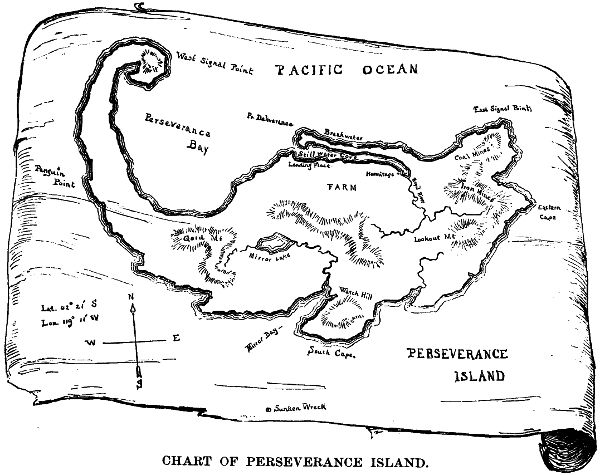
These I mounted on wooden trucks, and placed one on
East Signal Point, one on Eastern Cape, one on South
Cape, which I transported there by water in the canoe
Fairy, one on Penguin Point, and one on West Signal
Point. It was fun for me to make these things, and therefore,
to protect myself still more, I made a number, of
smaller calibre even, which I placed pointing out through
embrasures in a wall with which I had encircled the Hermitage,
and surrounded with a strong picket fence, made
of cast-iron, which I found no difficulty in casting in sections
of nearly ten feet in length. At all the stations at
the extremities of the island I hid a little amount of ammunition,
near the cannon erected, and also a flint and steel
and a limestock or slow-match, so that at any time, if
needful, I could load one of these cannon at once and
discharge it. The touchholes I covered nicely with a
piece of goatskin, so as to protect the guns from the
weather, and fitted all the muzzles with a wooden plug,
so that the interior would be kept clear and dry.
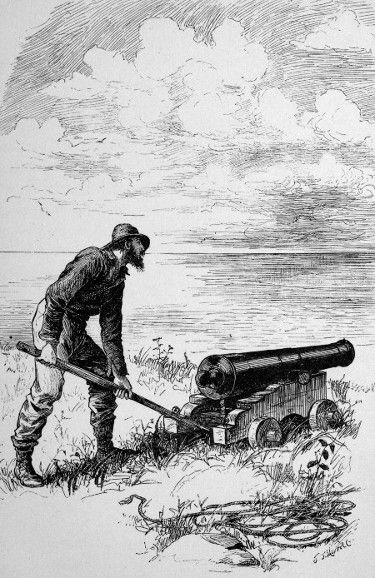
PLACING THE CANNON.—Page 190.
In the wall that now surrounded my Hermitage I built
a strong iron gate, that I could see through and yet too
strong to be broken down by any savage hands. The iron
fence or comb which ran round the summit of this wall,
and of which I have spoken, crossed also above the gateway,
and made my house impregnable to anything except
artillery. My doorway facing this, in the Hermitage itself,
had long been replaced by a nice hard-wood one, with iron
hinges, with several loopholes left, through which I could
poke a gun-barrel or discharge an arrow.
I had six cannon mounted on my wall, two in front, two
on each side, and one in rear, which was, however, naturally
protected by a thick and almost impenetrable grove
of trees and undergrowth. These guns were mounted in
a peculiar manner upon carriages that allowed the muzzles
to be depressed at least thirty degrees, and I kept in
store, to load them with, quantities of iron ball castings,
from the size of an English walnut to a common musket
bullet, which at close quarters would do fearful execution.
I approached these guns, from the interior, by means of
step ladders, made of wood, leading up to each from
the enclosure, and an oval hole, like an inverted letter
U, was left in the iron fencing to allow the muzzle to
protrude over the wall. This opening, however, was
small, and not large enough to admit even the head of a
man, much less his body. The erection of the whole wall,
which was some nine feet high, cost me infinite labor and
patience.
The fencing on top of it was, as I have said, rapidly
turned out from the casting mould, and gave me, comparatively
speaking, little trouble. To further protect this my
fortress from any assaults, I brought the water underground
from Rapid River into the Hermitage, through a
series of pipes made of pottery thoroughly baked, glazed,
and made so as to fit one into the other, and controlled
the flow by means of a stopcock fixed into a piece of cane.
The signs of this underground connection with Rapid
River I took care to thoroughly efface. And, furthermore,
I made it a duty to always keep at least six months' salted
provisions in store, ahead of all demands,—such as salted
and smoked herring, salmon, and other fish, with corned
and dried goat's flesh, and some few preserved vegetables
such as I might have on hand.
In rear of my house, between the end of the house and
the wall, I dug a subterranean passage, leading under my
wall, and coming again to the surface in the midst of a
seemingly impenetrable thicket of undergrowth, some
thirty yards away from the wall. This outlet was carefully
closed by a trapdoor, and soil even strewed on top
and grass allowed to grow over it. I did not know but
what there might come a time when I should have to use
this passage, as the last recourse, to save my life; and
although now in security I built it carefully, to be prepared
for what might happen in the future.
After all these tasks for my defence were finished I
commenced upon a set of guns and pistols, or rather rifles,—for
I had not the slightest use for a shotgun, being able,
in a hundred ways, by means of steel-traps and similar
devices, to capture all the birds and animals I needed,—which
I desired to protect myself against any human enemies,
should such ever appear. To this end I easily bored
myself out some four nice rifle barrels, and some half
dozen of a smaller size for pistols; these I had to stock,
and mount with the old-fashioned flint and steel, for I had
no means of making any percussion-powder. I worked
at these for a long time, but at last I had them all in good
order, and used to amuse myself by practising with ball
at the pigeons on the trees, and the ducks on the river.
I did not make the best shooting in the world, for, not
being able to procure lead, I was forced to make my bullets
of steel, and to revolve them in a cylinder for a long
time with sand, to make them globular and regular.
The barrels of my guns and pistols also had to be smooth
bored to use these projectiles; as a rifled barrel, if I could
have made one, would have been ruined by cast-steel
bullets; still at a hundred yards, with a nice greased
patch, I was able to make good execution, and the pistols
shot with strength at a distance of at least twenty yards.
Both weapons suited me practically, and with my guns I
had no difficulty in shooting several of the wild goats, and
also seals, whenever I needed their meat or skins.
My flock of tame goats all this while had grown and
increased, and I added to my home comforts cheese and
butter; but I made the wheel on the further side of the
river do all the churning by a simple application of the
machinery to a revolving clapper in an upright churn.
The parchment windows in the Hermitage had long
since been reinforced by iron shutters on the outside, that,
if needed, could be bolted securely on the inside, and the
roof had been refitted and made of timber and boards,
and the whole covered with tiles, so as to be fireproof.
Up through this roof I had also built a tower, of brick,
not very large but quite high, some feet above the ridge-pole,
which I mounted to by a flight of stairs from the
attic; for the upper part of the house was floored off and
completed when I erected the new roof, having no want
now of either boards or timber.
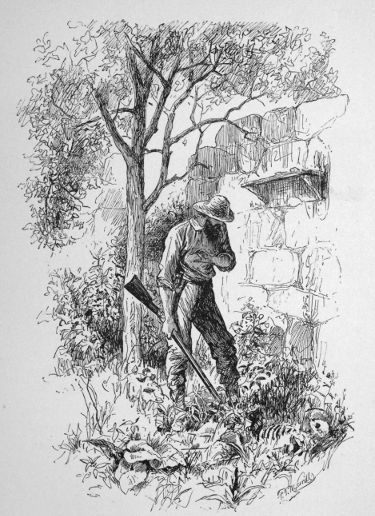
Up to this tower I trotted every morning before unbarring
the door of the Hermitage or the gate of the enclosure.
From this lookout I could see quite well in several
directions, and notice if anything had been touched or
changed from the evening before. I missed, I think, at
this time, books more than anything, but then, again,
from the very want of them, I was forced to study with my
Epitome and Book of Useful Arts and Sciences, which
possibly I might have thrown to one side for less useful but
more entertaining ones if I had had them. Wanting
them, I was becoming versed in many things which when
I came upon the island I knew nothing about, and I was
pleased to think that, although alone, I was improving,
and the usefulness of a really good book was brought forcibly
before me each day, for I could not open either of
mine without finding food for reflection and study. I
had always had my head full of vagaries of different
kinds that I should like some time to try and experiment
upon, and here seemed my opportunity; and it will be
observed, in its proper place, further on, that I attempted
many things.
It was, I think, in my third year that I felt that my
daily routine was fixed for life, as far as concerned comforts
and food; for by that time I had wheat for my
bread, and all kinds of vegetables and fruits that I have
before enumerated, in profusion. My apple and pear trees
would soon begin to bear, and in a year or two more I
should have them to add to my comforts. I had already
commenced to preserve blackberries, strawberries, etc.,
and found that my maple trees, in the spring, were just
as prolific as those in my Vermont home, and that I had
no difficulty in obtaining all the sugar I needed. Roasted
wheat had, however, to stand me instead of Java coffee,
but this made me quite a pleasant drink.
All these comforts were enhanced by a climate so uniform
in temperature that it was a pleasure to even exist,
the winters bringing scarcely an inch of snow or ice with
them, and the summers even and mild; warm, to be sure,
but still far from being hot or oppressive. As I have said
so often in this narrative before, what in the world could
one want in excess of all this but companionship? Ah!
it is little known how many bitter hours of solitude I
passed in gathering all these comforts about me, and how,
with a tenderness almost womanly, I made friends with
every kid, duck, young bird, seal, and living animal that
I gathered around me, and made pets of them all. My
hardest duties were to destroy these animals for my
own consumption, and I latterly destroyed what I could
with the gun rather than touch one of those that were
domesticated. Some of these I could not bear to lay
my hand upon, especially my young kids and team of
goats; but thank God there was no need of it. I could
easily destroy one of their species, when I needed the
flesh, with my rifle, for I veritably believe that I should
have gone without animal food rather than touch one
of these pets. Two of the kids, especially, followed me
about all the time, and even into my canoe when I took
short trips abroad.
I had by this time, by means of snares, captured seven
species of birds which resembled our blackbirds and bobolinks
of the north, and I took great delight in feeding
them in the cages I had made for them, and listening to
their music in the morning and evening hours. Long
search had taught me to feel sure that the island
had no venomous insects or reptiles, and it was also
wholly free from that nuisance the horse-fly, which is said
to follow civilization, and that other pest, the mosquito,
was wholly unknown. In their stead there were a few
sand-fleas, a sort of wood-tick, which troubled the goats
somewhat, and a small black wood-fly, that was not troublesome
except in some seasons, in the woods, and on the
coast. In December and January, green-headed flies were
apt to take hold of me once in a while, but not so as to
incommode me.
The air was so pure that meat would keep a long
while without putrefaction, even in the warm weather,
and having nothing better to do to take up my mind, I
had, during the past winter, collected quite an amount of
thin ice from Rapid River, which, in a small subterranean
ice-house, roofed over with planks, and covered with sawdust,
I had stored for summer use, and on very warm
days luxuriated in.
This life of solitude had made me tender to even inanimate
things, and it was wonderful to myself how the
passion, self-importance, and arbitrary manner of one
accustomed to command at sea was dying out in me. I
began to almost have a reverence for flowers and all beautiful
inanimate things, and many hours of my life were
passed in my garden and on my farm, but especially the
former, in examining and cultivating some beautiful wild
flower or trailing vine that I had transported hence from
the forest. I felt even that the bearing of my body was
changed from what it used to be when in days gone by I
trod the quarter-deck in all the pride and majesty of power.
I cannot say that I was at this time contented, but I
can say that I was much more patient, and the impetuosity
of my temperament was greatly subdued, and many
things, both animate and inanimate, were becoming, in
spite of myself, very dear to my eyes. I even at times
began to feel homesick when I was absent over a day, in
my canoe, from the Hermitage, and came back to its comforts
with an exclamation of gratification and a swelling
of the heart with joy when it came in view, and showed
itself intact during my temporary absence; and the welcome
given me by my goats, tame pigeons, ducks, and
birds was very touching, and, as I have said, endeared them
to me greatly. Still for no moment did the problem of
escape leave my mind. Although without relatives or
children, I often dreamed of escaping from the island and
returning with friends to enjoy it with me and end my
days here in peace. I often thought how happy I could
be here, far from the cares of the world and all its vain
excitements, could I see around about me smiling faces of
my fellow-men, who would look up to me as their benefactor
and ruler, for I had yet left some of the seaman's
instinct of desire to rule.
Up to this time I had done little exploring of the island;
my first trip around about it had been my last, and my
excursions into the interior had been short, and without
making any material discovery of moment. This was
caused by the great tasks that I had given myself near
home, and the consummation of which had taken all my
time. I had worked very hard to accomplish all that was
laid out before my eyes, and had had little time for wandering
about or being idle.
No sign of any vessel, or canoes of savages, had ever
disturbed me. I had often, during the last year, visited
the points of my island nearest to me, i.e. East and West
Signal Points and the breakwater, but no welcome sail had
ever met my eye. The sight of the ocean also from these
points always gave me the blues, and sent me home
troubled and discontented, for the intellect given me by the
Creator on such occasions rebelled against my fate, and
the ocean seemed my enemy, whom I must overcome, and
whom I could overcome if I could only think of the
means, for I would never acknowledge myself beaten, but
only unable for the present to cope with my adversary;
and I used to talk to it, and say: "Some day, thou mighty
sea, with God's help, I will overcome and conquer thee,
and compel thee to carry me wherever I desire to be
borne. Power has been given man over the beasts of the
field and over all nature, and I have only to use my mind,
with which God has endowed me, to some day make thee,
now my master, my slave. Roll on, therefore, for a day
shall come, God willing, in which thy billows shall carry
me, and the winds of heaven waft me to civilized lands,
where the Creator of both thee and me is adored and
worshipped. You shall not always separate me from the
place whence I came. With my strong hold that I have
obtained I will yet overcome thee, and make thee my steed
of deliverance, instead of, as now, the boundary line of my
imprisonment."
My daily life at about this time was something like
this. I arose in the morning, and, if the season would
admit of it, took a plunge in Stillwater Cove, first, however,
visiting my tower to see if everything was all
right in all directions. I usually, with a sailor's
habits, arose early, and with the sun. After my bath I
proceeded to feed my numerous flock of goats, kids,
pigeons, etc., and then to the cares of my dairy, milking
my goats and conveying the result of my labors to my
ice-house, near by, to be kept there, and at proper season
to be made into butter and cheese. Then to my breakfast,
which I could change in many various ways, as my
appetite dictated, always commencing the same, in these
days, by thanking God for his preservation of me, and
expressing gratitude for the food before me, and hopefulness
of ultimate delivery from my island prison. After
breakfast I went about any work that might be on hand,
such as fishing, gunning, or arranging my household
things, working in my iron ore, conveying coal or iron from
the mines, or running my sawmill, or else digging in my
garden or attending to my farm near the landing-place,
and the thousand and one daily things that had to be
done with one pair of hands, to keep my establishment in
order.
When I thought it noon by the sun (for I soon gave over
the attempt to keep my clumsy clock agoing after I had obtained
my latitude and longitude) I repaired to the Hermitage,
and if the weather was warm and pleasant made my
meal in the outer air, under the shade of a fine large tree
of the maple species, surrounded by my domestic birds; if
in winter, by my fireside, inside the house. After dinner
I again commenced my daily toil, first taking a good long
smoke of my favorite pipe, which, all things considered,
was my greatest solace, and after this taking up the work
that I had laid down at the dinner hour. I kept myself
employed till sunset, or nearly so,—for I did not now
overwork myself as I used to in the beginning, in my
impetuosity, but took everything mildly, quietly, and comfortably,—when
I again called my flock together and
attended to my milking. I knew that cheeses would keep
a long while, and, looking always forward to an escape,
I was gradually laying up a stock of this nutritious article
for use in the future should I ever need it, knowing
well how palatable and refreshing it always is at sea.
After the milking was finished, which was not till I had
gathered the flock from their feeding pastures, I entered
my house for the night, taking with me one or two of my
favorite kids, and barring the iron gate in the enclosure
wall carefully behind me, and doing the same with the
door of the Hermitage.
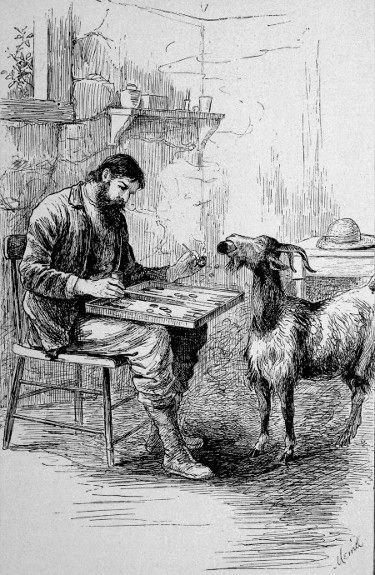
Once within, I lighted my lamps and gave myself plenty
of light, and took my supper, followed by the inevitable
pipe, and often a glass of my claret wine, as I called it,
made from the pure juice of the grape. Then I got out
a sheet of parchment and commenced a history of the
day's proceedings, which I wrote down in detail, and from
which this narrative is condensed. This was a very important
task, for upon the daily performance of it rested
the accuracy of my calendar. This often carried me well
into the evening, and if it did not, and I was not very
tired, I got out my Bowditch's Epitome and solved a
problem or two, and then turned to my Book of Useful
Arts and Sciences and stored my mind with some new
fact, or tried to decipher some of the things that were
daily becoming more clear to me, and which I had commenced
by understanding scarcely a word about. When
I found myself nodding over this work I quietly betook
myself to bed, preferring, as a rule, my upright bedstead
to the swinging hammock. I never put out the lights
and only removed my outer clothing when I slept, but
then the latter was a very natural act to a person who had
for years turned in "all a standing," as sailors say, and
ready for a call at any time of the night or day. My
arms and ammunition were placed within easy access of
my hands, and, commending my soul to God, I used to
sleep.
In winter I kept of course more within doors, and
busied myself upon my clothing and such things as
needed sewing and lashing together, fixing little nicknacks
of shell and wood around about the room, to hold flowers
and ferns, or any little thing that had attracted my eye,
or would please me in my solitude. On rainy days I
almost always went to work in my smelting house at the
forge, and if there was nothing else to do I would busy
myself in the making of nails for future use, I having to
beat out each one on the anvil; but when finished each
of my nails was a wrought one, and worth a dozen cast
by machinery. I always found plenty to do here, but I
worked leisurely, always looking toward the future. I
got together a large quantity of rolled iron, of about a
quarter of an inch in thickness, and in sheets nearly two
feet wide and some eight or nine in length. This workshop
I kept improving till I had, besides my forge and all
its tools, turning-lathes both for wood and iron, many
other useful things, which I had constructed at odd times,
such as a small but very strong derrick, which I fitted
with iron blocks and chains and with a winch and band,
so that I was able to handle large masses of iron with
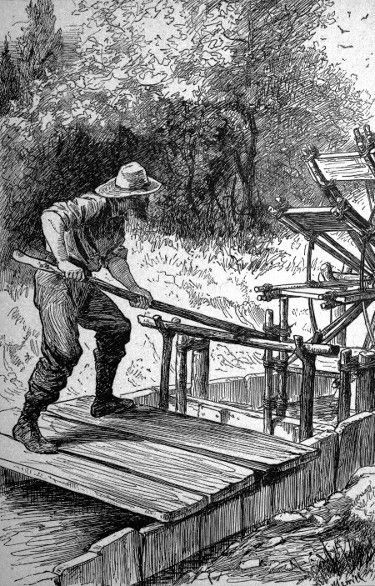
ease. My rollers, also, for rolling out the iron when at
a white heat, were in this room, and I had long since
improved and strengthened my water-wheel, so that I had
all the power at any time that I needed or desired, to
move any or all of my machinery.
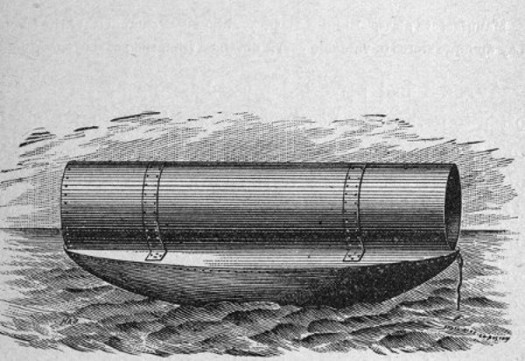
Besides gathering together these sheets of iron I put
them under my drilling machine and punched the edges
with holes of an uniform size, so that they could at some
time be riveted together, for I had an idea in my head
what I should use them for. The making of a large
number of rivets to fit these holes also took plenty of my
time, as did the making of different sizes of spikes, and
once in a while some new tool that I felt the need of.
My files, also, once in a while had to be re-marked and
again hardened, and thus I found myself always with
plenty to do whenever I entered the smelting-house; and
it was there that I enjoyed myself the most, for I was a
born mechanic, and I liked the work, and nothing pleased
me so much as to see something turning out under my
hand from a crude mass of iron into some useful tool, or
article of which I had need. Therefore when the stormy
and rainy days came it was with absolute pleasure that I
walked into my smelting-house and set to work. It was
here that I saw my deliverance must be worked out, and
never a day passed but what my machinery was improved
or increased in some way, and made more perfect and
reliable. A great deal of it, to be sure, was crude, but
it was also practical; and when a piece of machinery
would not perform well I went to work, and kept at it
until it would, and in the end had not the slightest trouble
in rolling, casting, drilling, planing, and turning iron or
cast-steel, in all reasonable shapes. To be sure my machinery
was not painted, or even well finished, except in
the working parts, but to those sections I gave a mechanic's
care. I not only worked here, however, on stormy
days alone, but also nearly every spare moment that I had
from other duties that were also pressing.
As my riches began to accumulate I began to think
seriously of exploring the island for its hidden wealth,
and see if I could not during these years that I was
waiting for escape—which I had made up my mind was
sure to come—lay up enough wealth, in some shape, to
take with me when I should depart, that would make
me rich for the remainder of my days. Knowing that
such wealth, to be conveyed away by me, must necessarily
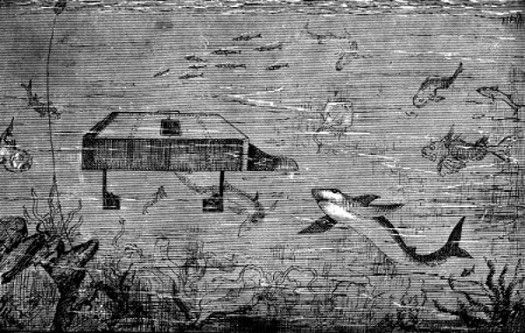
be in a small compass, I was working out a problem at
this very time to explore the bottom of the ocean around
my island, and see if I could not hit upon some pearl-oyster
beds, whence I could draw riches to carry away
with me when I should leave this island, and the theory
that I had gotten into my head, and which I was trying
to put into actual practice, was the following:—