"And thus a never-ceasing pleasure flows,
"Or to the human, or the bestial race,
"From those ideal charms we all attach to place."
Local Attachment.
The next morning our two friends
awoke with the sun, and before half my
readers are out of their beds, their peregrinations
commenced, one in quest of
whatever he could turn into something
useful, the other to find what was new
and entertaining. When they met, the
Bee was still desirous of finding his old
habitation. "But why?" said the Butterfly,
"surely the little cell you now live
in will do very well for the summer;
you are in no danger where you are,
and have the delightful privilege of
calling it all your own."
"All this is true," replied the Bee,
"but what a life am I now leading?
adding nothing to the general stock;
while all my brethren are busily employed
in gathering what will be of
equal benefit to each, no, no: there is
a pleasure in being thus mutually
assistant to others which only those
who have experienced it can know;
and I am resolved, if possible, to enjoy it
again."
The Butterfly looked surprised, for
though capable of that attachment
which proceeds from finding an agreeable
companion; and with some idea of the
services bestowed upon those we love,
and which endears the name of friend,
he could not imagine that any pleasure
could arise from spending his time in
labour; but as long as his friend had
assured him of the continuance of his
regard, he was desirous that he should
obtain what he wished, and willingly
offered to assist him in the search.
During their airy rounds they often
stopped to refresh themselves on some
favorite flower, and though seldom fixing
on the same, and to a casual observer did
not appear to be at all connected, they
were never out of sight of each other.
It was from one of these resting places,
in which the Bee was delightfully employed
extracting sweets from an "extended
field of blossomed beans," that
the Butterfly stretched his wings to a
neighbouring garden; here such various
beauties met his eyes that he could
not help returning to call his friend to
enjoy them with him. "Such a bed
of tulips, I have met with," said he,
"whose splendid colours can only be
equalled by my wings; pray come, and
see what lovely flowers."
"Have you not yet learnt that
there is something more valuable in a
flower than its colour?" returned the
Bee, with a smile; "for my part I
would prefer these honeyed beans,
though I suppose you would think
them hardly worth looking at, but of
all other flowers tulips have the least
sweetness about them, and are fit only
to please the eye of those men and butterflies
who judge only by appearance;
but though I have seen the former admiring
a bed of tulips, I have often observed
that if they wish to ornament themselves,
or their houses, the flowers which we
chiefly prefer are also the objects of
their choice! as for these beans, though
I believe they admire their smell, men
are, as I said before, such destructive
creatures, that while they are enjoying
what is sweet they are at the same time
destroying it; and as they expect something
still more valuable from these
flowers, they are content to let them remain
upon their stalks; but we can have
our fill of their sweets, and yet not injure
what they will hereafter produce. Oh!
had I but a hive to go to," continued he,
as he stretched his wings to accompany
his friend, "how many times should I
have gone thither yesterday, and to-day
from the cowslips and the beans, and
what repeated loads should I have carried
home."
"Surely, surely," thought the idle
Butterfly, "you need not regret that;
to fly hither and thither as you like,
with no incumbrance of any kind, and,
no care beyond to-morrow, is far better;"
so thought the Butterfly, and so perhaps
think many Butterflies of the human
race; but he forbore to repeat his
sentiments on this subject, for, unconscious
to himself, he was awed by the
superiority of his friend, while he
felt no wish to be of the same opinion.
"And so these are the flowers you
admire," continues the Bee, as they
alighted, "and which can only be
equalled in Beauty by your wings?
Ah, my dear friend, would not your wings
be just as useful if they were not covered
with red and purple? look at the
plain white ones of numbers of your
race, who are now flying around us; you
cannot extend your flight farther than
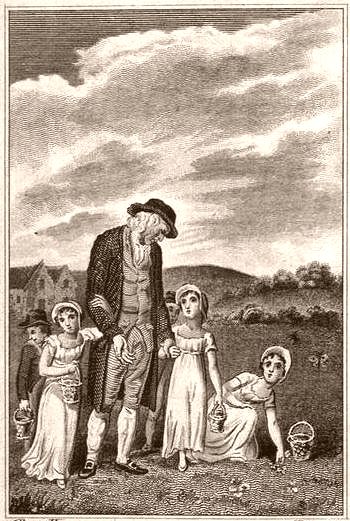
these; but see, some children are entering
the garden, I question if you will
not soon have a greater cause to regret
the beauty of your wings than to admire
it, and that you will be the object of
their pursuit as soon as you meet their
eyes, while your plainer brethren will
pass unregarded."
This prediction was soon verified, for
no sooner did the little ones perceive
this self-admiring Butterfly than they
all exclaimed, "Oh! what a beauty!
let us catch it."
"If you get on that side of the bed,
and I on this," said a boy, who appeared
to be the eldest of the party, "I will
throw my hat at it, and we shall soon
have it in our possession."
"Not for the world, master Henry,"
said the maid, who accompanied them;
"you would destroy those beautiful
flowers at once if you did, and your
papa would be so angry."
"The flowers then are more admired
than you are my friend," observed the
Bee, "for you see the maid will not
let them be injured, not even to procure
a sight of your still more beautiful
wings."
"Don't laugh at me," replied the
Butterfly, somewhat mortified; "I am
glad, however, that I have found a
place of safety; if I take care not to
quit this station, they will not be able
to get at me."
Altho' it was his intention to remain
there, his young pursuers would not
let him be at rest, but with one thing
and another so contrived to shake the
flowers upon which he settled, that, at
last, wearied out with these repeated
removals, he took to his wings, and
flew to a neighbouring rose-tree.
"Now, now," cried all the children,
"we shall have it; don't let it get upon
the tulips again, and we shall certainly
catch it."
The Bee lay all this time in the
bell of a hyacinth, not unmindful of his
friend, or his pursuers, but thinking his
present alarm might be an useful evidence
of what he had been saying, and
a check to his vanity, he resolved to let
him feel a little more of the dangerous
effect his much-admired beauty was
likely to produce; but after the young
folk had given him one or two hasty
flights round the garden, he came forward,
and appearing in front of all the
young ones, soon checked the eagerness
of their chace.
"A Bee, a bee," exclaimed they,
"take care, or it will sting you," while
the poor trembling Butterfly began
to take fresh courage on seeing his
friend approach; and, seating himself
on the branch of an honey-suckle,
endeavoured to regain his breath.
The oldest boy was now resolved to
make one more effort, and creeping
slowly to the place, put forth his hand
to reach the prize, when the Bee,
perceiving his intention, again darted
before his eyes, and made him retreat.
"Thank you, thank you, my dear
friend," said the poor Butterfly, "surely
they will not attempt to pursue me
any more; you must have sufficiently
frightened them."
"I'll do something more than frighten
them if they do," replied the Bee;
"they shall feel what it is to enrage
one of us;" nor would these children,
animated by the presence of each
other, give up their chace, till the
Bee had absolutely fulfilled his threat,
by just touching the hand of one of
them with his sharp sting: and Oh!
what a clamour was instantly raised by
the whole party for this cruel act, as it
was called; the child cried, and the
maid declared it was a shame of the nasty
Bee to sting one who never thought
of hurting him: while all the others
gathered round their wounded brother
to express their pity and abhorrence
of the deed; and while they retired from
the garden to get something to alleviate
the smart, our two friends were
left to recover themselves and congratulate
each other on their safety. "I never
was so near being taken in my life,
and escaped at last," said the Butterfly;
"but to you, my friend, I am indebted
for my present liberty; if you had not
exerted yourself in my behalf I must
have been in their possession; I tremble
at the thought of it, and am completely
tired out in the chace they have
given me."
"Now, then, I hope you will acknowledge
that your beauty is no real advantage
to you," replied the Bee,
"but till you are recovered I will visit
yonder beautiful acasia which seems
to court my notice; besides, I am not
without a hope that from it I shall see
my ardently desired home; I seem to
remember its being near it."
Our airy traveller spoke this with
peculiar animation, but on reaching
the tree, his pleasure was still higher,
for, from thence, he beheld the spot
he was in pursuit of; although many
hives were near it, he could distinguish
his own from all the rest by
a thousand little marks known only to
those who inhabit it. His heart beat
with transport; it appeared to him
the abode of peace and plenty, and
it was within his reach also; the
flower on which he had rested was
entirely disregarded, and he stood
gazing on the well known spot, "stung
with the thoughts of home."
The endearments of his mother
returned to his mind with double
force, nor could he fear being well
received by her, and if by her, all the
rest he knew dared not use him differently;
"I will acknowledge my disobedience
to her commands," said he,
"and when she knows what I have
gone through she will forgive me; I
shall again receive her commendations,
and repose myself under her mild
and equitable government."
With these thoughts he could scarcely
forbear flying away, and rushing at
once into the presence of his friends;
but he recollected the poor Butterfly,
and though there was nothing in
their natures which could assimilate,
he still remembered that in a great
measure he owed his present health
and strength to him; "when first we
met," continued he, "there was nothing
in me to induce his affection;
I was poor, sick, and helpless, and yet
he was interested for me, and shall I
leave him now? no, I will return and
tell him what I have seen, and that
though for the future I shall reside
with more suitable associates, we may
still often meet."
Thus determined, he hastened back,
with all the liveliness of joy, to inform
his friend, who observed his
coming, and the cheerful air with
which he approached; "I have seen
my hive," cried the Bee, without giving
him time to make the enquiry,
"I have seen it! come, won't you go
with me, and at least see the place to
which I am going to return, and though
I cannot ask you to enter with me, (none
but bees being permitted to come in
there) I shall never see you when I am
out of it without pleasure."
"My dear friend," replied the
Butterfly, "after the kindness you have
shewn me this morning, it would be
ungrateful not to rejoice in what
gives you pleasure; I think I am now
able to use my wings again, and will
readily accompany you; and though I
know I must stand at an humble distance
while you enter, yet I shall be
anxious to hear how you are received,
and whether your old companions
will forgive your leaving them."
"I have but the displeasure of one to
fear," replied the Bee, "and if she
forgives me, the rest have nothing to do
with it, nor have I much to apprehend
from that quarter, since the authority
of a sovereign is tempered by the affection
of a parent."
Thus conversing they pursued their
flight till arriving at a short distance
from the well-known hive, "Don't
you see it?" said the Bee, fluttering
his wings for joy; "don't you behold
the welcome spot?"
"I see a number of hives," returned
the Butterfly, not quite so enraptured
as his friend, "but which is
yours I cannot tell."
"Mark the one into which I fly," said
the Bee, "and then you'll know it."
"But when shall I see you again?"
enquired the Butterfly in a melancholy
tone, on seeing his friend preparing for
flight; "to-day?"
"Perhaps not," replied the other;
"I may not be permitted to come
out again, or I may be indulged with
a day's rest, and conversation with my
mother, but do not suffer yourself to
doubt my friendship for you, because
I do not fly out every hour and repeat
my professions of it; to-morrow,
at farthest, I shall renew my labours for
the general good, and then if you like
to accompany me in my flights, I shall
be glad of your company."
With these words he stretched his
wings, while the Butterfly bade him
farewell, and watching his approach
and entrance to the hive, resolved to
hover round the place in hopes of
learning what reception he had met
with.
As the returning vagrant advanced
towards the centre of all his hopes and
fears, he felt the latter sensibly encrease,
yet he could not but advance; at first
he settled on the block upon which the
hive was placed, every part of which
was perfect in his recollection; he observed
no one near, for as it was now
the middle of the day, almost all were
out, busily employed, except a few,
whom he knew were always on the
watch to keep out every intruder; at
length he ventured within the hive, and
immediately all the humming inmates
which were then at home flocked around
him; some concluded that he had mistaken
his hive, while others imagined
they could recollect his form and figure.
"Do you not know me?" said he, "I
once belonged to your fraternity, and
my heart is still knit towards you."
On hearing an unusual murmur the
mother queen appeared, with all her
attendant train, to enquire who the
bold intruder was? The way was
cleared for her approach, and a
solemn silence prevailed, while the
stranger, with unfeigned humility, answered
to the question. No sooner
did her majesty know her returning
child, than in one loud hum she expressed
her satisfaction, and this was
heard and attended to by all around, and
presently the general voice was that
he should be re-admitted.
"I am not returned unto you
sick, or unable to work," replied the
delighted Bee, after he had expressed
his thanks for their generous reception
of him; and then related to
his attentive and sympathyzing parent
all he had gone through since
he had so rashly left the hive, whilst
the rest waited till the close of the
day before they indulged their curiosity
by hearing it, nor did he forget
to acknowledge that it was to the
attention of a Butterfly that he owed
his life.
"A Butterfly," returned the queen,
whose dignity felt hurt that any
of her race should be indebted to
so trifling a creature, "sure you must
have been sunk very low indeed, to
need the assistance of a Butterfly."
"I have learnt, my dear mother,"
replied the young one, "that there
is no creature, however mean, but may
be of service some time or other; the
Butterfly is well aware of the great difference
there is between us."
"And sensible, I hope, of the honour
done him, in being permitted
to assist a Bee?" rejoined the mother.
This important affair being settled,
though not entirely to the satisfaction
of the queen, who while she forbore
to say more upon the subject, resolved
narrowly to watch the conduct of her
son, fearing he would gain too much
of the frivolity of the Butterfly if he
long associated with him: and after
shewing him a cell in which he might
for the future reside, she left him to
prepare it for his reception.