NOTICING that several of the ship’s
officers whom they passed eyed Pep
askance, the doctor singled out the most
affable looking one and went straight to the
point.
“What about dogs?” he asked. “My
dog followed me to the very gangplank and
I had to bring him along or miss the boat.
He is a very valuable dog. I wouldn’t have
anything happen to him for the world. He
is a blue ribbon dog.”
The officer looked at the dog doubtfully.
“If you really value him,” he said, “you
had better not let the first mate see him. He
is death on dogs. Why, the last trip across
he had four thrown overboard. They were
pets of wounded soldiers, too. It made the
crew as mad as March hares. There wasn’t
any sense in it, either.”
At this the doctor looked troubled, but he
was a diplomat and a man of quick action.
He knew there was many a way of circumventing
unjust regulations like this.
“Here is a five-dollar bill,” he said, slipping
the greenback into the hand of the officer.
“You introduce me to the official
who is the most of a dog lover.”
“That’s the old man,” said the official
doubtfully. “I wouldn’t dare to approach
him, but you might appeal to him if the
worst came. He is the captain of the ship,
but we call him the old man. The head
steward keeps a little dog in his cabin.
Perhaps he might accommodate you.”
So they went to the chief steward’s cabin,
where they found that necessary official
swearing at his associates.
“Another dog,” he snorted, when the
proposition had been put up to him. “Well,
I guess not. Ginger worries me nearly to
death.”
“He is a blue ribbon dog,” explained the
doctor. “They would keep each other company.
Take a look at him.” He held Pep
up for inspection.
The steward gave Pep a hurried glance,
then came nearer to get a better view. He
stroked his sleek head and tweaked his ears
fondly.
“The very picture of my old Sally. Why
I sailed fifteen years with that dog. She
was better company than half the folks.
Why, yes, I can make a place for him.
Here, Ginger, come here and take a sniff at
your shipmate.”
The doctor set Pep down on the floor and
the small black and tan dog approached
gingerly as suited his name, but Pep gave
him just one disdainful glance then looked
the other way.
“They’ll be all right when they get acquainted,”
said the doctor. “You see Pep
is rather exclusive.”
Finally the dogs touched noses and were
friends. Pep was given an old souwester
to lie upon and the steward promised to keep
an eye on him while the doctor went to look
for his cabin.
Although the doctor visited Pep twice
that evening and he seemed snug and comfortable,
yet he could not forget the horrible
picture of the first mate’s having the pets of
the wounded soldiers thrown overboard, so
he determined to have it out with the old
man as they called him the very next day.
All that night the great ship plowed her
way through the darkness. Her lights were
all out, but half a mile to the north and half
a mile to the south a long rakish torpedo
boat ran parallel with her. These were her
escort. No one knew at what moment a submarine
might appear, so every precaution
was taken against those devils of the deep.
The following morning was bright and
beautiful, with a stiff wind blowing at the
ship’s bow. Every one was in the best of
spirits and all danger was forgotten.
In the middle of the forenoon the doctor
discovered the ship’s captain standing near
the wheel. He had been talking with the
man at the wheel, but he was not busy then.
The moment seemed auspicious and the doctor
approached him without delay.
“Sir,” he said, saluting. “I understand
you like dogs.”
The captain was a man of sixty, but he
looked much older. His face was wrinkled
and weatherbeaten, but a smile shone
through his weatherstained visage.
“Who told you that?” he asked. “It
wasn’t the first mate.”
“No, sir,” returned the doctor. “It
wasn’t the first mate, but you do like dogs.”
“Rather,” said the captain, looking off
across the broad expanse of blue rolling sea.
“Would you like to see the champion of
the recent New York dog show? He is a
gentleman. An English bull terrier.”
“There isn’t any such animal aboard,” returned
the captain.
“Yes, there is,” replied the doctor. “If
you have a few minutes, come with me and
I will show him to you.”
The captain followed, incredulous and excited.
If there really was a blue ribbon
English bull terrier aboard, he wanted to
know it. It would never do to risk such a
prize with his present mate, the dog hater.
They found Pep waiting for them and
straining at his leash. The doctor picked
him up that the captain might better admire
him. For several seconds he looked him
over in silence, then put out his hand and
stroked his sleek head.
“He’s a blue ribbon dog sure enough,”
he said at last. “I’ll speak to the mate
about him. We don’t want him swimming
for his life in the Atlantic. That mate is a
strange man. There is something wrong
about him, but he is a good officer. Pep is
to be a regular passenger with all the privileges
of the ship, sir.”
Pep became a prime favorite with several
of the passengers, once he was permitted
to come out of hiding. Although the first
mate glowered at him and muttered ominously,
he did not dare lay hands on him
since the old man had said he was a regular
passenger, with all the privileges of the ship.
One little girl in particular, Hilda Converse,
the daughter of an importer who was
going across in the interests of his firm,
fairly worshiped Pep. Hilda had just lost
her mother and that was why her father
was taking her with him under such dangerous
circumstances.
Hilda and Pep were inseparable, once she
had found her way to his warm dog heart.
The morning of the fifth day out dawned
dark and stormy. The wind had kicked up
a great sea and the mighty swells rolled
mountain high.
Finally the wind increased to the dimensions
of a hurricane, and all but the most
hardy sought their cabins. The doctor,
however, liked to stay out in the open where
he could watch the storm. The winds fairly
shrieked in the rigging and about the tall
smokestacks. The sea hissed and seethed,
and the winds whipped it and beat upon it,
until the air was filled with flying spray.
Finally such a yeast was kicked up that one
could gather hands full of the feathery foam
from the air. Sky and water seemed to
meet, and the mighty ship and its human
freight were at the very heart of this terrible
storm. So far as they could see or feel this
was all there was to the world—a world of
wind and foam, all turbulence and frightfulness.
One of the ship’s boats was broken
loose by a mighty sea and swept away. It
rose upon the top of a great swell, then sank
into the trough and was seen no more.
The doctor watched the ship’s crew narrowly
as they worked. They worked like
soldiers, each doing his part with dispatch
and decision. The captain stood on the
bridge, the master mind. The ship, the
crew, all obeyed him implicitly. He was
the will of the ship, and an iron will at that.
Finally the fury of the storm spent itself
and the skies cleared, but the effect of the
hurricane was still manifest in the sea.
Great foam-covered swells rolled by, many
of them breaking over the lower deck. But
they were rhythmic and one always knew
when to expect the next one. This was all
right as long as the waves ran at the regulation
height, but the combers were quite different.
In them is an element of danger
that no seamanship can guard against, no
matter how skillful it may be.
A comber is a wave twice or three times
as high as its fellows. It is the king of
waves, riding head and shoulders above its
fellows, and often carrying death and destruction
in its wake. Combers sixty feet
high have been observed by trustworthy
witnesses.
The ship had experienced several combers
about five o’clock, none of which did any
damage, although they drenched the lower
deck and sent hogsheads of water into the
cabin. The sun had come out and many of
the passengers had reappeared on deck.
Little Hilda had gone down into the steerage
to visit another girl with whom she had
become acquainted. They were standing by
the rail chattering away excitedly about the
storm, when the father of all combers reared
its foam-covered crest close to the ship.
The ship’s officers had seen it coming, but
had not appreciated how tall it was, because
the seas were running so high. It struck the
side of the ship with a noise like heaviest
thunder and submerged the lower deck three
feet deep with hissing water. It fairly
covered the two little girls, but would have
done no special harm had not the return
impulse of the wave picked Hilda up and
carried her over the rail into the boiling sea.
The doctor and the second mate, who were
standing on the hurricane deck, saw the
frightful accident and gave the alarm. Although
the sea was still running mountains
high, and it was doubtful if a boat could
live in it, yet a crew sprang to the nearest
lifeboat and began slowly lowering it.
The doctor strained his eyes to see if
Hilda came up on the crest of the next wave,
for she had immediately disappeared in the
trough. To his great joy the red dress appeared
on the very crest.
“My God!” cried the mate, “there she is.”
If there was only something or somebody to
keep her afloat until the boat could reach
her, but no man could swim in that sea.
Pep was whimpering at his master’s legs,
trying to climb up that he might see over the
rail. He knew instinctively that something
terrible had happened, he read his master’s
thought like an open book.
His sharp yelp of excitement called the
doctor’s attention to him. The surgeon
stooped down and lifted him to the rail and
in that moment a sudden inspiration came
to him. “Pep, see Hilda. Bring Hilda.”
One of the tricks the doctor had taught
him was to retrieve and now the accomplishment
stood them all in good stead.
Could he reach the girl? Should he send
him? The chance looked slim, but in his
profession human life was always set above
animal life. So he repeated, “Look, Pep.
Hilda, bring.” With these words, he raised
the dog above the rail and pitched him into
the raging sea.
It was a good fifty feet down to the water,
but the dog landed right side up and did not
seem to mind the plunge, for he began swimming
directly towards the girl whom he had
recognized from his perch on the rail.
The minute following was a tense one for
all concerned. There was the raging sea on
one hand, trying to suck up the little human
life, and there was the brave dog and the boat
battling for her life.
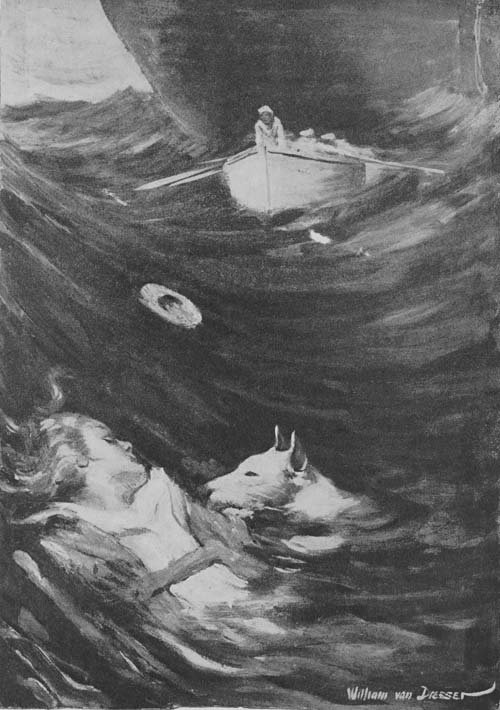
A great shout went up from the ship as
Pep reached his playmate and fastened his
teeth firmly in her dress. The first part of
the battle against the elements had been won.
Could the faithful dog hold on till the boat
reached them?
“Pep reached his playmate and fastened his teeth
firmly in her dress.”
All held their breath as the dog struggled
to keep his place above the wave while the
lifeboat fought its way toward them. Could
they hold out? Would the boat be able to
reach them? These were the questions on
all lips. The minute seemed like an hour,
so tense it was. But all minutes come to an
end, and this one did, with glorious victory.
Not victory for the sea, but victory for
the dog and the boat. For at last the watchers
saw the boat reach them and the strong
arm of a sailor reach out and drag them both
to safety. Then they fought their way back
to the ship while the passengers cheered
themselves hoarse.
Hilda was unconscious when they placed
her in her father’s arms, and Pep was so
weak he could hardly stand, but his eye was
full of fight and he could still wag his tail in
appreciation of the petting he received.
A warm bed and a restorative soon set
Hilda right, and Pep only needed rest. But
he had gained his place among the crew and
the passengers as a hero. If he had not been
a sensible dog, they would have spoiled him
with petting during the remainder of the
trip.
Four days later the ship came close to the
Irish coast and precautions were redoubled.
This was the submarine zone and no one
knew at what moment those devils of the
deep might appear.
It was nearly midnight. The ship was
creeping along through the darkness with all
lights out, closely guarded by two torpedo
boats. The doctor was sleeping soundly in
his bunk and Pep was dreaming of home in
the cook’s cabin, when there came a mighty
explosion which shook the great ship from
bow to stern. There had been no warning.
It had come like a sudden clap of thunder,
but every one knew instinctively that they
had been struck by a torpedo.
Immediately all was confusion. Passengers
came hurriedly on deck, dressing as
they came. For a few seconds two powerful
searchlights played upon the water about
the ship to discover the submarine if possible,
and the guns at the bow and the stern
were made ready for instant action, but the
murderous devilfish had departed as suddenly
as it had appeared.
The ship was listing badly and the hole
was fast filling, so the boats were made
ready. The doctor did not know whether he
would be allowed to take Pep with him or
not, but he went to the cook’s cabin for the
dog.
The crew worked silently and like soldiers.
So rapidly they performed their
tasks that when the doctor reappeared with
Pep the first boat load was pulling away
from the ship. Soon the doctor’s unit was
called and he went around to the other side
of the ship where a boat was already nearly
loaded.
“Can I take the dog with me?” asked the
doctor doubtfully as he reached the rail. A
ship’s officer stood at the rail with drawn
revolver.
“Not by a damnsight,” he growled.
“Look at that boat.”
The doctor looked. The lifeboat was
crowded to the gunwale.
“Hurry,” commanded the officer. “The
boat is waiting.”
“But what shall I do with my dog?”
pleaded the doctor, though he saw that Pep’s
case was hopeless.
“Hurry, I tell you. It’s no time to be
haggling about the life of a dog. Get in or
I will give the signal for the boat to pull off.”
“All right,” said the doctor. “Give it.
I can’t leave Pep.”
“Here, here, doctor,” growled a stern
visaged colonel coming up behind them.
“You are under military orders. Get into
that boat. Give the dog to me.” He
snatched the growling dog from his master’s
arms and threw him upon the deck and
then fairly shoved the doctor over the rail
and down into the boat.
The doctor heard a dismal howl from Pep
as he was left behind and then he felt the
boat lowering towards the water.
“Officer,” he called to the man at the rail,
“Shoot the dog. I can’t leave him in that
way.” But instead of shooting him, the officer
kicked at Pep who was trying desperately
to climb over the rail.
The doctor sat huddled in the corner of
the lifeboat, his head in his hands as they
pulled away from the ship.
It seemed strange to the other passengers
that with death all around them a strong
man should feel so deeply the loss of a dog,
but only dog lovers understand these things.
No one but a dog lover knows the comfort of
that soft tongue on your cheek, or the muzzle
in your hand.
Presently the doctor was aroused from his
grief by a wild yelp. He looked back towards
the ship and in the darkness he could
just see Pep balancing himself on the rail,
and a second later he sprang into the sea.
At the sight, hope welled up in the physician’s
heart. If it was not more than five
miles to the shore, perhaps the dog could
swim. Soon the white head appeared close
to the boat and the dog whimpered to be
taken aboard, but his master could not even
do that much for him. The law of the ship
was like the laws of the Persians, irrevocable,
but he talked to Pep and encouraged
him as he swam behind.
Half an hour passed and the dog swam
steadily. They must have covered two
miles. Another half hour went by and Pep
began to weaken and to lag behind. Occasionally
he stopped to tread water.
The doctor’s heart sank within him, it was
going to be a losing fight for brave Pep after
all. But at this point the boat stopped to
determine if possible their direction and by
a mighty effort Pep regained the gunwale.
Then a bright idea came to the doctor and he
cursed his stupidity for not having thought
of it before. He unlaced his shoes and tied
the strings together. Then he coaxed Pep
close to the boat and tied the shoestring in
his collar. With that done he breathed a
great sigh of relief. The dog was now as
safe as the rest of them. If the boat made
shore, he would.
Two hours later the lifeboat grounded on
the beach and the physician dragged his
nearly senseless bull terrier after him to the
shore.
He was quite spent, but could still wag his
tail and lick his master’s hands, and the doctor
knew that rest was all he needed.
“Good stuff, old pal,” he said, tweaking
the dog’s ears as he set him down on the
beach. “It takes more than a submarine to
put you and me out of commission. We will
get even with the Boche for this.”
To which Pep responded with a sigh of
deep satisfaction.