EDITOR’S NOTE. — I. THE VICTORY OF THE FALKLAND ISLANDS. A
Though Sir Walter Besant called War correspondents
“the scene painters of history,” it may
be questioned whether any pen or brush, trained
on the land, sea and air battles of the present
War, can depict more than a corner of the great
devastating drama.
This little book, embracing extracts from famous
books, may help the reader to visualise some of
the outstanding battles in which Britain has played
a not inconspicuous part; and if they inspire
those still fighting, and those behind them in support,
with a firmer confidence and a greater endurance—if,
too, these records of undaunted heroism, often
against odds, enlighten readers in other lands as
to the character of British fighting men—their
publication in this informal style will be justified.
Full acknowledgment is here made to the
authors and publishers who have kindly permitted
quotation; and to the proprietors of two great
illustrated weekly papers who have lent for reproduction
original sketches appearing in their pages.
April, 1917.
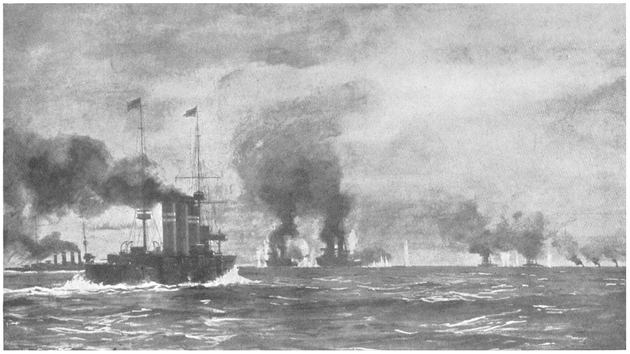
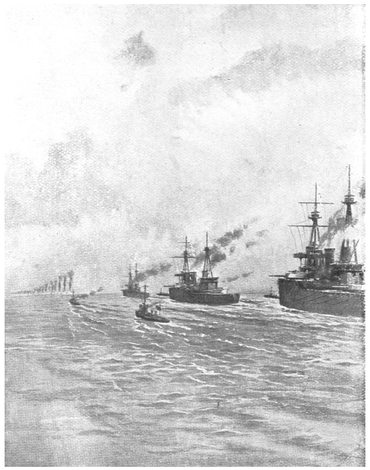
THE BRITISH VICTORY OFF THE FALKLANDS: FIRST STAGE OF THE ACTION BETWEEN BRITISH
BATTLE-CRUISERS AND THE GERMAN ARMOURED CRUISERS.
Reproduced by permission of “The Illustrated London News.”
By Richard Wilson, Litt.D.
A From “The First Year of the Great War.” By Richard
Wilson, Litt.D. (W. & R. Chambers.)
The affair off Coronel put the heads of the
British navy upon their mettle, and within
forty days it was followed by a counter-stroke,
complete and effective. Silently and with steady
determination, preparations were made to deal
with the Scharnhorst and her companions; and
the man who was entrusted with the work was
Vice-Admiral Sir F. C. Doveton Sturdee.
To the east of the southern portion of
South America lies the British group known
as the Falkland Islands. Due east of the large
island called East Falkland, Sturdee’s squadron
came within sight of Von Spee’s cruisers, the
British admiral having been helped in finding the
“quarry” by the clever wireless signalling of
a lady and her servants who lived on the islands,
and who were afterwards presented with valuable
gifts by the British Admiralty as some slight
acknowledgment of their timely help.
After the battle off Coronel, the Glasgow,
along with the battleship Canopus, had put into
the harbour of Port Stanley, in East Falkland.
The former vessel had been damaged, but she
was quickly repaired; and when Admiral Sturdee
arrived from home, she took her place in his
squadron, her officers and men being eager to
set things right with the Germans. It was
reported that Von Spee’s squadron was going
to make a raid on the Falklands; but when he
came round Cape Horn he found awaiting him
eight British ships of war, and, so far as we
know, this was a complete surprise to him.
At about half-past nine in the morning the
Gneisenau and the Nürnberg drew near to Port
Stanley Harbour with their guns trained on
the wireless station. Between them and the
harbour was a long low stretch of land running
eastward, behind which lay the Canopus. The
surprise of the Germans must have been great
when they were met by a smart fire across this
low-lying land at a range of about six miles!
The two ships stopped, considered, and turned
away, hoisting their colours, however, as they
did so. About the same time the Invincible
sighted other hostile ships between nine and
ten miles distant; and in a short time the
British squadron was moving from the harbour
towards the enemy’s five ships, which could
be plainly seen to the south-east. The day was
fine, with a calm sea, a bright sun, a clear sky,
and a light breeze from the north-west.
The British vessels at once began a chase
in extended order, and the hearts of our men
must have been deeply stirred by the admiral’s
simple signal, “God save the King!” One of
the signallers afterwards wrote: “It was taken
up and flung far and wide through space by
each of the fleet in turn, until it seemed as
though it would never cease. I consider it a
privilege to have been one of the few to bear
the signal.” A little after noon Admiral Sturdee
came within suitable range of the five enemy
ships, and decided to attack with the Invincible,
the Inflexible, and the Glasgow. How the officers
and crew of the last-named vessel had longed
for this happy moment!
The signal was given, “Open fire and engage
the enemy,” and the Inflexible began the battle,
followed a few minutes later by the Invincible.
This firing was at a range of about nine miles—no
opportunities for boarding here, cutlass in
teeth, and pistols in both hands!—but the British
gunnery was so good that three of the German
ships turned away. Then the Glasgow, with the
Cornwall and the Kent, gave chase. We shall
follow their work when we have considered
that of the heavier craft.
The Invincible engaged the enemy’s flagship,
the Scharnhorst, and the Inflexible the Gneisenau,
the fight being a running one, and the range
varying from about eight to nine miles. Before
long the German flagship took fire, lost one
of her funnels, and slackened her firing. “The
effect of our fire,” writes Admiral Sturdee,
“became more and more apparent in consequence
of smoke from fires, and also escaping steam.
At times a shell would cause a large hole to
appear in her side, through which could be seen
a dull red glow of flame.” Yet the German
kept grimly on with her work.
The Gneisenau now gamely faced the Invincible
and the Inflexible, but about 5 o’clock she lost
one funnel and was on fire in several places.
She continued, however, to reply to the British
gunners with a single gun, until, an hour later,
she suddenly heeled over and sank. Here is
an entry in the diary of one of her officers:
“5.10, Hit, hit! 5.12, Hit! 5.14, Hit, hit,
hit again! 5.20, After turret gone. 5.40, Hit,
hit! On fire everywhere. 5.41, Hit, hit! Burning
everywhere and sinking. 5.45, Hit! Men
dying everywhere. 5.46, Hit, hit!”
After this the officers had something else to do
than make entries in a diary. Boats had been
lowered from the Invincible and the Inflexible,
life-buoys and ropes were thrown into the water,
and about 300 men were saved, “including their
captain—a tall man with a black beard.”
Meanwhile the Glasgow and the Cornwall had
fought and sunk the Leipzig. Like the other
German ships, she took fire fore and aft, and
as the shades of night were closing in she turned
over on her port side and disappeared. The
Cornwall began to lower boats when the Leipzig
was settling down, but the British Captain
leant over the rail of the bridge and said, “It’s
no good; she’s going.”
While this was going on the Kent was dealing
with the Nürnberg, after a desperate chase with
only a small amount of fuel to rely upon. When
the engineers had done their best and worked
up the speed well above the rate which the Kent
could do “officially,” they reported that their
coal was almost used up. Then the captain
suggested that the boats might prove useful in
such a case! No sooner said than done! The
boats were promptly broken up, the pieces
smeared with oil, and packed by the stokers
into the furnaces.
This use of the boats had suggested other
means of providing fuel, and soon the men were
hurrying to the furnaces with officers’ armchairs,
chests, ladders, and anything which would
burn. So the speed limit was much further
exceeded, the Nürnberg was caught and sunk,
but not before she had put up a stiff fight.
Fire was stopped on the Kent when the German
hauled down her colours, and every preparation
was made to save life. As the ship sank the
British sailors saw a group of men waving a
German ensign fastened to a staff. Only five
Germans were rescued alive from the doomed
ship.
Only one of the German ships, the fast cruiser
Dresden, escaped from the battle, the clouds
which overcast the sky in the evening assisting
her in getting clear away. The darkness closed
in, but near midnight Admiral Sturdee received
a message from H.M.S. Bristol to the effect that
during the action two enemy transports had
been destroyed near the Falklands, their crews
being removed before the ships were sunk. So
ended a memorable day in British naval history.
II. THE BATTLE OF THE MARNE. B
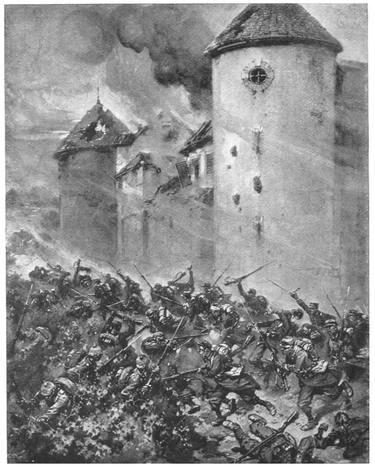
DESPERATE STRUGGLE FOR THE CHÂTEAU DE MONDEMENT
DURING THE BATTLE OF THE MARNE.
Reproduced by permission of “The Illustrated London News.”
By Sir Arthur Conan Doyle.
B From “The British Campaign in France and Flanders.”
By Sir Arthur Conan Doyle. (Hodder & Stoughton.)
On September 11 the British were still
advancing upon a somewhat narrowed
front. There was no opposition, and again the
day bore a considerable crop of prisoners and
other trophies. The weather had become so
foggy that the aircraft were useless, and it is
only when these wonderful scouters are precluded
from rising that a general realises how indispensable
they have become to him. As a wit
expressed it, they have turned war from a game
of cards into a game of chess. It was still very
wet, and the Army was exposed to considerable
privation, most of the officers and men having
neither change of clothing, overcoats, nor waterproof
sheets, while the blowing up of bridges
on the lines of communication had made it
impossible to supply the wants. The undefeatable
commissariat, however, was still working
well, which means that the Army was doing
the same. On the 12th the pursuit was continued
as far as the River Aisne. Allenby’s cavalry
occupied Braine in the early morning, the
Queen’s Bays being particularly active, but there
was so much resistance that the Third Division
was needed to make the ground good. Gough’s
Cavalry Division also ran into the enemy near
Chassemy, killing or capturing several hundred
of the German infantry. In these operations
Captain Stewart, whose experience as an alleged
spy has been mentioned, met with a soldier’s
death. On this day the Sixth French Army
was fighting a considerable action upon the
British left in the vicinity of Soissons, the
Germans making a stand in order to give time
for their impedimenta to get over the river.
In this they succeeded, so that when the Allied
Forces reached the Aisne, which is an unfordable
stream some sixty yards from bank to bank,
the retiring army had got across it, had destroyed
most of the bridges, and showed every sign of
being prepared to dispute the crossing.
Missy Bridge, facing the Fifth Division,
appeared at first to be intact, but a daring
reconnaissance by Lieutenant Pennecuick, of the
Engineers, showed that it was really badly
damaged. Condé Bridge was intact, but was so
covered by a high horse-shoe formation of hills
upon the farther side that it could not be used,
and remained throughout under control of the
enemy. Bourg Bridge, however, in front of the
First Army Corps, had for some unexplained
reason been left undamaged, and this was seized
in the early morning of September 13 by De
Lisle’s cavalry, followed rapidly by Bulfin’s
2nd Brigade. It was on the face of it a somewhat
desperate enterprise which lay immediately
in front of the British general. If the enemy
were still retreating he could not afford to slacken
his pursuit, while, on the other hand, if the
enemy were merely making a feint of resistance,
then, at all hazards, the stream must be forced
and the rearguard driven in. The German
infantry could be seen streaming up the roads
on the farther bank of the river, but there
were no signs of what their next disposition
might be. Air reconnaissance was still precluded,
and it was impossible to say for certain which
alternative might prove to be correct, but Sir
John French’s cavalry training must incline him
always to the braver course. The officer who
rode through the Boers to Kimberley and threw
himself with his weary men across the path of
the formidable Kronje was not likely to stand
hesitating upon the banks of the Aisne. His
personal opinion was that the enemy meant to
stand and fight, but none the less the order was
given to cross.
September 13 was spent in arranging this
dashing and dangerous movement. The British
got across eventually in several places and by
various devices. Bulfin’s men, followed by the
rest of the First Division of Haig’s Army Corps,
passed the canal bridge of Bourg with no loss
or difficulty. The 11th Brigade of Pulteney’s
Third Corps got across by a partially demolished
bridge and ferry at Venizel. They were followed
by the 12th Brigade, who established themselves
near Bucy. The 13th Brigade was held up at
Missy, but the 14th got across and lined up with
the men of the Third Corps in the neighbourhood
of Ste. Marguerite, meeting with a considerable
resistance from the Germans. Later, Count
Gleichen’s 15th Brigade also got across. On
the right Hamilton got over with two brigades
of the Third Division, the 8th Brigade crossing
on a single plank at Vailly and the 9th using
the railway bridge, while the whole of Haig’s
First Corps had before evening got a footing
upon the farther bank. So eager was the
advance and so inadequate the means that
Haking’s 5th Brigade, led by the Connaught
Rangers, was obliged to get over the broad and
dangerous river, walking in single file along
the sloping girder of a ruined bridge, under a
heavy, though distant, shell-fire. The night of
September 13 saw the main body of the Army
across the river, already conscious of a strong
rear-guard action, but not yet aware that the
whole German Army had halted and was turning
at bay. On the right De Lisle’s cavalrymen had
pushed up the slope from Bourg Bridge and
reached as far as Vendresse, where they were
pulled up by the German lines.
It has been mentioned above that the 11th
and 12th Brigades of the Fourth Division had
passed the river at Venizel. These troops were
across in the early afternoon, and they at once
advanced, and proved that in that portion of
the field the enemy were undoubtedly standing
fast. The 11th Brigade, which was more to the
north, had only a constant shell-fire to endure,
but the 12th, pushing forward through Bucy-le-long,
found itself in front of a line of woods
from which there swept a heavy machine-gun
and rifle-fire. The advance was headed by the
2nd Lancashire Fusiliers, supported by the 2nd
Inniskilling Fusiliers. It was across open ground
and under heavy fire, but it was admirably
carried out. In places where the machine-guns
had got the exact range the stricken Fusiliers lay
dead or wounded with accurate intervals, like
a firing-line on a field-day. The losses were
heavy, especially in the Lancashire Fusiliers.
Colonel Griffin was wounded, and five of his
officers with 250 men were among the casualties.
It should be recorded that fresh supplies of
ammunition were brought up at personal risk
by Colonel Seely, late Minister of War, in his
motor-car. The contest continued until dusk,
when the troops waited for the battle of next
day under such cover as they could find.
The crossing of the stream may be said,
upon the one side, to mark the end of the battle
and pursuit of the Marne, while, on the other,
it commenced that interminable Battle of the
Aisne which was destined to fulfil Bloch’s prophecies
and to set the type of all great modern
engagements. The prolonged struggles of the
Manchurian War had prepared men’s minds for
such a development, but only here did it first
assume its full proportions and warn us that the
battle of the future was to be the siege of the
past. Men remembered with a smile Bernhardi’s
confident assertion that a German battle would
be decided in one day, and that his countrymen
would never be constrained to fight in defensive
trenches.
The moral effect of the Battle of the Marne
was greater than its material gains. The latter,
so far as the British were concerned, did not
exceed 5,000 prisoners, 20 guns, and a quantity
of transport. The total losses, however, were
very heavy.
Apart from the losses, the mere fact that a
great German army had been hustled across
30 miles of country, had been driven from river
to river, and had finally to take refuge in trenches
in order to hold their ground, was a great encouragement
to the Allies. From that time they
felt assured that with anything like equal numbers
they had an ascendancy over their opponents.
III. A GLIMPSE OF CANADA IN FLANDERS. C
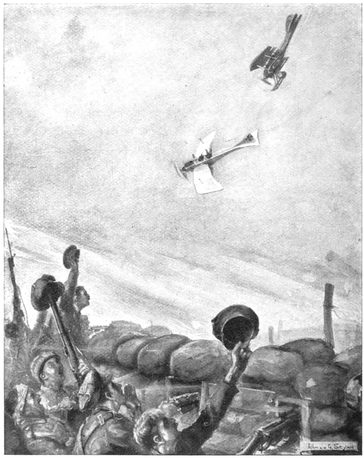
WAR IN THE AIR: A DUEL OVER THE FIRING LINE.
Reproduced by permission of “The Illustrated London News.”
By Lord Beaverbrook.
C From “Canada in Flanders” (Vol. I.). By Sir Max
Aitken. (Hodder & Stoughton.)
The end of the month was marked by one
or two very daring reconnaissances by
Lieutenant Owen, of the 7th (British Columbia)
Battalion, up the bed of the Douve River, and
by a great aeroplane battle.
The aeroplane battle occurred upon a morning
warm and bright with sunshine. The conditions
were admirable for flying and observing, and, as
usual, a German Albatross took advantage of
them. Soaring high against the warm blue of
the sky, over Bailleul, over the headquarters of a
division, over our brigades and trenches and back
again, it glinted like silver in the morning sun.
The snow-white blobs of bursting shrapnel from
our anti-aircraft guns followed its graceful sweeps
and curves—followed and followed, but never
caught it up; and thousands of our men stared
after it. But a more dramatic spectacle was in
store for the watchers on the brown roads and
in the brown trenches.
A British machine appeared suddenly low
against the blue, mounting and flying out of the
west. The men in the Albatross were evidently
so intent on their task of observing the landscape
beneath them and keeping well ahead of our
blossoming shrapnel that they failed to observe
the approach of the British ’plane as soon as
they should have for their own good. They were
heading west when they saw their danger, and
instantly the Albatross swerved round and sped
towards home. But the British flier had the heels
of the German and the advantage of the position.
It circled and dipped, and down through the
clear air aloft came the rippling “tap-tap-tap”
of the aërial machine-guns. Again and again the
enemy’s frantic efforts to escape were frustrated
by the skill and daring of the British pilot and
the hedging fire of the British guns. Suddenly
the gun of the German ’plane jammed and ceased;
the pilot was hit and wounded; the Albatross
commenced a rapid descent, in which it was
followed by the British ’plane to within
1,000 feet of the ground. Then, under heavy
shell-fire from German batteries the victorious
machine rose and flew away undamaged, and the
unfortunate Albatross struck the earth between
the front and support trenches of the 14th
(Montreal) Battalion and turned turtle. The
German pilot was dead; the observer, slightly
wounded, crawled to our support trenches and
surrendered. The German batteries kept up a
hot fire of high explosives and shrapnel on the
machine with the object of smashing it beyond
hope of repair before the Canadians could salvage
it. They made several direct hits, but our men
sapped out to the wreck and managed to bring
most of it in, piece by piece. Among the articles
brought in was the machine-gun that had jammed
in the heat of the fight. This was found to be
a Colt gun. Closer examination proved it to be
one of the original guns of our 14th Battalion—to
whose lines it had just made such a dramatic
return! The gun had been abandoned during
one of the desperate and confused fights of the
Second Battle of Ypres half a year before.
In these months of September and October
great efforts were expended on improving the line.
Work in the front positions was done by the
occupying battalions, and the troops in reserve
came up night after night to assist their labours
and to create new secondary positions and drive
through fresh communication trenches. Even
the training of new units was occasionally and
rightly sacrificed to the performance of this
essential task. The weather was, on the whole,
favourable for these operations, with the exception
of three days of rain early in September and a
wet week late in October. The 1st Division, long
on the ground and fortified by the experience
of what good trenches mean for comfort and
safety, was pre-eminent in these exertions, as
would be proved by the trench-map with its
continuous increase, month after month, in the
black and zigzag lines of new work. Each tiny
scrawl on the surface of such a map represents
the labours of hundreds of men, extended over
many nights. Second and third lines grew apace,
so that a sudden attack of the enemy would still
leave trenches to be held and would reduce the
German bite to mere nibbles at the forward trench.
The communication trenches are driven true
and straight from well in the rear, and up these
the ration parties toil in safety night after night
under their burdens of food, water, ammunition,
and R.E. material to feed the front line. These
parties know well enough the difference between
well-made lines and bad ones. Stooping under
the heavy weights as they struggle on through
the dark, they will bless in army fashion a smooth
and dry surface underfoot and a sound high
parapet which protects them from the casual
German shells which are searching for them, or
the intermittent whistle of the long-range bullet
humming on its errand in the dusk. Messengers
or stretcher-bearers with their burdens can move
backwards or forwards even by day along the
well-built hollow, and all those who pass are
protected both from the arrow that flieth by
night and the terror which walketh in the noonday.
Very different is the story of a badly-kept
line. It finds carrying parties struggling in, hours
late, exhausted by wading through mud and
water, and delayed by continually climbing out
and walking outside the trench to avoid impassable
sections. Here an unlucky shell or a casual bullet
may take its toll. The men struggle back with
difficulty, arriving hardly before the dawn, and
with their period of supposed rest and recuperation
turned into the most arduous of labours. It is
not too much to say that the efficiency of a
regiment or division can be tested by a comparison
between the state in which it takes over and that
in which it leaves its trenches.
The creation of secondary positions is as
important as that of communication trenches,
and on this task the Canadian Corps worked
unsparingly throughout the autumn.
The disposition of a brigade is two, or on
occasion three, battalions in the front line and
one or two in support or reserve trenches. But
in most cases even the leading regiments will not
have their whole strength in the firing trench.
One or two companies lie close up in support or
reserve to reinforce any threatened point. The
nearness of these supports is a very present help
in time of trouble, and gives confidence to officers
and men, who would be nervous if they knew
that no assistance was nearer than a mile away
in distance and an hour in time. But these lines
must be dug under cover of dark, so the men toiled
with the spade through the nights of autumn
and blessed the dawn which put a term to their
labours. Their record is written on the scarred
earth from St. Eloi down to Ploegsteert. Let
us hope that the corps which took their place in
March was duly grateful for the blessing of a
well-constructed line.
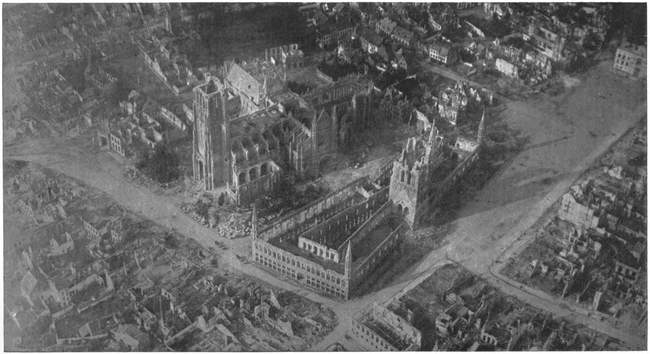
IV. THE SECOND BATTLE OF YPRES. D
YPRES AFTER BOMBARDMENT.
Reproduced by permission of “The Sphere.”
By John Buchan.
D From “The History of the War.” By John Buchan.
(Thos. Nelson & Sons.)
The present writer first saw Ypres from a
little hill during the later stages of the
battle. It was a brilliant spring day, and, when
there was a lull in the bombardment and the
sun lit up its white towers, Ypres looked a
gracious and delicate little city in its cincture
of green. It was with a sharp shock of surprise
that one realised that it was an illusion, that
Ypres had become a shadow. A few days later,
in a pause of the bombardment, he entered the
town. The main street lay white and empty in
the sun, and over all reigned a deathly stillness.
There was not a human being to be seen in all
its length, and the houses on each side were
skeletons. There the whole front had gone, and
bedrooms with wrecked furniture were open to
the light. There a 42-cm. shell had made a
breach in the line, with raw edges of masonry
on both sides, and a yawning pit below. In one
room the carpet was spattered with plaster
from the ceiling, but the furniture was unbroken.
There was a Buhl cabinet with china, red plush
chairs, a piano, and a gramaphone—the plenishing
of the best parlour of a middle-class home.
In another room was a sewing-machine, from
which the owner had fled in the middle of a
piece of work. Here was a novel with the reader’s
place marked. It was like a city visited by an
earthquake which had caught the inhabitants
unawares, and driven them shivering to a place
of refuge.
Through the gaps in the houses there were
glimpses of greenery. A broken door admitted
to a garden—a carefully-tended garden, for the
grass had once been trimly kept, and the owner
must have had a pretty taste in spring flowers.
A little fountain still plashed in a stone basin.
But in one corner an incendiary shell had fallen
on the house, and in the heap of charred débris
there were human remains. Most of the dead
had been removed, but there were still bodies
in out-of-the-way comers. Over all hung a
sickening smell of decay, against which the lilacs
and hawthorns were powerless. That garden was
no place to tarry in.
The street led into the Place, where once
stood the great Church of St. Martin and the
Cloth Hall. Those who knew Ypres before the
war will remember the pleasant façade of shops
on the south side, and the cluster of old Flemish
buildings at the north-eastern corner. Words
are powerless to describe the devastation of
these houses. Of the southern side nothing remained
but a file of gaunt gables. At the northeast
corner, if you crawled across the rubble,
you could see the remnants of some beautiful
old mantelpieces. Standing in the middle of
the Place, one was oppressed by the utter silence,
a silence which seemed to hush and blanket the
eternal shelling in the Salient beyond. Some
jackdaws were cawing from the ruins, and a
painstaking starling was rebuilding its nest in
a broken pinnacle. An old cow, a miserable
object, was poking her head in the rubbish and
sniffing curiously at a dead horse. Sound was
a profanation in that tomb which had once
been a city.
The Cloth Hall had lost all its arcades, most
of its front, and there were great rents everywhere.
Its spire looked like a badly-whittled
stick, and the big gilt clock, with its hands
irrevocably fixed, hung loose on a jet of stone.
St. Martin’s Church was a ruin, and its stately
square tower was so nicked and dinted that it
seemed as if a strong wind would topple it over.
Inside the church was a weird sight. Most of
the windows had gone, and the famous rose
window in the southern transept lacked a segment.
The side chapels were in ruins, the floor was deep
in fallen stones, but the pillars still stood. A
mass for the dead must have been in progress,
for the altar was draped in black, but the altar
stone was cracked across. The sacristy was full
of vestments and candlesticks tumbled together
in haste, and all were covered with yellow picric
dust from the high explosives. In the graveyard
behind there was a huge shell crater, 50 feet
across and 20 feet deep, with human bones
exposed in the sides. Before the main door
stood a curious piece of irony. An empty pedestal
proclaimed from its four sides the many virtues
of a certain Belgian statesman who had been
also mayor of Ypres. The worthy mayor was
lying in the dust beside it, a fat man in a frock
coat, with side-whiskers and a face like Bismarck.
Out in the sunlight there was the first sign
of human life. A detachment of French Colonial
tirailleurs entered from the north—brown,
shadowy men in fantastic weather-stained uniforms.
A vehicle stood at the cathedral door,
and a lean and sad-faced priest was loading it
with some of the church treasures—chalices,
plate, embroidery. A Carmelite friar was prowling
among the side alleys looking for the dead. It
was like some macabre imagining of Victor Hugo.
The ruins of old buildings are so familiar
that they do not at first dominate the mind.
Far more arresting are the remnants of the
pitiful little homes, where there is no dignity,
but a pathos which cries aloud. Ypres was like
a city destroyed by an earthquake; that is the
simplest and truest description. But the skeletons
of her great buildings, famous in Europe for
500 years, left another impression. One felt,
as at Pompeii, that things had always been so;
one felt that they were verily indestructible,
they were so great in their fall. The cloak of
St. Martin was not needed to cover the nakedness
of his church. There was a terrible splendour
about these gaunt and broken structures, these
noble, shattered façades, which defied their
destroyers. Ypres might be empty and a ruin,
but to the end of time she would be no mean
city.
One of the truest of our younger poets,
Rupert Brooke, who died while serving in the
Dardanelles, wrote in his last months a sonnet
on the consolation of death in war:—
“If I should die, think only this of me: That there’s some corner of a foreign field That is for ever England. There shall be In that rich earth a richer dust concealed.”
In the salient of Ypres there are not less than a
hundred thousand graves of Allied soldiers, sometimes
marked by plain wooden crosses, sometimes
obliterated by the débris of ruined trenches,
sometimes hidden in corners of fields and beneath
clumps of chestnuts. That ground is for ever
England; and it is also for ever France, for there
the men of Dubois died around Bixschoote and
on the Klein Zillebeke ridge. When the war is
over this triangle of meadowland, with a ruined
city for its base, will be an enclave of Belgian
soil consecrated as the holy land of two great
peoples. It may be that it will be specially set
apart as a memorial place; it may be that it
will be unmarked, and that the country folk
will till and reap as before over the vanishing
trench lines. But it will never be common
ground. It will be for us the most hallowed
spot on earth, for it holds our bravest dust, and
it is the proof and record of a new spirit. In the
past when we have thought of Ypres we have
thought of the British flag preserved there, which
Clare’s Regiment, fighting for France, captured
at the Battle of Ramillies. The name of the little
Flemish town has recalled the divisions in our
own race and the centuries-old conflict between
France and Britain. But from now and henceforth
it will have other memories. It will stand
as a symbol of unity and alliance—unity within
our Empire, unity within our Western civilization—that
true alliance and that lasting unity which
are won and sealed by a common sacrifice.
V. THE BATTLE OF JUTLAND BANK.
BATTLE OF JUTLAND: FIRST SIGHT OF THE ENEMY’S HIGH SEAS FLEET.
Reproduced by permission of “The Illustrated London News.”
By H. W. Wilson.
The chase and destruction of an enemy takes
many hours. Nelson began his battle at
Trafalgar at noon, or soon after; the Germans
took good care not to engage before the afternoon
was well advanced. There was enough time to
destroy a detachment, but not enough to complete
the destruction of a large fleet. The mist further
diminished the advantage which the British
possessed in their heavy guns, and enabled the
Germans to count on using their numerous 6-in.
weapons with success.
Contact with the enemy was obtained. At
2.20 p.m. Admiral Beatty received reports from
his light cruisers indicating the proximity of the
enemy, and at 2.35 the smoke of a considerable
fleet was seen to the E. A seaplane was sent
up from a seaplane-carrying ship to reconnoitre
the enemy, and transmitted back the first reports
about 3.30.
Admiral Beatty at once formed line of battle,
steering E.S.E. at 25 knots, with the Fifth Battle
Squadron 10,000 yards off to the N.N.W. The
enemy (five battle-cruisers under Vice-Admiral
Hipper, with light cruisers and destroyers) was
now 23,000 yards distant. Admiral Beatty seems
to have decided that it would be unwise to wait
till the Fifth Battle Squadron could join up with
him and form into line with his six ships.
The enemy, on seeing him, had turned S.
toward the German Battle Fleet, which was
steaming up from the S. some 50 miles off, and
he followed. At 3.48 Beatty opened fire at a
range of 18,500 yards (or rather more than
10½ land miles), and the enemy did the same. Six
British ships with broadsides of 32 13·5-in. and
16 12-in. guns were now shooting at five German
ships, whose broadsides were 16 12-in. and
28 11-in. guns. Beatty slowly closed on the
enemy till a distance of 14,000 yards parted the
squadrons; meanwhile the light cruisers were
engaged with craft of their kind.
It was in this preliminary action with the
odds in our favour that two of Admiral Beatty’s
splendid battle-cruisers—the Queen Mary and
Indefatigable—were destroyed.
The loss of these two ships reduced Admiral
Beatty’s armoured ships to four and his weight
of metal to an approximate equality with the
German battle-cruiser squadron, which was still
five ships strong, no single vessel in it having as
yet been put out of action. At 4.8, Beatty was
in some degree supported by the fire of the 15-in.
guns in the Fifth Battle Squadron, which opened
at 20,000 yards—a long range in misty weather—and
the enemy’s fire seemed to slacken. A submarine
attack was beaten off by the vigilance
and skill of the British destroyers, which soon
after 4 were flung in on the enemy in a great
attack, meeting in their impetuous charge a
German light cruiser and 15 destroyers.
All through this encounter the battle-cruisers
were still pounding one another and rapidly
nearing the German Battle Fleet. From 4.15 to
4.43 he reports that the fighting was “of a very
fierce and resolute character,” but at 4.18 the
third enemy ship was seen to be on fire. The
haze had now thickened, and the enemy could
only be dimly made out. At 4.38 the German
Battle Fleet emerged from the mist to the S.E.,
and was seen and reported by the Second
Light Cruiser Squadron, scouting in advance,
to Admiral Beatty, who at 4.42 turned in his
course, steaming N.W. instead of S.E., towards
Admiral Jellicoe and the British Battle Fleet.
The Germans turned in the same way, their
battle-cruisers taking station at the head of the
enemy’s line and pursuing Beatty. As they
executed this turn, the Fifth Battle Squadron
closed them, steaming in the opposite direction,
engaged them with all its guns, and then turned
and fell in astern of Beatty, who now had eight
ships in line, proceeding at a speed of something
over 21 knots. The enemy’s battle fleet was in
action, and the Germans had concentrated in
superior force on a part of the British Fleet.
The range was 14,000 yards and the enemy
was getting heavily hit, while he was apparently
not making many hits on the British ships.
After 5, one of the German battle-cruisers—perhaps
the Lutzow, which, according to the
enemy, received 15 or 16 heavy shells—left
the line damaged. At 5.10 the sixth ship in
the German line—a Dreadnought—was reported
to have been hit by a torpedo, and it is just
possible that she sank, as a huge cloud of smoke
and steam was seen just after where she had been.
The Germans were now edging off to the E.,
learning either from Zeppelins or their light
cruisers that the British Battle Fleet was coming
up to the N.W. Admiral Beatty reports that
“probably Zeppelins were present,” though they
appear to have been seen only by neutrals in
the first stage of the battle.
The head of the German line at this part of
the battle was getting severely punished, and
a second of the German battle-cruisers had
vanished, leaving only three enemy battle-cruisers
in line. The first stage of the battle was over.
Beatty had led the Germans to the British
Battle Fleet, which was sighted at 5.56 10,000
yards away to the N.
The position of the Fleet was as follows:—Beatty,
with four battle-cruisers, and astern
of him the four fast battleships of the Fifth
Battle Squadron, was now turning sharply eastwards
to pass across the head of the German
Fleet and prevent it from edging E. and getting
away in that direction. This movement of his
would have enabled him to “cross the T” of the
enemy’s line—i.e., to pass at right angles across
it, raking the ships as he passed, which is regarded
as the most advantageous position that can be
obtained in battle—if the enemy had not turned.
N. of Admiral Beatty’s ships was the British
Battle Fleet, with three battle-cruisers under
Hood on one wing, and three or four armoured
cruisers under Arbuthnot on the other. On a
line generally parallel to Beatty’s was the whole
force of German battle-cruisers (3) and battleships
(22), slightly astern of him, so that the
German ships at the southern end of the line
were out of the battle—too distant to fire. The
head of the enemy line was some 12,000 yards
from him, and about 22,000 yards from the
British Battle Fleet.
Beatty’s eastward turn compelled the enemy
to turn, and enabled the British Battle Fleet,
if it desired, to move in behind the High Sea
Fleet and cut it off from its bases. To reinforce
Beatty in these critical moments, Hood
steamed in fast with his three battle-cruisers,
and swung magnificently into position at the
head of Beatty’s line. There he received a
terrific fire from the enemy, 8,000 yards away,
and a few minutes later the Invincible, his flagship,
was struck by the combined salvoes of
the German Fleet and she sank. Three battle-cruisers
were gone, and of their combined crews
of 2,500 men a mere handful were saved. Beatty
at 6.35, about the time when the Invincible
sank, turned S.E. A little earlier, Rear-Admiral
Arbuthnot, with three weak armoured cruisers,
struck the German Battle Fleet, which was
apparently almost hidden in smoke. His intervention
prevented a dangerous German torpedo
attack on the British battle-cruisers, but in
rendering this last service he perished.
The Black Prince was very badly hit. The
Warrior was disabled, and in extreme danger.
Probably the German ships were attacking these
vessels with concentrated salvoes—battleships of
the super-Dreadnought class firing at pre-Dreadnought
armoured cruisers. The German shooting
must have begun to deteriorate, as the Warspite
was quickly got under control, and with but
slight damage rejoined the Fifth Battle Squadron,
which was now taking station astern of Admiral
Jellicoe’s Fleet.
At 6.17 this Fleet entered the battle. The
First Battle Squadron was the first to engage
at 11,000 yards, closing the enemy slowly to
9,000 (which is very short range indeed, and
would allow the Germans to use their 6-in. guns).
The light was very bad. The Germans were
shrouded in haze; their destroyers sent up
thick clouds of coal smoke, which obscured an
atmosphere already choked with the fumes of
bursting shells, and the smoke from the numerous
fires in the ships engaged. From the van of
the Battle Fleet never more than five German
ships could be seen, and from the rear never
more than twelve. The British constantly strove
to close, but were eluded by the enemy, who
utilised destroyer attacks to cover his retreat.
But, difficult though it was to shoot with accuracy,
Sir J. Jellicoe reports that in this phase of the battle
the enemy ships were repeatedly hit, and one
at least was seen to sink.
The Marlborough, in the First Battle Squadron,
specially distinguished herself, firing seven salvoes
(if with all her guns about 70 13·5-in. shell) at
a battleship of the Kaiser class; at 6.54 she was
so unlucky as to be hit by a torpedo fired from
a German light cruiser, which she sank. She
was the only British ship to suffer in this way.
A great cloud of smoke rose from her and she
listed violently, then recovered, and nine minutes
later re-opened fire. At 7.12 she poured 14 salvoes
with great speed upon a battleship of the König
class, and drove her from the line.
The flagship, Iron Duke, at 6.30 engaged a
Dreadnought of the König class in the German
Fleet, hitting her at the second salvo, which was
a remarkable gunnery performance at a range
of 12,000 yards and in the clouds of smoke. The
enemy turned away and escaped. The other
ships of the Fourth Battle Squadron were mainly
engaged with the German battle-cruisers. The
Second Battle Squadron attacked the German
battleships, and also fired at a damaged German
battle-cruiser, from 6.30 to 7.20; at 7 p.m. the
British Fleet turned S., and shortly afterwards
S.W. The battleship engagement closed about
8.20, when the enemy disappeared in the smoke
and mist. He lay to the W. of Admiral Jellicoe’s
Fleet, and orders were issued to the British
torpedo craft to attack him. About 8.20 Beatty
pushed W. in support of the light cruisers
which had been ordered to locate the enemy’s
position, and came upon two battle-cruisers and
two battleships, which he attacked at a range
of 10,000 yards. The leading German ship was
struck repeatedly, and turned away sharply with
a very heavy list, emitting flames; the Princess
Royal set a three-funnelled battleship (possibly
the Helgoland) on fire. A third ship was battered
by the Indomitable and New Zealand, and was
seen heeling over, on fire, drawing out of the line.
Then about 8.38 the mist came down so thickly
that the battle was broken off, the enemy fleet
being last seen by the larger British ships about
8.38, steaming W.
At 8.40 a violent explosion was felt by the
British Fleet. This was probably caused by the
destruction of a big ship.
Beatty steamed S.W. till 9.24, when having
seen nothing more of the enemy, he assumed that
the Germans were to the N.W., and proceeded
N.N.E. to the British Battle Fleet. He says:
“In view of the gathering darkness, and the
fact that our strategical position was such as
to make it appear certain that we should locate
the enemy at daylight under most favourable
circumstances, I did not consider it proper or
desirable to close the enemy battle fleet during
the dark hours.”
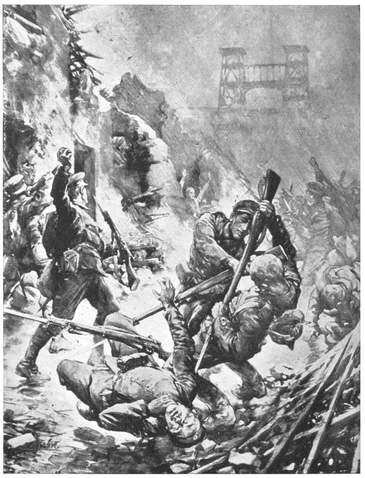
VI. THE CHARGE AT LOOS OF THE LONDON IRISH (18th London).
STORMING THE VILLAGE OF LOOS: HAND-TO-HAND FIGHTING IN THE STREETS.
Reproduced by permission of “The Sphere.”
A vivid account of an incident at Loos,
which has become historic, was given by one
of the London Irish Regiment who was wounded
during the charge:—
“One set of our men—keen footballers—made
a strange resolution; it was to take a
football along with them. The platoon officer
discovered this, and ordered the football to be
sent back—which, of course, was carried out.
But the old members of the London Irish Football
Club were not to be done out of the greatest
game of their lives-the last to some of them,
poor fellows—and just before Major Beresford
gave the signal the leather turned up again
mysteriously.
“Suddenly the officer in command gave the
signal, ‘Over you go, lads!’ With that the whole
line sprang up as one man, some with a prayer,
not a few making the sign of the Cross. But
the footballers, they chucked the ball over and
went after it just as cool as if on the field, passing
it from one to the other, though the bullets were
flying thick as hail, crying, ‘On the ball, London
Irish!’ just as they might have done at Forest
Hill. I believe that they actually kicked it right
into the enemy’s trench with the cry, ‘Goal!’
though not before some of them had been picked
off on the way.
“There wasn’t 400 yards between the trenches,
and we had to get across the open—a manœuvre
we started just as on parade. All lined up,
bayonets fixed, rifles at the slope. Once our
fellows got going it was hard to get them to
stop, with the result that some rushed clean into
one of our own gas waves and dropped in it just
before it had time to get over the enemy’s trench.
“The barbed wire had been broken into
smithereens by our shells so that we could get
right through; but we could see it had been
terrible stuff, and we all felt we should not have
had a ghost of a chance of getting through had
it not been for an unlimited supply of shells
expended on it.
“When we reached the German trench, which
we did under a cloud of smoke, we found nothing
but a pack of beings dazed with terror. In a jiffy
we were over their parapet and the real work
began; a kind of madness comes over you as
you stab with your bayonet and hear the shriek
of the poor devil suddenly cease as the steel goes
through him and you know he’s ‘gone west.’
The beggars did not show much fight, most
having retired into their second line of trenches
when we began to occupy their first to make it
our new line of attack. That meant clearing
out even the smallest nook or corner that was
large enough to hold a man.
“This fell to the bombers. Every bomber is
a hero, I think, for he has to rush on, fully exposed,
laden with enough stuff to send him to ‘kingdom
come’ if a chance shot or stumble sets him off.
“Some of the sights were awful in the hand-to-hand
struggle, for, of course, that is the worst
part. Our own second in command, Major Beresford,
was badly wounded. Captain and Adjutant
Hamilton, though shot through the knee just
after leaving our trench, was discovered still
limping on at the second German trench, and had
to be placed under arrest to prevent his going
on till he bled to death.
“They got the worst of it, though, when it
came to cold steel, which they can’t stand, and
they ran like hares. So having left a number
of men in the first trench, we went on to the
second and then the third, after which other
regiments came up to our relief, and together
we took Loos. It wasn’t really our job at all
to take Loos, but we were swept on by the
enthusiasm, I suppose, and all day long we were
at it, clearing house after house, or rather what
was left of the houses—stabbing and shooting
and bombing till one felt ready to drop dead
oneself. We wiped the 22nd Silesian Regiment
right out, but it was horrible to work on with
the cries of the wounded all round.”
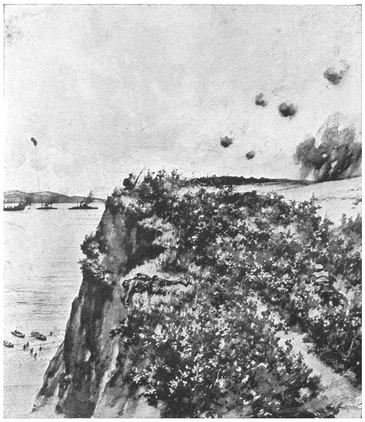
VII. THE LANDING AT V BEACH, NEAR SEDD-EL-BAHR. E
BRITISH TROOPS IN ACTION ON THE GALLIPOLI PENINSULA.
Reproduced by permission of “The Illustrated London News.”
By John Masefield.
E From “Gallipoli.” By John Masefield. (Heinemann.)
The men told off for this landing were:
the Dublin Fusiliers, the Munster Fusiliers,
half a battalion of the Hampshire Regiment,
and the West Riding Field Company.
Three companies of the Dublin Fusiliers were
to land from towed lighters, the rest of the party
from a tramp steamer, the collier River Clyde.
This ship, a conspicuous seamark at Cape Helles
throughout the rest of the campaign, had been
altered to carry and land troops. Great gangways
or entry ports had been cut in her sides on the
level of her between decks, and platforms had
been built out upon her sides below these, so
that men might run from her in a hurry. The
plan was to beach her as near the shore as
possible, and then drag or sweep the lighters,
which she towed, into position between her and
the shore, so as to make a kind of boat bridge
from her to the beach. When the lighters were
so moored as to make this bridge, the entry
ports were to be opened, the waiting troops
were to rush out on to the external platforms,
run from them on to the lighters, and so to the
shore. The ship’s upper deck and bridge were
protected with boiler plate and sandbags, and
a casemate for machine guns was built upon
her fo’c’sle, so that she might reply to the enemy’s
fire.
Five picket-boats, each towing five boats or
launches full of men, steamed alongside the River
Clyde and went ahead when she grounded. She
took the ground rather to the right of the little
beach, some 400 yards from the ruins of Sedd-el-Bahr
Castle, before the Turks had opened fire;
but almost as she grounded, when the picket-boats
with their tows were ahead of her, only
20 or 30 yards from the beach, every rifle and
machine gun in the castle, the town above it,
and in the curved, low, strongly trenched hill
along the bay, began a murderous fire upon
ship and boats. There was no question of their
missing. They had their target on the front
and both flanks at ranges between 100 and
300 yards in clear daylight, 30 boats bunched
together and crammed with men and a good
big ship. The first outbreak of fire made the
bay as white as a rapid, for the Turks fired not
less then 10,000 shots a minute for the first few
minutes of that attack. Those not killed in
the boats at the first discharge jumped overboard
to wade or swim ashore. Many were killed in
the water, many, who were wounded, were
swept away and drowned; others, trying to
swim in the fierce current, were drowned by
the weight of their equipment. But some reached
the shore, and these instantly doubled out to
cut the wire entanglements and were killed, or
dashed for the cover of a bank of sand or raised
beach which runs along the curve of the bay.
Those very few who reached this cover were
out of immediate danger, but they were only
a handful. The boats were destroyed where
they grounded.
Meanwhile the men of the River Clyde tried
to make their bridge of boats by sweeping the
lighters into position and mooring them between
the ship and the shore. They were killed as
they worked, but others took their places; the
bridge was made, and some of the Munsters
dashed along it from the ship and fell in heaps
as they ran. As a second company followed,
the moorings of the lighters broke or were shot;
the men leaped into the water, and were drowned
or killed, or reached the beach and were killed,
or fell wounded there, and lay under fire, getting
wound after wound till they died; very, very
few reached the sandbank. More brave men
jumped aboard the lighters to remake the bridge;
they were swept away or shot to pieces. The
average life on those boats was some three minutes
long, but they remade the bridge, and the third
company of the Munsters doubled down to death
along it under a storm of shrapnel which scarcely
a man survived. The big guns in Asia were now
shelling the River Clyde, and the hell of rapid
fire never paused. More men tried to land,
headed by Brigadier-General Napier, who was
instantly killed, with nearly all his followers.
Then for long hours the remainder stayed on
board, down below in the grounded steamer,
while the shots beat on her plates with a rattling
clang which never stopped. Her twelve machine
guns fired back, killing any Turk who showed;
but nothing could be done to support the few
survivors of the landing, who now lay under
cover of the sandbank on the other side of the
beach. It was almost certain death to try to
leave the ship, but all through the day men
leaped from her (with leave or without it) to
bring water or succour to the wounded on the
boats or beach. A hundred brave men gave their
lives thus; every man there earned the Cross
that day. A boy earned it by one of the bravest
deeds of the war, leaping into the sea with a
rope in his teeth to try to secure a drifting lighter.
The day passed thus, but at nightfall the
Turks’ fire paused, and the men came ashore
from the River Clyde, almost unharmed. They
joined the survivors on the beach, and at once
attacked the old fort and the village above it.
These works were strongly held by the enemy.
All had been ruined by the fire from the Fleet,
but in the rubble and ruin of old masonry there
were thousands of hidden riflemen backed by
machine guns. Again and again they beat off
our attacks, for there was a bright moon and
they knew the ground, and our men had to
attack uphill over wire and broken earth and
heaped stones in all the wreck and confusion
and strangeness of war at night in a new place.
Some of the Dublins and Munsters went astray
in the ruins, and were wounded far from their
fellows, and so lost. The Turks became more
daring after dark; while the light lasted they
were checked by the River Clyde’s machine
guns, but at midnight they gathered unobserved
and charged. They came right down on to the
beach, and in the darkness and moonlight much
terrible and confused fighting followed. Many
were bayoneted, many shot, there was wild
firing and crying, and then the Turk attack
melted away, and their machine guns began again.
When day dawned, the survivors of the landing
party were crouched under the shelter of the
sandbank; they had had no rest; most of them
had been fighting all night; all had landed across
the corpses of their friends. No retreat was
possible, nor was it dreamed of, but to stay
there was hopeless. Lieut.-Colonel Doughty-Wylie
gathered them together for an attack;
the Fleet opened a terrific fire upon the ruins
of the fort and village, and the landing party
went forward again, fighting from bush to bush
and from stone to stone, till the ruins were in
their hands. Shells still fell among them, single
Turks, lurking under cover, sniped them and
shot them; but the landing had been made
good, and V beach was secured to us.
This was the worst and the bloodiest of all
the landings.
VIII. THE COLDSTREAM GUARDS AT THE BATTLE OF THE SOMME. F
THE BATTLE OF THE SOMME: THE COLDSTREAM GUARDS’ SPLENDID CHARGE.
Reproduced by permission of “The Illustrated London News.”
And now I must tell a little more in detail
the story of the Guards in this battle.
It is hard to tell it, and not all can be told yet
because of the enemy. The Guards had their
full share of the fighting, and of the difficult
ground, with strong forces against them. They
knew that would be so before they went into
battle, and yet they did not ask for better things
but awaited the hour of attack with strong,
gallant hearts, quite sure of their courage, proud
of their name, full of trust in their officers, eager
to give a smashing blow at the enemy.
These splendid men, so tall and proper, so
hard and fine, went away as one might imagine
the old knights and yeomen of England at Agincourt.
For the first time in the history of the
Coldstreamers, three battalions of them charged
in line, great solid waves of men, as fine a sight
as the world could show. Behind them were
the Grenadiers, and again behind these men
the Irish.
They had not gone more than 200 yards
before they came under the enfilade fire of massed
machine guns in trenches not previously observed.
The noise of this fire was so loud and savage
that, although hundreds of guns were firing,
not a shot could be heard. It was just the stabbing
staccato hammering of the German Maxims.
Men fell, but the lines were not broken. Gaps
were made in the ranks, but they closed up.
The wounded did not call for help, but cheered
on those who swept past and on, shouting “Go
on, Lily-whites!”—which is the old name for
the Coldstreamers—“Get at ’em, Lily-whites!”
They went on at a hot pace with their bayonets
lowered. Out of the crumpled earth—all pits
and holes and hillocks, torn up by great gun-fire—grey
figures rose and fled. They were German
soldiers terror-stricken by this rushing tide of
men.
The Guards went on. Then they were checked
by two lines of trenches, wired and defended
by machine guns and bombers. They came upon
them quicker than they expected. Some of the
officers were puzzled. Could these be the trenches
marked out for attack—or other unknown
trenches? Anyhow, they must be taken—and
the Guards took them by frontal assault full in
the face of continual blasts of machine-gun
bullets.
There was hard and desperate fighting. The
Germans defended themselves to the death. They
bombed our men, who attacked them with the
bayonet, served their machine guns until they
were killed, and would only surrender when our
men were on top of them. It was a very bloody
hour or more. By that time the Irish Guards
had joined the others. All the Guards were
together, and together they passed the trenches,
swinging left inevitably under the machine-gun
fire which poured upon them from their right,
but going steadily deeper into the enemy country
until they were 2,000 yards from their starting
place.
Then it was necessary to call a halt. Many
officers and men had fallen. To go farther would
be absolute death. The troops on the right had
been utterly held up. The Guards were “up in
the air” with an exposed flank, open to all the
fire that was flung upon them from the enemy’s
lines. The temptation to go farther was great.
The German infantry was on the run. They
were dragging their guns away. There was a
great panic among the men who had been hiding
in trenches. But the German machine gunners
kept to their posts to safeguard a rout, and the
Guards had gone far enough through their
scourging bullets.
They decided very wisely to hold the line
they had gained, and to dig in where they stood,
and to make forward posts with strong points.
They had killed a great number of Germans and
taken 200 prisoners and fought grandly. So now
they halted and dug and took cover as best they
could in shell-craters and broken ground, under
fierce fire from the enemy’s guns.
The night was a dreadful one for the wounded,
and for men who did their best for the wounded,
trying to be deaf to agonizing sounds. Many of
them had hairbreadth escapes from death. One
young officer in the Irish Guards lay in a shell-hole
with two comrades, and then left it for a
while to cheer up other men lying in surrounding
craters. When he came back he found his two
friends lying dead, blown to bits by a shell.
But in spite of all these bad hours the Guards
kept cool, kept their discipline, their courage,
and their spirit. The Germans launched counter-attacks
against them, but were annihilated. The
Guards held their ground, and gained the greatest
honour for self-sacrificing courage which has ever
given a special meaning to their name. They took
the share which all of us knew they would take
in the greatest of all our battles since the first
day of July, and, with other regiments, struck
a vital blow at the enemy’s line of defence.
IX. THE MOONLIGHT BATTLE FOR BAGHDAD.
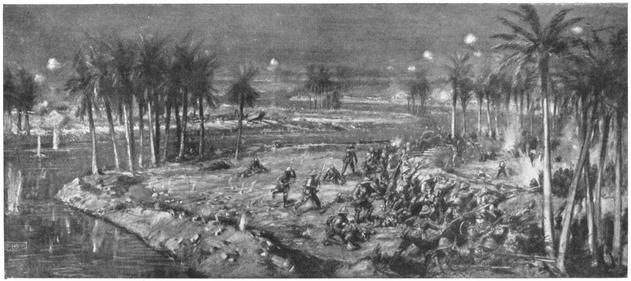
THE ADVANCE ON BAGHDAD: BATTLE ON THE DIALA RIVER.
Reproduced by permission of “The Sphere.”
By Edmund Candler.
The last fighting before Baghdad is likely
to become historic on account of the
splendid gallantry of our troops in the crossing
of the Diala River. After the action at Lajj
the Turkish rearguard fell back on Diala, destroying
the bridge which crosses the stream at its
junction with the Tigris. We pushed on in
pursuit on the left bank, sending cavalry and
two columns of infantry to work round on the
right bank, and to enter Baghdad from the west.
Speed in following up was essential, and the
column attacking Diala was faced with another
crossing in which the element of surprise was
eliminated. The village lies on both banks of
the stream, which is 120 yards wide. The houses,
trees, nullah, and walled gardens made it impossible
to build a road and ramps quickly and
to bring up pontoons without betraying the
point of embarkation. Hence the old bridgehead
site was chosen. The attack on the night
of the 7th was checked, but the quality of
courage shown by our men has never been
surpassed in war. Immediately the first pontoon
was lowered over the ramp the whole launching
party was shot down in a few seconds. It was
a bright moonlight, and the Turks had concentrated
their machine guns and rifles in the houses
on the opposite bank.
The second pontoon had got into the middle
of the stream, when a terrific fusillade was
opened on it. The crew of five rowers and
ten riflemen were killed and the boat floated
down the stream. A third got nearly across,
but was bombed and sank. All the crew were
killed. But there was no holding back. The
orders still held to secure the passage. Crew
after crew pushed off to an obvious and certain
death. The fourth crossing party was exterminated
in the same way, and the pontoons
drifted out to the Tigris to float past our camp
in the daylight with their freight of dead. The
drafts who went over were raised by volunteers
from other battalions in the brigade. These
and the sappers on the bank share the honour
of the night with the attacking battalion. Nothing
stopped them, save the loss of the pontoons.
A Lancashire man remarked: “It is a bit hot
here, but let’s try higher up,” but the gallant
fellows were reduced to their last boat. Another
regiment, which was to cross higher up, were
delayed, as the boats had to be carried nearly a
mile across country to the stream. After the
failure of the bridgehead passage the second
crossing was cancelled, but the men were still
game.
On the second night the attempt was pursued
with equal gallantry. This time the attack was
preceded by a bombardment. Registering by
artillery had been impossible on the first day
in the speed of the pursuit. It was the barrage
that secured us the footing—not the shells, but
the dust raised by them. This was so thick that
you could not see your hand in front of your face.
It formed a curtain behind which ten boats were
able to cross. Afterwards, in clear moonlight,
when the curtain of dust had lifted, the conditions
of the night before were re-established. Succeeding
crossing parties were exterminated, and pontoons
drifted away, but a footing was secured.
The dust served us well. The crew of one boat
which lost its way during the barrage were
untouched, but they did not make the bank
in time. Directly the air cleared a machine-gun
was opened on them, and the rowers were shot
down, and the pontoon drifted back ashore. A
sergeant called to volunteers to get the wounded
out of the boat, and a party of twelve men went
over the river bank. Every man of them, as well
as the crew of the pontoons, were killed.
Some 60 men had got over, and these joined
up and started bombing along the bank. They
were soon heavily pressed by the Turks on both
flanks, and found themselves between two woods.
Here they discovered a providential natural
position. A break in the river bund had been
repaired by a new bund built in a half-moon
on the landward side. This formed a perfect
lunette. The Lancashire men, surrounded on
all sides but the river, held it through the night,
all the next day, and the next night against
repeated and determined attacks. Those attacks
were delivered in the dark or at dawn. The
Turks only attacked once in the daylight, as
our machine guns on the other bank swept the
ground in front of the position. Twenty yards
west of the lunette there was a thin grove of
mulberries and palms. The pontoon was most
vulnerable on this side, and it was here that the
Turkish counter-attacks were most frequent. Our
intense intermittent artillery fire day and night
on the wood afforded some protection. The
whole affair was visible to our troops on the
south side, who were able to make themselves
heard by shouting. Attempts to get a cable
across with a rocket for the passage of ammunition
failed.
At midnight on the 9th and 10th the Turks
were on top of the parapet, but were driven
back. One more determined rush would have
carried the lunette, but the little garrison, now
reduced to 40, kept their heads and maintained
cool control of their fire. A corporal was seen
searching for loose rounds and emptying the
bandoliers of the dead. In the end they were
reduced almost to their last clip and one bomb,
but we found over 100 Turkish dead outside the
redoubts when they were relieved at daylight.
The crossing on the night of the 9th and 10th
was entirely successful. With our cavalry and
two columns of infantry working round on the
right bank the Turks were in danger of being
cut off, as at Sanna-i-Yat. Before midnight
they had withdrawn their machine guns, leaving
only riflemen to dispute the passage. The crossing
upstream was a surprise. We slipped through
the Turkish guard. He had pickets at both
ends of the river salient where we dropped our
pontoons. But he overlooked essential points
in it which offered us dead ground uncovered
by posts up and down stream. Consequently
our passage here lost us no lives. The other
ferry near the bridge was also crossed with slight
loss, owing to a diversion up-stream. The Turks,
perceiving that their flank was being turned,
effected a general retirement of the greater part
of their garrison between the two ferries. Some
250 in all, finding us bombing down on both
flanks, surrendered. The upper crossing was
so unexpected that one Turk was actually bayonetted
as he lay covering the opposite bank
with his rifle.
By 9.30 on the morning of the 10th the whole
brigade had crossed. Soon after 11 the brigade
was complete and the pursuit continued. The
Turks continued their rearguard action, and in
the afternoon there was fighting in the palm
groves of Saida, and the Turks were cleared
with the bayonet, after artillery had combed the
wood. The main body was holding the El
Mahomed position, one and a half miles further
north—a trench line running nearly four miles
inland from the Tigris. We attacked this in front,
while another column made a wide turning
movement on the flank, and the enemy evacuated
it at night. On the morning of the 12th we entered
Baghdad. Our force on the right bank, after
defeating the Turkish rearguard in two actions,
reached the suburb on the opposite side of the
Bridge of Boats. A brigade was ferried across
in coracles, and at noon they hoisted the Union
Jack on the citadel. Meanwhile the cavalry
continued the pursuit and occupied Kazimain
after slight resistance. Four damaged aeroplanes
and 100 prisoners were taken, in addition to
the 300 captured on the left bank. The gunboats
are still in pursuit of the enemy, who are
reported to be entrenching 16 miles north of
Baghdad, covering the entrainment of troops.
X. THE BATTLE OF ARRAS. G
By Philip Gibbs.
G From the “Daily Chronicle” and “Daily Telegraph.”
To-day, at dawn, our armies began a great
battle, which, if Fate has any kindness
for the world, may be the beginning of the last
great battles of the war. Our troops attacked
on a wide front between Lens and St. Quentin,
including the Vimy Ridge, that great, grim hill
which dominates the plain of Douai and the
coalfields of Lens and the German positions
around Arras. In spite of bad fortune in weather
at the beginning of the day, so bad that there
was no visibility for the airmen, and our men
had to struggle forward in a heavy rainstorm,
the first attacks have been successful, and the
enemy has lost much ground, falling back in
retreat to strong rearguard lines, where he is
now fighting desperately. The line of our attack
covers a front of some 12 miles southwards
from Givenchy-en-Gohelle, and is a sledge-hammer
blow, threatening to break the northern end
of the Hindenburg line, already menaced round
St. Quentin. As soon as the enemy was forced
to retreat from the country east of Bapaume
and Péronne, in order to escape a decisive blow
on that line, he hurried up divisions and guns
northwards to counter our attack there, while
he prepared a new line of defence, known as
the Wotan line, as the southern part of the
Hindenburg line, which joins it, is known as
the Siegfried position, after two great heroes
of old German mythology. He hoped to escape
there before our new attack was ready, but
we have been too quick for him, and his own
plans were frustrated.
So to-day began another titanic conflict which
the world will hold its breath to watch because
of all that hangs upon it. I have seen the fury
of this beginning, and all the sky on fire with
it, the most tragic and frightful sight that men
have ever seen, with an infernal splendour beyond
words to tell. The bombardment which went
before the infantry assault lasted for several
days, and reached a great height yesterday,
when, coming from the south, I saw it for the
first time. Those of us who knew what would
happen to-day, the beginning of another series
of battles greater, perhaps, than the struggle
of the Somme, found ourselves yesterday filled
with a tense, restless emotion, and some of us
smiled with a kind of tragic irony because it
was Easter Sunday. In the little villages behind
the battle lines the bells of the French churches
were ringing gladly because the Lord had risen,
and on the altar steps the priests were reciting
the splendid old words of faith. “Resurrexi
et adhuc tecum sum. Alleluia” (“I have arisen
and I am with thee always. Alleluia”). The earth
was glad yesterday. For the first time this
year the sun had a touch of warmth in it, though
patches of snow still stayed white under the
shelter of the banks, and the sky was blue and
the light glinted on wet tree-trunks and in the
furrows of the new-ploughed earth. As I went
up the road to the battle lines I passed a
battalion of our men, the men who are fighting
to-day, standing in hollow square with bowed
heads while the chaplain conducted the Easter
service. Easter Sunday, but no truce of God.
I went to a field outside Arras and looked into
the ruins of the cathedral city. The cathedral
itself stood clear in the sunlight, with a deep
black shadow where its roof and aisles had been.
Beyond was a ragged pinnacle of stone, once
the glorious Town Hall, and the French barracks
and all the broken streets going out to the
Cambrai road. It was hell in Arras, though
Easter Sunday.
The bombardment was now in full blast. It
was a beautiful and devilish thing, and the
beauty of it, and not the evil of it, put a spell
upon one’s senses. All our batteries, too many
to count, were firing, and thousands of gun
flashes were winking and blinking from hollows
and hiding-places, and all their shells were
rushing through the sky as though flocks of great
birds were in flight, and all were bursting over
the German positions with long flames which
rent the darkness and waved sword-blades of
quivering light along the ridges. The earth
opened, and great pools of red fire gushed out.
Star shells burst magnificently, pouring down
golden rain. Mines exploded east and west
of Arras and in the wide sweep from Vimy
Ridge to Blangy southwards, and voluminous
clouds, all bright with a glory of infernal fire,
rolled up to the sky. The wind blew strongly
across, beating back the noise of the guns, but
the air was all filled with the deep roar and
slamming knocks of the single heavies and the
drum fire of the field guns.
The hour for attack was 5.30. Officers were
looking at their wrist watches as on a day in
July last year. The earth lightened. A few
minutes before 5.30 the guns almost ceased fire,
so that there was a strange and solemn hush.
We waited, and pulses beat faster than the
second-hands. “They’re away,” said a voice
by my side. The bombardment broke out again
with new and enormous effects of fire and sound.
The enemy was shelling Arras heavily, and
black shrapnel and high explosive came over
from his lines, but our gunfire was twenty times
as great. Around the whole sweep of his lines
green lights rose. They were signals of distress,
and his men were calling for help.
It was dawn now, but clouded and storm-swept.
A few airmen came out with the wind
tearing at their wings, but could see nothing in
the mist and driving rain. I went down to the
outer ramparts of Arras. The suburb of Blangy
seemed already in our hands. On the higher
ground beyond our men were fighting forward.
I saw two waves of infantry advancing against
the enemy’s trenches, preceded by our barrage
of field guns. They went in a slow, leisurely
way, not hurried, though the enemy’s shrapnel
was searching for them. “Grand fellows,” said
an officer lying next to me on the wet slope.
“Oh, topping!” Fifteen minutes afterwards
groups of men came back. They were British
wounded and German prisoners. I met the
first of these walking wounded afterwards. They
were met on the roadside by medical officers,
who patched them up there and then before
they were taken to the field hospitals in ambulances.
From these men, hit by shrapnel and
machine-gun bullets, I heard the first news of
progress. They were bloody and exhausted, but
claimed success. “We did fine,” said one of
them. “We were through the fourth lines
before I was knocked out.” “Not many Germans
in the first trenches,” said another, “and no
real trenches either after shelling. We had
knocked their dug-outs out, and their dead were
lying thick, and the living ones put their hands
up.” All the men agreed that their own casualties
were not high, and mostly wounded.
The Next Day.
By three in the afternoon yesterday the
Canadians had gained the whole of the ridge
except a high strong post on the left, Hill 145,
which was captured during the night. Our
gunfire had helped them by breaking down all
the wire, even round Heroes’ Wood and Count’s
Wood, where it was very thick and strong.
Thélus was wiped utterly off the map. This
morning Canadian patrols pushed in a snowstorm
through the Farbus Wood, and established outposts
on the railway embankment. Some of
the bravest work was done by the forward
observing officers, who climbed to the top of
Vimy Ridge as soon as it was captured, and
through a sea of heavy barrage reported back
to the artillery all the movements seen by them
on the country below.
In spite of the wild day, our flying men were
riding the storm and signalling to the gunners
who were rushing up their field guns. “Our
60-pounders,” said a Canadian officer, “had the
day of their lives.” They found many targets.
There were trains moving in Vimy village, and
they hit them. There were troops massing on
the sloping ground, and they were shattered.
There were guns and limbers on the move, and
men and horses were killed. Beyond all the
prisoners taken yesterday by the English, Scottish
and Canadian troops, the enemy losses were
frightful, and the scenes behind his lines must
have been and still be hideous in slaughter and
terror.
The Battle of Arras is the greatest victory
we have yet gained in this war and a staggering
blow to the enemy. He has lost already nearly
10,000 prisoners and more than half a hundred
guns,H and in dead and wounded his losses are
great. He is in retreat south of the Vimy Ridge
to defensive lines further back, and as he goes
our guns are smashing him along the roads.
It is a black day for the German armies and
for the German women who do not know yet
what it means to them. During last night the
Canadians gained the last point, called Hill 145,
on the Vimy Ridge, where the Germans held
out in a pocket with machine guns, and this
morning the whole of that high ridge, which
dominates the plains to Douai, is in our hands,
so that there is removed from our path the
great barrier for which the French and ourselves
have fought through bloody years. Yesterday,
before daylight and afterwards, I saw this ridge
of Vimy all on fire with the light of great gunfire.
The enemy was there in strength, and his
guns were answering ours with a heavy barrage
of high explosives.
H Increased to 19,343 prisoners and 257 guns on 2nd
May.
This morning the scene was changed as by a
miracle. Snow was falling, blown gustily across
the battlefields and powdering the capes and
helmets of our men as they rode or marched
forward to the front. But presently sunlight
broke through the storm-clouds and flooded all
the countryside by Neuville-St. Vaast and Thélus
and La Folie Farm up to the crest of the ridge
where the Canadians had just fought their way
with such high valour. Our batteries were
firing from many hiding-places, revealed by the
short, sharp flashes of light, but few answering
shells came back, and the ridge itself, patched
with snowdrifts, was as quiet as any hill of peace.
It was astounding to think that not a single
German stayed up there out of all the thousands
who had held it yesterday, unless some poor
wounded devils still cower in the great tunnels
which pierce the hillside. It was almost unbelievable
to me, who have known the evil of
this high ridge month after month and year after
year and the deadly menace which lurked about
its lower slopes. Yet I saw proof below, where
all the Germans who had been there at dawn
yesterday, thousands of them, were down in
our lines, drawn up in battalions, marshalling
themselves, grinning at the fate which had come
to them and spared their lives.
XI. WARFARE UNDER WATER. I — Four Nightmares. — The Exploit of E 11.
THE GREAT EXPLOIT OF E. 11: TORPEDOING AN ENEMY VESSEL OFF CONSTANTINOPLE.
Reproduced by permission of “The Illustrated London News.”
By Rudyard Kipling.
They bear, in place of classic names, Letters and numbers on their skin. They play their grisly blindfold games In little boxes made of tin. Sometimes they stalk the Zeppelin, Sometimes they learn where mines are laid Or where the Baltic ice is thin. That is the custom of “The Trade.”
No one knows how the title of “The Trade”
came to be applied to the Submarine
Service. Some say the cruisers invented it
because they pretend that submarine officers look
like unwashed chauffeurs. Others think it sprang
forth by itself, which means that it was coined
by the Lower Deck, where they always have
the proper names for things. Whatever the
truth, the Submarine Service is now “the
Trade”; and if you ask them why, they will
answer: “What else could you call it? The
Trade’s ‘the trade,’ of course.”
It is a close corporation; yet it recruits
its men and officers from every class that uses
the sea and engines, as well as from many classes
that never expected to deal with either. It
takes them; they disappear for a while and
return changed to their very souls, for the
Trade lives in a world without precedents, of
which no generation has had any previous experience—a
world still being made and enlarged
daily. It creates and settles its own problems
as it goes along, and if it cannot help itself
no one else can. So the Trade lives in the dark
and thinks out inconceivable and impossible
things, which it afterwards puts into practice.
Who, a few months ago, could have invented,
or, having invented, would have dared to print
such a nightmare as this: There was a boat
in the North Sea who ran into a net and was
caught by the nose. She rose, still entangled,
meaning to cut the thing away on the surface.
But a Zeppelin in waiting saw and bombed
her, and she had to go down again at once,
but not too wildly or she would get herself more
wrapped up than ever. She went down, and by
slow working and weaving and wriggling, guided
only by guesses at the meaning of each scrape
and grind of the net on her blind forehead, at
last she drew clear. Then she sat on the bottom
and thought. The question was whether she
should go back at once and warn her confederates
against the trap, or wait till the destroyers,
which she knew the Zeppelin would have signalled
for, should come out to finish her still entangled,
as they would suppose, in the net. It was a
simple calculation of comparative speeds and
positions, and when it was worked out she
decided to try for the double event. Within
a few minutes of the time she had allowed for
them, she heard the twitter of four destroyers’
screws quartering above her; rose; got her
shot in; saw one destroyer crumple; hung
round till another took the wreck in tow; said
good-bye to the spare brace (she was at the
end of her supplies), and reached the rendezvous
in time to turn her friends.
And since we are dealing in nightmares,
here are two more—one genuine, the other,
mercifully, false. There was a boat not only
at, but in the mouth of a river—well home in
German territory. She was spotted, and went
under, her commander perfectly aware that there
was not more than five feet of water over her
conning-tower, so that even a torpedo-boat, let
alone a destroyer, would hit it if she came over.
But nothing hit anything. The search was
conducted on scientific principles while they sat
on the silt and suffered. Then the commander
heard the rasp of a wire trawl sweeping over
his hull. It was not a nice sound, but there
happened to be a couple of gramophones aboard,
and he turned them both on to drown it. And
in due time that boat got home with everybody’s
hair of just the same colour as when they had
started!
The other nightmare arose out of silence and
imagination. A boat had gone to bed on the
bottom in a spot where she might reasonably
expect to be looked for, but it was a convenient
jumping-off, or up, place for the work in hand.
About the bad hour of 2.30. a.m. the commander
was waked by one of his men, who whispered
to him: “They’ve got the chains on us, sir!”
Whether it was pure nightmare, an hallucination
of long wakefulness, something relaxing and
releasing in that packed box of machinery, or the
disgustful reality, the commander could not tell,
but it had all the makings of panic in it. So
the Lord and long training put it into his head
to reply: “Have they? Well, we shan’t be
coming up till nine o’clock this morning. We’ll
see about it then. Turn out that light, please.”
He did not sleep, but the dreamer and the
others did, and when morning came and he gave
the order to rise, and she rose unhampered, and
he saw the grey, smeared seas from above once
again, he said it was a very refreshing sight.
Lastly, which is on all fours with the gamble
of the chase, a man was coming home rather
bored after an uneventful trip. It was necessary
for him to sit on the bottom for awhile, and
there he played patience. Of a sudden it struck
him, as a vow and an omen, that if he worked
out the next game correctly he would go up
and strafe something. The cards fell all in order.
He went up at once and found himself alongside
a German, whom, as he had promised and prophesied
to himself, he destroyed. She was a mine-layer,
and needed only a jar to dissipate like a
cracked electric-light bulb. He was somewhat
impressed by the contrast between the single-handed
game 50 feet below, the ascent, the
attack, the amazing result, and when he descended
again, his cards just as he had left them.
E 11 “proceeded” in the usual way, to
the usual accompaniments of hostile destroyers,
up the Straits, and meets the usual difficulties
about charging-up when she gets through. Her
wireless naturally takes this opportunity to give
trouble, and E 11 is left, deaf and dumb, somewhere
in the middle of the Sea of Marmara,
diving to avoid hostile destroyers in the intervals
of trying to come at the fault in her aerial. (Yet
it is noteworthy that the language of the Trade,
though technical, is no more emphatic or incandescent
than that of top-side ships.)
Then she goes towards Constantinople, finds
a Turkish torpedo-gunboat off the port, sinks
her, has her periscope smashed by a six-pounder,
retires, fits a new top on the periscope, and at
10.30 a.m.—they must have needed it—pipes
“All hands to bathe.” Much refreshed, she
gets her wireless linked up at last, and is able
to tell the authorities where she is and what she
is after.
* * * * *
In due time E 11 went back to her base.
She had discovered a way of using unspent
torpedoes twice over, which surprised the enemy,
and she had as nearly as possible been cut down
by a ship which she thought was running away
from her. Instead of which (she made the discovery
at 3,000 yards, both craft all out) the
stranger steamed straight at her. “The enemy
then witnessed a somewhat spectacular dive at
full speed from the surface to 20 feet in as many
seconds. He then really did turn tail and was
seen no more.” Going through the Straits she
observed an empty troopship at anchor, but
reserved her torpedoes in the hope of picking
up some battleships lower down. Not finding
these in the Narrows, she nosed her way back
and sank the trooper, “afterwards continuing
journey down the Straits.” Off Kilid Bahr
something happened; she got out of trim and
had to be fully flooded before she could be brought
to her required depth. It might have been
whirlpools under water, or—other things. (They
tell a story of a boat which once went mad in
these very waters, and, for no reason ascertainable
from within, plunged to depths that contractors
do not allow for; rocketed up again like a swordfish,
and would doubtless have so continued till
she died, had not something she had fouled
dropped off and let her recover her composure.)
An hour later: “Heard a noise similar to
grounding. Knowing this to be impossible in
the water in which the boat then was, I came
up to 20 feet to investigate, and observed a
large mine preceding the periscope at a distance
of about 20 feet, which was apparently hung
up by its moorings to the port hydroplane.”
Hydroplanes are the fins at bow and stern which
regulate a submarine’s diving. A mine weighs
anything from hundredweights to half-tons.
Sometimes it explodes if you merely think about
it; at others you can batter it like an empty
sardine tin and it submits meekly; but at no
time is it meant to wear on a hydroplane. They
dared not come up to unhitch it, “owing to
the batteries ashore,” so they pushed the dim
shape ahead of them till they got outside Kum
Kale. They then went full astern, and emptied
the after-tanks, which brought the bows down,
and in this posture rose to the surface, when
“the rush of water from the screws together
with the sternway gathered allowed the mine
to fall clear of the vessel.”
Now a tool, said Dr. Johnson, would have
tried to describe that.
Printed in Great Britain by Eyre & Spottiswoode, Ltd.,
East Harding Street, London, E.C.4
Transcriber’s Note
Punctuation, hyphenation, and spelling were made
consistent when a predominant preference was found
in the original book; otherwise they were not changed.