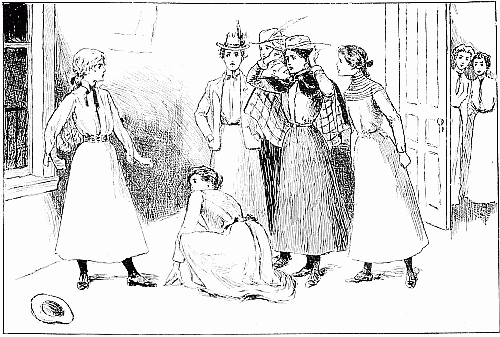
"Have you proof of this, Miss Pugsley?"
"I am perfectly sure of it, Miss Russell!"
"Yes; I am sure you would be, before you
spoke of it; but have you the proof? Of
course, before taking any such serious step as
you propose, I should, in justice to all, be
obliged to ask for positive proof."
"Proof!" cried Miss Pugsley, in some excitement.
"Proof enough! Look at my bonnet,
Miss Russell. Oblige me by smelling of
it. I can never wear it again, never! I tell
you, brandy has been poured over it. Here
are the slippers!" She produced a pair of
slippers which were certainly in a sad condition.
"They were nailed—nailed with tenpenny
nails, to the floor of my closet; they
are totally ruined. Look—I ask you all,
ladies, to look at my hand-glass!" She held
up the glass; and at the sight Emily Cortlandt
had one of those violent fits of coughing
that often troubled her; this one was so bad
that she was obliged to leave the room for a
moment. The worst of it was that one or
two of the other teachers seemed to have
caught the infection, for there was a regular
outbreak of coughing and choking, which only
a severe glance from Miss Russell checked.
Somebody had painted a face on the little
mirror. It covered the whole surface; the
face of a monkey, with grinning mouth, and
twinkling, malicious eyes; it had an undoubted
resemblance to Miss Pugsley. As
she held it up with a tragic gesture, the effect
was so absurd that even Miss Russell might
have wished that she could—cough!
"It lay on my dressing-table, face downward,"
Miss Pugsley went on. "I had just
done my hair for tea,—I am scrupulous in
such matters,—and took up the glass to see
that my pug was straight behind. I looked—and
saw this. Ladies, I could have fainted on
the floor. My nerves being what they are, it
is a marvel that I did not."
"I am very, very sorry, Miss Pugsley," said
Miss Russell, gravely. "If I knew who had
done this—"
"But I tell you I do know, Miss Russell!"
cried Miss Pugsley, vindictively. "I tell you
that there is only one girl in the school who
is capable of all this, and that girl is Grace
Wolfe!"
There was a moment's silence.
"Have you found Grace in your room at
any time, Miss Pugsley?" demanded Miss
Russell.
No, Miss Pugsley had not, but that made
no difference. Grace had done the things,
there was no shadow of a doubt of it.
"Have you been careful to lock your door
when you left the room?"
"Miss Russell, you know that locks and
bolts make no possible difference to Grace
Wolfe. The girl is cut out for a malefactor.
I prophesy that she will be in
State's prison before she has been out of
school a year."
"I must request you not to speak in this
way of any of my young ladies," said the
Principal, sternly. "You have been the victim
of some very malicious practical jokes,
Miss Pugsley. I shall look into the matter
thoroughly, and shall do my best to discover
the offender, and shall punish her—or them—as
I think best." She laid a slight emphasis
on the last words.
"Then you refuse to expel Grace Wolfe?"
said Miss Pugsley, quivering with anger.
"On such evidence as you have brought
forward to-night? certainly," said Miss Russell,
with some severity. "I have no proof
whatever that Miss Wolfe played any of these
pranks, though I admit it is probable that she
may have done so. You found the bandbox
outside your door, where Bridget admits she
left it several days before. You left your
door unlocked on a rainy half-holiday, when
sixty or more girls were constantly passing
and repassing; there are half a dozen girls,
I am sorry to say, who might have been
tempted by the open door to play some prank
of the kind which seems so clever to children,
and so silly to older people."
Why did Miss Russell look toward the window
as she spoke? But now she was looking
at Miss Pugsley again.
"You and Grace are not friends, I know,
Miss Pugsley," she went on. "I am sorry for
it, for I think all the rest of us feel how much
that is fine and noble might—may still be
brought out of that untamed spirit. She has
never known a mother, remember. The name
of the Scapegoat, which she has given herself,
may, I sometimes think, reflect blame on the
rest of us as well as on her. It is true that,
whatever mischief is afoot, it is sure to be
laid at Grace's door. This is mainly her own
fault, of course—"
"I should think so!" snorted Miss Pugsley.
"But not entirely," the Principal went on.
"There are other mischievous girls in the
school. I should like to know how Grace
has been doing this month in her various
classes," she added, turning to the other
teachers.
On this point the testimony was unanimous.
Grace Wolfe led many of the classes; she was
well up in all, and had passed her examinations
in a way that did credit both to her intelligence
and her industry. Thus testified
every teacher, except the small brown mouse
who taught drawing in Pentland School.
This mouse, Miss Mink by name, had crept
away silently, and left the room, after one
glance at the hand-glass; she knew that but
one hand in the school could have drawn that
monkey, and though her heart swelled with
pride, she feared for her darling pupil.
There was a pause after the teachers had
given their testimony; then Miss Pugsley
returned to the attack.
"I certainly hope justice will be done, Miss
Russell," she said, with a smile of sweetened
vinegar. "It would be a great pity, wouldn't
it, if the school got the reputation—he! he!—of
injustice and favouritism?"
"It would," said the Principal, gravely.
"But there is another matter that I feel
bound to speak of before we separate," Miss
Pugsley went on. "Are you aware that room
No. 18, in corridor A, the room formerly occupied
by Miss Lightwood, is again being used
as a place of exit for parties of students going
on lawless expeditions?"
The Principal looked at her steadily.
"I fear that is true," said one of the other
teachers. "I had meant to speak to you
before about it, Miss Russell, but waited till
to-night."
"Of course it makes no possible difference
to me!" cried Miss Pugsley. "It is not my
corridor, and I have no authority there; but
as long as one is in the school, of course one
must consider the honour of it, you know, and
I am glad some one else is here to bear me
out in this complaint."
The Principal still looked at Miss Pugsley;
teachers who had been long in the school were
glad that she was not looking at them in that
way.
"I have heard of this matter before," Miss
Russell said, at last. "I am going to devote
my own time to investigating it, and think I
shall need no help; though I thank you," it
was to Miss Ivors that she spoke, "for bringing
it to my notice, as it was right for you to
do. I think I need not detain you longer,
ladies."
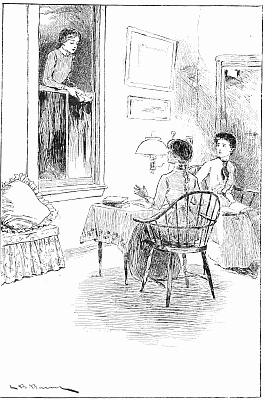
When the teachers were gone, Miss Russell
stepped to the window and said, softly,
"Grace!"
There was no reply. An owl hooted in the
distance; a bird chirped somewhere near by.
That was all.
"Grace!" said the Principal again. "If
you are there, I wish you would come in and
let me speak to you."
Still no reply. After waiting a moment,
the Principal closed the window with a sigh.
On leaving the room she paused a moment to
look at the photograph of a lovely young
woman, in the dress of twenty years ago,
which stood on her desk.
"Dear Edith!" said Miss Russell. "My
first pupil! I'll keep your girl for you, Edith,
if I can!"
Was Grace Wolfe outside the window when
the Principal called her? Who can tell? It
is certain that ten minutes after she was at
the supper in Bedlam.
The tenant of Bedlam, Miss Cornelia Hatch
(familiarly known as Colney Hatch, in remembrance
of the famous English Insane
Asylum), was not actually mad, though many
of the scholars thought her so. She was a
special student of natural history, botany, and
zoology; she was absent-minded and forgetful
to the last degree. When she came into class,
she often had to be brought there, some good-natured
classmate dragging her away by main
force from her private experiments. If she
did remember to come of her own accord, she
was apt to have a half-completed articulation
hanging around her neck, or a dried frog skin
stuck behind her ear for safe-keeping. Her
hair was generally untidy, owing to this habit
of sticking things in it while she worked; you
never could tell what it would be, vertebræ,
or seaweed, or pine-cones, but you could
safely reckon on finding something extraneous
in Colney's ruffled black hair. As for
her clothes, she was usually enveloped in a
huge brown gingham apron, with many pockets,
which held snakes, or eggs, or roots, or
anything else that would not go comfortably
in her hair. When the apron became too
dirty (she had had two at the beginning of
the term, but one had been destroyed in an
explosion), Miss Carey took it away and
washed it, while Colney went around looking
scared and miserable in a queer flannel gown
of a pinkish shade. Report said it had once
been brown, but that the colour had been
changed by the fumes of something or other,
no one knew what. Sometimes she had buttons
on frock and apron, more often not.
Periodically, Miss Carey or the Owls descended
upon her, and sewed on her buttons
and mended her up generally; and she was
very grateful, and said how nice it was to
have buttons. But she soon pulled them off
again, because she never had time to do anything
but tear her clothes off when she went
to bed, and drag them on again when she got
up. When a button flew off, she pinned the
place over, if a pin was in sight; if not, she
went without; it made no difference to her,
and she was not conscious of it in five minutes.
Miss Russell, and most of the teachers, were
very tender with Colney. She was poor, and
meant to work her way through college; even
now she paid part of her schooling by stuffing
birds and setting up skeletons for one of the
college professors. If she did not kill herself
or somebody else before she graduated, Miss
Russell looked forward to a distinguished
career for the tenant of Bedlam; so, as I have
said, she was tender and patient with her;
and good Miss Carey mended her when she
could, and saw that she remembered to eat
her dinner, and Miss Boyle and Miss Mink
rejoiced over her, and Miss Cortlandt led her
gently through English literature, giving her
Walton and Bacon and all the scientific men
of letters that she could find. Only one teacher
failed to do her best to smooth poor Colney's
path through school; that was Miss Pugsley.
Rhetoric was simply an empty noise to the
girl. She never by any chance knew a lesson,
and Miss Pugsley lashed her with so cruel
a tongue that Peggy used to ache and smart
for her as well as for herself, and would get
hold of Colney's hand and hold it and squeeze
it, growing red the while with pity and anger.
But Colney never noticed it half as much as
Peggy did; she used to look at the angry
teacher for a few minutes in an abstracted
kind of way, and then retire within herself
and make imaginary experiments. This was
what happened on the dreadful day when
Miss Pugsley said:
"The subject of this sentence is I. How
do we go to work to form the predicate, Miss
Hatch?"
Cornelia started, but replied, instantly:
"By mixing one part hydrogen with three
parts—"
"Indeed!" said Miss Pugsley, with ominous
calm. "And what happens next, pray?"
"It turns green, and explodes with a loud
report."
And this was exactly what did happen.
Poor Colney!
Peggy Montfort did not form one of the
party in Bedlam that night. The room lay
at the extreme end of the corridor, round a
corner, so that it was in a manner shut off
from the rest of the wing. It was an extraordinary
place. Stretched on the walls, dried
or drying, were specimens of every possible
variety,—bats, frogs, snake skins, bird skins.
Along the mantelpiece were jars and bottles,
all containing other specimens preserved in
spirits. In one corner stood part of a human
skeleton. It stood on one leg, with a jaunty
air, having indeed but one leg to stand on;
both arms were wanting, but the skull, which
was a very fine one, made up for much. On
account of this fragmentary skeleton, few of
the younger girls ever dared to enter Bedlam,
and some of them would run past the door
with face averted, and beating heart, fearing
lest the door should be open and they should
catch a glimpse of the gruesome thing. But
this object was the pride of Colney's heart.
She could not, of course, afford to buy a whole
skeleton, so she was collecting one, bit by bit;
even Peggy had been quite uncomfortable one
day, when Colney had told her, hanging over
each bone with delight, where and how she
had come by each one. It was always honestly,
one could be sure of that.
Everywhere in the room, underfoot and
overhead, were setting-boards and pill-boxes,
blowpipes and crucibles. One could not move
without upsetting something; and yet it was
here that the Gang came to have its annual
supper.
Colney Hatch was dissecting a mouse.
She was perfectly happy, and oblivious of
the world, when the door opened, and in
came fluttering the wild spirits of the junior
and sophomore classes. Last year the sophomores
had been freshmen, and must not know
anything about the Gang, save in wondering
envious whispers and surmises. Next year
the juniors would be seniors, and they too
must forget that such a thing as the Gang
had been, and think only of dramatics, examinations,
and graduation. Such had been the
unwritten law at Miss Russell's, since time was.
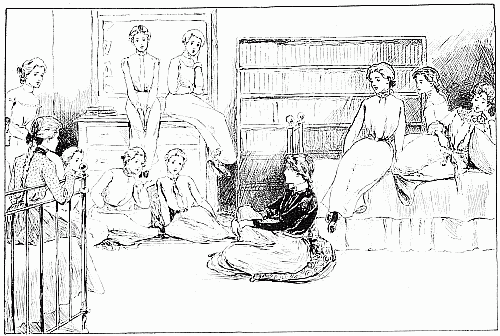
Here were Vanity and Vexation of Spirit,
one smiling and dimpling, the other with her
usual air of blasé superiority. Here was
Blanche Haight, the leader among the sophomores;
here were six or eight girls, in fact,
chosen from the two classes for the same
characteristics, lawlessness and love of fun;
last but not least, here was Grace Wolfe, the
acknowledged leader and queen of the Gang,
when she deigned to be so.
Grace was in her wildest mood to-night.
She danced solemnly around poor Colney,
who looked up in dismay from her mouse as
the silent crowd came pouring in, and assured
her that her last hour was come.
"We are the Secret Tribunal!" she cried.
"We have come to make a pile of all your
rubbish, Colney, and burn it, with you on
top, like the Phœnix. I am sure you would
come up out of the ashes, if we left the mouse
out for you to finish."
"Oh, do be careful, please, Goat!" cried
Colney Hatch. "Don't sit down on that
frog, he isn't dry! Dear me! do you—do
want anything, girls?"
"We want your room, my love; and your
company!" replied Grace. "Yet we are merciful.
Here!"
She twirled Cornelia's chair around, and set
her with her face to the wall; then moved
the lamp so that its light fell on the board in
her lap.
"There!" she said. "Finish him, poor old
dear, and we'll wake you up when supper's
ready. Now then! who's brought what?"
Then, from pockets, from surplice folds,
from shawls and cloaks hung carelessly over
the arm, came forth a strange array of articles.
One had brought a chicken, one a
cake. Here was a Dutch cheese, a tin of
crackers, a bottle of coffee, a bottle of olives,
and a box of sardines. Grace herself told in
high glee how she had met one of the teachers
in the corridor, and had stood for five minutes
talking about the next day's lesson. "And
with this under me cloak the while!" and
with a dramatic gesture she produced and
held out a dish of lobster salad.
"If it had been potato," she declared, "I
had been lost; the onion had betrayed me.
Blessings on the bland, the seductive mayonnaise,
which veiled the ardent lobster and his
smell. She did smell it, however, and said,
so cheerfully, poor dear, that Miss Carey was
evidently going to give us a surprise to-morrow,
for she smelt lobster. It was Miss Cortlandt,
too; I did want to say, 'Oh, come
along, and have some!' She is a rectangular
fragment of baked clay, used for building
purposes, Miss Cortlandt is."
"What do you mean, Goat?" asked some
one.
"I never use slang, as you know!" replied
Grace, gravely. "It argues a poverty of intellect,
as well as a small vocabulary. I
suppose you would have said she was a brick,
my child."
"Oh, Goat, how funny you are!" giggled
the girls.
"Not at all, I assure you," said Grace,
unmoved. "But I pray you fall to! Have
some salad, Vanity? yes, I'll take a wing,
thank you."
"Isn't this perf'ly fine?" cried Viola Vincent.
They were all seated by this time,
some on the floor, others wherever they could
find a few inches of spare room, and were
dispensing the viands with reckless liberality.
"I say! I wish we had these every week,
instead of only once a year. Why, it's just
as easy! Oh, what an elegant cream pie!
Give me some!"
"No!" said Grace Wolfe, with emphasis.
"Why not? What's the matter, Goat?"
"I will not have pies called elegant while
I am leader of this Gang," said Grace. "Take
my life, if you will, but spare my feelings!"
"All right," said Viola, cheerily. "Your
own way, Goat. I'd just as lief call it dandy,
and it is dandy, you can't deny that."
"Perhaps the Goat is thinking of succeeding
her Puggy in the rhetoric chair!" said
Blanche Haight, with a sneer.
"Perhaps I am thinking of stopping your—"
began Grace; but she checked herself,
and turned away abruptly.
"Look at Colney!" said Vivia Varnham.
"Isn't she too perfectly killing? She doesn't
know we are here, I believe. Look at her
hair, girls! It gets more ratty, not to say
woozzy, every day. I wonder when she
brushed it last."
"Possibly when you brushed your manners,"
said the Scapegoat. "Colney is our
hostess, I beg to remind you. And nobody
giving her a bite of supper!"
She rose from the floor, piled a plate with
good things, and went over to the corner
where Colney Hatch was bending over her
mouse, conscious of nothing else.
"Here, Colney; here's your supper."
"Oh, thank you, Grace," said Colney, looking
up for a moment. "But I can't, you
know. Both my hands are full, you see."
"Then open your mouth," commanded the
Scapegoat, in tones of authority.
Colney obeyed meekly, and Grace stood
over her, feeding her like a baby with the
choicest morsels, and now and then casting
a glance over her shoulder at the others.
Grace's gaiety was fitful to-night, certainly.
When she first came in she had been the life
of the party; now, as she stood there in the
corner, her brow was overcast, her eyes
gloomy. What ailed the Lone Wolf?
What were they saying over there? They,
at least, were at the very height of glee,
breaking into gusts of giggling, into whisperings
ending in squeaks and smothered screams.
"To-morrow night? Hurrah! Through
Broadway, of course."
"Freshy? Oh, Freshy won't say anything.
She wouldn't dare to, in the first place."
"She'd dare fast enough," said Viola.
"She isn't afraid of anything, Freshy isn't.
But she's safe, she won't say anything."
"What's all this?" demanded the Scapegoat,
coming back with the empty plate.
"Plans? Does one hear them?"
"The apples are all gone," said Kitty
Green. "We're going for some to-morrow
night, Goat. You'll go, too, of course?"
"Going out through Broadway," said Viola.
"We haven't been out for more than a week,
and the moon will be nearly full to-morrow.
It'll be perf'ly fine, Goat, won't it?"
"Veto!" said Grace, calmly.
"Veto? Why, what do you mean?"
"What's wrong?"
"What has happened?"
"Nothing has happened. Boots are no
longer free, that's all."
"Do speak English, Grace Wolfe! What
do you mean?"
"There—are—to—be—no more—free-booting
expeditions—through Broadway. Is
that sufficiently plain, or shall I spell the
words?"
Blanche Haight rose to her feet, several
of the other girls following her. "What is
the matter with you to-night, Goat?" she said.
"We don't seem to succeed in satisfying you.
Aren't we good enough company for you, perhaps?"
And Blanche sneered in her own
particular manner, of which she was proud.
"I make no remarks," said the Scapegoat,
in her quietest tones. "I have not been personal.
I merely say, while I lead this Gang,
there will be no more expeditions through
Broadway."
"And how long do you suppose you will
lead this Gang, if you play the part of Pope
and emperor?" demanded Blanche.
The other girls began to murmur and protest
at this. "Listen to the Goat!" said one
and another. "She must have some reason,
or she wouldn't act so."
But Grace seized her opportunity.
"How long?" she repeated. "Not an
hour! not a second! I resign. My last act
is to break up this meeting. To your tents,
O Israel!"
Then arose such a confusion of whispering,
exclaiming, disclaiming, entreating, protesting,
that no one voice could be heard. The
owner of the room, fairly roused for a moment
(but indeed she had finished the mouse),
turned round to see what was wrong. For a
moment she saw the two leaders, Grace and
Blanche, facing each other, the one pale and
quiet, the other red with anger, her eyes darting
spiteful flames. Next moment, Grace
made a single quick movement, and the room
was in darkness. She had blown out the
lamp.
"To your tents!" she repeated, sternly.
And, hurrying, whispering, stumbling over
the remains of their feast scattered on the
floor, the frightened girls obeyed.