“First casting calls are so difficult,” Peggy Lane
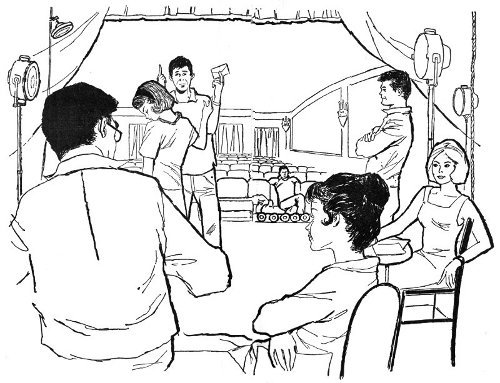
said, looking ruefully at the fifty or more actresses
and actors who milled about nervously, chatting with
one another, or sat on the few folding chairs trying
to read.
“With only nine roles to be filled,” she continued,
“it doesn’t matter how good these people are; most
of them just haven’t got a chance. I can’t help feeling
sorry for them—for all of us, I mean. After all, I’m
trying for a part, too.”
Peggy’s friend and housemate, Amy Preston,
smiled in agreement and said, “It’s not an easy business,
honey, is it? But the ones I feel sorriest for
right now are Mal and Randy. After all, they have
the unpleasant job of choosing and refusing, and a
lot of these folks are their friends. I wouldn’t want
to be in their shoes.”
2
Peggy nodded thoughtfully, and reflected that it
must, indeed, be more wearing on the boys. Mallory
Seton, director of the new play, had been an upper-class
student at the Academy when Peggy had
started there, and he was a good friend of hers. She
had worked with him before, as a general assistant,
when they had discovered a theater. It would not be
easy for him to consider Peggy for an acting role, and
to do so completely without bias. It would not be a
question of playing favorites, Peggy knew, but quite
the reverse. Mal’s sense of fair play would make him
bend over backward to keep from giving favors to
his friends. If she was to get a role in this new production,
she would really have to work for it.
And if it was difficult for Mal, she thought, it was
more so for Randy Brewster, the author of the play,
for her friendship with him was of a different sort
than with Mal. Mal was just a friend—a good one,
to be sure—but with Randy Brewster, somehow,
things were different. There was nothing “serious,”
she assured herself, but they had gone on dates together
with a regularity that was a little more than
casual and, whatever his feelings were for her, she
was sure that they were more complicated than
Mal’s.
“Do you think they’ll ever get through all these
people?” Amy asked, interrupting her thoughts.
“How can they hope to hear so many actors read for
them in just one afternoon?”
“Oh, they won’t be doing readings today,” Peggy
replied, glad to turn her attention from what was becoming
a difficult subject for thought. “This is just a
first cast call. All they want to do today is pick people
for type. They’ll select all the possible ones, send
the impossible ones away, and then go into elimination
readings later.”
3
“But what if the people they pick for looks can’t
act?” Amy asked. “And what if some of the rejects
are wonderful actors?”
“They won’t go back to the rejects,” Peggy explained,
“because they both have a pretty good idea
of what the characters in the play should look like.
And if the people they pick aren’t good enough actors,
then they hold another cast call and try again.
Mal says that sometimes certain parts are so hard to
cast that they have to go through a dozen calls just
to find one actor.”
“It seems kind of unfair, doesn’t it, to be eliminated
just because you’re not the right physical
type,” Amy said, “but I can understand it. They have
to start somewhere, and I guess that’s as good a place
as any.” Then she smiled and added, “I guess I’m
just feeling sorry for myself, because Mal told me
there was no sense in my trying out at all, because I
didn’t look or sound right for any part in the play. If
I don’t get rid of this Southern accent of mine, I
may never get a part at all, except in a Tennessee
Williams play!”
Peggy nodded sympathetically. “But it wasn’t just
your accent, Amy,” she said. “It’s your looks, too. At
least for this play. Mal and Randy told you that
you’re just too pretty for any of the parts that fit
your age, and that’s nothing to feel bad about. If
anybody ought to feel insulted, it’s me, because
they asked me to try out!”
4
“Oh, they were just sweet-talking me,” Amy replied.
“And as for you, you know you don’t have to
worry about your looks. You have a wonderful face!
You can look beautiful, or comic, or pathetic, or
cute or anything. I’m stuck with just being a South’n
Belle, blond and helpless, po’ li’l ol’ me, lookin’ sad
and sweet through those ol’ magnolia blossoms!”
She broadened her slight, soft accent until it sounded
like something you could spread on hot cornbread,
and both girls broke into laughter that sounded odd
in the strained atmosphere of the bare rehearsal
studio.
It was at this point that Mal and Randy came in,
with pleasant, if somewhat brisk, nods to the assembled
actors and actresses, and a special smile for
Amy and Peggy. In a businesslike manner, they settled
themselves at a table near the windows, spread
out scripts and pads and pencils, and prepared for
the chore that faced them. Amy, who was there to
help the boys by acting as secretary for the occasion,
wished Peggy good luck, and joined the boys at the
table. Her job was to take names and addresses, and
to jot down any facts about each actor that Randy
and Mal wanted to be sure to remember.
Mal started the proceedings by introducing himself
and Randy. Then, estimating the crowd, he said,
“Since there are fewer men here, and also fewer male
roles to cast, we’re going to do them first. I hope that
you ladies won’t mind. We won’t keep you waiting
long, but if we worked with you first, we’d have these
gentlemen waiting most of the day. Shall we get
started?” After a brief glance at his notes, he called
out, “First, I’d like to see businessman types, young
forties. How many have we?”
5
Four men separated themselves from the crowd
and approached the table. Peggy watched with interest
as Mal and Randy looked them over, murmured
to Amy to take notes, and asked questions.
After a few minutes, the men left, two of them looking
happy, two resigned. Then Mal stood and called
for leading man types, late twenties or early thirties,
tall and athletic. As six tall, athletic, handsome
young men came forward, Peggy felt that she just
couldn’t stand watching the casting interviews any
longer. It reminded her too much of the livestock
shows she had attended as a youngster in her home
town of Rockport, Wisconsin. Necessary though it
was, she felt it was hardly a way to have to deal
with human beings.
Slipping back through the crowd of waiting actors,
she joined the actresses in the rear of the room, and
found an empty seat next to a young girl.
“Hi,” she said. “What’s the matter, can’t you watch
it either?”
The girl smiled in understanding. “It always upsets
me,” she replied, “but it’s something we simply
have to learn to live with. At least until we get well-known,
or get agents to do this sort of thing for us.”
“It sounds as if you’ve been in a few of these before,”
Peggy said.
“I have. But not here in the East,” the girl replied.
“I’m from California, and I’ve been in a few little-theater
things there, but nobody seems to pay much
attention to them. I heard that off-Broadway theater
in New York attracts a lot of critics, and I thought
that I’d do better here. Have you had any luck?”
“Oh, I’m just beginning,” Peggy said. “I’m still
studying at the New York Dramatic Academy. I hope
I can get some kind of supporting role in this play,
but I don’t think I’m ready for anything big yet. By
the way, my name is Peggy Lane. What’s yours?”
6
“I’m Paula Andrews,” the girl answered, “and
maybe I’m shooting too high, but I’m trying out for
the female lead. I hope I have a chance for it.”
Peggy looked carefully at her new friend, at the
somewhat uncertain smile that played about her
well-formed, generous mouth and the intelligence
that shone from her large, widely placed green eyes.
Her rather long face was saved from severity by a
soft halo of red-brown hair, the whole effect being an
appealing combination of strength and feminine softness.
“I think you do have a chance,” Peggy said. “In
fact, if you can act, I bet you’ll get the part. I’ve read
the play, and I know the author and director, and
unless I’m way off, you look just the way the lead
should look. In fact, it’s almost uncanny. You look as
if you just walked out of the script!”
“Oh, I hope you’re right!” Paula said with animation.
“And I hope you get a part, too. I have a feeling
that you’re going to bring me good luck!”
“The one who needs luck is me, I’m afraid,” Peggy
said. “Being friendly with Randy and Mal isn’t going
to help me in the least, and I’m going to have to be
awfully good to get the part. And it’s really important
to me, too, because I’m getting near the end of
my trial year.”
“Trial year?” Paula asked curiously.
7
“Uh-huh. My parents agreed to let me come to
New York to study acting and try for parts for a year,
and I agreed that if I didn’t show signs of success
before the year was up, I’d come home and go back
to college. I’ve been here for eight months now, and
I haven’t got anything to show my parents yet. The
part I’m trying for now isn’t a big one, but it’s a good
supporting role, and what’s more, we get paid. If I
can show my mother and father that I can earn some
money by acting, I’m sure that they’ll let me go on
trying.”
“But do you expect to make enough to live on right
away?” Paula asked.
“Oh, no! I’m not that naïve! But when my year is
over at the Academy, I can always take a job as a
typist or a secretary somewhere, while I look for
parts. If you can type and take shorthand, you never
have to worry about making a living.”
“I wish that I could do those things,” Paula said
wistfully. “The only way I’ve been able to make ends
meet is by working in department stores as a salesgirl,
and that doesn’t pay much. Besides, the work is
so unsteady.”
“My parents are very practical people,” Peggy said
with a smile, “and they made sure that I learned
routine office skills before they would let me think
about other and more glamorous kinds of careers.
Daddy owns the newspaper in our small town in
Wisconsin, and I’ve worked with him as a typist and
a reporter of sorts and as a proofreader, too. I’ll always
be grateful that he made me learn all those
things. I don’t think he has much faith in the acting
business, but he’s been wonderful about giving me a
chance. What do your parents think of your wanting
to be an actress?”
Instead of answering, Paula suddenly stood up.
“Let’s go see how they’re coming with the actors,” she
said. “I think they’re almost finished.”
8
Not wanting to press Paula further, and feeling
that perhaps she had asked too personal a question
on such short acquaintance, Peggy reluctantly stood
too, and joined Paula to watch the last of what she
now could only think of as the livestock show.
As she drew closer to the table, she heard Mal saying,
“I’m really sorry, Mr. Lang, but you’re just not
the right type for the role. Perhaps some other....”
and his voice trailed off in embarrassment.
Lang, a short, thin, unhappy young man, answered
almost tearfully, “But, Mr. Seton, looks aren’t everything.
I’m really a funny comedian. Honestly! If you
would only give me a chance to read for you, I know
that I could make you change your mind about the
way this character should look!”
“I don’t doubt that you could,” Mal said gently,
“but if you did, the play would suffer. I’m afraid the
comedian we need for this must be a large, rather
bluff-looking person, like these three gentlemen
whom I have chosen to hear. The part calls for it.
I’m sorry.”
Mr. Lang nodded sadly, mumbled, “I understand,”
and walked off, his head hanging and his
hands thrust deep in his pockets, looking less like a
comedian than any man in the world. Peggy
watched him go, not knowing whether to feel sorrier
for him or for Mal.
“All right, gentlemen,” Mal called out. “That takes
care of the male roles. All of you who are left will be
given copies of the play to study, marked at the passages
I want to hear. Be sure to read the whole play
carefully, so that you understand the workings of the
characters you have been selected to read. You have
three days to look it over. We’ll meet at ten o’clock
on Saturday morning at the Penthouse Theater to
hear you. Thank you. And now for the ladies.”
9
The men left, after being given their scripts, and
though they chatted amiably with one another,
Peggy was sure that each was casting rather hostile
looks toward others who were trying for the same
parts. Keeping friendships in the theater was not an
easy thing, she thought, particularly for people of
similar physical types!
Mal’s first concern in reviewing the actresses was,
of course, for the leading role. And, of course, it was
for this role that he had the most applicants. More
than twenty girls came forward when the announcement
was made, and Peggy thought that she had
never seen so many striking and beautiful faces and
figures. It was not going to be easy for Mal to make a
choice. As Paula, her new friend, went forward to
join the others, Peggy whispered a word of encouragement,
then stood to one side to watch.
Mal went down the line, regretfully dismissing one
after the other of the girls, and occasionally asking
one to step aside to try for another role. His tough-looking
expression hardly varied as he spoke to each
one, but Peggy thought she saw the ghost of a smile
cross his face when he spoke to Paula Andrews. Another
review of the remaining girls eliminated a few
more. Finally, there were only four left, Paula
among them. Mal thanked them, distributed scripts,
and asked them to be at the Penthouse Theater on
Saturday at noon.
Paula returned to Peggy with eyes shining. “Oh,
Peggy! I think you were right! I just know I’m going
to get the part! I know it!”
10
“Don’t count too much on it,” Peggy cautioned,
“or you may be too bitterly disappointed if you don’t
get it. But,” she added, enthusiastically violating her
own rule of caution, “I’m sure, too! I’ll see you Saturday.
Even if I don’t get a script, I’ll be there just to
hear you read!”
Then, with a smile of farewell, Peggy turned her
attention to the “career woman, early thirties” classification
that Mal had called for next. Once that
was out of the way, she knew it would be her turn.
This time, there were not so many applicants and
Peggy remembered Randy telling her that this
would be one of their most difficult roles to cast.
Only four actresses came forward, and Mal, with
difficulty, reviewed them all. Unable to eliminate by
type, he gave them all scripts and asked them to
come to the theater. Then he called for “character
ingénues” and Peggy joined seven other girls in the
“livestock show.”
Mal reviewed them carefully, managing to look at
Peggy with complete lack of recognition. He gently
eliminated three of them on the basis of hair coloring,
height or general type. Another, curiously
enough, was eliminated, like Amy, for a Southern accent,
and a fifth, also like Amy, was too beautiful.
“The part calls for a pretty girl,” Mal said with a rare
smile, “but not for a girl so pretty that she’ll dominate
the stage! It was a pleasure to look at you, but I’m
afraid you’re not quite right for the part.”
When he was done, Peggy and two others were
given scripts and told to come to the theater on Saturday.
Feeling lightheaded and giddy, Peggy settled
herself on one of the folding chairs that lined
the back wall, and waited for Mal, Randy, and Amy
to finish so she could join them for coffee.
11
Scarcely noticing the rest of the proceedings, she
thought only about the coming readings. She was
so familiar with the play that she knew she had an
advantage, perhaps unfairly, over the other two girls.
She had watched the script grow from its first rough
draft to the finished text now in her hands, and had
discussed it with Randy through each revision. She
knew she could play the part; in fact, she suspected
secretly that Randy had written it for her, and the
thought made her blush. Still, it would not be easy,
she knew. Mal’s sense of fairness and his absolute
devotion to the play above everything else would
keep him from making up his mind in advance.
But despite this knowledge, she could not help
looking ahead—all the way ahead—to the restless
stir of the opening-night audience out front, the last-minute
preparations backstage, the bright, hot lights
and the smell of make-up and scenery paint as she
waited to go on in Act One, Scene One of Come
Closer, Randy Brewster’s brilliant new play in which
Peggy Lane would be discovered!
12
II The Hopefuls
The audience consisted of a handful of actors and
actresses, and Randy Brewster and Mallory Seton.
The stage lighting was a cold splash produced by two
floodlights without color gels to soften them. The
scenery was the brick back wall of the stage, two
ladders, a table and two straight-backed chairs. Only
the front row of house lights was on, and the back of
the theater was dark, empty and gloomy, a shadowy
wasteland of empty rows of seats like tombstones.
On the stage, a “businessman type” was reading
his lines. Peggy knew, after the first few words, that
he would not do. He had somehow completely
missed the character of the man he was portraying,
and was heavily overplaying. Mal, being perhaps
more patient than Peggy, listened and watched
with great care. Amy, who was acting as Mal’s assistant
for the production, sat in a chair by the proscenium,
reading her script by the light of a small
lamp and feeding the actor cue lines. Mal followed
the whole sequence with no visible sign of impatience
and, when the actor was through, said,
“Thank you. We’ll let you know our decision in a day
or two.”
13
The next “businessman type” was better, but still
not quite on target, Peggy thought. He seemed to be
playing the part for laughs, and although there were
some comic values to be extracted from the role, it
was really far more a straight dramatic character.
Still, he was clearly a better actor than the first,
and with direction might do well.
Following his reading, Mal again repeated his
polite, invariable formula, “Thank you. We’ll let you
know our decision in a day or two,” and called for
the next reading.
Peggy watched the remaining actors try for the
role, and made mental notes of which ones were possible,
which probable, and which stood no chance at
all.
The same process was then followed for the leading
men, and the same wide range of talent and understanding
of the part was displayed. Some seemed
to have no idea at all about the play or its meaning,
and Peggy was sure that these men had read only
the parts marked for them. Others had a clear understanding
of the kind of character they were playing,
and tried to create him in the brief time they had on
stage. Others still were actors who had one rather
inflexible way of playing, and used it for all kinds of
parts. Their performances were uniform imitations of
each other, and all were imitations of the early acting
style of Marlon Brando. They seemed to forget,
Peggy thought, that Brando’s style developed
from the roles he had to play, and that as he got
other roles, he showed other facets of a rounded talent.
It made her angry that some actors thought
they could get ahead in a creative field by being
imitative.
14
Each actor, no matter how good or how bad, was
treated with impersonal courtesy by Mal, and each
left looking sure that the part was his. Peggy was
glad that she would not have to see their faces when
they learned that they had not been selected.
“The pity of it,” she whispered to Randy, “isn’t
that there are so many bad ones, but that there are
so many good ones, and that only one can be selected
for each role. I wish there were some way of telling
the good ones you can’t take that they were really
good, but that you just couldn’t take everyone!”
“You can’t let yourself worry about that,” Randy
replied. “The good ones know they’re good, and
they’re not going to be discouraged by the loss of a
role. And the bad ones think they’re good, too, and
most of them have tremendous egos to protect
them from ever finding out—or even thinking—otherwise!”
The door at the back of the theater opened quietly,
and Peggy, turning around in her seat, saw a few of
the actresses entering. They quietly found seats in
the rear and settled down to await their turn.
“I think I’ll go back there with the girls,” Peggy
whispered. “I’m looking for a girl I met at the casting
call, and I’d like to chat with her for a few minutes
when she comes. Do you mind if I don’t look at all
this?”
Randy grinned. “Go ahead. I’d get out of here,
too, if I could without getting Mal mad at me. This
kind of thing always breaks my heart, too!”
15
As she went up the aisle as unobtrusively as possible,
Peggy glanced at the actresses who had just
come in. She recognized a few of their faces from
the casting call of three days ago, but did not see her
new friend among them. She decided to go out to the
lobby to wait for her there. A new group of girls
entered the theater as Peggy was leaving and, as she
passed, one reached out and grabbed her arm.
Peggy turned in surprise to find herself greeted
with a broad grin and a quick companionable kiss.
“Greta!” she cried. “What are you doing here?”
“Come on out to the lobby, and I’ll tell you,” Greta
Larsen said, with a toss of her head that made her
thick blond braid spin around and settle over her
shoulder.
“But I thought you were in New Haven, getting
ready to open Over the Hill,” Peggy said, when they
had reached the lobby. “What on earth are you doing
here?”
“I’m afraid you don’t read your Variety very carefully,”
Greta said. “Over the Hill opened in New
Haven to such bad notices that the producer decided
to close out of town. At first we thought he’d
call in a play doctor to try to fix things up, but he
finally decided, and very sensibly, that it would be
easier to just throw the whole thing out. I’m afraid
he lost a lot of money, and he didn’t have any more
left.”
“Oh, I’m so sorry,” Peggy said. “And it was a real
chance for you, wasn’t it?”
16
“Not really,” Greta said. “The part wasn’t too
good, and I’d just as soon not be in a disaster. Anyway,
it gave me a chance to work for a few weeks,
and an agent saw me and said he thought I was
good, so maybe I’m not any the worse for the experience.”
At that moment, Peggy saw Paula Andrews enter
the lobby, and she motioned to her to join them.
“Greta, this is Paula Andrews. She’s reading for the
lead today, and I hope she gets it. Paula, I want you
to meet Greta Larsen, one of my housemates.”
“Housemates?” Paula questioned, a little puzzled.
“Yes. There are about a dozen of us, more or less.
We live in a place called the Gramercy Arms—a
wonderful place—and we live like one big noisy family.
The Arms is run just for young actresses, so we
all have a lot in common. I haven’t seen Greta for
weeks—she’s been out of town with a play—and I’m
just getting over being stunned at seeing her now.”
“Peggy tactfully neglected to mention that the
play flopped,” Greta laughed, “and now I’m back in
town without a job. In fact, that’s why I’m here.”
“You mean you’re going to read for Mal?” Peggy
asked excitedly.
“Uh-huh. I met him on the street an hour or so
ago, and he told me he had a part he thought I should
try out for, and that he was thinking of me for it all
along, but assumed that I wouldn’t be available.
Well, you can’t be more available than I am, so here
I am!”
“Have you read the play?” Paula asked.
“I’m lucky there,” Greta replied. “I’ve seen it
in three different drafts since it started. Peggy’s
friendly with Randy Brewster, the boy who wrote it,
and each time she brought a draft home, I got to
read it. So I’m not at a disadvantage.”
17
“What do you think of Come Closer, Paula?” asked
Peggy.
“I think it’s wonderful! I hope more than ever that
I get the part! Do you really think I have a chance?”
Greta nodded decisively. “If you can act, you’re
made for it,” she said.
“That’s just what Peggy said!”
Peggy stole a glance through the doors to the theater.
“I think we’re about ready to find out whether or
not you can act,” she said. “They seem to be about
through with the actors, and that means you’re on
next!”
Wishing each other good luck, they entered the
darkened part of the house and prepared for what
Peggy could only think of as their ordeal.
Afterward, as Peggy, Amy, Paula, and Greta sat at
a table in a nearby coffeehouse waiting for Mal and
Randy to join them, each was sure that she had been
terrible.
“Oh, no!” Peggy said. “You two were just marvelous!
But I couldn’t have been worse. I know I read
the part wrong. I thought I had the character clear in
my mind, but I’m sure that the way it came out was a
mile off!”
“You have a lot more talent than judgment,” Greta
said mournfully. “You were perfect. And so was
Paula. As for me....” Her voice trailed off in despair.
“I don’t know how you can say that, Greta,” Paula
put in. “I know you were the best in your part, and
nobody even came close to Peggy. But I’ve never
felt so off in my life as I did reading that part. It’s a
wonder any of you even want to be seen with me!”
18
Only when Amy started to laugh did the three
others realize how much alike they had sounded.
Then they joined in the laughter and couldn’t seem
to stop. When they seemed at the point of dissolving
helplessly into a permanent attack of the giggles,
Randy and Mal joined them.
“If you’re laughing at the play,” Randy said
gloomily, “I can hardly blame you. You never know
just how badly you’ve written until someone gets up
and starts to read your lines.”
All at the same time, the girls started to reassure
him and tell him how good the play was, and how
badly the actors, including themselves, had handled
the lines, but this was so much like their last exchange
of conversation that once more they broke up
in helpless laughter.
When they got their breath back, and when coffee
and pastry had been ordered, they tried to explain
the cause of their hilarity to the boys.
“... so, you see,” Peggy concluded, “we were
each explaining how good the others were and how
bad we were, and when Randy started telling us how
bad he had been as a writer, we just couldn’t stand
it!”
It was Mal who got them back to sane ground.
With his tough face, like a movie gangster’s or private
detective’s, and his gentle, cultured English voice and
assured manner, he calmly gave his opinion of the
afternoon’s auditions.
19
“First of all, I think the dialogue plays remarkably
well, Randy. It’s a good play, and I don’t think
there’ll be too many changes to worry about. Secondly,
you’re all right and you’re all wrong. I might
as well tell you now that you each have the part you
tried out for. I’m very pleased with you, and proud
to have you in the cast.”
Peggy and Greta excitedly embraced each other,
and when they turned to do the same to Paula, were
dismayed to see that she was crying. “What’s
wrong?” Peggy asked. “Is anything the matter?”
“Oh, no,” Paula wailed, trying to smile through her
tears. “It’s just that I wanted this so much, and I’m
so happy, and I started to laugh and it came out
tears....” She rummaged for her pack of tissues,
dabbed her eyes, and emerged with a radiant smile.
“There, that’s better,” Randy said.
“The tears were all right too,” Mal said. “I feel
like doing the same thing when I’m really happy, but
it wouldn’t go with my face. It looks great on yours!”
By the time the coffee and pastry arrived, Paula’s
emotional storm had so far been put behind her that
she fell on the cakes with the appetite of a lumberjack.
“A little restraint, please, madam,” Mal said, “or
you’ll lose your part. We want a nice, slim leading
lady, not a butterball! You’re in training now!”
“Let me take them,” Greta said. “I have a fat,
round face to begin with, and you wouldn’t have
picked me if you wanted a sylph for the part. You’ll
never notice a few ounces more!”
“I’m sorry to tell you that we not only would notice
it, but we’d mind it very much,” Mal said, “but nobody
minds a fat director. So....” He reached for
the cause of the debate.
20
“What I can’t understand,” Greta said, “is how
you picked me for the part. Why did you want me
to try for a thirtyish career girl role? I’m not really
the physical type, and those other girls were. Will
you tell me?”
“Just a hunch,” Mal said. “You’ll be the type with
your hair out of that braid and put up, and with a
little make-up to age you a few years. I felt that you
had the kind of crisp delivery we wanted, and it
looks as though I was right. As for Peggy, it’s as if the
part were written for her.” This last he said with a
sly side look at Randy, who reddened slightly. “And
as for Paula, well....” He broke off and looked at
her intently.
“I don’t know what it is, but the minute I saw you
in cast call, I knew you were our girl. And when I
heard you read, I knew that I hadn’t made a mistake.
There’s something about you ... some quality that
I seem to recognize ... I suppose it’s talent. But
that’s enough of compliments. If we don’t get out of
here, we’ll soon be writing long epic poems to each
other’s genius.”
So, finishing their coffee with a toast to the success
of Come Closer, they said their good nights and
parted outside the coffeehouse.
“Don’t forget,” Mal called after them, “rehearsal
Monday night. See you then!” He walked off with
Paula, and Randy escorted Peggy, Amy, and Greta
back to the Gramercy Arms.
21
III First Reading
Peggy was at stage center, under a bright bank of
floodlights. Amy entered from stage right, crossed
down center and turned her back to the house to
look upstage. She paused a moment before speaking.
Her position, back to the audience, would have
been unforgivable if there had been an audience,
and her lines, when she spoke them, were scarcely
dramatic.
“You have paint on the side of your nose,” she said,
“and there’s a rip in the seat of your jeans. Now
where I come from, no lady....”
“The same to you,” Peggy grinned, looking around
from the flat she was painting. “At least, the same to
you as regards the paint on your nose. I can’t see
the seat of your jeans from here!”
22
Amy put down the bucket of paint that she had
brought with her and stepped back to the apron of
the stage to get a better look at Peggy’s handiwork.
It was a small wing flat that was to represent the
corner of a frame house. A window frame had already
been installed in it, and later the suggestion of
a back porch would be added. Peggy was busy with
the somewhat tedious work of painting clapboards
on the flat canvas. Each was made with two lines of
gray paint drawn across the white-painted surface;
first a dark line, then a somewhat broader light-gray
line. From working distance, it looked like nothing
but striped canvas, but from a few feet away, the
dimensional effect was surprisingly real. Peggy
joined Amy at the edge of the stage to get a look at
what she had been doing.
“It looks pretty good, doesn’t it?” she asked.
Amy nodded. “Keep it up, honey child, and you
may find a real niche for yourself in the theater!”
Laughing, the two friends worked together on the
flat, each using one of the shades of gray. The work
went much faster now, which pleased Peggy, because
she didn’t want to leave the flat half-finished
when it was time for her to stop and go to her section
of the readings.
In the early part of working on a play, the stage is
seldom used. First readings usually take place in
small groups gathered in any convenient spot, and it
is not until the actors are fairly familiar with their
lines and with the way the director wants them read
that the play begins to take form on the stage. Come
Closer was in the earliest days of rehearsal, and Mal
was still in the first stages of familiarizing himself
with his cast and them with the play.
23
The Penthouse Theater was ideally suited for the
work they were doing. It was actually a very old
theater which Peggy and Amy had discovered, under
exciting and mysterious circumstances, when
they had first come to New York and met Randy and
Mal. The theater itself occupied the top floor of an
old loft building, and when Randy and Mal had
leased it, they had rented the whole building. Both
the theater and the other floors below it had seen
much alteration since, and it was now a unique
actors’ workshop from top to bottom.
The boys had converted part of the loft space into
compact apartments for themselves, and other
rooms into living quarters for young actors whose
rent, although low by city standards, was still enough
to pay most of the costs of operating the building.
The ground floor had been turned into a series of rehearsal
studios, which, when not being used by
Randy and Mal for a current play of their own, were
rented to other groups. In its short time of operation,
the Penthouse Theater had already become an
off-Broadway institution.
For Randy and Mal it had proved to be the best
thing that had ever happened to them. It not only
gave them a theater in which they could stage their
productions, but it gave them enough income so
that they no longer had to work at other jobs while
trying to pursue their careers in the theater world.
Before, Randy had worked in small night clubs as a
song-and-dance man—a way of life for which he had
the deepest contempt. Mal had been an actor in
movies and television where, because of his tough
face, he had been type-cast as a gangster. He not
only didn’t like gangster roles, he found it hard to
get them because of the cultured English accent that
issued so surprisingly from that face. For both boys,
the Penthouse Theater meant a new life and new
opportunity, doing Randy’s plays, directed by Mal.
24
Peggy and Amy put the last touches on the clapboard
wall, stepped back to review the work, and
smiled with satisfaction.
“It looks perfect,” Peggy said. “Now I just hope
that we stretched the canvas tight enough on the
frame in the first place, so that it doesn’t flutter if
somebody bumps into it. If anything looks terrible,
it’s a clapboard wall that flutters!”
“I think it’s tight enough,” Amy said, “and besides,
if it isn’t, it’s too late to think about it now.”
“You’re right,” Peggy agreed. “Not only that, but
I think it’s too late to think about anything right now
but my part. I’ve got to clean up and be downstairs
for a reading in five minutes. Do you want to keep
working here, or will you come down to hear us?”
“I’ve got to come to hear you,” Amy said, “whether
I like it or not. Mal asked me to work out the first
go-round with you and make notes on the script as
we go. He’ll be in to hear you and the others in about
an hour.”
“Like it or not!” Peggy said in mock indignation.
“What makes you think there’s even a chance you
won’t like it? I propose to be brilliant!”
Of course she knew better. Brilliance is not in the
picture in these early readings. A half hour later,
in Studio 3, having gone once through Act Two,
Scene Two, she realized wryly just how far from
brilliance they were!
25
The play, which Randy described as a fantasy, or
a “modern morality play,” was not an easy one for
the actors. The parts could, with too broad a reading,
descend into farce or, with not just the right quality
of the fantastic, slide off into dullness. The setting
was a resort which was, in actuality, a sort of rest
home for wealthy people who needed to get away
from themselves for a while—or to find themselves.
The point of the play, which gradually emerged,
was that each of the characters had somehow led at
least two distinct kinds of lives and had found both
of them unsatisfactory. All the people in the play
were trying, in whatever ways they could, to find
some third or fourth kind of life that might be more
pleasant and satisfying than the last; all of them were
getting more confused every day they tried.
Peggy’s part, then, was not easy. She was playing
the role of a young girl of twenty-one who had been
a very successful child movie star, but who had not
made a picture since she was twelve. Realizing that
she was through with show business, she had tried to
pretend that she was just an ordinary person who
could live an ordinary life. She had gone through college
and started work as a secretary, keeping secret
the fact that she had been a movie star. But shortly
before the play opens, she has suddenly come into
the fortune which she had earned as a child, but
which had been held in trust for her. The money confuses
her, and the publicity she gets when the story
of the money comes out makes it impossible for her
to continue as a secretary.
The difficulty for Peggy was in making this character
seem true and alive. This meant that the personalities
of an ex-child movie star, a quiet, precise secretary,
and a bewildered new heiress must all be
combined in one believable whole.
26
Each of the other actors had a similar problem
of dual personality, and they all had great difficulty
not only in interpreting each role, but in deciding
how any two or more characters were to speak to
each other. Part of the point of the play, cleverly
conceived and written by Randy, was that each character
brought out one special aspect of each other
character, so that Peggy had to act quite differently,
almost minute by minute, depending on whom she
was speaking to.
Their first efforts in this reading were often so
wrong as to be hilarious. The scene included Peggy,
Greta, the “businessman type” who was an affable,
charming man named Alan Douglas, and the comedian,
a roly-poly actor named Gil Mulligan. Their
attempts at finding a suitable kind of relationship
for this scene were not very successful, and they were
so intent on establishing character that they often
paid very little attention to their lines, and garbled
the words. To make matters worse, Mulligan had a
knack of taking each “fluff,” which is what actors
call a mistake, and carrying it on one step farther toward
madness. When Mal finally arrived to see how
the group was doing, they were all doubled up in
helpless laughter.
When they had caught their breath, Amy tried to
explain to Mal. “The characters are so shifting,” she
said, “that everybody’s confused about how they’re
supposed to act to whom. Or am I confusing it more?
Anyway, they’ve all been fluffing lines like mad.”
27
“Of course,” Mal said matter-of-factly. “Wrong approach,
and all of you should have known it. It’s far
too early in the game to try to define your characters.
You have more than enough work to do in just getting
your lines down cold. What I want you to do
for a while is just to go over the lines and learn your
cues. Read your parts straight. After you’re easy in
what you’re doing, we’ll work at establishing character
and shifting viewpoint and response. Besides—and
pardon me if I sound like a tyrannical director—I’d
rather you wouldn’t play around with character
development when I’m not here. Now, have
you read the scene through yet?”
“Nearly,” Peggy answered, “if you can call what
we’ve been doing a reading. I don’t think any of us
benefited much by it, though.”
“All right,” Mal answered. “Don’t worry about it.
Why don’t you start it again from the top? I think
we have time to go through it at least one time, just
to get the feel of it. Then you can all go off by yourselves
to learn your own sides.”
This time, with no worrying about character, the
scene went smoothly. Almost mechanically, Peggy
thought. At first she could not understand the point
of having them all just sit around and read the words
of the scene to each other without any attempt at
acting, but gradually she began to appreciate the
value of the method. As each one read in turn, she
discovered that every actor had his own personal
style or rhythm of reading, a rhythm which, by the
end of the scene, she was beginning to catch and
anticipate. By the time they were done, she thought
that she could tell fairly accurately in advance how
each would read his next line. Now that they weren’t
trying to make themselves fit the parts, they fell
easily into their own natural patterns of speech.
28
Things went much more quickly in this fashion,
and they were able to run through the scene twice
before it was time to call a halt. The second time
around was much smoother, Peggy noticed, and as
they worked, the pattern of the scene and the interplay
of the characters began to emerge. When it was
done, all the actors agreed that they now had a much
clearer idea of what they were doing, and would be
better able to go home and study their lines.
As they were on their way out, Peggy fell into step
alongside Mal. “I noticed that you didn’t say a word
about how we should read,” she said, “and I also
noticed that the individual reading styles of the people
were pretty clear this time. Is that what you were
after?”
“Exactly,” Mal said. “You’re catching on to the
tricks pretty quickly, Peggy. You see, a director has
to work with actors, as well as with a play. I can’t
force anyone to fit precisely into my own preconceived
notions of a character, because if I tried, the
performance would be stiff and unnatural. What I
have to do first is get to understand the actors as they
are, and then start building from there. That’s why a
Broadway play has a much better chance than an
off-Broadway venture. When you’re working with
stars, you have known quantities—and qualities—and
you cast people who already correspond to
your own vision of the part. But when you have to
work with unknown actors, you must remember that
they’re unknown to the director as well as to the audience.
Because of this, my first job is to get to know
them as they are, and to get the feel of each one’s
natural way of reading a line. Then I can build on
that.”
29
“My, there sure are a lot of hidden problems in directing
a play,” Amy said. “I used to think of a director
as a kind of wild-animal tamer, standing in
the middle of a ring of snarling actors with a whip
and a chair, and making them jump through hoops,
but it’s more complicated than that, isn’t it?”
Mal laughed. “The wild-animal trainer’s life isn’t
so simple, either,” he said with a mischievous grin.
“After all, they have to understand the psychology of
lions and tigers, and that must be nearly as difficult
as understanding actors!”
30
IV A Shy Angel
Rehearsals had been going on for over a week now,
and Peggy was feeling strangely depressed.
The actors were learning their lines, all right, and
cues were not being missed too often, but somehow,
the play showed no sign of coming together as a
whole. What seemed worse to her, the first attempts
at characterization were bad—shockingly bad—and
did not correspond in the least to her ideas about the
play.
Unfortunately, neither Mal nor Randy, nor any of
the cast did a thing to cheer her up or make her feel
that she might be wrong. Now it was nearly midnight,
and Peggy’s depression was deepened by a sheer
physical tiredness that was the result of working all
day at the New York Dramatic Academy and all
night in the rehearsal studios at the Penthouse Theater.
Peggy, Amy, and Greta, in mutual silent gloom,
put on their coats and prepared to go home to the
Gramercy Arms. In the hallway, they saw Randy
and Mal, equally silent and equally gloomy, looking
at each other through a cloud of pipe smoke.
31
“Is it that bad?” Peggy said.
“It’s not good,” Randy said hollowly.
“I’m sure you’re overstating,” Greta said, in an attempt
to cheer them up. “I’ve seen rehearsals go a
lot worse than this for a long time, then suddenly
pull into brilliant shape overnight. After all, it’s
less than two weeks, and it’s not as if this were a
simple drawing-room comedy. It’s a good play, and a
complicated one, and it’s not the easiest thing in the
world to do....”
“It may be impossible to do,” Randy said. “But
cheer up, girls. We weren’t concerned about your acting.
We’ve got other problems.”
“Not problems. Just problem,” Mal put in.
“What’s wrong?” Peggy asked. “Can you tell us,
and is there anything we can do?”
“You’re going to have to know sooner or later,”
Randy answered, “so we might as well tell you now.
Come on in for a cup of coffee and we’ll tell you all
about it.”
Nothing more was said until the three girls were
seated in Mal’s comfortable living room upstairs.
Then, while Mal was in the kitchen getting the
coffee ready, Randy told Peggy and the other girls
what was on his mind.
“It’s the age-old theater problem,” he sighed. “To
put it in one word, it’s money. I’m afraid we badly
misjudged our budget for Come Closer, and unless
we can find a way to raise some more cash in a
hurry, we may have to close up shop.”
32
“But how can that be?” Amy said. “You were so
sure that you had enough, and it’s not as if this were
a high-cost production with a lot of costumes and
expensive sets and all that—”
“No, that’s not it,” Randy said. “We figured the
scenery and costumes and lighting right down to the
nickel. What threw us is the salary expense, and a
bad guess about the amount of rehearsal time we
would need.”
“My fault,” Mal said, as he came in from the
kitchen, bearing a tray of cups and saucers, sugar,
cream, cookies and an enormous pot of coffee.
“Why do you say it’s your fault, Mal?” Peggy
asked.
“I figured the rehearsal time into the budget, and I
figured wrong. I didn’t take into account just how
difficult the play is to do, and I should have known
that we would need to go into extra weeks. Actually,
I think we’ll need at least three and maybe four more
weeks of rehearsal than I had first called for, and
that’s a big hunk of salary money that wasn’t figured
in.”
“We have twelve actors, all working for minimum
scale wages,” Randy explained. “During the contracted
rehearsal period, as you know, they get paid
half of scale. We put aside enough money to pay for
that, plus full scale for two weeks after opening. Unfortunately,
when we go into extra rehearsal weeks,
we have to pay full scale for those, just as if the play
were open. What it means is that we’ll be short by
about a month’s full salary money, and although it
doesn’t seem as if you’re getting paid much, when
you add it all up, it comes out to be quite a sum.”
“Three thousand, seven hundred dollars, to be
exact,” Mal said.
33
A moment of silence followed, while the girls took
in this disturbing new fact. They covered their distress
by the routine of pouring coffee and passing
cream, sugar, and cookies.
“What about the original group of backers?” Peggy
asked. “They already have a good-sized investment
to protect. Won’t they put up the extra money just to
keep from losing what they’ve already put in before
the play even opens?”
“I’ve already approached them,” Randy said, “and
they all agree that it makes sense to put up more
money. Unfortunately, none of them has any more
to put in. I’m afraid that the only thing left to do is
to find more money from other people.”
“I should think it would be easier now than it was
before,” Greta observed. “After all, when you started,
all you had was a script to show. Now you have a
cast and some scenery and—”
“And that’s all,” Mal interrupted.
“I don’t understand,” Amy said. “Why doesn’t that
make it easier?”
“Because at this stage,” Mal explained, “a prospective
backer would want an audition—at least a
home reading of the play, if not a stage performance
of a couple of scenes. And we’re not ready for that.
You know yourselves how the readings sound. That’s
why we need more rehearsal time and therefore more
money. A backer’s audition at this stage of the game
would be a pure disaster.”
“Couldn’t we change the rehearsal schedule?”
Peggy asked. “I mean, if we all started working just
on one particular scene, couldn’t we get it in good
enough shape to be heard in about a week’s time?”
34
“We probably could,” Mal answered, “but there
are a few problems in working that way. For one
thing, we take a chance on throwing the whole development
of the play out of balance by perfecting
one scene before we’ve worked on the rest. My own
method is to work slowly on all parts at once, bringing
them into focus at roughly the same time. The
second problem, a smaller one, is that by doing this
at all, we let the cast know that we’re in financial
trouble. I’d rather avoid that, if we could.”
“I don’t think you need to worry about that,”
Peggy said. “I’ve gotten to know them pretty well in
this last week or so, and I don’t think there’s one
of them who would panic about money or refuse to
go into the extra rehearsal time and the auditioning.
They’re a good group. Don’t you think so?” She appealed
to Greta and Amy.
“Absolutely,” Greta said firmly.
“I’m sure of it,” Amy agreed.
“Well, then! That ought to settle it!” Peggy said.
“Now all you have to do is find someone to audition
for, and give us a week to get ready for him!”
“I’ve got him,” Randy said quietly.
“You’ve what?” Peggy gasped.
“I’ve got him. I’ve got the man to audition for.”
“But ... but,” she sputtered. “How? And why
were you so gloomy if you have a good prospective
backer?”
35
“I was gloomy because I hate to have to raise more
money, not because I didn’t think we could do it,”
Randy explained. “And as for the backer—if he turns
out to be a backer and not just a prospect—I’ve had
him from the beginning. He’s a wealthy and important
man, and although he’s crazy enough to like to
invest in plays, he’s cautious enough never to put up
a nickel unless he’s seen an audition he likes. I
showed him the play quite a few months ago and he
said he liked it and was very interested, but he
wouldn’t put up any cash until I could show him a
cast and have them read. In a way, I guess he’s
right. He claims that in off-Broadway shows even
more than on Broadway, the actors make the play.
You can have the best play in the world but a bad
group of amateurs can ruin it, and there’s always a
chance of getting a group of amateurs when you put
on a play downtown. At any rate, he’s half-sold already,
so I guess we have a good chance of selling
him all the way,” Randy finished.
“Who is he?” Peggy asked.
Randy hesitated. “He’s ... well, he’s a rich man
who’s interested in the theater,” he said awkwardly.
“We know that much,” Peggy replied, “but which
rich man? What’s his name?”
“Well—” Randy said, “it may sound peculiar, but
I’d rather not say just yet. You see, I can tell you this
much about him, he’s a very important sort of a man—a
public figure, you might say—and I know how he
hates publicity of any sort. I spoke to him earlier this
evening to see if he’d be willing to come down for an
audition, and he agreed, providing we told nobody
about it. It’s not that he’d mind having it known that
he’s invested in a play, after he decides to do it. But
if it were to get out that he was coming down here
for a private audition, the Penthouse Theater would
be crawling with newspaper reporters and photographers.
Not only would he be bothered, but the publicity
would almost force him to invest, whether he
wanted to or not.”
36
“Boy!” Peggy said in wonder. “He must be really
important!”
“He is,” Randy said. “I wouldn’t be this secretive
if he weren’t. You’ll just have to go along with the
game until next week. Then you’ll find out who he
is when he shows up.”
“You can trust us,” Amy said. “We wouldn’t
breathe a word of it. And besides, we don’t know
any reporters!”
“I do,” Greta said. “And even if I didn’t, I wouldn’t
want to know any secret. If it ever got out, I wouldn’t
want to be among the suspected leaks.”
“That’s just why I’m not telling anybody,” Randy
agreed. “That way, if anybody finds out he’s coming
down here, it will have to be from one of his associates,
not from one of us.”
“I guess that makes sense,” Amy agreed ruefully.
“But I can hardly wait to find out what this is all
about!”
“What scene are we going to do, Mal?” Peggy
asked.
“I think the best one,” he replied, “would be Act
Two, Scene Three. The second-act curtain is really
powerful, and besides, it’s Paula Andrews’ best
scene. Not only that, but it brings most of the main
characters together at a time of crisis, when they can
be understood without having seen the rest of the
play.”
“Most of the characters except me,” Peggy said.
“Couldn’t you have chosen something where I’m on
stage?”
37
“Sorry, Peggy,” Mal said, “but this one really
makes the most sense.”
“I suppose it does,” she agreed, “but I just hate to
be so useless at an important time like this.”
“Maybe you’ll be useless,” Mal answered, “but I’m
going to see to it that you won’t be idle. Since we
don’t want anything to slip up, and since Paula
hasn’t been looking well lately, I want you to understudy
her part for this audition. Amy will understudy
you, Greta. Some of the other actors who aren’t on
in that scene will back up other parts. Nobody’s going
to be left out of the preparation, even if everyone
isn’t actually used. In that way, the whole cast can
get a chance to see how I go about developing a
complete scene, and maybe that will keep us from
throwing the development of the play off balance,
which is what I’m worried about.”
“It might even help,” Randy said hopefully.
“It might,” Mal said, looking completely unconvinced.
“Before you sink into that swamp of gloom again,”
Peggy said with a laugh, “I think that we’d better
get going. Do you realize that it’s almost one in the
morning, and tomorrow I have a nine-o’clock class
in TV acting techniques? If I don’t get some sleep
I’m going to be the only out-of-focus actress in the
picture!”
Quickly finishing their coffee, the girls put on their
coats once more and said good night to Randy and
Mal. Mal, always thoughtful, insisted on coming
downstairs and seeing them into a taxi, so they
wouldn’t have to make their way home alone at that
late hour.
38
“There’s only one thing now that worries me,”
Peggy said to Amy and Greta as they were being
driven to the Gramercy Arms.
“What’s that?” Amy asked.
“The rest of the cast,” she answered. “We promised
a lot of cooperation from them, and the fact is that
we hardly know them at all. I just hope we were
right!”
39
V An Unexpected Scene
Peggy had not been wrong. Far from grumbling
about the extra weeks of rehearsal, most of the actors
were happy about being assured of the additional
pay. Of course there was the inevitable disappointment
that comes from the postponement of an opening
night, but this did not seem really to upset anyone.
Most of the actors agreed that the extended
rehearsal time was needed, and everyone felt a relaxation
of some of the pressure under which they
had been working.
Of course, the main question in the air was the
identity of the secret investor, but Randy maintained
a stubborn silence on this score.
Peggy attended all of Paula’s rehearsals as well as
separate readings of Paula’s role for Mal. She
wrapped herself so thoroughly in Paula’s part that
she nearly forgot her own, which was not difficult,
since rehearsals of all other scenes had been stopped.
Even her lunch hours at the Academy were spent
studying Paula’s lines.
40
It was not an easy part at all. If the other characters
had seemed difficult because of their double or
triple points of view, the leading role was almost impossible.
It had no point of view at all, and every
point of view imaginable!
Paula was to play the part of the daughter of a pair
of embittered millionaire eccentrics who had withdrawn
from society and had never allowed their only
child any contact with the world. She had been
educated by her mother and father and had grown
to the age of twenty-three without ever leaving their
enormous estate. She had never seen any adults except
her parents and a few servants. Before the action
of the play, both of her parents have died within
a few months of each other, and the girl is suddenly
left alone to cope with the problems of existence in
a world for which she is completely unprepared.
Dazed both by the loss of her parents and the new
business of having to deal with people, she decides
to come to the rest home which is the scene of the
play, to slowly get used to her new position.
41
The principal difficulty of the role, Peggy saw, was
quite the reverse of the difficulty of the other parts.
Instead of having been two or three different people,
this girl has never actually been anybody. As a
result, she reacts to each of the actors according to
their characters at the moment. And since each of
them assumes many different roles, depending on
whom he is talking to, the girl is in complete confusion.
Listening to Paula read, Peggy was filled with admiration.
Somehow, in the short time in which the
rest of them had been trying to grasp their roles,
Paula seemed to have mastered hers. Each time she
slipped into a new manner of speech and action,
she gave the impression of doing so with a mixture
of eagerness and fear. As the pace quickened and
the characters and manners changed more rapidly,
the balance between eagerness and fear changed
until, as the scene rose to its climax, eagerness was
replaced by hysteria, fear by terror. At the curtain,
Paula sobbed wildly as the characters around her
shifted as swiftly as the pieces in a kaleidoscope.
The whole group, including the usually taciturn
Mal, broke into applause for Paula, who managed
to smile through the play-tears that she seemed unable
to control.
42
“We’ll have a fifteen-minute break,” Mal called.
“Then, if Paula can stand it, we’ll run through it
again!”
As the actors stood up and stretched before drifting
off to different parts of the room to talk in groups
of twos and threes, Peggy went to Paula Andrews,
still sitting in her straight chair.
“You were wonderful!” she said. “I feel like a fool
understudying you!”
“Don’t be silly, Peggy,” Paula replied. “It’s not me.
It’s the play. Randy has written a marvelous role in
Alison; it almost plays itself. If you have to do it, I
know you’ll do every bit as well.”
“I certainly won’t,” Peggy said, “but what worries
me is that I may have to try if you don’t take care of
yourself. Paula,” she said in a softer tone, “is there
anything the matter? You haven’t been looking at all
well lately, and I’m worried about you. Is something
wrong that I might be able to help you with? If there
is, I wish you’d tell me. You know that I want to be
your friend.”
Smiling wanly, Paula took Peggy’s hand. “Don’t
worry about me,” she said. “There’s nothing wrong. I
guess I’ve just been working too hard—at—at the
department store, you know—and then at night with
these rehearsals. And the part is so demanding, and
I’m so wrapped up in it—” She stopped abruptly, as
if on the verge of tears, but not acting tears this time.
Then she once more managed to smile. “Thank you,
Peggy, but you don’t have to worry. I’ll be perfectly
all right.”
43
Peggy said nothing more. She had done all she
could by offering to help, and if Paula wouldn’t admit
anything was wrong, there was nothing further
she could say. But Paula’s manner had convinced her
that something was very wrong indeed, something
far more than a simple case of overwork.
However, when Mal called the cast together again
for a second reading of the scene, all of Paula’s tiredness
seemed suddenly to vanish. She drew strength
from some inner reserves and played with the same
conviction and brilliance as before. Even more, perhaps,
Peggy thought.
Caught in the pace and rhythm of her reading,
the rest of the cast took hold and played up to her,
shifting in and out of character with all the timed
precision of a complex machine. Once again the action
built to the climax, the tears, the curtain, and
the applause. And once again Paula, unable to stop
the crying, went as limp and washed-out as a rag
doll.
“That’s all for tonight,” Mal called. “But before
you go, Randy has a bit of a surprise for you.”
“As you know,” Randy began when the actors had
formed a circle about him, “tomorrow night is the
audition performance. Our possible backer is grateful
for all the work you’ve done on this scene for him,
and to show his gratitude, he’s buying us all a good
dinner first. So instead of coming here, come to Paolo’s
Restaurant on East 48th Street, to the private
dining room upstairs. See you there about six o’clock.”
44
Delighted with this gesture, the cast gathered
their coats and hats and prepared to leave. Peggy
hesitated, looking at Paula, who was no longer crying,
but who still sat exhausted where she had finished the
scene.
“Peggy,” Randy said, “will you take Paula home,
please? She looks really exhausted, and I don’t want
her walking, so take a cab, and I’ll pay for it.”
“That’s a good idea,” Peggy agreed. “I’ve been worried
about her, too. Maybe I can get her to tell me if
something’s bothering her. I tried once, but she
didn’t want to talk about it. Maybe in the taxi,
though....”
Paula gladly accepted the lift but, though still
friendly and warm, was no more inclined to talk
about her troubles, if any, than before. The address
she gave proved to be in a fine block of remodeled
town houses on East 36th Street, just a half block off
Park Avenue—not at all the sort of place where
Peggy expected a department-store salesgirl to live.
Without inviting Peggy in, she thanked her for
the ride, waved good-by, and let herself in through
a green-lacquered door with polished brass fittings.
Puzzled and worried, Peggy leaned back in the
taxi seat and gave the driver the address of the
Gramercy Arms.
Peggy had been in the crowded, brightly lighted,
vaulted cellars of Paolo’s before, on dates with
Randy, but this was the first time she had ever been
in the private dining room. In fact, until now, she
had not even suspected that such a room existed. She
could not have been more astonished, then, to find
that the restaurant occupied the entire four-story
building instead of just the basement.
45
A tiny automatic elevator, that had barely room
enough for four passengers squeezed together, carried
Peggy and Amy to the top floor. Although they were
scarcely five minutes late, the rest of the cast had
already preceded them and were wandering about
talking gaily and eating appetizers from the long,
beautifully decorated table that filled one end of the
room. Peggy spotted Paula, eating hungrily and, between
bites, talking with animation to Greta and
Alan Douglas. She looked much better than she had
the night before, and Peggy felt a sense of relief.
Maybe she had been making too much of just a normal
case of tiredness.
Randy and Mal came hurrying over to take the
girls’ coats and to lead them into the room, which
they showed off as if they owned it.
“This is just the lounge,” Randy said, waving his
hand to indicate the laden table, the fine paneling,
the handsome chandeliers. “Wait till you see the
dining room!”
Leading Amy and Peggy to the other side of the
little entry hall that separated the two rooms, Randy
opened the door of the dining room to let them get
an advance look. The room was dominated by the
biggest circular table that any of them had ever
seen—with ample room for place settings for fourteen.
The center of the huge table was filled with a
low floral centerpiece, punctuated by dozens of tall,
thin candles.
46
The heavily beamed ceiling sloped sharply upward
from a row of six dormer windows facing a
courtyard. On the high wall opposite was an enormous
fireplace whose blaze was reflected in the
bright crystal and silver on the table.
Dazzled by the setting, the girls allowed themselves
to be led back to the lounge to help themselves
to appetizers. Giant cheeses of all shapes alternated
with towering bowls of apples and oranges in the
center of the table, while at the foot of these mountains
were platters of smoked fish, caviar, sliced
cheeses, spiced Italian ham sliced so thin as to be almost
transparent, orderly rows of crackers, baskets of
sliced bread and rolls, bunches of grapes, bowls of
black and green olives, slivers of smoked turkey and
brilliant platters of sliced tomatoes. And surrounding
it all were the actors, airing their manners like
the traditional strolling players invited to a baronial
feast, behaving grandly as if they ate this way every
day in the week!
Laughing at the sight, Peggy happily helped herself
to some of the more exotic foods, wisely conserving
her appetite. After all, if these were just the
appetizers, whatever would dinner be like?
An hour and a half later, contentedly sighing as
the waiter poured a second cup of coffee, Peggy was
glad that she had saved a little appetite. Otherwise
she might never even have tasted it all! Dinner, from
the delicate clear soup, to the lobster Newburg, the
tiny green peas with pearl onions, the crackling thin
julienne potatoes, the crisp, herb-tinged salad, and
the sweet-sour key lime pie, had been a sheer delight.
47
Now, while everyone was resting over coffee and
quiet conversation, Randy stood up to speak. He
tapped gently on his glass with a spoon, and the
crystal rang like a clear, thin bell. The cast members
turned their attention to him.
“I think that you would like to know now whom
to thank for this wonderful dinner,” he said. “I’m allowed
to tell you all at this point, because we’re going
straight from here to his house for the reading.
It seems that the gentleman has several other appointments,
and can’t allow himself time to come
down to the theater, but he does want to hear the
reading, so we’re bringing the theater to him, from
eight to nine-thirty. Now, not to keep you in suspense
any longer, I’ll tell you his name: Sir Brian Alwyne,
Special British Representative to the United Nations!”
A murmur of surprise went up around the table as
the actors turned to each other to comment on this
distinguished man’s interest in their play, and to
speculate on the experience of acting in his home.
But, looking from face to face, Peggy noted, with surprise,
Paula’s peculiar expression. She had gone pale
and white as the table linen, and her face was drawn.
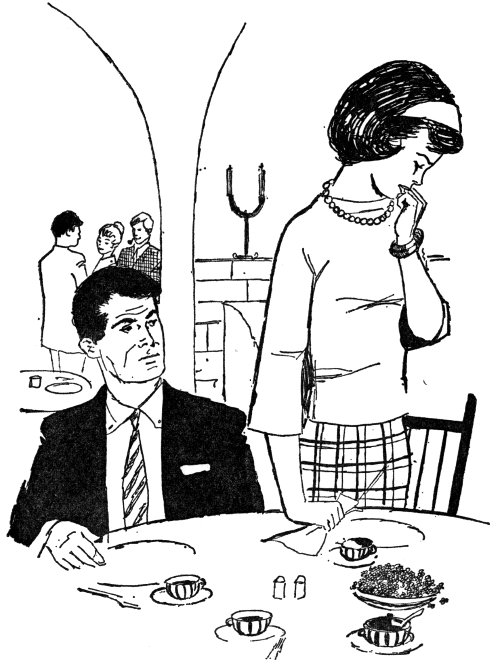
One hand, held to her mouth, was trembling. Suddenly
she stood up, bunching the tablecloth in a
tight grip.
“No!” she cried. “No! I won’t! I won’t act in his
house!”
A shocked silence gripped the room as everyone
turned to stare at her.
“But, Paula, I don’t understand....” Mal began.
“What does it matter if it’s in his house instead of in
the theater? I think you’re being—”
48
“No!” she said again tensely. “You don’t understand.
Of course you don’t. But”—she paused and
looked about her in bewilderment—“I’m sorry,” she
said abruptly, then turned and ran from the room.
49
Before Mal and Randy could recover their senses
sufficiently to run after her, she had grabbed her
coat from the startled cloakroom attendant and run
down the stairs. They could hear her heels clattering
more than a floor below.
Randy started after her, but Mal restrained him.
“No use, old chap,” he said. “I don’t know what’s got
into her, but whatever it is, she’s not going to act tonight.
And as far as I’m concerned,” he added
grimly, “I don’t care if she never acts again. If there’s
one thing I can’t stand it’s temperament. Forget it.
Peggy will do the role, and she’ll do it well.”
50
VI Two Acts of Faith
Jittery though they all were after this startling experience,
the audition went off with surprising
smoothness. Sir Brian, a handsome gentleman with
beautiful manners, received them cordially, allowed
them to rearrange his drawing room, and made them
feel thoroughly at home.
Peggy, though feeling too dazed at Paula’s behavior
to be really aware of what she was doing,
somehow turned in a fine performance. But even as
she was acting to the climax of the scene she was
aware that she was not so much playing the character
of Alison as she was playing Paula’s version of
Alison.
At the scene’s end, Sir Brian and Lady Alwyne applauded
enthusiastically, complimented Peggy especially,
and thanked the company for their trouble in
preparing the scene and coming uptown to act it.
51
“It was most good of you,” Sir Brian exclaimed to
Randy. “And I must compliment you on having
found a company that does justice to your splendid
play. And by the way,” he added in a quieter voice,
“my check for five thousand dollars will be in the
mail tomorrow.”
“Five thousand?” Randy asked, startled. “But
that’s really more than we need, sir.”
“Nonsense,” Sir Brian said firmly. “There’s no such
thing as too much money. You can use the extra for a
little more advertising than you had planned, or for
an extra bit of scenery or something. Now, I don’t like
to hurry you along, but you really must excuse me
if....”
Thanking him profusely, Randy rounded up the
cast, let them know the good news, and hurried
them out. Only the cold bite of the night wind off
the East River convinced him that the whole evening
had not been some sort of fantastic dream, engendered
by an overheated imagination.
“The whole evening!” he said to Peggy, who was
walking arm-in-arm with him a few paces behind
Mal and Amy. “Everything about it seems completely
unlikely!”
“I know,” she agreed. “That fantastic spread at
Paolo’s ... the peculiar business with Paula ...
Sir Brian and Lady Alwyne, looking like a movie
Lord and Lady sent in from Central Casting ...
and then a check for five thousand dollars! It’s almost
too much to believe!”
“What do you think about Paula?” Randy asked.
“Have you any idea what could have been behind
that outburst of temperament?”
52
“I don’t know,” Peggy said, “but I don’t think that
temperament is the word to describe it. You know
yourself that she’s not a prima donna type. She’s always
cooperative, works hard at rehearsals, takes
every direction that Mal gives her.... No. I know
she’s not a temperamental person. This is something
else; something we haven’t any idea about. But whatever
it is, I think she’s in some kind of trouble, and I
want to help her if I can.”
“Mal says he doesn’t want to have her in the show
any more,” Randy said. “He told me he thinks you
can do a good job in the part. If you just forget
about Paula, you can have the role.”
“Randy!” Peggy said in a shocked voice. “Paula’s
my friend, and I want to help her, not steal parts
from her! And besides, I couldn’t possibly do Alison
as well as she does. You saw for yourself tonight that
I wasn’t creating a role. I was imitating a role.
Paula’s a far better and more finished actress than
I’ll be for many years, if ever, and I think that we
owe it to your play to get her back, if she’ll come.”
“And if Mal will have her,” Randy added.
“And if she’s all right,” Peggy mused. “Randy, I’m
really worried about her. Let me go talk to her
right now for a half hour or so, and I’ll join you three
for coffee after. When I’ve spoken to her, I’ll have a
better idea, I know, about whether or not we can
count on her. Leave it to me, will you, Randy?”
Randy walked along in silence for a moment before
replying. “All right,” he said. “I’m perfectly willing
to trust your judgment, and I know that Mal will
give every consideration to what you say. I guess it
is a good idea for someone to go see her now. Whatever’s
wrong with her, she’s gone through a bad evening
and can use a friend.”
53
After catching up with Amy and Mal and explaining
what Peggy wanted to do, they arranged to meet
at Dodo’s Coffeehouse downtown. Randy hailed a
cab and helped Peggy in. “I think you’re right
about Paula,” he said before closing the door. “And
I’m glad you want to help her. Good luck!”
At 36th Street, Peggy dismissed the cab, sure that
she would find Paula at home. She pushed the button
marked “ANDREWS” and waited a moment until
the little speaker crackled and Paula’s voice, sounding
tired and far away, answered, “Who is it?”
“It’s Peggy Lane. May I come up to see you?”
A moment’s hesitation, and then, “All right. Third
floor rear.” A buzzer sounded in the green door,
and Peggy let herself in.
Going up in the little elevator, Peggy wondered
again how Paula could afford to live in such an
elegant place. She had some idea of the rents in these
well-maintained remodeled buildings, and also some
idea of what a salesgirl in a department store
earned. “Well, it’s none of my business,” she told
herself. “Maybe someone left her an income or something.
Or maybe her parents pay the rent for her. But
that’s not what I’m here to find out.”
Paula, looking more pale, drawn, and tired than
Peggy had ever seen her before, opened the door and
motioned Peggy in. The apartment, obviously rented
furnished, was comfortable enough, but almost without
personality, like a hotel room. It consisted of one
bedroom-sitting room, a compact kitchenette and a
bath. The only sign that anyone lived in it was a
small collection of books, no more than a dozen, on
a shelf.
54
“Sit down, Peggy,” Paula said formally. Then,
as if she were asking about some event that didn’t
concern her at all, but asking only out of politeness,
she said, “And how did the audition go? Were you
good? And did Sir Brian invest in the play?”
“It went very well,” Peggy said gloomily, “considering
that it was me and not you. Sir Brian is putting
five thousand dollars into the production.”
“Then I guess I’m fired,” Paula said, in the same
lifeless tone.
“You don’t have to be,” Peggy said. “If you can
only explain—or just convince Mal and Randy in
some way that it won’t happen again—I know they
want you back!”
“That’s nice of you, Peggy,” Paula said, “but I
can’t explain. And there’s no point in my trying to.
No, the part is yours.”
“But I don’t want it!” Peggy said earnestly. “I’d
never have been able to play that scene if I hadn’t
seen you do it so often! All I was doing was a fair
imitation. You’ve got to come back and do the part!”
“Peggy,” Paula said with sudden intensity, “it’s
not a question of my wanting to come back and do
the part or not. It’s a question of being accepted
back. Of course I want to do it! But Mal and Randy
have to make the decision that they’re willing to
let me come back after the terrible way I acted this
evening.”
“If you could just tell them why—” Peggy began.
“I can’t. Honestly, I can’t,” Paula interrupted. “I
would if I could, but if they’re going to take me back,
it can’t depend on an explanation. They’ll just have
to do it on faith—and on my promise that nothing
like this will happen again. That’s the only assurance
I can give them.”
55
“Are you so sure it won’t?” Peggy asked. “I mean,
it was such an emotional outburst, you hardly
seemed to know what you were saying. How can you
be positive that you won’t fly off again like that? I
don’t mean to be hard on you, but they have to know.”
“All I can say, Peggy,” Paula answered, “is that as
long as the rehearsals are as private as they have
been, and as long as Sir Brian doesn’t come around
the theater till opening night, I’ll be all right.”
“And after opening night?” Peggy pursued.
“Oh, once we open, I don’t care who comes!”
Paula said. “In fact, all I want is to have the whole
world come to see us!”
“Well,” Peggy said after a moment’s reflection,
“I’m convinced that you’ll be all right, and I’ll do
what I can to convince the boys. But I won’t mention
what you said about Sir Brian not coming
around. It’ll just sound peculiar, and I’m sure he
won’t come anyhow, he’s so busy. We’ll be lucky if
he even comes to a performance.”
“Thanks, Peggy,” Paula said warmly. “Thank you
so much for your faith in me. You’re a wonderful
friend. And I know you’ll convince the boys! I’ll call
you in the morning to find out, all right?”
“Fine. Meanwhile you’d better get a good night’s
sleep. You look as if you need some rest. We’ve all
been worried about your health. I’ll see you tomorrow
at the theater, I’m sure!”
The whole visit with Paula had taken only fifteen
minutes, and Peggy arrived at Dodo’s Coffeehouse
only a minute after the others, who had taken a
bus. She sat down and looked in silence at the three
expectant faces that confronted her.
56
“You look like baby birds,” she laughed, “waiting
for a worm!”
“How’s Paula?” Amy asked. “Is she all right?”
“Yes, she’s all right,” Peggy replied, “and I think
she’ll be all right for the rest of the play, too, if you’ll
have her back, Mal. The only thing that troubles me
is that she can’t—or won’t—explain what happened
to her tonight. She wants to be in the play, but she
says that if you want her, you’ll just have to take her
back on faith.”
“Is that all?” Mal asked.
“That and her promise that it won’t happen
again,” Peggy answered. “I know it sounds pretty unreasonable,
but, Mal, I really believe she knows
what she’s saying, and that she’ll be okay. I don’t
know what’s wrong, but as I told Randy, I’m sure
she’s in some kind of trouble, and if she is, we
shouldn’t make it worse. I think we ought to try to
help her in whatever way we can. Maybe if we trust
her, and show her that we do by taking her back,
she’ll get to trust us, and tell us what’s wrong. Anyway,
I think that we should take the chance.”
“How about you, Amy?” Mal asked.
“I agree with Peggy,” she said.
“Randy?”
“I’m for taking her back. If not on her own word,
then on Peggy’s. And besides, I think everybody
ought to have a second chance.”
“All right,” Mal said. “I don’t want to hold out
against the rest of you. She’s back. Peggy, do you
want to be the one to tell her?”
“She’s going to call me in the morning to find out,”
Peggy answered.
57
“Good,” Mal said. “And while you’re at it, tell
her she’d better start reading up on the whole play
again, with special attention to Act One, Scene Three.
That’s what we’re starting on in the next rehearsal
tomorrow night.”
That settled, they turned their attention to coffee
and cake, and their conversation to the five-thousand-dollar
investment and what they would do with
it—as if, Peggy thought, it had been the least important
part of the busy evening’s events!
58
VII An Intermission
It was a good thing, Peggy thought, that she was
going to the New York Dramatic Academy and not to
a more conventional kind of school. Mr. Macaulay,
the director of the Academy, approved of his students’
taking part in off-Broadway plays, and made
certain concessions to those who were doing so, such
as excusing them from school plays. While this eliminated
the necessity of learning the lines of two plays
at once, and also gave Peggy more free time than the
other students, it did not excuse her from her regular
school work.
She attended classes in History of the Theater,
Elizabethan Playwrights, Restoration Drama, Acting
for the Camera, Ballet and Modern Dance, and
Make-up Techniques.
It was a full schedule all by itself.
59
But, of course, it wasn’t all by itself. Classes filled
the day from nine in the morning till three in the
afternoon, and rehearsals began at six in the evening
at the Penthouse Theater and ran on to midnight.
On Saturdays, rehearsals and scene painting and
construction filled the day from nine to six. This
grueling schedule left Peggy only three hours each
day to study for her classes at the Academy and to
learn her lines for Come Closer, and practically no
time except Sundays for such things as hair washing,
personal laundry, letter writing and all the other
things that usually seem to take no time at all because
they are spread through the week.
Sometimes she wondered how she would ever do
it all. But other times she wondered how she could
ever again enjoy a life that was less full, less active,
less exciting. She was very busy, and very, very
happy.
Now it was a few minutes past six on a Saturday
evening, and she and Amy were carefully washing
the paint from their hands and faces. Peggy leaned
across the basin, very close to the mirror, for a minute
inspection, found one last little spot of green on the
lobe of her ear, and carefully removed it.
“I think I’m all clean,” she said. “How about you?”
“Just a few more spots,” Amy answered. “Then
I’ll inspect you and you inspect me.”
“Oh, we don’t need to be that thorough,” Peggy
said. “If we hurry, we’ll have plenty of time for baths
at home before the boys come to pick us up.”
“I would surely like to know what you call plenty
of time,” Amy laughed. “The boys are coming for us
in two hours, and we have to face the Saturday night
line-up at the bathrooms, which can be worse than
waiting for tickets at a World Series game!”
60
“No, the worst is over by now,” Peggy said. “I
happen to know that Irene, the Beautiful Model, has
a date picking her up at six-thirty, which means that
she’s climbing out of the tub right now. Greta is staying
home tonight, which means she’ll let us have the
bath first. Dot is out of town, so that just leaves us,
Gaby and Maggie to share the two baths. I think
we’ll make it!”
“You have it planned like a general!” Amy said.
“I salute you.”
“Right down to the camouflage!” Peggy laughed
in answer. “Mine is the dark blue cocktail dress.
What are you wearing to divert the troops?”
“A print,” Amy said, with an unusual air of decision
for a girl who could never make up her mind about
what to wear until the last possible minute. “The only
thing I haven’t decided yet,” she added, “is whether
to wear my print with the three-quarter sleeves, or
yours with the cap sleeves, or Maggie’s sleeveless
chiffon. What do you think?”
“Why not wear any one of them, and take the
other two in a little suitcase?” Peggy teased. “Then
you can change during the evening and keep us in a
constant state of surprise!”
By this time, they had finished washing, had
changed from their stagehands’ coveralls, and were
dressed to go. They found Greta waiting for them in
the little lobby downstairs, and the three set off for
the Gramercy Arms.
“How did your rehearsal go today, Greta?” Peggy
asked.
“Fine,” Greta said, but her tone was a little doubtful.
“Is something wrong?” Amy asked.
61
“No. Not exactly, that is. The scenes we were
working on are shaping up very well, but all of us
are still a little worried about Paula. Not about her
acting,” she added hurriedly. “We think she’s just
wonderful. It’s ... well, it’s something else.”
“You’re not still worried about last week, are you?”
Peggy asked. “I mean about that scene at Paolo’s? If
you are, I’m sure that—”
“No, it’s not that,” Greta said. “We’re all convinced
that whatever it was that caused that blowup, it won’t
happen again. She’s not at all a temperamental person.
No, we’re worried about her health. At least I
am.”
“So am I,” Peggy confessed. “Amy and I were
talking about it today. She looks so drawn and pale
and ... tense. I’ve tried to speak to her about it,
but she just refuses to admit that there’s anything
wrong.”
“That’s the way she’s been with all of us,” Greta
said. “She insists it’s just our imaginations, and
that she never felt better. Or she says that it’s a case
of character identification, and she’s beginning to
look like the part she’s playing. But if that’s true,
then she’s the best actress in the history of the theater.”
“Which she may well be,” Peggy said loyally. “But
even if she is, I don’t think that’s the cause.”
“Since there doesn’t seem to be anything we can
do about it,” Amy commented, “I think the best thing
to do is to leave her alone and not bother her by asking
about it. If she wants help, she knows we’re
her friends.”
Peggy’s planned attack on the bathtubs worked
out just perfectly, and the two friends had plenty of
time to prepare themselves for the evening’s date.
The comforting dip in the hot tub and the change
to their best party clothes (or, rather, Peggy’s best
party clothes, since Amy elected to wear her print
dress) served to change their mood as well. By the
time that Randy and Mal rang at the door, Peggy
and Amy were ready and waiting, in a cheerful
mood of anticipation.
63
This was the first time that they had taken a real
night off for over a month, and they were all looking
forward to an enjoyable evening, free of the worries
of the production. After a few minutes devoted to
discussion, they decided to go for a drive into Westchester
County for dinner and dancing in the country.
All agreed that if they were trying to get their
minds off the play, the best thing to do was to get
out of the city, with its permanent air of show business.
It was a clear and starry night that had mixed in
it the elements of two seasons—the end of winter
and the first hint of spring. The stars were as hard
and bright as in winter’s clear skies, but the air was
almost soft, and the trees silhouetted against the pale
sky, though still bare of leaves, were fuller in the
bareness than they had been a week before; the
buds on the branch tips were swollen, nearly ready
to burst into little green flags.
Randy’s car, an old, but still elegant English convertible
sedan, purred smoothly through the countryside.
Peggy, settled comfortably in the deep leather
seat, felt as if she were already a thousand miles
away from New York, the theater, and her hard
week’s work.
Randy drove with skill and confidence, and in far
less time than they had thought possible, they were
pulling into the driveway of a low stone restaurant
with a slate-shingled roof, screened from the road by
evergreens and shrubbery. The restaurant overhung
a little lake in whose still surface its lights were reflected.
64
Inside, in a low room illuminated only by candles,
a small orchestra was playing quiet dance music,
and a few couples drifted about the floor. A courteous
headwaiter, after checking their names on the
list of reservations, led them to a small room containing
only about a dozen tables. Their table was at
the side of the room, by a picture window overlooking
the lake, which could be seen, dark and bright,
through the reflections of themselves and the swaying
flames of the candles on their table.
“A thousand miles away,” Peggy was thinking.
“No, a million miles!” as the conversation, as light
and pleasant and unimportant as the music, went
on. They were talking about the charming restaurant,
the countryside, and the pleasures of getting out of
the city.
“We’ll have to come here in summer,” Randy was
saying. “They have little boats on the lake and you
make them go with paddlewheels worked with a
kind of hand crank. They have fringed canvas awnings
on top, and cushioned seats to lean back in.
The lake is bigger than it looks, and has lots of pretty
coves and inlets, and even a landscaped island up at
the far end. It’s a nice place to drift around.”
With a little twinge of feeling that she did not care
to examine too closely, Peggy found herself wondering
whom Randy had rowed around the lake, but she
quickly put the thought out of her mind. She had
no right to think about things like that, she told herself.
Her relationship with Randy was ... well, it
was what it was.
65
Peggy had no desire to be serious, except about the
theater. And even the theater, she thought, should
stay in the background tonight. She and the others
had been living nothing but theater lately, and it was
good for them to sit in this cozy, candlelit room and
talk about things that didn’t matter; things like the
coming of spring, rowing on the lake, or what to
have for dinner.
But keeping actors from talking about the theater
is as hopeless as trying to keep the tide from coming
in. No matter what they start to talk about, it always
ends up on stage. If the conversation is about books,
somebody soon mentions a book that was made into
a play, and they’re off again in stage talk. If the conversation
is even about something as far removed
from the theater as, say, sailboat racing, sooner or
later somebody will be reminded of a sailor who
wrote a play, or was an actor, and ... on stage.
Tonight was no exception, and by the time they
were on their main course of rare, tender steaks with
Idaho potatoes, buttered peas and green salad with
Roquefort dressing, the talk had quite naturally
drifted onto the inevitable subject.
“Are you satisfied with the way the play is developing,
Mal?” Randy asked. “Does the cast live up to
your hopes?”
“It’s going well,” Mal answered, with his usual
English reserve. “My worries about making the development
lopsided by working out one scene so
thoroughly for the audition have proven to be
groundless. If anything, I think it was a good experience
for us all. We learned, under the most intense
conditions, how to work together. We learned to respect
each other, too, and that’s probably the most
important thing that can happen to a company.”
“How about Paula?” Peggy asked.
66
“A wonderful actress,” Mal said with unusual enthusiasm.
“I wonder where she learned it all. Even
a natural talent like hers isn’t all natural, you know.
Somewhere along the line, she had first-rate instruction.”
“She said something to me about coming from
California and doing some little-theater things
there,” Peggy said, “but she was rather vague about
it, and I got the feeling that she wouldn’t welcome
any questions.”
“She’s rather vague about everything,” Randy
said, “except her acting ability. That’s as clear as can
be.”
“I wonder where she played in California,” Mal
said. “I have the feeling that I’ve seen her somewhere
before, and I may have run across her when I
was out in Hollywood. I know she looks familiar, at
any rate.”
“She didn’t say,” Peggy replied. “All she told me
was California, and I know it’s a big state. I suppose
it might have been in the north, around San Francisco,
but somehow I have the impression it was Los
Angeles. Maybe that’s just because I only think of
Los Angeles when I think of the acting business and
California.”
“Why are you so anxious to know?” Amy asked
Mal.
Taken aback a little, Mal hesitated before answering.
“I’m not actually anxious to know about her,” he
said at last. “For my purposes as a director I already
know all I need to—that she’s a splendid actress. It’s
just that such secretiveness as hers always inspires a
little corresponding curiosity.”
67
“Well, frankly, I am curious,” Peggy said. “But I’m
not as curious about her past as I am about her present.
What worries me is her health. Haven’t you all
noticed how pale she looks, and how thin and drawn
she’s getting?”
“I have noticed her condition, of course,” Mal said
with concern, “and I’ve asked her about it, as you
have. She only says that I’m not to worry, and that
she’ll be all right for the opening.”
“Well, I hope she knows what she’s doing,” Randy
said. “I’d hate to have her get ill now, and have to
start training a replacement. Besides, where would
we get someone as good as....” He looked at Peggy
and reddened.
“Oh, Randy,” she laughed, “you don’t have to be
embarrassed about telling the truth. I know I’m not
nearly as good as Paula, and you all know it, too.
Though it’s very sweet of you to try to pretend that I
am. But I didn’t walk away from the part just because
I’m a nice girl and wanted to help Paula. I’m
too much of an actress to be entirely unselfish when
it comes to a good role! No, I just knew it was meant
for her, and it was more than I could handle.”
Since, out of honesty, nobody wanted to contradict
her, and out of embarrassment, nobody wanted
to agree, an awkward little silence fell over the table.
It lasted for only a moment, though, until Randy
broke it by asking Peggy if she would like to dance.
She nodded happily, relieved, and Mal and Amy
followed them into the next room where the band
was playing.
68
Randy was a wonderful dancer, having performed
professionally as a song-and-dance man for some
time, and Peggy felt that she herself never danced
as well as when she was with him. Once again, the
theater and its worries, Paula Andrews and her mysterious
trouble, faded into the background as Peggy
and Randy drifted slowly and easily about the polished
floor.
Once again, the conversation turned light and
pleasant and far removed from their everyday problems,
and the candlelit restaurant seemed to Peggy
to be a thousand miles removed from everything real.
But when it came time to leave, and when the car
was once more purring along the road, the thousand-mile
distance shrank to its true proportions of perhaps
thirty-five miles. And every mile they drove
brought them closer again to the busy, theatrical
city, where even Randy’s good-night kiss at the doorstep
could not remove from Peggy’s mind a sense of
tension and trouble to come.
What the trouble might be, she could not say.
What the tension’s cause was, she did not know.
But surely at the center of it was the pale and sensitive
face of Paula Andrews.
69
VIII Curtain Fall
“No, not that way, Greta,” Mal called from his seat
in the orchestra. “Don’t sit down as if you knew the
chair was there and as if you knew exactly what kind
of a chair it was. I want you to give the impression
of being unsure of yourself and your surroundings.
Before you sit, look behind you quickly—maybe
even touch the top of the chair—then sit down.”
“But, Mal,” Greta said, coming to the apron of the
stage to talk to him, “I’ve already used this chair
earlier in the act, and I should be familiar with it by
now. If I do it this way, isn’t it just going to look like
an awkward piece of acting?”
“No,” Mal said. “When you used it before, it was
when you were in a different personality mood, remember?
This little difference will help to establish
the change in your personality. It’s a small thing, and
the audience may not even be aware of it consciously,
but it’ll help to form the impression I want them to
get. Try it, anyway, and I’ll see how it looks from out
front.”
70
Greta agreed, and returned to the wings to pick
up her entrance cue again. This time, when she entered,
it was as if she had not been on stage before at
all. She crossed unsurely to stage center to exchange
a few lines with Alan Douglas and, when she was
asked to sit down, turned a little, as Mal had told
her, reached out a tentative hand to touch the back
of the chair—but withdrew it before she touched it,
and then swiftly sat down.
“Like that?” she asked Mal.
“Just like that,” he answered with satisfaction.
“That chair bit is the give-away, and it’s perfect. I
like your not quite touching it. Keep it in! Now let’s
take it from there, Alan.”
Peggy waited in the wings for her own entrance
cue. This time she was to come on aggressively, as
the pampered ex-child movie star, to play against
Greta’s shy confusion. In their previous exchange,
Peggy had been quiet, well-mannered, even subservient
in her character of plain-Jane secretary, for
Greta had been acting the crisp, assured businesswoman.
Waiting, she watched with fascination how the
play was taking shape. This evening was the first
time they had been allowed to run through the entire
play from beginning to end. The first time they
had tried it, everyone could see how much work
needed to be done, how shaky the whole structure
was. But this time, the second of the evening, Mal
had already done much to establish character and to
direct movement on stage, and the production was
gradually achieving a vitality of its own.
71
It was late, and everyone was tired, but they had
all decided to finish their second run-through of the
evening anyway, feeling that they would gain more
from doing it all at once. At the rate they were going,
it would be after one o’clock before they were
through, and two o’clock before most of them were
in their beds.
Peggy heard her cue lines coming up, and she got
ready. At the right moment, she entered the stage
with a kind of athletic bound, swinging an imaginary
tennis racket. She tossed the “racket” (she would
have one in the play) at the “couch” (a row of three
chairs, at present) and perched on the edge of a table.
“My travel agent said that this place was different,”
she said contemptuously, “and I guess it is, if
different means dead.”
“Don’t take it quite so heavy, Peggy,” Mal called
out. “You shouldn’t be so much disgusted with the
place as you are, really, with yourself. You know that
no matter how good it really might be, it wouldn’t
suit you, because nothing ever does. Make the expression
more regretful than contemptuous. And for the
same reason, tone down your entrance a little.”
Peggy nodded to show her understanding, and
went back to the wings again.
The scene, when played, would last only about
five minutes, but Mal was hard to please and would
let nothing pass. By the time it was over, the rehearsal
of it had taken forty minutes and Peggy was
glad to make her exit and sit down on a box near the
switchboard where she could watch the next scene.
72
This one would go smoothly, she knew. It was the
scene they had worked on for the audition at Sir
Brian Alwyne’s, and although they had not worked
out their stage movements as yet, the cast already
had developed pace and rhythm.
Paula’s entrance, bewildered, awkward and eager
to please, was perfect. She was as graceful and appealing
as a doe. One by one, the other actors came
on, each in turn trying to find some point of contact
with her, each trying to please her. And as each
failed, he went off, to return again in another mood
or personality. The pace quickened. Paula’s confusion
grew greater. The tension she projected was communicated
to everyone present, those on stage and
those in the wings or in the orchestra seats watching,
as it would be to the audience. The second act was
approaching its emotional crisis, uninterrupted by
Mal, who sat as if entranced, on the edge of his seat.
Finally, at precisely the right moment, when it
could go on not one moment more without shattering,
the tension broke in a flood of emotion. Paula
dropped to her knees in tears, then sank in a heap on
the floor, sobbing. The scene was over. The actors
turned expectantly to Mal, waiting for his comments,
his praise.
But Paula did not rise, and she was not sobbing
any longer.
Peggy realized in a flash that this was not like some
of the previous rehearsals where Paula had been unable
to stop the flood of stage tears that she had so
skillfully built up to. This was different.
She rushed out on stage to where Paula lay huddled
in a pool of light, and knelt by her side to shake
her gently, but Paula did not move. Peggy turned
her over and motioned the rest of the cast to move
back. Paula lay pale and limp beneath the floodlights.
She was breathing in quick uneven gasps.
73
“She’s fainted,” Peggy announced. “Somebody call
a doctor!”
But Paula’s eyes flickered open, and she said in a
weak voice, “No. Just take me home, please, Peggy.
I’m ... I’m sorry. But I’ll be all right. I just want to
go home now.” She closed her eyes again.
“What do you think?” Peggy asked Mal, who by
this time had reached her side. “Shall I take her
home, or call a doctor?”
“I think you can get her home before we could
persuade a doctor to come down to this half-deserted
neighborhood,” Mal said. “Why don’t you take her
home and make her comfortable? We’ll get a cab,
and I’ll go with you to carry her in case she faints
again. Meanwhile, Randy can call a doctor and have
him go directly to Paula’s apartment.”
74
“No,” Paula protested, “I don’t need a doctor. I’ll
be all right once I’m home. There’s nothing really
wrong with....” She tried to sit up, and with the
effort fainted once more.
“Come on,” Mal said. “Get your coat, Peggy. Alan!
Will you go out after a cab, please? Randy, call the
doctor right away! Everybody else, go on home. Rehearsals
are over for tonight. See you all tomorrow,
same time.”
This time Paula did not come out of her faint until
they were nearly at her house. She made no attempt
to talk, or even to protest when Mal carried her from
the taxi. When they had her upstairs, lying on the
daybed, Mal turned to leave.
“I don’t think I’d better stay,” he said, “but the
doctor ought to be here any minute. You’ll stay with
her, won’t you, Peggy, until you find out from him
what’s wrong?”
“Of course,” Peggy said. “And if it’s not too late,
I’ll call you when I leave. Otherwise, I’ll let you
know in the morning. Good night, Mal, and thanks
for your help.”
“Yes, thank you, Mal,” Paula said weakly, with a
small smile. Then, once again, she closed her eyes.
It had not taken the doctor long to diagnose
Paula’s condition. Peggy had gone out to fill the
prescription, and was now busy preparing it. It was
some chicken soup, toast and tea, to be followed in
the morning with a light breakfast, then a good,
hearty lunch.
75
“I can’t understand why you didn’t tell me about
it,” Peggy said. “You know I would have loaned you
some money. It’s just ridiculous for anyone to go
hungry when she has friends! You can’t imagine
how shocked I was when the doctor said that you
were suffering from malnutrition, and that you didn’t
seem to have eaten anything for at least two days!
Maybe I’ve led too sheltered a life, but I never
even heard of anyone starving—not in this country,
anyway.”
“It can happen anywhere, I guess,” Paula said,
with a sad smile.
“But why?” Peggy cried. “Why didn’t you let me
help you?”
“I would have, Peggy, if it had been just a sudden
thing, but it wasn’t. It was a continuing thing. I
guess if I had had enough to eat during the last
month, I wouldn’t have keeled over from going for
two days without anything. I’ve been living on
canned beans and bread and other cheap food for
over a month now, and to ask for help would have
meant asking for regular help—every week. And I
didn’t want to take advantage of anyone that way.”
“But, Paula, that’s so silly!” Peggy protested.
“How long did you think you would be able to go on
without proper food?”
“I was just trying to hold out until tomorrow, when
my pay check comes in from Randy and Mal. Then
I could have had something to eat.”
“Do you mean to say,” Peggy asked in astonishment,
“that you’ve been trying to live on just the rehearsal
salary? Why, that’s hardly enough to pay the
rent in a place like this, much less to eat!”
76
“I know,” Paula said. “I’ve been finding that out.
But we go into full pay for rehearsal next week, and I
thought I could hold out until then. I guess I was
wrong, wasn’t I?”
“But what about your job at the department store?”
Peggy asked.
“Oh. I—I lied about that, Peggy. I was laid off
right after the Christmas season, and I haven’t been
working since then. I had some money put aside, but
it was almost gone when I got the part in the play.
Then I thought I could live on the rehearsal money
until we went into full pay. By the time I found I
couldn’t, I was too weak to take a full-time job.”
“But you could have moved to some less expensive
place, couldn’t you?” Peggy asked. “This little apartment
must cost a lot of money.”
“It does,” Paula admitted, “but I like it here, and I
didn’t want to give it up. I thought that I could
manage. I’m sorry now. I’ve caused everybody so
much trouble.”
“That’s the least of our worries,” Peggy said, filling
up Paula’s bowl with a second helping of chicken
soup. “The question now is how you’re going to get
along for the next week until the full pay comes in.
And also how you’re going to live here, even on
that.”
“Oh, I’ll get by, Peggy. I know I will. Besides, I
have such faith in the play. I know it will be a hit,
and if it is, our salaries will go up above the minimum.
Randy told me how much I could expect to earn as
the lead, if we have a success, and it’s plenty for me
to live on.”
77
“But until then,” Peggy said, “you’re going to need
more cash. Isn’t there somebody you can go to for
help? How about your family?”
“Oh, no!” Paula said. “My family ... I haven’t
any family. I mean, I’m an orphan. My parents are
dead, and I haven’t anyone else. I’ve been supporting
myself for a long time, and I’m used to it.”
“Well, then,” Peggy said firmly, “I’m going to have
to be your family, and you’ll have to accept help
from me. I would say that you’ll need about fifty
dollars a week to add to what you earn—at least until
we get to be a hit, if we do. And since you haven’t
anybody else, you’ll have to let me get it for you.”
“Oh, no, I can’t let you do that, Peggy!” Paula
protested. “I know that you haven’t got that kind of
money, and besides, I ... I don’t want any help. I
can take care of myself. I want to take care of myself!”
Peggy sat down on the edge of the bed and took
Paula’s hand. “I can understand the way you feel,”
she said, “but that’s a foolish kind of pride. Everybody
wants to think they’re taking care of themselves,
but really nobody does. Before your parents
died, they took care of you. They fed you and
clothed you and taught you to walk and talk. If
somebody hadn’t taken care of you then, you
wouldn’t have lived to want to take care of yourself.
As we grow up, we take care of ourselves more and
more, but we’re never completely on our own. Everybody
needs someone else. That’s what friends are for.
And you’ve got to let me be your friend.”
78
Paula’s eyes filled with tears. “I suppose you’re
right, Peggy. It is just foolish pride, and you’re so
good to talk to me this way and to want to help me.
But ... what I said before. I know you can’t afford
it!”
“Of course I can’t,” Peggy said. “But I’ve got
friends—and many of them are your friends, too,
and I intend to ask them. I’m going to talk to all the
members of the cast who have jobs, and to the girls
who live at the Gramercy Arms, and we’ll get up a
group to help you out. That way it won’t cost anyone
more than three or four dollars a week, which we
won’t miss too much.”
“Oh, Peggy, that’s so good of you,” Paula said,
“but I feel so ashamed to take your money!”
“Think how ashamed we’d feel,” Peggy said, “if
we weren’t able to help you. And besides, we’re not
doing it just for you. We’re doing it for the play. We
need you in the play. There’s nobody else who can do
the Alison part the way you can ... and even if
there were, it would be too late now for a cast substitution.
No, it’s your part, and it’s our play, and we
have to keep you in good condition to do it. It’s a
difficult enough role to play even if you’re well-fed,
and I just don’t believe you can do it if you’re half-starved.
Now I don’t want to hear another word
about it except ‘yes.’”
Paula’s smile was stronger now, between spoonfuls
of soup. She looked up, her eyes still wet, and
softly said, “Yes. Thanks.”
79
“Good. That’s settled,” Peggy said. “Now, would
you like some tea and toast? The doctor said not to
give you more than this to eat tonight, no matter
how hungry you said you felt. No. No butter. He
said dry toast, but I suppose you can dunk it in the
tea, if you like.”
While Paula was eating the last scrap of tea and
toast, and protesting that she felt a good deal more
like eating a steak, Peggy got some pajamas for her
from a bureau drawer, and a robe and some slippers
from the closet. Then, since Paula was still weak,
she helped her change into them, made up the daybed,
and tucked her in bed.
“You look a lot better now,” Peggy said. “The best
thing for you to do is get a good night’s sleep. You’ll
feel better in the morning. You’ll find eggs and butter
and coffee and orange juice in the kitchen, so you
can make breakfast for yourself, but after eating, go
back to bed and rest. That’s doctor’s orders. I’ll come
up here at noontime, and we can go out for a good
lunch together.”
Cutting Paula’s thanks short with a wave of her
hand, Peggy said a quick good night and left. It was
past her bedtime, too.
80
IX One for the Money....
In the comfortable, well-furnished living room of
the Gramercy Arms, Peggy prepared to call a meeting
to order.
May Berriman, the retired actress who owned the
house, sat regally in a high-backed, thronelike chair.
Her hands were busy with a tiny silver bobbin and
a tatting needle, making delicate lace; but they
seemed to be working with an intelligence of their
own while their owner, not even looking at them, was
busily observing the faces of “her girls.”
Irene Marshall, the house beauty, was gracefully
curled up on the couch in the sort of decorative pose
hardly ever seen outside the pages of the more expensive
fashion magazines. At the other end of the
couch, her knees drawn up and her feet tucked under
her, sat Gaby (Gabrielle Odette Francine Du-Champs
Goulet), looking about her expectantly, her
head cocked to one side like a toy French poodle’s.
81
Maggie Delahanty, the dancer, sat cross-legged on
the floor like a Hindu, her back straight and her
hands loosely folded, a magazine open on her knees.
She could sit for hours like this in apparent perfect
comfort, in a position the other girls found almost
impossible to get into at all.
In more conventional positions, seated on chairs,
were Greta, Amy, and Peggy.
“I guess everybody’s here now,” Peggy said, “so I
might as well tell you why I asked you all to meet
in here. I need your help, but I didn’t want to explain
it several times, because it’s rather a complicated
story.”
As briefly as she could, Peggy told them about
Paula, as Paula had told her. Then she recounted
the events of the night before, ending with the doctor’s
visit.
“When he told me that she had fainted from hunger,”
Peggy concluded, “I was so shocked I didn’t
know what to say. I’m still not sure I understand how
it came to happen, but I am sure of one thing. Paula
needs help, and I told her that I would see to it that
she gets it.”
“She needs some common sense even more than
she needs help,” Maggie said tartly. “Unfortunately,
I don’t think we have any of that to spare. Why did
she let this go on so long without doing something
about it?”
“Yes, why?” Irene asked. “I know a lot of people
who are out of work, but they don’t let themselves
starve. I’ve been out of work myself plenty of times,
the way every beginner in show business is, and I’ve
always gone straight to the unemployment people.
The government check hasn’t been much, but it’s
been enough to eat on.”
82
“I asked her that,” Peggy said, “and she told me
that she didn’t qualify for unemployment insurance.
Apparently you have to have worked for a certain
length of time before you can collect any insurance,
and she hadn’t worked that long when the department
store laid her off after the Christmas rush.”
“That’s true,” Greta said. “I was in a fix like that
myself once, and I had to ask my parents for help until
I could get a job. Luckily, I have parents and
they have enough to be able to spare some for me.”
“Most of us have someone to turn to,” Peggy said,
“but Paula’s an orphan, and hasn’t even got any
aunts or uncles or cousins. But she does have
friends, and that’s what I want to talk to you about.”
“Oh, we all of us ’ave understand that alreadee,”
Gaby said with a toss of her head. “That part of the
problem is no more worree. I give a few dollar each
week—we all give a few dollar—nobodee give
enough for to miss it, an’ presto! Mademoiselle Paula
’as plentee to live on. No?”
“That’s just what I had in mind,” Peggy said, relieved
not to have had to actually ask for the money.
She had been hoping her friends would offer it as
their own idea. “How do the rest of you feel about it?”
Everybody nodded agreement and murmured assurance
that they would do as much as they could
to help. “How much does she need?” asked Maggie,
practical as always.
“I think about fifty dollars a week would do it,”
Peggy answered, “but it doesn’t all have to come
from us. There are several members of the cast who
are working at other jobs and who would be glad to
contribute. In fact, I think they’d be insulted if they
weren’t approached about it.”
83
“Won’t Paula object to their knowing all about her
troubles?” Amy asked.
“I don’t think so,” Peggy said. “Besides, they all
saw her faint last night, and some explanation will
have to be given. Not only that, but I don’t think we
should try to hide it as if it were some disgraceful
thing not to have enough money for food. Paula has
been hiding her troubles too long, and she’s going to
have to accept the fact that you can’t hide trouble
and fight it at the same time.”
“Very wise, Peggy,” May Berriman approved. “I
agree, just as I agree with Maggie that your friend
needs some common sense more than she needs help.
It’s possible that by helping her in this open way, you
may also provide her with a little common sense!”
“Speaking of common sense,” Greta put in, “I
think it’s about time we got down to dollars and cents
in this discussion, instead of just going on vaguely
about wanting to help. Does anyone have a suggestion
about how much we should all contribute to the
Paula Fund?”
After mentioning several figures, and after some
discussion about how much should come from the
Gramercy Arms and how much from the cast, an
agreement was reached.
“So it’s settled,” Peggy said. “Gramercy Arms will
give twenty-five dollars a week, and the cast will
give the rest. Now, twenty-five dollars divided
among the six of us girls....”
“Seven,” May Berriman interrupted. “I may not
be a girl any longer, but you’ll grant I am a part of
Gramercy Arms.”
84
“Thanks, May,” Peggy said gratefully. “Well,
seven then. That comes to ... let’s see. Three-fifty
each a week would add up to twenty-four dollars
and fifty cents. That’s close enough, I guess, and we
can all surely spare that. It’s only fifty cents a day.”
“I have another suggestion, Peggy,” May Berriman
said. “As you all know, Dot is on tour and isn’t
due to return for another three months. I’m sure she
wouldn’t mind if Paula were to use her room. Why
don’t you ask her to come in here with us and give
up that expensive apartment?”
Peggy reflected for a minute. “No, I don’t think
so,” she said at length. “If she had been willing to
move out of that apartment, she would have done
it before this. I don’t think she’d be at all happy here.
She’s so—well, so secretive, and I think that all she
wants is to be left alone. I suppose that sounds pretty
strange, and pretty self-indulgent, too, but as I told
you, I think she’s having some kind of trouble that
we don’t even know about, and she obviously doesn’t
want us to know. I don’t think it would be helping
at all if we tried to get her to come to live with us.”
“Maybe you’re right,” May Berriman said. “One
sure way to be of no help at all is to try to change a
person’s way of living. At any rate, you can tell her
that the room is here for her to use in case she wants
to.”
“I will,” Peggy said. “And I’d like nothing better
than to have her say yes, but I just know she won’t.”
85
Maggie stood up, uncoiling from her cross-legged
position in a single, fluid movement. “I guess it’s all
settled, then,” she said. “The only thing for us to do
now is to get up the money.” Digging into the pocket
of her blue jeans, she produced a small wallet from
which she extracted three crumpled dollar bills and
two quarters. “Here’s my first week’s dues in the
Help Paula Club,” she said.
The rest of the girls hurried up to their rooms to
find money and, five minutes later, after a confused
session of change-making, Peggy had twenty-five
dollars (May Berriman had insisted on giving an
extra fifty cents to make the sum come out even)
carefully sealed in an envelope.
Thanking their housemates, Peggy, Amy, and
Greta excused themselves. They had barely enough
time for a quick dinner before reporting to rehearsal.
“We’ve got good friends,” Peggy said as they
seated themselves in a booth in a nearby restaurant
where they often went. “It certainly was generous of
them to contribute to a girl they don’t even know.”
“That’s one of the nicest things about show business,”
Greta said. “I guess it’s because everyone in
the business has been out of work and in hard circumstances
at one time or another. They’re always
willing to help another actor who’s having a hard
time. Maybe it’s a kind of insurance policy against
the next time they’re in trouble themselves.”
“It ought to be even easier to collect the other half
of the money from the cast,” Amy commented. “And
once we have that, Paula will be all right.”
“In a sense, she will be,” Peggy said with a worried
expression. “At least she’ll be all right financially.
But I don’t think we’ve begun to settle her problems,
and I don’t know if we should even try.”
“What do you mean?” Amy asked. “What other
problems does she have, and why shouldn’t we try
to solve them?”
86
“I don’t know,” Peggy said uneasily.
“What makes you think something else is wrong?”
Greta asked.
“I know something else is wrong,” Peggy said
firmly. “It’s not just guesswork. The question is
whether or not we have a right to poke our noses
into Paula’s business.”
“Stop hinting, Peggy,” Amy said with unaccustomed
sharpness. “Why don’t you just tell us what
your suspicions are, and we can all contribute our
thinking.”
“I suppose that’s best,” Peggy said sadly. “I just
hate to tell you that I think Paula still hasn’t told us
the truth about herself and the reason she had to go
hungry. I saw things when I was at her apartment
that convinced me of that. But I don’t know why.”
“You think she’s lying?” Greta asked. “Why?”
“To begin with,” Peggy said, determined to have
the whole thing out in the open, “she’s lying about
ever having worked in a department store, and about
being a poor orphan. I know because of the clothes
I saw in her closet and her bureau when I was getting
her pajamas and robe for her.”
“How can clothes tell you she never worked in a
department store?” Amy asked, puzzled.
“Shoes,” Peggy said. “Didn’t you ever notice salesgirls’
shoes? Standing behind a counter all day long
is pretty hard on the feet, and your shoes have to
be practical and comfortable. Paula had a large collection
of shoes in that closet—all of them very smart
and fashionable and expensive—but not one pair that
a girl could stand in all day long, except for the
sport shoes that a department store wouldn’t allow
its clerks to wear. You know, moccasins and things
like that.”
87
“It makes sense,” Greta said grudgingly, “in a way.
But maybe she had work shoes and they wore out
and she threw them away.”
“Maybe,” Peggy said, “but that doesn’t account
for the kind of shoes she did have. For instance, there
were high riding boots and low jodhpur boots in
that closet. Now, I have a horse at home in Wisconsin,
and I know something about riding equipment,
and those boots were handmade and must have cost
a fortune. Where would an orphan salesgirl get boots
like that? And why would she want them in the city?
Not only that, but there were ski boots and golf shoes,
too, and I have the same questions about those. I
suppose it all sounds very nosy and suspicious of me,
but I couldn’t help thinking about it and what it
means.”
“What it means,” Greta said, “is that you’re probably
right. From what you say, I’m sure that Paula
wasn’t telling the truth about herself. But what can
we do about it, and why should we try to do anything?
It’s really none of our business, is it?”
“That’s just the problem that’s been worrying
me,” Peggy confessed. “I keep asking myself whether
it’s any of our business who Paula is and what she’s
hiding. I think I’ve finally decided that it is.”
“In what way?” Amy asked. “Just because we’ve
agreed to help her with a little money doesn’t mean
we own any part of her, does it? I think we ought to
leave her alone!”
88
“Oh, Amy, you can’t think I meant it like that!”
Peggy said. “Of course the loan doesn’t give us any
right to go poking into her affairs! But the fact that
we’re her friends does give us a right. We didn’t get
curious about her health, for fear of offending her,
and as a result she collapsed from hunger. Now if
she’s in some other kind of trouble, and we don’t do
something to help, we may regret that just as much.”
“That does make sense,” Amy admitted. “It’s just
that I hate to go behind her back....”
“Why go behind her back?” Greta asked. “Why
not just come right out and ask her what’s wrong?
Even mention the shoes and boots and things, so
that she’ll know why we’re suspicious of what she
told you.”
“She won’t admit anything’s wrong,” Peggy said.
“I tried to ask her at lunch when I went out with her
today, but she wouldn’t even talk to me about it.
Every time I seemed to be coming close to whatever’s
bothering her, she just changed the subject.”
“Well, then, what do you think we-all can do
about it?” Amy asked. “If she doesn’t want to tell us
her troubles, there’s no way that we can force her to
do it. I still think we ought to leave her alone.”
Peggy shook her head in vigorous disagreement.
“That’s just what we shouldn’t do,” she said. “It
seems to me she’s been left alone too much, and
hasn’t been able to do a good job of taking care of
herself.”
“But you said that she doesn’t respond to pushing—or
direct questions,” Greta commented.
“And we certainly don’t want to—to snoop!” Amy
put in.
89
“I know,” Peggy agreed. “But there is one thing
we can do. We can make every effort to show her
that we’re her friends, and to show her that she
can trust us. If we do it sincerely, without pushing or
snooping, I’m sure she’ll confide in us when she wants
to.”
“It seems to me that we’ve all made a pretty big
effort already,” Greta said tartly. “What more can
we do?”
“Well,” Peggy said thoughtfully, “if I were Paula,
I might be inclined to think that the effort made so
far was more charitable than friendly, if the difference
is clear. I mean, we’ve helped her with money
and all that ... but that’s not exactly what I mean.
I think we ought to do something to show her that
we’re glad to know her, and glad that she’s in the
show, and ... I don’t know. It’s just that I feel that
money alone doesn’t say what needs saying to a girl
like Paula. She’s a sensitive person, after all, and she
might even resent the financial help, in some subtle
way.”
“You may be right, at that,” Amy said softly. “I
know that if I were ever in her position ... having
to take money from people ... I’d feel pretty uncomfortable
about it. Especially if the people were
just—well—just casual acquaintances. And after all,
that’s what we are to her.”
“That’s just the point,” Peggy said eagerly. “You’ve
put it perfectly! We are just casual acquaintances—not
close friends. It’s no wonder that she keeps a
kind of wall between her and us, even though we are
helping her.”
“Rather because we’re helping her,” Greta
amended. “Everybody knows it’s a lot harder to
take help than to give it.”
90
“But what can we do to show her that she’s not
just a—a charity case to us?” Amy asked.
“That’s what I’ve been asking myself,” Peggy said,
“and I think I’ve got one good idea anyhow. It’s not
much, but it’s a beginning. Why don’t we give her a
little surprise party tonight after rehearsal, to celebrate
her coming back to the show and being all
right again?”
“I think she’d like that!” Amy exclaimed. “What
do you think, Greta?”
“I think it’s fine,” Greta agreed. “Tonight’s rehearsal
is bound to be a strain for her anyhow, and it
would be nice to give her a chance to relax and cheer
up afterward. How do you want to work it, Peggy?”
Peggy thought for a moment before answering.
“We might ask her up to the Gramercy Arms after
rehearsal,” she suggested. “I’m sure that Gaby and
Irene and Maggie would be glad to set up a party
for us while we’re gone, and everything could be
ready by the time we got back....”
“No,” Amy interrupted. “That won’t do. The minute
we invited her up to the Gramercy Arms, she’d
know there was something special up, and the surprise
would be lost. Besides, she’d have to meet the
other girls, and there would be the usual strain of
new people....”
“Not only that,” Greta added, “but there’s no guarantee
that she would come back with us after rehearsal.
She might be too tired and want to go straight
home. And she’s shy about new places and people,
anyway.”
“How about at the theater?” Amy suggested.
91
But Peggy and Greta vetoed that suggestion on
the ground that it would have to include the whole
cast, and that would make too large a party to enable
them to accomplish their primary purpose, which
was to develop a more intimate relationship with
Paula.
“I know!” Peggy exclaimed. “Why don’t we have
the party right in her own apartment? That way,
we’ll be sure that she’ll be there, and we can control
the number of people! In fact, I think we ought to
keep it to just the three of us and Paula! Amy and I
can miss rehearsal tonight—you can tell her some
thing at the Academy kept us late, and you can
come home from rehearsal with Paula. While you
and Paula are at the theater, Amy and I can shop
and set up a real surprise party!”
“Fine!” Greta agreed. “But how are you going to
get into Paula’s apartment without a key?”
“The superintendent will let us in, I’m sure,”
Peggy replied. “He saw us when Mal and I brought
Paula home last night, and he saw me again when
I was there to pick her up for lunch this afternoon,
so he knows that I’m a friend of hers. If we explain
about the surprise party, I know he’ll let us in, and
not mention it if he sees you and Paula coming home.
He seemed like a very nice man, and he was genuinely
concerned about Paula. I know he’ll approve of
the idea of a party.”
“That sounds like a good plan,” Greta agreed.
“While you’re setting up the party, and while Paula’s
busy rehearsing, I’m sure that I can manage to raise
the money from the cast. I’ll bring it with me, and
we can give it to her along with the Gramercy Arms
money at the same time.”
92
“We can buy a cake and birthday candles too,”
Amy suggested, “and as soon as you come, you can
tell me how many of the cast members chipped in,
and we can put a candle on the cake for every friend
Paula has. It will really be something to celebrate!”
“Good,” Greta said, nodding her agreement. “Well,
we’d better get going now. We’re on a tight time
schedule. I have to report at the theater for rehearsal
in fifteen minutes, and you have to start your shopping
for the party. Mal will probably take it easy on
Paula after last night, so you had better be prepared
to have us come in on you early. Be sure that you
have all the party things set up by ten o’clock.”
Picking up their check, the three girls rose to go,
looking forward with high spirits to the challenge of
breaking down Paula’s wall of reserve and of showing
her that there is such a thing as real friendship in
what must have appeared to her to be a hard, cold
world.
93
X Two for the Show....
“If they expect to be at Paula’s by ten,” Peggy said
as she and Amy left the restaurant, “we’d better
hurry. We have a lot of shopping to do, and food to
prepare. And I’d like to decorate Paula’s apartment
in some way, too. It’s a nice enough place, but I
couldn’t help noticing how cold and unlived-in it
looks. Maybe we can find some way to make it cheerful,
even if it’s just for an evening.”
“If we hurry, we can do that part of the shopping
before the stores on Twenty-third Street close,” Amy
said. “I remember seeing a sort of party shop there
that sells things like crepe paper and candles and
silly decorations and things. I think they’re open till
seven or seven-thirty.”
“I remember the place,” Peggy said. “If we go
there first, we can put off the food shopping until
later. The bakeries and the delicatessens always stay
open till late.”
94
The girls hurried uptown the few blocks to
Twenty-third Street, where they found the proprietor
of the little party shop getting ready to close for the
night. With a resigned sigh, he agreed to stay open
a few minutes more in order to let the two friends
buy the few things they needed for their surprise
party. Trying to make their decisions in a hurry, so
as not to further exasperate the shopkeeper, they
quickly settled on some paper napkins with a festive
rosebud design, and some sugar rosebud-shaped
candle-holders for the cake. Peggy also bought some
pink crepe-paper sheets and strips.
“I think I can make these into some nice paper
roses—if I remember how they taught us to do it in
kindergarten,” she said. “That ought to brighten the
place up!”
Amy found some white paper plates with rosebuds
to match the napkins, but as the girls started to search
for more things to make the party, the owner of the
shop began to turn off the lights, throw dust-covers
over fixtures, and generally make it clear that his patience
was at an end.
“I guess that’s really all we’ll need, Amy,” Peggy
said nervously. “I think that we’d better get going.”
Thanking the shopkeeper for staying open for
them, they paid for their purchases and left. The
owner left with them, turned the lock in the door,
and with a curt nod briskly strode down the street.
“Gee, we just made it,” Peggy said with a grin. “If
we had taken ten seconds more, I think he would
have locked us in the store for the night!”
Farther down the street, a delicatessen store shed
a bright glow on the nearly deserted sidewalk.
Peggy and Amy made their way to it as if it were a
beacon marking the way to a friendly port.
95
Nothing in the world is more delightfully confusing
than an old-fashioned delicatessen in New York.
There is a special quality to the very smell of the
place; it is a compound of every good thing to eat,
and so complex a perfume that it is almost impossible
to isolate the elements that make it up. One can detect
clearly the briny smell of pickles, and on second
sniff, the rich harmonies of imported cheeses, but
beyond that, it would take the most sensitive nose in
the world to analyze the atmosphere. And as you
walk through the store from front to back, the odor
changes, becomes alternately richer, lighter, sharper,
sweeter, spicier or more pungent.
The store was so narrow, and the man behind the
counter so wide, that Peggy had to suppress a little
giggle, wondering how on earth he managed to
squeeze himself in. With a broad grin and a welcoming
gesture that threatened to sweep the counter
clean of its load of little jars, boxes, and tins, he said,
“Good evening, ladies! What can I do for you?”
“I don’t know.” Peggy smiled. “You’ve got so much
here that I scarcely know where to begin.”
“Tell me your problem,” the man said in a confidential,
professional manner. “We specialize in catering
for all kinds of events. Just tell me what you have
in mind, and let me do the selecting.”
“It’s not really an event,” Amy began. “We’re just
planning a little surprise party for a friend, and there
are only going to be four of us....”
“And you say it’s not an event!” the delicatessen
owner said reproachfully. “When you buy here,
every meal is an event! Just tell me how much you
want to spend, and I’ll make you a menu for a party
you’ll never forget!”
96
His enthusiasm flagged a little when Peggy hesitantly
told him that they hadn’t figured on spending
more than five dollars, but he made a fast recovery.
“Even for four dollars,” he said, “I could make
you a party for the gods!”
Seemingly from nowhere, he produced a beautifully
roasted turkey with a few slices already removed.
Skillfully, he cut several long, thin slices of
white meat. Swiss cheese followed, and after that,
moist, lean slices of pink ham. Moving deftly and
surely from counter to bin to shelf to refrigerator to
cabinet, the owner piled up containers of potato
salad, cole slaw, bottles of soft drinks, a sliced loaf
of rye bread with caraway seeds and a small jar of
mustard.
“There!” he said. “That’s an event!”
“How much is it?” Peggy asked, looking fearfully
at what seemed to her to be a mountain of food.
“I was aiming for five dollars,” the owner said, “as
specified. However, let me do the addition and
see....” He rapidly penciled figures on a brown paper
bag and added them in a flash. When he looked
up, it was with a crestfallen expression.
“The first time in years I went over the budget,”
he said mournfully. “Usually I can pick things out
right to the penny. Ah, well....” He sighed. “To err
is human. Even for a delicatessen owner.”
“How much is it?” Peggy asked again.
“Five dollars and thirteen cents,” came the sorrowful
answer. “But for you, and because we had a bargain,
four dollars and ninety-nine cents!”
“Oh, no!” Peggy said. “We’ll be glad to pay it
all! It’s such a little——”
97
“Not in my delicatessen!” the owner said, drawing
himself up proudly. “To Schwartz, a contract is a
contract! Four ninety-nine, and not a penny more!”
Not knowing if Mr. Schwartz was serious or joking,
Peggy decided not to take the chance of hurting his
feelings. She gave him a five-dollar bill, and dutifully
accepted the penny change.
By the time the girls had picked up their packages,
Mr. Schwartz had recovered his normal high
spirits. He hastened to the door to open it for them,
gave them the full benefit of his smile and said, “Remember—make
every meal an event! That’s philosophy!
Good night and come again!”
The next stop, a small Viennese bakery a few doors
west, proved uneventful except for finding the perfect
cake for the occasion. It was a small layer cake
covered with snowy white icing and a decorative
trim of pink sugar rosebuds around the edge. It made
the ideal match for the napkins and the crepe paper
they had bought.
Loaded down with their purchases, they took a bus
uptown to Paula’s street, and by eight o’clock they
found themselves standing before the green lacquered
street door of her apartment house.
“I certainly hope that the superintendent’s in tonight,”
Peggy said as she pushed the buzzer. “It
would be awful to have bought all this good food,
and then have him be out!”
“We could always camp here on the doorstep
and wait for Paula and Greta to come home,” Amy
said. “But, frankly, the idea of a two-hour wait in
the night air isn’t exactly guaranteed to put me in a
party mood!”
98
Their fears were groundless, however. The superintendent,
a polite old man, answered the door after
only a few minutes’ delay. He greeted Peggy with a
smile of recognition and apologized for keeping
them waiting.
Peggy explained the purpose of their visit, and the
old man’s eyes lighted up with pleasure when he
heard of the surprise party. “I sure am glad to see
Miss Andrews making some friends,” he said.
“She’s such a nice young lady, and my wife and I
often worry about her, sitting up there all day alone.
It doesn’t seem natural for such a fine girl to have to
be by herself so much. I think a thing like this’ll do
her a world of good!”
Upstairs, the superintendent let them into Paula’s
apartment with his master passkey. “If I see them
coming in,” he said with a conspiratorial smile, “I
won’t let on a thing. I don’t know of anything worse
than a surprise party where there’s no surprise to it!”
The girls thanked him, and a moment later found
themselves alone in Paula’s little apartment.
It had been straightened up since Peggy’s last
visit at lunchtime, and the few clothes and other objects
that had been visible had all been put neatly
out of sight. This made the room look even more
barren and impersonal than Peggy had remembered
it—as polite and impersonal as Paula’s manner whenever
Peggy had tried to break the wall of mystery
that surrounded her new friend.
Amy looked around her with a sigh. “It’s about as
homey as a hotel room, isn’t it?” she said. “I hope
that we brought enough crepe paper to brighten it
up a little!”
99
“It’s going to take more than crepe paper,” Peggy
said sadly. “It’s going to take some real show of
friendship. She must be a really lonely girl for even
the superintendent and his wife to have noticed it
and to be concerned about it. I hope that this little
party of ours is some help.”
“It’s bound to be,” Amy said. “It will certainly
take the curse off the business of just handing her
money. That could be downright awkward, you
know, even though she has agreed to accept it.”
“I hope you’re right,” Peggy said. “I’m sure that
if there ever was a girl who needed friends to tell
things to—and who had things to tell them—it’s
Paula Andrews!”
They unloaded their purchases in the little kitchenette,
and while Amy was unwrapping the sliced
meat and cheese, Peggy busied herself with setting
up the gate-leg table that stood folded against the
wall. Going back to the kitchenette, she rummaged
about in the bag that held the napkins, candles, and
crepe paper.
“Oh dear!” she exclaimed. “I knew we forgot something!
We didn’t buy a paper tablecloth!”
“Oh, Paula must have a plain white tablecloth here
that we can use,” Amy said.
“I’ll take a look,” Peggy said. “I hate to see a bare
table, unless there are place mats, and we don’t even
have enough napkins to use as mats. Where do you
suppose she’d keep her tablecloths?”
Looking around the room, Amy pointed to a low
chest with three shallow drawers that stood near the
kitchenette door. “If I had any cloths I’d keep them
in there,” she said.
100
Peggy opened the top drawer. “No tablecloths,”
she said, “but we’re on the right track. There are bed
linens and some towels in here.” She went to the second
drawer. There were no linens here, but simply a
large, flat, leather box of highly polished calfskin. It
took up most of the drawer. Peggy was about to shut
the drawer when something caught her attention.
She gave a low whistle.
101
“Amy, come here,” she said.
“Tablecloths?” Amy said.
“Look.” Peggy pointed to a small silver plate fixed
to the lower right-hand corner of the leather box. It
was engraved: “For Paula’s first part—and her future
career. With love from Mother and Dad.”
“I guess you were right, Peggy,” Amy said. “About
the shoes, and Paula not being a salesgirl, and not
being poor....”
“And not being an orphan, either,” Peggy added.
“Well ... this certainly shows that she wasn’t
raised as an orphan,” Amy said, “but this could have
been given to her before—before she became an orphan,
couldn’t it?”
“No,” Peggy said flatly. “For one thing, this is
pretty new. And, besides, even if Paula’s parents
did ... die ... after giving her this, the rest of
her story couldn’t possibly be true. People who can
give gifts like this don’t leave a daughter penniless.”
“I suppose not,” Amy admitted. “But, in that case,
what do you think the real story is?”
“It seems pretty clear that Paula has run away
from home for some reason of her own,” Peggy answered.
“Her parents certainly don’t know where
she is, or what kind of circumstances she’s in, or they
surely would have done something to help her.
They’re obviously not the sort of people to hold back
on giving things to their daughter. And this inscription
tells us that they didn’t try to keep her from
pursuing a career as an actress. In fact, unless I miss
my guess, this is a professional make-up kit.”
102
A quick glance inside confirmed Peggy’s guess. It
was a theatrical make-up box, beautifully fitted with
tiny jars of creams and colors, each with a silver lid
engraved with Paula’s initials. There were special
compartments for brushes, pencils, and cotton pads.
“Well, you certainly seem to be right,” Amy admitted,
“but now that we know about it, what do
you think we should do? Should we do anything?
Isn’t it Paula’s business if she chooses to leave home?”
“It’s certainly her business if she chooses to live
away from home,” Peggy said firmly, “but running
away and hiding is something else again. Her parents
are probably worried sick about her! I don’t
think we can afford to wait for Paula to warm up to
us on the chance that she’ll tell us about it. I think
she’s acting thoughtlessly and unreasonably, and
much as I like her, that doesn’t change my opinion of
what she’s doing. We have to stop it, or at least look
into it to find out who Paula’s parents are and why
she left home. Unless she has a darn good reason
for not letting them know where she is, we’ll have to
tell them. It’s the only decent thing to do!”
“If we do,” Amy said, “they might take her out of
the play.”
“They might,” Peggy agreed, “but people are more
important than plays. And anyway, I don’t think
they would. They’re obviously people who are in
sympathy with Paula’s wanting to be an actress.”
“That seems like a good guess,” Amy said with a
smile, glancing at the extravagant make-up kit. “But
how do we find out who they are? And once we find
out, do we just call them? Shouldn’t we give Paula a
chance first?”
103
“We certainly should,” Peggy said. “All I want to
do is find out who her parents are, and tell her we
know. Then we’ll give her the choice of calling them,
or having us do it. This is not just a question of sticking
my nose into someone else’s business; it’s a question
of doing what’s right.”
“You still haven’t told me how you expect to find
out who her parents are,” Amy said.
“Maybe if I look around, I’ll find something with
an address on it. Maybe a letter or something—”
“But—” Amy objected.
“I know,” Peggy interrupted, “but it has to be
done. Why don’t you get the table set up as best you
can, and I’ll look around a little.” She glanced at her
watch. “We haven’t too much time, you know. They
ought to be here in about an hour.”
“What about the crepe-paper roses?” Amy asked.
“I don’t know how to make them!”
“I’m in no mood to make roses,” Peggy answered
sadly and a little grimly. “Use the crepe paper for a
tablecloth. I’ll let you know if I find anything.”
As she started looking through Paula’s bureau,
Peggy reflected that it was strange how a person
could do something completely against her nature
and as unpleasant as searching a friend’s room, when
a matter of conscience and principle was involved.
It was not always easy to do the right thing.
Conquering her qualms with the assurance that
she was acting in the best interests of both Paula
and her parents, Peggy went carefully about her
search.
104
It took her nearly twenty minutes to go through
the bureau and closet in a thorough manner. She
carefully took down each dress and coat, looked at
the labels and went through the pockets. She examined
the many shoes and boots, as well as the sports
equipment neatly stored on the shelves and the luggage
on the floor in back. She put each thing back
exactly as she had found it. When she closed the
door behind her, she knew that she had found something,
but not as yet what she had been looking for.
“What did you learn?” asked Amy, who was putting
the finishing touches on the table setting.
“I didn’t learn Paula’s home address,” Peggy said,
“which is what I was hoping to find, but I did learn a
few other things. For one thing, Paula does come
from California, as she said. The store labels are all
from Los Angeles shops. And for another thing, I
learned that her name is really Paula Andrews and
her parents do have an awful lot of money.”
“How did the clothes tell you that?” Amy asked,
puzzled.
“Well, some of the clothes are custom-made, and
they all have labels that read, ‘Designed for Paula
Andrews by Helen de Mayne.’”
“Whew!” Amy whistled. “Isn’t Helen de Mayne
that famous Hollywood designer who does costumes
for the stars?”
“Right,” Peggy said. “And that’s all I’ve learned
from the clothing.”
“I wonder if we need to know any more,” Amy
said thoughtfully. “If we want to find out anything
now, can’t we just check with Helen de Mayne? She
could certainly tell us who Paula’s parents are, if she
designs Paula’s clothes.”
105
“I thought of that,” Peggy said, “but I’d rather not
unless we have no other way. I don’t want to stir up
anything, and if we start asking questions about
Paula, we’re going to have to give some answers
about why we’re asking. I would want to know what
the situation is before I started to do anything like
that.”
“I guess that makes sense,” Amy said, “but where
are you going to look next for more answers?”
Peggy glanced despairingly about the barren, impersonal
room. It didn’t seem possible that it had any
more information to yield, and she was already exhausted
with the psychological strain of searching.
She sat down on the daybed with a sigh of resignation.
“There is no place else to look,” she said. “There
isn’t even a rug to hide anything under. Besides, I
don’t think that Paula’s actually hiding anything. If
she were, she wouldn’t have left that make-up kit
around, and all those dresses with the special Helen
de Mayne labels.”
“Why don’t we look in a Los Angeles phone book?”
Amy suggested.
“Doesn’t make sense,” Peggy replied. “Paula probably
didn’t have a phone listed under her own name
anyway. And even if she did, we don’t know where
she lived. It doesn’t have to be Los Angeles, just because
she had her clothes made there. You’d have to
get a hundred California phone books and then start
to trace every Andrews listed. And even then you
might never learn anything, because wealthy people
often have phone numbers that aren’t listed in the
directory.”
106
After a few more ideas were considered and rejected,
Peggy said, “I’m afraid the only thing we
can do now is confront Paula with what we know,
and see if we can’t persuade her to tell us the rest,
and to call her parents and let them know where
she is.”
It was now nine-thirty, and they had done all they
could do. It would be at least another half-hour before
Greta brought Paula home for her surprise party.
Time dragged slowly, with neither Amy nor Peggy
able to find even the shadow of an idea of what to
say or do.
Amy went back to the table to fuss with the arrangement
of turkey, ham and cheese and to nervously
try artistic little experiments with the potato
salad.
Idly, Peggy looked over the small shelf of books to
see if there was something that would help her pass
the time until the party—a party that she now no
longer looked forward to in the least. She selected
a well-worn, leather-bound volume of the Complete
Plays of Shakespeare, hoping that the old, familiar
comic world of Twelfth Night would take her mind
away from Paula’s problems.
She leaned back and opened the book, then sat
bolt upright.
“This is it!” she almost shouted. “Amy! Here’s exactly
what we’ve been looking for!”
“Shakespeare?” puzzled Amy.
“Paula’s address!” Peggy said. “Now we have
something to go on—we have a way to find out who
Paula’s parents are!” She thrust the book at Amy.
“Here—look inside the front cover.”
107
In the round, neat, somewhat childish handwriting
of a girl of perhaps eleven was written:
Paula Andrews “Eagletop” Canyon Road Beverly Hills Los Angeles California The United States The Western Hemisphere Earth The Solar System The Universe
“And that’s that,” said Peggy triumphantly.
108
XI Three to Make Ready....
There was still the party to be gotten through, and
Peggy was so bothered by a sense of guilt at having
ransacked Paula’s room that she was in no mood
at all for the coming festivities.
It was nearly ten o’clock, and Peggy and Amy
had barely enough time to put away the copy of
Shakespeare, give a few last-minute finishing touches
to the table setting, and tune in some music on the
little bedside radio, when Paula and Greta arrived.
On seeing her friends and the festive spread, Paula
almost burst into tears, but instead, she caught hold
of herself and started to laugh.
Peggy felt pleased, knowing that their gesture of
friendship had touched a responsive chord in Paula’s
reserve. At the same time, the pang of guilt quickened;
she felt that she had betrayed the very friendship
and trust she had been trying to cultivate.
109
Greta whispered to Peggy that seven members of
the cast had contributed to the Paula Fund, exactly
matching the amount given by the girls at the
Gramercy Arms, and Peggy went swiftly to the kitchenette
to place fourteen candles on top of the rosebud
cake. While Greta and Amy kept Paula occupied,
Peggy lit the candles and brought the cake to
the table.
“We’re celebrating the fact that people are nice to
people,” she explained, “if you only give them the
chance. And that’s all the sermon that I intend to
deliver this evening. We’re also celebrating the fact
that you’re going to be able to eat this cake, and a lot
more things besides beans and spaghetti from now
on, Paula.”
But after this speech, which she felt was stuffy and
sadly inadequate, Peggy couldn’t think of another
thing to say. She was far too concerned with the
night’s revelations about Paula, and about what
they could possibly mean. Amy did much better in
keeping up her end of the conversation, and Greta,
of course, knowing nothing of what had happened,
acted with perfect ease. In any case, Peggy thought,
Paula was too excited and pleased with her party to
notice how anyone was acting.
Not being the least bit hungry, Peggy forced herself
to eat some of the cold cuts and cake, and to
take a glass of milk. She could not help feeling like
an awful hypocrite, sitting there and pretending to
be a wholehearted friend to Paula, after she had
just finished spying on her. Even if it had been—as
it had—for her own good and the good of her obviously
generous parents.
110
Fortunately for Peggy, the party did not last too
long. Paula was tired from the night’s rehearsal
which, even though short, had tried her strength. By
eleven o’clock she began to yawn unobtrusively, and
seemed relieved when her three friends said their
farewells.
“Thank you,” she said warmly and with moist
eyes, “for the lovely surprise party and—and everything
else. And for being such good friends! I haven’t
done anything to deserve such—”
“Nonsense!” Peggy interrupted firmly, cutting off
any further thanks, and waving good-by as the elevator
door slid shut. The girls rode down in silence,
Peggy and Amy depressed, Greta looking at them
curiously.
“All right,” Greta said when they reached the cool
and empty street. “I could tell from the minute we
came in that something was wrong. What is it?”
As they strolled slowly downtown, Peggy told
Greta about the night’s events, starting with the discovery
of the make-up kit and what it told her about
the background and history of their secretive friend.
She then told, shamefaced, of her deliberate decision
to search Paula’s room to learn more.
“I couldn’t just turn my mind off!” she cried.
“When I learned that Paula wasn’t a poor orphan
after all, all I could think of was her parents and
what they must be going through. I just had to find
out how to reach them!”
“Nobody’s blaming you, Peggy,” Greta said. “I
would have done the same thing myself. There’s no
reason to feel that you did anything bad, and I’m
sure that when Paula finds out, even she will feel that
you only acted out of concern for others.”
111
Peggy respected Greta’s judgment, and her approval
made things seem a lot better. With more
confidence than before, and with no further apologies,
she told Greta what she had learned from the
labels in Paula’s clothes, and finally, about finding
Paula’s home address in the copy of Shakespeare.
“Well,” Greta said, “you certainly learned a lot
tonight. But the thing that puzzles me is what you’re
going to do next in order to find out who her parents
are without arousing all kinds of suspicions and
trouble. That is, unless you just want to write or
phone to ‘Eagletop’ and tell them about Paula and
her whereabouts.”
“I’d rather not,” Peggy said. “I think it would be a
lot better for Paula and her parents if she did that
herself. But I also think that the only way to do it is
to tell her that we know exactly who she is, and let
her know that we intend to get in touch with her parents
if she doesn’t do it herself.”
“I suppose we could do that with the information
we already have,” Amy said thoughtfully.
“We could,” Peggy agreed, “but I would hate to
blunder into something when we don’t have all the
facts. When we find out just who Paula’s parents are,
we may at the same time find some perfectly good
reason why she shouldn’t call them. I’d like to give
her the full benefit of the doubt until we have all the
information we need.”
Greta nodded. “I think that makes sense,” she said.
“The only problem we have left now,” Peggy said
with a frown, “is to find a way to get the information
we need without stirring things up. If only we
knew someone in Los Angeles we could trust, it
would be easy. Do either of you have any ideas?”
Amy and Greta furrowed their brows and shook
their heads.
112
Suddenly Greta slapped herself on the forehead
and grinned. “Of course! Of course I know somebody—and
so do you!”
“Who?” Peggy and Amy asked in chorus.
“Dot!” Greta said triumphantly. “Our housemate,
Dot! You know she’s on tour with a show—and I
know that her company is either in Los Angeles now,
or is due to open there in a few days! We can get in
touch with her at her hotel, and ask her to do some
sleuthing for us. Besides, she comes from California
in the first place, and she knows her way around
Los Angeles. It should be easy for her to find out
what we want to know!”
“That’s a wonderful idea,” Peggy said enthusiastically.
“Now all we have to do is go back to the
Gramercy Arms and find her touring schedule and
get in touch with her in Los Angeles. I can’t wait!
Let’s hurry up, and if she’s in town now, we can
phone right away!”
Greta looked at her watch. “If she is there, it’s too
late to phone now. It’s eleven-thirty here, which
makes it eight-thirty in California, and that means
that the curtain is just getting ready to go up on the
first act of her show. We’ll just have to be patient until
tomorrow, and call her at her hotel.”
“If she’s in Los Angeles now,” Amy said.
“There’s only one way to find out,” Peggy commented,
“and that’s to get back to the Gramercy
Arms before May Berriman goes to bed, and ask to
see Dot’s traveling schedule. Otherwise we’ll have to
wait until tomorrow even to know where Dot is, and
I’m afraid I won’t be able to get any sleep tonight
unless I know.”
113
The girls increased their pace and covered the remaining
blocks to Gramercy Park in record time.
They hurried up the steep front steps of the Gramercy
Arms, happy to see that the sitting-room light
was on in May Berriman’s apartment.
As soon as the door was opened, Peggy, breathless
with running and excitement, asked if they could
see Dot’s itinerary. “And I’m sorry we’re bothering
you so late,” she added, “but we saw your light on,
and....”
May Berriman dismissed the apology with a small
gesture of her expressive hands. “No trouble at all,
Peggy,” she said. “When you get to be my age, you’ll
find that sleep isn’t quite as attractive or necessary
as it used to be. I personally resent having to give
up perfectly good hours to what I consider an utter
waste of time. Sit down, girls. I’ll have what you
need in a minute.”
In less time than that, she was back with a sheet
of notepaper, which she handed to Peggy. A moment’s
looking, and a quick calculation of dates,
brought a sigh of disappointment. Peggy looked at
the expectant faces of Greta and Amy, and nodded
unhappily.
“She’s still in Salt Lake City, according to this.
The show closes there tonight, and they won’t arrive
in Los Angeles for two more days.”
“What’s this all about?” May Berriman asked.
“That is, if I’m not butting in on something that’s
not my business.”
114
“It’s about Paula,” Peggy explained. “You know,
the girl we’re all chipping in to help. We ...
we’ve got an idea about something that may help
her, only we need some information that’s in California,
and we hope Dot can get it for us.”
“Well, Peggy,” May Berriman said with a smile,
“when they give out prizes for artful dodging, I’m
going to recommend you for a first! If you didn’t
want to answer my question, you only had to say so.”
Blushing, Peggy stammered, “I ... I didn’t
mean ... I mean, it’s not as if there’s anything to
hide ... I just....”
“There’s no reason why we shouldn’t tell May,”
Greta said. “Besides, she might have some ideas that
could help us.”
“All right,” Peggy said, after a moment’s reflection.
“I don’t mind at all telling you about Paula, May.
That’s not the point. It’s just that I did something
tonight that I’m a little uncomfortable about, and I
didn’t like the idea of telling you about that. Still, I
did it, and there’s no changing it, so you might as
well know the kind of girl I am.”
“The kind of girls we are,” Amy commented. “After
all, I did it, too, and I’m no more casual about it than
you are.”
May Berriman sat down in her tall, straight-backed
chair, folded her hands in her lap and assumed an
attentive look. “You can start talking now,” she said
a little sternly.
Peggy’s story did not take long, and when she was
done, she looked anxiously at the owner of the Gramercy
Arms. “Do you think we did the right thing?”
she asked.
115
“Your motives in searching Paula’s room were certainly
good ones,” May Berriman said judicially,
“and you didn’t actually break in, even if you did
enter on slightly false pretenses. All in all, I’d say
that you haven’t anything to be ashamed of. I also
like your decision to get the rest of the facts and talk
to Paula about them before you contact her parents.
That’s both wise and considerate.”
Peggy felt a sense of relief, knowing that May, a
stern and impartial judge of her girls’ conduct, approved
of her night’s undertaking. “It’s been a pretty
difficult time, May, as you can well imagine,” she
said. “But I suspect the next few days until Dot gets
to Los Angeles will be even more difficult. The three
of us are simply bursting with impatience.”
“Impatience,” May Berriman said in her most theatrical
voice, “is for amateurs waiting in the wings
ten minutes before their cue. My best advice to you
is to relax—until it’s time to go on. There’s no way to
hurry the action.”
Of course, May was right. There was no way to
hurry the action. On the other hand, Peggy, Amy,
and Greta found that there was also no easy way to
relax. The next two days dragged by only as days
can drag when you want nothing more than for them
to come to an end.
Rehearsals, school, studying, all took up many
hours, but for the first time since Come Closer had
started casting, Peggy seemed to have extra hours in
the day. And each of those extra hours seemed like a
day in itself.
116
As she went through the now-familiar routine of
crowded days and nights, she could not rid her mind
of the thought of Paula Andrews and of—somewhere—Paula’s
parents, wondering where she was. And
as Paula began to bloom from her new, nourishing
diet, Peggy seemed to fade with her preoccupations.
But nothing lasts forever, and soon the two long
days were at an end.
The girls put in their phone call at noon, knowing
that it was only nine in Los Angeles and that Dot
would surely be asleep at that hour after a late arrival
the night before. It seemed a pity to wake her,
but it was better than waiting and taking a chance
of missing her entirely.
“What? Who? Where?” Dot’s voice, fogged with
sleep and confusion, came over the three thousand
miles of telephone wire as clearly as if she had been
next door.
“It’s me, Dot! Peggy Lane. In New York!”
“Why?” Dot demanded, this time a little less
foggy. “It’s wonderful to hear your nice, friendly,
wide-awake, noontime New York voice,” she said in
her normal peppery manner, “but not when I was in
the middle of a dream about landing a movie lead
that was going to get me an Oscar!”
“I’m sorry to wake you, Dot,” Peggy said, “but this
is important, and I didn’t want to find that you’d
gone out. We want you to do a favor for us.”
“What is it?” Dot asked. “It must be darned important
to spend all this money to call.”
“Dot, it’s too complicated to explain why I want
you to do what I’m going to ask, so don’t ask why. I
want you to go to a house called Eagletop, on Canyon
Road in Beverly Hills, only don’t go in. I want
you to find out, in whatever way you can, who lives
there. Also, I’d like you to find out if they have a
daughter and where she is.”
117
“And how am I going to do this without going in?”
Dot asked. “And why can’t I go in, anyway? I could
just ring the bell and ask—”
“No!” Peggy exclaimed. “That’s just what you
can’t do. And I can’t go into the whys, as I said. I’ll
write you a letter. Meanwhile, the important thing
is to learn what you can, and not to let anyone in
the house know that you’re asking questions.”
“Well, if you say it’s important to do it this way,”
Dot answered, “I’ll do my best. But how...?”
“You’ll think of a way,” Peggy said cheerfully.
“You’re a bright girl!”
“Thanks,” Dot said sourly. “Your compliment puts
the whole thing on my shoulders ... which is what
you had in mind, I guess.”
“Well, you know the city, and we don’t, and—”
Peggy began.
“I know, I know,” Dot cut her off. “Don’t worry
about it. I only have to know one thing more. What
do you want me to do when I find the answers?”
“Call here,” Peggy said. “If I’m not here, tell Amy
or Greta or May, but not one other person. Understand?”
“Okay,” Dot agreed, “and I feel a lot better, knowing
May’s in on it.”
“Good. When do you think you can go up there?”
“Right after breakfast,” Dot said. “I’ll phone you
by three this afternoon—that’s six in New York. Will
you be there?”
“You bet!” Peggy said. “And thanks a million,
Dot!”
118
Peggy replaced the phone and turned to her
friends. “We’ll have whatever answers Dot can dig up
today. She’ll phone us by six. That is, if she doesn’t
go back to sleep again.”
“And if I know our Dot,” Greta commented, “that’s
a darned big ‘if.’”
119
XII Which Way to Go?
But Dot was as good as her word, and as resourceful
as Peggy and her friends had hoped she would be.
The call came through on time, the information was
complete and accurate. Peggy put down the phone,
turned to the expectant faces of Amy, Greta, and
May, and slowly sat down as if in a daze.
“Wow!” she said quietly.
“What is it?” the girls asked in chorus.
“We’ve got our story,” Peggy said, “but I still don’t
know exactly what to make of it.”
“Well, for goodness’ sake, tell us!” Greta said impatiently.
Peggy gathered her thoughts for a few seconds,
drew a deep breath, and began. “Paula Andrews is
the daughter of Stacy Blair and—”
“Stacy Blair? The actress?” Amy gasped.
“Yes,” Peggy said. “The one and only Stacy Blair.
And her father is Dean Andrews, the producer and
director.”
“Wow is the word all right,” Greta said.
120
“I knew she looked familiar,” Amy commented.
“We all felt that we had seen her somewhere before.
She looks like her mother. And no wonder she’s such
a good actress.”
“This answers a lot of questions,” Peggy said.
“But it leaves a lot of questions, too. The big one is,
with parents like that, why would Paula pretend to
be an orphan? And why would she go so far with the
pretense as to actually starve herself?”
“I would say that’s a question only Paula can
answer,” put in May Berriman, who had been silent
until now. “And I think the best thing to do is to go
directly to her, tell her what you know, and ask her
to give you her full confidence. After all,” she added,
“you have a right to know. She’s taking money and
help from you girls on—well, on false pretenses. If
you’re going to help her, at least you ought to know
why.”
“The money isn’t important, May,” Peggy replied.
“But there are important reasons for knowing. For
one thing, her parents must be terribly worried about
her. And for another thing, she’s the leading lady in
our play. I don’t know what kind of publicity—good
or bad—would come of having her discovered once
we open. I think Mal and Randy should know about
this, so as to make their decisions.”
The others agreed, knowing that it would be impossible
for Paula to act in the play for long without
being recognized.
“I suppose it’s not important,” Amy said, “but I
can’t help wondering how Dot found out all this in
such a short time.”
121
“She’s a smart gal,” Peggy answered. “She simply
took her camera and bought a cheap autograph book
and started walking around the streets in the Canyon
Road area, pretending to be a movie-fan tourist. She
struck up a conversation with a postman, and asked
a lot of questions about who lived in the houses
around her. Whenever she asked about a famous
person’s house, she took a snapshot. When the postman
saw she wasn’t going to actually disturb any of
the people on his route, he let her walk with him, and
he told her a lot about the people who lived in the
area. That’s how she found out about Mr. and Mrs.
Andrews, and about Paula. And she found out something
else, too. Paula is supposed to be in Europe.”
“In Europe?” Greta asked. “How does she know
that?”
“From the letters the postman delivers.”
“You’re not making sense. How can he?” Amy complained.
“That’s the peculiar part,” Peggy said, “and it’s
what I meant when I said that there would be even
more questions to answer. You see, Dot said that the
postman told her he delivered letters from Paula,
from different parts of Europe.”
“But Paula has been right here all the time!” Amy
cried.
Peggy nodded slowly. “She’s been here for about
three months that we know of for sure. And the postman
said that she wrote to her parents regularly, at
least once a week, until recently. He said that it’s
been perhaps a month since they’ve had a letter, and
that her parents seem pretty worried. Every so often
they wait for the mail to come, and they ask him to
look again, to be sure that they don’t have a letter
from Paula.”
122
After a moment’s silence, while they all puzzled
about the meaning of this latest development, May
Berriman spoke decisively. “It seems to me that every
minute we waste discussing the possibilities is a
minute of uncertainty and unhappiness for this girl’s
parents—and for her, too. Peggy, I think you should
go right to her this minute and get to the bottom of
the affair immediately.”
“Oh dear,” Peggy said unhappily. “I know you’re
right, but I’ve been sort of trying to put it off. I just
hate to be the one to tell her that we’ve been spying
on her.”
“I know how you feel, Peggy,” May Berriman said,
managing to sound gentle and stern at the same
time, “but after all, you—”
“I know, May,” Peggy interrupted. “You don’t
have to tell me. I started the whole thing, and it’s up
to me to finish it. Besides, I’ve formed a closer friendship
with Paula than any of the rest of you. You’re
right. I’d better do it, and I’d better do it right
away.”
As she started from the room, Amy stood up to follow.
“Peggy,” she called, “I’m coming, too.”
“No, Amy,” Peggy said. “It’s good of you, but I
think I’d better do it alone. It may be harder for me
that way, but it will be easier for Paula. I’ll meet you
all down at the theater as soon as I can get there.”
With a distracted wave of her hand, she left.
On the way to Paula’s apartment, she rehearsed
several possible opening phrases, several tactful approaches
to the problem of telling her friend that she
knew her identity. Somehow, nothing seemed quite
right, and when she finally stepped out of the little
elevator and knocked on Paula’s door, her mind was
blank. Paula greeted her with a smile.
123
“Peggy! What a nice surprise! I was just thinking
of calling you up. I thought we might be able to have
dinner together before going down to the theater
tonight.”
“I’m glad I caught you before you went out,”
Peggy said. “Paula. Sit down, will you? I—I want to
talk to you. You see, this isn’t exactly a—well—a
social visit, although it is a friendly one. I’m coming
to you as a friend, to ask you to be honest with me.”
“Honest? Why, Peggy, I....” Paula’s voice
trailed off, and she became pale and still.
“Yes, you know what I mean,” Peggy said. “It’s
time to be honest about yourself—and honest with
yourself. You can’t go on pretending to be what
you’re not. I’m sorry, Paula, but I know all about
you. I know who you are, and who your parents are,
and I know that they think you’re in Europe. I’ve ... I’ve
been snooping.”
“Have you talked to them?” Paula asked in a
quavery voice. “Do they know where I am?”
“Nobody has talked to them,” Peggy assured her.
“I think you ought to do that yourself.”
“Thank goodness!” Paula breathed. “But why...?”
“Why did I poke into your affairs?” Peggy supplied.
“Because I was sure that you weren’t telling
me the truth about yourself, and I was sure that your
parents didn’t know where you were and that they
were probably worried sick, whoever they were. I
wanted to find out, so that I could help you. You
must believe that. I didn’t do it out of personal curiosity,
Paula, but just to help you.”
124
“I believe that, Peggy,” Paula said. “But really, it
wasn’t necessary. My parents think I’m all right.
They believe I’m in Europe, and they get letters
from me, and—”
“No, they don’t,” Peggy interrupted. “They
haven’t received a letter in almost a month.”
“Oh, no!” Paula gasped. “I was afraid of that! But
how do you know, if you haven’t spoken to them?”
“Don’t bother about that now,” Peggy said. “I think
the best thing is for you to start at the beginning and
tell me the whole story. Then we can put the pieces
together.”
Paula nodded in silent agreement, then drew a
deep breath and started.
“My parents are wonderful people,” she began.
“They’ve given me everything a girl could want, and
I love them dearly. They’re both understanding and
talented and charming and generous ... oh, all the
things you want people to be! When I decided that
I wanted to be an actress, they did everything they
could to help me. I was sent to the best dramatic
coaches and schools, introduced to all the people who
would be good to know. They helped me get placed
with the best repertory theater group in California,
and when I started to get good parts, they saw to it
that the leading critics came out to see me. I got wonderful
notices, and I got a few movie offers, but—”
“But what?” Peggy asked. “It sounds as if you had
everything in the world!”
125
“I did,” Paula answered. “Everything except self-confidence.
I was never sure whether I was getting
the good parts and the good reviews because I was
me, or because I was my parents’ daughter. My
mother is, well, very popular with all the show people
in Hollywood, as well as being a famous actress. Nobody
would ever do anything to hurt her. I was afraid
I was being carried along because everybody wanted
to be nice to her. And my father, too. He’s well-liked,
and he’s also very—influential.”
“I see,” Peggy said thoughtfully. “And you wanted
to try your talent on your own. But why didn’t you
explain that to your parents?”
“They thought I was being foolish,” Paula said.
“They told me that I should take whatever help I
could get on my way to the stage, because once I got
there, I would have to stand on my own feet anyway.
Maybe they were right.”
“They were,” Peggy said decisively. “And it seems
to me that we had this conversation once before, and
I told you the same thing. You have to be willing to
be helped. I think that you believe it a little more
now than you did before.”
“I guess so,” Paula agreed. “But I certainly wasn’t
convinced before. When I got the movie offers, I was
afraid that I would be a failure. I wanted to be sure
first that I could get a part and please an audience on
my own merits. So I turned down the offers. I said
that I wanted to complete my education first. I asked
my parents to let me spend a year in Europe, so that
I could learn a little more about people and the
world. They agreed, on condition that I went with
a friend. My friend Nancy Frome was planning to go
abroad for a year anyway. She’s several years older
than I, and my parents were satisfied to have me go
with her.”
126
“And you arranged with her that she would mail
previously written letters to your parents to convince
them that you were in Europe, right?” Peggy put in.
“That’s right,” Paula said. “Nancy agreed to do
that, and to mail me the letters my parents sent. That
way, I could answer any specific questions and make
my letters sound natural. I mailed my letters to my
parents over to Nancy, and she posted them from
Europe.”
“But what went wrong?” Peggy asked. “How come
you ran out of money, if your parents gave you
enough for a year in Europe? And how come your
friend stopped sending letters home?”
“I don’t know, Peggy,” Paula said earnestly. “I’ve
been worried to death about it. I haven’t heard from
Nancy for almost a month. You see, that’s why I ran
out of money. My parents naturally didn’t want me
to carry too much cash with me, so they arranged to
send regular monthly checks to me at the cities I was
supposed to visit. As soon as the checks came to the
hotel, Nancy would send them to me in New York,
I would sign them and mail them back, and Nancy
would cash them in Europe. That way, the bank
markings on the backs of the checks wouldn’t be from
New York, but from Paris, or Milan or Rome or
wherever Nancy was. Then Nancy would send me a
money order. The whole process only took about
a week by air mail, and it worked fine for a while.”
“It sounds complicated, but it makes sense,” Peggy
said. “That is, as much sense as it could make, once
you had decided to do a foolish thing. But what went
wrong?”
127
“I don’t know,” Paula repeated miserably. “All of
a sudden the money stopped coming, and I didn’t get
any letters from Nancy. At that point, I didn’t know
what to do. I’m convinced that Nancy either must
have had an accident, or else she’s ill, because
I know that I can trust her. She must be unable to
send mail. I’m scared! I would have quit the show
and gone to Europe to find out, but by then I didn’t
have any money left. My father’s London office probably
could locate her right away, but I didn’t want
to call my parents and tell them, because then no
good at all would have come of the whole affair. I
just kept hoping each day that I’d hear from Nancy.
And meanwhile, opening night was coming closer,
and I thought that if I could just hold out until then—and
until I saw the notices in the papers—I could
tell my parents, and maybe they’d understand.”
“Well, maybe so,” Peggy said, “but, to tell you the
truth, Paula, I doubt it. They’ll surely understand
your desire to prove yourself, but I can’t imagine that
they’ll appreciate the way you chose to do it.”
Paula nodded, looking unhappier every minute.
“What do you think I ought to do, Peggy?”
“I think you ought to call them right now and tell
them you’re all right. Then you can explain what
you’ve done, and see what they say.”
“No! No, Peggy! I know you’re right, but I also
know what they’d do! They would come right to New
York, and they’re unable to travel anywhere without
being recognized and followed by reporters and
photographers. And once the newspapers get hold of
a story like this, it’ll be all over the place, and when
opening night is over, I’ll still not know whether
I was good or not—or if I made a splash because of
my name and my publicity.”
128
“But you can’t keep them worrying any longer!”
Peggy exclaimed.
“It’s not much longer, Peggy,” Paula pleaded. “We
open in three days—just three more days! Then I’ll
tell them!”
“I think you’re doing the wrong thing,” Peggy said,
“but I suppose there’s no way I can force you to do
otherwise. Of course ... I can always call them
myself, but I’d rather you did it.”
“Please, Peggy! Promise me you won’t do that!”
Paula begged.
“I ... I’ll think it over,” Peggy said. “I don’t want
to make any promises before I think.”
Both girls sat in unhappy silence for what seemed
like a long time.
“Paula,” Peggy began after a while, “I hope you’ll
forgive me for—”
“Of course,” Paula interrupted. “There’s nothing to
forgive. I know you were doing it for my own good.
And if it hadn’t been for you—”
Peggy cut her off with an impatient nod. “Please
don’t thank me for that,” she said. “As long as you
know I was just trying to help. And all I want to
know now is that we can keep on being friends.”
“You’re the best friend I’ve ever had,” Paula said
solemnly, “and I don’t know why you even want to
have anything to do with someone who’s acted as
selfishly and inconsiderately as I have.”
“It’s because I want to meet your famous parents!”
Peggy said, laughing.
129
For a moment Paula was taken aback, then she too
burst out laughing. The surface strain of the meeting
was broken, and in a much lighter mood, the two
girls left the apartment for dinner and the night’s
rehearsal.
But Peggy knew that it was only the surface that
was smooth. Underneath, she still felt the strain of
the last hour—of the last weeks. She had been asked
to give her promise to Paula, and she had not done so.
The decision was still to be made, and until it was,
Peggy knew that she would not have a moment’s
peace.
130
XIII A Decision
During rehearsal that night, and afterward, Peggy
managed to have as little contact with Paula as possible.
She felt that they were both talked out on the
subject by now, and any further conversation would
only serve to confuse the issue, rather than clarify it.
Shortly after midnight, when Mal dismissed the
cast, Peggy, Amy, and Greta made a quick and unobtrusive
exit and hurried back to the Gramercy Arms
to discuss the matter with May Berriman.
May had been expecting a meeting this evening,
and was waiting for the girls in the huge and friendly
kitchen downstairs. Hot chocolate perfumed the air,
and a tray of warm, freshly made cookies was set out
on the long sawbuck table.
When the girls were seated, and the chocolate
had been poured, Peggy repeated what Paula had
told her. She finished by telling of Paula’s request
that nobody contact her parents until after opening
night.
“And did you agree?” May Berriman asked.
131
“No,” Peggy said uneasily. “I couldn’t. But I didn’t
say that I would call them either. I told her that I
would have to think it over.”
“What have you decided?” May asked, in a voice
like a conscience.
“... I haven’t really come to a decision yet,
May,” Peggy said. “I’ve been thinking about it all
evening.”
“Amy? Greta? What do you think?” May Berriman
pursued.
The girls shook their heads and looked at each
other.
“It seems to me,” the old actress said with slow
dignity, “that Peggy made her decision some days
ago, even before the whole story was known.”
“What do you mean?” Peggy asked.
“I mean that I remember you saying that people
were more important than plays. And that, I presume,
goes for careers, too. People, and people’s feelings,
are the most important thing in the world. I think
that you’ve already decided to call Paula’s parents.”
“I haven’t decided yet,” Peggy answered. “Even
though I agree that people and their feelings are the
most important thing. You see, I have to consider
Paula’s feelings, too, don’t I?”
“No,” May Berriman said firmly. “She’s been considering
her own feelings long enough, and all of you
have done nothing but help her to continue her
foolishness. Maybe it’s because of my age, but I can’t
consider her feelings anywhere near as important as
the feelings of her parents. They haven’t heard from
her for a month. The checks they sent haven’t been
cashed. They probably are frightened to death, and
I wouldn’t be surprised if they had the police forces
in half the countries of Europe searching for Paula. I
think it’s time somebody put a stop to it.”
132
The girls considered what May had said, and
silently sipped their chocolate. Nobody cared to say
anything, Amy and Greta each having decided individually
that the final decision must come from
Peggy.
It was a long time until the silence was broken.
“All right, May,” Peggy said. “I can’t argue with
you, because I know you’re right. There’s nothing to
do but call them, and now’s as good a time as any.”
She glanced at the tall grandfather clock in the
corner. “It’s not quite ten o’clock in California now,”
she said. “I’ll go upstairs and call.”
“But what if it’s an unlisted phone number?” Amy
asked.
“Oh-oh,” said Peggy. “You’re right, of course, Amy.
A famous star like Stacy Blair would never have a
listed number. She’d be bothered to death.” She
sighed impatiently. “Well, I’ll just have to send her
a wire.”
“Wait a minute, Peggy,” May Berriman said suddenly.
“I know someone who’s a close friend of the
Andrews, and she’s right here in New York. Let me
call her. She’s bound to know their number.”
May went up the stairs with surprising agility
while the three girls waited in excited silence. She
soon returned waving a slip of paper and announced
dramatically, “I’ve got it!”
Peggy stood up and crossed the room. May handed
her the slip on which the number was written. At the
foot of the stairs, Peggy paused and said, “I’ll be back
in a few minutes. Please wait up for me, will you?”
133
“You couldn’t get us to bed now at gunpoint!”
Greta said.
Peggy went upstairs and put through the call. The
Andrews telephone was answered by a woman.
“Andrews residence,” she said crisply.
“I’d like to speak to Mrs. Andrews,” Peggy said.
“Who is calling, please?”
“My name is Peggy Lane. She doesn’t know me,
but I’m a friend of her daughter’s, and I have some
information about her that I know Mrs. Andrews
would want to hear.”
“About Miss Paula? Tell me! Is she all right?
Where—?”
“Yes, yes, she’s all right,” Peggy said, somewhat
impatiently. “Now, please, won’t you call Mrs.
Andrews to the phone?”
“I’m sorry, Miss Lane,” the voice at the other end
said, “but Mr. and Mrs. Andrews aren’t here.”
“When do you expect them back?” Peggy asked.
“I don’t know. They’re in New York now, on their
way to Europe, if they haven’t left already. I believe
they plan to catch a plane tonight.”
“Tonight! But ... what airline? How can I reach
them if they haven’t left yet?”
“You might try the hotel in New York,” the maid
said. “They had to stop over for plane connections,
but I don’t know for how long. They always stay at
the Plaza, and you might get them there.”
“Thank you,” Peggy said hurriedly. “I’ll call them
right—”
“But wait!” the maid interrupted. “Tell me about
Miss Paula! Where is she? Has she had an accident?
What—?”
134
“She’s right here in New York!” Peggy cried. “And
I can’t talk more now! I have to stop her parents before
they fly off to Europe! Thank you—good-by!”
Peggy hurriedly hung up before the anxious woman
could continue her questioning. Swiftly thumbing
through the phone book, she picked out the number
of the Plaza and dialed.
“I’m sorry,” a smooth clerkish voice answered, “but
Mr. and Mrs. Andrews have already checked out.”
“When?” Peggy asked. “What time?”
“About a half hour ago,” the voice said calmly. “I
believe they left for the airport.”
“I know,” Peggy said excitedly. “But which airline?
Do you know, or is there any way you could find
out?”
“One moment, please,” the voice replied. “Perhaps
the bell captain knows.”
There was a clatter as the phone was placed on a
marble surface, and Peggy waited nervously. In the
background, she heard the dim noises of the hotel
lobby, the thin sound of a dance tune, occasional
small voices. For what seemed an endless stretch of
time, she waited. At last, when it seemed that her
nerves could stand not one moment more, she heard
the phone being picked up.
“The bell captain says they were going to International
Airways Terminal, miss,” the helpful voice
said. “I’m sorry it took so much time, but I checked
the doorman as well, to see if he overheard the taxi
directions. Fortunately he did.”
“Thank you,” Peggy said fervently. “Thank you
very much!” She rang off and then promptly dialed
Randy.
135
A sleepy voice answered at the seventh ring.
“Wha’?” Randy said.
“Randy, it’s Peggy. I’m sorry to wake you, but don’t
stop to ask why. Just pull yourself together fast!”
“All right. Okay. I’m awake now,” Randy said.
“What’s the trouble, Peggy?”
“I’ll explain later, when there’s time,” she said.
“Right now, we haven’t a minute to lose. I want you
to get dressed as fast as you can, and come right up
here with the car. Make sure you have plenty of gas.
I’ll be waiting.”
“But ... all right.” Randy said. “You don’t sound
as if you’re kidding. I’ll see you in about ten minutes!”
He hung up.
Peggy ran down to the kitchen.
“I’m afraid we’ve talked about things for too long,”
she said dismally, “and acted a little too late. If only
I had made up my mind an hour sooner!”
“What’s wrong?” Amy asked.
Peggy explained what had happened. “Now they’re
on their way to Idlewild,” she concluded, “and I
don’t know if we stand a chance of reaching them before
they take off. Randy’s on his way here now, and
we’re going to try to get there in time, even if it
means getting a police escort or the worst speeding
tickets they hand out! Mr. and Mrs. Andrews have
over half an hour’s head start.”
136
“I think you have a good chance of making it,”
May said calmly, “without exceeding the speed limits.
If you are stopped by a policeman, you’ll lose more
time than if Randy drives properly. Besides, their
head start isn’t as great as you think it is. The airlines
always make passengers arrive at least a half-hour
before flight time, and most people allow even more
time than that, in case of traffic delays. Still ... I
admit, you haven’t got too much time to stand around
talking.”
“Randy said he’d be here in ten minutes,” Peggy
said, “and it’s just about that now. I’d better go. Keep
your fingers crossed.” She darted up the stairs.
The two girls and May Berriman looked at each
other.
“I suggest,” May Berriman said with an air of
finality, “that we switch from cocoa to coffee. I think
it’s going to be a long night, and I, for one, have no
intention of trying to sleep until it’s all over.”
137
XIV Race Against Time
Peggy struggled into her coat and stepped out onto
the front stoop of the Gramercy Arms just in time to
see Randy’s sleek old English automobile turn the
corner and pull up with a squeal of brakes in front of
the steps.
She ran down the steps, wrenched open the door
and slid in next to Randy.
“Idlewild Airport,” she gasped. “As fast as you can
without getting stopped!”
“But—”
“No but’s,” she interrupted. “Let’s go!”
Randy put the big car smoothly into motion, turned
east and headed for the Franklin D. Roosevelt Drive.
“We’re going to the International Airways Building,”
Peggy said. “Do you know where it is?”
“Yes,” Randy answered. “And now that you’re settled
down and have your breath back, do you mind
telling me what’s happening?”
138
“It’s Paula,” Peggy said. “Paula’s mother is Stacy
Blair, the movie star, and she’s going to Europe to
hunt for Paula because she doesn’t know she’s right
here in New York and we have to stop them before
the plane leaves, and—”
“Wait a minute,” Randy interrupted. “Who thinks
who’s in Europe and whom do we have to stop? You
mean that Paula’s going to Europe to find her mother,
or Paula’s mother is going to Europe to find Paula?”
“That’s right,” Peggy said. “I mean, the last thing
you said is right. Paula’s mother and father are on
their way to Idlewild now to catch a plane for Europe.
They think Paula’s there. It’s simple.”
“It’s the most complicated piece of simplicity I’ve
ever heard,” Randy commented. “Now why don’t you
start from the beginning and tell it slowly and clearly?
It’s not going to affect the time it takes to get to
Idlewild, so you might as well relax.”
Of course it wasn’t simple, as Peggy realized once
she tried to explain the whole affair. It was necessary
to tell Randy how she found out about Paula, and
what Paula had been trying to accomplish, and how
she had found out that Paula’s parents were on their
way. By the time she had finished telling it, they
had left Manhattan behind them, and were speeding
along the express highways of Long Island.
Every so often, coming to the top of one of the low
rolling hills that make up the gigantic sandbar that
is Long Island, Peggy could see the lights and towers
of Manhattan, seeming never to drop much farther
behind. She had, for a moment, the nightmare sensation
of running, running, running with every possible
effort, and getting nowhere at all.
139
Fortunately, the highways were nearly deserted at
this late hour, and Randy was able to make good time.
The powerful engine under the long hood of the big
English car purred with a low, well-tuned sound as
they raced through the night, past the darkened
windows of houses and garden apartments. The
speedometer needle quivered at the sixty mark, and
Peggy kept glancing nervously behind her, expecting
at any moment to see the flashing red light and hear
the warning siren of a pursuing police patrol car, but
none came.
Once they passed a lurking police car, waiting with
darkened lights to catch a speeder, but Randy’s driving,
though fast, was steady and unobtrusive. The
patrol car stayed parked in the field alongside the
road.
Finally, Peggy made out the searchlights of the airport,
far ahead of them, and then the general glow in
the sky that marked the landing strips, public buildings,
lounges, and airline ticket offices.
As they approached the airport, Randy broke the
silence. “I’ll drive straight to the International Airways
Building,” he said, “and I’ll put the car in the
employees’ parking lot. The regular parking lot takes
a little more time, especially if we have to wait for
a ticket. We can go right in from the employees’ lot,
and worry about getting a ticket later.”
“How do we go about finding Mr. and Mrs.
Andrews when we get there?” Peggy asked. “We
don’t even know what plane they’re taking.”
“We shouldn’t have any trouble finding out about
that,” Randy said. “I’m sure that even International
Airways doesn’t have more than one plane bound
for Europe at this time of night. We’ll look at the
flight schedule board, and then head for the gate. At
least there’s no problem about recognizing Paula’s
mother when we do find her. She has one of the most
famous faces in the world, I guess.”
140
By now they were on the approach road to Idlewild
Airport, which looked like something out of
a science-fiction movie. The highways curved in
symmetrical patterns, crossing over and under each
other, and arched over with slim, modern lamps. The
airline terminal buildings, brightly lighted, were each
different from the other, and different, too, from any
buildings that Peggy had ever seen. One looked like
a giant glass-and-steel mushroom; others, in the most
modern shapes, defied simple description. The International
Airways Building, one of the largest, was a
long, square, crystal box, with soaring bridges and
terraces connecting it to other buildings.
Randy drove under one of these bridges past the
front entrance of the building, swung sharply to the
right, and pulled the car into the parking lot reserved
for pilots. Before anyone could come to question
them, he and Peggy were out of the car, running for
the entrance.
Inside, in sharp contrast to the deserted highways
and sleeping landscape that they had just roared
through, the terminal was alive with hurrying people.
Loud-speakers were crackling with announcements,
porters carried baggage in all directions, people stood
in knots waiting for planes to leave or for planes to
arrive. Peggy’s head swam with the excitement.
“This way!” Randy said, and grabbed her by the
hand. He led her through a maze of people to a
counter at the far side of the room. Behind the
counter was a smartly uniformed young woman posting
information on a large blackboard.
141
“Miss,” Randy called, “could you please tell me if
there’s a plane leaving for Europe—or scheduled to
leave for Europe—in the next few minutes?”
The girl smiled, stepped away from the blackboard
which she had been obscuring, and pointed.
“Take a look,” she said. “One left for Ireland about
five minutes ago. Another takes off for Lisbon in ten
minutes. Rome, fifteen minutes. Paris ... let’s see
... not for another half-hour. That enough for you?”
“Oh dear!” Peggy said. “We’ll never find them this
way! Miss, we’re looking for some people who are
probably scheduled to leave on one of those planes,
but we don’t know which. Perhaps you can help us?”
“The General Agent has all the passenger lists,”
the girl said. “You’ll find his office on the third floor,
and I’m sure that you can get the information you
want there.”
“But....” Peggy began.
“It’s quite simple,” the girl said efficiently. “Take
the elevator to your left, and the General Agent will
have your friends paged on the public address system....”
“Paged!” Peggy gasped.
“Oh, boy, are we stupid!” Randy said. “We should
have done that in the first place, instead of taking this
mad dash out here! Or we should have done that, too,
or had the girls do it....”
“But there’s no time for that now!” Peggy said.
“They might be boarding a plane this very minute!”
She turned again to the now puzzled girl. “Maybe
you’ve seen them,” she began. “We’re looking for—”
142
“I’m sorry,” the girl said primly, “but I’m not
allowed to give any information about passengers,
even if I do know their names. Which I never do.”
“We’re looking for Mr. and Mrs. Dean Andrews,”
Peggy went on, ignoring the girl’s disclaimer. “She’s
Stacy Blair, the famous movie—”
“Stacy Blair!” the girl exclaimed. “Well, why didn’t
you say so in the first place? Of course I’ve seen her!
How could anyone miss? Why, I never—”
“Has she left yet?” Randy interrupted.
“Not yet,” the girl said, annoyed at being cut off.
“She’s scheduled to take the Lisbon plane that leaves
in eight minutes. But if you’re looking for an autograph,
you don’t have a chance. I tried myself, and
she didn’t even look at me. She’s in some sort of a bad
mood, and won’t talk to people. A lot of the girls and
passengers tried, but—”
“Lisbon! Gate fifteen!” Peggy read from the notice
board. “Thanks!” she called back to the uniformed girl
as she and Randy hurried for the exit that led to the
passenger loading gates.
They dashed past the gate attendant with a hurried
explanation that they just had to see somebody off.
Before he could stop them, they were racing down
the long corridor past the numbered passenger gates.
Through the broad windows, they could see a large
jet plane, its door opened and a boarding ramp being
wheeled up to its side. Through the trap below the
plane, they saw luggage being loaded.
“That must be it!” Randy panted.
“Attention, please!” rasped the loud-speaker. “Your
attention, please! Flight number two-oh-seven for
Lisbon now taking on passengers at gate fifteen! Gate
fifteen! Will all passengers for Lisbon please go to
gate fifteen....”
143
“Good!” Peggy gasped. “We’re ahead of them! All
we have to do is wait at the gate and we’re sure to
see them!”
They slackened their pace somewhat, as they saw
that nobody was at the loading gate but a uniformed
airline official who was waiting to inspect the passengers’
tickets before letting them board. As they
pulled up breathlessly at the railing, the man smiled.
“You didn’t have to rush,” he said. “We’re just
boarding now, and we won’t be taking off for another
ten minutes or so.”
“Oh, we’re not flying,” Peggy explained. “We just
wanted to be here first so that we wouldn’t miss some
people we want to see.”
“Oh, seeing off some friends,” the uniformed man
said. “You must really be fond of them to come out
at a late hour like this just for the fun of waving good-by!”
“Well, you might say that,” Randy said, reluctant
to give away the real purpose of their visit.
“If you wait right here, you can’t miss them,” the
man smiled. “In fact, here come the first ones now.”
Looking down the long corridor, Peggy and Randy
saw a knot of passengers approaching at a leisurely
pace. None of them seemed, even at this distance, to
be Stacy Blair. Peggy cast a puzzled look at Randy.
“They’ll probably be along in a minute or two,” he
said reassuringly. “I guess it’s only the new travelers
who hurry to be the first on board.”
They stood quietly by as the passengers checked
in, one by one, offering their tickets for inspection
to the uniformed official. As each passenger passed
through the gate, the inspector checked off his or her
name against a master list on his little standing desk.
144
Peggy watched with mounting alarm as name after
name was checked off, and still Paula’s parents did
not appear. Catching her expression, the airline
official paused in his paperwork.
“Say,” he said, “you’re not waiting for Mr. and Mrs.
Blackstone, are you? Because if you are, I got word
that they had canceled, and your trip out here would
be for nothing.”
“No,” Peggy said, “not Blackstone. Why?”
“Because everybody else is on board already!” he
replied. “Sure you have the right flight number?”
“I certainly hope so!” Peggy said. “Please, may I
see your passenger list?”
“Sure. Help yourself.” He moved aside from the
desk to let her look.
At the top of the list stood the names of Mr. and
Mrs. Dean Andrews.
“This is the right flight, all right,” Peggy said.
“We’re waiting to see Mr. and Mrs. Andrews—and
they surely didn’t come on board!”
“Not when you were looking,” the man said with
a grin. “Sorry, kids, but you’ll have to collect your
autographs some other time. Mr. and Mrs. Andrews
were allowed to board before the other passengers,
just so they could avoid being noticed. It seems that
everybody wants Stacy Blair’s autograph, and she
had a headache or something. Tough luck!”
“We’re not autograph hunters,” Peggy said, “but
we have to see Mr. and Mrs. Andrews! Can we please
go on board? It’s very important!”
The man shook his head. “Sorry. It’s strictly against
the rules.”
145
“But—”
“You sure are a persistent girl,” he interrupted, “but
it’s not going to do you any good. Now why don’t you
just run along and chase some other movie star? Mrs.
Andrews asked to be left alone, and we’re going to
do everything we can to see that her wishes are—Hey!”
Realizing that further discussion would be useless,
Peggy decided that the time had come for direct
action. She simply ran through the gate and out on
to the field. Before the uniformed man could get
around the railing and start in pursuit, she had already
covered half the distance to the waiting jet.
“Stop!” She heard a shout behind her. Still running,
she turned her head in time to see Randy grab the
man by the sleeve to hold him back. Hoping that
Randy wouldn’t get into a fight or in any serious
trouble, she ran straight on and up the steps of the
boarding ramp where a stewardess with a startled
expression stood waiting for her.
Knowing what the answer would be to any explanations
she might make, Peggy simply dashed
past her, muttering, “Excuse me!” before the surprised
girl could stop her.
In the softly lighted cabin, all that Peggy could
see were the backs of heads. She knew that she must
find Mr. and Mrs. Andrews in a hurry, or she would
be put off the plane before she ever got a chance to
speak to them. There was no time to go quietly from
seat to seat looking for the familiar features of Paula’s
mother. Peggy drew a deep breath, looked once
around her, and shouted:
“Mr. Andrews! Mr. Andrews! Telegram!”
146
There was a sudden silence in the plane, then a
murmur as heads swiveled around and saw a young
girl standing in the aisle, nervously biting her lip.
Among the heads was the beautiful but worn and
strained face of Stacy Blair. Peggy ran down the
aisle, the stewardess close behind her.
“What’s the meaning of this?” Mr. Andrews began
angrily. “Who are you, and what do you—”
“Please!” Peggy interrupted, almost whispering.
“It’s about Paula!”
The airline stewardess reached them, grabbed
Peggy’s arm, and said, “I couldn’t stop her, Mr.
Andrews! I’m sorry, but—”
“Wait, please!” Paula’s mother said, as the stewardess
started to force Peggy away. The girl relaxed
her grip. The famous actress looked at Peggy and
said, “What about Paula?”
“She’s right here in New York,” Peggy whispered,
conscious of the surrounding passengers, whose attention
was riveted on the strange, dramatic scene. “I’m
her friend, and I came to stop you from going to
Europe. I’m sorry I caused such a fuss ... but they
didn’t want to let me on the plane, and—”
“Wait, please,” Mr. Andrews interrupted in a quiet
voice. “This is no place to talk.” He turned to his wife.
“Stacy, we’re not taking this plane. Don’t say a word
now. We’ll talk where it’s more private.”
Paula’s father instructed the baffled stewardess to
see to it that their luggage was removed, then shepherded
his wife and Peggy out of the plane, leaving
behind a cabin full of puzzled, buzzing passengers.
“Are ... are you sure about this?” Paula’s mother
said to her husband.
147
“No,” he said calmly, “but we can’t leave here until
we are sure, one way or the other.”
At the passenger gate, they found Randy—uncomfortably
under the guard of two airport policemen.
The official who had tried to stop Peggy was sitting
on a stool with an angry expression and what looked
like the beginning of a classic black eye.
“This is my friend, Randy Brewster,” Peggy said.
“He drove me out here, and it looks as if he had to do
some fighting to see to it that I got on the plane.”
Randy grinned sheepishly. “Nice to meet you, Mr.
and Mrs. Andrews.”
Mr. Andrews smiled at Randy. To the policemen
he said, “Let him come along with us, please.”
“I dunno, Mr. Andrews,” one of the policemen said.
“I think Mr. Watkins here wants to hold him on an
assault charge.”
“I was just trying to protect you, Mrs. Andrews,”
the official said, “but if he is a friend of yours, as he
says he is, I suppose I ought to apologize instead of
pressing charges.”
“Yes, he’s a friend,” Mrs. Andrews said, adding
under her breath, “at least I think he is!”
“Well ... no charge, then,” the uncomfortable
Mr. Watkins said.
Randy was released and fell into step alongside
Peggy and Paula’s parents as they walked down the
corridor.
“This had better be on the up-and-up,” Mr. Andrews
said darkly, “or I’ll see to it that both of you
face a good deal more than a simple assault charge
as a result of it!”
148
He cut off Peggy’s protestations, saying that he
didn’t want to say one more word until they were
seated in privacy in the airport restaurant. The next
minutes until they reached their destination were
spent in uncomfortable silence.
Once seated, after introductions and assurances
that Paula was safe and well, Peggy recited the story
that had by now become as familiar to her as her lines
in the play. Carefully, omitting nothing, she explained
what Paula had tried to do, and how things had gone
wrong. She explained her own part in Paula’s life,
and how she had decided, on May Berriman’s advice,
to disregard her friend’s wishes and call her parents.
Then she told of her fast detective work in tracing
them to the hotel and the airport, and of the final
dash for the plane.
“So there was nothing I could do but stand there
and yell,” she concluded. “I’m sorry it caused such
a fuss, but I didn’t know how else to find you before
they put me off the plane. Anyway, that brings us to
here.”
“It’s quite a story,” Mr. Andrews said. “Both of us
are very grateful to you, Peggy, for the care you’ve
taken of Paula and for your concern about us. And
we’re grateful to you too, Randy,” he added.
“We are,” Paula’s mother echoed, a smile lighting
her face. “Now, my dear, will you please take us to
Paula?”
149
“I ... I was afraid you’d ask that,” Peggy said.
“I will, of course, if you really insist on it, but I wish
you’d think about it awhile first. Paula has gone
through so much—and put both of you through so
much, too—just to prove something to herself. If you
go to her now, her whole effort will have been wasted.
I think you ought to let her stay in obscurity for just
a few days longer until we open the show, and give
her the chance she wanted.”
“I understand your point of view, Peggy,” Paula’s
mother said, “but can’t you understand mine? All
I want is to see my daughter and be sure that she’s
safe and well!”
“Can’t you take my word for that, please?” Peggy
begged. “You’ve waited so long, what does it matter
if you wait another three days until opening night? If
you do that, then Paula will get the chance she wants,
and I won’t feel so miserable about having called you
when she asked me not to. I just want everybody—you
two and Paula—to be happy. Won’t you please
wait and give her a chance to prove to herself that
she’s as good as we all know she is?”
“Is she good?” her mother asked fervently.
“She’s wonderful!” Peggy and Randy said in chorus.
“I knew it! I knew it!” The famous actress beamed.
“I knew all those good reviews weren’t just because of
us....”
“Then you had your doubts too, didn’t you, Mrs.
Andrews?” Randy put in quickly.
“Why ... why, not really,” Paula’s mother
answered, taken aback. “But, still....”
“But still, even though you were sure Paula is a
good actress, you never knew for a fact that the critics
sincerely thought so too!” Randy said.
“In a way, I suppose you’re right,” Mrs. Andrews
said.
“Then you can understand Paula’s view?” Peggy
asked.
“Yes. I can understand.”
150
“Peggy,” Mr. Andrews said, “I’m willing to wait
a few days to see her, if you really think it’s best—and
if my wife agrees. But what harm would it do for
us to call her on the phone?”
“It would be the same thing,” Peggy said. “She’d
know that you’re in town, and she’d start to suspect
that you were doing things for her again. Besides, it
might throw her into such a state of excitement that
she wouldn’t do her best on opening night.”
“Perhaps you’re right,” Paula’s mother said
thoughtfully. “Nerves do get on edge close to opening,
and from what you tell me, I can’t imagine that
Paula’s are in the best of shape now.”
“Then you’ll wait?” Peggy asked.
“Yes, Peggy, I’ll wait. If only as a favor to you.
Heaven knows, we owe you a favor for all you’ve
done. Do you agree, dear?”
Mr. Andrews looked thoughtful. “All right,” he
said at length. “But we’re going to be at the opening!
We’ll sit in the back of the house so she won’t see us.
My wife will have to wear a veil or a false mustache
or something, but you can bet we’re going to be
there!”
“We’ll put you in the projection booth!” Randy
said. “You’ll have a perfect view, and nobody will see
you at all!”
“Fine,” Mr. Andrews agreed. “And what do you
want us to do until opening night? Shall we just hang
around New York, or shall we lie low somewhere?”
“It does sound like a conspiracy, doesn’t it?” Peggy
laughed.
151
“It is,” Paula’s mother said. “And Mr. Andrews has
a point. We two are considered to be—well—newsworthy,
you know. And while it’s not much of a story
just to leave for Europe, it would be considered a
story if the papers found out about our sudden cancellation
of the trip. If that gets into the papers, and
Paula sees it, she’ll know we’re in town, and she’ll
probably be more nervous than ever. Shouldn’t we
go somewhere?”
“We should,” Mr. Andrews said, getting up from
the table. “And before we waste any more time, I’d
better get hold of those policemen and that Mr.
Watkins and see that they don’t start talking to any
reporters about tonight.”
He returned somewhat later, looking pleased with
himself.
“Come on,” he said. “I’ve taken care of them, and
I’ve rented a car. We’re going to do something we’ve
both wanted to do for years, and haven’t had time
for. We’re taking a nice, leisurely sight-seeing trip by
car. We won’t come back till opening night, and then
we’ll go straight to the theater!”
Final plans were hurriedly made for the trip, and
for the timing of their arrival on opening night, as
Peggy and Randy walked Mr. and Mrs. Andrews to
their waiting car. Good nights and thanks were exchanged
once more.
By the time that Randy delivered Peggy to the
doorstep of the Gramercy Arms, the first light of
dawn was showing in the east. It was nearly five in
the morning. Through the kitchen windows at street
level, Peggy could see May Berriman, Amy, and
Greta, surrounded by coffee cups, doggedly waiting
up for her. It would still be awhile, she knew, before
she would get to bed.
152
XV Act One
First Night!
A magic phrase and a magic moment to everyone
in show business! The glitter, the jitters, the excitement
of a first night are the same everywhere—for
the big new Broadway show, with its stars, its lavish
sets and costumes, its important audience in formal
dress, as well as for the smallest theater in the smallest
town in America. In high school and college auditoriums,
in summer tents and barns, in tiny converted
carriage-house theaters in the back streets of Greenwich
Village, the glamour comes as always, and with
it, the feverish excitement.
Last-minute problems suddenly arise, as suddenly
are solved. Something is wrong with the second row
of baby spots; they’re out of focus. Did someone move
the lighting bar? Fix it! An important door, vital to
certain entrances and exits, gets stuck. When you try
to pull it, the canvas wall in which it is set trembles.
Brace the canvas! Plane down the door jamb! Oil the
hinges and the door latch! Better? Fine!
“Where’s the ladder? How can I fix those spots....”
153
“Who has some blue thread? This darned
blouse....”
“I’ll never make that costume change in time! We’ll
have to open the back and put in snaps, but there has
to be a dresser to help me or....”
“Who took the tennis racket from this prop table?
Come on! This is no time to fool around!”
“Where’s the ladder?”
“Mal, did you change the position of that sofa in
Act Three, or am I just imagining it? If you did....”
“Yes, I restaged it in last night’s rehearsal. I
thought it would....”
“Well, why didn’t you tell me? Now I have to relight
the whole scene! You directors think that all
you have to do is tell the actors! There are other people
who are important too....”
“Sorry. Really, I am. Must have slipped my mind.”
“Slipped your mind? Well!”
“Please! This is no time for a quarrel. Here, let
me show you....”
“Where’s that ladder? I have to have that ladder!”
“Who wanted blue thread? I found the sewing kit
on top of the switchboard!”
“What time is it?”
“One ladder, coming up!”
“I wanted blue thread—but this is the wrong color
blue. Do you think it will show from out front?”
“It’s seven o’clock!”
“Hold still, Peggy! I’m cutting the back open now,
and I don’t want to hurt you. Do you turn your back
to the audience at any time, or can I fake this hem,
do you think?”
154
“Do I turn? Let me think ... No. You can fake
it. But it has to look all right in a profile, because I
cross a lot. Will I have a dresser right here?”
“I’ll be here, and we have a screen right by the
switchboard ... or we should have one. Joe! What
about that dressing screen off right?”
“As soon as you finish with that ladder, may I
please....”
“All right, Peggy. Take it off now, and I’ll sew it
up. Plenty of time!”
Peggy stepped behind the switchboard and slipped
off the blouse, which now came off like a smock. The
snaps in back would keep her from having to unbutton
the whole front and then having to button it
up again—a saving of at least a minute. And a minute
is a long time. She put on a lightweight bathrobe,
handed the blouse to the wardrobe mistress, and
stepped out into the confusion of the stage, to see
what was going on now.
On top of the tall extension ladder, Sam Marcus,
the electrician, was fixing the position of the three
end baby spots in order to light the sofa properly in
its new position. Below him, Joe Banks, chief stagehand,
was waiting impatiently to carry off the ladder
as soon as it was free. Amy, on her hands and knees
in front of the troublesome door, was tacking down
a hump that had suddenly appeared in the canvas
groundcloth, and which threatened to stop the door
from opening. As Peggy approached her, she looked
up and managed a grin, despite the fact that her
mouth was full of long carpet tacks.
“Why, Grandma, what big teeth you have!” Peggy
said, looking down at her friend.
155
“Mmph!” Amy said. She pounded in two more
tacks, took the remaining few from between her lips,
and surveyed her handiwork. “Think that’ll do?” she
asked.
“It looks good to me,” Peggy replied. “Now let’s
see what’s going to go wrong next!”
“There isn’t much left to go wrong that hasn’t already
done so and been fixed at least twice.” Amy
laughed. “Now, if everything will just be kind enough
to hold together through tonight, I’ll be most grateful
to Fate.”
Randy suddenly appeared through the door, which
worked smoothly this time.
“I’m not worried about the costumes and sets holding
together,” he said, “as much as I am about the play
holding together. I suppose it’s just first-night jitters,
but I have the terrible feeling that the whole play
ought to be rewritten from beginning to end. But
Mal won’t let me change so much as one single word
now.”
“Randy! The play is beautiful,” Peggy said, “and
I don’t think there’s a word in it that should be
changed. Besides, you shouldn’t say things like that
out loud, even if you feel them. Some of the cast
might hear you, and they’re already nervous enough,
without having to worry about the quality of the
play.”
“I suppose you’re right,” Randy said moodily. “And
anyway, it’s too late. How are the actors holding up?
Are they really nervous? You look as cool as an orchid
on ice.”
156
“I’m not,” Peggy said, “but if I’m going to fool the
audience into thinking so, I have to start by fooling
myself. The rest of the gang seem all right, too, except
that their good-humored kidding around sounds
suspiciously on the edge of hysteria!”
“How’s our leading lady?” Randy asked cautiously.
“She looked a little strange when I saw her last, about
an hour ago.”
“I don’t know,” Peggy said slowly. “She seemed
... strange ... to me, too. She wasn’t nervous,
and she wasn’t kidding around with the rest of the
cast, and at the same time, she didn’t seem cool and
calm. She just looked sort of distant and detached. I
think she’s collecting her strength, in a way—preparing
herself to be Alison, rather than just to play her.”
“That’s the way it seemed to me,” Randy said.
“It’s as if she has written a sort of pre-play ... you
know, the action that takes place before the play
begins. She’s figured out what Alison’s frame of mind
must have been before she arrived at the resort, and
that’s the part she’s playing now.”
“That’s just what it is,” Amy said. “I know, because
I talked to her about it last night, and she told me
that the hardest part of acting for her was what she
had to imagine for herself before ever coming on
stage. I’ll bet by now she’s completely forgotten that
she’s Paula Andrews and an actress, and that nothing
is real for her but the character of Alison. That’s what
makes her so good.”
“She is good,” Randy agreed, “and she certainly is
Alison. I only hope she doesn’t completely convince
herself that she’s living this rather than playing it,
or she might start making up her own lines! And, at
that,” he added gloomily, “they’d probably be a lot
better than the ones I wrote.”
157
With a theatrical gesture of mock despair, he
backed through the doorway and gently shut the
door.
“Here, Peggy! Try this on now!” It was the wardrobe
mistress, back with the blouse.
“Amy! You’d better get changed and start to get
the ushers ready!”
“Where’s that ladder now! Why can’t I ever
find....”
“What time is it?”
“Try number four dimmer down and number three
up at the same time, and with your other hand....”
“Who has the ladder?”
“It’s seven-forty!”
“I only have two hands, you know!”
“Did somebody call for the ladder? Who wanted
that ladder?”
“No, no! Number four down and number three up,
not number three down and number four up!”
“What time did you say?”
“Did anybody see the first-aid kit? I cut my finger
on this gel frame.”
“Give me a hand with the ladder, will you? Just set
it right here, under....”
“Look out! Don’t bleed all over the sofa!”
“It’s seven-forty-five.”
“Ouch!”
With all the past weeks of preparation, Peggy
thought, you’d suppose that nothing at all would
have to be left till the last moment, but somehow, no
matter how well you planned, there was always
something left undone. Or something that had to be
redone. Less than an hour before curtain time, it
seemed as if Come Closer had not the least chance of
opening that night. But she knew that it would open,
and she was sure that it would go smoothly and well.
At least she hoped that she was sure.
158
Peggy went down the circular iron stairway to the
dressing room she shared with Greta. It was time to
start putting her make-up on. Greta was already applying
the base, and the tiny room, no bigger than
a closet, was perfumed with the peculiar odor of
grease paint. Every inch of wall space except for the
mirrors was covered with clothing—their own and
their costumes—hanging from nails and hooks. A few
garments were even suspended from some of the
pipes that crisscrossed the low ceiling. The room was
so narrow that when Peggy sat at the dressing table,
the back of her chair was touching the wall behind
her. The dressing table itself, a rough board counter
covered with plastic shelving paper, was littered with
bottles, jars, tubes, powder boxes, puffs, make-up
brushes, eyebrow pencils, eye-liners, grease crayons,
hairbrushes, combs, sprays, hairpins and other odds
and ends.
Looking at the cramped, messy little room, Peggy
suddenly thought of a movie she had seen, where
several scenes took place in a star’s dressing room.
It was an enormous room, she remembered, with a
carved Victorian sofa and chairs grouped around
a little marble tea table. At one side of the room had
been an elaborate make-up table surmounted by a
gold-framed mirror. On it were a very few bottles and
jars. A pleated silk screen stood nearby, concealing an
immense closet which held row upon row of costumes.
Overhead was a crystal chandelier.
159
Peggy laughed out loud when she thought of the
chandelier.
“What’s funny?” Greta asked.
“Oh, nothing,” Peggy said. “I was just thinking that
the best thing about being an actress is the glamorous
backstage life!”
“Five minutes!” called Dick Murphy, the stage
manager. “Everybody ready in there?”
“All ready!” Peggy and Greta sang out.
“Five minutes!” they heard him call at the next
door.
“Let’s go up,” Peggy said. “I’m dying to see what
kind of house we have!”
“Murphy doesn’t want us up until he calls for
places,” Greta said doubtfully.
“Oh, it doesn’t matter,” Peggy said. “We’re both
on within five minutes of curtain, and our places in
the wings aren’t in anybody’s way.”
“All right,” Greta agreed, knowing that she was as
eager as Peggy.
At the stage level, a few stagehands were making
last-minute adjustments. Mal stood to one side,
seemingly watching nothing at all. There was hardly
a sound, except for the chatter of the audience, muted
by the curtain that separated them from the stage.
The hundreds of voices of the audience merged into
a single sound, as the splashes of thousands of wavelets
in a single wave combine to become the murmur
of the sea. Peggy put her eye to the tiny peephole in
the curtain. Almost every seat was already filled, and
the ushers were leading a few last-minute arrivals
down the aisles.
160
As she watched, the house lights began to dim, and
the floods came up brightly. An expectant hush came
over the audience. She felt a hand on her arm, and
turned to see Dick Murphy, looking comically stern.
He silently gestured with a nod of his head, to indicate
that it was time for her to leave the stage. She
took her place in the wings with the other waiting
actors. They were silent and outwardly calm, but she
could feel the tension in all of them.
A little behind them, seated on a suitcase that she
would carry in with her, was Paula, wearing an expression
that gave away nothing.
“Okay,” she heard Dick Murphy say. “Places!”
Alan Douglas and Betsy Crane stepped out onto
the empty stage and sat in two widely separated
lounge chairs. Alan spread his newspaper to read,
and Betsy began to knit.
“Curtain!” Murphy said.
And the play was on.
161
XVI Act Two
“I was awful! I just know I was awful!” Peggy
moaned. “I never felt so stiff and scared in my life!
I think I must have walked like a mechanical doll!
Oh, Greta!”
“You were fine,” Greta said. “I mean it. You know
I’m too good a friend to lie to you. You were as
natural as....”
“And I muffed two lines!” Peggy went on, as if she
hadn’t even heard Greta.
“What lines?”
“Didn’t you notice? Two of my lines came out all
wrong, and if Alan and Paula hadn’t picked them up
and gone on as if nothing had happened, I don’t
know what I would have done!”
“I never noticed,” Greta said. “And I guess that
means the audience didn’t either. And they seemed
to like it. That was one of the best first-act curtain
receptions I ever heard. If they like the rest of the
play as well, we’ve got a hit on our—”
“Don’t say it!” Peggy said. “It’s bad luck! Oh dear
... I don’t know how I’ll ever get through it!”
162
“You’ll get through it beautifully,” Greta said, “the
same way you got through the first act.”
Reassured by Greta’s calm, businesslike manner,
Peggy pulled herself together with an almost visible
effort. “How much longer before we go on?” she
asked. “Amy said she’d come back between acts with
a report from out front. She should be here by now.”
“She is here,” Amy said from the doorway. “And
the report from out front is great. You were both
wonderful, and the play is perfect, and everybody
in the whole cast is grand!”
“Amy, I’m afraid that as a reporter, you’re a good
friend,” Greta said. “I’m glad you think it’s so good,
but what I want to know is how is the audience reacting?
What’s the intermission talk like?”
“I’ve just come back from the lounge,” Amy said,
“and I couldn’t ask for better talk! Everybody is
intrigued with the play, and they all seem to think
the production is a sure hit. And they’re wild about
Paula! I’ve never heard such talk in my life! Even the
man from the Times and the man from the Post were
smiling and talking about Paula!”
“I knew that Paula would make a hit,” Peggy said
warmly. “Isn’t she good?”
“She couldn’t be better,” Amy agreed. “I just hope
that she comes out of this between-the-acts trance
of hers when the play is over.”
“She’s still doing that?” Peggy asked, concerned.
“Good!” Greta said. “As long as she keeps it up, I
have a feeling that the play will go. Don’t worry about
it. It’s just an especially strong case of character
identification. She’ll be herself again when she reads
the reviews in the morning.”
163
The lights flickered on and off.
“Oh-oh!” Amy said. “I’d better get back out front.
See you between the acts again!” With a wave of her
hand she was gone.
“Let’s go, Greta,” Peggy said. “We’re on.”
Peggy felt calmer, somehow, in Act Two than she
had before. The first feelings of stage fright had left
her, and she fell into her lines with a practiced ease.
No longer worrying about the words or about the
stage directions, both of which had been so drilled
into her as to become second nature, she became
aware of the audience in a new and pleasant way.
The faceless crowd out front was suddenly transformed
for her into a large group of friendly people.
They were not hostile. They were warm and eager
to be pleased, interested in the play and the players.
For the first time, she felt a communication between
herself and them, and as she felt it, she realized that
she was acting better, playing the part as she had
never done in rehearsals. Her confidence grew, and
with it, her pleasure in her craft. Peggy was learning
how it really feels to be an actress.
The second act went smoothly and well. The cast
was sharp and alert; no cues were missed; no lines
were muffed. The timing was sharp and professional,
and remained so as the pace increased to build to the
shattering second-act curtain.
164
Watching it from the wings, Peggy was entranced
with Paula and all the supporting cast. If she had
thought that this scene was already worked to perfection
in rehearsals, she had been mistaken. Now, in
the presence of the audience, a new life and vigor
suffused Paula, and a new note of urgency was felt.
At the climax of the scene, when Paula collapsed in
tears and the actors standing round her seemed almost
to flicker from one personality to the other, the
silence in the theater was electric.
The curtain descended and, a moment later, the
audience burst into thunderous applause. Peggy, limp
with excitement, watched in almost shocked surprise
as Paula rose from the stage. She had half expected
her to remain sobbing on the floor as she had done in
rehearsals, but now, when Paula stood up, Peggy saw
that her face was suffused with a smile of pure girlish
delight. She was good! The audience knew she was
good ... the cast knew she was good ... and—most
important—she now knew it herself. Radiantly,
she came to Peggy and said, in a quiet and controlled
voice, “I think we’re doing well, don’t you?”
Then both of them laughed aloud, knowing beyond
all shadow of a doubt that this was the understatement
of the evening.
A few minutes before the third act, Randy knocked
at the dressing-room door.
“Come in,” Peggy said. “We’re decent.”
“You’re more than decent,” Randy said with a grin,
“you’re marvelous! Both of you,” he added, with a
nod to Greta.
“Thank you,” Greta said. “And now, if I know anythink
about anything, I think I’d better leave you two
alone!”
“Greta!” Peggy said in confusion. “I don’t know
what you mean by....”
“You tell her, Randy,” Greta said, edging past him.
“But don’t take too long. We’re on in a few minutes.”
165
“She’s ... she’s just being silly,” Peggy said,
blushing.
“Is she?” Randy asked innocently. “I thought she
was making perfect sense!”
Peggy began carefully to inspect her make-up and
touch up her eyebrows.
“Don’t get so shy all of a sudden,” Randy said.
“Besides, I didn’t come here to ... well, I mean,
I had no intention....” He paused awkwardly.
“Anyway,” he finished, “at least not now, I didn’t.
I really came to tell you that I’ve been to see Paula’s
parents in the projection booth, and I’ve never seen
two happier people in my life. If they glowed any
more than they’re doing now, they’d throw the whole
lighting plan out of kilter!”
“Then they don’t mind having waited to see
Paula?” Peggy asked.
“Not at all. They feel sure now that you were right.
Mrs. Andrews said that she wouldn’t have done anything
that could have hurt Paula’s performance. And
what a performance!”
The lights flicked off and on, warning them that
curtain time was near.
“I’d better go,” Randy said. “I just wanted to tell
you I’d seen them, and also to tell you that we’re all
invited to a party they’re giving after the show. They
want to wait up for the first editions of the papers to
see what kind of reviews we get.”
“Will we get reviews in the first editions?” Peggy
asked. “I thought only the first-string critics did that,
for important show openings.”
166
“That’s right,” Randy said, helping Peggy up the
circular stair. “And we’ve got the first-string critics!
That’s the one piece of ‘interference’ that Mr. Andrews
indulged in. He called the newspaper reviewers
and told them that he had heard of the show,
and that it would be worth their while to cover it
themselves, instead of sending assistants the way they
do with so many off-Broadway openings. Apparently
a word from him is all it takes, because they’re all
out there ... and a lot of other important people,
too!”
“Oh dear!” said Peggy. “I wish you hadn’t told me!
It’s going to make the whole thing difficult all over
again!”
“Places!” Murphy called.
“So long!” Randy said, and left, but not before he
had quickly placed a kiss on the back of Peggy’s neck,
where it wouldn’t spoil her make-up.
167
XVII S.R.O.
Peggy was writing a letter to Jean Wilson, her friend
back home in Rockport, Wisconsin. She was already
on the third page.
... so Paula’s parents agreed to stay out of
sight until after opening night. As you can see from
the clippings I’ve enclosed, the play went off wonderfully.
Every paper loved us—and the whole
audience, too. At the final curtain, they wouldn’t
let us off! We got curtain after curtain, and I
thought the applause would never stop for Paula.
She got seven solo curtain calls! (I shouldn’t brag,
but I got two myself.)
When Paula was handed an enormous bouquet
of roses somewhere along about the third or fourth
curtain call, and when she saw that the card on
them was from her mother and father, I thought
she was going to fly around the stage like Peter
Pan! She managed to keep her head, though, and
they kept out of sight in the projection booth until
all the critics and everybody else had left the theater.
They didn’t want Paula to think that their
presence had any effect on whatever it was the
critics were going to write.
168
I don’t think it would have mattered, anyway.
When I saw Paula right after the final curtain, she
said that she had lost all her silly fears, and that
she didn’t even care about the reviews, because she
knew for herself what she was worth. I’m glad she
finally figured it out!
After it was all over, Mr. and Mrs. Andrews gave
a party for the cast—and you’ll never guess where!
It was at Sir Brian Alwyne’s house! It seems that
they’re old friends of Sir Brian—as I told you, he’s
really interested in the theater—and that explains
why Paula wouldn’t go there for the audition. Sir
Brian has known her since she was a child, and he
knew that she was supposed to be in Europe. When
she heard that the audition was to be at his home,
Paula just panicked. She didn’t know what to do,
so she ran.
Sir Brian was very charming to me at the party.
He said that although he was pleased that Paula
had played the lead, and although she had done a
magnificent job, he had been looking forward to
seeing me in the part. I thought it was very sweet
of him.
It was a wonderful party. We stayed up almost
all night, until the early editions of the papers
came out, and then we sat around reading the best
phrases out of each of the reviews, and repeating
them to each other endlessly.
169
We owe a lot to Paula’s parents for getting the
top critics down to see us. And we also owe them a
lot for getting other people to come too. The play
has been running for a week now and we’ve actually
had to put up the S.R.O. sign (“standing room
only,” you know). Let me tell you about a few of
the good things that have happened.
First, Paula. After the opening, she got two
major movie studio contract offers again, and right
now she’s in the process of deciding which one to
take. She has all the confidence in the world—as
well as all the talent—and she has definitely decided
to go into the movies. But she has told both
the studios that she won’t be available until the
play is over, because she wants to play out the entire
run at the Penthouse Theater. It’s darned nice
of her, because we have no run-of-play contract
with anybody in the cast. Still, looking at it honestly,
and in as practical a light as I can, I guess she
does owe us something. But not as much as we owe
her for being as good as she was! (And is.)
Next, Randy. One of the biggest Broadway producers
(I’m not allowed to say who) has bought
an option on Randy’s next play. That means that,
if he likes it, he’ll produce it in a Broadway theater!
Not only that, but he wants Mal to direct it, because
he says that Mal is a wonderful director, and
has an obvious sympathy and understanding for
Randy’s work. Just think, Jean, my friends may be
the new celebrities of the theater world!
Then there’s Greta. She’s been offered a leading
role in the national company of Moonbeam, which
is the biggest hit on Broadway today. They start
on tour in two months, so we’re going to have to
find a replacement for her. I’ll miss her, but it’s a
wonderful break, and she’d be wrong to turn it
down.
170
Some of the other cast members have done well,
too, but I don’t want to bore you with a lot of details
about people you don’t know, and don’t really
care about. It’s enough to say that we all feel that
we’ve hit a jackpot.
Finally, there’s me. I don’t have any real offers
yet, or anything like that, but I did get some really
good notices—you’ll see when you read them—and
two producers have sent me nice notes asking
me to come to see them when I have time. But I did
get one very important thing out of it already. I
have an agent!
That may not sound like much, but the good
agents won’t even talk to a beginning actress. I
have been signed by N.A.R. (National Artists’
Representatives) and they’re nearly the biggest in
the business! Randy says that being signed by
them is almost a guarantee of steady work, so I
guess I can really start to call myself an actress
now! It’s a good thing, too, because school is coming
to an end, and unless I want to go back to
Rockport and college, I’m going to have to keep
acting and making a living at it.
Don’t misunderstand me, Jean. I have nothing
against college. In fact, I really miss it sometimes,
the same way I miss you and a few of my other
good friends. But it just isn’t acting, and for me,
nothing will ever be as good as being on stage!
171
I wish you could come to New York next week
with Mother and Dad when they come to see the
play, but I know how busy you are with school.
If we’re still running by summer, will you make the
trip?
But of course we’ll still be running by summer!
We’ve got a hit! And we know it! and there’s
nothing better than that!
More next time, fromPeggy
PEGGY PLAYS OFF-BROADWAY — Peggy Lane Theater Stories
In the second book of a thrilling new series for girls,
Peggy Lane, aspiring young actress, takes her first important
step up the ladder of success. She lands a small
part in Randy Brewster’s experimental play Come Closer—a
part she secretly suspects Randy wrote especially
for her.
Unknowns all, the cast is headed by lovely Paula Andrews,
an inspiration on stage but something of a problem
otherwise. Hits don’t just happen for an experimental
group. They are created out of hardships and disappointments.
The show’s production is threatened with financial
difficulties, and everyone’s hopes now depend on the
special presentation they are to give for a prospective
backer. When Paula, at the last minute, backs out, Mal
Seton, the director, blows up. Peggy, he says, can have
the part.
Peggy, knowing she is not yet ready for a leading role,
proposes a radical solution. Then, trying to help Paula,
who appears tense and troubled, Peggy inadvertently discovers
a mystery that cannot be unraveled until Peggy
herself resolves a dilemma!
Peggy Finds the Theater Peggy Plays Off-Broadway Peggy Goes Straw Hat Peggy on the Road
Transcriber’s Notes
Copyright notice provided as in the original—this e-text is public domain in the country of publication.
In the text versions, delimited italics text in _underscores_ (the HTML version reproduces the font form of the printed book.)
Silently corrected palpable typos; left non-standard spellings and dialect unchanged.