|
“If you fail Honor here,
Never presume to serve her any more;
Bid farewell to the integrity of armes;
And the honorable name of soldier
Fall from you, like a shivered wreath of laurel
By thunder struck from a desertlesse forehead.”
—Faire Quarrell.
|
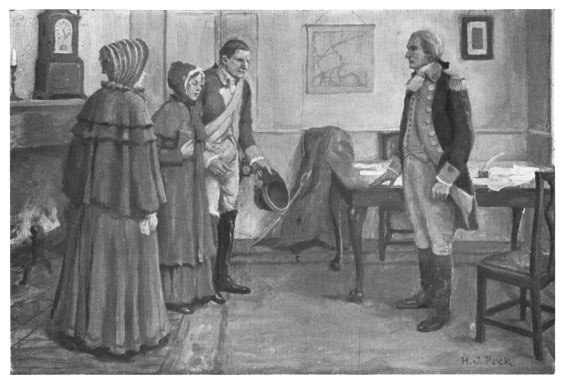
For a time no sound was heard in the room
but the sobs of the maiden and the broken
utterances of the men. The tears of the latter
were no shame to their manhood, for they
were wrung from their hearts by the defection
of a great soldier.
The friend of Washington and of Schuyler!
The brilliant, dashing soldier with whose exploits
the country had rung but a short time
since; if this man was traitor whom could
they trust?
Presently Peggy felt a light touch on her
head, and looked up to find General Gates regarding
her with solicitude.
“My child,” he said, “I am about to ride
402
into Hillsboro’ to confer with Governor Nash.
Will you permit me to be your escort? We
must find a resting place for you. You must
be weary after this trying day.”
“I am,” she replied sadly. “Wearied and
heart-sick. Thee is very kind, and I thank
thee.” She rose instantly, and followed him
to the door where the orderly had her horse
in charge.
What a change had come over the encampment.
From lip to lip the tidings had flown,
and white-faced men huddled about the
camp-fires talking in whispers. No longer
song, or story, or merry jest enlivened the
evening rest time, but a hush was over the
encampment such as follows a great battle
when many have fallen.
Seeing that she was so depressed General
Gates exerted himself to cheer her despondency,
leaving her when Hillsborough was
reached in the care of a motherly woman.
“I shall send Lieutenant Drayton to you
in the morning,” he said as he was taking his
departure. “He will need comfort, child; as
we all do, but the boy was wrapped up in Arnold.”
403
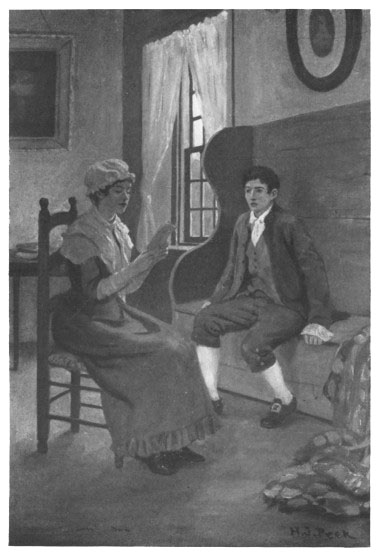
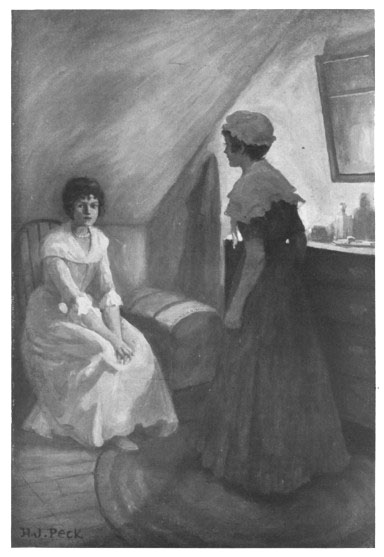
It was noon the next day before Drayton
appeared, and Peggy was shocked at the
change in him. There was no longer a trace
of jauntiness in his manner. There were deep
circles under his eyes, and he was pale and
haggard as though he had not slept.
“John,” she cried, her heart going out to
him for his sorrow, “thee must not take this
matter so. General Washington is left us.”
“Yes,” he replied, “but I loved him so.
Oh, Peggy! Peggy! why did he do it?”
“I know not,” she answered soberly.
“After thee left Philadelphia there were
rumors concerning General Arnold’s extravagance.
Mother was much exercised anent
the matter. But as to whether that had anything
to do with this, I know not.”
“How shall I bear it?” he cried suddenly.
“Who shall take his place? Had he been
with us there would have been another tale
to tell of Camden.”
“That may be, John.” And then, seeking
to beguile his thoughts from the matter, she
added with sweet craftiness: “Thee has not
told me how thee came to be down here?
Nor yet if thee ever returned to New York
404
City after that trip with the wood? Thee
should have seen Cousin William after the
failure of the alert. That was why he brought
me down here.”
“Tell me about it, Peggy,” he replied with
kindling interest. And the girl, pleased
with her artifice, related all that had befallen
her.
“And now?” he questioned. “What are
you going to do now?”
“There is but one thing to do, John,” she
answered, surprised by the query. “That is,
to get home as quickly as possible.”
“I like not for you to undertake such a
journey, Peggy. There are more loyalists in
the South than elsewhere, which was the
reason the war was transferred to these states.
’Tis a dangerous journey even for a man.
’Tis hard to get despatches to and from Congress,
as you know by the death of that poor
fellow whose letters you carried. I don’t believe
that your mother would like for you to
undertake it.”
“But there is danger in staying, John. No
part of the Carolinas is safe from an incursion
of the enemy. ’Tis as far back to the plantation at
405
Charlotte as ’twould be to go on to
Virginia, and I want my mother. Friend
Hart said that he and his wife would travel
slowly so that I could o’ertake them.”
“Yes; you ought to be out of this,” agreed
Drayton. “Every part of this country down
here is being ravaged by Tories, who seem
determined to destroy whatever the British
leave. Would that I could take you to your
mother, Peggy, but I cannot leave without
deserting, and that I——”
“Thee must not think of it,” she interrupted,
looking at him fearfully.
“And that,” he went on steadily without
noticing the interruption, “I would not do,
even for you.”
“That forever settles my last doubt of thee,”
declared Peggy with an attempt at sprightliness.
“I know that thee is willing to do
almost anything for me.”
“Yes,” he replied. “And now I must go.”
“Shall I see thee again before I leave,
John?”
“When do you start?”
“In the morning. I waited to-day to see
thee.”
406
“Then it must be good-bye now,” he said.
“I am to carry some despatches to General
Marion on the morrow, and that will take us
far apart, Peggy. I asked for the mission;
for I must have action at the present time. I
like not to think.”
“Don’t be too venturesome,” pleaded the
girl. “We who know thee have no need of
valiant deeds to prove thy merit.”
“I want a chance to distinguish myself,”
declared the lad. “That, and to prove my
loyalty too. All of General Arnold’s old men
will be regarded with suspicion until they
show that they are true. And now good-bye,
Peggy.”
“Good-bye, John,” spoke the maiden sorrowfully.
“Thee carries my sympathy and
prayers with thee.”
He bade her good-bye again, and left.
Early next morning Peggy set forth at speed
hoping to overtake Mr. and Mistress Hart before
the day’s end. Her thoughts were busied
with Drayton and his grief, and she now
acknowledged to herself the fear that had
filled her lest he too should prove disloyal.
“But it hath not even occurred to him to
407
be other than true,” she told herself with rejoicing.
And so thinking she rode along briskly, and
was not long in reaching the spot where they
had been stopped by the dying vidette. She
gazed at the place with melancholy, noting
that the bushes were trampled as though a
number of men had passed over them. Doubting
not but that this appearance had been
caused by the soldiers who had been sent for
the body, which was indeed the fact, the girl
sped on rapidly, trying not to think of all
that had occurred in the past few days.
Peggy had been sure of her bearings up to
this time, for she had traversed the highway
twice to this point, but from this on she was
confronted by an unfamiliar road. So it happened
that when directly she came to a place
where the road diverged into two forks, she
drew rein in bewilderment.
“Why,” she exclaimed, “I don’t know
which one to take. What shall I do? How
shall I decide, Star?” appealing to the only
living thing near.
Hearing her name the little mare neighed,
tossed her head, and turned into the branch
408
of the roadway running toward the South,
just as though she had taken matters in hand
for herself. Peggy laughed.
“So thee is going to decide for me, is thee?”
she asked patting the pony’s neck. “Well,
we might as well go in this direction as the
other. I know not which is the right one. I
hope that we will come to a house soon where
I may ask.”
But no dwelling of any kind came in sight.
The afternoon wore away, and the girl became
anxious. She did not wish to pass the night
in the woods. The memory of that night so
long ago when she and Harriet had ridden to
Amboy was not so pleasant that she wished to
repeat the experience. But Star sped ahead
as though familiar with her surroundings.
At nightfall there was still no sign of either
Joe Hart and his wife, or sight of habitation.
“I fear me we have lost our way, Star,” she
mused aloud. “I wonder what we’d best do?
Keep moving, methinks. ’Tis the only way
to reach anywhere.”
Peggy tried to smile at her little sally, but
with poor success. The pony trotted ahead as
if she at least was not bewildered, and presently,
409
to the girl’s amazement, of her own
accord turned into a lane that would have
escaped Peggy’s notice. To her further astonishment
at a short distance from the highway
stood a woodman’s hut, and the mare
paused before the door.
“Why, thou dear creature!” cried Peggy
in delight. “It seems just as though thee
knew the way.”
She dismounted, and with the bridle over
her arm approached the cabin almost gaily,
so greatly relieved was she at finding a shelter.
A woman came to the door in answer to her
knock, and opened it part way.
“What do you want?” she asked harshly.
“A lodging for the night, friend,” answered
the maiden, surprised by this reception, for
the people were usually hospitable and friendly.
“How many air you?” was the next question.
“Myself alone, friend,” replied Peggy, more
and more amazed. “I wish food and a stable
for my pony also. I will pay thee for it,” she
added with a sudden remembrance of the
money that Henry Egan had given her.
“Well, come in.” The door was opened,
410
and the woman regarded her curiously as she
entered. It was but a one-room hut, and a
boy of twelve appeared to be its only occupant
aside from the woman. He rose as the
girl entered, and went out to attend the
horse.
“Do you want something to eat?” asked
the woman ungraciously.
“If thee pleases,” answered Peggy, ill at
ease at so much surliness. The woman placed
food before her, and watched her while she
ate.
“Where air you all going?” she asked
presently.
“To Philadelphia, in the state of Pennsylvania,”
explained Peggy, who had found that
many of the women in the Carolinas were but
ill-informed as to locations of places.
“Is that off toward Virginia?”
“I must go through Virginia to reach
there,” said the girl.
“You’re going wrong, then,” the woman
informed her. “You air headed now for
South Carolina.”
The girl uttered a cry of dismay.
At this moment the urchin reëntered the
411
hut, and whispered a moment to his mother.
Instantly a change came over her. She turned
to Peggy with a glimmer of a smile.
“Air you a friend?” she asked.
“Why, yes,” answered Peggy, thinking naturally
that she meant the sect of Quakers.
“I should think thee would know that.”
“You can’t always tell down here. Sam
says that you air riding Cap’n Hazy’s horse.
It used to stop here often last summer.”
“Then that was why the pony brought me
here,” cried the girl in surprise. “I was lost.
How strange!”
“Why, no. Horses always go where they
are used to going,” said the woman, in a
matter-of-fact tone. “That is, if you give ’em
their head. When is the cap’n coming?”
“How should I know?” asked Peggy, staring
at her. “I don’t——”
“We air friends, miss. You needn’t be
afraid to say anything you like. But you air
right. Keep a still tongue in these times.
’Tis safest. And now, I reckon you’d like to
go to bed?”
“Yes, if you please,” answered the maiden,
so amazed by the conversation that she welcomed the
412
change for reflection. Was Captain
Hazy the British commander of the foraging
party who had come to the plantation,
she wondered. It occurred to her that it might
be wise to accept her hostess’s advice to keep
a still tongue.
There was but one bed in the room, and
this was given Peggy, while the mother and
son simply lay down upon the floor before the
fire, which was the custom among mountaineers.
Without disrobing the girl lay down,
but not to sleep. She was uneasy, and the
more she reflected upon her position the more
it came to her that she had been rash to start
out alone as she had done.
“But I won’t turn back now,” she decided.
“I will take some of the money which Friend
Henry gave me, and hire some one to take me
home. ’Tis what I should have done at first.”
At the first sign of dawn she was astir.
The woman rose at the same time, and prepared
her a hot breakfast.
“Now you just go right down that way,”
she told Peggy, as the maiden mounted her
pony, indicating the direction as she spoke.
“That’ll take you down to the Cross Creek
413
road. Ford the river at Cross Creek, and
you will be right on the lower road to Virginia.”
Peggy thanked her, gave her a half guinea,
and departed. Could she have followed the
direction given she would, as the woman said,
have been on the lower road to Virginia, but
alas, such general directions took no account
of numerous crossroads and forkings,
and the maiden was soon in a maze. That
night she found a resting-place at a farmhouse
where the accommodations were of a
better nature, but when she tried to hire a
man for guidance not one seemed willing
to go.
“They were needed at home,” they said.
“There were so many raiding parties that
men could not be spared.” Which was true,
but disheartening to Peggy.
In this manner three days went by. At
long distances apart were houses of some description,
and many ruins, some of them
smoldering.
On the afternoon of the third day Peggy
was riding along slowly, thoroughly discouraged,
when all at once from the dense
414
woods that lined the roadway there emerged
the form of a horseman.
He was hatless and disheveled in appearance,
and he surveyed the road as though
fearful of meeting a foe. As his glance fell
upon the maiden he uttered an ejaculation,
and dashed toward her.
“Peggy,” he cried staring at her in amaze,
“what in the world are you doing down here
in South Carolina? I thought you in Virginia
by this time.”
“I would not be surprised if thee told me
that I was in Africa,” answered poor Peggy
half laughing, half crying. “I started for
Virginia, but took a wrong turning, and seem
to have kept on taking them ever since. I
don’t want to be down here, but no one will
come with me to guide me, and I always go
wrong on the crossroads.”
In spite of the gravity of the situation
Drayton, for it was he, laughed.
“Nay,” he said, “let me believe that you
came down here to help me deliver my despatches
to Marion. I will have to take you
in charge. Let me think what to do. I have
it! There is a farmhouse where Whigs are
415
welcomed near here. You shall stay there
until these papers are delivered, and then we
shall see if something can’t be arranged.”
“Oh, thank thee, John,” cried she, mightily
relieved. “’Tis so nice to have some one to
plan. I shall do just as thee says, for I begin
to believe that I am not so capable as I
thought.”
“These winding roads are enough to confuse
any one,” he told her. “You are not
alone in getting lost, Peggy. Some of the
soldiers do too, if they are not familiar with
localities.”
Cheered by this meeting, Peggy’s spirits
rose, and she chatted gaily, not noticing that
Drayton kept looking behind them, and that
he frequently rode a little ahead, as though he
were on the lookout.
“What is it?” she asked at length becoming
aware that something was amiss. “Is
there danger, John?”
“Yes, Peggy. South Carolina is full of
British, you know. I must watch for an
ambush. I would not fail to deliver these
despatches for anything. They are important,
and as I told you the other day, all of
416
us who were under Arnold will be suspected
until tried.”
Peggy grew pale. “I did not know there
was danger, John. Doth my presence increase
your anxiety?”
“’Tis pleasure to have you, Peggy, but I
would rather you were in Virginia for your
own safety. However, we shall soon turn
into a side road which will lead to that farmhouse
I spoke about. I could no longer get
through the woods, or I should not have left
them for the highway. But had I not done
so I would not have met you. ’Tis marvelous,
Peggy, that you have met with no harm.”
“Why should I meet with any?” she
queried. “I am but a girl, and can bring
hurt to none.”
Drayton drew rein suddenly, and listened.
“We must make a run for it, Peggy,” he
cried. “The British are coming. I gave
them the slip a while ago, but I hear them
down the road. If we can reach the lane we
may escape them.”
Peggy called to Star, and the boy and girl
struck into a gallop. It was soon evident,
however, that Drayton was holding back his
417
horse for Peggy to keep pace with him. As
Peggy realized this a whoop from the pursuers
told that they had caught sight of them,
and the clattering hoofs that they were gaining
upon them.
“John,” she cried, “go on! Thee can get
away then.”
“And leave you, Peggy? Never,” he answered.
“But thy despatches? Thee just told me
they must be delivered. Thee must go on.”
“No,” he replied with set lips.
“’Tis thy duty,” she said imploringly.
“I know, but I’m not going to leave you
to the mercy of those fiends,” he cried.
“John, thee must not fail. See! they are
gaining. Go, go! Does thee remember that
thee will be suspected until thee is tried?”
“I know,” he said doggedly, “but I won’t
leave you.”
“For thy country’s sake,” she entreated.
“Oh, John, I can’t have thee fail because of
me. Think of that poor vidette. Is thee
going to do less than he? ’Tis thy duty.”
“Peggy, don’t ask it,” he pleaded.
“Thee is less than soldier if thee doesn’t do
418
thy duty,” she cried, quick to see her advantage.
“John Drayton, I will never trust thee
again if thee fails in thy duty now.”
The two young people gazed at each other
through the dust of the road, the girl with
earnest entreaty, determined to keep the lad
to his duty in spite of himself, and the youth
torn by his fear for her and his loyalty.
“Go,” she cried again. “I am a soldier’s
daughter. Would I be worthy the name if
thee failed because of me? Go at once, or
’twill be too late.”
“I’m going, Peggy,” he said with a sob.
“I’m going to do my duty even if you are the
sacrifice. Take this pistol, and defend yourself.
Good-bye.” He bent and kissed her hand, and
then without one backward glance went flying
down the road and disappeared around a bend.
For duty to country must come before everything,
and father, mother, brother, sister, wife
or sweetheart, must be sacrificed upon its altar,
if need arises.
There was a smile on Peggy’s lips, for Drayton
had kept to his duty in spite of as great a temptation
as ever assailed a man to do otherwise, and
so smiling she turned to meet the pursuers.