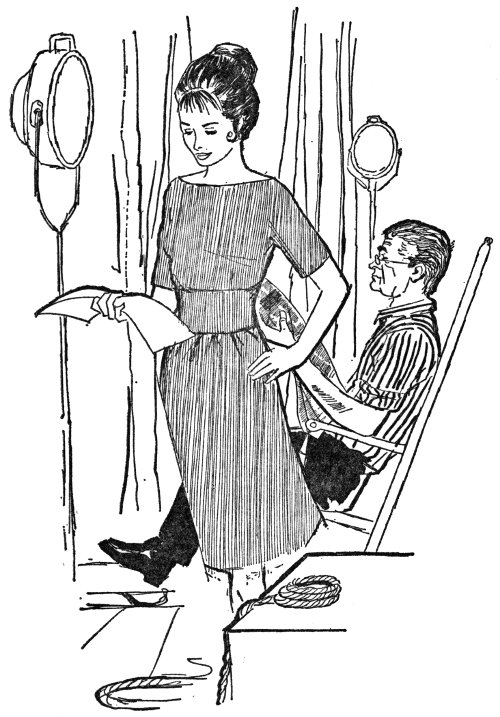
With a grateful sigh Peggy Lane lowered her aching
feet into the delicious warmth of a dishpan filled
with hot water, bath crystals, and Epsom salts. In
other rooms exactly like hers throughout the big
brownstone house near New York’s Gramercy Park,
half a dozen hopeful, equally tired, but determined
young girls about Peggy’s age were doing the same
thing.
At the Gramercy Arms, a rooming house for young
actresses in the middle of Manhattan, this was a daily
ritual known lightheartedly as the “cocktail hour.”
Peggy sighed a second time, wiggled her toes in
the steamy water, and flopped back on the studio
couch.
“What a life,” she murmured darkly.
As if in answer to her complaint, the lights of New
York began coming on. One by one, they twinkled
through her window, throwing a spangle of diamonds
across her dressing-table mirror.
2
New York had been home for a year now, but
the big city never failed to thrill her—especially at
dusk. Without taking her feet from the water, Peggy
turned to one side and gazed at a few faint tinges of
red in the west where the sunset was fighting a losing
battle with the fabulous illumination of the New York
skyline.
Propping a meditative chin in her hand, Peggy
watched the magic spectacle of Manhattan change
gradually from a bustling city of towering gray buildings
and concrete canyons into the jeweled finery of
a million lights. It was like the shimmering moment
in the fairy tale when the drab little kitchen maid
turns into a beautiful princess. Or at least that was
the way Peggy always thought of it.
Once, when she was still new in New York, she had
made the mistake of trying to explain all this to a very
serious young man who was a second-year student at
a nearby college. The young man had stared at her
uncomfortably for a moment, then changed the subject.
But Peggy wasn’t disturbed. She was fond of her
own version, even though she knew it was hopelessly
romantic.
Well, why not? Half-lying on the bed with her feet
stuck into what was now a lukewarm basin of water,
she was convinced that she was right and he was
wrong. She thought of the young man’s earnest face
and broke into a grin. Despite herself she laughed
out loud.
3
The cheerful sound filled the darkening room.
Paddling her feet happily in the water, she threw her
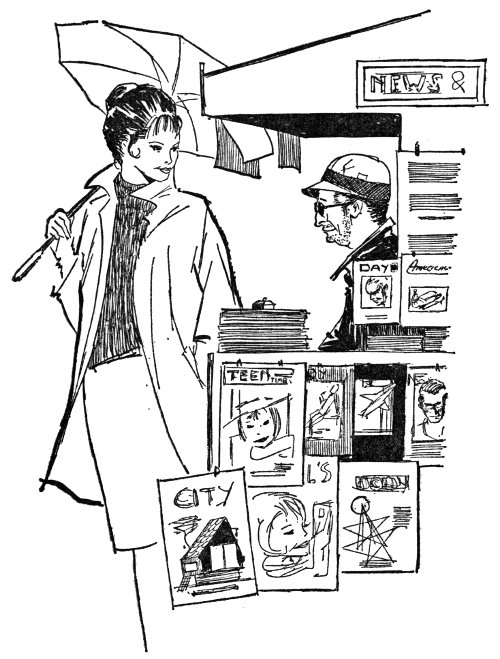
head back against the pillow and sighed a third time.
“What a life!” She breathed ecstatically. Suddenly
full of vitality again, she sat up and leveled a pair of
clear hazel eyes over the city, now throbbing with the
muted sounds of early evening traffic. “New York,”
she announced in a grave voice to the open window
and empty room, “you don’t care about me right now.
You’ve never even heard of me. But some day you
will. You’ll see!”
It was quite a dramatic speech for her to make, but
then Peggy Lane was very young and very determined
to become a great actress.
Outside her window, the city took the news of
Peggy’s intended conquest calmly. Somewhere a lone
taxicab gave a derisive toot on its horn as it squealed
to a stop to pick up a fare. Peggy mentally stuck
out her tongue at the driver and settled back to make
plans for tomorrow. But before she could get really
comfortable, an enthusiastic spatter of applause came
from the doorway.
“I declare, honey,” drawled a familiar voice, “that’s
the prettiest speech I ever did hear. You always talk
to yourself in the dark like that?”
Light flooded the room, and Peggy saw her friend,
Amy Shelby Preston, framed in the door. Amy, a
striking ash blonde and a product of Pine Hollow,
North Carolina, had been pulled to New York by the
same magnet that had drawn Peggy. The two girls
had met on their first day in the city, liked each other
on sight, and decided to room together this year.
4
Peggy struggled to a sitting position and blushed
furiously. “I—I was just going over some lines for a
play,” she explained lamely.
Amy flashed her a knowing smile as she went over
to a tiny sink hidden from the rest of the room by a
Japanese screen. “What’s the name of the play?” she
asked. “Stage-Struck?”
Peggy bunched up a throw pillow, but Amy raised
her hands in surrender. “Don’t shoot,” she pleaded.
“You heave that thing at me and I’ll never get up, I’m
that tired.”
Peggy hitched herself to the edge of the studio
couch and began to towel her legs vigorously. “You
relax,” she ordered. “I’ll fix everything.”
Amy collapsed wearily on the bed, content to watch
Peggy wait on her. “Well?” Peggy demanded eagerly.
Amy had just finished a job filming a television commercial
for the Bob Jordan show. “Did you get to
meet Bob Jordan?”
Amy threw back her head and laughed. “Bob Jordan’s
already done the show in Hollywood. It’s just
the commercial they’re doing in New York.”
“But doesn’t he want to see it?” Peggy asked as she
poured bath crystals into Amy’s dishpan.
Amy shook her head. “Not this one. Even if he
wanted to, he’d never be able to find the studio.”
Studio space in New York was at a premium, and as
a result, many television commercials were filmed in
the most unlikely places.
5
Peggy laughed. “Where’d they do it?”
“You won’t believe this,” Amy said wonderingly,
“but I don’t know. I couldn’t find it again for worlds.
All I know is that I had to take a subway for hours
and then a bus till I got to the end of the line. Finally
I had to wait for a Transcontinental Broadcasting
Company car to pick me up and take me to something
that looked like a converted garage way out at
the end of Brooklyn.”
“I know the place,” Peggy interrupted. “That’s the
Greenside Studio. I did an audition there once. It’s
a converted stable.”
“It’s still a stable as far as I’m concerned,” Amy
replied. She hugged her arms closer to her body.
“Brrr! Was it ever cold!”
“Get into something warm,” Peggy urged. She
looked at Amy critically. “Why did you wear that thin
dress? You know what those television studios are
like.”
“It’s the best dress I own,” Amy said as she rummaged
through her closet. “I wanted to make an impression.”
Peggy shook her head and tossed over a bulky
woolen bathrobe. “Here, take this,” she commanded.
“It belongs to my cousin David, but I borrowed it.
And hurry up! I want to hear what happened.”
“Well, that’s what I’m trying to tell you, honey,”
Amy said as she struggled out of her dress. “But you
just won’t give me a chance.”
6
Peggy sat down and tucked her legs under her.
“All right, go on,” she said patiently. “I’m listening.”
“Well, first of all,” Amy said, poking a tentative foot
into the dishpan on the floor, “it was only a thirty-second
commercial. My, that feels good. I declare,
I’m ten degrees warmer already.” She looked around
vaguely. “Now where was I....”
“You were saying it was only a thirty-second spot.”
“That’s right. With General Refrigerator sponsoring
the Bob Jordan show, I counted on having a couple
of lines to say. Something like, ‘Oh, Edna! I’ve got the
most exciting news! General Refrigerators now come
in a whole sunburst of dreamy colors from pastel pink
to leafy green!’” Amy dropped the rapturous look on
her face and stared solemnly over at Peggy. “You
know the kind of thing they make you say.”
Peggy nodded wordlessly.
“Anyway,” Amy went on, “soon as I got there, they
sent me over to make-up. I got in the chair, closed my
eyes, and waited for them to put cold cream over my
face.”
“Never mind that,” Peggy said, “get on with the
rest of it!”
“But that’s the important part!” Amy protested.
“That’s when I knew it was the beginning of the end!”
“Goodness,” Peggy said. “It sounds serious. What
happened when you had your eyes closed?”
“I heard somebody tell me to stick out my arm.”
“What!”
7
“It’s the living truth, honey. Honestly, I thought
they were going to give me a vaccination or something.
But then the make-up girl rubbed cream on
my hand and took the polish off my fingernails. When
she was through, I asked if she wasn’t going to do
anything else, and she said no. She said I was ready
to go on camera.”
“But only your arm was made up?”
Amy nodded emphatically. “Up to my elbow.”
“Then what was your part in the commercial?”
“A hand!” Amy wailed. She looked as though she
were about to burst into tears. “I played the part of
a hand on the Bob Jordan commercial. All they
wanted me to do was open the refrigerator door!”
Amy thumped the couch in frustration. “Here I
thought they wanted an actress who could read lines
and all, and all they wanted was a hand! Why, anybody
with five fingers could have done it!” She paused
and looked sheepishly at Peggy. “Oh, Peggy, I’m so
ashamed!”
Peggy jumped up and went over to her roommate.
“Whatever for?” she asked. “It was just a job.”
Amy shook her head and blinked. “You don’t understand—Oh,
Peggy!”
“Come on, now,” Peggy soothed. “Tell me the
whole story.”
Amy sat perfectly still for a moment, trying to fight
back the tears. Suddenly both tears and story came
out in a rush. “When I first heard about getting a
part in the commercial”—Amy gulped—“I got all excited.
I wrote home and told Mama to watch me on
the Bob Jordan show.”
8
Suddenly Peggy understood. She knew Pine Hollow,
North Carolina, was a tiny place. Amy’s mother
was almost sure to tell everyone about her daughter’s
big television debut. Next week at air time, half the
population would be glued in front of their sets, waiting
to see Amy’s face.
“Everyone will be looking for me,” Amy went on
mournfully. “And all they’re going to see is my—my
hand! What am I going to tell them?”
“The truth,” Peggy said simply.
Amy looked up in despair. “Oh, I couldn’t!” she
breathed. “Mama would be the laughingstock of Pine
Hollow.” Another thought seemed to strike her. “Oh,
my goodness!” she wailed.
“What’s the matter now?”
“Daddy!” Amy cried, jumping to her feet. “What’s
he going to say? You know Daddy wasn’t too keen
on my coming to New York in the first place.”
Peggy smiled, remembering the endless discussions
that had gone on in her own family. “Fathers are
funny that way,” she observed.
Amy threw her a trapped look. “You don’t have
any idea! He’s always thought my wanting to be an
actress was silly. What’s he going to say now?”
An idea began working in Peggy’s mind. Grinning
mischievously, she scrambled to her feet and held out
her hands. “Don’t tell me,” she begged. “Let me
guess.” Clasping her hands firmly behind her back,
Peggy started to pace back and forth. Her usually
cheerful face was lined with a severe scowl.
9
Amy burst into laughter at the sight and collapsed
back on top of her bed. “Oh, Peggy! Daddy doesn’t
look like that at all. He’s really much nicer.”
Peggy raised a hand threateningly. “Quiet!” she
thundered in her best imitation of a man’s voice.
Amy subsided obediently. “Yes, sir,” she said
meekly.
Peggy cleared her throat and rumbled ahead. “This
is disgraceful,” she intoned. “Here my daughter has
spent a year in New York. She’s gone to dramatic
school and she’s been in summer stock. What does
she have to show for it, eh? I ask you.” Peggy gave
a fierce tug on an imaginary mustache. “One year
of solid work and the best she can do is to play the
part of a hand on a television commercial!” Peggy
stomped down to the far end of the room. “A hand!”
She snorted. “If it’s taken her a year to get her
hand on a television show, how long d’you suppose
it’ll take to get the rest of her on? Eh? I ask you!”
Peggy wanted to continue, but Amy was laughing
too hard. “You’re almost right.” Amy gasped between
giggles. “Only he’d never come right out and say it
like that.”
“Then why don’t you do it yourself?” Peggy cried
gaily.
“Me?” Amy seemed astonished by the idea.
10
“Sure,” Peggy said eagerly. “Tell them exactly what
happened, but treat the whole thing as a joke. Get
them on your side.” Peggy sat down beside Amy and
spoke seriously. “I really mean it, Amy,” she said. “If
you laugh about it, they will too. And besides,” she
added, “they’ll admire you for your determination.”
Amy looked at her hopefully. “You think so?”
“Of course,” Peggy assured her.
Amy began giggling again.
“Now what?”
“I just thought of something Daddy once said to
me. He said the important thing was to get my foot
in the door. Now I can tell him that maybe I haven’t
got my foot in yet, but at least my hand’s there.”
The two girls laughed together. “That’s the spirit!”
Peggy chuckled. “Don’t give up the ship! That’ll be
our motto!”
“Sssh!” Peggy cautioned. “We’re making too much
noise.”
“You sure are,” came a resonant voice from the
door. “When does the plane leave for Hollywood?”
“Hollywood?” Amy asked blankly, whirling around
to stare at the commanding figure before her.
May Berriman closed the door and advanced into
the room. Years ago, May had been a successful character
actress on Broadway, but when she had left the
stage she had taken over the management of the
Gramercy Arms. The girls who stayed at the Gramercy
Arms were, for the most part, struggling young
actresses like Peggy and Amy. With her wide knowledge
of the theater and her vast common sense, May
was more than just a landlady to “her girls.” She was
almost a second mother to them, presiding over their
hopes and fears, their triumphs and failures, their
good times and their squabbles with an even-handed
justice that combined equal doses of a sharp tongue
and a soft heart.
11
May picked her way through the clutter of the girls’
room and sat down on Peggy’s bed. Peggy never tired
of watching May’s movements. They were so unconsciously
graceful, so sure and poised. They were,
Peggy knew, the result of years of training and hard,
disciplined work.
“Of course,” May was saying to Amy, “from the
hall you two sounded like the cheering section at a
football game. I couldn’t imagine what had happened.
I was sure it was a Hollywood screen test at
the very least.”
“Not yet.” Peggy smiled. “That’s a long way off.”
Amy looked out the window dreamily. “You never
can tell,” she said hopefully. “Why, the phone could
ring any minute!” She turned to May for support.
“Isn’t that true?” she demanded. “A big producer can
see you one day and the next day you’re out in Hollywood.
It happens all the time.”
“Only in your imagination, dear,” May said dryly.
“I’d advise you not to hold your breath until that
phone call comes. Oh, by the way,” she added, turning
to Peggy, “somebody tried to get you about an
hour ago.”
Peggy straightened up. “Was there a message?” she
asked.
12
May shook her head. “No message, but she left a
name.”
“Oh. A she?”
An amused smile softened May’s face. “I hope it’s
not too much of a shock. It was a girl named Pam
Mundy. She said she knew you from summer stock.”
“Pam!” Peggy cried excitedly. “I had no idea she
was in New York. What fun! Is she going to call
back?”
“She said she’d get in touch with you this evening.
Is she an actress?”
“Not really,” Peggy said. “She’s more interested in
the production end. She saw some of our shows up at
Lake Kenabeek last summer, and often discussed the
problems with Richard Wallace, our producer.”
“A lady producer!” Amy exclaimed in surprise. “I
thought all producers were men.”
“Most of them are,” May said. “But there’s no law
against a girl trying it.”
“Maybe she’s doing a show,” Amy cried suddenly,
“and she’s got a part in it for you.”
Before Peggy could answer, the buzzer over their
door let out a squawk. “Telephone!” Amy breathed,
hurling herself at the door. “Who’s it for?” she yelled
down the hall. Each floor of the Gramercy Arms was
serviced by a single telephone shared by all the girls
on the floor.
“For Peggy!” came the answer. “It’s a man!”
“Well, at least we know it isn’t Pam Mundy,”
Peggy said, as she drew on her bathrobe.
13
“It’s probably Randy,” Amy said.
Peggy nodded and disappeared into the corridor.
Randy was Randolph Clark Brewster. Peggy had met
him when she first came to New York and had been
seeing him ever since. In the early days he had more
or less taken her under his wing and had guided her
first faltering steps in that actor’s nightmare known
as “the rounds.”
Doing the rounds meant mapping out a systematic
campaign of personally seeing every producer, actor’s
agent, and casting director in town. It was tedious,
foot-wearying work, but it was necessary. Peggy
learned soon enough that you couldn’t simply send
a picture and a note, and then sit back, and expect the
calls to come in. You had to keep knocking on doors,
reminding people of your existence, hoping that
sooner or later somebody would remember you and
say, “Why don’t we try that girl who was in here this
morning? She might be right for the part.”
She still remembered the morning she had made
her first rounds with Randy. They had agreed to meet
outside the Gramercy Arms at eight-thirty. Right on
the dot, she saw Randy’s tall, lanky figure swing along
the sidewalk, move toward her, and stop in undisguised
dismay.
In her eagerness to make a good impression, Peggy
had put on a dress that was far too sophisticated for
her. She had plastered make-up all over her face,
complete with mascara, and covered her eyelids with
a heavy film of dark green, which she fancied went
well with her coloring and dark chestnut hair.
14
Randy took one look and shook his head. “No,
Peggy. That won’t do at all,” he had said gently.
“Why not?” Peggy had replied. “You said the important
thing was for them to notice me.”
Randy tried to cover up a grin by rubbing a hand
over his jaw. “They’ll notice you all right,” he said.
“In fact, they’ll never forget you.” He took her hand
and led her up the steep steps of the brownstone
house. “Let’s go inside and sit down awhile,” he suggested.
Peggy followed him obediently to the tiny sitting
room off the entrance hall. She listened carefully
as Randy told her how important it was to let her
fresh young beauty speak for itself. He explained
that she was not yet ready to play sophisticated, older
women, and that it was useless to try. He got her to
go upstairs, rub off the make-up, and change into a
simpler dress. At first Peggy had been furious, but
later she learned that he was right.
Now Peggy hurried eagerly down the corridor. It
would be good to talk to Randy again. She picked
up the telephone. “Hello.”
A man’s voice came from the other end. It wasn’t
Randy. “Hello. Is this Miss Peggy Lane?”
“Speaking.”
“My name is Peter Grey. I’m with the Oscar Stalkey
office. Miss Pam Mundy suggested I give you a ring.”
15
Peggy caught her breath. Oscar Stalkey was one
of the biggest producers in New York. His new play,
Innocent Laughter, had opened to rave reviews a
few weeks earlier. Already it was impossible to get
tickets. Everyone in New York wanted to see it.
“Yes?” Peggy answered in a shaking voice.
“Well, it’s quite simple, really.” The voice went on
in a matter-of-fact tone. “We’re getting ready to cast
the road companies of Innocent Laughter, and Miss
Mundy suggested you for a general understudy.
There’d also be a small speaking part. It’s a national
tour and you’d be expected to sign for a minimum of
six months. Will you be available?”
For a moment Peggy couldn’t speak. She just sat
and stared helplessly at the telephone two inches
from her nose.
“Hello, hello?” came the voice from the other end.
“Are you still there?”
“Yes,” Peggy said in a voice she didn’t recognize.
“We’re trying out a number of people tomorrow.
Can you be at the Stalkey office at ten?”
“At ten,” Peggy repeated mechanically.
“Yes. Then we can expect you?”
“Oh, yes,” Peggy said. “I’ll—I’ll be there.”
“Thanks. Good-by.”
The phone went dead in her hand. It took Peggy
several seconds to lift the receiver back into its cradle.
“Innocent Laughter!” she murmured to herself.
“Me, in Innocent Laughter!” Suddenly she couldn’t
stand it another minute. She raced back to her room
at the far end of the hall, laughing as she ran. If she
could land the part, it was the break of a lifetime!
16
II Katherine Nelson
It took a touch of May’s common sense to bring
Peggy back to reality. “You don’t have the part yet,”
she cautioned. “So don’t count on it.”
“Oh, but, May,” Amy protested, “why else would
they call her? I’m sure Peggy’s got it.”
“Did he come right out and make you an offer?”
May asked.
“No,” Peggy admitted. “He said they were interviewing
a number of girls tomorrow. That’s all.”
“Well, then,” May said. “You see?”
“I don’t care,” Amy declared stoutly. “This it still
the biggest break either one of us has had in a year.”
“I didn’t say it wasn’t,” May said. “I’m just trying
to get Peggy to realize what she’s up against. Nobody’s
going to hand her that part on a silver platter.
She’s got to go in there tomorrow and earn it.”
17
Peggy moved nervously to the window and pulled
back the curtain. “If only I knew a little more about
the play,” she murmured. “I don’t even know what
kind of a part I’m supposed to try out for.” She walked
over to her bed and sat down despairingly. “I should
have asked when I had the chance, but I guess I was
too excited. I didn’t even think!”
“Now, now,” May said soothingly. “Don’t work
yourself up into a fit. How much do you know about
Innocent Laughter?”
“Nothing,” Peggy said dispiritedly. “Absolutely
nothing except that it’s the biggest hit of the season.”
“What time is it?” Amy cried suddenly. “Maybe
we could see it tonight!”
“Not a chance,” May said emphatically. “You
wouldn’t be able to get tickets.”
“Standing room?” Amy suggested hopefully.
May looked at her watch and shook her head. “Too
late.”
“Oh dear!” Peggy started to get up, but May
pushed her firmly back down on the studio couch.
“You sit down, young lady,” she ordered. “There’s
no point in worrying about something you can’t help.
Besides, I think I can give you some idea of the play.”
“You can?” Peggy cried eagerly. “Oh, May, you’re
an angel!”
“Flattery will get you nowhere,” May said. “Just sit
back and listen.” Peggy and Amy settled down obediently
and waited.
18
“First of all,” May began, “Innocent Laughter has
only four parts for women.” She ticked them off one
by one. “There’s the lead, a brilliantly successful career
woman living in New York, who decides one day
to try to recapture her youth. Then there’s a wonderful
part—the woman’s mother, a shrewd old gal who’s
made a fortune in real estate out West, and who
hasn’t seen her daughter in years. The third big part
is the career woman’s daughter. She’s a young girl
who’s been sent to finishing school in Europe, and
hasn’t seen her mother in years, except for brief vacations.”
May looked around inquiringly. “All clear so
far?”
“You mean there are three generations—the grandmother,
the mother, and the daughter?” Amy asked.
May nodded. “You’ve got the picture.”
“What happened to all the men?” Peggy asked.
“Ah, now we’re getting to it,” May said. “The
grandfather—that’s the old gal’s husband—disappeared
years ago. He left home because he said he
couldn’t stand his wife’s domineering ways. The
mother’s husband is dead, and the daughter, of
course, doesn’t have any husband yet.”
“How about the story?” Amy demanded. “What’s
that all about?”
“The situation is simple,” May explained. “The
three generations meet in New York. The grandmother
wants a last fling. She’s after good times and
plenty of them. The mother, as I’ve said, is trying to
find romance again.”
“And the young daughter?” Amy asked.
May shrugged. “The daughter isn’t sure what she
wants. She’s in a sort of experimental mood about
life. Very young, very sweet, and full of vitality.”
19
“What happens after they all get together?” Amy
asked.
“Oh, they make a mess of everything,” May said.
“Things go from bad to worse until suddenly, out of
the blue, who should turn up but the grandfather!”
“The one who disappeared years ago!” Amy said.
“Right,” said May.
“What’s he been doing all those years?”
“Oh, this and that,” May replied airily. “He’s been
knocking around the world a good deal and making
a lot of money. Anyway, he walks in on the three
women and takes over. He straightens out the
mother’s life, saves the young daughter from marrying
a dull man, and makes his wife fall in love with
him all over again.”
“It sounds like a great part,” Peggy remarked.
“Doesn’t it?” May agreed. “Anyway, that’s about
all there is to it. Not a second Hamlet, I’ll admit, but
a good, solid comedy.”
“Wait a minute,” Amy interrupted. “You’ve only
mentioned three women. Who’s the fourth?”
“A tiny part,” May said. “A schoolgirl friend of the
young daughter. She appears in one scene in the first
act.”
“And that’s Peggy?” Amy asked.
May nodded. “Probably. That and understudying
the daughter.”
Amy sighed. “Oh my,” she said. “Wouldn’t you just
love to play the daughter?”
20
“Stop dreaming,” May counseled. “Oscar Stalkey
couldn’t afford to take a chance with an unknown
in a part like that.” May turned and walked over to
Peggy. “Now look, Peggy,” she said in a quiet, reassuring
voice, “when you walk into that office tomorrow,
don’t try to pretend you’re an experienced
actress. Oscar Stalkey’s been around a long time and
he’d be able to see right through your pose.”
The older woman sat down and folded her hand
over Peggy’s. “Do you remember that time when
Randy told you to be yourself and not try to act as
if you were ten years older?”
Peggy smiled and nodded.
“It was the best advice you could get,” May went
on. “If you follow it tomorrow, the rest will take care
of itself. You’re a good actress, Peggy. You have a lot
of promise. He’ll be able to see that.” May got up
slowly and drifted over to the window. “I used to
know Oscar Stalkey pretty well,” she said. “He’s a
strange mixture of a hard-boiled Broadway producer
and a sentimental little boy. He’s been in show business
over thirty years, and he still thinks the theater
is the most wonderful thing in the world.”
“So do I!” Peggy breathed.
May turned and smiled. “Good. Then you two
ought to get along beautifully. Now,” she said, moving
to the door in a brisk, businesslike manner, “have
you had dinner yet?”
“Oh, no, May!” Peggy pleaded. “I’m too excited.
I couldn’t eat a bite.”
21
May’s smile vanished. She pointed to the door commandingly.
“Out you go,” she said. “We can’t have
you meeting Oscar Stalkey looking pale and haggard.
The program for the rest of the evening includes
a good dinner, a long hot bath, and early to
bed.” May paused and advanced a step toward Peggy.
“And try not to worry too much.”
Peggy smiled and nodded. “All right,” she said.
“I’ll try.”
“Good. When you push open the door of Oscar
Stalkey’s office tomorrow, I want you to look like a
million dollars—rested and confident you’re going
to get the part.”
At precisely ten o’clock the following morning,
Peggy Lane stood before the plain frosted-glass door
of Oscar Stalkey’s office, feeling rested, alert—but
not at all sure of herself. In fact, what she felt was
dread. It was exactly like the time when she was
seven years old, and had to appear in the school
Christmas pageant as one of the angels who led the
shepherds to the manger. She still remembered her
two lines: “This is the place. See how the roof is
bathed by the light of yonder star.” Chattering with
the cold, her throat all lumpy with fear, and lonelier
than she had ever been in her life, she had waited in
the wings for the words that would bring her out on
the stage. She had been sure she would forget everything.
Now she remembered what it had been like
when at last she had stepped into the brilliant
warmth of the stage, sensing the audience out front
and the magic of the set behind her. She had read
her lines beautifully, and only regretted that she
didn’t have more of them. At that moment, Peggy
had decided to become an actress. That was a long
time ago. Smiling at the memory, she took a final
breath and pushed against the door.
22
She stopped on the threshold in numbed surprise.
Dozens of eyes swiveled around at her entrance.
On all sides, the tiny reception room was lined with
young girls. There were tall, beautiful girls with
sleek hairdos and shiny patent leather hatboxes by
their sides. There were heavily made up girls whose
eyes glittered coldly as they surveyed the newcomer.
There were a few girls she recognized. Nobody was
happy to see her.
Peggy knew that this was the fierce competition of
the theater. It was part of the price you had to pay if
you wanted to come to New York. Tilting her chin
defiantly, Peggy closed the door and went over to a
peroxide blonde who sat listlessly behind a desk. The
blonde reached out a hand for a sheet of paper.
“Name?” she inquired in a bored voice. “Mr.
Stalkey’s interviewing by appointment only.”
“Lane,” Peggy replied in a clear voice. “Peggy
Lane.”
The blonde ran a bright red fingernail down a list
of names and stopped about halfway. “Who sentcha?”
she drawled with quick suspicion.
Peggy frowned. “I don’t ... what do you mean?”
she stammered.
23
The blonde pursed her mouth in disapproval.
“What I’m trying to find out, dearie,” she said in a
voice edged with the patient annoyance of someone
talking to a retarded child, “is how come you’re here.
Who made the appointment for you?”
Light dawned. “Oh! Mr. Grey. Mr. Peter Grey.”
The answer seemed to satisfy. “Okay.” The receptionist
dismissed Peggy with a wave. “Find a seat.”
She returned to the magazine she had been reading.
Still feeling ill at ease, Peggy backed away from
the desk and looked around for a place to sit down.
The chairs along one wall were all filled. Opposite
them there was a bench with just enough room if
one of the girls would move over. Nobody budged
an inch. The silence was oppressive.
Suddenly making up her mind she was not going
to stand around awkwardly, Peggy moved over to
the bench and planted herself in front of the small
space.
“Excuse me,” she said in her sweetest voice, “would
you mind moving over?”
The girl who filled the spot Peggy wanted drew
herself up in an exaggerated shrug and slowly opened
a space.
“Thank you,” Peggy said as she sat down. Her
neighbor didn’t even bother to glance in her direction.
The silence continued.
24
Suddenly from behind the closed door that led into
what Peggy assumed was Stalkey’s private office, she
could hear voices. There was a high-pitched burst,
then a deeper rumbling answer. A woman and a man
arguing, Peggy thought. A third voice cut in, a resonant
baritone. Two men and a woman.
There was a scream from the other room, followed
by a crash, and the woman’s voice shouting, “No! No!
No!”
“None of that now,” thundered the first man’s
voice. “I’m sick and tired of your childish temper
tantrums.”
“Temper tantrums!” came a screech. “How else
can I act when you simply refuse to listen to reason?”
“Oh, come off it, Katherine!” the second man said.
“Act your age.”
There was a stunned silence during which Peggy
had a chance to look around. Every girl in the reception
room had her eyes glued to the door. An air
of excited expectancy hung over the office. Even the
blond receptionist had put aside her magazine in
favor of the real-life drama going on in the next room.
Peggy heard the door bang open, and turning, saw
before her one of the great figures of the American
stage. Katherine Nelson, a portrait of elegance, stood
framed in the doorway.
25
Katherine Nelson had been world famous for many years.
26
Katherine Nelson. Everyone knew of Katherine
Nelson. She had been world-famous for many years,
at the very top of her profession. But suddenly, about
five years ago—nobody knew why—she had begun
to slip. For some reason, she chose her plays badly,
and where once she had known nothing but success,
she had had to face the humiliation of failure. It had
been a long time since she had been on a stage in
New York, or anywhere else for that matter. She still
had her great name, of course. Katherine Nelson
would always be a magnet, but there was no denying
that as a star she was fading. Other, younger
actresses were moving up to take the roles that would
automatically have been hers a few years ago.
It was well known that Katherine Nelson did not
wear her years gracefully. References to age sent her
into towering rages that were the delight of all gossip
columnists, and the despair of those who had to
work with her. She stood now, not ten feet from
Peggy, her magnificent eyes flashing daggers. At first,
Peggy felt a thrill at being so near a famous person,
but surprisingly that passed almost at once. Instead
of staring at her face, Peggy caught herself looking at
Katherine Nelson’s hands as they gripped the door.
They were like claws, Peggy thought. They were
the hands of an old woman. With a start, Peggy
realized that despite her youthful figure and carefully
made-up face, Katherine Nelson could no longer
play romantic parts.
All this passed through Peggy’s mind in a flash,
before her train of thought was evaporated by a
throaty voice that rolled out in accents of anger.
27
“You’ll remember whom you’re talking to, Oscar
Stalkey! There’s only one Katherine Nelson in the
theater, and if you’re not aware of it, there are hundreds
and thousands of people who are. People who
are prepared to stand in line all night, if necessary,
to get tickets to my plays. When you’ve thought that
over and are willing to discuss matters more intelligently,
you may call me!”
Shrugging into a magnificent silk-and-fur coat,
Katherine Nelson swept down between the two lines
of awed young girls, exactly as if she were making
a grand exit from a stage. As a matter of fact, this
was just what she was doing. It would have been
effective, too, except for one thing. Katherine Nelson
had a toy poodle on a leash, and the little dog took
a sudden playful liking to Peggy.
As his mistress passed Peggy, the tiny poodle
wagged his tail and trotted over. The unexpected
shift in course forced Katherine Nelson to stop.
Frowning with annoyance, she yanked at the dog’s
leash. But instead of following obediently, the poodle
gave a couple of shrill yips and scrambled up on
Peggy’s lap.
Blushing with embarrassment, Peggy tried to get
up and dislodge the animal. “Down, boy,” Peggy
commanded, making a wild grab for her purse which
was slipping to the floor.
The next instant, leash, purse, Peggy, and the
poodle were hopelessly entangled. Peggy sensed a
commanding figure hovering nearby. Katherine Nelson
was staring down at her in blazing fury.
28
Peggy attempted an apologetic laugh as she tried
desperately to straighten out the mess at her feet.
Finally she got everything sorted out and handed
over the friendly poodle.
“I’m sorry,” Peggy said with a smile, offering the
dog. “We sort of got mixed up.”
Katherine Nelson jerked the poodle out of Peggy’s
hands rudely. “Clumsy idiot!” she muttered. Spots
of dull red showed in her face.
Peggy felt herself coloring too, but for a different
reason. “I really didn’t—” she stammered. “I’m awfully—”
“Will you get out of my way?” Katherine Nelson
blazed.
Peggy backed away hastily, catching her heel
against the side of the bench as she moved. She
flailed the air clumsily to keep from falling, then sat
down heavily. Her purse slipped to the floor again.
Katherine Nelson threw her a disdainful look,
swept on through the reception room, and out the
door.
Peggy had never been so embarrassed in her life.
She knew that every girl in the room was laughing
at her predicament. She only hoped that Oscar
Stalkey hadn’t noticed. But when she stole a quick,
shy glance at the door, she saw a short, bald man
staring at her owlishly through heavy, horn-rimmed
glasses. A cold cigar was clenched between his teeth.
Peggy recognized him at once from his pictures. It
was Oscar Stalkey. With a sinking heart, she realized
numbly that she was ruined before she even started.
She had made a perfect fool of herself, and there
wasn’t any point in staying.
29
Staring straight ahead, Peggy got to her feet and
headed for the door. The walk seemed endless. She
was about halfway there when a deep voice growled
out.
“Hey! Where are you going?”
Peggy stopped and turned slowly, her eyes widening
in surprise.
Oscar Stalkey was still standing in the doorway,
but now he was pointing a finger in her direction.
“Come in here,” he said. “I want to talk to you.”
There were gasps of surprise from the other girls.
Peggy swallowed once and pointed to herself. “Me?”
she asked in a voice that cracked.
“Well, who’d you think I meant?” came the gruff
answer. “Come in. I haven’t got all day.” He stepped
aside and motioned her to hurry.
Still unable to believe what was happening, Peggy
followed Oscar Stalkey blindly into his office.
30
III The Inner Sanctum
Four people were grouped in the office. There was
Stalkey himself, heavy-set and dynamic, hovering
impatiently by the door. Behind him in a corner
lounged a rather disheveled man in his mid-forties
who looked vaguely familiar. A young man in his
twenties, with a collegiate crew cut, stood by the
window. Beside him, behind the largest desk Peggy
had ever seen, sat Pam Mundy—the girl she had met
during the summer.
Pam seemed even more surprised than Peggy. Her
eyebrows shot up in twin crescents of astonishment
at the sight of her friend coming through the door.
But she quickly regained her composure and threw
Peggy a reassuring smile and wink.
31
Anyone seeing Pam perched behind the massive
desk would have thought she was the most important
person in the room. Actually, she was Oscar
Stalkey’s secretary, using his desk because the veteran
producer seldom sat in a chair if he could avoid
it. All his business was conducted on the run, in a
restless course of constant pacing that was a little
hard to get accustomed to. The only reason he tolerated
the desk at all was because his wife had given
it to him as a surprise years ago, and he could never
bring himself to get rid of it. But at the time, Peggy
didn’t know this. She advanced into the room and
looked around uncertainly.
The untidy man in the corner unwound his long
legs from one side of his lounge chair, and stared at
Peggy with undisguised interest. The young man by
the window straightened up and greeted her with a
pleasant smile.
“Well, sit down, sit down,” came the gravelly voice
of Stalkey. “What’s your name?”
“Peggy Lane.” Peggy sat down on the edge of a
chair near the desk.
“Had much experience?” Stalkey was prowling
along a row of bookcases that lined the far wall of
his office.
There was a pause. Finally Peggy decided to be
straightforward. “No, Mr. Stalkey,” she replied with
a smile. “I’m afraid not much. A year of dramatic
school, a season of summer stock, a good off-Broadway
role, and a few walk-on parts.”
“That’s all?”
Peggy nodded. The rumpled man in the corner
looked at her with surprise. Stalkey merely grunted.
“How’d you get on our list for an appointment?”
32
Peggy glanced over at Pam. “I’m not sure,” she said.
“I got a phone call last night from a Mr. Grey.”
The young man at the window nodded. “I’m Peter
Grey,” he announced. “I got in touch with her,
Oscar.”
“Why?”
“Pam Mundy suggested it.”
All attention was now focused on the girl behind
the desk. Pam took the stares in stride. “I saw Peggy
in stock last summer,” she explained. “I’ve seen what
she can do, and I thought she might be right for the
understudy.”
Oscar Stalkey grunted a second time and padded
over to the figure in the chair. “What do you think,
Craig?” he asked suddenly.
Craig Claiborne! Peggy finally recognized him.
He was the director of Innocent Laughter and would
probably perform a similar job for the road company
productions.
Claiborne shrugged noncommittally. “You were
the one who asked her to come in,” he said. “What
do you think?”
33
“Well, at least she’s honest,” Stalkey grumbled as
he shuffled off to continue his endless pacing. He
stopped and glared accusingly at Peggy. “You’ve no
idea,” he said mournfully, “how many girls try to tell
me they’ve had years of experience.” He threw up
his hands in exasperation. “They have the nerve—some
of them—to stand up and tell me they’ve been
acting for twenty years when I know perfectly well
they can’t be more than eighteen years old. Oh,
well—” He broke off abruptly and moved over to a
position in front of Peggy. “The reason I asked you
to step in here,” he said, “was because you looked
like the most human person out there.” He gestured
to the reception room in disgust. “That’s the biggest
collection of artificial people I’ve seen in months.
Where do the casting agents dig them up?” He
sighed and went on. “There was something about
your embarrassment when you had that run-in with
Katherine—”
Craig Claiborne interrupted with a chuckle. “Don’t
tell me she tangled with Katherine the Great?” he
asked.
“Tangled is the word,” Stalkey said happily.
“Peggy here ruined Katherine’s exit.”
Claiborne shook his head in mock dismay. “Oh,
oh.”
“That’s right.” Stalkey nodded. He turned back to
Peggy. “Tell me frankly. You didn’t know what to do
when that happened, now did you?”
Peggy smiled. “No, I didn’t. I was a little frightened
and terribly embarrassed.”
“And a little awed, too?” Stalkey asked, almost
eagerly.
“Yes,” Peggy admitted. “I guess I was.”
34
The producer rubbed his hands together with
pleasure. “And that,” he said exuberantly, “is exactly
the quality we want for the young schoolgirl friend
in Innocent Laughter. The only question is, are you
good enough to play the daughter—even as an understudy?”
Stalkey looked at Peggy searchingly, almost
as if a careful examination of her face could reveal
the extent of her talent.
It was an impossible question to answer. Peggy
was saved from trying by a telephone that jangled
suddenly.
Pam swooped down on it. “Yes?” she said crisply.
“Who’s calling?” She listened for a moment, then
covered the mouthpiece with one hand. “It’s Max
Borden from Talent Incorporated,” she said. “Do
you want to speak to him?”
Stalkey nodded wordlessly, and lunged for the
phone. “Hello,” he rasped, “Max?” He began to move
agitatedly back and forth across the room, cradling
the telephone in his left hand. “Did you get him?”
he asked eagerly.
There was a pause, and a look of frustration crossed
Stalkey’s face. “Well, can’t he get out of his contract?”
he said. “Yeah, well, I’m sorry too.” Another
pause. Stalkey used it to shift his cigar over to the
other side of his mouth. “Yeah,” he grunted. “Yeah,
I know. No, I don’t have the faintest idea. Think
about it and call me back. If we get any brain waves
here at our end we’ll let you know. G’by.” He hung
up the receiver and stared moodily at the telephone
as if it had done him some personal injury.
“Charlie Forsythe can’t play the part,” he announced.
“He’s tied up with a movie contract.”
35
Charles Forsythe, Peggy knew, was one of the
outstanding character actors in America. Stalkey
must have been trying to get him for the role of the
grandfather in Innocent Laughter. For the first time,
she realized it wasn’t always too easy to cast a play.
Oscar Stalkey apparently had forgotten Peggy’s
existence. “Any ideas?” he rapped out. “We’ve got to
settle this in the next few days.”
“What about Eddie Jarmin?” Craig Claiborne suggested.
“I remember he did something similar in Bed
of Roses a couple of years back.”
“Yeah,” Stalkey said unenthusiastically. “He sure
did and was he terrible! No, thanks!”
“There’s always James Donohue,” Claiborne said.
“Yes, there is,” Stalkey admitted. “When he remembers
to show up for rehearsal.” He trotted over
to the other side of the room in a burst of agitation.
“Why is it,” he said to no one in particular, “that
good, dependable character actors are so hard to
come by? I can reach out and put my hand on half
a hundred leading men and a thousand juveniles. But
a character actor!” He shook his head helplessly. “Oh,
well....”
Over by the window Peter Grey stirred restlessly.
“You know,” he said with an almost apologetic laugh,
“you may think I’m crazy, but I’ve got an idea.”
“Let’s have it,” Stalkey shot back.
36
Peter advanced toward the center of the room,
speaking with mounting excitement. “What we want,”
he said, “is a man with a sure sense of comedy.
Somebody with a breezy style and a good ear for
laugh lines. But even more than that, he’s got to be
able to move the audience. There’s that big scene
with the daughter, for instance. That’s got to be
done beautifully, with a great deal of tenderness.”
Stalkey snapped his fingers impatiently. “Sure,
sure,” he said. “We know all that. But I’ll settle for
someone who can get us the laughs.”
“Why not get somebody who can do both?”
Stalkey snorted. “Stop dreaming,” he said. “They
don’t make them like that any more.”
“There’s one person who just might be able to do
it,” Peter said slowly. “If we can get him.”
“Who?”
Peter grinned. “This is the crazy part,” he said.
He paused as the others waited expectantly. “Tom
Agate,” he finally blurted out.
“Tom Agate!” Craig Claiborne said in a puzzled
voice. “Isn’t he dead?”
Peter scratched the back of his head. “I don’t think
so,” he said. “The last I heard he was still living here.”
“Tom Agate,” Oscar Stalkey murmured slowly.
“Tom Agate.” He spoke the name a second time as if
relishing the sound, then looked up at Peter sharply.
“How do you know about Tom Agate?” he demanded.
“I thought only us old-timers remembered
him.”
Peter laughed. “Oh, I used to be crazy about him.
My father took me to see Tom Agate every time he
played a USO show anywhere near where my father
was stationed during World War II.”
“Who,” Pam asked almost shyly, “is Tom Agate?”
37
Oscar Stalkey waved a hand in Pam’s direction.
“You see?” he demanded with a wry smile. “There’s
fame for you, Tom Agate,” he said, turning to Pam,
“was just about the most famous song-and-dance man
in vaudeville. You’ve heard stories about the good
old days in the theater—about the grand troupers
who always went on to give a performance no matter
how they were feeling—”
Peter put his hand over his heart melodramatically.
“Even if they were crying inside.”
Stalkey nodded. “Yeah, that’s it. It sounds real
corny today, but they actually did it, and Tom Agate
was one of the greatest.” As he walked back and
forth, from one corner of the room to the other, his
eyes shining with excitement, Peggy suddenly saw
what May Berriman meant when she said that Oscar
Stalkey had all the enthusiasm of a little boy. He was
in love with the theater, after thirty years still as
stage-struck as a newcomer.
“Tom Agate,” Oscar Stalkey was saying. “Why,
I’ve seen that man hold an entire audience in the
palm of his hand for more than an hour.”
“What did he do?” Pam asked.
“Do?” Stalkey frowned. “He was a performer. He
sang songs, danced a little.”
“Actually, he danced badly,” Peter Grey said with
a smile.
38
Stalkey was forced to agree. “Yes, I guess he did.
But that didn’t make any difference. He was a personality
and the audience loved him.” Stalkey made
another tour of his office. “That was his secret,” he
said. “He understood people. He knew what made
them laugh, and he knew how to move them.” Stalkey
stopped abruptly as if struck by a thought. He
cocked his head to one side as if trying to recall
something. “What was the name of that song he always
sang—it was his theme song, an Irish ballad, I
think—ah, yes, ‘Kathleen Aroon’ it was. He used to
play the banjo along with it.”
“Yes, but Oscar,” Craig Claiborne objected, “he
was just a song-and-dance man. Even the movies he
did were just filming his vaudeville routines. He’s
never had any acting experience.”
“Acting experience, my foot!” Stalkey said. “What
the dickens does that mean? The man’s been on the
stage for most of his life!”
“You’ve got to admit,” Claiborne replied patiently,
“that playing a sustained role is a lot different from
coming out for a few minutes every night with a song
or two and some jokes.”
“Oh, I know, I know.” Stalkey brushed him away.
“You may be right. But I still think it’s worth a
chance. I’d like to hear him read for the part.”
“I don’t know,” Claiborne said dubiously. “It’s taking
a big chance.”
39
“Not as much as you think,” Stalkey said earnestly.
“Besides, I bet there are people all over this country
who still remember Tom Agate and would come to
see him. His old vaudeville admirers, his movie and
radio audiences, the men he entertained during the
war. He might be quite a drawing card.” He hopped
over to Peter and clapped him on the back.
“Peter,” he chortled, “I think you’ve hit it.”
“If you can find him,” Claiborne added.
Stalkey nodded. “Do you think you can track him
down?” he asked Peter anxiously.
Peter shrugged. “I don’t know,” he admitted. “But
I’ll certainly try.”
“You’ll have to locate him within the next three
days,” Stalkey warned.
“Meanwhile,” Claiborne said, “we’d better contact
Eddie Jarmin or Jim Donohue. If this Agate fellow
doesn’t pan out, we’ll have to fall back on one of
them.”
“Yes, I suppose so,” Stalkey said mournfully. “Will
you see to it, Pam?”
Pam made a note of the request and then cleared
her throat. “There’s another matter you’ve got to attend
to,” she said.
Stalkey stopped in surprise. “What’s that?”
Pam pointed to the door. “You’ve got about two
dozen young ladies cooling their heels out there.
Don’t you think you’d better see them?”
Stalkey clapped his hand over his forehead. “What
a waste of time!” he groaned. He turned and walked
over to the door.
“Wait a minute,” Pam called out. “What about
Peggy Lane?”
40
Stalkey stopped and looked at Peggy for the first
time since the phone call. “Oh,” he said, blinking at
her as if she were a complete stranger. “Oh, well, tomorrow
morning, then,” he said airily.
“For what?” Peggy asked timidly.
Stalkey wrung his hands impatiently. “For what?”
he muttered. “To read, of course,” he said. “We want
you to read for the general understudy.” He glanced
over at Claiborne. “What time are we holding tryouts?”
he asked.
“Nine-thirty,” the director answered.
“Nine-thirty,” Stalkey said. “Be at the Elgin Theater
at nine-thirty tomorrow morning to read a scene
from Innocent Laughter. Is that clear?”
Peggy nodded numbly. “Yes, sir,” she said.
“Good.” Stalkey went over to the door and threw
it open. “Thank you very much,” he said briskly.
“That’ll be all for now.”
Peggy gathered her purse and gloves, made her
way unsteadily to the door, passed down a double
line of curious, envying stares, and finally found herself
outside by the elevator door. As she waited
for it, she wondered if she could get back to the
Gramercy Arms without screaming for joy. She had
passed the first test.
41
IV “Innocent Laughter”
“Ground floor.”
The elevator bumped to a halt and discharged its
load of passengers into the busy lobby. Still numb
from the half hour she had spent in Oscar Stalkey’s
office, Peggy allowed herself to be pulled along by
the crowd that surged toward the building entrance.
The big clock above the main doors registered a
little after eleven—too early for lunch and too late
to make any more appointments for the morning.
Peggy idly wondered what to do next. Her first impulse
had been to go directly to the Gramercy Arms
with the news. But Amy was out and May was probably
busy. Besides, at eleven o’clock on a weekday
morning, the big house would be almost deserted.
The girls nearly all were on jobs or were out busily
hunting them.
42
Suddenly, Peggy felt strangely lonely. The need
for someone to talk to became overwhelming. She
paused by the public telephone booths near the revolving
door and thought of calling home to Rockport,
Wisconsin. She could almost hear her mother
at the other end of the line, excited and happy to
hear the good news. It would be good to hear her
familiar voice again.
On the other hand, wasn’t it silly to call now before
she really knew about the part? Wouldn’t it be
better to wait until she was sure and not make the
same mistake Amy had made with her mother?
Peggy was still standing indecisively beside the
telephone booth when the elevator behind her
clanged open to release a second wave of people. The
flood engulfed her and flowed on to the door.
“Watch it, lady,” growled an irritated voice.
“You’re blocking the road.”
Hastily Peggy moved out of the way. “Sorry,” she
said, backing into a delivery boy on his way into the
building with a full load of packages.
“Why don’tcha look where yer going?” the delivery
boy muttered, glaring balefully at her over the top
of his packages.
“Sorry,” Peggy murmured again. She decided she’d
better get out of the line of traffic, but as she turned
toward one of the side doors, a hand reached out and
held her back.
“Excuse me,” said a familiar voice, “but can you
use the services of a good, reliable Boy Scout? I’m
kind, honest, trustworthy, true—”
Peggy spun around with a gasp of surprise.
“Randy! What are you doing here?”
43
The tall, lean figure of Randolph Brewster, the
young playwright Peggy had met when she first came
to New York, hovered over her. “I sent my spies
out early this morning.” He laughed. “They tracked
you down to this place.” He moved closer and took
her arm. “Well?” he asked expectantly.
Peggy looked at him sharply. “Who told you about
that?” she demanded. “Honestly, Randy, can’t a girl
have any secrets?”
“Nope,” he answered good-naturedly. “Not from
me, anyway. All right,” he said. “I’ll tell you how I
know. Amy told me.”
“Amy!”
“Sure. She was on the phone at a quarter past eight
this morning, talking thirteen to the dozen. She was
convinced that you’d get a chance to read for the
part. Did you?”
Peggy’s breathless nod gave him the answer.
Randy grinned and gave her arm an enthusiastic
squeeze. “That’s wonderful, Peggy! When do you
audition?”
“Tomorrow morning at nine-thirty.”
Randy pushed her ahead of him into the revolving
door. “Where are we going?” she asked over her
shoulder, but the door had already closed behind her.
The next instant she found herself on the street, waiting
for Randy. “You seem in an awful hurry,” she said
as Randy emerged. “What’s up?”
“You’ll see,” Randy said as he reclaimed her arm.
“Amy’s got a surprise lined up for you.”
44
“Can’t you tell me what it is?”
Randy smiled. “I suppose so. Amy’s been waiting
in line outside the Elgin Theater since nine o’clock
this morning. She’s determined to get standing-room
tickets for this afternoon’s performance of Innocent
Laughter.”
Peggy stopped. “Not really!” She gasped.
“Yes, really.” Randy urged her on. “Come on, let’s
tell her the good news.”
A few moments later, they turned the corner and
walked down one of the side streets that run into
Broadway. They were now in the heart of New York’s
theater district, where famous names stared down at
them from every side. When Peggy first had come to
New York, she had envisioned theaters stretching
along the entire length of Broadway. It had been
quite a surprise to discover that nearly all of New
York’s theaters were actually located on rather
shabby-looking side streets. But there they were,
with one block housing as many as half a dozen play-houses,
each with its tremendous sign and a marquee
jutting out over the pavement.
Under one of the marquees, about halfway down
the block, stood Amy. She saw them coming and ran
toward them, waving a small envelope triumphantly.
“I got them!” she cried. She came to a stop beside
Peggy and stared at her hopefully, eyes sparkling in
anticipation. “Now, honey,” she said, “you’ve got to
tell me it’s been worth it, standing all this time.
You’re going to read for the part, aren’t you?”
45
Amy waved a small envelope triumphantly.
46
Peggy smiled and nodded. “Tomorrow morning,”
she said. “I can’t believe it yet—”
Amy let out a whoop and grabbed Peggy’s hands.
“Oh, honey, I could kiss you, I’m so happy.” She
looked at Randy proudly. “You see!” she demanded.
“Didn’t I tell you?”
“You sure did,” Randy admitted with a grin. “Even
at a quarter past eight this morning. I could have
cheerfully wrung your neck for waking me up!”
“It did you good to get up,” Amy told him. “Now
you’ve got to tell me all about it,” she said to Peggy.
“Let’s take a walk, have a nice lunch, and then get
to the theater early.”
“But aren’t you tired, Amy?” Peggy protested.
“You’ve been standing here all morning.”
Amy laughed her tinkling, infectious laugh. “After
a year of looking for work in New York,” she said,
“my feet are used to it.” She wedged between Peggy
and Randy, took both of them by the arm, and swung
down the street toward Broadway. “Come on, you
all,” she said cheerfully. “I want to hear everything
that happened....”
At six o’clock that evening, the three of them were
sitting in Tony’s Place, a postage stamp-sized restaurant
near the Gramercy Arms that specialized in
heaping plates of spaghetti, smothered with rich,
aromatic meat sauce. The spaghetti was ordered and
on its way. Meanwhile, they were munching on
crusty Italian bread with sweet butter.
47
“Whew!” Amy exclaimed wearily, as she speared
a pat of butter from the iced butter dish in the center
of the table. “It sure is good to sit down. What
did you think of the play?”
Peggy shook her head enviously. “Diana Peters was
awfully good, wasn’t she? The way she played that
scene with the old grandfather, you could tell what
she was thinking and what she was feeling every
minute. I don’t think I could ever do that—”
“Oh, don’t talk silly,” Amy said, biting into a piece
of bread. “That’s exactly the kind of part you can
play.”
“I don’t know,” Peggy replied dubiously. “What
do you think, Randy?”
Randy had been absorbed in thought ever since
they left the matinee. At that moment, he was chewing
moodily on a crisp stalk of green celery. “I
wouldn’t worry about that scene too much,” he said.
“You just said yourself you knew what she was thinking
and feeling every minute.”
“Yes, but—”
Randy leaned forward, jabbing the stalk of celery
in Peggy’s direction. “What was she thinking?” he
queried. “That girl in the play. Now don’t forget,
she’s in New York for the first time. She doesn’t
know her mother very well and she’s never even met
her grandmother. What’s she looking for?”
Peggy shrugged. “Excitement, I suppose. Life.”
Randy nodded emphatically. “That’s it,” he said.
“In her mind, she sees New York as a romantic fairy-tale
city where people can live exciting lives—”
48
“If they know how,” Amy interrupted.
“Exactly,” Randy said. “And the daughter in the
play doesn’t know how. When she first comes on
stage, she’s hoping that her mother will tell her. But
her mother is too preoccupied with her own life to
spend much time with her daughter’s problems. In
fact, it never even occurs to her that she has any.”
“And later on,” Amy chimed in, “the daughter turns
to her grandmother—the one she’s never met before.
Again, the same thing happens.”
“At that point,” Randy said, taking charge of the
conversation, “the daughter realizes she’s on her own.
She decides the thing to do is to fall in love. Unfortunately,
the first man she meets is all wrong for her.
But she can’t see it and neither can the others.”
“But the grandfather sees it,” Amy said brightly.
“Yes,” Randy nodded. “He knows what she’s doing
and has a long talk with her. On the surface it’s very
light and funny, but actually it goes deeper than
that. His granddaughter means a lot to the old man,
and he’s trying the best way he knows how to give
her the experience of his years. He knows he can’t
lecture her—she’s too stubborn for that, and so they
just sit by the fire and talk. They talk about life and
growing up. About families and the tremendous joy
that life offers. All of that.”
“You mean,” Peggy said, “that the grandfather and
the young girl are getting to know each other as
people, not just as relatives.”
49
Bandy slapped his hand down on the table. “That’s
exactly it,” he said approvingly. “It’s a scene where
two people start out as comparative strangers and
end up as close friends. Despite all the laugh lines,
it’s a very tender moment—and that’s the way it
should be played.”
“You don’t think I should try for comedy?” Peggy
asked.
Randy shook his head emphatically. “Everybody
will be doing that,” he said. “If you offer them something
a little different, they’ll notice you. Besides,
the play is so well written that the comedy can take
care of itself.”
“All right,” Peggy said. “I’ll do it. But that’s not
the way Diana Peters played it this afternoon.”
Randy frowned. “I know it,” he said. “And that’s
been worrying me. Right now Innocent Laughter
is being acted all wrong.”
Amy broke into a laugh. “Oh, Randy!” she cried.
“Here’s the biggest hit on Broadway, and you say it’s
all wrong.”
“No, listen to me,” Randy said, hunching over the
table earnestly. “Who’s the central character?”
“The mother,” Amy replied promptly. “It’s the
biggest part.”
“It may be the biggest part,” Randy said. “But the
play doesn’t hang together that way.”
“Well, what’s wrong with it?” Amy challenged.
“I think the emphasis should be shifted to the two
older people,” Randy replied.
“You mean the grandmother and the grandfather?”
50
“Right. Look at the mother. She’s shallow at the
beginning and just as shallow at the end. She hasn’t
learned a thing. But the grandmother has. After all,
she decides to go back to the grandfather. You remember
that wonderful scene between the two of
them in the second act?”
“Yes,” said Peggy. “I thought that was the best
thing in the play.”
“I did too,” Randy said. “You see, Innocent Laughter
deals with three women who are being very foolish
about their lives. The grandfather is brought in
to straighten them out. He succeeds with two of them,
but fails with the third.”
“Then why didn’t they play it the way you think it
should be done?” Amy demanded.
Randy shrugged. “It’s hard to say, but my guess is
they wanted a glamorous star to play the part of the
mother and had to tailor the whole play around her.
Don’t misunderstand me. I think it’s still a good play,
but it could be much, much better.”
“Maybe you’re right,” Amy said, brushing the
bread crumbs to one side. “But let’s have a short intermission.
Soup’s on.”
Smiling genially, as he threaded his way past the
tables in his crowded restaurant, came Tony with
the spaghetti.
“Ahhh!” breathed Amy contentedly. “What a beautiful
sight. I’m so hungry I could eat miles of it.”
“Eat all you want,” Randy told her airily. “Treat’s
on me tonight.”
51
“Oh, no,” Peggy protested. “We’re going Dutch,
same as always.”
“Nothing doing,” Randy said. “Tonight we celebrate.”
“Don’t you think it’s a little early?” Peggy said.
Randy looked over at her and slowly shook his
head. “No, I don’t,” he said, reaching out for her
hand. “Frankly, I don’t think you can miss.”
Randy kept Peggy’s hand in his until Tony came
up to their table, looking for a place to put the
cheese. Finally Randy drew his hand back and gave
Peggy a wordless smile.
It was nice to know everyone was so confident,
Peggy thought to herself, but she knew tomorrow
wouldn’t be easy. She glanced up at the clock over
the open kitchen in the rear. It read six-thirty. In
fifteen hours, she would be on the stage of the Elgin
Theater, reading for the part of the general understudy
in Innocent Laughter. Just fifteen short hours!
The thought sent a shiver of dread and almost unbearable
excitement running down her back. Telling
herself that tomorrow was still a long way off, Peggy
picked up a fork and tried to concentrate on Tony’s
wonderful spaghetti.
Why, she wondered miserably, had she ever
thought she could be an actress? Why hadn’t she
stayed home in Rockport and become a schoolteacher
as her father had wished?
52
V Tryouts
Peggy was still thinking the same thing the following
morning as she walked up Broadway toward the
Elgin Theater. The day had started off badly with
showers and sharp, gusty blasts of wind that sent a
fine rain spattering over the deserted streets. New
York’s theater district was like a ghost town in the
early-morning hours. Except for a few familiar faces—the
blind newspaper dealer at the corner of Forty-fourth
and Broadway, the white-jacketed soda fountain
clerk reading a magazine in the window, and
the inevitable knot of musicians clustered at the corner
of Forty-fifth street—no one was abroad. People
in show business worked late and slept late. But by
noon, Peggy knew, the streets would be crowded.
She hurried past the newspaper stand, her high
heels beating a brisk tattoo on the sidewalk. The
dealer was sitting inside his tiny booth behind neat
stacks of newspapers. When he heard Peggy’s footsteps
his head came up and a smile crossed his face.
53
“Good morning, miss,” he said cheerfully. “You’re
out early today.”
“Good morning,” Peggy called back. “Not a very
nice day, is it?”
“Not for some,” the blind man replied. “But it’s a
grand day for you.”
Peggy stopped in her tracks and stared at him.
“What do you mean?” she asked.
The newspaper dealer’s smile broadened. “Your
audition this morning.” He chuckled at Peggy’s obvious
astonishment, even though he couldn’t see her
face. “Word gets around,” he assured her. “After all,
you’ve passed my stand nearly every morning for
months now. I like to know my customers. Good luck.
We’re all pulling for you.”
“Who—” Peggy started to say, but he waved her
on.
“You don’t have much time,” he told her. “But
don’t be too surprised. You’ve got more friends in
New York than you think.”
Peggy said good-by and moved on, reflecting that
New York wasn’t such a big place after all. People
said it was cold and impersonal, but maybe it wasn’t
as bad as they insisted.
54
“Good luck. We’re all pulling for you,” the blind newsdealer said.
55
The soft-drink counter that fronted on Broadway
was halfway down the next block. A garish red-and-orange
sign, bigger than the shop, proclaimed that it
specialized in a drink called PinaCola. Against a violently
colored scene of neon-lighted palm trees a
second sign advertised PinaCola as a “Refreshing,
Tropical Fruit Drink—a Sparkling Blend of Fresh
Pineapple Juice and Cola.” The store also served
hot dogs and hamburgers, a limited menu of sandwiches,
and hot tea and coffee. It was built so that
customers could get service directly from the street
without going inside. Peggy often stopped there in
the morning for a cup of tea, which was served by a
friendly, gum-chewing attendant named Harry.
Harry, as usual, sat near the front of the store, his
starched white cap perched on the back of his head.
As Peggy passed by, he looked up from his magazine
and rapped on the sliding glass window that opened
out on the street.
Peggy heard the sound and smiled over at him.
Harry broke into a huge grin and crossed his fingers
in what was obviously a good-luck sign. Peggy waved
and hurried ahead. Even Harry knew where she was
going.
Before she had time to puzzle out the almost magical
way news seemed to get around on Broadway,
she was stopped by a third well-wisher.
“Good luck, baby,” came a voice from a nearby
doorway. “Belt it out real cool, and knock ’em dead.”
Three or four other men smiled and nodded.
56
They were musicians who congregated daily in the
same place. No one quite knew why they were there,
but at practically any hour of the day or night you
could find them. The area was generally known as
the “musicians’ corner” and if anyone needed a trumpet
player or a guitarist on short notice, he could
call the cigar counter in the lobby of the building.
The attendant was careful to hold all messages. It
was one of those informal arrangements that puzzled
outsiders but was accepted without question by those
who lived and worked in that strange world in New
York called show business.
Peggy smiled back at the men and turned down
the street that led to the Elgin Theater. At the corner
her progress was momentarily halted by a line
of sleepy-looking people boarding a chartered bus
parked in front of a sign that read: “Sight-seeing
Tours Meet Here.” A brisk, businesslike man in uniform
was herding them aboard.
“Step lively, folks,” he was saying. “New York’s a
big city and we’ve got a lot to see.” He gave Peggy
a good-natured wink as she went by, as if acknowledging
the presence of another insider—a greeting
from one New Yorker to another. It made Peggy feel
that she belonged in the big city and that she was
really a part of Manhattan. She swung down the
street with renewed confidence.
In front of the theater, a row of shiny glass doors
blocked her entrance. A small printed sign over the
center door informed the public that “Box Office
Opens at 10 A.M.” Peggy tried the door and found it
locked.
Moving to the next door, she was met by a gray-haired
man who opened it a crack. “Sorry,” he said.
“Box office won’t be open for another half hour.” Off
to her right, Peggy noticed that a line had already
formed. The early birds watched her with interest.
57
“I have an appointment,” Peggy said. “With Mr.
Stalkey.”
The doorkeeper immediately stepped back and
motioned her inside. “Just a minute,” he said, reaching
for a list on a clipboard. “Your name, please?”
“Peggy Lane.”
The man checked off her name with a flourish.
“Right. Go inside, please.”
Peggy nodded at him absent-mindedly and pushed
her way into the dark interior of the theater.
There was something about a deserted theater that
was both lifeless and exciting. It was a strange,
gloomy world of silent rows of seats that looked almost
like headstones in a cemetery.
And then there was the smell.
All empty theaters had the same unmistakable
odor. It was a combination of stale air and fish glue.
The glue, Peggy knew from many long hours in summer
stock, was called “sizing,” and was used over
canvas flats to keep them stretched tight on their
frames. Its odor was barely noticeable at the back of
the house, but farther on down, close to the stage, it
was quite strong. Backstage, of course, it was strongest,
but there it was mixed with countless other odors
of theatrical life—the sweet, oily smell of grease
paint, the acrid cloud that was generated by the
electrician’s lighting board—all so familiar to Peggy.
They were an integral part of her life, just as the
smell of printer’s ink was of her father’s.
58
Blinking her eyes until they were adjusted to the
shadowy darkness, Peggy was aware that the curtain
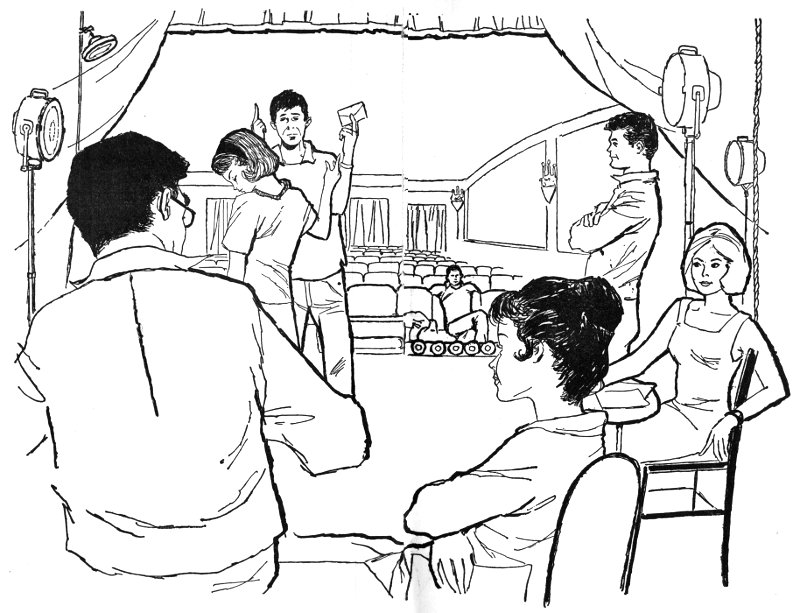
was up. In the middle of the stage stood a plain
worklight—an ugly, bare iron pole topped with a
single, powerful electric light bulb. It shed a harsh,
uncompromising light that threw grotesque shadows
over the back of the set and down into the orchestra.
Near the rail that separated the orchestra pit from
the audience, Peggy could see three or four men,
deep in earnest, low-voiced conversation. In various
parts of the auditorium, girls were sitting in groups
or singly. Nobody noticed her and nobody came up
to tell her what to do, so Peggy slipped unobtrusively
into one of the seats off a side aisle.
In a few moments, one of the men down front
stood up and consulted his watch. From his tall,
loose-limbed movements, Peggy recognized him as
Craig Claiborne, the director of Innocent Laughter.
Claiborne moved up the center aisle, scanned the
house, and apparently was satisfied with what he
saw. He turned and cupped his hands over his
mouth.
“Frank!” he yelled. “Let’s have some lights.”
59
From somewhere backstage a muffled voice
shouted, “Okay!” The next instant the stage was
flooded with a soft yellow light. A moment later
an electrician shuffled over to the worklight, unplugged
it, and dragged it off to the wings. As he
made his ungraceful exit, a tall, wiry man in his shirt
sleeves stepped on stage. In his hand, he carried two
scripts. He sat down behind a small, wooden table
near the footlights and proceeded to light a cigarette
despite the No Smoking signs that covered the theater
walls. No one objected.
Claiborne turned and mounted some steps that led
to the stage. Shading his eyes against the glare, he
advanced toward the audience and cleared his throat
for attention.
“Good morning,” he began. “I’ll skip the preliminaries
because we all know why we’re here. The
scene I want you to read this morning is in the second
act of Innocent Laughter. It takes place between
the young daughter and her grandfather. You understand
that you’re not reading for the part of the
daughter, but for the general understudy. Let me
quickly describe the action for you, and we’ll start.”
In a long-legged stride, Claiborne moved to a doorway
at stage left. “The daughter comes through this
door into the living room. She thinks it is deserted,
but actually her grandfather is sitting in that wing
chair by the fire. The audience can see him, but she
can’t. At this point in the play, the daughter has just
decided to marry the young man. She’s excited at the
prospect and also a little unsure of herself. She goes
over to the window here”—Claiborne walked to a
set of double French doors—“and looks out. She
sighs once, then the grandfather speaks. She turns
around in surprise, and they begin their conversation.”
60
Claiborne returned to the footlights. “I want each
of you to go through the entrance. Mr. Fox”—he indicated
the man puffing on a cigarette—“will read
the scene with you. Mr. Fox, incidentally, is our assistant
stage manager.”
The man at the table acknowledged the introduction
by lifting one hand and then letting it drop.
“Now then,” Claiborne said, “we’ll have Miss Celia
Forrester.” As a blond girl in a very tight dress got
up to take her place on the stage, Claiborne continued,
“Keep on reading until I tell you to stop.
When you’re excused, please return the script to Mr.
Fox and leave the theater by the stage door. You’ll
find it out beyond stage right.”
Miss Forrester, meanwhile, had collected her copy
of the playscript from Mr. Fox and was already disappearing
behind the door. “All right, Miss Forrester,”
Claiborne called out. “We’re ready whenever
you are. Remember to take your time.”
There was an expectant hush as everyone in the
theater settled back to wait for the girl’s entrance.
It came in a rush. The door flew open and Miss Forrester
leaped out on stage, clutching the manuscript
in one hand. Looking a little like some hunted animal,
she darted over to the window and groaned ecstatically.
That was the cue for Mr. Fox to read his line,
but he was so fascinated by the girl’s entrance, he
merely stared at her. The young actress flashed him
a peremptory glance and heaved her sigh a second
time. The assistant stage manager started guiltily and
quickly found the place.
61
“‘Why did you come in so quietly?’” Mr. Fox read.
“‘You’re as furtive as a lady burglar tonight. What’s
wrong?’”
He had a high-pitched nasal voice without a trace
of expression.
Miss Forrester whirled around with a gasp. “‘Oh!’”
she cried in a simpering tone. “‘I didn’t know anybody
was here.’”
“‘I’ll go if you like,’” Mr. Fox continued.
Miss Forrester tripped over to him girlishly. “‘Oh,
no! Please don’t,’” she said breathlessly. “‘There’s—there’s
something I want to talk to you about.’”
For some reason, Miss Forrester decided that a laugh
would be effective at this point. It rang clear and
loud through the hollow stillness of the empty theater.
Peggy saw Craig Claiborne slump deeper into his
seat and bury his head in his hands. After a few more
moments he unwound himself and stood up. “Thank
you—thank you very much, Miss Forrester. We’ll call
you.”
Miss Forrester, who had been stopped in mid-sentence,
closed her mouth and returned the playscript
to Mr. Fox. Flashing Claiborne a smile, she
left the stage.
Ruth Palmers turned out to be an extremely self-assured
young woman who took the script from Mr.
Fox as though she were doing him a favor. She glided
haughtily to the door and closed it behind her.
62
“All right,” Claiborne called. “Any time.”
The door opened slowly, and Miss Palmers was
revealed leaning languorously against the frame.
Keeping her eyes fixed on some distant point in space,
she stepped on stage and floated over to the window.
Collecting herself, she arched her back and breathed
a tiny bored sigh.
“‘Why did you come in so quietly?’” read the
faithful Mr. Fox. “‘You’re as furtive as a lady burglar
tonight. What’s wrong?’”
Miss Palmers gave a little pout of surprise and
turned to regard him coldly. “‘Ahh,’” she drawled.
“‘I didn’t know anybody was here.’”
“‘I’ll go if you like,’” came the answering line, as
the scene got under way for the second time.
Miss Palmers lasted a little longer than Miss Forrester
before she too was dismissed. The third girl
was allowed to read the entire scene. Peggy saw she
was a good, competent actress. Claiborne even
worked with her on some of the lines.
The fourth candidate was banished before she
could read two lines. She departed from the stage
looking thoroughly defeated—as if this sort of thing
happened to her all the time.
Both of the next two girls read well. Peggy noticed
they had bright, attractive personalities which shone
especially when they came to the laugh lines. It
would be her turn soon. She only hoped that Randy
was right in his diagnosis of the scene. She was determined
to play it with tenderness.
63
Peggy was jolted back to reality by Craig Claiborne’s
voice calling, “Miss Lane. Miss Peggy Lane,
please.”
Peggy lifted herself out of her seat and walked
down the aisle on rubbery legs. Suddenly her throat
became as dry as a lump of cotton wool. But somehow
she managed to get on stage, take the script
from Mr. Fox, and move through the door.
At last she was backstage at the Elgin Theater.
All around her, coils of wire and rope snaked across
the floor. Above her, high over the stage, she could
see rows of heavy sandbags used as counterweights
whenever scenery was “flown.” Behind her, by the
electrician’s board, a heavy-set stagehand was tipped
back in a chair, reading the morning paper. He didn’t
even bother to give her a glance.
“All right,” came Claiborne’s voice. “Any time.”
Peggy forced herself to relax. She drew a deep
breath and expelled every drop of air from her lungs.
Then she took a second breath and pushed open the
door.
It’s night, Peggy thought to herself. The room is
probably dark except for the glow of the fire. She
moved quietly, tentatively, and closed the door softly.
She stood for a moment, as if she were listening for
something, then walked quickly over to the big double
window. Very gently, she pulled back a curtain.
New York was supposed to be stretched out there
in front of her, and Peggy tried to remember what
it was like to see the lights of New York in real life.
She conjured them up and sighed. The lights of New
York....
64
“‘Why did you come in so quietly? You’re as furtive
as a lady burglar tonight. What’s wrong?’”
The line was totally unexpected. Of course, Peggy
knew the words would be spoken, but they still came
as a surprise. She turned in genuine astonishment.
“‘Oh!’” she exclaimed. “‘I didn’t know anybody was
here.’”
“‘I’ll go if you like.’”
Peggy moved down to the wing chair, trying to
envision an old man sitting there. A kind old man
with a strong, salty sense of humor, whom she didn’t
know too well.
“‘Oh, no! Please don’t,’” Peggy read. There was
real conviction in her voice. “‘There’s—there’s something
I want to talk to you about.’”
Suddenly Peggy knew how the girl in the play
would feel. She would be a little afraid of her grandfather,
even though she recognized all his good qualities.
The girl would be unsure of how to start the
conversation.
Mr. Fox, playing the grandfather, read the encouraging
lines. Peggy answered him. The pieces
were beginning to fall into place now. She read with
mounting conviction and assurance until, abruptly,
a voice shattered the illusion.
“Thank you, Miss Lane. We’ll be in touch with
you.”
65
It couldn’t be over yet! Peggy stopped in stunned
amazement. Just when it was going so well! She felt
the script being taken out of her hand and realized
that she had been dismissed. Fighting back the tears,
Peggy moved over to the right of the stage and ran
off into the wings.
She was grateful there was no one backstage to
see her. She turned the corner that led to the stage
entrance and thudded against somebody coming into
the theater.
Peggy blinked the tears away and looked up to
see Katherine Nelson standing in front of her. Katherine
Nelson opened her mouth to speak, but Peggy
didn’t stop to listen.
Murmuring apologies under her breath, she
brushed past the star and threw open the heavy
door. All she wanted was to get out of the theater
and as far away from Innocent Laughter as she could.
She barely heard the steel door clang shut behind
her as she walked quickly down the street—away
from Broadway.
66
VI “Why Don’t You Quit?”
“Peggy, honey, it just can’t be as bad as all that!”
“You don’t know!” Peggy was in her dressing
gown, stretched across her bed, still thinking about
the audition that morning. “I hardly got out five
lines before he stopped me. Honestly, I’ve never
been so embarrassed in my life.”
“You can’t tell,” Amy said. “Maybe he didn’t have
to hear any more.”
“I’m sure he didn’t,” Peggy replied bitterly. “I’m
sure he heard all he wanted. More than he wanted.”
She got up and walked distractedly over to the window.
“Whatever made me think I could be an actress!
I ought to have my head examined!”
“You are an actress,” Amy said stoutly. “And a
darned good one.”
Peggy whirled on her angrily. “You wouldn’t say
that if you could have heard me. I must have sounded
like an old crow!”
67
Amy shook her head. “You certainly are taking this
hard,” she said. “I can’t do a thing to cheer you up.”
“Oh, Amy.” Peggy went over to her roommate and
took her by the hand. “I’m sorry I snapped at you.
It’s just that—that—oh, I don’t know.”
“I wish I’d seen you,” Amy declared.
Peggy looked at her in surprise. “Why? What
could you have done?”
“I just think you’re exaggerating, that’s all. But I
can’t convince you because I wasn’t there.”
“Well, thanks anyway, but I’m not.” Peggy sat
down and closed her eyes.
“You’d better get dressed,” Amy said after a pause.
Peggy opened one eye. “What for?”
“You have to eat, don’t you? I bet you didn’t have
any lunch.”
“I had a bite,” Peggy said listlessly. “But I’m not
hungry right now. You go on.”
“Not without you.”
“No, please go.” Peggy sat up and looked at Amy
earnestly. “Really, I wouldn’t mind being alone for
a little while. I’ve got some thinking to do.”
“Sometimes two heads are better than one.”
Peggy shook her head doubtfully. “Not on this
problem,” she said. “I’ve got to decide whether to
stay in New York.”
Amy jumped to her feet. “Peggy!” she cried. “That’s
the most outrageous thing I’ve ever heard!”
“But what’s the sense in beating my brains out?”
“Oh, Peggy!” It was Amy’s turn to look distracted.
“What would you do? Where would you go?”
68
“Do?” Peggy said vacantly. “I guess I’d go back
home and do what Dad wanted me to do all along.
Be a schoolteacher.”
“You wouldn’t be happy,” Amy said gently.
“No,” Peggy admitted. “I suppose I wouldn’t. But
it would be better than this.”
Amy crossed the room with firm strides and sat
down on the bed beside Peggy. Her usually cheerful
face was set in a serious line. “Now you listen to me,
Peggy Lane,” she said severely. “I don’t know how
you read today and I don’t care. The important thing
is that this was your very first audition for an important
play. Of course, you were nervous. Who
wouldn’t be? Maybe you didn’t do as well as you
thought you could, but that doesn’t mean you can’t.
Two nights ago, I was the one who wanted to quit,
and remember what you said to me then. You told
me to face up to what happened and not let it get
me down. And now here you’re doing the very thing
you warned me against.”
“Yes, but Amy,” Peggy said, “tell me something,
frankly.”
“What is it?”
Peggy paused to choose her words with care. “Supposing—just
suppose now, you discovered you didn’t
have any talent—”
Amy tossed her head angrily. “Oh, Peggy!” she
cried reproachfully.
69
“Now don’t interrupt,” Peggy said. “Just let me
finish and answer my question. If you found out you
didn’t have any talent as an actress, would you still
try to break into the theater? Or would you give it
up, much as you loved it?”
Amy stared at her thoughtfully. “I don’t know,
Peggy,” she said. “I honestly don’t know. What made
you think of that?”
“I saw a girl today,” Peggy said. “She read at the
audition. Craig Claiborne stopped her before she
could say three words—”
“There, you see!” Amy interrupted triumphantly.
“You did better than that!”
Peggy smiled wanly. “Yes, but not much. Anyway,
the point I’m trying to make is that Claiborne was
right in stopping her. She was no good at all.” She
tucked her legs underneath her and leaned forward.
“Now here’s a girl,” Peggy went on, “who obviously
thinks she’s got ability. But actually she doesn’t. Isn’t
she just deluding herself by going on?”
Amy shrugged. “You never know. She might get
better.”
Peggy shook her head emphatically. “Not a chance
in the world. You can tell about some people. And,
in a strange sort of way, I think she knew it, too. You
should have seen her face when Claiborne told her
she could go. It was as if she had heard the same
thing so many times.”
“Well, how does all this apply to you?” Amy asked.
“I’m getting to that. How many girls want to be
actresses, do you think?”
Amy thought for a moment. “Thousands, I guess.”
70
“And a lot of them have some talent,” Peggy continued
eagerly. “They take part in school plays and
church pageants and all that sort of thing. Everybody
tells them how good they are, and pretty soon
they begin to believe them. But Amy! What a difference
between being the best actress in your home
town and competing in New York!”
“Don’t I know it!” Amy sighed.
“Well, then,” Peggy said, “supposing I’m one of
those girls—” She held up her hand. “Now don’t
interrupt again,” she warned. “One of those girls who
has a certain amount of ability, but not enough to
make the grade in the professional theater. In that
case, I think I owe it to myself to go back home.
Let me act if I want to, but in the local little theater
group—not as a starving outsider in New York.
Right?”
“I guess so,” Amy agreed quietly. “But only if
you’re convinced you don’t have the talent.”
“And that’s what I have to figure out,” Peggy said.
“I’m just not sure.”
Further discussion was interrupted by a soft knock.
“Come in,” the girls chorused. The door swung
open to reveal May Berriman standing in the hall
with a tray in her hands.
“Room service,” she announced as she shouldered
her way inside. “Would you mind clearing off that
dresser so I can put down the tray?”
“May!” Peggy cried. “What’s all this for?”
71
“Custom of the house,” May replied loftily as she
set down her tray. “We do it whenever a girl has her
first big audition. We figure that she’s too exhausted
to go out and eat afterward.”
“I don’t believe it,” Peggy said.
“Well, you’re right,” May replied dryly. “But I
heard you had a fit of the blues, and I thought this
might help. How do you feel?”
“She feels terrible,” Amy answered. “She’s the
original Calamity Jane.”
“Uh huh.” May nodded. “Feeling sorry for yourself,
eh? Here, try some of this soup.” She looked
at Peggy sharply. “What’s the matter? Did you walk
out on the stage with two left feet?”
Peggy smiled briefly. “That’s just about it. I did
a dreadful job.”
May put a plate of soup on Peggy’s lap. “Who said
so?” she demanded brusquely.
“Nobody had to tell me,” Peggy said. “I was there.
He stopped me after five lines.”
May whistled admiringly. “Five lines! Say, that’s
pretty good. I remember my first audition—they
didn’t even let me take a deep breath.”
“Come on!”
“I’m not joking. Tell me, were your legs shaking?”
Peggy laughed. “I didn’t think I could make it to
the stage.”
“I know the feeling. It’s like trying to walk across
a plate of Jello. Well,” May said cheerfully, “you’ve
got all the right symptoms. You should recover in a
day or two.”
72
“In a day or two she might be gone,” Amy blurted
out.
“What?” May turned to Amy in blank amazement.
“What do you mean?”
“She’s thinking of going back home,” Amy said.
“She doesn’t think she’s got enough talent.”
May’s expression hardened as she stared at Peggy.
“Well!” she said at last. “Maybe she’s right.”
“May!” came Amy’s shocked voice.
“I mean it,” May said coldly. “There’s no room for
anyone in the theater without confidence.” She
stalked over to the dresser and began taking dishes
off the tray. Amy and Peggy looked at each other
in surprise.
Amy was the first to break the silence. “But, May,”
she faltered, “couldn’t you—I mean, don’t you
think—”
“That she should stay?” May shook her head disdainfully.
“Not if she doesn’t think so.” The older
woman turned and faced the two girls. “Look here,
you two. Whenever an actor or actress gets up on a
stage in front of thousands of people, he’s simply
got to have confidence in himself. He’s got to think
that he’s the only person in the world who can play
the part. If he didn’t”—May threw up her hands—“he’d
have no business being in the theater.”
73
May walked over to Amy’s bed and sat down.
“That doesn’t mean you have to be vain and egotistical.
Somebody like Katherine Nelson, for example.
She thinks the sun rises and sets for her own
personal enjoyment. Personally, I think her acting
suffers because of her attitude, and certainly she’s
not a very attractive human being. No, what I’m
talking about is something quite different. It’s a
quiet pride in your own craft and ability. That’s the
quality you need.”
May fixed Peggy with a steady stare. “I know
what’s wrong with you, young lady. You just want
somebody to tell you how good you are. Well, that’s
not surprising. We all need approval. But in the
theater, we don’t always get it when we want it, and
that means we’ve got to be tough enough to keep
on going no matter what people say. I didn’t say
hard, I said tough. There’s a big difference. Peggy,
look at me.”
The young girl raised her eyes. “I think you’re a
good actress. I can’t tell you how good, because that
depends on you. It depends on how hard you’re willing
to work and how fast you learn. But you have
the basic equipment to make it.”
May raised a finger to emphasize her point. “Even
so, that’s still not enough. You have to want to do it
and you have to have a deep faith that you can do it.
Tell me, Peggy, do you think you could play the
part of the daughter in Innocent Laughter if you
had to? Tell me honestly now.”
Peggy nodded briefly. “Yes,” she said with quiet
conviction. “I know I could.”
74
May sighed and stood up. “Then why do you want
to leave New York? Innocent Laughter isn’t the only
play you’re ever going to audition for. And the next
time you’ll do better. Let’s have a little backbone,
Peggy.”
Peggy sat staring at May for a moment, then flung
herself into the older woman’s arms. “Oh, May!” she
said. “You’re right. I was being—I don’t know what.”
“There, there,” May said soothingly, stroking the
girl’s hair. “You’re all right, Peggy. You just needed
somebody to talk tough.” She put her hands on
Peggy’s shoulders and looked into her eyes. “No
more of this talk about going home. Promise?”
Peggy nodded. “I promise,” she said with a laugh.
“Good girl. Go ahead and have a cry if you want.
It’ll do you good. But don’t forget to eat some supper.”
She started to pat Peggy’s hand, but stopped
as the telephone buzzer squawked unexpectedly.
“Oh, oh,” May said. “Better not have that cry
after all. Somebody wants to talk to you.”
“I’ll go,” Amy cried, going toward the door. They
could hear her footsteps echoing down the hallway.
The next instant, it seemed, they heard them running
back to the room at what sounded like full
speed.
Amy appeared at the doorway, her face flushed
with excitement and her eyes bright. “Peggy!” she
almost screamed. “You got it! You got it!”
For a moment it didn’t register. “Got what?”
Peggy stammered.
75
“The part!” Amy danced into the room and made
a grab for Peggy. “Hurry up! It’s Peter Grey! He’s
downstairs in the living room with Pam Mundy. He
told me to tell you that they’re ready to offer you the
part of general understudy in Innocent Laughter. He
wants to talk to you about it right now. Oh, Peggy,
Peggy! All that worrying for nothing. You got the
part!”
76
VII Peggy Turns Detective
Peggy found Pam Mundy and Peter Grey sitting on
one of the sofas in the big living room of the Gramercy
Arms. When Peggy walked through the door,
Peter jumped up and held out his hand.
“Congratulations,” he said. “We thought we’d come
around and tell you the good news personally.”
Peggy took the offered hand and smiled. “I still
don’t believe it,” she said. “You’re sure there’s no
mistake?”
“Absolutely certain.”
Peggy smiled a second time and went over to sit
beside Pam. “And you’re the one who started it all,”
she said.
Pam, who was a petite brunette with a quick,
vivacious manner, leaned her head back against the
sofa and laughed. “That,” she said, “was what they
call a stroke of genius.”
“Well, whatever it was, I’ve got you to thank.”
77
Pam sat up suddenly. “Oh, no,” she said. “It’s the
other way around. I’m the one who should thank
you.”
Peggy looked at her in surprise. “Whatever do you
mean?”
“It’s simple,” Pam said seriously. “Oscar Stalkey
was wondering whom to get for the understudy, and
I’m the fair-haired girl who came up with the right
name. Is he ever impressed!”
Peter held up his right hand. “That’s the truth,”
he assured Peggy. “He thinks Pam’s the greatest casting
director in New York.”
“Well, not quite,” Pam said with a grin. “But at
least he doesn’t think I’m a silly girl butting in where
I don’t have any business to be.”
She turned to Peggy with a sudden movement of
annoyance. “Honestly, Peggy, you wouldn’t believe
the cold shoulders I’ve been given! I used to think
it was hard for a girl to get established as an actress,
but believe me, that’s a cinch compared to finding
a good job in production. Producers,” she continued,
warming up to her topic, “are all alike. In the first
place, they’re nearly all men—”
“And that’s the way they want to keep it,” Peter
finished with a smile.
“That’s right.” Pam nodded vigorously. “That’s
exactly the trouble.” She turned and appealed to
Peggy. “What’s the matter with a woman being a
producer?” she demanded.
“Nothing. There are some very successful women
producers.”
78
Pam brushed this aside. “They’re exceptions—”
“Whoa! Slow down a bit,” Peter said good-naturedly.
“This is her favorite topic,” he told Peggy.
“The poor girl’s always telling us what a hard life
she leads.”
Pam subsided with a sheepish grin. “I guess you’re
right. But it still makes me mad to think—”
“Watch it,” Peter warned.
Pam stuck her tongue out at him and they both
laughed. “The reason I can give orders to the terrible-tempered
Miss Mundy,” Peter said, “is that I am
now officially her boss.”
“I thought you worked for Mr. Stalkey,” Peggy
said.
“We both work for Oscar Stalkey,” Peter explained,
“but Pam works for me. You see, I’ve been made company
manager for the first road production of Innocent
Laughter, and Pam was just made my assistant.”
“Oh, that’s wonderful!” Peggy cried excitedly.
“That means we’ll be going on tour together.”
“That’s right,” Peter answered. “And now, if my
assistant will kindly shut up for five minutes, maybe
we can talk about the road tour for a change. After
all, that’s why we’re here.” He leaned forward. “First
of all, are there any questions?”
“Hundreds,” Peggy assured him. “So many I
don’t know which one to ask first. But how about this
one? Why did I get the part?”
Peter looked surprised. “That’s easy. You read better
than anyone else.”
79
Peggy shook her head in amazement. “I was so
scared, my knees were all wobbly. I thought I was
terrible.”
Peter grinned. “You sure were scared,” he conceded.
“We could practically hear your teeth chattering.
But you had the quality we were looking for.”
“But what about the other girls?” Peggy said. “The
ones that Craig Claiborne worked with for a while.”
“They were almost right. Claiborne thought with a
little help he could make them give a performance.
But then you came along and you were perfect. And
that was that!”
“I still can’t understand it,” Peggy marveled. “He
cut me off so soon.”
“He didn’t have to hear any more.”
Peggy smiled. “That’s just what Amy said.”
“Well, she was right.” Peter reached into his coat
pocket and pulled out a sheaf of mimeographed
papers. “Here,” he said, spreading them out over the
coffee table, “this is an outline of the tour as far as we
know it.”
Peggy leaned over the table and watched Peter
check off each stopping place. “We open in Baltimore
on the twelfth of next month. That’s just five weeks
away. We move south to Washington, swing west for
a series of performances through Virginia, West Virginia,
Kentucky, up to Ohio, over to Indiana, and
eventually to Chicago. It’s a rugged tour. A lot of one-night
stands in theaters that haven’t been properly
used since the days of vaudeville. Oscar Stalkey believes
in bringing live theater to all parts of the country—even
if it kills all his actors.”
80
“How long will we be in Chicago?” Peggy asked.
“As long as they’ll keep us,” Peter answered with
a wry smile. “Actually, we’re the Chicago company of
Innocent Laughter, but we’re taking the long way
around before we get there.”
“Is there another road company?”
“Oh, yes. It hasn’t been formed yet, though. They’ll
play the Southwest and California and probably settle
in Los Angeles.”
“How do we travel?”
Peter and Pam exchanged glances and grinned.
“You name it,” Peter said. “We’ll be using every
means of transportation known to man except the ox-cart.”
“Don’t be too sure.” Pam laughed. “We may use
that yet.”
“True,” Peter admitted. “Bus, hired car, trains, of
course, planes. Everything you can think of.”
“And hotel space?”
“That’s one of our headaches,” Pam said. “You see,
moving a dozen people and three tons of theatrical
scenery around the country on a split-second schedule
is quite a chore.”
“We’re still worrying about the scenery,” Peter said.
“When we get that settled, we’ll start to think about
the people.”
“Oh, I wasn’t complaining,” Peggy said hastily.
“I’m sure everything will be all right.”
81
“I’m glad you think so,” Peter said dryly. “I wish
everyone was as easy to please.”
“Why? Whom do you mean?”
“None other than that great lady of the theater,
Katherine Nelson.”
Peggy felt a funny sinking sensation in her stomach.
“Is she in the cast?”
Peter nodded grimly. “Oh, yes. She’s the mother.”
“The romantic lead!”
“Yep.” Peter grinned at her. “Don’t look so surprised.
What did you expect her to play? The grandmother?”
Peggy shook her head. “I’ve only seen that woman
twice, but I don’t think she liked me.”
“Bingo!” Peter cried. “You’re so right. What did
you do to her?”
“Nothing. Really, I didn’t do a thing. Why?”
“She saw you at the theater this morning and came
storming up to Oscar Stalkey. She wanted to know if
you were being considered for the understudy.”
“What did he say?”
“What could he say? Yes, naturally. She bounced
around the theater like an old bag of bones, she was
so angry. I wonder why she’s taken such a dislike to
you.”
“I don’t know,” Peggy said. “I’ll just have to stay
out of her way as much as I can.”
“That’s not going to be easy,” Pam said. “Don’t forget,
you’re playing a small part in the first act. You’re
playing the schoolgirl friend of the daughter.”
82
“True,” Peggy said. “Does she know about it?”
“Not yet.”
“I bet there’ll be an explosion.”
“Don’t worry about it,” Peter counseled. “Oscar
Stalkey can handle her pretty well. He doesn’t let her
get away with too much.”
“What was that fight about in the office the other
day?” Peggy asked. “Or shouldn’t I ask?”
Peter shrugged carelessly. “No big secret. She’d
just finished explaining to Stalkey that she should
play the lead in the Broadway production and not
out in the sticks, as she put it.”
“Mr. Stalkey put her in her place soon enough,”
Pam added with evident satisfaction.
“And that’s why she was screaming,” Peter added.
“She’s got to have her own way or she throws a temper
tantrum. Just like a child. I sometimes wonder
what ails that woman.”
Pam looked at him sharply. “Don’t be dumb, Peter.
She simply can’t face the fact that she’s not the romantic
star she used to be.”
“Well, I wish she’d act her age,” Peter said moodily.
“It’d be a lot easier all around. Let’s change the subject.
Any more questions, Peggy?”
“One or two. Who’s the rest of the cast?”
“Let’s see now. The grandmother—a wonderful
part—is Emily Burckhardt. The daughter is Marcy
Hubbard. Do you know Marcy? She’s about your age,
I guess. A little older.”
Peggy shook her head. “No, but I’ve heard of her.”
83
“She’s nice. You’ll like her.”
“What about the grandfather?”
“Now that,” Peter said, “is a ticklish question.” He
pushed a paper across the table to Peggy. “You’d better
hang on to that. It’s the first of many to come. Before
we start on tour, you’ll have mimeographed
sheets telling everything you’ll want to know—times
of departures and arrivals, accommodations assigned
to you, absolutely everything. That’s my headache.”
“And mine,” Pam said.
“Right,” Peter acknowledged with a grin. “But to
get back to your question about the grandfather. You
heard our conversation in the office?”
“You mean when you suggested Tom Agate?”
“That’s right.”
“Exactly who is Tom Agate? I think I know the
name, and I remember your saying he was a famous
performer back in the days of vaudeville. But I’m
afraid I’m still not clear about—”
“That’s not surprising,” Peter interrupted. “Tom
Agate retired from the stage fifteen years ago.”
“Why did he retire?”
“Nobody knows.”
“Maybe he couldn’t get a job any more.”
“Tom Agate!” Peter said incredulously. “Don’t you
believe it! Don’t forget, that was just when television
was starting. They were using a lot of old-time vaudeville
performers then, and Tom could have had any
number of jobs. I’ve spoken to several producers who
wanted him, but they couldn’t find him.”
84
“What do you mean—couldn’t find him?”
“Exactly that. He’d disappeared. Vanished.”
“Do you know where he is now?”
Peter paused and sat back in his chair. “No,” he
said slowly. “I don’t. But I think there’s a chance of
tracing him.”
“How?”
“I ran into somebody the other day who says he’s
positive that Tom is still in New York. If he is, we’re
going to find him.”
“Remember,” Pam pointed out, “you’ve only got
two days.”
“I know, and that’s the trouble.”
“Where are you going to look first?” Peggy asked.
“I know a man, a friend of my father’s,” Peter said,
“who’s been with the drama department of the
Chronicle for the last forty years. He knows more
about the history of the American theater than anyone
I’ve ever met.” He looked straight at Peggy. “I
thought we’d go down tomorrow and talk to him.”
“We?” Peggy said in surprise.
Peter nodded. “I was hoping you’d be willing to
help.”
“Well, sure,” Peggy said, “but how—”
“You see,” Peter went on excitedly, “I can’t get
away during the day, and neither can Pam. There’s
just not enough time before the tour. We both have
to stick pretty close to the office. But I thought that
maybe you—” He trailed off and looked at Peggy
hopefully.
85
“Could act as the bloodhound?” Peggy finished.
“That’s it. Will you?”
“I don’t even know what he looks like.”
Peter brushed this aside. “That’s no problem. We
can go down to the newspaper office first thing tomorrow
morning and talk to my friend. His name, by the
way, is Johnny Dwyer. Johnny has a room full of old
clippings and photographs, and I bet he can give us
a lead on Tom. Then you can follow it up and let me
know tomorrow evening. How about it?”
Peggy smiled. “Well, I once discovered a hidden
theater. Maybe I’ll be lucky enough to find a hidden
actor.”
Peter bounced to his feet with a broad smile. “Good
girl!” he said. “Can you meet me on the fourth floor
of the Chronicle building at nine o’clock tomorrow
morning?”
“I’ll be there,” Peggy said.
“Good.” Peter gathered his papers and stuffed them
in his pocket. “We’ll have your contract prepared
tomorrow, and when I meet you I’ll give you a copy,
and you can look it over. Then, if everything’s satisfactory,
you can sign it and deliver it back to us.
Okay?”
Peggy sighed. “Sounds wonderful to me.”
“Sounds pretty good to us, too,” Peter replied. “I
think we’re signing on a first-class actress.”
86
VIII The Search
“Tom Agate? Sure, what can I tell you?”
Johnny Dwyer settled back in his chair and waved
a hand invitingly at a pair of battered office chairs.
Peggy sat down in one of them and looked at the
figure in front of her with interest. Johnny Dwyer was
a small, birdlike man with a cheerful, pink face, snow-white
hair and the bushiest eyebrows Peggy had ever
seen. At the moment, he was perched in front of an
old-fashioned rolltop desk in a musty corner of the
big metropolitan newspaper office, his coat off and
the sleeves of his shirt held up by a pair of elastic armbands.
Outside of actors in costume and old photographs,
Peggy had never seen anyone wear armbands.
But Johnny Dwyer did, and it gave him the appearance
of someone out of a turn-of-the-century tintype.
Despite his age—and Peggy guessed that he was over
seventy—Johnny Dwyer moved with a quick, catlike
grace. But when he walked, it was with the help of
a cane.
87
On the way in to his office that morning, Peter had
told Peggy a little about Johnny Dwyer. Johnny had
been a gay blade in his younger days, a rising popular
star in the New York music halls. But a tragic horseback
accident had broken his leg in three places and
cut short his career as a song-and-dance man.
The publisher of the Chronicle, then a new and
struggling newspaper in New York, liked Johnny, felt
sorry for him, and offered him a job keeping records
for the drama department. It turned out to be a satisfactory
arrangement for both sides. Johnny moved in
and stayed.
For nearly half a century he watched the American
theater parade through his bulging scrapbook
and file cabinets. His memory was phenomenal and
his list of acquaintances was as wide as the theater
itself. In his own time, Johnny Dwyer had become
sort of a legend, a living museum whose memory
was a storehouse of theatrical lore. If anyone needed
any information on the theater, they usually tried the
public library first and then, if they couldn’t find it
there, they came to Johnny. Sometimes, if they knew
Johnny well, they didn’t even bother with the library.
According to Peter, if anybody in New York knew
where Tom Agate was, it would be Johnny Dwyer.
“Tom used to be a good friend of mine,” Johnny
said, leaning back comfortably. “Many’s the night
we’ve sat around and swapped stories.”
“Used to?” Peter asked in a troubled voice. “Is he
dead?”
88
Johnny looked at Peter shrewdly. “Some people
think so.”
“Do you?” Peter obviously didn’t know what to
make of this strange reply.
Johnny stared up at the ceiling for a moment before
answering. “Look here, young fellow,” he said
at last. “Tom Agate retired a long time ago.”
“I know that,” Peter said. “But we want to find
him.”
Johnny Dwyer pursed his lips thoughtfully. “Has
it occurred to you that he doesn’t want to be found?”
“Oh, come on now, Johnny,” Peter said in a pleading
voice. “You know a lot more than you’re telling us.
How about a break? We don’t want to bite the man.
We just want to offer him a job.”
Johnny seemed startled. “A job? But he’s retired!”
“He’ll come out of retirement for this part,” Peter
said confidently.
“Oh, it’s a play?”
Peter nodded. “A wonderful chance.”
Johnny shook his head and smiled. “Tom Agate’s
heard that so many times. Believe me, he won’t listen.
He’s finished with the theater.”
“Do you know why?” Peggy asked.
89
“I don’t have the slightest notion,” Johnny replied
blandly. Despite his innocent expression, Peggy was
almost certain the old man was lying to Peter. “All I
know,” he went on smoothly, “is that fifteen years
ago, Tom Agate told me he was quitting the stage.
He didn’t give any reason and I didn’t ask. After all,
you don’t stick your nose into someone else’s affairs.”
“Have you seen Tom lately?” Peter persisted.
“The last time I saw Tom was”—the old man
cocked his head to one side—“oh, it must have been
four years ago.”
“And he’d been retired then for eleven years?”
Johnny smiled briefly. “If my arithmetic isn’t off,
I guess you’re right.”
“How was he?”
“Fine.” Johnny folded his hands and waited patiently
for the next question. Peggy suddenly felt herself
caught up in a mystery she didn’t understand. It
was clear to her that Johnny Dwyer was not going to
co-operate even though he had the information Peter
wanted so desperately. She waited for the next move
anxiously.
Peter leaned forward in his chair, his elbows resting
on his knees. “Johnny,” he said with quiet sincerity,
“let me explain why we want to get in touch with Tom
Agate.” He proceeded to tell Johnny about Innocent
Laughter and the part reserved for Tom. “It’s a wonderful
opportunity for him,” he concluded. “And, of
course, I’m convinced that Tom would be ideal in the
part.”
90
Johnny Dwyer sat perfectly still for several seconds
after Peter had finished talking. At last he lifted himself
to his feet, picked up his cane, and walked over to
the window. Peggy noticed again how tiny and fragile
he looked. “Peter, my boy,” he said finally, “I’m glad
you feel that way about Tom. It’s nice to know that
somebody still remembers him.”
“I’m sure that thousands of people all over the
country remember him!” Peter interrupted excitedly.
Johnny smiled and nodded. “Perhaps. But Tom
had his reasons for leaving when he did, and I don’t
think anybody has the right to force him back. It’s
a decision he’s got to make.”
Peter got up and walked over to Johnny. “I agree
with you,” he said. “But we’re not going to force him.
All I want is a chance to talk to him. He can make up
his own mind.”
The two men—one old, the other young—stood
staring at each other. Johnny Dwyer looked into
Peter’s eyes as though he were trying to read his
mind, then turned away. “No,” he said. “Get somebody
else.”
Peter sighed and returned to his chair. “You say
you saw Tom four years ago?”
“Mm-hm.” Johnny gave a little birdlike bob with
his head.
Peter looked up abruptly. “Tell me something,
Johnny. Was he happy?” The question was sharp and
unexpected. For the first time Johnny seemed uncertain
of his answer. “Or did he miss the theater?”
91
Johnny groped his way over to his chair and sank
down. There was a troubled expression on his face.
“Yes,” he said in a very quiet voice. “He missed the
stage.” He looked over at Peggy and Peter. “You two,”
he said, “you’ve been working in the theater for how
long? Two years? Four years? Five years? Well, Tom
Agate spent thirty years of his life on stage. It was
everything he knew—and almost everything he
loved.”
“Almost everything?” The question came almost
automatically, before Peggy had a chance to think
about it. Johnny looked at her oddly. It was the first
time she had spoken during the interview.
“Don’t ask me any more,” he said. “Just leave Tom
alone.”
Peter shook his head stubbornly. “Why don’t you
help us give Tom a chance to find happiness again?”
“By coming back to the theater?”
“Yes.”
“He’d never do it. I told you that.”
“Maybe he’s changed his mind.”
Johnny smiled and shook his head regretfully. Suddenly
Peggy was on her feet, talking quickly and
earnestly.
“Mr. Dwyer,” she said, “we don’t want to pry into
Mr. Agate’s personal life. You said yourself no one
should poke his nose into someone else’s business.
Well, I agree. But at the same time you just admitted
that he was unhappy and missed the theater. You
said it was his whole life. Sometimes, Mr. Dwyer,
people need help. They need to have their eyes
opened so they can see the life they’re missing. The
life that belongs to them if only they reach out and
take it. Doesn’t Mr. Agate deserve a second chance?
I—I don’t know what happened fifteen years ago. I
don’t know why he left the stage and I wouldn’t
dream of asking him.”
92
“Then what do you want to ask him?”
“I want to ask him to come back to the life he
loves,” Peggy said simply.
“I tried that myself,” Johnny said. “It didn’t work.”
Peggy pulled a chair over beside Johnny and
looked into his face. “Sometimes,” she said gently,
“the wrong person does the asking.”
Johnny stared at her in surprise. “What do you
mean?”
Peggy was flushed and embarrassed at what she
was about to say, but she held her ground. “We’re
young,” she said as kindly as she could. “We’re
still part of the theater he misses so much. If we want
him back, that’s different from....” Her voice trailed
off in confusion as she anxiously watched Johnny’s reaction.
Johnny nodded in comprehension. “Different from
an old fellow like me doing the asking. Somebody
who’s through, himself. Is that what you mean?”
“Yes,” Peggy said almost in a whisper. “Except for
one thing. You’re not through. You’ve still got your
work. People need you—the newspaper needs you.
Nobody needs Tom Agate, and he probably thinks
nobody wants him.” She stood up and looked down
at him. “But we want him.”
93
Johnny passed a hand over his face and rested his
chin on the head of his cane. Slowly his head began
to nod. “You’re right,” he said at last. “By gollies, I
think you are.” He turned to Peter with an appreciative
chuckle. “You should have let her do the talking
right from the start.”
“Then you’ll help us?” Peggy cried eagerly.
Johnny got up and hobbled energetically over to
a pile of scrapbooks. “I’ll do all I can,” he said. “But
I’m afraid it’s not going to be much.”
“Johnny!” Peter was over beside the old man, clapping
him enthusiastically on the back.
“Take it easy, now,” Johnny protested. “Frankly,
I’d give a lot to see Tom Agate back on the stage.
Remember that old song of his, ‘Kathleen Aroon’?”
Johnny was chuckling happily now, as if he had
been relieved of a great burden of responsibility.
“Hold on.” Peter laughed. “He won’t be doing any
songs in Innocent Laughter. It’s a straight play.”
“What a pity,” Johnny sighed. “Did you ever hear
him sing?” he asked Peggy. “I guess not,” he said before
she could answer. “You’d be too young. But that
was his theme song. He used to sing it everywhere.
I think he included it in every show he ever played.”
“How does it go?” Peggy asked.
“Like this.” Johnny turned and faced them.
“Why should we parted be, Kathleen Aroon,
When thy fond heart’s with me, Kathleen Aroon?
Come to these golden skies,
Bright days for us may rise,
Oh! dry those tearful eyes, Kathleen Aroon.”
94
Even though Johnny sang with the thin voice of an
old man, Peggy found herself listening to every
phrase. When he finished, she held out her hands to
him.
“That was beautiful,” she breathed. “I never knew
that such a simple song could be so lovely.”
Johnny smiled modestly. “You should have heard
Tom do it,” he said. “It always seemed to have a
special meaning for him.”
Beside her, Peggy could feel Peter fidgeting restlessly.
“Say, I’m sorry to break this up,” he said, “but
I’ve got to get back to the office. Can we have Tom
Agate’s address?”
Johnny shook his head regretfully. “That’s just the
trouble. I’m afraid he may have moved. All I’ve got
is the place where he lived four years ago.”
“But mightn’t he still be there?” Peter asked anxiously.
Johnny shrugged. “I don’t know. You can try.”
“Well, where is it?”
Johnny wrote out an address that Peggy recognized
as a place out in the suburbs beyond the city.
“That’s the best I can do,” Johnny said. “You can
inquire there.”
“Great.” Peter took the paper and handed it over
to Peggy. “That’s your job, Sherlock Holmes. Let’s
hope you find him.”
“Wait a minute,” Peggy said, grabbing Peter by
the arm. “I don’t even know what he looks like.”
95
“That’s easy,” Johnny said. “I’ve got a million photographs.
Let me get you one. I’ll try to get the best
likeness for you.” He disappeared down a narrow
aisle of file cases. A moment later he was back, blowing
the dust from a large glossy photo. “Here,” he
said, holding it out. “That’s just about the way he
looks today. It was taken during the war.”
The picture showed a rather ordinary-appearing
man. At first glance there was nothing particularly
unusual about Tom Agate. But a closer look revealed
a quality of gentle, almost melancholy, humor that
seemed to dominate his face. Peggy held it out at
arm’s length. “He looks so sad,” she said. “Somehow
I expected him to be gay.”
“What did you think he’d be like?” Johnny asked
quietly. “A circus clown?”
“No,” Peggy said. She shook her head. “I don’t
know.”
“Don’t be embarrassed,” Johnny said hastily. “All
great clowns are sad. Or didn’t you know that?” He
took the photograph from her, slipped it into a plain
Manila envelope and returned it. “Here you are,” he
said. “And good luck to you. I hope you find him.”
Peggy tucked the envelope under her arm and extended
her hand. “Thanks a lot,” she said warmly.
“We’ll let you know how we make out.”
96
Johnny walked them to the door of his office. “You
do that,” he said. “And when you find Tom Agate,
give him my regards.” He held the door Open. “Tell
him for me that he was a fool ever to have listened to
Johnny Dwyer. Tell him—tell him that his friends
are waiting for him. It’s been too long.” He smiled
and gripped their hands in farewell.
Paradise Avenue, just beyond New York City, in
Astoria, stretched out in a straight, treeless line of
two-family brick houses, each set back about thirty
feet from the sidewalk. In general appearance, all the
buildings were pretty much alike, although here and
there a gaily painted front porch and cottage shutters
hinted at the presence of a more imaginative homeowner.
The street was almost deserted. But then it was
nearly one-thirty. The men were away at their jobs
and the children at school. Peggy looked at the envelope
in her hand. The address read 3612 Paradise
Avenue. The bus driver had given her precise directions.
This should be the 3600 block. Peggy moved
slowly down the street, searching for the first house
number. There it was—3601. That meant the house
she wanted must be diagonally across the street.
Peggy trotted over, ticked off the numbers, and
stopped in front of a reddish-brown brick house. She
turned up the walk, mounted the stairs, and reached
out for the bell. As she touched it, she felt a strange
sense of excitement build up inside her. The bell
echoed hollowly. Peggy pressed it a second time.
“Just a minute!” came a woman’s voice.
97
Peggy stepped back and waited. Then she saw
that the brick wasn’t brick at all, but some sort of
imitation material. All the houses on the block must
have been built the same way. It told of a lower
middle-class neighborhood that prided itself on neatness
and hoped for better times to come.
Suddenly, without warning, the door swung open
and Peggy was face to face with a middle-aged
woman who peered at her suspiciously. When she
saw her caller was a young girl, the woman opened
the door a little wider.
“Yes?” she asked.
Peggy put on her most pleasant smile and moved
forward. “Good afternoon,” she said. “I’m looking
for someone. A Mr. Tom Agate. Does he live here?”
“Agate?” The woman said. She shook her head
slowly. “Nobody by that name here.”
“I know he lived here four years ago,” Peggy said
hopefully. “He was an elderly gentleman.”
“Retired?”
Peggy’s heart leaped. “Yes. He was retired.”
The woman opened the door all the way and
motioned Peggy inside. “There was a retired gentleman
living with us. He rented the rear bedroom. But
his name was Anderson.”
Peggy reached for the photograph. “I wonder if
you’d recognize him if you saw his picture?”
The lady of the house nodded unhesitatingly. “Oh,
yes, I’d know him.” She squinted at the photograph,
took a closer look and blinked. “Let me get my
glasses,” she said, turning away to go into the living
room. “And shut the front door. It’s getting chilly.”
98
Peggy did as she was told and waited for the
woman’s return. The tiny front hall was spotlessly
clean and cheerily decorated with flowered prints
and a single gold-framed mirror over a mahogany
console table. Both furniture and floors were polished
to a high gloss. Peggy sensed that this was a home
where everything was dusted twice a day and where
nothing was allowed to disturb a well-established
routine.
“Are you a relative of Mr. Anderson’s?” The woman
was back with a pair of plain glasses perched on her
nose. Peggy saw that she was wearing soft bedroom
slippers which accounted for her silent tread.
“Not exactly,” Peggy admitted. She wondered how
to explain her interest. The real story would be too
complicated to tell. “I’m just a friend. Actually,” she
added hastily, “a friend of a friend. You see,” she said
with sudden inspiration, “Mr. Agate—the man I’m
looking for—has had a stroke of good fortune, and
I’ve been assigned the job of finding him.”
The woman stared at Peggy with new respect. “I
see,” she said solemnly. “Then you’re a private investigator?”
“Well, sort of,” Peggy answered.
The woman leaned forward. “Did he fall into an
inheritance?” she asked in a hushed voice.
Peggy gulped and spoke in an equally quiet voice.
“I’m afraid I can’t talk about it,” she whispered.
The woman nodded conspiratorially. “I quite understand,
my dear. Forgive me for asking.”
99
Peggy reassured her with a smile and held out the
photograph. The woman studied it for a moment and
slowly began to nod her head. “That’s the man,” she
said at last. “That’s Mr. Anderson. I always said he
was a real gentleman. Even though he did play the
banjo.” She said the last with just a trace of exasperation
as though playing the banjo was far too frivolous
an occupation for a reliable person.
“Yes,” Peggy said excitedly. “That would be Mr.
Agate.”
The woman shook her head sadly. “I wonder why
he changed his name?” Her expression hardened into
a severe frown of disapproval. “It doesn’t sound like
the proper thing to do. I mean, it sounds as if he
wanted to hide something. I never would have let
him stay here if I’d known about that.”
“I’m sure you’re very careful,” Peggy broke in.
“But—”
“This is a respectable house,” the woman said
primly.
“Oh, I can see that,” Peggy assured her. “But when
did Mr. Agate leave you? And do you know where
he went?”
Tom Agate’s erstwhile landlady pressed her lips together
in a thin line. “I don’t know anything about
him,” she said shortly. “You just can’t trust people
these days. Why, I was saying to Maude Benson the
other day....”
100
Peggy realized that she was going to have to think
and talk quickly in order to get information out of the
woman. “I know how you must feel,” Peggy soothed.
She took a deep breath and plunged ahead. “But Mr.
Agate’s had a very sad life.”
The woman stopped and stared at Peggy with fresh
interest. “Really!”
“Oh, yes,” Peggy said gravely. “He was orphaned
at an early age. The only person to take care of him
was a distant cousin who tried to disinherit him.”
The woman was clearly shocked. “No!”
“Yes. You see, Mr. Agate is the rightful heir to the
Agate fortune.” Peggy held her fingers up to her lips.
“Now you mustn’t breathe this to a soul.” The woman
nodded breathlessly. “But Mr. Agate is the only son
of Henry Agate. You know,” she prompted, “the
Agate family. One of the wealthiest in America.”
The woman looked at Peggy in round-eyed wonder.
“Oh, yes,” she said. “The Agates.”
“Of course, everybody’s heard of them,” Peggy said
in an offhanded manner. “And that’s why Mr. Agate
didn’t like to use the name.”
The woman brightened considerably. “Isn’t that
the most romantic thing you ever heard of!” she practically
crooned. “And to think that he was living right
in our house! Just wait until I tell Maude!”
“Oh, you mustn’t!” Peggy cautioned. “You promised!”
“That’s right, I did.” She patted Peggy on the
shoulder. “Don’t worry, my dear, you can trust me.”
101
“Well, now,” Peggy went on in a more businesslike
voice, “have you any idea where we can find Mr.
Agate?” She put a slight emphasis on the “we” in
order to give the woman a feeling that she was part
of the search.
The woman suddenly clapped her hands together.
“I just remembered something. When Mr. Agate left
here two years ago he told me where he was going.
It was a place way over in Baywater on the other side
of Long Island. I remember thinking it was rather
strange to go so far off, but then he said he wanted to
live near the ocean.”
“Did he give an address?”
The woman shook her head regretfully. “No, he
refused to leave any. He said there wouldn’t be any
mail. And there wasn’t.”
“Can’t you remember anything more than that?”
The woman closed her eyes. “Yes,” she said slowly.
“He let the address slip once. It was Tidewater Road,
I’m sure of that.”
“And the number?”
There was a sigh. “I can’t—wait a minute. I think
it was twenty-nine hundred something Tidewater
Road.” She opened her eyes eagerly. “Yes, I know it
was. It was the twenty-nine-hundred block.”
Peggy hurriedly slipped the photograph back in its
envelope. “Well, thank you very much,” she said.
“You’ve been most helpful.”
“I wish I could have done more for poor Mr. Agate.
He really was such a nice gentleman.”
“If I locate him, I’ll give him your regards,” Peggy
promised.
102
The woman danced nervously around Peggy, obviously
reluctant to see her go. “Won’t you stay for
a cup of tea, my dear?”
Peggy declined as gracefully as she could. “I’m
afraid I can’t. I’m going to have to get to Baywater
this afternoon.”
The woman was now eager to help. “If you take
the number fourteen bus down at the end of the
block, it will get you to the Long Island Railroad Station.
I’m sorry I don’t have a timetable.”
“That’s perfectly all right,” Peggy said, edging toward
the door. “I’ll be able to manage. Thank you
again.” Peggy turned the handle of the front door and
stepped out on the porch.
As Peggy fled down the steps, she heard a muffled
“good-by” as the door slammed shut. That would
be the woman on her way to the telephone to tell
Maude Whatever-her-name-was all about the famous
Mr. Agate. Well, let her, Peggy thought to herself
with a smile. No harm in that.
She directed her footsteps to the bus stop at the
corner. “Tidewater Road,” she murmured to herself.
“Not much to go on, but I’m not going to give up
now.”
103
IX The One-Eyed Giant
Paradise Avenue, with its imitation brick houses and
neat garden plots, might have had some pretensions,
but Tidewater Road had none. Here the houses were
built of frame, most of them in need of a new coat of
paint, many of them badly wanting repairs. Even the
streets seemed uncared for. Scraps of old newspapers
rustled in the gutters, and the pavement itself was
cracked and worn. Looking at its bleak row of buildings,
Peggy felt like catching the next train back to
the city. Tom Agate couldn’t be living here.
She had to remind herself that she had made a
promise as she crossed the street and approached the
first house on the block. A child’s tricycle, one wheel
twisted awkwardly out of shape, lay on its side across
the steps. Peggy picked her way gingerly around it,
crossed the porch, and put her finger on the bell. No
sound came from the house so she tried knocking.
“Yeah?” came a thin, querulous voice, but inside
the house nothing moved.
104
Peggy stepped back, wondering what to do next.
“Excuse me,” she called at last. “I wonder if you could
give me some information.”
“We don’t want none,” answered the same voice.
“I’m not selling anything,” Peggy replied. “I just
want some help.”
There was a moment’s silence and then the shuffling
of feet. A suspicious face appeared at the door
and examined Peggy narrowly. It was an older
woman, dressed in a worn housecoat with her hair up
in pin curls.
“Yeah? Whatcha want?”
Peggy fumbled at her envelope and drew out the
photograph. “I’m trying to locate somebody,” she said.
“I understand that he lives in this neighborhood, and
I wonder if you know him?” She held out the picture
for inspection.
The door opened a little wider as the woman leaned
down to examine the photograph. The pin curls gave
a decisive shake.
“Naw. Never saw him.”
The next instant the door was slammed shut and
Peggy found herself alone on the porch. She made
her way carefully back down the steps and out to the
sidewalk. Finding Tom Agate was going to be much
harder than she had anticipated.
There was no answer at the next house. In the one
following lived a woman who spoke no English. The
trail became warmer at the third house where a
woman said she thought the face looked familiar, but
couldn’t place it. The next five houses were blanks.
105
By now it was well after four o’clock in the afternoon.
Peggy knew she had time for only two or three
more calls before taking the train back to New York.
Peter Grey had arranged to meet her at the Broadway
Drugstore on Forty-eighth Street at eight-thirty,
giving her barely enough time to get back to the city,
bolt down some supper, and keep her appointment.
But the next three houses could give her no fresh information
and Peggy decided that she had had
enough for one day. She would return in the morning
and finish the rest of the houses on the block.
As she turned to retrace her footsteps to the bus
stop on the corner, her eye was caught by a bright
flash of color. Four doors down from where she stood
was a house decorated with two window boxes full
of fall flowers. Peggy wondered why she hadn’t noticed
it before. The house itself was weatherworn,
and like all the other houses on the block, in need of
a fresh coat of paint. But somehow it gave the impression
of a home that had been carefully tended. The
porch was neat, the lawn had been recently raked
of leaves, and someone had even tried to trim the
hedges. Standing in the midst of such careless neglect,
the house seemed to sparkle with life and
friendly invitation.
Before she realized it, Peggy was standing at the
front door, listening to a set of chimes peal softly at
her touch. The door was opened by a pleasant-looking
woman who was drying her hands on a towel. When
she saw Peggy, her face broke into a smile of welcome.
106
“Come in,” she said. “You caught me washing some
things in the kitchen.”
Peggy stepped into a clean, simply furnished front
hall. “I’m sorry to interrupt you,” she said. “But I’m
trying to locate someone, and I thought maybe you
could help me.” Peggy displayed her photograph
again and waited for the reaction. But this time, instead
of a blank stare and a quick shake of the head,
she was met with an exclamation of surprise.
“But that’s Mr. Armour!” the woman cried in a delighted
voice.
“Mr. Armour?”
“Yes. He lived with us for over a year and a half.”
“You mean he’s moved?” Peggy heard the disappointment
in her own voice. Tom Agate had chosen
another name.
“I’m afraid he has,” the woman said. She beckoned
Peggy into the living room. “Here, won’t you come in
for a few moments? You look tired.”
“Well, yes, I am,” Peggy admitted. “I’ve been going
since early this morning.”
“Trying to find Mr. Armour?” the woman asked,
sitting down in an easy chair.
Peggy nodded as she took a chair near the door.
“Yes. It’s a terribly complicated story, but believe me,
it’s important that I locate him.”
107
“I’ll be happy to tell you all I know,” the woman
said. “A little less than two years ago, Mr. Armour
rang my front doorbell and asked if he could rent a
room. Well, I had never rented a room before, but it
just so happened that my son had recently left home.”
The woman smiled shyly. “He had just gotten married,
you see.”
Peggy smiled back and nodded.
“He has a little baby girl now. Lives in upstate
New York. We’ll be going to see them for Thanksgiving.”
The woman paused and laughed. “But you
don’t want to hear about that. Anyway,” she said, returning
to her story, “I told him all right and about
a week later he moved in. Well, we couldn’t have had
a nicer man in our house—not even if we had picked
him ourselves. Always cheerful he was, and very
quiet.”
“You say he was quiet?” Peggy interrupted. “Didn’t
he ever play the banjo?”
The woman beamed. “He certainly did. He used to
play it for us in the evenings. He was very good, you
know.”
Peggy nodded. “Yes, I know. Do you remember
any of the tunes he used to play?”
“Let’s see now. Well, he played all the old favorites—Stephen
Foster and ... oh, I can’t remember
what-all.”
“Did he ever play ‘Kathleen Aroon’?”
“How did you know that?” the woman cried. “That
was one he did all the time. Beautiful too. Simply
lovely.”
108
Peggy sighed. It must have been Tom Agate. She
wondered if he was still calling himself Armour. He
seemed to change his name each time he moved.
“What happened to him?” she asked.
“He left us. About three months ago.”
Three months! Peggy almost groaned aloud. “Have
you any idea where he went?”
The woman shook her head slowly. “No. He didn’t
leave a forwarding address. He said there wouldn’t
be any mail.”
This matched the story Peggy had heard earlier
that afternoon. “He didn’t give you any hint about
where he was going?”
“No. None at all.” The woman looked at Peggy
sympathetically. “I’m sorry. I wish I could help you,
but I’m afraid....”
“Do you know why he left?”
The woman paused and stared down at the floor.
“I think so,” she said in a troubled voice. “It was because
he couldn’t afford to pay the rent any more. I
was perfectly willing to let him stay, but he insisted
on going. He said that he couldn’t allow himself to
accept charity. I tried to explain that his presence
gave us real pleasure and that was payment enough,
but he wouldn’t listen. One day he went out and just
never came back....” Her voice trailed off and she
shrugged helplessly.
“Didn’t he take his banjo with him?”
“Yes, he took that. But not very far.”
“What do you mean?”
109
“There’s a little boy in the house next door. Tommy
Stanton, his name is. Mr. Armour was very fond of
Tommy. They used to spend hours together. He even
taught Tommy how to play the banjo a little, and before
he left, he gave it to him.”
Peggy passed a hand across her forehead. Every
trail seemed to lead to a dead end. Tom Agate had
disappeared without a trace. Peggy finally gathered
herself together and stood up. “Thank you very
much,” she said. “I guess that just about finishes any
chance of finding my friend.”
“I guess so,” the woman agreed sadly. “Unless”—she
got up and put her finger against her lips—“you
want ... listen,” she whispered. “There’s
Tommy playing now.”
Peggy listened carefully and heard the sound of
a banjo being plucked. It seemed to be coming from
the back yard. “Maybe Tommy knows something
about him. Would you like to ask?” the woman inquired.
“I certainly would,” Peggy said, moving toward
the front door.
“Here,” cried the woman, taking her by the arm.
“Come around the back way. It’s quicker.”
Moving quietly, the woman led the way through
the kitchen and out the back door into the yard. The
sound of the banjo was now loud and clear. “Tommy!”
cried the woman. “Oh, Tommy! Can you come here
a minute?”
The music stopped and in a moment a small tousled
head appeared over a back fence. “Hello, Tommy,”
the woman said in a friendly voice. “This nice young
lady said she wanted to meet you.”
110
A small tousled head appeared over a back fence.
111
The face above the fence gave a scowl of annoyance
but held its position. Peggy walked over and smiled.
“How do you do, Tommy?” she said. “I like the way
you play the banjo.”
There was no answer to this. A pair of eyes gazed
at her steadily, and Peggy could hear the sound of
a foot impatiently kicking the other side of the fence.
She decided that flattery was going to get her nowhere
with Tommy, and abandoned it for a more
direct approach.
“I bet I know who taught you how to play,” she
said. “It was Mr. Armour, wasn’t it?”
The scuffing stopped and Peggy thought she detected
a flash of interest. She held out the picture to
the little boy. “That’s Mr. Armour, isn’t it?”
The boy’s eyes grew round and he nodded his head
briefly. “You know Mr. Armour?” he said in a matter-of-fact
voice.
“No,” Peggy admitted. “I don’t. But I want to.”
“Why?” Tommy demanded. “You want to learn
how to play?”
“I wouldn’t mind.”
Tommy nodded. “He can teach you. He can teach
anybody.” He eyed her moodily. “Even girls.”
“I bet he can,” Peggy said, wondering why all
little boys seemed to have such vast scorn where girls
were concerned. “The only trouble is,” she went on,
“I don’t know where to find him. Do you know?”
112
The kicking on the other side of the fence started
in again. Tommy lowered his eyes and stared at
Peggy’s feet. “It’s a secret,” he muttered.
“What is?”
“Where Mr. Armour went.”
Peggy’s heart almost missed a beat. She tried to
keep her voice calm. “Can’t you tell me?”
The kicking increased to a thunderous volley.
“Nope,” Tommy said abruptly.
“Oh, please,” Peggy begged. “I want to see him
so badly.”
Tommy’s lower lip stuck out as he considered
Peggy’s request. “I want to see him too,” he announced.
“Well, if you tell me where he is,” Peggy said,
“maybe I can get him to come back.”
The kicking stopped a second time as Tommy
paused to appraise this new idea. Then quite suddenly,
he disappeared. For a moment Peggy thought
he had gone back into his house, but the next instant,
a gate swung open and Tommy marched into the
yard, holding a banjo in one hand. He stopped in
front of Peggy and looked at her earnestly. “Honest?”
he said. “You really think you can get him to come see
me?”
“I’ll try,” Peggy promised. “I’ll try as hard as I can.”
Indecision was stamped all over Tommy’s face, but
in the end the desire to see his old friend won out.
“He’s gone far away from here,” he said in a clear
voice that left no room for doubt.
113
“How far?”
“To a place where there are kings and queens and
all sorts of magic things. There’s a one-eyed giant
there who looks after everybody and sees to it that
everybody is happy. Mr. Armour told me. He said
he’d always be happy ’cause he’d be with friends.
It’s a place where everybody lives in trunks.”
“In trunks!” Peggy exclaimed.
Tommy nodded solemnly. “That’s what he said. He
told me I mustn’t miss him too much on account of he
was going to be very, very happy and safe.”
“Did he say where this place was?”
Tommy shook his head. “Just that it’s far away.”
Peggy and the woman looked at each other blankly.
Kings and queens who lived in trunks with a one-eyed
giant to guard them! It didn’t make any sense.
“When you find him,” Tommy was saying, “tell
him I can play lots better now, and I want him to
come and hear me.”
“I will,” Peggy said automatically. “I’ll tell him.”
“Okay,” Tommy said with a satisfied nod. “I gotta
go now.”
“All right.” Peggy held out her hand, but Tommy
backed resolutely away from it. He turned and ran
for the gate. “G’by,” he called.
“Good-by,” Peggy said. The gate swung open and
Tommy disappeared.
A one-eyed giant! Where on earth could Tom Agate
be living? Peggy turned thoughtfully back to the
house.
114
X Tom Agate
“Honestly, Peter, that’s what he said.”
Peter Grey lowered his cup into his saucer. “Kings
and queens,” he muttered incredulously.
“And don’t forget the one-eyed giant,” Peggy reminded
him.
“Don’t worry, I’m not,” Peter assured her, “but I’d
rather think about one thing at a time.”
Peggy and Peter were sitting in a back booth of the
Broadway Drugstore. Outside, the streets were comparatively
empty. Half an hour earlier they had been
jammed curb to curb with honking taxicabs threading
through thousands of hurrying people on their
way to an evening at the theater, a first-run movie, or
a late dinner. But by now everyone had reached his
destination. The streets off Broadway would be quiet
for another two hours. Then, as if some unseen force
had released a floodgate, the big doors to the theaters
and movie palaces would swing open, and the rush
would begin all over again.
115
“Do you think it was all his imagination?” Peter
was asking.
Peggy shook her head. “I’m sure he didn’t make
it up,” she said.
“I don’t mean the boy,” Peter said. “I mean Tom.”
“Why would he do that?”
“To cheer up the little boy. To keep him from being
sad about his leaving.”
Peggy toyed with her cup of tea. “I don’t know,”
she said at last. “Maybe it all means something.
Maybe Johnny Dwyer could help us.”
“Yes, but not until tomorrow morning,” Peter
pointed out. “And we don’t have that much time left.”
He drummed his fingers impatiently on the table.
“We’ve got to figure it out tonight.” He pushed his
coffee cup to one side. “Let’s start at the beginning
and try to put ourselves in Tom Agate’s position. First
of all, how much do we know?”
“Well,” Peggy said thoughtfully, “we know that
three months ago he ran out of money and left the
house on Tidewater Road. It seems to me that there
are four possibilities.”
“All right. Let’s have them.”
“He found a job.”
Peter shook his head. “That’s not likely. All he
knew was the theater. And if he had gotten a job in
show business people would have heard about it.”
“What about some other kind of job?”
“What could he do? He was too old to be hired for
a regular position.”
116
“Let’s not throw out that possibility yet,” Peggy
cautioned. “He might have found something like
a night watchman or a caretaker.”
“Yes,” Peter admitted, “that’s true. But why did he
wait so long? Why didn’t he do it years ago before he
was completely broke?”
“I don’t know. Let’s put it aside for the moment
and go on to the second possibility. He went to some
member of his family.”
“Absolutely not,” Peter declared. “He didn’t have
any.”
“None at all?”
“Oh, yes, he once had a wife,” Peter said. “But it
didn’t work out.”
“Do you know where she is?”
“I don’t even know who she is. I don’t know
whether they were divorced or not. But they parted
years ago. As a matter of fact, I once heard that there
was some bitterness there, so I doubt if he’d find a
warm reception if he went back.”
“So returning to his family is out?”
“I’m afraid so. What’s your third possibility?”
“He might have gone to a friend.”
Peter considered this carefully. “Maybe,” he said at
last. “But Tom seems to be a pretty proud old codger,
the kind who wouldn’t accept charity. Besides,
Johnny Dwyer was one of his closest friends, and
even he doesn’t know where he is. What’s next?”
Peggy lowered her eyes. “I—I don’t like even to
think of it,” she murmured. “But maybe....”
117
“Suicide?” Peter said incredulously. “Never! I’d bet
anything on that. Tom wouldn’t go out that way. He’s
got too much courage.”
“Well then, where does that leave us?”
Peter leaned back in the booth and signaled the
counterman for another order. “I’d rule out two of
your possibilities,” he said slowly, “leaving us with
two alternatives. Either he’s found a job or he’s gone
to live with an old friend.” Peter reached out and
made room for the two fresh cups as they were
brought to the table. The counterman collected the
empties and retreated behind the rows of soda stools.
“Which one do you think it is?” Peggy asked as she
stirred her tea.
Peter shrugged helplessly. “That’s the trouble,” he
said moodily. “I can’t believe that Tom has a job. My
original objection still stands. Why didn’t he get one
earlier? On the other hand, he just isn’t the type to
sponge off an old friend, no matter how close they
once were.”
“But, Peter,” Peggy said with a trace of a smile,
“you can’t eliminate everything. It’s got to be something.”
“I know, I know,” Peter said impatiently. “That’s
the whole trouble. And where does it all fit in with
this story of kings and queens and people living inside
trunks?” He rested his elbows on the table and
cupped his chin in his hands. “I feel like a dog that’s
trying to chase his tail. I’m going round and round,
but can’t quite catch it.”
118
“I’ve got an idea,” Peggy said suddenly. “How
about combining the two possibilities?”
“What do you mean?”
“Suppose he is living with an old friend and has
a job at the same time—like taking care of the friend’s
place of business at night?”
Peter looked interested. “Say,” he said admiringly,
“that sounds good. But what kind of business?”
“Something to do with—”
“Oh, no,” Peter groaned. “Not one-eyed giants,
please.”
“It’s the only thing that makes any sense,” Peggy
insisted.
“But what sort of business is that?” Peter complained.
“A freak show someplace?”
Before Peggy had a chance to reply, she heard her
name being called out and looked up to see a young
girl on her way to their table. Peter turned around
in his seat with ill-concealed annoyance. The girl
seemed to be bubbling over with good news and was
likely to stay awhile.
“Peggy!” cried the girl. “I’m so happy for you. I
just heard about your getting the part today. When
do you start on tour?”
“Not for another five weeks,” Peggy replied, sliding
over. “Won’t you sit down?”
119
The girl shook her head. “I can’t. I’ve had such an
exhausting day. But I saw you from the street and
simply had to come in and tell you how wonderful
I think it is.” She reached out and put a hand on
Peter’s shoulder as he struggled to his feet. “No,
please don’t get up.” She smiled. “I’m on my way
home.”
“At least let me introduce you two,” Peggy said.
“Anna, this is Peter Grey. Peter, Anna Warwick, a
friend from drama school.”
“How do you do,” Anna said. “You’re with Mr.
Stalkey’s office, aren’t you?” Without giving Peter a
chance to answer, she turned back to Peggy. “I don’t
think I’ve ever had such a day,” she confided. “You
know I’m in an off-Broadway company. We open in
less than two weeks.”
“No, I didn’t know that,” Peggy said. “Congratulations.
What’s the play?”
Anna shrugged her shoulders. “Heavens, I don’t
know. It’s a new play all in verse. They keep changing
the name every other day. Anyway, it’s in costume
and has a perfectly huge cast. And that’s where the
trouble comes in. They’re trying to save money, so
they brought us all down to this horrid little junk
shop to rummage around for costumes. I’ve been
there all day, and I’m simply dead on my feet.”
“What’s the name of the place?” Peggy asked without
much interest.
120
“I’m sure you know it,” Anna said breezily. “You
must have passed it a hundred times. It’s just down
the street here. Syd Walsh’s Theatrical Costumes.
It’s way up on the top floor of the building. I can’t
tell you how stuffy and smelly, but, my dear, they do
have the most fabulous costumes. He pried open
some trunks that hadn’t been looked into for years, I
suppose, and came out with—well, with exquisite
materials. I can’t think where he got them all. They
must have been—”
“Syd Walsh!” Peter almost shouted the name. “On
West Forty-ninth Street?”
Anna looked at him in surprise. “Yes,” she said.
“That’s the place.”
Peter threw some money down on the table and
slid out of the booth. “Come on,” he said with mounting
excitement. “Come on, Peggy. Let’s go.”
Anna blinked at him and moved aside to give
Peggy room. “He’s closed now,” she said in a mystified
voice.
“I know, I know,” Peter said impatiently, grabbing
Peggy by the arm. “That’s just the right time to
go.” He leaned forward and shook Anna’s hand
warmly. “Thank you. Thank you very much. I can’t
tell you how much help you’ve been. Nice meeting
you. G’by.”
“Yes, but”—Anna faltered, “I haven’t done a thing.”
Peter patted her on the hand. “You just don’t
know.” Taking Peggy by the arm, he rushed her down
the aisle and into the revolving doors at the drugstore
entrance. As she spun out into the street, Peggy
caught a last glimpse of Anna’s face as she sat bolt
upright in the deserted booth. Her look was one of
complete bafflement.
Peter guided Peggy deftly through the traffic and
started up the block with long, loping strides.
121
“Peter,” Peggy cried. “What’s going on?”
“It’s Syd Walsh,” Peter explained. An expression
of absolute certainty was on his face. “Syd Walsh is
another old-timer like Tom Agate and Johnny Dwyer.
But instead of being a song-and-dance man, he was
a vaudeville magician. Sydney the Great, he called
himself. He retired years ago and started a theatrical
costume and prop shop.”
“But what makes you think—?” Peggy asked as she
ran to keep up.
“Syd Walsh,” Peter said, “was known as the tallest
man in vaudeville. He was six foot five at least. And,”
Peter added significantly, “he had only one eye. He
wore a black patch for all his performances.”
“The one-eyed giant!” Peggy breathed.
“That’s it,” Peter said. “It all fits together now. The
kings and queens—Tom was talking about Syd’s
costumes.”
“And the trunks, too,” Peggy cried. “Memories in
trunks! Old theatrical costumes!”
“Right,” Peter said, as they turned the corner of
Forty-ninth Street. “Tom Agate’s got a job looking
after Syd Walsh’s costume shop at night. I’m convinced
of it.”
Peter pulled to a stop in the middle of the block
and scanned the darkened buildings. “It’s right
around here,” he muttered. “I remember coming here
years ago.”
122
“There it is!” cred Peggy, pointing to a plate-glass
window on the fifth floor of a dingy brownstone
building. Across the front of the glass was lettered:
Syd Walsh’s Theatrical Costumes. The light of a
street lamp barely caught the faded sign.
Peter took her by the arm. “Come on,” he said. “In
we go.”
The next instant they were standing in a cramped
lobby in front of the iron grillwork of an old-fashioned
elevator. Peter reached out and pushed the button.
A bell jangled down in the elevator shaft. The old
building seemed deserted.
“How about the stairs?” For some reason, Peggy
was whispering. Peter nodded wordlessly and turned
into a corridor behind the elevator. Through the
gloom of a single night light, Peggy could see stairs
leading upward.
“Take a deep breath,” Peter advised over his
shoulder. “It’s on the fifth floor.”
“I’m right behind you,” Peggy assured him.
Slowly, they made their ascent. On the second floor
they passed the bolted front door of a sporting goods
manufacturer. The third floor was occupied by a firm
that specialized in trimmings for ladies’ hats. The
night light on the fourth floor was out and Peggy
couldn’t read the name on the door.
“Peter,” she whispered through the darkness,
“Where are you?”
There was a shuffling step in front of her and a
hand reached out for hers. “Here,” came the answering
whisper. “Just one flight more.”
123
About halfway up the last flight, Peggy felt Peter
freeze. His hand tightened over hers. Catching her
breath, Peggy tried to peer through the inky gloom.
Then she heard the sound of a banjo being played.
It seemed to come from a great distance.
Peter advanced a few more steps, made a sharp
right turn, and stopped on a landing. In front of them
a thin slit of pale yellow light illuminated the floor.
They were now standing directly in front of the door
that led to Syd Walsh’s shop. From the other side
Peggy heard a soft voice singing the tune that had
recently become so familiar to her.
Moving very slowly, Peter turned the handle of the
door and opened it a crack. By crowding behind him,
Peggy could see the interior of the shop. It was a jumble
of old boxes, trunks, musty figures clothed in
period costumes. Masks of all descriptions leered
down from the walls, and in one cabinet there was
a shadowy row of wigs. The singing was clearer now
and Peter pushed in a little farther.
In one corner of the room, half hidden by what
Peggy assumed was a worktable, stood a white-haired
old man. One leg was planted easily on a low stool,
and cradled lovingly in his arms was a banjo. The
words of his song floated quietly through the absolute
stillness of the shop and Peggy suddenly realized that
she was in the presence of a true artist—a man who
could take a simple instrument and a familiar folk
melody and weave a magic spell capable of moving
an entire audience.
124
The song whispered to its husky, haunting conclusion,
and the old man stood bowed over his instrument.
Perhaps it was Peter or maybe it was some sudden
movement of hers, but the door moved forward
another inch and, through the quiet, there suddenly
rang a sharp tinkle of a bell. The old man with the
banjo straightened up and whirled around to face
the intruders.
Shielding his eyes with one hand, he advanced toward
the door. “Who’s there?” he challenged. “Who
is it?”
125
XI A Star Comes Back
Directly in front of her, Peggy felt Peter grow
tense, then suddenly relax as he shouldered his way
into the shop. “Mr. Agate,” he called in a reassuring
voice. “It’s all right. We don’t mean any harm.”
Tom Agate stared at them in amazement. Peggy
noticed that his eyes were a bright china-blue that
contrasted strongly with his fair complexion and
white hair. “How—” he began. “How did you manage...?”
“To find you?” Peter said. “Well, it wasn’t easy,
but this is the young lady who did the tracking
down.” He reached around and brought Peggy up
into the light.
Tom Agate looked at both of them in turn and
then slowly chuckled. “Excuse my manners,” he said,
sweeping some material from a bench. “But I’m not
used to visitors up here. I’d be interested to know
how you located me, Miss—”
“Peggy Lane,” Peggy said, holding out her hand.
“And this is Peter Grey.”
126
Tom Agate acknowledged the introductions and
sat down on a three-legged stool. “All right now,” he
said. “I didn’t think anyone in the world knew where
I was. Except Syd, of course.”
“We didn’t know either,” Peggy said, “until a few
minutes ago. You see, this morning I went out to
Paradise Avenue and talked to your old landlady.”
“Oh, yes.” Tom nodded vigorously. “But how did
you know about that?”
“Johnny Dwyer,” Peter said simply.
Tom Agate shook his head. “I thought he’d be one
man with enough sense to keep his mouth shut.”
“Don’t blame Johnny,” Peggy said. “He didn’t want
to say a word.”
“Well, what made him?”
“Peggy convinced him,” Peter said with a smile.
Tom turned his blue eyes on Peggy and nodded
slowly. “I imagine you can be pretty persuasive if
you want to be. But it’s still a long way from Paradise
Avenue to this place.”
“Don’t I know it,” Peggy said. “Your landlady told
me you had moved.”
“She didn’t know where,” Tom said.
“No, she didn’t,” Peggy agreed. “But she seemed
to remember something about a place called Tidewater
Road.”
Tom Agate shook his head ruefully. “That woman,”
he said. “I never could keep a thing from her. She
had a nose built for prying into other people’s business.
So you went out to Tidewater, eh?”
127
Peggy nodded. “I didn’t know the address so I
tried all the houses.”
“You were a brave girl,” Tom said with concern.
“That’s not the best part of town.”
“I didn’t run into any trouble,” Peggy assured him.
“Anyway, finally I came to this nice-looking house
where the woman remembered you.”
“Yes, that would be Mrs. Mullins,” Tom said. He
looked at Peggy sharply. “But I was using a different
name then.”
“I know,” Peggy replied. “Mr. Armour. That was
how she knew you.”
Tom Agate looked puzzled. “But how did you
know that name?”
“I didn’t,” Peggy told him. “But I had a picture of
you. Johnny Dwyer gave it to me.”
“And you tracked me down with that?” Tom
sounded incredulous.
“That’s all I had to go on.”
Tom Agate stared at the two young people in
front of him and slowly shook his head. “Well, you
certainly have gone to a lot of trouble,” he said at
last. “I hope it’s been worth it to you, but I can’t
imagine what you want.”
“We want to talk to you, Mr. Agate,” Peter said.
Tom Agate crossed his legs and leaned back. “All
right,” he said amiably. “Go right ahead.”
128
Peggy reached forward and touched Peter on the
arm. “Let me say it,” she said. When Peter nodded
briefly, Peggy stood up and shifted over to a chair
beside Tom. “Mr. Agate,” she said in a low, earnest
voice, “we want you back.”
Tom Agate looked at her out of the corner of his
eye. “Back where?” he asked sharply.
“In the theater.”
For a long moment Tom Agate sat perfectly still,
his face expressionless. Then he slowly got up and
moved away. When he turned to face them, Peggy
saw he was smiling. “Thank you, Miss Lane,” he said
gently. “Thanks for the compliment. But I’ve learned
that in this life you can’t go back.”
“That’s not so,” Peggy declared hotly. “You can if
you want to.”
The old man looked at her tolerantly. “You may
be wise for your years, my dear. But I think I know
better.”
Peggy held her ground. “No,” she said. “The point
is, you’ve got to want to come back. There’s got to be
some reason.”
Tom Agate shrugged. “Maybe. But you see, I don’t
think I want to.”
“Why not?” demanded Peggy.
Tom frowned slightly. “You ask too many questions.”
“Oh, Mr. Agate,” Peggy said, “I don’t want to pry
into your personal life. That’s what I told Johnny
Dwyer this morning. I’m sure you had a good reason
to leave the stage. But don’t you think it’s time
to reconsider?”
129
Tom returned to his stool. “All right, Miss Lane,”
he said. “It’s my turn to do some asking. Why do you
think it’s time? Why should I come back?”
Peggy accepted the challenge. “There are two reasons,”
she declared. “First of all, you’re not happy
here.” She stopped him as he started to protest. “It
won’t do you any good to deny it. You’re living in a
self-imposed exile—not because you want to, but because
you think you should. As I said before, I don’t
know the reasons, but I do know that running away
is no answer.”
“Running away—” said Tom.
Peggy nodded her head firmly. “That’s what I said.
Let me finish before you start.” Tom settled back and
nodded. “The second reason,” Peggy went on, “is
that you’re needed.”
“Who needs me?” Tom asked in a contemptuous
voice.
“I do for one,” Peggy said. “I’m just starting out in
the theater, Mr. Agate. You know so much and I
know so little. When I think of the things you could
tell me—the things you could teach me!” Peggy
paused and lowered her voice. “Let me try to explain
this way. Today—this afternoon—I met a little
boy. His name is Tommy Stanton. Actually, he was
the one who led me here.”
The old man started. “Tommy!” he cried delightedly.
“How is he?”
130
“He’s lonely,” Peggy said. “He misses you. You
taught him how to play the banjo and he loved you
for it. He’s been practicing every day, Mr. Agate,
and he’s much better than he was before. He told
me to tell you that.”
“Tommy said that?”
“Yes. And he said another thing. He said that he
wanted you to come back because he wanted to play
for you. He’s proud of what he’s learned, but he
needs more help. Your help.” Peggy reached out and
took one of Tom Agate’s hands in hers. “In a way,
we’re like Tommy Stanton. We need you and we
want you.”
The old man sat silently, making no effort to remove
his hand. “I can’t come back with the same
old routines,” he said. “People are tired of them.
They’ve heard them all a thousand times. There’s
no point in returning with the old familiar bag of
tricks.”
“But you don’t have to,” Peggy cried. “There are
all sorts of new things for you to do.”
“What, for instance?”
“A play. You’ve never acted in a straight play before.
Think of it! Tom Agate in a play!”
Tom smiled wanly. “You’re very good to say all
this, but I haven’t noticed anybody beating down
the doors to ask me.”
“That’s because no one has had the imagination
before. But Peter has.”
“Peter?”
“Yes, Peter Grey here. He works in Oscar Stalkey’s
office.”
A light seemed to flicker in the old man’s eyes.
131
“Oscar Stalkey,” he said with a smile. “How is the
old boy? Still as enthusiastic as ever?”
“Just the same, Mr. Agate,” Peter answered. “And
he’s got a play for you.”
Tom sat up. “Did he say that?”
Peggy nodded. “Peter suggested you, and Mr.
Stalkey was wild over the idea.”
“What’s the play?”
“Innocent Laughter.”
“Innocent Laughter!” Tom Agate looked at Peggy
and Peter in amazement. “But that’s a hit! I understand
it’s the biggest thing this season.”
“It is,” Peggy said. “Oscar Stalkey’s forming a
road company of it. I’m to be general understudy and
Peter is company manager.”
“But what sort of a part could I play?”
“Let me tell you about Innocent Laughter,” Peggy
said, settling herself in her chair. Tom Agate nodded
agreement and for the next few minutes, Peggy outlined
the plot and the possibilities in the play.
“... so you see,” she finished at last, “the part
of the grandfather is simply made to order for you.”
“Who’s playing it now?” Tom asked. Peggy saw
he was beginning to become interested.
“Hiram Baker,” Peter said.
Tom Agate made a disgusted face. “But he’s no
actor! I remember Hiram as a youngster!”
Peter laughed. “Then prove you can do better.”
132
“That wouldn’t be hard,” Tom said with a chuckle.
He turned to Peggy with a smile of delight. “And
you’re the understudy, eh?” Peggy nodded. “Well,
well.” He smiled. “Your first real break?”
“With a professional company—yes.”
“I’d like to hear you read sometime.”
Peggy jumped to her feet and began rummaging
through her handbag. “Why not right now!” she
cried. “We can do the scene between the young girl
and her grandfather.”
“We?” Tom exclaimed.
“Well, I can’t do the scene all by myself, can I?”
said Peggy, with a quick look at Peter. “Somebody’s
got to read the other lines.”
Tom laughed. “All right,” he said. “I’ll humor you.
Give me the script.”
“Here,” Peter said, stepping forward. “I’ve got an
extra copy. You keep yours, Peggy.” Peter paced over
to one side of the room. “Let me explain what the
set looks like. We’ll pretend that this is a door. And
you’re sitting over there by the fire....”
In a few quick words Peter sketched in the scene
for Tom Agate. The old man followed every word,
nodding intermittently.
“I see,” he said at last. “Let’s try it.” He looked
over at Peggy. “Are you all set?”
133
Peggy nodded and said, “Start reading your lines
when you hear me sigh.” She found her place in the
script and took a deep breath. The tiny darkened
shop with its strange shapes and musty odor was
very quiet and, in an odd way, relaxing. With street
noises mute and far away, the room seemed somehow
warm and cozy, and Peggy approached the
scene ahead with anticipation and confidence.
Quietly, she made her way through the imaginary
door, walked over to the imaginary window, and
looked out. She sighed softly.
From the other side of the room, she could hear
Tom Agate turn slowly in his chair. “‘Why did you
come in so quietly?’” he read. His voice was rich and
warm. “‘You’re as furtive as a lady burglar tonight.’”
Here Tom added a note of gentle humor. “‘What’s
wrong?’” The last phrase was said perfectly, with
just the right amount of concern, but not too inquisitive.
“‘Oh,’” Peggy heard herself saying, “‘I didn’t
know anybody was here.’” That was the way! That
was the way she had wanted to say it at the audition!
“‘I’ll go if you like.’”
Suddenly the play had real meaning for Peggy. It
became important for her “grandfather” to stay.
“‘Oh no!’” she cried in a voice of alarm. Then more
quietly. “‘Please don’t. There’s—there’s something I
want to talk to you about.’”
The scene continued and this time there was no
one to stop them. The end came when Peggy, as the
young granddaughter, threw herself down on the
floor beside her grandfather and began to cry. To
her surprise, real tears came to her eyes.
“‘I’m sorry,’” she gulped. “‘I didn’t mean to cry.’”
134
Above her, Tom Agate, still in the role of the grandfather,
reached down and touched her hair. “‘There,
there,’” he read. “‘A person should always have
somebody to cry with. It does the heart good. I may
not be that perfect person, but maybe I’ll do for
tonight.’” Tom Agate put his hand gently on her
shoulder. “‘There, there,’” he repeated.
And that was the end of the scene.
In the breathless hush that followed, Peggy
couldn’t trust herself to speak. Even Peter, who
never seemed at a loss for words, was silent. But
eventually, he put into words what they all knew.
“That was beautiful,” he said in an oddly choked
voice. “Simply beautiful. It’s the way the scene was
meant to be played all the time.” He reached down,
helped Peggy to her feet, and shook Tom Agate’s
hand. “Sir,” he said earnestly, “you were magnificent.”
Tom Agate passed a hand over his face. His eyes
were lighted with a shy smile of delight. “Nothing
to it,” he said. “After all, look at the help I had.” He
cocked a quizzical glance at Peter. “Do you mean to
say that this girl here”—he waved a hand at Peggy—“isn’t
playing the part of the daughter?”
“I’m afraid not,” Peter admitted. “Just the understudy.”
Tom shook his head. “What a waste!”
“It certainly is,” Peter replied. “But Oscar Stalkey
thinks she needs some more experience. And the
right people to work with,” he added significantly.
“Has he heard her read?”
135
“He hired her,” Peter pointed out. “He must think
she’s pretty fair.”
Peggy felt it was time to interrupt. “Look here,
you two,” she broke in. “If you’re quite finished
talking about me as if I weren’t here, maybe we can
get back to business.”
The two men looked at her. “What business?”
Tom demanded.
“Will you try out for the part of the grandfather?”
Tom Agate smiled and walked to one corner of
the room. “It’s a marvelous part,” he said indecisively.
“And you’re marvelous in it,” Peggy insisted. “Say
you’ll do it.”
Tom looked at Peter seriously. “Did Oscar say he
wanted me?”
“Yes, he did,” Peter assured him.
Tom moved back across the room, walking with
the easy step of someone half his years. Peggy saw
that his face was flushed and his eyes were sparkling
with an inner excitement she could only guess at.
He stopped abruptly and held out his hands to
them. “All right,” he said with unexpected forcefulness.
“I’ll give it a try.”
Peggy ran over to him. “You promise?” she said.
“You won’t change your mind?”
Tom shook his head firmly. “No, Peggy. When I
give my word, you can bank on it.”
136
Peggy whirled and grabbed Peter by the arm.
“Oh, Peter!” she cried. “Isn’t it wonderful!” The
three of them stood grinning foolishly at one another
like three mischievous children who have just invented
an especially wonderful game.
Tom Agate was the first to break away. “Well,
now,” he said, picking up the script, “might as well
get to work. I’ll want to read this before morning.
When does Stalkey expect us?”
“Auditions are scheduled for ten o’clock at the
Elgin Theater.”
Tom nodded with satisfaction. “Good. I’ll be
there.” He looked at Peggy anxiously. “You’ll read
the part with me, won’t you? Just like tonight?”
Peggy appealed to Peter. “What do you think?”
she asked.
“No problem there,” he assured them.
“Good.” Tom flipped open the script and ran his
thumb down the edges of the paper. “Incidentally,”
he said, “who else is in it?”
“Emily Burckhardt is playing the grandmother,”
Peter told him.
Tom beamed with pleasure. “That’s nice,” he said.
“I haven’t seen Emily for years. What about the
daughter?”
“Marcy Hubbard.”
Tom shook his head. “Don’t know her.”
“She’s a newcomer. I’m afraid we’re going to lose
her to Hollywood.”
“All the better,” Tom cried gaily. “Then Peggy
can play the part. How about the mother? I see she’s
got a big part.”
137
“It is a big part,” Peter admitted. “We’re centering
the play around her.”
Tom frowned. “Is that a good idea? Just from the
little I’ve read, I would have thought that the play
belonged to the old woman.”
“Well, we’ve got a big name, you see,” Peter explained.
Tom nodded understandingly. “Who is it?”
“Katherine Nelson.”
The transformation in Tom came without warning.
All color left him and his face suddenly became
drawn and old. “Who did you say?” he whispered in
a small, shocked voice.
“Katherine Nelson,” Peter repeated. “Why?”
It seemed an effort for Tom to breathe. The script
fell from his hand as he slowly rose to his feet. He
shook his head like a drunken man. “No,” he murmured
thickly. “I—I can’t.”
Peggy stepped forward. “Can’t what?” she asked
in a concerned voice. “Are you all right?”
Tom waved her away. “I can’t be in the play,” he
intoned dully. “I won’t be there tomorrow.”
Peggy looked at him incredulously. “But you promised!”
she said accusingly.
“I don’t care,” Tom said. “Please—go away now.”
138
Peggy reached out and took him by the shoulder.
“No,” she said urgently. “You can’t do this. I don’t
know what’s upset you, but you’ve just got to be
there tomorrow morning. Try and face it, whatever
it is.” She gave him a gentle shake. “For your sake
as well as ours.”
The old man looked at her sadly. “My dear,” he
said wistfully, “you don’t know what you’re asking.”
“I know I don’t,” Peggy said. “But we’re depending
on you.”
Tom Agate seemed to stand a little straighter even
though the hurt look still lingered in his eyes. He
gazed at Peggy steadfastly and sighed. “You remind
me of someone,” he said at last. “Someone—I knew
a long time ago. Will you be there tomorrow?”
“Yes,” Peggy said quietly.
“Do you promise?”
Peggy nodded. “I promise.”
Torn seemed satisfied. “All right then,” he said.
“I’ll be there. But, please, don’t let me down.”
Peggy took her hand away. “I won’t,” she said
gently. “You can trust me.”
139
XII Tom’s Tryout
The theater the next morning seemed full of old
men, all of them there to try out for the part of the
grandfather. Peggy arrived shortly before ten o’clock,
and after scanning the rows of seats for Tom Agate,
sank down in an aisle seat toward the back. Promptly
at ten, Craig Claiborne began the auditions. The
same bored assistant stage manager who had read
with Peggy two days earlier took his place behind
the plain table on stage and began to read with each
candidate. Fortunately, it was the same scene Peggy
had read with Tom the night before.
One after another, the old men trudged up to the
stage and went through the lines that had now become
so familiar to Peggy. Some were better than
others, but all lacked the authority, the fire the part
demanded.
At ten-thirty, just as Peggy was beginning to grow
anxious, a tall figure dropped into the empty seat
beside her. “Has he come yet?” It was Peter Grey
and he seemed equally worried.
140
“No,” Peggy whispered. “Will they wait for him?”
Peter shook his head briefly. “I haven’t even told
Mr. Stalkey he’s coming. I was afraid he wouldn’t
show up.”
“How much longer do we have?”
“If he’s not here in the next half hour, we’ll have
to give it up.”
Peggy was suddenly struck by an idea. “Peter!”
she said. “Did you give his name to the doorman?
They won’t let him in if he’s not on the list.”
Peter grinned down at her. “Don’t worry,” he said.
“All taken care of.”
Peggy sat back and tried to concentrate on the
auditions. When she saw that the last of the actors
was approaching the stage, she turned uneasily in
her seat to look toward the rear of the theater. That
was when she saw Tom standing quietly behind the
curtains that separated the inner lobby from the
orchestra. Without taking her eyes off Tom, she
reached out and touched Peter on the sleeve of his
jacket.
“Look,” she said in a triumphant whisper. “Look
behind you, Peter. He’s come.”
Peter swiveled in his seat, saw Tom, and leaped
to his feet. “You talk to him,” he ordered, “While I
go tell Mr. Stalkey.”
Peggy slid out into the aisle and walked slowly
back to Tom Agate. He saw her coming and nodded
a shy greeting. “Hello,” he said quietly.
Peggy held out her hand. “I’m glad you came.”
141
Tom nodded briefly. “I almost didn’t make it,” he
said with a nervous laugh. “If it hadn’t been for that
promise....” He trailed off and shook his head.
“Well, you’re here now,” Peggy said, slipping her
arm through his. “Come on and sit down. I think
they’re almost ready for us.” She could feel Tom
shiver as they walked down the aisle.
“How were the auditions?” he asked, almost hopefully,
it seemed to Peggy. “Did Oscar find anyone?”
“Mr. Stalkey doesn’t take me into his confidence,”
Peggy replied with a smile, “but I don’t think so.”
Tom didn’t say a word, but hunched into a seat
beside Peggy. In his lap he held a copy of the script
of Innocent Laughter. Down in front Peggy saw
Peter Grey leaning over Oscar Stalkey and Craig
Claiborne. The three of them seemed deep in conversation.
Suddenly Oscar Stalkey gave a little jerk
of his head and came up the aisle with the quick
steps Peggy remembered so well from her interview
in his office. Tom Agate straightened in his seat, uncertain
of what to do.
Oscar Stalkey settled the problem by gripping the
old man’s hand warmly. “Hello, Tom,” he said, and
Peggy heard genuine affection and respect in his tone.
“How have you been keeping yourself?”
Tom struggled to his feet, a flush of pleasure
creeping over his face. “Fine, Oscar,” he answered.
“Just fine. Congratulations on a fine play.”
“Thanks,” Oscar Stalkey said. “What about the
part of the grandfather? Think you’d like to play it?”
142
“Don’t know if I can, Oscar.”
The producer laughed. “That’s not what I heard.
Peter Grey said you were great.”
“It’s nice of him to say so,” Tom murmured.
“How about going over a scene or two for us now?”
Oscar Stalkey took him by the arm and led him toward
the stage. “But first I’d like you to meet Craig
Claiborne, our director.”
Tom seemed reluctant to follow Oscar Stalkey.
“There’s one favor....” he said tentatively.
“Anything at all,” the producer declared expansively.
“You name it.”
“I’d like to read the scene with Miss Lane.”
Oscar Stalkey shot a quick glance at Peggy and
turned back to Tom. “Sure thing, Tom,” he said, putting
his hand on the old actor’s shoulder. “When do
you want to start?”
Tom smiled. “Might as well get it over with,” he
declared. “Peggy?” he said questioningly. “Are you
ready?”
Peggy nodded and stood up. The three of them
walked slowly down to the edge of the stage where
Oscar Stalkey made hurried introductions. A few
moments later, Peggy found herself back behind the
door waiting for Craig Claiborne’s cue. Two days ago
she had been so frightened that she could hardly
move. But now all that had vanished. It was a calm
and confident Peggy who pushed open the door when
Craig Claiborne gave the word.
143
Peggy moved effortlessly through the lines, feeling
every pause and groping for exactly the right intonation
on every phrase, every word. The big theater
was hushed as the white-haired veteran and the
newcomer built slowly but surely to the moving
climax. But Peggy didn’t notice any of that. Except
for the small circle of light that was the playing area,
the world ceased to exist, She didn’t even stop to
think that she was playing a scene from Broadway’s
biggest hit play on the stage of one of New York’s
most famous theaters. For the past few years she
had dreamed of doing this, but now that the day
had arrived, she was so caught up in the powerful
emotions of acting that it never once occurred to her
that her dreams had suddenly turned into reality.
The scene slowly drew to a close as Peggy knelt
beside Tom. Just as on the night before, she could
feel his hand gently stroking her hair. The two of
them held their positions for maybe half a minute
and then Peggy scrambled to her feet, wondering
how things had gone. The first hint came when she
glanced over at the wings to see three or four stagehands
grouped silently beyond the ropes that operated
the front curtain. Mr. Fox, the assistant stage
manager, was still sitting behind his table, looking
like a man hypnotized. No one moved.
Then from the seats out front Peggy heard someone
blow his nose. The next instant Mr. Stalkey came
leaping up the steps, his eyes suspiciously bright.
“Tom,” he said, coming directly to the point, “will
you take the part?”
144
Tom blinked and stood up. “Are you really sure?”
he asked. “Sure you want me?”
Mr. Stalkey opened his eyes. “Want you!” he exclaimed.
“Let me tell you something. I must have
seen this play a hundred times, but this morning for
the first time you’ve shown me how this scene should
be played. Let’s go up to the office and talk business.”
He threw an arm around the old man’s shoulder and
started to walk him off stage.
Watching Tom Agate’s face was an experience
Peggy never forgot. When she had first seen him the
night before he was a lost soul without the will or the
ability to venture far from the airless confines of Syd
Walsh’s shop. But now he looked alive and alert, like
a man who had rediscovered himself and was proud
of it.
Then, suddenly, Peggy saw his body tremble and
sway. For a moment she thought he had been taken
ill and made a move forward to help him. It was then
that she saw what the trouble was.
Standing in the doorway leading to the backstage
area, her hands clenched tightly together, was Katherine
Nelson.
Stamped across her face was a look of such unutterable
shock, mingled with pain and fear, that for
a brief moment Peggy felt sorry for her. Then slowly
the color crept back into her cheeks and she took a
step forward.
145
Oscar Stalkey, who seemed blissfully unaware of
what was happening, welcomed her eagerly. “You’ve
just missed the greatest audition of all time,” he said
jovially. “But don’t worry, it’s a performance you’ll see
a lot of over the next few months. Katherine, I’d like
you to meet Tom Agate.”
Katherine Nelson ignored Tom completely. “What
do you mean?” she said in a voice that she was obviously
controlling at great effort. “What kind of audition?”
“Why, Tom Agate has just read for the grandfather
in Innocent Laughter,” explained Stalkey. “And, I
might add, has got the part.” Katherine Nelson
stepped back as though she had been struck in the
face. “By the way,” he continued blandly, “do you
two know each other?”
“Know each other!” Katherine Nelson breathed.
She turned on Stalkey in sudden fury. “What are you
trying to do to me?” she grated. “Ruin my career?
Make a laughingstock of me?”
Oscar Stalkey looked bewildered. “Why, my dear,”
he temporized, “I don’t know what you’re talking
about. And I don’t think you do either!”
“A vaudeville song-and-dance man!” Katherine
Nelson said and her voice was heavy with scorn. “A
broken-down old has-been who probably can’t even
remember his lines! This is what you want to put
into one of my plays? Never!” She advanced toward
Oscar Stalkey, her eyes flashing. “Either he goes or
I go! I will not play in the same company with that
man!”
146
Oscar Stalkey held his ground firmly, but Tom
Agate cringed away. “Look, Oscar,” he said dully,
“she’s probably right. Let’s just forget about the
whole—”
“Be quiet, both of you!” the producer thundered.
Peggy noticed that his face was as flushed as Katherine
Nelson’s. “Now you listen to me, Katherine. I’m
still the producer of Innocent Laughter and I make
the decisions about who goes into the cast and who
doesn’t. Tom Agate is perfect for the part of the
grandfather. Furthermore, he’s got a name that still
has drawing power. Maybe it’s not as big a name as
yours, but it’ll do, and I’m willing to gamble on him.
As for you, you’ve got a contract. Now, if you want to
break it, I’ll give you permission to go right ahead.
You can come up to the office right now and we can
tear it up together. But if you do”—Oscar Stalkey
lowered his voice in warning—“you’ll never be in
another one of my shows. You know perfectly well
what Innocent Laughter can do for you. You’ll have
a success again—for the first time in quite a while.
And believe me, Katherine, you need a success.”
For a long moment Katherine Nelson was speechless.
Finally, in a voice that was noticeably shaking,
she asked, “Is that your final word?”
“It is,” Stalkey replied firmly.
The actress swayed, caught herself, then turned to
Tom Agate. “All right,” she said in a low voice, keeping
her eyes on Tom. “I’ll agree to what you want.
But only on one condition.”
“What’s that?”
147
Katherine Nelson spoke slowly but with withering
effect. “That I have nothing to do with Tom Agate—except
during rehearsals and performance. That I
won’t speak to him—look at him—or touch him. Is
that understood?”
Oscar Stalkey frowned, started to say something,
then changed his mind. “Suit yourself,” he said at last.
“Of course, I don’t know how Tom feels—”
Tom, who had lowered his eyes under Katherine
Nelson’s scathing attack, straightened visibly. His
face was grave and serious, but he was no longer
cowering. He seemed to have come to some sort of
inner decision. He returned Katherine Nelson’s contemptuous
stare squarely.
“Very well, Katherine,” he said firmly. “You can
live like that if you like. I won’t stop you. But listen
to me. Whatever you do, don’t cut yourself off. I’ve
been through it. I know what it’s like.” He lowered
his voice to a gentle whisper. “Besides, it doesn’t
help.”
Katherine Nelson turned without a word and
walked slowly away. Her face was a wooden mask
that hid—what? Peggy wondered.
148
XIII The Ordeal
Katherine Nelson was as good as her word. In the
hectic days that followed, she never spoke to Tom
Agate unless it was absolutely necessary. Her manner
was cold, aloof, and imperious. She listened to Craig
Claiborne whenever he directed her, but seldom followed
his advice. With the older members of the cast
she was icily polite, a pose that was frequently shattered
by violent outbursts of temper. As for Peggy,
Katherine Nelson studiously ignored her. Peter Grey
explained it by saying that the actress had discovered
it was Peggy who was largely responsible for Tom’s
presence in the cast.
149
Actually, Peggy didn’t see much of Peter. Both he
and Pam were too busy with the thousands of chores
that go with sending a theatrical company on the
road. The only other person in the company, aside
from Pam, who was close to Peggy’s age was Marcy
Hubbard, the girl playing the part of the young
daughter. Marcy was a breath-takingly beautiful girl
with a clever sense of timing and a pleasant, friendly,
off stage manner, but Peggy never got to know her
well. Marcy, very much in love and recently engaged,
spent every available spare moment with her fiancé,
a quiet young man who picked her up at the theater
immediately after rehearsals.
This left only Amy, May Berriman, and Randy
Brewster to talk to. Not that they weren’t eager listeners.
But because they never had a chance to see
any of the rehearsals, Peggy was forced to go into
great detail in order to answer their many questions.
“You mean to say that she never speaks to him?”
Amy asked one evening, during the second week of
rehearsals. They were sitting in May Berriman’s private
sitting room on the ground floor of the Gramercy
Arms. Amy, Peggy, and Randy had all been to dinner
together, and when they came back May had seen
them and invited them in for coffee.
“She hardly ever speaks to anyone,” Peggy said.
“I’ve never seen anything like it.”
“Goodness,” Amy said wonderingly. “That must put
a strain on things.”
“You don’t know,” Peggy answered. “It’s as if we
were rehearsing a play about the end of the world
or something—not a romantic comedy that should be
full of laughs.”
“How do you get along with her?”
150
“Me? Like everybody else. I’ve got one tiny scene
in the first act. I come in with Marcy, who’s supposed
to introduce me to her mother—that’s Katherine
Nelson. We say a few words to each other and then
I go out again.”
“How does that go?” Randy asked, balancing his
cup and saucer in one hand. “If I remember rightly
you have one or two nice lines.”
“I did have, you mean,” Peggy said moodily. “Katherine
Nelson insisted on cutting them.”
May Berriman arched her eyebrows. “How did she
manage that?”
“She said I wasn’t doing them right.”
“Were you?”
Peggy looked at them helplessly. “No,” she said, “I
guess I wasn’t. But I don’t think anybody could,” she
added stoutly. “You see, when I come on to meet the
mother, Katherine Nelson doesn’t even look at me.”
“Where does she look?” Amy demanded.
Peggy touched her right ear. “She keeps staring at
a spot just about here. Her face never changes expression,
and her eyes look positively glassy. Now,
how can you react to someone like that?”
“It sounds as though she were some sort of mechanical
doll,” Randy said.
“That’s exactly it!” Peggy cried. “We’re all mechanical
people. We go through the right motions and say
the right words, but it’s all so stiff—without any life
or warmth.”
“Even Tom Agate?” May asked.
151
Peggy’s face softened. “No,” she said quietly. “He’s
wonderful. I don’t know how he does it. He’s the only
one with any spark to his performance. It’s a joy to
see him come out on stage.” She shook her head wonderingly.
“I think that man could act with a stone
statue.”
In Oscar Stalkey’s office, two men were pacing back
and forth restlessly. One of them was Stalkey himself,
but then he always paced. The other was Craig
Claiborne, who was usually relaxed and easygoing.
The director threw out an impatient hand. “It just
won’t work, Oscar!” he said. “I’ve tried everything,
but that woman stiffens them all up like blocks of ice.
She won’t do a thing I tell her, and as a result, this
so-called comedy we’re about to take out on the road
sounds like a dramatized version of an obituary
column.”
“Now, now,” Oscar Stalkey soothed. “It can’t be as
bad as all that.” But his face looked drawn, worried.
“Come on, Oscar,” Claiborne said. “You know it is.”
Oscar Stalkey sighed heavily. “Maybe it’ll get better,”
he said hopefully. “You know, with opening
night and all, there’s bound to be some excitement.”
The director shook his head with stark finality.
“Opening night is just around the corner,” he said,
“and they’re getting worse. Every last one of them.
Except,” he added hastily, “Tom Agate. What a remarkable
old man!”
“Three weeks in Baltimore!” Peter looked up from
the pile of papers on his desk and laughed bitterly.
“We’ll be lucky to last three nights!”
152
At the other end of the office Pam Mundy’s fingers
kept up a steady tattoo over the keys of her typewriter.
She didn’t bother to answer. She knew he was
right.
Oscar Stalkey didn’t quite know how to begin. He
prowled uncertainly along the bookcases lining one
side of his office, trying to keep his temper in check
and his voice low. Sitting in the most comfortable
chair in the room, Katherine Nelson watched him
steadily and waited for him to speak.
At last he asked the question that had been preying
on his mind for the past two weeks. “Why?” he said
simply. “Why are you doing this?”
“Doing what?” Katherine Nelson inquired innocently.
Stalkey gave an exasperated shake of his head.
“You know perfectly well. The play’s going to pieces.”
She crossed her legs and returned his pleading stare
with a bland smile. “Are you suggesting it’s my fault?”
she asked.
“Of course I am!” the producer exploded. “Whose
fault d’you think it is?”
“Now that’s very interesting,” the actress said
coolly. “Supposing we go over my so-called shortcomings.
First of all, have I ever missed a rehearsal—or
even been late for one?”
“No,” Stalkey admitted uncomfortably. “But—”
153
“Let me finish,” Katherine Nelson insisted. “There’s
been no trouble with my lines. I know them perfectly.
Now, I admit I’ve had some disagreements with
Craig Claiborne. He’s wanted me to do some things I
don’t like.”
“And so you didn’t,” Stalkey concluded gloomily.
“No, I didn’t,” Katherine Nelson said cheerfully.
“But why should I follow his orders like a robot?
After all, I’ve had thirty years of experience in the
theater. I’m an established star. Surely I’ve got some
right to express myself in my own way. Be reasonable,
Oscar.”
“Well, what about the other people in the cast? You
treat them like dirt.”
Katherine Nelson looked shocked. “I do not,” she
declared. “I haven’t said a word to them.”
“That’s the whole trouble. You completely ignore
them.”
The actress looked pained. She leaned forward in
her chair and spoke intensely. “I’m a professional,
Oscar. The theater is my business. I don’t go to rehearsals
to socialize or have a good time. I’m there to
work. And I expect others to do the same.”
Oscar Stalkey threw up his hands. “Have it your
own way, Katherine, but something’s all wrong. I
know it and so do you. You’re not the only professional
in the cast. Emily Burckhardt’s been in the
theater as long as you have and she’s upset.”
“Poor Emily,” Katherine Nelson said sweetly. “Her
trouble is that she’s got to play so many scenes with
that horrible man.”
Stalkey glanced at her shrewdly. “Tom Agate?”
154
Katherine Nelson didn’t answer. She smiled instead.
“... Oh, it all sounds reasonable enough,” Stalkey
said later that day. He and Craig Claiborne were
having a conference after rehearsal. “She claims she
has her own way of working, and that she’s building
up to a performance. She’s terribly, terribly sorry that
the others are having such a hard time, but it’s not
her fault.” The producer’s voice was heavy with sarcasm.
Craig Claiborne was more direct. He only said one
word.
“Nuts.”
“I’ve seen it happen before,” May said thoughtfully.
They were entering the third week of rehearsals, and
Peggy had made it a habit to report to May every
night. The older woman’s advice was usually sympathetic
and helpful. “I can see her little game just as
clearly as if it were written on the wall.”
“But what is it?” Peggy asked. “I’ve never known
anything like this before. Honestly, it’s gotten so I
hate to go to rehearsals in the morning. The atmosphere
in that theater is simply loaded with bitterness.
Everybody’s on edge.”
“Except Katherine Nelson. I bet she’s all sweetness
and light.”
Peggy looked at her in astonishment. “How did you
know that?”
155
May smiled. “I told you. I know what she’s up to.
Look, Peggy, she wants to get rid of Tom Agate, and
she doesn’t care whom she hurts in the process. She’s
deliberately throwing everybody off balance by giving
a technically perfect but cold performance. You
just wait until opening night, though. Because of the
way she’s been acting, everyone in the cast will have
a terrible case of first-night jitters. But not our girl.
Not Katherine Nelson. That night, she’ll open up and
play the part with everything she’s got. The result?”
May smiled bitterly. “She’ll be the heroine of the
hour. Then she can go up to Oscar Stalkey and say,
‘See, I told you so. I was fine. It’s the others that are
bad.’ And he’ll have to listen to her because she’ll be
speaking from a position of strength.”
“But what good will that do?” Peggy asked.
“She’ll put on pressure to fire Tom Agate. And
Oscar Stalkey will have to do it, too. Reluctantly, he’ll
ask for Tom’s resignation.”
“But Tom’s so good,” Peggy protested. “He’s the
only one in the cast who isn’t being affected by her.”
156
May shook her doubtfully. “He’s only human,” she
said. “I’m afraid the strain is going to show.”
May was right. Tom began to fall to pieces during
the next rehearsal. Where he had once been alive and
vital, he now read his lines unevenly, in a lackluster
mumble. In the second act, he completely forgot one
of his lines, and in the third act he forgot to come in
on his entrance. That was when Craig Claiborne lost
his temper and bawled him out in front of the other
members of the cast. During the tirade, Peggy stole
a glance at Katherine Nelson. The actress was standing
perfectly still, an unholy gleam in her eyes.
157
XIV The Secret
Craig Claiborne was slumped deep in the easy chair
in Oscar Stalkey’s office. A look of troubled guilt was
stamped across his face. “I apologized later,” he was
saying to the producer, who for once was not pacing.
He was sitting across from his director, chewing
nervously on the stump of a cold cigar, looking haggard
and careworn.
“What did he say?” Stalkey asked.
“He mumbled something about its all being his
fault and shuffled out.”
“Where did he go?”
“How the devil should I know? I’m not his nurse.”
Claiborne passed a weary hand over his forehead.
“I’m sorry, Oscar. I didn’t mean to snap at you. But
this thing’s got us all to the breaking point.” He
paused and looked at the producer steadily. “Have
you thought of asking for Katherine Nelson’s resignation?”
158
Stalkey removed the cigar from his mouth. “On
what grounds?” he shot back. “Yes, I’ve hinted at it,”
he added morosely. “But she laughed at me. She said
she’d never resign.”
“Did you threaten to fire her?”
“I didn’t have to. She told me that if I tried to get
rid of her she’d raise such a fuss the show would
never open.”
“But that’s all bluff.”
Stalkey sighed. “Maybe. But she threatened to sue
me and drag the whole thing into court.”
“But—I don’t understand her attitude.”
“Neither do I!” Stalkey said. “I don’t know what
she hopes to accomplish. It won’t do her any good to
have the play flop.” The producer changed the subject
abruptly. “What about Tom? Do you think he’ll
be back?”
Claiborne shook his head. “We’ll see.”
It was nearly a quarter of three and Tom Agate
still hadn’t appeared. Their nerves frayed and their
tempers short, the rest of the cast went through some
scenes where Tom wasn’t needed. Finally, just a few
minutes before the hour, the back doors of the theater
opened and Tom came striding purposefully down
the aisle. On stage, the cast members greeted his
arrival with smiles of relief. All except Katherine Nelson.
She drew in her breath sharply, marched over to
a chair, and sat down forbiddingly.
“Sorry I’m late,” Tom apologized. “But the train
broke down.”
159
“That’s no excuse,” came a cold, hard voice. “You’ve
kept us waiting for nearly an hour. If you don’t have
more of a sense of responsibility than that, you should
get out!”
In the silence that followed, Tom went up to Katherine
Nelson and looked down at her. An expression
of sorrow, mingled with pity, crossed his face. “It
won’t work, Katherine,” he said softly. “I’m in this to
the finish.” He turned away abruptly and signaled
Craig Claiborne. “I’m ready whenever you are.”
“All right,” Craig announced. “We’ll do the scene
between the grandfather and the daughter. Marcy!
Let’s go!”
Peggy, who had come to look upon this scene almost
as her private property, stood in the wings and
watched it unfold. She had seen it so many times before,
knew every line of dialogue and every movement,
but she still loved it.
As soon as Tom came on stage, it was evident that
he had regained the confidence that he had lost yesterday.
His rich, deep voice colored the empty theater,
making it glow with warmth and life. Peggy
smiled to herself and settled down to watch. It soon
became clear that this was the finest performance
Tom had given yet. It was almost as if he wanted to
make up for the day before. Everyone in the theater
stood engrossed as the two actors went through their
scene.
160
Halfway through the scene, Peggy suddenly realized
she wasn’t alone. Standing a few feet away from
her, half hidden by the backstage gloom, was Katherine
Nelson. Her eyes never left Tom Agate, and as
Peggy watched, the older actress’s face softened in an
infinitely sad and tender half-smile. Peggy had never
seen her look like that before. She was almost in tears.
Then, abruptly, Katherine Nelson turned and moved
quickly out of sight to her dressing room. Peggy
thought she heard a stifled sob.
The young girl stared after her with a puzzled
frown. “Now what,” she murmured to herself, “do
you suppose that means?”
“I went to see Tommy today,” Tom was saying to
Peggy later that afternoon. They were standing in the
little alley behind the theater, taking a quick breath
of fresh air before going back to rehearsal.
“Tommy?” Peggy asked, trying to place the name.
“You remember,” Tom said. “Tommy Stanton. Out
on Tidewater Road. You were the one who told me
that he wanted to see me again.”
Peggy brightened. “Oh, Tommy! Of course. Was he
glad you came?”
Tom Agate smiled, obviously pleased by what had
happened. “Yes, I think he was. He played me some
of our old songs on the banjo, and I gave him another
lesson.”
“He must have been surprised.”
161
“That’s a funny thing. He wasn’t. He was certain
I’d be out soon, because you had promised it. He said
he never gave up knowing that I’d be back.” Tom
shook his head in wonder. “That little boy taught me
an important lesson. You know, I was ready to give
up yesterday. I wanted to quit the company.” When
Peggy didn’t say anything, Tom went on. “Yes, I
thought there wasn’t any use in going on. What was
the point? But Tommy gave me back the faith I’d
lost. I don’t know where he gets so much courage. He
doesn’t have a very happy life.”
“I didn’t know that,” Peggy said. “What’s wrong?”
“He’s alone so much of the time,” Tom explained.
“The family’s terribly poor, and both his mother and
father go out to work all day. They don’t want him
out on the street and there isn’t much to do alone in
the house. That’s why he loves the banjo so much. It
gives him an interest.” Tom laughed. “You know, he
wanted to come away with me. He said he was going
to visit me sometime and see all the kings and queens.
He was especially eager to meet the one-eyed giant.”
“I’m sure he was.” Peggy laughed. “What did you
say?”
“I told him it was a long way off and not to try.
But he said he didn’t care. He knew where it was.”
“I wonder what he meant by that?”
“I don’t know. When we said good-by, he told me
not to be lonely. Imagine! Him telling that to me. He
said he’d see me soon—after he learned the new song
I’d taught him.”
162
The two of them stood quietly in the dingy alleyway,
wrapped in their private thoughts. Peggy drew
her coat up around her neck. Fall had turned to winter,
and there was just a hint of snow in the air.
Emily Burckhardt resigned the next afternoon.
Surprisingly, Oscar Stalkey accepted her decision
without protest. “I can’t blame you, Emily,” he told
her.
“That woman is just impossible,” Emily said. She
stated it as a fact, simply and without rancor. “If you
don’t get her out of the play, you might as well not
bother sending it out on tour.”
Oscar Stalkey nodded. “I know. But I’m going to
give her another two days. Things might work themselves
out by that time.”
Emily Burckhardt looked doubtful but kept silent.
“Have you any thoughts about my replacement?” she
asked.
“Yes, I am considering Enid Partridge. She’s free
and I think she’d do a nice job.”
Emily nodded in agreement. “Good choice.” She
extended her hand. “Again, let me tell you how sorry
I am about leaving, but you know how it is.”
“Just a minute, Emily. Do you like the part of the
grandmother? I mean if it wasn’t for the other
thing....”
“I love it,” Emily said with a shrug. “I would have
enjoyed playing it.”
Stalkey smiled. “Well then, it’s not all bad news,
anyway.”
“I don’t know what you mean.”
163
“The present company—the one that’s in New
York now—has been booked to open in London.
Paula Howard doesn’t want to leave the country.
She’s doing a fine job as the grandmother here, but
doesn’t think she’s up to making the trip. She wants
to resign the part.”
Emily brightened considerably. “And you want me
to take her place?” she asked.
Stalkey nodded. “What about it?”
Emily nodded her head emphatically. “When do
we leave?”
“Not for another six months. Although Paula wants
out right away. Do you think you could take over in
two weeks, say?”
“I could take over right now,” Emily declared.
Oscar Stalkey sighed. “Good. At least that’s one
thing off my mind.”
“Tell me something, Oscar,” Emily asked curiously.
“The New York company is scheduled to go to London
in six months. How are you planning to replace
them here?”
“I had thought of bringing in the Chicago road
company. But now”—Oscar Stalkey shook his head
darkly—“I don’t know. We’ll cross that bridge later.”
“There’s one more thing you ought to know,” Emily
said. “Marcy Hubbard is thinking of quitting.”
Oscar Stalkey drew a deep breath. “Did she tell you
that?”
Emily nodded. “She thinks it would be bad for her
career to open in a play that’s as bad as this.”
“Oh, she does, does she?” the producer said grimly.
164
“Don’t blame her, Oscar,” Emily urged. “Besides,
she’s had a very attractive offer from Hollywood.”
Oscar Stalkey sighed. “Let her go, if she wants to.
That’s one problem I’m not worried about. I know
who’ll take her part.”
“Who?”
“Peggy Lane.”
Stalkey made the announcement of Emily Burckhardt’s
resignation late that afternoon. The cast was
shocked by the news and sat in numbed surprise.
After that, Craig Claiborne excused them and posted
a notice for ten o’clock the following morning.
Slowly, everyone left the theater, struggling into
heavy coats as they prepared to face a swirling snowstorm
that had struck New York about noon that day.
Peggy didn’t leave the theater at once. She hunched
in one of the seats of the auditorium, thinking about
the past three and a half weeks. It seemed impossible
that they would be opening in ten days. Half her life
she had been looking forward to the day when she
would be rehearsing a play with a professional company.
She had imagined the fun of working together,
the excitement of the big night approaching. But instead
of what her imagination had led her to expect,
she was left with an empty feeling of hopeless frustration.
She realized with sudden clarity that she
didn’t care when the play opened. It all seemed so
pointless.
165
She sighed, struggled wearily to her feet, and
walked aimlessly down the aisle and on up to the
stage. There was no sense in staying here. She’d go
home and talk to May. She turned the corner to go
backstage, then stopped abruptly.
There was a light on in Katherine Nelson’s dressing
room. The door was ajar, and from where Peggy stood
she could see the star sitting in front of her make-up
table, her head buried in her hands. As Peggy
watched, Katherine Nelson drew her hands from her
face and stared at her reflection in the mirror. Peggy
saw that she had been crying.
It was an embarrassing moment. Peggy didn’t know
whether to make her presence known or remain hidden
in the shadows of the darkened stage. As she hesitated
in momentary indecision, the heavy iron stage
door leading to the street banged open, and for a
second or two winter roared into the theater. The
door clanged shut and footsteps shuffled up the passageway.
In her dressing room, Katherine Nelson
jumped to her feet and came out into the backstage
area. “Who’s there?” she cried sharply.
“It’s all right, miss,” came a voice.
The next instant Peggy saw a large, craggy policeman
step into the circle of light. With one hand he
brushed away the snow clinging to his uniform. His
other hand clutched a small boy, who seemed to be
staring around in expectant wonder. Peggy recognized
the little boy at once. It was Tommy Stanton.
“Excuse me, ma’am,” the policeman said, touching
his hat. “But where would I find a Mr. Armour?”
166
With one hand, the policeman clutched a small boy.
167
“Mr. Armour?” Katherine Nelson answered vacantly.
“Nobody by that name here.”
The policeman bent down and addressed his
charge. “You see, son?” he asked kindly. “You must
have made a mistake.”
“No, sir,” the boy said in a clear, emphatic voice,
“I know him.” He looked at Katherine Nelson curiously.
“Are you one of the queens?” he asked.
Katherine Nelson frowned. “Queens? What’s this
all about?”
The policeman shifted his weight uncomfortably.
“Well, it’s this way, ma’am. I found this little fellow
wandering around Times Square all alone. He told
me he lives all the way out on Long Island, and I can’t
imagine how he got here by himself. Anyway, he did,
and I was going to take him over to the stationhouse,
but he won’t tell me his name until he sees this friend
of his.” The policeman fished in his pocket and came
up with a ragged newspaper clipping. “Do you know
who this is?” He showed her the scrap of paper. “The
boy seems to know him as Mr. Armour, even though
the name under the picture is Tom Agate.”
Peggy saw Katherine Nelson start. She looked
down at Tommy Stanton and then back at the photograph.
“What made you come here?” she asked the
officer.
168
“The piece in the paper here,” he said, pointing it
out with a stubby finger. “It said that Mr. Agate—or
Mr. Armour or whatever his name is—is rehearsing at
the Elgin Theater. The boy is full of some kind of
story about a secret place with one-eyed giants. I
couldn’t make any sense out of that, so I decided to
give the theater a try since it wasn’t much out of our
way.”
Katherine Nelson took the newspaper clipping from
the policeman and leaned down beside Tommy. “Will
you tell me your name?” she asked.
“Tommy,” came the prompt reply.
“Well, Tommy, you see this picture here?” She
showed him the picture. “Where did you get it?”
“I tore it out of the paper. Can I see him, please?”
“What do you want to see him about?”
“I learned the piece he taught me the other day,”
Tommy said simply. Then, for the first time, Peggy
realized he was carrying the banjo that Tom had given
him. The little boy held it out proudly. “Would you
like me to play it for you?”
When Katherine Nelson saw the instrument, she
gasped and stepped back a pace. The policeman
threw out a hand to support her. “Are you all right,
ma’am?” he asked anxiously.
“Yes,” the actress assured him. “I’m all right.” She
returned to Tommy. “Do you like Mr. Armour?” she
asked.
The look on the boy’s face was all the answer she
needed.
“He’s—” Tommy struggled to express himself.
“He’s my very best friend in the world.” Unexpectedly,
his face began to cloud. “Couldn’t I please see
him now?” he begged. “Please?”
169
“He’s had a hard day, ma’am,” the policeman murmured.
“I expect he’s pretty cold and hungry. If this
Mr. Armour isn’t here, I think I’d better get the boy
to the station house and start checking with Missing
Persons.”
“No, don’t!” Katherine Nelson cried sharply. “I
know where he is. I’ll take the boy to him.”
“I’m afraid I can’t just leave him with you, ma’am,”
the policeman explained apologetically. “I don’t even
know who you are.”
The actress stepped closer to the policeman. “Don’t
you recognize me?” she said. “I’m Katherine Nelson.”
The policeman’s eyes widened. “Oh, beggin’ your
pardon, ma’am.”
Katherine Nelson reached out gently for Tommy’s
hand. “He’s come to the right place,” she said, a soft
smile stealing over her face. “I’ll take him to Mr.
Armour, and I’ll assume responsibility.”
The policeman seemed relieved. “Then you know
Mr. Armour?”
“Oh, yes—” Katherine Nelson paused, and then
said, in a voice that was barely audible to Peggy, “You
see, Mr.—Armour is—is my husband.”
170
XV “Curtain Going Up!”
“... It isn’t a very pretty story,” Katherine Nelson
was saying. It was a little after ten the following
morning. Members of the cast, Oscar Stalkey, Craig
Claiborne, Peter Grey, and Pam Mundy were all sitting
on stage. They had reported, expecting a rehearsal,
but had been met instead by the producer
who told them that Katherine Nelson had an announcement
to make. Peggy, who had slipped out of
the theater the night before without being seen, was
curled up in a chair on the side of the stage, waiting
breathlessly for what she knew was coming.
“You see,” Katherine Nelson went on with a curious
half-smile, “Tom Agate and I were married.” She
waited patiently for the buzz of excitement to die
down. “As a matter of fact,” she added, “we still are.
But we’ve been separated for many years now. And
I’m afraid it’s been my fault.”
171
“Now wait a minute,” Tom interrupted, reaching
out for her hand. He was sitting beside her, looking
younger and fresher than Peggy had ever seen him.
“It’s no good your taking all the blame.” He turned to
his fellow cast members and began speaking in a low
tone.
“When Katherine and I were married,” he said,
“we were very young—Katherine was only sixteen—very
much in love and very happy. The whole world
seemed to be made especially for us. I was doing well
as a star in vaudeville and the future looked good.
“Eventually,” he went on, “we had a little girl. She
went wherever we did. You’ve all read stories about
how, in the days of vaudeville, people used to play
one-night stands across the country. Well, it’s perfectly
true. That’s exactly what we did. And we took
our little girl—Kathy, we called her—everywhere we
went.”
He paused, cleared his throat and went on:
“I guess Kathy wasn’t too strong, and that kind of
life was bad for her. In any event, she died when she
was two years old.” He said this last quickly, as if he
didn’t want to dwell on it. “We were both pretty
upset,” he said, staring fixedly at the row of darkened
footlights in front of him, “and I suppose we both lost
our heads.”
172
“That’s not quite true.” Katherine Nelson took up
the story. “What really happened was that I blamed
Tom for Kathy’s death. Oh, I know it was foolish of
me. But I felt there had to be some reason for her
going like that. I couldn’t bear to think that it just
happened. And so I talked myself into believing that
it was all Tom’s fault.” The actress took a deep
breath. “We parted. Tom kept on in vaudeville and
I—well, I went home to my father. But when he died,
the theater was the only thing I knew, so I started to
act. It had been ten years. I hadn’t kept in touch with
anyone. No one remembered me. Vaudeville was dying,
so I tried serious acting. You know the rest.”
“I went ahead doing the same things I’d always
done,” Tom explained. “I kept thinking Katherine
would come back to me and I wanted to be in a position
to take care of her. Vaudeville was on the way
out, so I tried the movies and radio. As long as I had
the hope that Katherine might need me, I kept working.
“Then fifteen years after she left me, she suddenly
was a star herself. I left the theater then—but not for
long. The servicemen needed me during World War
II. After the war, nobody needed me—until Peggy
said she did. And I saw that Katherine did too.”
Katherine Nelson shook her head. “I’d lost track of
Tom completely. I never expected to see him again.
Then, when he showed up in this cast, all the old
memories—the old hatred and pain—came back. At
first, I couldn’t face even seeing him. I still blamed
him, you see, and I refused to forget.”
173
She straightened her shoulders and looked for a
long minute at all of them. “I’m afraid I was pretty
unpleasant. I thought to myself, I must get rid of
that man! And so I tried every way I knew how to
force Oscar Stalkey to fire him. When that didn’t
work, I tried to shame Tom into going away of his
own accord.” She turned to him with a questioning
glance. “I still don’t know how you found the courage
to stick it out. I was so cruel.”
Tom smiled gently. “I knew you were miserable,”
he told her. “Wrapped up in the same kind of misery
that I had created for myself. I wanted to show you
a way out. I thought that if I stayed you’d see that
all this unhappiness was of your own making.”
“And I did see it,” Katherine Nelson said. “I saw it
a hundred times every day, but each time I shut my
eyes deliberately. It wasn’t until I met a little boy who
had come to see Tom—a little boy who told me what
Tom meant to him—that I finally realized what I had
done to myself—and all of you. I want to say to every
one of you, I’m sorry. And if it’s not too late, I’d like
to start rehearsals today, really working together.”
There was a silence. Finally, Oscar Stalkey stood
up. “Last night,” he said, “Tom Agate and Katherine
Nelson came to see me. We had quite a talk. Among
other things, we discussed what’s wrong with the way
we’re doing Innocent Laughter. The main point we
agreed upon is this. We’ve been putting too much
emphasis on the part of the mother. Actually, the
center of action lies with the older woman, the grandmother.”
He paused and clasped his hands behind his
back. “I asked Katherine if she would play that part
and her answer was yes. That means we’ll have to get
a replacement for the mother, but that shouldn’t be
too difficult.
174
“Meanwhile, there’s another thing. Marcy Hubbard
has left the cast.” He grinned at them cheerfully. “All
in all, I think you’ll admit it was quite a night. She
asked to be relieved of her contract because she said
she had a very attractive offer from Hollywood. I was
more than happy to do what she asked because filling
in for Marcy was no trouble at all.” He turned to
Peggy with a smile. “Peggy,” he announced, “you’ll
be playing the part of the young daughter in Innocent
Laughter.”
There were telegrams from her family, from May
and Amy and Randy. There were flowers from Oscar
Stalkey and Peter, and a large bottle of perfume from
Craig Claiborne. And then, there was the audience.
Standing in the wings amid the bustling confusion of
stagehands and electricians, Peggy could hear them
file into the theater. Muffled sounds of conversation
and an occasional laugh filtered through the heavy
curtain.
“Five minutes,” came Mr. Fox’s insistent voice.
“Curtain in five minutes.” He hurried away on some
mysterious errand.
Peggy leaned her head against the backstage wall.
She was tired but exhilarated. The past ten days had
been the most wonderful of her life. Even the confusion
and the discomfort of the trip to Baltimore had
been fun. This was the theater as she had always
dreamed it, and she was about to step on stage in the
most important role of her life.
175
“Places everyone, please. Clear the stage.” Mr.
Fox’s voice was quiet, but it carried a ring of authority.
“Places for the first act.” He paused briefly beside
Peggy. “You okay?” he asked. “Everything all right?”
Peggy nodded. “Good.” Mr. Fox grunted. “I hope you
break a leg,” he said and disappeared.
Peggy smiled to herself. She hadn’t heard that for
quite a while. In the theater it was considered a bad
omen to wish an actor good luck, and so, instead, you
told him you hoped something awful would happen
to him. Out in front there was an excited buzz as
the house lights flickered their warning.
Then, suddenly, out of the darkness beside her, a
voice spoke softly. “Hello, Peggy.” It was Katherine
Nelson.
Peggy turned and smiled. “Hello, Miss Nelson.”
She saw Tom standing beside his wife.
“We don’t have much time,” the actress said to
Peggy. “But before we go on, I want to tell you how
much we appreciate everything you did. Tom and I
know that you were the one who really brought us
back together.”
“I’m sure you didn’t know what you were doing,”
Tom said. “But that’s the way it turned out.”
“I’m glad,” Peggy said simply. “I’m glad for you
both.”
176
“There’s another thing I have to thank you for,”
Katherine Nelson said. “Somehow tonight—with
Tom—I feel that I’m about to start my career all
over again.” She paused and shook her head. “No,
that’s not quite it. It’s that I’m about to begin a new
phase—a new life for myself....”
“And for me,” Tom said softly.
Before Peggy could answer, Mr. Fox was back.
“Curtain going up,” he whispered urgently. “Quiet,
please!”
Katherine Nelson detached herself from the
shadows, straightened her skirt, and stepped up for
her entrance. She turned and looked at Peggy and
Tom, gave them a quick wink, and pushed open the
door. The applause in the theater thundered out
when the audience recognized her.
Peggy hardly remembered the first act. Her lines
came automatically and she was too excited to know
whether it was going well or badly. By the second act,
that feeling had passed and she was beginning to
wonder. Her big scene—the one with Tom—was coming
up, and as she took her position behind the familiar
door, she had the same sensation of nervous fear
she had had the day she first tried out for Craig
Claiborne.
The lights dimmed and Peggy knew it was time.
With a trembling hand she pushed open the door and
looked out over the semi-darkened stage. A lone figure
was slumped in the chair by the fireplace. Peggy tip-toed
into the room, went over to the window, looked
out and sighed.
“‘Why did you come in so quietly?’” Tom said.
“‘You’re as furtive as a lady burglar tonight. What’s
wrong?’”
177
“‘Oh!’” Peggy gasped. “‘I didn’t know anybody
was here.’”
“‘I’ll go if you like,’” came Tom’s reply.
Peggy moved over to him. “‘Oh, no! Please don’t!
There’s—there’s something I want to talk to you
about....’”
Suddenly all the nervousness, the worry, vanished.
It was all right. Peggy could feel it and, even more
important, she knew the audience could feel it too.
Completely poised, she sat down on the little footstool
beside Tom and stared into his face. He was
smiling at her. It was a good smile—strong, yet
gentle.
Peggy met his gaze and smiled back. This was the
moment she had always known would come. She was
glad it had come with Tom Agate.
PEGGY ON THE ROAD — Peggy Lane Theater Stories
Professional temperament and backstage jealousy confront
young Peggy Lane when she lands a bit part in the
road company of the hit comedy, Innocent Laughter.
Elated over winning the role, the aspiring actress quickly
learns that a good play does not necessarily spell success.
It takes good people too!
She aids in the search for a character actor to play the
male lead, feeling triumphant when she locates Tom
Agate, beloved but retired vaudeville trouper, who reluctantly
consents to audition. But Katherine Nelson, the
prima donna who is to star in the show, throws a temper
tantrum, claiming it beneath her dignity to play with a
“has-been” comedian, and demanding both Peggy and
Tom Agate be thrown out of the show!
The young girl, who all her life has dreamed of her
professional debut, is demoralized as she realizes that
theatrical rivalry can stifle the joy of creativity.
But she believes in Tom Agate, and her faith is vindicated
when she unravels a theatrical mystery which explains
the conduct of the arrogant star!
Peggy Finds the Theater Peggy Plays Off-Broadway Peggy Goes Straw Hat Peggy on the Road
Transcriber’s Notes
Copyright notice provided as in the original—this e-text is public domain in the country of publication.
In the text versions, delimited italics text in _underscores_ (the HTML version reproduces the font form of the printed book.)
Silently corrected palpable typos; left non-standard spellings and dialect unchanged.